Deloitte – State of AI in the Enterprise | Actionable AI Strategies & Insights
Discover Deloitte’s 'State of AI in the Enterprise' report. Learn how industries are adopting AI, explore data-driven insights, and uncover actionable frameworks to drive AI value through culture, tech, and operations alignment.
Deloitte – State of AI in the Enterprise | Actionable AI Strategies & Insights
1.
Deloitte’s State ofGenerative AI in the Enterprise
Quarter four report
January 2025
Now decides next:
Generating a new future
deloitte.com/us/state-of-generative-ai
2.
2
2
Introduction
Key findings
Looking backat 2024
Now: Where we are
Next: Looking ahead
Considerations
Case studies
Authorship & Acknowledgments
About the Deloitte AI Institute
About the Deloitte Center for Integrated Research
About the Deloitte Center for Technology, Media & Telecommunications
Methodology
Table of contents
3.
Introduction
Foreword
It was onlyabout 10 years ago when visionary tech leaders started talking about
a future powered by ubiquitous computing and ambient intelligence. Back then it
sounded like science fiction. Today, it’s real. No where is this future more evident than
in the rapid advancement and adoption of AI technologies. New models and tools are
gaining greater and greater capabilities and performing more complex reasoning. Even
what was state of the art a few years ago pales in comparison to what we have today.
In this AI era, many now believe that Moore’s Law is effectively dead. And we have
every reason to believe that the AI flywheel will continue to accelerate with every week
and year—often referenced as the greatest secular shift of this quarter century.
Despite the technology’s rapid pace, I hear from clients and business leaders who are
wondering when it will meet their transformational expectations—when will business
leaders see the value and innovation that has been promised?
Just like the internet, cloud, or even mobile, the transformational opportunities weren’t
uncovered overnight. But as they became pervasive, they drove significant disruption
to business and technology capabilities, and also triggered many new business
models, new products and services, new partnerships, and new ways of working and
countless other innovations that led to the next wave across industries. As we have
experienced the half-life of these waves continues to be shorter. As such, it requires
enterprises to be a lot more structurally agile to adapt, embrace and innovate to stay
relevant and differentiated.
In the following report, we see that most companies are transforming at the speed
of organizational change, not at the speed of technology. This is not surprising but is
something that will need to be addressed. That said, many are also already using
GenAI to create business value that exceeds their expectations—with compelling new
use cases emerging every day.
So, what do I say to clients who are in the trenches of this transformation? Don’t lose
focus. Stay curious, and challenge the orthodoxies of your organizations. GenAI and
AI broadly is our reality—it’s not going away. While there are more questions than
answers, but to stay in the game, leaders must be willing to try, do unconventional
things, learn and help mature.
State of GenAI in the Enterprise is a snapshot in time of this great transformation. An
opportunity for you to see where and how organizations across industries are finding
their way. I hope it serves to spark new ideas and new approaches that help illuminate
the path to your organization’s AI-fueled future.
–Ranjit Bawa, Principal, US Chief Strategy and Technology Officer
3
4.
Introduction
Generating a newfuture
For the past year, Deloitte has been conducting quarterly global survey reports and
executive interviews focused on Generative AI (GenAI) in the enterprise. We titled
our study Now decides next because we believed in GenAI’s potential to dramatically
transform how businesses operate—and that the actions companies take today will
have a decisive impact on their ability to succeed with GenAI in the future. And that’s
exactly what we found.
As with previous transformational technologies, the initial excitement and hype about
GenAI has gradually given way to a mindset of positive pragmatism. Many companies
are already seeing encouraging returns on their early GenAI investments. However,
those companies and others have learned that creating value with GenAI—and
deploying it at scale—is hard work. Although the technology at times seems like magic,
there is no magic wand when it comes to GenAI adoption, deployment, integration
and value creation.
4
4
5.
There is aspeed limit.
GenAI technology continues to advance at incredible
speed. However, most organizations are moving at the
speed of organizations, not at the speed of technology.
No matter how quickly the technology advances—or
how hard the companies producing GenAI technology
push—organizational change in an enterprise can only
happen so fast.
Barriers are evolving.
Significant barriers to scaling and value creation are still
widespread across key areas. And, over the past year
regulatory uncertainty and risk management have risen in
organizations’ lists of concerns to address. Also, levels of trust
in GenAI are still moderate for the majority of organizations.
Even so, with increased customization and accuracy of
models—combined with a focus on better governance—
adoption of GenAI is becoming more established.
Some uses are outpacing others.
Application of GenAI is further along in some business
areas than in others in terms of integration, return on
investment (ROI) and expectations. The IT function is
most mature; cybersecurity, operations, marketing and
customer service are also showing strong adoption and
results. Organizations reporting higher ROI for their
most scaled initiatives are broadly further along in their
GenAI journeys.
Introduction
Key findings
All statistics noted in this report and its graphics are derived from Deloitte’s fourth quarterly survey, conducted July – September 2024; The
State of Generative AI in the Enterprise: Now decides next, a report series. N (Total leader survey responses) = 2,773. Percentages in this report
and its charts may not add up to 100, due to rounding.
Generative AI is an evolving area of artificial intelligence and refers to AI that in response to a query—a prompt—can create new text,
images, video and other assets. Generative AI systems can interact with humans and are built—or “trained”—on datasets that range in
size and quality from small language models (SLMs) to large language models (LLMs). Generative AI is also referred to as “GenAI.”
Evolving upon GenAI technologies, emerging AI agents are software systems that can complete complex tasks and meet objectives with little
or no human intervention. They are called “agents” because they have the agency to act independently, planning and executing actions to
achieve a specified goal. Related, the vision for agentic AI is that autonomous AI agents will be able to execute assigned tasks consistently and
reliably by acquiring and processing multimodal data, using various tools to complete tasks, and coordinating with other AI agents—all while
remembering what they’ve done in the past and learning from their experience.
5
6.
The focus ison core business value.
A strategic shift is emerging, from technology catch-up
to competitive differentiation with GenAI. Beyond the
IT function, organizations tend to focus their deepest
GenAI deployments on parts of the business uniquely
critical to success in their industries.
The C-suite sees things differently.
Relative to leaders outside of the C-suite, CxOs tend
to express a rosier view of their organization’s GenAI
investments—and how easily and quickly GenAI’s
barriers will be addressed and value achieved. It’s critical
that CxOs move on from being cheerleaders to being
champions for achieving organizational efficiency and
market competitiveness.
Agentic AI is here.
Agentic AI is gaining interest as a breakthrough
innovation that could unlock the full potential of GenAI,
with GenAI-powered systems having the “agency”
to orchestrate complex workflows, coordinate tasks
with other agents, and execute tasks without human
involvement. However, agentic AI is not a silver bullet and
all the broad challenges currently facing GenAI still apply.
Introduction
Key findings
6
7.
Our previous quarterlyreport said the clock was ticking
to prove value—and this remains true today. Senior
decision-makers might not be demanding tangible value
and financial results from GenAI yet, but they soon will be.
More and more organizations are moving from GenAI
experimentation to deployment and scaling—with
proven use cases emerging and significant ROI being
achieved through the most advanced GenAI initiatives.
What’s more, despite some feelings of disillusionment
and unmet expectations, the vast majority of
organizations we surveyed are taking a realistic
perspective and showing sustained commitment in their
quest for value from GenAI, and they seem willing to
do the hard work that needs to be done. Foundation
model improvements—including domain and industry
customization—and the promise of AI agents could
help overcome inherent challenges and accelerate
the creation of business value. However, it might be a
multiyear journey for some organizations to reach full-scale
deployment and achieve the ROI they are looking for.
With GenAI, some level of uncertainty is unavoidable
and the technology will likely continue to advance at
a rapid pace. Business and technology leaders, for
their part, should focus on what they can control—
namely, organizational readiness, particularly in areas
such as data, risk management, governance, regulatory
compliance and workforce / talent. Addressing issues
in these key areas will help position organizations for
success with GenAI no matter how the future unfolds.
Introduction
Key findings
About the State of Generative
AI in the Enterprise:
Wave four survey results
The wave four survey covered in this report was fielded
to 2,773 director- to C-suite-level respondents across six
industries and 14 countries between July and September
2024. Industries included: consumer; energy, resources and
industrials; financial services; life sciences and health care;
technology, media and telecom; and government and public
services. The survey data was augmented by additional
insights from 15 interviews with C-suite executives and AI and
data science leaders at large organizations across a range of
industries. For details on methodology, please see p. 45.
This quarterly report is part of an ongoing series by the
Deloitte AI InstituteTM
to help leaders in business, technology
and the public sector track the rapid pace of Generative AI
change and adoption. The series is based on Deloitte’s
State of AI in the Enterprise reports, which have been
released annually the past five years. Learn more at
deloitte.com/us/state-of-generative-ai.
7
8.
The case studiesfeatured in this report are a small subset of the insights from our ongoing
in-depth interviews with business and AI leaders from a wide range of industries. The goal is
to build on the quantitative findings from our quarterly surveys by capturing practical, real-
world insights directly from leaders and organizations on the front lines of GenAI adoption.
Our interviews explore how leading organizations in diverse industries are
using GenAI to create value. Most notably, we are seeing initiatives focused
on applying GenAI to business-specific challenges in areas critical to success
in that organization’s industry. Examples include using GenAI for:
•
Brand promotion and integrated business planning in the consumer products industry
• Predictive maintenance for physical assets in the energy industry
• Drug discovery and clinical trial tracking in the pharmaceutical industry
• Cybersecurity and portfolio management in the financial services industry
•
Sales enablement, chip development and improved search in the technology industry
•
Archive management and music source separation in the media and entertainment industry
This focus on mission-critical activities suggests a broad strategic shift in the GenAI
landscape, from technology catch-up to competitive differentiation.
Real-world case studies
Go to case studies
8
Our first globalquarterly survey, conducted in late 2023, revealed great excitement and expectations for GenAI.
However, those feelings were tempered by uncertainty and fear about the technology’s potentially negative impacts
on workers and society. Our second and third quarterly surveys focused more deeply on how organizations were
prioritizing tangible results and value creation from their GenAI investments, and on understanding and tackling
the barriers to successful scaling.
A key finding during the year was that promising results from early GenAI pilots were raising expectations and
driving increased investment in the technology.
Today, interest and excitement about GenAI remain high. However, the initial fervor has gradually given way to a
positive yet pragmatic mindset—especially among business leaders at all levels. Meanwhile, technology leaders’
interest and excitement have remained high and steady (figure 1).
Although this shift among business leaders might seem like a step backward for GenAI, it is entirely consistent with
the usual life cycle for transformative technologies. It is also a net positive in terms of helping organizations move
past the hype stage so they can directly tackle the serious work of using GenAI to create real business value.
Looking back at 2024
Now: Looking back at 2024
Figure 1 Q: For the following groups in your organization, rate their
overall level of interest in Generative AI.
State of Generative AI in the Enterprise Survey,
Q1 (Oct./Dec. 2023) N (Total) = 2,774; Q4 (July/Sept. 2024)
N (Total) = 2,773; 14 countries common to both data sets
Level of interest in GenAI
(high + very high)
Q1 Q4
Board
C-suite /
executive
leaders
Technical
leaders
LOB /
functional
leaders
Employees
62%
74%
86%
64%
49%
46%
59%
86%
56%
50%
A key finding during the year was that promising results
from early GenAI pilots were raising expectations and
driving increased investment in the technology.
-16 pts
-15 pts
10
10
11.
Over the pastyear, as organizations gained experience with GenAI, they began to better
understand both the rewards and challenges of deploying the technology at scale—
and adjusted their plans and expectations accordingly. Budgets have risen, and the
need for C-suites and boards to spur their organizations into action has diminished.
At the same time, the need for disciplined action has grown. Technical preparedness
has improved, while regulatory uncertainty and risk management have become bigger
barriers to progress. Talent and workforce issues remain important; however, access to
specialized technical talent no longer seems to be the dire emergency it once was, at least
in comparison to other priorities. There has been one constant, however: improved data
management continues to be a top priority, even for companies that live and breathe data.
“Data emerged as the central factor for [our GenAI] success,” said a former software
engineering manager for one of the world’s leading technology companies. “While
the models and computing power existed, accessing the right data proved to be the
biggest bottleneck. To address this, the company implemented a centralized data
strategy, managed by a single data leader, to streamline data acquisition and minimize
redundancy—enabling faster model development.”
Now: Looking back at 2024
“Data emerged as the central
factor for [our GenAI] success …”
— Former software engineering manager for leading technology company
11
12.
From a technologyperspective, the capabilities of
foundation models and applications have improved
dramatically over the past year. There are smaller, more
efficient models; better latency; bigger access windows;
expanded modalities; greater autonomy; and increased
model specialization.
Reliability and trust have improved as well, although both
still have a long way to go. Meanwhile, the adoption rate
for customized, open-source and/or proprietary large
language models (LLMs) remains limited at 20%–25% of
those surveyed.
Over the past year, respondents reported they
believe their organizations have most improved their
GenAI preparedness in the critical areas of technology
infrastructure (+7 points) and strategy (+5 points). However,
preparedness has seemingly not improved in the other
critical areas of risk and governance and talent.
The vast majority of respondents (78%) reported they
expect to increase their overall AI spending in the next
fiscal year, with GenAI mostly expanding its share of
the overall AI budget relative to our first-quarter survey
results. In particular, the percentage of organizations
investing 20%–39% of their overall AI budget on
GenAI climbed by 12 points, while the percentage of
organizations investing less than 20% of their AI budget
on GenAI fell by 6 points.
“The way we do business has not changed,” said the VP of
artificial intelligence at a major media and entertainment
company. “For every project, our objective is always to do
something that has a positive impact on the business. This
has not changed and is not going to change because it’s
what makes sense. However, a large proportion of project
proposals now have a [GenAI] component to them.”
Now: Looking back at 2024
78% of respondents expect to increase their overall AI spending
in the next fiscal year.
12
13.
Relative to otherrespondents, the C-suite leaders (CxOs) in our survey generally demonstrated higher levels
of excitement and optimism about their organizations’ GenAI implementations. For example, 21% of C-suite
survey respondents reported they feel GenAI is already transforming their organization, compared to only 8%
of non-C-suite respondents. C-suite executives surveyed are comparatively less worried about barriers such
as trust, risk management, governance and regulatory compliance. They also have a rosier view of how quickly
their organization is moving, and how quickly the barriers to scaling and value creation will be addressed.
Sixty percent of non-C-suite respondents believe it will take 12 months or more to overcome scaling barriers,
compared to only 47% of C-suite respondents.
This doesn’t necessarily mean CxOs are out of touch with the challenges of adopting and deploying GenAI.
It could be they are still playing the primary role of catalyst or cheerleader and are in the process of learning
what it really takes to implement and scale GenAI. What will be important going forward is for CxOs to direct
that enthusiasm to removing barriers and enabling scaling.
Now that GenAI in the enterprise is moving past its infancy, CxOs should take on new roles, including those
of guide, counselor and challenger. Chief executive officers should show top-down support for GenAI, be the
champions for governance and risk initiatives, and foster an environment of trust and transparency. Chief
information officers, chief technology officers and chief data officers should sharpen their focus on identifying and
overcoming the barriers to large-scale GenAI deployment within their domains. Chief financial officers should
ensure responsible spending without stifling innovation. And chief human resource officers should promote
training, reskilling and other human capital investments.
View from the C-suite
Now: Looking back at 2024
13
14.
The uneven paceof change
With transformational technologies,
there are always gaps between the pace
of technological change and the ability of
individuals, businesses and policymakers
to keep up. GenAI is no exception.
Incredible advances in GenAI technology, fueled by
massive capital and intellectual investments from
tech companies, are already manifesting in individuals’
everyday lives—through smarter smartphones,
improved customer service, AI-enhanced search
engines, and more.
For businesses, embracing and integrating GenAI
is much harder—and takes much longer—due to a
complex mix of factors. This could include dealing with
competing transformational priorities. However, policy,
legislative and regulatory changes might be more
challenging overall.
Governments today face the monumental task
of regulating a technology whose capabilities are
still taking shape. One direct consequence is that
regulatory compliance has emerged from the pack
to become the top barrier holding organizations
back from developing and deploying GenAI tools and
applications (figure 2). This highlights respondents’
unease about which use cases will be acceptable,
and to what extent their organizations will be held
accountable for GenAI-related problems.
This uneven pace of change creates friction for
organizations, which likely contributes to the relatively
moderate pace of transformation we are seeing as
businesses work through their challenges on the path
to creating sustained value with GenAI.
Now: Looking back at 2024
Barriers to developing and deploying GenAI
Q: What, if anything, has most held your organization back in developing and deploying Generative AI tools / applications? (Select up to three challenges)
State of Generative AI in the Enterprise Survey, Q1 (Oct./Dec. 2023) N (Total) = 2,774; Q4 (July/Sept. 2024) N (Total) = 2,773; 14 countries common to both data sets
Figure 2
Worries about
complying with
regulations
Difficulty
managing risks
Lack of an
adoption
strategy
Difficulty
identifying use
cases
Trouble choosing
the right
technologies
Implementation
challenges
Lack of technical
talent and skills
Lack of a
governance
model
Cultural
resistance from
employees
28%
Not having the
right comp.
infrastructure /
data
Lack of executive
commitment
and/or funding
38%
26%
32%
26% 27%
36%
26% 27%
24%
18%
22%
25%
21% 20%
17% 17% 17% 15% 15%
19%
14%
Q1 Q4
+10 pts. +6 pts. -10 pts.
14
For our fourthwave report, we wanted to answer
several questions about scaling and value realization.
Where do things stand with workforce adoption?
How many experiments are organizations pursuing, and what are
their success rates?
Which benefits are GenAI initiatives targeting?
Are some types of GenAI initiatives / use cases showing more promise
than others?
Are they meeting ROI expectations?
Now: Where we are
1
2
3
4
5
16
17.
Where do thingsstand with workforce adoption?
Now: Where we are
1 Our latest survey results show that access to GenAI is still largely limited to less than
40% of the workforce. Also, for most organizations, fewer than 60% of workers who
have access to GenAI actually use it on a daily basis. This suggests many companies
have yet to integrate GenAI into their standard business workflows. It also raises the
chicken-and-egg question of whether limited access to GenAI is inhibiting comfort and
uptake with the technology (and stifling innovation), or whether the lack of high-value,
innovative use cases is limiting interest and adoption.
For GenAI to become truly transformational, it will likely require greater numbers of
workers experimenting and leveraging the technology to identify new, high-impact use
cases within the business. “Within our organization, the demand for GenAI use cases
and innovation primarily comes from middle management and employees, rather than
being driven by the C-suite,” said the director of product management for GenAI, cloud
and data centers at a leading semiconductor company. “While the C-suite has been
slower to engage in AI implementation, teams across the company are developing
proofs-of-concept and driving AI adoption through internal boards and governance
structures. This bottom-up approach emphasizes improving workflows and test cases,
with leadership providing support as needed for broader integration.”
Of course, access alone does not equate success. Providing access to GenAI does
not mean workers will use it. Conversely, workers with a burning desire to use GenAI
will likely find a way to do so, with or without approval. However, in order to foster
transformation and maintain some level of control over how GenAI is used within the
enterprise, it generally makes sense to offer broad workforce access to sanctioned
GenAI tools, supported by clear guidelines for proper use.
“Currently, GenAI adoption is driven by internal demand, with early adopters seeking
to use the tools to meet their specific needs,” said the head of GenAI in product
management at a major technology company. “However, we expect a shift towards
push-driven adoption in the next year, where all business units will be required to
integrate the platform as it becomes an approved and proven tool. This shift will create
pressure for teams to leverage the technology or risk missing out on the benefits it offers.”
“
Currently, GenAI adoption is driven
by internal demand, with early
adopters seeking to use the tools to
meet their specific needs …”
—
Head of Generative AI, project management at major technology company
17
18.
We found organizationsare still heavily experimenting
with GenAI, and scaling tends to be a longer-term goal.
Over two-thirds of respondents said that 30% or fewer
of their current experiments will be fully scaled in the
next three to six months. This suggests companies are
taking time to test GenAI’s capabilities and to figure
out where it can help the most (figure 3).
The lion’s share of organizations are currently
pursuing 20 or fewer GenAI experiments or proofs of
concept (POCs) and expect to fully scale 10%–30% of
those experiments in the next three to six months.
As expected, individual company actions vary, with
larger numbers of experiments being conducted by
organizations that are large, advanced in their use of
AI, and/or operating in key industries of technology,
media and telecommunications; life sciences and
health care; or financial services.
What is the state of
GenAI experimentation?
Q: Approximately how many Generative AI experiments or proofs of concept is your organization currently pursuing? What percentage of these AI
experiments or proofs of concept do you anticipate will be fully scaled in the next three to six months?
State of Generative AI in the Enterprise Survey, (July/Sept. 2024) N (Total) = 2,773
Figure 3
Now: Where we are
2
Volume of experiments / POCs
3%
More than 100 51 to 100 21 to 50 11 to 20 Less than 10 Don’t know
7%
35%
24%
29%
3%
Volume of experiments / POCs
%
of
organizations
Scaling progress (next 3-6 months)
2%
80%
2%
9%
5%
13%
26%
% of experiments / POCs
27%
16%
1%
%
of
organizations 70% 60% 50% 40% 30% 20% 10% 0%
18
19.
“Improved efficiency andproductivity” continue to be
the most commonly sought benefits from GenAI, and
many organizations (40%) reported they are already
achieving their expected benefits in this area to a large
or very large extent. However, our respondents cited
slightly higher levels of success in a small handful of
more strategic benefit areas, particularly “new ideas
and insights” (46%) and “innovation and growth”
(45%) (figure 4).
Which benefits are GenAI
initiatives targeting?
Now: Where we are
60%
50%
40%
30%
20%
10%
10% 15% 20% 25% 30% 35% 40% 45% 50% 55% 60%
Benefits
achieved
(among
companies
that
sought
it,
the
%
that
achieved
it
to
a
large
or
very
large
extent)
Benefit sought
(% hoping to achieve the benefit)
Q: What are the key benefits you hope to achieve through your Generative AI efforts? (Select up to three benefits) To what extent are you achieving
those benefits to date?
State of Generative AI in the Enterprise Survey, (July/Sept. 2024) N (Total) = 2,773
Figure 4
Benefits achieved vs. benefits sought
Detect fraud and manage risk
achieving
seeking
Increase speed / ease of developing new systems
Enhance relationships with clients / customers
Uncover new ideas and insights
Encourage innovation and growth
Improve
efficiency and
productivity
Improve existing products and services
Shift workers from lower- to higher-value tasks
Increase revenue
Reduce costs
3
46%
of respondents (seeking the benefit)
reported that they are uncovering
new ideas and insights with GenAI.
19
20.
To understand whereGenAI is having the deepest impact on organizations, we asked respondents to consider one
of their most advanced GenAI initiatives—an initiative that is most fully scaled—and then to identify which function or
department it targets.
Since GenAI is a highly advanced technology—and one of its best capabilities is generating
computer code—it’s no surprise that the IT function came out on top (28%).
However, the survey data also shows GenAI being deployed deeply in many other parts of the business as well, including
operations (11%), marketing (10%), and customer service (8%) (figure 5a).
Figure 5a Q: Consider one of your organization’s most advanced (scaled)
GenAI initiatives. In which function or department is this initiative?
State of Generative AI in the Enterprise Survey, (July/Sept. 2024)
N (Total) = 2,773
GenAI initiatives are most
advanced within these functions
28%
IT
Operations
Marketing
Customer service
Cybersecurity
Product development
Are some use cases showing more promise?
Now: Where we are
RD
Sales
Strategy
Supply chain
Finance
HR
Manufacturing
Legal, risk, compliance
11%
8%
10%
8%
6%
7%
5%
4%
5%
4%
2%
2%
1%
4
20
21.
Even more revealing,we found that the
most advanced GenAI applications outside
of IT overwhelmingly target critical business
areas that are fundamental to success in a
company’s specific industry (e.g., marketing in the
consumer industry; operations in energy, resources and
industrial; cybersecurity in financial services).
For example, in the life sciences and health care industry,
where RD is strategically important, the associate
director of artificial intelligence at a leading health care
products company said: “Value creation is measured
operationally by the acceleration of development
timelines, with AI providing faster results while staying
within set performance and output quality constraints.
Our focus is on development speed, rather than
outperforming human capabilities. And while a tenfold
acceleration without human involvement remains
aspirational, a three- to five-fold increase in speed has
already been realized.”
This is a crucial insight since many business leaders still
associate GenAI with personal productivity and other
relatively mundane tasks secondary to the core business.
“Our company has an enterprisewide AI leadership
team, but I think they’re really focused on a co-pilot
strategy and helping all individuals use AI tools to improve
their productivity,” said the director of organizational
transformation and change at a leading consumer
products company. “We’re a little bit behind the eight
ball on internal processes, and AI is sort of on the fringe.
I don’t think business-facing case studies have been
weaved into an overall enterprise AI strategy.”
Now: Where we are
Top three most advanced (scaled) GenAI initiatives by industry
Color of the bubble represents the function
Tech, media telecom Government
IT 96%
Operations 3%
IT 34%
Product dev 17%
Cybersecurity 12%
IT 23%
RD 21%
Operations 11%
IT 21%
Cybersecurity 14%
Finance 13%
Operations 23%
IT 17%
Strategy 11%
IT 20%
Marketing 20%
Customer service 12%
Figure 5b Q: Consider one of your organization’s most advanced (scaled) GenAI initiatives. In which function or department is this initiative?
State of Generative AI in the Enterprise Survey, (July/Sept. 2024) N (Total) = 2,773
Industry
Top 3 functions
using GenAI
applications and
the percentage of
initiatives in each
Consumer Energy, resources industrial Financial services Life sciences health care
21
22.
Are advanced GenAIinitiatives meeting ROI expectations?
Return on investment for organizations’ most advanced GenAI initiatives has been
generally positive. Almost all organizations report measurable ROI, and one-fifth
(20%) report ROI in excess of 30%. Similarly, nearly three-quarters (74%) say their
most advanced initiative is meeting or exceeding their ROI expectations (43%
meeting, 31% exceeding). Also, two-thirds (67%) say their most advanced initiative is
at least moderately integrated into their broader work processes (figure 6).
Figure 6
Most advanced (scaled) GenAI initiatives
Now: Where we are
51% or more
31% to 50%
11% to 30%
6% to 10%
Less than 5%
Not measuring
ROI to date
6%
14%
23%
41%
9%
5%
Significantly above
Somewhat above
Meeting
Somewhat below
Significantly below
ROI expectations
7%
24%
19%
43%
5%
Completely integrated
Large extent
Moderate extent
Small extent
Not at all, but intend to
No intention to integrate
Level of integration
4%
20%
25%
43%
7%
2%
Q: ROI to date: Estimate the ROI to date for this specific initiative. / ROI expectations: How is the ROI from this Generative AI initiative meeting your organization’s expectations? / Level of integration: To what level is the Generative AI initiative integrated
into the broader organization’s work process?
State of Generative AI in the Enterprise Survey, (July/Sept. 2024) N (Total) = 2,773
74%
of respondents say their most advanced
Generative AI initiative is meeting or
exceeding their ROI expectations.
5
22
23.
Relative to othertypes of advanced GenAI initiatives, those focused on cybersecurity
are far more likely to be exceeding their ROI expectations, with 44% of cybersecurity
initiatives delivering an ROI somewhat or significantly above expectations versus
only 17% that are delivering an ROI somewhat or significantly below expectations (a
27-point gap) (figure 7). On the other hand, with advanced GenAI implementations
in functions such as sales, finance and RD, more respondents reported ROI below
expectations than reported ROI above expectations. This suggests some challenges
have yet to be overcome in those areas.
Meanwhile, 36% of respondents said their cybersecurity initiative is integrated into
work processes to a large extent—a higher level of integration than any other kind
of advanced GenAI initiative. These results are somewhat skewed by advanced
GenAI deployments in the financial services and technology industries, where
cybersecurity is especially critical. However, the relatively strong performance of
cyber-related GenAI initiatives makes sense for a number of other reasons as well.1
Many organizations are already experienced in using AI to manage cyberthreats and
have related infrastructure in place to scale cyber capabilities. According to Deloitte’s
Global Future of Cyber Survey, fourth edition, 86% of the organizations surveyed
already deploy AI-based tools to continuously monitor their digital infrastructure
to a moderate or large extent.2
Now: Where we are
45%
40%
35%
30%
25%
20%
15%
10%
20% 25% 30% 35% 40% 45% 50%
Below
ROI
expectations
(%
saying
somewhat
and
significantly
below)
Above ROI expectations
(% saying somewhat and significantly above)
Q: How is the ROI from this Generative
AI initiative meeting your organization’s
expectations?
State of Generative AI in the Enterprise Survey,
(July/Sept. 2024) N (Total) = 2,773
Figure 7
ROI performance against expectations
(for most advanced initiatives)
RD -5
Operations 0
Sales -8
Finance -8
More below
than above
More above
than below
Product dev 0
Marketing +2
Strategy +10
Customer service +8
Supply chain +7
IT +15
Cybersecurity
+27
Those focused on cybersecurity are far more
likely to be exceeding their ROI expectations.
Meeting expectations
Significantly above expectations
Below expectations
Above expectations
The numbers with each function indicate
the difference between the % above
expectations and the % below expectations.
23
In our finalsurvey of the year, we wanted to explore how organizations expect GenAI adoption and value creation
to unfold over the next 12–18 months. What do they think could slow adoption? How long do they expect it will take
to overcome their GenAI-related challenges, and are they willing to sustain their commitment long enough for their
investments to pay off? Also, what emerging GenAI technologies are they most interested in?
What could slow GenAI adoption?
According to our respondents, there are a range of issues with the greatest potential to slow overall marketplace
adoption of GenAI over the next two years. The top potential barriers to adoption include: mistakes / errors with
real-world consequences (35%); not achieving expected value (34%); shortage of high-quality data (30%); and general
loss of trust due to bias, hallucinations and inaccuracies (29%) (figure 8).
For broader GenAI adoption to occur, the technology’s reliability, accuracy and trustworthiness will need to improve.
Also, GenAI initiatives will need to deliver their expected value in a timely manner.
Next: Looking ahead
Q: Which of the following do you think could MOST slow adoption
of GenerativeAI models/tools/applications by organizations over
the next two years? (Select two)
State of Generative AI in the Enterprise Survey, (July/Sept. 2024)
N (Total) = 2,773
Figure 8
Impediments to GenAI adoption
in the near future
35%
Mistakes /
errors leading
to real-world
consequences
Not achieving
expected value
The availability
of enough high-
quality data
A general loss of
trust due to bias,
hallucinations and
inaccuracies
Intellectual
property issues
34%
30%
29%
25%
Concerns over
energy usage /
environmental
concerns
Rising cost of
building and
operating models /
tools / applications
20%
13%
AI sovereignty
issues
12%
35% of organizations we surveyed said their top potential barrier to adopting
Generative AI is mistakes / errors with real-world consequences.
25
26.
As noted above,“not achieving expected value” is in a virtual tie as the No. 1 potential barrier
to overall adoption of GenAI. Yet, the majority of respondents (55%–70%, depending on the
challenge) believe their organizations will need at least 12 months to resolve adoption challenges
such as governance, training, talent, building trust and addressing data issues (figure 9).
According to the head of finance for private assets investments and strategic ventures at a
leading financial services company, “To create value from our GenAI use case, we will need to
fundamentally transform our operating cost model by reducing fees and demonstrating that
one portfolio manager can manage multiple portfolios efficiently over time. This will take at
least five years to validate and substantiate the KPIs fully.”
Will organizations have the patience and sustained commitment
to work through their GenAI challenges, or will they cut and run
before their investments have a chance to pay off?
In our latest survey, 70% of respondents said their organizations will need at least 12 months
to resolve the challenges related to surpassing or achieving their expected ROI from GenAI.
However, 76% reported their organizations will wait at least 12 months before reducing
investment in a GenAI initiative that is not meeting its value targets. Based on these two
responses, it appears organizations will likely have the patience necessary to see their GenAI
investments pay off.
How long will it take to resolve challenges
related to GenAI, and are organizations willing
to wait?
Time to resolve GenAI challenges
Less than 1 year 1 to 2 years
Figure 9 Q: With respect to your organization’s priority Generative AI initiatives, when do you think the
organization will adequately resolve challenges around the following areas?
State of Generative AI in the Enterprise Survey, (July/Sept. 2024) N (Total) = 2,773
More than 2 years
Implementing
a governance
strategy
29% 52% 17%
Achieving ROI 26% 55% 15%
Acquiring talent 37% 51% 9%
39% 49% 9%
Addressing
data challenges
40% 51%
Overcoming
scaling barriers
42% 48%
Training workers 44% 48%
Next: Looking ahead
8%
8%
7%
Managing trust
issues
26
27.
Among all theemerging GenAI-related technological
innovations, agentic AI currently appears to be capturing
the most interest and attention.
In fact, according to our survey, the two most interesting areas today are agentic AI
(52%) and multiagent systems (45%), which is essentially a more advanced, complex
variant of agentic AI. Closely behind those two is multimodal capabilities, which is
also an integral part of agentic AI systems (figure 10).
Interest in future GenAI-related developments
Figure 10 Q: What Generative AI technology developments is your organization most interested in? (Select all)
State of Generative AI in the Enterprise Survey, (July/Sept. 2024) N (Total) = 2,773
52%
GenAI for automation
(agentic AI)
45%
Multiagent
systems
Synthetic data for
training / tuning
Large action
models
Advanced hardware
specifically for GenAI
applications
44%
Multimodal
capabilities
New training
techniques
35%
Smaller, less
resource-intensive
models
35% 30%
Alternative /
improved
architectures
28%
21%
Next: Looking ahead
Which technology advances could drive the future of GenAI?
20%
27
28.
AI agents aresoftware systems that can complete complex tasks and meet objectives
with little or no human intervention. They are called “agents” because they have the
agency to act independently, planning and executing actions to achieve a specified goal.3
The vision for agentic AI is that autonomous AI agents will be able to execute assigned
tasks consistently and reliably by acquiring and processing multimodal data, using various
tools to complete tasks, and coordinating with other AI agents—all while remembering
what they’ve done in the past and learning from their experience.
“In the next phase of GenAI, we envision the development of specialized AI agents
tailored to specific functions, like sales research, to manage the overwhelming volume
of data,” said the director of product management for GenAI, cloud and data centers at
a leading high-tech manufacturing company. “These agents will streamline processes,
helping sales teams gather critical information quickly—without the need for extensive
manual research. Multiagent workflows are a future possibility; however, we anticipate
starting with single-agent solutions that can mature and scale efficiently, focusing on ROI
as they evolve into production.”
Agentic AI is the next logical step for GenAI, giving GenAI-based
systems access to more types of information and increasing AI’s
level of responsibility and autonomy.
In fact, 26% of our survey respondents said their organizations were already exploring
autonomous agent development to a large or very large extent. However, as with
current GenAI systems, agentic AI is not a silver bullet for everything a company needs
to get done. The key barriers currently facing GenAI—such as regulatory uncertainty,
inadequate risk management, data deficiencies, and workforce / talent issues—still apply
and are arguably even more important and challenging due to the increased complexity
of agentic AI systems.
Next: Looking ahead
“
In the next phase of GenAI, we envision the development of specialized AI agents tailored to
specific functions, like sales research, to manage the overwhelming volume of data.”
—
Director of product management for GenAI, cloud and data centers at a leading high-tech manufacturing company
28
Initially, senior executivesacted as catalysts and drivers for GenAI adoption
in their organizations. However, with strategies set, funding approved and
guidance given, many are now expecting GenAI to deliver significant and timely
improvements in efficiency, productivity, innovation and competitive advantage.
As such, C-suite leaders (CxOs) today should think about how to redefine their
roles around GenAI—and how to best lead their organizations forward.
There are three main ways CxOs can aid in this preparation. First, they must
ensure the organization stays aligned. Technical and business executives
should be involved in each other’s conversations and decisions, making
sure GenAI is appropriately represented. Second, CxOs must manage
organizational expectations. Leaders at the most senior level tend to be
more optimistic than those below them when it comes to the organization’s
rate of progress with GenAI (and ability to overcome obstacles). The GenAI
journey is long, and C-suite leaders need to be realistic about time horizons
for project success and organizational transformation. Third, CxOs must
show patience in the face of uncertainty—providing a steady hand and
sustained commitment to achieving long-term transformation across
multiple business areas.
Task the C-suite with creating alignment
and managing expectations
Next: Considerations
30
31.
GenAI initiatives arealready delivering significant enterprise value, including improved
efficiency, relationships and innovation. However, our survey results show that measurable
ROI varies widely for different use cases and functions. Some initiatives are already
exceeding expectations, but others are currently falling short. The bridge to sustained ROI
can only be built by establishing the right holistic strategies, building platform capabilities,
being realistic about targets and timelines, and taking some risks.
In our case studies, we found that focusing on a small number of high-impact use cases in
proven areas can accelerate ROI, as can layering GenAI on top of existing processes. Additionally,
centralized governance can pave the way for smoother adoption and employee buy-in, which
tends to yield better results and improves scalability. Finally, continuous iteration based on user
feedback and real-world performance can help ensure sustained value creation.
Ultimately, organizations need to move beyond isolated initiatives and integrate GenAI
into increasingly sophisticated and interconnected processes, evolving toward cognitive
systems with advanced reasoning capabilities. The goal should be to fundamentally
reinvent business processes.
Build bridges to sustained ROI Prioritize your workforce and prepare it for disruption
According to our survey results, the number of organizations that feel prepared for GenAI
from a talent perspective is still quite low and hasn’t changed much since the beginning of
2024. Also, workforce access to GenAI tools is still somewhat limited and daily use remains
low. These results all shine a spotlight on the need for organizations to do more to prepare
their workers for potential disruption from GenAI.
Although organizations have many priorities and barriers to focus on, they can’t overlook
talent issues if they want to achieve sustained growth and maximize ROI. Workers need
more GenAI access and experience—and they need it sooner rather than later.
Several of our case studies revealed organizational resistance to adopting GenAI solutions,
which slowed project timelines. Usually, the resistance stemmed from unfamiliarity with
the technologies and/or skill and technical gaps. Effective change management, including
education and training, was pivotal in overcoming the challenge. Without adequate
workforce buy-in and training, even the most powerful GenAI solutions can fail to deliver the
expected outcomes. Also, developing systems for continuous improvement is critical—with
users providing ongoing feedback on the quality and accuracy of GenAI solution outputs.
Next: Considerations
31
32.
With agentic AI,the question is not if, but when. Although the technology is still in its early
stages, it is evolving rapidly and will likely become increasingly capable over the next few
years. And while there are still many challenges to overcome—and technical complexities
to sort out—now is the time to start preparing.4
Organizational knowledge and experience
gained from GenAI implementations will help with the development and deployment of AI
agents. Also, the 13 elements of scaling mentioned in our prior GenAI reports will be just as
applicable to agentic AI.5
Organizations can begin by developing a strategic road map and assessing which tasks and
workflows are well-suited for agentic AI. Identify specific goals and desired value. Map out
the risks associated with autonomous agents and create mitigation plans. Start with low-risk
use cases that use noncritical data—with human oversight as a backup. These early steps
can help test and build the data management, cybersecurity and governance capabilities
necessary for safe agentic AI applications. Once your organization is comfortable, it can then
progress to applications that use more proprietary data, have access to more tools, and
operate more autonomously.
Start planning for GenAI agents Manage an uncertain future
GenAI’s present is filled with great promise, but its future holds many uncertainties. Will
investments pay off in the long term? Will bias, hallucinations, misinformation and “AI-
generated pollution” be controlled? Will GenAI use cases lead to new business models and
breakthrough innovations or just optimize existing operations? How fast will GenAI achieve
broad, human-level performance—if ever?
Although no one can answer these questions, one thing we know for sure is that all the
uncertainty surrounding GenAI is hindering its progress.
To act confidently and decisively in the face of this uncertainty, organizations should consider
boosting their efforts and capabilities in the areas of foresight, market sensing and scenario
planning.6
This will help leaders model plausible futures, identify potential blind spots in their
strategies, and make more informed decisions today.
The widespread transformation being driven by GenAI is truly an odyssey that will take place
over many years and have many phases. Building the right capabilities today will help your
organization make more informed strategic choices and position itself to capitalize on future
developments and opportunities.
Next: Considerations
32
GenAI is boostingsoftware security
in banking
In banking, robust cybersecurity and data governance are essential
to protect sensitive customer data, comply with complex regulatory
frameworks, and maintain public trust.
Case study 1:
Return to page 8
34
35.
We met withthe global head of GenAI, cloud and data privacy at a leading bank to explore
how GenAI is transforming secure software development in financial services. By analyzing
application vulnerability alerts and reducing false positives, GenAI enables engineers to focus
on critical issues, limit the number of actionable alerts and enhance operational efficiency.
Problem
On a typical day, the bank’s security team faces millions of alerts related to code-level
security issues, such as endpoint vulnerabilities and misconfigurations. Managing this
volume of alerts is both time intensive and yields false positives, leading to tension with
the application developers whose performance incentives are aligned with new feature
development rather than vulnerability remediation. “Previously, developers got frustrated
because 80% of their time was spent remediating vulnerabilities. Their performance is
measured by how many new features they deliver, not how many vulnerabilities they fix in
their code,” said the leader we interviewed.
Solution
The bank’s solution aimed to improve the way software is securely developed with GenAI.
The leader explained that the solution was built on a mature AI foundation within the
bank. The team deployed “an AI-powered platform, which translates regulations, policies
and standards … into security controls (including preventative controls, detective controls,
responsive controls and corrective controls), and then codifies those controls across the
software development life cycle.”
From there, facing a daily deluge of potential application security alerts, the bank needed an
efficient yet accurate way to identify critical vulnerabilities. To address this need, the bank’s
security operations center implemented a GenAI solution to streamline its vulnerability
management processes and systems.
Case study 1: GenAI is boosting software security in banking
35
36.
Approach
The solution triagesmillions of incoming cyberthreat alerts, paring them down to thousands
of “real threats” that then go to different cyber teams—for example, distributed denial-
of-service, malware and others. To enable that prioritization, different security control
requirements are assessed to score and reduce those alerts down to the most critical
threats based on breachability (the size of the risk) and exploitability (the likelihood of
exploitation by a threat actor).
Additionally, as GenAI is increasingly used to translate regulatory requirements, controls
can become more automated. For example, GenAI can summarize requirements such as
the need to rotate encryption keys at set intervals and identify opportunities to automate
the bank’s security protocols, or it can be used as an intelligence-gathering tool to identify
common security risks that should be automated.
For example, “Say an employee’s login credentials aren’t used for more than 30 days; AI can
detect that and disable the account,” said the leader. “This reduces cybersecurity risk by
reducing the attack surface.”
Results
When asked how to think about ROI for this type of solution, the bank leader explained, “We
calculate the cost for the potential risk against the cost of remediating this risk.” For security,
the risk economic model covers domains positively impacted / measured by the bank’s
data-driven, risk-based, decision-making process. These domains include data protection,
encryption, address in transit, in use, network segmentation, authentication, authorization,
logging and monitoring.
The solution has dramatically reduced the number of common application security
vulnerability alerts the cyber team must triage and development teams must address—
down to fewer than 10 critical vulnerabilities a day.
Overall, the GenAI solution has significantly reduced the bank’s cyber risk by enabling
its security and development teams to focus their time and effort on problems that are
real, impactful and actionable. It has also boosted morale and productivity across the
engineering team by reducing the time spent on DevSecOps so they can focus more time
on what they’re economically incentivized to do—develop new software and push critical
updates into production.
Case study 1: GenAI is boosting software security in banking
36
37.
GenAI is acceleratingsales success
in tech
Tech companies are players on both sides of the Generative AI market,
developing GenAI-based products and services they can sell to external
customers while also harnessing the power of GenAI to help their own
workers and enhance their own business processes.
Case study 2:
Return to page 8
37
38.
We spoke withthe head of Generative AI product management at a large tech company
to learn how his group is using GenAI. He described how the company uses a centralized
process to collect all internal GenAI use cases from various business units, and then
prioritizes them based on importance and feasibility. Use cases are categorized into
three types: (1) external-facing tools such as chatbots and “agentic solutions” aimed at
improving customer service; (2) internal developer tools or “co-pilots” designed to enhance
productivity; and (3) playgrounds driven by application programming interfaces (APIs) that
allow developers—including technical and business users—to build custom applications
for specific needs not covered by the other two categories. By employing a structured,
centralized approach, the company aligns GenAI projects with core business goals,
ensuring high relevance and strategic impact across multiple functions.
One compelling example from the API playground category is the firm’s accelerated sales
application, enabled by GenAI. The solution aims to make the company’s sales teams more
efficient and effective—and help them close deals faster—with an eye toward eventually
selling those same capabilities as an external product.
Problem
When it comes to selling big tech, time is money. Sales reps need to use their time wisely so
they can pursue more deals and build stronger relationships with clients. Although they have
access to detailed playbooks and other materials designed to help them sell more effectively,
sales reps struggle with inconsistent processes and dispersed resources, making it
challenging to efficiently access the available information. What’s more, sales and marketing
leaders have different intake points across different business units, which makes for a highly
variable process.
Sales reps also must be very timely when responding to a new opportunity, especially a “tight
deadline” request for proposal (RFP). “External customers often need to spend their budgets
quickly, otherwise the budget will be gone,” said the executive we interviewed. “In many
cases, the window to respond to an RFP is just three or four business days.”
Solution
The company’s new GenAI-powered sales tools have two major components. One is an RFP
response tool that allows sales reps to summarize customer requirements and expedite
the creation of responses to RFPs, allowing business leaders to more quickly generate a
complete and customized proposal with just a few mouse clicks.
The other is an interactive chatbot with access to the company’s internal knowledge base of
playbooks and other sales materials. The solution helps business leaders quickly summarize
information to better prepare for pitches. “Using the tool is very similar to other chatbot
experiences, but it’s more within our internal domain,” the executive said. “Imagine I’m a
sales rep and tell the chatbot, ‘I want to sell X, Y, Z. What is the playbook?’ And the system
responds by giving me some customized bullet points I can rehearse with myself before I
have to pitch to the client.”
Case study 2: GenAI is accelerating sales success in tech
38
39.
Approach
The overall strategyoriginated from the CEO’s dual GenAI agenda of improving internal
productivity and identifying external commercialization opportunities. This approach
included guidance to develop an internal platform that, if proven, could potentially be offered
in the marketplace to external clients facing similar challenges.
The company used a “sandbox” approach when developing the new sales tools. This gave
interested sales reps access to GenAI tools and APIs in a safe, low-cost environment so
they could experiment freely and develop new applications without writing computer code.
The solution aims to detect common customer pain points and then use those insights to
generate sales activity by identifying opportunities for commercialization or optimization.
Results
The GenAI tools seek to enhance deal closure speed and size and improve the accuracy of
proposal generation—with the ultimate goal of increasing sales performance by leveraging
internal knowledge resources more effectively.
Currently, the company is more focused on feasibility than monetary returns, using key
performance indicators (KPIs) related to efficiency and time savings. How many sales reps
are using the tool, and how long is the period between their first access and generating their
first output? If the period is short, it’s a sign the tool is both appealing and easy to use. The
earliest measure of success is onboarding.
Of course, the most important measure of success for a sales tool is its impact on sales.
In conducting direct A/B comparisons between sales processes that used the new GenAI-
powered tools and those that didn’t, the company found a marked improvement in how
quickly deals got closed when the tools were used.
Although the tools are not yet ready to be offered as external products, doing so remains a
top priority. According to the executive we interviewed, “[Our company’s] CEO would really
like us to first adopt this Generative AI platform internally and then try to think about any
way we can sell it to external customers.”
What does long-term success look like for its GenAI sales tool? The hope is for increased deal
sizes, faster deal closings, and effective deployment of a commercialized external solution.
Case study 2: GenAI is accelerating sales success in tech
39
40.
GenAI is poweringan always-on,
multimodal social media presence in
the consumer industry
Social media is an increasingly important marketing channel for all
consumer companies, allowing them to convey the voice of their brand
and reach customers in a highly compelling way.
Case study 3:
Return to page 8
40
41.
We spoke withthe senior director, head of data and analytics for a leading global consumer
company to learn how his team is activating a GenAI strategy to help the company’s brands fully
automate and expand the scope of their real-time social media trend analysis and content creation.
Problem
Social media marketing is a critical business activity that is costly, time-consuming and subject
to human bias. In a recent year, social media strategy and content generation cost the company
US$500M, with much of that spent on third-party contracts with media and creative agencies.
Solution
The company is now using GenAI to produce and manage much of its brand-focused social
media content, including copywriting and creative design previously performed by humans.
The GenAI-powered solution goes beyond replicating tasks typically handled by third-
party agencies and marketing personnel—expanding creative, targeted and personalized
marketing in ways that are faster, cheaper and more thorough.
“A recent example is the Emmys. Our brands were posting content about the event and
related viral moments,” the consumer executive said. “This content was created entirely by
GenAI models, picking up some of the trending hashtags, viral clips and news moments,
then generating a post when it fit with the brand.”
He continued, “Of course, we have strong moderation because we’re putting content out
to the public web. We have a human in the loop who monitors content, as well as systems
that use reinforcement learning from human feedback.” This highlights that—despite GenAI’s
impressive capabilities and performance—human engagement is still considered essential
to ensure content aligns with brand standards.
Case study 3: GenAI is powering an always-on, multimodal social media presence in the consumer industry
41
42.
Approach
The company builton its already strong data and AI foundation, which included years of
experience working with GenAI-related technologies such as natural language processing,
cognitive intelligence and multistep reasoning. Over the past 18 months, it has deeply
integrated LLMs and foundation models into its business, focusing on architecture,
governance and use case development—balancing build versus buy strategies to maximize
impact and value.
The company’s GenAI strategy has been to rapidly expand and prototype. “In 2023, we were
throwing a lot at the wall and seeing what stuck: lots of different providers, architectures,
models and experimentation types,” the executive said. “But in 2024, a lot of that coalesced
into a strategy we’ve now codified and defined.”
“In this case, our [proof of concept] took the shape of a pre-GenAI solution we already
had that specifically looked at a social media platform [analyzing trending influencers and
brand affinity]. Building on that existing dataset, we focused our initial effort on collecting,
cleansing, organizing and structuring the data in real time. We then took the data and threw
an LLM on top of it to see what kinds of text content it could generate. Later, we expanded
our scope to include hashtags, then a multimodal model that includes images, and now
short-form video.”
Results
In the United States, around 60% of the company’s brands are using the GenAI-powered
solution to achieve an always-on social media presence and produce relevant content with
minimal human involvement. The solution is delivering tangible benefits in three key areas.
First and foremost is increased productivity, which directly translates into substantial cost
savings. “Whether it’s a first party, second or third party, there were individuals who were
conducting these tasks, and there is a dollar value directly associated with each hour of their
time,” the executive said.
Second is increased sales, with the GenAI solution helping to boost both the incremental
number of impressions for each social media post and the monetary value created by those
impressions (due to heightened awareness, increased purchase conviction, and an easier
path to purchase).
The third is reduced media costs, particularly the cost savings that accrue when an effective
unpromoted social media post eliminates the need to pay for a promoted post—freeing up
budget that can be invested more strategically elsewhere.
Although many of these benefits have had an immediate impact on the company’s bottom
line, some of the productivity gains will take longer to fully realize because they require
formal process changes or revisions to existing annual or multiyear contracts.
Case study 3: GenAI is powering an always-on, multimodal social media presence in the consumer industry
42
43.
Authorship and Acknowledgments
Acknowledgments
Theauthors would like to thank our project sponsors and leaders Nitin Mittal, Kevin Westcott and Jeff Loucks, as well as the additional Deloitte subject matter specialists who contributed to the
development of the survey and report: Bjoern Bringmann, Lou DiLorenzo, Rohan Gupta, Kellie Nuttal, Baris Sarer, Ajay Tripathi and Ashish Verma.
We would also like to thank our team of professionals who brought this report and campaign to life, including: Ahmed Alibage, Siri Anderson, Hali Austin, Saurabh Bansode, Natasha Buckley,
Vanessa Carney, Dystnct Media, Tracy Fulham, Jordan Garrick, Gerson Lehrman Group (GLG), Karen Hogger, Susie Husted, Lisa Iliff, Wendy Jenkins, Justin Joyner, Diana Kearns-Manolatos, Lena La,
Amy Lando, Michael Lim, Cullen Marriott, Rajesh Medisetti, Adriana Mendez, Judy Freeman Mills, Melissa Neumann, Inal Olmez, Jamie Palmeroni, Jonathan Pryce, Negina Rood, Emily Rosenberg,
Kate Schmidt, Meredith Schoen, Michael Steinhart, Kelcey Strong, 10 EQS, Sandeep Vellanki, Ivana Vucenovic, Talia Wertico, Micah Whitson, Marianne Wilkinson and Sourabh Yaduvanshi.
Brenna Sniderman
Executive Director
Deloitte Center for Integrated Research
Deloitte Services LP
bsniderman@deloitte.com
Jim Rowan
Applied AI SGO Leader
Deloitte Consulting LLP
jimrowan@deloitte.com
Costi Perricos
Deloitte Global GenAI Business Leader
Deloitte LLP
cperricos@deloitte.co.uk
Beena Ammanath
Executive Director
Global Deloitte AI Institute
Deloitte LLP
bammanath@deloitte.com
Business leadership
Research leadership
David Jarvis
Senior Research Leader
Deloitte Center for Technology,
Media Telecommunications
Deloitte Services LP
davjarvis@deloitte.com
43
44.
About the DeloitteAI Institute
The Deloitte AI Institute™ helps organizations connect all the different dimensions of the robust, highly dynamic and rapidly evolving AI ecosystem. The AI
Institute leads conversations on applied AI innovation across industries, using cutting-edge insights to promote human-machine collaboration in the Age
of With™.
The Deloitte AI Institute aims to promote dialogue about and development of artificial intelligence, stimulate innovation, and examine challenges to AI
implementation and ways to address them. The AI Institute collaborates with an ecosystem composed of academic research groups, startups, entrepreneurs,
innovators, mature AI product leaders and AI visionaries to explore key areas of artificial intelligence including risks, policies, ethics, future of work and talent,
and applied AI use cases. Combined with Deloitte’s deep knowledge and experience in artificial intelligence applications, the institute helps make sense of this
complex ecosystem and, as a result, delivers impactful perspectives to help organizations succeed by making informed AI decisions.
About the Deloitte Center for Integrated Research
The Deloitte Center for Integrated Research (CIR) offers rigorously researched and data-driven perspectives on critical issues affecting businesses today. We sit
at the center of Deloitte’s industry and functional expertise, combining the leading insights from across our firm to help leaders confidently compete in today’s
ever-changing marketplace.
About the Deloitte Center for Technology, Media Telecommunications
The Deloitte Center for Technology, Media Telecommunications (TMT Center) is a world-class research organization that serves Deloitte’s TMT practice and
our clients. Our team of professional researchers produce practical foresight, fresh insights, and trustworthy data to help clients see clearly, act decisively and
compete with confidence. We create original research using a combination of rigorous methodologies and deep TMT industry knowledge.
Learn more
Learn more
Learn more
44
45.
To obtain aglobal view of how Generative AI is being adopted by organizations on the
leading edge of AI, Deloitte surveyed 2,773 leaders between July and September 2024.
Respondents were senior leaders in their organizations and included board and
C-suite members, and those at the president, vice president and director levels. The
survey sample was split equally between IT and line of business leaders. Fourteen
countries were represented: Australia (100 respondents), Brazil (115 respondents),
Canada (175 respondents), France (130 respondents), Germany (150 respondents),
India (200 respondents), Italy (75 respondents), Japan (100 respondents), Mexico (100
respondents), the Netherlands (50 respondents), Singapore (75 respondents), Spain
(100 respondents), the United Kingdom (200 respondents), and the United States
(1,203 respondents).
All participating organizations have one or more working implementations of AI
being used daily. Plus, they have pilots in place to explore Generative AI or have one
or more working implementations of Generative AI being used daily. Respondents
were required to meet one of the following criteria with respect to their organization’s
AI and data science strategy, investments, implementation approach and value
measurement: influence decision-making, are part of a team that makes decisions, are
the final decision-maker, or manage or oversee AI technology implementations.
All statistics noted in this report and its graphics are derived from Deloitte’s fourth
quarterly survey, conducted July – September 2024; The State of Generative AI in the
Enterprise: Now decides next, a report series. N (Total leader survey responses) = 2,773
The survey data was supplemented with case studies and qualitative findings
derived from 15 interviews with executives and AI and data science leaders at large
organizations across a range of industries.
Methodology
1.
Duncan Stewart, Karthik Ramachandran and Prashant Raman, “Generative AI and cyber: Big risks, but big
opportunities too,” Deloitte, November 19, 2024, https://www2.deloitte.com/us/en/insights/industry/technology/
technology-media-and-telecom-predictions.html#rising-trends, accessed November 26, 2024.
2.
Emily Mossberg, et al, Global Future of Cyber Survey, 4th edition, Deloitte Global, 2024, pg 23, https://www.deloitte.
com/content/dam/assets-shared/docs/services/risk-advisory/2024/deloitte-global-future-of-cyber-survey-4th-
edition-the-promise-of-cyber.pdf, accessed November 26, 2024.
3.
Jeff Loucks, Gillian Crossan, Baris Sarer and China Widener, “Autonomous generative AI agents: Under
development,” Deloitte, November 19, 2024, https://www2.deloitte.com/us/en/insights/industry/technology/
technology-media-and-telecom-predictions.html#autonomous-generative-ai, accessed November 26, 2024.
4.
Vivek Kulkarni, Scott Holcomb, Prakul Sharma, Ed Van Buren and Caroline Ritter, “Prompting for action, How AI
agents are reshaping the future of work,” Deloitte, November 2024, p. 16, https://www2.deloitte.com/content/
dam/Deloitte/us/Documents/consulting/us-ai-institute-generative-ai-agents-multiagent-systems.pdf, accessed
November 26, 2024.
5.
“Scaling GenAI: 13 Elements for Sustainable Growth and Value,” Deloitte, https://www2.deloitte.com/us/en/pages/
consulting/articles/scaling-generative-ai-strategy-in-the-enterprise.html, accessed November 26, 2024.
6.
Laura Shact, Brad Kreit, Gregory Vert, Jonathan Holdowsky and Natasha Buckley, “Four futures of generative AI
in the enterprise: Scenario planning for strategic resilience and adaptability,” Deloitte, October 25, 2024, https://
www2.deloitte.com/us/en/insights/topics/digital-transformation/generative-ai-and-the-future-enterprise.html,
accessed November 26, 2024.
Endnotes
45




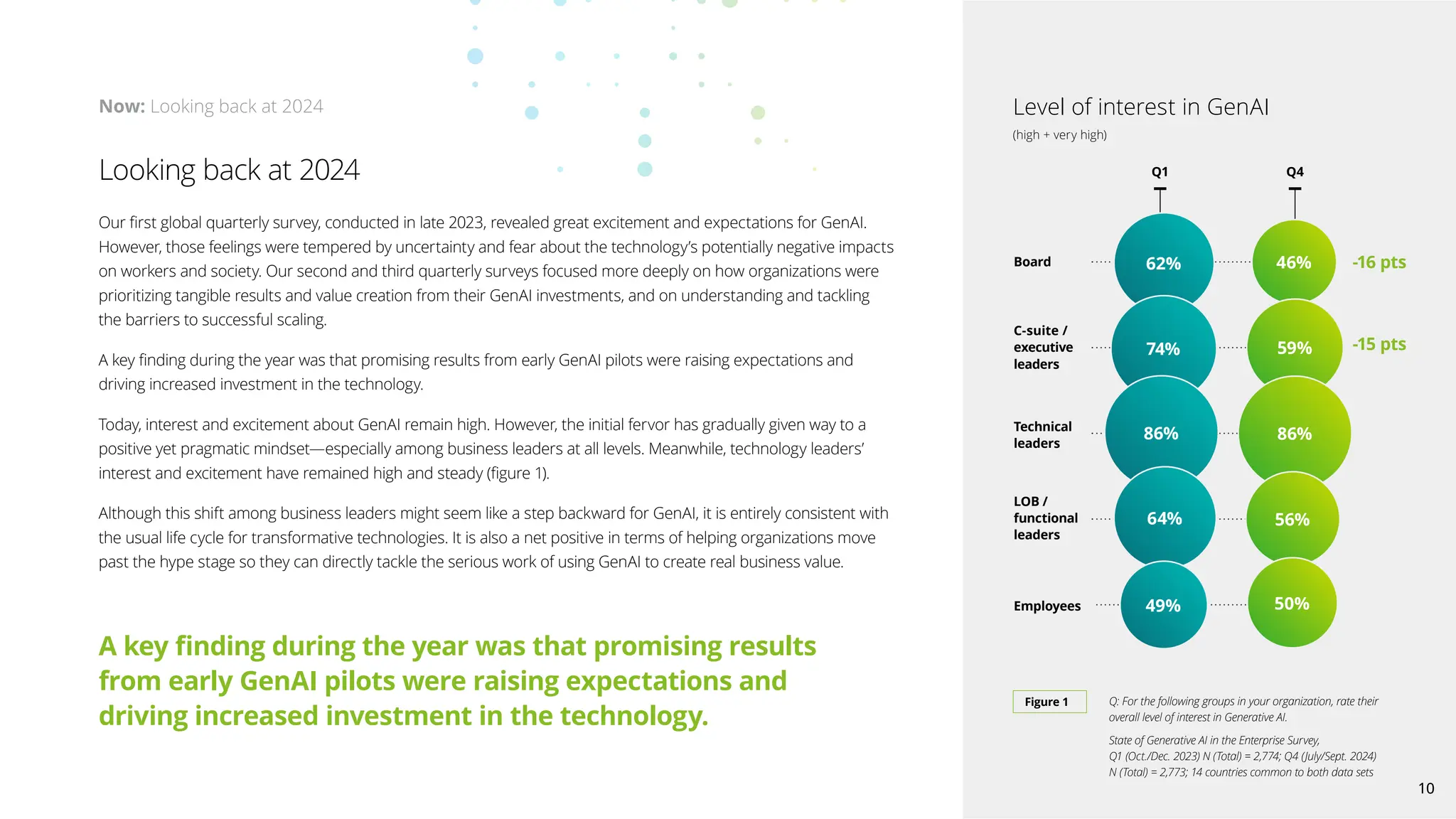
![Over the past year, as organizations gained experience with GenAI, they began to better
understand both the rewards and challenges of deploying the technology at scale—
and adjusted their plans and expectations accordingly. Budgets have risen, and the
need for C-suites and boards to spur their organizations into action has diminished.
At the same time, the need for disciplined action has grown. Technical preparedness
has improved, while regulatory uncertainty and risk management have become bigger
barriers to progress. Talent and workforce issues remain important; however, access to
specialized technical talent no longer seems to be the dire emergency it once was, at least
in comparison to other priorities. There has been one constant, however: improved data
management continues to be a top priority, even for companies that live and breathe data.
“Data emerged as the central factor for [our GenAI] success,” said a former software
engineering manager for one of the world’s leading technology companies. “While
the models and computing power existed, accessing the right data proved to be the
biggest bottleneck. To address this, the company implemented a centralized data
strategy, managed by a single data leader, to streamline data acquisition and minimize
redundancy—enabling faster model development.”
Now: Looking back at 2024
“Data emerged as the central
factor for [our GenAI] success …”
— Former software engineering manager for leading technology company
11](https://image.slidesharecdn.com/deloittestateofaiintheenterprise-250513133358-9876ff39/75/Deloitte-State-of-AI-in-the-Enterprise-Actionable-AI-Strategies-Insights-11-2048.jpg)
![From a technology perspective, the capabilities of
foundation models and applications have improved
dramatically over the past year. There are smaller, more
efficient models; better latency; bigger access windows;
expanded modalities; greater autonomy; and increased
model specialization.
Reliability and trust have improved as well, although both
still have a long way to go. Meanwhile, the adoption rate
for customized, open-source and/or proprietary large
language models (LLMs) remains limited at 20%–25% of
those surveyed.
Over the past year, respondents reported they
believe their organizations have most improved their
GenAI preparedness in the critical areas of technology
infrastructure (+7 points) and strategy (+5 points). However,
preparedness has seemingly not improved in the other
critical areas of risk and governance and talent.
The vast majority of respondents (78%) reported they
expect to increase their overall AI spending in the next
fiscal year, with GenAI mostly expanding its share of
the overall AI budget relative to our first-quarter survey
results. In particular, the percentage of organizations
investing 20%–39% of their overall AI budget on
GenAI climbed by 12 points, while the percentage of
organizations investing less than 20% of their AI budget
on GenAI fell by 6 points.
“The way we do business has not changed,” said the VP of
artificial intelligence at a major media and entertainment
company. “For every project, our objective is always to do
something that has a positive impact on the business. This
has not changed and is not going to change because it’s
what makes sense. However, a large proportion of project
proposals now have a [GenAI] component to them.”
Now: Looking back at 2024
78% of respondents expect to increase their overall AI spending
in the next fiscal year.
12](https://image.slidesharecdn.com/deloittestateofaiintheenterprise-250513133358-9876ff39/75/Deloitte-State-of-AI-in-the-Enterprise-Actionable-AI-Strategies-Insights-12-2048.jpg)
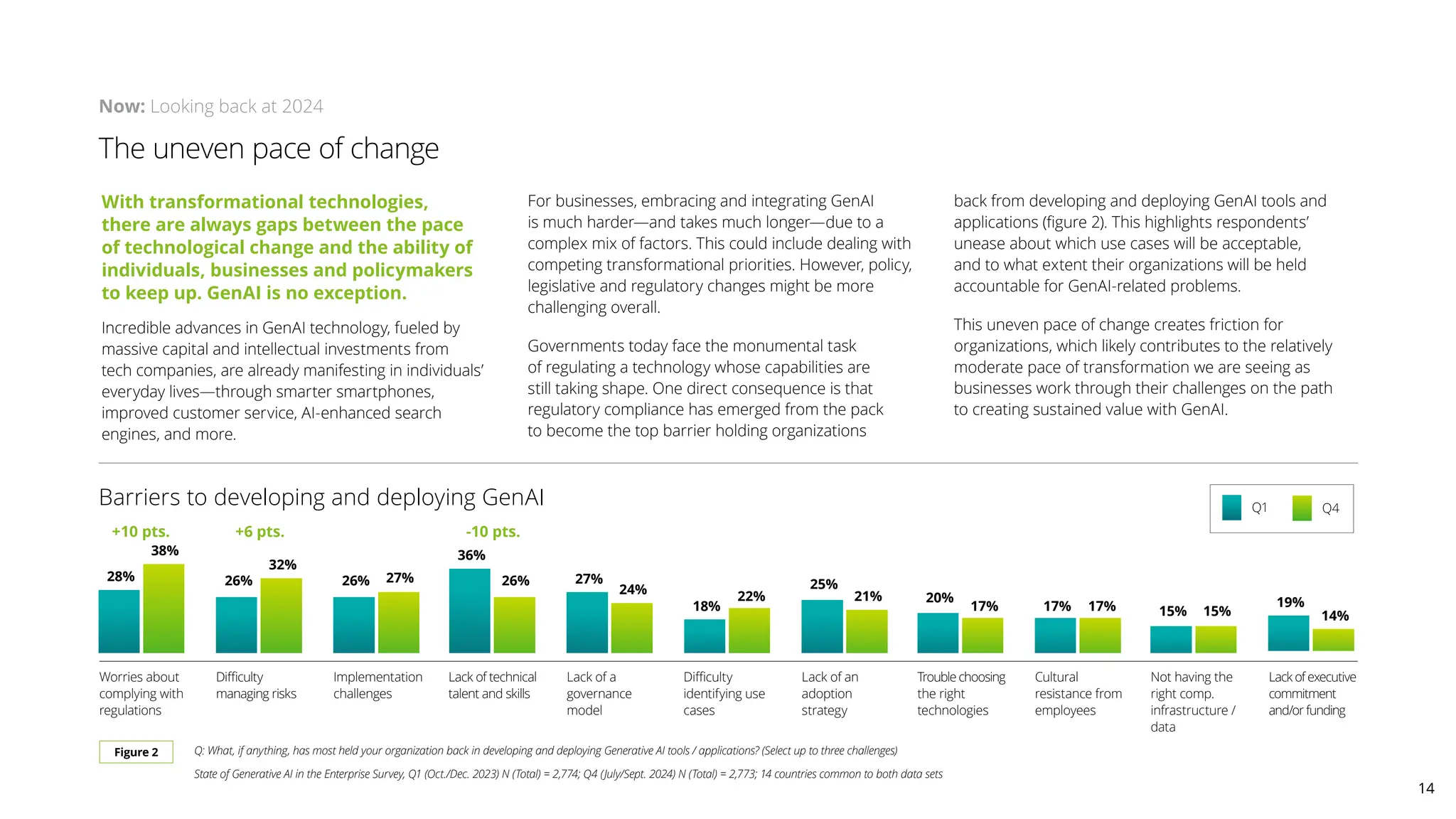

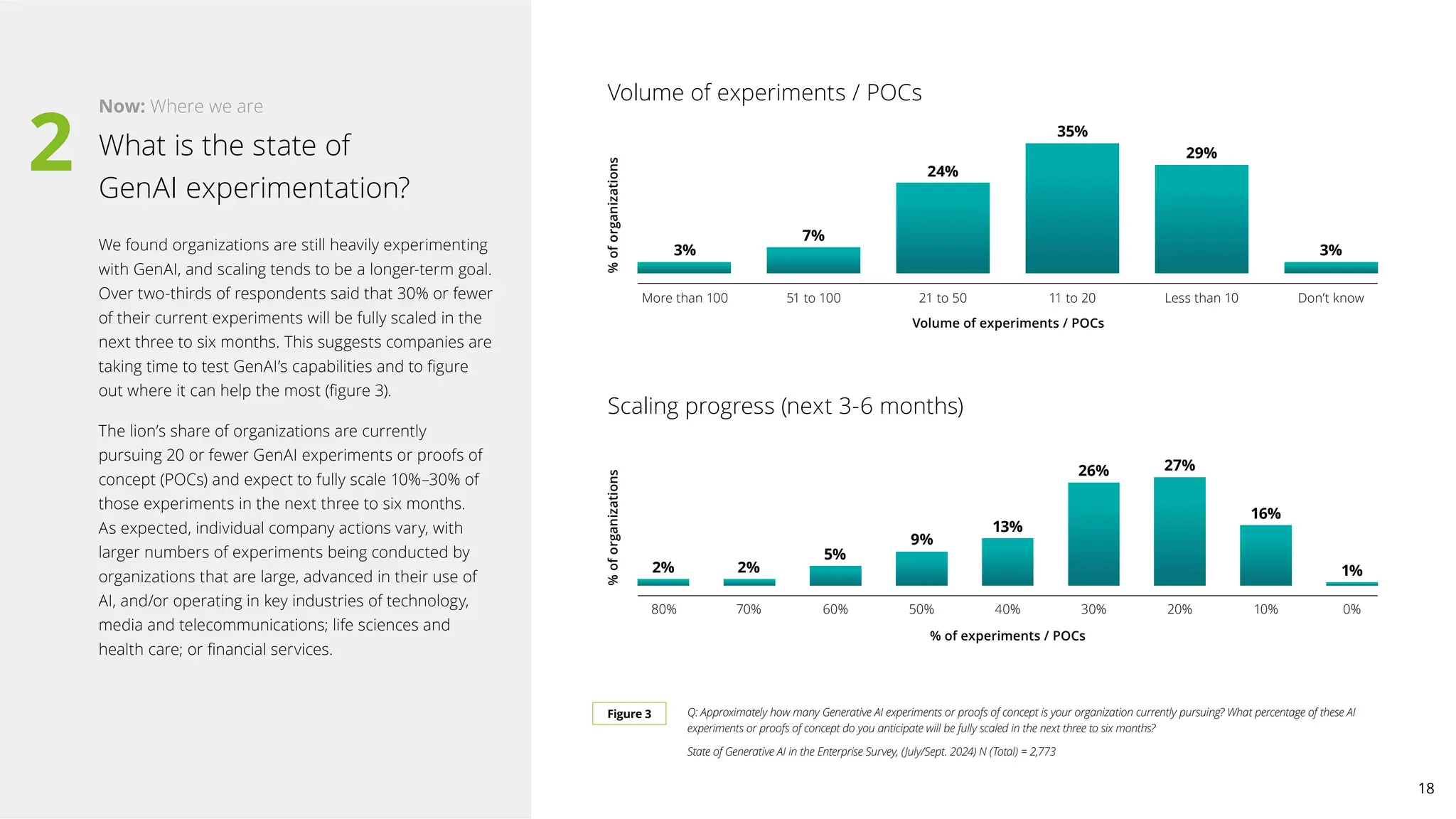
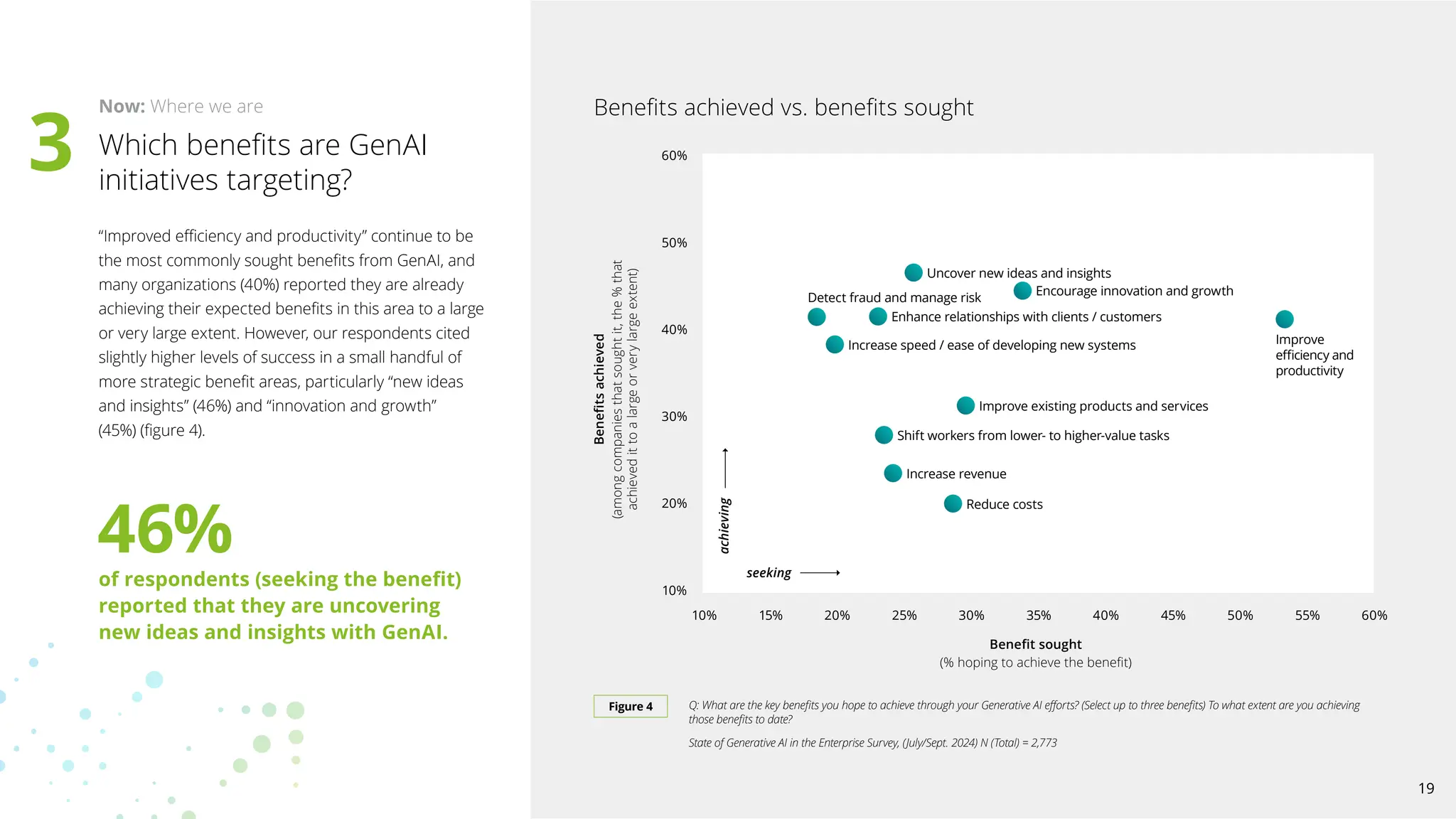
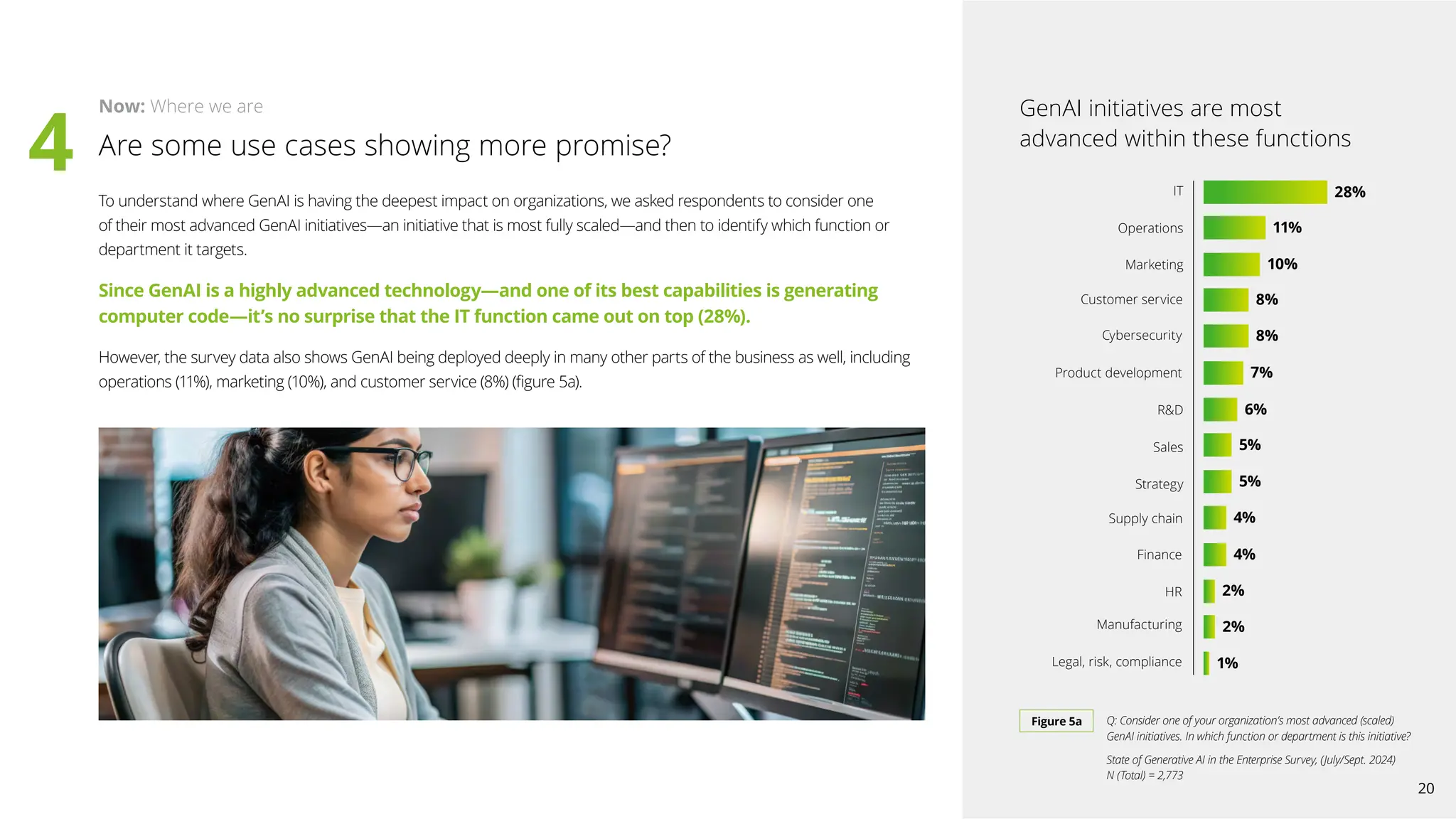
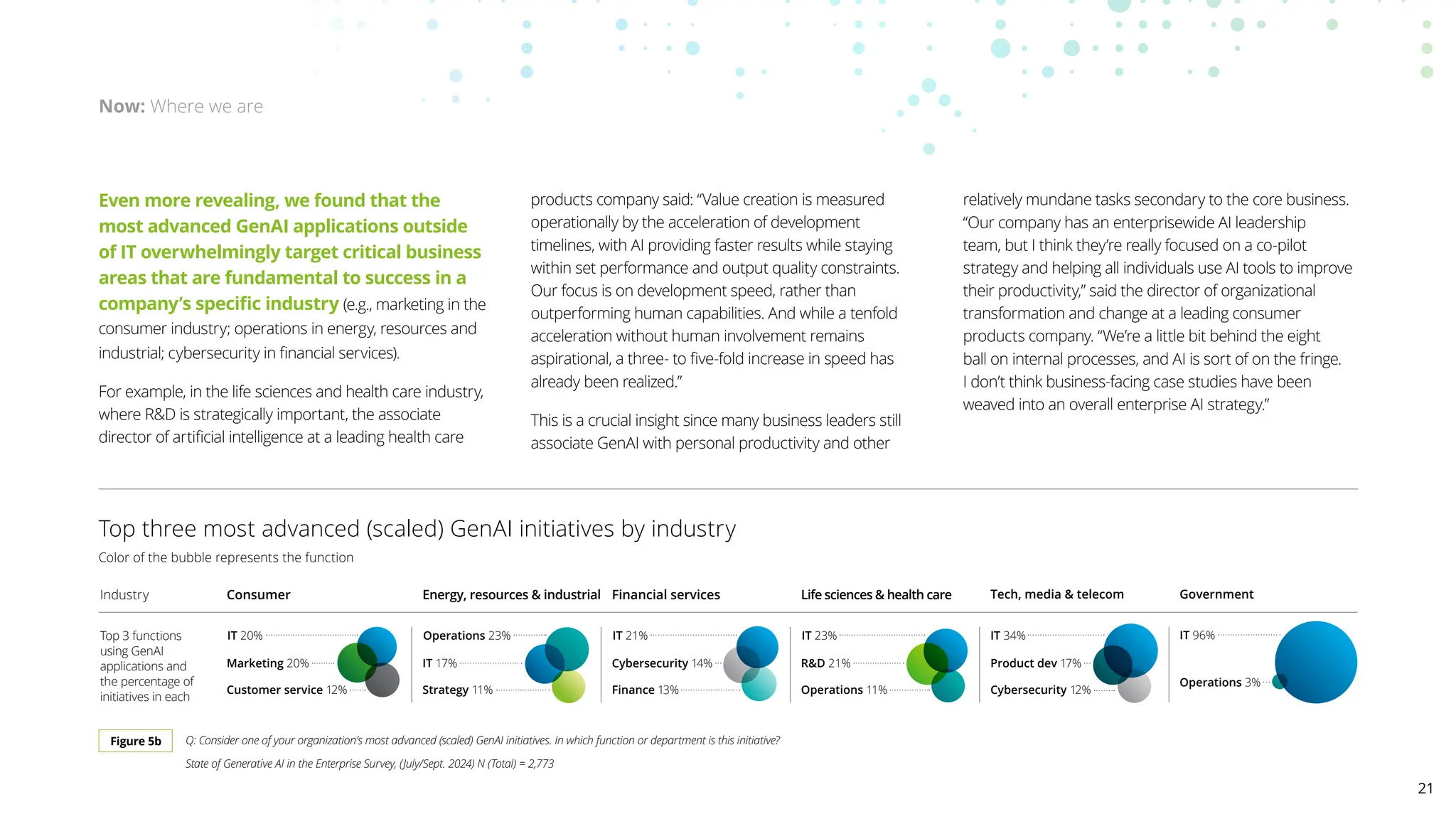
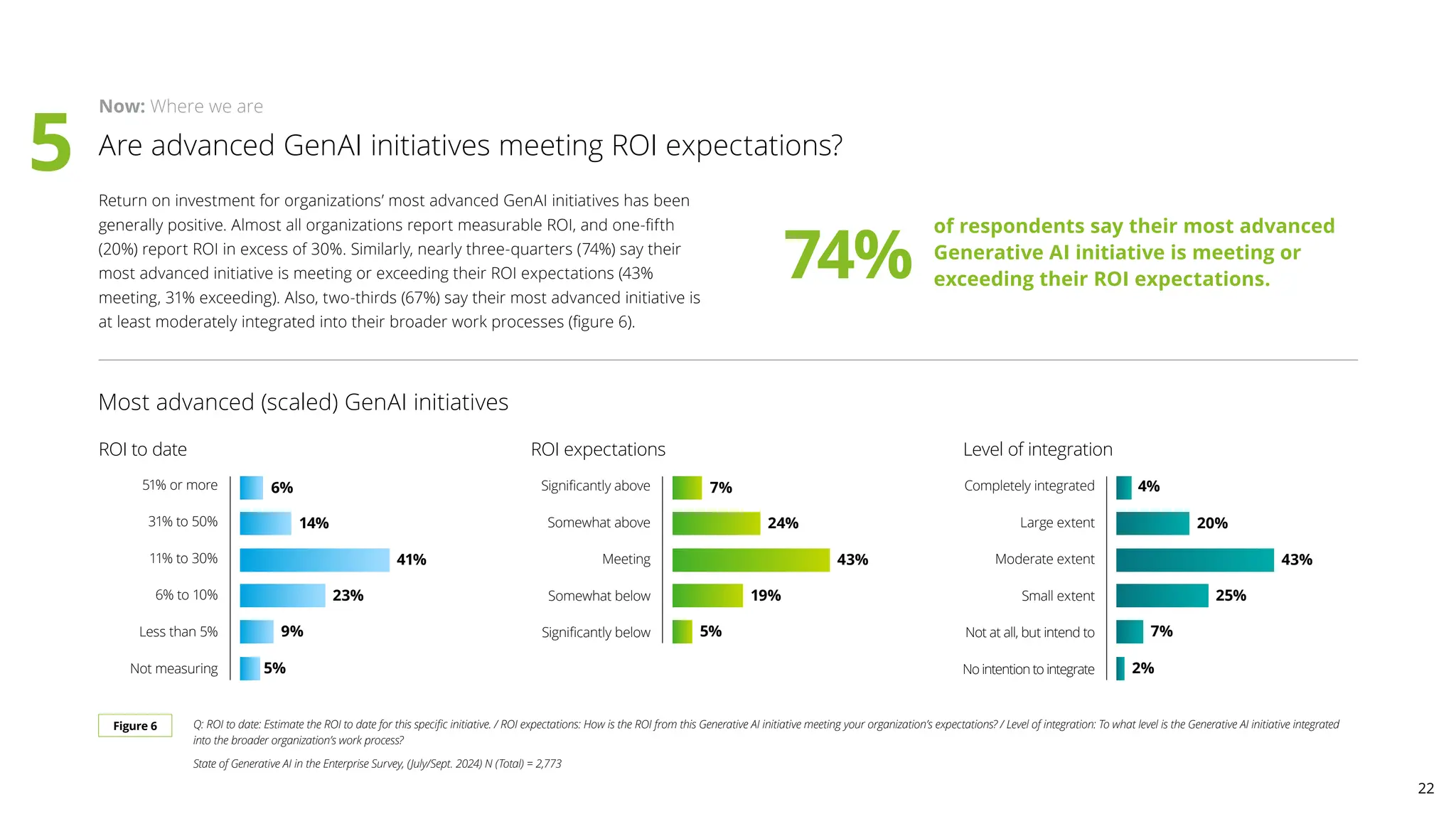
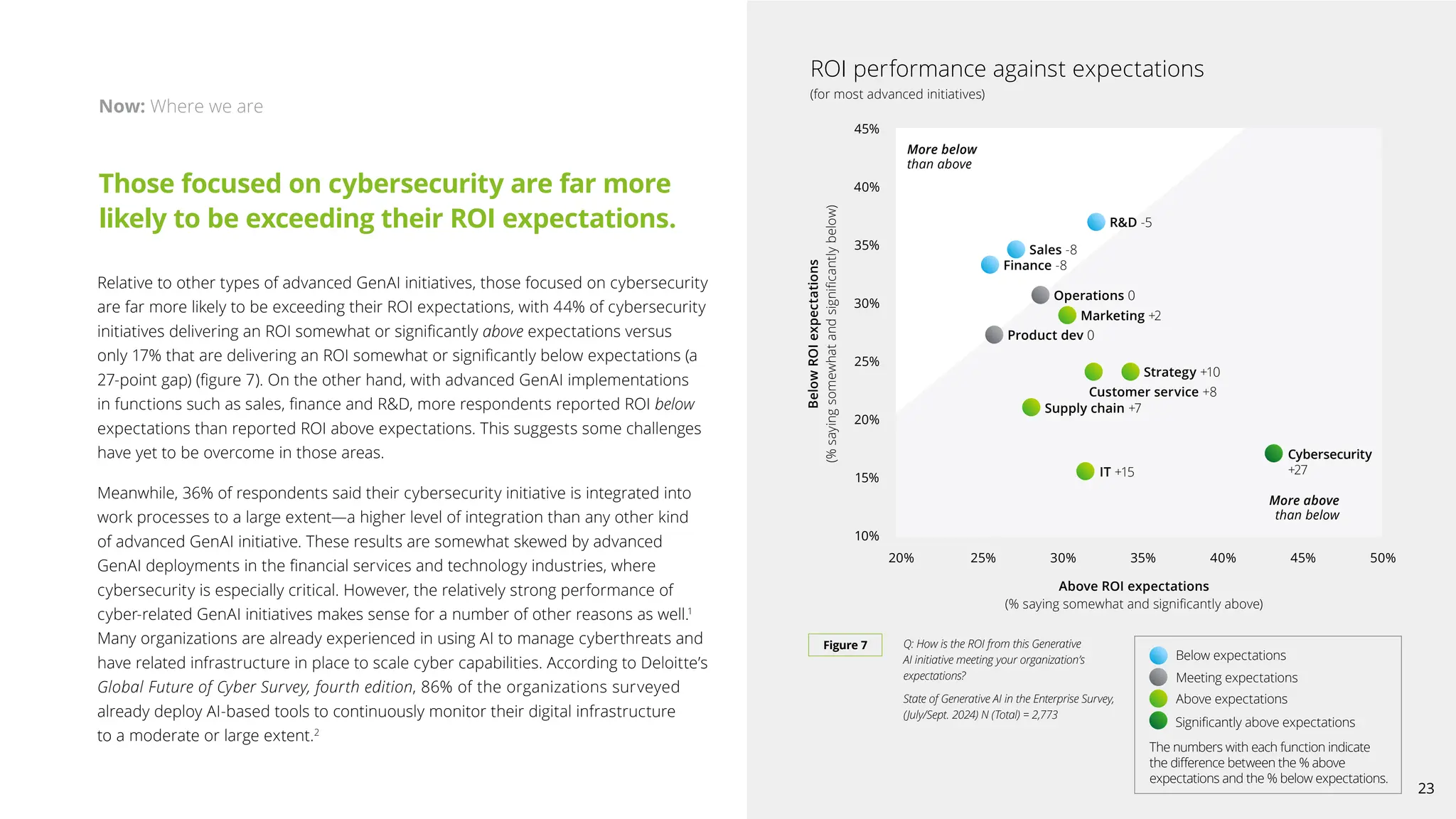

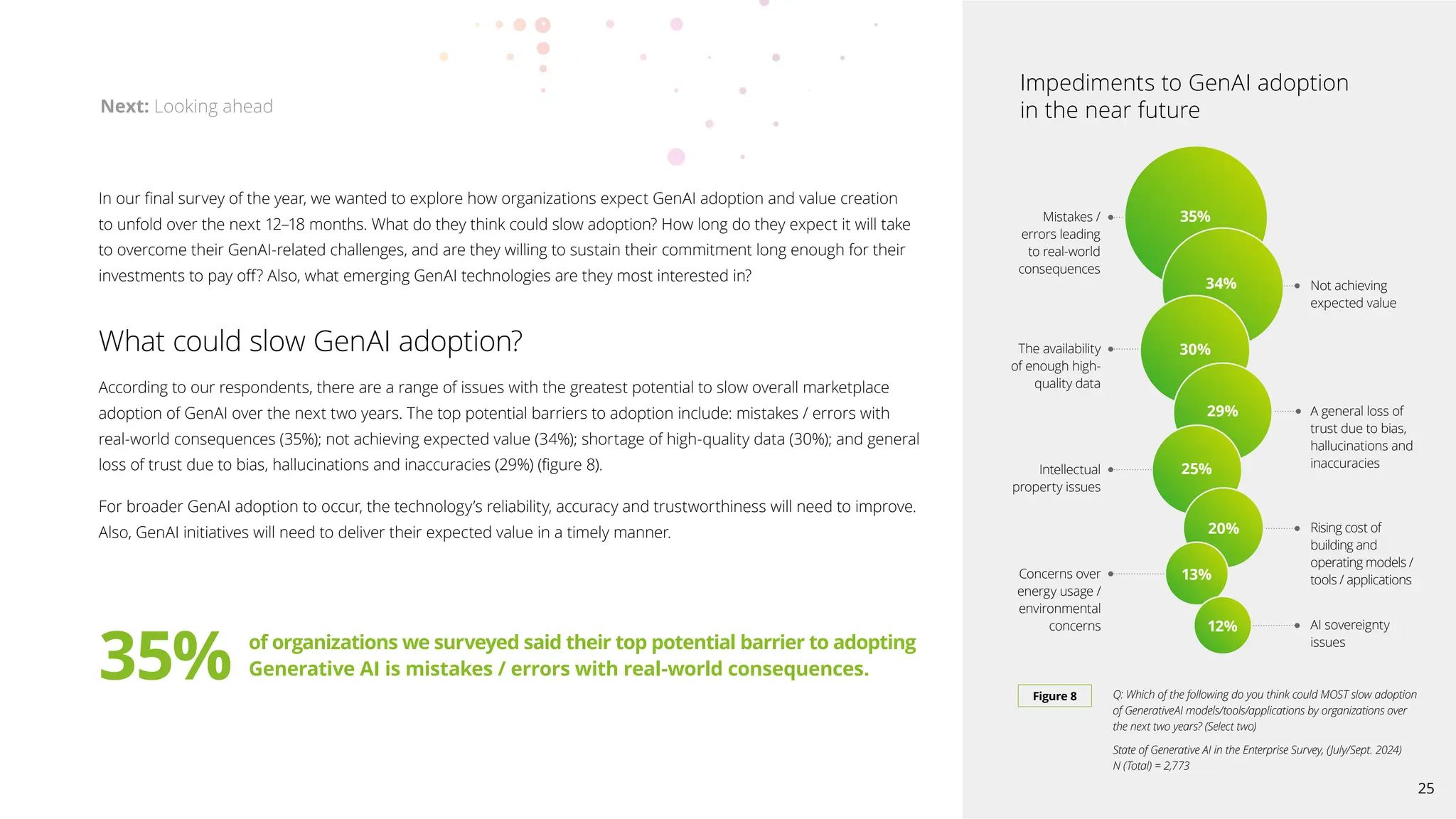
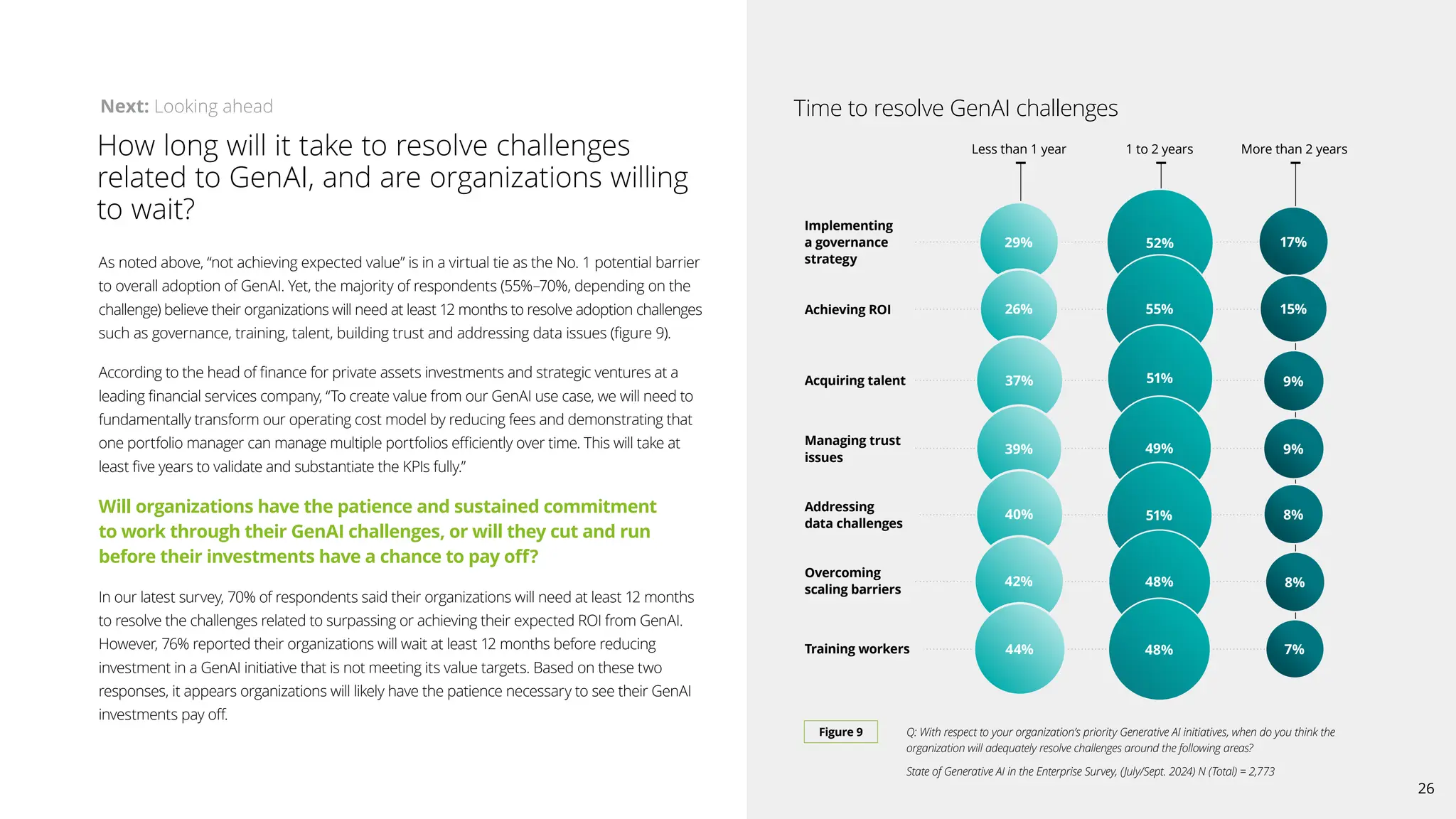
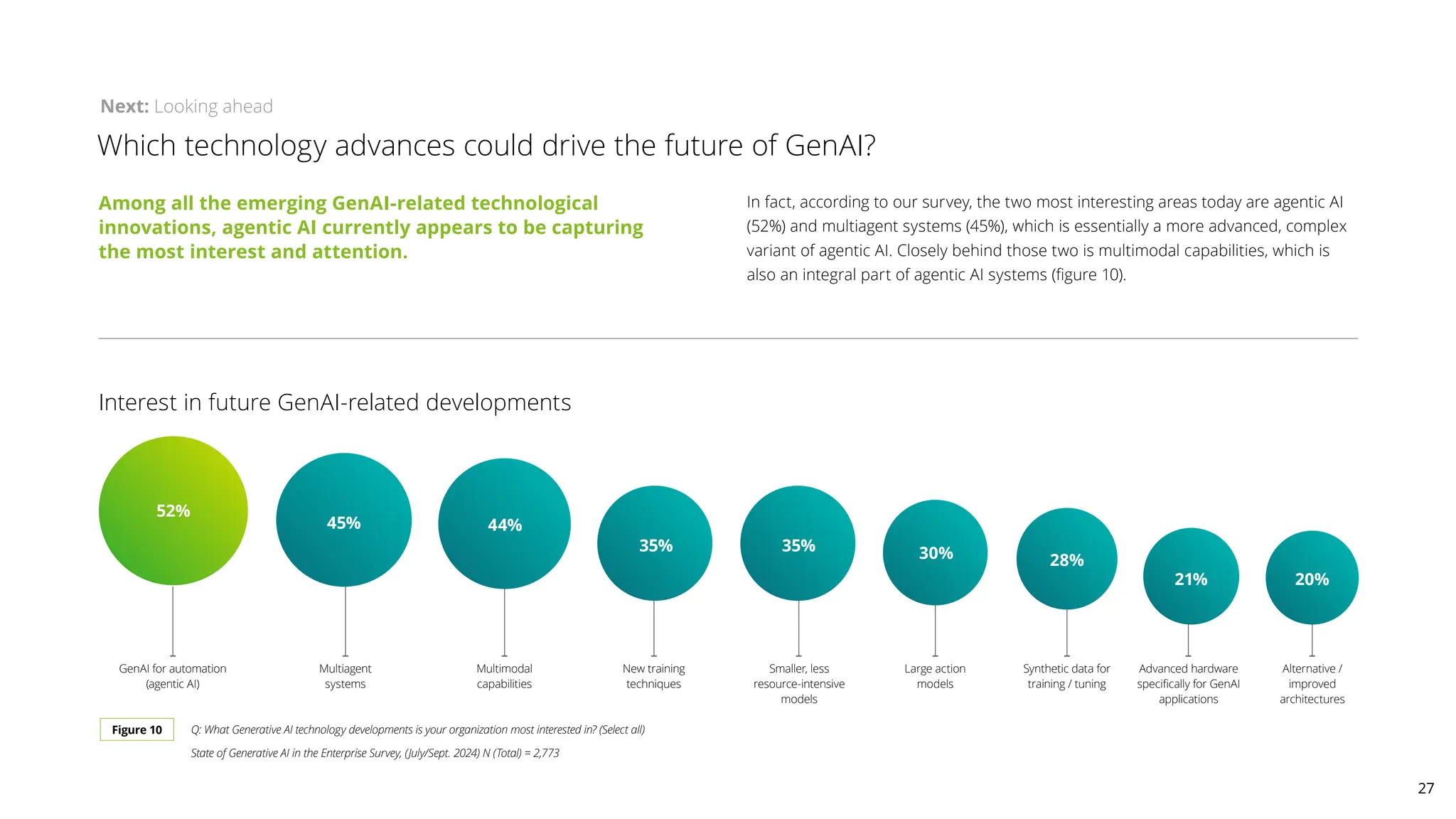


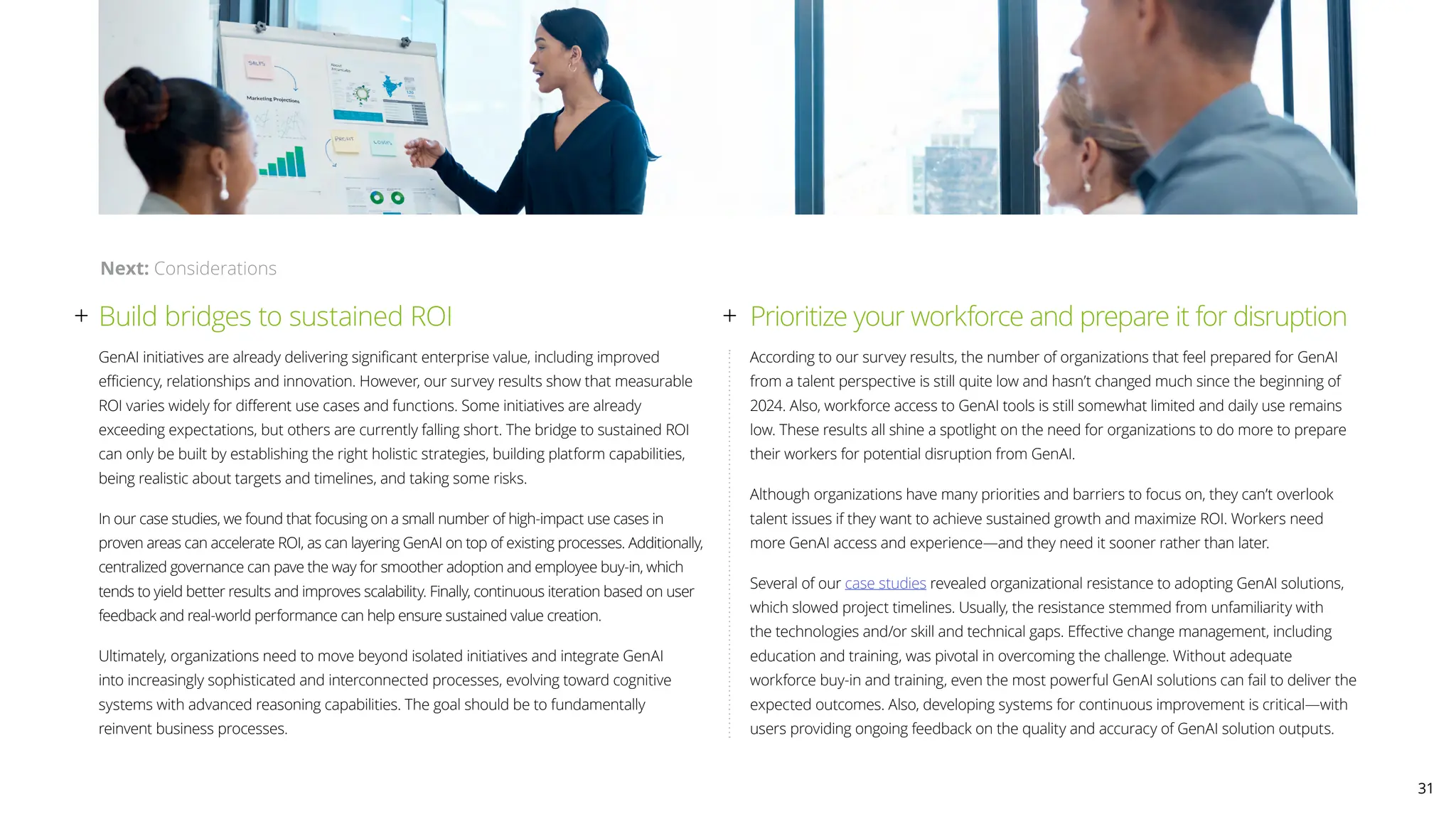

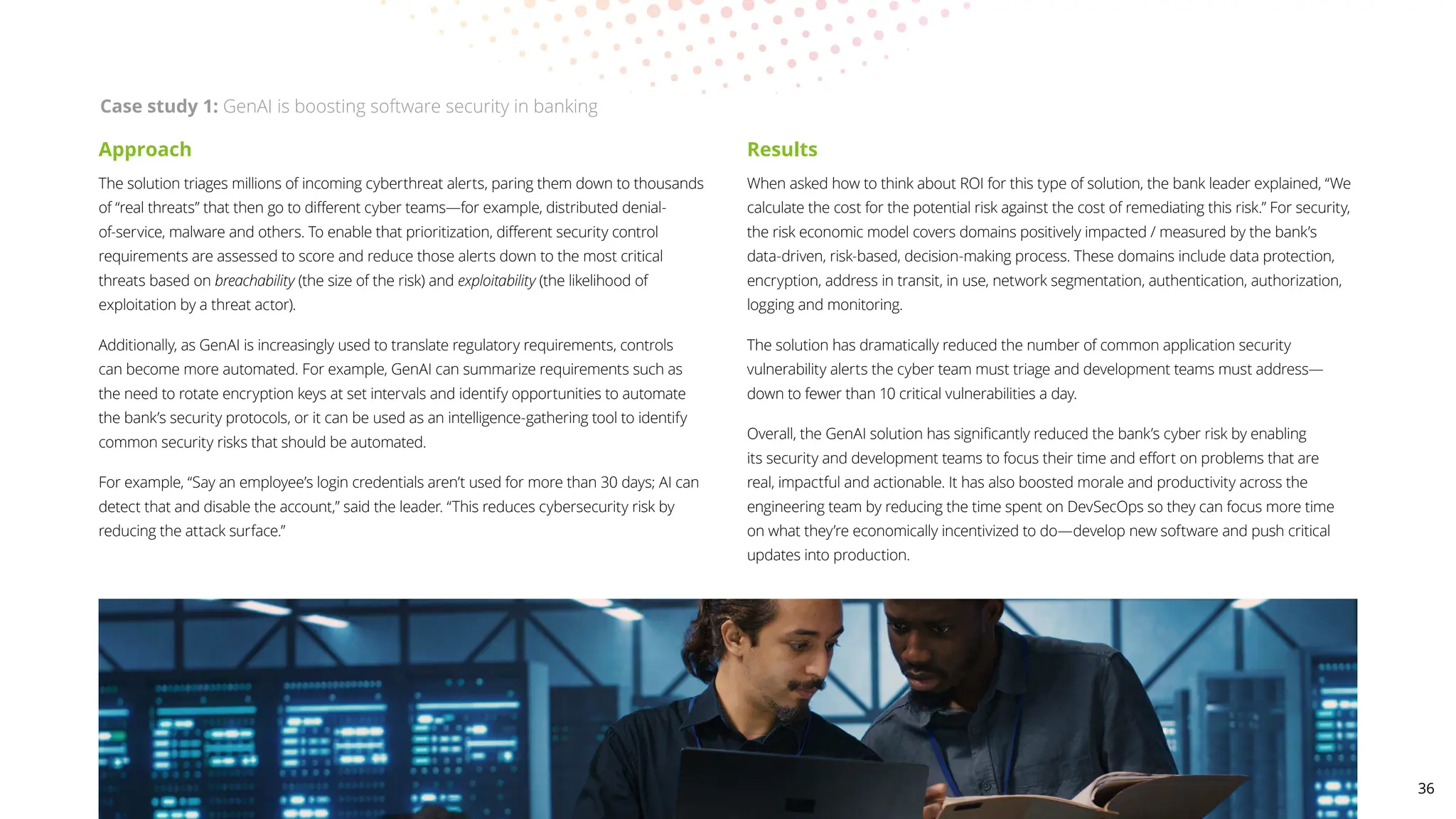
![Approach
The overall strategy originated from the CEO’s dual GenAI agenda of improving internal
productivity and identifying external commercialization opportunities. This approach
included guidance to develop an internal platform that, if proven, could potentially be offered
in the marketplace to external clients facing similar challenges.
The company used a “sandbox” approach when developing the new sales tools. This gave
interested sales reps access to GenAI tools and APIs in a safe, low-cost environment so
they could experiment freely and develop new applications without writing computer code.
The solution aims to detect common customer pain points and then use those insights to
generate sales activity by identifying opportunities for commercialization or optimization.
Results
The GenAI tools seek to enhance deal closure speed and size and improve the accuracy of
proposal generation—with the ultimate goal of increasing sales performance by leveraging
internal knowledge resources more effectively.
Currently, the company is more focused on feasibility than monetary returns, using key
performance indicators (KPIs) related to efficiency and time savings. How many sales reps
are using the tool, and how long is the period between their first access and generating their
first output? If the period is short, it’s a sign the tool is both appealing and easy to use. The
earliest measure of success is onboarding.
Of course, the most important measure of success for a sales tool is its impact on sales.
In conducting direct A/B comparisons between sales processes that used the new GenAI-
powered tools and those that didn’t, the company found a marked improvement in how
quickly deals got closed when the tools were used.
Although the tools are not yet ready to be offered as external products, doing so remains a
top priority. According to the executive we interviewed, “[Our company’s] CEO would really
like us to first adopt this Generative AI platform internally and then try to think about any
way we can sell it to external customers.”
What does long-term success look like for its GenAI sales tool? The hope is for increased deal
sizes, faster deal closings, and effective deployment of a commercialized external solution.
Case study 2: GenAI is accelerating sales success in tech
39](https://image.slidesharecdn.com/deloittestateofaiintheenterprise-250513133358-9876ff39/75/Deloitte-State-of-AI-in-the-Enterprise-Actionable-AI-Strategies-Insights-39-2048.jpg)
![Approach
The company built on its already strong data and AI foundation, which included years of
experience working with GenAI-related technologies such as natural language processing,
cognitive intelligence and multistep reasoning. Over the past 18 months, it has deeply
integrated LLMs and foundation models into its business, focusing on architecture,
governance and use case development—balancing build versus buy strategies to maximize
impact and value.
The company’s GenAI strategy has been to rapidly expand and prototype. “In 2023, we were
throwing a lot at the wall and seeing what stuck: lots of different providers, architectures,
models and experimentation types,” the executive said. “But in 2024, a lot of that coalesced
into a strategy we’ve now codified and defined.”
“In this case, our [proof of concept] took the shape of a pre-GenAI solution we already
had that specifically looked at a social media platform [analyzing trending influencers and
brand affinity]. Building on that existing dataset, we focused our initial effort on collecting,
cleansing, organizing and structuring the data in real time. We then took the data and threw
an LLM on top of it to see what kinds of text content it could generate. Later, we expanded
our scope to include hashtags, then a multimodal model that includes images, and now
short-form video.”
Results
In the United States, around 60% of the company’s brands are using the GenAI-powered
solution to achieve an always-on social media presence and produce relevant content with
minimal human involvement. The solution is delivering tangible benefits in three key areas.
First and foremost is increased productivity, which directly translates into substantial cost
savings. “Whether it’s a first party, second or third party, there were individuals who were
conducting these tasks, and there is a dollar value directly associated with each hour of their
time,” the executive said.
Second is increased sales, with the GenAI solution helping to boost both the incremental
number of impressions for each social media post and the monetary value created by those
impressions (due to heightened awareness, increased purchase conviction, and an easier
path to purchase).
The third is reduced media costs, particularly the cost savings that accrue when an effective
unpromoted social media post eliminates the need to pay for a promoted post—freeing up
budget that can be invested more strategically elsewhere.
Although many of these benefits have had an immediate impact on the company’s bottom
line, some of the productivity gains will take longer to fully realize because they require
formal process changes or revisions to existing annual or multiyear contracts.
Case study 3: GenAI is powering an always-on, multimodal social media presence in the consumer industry
42](https://image.slidesharecdn.com/deloittestateofaiintheenterprise-250513133358-9876ff39/75/Deloitte-State-of-AI-in-the-Enterprise-Actionable-AI-Strategies-Insights-42-2048.jpg)