CLINICAL SOCIOLOGY
Clinical Sociologyis a practical field of sociology that uses sociological theories,
research, and methods to assess, prevent, and resolve social problems. It focuses on
applying sociological knowledge to improve individual and community well-being.
Features/Characteristics :
• Works with individuals, families, groups, and organizations
• Focuses on social behavior, institutions, and relationships
• Uses scientific methods like surveys, interviews, and case studies
• Emphasizes intervention, prevention, and evaluation
3.
CLINICAL SOCIOLOGY-NURSING
• Helpsunderstand social causes of illness (e.g., poverty, gender roles, domestic
violence)
• Improves patient care by considering cultural and social factors
• Aids in community-based health planning
• Encourages holistic health interventions (biological + psychological + social)
4.
CLINICAL SOCIOLOGY
Example inNursing:
A nurse notices that a patient with high blood pressure is not taking
medicines regularly.
By using clinical sociology, the nurse talks to the patient and finds out that:
The patient cannot afford the medicines
The patient’s family thinks traditional remedies are better
So, the nurse explains the importance of the medicine, suggests low-cost
options, and involves the family in health education.
5.
SOCIOLOGICAL STRATEGIES FORDEVELOPING
SERVICES FORTHE ABUSED
Victims of abuse (domestic violence, child abuse, elder abuse, emotional
abuse) often suffer psychological trauma, social isolation, and
stigma.
Clinical sociology helps in creating effective, culturally appropriate, and
accessible services.
6.
SOCIOLOGICAL STRATEGIES
1.Needs Assessment
Identifythe type and extent of abuse through surveys, interviews, or focus
groups.
Helps tailor services to the actual needs of the target group.
2.Community Engagement
Involves religious leaders, social workers, nurses, and educators to raise
awareness and reduce stigma.
Builds trust and support systems in the community.
7.
SOCIOLOGICAL STRATEGIES
3.Multidisciplinary Programs
Developmentof shelters, legal aid, medical help, and counseling services under
one umbrella.
Collaborative approach with healthcare, legal, and social systems.
4.Culturally Sensitive Interventions
Design services respecting cultural norms and values of victims.
Avoids re-traumatization or victim-blaming.
8.
SOCIOLOGICAL STRATEGIES
5.Victim Empowerment
Providesvocational training, education, and life skills to help abused
individuals rebuild their lives.
Promotes independence and self-esteem.
6.Policy Advocacy
Clinical sociologists work with policymakers to strengthen laws, promote
gender equality, and fund anti-violence programs.
9.
ROLE OF NURSESIN SERVICES FORTHE ABUSED
Nurses are often first-line responders and play a critical role in
identifying, supporting, and referring victims of abuse.
10.
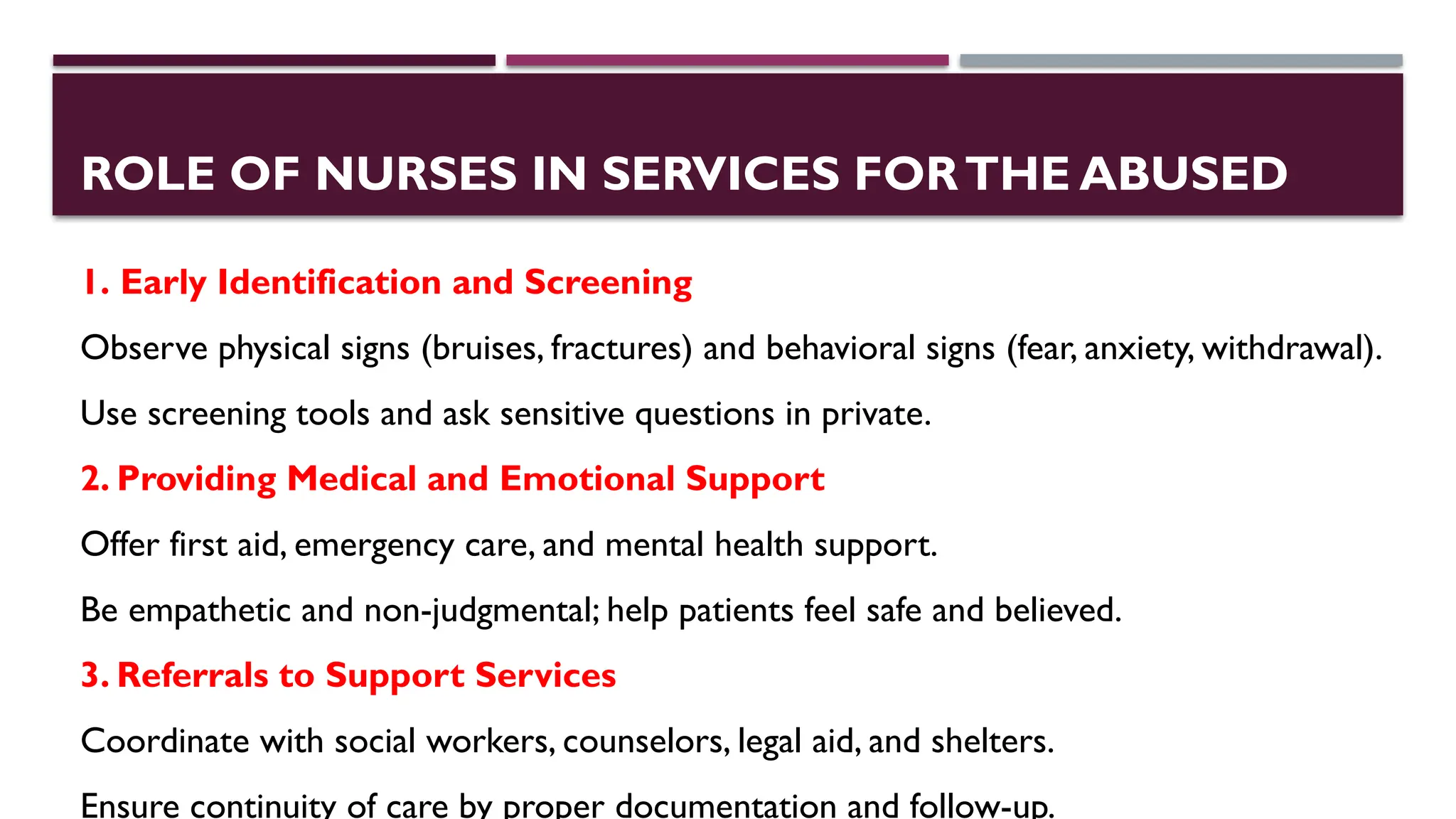
ROLE OF NURSESIN SERVICES FORTHE ABUSED
1. Early Identification and Screening
Observe physical signs (bruises, fractures) and behavioral signs (fear, anxiety, withdrawal).
Use screening tools and ask sensitive questions in private.
2. Providing Medical and Emotional Support
Offer first aid, emergency care, and mental health support.
Be empathetic and non-judgmental; help patients feel safe and believed.
3. Referrals to Support Services
Coordinate with social workers, counselors, legal aid, and shelters.
Ensure continuity of care by proper documentation and follow-up.
11.
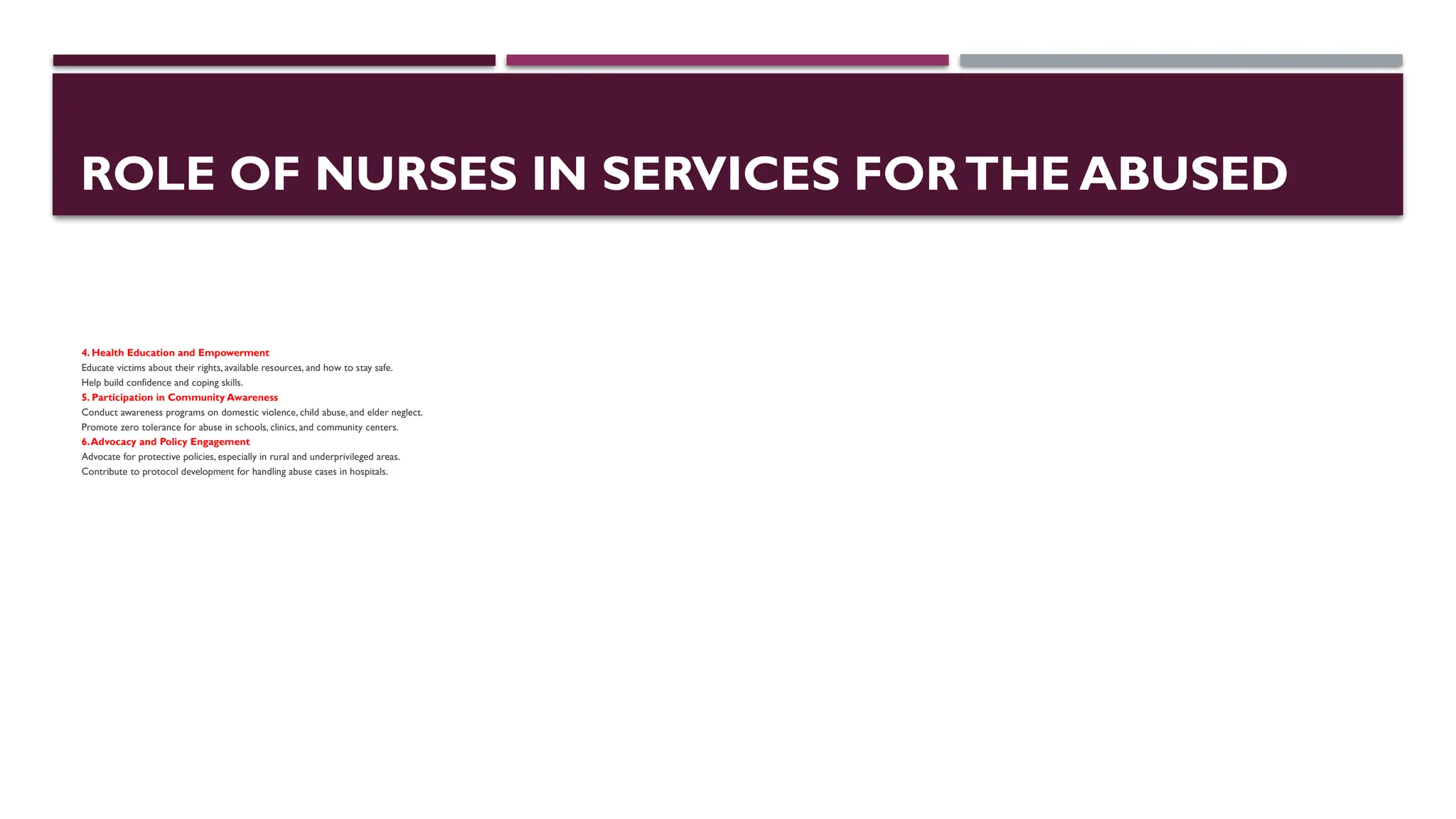
ROLE OF NURSESIN SERVICES FORTHE ABUSED
4. Health Education and Empowerment
Educate victims about their rights, available resources, and how to stay safe.
Help build confidence and coping skills.
5. Participation in Community Awareness
Conduct awareness programs on domestic violence, child abuse, and elder neglect.
Promote zero tolerance for abuse in schools, clinics, and community centers.
6.Advocacy and Policy Engagement
Advocate for protective policies, especially in rural and underprivileged areas.
Contribute to protocol development for handling abuse cases in hospitals.
12.
ROLE OF NURSESIN SERVICES FORTHE ABUSED
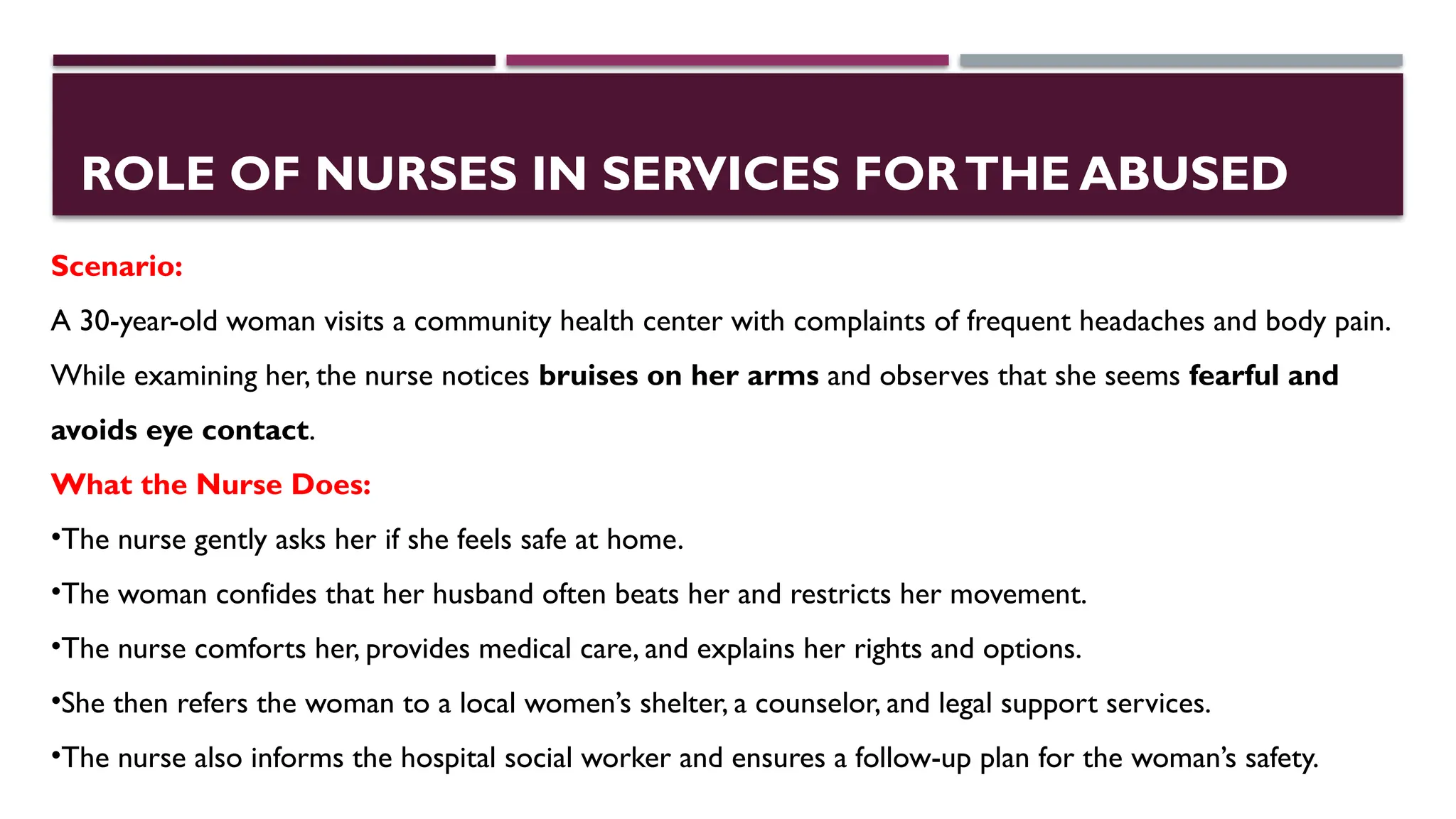
Scenario:
A 30-year-old woman visits a community health center with complaints of frequent headaches and body pain.
While examining her, the nurse notices bruises on her arms and observes that she seems fearful and
avoids eye contact.
What the Nurse Does:
•The nurse gently asks her if she feels safe at home.
•The woman confides that her husband often beats her and restricts her movement.
•The nurse comforts her, provides medical care, and explains her rights and options.
•She then refers the woman to a local women’s shelter, a counselor, and legal support services.
•The nurse also informs the hospital social worker and ensures a follow-up plan for the woman’s safety.
13.
ROLE OF NURSESIN SERVICES FORTHE ABUSED
This case shows how a nurse uses clinical observation, communication
skills, and social support systems to:
• Identify a victim of abuse
• Offer medical and emotional support
• Refer to protective and rehabilitation services
14.
ROLE OF NURSESIN SERVICES FORTHE ABUSED
Scenario:
A school nurse notices that a 13-year-old girl frequently comes to school with dirty
clothes, poor hygiene, and seems withdrawn. One day, the girl complains of
stomach pain, and during a private talk, the nurse gently asks about her home
situation.
The girl quietly reveals that she is neglected at home, often left alone, and
sometimes not given food. She says her parents fight a lot and ignore her needs.
15.
ROLE OF NURSESIN SERVICES FORTHE ABUSED
What the Nurse Does:
• The nurse listens patiently and does not pressure the child.
• She provides basic care and comfort.
• The nurse documents the observations and informs the child protection
officer as per the child safety protocol.
• She refers the girl to the school counselor for emotional support.
• The nurse also works with the social worker to involve child welfare services and
ensure the girl’s safety and well-being.
16.
USE OF CLINICALSOCIOLOGY IN CRISIS INTERVENTION
Crisis intervention is the immediate, short-term help given to individuals
experiencing a sudden emotional, psychological, or social crisis,
such as:
• Domestic violence
• Suicidal behavior
• Natural disasters
• Sudden illness or death
• Child abuse or trauma
17.
ROLE OF NURSESIN CRISIS INTERVENTION
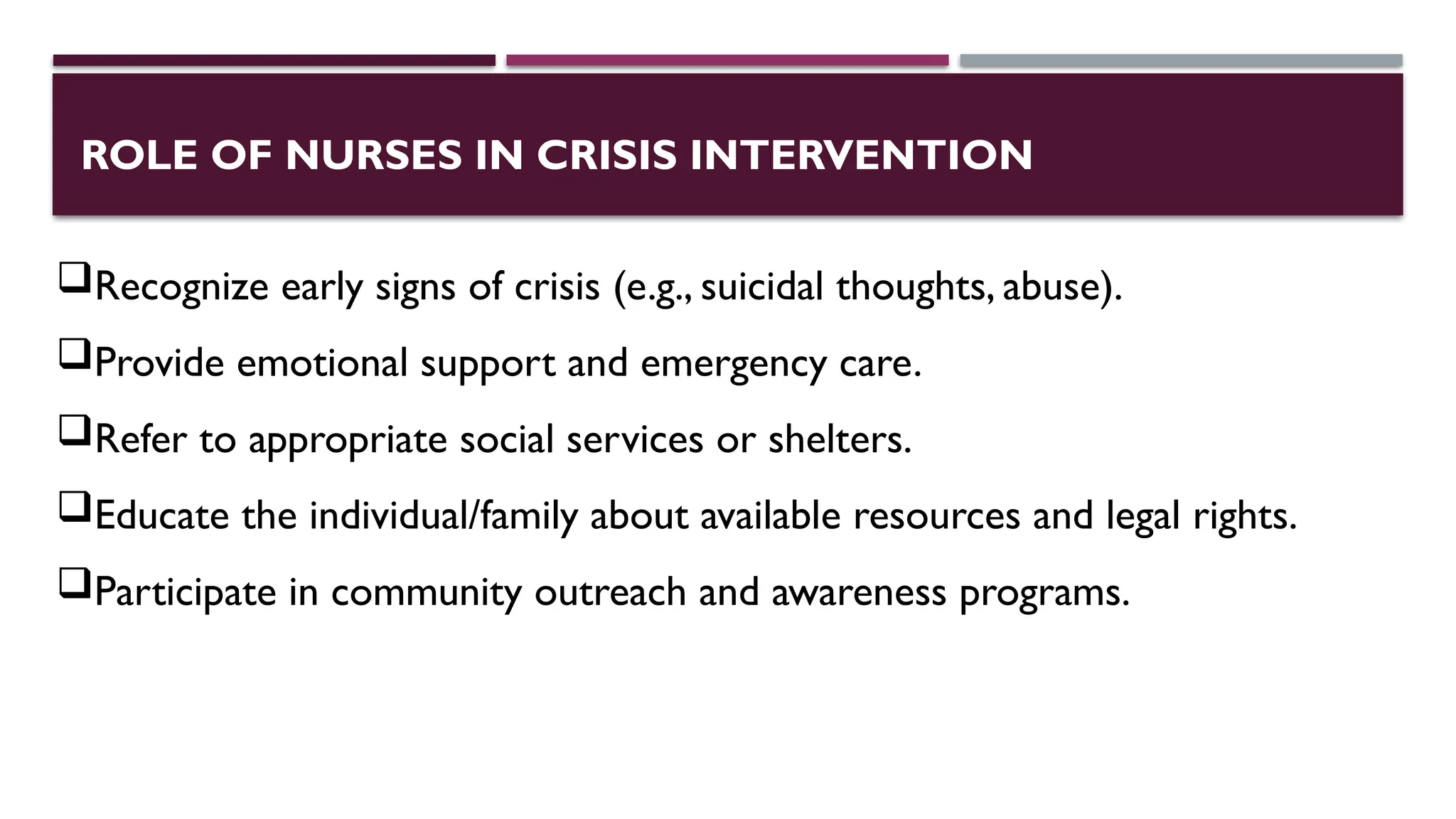
Recognize early signs of crisis (e.g., suicidal thoughts, abuse).
Provide emotional support and emergency care.
Refer to appropriate social services or shelters.
Educate the individual/family about available resources and legal rights.
Participate in community outreach and awareness programs.
18.
ROLE OF NURSESIN CRISIS INTERVENTION
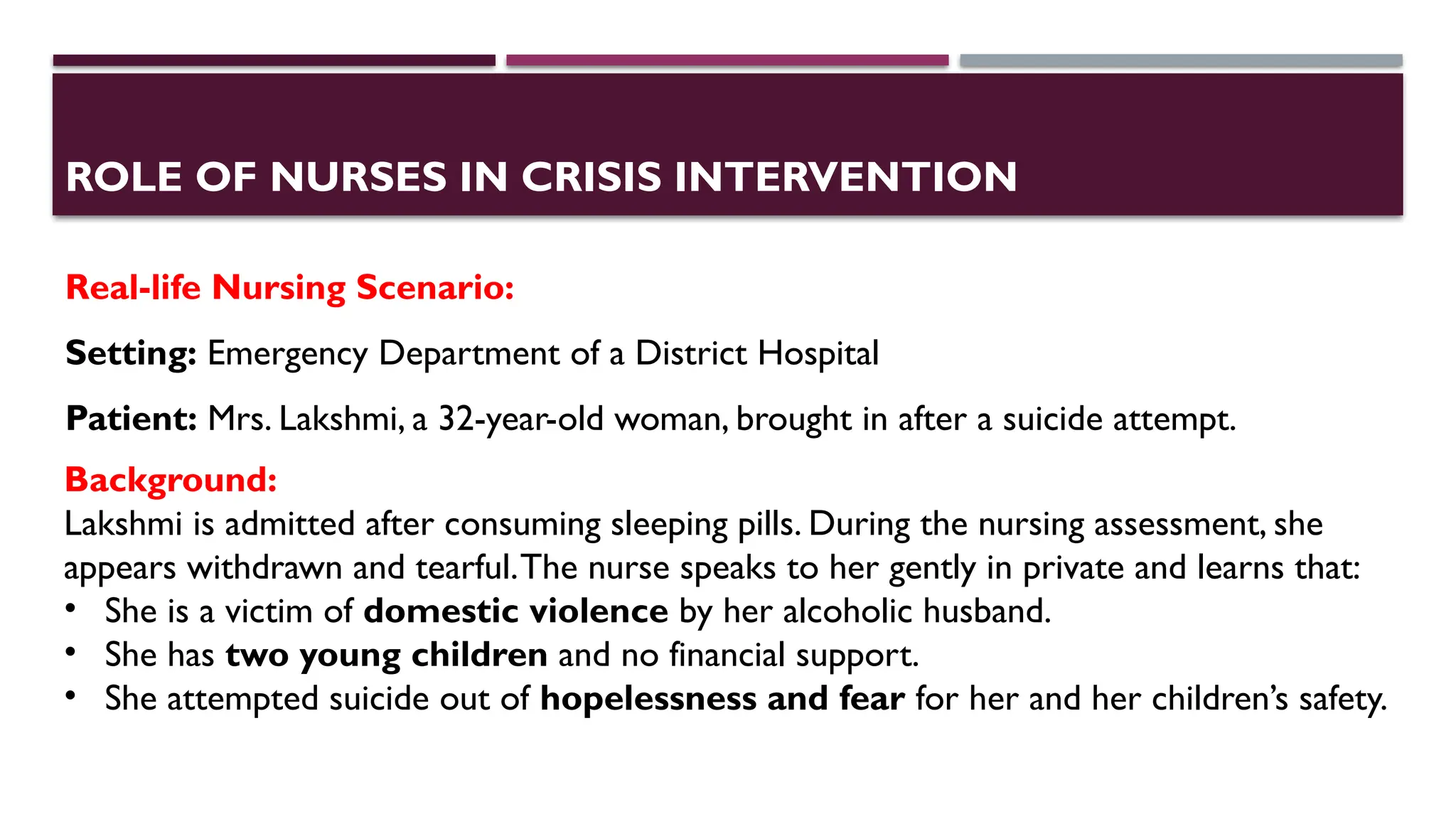
Real-life Nursing Scenario:
Setting: Emergency Department of a District Hospital
Patient: Mrs. Lakshmi, a 32-year-old woman, brought in after a suicide attempt.
Background:
Lakshmi is admitted after consuming sleeping pills. During the nursing assessment, she
appears withdrawn and tearful.The nurse speaks to her gently in private and learns that:
• She is a victim of domestic violence by her alcoholic husband.
• She has two young children and no financial support.
• She attempted suicide out of hopelessness and fear for her and her children’s safety.
19.
NURSE'S ACTIONS USINGCLINICAL SOCIOLOGY
PRINCIPLES
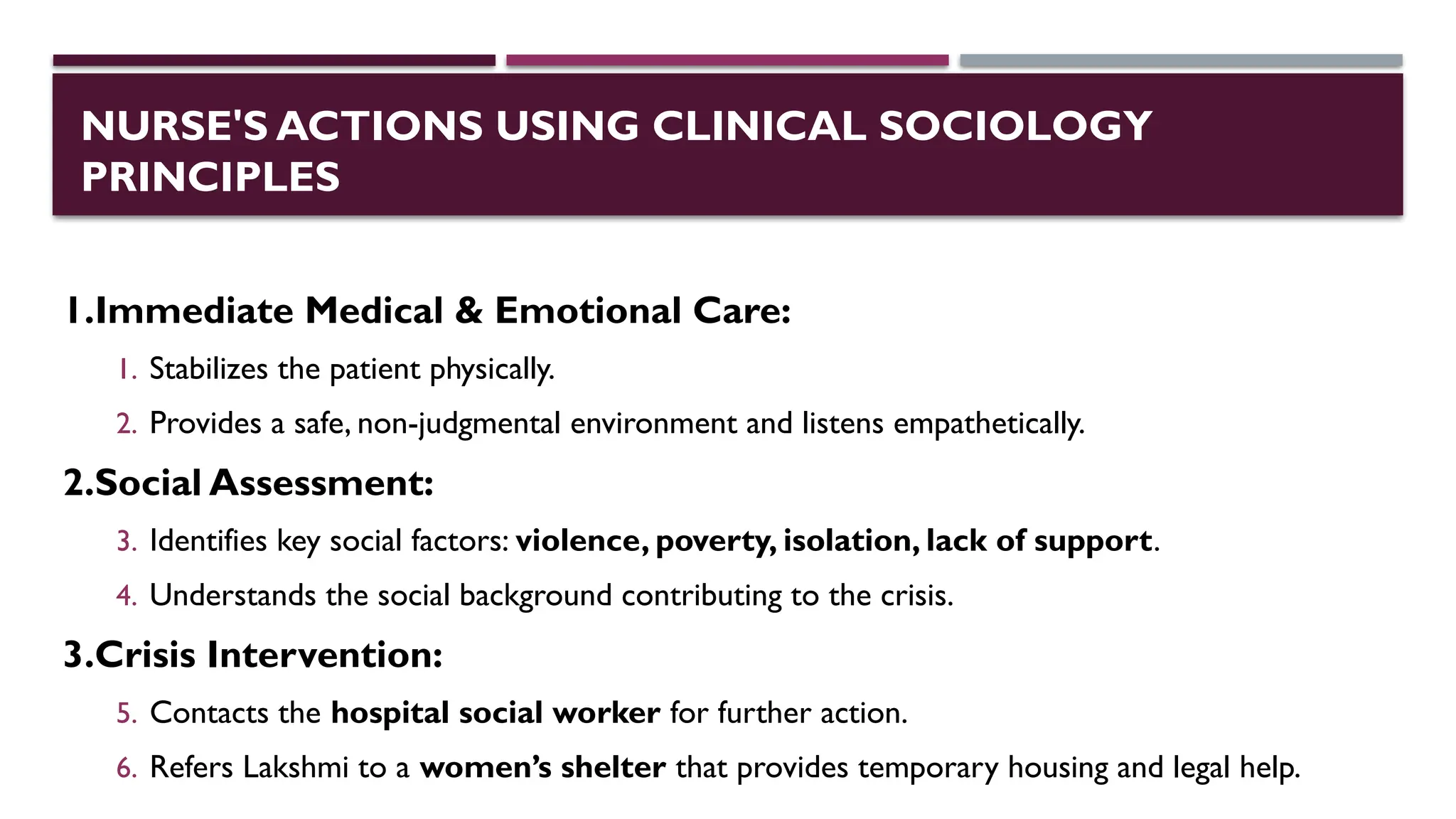
1.Immediate Medical & Emotional Care:
1. Stabilizes the patient physically.
2. Provides a safe, non-judgmental environment and listens empathetically.
2.Social Assessment:
3. Identifies key social factors: violence, poverty, isolation, lack of support.
4. Understands the social background contributing to the crisis.
3.Crisis Intervention:
5. Contacts the hospital social worker for further action.
6. Refers Lakshmi to a women’s shelter that provides temporary housing and legal help.
20.
NURSE'S ACTIONS USINGCLINICAL SOCIOLOGY
PRINCIPLES
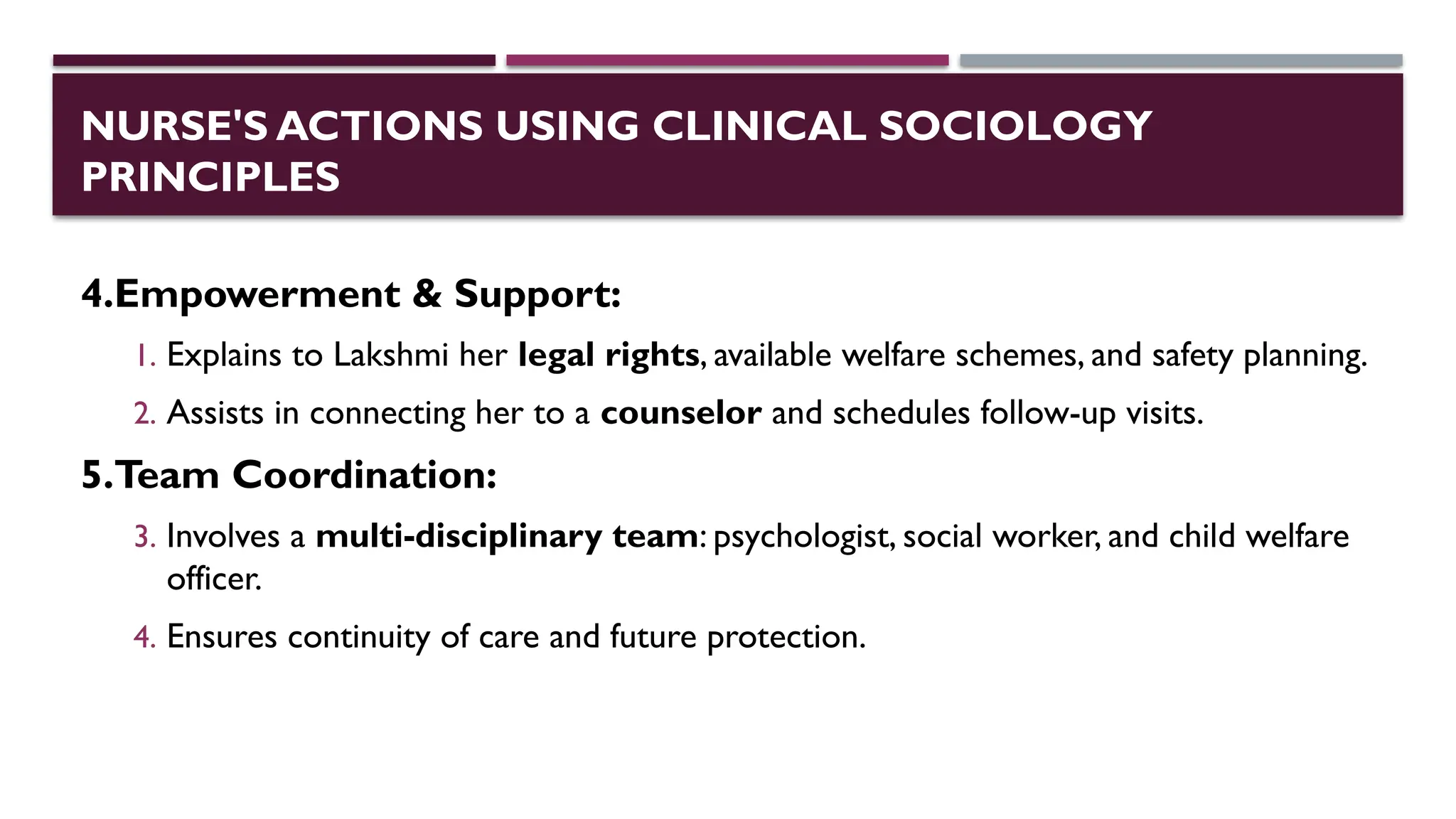
4.Empowerment & Support:
1. Explains to Lakshmi her legal rights, available welfare schemes, and safety planning.
2. Assists in connecting her to a counselor and schedules follow-up visits.
5.Team Coordination:
3. Involves a multi-disciplinary team: psychologist, social worker, and child welfare
officer.
4. Ensures continuity of care and future protection.
21.
CLINICAL SOCIOLOGY INACTION:
• The nurse used sociological understanding to assess Lakshmi’s social
environment.
• She applied intervention strategies beyond just physical care.
• Helped develop long-term, community-based solutions for a
sustainable recovery.