GENERAL PROVISIONS
The actdeclares the state’s unwavering commitment to upholding
the principles of good governance, aiming to ensure
transparency, competitiveness, efficiency, proportionality,
accountability, public monitoring, professionalization,
sustainability, and value for money in all government procurement
activities.
3.
8 FUNDAMENTAL PRINCIPLES
TRANSPARENCY. This principle mandates open access to information
relating to the procurement process, aligning with open contracting
practices that enable the disclosure of data and facilitate information
sharing at all stages of procurement. The act envisions a procurement
system where every step, from planning to implementation, is readily
accessible to the public, fostering public scrutiny and accountability.
• COMPETITIVENESS: The act emphasizes the provision of equal
opportunities for all eligible and qualified suppliers, manufacturers,
distributors, contractors, consultants, and service providers. It promotes a
level playing field where merit and capability, rather than favoritism or
undue influence, are the primary determinants of success in the
procurement process.
4.
8 FUNDAMENTAL PRINCIPLES
EFFICIENCY: The act aims to implement an organized, uniform, and
streamlined government procurement process, leveraging emerging
technologies and innovative solutions. This principle seeks to eliminate
unnecessary bureaucracy and redundancies, ensuring a smooth and timely
procurement process that maximizes efficiency and minimizes delays.
PROPORTIONALITY: The act mandates that the development of
requirements, choice of procurement modality, and implementation of
contracts are tailored to the specific needs of the Procuring Entity and the
nature of the contract or project. It emphasizes the avoidance of overly
burdensome requirements or complex procedures that are
disproportionate to the scale or nature of the procurement, promoting a
practical and sensible approach.
5.
8 FUNDAMENTAL PRINCIPLES
ACCOUNTABILITY: The act holds all public officials and personnel involved
in the procurement process accountable for their actions, with provisions
for investigations and appropriate measures when necessary. This principle
underscores the importance of ethical conduct and adherence to legal
requirements, deterring corrupt practices and ensuring that public
resources are used responsibly.
PARTICIPATORY PROCUREMENT: The act encourages public monitoring of
the procurement process and contract implementation, ensuring
compliance with the law and the prudent use of government resources. It
recognizes the value of public oversight in safeguarding the integrity of
government procurement, allowing citizens to hold accountable those
responsible for managing public funds.
6.
8 FUNDAMENTAL PRINCIPLES
SUSTAINABILITY: Procurement practices are encouraged to be
environmentally conscious, considering the entire lifecycle of a property,
maximizing societal and economic benefits, and minimizing environmental
impact. The act emphasizes the importance of sustainable practices,
integrating environmental considerations into the procurement process to
promote responsible consumption and production patterns.
PROFESSIONALISM: The act stresses the importance of developing
qualification standards, a competency and certification framework, and a
code of ethics for public procurement professionals. It seeks to raise the
professional standards of those involved in government procurement,
fostering a culture of excellence and ethical conduct.
7.
SCOPE AND APPLICATION
RepublicAct No. 12009 applies broadly, encompassing all branches and
instrumentalities of the national government, including departments,
bureaus, offices, and agencies. This includes state universities and colleges
(SUCs), government-owned and/or controlled corporations (GOCCs),
government financial institutions (GFIs), and local government units (LGUs).
The act’s reach extends to procuring9 goods, infrastructure projects, and
consulting services, regardless of the source of funding, whether local or
foreign. It also recognizes and integrates any treaty or international or
executive agreement that pertains to the subject matter of this Act to which
the Philippine government is a signatory.
8.
CRUCIAL DEFINITIONS
APPROVEDBUDGET FOR THE CONTRACT (ABC): This term refers to the budget for the contract
duly approved by the Head of the Procuring Entity. It is based on the General Appropriations Act
or other authorized sources of funds for national government agencies (NGAs), the corporate
budget for GOCCs, GFIs, and SUCs, and the budget approved by the Sanggunian (local council)
for LGUs. The ABC establishes the financial ceiling for the procurement, ensuring that the
procurement process remains within budgetary constraints.
BENEFICIAL OWNER: This term refers to a natural person who ultim
ately owns or dominantly influences the management or policies of a juridical entity, or exercises
ultimate effective control over the entity. This definition seeks to identify the true beneficiaries of
contracts, uncovering potential conflicts of interest and promoting transparency in the
procurement process.
CONSULTING SERVICES: These encompass the services of natural or juridical persons engaged
in various professional activities such as planning, design, supervision, management, and other
professional advisory and technical services. The act recognizes the importance of professional
9.
CRUCIAL DEFINITIONS
GOODS:This definition includes all items, supplies, materials, and general support services,
except consulting services and infrastructure projects. It encompasses equipment, furniture,
stationery, construction materials, personal property, and non-personal or contractual services
such as repair and maintenance, trucking, hauling, janitorial, security, and related services. This
broad definition ensures that a wide range of goods and services used by government entities
are subject to the act’s provisions.
GOVERNMENT PROCUREMENT POLICY BOARD (GPPB): Established under Article XIX of the act,
this board serves as the central body responsible for setting strategic direction and making
policy decisions concerning public procurement. The GPPB plays a critical role in shaping the
procurement landscape, ensuring consistency and effectiveness across government agencies.
HEAD OF THE PROCURING ENTITY (HOPE): This term designates the head of the agency or duly
authorized official for NGAs, the governing board or its authorized official for GOCCs, SUCs, and
GFIs, and the local chief executive for LGUs. The HoPE is vested with the authority to oversee the
procurement process within their respective entities, ensuring compliance with the act’s
provisions.
10.
CRUCIAL DEFINITIONS
INFRASTRUCTUREPROJECTS: These encompass the construction, improvement, rehabilitation,
demolition, repair, restoration, or maintenance of roads, bridges, railways, airports, seaports,
communication facilities, civil works components of information technology projects, and other
related infrastructure projects. The act specifically addresses the procurement of infrastructure
projects, recognizing their significance in national development and the need for rigorous
oversight.
PHILIPPINE GOVERNMENT ELECTRONIC PROCUREMENT SYSTEM (PHILGEPS): This system
serves as the primary electronic portal for all government procurement activities, promoting
transparency and efficiency. The PhilGEPS is a crucial tool for facilitating electronic procurement,
centralizing information and streamlining various stages of the procurement process.
PROCURING ENTITY: This refers to any branch, department, bureau, office, agency, or
instrumentality of the government, including SUCs, GOCCs, GFIs, and LGUs, that procure goods,
infrastructure projects, and consulting services. This broad definition encompasses a wide range
of government entities, ensuring that all entities involved in procurement are subject to the act’s
provisions.
11.
CRUCIAL DEFINITIONS
TECHNICALELIGIBILITY: This refers to the experience or expertise required to undertake the
services, manufacturing, distribution, or delivery of the procured goods, infrastructure projects,
and consulting services. The act recognizes that technical competence is essential for successful
procurement, ensuring that bidders possess the necessary skills and knowledge to deliver on
their commitments.
VALUE FOR MONEY: This term refers to the optimal combination of quality and cost to meet the
requirements and objectives of the end-user. The act emphasizes the importance of achieving
the best possible value for every procurement, balancing quality with cost-effectiveness to
ensure that public resources are used wisely.
12.
II. Strategic ProcurementPlanning
PROCUREMENT PLANNING
- The act mandates that all procurement activities must be preceded by thorough planning
and preparation. This includes conducting market scoping, supply positioning, analyzing available
procurement modalities, managing risks, and establishing disposal procedures as necessary. A
well-defined procurement plan helps to mitigate risks, ensure the acquisition of appropriate goods
or services, and minimize the potential for waste or inefficiencies.
MULTI-YEAR CONTRACTUAL AUTHORITY
- The act introduces the concept of multi-year contractual authority, allowing for the
procurement of multi-year projects. However, it requires prior approval from the Department of
Budget and Management (DBM) before embarking on such projects. This provision empowers the
government to undertake long-term projects, fostering stability and continuity in infrastructure
development and other major initiatives.
13.
II. Strategic ProcurementPlanning
LIFECYCLE COST ANALYSIS
- To ensure value for money, the act mandates that procuring entities conduct lifecycle cost
analysis in their project planning. This approach considers the costs associated with a project
throughout its entire lifespan, from initial acquisition to operation, maintenance, and eventual
disposal. By taking into account the full range of costs, lifecycle cost analysis promotes a more
comprehensive and strategic approach to project planning, ensuring that long-term costs are
factored into decision-making.
14.
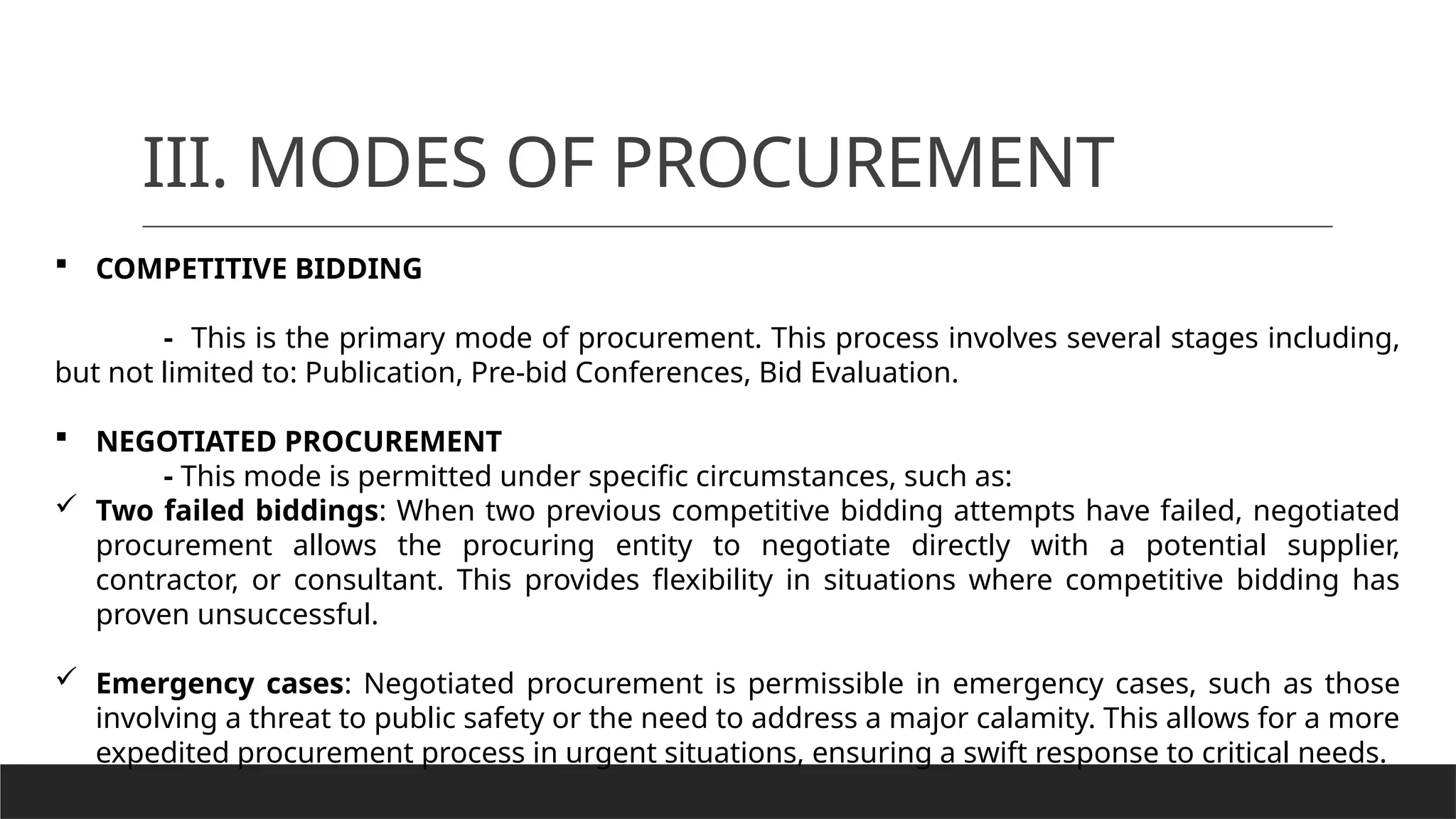
III. MODES OFPROCUREMENT
COMPETITIVE BIDDING
- This is the primary mode of procurement. This process involves several stages including,
but not limited to: Publication, Pre-bid Conferences, Bid Evaluation.
NEGOTIATED PROCUREMENT
- This mode is permitted under specific circumstances, such as:
Two failed biddings: When two previous competitive bidding attempts have failed, negotiated
procurement allows the procuring entity to negotiate directly with a potential supplier,
contractor, or consultant. This provides flexibility in situations where competitive bidding has
proven unsuccessful.
Emergency cases: Negotiated procurement is permissible in emergency cases, such as those
involving a threat to public safety or the need to address a major calamity. This allows for a more
expedited procurement process in urgent situations, ensuring a swift response to critical needs.
15.
III. MODES OFPROCUREMENT
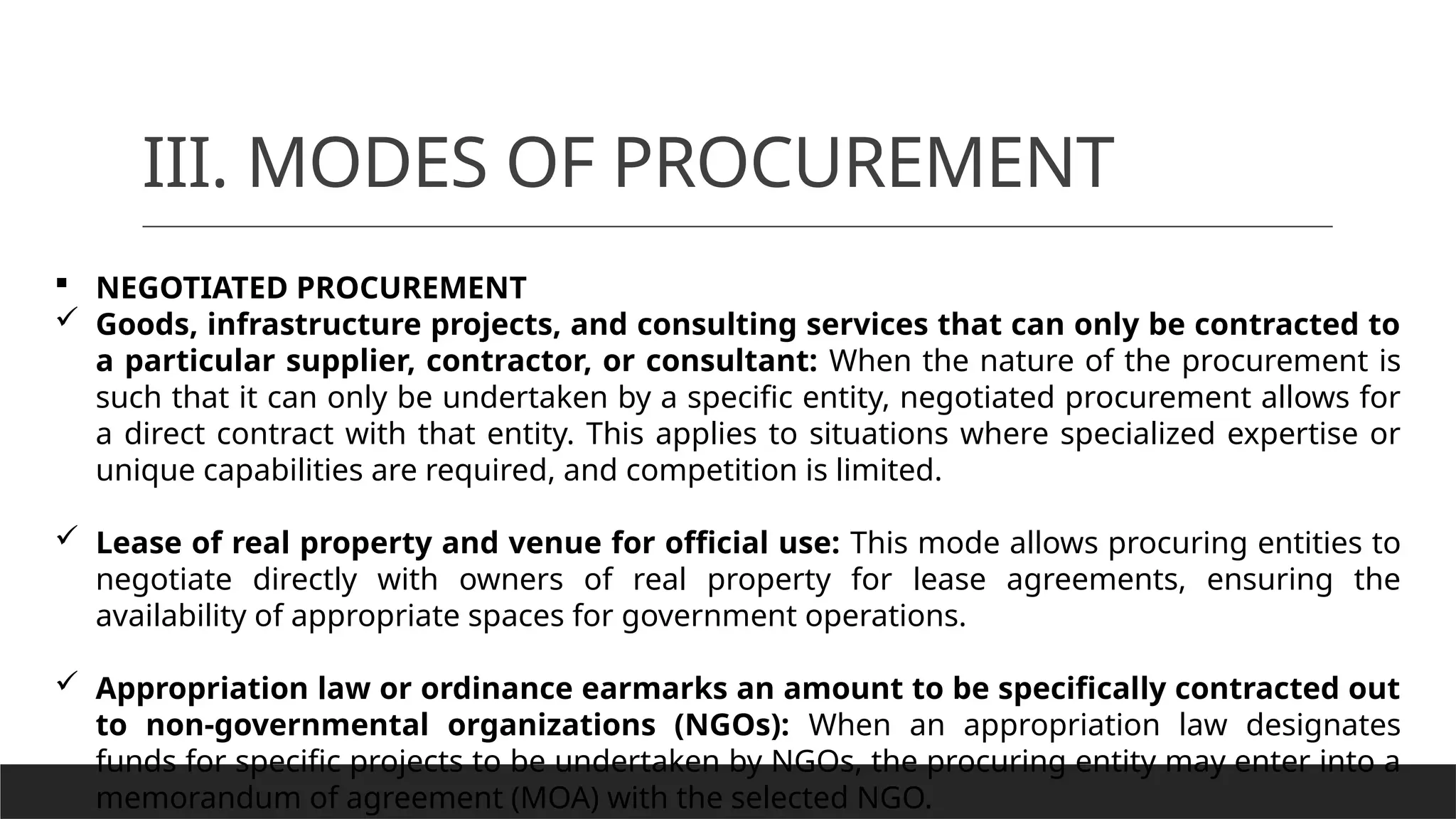
NEGOTIATED PROCUREMENT
Goods, infrastructure projects, and consulting services that can only be contracted to
a particular supplier, contractor, or consultant: When the nature of the procurement is
such that it can only be undertaken by a specific entity, negotiated procurement allows for
a direct contract with that entity. This applies to situations where specialized expertise or
unique capabilities are required, and competition is limited.
Lease of real property and venue for official use: This mode allows procuring entities to
negotiate directly with owners of real property for lease agreements, ensuring the
availability of appropriate spaces for government operations.
Appropriation law or ordinance earmarks an amount to be specifically contracted out
to non-governmental organizations (NGOs): When an appropriation law designates
funds for specific projects to be undertaken by NGOs, the procuring entity may enter into a
memorandum of agreement (MOA) with the selected NGO.
16.
III. MODES OFPROCUREMENT
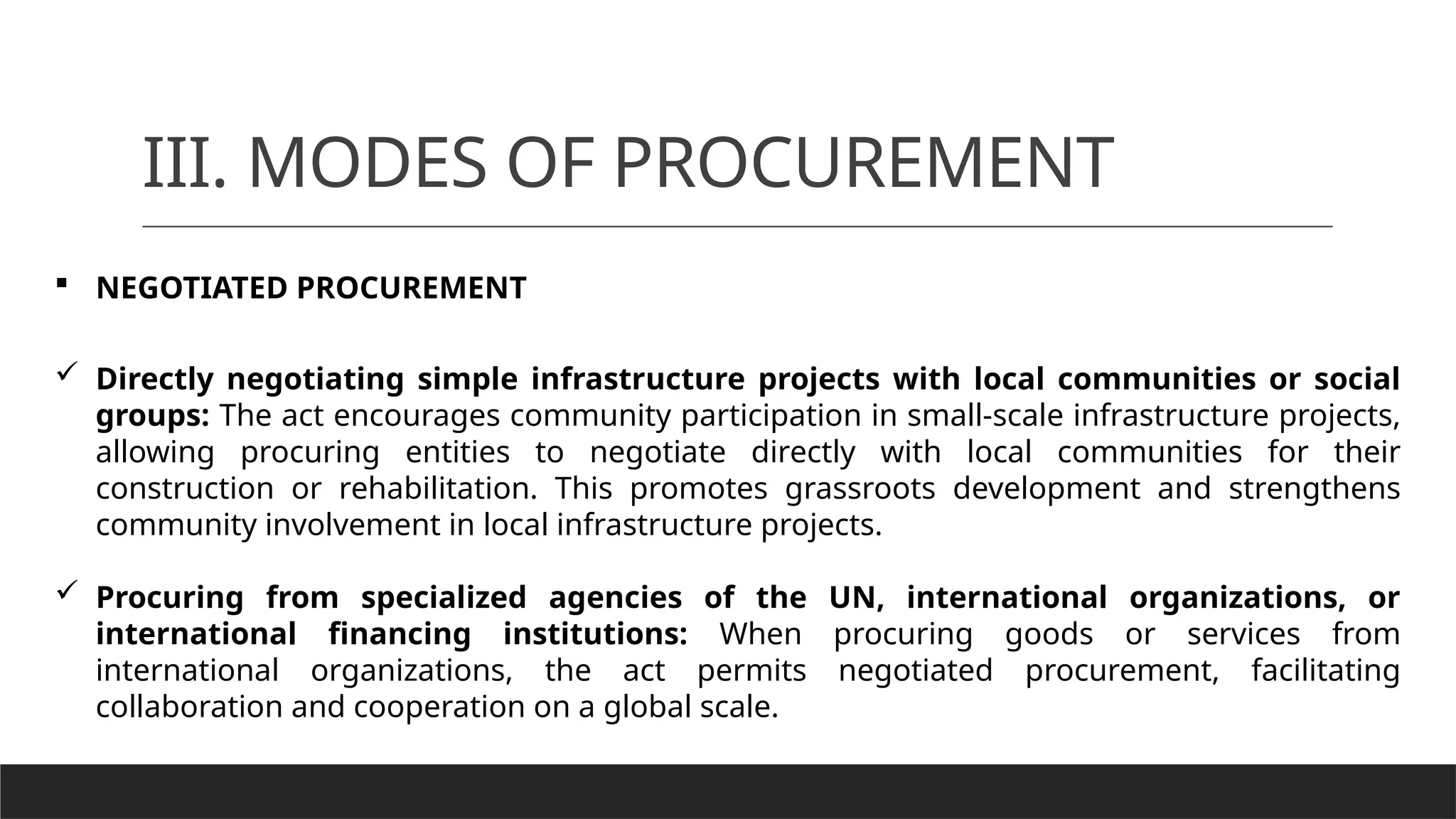
NEGOTIATED PROCUREMENT
Directly negotiating simple infrastructure projects with local communities or social
groups: The act encourages community participation in small-scale infrastructure projects,
allowing procuring entities to negotiate directly with local communities for their
construction or rehabilitation. This promotes grassroots development and strengthens
community involvement in local infrastructure projects.
Procuring from specialized agencies of the UN, international organizations, or
international financing institutions: When procuring goods or services from
international organizations, the act permits negotiated procurement, facilitating
collaboration and cooperation on a global scale.
17.
III. MODES OFPROCUREMENT
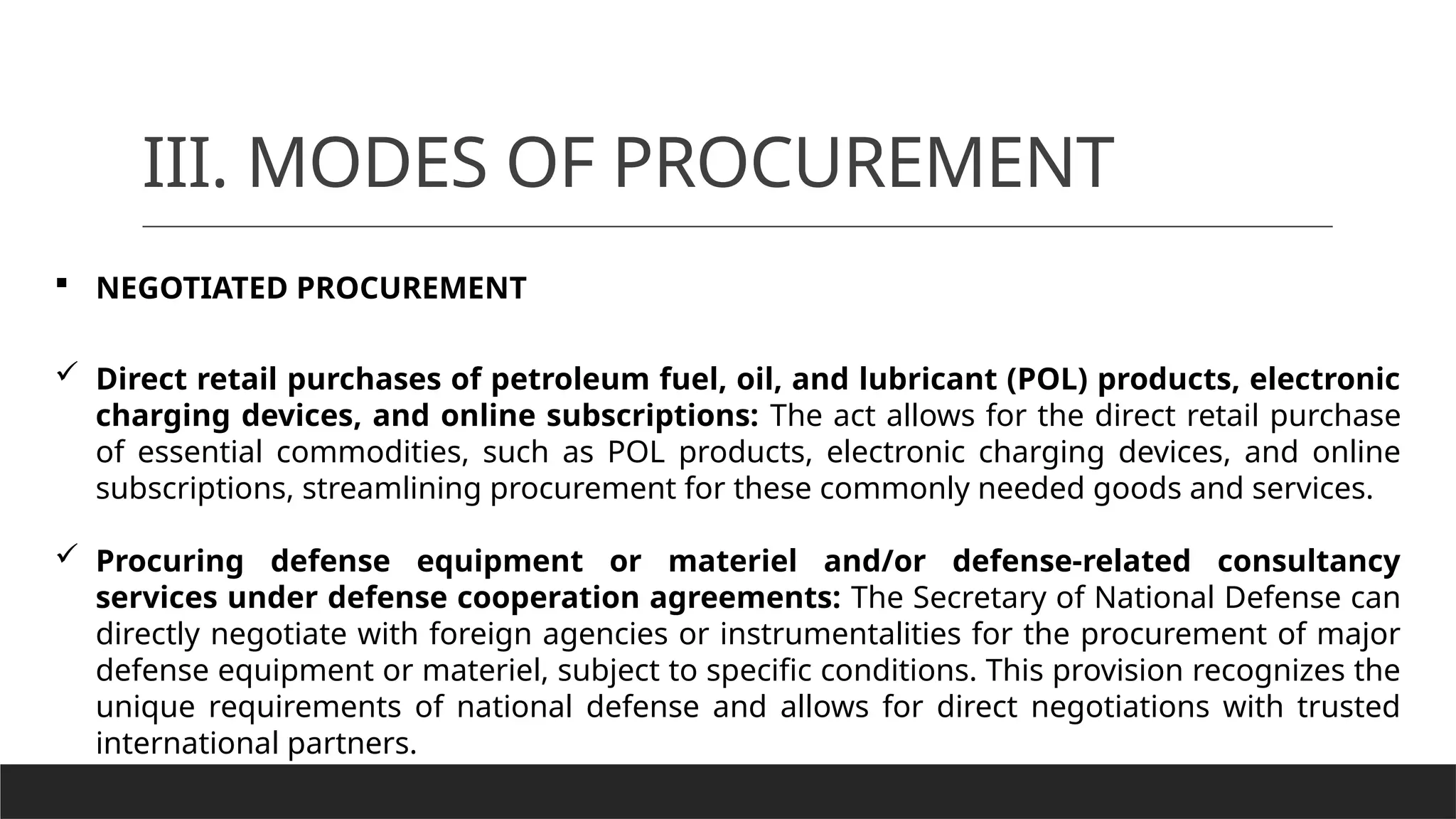
NEGOTIATED PROCUREMENT
Direct retail purchases of petroleum fuel, oil, and lubricant (POL) products, electronic
charging devices, and online subscriptions: The act allows for the direct retail purchase
of essential commodities, such as POL products, electronic charging devices, and online
subscriptions, streamlining procurement for these commonly needed goods and services.
Procuring defense equipment or materiel and/or defense-related consultancy
services under defense cooperation agreements: The Secretary of National Defense can
directly negotiate with foreign agencies or instrumentalities for the procurement of major
defense equipment or materiel, subject to specific conditions. This provision recognizes the
unique requirements of national defense and allows for direct negotiations with trusted
international partners.
18.
III. OTHER MODESOF
PROCUREMENT
REPEAT ORDER - This allows the procuring entity to procure goods from the previous
winning bidder when there is a need to replenish goods previously procured through
bidding. This streamlining mechanism allows for efficient procurement when procuring
identical or similar goods, avoiding the need for a new bidding process.
SMALL VALUE PROCUREMENT - This allows for the procuring entity to request price
quotations for goods, infrastructure projects, and consulting services when the amount
involved does not exceed Two million pesos. This simplified procurement process is
applicable for smaller-scale purchases, promoting efficiency and reducing administrative
burdens.
19.
III. OTHER MODESOF
PROCUREMENT
DIRECT CONTRACTING - This mode permits procuring entities to procure directly from any
known and reputable source when certain conditions are met. This mode allows for a more
direct approach to procurement when there is a clear need for specific goods or services
and the procuring entity has a strong relationship with a reliable supplier.
EMERGENCY PROCUREMENT - This mode is allowed for urgent procurements when there
is a threat to public safety or a need to address a major calamity. This mode enables a rapid
response in emergency situations, prioritizing immediate action to mitigate risks or
address urgent needs.
20.
III. OTHER MODESOF
PROCUREMENT
LIMITED SOURCE BIDDING - This mode is used when there are only a limited number of
suppliers, manufacturers, contractors, or consultants who can provide the goods,
infrastructure projects, and consulting services. This mode is appropriate when the market
for the specific goods or services is limited, and competitive bidding is not feasible.
SHOPPING - his mode is applicable for procuring goods, infrastructure projects, and
consulting services that are readily available in the market. This mode allows for a more
straightforward procurement process when there are numerous suppliers offering similar
goods or services, simplifying the acquisition process.
21.
IV. THE BIDSAND AWARDS
COMMITTEE
ESTABLISHMENT OF BAC - The BAC is composed of at least five members, including a
chairperson, and is responsible for overseeing the procurement process. The BAC members
are appointed based on their expertise and knowledge of procurement, ensuring that the
committee has the necessary skills and experience to guide the procurement process.
FUNCTIONS OF BAC – The BAC plays a crucial role in the procurement process,
undertaking tasks such as:
Recommending procurement modes: The BAC is responsible for recommending the most
appropriate procurement mode for each project, taking into account the specific
requirements and circumstances. This ensures that the selected mode aligns with the
22.
IV. THE BIDSAND AWARDS
COMMITTEE
FUNCTIONS OF BAC – The BAC plays a crucial role in the procurement process,
undertaking tasks such as:
Conducting pre-procurement conferences: The BAC convenes pre-procurement
conferences, allowing potential bidders to seek clarification on the procurement
requirements and specifications. This facilitates a clear understanding of the procurement
process, promoting fairness and avoiding misunderstandings.
Determining bidder eligibility: The BAC assesses the eligibility of bidders to participate in
the procurement process, ensuring that they meet the necessary legal, technical, and
financial requirements. This vetting process helps to eliminate unqualified bidders,
23.
IV. THE BIDSAND AWARDS
COMMITTEE
FUNCTIONS OF BAC – The BAC plays a crucial role in the procurement process,
undertaking tasks such as:
Receiving bids: The BAC receives bids from eligible bidders, ensuring that they are
submitted in accordance with the specified procedures and deadlines. The BAC carefully
reviews each bid to confirm its completeness and adherence to the stipulated
requirements.
Recommending contract awards: After thorough evaluation of bids, the BAC
recommends the winning bidder to the HoPE for contract award. The BAC’s
recommendation is based on the bid evaluation criteria, ensuring that the award is made to
24.
IV. THE BIDSAND AWARDS
COMMITTEE
FUNCTIONS OF BAC – The BAC plays a crucial role in the procurement process,
undertaking tasks such as:
Implementing the rules and guidelines for the implementation and termination of
contracts: The BAC plays a role in ensuring the smooth implementation and termination of
contracts, monitoring compliance and addressing any issues that may arise. This oversight
ensures that contracts are executed according to the agreed-upon terms and conditions.
Conducting the preliminary examination and opening of bids: The BAC is responsible
for conducting the preliminary examination and opening of bids, ensuring that the process
is transparent and fair. This involves confirming the completeness of bids, verifying the bid
security, and publicly opening the bids to all interested parties.
25.
IV. THE BIDSAND AWARDS
COMMITTEE
OBSERVERS – To promote transparency and public scrutiny, the BAC is
required to invite observers from civil society organizations to participate in
the procurement process. These observers serve as independent monitors,
ensuring the integrity and fairness of the proceedings. Their presence helps
to deter any irregularities or impropriety, building public trust in the
procurement process.
26.
V. PROCUREMENT BYELECTRONIC MEANS
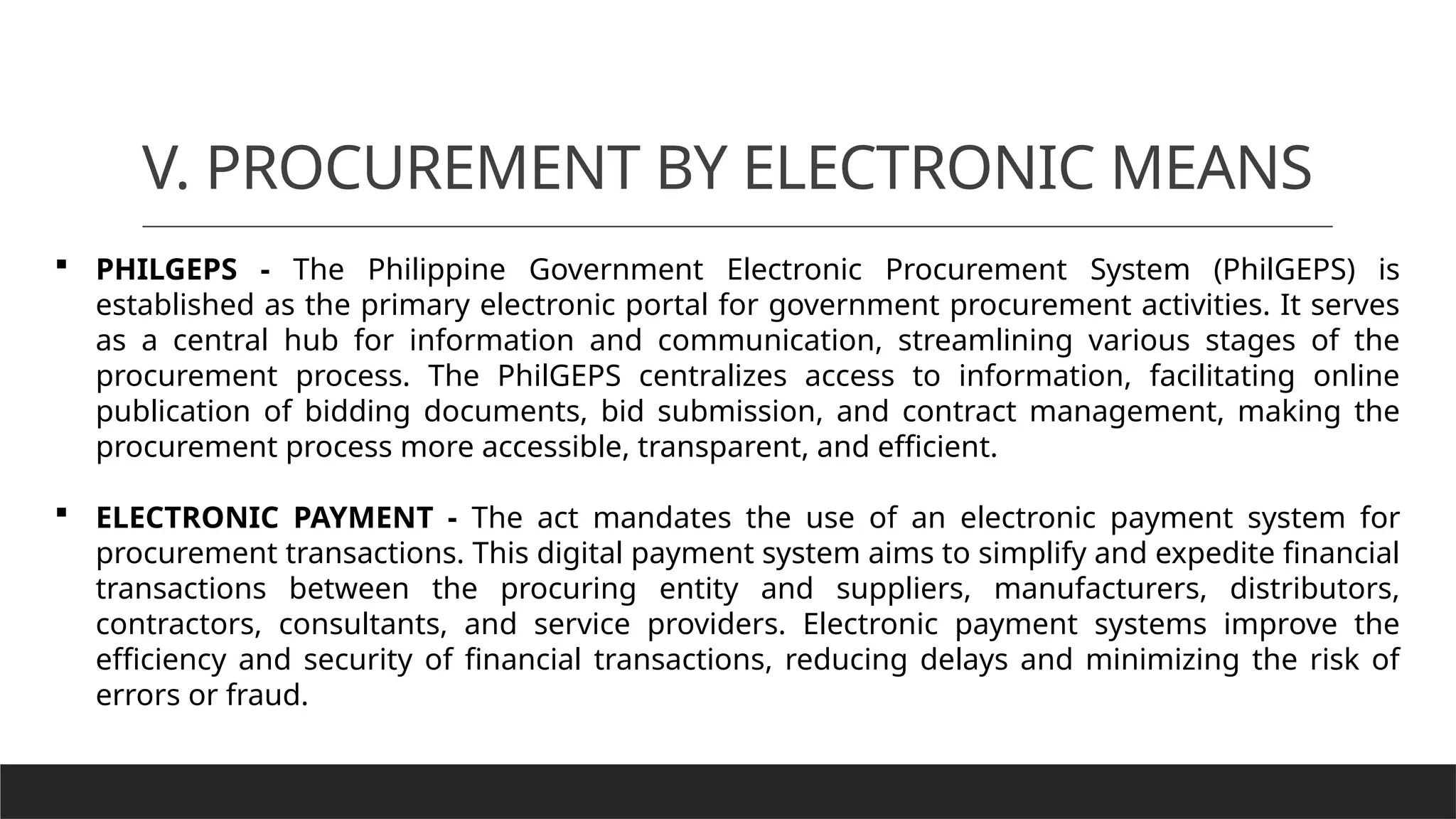
PHILGEPS - The Philippine Government Electronic Procurement System (PhilGEPS) is
established as the primary electronic portal for government procurement activities. It serves
as a central hub for information and communication, streamlining various stages of the
procurement process. The PhilGEPS centralizes access to information, facilitating online
publication of bidding documents, bid submission, and contract management, making the
procurement process more accessible, transparent, and efficient.
ELECTRONIC PAYMENT - The act mandates the use of an electronic payment system for
procurement transactions. This digital payment system aims to simplify and expedite financial
transactions between the procuring entity and suppliers, manufacturers, distributors,
contractors, consultants, and service providers. Electronic payment systems improve the
efficiency and security of financial transactions, reducing delays and minimizing the risk of
errors or fraud.
27.
VI. SUSTAINABLE PUBLICPROCUREMENT
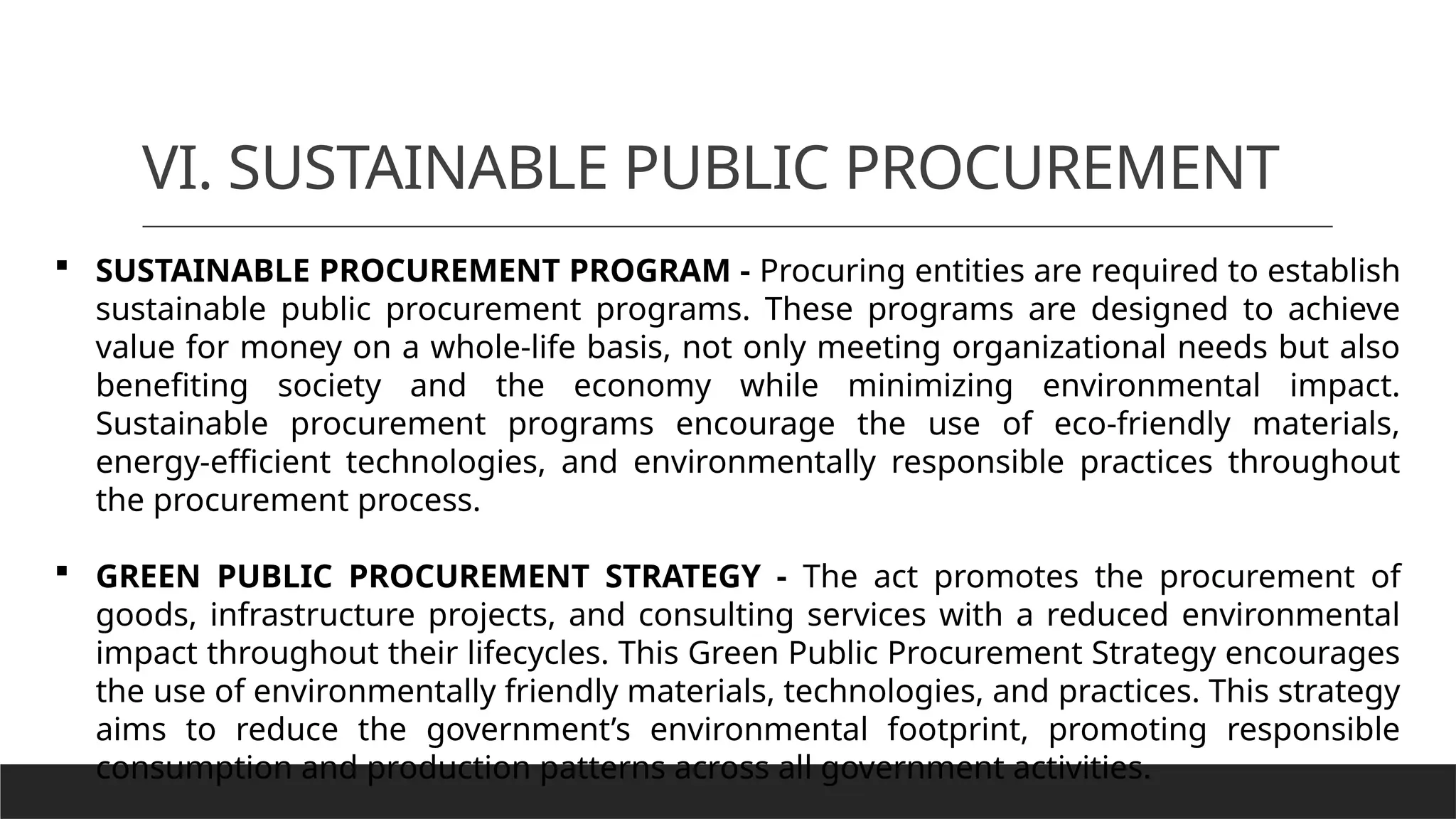
SUSTAINABLE PROCUREMENT PROGRAM - Procuring entities are required to establish
sustainable public procurement programs. These programs are designed to achieve
value for money on a whole-life basis, not only meeting organizational needs but also
benefiting society and the economy while minimizing environmental impact.
Sustainable procurement programs encourage the use of eco-friendly materials,
energy-efficient technologies, and environmentally responsible practices throughout
the procurement process.
GREEN PUBLIC PROCUREMENT STRATEGY - The act promotes the procurement of
goods, infrastructure projects, and consulting services with a reduced environmental
impact throughout their lifecycles. This Green Public Procurement Strategy encourages
the use of environmentally friendly materials, technologies, and practices. This strategy
aims to reduce the government’s environmental footprint, promoting responsible
consumption and production patterns across all government activities.
28.
VII. ADMINISTRATIVE SANCTIONS
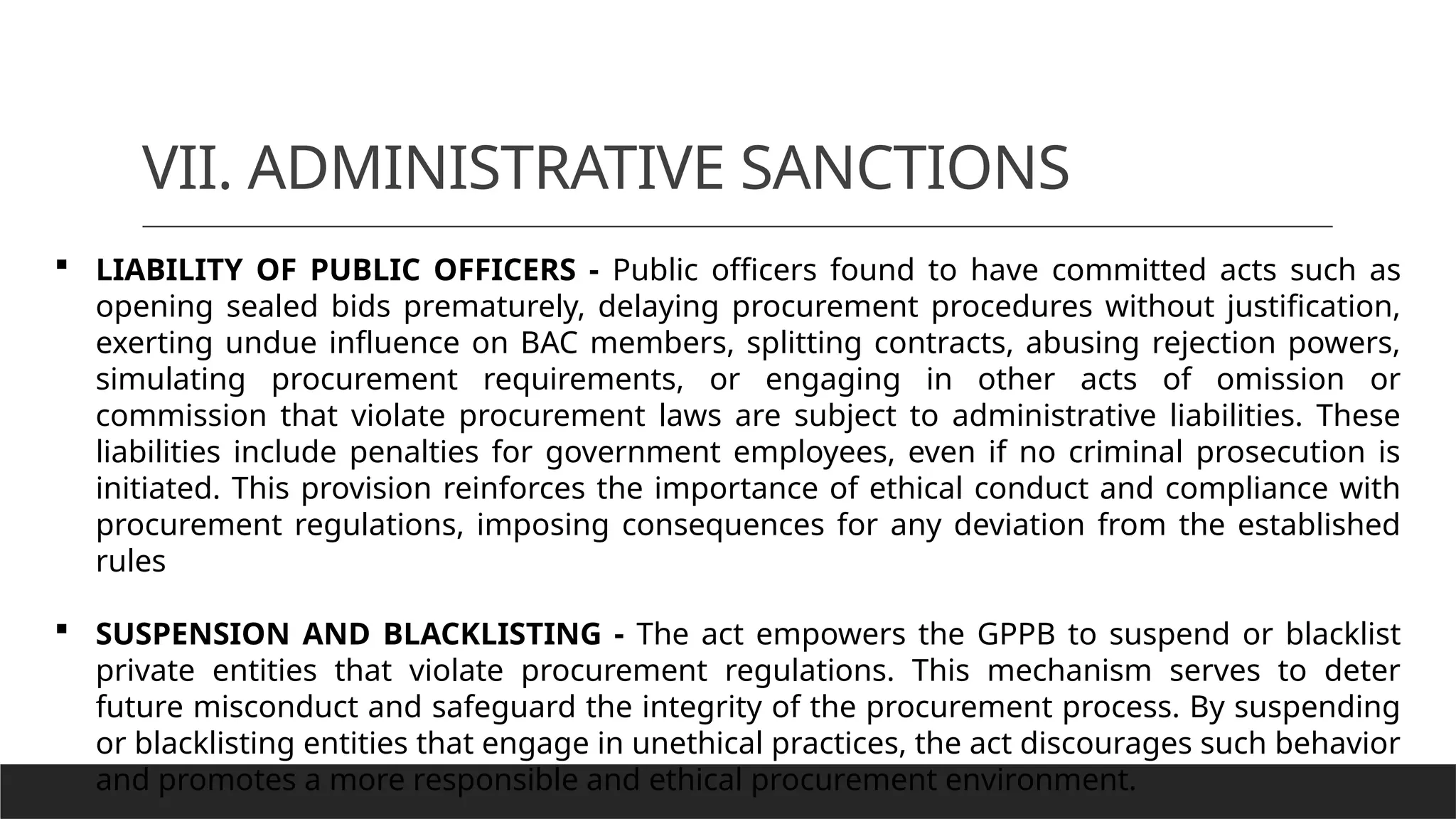
LIABILITY OF PUBLIC OFFICERS - Public officers found to have committed acts such as
opening sealed bids prematurely, delaying procurement procedures without justification,
exerting undue influence on BAC members, splitting contracts, abusing rejection powers,
simulating procurement requirements, or engaging in other acts of omission or
commission that violate procurement laws are subject to administrative liabilities. These
liabilities include penalties for government employees, even if no criminal prosecution is
initiated. This provision reinforces the importance of ethical conduct and compliance with
procurement regulations, imposing consequences for any deviation from the established
rules
SUSPENSION AND BLACKLISTING - The act empowers the GPPB to suspend or blacklist
private entities that violate procurement regulations. This mechanism serves to deter
future misconduct and safeguard the integrity of the procurement process. By suspending
or blacklisting entities that engage in unethical practices, the act discourages such behavior
and promotes a more responsible and ethical procurement environment.
29.
VIII. FINAL PROVISIONS
STANDARD FORMS - Within 90 days of the approval of the IRR, the GPPB is responsible for
formulating and approving standard forms for procurement. These standardized forms aim
to simplify and streamline the procurement process, promoting efficiency and reducing the
potential for errors or inconsistencies. Standardized forms promote consistency and reduce
the risk of errors or misinterpretations, streamlining the procurement process and
facilitating smoother transactions.
TRANSITORY PROVISION - Prior to the effectivity of the IRR, the provisions of Republic Act
No. 9184 and its IRR will remain in effect to ensure the continued implementation of
existing programs, activities, and projects. The GPPB, HOPE, procuring entities, and BACS
affected by the act will be given a three-year transitional period from the approval of the
standard forms to fully comply with the requirements of this act. This transitional period
allows for a gradual shift to the new procurement system, minimizing disruptions and
providing ample time for agencies to adapt to the new regulations.