Textbook of Sociology
for
PHYSIOTHERAPY
STUDENTS
KPNeeraja
BSc BSc(N) BPR MSc(N), MA PhD
Principal
Navodaya College of Nursing
Mantralayam Road
Raichur 584103
Karnataka
JAYPEE BROTHERS
MEDICAL PUBLISHERS (P) LTD
New Delhi
to
My sisters,
Dr KPSailaja and Mrs K P Thriveni,
who are motivating force to build up my career
5.
Acknowledgements
This work ismade possible under the inspiration of my well
wishers, I am thankful to Dr K Srinivasa Reddy, Social Scientist,
who is the guiding force for me. And I am most grateful to
resource persons. Mrs Ghousia, Mr Veerendra Patil and
Dr Lakshmi Narayanan and various friends, who helped me
to gather the required materials.
I am indebted to all the staffs of M/s Jaypee Brothers
Medical Publishers Pvt Ltd, who helped to produce this book
in time. Mr Ravi Kumar of Jaypee has initiated me to take up
this great task.
6.
Foreword
The author deservesto be congratulated for preparing ‘Text
book of Sociology for Physiotherapy Students’. I have immense
pleasure in presenting the foreword to this book for pro-
fessional students brought out by my student, Dr KP Neeraja.
The increased application of Sociology in the health profession
has necessitated a right kind of textbook applied to the
profession and the author has made an attempt to fulfil such a
need.
A practicing sociologist with the credit of authorizing
several books, Dr KP Neeraja has brought into this book
various practical points not only in dealing with client, his
family and social factors related to client, his family and
community as well, to provide total client care with the
knowledge of sociology.
This book is aimed at the students of Physiotherapy in
undergraduation courses, who are studying in various colleges
in the country, since it conforms to the syllabus of
undergraduates, I am confident that this book would benefit
them to acquire knowledge and skills in a broader social
outlook.
Dr KP Neeraja’s vast knowledge and rich experience in
the profession of Nursing and Teaching are definitely, an asset
in writing this textbook. It comprehensively covers the basic
and introductory concepts in sociology as related to the health
care profession and help the students to understand the subject
in an easy manner. I am delighted that this book is published
at a right time when the student need it most. It is of great
value in its own right and should guide the student to develop
greater insight into the sociological concepts.
I am confident that this book will go through many more
editions in future.
Kurnool Dr K Sreenivasa Reddy
01.09.04 (Social Scientist)
7.
Preface
During my teachingexperience I came across several students
asking for relevant notes and material for the various abstract
concepts of sociology and in particular its relevance to
physiotherapy. It is observed that there is no comprehensive
textbook on sociology written with an eye on the syllabus. I
hope this book will help the students to fulfil their needs and
to develop better understanding and insight into the subject
of sociology. A sincere effort is made to stimulate and motivate
the physiotherapy students to identify significant relevant
social factors in the occurrence of diseases and their role in
management of clients. The concepts are presented in a
comprehensive manner to benefit the students. I am confident
that this book will also be welcomed by the teachers as well
as students inview of increased importance and application of
sociology in various fields.
KP Neeraja
9.
Contents
1. Introduction......................................................................... 1
Definition,Nature, Scope, uses, methods of sociological
investigations—Social survey, Case study, Opinion poll,
Questionnaire, Observation, Interview, Importance of its
study with special reference to health care professionals,
Application of knowledge of sociology to physiotherapy,
Occupational therapy; relationship of sociology with other
disciplines.
2. Sociology and Health...................................................... 55
Concept of health and disease, Social consciousness, Perception
of illness, Social factors affecting health status and illness,
Decision-making in taking treatment, Individualisation,
Society, Relationship between individual and society, Role of
physiotherapist in Indian society, Role of heredity and
environment.
3. Social System .................................................................... 93
Definition, Meaning, Elements, Types, Characteristics, Social
values socialisation, Definition, Concept, Meaning, Aims,
Characteristics, Importance, Process, factors, role, Theories,
Types, Agencies, elements of socialisation, Influence of social
factors in personality development, Socialisation in hospitals,
Socialisation in the rehabilitation of the clients.
4. Social Groups.................................................................. 123
Definition, Characteristics of group life, Group structure,
Classification, Primary and secondary group, Religious group,
Influence of formal and informal groups on health and
sickness, The role of primary and secondary groups in
hospitals and rehabilitation centres.
5. Family ............................................................................... 140
Definition, Characteristics/features of families, Importance,
Functions, Types-modern, joint family; Basic needs, Changes
in functions of a family, Impact of sickness in family, family
planning, Psychosomatic illness.
10.
xiv Textbook ofSociology for Physiotherapy Students
6. Community ...................................................................... 162
Definition, Meaning, Elements, Benefits of community life,
Types, Rural community—definition, Meaning,
Characteristics, Hazards of ruralities and remedial measures,
Rural development programmes, Urban community-
definition, meaning, Features, Hazards of urbanites and
remedial measures, Differences between rural and urban
communities, Role of rural and urban communities in public
health, Role of community in determining beliefs, practices
and home remedies in treatment, Tribal community-definition,
characteristics, tribal problems and welfare activities
7. Culture and Health ........................................................ 196
Definition, Meaning, Characteristics, Types, Functions,
Organisation, Cultural variation, Subculture of medical
workers, Components of culture, Culture induced symptoms
and diseases, Cultural lag, Civilisation, Differences between
civilisation and culture, Cultural factors affecting health and
disease.
8. Social Stratification ....................................................... 221
Definition, Types, Caste system, Difference between class
and caste.
9. Social Change ................................................................. 230
Definition, Nature, Factors, Effects of social change, Process,
Social evaluation, Social progress, Social deviation, Social
welfare planning in India, Human adaptation and social
change, Social change and stress, Social change and health
programs, The role of social planning in the improvement of
health and in rehabilitation.
10. Social Control ................................................................. 262
Definition, Meaning, Need, Types, Agencies.
11. Social Problems .............................................................. 274
Definition, Nature, Classification: Juvenile delinquency,
Unemployment, Prostitution, Poverty, Beggary, Alcoholism,
Problems of women in modern India, Over population,
Unmarried mothers, Solvation of social problems and social
planning.
11.
Contents xv
12. SocialSecurity ................................................................ 354
Insurance schemes for industrial workers ESI Act, Workmen
Compensation Act, Social legislation in relation to disabled,
Merits and Demerits of social legislation.
13. Social Work ..................................................................... 376
Definition, Meaning, Nature, Scope, Factors affecting social
work, Characteristics, Principles, Requisites for social work,
Methods, Field, Role of Medical Social Worker.
14. Evaluation........................................................................ 397
Definition, Meaning, Scope, Characteristics, Principles,
Purposes, Functions, Types, Methods, Steps, Elements.
15. Leadership ....................................................................... 435
Definition, meaning, nature, elements, types, principles,
origin and development, importance, emergence as a leader,
functions, techniques, competencies of leadership.
Bibliography........................................................................ 461
Index ................................................................................... 463
12.
Introduction 1
Sociology isthe youngest of all social sciences. The history of
sociology is as old as society. Systematic studies of society
started long back in Greece, i.e. in 427-347 B.C. Plato and his
disciple Aristotle (384-322 B.C) laid foundation for systematic
study.
In India, king Manu laid foundation for sociology. He
divided people into four varnas. Epics in India reflect the
behaviour and various aspects how to live in a society. Manu
referred to customs, social affairs in his book, ‘Manu Smruthi’.
In 1839, Auguste Comte, a French Philosopher, (1798-1857)-
coined the term, ‘Sociology’. He is considered as, ‘Father of
Sociology’. Sociology is derived from two words, ‘societus’
means society, (Latin word) and ‘logos’ (Greek word) means
study of.
Definition
‘The science of social phenomenon subjected to natural laws,
the discovery of which is the objective of investigations’—
Auguste Comte
‘The scientific study of society’—Gidding and Gidding
‘Study of relationship between man and his environment’—
H.P. Fair Child
‘The study of interactions arising from the association of living
beings’—Gillin and Gillin
1 Introduction
13.
2 Textbook ofSociology for Physiotherapy Students
‘The study of human interactions and interrelations, their
conditions and consequences’—M Ginsberg
‘The science which attempts the interpretive understandings
of social being’—Max Weber
‘The scientific study of social relationships, their variety, their
forms whatever affects them and whatever they affect’.
‘Sociology is the scientific study of patterns of human
behaviour as they emerge and crystallise out of the interactions
of human beings in the groups, which comprise the society’—
George Shankar
‘It is the study of social aggregates and groups in their institu-
tional organisation and the causes and the consequences of
changes in institutions and social organisation’—International
Encyclopedia of social sciences.
‘It is an academic discipline that utilises the scientific method
in accumulating knowledge about man’s social behaviour. It
studies the patterned, shared human behaviour, the way in
which people act towards one another—Prasad, 1977
The above definitions are based on the following factors:
• Human beings have a propensity to organise their
behaviour in groups in order to satisfy their needs and
wants to fulfill necessary social function.
• Human beings have the capacity to know how to organise
their behaviour in a wide range of groups.
• The behaviours, thoughts and attitudes of human beings
are determined to a large extent by the quality of the
learned ways of interacting in groups.
• The social interaction in which one person influence the
attitudes, thoughts, opinions and behaviour of another.
• Interaction pattern occurs within the large social systems
in societies, groups, crowds, social classes, social institu-
tions, neighbourhood and community.
14.
Introduction 3
From allthe definitions of sociology, we can list out the
following views:
• The sociology is science of society.
• It studies the social relationships.
• It is the study of social life.
• It is the study of human behaviour in group situation.
• It deals with social actions.
• It studies social systems.
Nature of Sociology
Sociology as a science: It emerged as a special discipline among
the social sciences, considered as sciences of society. The
concept was first developed by Emile Durkheim. As it uses
scientific methods, investigation, and different bodies of
knowledge.
1. It studies social phenomenon: It is known as, ‘Mother of all
social sciences’.
It uses scientific method. It is a systematic way of
dealing with ideas, careful observation and recording of
the factual data, which is classified, analysed and organised
in a systematic fashion by logical basis through which
generalisations can be made.
2. Sociology is factual: It deals with facts only, uses scientific
principles to solve the problems.
3. Sociology frames laws and attempts to predict: Science can make
prediction on the basis of universal and valued laws relating
to the problem solving approach.
4. Principles of sociology are universal: The laws of sociology
proved to be true at all times and places, as long as the
conditions do not vary. The laws are devoid of any
exceptions.
5. It discovers the cause and effect relationship: It structures for
the cause and effect relationship in its subject matter and
in this connection, it provides universal and valid laws.
15.
4 Textbook ofSociology for Physiotherapy Students
6. Sociological principles are veridical: The laws of sociology
prove true at every verification and re-verification. Any
one can examine their validity.
The Opposite Views about the Nature of Sociology
Some critics who deny sociology to be regarded as science,
sociology is a social science it cannot be regarded as science.
1. It lacks experimentation: Sociology deals with human
relationship, which can be neither measured, weighted nor
see or analyse.
2. Lack of objectivity: The sociologists cannot maintain complete
its objectivity in order to understand its external action.
3. Lack of exactivity: The laws and conclusions cannot be
expressed in precise terms. The prediction might not be
true. Findings are often limited in time and space.
4. Inability to measure subject matter.
5. It lacks perfect exactness.
6. It cannot make predictions correctly.
Scope of Sociology
There is no one opinion about the scope of sociology. Calberten
describes, since sociology is a elastic science it is difficult to
determine just where its boundaries begin and ends. It is
impossible to divide as it studies human interactions,
interrelations, their conditions and consequences.
There are two main schools of thoughts: One group of
sociologists headed by Simmel formulated specialistic or
Formulastic School. They thought that it is pure science and
systematic one. It is independent science.
Specialistic/Formalistic School
Simmel’s View
It classifies, analyses and delimits the forms of social
relationships.
16.
Introduction 5
Small’s View
Itdoes not understand to study all the actions of society. It
studies genetic forms of social relationship behaviour and
activities.
Verkendent’s View
It is a specialised branch of knowledge concerned with ultimate
forms of psychic relationship, which link men to men in the
society.
Max Weber’s View
It studies interpretation and understanding of behaviour and
it is concerned with analysis and classification and types of
social relationship.
Vonwiese’s View
The sociology studies all forms of social relationship.
Tonnie’s View
He has differentiated the society and the community on the
basis of forms of social relationship.
Criticism
• It has narrowed the scope of sociology.
• Abstract form is separate from concrete form.
• The construction of pure sociology is impractical.
• Sociology alone does not study social relationship.
Synthetic School
Durkem’s View
Sociology was divided into 3 branches:
a. Social morphology: Concerned with geographical basis of
the life, its relationship to types of social organisation and
the problems of population.
17.
6 Textbook ofSociology for Physiotherapy Students
b. Social physiology: It is divided into number of branches
like sociology of religion, sociology of morals. Sociology
of laws, sociology of economic life, sociology of language,
etc.
c. General sociology: It discovers the social facts.
Hobhouse’s View
The interconnections of social relations and the results; social
life as a whole will be studied.
Karl Mannheim’s View
Sociology is divided into systematic and general sociology. It
describes how the individual will react social changes in a
given society.
Ginsberg’s View
It studies the types and forms of social relationship. It
determines the relation between different factors of social life,
social change, persistence and to discover sociological
principles governing social life.
Thus the scope of sociology is very wide. It studies the
various aspects of society, e.g. social processes, traditions,
morphology, social control and social pathology.
Uses of Study of Sociology
• It makes scientific study of society.
• It studies the role of institutions, through the knowledge
of sociology the individual can understand and establish
relationship with the social environment like family,
religion, school, governmental policies and working
situations.
• The study of sociology is indispensable for understanding
and planning of society.
18.
Introduction 7
• Ithelps in solvation of social problems.
• It draws our attention to the institutional worth and dignity
of men.
• It contributes to understand human culture, to make good
citizens.
• It keeps us update information on modern institutions.
• It adds to the knowledge of society.
• It identifies good government with community.
• Technical function.
To construct society by observing existing problems,
customs, traditions, institutions, etc. it can make the people to
understand the changing situations.
• Introductory function: It supplies the information about
the elements of social system to facilitate the introduction
of any desirable changes. It explains different methods,
which can introduce this change into various parts of it.
• Informative function: It possesses some important
information based on theoretical knowledge with practical
experience. It makes the individual to organise society by
solving certain social problems. It provides guidance in
practical reforms.
• Tolerative function: In India, each individual comes across
different religions and cultures. We have to understand
all the social institutions to develop a feeling of universal
brotherhood.
• Democratic function: To develop a selfless tendency and
understands the society in a well-planned manner.
SOCIOLOGICAL INVESTIGATION
‘Critical examination into a situation to discover new facts
about a particular or specified social phenomenon to discover
intellectual and practical answers to problems through the
application of scientific methods in the universe’ is called social
investigation. It is a careful, critical enquiry or examination in
19.
8 Textbook ofSociology for Physiotherapy Students
seeking facts or principles diligent investigation in order to
ascertain something. It is a critical in the light of newly
discovered facts. It is the study of activities undertaken to
search a solution for the social problems. The society has to
march on its present form with the help of constant research
and investigation. Long march from stone age to computer
age has been the result of research. Today society is facing
several social problems of formidable in nature. They demand
solutions and any attempt to solve the problems must be
through scientific enquiry. It aims at increasing our knowledge
about society and strategies involved solvation of social
problems.
Definition
‘Systematic investigation to gain knowledge about social
phenomena and social problems’—Moses CA
‘It is the investigation of the underlying process operating in
the lives of persons who are in association‘—Bogardus E
‘It is a study of human group relationships‘—Whitney FL
‘It is the systematic study of discovering the new facts or
verifying old facts, their sequences, interrelationship, casual
explanations and the natural laws, which govern them‘—
PV Young
‘Systematised effort to gain new knowledge or new mode or
orientation of new knowledge’—Redman and Money
‘The manipulation of things, concepts or symbols for the
purpose of generalising to extend, correct or verify
knowledge; whether that knowledge aids in construction of
theory or in the practice of an art’—M Stephen
From the above definitions, it is clear that it is concerned
with pure social phenomena, answering meaningful questions
20.
Introduction 9
and findingout the old or new facts through scientific method,
which is based on logic and systematic means. To collect and
analyses the data more or less within the exiting framework
and establishes the exploration techniques. Theoretically, social
investigations aims at finding solutions of a problem as a part
of social system and behaviour of the individuals under
different situations and on utilitarian aspect, it helps in
reducing social conflicts and tensions as well as in rectification
and removal of social evils. Social phenomena are complex.
Therefore different methods and approaches have to be
followed to study the social aspects of the individuals. Social
phenomena can be indirectly studied through observation of
traditions, customs, values and vested interests, which are
prevailed in the society. To have the objectivity in studying
social phenomena is difficult. The scope of social investigation
depends upon several factors such as money, time available
to the investigator, availability of the sample, accessibility of
the investigator to the respondents, the amount of time the
respondent can spare for the investigation, etc.
METHODS OF SOCIAL INVESTIGATIONS
Social Survey Approach
It is a common method used to diagnose and solve the social
problem. The survey design is the non-experimental type of
research in which, the researcher investigates a community or
a group of people. The researcher gathers the data from a
relatively large number of cases at a particular time. It involves
clearly defined problem or objectives. It requires expert,
imaginative planning, careful analysis, interpretation of data
gathered, logical and skillful reporting of the findings.
It may be done by:
• By questioning
• Interview
• Observation
21.
10 Textbook ofSociology for Physiotherapy Students
Social survey is one of the important methods of social
investigation and helps in solving the group problems. The
researcher investigates new situation, organisation or a group
and be clear about the nature of enquiry, objectives, nature
and scope of study. Researcher formulates questions for the
larger study and pursues general overall description of the
situation.
Definition
‘It is a process by which qualitative facts are collected about
the social aspects of a community composition and activities’—
Mark Abram
‘Collection of data concerning the living and working condi-
tions, broadly speaking the people in a given community’—
Bogardus ES
‘It is the scientific study of conditions and needs of a com-
munity for the purpose of presenting a constructive
programme and social advance’—EW Burgers
‘It is a process by which quantitative facts are collected about
the social aspects of a community, composition and activities’—
SM Harison
‘Fact finding study dealing chiefly with working class and
with the nature and problems of community’—AF Wells
Social survey are connected with:
• The formation of constructive programme of social reform
and amelioration of social problem.
• Current or immediate conditions of social pathological
nature which have definite geographic limits and definite
social implications and significance—PV Young
22.
Introduction 11
Characteristics
• Donein a large scale and gains a lot of material
• To find out the basic facts of life
• Quality is maintained
• Scientific and well planned
• Conducted regularly, e.g. census, market surveys, etc.
• Costly affair, needs both human as well as economic
resources to complete
• Unnecessary data should not be collected
• Trained personnel are required to collect the information
and capable of adjusting themselves to the nature of work
• To collect the detailed information about a social problem
under investigation or social aspect of community
• To test hypothesis
• Practical and utilitarian view point.
Subject Matter of Social Survey
• Demographic characteristics
• Social environment
• Activities of community members
• Opinions and attitudes.
Uses of Survey Method
• To obtain demographic data, information about people’s
behaviour (attitudes, opinions, interests)
• To discover casual relationship in a specific area or precise
qualitative description of some phase of the universe.
Advantages of Survey Approach
• It can give information about the possibilities of
understanding different types of research methods
• It provides an insight into a situation suggests kinds of
questions to ask and the methods to adapt
23.
12 Textbook ofSociology for Physiotherapy Students
• It provides hypothesis and helps to test the hypothesis
• Provides data about present situation
• It studies the problems thoroughly and deeply in all aspects
• Guides the researcher about confounding, intervening,
independent and dependent variables
• Useful for policy makers and administrators to make a
decision
• Specific goals will be obtained
• Changes in society, pressures of public opinion can be
obtained
• Provides an opportunity to use researcher’s creativity
• Factual information related to life experiences will be
gathered
• It has high degree of representation in the reality
• Broad generalisation can be done
• Greater deal of information will be obtained
• Easy, less time consuming
Disadvantages
• To get resources both human (trained investigators, field
workers) and economic (huge fund is required) is problem
• Low degree of control over extraneous variables
• No uniformity in data collection
• Lack of manipulation of independent variables
• Each researcher will try to use their own bias in the study
• One cannot progressively investigate one aspect after
another of the independent variable to get closer to the
real world
• Time consuming
• Statistical devices are not always able to separate the effects
of several independent variables.
24.
Introduction 13
Types ofSurvey
Descriptive Survey
Simplest survey with in the social discipline. To describe
objectively the nature of the situation under study and
conclusions also drawn.
Evaluation Survey
The researcher looks back to see what has been accomplished
with a critical eye and evaluates the results. The researcher is
interested in finding out the results of some procedure or
methods already in operation. This method is used on small
sample atleast initially. To find, if this method in operation
meets the criteria stated in the purpose of the original project.
It should not be done by the investigators, who have a
particular benefit or gain to be made from the results.
Comparative Survey
When two different groups or techniques are compared this
technique is used. It should be based on an important
professional problem, so the resulting data will be significant
to the profession. Significant elements will be considered, each
element is representative within itself.
Activity Analysis
The analysis of the activities or processes that an individual is
called upon to perform. This method may yield information
that would prove useful in establishing:
• The requirements for a particular job or position
• A programme for the preparation or training of individuals
for various jobs or positions
• An in-service programme for improvement in job
competence
• Equitable wage or salary schedules for various jobs or
positions
25.
14 Textbook ofSociology for Physiotherapy Students
Trend Studies
It is based upon a longitudinal consideration of recorded data
indicating what has been happening in the past, what the
present situation reveals and on the basis of these data, what
is likely to happen in the future.
Short-term Survey
Data is collected over short time (days to months) no control
over the sample.
Long-term Survey
Data is collected more than five years.
Exploratory Survey
Oriented towards the discovery of relationships between
variables where phenomena of interest, but pursues the
question: What factor or factors influence, affect, cause or
relate to this phenomena? When a new area or topic is being
studied it is useful to estimate the feasibility and cost of
undertaking.
Developmental Studies
a. Longitudinal studies
Short-term
Long-term
b. Trend studies
Cohort studies
Panel studies
Follow-up studies
Psychologists, anthropologists many times uses this
method. The researcher repeatedly collects data on the same
group of individuals over a period of time. He makes repeated
observations on the same group of subjects.
26.
Introduction 15
• Tounderstand any stage of life in terms of his develop-
mental origin.
• It provides useful perspective of the orderly and coherent
developmental sequence and the elements of both change
and continuity that human development involves
• It serves as a data collection device, source of hypothesis.
A. Trend studies: Sample from a general population are
studied over time with respect to some phenomenon.
Different samples are selected at repeated intervals, but
the samples are always drawn from the same population.
To examine patterns and rates of change over time and
to make predictions about future directions.
B. Cohort studies: Specific populations are examined over a
period of time. Different samples are selected at
different points in time, but the samples are drawn from
specific sub-groups that are often age related.
C. Panel studies: The same subjects are used to supply the
data at two or more points in time. Panel is used in the
longitudinal survey projects, refers to the sample of
subjects involved in the study. In this the investigator
reveals pattern of change and reasons for the change.
Since the same individuals are contacted at two or more
points in time, the researcher can identify the subjects
who did and did not change and then isolate the
characteristics of the sub-groups in which changes
occurred.
D. Follow-up investigations: To determine the subsequent
development of individuals with a specified condition
or who have received a specified intervention to
ascertain its long-term effects.
Cross-sectional Studies
It involves the collection of data at one point in time or it
observes at only one point in time. The phenomena under
27.
16 Textbook ofSociology for Physiotherapy Students
investigation are captured as they manifest themselves during
the one static time period of data collection. They are easy to
manage and are economically advantageous, majority of
health-care professional studies are cross-sectional.
Regular or Adhoc Survey
When a body or an individual organisation conducts the same
survey at regular intervals, e.g. Economic survey of RBI; census
survey. The survey is conducted with a view to find out some
information required for a particular purpose.
Official Survey
Which will be conducted by the government to find out certain
facts for official or philanthropic purpose.
Non-official Survey
Individuals without the help of official agencies will be
conducting survey to collect the data for research purpose.
Direct Survey (Personal/Primary Survey)
The researcher himself will collect the data by means of
observation or interview for research purpose.
Indirect Survey/Secondary Survey
The collected information will be analysed, the researcher does
not start the survey but spends on the work, which has already
been done by somebody else.
Postal Survey
Through mailed questionnaire the researcher will obtain the
information.
28.
Introduction 17
Initial Survey
Whena survey is carried out in a particular area or particular
subject for the first time.
Repetitive Survey
The researcher carries out the work several times on the same
sample.
Open Survey
When the nature and result of survey are open to the public
or organisation is called ‘open survey’.
Confidential Survey
The results or information gathered through survey are kept
confidential.
Comprehensive Survey
The survey covers vast field, variety information and wide
range is covered.
Limited Survey
The field covered is comparatively limited.
The Process of Survey Research
• Statement of research problem
• Determination that the problem is appropriate for the
survey approach
• Selection of appropriate type of survey
• Objectives, hypothesis, delimitations should be formulated
• Select sampling technique, identification of sources of
information
• Plan for data collection
29.
18 Textbook ofSociology for Physiotherapy Students
• Examination of all documentary sources; field work
• Coding, recording, analyses and reporting the project,
interpretation of findings
• Communicating the findings with the help of graphs.
CASE STUDY
Introduction
The case study is a way of organising social data for the
purpose of viewing social reality. It examines a social unit as a
whole. The unit may be a person, a family, a social institution
or a community. It is often used for descriptive research. It is
a longitudinal approach showing development over a period
of time.
It studies or understands life cycle or an important part of
the life cycle of the unit. It is in-depth investigation of social
unit. It tests hypothesis but not directed towards broad
generalisation. The method can be used to analyse the
interaction between factors bringing about change usually
over a period of time. Consent must be taken from the social
unit to get cooperation. Researcher may use past history or
may report on current events. Verbal description between
interviewer and client or may use artifacts, records,
questionnaires. The nursing or medical professions case studies
will be used more often.
Evaluation and Scope
The case study method is a widely used systematic field
research technique in these days. The credit for introducing
this method in the field of social investigation goes to Frederic
Le Play, who used it as a handmaiden statistics in his studies
of family budgets. Herbert Spencer was first used case material
in his comparative study of different cultures. Dr William Healy
resorted to this method considered it as a better method over
30.
Introduction 19
and alonethe mere use of statistical data. Similarly,
anthropologists, historians, novelists and dramatists have used
this method concerning problems pertaining to their areas of
interests. Even management experts use case study methods
for getting clues to several management problems.
Objects of Case Study
Individuals suffering with social problems like drug addicts,
alcoholics, juvenile delinquents, interested events.
Definition
‘It is a form of qualitative analysis involving very careful and
complete observation of a person, a situation or an institution’—
Biesanz and Biesanz
‘All inclusive and intensive study of an individual, in which
the investigator brings to bear all his skill and methods or as
a systematic gathering of enough information about a person
to pursue one to understand how he or she functions as a unit
of society’—Young
‘It is a way of organising social data so as to preserve the
unitary character of the social object being studied’—Goode
and Hat
‘It is a technique by which individual factor whether it is an
institution or just an episode in the life of an individual or a
group is analysed in the relationship to any other in the
group’—H Odum
‘A comprehensive study of a social unit’—PV Young
Meaning
It is a form of qualitative analysis where in careful and
complete observation of an individual or a social situation or
a social unit. It is an in depth study. It analyses limited number
31.
20 Textbook ofSociology for Physiotherapy Students
of events or conditions and their interrelations. It is an
intensive investigation of a particular unit under consideration.
Characteristics of Case Study Method
• The researcher can take single social unit for their study
purpose
• Intensive study of selected unit covering all facets
• Qualitative approach
• It deepens the perception and gives a clear insight in life
• It studies mutual interrelationship of casual factors
• Generalisation may not be possible.
Methods of Data Collection
• Observation
• Interviews
• Questionnaires
• Government voluntary or private agencies
• Co-opinionaires
• Psychological tests and inventories
• Recorded data.
Assumptions
The case study method is based on several factors:
1. The assumption of uniformity in the basic human nature
inspite of the fact that human behaviour may vary according
to situations.
2. Assumption of studying the natural history of the unit
concerned.
3. Assumption of comprehensive study of the unit concerned.
Phases Involved in Case Study
1. Recognition and determination of the status of the
phenomenon to be investigated or the unit of attention
32.
Introduction 21
2. Collectionof data, examination and history of the given
phenomenon
3. Diagnosis and identification of casual factors as in basis
for residual or developmental treatment
4. Application of remedial measures like treatment and
therapy
5. Follow-up programmes to determine effectiveness of the
treatment given.
Advantages
• It enables us to understand total behaviour pattern of the
concerned unit, as case study method is exhaustive
• Researcher can obtain real record of personal experience,
which would reveal man’s inner strivings, tensions,
motivations that drive them to action or to adopt certain
pattern of behaviour
• Natural history of social unit and its relationship with the
social factors and the forces involved in its surrounding
environment is possible
• Formulation of relevant hypothesis is possible
• Facilitates intensive study of social unit
• Enhance the experience of the researcher, which in turn
increases analysing ability and skills
• To study social change
• Useful for therapeutic and administrative purposes; to take
decisions regarding management problems
• Critical and reflective thinking will be promoted
• Researcher may begin or stop at any time
• Detail information will be obtained
• More suitable to Paramedical and medical profession
• Perceives whole situations
• Opportunity of having an intimate knowledge of subject’s
conditions, thought, feelings, actions, intentions and
environment
• Great number of interesting insights can be observed.
33.
22 Textbook ofSociology for Physiotherapy Students
Disadvantages
• Limited approach
• Generalisation and comparison may not possible
• Expensive
• Time consuming
• Subjective biased
• Difficult to check accuracy and objectivity.
OPINION POLL METHOD
To gather the information about a specific social phenomenon
from a huge sample at a given time in different areas of a
region, opinion poll method of survey is used. Public aware-
ness of a specified event will be collected through this poll.
The researcher will take assistance from field investigators,
structured questionnaire is formulated to gather the data. The
survey conducting areas usually be a common meeting/
gathering place of the public.
Eg: At the time of election, opinion poll is conducted to
know the public’s view about who will win the election and
form the Government.
QUESTIONNAIRE
A good deal of information can be gathered by direct
questioning of sample, who have specified characteristics
through the use of formal instrument (i.e, questionnaire). If
the informants are spread over a vast or in accessible areas,
the information is sought with the help of questionnaire.
Definition
Questionnaire (Survey Instrument)
‘Any written document, which is used to instruct one or more
readers or listeners to answer one or more questions.’
34.
Introduction 23
A listof questions/items are compiled by the researcher
based on different aspects of the problem. Certain times mailed
questionnaires will be sent to the respondents to give the reply.
In structured interview with the help of structured question-
naire.
Items
Questions in the questionnaire.
Respondents
The person who answers the items in a questionnaire.
Interviewer
A person who conducts the study, who is having training in
interviewing techniques and administering the questionnaire
in the study projects.
Characteristics of Questionnaire
The heart of the questionnaire method is ‘question’ itself. It
acts as an effective stimuli. It is a device securing answers to
questions using a form, which the respondent fills.
Analytical Questions
Questions should be capable of analysing the entire problem.
Clarity and Concise/Precise
Items should be clear, complete; questions should be worded
simply, as possible to provide an opportunity for easy, accurate
and unambiguous responses. Questions should be in limited
number to avoid disinterest, tiredness and boring. It should
be free from suggestions or leading.
35.
24 Textbook ofSociology for Physiotherapy Students
Linguistic, Completeness and Grammatical Consistency
• It is a verbal interaction between researcher and
respondent and care should be taken to the linguistic quality
of question unit.
• Phrases, which are not commonly understood by the
respondents, have to be avoided.
• Singleness of purpose.
• Avoid emotional questions.
• Questions should be present in good psychological order
to organise their own way of thinking.
• Proper planning and listing of questions are done.
• Encourage inter-validated questions.
• Physical form of questions attracts, encourages and
stimulates the respondents; proper spacing, clarity and
sequence in the arrangement of the questions then only
the respondent will be encouraged to come out with correct
answers.
• Questions should be objective in nature. Logical in order.
• Advisable to pre-construct a tabulation sheet anticipating
how the data will be tabulated and interpreted before the
final form of the questions is decided upon to avoid
ambiguity in question form.
• Questions should be relevant, diplomatically worded.
• The length of the question be pertained to collect essential
data.
• General to specific logical manner be followed in arranging
items in questions.
• Carefully worded questions, so that the ego of the
respondent is not injured in any manner.
Steps in Questionnaire Construction
• Based on objectives the needed information will be assessed
• Break-up the whole information into sub-areas
36.
Introduction 25
• Ineach area, clear the mind and decide what question to
ask, identify major area where information has to be
gathered
• Read out the questions to experts and consultants
• Pre-test the questions for validity and reliability
• Administer the tool to the reference population
• Apply statistical tests for reliability and validity
• Internal consistency and internal coordination
Introduction/Instruction
The interviewer read the introductory comments in face-to-
face interview or in telephonic interview; the cover letter
contains introductory letter. It used to introduce the study
the potential respondent and should not exceed one page,
thus each sentence should serve a distinct purpose.
The content of letter will be divided into four paragraphs:
1st Paragraph:
• Explain the purpose of the study
• Convince the respondent that the study is useful
• Avoid any hint of bias.
2nd Paragraph
• Make respondent to feel the importance to the success of
the study.
3rd Paragraph
• The confidentiality and anonymity of respondents will be
maintained.
4th Paragraph
• Re-emphasize the basic justification for study.
• Availability of study results, offering a copy of it to the
respondent.
• Introduce each section to the respondent with a brief
preface to clarify them, why the questions are being asked.
37.
26 Textbook ofSociology for Physiotherapy Students
Elements of Questioning Method
• Content of the questioning
• The question
• Provision for answering
Content of Questioning
• It is useful to develop a blue print of various aspects of
situation about which questions might be asked
• Researcher should decide how much time is allotted for
every item
• The selection of content is based on researcher’s knowledge
of situation, the literature available in the problem area;
objectives of study and needs of the researcher
• Facts about the respondent, behaviour, persons known to
the respondent, events and conditions known to the patient
• Beliefs, attitudes, feelings, opinion of respondents
• Reasons for or influences of other person’s behaviour
• Level of knowledge about policies, practices, conditions
or situations
• Intention for future action
Order/Sequence of Questions
• Open ended questions should be written first to provide
an opportunity to conceptualise the issues in their own
words rather than formulating their answers based on the
responses they have seen in the closed ended questionnaires
• The general questions should be placed first followed by
specific questions to avoid putting ideas into people’s heads
• The schedule begin with questions that arouse the
respondent’s interest and motivation to cooperate
• Personal, sensitive, threatening nature questions should
not be placed at the beginning as it arouse suspicious about
the purpose of the study
38.
Introduction 27
• Theitems bearing on one issue or topic should be in close
proximate
• Don’t formulate too many questions in the small space
• Every item in the question should relate to the topic under
the study
• Logical progression in the question order is necessary
• Identify the information by factual data and subject matter
of the survey
• Scrutinisation of question during pretest
• Colleagues, experts assess how well the question will
accomplish the study objectives
• Potential users of the information for accuracy, back of
bias and ignorance of items
Problems in Construction of Questionnaire
1. Problem with clarity of question
• Clarify in the mind regarding what information is to be
obtained for that questions.
• Avoid long sentences or phrases double barreled
questions; non-specific items.
• State the questions in affirmative order than negative.
2. Ability of respondents to give response
Use simple language, short statements.
3. Memory
The researcher should not take for granted that the
respondents will be able to recall the events, situations or
previous activities.
4. Bias
Avoid leading questions that suggest a particular kind of
answer. State a range of alternatives within the question
itself.
5. Handling a sensitive or personal information
Politeness and encouragement helps to motivate the
respondent to cooperate.
39.
28 Textbook ofSociology for Physiotherapy Students
6. Response alternatives
Significant alternatives should be used. Mutually should
be there in ordering of questions and responses. Avoid
too long questions.
Advantages of Questionnaire
• Simple method of obtaining data
• Items can be constructed easily by beginning researchers
• Less time is consumed in using this method of gathering
information thus it saves time, energy and money. Thus it
is more economical and sufficient
• Able to gather data from a widely scattered sample in a
limited period
• Provides an opportunity to establish rapport to explain the
purpose of the study and the items which are not clear
• Reduces interaction between research and respondent
• Provides sufficient time to the respondent to think and
give his response
• Complete anonymity of the respondent will be maintained
• Ensures anonymity and kept the information confidential
Disadvantages
• It lacks depth: To ensure rate of response from questions
is difficult as it depends upon the method of administration
• The researcher may omit or disregard any item without
giving any explanation
• Some items may force the subject to select responses that
are not actual choice
• Respondent may take their own time, which may hamper
the research progress
• Creates artificial situation as researcher is asking for verbal
response not for action
• Mailed questions are limited to literate respondents and
to get good response from them only when they have
research conscious
40.
Introduction 29
Types
Structured Question
Theitems which pose definite, concrete and pre-ordained
questions, i.e. prepared in advance and not constructed on
the spot during the question period.
Pictorial Question
To promote interests in answering the questions; this type
will be used to study the social attitudes, prejudices and for
studies related to children.
Open Ended Question
• Calls for a free response in the respondent’s own words
• Provides a greater depth of response
• Respondents reveal their frame of reference and possibly
the reasons for their responses since it requires greater
effort on the part of the respondents
• Involves the respondent’s attitudes or feelings expressed
in their own words
• Respondents must create their own answers and state them
in their own words
Advantages
• Stimulates free thought, solicit suggestions
• Probe respondent’s memories
Disadvantages
• Respondent must recall past experience, create and
articulate new answers
• Difficult to construct responses
• Illegible hand writing pose difficult in mail questions
Closed Ended Question
The respondent’s answer is limited to the choices offered,
short in form, limited responses. They provide chance for
41.
30 Textbook ofSociology for Physiotherapy Students
marking alternatives. It is easy to fill out, requires little time,
objective, fairly easy to tabulate and analyse. Close-ended
questions offer a number of alternative replies from which
the respondents must choose closely approximate answer.
Difficulties
• Difficult to construct but easy to administer
• Possibility of neglecting or over-looking the important
responses, the omission possible alternatives can lead to
inadequate understanding of the issues
• If the area of the research is completely new, this type is
not advisable
• Pre-testing of the schedule is immensely helpful
• Too superficial questions may be considered
Types of Closed Questionnaire
Dichotomous Items
It requires the respondent to make a choice between two
alternatives. Too restrictive, the respondents may be forced
to say within two alternatives. Eg: Do you like to have:
(a) Coffee (b) Tea
Multiple-choice Questions
A range of alternatives provides more information; one can
measure intensity of feeling and direction. Most commonly
offer 3 or 5 alternatives. Eg: Psychosocial aspect. Liking sweets:
(a) with every meal (b) once a while (c) always
Cafeteria Questions
Which is put forth to the respondents to select a response
that most adequately states their view, used in qualitative
surveys.
42.
Introduction 31
Closed Endedwith Ordered Choice or Objective Type
Answer choices are provided; each is a graduation of a single
dimension of some thought or behaviour. Eg: How did you
get along with the doctor in the emergency room? a) strongly
agree b) mildly agree c) neither agree nor disagree d) mildly
disagree e) strongly disagree
Closed Ended with Unordered Response Choices
Answer choices are provided but no single dimension
underlines them. The respondent must choose discrete,
unordered categories by independently evaluate each choice
and select the one that best reflects the situation. Eg: The food
item I like best a) samosa b) sandwich c) dosa d) idly
Partially Closed Ended Questions
It provides a compromise response although answer choices
are provided; respondents have to option of creating their
own response. Unordered or ordered choices are seen within
this structure. Eg: Which of the following areas of expenditures
do you want to have the highest priority for improvement in
this hospital? a) emergency dept. b) X-ray dept. c) laboratories
d) others (please specify)
Step Ladder/Rank Order Questions
Questions to rank order their responses along a continuum
from most favourable to least favourable can be useful;
carefully handled because respondents often misunderstand
them. Eg: Attitude of job preferences of physiotherapy
students after course completion. a) working in teaching
institution b) working in hospital setup. The respondents
should rank the answers in the order of preference.
Checklist or Matrix Questions
It encompasses several questions on a topic and requires the
same response format.
43.
32 Textbook ofSociology for Physiotherapy Students
Graphic Rating Scale
It assigns numerical score in order to place the individual along
a continuum with respect to the attribute being measured.
Respondents are asked to give a judgment of something along
an ordered dimension. The specified two opposite ends of a
continuum is referred as bipolar in nature. Eg: How friendly
are you with your classmates?
Least friendly 1 2 3 4 5 Most friendly
Direct Vs Indirect Approach or Coming in Front Door vs
Coming in Back Door
A check can be made as to the value of the responses by asking
a direct or indirect question and then comparing the answers.
Eg: Physiotherapy education in India. a) high image b) low
image c) no image d) cheap image
OBSERVATION
It is one of the basic and oldest research methods to gather
data. It is a normal part of daily life and becomes a research
method if it is systematically planned and recorded and
checked for their validity and reliability. The basis for
observation is curiosity.
Meaning
Planned, methodical watching that involves constraints to
improve accuracy.
Definition
‘It is a technique used for collecting all the data or acquiring
information through occurrences that can be observed through
senses with or without mechanical devices.’
44.
Introduction 33
‘Systematic viewingcoupled with consideration of social
phenomena’—PV Young
‘Accurate watching of social phenomena as they occur in nature
with regard to cause and effect relationship or natural
relationship’—Oxford Dictionary
It involves interpretation of phenomena in the
environment. Two process are involved:
1. Someone is observing—observer
2. Something to observe—observed
Observation can be done in natural setting (field research)
or in laboratory setting.
Four Broad Questions that Confront the Researcher
• What should be observed?
• How should observation be recorded?
• What procedures should be used to try to assure the
accuracy of observation?
• What relationship should exist between the observer
and the observed and how can such relationship be
established.
Features
• It is an eye affair. Observer has to observe the situation
very closely and clearly. Observation implies the use of
eyes rather than that of ears and voice
• Observation should be definite aim. It is clearly determined
(for scientific enquiry) before starting the process
• Proper planning is required, before starting observation
necessary equipment and instrument have to be arranged
• After observatory process the events has to be noted down
• Cause and effect relationship will make the whole study
useful and purposeful
45.
34 Textbook ofSociology for Physiotherapy Students
Phenomena Amenable to Observation
• Characteristics and conditions of individuals. Eg:
Physiological conditions and characteristics through sense
or aided by observation apparatus. Eg: Effect of yoga on
lung function of patients with pleural effusion (M
Prakasamma, 1981) using spirometer several readings of
FEV1,
FVC, MVV, X-ray chest is used to see lung expansion
before giving treatment.
• Verbal communication behaviour; a) Linguistic behaviour
b) Content and structure of people’s conversation c) Social
interaction. Eg: Interaction pattern between teachers and
students in clinical setting using Flanders’s interaction
analysis category system (Vasta, 1978, Madanlal, 1980)
• Non-verbal communication behaviour. Eg: Facial
expression, touch, posture, gesture, body movements, extra
linguistic behaviour.
• Activities (overt state of an individual many activities can
be observed) Eg: Physical and mental functioning of an
individual.
• Skill attainment and performance. Eg: Aseptic techniques
used by nursing students during nursing procedures.
• Environmental characteristics. Eg: Noise level, cleanliness,
ventilation, odour, water supply, mosquito breeding places.
Units of Observation
1. Molar approach: Observation of large units of behaviour
and treating them as a whole.
2. Molecular approach: Observation of small and highly
specific behaviour. Eg: Each movement, gesture, action.
Steps in Observation schedule
1. Selecting the aspect of behaviour to be observed: To carry
out systematic observations; one must select certain aspects
or categories of behaviour to be observed.
46.
Introduction 35
2. Definingthe behaviour that fall within a category.
3. Training observer.
Observational methods are more vulnerable to perceptual
errors than any other data collection. To minimise the bias
and maximise the accuracy and objectivity of the observation,
training of observer is essential. Observer’s manual with
detailed instructions can be used. Training sessions are useful
for clarifying doubts. Once the observers are fully oriented
with the instrument, they should use the observation schedule
on a group that demonstrates the same phenomena as under
study. Their difficulties can be resolved through discussions
and practice sessions.
Quantifying Observation
When the behaviours specified have to provide certain
measurement then some form of quantification is required.
The qualification usually takes the form of counting. The count
may be of number of times that a subject shows a particular
form of behaviour during a period of observation. Here
observer should be sure of when one act ends, and the next
begin. Break the period of observation into short segments
and observer can then watch occurrence or non-occurrence of
particular behaviour under specified category.
Recording
To have adequate account of what was observed during
observation, recording is needed. Eg: Motion pictures, films,
video tapes.
Testing
To ascertain the adequacy of content being put to measure
the variable under study.
47.
36 Textbook ofSociology for Physiotherapy Students
A. Interrater reliability: Two or more raters observing the
same behaviour/events and their percentage of agreement
obtained establishes the reliability of the schedule.
B. Intrarater reliability: When a rater observes same
behaviour/events on two or more occasions. Multiple
observations extending over days/weeks/years.
Advantages
• Important technique for studying human behaviour
specially where interventions are used
• Provides variety and depth of information
• Researcher is not dependent on subjects who consent to
answer, all subjects are potential respondents
• Subjects are usually available
• It allows view of complete situation, first hand and
sequence of events
• All the data obtained by the observation are usable
• Open to use of recording devices. Eg: Tape recorders and
cameras
• May be stopped and begin at any time
• May be recorded at the time of occurrence, eliminating
bias during recall
• Inexpensive
• Useful in healthcare profession.
Disadvantages
• Observation and interpretation is a demanding task which
requires attention, sensation, perception, conception
• Lack of consent to being observed
• Time and duration of event can’t be predicted usually
observer may wait until an event happens
• Data obtained is vulnerable to many distortions and bias.
Eg: Cultural background, personal interpretation, and
influence
48.
Introduction 37
• Lackof qualified, trained observer
• Chances of wrong interpretation.
Aids to Observation
• Checklist
• Rating scale
• Score cards
• Observation sheets
• Photographs
• Line diagram
• Sketches.
Observational Sampling
a. Time sampling method: It involves the selection of time
periods during which the observations will take place.
b. Event sampling method: It selects integral behaviour or
events of a pre-specified type for observation.
Observational Methods
Unstructured Observation
Participant observation: It is a technique where researcher
participates in the functioning of the social group that is under
investigation. The researcher will not interpret their views
and meaning into the social situations under observation. It
provides deep understanding of human behaviour. Observer
usually has three types of records:
a. Logos: It is a record of events and conversations usually
maintained on a daily basis by field worker.
b. Field notes: It is much broader, more analytic, more
interpretation and represents participants observer’s effort
to record, inform, synthesis and understands the data.
c. Anecdotes: It focuses on behaviour of particular interest.
It selects specific kind of events and behaviour for
49.
38 Textbook ofSociology for Physiotherapy Students
observation before hand. The observer objectively and
accurately records the observation.
Structured Observation
It involves indicates of presence or absence of pre-specified
behaviour or attributes.
a. Checklists: Phenomena are recorded by putting a tally
against a particular behaviour, event or characteristics
depending upon its presence or absence. Researcher must
list all the expected behaviour related to the variable being
measured, so that all relevant behaviour in the subjects
will correctly be identified.
Basic format of observation checklist contains
i. Sign system: List categories of behaviours that may or
may not be manifested by the subjects. The observer
watch for instances of the behaviour on the list and
puts a check off beside the appropriate behaviour when
it occurs. Researcher identifies the occurrence and
frequency of particular behaviour.
ii. Analysis of ongoing and discrete elements of
behaviour: The observer places behaviour in only one
category for each unit of behaviour.
b. Rating scales: Observation can also be rated in terms of
qualitative points along a descriptive continuum. It usually
is quantified during the subsequent analysis of the
observation data. Here either the observer is required to
make ratings of behaviour or events at frequent intervals
throughout the observational period or he may make use
of rating scale to summarise an entire event or transaction
after the observation is completed where a more des-
criptive method has been used for maintaining observation
record.
c. Category system: Construction of category system to which
observed behaviours or characteristics could be assigned.
50.
Introduction 39
Types
A. Non-concealmentand participant: The observer will not
attempt to alter the social setting, i.e. being studied and
does not make the observation covertly. The observer is a
part of the social setting. The subjects are aware of
researcher’s presence but may or may not be aware of the
underlying motive.
Drawback: The interaction between the observer and the
observed alters the behaviour of the subject. Ethical issues,
as observer will not take consent of subjects.
B. Concealment and participant: The observer observes the
behaviour of people in their natural setting, where the
observed are unaware of being observed; passive role will
be maintained with minimum intervention and records.
C. Concealment and non-participant: Observer makes the
observation from the peripherally of a social setting and
does not interact with others.
D. Non-concealment and non-participant: The researcher is
interested in observing the effects of some specific
intervention introduced for scientific purpose. The subjects
are aware of their participation in the study. This method
is very much useful in nursing research studies.
THE INTERVIEW
The interview is an oral questionnaire, the interviewee gives
the needed information verbally in a face-to-face relationship.
It is an important method of data collection where one can
know the views and ideas of other persons. The interviewer
gains rapport or establishes a friendly, secure relationship with
the subject and obtains some confidential information that the
subject might be reluctant to put in writing. The interviewer
can explain the purpose of the investigation and can explain
more clearly just what information he or she wants.
51.
40 Textbook ofSociology for Physiotherapy Students
Definition
‘The interview is not only the conversation between an
investigator and informant but also interviewer will try to
understand the gestures, glances, facial expressions and reveals
subtle feelings’—PV Young
‘It is a fundamental process of social interaction’—Goode and
Hatt
‘It is face-to-face interpersonal situation in which one person,
the interviewer asks a person being interviewed and the
respondent will answer or gives the responses; the items are
designed to obtain answers pertinent to research problem’—
Fred N Kerlinger
Characteristics
• Close contact or interaction between two or more persons
• Define object to know the views and ideas of others
• Face-to-face relationship between individuals
• Data will be collected related to social problem
Objectives
• Information will be obtained from unknown facts through
face-to-face interaction
• Investigator and respondent has to know each other by
means of research needs and requirements
• Gives an opportunity to formulate hypothesis, which are
based on personal and social behaviour
• Collecting additional information about different situations
in qualitative facts. Eg: Ideas, feelings, views, faith and
conclusion, etc.
• Gives an opportunity to observe the things which are not
under study.
52.
Introduction 41
Instrument forInterview
a. Interview schedule: A questionnaire is read to the
respondent and formed about facts and situations involved.
b. Interview guide: It provides ideas but allows the
interviewer freedom to pursue relevant topics in depth.
To use interview guide or not depends upon the policy
and attitudes of the interviewer.
Preparatory Process on Technique of Interview
• Based on scientific knowledge
• Understands the problem which are under study
• Preparing interview schedule and interview guide
• Training of field workers
• Selection of informants, appointment with respondents
• Seeking and providing information about respondents.
Process of Interview
• Get cooperation from the leader and the community
• Select proper time and place
• Introduction with respondents
• Put systematic, clear and unambiguous questions
• Precautions to be taken regarding emotional point of view.
Technique of Interview
• Establish contacts and rapport with the informants
• Start the interview in a scientific and attractive manner
• Help the respondents to recall things correctly and
encourage to come out with proper information
• Ask probing questions
• Encourage and guide the informants in proper line.
Qualities of Good Interviewer
• Attractive personality
53.
42 Textbook ofSociology for Physiotherapy Students
• Pleasing manners
• Tactful
• Initiative
• Should win the confident of the informant
• Objective observer
• Avoid too much inquisitiveness.
Types
On the basis of objectives and qualities:
i. Clinical interview: To know the cause of certain
abnormality thereby remedy can be sorted out. It studies
individual’s life experiences.
ii. Selection interview: To select a person on the basis of
certain traits and qualities. Eg: Job interview
iii. Diagnostic interview: To find out certain serious causes
of some social events or problems.
iv. Research interview: To find out the cause of problem, a
comprehensive study of social problems in detail.
v. Directive interview: Predetermined questions, which the
interviewer will ask the respondent.
On the basis of functions and methodology
1. Non-directed interview: Uncontrolled interview asked
through conversation. The informant is encouraged to
exhibit and express his knowledge and views. The
interviewer collects the information.
2. Focused interview (Controlled interview): To test a
particular or specific experience hypothesis. The questions
are predetermined and preplanned, which are formed on
the basis of behaviour of respondent.
3. Repeated interview: To study the dynamic functions and
attitudes that influence, guide and determine the behaviour
of certain individuals. These interviews are carried out after
certain interviews in repeated manner.
54.
Introduction 43
4. Respondentinterview: To study the specific development
of a social or psychological process.
5. Depth interview: The respondent will be fully encouraged
to respond. The interviewer must be perfectly trained.
On the basis of number of informants or respondents
1. Individual interview: Information will be gathered from
an individual.
2. Group interview: Collecting information from the group
of respondents.
3. Structured/Formal/Standardised interview: Interviewer
cannot adopt questions for a specific situation, the
interview is not permitted to change the specific wording
of the questions.
4. Unstructured /Informal/Non-standardised interview: The
interviewer will have freedom to develop each questions
in the most appropriate manner for the situation.
5. Semi-standardised interview: The interviewer may be
required to ask a number of specific major questions,
beyond which any number of further questions may be
asked.
Advantages
• Possible to study the events that are not open to observation
(hidden factors), e.g. feelings, attitudes, fear, emotions,
reactions
• Complete answers are possible
• Clarification can be made if respondents had done so that
misunderstanding can be minimised
• Questions can be pursued in depth
• A higher response is possible and the reliable information
can be obtained
• Inflow and outflow of ideas can be possible between
interviewer and respondent.
55.
44 Textbook ofSociology for Physiotherapy Students
Disadvantages
• The data collected are of a doubtful character
• Costly method
• Validity measurement problem due to difference in social
characteristics. Eg: Race, ethnicity, perceived status
differences
• Too much dependency of the memory of the respondent
• Possibility of change in meaning
• Lot of subjectivity, individual feelings, inferiority complex.
Importance of Study of Sociology with Special Reference
to Health Care Professionals
In recent times, the field of sociology has extended towards
medical sciences and the sub-field of ‘Health sociology/
medical sociology’ has been evolved. It describes medicine
and allied disciplines as social science. There is a dire need to
integrate the knowledge of behaviour sciences is essential along
with medical sciences and it has to be included in the
curriculum of health care professional in order to prepare
professionals adequately to practice the science of medicine
and the art of professional in varying socio-cultural context
coexisting health care systems. The institutions, which
integrate the behavioural sciences in their programme of health
care education, those are on the path of progress by keeping
scientific pace with proper understanding of the structural
realities in contemporary society. The study of social
relationship between health phenomena and social factors in
medical/health context. A sociological approach in medical
field gives a better understanding and develops an integral
knowledge relate the life processes to the existing social
phenomena and health in a comprehensive manner. It provides
a unique way of viewing the disease and the client as well. It
enables the practitioners with information about medical
56.
Introduction 45
institutions. Thestudy of distribution of health and disease,
cultural perspectives, attitudes, values emerging from social
organisation. It also deals with study of various socio-cultural,
economic, political, geographical, anthropological groups that
shapes the health services as a system of country at macro-
level and at micro-level. The health care professional will act
as behavioural scientist or health social scientist in the medical
field. A holistic approach is needed to understand health and
illness in a comprehensive manner. Cultural influences the
roles, statuses, institutional net works are believed to help in
the health enhancing process and helps to identify cross cultural
similarities and variations in the patterning of such behaviour.
Preventive, promotive and rehabilitative health aspects of
health care services are closer to the people of the society.
Health care professionals has to assume the responsibility
specially for the provision of first level care in the community
and thus act as changing agents in bringing about good quality-
of-life to the people at large. It calls for reorientation of training
programmes to understand structural realities in our
contemporary Indian society. It moves in the direction towards
caring for people in their everyday life in the community. The
health care professionals have to be sensitive to the health
needs of the people in the context of broader social change.
The interest of sociology in health was heightened owing
mainly to the great strides achieved through improvement in
the standard of living health status. The scope of social science
application to medicine and health care broadened with the
inclusion in analysis socio-cultural and environmental
condition that cause diseases or create predispositions for them
or influence their causes. Much of the medical activity whether
in research, clinical practice or preventive work requires an
understanding of the cultural and social pressures that influence
an individual’s recognition who needs help in decision
making. For community health maintenance altering of socio-
57.
46 Textbook ofSociology for Physiotherapy Students
cultural patterns may be needed. Awareness of social and
behavioural processes on the part of the training of health
workers and which will aid in delivering of care to the clients
is required.
Medical sociology is concerned with the social causes and
consequences of health and illness.
Medical sociology is the study of the social facets of health
and illness. It applies sociological principles to the study of
topics such as the organisation of health care, the socialisation
of health professionals, socio-cultural responses to illness-
Delhi, ICSSR, 1974.
Medial sociologists will study the social facets of health
and diseases, the functions of health organisations, the
relationship of health care delivery system with other social
systems, the social behaviour of health personnel and
consumers of health care delivery system and international
patterns of health services—Advani, Mohan, 1980.
Relationship of Sociology with other
Social Disciplines
The knowledge of human behaviour with an interdisciplinary
approach to understand the human needs in the context of
Relationship between Sociology and Psychology
Sociology Psychology
Society is the basic unit Individual is the basic unit
It studies the relationship of It is a science of human experience and
individual to the society behaviour
It studies man as a part of It studies man as an individual and his
societal system and social interaction with heredity and
institutions and social processes environment. The psychic and mental
will be used in social interaction processes
Difference of attitudes in regard Individualistic attitude can be studied
to common material can be studied
58.
Introduction 47
wider socialproblems. It is a total system approach to
understand human behaviour. It views man as a product of
socio-psychological and cultural factors. It analyses man’s
behaviour in relation to psychological framework,
interpersonal orientation and group influence. It helps to find
solutions to problems, which are arising due to man’s complex
nature.
Sociology and psychology are having much common under-
standing and intimate relationship without understanding
human psychology, it is impossible to understand interrelations
and activities of individual in relation to society, thus sociology
and psychology are complement with each other.
Sociology and Social Psychology
Both are closely related as many areas of the study are
overlapping. The social psychology is a science that deals with
the behaviour of the individual in society, focuses upon the
individual behaviour understands the factors that shapes the
behavioural activities and thoughts of the individual within
the social settings.
Social Psychology Sociology
It studies the behaviour of an Group behaviour can be studied
individual in society
It studies the mental processes of It studies social processes, social laws
the individual or values related to attitudes
It is the study of individual attitude Sociology discuss concrete form of
towards cultural and social values society, its structure and functions
and the laws related to these
attitudes
It analyses the frame work of social It studies the interaction of the human
relationships being with the environment
59.
48 Textbook ofSociology for Physiotherapy Students
Sociology and Economics
Economics Sociology
It is the study of man’s activity Comprehensive and studies the whole
devoted in obtaining the material, society in its scope
means for the satisfaction of his
wants and restricted way of
behaviour of the individual
It studies economic relationship It studies social relationship from societal
and economic point of view only point of view
The unit is the individual with Individual behaviour in relation to the
economic activity group and environment
Mainly it deals with production, The social relationships can be studied
distribution and uses addition, by various methods eg: interview,
subtraction, induction, deduction observation, questionnaire
as the methods of study
The scope is restricted It comprehends the whole society in its
scope
It studies relations and activities Comprehensive view point
related to economic view point
Sociology and Anthropology
Social anthropology deals with physical, cultural, social,
medical factors, which determine health status and behaviour
of the individual in society.
Sociology Anthropology
It studies modern communities and It studies ancient communities and the
social problems and suggest solutions problems existed
It studies various aspects and It studies as a whole
problems of society and guides
for change
It studies social relationship It studies anatomical characteristics and
its influence upon the
behavioural change
It makes suggestions concerning It is pure understanding and past
to the future relationship
It makes use of documents, surveys It makes use of functional method
60.
Introduction 49
History andsociology
History Sociology
It studies past and it is concrete It is abstract, deals with present, past
and future
It presents a chronological It studies the human experience and
description of incidence of human nature. It attempts to discover
events and its culture their causes and general principles
It studies those incidence which It studies those incidence which are
are peculiar or unusual frequently repeated
It describes incidence taking place It studies to discover universal laws and
at a definite place and time. It is not related to particular incidence.
emphasises the doings of the Social groups is the unit of sociological
individual study
Sociology and Political sociology
Sociology Political sociology
It is science of society It is the science of government of
political society, its structure and
processes
It studies social point of view It studies attitude of authority, policy
formulation and execution
Studies both organised and Studies purely organised community
disorganised communities
Studies all kinds of social Studies all forms of societies and its laws,
relationship and forms of society economy and the higher powers mainly
related to political relationship in
political society
Biology and Sociology
Biology Sociology
To understand organisation, The knowledge of the efforts of
nature and progress hereditary and environment upon man
is studied
Describes anatomical,
developmental, sexual, personal
peculiarities and formulates
principles for the adjustments to
the environment
61.
50 Textbook ofSociology for Physiotherapy Students
Application of Knowledge of Sociology in Physiotherapy
Man is a socio-cultural being, gregarious in nature, always
needs the company of fellow-beings. The professional like
nurses and physiotherapists who spend most of their time
with the clients should have through knowledge about society,
environmental influences, situational factors, influencing areas,
situational support of the client during the needed hour,
individual felt needs and demands needs in order to identify
the requirements based on the needs of the people, diagnose
their health and sickness. The professionals has to understand
the clients family back ground, cultural, customary habits,
economical benefits so that, necessary interventions with
adequate support can be planned and implemented from the
family members and as well others members who will help
the client.
Sociology studies the relationship between human beings.
Physiotherapist have to establish good interpersonal
relationship, wins the confidentiality of the client so that the
client will freely ventilate their feelings, thoughts with the
therapist without any inhibitions, prejudice or bias. The
process of clients’ care is essentially a social activity. The
therapist will get first hand information from the client through
sociological investigations methods like the health care
professionals to gather the way of approaching the strange
person, i.e. client. Family is the basic unit of society. When the
client is healthy, automatically the entire family will be
benefited thereby the society, in specific and community at
large for the total welfare of the state and nation.
Nearly 75% of physiotherapy activities is performed within
the homes of disabled and those who are having physio-
therapeutical oriented ailments. The therapist will be having
more feasibility to understand the socio-economic, socio-
cultural background, nature of family. The knowledge of
sociology helps the physiotherapist to get more socialised with
62.
Introduction 51
the client’sfamily members. Hence, the knowledge of
sociology helps the therapist to adapt his therapeutic activities
according to the need and family’s socio-cultural background
and living condition of the patient. The knowledge gained by
understanding the sociology, the therapist will able to counsel
the client, make the client understand the deficit which he/
she acquired due to some pathology, not only the client but
also the clients’ family members are also briefed about the
problem of the client and explain to the members about the
prognosis or the deficit which are permanent in nature and
make the client understand the deficit and to start to live with
it. Hence therapist can treat the client in a manner by which
the client may be able to recover from his ailment quickly.
Application of Knowledge of Sociology in
Occupational Therapy
The application of goal oriented, purposeful activity in the
assessment and treatment of individuals with psychological,
physical or developmental disabilities.
Occupational therapy (OT) is otherwise called as activity
oriented therapy where the therapist will be assisting the
individual to perform his daily activities (ADL) in a better
manner, by maximum utilisation of functional ability. It is a
part of tertiary prevention where the therapist activities are
oriented towards prevention of diseases’ complications and
disability limitations. Includes rehabilitation of client, promotes
recovery and the prognosis of the disease, to bring the client
to his own normal activities.
The therapist will assess the intelligent quotient levels based
on the type of retardation and abilities of the client; the
occupational therapist training will be provided to the client
to carry out the ADL with minimum effort by the client. The
therapist will use the knowledge of sociology in managing
the welfare of the client. Bringing the victim to normal
63.
52 Textbook ofSociology for Physiotherapy Students
condition requires the socialization process since normalization
of victim will not occur suddenly.
Review Questions
1. Define sociology and discuss how sociology is related to
physiotherapy (15m, NTRUHS, 2000)
2. Define sociology. Explain its relationship with health and
other social sciences, viz, economic and politics (5m,
NTRUHS, Nov, 1997)
3. Examine the importance of sociology in the field of
Physiotherapy and Occupational therapy (15m, NTRUHS,
Nov, 1998)
4. Sociology is a science of society. Discuss. (15m, NTRUHS,
May, 1999, May, 03)
5. ‘Society is a web of social relationships’—discuss (15m,
NTRUHS, Jan, 2002)
Physiotherapy
N
u
r
s
e
s
P
h
y
s
i
c
i
a
n
Surgeon
I
n
t
e
n
s
i
v
e
c
a
r
e
Domiciliary
service
CBR
D
p
t
.
H
e
a
d
Family
S
o
c
i
e
t
y
G
o
v
t
.
O
r
g
a
n
i
s
a
t
i
o
n
Non-Govt.
Organisation
S
e
c
o
n
d
a
r
y
g
r
o
u
p
s
Fig. 1.1
64.
Introduction 53
6. Describethe role of sociology in Physiotherapy (15m,
NTRUHS, May, 2004)
7. Uses of study of sociology (5m, NTRUHS, May, 2004)
8. Define sociology. Explain the uses of sociology (19m,
RGUHS, 1999)
9. Define sociology. Discuss its relation to health sciences
(10m, RGUHS, 1999)
10. ‘Sociology is the science of society. Explain (10m, RGUHS,
1999)
11. Define sociology and bring out its scope (10m, RGUHS,
2002)
12. Bring out the relationship of sociology and psychology
(5m, RGUHS, 2002)
13. What is social survey (2m, RGUHS, 2002)
14. Define sociology and bring out the importance of its study
in the field of health (10m, RGUHS, 2002)
15. Explain the ‘case study method’ as a method of
sociological investigation (10m, RGUHS, 2002)
16. Write three differences between sociology and
anthropology (2m, RGUHS, 2002)
17. Bring out the meaning and scope of sociology (10m,
RGUHS, 2003)
18. Explain social survey in the methods of sociological
investigation (10m, RGUHS, 2003)
19. Bring-out the relationship of sociology and social
psychology (5m, RGUHS, 2003)
20. What is interview (2m, RGUHS, 2003)
21. Social health care professionals (5m, RGUHS, 2003)
22. Social psychology (2m, RGUHS, 2003)
23. Interview method (2m, RGUHS, 2003)
24. Operant conditioning (2m, RGUHS, 2004)
25. Interview technique (2m, RGUHS, 2004)
26. Define sociology (2m, RGUHS, 2004)
27. Sociology is a science of society—discuss (14m, MGRU)
65.
54 Textbook ofSociology for Physiotherapy Students
28. Uses of study of sociology (5m, MGRU)
29. Is sociology an applied science? How far the knowledge
of sociology is helpful in the fields of physiotherapy and
occupational therapy (14m, MGRU)
30. Define sociology? (2m, MGRU)
31. Features of social survey method (5m, RGUHS, Nov-04)
32. Define social psychology (2m, RGUHS, Nov-04)
33. Opinion poll (2m, RGUHS, Nov-04)
34. Discuss how far medical sociological knowledge is useful
to the Physiotherapy students in promotive, curative and
rehabilitative aspects of health (15m, RGUHS, Nov-04)
Note:
NTRUHS—NTR University of Health Science, AP
RGUHS—Rajiv Gandhi University of health Sceinces,
Karnataka
MGR Univ—Dr MGR University, Tamil Nadu.
66.
Sociology and Health55
2 Sociology and
Health
CONCEPT OF HEALTH
Having/possessing a good health is the fundamental human
right, each individual has to attain and enjoy it. Attainment of
health is a world-wide social goal. It is essential to attain
qualitative life for satisfaction of human needs, whereby health
permits the individual to lead socially and economically
productive life. It is a major instrument of overall socio-
economic development and the creation of new social order.
Changing Concept of Health
Biomedical Concept
Health has been viewed as, ‘absence of disease, free from
disease’. ‘Biomedical concept’ has the basis in the ‘germ theory
of disease’. The medical profession viewed human body as a
machine, disease is a consequence of the breakdown of body
as a machine and medical professional’s task is to ‘repair the
diseased part of the body’.
The biomedical model was found to be inadequate to solve
the health problems, as health includes many determinants like
environmental, social, psychological, cultural, heredity, stan-
dardsofliving,hygiene,economic,availabilityofhealthservices.
Ecological Concept
The ecologist viewed, health as a dynamic equilibrium between
man and his environment, and disease is maladjustment of
the human organism to the environment.
67.
56 Textbook ofSociology for Physiotherapy Students
The famous ecologist, Dubos defined health as, ‘health
implies the relative absence of pain and discomfort and a
continuous adaptation and adjustment to the environment to
ensure optimal function’.
Two issues has been raised: Imperfect man and imperfect
environment. Improvement in human adaptation to natural
environment can lead to longer life expectancies and a better
quality-of-life.
Psychosocial Concept
Social phenomenon influences the health, various social factors
like economy, culture, education, stress, mental status
determines the health status.
Holistic Concept
It recognises the strength of social, economic, political and
environmental influences on health. It is a multi-dimensional
process involving the well-being of the person in the context
of the environment. Health implies a sound mind, in a sound
body, in a sound family, in a sound environment’. The
emphasis is on promotion and protection of health where
various factors have an effect over health. Eg: agriculture,
animal husbandry, information technology.
Coordinating Concept
Several factors will affect health like cultural, economic, poli-
tical and environmental, etc. for preservation and improvement
of health, etc. all the factors has to coordinate with each other.
Definition of Health
‘Optimum functioning of an individual’
The state of moral, physical, mental well being which enables
a person to face any crisis in life with the utmost grace of God
and facility—Pericles, 500 BC
68.
Sociology and Health57
‘A state of soundness in body, mind and spirit with a sense of
reserve power’—H Hayman
‘Sound body, mind or spirit especially freedom from physical
disease or pain’—Webster Dictionary
‘Soundness of body and where the functions of both are duly
filled and efficiently discharged’—English Dictionary
‘Adequate functioning of the organism in given conditions,
genetics and environmental’—Report of technical study on health
‘Maintenance of relative equilibrium of body form and function
which results from its successful dynamic adjustment to forces
tending to disturb it, an active response of body forces
working toward readjustment’—Perkins
‘A condition of mental and physical soundness which enables
the body to perform its functions timely and effectively’—
Oxford Dictionary
‘A state of complete physical, mental, social, spiritual well-
being and not merely an absence of disease or infirmity’—
WHO (1948)
Jerris M an epidemiologist wants to replace certain words in
WHO’s definition, i.e., complete-absolute, addition of ‘ability
to function’ and ‘feeling of well-being’.
Quality of the human organism expressing the adequate
functioning of the organism in conditions such as genetic or
environmental—Operational definition.
PHILOSOPHY OF HEALTH
• Health is a state of absence of disease
• Normal functioning of a person as per age and sex under
the prevailing socio-economic, geographical conditions
69.
58 Textbook ofSociology for Physiotherapy Students
• Ability to work automatically on the basis of inter-sectoral
coordination and balance among different factors and
organs of body
• Health is the essence of productive qualitative life
• It is an integral part of development
• Attainment of health is global responsibility and social
investment
Dimensions
Health is multidimensional. All the dimensions functions and
interact with one another, coordinate and balance together.
Physical Dimension
Implies perfect functioning of the body. Every cell in the body
functioning at optimum capacity in maintaining perfect
harmony with the rest of the body organs.
Signs of physical health:
• A good complexion
• Clean skin
• Bright eyes
• Lustrous hair
• Coordinated movement
• Intact sensory organs.
Evaluation of physical health
• Self assessment
• Inquiry into symptoms of ill health and risk factors; level
of activity, medications, usage of medical services
• Clinical examination
• Nutrition and dietary assessment
• Biochemical and laboratory investigations
• Morbidity and mortality rates.
70.
Sociology and Health59
Social Dimension
Social health is deep rooted in positive material and human
environment, which is concerned with the social network of
an individual. Social well-being is in harmony and integration
of individual with society. Quantity and quality of an
individual’s interpersonal ties and the extent of involvement
with the community. Social well-being includes social skills
and social functioning, ability to see oneself as a member of
society. All the social factors should balance with each other,
one has to adjust and accommodate and lead healthy family
life.
Spiritual Dimension
Part of the individual which reaches out and strives for
meaning and purposeful for the life. Spiritual health includes
integrity, principles, ethics, commitment, purpose in life.
Emotional Dimension
Emotional health relates to ‘feeling’. It is a conscious stirred
up state of an individual. We experience certain pleasant or
unpleasant feelings marked by physiological changes involving
both visceral and peripheral changes. Emotions play an
important role in human life, and give us energy to carry out
the activity. They give change and colour to our life. By
controlling our emotions we can eliminate half of the illness.
Persistent worries, stress, anger, fear, cause psychosomatic
disorders. Eg: Peptic ulcer, bronchial asthma, hysteria, heart
diseases, diabetes, hypertension, insomnia, constipation, etc.
Physiotherapist has to utilise their skills and provide physi-
cal comfort, reduce the intensity of emotional disturbances,
and replace the negative feelings into positive one, with hope,
courage, willing, cooperation.
71.
60 Textbook ofSociology for Physiotherapy Students
Mental Dimension
‘The ability to respond to many varied experiences of life with
flexibility and a sense of purpose. It is a state of balance
between the individual and surrounding world, a state of
harmony’.
‘A sound, efficient mind and controlled emotions’.
‘A psychosomatic unit, whose behaviour is determined by
both physical and mental factors’.
‘Body and mind are working together in same direction,
thoughts, feelings and actions functions harmoniously towards
the common end; ability to balance the feelings, desires,
ambitions and ideals in one’s daily living. It means the ability
to face and accept realities of life. It brings maximum
satisfaction and happiness to the individual.
Mental health includes individual and social aspects.
a. The individual aspect: Connotes that the individual is
internally adjusted, self-confident, adequate, free from
internal conflicts and tensions or inconsistencies. Skillful
enough to be able to adapt to new situations, but achieves
the internal adjustment in a social set-up.
b. Social aspect: Society has certain value systems, customs,
traditions by which society governs itself and promotes
general welfare of its members.
Mental health is a process of adjustment, which involves
compromising, adaptation, growth and continuity. It is the
ability of an individual to make personal and social adjustment.
Characteristics of Mentally Healthy Individual
• Establishes satisfactory relationship between himself and
the environment; between his needs, desires and those of
other people
• Able to meet the demands of a situations, has achieved
adjustment relieves from emotional conflicts and tensions
72.
Sociology and Health61
• Assumingresponsibilitiesinaccordancewithone’scapacities
• Socially considerate behaviour—finding satisfaction, success
and happiness in the accomplishment of everyday tasks of
living effectively with others
• Objectively evaluates his own behaviour
• Has a sense of personal worth, self-respect, feels secure in
a group
• Get along with others; understands other person’s motives,
desires and their problems
• Understands environmental influences
• Develops positive philosophy of life
• Discourages the tendency to withdraw or escape from the
world
• Tolerates frustration, disappointments in daily life
• Accepts criticisms and not easily disturbed out of it
• Enjoy positive philosophy of life.
Assessment of mental health
To assess the mental function, the extent to which cognitive
or affective impairments impede role performance and
subjective life quality by: Mental status examination,
questionnaire, interview.
Vocational Dimension
It is a part of human existence, work is adopted to human
goals, capacities and limitations, work promotes physical and
mental health. Physical work is associated with an
improvement in physical capacity, self-realisation, satisfaction
and enhancement of self-esteem.
Non-medical Dimension
To attain a level of health that will permit the individual to
lead a socially and economically productive life.
• Philosophical dimension
• Cultural dimension
• Socio-economic dimension
73.
62 Textbook ofSociology for Physiotherapy Students
• Environmental dimension
• Nutritional dimension
• Curative/therapeutical dimension
• Preventive dimension
• Economical dimension
• Spiritual dimension
• Educational dimension.
Positive Health
‘Perfect functioning of body and mind’.
Biologically—every cell in organ is functioning at optimum
capacity, harmonious functioning with rest of the body.
Socially—individual’s capacity for participation in the social
system are optimal.
Ability of an individual in a social group to modify himself
in a group.
Spectrum of Health
Health and disease are lying along a continuum. The lowest
point on the health—disease spectrum corresponds to death
and the highest point corresponds to positive health. Health
fluctuates in ranges; often it is gradual, where one state ends
and other state begins as a matter of judgment.
Health of an individual is a dynamic phenomenon and a
process of continuous change subjected to frequent state of
variations.
Optimum health
Health Better health
Freedom from disease/illness
Sub-clinical illness
Sickness Mild illness
Moderate illness
Severe illness
Death
74.
Sociology and Health63
Determinants of Health
Health is a multi-factorial, it is a result of interaction of various
factors.
Heredity
The traits of an individual is determined by the nature of
gene at the time of conception. Genetic make-up is unique in
nature. The health is possible potentialities of his genetic
heritage.
Environment
It transforms genetic potentialities into phenotypic realities.
If the environment is favourable to the individual, he can make
full use of his physical and mental capabilities.
a. Internal environment: Pertains to every cell of the body,
which has to function perfectly and harmonious in nature.
It is a domain of internal medicine.
b. External environment (Macro environment): Where the
child will have interaction of varied factors (physical,
biological, psychosocial components) after birth.
c. Micro environment (Domestic/family environment):
Includes ways of living, life style.
• Standard of living: ‘Usual scale of our expenditure,
goods we consume and the services we enjoy includes,
education, employment status, food, clothing, housing,
recreational activities and comforts of modern living’.
‘Measures of socio-economic status in terms of
income, occupation, housing, sanitation, education,
recreation and other social services may be used
individually’.
• Life style: The way people live reflecting a whole range
of social values, attitudes and activities. Composed of
cultural traits, behaviour pattern, life long personal
75.
64 Textbook ofSociology for Physiotherapy Students
habits. It is developed from process of socialisation,
combination of various factors’ interaction, certain
diseases requires modification of life style. Eg: Cardiac
diseases. The factors, which promote healthy life style,
are adequate nutrition, good sleep, sufficient physical
activity, good living pattern.
• Socio-economic conditions: Health status is primarily
determined by their level of socio-economic develop-
ment, e.g: Income, education, political system, housing,
nutrition, etc. Economic progress is helpful for
promotion of healthy living. The optimum health is
achieved from healthy life style. Economic soundness
reduces morbidity, increases life expectancy, improving
the quality-of-life. Economic environment includes
standard of living, quality-of-life, family size, etc. certain
diseases like diabetes, hypertension and cardiac
problems are very common in higher socio-economic
groups.
• Education: Illiteracy, ignorance are the major factors
which influence economy, malnutrition, morbidity and
mortality rates among high risk population.
• Occupation: Productive work promotes health status;
enjoyment in the family, employment opportunities,
increases in wages, family support system has to be
provided for needy population.
• Political system: Implementation of health technologies,
decisionsconcerningallocationofbudgetresources,man-
power policies, choice of health technology, availability
of health functionaries and infrastructure facilities are
madeavailableonlywiththeinfluenceofpoliticalfactors.
Political commitment, leadership is oriented towards
social development which influences healthy living.
• Health services: Attainment of health status is a four-
fold approach, i.e. prevention, promotion, curative
76.
Sociology and Health65
rehabilitative and restorative in nature. To improve the
health status of population the health services must reach
the interior corners of the nation, man power should
equally distributed, accessible to the community where
it can afford and socially acceptable. Health services
are essential for socio-economic development and it
should be cost-effective also.
Indicators of Health
Indicators will help to measure the extent to which objectives
and targets of a programme are being attained. Ideal health
indicators should be valid, reliable, sensitive, specific, relevant
and feasible. Each dimension of health is influenced by
numerous indicators like mortality, morbidity, disability,
nutritional status, health care delivery system utilisation rates,
environment, health policy, quality-of-life.
Concept of Community Health
Scientific study of health and disease in a community or human
population and patterns of health care delivery system.
Definition
‘It is the science and art of organised efforts for preventing
disease, prolonging life, promoting health and efficiency in
all aspects of life’—CFA Winslow (1920)
‘In totality, the state of health of the member of the community,
problems affecting their health and health care available in
community’—WHO
‘Organised form of treatment, protection and preventive and
health related services’.
‘Providing primary health facilities with the aim to achieve
Health For All’—Alma-Ata declaration 1978
77.
66 Textbook ofSociology for Physiotherapy Students
Concept of Disease
Disease implies distress, inconvenience, uneasiness.
Definition
‘A state of body or its organs which interferes with the
functioning of the body, deranges its functions’—Oxford
Dictionary.
‘Maladjustment between environment and organs of human
body’—Ecological view.
‘Alteration in human body interrupting the vital functions.’
‘Any deviations from normal functioning of the well-being.’
Spectrum of Disease
• Carrier state
• Incubation period
• Sub-clinical period
• Clinical manifestations: Acute, chronic
Supernatural Theory
Man believes in supernatural/supreme powers, in which, if he
commits a crime/sin, then he will sure to get some kind of
disease. Eg: People believe that, leprosy is due to the past sins.
Germ Theory
Louis Pasteur has formulated ‘germ theory’, specific germs
causes specific diseases.
Epidemiological triad
Agent, host, environment are responsible for causation of
disease.
78.
Sociology and Health67
Agent-Virulence/ nature of agent
Host Environment
Age, sex Physical
Genetic composition Biological
Customs Micro and macro
Traditions
Life style
Multi-factorial Theory
Social, economic, cultural, psychological factors will influence
the causation of disease.
Synonyms of Disease
Illness—The presence of disease, reaction and behaviour of
person towards disease.
Sickness—Symbolises social dysfunction.
Disease—It is the condition of interruption of normal activities
or any change in normal functioning of body or psychological
well-being.
Natural History of Disease
1. Pre-pathogenesis phase: Period preliminary to the onset
of disease, in which certain factors favours the interaction
with the human host, which is already present in the
environment.
2. Pathogenesis phase: From the time of entry of microbes
into the body upon the occurrence of manifestations
(incubation period). Microbes multiply and induce tissue
79.
68 Textbook ofSociology for Physiotherapy Students
and physiological changes (sub-clinical, clinical, typical and
atypical). Pathogenesis phase may be modified by
intervention measures like remedial measures.
Agent factors
‘A substance, living or non-living or a force tangible or
intangible, the excessive pressure or relative lack of which
may initiate or perpetuate a disease process’.
Disease agents may be one or multiple or combination of
one or more factors is essential for the causation of disease.
Classification of agents
• Biological agent. Eg: Microbes-bacteria, virus, protozoa,
etc.
• Physical agent, e.g. Exposure to excess agents like heat,
cold, pressure, electricity, radiation.
• Nutrient agents, e.g. Any deficiency of nutrient intake can
cause disease, like anemia results from vit B12
, folic acid
deficiency.
• Mechanical agent, e.g. Exposure to chronic friction, excess
mechanical forces acting on the body parts results in
dislocation, fractures, sprain, etc.
• Social agents like poverty, over population, isolation,
deprivation, alcoholism, peer group influences, etc.
• Chemical agents: Endogenous: Chemical produced within
the body like uremia, serum bilirubin, ketones, uric acid,
calcium carbonate.
Agent Host
Environment
Fig. 2.1: Interaction of agent, host and environment
(Source: J E Park, p.no 29)
80.
Sociology and Health69
Host Factor
• Demographic factors like age, sex, occupation, education,
family type, marital status.
Environmental Factors
• Macroenvironment: Constant interaction of the individual
with living or non-living factors.
• Physical environment: Air, water, soil, geographical area
may affect quality-of-life style.
• Social environment: Poor housing, urbanization, poverty,
migration broken families may predispose for diseases.
Risk Groups/Target Groups
Group of individuals who are more susceptible/prone for
diseases, e.g. women and children, people with low immune
power.
Spectrum of Disease/Gradient of Infection
Variation in the manifestation of diseases:
• Latent, unapparent
• Sub-clinical
• Clinical
• Atypical (Mild, moderate)
• Fatal illness
The sequence of spectrum of diseases may interrupted by
early diagnosis, prompt treatment or by preventive measures
which introduced at a particular point will prevent or retard
the further development of the disease. Spectrum of diseases
provides inclusion of all cases in the study of disease.
Iceberg Phenomenon of Disease
Prevalence of disease in a community may be compared with
iceberg. Floating of the iceberg represents clinical cases,
submerged portion refers hidden mass of disease (carriers
81.
70 Textbook ofSociology for Physiotherapy Students
cases); water-line represents demarcation between apparent
and unapparent disease.
Symptomatic disease
- - - - - - - - - - - - - - - - - - - - - - - - -
- - - - - - - - - - - - - - - - - - - - - - - - -
- - - - - - - - — - - - - - - - - - - - - - - - Pre-symptomatic
- - - - - - - - - - - - - - - - - - - - - - - - - disease
- - - - - - - - - - - - - - - - - - - - - - - - -
Social Consciousness
Sensory perception, requires the selection of certain stimuli
out of possibilities and organises the stimuli to interpret it in
meaningful manner. Active movement in the environment aids
in the development of space perception. We may try to
perceive the stimuli in accordance with past experience occur
in both vertical and horizontal manner. The perception
depends upon the selection, organisation and interpretation
of stimuli.
An individual attends to certain stimuli selectively based
on an internal state. Readiness to perceive in a certain way,
arising from the perceiver’s interests and motivations which
is a highly influential factors in perception. In organisation of
perceptual experiences, groups formation is based on the
similarity, proximity, closure and good form.
Social consciousness denotes awareness about the social
environment, where the individual lives, and understand the
traditions, customs, culture, pattern of behaviour, status, roles,
norms, standards, social system whereby he will try to adopt
himself to fit in a better manner to that particular society and
functions effectively his role to suit his status. Then only he
will be able to identify the persons with anti-social behaviour,
diagnoses the difficulties or societal problems and implements
preventive and remedial measures to enhance smooth
functioning of the society. It is the responsibility of citizens to
82.
Sociology and Health71
protect their society in specific and community at large and
brings the society’s name in a recognised manner throughout
the world. Every society has got its culture, which includes
knowledge, attitudes and ideals. A man perceives health and
illness based on several social factors like education, residence,
occupation, exposure, experience, and intelligence level. Eg:
People with low or no literacy will have lower awareness about
health and illness; because of influence of mass-media activities,
exposure to literature the urbanites will have higher knowledge
related to health and illness.
Perception of Illness
‘Mental apprehension of the world around us through
sensations’.
‘It is a process by means of which, we become aware of
our characteristics and those of our environment through the
functioning of our sense organs’.
‘If the sensation is the initial response of an organism to a
stimuli, perception comes a split second later and involves an
interpretation or evaluation of the stimuli’—Cruze
When illness affects an individual, the intensity of the illness
is graded according to the perception of an individual, for
example, if a person fell on the road, in a bike accident and
fractures the radial styloid process, he can react in both positive
and negative manner.
The positive (optimistic) person will thank the Almighty
that he is affected with minor damage to the hand instead of
the whole limb, or sometimes the accident would have cost
his life; on the other side if the negative (pessimist) will bother
himself too much and also his family members because of the
fracture. By this the perception term is mainly applied to the
mental thought process, how a person reacts to the stimuli.
Every day an individual faces many situations which may
cause some kind of stress and may lead to physical illness or
83.
72 Textbook ofSociology for Physiotherapy Students
mental illness. This physical/mental illness is labeled by an
individual according to his mental/cognitive skills and decides
whether the stimuli can be tackled individually or collectively.
Social Factors Affecting Health Status
Social situations and social environment will have influence
on the occurrence of disease, prevention of illness and health
maintenance. Unhealthy life styles and high-risk behaviour
predisposes sicknesses such as cancer, AIDS and heart disease.
For healthier life maintenance, modification of life style is
required. Societies have to organise their resources to cope
with health hazards and deliver medical care to the population.
Individual and societies tend to respond to health problems
in a consistent manner with their culture, norms and values.
Factors like social, cultural, political, and economic, etc. will
have definite influence over health maintenance. It is the
responsibility of health care professionals to arrange IEC
campaigns through mass media activities emphasising the
public on healthy life style and individual responsibility for
health care. The high-risk behaviour includes poor diet, lack
of exercise, smoking, alcoholism, drug abuse, stress and
exposure to STD. Adverse social conditions like poverty
reduces life expectancy and creates health problems.
Public health in an applied technology resting on the joint
pillars of natural science and social science until these pillars
are strong, the arch of the public health will not be firm. The
health care professionals use the knowledge of social sciences
in implementation of medical and health care activities.
Social Factors Affecting Illness
Deviation in the normal functioning of the body produces
discomfort or adversely affects the individual’s health status.
Every society has certain norms, values, ideals in regard to
health and disease, deviation from which is treated as an
84.
Sociology and Health73
aberration or a disease. Diseases occurs due to various factors
such as invasion by microbes or other pathogenic agents which
disturbs the haemostatic balance and results in malfunctioning
of organs, low standards of living, poor environmental
sanitation, poor housing, bad habits like smoking and alco-
holism, inadequate nutrition, low economy, poverty,
contamination of food, water with industrial effluents, air
pollution, poor urban planning, deprived of family relation-
ships, inadequate physical activities, defective lifestyle, sexual
harassment, unemployment, rapid economic growth, over
population, job strain, occupational maladjustment, migration
and healthy comparisons, illiteracy, discrimination, mis-
understandings, stress, large gaps in income, inadequate access
to healthy foods, isolation, etc. In the sociological context
disease is associated with a particular way of life, vulnerability
for diseases are common among the people who are facing
certain problems like isolation, geographic or social mobility,
inability to fulfill role expectations, changing inconsistency in
status, inadequate social support, blocked aspirations, lack of
consistency or uncertainity in outcome of vital events, value
polymorphism and rapid social changes.
Social factors affects diseases at three levels:
1. Physical level: The social class, environment, nutrition,
housing, etc. are responsible for occurrence of disease.
2. Psycho-social level: The prevalence of mental stress and
strain resulting from specific environmental factors.
3. Cultural level: Social milieu, attitudes, beliefs psychosomatic
factors, etc. affects the disease pattern and in implemen-
tation of preventive and therapeutic modalities. Social
environment affects different attitudes among various
cultural groups about seeking medical and health care.
The basis of epidemiology was broadened from the study
of distribution of communicable diseases among the population
in relation to epidemiological triad (agent, host, environment).
85.
74 Textbook ofSociology for Physiotherapy Students
The multiplication of disease is related to social factors,
community involvement is essential in organising health
education campaigns to bring health awareness, social and
cultural factors similarly affects our ability to stay well. Social
support is essential and plays a crucial role in our physical
and mental health, through its health sustaining and stress-
buffering functions with social ties live longer and have better
health. Rapid industrialisation, urbanisation and technological
advancement made the social environment giving rise to stress
and strain, which leads to chronic and degenerative disease.
Decision Making in Taking Treatment
Decision making is both the art and science. For any problem
one may have many solutions, but deciding the best solution
at the right time will yield good result. This decision-making
plays an important role in the medical fraternity, where the
client (patient) and the health care professional play a major
part in the process of decision making, right from the on-set
of illness/pre-pathogenesis stage to the rehabilitative stage/
recovery stage; decision-making pattern varies according to
the situations and the cooperation of the client with the medical
staff.
Pre-disposing Factors in Decision-making
• Culture, customs and beliefs: Culture is the basis of man-
kind. Each community/group will have their customs,
beliefs, traditions regarding health aspect. So these factors
will influence in decision-making of an individual before
taking any treatment.
• Living pattern: Urbanites socio-economic status and the
awareness about the public health are high compared to
the ruralities, which influence in decision-making while
taking any treatment.
86.
Sociology and Health75
• Status: High income group clients will decide and seek best
medical assistance any where in the world compared to
the low-income groups, who will satisfy with the local,
Government hospital, or will follow home-remedies.
• Literacy: Educated person has got better options to decide
about his treatment plan than an illiterate person, who has
fewer options.
• Family set up: Depending upon the family set-up, nuclear
family, joint family, divided/divorced couples, the
treatment plan will be decided. In joint family the family
will take active part in assisting the sick member shares
the responsibilities and try for the best treatment.
Various steps of decision making of the clients are:
• Pre-pathogenesis period: In this period the client under
goes a pre-symptomatic stage in which he is depressed,
worried, lethargy, unable to carry out daily activities.
During this period the client discuss his problems with his
family members, peer groups, colleagues and decides to
consult a medical professional for assistance.
• Pathogenesis period: In this period the client decides to
seek medical help and consult an expert in their respective
field. Deciding about whom to consult is decided upon in
consultation with family members, colleagues, well-wishers
and neighbourhood.
• Consultation and treatment period: In this period the client
consults an expert and follows the instruction of the
physician/therapist. Some times over-conscious individuals
may take a second opinion by consulting another expert in
the same filed to make sure the diagnosis of the first
physician is correct or not.
• Recovery period: After undergoing specific treatment for
a stipulated period the client recovers and ready to be
discharged, here the physician/therapist will instruct the
client certain do’s and don’ts; and the client has to decide
87.
76 Textbook ofSociology for Physiotherapy Students
whether to follow the instructions fully or to neglect it.
Eg: In case of asthma, bronchitis the physician will suggest
the client to stop smoking cigarette, but the client may
follow the guidance or ignore it.
The various steps in the process of decision making is a
complex one and it may vary from individual to individual
for the same type of illness as ‘No two persons are alike’.
INDIVIDUAL AND SOCIETY
Individualisation
Definition
Individualisation is the process by which, an individual is
made independent of his group.
‘It is the process of attaining to one’s own self. It makes
him independent and self-determining’. It is carried out by
individual himself and it is mainly a mental process, which is
spread through the prevailing ideas. Socialisation brings man
in relation with others.
Aspects of Individualisation
• The process of becoming different from other people
• Democratisation
• Free competition
• Social mobility
• Aware of one’s own specific character
• A new kind of evaluation
• The individual will consider himself superior to others and
evaluates himself in high terms
• A feeling of self-glorification
• It is the wishes through objects
• Social mobility may also bind the individual to specific
wishes
• Family conditions
88.
Sociology and Health77
• The feeling of loneliness may lead the individual to
introspection
• In big cities, the community does not have much influence
on the individual and so he develops a feeling of privacy
and partial isolation, leads to individualisation.
Society
The term ‘society’ is derived from Latin word, ‘Societus’ means
‘companionship or friendship’. Man is a social being,
gregarious in nature. Mans needs society, enjoys group life,
human life and society always go together.
Definition
‘A number of like-minded individuals who know and enjoy
their like-mindedness and are therefore able to work together
for common ends.‘
‘The sum of formal relations in which individuals are
associating together, are bounded together‘—Giddings
‘Society is a system of usages and procedures, authority and
mutual aid, of many groupings and divisions of controls of
human behaviour and of liberties‘—Maciver and Page
‘A group of people, the complex pattern of norms of
interaction, that arise among and between them‘—Lapierre
‘Collection of individuals united by certain relations or modes
of behaviour which mark them off from others who do not
enter into these relations or who differ from them in
behaviour’—M Ginsberg
Meaning of Society
A complex of groups in reciprocal relationships interacting
upon one another enabling human organisms to carry on their
life activities and helping each person to fulfill his wishes and
89.
78 Textbook ofSociology for Physiotherapy Students
accomplish his interest in association with his fellows—from
functional point of view.
The total social heritage of folkways, mores and institutions,
ofhabits,sentimentsandideals—Fromstructuralpointofview.
Elements of Society
• Mutual interaction of individuals
• Mutual interrelationship between individuals
• A pattern of system
• Reciprocal awareness is an essential ingredient of social
relationship
• We feeling/common propensity
• Like-mindedness
• Society also implies difference/diverse/variations
• Interdependence
• Cooperation.
Man lives in the society for his mental and intellectual
development. Society safeguards our culture and transmits to
future generations. The mind of man without society remains
the mind of an infant at the age of adulthood. The cultural
heritage directs our personality.
Though the individual is a product of society, sometimes
there may be a conflict between them. Sometimes the
individual may develop a personality which is incompatible
with the environment, in which he is placed.
Deterioration of the societal system may also cause
opposition between the individual and society. So individual
and society are interdependent. The relationship between them
is one sided. Individual and society interact with each other
and depend on one another. They are complementary and
supplementary to each other.
Characteristics of society
• It is composed of people
90.
Sociology and Health79
• People in the society have mutual awareness, continuous
reciprocal interaction and interrelationship among societal
members.
• Society has likeness and differences too. Eg: Similarities
like needs, activities, occupation, aims, ideals and values,
etc.
• Differences among the people will exhibit vivid interests,
wants to enjoy enthusiastic life. People differ in their looks,
personality, ability, talents, attitudes, tastes, intelligence
and faith, etc.
• People have cooperation and common interests, holds
responsibilities by means of division of labour and
delegation of authority. Division of labour is based on
speciality. Individuals satisfies their desires and fulfill their
interests with joined or continued efforts and it promotes
social solidarity and social cohesion.
• Interdependence among societal members is observed and
is essential to meet the societal needs. Interdependence is
observed among the groups, communities, societies and
also nations.
• Society is dynamic; changes may take place abruptly or
slowly or gradually or suddenly
• Society has its own ways and means of social control. In
society we will observe existence of all types of social
processes, i.e. cooperation, conflict, accommodation and
assimilation. The behaviour and activities of the people
will be controlled trough formal and informal means of
social control. Eg: Customs, traditions, folkways, mores,
manner etiquettes (informal means) and laws, rules,
regulations, standards, constitution, legislation, police
(Formal means).
• Each society has its own distinct culture; it is the expression
of human behaviour. Eg: Attitudes, judgments, morals,
values, both society and culture go together.
91.
80 Textbook ofSociology for Physiotherapy Students
• Man gregarious in nature (tendency to live in group).
• Society controls individual’s talents, and capacities.
• Society shapes the personality of the individual meets the
basic needs and provides material comforts.
Organisation
Differentiation Domination
Structure of
Society
Specialisation Cooperation
Position
Functional interaction
RELATIONSHIP BETWEEN INDIVIDUAL AND SOCIETY
Individual is a core of society. Lot of individuals is present in
galaxy of society.
Historical Evidences
Earlier sociologists have made an attempt to understand the
relationship of individual and society. Basing on their
intusions, theories have been formulated, however these
theories, some criticism is lying. They attempted to understand
the social phenomenon existed in the society.
By means of human touch, the living organism is made
into social beings. He undergoes the process of socialisation
to survive in the society.
Individual has certain biological, anatomical, physiological
features with the, he cannot satisfy the needs of society; he
should form social relationship through social interaction.
92.
Sociology and Health81
The earlier thoughts of former sociologists were
I. Divine Origin theory: Human beings are born to enjoy the
relationship between male and female. God has created
them and also created the society. Eg: Conjugal union of
Adam and Eve.
God has created the rights for individuals, but no
script was available but this theory is not fully explaining
the various social phenomenon, societal relationship that
exists in the society. Eg: Polyandry, sex ratio.
II. Social Contract theory: T Hobhouse, Locke explained how
the individual is preceding the society.
All the individuals are born free and equal to fulfill the
needs, which he cannot fulfill by alone. Through
socialisation process he is performing his functions in the
society. The individuals formed several groups, they
have created the norms and laws.
III. Organic theory: Plato in ancient period and Herbert Spencer
were explained, according to this theory. The individual
is a living organism, the various systems has to coordinate
to maintain his living functions. Individual is a part of
social system, various social systems has to coordinate
to meet the societal needs. Cell cannot survive or
existence of its own; but the individual can survive apart
from the society.
The cell cannot think on its own, whereas the
individual can stay alone, forms new groups, new
communities, can adopt themselves, to stay in different
social structures.
In the society, if one system fails, the individual can
survive in another area.
In physiological systems, the cells join together to
form as an organ and fulfill its function just like that,
even in the society, each individual has to function
cooperatively for effective functioning as a member in
93.
82 Textbook ofSociology for Physiotherapy Students
that society. In society, if an individual fails to perform
their function other individual may come and occupy and
fulfill those functions, but it is not so with the cells, each
system has its own function, one cannot replace the other.
In the social system, several specialised systems,
structured organisations are present.
IV. Group Mind theory: Maciver and Page described this theory.
Collective thinking, cohesiveness among the group
members and cooperativeness are main features of this
theory. Individuals in the society develop rules,
regulations, and norms in the social system. Group mind
facilitates collective thinking, collective acting, each group
exhibits their own goals, needs which have emerged out
of interaction of group within the society, vested
interests, different needs of individuals formed into
different outlook. To some extent, collective thinking does
not exist in our India. Eg: Different castes, cultures,
identity, affinity was developed. Universality among
diversity is observed. Individual and society are not
separate entities. Individual neither precedes society nor
society precedes the individual. They are interde-
pendent, leading symbiotic life, mutually dependent on
each other; they are interrelated. People will cohesively
interact with each other to solve their problems.
V. Evolution theory: From single cell to homosapions, the
individual is evolved. Eg: Ferral cases in anthropological
studies. We cannot conduct tests in labs. Individual and
society are mutually interdependent. Individual needs
society for socialisation.
Eg: Ferral cases: Children were brought out in different
environment; one was placed in jungle in the midst of
animals. No single social factor was observed in this
individual. Child behaves like an animal. After the child’s
death, postmortem studies revealed that the brain was
94.
Sociology and Health83
not developed. This case proves that the individual needs
society.
Eg 2: Kamala and her sister was placed in jungle were
brought out by wolfs. After some time, these two
children were brought into the society, one dies and the
other was crawling like the wolf. It indicates that
individual needs society to be socialised.
Eg 3: Hema, 6 months old child is placed in a room after
her mother’s death. The child was found like a creature
without any sign of social being.
These ferral cases have amply throw light that society is a
must to precede the individual. Man is social by nature, they
like to live in company of others, and they are gregarious in
nature, crave for other’s company and interact with others
and establish relationship. They do not like to live alone. Man
likes to share the values, feelings with others. Socialisation is
unending. Individual precedes the society, the necessity
compels us to be within the society. We acquire many traits
from the society.
Society determines the personality of the individual.
Individual is the product of society in which individual is
socialised and cannot survive independently without society.
Society teaches where and how to behave. It makes the
individuals to be as a member of society and compliment with
each other.
Role of Physiotherapist in Indian Society
The health care services (preventive, promotive, curative,
rehabilitative and restorative) bringing closure to the doorstep
of the community, who require the services at most, more
particularly to the weaker, deprived sections of the interior
corners of society. The physiotherapist should shoulder the
responsibilities specially for the provision of care in the
community, thus acting as a changing agent in bringing good
quality-of-life to the people at large.
95.
84 Textbook ofSociology for Physiotherapy Students
Direct Health Care Provider to the Community
The physiotherapist, who is working in the community should
conduct domiciliary visits, observe the pattern of living,
practices of the families, there by they can able to identify
family health problems and meet the health and well-being
needs of the members in the family by adopting principles of
community health process and by implementing therapeutics
models. Therapists should orient the community the
importance of health maintenance and qualitative living.
Therapist should be sensitive to the individual health needs
in the context of broader social changes. Therapist will act as
a direct health care provider in meeting the health needs of
the community by implementing appropriate, suitable
therapeutic interventions.
As a Health Educator
To achieve ‘Health For All’ and to attain social development,
therapists should carry out health educational activities and
conduct health awareness campaigns to make the community
to understand the importance of health by practicing good
health life styles and develops healthy behaviour. Therapist
should focus the social consequences of illness and its effects
and they should motivate the community to actively participate
and involve in planning and implementing health care
programmes for the attainment of qualitative life. Therapist
has to educate the public to identify and fulfill their health
needs.
Manager and Supervisor
The therapists will act as a community organiser and leaders
in planning organising and implementing health services
through community participation.
96.
Sociology and Health85
Planner
• Identifies beliefs, practices, customs which are affecting
the health and illness of the community
• Formulate the community diagnosis by identifying the
socio-cultural barriers and promotes activities related to
treatment, prevention of diseases and promotion of health
• Identifies the various community resources who are
interested in community developmental activities
• Selects suitable health education methods
• Develops plan of operation by involving local people and
others, e.g. relatives who are engaged in community
development relatives in mind
• Plan for supportive supervisory activities.
Researcher
Therapist has to conduct research projects in the community
by identifying the social problems and needs of societal
members and adopts techniques/modalities for the solvation
of the existing problems.
HEREDITY AND ENVIRONMENT
Heredity and environment both play an important role in
developing the personality of the child.
HEREDITY
Definition
‘A biological mechanism as a result of which the child gets
something from his ancestral stock through his parents‘—DR
SK Mangal
‘The sum total of inborn individual traits’—BN Jha
‘It consists of the structures, physical characteristics, functions
or capacities derived from parents, other ancestry or species’—
Douglas and Holland
97.
86 Textbook ofSociology for Physiotherapy Students
Nature of Heredity
a. Physical heredity: The entire physique of the individual.
Eg: Size, structure, appearance, form, colour of skin and
eyes, muscles etc.,
b. Psychological heredity: Eg: Intelligence, mental traits, such
as memory, reasoning, imagination, thought processes, etc.
instincts, and tendency to commit crime.
Determinants
Hereditary factors are determined by the pairing of the male
germ cells and female germ cells. The childs’ life begins from
the conception of the child within the mother’s womb. The
fertilised nucleus in the mothers’ womb consists 23 pairs of
chromosomes of the father and 23 chromosomes of the mother.
Each chromosome consists of gene, these are physical
substances passed from parents to off springs and they are
real carriers and determinants of heredity. There are about
2 million different types of pairing of genes.
Principles
According to Weisman (the Germ Plasma theory)
• Heredity of the child is ancestral.
• Child does not inherit the acquired personality traits of
his parents.
• Mental traits earned are subjected to transmission
(according to McDougall and Pavlov).
• Heredity of the child may transmit from remote ancestors—
according to Sir Francis Galton (25% from father, 25% from
mother, 25% from grand parents, remaining 25% from
great grand parents). The hybrids produce pure parental
type with dominant character—according to G. Mendel and
Dr BN Jha.
• Sir Charles Darwin’s theory—the universe and life in all its
aspect are a product of development.
98.
Sociology and Health87
• Struggle for existence and survival of the fittest: New
generation tries to adjust in the new surroundings of the
universe. They also develop new and useful traits. This
development of new traits is due to the changes in the
genes. These new genes produce new characteristics in the
off springs. Such changes are called Mutations.
Laws
Like begets like: A child receives characteristics from the
parents such as size, colour, intelligence levels. This is due to
the continuity of the germ plasma.
Law of variation: The variations among the off springs can
arise because of:
• Pairing of chromosomes.
• Physical and mental condition of the parents at the time of
each conception.
• When 2 dissimilar chromosomes combine there are chances
of variation.
Law of Regression: In successive generations variations tend
to move towards the average of species of which they form a
part.
Transmission of acquired traits:
• Parents are only the trustee of the germ plasma. (Weismann’s
theory)
• Favourable variations are passed on to the next generations
(Darwin and Lamarck)
• Acquired habits are in some degree transmissible
(McDougall)
• Instincts also transmitted.
Importance of Heredity in Education
1. Heredity determines the physique of the child (The teacher
should keep in view the health of children while assigning
99.
88 Textbook ofSociology for Physiotherapy Students
any social duty). Eg: Weak children should be assigned
easily performed activities.
2. Special hereditary traits like aptitude, reflexes, drives,
temperament, interest, instincts, emotions, capacities
(endowments). The teacher should provide suitable
environment for their expression and development.
3. Determining the intelligence limit.
4. Correlation between intelligence and character.
5. Traits gained through heredity.
Physical traits—Structure of the body, eye movement, hair
texture, colour, complexion.
Certain diseases—colour blindness, emotional imbalance,
cancer.
Family character traits—Interests in music, art, dance.
Mental traits—Intelligence levels, attitudes, attention span,
emotional make-up.
ENVIRONMENT
The surroundings of the child from birth to death.
Definition
Environment covers ‘all the outside factors that have acted
on the individual since the child begins the life’.—Woodworth
Environment is everything that affects the individual, except
the genes.—Boring, Congfield and Weld.
Types of Environment
Physical Environment
All the physical features that have an effect on the individual.
Eg: Land, food, climate, shelter, temperature, clothing.
100.
Sociology and Health89
Emotional Environment
Intellectual atmosphere at home, school and community. The
child learns new experiences unconsciously, which become a
part of his mental make-up.
Social Environment
Family, school, society, community, peer group, playmates,
the place where he is working and living and nation.
Cultural Environment
Social values, traditions, customs, folkways, moles, lawys, etc.
Function of Environment
Child is born with some hereditary traits. They are raw and
imperfect at this stage. A healthy environment that has fuller
development and in right direction. It provides good
opportunities for development.
Role of Environment
• The adaptation of individual to environment (Lamarck).
• Struggle for existence and survival of the fittest (Darwin).
• Improving the environmental tasks I.Q of children
(Woodworth).
Importance of Heredity and Environment
Both are important for moulding the life and personality of
the child.
One competes the other. Heredity—in born traits, instincts,
IQ, reflex action, etc. Environment—for the growth and
development of all physical, mental traits and social traits.
Both are complementary to each other, like seed and soil, ship
and sea. Both are required for individual development.
101.
90 Textbook ofSociology for Physiotherapy Students
Heredity—Raw material out of which the child is to be
developed.
Environment—The technique and other material for the
proper manufacture of the child into a good citizen.
Thus individual is a product of the two. The individual
has an opportunity to unfold the traits and fulfill them and to
make improvements if possible.
Improvement through a better environment. Both heredity
and environment are essential for achievement and co-acting
influence.—Garrett
Man’s capacity for adaptation—Darwin’s theory of
evolution. Man has a wonderful capacity for adaptation. He
can adapt the environment for himself through the wonders
of science.
Heredity and environment cannot be separated, both are
equal, which cannot be eliminated or isolated, with each other.
The Role of Parents
Parents should provide a conducive and healthy environment
at home. They should have all sympathy for the child and
their aspirations like:
• Meet the needs of the child.
• Identify the talents of children and encourage them to
develop it.
• Avoid pampering the child.
• Gives responsibility and freedom for the child to do things
themselves.
• Keep a conflict free atmosphere at home and surroundings.
• Keep a vigilant eye on child, if they commit any mistake
try to correct in a peaceful atmosphere.
Role of Teacher
The child spends most of the time in school apart from family.
102.
Sociology and Health91
Physical Development
School should be an attractive place for the child with adequate
playground for free and well-ventilated environment.
Mental Development
School environment should encourage broad social interest
of the child and the child should know about the society and
their role in it. Encourage the child to participate in debates
and other cultural activities.
Social Development
The social environment of the school is ‘social heredity’ for
the children, eg: Playmates, encourage the child to contribute
the best for the societal development with adequate cultural
life.
REVIEW QUESTIONS
1. Explain the relationship between sociology and health
(5m, NTRUHS, 1997)
2. Health and illness are primarily sociological concept—
discuss (15m, NTRUHS, Nov, 1998)
3. Concept of health (2m, RGUHS, 2004)
4. Mention the role of heredity and environment in relation
to physical characteristics (10m, RGUGHS, 1999)
5. Distinguish between society and community (5m,
RGUHS, 1999)
6. Difference between heredity and environment (5m,
RGUHS, 1999)
7. Importance of heredity and environment (5m, RGUHS,
2002)
8. ‘Society as a web of social relationships—explain (10m,
RGUHS, 2002
103.
92 Textbook ofSociology for Physiotherapy Students
9. Discuss the importance of sociology in understanding
and helping people their health and sickness (10m, MGRU)
10. Discuss the role of society in promoting health of people
(10m, MGRU)
11. Influence of social factors on personality (5m, MGRU)
12. Sickness and disability are the consequences of social
problems—discuss (10m, MGRU)
13. Social consequences and perception of illness (5m, MGRU)
14. Define health and discuss the social factors, socio cultural
barriers and traits influencing on health status of the
individuals in society (15m, MGRU)
15. Sociology in medicine (5m, MGRU)
16. Discuss the role of socio cultural factors as determinants
of health and behaviour in health and sickness (15m,
MGRU)
17. Bring out the reasons for health being seen as a product
of anthropo social environment (15m, MGRU)
18. Attitude towards illness and treatment (5m, MGRU)
19. Interdependence between man and society (5m, MGRU)
20. In what ways are health and illness socially defined (15m,
MGRU)
21. Society and health (5m, MGRU)
104.
Social System 93
3Social System
Definition
‘Plurality of individuals interacting with each other according
to shared cultural norms and meaning’.
‘An orderly and systematic arrangement of social
interaction’.
Meaning
It is an organisation where orderly and systematic
arrangement of social interactions and consists of a network
of interactive relationships. The people will interact with each
other according to shared cultural norms and meanings. The
individual has a role to play. He influences the behaviour of
other individuals and he himself influenced by their behaviour.
The behaviour of individuals and groups in society is controlled
by social institutions. The various groups do not act in an
independent and isolated manner. They are the coherent parts
of an integrated whole. They act in accordance with social
norms. On the basis of their interactions and interrelationships
creates a pattern called ‘social system’.
Elements
• Belief and knowledge: Any proposition about any aspect
of the universe that is accepted as true. It may be true or
false, verifiable or not, but the people considers it as true.
It furnishes the cognitive basis for social action.
105.
94 Textbook ofSociology for Physiotherapy Students
• Sentiment: Represents what we feel about the feel. It is
articulated in the internal pattern of the social system,
results from interaction. These are acquired as a product
of experience and cultural conditions.
• Goal and objective: Members in the social system will expect
to accomplish particular goal through appropriate
interaction.
• Norms: Standards to determine right or wrong, appro-
priate or inappropriate, good or bad in social relationships.
• Status: It is a position, which an individual has in society.
The place in a particular system in which an individual
occupies at a particular time is his status with reference to
that system.
• Role: Expected behaviour of the individual with in that
society observed by his performance.
• Rank: The importance of the individual has for the system
in which the rank is accorded.
• Power: It is the capacity to control others and exhibits
authority.
• Sanction: The society will reward or punish the individual
depending on the efficiency of their work performance.
• Facility: It is a mean used to attain ends within the system
to enable the individuals to perform functions and their
roles efficiently.
Type-I Type-II (Durkheim) Type-III (Sorokin)
Political Mechanical Sensate
Educational Organic Ideational
Religious Idealistic
Economic
Characteristics
1. Social system is based on social interactions.
When a number of individuals act and interact their
interactions produce a system, which is called as ‘social
106.
Social System 95
system’.An individual alone cannot produce it, he has to
interact with number of individuals then only social system
is formed.
2. The interaction should be meaningful.
It is an orderly arrangement of the various expressions of
social relationships. They find expression in tradition,
customs, mores, laws and in institutions. Aimless and
meaningless interactions do not produce social system.
3. Social system is a unity.
Where the various parts/subsystems are arranged in an
integrated manner and constitute a social style. It implies
order among the interacting units of the system.
4. The parts of social system are related on the basis of
functional relationship.
Each system has its assigned role and performs it in
accordance with united to the each other. It is an
arrangement of interdependent interactive parts based on
functional relationship.
5. Social system has environmental aspect.
Social system changes with the change in time. This change
does not disturb the social equilibrium, but may be
disturbed for some time. In spite of social changes social
system continues to exist.
6. Social system has the quality of self-adjustment.
7. It is the system of interdependent action consists of
mechanisms of socialisation and social control.
Pre-requisites
1. Biological. Eg: Family size.
2. Functional. Eg: Obedience to social norms, social control,
interest towards positive action.
3. Cultural. Eg: Language, symbols.
4. Communication. Eg: Social interaction can take place
through language, symbols, scripts, gestures, telephone.
107.
96 Textbook ofSociology for Physiotherapy Students
SOCIAL VALUES
‘Cultural standards’ which are desirable for organised social
life. These are assumptions, which are important for society,
they provide the ultimate meaning and legitimacy for social
arrangements and social behaviour; these are ideals or the
abstract sentiments. Social values are concern for group’s
welfare, these are organised within the personality of the
individuals, regulates individual’s thinking and behaviour,
moulds personality. The desirable behaviour based on actions
or ideas that fulfill the needs of communal life. Values are
absorbed into the culture. If the social values are achieved,
the social progress also noticed.
The value of a thing is its desirability or worth, value
clusters around:
• Activities and attitudes which serves the needs of the group
• Customary or habitual ways of life requires little conscious
adjustments
• Disturbance of one part of the complex threatens others.
—Gillin and Gillin
‘Value’ has different meanings related to varied dimensions.
Eg: in economics—‘value’ denotes price; philosophical
treatment—value is a part of ethics; social value—constituent
part of social structure.
Definition
‘Group conceptions of the relative desirability of things’—G
R Leslie and others
‘General standards regarded as higher order norms’—HM
Johnson
‘Assumption, unconscious of what is right and important’—
Young and Mack
‘A belief that something is good and ‘worthwhile’—Michael H
108.
Social System 97
Generalconceptions of ‘the good’, ideas about the kinds of
ends that people should pursue throughout their lives and
many different activities in which they engage—Peter Worsley
Meaning
Social values are measures of goodness or desirability. These
provide general guidelines for the behaviour of the people. It
is a part of culture, it explains the way the social processes
operate in a given society. These are the social sources of
patterned interaction, maintain stability of social order, serves
as a guideline for conduct, facilitates social control. People
will use values as a criteria where people can use in assessing
their lives, arranging priorities, measuring their pleasure and
pains, hosing alternative course of action.
Function
• Provides goals or ends for the members to aim for
• Maintains stabilities and uniformities in group interaction,
social solidarity
• Brings legitimacy to the rules that govern specific activities
and adjustment between different sets of rules.
Aspects of Values
1. General values: More significant are abstract and pervades
in many aspects of life. Eg: Democracy, freedom, respect
for fundamental rights, dignity of labour, patriotism,
religious, social equality.
2. Specific values: Range from highly abstract to specific level.
Eg: value for physical health.
Hierarchical arrangement of values
a. Means values—‘Instrumental values’ efforts to achieve
specific values.
109.
98 Textbook ofSociology for Physiotherapy Students
b. Ends values—Valuing the work, groups view. Eg: Enjoying
the health as a fundamental right (end value) and mean
value are adequate nutrition, hygiene, etc.
c. Dominant values—It influences the condition of the
behaviour of the people to a great extent. Eg: Extensiveness,
duration, intensity, prestige.
d. Ultimate value—It gives meaning, substance and direction
to the lives of people. Eg: attainment of physical health
ultimate value is provision of longevity of life span.
e. Explicit value—Clearly stated, deliberate thoughts. Eg:
Enjoyment of democracy, freedom, fundamental rights,
social quality.
f. Implicit value—Leaders may not stress upon it, but
implicitly related. Eg: Respect for elders, taking care of
elder parents.
Conflicts between Values
In a complex society, multiple values which are over-lapping
and sometimes even opposing. Eg: right to dissent, conformity,
respect for authority and elders.
SOCIALISATION
At birth the human being comes to the world, as a biological
organism with animal needs, subsequently in a gradual manner
moulds into a social being. Individual acquires the ways in
dealing with social activities. Man is not only social, but also
cultural. Culture provides and moulds personality. This
process of social training is called, ‘Socialisation’. It affects
personality development of its members. Socialisation and
culture conditions the personality. Thus socialisation is a
process of learning that enables the learner to perform social
roles and ability to participate in social system.
110.
Social System 99
Definition
‘Theprocess of working together, developing group responsi-
bility or being guided by the welfare needs of others’—Bogardus
‘The process by which the individual learns to conform to the
group norms’—Ogburn
‘The process of transmission of culture, whereby individuals
learn the rules and practices of social groups’—Peter Worsley
‘It enables the learner to perform social roles and transmits
culture’—Harry M Johnson
‘Complex process of interaction through which the individual
learns the habits, beliefs, skills and standards of judgement
that are necessary for his effective participation in social groups
and communities’—Lundberg
‘The process by which the human beings establishes wider
and profound relationship, dependent, sense of obligation and
responsibility for one to another, in which individuals develops
personality of themselves and other to form a complex social
situation’—Maciver
‘The process of educating the individual into the social and
cultural world, making him a particular member in society
and its various groups by inducting him to accept the norms
and values of the society’—Kimball Young
‘The development of we feeling in associate and their growing
capacity and will to act together’—Ross
‘The individual develops into a functioning member of the
group according to its standards, conforming to its modes,
observing its traditions and adjusting himself to the social
situations’—Gillin and Gillin
‘The child acquires a cultural content along with selfhood and
personality’—Green
111.
100 Textbook ofSociology for Physiotherapy Students
‘One internalises the norms of his groups so that a distinct
‘self’ emerges, unique to that particular individual’—Horton
and Hunt
Original nature is transformed into human nature and the
individual into person—Mazumdar
Concept of Socialisation
Human behaviour is acquired. The existence of society and
socialprocessesispossiblewithsocialisation.Individualexposed
himself to the varied experiences in the society, follows the
procedures and practices of social groups and develops his
distinct personality. The individual shares the culture of the
group and acquires the ways of behaviour through methods of
learning. Eg: Imitation, conditioning, and specific training.
Meaning
The newborn is moulded into a social being through the
process of socialisation. It shapes the total personality of the
individual; he follows the norms, regulations and performs
social roles, develops social assets. The individual acquires
the conventional patterns of human behaviour. Every man
tries to adjust himself to the condition and environment
predominantly determined by the society of which he is a
member. It designates all the social processes and pressures
by which the norms and standards of the group or community
are inculcated in the beliefs and behaviour of individual
members. He acquires a set of attitudes, habits, skills,
standards, values, likes, dislikes, goals, and purposes,
judgments and a pattern of behaviour that are necessary for
individual’s effective participation in social groups and
communities. The child acquires through socialisation cultural
content along with social bond. The individual tries to adjust
to the condition and environment in the society. The process
112.
Social System 101
ofadjustment is called as socialisation. He establishes good
interpersonal social relationships.
In a nutshell, it can be said that, socialisation is a learning
process initiated before birth continues through the life
processes and ends at death.
Aims
• To become social and cultural being
• To maintain social order by following social norms,
standards
• To develop hidden or latent talents in order to have
contended life
• To lead qualitative, meaningful life
• To learn and fulfill social roles
• For existence of specified pattern of behaviour
• To mould and shape total personality of the individual.
Characteristics
• Continuous process
• Tool for transmission of culture
• Learning process
• Establishes limits on the individual through social
interaction.
Importance
The individual becomes as a person and expresses himself
more effectively the hidden and latent talents through the
process of socialisation. Through constant training the
newborn child transforms into social being by moulding his
personality. It prepares the child to lead approved way of
social life, at the same time the individuality also develops.
Through socialisation the individual learns the values, ideals,
aims, objectives of life and the means of attaining them.
113.
102 Textbook ofSociology for Physiotherapy Students
Socialisation makes the individual to become socially
disciplined and helps him to live according to the social
expectations.
Each individual has to maintain various social roles in his
life and every role is having their own expected specified set
of attitudes and norms. The socialisation assists him to learn
the norms associated with roles imparting skills, which are
essential for effective social life (economic, professional,
educational religious and political roles, etc.) are transmitted
to younger generations. Socialisation helps the individual to
develop right aspirations, which are complementary to the
interests of society. It directs or channelises the whole energy
for the realisation of total aspirations and desires fulfillment.
According to the cultural goals, ideals, traditions the
individual leads social life. It contributes to the stability of
social order. Socialisation reduces the social distance between
different caste, class, religion and disorganisation. It brings
people together, guides them the ways to solve social problems.
It changes the destiny of the individual for a bright future.
Transmits culture from one generation to other. Thus
socialisation is a social learning.
Process
Socialisation process starts before the birth of the child and
continues until death, associates with various life processes.
Prenatal care forms an integral part in family welfare activities.
The activities such as parents’ marital selection, marital life,
customs related to pregnancy and birth and the whole family
cultural practices, etc. are important for the child’s growth.
Thus the social circumstances precedes the childbirth affects a
large extent on the child’s life, which indirectly influences his
growth in society. Socialisation is a process, where the
individual is entering into social life through the process of
social learning. Direct socialisation will take place after birth
114.
Social System 103
only.Man’s behaviour is influenced by reflexes, instincts,
surges, capacities, comprehension and educability. Each
individual tries to adjust himself through socialisation to the
conditions of his social environment. The gradual development
of ‘self’ or ego where the personality shapes and mind starts
functioning.
Factors in Socialisation Process
Imitation
The child learns the social behaviour patterns through
imitation. It may be spontaneous deliberate, conscious,
perceptual, ideational or unconscious. Child performs social
activities exactly, which he observes (imitates others’
activities). He learns language, pronunciation through
imitation. They imitate indiscriminately the same personalities
like family members, teachers, close friends.
Suggestion
It can be given through languages, pictures or certain/specified
media, communication transformed from one to another,
rational persuasion can be given by means of influencing the
behaviour with others. In the field of education, occupation,
trades, industry, politics, etc. people will be acquainted.
Propaganda, advertisement are based on principles of
suggestion. Suggestibility of an individual decreases as the
age advances, here the mental maturity is heightened.
Intellectual ability, temperament, educational levels, emotional
excitement influences the pattern of suggestibility.
Identification
Identification increases as the age advances. It is sociable. In
the childhood, the activities are random and cannot be able to
distinguish between organism and environment. As the child
115.
104 Textbook ofSociology for Physiotherapy Students
grows, he will identify the things, which will satisfy his needs.
Such things become the objectives of identification.
Language
Language is the powerful medium of social interaction. It is a
means of cultural transmission. Language is a key factor, which
moulds the personality of the individual.
Role of Socialisation
Socialisation is important factor in total personality
development. The human behaviour and mentality will be
developed through the process of socialisation. Eg: A child
who is kept all alone in a isolated room and brought out
after few years, the child cannot talk, walk, or do anything.
He was expressionless and indifferent to everything and
cannot move on his own. The child is unaware of social
relationship. The absence of socialisation will affect the
communication and contact. Later efforts were made to teach
the child, first the response was less; later responded,
ultimately reached to the normal level of development.
Isolation, deprivation of communication affected the child’s
behaviour.
Theories of Socialisation/Development of the Self
The core essence of socialisation is the development of the
self. According to Cooley, self is ‘I’ ‘me’ or ‘myself’. According
to Murphy, ‘A person what he is consciously or unconsciously
conceives himself to be the self-concept, total perception about
himself especially, attitude towards himself’.
The child at birth is not conscious of any of the self and
other relationships. The fulfillment of his development will
be possible through socialisation. Biological organism will
transform into self by possessing sense of identity endowed
116.
Social System 105
withvalues, ideals and ambitions. For individualisation,
socialisation is a must. ‘Self’ is a social product.
Cooley’s Theory (Looking-glass self)
American social psychologist, Charles Horton Cooley made
sustained attempt to explain the concept of self. He placed
two primary propositions.
1. Mind is social.
2. Society is mental.
Self and society are twinborn, two sides of a coin. He
concluded that the idea of ‘self or ego or I’ can arise only in
relationship with other people. Our ideas, loyalties, attitudes,
view points, are derived from others. Self-ideas, self-attitudes
develop by imagining process elements.
• Our imagination or perceptions of how we look to others
• Our perception of their judgement of how we look
• Self feelings like pride or mortification about these
judgements.
The self-knowledge is gained from primary group i.e.
family, later by secondary groups. Man will not form opinion
by himself, when others’ perception, feelings, opinions about
him observed or witnessed, he develops the process of self.
The perception and reaction of others gives an idea of their
social self. The individual perception may differ from the
images others have or actually formed. Significant variation
between individual’s perception and others’ perception may
be noticed. This theory assures the child and their assumed
roles, i.e. praise, blame, acceptability, unacceptability in terms
of others. Thus, it is clear that we are prone to look at ourselves
through others’ eyes. Depending upon others views, man
develops his attitudes according to this theory. Thus, Cooley
concluded that the self is social and self-conscious would not
exist in the absence of society, where as the individuals
normally have their own attitudes towards social roles and
117.
106 Textbook ofSociology for Physiotherapy Students
adopts the same, the self thus arises when the person becomes
an object to himself.
George Herbert Mead’s Theory
According to Mead, American social psychologist, through
social interaction man becomes aware of himself, the individual
comes to know about himself by ‘role playing’. The individual
in order to get picture of himself, plays the role of others, but
putting himself in the place of others; the others includes family
members, teachers, friends, associates, colleagues, community.
Thus the child is enabled to see himself objectively from the
eyes of others. Self is the product of social interaction arises
in social experience constantly changing and adjusting to
new situations. Thus self grows in a social context, i.e.
communicative contact with others.
Sigmund Freud’s Theory
According to Freud, Austrian psychiatrist (father of modern
psychology), self and society are not identical. Human mind
consists of three components: Id—works on pleasure principle
and represents instinctive desires. Ego is working on reality
principle and acts with ideals, norms. Super ego works on
morality principle.
W I Thomas Theory
The situation in which the child finds himself has already been
defined for him. Group, where the child is born determines
the norms, rules and regulations, which the child has to follow.
The child cannot behave according to his own wishes, he must
compromise his wishes with societies expectations or wishes
of society. Society frames order, discipline for the child to
follow. Any deliberate action calls for an appraisal of the
situation within which the person finds himself. Once the
118.
Social System 107
situationis defined for him, he can act appropriately in it in
the normal life. First, the primary caregivers i.e. parents frames
the social situation for the child.
Durkheim’s Theory
The individual becomes socialised by adopting the group
behaviours i.e. ‘collective representations’. The individual
unconsciously depends upon his society for his ideas, attitudes
and behaviour. The group frames standards, rules what the
child has to follow.
Stages of Socialisation
Socialisation is a gradual continuous process of social learning,
where the newborn child throughout life processes acquiring
the social values, standards, norms to lead productive social
life. It proceeds from simplicity to complexity. Socialisation
will be carried out through social groups and social
institutions, where the child adjusts and learns to adapt and
confirms him within the broader social network, performs
the social roles effectively. The internalisation of social roles
performed by him and with other persons is spectatory. The
child must internalise the roles that he is expected to perform
by him and the roles of others with whom he interacts. At
each stage of socialisation the child internalises a system of
roles.
The Oral Stage (first stage)
By crying, the child establishes dependency and over hunger
drive. It starts from birth and continues up to one year. In
womb the child enjoys comfortable environment, as he comes
out, he has to face first crisis, i.e. must breath, exert himself to
feed, must be protected from physical discomforts, child learns
to give signals for his felt needs. The child is involved in him
119.
108 Textbook ofSociology for Physiotherapy Students
and his mother. Internalisation of two roles is difficult for the
child. It is the stage of ‘primary identification’ as the child
merges his identity with that of the mother.
The Anal Stage (second stage)
During the toddler period the child exhibits anal stage. It varies
based on society, social class and family. The child completely
not dependent on mother, he starts to take some degree of
care for himself like toilet training, wearing clothes, etc. the
child internalises two separate roles, i.e. himself and his
mother. The child learns to receive love and care and return
by smiling. He is able to distinguish between right and wrong
correct action is rewarded and incorrect action is punished.
Mother, the primary caregiver plays a dual role, she
participates in the interaction of child and family, mediates
between sub-system and larger system, flexible in nature,
yielding to the child’s demands and some other times resisting
its tendencies.
The child has to express his aggression withholds faeces
or releasing at wrong time. The positive sanction for correct
performance is mother’s love. The child contributes by means
of expressive, helps to integrate the system by cooperating
and giving love. However, the child is, too young and
dependent, to contribute very much for task accomplishment.
Oedipal Stage (third stage)
It starts from pre-school period extends up to puberty. The
child becomes as a member of the family as a whole. The child
wants to identify himself on the basis of sex. The boy develops
‘Oedipus complex’—love towards mother and jealousy
towards father. The girl exhibits ‘Electra complex’—love to
father and jealousy towards mother. Sufficient social pressures
are brought on the child to identify with the right sex. Boys
120.
Social System 109
andgirls should act according to their sexes, boys’ tries to
identify with father and girls with mother. The children will
establish or develops their own groups /gangs.
Adolescence Stage (fourth stage)
A physiological and psychological change takes place within
the individual. The adolescents are free from parental control,
at the same time they cannot completely decide on their own.
Parents restrict the adolescent from moving with the opposite
sex groups. In the modern society the parents gives freedom
for children by allowing them to do their activities indepen-
dently. Adolescents will have less social control, will learn
new social roles, new behaviour patterns internalise with them.
Parents advise them in the field of education, occupation, and
life-partners.
Types Classification
I. Ian Robertson (1977) has classified socialisation into four
types:
1. Primary socialisation: It occurs in the early life of the child;
family, friends, playmates are primary agencies, through
which the language, cognitive skills, cultural norms, values,
emotional ties and appreciation of roles and perspectives
will be learned. Internalisation of norms is essential aspect
of primary socialisation, the process in which the norms of
society becomes a part of the personality of the individual.
The child acquires the norms by methods of learning, i.e.
doing, trail and error, observation, experiencing, and
conditioning. The child learns correct, desirable and moral
behaviour through primary socialisation. They reinforce
the childs’ learning by means of approval, rewards and
punishments.
2. Anticipatory socialisation: The individual learns his own
group culture and other groups’ culture also. Merton
121.
110 Textbook ofSociology for Physiotherapy Students
defined, ‘A process by which individuals socialise
themselves into the culture of a group with anticipation of
joining that group is anticipatory socialisation’. Eg: Two
persons of different religion desire to marry and lead a
happy family life. So in anticipation of joining to other group
both tries to learn opposite norms. Thus people are
socialised throughout their life at different intervals.
3. Developmental socialisation: It builds on already developed
skills and knowledge as the adult progresses through new
situations. It requires new expectations, obligations and
roles. As learning is continuous new knowledge will be
added and make the individuals to adapt to the situations.
Eg: Graduate physiotherapist is appointed as clinical
physiotherapist in super specialty areas to acquaint with
super specialty treatment routines and procedures, will like
to attend in-service training programmes, workshops,
seminars, review discussions in order to develop familiarity
and accommodate satisfactorily to the present situation.
4. Re-socialisation: The stripping away of learned patterns
and substitution of new ones for them is re-socialisation.
It occurs when social role is radically changes or in periods
of rapid social mobility. Eg: Two persons of two different
continents meet together and desires to lead family life
according to the societal norms especially the couple has
to change/adapt to their roles to different roles according
to new situation.
II.
a. Child socialisation: It is very easy to mould the personality
of the child. Socialisation will starts from childhood, child
learns basic social values, develops characteristics, positive
attitudes, cultural norms, customs and traditions. It
highlights the formal aspects, eg: Children tend to see their
teachers as authority figures. Children will have ideal
expectations and free from conflicts and will accept and
122.
Social System 111
submitto the authority. Childhood socialisation is more
generalised.
b. Adult socialisation: Socialisation is a lifelong continuous
process, never it ends in between. Adult has to fulfill
several responsibilities in life and he should have the ability
to form a family of one’s own, he should support himself
and his family entirely independently. Adult socialisation
is easier because adult is self-motivated to win the goals,
which he set in his life, internalisation of various roles,
which he has to perform. Communication, language are
the main socialisation agents during adulthood. If the
complex skills has to be achieved by an individual
socialisation, which is a difficult and prolonged process.
Eg: Rural citizen has to survive in a sophisticated,
complicated society. First the individual will face little
difficulty and takes time to accommodate himself for the
new environment.
The society has to motivate properly so that adults will
develop appropriate skills and values by performing
adequate social role. Learning is easy if it is anticipatory
socialisation. Adult socialisation is more likely to change
overt behaviour. Eg: Assuming parental role in adulthood
but the basic views about sharing, concern, love,
understanding, cooperation were formed in childhood.
Adult socialisation stresses the informal nature of social
positions like treating the person as individuals. Adults
realize the difference between social expectations and ideal
behaviour. Adults gain specific skills pertaining to his roles.
The norms and attitudes are already established during
childhood, if he has to develop new skills and to change
the attitudes, it may be a difficult process. Eg: If the
individuals marry at correct age it is easy to accept and
accommodate themselves for the change in social role and
they can mould easily, whereas for the couple marrying at
late age face difficulty in adjusting to the new roles.
123.
112 Textbook ofSociology for Physiotherapy Students
Socialisation reduces social distance and increases the
nearness. Socialised individuals will not perform any anti-
social and non-productive activities. Adult socialisation is
essential to maintain qualitative life and standards of
society.
Agencies
Socialisation is an endless process, it starts from birth continues
upto death. The child valued more for, ‘what he will be’ than
for ‘what he is’. Socialisation helps the child to become a useful
member of the society. It provides social maturity by means
of social learning. Certain socialising agents will have direct
influence in moulding the personality of the individual.
Socialisation is an interaction process whereby person’s
behaviour is modified and he will perform the social activities
upto the ideal social expectations and values, norms and
standards that are held by the members of the group, which
they belong. There are two sources for child socialisation:
a. Those who have authority over the child.
b. Who are equal in authority to them. Eg: Friends, colleagues,
and playmates.
Socialisation should proceed through authoritarian modes.
The child must be given the power and command, obedience.
The child expresses his personality through social interaction.
The child learns morality, cooperation, folkways, secret modes
through family, friends as a cooperative effort.
Family and Parents
Family is the primary agency, which socialises the child early
in his social life. Mother, the primary caregiver is the first
socialising agent, which will have a great impact on the child’s
personality; child’s capacities and abilities will be developed
by parental influence. The child learns culture, communication
pattern, language, social morality, respect qualities like
124.
Social System 113
toleration,self-sacrifice, love, affection and cooperation are
developed through family. Child acquires the pattern of
establishing good social interpersonal relationship and
interaction pattern through family environment.
Family continues to exercise control or influence over the
child’s life. Family is the significant group and an active,
informal social agency. Family members are nearer and closer
to the child and are confirmed to the family norms. Child’s
socialisation has to be controlled through institutional channels.
School
The child gets his education, which moulds his personality,
develops ideas and attitudes. Education brings change in the
behaviour of individual. Well planned system of education
will produce good citizens and socially defined personalities.
It helps in social progress by inculcating the ideas of equality,
fraternity, literacy and social justice. It raises societal standards,
prepares the individuals to lead a happy and prosperous life.
It promotes the work efficiency and capacities of an individual.
It paves the way for real democratic living. It develops group
feeling, joint planning and good interpersonal relationship.
School enables every child to have higher status within the
society; recognises the individual differences within the group
and encourage the child to develop higher efficiency, good
productivity by developing his career. It enhances the
standards of living, child acquires and transmits culture within
the school.
Teachers
Teacher plays a prominent role in socialising the child. Next
to parents, teachers have greater influence on the child’s life.
Teachers help the child to develop matured personality and
child imitates and follows the instructions laid by the teacher.
Child tries to identify them with the teacher.
125.
114 Textbook ofSociology for Physiotherapy Students
Playmates, Peer Group/Friends
Child learns some informal aspects of facts and facets of
culture, finds clues and modes of gratification. Eg: Fashion
through his contemporaries. The relationship between child
and their friends is based on equality, morality, cooperation
and mutual understanding. During adolescence the child will
give more importance to the peer group than family and school.
‘Peer group culture’ will become effective than ‘parental
culture’.
Religion
It promotes bond of unity and moulds the beliefs and ways of
life. Religious ceremonies will shape the ideas of individuals.
It controls the behaviour of an individual, determines the
course of life and shows the ideals.
Literature and Mass Media
The ideas, public opinion, attitudes, ideologies, tradition and
culture are transformed through literature.
State
It is an authoritarian agency and forms laws, rules, norms of
society. It lays down the modes of conduct expected from the
individuals. Compulsorily they have to follow and adjust their
behaviour in accordance with the laws otherwise they will be
punished. Thus, the state controls the society.
Elements of Socialisation
Three elements plays an important role in the process of
socialisation:
1. Physical and psychological heritage of an individual
2. Environment in which he is born
126.
Social System 115
3.Culture—norms, attitudes, role, performance of social
activities.
Socialisation promotes human welfare and individual gain/
capacities. The improvement of socialisation offers greatest
possibility for the future alteration of human culture and
society.
Influence of Social Factors in Personality Development
The term ‘personality’ is developed from ‘persona’ means
mask. Personality enables the person to stand out as distinct
from others. It is the totality of the individual which includes
thinking, attitude, interests, acting, personal philosophy of
life, physical, mental, emotional, temperamental make-up and
how it shows itself in the behaviour development. Thus
personality is the pattern developed by the integrated
functioning of all the traits and characteristics of an individual.
An organised holistic behaviour of an individual represents
modes of behaviour, interests, attitudes, beliefs, values,
capacities, abilities, attitudes, physique, intelligence and
experience.
Factors or Variables to be Considered in Personality
Analysis
1. Integral aspects of individual. Eg: Basic drives, feelings,
physiological systems, physical features, endocrine glands.
2. Social situations—exterior to the individual, which will
modify and directs the impulses, needs. Eg: Family,
customs, traditions, culture.
3. The reaction or behaviour—interaction of the individual
to the various stimuli.
Personality is a dynamic growing factor in a social set-up
through social experiences. It consists in a continual adjustment
to the environment. It always striving after goals, which are
127.
116 Textbook ofSociology for Physiotherapy Students
developed either in its original nature or determined by
societal factors.
Social Factors
The social aspects of an individual will affect the personality,
i.e. the reactions of other people, his reaction to others and
his social environment (family, play-mates, neighbours, school,
society or the community in which he lives).
The socialisation of the child first takes place within the
home. Early years of childhood are the most formative years
of personality development. The child acquires the attitudes,
habits, needs on the basis of family. Parent shows interest
and takes care of child and tries to fulfill child’s needs and
requirements like giving nutrition diet, education, facilitating
for enough development for the child’s growth. The mother,
who is the ‘primary care giver’, will influence on the child
and maternal affection has significant effect over the childs’
development.
School
It is the primary group, where majority of the children learn
to adjust to larger groups of people. In progressive schools
the needs, interests and abilities are concentrated in framing
the educational programmes. The personality of the teacher,
the richness of the curriculum, the presence of co-curricular
and extra curricular activities influence the childs’ social
adjustment. School provides opportunity for receiving the
knowledge, ability to think and reasoning, develops broader
outlook in life.
Environment
Socio-cultural environment includes culture, traditions,
customs, habits, social relationship, social interaction, social
organisation, institutions, values, norms, etc.
128.
Social System 117
Theeffect of socio-cultural environment:
Childhood
Child has to adjust, adapt himself according to the environ-
ment from birth onwards. If the social environment is
favourable, fulfills childs’ needs, facilitate to develop good
psychological background, starts to smile, laugh, cry, and
recognise others gradually; he understands expressions,
language. He tries to communicate his feelings to others.
Family, school, friends play vital role in the child’s personality
development.
Adolescent
The child is highly sensitive, delicate influenced by the people
outside family includes teachers, friends, peer groups. The
adolescent engages themselves in creative or constructive
activities. The child fixes certain role models and personality
begins to take definite shape.
Adulthood
Family formation, career, sexual behaviour adjustment with
new environment influences their lives. He has to adopt
himself to the environment and functions effectively to
perform concerned social roles.
Old age
Environment directly or indirectly influences last segment of
individual’s life. Divorce, children behaviour, death of life
partner, retirement, dependency, loneliness, health impair-
ment, deterioration, adjustment difficulties, etc. influences the
nature of personality.
The individual and social system interacts with each other
in a refined social environment motivates a person to acquire
right behaviour, character and values.
129.
118 Textbook ofSociology for Physiotherapy Students
Socialisation in Hospitals
Hospital is a miniature society, where the client can be
socialised for better prognosis. The health care professionals
have to establish good interpersonal relationship with the
client and his family; gains the confidence of the client thereby
the client will be able to express their ideas freely with the
health care team members. The team members have to
understand and utilise certain factors, which are influencing
social process in implementation of care-oriented activities.
The factor includes language, suggestion and imitation.
Language
Language is the medium of expression of social interaction.
The client expresses his ideas, thoughts, feelings and problems
in their own language. The therapist, who is familiar in the
local language with pleasing personality, skills in therapeutic
and psycho-social modalities, showing interest in client’s view,
then only the client will gain confident with the therapist and
express their feeling freely.
Identification
The client has to identify his problem or difficulty and accept
illness and willingness to solve the problem by adopting
remedial measures by following the suggestions given by the
health care professionals. The health team members will help
the client at this stage by identifying the problems and
formulate diagnosis; and give information related to the nature
of the problem and guidelines to implement remedial
measures.
Suggestion
The therapist has to plan for interventions or remedial
measures and have to give suggestions/advice about the
130.
Social System 119
solvationof the problems in a therapeutic approach by auto-
suggestion, such that the client will be mentally prepared to
accept their deficit (temporary or permanent) and modifies
his life style accordingly. Therapist will implement the curative
activities in a rationalised manner, where the client understands
the problem thoroughly and actively participate in the thera-
peutic activities. The degree of suggestion will be varied
according to the extent of the problem and for a specific
problem the pattern of suggestion will vary according to the
stages of recovery. Eg: In any fracture of limb, suggestion
varies during and after immobilisation period.
Imitation
The process of imitation is applicable to group therapy. Here
the clients with similar problem will gather at a common place
and the therapist will introduce the client to each other and
allow them to discuss about their views and problems. The
clients are made to occupy comfortable position either standing
or sitting according to the therapeutic modality and the group
exercise is demonstrated and the client imitate the same and
develops their lost skills. Eg: For clients with stroke (hemi-
plegia) group therapy is indicated.
Socialisation in the Rehabilitation of the Clients
Socialisation is the process by which the individual is moulded
himself to fit for the society to perform social roles and activities
effectively.
Rehabilitation is the process whereby the health care
professionals give certain skill oriented training activities for
the clients to bring back to their normal productive, activities.
It is a part of tertiary prevention.
131.
120 Textbook ofSociology for Physiotherapy Students
Definition of Rehabilitation
‘It is a combined and coordinated use of medical, social,
educational, vocational measures for training and retraining
the individual to the highest possible level of functional ability’.
Types
Medical rehabilitation: Restoration of physical activities by
multi-disciplinary team headed by physiatrist.
Educational rehabilitation: The health care professionals will
conduct awareness campaigns, incidental and planned
educational sessions to improve the client’s families knowledge
related to disease conditions, its prognosis and rehabilitative
aspects. Eg: In case of bronchial asthma, educate the client
about precautions against pollutants.
Vocational rehabilitation: The client is rehabilitated in vocational
training (job oriented course) to make himself self-sufficient.
Social rehabilitation: Restoration of family and social
relationships in which the client and the family are oriented
about the disease process and make them to accept the reality
and overcome social stigma and live with that. Eg: Disease
like HIV, leprosy—the family members will reject them, so in
social rehabilitation health care team will make the family
members understand the reality and make them to adopt care
oriented activities to get relief from clinical manifestations.
Psychological rehabilitation: Clinical psychologist will help the
client by providing psychological support, guidance,
counselling and reassurance, where by the client will feel secure
and ventilated his problems, clarifies doubts; psychologist will
help to accept the limitation and coping up with the situational
process.
132.
Social System 121
REVIEWQUESTIONS
1. Socialisation in hospitals (5m, NTRUHS, 1999, 2000)
2. What do you mean by socialisation? Describe the agencies
of socialisation (5m, NTRUHS, May, 1999)
3. What do you mean by socialisation? Explain the various
factors and models of socialisation (15m, NTRUHS,
March, 2000)
4. Models of socialisation (5m, NTRUHS, Dec, 2000)
5. Define socialisation and explain its importance in the
individual life (5m, NTRUHS, June, 2001)
6. Factors of socialisation (5m, NTRUHS, Jan, 2002)
7. Explain the role of socialisation in hospital and
rehabilitation centres (15m, NTRUHS, May, 2003)
8. Examine the role of family in socialisation (10m, RGUHS,
2002)
9. The process of socialisation. Discuss (5m, RGUHS, 2002)
10. Explain the relationship between socialisation and norms
(5m, RGUHS, 2003)
11. Bring out the meaning and nature of socialisation (10m,
RGUHS, 2003)
12. What is anticipatory socialisation (2m, RGUHS, 2003)
13. Explain the agencies of socialisation (5m, RGUHS, 2003)
14. Mention the types of socialisation (2m, RGUHS, 2003)
15. What is meant by social system (3m, RGUHS, 2002)
16. Define social system (2m, RGUHS, 2000, 03)
17. Principal types of social system (2m, RGUHS, 2001)
18. Types of social system (5m, RGUHS, 1999)
19. Examine the different social systems of society (5m,
RGUHS, 2001)
20. Socialisation in hospital (5m, MGRU)
21. Socialisation (5m, MGRU)
22. Write a short note on socialisation in hospitals and
rehabilitation of clients (10m, MGRU)
133.
122 Textbook ofSociology for Physiotherapy Students
23. Explain the process of socialisation with illustration (10m,
MGRU)
24. What is social system, explain its characteristics (RGHUS,
10m, 2002)
25. Mention agencies of socialization (2m, RGUHS, Nov-04)
134.
Social Groups 123
4Social Groups
Social group is a basic social unit when two or more persons
interacting with each other, interrelationships are directed
towards fulfillment of certain common goals or purposes.
Inter-stimulation and response are the key factors in the
process of social interaction.
Definition
‘A social group grows out of a situation which permits
meaningful inter-stimulation and response between the
individuals, focusing of attention on common situation or
interest, the development of certain common drives, motivation
or emotions’—Gillin and Gillin
It is system of social interaction—H M Johnson
Any collection of human beings who are establishing human
relationships with one to anothe—Maciver RM and Page
Two or more individuals come together and influence one
another—Ogburn and Nimkoff
Two or more individuals who have common objects of
attention, stimulating to each other, who have common loyalty
and participate in similar activities—E S Bogardus
Characteristics of Group Life
• The members of the group are related to each other and
possess a sense of ‘we’ feeling
135.
124 Textbook ofSociology for Physiotherapy Students
• Group involves a sense of unity
• The interests, ideals, values of the group members are
common
• Similarity of behaviour among the group members is
observed
• There are certain norms, customs and procedures which
are acceptable and everyone in the group to obey the norms,
rules and regulations of their own group
• The members of the group are affected by its characteristics
• Homogeneous
• Good interpersonal and interactional relationship
• Collective perception of their identity and unity
• Shares certain goals, values and beliefs
• Emerges social control over the behaviour
• Cooperation
• Power relations
• Members behave in a natural and relaxed manner
• Membership is by voluntary, automatic in informal groups,
with some purpose in formal groups
• Joining in a group may be motivated by a variety of
personal needs
• Individuals who has similar values and beliefs will join
together
Group Structure
Is based on stability, and becomes structured. Group norms
and standards, positions/authority, responsibilities are
developed to regulate the actions of its group members. The
group power (expert power, legitimate power, assumed
power) is the ability to control some aspect of the behaviour
of others by giving some rewards or punishments. Group
structure may be based on communication, as communication
is essential in transforming information and coordinating the
activities of individuals in groups. Stabilisation of particular
136.
Social Groups 125
lineof communication is essential. Eg: Two-way communi-
cation in family, students and teacher relationship.
The sociometric structure is the pattern of personal
attractions (interaction, social relationship) within the group
among members.
It tends to lengthen the channels of vertical communication,
increases the difficulty of upward communication in large
organisation. Group structure has an impact over the quality
of employees’ relations; flat structure increases the group
morale by decreasing the length of vertical communication.
Self-actualisation, self-realisation, independent activities and
effective thinking raise the morale of an individual.
Participation
Improves members morale; when the leader recognises
individual’s efficiencies whatever the leader decides the
activities for effective functioning of the group, members has
to give respect and actively participate in implementation of
group welfare activities at the same time the leader has to
give respect, exhibit concern, identify their efficiencies and
utilise their services. Participation is a natural way of
management by means of integration and self-control.
Managerial actions, suitable degree of participation in
situations like the nature of problems involved, individual
responsibilities and their nature also has to be cited.
Job Enrichment
Provides opportunity to over come monotony, fatigue,
disinterest and create the environment to satisfy high order
needs resulting in high morale enriched job satisfaction.
Handling of Conflicting Situations
• Carefully the leader has to handle the clashes of opposing
demands
137.
126 Textbook ofSociology for Physiotherapy Students
• Healthy, conducive and peaceful environment has to be
created
• Show concern for the group interest and their welfare
• Measures to increase potentials of individuals
• Resolution of group conflicts, maintaining adequate
interpersonal relationship results in positive team spirit and
cooperation
• Conflict resolution is one of the important responsibility
of a group leader
• Control of absenteeism and tardiness
• Collect factual information, analyse and take necessary
actions to over come the problems
• Identify fatigue and monotonous jobs, provide varied
activities.
Classification of Groups
Charles Cooley: Primary group. Eg. Family, friends. Secondary
group. Eg: Social institutions, or social organisation.
WB Sumner and Kellerr: In group and out group.
Miller and PA Sorokin: Vertical and horizontal.
Gidden’s: Public and private.
Elwood: Sanctioned and unsanctioned.
Gillin and Gillin: Based on blood relationship, Based on physical
traits, Based on situation proximity, Based on cultural interests.
Charles Elwoods: Voluntary and involuntary.
W.B. Sumner and Keller Classification
In group
• The members in the group will have ‘we’ feeling and a
common attitude and treats the group members as one.
Eg: Family, group of friends.
138.
Social Groups 127
•Based on ethnocentrism.
• People exhibit good behaviour with one to another.
Out group
• People will develop a sort of hatred feeling on a particular
group and treat the group completely away from them.
Cooley’s Classification
Charles Cooley has classified social groups on the basis of
importance and the form of relationships among the group
members.
Primary group
• People will have intimate face-to-face, close, cooperative
relationship.
• Play fundamental role in forming the social nature and
ideals of an individual.
• Participation in primary group leads to a fusion of
individualities in a common whole.
• Wholeness involves the sympathy and natural identification
for which ‘we’ is the proper expression.
• People will have close intimacy and nearness in
relationship.
• It is very important to form satisfaction of the child and
also the development of childs’ personality.
Characteristics
• Physical proximity: The relationship among the group
members is close and they will have intimate contact with
each other. Exchange of their ideas and opinions will take
place.
• Small in size (to develop intimate and personal relationship,
the group should be small).
• Stability in nature (to promote closeness).
139.
128 Textbook ofSociology for Physiotherapy Students
• Continuity in relationship (by meeting frequently and by
exchanging thoughts the intimacy increases). When this
chain is broken, the relationship does not remain the same.
• Common aims among the members (every member will
share pleasure, pain, worthy for common interests.
Relations are ends in themselves. The relationship between
members will have mutual pleasure and contentment)
• Spontaneous, personal and inclusive relationship (every
member of the group feels intimacy for others in a natural
way, there is nothing like compulsion or pressure between
them).
• Maximum control over group members in the family affairs.
Importance of primary group
• To develop the personality.
• The efficiency of the members will be increased and persons
of the group get help, inspiration and cooperation from
one another.
• Satisfaction of total needs (physical, emotional,
psychological, social and spiritual) of the individual.
• Group members will provide love, security, belongingness
to the persons and satisfy their desires of loving and
beloved, a person gets the benefits of companionship,
sympathy, exchange of thoughts and satisfies most of their
psychological needs.
• Socialisation process will take its origin within the family
and maintain the control. Family teaches the person to work
in the society according to their roles. The primary groups
are the foundation of the whole society, the individual
acquire the basic attitudes towards people, social
institutions and the world around them.
• The individual acquires the attitudes of kindness tolerance,
love, generosity, mutual concern and affection.
140.
Social Groups 129
Secondarygroup
• Groups are constituted for some specific aims, after
achieving the goal the members will not maintain required
relations within the group. The relationships are indirect,
short and formal. They are representatives of a cold world.
• Individuals do not have any interest in the pleasure and
pain.
• Relations among them are competitive, casual and
impersonal.
• Demands of person receive segments of their time and
attention.
Characteristics of secondary group
• Position of a member depends upon their role and status.
• Individuality develops in the persons because their
relations are based on self-interest.
• Self-dependence among members.
• Large size.
• No physical closeness.
• Formed for some purpose after attaining it they are no
more required.
• Group cannot exercise control to that extent due to large
size.
• Lacks stability and personal relationships. The group covers
wide area, but not formed on the basis of identical, common
ends. Status is determined by the function.
• Has the limited acquaintance and responsibility.
• Group form with definite objective, its function is not
spontaneous.
• Members play active and passive role.
• Possibility of development in individualism.
Importance of secondary group
• The needs are satisfied in the group with the advance of
technology and associated with social change. This group
141.
130 Textbook ofSociology for Physiotherapy Students
will satisfy the changing needs of society and individual.
The growth of social group has created some problems
and many benefits.
• Rules formed by the group, will increase the efficiency of
the work.
• Delegation of authority, coordination and planning of the
activities will be implemented.
• Channels of opportunity is wide, individuals can develop
themselves by using their talents.
• Wider outlook: It has to accommodate large number of
members/localities which widens the outlook of its group.
• It breaks the barriers of class, caste, and province.
• Must articulate with primary group.
Differences between Primary and Secondary group
Primary group Secondary group
Size-small Large
Relations-direct, personal, face-to- Indirect, impersonal, formal, exclusive
face, intimate, inclusive, spontaneous
Natural situation Artificial situation
Aims, purpose, interest, values Individual interest is dominant
are same for the members
Foundations of relations are Relations are not important
important
Found mostly in traditional societies More commonly seen in urban society
Concern with total personality Concern with only one aspect of
personality
Warm relation Cold relation
Qualities of love, affection, Self interest will flourish
sympathy will flourish
Control by elderly person Control is exercised by designated
persons, laws, norms
Good social control exist Less social control
Permanent relation Temporary relation
Groups are complete, good deal of Partial cooperation exist
cooperation among its members
Are misery of socialisation based on Are born after socialisation and they
culture or blood relationship don’t have any common bond of culture
or blood
142.
Social Groups 131
ReligiousGroup
Man is a spiritual being and religion is a major concern of
man. Religion is universal and permanent in nature. Man has
to fulfill religious needs also. Religion is a influential force/
agency of social control, which maintains social order or group
behaviour. Religion and morality shapes and guides the
individual. Religion influences all endeavours of the man, eg:
Economic, political movement, educational task, scientific and
artistic developments. Religion is based on cultural needs of
man and is a new dimension for individual development.
Definition
Unified system of beliefs and practices related to sacred
things—Durkheim (The elementary forms of the religious life)
Belief in powers superior powers to man which controls the
nature of human life—James G Frazer
The relationship between man and some higher power—
Maciver and Page
It is an attempt to discover a road to spiritual serenity across
the perplexities and dangers of daily life—Edward Sapir
Attitude towards super-human powers—Ogburn
A mental faculty or disposition which enables man to
apprehend the infinite—Max Muller
Characteristics
• Religion is recognised as a power or force
• Ambiguity in nature
• Non-utilitarian
• Non-empirical
• Strengthens, supports worshippers
143.
132 Textbook ofSociology for Physiotherapy Students
Components
• Belief in supernatural power: In Hindu religion people will
believe more than one power, several kinds of forces will
be ruling the behaviour of the individual. They worship in
different ways and means. God is omnipotent and
omnipresent. Religion is a social system.
• Man’s adjustment with divine: Man believes that he is
surviving because of the mercy of supernatural power. He
expresses his subordination by means of prayers.
• Defines righteous and sinful activities: Sacred activities
performed by an individual imply righteous. People believe
emotional disturbances will occur if they perform sinful
activities. Religion is a sentiment, positive attitude, emotion
and sentiment that makes us to feel that certain things are
above our control and will look after ordinary matters of
life.
• Method of salvation: Every religion has its own method of
salvation. In Hindu religion—Mokshan or Mukthi is the
salvation; in Christianity—after Baptism, the individual will
perform service-oriented activities; in Buddhism—Nirvana
is a process of becoming one with God.
Aspects of Religion
Structural aspect
a. Theology: Priests will guide man’s relation to God and to
the universe. All religions will have their own dogmas,
doctrines, faith, ideals and ideologies. These will be
systematically arranged in theology and creeds. The sacred
scripture in Hindu religion describes that Brahma is the
creator, Vishnu is the preserver and Shiva, the destroyer.
Theology explains doctrines.
b. Ceremony/Ritual: Standardised action accepted and
directed towards specific end. The sacred symbolic actions
are known as, ‘ritual’. Every ritual or ceremony
communicates the super natural power’s activities.
144.
Social Groups 133
c.Symbolism: Symbol represents objects or situations and
enables an individual to identify himself with his fellow
beings and represents social solidarity.
d. Religious codes: A body of rules prescribed by a particular
religious group to observe and follow. The code prescribes
the desirable conduct and behaviour, which provides
rewards, undesirable behaviour if individuals perform
punishment, is given. The religious codes define the way
in which one has to maintain one’s relation with the
supernatural power and his fellow being.
e. Sects: A body of believers with same religious attitudes
and a body of interests, which will have common beliefs,
values and objectives.
f. Festivals: A religious festival is a kind of social get-together
wherein people observe some rituals collectively. Consists
of prayers, fasting, processions, performing devotional
activities. It promotes emotional integration and a social
harmony.
g. Sacred literature: Sacred scriptures of a religion represent
their codes and conducts. It describes how an individual
has to react specifically for particular stimuli; his res-
ponsibilities, the do’s and don’ts. The belief in supernatural
power, the ideals, mythology, etc. will be narrated.
Role of Formal Groups in Health of the Individual
The formal group includes hospital, educational institutions,
agencies which provide employment, occupational group, ESI
schemes, Government schemes, political group and state.
At birth
The health care professional provides necessary preventive and
promotive measures for newborn care. Eg: Immunisation
services,feeding,bathing,rooming-in,socialisationofthechild.
145.
134 Textbook ofSociology for Physiotherapy Students
Toddler, Preschool
Crèche facility, play homes, balawadi, anganwadi teaches the
child to share and learn the group responsibilities such as
singing, playing, eating, studying, sleeping, rest pattern.
School Age
Schoolmates help the child to develop good companionship,
sharing, spending constructively the leisure time activities.
Adolescents
The teachers in the colleges act as a role model, counsel the
child to keep in right track and good contacts, developing
healthy competitive spirit, cooperation, shouldering
responsibilities, encouraging individual projects and
assignments; brings awareness on sex education.
Adulthood
Healthy working environment, good companion, sound
employer and employee relationships, promotes and protects
the individual.
Old Age
Providing shelter, healthy atmosphere, concern, assisting in
daily living activities, nutritious food, arranging religious
services and counselling services are some of the promotive
measures.
Role of Formal Group in Sickness of an Individual
In hospital setting, the health care professionals gather the
data from client, his family, peer group, conducts physical
examination, laboratory investigations and diagnose the
problems of the client; prioritize the needs of clients, plans
appropriate intervention measures, assists the clients in
146.
Social Groups 135
meetingtheir needs. Health care professionals will conduct
free health camps and provide specialised services within the
community at domiciliary level.
In rehabilitation settings, the intellectual levels of client
will be assessed by health team members, according to the
abilities and limitations skill oriented activities training is given
to attain maximum potentiality of the individual.
Certain insurance schemes like ESI benefits, medical and
sickness benefits, health allowances, low cost nutritious food,
safe drinking water, etc. are implemented to meet the needs
of employee.
Influence of Informal Groups on Individual
Health and Sickness
Family, peer group and playgroup are the components of the
informal group.
Role of Family
One of the essential functions of the family is to maintain health
status for its total members. Adequate and timely distribution
of nutritious food, good life style pattern, maintenance of
personal and environment hygiene, provision of wholesome
and safe drinking water, sanitation measures, effective
communication, intimate interpersonal relationship, are some
of the measures for preservation of health status.
During sickness of the individual, the members of the family
take additional care to meet the primary and secondary needs
of the client. Eg: Assisting in daily living activities, supportive
and protective measures, counselling, etc. The economic level
and educational status of the parents also plays effective role
in providing promotive, protective and remedial measures
for the child at the time of need. Lower socio-economic status,
illiteracy, ignorance of parents may predispose for the
prevalence of disease occurrence.
147.
136 Textbook ofSociology for Physiotherapy Students
Role of Playgroup
Playmates are helpful in cultivation of healthy recreational
habits, sharing and shouldering responsibilities, following
norms, rules, regulations, ethical concept, development of good
habits.
Peer Group
Individual behaviour in positive and negative manner. Eg:
Reading habits, recreation habits, visiting worshipping places
during leisure times avoiding eating food from unhygienic
environment, etc. are some of the positive influences.
The negative influences by the peer group are; cultivation
of bad practices like smoking, alcoholism, drug abuse,
gambling, internet browsing the unethical sites.
Role of Peer Group during Sickness
Peer group spares their time and energy in taking care of their
friends during sickness such as meeting emergency needs,
psychological support by staying with the client and meeting
the primary needs, they may provide situational support. Peer
group forms liaison between family and client in transforming
the needs of the client, they provide informal counselling by
means of suggestion, positive thinking approach, also help in
preparation of notes, gathering and providing study materials
which the client misses during sickness.
Role of Primary and Secondary Group in Hospitals and
Rehabilitation Centres
Primary groups plays vital role in the individual’s life. It is
the nucleus of all social organisations. Group members have
direct contact, closeness, help one another, provide
companionship. Family, friends are the components of the
primary group. The needs of the clients in health care settings
148.
Social Groups 137
canbe described according to Maslow’s theory of hierarchical
needs. The needs like physiological, safety and security, love
and belonging needs of the client are met by the primary group.
The other needs like self-esteem, cognitive, aesthetic and
self-actualisation needs will be met by the secondary group.
Role of Family
When the client is hospitalised with acute illness or chronic
illness, the family—primary group will support the client, takes
active participation in curative measures. The group fulfills
the physiological needs like food, water, (hunger and thirst);
rest and sleep; housing, clothing, love and belonging needs
(showing attention, concern, meeting the client’s physical needs
with affection and bondage); safety and security needs for
the fullest recovery by fulfilling the emotional needs, and also
fulfills economic needs of client and their family.
Role of Secondary Group
The health care professionals are considered as secondary
group and play a vital role in fulfilling the specific needs of
clients like esteem, cognitive, aesthetic and self-actualisation.
In hospital setup, the health team members establish good
interpersonal relationship with the client and develop rapport
and win the confidence. The client will feel ease and
comfortable and cooperate with the team members in planning,
implementing and the remedial measures either in hospital
and rehabilitation settings.
The multidisciplinary team plays their respective roles in
fulfilling the cognitive needs of the client by counselling and
explaining about the prognosis of the disease. As the cognitive
needs fulfills simultaneously the client adopt appropriate
measures for better prognosis. In the process of recovery, when
the client is able to perform his activities independently or
with little assistance by health team, automatically the self-
149.
138 Textbook ofSociology for Physiotherapy Students
esteem increases. In rehabilitation settings the individual will
be given sufficient training by the experts to the highest possible
level of function ability. When the client is able to perform
productive role, he actualises himself about his capacities,
abilities and limitations and mould himself to accommodate
to the changing situations.
REVIEW QUESTIONS
1. Describe the important features of primary group (5m,
NTRUHS, 1997)
2. Explain the characteristics of primary and secondary
group (5m, NTRUHS, Nov, 1999)
3. Distinguish between primary and secondary groups (5m,
NTRUHS, Nov, 1999, 2000, 01)
4. Social groups (5m, NTRUHS, March, 2000, 02)
5. Define group and explain the various types of groups
(5m, NTRUHS, Aug, 2002)
6. Distinguish between primary and secondary group with
reference to their importance for social life (15m,
NTRUHS, Nov, 2002)
7. ‘Groups are necessary for survival of human beings’—
discuss it (5m, NTRUHS, Nov, 2002)
8. What do you mean by social groups (2m, RGUHS, 1999)
9. Explain the role of primary and secondary groups in
hospital and rehabilitation centres (15m, NTRUHS, Nov,
2003)
10. Formal and informal groups on health and sickness (5m,
NTRUHS, Nov, 2003)
11. Explain the social functions of religion (5m, RGUHS, 1999)
12. Define social groups (2m, RGUHS, 1999)
13. Explain the differences between primary and secondary
groups (10m, RGUHS, 2003)
14. Primary group (2m, RGUHS, 2004)
150.
Social Groups 139
15.Religion is based on modality—explain (5m, RGUHS,
1999)
16. Describe the influence of formal and informal groups on
health and sickness (8m, MRGU)
17. Explain the role of social groups in the improvement of
health of the people (10m, MRGU)
18. Difference between primary and secondary groups (5m,
RGUHS, Nov-04)
19. Definition of joint family (2m, RGUHS, Nov-04)
20. Family planning methods (2m, RGUHS, Nov-04)
21. Social reconstruction (5m, RGUHS, Nov-04)
151.
140 Textbook ofSociology for Physiotherapy Students
5 Family
INTRODUCTION
Family is a group of people organised on the basis of natural
bond, i.e. love and affection. It is the fundamental social unit
formed in the society, which provides the safety, security,
rearing of children and for fulfillment of certain human needs.
It is a primary group in the society to fulfill the function of
procreation and nurturing socialising the children and
transmits the culture. It is a group of interacting personalities
who have definite and specific roles to establish mutual
relationship between the family members. Family is a sacred
institution deriving sanction from religion and social traditions
with myths and legends.
The word family has been derived from Latin word
‘famulus’ means servant. In Roman the word is denoted by a
group of members connected by a common descent or
marriage.
DEFINITION
‘A group defined by sex relationship sufficiently precise and
enduring to provide for the procreation and upbringing of
children’—Maciver
‘The biological social unit composed of husband, wife and
children’—Eliot and Merril
‘A group of persons united by ties of marriage, blood or
adoption constituting a single household interacting and
152.
Family 141
intercommunicating witheach other in their respective social
roles of husband and wife, father and mother. Son and
daughter, brother and sister, creating a common culture’—
Burgess and Locke
‘More or less durable association of husband and wife with
or without child or of man and women with children’—Nimkoff
MT
General Characteristics
1. The family is a group defined by sexual relationship
between male and female, which is sufficiently precise
and enduring to provide for procreation and by bringing
of children.
2. It is constituted by living together of males with females
and their offspring. It establishes a permanent relation-
ship between husband and wife through permanent
sexual relationship.
3. A form of marriage or other institutional arrangement
in accordance with the mating relationship is established
and maintained.
4. Attachment of blood relationship among the family
members.
5. It may be real or imaginary.
6. Financial provision or some economic provision shared
by the members of the group to fulfill the economic needs
associated with child bearing and rearing.
7. A system of nomenclature involving a mode of
recognising descent.
8. Common habitation.
9. There is a cultural variability in the family forms. Eg:
The different forms of mating relationship, selection of
mates.
10. Universality.
153.
142 Textbook ofSociology for Physiotherapy Students
11. It fulfills emotional needs of the individual.
12. It is a formative agency of socialisation.
13. Will have limited members.
14. It controls the activities of the members with in the
society.
15. It may be permanent or temporary in nature.
16. The family members will have certain responsibilities,
duties and obligations; the happiness in the family
depends on how best the members’ discharge their
responsibilities in coordination with the other individuals
of the family.
17. The family is peculiarly guarded both by social taboos
and by legal regulations.
IMPORTANCE OF FAMILY
Family is the first institution in the history of man, belongs to
primary group and fundamental unit of society where face-
to-face contact of the members will be established;
relationships are intimate, long lasting. It meets the total needs
of the individual. In the modern age many functions of the
family had shifted to other institutions but which cannot fulfill
without a family. Man is a social being in which man can’t live
without a family. It is the nucleus or major part of man’s
activity. It maintains social organisation and develops the
characters of the members of the society. It lays emphasis on
kinship pattern. A person is socialised in a family where an
enduring association of parents and children will take place.
It socialises the child and teaches the accepted way of
behaviour. The child learns about the roles of adults in the
family. The child acquires sincerity, honesty, sympathy, self-
esteem, character formation and consciousness of
responsibility. The child gets an opportunity called free
expression of thoughts and development of his entire
personality. The child’s first school is his home and family. It
154.
Family 143
is thefamily, which impart practical education to the child
concerning the customs in society, conduct, culture,
conservation of health, love, sympathy and cooperation. It
moulds the character and personality of the individual. It is a
conveyance of tradition.
Social Control in Family
Society is a web of relationship and a system of rights in order
of duties and responsibilities in an organised manner to
maintain their relation properly, which avoids conflicts between
members of society and allows them to develop as compromise
to each other. The child learns the process of sympathy towards
others, to carry out some times single ways of occupation and
it educates the individual in cultural conduct, behaviour,
custom, religion. Laws of thinking, ideals, values, occupation,
fulfillment of responsibilities and use of authority. It pays
desirable attention to all the dimensions of the health of the
child. It encourages blossom of interest. It provides opportunity
to the education of child according to their desire and urge.
Provides religious education and cooperation in character
training. Helps in the intellectual development of child and
fulfills economic needs and confines political will of the society.
Functions
• Fulfills the biological function.
• Replacement of species through the propagation of
progeny.
• Social repetition where the sex relations are controlled and
regulated.
• Family is a medium or sex excretion and its regulation.
• Provision of food, housing and clothing which are necessary
to the existence of human life.
• Psychological function: The affectionate bond, love and
belongingness, intimate relationships will gain importance
155.
144 Textbook ofSociology for Physiotherapy Students
as the major factor in the family life. The psychological
function includes affection, sympathy, love, security,
attention and emotional satisfaction of responses. The
affectional activities in the family include the care of
offspring, sexual relationship, companionship, intimacy and
romantic fulfillments.
• Educational function: Home is the first institution of the
child and mother is the first teacher, who gives primary
care. Child receives the earliest knowledge and experience
in the family, which lays foundation for the child’s
personality and character formation. Family exercises
profound influence on the body and mind of the child,
which automatically moulds the personality of the
individual.
• Protective function: It has to protect the interests of the
child. It gives security in all the dimensions of healthy
behaviour.
• Recreational function: The family provides entertainment
for its members. The love between couple, elders and
children serves to create an atmosphere in which every
one of us will find an object, which can develop positive
interest in the child.
• Religious function: The family has to provide some religious
instructions to child to develop thoughts, kind-heartedness
and fulfilling fellow feelings.
• Maintains status: Social, cultural values are to be developed
to train the child. Family is a miniature community. The
child learns honesty, truthfulness, traditions, cultural
pattern and role model activities.
• Cultural function: Family keeps the culture of the society
alive. It moulds its members according to the social culture.
The family creates such an environment and educational
functions in the matters of contact, thinking, religion and
ethics. Family serves as an instrument of culture
156.
Family 145
transmission andcultural continuity of the society. It
transmits ideas, ideologies, folkways, mores, customs,
traditions, beliefs and values from one generation to
another.
• Social function: To establish status. It is a socialising agency
maintains social control. Accumulation and transmission of
social heritage and social contact with all the members is
established.Thefunctionsoffamilyaredividedintoessential
functions are (retained , which cannot be changed).
1. Satisfaction of sexual stable relationships; procreation—
regularity and stability that all societies recognise as
desirable. Thus family introduces legitimacy into the act
of reproduction by fulfilling it. Family has made it possible
to have the propagation of species and the perpetuation of
human race.
2. Production and rearing of children.
3. Provision of home.
These three are interlinked.
The non-essential functions, which can be transferred and
specialised to other institutions:
1. The Government or State agency.
2. Religious functions. Eg: Church, Temple and Masjid.
3. Economic function—banks, financial corporations, insurance
offices.
4. Educational—school.
5. Recreational—cinema hall, clubs.
6. Care of sick—hospital.
Types of Family
On the Basis of Authority
• Patriarchal family: The father is the most powerful and
unquestionable authority (Supreme authoritarian)
• Matriarchal family: Mother plays dominant role in the
family.
157.
146 Textbook ofSociology for Physiotherapy Students
On the Basis of Residence
• Matrilocal family: The husband lives in the wife’s home.
• Patrilocal family: The wife lives in the husband’s home.
• Changing residence: Husband and wife alternate conti-
nuously change between each other’s residence. Eg: One
year husband lives in wife’s residence, next year wife lives
in husband’s residence.
On the Basis of Ancestry
• Matrilineal family: Mother is the basis of ancestry.
• Patrilineal family: Father is the basis of ancestry.
On the Basis of Marriage
• Polygamy family: One man marries many women and lives
in a family with his wives and children.
• Polyandrous family: Woman marries many men and lives
in a family with all of them or with each of them
alternatively.
• Monogamous family: One man marries only one woman
and establishes a family.
Based on Dominance
• Matronymic: Family/ancestry is the name of the mother.
• Patronymic: Family is named after the father.
• Immediate: Consists of mother, father and their children.
• Conjugal family: Husband and wife lives together.
• Extended family: Besides the couple, other relatives also
live.
• Consanguinous family: Blood related members, marry each
other.
• Nuclear family: Husband and wife with their offspring live
together.
• Joint family: Couple with their children’s family lives
together.
158.
Family 147
• Extendedfamily: Husband, wife, children and other
dependents like brothers, sisters’ stay together.
MODERN FAMILY
Meaning
The individual nuclear family is universal social phenomenon.
It can be defines as ‘a small group composed of husband and
wife, immature children which constitutes a unit apart from
the rest of the community’.
A nuclear family is one which consists of husband, wife
and their children, soon after the marriage, the children leave
their parental home and establish their separate autonomous
unit free from the control of the elders. Thus a nuclear family
is a characteristies of all the modern industrial societies. The
American family is typical example of the modern independent
nuclear family.
Structure
This gives rise to two kinds of nuclear families:
a. The family of orientation
b. The family of procreation
i. The family system in which the nuclear family is relatively
independent.
ii. Systems in which the nuclear family is incorporated in or
subordinated to a larger group, that is to the polygamous
or the extended family.
Recent Trends in Modern Family
The family has undergone some radical changes in the past
half a century. Its structure has changes, its functions have
been altered and its nature has been affected. Various factors—
social, economic, educational, legal, scientific, technological,
etc. the following important changes are:
159.
148 Textbook ofSociology for Physiotherapy Students
1. Industrialisation: The consequent birth of the factory
system of production affected the economic functions of
the family. Family transferred its economic functions to
the factory and because more a consumption unit than a
productive centre.
2. Urbanisation: Industrialisation and urbanisation very often
go together. Family is cut in size. Families are the smallest
and have ties are weakest.
3. Democratic ideals: Democracy assures equally and provides
liberty to all, to women too, women now play not only
domestic roles but also economic and political roles.
4. The decline of the influence of mores and the religious beliefs
and the spread of secular attitude: Morality and religion are
slowly losing grounds. Family members’ have become
more secular in outlook. The religious functions of the
family have diminished.
5. The spirit of individualism and romantic love: Today
individualism and romanticism are widespread.
Individualism has affected love-making and marriage.
Romanticism has encouraged the idea of free choice of
mates on the basis of love. Marriage has become as easily
dissolvable as it is entered into by a mutual consent of
the partners.
6. Economic independence of women: The women have become
the earning member. She now works in offices, colleges,
banks, hospitals, schools, etc. The economic indepen-
dency has increased her status, but affected her attitude.
7. Emancipation of women: Women are now liberated from
the chains of traditionalism. They stand on an equal
footing with men. They are demanding more rights and
liberty for women.
8. Decline in birth rate: The size of family is becoming smaller.
Joint family is fairly uncommon. The birth rate is
adversely affected. Absence of children is a glaring
feature of the western families.
160.
Family 149
9. Divorce:Today more stress is laid on romantic love. ‘Love
is no more sacramental’ now. In the west, love at first
sight and divorce is next is common. Instance of divorce,
desertion and separation are mounting in the west.
Marriage has become a civil contract.
10. Parent-youth conflict: Inter-personal conflicts in the family
are increasing. An unusual amount of conflicts between
parents and their adolescent children are taking place.
This is often denoted in terms of the generation gap.
Problems of Modern Family
Lack of trust: In almost all the modern families there is a lack
of trust between the husband and wife, also between parent
and children.
Unstability: Now many of the modern families are unstable,
the relationship between husband-wife is temporary and
unstable, lack of permanency is character of present families.
Change the relationship between man and woman: The
relationships between man and woman in present families is
totally changing; very less good or positive characters we find
today.
Sex laxity: In the modern families both the partners can have
extra-marital affairs and also illegal sexual relations and this
has been taken in very common in today’s society.
Economic imbalance: Because of the colourful life, more
expenses, new fashions, modern life style and luxurious
demands of the family members are forcing the people to earn
by illegal means and because of some other reasons also there
will be imbalance of economic condition in family.
Sexual heterogeneity: In modern families both husband and
wife will have extra sexual relations along with the life
partners, so there is no sexual homogeneity of the partners.
161.
150 Textbook ofSociology for Physiotherapy Students
Decline of religious control: In olden families all the members
use to have lots of religious control, but in modern families
there is no value of religion, ideals, values, customs and
traditions. So now religions are losing its grip on the
individuals.
Decline of family control: In joint families, elder members of
each use to control almost all the family affairs but in modern
families there is no control by elders, so no proper discipline.
Decline of morale: In modern families there is less value of
customs, values, traditions, morals, discipline and folkways.
Divorce: Common is nuclear families marital relations are not
so sacred and permanent as comparing to the older families.
Impact of western family system: Present Indian society is
affecting because of western style and culture, joint and ideal
families are converting nuclear or single families, so our culture
don’t have any control on nuclear families.
Dowry system: This is not only a problem but also an obstacle
for marriage in an Indian society, because of which many other
problems are taking place in present society.
Disorganisation of Modern Family
• Lack of family unity
• Decrease in family control
• Strive
• Laxity of marital bond
• Conflicts between parents and children
• Lack of security
Causes of Instability in Modern Family
• Less social protection in the family wise
• Domination
162.
Family 151
• Industrialisation
•Lack of control in social relationships
• Idea of romantic love
• Hedonism
• Individualisation.
Changes in the Modern Family
Social changes that are affecting in the family, structure,
functions and its nature:
• The birth of factory system of production affected the
economic functions of the family and became more a
consumption unit than a productive centre.
• Urbanisation influenced the people to migrate, thereby its
size became limited family ties became weak.
• Democracy assures equality and provides liberty to all and
they can fulfill their rights and use their power significantly.
• Decline of the influence of more and religious beliefs;
family members become more secular in outlook. Religious
functions of the family have diminished. Religious
sentiments, beliefs and attitudes are changing.
• Reduction in the economic function of family. Many of the
economic functions, which were previously performed by
family are now transferred and performed by banks,
associations and government aid.
• Education activities of family, the looking after of the child
is transferred and performed by baby-sitting, crèches, and
kinder garden schools.
• Increase in family recreation with invention of radio, TV,
indoor games.
• Decrease in importance of blood relationship.
• Disorganisation of joint family into nuclear family.
• Socialisation function increased.
• The status definition, function continuous to change.
• Status and economic independence of women increased.
163.
152 Textbook ofSociology for Physiotherapy Students
• Emancipation of women: Women are liberated from views
of traditionalism; enjoying equal status in all spheres along
with men.
• Inter-personal conflicts in the families are increasing due
to stressors; strained interpersonal relationship exists
leading to broken family.
• Older generation finds themselves lost and lonely due to
limited space and expensive housing in urban areas.
• Self selection of spouse is increasing among young working
men and women in urban areas.
Thus we see that changes taking place in family, but the
importance of family as a basic unit of society will be continued
to provide the emotional, financial and material support
essential to growth and development of its member.
JOINT FAMILY
Joint family will have two to three generations and kinship
relatives’ shares the kitchen and common group. It provides
bedrock on which social values and attitudes are built.
Definition
‘A group of people who generally live under one roof, who
eat food cooked at one hearth, who hold property in common,
who participate in common family worship and who are related
to each other’—Dr Iravathi Karve
‘It is a collection of more than one primary family, the basis
being close blood ties, common residence and patrilineal
descent’—CB Mamoria
‘Greater generation depth and the members of which are
related to one another by property, income, mutual rights
and obligations’—IP Desai
A joint family is a group of people who are blood related
belongs to 3 or more generations generally live under one
164.
Family 153
roof andwho eat food from one kitchen and who hold
property in common and participates a common worship, work
under a common head and are related to each other as some
particular type of kind.
Characteristics
• Large in size
• Joint property; provides social security, leisure and
recreation
• Antithesis of nuclear family
• Common residence; sharing common roof, kitchen
• Common version
• Cooperative organisation; promotes cooperative virtues
• Productive unity
• Mutual right, responsibilities and obligation
• Authority with head of family
• Self sufficiency—to meet the economic, recreational,
medical, educational and other needs of members
• Higher rate of procreation.
Advantages
• Ensures economic progress
• Protection of members
• Division of labour
• Mean of recreation
• Avoids fragmentation of property
• Security in wealth
• Development of good quality
• Cooperative, sharing and economy
• Stable and durable relationship
Disadvantages
• Hinders in development of personality
• Encourages litigation or strikes
165.
154 Textbook ofSociology for Physiotherapy Students
• Uncontrolled procreations (reproduction)
• Low status for women
• Promotes laziness, idleness
• Lack of privacy and affects adversely socialisation of
children
• Rigidity of superstitions and customs
• Poverty
• Damages individual initiative and enterprise; the centre of
quarrels
• Limits social mobility
Factors Causing Disintegration of Joint Family
• Lack of understanding, cooperation and unity
• Individuality
• Employment
• Industrialisation
• Needs are different
• Extension of communication and transport
• Increased cultural contact/social contact
• Influence of technology and others
• Decline of village trades
• New social legislation. Eg: Child marriage restraint Act
(CMRA), child restraint Act.
Basic needs of Family
Family is a vital social institutions, fundamental unit of society
where the basic needs of the individual will be met; love,
affection, bondage, procreation, food, safe water supply,
shelter, proper disposal of waste products, sexual regulation,
upbringing of children, socialisation, adequate nutrition, socio-
cultural needs, psychological and emotional needs, attainment
of social status, protective in nature, conveyer of planning,
arrangement of income, language development, religious,
educational functions, modules the personality of the
166.
Family 155
individual, controlsindividual behaviour in society, provides
psychological security.
Impact of Sickness on the Family
Family is a fundamental/basic unit, where the members will
be tied with bondage, love, affection, care, concern. One
needs, family support to cope up with any situational changes.
If any family member becomes sick, it causes heavy burden
on the family. One of the essential function of the family is to
take total care of its members.
The degree of impact of burden will be depending on the
duration and severity of illness. During sickness the entire
family pattern and its activities will be altered, they have to
modify their roles to fulfill care-associated activities.
1. Economic burden: Now-a-days ‘mild illness’ is also a costly
affair to treat. Family has to spend lot of amount for
diagnostic measures include screening, health check-up, and
therapeutic activities and if the sick person happens to be
the bread-winner of the family, the intensity of economic
burden will be more, due to the sickness, he may loose the
job, or unable to cope up with working activities.
If the severity of illness is chronic, so many alterations
has to be made in the family like appointing home-nurses,
servant-maid, which increases the economic burden.
2. Disturbances in family routine activities: When the client unable
to take of his personal needs due to disability, someone at
home has to provide the care (care-givers). The routine
activities of the care-givers are disrupted.
3. Leisure time: Either partially or completely the recreational
activities are disrupted.
4. Altered family relationships.
5. Disruptive and disintegrative effects.
Emotional upset, depressed, irritable, frustrated,
misunderstanding the life partners are the common traits in a
167.
156 Textbook ofSociology for Physiotherapy Students
sick person’s life. Life partners have to adjust with each other,
and compromising on various factors which will help to
maintain cordial relationship.
FAMILY PLANNING
Introduction
India has launched a nation-wide ‘family planning programme’
in the year, 1952. Birth control clinics have been functioning
since 1930. 1961-66 (Third five-year plan) family planning was
declared as, ‘centre of planned development’, clinic approach
was changed to ‘extension education approach’ for motivating
the people for acceptance of ‘small family norm’. In 1966
separate department in the Ministry of Health was established.
In 1966 at Teheran, ‘The United Nations Conference on Human
Rights’ recognised ‘family planning’ as a basic human right.
In 1975, the International Women’s year the world conference
declared ‘the right of women and couple to decide freely and
responsibly on the number and spacing of their children, to
have access to the information and means to enable them to
exercise the basic fundamental right. Thus family planning
has become a component of family health and social welfare.
In June, 1977 the Ministry of Family Planning was renamed
as, ‘Family Welfare’ basically related to quality-of-life.
Definition
‘A way of thinking and living that is adopted voluntarily upon
the basis of knowledge, attitudes and responsible decisions
by individuals and couples in order to promote the health
and welfare of the family group and thus contribute effectively
to the overall social development of a country’—WHO, 1977
It refers to practices that help individuals or couples to attain
objectives:
• To avoid unwanted births
168.
Family 157
• Tobring about wanted births
• To regulate the intervals between pregnancies
• To control the time at which births occurs in relation to the
ages of parent
• To determine the number of children in the family.
— Expert Committee
Scope of Family Planning Services
• Proper spacing and limitation of births
• Advice on sterility
• Education for parenthood
• Sex education
• Screening for pathological conditions related to
reproductive system
• Genetic counselling
• Premarital consultation and examination
• Carrying out pregnancy test
• Marriage counselling
• Preparation of couples for the arrival of their first child
• Providing services for unmarried mothers
• Teaching home economics and nutrition
• Providing adoption services.
Health Aspects of Family Planning
Family planning and health have a two-way relationship:
Women’s Health
The risk of repeated pregnancies lead to morbidity and mor-
tality of women, family planning intervenes the reproductive
cycle of women, helps them to control the number, interval
and timing of pregnancies and births (especially first and last)
in relation to the age of mother, reduces maternal morbidity,
mortality and improves health.
169.
158 Textbook ofSociology for Physiotherapy Students
Foetal Health
A number of congenital anomalies are associated with
advancing maternal age. It can be avoided by timing of births
with appropriate contraceptive, in relation to mother’s age.
Child Health
Child morbidity and mortality increases rapid succession of
pregnancies. A birth interval of 2 to 3 years is desirable to
reduce child mortality. It insures the survival of all children
in a family.
Child Growth, Development and Nutrition
Birth spacing and family size are important factors in child’s
growth, development. When the family size is small and births
are properly spaced children will receive full share of love
and concern including nutrition, it prevents malnutrition and
occurrence of infectious diseases.
The present approach adopted in family planning
programmes is ‘cafeteria choice’ couple can choose appropriate
contraceptive device according to their needs, wishes and to
promotefamilyplanningasawayoflife.Contraceptivemethods
helps the women to avoid unwanted pregnancies either by
temporary (Barrier methods, IUC devices, hormonal methods,
post-contraceptional methods, miscellaneous, i.e. abstinence,
coitus interrupts, safe period) by using permanent methods
(sterilisation).
PSYCHOSOMATIC ILLNESS
Introduction
Heinroth has used the term for the first time in 1818. Intra-
psychic conflicts are responsible for structural changes and
produce manifestations of disease through the disturbances
in the functions of autonomic nervous system.
170.
Family 159
Definition
‘Prolonged influenceof emotional factors produces a group
of diseases where structural lesions are produced in organs
supplied by autonomic nervous system’.
‘A group of disorders in which emotional factors have a
demonstrable role in aetiology.’
Aetiology
• Continued presence of life stressors
• The personality type—conscientious, rigid; uncompromi-
sing,ambitious,easilyupset,sensitive;thepeoplewhostrug-
gle with high motivation inspite of situational difficulties
• Genetic and constitutional predisposition.
Characteristics
• Emotions, upsets, precipitate attacks of the illness and
increase severity of an attack
• Stressful life experiences
• These disorders have a phasic course.
Common Psychosomatic Disorders
• Respiratory disorders—bronchial asthma; hay fever;
vasomotor rhinitis
• Gastrointestinal disorders—peptic ulcer; irritable bowel
syndrome; Crohn’s disease;
• Skin disorders—pruritus; urticoraria; atopic dermatitis;
psychogenic purpura; lichen planus; psoriasis; acne vulgaris;
warts
• Musculoskeletal disorder—rheumatoid arthritis; fibrositis
• Endocrine disorders—hypoglycemia; hyperthyroidism;
hypothyroidism; diabetes mellitus
• Cardiovascular disorder—essential hypertension; coronary
diseases
• Immune system—allergic disorders; autoimmune disorder
171.
160 Textbook ofSociology for Physiotherapy Students
• Reproductive system—premature ejaculation; impotence;
frigidity, vaginismus; dyspareuria
• Menstrual disorders—amenorrhoea; oligomenorrhoea;
dysmenorrhoea; menorrhagia; premenstrual tension
• Vasomotor—migraine.
Psychopathology
Psychosomatic symptoms are related to psychically expe-
rienced stresses produces anxiety brings disturbances in
hypothalamus and limbic areas, through the autonomic system
and endocrinal glands produce changes in the different
systems, inherent biological weakness or because of injury to
the organs by physical diseases. Thus a predisposed
personality, organ vulnerability and prolonged emotional
stresses in life are the main factors involved in the production
of psychosomatic diseases.
Diagnosis
• Personality assessment
• Assessment of stressors and psychological functioning
• Structural changes.
Treatment
• Symptomatic treatment
• Psychotherapy (short- and long-term)
• Antidepressants
• Psycho-physiological therapies: yoga, bio-feed back,
relaxation therapy, transcendental meditation.
REVIEW QUESTIONS
1. Define joint family? What are the disadvantages of the
joint family today (5m, NTRUHS, 1997, 2000)
2. Explain the characteristics of primary and secondary
groups (5m, NTRUHS, 2000)
172.
Family 161
3. Discussthe types of family in India? Is joint family
desirable today (15m, NTRUHS, Nov, 1997)
4. Influence of family on the individuals health and the
effects of individuals sickness on the family (15m,
NTRUHS, May, 1999)
5. Define family and explain its influence on illness (15m,
NTRUHS, Nov, 1999)
6. Elaborate the advantages and disadvantages of joint
family (5m, NTRUHS, Nov, 1999)
7. Define joint family? Discuss the advantages and
disadvantages of the joint family (15m, NTRUHS, March,
2000)
8. Functions of family (5m, NTRUHS, Dec, 2000)
9. Explain, family as a primary institution (5m, RGUHS, 1999)
10. What is family (2m, RGUHS, 1999)
11. Mention the types of family (2m, RGUHS, 2003)
12. Explain the meaning and definitions of family (5m,
RGUHS, 2003)
13. Define family and explain the role of family in health
and illness (10m, RGUHS, 2003)
14. Explain the causes of disintegration of joint family system
(5m, RGUHS, 2003)
15. Influence of family on health and sickness (5m, RGUHS,
2004)
16. Explain the role of family and community in the
development of human behaviour (14m, MGRU)
17. Discuss the functions of family, how they have changed
in modern times? (8m, MGRU)
18. Effects of sickness on family (5m, MGRU)
19. Influence of family on the individual’s health and the
effects of individual’s sickness on the family (14m,
MGRU)
20. Family and psychosomatic disease (5m, MGRU)
21. Influence of family on human personality (5m, MGRU)
22. What is family planning (2m, RGUHS, 1999)
173.
162 Textbook ofSociology for Physiotherapy Students
6 Community
INTRODUCTION
Community is an organised social life of a locality. We
can observe the social relationships within the community.
People develop attachment and sentimental identification
with the area in which they live and belongs gives rise
‘we feeling’, ethnocentrism. It represents the common
interests of the group community sometimes refers to entire
humanity.
Definition
A social group with ‘we feeling’ and ‘living in a given area’—
Bogardus
The smallest territorial group that can embrace all aspects of
social life—Kingsley Devis
An area of social living marked by some degree of social
coherence—RM Maciver
A group or collection of groups that inhabits a locality—Ogburn
and Nimkoff
Group of people who live and belong together and share whole
set of interests—Manheim
A human population living within a limited geographic area
and carrying on a common interdependent life—Ludnberg
174.
Community 163
Meaning
A groupof people inhabiting in a given geographic area,
sharing a common way of life, working together for certain
ends, aware that they belong to the community as well as the
larger society. People will have common interest and activities
united together with common living patterns and organised
social life.
An individual rarely exists alone, he is linked in many ways
to his fellow beings, establishes relationship near to him in a
definite part of the territory. They will develop social like-
mindedness and will have common social ideas, traditions
and the sense of belongingness. The social life of the people is
affected by the kind of community in which they live.
ELEMENTS OF COMMUNITY (CHARACTERISTICS)
Locality
A community is a territorial group. It occupies defined
geographical area. They reside in that locality. Community is
locally limited. People will develop social contacts, provides
safety, security and protection. Community promotes the
people to fulfill their common interests and needs. People
possess a strong bond of social solidarity. Locality is a basic
factor for community life. Transport and communication
facilities will be concentrated for a specific community. The
community includes the physical factors like fertile soil,
minerals, forests, fisheries, vegetation, resources, climate, etc.
community provides peace, protection, common culture and
social system.
Community Sentiment
‘A feeling of belonging together/we feeling’. People will stay
together, share their common interests and be conscious of
their unity. People will be identified by their own group, which
175.
164 Textbook ofSociology for Physiotherapy Students
promotes sense of awareness, living and sharing; developing
bondage among the members. In modern times this
community sentiment is slowly going down as people may
not have a common interest and a common outlook; hence
attachment among the members is gradually changing as they
belongs to complex nature of society.
Group of people: Groups of people share the basic conditions
of common life. Group members can act collectively in an
organised manner.
Permanency: Includes permanent group life in definite place
community is relatively stable.
Naturality: Community is established in a normal and natural
way, they are not made or created by an act of will or by
planned efforts. Individuals become members of the group
by birth. Community is spontaneous in their origin but not a
sudden or automatic existence. The community life is
comprehensive.
Likeness: Language, practices, customs, traditions, folkways,
mores are common. People share the common way of life and
works through customs and traditions.
Wider Ends: People associate not for the fulfillment of a
particular end, they are natural and wider but not an artificial.
The membership of community is of wide significance.
Particular name: Each community will have its own specified
name indicating the reality in individuality and describes the
total personalities.
Legal status: Community has no legal status.
Size of Community
The term community is used in a relative sense. There are
bigger or wider communities, which includes small community
like villages, towns, cities, tribes, etc.
176.
Community 165
Regulation ofRelations
A bundle of rules, regulations, customs, traditions, institutions
defines and shapes the members. In the rural community
informal means of social control is observed like customs,
folkways, rituals, mores and beliefs whereas in urban
community formal means of social control. Eg. Laws, police,
court, armed forces, etc. is observed.
Dependency
An individual in community is physically dependent on
community for fulfillment and satisfaction of physical needs.
Psychologically also he is dependent on community as it save
from isolation and solitude.
Benefits of Community Life
• Provides the individual needed security and protection.
• It strengthens the unity among people.
• Provides for cooperation among the members. It
encourages collective forces (efforts) for fulfillment of
community’s needs.
• Depends on communication system among the members.
• Provides the individual with opportunities for the
expression of his talents, abilities and personality
development.
• Provides sense of belongingness.
Community life has its own conflicts and contradictions
for the individual. Certain times community life has tensions,
clashes due to anti-social tendency of man.
Types
Three fold classification, which is more or less universally
accepted, i.e.
177.
166 Textbook ofSociology for Physiotherapy Students
Urban community: People living in towns and cities mainly
depending on non-agricultural occupations.
Rural community: People living in villages mainly depending
on agriculture and other allied occupations.
Tribal community: Living in tribal areas, away from the area of
influence of civilisation.
RURAL COMMUNITY
Introduction
Major portion (74.28%) of our nation belong to rural area and
it is the back-bone of the country. Villages are dominating the
Indian way of life. The basic elements of our social structure
are the villages, joint family system and caste system. Study
of Indian society invariably leads us to the study of villages.
‘Rural’ word is derived from ‘ruralis’ means village or
town.
Bogardus says, ‘Human society has been cradled in the rural
group’. The rural society is synonymously called as ‘Agrarian
society’.
Definition of Village
People living in a limited physical area who have common
interests and common ways of satisfying them.
It is a cluster of people living within a narrow territorial radius
who share a common way of life—AW Green
Definition of Rural Community
A group of people depending on agriculture and allied
occupations, permanently residing in a geographic area and
participating in common socio-economic and cultural activities.
Systematic study of rural social organisation, its structure,
function and evolution.
178.
Community 167
People whoare staying together and living on dispersed
farmsteads and in a village which forms the centre of their
common activities—Dwight Sanderson
Social interaction of people and their institutions in the local
area the relationships are primary (intimate) in nature.
A group of people permanently residing in a definite
geographic area who are having community consciousness,
i.e. cultural, social and economic relations feel that they are
separate from other communities—JH Kolb and Brunner
Meaning (Village Community)
People who are living in a limited physical area, who have
common interests and common ways in dealing with them
and satisfying with them. Physical locality, psychological
bonds, proximity, sociability encourages solidarity and
mutuality. Rural localities often referred as ‘country
neighbourhood’. Rural life has preceded the urban life. It is
well known stated fact that ‘God made the village and man
built the society’.
Characteristics of Village or Rural Community
1. Agricultural occupation: The main occupation of the rural
community is agriculture and allied activities like animal
husbandry, poultry, and small enterprises like bee-keeping
and fishing.
2. Natural environment: Villages have natural set-up. Animals,
birds, river, ponds and all other natural things are found
in the village. This natural atmosphere enables the rural
people to have simple and natural life style too.
3. Small size: The village communities are small in size. There
may be a few household or small number of people.
4. Low density of population: By density of population, we
mean the number of the people living per square mile area.
179.
168 Textbook ofSociology for Physiotherapy Students
As the villages have large areas of land for cultivation the
number of inhabitants is surely small.
5. Homogeneity: The village life has much homogeneity,
people of village have common occupation and common
style of life. The people of a village share the same customs,
traditions and values.
6. Low mobility: Mobility means movement of transition of
people from one place to another or from one social status
to another. That is there are physical as well as social
mobility.
7. Less social differentiation and stratification: Universally
this is true but due to stratification based on caste system.
In our Indian villages there is much differentiation.
8. Primary group relation: The rural communities, especially
of smaller types, have primary group relationship. The
village is like a large family. Everyone is known personally
and the members of the rural community have familistic
relation.
Hazards of Ruralities (Problems of Villages)
The villages are no longer preserving their self-sufficiency and
autonomy. The ruralities are also facing several problems.
• People do not opt for change, the practice of using tra-
ditional unscientific system of cultivation. Due to illiteracy
and ignorance of advanced agricultural operations results
in poor yield in crops.
• Lack of irrigation facilities and dependence on nature for
water always; inadequate supply of electricity, famines,
etc. are unfavourable factors for good crops.
• Sub-division and fragmentation of land holdings, heavy
load on land.
• Burden of loans, Indian farmers take hand-loans, bank loans
to meet the agriculture needs.
180.
Community 169
• Landlesslabourers are migrating to urban areas and going
for alternate occupations.
• Defective marketing system—farmers are feeling that they
are not getting the right value for their products,
exploitation of villagers are observed.
• Lack of transportation and communication facilities causes
extreme difficulty in taking the products to the markets.
• Effects of natural disasters like floods, famines; leads to
poverty and unemployment.
• Extravagancy—non-essential items of expenses such as
festivals, marriages, pilgrimages and ceremonies.
• Exploitation by the elite groups—villagers often exploited
by money-lenders, officials, and rich farmers.
Family system
• Increase in population
• Unemployment
• Low educational standard
• Lack of civic amenities like basic medical facilities,
electricity, transportation and communication
• Inefficient functioning of the rural administrative bodies
like Panchayat systems
• Evil habits are practiced like smoking, alcoholism, fraud,
cheating.
Health hazards
• The birth rate and death rate are higher in the rural
community.
• Ignorance, illiteracy leads to neglect in health care.
• In times of disease or ill-health, people prefer to go to places
of worship, witchcraft than to a medical doctor leading to
poor utilisation of health care.
• The health-care professionals identified certain reasons
commonly for non-utilisation or poor utilisation of health
care services were related to logistics, socio-cultural causes,
ignorance, lack of transportation facilities.
181.
170 Textbook ofSociology for Physiotherapy Students
Remedial Measures to Overcome Rural Problems
The socio-economic progress of the nation depends upon the
progress of the villages. Scientific method of investigations
has to be conducted to find out the ways of dealing or attacking
the problems. Identify the strategies to overcome the problems.
Government has undertaken various development and welfare
programmes like establishing rural development branch in all
universities, conducting systematic studies on activities related
to rural welfare. It is essential on the part of the rural
sociologists and rural economists to conduct extensive
systematic and comprehensive studies on problems of villages
and identify the solutions for attacking the problems.
Develop right attitudes among the ruralities towards higher
education of children, healthy child rearing practices,
promotion of sanitation, health, communal harmony, civil
rights and responsibilities.
Agriculture development: Better farming, re-distribution of
land, development of poultry, and cottage industries.
Development of supportive occupations: Handicrafts,
weaving, and pottery.
Rural Development Programmes: The concept of rural
development is based on “Developmentalism’ according to
which the entire village community must be involved in
determining the direction of development and also in the
distribution of its benefits—Haripad, R Subramania Iyer, 1993
Rural development programmes can be executed successfully
only through the active involvement of local people and various
functioning departmental agencies. Coordinating among
different agencies is essential for making rural development a
reality.
Phases in rural development are growth, alleviation of
poverty by sound economic planning, equality. Rural
development helps to liberate the energies of the rural people,
182.
Community 171
especially thepoor, it raises their full potential and thus
improve their capacity as well as commitments to development,
organise and govern themselves and the attainment of
qualitative life for the individual and for the entire commu-
nity—Raj D Sunder, 2000
Goals
• ‘Integrated and balanced sectoral, spatial and societal
development’.
We need to generate resources for rural development
through a self-help development process with equity and
justice in order to achieve a decentralised, bottom-up
process with wide participation.
• To derive maximum benefits from accelerated socio-
economic growth and development efforts
• Community participation in decision-making process eg:
planning, formulation, implementation, monitoring,
evaluation and sharing are the benefits of rural
development
• Five-year plan
• Community Development Programme
• Minimum needs programme
• National extension services
• National adult education programme
• Integrated rural development programme (IRDP)
• Intensive area agriculture programme
• Training of rural youth for self-employment
• National rural development programme
• Development of women and children in rural areas
(DWACRA)
• Rural landless employment guarantee programme
• Rural health education
• Family welfare services
• Fixing minimum wages for the labourers
183.
172 Textbook ofSociology for Physiotherapy Students
• Better marketing facilities
• Implementation of Prohibition Act
• Redistribution of land
• Rural electrification
• Implementation of social security schemes.
URBAN COMMUNITY
Introduction
Urban community/City community/Civilised society are the
terms which are used synonymously. Man built the city and
the city in turn made civilised man. City is the product of man
and his achievement. It holds both hope and despair. The
phenomenon ‘change’ is observed in urbanisation, the
conceptions of efficiency, increased human and spatial
interaction and extraordinary complexities of social
relationships.
Urbanisation is the spatial dimension of industrial and
technological revolution or economic and social development
in general. It is a process of becoming urban moving to cities
changing from agriculture to other pursuits common to cities
and corresponding basic changes in the thinking and behaviour
patterns. Urbanisation involves in bringing changes in their
social values. Increasing proportion of the population lives in
urban localities.
Definition
City is a limited geographic area, inhabited by a largely and
closely settled population having many common interests and
institutions under a local Government authorised by the
state—Howrad Woolston (Metropolis)
A mere collection of individuals and of social convenience, a
body of customs and traditions, a state of mind and the
organised attitudes and sentiments—Park (The City)
184.
Community 173
A phenomenonof specialisation, a population aggregate whose
occupations are non-agricultural—James A Quinn (Urban
Sociology)
Any incorporated place with a minimum of 10,000
inhabitants—Adna F Weber (The Growth of Cities)
Large, dense and permanent settlement of socially hetero-
geneous individuals—Lowis Wirth (Urbanism as a way of life)
Ecologically speaking urbanism has a demographic and
mechanical, technical base viz., a dense aggregate of
individuals whose lie, career and labour are oriented to the
predetermined rhythm and tempo of machinery and the
pressure of vast complicated structure and finance, which
control mass standardised production—Radhakamal Mukherji
Features of Urban Community
Namelessness
The inhabitants of a city do not come into primary contact
with each other. They meet and speak without knowing each
other’s name, superficial, mechanical manners of politeness
and mutual convenience evolve in the city.
The city dweller treats the strangers as animated machines,
rather than as human beings. A citizen may live for several
years in a city and may not know the names of 1/3 of people
who live in the same city area.
Urban contacts are segmental. Institutional norms are not
effective in controlling or regulating their social behaviour.
Urbanities do not have a feeling of sense of belongingness to
any one group or community.
Homelessness
The house problem in a big city is very acute. Many low class
people pass their nights on the road pavements. The middle
185.
174 Textbook ofSociology for Physiotherapy Students
class people have but insufficient accommodation, a room or
two and that too in 6th or 7th floor. The child does not get
any play space.
Class Extremes
In a city, richest as well as poorest people will be found, the
people rolling in luxury and living in grand mansion as well
as the people living on pavements and hardly getting two
meals a day. The best form of ethical behaviour and the worst
racketeering are to be found in cities. Superior creativeness
and chronic unemployment are alike urban features.
Social Heterogeneity
City has brought together people from the ends of the earth
because they are different and thus useful to one another,
variety of groups, each representing a typical culture. The
personal traits, the occupations, the cultural life and the ideas
of the members of the urban community. In cities we find
multiplicity of cultures.
Social Distance
Social contacts are impersonal, and segmented formal
politeness takes the place of genuine friendliness. Urbanites
become night dwellers, not neighbours.
Energy and Speed
People with ambition work at a tremendous speed, day and
night, which stimulate others also to work similarly.
Stimulation and inter-stimulation are endless. People indulge
in too many activities and inconceivable efforts which
ultimately affects their energies. Urban life produces greater
emotional tensions and insecurity than does rural life. Cities
may be called as consumers of population.
186.
Community 175
Secondary Control
Inurban areas the individual’s behaviour is controlled by
police, law, courts, etc. but not by family, caste or religion.
Social Mobility
The social status of an individual is determined not by
heredity, but by his works and economic status. In cities, social
mobility is allowed, a man can achieve as much progress as he
wishes according to his intelligence and efforts. Inter-caste
marriages are allowed in cities.
Voluntary Associations
People are very firm and insist about their rights. As education
and literacy are widespread in cities, the city dwellers are
individualistic and think rationally about political and social
matters and form their own opinions. They are not orthodox
and traditionalists, therefore new associations are formed.
Individuality
On account of voluntary associations and secondary control
the city dwellers develop a personality of their own. They are
compelled to fashions. They are individualistic, egoistic and
selfish.
Lack of Community Feeling
As the urbanities are bust in their individual matters, they
have no time to think about others, ‘I’ feeling is greater in
urbanities.
Lack of Unity in the Family
In cities, each member in the family is so busy with their own
programmes that they do not interfere with each other’s
independence.
187.
176 Textbook ofSociology for Physiotherapy Students
Moral Laxity
Since there is no control over the individuals, sex is fairly
high in urban area. On account of the lack of community
feeling, homogeneous family, western influence and an
atmosphere of luxury and comfort prevailing in the cities moral
laxity results.
Unbalanced Personality
A combination and mixture of untrue facts, looseness in
character, morals, artificial environment and the influence of
motion pictures and other means of entertainment, high
ambition, lustful desires have resulted in providing
unbalanced personality of city dwellers.
Rationalism
People think in rationalised manner, analytically react, exhibit
his behaviour.
Dynamism
Norms, occupations, way of life, everything in urban areas
are subjected for change, mobility phenomena is observed in
urban society is dynamic.
Segmentation
Division and sharing of work, delegation of authority and
segmentation of responsibility because of specialisation.
Bureaucratic organisation
Prevalence of bureaucratic society in urban areas occupies a
ranked status in the nation. The bureaucrats don’t know each
other.
188.
Community 177
Interpersonal Relationship
Functional,secondary, impersonal relationship exists. After
the work completes they may not pay attention to continue
the relationship. Many people may not be knowing even their
neighbour particulars; by virtue of its size, the city cannot be
a primary group.
Size of Population
Greater ranges of individuals vary in their personal traits
occupations, cultural life, ideas and attitudes constitute large
size of population.
Density of Population
Increase in size of population over a limited area increases its
density and produces differentiation and specialisation as a
necessary condition for survival, where increased
diversification, competition are observed. No emotional ties
foster a spirit of exploitation, tension and frustration, etc. are
the causes for occurrence of social problems.
Hazards of Urbanisation
Causes
Migration: Wider opportunities for employment, varied
exposures for different courses in education will attract the
people to migrate to cities, where they believe that their desires
will be fulfilled.
Industrial growth: Rapid industrialisation, additional jobs,
over-crowding, poor housing, slums formation and polluted
environment.
Apathy of Government: State Governments also put many
restrictions on local authorities in raising necessary funds for
dealing with specific urban problems.
189.
178 Textbook ofSociology for Physiotherapy Students
Defective town planning: Growing sense of helplessness of
our planners and administrators.
Vested interest forces: It works against people but enhance
commercial interests and profits.
Problems
Family Disharmony
In urban area, chances for the occurrence of family
disorganisation are more, as urbanites are individualistic,
mechanical in nature. They will be concentrating more for their
own development and fulfillment of job responsibilities unable
to spare their time for their own family, and having
materialistic nature leads to family disintegration.
Housing and Slum Formation
Due to majority of population are migrating, attracted towards
urbanisation, houselessness is a serious problem. Over-
crowding, minimum level of residential accommodation is
resulting into the formation of slums, scarcity of health and
family welfare services, total absence of minimum level of
residential accommodation. Pathetic conditions are observed
in slum areas.
Depersonalisation
High density of population, apathy, over-crowding has
deleterious effects, deviant behaviours, arising of community
riots, indifferent of opinions leads to occurrence of psychiatric
disorders, where individuals are more subjected to internal
disequilibrium.
Potable Water Supply
Due to increased concrete jungles in the cities, the ground
water level depleted leading to severe water crisis.
190.
Community 179
Drainage
Unplanned growthof urbanisation and improper sanitation
leads to poor drainage facilities.
Transport and Traffic
Majority of population uses public transport and due to
increase in urban population both public and private transport
vehicles increased tremendously, which increases traffic and
the road transport has not developed adequately to
accommodate the increased vehicular growth.
Power Shortage
With new technologies coming every day and these require
electricity supply to operate and simultaneously the production
is unable to meet the demands, leading to power crisis.
Psychosocial Aspects of Urbanisation
Rapid influence of urbanisation in big cities, the traditional
patterns of life, the cultural uniformity, beliefs, social relations,
family behaviour, etc. tend to be broken it accelerated social
change. Social, family and personal disorganisation; small
family norm is observed slowly the traditional joint family
system is disintegrating. Urbanism is a social system of
superficial, transitory human relations, groups and institutions
characterised by high physical and social mobility and
interchangeability, isolation of economic and other interests
and social alignment based on power.
Psychologically, urbanisation is a system of ideas, attitudes,
ideals marked by formal, objective, specific standards which
will fit into technology, rapid tempo of life, little provision
for personal, emotional, self expression and hence it
accompanies individual and social irritation, excitement and
strive, struggle for existence, survival of the fittest phenomena
commonly observed.
191.
180 Textbook ofSociology for Physiotherapy Students
A city is a system of culturally related institutions, groups,
which can persist interaction and interchange among
individuals with the quest for knowledge, experiences,
entertainment and other satisfaction are the motivational
factors in urbanisation.
Caste identity is diminishing in urban areas, urbanites
participates in networks, which includes persons of several
castes. Individual orientation, achievement are significant
factors. More incidences of inter-caste and inter-religious
marriages are observed.
Women status is high, educated, liberal, working equally
at par with men. Sharing economic, social responsibilities of
families. Higher age of marriage among increased in urban
community. Divorce, remarriage are the new phenomena
among urban women. Politically also urban women are more
active, the women candidates reservations is increased in
parliament. Urban women is independent enjoys greater
freedom than the rural women. Employment opportunities,
wider opportunities, fulfillment of desires in fulfilling
individual’s desires, aspirations are more in urban areas. Easy
access of public utilities, excellent transportation facilities, well
equipped mass-media. Adjustment is a way of life in
urbanisation. People are more liberal in their approach. There
is a wider changes ‘I’ the institutions of family and caste
Panchayat.
Solutions to Urban Problems
• Systematic development of urban centres
• Efficient town planning
• Well distributed viable urban centres through out the
country
• Emphasis on effective implemental of poverty alleviation,
urban developmental programmes which can permit multi-
functional activities to sustain people in cities
192.
Community 181
• Regionalplanning in a logical manner is necessary
• Motivate the industrialists to plan their industries to
backward districts. Is also helps in linear development of
metropolitan and big cities
• Municipalities should find their own resources by collecting
appropriate taxes and spending the amount for the
development of the cities
• Encourage private transport facilities to operate services
as they will charge little and provide better services
• Community centres has to be established by the innovative
planners it will act upon neighbourhood needs
• Modify the urban planning and implement radical measures
• City dwellers has to become politically active and organise
themselves and to change the existing economic and social
systems.
Health Hazards Associated with Urbanisation
The common diseases among the urban slum dwellers are:
Respiratory diseases, fever, GIT disorders, skin infections,
eye infections, malnutrition, viral infections, chronic toxicity,
STD, accidents, drug abuse, alcoholism, crime, delinquency,
suicide, prostitution.
Causes
Industrial pollution, over-crowding, poor hygienic practices,
food and water contamination.
Strategies to Improve Urban Health Problems
• Provision of safe drinking water, maintaining housing
standards, proper disposal of liquid and solid waste, and
conducting health awareness campaigns.
193.
182 Textbook ofSociology for Physiotherapy Students
Distinguishing features of urban community and rural community (The
Urban-Rural contrast)
Feature Urban Rural
Cost of living High Low
Transport and Advanced, Lack of good facility
communication facilities sophisticated
Social interaction Man is interacted as a Interacted as a human
‘number’ and ‘address’ being
Social contacts Wider, casual, short- Less contacts, durable,
lived, impersonal and long-lasting, intimate,
secondary in nature direct, primary in nature
Social relationship Secondary, many Primary, simple, sincere,
folded relationships, traditional and
superficial, artificial, conservative
lack of privacy
Community team spirit Group will work We feeling, more unity,
towards ‘aim’ oriented team spirit
until works completes
Environment Lives in congestion, Free from psychological
psychological tension, nervous strain,
isolation leading to lives close with nature
more tensed
environment and
mental illness
Self reliance Greatly interdepe- More self reliant
ndent in organisation
Family Prevalence of nuclear Joint family system,
family, weaker rela- cohesive in unity, less
tionship, importance scope for individuality
to individual
Institution of marriage Freedom of selection, Arranged, strong
divorce is more marriage bonds
common
Women status Intelligent, equal status, Ignorant, suppressed,
career-conscious, lack of freedom, low social
independent status, plays subordinate
roles, assist men folks in
occupation
Economic status All types of class Poor, not class conscious
systems are observed,
class conflicts are
common in city life
Contd...
194.
Community 183
Educational statusWidespread, formal, Less formal, less stress on
advanced education
Neighbourhood Less importance, Greater importance,
strangers knows all by names
Faith in religion Less rigid observance Believe in spiritualism,
fatalism
Caste system Class system is more Rigid caste system.
prominent, less rigid Endogamous group,
observance of caste mobility is not possible in
distinctions caste system
Culture Secular type, Sacred, conservative,
cosmopolitan ethnocentrism
Social mobility Known for ‘boiling Stable, conservative in
water in a kettle’ nature, compared with
‘calm water in a pail’
Size Too big, less united, Too small, limited
more problematic population, more unity
Population density High Low
Occupation Professional like Agriculture is the major
manufacture, trade occupation, less scope for
and commerce, wide division of labour
spread division of
labour
Recreational activities Varied Simple, limited
Social processes
Competition Greater extent Not much
Conflict Indirect Direct
Toleration Not so great More, lead to
accommodation
Assimilation Greater speed of Slow process
assimilation
Cooperation Indirect, impersonal, Direct, personal, socially
division of labour cooperative in nature
Self-reliant and Greatly interdependent Vertical solidarity of
self-sufficiency in organisation castes
Politics Active, more interest Not active, less interest
Attitude Case and effect Fatalistic view
relationship
Nature Artificial, corrupt, Frank, open, genuine
dishonest, unfaithful
Social segregation Functional segregation Segregation is based on
based on occupation religion, caste, customs,
was observed traditions
Contd...
195.
184 Textbook ofSociology for Physiotherapy Students
PUBLIC HEALTH
Definition
The science and art of preventing disease, prolonging life, and
promoting health and efficiency through organised control of
communicable infections, the education of the individual in
personal hygiene, the organisation of medical and nursing
servicesforearlydiagnosisandpreventivetreatmentofdisease,
and the development of social machinery to ensure for every
individual a standard of living adequate for the maintenance
of health, so organising these benefits as to ensure every citizen
to realise his birthright of health and longevity—Winslow
Role of Urban Community in Maintaining Public Health
• Majority of urbanites are educated, belongs to higher socio-
economic status, maintains decent standard of living
• They are conscious of the health, and will take proper
measures to prevent the occurrence of communicable
diseases by adopting timely immunisation, environmental
and personal hygiene, safe drinking water, hygienic food,
proper sanitation, etc.
• Public awareness campaigns, mass-media activities were
carried out by the health organisation to up-date the
knowledge of public
• Implemented various schemes like National Health
Programmes, Community Development Programmes
• Urbanites will not encourage their family members to eat
unhygienic foods
• Maintains sanitary measures like usages of sanitary latrines,
proper disposal of liquid and solid wastes
• Proper ventilation, water purification measures are adopted
• Under goes periodic health check-up after the age of
40 years
196.
Community 185
• Dueto advancement in transport and communication
system, the urbanites can reach the medical facility in the
need of hour within short span of time
• Due to advancement in scientific technology people will
use diagnostic measures even within the house itself eg:
Blood sugar level, blood pressure, preg-colour test etc.
• By advancement of communication system like internet,
video conference, the health consultation is carried out
across the globe and medical measures is suggested within
short time
• Higher concentration of medical professionals are
distributed within the cities and town will make the
urbanites to get medical help much easier and faster.
Role of Rural Community in Maintaining Public Health
• Majority of the ruralities are illiterates or having less
education and low socio-economic status; but they have
the skills which they learn from their ancestors related to
health measures
• Ruralities are having the practices like getting up early
morning; cleaning the house, worshipping God and going
for daily activities
• Cleaning the floor of the house frequently with cow dung
helps to prevent microbial growth, thus they believe that
cow dung will prevent the spread of communicable diseases
• Planting trees around the house specially neem trees will
provide natural aeration
• Planting Tulsi in front of the house performing pooja and
drinking Tulsi leaf water helps to clean the various organs
of the body
• Ruralities consume more of fresh, natural vegetables and
fruits compared to urbanites, who consume caned,
processed foods; this itself will maintain ruralities health
197.
186 Textbook ofSociology for Physiotherapy Students
• Low density population, more leisure time for the ruralities
facilitate to enjoy nature
• As ruralities are mostly agriculturist having less stressful
life and keeping them away from stressful stimuli and
prevents from psychosomatic diseases
• Ruralities will develop and maintain effective, intimate
social relationships which will prevent the occurrence of
social problems.
Role of Community in Determining Beliefs, Practices
and Home Remedies in Treatment
Man is a social being and considered himself as the master of
universe. His creativity lead to the development of social life
and thus the culture formed. Using his cognitive domain he
understood the nature and its ever-helping tendency to the
mankind. So, by learning this man started living in specific
geographical areas where he can satisfy the physical needs,
thus forming a specific social group. These groups formed
their practices, beliefs, attitudes, based on their past
experiences.
During primitive era the groups formed their cultural beliefs
and practices, which is transforming from generation to
generation. These practices are mainly focused on health
aspects, some believes are positive, some are negative.
Health Beliefs in Community
• The communicable diseases like chicken pox, small pox,
measles, mumps are occurring due to curse of Goddesses
for sinful activities. As part of the remedy, the family
members will not sent the affected person out, isolate and
make the patient lie down on the neem leaves, give bath
with neem leaves dipped in hot water
• Consuming papaya fruit is avoided during first trimester
of pregnancy as it may lead to abortion
198.
Community 187
• Colostrumswill not be given for the new born
• If the deciduous tooth is not erupted, the maternal uncle
will gently scratch the gum with a paddy grain
• Application of honey over the tongue will control
stammering
• If the child born with umbilical cord around the neck,
people will tell the child-born-with-garland, and they will
not allow the father to see until he perform pooja or santhi
to the God
• For the snake bite, application of some herbal leaves will
prevent the spread of poisoning
• The other practice for snake bite, is to bite the muscle
around the bitten area and suck the venom and spit out—
this practice is done by tradition medicine expert, not by
all
• Keeping the head in northern side and sleeping is
prohibited
• Tattooing over the body, people believe that ‘pachhe’ alone
will come along with soul after death.
Home Remedies for Certain Diseases
• For jaundice, tulsi juice spread in a betel leaf mixed by a
golden object and allow the person to drink for a week
• Application of pealed cut onion over the scorpion bitten
area will absorb the poison
• For the prevention of pimple; turmeric powder mixed with
milk cream is applied over the face
• To reduce the indigestion, abdominal discomfort problems,
bendiya seed mixed with curd will be given early in the
morning
• For new born child, if abdominal discomfort occurs, caster
oil applied over the betel leaf, warm it and kept over the
abdomen for some time, to relieve discomfort
• ‘Karakkaya’ using for relief from dry cough
199.
188 Textbook ofSociology for Physiotherapy Students
• For de-worming the stomach, neem leave juice given early
in the morning before break-fast
• Chicken soup with pepper powder will be given for chest
congestion and cold
• Applying turmeric powder with pressure over the cut
injuries to reduce the bleeding
• Hot black tea mixed with lime juice; treatment for diarrhoea
• Diarrhoea for infant will be treated by a pinch of salt and
sugar mixed in warm water given frequently
• For burn injuries application of honey in the affected area
will reduce pain and enhance healing process
• Certain religious community believes offering prayer will
heal their problems; they will not take any medicine or
health care during cute or chronic illness
• Using eucalyptus oil for relieving the body pain and leaves
for relieving common cold.
TRIBE
Introduction
The second largest group of the backward class of the
unprivileged section consist of 7.5% of total population is
scheduled tribes. Gandhiji called them as ‘Girijans’, the
constitution of India has referred them as scheduled tribes.
Definition
‘Group of families bearing a common name, speaking a
common dialect, occupying or professing to occupy a common
territory and is not usually endogamous though originally it
might have been so’—Imperial Gazette of India.
‘A social group in which there are many class, nomadic bands,
villages or other sub-groups, which usually have a definite
geographical area, separate language, singular and distinct
culture and either a common political organisation or at least
200.
Community 189
a feelingof common determination against strangers’—George
Peter Murdock (Sociology dictionary)
‘A collection of families or groups of families bearing a common
name, members of which occupy the same territory, speak
the same language and observe certain taboos regarding
marriage, profession or occupation and have developed a well
assessed system of reciprocity and mutuality of obligations’—
DN Majumdar
‘A group of total communities which live in a common area,
speak a common dialect and follows a common culture’—Gillin
and Gillin
CHARACTERISTICS OF TRIBE
Definite Common Topography
The tribe inhabits and remains within a definite topography.
Common habitat is essential for a tribe. In the absence of a
common topography, the tribe would also loose its other
features like community sentiments, common language, etc.
Consciousness of Unity
Members of a tribe are possessed with a sense of unity.
Common Language
Members of a tribe speak a common language. They also help
to generate and evolve a sense of communal unity among them.
Endogamous
Members of the tribe marry within their group.
Ties of Blood Relationship
The main basis for communal unit is the tie of blood
relationship between its members. The members of the tribe
have faith in their real or mythical ancestor.
201.
190 Textbook ofSociology for Physiotherapy Students
Experience of Need for Protection
A political organisation of the tribe is established and all
authority for administration is vested in one person. This leader
employs his mental power and skill in protecting the entire
group.
A tribal committee is formed to ender assistance in the
form of advice to the tribal chief. The chief solve the problems
of their own groups and act according to the direction of the
tribe.
Political Organisation
It has its own political organisations, which maintains harmony
and avoids notes of discord among its members and protect
them.
Importance of Religion
The tribal organisation is based on religion because social and
political laws become invisible once they are granted religious
sanctity and recognition. Religion rendered service in
developing the habits of obedience. The authority of a common
religion is an important characteristic of the tribe.
Common Culture
Resulting from a feeling of unity, common language, common
religion, common political organisation.
Indian Tribes
Indian tribes constitute roughly 8% of the nation’s total
population, concentration lives in a belt along the Himalayas
stretching through Jammu and Kashmir, Himachal Pradesh.
And Uttar Pradesh in the west, to Assam, Meghalaya, Tripura,
Arunachal Pradesh, Mizoram, Manipur and Nagaland in the
northeast. Another concentration lives in the hilly areas of
202.
Community 191
central India(Madhya Pradesh, Orissa, and, to a lesser extent,
Andhra Pradesh); in this belt, which is bounded by the
Narmada river to the north and the Godavari river to the
southeast, tribal peoples occupy the slopes of the region’s
mountains. Other tribals, the Santals, live in Bihar and West
Bengal. There are smaller numbers of tribal people in
Karnataka, Tamil Nadu and Kerala, in western India Gujarat
and Rajasthan and in the union territories of Lakshadweep
and the Andaman and Nicobar islands.
The extent to which a state’s population is tribal varies
considerably. In northeastern states 90% of population is tribal.
The largest tribes are found in central India, although the tribal
population there accounts for only around 10% of region’s
total population. In south, about 1% of the population are tribal.
There are 573 communities recognised by the Government
as scheduled tribes and therefore eligible to receive special
benefits and to compete for reserved seats in legislatures and
schools. On occasion, an entire tribe or part of a tribe joined a
Hindu sect and thus entered the caste system en masse.
Tribal society tends to be egalitarian, its leadership being
based on ties of kinship and personality rather than on
hereditary status. Tribes typically consists of segmentary
lineages whose extended families provide the basis for social
organisation and control. Unlike caste religion, which
recognizes the hegemony of Brahman priests, tribal religion
recognizes no authority outside the tribe.
Language is not always an accurate indicator of tribal or
caste status. Especially in regions of mixed population, many
tribal groups have lost their mother tongues and simply speak
local or regional languages. Linguistic assimilation is an
ongoing process of considerable complexity. In the highlands
of Orissa, for example, the Bondos—a Munda-language-
speaking tribe—use their own tongue among themselves.
Oriya, however, has also supplanted the native tongue as the
language of ritual.
203.
192 Textbook ofSociology for Physiotherapy Students
Economic and Political Conditions
Most Indian tribes are concentrated in heavily forested areas
that combine inaccessibility with limited political or economic
significance. Historically, the economy of most tribes was
subsistence agriculture or hunting and gathering. Improved
transportation and communications have brought ever-deeper
intrusions into tribal lands; merchants and a variety of
Government policies have involved tribal peoples more
thoroughly in the cash economy. In 1970s, the gains tribal
peoples had made in earlier decades were eroded in many
regions, especially in central India. Migration into tribal lands
increased dramatically, and the deadly combination of
constabulary and revenue officers uninterested in tribal
welfare and sophisticated non-tribals willing and able to bribe
local official was sufficient to deprive many tribals of their
landholdings.
Government policies on forest reserves have affected tribal
peoples profoundly. Wherever the state has chosen to exploit
forests, it has seriously undermined the tribes’ way of life.
Government efforts to reserve forests have precipitated armed
resistance in the part of the tribal peoples involved. Intensive
exploitation of forests has often meant allowing outsiders to
cut large areas of trees (while original tribes inhabitants were
restricted from cutting), ultimately replacing mixed forests
capable of sustaining tribal life with single-product plantations.
Where forests are reserved, non-tribals have proved far more
sophisticated than their forest counterparts at bribing the
necessary local officials to secure effective use of forestlands.
Efforts to improve a tribe’s educational status have had
mixed results. Recruitment of qualified teachers and
determination of the appropriate language of instruction also
remain troublesome. Commission after commission on the
‘language question’ has called for instruction, at least at the
primary level, in the students’ native tongue. In some regions,
204.
Community 193
tribal childrenentering school must begin by learning the
official regional language, often one completely unrelated to
their tribal tongue. The commitment of tribes to acquiring a
formal education for their children varies considerably. Tribes
differ in the extent to which they view education positively.
Schooling has helped tribal people to secure political and
economic benefits. The education system there has provided
crops of highly trained members in the professionals and high-
ranking administrative posts.
Tribal Problems
1. Problem of geographic separation: Some tribes are living
in unapproachable areas eg; deep valleys, dense forest,
hills, and mountains. They are far away from civilised
society.
2. Economic problem: Majority of the tribal people live below
the poverty line, tribal economy depends majority on
agriculture, many of them live as bonded labourers, young
women often sold to brothel houses.
3. Cultural problem: The customs, practices, beliefs, traditions
are of their own, cultural gap exist between civilised and
the tribal people.
4. Social problem: Tribals are traditional and custom bound,
they become the victims of superstitions, beliefs,
meaningless practices with harmful habits. The prevalence
of problems includes child marriages, infanticides,
homicides, animal sacrifices, black magic and exchange of
wives. They believe in ghosts and spirits.
5. Educational problem: One-third of tribals are illiterates,
even though the Government formulated reservations,
relaxations in rules, for entry in the school, still they are
below in educational standards. Establishing schools in the
tribal areas is also problematic, they won’t believe in formal
education.
205.
194 Textbook ofSociology for Physiotherapy Students
6. Health problem: Mainly they believe in customs, traditions,
spirits, ghosts, black magic for curing the diseases, results
in more incidence of communicable diseases, which takes
a heavy toll of tribal life. Their skepticism and disbelieves
in modern medicine leads to multiple problems.
7. Lack of transportation and communication facilities: As
they live in hilly, mountains, deep valleys, the Government
is unable to provide transport facilities.
Tribal Welfare Activities
Central and state Government have undertaken tribal welfare
measures along with the help voluntary agencies, to elevate
the tribal from ignorance, illiteracy and poverty.
• Constitutional safeguard—article 15 provides equal rights
and opportunities to all the citizens of nation including
tribal without any discrimination, article 16 shows
reservation in employments for Girijans. 320 and 335
articles, seats were reserved for legislations, 330, 332 and
334, describes the tribals can make property and enjoy it in
any part of the country, article 275, funds related to tribal
welfare activities, 338 empowers the President of India to
appoint commissioner and other official agencies for
implementation of tribal welfare activities.
• Economic facilities—tribal sub-plans, integrated tribal
development projects for economic improvement of the
tribals, loans will be given for the purchase of necessity
things in life.
• Education facilities—schools are established in some tribal
areas, for tribal students concessions like free tuition,
stipend, scholarship, supply of stationary equipment,
midday meal, relaxation for entry into various courses,
and for job opportunities.
• Medical facilities—establishment of hospitals, mobile units
in tribal areas, conducting free medical camps, awareness
206.
Community 195
campaigns toinspire the tribal people for effective
utilisation of medical services.
• Carrying out research activities—permission to conduct
intensive studies related to culture, customs, and
identification the problems of tribal people, sanctioning of
funds for tribal welfare activities.
REVIEW QUESTIONS
1. Bring out the relations between industrialisation and
urbanisation (2m, RGUHS, 1999)
2. Health hazards of ruralities (5m, RGUHS, 2002)
3. Give any two health-hazards in the tribal community (2m,
RGUHS, 2002)
4. Features of rural community—explain (5m, RGUHS, 2002)
5. Explain the health hazards of urban community (5m,
RGUHS, 2003)
6. What do you mean by tribal community (2m, RGUHS,
2003)
7. Elucidate the meaning and features of rural community
(10m, RGUHS, 2003)
8. Role of community in the development of human
behaviour (8m, MGRU)
9. Home remedies in treatment (4m, MGRU)
10. Practices and home remedies in treatment (5m, MGRO)
11. Bringout clearly the social and economic aspects of
community that influence the health of the people (10m,
MGRU)
12. Role of community in public health (5m, MGRU)
207.
196 Textbook ofSociology for Physiotherapy Students
7
Culture and
Health
INTRODUCTION
Culture is derived from the English word ‘kulthra’ and Sanskrit
word ‘samskar’, which denotes social channel and intellectual
excellence. Culture is a way of life.
Definition
‘Culture is a complex whole, which includes knowledge, belief,
art, morals, customs and any other capabilities and habits
acquired by the man as a member of society’—EB Taylor
‘Culture is a symbolic, continuous, cumulative and progressive
process’—Leglic AY White
‘The cumulative creation of man; the handwork of man and
the medium through which he achieves is ends’—Malinowski B
‘An accumulation of thoughts, values and objects; it is the social
heritage acquired by us from preceding generations through
learning, as distinguished from the biological heritage which
is passed on to us automatically through the genes—Graham
Wallas
‘The instruments constituted by man to assist him in satisfying
his wants’—CC North
‘The body of thoughts and knowledge, both theoretical and
practical, which only man can possess’—E V DeRoberty
208.
Culture and Health197
Meaning
Culture is an organisation of phenomenon of acts (patterns of
behaviour) objects (tools) ideas (belief, knowledge, sentiments)
attitudes values the use of symbols. Culture is an organised
body of conventional understanding manifested in art and
artifact (indication) which persisting through tradition,
characterises the human group—Redfield
Characteristics
1. Culture is an acquired quality or learned way of
behaviour. It is learned through experience, imitation,
communication, concept, thinking and socialisation
process.
2. Culture is transmitted by vertically or horizontally and
thus it is communicative. Vertical transmission is from
generation to generation, horizontal transmission is from
one group to another group within the same period.
Knowledge is accumulative. Language is the chief vehicle
of culture. The expression, body movements, gestures,
feelings, attitudes, thinking also exhibit the culture.
3. Culture is social but not individual. The patterns of
thinking, feeling, acting are characteristics of culture.
Culture can be shared by members of group and kept
relatively uniform through group pressures.
4. Culture is idealistic. The learned ways of behaviour
which make up the culture are regarded as ideal patterns
to which members are supported to conform disparities
often occur between ideals and practice but members
will understand and be aware of ideal means of culture.
5. Culture fulfills some needs and desires of individual to
fulfill group functions.
6. Culture is adoptive. It may institute changes in the
environment as a means of adopting, instead of altering
themselves to the changing environment.
209.
198 Textbook ofSociology for Physiotherapy Students
7. Culture is integrative. The parts of culture display a
tendency to be moulded in an integrated consistent
pattern.
8. Culture evolves into more complex forms through
division of labour, which develops special skills, the
interdependence of members within the society.
9. Culture is continuous and cumulative. Culture is a
growing whole which includes in itself, the achievements
of the past and the present and makes provision for the
future achievements of the mankind. Culture is
transmitted it is the social heritage of man.
10. Culture is dynamic. Culture is subjected to slow but
constant changes. Change and growth are latent on
culture and is responsive to the changing conditions of
the world. It is the process of adjustment.
11. Culture is gratifying. Culture provides opportunities and
provides means for the satisfaction of our needs
(biological and social) and desires.
12. Culture varies from society to society. Every culture has
a culture of its own/unique. Cultural elements are not
uniform everywhere. Eg: Customs, traditions, morals,
ideals, values, ideologies, beliefs, practices, institutions,
etc. and culture varies from time to time.
13. Culture is super organic. Culture is independent of
physical and physiological properties and characteristics.
People are proud of their cultural heritage. Eg: The ‘flag’
represents the nation.
Types of Culture
Culture is unique, every culture has its own, varied and
diverse; culture is based on society. Certain cultural similarities
and variations will be observed. Eg: People worship different
Gods but the basic concept is religion. People will hold different
210.
Culture and Health199
occupations but ultimate aim is ‘living and earning’. Some
‘rituals’ ‘ceremonies’ ‘customs’ may have similar or of little
variation. The content of culture is two types:
1. Material culture: Man made objects, which may be
experienced with senses. Eg: Pen, table, pad, etc. It is
concerned with external, mechanical and utilitarian objects.
The devices and instruments by which nature is controlled.
It includes technical and material equipments like: Housing,
press, locomotive media. Material culture represents ‘the
whole apparatus of life’ or ‘civilisation’. It can be easily
communicated and makes our life more comfortable,
meaningful and luxurious. It has thus extrinsic value. Eg:
Housing—when people are constructing the houses they
will take the opinions of elders, customs, traditions and
‘vaastu’ apart from suggestions of engineers.
2. Non-material culture: It includes the concepts, values, and
ideas. Eg: Monogamy, democracy.
Functions of Culture
1. Culture makes man as a social being.
2. To regulate the conduct and prepares the human being
for group life through the process of socialisation.
3. It defines the meaning of situation.
4. Provides solutions to complicated situations as it provides
traditional interpretation to certain situations.
5. Defines values, attitudes and goals.
6. Broaden the vision of individuals.
7. Provides behaviour pattern and relationship with others.
8. Keeps the individual behaviour intact.
9. Creates new needs and interests.
10. Moulds national character.
11. Defines myths, legends, supernatural believes.
211.
200 Textbook ofSociology for Physiotherapy Students
Organisation of Culture
Cultural Trait
The smallest unit of culture is ‘cultural trait’. It may be material
or non-material. These traits develop concurrently and collect
together to gain the importance in terms of degrees of
significance they have for the behaviour of human being. This
collective group behaviour is called ‘Cultural complex’. Eg:
Joint family system, caste system.
Cultural Pattern
The combination of material and non-material traits into a
functional whole, which reflect the dominant characteristics
of culture in standardised manner among the members of
group. Eg: Child rearing practices., childs’ behaviour in school.
Cultural Area
Refers to a geographic locality, which shares common cultural
climates. Eg: Tribal areas, industrial belts.
Folk Ways
The word ‘folkways’ literally means ‘the ways of the people’.
Conformity to folkways is expected but is not absolutely
insisted upon. These are accepted ways of behaviour. Folkways
make man in unique means of adapting himself to the
environments.
The customary traits and ways of behaviour of people that
are binding. A group through trial and error influences or
may arrive some possibilities of behaviour. It is passing
through generation to generation.
Definition
Behaviour patterns of everyday life, which unconsciously arises
within a group—Gillin and Gillin
212.
Culture and Health201
‘The ways of acting that are common to a society or a group,
that are handed down from one generation to the next’—A W
Green
‘Typical or habitual beliefs, attitudes, styles of conduct
observed within a group or community’—Lundberg
‘Social habits or group expectations that have arised in the
daily life of the group’—Merill
Eg: Eating pattern, habits, communication, dressing,
walking, working, greeting.
Nature of folkways
• Social in nature: Products of man’s group life. For sustaining,
maintaining to get social recognition individuals has to
conform the folkways.
• Repetitive in character: If majority of people observe
constantly and regularly, it becomes folkways. Practices
become standardised by constant repetition.
• Unplanned origin: Spontaneous, automatic, unconscious in
origin. No advance planning is required. Eg: Hairstyle,
dressing style, conversation style, etc.
• Informal enforcement: Folkways are informal means of
social control. If the individual is not following the folkways
‘ridicule’ or ‘gossip’.
• Varied in nature: It differs from group to group; society to
society. Eg: Table manners, eating pattern.
• Numerous and diverse: Depending upon society and group
varied folkways are observed.
• Subjected to change: Based on social conditions, situations,
environment the folkways will be varied. Based on cultural
traits, people will adopt certain cultural practices.
Characteristics of folkways
• Spontaneous in origin, automatic.
• Approved behaviour.
• Distinctiveness (recognised ways of behaviour).
213.
202 Textbook ofSociology for Physiotherapy Students
• Hereditary.
• To meet the needs/problems of the society. Eg: Greeting,
lunch in the noon, dress pattern.
Importance of folkways
Folkways, if so internalised (fully assimilated) they become
personal habits. They save our energy and time, solve the
social problems and strive towards achieving the targets or
goals. It meets felt needs of the individuals, thereby tension,
stress, and strain over the society is reduced. It helps us to
handle the situations and to maintain social relations and makes
the individual to live in a comfortable manner. Folkways
constitute social structure. It provides predictability to both
of our behaviour and that of them. If informally controls the
behaviour of the individuals.
Mores
‘The standards of behaviour which influence the moral conduct
of people conformity to mass’ is called as, ‘mores’. It is more
vital (security) of society than folk ways. Eg: Eating with right
hand.
‘Prescribed accepted behaviour patterns’. The word ‘mores’
was a Latin word and ‘ancient Romans’ means more respected
and sacred customs. The term ‘mores’ was introduced in
sociological context by Summer. The folkways, which are
considered by the group to be essential for its welfare and
existence, are called as mores; certified mores are called ‘laws’.
Definition
‘When the folkways have added to group welfare and high
standards, that are converted into mores’—R N Maciver and
CH Page
‘Customs and group routines, which are thought by the
societal members to be necessary to the group’s continued
existence’—Gillin and Gillin
214.
Culture and Health203
‘Customs, which can note fairly strong feeling of the rightness
or wrongness of mode of behaviour’—Edward Sapir
Types of mores
Positive mores: It prescribes behaviour patterns. They provide
instruction and guidance for the people to behave in a
particular manner. Eg: Giving respect to elders, protecting
children; care of diseased and aged, doing correct things,
speaking truth.
Negative mores/Taboos: It prescribes, which they should not
exhibit through behaviour taboos prohibits certain behaviour
patterns. Eg: Instructions not to have anti-social behaviour.
Characteristics of mores
• They regulate the social behaviour: It dictates the right
attitudes and shapes the personality of the individual. They
are compulsive and everybody should follow it and if
anybody violates, they will be punished.
• Relatively persistent: Mores are long lasting, conservative
in nature.
• Varied from group to group: Some group prohibit one kind
of more, others may accept or practice it. Eg: Some follows
monogamy, others accept polygamy.
• Mores are backed by values and religion.
Religious sanction, values are shared by mores.
Social importance of mores
• Determines individual behaviour
• Moulds personality of individual and character formation
• Restrains our tendencies
• Powerful means of social control
• Identifies the individual with the group and maintains social
relationship; essential for satisfactory living
• Preserves social solidarity
• Helpful for framing the social laws which will govern our
social relations.
215.
204 Textbook ofSociology for Physiotherapy Students
Differences between folkways and mores
Folkways Mores
Simple in nature Wider and general in character
Maintains good relationship and Value judgement above the folkways
comfortable means in solving
social problems
May have chances to disobey; Profound conviction violation of the
rewards will be given if people more brings the individuals for wider
adapt folkways but isolation chances of disapproval and punishment
may not be punished
Folkways are subject to change, Compulsive, persistent, regulative, rigid
varied from society to society and effective influencing factors over the
individual’s behaviour
Maintains social relationship, Moulds the personality, restricts the
bondage developed when it is tendencies of individuals
followed
All folkways may not be equally Promotes right living, group welfare
important, if the folkways are
added to the group welfare,
transferred to mores
Less deeply rooted in society Deeply rooted, less frequently subject
and change more rapidly for change
Less dominant over individual’s life More stable, dominant
Norms
Groups tend to develop the characteristics ways of doing
things normally. The norms of larger social groups are usually
embodied in laws, customs, traditions. In small groups, norms
may appear in formal rules and regulations or they may be
unwritten laws learned by all members through participation
in the group. In one way or other, the group communicates its
norms to its members, so that the individual is usually well
aware of what the group norms are—whether formal or
informal, whether to accept or not; the group norms serve as
criteria of conduct for the group members, specify the range
of tolerable behaviour for members in good standing. It
focuses on the social rules for individual behaviour; group
ideology focuses more on group purposes, group assumptions
216.
Culture and Health205
about reality; possibility and value. Group develops frame of
reference, assumptions (goals, characteristics) way of coping
with problems and evaluating themselves and others about
themselves and their environment.
‘Social norms’ constitute foundation of the social structure.
No society exists without norms, they serve the individual as
guides to conduct. Norms are based on social values; is a
pattern setting, limits on individual behaviour. Norms
determine, guide, control and also predict human behaviour.
Definition
‘Group shared expectations’—Young and Mack
‘An abstract pattern held in the mind, that sets certain limits
for behaviour’—H M Johnson
‘The rules that guide behaviour in everyday situations and
are derived from the values’—Donald Light Jr. S. Keller
A cultural norm is a ‘set of behavioural expectation and cultural
procedures, how people are supposed to do’.
‘A standardised expected ways of feeling and acting which
the members of society follow more or less perfectly’.
Norms are, ‘standards of group behaviour’, it is a ‘behavioural
expectation shared by group members against which the
validity of perception is judged and the appropriation of
feeling and behaviour is predictable’.
Norms gives order to the social relations to have smooth
cohesive society. It determines and guides institutions
judgement of individual and of others.
Characteristics
• Universal: To maintain social order norms will be
formulated. They are essential for smooth functioning of
the society.
217.
206 Textbook ofSociology for Physiotherapy Students
• Related to the functional order: These are based on actual
behaviour of the people. Society regulates the behaviour
of its members and exercises influence on the normative
system.
• Incorporates value judgements: The concepts of norms are
evaluated by the group and incorporate value judgements.
Discrete or classifies or judges the situations into good or
bad; needed or not needed; right or wrong etc. norms
denotes expected ideal behaviour of man.
• Relative to situations and groups: Norms vary from society
to society; they differ from group to group. Eg: Some norms
are applicable for men alone and some for women alone.
Culture exhibits high degree of integration.
• Norms are not always obeyed by all: Some norms are
obeyed at time; some are disobeyed or ignored at some
other time; according to the interest or intension of the
people.
• Norms vary with sanctions: Norms are the group’s rules
of proper behaviour. Sanctions are the group’s punishments
for violations of the norms. Thus sanctions are the rewards
or punishments used to enforce the norms in a society.
Proper observation of behaviour by the individuals has to
be rewarded. Eg: Smile, approval, praise, appreciation.
• Norms are normally internalised by the people: Norms
become part and parcel of personality of the individual
through the process of socialisation. The individual
internalises the group norms.
Laws
It serves as ‘reinforcement to the mores’. If the individual is
not following the rules and regulations laid by the legal
authority, are punished. Laws are the most powerful means
of social control. Government forms various laws.
218.
Culture and Health207
Definition
‘Form of social rule emanating from political agencies’—JS
Roucek
‘An authoritative canon of value laid down by the force of
politically organised society’—Roscue Pound
‘Rule formally enacted by a political authority and is backed
by the power of the state’—Ian Robertson
Characteristics
• Not universal. Eg: Laws were not observed in tribal
societies
• The human activities prescribed by the state for its members
• It is the product of conscious thought careful planning
deliberate attempt made by the political authority
• Clear, precise and definite
• Applicable for all without any exception
• Violation of the law is followed by penalties, punishments
determined by the state
• Written one
• Maintenance of legal order depends upon the moral climate
of a society
• It preserves societal behaviour
• Laws are enforced with the help of court, police, armed
forces
Functions of laws
• Eliminates the homicidal activities of individuals
• Persuades individuals to pay attention for the rights of
others as well as to act in cooperation with others
• Protects the individuals and society
• Promotes social welfare.
Customs
Informal means of social control, which are universal and
pervasive. Socially accepted ways in which people do things
together in personal contacts.
219.
208 Textbook ofSociology for Physiotherapy Students
Definition
‘Group accepted, socially approved techniques of control which
are well established, taken for granted, passing to generation
to generation by tradition’—Bogardus
‘The uniform socially approved ways of acting, which are
passing from one generation to other’—Anderson
‘Rule or norm of action supported on the emotional side of
forces, sentiments’—Ginsberg
‘Socially accredited ways of acting’—Maciver and page
‘Practices that have been repeated by a multitude of
generations, practices that tend to be followed simply as they
followed in the past’—Kinsley Davis
‘Established modes of thought and action’—Duncan Mitchell
‘Folkways that persists over a big period of time, attain formal
recognition to be passed from one generation to other’—
Lundberg
Nature
• Custom is a social phenomenon, which is socially recognised
got social significance and normative in nature. Custom
represents routine acts of daily life of the people, they enjoy
social sanction
• Normative, maintains social order, inherited, external social
sanction
• It has great social significance, inherited
• Custom are considered to be conducive to the welfare of
the society
• Unconsciously customs are maintained as they are strongly
imbedded in group life
• Customs are varied in nature. Eg: For the performance of
marriage; varied religious performs in different manner
220.
Culture and Health209
• Origin of custom is obscure—it is very difficult to ascertain
the exact way in which customs are emerged
• Customs are relatively durable, spontaneous in nature
• All customs are not traditional.
Social Importance of Customs
• Regulates social behaviour, it makes the people to bind
them together, assimilate their actions to be accepted
standards and control their egoistic impulses.
• Constitutes the treasury of our social heritage. Preserves
the culture and transmits to succeed generations, develops
social relationships, maintain security.
• Supports laws. Customs provides solid grounds for the
formulation and establishment of laws. If the state enforces
them as rules to bind the citizens, it becomes law.
• Moulds personality of the individual.
• Customs are universal.
• It is democratic and totalitarian of self-expression.
Cultural Variations/Cultural Growth
Culture is acquired behaviour of group. It is a distinctive
character of nation/group/a period of history. The
development of culture is a continuous process.
Factors of Cultural Variations
• Historical accidents. Eg: Monogamy, Polygamy.
• Geographical environment.
• Mobility of human beings.
• Inventions, Discoveries—which influence technology,
customs, traditions, believes and faith.
• Individual peculiarities.
• Change on modes of production.
• Dominant cultural themes.
221.
210 Textbook ofSociology for Physiotherapy Students
Process of Cultural Variation
Cultural Diffusion
Is the process by which the cultural traits invented or
discovered in one society will spread directly or indirectly to
other societies. In the course of transmission of this, it may be
difficult to trace the origin of cultural trait. The culture of one
society be borrowed by other society, but the physical isolation
may influence the cultural contact of various culture. Eg:
Buddhist thought—spread from India to China, Japan, Burma
(Myanmar).
The factors influencing cultural diffusion
• Relation
• Communication
• Needs
• Desire (New Traits)
• Competition of old traits and objections to them
• Respect and recognition of new traits.
Accommodation
The new ideas, which have been acquired through diffusion,
have to be accommodated with the features of other culture.
It becomes as part of its life and has added to its progress.
Cross Fertilisation
The conjunction of two cultures is beneficial to both. These
processes of mutual give and take is known as, ‘cross
fertilisation’. Due to this it retains vitality and life to culture.
Acculturisation
When conjunction of two cultures occurs causing cultural
growth and they are intimately related to each other rather
than identified by its own process is called as, ‘acculturisation’.
222.
Culture and Health211
When we are exposed to different cultures, naturally the
cultivation of the culture of the dominant group will result.
Eg: Learning to speak their language, cooking new dishes and
way of dressing, etc.
Assimilation
When one culture becomes so intimate with other culture, as
it looses its individuality.
Accumulation
The experience gained is accumulated and passed on one
generation to its successive generations through social heritage.
Enculturisation
‘When a growing child learns to conform to his own cultural
traditions’ is known as, ‘enculturisation’.
Ethnocentrism
It is the belief that one’s own culture is superior to all others
and using it as preference to one’s own self or group or
relatives. It is tendency for each group to take it granted the
superiority of the group. It promotes group cohesion, loyalty
and morale. This reinforces nationalism and patriotism.
Without ethnocentrism, a vigorous, national consciousness is
impossible as it protects against change.
Components of Culture
‘The shared products of human group or society’. The shared
products includes values, language, knowledge, material
objects, non-material culture and material culture. Culture
transmits from one to other by the process of social interaction
and accumulates over time. Human society and culture cannot
exist independently of each other.
223.
212 Textbook ofSociology for Physiotherapy Students
Symbols
Culture and its existence depend on people’s ability to create
and use symbols.
‘Anything that a group of people have agreed upon as a
way of meaningfully representing something other than itself’.
Eg: National Flag; Cross, inverted triangle (family planning);
Human beings can transmit extremely complex information
to others by symbols and we can make sense of reality and
store complex information.
Language
Language is the chief vehicle for communication, it is both
written and spoken form. Our ideas, values, thoughts can be
expressed through language, the children will socialise through
language only. Individual tries to understand the past, present
and future through language and it allow us to built and
transmit culture.
Some linguists and social scientists have argued that
differences among language do not just reflect the needs and
environments of their speakers but that they actually shape
the way, their speakers view the world. Language and thought
are intimately related and it mandates certain ways of thinking
about reality. Abstract words can be influential in shaping the
character of a culture. Language varies from group to group
and from culture to culture.
Values
Value is ‘an idea shared by the people in a society’, about
what is ‘good and bad’, ‘right and wrong’, ‘desirable and
undesirable’. They are emotionally charged and provide the
basis of justification for a person’s behaviour. Cultural values
are passed on through its symbol systems. They typically come
in pair (positive and negative).
224.
Culture and Health213
Norms
Expectations of how people are supposed to act, think or feel
in specific situations is called as, ‘norms’. Large segments of
society share them. It imposes restrictions on our behaviour
and practices. Norms are established on the basis of values.
Formal norms: Written or codified like laws.
Informal norms: Unwritten, widely understood and followed
by group members.
Folkways
Rules specifying the social customs. Eg: Following table
manners.
Mores
Sacred norms, which has to be followed by every one. Strictly
enforced laws are called mores. If a person violates the norms,
serious consequences will result.
Laws
State will formulate rules, which will regulate human conduct.
Sanctions
To enforce the norms, society formulates acceptable ways;
violation of norms of a society is called as, ‘deviance’,
conformity is encouraged through the pressure of ‘social
sanctions’, which controls society. A positive sanction is
reward for behaving as expected and desired; a negative
sanction is a punishment for violating significant norms.
Beliefs
Belief is a termwhich denotes faith in specific customs and
traditions. Eg: Every individual will have faity in their religious
preaching. Intellectual analysis of cultural beliefs is required.
225.
214 Textbook ofSociology for Physiotherapy Students
Non-normative Ways of Behaviour
There will shades over into normative behaviour and symbolic
behaviour.
Subculture of Medical Workers
No society is characterised by a single culture, i.e. equally
shared and accepted by all societal members. Society’s culture
is often only a common strand found among the diverse
cultural elements of which it is composed.
When a group of people within a society has a style of
living that includes features of the main culture and also certain
distinctive cultural elements not found in other groups; the
group culture is called as, ‘subculture’. It may develop around
occupations, regionalism, every modern society contains many
subcultures. Individual members of a society often function
in more than one subculture and they may pass through
different subcultures over the course of life. Subculture directly
challenges the values, beliefs, ideals, institutions and other
central aspects of the dominant culture is known as a ‘counter
culture’.
CULTURALLAG
The term cultural lag was coined by, ‘Ogburn’. The other
synonyms are: Cultural clash, technological lag, cultural
ambivalence. The word lag means, ‘crippled movement’.
Hence cultural lag means ‘the faltering of one aspect of culture
behind another’. The material culture progresses far better
comparison with non-material culture.
Eg: The sphere of fashion, dressing, art—constitutes rapid
change.
Religion, nations—constitutes slow change.
The main course for cultural lag is the various elements of
culture it passes varying degrees of changeability. It is res-
ponsible for creating international tensions due to individual
psychological means or dogmatism.
226.
Culture and Health215
According to some sociologists, cultural lag is artificial and
imaginative. It creates disequlibrium occurring in the process
of social change. One-thing progresses forward another lag
(restricts) the behaviour. It is faltering of one aspect of culture
to another. The time interval between the arrival of change
and completion of adaptation is called as ‘cultural lag’. It is
related to differing rates of changes in society and it describes
the disharmony between the related parts of a single culture
produced through unequal rates of change.
Ogburn writes, ‘the strain that exists between two correlated
parts of culture that change at unequal rates of speed may be
interpreted as a lag in the part that is changing at the slower
rate for the one lags behind the other, if the society is to
maintain its equilibrium it has to seek ways and means of
bridging this gap’.
Impact of Culture on Human Behaviour
Human behaviour change from moment to moment, according
to the situations. As the culture is the product of human
interaction, the human being will be defined and identified
by the culture. They will share the values, believes, material
objects, ideas, feelings, knowledge, which will transmit from
one to another as a social product. Human behaviour is entirely
the product of social learning.
The impact of culture over the human behaviour will have
both positive and negative effects. Some of the positive effects
like:
• Respect each other, love the neighbourhood
• Love all, hurt never
• Share the ideas, thoughts, feelings, and responsibilities with
loved ones.
Some of the negative effects
• Untouchability
227.
216 Textbook ofSociology for Physiotherapy Students
• Superiority and inferiority feelings
• Devadasi system.
Culture Induced Symptoms and Diseases
Culture, is the way of living in which the customs, traditions,
practices, attitudes, ideas, knowledge will influence individual’s
life style. Among these food habits also plays a major role, as
a part of culture of a community. Eg: Andhra people consume
more spicy food, which may predispose for gastritis.
• Certain community will consume only pure vegetarian food
in which they will avoid even onion and garlic, thus leading
to nutrition imbalance. Subsequently these people are prone
for gastric diseases.
• Other religious consume more of non-vegetarian food,
which may lead to obesity, hypertension, and cardiac
diseases.
• Pardah system by the women followed by certain
community will predispose for vitamin-D deficiency.
• In urban community, due to mechanisation, industriali-
sation people’s life become monotonous and stress to adjust
and accommodate themselves to the changing demands
etc., prone for mental illness.
Civilisation
The word civilisation is derived from the Latin word, ‘civitas’
means city. It refers to the social organisations and other
attainments of man.
Definition
‘All human achievements’—Golden Weiser
‘Outward behaviour of man’—Kant
‘More complex and evolved form of culture’—Gillin and Gillin
228.
Culture and Health217
Difference between Culture and Civilisation
Civilisation Culture
It is a more complex and evolved form
of culture. Culture becomes civilisation
only when it possesses written
language, science, philosophy a
specialized division of labour and a
complex technology. It is a later phase
of super organic culture.
Culture is a complex whole which
includes knowledge, belief and morals,
customs and any other capabilities and
habits acquired by the members of
society.
It includes useful material objects and
the methods of producing and using
them.
It consists of ideals, values, mental,
emotional aspects of group.
The authority of man over natural
phenomenon as well as special
technology or mores which control
man’s behaviour.
It includes the basic elements, which
will bring satisfaction and pleasure to
man.
Precise standard of measurement
based on utility value.
Has no qualitative or quantitative
standard of measurement because
culture is an end itself. The elements,
needs, values and thoughts, etc.
changes in accordance with time and
place.
Is an organised advancement as
mechanisation, communication,
transport system, etc. are advanced.
It is not organised advancement.
Transmitted without effort, based on
utility and connected with external life
of human beings. It is easily adopted,
we may enjoy the products without
sharing the capacity which creates
them.
Efforts are needed for transmission.
The adoption of culture depends upon
personality and nature.
Borrowed without change or loss. Cannot be acquired without any
modification.
Is an external process. Internal traditional pattern.
‘Later phase of the super organic culture’—Ogburn and Nimkoff
‘Whole apparatus related to life’—Maciver and Page
Civilisation refers to devices and instruments by which
nature is controlled. It includes technical and material
equipments, economic and political organisations. Thus it is
229.
218 Textbook ofSociology for Physiotherapy Students
external, mechanical, utilitarian and concerned with the means.
We need products of civilisation not for their own sake, but
for the satisfaction of their wants. It represents broad fields
of human activity and experience.
Cultural Factors Affecting Health and Diseases
The human life is affected by both material and non-material
type of culture.
Customs
Eg: If age—at marriage and age-at gauna is low, may
predispose to early pregnancy and will affect mother and child
• Widow remarriages may cause frustration, conflicts and
unsoundness in the family
• Polygamy, polygynae, devadasi system, dowry system,
alcoholism, drug abuse, will influence the individual’s health
Beliefs
• Certain religious community does not take any form of
medicine or does not utilize the health services as they
believe the diseases are due to anger of God, or punishment
for their sinful activities, for relief of the illness they will
perform pooja, offering prayers, and follow some vaastu
principles, due to these believes their health is deteriorating.
• Communicable diseases like mumps, measles, chicken pox
are occurring due to the curse of the Goddess and the
community will visit temples for the cure of the disease,
instead of going to health care members.
• Some cultural factors are positive in nature. If an individual
is affected with chickenpox certain practices will be
followed like hygienic principles, such as cleanliness,
isolation, barrier techniques, giving bath with neem leaves
dipped in hot water, giving bland diet for the affected
children.
230.
Culture and Health219
• The coitus during menstrual periods will result in the
prevalence of sexual disorders.
• Hysteria is the result of possession of evil spirit.
• During menstruation certain family will not allow the
person to do the family activities and given rest.
• Some elders will not permit the post-natal mother to give
colostrum, which is essential for the specific protection for
the new born.
• Food restrictions such as eating papaya during first
trimester, as it may induce abortion.
• During fairs and festivals, certain practices like, white-
washing the house and all the family members will gather
together, share their joys, problems, which will promote
the soundness in the family.
• Performing pranayama, meditation and yoga techniques will
induce sound mental health.
REVIEW QUESTIONS
1. Distinguish between culture and civilisation (5m,
NTRUHS, 1997)
2. Define culture and give difference between culture and
civilisation (4m, NTRUHS, June, 2001)
3. Methods of culture (5m, NTRUHS, Jan, 2002)
4. What do you mean culture? Point out the characteristics
of culture (5m, NTRUHS, Aug, 2002)
5. Highlights the factors which are responsible for cultural
variability (5m, NTRUHS, Nov, 2002)
6. Components of culture (5m, NTRUHS, May, 2003)
7. Culture on human behaviour (5m, NTRUHS, Nov, 2003)
8. Sub-culture of medical workers (5m, NTRUHS, May,
2004)
9. What is mores (2m, RGUHS, 1999)
231.
220 Textbook ofSociology for Physiotherapy Students
10. Explain the difference between customs and law (5m,
RGUHS, 1999)
11. Examine the role of culture in the family (5m, RGUHS,
2002)
12. Explain the importance of culture in maintaining health
(5m, RGUHS, 2002)
13. Explain the relationship between culture and health (5m,
RGUHS, 2002)
14. Concept of maintaining health—explain (5m, RGUHS,
2002)
15. Define culture (2m, RGUHS, 2002)
16. What is culture (2m, RGUHS, 2003)
17. Explain the culture and health disorders (5m, RGUHS,
2003)
18. Cultural factors in health disorders (5m, RGUHS, 2004)
19. Culture induced symptoms and disease (4m, MGRU)
20. Acculturisation (4m, MGRU)
21. What are the different components of culture and explain
the culture meaning, response and choice of treatment
of sickness (10m, MGRU)
22. Culture induced symptoms and diseases (5m, MGRU)
23. Discuss the role of culture as social consciousness in
moulding the perception of reality (10m, MGRU)
24. Culture bound syndrome (5m, MGRU)
25. Attitude towards illness and treatment (5m, MGRU)
26. What is the role of culture in understanding health and
illness of an individual? (15m, MGRU)
27. Culture on health and illness (5m, MGRU)
232.
Social Stratification 221
8
Social
Stratification
Itis a social process in which the society is divided into various
groups, which will have their own characteristics, status and
roles. The relationship to one another is determined on the
basis of stratification. It continuously undergoes change. It is
the division of society where they are linked with each other
by the relationship of superiority and inferiority.
Definition
‘Social stratification is a horizontal division of society into
higher and lower socials units.’
‘It is a division of society into permanent and temporary
groups or categories. The groups are interlinked with each
other by the relationship of superiority and subordination.’
‘A group of people who possess particular social status or
position by virtue of which they possess some privileges,
responsibilities and powers’.
‘Social class is determined on the basis of certain acquired
characteristics. Eg: Economic condition, individual attain-
ments.’
As a result of class system, the people have different roles
and social statuses. It means, that the members in a particular
class have a status attached to them and have to lay a role in
relevance to the society.
Thus a social class is an aggregate of persons giving
essentially the same social status in a given society.
233.
222 Textbook ofSociology for Physiotherapy Students
Characteristics
• Social
• Ancient
• Ubiquitous
• Diverse
• Consequential
• Social process in which differentiation, evaluation, ranking,
rewarding will exist.
FACTORS OF SOCIAL STRATIFICATION
Difference in Human Being
Individuals will differ with each other based on biological
factors and socio-cultural factors. Hence the individual is
placed into various groups to discharge their obligations
towards their society in a proper manner.
Biological Group
1. Sex: In matriarchal society, the women are considered
superior and have control over the political and social
institutions. She will be the decision maker in the family.
Where as in patriarchal society, men hold domination
superiority and power.
2. Age: The society is divided into children, adolescents,
youth, middle age, and old age. In these societies others
respect old aged people.
Birth
If a particular person is from a particular caste, he is considered
as superior or inferior. Eg: Indian caste system—Brahmins
are considered as superior, Sudra is considered as inferior
group.
234.
Social Stratification 223
Basedon Race
People belong to a particular race and possessing racial
characteristics, they are considered superior to others. Eg: In
America, Whites are considered as superior than black people.
They have separate quarters, places of recreation, congregation,
etc.
Socio-cultural Basis
Based on factors such as:
1. Economy: Higher class, Middle class, and Lower class.
2. Religion: Hindu, Muslim, Christian.
3. Caste: Forward, backward.
4. Occupation: Professional, Administrator, and Class IV
group.
5. Need for different functions: Teachers, Doctors, Engineers
and Cook.
Equilibrium
Every society should have proper organisation, and they
should possess social equilibrium. If the society is divided
into various groups based on functions, they are mutually
dependent and maintain balance within the society.
Forms of Social Stratification
1. Racial stratification: There is a hierarchal order or in the
superiority of one class in relevance to the other is
determined on the basis of membership of a particular race.
It is not possible for people to leave one race and join the
other.
2. Class stratification: Every society has many classes. Each
social class has a status in the society. In accordance with,
it receives social prestige. The members of all classes have
some special benefits and facilities, which are bestowed
235.
224 Textbook ofSociology for Physiotherapy Students
upon them due to class status. Class-consciousness is
generated in by differences in the social status.
Basis for Class Stratification
• Economic factors
• Occupation
Caste System
Three basic pillars of Indian social system are joint family,
caste and village system. As a form of social stratification and
inseparable aspect is peculiar to Indian society where unity
among diversity is found. Caste word is derived from Spanish
word, ‘casta’ means ‘lineage’ or ‘race’, complex and strain and
Latin word ‘castus’ means ‘pure’. The Portuguese used caste
word to denote the Indian institution. The factors influencing
caste system in India are: The geographic isolation of the Indian
peninsula for a long time; influence of Hindu religion, they
believe caste system is looked up on as a divinely ordained
institution, karma siddhantha, fatalism, beliefs in reincarnation;
existence of many races in the country; rural social structure,
no uniform laws and standards existing in the system, illiteracy
or lack of education, hereditary occupations, ideas of exclusive
family, ancestor worship, beliefs related to sacrament, clash
of races, prejudice, conquest, etc. contributed to the growth
of caste system in India. Indian society has castes such as
forward caste. Eg: Brahmin, vysya, backward caste like
scheduled caste and scheduled tribes (dalits).
Definition
‘A caste is an aggregation of persons, whose obligations and
privileges is fixed by birth, sanctioned and supported by
religion.’
236.
Social Stratification 225
‘Anendogamous unity with a more or less defined rituals
status and some occupation traditionally linked to it’—SC Dube
‘A system of stratification in which mobility up and down the
status ladder, atleast ideally may not occur’—AW Green
‘Collection of families bearing a common name, claiming a
common descent, from a mythical ancestor, human and divine,
preferring to follow hereditary and regarded as a
homogeneous community’—Herbert Prisely
Characteristics
• Determination of membership is by birth
• Each caste should possess certain rules and regulations
• Definite occupation
• Endogamous group
• Rules concerning status should posses the superiority and
inferiority status.
• Caste is a segmental division of society. Castes are groups
with a well defined boundary of their own
• The membership and status is determined by ‘birth’ hence
it is unchangeable, unacquirable, unattainable, and non-
transferable
• Each caste will have certain customs, traditions, practices
and rituals
• Caste Panchayat in certain areas regulate the conduct of
members
• It is a hierarchal division of society. A sense of ‘superiority/
higher or lowness or inferiority’ is associated with
gradation or ranking. Eg: Brahmins are treated as superior
and scheduled caste are treated inferiorly.
• Restrictions on food habits. Eg: Brahmins and Vysyas are
vegetarians in nature; and will not consume garlic, onions
• Restrictions on social relations and marriages. Eg: Higher
caste people should not interact with low caste people in
early days
237.
226 Textbook ofSociology for Physiotherapy Students
• Certain low caste people are still suffering with social and
other religious disabilities.
Merits of Caste System (Conditions favouring Caste system)
• Geographical isolation
• Static society
• Rural societal structure
• Aggregation of people
• Influence of religion
• Difference of races
• Lack of education
• Formation of trade unions
• Spirit of cooperation
• Economic pursuits
• Racial purity
• Intellectual make-up
• Integration of the country
• Cultural diffusion
• Separation of social life from political life.
Demerits (Unfavourable factors)
• Modern education
• Urbanisation, Modernisation
• Industrialisation
• Wealth consciousness
• Movements of social emancipation (mixing)
• Means of communication
• Political agitation
• Appearances of new social classes
• Denies mobility
• Retarded solidarity
• Wrong men in occupation
• Obstacle to national unity and social progress
• Undemocratic.
238.
Social Stratification 227
Featuresof Modern Caste System and its Trends
• Caste is recognised by social and secular meaning than a
religious interpretation
• Restrictions on food habits and occupation choice was
relaxed
• Inter-caste marriage are legally permitted
• Constitutional provisions were revised to overcome the
handicappedness of low caste people. Eg: Reservation
facility in education, employment, etc.
• Caste continuous to ascribe social status
• Caste panchayats become disappeared or weakened
• Social interaction and social relationships has been
establishing in the society without seeking the caste
background
• Ritual status on caste system was changed
• Caste has lost its hold over social usages and customs
practiced by its members
• It is not dictating individual’s life or its freedom, it is not
barrier for the individual’s progress
• Industrialisation, urbanisation, westernisation education,
etc. changed the role of caste system.
Causes for the Changes in Caste System
• Uniform legal system: For removing untouchability, Indian
law made provision in articles 15, 16, 164, 225, 330, 332, 334
335, 338 to enable them to come up to the level of upper
caste.
• Impact of modern education: Educational facilities has
extended to all castes, relaxation in admission rules made
for the provision of more education facilities for lower
social groups.
• Industrialisation, urbanisation, westernisation, technolo-
gical advancement, improved transport and communication
system, etc. made weakened the caste system, different
239.
228 Textbook ofSociology for Physiotherapy Students
categories of people have started to work together, stay
together in all areas like factories, offices, workshops, etc.
migration of manpower is not having any bar because of
advanced transport system
• Democracy and social legislations, reforms movements’
uniformity among the individuals.
• Threat of conversion to other religions made relax in caste
rigidities.
Improvementinthestatusofwomen,evolutionofnewsocial
classes, division of labour relaxed the rules of caste system.
Difference between Class and Caste
Class Caste
Membership is based upon Membership is based upon birth
objective facts. Eg: Status, (Subjective phenomenon)
standard of life
Open stratification, a person Closed stratification. Stable,
can change his class, dynamic unchangeable
Class consciousness Subjective consciousness
Does not hinder democracy Hinders democracy
Individual will have greater freedom Rigid with more restriction
Less social distance Greater social distance
Endogamous group Endogamous group
Flexible restriction Rigid restriction
No ethnocentric feeling Ethnocentric feeling
External similarity is maintained. No external similarities
Eg: Dress, language, customs
Internal similarity maintained No internal similarity
Eg: Thinking, ideas
Elastic nature. Easy social mobility Close, rigid stability
Secular origin Divine origin
No fixed order of social prestige Fixed order of social prestige
Stratification is not so strict Clear, definite stratification
(flexible social phenomenon is
observed)
No restriction on food, drinking, Restrictions on eating, drinking and
interaction mixing with others
Achieved status Ascribed status
Temporary associations are Duration relationships
flexible, based on need, membership
is attained
240.
Social Stratification 229
REVIEWQUESTIONS
1. Caste system retards social progress explain (5m,
NTRUHS, 2000)
2. Caste system is the mortal enemy of social progress.
Discuss (15m, NTRUHS, 1997)
3. Distinguish between class and caste (5m, NTRUHS, Nov,
1997,98)
4. Define caste. Critically evaluate the caste system in India
(15m, NTRUHS, Nov, 1999)
5. Disadvantages of caste system (5m, NTRUHS, Jan, 2002)
6. Caste system is changing due to various factors, discuss
it (5m, NTRUHS, Aug, 2002)
7. Modern trends of caste system (5m, NTRUHS, May, 2004)
8. Features of modern caste system and its trends (8m,
MRGU)
9. Case system (5m, MRGU)
10. Bring out clearly the trends of modern caste system (10m,
MGRU)
241.
230 Textbook ofSociology for Physiotherapy Students
9 Social Change
INTRODUCTION
‘The basic fact of today is the tremendous pace of change in
human life’.
– Jawaharlal Nehru
Change refers to evolution, progress or adaptation.
Change is the law of nature. The word, ‘change’ denotes a
difference in anything observed, over a period of time. Society
is a web of social relationship, therefore observable differences
in any social phenomena over any period of time may be
observed. Social relationships include social processes, social
patterns and social interactions. It is a change in the institutional
and normative structure of society and human relationships.
DEFINITION
‘Variations in or modifications of any aspect of social processes,
social patterns, social interactions or social organisations’—
Jones ME
‘Large numbers of persons are engaging in activities that differ
from those which or their immediate forefathers engaged in
some time before’—Merrill and Eldredge
‘Modification in ways of doing and thinking of people’—MD
Jenson
‘Alterations as occur in social organisations that is structure
and function of society’.—Kingslay Davis
242.
Social Change 231
‘Socialchanges are variations from the accepted modes of life,
whether due to alterations in geographical conditions in
cultural equipment, composition of the population or ideologies
and whether brought about by diffusion or invention within
the group’—Ellin and Ellin
‘Some change in social behaviour and in social structure’—
B Kuppuswami
‘Whatever may happen in the course of time to the roles, the
institutions or the orders comprising a social structure, their
emergence, growth and decline’—Derth and Mills
A change in course of time in the activities of the people.
‘Society is a complex network of patterned relationship in
which all the members participate in varying degrees. These
relationships change and behaviour changes at the same
time’—Merill
‘A new fashion or mode either, either modification or
replacing the old, in the life of a people or in the societal
operations’—Majumdar HT
‘A process responsive to many types of changes in man made
conditions of life, attitudes, beliefs of men and to the changes
that go beyond to human control to the biological and the
physical nature of things‘—Maciver and Page
From these definitions, we can explain social change briefly
in the following manner:
Social change is a modification in any aspect of social process.
It occurs in:
Geographical environment
Cultural means
Biological (physical) level
Ideological plane
Structure and function of society.
243.
232 Textbook ofSociology for Physiotherapy Students
Nature
1. Universal phenomenon: Society exists everywhere. No
society remains static. The speed and extent of change may
differ from society to society. Some may change rapidly,
others slowly.
2. Community change: It does not refer to the change in the
life patterns of several individuals. It is a change which
occurs in the life of the entire community.
3. Speed is not uniform: Social change in urban is faster than
in rural areas.
4. Nature and speed of social change is affected by time factor:
It differs from age to age. In India the speed of social
change after 1947 is faster than before 1947.
5. Occurs as an essential law: Change is the law of nature. It
may occur either in the natural course or as a result of
planned efforts. Our needs kept on changing to satisfy our
desire and for our changing needs, social change becomes
a necessity. The enthusiastic response of change has become
almost a way of life.
6. Definite prediction is not possible: Our attitudes, ideas,
norms and values cannot be predicted.
7. Shows chain reaction sequence: A society’s pattern of living
is a dynamic system of inter-related parts. Therefore change
in one of the parts usually reacts on the other and those on
additional ones bring change in the whole. Eg: Industrialisa-
tion has destroyed the domestic system of production. It
brought women from the home to the factory and to the
office.
8. Modification and replacement are the key factors:
Modifications in living style, social relationship, attitude
towards women’s rights, religious pattern, etc.
Social change is continuous, never ending process; each
moment in our life we have to under go or adapt ourselves to
the changing modalities. It takes place in the environment,
i.e. geographic, physical or cultural context and involves the
244.
Social Change 233
humanaspect results from interaction of a number of factors.
Social change may be planned or unplanned brings immediate
results or long time to show its results. The study of social
change involves no-value judgment, ethically neutral.
FACTORS AFFECTING SOCIAL CHANGE
Cultural Factor
Changes in culture are accompanied by social change. It
influences social relationship; culture gives speed and direction
to social change and determines the limits, beyond which social
change cannot occur. Any change in the culture in the form of
learning is called as ‘ Cultural change’. It may be materialistic
or non-materialistic. Changes in culture occur by
acculturisation and diffusion, which are indicative of social
change. Eg: Invention of gas stove, TV, pressure cooker,
refrigerator.
Biological Factor
Will have indirect influence upon social change. Eg: Aspect of
the population related to heredity and mutation like Darwin’s
principle of survival of the fittest, struggle for existence.
Population Factor
Factors that determine the number, the composition, the
selection and the hereditary, quality of the successive
generations. The human elements in society are always
changing. Every individual is having a different distribution
of qualities and potentialities. Each new generation is a new
beginning. Eg:
1. If we compare ourselves with our parents we will know
that we are different from them in make-up, ideas and in
most other things.
245.
234 Textbook ofSociology for Physiotherapy Students
2. Growth of population has given birth to a great variety of
social problems like unemployment, child labour, wars,
competition, standard of living, poverty and moral
degeneration.
3. There is a close relationship between the growth of
population and the level of physical health and vitality of
the population as there are many mouths to feed which
lead to malnutrition, apathy and lack of enterprise.
4. Increase in population may add to social problems. This
also creates a demand for more medical and health services.
Geographical/Environmental Factor
Any change in the nature of geographical or environment will
have its impact on human society. Eg: Flood, earthquake, and
draughts. Physical environment is alone responsible for the
growth of human society and social relationship.
Psychological Factor
The cause of social change is the psychology of the man himself.
Man is by nature, a lover of change. He is always trying to
discover new things in every sphere of life and is always
anxious for novel experience. As a result of this tendency the
mores, traditions, customs of every human society are
perpetually underlying change. He is always attending to what
is new and unique and to preserve old ones. The form of
social relationships is constantly changing in the process of
interaction between these two tendencies. New customs and
methods that replace the old traditions are respected but time
demands change and adaptation to changing conditions, when
change does not occur at the appropriate time.
Technological Factor
The process of application of new innovation is technology.
246.
Social Change 235
Technologydiscloses man’s mode of dealing with nature and
the process of production by which he sustains his life and
thereby lays the mode of formation of social relations and of
mental conceptions that flow from them—Karl Marx
Technology affects the society by changing our environment
to which we in turn adapt. The change is usually in the material
environment and the adjustments we make with changes often
modify customs and social institutions—Ogburn
Technology is a systematic knowledge, which facilitates
the use of machines or tools. Technology affects society greatly.
Variation in technology causes a variation in some institution
or custom. The present age is often called ‘The age of power’
or ‘The scientific age’ is a tool for man in his behaviour towards
nature. Technology is the means of economic production, which
is an end.
Technology is constantly developing and with its develop-
ment the structure of society is also changing. Increased
divisions of labour and higher degree of specialisation are the
result of a constant development in technology. It played a
major role in the development and progress of human
civilisation.
MAIN TECHNOLOGICAL FACTORS
Introduction of Machines in Industries
Some fundamental changes have occurred in social structure
due to the introduction of machines.
1. Birth of factory system: Mechanisation is the replacement
of the system of individual production by the factory
system. The invention of machines has led to the creation
of huge factories, which employ thousands of people and
where most of the work is performed automatically.
2. Urbanisation: Industrialisation and birth of factories led
to urbanisation and big cities came into existence. With the
advent of industrialisation many labourers migrated to the
247.
236 Textbook ofSociology for Physiotherapy Students
sites of work and settled around it. Establishing market
centres, schools, colleges, hospitals, recreation clubs, etc.
fulfilled their needs.
3. Evolution of new classes: Urbanisation and industriali-
sation transformed the structure of society. It is divided
itself into classes. Eg: Capitalist, labour classes, middle class.
4. New conceptions and movement: All factors culminated
in the generation of new currents in the prevalent thinking.
Trade union movements came into favour as the socialistic
and communist thoughts gained in popularity. Lockouts,
strikes, processions became the stocks in trade of those
who wanted to promote class interests and are regular
features of economic activity.
5. Improvement in the condition of women: The burden of
work in the family, which falls to the woman, has been
decreased by the increasing use of mechanical appliances.
With the domestic work being facilitated, they were left
with adequate time for occupational and recreational
activities and they too competed with men in the economic
field.
Thus our attitudes, beliefs and traditions have crumbled
before technological advancement. The spirit of craftsmanship,
the divine ordering of social classes, traditions regarding the
spheres of the sexes, the prestige of birth have affected by
mechanisation. Eg: Status of women in the industrial age, has
destroyed the domestic system of production, brought women
from home to factory, office and distinguished their earnings.
It created a new social life for women.
Development of the Means of Communication
The introduction of machinery into industry led to the
development of large-scale production, which necessitated
communication between traders situated far apart. In this
connection much benefit is reaped through postal service,
248.
Social Change 237
telephone,newspaper, radio, TV, helped to bring news from
every corner of the world right into the household. They also
facilitated the spread of new principles and became
propaganda machines for political parties. They show
uniformity and diffusion of culture, recreation, entertainment,
transport, education, dissemination of information.
Communication is an important factor in determining our social
life. Its techniques definitely limit the kinds of organised life
that the people can have. Changes in the means of
communication have also affected social relationship and social
life greatly, however, the changes in the means of
communication depend upon the technological advancement.
The primary techniques of communication are speech and
gesture, since these provide the base upon which all other
modes of communication are built. Eg: Writing is a graphic
form of speech, radio is the transmission of speech through
space.
Cultural and linguistic differences are the significant
deterrent to the growth of intimacy and understanding
between people of different societies and groups. Secondary
techniques of communication have been encouraged by
technological changes. It facilitates the invention and diffusion
of cultural elements. Eg: Invention of printing press influenced
education, politics and trade.
Development of Means of Transport
It is an important factor in the determination of spatial aspect
of social relationships. As the means of transportation have
changed, the spatial relationship of the members of the group
has also changed. The rapid means of transportation has to be
encouraged, the growth of inter-continental trade and the
interdependence of the countries. The development of cycle,
motor, railway, ship and aeroplane made transportation of
commodities much easier. As a result, national and
249.
238 Textbook ofSociology for Physiotherapy Students
international trade made unprecedented progress. The
intermixing of people belonging to various countries led to
the removal of misunderstanding, feeling of hatred and
jealousy were replaced by sympathy and cooperation. Feeling
of benevolence prevailed between different races and nations.
This assisted in the progress of the sense of universal
brotherhood.
There is a greater mobility of population today in which
the modern rapid means of transport have played an important
part, broken the barriers of cultural isolation and paved the
way for cultural uniformity. The new mode of transport have
played significant role in the diffusion of cultural elements.
The transportation development has played a vital role in the
economic integration of the people of regions, of nations and
of the world at large and leads to social integration.
Development of New Agricultural Techniques
An important factor in technological advance is the
development of new techniques in agriculture. Changes in the
agriculture techniques have affected the rural community,
which increased production and thereby increasing the
standard of living in the rural people. Fewer people are now
needed for agriculture, consequently, many agricultural
labourers have shifted to factories and devoted themselves
to trade on cities to find employment. In India, the effect of
technology is most apparent in this direction because India is
eminently an agricultural country and its future depends upon
the progress in agriculture. The technological state of a society
determines the economic and political structure.
SOCIAL EFFECTS OF TECHNOLOGY
The technological changes have affected social values and
norms. There is a movement away from family and community
loyalty, to a movement towards individualism. They have also
250.
Social Change 239
intensifiedsocial and psychological uprootedness. They have
promoted hedonism (believes that pleasure should be the main
aim in life). Individualism has supplemented traditionalism.
Bureaucracy has grown in number and power. Human
relations have become impersonal and secondary.
• Extension of economic limits the areas of states
• Formation of new classes in society
• Development and progress of democracy
• Spread of fashion
• Urbanisation
• Introduction of novel thoughts
• Formation of associations.
Had profound effect on the beliefs, thoughts and tendencies
of human beings.
The old values been completely changed. Wealth is being
accorded almost the highest respect and a measure of prestige.
Moral values are no longer in the respect they were once held.
Religion has come to be regarded as a private affair. Stress is
being laid on secularisation of social relationships. Importance
is now given to quantity instead of quality. The fundamental
elements of culture are being disregarded in the face of
ostentation and pretension. Human relations are becoming
personal and secondary. On all sides one is confronted with
‘Human machines’ which possess
Motion but not sincerity.
Life but not emotions.
Heart but not feelings.
Every one is running, no one has the time to look to
another.
Process of Social Change
Social changes are of various types and can be explained by
different terms viz., growth, progress, evolution, revolution,
adaptation, accommodation.
251.
240 Textbook ofSociology for Physiotherapy Students
SOCIAL EVOLUTION
Evolution is a Latin word, ‘evoluere’ means ‘to develop or to
unfold’; Sanskrit word, ‘vikas’ means more than growth, i.e.
unfolding or unrolling changes from within, spontaneously;
change in size and structure, it is a process of ‘differentiation
and disintegration’. This concept developed by Von Baer, Darwin
and Spencer, described a series of related changes in a system
of some kind. Hidden or latent character, of things reveal
themselves. It is an order of change, which unfolds the variety
of aspects belonging to the nature of the changing object.
Change must occur, within the changing unity as the
manifestation of forces operative within it. A changing
adaptation of the object to its environment, progressive
integration and heterogeneity keep increasing coherence eg:
tribes to civilised nation in which we can observe heterogeneity
and integration of social structure. At the same time social
evolution does but always proceed by differentiation, but also
by simplification and synthesis.
Definition
‘It is development, planned and unplanned of culture and
forms of social relationships or social interaction’—Hobhouse
The process by which individuals are detached from or
fail to be attached to an old group norm so that ultimately a
new norm is achieved.
Meaning
The term, ‘social evolution’ is used to describe the evolution of
human society, man’s social relationships, civilisation of man.
Principles of Social Evolution
• Internal growth—it shows what happens to an object and
also what happens within it. Eg: social roles, positions and
relations of people.
252.
Social Change 241
•Time succession—helpful to arrange a multitude of facts in
a significant order.
• Provides simple means of classifying and characterising
the most diverse social systems. Eg: The degree and mode
of differentiation is observed by customs, techniques,
thoughts, etc.
• To know the direction of change.
• It deals with cultural and human aspect.
• It is gradual and progressive.
The Concept of Social Evolution in Sociological Studies
Man has the capacity of inventing tools, making instruments
and devising techniques to control the forces of nature and to
adjust himself with the natural condition. Invention of new
devices is influencing present as well as future generation.
Social evolution takes place through ideas, discoveries,
inventions and experience. Social evolution is subjected to
disruption, according to August Comte society is like a social
organism possessing a harmony of structure and function. All
societies has to pass through three stages viz., theological,
metaphysical, and the positive or scientific. According to Herbert
Spencer social life is going to change from simple to complex
and from the homogeneous to the heterogeneous and society
is an integration of whole rather than differentiation of parts.
SOCIAL PROGRESS
Definition
‘A movement towards an objective thought to be desirable
by the general group for the visible future’—Ogburn
‘Direction towards some final goals, some destination
determined ideally not simply by the objective consideration
at work’—Maciver
253.
242 Textbook ofSociology for Physiotherapy Students
‘A development of evolution in a direction which satisfies
rational criterion of value’—Ginsberg
‘A change or an advance towards a desirable end’
‘The change that leads to human happiness’
‘Any change or adaptation to an existent environment that
makes it easier for a person or other organised form of life’—
Burger
‘A change in a desired or approve direction’—Lumley
Factors Influencing Nature of Social Progress
• The nature of the end
• Distance at which we are from it
• Direction towards some final goal.
Ingredients of Social Progress
• Enhancement of the dignity of man
• Respect for each human personality
• Freedom for spiritual quest and for investigation of truth
• Freedom for creativity
• Aesthetic enjoyment of work nature
• Social order that promotes the values
• Promotes life, liberty, pursuit of happiness, justice, equity
to all—HT Majumdar
Nature/Characteristics
• Presupposes the presence of change; no progress without
some or other change
• Change is towards some desired goal/direction and
supportive of human welfare
• It is based on value oriented
• Progress won’t have a definite measuring rod
254.
Social Change 243
•It is more subjective; subjected to diverse interpretations
• Goals and ideals change from time to time, place to place
and along with them, the idea of progress also changes,
thus social change is variable.
Development
• ‘The social change is a continuous progress’—Francis Bacon
• ‘Human society gradually advances towards desirability’—
Turgot and Condorcet
• ‘Positive attitude to life itself is progressive’—August Comte
• ‘Human society is gradually progressing towards a better
state; it is beyond the control of man’—Herbert Spencer
• ‘Cosmic forces determines social progress’
• ‘Human perfectibility, doctrine of progress, Lester F Ward
(1814-1915) was a strong believer and an advocate of social
progress; his doctrine of teleology or telesis was not just
philosophical, he related it to society’—Social telesis
• Society evolves in a linear fashion and in the direction of
improvement
• Changes will continue in future also.
Social Deviation and Social Change
Social change is a continuous phenomena, law of nature,
universal phenomenon; the traditional societies also subjected
to change. Continuous change in the behaviour leads to new
norms. The deviance of one generation may be turning into
the norm of the next. Effectiveness in the society is possible
only when new norms emerge continuously, from deviance.
Deviant behaviour may threaten social stability. If deviant
behaviour evades the norms, leads to disorganisation. Some
times deviant behaviour enables culture to adopt certain change
or violation. Eg: Cocktail functions will facilitate discrete sexual
offences.
255.
244 Textbook ofSociology for Physiotherapy Students
To maintain social order, social control and socialisation
are essential. People do not conform to all the norms always.
No individual always conforms to every set of expectations.
The social deviance is the act of going against the rules or
norms. Eg: Cheating, adultery, unfairness, crime, immorality,
corruption, dishonesty.
Definition
‘Any failure to conform to customary norms and group shared
expectations’—Horton and Hunt
‘Failure to conform to the expectations of other persons’—
Orville G Brim
‘Behaviour, i.e. contrary to the standards of conduct or social
expectation of a given society’—Louise Weston
‘The situations in which behaviour is in a disapproved direction
and of sufficient degree to exceed the tolerance limit of
society’—MB Chinard
Types
• Innovation: Society sets goals for the individuals and
means to achieve them. Leading the person to conform to
the norms. If the individual accepts the goal and adopts
the different means in innovative way which may result in
a positive way to maintain social order, it may not be a
problem, if it brings negative results, which may bring a
danger to the society.
• Ritualism: A person gives up important social values, yet
does services by carefully observing related norms of
behaviour, those are called ‘ritualists’. Ritualists even
though they know if they stick to the activities, no positive
result will occur; even then they will try to stick to them.
They regard norms as sacred and refuses to take
256.
Social Change 245
courageousnessas they may adhere to the values and
norms.
• Retreatism: The passive rejection of both values, goals and
norms is called as, ‘retreatism’, refuse to pursue wealth
and to lead a ‘conventional’ life where the individual rejects
certain occupational activities, which are respectable.
• Rebellion: Individuals, (rebels) reject both ends and means.
They reject the prevailing order and engage in efforts to
replace that order. They try to substitute new ends and
means for those that exist. Rebels do not follow the norms
and values. Eg: Students’ duty is to study, but they will
avoid it and do some other activities like playing, doing of
criminal activity.
Factors Facilitating Deviance
• Non-conformity or violating the group norms.
• Faulty socialisation e.g: low economy is a predisposing
factor to develop deviant behaviour like robbery.
• Weak sanctions either awards or punishments.
• Poor enforcement of the laws.
• Ease of rationalisation; giving vague reasons for their
unacceptable behaviour, but they will give rationale as they
are getting less salary, to fulfill their needs they are
accepting bribes.
• Corrupt enforcement: Law makers or permission giving
authorities will have informal or secret understanding with
the violators.
• Ambivalence of the social control agencies. Eg: Health
professional has to treat the individual as client basis instead
of that, if they are treating for the sake of monetary
benefits.
• Sub-cultural support of deviance. Varied group will have
varied ideas related to permissible behaviour, each group
will have their set of norms or values e.g: teasing is
257.
246 Textbook ofSociology for Physiotherapy Students
prohibited but the sub-culture of adolescents will support
and appreciate in the form of reward for such an act
representing in an attack.
• Sentiments of loyalty to deviant groups. According to
Government view, Naxalism has to be controlled and
should be eradicated in society. But Naxalites will have
loyalty to their norms, even though they know that
Government or society is not interested in propagating
their activities.
• Indefinite range of norms. Certain norms are not having
clear cut boundaries to specify. Eg: Patriotism and
enjoyment of freedom.
• Secrecy of violations. Certain individuals, after performing
violent actions, they want to keep the act in secret. Eg:
Extramarital and premarital relations.
Social Significance of Deviant Behaviour
Disorganisation
All the persons in the society should confirm to the norms, if
any person isolates the group stability will be disturbed, and
stable social order will not be maintained. Deviants are not
interested to play their roles always distrust in others,
hampering smooth functioning of organisation.
Benefits Towards Social Organisation
• Society formulates rules, regulations in the form of laws
and norms, to maintain social order; but sometimes
delayness is observed in implementation of social activities.
Certain deviants will take up. The activities eg: Naxalites
always mention that their activities are meant for social
welfare.
• It prevents excessive accumulation of discontent reduces
some amount of strain of the legitimate order.
• It clarifies the rules, the deviants will come to know more
clearly what they have to do and not to do.
258.
Social Change 247
•It helps to maintain unity of the group—common enemy
unites the group members.
• It helps counter act against ruling party—government; all
opposite parties will unite together and work for group
welfare.
• It helps to unite the group on behalf of the deviant.
• They perform a variety of functions for the group to come
back to the conventional life. They try to protect the deviant
from the consequences of his deviance.
• The contrary effect: Increasing conformity:
• ‘The good deed shines brightest in a naughty world’—
Shakespeare
• In the case of deviance average conformity is appreciated.
It provides a source of satisfaction.
• Deviance indicates defects of the organisation, which leads
to re-examination of existing situations and to bring change,
which contribute the efficiency and morale.
Social Change and Human Adaptation
Change is the law of nature, man has to adjust, accommodate
and adapt himself for the changing needs and demands of the
life. He moulds his personality, lead his life as per societal
norms. If he is unable to adjust or adapt himself to the
changing scenario, leads to stress, conflict, problems related
to adjustment, psychosomatic diseases. Man has to adopt
according to the situation and acquires new habits, customs
and values to led a better, happy and satisfactory life. Man
has to leave the old one and get adjusted to the new role/
norms, adapt themselves to the new to prevent the stress.
The various changes in the functions of social institutions has
been observed over the period of time some of them were
listed; the individual has to accept the reality, balance his mind,
utilises adaptation techniques for the solvation of adjustment
problems.
259.
248 Textbook ofSociology for Physiotherapy Students
Changes in Family Organisation and Relations
• Disintegration of joint family
• Increase in women status
• Women empowerment
• Freedom for women increased
• The social institutions like economic organisation, education
institution, religious institutions, state, political organisation
have shouldered or shared the family responsibilities.
• Incidence of love marriages, inter caste and late marriages
has been increased.
• Strained relationship between couple, divorce, marital
conflicts are increased
• The functions of the family like social control has been
reduced.
Changes in Social Life
• Individualisation
• Decline of community life
• Housing problem
• Less importance to caste, equalisation of all the people
• Economic insecurity
• Tensions, conflicts prevalence of psychosomatic diseases
were common.
The Effects of Social Change on State
• Democracy, secularism are common
• Bureaucracy has been increased
• Multiplication of pressure groups
• Shifting of functions from local to the central Government
• Technological advancement influences the formation of
welfare states
260.
Social Change 249
SOCIALWELFARE PLANNING IN INDIA
Any measures taken for the benefit of the weaker and
vulnerable sections of the society. Welfare is a dynamic aspect,
preliminarily the meaning is ‘Helping the others’. Eg: Poor,
orphans, widows, physically and mentally handicapped
children. The welfare measures like provision of health,
education and housing services, legislation for the protection
of the working class, social security are provided. All collective
measures or interventions to meet specific needs of the
individual or to serve the wider interests of society. Eg: Food,
clothing, shelter, normal satisfaction of family life, enjoyment
of physical and mental health, opportunity for the expression
of skills and recreation abilities, active and pleasurable social
participation.
Socialwelfarehasgrownoutofandisconstantlyinfluenced
by, evolving social, economic, political and cultural trends to
meet new situations. It is the central responsibility of the state
i.e. the provision and maintenance of an acceptable standard of
social and economic well-being for the entire population, which
cut across the fields of health, education and labour.
Social welfare is the organised system of social services
and institutions, designed to aid individuals and groups to
attain satisfying standards of life and health. It aims at personal
and social relationships, which permit individuals, the
development of their well being in harmony with the needs
of the community.
Social work is a professional service, based upon scientific
knowledge and skill in human relations, which assists
individuals, alone or groups to obtain social and personal
satisfaction and independence. It is usually performed by a
social agency or a related organisation.
Social services, ‘Those organised activities that are primarily
and directly concerned with the conservation, the protection
and the improvement of human resources’.
261.
250 Textbook ofSociology for Physiotherapy Students
Social welfare was the result and social work was the
process employed to secure it. Social workers were the people
working through social work for social welfare.
If the process was understood the attendant skills were
appreciated, the information on subjects of direct concern and
on allied fields together with the necessary relevant
background material was carefully compiled and presented
and the social policy makers, social planners, social
administrators, professional and lay social workers were
properly equipped, the quality of social welfare services would
improve and expansion of social welfare programmes and
services would be less difficult more economic and efficient.—
Smt Durgabhai Deshmukh
The five-year plans suggests that ‘The object of social welfare
is the attainment of social health, which implies the realisation
of objectives. Eg: Adequate living standard, the assurance of
social justice, opportunities for cultural development through
individual and group expressions and readjustment of human
relations leading to social harmony’.
The aim of social service in the past was essentially curative
and efforts were directed towards relief for the handicapped
and the uplift of the under privileged sections of society. It is
now essential to maintain vigilance over weakness and strains
in the social structure and to provide against them by
organising social services.
For a long time, society has remained apathetic to these
conditions; but with the awakening of political consciousness
and the enthusiasm of organisations and workers to improve
social conditions, there is possibility of developing pro-
grammes, which could gradually remedy the present situation.
The economic programmes of the five-year plan will mitigate
these problems to some extent, but the gains of economic
development have to be maintained and consolidated by well-
conceived and organised social welfare programmes spread
262.
Social Change 251
overthe entire country. Family welfare includes taking care
of the people who are divorced, deserted, treatment of
maladjusted members of the family.
Objectives
• To determine the social needs
• To arrange for careful and conscientious planning to meet
the needs of the population
• To mobilise the forces of the community in the best way to
achieve this goal.
Welfare Activities—Goals
• Economic development
• Full employment
• Equality of opportunity for the young
• Social security
• Protected minimum standards—nutrition, housing, health,
education
• Provision of social services, recreation facilities
• Nationalisation of civil liberties
• People’s participation
• Rehabilitation of the injured or diseased persons
• Social investment in the young
• Prevention and cure of sickness
• Moral guidance to the needy individuals
• Welfare of backward classes
Steps in Organisation of Social Welfare
1. Assessment of resources and the needy of community
(Community diagnosis)
• Priorities have to be fixed by preference ranking
method, to achieve certain objectives
• Targets are to be laid down to achieve to avoid wastage
and overlapping
263.
252 Textbook ofSociology for Physiotherapy Students
2. Planning at all levels—central, state, regional, district, block
and village levels
• Planning has to be done with the consent of the people
• Planning in consonance with overall planning
3. Implement the process into activity
4. Evaluation of programme
5. Modification to achieve set objectives.
Social welfare services are specialised services meant to
enable handicapped and maladjusted individuals and groups
to reach their full potential like:
• Establishment of schools for physically handicapped
children
• Home for the destitutes
• Certified institution for the delinquents
• After care of discharged prisoners
• Rehabilitation of women rescued from moral danger
• Provision of education and health services
• Providing adequate financial assistance for water supply,
family planning, sanitation, urban development to increase
efficiency
• Programmes relating to social defense, social and moral
hygiene and after care services, foster-care, adoption
services
• Welfare projects, night shelters, holiday homes for children,
technical guidance to aided institutions
• Meeting the needs of destitute children
• Counselling or advisory service
• Prevocational training
• Programme of social defense like
• Prevention and treatment of juvenile delinquency
• Probation
• Suppression of immoral traffic in women and girls
• Eradication of certain problems like beggary
• Basic health services—maternity care, child care
• Distribution of cooperative credit for weaker sections.
264.
Social Change 253
SocialChange and Stress
Internal harmony will be maintained if the individual is
experiencing emotional balance, normative reaction. Always
eustress is essential to function optimally. Many of us think
stress is a simple issue, but in reality, it is not. Stress is a
complex process, which a person undergoes due to various
changes taking place in his social setup.
Definition of Stress
A person’s adaptive or physiological response of the body to
a stimulus that places excessive physical or physiological
demands on him.
Various components determine the stress, first is the notion
of adaptation; second is the stimulus, the stimulus is termed
as, ‘stressor’, which induces stress; third—physical or physio-
logical stimuli; fourth is the demands the stressor places on
the individual must be excessive for the stress to result (what
is excessive for one may be perfectly tolerable for other).
Hans Selye conceived eustress, ‘Eustress’ is a positive in
nature and essential for optimum functioning of the individual
and lead productivity.
For example, receiving a bonus and deciding how to spend
can be stressful. So getting promotion, giving recognition, self-
motivation, auto-suggestion are termed as eustress.
Social change exerts heavy demand on man leading to
exposure for various stresses. Change in law of nature, every
moment of individual life he is experiencing one or other form
of stress. Stress leads to frustration, depression, conflict, threat
and maladjustment.
The factors which contribute to stress are:
• Change in social norm: Social or cultural norm changes
rapidly, keeping face with advanced technological
development. Some individuals may accept the change as
positive; some may find it difficult to accept.
265.
254 Textbook ofSociology for Physiotherapy Students
• Class and caste prejudice and discrimination: The prejudice
and discrimination leads to deprivation, frustration and
may led the person to indulge in anti-social activities like
communal riots and crime.
• Economy and employment: Unemployment or under-
employment will lead to stressful situations, maladjustment
with colleagues, some with over ambitious and try to
succeed economically over night, which leads to stress.
• Domestic discard and family instability: In a nuclear family
setup, burden will be more on the working couples in which
women is over loaded with responsibilities of domestic
and working environment which leads to irritation,
misunderstanding, frustration, emotional conflicts.
Children will be deprived of love, care and concern because
of mechanisation effect in life.
• Education: Inspite of securing high grade on basic level,
the student is deprived of his desired higher education
due to reservation preference for some backward
community people. Due to continuous study for the
preparation of exams without basic physical rest, student
will get thought block at the time of exam.
Social Change and Health Programmes
Health programmes are developed for the welfare of the
society at large. The programmes were devised to reduce
morbidity, mortality, prevalence and incidence rates of the
specific diseases, to protect vulnerable population and to
improve the environmental sanitation.
Social change is a universal phenomenon observed
throughout the world. The changes take place at a continuous
phase, without any change the society will become stagnant
and may predispose to various stressors and subjected to many
health problems.
266.
Social Change 255
Socialchange and the development/modification in the
health programmes are interrelated, as the advancement takes
place right from agriculture to the science and technology;
the occurrences of new diseases are also advancing. To protect
the health of the members of the society, Government has
implemented and amended several health programmes to meet
needs. Eg:
• National family planning programme was launched in 1952
with the concept of ‘small family norm’ emphasising with
3 children; then amended to 2 child norm; now it is ‘one or
none’ formula. Family planning programme has been
renamed in 1977 to ‘family welfare programme’ to improve
the quality of living.
• In 1978, expanded programme of immunisation was
launched, where pregnant women and under-five children
were protected against 6 killer diseases; in 1985, EPI has
changed to universal immunisation programme (UIP) the
beneficiaries were children under-one year of age and
pregnant women.
• To eradicate polio, in 1995 pulse polio programme was
implemented.
Social Planning
Social planning is a concept of recent origin and is an instrument
made by the Government to achieve desired social and
economic developments. It is a part of national development
planning. Man must plan, based on facts, analysis, scientific
approach to deal effectively with the problem faced by him.
Man can control his destiny as the social problems are man
made origin and he can adequately treat it. Social planning is
a process in which preventive, promotive, protective and
controlling measures in solvation of social problems and directs
for proper utilisation of material, manpower and social
resources.
267.
256 Textbook ofSociology for Physiotherapy Students
Definition
‘A conscious interactional process combining investigation,
discussion, agreement and action in order to achieve those
conditions relationships and value that are regarded as
desirable’—Himes
‘It is the development of a program, procedure designed to
accomplish predetermined objectives for a society or a segment
of it’—Anderson and Parker
A plan is in achievement to be made within a fixed period
of time. It is based on practical approach and a means of social
progress.
Aims
• To check the recurrence of social problems
• To bring about a harmonious adjustment of relationships
between the different societal parts
• To win mastery over physical and societal forces which
affect human evolution
• To maintain social order (stability, peace)
• To produce equivalent of a workable blueprint to serve as
a program of action
• To adapt our culture to meet the present needs
• To adjust the institutions for changes in conditions of life
• It closes the gap between material culture and social
institutions
• To deal effectively with the other societal problems
• To quicken the social progress
• To develop positive outlook and material progress
• To make the social institutions to adapt to the changed
conditions of life.
Difficulties in Implementing Social Planning
• Real understanding of human society is a problem
(Emotional raw material)
268.
Social Change 257
•Lack of scientific study to investigate thoroughly about
the social problem (Planning without adequate scientific
knowledge results failure)
• Lack of manpower to carry out the work of social planning
• Vested interests of society, who exercise powerful influence
over the Government machinery
• Indifference and apathy of the masses: Masses have to learn
to view social phenomena objectively and cooperate in the
formation and administration of social policy.
Social Planning in India
Government of India formulated the Planning Commission to
promote the social welfare activities and coordinate the
welfare services maintained and social welfare organisations
developed to strengthen, improve and extending the existing
activities of social welfare and develop new programmes and
to carry out new projects. Central Bureau of correctional
services developed after care homes to provide appropriate
training and to meet the needs of persons especially needy
population like rescued women, girls, economically deprived
group and scheduled caste population.
The Role of Social Planning in the Improvement of
Health and Rehabilitation Pre-planning
a. Government interest: Any social welfare plan must be based
on a strong ‘political will’ as manifested by clear directives
or policies given by the political authority, legislation.
The social and health policies formulated and to be
translated into legislation to safeguard the disabled
individuals like Disability Act, Workmen’s Compensation
Act.
b. Organisation for planning: The Central Planning Commission,
which consists of technical experts in the field of social and
economic development. Central Ministry of Social Welfare
269.
258 Textbook ofSociology for Physiotherapy Students
board coordinates and plans a number of social welfare
programmes.
c. Administrative capacity: The State Government and different
voluntary agencies distribute funds for implementing the
programmes and look after the execution of the welfare
activities. Welfare extension projects were carried out for
rehabilitation of handicapped, delinquents, establishment
of craft centres and recreational homes, training centres,
correctional institutions were focused around rescues were
implemented. Welfare officers have been appointed to
rehabilitate the individuals who are in need.
Steps in Planning Cycle
1. Analysis of social situation: Collection, assessment,
interpretation of information related to a factual situation.
Eg:
• The society and its characteristics and mortality statistics
related to morbidity pattern of disabilities.
• Social factors which promotes the causation of social
problems.
• Social welfare facilities and resources (Government and
Private).
• Technical manpower of various categories.
• Existence of training facilities and rehabilitation homes.
• Attitudes and beliefs of society towards occurrence,
preventive and curative measures of social problems.
2. Establishment of objectives and goals: Short-term and long-
term plans, general and specific objectives have to be
formulated based on problem orientation to guide the
activities and yardstick to measure the activities oriented
towards achievement.
3. Assessment of resources: Manpower, money and material,
skills, knowledge and needed technique available,
270.
Social Change 259
occupational/vocationaltraining programmes, existence of
resources available and needed will be estimated.
4. Fixing priorities: By priority ranking method the need or
magnitude of the problem, social investment, community
interest, social pressures.
5. Alternate plans: Formulate and suggest alternate plans to
meet the needs of disabled. It provides working guidance
to all those responsible for execution and allocation of
resources.
6. Programming and implementation: Policy making autho-
rities approve the plan procedures have to be followed by
delegation of authority, fixation of responsibility to various
categories of therapists (speciality wise) to achieve the
predetermined objectives and goals.
7. Monitoring: Observing the day-to-day follow-up activities
during the implementation, recording, reporting of objec-
tives to the concerned to have a track over the course of
activities, identifying the deviation and taking corrective
actions for solvation and limitation of disabilities.
8. Evaluation: To assess the achievement, adequacy, efficiency
of stated objectives in a rehabilitation program and its
quality assurance can be made. Based on the result modified
strategy can be implemented.
REVIEW QUESTIONS
1. What are the factors of social change? (5m, NTRUHS,
1997)
2. Explain the characteristics of social change. (5m,
NTRUHS, Nov, 1999)
3. Outline the agencies of social change (5m, NTRUHS, Dec,
2000)
4. What do you mean by social evolution? Explain the
principles of social evolution (5m, NTRUHS, June, 2001)
5. Technological factors of social change (5m, NTRUHS, Jan,
2002)
271.
260 Textbook ofSociology for Physiotherapy Students
6. Describe the social evolutions with its principles (5m,
NTRUHS, Nov, 2002)
7. ‘Modern technology is responsible for change in the social
institution’. Elaborate it (15m, NTRUHS, Nov, 2002)
8. Social change and health programmes (5m, NTRUHS,
May, 2003)
9. Describe the role of social planning in improvement of
health and rehabilitation (15m, NTRUHS, Nov, 2003)
10. Social change and human adaptation (5m, NTRUHS, Nov,
2003)
11. Social change and stress (5m, NTRUHS, May 2004)
12. Explain the role of education as a mean of social change
(5m, RGUHS, 1999)
13. Define the concept of social progress (2m, RGUHS, 1999)
14. Define social change (2m, RGUHS, 2002)
15. Explain the factors of social changes (5m, RGUHS, 2002)
16. ‘Social change is inevitable’—explain (5m, RGUHS, 2003)
17. Prostitution is considered as a social deviance—explain
(5m, RGUHS, 2003)
18. Social change leads to stress—explain (5m, RGUHS, 2003)
19. What is social deviance (2m, RGUHS, 2003)
20. Describe the factors causing social change. Briefly point
out the negative effect of fast changes in a traditional
society like India (10m, RGUHS, 2004)
21. Examine the role of social planning in improvement of
health and rehabilitation (10m, MGRU)
22. Write in detail the role of social planning and health
programmes in the improvement of health and in
rehabilitation (10m, MGRU)
23. Social deviance and disease (5m, MGRU)
24. Social change and deviance (5m, MGRU)
25. Planning (15m, MGRU)
26. Describe various health programmes in post independent
India with reference to women and child. Offer your
272.
Social Change 261
suggestionsfor improvement of the programme. (10m,
RGUHS, Nov-04)
27. Describe the various principles of perception (20m,
MGRU)
28. Social legislation (5m, MGRU)
29. Role of sociologists in development planning with special
reference to wealth sector discuss (15m, MGRU)
30. Social reconstruction (5m, MGRU)
31. Social planning (5m, MGRU)
273.
262 Textbook ofSociology for Physiotherapy Students
10 Social Control
Control of society over the individual, where the undesirable
or harmful tendencies of the man will be reduced by
emphasising self control. It keeps on changing, in accordance
with changes in the society.
Definition
‘It is the way in which entire social order coheres and maintains
itself, how it operates, as a whole or as a changing
equilibrium’—Maciver and Page
‘It is a social process by which the individual makes group
responsive and by which social organisation is built and
maintains’—Lane
Meaning
It is a system of measures, suggestions, persuasions, restraints,
cohesion and physical codes by which a society brings into
conformity to the approved behaviour and influence may be
exerted through various agencies or by society or the group.
The effectiveness of each agency depends upon the
circumstances. It is exercised for promoting the welfare of the
group as a whole. The person is influenced throughout in the
interest of others rather than in accordance with his individual
interest. Social control is exercised for some specific aim or
goal. The individual is made conscious of others existence and
their interest and adheres to the appropriate social ways. To
274.
Social Control 263
makethe individual as a social being, whereby he found to
conformity with the typical pressure of social control.
Need of Social Control
1. To maintain the old social order: Members in the society
behave in accordance with social order. Although
enforcement of the old order in a changing society may
hinder social progress, yet it is necessary to maintain
continuity and uniformity in the society. Eg: The old age
people in the family enforce their ideas over the children.
2. To establish social unity/social cohesion/social solidarity:
To regulate behaviour in accordance with established
norms which brings uniformity of behaviour and
promotes the unity among the individuals.
3. To regulate or to control individual behaviour: No two
individuals are alike in his or her attitudes, interest,
habits, ideas. Every movement of them is a possibility of
clashes, conflicts between them. As man become too self-
centered social control is necessary to preserve the social
interest and satisfy commands.
4. To provide social sanction: If the individual violates the
social norms, he is compelled to follow certain measures
to control his behaviour.
5. To check cultural maladjustments: Society is subjected to
change for every movement. New inventions, new
discoveries, new philosophies continue to take origin in
the society.
The individual has to adjust himself for meeting the
changing needs of society. But all the individuals cannot
adjust themselves to the changes, which may lead to
cultural maladjustments and the people may violate the
social norms. It has to be justified in the name of progress
called ‘social reform’. Effective social control is necessary,
as India is passing through the transitional period.
275.
264 Textbook ofSociology for Physiotherapy Students
Types of Social Control
I. Karl Mannheim classified social control into two types:
a. Direct social control: It is the control exercises upon the
individual by the reactions of the people who are living
within the proximity. Eg: Family, neighbourhood, and
playgroup. Individual is deeply influenced by the opinion
and views of their parents, colleagues, neighbours, and
those who work with them. Individuals’ behaviour is
controlled or determined by the criticism, degradation,
praise, suggestion or persuasion of colleagues, parents,
etc.,
b. Indirect social control: The control is exercised upon the
individual by the factors like customs, laws, opinions,
which affects the entire social system. Eg: Secondary
group. Traditions, institutions, customs, rationalised
behaviour.
II. Kimbell Young classified social control into:
a. Positive social control: Rewards and incentives have an
immense value upon the activities of the individual.
Everyone desires to be rewarded by the society,
consequently they have to confirm to the traditions,
mores, values, ideals, accepted by the society. Eg:
Rewards, fame, respect, recognition, positive or
constructive criticism.
b. Negative social control: A person is prevented from doing
something wrong by threat of punishment. The society
encourages the people to indulge in certain types of
activity of promising rewards, also discourages and
prevents people from many activities by fear of
punishment. Fear of these punishments helps the people
to prevent from violating the socially accepted customs,
traditions, values and ideals. Eg: Verbal punishment,
defamation, negative criticism.
276.
Social Control 265
III.Informal social control.
Formal social control.
a. Informal social control: Socially desirable behaviour will
be performed, where the individual will follow the
norms, standards formed by the society. The primary
group will formulate the controlling measures. Eg: mores,
traditions, customs, etc.
b. Formal social control: They are specifically designed for
control. Secondary groups like social institution
formulates the norms, rules and regulations to control
the people’s behaviour within the society. Eg: Law, police,
army, code, custody.
IV.According to Hayes:
a. Control by sanction. Eg: Awarding the obedient and
punishing the miscreant.
b. Control by socialisation and education.
Formal Agencies of Social Control
Law
The society grows in size and complexity, consisting of number
of organisations, institutions and structures. Informal means
of social control are no longer sufficient to maintain social
order and harmony. Therefore, the law provides uniform
norms, rights, responsibilities and penalties throughout a social
system. Laws are prominent means of social control, laws are
formulated by legally authorised bodies or agencies to control
the deviated behaviour and to develop desired social
behaviours.
Functions of law are
• To follow the rights and to act cooperatively. Laws will
protect the society and contributes for its welfare. Thus
law controls the conduct of the people of the state, grants
everyone the opportunity to progress.
277.
266 Textbook ofSociology for Physiotherapy Students
Education
Education is a process of socialisation, it prepares the child
for social living and reforms the attitudes wrongly formed by
children already. It corrects the belief and removes the
prejudice. It teaches them the value of discipline, cooperation,
tolerance and sacrifice. It instills in the individual the qualities
of honesty, fairness, sense of right and wrong. Thus education
makes the people polite and what they ought to be. Education
teaches man the use of various capacities, abilities, intelligence,
etc. it gives him the ability to succeed in his struggle for
existence. It is an art of adaptation. The child learns to respect
the opinion and advice of others, hence education is a necessary
condition for the proper exercise of social control.
Coercion
It is the use of force to achieve a desired end. It may be physical
or non-violent. It is the ultimate means of social control, when
all other means fail. In the coercion physical way of doing
things such as bodily injuries, imprisonment and penalty should
have immediate effect upon the offender but it does not have
enduring effects. Society has to protect its own citizen.
Informal Agencies of Social Control
Growth within the society, and no special agency is required
to create them. It is exercised through customs, religion,
traditions, folkways, mores. It prevails in all aspects of man’s
life. The individual wants praise, appreciation, honour and
recognition by the society. The child through the socialisation
process confirms to the norms of the group. A person with
socialised attitudes will not commit socially harmful activities.
Beliefs
It is a conviction, that a particular thing is true. Beliefs influence
human action and they are vital for human relations. They
278.
Social Control 267
definethe purpose, interests for the individual and control
his choice of means.
a. The belief in the existence of unseen power: It leads man
to perform right actions because he believes that his actions
are being watched by an unseen power.
b. The belief in the theory of reincarnation: It keeps the man
away from the wrongful acts because he believes that to
have a good birth in the next life, he must do good deeds
in the present life.
c. The belief in the nemesis (The Goddess of Vengeance):
This regulates mans’ behaviour as he believes that he will
be punished whenever wrong act is done.
d. Belief in the existence of hell and heaven: Individual believes
that heaven is full of luxuries, fairs and romance and
hell is full of terror, miseries and tortures. If one does good
deeds and actions will attain heaven after death is the
common belief.
e. Belief in the immorality of the soul: It leads man to avoid
such actions as it causes pain to the souls of the ancestors.
Social Suggestion
It indirectly communicates the ideas, feelings of others, to
follow influence upon the individuals to perform good deeds.
a. Following the great individuals life goals. Eg: Celebration
of anniversaries of great leaders.
b. Through literature. Eg: Books, journals and papers.
It may inspire the people heroic deeds and develops
communal conservation.
c. Through education. The curriculum should prescribe the
norms, laws, rules and regulations to learn the desired
social behaviour and to make the individuals as disciplined
citizens.
d. Through advertisement. It depicts the advantage of visiting
certain places suggesting the prestige attached to these
places. Thus suggestions may be conscious or unconscious
either international or national.
279.
268 Textbook ofSociology for Physiotherapy Students
Ideologies
There are powerful dynamic forces of contemporary social
life. They express the vital interest of social group and desire
the design for a scheme of social betterment. They stimulate
action and provide a set of values, which are meaningful.
Completeness and coherence influences the ideology.
Interprets the social reality to process the correctness and
correlate to these ideas in their social activities. Eg: Gandhism;
it influences the social life to a deep extent, Leninism;
influences the social life of Russians, Hitler’s life influences
Germans, they began to regard themselves as a supremacy in
the world.
Communal Codes
The laws of community by means of which the community
exercises its control over the individual.
a. Customs: These are the long established habits and uses of
the people. They persisted for long time and have passed
from one generation to another. There is no constituted
authority to declare, to apply or to safeguard them. They
are accepted by the society, followed because they have
been followed in the past. Customs are so powerful that
no one can escape their range. They regulate social life to a
great extent. Binds men together, controls purely selfish
impulses and compel the individual to confirm to the
accepted standards. They act as storehouse for human
experiences determining and controlling human behaviour,
acts as guardian of social solidarity, stimulating the social
change and violation of customs is regarded not only a
crime but also a sacrilege. In Hindu societies customs are
powerful means of social control but in modern times their
forces has loosen. It is a kind of social necessity.
Disobedience of custom brings social disgrace.
280.
Social Control 269
b.Folk ways: They are recognised modes of behaviour, which
arise automatically, spontaneously and unconsciously
within the group. These are socially approved and have
some degree of traditional sanction. They are foundation
of group culture and are developed in the society unaided
by the law of trial and error. If an individual does not
follow them he may be socially boycotted by his group or
the society look upon such behaviour as degenerate and
ridicule it. The fear of social ridicule acts as a large measure
of control on the conduct of the individual. Eg: Greeting
each other.
c. Mores: The standardised means and related to the
fundamental needs of the society directly. They express a
sense of light and conducive, which is essential for the
welfare of the group. Eg: Marriage pattern. They incline a
value judgement and mould the behaviour and restrain
the individual from doing antisocial acts. Conformity to
mores is regarded as necessary behaviour, contrary to it is
not permitted by the society.
d. Morals: These are the laws concerning concepts of goodness
and badness. It is a force of the conscience. They change
according to their context, current ethical concepts govern
the social behaviour of the individuals. Eg: Non-violence,
truth, justice and equality.
e. Rituals: These are the forms of socially accepted behaviour,
which are important in times of festivals and religious
celebrations. These rituals are to be followed as a matter
of duty.
f. Religion: It is an attitude towards super-human power. It is
having several forms like superstitions, animism, totamism,
magic, ritualism. It pervades protectively all the societies.
It influences man’s behaviour. It explains certain laws and
makes the people more benevolent, charitable pervading
of all the religions. It emphasises truthfulness and more
281.
270 Textbook ofSociology for Physiotherapy Students
trusty and used as a tool to make the people content,
obedient to their rules. The base of religious laws is the
fear of divine displeasure and sufferings coupled with love
and respect for some power. The individual feels the
pressure of this belief even more than the pressure exerted
by the state or family or the society. Eg:
1. Children should obey their parents, and should not tell
lies or cheat others. Women should be faithful to men.
2. Men should limit their desires.
These are some of teachings of religion, which influence
the individual behaviour. Sometimes it may deny the
freedom of thought and may favour poverty,
exploitation, idleness, encourages certain practices like
cannibalism, slavery, untouchability and communalism.
It is a powerful agency, which controls the society.
g. Art: Influences the imagination and exert control on human
behaviour. It may arouse a feeling of sympathy, affection
and hatredness. There is a close relationship between the
art of person and national lifestyle. The civilisation of any
specified time can be judged by an examination of its art.
An artist is called as ‘an agent of civilisation’. It controls
the behaviour of the man. Eg: Painting, sculpture, folk
songs, music, dance, rhymes.
These have their effect on man’s emotions and
sentiments. It is a pleasant social control and its influence
is universal and communal songs and dances enhance
community feeling.
h. Literature: It possesses high quality, which makes life
worthful. Good literature work for great social values. Eg:
Ramayana, Bible, Koran, Bhagavad Gita. Bad literatures have
their own effects like criminal and delinquent behaviour.
i. Humour and satire: It often serves to relieve a sense of tension
or tensed situation. It is also used to gain a favourable
response. Human being controls his behaviour by
282.
Social Control 271
supportingthe sanctioned values of the society in the form,
i.e. light in spirit but effective in control. Satire is used
with a bad intension to deflate others without a reason.
Eg: Laughing at others.
j. Public opinion: The influence of public opinion as a means
of social control has its effect in simple societies. In a village
the people are known to one another personally and it is
very difficult for the villagers to act contrary to the public
opinion of that village. It is a power body as it controls
the government, even the powerful government has to
resign, if the public opposes it. Opinions are formed through
propaganda, newspaper, and radio. An individual is more
concerned with the reaction of people than with the wrath
of God.
It is the fear of disgrace in the society, which keeps a
check on the behaviour of the people. Opinions are difficult
to contradict. It controls the conduct, behaviour, ways of
living and methods. It greatly influences human actions,
for fear of public ridicule and criticism, human beings will
not indulge in immoral or anti-social activities. Every
individual wants to win public praise and avoid public
criticism. The desire for recognition is a natural
phenomenon.
k. Family: The first place where an individual socialised, is
the family. He learns various methods of living, behaviour,
conversion, obedience and respect for others. The control
of parent upon the child is the control of society upon
the individual. It is a basic form of society. It forms
certain rules and laws, which are enforced lovingly and
effort is made to make the individual to understand them.
The child is taught to behave in a fashion, which conforms
to the standards of behaviour of the people. Infringement
of the rules of family brings punishment in its wake and
the child learns to accept the pressure of law. It initiates
283.
272 Textbook ofSociology for Physiotherapy Students
him to take a value judgement and differentiate between
good and the bad. The communal ideas, values and
thoughts control the behaviour. The family educates the
individual to accept and obey social control.
l. Recreation group: A person undergoes specialisation and
learns the methods of behaviour towards other people.
Games are based on laws without following them games
cannot be played. In this way, games instill in man the
habit of remaining in control and obeying the law. Games
make a person pliable and teach him to obey the orders of
the leader and cooperate with other people as a result the
sense of group responsibility is awakened in the
participants.
m. Leadership: The leaders show the way for the masses to
follow the path taken by great men of the past. The path
influences the religious, political and other fields to the
fellow men.
n. Fashion: In civilised society, the determinant in the field of
thought, conduct, deeds, belief, opinions, recreations,
ornaments influences to a greater range. Fashion is
constantly changing but the people are ever desirous of
changing with it. Fashion controls the individual’s thoughts,
ideas, attitudes and behaviour.
REVIEW QUESTIONS
1. What are the formal and informal means of social control
(5m, NTRUHS, 2000)
2. ‘Social control is the important focus of study of
sociology’—explain (5m, NTRUHS, Nov, 1997)
3. Explain the formal and informal means of social control
(5m, NTRUHS, March, 2000)
4. Methods of social control (5m, NTRUHS, Dec, 2000)
5. What do you understand by social control and bring out
its needs in the society (5m, NTRUHS, June, 2001)
284.
Social Control 273
6.‘Social control is exercised through various agencies’
discuss it (15m, NTRUHS, Aug, 2002)
7. Norms, folkways, religion (5m, NTRUHS, Nov, 2003)
8. Discuss the various means of social control in regulation
to human behaviour (15m, NTRUHS, May, 2004)
9. What is law? Explain its characteristics (5m, RGUHS,
1999)
10. Bring out the social role of customs (5m, RGUHS, 2002)
11. What are the formal and informal means of social control
(5m, NTRUHS, Nov. 1998)
12. Social control (5m, MGRU)
13. Social control in the regulation of human behaviour (4m,
MGRU)
14. Explain the causes for juvenile delinquency. How are
juvenile delinquents reformed (10m, MGRU)
15. Health consequences of alcoholism (5m, MGRU)
16. Rehabilitation of prostitutes or sex workers (5m, MGRU)
17. Problems of Indian women (5m, MGRU)
285.
274 Textbook ofSociology for Physiotherapy Students
11
Social
Problems
INTRODUCTION
Social problems are the result of the failure of a society to
adapt its social institutions and culture to its growing needs.
They are man made and is one of the major sources of social
suffering. The lives of all members of a social group are directly
or indirectly affected by this suffering. All members of society
have to pay and must be made to pay in some form or the
other for these social deficits and breaches in the social order.
Men from infancy seek security. Irrespective of the cause of
social inequality or unequal distribution of opportunity the
fact remains that every social group has members whose plight
calls for serious public attention and vigorous social action to
cement the breaches and overcome the deficits in order to
restore a state of social equilibrium within the society. A
realisation of this type is possible with a sympathetic attitude
supported by scientific understanding of the nature, extent,
social diagnosis and therapeutic action to resolve a social
problem. Social problems are behaviour pattern or conditions
that are considered objectionable or undesirable by many
members of a society. With the increase in number of social
problems the society cannot work smoothly or social progress
is hampered/hindered and social disorganisation exists. When
an individual or a group of individuals is disorganised and is
not functioning according to the norms laid down by the
society, the social problem is said to exist.
286.
Social Problems 275
DEFINITION
‘Asocial problem is any deviant behaviour in a disapproved
direction of such a degree that it exceeds the tolerance limit
of the community’—Lundberg
‘Significant discrepancy between social standards and social
actuality’.
‘Morally wrong but the majority or substantial minority within
the society’—Green
Every Social Problem Implies Three Things
1. Something should be done to change the situation, which
constitutes a problem.
2. The existing social order has to be changed to solve the
problem.
3. The situation regarded a problem is undesirable but is not
inevitable.
Nature of Social Problem
The individual who conforms to social norms is socially normal
and as a consequence, he considers himself normal. But the
individual who is detected for violating the norms is a deviant.
Generally, it is a group of individually disorganised persons
having the same problem, which represents a social problem.
The individual, social disorganisation and social problems
are interrelated and dependent.
Individual → Social disorganisation → Social problem.
Disorganisation
Social → Social problem → Individual disorganisation.
Disorganisation
287.
276 Textbook ofSociology for Physiotherapy Students
Thus social disorganisation is always the resultant of some
breakdown in the social organisation. Social problems are the
conditions threatening the well being of society.
Classification of Social Problem
• Economic problems. Eg: Poverty, unemployment,
dependency.
• Biological problems. Eg: Physical diseases and defects.
• Psychological problem. Eg: Neurosis, psychosis, epilepsy,
feeble mindedness, suicide, alcoholism.
• Cultural problems. Eg: Problems of the aged, the homeless
and the widowed, divorce, illegitimacy, crime and juvenile
delinquency.
JUVENILE DELINQUENCY
Definition
‘A juvenile delinquent is a person between the ages of 15 to
17, who indulges in anti-social activity’.
‘Juvenile delinquent, who breaks the law, is a vagrant, persists
in disobeying orders, whose behaviour endangers his own
moral life as well as the moral life of other’.
‘Juvenile delinquent involves wrong doing by a child or a
young person, who is under age specified by the law of the
place concerned’— Dr Sethna
‘A delinquent is a person under age, who is guilty of anti-
social act and whose misconduct is an infraction of law’—
Newmeyer
Causes of Juvenile Delinquency
Social Causes
Defects of the family: In broken families, where family ties
and mutual intimate relationships have been destroyed.
288.
Social Problems 277
Parent-childrelationship: When the child is deprived of
love and is scolded constantly on every occasion, child develops
feeling of revolt and hatred, so that he runs away from the
house and falls into a life of criminals. It induces a feeling of
insecurity and develops mental complexes. If the parents has
negative attitude, hurt the child’s feelings and lead to insecurity
children’s tendency towards crime is aggravated.
Character and conduct of parents at home: The child’s
personality is considerably influenced by the character and
conduct of their parents. Child has been able to mould their
behaviour according to socially accepted values and
conceptions. If parents are indulged in such behaviour like
telling lies, hypocritical behaviour, sexual immorality and
thieving will have effect over the childs’ development.
Influence of siblings or criminal relatives: Child’s
personality is susceptible to the influence of his siblings’
personality apart from the personality and mutual relationship
of the parents. If the siblings in the family manifest criminal
tendencies and immoral behaviour the youngsters are
invariably influenced by it.
Defects in the School
• Next to the family, the child’s personality is influenced by
the school.
• Theft and sex crimes.
• Low intelligence level.
• Roaming outside the school (vagrancy)
• Criticism by parents and teachers.
• Gaining membership of a gang and criminals.
• Punishment by teachers.
• Weakness in some subject.
• Level of education is too high.
• Lack of companionship or influence of bad companion.
289.
278 Textbook ofSociology for Physiotherapy Students
Influence of Cinemas or Movies
Mass-media activities.
Physical Abnormalities
Like handicapped children have to overcome their insecurity
develops deliquescent behaviour.
War and Post-war Condition
While the father is in war zone and mother is in some
occupation due to this the children’s education is considerably
affected. In wartime, wherever there is bombing, the
adolescents took the greatest part in looting and smashing
the houses.
Social Disorganisation
Disorganisation of society leads to increase in criminal activity.
Modern industrial societies where lack of synthesis and
equality, creates tension. This tension inspires young men and
women to perform delinquent activities.
Displacement
Displacement of thoughts, ideas, attitudes, in a negative
manner influence child’s conduct and demoralise the child’s
values.
Psychological Causes
a. Intellectual weakness
b. Mental diseases
c. Psychopathic personality
Is a cause of crime and juvenile delinquency where there is
total absence of love, affection and control. The individual is
very unsocialised, irritable, cruel, obstinate, suspicious, self-
centered, lonely, full of feelings of revenge, backward and
290.
Social Problems 279
hypersexualor uncontrolled sexual behaviour. In extreme
cases, the person lacks the ability to sympathise completely
devoid of repentance over their own cruel doings and the
pain or suffering of others.
Personality Defects
The method of an individual’s adaptation to environment.
Criminal children resort to illegal modes of such adaptation.
• Degree of freedom
• Irresponsibility
• Revolt
• Homicidal tendency
• Suspicious
• Lack of control
• Sadism
• Emotional and social maladjustment
• Extrovert behaviour
• Immaturity in sentiment
• Lack of emotional balance, unbalanced through lack of love
and affection
• Disobedient and unsocial
• Inferiority complex.
Economic Causes
• Poverty
• Poor working condition
• Unemployment
• Child labour
• Unfulfilled desires.
CONTROL OF JUVENILE DELINQUENCY
Probation
Juvenile delinquents are kept under the supervision of a
probation officer, whose job is to look after the delinquent, to
291.
280 Textbook ofSociology for Physiotherapy Students
help him in getting established in normal life and to see that
the delinquent observes the rules of bail-bond. Thus the
delinquent not only gets a chance to reform himself, but also
gets advice and concrete help.
Reformatory Institutions
To reform inmate delinquents, the institutions provide an all
round personality development by sufficient means of
separating the inmates by providing adequate facilities to meet
the basic needs such as proper sanitary arrangements, water
supply, food clothing and bedding for the inmates and
vocational or industrial training. When delinquent becomes
sick medical aid will be provided.
Certified Schools (Fit persons institution)
These are established for the treatment of juvenile delinquent.
The schools are of two types:
1. Junior school < 12-13 years of age. (Primary education)
2. Intermediate school 13-15 years of age. (Technical
education)
3. Senior school between 15 to 17 years of age. (Industrial
training)
The children are generally confined there upto a certain
age limit and for about 2-3 years, but the school authorities
can make an early discharge. After their release they are kept
under the charge of a welfare officer or probation officer.
Auxiliary Homes
These are attached to certified schools, here the delinquents
are kept for sometime and studied by a social worker and
then they are sent to the certified schools according to the
nature and aptitude of a young offender.
292.
Social Problems 281
FosterHomes
These are specially for delinquent children of under 10 years
of age, who cannot be sent to approved or certified schools
unless the court is satisfied that they cannot be dealt with
otherwise. These are generally run by voluntary agencies,
aided by government.
Uncared Children Institutions
The children in the pre-delinquent or near delinquent stage,
who are mostly found in a state of destitution or neglect, are
cared for. All over the country they are situated, managed by
private philanthropists.
Reformatory School
These are meant for the education and vocational training of
delinquent children with much regard to the type of crime
committed. The delinquents are removed from bad
environments and placed in the reformatory school for
sometime after which they can adapt some vocation learnt in
the school. Young offenders, under 15 years are imprisoned
for 3-7 years.
Borstal Institutions
It is a system of detaining juvenile delinquents, first
correctional purpose of reformatory is at borstal. Special
treatment is provided for adolescent offenders between the
ages of 15-21 years.
Two types of borstal institutions
1. Open institutions: Open environment with no surrounding
wall.
2. Closed institutions: Converted prison building where
maximum security provided.
293.
282 Textbook ofSociology for Physiotherapy Students
Industrial training where arduous physical training and
education will be given according to the age, record and
character of the inmate so as to deter them from committing
crime again. The training is different for boys and girls. Eg:
Mixed farming, building and engineering laundry, cooking
and housework. 2-3 years is the term of borstal but the date
of release is decided by the borstal authorities according to
conduct and progress of the inmate. The person is attached to
borstal associate or probation officer, whose duties are to see
that he is fitted in the trade for which he has been trained.
Psychological Techniques
Play Therapy
The delinquent children are given opportunities to participate
in such plays, which give expression to the repressed motives
and help in the development of creative energy.
Finger Painting
The child is given plain papers and some colours. Child is
allowed to paint in his own way. The purpose is not painting,
but expression of repressed motives in the child, which leaves
them sensible and healthy.
Psychodrama
The child is allowed to participate in different roles in group
drama and thereby manifest their repressed motives. The
psychologists reform delinquents by creating healthy
atmosphere in the family and by providing adequate healthy
recreation. Coordinated and concentrated efforts of teachers,
guardians, and government are required to organise
psychodramas by delinquent children.
294.
Social Problems 283
GovernmentMeasures
• Formal education.
• Vocational training in a number of trades is imported to
the inmates. Certified, reformatory and borstal schools
enable them to settle down in trades learnt in school.
• Follow up services are given. Training in citizenship of
democratic living. The juvenile delinquents are encouraged
to take part in extra-curricular activities. Eg: Sports, debate,
dramas, music and scouting.
• Rehabilitation—guidance and training. Family community
based programs has to be organised to improve environ-
ment and to reduce the peer group influences.
Behaviour Therapy
Motivate the child by reinforcing good habits, which modify
maladaptive behaviour.
Family Therapy
To establish intimate relationship safeguards childs freedom
by engaging them in useful activities.
Prevention of Juvenile Delinquency
1. Team work of private and public agencies: These assist
parents and guardians in locating difficult children in
danger of maladjustment and in recognising early
symptoms of unhappiness, conflict and insecurity.
2. Training of members and staff of all organisations: Counsels
to recognise the juvenile delinquents and to overcome the
difficulties.
3. Establishment of child guidance clinics: Diagnostic facilities
are established in the schools to treat seriously disturbed
and maladjusted children.
295.
284 Textbook ofSociology for Physiotherapy Students
4. Education of the family: Health professionals should
educate the family members about preventive measures
and rehabilitation of the clients with juvenile delinquency.
5. Establishment of recreational agencies: Provision for sport
activities, cultural activities, organisational activities.
6. Assistance to under privileged children: Character building
agencies like schools, churches should be encouraged to
serve under privileged children.
7. Propaganda: Through mass media like newspaper,
magazines, radio, TV, motion pictures, to encourage the
parents for good child rearing practices.
UNEMPLOYMENT
Definition
‘Non-availability of work even though there is a desire to do
it’.
‘The able-bodied persons of working age, who are willing to
work, are not able to find work at the current wage levels’.
‘Unemployment is forced and involuntary separation from
remunerative work on the part of the normal working force
during normal working time, normal wages and under normal
conditions’—Fair Child
FORMS (TYPES)
Cyclical Unemployment
It results from trade cycles, profit, loss, fluctuations in the
present level. Eg: Depression in trade, thousands of people
are thrown out of work. It may be caused due to cyclic
functions of the industry. Eg: The course of business shows
alternating periods of booms and depressions.
296.
Social Problems 285
SuddenUnemployment
Results from business, which engages workers periodically.
Eg: Workers are turned out from time to time when the work
in factories decreases.
Arising from Failure in Industry or Business
Many factories close down as they are unable to compete with
others or varied reasons after a short period of existence and
their workers are left without work.
Arising from Seasonal Business
People engaged in seasonal business work, are engaged in it
are thrown out of work. Sudden fluctuation of activities in a
particular period of the year. At one time activity is very brisk
and the employer requires a large labour force to deal with
the rest of work. At other times, the work is comparatively
slack, labour force becomes unemployed. Eg: Crops in
agriculture, labourers in building constructions.
Frictional Unemployment
It is caused by changes in industrial structure, which are
constantly occurring. Modern businesses are essentially
dynamic, throwing some workers out of employment for the
time being. Demand is constantly shifting from one product
to another leaving behind a trail of unemployment.
Technical Unemployment
The increase in technology means a displacement of human
labour with advance in technology some manufacturing
processes have become so perfect as to be virtually automatic.
Some may absorb the displaced labour in the production of
new commodities, but it is a fact that advance technology
reduces the demand for labourers.
297.
286 Textbook ofSociology for Physiotherapy Students
Temporary Unemployment
When young people have completed their education and
training they remain unemployed for a few days. Experienced
persons will have some advantage in the competitive market.
Voluntary Unemployment
It results from the refusal of labour to accept a cut in the rate
of real wages. But such unemployment cannot exist under full
equilibrium conditions, when there is free competition.
Arising from Shortage of Capital, Equipment or Other
Complementary Resources
This type of unemployment was found in under-developed
countries. Production is carried on with insufficient amount
of real capital per head of the population. Shortage of goods
and services has insufficient employment opportunity resulting
in a surplus labour force.
Involuntary Unemployment
Is not getting suitable compensation for their qualification and
capabilities, become unemployed for a short period of time.
Subjective Unemployment
It is caused by physical or mental shortcomings of the
individual.
Objective Unemployment
It is caused by factors beyond the control of individual and is
relatedtoobjectivecircumstances.Eg:Seasonalunemployment,
structural unemployment.
298.
Social Problems 287
Causes
PersonalFactors
• Defects in character
• Physical disability, deformity
• Mental and moral deficiency of the labourers
• Mental illness
• Accidents
• Defective education and training
• Throwing responsibility on wrong shoulders.
a. Age factor: Young men after completion of their education
and training at this age find difficulty in getting jobs because
of their inexperience. Older people are more prone to
accidents and are less adaptable. They will be candidates
for pensions.
b. Vocational unfitness: Too many young people have no
understanding of their own abilities or interests and no
particular task in mind when they get training. Willingness
to do anything may seem to indicate a working desire on
the part of the person seeking work. Employers, on the
other hand may seek qualified and competent trained
workers. More people trained in a particular profession
than required. The demand is less than the supply and
hence unemployment will result.
c. Illness/Physical disabilities: Many workers are temporarily
or permanently unemployed because of illness or other
physical disabilities. Industrial accidents are often fatal and
sometimes make the workers permanently disabled.
Technological Factor
Advances in technical skills and highly specialised division
of labour, able-bodied and capable men are unable to secure
jobs.
299.
288 Textbook ofSociology for Physiotherapy Students
Economic Factor
Unemployment complex may be ascribed to dislocations in
industries and to disorganisation of economic structure.
Excessive Increase in the Population
Increased pressure upon the land and an increase in the number
of the unemployment.
Limited Land
The population is increasing while the land is limited.
Lack of Subsidiary Industries
The landless farmer or with less land or infertile land, remains
unemployed.
Agriculture depends upon Rain
In India, agriculture is a gamble with the rain. If the rain arrives
at the right time and are neither excessive nor scare, the harvest
is good. But if the rain comes at the wrong time or insufficient
quantity, they spell disaster for agriculture. In the absence of
rain, famines occur and thousands of people become
unemployed.
Unscientific and Absolute Methods of Cultivation
In India the old unscientific method of farming is still being
pursued, consequently, the farmer cannot feed properly and
many people what they produce from their farm are unable
to meet the needs of the children. Eg: Could not able to provide
proper education, or cannot engage them in suitable
profession.
300.
Social Problems 289
Subdivisionof Land
The land is subdivided into small portions, fragmentation of
land falls very low and sometimes the land becomes an
uneconomic holding.
Main Reasons given for Unemployment among the
Educated were
A. Rightly or wrongly there is an impression among the public
that investment in education by an individual should yield
for him a return in terms of a remunerative job.
B. An educated person naturally looks for a job suited to his
particular type of education. He has received with the result
that there has been an abundance of supply in regard to
certain occupations and professions and shortage in others,
depending upon the development of education in the
country.
C. The regional preferences shown by the educated which
complicate the problem.
D. General disinclination among the educated to look for
employment other than office jobs.
Disorganisation of Agriculture
Extreme unorganised and diversified land of agriculture leads
to unemployment.
Evil Effect of Unemployment
Unemployment has many bad consequences not only for the
worker himself but also for the worker’s family and the
community at large. He suffers from personal disorganisation,
his health is affected, his family and the community are also
affected.
301.
290 Textbook ofSociology for Physiotherapy Students
Unemployment and Personal Disorganisation
Unemployment, whether of a seasonal or permanent nature
undermines the life organisation of a worker. The unemployed
person faces a discouraging outlook.
Unsteady Employment
• Undermines the worker’s physique
• Deadens the mind
• Weakens the ambition
• Moral value of the group are distorted or lose their
significance
• Destroys his capacity for continuous sustained endeavor
• Induces a liking for idleness and self-indulgence
• Lacks self-respect and the sense of responsibility
• Prevents hope of family advancement
• Destroys a workman’s feeling that he is taking good care
of his family.
New Entrants
Young persons who have just finished their education and
training have entered in the labour market with full of
enthusiasm and vigour. When they cannot get employment
they become disillusioned and cynics. Having no outlet for
creative energy they become delinquents and commit robbery
or bank hold-ups. The anti-social activities offer the only
chance to the undisciplined youth. They become disappointed
when they find no market for their services.
The plight of the experienced unemployed person,
discouraged and depressed may become cynical, irritable and
disagreeable in his home. The unemployed often unable to do
steady work, unreliable, inefficient and ‘good for nothing’.
Moral values of the group are distorted or lose their
significance. Savings exhausted and credit denied he might
302.
Social Problems 291
becomea rebel. He may steal because his children need the
basic meal for a day. Because of their inability to face economic
insecurity and loss of status for themselves and their family,
some may end in suicide. Full of bitterness, loss of self-respect
as economic insecurity observed during old age. Migratory
casual workers are most maladjusted men, being mobile they
have no permanent community interest or family ties to act as
a stabilising force. Unemployment frustrates hopes and brings
loss of status.
Unemployment and Low Health
Those who are unemployed have insufficient resources to
maintain their own health or their family members’ health.
Eg: Limited diet, low consumption of essential food elements,
and the inability to pay for ordinary medical care. Inability to
meet the needs of dependents results in worries and anxiety,
which further affects their health. The stress and strain of
worry, the restlessness, lack of usual activity, the new
obligations for wife and children, etc. will affect his health.
Unemployment and Family Disorganisation
In addition to the physical and mental deprivation and the
havoc of unemployment wrecks on the personality of the
breadwinner, as well his family. When the regular income
fails, the families’ fall back upon their own savings, however,
low they may be. After the meager savings are exhausted the
inevitable borrowing either in cash or in goods starts. Valuable
articles are sold and ornaments are mortgaged.
Families suffer starvation by resorting to unbelievable
economy in food. Bodies sapped through such undernouri-
shment become prey for ill health. Thus, there is an almost
universal failure among the unemployed and under paid
labourers to take adequate care of their family members’
health.
303.
292 Textbook ofSociology for Physiotherapy Students
In desperation, the children may be induced to industry earlier,
their education may be stopped and the wife seek employment
knowing fully well that her husband can secure nothing. She,
thus, assumes a double load (working area and household
work). Her energy is soon exhausted and she becomes irritable
with a nervous break down in the office. If she is not working,
her anxiety concerning the husbands’ unemployment may
affect her mind, the children may become irritable and the
whole family organisation may be threatened. The family may
often break up to secure help from relatives or friends. The
father can seldom cook or intelligently care the children.
Unemployment and Community Disorganisation
Owing to unemployment in the country its resources are not
utilised to the full extent and production is less than the
maximum, which affects the standard of living of the people.
Owing to illness, crime and mental illness many social
problems arise leading to social disorganisation. Those
unemployed are not only a problem to themselves but are a
charge on the society, like hospitalisation, emergency relief,
increase in police strength, scene of family disputes, costs the
public.
Remedial Measures for Unemployment
Removal of Personal Disabilities
The personal disabilities of a person include illness, physical
handicaps, old age, inexperience. The suggested measures are:
i. Provision of socialised health services: To place the
worker back to work in the shortest possible time so
that he and his family may not suffer from lack of income.
It is necessary to provide him medical facilities free of
cost or at a nominal cost. Under ESI Act, many of the
factory workers are provided medical facilities and cash
304.
Social Problems 293
benefitsunder the sickness insurance scheme. Adequate
wages are provided with medical care, which is their
first line of defense for the health of the workers. Large
numbers of people are underfed owing to poor income
and are susceptible to many diseases. Maximum wage
act was passed in 1951. Rise in wages through increase in
productivity and proper economic development are
needed.
ii. Vocational education and educational planning:
Educators generally think that they are preparing young
people for life and not for making a living. Many technical
institutes are developed for training of young men. To
remove unemployment among the educated, educational
planning and emphasis on vocational training is
necessary. There is no life without a good living and
educators must recognise the importance of preparation
for a life work as a part of educational process.
iii. Remedial measures for unemployment among educated
are:
• By advancing loans for establishing small-scale
industries requiring capital amount.
• Providing vocational training facilities.
• Assist in procuring raw material and the disposal of
the finished goods.
• Expansion of education closely linked with future
requirement has to be planned.
• Discovering vocational aptitude and provide
vocational counselling, development of cooperative
sector, reorganise system of education, expansion of
rural economy.
• Development of university employment bureau to
remove the hardship felt by educated youth.
• Start industrial estates which provide factory sites with
facilities as transport, supply of electricity, water and
gas.
305.
294 Textbook ofSociology for Physiotherapy Students
• Apprenticeship training by employers.
• Strengthening of cooperative organisation in the sphere
of production and distribution. Eg: Manufacturing
industries like hand tools, small tools, sports goods,
and furniture. Feeder industries like forge shops,
automobile shops, machinery parts, electroplating,
galvanizing.
• Orientation camps have to be organised to remove
the disinclination on the part of the educated to
undertake manual work to discover the vocational
aptitude of the youth.
• The expansion of education and training facilities
should be closely linked to the future requirements of
the economy.
• Small scale and medium industries will often provide
growing opportunity for absorbing educated persons
in gainful and productive work.
• Expansion in agriculture, industries and transport will
provide a large and increasing demand for persons
with skill and vocational or technical training. Short
period of training for specific jobs will be provided.
• Development of cooperatives for credit, marketing and
farming, growth of processing industries, development
of scientific agriculture and establishment of demo-
cratic institutions at the district, village level.
Rural programming, planning rural industries should be
organised on cooperative basis as far as possible to provide
financial, technical, marketing facilities easily, the development
of such lines will keep the educated leadership in the rural
areas.
Economic Development to Remove Poverty and Unemployment
To create employment opportunities in all economic sectors
(agriculture and industry) through proper planning is essential.
306.
Social Problems 295
Inrural areas, starting of major and minor irrigation works,
land reclamation schemes. The revival and development of
rural industries, old handicrafts, the extent of mixed farming.
Undertaking of public work programmes in slack agricultural
seasons may be planned.
In urban areas, expansion of large-scale industries and the
starting of new ones, to save the existing small-scale industries
and encourage starting of similar new industries.
The development of agriculture, industries, roads, major
and minor irrigation works, building and construction activities
will indirectly leads to development of territory sector, it
means that there will be more demand for transport, storage,
banking and other services. Additional employment in the
non-agricultural sector has to be generated. Provision of more
irrigation facilities would provide opportunities of work on
full-time basis. Reclamation of land, expansion and
development, schemes of plantations, horticulture are
developed.
Development of Agriculture
The employment opportunities in the agriculture sector may
be increased through:
• The construction of major and minor irrigation projects.
• Land reclamation.
• Expansion and development of plantation.
• Intensive cultivation and horticulture.
• Development of fisheries and forest.
• Development of industries like small–scale, large-scale,
village and cottage industries including handicrafts.
• Building construction activities—houses for labourers and
middle class people.
• Development of territory sector in the fields of education,
health, social services and official by expansion of these
services.
307.
296 Textbook ofSociology for Physiotherapy Students
Removal of Seasonal Unemployment
The manufacturers can take up the production of some other
commodities in the slack season. Special rural work pro-
grammes like irrigation, forestation, soil conservation, land
reclamation, improvement of communication can be organised.
Unemployment Owing to Difficulties in the Migration of
Labour and Change in Technology
• Location of projects in the public sectors.
• Providing loans to local business and industrialists at
relatively favourable terms.
• Reserving certain percentage of contract in the public sector
for persons belonging to those areas.
• Adoption of other fiscal measures to induce inflow of
private capital.
Remedies for Agriculture Unemployment
Improvement in the agricultural system.
• Prevent further sub-division of land into even smaller pieces
• Creation of economic holdings as well as increase in the
output.
• Intensive cultivation do not exploit the natural resources
to the fullest extent of their potentiality.
• Proper rotation of crops is followed.
• Good seeds, tools, manure, animals has to be arranged for
better production.
• Proper arrangement of irrigation through minor and major
projects to avoid dependence of cultivation upon the rains.
Development of subsidiary industries like dairy farm,
poultry, furniture making, weaving. Public construction like
road building, drain digging.
PROSTITUTION
It is a burning social problem around the globe. Combinations
of factors are enhancing the prostitution. It is a crime associated
with sex.
308.
Social Problems 297
Definition
‘Promiscuous(indiscriminate) intercourse for hire whether in
money or in kind’.
‘The practice of habitual or intermittent sexual union, more or
less promiscuous, for mercenary inducement with accom-
panying emotional indifference’—Geoffrey
‘A prostitute is a person who agrees to have sexual intercourse
with any person, who offers money for such an act’.
Constituents
• Illicit (illegal) and promiscuous sexual intercourse.
• Mercenary basis whether in cash or in kind.
• Lack of affection or personal interest.
Elements
• Barter (exchange)
• Promiscuity
• Emotional indifference
• Brings personal disorganisation and also it affects the life
organisation of the family and the community at large.
Causes
• Poverty leads the women to prostitution.
• Uneducated women who cannot earn their livelihood by
any other means get into prostitution.
• Premarital/extra marital relationships.
• Biological cause—defective sex organs, sex urge in human
beings.
• Socio-economic factors
• Poverty
• Modern industrialisation
• Rapid urbanisation
309.
298 Textbook ofSociology for Physiotherapy Students
• Lack of family and social control
• Lack of moral teaching
• More contacts between men and women during
employment
• Over-crowding
• Commercialised recreation including cinemas and
dancing hall
• Alcoholism
• Late marriage
• High standard of living
• Destitution
• Bad working condition
• Corruption
• Immoral traffic in women and children
• Under-age employment of girls
• Lack of privacy
• Inability to get married
• Bad neighbourhood
• Illegitimate motherhood
• Neglected by husband.
• Psychological causes
• Mental deficiency
• Impotency in male
• Nymphomania
• Sexually not satisfying with one partner
• Ignorance
• Desire for easy money, easy life
• Low moral values
• Vested interests.
• Religious factor
• Devadasi system
• Cultural: Polygamy and polyandry
• Chastity-unchastity
• Pimps.
310.
Social Problems 299
Causesof Prostitution in Unmarried Person
• Unfulfillment of their sexual urges
• Social barrier to their satisfaction
• Double standards of morality
• Women are stigmatised for illicit intercourse
• Postponement of marriage due to economic necessity
• Sex stimulating literature
• Lack of social disapproval in men
• Indecent shows
• Lustful conversation
• Lack of moral teaching
• Curiosity for sex experience.
Among Married Persons
• Unsatisfactory marital relationship
• To escape from emotional tensions, which arised in their
marriage and exists because of temperamental or cultural
differences between couples
• Monotony of marital relationship.
Among Widowers
• Loneliness
• Fulfillment of sexual desire.
For Women
Economic causes
• Poverty
• Destitution
• No other visible means of support
• Immoral environment
• Early employment
• Under privileged economic groups
• Poor working environment.
311.
300 Textbook ofSociology for Physiotherapy Students
Social values against unchastity
• A girl who had illicit relationship because of some reasons
if often made to feel that she had nothing left to lose because
she had already lost all. Social values with respect to
chastity tend to make it difficult for such a girl to regain
her social status and confirm to the accepted standards.
Temperamental traits
• Young sex offenders with low I.Q values
• Lack of temperamental make up traits
• Excessive restlessness
• Lack of affection
• Defiance of authority and irascibility (resistance).
Ignorance
• Exploiting girls from rural communities by offering
employment.
Alcoholism
Vested interests
• Highly profitable nature of business
• Deception
• Kidnapping
• Being forced into the profession.
Social factors
• Restrictions on widow remarriage
• Devadasi system.
Among Males
• Forced bachelorhood
• Separation from families
• Widowers
• Unsatisfactory marital relationship
• Interested in variety means.
312.
Social Problems 301
Type
TheOvert Prostitute
Professional registered, unregistered prostitute who live in
brothel houses. Act as entertainers, supplement to their
legitimate earnings.
Clandestine Group
• Variety of women, who enter into sex relationships for
mercenary (heir) considerations.
• Occasional prostitute: Alternate periods of reforms with
period of active prostitution.
• Incidental prostitute: scanty legitimate income, by the role
of sex favour increased income.
• Married women resort to mercenary and adulterous
practices serving a restricted clientele.
• Concubine system under which the mistress or her
guardians (if she is a young girl) enters into agreement
with a male member for a minimum stipulated period.
Evil Effects of Prostitution
Personal Disorganisation
Chastity and faithfulness have been held up as the primary
virtues for women, while men have been overlooked in the
sexual disorder. Prostitution is a necessary counterpart to the
socially sanctioned license for men. So long as this double
standard remains this evil is bound to remain. Women suffer
great personal deterioration than men due to the existing
double standard.
Two stages of maladjustment as an aftermath of unsocial
sex activities:
1. The dual person may not suffer a complete moral collapse
and personal efficiency is generally by the mental conflict
and physical strain on their marginal existence.
313.
302 Textbook ofSociology for Physiotherapy Students
2. The demoralised person: Results in complete personal
demoralisation. Repeated violations of the code are almost
certain to bring about irremediable loss of status.
Eventually the individual man or woman may lose all
contact with the respectable elements of the community
and may resign him or herself to a life on the fringe of
society. This complete change in basic attitudes towards
society and social values has taken place, which results in
complete demoralisation.
Family Disorganisation
Greatest stigma is attached to the prostitute. It wrecks
personality and affects marital relationships. It affects family
life by transmitting disease like STD/ VD thus brings social
disorganisation. Prostitution brings not only personal
disorganisation of the persons concerned, but also affects the
life organisation of the family and the community at large.
The married men may get some venereal disease from the
prostitute, which may affect his wife and children. Similarly,
a married woman who resorts to clandestine prostitution may
get the disease from her other client.
Prostitution does not exact its full price in social ostracism
(excluding out from the group), shame and stigma. Through
promiscuous sex relationship venereal disease have acquired
to the half of the victim, the other half are innocent victims
like wives and children of men who acquired the disease in
premarital or extra-marital contacts. Sex relations of the wife
or husband may also be the cause of friction in the family and
divorce may be the ultimate result.
Community Disorganisation
Prostitution also brings widespread disorganisation of the
community in which it operates. It has two aspects:
314.
Social Problems 303
1.Commercial aspect: Commercial exploitation becomes
institutionalised, deeply rooted in the deteriorated local
community of the larger city. This means due to its
relatively permanent position in the city, it becomes still
more accessible to the public and results more profitable.
It in turn strengthens the hands of the persons engaged in
the business. It includes brothels, call flats, disorderly
hotels, restaurants and tenements, which are devoted
exclusively to prostitution. Alcoholism and gambling are
added as an additional attraction but solely for the purpose
of increase in customers for the primary business.
2. Health point of view: Venereal diseases. Eg: Syphilis,
gonorrhoea, AIDS are of vital concern. They are devastating
diseases but also they are factors in other social problems
like crimes, insanity.
Legislation and Prostitution
The East India Company made certain regulations dealing with
sexual offences. Later on in Indian Penal Code provisions were
made:
• To protect the modesty.
• To protect women against forced illicit sexual intercourse.
• Imprisonment up to one year or fine or both for insulting
the modesty of any woman by any word, sound, gesture
or exhibition of any object or intruding on her privacy.
• Buying and selling minor girls for immoral purposes and
imparting in sex offence.
• Imprisonment or fine or both for 10 years for kidnapping,
abducting any person, forced to marry or illicit contact.
• Ten years of imprisonment for selling, letting for hire,
buying, possession of girl under 18 years of age for any
unlawful or immoral purpose, rape.
315.
304 Textbook ofSociology for Physiotherapy Students
Social Control of Prostitution
• Social rejection of the profession by acquainting young
people with the dangers of venereal diseases.
• Literature has to be prepared to create an awareness
among public about the consequences of prostitution.
• Establishment of VD/STD clinics.
• Segregation of diseased patients—handle them in the same
way any other person suffering from common diseases.
• Poverty should be alleviated and women who had gone
astray are treated with sympathy and good educations are
provided.
• State should provide alternate jobs to make them live with
honour and dignity in society.
Prevention of Prostitution
Prevention of Prostitution (Act 1923)
The sex offences under this Act are:
• Living on the earnings of prostitution of another
• Soliciting in a public place
• Procuring, keeping or managing a brothel.
UP Naik Girls Protection Act 1929
The Bombay Devadasi Protection Act 1934
Prevention of Dedication Act 1934
Madras Devadasi Act 1947
Any act intended to dedicate a woman as a Devadasi with
or without her consent was made illegal.
Suppression of Immoral Traffic Act 1956
Detention of girls in protective homes established by private
social welfare agencies.
1. Sex education: Dangers of venereal diseases, gravity of
the consequences of the evils of prostitution both to the
individual and to the society as a whole. Value of self-
control (at homes and at schools). Decent family life.
316.
Social Problems 305
2.Employment opportunities: For women who are forced to
prostitution under economic stress.
3. Removal of certain social customs: Widow remarriage,
dowry system avoidance, double standards to be
discouraged.
4. Publicity and propaganda: Public should be enlightened
about the law and to report any nuisance in their
surrounding areas. Discouraging the sex stimulating
literature. Spread of information about the hazards of
prostitution and laws.
Social Aspects of Sexually Transmitted Diseases
• Social stigma associated with STD will make the individual
not to reveal to others including to family members.
• Like to suffer with the problem rather than obtaining health
services.
• The society will not permit the diseased individual to lead
comfortable societal life.
• The members of the society will prohibit the diseased
individual from taking part in any social activities.
• The off-springs of the affected individual will also suffer
from the stigma.
POVERTY
Definition
‘A condition in which a person either because of inadequate
income or unwise expenditures, does not maintain a scale of
living high enough to provide for his mental and physical
efficiency and to enable him and his natural dependents to
function usually according to the standards of a society of
which he is a member’—John L Gillin and Gillin
Poverty exists when one is not able to get sufficient food and
other necessities of life.
317.
306 Textbook ofSociology for Physiotherapy Students
‘Poverty is the insufficient supply of those things, which are
requisite for an individual to maintain himself and those
dependent upon him in health and vigour’—Goddard JG
‘A man is called poor when he is unable to gather the means
to keep himself and his family in health’.
‘Poverty is a relative concept, its increase or decrease can be
ascertained by the more or less proportion of the necessary
things of life for the individual and his family’.
‘Man is considered as rich or poor according to the degree in
which he can afford to enjoy the necessaries, the conveniences
and the amusements of life’—Adam Smith
Poverty and unemployment are the two major social
problems causing sickness, personal, family and community
disorganisation. Another term used parallel to poverty is
dependency, the condition of life in which one depends for
his subsistence either in whole or in part upon some other
agencies than his natural supporters. Poverty and richness are
relative terms.
Poverty line: It is determined by the customs and mode of
living. It is relative to the scale of living and conditions of
others in a given group culture, or status. Further, the scale of
living may be different in different social groups in the same
culture and each group tends to formulate a standard of living,
which is considered necessary for a decent living. The actual
scale of living compared with the standard of living measures
the extent of poverty.
Types
1. Absolute poverty: Individual is not able to maintain a
minimum decent standard of living to maintain himself
and his family.
318.
Social Problems 307
2.Relative poverty: A person may be relatively poor among
the persons of his own group who are relatively rich.
Measurement of Poverty
Measuring richness or poverty of a country is the availability
of goods and services for consumption in a particular year.
This is known as, National income or Dividend of a country.
To measure national income expert economists are needed. It
has some utility in measuring the standard of living of any
country. Income is the result of productive activity. Payment
of compensation received by a factor of production for its
productive use. An aggregate of all the income of the people
in a community or country earns is called National income. It
is the total annual value of all goods and services produced
by a country measured in terms of money.
Net National Product: It is the aggregate of economic activity
during a specified period together with the net income from
abroad.
Economic Welfare: The amount of national income accrued in
a particular period.
Gross National product: The value of out put or the sum of
gross income shares. The market value of the output of goods
and services produced by nation’s economy during a stated
period of time is equal to personal consumption plus gross
private investment plus government purchases of goods and
services.
GNP is also considered as the sum of the shares of gross
national income according to the different members of the
community. From GNP if we subtract the value of capital
goods produced we get Net National Product.
NNP = GNP – Depreciation
319.
308 Textbook ofSociology for Physiotherapy Students
Per Capita Income
It refers to the average income per head in a country. Divide
the national income by the population. As population increases
the national income increases substantially but the per capita
income does not increase. High population growth of India is
reflected by the low per capita income of the country.
Causes of Poverty
According to Gillin and Gillin
1. Incapacity of the individual
• Hereditary weakness of an individual
• Depressing aptitudes and attitudes towards work as a
result of early conditioning
• Physical handicaps because of accident or disease.
2. Adverse physical environment
• Poor natural resources
• Adverse climate and weather
• Insects, pests
• Natural disasters.
3. Economic factors
• Shortage of capital
• Uneven distribution of wealth
• Business depression
• Technological changes which may replace labour.
4. Defects in social organisation
• Rapid technological changes (when it is difficult to make
economic and social arrangement to cope with new
situations)
• Educational shortcomings
• Inadequate health machinery for the protection of new
occupational diseases
• Bad housing
• Employment of husband and wife outside home leaving
little time for socialisation of children and difficulties
of youth to find employment because of inexperience.
320.
Social Problems 309
5.War: Most active and strong are skilled some are disabled,
many women become widowed, inflation affects standard
of living.
6. Personal factors
a. Physical weakness, sickness (Hereditary or accidental)
Poverty and sickness form a vicious partnership each
helping the other to add to the miseries of the most
unfortunate of mankind—Hunter.
Due to sickness, a man is unable to work and his income
decreases, a major portion of his income is also spent
on the cure of the disease. Thus sickness increases
poverty; poverty also increases sickness since hard
labour in the absence of sufficient nutrition increases
many diseases among the labourers.
b. Mental diseases
With mental disease a person becomes incapable of
doing anything. This decreases his income and increases
poverty. On the other hand, poverty also increases
mental disease since it is difficult to maintain the balance
of the mind in a state of poverty.
‘Poverty alone directly produces insanity among the
indigent poor’.
c. Accidents
They make the person entirely incapable of work or it
reduces his capacity for it. Eg: If the earning member of
a family is involved in some serious accident the whole
family becomes poor.
d. Illiteracy
It increases poverty since the capacity to earn of a
illiterate person is very low, on the other hand, many
persons are compelled to remain illiterate because of
poverty. Thus poverty and illiteracy together form a
vicious circle to increase the troubles of the poor people.
321.
310 Textbook ofSociology for Physiotherapy Students
e. Idleness
Many persons, inspite of sufficient opportunity to work
do not work because of idleness and hence remain poor.
f. Extravagance
An extravagance person can waste any amount of
money in no time. In fact the cause of poverty is not a
lower income but excess of expenditure over income.
In India, extravagance on the festivals and marriages
can be easily observed every where, with the result,
that sufficient money is not available for education,
sanitation, light, medicine, and other necessities of life.
g. Demoralisation
Demoralisation or the lowering of character and morale
leads to personal disorganisation and finally to poverty.
Eg: Alcoholism, prostitution, gambling, evil habits will
affect even the persons of sufficiently high economic
status, reduces the capacity and cause escapism thus
leading to poverty.
h. Large family
Too many children to bring up, the standard of living
is definitely lowered and the leads to poor quality-of-
life.
7. Geographical causes
Unfavourable climate and weather
Favourable climate and weather is very much necessary
for work as well as for production of agriculture and
industries. Hence in the extremely cold climates and
weathers the amount of work and production is
considerably lowered thus leading to poverty.
Absence of natural resources
Natural resources like fertile land, sufficient water,
minerals and other natural products. In deserts, high
mountains and extremely cold countries remain poor.
Natural calamity
322.
Social Problems 311
Absenceof timely rains, excessive or deficient rains in India
will lead to poverty.
8. Economic causes
• Agricultural: Absence of sufficient manure, absence of
improved tools and machines, absences of means of
irrigation and cattle of highbred, sufficient means to
protect the fields from pests and animals.
• Unequal distribution: Even the production is sufficient,
unequal distribution of goods and things results in
poverty.
• Economic depression: Decrease in trade and commerce,
lock out of mills and factories, unemployment of millions
of labourers and small traders, low standard of living.
• Unproductive hoarding: If a major portion of the wealth
of the country is hoarded in unproductive forms, the
economic development of the country is seriously
handicapped.
• Unwise economic policy: Sometimes in spite of the
presence of sufficient resources and manpower in a
country, the people remain poor because of the unwise
economic policy of the government.
9. Social factors
• Joint family system: Discourages young persons to go
out and strive for new ventures due to minimum security
provided by the family, people become lethargic and
develops the stay-at-home-habit.
• Caste system: Is a hindrance to the development of new
industries and it discouraged some persons to leave their
traditional occupation lest they may be out-casted.
• Religious belief: Karma theory confined to ignorant and
illiterate people. (some believed as we could not change
our fate, there was no use of much effort and the results
were preordained.)
323.
312 Textbook ofSociology for Physiotherapy Students
Concept of Maya, some may feel this world was
illusionary and there was no use in acquiring much
wealth.
• Faulty educational system: Due to faulty educational
system, the youths’ were not given proper guidance/
counselling in choosing their profession, leads to
unemployment, which generates poverty.
• Absence of training in home science: Mismanagement
of household is a serious cause of poverty everywhere.
It is due to lack of sufficient training to woman in home
science, without such training many middle class families
remain poor.
• Evil customs and traditions: Dowry system: It compels
many families to remain poor inspite of all the efforts
of their men folk to earn.
• Insufficient provision of medical aid: Causes delayed
cure, prolonged illness, permanent displacement,
untimely death.
• War: It devastates prospering lands in rich countries,
with heavy loss of poverty and manpower. It upsets
the balance of society by disrupting moral standard and
socio-economic system. Gives a serious blow to trade
and commerce both national and international.
Epidemics spreads, adds to the misery of the people.
Political Factor
Due to political subordination of the country, the British
Government exploited the situation for their interest. The
government did not render any assistance to the cultivation
to use new techniques of agriculture.
Biological Factor
Over population, occurrences of famine decreased, decrease
in death rate and increase in birth rate.
324.
Social Problems 313
Povertyand Disorganisation
Low income of a family is unstable to meet the total needs of
its members. Eg: Food for children, poor clothing, illness, and
such people become discouraged and cannot perform their
functions properly.
Under the above conditions, the community cannot have
healthy children, educated children, socialised men. Children
are forced to work at an early age to supplement the family
income. Women are compelled to work, even when there is
nobody to look after the children at home.
Remedial Measures for Poverty
Agricultural development
1. Better farming facilities
2. Redistribution of land
3. Development of animal husbandry, poultry
4. Establishment of small cottage industries.
Supporting occupations has to be improved like handicrafts,
weaving, and pottery.
Educate the public to broaden the total outlook of the
people thereby standard of living will be enhanced. Intensified
family welfare programmes have to be organised at remote
corners of the country to reduce the problems of over
population. Minimum wages has to be fixed for the agriculture
labourers. Improve marketing facilities. Redistribution of land.
Electrification facilities in rural areas have to be increased for
irrigation and house lighting. Implementation of social security
schemes, like old age pension, sickness benefit or assistance
schemes.
Anti-poverty Programmes
The fifth five-year plan (1974-79) accepted ‘Removal of poverty’
as its main goal. In seventh five-year plan poverty alleviation
325.
314 Textbook ofSociology for Physiotherapy Students
programmes have to be viewed in the wider perspective of
socio-economic transformation taking place in the country.
Aims
• Overall economic growth in terms of generating productive
assets and skills as well as income for the poor.
• Needed resources and the capabilities for running
programmes.
• Demand for goods and services produced by the poorer
household enterprises significantly in response to the
overall increase in incomes in the country so that the
visibility of household enterprises depends critically on
the sustained increase in national income.
• To ensure the pattern of overall economic growth itself to
generate adequate income for poorer sections through its
greater impact on employment generation and on the
development of the less developed regions.
• Social transformation involving structural changes,
educational development, growth in awareness and change
in outlook, motivation and attitudes, providing health for
the people.
The poverty alleviation programmes launched by Indian
government are:
1. Integrated Rural Development Programme (IRDP)—1978-
79.
2. Training of Rural Youth for Self-employment (TRYSEM)—
1979.
3. Development of Women and Children in Rural Areas
(DWACRA)—1979.
4. National Rural Employment Programme (NREP).
5. Rural Landless Employment Quarantee Programme
(RLEGP).
6. Jawahar Rozgar Yojana.
7. Drought Prone Areas Programme—1973.
326.
Social Problems 315
Socio-economicProgrammes (1958)
To provide work and wages to the economically backward,
physically handicapped and socially maladjusted families. It
provides financial assistance to voluntary bodies that want to
organise income-generating activities. Voluntary bodies will
give grants and loans up to Rs 20,000/- to 3 lakhs for setting
up production units of small industries, dairies, animal
husbandry projects, self-employment units like vegetable
vending, supply of sewing machines, assistance to handlooms,
etc.
Drought Prone Area Programme (DPAP 1972-73)
The midterm appraisal of the fourth plan, the rural works
programme was re-designated as the ‘drought prone area
programme’. In this orientation is towards area development.
Criteria to select the areas is: Low extent of irrigated areas,
low level of rainfall, erratic distribution of rainfall, and high
periodicity of drought, etc. it is entrusted to the DRDA.
Objectives of DPAP are:
• Reducing the severity of the impact of drought.
• Stabilising the income of the people particularly the weaker
sections of society.
• Restoration of ecological balance.
Training of Rural Youth for Self-employment
(TRYSEM 15th Aug, 1979)
To equip the rural youth in 18-35 years of age group, who are
below the poverty line with necessary skills and technology
to enable them to seek self employment.
Objective
Wage employment. Special provisions in the scheme are:
• Fifty percent of the trained youths should be from
scheduled castes and scheduled tribes.
327.
316 Textbook ofSociology for Physiotherapy Students
• 40% of youth trained should be women.
• In case of widows, 5 years upper age limit will be relaxed,
3% for physically handicapped.
• Training will be conducted in: Polytechnics, Krishi Vigyan
Kendras, Nehru Yuvak Kendras, Khadi and Village
industries boards, State institute of rural development,
Extension training centre.
• Duration of training is flexible.
• Every TRYSEM trainee is potential IRDP beneficiary.
• Trainees will receive stipends during their training.
• Tool kits at free of cost is supplied.
• Payment is given for purchase of raw materials.
• Honorarium is paid to training personnel for augmenting
training infrastructure, financial assistance will be given.
Integrated Rural Development Programme
(IRDP, 1980, Oct 2nd)
This programme is intended to the all round development of
the entire rural population through development of all sectors
of rural society. A strategy designed to liberate the rural poor
from the age-old bondage of degraded life and to awaken
and activate the entire rural population in the process of
achieving and sharing higher levels of production. Rural
development involves several categories of integration
between different categories or sectors like rural economy,
agriculture, off-farm activities, industries, etc. with forward
and backward linkages, economic and social development,
total area and target group approach, credit with technical
services, human resource development with human resource
needs by intense education and training programmes with
anticipated income generating schemes with the minimum
needs programmes of education, rural health, water supply,
nutrition, etc.
328.
Social Problems 317
IRDPwas launched in all the blocks of the country linked
self-employment programme for poverty alleviations as a
centrally sponsored scheme funded on 50:50 basis by the centre
and state. Assistance will be given in the form of subsidiary
and credit from banks to households living below the poverty
line in order to enable them to acquire assets or skill for taking
self employment venture. 40% of the total assistance is reserved
for the women. IRDP is being implemented by the district
rural development agency (DRDA).
Objective
To eradicate poverty from rural areas by providing income
generating assets. The ministry of rural development,
Government of India is responsible for the release of central
share of funds, policy formulation, overall guidance,
monitoring and evaluation of the programme.
Employment Guarantee Scheme (EGS 1981)
To generate employment among villagers and create assets in
the rural areas. Villages are selected from dry and drought
prone areas where the agriculture labourers are without any
job due to failure in rainfall.
Development of Women and Children in Rural Areas
(DWCRA 1982-83)
It is a sub-scheme of IRDP. As a pilot basis in 1982 it has started
in 50 districts, later in 1994-95 extended to all districts of the
country.
Aims
• To improve the living conditions, socio and economic status
of women and children.
• Provision of opportunities for self-employment and access
to basic social services.
329.
318 Textbook ofSociology for Physiotherapy Students
• To provide income generating skills and activities for poor
women.
• To encourage the habit of thrift and credit among women
to make them self-reliant.
• Enhances the welfare and quality of life of family and
community.
• To improve the access of rural women to health, education,
safe drinking water, sanitation and nutrition.
• To create employment opportunities for rural women, who
are below poverty line.
• To organise the beneficiaries according to group activities
• To enhance production among rural poor.
• To establish crèche, balwadies, etc. facilities for children
of working women.
DWACRA group consists of 10-15 women to take up
economic activities suited to their skills, aptitude and local
conditions. A revolving fund of Rs. 25,000/- per group is given
to meet their working capital requirements. It creates more
awareness among communities to enable them to demand
social services provided by the state and also share responsi-
bilities in the management and in implementation of services
at community level.
Employment and Income Generating Training cum
Employment cum Production Units (1982-83)
Trains the people in trades, electronics, printing, binding,
watch manufacturing, handlooms, computer programming, etc.
for the weaker section of the society and provide them
employment on a sustained basis. It is carried out through
public sector undertaking/corporations/voluntary organi-
sations. Norwegian agency for International development
will assist the activities like stipend for trainees Rs 250/- per
month, cost of equipment, salary of instructors, rent of the
building.
330.
Social Problems 319
SelfEmployment to Educated Unemployment Youth
(SEEUY 1983-84)
Objective
• To provide opportunities of employment and income
through creating productive assets to educated
unemployed youth.
• To encourage educated unemployed youth to undertake
self-employment ventures in industry, service, business by
providing package of financial assistance.
Target group
• Youth who studies matriculation and above.
• 18-35 years of age.
• Family annual income should not be more than Rs 15,000/-.
• Women and technically trained persons are given due
consideration.
Self Employment Programme for Urban Poor
(SEPUP 1986)
In consultation with the Reserve Bank of India this scheme
was formulated.
Aims
To provide self-employment to the urban poor, living in
metropolitan/urban/semi-urban centres covering 10,000
people. Assistance will be given in the form of bank credit
and subsidiaries for families below the subsistence level. It
promotes activities like bookbinding, shoe/cycle/stove/
pressure cooker repairing, paper/polythene bag vendors, new
paper shops, tailoring, ready-made garment shops. Composite
loan of Rs 5000/- is sanctioned.
Support to Training cum Employment Programmes for
Women (STEP 1986)
To improve and strengthen the component of women in the
sectors of agriculture, animal husbandry, dairying, fisheries,
331.
320 Textbook ofSociology for Physiotherapy Students
handlooms, handicrafts, Khadi, village industries and
sericulture.
Women will be given special training on health, literacy.
Training will be given in new technical skills, management
and basic accounting. Ninety percent of assistance will be given
by the implementing agency for the project.
Jawahar Rozgar Yojana (JRY 1989)
• Generates additional employment for the unemployed and
under employed men and women in the rural areas.
• Strengthens rural economic infrastructure by sustaining
employment.
• Creates community and social assets for their direct and
continuing benefits.
• For positive impact on wage levels.
• Promotes quality-of-life among rural population.
Features
• Expenditure is shared by centre and state in 80 : 20 ratio.
• Preference in employment to SC, ST and freed bonded
labourers and women (30%).
• Sixty percent of the resources have to be spent on wage
component.
• 2 kgs of food grains/day; 50 paise/kg will be given to the
workers in revamped blocks of the nation.
• Work preferably will be taken up during the lean agriculture
season and continued in busy agricultural period also.
• DRDA/Zilla Parishad may spend maximum of Rs 50,000/-
on training of officials involved in implementation of JRY
at district/block/village panchayat level.
Employment Assurance Scheme (EAS 1993)
• To provide assured gainful employment during the lean
agriculture seasons of 100 days of unskilled manual work
to the rural poor, who are in need of employment and
seeking it.
332.
Social Problems 321
•To create economic infrastructure and community assets
for sustained employment and development.
• Beneficiaries are 18-60 years of age, a maximum of 2 adults
per family are provided employment under the scheme.
Swarnjayanti Gram Swarozgar Yojana (SGSY April, 1999)
Holistic programme covering all aspects of self-employment.
Eg: Organisation of the poor women into self-help groups,
training credit, technology, infrastructure, and marketing.
Funded by centre and state with a ratio of 75:25.
Objective
• To bring every assisted family above the poverty line within
3 years through provision of micro-enterprise.
• The beneficiaries are known as, ‘swarozgaris’.
Features
• To establish a large number of micro enterprises in the
rural areas.
• To bring every assisted family above the poverty line in
3 years.
• To focus on group approach.
• To promote multiple credit on skill development through
well designed training courses.
• Focused on vulnerable groups among the poor.
Self Help Groups (SHGS)
‘All for all’ is the basic concept. Mainly concerned with poor
(weaker sections concerning to women) and it is for the
people, by the people and of the people. It is working under
micro level, and generates self-confidence, self-security, self-
reliance and social defence. It encourages the women
volunteers to organise themselves in a group for eradication
of poverty of its members. Every month each member of the
group should save a minimum of Rs 10 to 15/- or more till six
333.
322 Textbook ofSociology for Physiotherapy Students
months and thus become eligible to apply for a loan to start
income generating activities like dairy farming, agriculture,
sericulture, poultry, goat and sheep rearing.
Objectives
• To inculcate the habit of saving and banking among rural
women
• To improve moral thrust and confidence between bankers
and rural women
• To develop team spirit, active participation of group
members in welfare activities.
Principles
• Social homogeneity
• Social support
• Internality
• Experimental learning
• Social movement
• Self determination
• Active participation
Advantages
• Total group members involvement is organisation of
activities
• Possible for close monitoring of the activities
• Positive social processes will be activated
• Access to and efficient use of common pool resources
• Activation of democratic process where group interaction,
reciprocity and decision-making process will be maintained
• Regulated by mutually accepted group rules.
Development of Women and Children in Urban Areas
(DWCUA)
• It provides revolving fund of Rs 25,000/- to the group
(10-15 women) belonging to poverty group for undertaking
economic group activities and ancillary services.
334.
Social Problems 323
Eg:nutrition, health, childcare, family welfare, immuni-
sation, literacy, adult education facilities.
• Establishes crèche, balwadies, etc. facilities for working
women.
• Fosters a collective approach to their problems.
• Enhances their power and to resist exploitation.
• Generates income for the urban poor by inculcating
productive activities.
Salient features
• Group approach
• Participatory approach
• Revolving fund
• Thrift and credit
• No target driven
• Fosters income generating activities
• Training and awareness.
Grants in Aid for Assistance
To provide financial assistance for building construction,
equipment, furniture, postage, stationary, telephone, etc.
BEGGARY
Beggary is a form of personal disorganisation as it indicates
the failure of the individual to adjust himself with his social
milieu. It is a symptom of social disorganisation as the beggar
in the street at once reminds us of the ill-organised society,
which is not able to adjust him properly.
Definition
‘A beggar is one who asks for alms or charity or performs
such actions, which derive sympathy from others and who
give something in return’.
335.
324 Textbook ofSociology for Physiotherapy Students
‘A person without means of subsistence and wandering about
or found in public places or allowing himself to be used as an
exhibit for the purpose of begging’.
Causes
Beggary is a result of multiple factors and several situations
favour the institution of beggary. Eg: Sickness or disease,
physical inability, mental derangement, old age all these comes
under biological cause, personal or social maladjustment,
poverty, unemployment, disruption of joint family, family
disorganisation.
Family is an integral part of our social relationship, which
influences our patterns of behaviour and activities. Any
disturbance in our home condition especially in the case of a
poor one leads to broken family, which in return gives to
beggary. The other causes are:
• Death of parent or husband or bread winner
• Step-parental treatment
• Maltreatment
• Desertion by husband
• No support for female and children
• Community disorganisation
• Social customs like sain, bhatt, tribes like nats and beriyas
• Religious causes like Sadhu or fakir
• Indiscriminate alms giving by the public
• Social customs, which forces the individual to give
something to the beggars, orphans.
Types
Able-bodied Adult Beggar
Who beg either because they are unemployed or under
employed or have no other sources to fall back upon or they
do not prefer to work. They encourage honest workers to
take up beggary.
336.
Social Problems 325
Able-bodiedChild Beggar
When parents are unable to support the children, they
encourage the child for begging. Family disorganisation like
death of parents, maltreatment, neglects by parents, etc. will
leads the child to leave the home and resorts its own end.
Hereditary Beggar
Nats, Jugglers, Bajiars, Sains, Bhats, Kanjars. They do not
attach any social stigma to this profession and take it from
their very childhood. To some of them, their children are an
asset who can excite more pity in human heart and can earn
more and support their parents.
Sick or Diseased Beggar
Who suffers from chronic diseases like leprosy, sexually
transmitted diseases, tuberculosis, skin infections.
Infirm or Old
Like Faqirs, Sadhus, Guardians of temple, mosque.
Techniques Employed
1. Ordinary technique
• Appeal to human sentiments
• Arouse sympathy on one hand
• Adjust himself to varying situations
• Desire to make oneself comfortable in this life
• Blessings that the beggar showers on the giver of alms
has direct reference to fulfillment of their desire
predicting the future in positive means.
2. Techniques to attract attention
• Intonation
• Facial expressions
337.
326 Textbook ofSociology for Physiotherapy Students
• General bodily postures
• Under go alteration as they do for people in grief and
agony
• Use of stereo types appeals to emotion
• Impress upon the mind of his patrons.
3. Technique employed by religious mendicants
• Organising some religious feast
• Removing natural calamity or disease or to bring rains
• Making pilgrims to all the religious centres
• Giving blessings to people and an assurance of a happy
life
• Constructing a temple or mosque.
4. Use of coercive methods
• Beggar may force a man by turning himself as a nuisance
to him by holding or touching the feet
• By coming nearer to people
• By showing wounds or abnormalities.
5. Use of tricks
• Snake charmers
• Cow charmers
• Palmists.
Remedial Measures
Special homes for the insane and disabled, provision of
workhouses, child-care institute has to be developed.
Provision of family welfare services for the needy population.
Rehabilitation homes, comprehensive social security measures,
licensing of religious mendicants, economic resources and
discouraging the beggary aspect.
ALCOHOLISM
Introduction
Alcoholism is not only determental to the health and welfare
of the individual, family, community and society at large. The
338.
Social Problems 327
word‘alcoholism’ was first coined by ‘magnus huss’. It was
derived from Arabic word, ‘alkuhl’ means ‘essence’.
Definition
The use of alcoholic beverages to the point of causing damage
to the individual, society or both.
To designate heavy drinkers of all kinds—Alphonse Jacob
‘It is a chronic disease manifested by repeated drinking that
produces injuring to the drinker’s health or to his social or
economic functioning’—S Nambi
Properties of Alcohol
Alcohol is a clear liquid with a strong burning taste. Rapid
absorption of the alcohol is more into the blood stream rather
than its elimination. Slow absorption takes place when food is
there in the stomach. Elimination of alcohol is through urine
and by exhalation.
A concentration of:
• 80-100 mg of alcohol/100ml blood is intoxication.
• 200-250 mg of alcohol/100ml of blood is loss of
consciousness.
• 500mg of alcohol/100ml of blood is fatal.
All the symptoms can change according to the tolerance.
Process of Alcoholism
Alcoholism is the excessive consumption of alcohol and become
addicted to it. It starts with
• Experimental: Due to peer pressure and curiosity indi-
viduals starts to consume alcohol.
• Recreational: Gradually the frequency of alcohol
consumption will increase during cultural meets as an
enjoyment.
339.
328 Textbook ofSociology for Physiotherapy Students
• Relaxational: During weekends or on holidays individuals
start enjoying and continue it. If consumed small quantities
may not cause problem. It may work out to release the
tension, relaxes the mind and sedates the brain from painful
emotions and promotes a sense of well-being and pleasure.
• Compulsive: Once used to drinking, tendency to develop
as compulsive and becomes as an addicts to overcome the
discomfort of withdrawal symptoms.
Types of Drinkers
Moderate Drinkers
Moderately consuming alcohol and does not cause much
problem.
Problem Drinkers
As a result of drinking the health will be impaired, affects
peace of mind, family disrupted, loss of reputation and
drinking will become as a routine.
Causes of Drinking
• To forget miseries and problems of life
• Physical exhaustion
• Hard physical labour
• Certain occupations such as heavy vehicle drivers,
labourers, manual workers
• Unhealthy environment
• Ignorance
• Sudden loss in property or close ones
• New ethics: Suddenly if a person become rich, consumes
alcohol to show the status
• Chronic stage: Even for small amounts of alcohol a person
will start begging, borrowing, stealing. Alcohol takes
priority over family or job
340.
Social Problems 329
•Common in cyclothymiacs personalities
• Disorders like depression, anxiety, phobia are prone to
consume as an escape
• Bio-chemical factors: Role of dopamine and nor epinephrine
affects neurotransmitter mechanism
• Psychological factors: Like injustice, inferiority, low self-
esteem, poor impulse control. Poor stress management
skills, loneliness, desire to escape from reality, a sense of
adventure, pleasure seeking, etc.
• Sexual immaturity
• Social factors like over-crowding, influence of bad
company, cinemas, literature, peer pressure, urbanisation,
religious reasons, unemployment, poor social support,
fashion—a sign of modernity, social inadequacy, isolation.
PATHOGENESIS IN ALCOHOLISM
• Pre-alcoholic symptomatic phase: In conventional social
situations an individual starts drinking alcohol but soon
experiences tension relief, gradually tolerance for tension
decreases such as extent he resorts to alcohol almost daily.
• Prodromal phase: Sudden onset blackouts, signs of
intoxication, loss of memory or events.
• Crucial phase: Loss of control over drinking, increased
isolation, decrease in sexual drive, centering the behaviour
around alcohol.
• Chronic phase: Marked impairment in thinking process
leading to alcoholic psychosis, delirium tremor occurs.
Develops rationalisation and amenable to treatment.
• Casual to habitual drinker
Elliott and Merrill has described five stages through which
a person has to pass till he becomes complete disorganisation
of personality.
1. Morning drinking: Person starts drinking of alcohol in the
morning and he feels it is necessary to push him throughout
the day.
341.
330 Textbook ofSociology for Physiotherapy Students
2. Escape drinking: It starts, when a person is not able to face
reality of problems without the help of alcohol.
3. Increasing consumption: Consumption of alcohol increase
in amount leading to personal disorganisation and
decreased social values and feels without alcohol he cannot
survive.
4. Drinking and social function: Absolute necessity in social
gatherings.
5. Extreme behaviour: Drinks excessively and behaves
indiscriminately. Eg: fighting, abusing, throwing away
things, beating wife and children, absurd and dangerous
behaviour.
Clinical Features
• Blackout—amnesia of events
• Indigestion—anorexia
• Loss of self-control
• Out bursts of aggressive behaviour
• Sweating
• Unsteady gait, lusterless eyes and haggard look
• Malaise, tremors
• Weakness in feet and legs
• Pain in upper abdomen
• Insomnia
Evil Effects of Alcoholism
Alcoholism is a social evil and as far as possible every
individual should avoid it. Continuous use of alcohol adversely
affects the brain and its efficiency. Alcoholism is a main cause
of family unhappiness, tensions and total disorganisation.
Individual will waste lot of money on alcohol and economic
life of family also suffers. Poverty, quarrels, violence and
abusive behaviour develop. Children may become delinquents;
alcoholic may commit crimes, anti-social activities. It may also
342.
Social Problems 331
associatewith gambling, prostitution and at least one-forth
of the income are wasted on alcoholism.
Complication of Alcohol Dependence
Medical
Gastro-intestinal tract
• Gastritis
• Dyspepsia
• Vomiting
• Peptic ulcer
• Cancer
• Reflex esophagitis
• Carcinoma of stomach and esophagus
• Fatty degeneration of the liver
• Cirrhosis of liver
• Hepatitis
• Liver cell carcinoma
• Acute and chronic pancreatitis
• Malabsorption syndrome
Cardiovascular system
• Cardiomyopathy
• High risk for myocardial infarction
Blood
• Folic acid deficiency anaemia
• Decreased WBC production
• Central nervous system
• Peripheral neuropathy
• Epilepsy
• Head injury
• Cerebellar degeneration
• Wernick’s encephalopathy
343.
332 Textbook ofSociology for Physiotherapy Students
Muscle
• Peripheral muscle weakness
• Wasting of muscles
Skin
• Spider angioma
• Acne
Nutrition
• Protein deficiency
• Pellagra
• Beriberi
Reproductive system
• Sexual dysfunction in male
• Failure of ovulation in female
Pregnancy
• Fetal abnormalities
• Mental retardation
• Growth retardation
• Low birth weight
• Still births
Psychiatric Disorders
Acute intoxication
During or shortly after alcohol ingestion characterised by
maladaptive behaviour. Eg: Aggressive behaviour, inappro-
priate sexual behaviour, mood lability, poor judgement, slurred
speech, unsteady gait, and nystagmus.
Withdrawal syndrome
Any rapid decrease in the amount of alcohol content in the
blood will produce withdrawal symptoms.
1. Simple withdrawal syndrome
• Mild tremors
• Nausea and vomiting
344.
Social Problems 333
•Weakness
• Irritability
• Insomnia
• Anxiety
• Tachycardia
• Hypertension
• Impaired attention.
2. Delirium tremours: It occurs within 2-4 days of complete
or significant abstinence from heavy alcohol drinking
characteristics
• Disordered mental activity
• Clouding of consciousness
• Disorientation in time and place
• Poor attention span
• Hallucination
• Psychomotor agitation
• Shouting
• Fear
• Tremors in hand
• Truncal ataxia
• Autonomic disturbances like sweating, fever, tachy-
cardia, dilated pupils, hypertension
• Insomnia
• Fear
• Convulsions
• Dehydration
• Leukocytosis
• Impaired liver function.
Alcoholic seizures
Tonic-clonic seizures occur 112-48 hours after a heavy bout of
drinking; status epilepticus may result.
Alcoholic hallucinations
Auditory hallucinations during abstinence.
345.
334 Textbook ofSociology for Physiotherapy Students
Alcoholic psychosis
• Behavioural problems
• Thought disturbances
• Delusion
• Hallucination
• Impairment of mental functions
• Morbid jealousy
Depression: Suicide and attempt to suicide are more common.
Criminality: Reduces inhibition and increases hostile behaviour,
violence and anti-social behaviour.
Social problem
• Marital disharmony
Occupational problems
• Reduced work performance
• Reduced productivity
Treatment
A through assessment includes:
• An appraisal of current medial, psychological and social
problems.
• History taking: Drinking pattern, work spot, family pattern,
environmental conditions.
• Diagnose the extent of habit formation and effects of alcohol
over the body.
• Formulate nursing diagnosis.
Goal setting
Short-term goals related to
• Health
• Marital relationship
• Efficiency in job performance
• Social adjustment
• Healthy family pattern.
346.
Social Problems 335
Long-termgoals such as changing the factors that preci-
pitate or maintain excessive drinking.
Therapeutic Modalities
Psychotherapy
1. Motivational interviewing
• Explaining the complications and personal risks of
consuming the alcohol.
• Availability of treatment options to change their
behaviour related to alcohol consumption.
2. Individual psychotherapy
Educate each affected individual the detrimental effects of
alcohol consumptions and the coping strategies to overcome
the habit; precautionary measures, diversional activities
to prevent the occurrence of complications with alcohol
consumption.
3. Group therapy
Observe the problems of alcoholic, provide an opportunity
to observe others problems and discuss with each other
and explain them to workout in better ways of coping with
these problems
4. Counselling
The therapist has to counsel the client to find out the
problem and shows the ways to solve the same. And also
guides the individual the various methods to relax the mind
and engaging themselves in productive activities.
5. Aversive conditioning
It is based on the principle of classical conditioning. The
therapist has to explain the behaviour patterns which are
pleasurable, pros and cons of alcoholism, maladaptive
behaviour, show the clients who are with the complications
of alcoholism, and their family problems. The client is
exposed to adverse effects of excessive alcohol consumption
347.
336 Textbook ofSociology for Physiotherapy Students
like chemical induced vomiting, shock, etc.thereby develops
aversion towards the evil habits
6. Cognitive therapy
Help the client to identify the maladaptive thinking
patterns; evil effects of alcoholism and guide the individual
to slowly reduce the dose of alcohol intake and by
understanding the evil effects of alcohol.
7. Relapse prevention technique
It helps the client to
• Identify high-risk relapse factors and develop strategies
to deal with them.
• Learn the methods to cope with cognitive distortions.
Cue Exposure Technique
Repeated exposures to desensitise the clients to the effects of
alcohol and thus improve their ability to remain abstinent.
Supportive Psychotherapy
Symptomatic treatment along with educating the individual
about preventive measures against complications.
Behaviour Modification Techniques
Systematic desensitisation, relaxation techniques, operant-
conditioning techniques can be used.
Family Therapy
If the head of the family develops alcoholism the total members
of the family will be affected with economic crisis,
maladjustment, children are prone to develop this bad habit
thus family disorganisation occurs hence it is necessary and
responsibility of health personnel to educate the social evil
effects of alcoholism, care of the clients and preventive
measures to adopt.
348.
Social Problems 337
Treatmentof the Client with Withdrawal Effects
Detoxification
It is the process by which an alcohol dependent person
recovers from the intoxication effects in a supervised manner.
Benzodiazepines-Chlordiazepoxide 80-200 mg/day
Diazepam 40-80 mg/day to control anxiety, insomnia, agitation
and tremours.
Thiamine 100 mg intramuscular for 3-5 days followed by
vitamin-B administration 100 mg OD for at least 6 months.
If necessary anti-convulsants, close observation for 5 days,
maintenance of intake and output chart. Strict monitoring of
vital signs, observation of level of consciousness and
orientation, assess fluid and electrolyte balance, if necessary
administer I.V fluids. High protein diet (if the liver is not
damaged) provision of calm and safe environment.
Alcohol Deterrent Therapy
Deterrent agents like disulfiram are given to desentise the
individual from alcohol effects and to maintain abstinence.
PROBLEMS OF WOMEN IN MODERN INDIA
Introduction
Women are regarded with high respect in our Indian society.
Earlier women too faced certain problems like child marriages,
practice of Sati, exploitation of widows, Devadasi system,
Pardah system, etc. which are almost disappeared now with
technological advancements, universalisation of education,
socio-political movements, modernisation and similar social
developments changed the approach of people towards women
to a certain extent. It increases the morale, status, self-
confidence, individuality, personality, self-respect, talent,
capacity and efficiency among women. Equal rights,
349.
338 Textbook ofSociology for Physiotherapy Students
responsibilities and more opportunities for women to
experience and exposed for varied environment. Even though
our legislations provides equal opportunity and rights to
women and they are also positively responding to the changed
socio-political situations; but even then they are facing certain
varied problems.
Increasing Crimes Against Women
Crimes such as violence against women, rape, molestation,
dowry harassment, wife battering, kidnapping, selling the
women to brothel houses, forcible embracement, prostitution
and religious conversion, cheating, sexual abuse and
harassments, eve teasing and women abuse. Female genital
mutilation and exploitation of women were observed in our
modern India.
Female Children are Becoming Victims of Discrimination
Male children were preferred by Indian society. If female foetus
is observed, they even go to the extent such as female
foeticide, female negligence and discrimination related to the
matters like food, dress, health, education, domestic work
and occupational avenues are narrower.
Health Problems for Women
Women belong to high-risk group and are more prone for
infections and other diseases. Because of more responsibilities
there is a chance for neglecting their own health, it may be
due to no free time, non-availability of medical facilities, lack
of transportation facilities, lame excuses, enjoys dependency
role, etc.
Problems of Working Women
Now-a-days women are equally competing with men;
increased education status makes them to occupy special roles
350.
Social Problems 339
andpositions in almost all fields. The illiterate women also
coming forward to do the jobs in factories, textiles, small scale
industries, building construction purposes as labourers,
agriculture fields, where they may unhealthy surroundings in
the place of work. Technological advancements affect the job
life of women as clerks, typists and accountants. Though our
legislature has given equal rights and opportunities for women,
a negligible number of women in prestigious positions such
as in cabinet, governors, secretaries, legal advisers,
ambassadors, Indian administrative services, etc.
Women have to fulfill dual responsibilities if they are
employed. A working woman has to adjust herself for both
domestic and working environment. In family, she has to
complete all household responsibilities, if the family members
are cooperating with her, adjust themselves and modifies their
lifestyles accordingly, she will be able to concentrate for office
work in an efficient manner; otherwise stress will arise unable
to cope up both activities and suffers with mental illness. In
performing familial activities such as rearing practices, caring
of children, cooking, meeting the needs of total family
members, she may neglect her personal care and health. She
has to maintain balance between household activities and
occupational activities. Especially the spouse and children has
to adjust and accommodate themselves, extend total
cooperation to her, in such cases it is added an asset for family,
otherwise it may lead to quarrel, divorce, marital mal-
adjustment, strained interpersonal relationship, unhappiness,
broken families.
If colleagues or co-workers are cooperative, healthy
relationships and happy environment will exist, otherwise it
affects total life and leads to unhealthy comparisons, heavy
work-load, cheating, abuse, harassments either psychological
or social, too prolonged working hours, uncooperative staff,
misunderstanding, and communication gaps. Problems adopt
fight or flight reaction to adjust and accommodate herself.
351.
340 Textbook ofSociology for Physiotherapy Students
Few examples that can enumerate problems of women in employment:
1. Related to family (Family disorganisation)
• Unable to balance between household responsibility and
working responsibilities.
• Tension in working place is carried over to family.
• Unable to concentrate with the familial activities due to
tiredness, lead to indifferences between spouse and
with other family members.
2. Stress and personal care: Women have to adjust for both
family and official activities, due to this they may experience
severe stress and several times they won’t have sufficient
time to think about personal issues and have discrepancies
and will neglect their personal care and prone for ill-health
and other psychiatric problems.
3. Resistance to misconduct of seniors and officers: In the
male dominant society, women are more prone for verbal
and sometimes physical harassment; which makes to be
discomfort and may lead to change or stop working.
4. Economic dependence: It is observed that both in rural
and urban societies the family members of the woman will
be waiting for her salary and forcing her to do extra work
and get extra remuneration for their personal benefits. And
the women will not be permitted to spend their earning as
they wish at least for their personal care also.
5. Job insecurity: Many of the women who are working in
different fields are not having enough job security in spite
of their education, skill, knowledge, hard work, and
punctuality. They will work under so many pressures just
because of the fear of loosing the jobs and they will be
exploited by different manners for the same reason.
6. Low wages: Women who are working in rural areas like
agricultural, small-scale industries will be paid very low
wages and exploited to do more work for less pay.
352.
Social Problems 341
OVER-POPULATION
‘Manis fast becoming the cancer of earth’—J Huxly
Growth is a continuous process. Today’s growth is a
product of the past. It is also heritage of the future. Family of
today is the result of the evolution of the desire for group life
and satisfaction of basic human needs (companionship, love
and sex).
Family is an organised social unit. Infants in it will enjoy,
and needs the continuous care of parents. But the family now
is not able to provide a conducive atmosphere for health and
happiness, which is its responsibility, due to the increase in
number of dependents.
When the crude death rate is subtracted from the crude
birth rate the net residual is the current annual growth rate,
which excludes migrating population.
It is said that, population growth rate is like trains; trains
start slowly and gain momentum, once in motion it is difficult
and takes sometime to bring the momentum under control. In
the case of train, the limiting factors are mass and inertia, in
the population limiting factors are:
• Age distribution
• Marriage customs, traditions
• Cultural activities
• Social and economic factors
The world population growth rate has shown a slight
decline 1.7% (1991) from 1.92% (1970).
Growth rate is not uniform in the world. Eg: European
countries less than 0.5% every year, Africa 3%, Latin America
2.3%, Asia 2.2%. These differences are due to fertility and
mortality rate. Ninety-five percent of population growth is
occurring in developing countries. One-third of world popula-
tion is under age of 15 and will soon enter the reproductive
spangivingmorepotentialforpopulationgrowth.Theexpected
number of births per women at current fertility rates is:
353.
342 Textbook ofSociology for Physiotherapy Students
Africa 6.1, Asia 3.2, Latin America 3.4, North America 2.0,
Europe 1.6, India 2.3.
World population is currently growing at the following
rates: 176 per minute, 10,564 per hour, 253, 542 per day, 92,
543,000 per year. Every 2 seconds a baby is born in India.
Density of population is the number of persons living per
square kilometer. Rapid population growth is the major facts
of the era. Its relationship with poverty, malnutrition, illiteracy
and political instability are well known.
Population Problems have Many Facets
• Those of numbers
• Those which relate to the biological quality
• Those of the individual and community.
On this finite Globe the unlimited population growth and
a limited possibility of food supplies are the problems of the
day.
Rapid Population Growth and its Impact
Rapid population growth is a major fact of our era, its
association in poverty, malnutrition, illiteracy and political
instability are well known. The rapid rates of population
growth are leading to rapid increase in number of the ill fed
with poor houses. This population problem is one of the most
fundamental of all human relations. It affects every aspect of
human life, individual, national and international health and
happiness of individual, families and social progress of nation
and international peace.
This is a finite Globe on which men has to satisfy his two
universal demands for standing room and food which are
positively limited i.e. today on this finite Globe, the unlimited
potentialities of reproduction and limited possibilities of food
354.
Social Problems 343
suppliesis the main problem. Over-population means too many
people in relation to which set of facts or sum of resources of
all kinds.
The reasons for the growth of population are:
1. Decline in the death rate due to control on infant
mortality rate.
2. Control of famine, improved medicine and health
facilities and advancement of science and technology.
3. High birth rate is due to universality of marriages, the
average age of is as low as 15 years and results in high
fertility.
4. Dependency ratio, 42% below 15 years and 8% above
55 years of age, influences rate of savings and investment.
60% of births are from 1st, 2nd, 3rd order of birth.
About 22 million children are born annually. Forty
percent births are of 4th and high order of birth, which
is leading to larger families due to high fertility. Hence
50% of population are depending on the working
population.
5. There are 110 million couples in the country and every
year 5.5 million new couples are added up, whereas only
2.5 million of couples die or cross the age of fertility
thereby there is an addition of 3 million couples of the
existing couples. So unless 3 million couples limit their
family with 2 children, the growth of the population
cannot be controlled.
6. Indian people are superstitious, fatalistic, prejudiced and
ignorant. They think that it is a sin to prevent the birth
of a child and that their religion does not permit this
practice. Family planning, many people of the opinion
that the use of contraceptive is injurious to health.
7. Among the poor people large families imply more
working hands and larger family income. The level of
355.
344 Textbook ofSociology for Physiotherapy Students
literacy among the poor being very low, their children
are driven to work at a comparatively large in number.
Parents get returns without much investment from these
children’s earnings. Thus the low wage structure of the
parents combined with wide prevalence of child labour
contributes to increase in the population.
8. High infant morbidity and mortality rates also induce
the parents to produce more children.
9. Poverty or economic backwardness.
10. Ignorance of couple about hazardous effects of over
population.
11. Illiteracy.
12. Lack of insufficient opportunity for employment, no other
entertainment. The only recreation with out any
expenditure is more sexual contact or enjoying in libido
leads to more births without leaving gap between
pregnancies.
13. Lack of sufficient nutrients in the body.
14. Migration.
15. Political instability.
16. Urbanisation, industrialisation, mechanisation.
In India population is growing at the rate of 16 million per
annum, adding population of Australia every year. That means
one Australia is added to India and size of Australia is 3 times
bigger than India. If it goes on, it crosses the Soviet Union
population, which has an area six times that of India.
India is the first country to adapt family planning as an
official programme in 1952. Our five-year plans were
structured to meet the challenge of growing of numbers. The
task of enlightening people in ways of utilisation of family
planning has taken up by government and made available the
public at cheap rates. Despite these efforts however no
appreciable decrease in the birth rate.
356.
Social Problems 345
EvilEffects/Consequences of Over Population
Population Growth and National Income
An excessively rapid growth of population in India imposes a
heavy strain on our economy, it calls for large investments in
new means of production and in social and economic
infrastructure and tends to aggregate the existing scarcity of
capital for development projects.
The development process becomes all the more strenuous
when a country’s resources - natural and mineral become
increasingly scarce relative to the size of population and its
consumption requirements.
The national income of India since independence has been
growing at an average rate of 3.5% per annum. But the per
capita income during the same period has crept up by only
1.5% per annum. What ever is achieved, in terms of economic
growth is neutralised by rising number of population. In 1985,
the world development report rightly observes that, ‘A war
on poverty would simply have to be a war on population’. If
the growth in population is not checked we shall soon be faced
with slums with underfed and under clothed children dwelling
in these slums. Low standard of living due to increase in
population and no commensurate increase in national income,
every one receives poor share of income.
Changes in the Environment
a. Soil: Population pressure on means of subsistence. Due to
deforestation there is less rain, soil erosion, lack of green
pastures. The continued increase of population without any
corresponding outlet in employment has only intensified
the pressure on the land. The density of population in India
is 267 per sq.km. The land-man ratio in general is bad or it
is worse when we consider population in relation to
agriculture land. The pressure on the land is reflected in
357.
346 Textbook ofSociology for Physiotherapy Students
steady increase in the number of agricultural labourers. In
agriculture we are among the countries with lowest yield
per hectare.
b. Exploration of coal and other minerals: Exploration is going
to exhaust all the underground resources within 100 years.
c. Air pollution due to industriliasation: With advanced
technology and mechanisation rapid evolution of
industrialisation the harmful gases like carbon monoxide
and other gases, chemical like nitric acid, fertiliser plants
pollutes the environment and thereby leading to more
respiratory diseases.
Use of motorcars, machines as petroleum products
resulting in liberation of carbon dioxide and carbon
monoxide due to which longevity of life is reduced.
d. Water pollution: Effluents from various factories is
liberated into the rivers, which will have poisonous
substances subsequently consumed by the fish, which in
turn affect the human beings when they consumed. Presence
of oil facts in the water is leading to lack of oxygen and
thereby no life in the riverbeds. Increase in consumption
of water due to overpopulation may lead to scarcity of
water.
e. Educational facilities: We are not in a position to meet the
demand of population even though ample number of school
and colleges are increased. Qualities of educational
standards are going down.
f. Food problem: There is a big gap between supply and
demand. In India each person consumes about 800 grams
of food grains and for 1 billion of population the production
of grains is not meeting the demand. In the process of
economic development income elasticity of demand for
food goes up. According to Malthus theory of population,
‘population increase in geometrical progression and food
production increases in arithmetical progression’. Therefore
population will always tend to out run available subsistence.
358.
Social Problems 347
Insome countries (Japan) both the density of population
and the rate of population growth are high but food
production is also very high. The main reason is that the
development of science and technology enabled the people
to raise food output commensurate with the increase in
the population.
The problem of food storage is faced by under
developed countries, as they failed to improve agricultural
technology fast enough to respond for the challenge of
rapidly growing population. Indian government faced high
food drain economy, we are importing food from other
countries, which has been a constant strain on our slender
foreign exchange resource base. Our rising population has
kept the per capita availability of cereals almost stable
imports of food grains have increased steadily, and
productivity indices present a sad tale.
20-25% of population within Asian region exists in diets
deficient in proteins and calories more communicable
diseases due to over crowding in sanitation, unequal
distribution of health services.
Population and Unemployment
Rapid population growth without corresponding increases
in the level of economic development lead to a large-scale
unemployment in urban areas and disguised unemploy-
ment in rural areas.
In underdeveloped countries, jobs do not increase the
complementary resources particularly capital are not
available. Low income, reduced savings, retarded
investment hamper capital formation and increasing job
avenues for the raising population are not available. New
employment opportunities are essentially problems of
capital accumulation and growth. This would generate a
high level of economic activity and create new employment
potential.
359.
348 Textbook ofSociology for Physiotherapy Students
The existence of population pressures makes it extremely
difficult for underdeveloped country to absorb the increase
in labour force in gainful employment. The existence of
population pressures makes it extremely difficult to absorb
the increase in labour force in gainful employment; it is
Herculean task for underdeveloped countries. Employment
is a part of growth process so step by step with growth
and development the country has to be taken from the
low level of employment to a higher level. Unemployment
problem leads to low standard of living and prevent
economic growth.
g. Inflation
Scarcity of commodities leads to increase in price.
Production is in proportionate demand hence there are no
savings.
h. Population and the burden of unproductive consumers
The existence of a relatively larger proportion of population
in the lower age group and low expectancy in under
developed countries, constitutes a drag on the productive
effect of the economy.
Need for Population Control
In the world, the economic, social, cultural patterns are
changing day-by-day. To maintain quality-of-life criteria, to
raise the standard of living, to provide basic consumption,
i.e. food, shelter, clothing, education, medical care, to control
anti-social behaviour, to reduce social problems like theft,
robberies, to prevent over-crowding, to change the attitude
of people towards large family size, to overcome deep rooted
religious customs, beliefs, attitudes practices favouring larger
families, fatalistic attitude, fear about God, children are assets
to the family and dependency hence utilisation of family
planning services to stimulate social change affecting fertility
eg: increasing the marriage, women status, education,
360.
Social Problems 349
employmentopportunities, social security, accelerating
economic changes to increase per capita income, economic
development is best contraceptive. Intensity of information,
education and communication programs has to be increased
to improve the awareness of people about the need of
population control.
• Raise the age at marriage and enforced
• Legislative enactment in parliament
• Strong disincentives for family of more than three kids in
public and private sector
• Less stringent over abortion law
• Mass-media has to be used extensively to propagate small
family norm frequently
• Government has to inspire the professionals by giving
awards, incentives for the excellent performance in the
family welfare activities
• Religious leaders has to come forward to advice small
family norms in the large interest of the nation.
UNMARRIED MOTHERS
Due to industrialisation, urbanisation, economic independence,
women in working environment are prone for illegimate
relationships. In primitive and established societies premarital
relationships are very common. It is observed almost all
societies. Unmarried motherhood, may be due to the mentally
subnormal girls, young unprotected girls, sexual exploitation
cases, sudden impulses, persuasion by the lover, forced one,
rape, delinquent women who enjoys and seeks pleasure in
illicit relationship, some women doesn’t want to marry but
too have children, communal riots, wars etc., The social stigma
and disgrace attached to a woman is extreme. The family
members threw out many unmarried mothers or they
themselves leave the home to avoid frustration, conflict among
the family members. Sometimes these types of women will be
361.
350 Textbook ofSociology for Physiotherapy Students
forced to indulge in prostitution. In advanced countries
children born to unmarried mothers will be kept in community
care centres, crèches, day-care centres. If no such facilities are
available, community disapproval is noticed and they are
subjected to commit suicide, to over come the problem of social
condemnation provision of social support and security is
essential for both mother and child.
SOLVATION OF SOCIAL PROBLEMS
In the primitive days, for solution of social problem man
employed trail and error methods frequently resorted to magic
and supernatural powers. The social reformers did a scientific
analysis and find out an effective realistic methods to solve
the social problem.
1. Remedial methods (Reformatory approach)
It treats symptoms or consequences of a problem instead
of tackling the underlying causes.
2. Preventive and Constructive method (Planning approach)
Strategies adopted to prevent the occurrence of social
problem it provides check at its source. It tries to find out
the root cause or occurrence of the problem. Better
educational opportunities provided through information,
education, communication and mobilisation strategies to
impart the knowledge to the community and mobilising
them by active community participation and involvement
methods adopted. Universal education and dissemination
of knowledge are the powerful weapons in attacking the
social problem and they must be dealt with as they come
up.
SOCIAL PLANNING
Man must plan, based on facts, analysis, scientific approach to
deal effectively with the problem faced by him. Man can
362.
Social Problems 351
controlhis destiny as the social problems are man made origin
and he can adequately treat it.
Definition
‘A conscious interactional process combining investigation,
discussion, agreement and action in order to achieve those
conditions relationships and value that are regarded as
desirable’—Himes.
‘It is the development of a program, procedure designed to
accomplish predetermined objectives for a society or a segment
of it’—Anderson and Parker
‘A plan is in achievement to be made within a fixed period of
time. It is based on practical approach and a means of social
progress.’
Aims
• To check the recurrence of social problems
• To bring about a harmonious adjustment of relationships
between the different societal parts
• To win mastery over physical and societal forces which
affect human evolution
• To maintain social order
• To produce equivalent of a workable blueprint to serve as
a program of action
• To adapt our culture to meet the present needs
• To adjust the institutions for changes in conditions of life
• It closes the gap between material culture and social
institutions
• To deal effectively with the other societal problems.
Difficulties in Implementing Social Planning
• Real understanding of human society is a problem
(Emotional raw material)
363.
352 Textbook ofSociology for Physiotherapy Students
• Lack of scientific study to investigate thoroughly about
the social problem (Planning without adequate scientific
knowledge results failure)
• Lack of man power to carry out the work of social planning
• Vested interests of society, who exercise powerful influence
over the Government machinery
• Indifference and apathy of the masses: Masses have to learn
to view social phenomena objectively and cooperate in the
formation and administration of social policy.
Social Planning in India
Government of India formulated the Planning Commission to
promote the social welfare activities and coordinate the
welfare services maintained and social welfare organisations
developed to strengthen, improve and extending the existing
activities of social welfare and develop new programmes and
to carry out new projects. Central Bureau of correctional
services developed after care homes to provide appropriate
training and to meet the needs of persons especially needy
population like rescued women, girls, economically deprived
group and scheduled caste population.
REVIEW QUESTIONS
1. Problem of women in employment (6m, NTRUHS, 1999,
2000)
2. Population explosion (5m, NTRUHS, 1998, 1999, 2000)
3. Juvenile delinquency (5m, NTRUHS, Nov, 1998)
4. Poverty and beggary (5m, NTRUHS, Nov, 1998)
5. Define social problems. Write an essay on the problem
of disabled with causes and remedies (15m, NTRUHS,
Nov, 1997)
6. Alcoholism (5m, NTRUHS, May, 1999)
7. Prostitution-causes and consequences (5m, NTRUHS,
May, 1999)
364.
Social Problems 353
8.Remedies of social problems (5m, NTRUHS, May, 1999)
9. Explain the social problems faced by the disabled (5m,
NTRUHS, Nov, 1999, Jan 02)
10. Poverty and unemployment (5m, NTRUHS, May, 2003)
11. Remedies to control population explosion (5m, NTRUHS,
Nov, 2003)
12. Explain the optimum population (5m, RGUHS, 1999)
13. What are the main health hazards of alcohol? (5m,
RGUHS, 2002)
14. Explain briefly the effects of juvenile delinquency (5m,
RGUHS, 2002)
15. Population explosion (2m, RGUHS, 2002)
16. Juvenile delinquency is a social evil. Mention 2 reasons
to prove it (2m, RGUHS, 2002)
17. Alcohol is injurious to health-discuss (5m, RGUHS, 2002)
18. Consequences of prostitution (2m, RGUHS, 2002,03)
19. Write 3 problems of over-population (2m, RGUHS, 2002)
20. Explain the consequence of beggary (5m, RGUHS, 2003)
21. Explain the health consequences of alcoholism (5m,
RGUHS, 2003)
22. Mention types of unemployment (2m, RGUHS, 2003)
23. Causes of poverty (5m, RGUHS, 2004)
24. Types of beggary (2m, RGUHS, 2004)
25. Write two problems of alcohol on family life (2m, RGUHS,
2002)
26. Prostitution—causes and consequences (5m, MGRU)
27. Problems of women in employment (5m, MGRU)
28. Social problems of disabled (5m, MGRU)
29. Population explosion (5m, MGRU)
30. Alcoholism (4m, MGRU)
31. Juvenile delinquency (4m, MGRU)
365.
354 Textbook ofSociology for Physiotherapy Students
12
Social
Security
Introduction
The idea of social security springs from the deep desire of
men to free them from the fear of want. The causes of insecurity
must be removed, wherever possible, the individual must be
assured of that protection against the common risks of life,
which his own efforts do not avail to provide.
The social security has arisen out of the deep and eternal
need of man for some measure of security for his immediate
future. A man or a woman has to face a number of contingencies
or risks right from birth. The contingencies includes
employment, unemployment, injury, accidents, occupational
diseases, invalidity, disableness, childbirth, old age, burial,
widowhood, orphanhood.
Definition
‘Social security is the security that society furnishes, through
appropriate organisation against certain risks to which its
members are exposed.’
All schemes providing for income security and social service
through appropriate organisation, against certain risks like
sickness, invalidity, maternity, old age, death, etc. to which
its members are exposed.
Social security is a programme of protection provided by
society against those contingencies of modern life—sickness,
unemployment, old age, dependency, industrial accidents and
366.
Social Security 355
invalidismagainst which the individual cannot be expected to
protect himself and his family by his own ability or foresight.
Main forms: Social insurance, public assistance, public service—
all the social risks like incapacity to work, inability to find job,
need for medical care can be covered. The benefits are paid as
matter of right on the fulfillment of certain prescribed
conditions according to a fixed scale.
Areas of Social Security in Developing Countries
• Retirement
• Survival
• Disability
• Unemployment insurance
• Old age insurance
• Blind insurance
Early History
The family unit of social organisation is the original cell of
security. The reciprocal obligations of the parent to support
the child in infancy and of the child to support the parent in
old age are represented in social insurance by the solidarity
of generations.
The family is the first line of defense, which can cope only
with limited misfortune. The sense of responsibility of the
larger group needs to be evoked and sustained by religious
sanction.
Social Security in India
The care of the needy and the helpless has always been
regarded as a pious duty. In the past, the institutions like
joint family, the caste system, the village Panchayat and
individual charity and philanthropy were instruments in
affording protection to persons without means and without
367.
356 Textbook ofSociology for Physiotherapy Students
capacity to work. But the impact of western civilisation and
the industrialisation of the country, these institutions have
fallen into decay and are no longer able to meet the situation
adequately. Some institutions to help orphans, widows, blind,
deafness and other handicapped persons were started by
voluntary organisations, but they are incapable of meeting
the challenge. It is now regarded as the duty of the state itself
to promote social security.
A beginning in the social security programme was made in
1923, when the Workmen’s Compensation Act was passed with
benefits such as pension, provident fund, gratuity and some
other welfare amenities for many years. Maternity Benefits Act
also in force from 1929 onwards. Employees State Insurance Act
is passed in 1948.
Coal Mines Provident fund—1948.
Sickness Insurance Act—1948 (old age pension)
Bonus Scheme Act—1948
Employees Provident Fund scheme—1952
Industrial Dispute Amendment Act—1953
Social Assistance
Old age and Invalid Pensions—1957
Mother’s pension
Unemployment assistance
Medical
Rehabilitation of disabled persons
Disability Pension Scheme—1962
Handicapped Pension Scheme—1963
Widow’s Pension Scheme—1963
Services for Physically Handicapped
Physical handicapped includes all persons who have either
completely lost the use of or can make only a restricted use of
one or more of their physical organs. They are capable of
368.
Social Security 357
performingall the functions of a normal person except in so
far as they are limited by their handicap.
Categories
1. Persons lacking one or more physical sense. Eg: Blind, deaf
or dumb.
2. Orthopedically handicapped and crippled. Eg: Short limb,
amputation.
3. The defects of the internal organ of the body. Eg: Heart
defects, T.B, diabetics.
Suggestions to Solve the Problems of Handicap
• Proper treatment
• Special grants and other aids
• Employment facilities
• Special training
• Asylum establishment
• Rehabilitation centre.
Services
• Old age pension scheme
• Homes for the aged
• Family foster care
• Medical assistance.
Mentally Handicap Service
• Help people to overcome inner conflict and to regain mental
health.
• Medical and psychiatric treatment.
• Special orientation in education to develop mental outlook.
• Education on mental hygiene.
• Child guidance, counselling services has to be provided.
369.
358 Textbook ofSociology for Physiotherapy Students
Social Security Schemes in India
• Civil services
• Pension
• Gratuity
• Provident fund
• Family pension
• Comprehensive medical care
• Industrial workers
Maternity Benefit Scheme/Central Maternity Benefit Act,
1961
Sickness
Medical disability, dependent and funeral
Workmen’s Compensation Act, 1923
Family Pension Scheme, 1971
• Public
Life insurance
Accident insurance
Fire insurance
Crop insurance
Insurance on theft
Legislative Support for Social Security
• Borstal Schools Act for juvenile delinquency
• Gambling Act, 1867
• Prison Act, 1894
• ESIS, 1948
• IRA, 1948
• Central Probation of Offenders Act, 1951
• Employees Provident Act, 1952
• Central Children Act, 1960
• Reformatory School Act
• Suppression of Immoral Traffic Act to protect young girls
and to prevent prostitution.
370.
Social Security 359
ComprehensiveSocial Security
The Indian Constitution Articles (41 and 42) mentions
comprehensive social security.
Social service
• Education
• Employment
• Medical care.
Social welfare measures for the weaker sections of society
• Income security
• Needy social assistance
• Social defence to protect the society.
Social insurance
To protect each individual’s interest social insurance will be
given:
• ESI benefits
• Crop insurance
• Workmen compensation
• EPF
• Family pension
• Health insurance
Areas of Social Security
a. Social assistance: Needed assistance is catered to certain
category of people in a society.
Benefits:
• Old age pension
• Widow pension
• Assistance to leprosy clients
• Family planning assistance
• Geriatric care
Employment scheme
Social welfare department, women welfare organisations,
371.
360 Textbook ofSociology for Physiotherapy Students
child welfare organisations—are providing welfare schemes
like:
• Maternity assistance to the poor
• Senior citizen facility
b. Social defence: Social welfare department, National
Institute of social defence provides protective measures
from anti-social activities. Eg: Counselling—suicide,
deviant, criminal punishment, Anti-dowry Act, juvenile
delinquency, beggary eradication, management of
alcoholism, drug abuse, control of prostitution.
Employees State Insurance Act, 1948
ESI Act was passed in 1948 amended in 1975, 1984 and 1989; it
is an important measure of social security and health insurance
in this country; provides some cash and medical benefits to
industrial employees in case of: Sickness, maternity,
employment injury.
Scope of ESI Act
The provision of ESI Act of 1975 were extended to:
• Small powering factories employing 10-19 persons
• Non-power using factories employing 20-30 persons
• Shops
• Hotels and restaurants
• Cinemas and theatres
• Road-motor transport establishments
• Newspaper establishments.
Administration
It is an autonomous body, ‘ESI Corporation’.
• Chairman—Union Minister for Labour
• Vice-chairman—The Secretary, Ministry of Labour,
Government of India
372.
Social Security 361
•Members
Central and State Government
Employers and employees organisation
Medical profession
Parliament
Chief executive officer
Assistance
Insurance commissioner
Medical commissioner
Financial commissioner
Actuary
Executive body was formulated from the member of
corporation acts as an executive body for the administration
of the scheme.
Medical benefit council
Chairperson—Director General of Health Services, G.O.I
assisted by Medical Commissioners in the activities. Inspection
officers will be appointed to inspect industries throughout
the country, and will check the insurability of employees and
correct payment of contributions.
State wise regional offices and sub-offices, regional offices
have been set-up. These offices hold responsible for receiving
the claim of insured persons and to pay them cash benefit.
Finance
• Contributions by employees and employers
• Grants from Central and State Governments. If the
employee is getting below Rs. 15/- of daily wages is
exempted from contribution
• State Government contribution—1/8 th of total cost of
medical care
• ESI corporation share—7/8 of medical care.
373.
362 Textbook ofSociology for Physiotherapy Students
Benefits under ESI Act is divided into:
• Employees benefits
• Employer benefits.
Employees Benefits
Medical Benefits
Consists of ‘medical care’ including hospitalisation, free of
cost to the insured person in case of—Sickness, employment
injury, maternity.
Medical services
• Out patient care
• Supply of drugs and dressings
• Specialist services in all branches of medicine
• Pathological and radiological investigation
• Domiciliary services: Antenatal and Postnatal
• Immunisation services
• Family planning
• Emergency services
• Ambulance services
• Health education
• In-patient treatment within the state, outside the state also
if required at the expense of ESI Corporation.
Pattern of medical care
a. Direct pattern: Service dispensaries are established in which
medical and paramedical personnel were full-time
appointed; these were available where 1000 or employee
family units are available. Conducts domiciliary visits by
health professionals.
Part-time ESI dispensaries—where 750 ESI employees
family units were formed. Mobile dispensaries is
established where employees family units were scattered.
b. Indirect pattern: Panel system consists of insured registered
medical practitioners provides medical care for 750 family
374.
Social Security 363
medicalunits. They get remuneration quarterly for
providing medical care.
Other facilities
• If employment injuries occurs and handicapped aids will
be provided at free of cost. Eg: Spectacles, hearing aids
and dentures.
• If needed artificial limbs facility also available.
• Special appliances like hernia belts, walking calipers,
surgical boots, spinal braces, spinal jackets.
Sickness Benefit
Insurance medical officer has to certify the sickness of the
employee after which cash will be released for the number of
days of absences. Extended sickness benefit was given to
certain specified chronic diseases. Insured persons are
protected from dismissal or discharge by the employer, from
services during the period of sickness.
Maternity Benefit
For confinement—12 weeks benefit
Miscarriage—06 weeks benefits
Sickness—30 days; full wages will be given during these stages.
Disablement Benefit
Free treatment, cash provision; due to employment injury,
based on temporary or permanent disablement (72% of total
wages).
Dependents Benefit
• Medical facilities to insured person/spouse on retirement
subjected to some qualifying conditions on nominal
monthly payment
375.
364 Textbook ofSociology for Physiotherapy Students
• Funeral expenses—below Rs 1000/- will be sanctioned
• Periodic payments will be given towards death benefit
• Dependents benefit for children up to the age of 18 years
• If daughter marries earlier than 18 years, benefits will be
withdrawn.
Rehabilitation
Insured employee contributes Rs 10/- per month to continue
medical treatment after permanent disablement
Employer’s Benefits
• Health work force
• Rebate under income tax
• Exemption from
Maternity Benefit Act 1961
Sickness Benefit
Workmen Compensation Act 1923
The Workmen’s Compensation Act, 1923
The Workmen’s Compensation Act provides social security
to workmen and is a humanitarian measure. The Act was
implemented on July 1st, 1924 and extends to the whole of
India.
Objectives
• To provide compensation by employers to their workmen
for injury by accident
• To provide better relations among the employers and
employees
• Prevents anxiety in the working spot and thus increases
productivity
• To provide and maintain proper working environment to
the employees.
376.
Social Security 365
Terminology
1.Commissioner: ‘Commissioner’ means a commissioner for
Workmen’s Compensation appointed under Sec. 20.
2. Dependant: Defines the terms dependant by giving a long
list of persons covered by the term ‘dependant’. In ordinary
usage dependant refers to a person who depend upon
another for his necessaries.
3. Employer: Includes, any body of persons whether
incorporated or not; any managing agent of an employer,
and the legal representative of a deceased employer.
4. Disablement: Means loss of capacity to work, disablement
of a workman may result in loss or reduction of earning
capacity. In the latter case, he is not able to earn as much as
he used to earn before his disablement. Disablement may
be (1) Partial or (2) Total, further it may classified as (i)
permanent or (ii) temporary.
5. Workman: Employed on a monthly wages not exceeding
Rs 1000/- in any such capacity as is specified in Schedule II.
This limit was raised from Rs 500/- to Rs 1000/- by the
Workmen’s Compensation (Amendment) Act, 1976.
But ‘workman’ does not include: A person whose employment
is of a casual nature, and who is employed to work not
connected with the employer’s trade or business, and any
person working in the capacity of a member of naval, military
or air force.
Rules Regarding Workmen’s Compensation
Employer’s Liability for Compensation (Sec.3)
An employer is liable to pay compensation to a workman’s
personal injury caused to him by accident as well as for any
other injury like
i. Personal injury by accident: An employer is liable to pay
compensation to a workman of personal injury is caused
377.
366 Textbook ofSociology for Physiotherapy Students
to him by accident arising out of and in the course of his
employment [Sec.3 (1)]. The following conditions must
be fulfilled before an employer can be held liable to pay
compensation (1) Injury is caused to the workman by an
accident, (2) Such accident arises out of and in the course
of employment.
ii. Out of employment: An accident arising out of
employment implies a causal connection between the
accident and the employment. In order to prove that
injury arose ‘out of employment’ 2 conditions must be
fulfilled:
a. Injury must have resulted from some risk incidental
to the duties of the service, or inherent in the nature
of condition of employment, and
b. At the time of injury the worker must have been
engaged in the business of the employer and must
not be doing something for his personal advantages
or benefit.
iii. In the course of employment: In order to claim compen-
sation it is essential that the workman at the time of
accident must be in the process of doing something in
discharge of his duty under the contract of service. As a
generalrule,employmentcommenceswhentheworkman
reaches his place of work and ceases when he leaves the
place.
Amount of Compensation (Sec. 4)
The amount of compensation payable to a workman depends
(i) on the nature of the injury caused by accident, and (ii) the
amount of the average monthly wages of the workman
concerned. There is no distinction between an adult and a
minor worker with respect to the amount of compensation.
Sec. 4 provides compensation for (1) Death, (2) Permanent
total disablement (3) Permanent partial disablement (4)
Temporary disablement.
378.
Social Security 367
Compensationfor Death
The maximum compensation in case of death for a workman
drawing Rs. 1000/- per month is Rs. 30,000/- while minimum
to person drawing Rs. 60/- per month is Rs. 7,200/-.
The Amendment Act, 1976, provides for enhancement of
the compensation rates. The new rates of compensation in the
lowest wage group represent 10 years’ wages; highest wage
group 3 ½ years’ wages.
Compensation for Permanent Total Disablement
Is the amount mentioned in Column 3 of Schedule IV to the
Act [Sec. 4 (1) (b)].
Compensation for Temporary Disablement
Is half-monthly payment of the sum shown in Column 4 of
Schedule IV.
Schedule IV
(Sec 4)
Compensation payable to certain cases
Amount of compensation for -
Monthly wages of Death Permanent Half-monthly payment
workman injured total disablement for temporary
Rs Rs Rs disablement
1 2 3 4
0-60.00 7,200/- 10,080/- Half his monthly wages
60-90 9,720/- 14,608/- 36.00
90-120 11,520/- 16,128/- 42.00
120-150 13,500/- 18,900/- 48.75
150-200 16,800/- 23,200/- 60.00
200-300 18,000/- 25,200/- 82.50
300-400 19,200/- 26,880/- 100.00
400-500 21,000/- 29,400/- 118.75
500-600 21,600/- 30,240/- 135.00
600-700 23,100/- 32,340/- 148.75
700-800 24,000/- 33,600/- 160.00
800-900 27,000/- 37,800/- 168.75
900-1000 30,000/- 42,000/- 175.00
379.
368 Textbook ofSociology for Physiotherapy Students
Compensation to be paid when due
In cases where the employer does not accept the liability for
payment based on the extent of liability which he accepts.
Further such payment has to be deposited with the
Commissioner or made to the workman, as the case may be.
This does not prejudice the right of the workman to make any
further claim [Sec 4-A(2)].
Penalty for Default
An employer should pay the compensation due under this
Act within one month from the date it falls due. If he defaults,
the Commissioner may direct him to pay the amount of arrears
with simple interest at the rate of 6% per annum on the amount
due. Further, if in the opinion of the Commissioner there is
no justification for the delay, a further sum up to 50% of the
amount due shall be recovered from the employer by way of
penalty.
DISABILITY ACT (1995)
‘The central tenet of the disability rights movement is complete
integration into the community. Integration will come through
main streamed schools and civil rights, laws that guarantee
full access to public accommodations and the work place’.—
Joseph P Shapiro
The plight of the disabled in India is in a pitiable situation.
They are the largest minority group, starved of services and
facilities available, they are mostly ignored by the society
subjected to a long history of neglect, isolation, segregation,
poverty, deprivation, charity and even pity. The care of the
disabled is left to their families and a few voluntary and
government organisations. Hence in such a situation the law
must take an active role. Realising the necessity of various
forms of assistance and special attention required by the
380.
Social Security 369
disabledsections of our society, various Acts have been
adopted by our Parliament. In Indian Constitution, Article 41
directs the state, ‘To make effective provisions for public
assistance in case of unemployment, old age, sickness, and
disability’. Assistance to the handicapped was accepted as a
constitutional responsibility of the state.
At Beijing in 1992 the economic and social commission for
Asia and Pacific region convened and adopted the
proclamation. India is a signatory for this approach. A
comprehensive disability Act in 1995 was unanimously passed
by the Parliament and on 22nd December 1993 got the assent
of the President on January 1st, 1996 in all over India, except
Jammu and Kashmir. It is a comprehensive Act liberates
mankind of its prejudices and of removing barriers that have
crippled the disabled. It covers all aspects of how to deal with
the problems faced by the persons with disabilities and what
official measures are required to ensure enjoyment of equal
opportunities by them and with other members of society to
protect their rights and create condition for their full
participation in social and economic activities. To ensure the
effective implementation of the Act is the responsibility of the
Government, NGO, and various professionals working in the
field. Every one must stand by and support the disabled with
much love, respect and moral responsibility to grant them
their rights in high spirit, team efforts and responsibility of
every health professional to ensure proper implementation of
the Act to see the holistic rehabilitation of the disabled.
The salient features of Disability Act are:
• Prevention of impairment
• Protect of disabled peoples’ rights in health, education,
training, employment and rehabilitation
• Create barrier free environment in the working place
• Remove discrimination in the sharing of development
benefits
381.
370 Textbook ofSociology for Physiotherapy Students
• Counteract any abuse or exploitation of disabled people
• Implementation of strategies for comprehensive develop-
ment of programmes and services, equalisation of oppor-
tunities for disabled individuals.
• Provision for the integration of disabled people into the
social mainstream
The Cardinal Rights of the Disabled Act
Right to
• Equal opportunity with the non-disabled
• Protection of the legal rights of the disabled
• Full participation in the civil affairs
• Taken care of and rehabilitated in the mainstream of life
• Various forms of disability have been given legal
definitions.
Person with disability means ‘A person suffering from not
less than 40% of any disability as certified by a medical
authority. Disability includes blindness, low vision, leprosy-
cured, hearing impairment, locomotor disability, mental
retardation and mental illness.’
According to this Act,
A. ‘Blindness’ refers where a person suffers from any one of
the following conditions.
• Total absence of sight
• Visual acuity not exceeding 6/60 or 20/200 (Snellen
chart) in the better eye with correcting lenses
• Limitation of the field of vision subtending an angle of
20° or worse.
B. Hearing impairment means loss of sixty decibels or more
C. Leprosy-cured person is cured from leprosy but is suffering
from
• Loss of sensation in hands, feet but with no manifest
deformity
382.
Social Security 371
•They can engage economic activity, manifest deformity
and paresis but having sufficient mobility in their hands
and feet.
• Extreme physical deformity, advanced age presents the
person from undertaking any gainful occupation.
D. Locomotor disability: Disability of bones, joints, muscles
leading to substantial restriction of limbs movement or any
form of cerebral palsy.
E. Mental illness: Any mental disorder other than mental
retardation.
F. Mental retardation: A condition of arrested or incomplete
development of mind of a person, characterised by sub-
normality of intelligence.
G. Low vision: A person with impairment of visual functioning
even after treatment or standard refractive correction but
who uses or is potentially capable of using vision for the
execution of a task with appropriate assistive device.
• To arrest the occurrence of disabilities, Government has
to take necessary steps like periodic training to the staff
at primary health centres on hygiene, health, sanitation
measures, screening of children atleast once in a year
to identify risky cases; provision of prenatal, perinatal,
post-natal care; care of mother and child; create
awareness among the public on causes and measures to
be taken to prevent disability.
• Every child with disability is entitled to have free educa-
tion in appropriate environment up to the age of 18 years.
• Government should set up special schools for imparting
special education; integration of disabled in normal
schools; conducting special part-time classes for
providing functional literacy for children in the age
group of 16 and above.
• Set-up teachers’ training institutions to develop trained
man power for schools for children with disability.
383.
372 Textbook ofSociology for Physiotherapy Students
Employment
• Vacanciesaretobereservedonpovertyalleviationprograms.
• Incentives are also to be given to employers to ensure that
5% of work force is of disabled personnel.
• Reserve 3% of vacancies for disabled in Government
organisations.
• Employer should maintain records about disabled people
employed in his establishment.
Affirmative action
• The appropriate Governments shall by notification make
schemes to provide aids and appliances to persons with
disabilities.
• Scheme for preferential allotment of land for certain
purposes.
Non-discrimination in transport
• There shall be no discrimination of the disabled in transport
facilities, traffic signal or road or in-built environments.
Neither shall there be any discrimination of disabled in
matters of Government employment.
• Establishment in the transport sector shall, within the limits
of their economic capacity and development for the benefit
of persons with disabilities, special measures to adapt rail
compartments, buses, aircrafts in such a way as to permit
the wheel chair users to use them conveniently.
Non-discrimination in the built environment
The appropriate Governments and local authorities shall
within the limits of their economic capacity and development
provide for
• Ramps in public buildings
• Adaptation of toilets for wheel chair users
• Braille symbols and auditory signals in elevators or lifts
• Ramps in hospitals, primary health centres, medical care
and rehabilitation institutions.
384.
Social Security 373
Rehabilitation
Itis a process aimed at enabling persons with disabilities to
reach and maintain their optimal physical, sensory, intellectual,
psychiatric or social functional levels. The Government and
local authorities shall undertake rehabilitation of the disabled,
grant aid to NGO’s, devise insurance schemes for the disabled
employees and also frame employment scheme for the
disabled.
Limitations of Disability Act, 1995
• In India, where population pressures are so intense,
problems of unemployment, poverty are so acute, the
Government’s resources are so inadequate in meeting the
investment requirements for development of infrastructure,
enough funds may not be available in meeting the needs
of the persons with disability
• Compulsory education and training for teachers is how
much available specially in the rural area and backward
areas
• 3%reservation covers blind/low vision, hearing impaired,
locomotor disability and cerebral palsy only, but mentally
retarded people were not covered under this reservation.
This segment has been ignored and taking into account
their needs, it must be appropriately addressed.
• The Act provides for preferential treatment and allotment
of land at concessional rates, but the Government procedure
is so cumbersome, time and energy consuming exercise,
that the entire process may be a nightmare
• Problem of accessibility
• Non-discrimination is transport, but their implementation
is a very big question
• In recreation and cultural heritage placement of ramps,
Braille boards were not mentioned
385.
374 Textbook ofSociology for Physiotherapy Students
• Ambiguous definitions related to terms should not be used.
Eg: In case of mental retardation.
• The piece meal approach should be avoided to achieve
long-term objectives, the state should formulate
comprehensive social security schemes to cover all kinds
of disabilities.
Role of Physiotherapist, Social Worker in the
Implementation of the Disabled Act
The Government needs involvement and active participation
of various health professionals in implementation of the Act
is very much essential.
• Proper conceptualisation and formulation of measures.
• Implementation of provisions by sharing the responsibilities
• Assisting in conducting of research studies and obtain data
on implementation of the Act and its impact on the social
and economic life of the people.
• Planning and organisation of follow-up action, organise
awareness campaigns on different provisions of the Act
especially rehabilitative steps.
• Provide efforts to make the people to have clear cut
understanding the implications on their life through the
organisation of discussion meetings at various levels.
• Assist the people in utilising the provisions and making
use of the facilities available under the Act. This will help
in concurrent modification and proper implementation.
• Organise sessions to assist the people for collective
resistance eg: formation of parent organisation or pressure
groups, if they feel that the provisions of the Act are not
being implemented in an appropriate manner.
• Provide guidance and counseling sessions for the disabled.
386.
Social Security 375
Meritsand Demerits of Social Legislation
Merits
• To maintain social order, social harmony, and peace
• To maintain communication between various groups
• Shows direction and line of authority in an organisation
• Controls the group behaviour, group morale
• Protects the individual at the time of crisis/need
• Promotes social welfare
• Prevents the occurrence of social problems
• Keeps the individual in the right track.
Demerits
• Too many restrictions will lead to choose the other
alternatives to reach the goals
• Loop-holes in the legislation.
REVIEW QUESTIONS
1. Social legislation (2m, RGUHS, 2002); (5m, MGRU)
2. What do you mean by social security? (5m, NTRUHS)
3. Social security (2m, RGUHS, 2002)
4. Describe various social security measures and review their
effectiveness (15m, MGRU)
5. Social security measures (5m, MGRU)
6. Write an essay on social legislation (15m, MGRU)
7. Social securing measures (5m, MGRU)
387.
376 Textbook ofSociology for Physiotherapy Students
13 Social Work
Introduction
Social work is a totally selfless, non-remunerative, character
building activity. It is actuated by a feeling of compassion and
empathy as its basis. Even though we will narrate social work
is totally selfless activity, the social worker does accept wages
in lieu of their services. The social worker will have
professional experience, competence, skills in guidance and
counseling, supervision. During natural and man-made
calamities, people will suffer with misery and hardship, to
relieve the miseries; social worker will play an active role.
Social work is a planned and persistent method of helping the
people through the use of professional relationships.
Social work is a professional help to a person or community
through professional techniques, which involve understanding
of human behaviour, needs and potentialities. It is a process
of working with the people with a view to help themselves
and to work for group welfare. Social work is having
organised body of knowledge, which is capable of growth
and development in order to meet changing needs.
Definition
‘Any form of persistent and deliberate effort to improve living
or working conditions in the community or to relieve, diminish
or prevent distress’—Abraham Flexner (1915)
388.
Social Work 377
Theart of helping people out of trouble’—Karl Desch Weinitz
(1924)
‘A form of service which attempts to help the individual or
family group and to attain more orderly rhythm in the march
of existence, to remove the barriers which obstruct others from
achieving the best of which they are capable’—Hodson (1925)
‘Voluntary attempts to extend benefits in response to needs
which are concerned with social relationships and which avail
themselves of scientific knowledge and employ scientific
methods’—Chenev (1926)
‘Concerns itself with human beings where there is anything
that hinders or thwarts their growth, their expanding
consciousness and their increasing cooperation’—Reynold (1942)
‘To give assistance to individuals in regard to the difficulties
they encounter in their use of an organised group’s services
or in their performance as a member of an organised group’—
Witmer (1942)
‘A professional service to people for the purpose of assisting
them, as individuals or in groups to attain satisfying
relationships and standard of life in accordance with their
particular wishes and capacities and in harmony with those of
the community’—Anderson (1945)
‘A form of professional service comprising a composite form
of knowledge and skills which help the individual to satisfy
his needs in the social milieu to remove the barriers which
obstruct people from achieving the best of which they are
capable’—Clarke (1947)
‘It seeks two things for the people socio-economic well-being
and the deeper source of happiness, i.e. self-realisation. It is
concerned with human behaviour and relationships. It focuses
attention to the individual and his self-adjustment to a
recognised reality’—Young Dahl (1949)
389.
378 Textbook ofSociology for Physiotherapy Students
‘It is the provision of services designed to aid individuals and
in groups in coping with present or future social and
psychological obstacles that prevent, full and effective
participation in society, improves competence of people’—
Herbert Piano (1952)
‘It is concerned with prevention and alleviation of socially
and psychologically damaging effects of the crisis situations’—
Mans and Wolins (1954)
‘To ensure every citizen a desirable minimum standard of
living, freedom and security’—Radhakamal Mukerjee (1954)
‘A dynamic activity undertaken by government or private
effort in the implementation of policies with a view to raise
the standard of living and to bring about social, economic,
political and cultural well-being of the individual, family and
the group within a society irrespective of its stage of social
development’—Sushil Chandra (1954)
‘Social work is a form of professional service based upon
scientific knowledge and skill in human relations, which assists
individuals alone, or in groups to obtain social and personal
satisfaction and independence. It is usually performed by a
social agency or a related organisation’—Friedlander (1955)
‘Social work is a welfare activity based on humanitarian
philosophy, scientific knowledge and technical skills for
helping individuals or groups or community to live a rich and
full life’—Indian Conference of Social Work (1957)
‘Social work consists of a network of social services, which are
carefully developed certain methods and processes and social
policy expressed through social institutions and individuals.
Thus it is composed of human beings their inter-relationships
and the ethical demands made on them’—Konoka (1958)
An organised activity that aims to help towards a mutual
adjustment of individuals and their social environment.
390.
Social Work 379
Meaningof Social Work
Social work enhances the social functioning of individuals
singly and in groups by activities focused on restoration of
social relationships among the individual and his environment
and prevents social dysfunctioning. It uses certain methods
to meet the needs of the community and to solve adjustment
problems, to improve economic and social conditions of life.
Nature
• It is a helping and enabling process
• Both public and private sectors will assist in social work
• Uses scientific method of investigation and with a service
motto
• It draws the inspiration from humanitarism
• Uses problem solving approach and meets the needs of
individuals in specific and community and national needs
at large
• It motivates for self improvement makes the individual to
accept readiness for receiving necessary help from outside
• Aids in improving the individual’s self determination
power
• It helps the people to help themselves
• Improves individual capacity promotes collective efforts
determines definite standards and conditions.
Scope for Social Work
Social services are aimed to provide service to fellowmen,
feeling of brotherhood, charity to the poor, and to solve social
problems, modifies the functioning pattern of social
institutions and meeting the changing demands of individual
and community. Self-sufficiency of village communities is
enhanced and improves the social relationships. It creates
conditions where the individuals can improve potentialities,
391.
380 Textbook ofSociology for Physiotherapy Students
promotes proper adjustment pattern among the individuals,
enabling the social resources to improve the pattern of
humanitarian relationship.
The field of social work covers:
• Women welfare
• Child welfare
• Social defence
• Community development
• Handicapped citizen welfare
• Services for the senior citizens
• Medical and psychiatry social work.
Factors responsible to bring change in the approach and philosophy of
social work are:
• The social institutions are unable to meet the changing
demands of individual and the community
• The increase growth of population demand for service
made charity inadequate to cope up with the new demands
• Scientific advancement, complex nature of society,
industrialisation and urbanisation resulted in increased
occurrence of social problems
• Religious force
• Broken pattern in self-sufficiency of village communities
• Economic development fulfillment of new social and
economic needs, solvation of emotional and social problems
• Analyse all social problems and suggest the techniques of
solvation of them
• To create conditions for the individual and group, under
which they are able to utilise their potentialities, cope up
themselves for proper adjustment to live adequately and
creatively.
Characteristics
• It is a helping activity
392.
Social Work 381
•Gives assistance to the individual, families and groups to
achieve a minimum desirable standard of social and
economic living
• It is a social activity; aims at community or societal welfare
• It is a liaison activity.
Principles
• Relationship is the keynote of all types of social works
• Total individual, group and community needs are taken
into consideration while trying to help them
• Utilisation of local resources are essential in self-help
programmes
• Meet the total needs of individual; special attention is
focused to the needy population, if necessary refer them
to specialized institutions
• It suggests ways and means of providing preventive social
services along with solvation techniques
• Social worker should study total personality of the
individual before attacking the social problem
• Social worker should act as an agent to enlist peoples’
support for programmes
• It aims at helping the individual to adjust himself to the
environment.
Requisites for Social Worker
• Sound body of knowledge, technical, professional skills,
more oriented towards activities related to practice
• Standardisation for training, jobs, services should setup
• A sense of belonging, group consciousness, responsibilities,
professional ethics are required
• Interested towards public welfare
• Better human understanding, skills in establishing good
interpersonal relationships.
393.
382 Textbook ofSociology for Physiotherapy Students
• Certain skills are required for implementing activities
related to social work are:
• A spirit of dedication
• Goodwill
• Leisure
• Desirability in adjusting an individual’s relationship with
other person
• Sound education
• Group consciousness
• Contentment
• Social worker should respect the personality of the
individual
• Should build up purposeful relationship with the client
• Social worker should strongly believe in the ability of
human beings to change and growth
• Should not involve emotionally with the client
• Accept and appreciate the individual differences and
prejudices of the client
• Client should be helped to help himself
• Sincere, sympathetic to sensitive to clients feelings and
problems
• Maintains records to create interest and to buildup worker-
client relationship.
METHODS OF SOCIAL WORK
Social Case Work
Every individual reacts differently in a varied manner to the
social, economic and physical environments. Casework is an
individualise service to help the client to adjust himself with
the environment.
Social casework consists of certain processes, which
develop personality through adjustment consciously affected
individual between man and his social environment.
394.
Social Work 383
Indication
•Juvenile delinquent children
• Rehabilitation and diversional therapy
• Beggary
• Unmarried mothers
• Family maladjustments
• Marriage guidance
• Youth counseling
• Psychiatric social work.
Components
• Person
• Problem
• Place
• Process
• Case worker and client relationship
• Problem-solving techniques.
Stages
• Case study
• Diagnosis
• Treatment.
Case Study
It is possible by means of collecting social history by
interviewing the client, his supporting agency, i.e. relatives,
friends, employers, teachers, neighbours; observation of clients
surroundings.
Diagnosis
• Formulation of tentative diagnosis by observing the
environmental resources and data collected from inter-
viewing the client and his supporting agency.
395.
384 Textbook ofSociology for Physiotherapy Students
• Depending upon the nature of problem dealing the
concerned authorities will be taken for assistance in
diagnosing the case.
Treatment
Aim: To establish the client to deal with difficulties by deve-
loping the abilities to tackle the situations in a diplomatic
manner.
Methods and Activities: Interviewing, observation, investi-
gation, diagnosis, recording, treatment, follow-up.
Social Group Work
Man is gregarious in nature; enjoys group life, it is a basic fact
which is essential and it can be established with distinctive
social relationships with one another. Group life is mutual,
reciprocal with give and take policy, collection of individuals
who are interested in the same pursuits or who favour the
same policy is called a group.
Social group work is ‘a process and method through which
individuals and groups in social agency settings are helped
by a worker to relate themselves to other people and to
experience growth and opportunities in accordance with their
needs and capacities’.
Social work helps the individuals and groups to grow and
meet the continued changes in personality and attitudes
provided with creation of suitable conditions. Mutual
acceptance is the basis of social group work, which has its
roots in democracy. Group social work is carried out by
educational, recreational and religious agencies depending
upon the nature of social problem. It focuses the individual in
the group and group itself is a major tool for reaching socially
desirable activities. It is a helping process with dual purpose
of individual and group growth.
396.
Social Work 385
Purposes
•To educate the individuals to live and work together and
to participate in group activities for their intellectual,
emotional and physical growth and personality
development
• To solve the problems of adjustments by development of
individual’s personality through the group process
• To prepare the individuals to learn and share group
responsibility and leadership
• To make best use of leisure time of the people
• To learn division of labour and specialisation of social roles
• To provide emotional security and process of adjustment
with secondary group
• To improve social consciousness
• To prepare the people for social change.
Principles of Group Work
• Plan the group formation
• Form specific group objectives
• Establish purposeful worker-group relationship and
willingness to take up responsibilities
• Continuous individualisation in a group
• Guide the interaction of the group
• Organise the group activities on democratic basis
• Flexible functional organised relationships has to be
formulated
• Progressive programme developmental activities
• Utilise its existing resources
• Constantly evaluate the group work by assessing group
relationship, individuals in group, observing group
relationship, group programmes, group developmental
activities, leaders in the group
• Encourage ‘we’ feeling and sense of belongingness among
the group members
397.
386 Textbook ofSociology for Physiotherapy Students
• Willing to extend relations with other groups and agencies
• Increases dependence among group members.
Methods and Activities
• Group games (Indoor, Outdoor)
• Arts and crafts
• Picnics
• Social education
• Literacy
• Dramatics
• Visits
• Discussions
• Audio-visual aids
• Case work
• Evaluation
Community Organisation
‘The process of dealing with individuals and groups who may
become concerned with social welfare services or objectives,
for the purpose of influencing the volume of such services,
improving their quality or distribution or for attainment of
such objectives’.
‘The art and process of discovering social welfare needs
and of creating, coordinating and systematising instrumenta-
lities through which group resources and talents may be
directed towards realisation of group ideals and the
development of potentialities of group members’.
‘It is concerned with efforts to direct social resources
effectively towards the specific or total welfare needs of any
geographical area’.
Tools used in the process of community organisation are:
• Research
• Interpretation
398.
Social Work 387
•Conference
• Education
• Group organisation
• Social action.
Activities included in the process of
• Fact-finding
• Coordination
• Improving standards
• Interpretation
• Developing welfare programmes
• Changing patterns of social work
• Promoting social legislation.
Steps in Community Organisation
Systematic survey of the community will be done by:
• History of the community
• Geographical area and total land available
• Detail information about population
• Number of houses and families
• Total number of male, female children
• Age and sex
• Occupation and monthly income
• Customs, traditions, superstitions, beliefs, folkways and
prejudice
• Religion
• Political and cultural groups in the community
• Prioritising social needs of the community
• Finding out the ways and means of methods and techniques
to meet their social needs
• Discovery of the existing resources (eg: Financial, man
power, etc.) to fulfill the needs
• Coordinating the work of various groups and agencies in
the community
399.
388 Textbook ofSociology for Physiotherapy Students
• Staffing and budgeting for community welfare
• Articulation of needs and resources to meet the changing
needs
• Continuous evaluation of the work.
Methods, Techniques and Media
Survey
• Research
• Maintaining records
• Meeting key persons
• Discussions, dramas, exhibitions
• Group meetings, dances
• Lectures, demonstrations
• Debates, case work, group work
• Film shows
• Celebration of local festivals
• Literacy and social education classes
• Consultation and coordination
• Promotion of social action and social legislation
• Field visits.
Social Action
‘It is an organised group efforts and legally permitted activities
to change or improve the social and economic institutions; it
includes movements of political reforms, industrial democracy,
social legislation, social justice, religious freedom and civil
liberty’.
Aims
• To solve mass problems
• To attain socially desirable objectives
• Influences or changes social and economic conditions or
practice
• Modifies the obstacles
400.
Social Work 389
•Improves the abilities of individual
• Provides individualised services
• Mobilises public opinion
• Rectifies the improper social institutions
Techniques of Social Action
• Meeting key persons, groups and agencies
• By conducting public meetings and social education
awareness campaigns
• Collecting data by adopting research activities
• Mobilise propaganda, organise discussions programmes
• Enlist public support
• Coordinating different work of different groups, agencies
• Presentation of proposals to the people in authority
• Organise mass-media campaign and social educational
activities to enhance public opinion
• Enforcement of social legislation activities
• Case work.
Social Work Administration
‘It is the process by which, professional competencies, skills
will be used to achieve certain goals and objectives by trans-
forming social policy into social action’.
For treating maladjusted individuals and solving social
problems.
Process
• Collect the facts related to agencies programmes and objec-
tives
• Analyse the facts for making estimates and planning the
agency programmes
• Recruitment orientation and training of workers, divide
the work, plan the staff in order to execute the work
401.
390 Textbook ofSociology for Physiotherapy Students
• Implement the activities
• Maintain proper records and reports
• Establish effective community relationship.
Social Research
A careful, critical and systematic enquiry and an effort to find
out the solution/information in detail about a problem and
implements certain activities to solve the social problem.
Social workers assess the community needs and effectively
plans the social activities which enables the community to
perform the useful, worthwhile means whereas the social goals
will be achieved.
FIELD OF SOCIAL WORK
Field of social work differs from society to society. In India,
the major areas of social work are:
Child Welfare Services
To preserve and to improve the human capital investment
over the child is important for economic development of the
nation. All the basic services like nutrition, clothing,
comfortable home, healthy relationships, recreational activities,
educational facilities, etc. will be provided to promote the
growth and development of the child, thereby reduction of
occurrence of social ills will result. The integrated and
coordinated child welfare services must be organised. The
child welfare social worker will try to meet the total child
needs and maintains high successful ratio of integrated child
welfare services. Institutionalised services (like fondling
homes, homes for destitute children and short-stay home,
foster homes, homes for unmarried mothers, shelter homes
for vagrant children and emotional disturbed children) and
non-institutionalised services for normal children (in day-care
centres, crèches, balawadies, anganwadi, schools for mentally
402.
Social Work 391
retardedchildren) will be assisted by child welfare social
worker. He also provides health services, assists in child
guidance clinics. Social worker will consider the placement of
child in family environment, where home care will be delivered
and also rehabilitation of orphans by means of adoption
methods, where the child can enjoy and share the family
atmosphere.
Youth Welfare
Due to changing and complex civilisation the process of
intellectualisation and emotional maturity among the youth is
becoming complicated one. During adulthood many youth
needs guidance and counseling services to understand himself
and his environment, to save energy and maintain enthusiasm.
Increase the awareness of youth about youth welfare
programmes activated by the government for their benefit.
Eg: Youth Clubs, National Cadet Corps, voluntary schemes,
National Service Schemes, etc.
Women’s Welfare Services
Women constitutes major portion of the population. They are
high-risk group and belong to vulnerable population of the
community. Promote the literacy rates, economic indepen-
dency, social freedom of women, ensure equal status and
inform them about their welfare activities which were
implemented by the government. Eg: Socio-economic
programmes, condensed courses for adult women education
and social education activities of clubs, residential institutions,
and legal aids.
Services for the Aged
The needs of the aged will be met by the welfare agencies
through day-care centres, institutions, financial assistance and
by the privileges, e.g: Old age pensions given by the society.
403.
392 Textbook ofSociology for Physiotherapy Students
Social worker will organise planned and purposeful activities,
which can constructively engage the persons according to his
capacities.
Services for the Infirmaries
The persons who are suffering from incurable illness, chronic
illness and mentally handicapped, who need special services
will be provided with needy assistance.
Welfare Services for the Handicapped Individuals
Educational, training and rehabilitation services will be
provided to encourage independent living, to develop his
remaining powers to the maximum and to provide minimum
comforts in life. The social worker will put efforts to make
the handicapped person to understand his problems and to
help themselves by utilising legal provisions and welfare
services by the government, eg: Education quota, hostels,
shelters, workshops, training, rehabilitation, financial
assistance, recreational facilities.
Social Defence
To protect the society from social evils arising out of the
individual activities which conflicts the law. It is concerned
with correction and reformation of individual. Preventive,
reformative and retributive services have to be planned for
protecting the social delinquents. Encourage utilisation of
moral hygiene programmes by the needy group/population.
Community Welfare Services
Community organisation aims at effective coordination of
existing welfare services, fund-raising, helping to organise
new services, educating public about social problems, to secure
participation in the solution of social problems through
404.
Social Work 393
communityefforts. Welfare services includes crèches, balwadis,
social education, allied services, recreational activities, etc.
community welfare services are aimed at promoting better
living for the whole community with the active participation
by utilising its own services like community centres where
the services (like health, education, housing, recreation,
nutrition, self-help group) will be provided.
ROLE OF MEDICO-SOCIAL WORKER (MSW)
Social work aims at adjustment of an individual or a group
within the society. When the client is admitted to the hospital,
certain adjustment problems will exist between the client and
physician or the hospital and between the client, his family
and the community at large. The social worker, who is
professionally trained in maintaining good human relationship
will shoulders and executes responsibility in meeting the
welfare needs of the society. MSW acts as a liaison officer
between the client, family and the rehabilitation team apart
from nurse. MSW is well familiar with the clients’ background
and tries to bring adjustment between the client and his
environment. MSW provides individualised services to the
client and tries to make the client to understand their needs,
familiarises circumstances, promotes earlier recovery, aids in
ultimate adjustment of the client to the family and society; an
integration of physical and social aspects of the client by
establishing constructively an active associated relationship.
Based on the needs of the individual client, MSW will identify
the resources and funding agencies who are ready to assist
the disabled client, corresponds with the respective social
welfare agencies assist the clients in maintaining or meeting
the rehabilitative measures. MSW makes the client accept
himself and practices healthier lifestyle by accepting his
limitations due to disability. MSW makes the client to
accommodate in his own working environment prior to the
405.
394 Textbook ofSociology for Physiotherapy Students
disability and if any maladjustment occurs, he will find the
ways to place the client according to his ability and limitations
in a suitable substituted working setup, where the client will
be free from internal conflicts and to lead economically
independent with higher psychological integratedness by
attaining emotional maturity. MSW organises social awareness
campaigns to enrich the community about legal provisions,
benefits rendered by government.
The Areas of Work by the MSW
• Organises IEC activities to increase the awareness of public
about social welfare activities
• Assists in implementation of national health programmes
at community level
• Functions effectively in maternity and child welfare centres
• Organises guidance and counseling services
• Informs the focus group about welfare measure such as
early registration of antenatal mothers at health centres;
institutional delivery, family welfare activities, immuni-
sation, early detection of high risk cases, maternity benefits
schemes, registration of vital elements
• For the physically challenged child like polio, the MSW
assists in rehabilitation activities by providing necessary
accessories like calipers, working aids, etc.
• Assists in meeting the needs of children with mentally
challenged such as cerebral palsy by informing the parents
about specialised schools and institutions like care centres
like: Spastic society of India
• In case of social stigma associated diseases like AIDS,
venereal disease, leprosy and tuberculosis the MSW assist
in rehabilitation activities and placing the client in a suitable
environment where they will be free from psychological
insults and promotes early recovery and make them self-
sufficient in economic welfare. Provides family guidance
406.
Social Work 395
servicesto meet the needs of the clients in a healthier,
happier familial environment
• Collaborates and coordinates with various voluntary health
organisations in order to meet the social and economic
needs of the clients.
• In case of infirmaries, i.e. chronically ill patients the medico-
social worker will assist them in curative, rehabilitative
and restorative measures. Counsels the family members in
meeting the needs of the client and accept the clients’
problems as it is and helps in prognosis or recovery
• In psychiatric clinics or mental hospitals MSW assist the
psychiatric team members in assessing I.Q levels and
categorising or diagnosing the clients’ condition; based on
his capacities and limitation assist the occupational therapist
and the client in establishing regenerative, restorative
rehabilitative activities. Identifies the financial resources
and voluntary agencies for implementing vocational,
physical, social, educational rehabilitative measures.
Organises guidance and counseling services to the family,
client and needy group. Directs the client for suitable jobs
by modifying the life style pattern; maintains healthier
relationships; acts as a liaison officer between community
resources, family, client and psychiatry team.
• In general hospitals the MSW maintains humanitarian
relationship between health team members, families,
clients. Organises and shoulders active participation in
implementation of healthier social activities in the
institutional set up.
• Promotes health related social activities at grass-root level
by activating the community activities. Maximum efficient
measures will be promoted among the community to built
up model villages
• In specialised clinics, like diabetes, STD, cancer hospitals
assist the health activities awareness campaigns in self-care
407.
396 Textbook ofSociology for Physiotherapy Students
modalities and practices, promoting healthier life style,
adaptation of good methodology and techniques in promo-
ting their health, preventing the occurrence of complica-
tions, reduces the incidence and prevalence of diseases by
actively collaborating health awareness measures.
REVIEW QUESTIONS
1. Discuss the role of the social worker in a medical setting
(5m, NTRUHS, 1997)
2. Role of social worker (5m, NTRUHS, March, 2000,02)
3. Need of a social worker in health setting (5m, NTRUHS,
Dec, 2000)
4. Describe the role of the professional social worker in the
field of physiotherapy (15m, NTRUHS, June, 2001)
5. Explain the importance of the social worker in
physiotherapy unit (5m, NTRUHS, Nov, 2002)
6. Functions of medical social worker (6m, NTRUHS, May,
2003)
7. Explain the role and importance of a medical social
worker (10, RGUHS, 2002)
8. Who is medical social worker (2m, RGUHS, 2002)
9. ‘Health worker must be a social worker’ explain (5m,
RGUHS, 2003)
10. Meaning of social work (2m, RGUHS, 2004)
11. Medicosocial workers (5m, MGRU)
12. Role of a medical social worker (5m, MGRU)
13. Responsibilities of medical social worker in hospital (5m,
MGRU)
14. Medico-social work (5m, MGRU)
15. Social rehabilitation (2m, MGRU)
16. Medical social work (5m, MGRU)
408.
Evaluation 397
14 Evaluation
INTRODUCTION
Anact or process that allows one to make a valuable judgement
about the desirability or value of a measure.
• It includes both qualitative and quantitative means. Eg:
Quantitative description of pupil achievement qualitative
description of pupil’s ability, value judgements about
achievements and abilities.
• It implies a systematic, continuous process based upon
certain criteria process and emphasizes the broader
personality changes.
• It provides a basis for value judgements that permit better
educational decision-making, and revise if necessary.
• It begins with a clear and meaningful definition of its
objectives.
• Evaluation of the performance of learners, the effectiveness
of teachers and techniques has been attained the quality of
programme and courses, it can be done in relation to
educational objectives.
• Evaluation is a broader term than measurement, it is not
only concerned with the determination of results but also
involves judgement of the desirability of those results. It
includes techniques of testing or measurement, which can
be utilised. It is a cooperative process or the activity in
which the principal, the teacher, pupils and parents will
participate— Lesler D Crow
409.
398 Textbook ofSociology for Physiotherapy Students
• Evaluation is essential and never ending process, vicious
cycle of formulating goals, measuring progress towards
them and determining the new goals which emerge as a
result of new warnings—Chara M
• Evaluation is a process by means of which, changes in
behaviour of children are studied and guided towards
goals sought by a school.
• Evaluation is a process of making judgements to be used
as a basis for planning. It consists of establishing goals,
collecting evidence concerning growth towards goals,
making judgements about the evidence and revising
procedures and goals in the light of judgements. It is for
improving the product, the process and even the goals in
themselves—Wiles.
• Evaluation is the process of determining to what extent
the educational objectives are being realised—Ralph Tyler
• Evaluation is the process of determining:
• The extent to which an objective and goal is being
attained or accomplished.
• The effectiveness of the learning experiences provided
in the classroom—NCERT.
• Evaluation is an act or process that allows one to make a
judgement about the desirability or value of a measure.
• Evaluation is a foundation stone for future planning. It
implies the use of relative and flexible standards.
• Evaluation is a continuous process of collecting, recording,
assembling and interpreting the information.
• It includes both measurement (quantitative) and appraisal
(qualitative).
Educational Evaluation
• It emphasises for the development of more adequate
techniques of assessing a pupil’s growth and development.
• It puts the child and not the subject matter in the centre.
410.
Evaluation 399
• Itcaters to the child’s psychological needs, interests,
aptitudes, and appreciation.
• Puts more stress on learning than teaching.
Meaning
‘To evaluate’ means ‘to ascertain the value or amount of:
appraise carefully’.
• It is the judging of the worth or value of something that
represents the satisfaction of a human need. Eg: An object/
event/activity/process/product.
• It denotes more than estimation of the results of activities
that have already been completed, it also includes the
judging of actions that will take place in the future.
• It signifies estimating the probable worth of activities
involved in the teaching-learning relationship, judging the
worth of methods or devices used in pursuit of those
activities and estimating at various stages the outcomes
resulting from the activities.
• ‘Measure’ means ‘the act or process of ascertaining the
extent, dimensions, quantity, etc. of something, especially
by comparison with a standard’.
• Measurement connotes appraisal in terms of some fixed
and absolute standard.
• Evaluation includes measurement, but adds to it the
concept of factors that are intangible and not subject to
quantitative determination. The intangible factors refer to
human factors i.e. appraisal of the student as a whole,
whereas in measurement our appraisal is confined to those
elements or factors which can be reduced to a quantitative
basis. Thus evaluation is more comprehensive than
measurement.
• In education, we will measure the changes that have
occurred in the students as a result of teaching and
experience and judging the desirability and adequacy of
those changes (performed by evaluation).
411.
400 Textbook ofSociology for Physiotherapy Students
• The manner in which an individual organises his behaviour
patterns is an important aspect to be appraised. Information
gathered as a result of measurement or evaluation activities
must be interpreted as a part of the whole.
• It helps the student to understand himself better is to be
considered worthwhile.
• The nature of measurement and appraisal techniques used,
influences the type of learning that goes in the classroom.
• A wide range of evaluation activities covering various
objectives of a course will lead to varied learning and
teaching experiences within a course.
• The development of any evaluation programme is the
responsibility of the professors, school administrators and
the students maximum value can be derived from the
participation of all concerned.
• Evaluation process is concerned with provision of learning
experience, increasing the capabilities to perform certain
functions.
• Thus evaluation should provide data for improvement of
teaching as well as an insight for enhancement of learning
on the part of the learner.
• Evaluation requires bold initiation and creative thinking
on the part of the teachers as well as the planners.
• Evaluation can guide teaching, when it furnishes diagnosis
of specific strength and weakness in the pupil’s
achievements or capacities. This knowledge will help the
teacher to attain maximum accomplishment.
• Evaluation may again motivate pupil’s learning experiences.
What the pupil will study and seek to learn is determined
largely by what he expects the measure of his learning to
be.
• Evaluation is an act or a dynamic process that allows one
to make a judgement about the desirability or value of a
measure.
412.
Evaluation 401
• Theteacher has to stimulate the pupil’s growth in
understanding, application of what has been understood,
attitudes, appreciation, interests, powers of thinking and
personal –social adaptability.
• The aspects of educational evaluation are:
Content
Objectives well Evaluation procedures
defined
Learning, activities,
methods, experiments, discussions
Scope of Evaluation
• Value judgement.
• Ascertaining the extent to which the educational objectives
have been attained.
• Effectiveness of appraisal or methods of instruction.
• Identifies pupil’s strengths and weaknesses, difficulties and
problems, needs and demands.
• Provides baseline for guidance and counselling.
• Placement and promotions in jobs.
• Development of attitudes, interests, capabilities, creativity,
originality, knowledge and skills etc.
• Development of tools and techniques.
• Development of curriculum and for its revision.
• Interpretation of results.
• Helpful for curriculum planners and administers to
improve the curriculum pattern.
Characteristics of a Good Evaluation
• It should show how far the educational objectives have
been achieved.
413.
402 Textbook ofSociology for Physiotherapy Students
• It has to measure the knowledge and overall personality
development of the individual learner.
• It is a continuous process, therefore it should have
formative, summative and terminal evaluation (quarterly,
mid-term, semifinal and final test or examination).
• Evaluation technique should be reliable and valid.
• To know how far changes have taken place among the
students in the teaching learning process.
Principles of Evaluation
The principles or guidelines will serve as self-checking devices
for the teacher.
• The value of evidence is gained through careful appraisal
of teaching-learning process.
• Evaluation is a continuous process, the teacher should make
a plan of evaluation to cover the entire course.
• The objectives should be stated in terms of behaviour and
content, in which the behaviour is to operate.
• It determines to what extent the objectives of the course
are being met.
• Identifying and defining the educational objectives for
maximum benefit.
• Methods of evaluation should be selected on the basis of
purpose to be served for and type of behaviour to be
measured.
• Comprehensive evaluation requires variety of evaluation
techniques.
• Proper use of evaluation technique requires awareness about
limitations as well as their strengths.
• The worth or value of teaching method/learning method
or the materials of instruction is known until their effect
being measured.
• Adequacy of experience should be made in terms of
excellence of performance and quality of experience.
414.
Evaluation 403
• Recordsfor practice should reflect the objectives of practice
and give evidence to the extent of achievement of these
objectives.
Purposes of Evaluation
Evaluation occupies an important component in the educa-
tional process. It occurs in every aspect of teaching-learning
relationship. The teacher must use some form of evaluation
when he is selecting a course of action.
• Evaluation is essential for sound educational decision-
making.
• To attain educational goals and to ascertain the extent to
which these goals have been realised.
• For an adequate teaching-learning situation evaluation
techniques are essential.
• It clarifies the aims of education.
• It helps in the improvement of the curriculum.
• It helps in developing a scientific approach to educational
problems.
• Evaluation appraises the status and changes in pupil
behaviour.
• Evaluation discloses pupil’s needs, possibilities, strengths,
weaknesses and to suggest remedial measures for solvation
of the problem.
• Evaluation aids pupil-teacher planning.
• Evaluation expands the concept of worthwhile goals
beyond pure achievement.
• Evaluation familiarises the teacher with the nature of pupil
learning, development and progress.
• Evaluation relates measurement to the goals of the
instructional programme.
• It facilitates the selection and improvement of measuring
instruments.
• It appraises the teacher’s/supervisor’s competence.
415.
404 Textbook ofSociology for Physiotherapy Students
• It serves as a method of improvement.
• It serves as a guiding principle for the selection of
supervisory techniques.
• To determine the level of knowledge and understanding
of the students in her classes at various times.
• To determine the level of student’s clinical performance at
various stages.
• To become aware of specific difficulties of individual
students.
• To encourage students’ learning by measuring their
achievement and informing them of their success.
• To help the students to acquire the possible attitudes,
efficient skills, and self-direction in their study.
• Evaluation provides opportunity to practice critical
thinking, the application of principles and making
judgements, etc.
• To estimate the effectiveness of teaching-learning
techniques, instructional media to reach the goals.
• To gather the information needed for administration
purpose. Eg: Formation of standards for selection of
students for different courses, promotion, placement of
students for advanced studies, meeting graduation
requirement.
• It serves as a means of improving school and community
relation.
• Grading of students with the intention of grouping and
promoting them.
• To determine how far the objectives of teaching in a
particular subject are being realised or to see whether the
teacher’s method and the experiences, which he organises
for children, are fulfilling his expectation an appraisal of
pupil’s attainment is always necessary.
416.
Evaluation 405
FUNCTIONS OFEVALUATION
Educational Programme
• To provide a basis for the modification of the curriculum,
syllabi or courses.
• It forms a basis for the introduction of experiences to meet
the needs of students.
• To motivate pupils towards better attainment, growth and
development.
• To pinpoint areas where remedial measures are needed.
• To make provision for guiding the growth of individual
pupils.
• To diagnose the weaknesses and strength of the
programme.
• To improve instructional activities and educational
programme.
• To test the efficiency of teachers in providing learning
experience and effectiveness of instruction and classroom
activities.
• To achieve educational goals.
• It helps to know the rate of progress in different areas of
learning.
• To bring out the capabilities of a student. Eg: Attitudes,
habits, skills, etc.
• To know the rate of progress in different areas of learning.
Evaluation and Teacher
• It provides him with knowledge concerning the students’
entire behaviour.
• In setting, refining and clarifying realistic objectives for
each student.
• In determining, evaluating, refining his instructional
techniques or learning activities to improve classroom
procedures.
417.
406 Textbook ofSociology for Physiotherapy Students
• To test the efficiency of teachers in providing learning
experiences.
• To find out how far educational objectives have been
achieved.
• To know the efficiency of instructional methods used in
the teaching-learning situation.
• To diagnose the strengths, weakness of students and to
classify the gifted, bright and slow learners.
• To provide guidance and counselling services in order to
plan remedial measures.
• To inform students’ progress to parents.
• Motivates the teacher to evaluate critically her teaching
practices and plan cooperatively to work together for the
improvement of the curriculum.
Evaluation and Administrator
• To find out whether the school has achieved educational
objectives or not.
• To bring about various activities in the school.
• It is the basis for modification of curriculum
• To introduce appropriate learning experiences.
Evaluation—Students
• Communicating the teacher’s objectives. If the student
clearly knows what the teacher expects from them; they
will try to fulfill/realise the objectives directly or indirectly.
• Increasing motivation. It motivates the students to learn
better and perform effectively thus evaluation facilities
learning.
• Encourages developing good study habits, abilities and
skills.
• Evaluation summarises and reports students’ progress.
• Evaluation provides feedback where the students’ strengths
and weaknesses will be identified and it serves the purpose
of guidance.
418.
Evaluation 407
Types ofEvaluation
Evaluation of education must begin with a clear and meaningful
definition of objectives. The teacher’s responsibility is to
convince the student that his education is directed towards
wider aims. Evaluation is continuous ongoing process.
RD Tennyson in his book, ‘Educational Technology’
described four basic interactive phases.
Phase-I: Feasibility evaluation.
Phase-II: Formative evaluation or Diagnostic evaluation.
Phase-III: Summative evaluation or Certifying evaluation.
Phase-IV: Maintenance evaluation.
Feasibility Evaluation
This activity occurs concurrently with the instructional
development problem analysis phase, teachers and other
potential developers should first identify the instructional
problems and then provided recommendations concerning the
need for developing instructional materials.
Documentation of procedures; sources of data used in the
needs assessment should be specified.
Educational policies and educational organisations which
will help for standardising the policies, rules and regulations
of educational institutions has to be identified.
Formative Evaluation
• It provides the student with information on his progress
or gains.
• It must be continuous, it starts with commencement of the
programme until the time he completes it.
• Informs the student about the extent of learning is needed
to reach the educational objectives.
• Enables learning activities to be adjusted in accordance with
progress made or lack of it.
419.
408 Textbook ofSociology for Physiotherapy Students
• The anonymity of the students has to be maintained by
using code of choice.
• Is controlled in its use by the student (results should not
appear in any official record).
• Useful in guiding the student and prompting him to ask
for help.
• It is carried out frequently whenever the student or teacher
feels it as necessary.
• Provides the teacher with qualitative and quantitative data
for modification of his teaching.
Certifying Evaluation or Summative Evaluation
• Certifying evaluation is designed to develop competent
personnel from practicing.
• To place the students in order of merit.
• Justifies the decisions as to whether they should move upto
the next class or be awarded a degree or diploma.
• Carried out less frequently at the end of a unit or period
of instruction.
Maintenance Evaluation
For placing the qualified people in jobs or to select suitable
candidates for filling up of the vacancies or promotions. To
maintain the level upto the mark or the standards. The
maintenance evaluation will be carried out.
Student Evaluation
Aims
• Conventional role of examinations is to determine the
success or failure on the part of the student.
• To provide feedback for the student
• To inform upto what level the student is receiving
instruction and the extension of his achievements.
420.
Evaluation 409
• Tomake him aware of the questions whether he has
understood or not.
• To modify the style of teaching to ensure that what he
wishes to communicate to the student is correctly
understood.
• The reputation of the school will be represented by the
percentage of the results the institution got.
• Selection of students.
• Motivates the student to learn.
• For modification of learning activities.
• Certify whether he has succeeded or failed in the due
course.
• Maintains school public relations.
• Protects the society by certifying competency.
Steps in Student Evaluation
1. The criteria or acceptable level of performance of the
educational objectives. The objectives should be stated
clearly in measurable terms before any course or
programme was planned.
2. Defining changes in behaviour expected as educational
outcomes:
• The faculty should specify the behaviours that will be
used as the basis for assigning grades.
• To determine the student’s ability to apply their
knowledge to different situation.
• To determine whether the student has an adequate base
of knowledge and skills to pass onto the next state of
her learning.
• The teacher will plan to evaluate systematically the
educational objectives, the teaching-learning
procedures, the progress of students and the outcomes
in each of her classes.
421.
410 Textbook ofSociology for Physiotherapy Students
• Teacher will involve the students in the total evaluation
process in a profitable manner.
3. Describe the situations that give opportunity for the
expression of desired behaviours.
When the learning situations has provided, in which
the students would be expected to display the desired
behaviour, so that evidence can be obtained regarding the
extent of change in the students’ behaviour pattern.
4. Development and use of appropriate measuring
instruments.
Standardised impersonal tests should be given to students
so that comparisons can be made for individual students.
The effects of inconsistencies in problem presentations and
teacher bias will be reduced.
5. Interpretation of measurement data by deciding on ways
of recording and summarising the behaviour on the basis
of evidence collected
• Scoring, rating and describing the learning situations.
• Project assignments.
• Case analysis.
• Term papers.
• Rating scales.
• Checking validity, reliability and difficulty of the
measures used.
6. Establishing conditions that permit the student to give her
best performance.
7. Assigning scores to permit achievement of the purposes of
evaluation.
8. Determine the students’ progress and learning outcomes
for assessing effectiveness of the programme.
9. Formulation of judgements and taking of appropriate
action.
422.
Evaluation 411
EVALUATION TOOLS
Evaluatingthe Student
Evaluation of the student is a continuous ongoing process. It
is necessary to consider the major objectives or purposes of
any course in order to set-up the testing programme. In
planning and preparing any examination, the teacher must
make adequate provision for considering all the important
outcomes of her instruction. There are different ways, which
have devised for measuring the students.
Methods of Evaluation
The methods of evaluation used in professional education
related to the assessment of:
1. Knowledge
2. Attitude
3. Skills
1. The methods use for assessment of knowledge are:
a. Subjective type:
Essay type.
Descriptive—Narrative type, comparison, amplification,
precise-writing, short-notes.
b. Objective type:
Multiple choice type, matching type, True-False, Fill in
the blanks, Sentence completion, etc.
c. Problem-solving type, Situational.
Methods of Assessing Attitude
Interview; Assignments; Communicative records; Anecdotal
records; Observation during performance; Critical incident
technique; Discussion.
Skills—Methods of assessing.
Tools to Assess Skills
Performance appraisal; Rating scale; Observation checklist;
423.
412 Textbook ofSociology for Physiotherapy Students
Intellectual
skills
Communication
skills
Practical
skills
Indirect
methods
Direct
observation
Written tests Carrying out
of projects
Practical tests
Oral tests
Observational
rating scales
Questionnaires
Evaluation methodology according to domains to be evaluated:
Domain
Objective type
Essays
Simulation
In real
situations
In simulated
conditions
- - - - - - - - - - - - - - - - - - -
- - -
- - - - - - - - - -
- - - - - - - - -
- - - - - - - - - - - - - - -
Anecdotal record; Cumulative record; Critical incident
technique.
Cognitive Tests
To assess the intellectual levels of students, cognitive tests
will be performed.
Educational Test or Achievement Tests
Achievement test
Standardised test Teacher-made test
Written Oral Practical
Essay type Short-answer type Objective type
424.
Evaluation 413
Standardised Tests
‘Standardisationmeans uniformity of procedure in scoring,
administering and interpreting the results’.
‘The tests which comprises carefully selected items,
administered to a number of samples or group under standard
conditions and for which norms have been established after
careful evaluation’.
• It is produced by some test agency and is the product of
the joint efforts of a number of persons including test
experts.
• It deals with larger segments of knowledge or skills than
the teacher made tests.
• Every possible effort is made to make the test highly valid,
reliable and discriminating.
Characteristics
• Constructed by test experts or specialists.
• Covers broad or wide areas of objectives and content.
• Selection of items will be done very carefully and the
validity, reliability, usefulness of the test is ascertained in
a systematic way.
• Procedure of administration is standardised.
• Test has clear directions and it will be motivating,
encouraging students.
• Before finalisation, test is tried out and administered on a
number of subjects for the expressed purpose of refining
its items.
• Scoring key is provided.
• Test manual provides norms for the test.
Teacher-made Test
These are very useful in evaluating the students’ progress to
report parents and administrators.
425.
414 Textbook ofSociology for Physiotherapy Students
Uses
• To know the ability and achievements of students.
• Helps the teacher to assess the strengths, weakness of
student.
• Motivates the students.
• Provides continuous evaluation and feedback to the teacher.
• Helps to achieve particular objectives.
• Helps the teacher to adopt better instructional methods.
Limitations
• Tests are often ambiguous and unclear.
• They are either too short or too lengthy.
• Tests do not cover the entire content.
• Tests are usually hurriedly conducted.
• Supervision is not proper.
• Lot of scope for copying.
• Conducted as rituals only.
• Answer books not marked with care.
Qualitative Techniques
a. Observational techniques. Eg: Charts, checklists, rating
scales, anecdotal records.
b. Sociometric technique. Eg: Peer appraisal, nominating
technique (sociogram, social distance scales)
c. Self-report techniques. Eg: interview, inventories or
questionnaires, attitude scales.
d. Projective technique. Eg: Sentence completion, doll play,
perception of inkblots, interpretation of pictures.
TYPES OF QUESTIONS
Essay Type Examinations or Essay Test
‘An essay test presents one or more questions or other tasks
that require extended written responses from the persons
being tested’—Robert LE and David AF
426.
Evaluation 415
‘It isa test containing questions requiring the student to
respond in writing. It emphasis recall rather than recognition
of the correct alternative’—Gilert Sax
‘It requires the student to structure a long written response
upto several paragraphs’—William W and Stephen GJ
In essay type question, the student prepares her own answers.
It evaluates the knowledge areas alone. Handwriting, spelling,
neatness, organisation, ways of expressing ideas may be
considered in scoring the items.
The element of subjectivity can be reduced by careful
preparation of the questions for the selected content areas to
be tested in advance.
Features of Essay Questions
• No single answer can be considered throughout and
correct.
• The examinee is permitted freedom of response.
• The answers vary in their degree of equality or corrections.
Types of Essay Questions
Based on the amount of freedom given to a student to organise
his ideas and write his answer. The essay questions are divided
into 2 types.
1. Extended response.
2. Restricted response.
Extended Response
• No restriction is placed on the student as to the points he
will discuss and the type of organisation he will use.
• Most important, pertinent and relevant material whatever
he wishes can be used.
427.
416 Textbook ofSociology for Physiotherapy Students
This type of question permits a student to demonstrate his
ability to:
• Recall and evaluate factual knowledge.
• Organise his ideas in a logical, coherent fashion.
Restricted Responses
Student will have less scope, limited nature in the form,
because he is told specifically the context in which his answer
is to be made.
Principles for Preparing Essay Type Test
• Do not give too many lengthy questions.
• Avoid phrases eg: ‘Discuss briefly’.
• Questions should be well structured with specific purpose
or topic at a time.
• Words should be simple, clear, unambiguous and carefully
selected.
• Do not allow too many choices.
• According to the level of students’ difficulty and
complexity items has to be selected.
Scoring Problem
• For every question, set out the elements which according
to you, should appear in the answer by point scoring
system.
• Score the answers of all the students for one question,
before going on to the scoring of another question.
• When 2 or more teachers correct the same test, they should
agree on the scoring procedure before the test and correct
the answer scripts.
• The time allowed and the marks allotted will act as a guide
to the students to answer the questions.
428.
Evaluation 417
Advantages
• Teststhe ability to communicate in writing; depth of
knowledge and understanding.
• The student can have free to communicate, her ability for
independent thinking.
• The student can demonstrate her ability to organise ideas
and express them effectively in a logical and coherent
fashion.
• It requires short time for the teacher to prepare the test
and administer.
• It can be successfully employed for all the school subjects.
The abilities like:
• Organises ideas express them effectively.
• Criticises or justifies the statement.
• Interpretation of ideas, thoughts, etc. will be more clearly
put into writing and freedom for the student to write,
whatever he wants to respond.
• The mental processes like logical thinking, critical reasoning,
systematic presentation can be best developed.
• Induces good study habits like making outlines summaries,
organising the arguments for and against etc.
• The students can show their initiative, originality of their
thought and the fertility of their imagination, as they are
permitted freedom of response.
• The responses of the students need not be completely right
or completely wrong.
• Eliminates guessing.
Disadvantages
• Lack objectivity.
• Provide little useful feedback.
• Takes long time to score.
• Limited content sampling.
• Subjectivity of scoring.
429.
418 Textbook ofSociology for Physiotherapy Students
Essay type possesses relatively low validity and reliability
because of the factors like:
• Contaminated by extraneous factors like spelling, good
handwriting, coloured writing, neatness, grammar, and
length of the answer.
• Biased judgement by previous impressions.
• Good verbal ability even in the absence of relevant points.
• Mood of examiners.
• First impression.
• Improper comparison of answer, of different students.
(Bright and dull)
• Ambiguous wording of questions may be misinterpreted
results in guessing and bluffing on the part of the students.
• Laborious process both for corrector and for the student.
• Only competent teachers can assess it.
• Scoring costs.
Short Open Answer Type Tests
(Restricted response tests)
The student responds by selection of one or more of several
given alternatives by giving or filling in a word or phrase. It
does not call for an extensive written response.
Questions should be drafted in such a way that, the answer
calls for a predetermined and precise concept. The answer is
expected in short and can be expressed in different forms.
Ideally, only one answer is acceptable.
Principles for Preparing Short Type Item
• Use action oriented precise verbs.
• Each item should deal with important content area.
• Question can be as long as possible, but answer should be
short.
• Use precise, simple and accurate language in relation to
the subject matter area.
430.
Evaluation 419
• Providethe necessary space for answers below each
question asked.
Advantages
• Easy to score, reliability of the score is improved, quick
response.
Disadvantages
• Difficulty in construction of reliable items.
Objective Type Tests
To seek more objective measurement of teaching-learning
results. A set of standardised stimuli that elicit samples of
behaviour. These tests can be used to measure rating modern,
application of principles and different abilities as well as actual
knowledge depending on the way they are prepared.
It refers to any written test that requires the examinee to
select the correct answer from among one or more of several
alternatives or supply a word or two and that demands on
objective judgement when it is scored.
When questions are framed with reference to the objectives
of instruction, the test becomes objective centred test. If it is
objectively scored called as objective type test item.
The system of scoring is objectives and it will not vary
from examiner to examiner.
Forms of Objective Type Tests
1. Teacher made tests.
a. Recall type—Simple recall; Sentence completion items.
b. Recognition type—Multiple choice type; Matching;
Alternative response. (True or false)
c. Others—Rearrangement; Analogy; Identification;
Context-dependent type (Pictorial form, Interpretative)
431.
420 Textbook ofSociology for Physiotherapy Students
Merits of Objective Type
• Easy for scoring.
• Objectivity in scoring.
• It will not vary from time to time or from examiner to
examiner.
• More extensive and representative sampling can be
obtained.
• It reduces the role of luck or cramming of expected
questions.
• Greater reliability and better content validity.
• Economy of time; takes less time saves a lot of time of the
scores.
• It eliminates extraneous factors eg: Speed of writing,
fluency of expression, neatness, literacy style, etc.
• It measures the higher mental processes of understanding,
application, analysis, prediction and interpretation.
Disadvantages
• Takes a lot of time and effort in preparing the test.
• Provides little or no opportunity for measurement of
students’ ability to organise and to express thoughts.
Limitations
• Ability to organise matter, ability to provide matter
logically coherent fashion cannot be evaluated.
• Guessing is possible,
• The construction of items is difficult, requires special abilities
and is time consuming.
• Printing cost is high.
Multiple Choice Items
These are the most flexible and most effective of objective
type test items and consists of 2 parts.
432.
Evaluation 421
• Thestem—which presents the problem, presented in the
form of an incomplete statement or a question.
• The options or responses—the list of possible/correct
answers/possible distractors.
Directions for Preparation of Multiple-choice Items
• Have enough content in the stem with less distractor but
avoid lengthy stem.
• Use positive statement in the stem. If negative statement
is to be used then underline it or write in capital letters, so
that it will not be overlooked.
• Stem consists of complete statement, not just a single word.
• Place all common elements in the stem to add up simplicity
and compactness to the item.
• The stem of one should not suggest the answer to another.
• Eliminate all unrelated details from an item.
• Use plausible or logical distractors.
• Avoid the use of clues that may suggest correct answer.
• Be sure that the distractors and the correct response possess
homogeneity, i.e., they should be fairly similar in content
or in the total number of words.
• Be cautious of the use of ‘none of the above’ as a distractor
or as a correct answer.
• If it is impossible to obtain more than three plausible
responses, do not waste time trying to invent some others.
• When dealing with items that have numerical answers,
arrange them in order from large to small or vice-versa.
• Arrange the place for the correct answer, in such a way
that, for the test as a whole, no letter corresponding to a
given answer appears more frequently than some other
letter.
Advantages
• Ensure objectivity, reliability, and validity.
433.
422 Textbook ofSociology for Physiotherapy Students
• Provides constructive criticism.
• The range and variety of facts that can be sampled in a
given time.
• Provide precise and unambiguous measurement of the
higher intellectual processes.
• Provide detailed feedback for both students and teachers.
• Easy and rapid to score.
Disadvantages
• Takes a long time to construct in order to avoid arbitrary
and ambiguous questions.
• Also require careful preparation to avoid questions testing
only recall.
• Provide cues that do not exist in practice.
• Costly, when the group is small to respond.
Variations of the Multiple-choice Format
One Correct Answer
Simplest type. The student is required to select the one correct
answer listed among several plausible, but incorrect options.
Best answer
The student is told to select the best answer.
Analogy Type
The student is required to deduce the relationship that exists
between the first two parts of the item and then apply it to
the third and fourth parts. Usually the 3rd part is given and
the missing 4th part is selected from the list of options on the
basis of the relationship existing between the first two parts.
Eg: Lack of iron content: Anaemia ::: Lack of iodine content:
…………
a) Cretinism. b) Myxoedema c) Goitre.
434.
Evaluation 423
Reserve Type/NegativeVariety of Multiple-choice Item
All but one of the responses is correct. The student is asked to
select the incorrect response. This method is not
recommended, unless it is a must.
Limitations of Multiple-choice Items
• Difficult to construct.
• Requires more skill and more time to prepare.
• Teachers cannot always think of plausible distractors.
• Tendency for teachers to write multiple-choice items
demanding only factual recall.
• Requires more time for students to respond to.
• Not well-adapted for measuring the ability to organise and
present ideas.
• Require more space per item.
The alternate-response Items
It is essentially a two-response item in which only one of the
answers is presented and the student judges the truth or falsity
of the statement.
Types: True-false; Yes-no; Right-wrong; Cluster variety;
Correction variety.
True and False Items
Question or declaratives statements followed by yes/no or
true/false.
• The student is asked to tick mark the correct response.
• Easy to prepare, takes comparatively much less time when
compared to matching type or multiple choice.
Directions for Preparation of True or False Items
• Give single idea clear and direct in the statement.
• Avoid ambiguous statements.
435.
424 Textbook ofSociology for Physiotherapy Students
• Avoid using clues like: Usually; No; Sometimes; Should;
None; Always; Nothing; May, etc.
• Avoid ‘trick’ and ‘catch’ items.
• Have equal number of ‘true’ and ‘false’ items.
• Determine the order of ‘true’ ‘false’ by chance.
Right-wrong Variety
Some pairs of words will be given, if two words have opposite
meanings, write an ‘R’ in the blank, and if not, write ‘W’.
Cluster Variety
One incomplete statement with several suggested answers to
be judged as true or false. It permits the item-writer to ask
many questions using a single stem and thereby conserving
space and reading time.
The Context-dependent Items
Items are based on an external source that may be pictorial or
verbal. If the teacher interested in learning whether his
students can read and interpret a graph or a table. The learner
has to use it as his frame of reference to answer items based
on this external material.
Objective Test Item based on Pictorial Materials
The pictorial form is a medium used to present the material to
the examinee.
• Useful to young children or those having reading diffi-
culties.
• To count, to measure and to discriminate pictorial material
is an excellent medium.
• For measuring some of the more complex skills eg: Reading
graphs or table or using an index-pictorial material is ideally
suited.
436.
Evaluation 425
• Whenpicture is equal to use many hundreds of words,
then using pictorial form is best.
Interpretative Test
It consists of:
• Introductory statement.
• Pictorial material.
• Series of questions that measure in part the students’ ability
to interpret the material etc.
Uses
1. The structuring of the problem assists both examiner and
examinee.
2. Measurement of understanding, interpretation and
evaluation can be done.
3. Complex material can be measured with a series of different
items based upon a single introductory passage, graph or
chart.
4. Minimises the influence of irrelevant factual material.
5. Can demonstrate thinking and problem-solving skills.
Limitations
• If they are based on a paragraph, they make a heavy
demand on a student’s reading skills.
• Difficult to prepare.
• More time required for administration.
• Selecting appropriate interpretative material is somewhat
difficult.
Advantages of Alternate Response Items
• Good for young children, who have poor reading habits.
• They can cover a large portion of the subject matter in a
relatively short space and short period of time.
437.
426 Textbook ofSociology for Physiotherapy Students
• Provide high reliability per unit of testing time.
• Can be scored quickly, reliably and objectively.
• Suitable to test beliefs, misconceptions, superstitions.
• Adaptable to most content areas.
• More easily constructed than other objective type items.
• Directions are easily understood.
• Time-saver.
• Conveniently used to measure the ability.
• To identify the correctness of statements.
• To distinguish fact from opinion.
• To recognise the cause and effect relationship.
• It carefully constructed, they can measure the higher mental
processes of understanding comprehension, application and
interpretation.
Limitations
• Undue influence by good or poor understanding, or luck
in guessing.
• More susceptible to ambiguity, misinterpretation, therefore
low reliability.
• Lend them most easily to cheating.
• Tend to be less discriminating.
Matching Type Item
These items form a special form, prepared in two columns.
One set is called the ‘response column’ and the other is called
‘stimulus column’ the items have to be matched. The examinee
is required to make some sort of association between each
premise response. He pairs the corresponding elements and
records his answers.
Directions for Preparation of Matching Type Items
• The matching items should be of same kind in nature.
438.
Evaluation 427
• Thenumber of choices should be more than the required
answer. Eg: 7 choices for 5 answers; 14 choices for
10 answers.
• Number of items should be short.
• Keep the stimuli and response columns on the same page.
• Give some heading to both the column like ‘A’ or ‘B’.
• Items in one of the two columns may be listed in some
logical order, but the item in the other must have a random
sequence, so that item position does not give a clue to that
which it matches.
• Clear cut directions should be given regarding columns to
be matched, how the response is to be written eg: in words,
letters or numbers.
• An answer choice may be used more than once.
Uses of Matching Tests
• It should be used only when the teacher is constructing
multiple-choice items and discovers that there are several
such items having the same alternatives.
• Used if the teacher is interested in testing the knowledge
of terms, definitions, dates, events and other matters
involving simple relationships, etc.
• Used to determine whether a pupil can discriminate among
nouns, verbs, adjectives, adverbs, etc.
Advantages
• They require little reading time, many questions can be
asked in a limited period of testing time.
• Provides an opportunity to have a large sampling of the
content, which ultimately increases the reliability of the
test.
• Amenable to machine scoring or even with hand-scoring,
they can be scored more easily than the essay or short-
answer test.
439.
428 Textbook ofSociology for Physiotherapy Students
• Can be constructed easily and quickly.
• Space can be saved.
• Less opportunity for guessing because all the responses
are plausible distractors for each premise.
Limitations
• If sufficient care is not taken in their preparation, they may
encourage serial memorisation rather than association.
• It is sometimes difficult to get clusters of questions that
are sufficiently alike so that a common set of responses can
be used.
• Items are likely to include irrelevant clues to the correct
answer.
• They cannot be successfully used to measure understanding
or the ability to discriminate due to the difficulty of finding
homogeneous responses that are answers to a certain
premise and that are, for other premises; distractors
requiring careful thought before rejection.
Problem-situation Test
It describes the situations followed by possible solutions or
conclusions and a series of plausible reasons supporting these
solutions are given. The student by applying various principles
and basic concepts is expected to select the best solutions to
the problem, gives reasons to substantiate her choice of a
solution. The problem is so constructed, the solution and the
supporting reasons can be indicated by the student quickly
and easily with minimum amount of writing.
Advantages
• Used to represent those patterns of behaviour that
constitute professional competence.
• Specification of acceptable level of competence.
440.
Evaluation 429
• Lesstime consuming for the student to answer.
• Useful to determine ability to apply principles to new or
relate situations.
Disadvantages
• Time consuming to prepare.
• Requires greater skills to prepare valid, reliable problem
situations.
• Require more space than other objective type.
Oral Examinations
An examination consisting of a dialogue where the examiner
asks questions and the candidate will reply.
• Short open answers based on educational objectives.
• MCQ.
• A series of questions not necessarily interrelated questions.
This type exam suffers from a scarcity of examiners who
are really capable of making the best use of it in practice.
Aim
1. To assess a student’s ability to communicate orally with
another person.
2. To use simulation methods eg: Role-play, telephone
conversation.
Advantages
• Provides direct personal contact with the candidates.
• Provides opportunity to take mitigating circumstances into
account.
• Provides flexibility in moving from candidates’ strong
points to weak points.
• The candidate has to formulate his own replies without
clues.
441.
430 Textbook ofSociology for Physiotherapy Students
• Possibility to question the student, how he arrived at an
answer.
• Opportunity for simultaneous assessment by two or
examiners.
Disadvantages
• Lacks standardisation, objectivity and reproducibility of
results.
• Permits favouritism and possible abuse of the personal
contact.
• Suffer from undue influence of irrelevant factors.
• Shortage of trained examiners to administer the
examination.
• Costly in terms of professional time and limited value of
the information.
Practical Examination
To develop appropriate professional skills over a period of
time with consistent practice. Transportation facilities should
be provided to take the students to the place of examination.
Purposes
The practical examination should be conducted in actual fields,
i.e. hospital, clinic, wards and health centres associated with
parent school of nursing. To assess:
• The ability of student to give care in a practical situation.
• The attitude of the student towards client.
• Able to meet the needs of the client and work along with
others.
• Expertise in physiotherapy techniques.
• Ability to give the best therapeutic care possible according
to the facilities available in the field.
• Ability to give need based health education.
• Skills in proper recording and reporting.
442.
Evaluation 431
Physical Arrangementsfor Conduct of Examination
• College faculty has to meet with hospital Superintendent
and ward in-charges take permission to conduct the
examination in the hospital. Faculties along with the
cooperation of staff select and arrange the centre for
examination.
• Examination centres should be selected in advance
depending upon the specialities offered.
• The varieties of nursing care situations, adequacy of facilities
of equipment and supplies, place for examiners and other
factors should be kept in mind while selecting the place of
examination.
Procedure
• Examiner has to arrive one day prior to the examination,
to visit the clinical area selected, held discussions with the
school faculty, and the clinical staff regarding physiotherapy
modalities available.
• Examiners must prepare a written plan of the assignments,
areas they plan to give to the students.
• General plan for examining and grading the students
should be discussed among the examiners.
• They will allow the students to do systematised care based
on physiotherapeutic technique.
• Each examiner will examine 10-15 students per day.
• Evaluate the performance of the student in a practical
situation and the procedure of carrying out the assign-
ments.
• The teacher has to give assignments in writing by lottery
method.
• The examiners have to provide conducive environment for
the students to perform therapeutic care.
443.
432 Textbook ofSociology for Physiotherapy Students
• Examiner should allot case, prior she has to prepare list of
client along with diagnosis in single chits, allotting the
clients by lottery method; 30-45 minutes will be given for
each student to collect the history of client and to diagnose
the problems of the client and meet their needs by applying
the principles of physiotherapy treatment.
• Examiner should test the students’ knowledge of the
principles underlying the physiotherapy care carried out
for the patient.
• All aspects of total client care should be considered for
total evaluation.
• Examiners make sure that the students should have their
register number, admission cards, and necessary files with
them.
• Examiners will observe the care given by the students and
educational activities carried out by them; depending upon
convenience either bedside viva or separate viva will be
conducted.
Advantages
• Provides the opportunity to test all the senses in a realistic
situation.
• Possibility of performance evaluation in clinical situation.
• Tests for investigate abilities, apply readymade recipes.
• Attitudes of the students can be observed and tested
including the responsiveness to a complex situation.
• Rapport will be established.
• Provide opportunity to observe and test attitudes and
responsiveness to a complex situation.
• Provide opportunity to test the ability to communicate
under pressure and to arrange the data in a final form.
444.
Evaluation 433
Disadvantages
• Lacksstandardised conditions in bedside examinations/
providing care/doing a procedure with patients of varying
degrees of cooperativeness.
• Lacks objectivity and suffers from irrelevant factors.
• Limited feasibility for large groups.
• Difficulties in arranging for examiners to observe
candidates demonstrating the skills to be tested.
• Takes longer time to complete the examination for the entire
group.
Question Bank
A question bank is a planned library of test items designed to
fulfil certain predetermined purposes. Question bank should
be prepared with utmost care so as to cover the entire
prescribed text. Question bank should be exhaustive and cover
entire content with different types of questions.
The questions may be arranged is as follows:
• Objective/behaviour aspect/(abilities in cognitive, conative
and affective domains).
• Content/subject area aspect.
• Form of the question aspect like essay type, short answer
type and objective type.
• Weightage aspect.
Question bank contains questions which are pretested for
their validity and practicability.
Purposes of Question Bank
• To improve the teaching-learning process.
• Through instructional efforts the pupil’s growth will be
obtained.
• To improve evaluative process.
445.
434 Textbook ofSociology for Physiotherapy Students
• A pool of test items can be used for formative and
summative valuation of the pupils.
• It is a pool of ready-made quality questions is made
available to teachers and examiners so that they may select
appropriate questions to assess predetermined objectives.
The paper setters, examiners find it difficult to prepare the
questions for the tests, they will try to select the items from
the question bank.
It is the teachers’ responsibility to prepare a large number
of questions (of various forms) on different topics of the total
subject which she is entrusted to teach. Therefore, the teacher
should prepare a pool of quality questions, which are reliable
and valid.
REVIEW QUESTION
1. Discuss the role of evaluation in sociological studies (10m,
NTRUHS)
446.
Leadership 435
15 Leadership
INTRODUCTION
Leadershipis a common phenomena seen everywhere in the
social organisation in one or other form. Leadership is the
process of influencing the behaviour of followers by inspiring
and motivating to work willingly and enthusiastically for
achieving predetermined goals. It is a continuous process of
behaviour, where the followers and leader work together
cooperatively. Leadership deals with insight, effectiveness and
results; focuses on top; emphasises transformational; activity
oriented. Leader should possess a sense of capacity and
comfort with risk and change leads to an understanding of
the role, collaborative style, multiple cultures; emotional
competence; identifying the followers’ strengths and weak-
ness; and greater balance and reflection in life leads to
energised work force. Leader has to present model behaviour
for others and shows the way of life. The individuals in society
are generally divided into leader and followers. Emergence
of leadership is the result of social process, a bipolar process
or behaviour.
Definition
‘A behavior that affects the behaviour of other people more
than their behaviour affects that of the leader’—La-Piere and
Fransworth
447.
436 Textbook ofSociology for Physiotherapy Students
‘A concept applied to personality, environment relation to
describe the situation when a personality is so placed in the
environment that directs the feeling, insight and controls others
in pursuit of the common cause’—Pigor
‘Leader is one who has power and authority’—HT Mazumdar
‘Activity of persuading people to cooperate in the achievement
of a common objective’—Allen
‘The activity of influencing people to strive willingly for mutual
objectives, it affects the behaviour of followers in a situation’—
Terry
‘Influencing and energizing of people to work together in a
common effort to achieve the purposes of the enterprise’—
Seckler and Hudson
‘It is the interpersonal influence exercised in a situation and
directed through communication process, towards the
attainment of specified goals’—Temenbaum et al
‘It is the process of influencing and supporting others to work
enthusiastically toward achieving objectives.’
‘The art of process influencing people, so that they will strive
willingly and enthusiastically towards the achievement of
group goals’—Harold Koontz and Heinz Wechrich
‘It is the process of situation or reciprocal reinforcement which
by the successful interplay of relevant individual differences
controls human energy in the pursuit of a common cause’—
Britt
‘To keep, to persuade or to direct man, that comes from
personal qualities apart from face’—Maciver and Page
‘Leadership is in terms of dominance’—Kimball Young
‘Leadership acts or presents influence other persons in shared
direction’—Seeman and Moris
448.
Leadership 437
Meaning
• ‘Tolead’—to excel, to be in advance, to be prominent
• To be head of an organisation
• To hold command
• Leadership depends on 3 things: The individual, followers
and conditions, power/authority
• Leadership is a continuous process
• Leadership may be seen in terms of relationship between
a leader and his followers, which arises out of their
functioning for common goals
• Leader tries to influence the behaviour to individuals
(group members) to achieve common goals
• Followers work willingly and enthusiastically to achieve
those goals
• There is no coercive force which induces the followers to
work, to shape the groups
• Leaders feel the importance of followers. Gives them
recognition and conveys them about the importance of
activities performed by them
• Leadership styles may be different under different
situations
• The ability to lead effectively the group
• Leaders show the way to solve the problems in working
situation and to overcome the obstacles
• Leaders are concerned with bringing together resource,
developing strategies, organising and controlling activities
in order to achieve the agreed objectives.
Nature
• Traitist—superior individuals who would lead in whatever
situation or time they might find themselves
• Situationist—leadership is specific to each situation. It is a
way of behaving exhibited by individuals in differing
degrees in different situations
449.
438 Textbook ofSociology for Physiotherapy Students
• Leader is necessarily a part of the group and leadership is
status and role in that group
• Leadership can occur only in relation to other people, none
can be a leader all by himself
• Leader establishes reciprocal relationships with the group
members
• Leadership facilitates group life.
Elements in Leadership
• Mutual behaviour between the leader and his followers
• Two-way affair, the followers influences the behaviour of
the leader as well as the leader behaviour influences the
followers
• Without followers, no leader can exist
• The element of willingness, voluntary obedience by the
followers, leadership is based on cooperation and goodwill
• It is specific to specific situation, a person cannot be a leader
for all situations
• The ability to use power (to control a person possesses-six
types of power-coercive, reward, legitimate, expert,
referent and information) effectively and in a responsible
manner
• The ability to comprehend that people are motivated by
different factors at different times and in different situations
• The ability to inspire
• The ability to act in a manner that will develop a conducive
climate to respond and arouse motivation
• Dominance—an attempt to guide the others
• Leader influences the feelings, experiences, behaviours and
activities of others
• Process of multistimulation; leader is influenced by others,
he has to model his behaviour according to the aspirations
and desires of the followers
450.
Leadership 439
• Authority—thesuggestions and the directions as given by
the leader are accepted by followers, and they accept the
superiority of the leadership.
Principles of Leadership
The art of war
• Learn to fight
• Show the way
• Do it right
• Know the facts
• Expect the worst
• Seize the day
• Burn the bridges
• Do it better
• Pull together
• Keep them guessing
Sensitive leadership
• ‘Eyes and ears—on; hands-off’
• Enabling, facilitating, catalyzing—to develop self-confi-
dence and responsibility to others.
Exemplary leadership
• Monitor the group’s progress against norms and objectives
• Credibility, enduring, competence, courage, effective
performance
• Strengthening others and building on their strengths
• Fostering collaboration
• Modeling the way
• Path finding
• Recognises people’s contributions
• Sets high expectations for themselves and for others
• Enable others to act effectively, they make things happen
• Reaffirms norms, standards, values
• Keep the team on track
451.
440 Textbook ofSociology for Physiotherapy Students
• Logical thinking
• Relies upon conventional wisdom
Inspirational leadership
• Exceeds limit
• Demonstrating superiority, pre-eminence in skills
• Achievement or excellence
• Awareness in all the spheres where work has to be
completed.
Eccentric
• Creative
• Innovative thinking
• Provocative stimulating
• Challenging
• Effective skills in decision making
• Productive results
• Introduces new ways of doing things
• Holistic thinker
• Uses intuition
• Initiates change
Supportive followers
• High functional maturity
• Takes ownership of a role, accountability and performance
• Gives out, demonstrable support to the achievement of
the team’s goals and needs
• Positive, constructive, collaborative
• Alert to changing demands, needs, priorities flexibility and
adjusts accordingly.
ORIGIN AND DEVELOPMENT OF LEADERSHIP
Psychoanalysis
Good family, healthy psychological traits, desire to succeed,
inspirative, enthusiastic in nature, etc. are some of the traits
required for the development of leadership.
452.
Leadership 441
Heredity
Innate qualitiesare gifts of heredity.
Social Stimulation
Social environment stimulates the individual to acquire certain
leadership abilities.
Personality
Individuals with type A personality will have attractive and
pleasing in nature.
Emergence of a Leader
A person who emerges as a leader among the group is a very
unique task. The emerging of leadership depends upon a
number of factors. There are several means and techniques
for acquiring the ability to do the special jobs. The following
are the most important aspects, which help the person to
become group leader.
Leadership Training
Training programmes are offered manages to several
leadership situations and teach them how to tackle them. The
situations are partly real. The trainers create the situation.
Varying the managers under going leadership training are
provided opportunities to diagnose the problems and think
some ways and means in tackling them, which partly involve
testing all various types of leadership against relatives.
Leadership training gives deep insight and experiences to
managers and an appropriate attitudes and behaviours, which
they have to adopt in tackling diverse situations on how to
gain initiative and come over a situation. How to inspire and
motivate people and the measures in the development of the
leader and the group.
453.
442 Textbook ofSociology for Physiotherapy Students
Internal Organisational Exposure
Another important reason, which help the person to emerge
as a leader is the internal organisational exposure. The critical
situations call for application of leadership abilities by the
administrators to overcome the situation to see that a leader
emerges from the person they have to put in charge of
committees, task of project implementations, coordination,
control and employee grievences, which give an opportunity
for the manager or the administrator to develop into a very
good leader on emerge as a leader in the group.
Autonomy and Accountability
Administrators may be able to sharpen their leadership abilities
and emerge as a leader in the group under conditions of
relative freedom. They should be allowed a large amount of
freedom to evolve their own methods or tackling situations
calling for critical leadership abilities. This is possible only
organisational support in the form of authority (position
power), status, top management support and adequate
description in dispensing rewards and penalties for their
subordinates within the framework of certain norms and rules
are given.
Opportunities for Interaction
Administrator should also have opportunities to have interact
with their subordinates in a more intense and continuous
manner so that they can talk or listen to their subordinates to
understand their view points and enable them to acquire
qualities like sociability tolerance, non-provocation, resolution
of conflict verbal ability and supporting a truth to guide them
successfully and emerge as a leader for the problem solving
and growth and development of one and all.
454.
Leadership 443
Setting Challengingbut Realistic Goals
Administrators have to work very hard to achieve the
objectives the in-born leadership ability to emerge as a leader
for the group. If the appropriate goals are set which are
challenging but realistic.
Job Rotation
Administrators may also emerge as a leader if they help to
develop leadership skills by a process of systematic rotation
of their jobs. They should be exposed to a variety of superior
subordinate relations and job environments, so that they
emerge as a leader by developing the ability of coping with
situation, which do not permit them to adopt stereotyped styles
on approaches.
Theories Related to Leadership
Leadership styles, which leaders may adopt to influence the
followers.
Charismatic Leadership/Great Man Theory
‘A leader is born and is not made’. A leader has some
‘charisma’ which acts as influencer. ‘Charisma’ is a Greek word
in a person, which makes him a leader irrespective of the
situations, where he works. They inspire followers and
broaden their vision and energy. They catch public
consciousness. These leaders have high levels of referent
power, self-confidence, dominance, ability to convince the
followers, and the ability to capture the commitment and
energy of followers. Leadership qualities cannot be enhanced
through education and training, these are inborn and personal
in nature, others cannot share these. Situational factors do
not have any influence over the leader.
455.
444 Textbook ofSociology for Physiotherapy Students
Limitations
• If the leadership qualities are inborn, it implies that nothing
can be done to develop leaders in the organisation
• Situations will not have influence over the charismatic
leader but situational variables play their own role in
determining leadership effectiveness.
Trait Theory
Leadership traits are not completely inborn, but cannot be
acquired through learning and experience. Trait is ‘an enduring
quality of an individual’. Trait theory approach seeks to
determine,’ what makes a successful leader’ from the leader’s
own personal characteristics. The individual was a successful
because of his certain qualities or characteristics. The
ingredients for effective leaders are:
• Self confidence
• Sociability
• Will (initiative, persistence ambition)
• Dominance
• Surgency (talkative, cheerfulness, enthusiasm,
expressiveness, alertness and originality)
• Supervisory ability
• Self actualisation
• Self assurance
• Positive attitude
• Charisma, anticipates opportunity
• Creates shared vision
• Demonstrates personal mastery
• Respects social values
• Innate qualities—personality, physical and constitutional
factors like height, weight, physique, energy, healthy
appearance
• Acquirable qualities—emotional stability (free from bias),
consistent in action, refrains from anger, well adjusted
456.
Leadership 445
• Humanrelations
Initiate voluntary cooperation for achieving work establish
good interpersonal relationship, develops conducive family
environment in working area
• Empathy
Ability to look at things objectively understanding them
from others point of view, empathy requires respect for
other persons, rights, beliefs, values and feelings
• Objectivity in thinking (without any bias or prejudice)
• Self motivating skills and motivating others for high work
performance
• Technical skills
• Communicative skills
• Social skills
Implications
• A leader requires some traits and qualities to be effective
• Many qualities may be developed through training and
education development programmes
Limitations
• Generalisation of traits
Problems in identification and measuring the traits, which
may be relevant for a leader to be effective in all situations
• Applicability of traits
Leadership is a process of influence reflects in leader’s
behaviour and not in his traits. Persons have specified
characteristics of a leader but not become effective leaders,
as the reason for this phenomenon is that, there are no
direct cause effect relationship between a trait of a person
and his behaviour. Traits are necessary for shaping the
behaviour but other situational factors are also important.
457.
446 Textbook ofSociology for Physiotherapy Students
Behaviour Theory
Leadership is shown by a person’s acts more than by his traits.
Groups need some one to perform ‘task related functions or
problem solving functions’—to solve problems faced by groups
in performing their activities.
Group maintenance functions or social functions—actions
related to mediate disputes and ensure the individuals feel
valued by the group. An individual who is able to perform
both roles successfully (by means of effective leadership styles)
would be an effective leader.
Leadership behaviour views in 2 ways:
a. Functional behaviour: It influences followers positively eg:
forming clear goals, motivational employees for effectively
work to achieve the goals. Raising the group morale,
building team spirit, effective two-way communication.
b. Dysfunctional behaviour: Is unfavourable to the followers
and denotes ineffective leadership, inability to accept
employee’s ideas, poor human relations, display of
emotional immaturity.
Implications
Leaders can shape the group members’ behaviour and discards
the dysfunctional behaviour.
Limitations
• A particular behaviour may be functional at a point of time,
but may be dysfunctional at another point of time. Thus,
time element will be a decider of the effectiveness of the
behaviour and not the behaviour
• Nature of followers and the situations under which the
leader’s behaviour takes place
458.
Leadership 447
Situational TraitTheory/Contingency Theory
Effectiveness of leadership will be affected by the factors (e.g:
group characteristics, organisational factors) associated with
the leaders and the situation. This theory has a dual focus, the
leader and the situation in which the leader works. How the
leader’s traits interact with situational factors in determining
team effectiveness in task performance. Effective group
performance can be achieved only by matching the leader to
the situation or by changing the situation to fit the leader.
Leader’s behaviour is influenced by his characteristics, and
hierarchical position.
Situational factors:
Subordinates characteristics, leader’s situation, position power,
group factors and organisational factors.
Implications of the theory:
Effective leadership will vary with situation to situation; leader
has to adapt management practices along with situational
variables.
Limitations
Quite complex in practice due to varied contingent factors.
Situational Behaviour Theories
Identifying the specific leader behaviour that are most effective
in specific leader situations. The behavioural contingencies of
the leader that yield the most effective performance by the
followers.
Path-goal Theory
It attempts to explain how leader behaviour can positively
influence the motivation and job satisfaction of subordinates.
Effectiveness in leadership is dependent on clearly defining
the paths for subordinates to goal attainment and the degree
to which the leader is able to improve the chances that
459.
448 Textbook ofSociology for Physiotherapy Students
subordinates will achieve their goals. The leader clarifies and
sets goals for subordinates, helps them to find the best path
for achieving the goals and remove the obstacles.
The Expectancy Theory
Employees’ motivation is dependent on leader’s behaviour
that influences goal paths and the relative attractiveness of
the goals involved. A person’s perception of achieving or
prized reward or goal through effective job performance will
motivate the individual. However, the individual must see
clearly the relationship between the individual’s efforts and
effective job performance will lead to the desired objective.
Elements
• Effort—performance expectancy (successful efforts will
lead to better performance)
• Performance—outcome expectancy (successful performance
will lead to better results or rewards or outcomes)
• The anticipated value of the outcomes or rewards
The path goal theory suggests that 4 leadership styles can
be used to affect subordinate perceptions of paths and goals.
Theory of Balance
The leader should possess balanced personality and
coordination of contradictory qualities, integrated in nature.
• Theory of flash insight
Leader should have flashes of insight, and should be able
to see the difficulties that face him and ways to solve the
problem. Knowledge, intelligence, experience and hard
work are the essential qualities of a leader.
• Theory of marginal uniqueness
Leader should possess unique qualities, capabilities,
extraordinary qualities. It creates personal magnetism,
earns respect.
460.
Leadership 449
• Theoryof ability and disability
Leaders may have limitations, even with that, the abilities
he has will make a good leader
• Group process theory
To solve the bigger problems, individuals work in a group
more efficiently, cooperatively, and by selfless service.
Direct Leadership
Leader should orient the followers about their tasks,
expectations, work methods, developing work schedules,
identifying work evaluation standards.
Supportive Leadership Behaviour
Concern for the well-being and needs of subordinates, creating
a pleasant organisational climate by being friendly, approach-
able, considerative behaviour. It has great impact on subor-
dinates’ performance when they are frustrated and dissatisfied.
Participative Leadership Behaviour
Consulting with subordinates, encouraging them by sug-
gestions and carefully considering their ideas when making
decisions, which results in increased motivation. The charac-
teristics of subordinates are: needs, confidence, abilities, work
environment-task, reward system and relationship with co-
workers are involved.
Achievement Oriented Behaviour
Leader sets challenging goals and seeks improvement of
performance by displaying confidence in the abilities of
followers.
The Competencies of Leadership
• Ability to create and sustain excellence
• Capacity for anticipatory thinking, envisioning and action
461.
450 Textbook ofSociology for Physiotherapy Students
• Interested in group work and works for group interest
and welfare
• Skill to tap the available resources
• Good judgement and decision-making skills
• Transformational competence
• Marked capacity to generate alternative ideas
• Integrative competence: Focus on shared visions,
aspirations and legitimate role expectations
• Exemplary behaviour
• Ability to define visions and goals with a clear sense of
purpose and direction
• Moral sensitivity
• Shows confidence and with whom they work
• Sympathy and dependability
• Readiness to demonstrate personal sacrifice, resolve,
determination
• Delegation of responsibility and authority
• Ability to built effective relationship
• Autonomy
• Intuition
• Enthusiastic
• Social adaptability
• Reflector—reflecting ideas related to past
• Theorist—logically analyzing the situations
• Pragmatist—trying out ideas, techniques, tools to see the
work in practice
• High social intimacy, sociability, friendliness
• Ability to mediate across disciplines and functions
• Ability to recognise and manage paradox
• Non-interference
• Sympathetic nature, empathy skills
452 Textbook ofSociology for Physiotherapy Students
• Sincerity
• Integrity
• Fair play
• Moral courage
• Will power
• Purpose oriented/broad vision
• Objectivity
• Achievement drive
Social Qualities
• Initiative
• Trust worthy
• Empathy
• Expressiveness
TYPES OF LEADERSHIP
I. EB Godwin’s
• Intellectuals eg: Scientists, authors, artists, philo-
sophers
• Executive eg: corporation, presidents, governors,
priests, trade union officials
II. OL Schwarz’s
• Men of thought
• Men of action
III. Sir Martin M Conway’s
• Group originator
• Crowd representative
• Crowd compeller
• Crowd exponent
IV. E Jeming’s
• Princes
• Heroes
• Superman
464.
Leadership 453
V. HDLasswell’s
• The bureaucrat
• The boss
• The agitator
• The theorist
VI. HT Mazumdar’s
• Traditional leader e.g: Brahmin
• Bureaucratic e.g: Elected leader
• Charismatic e.g: Creates his own authority viz party
leader, religious leader
VII. Bogardus’s
• Direct and indirect leadership
• Social, executive and mental leadership
• Partisan and scientific leadership
• Prophets, saints, experts, boss
• Autocratic, charismatic, paternal and democratic
leadership
VIII. Bratlett’s
• Institutional
• Dominant leader
• Persuasive leader
IX. Nafe’s
• State leadership
• Dynamic leadership
X.
• Formal leadership
• Informal leadership
Importance of Leadership
Leadership is an essential factor for success of any organisation
to function efficiently and effectively. A leader should function
as an executive, planner, policy maker, expert, representative,
controller, arbitrator, mediator, exampler, purveyor of reward
and punishment, establishes good interpersonal relationships.
465.
454 Textbook ofSociology for Physiotherapy Students
Leader should have versatile personality. The members’
activities in an organisation need to be directed in a certain
manner to attain the objectives.
• Motivation of employers for effective work performance
• Creating confidence in his followers by guiding them and
getting through good results in the organisation
• Buildingmorale—developingpositiveattitudeofemployees
towards organisation, management and voluntary coopera-
tion to offer their ability to the organisation. High morale
leads to high productivity and organisational stability
• As an executive—guiding, directing the behaviour of
followers to discharge their duties effectively
• Policy maker—the objectives, values will be maintained
when certain policies have been framed. When the leader
imposes his own policies, he has to take his followers into
confidence
• Planner—to meet the policies and objectives of organi-
sation, leader has too plan effectively, it reflects his
imagination and capability
• Expert—leader should have the knowledge of all the things
around him
• Controller of interpersonal relationship—leader has to
control, guide and direct internal relationship of the group,
he should be aware of the qualities of followers and
advocates the group thereby he can direct the internal
relationship as a successful manner
• Arbitrator and mediator—to keep social relationship intact,
to relieve societal tensions or group problems, leader has
to mediate the situation and solve the problem
• Ideologist—leader lays down ideology of the group, which
guides the actions of the group
• Parent—leader plays the role of parent for the group,
protects the interests of his followers, provides conducive
environment for better group performance; listens to the
problems, provides efforts and guide the followers to solve
466.
Leadership 455
the problemwhereby the group members feels a sense of
responsibility, sharing and security
• Scape goat—when the group, which he leads, does not
succeed, all the blame is put on the shoulders of the leader.
The leader holds responsible for everything—good or bad.
Functions of Leader
Leadership is a highly complex phenomenon, the functions/
responsibilities of the leader vary from one group to the other
or depend upon the nature.
Structure the Situation/Surrogator for Individual
Responsibility
Leader creates the working environment to his members such
that they work effectively, without any conflict, inhibition or
bias. He has to formulate and define line of authority,
delegation of responsibility and orient the duties, so that every
one are aware of their functions and responsibilities.
Controlling Group Behaviour
Leader has to prevent individuals from exploiting the group,
and the group from exploiting the individuals. It enforces the
rules that have been established.
Speaking for the Group/Group Representative
Leader is responsible for translating the groups feelings into
words and actions. Leader is the spokes-person for the group;
helping to articulate to the members and interpret outsiders
the groups’ objectives and desires.
Helping the Group to Achieve the Goals and Potentials
Planning, coordinating, decision-making and mobilizing the
energy of group members, ensures active participation of all
group members and utilisation of their diverse capabilities
467.
456 Textbook ofSociology for Physiotherapy Students
and resources effectively. Making suggestions for actions,
evaluating movement towards goal, preventing activities to
the goals. Encouraging the members is relieving tensions, gives
chances to explore themselves.
Bernard described the functions of the leader as,
• The determination of objectives
• The manipulation of means
• The control of the instrument of action
• The stimulation of coordinated action.
Autocratic Leadership/Authoritarian Leadership/
Directive Leadership/Monothetic Style
To meet immediate and temporary crisis situations autocratic
leadership may be useful. It reduces initiativeness, potentiality
of the group. The leader determines the policy, procedures
and activities in the group and sets the group goals, controlled
group activities with step-by-step directions. The performance
of group members is very good, but motivation was low, group
members will work only when the leader is present to direct
them. Group members are more dependent, submissive, shows
less individuality, less friendly, praise to each other; marked
inter-member irritability, aggressiveness, insecurity, dis-
satisfaction among group members is observed.
Categories of Autocratic Leadership
Strict Autocrat
The leader influences subordinate behaviour through negative
motivation, i.e. by criticising subordinates, imposing penalty,
etc.
Benevolent Autocrat
Centralises decision-making power in him, but his motivation
style is positive. He can be effective in getting efficiency in
many situations.
468.
Leadership 457
Incompetent Autocrat
Superioradopts autocratic leadership style just to hide their
incompetence.
Advantages of Autocratic Leadership
• Many subordinates likes to work under centralised
authority structure and strict discipline
• Provides strong motivation and reward to a manager
exercising this style
• It permits very quick decisions as single person takes it
• Less competent, subordinates have scope to work as they
do negligible planning, organising and decision-making.
Disadvantages
• People don’t like to work, when it is strict and negative
motivation or lack of motivation
• Low morale, frustration and conflict develops among
employees
• More dependency and less individuality in the organisation
observed.
Democratic leadership/Participative leadership/
Consultative leadership
Emotional involvement of a person in a group situation, which
encourages him to contribute to group goals and shares
responsibility in them. Leader decentralises his decision-
making process. It elicits members’ active involvement and
places minimum restraints on their initiative and creativity,
promoting the adaptability to meet changing conditions and
demands. The leader discusses, determines policies and
assignments together. Group members’ shows more interest
in their work and originality and keep on working.
Cohesiveness was highest among group members; the leader
469.
458 Textbook ofSociology for Physiotherapy Students
encourages participation by members in deciding group
matters and behaves in a friendly, helpful manner to the
members. Giving techniques and suggesting alternative
procedures, low dependency on group leader, low incidence
of irritability, aggressiveness, high frequency of suggestions
is observed; high quality group satisfaction. Eg: Family.
Advantages
• Highly motivating technique to employees as they feel
elevated when their ideas and suggestions are given weight
in decision-making
• Productivity is high as they are partly involved in decisions,
thus implement decisions whole heartedly
• Provides organisational stability by raising morale and
attitudes of employees high and favourable.
Limitations
• Complex nature of organisation requirement needs through
understanding of its problems, which low level employees
may not be able to do. Thus participation does not remain
meaningful
• Some people in the organisation wants minimum interaction
with their superiors or associates, so this technique is
discouraging
• It can be used covertly to manipulate employees.
Laissez-faire Leadership
The leader simply stood by and answered when spoken to
the groups were entirely on their own in planning and
assigning work. Moral and cohesiveness were lowest among
group members. The leader allows complete freedom for
decisions and activity keeping his initiative and suggestions
to a minimum. Group shows little dependency on the leader,
470.
Leadership 459
irritability, aggressiveness,suggestions for group action and
group policy, etc. observed among group members. e.g:
neighbourhood group.
REVIEW QUESTIONS
1. Mention the qualities of leader (5m, RGUHS, 1999)
2. Explain the qualities of an effective leader (10m, RGUHS,
1999)
3. Discuss the different leadership qualities (10m, RGUHS,
2002)
4. Good leader (2m, RGUHS, 2002)
5. Leadership styles (5m, RGUHS, 2003)
6. Define leadership and indicate characteristics of good
leadership.
471.
Bibliography 461
Bibliography
1. Abraham:Introduction to Psychiatry. BI Publications Pvt Ltd.: Patna. 80-
88, 1996.
2. Basavanthappa BT: Textbook of Community Health Nursing. Jaypee Brothers
Medical Publishers (P) Ltd.: New Delhi. 66-70, 1999.
3. Bhatia MS: A Concised Textbook on Psychiatric Nursing: Comprehensive
Theoretical and Practical Approach. CBS Publishers: New Delhi 87-93, 1997.
4. Bhatia and Craig: Elements of Psychology and Mental Hygiene for Nurses in
India. Orient Longmann Ltd: New Delhi 216-220, 1988.
5. Chandra: Women and Empowerment. Indian Journal of Public Administration.
July-Sept vol XLIII(3): 15-20, 1977.
6. Correspondence M.Sc psychology material. Annamalai University.
Directorate of Distance Education. Organizational Behaviour. 100-102,
2004.
7. David Popenoe: Sociology. New Jersey, Prentice Hall, Upper saddle river,
56-62, 2002.
8. Dodge Fernald L, Peter S Fernald: Introduction to Psychology. AITBS
Publishers and Distributors: New Delhi 147-149, 1999.
9. Harish: Economic Development and Role of Indian Women. Common Wealth
Publication: New Delhi, 1996.
10. Hans Raj Bhatia: General Psychology. Oxford and IBH Publishing Company:
New Delhi, 1998.
11. Indrani TK: Textbook of Sociology for Nurses. Jaypee Brothers Medical (P)
Ltd.: New Delhi 26-28; 60-65, 1998
12. Indira Gandhi National Open University School of Health Sciences.
Behavioural Sciences Material.
13. James C Coleman: Psychology and Effective Behaviour. DB Taraporevala
Sons and Co Pvt Ltd 272-298, 1971
14. Kasthuri Sundar Rao: An Introduction to Community Health Nursing. BI
Publcation Pvt Ltd.: Chennai 337-346, 2000.
15. Kuppuswamy: An Introduction to Social Psychology. Asia Publishing House:
Calcutta, 1971.
16. Keshan Swarnkar: Community Health Nursing. NR Brothers and Publishers:
Indore. 263-306, 2004.
17. Linford Rees: A New Short Textbook of Psychiatry. Arnold Publishers:
Madras 102-117, 1990.
18. Micheal Williams and Thorogoog: Mastering Leadership and Techniques for
Managing and Leading a Winning Team. Viver Books Pvt Ltd: New Delhi,
2003
472.
462 Textbook ofSociology for Physiotherapy Students
19. Mathur SS: Educational Psychology. Vinod Pustak Mandir: Agra 45-68;
565-585, 1979.
20. Muktha Gupta: Economic Participation of Women. Sarup and Sons: New
Delhi, 2000.
21. Narayana S: Rural Development Through Women Programme. Inter India
Publication: New Delhi, 1988.
22. Neil J Smelser: Sociology an Introduction. Wiley Eastern Pvt Ltd: New
Delhi, 1970.
23. Park K: Textbook of Preventive and Social Medicine. Banarasidas Bharot
Publishers: Jabalpur 319-322, 2002
24. Paul B Paulus: Group Dynamics: Encyclopaedia of Human Behaviour.
Acdemic Press. 68-82, 1994.
25. Paul Choudry. Women Welfare and Development. Inter India Publication:
New Delhi 1992.
26. Pothen KP and Pothen: Sociology for Nurses. NR Brothers: Indore 80-164,
1996.
27. Prabhakara GN: Short Textbook of Preventive and Social Medicine. Jaypee
Brothers Medical Publishers (P) Ltd.: New Delhi 31-33, 81-83, 2002.
28. Robert L Sutherland: Introductory Sociology, Oxford and IBH Publishing
Company: New Delhi, 1961.
29. Shah LP and Hema Shah: A Handbook of Psychiatry. Vora Book Centre:
Bombay 68-74, 1997.
30. Shankar Rao CN: Sociology: Primary Principles of Sociology with an
Introduction to Social Thought. S Chand and Company Ltd: New Delhi,
1997.
31. Sharma RN: Principles of Sociology. Media Promoters and Publishers Pvt
Ltd.: Bombay 240-255, 1993
32. Singh K: Advance Sociology. Prakash Kendra: Lucknow 310-325, 1996.
33. Suguna B: Women’s empowerment: Concept and framework. Social
Welfare. New Delhi. Vol 48 no 9 dec p. 3-6, 2001.
34. Suguna B: Programmes for women development. Social Welfare. New
Delhi. Vol. 64. no. 15. 8-10, 2003.
35. Sunder Raj D: Our village, our work. Social Welfare. New Delhi. Vol 48. no
9. Dec. 35-36, 2001.
36. Swaminathan M: Human Nutrition and Diet. The Bangalore Printing and
Publishing: Bangalore Co Ltd. 132-136, 1992
37. Swaminathan M: Nutrition and Dietetics. The Bangalore Printing and
Publishing Co Ltd.: Bangalore 282-284, 1993.
38. TNAI: A Community Health Nursing Manual. New Delhi. 65-70, 1992.
39. Tripati RS and RP Tiwari. Perspectives on Indian Women. APH Publishing
Corp: New Delhi, 1999.
40. Tiwari RT and RC Sudha: Rural Development in India. Asian Publishing
House: New Delhi, 1988.
41. Vatsyayan: Principles of Sociology. New Delhi. Kedar Nath Ram Nath Co.
117-120, 1994.
42. Vidyabhusham and Sachideva DR: An Introduction to Sociology. Century
Printers: Allahabad, 1996.
473.
Index 463
Index
A
Achievement orientedbehaviour 449
Agent factors 68
Alcoholism 326
clinical features 330
definition 327
evil effects 330
pathogenesis in 329
process of 327
compulsive 328
experimental 327
recreational 327
relaxational 328
properties of 327
psychiatric disorders 332
therapeutic modalities 335
treatment 334
Anti-poverty programmes 313
aims 314
Aspects of religion
structural aspect 132
Autocratic leadership 457
B
Basic needs of family 154
Beggary 323
causes 324
definition 323
remedial measures 326
techniques employed 325
types 324
Behaviour therapy 283
Beliefs 213
Benefits of community life 165
Benefits towards social organisation
246
C
Case study 18
advantages 21
characteristics 20
definition 19
disadvantages 22
evaluation and scope 18
meaning 19
objects 19
phases involved in case study 20
Caste system 224
causes for the changes 227
characteristics 225
definition 224
demerits 226
features of modern caste system
227
merits of 226
Causes of drinking 328
Changes in family organisation and
relations 248
Changes in social life 248
Characteristics of mentally healthy
individual 60
Civilisation 216
cultural factors affecting health and
diseases 218
definition 216
Classification of agents 68
Closed-ended question 29
Community
definition 162
elements of community 163
meaning 163
size of community 164
types 165
Competencies of leadership 449
474.
464 Textbook ofSociology for Physiotherapy Students
Complication of alcohol dependence
331
Concept of disease
definition 66
iceberg phenomenon of disease 69
natural history of disease 67
spectrum of disease 66
Concept of health
changing concept of health
biomedical concept 55
coordinating concept 56
ecological concept 55
holistic concept 56
psychosocial concept 56
concept of community health
definition 65
definition of health 56
determinants of health 63
dimensions 58
indicators of health 65
philosophy of health 57
positive health 62
spectrum of health 62
Content of questioning 26
Cultural lag 214
Cultural standards 96
Cultural variations/cultural growth
209
Culture 196
characteristics 197
components of culture 211
definition 196
functions 199
impact of culture on human
behaviour 215
meaning 197
organisation 200
cultural area 200
cultural pattern 200
cultural trait 200
folk ways 200
types 198
Culture induced symptoms and
diseases 216
Customs 207
D
Decision making in taking treatment
74
Democratic leadership/participative
leadership/consultative
leadership 457
Depersonalisation 178
Direct leadership 449
Disability Act (1995) 368
Divine origin theory 81
E
Educational test or achievement tests
412
Effects of social change on state 248
Elements of questioning method 26
Employees State Insurance Act, 1948
360
Environment
definition 88
types 88
cultural 89
emotional 89
physical 88
social 89
Eustress 253
Evaluation 397
characteristics of a good
evaluation 401
educational 398
functions 405
meaning 399
principles 402
purposes 403
scope 401
student evaluation 408
types 407
Evaluation tools 411
cognitive tests 412
evaluating the student 411
methods of assessing attitude 411
methods of evaluation 411
tools to assess skills 411
Evil effects/consequences of over-
population 345
Evolution theory 82
F
Factors facilitating deviance 245
Factors of cultural variations 209
475.
Index 465
Family
definition 140
functions143
general characteristics 141
importance 142
social control in family 143
types 145
Family planning 156
child growth, development and
nutrition 158
definition 156
health aspects 157
scope of family planning services
157
Family therapy 283
Formal groups 133
Functions of leader 455
G
Germ theory 66
Group mind theory 82
H
Hazards of ruralities 168
Hazards of urbanisation 177
Health beliefs in community 186
Health hazards associated with
urbanisation
causes 181
strategies to improve urban
health problems 181
Hereditary factors 86
Heredity
definition 85
determinants 86
importance of heredity in
education 87
laws 87
nature of 86
principles 86
I
Impact of sickness on the family 155
Importance of heredity and
environment 89
Importance of study of sociology 44
Individualisation
aspects of 76
definition 76
Informal groups 135
Interview 39
advantages 43
characteristics 40
definition 40
disadvantages 44
instrument for interview 41
objectives 40
preparatory process on technique
of interview 41
process of 41
technique of 41
types 42
J
Joint family 152
advantages 153
characteristics 153
definition 152
disadvantages 153
factors causing disintegration 154
Juvenile delinquency
causes 276
control 279
definition 276
prevention 283
L
Laissez-Faire leadership 458
Laws 206
Leadership
definition 435
elements in 438
importance of 453
meaning 437
nature 437
origin and development of
leadership 440
emergence of a leader 441
psychoanalysis 440
principles 439
theories related to 443
behaviour theory 446
476.
466 Textbook ofSociology for Physiotherapy Students
charismatic leadership/great
man theory 443
expectancy theory 448
path-goal theory 447
situational behaviour theories
447
situational trait theory/
contingency theory 447
theory of balance 448
trait theory 444
types of leadership 452
Limitations of Disability Act, 1995 373
M
Matching type item 426
Mental development 91
Merits and demerits of social
legislation 375
Modern family 147
causes of instability 150
changes in 151
disorganisation of 150
meaning 147
problems of 149
recent trends in 147
structure 147
Mores 202
Multi-factorial theory 67
Multiple choice items 420
N
Need for population control 348
New entrants 290
Norms 204
O
Objective type tests 419
Observation 32
advantages 36
aids to observation 37
definition 32
disadvantages 36
features 33
meaning 32
observational methods 37
observational sampling 37
phenomena amenable to
observation 34
quantifying observation 35
recording 35
steps in observation schedule 34
testing 35
types 39
units of 34
Open-ended question 29
Opinion poll method 22
Oral examinations 429
Order/Sequence of questions 26
Organic theory 81
Over-population 341
P
Participative leadership behaviour 449
Per capita income 308
Perception of illness 71
Physical development 91
Pictorial question 29
Population and unemployment 347
Poverty 305
and disorganisation 313
causes 308
definition 305
measurement
economic welfare 307
gross national product 307
net national product 307
remedial measures for 313
types 306
Poverty line 306
Practical examination 430
Pre-disposing factors in decision-
making 74
Prevention of Prostitution Act, 1923
304
Primary and secondary group 136
Principles for preparing essay type
test 416
Problem-situation test 428
Problems of women in modern India
337
Process of cultural variation 210
Process of survey research 17
Prostitution 296
causes 297
among males 300
477.
Index 467
among marriedpersons 299
among widowers 299
causes of prostitution in
unmarried person 299
for women 299
constituents 297
definition 297
elements 297
evil effects 301
community disorganisation
302
family disorganisation 302
personal disorganisation 301
legislation and prostitution 303
prevention of 304
social control of 304
type 301
Psychosocial aspects of urbanisation
179
Psychosomatic illness 158
aetiology 159
characteristics 159
common psychosomatic
disorders 159
definition 159
diagnosis 160
psychopathology 160
treatment 160
Public health
definition 184
role of rural community in
maintaining public health
185
role of urban community in
maintaining public health
184
Q
Qualities of good interviewer 41
Question bank 433
Questionnaire 22
advantages 28
definition 22
disadvantages 28
problems in construction of
questionnaire 27
steps in questionnaire
construction 24
R
Rapid population growth and its
impact 342
Rebellion 245
Rehabilitation 120, 373
definition 120
types
educational 120
medical 120
psychological 120
social 120
vocational 120
Relationship between individual and
society
historical evidences 80
Relationship of sociology with other
social disciplines 46
Religious group
characteristics 131
definition 131
Remedies for agriculture
unemployment 296
Removal of seasonal unemployment
296
Requisites for social worker 381
Retreatism 245
Role of medico-social worker (MSW)
393
areas of work by the MSW 394
Role of parents 90
Role of physiotherapist in Indian
society 83
Role of teacher 90
Rules regarding workmen’s
compensation 365
Rural community 166
characteristics of village or rural
community
definition of rural community
166
Rural development programmes 170
Rural problems 170
S
Scope of ESI Act 360
Short open answer type tests 418
Social aspects of sexually
transmitted diseases 305
478.
468 Textbook ofSociology for Physiotherapy Students
Social change
definition 230
factors affecting
biological factor 233
cultural factor 233
geographical/environmental
234
population 233
psychological 234
technological 234
nature 232
process of 239
Social change and health
programmes 254
Social change and human adaptation
247
Social consciousness 70
Social contract theory 81
Social control
definition 262
formal agencies of 265
informal agencies of 266
meaning 262
need of 263
types of 264
control by sanction 265
control by socialisation and
education 265
direct 264
formal 265
indirect 264
informal 265
negative 264
positive 264
Social development 91
Social deviation and social change 243
Social effects of technology 238
Social evolution 240
concept of social evolution in
sociological studies 241
definition 240
meaning 240
principles 240
Social factors affecting health status
72
Social factors affecting illness 72
Social factors in personality
development 115
Social group
characteristics of group life 123
classification of groups 126
definition 123
differences between primary and
secondary group 130
group structure 124
Social heredity 91
Social importance of customs 209
Social norms 205
Social phenomenon 3
Social planning 255
aims 256
definition 256
difficulties in implementing 256
in India 257
in the improvement of health and
rehabilitation pre-planning
257
steps in planning cycle 258
Social problems 274
classification 276
definition 275
nature 275
Social process 183, 262
Social progress
definition 241
development 243
factors influencing nature of
social progress 242
ingredients of 242
nature/characteristics 242
Social security 354
areas of 359
areas in developing countries
355
comprehensive social security 359
definition 354
early history 355
in India 355
legislative support for social
security 358
services for physically
handicapped 356
social assistance 356
social security schemes in India 358
Social significance of deviant behaviour
disorganisation 246
Social stratification
characteristics 222
definition 221
factors of 222
479.
Index 469
forms of
classstratification 223
racial stratification 223
Social survey 9
advantages of survey approach 11
characteristics 11
definition 10
disadvantages 12
subject matter of 11
types 13
uses of survey method 11
Social system 93
characteristics 94
definition 93
elements 93
meaning 93
pre-requisites 95
Social values 96
aspects of 97
conflicts between values 98
definition 96
function 97
meaning 97
Social welfare planning in India 249
objectives 251
social welfare services 252
steps in organisation of social
welfare 251
welfare activities-goals 251
Social work 249, 376
characteristics 380
definition 376
field of social work
child welfare services 390
community welfare services 392
services for the aged 391
services for the infirmaries 392
social defence 392
welfare services for the handi-
capped individuals 392
women’s welfare services 391
youth welfare 391
meaning 379
methods 382
community organisation 386
social action 388
social case work 382
social group work 384
social research 390
social work administration 389
nature 379
principles 381
scope for 379
Socialisation 98
agencies 112
aims 101
characteristics 101
classification 109
adult socialisation 111
anticipatory socialisation 109
child socialisation 110
developmental socialisation 110
primary socialisation 109
re-socialisation 110
concept of 100
definition 99
elements of 114
factors in socialisation process 103
identification 103
imitation 103
language 104
role of socialisation 104
suggestion 103
importance 101
meaning 100
process 102
stages 107
theories of socialisation/
development of the self 104
Cooley’s theory 105
Durkheim’s theory 107
George Herbert Mead’s theory
106
Sigmund Freud’s theory 106
WI Thomas theory 106
Socialisation in hospitals 118
Socialisation in the rehabilitation of
the clients 119
Society 77
characteristics 78
definition 77
elements 78
meaning 77
Sociological investigation 7
definition 8
methods 9
Sociology
definition 1
nature 3
scope 4
uses of study 6
480.
470 Textbook ofSociology for Physiotherapy Students
Solutions to urban problems 180
Solvation of social problems 350
Specialistic/Formalistic school 4
Standardised tests 413
Structured question 29
Subculture of medical workers 214
Supernatural theory 66
Supportive leadership behaviour 449
Synthetic school 5
T
Teacher-made test 413
Tribal problems 193
Tribal welfare activities 194
Tribe 188
characteristics 189
definition 188
economicandpoliticalconditions 192
True or false items 423
Types of closed questionnaire 30
Types of drinkers 328
Types of questions 414
U
Unemployment 284
and community disorganisation 292
and family disorganisation 291
and low health 291
and personal disorganisation 290
causes 287
definition 284
evil effect of 289
forms (types) 284
remedial measures for 292
unsteady employment 290
Unmarried mothers 349
Urban community
definition 172
features of urban community
173
Uses of matching tests 427
V
Values 212
Variations of the multiple-choice
format 422
Village 166
Village community 167
W
Workmen’s Compensation Act, 1923
364



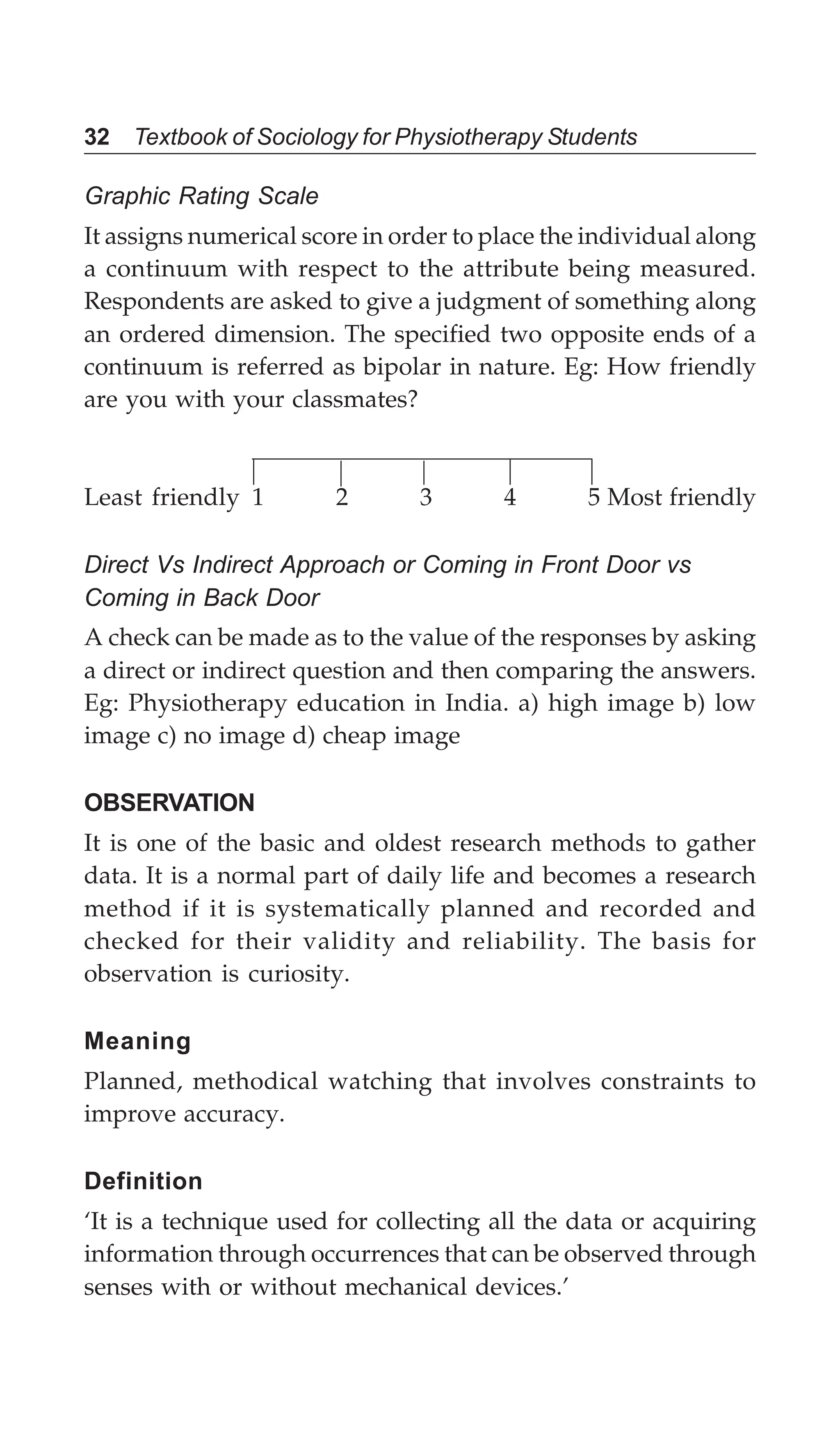
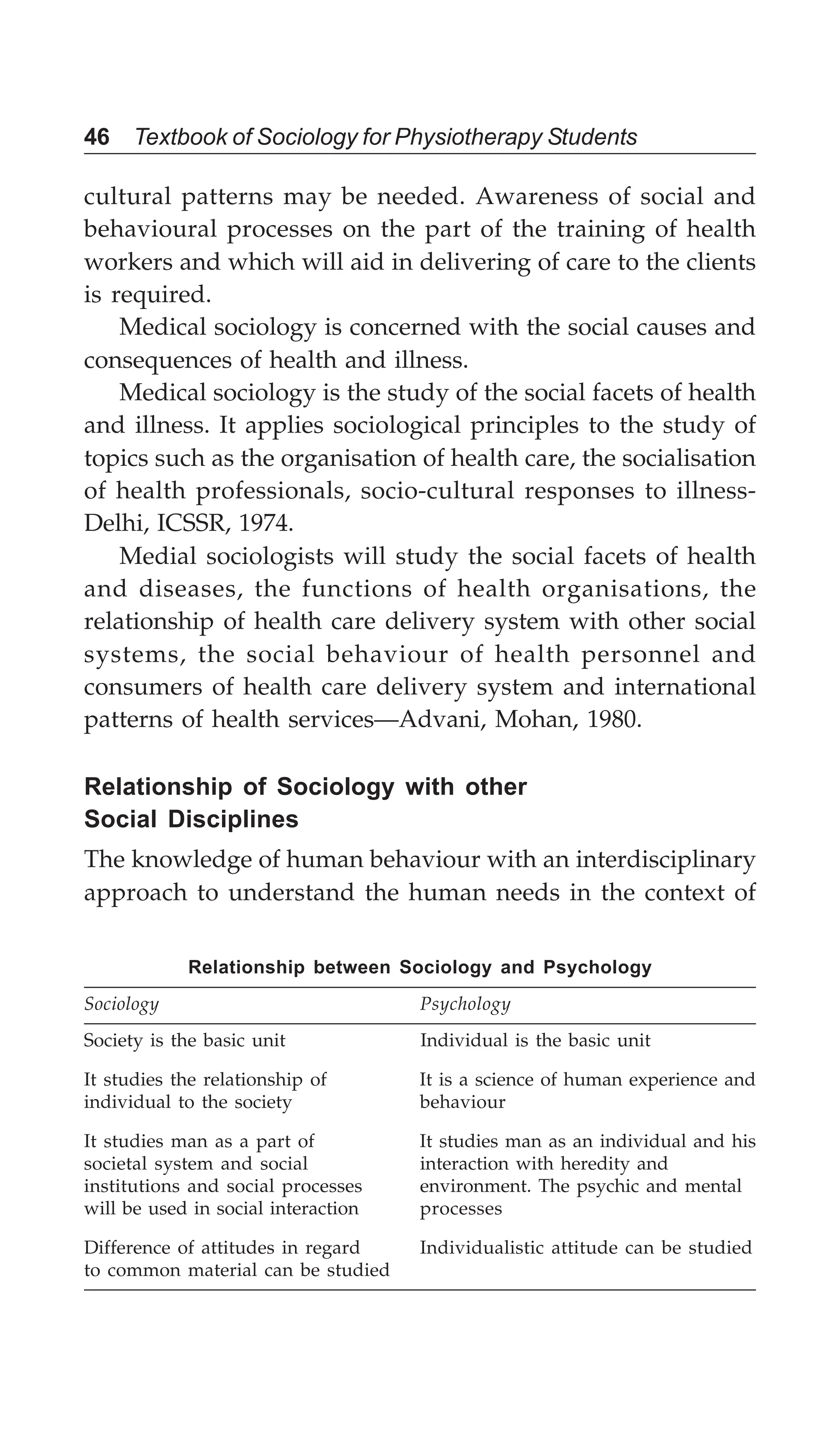
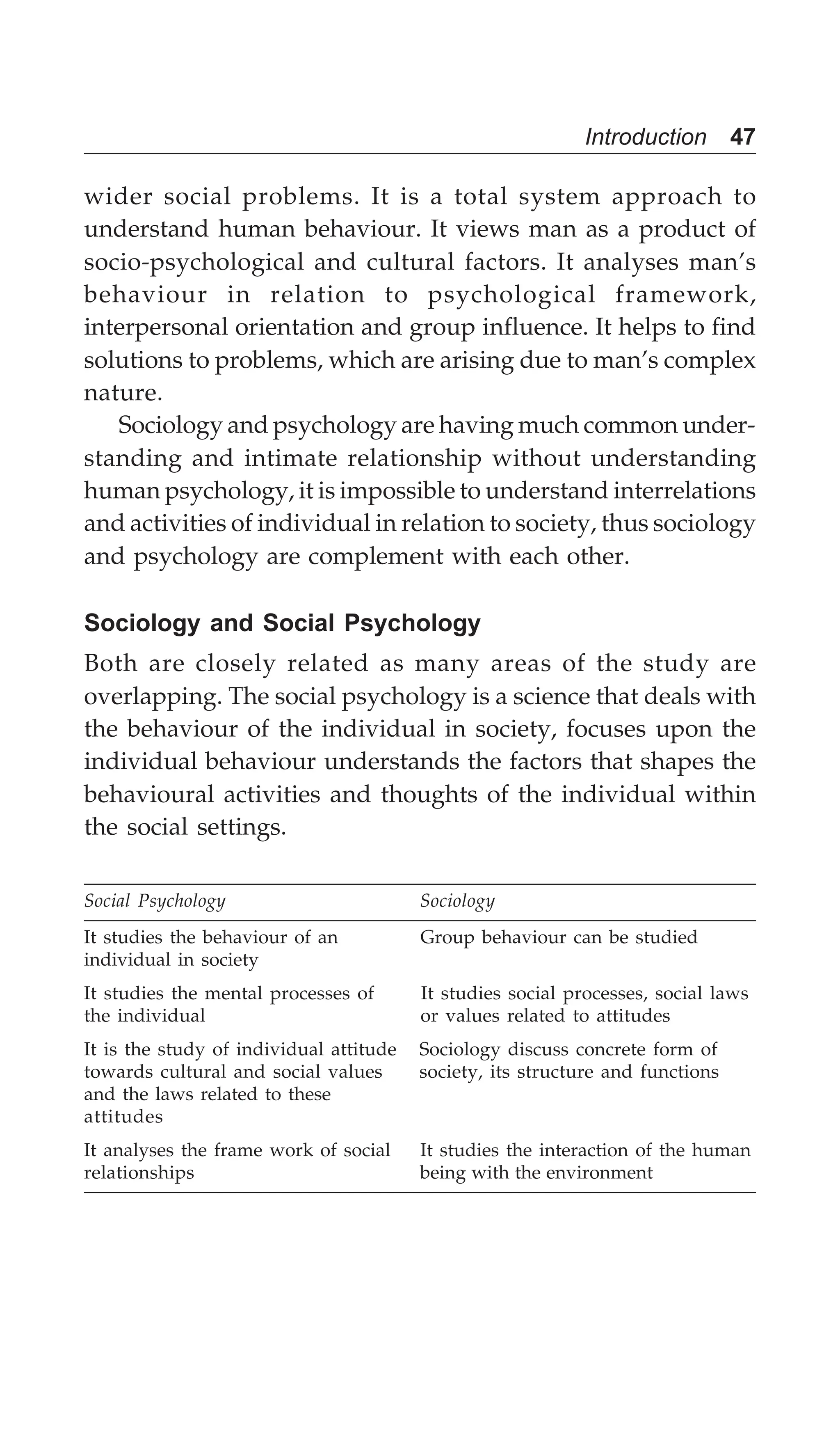
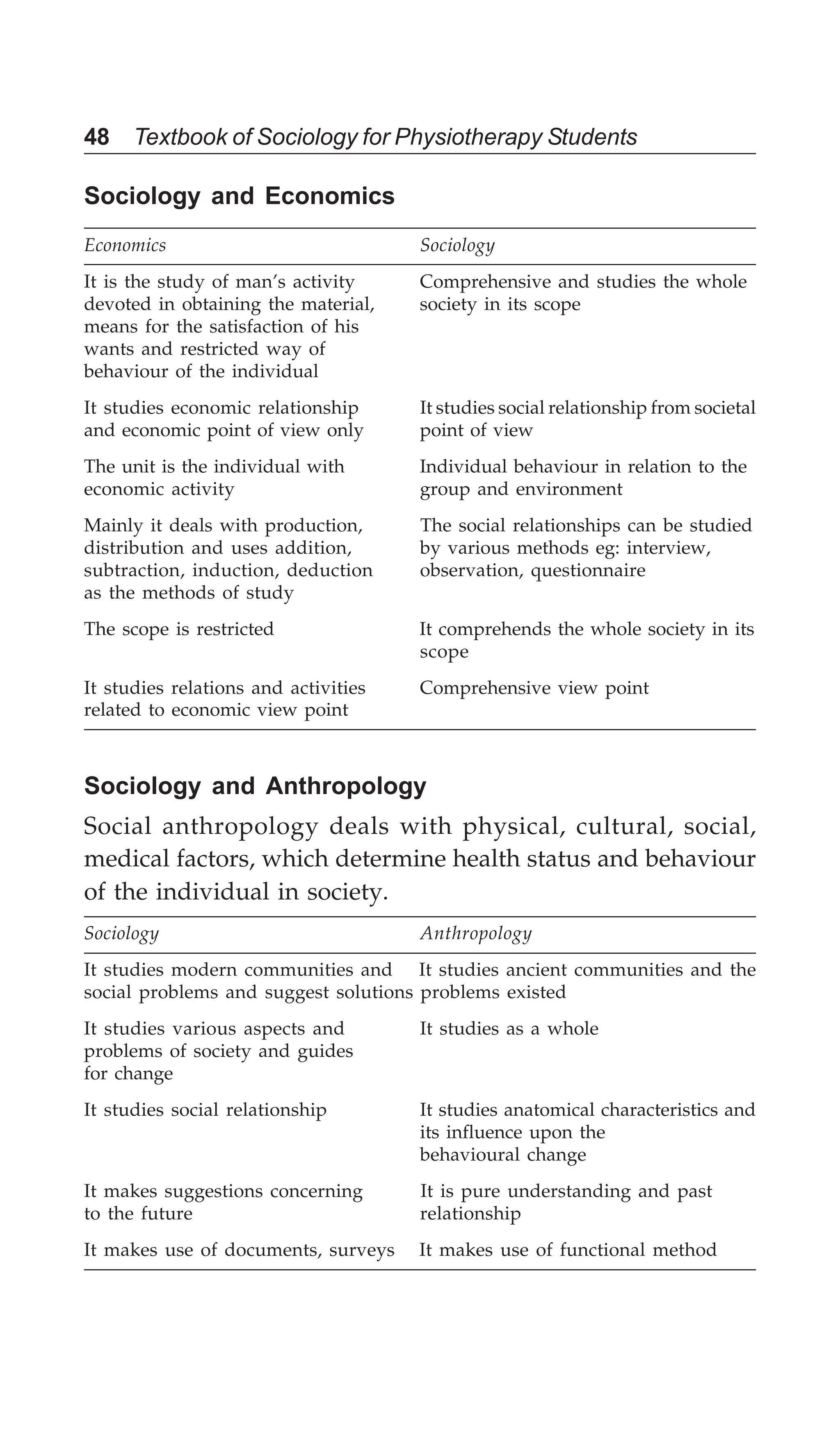
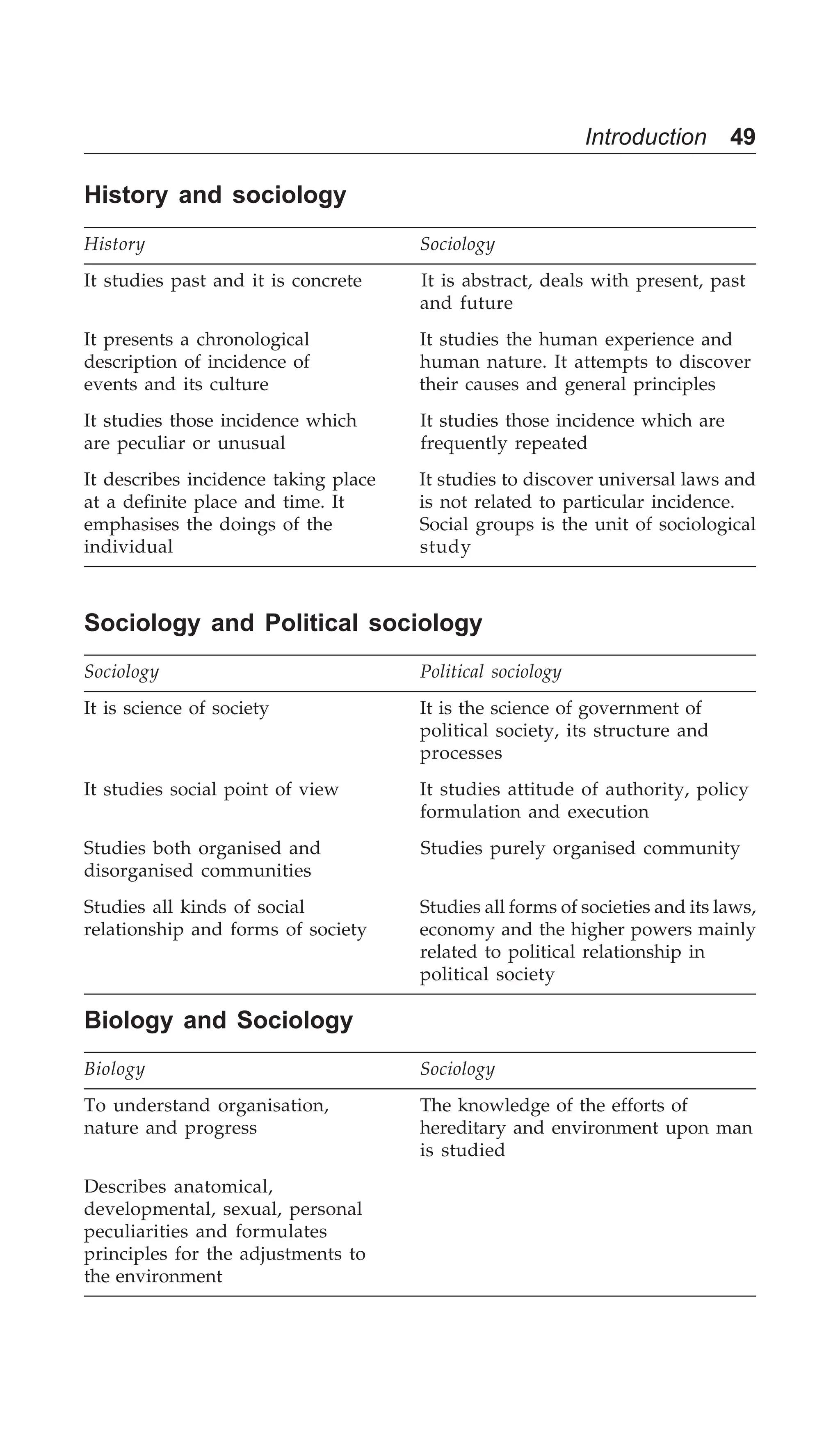
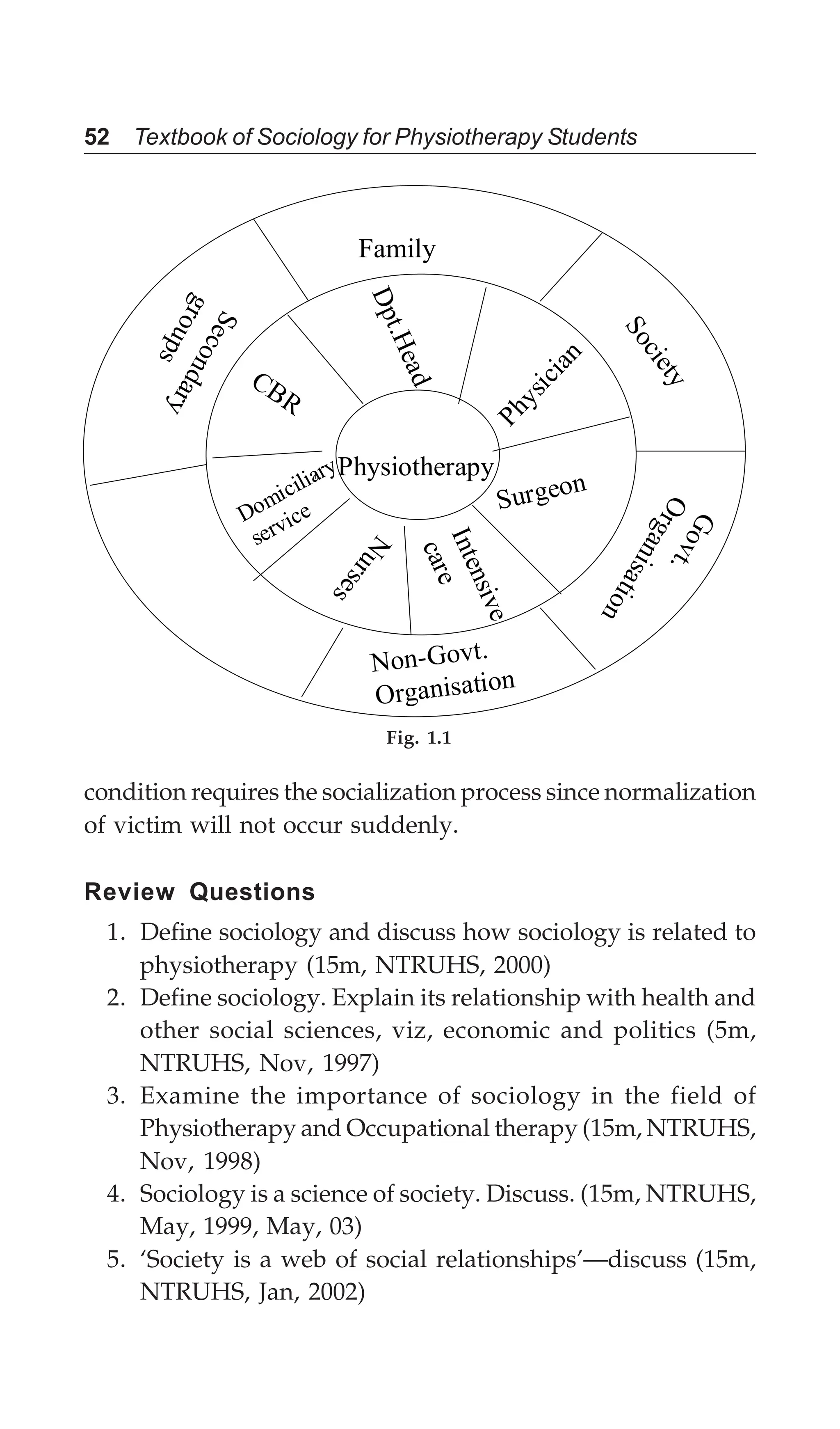
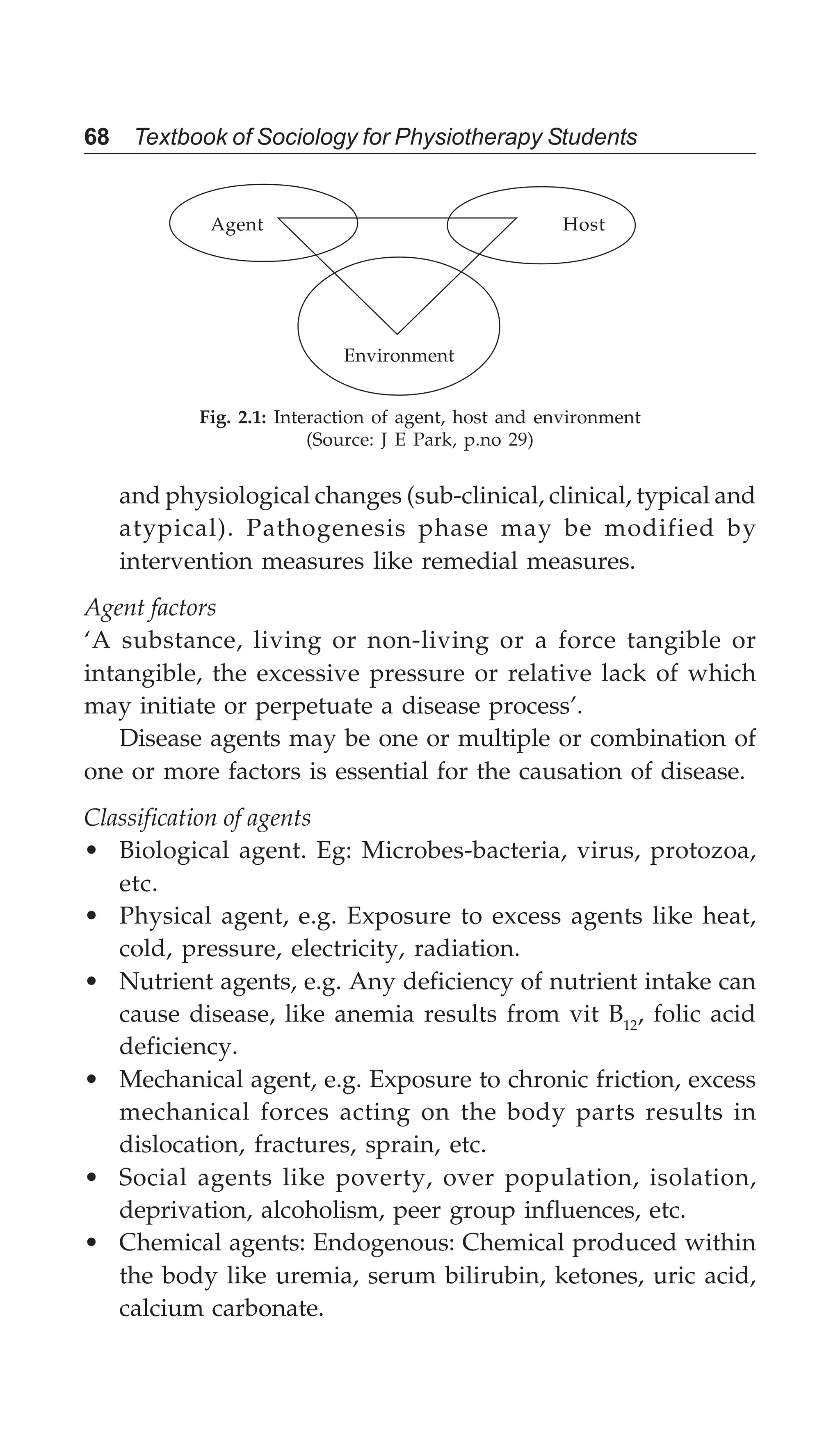
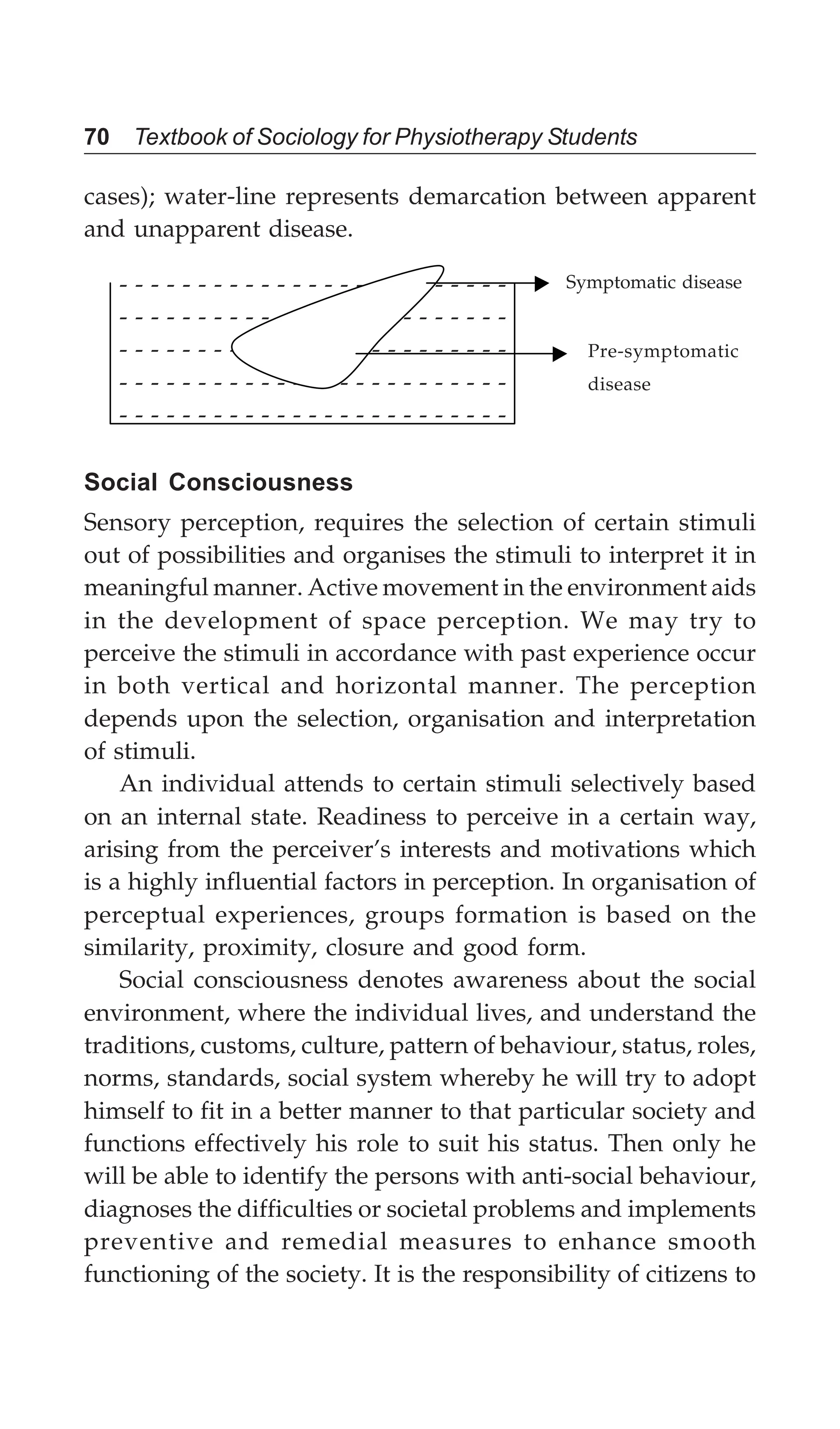
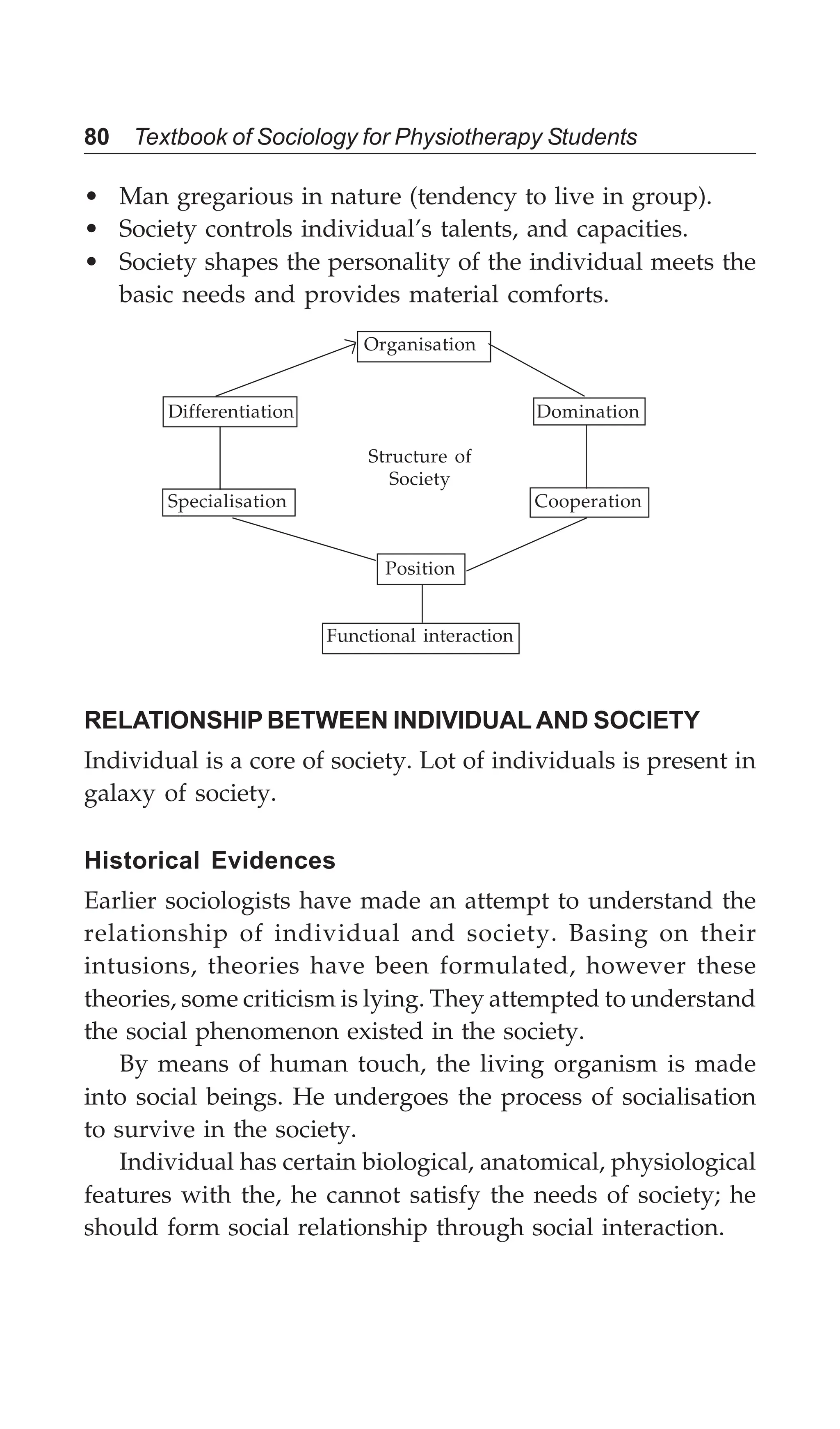
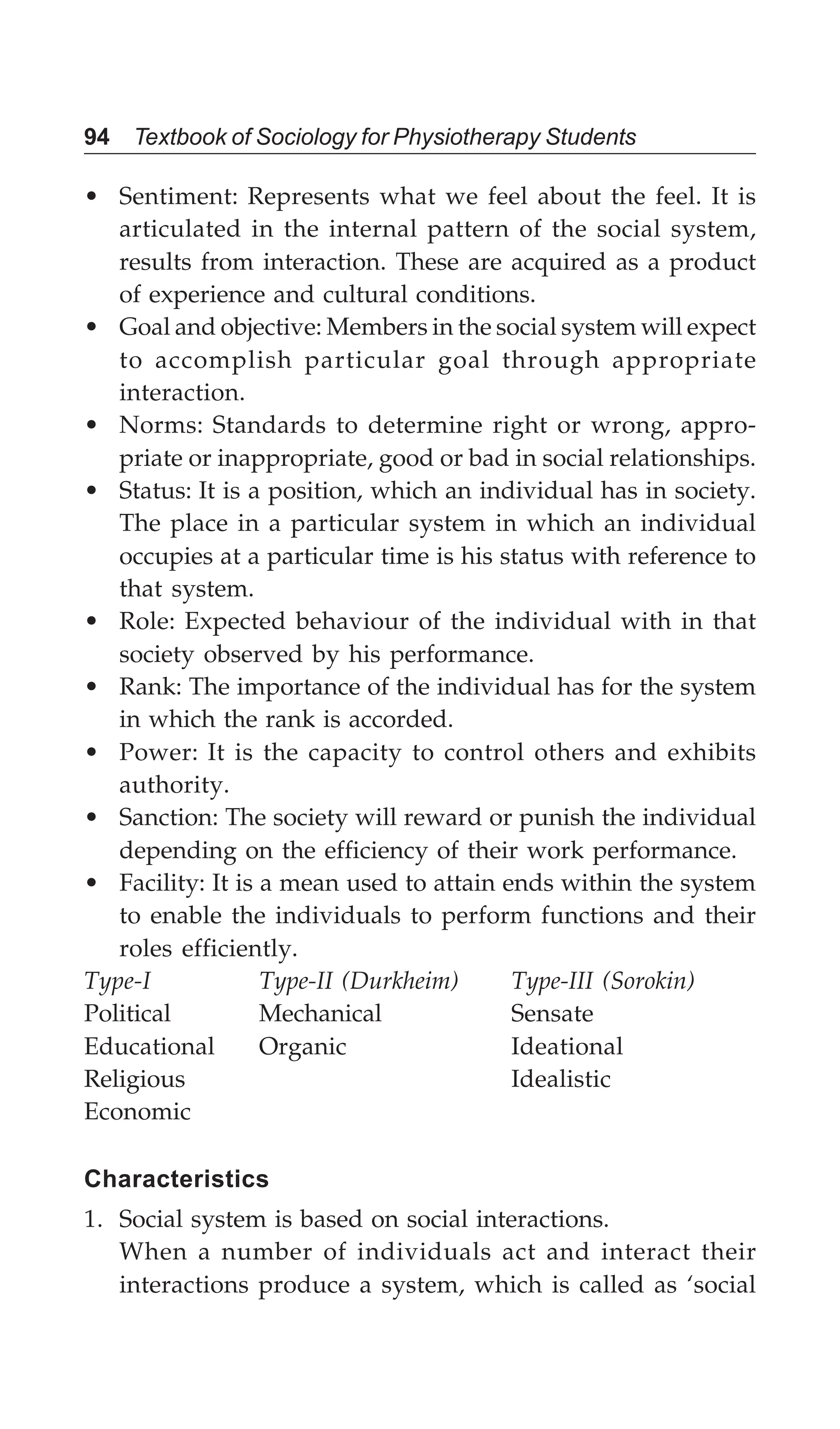
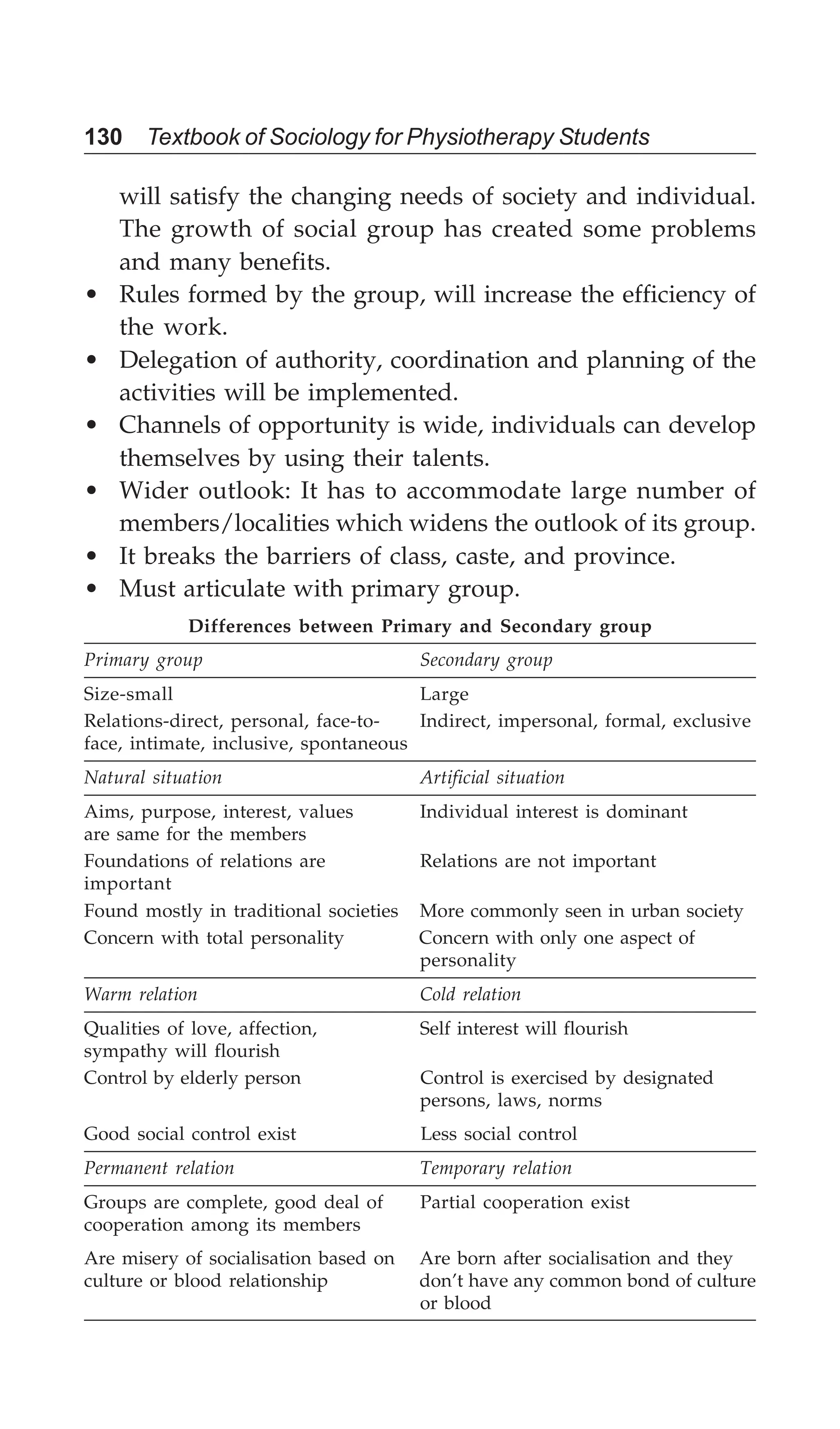
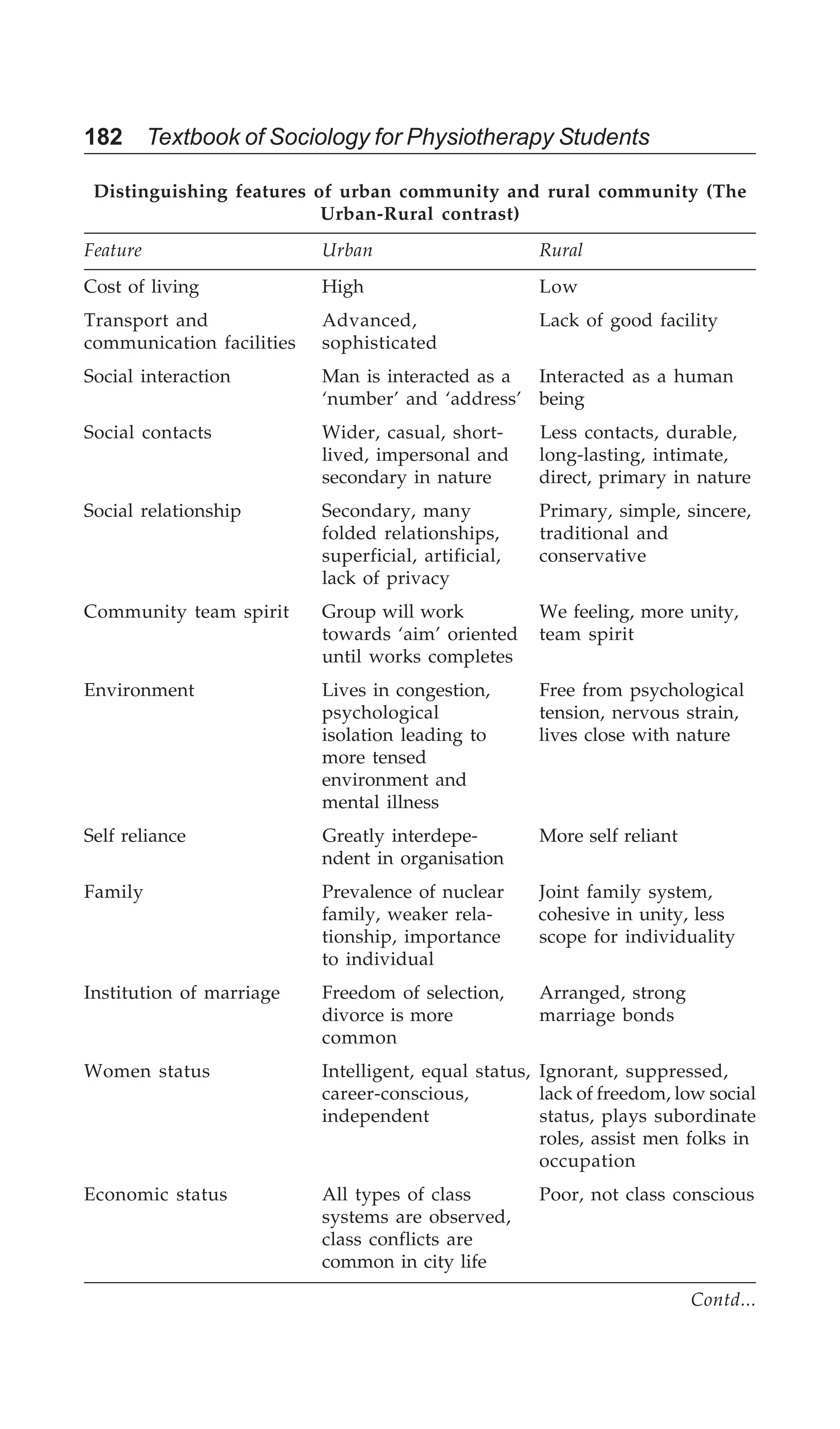
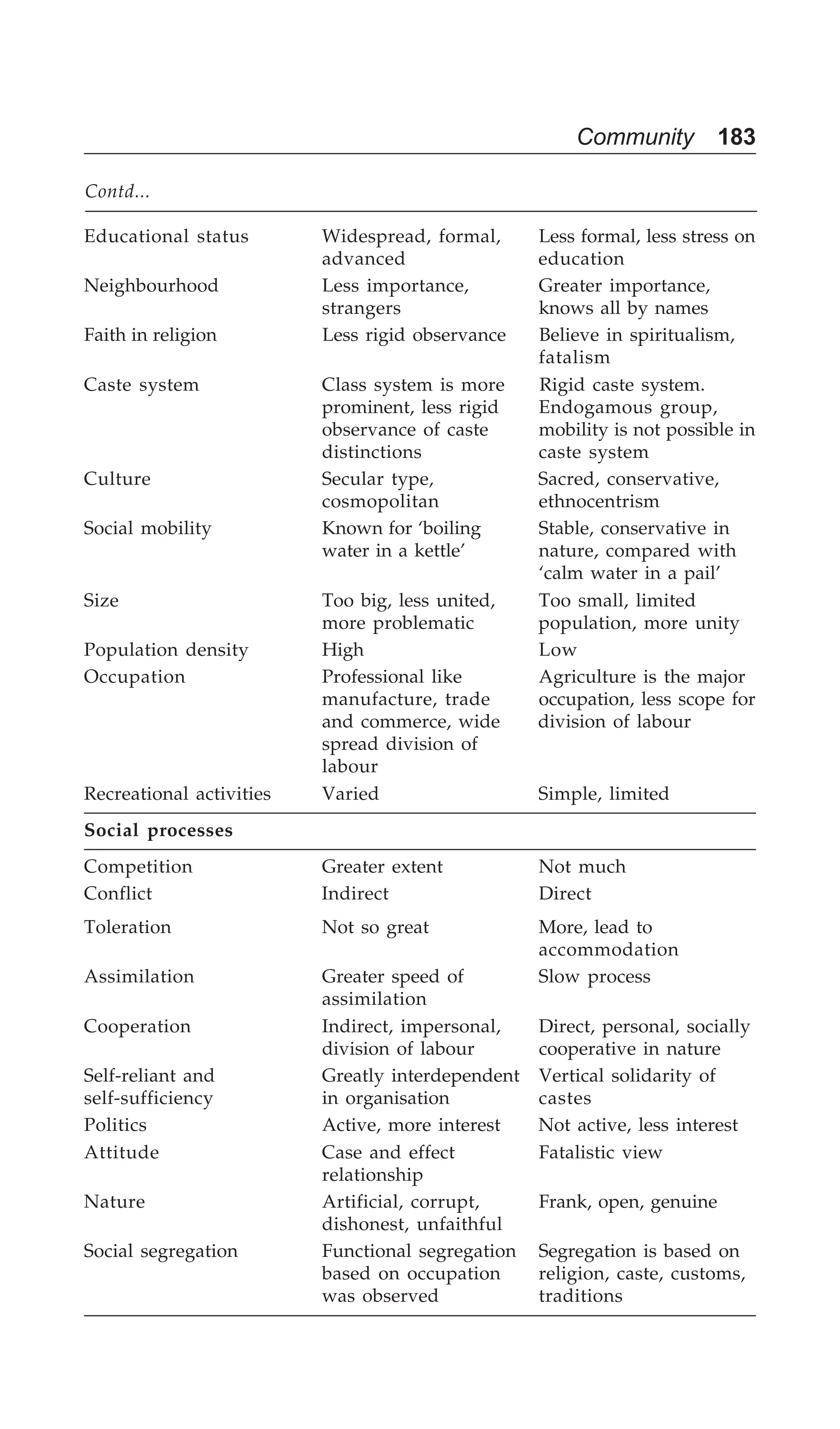
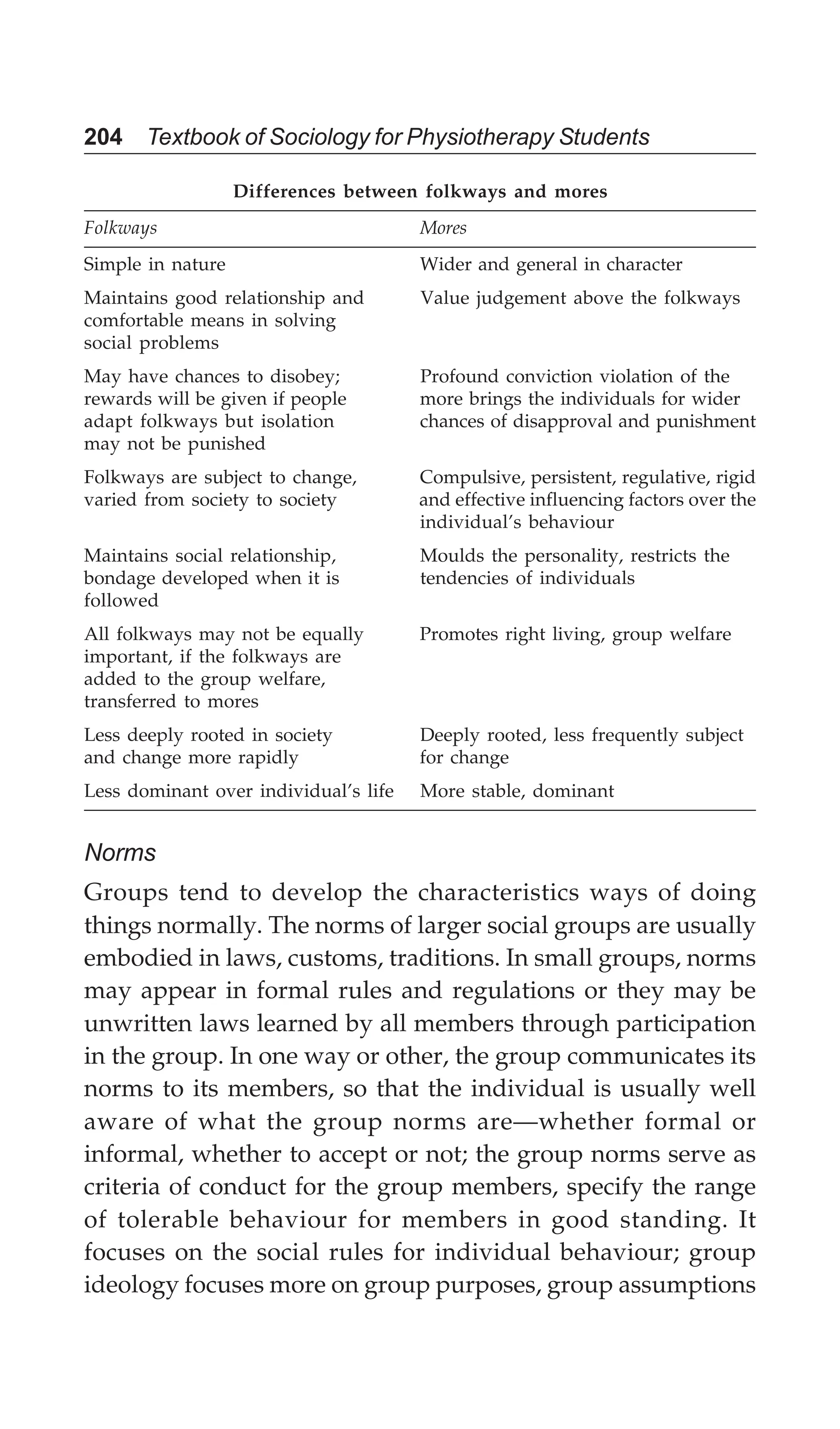
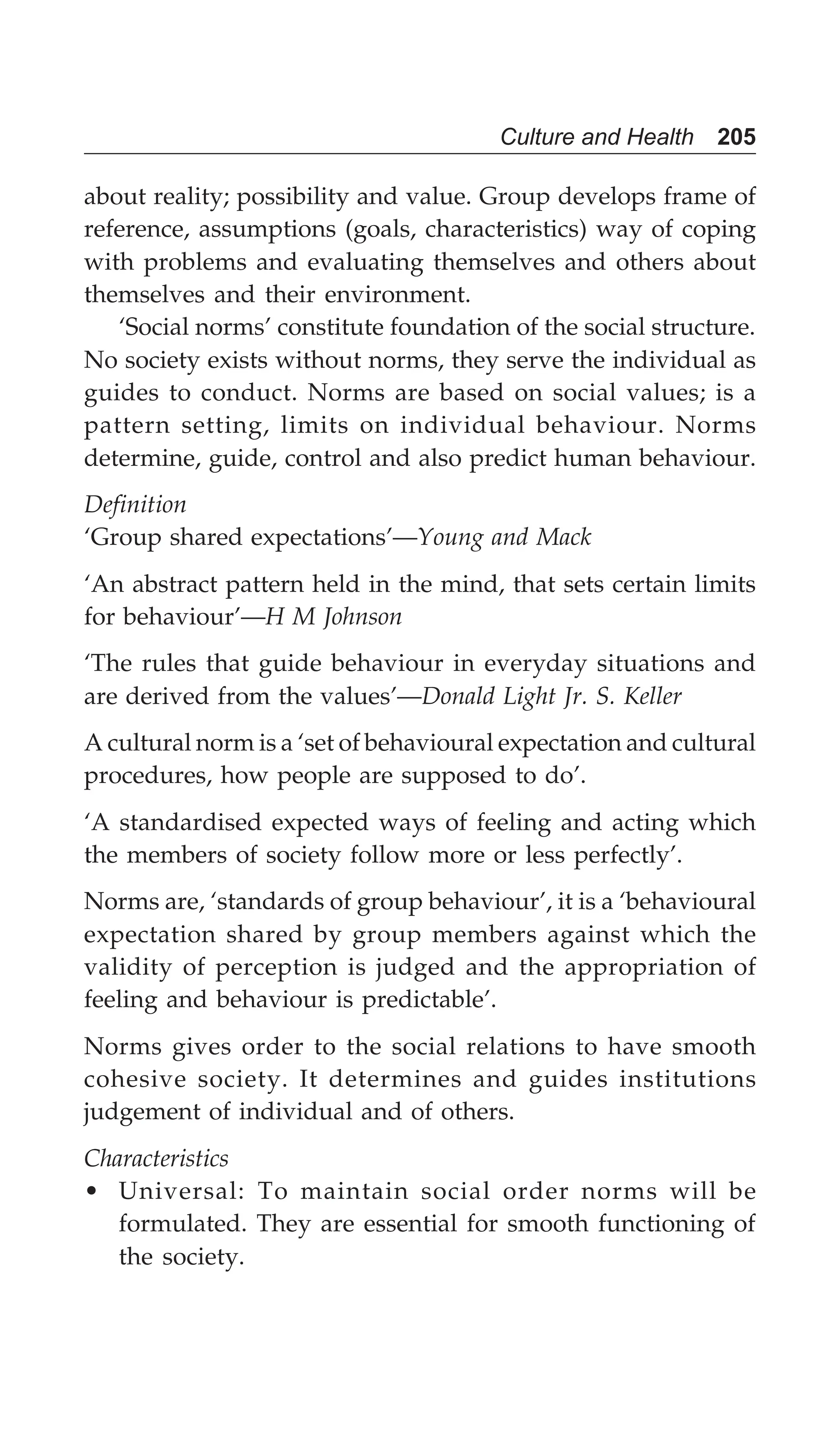
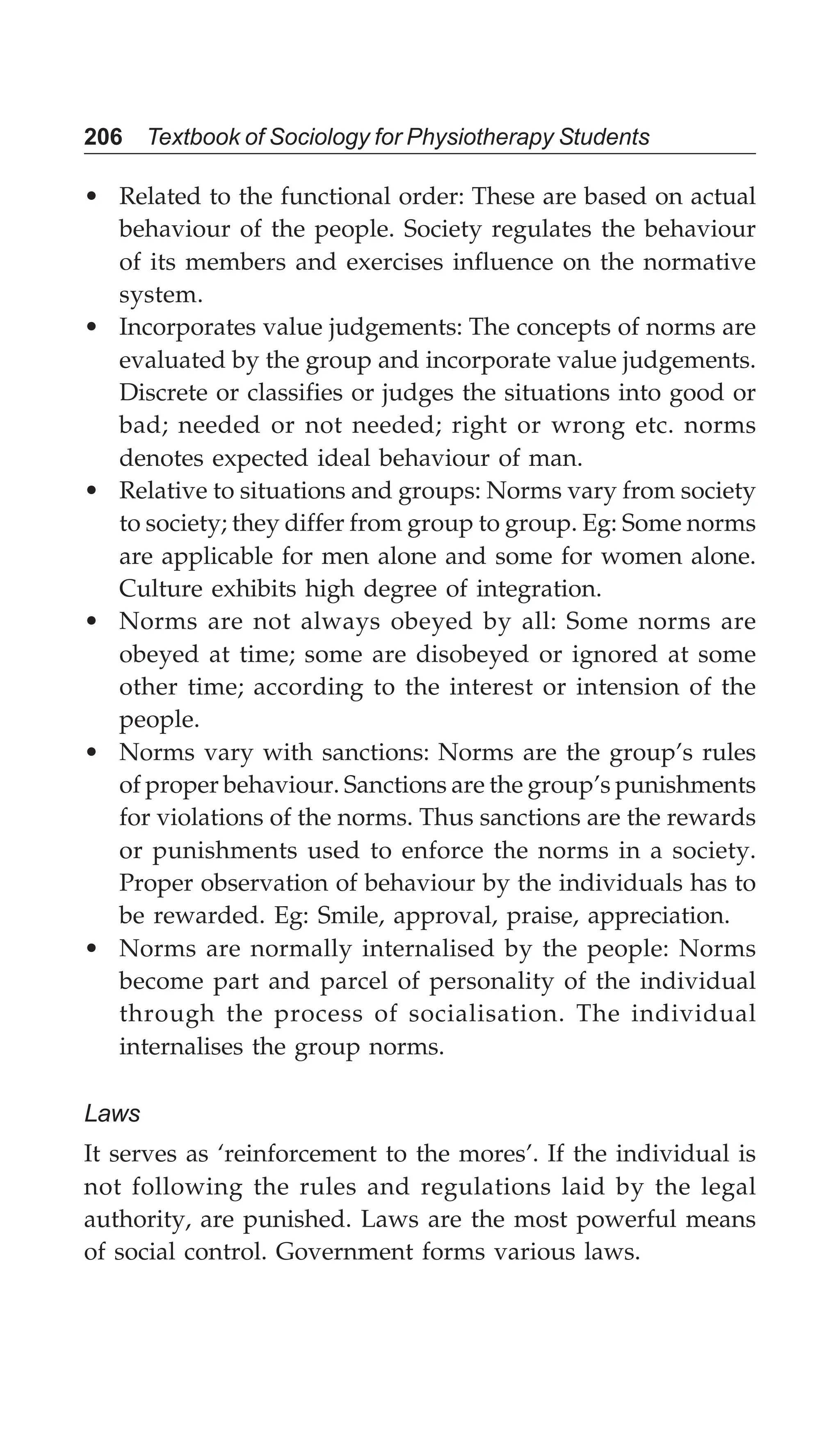
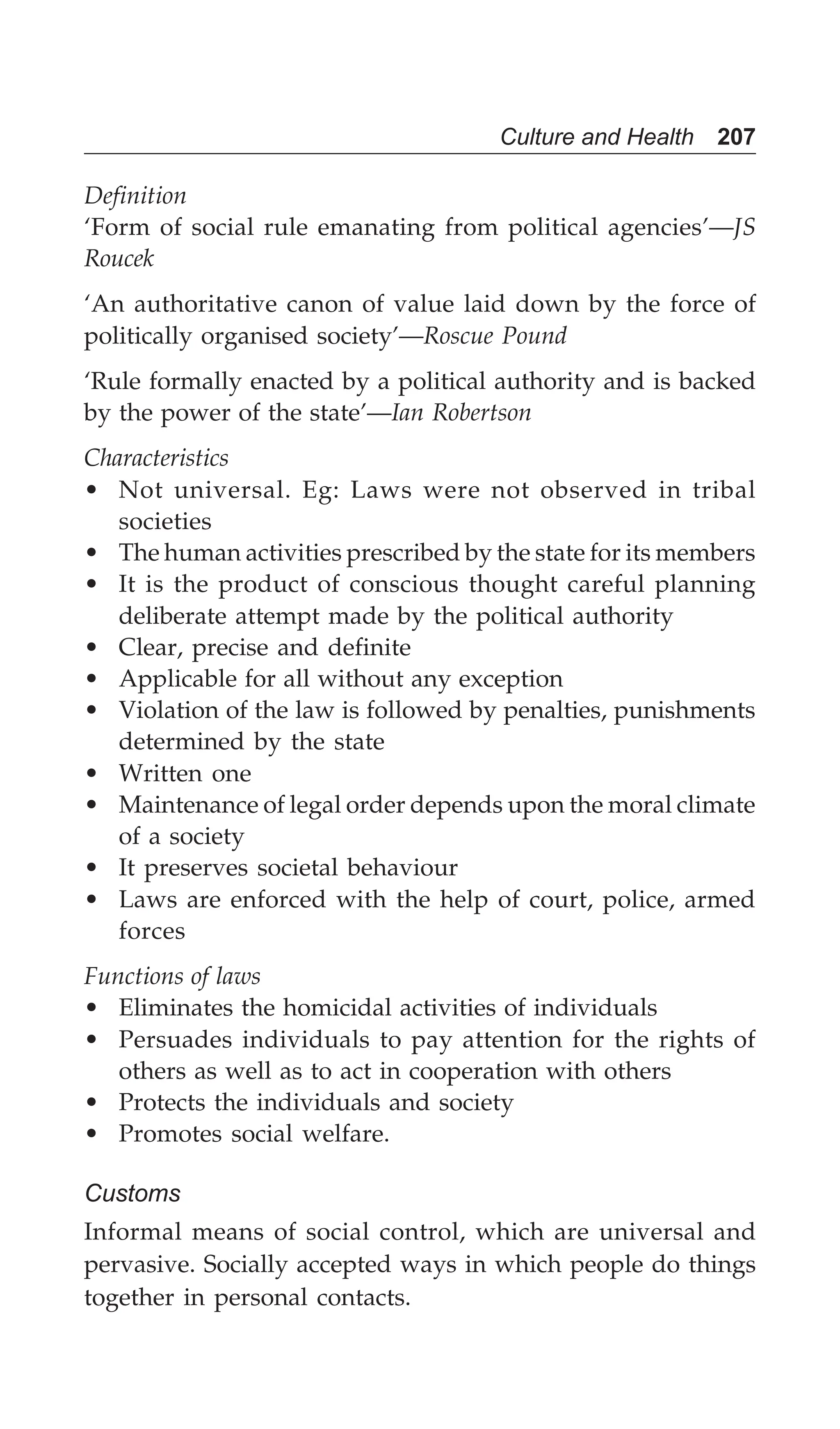
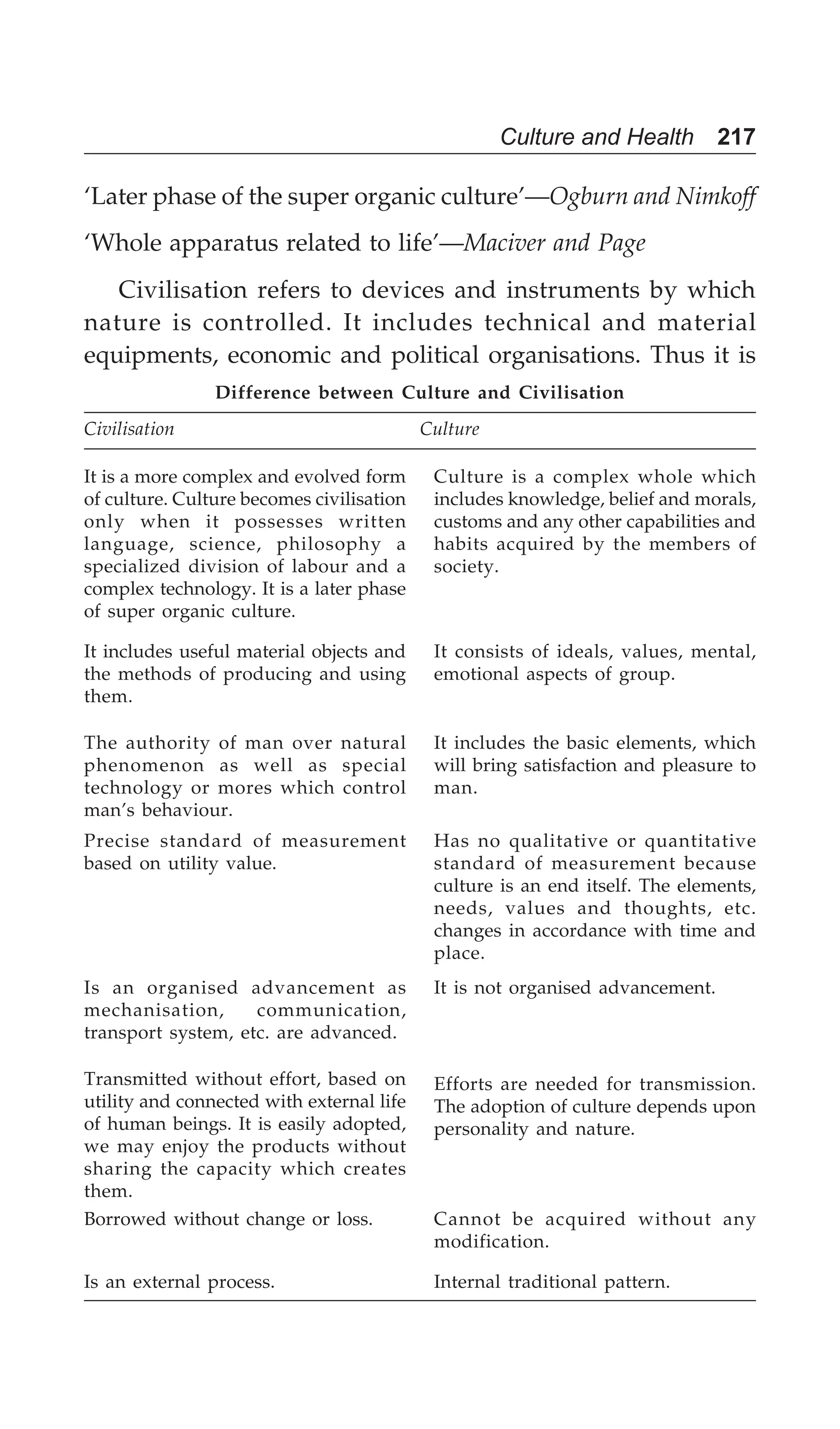
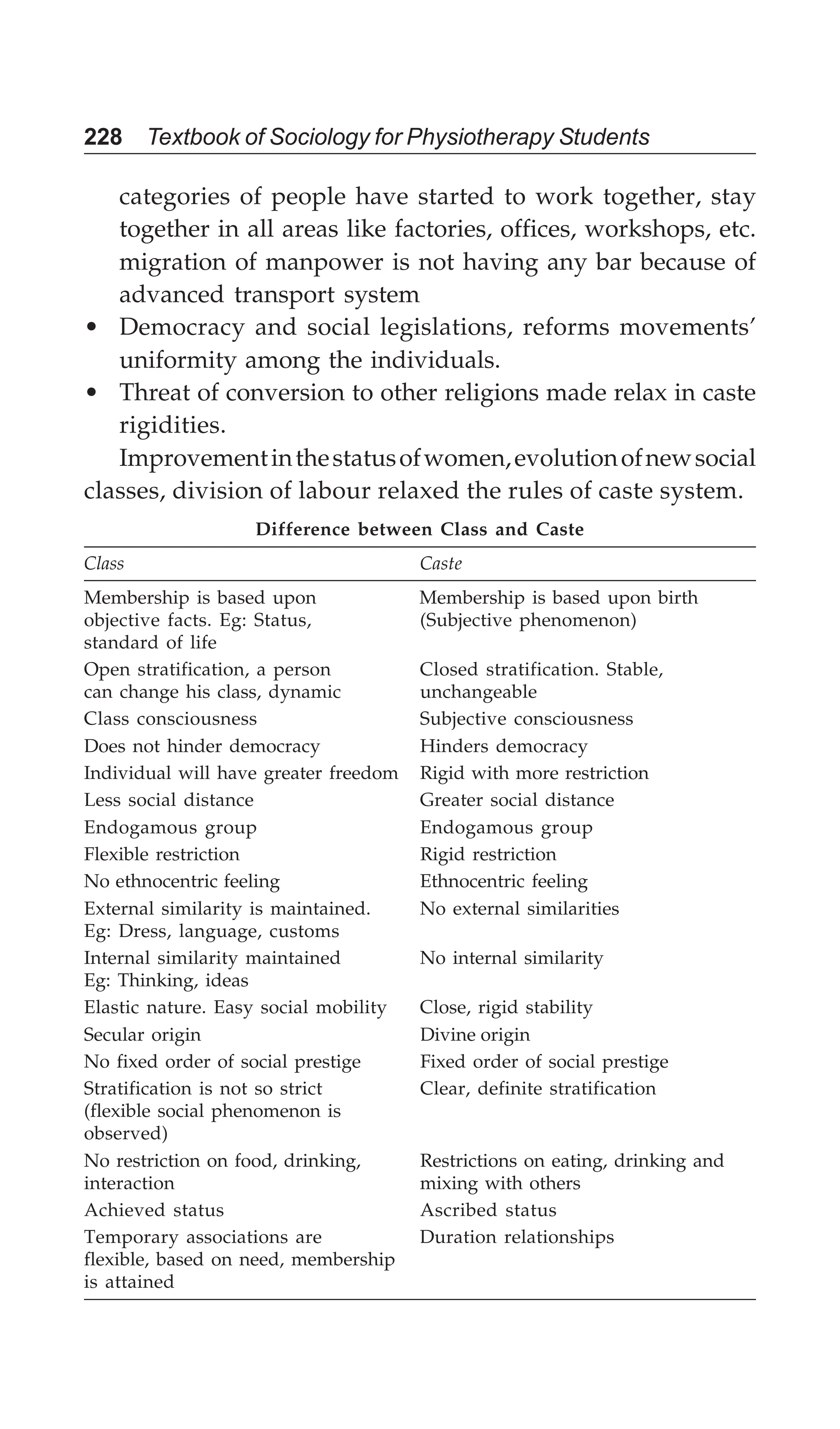
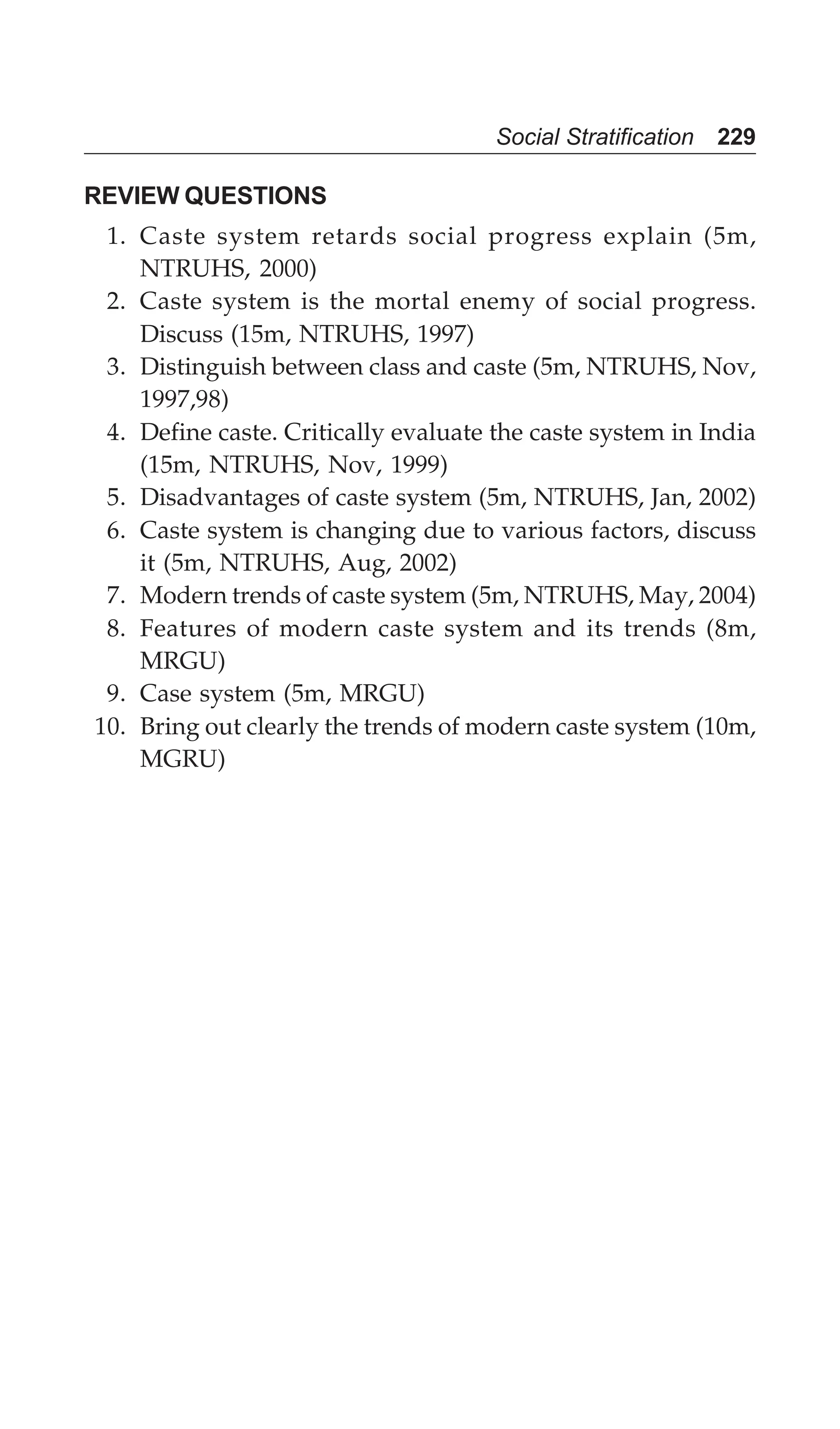

![366 Textbook of Sociology for Physiotherapy Students
to him by accident arising out of and in the course of his
employment [Sec.3 (1)]. The following conditions must
be fulfilled before an employer can be held liable to pay
compensation (1) Injury is caused to the workman by an
accident, (2) Such accident arises out of and in the course
of employment.
ii. Out of employment: An accident arising out of
employment implies a causal connection between the
accident and the employment. In order to prove that
injury arose ‘out of employment’ 2 conditions must be
fulfilled:
a. Injury must have resulted from some risk incidental
to the duties of the service, or inherent in the nature
of condition of employment, and
b. At the time of injury the worker must have been
engaged in the business of the employer and must
not be doing something for his personal advantages
or benefit.
iii. In the course of employment: In order to claim compen-
sation it is essential that the workman at the time of
accident must be in the process of doing something in
discharge of his duty under the contract of service. As a
generalrule,employmentcommenceswhentheworkman
reaches his place of work and ceases when he leaves the
place.
Amount of Compensation (Sec. 4)
The amount of compensation payable to a workman depends
(i) on the nature of the injury caused by accident, and (ii) the
amount of the average monthly wages of the workman
concerned. There is no distinction between an adult and a
minor worker with respect to the amount of compensation.
Sec. 4 provides compensation for (1) Death, (2) Permanent
total disablement (3) Permanent partial disablement (4)
Temporary disablement.](https://image.slidesharecdn.com/sociologyforphysiotherapyandneeraja-250316032203-92253e59/75/sociology-for-physiotherapy-and-neeraja-pdf-377-2048.jpg)
![Social Security 367
Compensation for Death
The maximum compensation in case of death for a workman
drawing Rs. 1000/- per month is Rs. 30,000/- while minimum
to person drawing Rs. 60/- per month is Rs. 7,200/-.
The Amendment Act, 1976, provides for enhancement of
the compensation rates. The new rates of compensation in the
lowest wage group represent 10 years’ wages; highest wage
group 3 ½ years’ wages.
Compensation for Permanent Total Disablement
Is the amount mentioned in Column 3 of Schedule IV to the
Act [Sec. 4 (1) (b)].
Compensation for Temporary Disablement
Is half-monthly payment of the sum shown in Column 4 of
Schedule IV.
Schedule IV
(Sec 4)
Compensation payable to certain cases
Amount of compensation for -
Monthly wages of Death Permanent Half-monthly payment
workman injured total disablement for temporary
Rs Rs Rs disablement
1 2 3 4
0-60.00 7,200/- 10,080/- Half his monthly wages
60-90 9,720/- 14,608/- 36.00
90-120 11,520/- 16,128/- 42.00
120-150 13,500/- 18,900/- 48.75
150-200 16,800/- 23,200/- 60.00
200-300 18,000/- 25,200/- 82.50
300-400 19,200/- 26,880/- 100.00
400-500 21,000/- 29,400/- 118.75
500-600 21,600/- 30,240/- 135.00
600-700 23,100/- 32,340/- 148.75
700-800 24,000/- 33,600/- 160.00
800-900 27,000/- 37,800/- 168.75
900-1000 30,000/- 42,000/- 175.00](https://image.slidesharecdn.com/sociologyforphysiotherapyandneeraja-250316032203-92253e59/75/sociology-for-physiotherapy-and-neeraja-pdf-378-2048.jpg)
![368 Textbook of Sociology for Physiotherapy Students
Compensation to be paid when due
In cases where the employer does not accept the liability for
payment based on the extent of liability which he accepts.
Further such payment has to be deposited with the
Commissioner or made to the workman, as the case may be.
This does not prejudice the right of the workman to make any
further claim [Sec 4-A(2)].
Penalty for Default
An employer should pay the compensation due under this
Act within one month from the date it falls due. If he defaults,
the Commissioner may direct him to pay the amount of arrears
with simple interest at the rate of 6% per annum on the amount
due. Further, if in the opinion of the Commissioner there is
no justification for the delay, a further sum up to 50% of the
amount due shall be recovered from the employer by way of
penalty.
DISABILITY ACT (1995)
‘The central tenet of the disability rights movement is complete
integration into the community. Integration will come through
main streamed schools and civil rights, laws that guarantee
full access to public accommodations and the work place’.—
Joseph P Shapiro
The plight of the disabled in India is in a pitiable situation.
They are the largest minority group, starved of services and
facilities available, they are mostly ignored by the society
subjected to a long history of neglect, isolation, segregation,
poverty, deprivation, charity and even pity. The care of the
disabled is left to their families and a few voluntary and
government organisations. Hence in such a situation the law
must take an active role. Realising the necessity of various
forms of assistance and special attention required by the](https://image.slidesharecdn.com/sociologyforphysiotherapyandneeraja-250316032203-92253e59/75/sociology-for-physiotherapy-and-neeraja-pdf-379-2048.jpg)