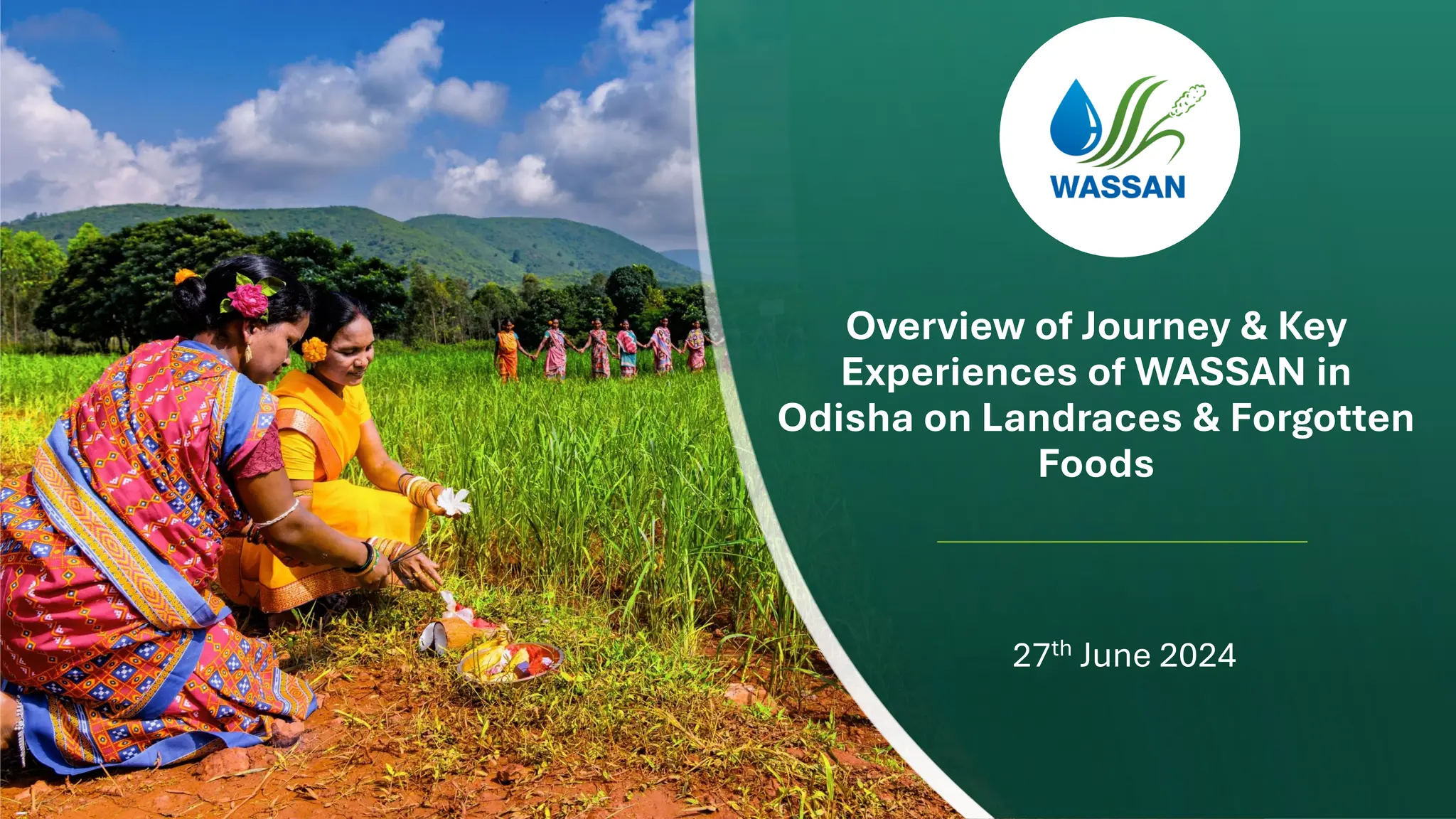
Overview of Journey & Key
Experiences of WASSAN in
Odisha on Landraces & Forgotten
Foods
27th June 2024
Watershed Support Services and Activities
Network
Established in 1999
Network based Organisation
Watershed
Development
Natural Farming
Seed
Systems
Millets Nutrition
Livestock
Desi- Poultry Biodiversity Fisheries
Institutions & Enterprise
development
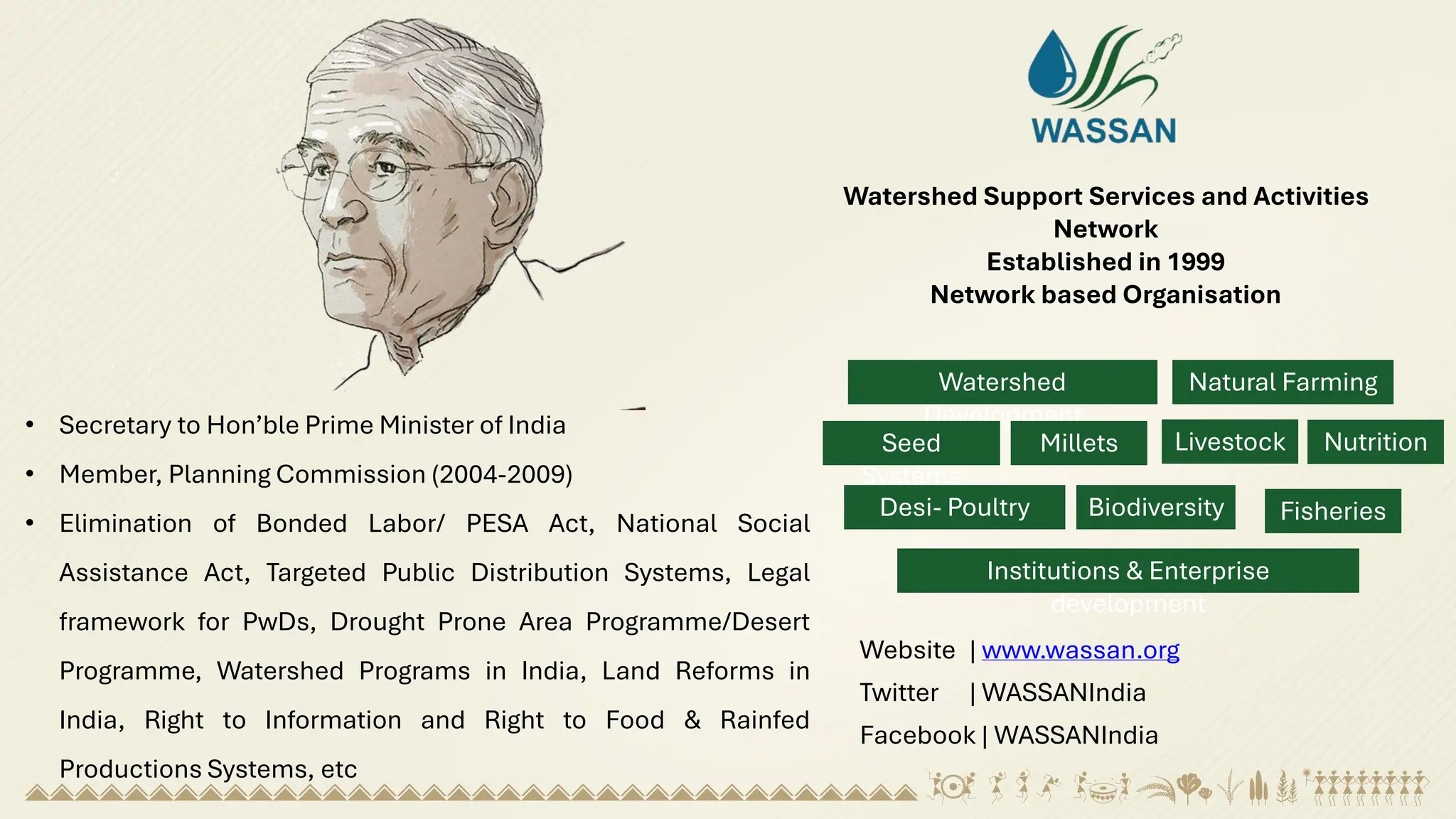
• Secretary to Hon’ble Prime Minister of India
• Member, Planning Commission (2004-2009)
• Elimination of Bonded Labor/ PESA Act, National Social
Assistance Act, Targeted Public Distribution Systems, Legal
framework for PwDs, Drought Prone Area Programme/Desert
Programme, Watershed Programs in India, Land Reforms in
India, Right to Information and Right to Food & Rainfed
Productions Systems, etc
Website | www.wassan.org
Twitter | WASSANIndia
Facebook | WASSANIndia
Research & Network
• Central Research Institute for Dryland
Agriculture
• Central Institute for Agriculture
Engineering
• National Bureau of Plant Genetics
Research (NBPGR)
• National Bureau of Animal Genetics
Research (NBPGR)
• Indian Institute of Rice Research
• MANAGE
• National Rainfed Areas Authority
(Knowledge Partner)
• University of Agriculture Sciences,
Bengaluru
• Odisha University of Agriculture and
Technology
• CSIRO, Australia
• University of Cambridge, UK
• University of Greenwich, UK
Government
• Department of Agriculture / RYSS-
Andhra Pradesh
• Department of Tribal Welfare and
Development – AP
• Department of Women & Development,
Telangana
• Department of Agriculture, Odisha
• Department of Tribal Welfare and
development, Odisha
• Department of Rural Development,
Jharkhand
• NRAA, Ministry of Agrl, Govt of India
• NABARD
Main Funding
• Azim Premji Foundation
• Ford Foundation
• Rainmatter Foundation
• HDFC-Parivarthan
• Agro Ecology Fund
• Bharat Rural Livelihoods Fund (BRLF)
• GIZ
• WHH
WASSAN anchors :
• Network Hub of Revitalising Rainfed
Agriculture Network (RRA Network)
• Secretariat of the National Coalition
for Natural Farming
WASSAN works with over 100 grassroots organisations across the country – supporting them
in building their implementation capacities, innovations, networking and policy development
through networking and coalitions
Partnerships & Collaborations:
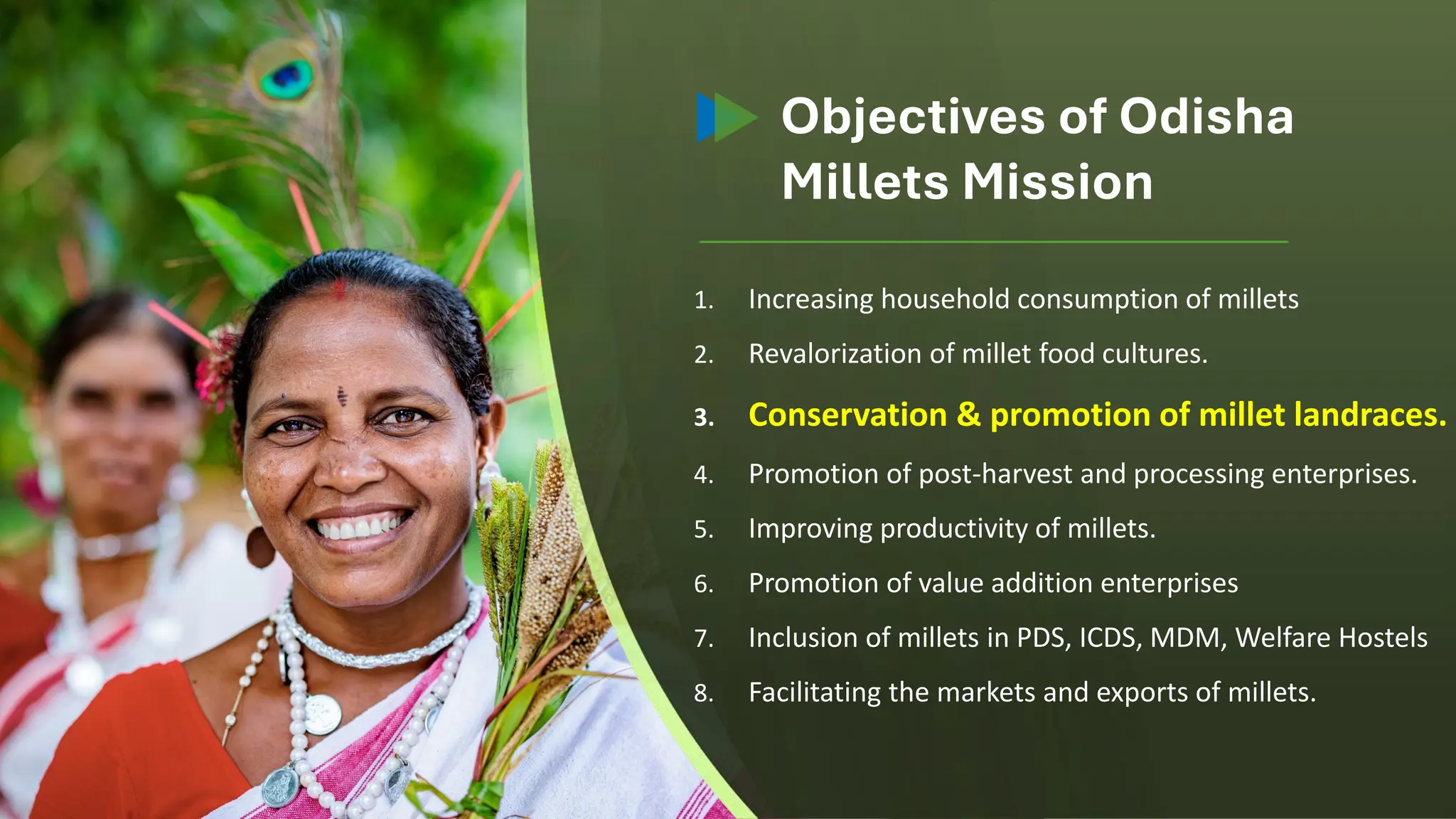
1. Increasing household consumption of millets
2. Revalorization of millet food cultures.
3. Conservation & promotion of millet landraces.
4. Promotion of post-harvest and processing enterprises.
5. Improving productivity of millets.
6. Promotion of value addition enterprises
7. Inclusion of millets in PDS, ICDS, MDM, Welfare Hostels
8. Facilitating the markets and exports of millets.
Objectives of Odisha
Millets Mission
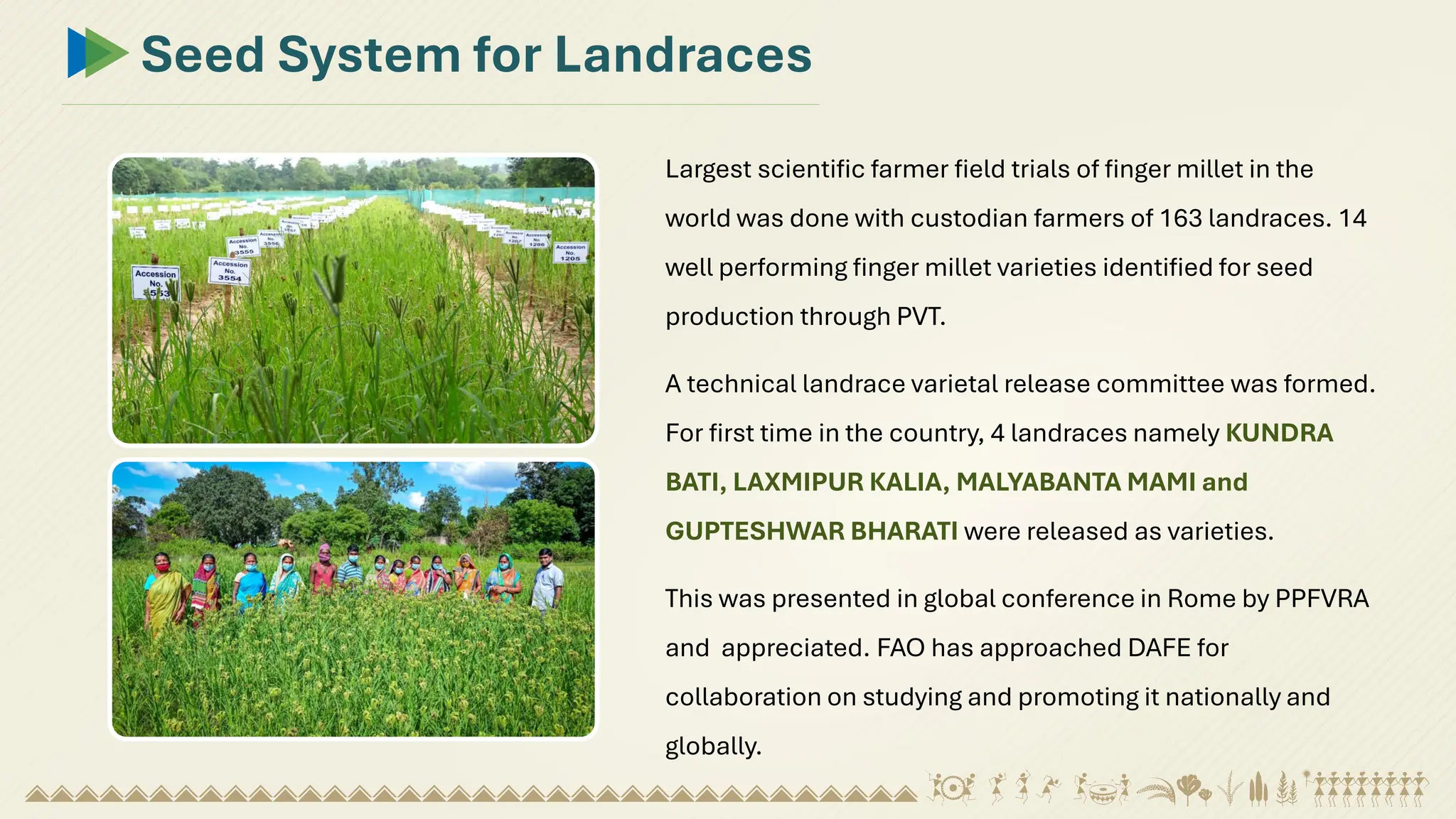
Largest scientific farmer field trials of finger millet in the
world was done with custodian farmers of 163 landraces. 14
well performing finger millet varieties identified for seed
production through PVT.
A technical landrace varietal release committee was formed.
For first time in the country, 4 landraces namely KUNDRA
BATI, LAXMIPUR KALIA, MALYABANTA MAMI and
GUPTESHWAR BHARATI were released as varieties.
This was presented in global conference in Rome by PPFVRA
and appreciated. FAO has approached DAFE for
collaboration on studying and promoting it nationally and
globally.
Seed System for Landraces
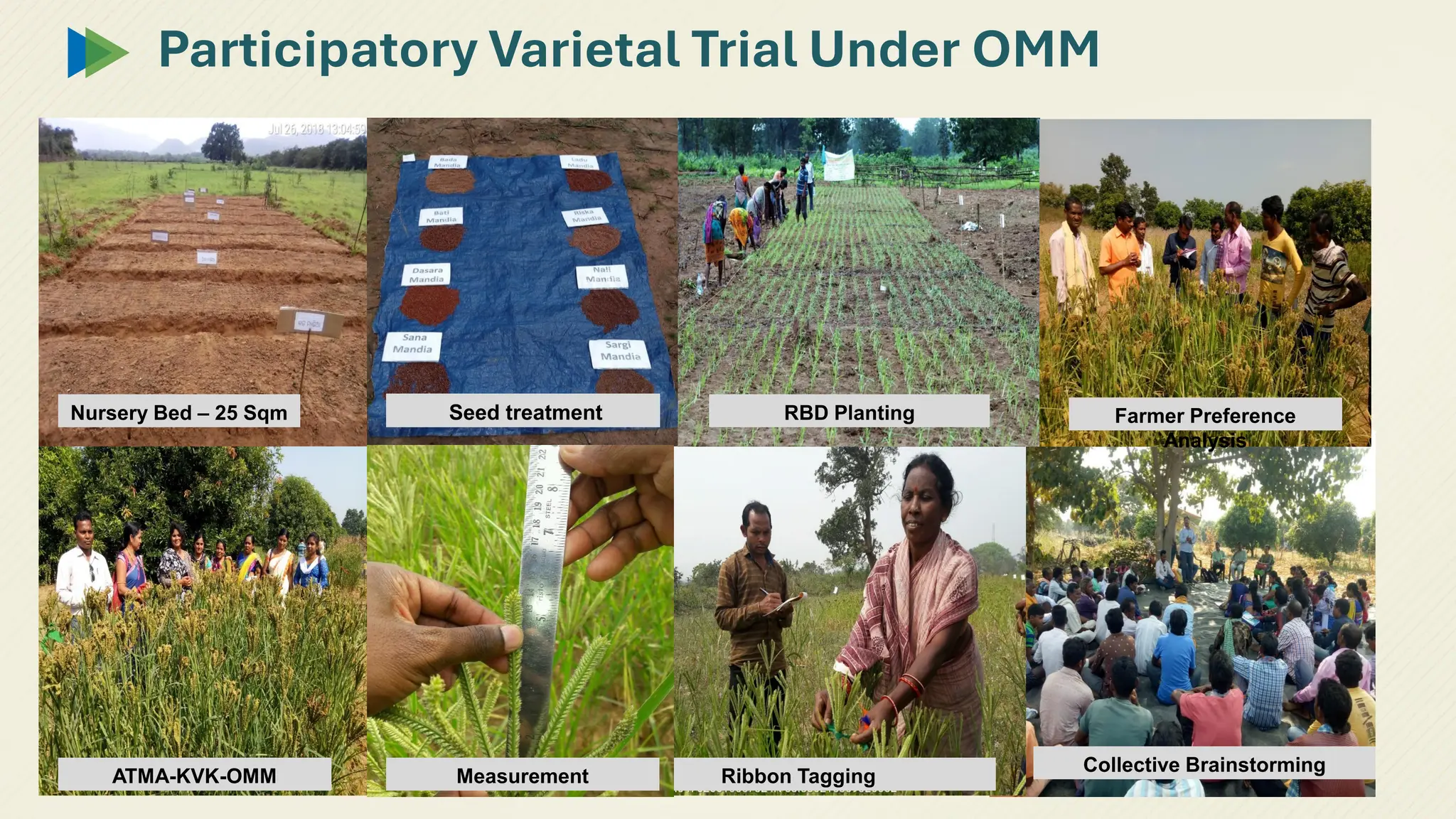
Participatory Varietal Trial Under OMM
Nursery Bed – 25 Sqm
Ribbon Tagging for different
landraces
Collective Brainstorming
Seed treatment
Ribbon Tagging
RBD Planting Farmer Preference
Analysis
ATMA-KVK-OMM Measurement
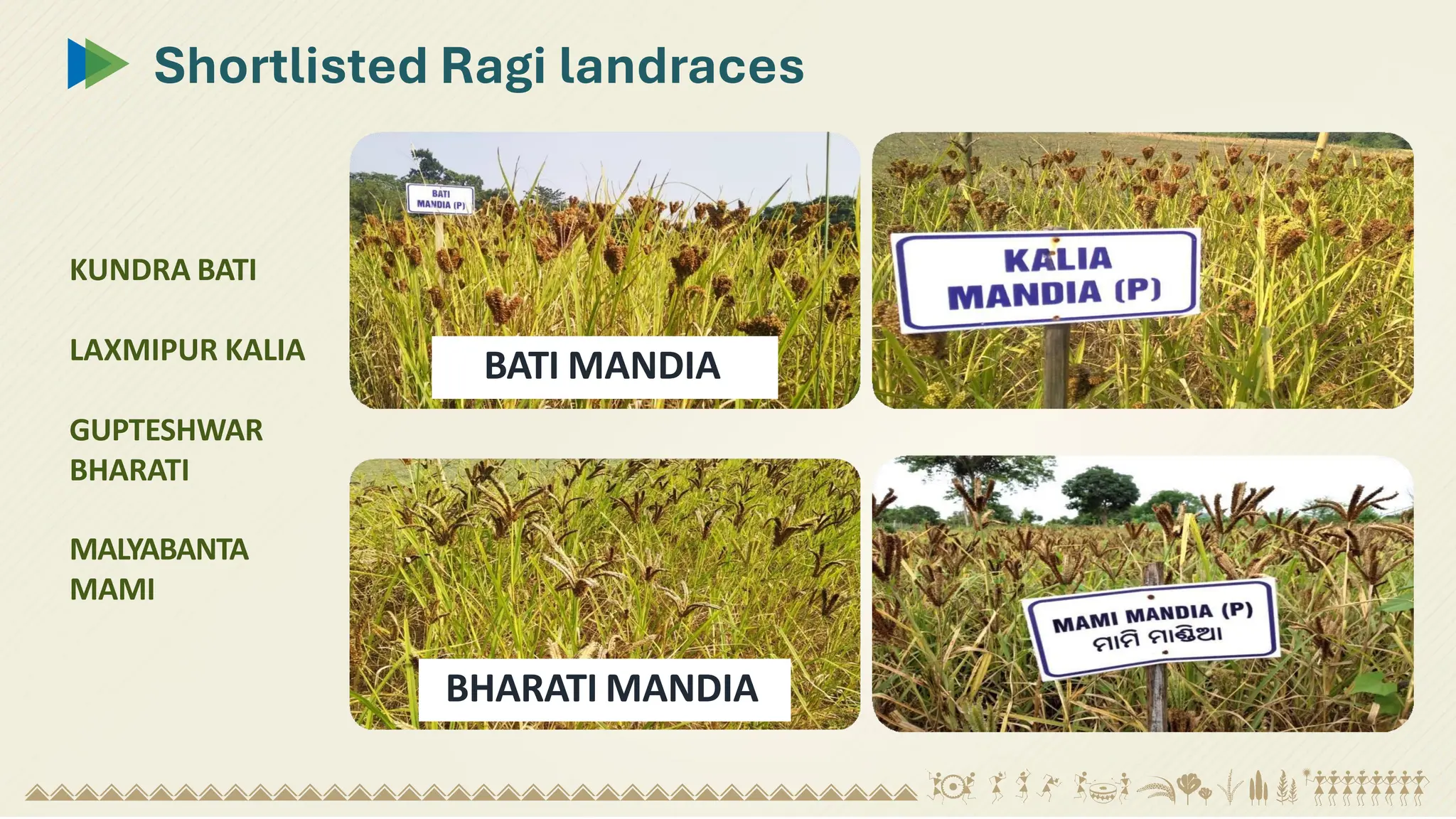
BHARATI MANDIA
BATI MANDIA
KUNDRA BATI
LAXMIPUR KALIA
GUPTESHWAR
BHARATI
MALYABANTA
MAMI
Shortlisted Ragi landraces
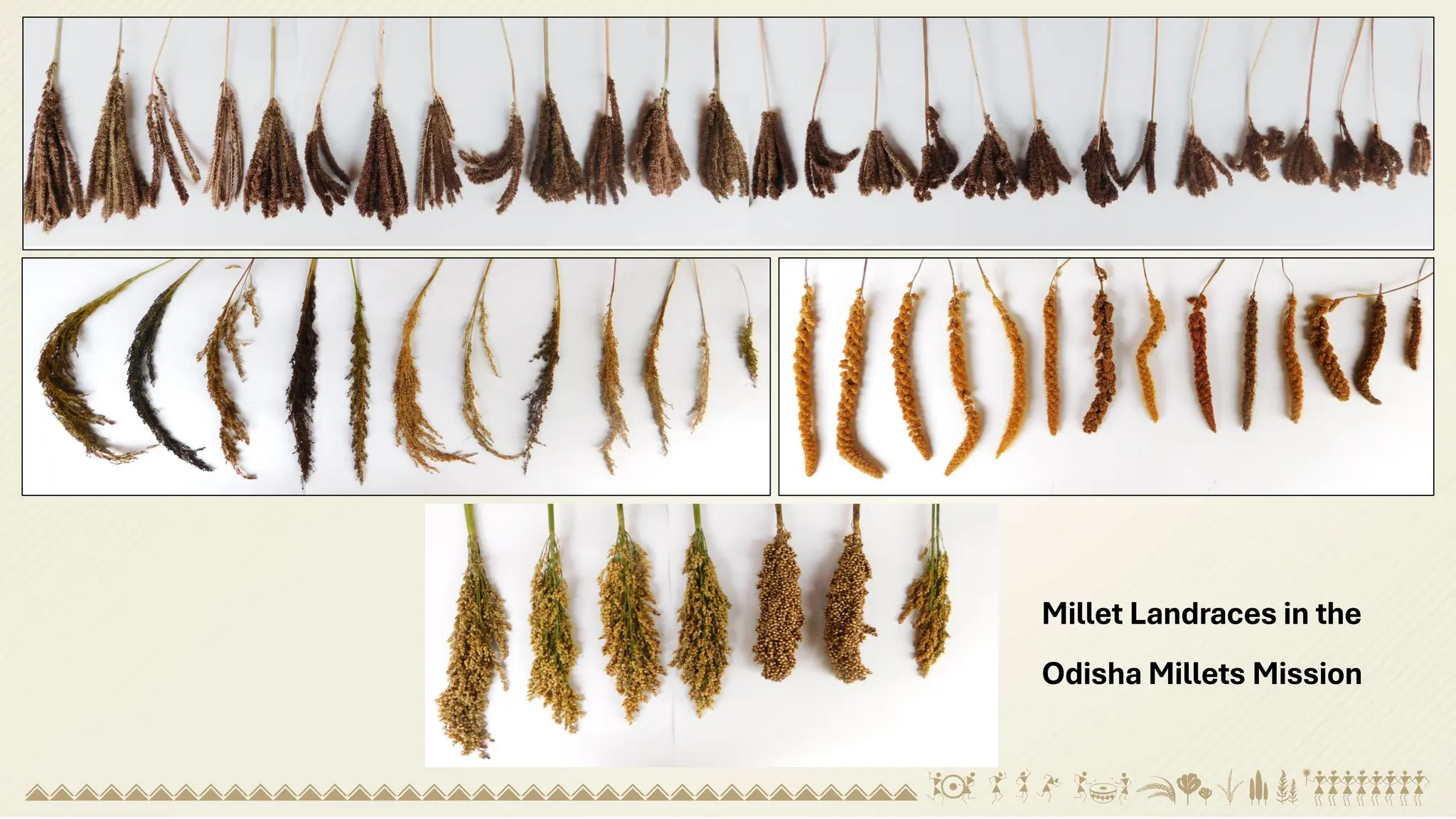
Millet Landraces in the
Odisha Millets Mission
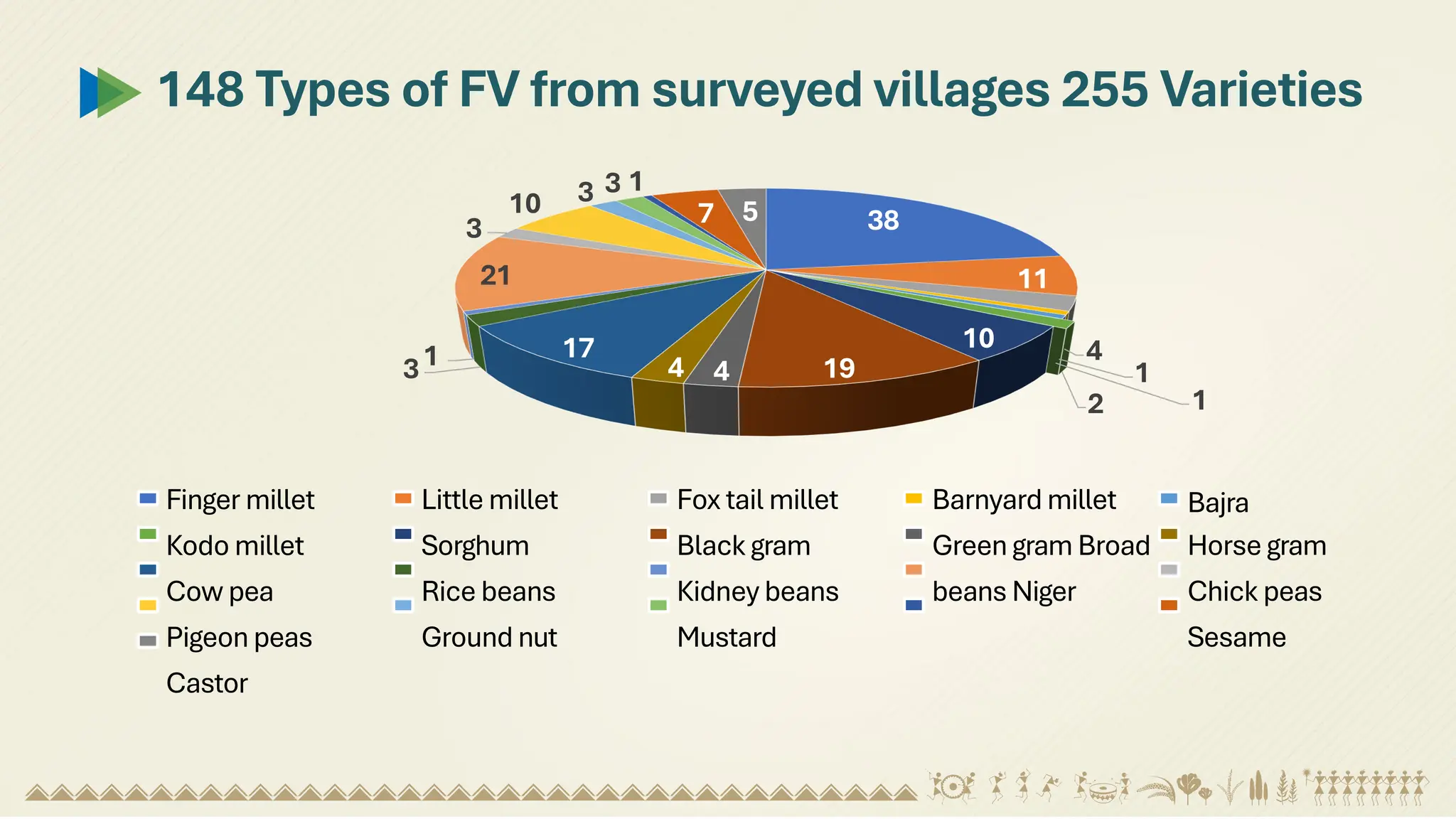
38
11
4
1
1
2
10
19
4
4
17
31
21
3
10 3 3 1
7 5
Little millet
Sorghum
Rice beans
Ground nut
Fox tail millet
Black gram
Kidney beans
Mustard
Barnyard millet
Green gram Broad
beans Niger
Bajra
Horse gram
Chick peas
Sesame
Finger millet
Kodo millet
Cow pea
Pigeon peas
Castor
148 Types of FV from surveyed villages 255 Varieties
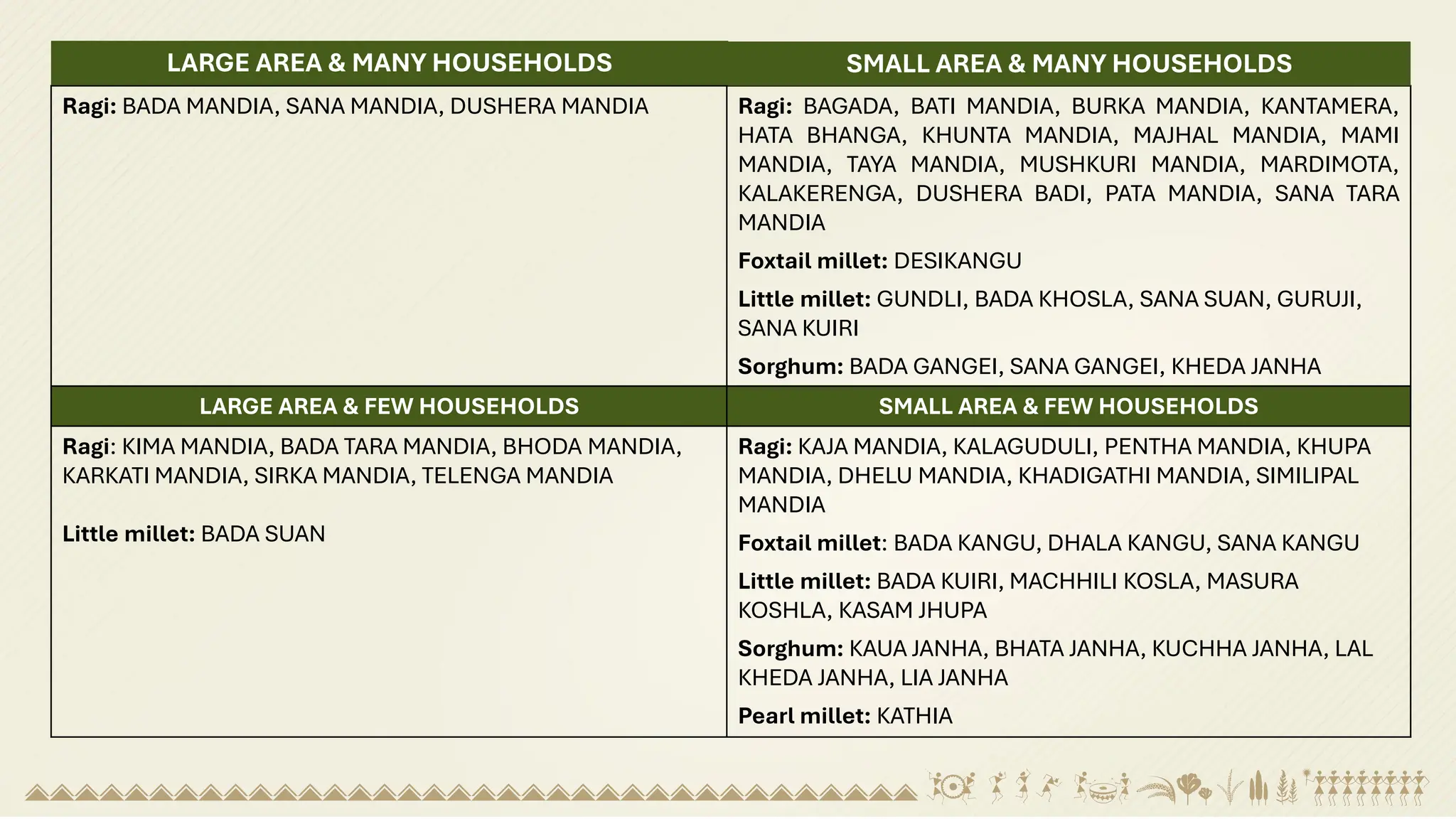
Ragi: BADA MANDIA, SANA MANDIA, DUSHERA MANDIA Ragi: BAGADA, BATI MANDIA, BURKA MANDIA, KANTAMERA,
HATA BHANGA, KHUNTA MANDIA, MAJHAL MANDIA, MAMI
MANDIA, TAYA MANDIA, MUSHKURI MANDIA, MARDIMOTA,
KALAKERENGA, DUSHERA BADI, PATA MANDIA, SANA TARA
MANDIA
Foxtail millet: DESIKANGU
Little millet: GUNDLI, BADA KHOSLA, SANA SUAN, GURUJI,
SANA KUIRI
Sorghum: BADA GANGEI, SANA GANGEI, KHEDA JANHA
LARGE AREA & FEW HOUSEHOLDS SMALL AREA & FEW HOUSEHOLDS
Ragi: KIMA MANDIA, BADA TARA MANDIA, BHODA MANDIA,
KARKATI MANDIA, SIRKA MANDIA, TELENGA MANDIA
Little millet: BADA SUAN
Ragi: KAJA MANDIA, KALAGUDULI, PENTHA MANDIA, KHUPA
MANDIA, DHELU MANDIA, KHADIGATHI MANDIA, SIMILIPAL
MANDIA
Foxtail millet: BADA KANGU, DHALA KANGU, SANA KANGU
Little millet: BADA KUIRI, MACHHILI KOSLA, MASURA
KOSHLA, KASAM JHUPA
Sorghum: KAUA JANHA, BHATA JANHA, KUCHHA JANHA, LAL
KHEDA JANHA, LIA JANHA
Pearl millet: KATHIA
LARGE AREA & MANY HOUSEHOLDS SMALL AREA & MANY HOUSEHOLDS
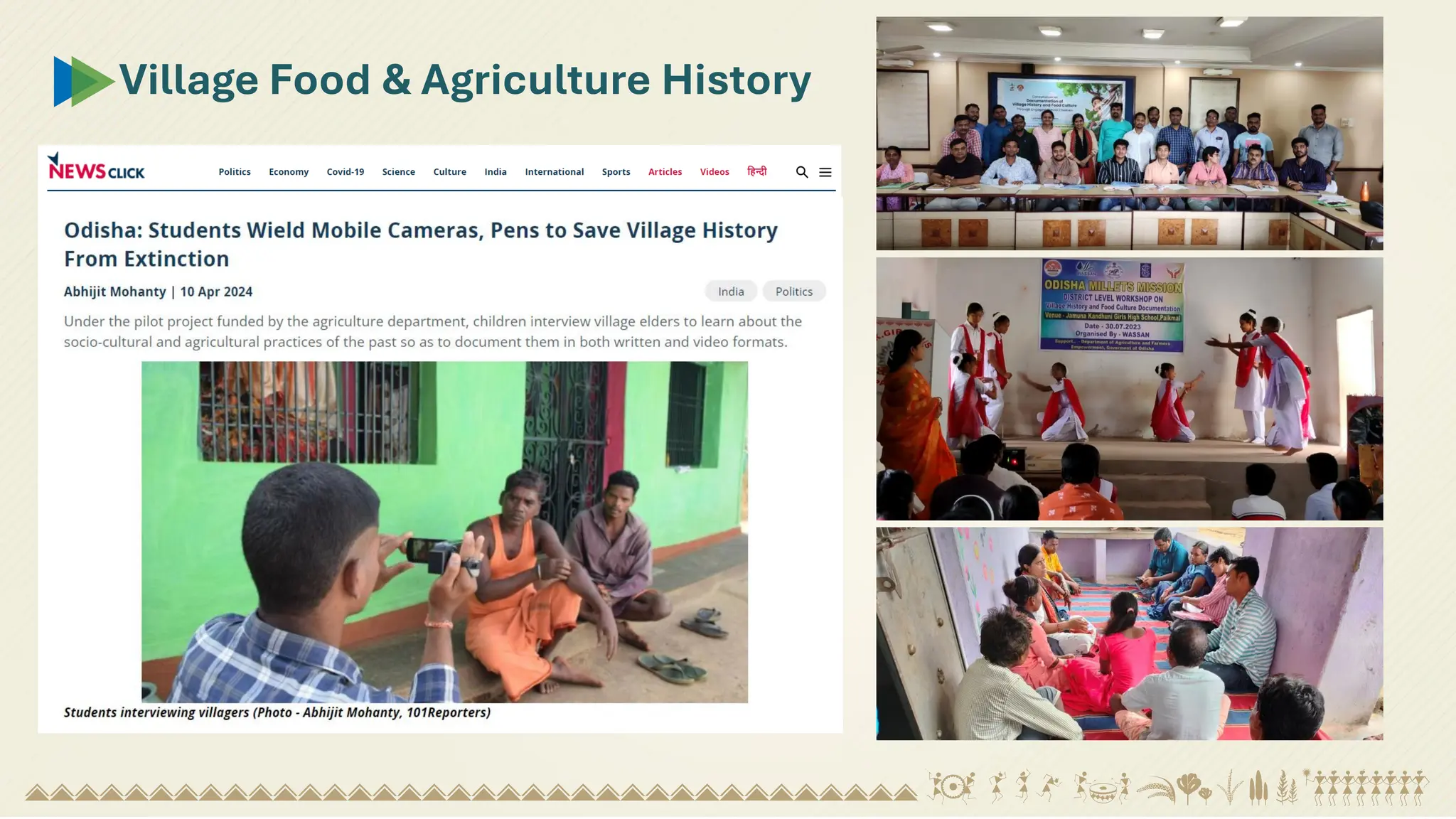
Village Food & Agriculture History
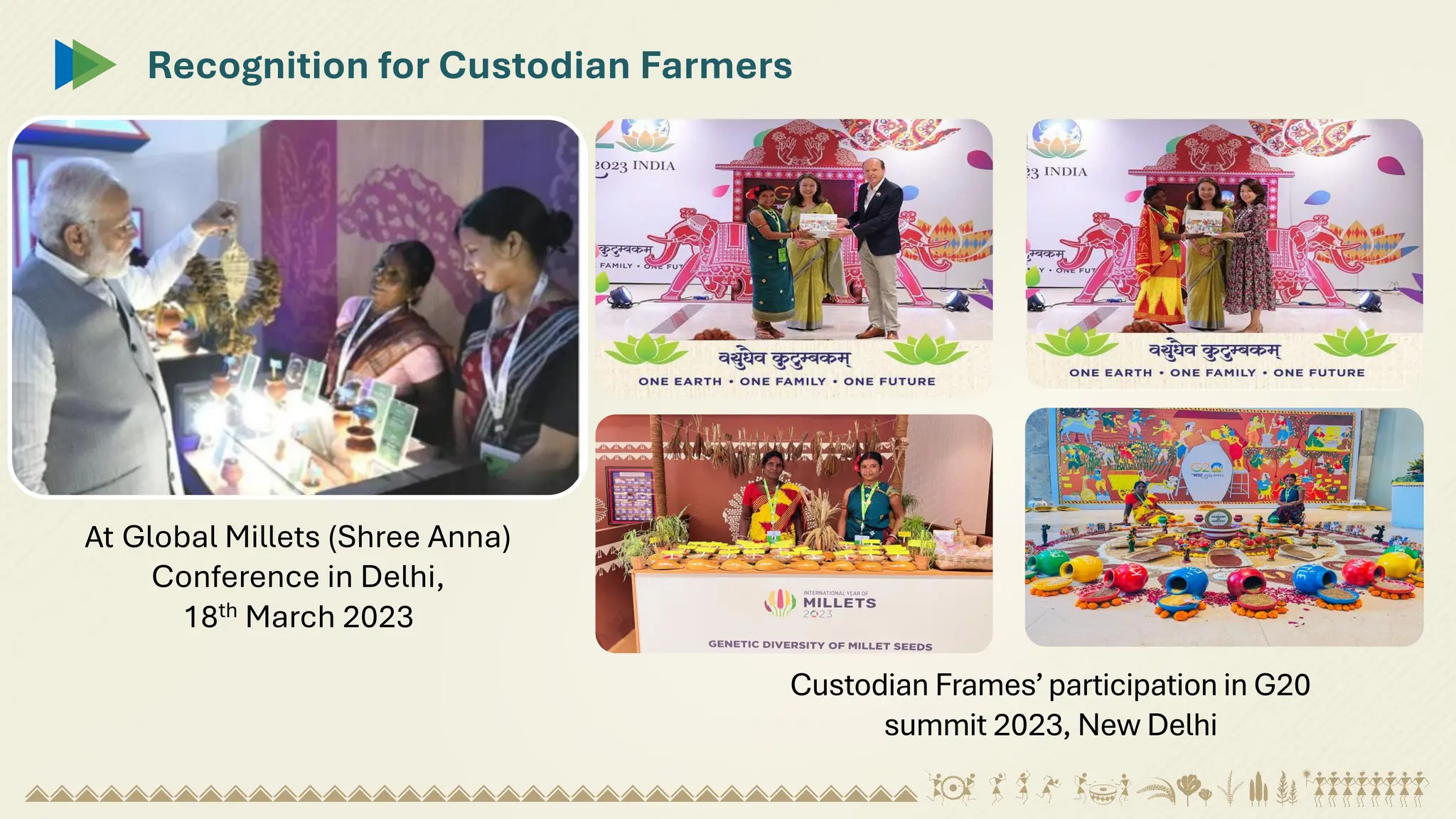
Recognition for Custodian Farmers
At Global Millets (Shree Anna)
Conference in Delhi,
18th March 2023
Custodian Frames’ participation in G20
summit 2023, New Delhi
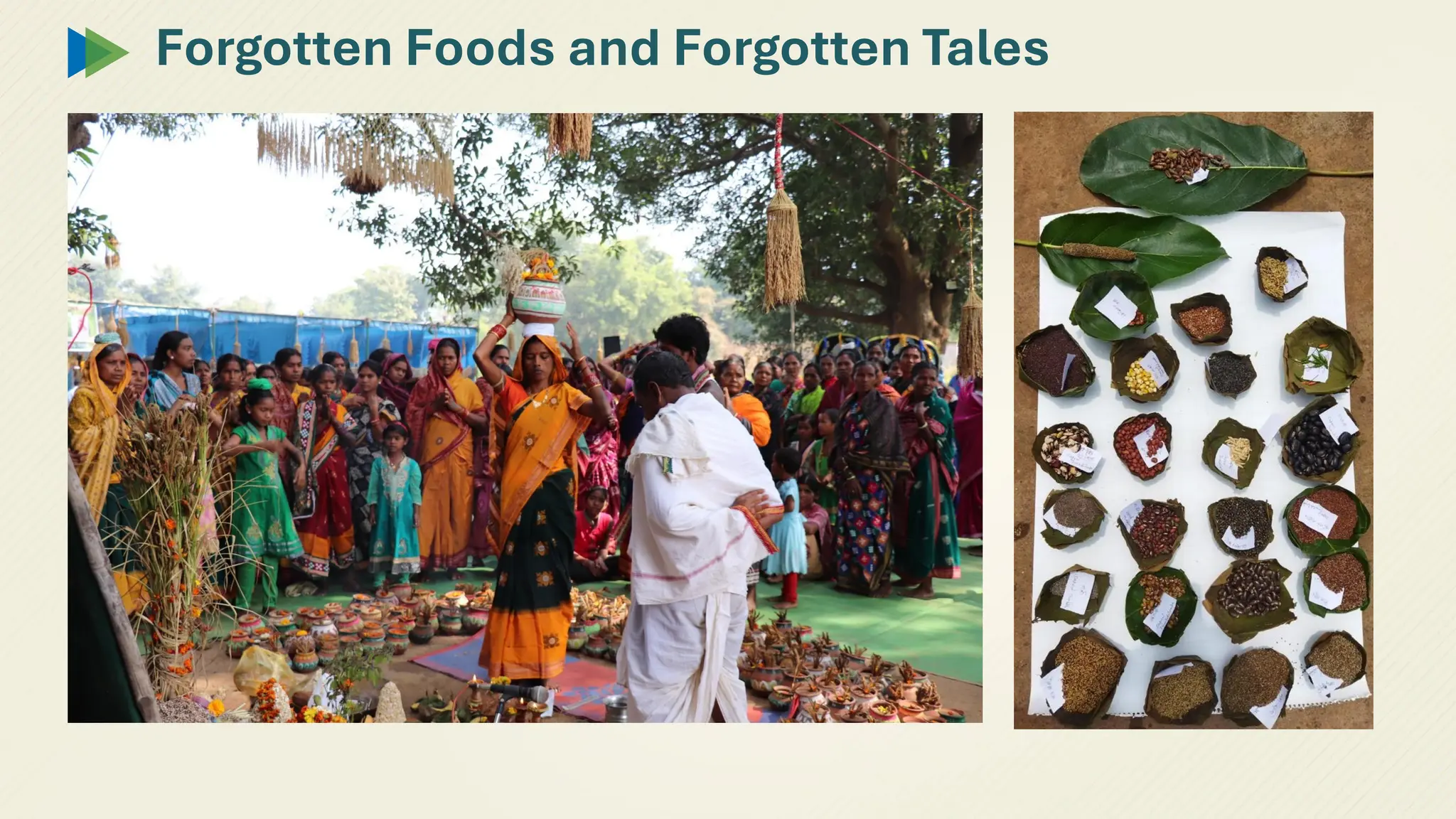
Forgotten Foods and Forgotten Tales
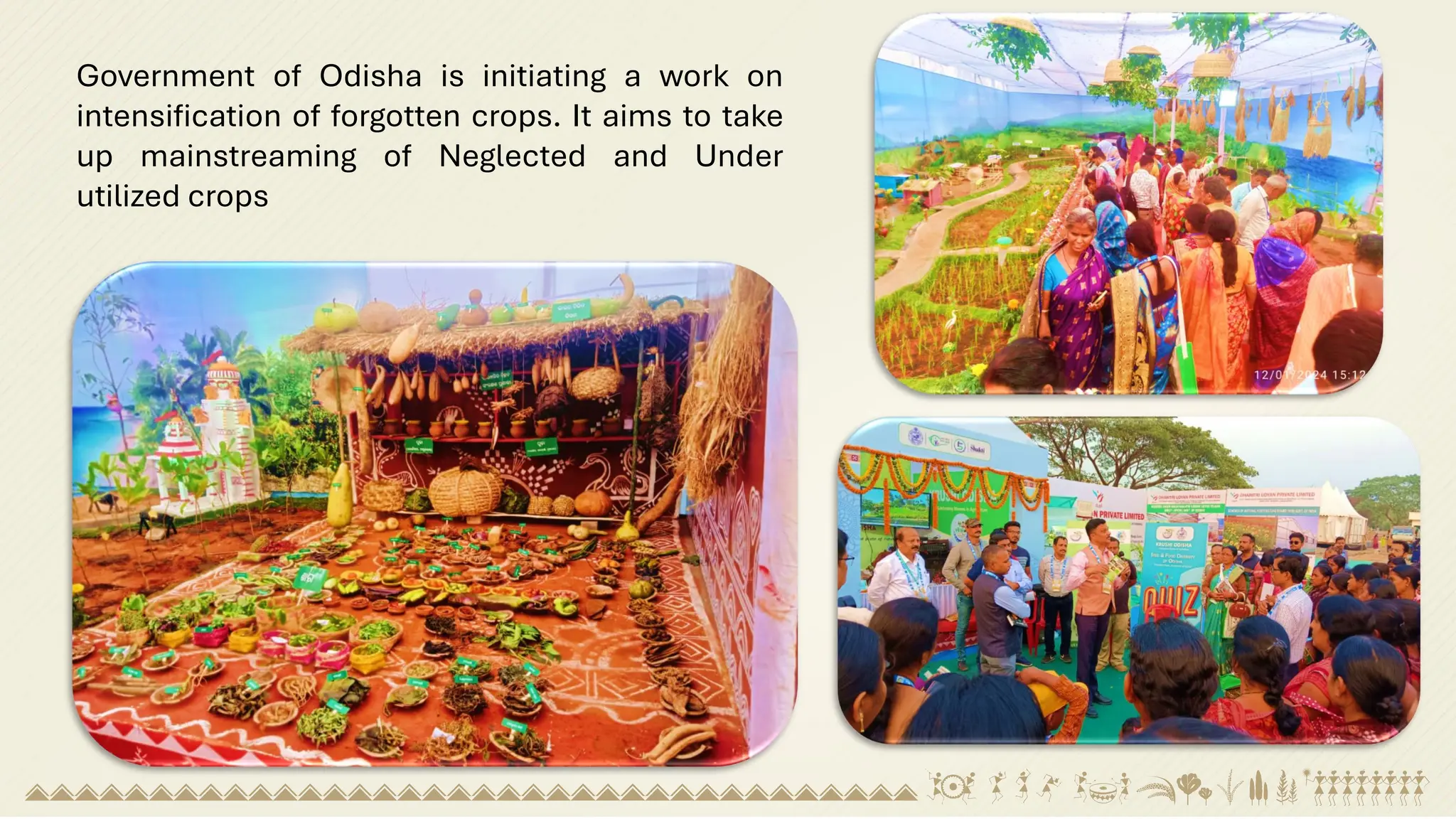
Government of Odisha is initiating a work on
intensification of forgotten crops. It aims to take
up mainstreaming of Neglected and Under
utilized crops
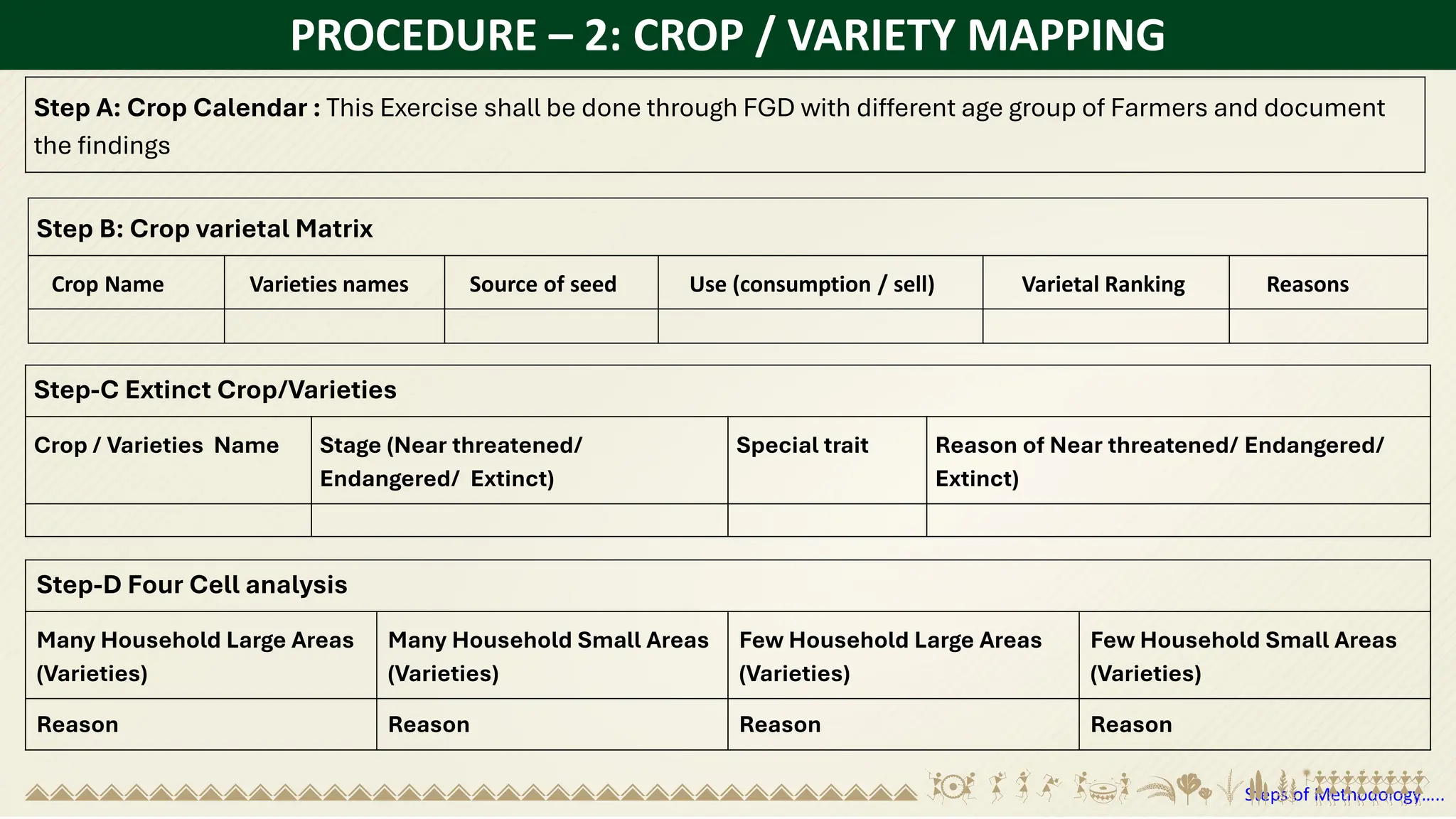
PROCEDURE – 2: CROP / VARIETY MAPPING
Step-C Extinct Crop/Varieties
Crop / Varieties Name Stage (Near threatened/
Endangered/ Extinct)
Special trait Reason of Near threatened/ Endangered/
Extinct)
Step-D Four Cell analysis
Many Household Large Areas
(Varieties)
Many Household Small Areas
(Varieties)
Few Household Large Areas
(Varieties)
Few Household Small Areas
(Varieties)
Reason Reason Reason Reason
Step B: Crop varietal Matrix
Crop Name Varieties names Source of seed Use (consumption / sell) Varietal Ranking Reasons
Step A: Crop Calendar : This Exercise shall be done through FGD with different age group of Farmers and document
the findings
Steps of Methodology…..
PROCEDURE – 2: CROP / VARIETY MAPPING
Steps of Methodology…..
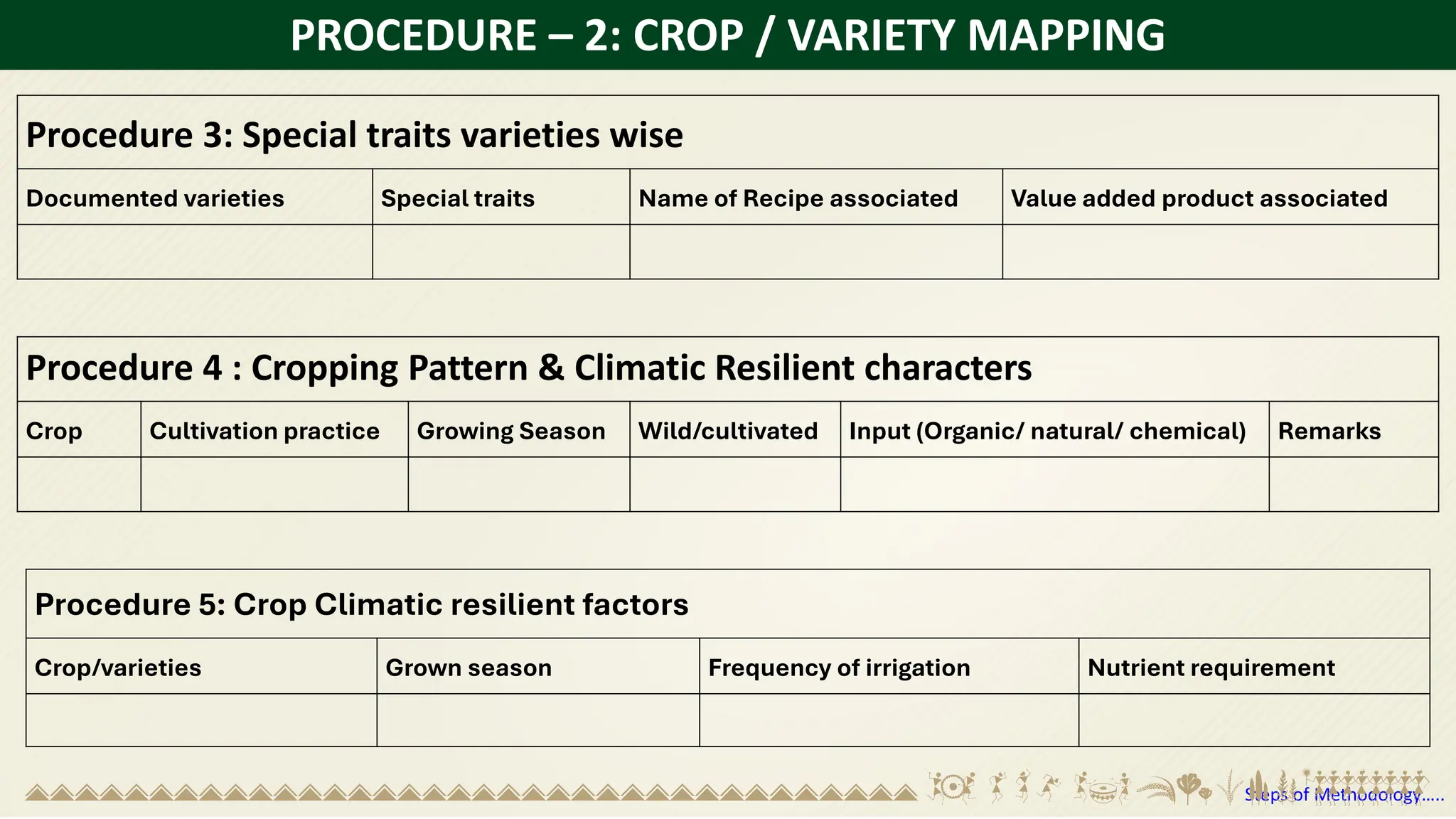
Procedure 3: Special traits varieties wise
Documented varieties Special traits Name of Recipe associated Value added product associated
Procedure 4 : Cropping Pattern & Climatic Resilient characters
Crop Cultivation practice Growing Season Wild/cultivated Input (Organic/ natural/ chemical) Remarks
Procedure 5: Crop Climatic resilient factors
Crop/varieties Grown season Frequency of irrigation Nutrient requirement
PROCEDURE – 2: CROP / VARIETY MAPPING
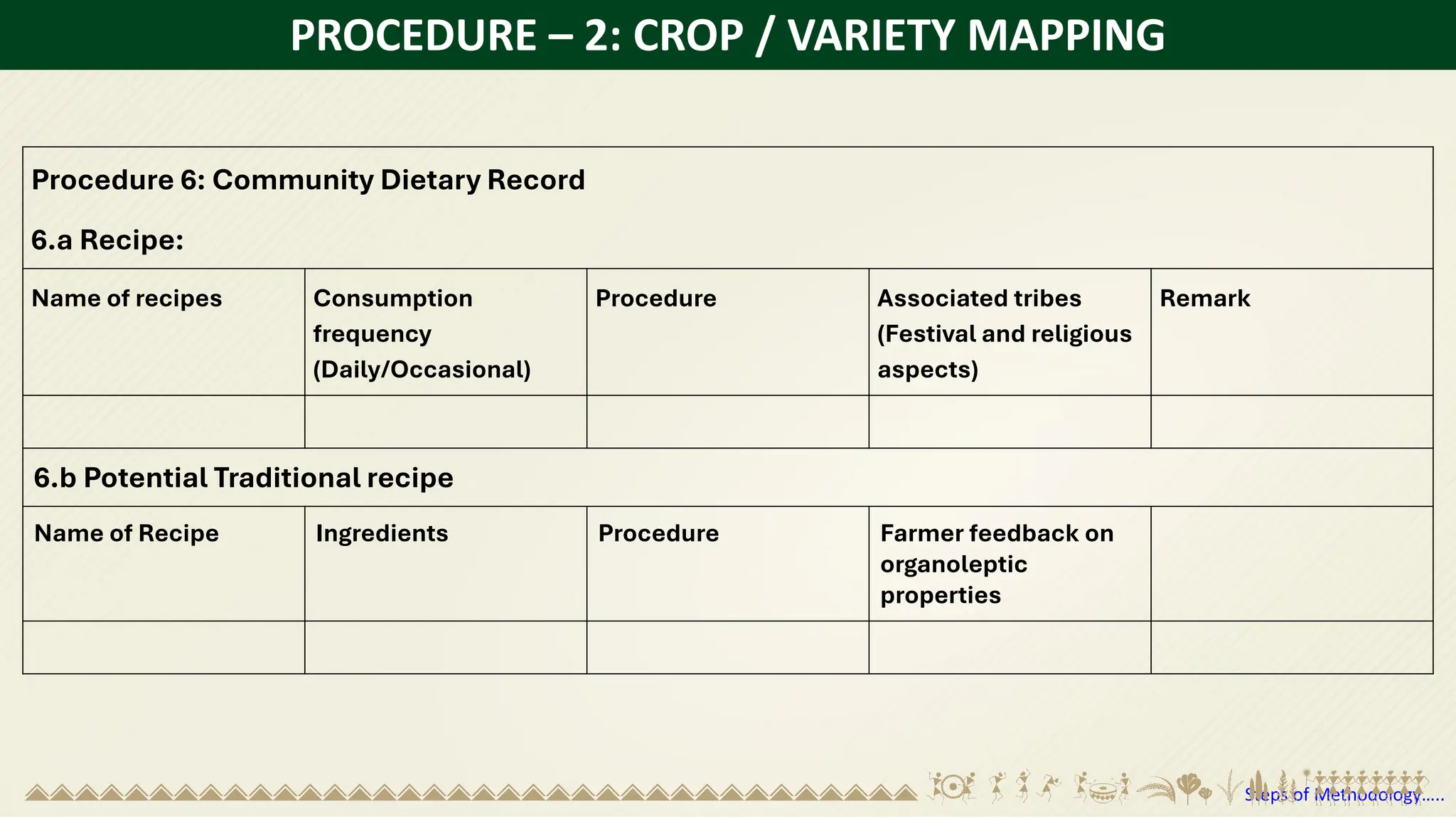
Procedure 6: Community Dietary Record
6.a Recipe:
Name of recipes Consumption
frequency
(Daily/Occasional)
Procedure Associated tribes
(Festival and religious
aspects)
Remark
6.b Potential Traditional recipe
Name of Recipe Ingredients Procedure Farmer feedback on
organoleptic
properties
Steps of Methodology…..
PROCEDURE – 2: CROP / VARIETY MAPPING
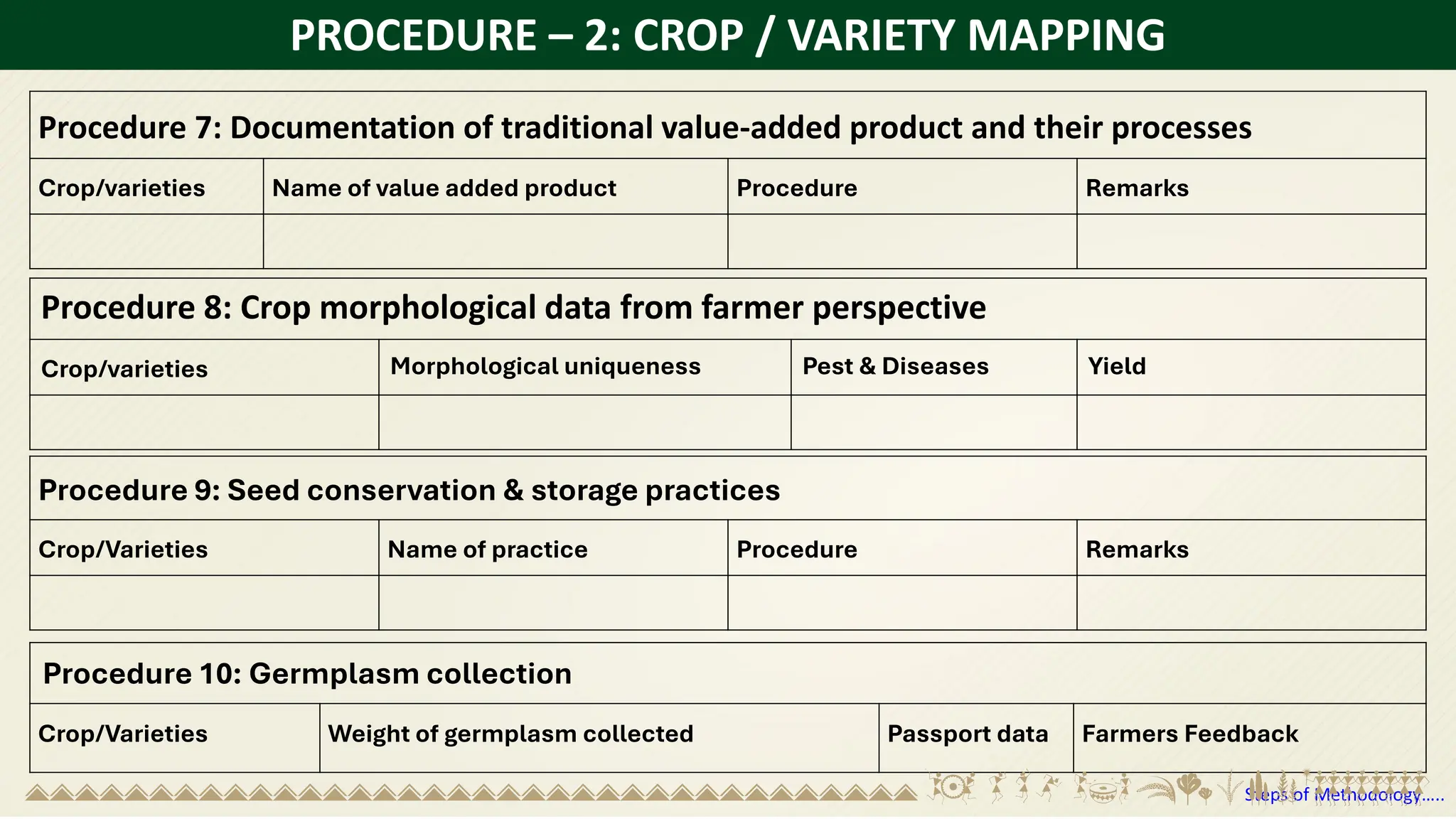
Procedure 7: Documentation of traditional value-added product and their processes
Crop/varieties Name of value added product Procedure Remarks
Procedure 8: Crop morphological data from farmer perspective
Crop/varieties Morphological uniqueness Pest & Diseases Yield
Procedure 9: Seed conservation & storage practices
Crop/Varieties Name of practice Procedure Remarks
Procedure 10: Germplasm collection
Crop/Varieties Weight of germplasm collected Passport data Farmers Feedback
Steps of Methodology…..
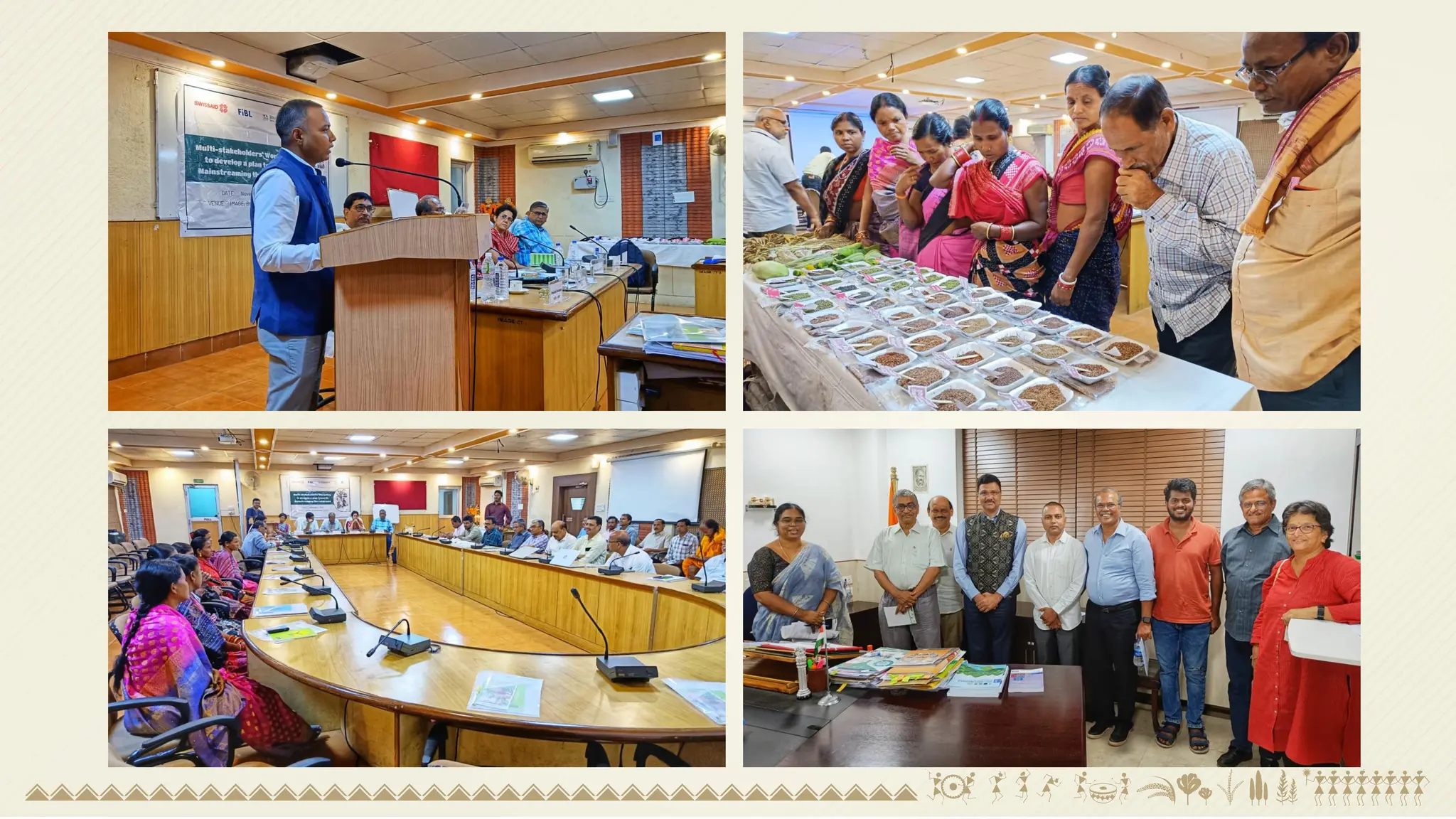
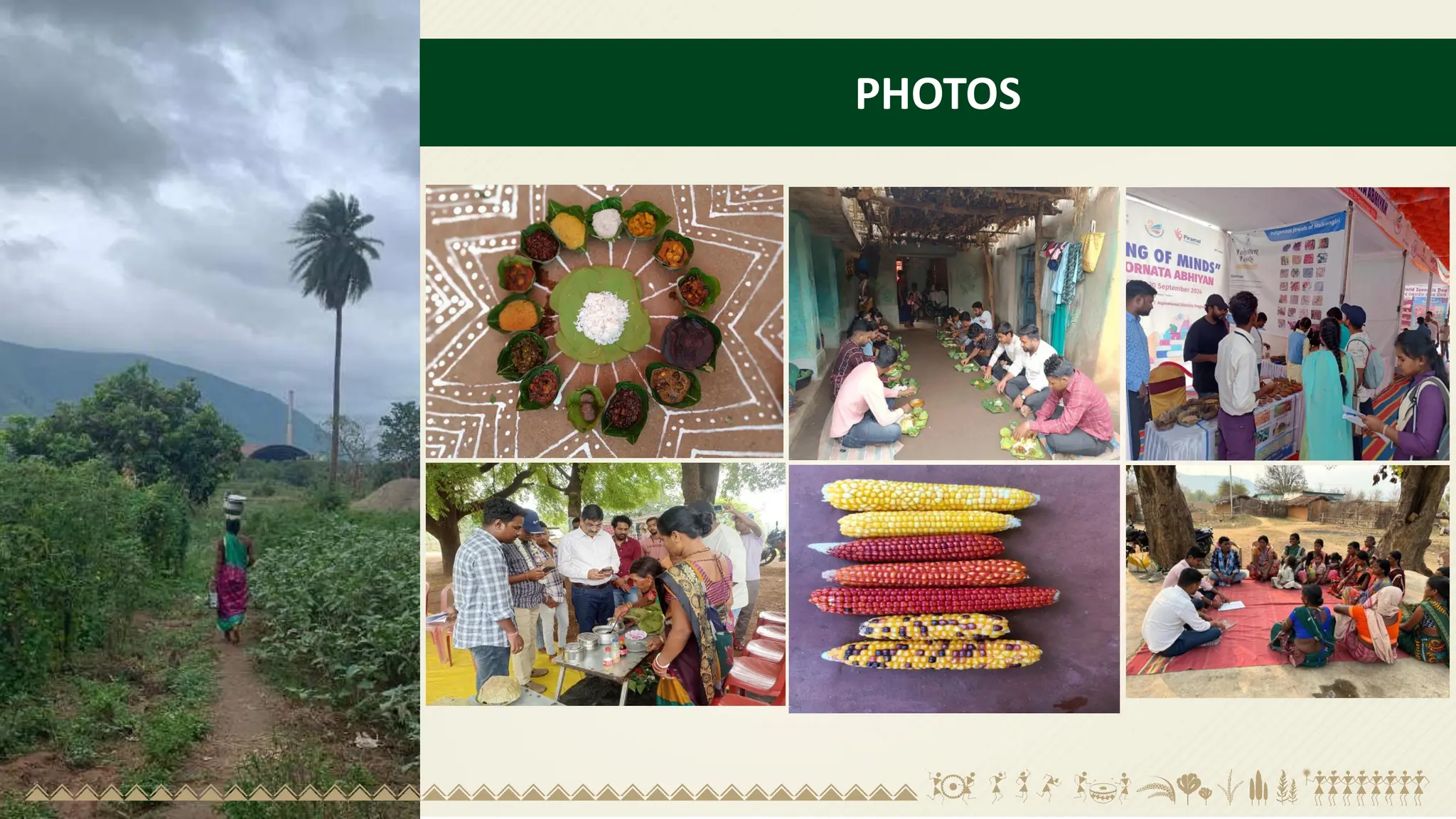
PHOTOS
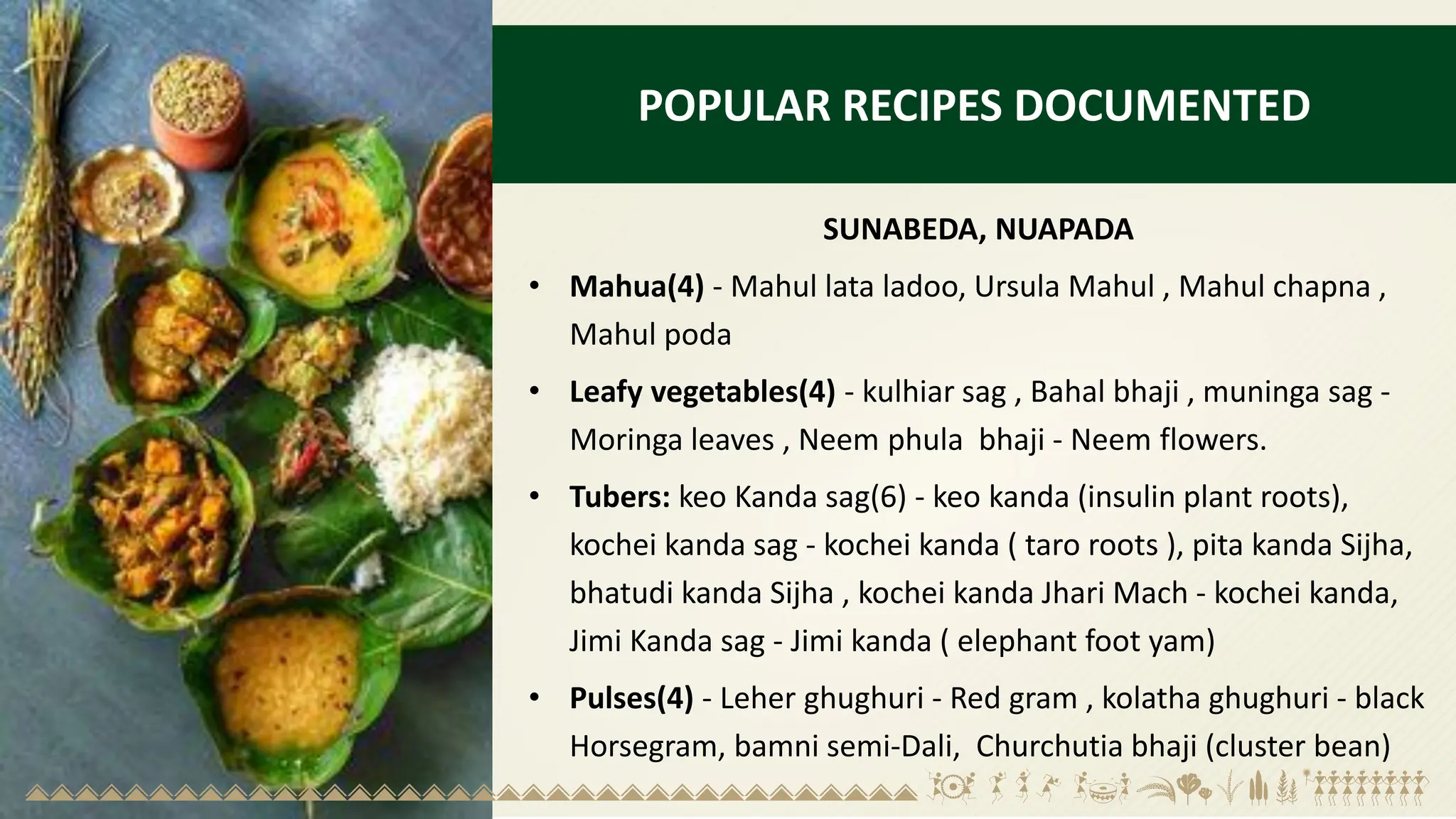
POPULAR RECIPES DOCUMENTED
SUNABEDA, NUAPADA
• Mahua(4) - Mahul lata ladoo, Ursula Mahul , Mahul chapna ,
Mahul poda
• Leafy vegetables(4) - kulhiar sag , Bahal bhaji , muninga sag -
Moringa leaves , Neem phula bhaji - Neem flowers.
• Tubers: keo Kanda sag(6) - keo kanda (insulin plant roots),
kochei kanda sag - kochei kanda ( taro roots ), pita kanda Sijha,
bhatudi kanda Sijha , kochei kanda Jhari Mach - kochei kanda,
Jimi Kanda sag - Jimi kanda ( elephant foot yam)
• Pulses(4) - Leher ghughuri - Red gram , kolatha ghughuri - black
Horsegram, bamni semi-Dali, Churchutia bhaji (cluster bean)
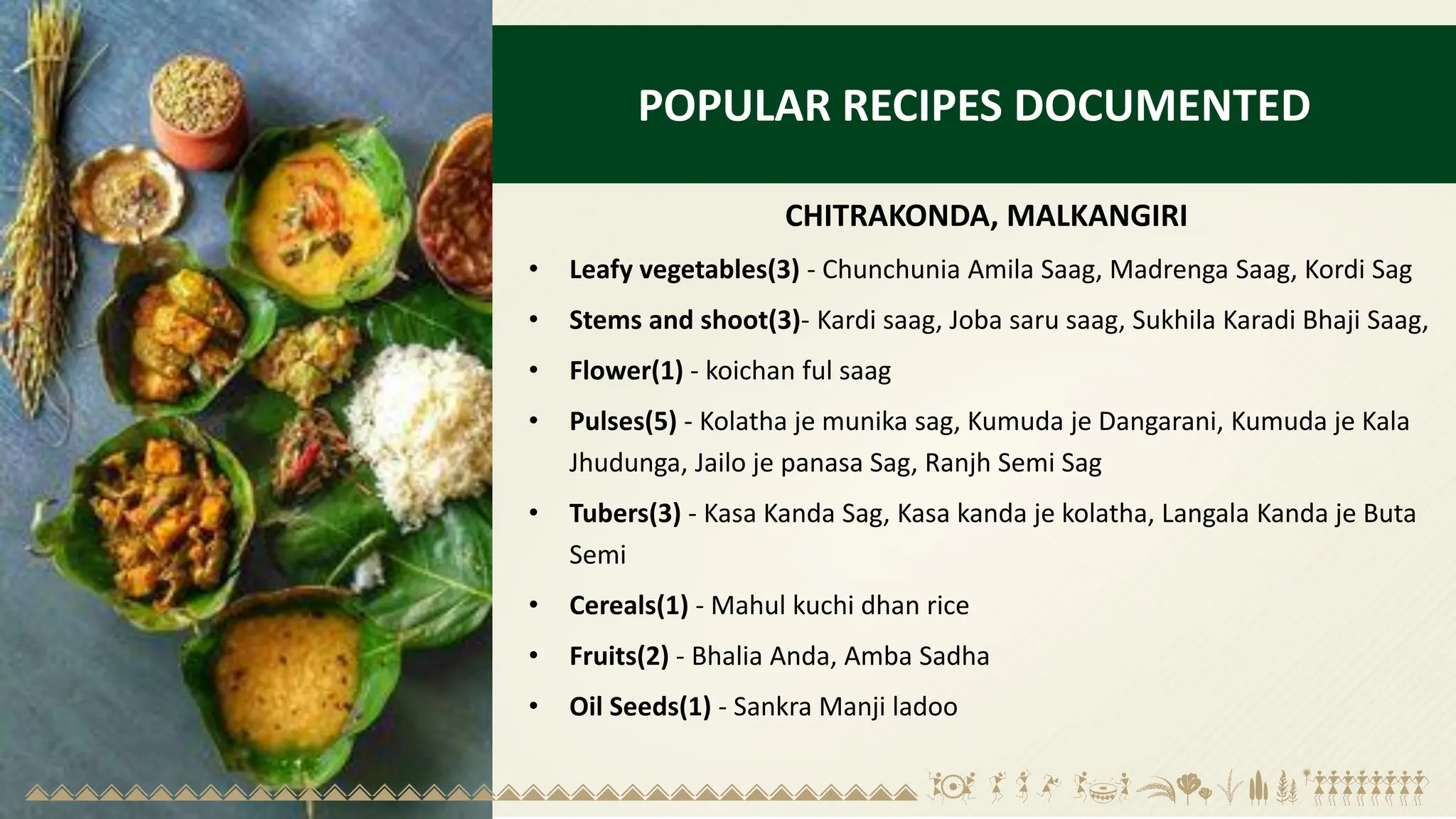
POPULAR RECIPES DOCUMENTED
CHITRAKONDA, MALKANGIRI
• Leafy vegetables(3) - Chunchunia Amila Saag, Madrenga Saag, Kordi Sag
• Stems and shoot(3)- Kardi saag, Joba saru saag, Sukhila Karadi Bhaji Saag,
• Flower(1) - koichan ful saag
• Pulses(5) - Kolatha je munika sag, Kumuda je Dangarani, Kumuda je Kala
Jhudunga, Jailo je panasa Sag, Ranjh Semi Sag
• Tubers(3) - Kasa Kanda Sag, Kasa kanda je kolatha, Langala Kanda je Buta
Semi
• Cereals(1) - Mahul kuchi dhan rice
• Fruits(2) - Bhalia Anda, Amba Sadha
• Oil Seeds(1) - Sankra Manji ladoo
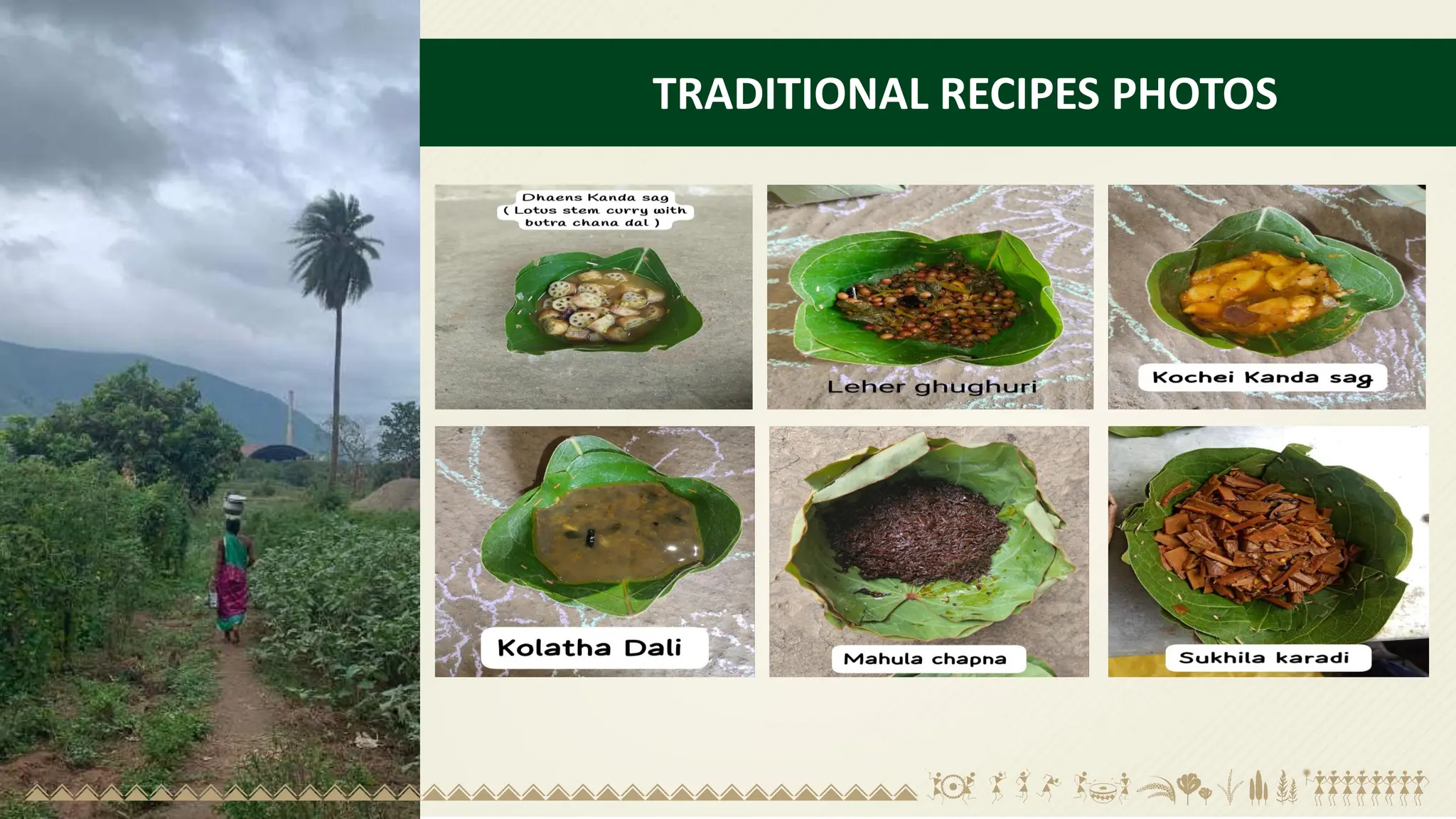
TRADITIONAL RECIPES PHOTOS
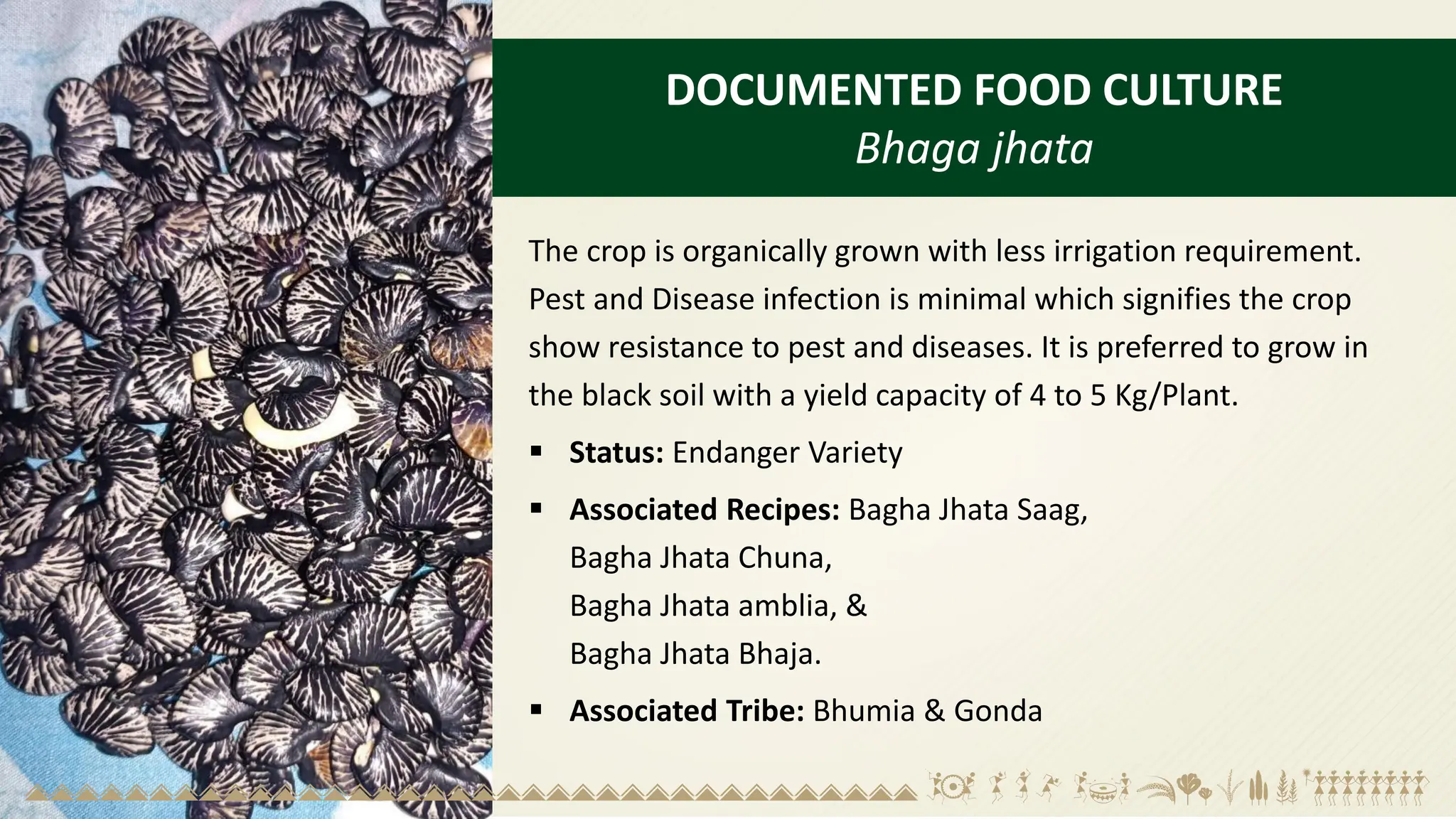
DOCUMENTED FOOD CULTURE
Bhaga jhata
The crop is organically grown with less irrigation requirement.
Pest and Disease infection is minimal which signifies the crop
show resistance to pest and diseases. It is preferred to grow in
the black soil with a yield capacity of 4 to 5 Kg/Plant.
▪ Status: Endanger Variety
▪ Associated Recipes: Bagha Jhata Saag,
Bagha Jhata Chuna,
Bagha Jhata amblia, &
Bagha Jhata Bhaja.
▪ Associated Tribe: Bhumia & Gonda
DOCUMENTED FOOD CULTURE
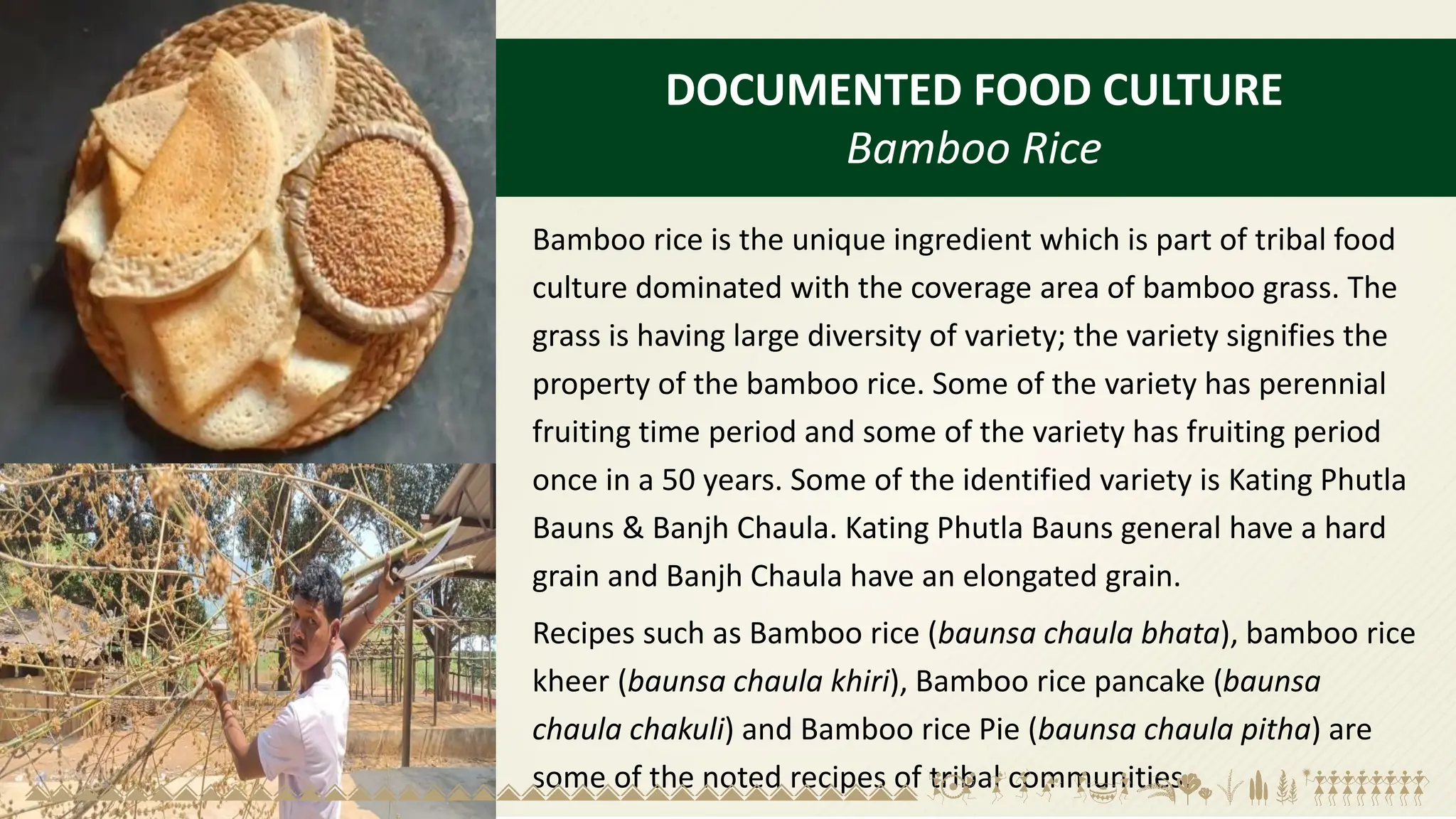
Bamboo Rice
Bamboo rice is the unique ingredient which is part of tribal food
culture dominated with the coverage area of bamboo grass. The
grass is having large diversity of variety; the variety signifies the
property of the bamboo rice. Some of the variety has perennial
fruiting time period and some of the variety has fruiting period
once in a 50 years. Some of the identified variety is Kating Phutla
Bauns & Banjh Chaula. Kating Phutla Bauns general have a hard
grain and Banjh Chaula have an elongated grain.
Recipes such as Bamboo rice (baunsa chaula bhata), bamboo rice
kheer (baunsa chaula khiri), Bamboo rice pancake (baunsa
chaula chakuli) and Bamboo rice Pie (baunsa chaula pitha) are
some of the noted recipes of tribal communities.
DOCUMENTED FOOD CULTURE
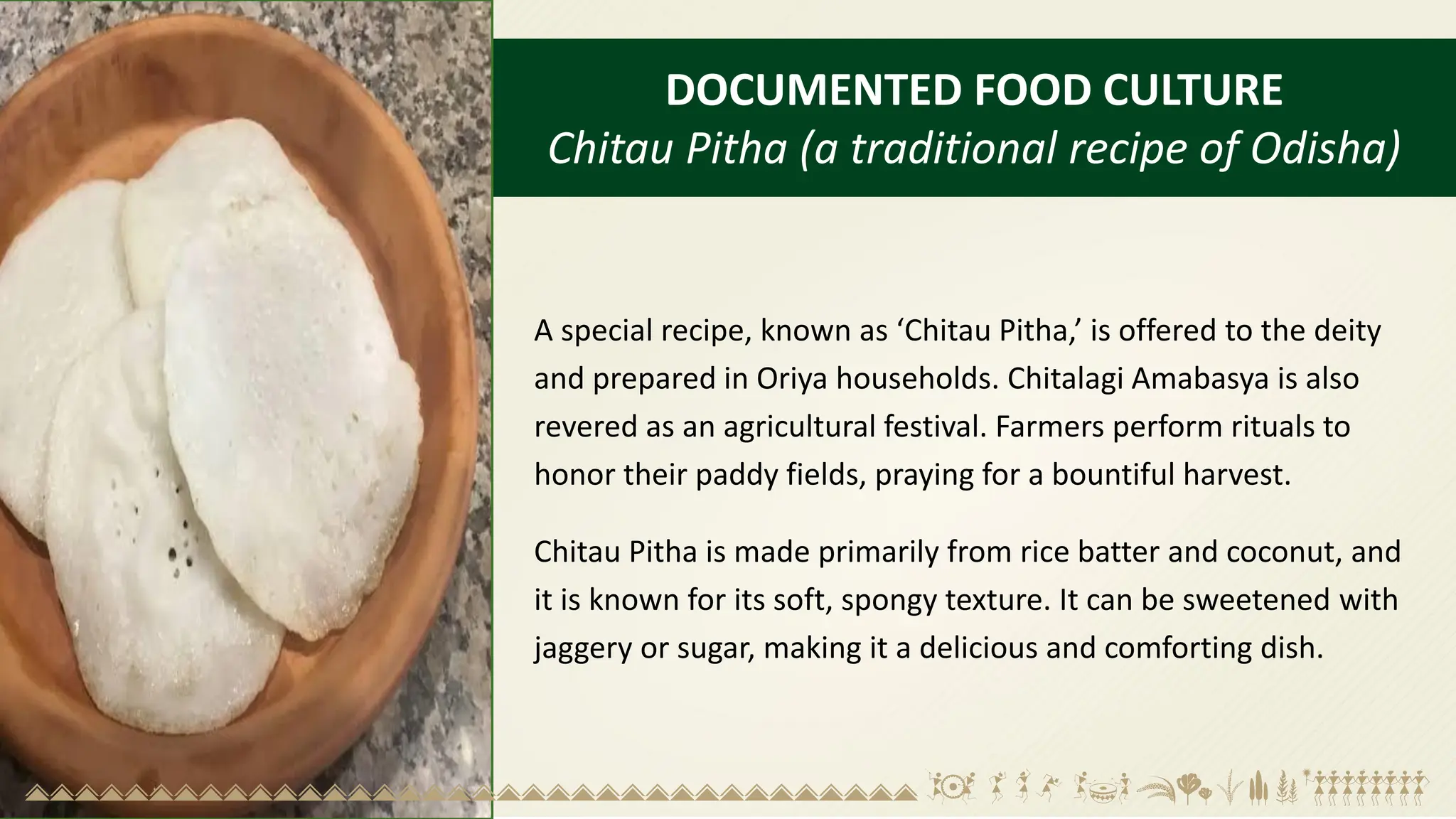
Chitau Pitha (a traditional recipe of Odisha)
A special recipe, known as ‘Chitau Pitha,’ is offered to the deity
and prepared in Oriya households. Chitalagi Amabasya is also
revered as an agricultural festival. Farmers perform rituals to
honor their paddy fields, praying for a bountiful harvest.
Chitau Pitha is made primarily from rice batter and coconut, and
it is known for its soft, spongy texture. It can be sweetened with
jaggery or sugar, making it a delicious and comforting dish.
DOCUMENTED FOOD CULTURE
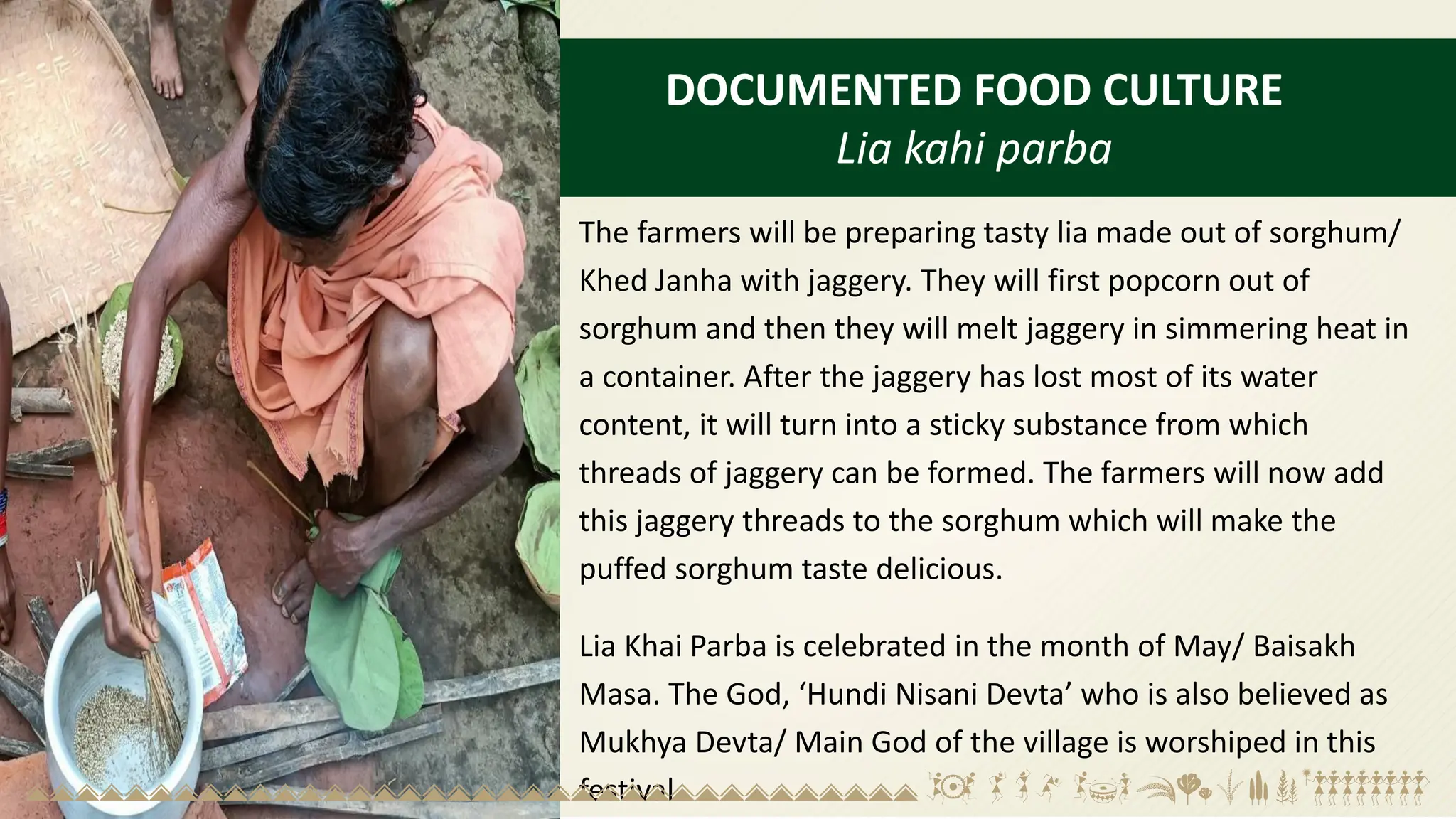
Lia kahi parba
The farmers will be preparing tasty lia made out of sorghum/
Khed Janha with jaggery. They will first popcorn out of
sorghum and then they will melt jaggery in simmering heat in
a container. After the jaggery has lost most of its water
content, it will turn into a sticky substance from which
threads of jaggery can be formed. The farmers will now add
this jaggery threads to the sorghum which will make the
puffed sorghum taste delicious.
Lia Khai Parba is celebrated in the month of May/ Baisakh
Masa. The God, ‘Hundi Nisani Devta’ who is also believed as
Mukhya Devta/ Main God of the village is worshiped in this
festival.
DOCUMENTED FOOD CULTURE
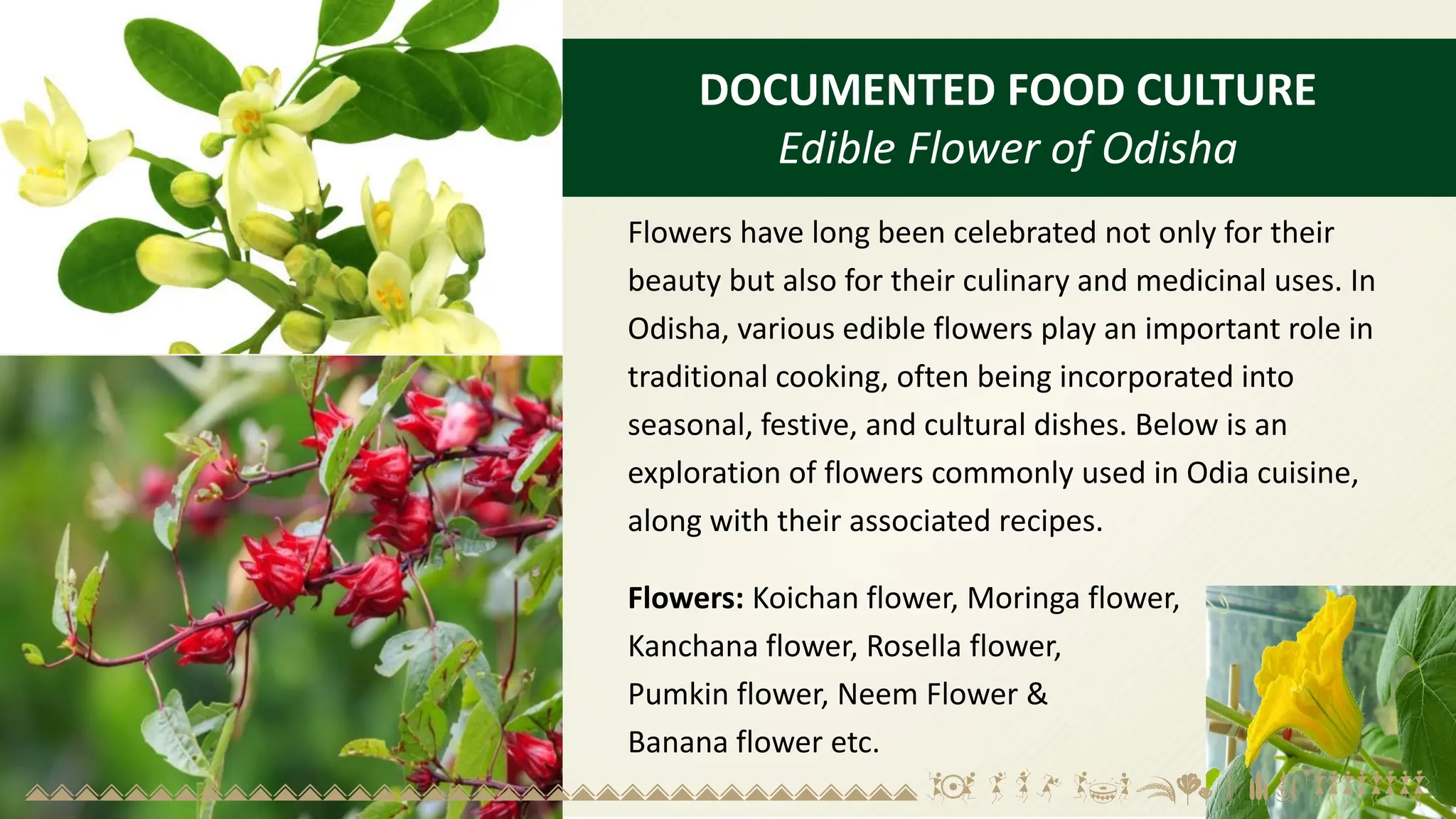
Edible Flower of Odisha
Flowers have long been celebrated not only for their
beauty but also for their culinary and medicinal uses. In
Odisha, various edible flowers play an important role in
traditional cooking, often being incorporated into
seasonal, festive, and cultural dishes. Below is an
exploration of flowers commonly used in Odia cuisine,
along with their associated recipes.
Flowers: Koichan flower, Moringa flower,
Kanchana flower, Rosella flower,
Pumkin flower, Neem Flower &
Banana flower etc.
FOREST BASED FOOD
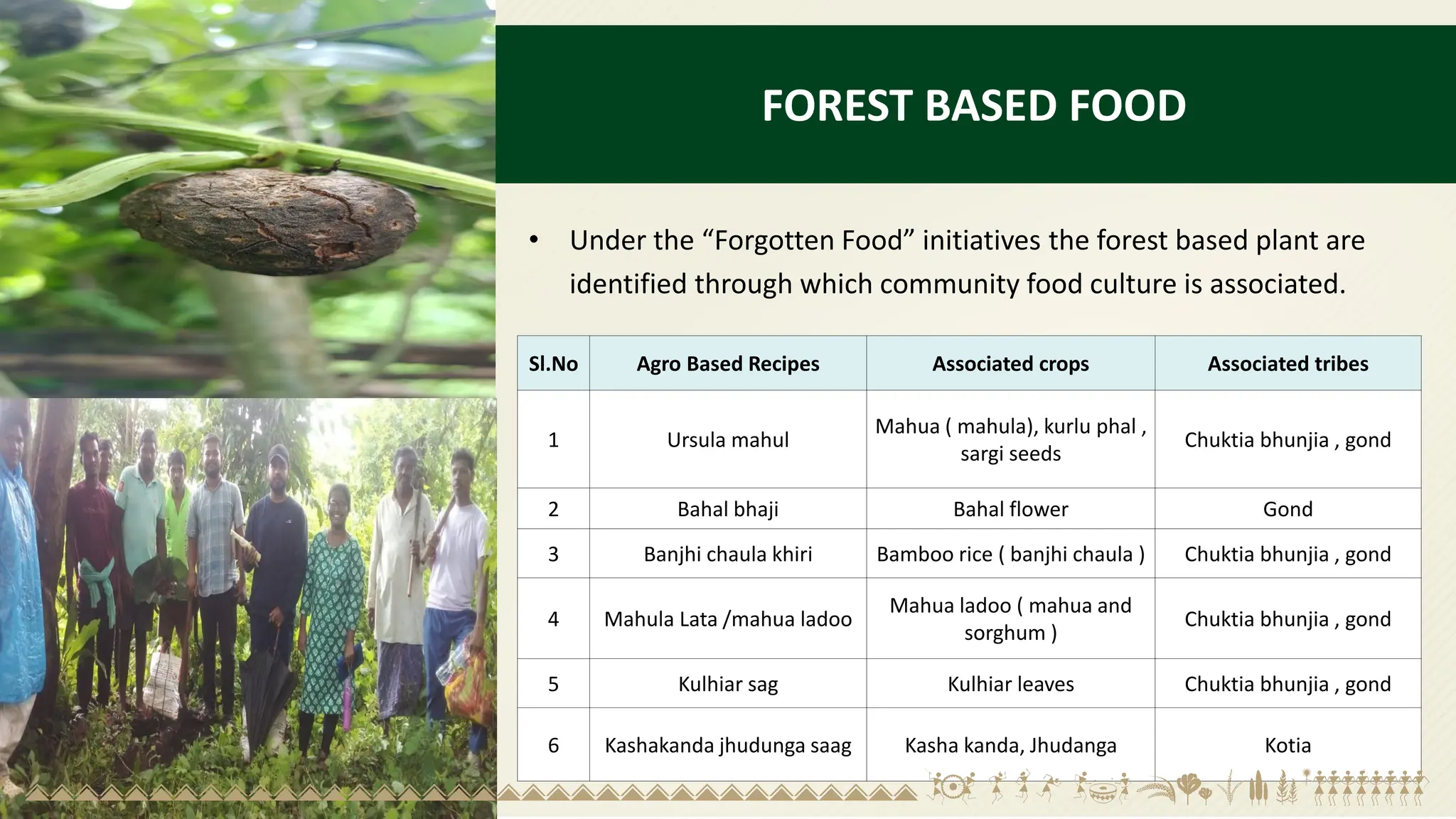
• Under the “Forgotten Food” initiatives the forest based plant are
identified through which community food culture is associated.
Sl.No Agro Based Recipes Associated crops Associated tribes
1 Ursula mahul
Mahua ( mahula), kurlu phal ,
sargi seeds
Chuktia bhunjia , gond
2 Bahal bhaji Bahal flower Gond
3 Banjhi chaula khiri Bamboo rice ( banjhi chaula ) Chuktia bhunjia , gond
4 Mahula Lata /mahua ladoo
Mahua ladoo ( mahua and
sorghum )
Chuktia bhunjia , gond
5 Kulhiar sag Kulhiar leaves Chuktia bhunjia , gond
6 Kashakanda jhudunga saag Kasha kanda, Jhudanga Kotia
COMMUNITY RELATION WITH FOREST
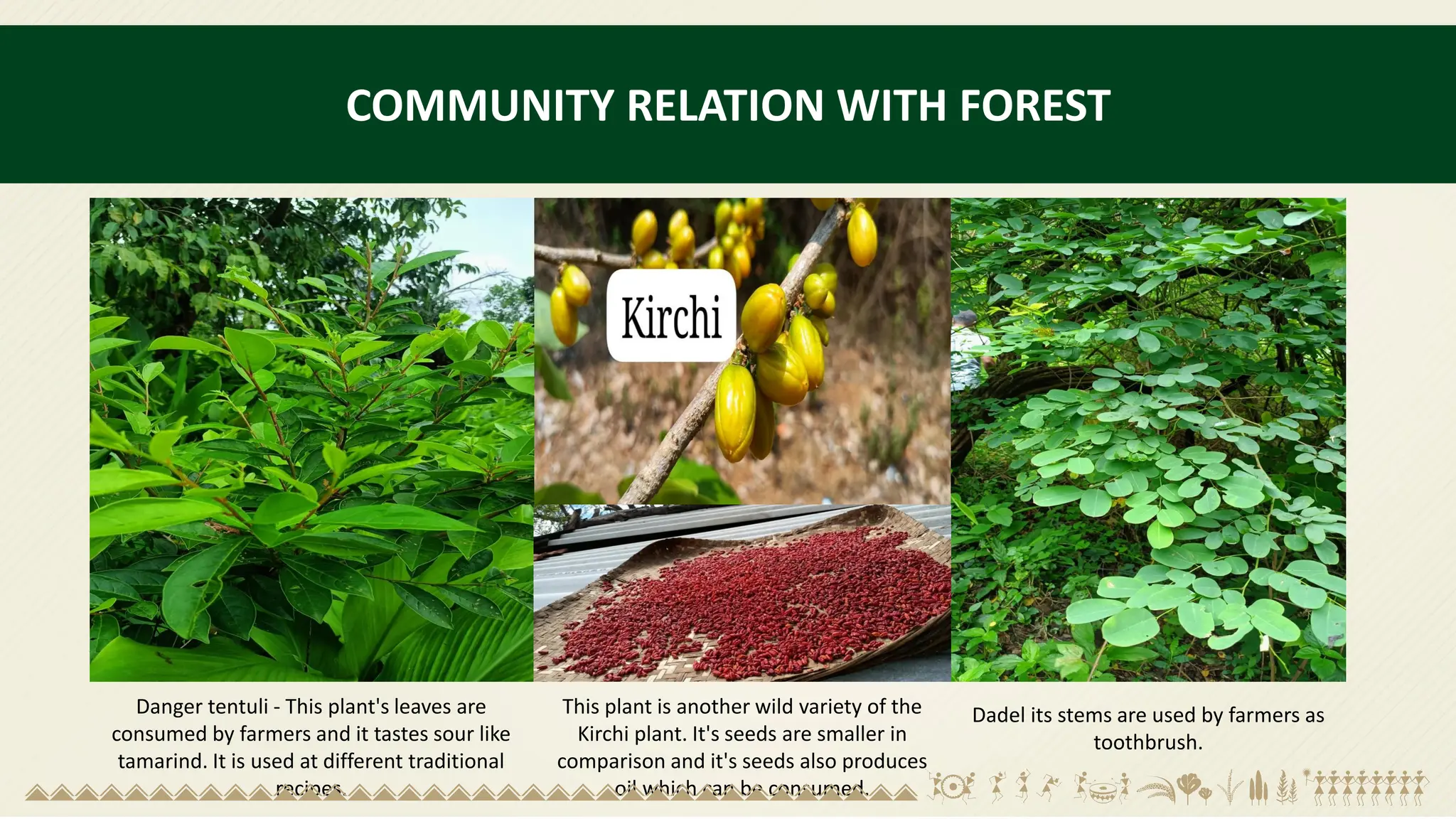
Danger tentuli - This plant's leaves are
consumed by farmers and it tastes sour like
tamarind. It is used at different traditional
recipes.
This plant is another wild variety of the
Kirchi plant. It's seeds are smaller in
comparison and it's seeds also produces
oil which can be consumed.
Dadel its stems are used by farmers as
toothbrush.
MARKET SURVEY
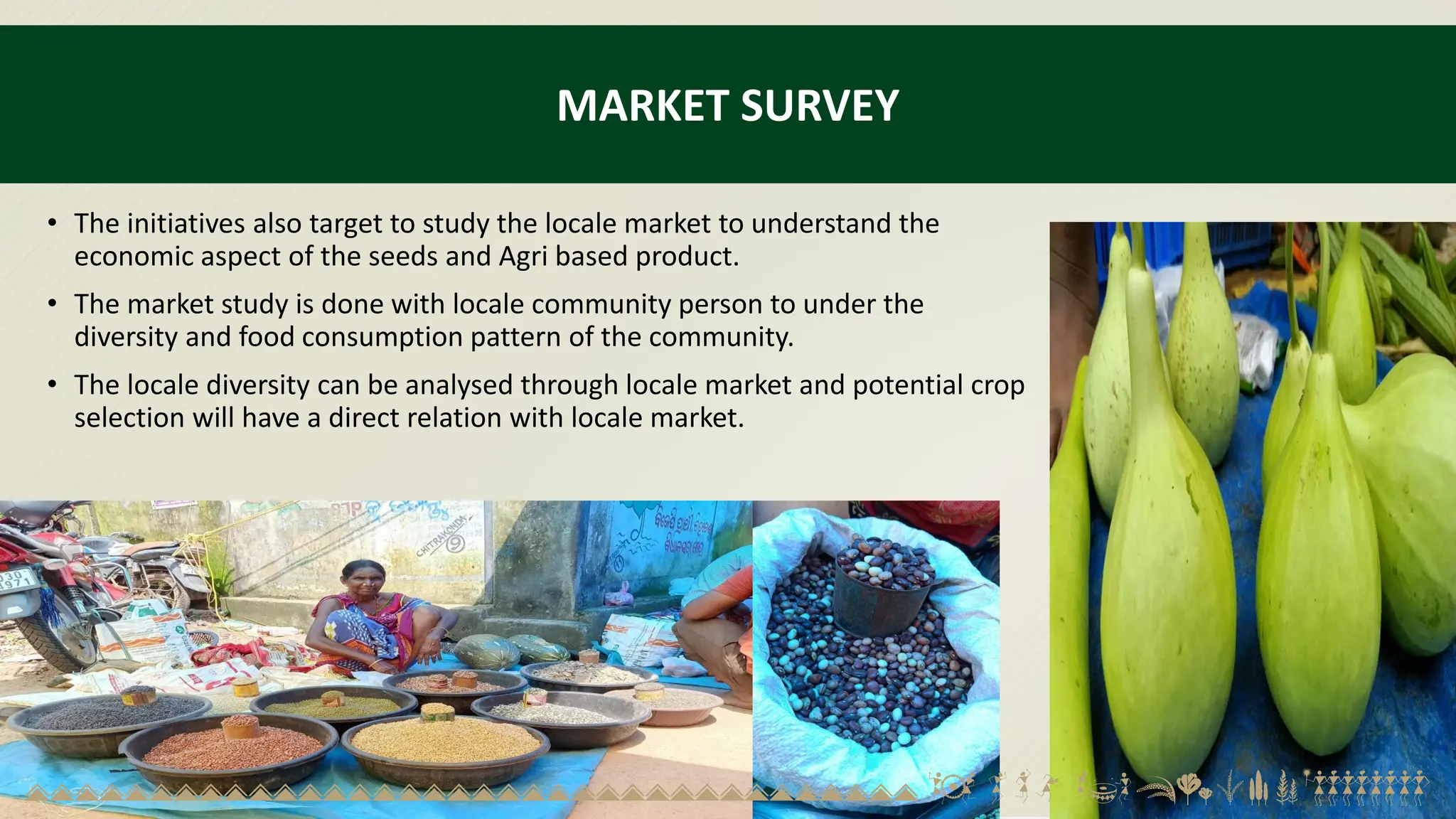
• The initiatives also target to study the locale market to understand the
economic aspect of the seeds and Agri based product.
• The market study is done with locale community person to under the
diversity and food consumption pattern of the community.
• The locale diversity can be analysed through locale market and potential crop
selection will have a direct relation with locale market.
VALUE ADDED PRODUCTION
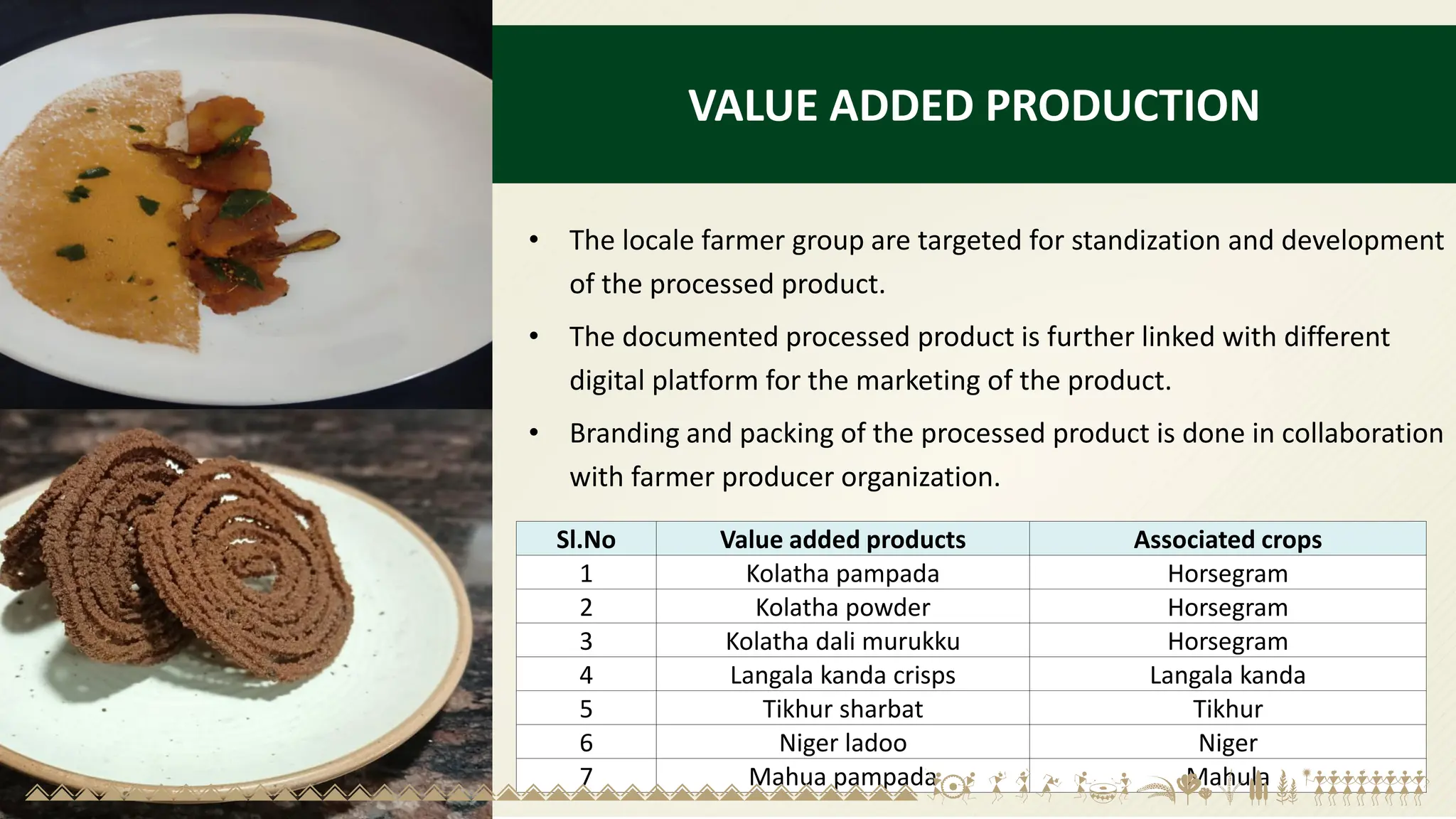
• The locale farmer group are targeted for standization and development
of the processed product.
• The documented processed product is further linked with different
digital platform for the marketing of the product.
• Branding and packing of the processed product is done in collaboration
with farmer producer organization.
Sl.No Value added products Associated crops
1 Kolatha pampada Horsegram
2 Kolatha powder Horsegram
3 Kolatha dali murukku Horsegram
4 Langala kanda crisps Langala kanda
5 Tikhur sharbat Tikhur
6 Niger ladoo Niger
7 Mahua pampada Mahula
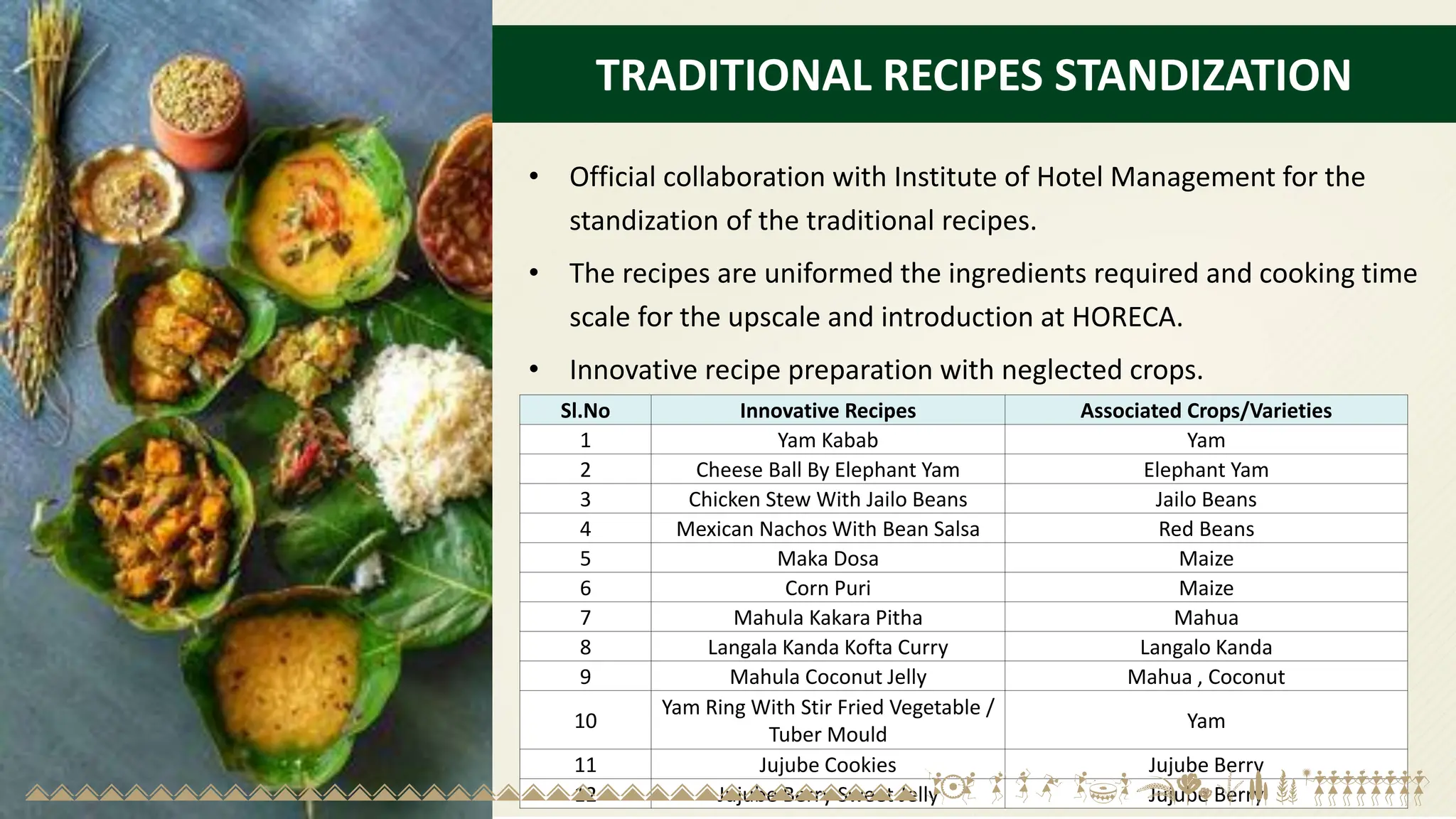
TRADITIONAL RECIPES STANDIZATION
• Official collaboration with Institute of Hotel Management for the
standization of the traditional recipes.
• The recipes are uniformed the ingredients required and cooking time
scale for the upscale and introduction at HORECA.
• Innovative recipe preparation with neglected crops.
Sl.No Innovative Recipes Associated Crops/Varieties
1 Yam Kabab Yam
2 Cheese Ball By Elephant Yam Elephant Yam
3 Chicken Stew With Jailo Beans Jailo Beans
4 Mexican Nachos With Bean Salsa Red Beans
5 Maka Dosa Maize
6 Corn Puri Maize
7 Mahula Kakara Pitha Mahua
8 Langala Kanda Kofta Curry Langalo Kanda
9 Mahula Coconut Jelly Mahua , Coconut
10
Yam Ring With Stir Fried Vegetable /
Tuber Mould
Yam
11 Jujube Cookies Jujube Berry
12 Jujube Berry Sweet Jelly Jujube Berry
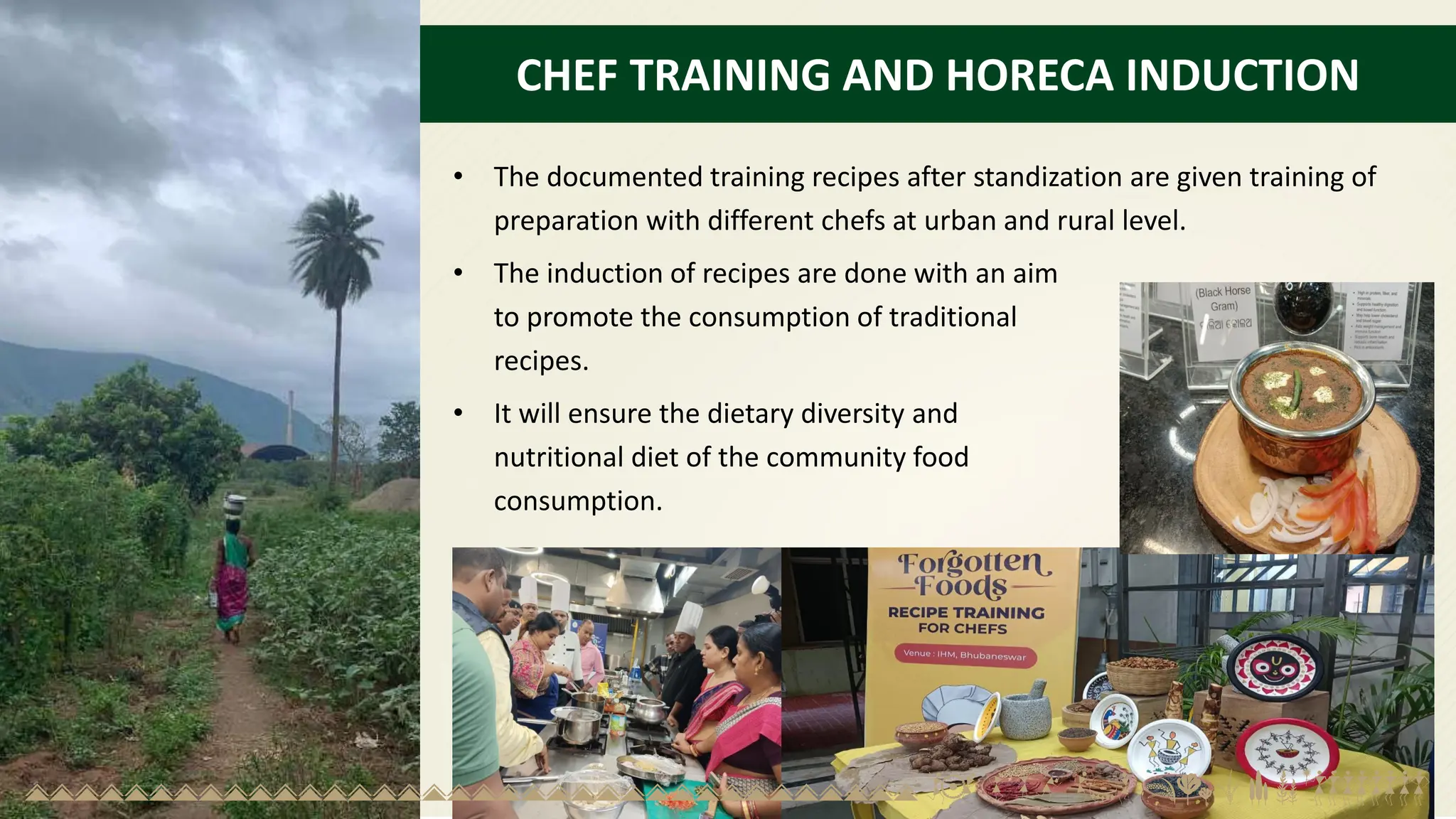
CHEF TRAINING AND HORECA INDUCTION
• The documented training recipes after standization are given training of
preparation with different chefs at urban and rural level.
• The induction of recipes are done with an aim
to promote the consumption of traditional
recipes.
• It will ensure the dietary diversity and
nutritional diet of the community food
consumption.
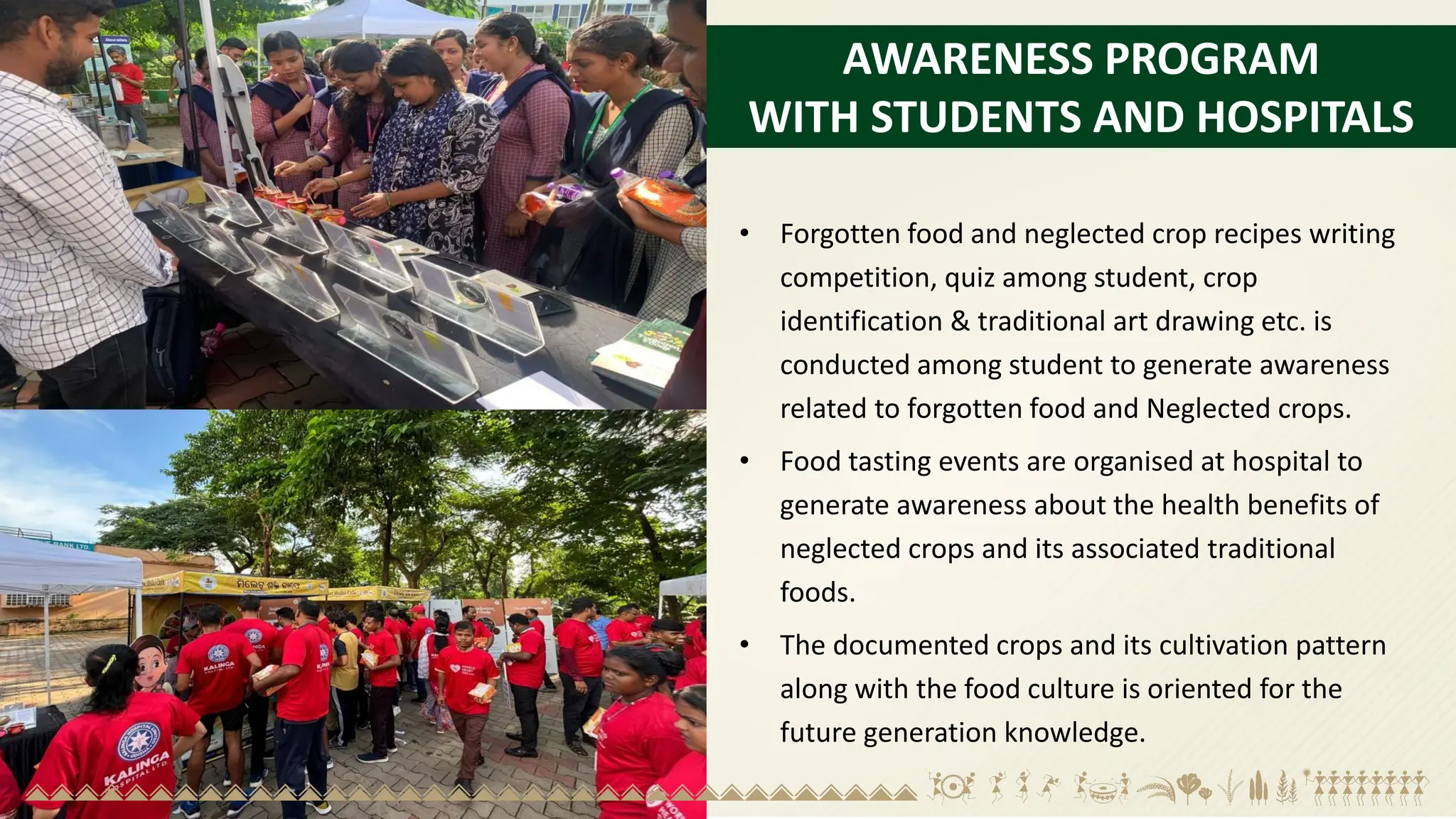
AWARENESS PROGRAM
WITH STUDENTS AND HOSPITALS
• Forgotten food and neglected crop recipes writing
competition, quiz among student, crop
identification & traditional art drawing etc. is
conducted among student to generate awareness
related to forgotten food and Neglected crops.
• Food tasting events are organised at hospital to
generate awareness about the health benefits of
neglected crops and its associated traditional
foods.
• The documented crops and its cultivation pattern
along with the food culture is oriented for the
future generation knowledge.
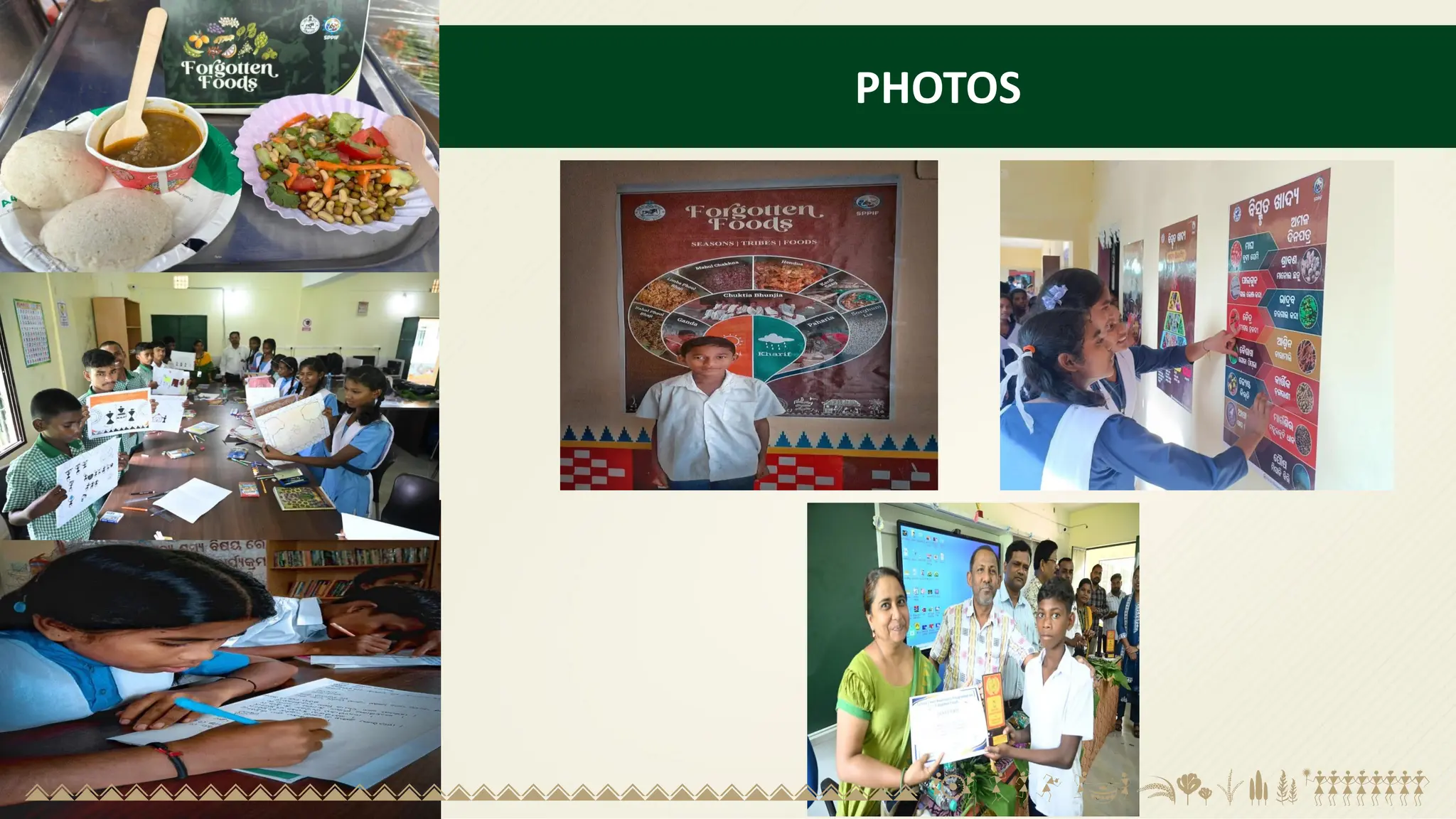
PHOTOS
Scheme
Title &
objectives
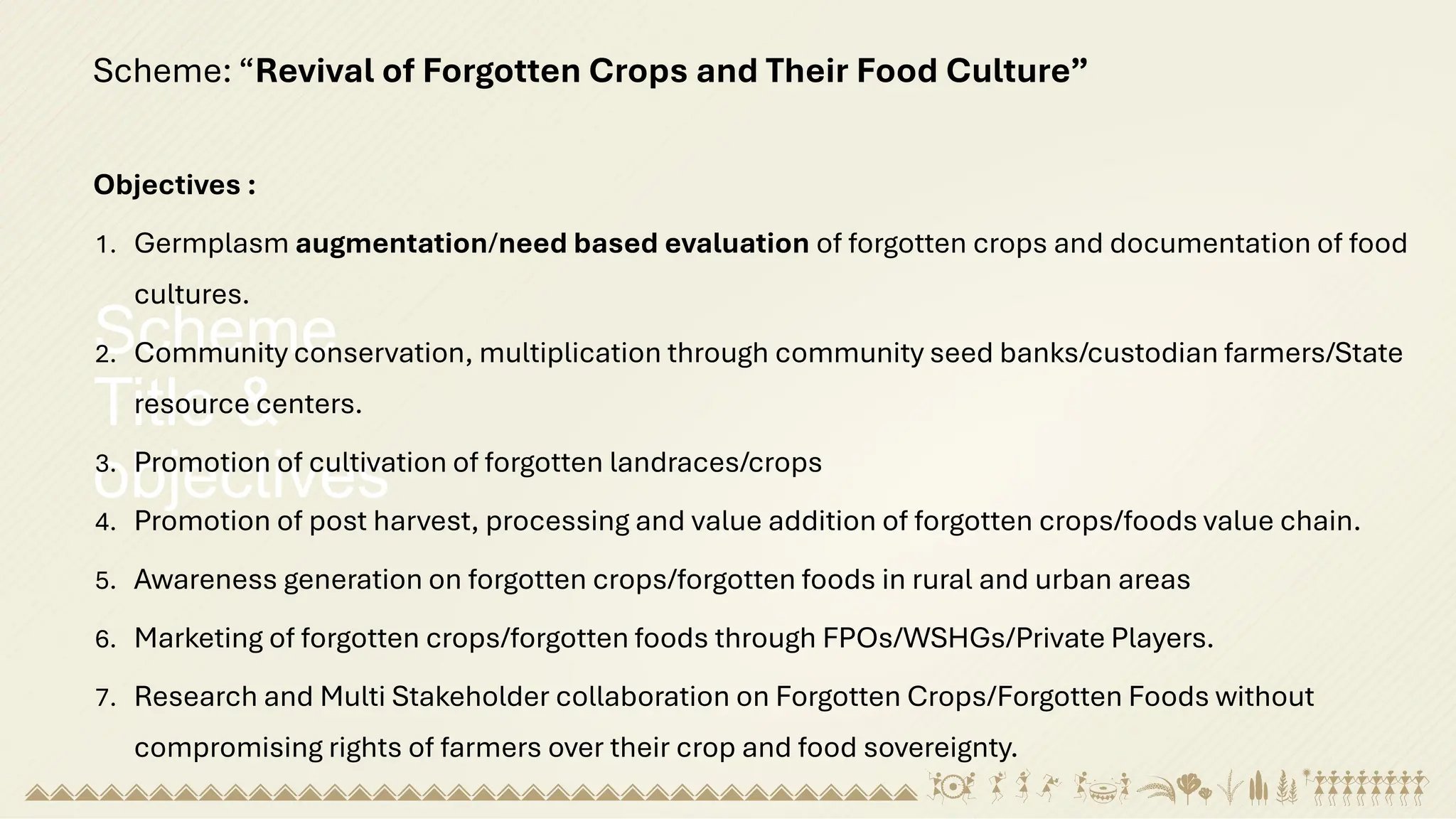
Scheme: “Revival of Forgotten Crops and Their Food Culture”
Objectives :
1. Germplasm augmentation/need based evaluation of forgotten crops and documentation of food
cultures.
2. Community conservation, multiplication through community seed banks/custodian farmers/State
resource centers.
3. Promotion of cultivation of forgotten landraces/crops
4. Promotion of post harvest, processing and value addition of forgotten crops/foods value chain.
5. Awareness generation on forgotten crops/forgotten foods in rural and urban areas
6. Marketing of forgotten crops/forgotten foods through FPOs/WSHGs/Private Players.
7. Research and Multi Stakeholder collaboration on Forgotten Crops/Forgotten Foods without
compromising rights of farmers over their crop and food sovereignty.
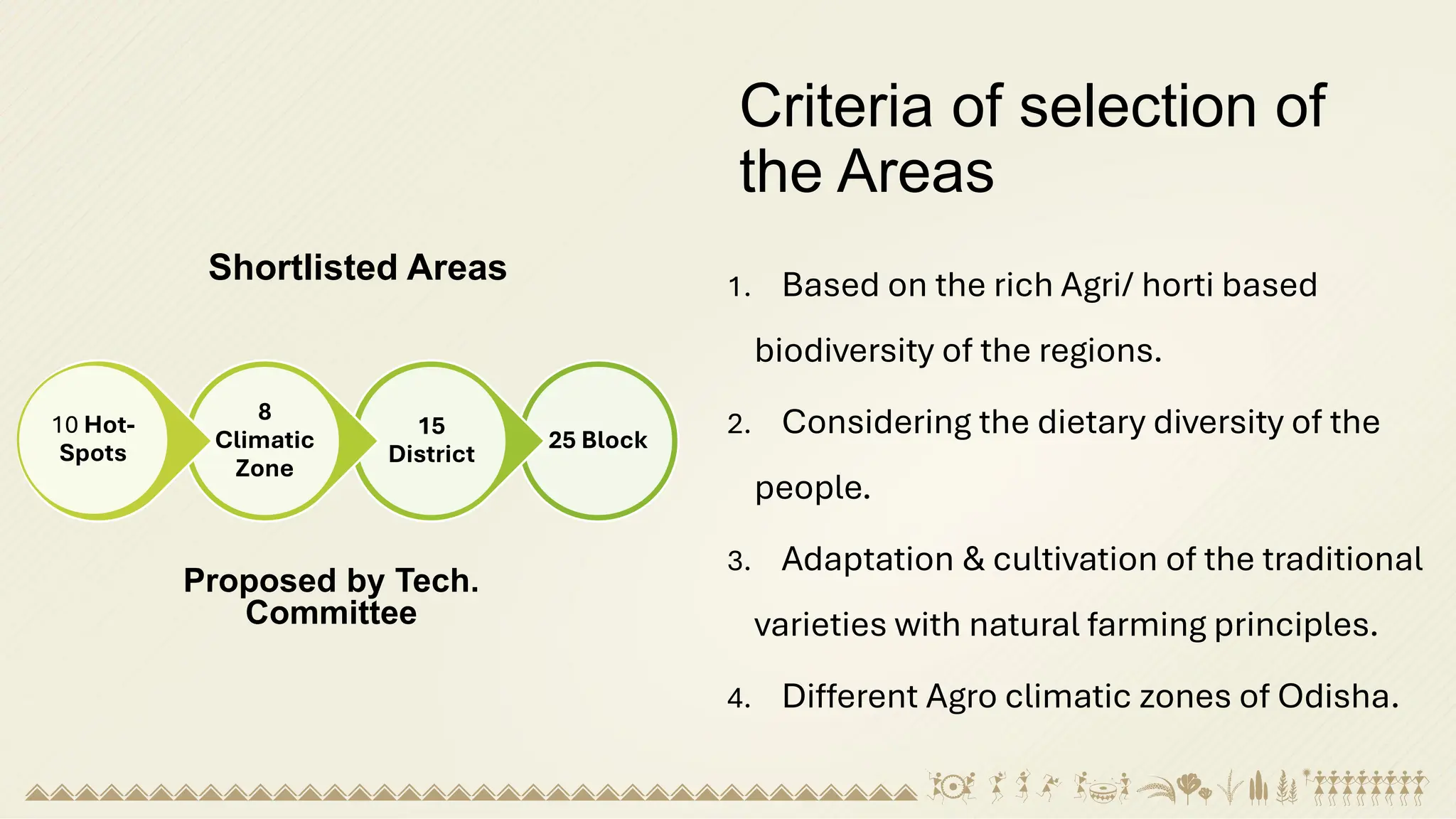
Criteria of selection of
the Areas
1. Based on the rich Agri/ horti based
biodiversity of the regions.
2. Considering the dietary diversity of the
people.
3. Adaptation & cultivation of the traditional
varieties with natural farming principles.
4. Different Agro climatic zones of Odisha.
25 Block
15
District
8
Climatic
Zone
10 Hot-
Spots
Shortlisted Areas
Proposed by Tech.
Committee
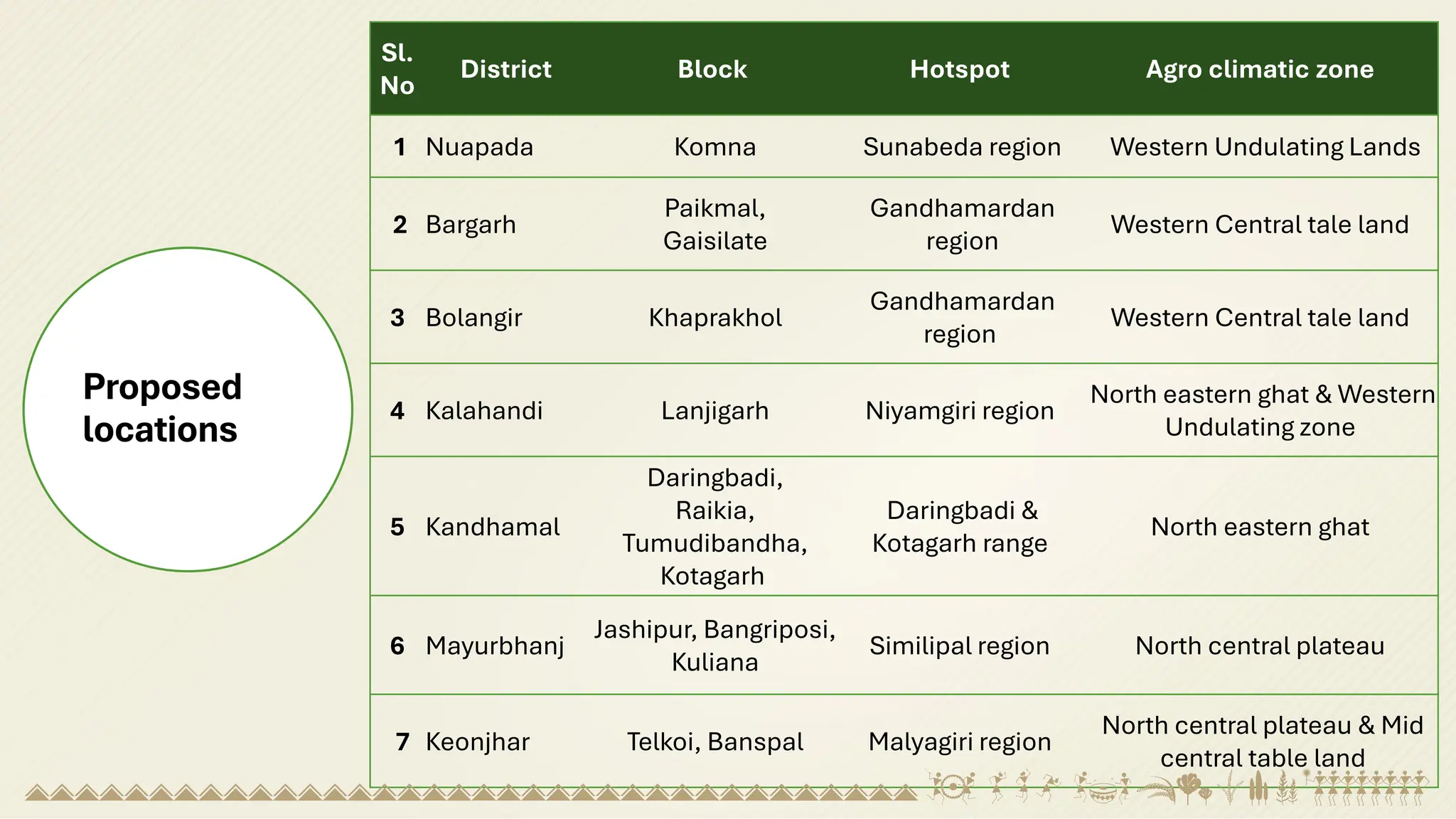
Proposed
locations
Sl.
No
District Block Hotspot Agro climatic zone
1 Nuapada Komna Sunabeda region Western Undulating Lands
2 Bargarh
Paikmal,
Gaisilate
Gandhamardan
region
Western Central tale land
3 Bolangir Khaprakhol
Gandhamardan
region
Western Central tale land
4 Kalahandi Lanjigarh Niyamgiri region
North eastern ghat & Western
Undulating zone
5 Kandhamal
Daringbadi,
Raikia,
Tumudibandha,
Kotagarh
Daringbadi &
Kotagarh range
North eastern ghat
6 Mayurbhanj
Jashipur, Bangriposi,
Kuliana
Similipal region North central plateau
7 Keonjhar Telkoi, Banspal Malyagiri region
North central plateau & Mid
central table land
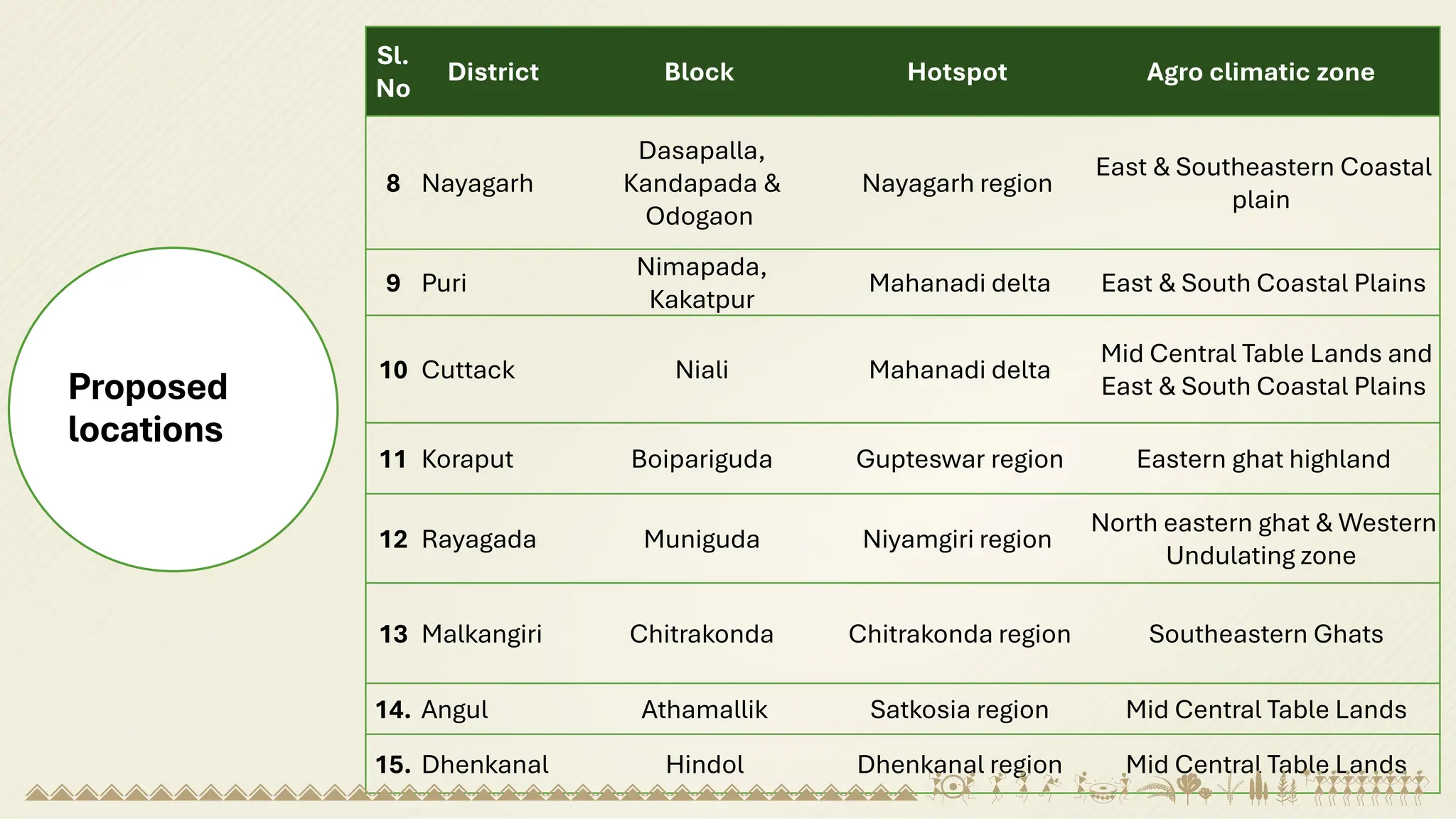
Proposed
locations
Sl.
No
District Block Hotspot Agro climatic zone
8 Nayagarh
Dasapalla,
Kandapada &
Odogaon
Nayagarh region
East & Southeastern Coastal
plain
9 Puri
Nimapada,
Kakatpur
Mahanadi delta East & South Coastal Plains
10 Cuttack Niali Mahanadi delta
Mid Central Table Lands and
East & South Coastal Plains
11 Koraput Boipariguda Gupteswar region Eastern ghat highland
12 Rayagada Muniguda Niyamgiri region
North eastern ghat & Western
Undulating zone
13 Malkangiri Chitrakonda Chitrakonda region Southeastern Ghats
14. Angul Athamallik Satkosia region Mid Central Table Lands
15. Dhenkanal Hindol Dhenkanal region Mid Central Table Lands
Objective
1
Germplasm augmentation/ need based evaluation of forgotten crops and documentation of food
cultures.
Germplasm Augmentation
a. Compilation of the already available documented forgotten crop varities through different research
institutions (CTCRI, CHES, NBPGR, PPVFRA, SSTL, ICAR Institutions) along with the traits data.
b. Documentation will be as per the approved format with minimal descriptors referring to the prescribed
formats of ICAR/OBB/Etc. Passport data record keeping each mandatory during the documentation
process.
c. PRA exercises like ( FGD-focus group discussion, Seasonality diagram, Social Mapping, Resource
mapping, Land use mapping, 4–Cell analysis, etc) documentations of crop associated socio cultural
importance, traditional crop category documentation with old farmers, Decade wise cropping pattern
analysis, decadal diversity analysis (agriculture & horticulture), associated knowledge related
cultivation/consumption/storage/etc practices shall be conducted, and different methodologies will be
applied to understand the present status of the wild or forgotten food crops.
Objective 1 Germplasm Augumentation/ Need based evaluation of forgotten crops and documentation of food
cultures.
Need based Evaluation
a. Data/ information of already completed evaluation will be collected by different ICAR/OUAT/CGIAR
will be collected. The need-based evaluation trails will be conducted by consortium led by NBPGR/
OUAT/ SSTL in collaboration with other ICAR/ AICRP/ CGIAR/ State, etc. The research nodal body will
be SSTL/ OUAT/ NBPGR for coordination and research activities report submission.
b. Crop specific research/evaluation trails to be conducted in collaboration with ICAR, OUAT, AICRP
centers, CGIARs Bodies, etc.
c. Multi location evaluation trails will be conducted. Inclusion of ITK Knowledge in the evaluation trails
along with the biochemical properties, anti nutrients and toxicity properties of the germplasm.
d. Data observation of the research trails to be taken for minimal descriptors for DUS analysis.
e. Standard operation procedure will be developed with the results of evaluation observed data related
to potential crops associated with forgotten food.
Contd..
Objective 1 Germplasm augmentation/ need based evaluation of forgotten crops and documentation of food
cultures.
Forgotten food documentation
a. Food Culture Association with rituals and festivals, Community Dietary Record & Recipe
documentation & Traditional knowledge on value added product will be documented at cluster/village
level.
b. Standardization, nutritional profiling of the recipes will be done by IHM/NIN/CTCRI.
c. Village level documentation shall be conducted with experienced farmers, women groups, public
representatives of the villages along with different age groups without being gender biased to know
the different traditional recipes associated with the forgotten food crops.
d. Previously documented information from different state institution like SCSTRTI, COATS, etc will be
taken as base data to be compiled with forgotten food documentation.
Contd..
Objective 2 Community conservation, multiplication through community seed banks/custodian farmers/State
resource centers
Conservation
a. In Situ conservation through custodian farmers especially agriculture & horticulture through
forgotten food diversity blocks/crop diversity blocks.
b. Support for purification and distribution in the communities through CSBs.
c. The status of wild food crops or forgotten crops on-farm conservation practices shall be conducted
to conserving and characterizing.
d. All the field crops, cereals, pulses, oil seeds, creepers, vegetables, green leaves etc shall be
preserved at institution and farmer level.
e. The crop DUS character evaluation will be done at the research station as per the standard package
of practices. Development of standard protocol for insitu and exsitu conservation practices.
Contd..
Objective 2 Community conservation, multiplication through community seed banks/custodian farmers/State
community resource centers
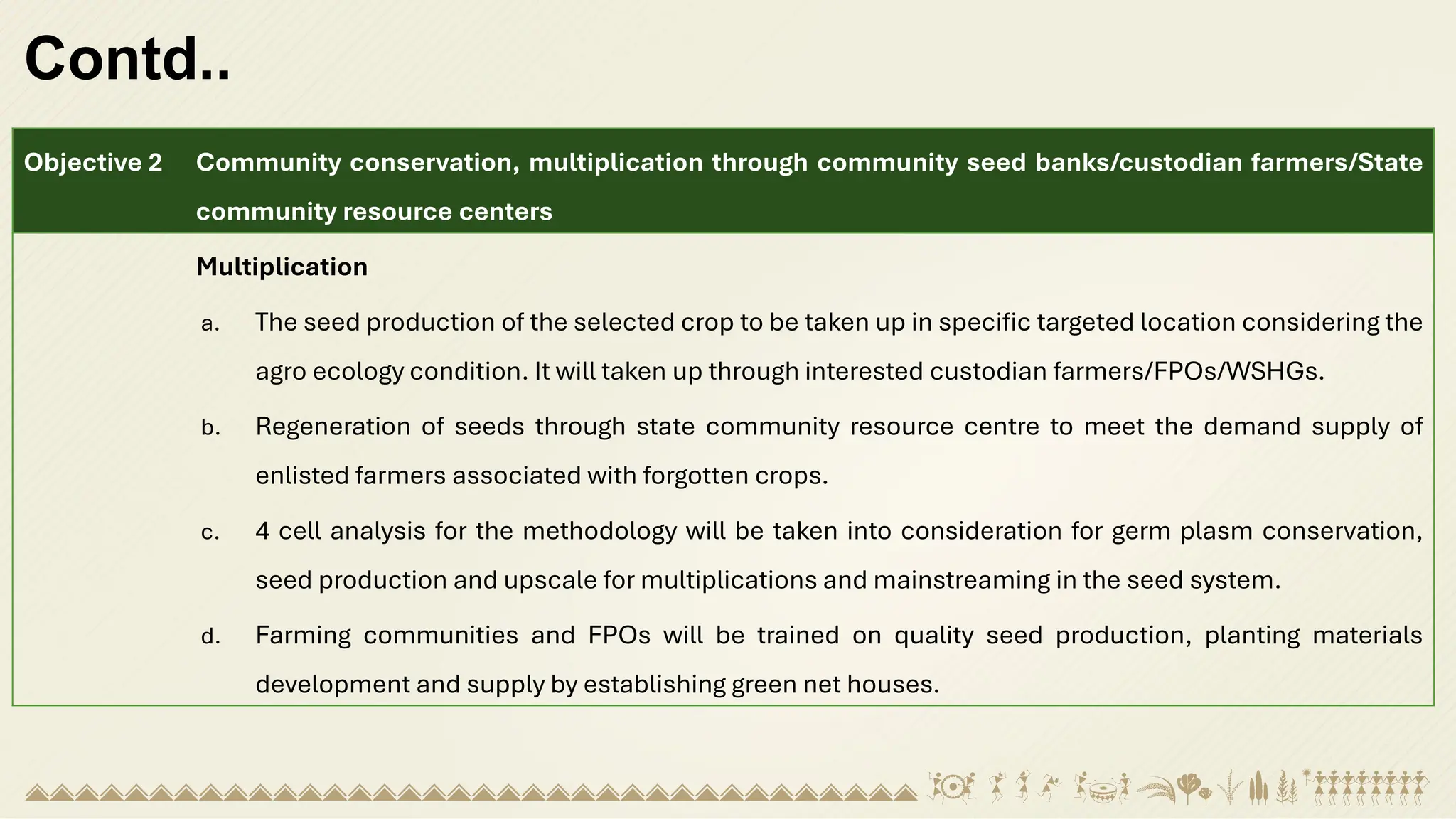
Multiplication
a. The seed production of the selected crop to be taken up in specific targeted location considering the
agro ecology condition. It will taken up through interested custodian farmers/FPOs/WSHGs.
b. Regeneration of seeds through state community resource centre to meet the demand supply of
enlisted farmers associated with forgotten crops.
c. 4 cell analysis for the methodology will be taken into consideration for germ plasm conservation,
seed production and upscale for multiplications and mainstreaming in the seed system.
d. Farming communities and FPOs will be trained on quality seed production, planting materials
development and supply by establishing green net houses.
Contd..
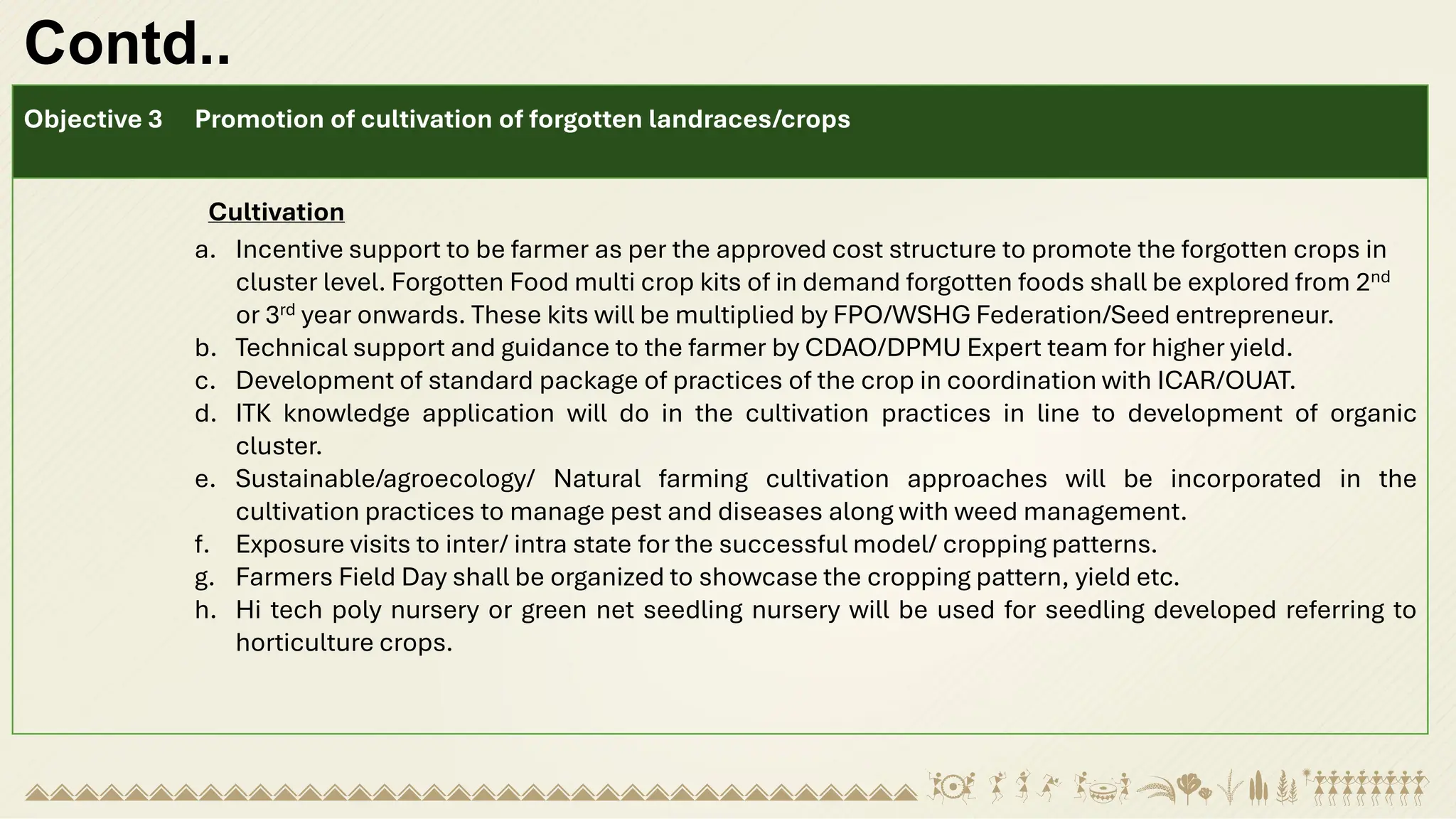
Objective 3 Promotion of cultivation of forgotten landraces/crops
Cultivation
a. Incentive support to be farmer as per the approved cost structure to promote the forgotten crops in
cluster level. Forgotten Food multi crop kits of in demand forgotten foods shall be explored from 2nd
or 3rd year onwards. These kits will be multiplied by FPO/WSHG Federation/Seed entrepreneur.
b. Technical support and guidance to the farmer by CDAO/DPMU Expert team for higher yield.
c. Development of standard package of practices of the crop in coordination with ICAR/OUAT.
d. ITK knowledge application will do in the cultivation practices in line to development of organic
cluster.
e. Sustainable/agroecology/ Natural farming cultivation approaches will be incorporated in the
cultivation practices to manage pest and diseases along with weed management.
f. Exposure visits to inter/ intra state for the successful model/ cropping patterns.
g. Farmers Field Day shall be organized to showcase the cropping pattern, yield etc.
h. Hi tech poly nursery or green net seedling nursery will be used for seedling developed referring to
horticulture crops.
Contd..
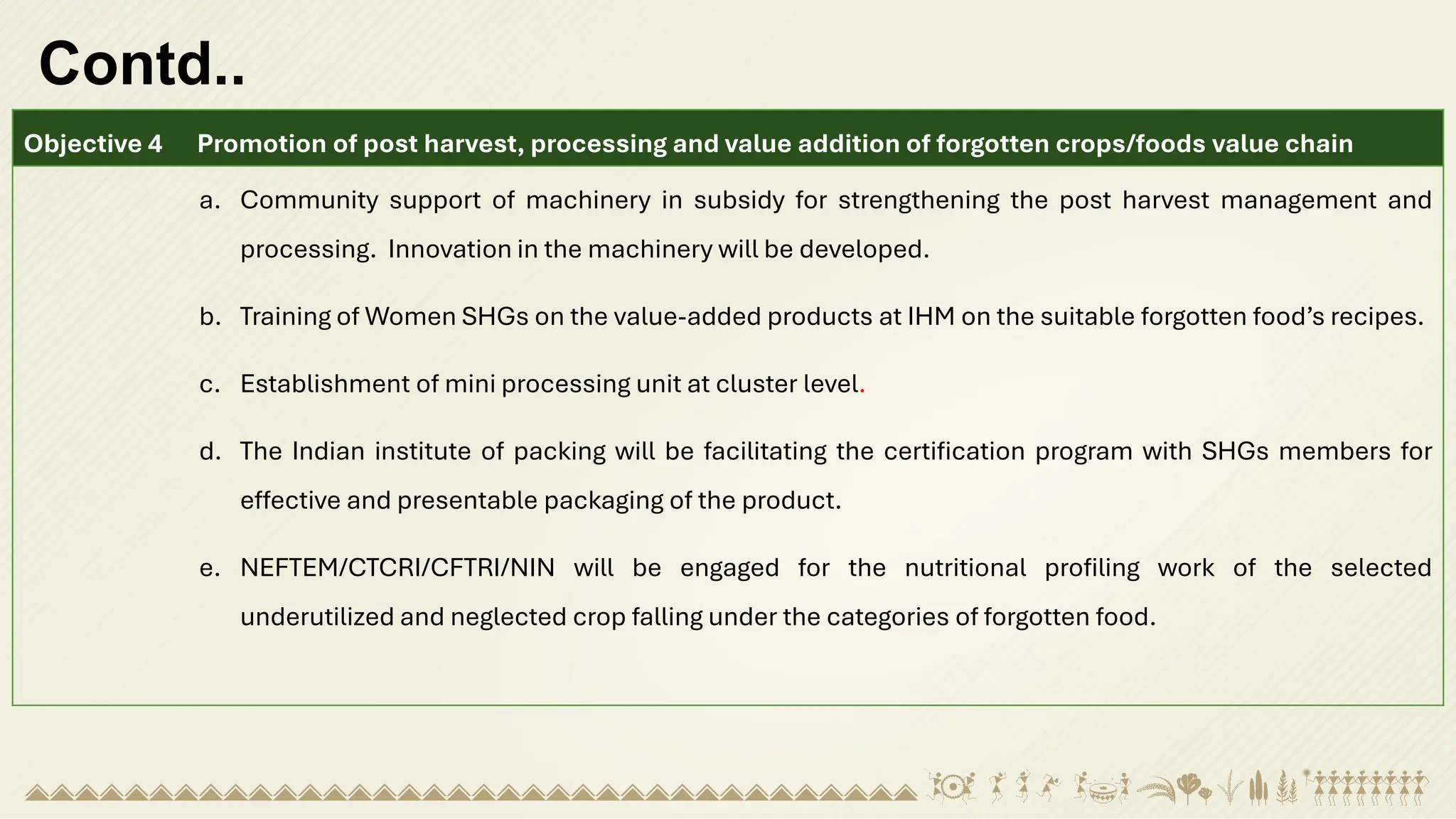
Objective 4 Promotion of post harvest, processing and value addition of forgotten crops/foods value chain
a. Community support of machinery in subsidy for strengthening the post harvest management and
processing. Innovation in the machinery will be developed.
b. Training of Women SHGs on the value-added products at IHM on the suitable forgotten food’s recipes.
c. Establishment of mini processing unit at cluster level.
d. The Indian institute of packing will be facilitating the certification program with SHGs members for
effective and presentable packaging of the product.
e. NEFTEM/CTCRI/CFTRI/NIN will be engaged for the nutritional profiling work of the selected
underutilized and neglected crop falling under the categories of forgotten food.
Contd..
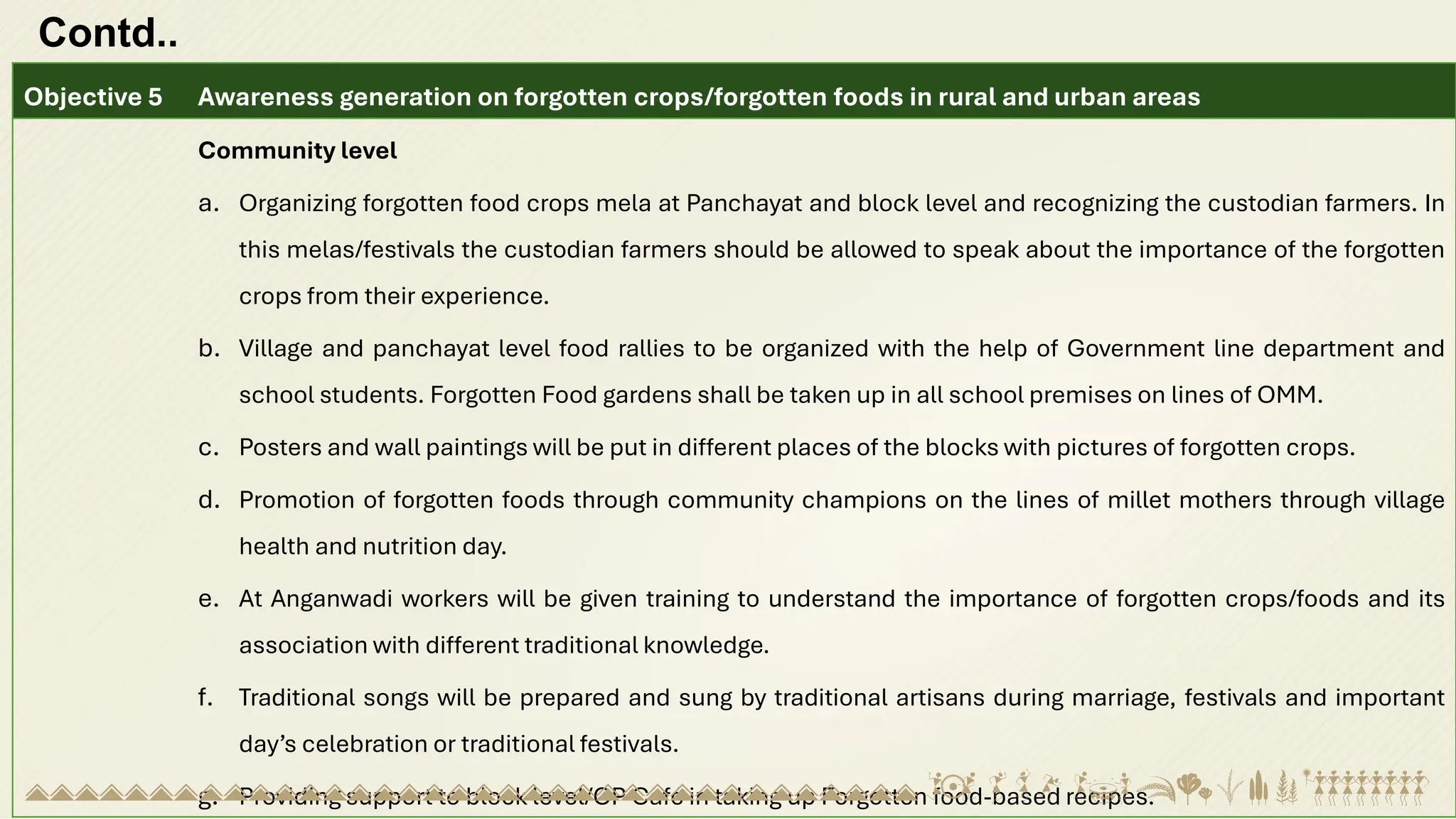
Objective 5 Awareness generation on forgotten crops/forgotten foods in rural and urban areas
Community level
a. Organizing forgotten food crops mela at Panchayat and block level and recognizing the custodian farmers. In
this melas/festivals the custodian farmers should be allowed to speak about the importance of the forgotten
crops from their experience.
b. Village and panchayat level food rallies to be organized with the help of Government line department and
school students. Forgotten Food gardens shall be taken up in all school premises on lines of OMM.
c. Posters and wall paintings will be put in different places of the blocks with pictures of forgotten crops.
d. Promotion of forgotten foods through community champions on the lines of millet mothers through village
health and nutrition day.
e. At Anganwadi workers will be given training to understand the importance of forgotten crops/foods and its
association with different traditional knowledge.
f. Traditional songs will be prepared and sung by traditional artisans during marriage, festivals and important
day’s celebration or traditional festivals.
g. Providing support to block level/GP Café in taking up Forgotten food-based recipes.
Contd..
Objective 5 Awareness generation on forgotten crops/forgotten foods in rural and urban areas
i. Participation in different district level/state level/national level events through WSHGs/FPOs. This
includes seed festivals, food festivals, harvest festivals, etc.
j. Different forgotten food gardens, wall painting, roadside hoarding will be done to create awareness
among urban communities/gated communities/roof top gardens in collaboration with kitchen garden
associations, etc.
k. Video documentation on wild food collectors, ITK holders, custodian farmers, Traditional Healthcare
practitioner (THP), Traditional Birth Attendant (TBA), foresters etc. to educate the youths, researchers,
academicians etc on the importance of forgotten food crops.
l. Engagement with Schools/Colleges Hotels, Restaurants and Startups for creating awareness with
them. This will also include a pilot with them to try out different recipes.
m. Collaborations shall also be explored with food bloggers/Hotel and Restaurant Associations/etc.
Contd..
Objective 6 Marketing of forgotten crops/forgotten foods through FPOs/WSHGs/Private Players.
a. Outlet engagement with value added product trails at locale & state level café, restaurants and
hotels. Block level and District level mission shakti cafes shall be engaged for the popularizing of
organic forgotten foods across population.
b. Wherever applicable, special packages for entrepreneurs on the Millet service centres shall be taken
up for forgotten foods.
c. Supporting the locale outlets with FPOs/WSHGs/ Private Players for supply of products.
d. Digital marketing with different state and national level engagements covering the online platform
centric to food and grocery etc. Special engagement with startups on forgotten crops/foods with
sufficient surplus.
e. Exploring of opportunity for exporting the value-added product outside of odisha and country i.e,
APEDA.
Contd..
Objective 7
Research and Multi Stakeholder collaboration on Forgotten Crops/Forgotten Foods without
compromising rights of farmers over their crop and food sovereignty.
a. Research collaborations will be designed to ensure rights of farmers over their crops and food
sovereignty is not compromised.
b. Detailed guidelines shall be developed to ensure that forgotten crop/food
germplasm/documentation contributes to well being of farmers.
c. Collaborations will be explored with various communities across Africa, Asia and South America for
farmer-to-farmer learning's and understanding with focus on indigenous communities.
d. Collaboration with PPVFRA for registration of farmer varieties without violating community rights
through open source amendments.
e. Collaborations shall focus on entire value chain, south-south framework, circular economy, policy
development and others.
Thank You

The new Odisha Government scheme on neglected crops and forgotten food

  • 1.
    Overview of Journey& Key Experiences of WASSAN in Odisha on Landraces & Forgotten Foods 27th June 2024
  • 2.
    Watershed Support Servicesand Activities Network Established in 1999 Network based Organisation Watershed Development Natural Farming Seed Systems Millets Nutrition Livestock Desi- Poultry Biodiversity Fisheries Institutions & Enterprise development • Secretary to Hon’ble Prime Minister of India • Member, Planning Commission (2004-2009) • Elimination of Bonded Labor/ PESA Act, National Social Assistance Act, Targeted Public Distribution Systems, Legal framework for PwDs, Drought Prone Area Programme/Desert Programme, Watershed Programs in India, Land Reforms in India, Right to Information and Right to Food & Rainfed Productions Systems, etc Website | www.wassan.org Twitter | WASSANIndia Facebook | WASSANIndia
  • 3.
    Research & Network •Central Research Institute for Dryland Agriculture • Central Institute for Agriculture Engineering • National Bureau of Plant Genetics Research (NBPGR) • National Bureau of Animal Genetics Research (NBPGR) • Indian Institute of Rice Research • MANAGE • National Rainfed Areas Authority (Knowledge Partner) • University of Agriculture Sciences, Bengaluru • Odisha University of Agriculture and Technology • CSIRO, Australia • University of Cambridge, UK • University of Greenwich, UK Government • Department of Agriculture / RYSS- Andhra Pradesh • Department of Tribal Welfare and Development – AP • Department of Women & Development, Telangana • Department of Agriculture, Odisha • Department of Tribal Welfare and development, Odisha • Department of Rural Development, Jharkhand • NRAA, Ministry of Agrl, Govt of India • NABARD Main Funding • Azim Premji Foundation • Ford Foundation • Rainmatter Foundation • HDFC-Parivarthan • Agro Ecology Fund • Bharat Rural Livelihoods Fund (BRLF) • GIZ • WHH WASSAN anchors : • Network Hub of Revitalising Rainfed Agriculture Network (RRA Network) • Secretariat of the National Coalition for Natural Farming WASSAN works with over 100 grassroots organisations across the country – supporting them in building their implementation capacities, innovations, networking and policy development through networking and coalitions Partnerships & Collaborations:
  • 4.
    1. Increasing householdconsumption of millets 2. Revalorization of millet food cultures. 3. Conservation & promotion of millet landraces. 4. Promotion of post-harvest and processing enterprises. 5. Improving productivity of millets. 6. Promotion of value addition enterprises 7. Inclusion of millets in PDS, ICDS, MDM, Welfare Hostels 8. Facilitating the markets and exports of millets. Objectives of Odisha Millets Mission
  • 5.
    Largest scientific farmerfield trials of finger millet in the world was done with custodian farmers of 163 landraces. 14 well performing finger millet varieties identified for seed production through PVT. A technical landrace varietal release committee was formed. For first time in the country, 4 landraces namely KUNDRA BATI, LAXMIPUR KALIA, MALYABANTA MAMI and GUPTESHWAR BHARATI were released as varieties. This was presented in global conference in Rome by PPFVRA and appreciated. FAO has approached DAFE for collaboration on studying and promoting it nationally and globally. Seed System for Landraces
  • 6.
    Participatory Varietal TrialUnder OMM Nursery Bed – 25 Sqm Ribbon Tagging for different landraces Collective Brainstorming Seed treatment Ribbon Tagging RBD Planting Farmer Preference Analysis ATMA-KVK-OMM Measurement
  • 7.
    BHARATI MANDIA BATI MANDIA KUNDRABATI LAXMIPUR KALIA GUPTESHWAR BHARATI MALYABANTA MAMI Shortlisted Ragi landraces
  • 8.
    Millet Landraces inthe Odisha Millets Mission
  • 9.
    38 11 4 1 1 2 10 19 4 4 17 31 21 3 10 3 31 7 5 Little millet Sorghum Rice beans Ground nut Fox tail millet Black gram Kidney beans Mustard Barnyard millet Green gram Broad beans Niger Bajra Horse gram Chick peas Sesame Finger millet Kodo millet Cow pea Pigeon peas Castor 148 Types of FV from surveyed villages 255 Varieties
  • 10.
    Ragi: BADA MANDIA,SANA MANDIA, DUSHERA MANDIA Ragi: BAGADA, BATI MANDIA, BURKA MANDIA, KANTAMERA, HATA BHANGA, KHUNTA MANDIA, MAJHAL MANDIA, MAMI MANDIA, TAYA MANDIA, MUSHKURI MANDIA, MARDIMOTA, KALAKERENGA, DUSHERA BADI, PATA MANDIA, SANA TARA MANDIA Foxtail millet: DESIKANGU Little millet: GUNDLI, BADA KHOSLA, SANA SUAN, GURUJI, SANA KUIRI Sorghum: BADA GANGEI, SANA GANGEI, KHEDA JANHA LARGE AREA & FEW HOUSEHOLDS SMALL AREA & FEW HOUSEHOLDS Ragi: KIMA MANDIA, BADA TARA MANDIA, BHODA MANDIA, KARKATI MANDIA, SIRKA MANDIA, TELENGA MANDIA Little millet: BADA SUAN Ragi: KAJA MANDIA, KALAGUDULI, PENTHA MANDIA, KHUPA MANDIA, DHELU MANDIA, KHADIGATHI MANDIA, SIMILIPAL MANDIA Foxtail millet: BADA KANGU, DHALA KANGU, SANA KANGU Little millet: BADA KUIRI, MACHHILI KOSLA, MASURA KOSHLA, KASAM JHUPA Sorghum: KAUA JANHA, BHATA JANHA, KUCHHA JANHA, LAL KHEDA JANHA, LIA JANHA Pearl millet: KATHIA LARGE AREA & MANY HOUSEHOLDS SMALL AREA & MANY HOUSEHOLDS
  • 11.
    Village Food &Agriculture History
  • 12.
    Recognition for CustodianFarmers At Global Millets (Shree Anna) Conference in Delhi, 18th March 2023 Custodian Frames’ participation in G20 summit 2023, New Delhi
  • 13.
    Forgotten Foods andForgotten Tales
  • 15.
    Government of Odishais initiating a work on intensification of forgotten crops. It aims to take up mainstreaming of Neglected and Under utilized crops
  • 16.
    PROCEDURE – 2:CROP / VARIETY MAPPING Step-C Extinct Crop/Varieties Crop / Varieties Name Stage (Near threatened/ Endangered/ Extinct) Special trait Reason of Near threatened/ Endangered/ Extinct) Step-D Four Cell analysis Many Household Large Areas (Varieties) Many Household Small Areas (Varieties) Few Household Large Areas (Varieties) Few Household Small Areas (Varieties) Reason Reason Reason Reason Step B: Crop varietal Matrix Crop Name Varieties names Source of seed Use (consumption / sell) Varietal Ranking Reasons Step A: Crop Calendar : This Exercise shall be done through FGD with different age group of Farmers and document the findings Steps of Methodology…..
  • 17.
    PROCEDURE – 2:CROP / VARIETY MAPPING Steps of Methodology….. Procedure 3: Special traits varieties wise Documented varieties Special traits Name of Recipe associated Value added product associated Procedure 4 : Cropping Pattern & Climatic Resilient characters Crop Cultivation practice Growing Season Wild/cultivated Input (Organic/ natural/ chemical) Remarks Procedure 5: Crop Climatic resilient factors Crop/varieties Grown season Frequency of irrigation Nutrient requirement
  • 18.
    PROCEDURE – 2:CROP / VARIETY MAPPING Procedure 6: Community Dietary Record 6.a Recipe: Name of recipes Consumption frequency (Daily/Occasional) Procedure Associated tribes (Festival and religious aspects) Remark 6.b Potential Traditional recipe Name of Recipe Ingredients Procedure Farmer feedback on organoleptic properties Steps of Methodology…..
  • 19.
    PROCEDURE – 2:CROP / VARIETY MAPPING Procedure 7: Documentation of traditional value-added product and their processes Crop/varieties Name of value added product Procedure Remarks Procedure 8: Crop morphological data from farmer perspective Crop/varieties Morphological uniqueness Pest & Diseases Yield Procedure 9: Seed conservation & storage practices Crop/Varieties Name of practice Procedure Remarks Procedure 10: Germplasm collection Crop/Varieties Weight of germplasm collected Passport data Farmers Feedback Steps of Methodology…..
  • 20.
  • 21.
    POPULAR RECIPES DOCUMENTED SUNABEDA,NUAPADA • Mahua(4) - Mahul lata ladoo, Ursula Mahul , Mahul chapna , Mahul poda • Leafy vegetables(4) - kulhiar sag , Bahal bhaji , muninga sag - Moringa leaves , Neem phula bhaji - Neem flowers. • Tubers: keo Kanda sag(6) - keo kanda (insulin plant roots), kochei kanda sag - kochei kanda ( taro roots ), pita kanda Sijha, bhatudi kanda Sijha , kochei kanda Jhari Mach - kochei kanda, Jimi Kanda sag - Jimi kanda ( elephant foot yam) • Pulses(4) - Leher ghughuri - Red gram , kolatha ghughuri - black Horsegram, bamni semi-Dali, Churchutia bhaji (cluster bean)
  • 22.
    POPULAR RECIPES DOCUMENTED CHITRAKONDA,MALKANGIRI • Leafy vegetables(3) - Chunchunia Amila Saag, Madrenga Saag, Kordi Sag • Stems and shoot(3)- Kardi saag, Joba saru saag, Sukhila Karadi Bhaji Saag, • Flower(1) - koichan ful saag • Pulses(5) - Kolatha je munika sag, Kumuda je Dangarani, Kumuda je Kala Jhudunga, Jailo je panasa Sag, Ranjh Semi Sag • Tubers(3) - Kasa Kanda Sag, Kasa kanda je kolatha, Langala Kanda je Buta Semi • Cereals(1) - Mahul kuchi dhan rice • Fruits(2) - Bhalia Anda, Amba Sadha • Oil Seeds(1) - Sankra Manji ladoo
  • 23.
  • 24.
    DOCUMENTED FOOD CULTURE Bhagajhata The crop is organically grown with less irrigation requirement. Pest and Disease infection is minimal which signifies the crop show resistance to pest and diseases. It is preferred to grow in the black soil with a yield capacity of 4 to 5 Kg/Plant. ▪ Status: Endanger Variety ▪ Associated Recipes: Bagha Jhata Saag, Bagha Jhata Chuna, Bagha Jhata amblia, & Bagha Jhata Bhaja. ▪ Associated Tribe: Bhumia & Gonda
  • 25.
    DOCUMENTED FOOD CULTURE BambooRice Bamboo rice is the unique ingredient which is part of tribal food culture dominated with the coverage area of bamboo grass. The grass is having large diversity of variety; the variety signifies the property of the bamboo rice. Some of the variety has perennial fruiting time period and some of the variety has fruiting period once in a 50 years. Some of the identified variety is Kating Phutla Bauns & Banjh Chaula. Kating Phutla Bauns general have a hard grain and Banjh Chaula have an elongated grain. Recipes such as Bamboo rice (baunsa chaula bhata), bamboo rice kheer (baunsa chaula khiri), Bamboo rice pancake (baunsa chaula chakuli) and Bamboo rice Pie (baunsa chaula pitha) are some of the noted recipes of tribal communities.
  • 26.
    DOCUMENTED FOOD CULTURE ChitauPitha (a traditional recipe of Odisha) A special recipe, known as ‘Chitau Pitha,’ is offered to the deity and prepared in Oriya households. Chitalagi Amabasya is also revered as an agricultural festival. Farmers perform rituals to honor their paddy fields, praying for a bountiful harvest. Chitau Pitha is made primarily from rice batter and coconut, and it is known for its soft, spongy texture. It can be sweetened with jaggery or sugar, making it a delicious and comforting dish.
  • 27.
    DOCUMENTED FOOD CULTURE Liakahi parba The farmers will be preparing tasty lia made out of sorghum/ Khed Janha with jaggery. They will first popcorn out of sorghum and then they will melt jaggery in simmering heat in a container. After the jaggery has lost most of its water content, it will turn into a sticky substance from which threads of jaggery can be formed. The farmers will now add this jaggery threads to the sorghum which will make the puffed sorghum taste delicious. Lia Khai Parba is celebrated in the month of May/ Baisakh Masa. The God, ‘Hundi Nisani Devta’ who is also believed as Mukhya Devta/ Main God of the village is worshiped in this festival.
  • 28.
    DOCUMENTED FOOD CULTURE EdibleFlower of Odisha Flowers have long been celebrated not only for their beauty but also for their culinary and medicinal uses. In Odisha, various edible flowers play an important role in traditional cooking, often being incorporated into seasonal, festive, and cultural dishes. Below is an exploration of flowers commonly used in Odia cuisine, along with their associated recipes. Flowers: Koichan flower, Moringa flower, Kanchana flower, Rosella flower, Pumkin flower, Neem Flower & Banana flower etc.
  • 29.
    FOREST BASED FOOD •Under the “Forgotten Food” initiatives the forest based plant are identified through which community food culture is associated. Sl.No Agro Based Recipes Associated crops Associated tribes 1 Ursula mahul Mahua ( mahula), kurlu phal , sargi seeds Chuktia bhunjia , gond 2 Bahal bhaji Bahal flower Gond 3 Banjhi chaula khiri Bamboo rice ( banjhi chaula ) Chuktia bhunjia , gond 4 Mahula Lata /mahua ladoo Mahua ladoo ( mahua and sorghum ) Chuktia bhunjia , gond 5 Kulhiar sag Kulhiar leaves Chuktia bhunjia , gond 6 Kashakanda jhudunga saag Kasha kanda, Jhudanga Kotia
  • 30.
    COMMUNITY RELATION WITHFOREST Danger tentuli - This plant's leaves are consumed by farmers and it tastes sour like tamarind. It is used at different traditional recipes. This plant is another wild variety of the Kirchi plant. It's seeds are smaller in comparison and it's seeds also produces oil which can be consumed. Dadel its stems are used by farmers as toothbrush.
  • 31.
    MARKET SURVEY • Theinitiatives also target to study the locale market to understand the economic aspect of the seeds and Agri based product. • The market study is done with locale community person to under the diversity and food consumption pattern of the community. • The locale diversity can be analysed through locale market and potential crop selection will have a direct relation with locale market.
  • 32.
    VALUE ADDED PRODUCTION •The locale farmer group are targeted for standization and development of the processed product. • The documented processed product is further linked with different digital platform for the marketing of the product. • Branding and packing of the processed product is done in collaboration with farmer producer organization. Sl.No Value added products Associated crops 1 Kolatha pampada Horsegram 2 Kolatha powder Horsegram 3 Kolatha dali murukku Horsegram 4 Langala kanda crisps Langala kanda 5 Tikhur sharbat Tikhur 6 Niger ladoo Niger 7 Mahua pampada Mahula
  • 33.
    TRADITIONAL RECIPES STANDIZATION •Official collaboration with Institute of Hotel Management for the standization of the traditional recipes. • The recipes are uniformed the ingredients required and cooking time scale for the upscale and introduction at HORECA. • Innovative recipe preparation with neglected crops. Sl.No Innovative Recipes Associated Crops/Varieties 1 Yam Kabab Yam 2 Cheese Ball By Elephant Yam Elephant Yam 3 Chicken Stew With Jailo Beans Jailo Beans 4 Mexican Nachos With Bean Salsa Red Beans 5 Maka Dosa Maize 6 Corn Puri Maize 7 Mahula Kakara Pitha Mahua 8 Langala Kanda Kofta Curry Langalo Kanda 9 Mahula Coconut Jelly Mahua , Coconut 10 Yam Ring With Stir Fried Vegetable / Tuber Mould Yam 11 Jujube Cookies Jujube Berry 12 Jujube Berry Sweet Jelly Jujube Berry
  • 34.
    CHEF TRAINING ANDHORECA INDUCTION • The documented training recipes after standization are given training of preparation with different chefs at urban and rural level. • The induction of recipes are done with an aim to promote the consumption of traditional recipes. • It will ensure the dietary diversity and nutritional diet of the community food consumption.
  • 35.
    AWARENESS PROGRAM WITH STUDENTSAND HOSPITALS • Forgotten food and neglected crop recipes writing competition, quiz among student, crop identification & traditional art drawing etc. is conducted among student to generate awareness related to forgotten food and Neglected crops. • Food tasting events are organised at hospital to generate awareness about the health benefits of neglected crops and its associated traditional foods. • The documented crops and its cultivation pattern along with the food culture is oriented for the future generation knowledge.
  • 36.
  • 37.
    Scheme Title & objectives Scheme: “Revivalof Forgotten Crops and Their Food Culture” Objectives : 1. Germplasm augmentation/need based evaluation of forgotten crops and documentation of food cultures. 2. Community conservation, multiplication through community seed banks/custodian farmers/State resource centers. 3. Promotion of cultivation of forgotten landraces/crops 4. Promotion of post harvest, processing and value addition of forgotten crops/foods value chain. 5. Awareness generation on forgotten crops/forgotten foods in rural and urban areas 6. Marketing of forgotten crops/forgotten foods through FPOs/WSHGs/Private Players. 7. Research and Multi Stakeholder collaboration on Forgotten Crops/Forgotten Foods without compromising rights of farmers over their crop and food sovereignty.
  • 38.
    Criteria of selectionof the Areas 1. Based on the rich Agri/ horti based biodiversity of the regions. 2. Considering the dietary diversity of the people. 3. Adaptation & cultivation of the traditional varieties with natural farming principles. 4. Different Agro climatic zones of Odisha. 25 Block 15 District 8 Climatic Zone 10 Hot- Spots Shortlisted Areas Proposed by Tech. Committee
  • 39.
    Proposed locations Sl. No District Block HotspotAgro climatic zone 1 Nuapada Komna Sunabeda region Western Undulating Lands 2 Bargarh Paikmal, Gaisilate Gandhamardan region Western Central tale land 3 Bolangir Khaprakhol Gandhamardan region Western Central tale land 4 Kalahandi Lanjigarh Niyamgiri region North eastern ghat & Western Undulating zone 5 Kandhamal Daringbadi, Raikia, Tumudibandha, Kotagarh Daringbadi & Kotagarh range North eastern ghat 6 Mayurbhanj Jashipur, Bangriposi, Kuliana Similipal region North central plateau 7 Keonjhar Telkoi, Banspal Malyagiri region North central plateau & Mid central table land
  • 40.
    Proposed locations Sl. No District Block HotspotAgro climatic zone 8 Nayagarh Dasapalla, Kandapada & Odogaon Nayagarh region East & Southeastern Coastal plain 9 Puri Nimapada, Kakatpur Mahanadi delta East & South Coastal Plains 10 Cuttack Niali Mahanadi delta Mid Central Table Lands and East & South Coastal Plains 11 Koraput Boipariguda Gupteswar region Eastern ghat highland 12 Rayagada Muniguda Niyamgiri region North eastern ghat & Western Undulating zone 13 Malkangiri Chitrakonda Chitrakonda region Southeastern Ghats 14. Angul Athamallik Satkosia region Mid Central Table Lands 15. Dhenkanal Hindol Dhenkanal region Mid Central Table Lands
  • 41.
    Objective 1 Germplasm augmentation/ needbased evaluation of forgotten crops and documentation of food cultures. Germplasm Augmentation a. Compilation of the already available documented forgotten crop varities through different research institutions (CTCRI, CHES, NBPGR, PPVFRA, SSTL, ICAR Institutions) along with the traits data. b. Documentation will be as per the approved format with minimal descriptors referring to the prescribed formats of ICAR/OBB/Etc. Passport data record keeping each mandatory during the documentation process. c. PRA exercises like ( FGD-focus group discussion, Seasonality diagram, Social Mapping, Resource mapping, Land use mapping, 4–Cell analysis, etc) documentations of crop associated socio cultural importance, traditional crop category documentation with old farmers, Decade wise cropping pattern analysis, decadal diversity analysis (agriculture & horticulture), associated knowledge related cultivation/consumption/storage/etc practices shall be conducted, and different methodologies will be applied to understand the present status of the wild or forgotten food crops.
  • 42.
    Objective 1 GermplasmAugumentation/ Need based evaluation of forgotten crops and documentation of food cultures. Need based Evaluation a. Data/ information of already completed evaluation will be collected by different ICAR/OUAT/CGIAR will be collected. The need-based evaluation trails will be conducted by consortium led by NBPGR/ OUAT/ SSTL in collaboration with other ICAR/ AICRP/ CGIAR/ State, etc. The research nodal body will be SSTL/ OUAT/ NBPGR for coordination and research activities report submission. b. Crop specific research/evaluation trails to be conducted in collaboration with ICAR, OUAT, AICRP centers, CGIARs Bodies, etc. c. Multi location evaluation trails will be conducted. Inclusion of ITK Knowledge in the evaluation trails along with the biochemical properties, anti nutrients and toxicity properties of the germplasm. d. Data observation of the research trails to be taken for minimal descriptors for DUS analysis. e. Standard operation procedure will be developed with the results of evaluation observed data related to potential crops associated with forgotten food.
  • 43.
    Contd.. Objective 1 Germplasmaugmentation/ need based evaluation of forgotten crops and documentation of food cultures. Forgotten food documentation a. Food Culture Association with rituals and festivals, Community Dietary Record & Recipe documentation & Traditional knowledge on value added product will be documented at cluster/village level. b. Standardization, nutritional profiling of the recipes will be done by IHM/NIN/CTCRI. c. Village level documentation shall be conducted with experienced farmers, women groups, public representatives of the villages along with different age groups without being gender biased to know the different traditional recipes associated with the forgotten food crops. d. Previously documented information from different state institution like SCSTRTI, COATS, etc will be taken as base data to be compiled with forgotten food documentation.
  • 44.
    Contd.. Objective 2 Communityconservation, multiplication through community seed banks/custodian farmers/State resource centers Conservation a. In Situ conservation through custodian farmers especially agriculture & horticulture through forgotten food diversity blocks/crop diversity blocks. b. Support for purification and distribution in the communities through CSBs. c. The status of wild food crops or forgotten crops on-farm conservation practices shall be conducted to conserving and characterizing. d. All the field crops, cereals, pulses, oil seeds, creepers, vegetables, green leaves etc shall be preserved at institution and farmer level. e. The crop DUS character evaluation will be done at the research station as per the standard package of practices. Development of standard protocol for insitu and exsitu conservation practices.
  • 45.
    Contd.. Objective 2 Communityconservation, multiplication through community seed banks/custodian farmers/State community resource centers Multiplication a. The seed production of the selected crop to be taken up in specific targeted location considering the agro ecology condition. It will taken up through interested custodian farmers/FPOs/WSHGs. b. Regeneration of seeds through state community resource centre to meet the demand supply of enlisted farmers associated with forgotten crops. c. 4 cell analysis for the methodology will be taken into consideration for germ plasm conservation, seed production and upscale for multiplications and mainstreaming in the seed system. d. Farming communities and FPOs will be trained on quality seed production, planting materials development and supply by establishing green net houses.
  • 46.
    Contd.. Objective 3 Promotionof cultivation of forgotten landraces/crops Cultivation a. Incentive support to be farmer as per the approved cost structure to promote the forgotten crops in cluster level. Forgotten Food multi crop kits of in demand forgotten foods shall be explored from 2nd or 3rd year onwards. These kits will be multiplied by FPO/WSHG Federation/Seed entrepreneur. b. Technical support and guidance to the farmer by CDAO/DPMU Expert team for higher yield. c. Development of standard package of practices of the crop in coordination with ICAR/OUAT. d. ITK knowledge application will do in the cultivation practices in line to development of organic cluster. e. Sustainable/agroecology/ Natural farming cultivation approaches will be incorporated in the cultivation practices to manage pest and diseases along with weed management. f. Exposure visits to inter/ intra state for the successful model/ cropping patterns. g. Farmers Field Day shall be organized to showcase the cropping pattern, yield etc. h. Hi tech poly nursery or green net seedling nursery will be used for seedling developed referring to horticulture crops.
  • 47.
    Contd.. Objective 4 Promotionof post harvest, processing and value addition of forgotten crops/foods value chain a. Community support of machinery in subsidy for strengthening the post harvest management and processing. Innovation in the machinery will be developed. b. Training of Women SHGs on the value-added products at IHM on the suitable forgotten food’s recipes. c. Establishment of mini processing unit at cluster level. d. The Indian institute of packing will be facilitating the certification program with SHGs members for effective and presentable packaging of the product. e. NEFTEM/CTCRI/CFTRI/NIN will be engaged for the nutritional profiling work of the selected underutilized and neglected crop falling under the categories of forgotten food.
  • 48.
    Contd.. Objective 5 Awarenessgeneration on forgotten crops/forgotten foods in rural and urban areas Community level a. Organizing forgotten food crops mela at Panchayat and block level and recognizing the custodian farmers. In this melas/festivals the custodian farmers should be allowed to speak about the importance of the forgotten crops from their experience. b. Village and panchayat level food rallies to be organized with the help of Government line department and school students. Forgotten Food gardens shall be taken up in all school premises on lines of OMM. c. Posters and wall paintings will be put in different places of the blocks with pictures of forgotten crops. d. Promotion of forgotten foods through community champions on the lines of millet mothers through village health and nutrition day. e. At Anganwadi workers will be given training to understand the importance of forgotten crops/foods and its association with different traditional knowledge. f. Traditional songs will be prepared and sung by traditional artisans during marriage, festivals and important day’s celebration or traditional festivals. g. Providing support to block level/GP Café in taking up Forgotten food-based recipes.
  • 49.
    Contd.. Objective 5 Awarenessgeneration on forgotten crops/forgotten foods in rural and urban areas i. Participation in different district level/state level/national level events through WSHGs/FPOs. This includes seed festivals, food festivals, harvest festivals, etc. j. Different forgotten food gardens, wall painting, roadside hoarding will be done to create awareness among urban communities/gated communities/roof top gardens in collaboration with kitchen garden associations, etc. k. Video documentation on wild food collectors, ITK holders, custodian farmers, Traditional Healthcare practitioner (THP), Traditional Birth Attendant (TBA), foresters etc. to educate the youths, researchers, academicians etc on the importance of forgotten food crops. l. Engagement with Schools/Colleges Hotels, Restaurants and Startups for creating awareness with them. This will also include a pilot with them to try out different recipes. m. Collaborations shall also be explored with food bloggers/Hotel and Restaurant Associations/etc.
  • 50.
    Contd.. Objective 6 Marketingof forgotten crops/forgotten foods through FPOs/WSHGs/Private Players. a. Outlet engagement with value added product trails at locale & state level café, restaurants and hotels. Block level and District level mission shakti cafes shall be engaged for the popularizing of organic forgotten foods across population. b. Wherever applicable, special packages for entrepreneurs on the Millet service centres shall be taken up for forgotten foods. c. Supporting the locale outlets with FPOs/WSHGs/ Private Players for supply of products. d. Digital marketing with different state and national level engagements covering the online platform centric to food and grocery etc. Special engagement with startups on forgotten crops/foods with sufficient surplus. e. Exploring of opportunity for exporting the value-added product outside of odisha and country i.e, APEDA.
  • 51.
    Contd.. Objective 7 Research andMulti Stakeholder collaboration on Forgotten Crops/Forgotten Foods without compromising rights of farmers over their crop and food sovereignty. a. Research collaborations will be designed to ensure rights of farmers over their crops and food sovereignty is not compromised. b. Detailed guidelines shall be developed to ensure that forgotten crop/food germplasm/documentation contributes to well being of farmers. c. Collaborations will be explored with various communities across Africa, Asia and South America for farmer-to-farmer learning's and understanding with focus on indigenous communities. d. Collaboration with PPVFRA for registration of farmer varieties without violating community rights through open source amendments. e. Collaborations shall focus on entire value chain, south-south framework, circular economy, policy development and others.
  • 52.