STUDENT’S
ENCYCLOPEDIA OF
GENERAL
KNOWLEDGE
STUDENT’S
ENCYCLOPEDIA OF
GENERAL
KNOWLEDGE
The Best Reference Book for
Students, Teachers and
Parents.
AZEEM AHMAD
KHAN
GENERAL PRESS
Published by
GENERAL PRESS
4228/1, Ansari Road, Daryaganj
New Delhi – 110002
Ph. : 011 – 23282971, 9911359970
e-mail : generalpressindia@gmail.com
© General Press
All rights reserved. No part of this
publication may be reproduced, stored in
a retrieval system, or transmitted, in any
form or by any means—electronic,
mechanical, photocopying, recording or
otherwise—without the prior written
permission of the publishers.
First Edition : 2007
Ninth Edition : 2015
ISBN : 9789380914190
Purchase our eBooks from:
Amazon Kindle
Kobo
Flipkart
Published by Azeem Ahmad Khan for
General Press
Contents
Preface
Common Abbreviations
Famous Books (India)
Famous Books (World)
Hello India
Presidents of India
Prime Ministers of India
Indian States and their Capitals
Indian States and their Languages
Dances of India
Countries and their Capitals
Countries and their Currencies
Countries and their Natives
Countries and their Languages
Countries and their Religions
Continents and Countries
Changed Names of Some Places
Geographical Epithets
Riverside Cities
Cities Associated with Industries
Number of Players
Names of Playgrounds
National Games
Olympic Games
World Cup Soccer
World Cup Cricket
Famous Sportspersons
Sports Cups and Trophies
Sports Terms
Sports Measurements
Sports Stadiums in India
Places Associated with Sports
First in India
First in the World
Popular Titles of Famous Personalities
Nationalities of Famous Personalities
Famous Founders
Popular Slogans
Animal Records
Animal Facts
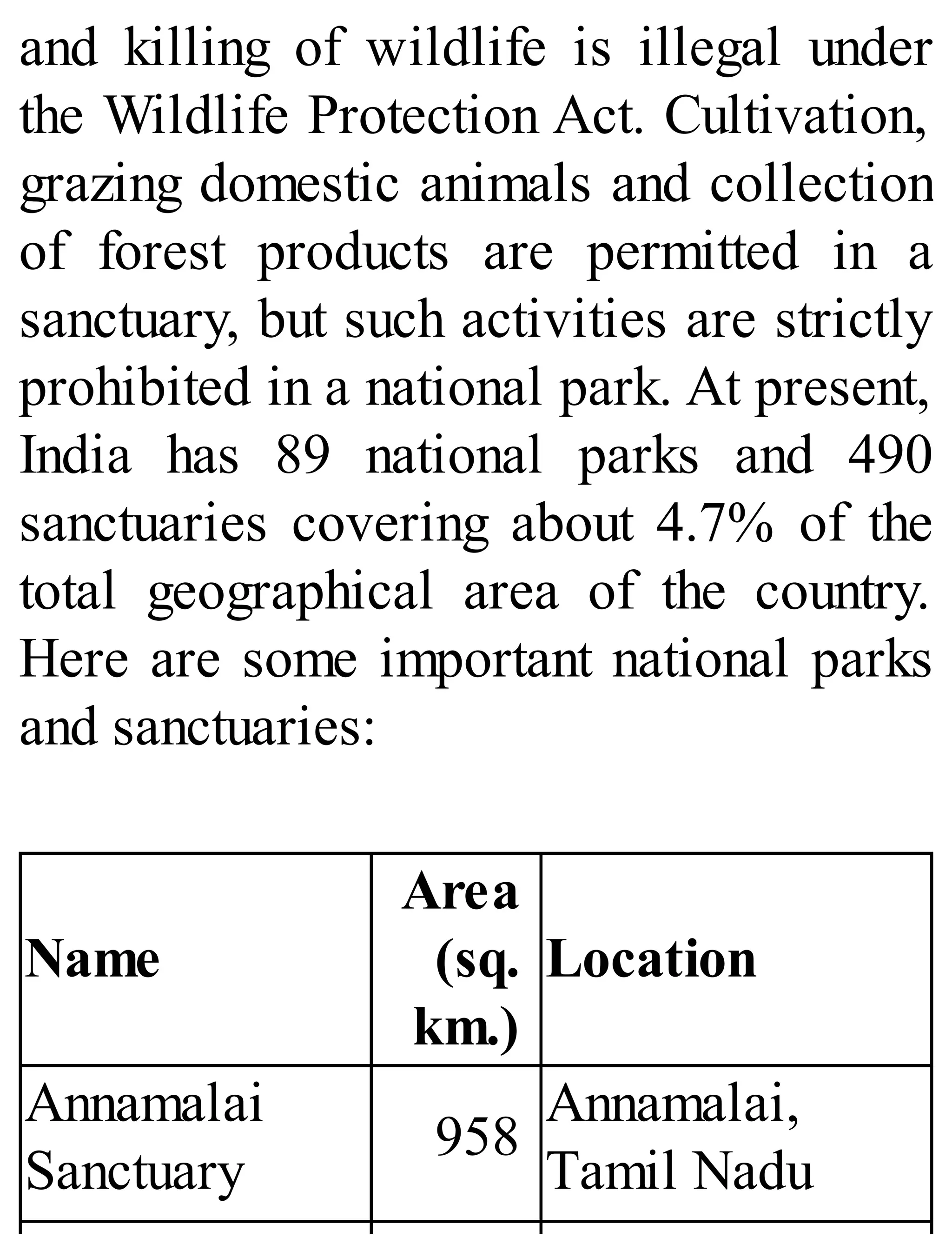
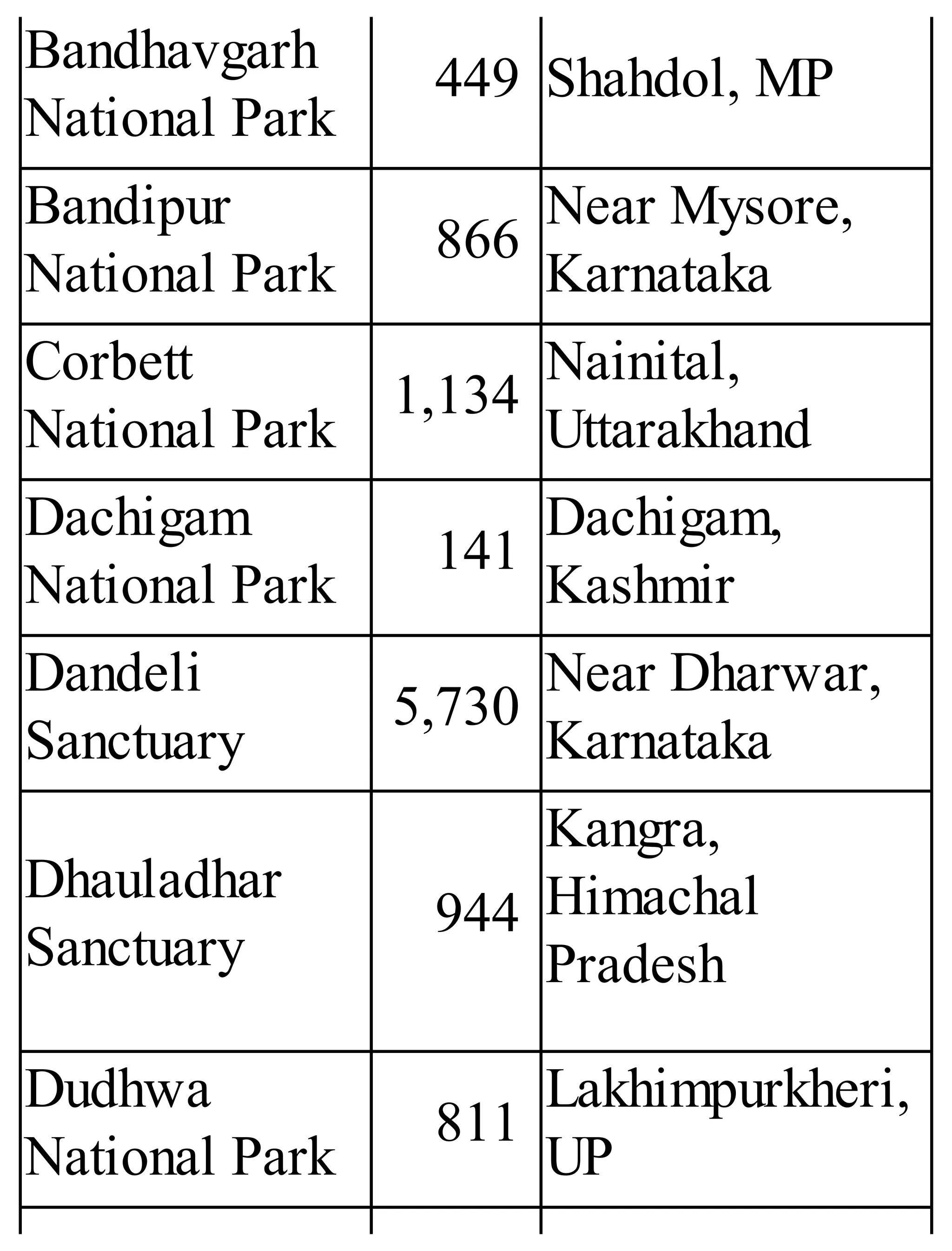
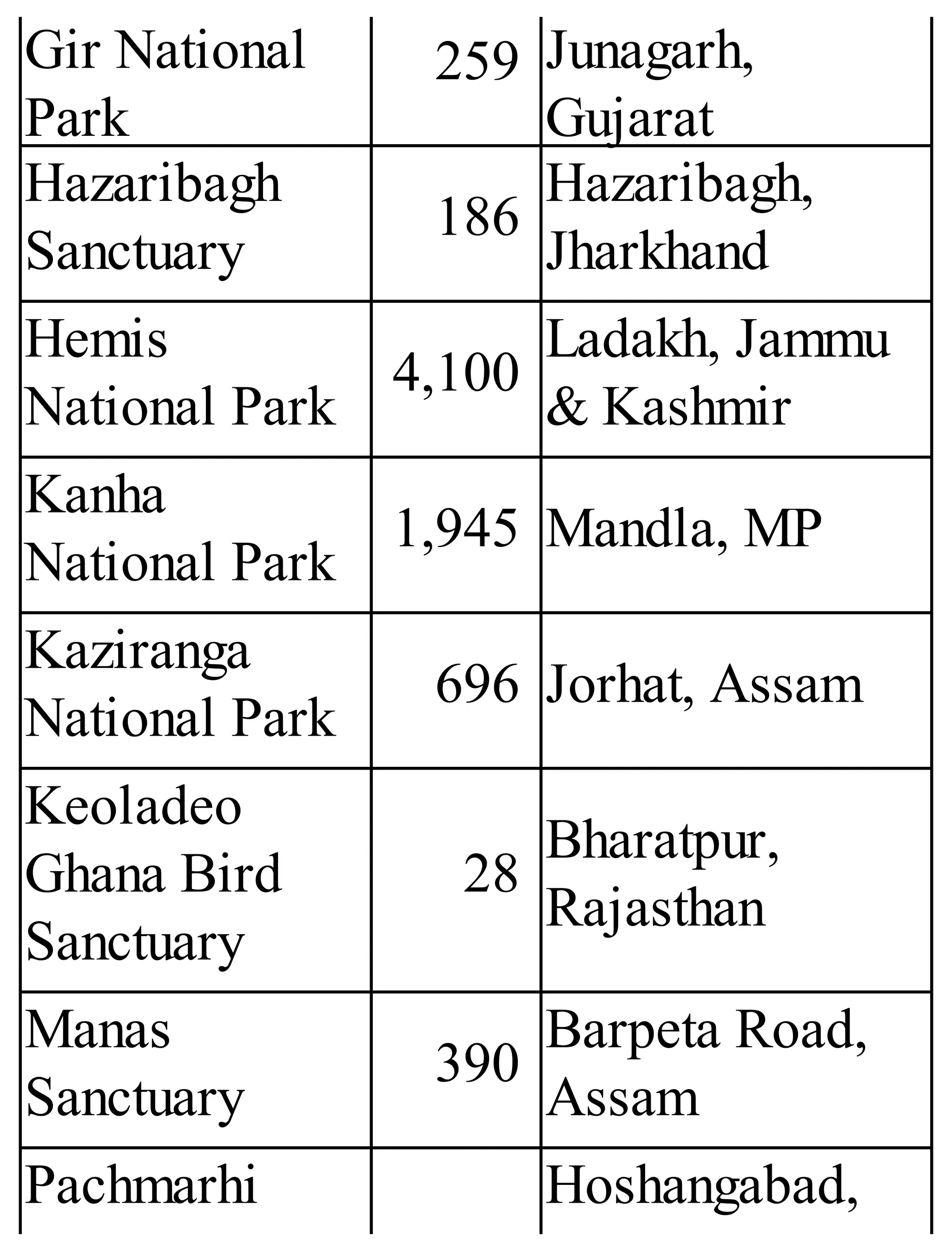
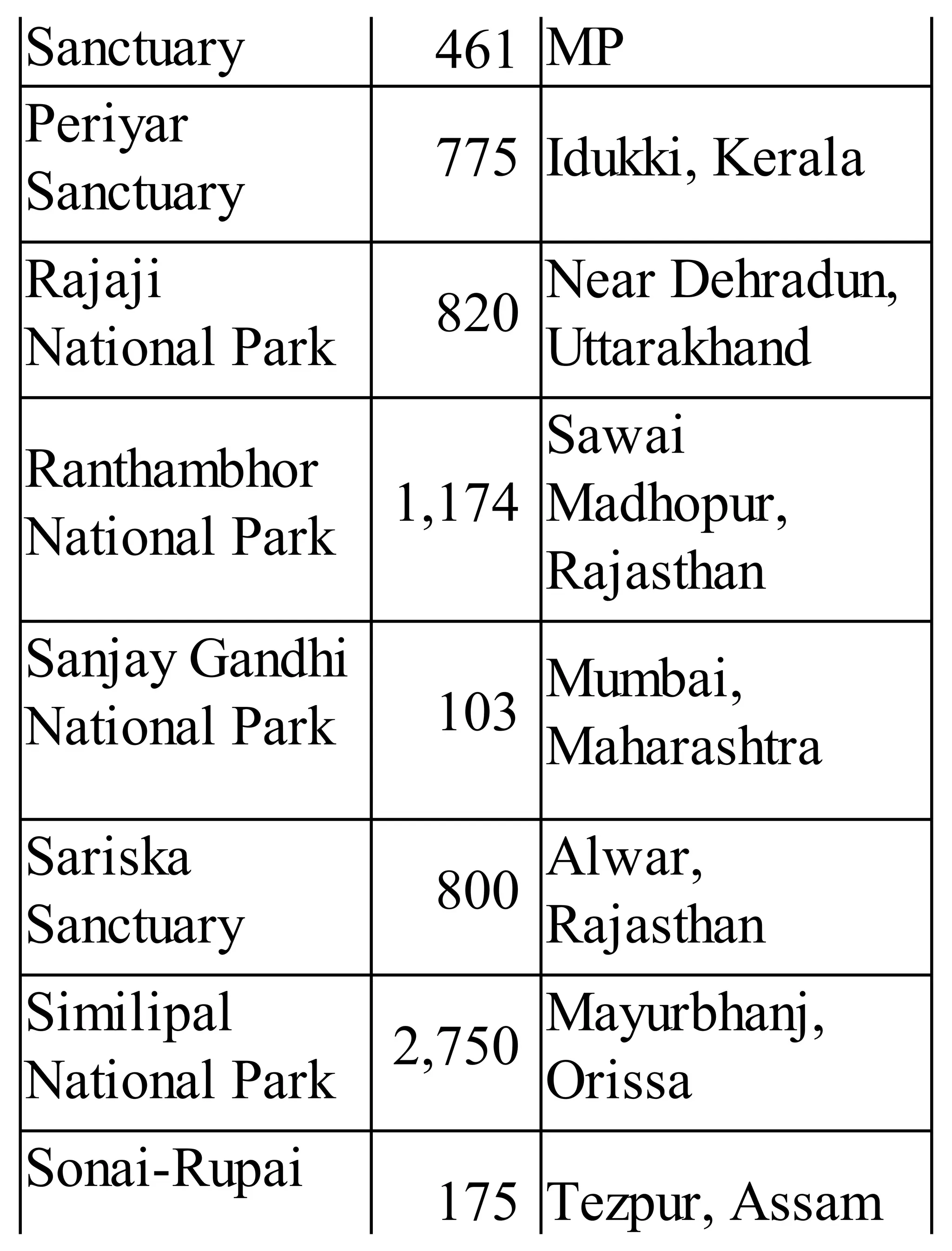
National Parks and Sanctuaries
Famous Sites (India)
Famous Sites (World)
India’s Superlatives
World’s Superlatives
Seven Wonders of the Ancient World
Museums in India
United Nations
Nobel Prize
Indian Nobel Laureates
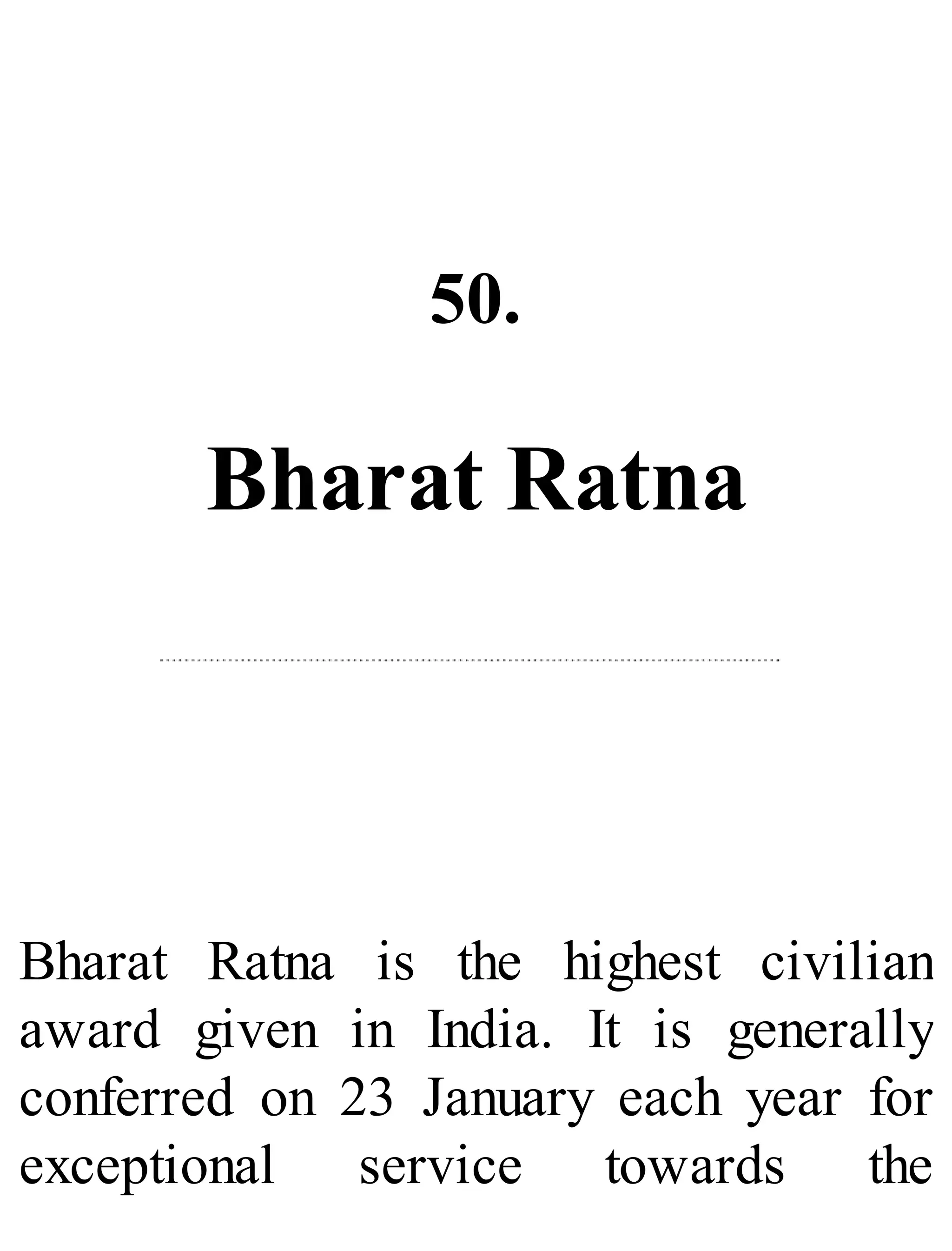
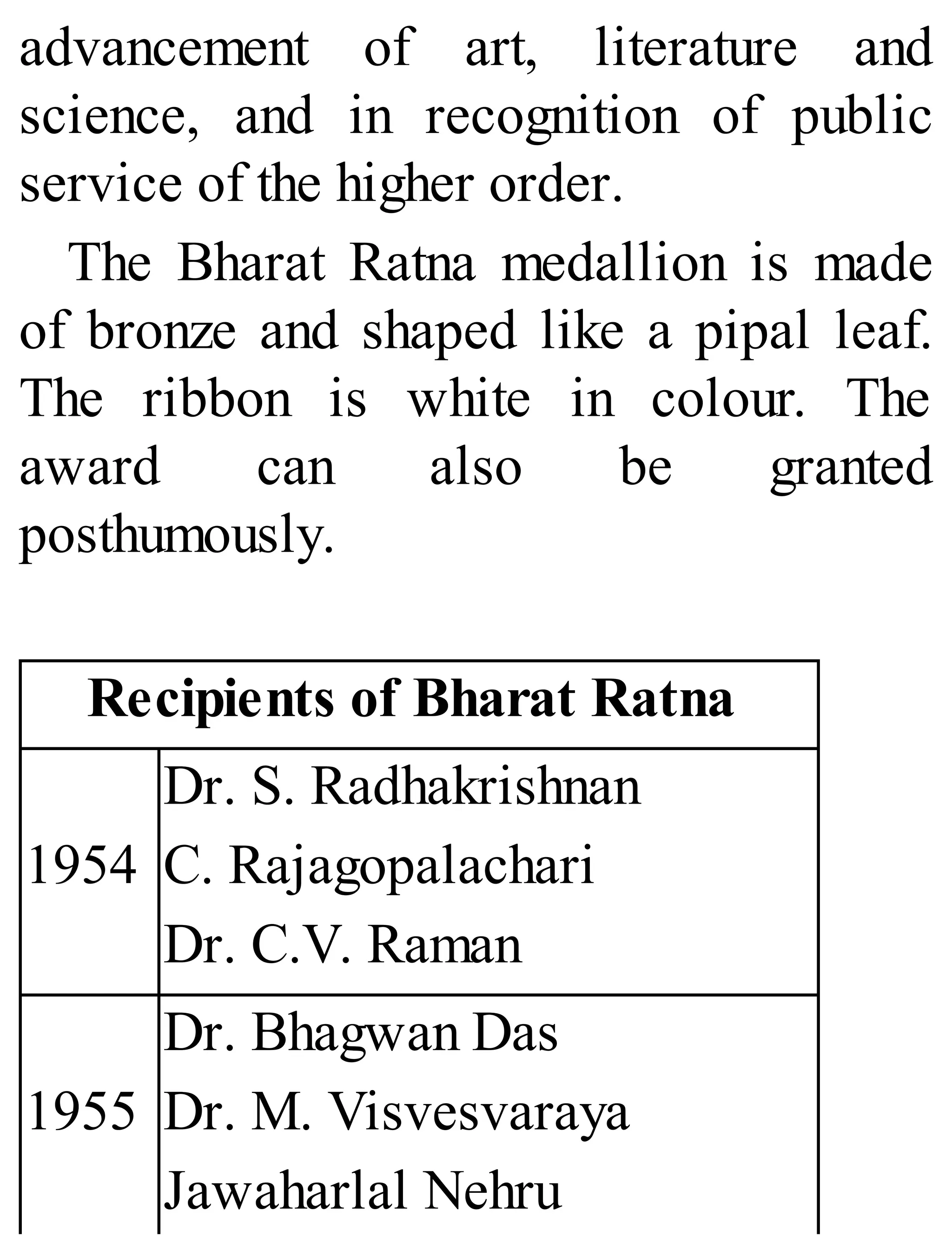
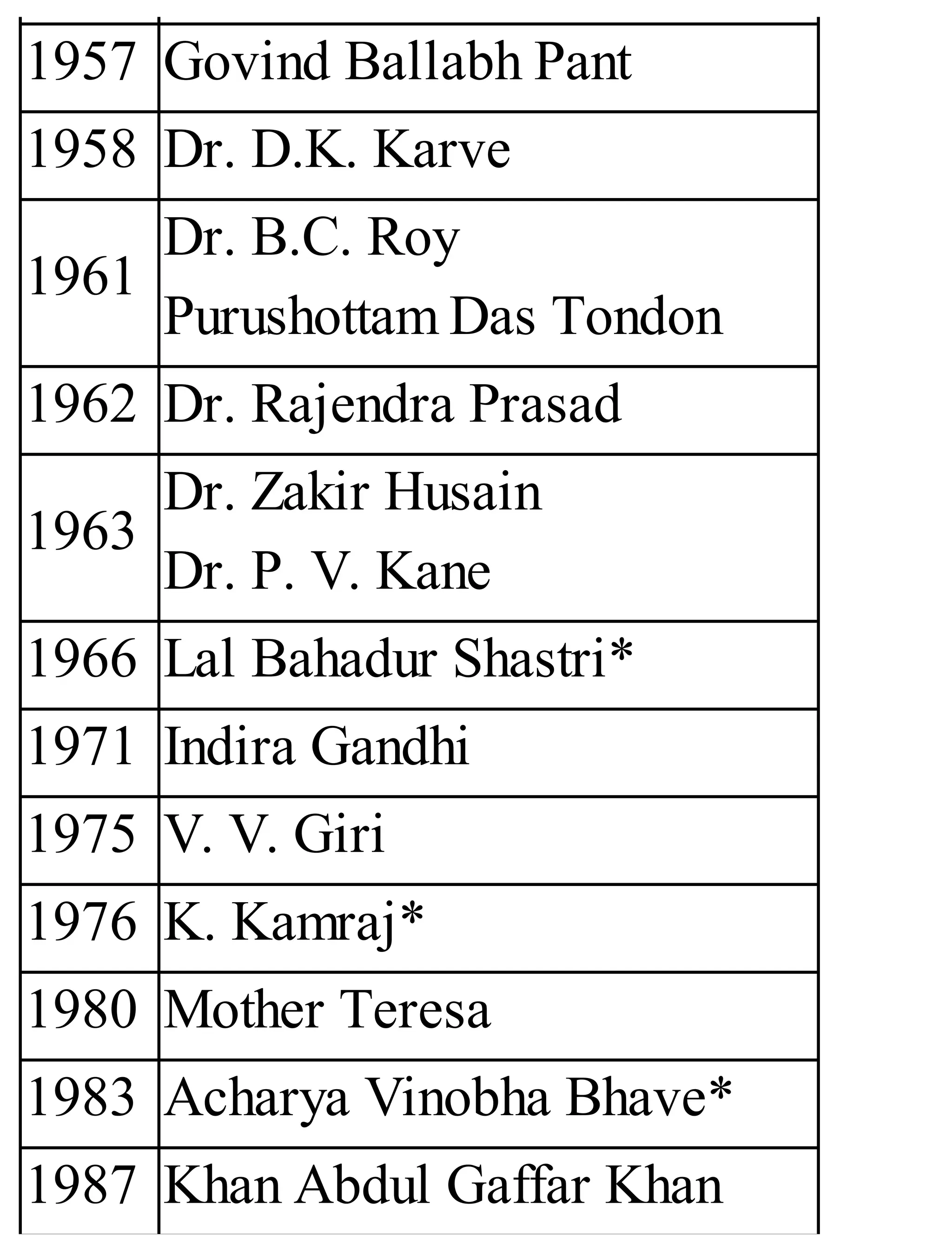
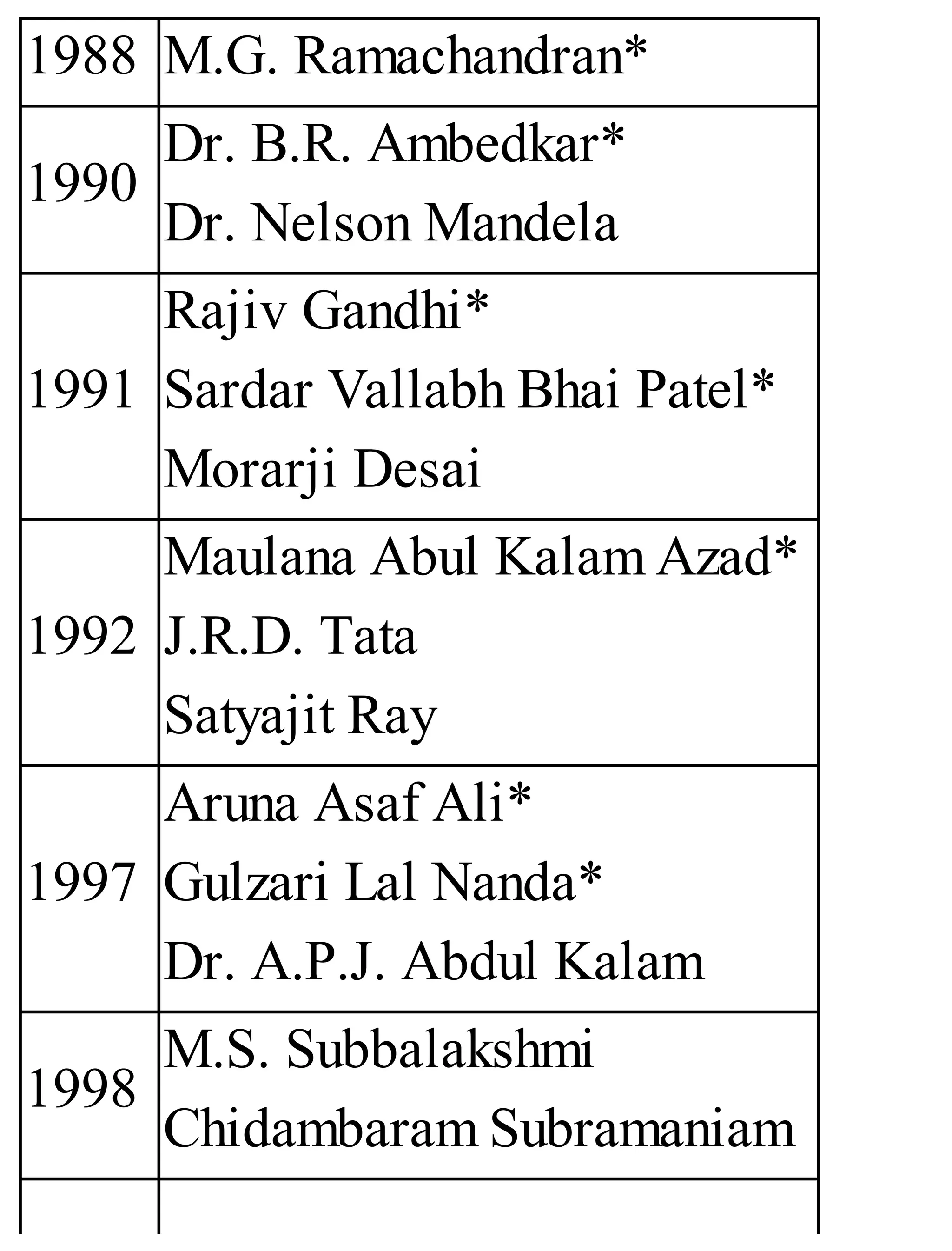
Bharat Ratna
National Awards
Inventions
Scientific Discoveries
Scientific Instruments
Branches of Science
The Planets
Body Facts
Vitamins
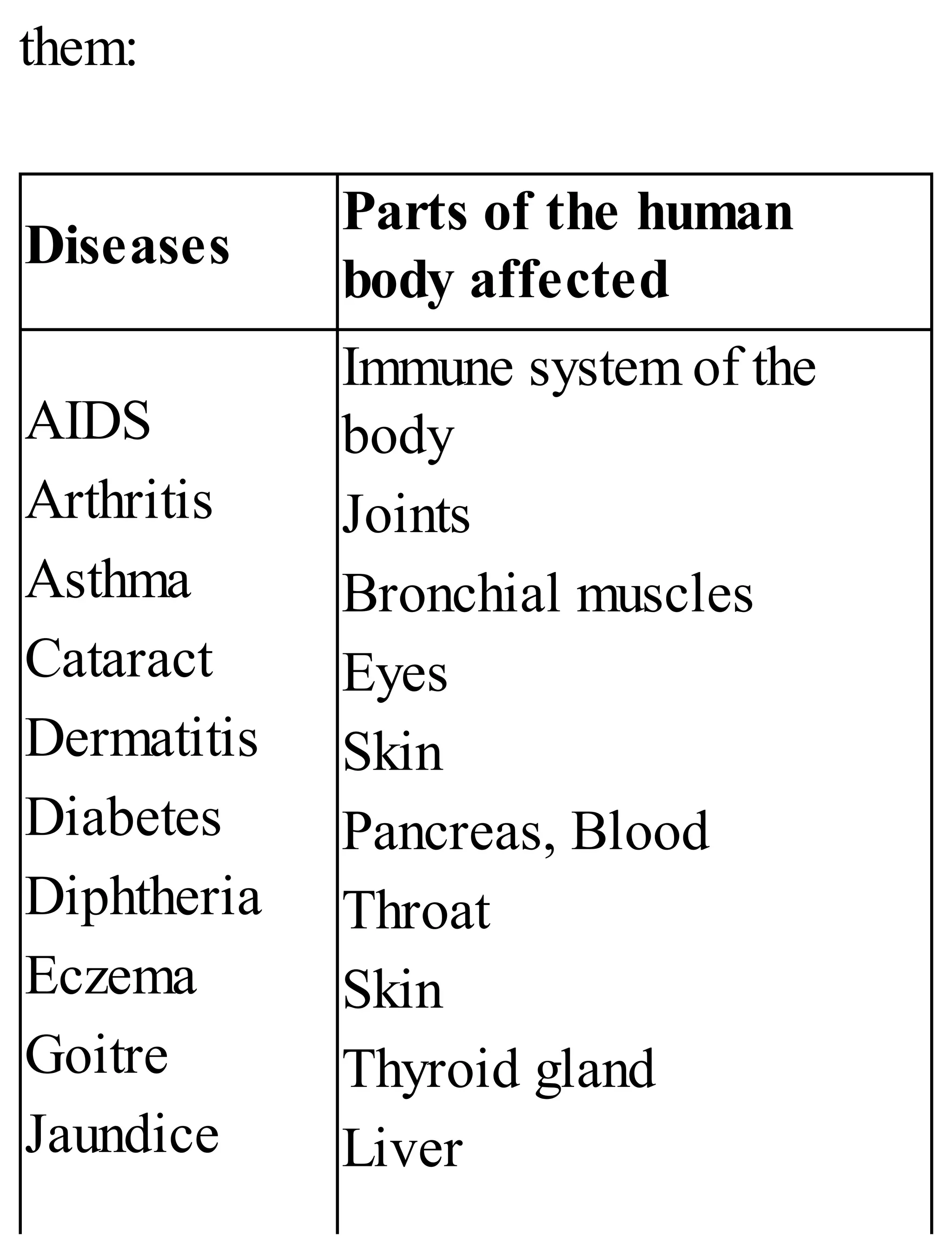
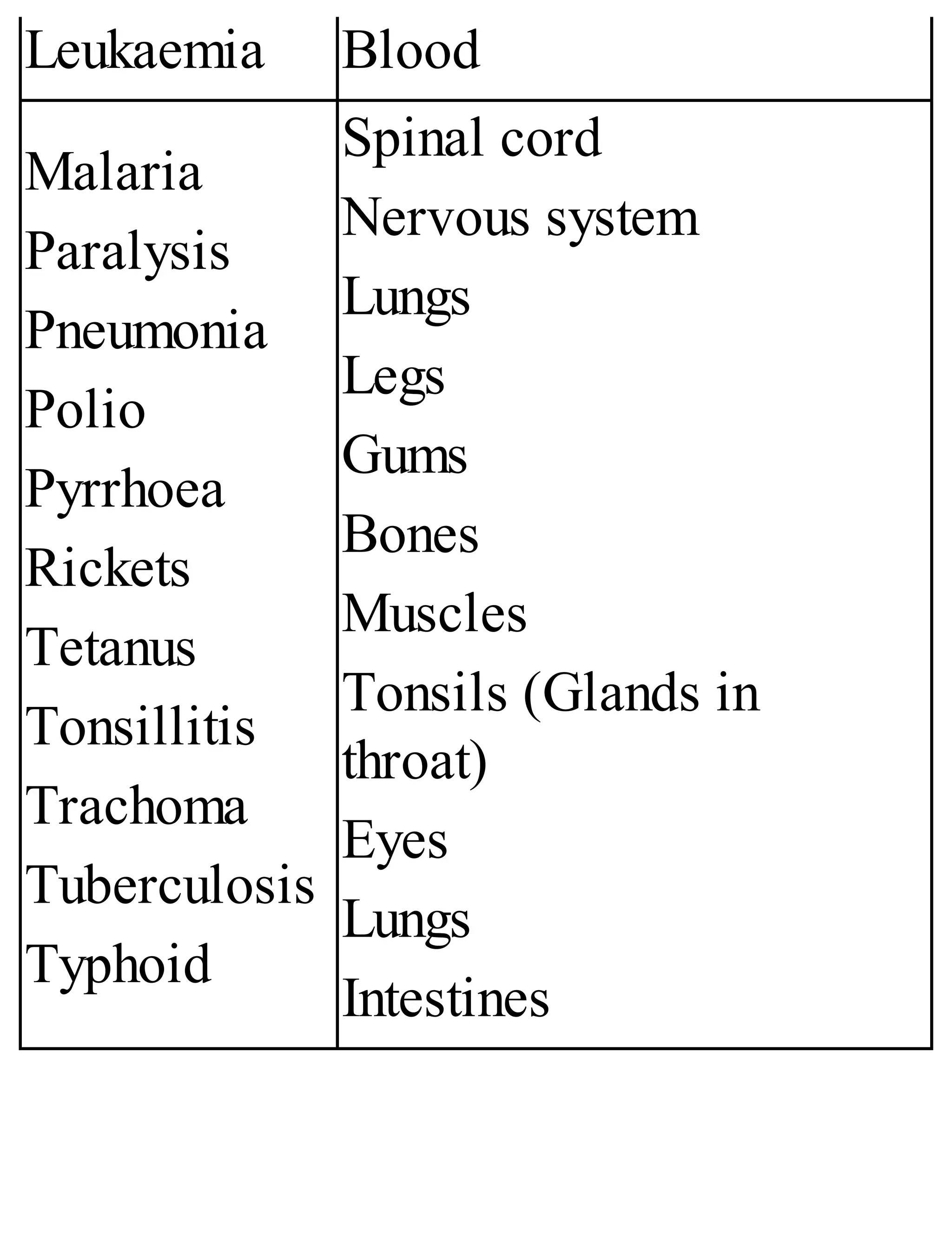
Diseases and Human Body
Festivals of India
Major Religions
Important Days
Important events in Indian History
Important events in World History
Fictional Characters and their Creators
Defining Places
Different Subjects
Professionals
Important Terms
World Records held by India(ns)
Newspapers and Periodicals
The Top 5
Miscellaneous
Quiz
Answers
Index
Preface
Student’s Encyclopedia of General
Knowledge provides the best of GK to
its readers. This handy volume is a
useful source of information and
reference, particularly for students of
classes III to VIII. It is the best reference
work in a single volume for GK teachers
and parents who regularly need to check
facts & figures.
Student’s Encyclopedia of General
Knowledge is a book like no other.
Completely up-to-date, it brings a
wealth of information to the whole class.
The alphabetical order of entries in each
chapter and clear design make the book
an outstanding reference work, while the
lavish and spectacular illustrations
ensure that it is always a pleasure to use.
Every piece of information is authentic
—culled together from several areas of
knowledge ranging from encyclopedias,
fact books, year books, official
government releases, internet and other
reliable sources—and verified for
accuracy.
This book is full of features that aim to
provide useful data in an easily
accessible format. The contents cover a
wide range of subjects including
language & literature, sports & culture,
people & places, history & geography,
science & technology, mythology &
current affairs, etc. ‘Believe It or Not’
boxes contain interesting and amazing
facts. Quiz, given at the end, is an
exciting way to test your knowledge. It
contains 200 important questions based
on the contents of the book. A
comprehensive index helps to find out a
topic quickly.
Once you are convinced that Student’s
Encyclopedia of General Knowledge is
truly a book like no other, kindly
recommend it to your students along with
their school curriculum. It would help
them to broaden their field of
knowledge.
This book will be updated and revised
annually, and published every year in a
new edition. We would welcome
responses from students, teachers and
parents about how useful they found the
book, and any suggestions they might
have towards its improvement. You can
keep in touch with the editors directly.
E-mail them at
generalpressindia@gmail.com. Looking
forward for your comments and
suggestions.
—Publishers
Albert Einstein
1.
Common
Abbreviations
An abbreviation is a short form of a
word or a group of words. They are
commonly used because they save time
and space. Here are some common
abbreviations:
AD — Anno Domini (in the year of Our
Lord)
AIDS — Acquired Immune Deficiency
Syndrome
AIIMS — All India Institute of Medical
Sciences
AIR — All India Radio
a.m. — ante meridiem (before noon)
AMU — Aligarh Muslim University
AP — Associated Press
ATM — Automated Teller Machine
B&W — Black and White
BA — Bachelor of Arts
B B C — British Broadcasting
Corporation
BC — Before Christ
BEd. — Bachelor of Education
BP — Blood Pressure
BSc. — Bachelor of Science
BSF — Border Security Force
B S N L — Bharat Sanchar Nigam
Limited
CA — Chartered Accountant
CBI — Central Bureau of Investigation
CBSE — Central Board of Secondary
Education
CBT — Children’s Book Trust
CFL — Compact Fluorescent Lamp
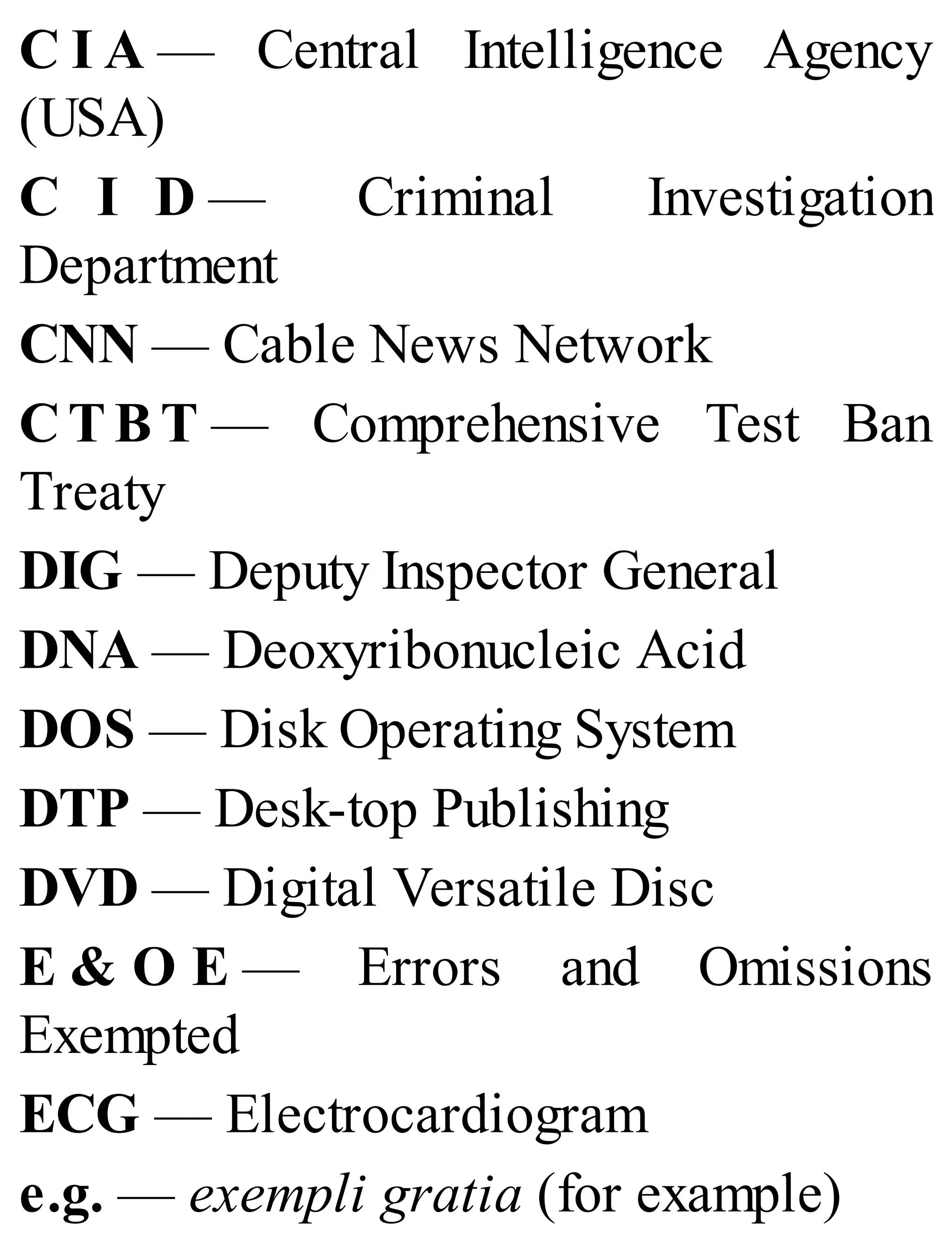
C I A — Central Intelligence Agency
(USA)
C I D — Criminal Investigation
Department
CNN — Cable News Network
CTB T — Comprehensive Test Ban
Treaty
DIG — Deputy Inspector General
DNA — Deoxyribonucleic Acid
DOS — Disk Operating System
DTP — Desk-top Publishing
DVD — Digital Versatile Disc
E & O E — Errors and Omissions
Exempted
ECG — Electrocardiogram
e.g. — exempli gratia (for example)
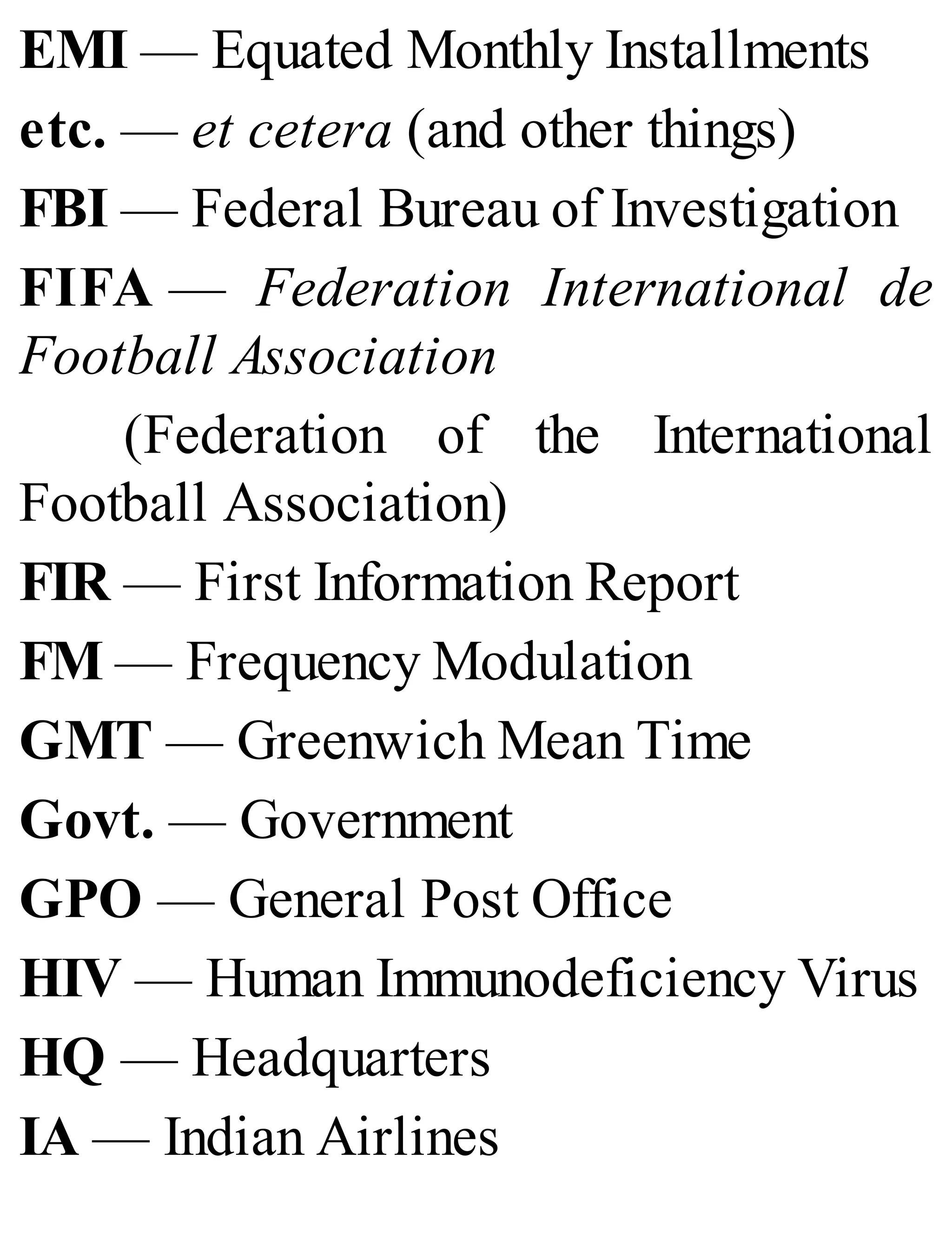
EMI — Equated Monthly Installments
etc. — et cetera (and other things)
FBI — Federal Bureau of Investigation
FIFA — Federation International de
Football Association
(Federation of the International
Football Association)
FIR — First Information Report
FM — Frequency Modulation
GMT — Greenwich Mean Time
Govt. — Government
GPO — General Post Office
HIV — Human Immunodeficiency Virus
HQ — Headquarters
IA — Indian Airlines
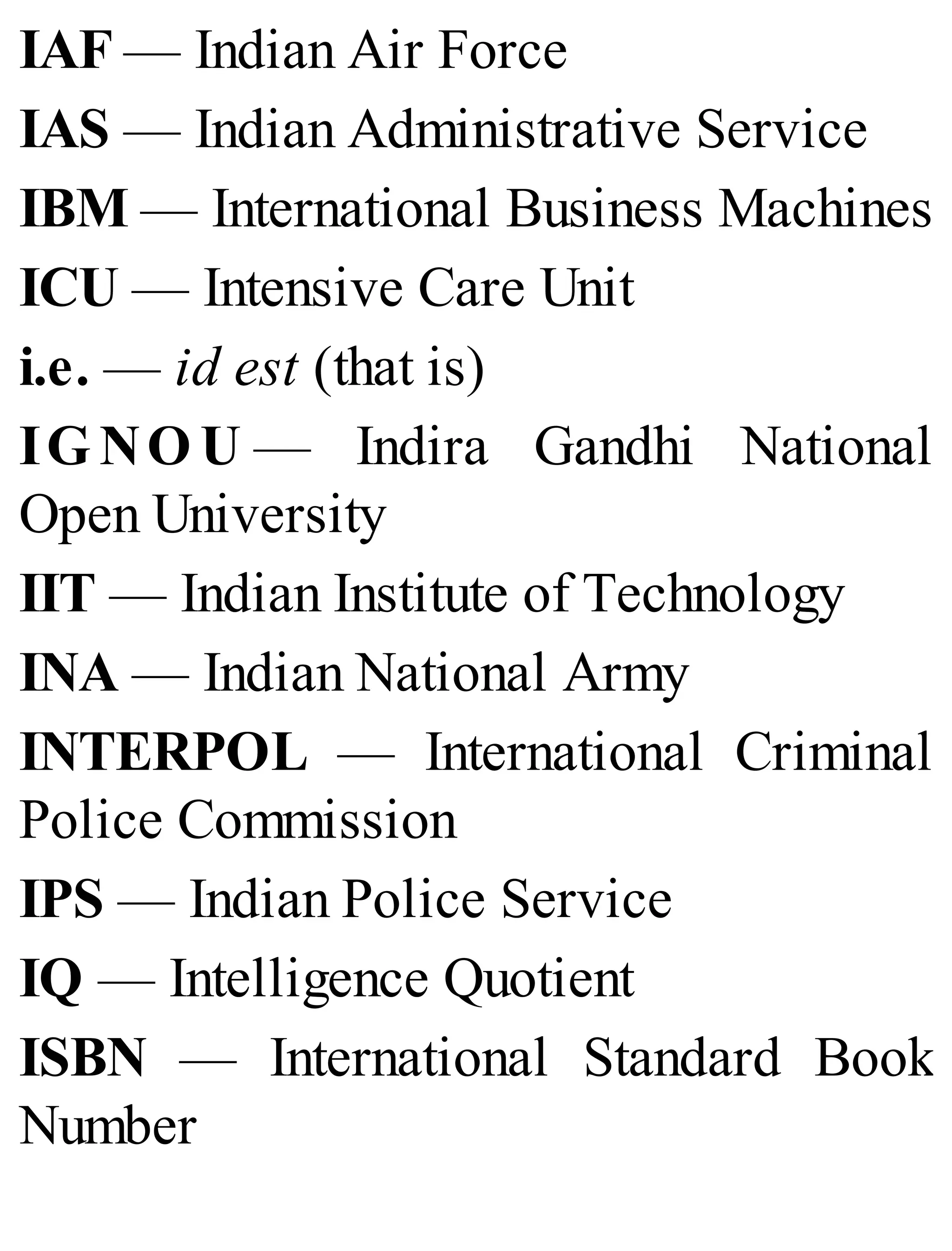
IAF — Indian Air Force
IAS — Indian Administrative Service
IBM — International Business Machines
ICU — Intensive Care Unit
i.e. — id est (that is)
IG NO U — Indira Gandhi National
Open University
IIT — Indian Institute of Technology
INA — Indian National Army
INTERPOL — International Criminal
Police Commission
IPS — Indian Police Service
IQ — Intelligence Quotient
ISBN — International Standard Book
Number
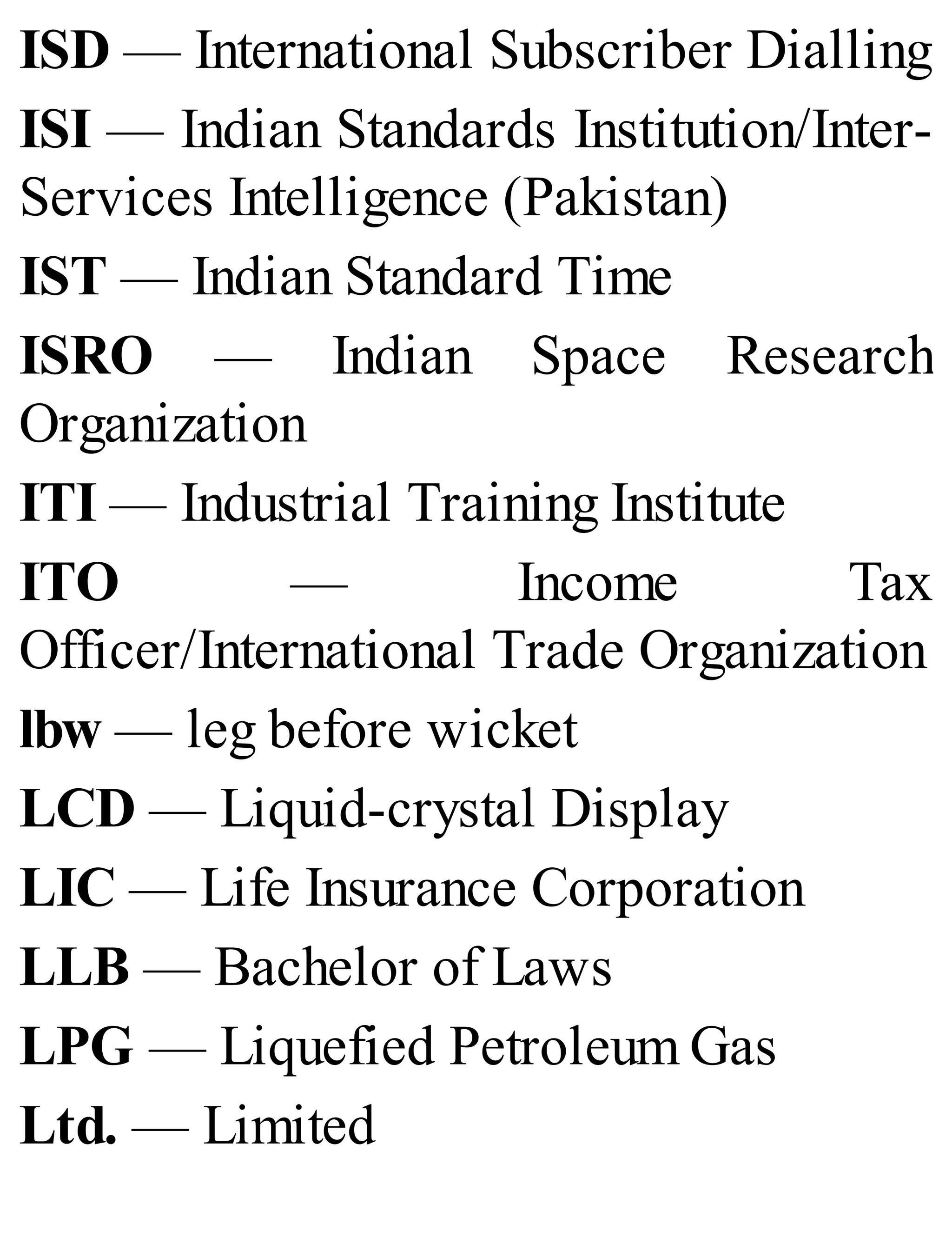
ISD — International Subscriber Dialling
ISI — Indian Standards Institution/Inter-
Services Intelligence (Pakistan)
IST — Indian Standard Time
ISRO — Indian Space Research
Organization
ITI — Industrial Training Institute
ITO — Income Tax
Officer/International Trade Organization
lbw — leg before wicket
LCD — Liquid-crystal Display
LIC — Life Insurance Corporation
LLB — Bachelor of Laws
LPG — Liquefied Petroleum Gas
Ltd. — Limited
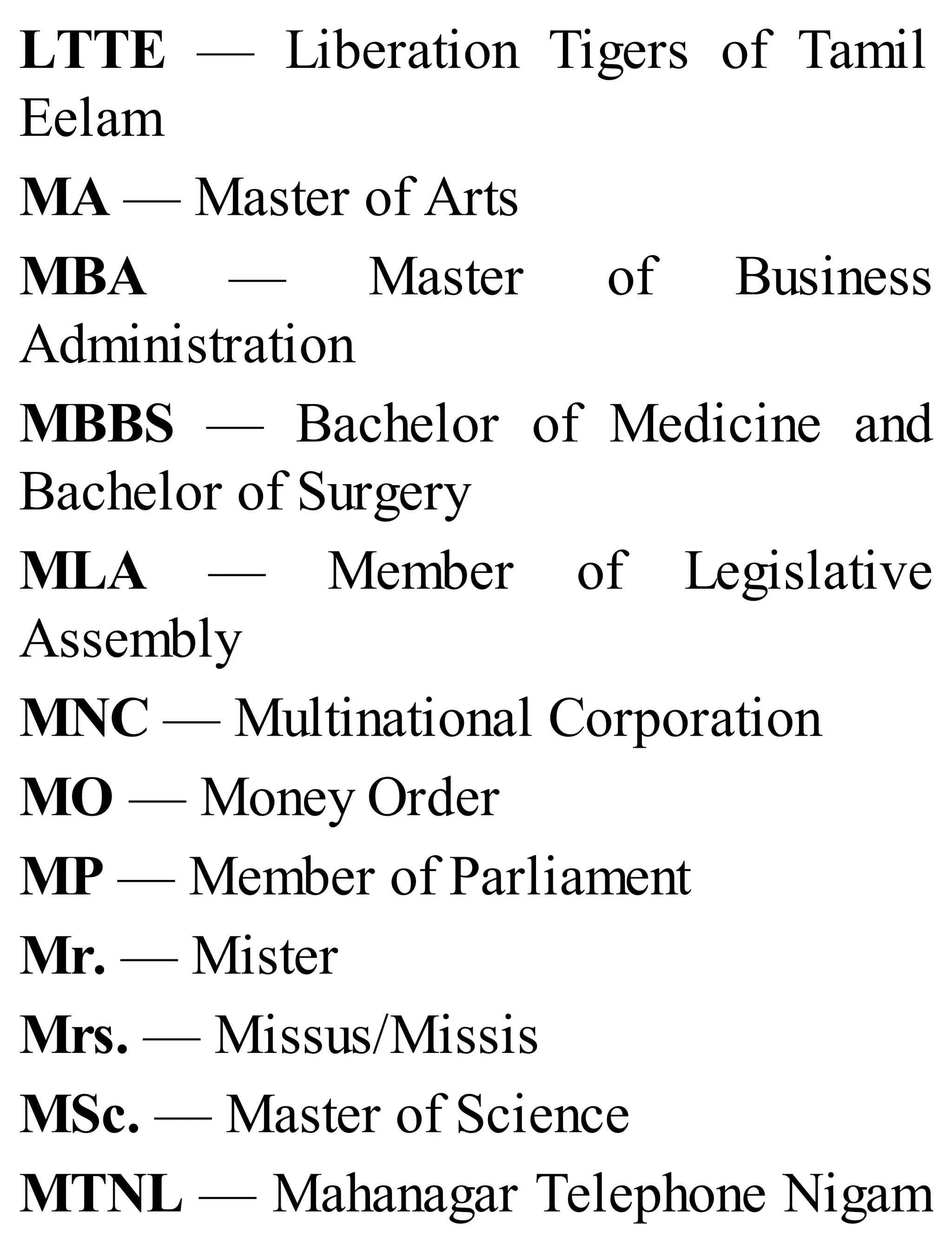
LTTE — Liberation Tigers of Tamil
Eelam
MA — Master of Arts
MBA — Master of Business
Administration
MBBS — Bachelor of Medicine and
Bachelor of Surgery
MLA — Member of Legislative
Assembly
MNC — Multinational Corporation
MO — Money Order
MP — Member of Parliament
Mr. — Mister
Mrs. — Missus/Missis
MSc. — Master of Science
MTNL — Mahanagar Telephone Nigam
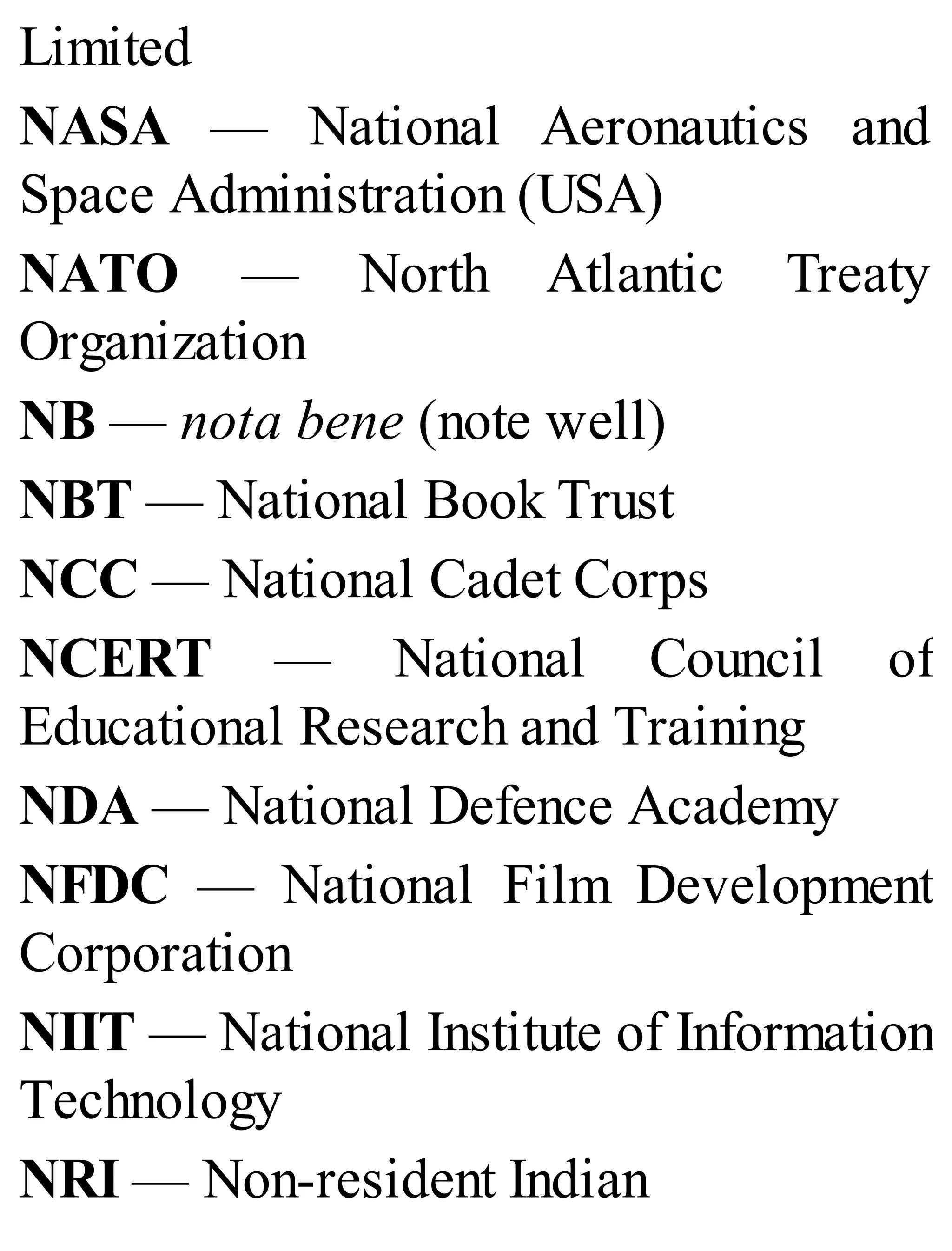
Limited
NASA — National Aeronautics and
Space Administration (USA)
NATO — North Atlantic Treaty
Organization
NB — nota bene (note well)
NBT — National Book Trust
NCC — National Cadet Corps
NCERT — National Council of
Educational Research and Training
NDA — National Defence Academy
NFDC — National Film Development
Corporation
NIIT — National Institute of Information
Technology
NRI — Non-resident Indian
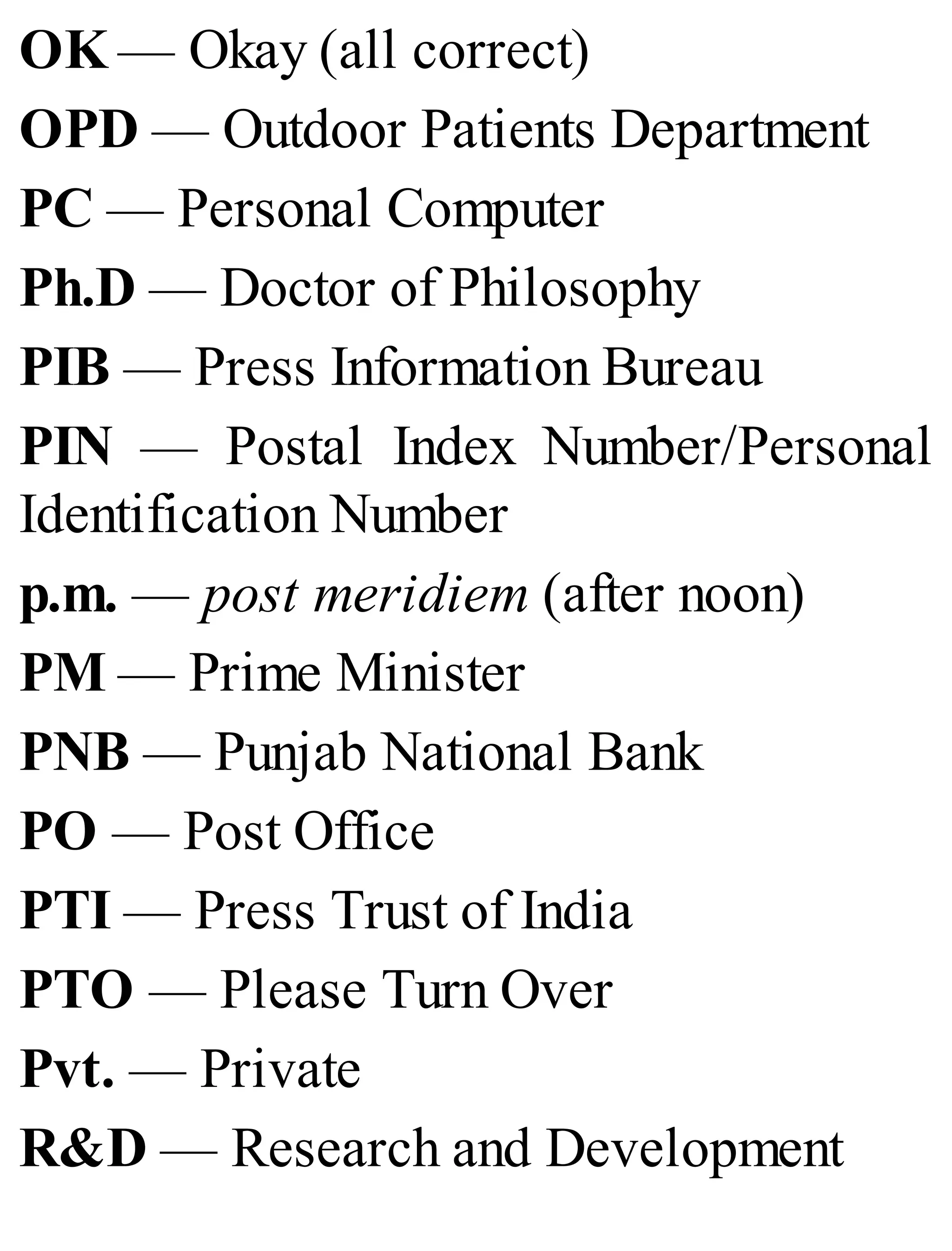
OK — Okay (all correct)
OPD — Outdoor Patients Department
PC — Personal Computer
Ph.D — Doctor of Philosophy
PIB — Press Information Bureau
PIN — Postal Index Number/Personal
Identification Number
p.m. — post meridiem (after noon)
PM — Prime Minister
PNB — Punjab National Bank
PO — Post Office
PTI — Press Trust of India
PTO — Please Turn Over
Pvt. — Private
R&D — Research and Development
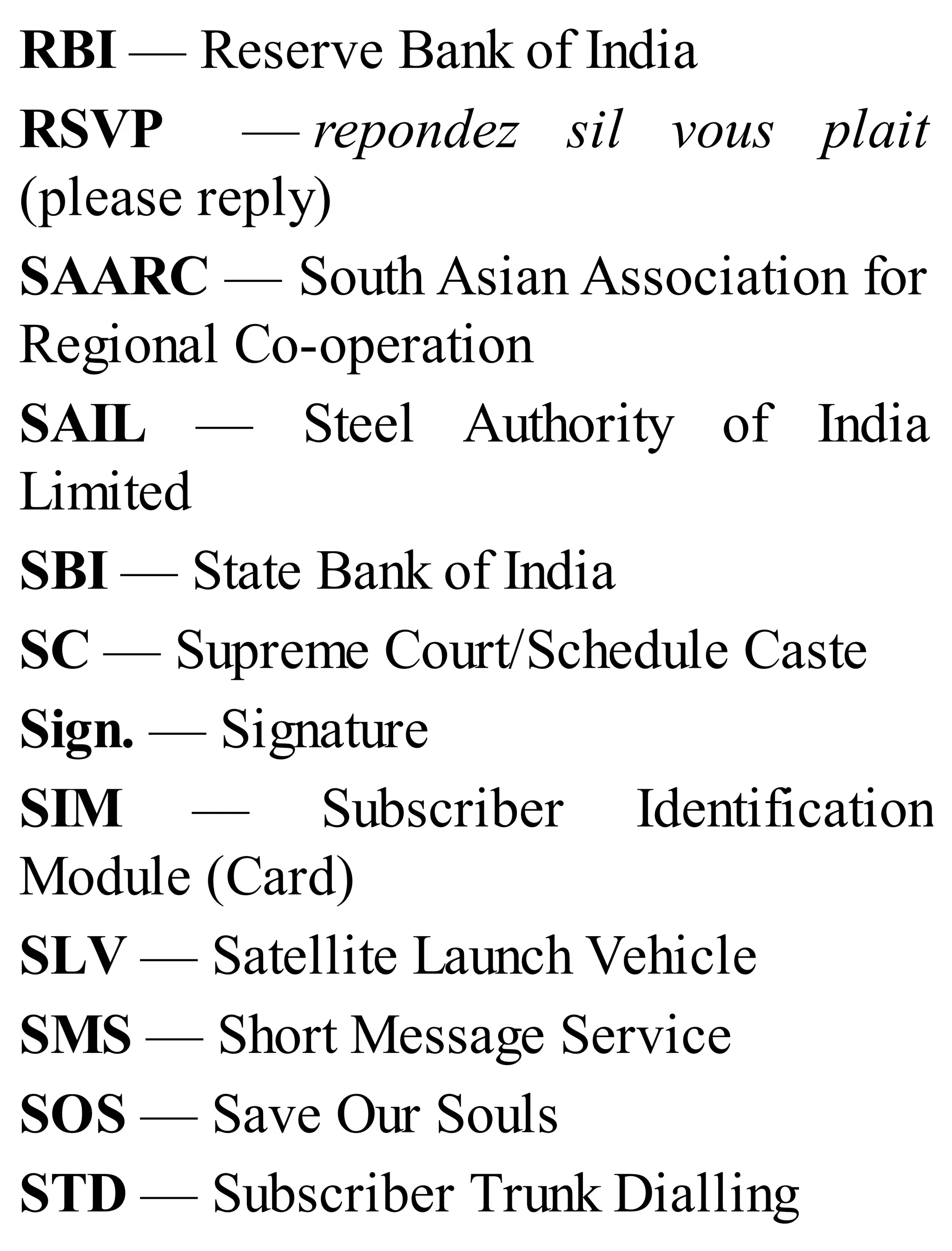
RBI — Reserve Bank of India
RSVP — repondez sil vous plait
(please reply)
SAARC — South Asian Association for
Regional Co-operation
SAIL — Steel Authority of India
Limited
SBI — State Bank of India
SC — Supreme Court/Schedule Caste
Sign. — Signature
SIM — Subscriber Identification
Module (Card)
SLV — Satellite Launch Vehicle
SMS — Short Message Service
SOS — Save Our Souls
STD — Subscriber Trunk Dialling
TTE — Train Ticket Examiner
UFO — Unidentified Flying Object
UNESCO — United Nations
Educational, Scientific and Cultural
Organization
UNI — United News of India
UNICEF — United Nations Children’s
Fund
UNO — United Nations Organization
UPSC — Union Public Service
Commission
via — by way of
VIP — Very Important Person
viz. — videlicet (namely)
VPP — Value Payable Post
vs. — versus (against)
WHO — World Health Organization
WWF — Worldwide Fund for Nature
www — worldwide web
Xmas — Christmas
YMCA — Young Men’s Christian
Association
YWCA — Young Women’s Christian
Association
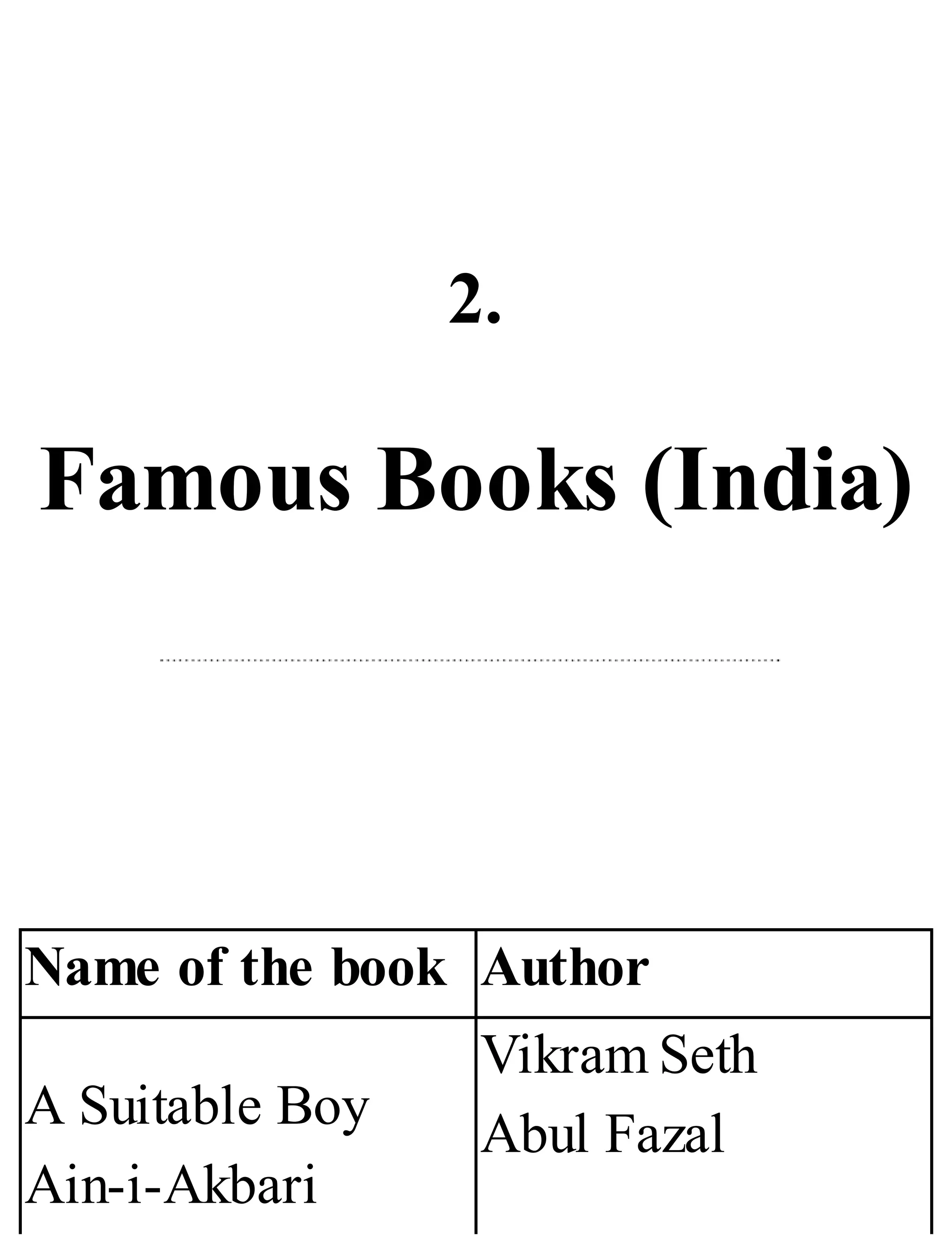
2.
Famous Books (India)
Name of the book Author
A Suitable Boy
Ain-i-Akbari
Vikram Seth
Abul Fazal
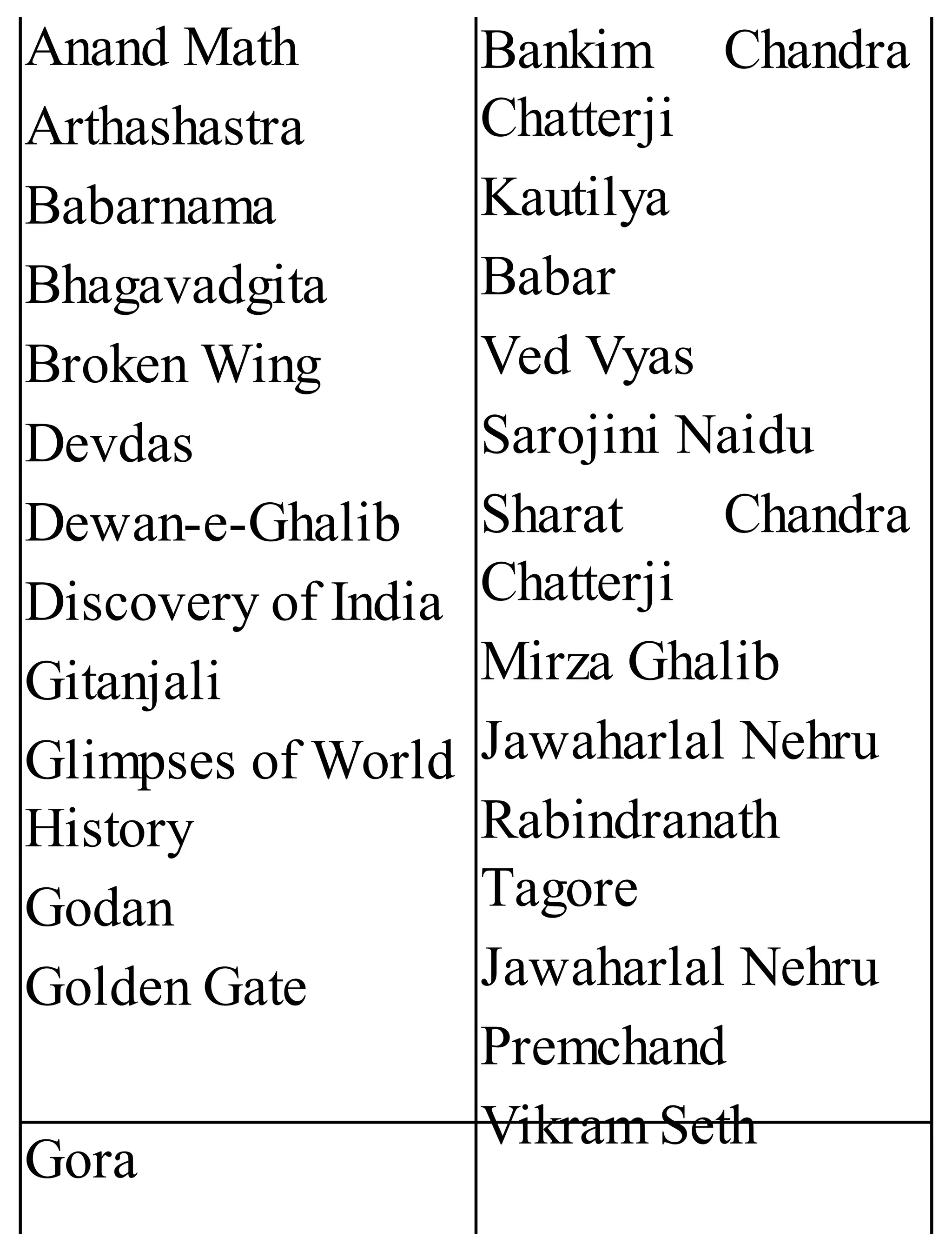
Anand Math
Arthashastra
Babarnama
Bhagavadgita
Broken Wing
Devdas
Dewan-e-Ghalib
Discovery of India
Gitanjali
Glimpses of World
History
Godan
Golden Gate
Bankim Chandra
Chatterji
Kautilya
Babar
Ved Vyas
Sarojini Naidu
Sharat Chandra
Chatterji
Mirza Ghalib
Jawaharlal Nehru
Rabindranath
Tagore
Jawaharlal Nehru
Premchand
Vikram Seth
Gora
Guide
Guru Granth Sahib
India Divided
India Wins
Freedom
Mahabharata
Man-eaters of
Kumaon
Meghdoot
Midnight’s
Children
My Experiments
with Truth
My Truth
Panchatantra
Ram Charit Manas
Rabindranath
Tagore
R.K. Narayan
Guru Arjun Dev
Dr. Rajendra
Prasad
Maulana Abul
Kalam Azad
Ved Vyas
Jim Corbett
Kalidas
Salman Rushdie
Mahatma Gandhi
Indira Gandhi
Vishnu Sharma
Ramayana
Rangbhoomi
Satanic Verses
Shakuntala
Song of India
Sunny Days
The God of Small
Things
Tulsidas
Valmiki
Premchand
Salman Rushdie
Kalidas
Sarojini Naidu
Sunil Gavaskar
Arundhati Roy
Mirza Ghalib
Premchand
3.
Famous Books
(World)
Name of the book Author
E.M. Forster
A Passage to India
A Tale of Two Cities
Adventures of
Sherlock Holmes
Alice in Wonderland
Animal Farm
Arabian Nights
Arms and the Man
Around the World in
Eighty Days
As You Like It
Das Kapital
David Copperfield
Dr. Zhivago
Great Expectations
Charles Dickens
Sir Arthur
Conan Doyle
Lewis Carroll
George Orwell
Sir Richard
Burton
George Bernard
Shaw
Jules Verne
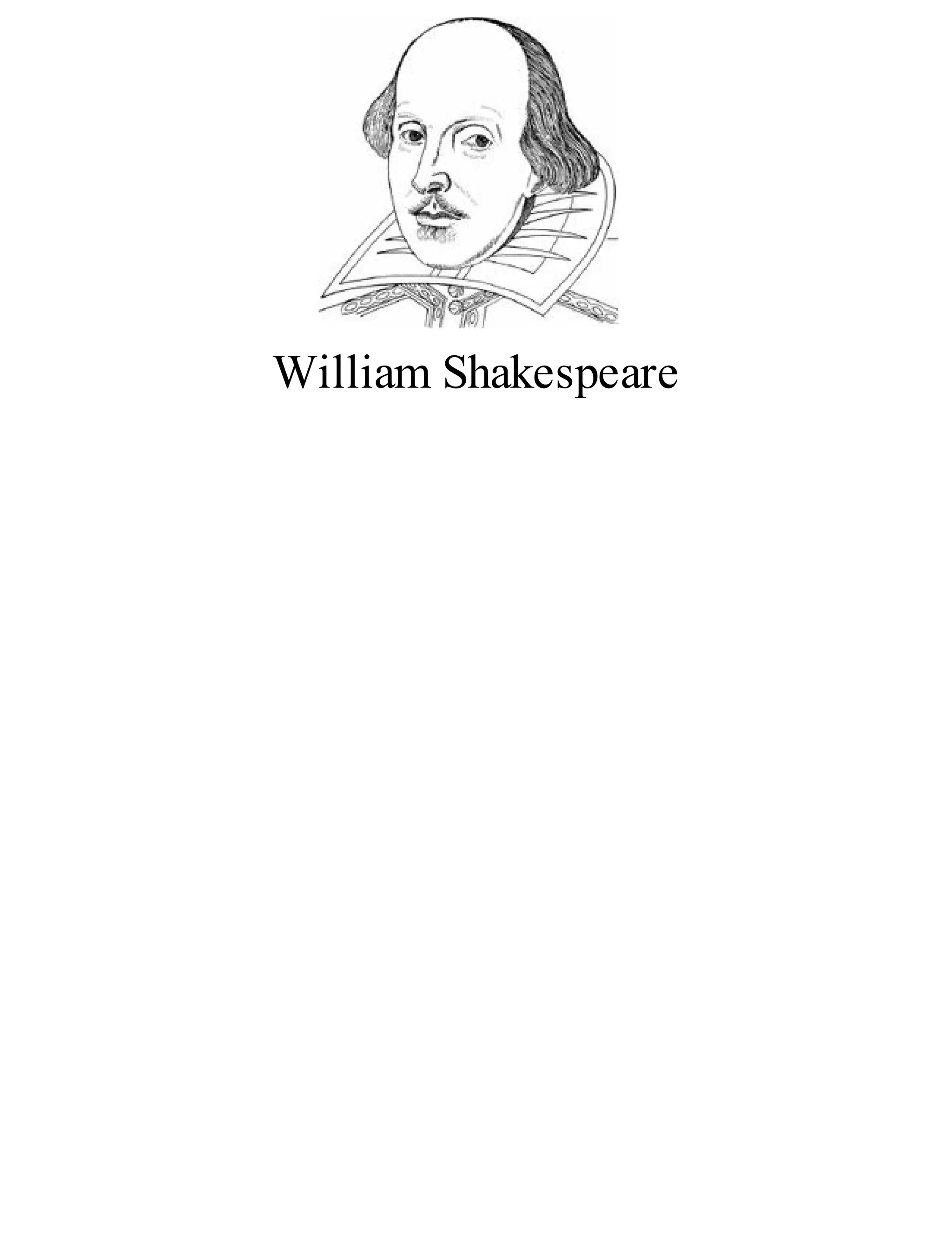
William
Shakespeare
Karl Marx
Charles Dickens
Boris Pasternak
Charles Dickens
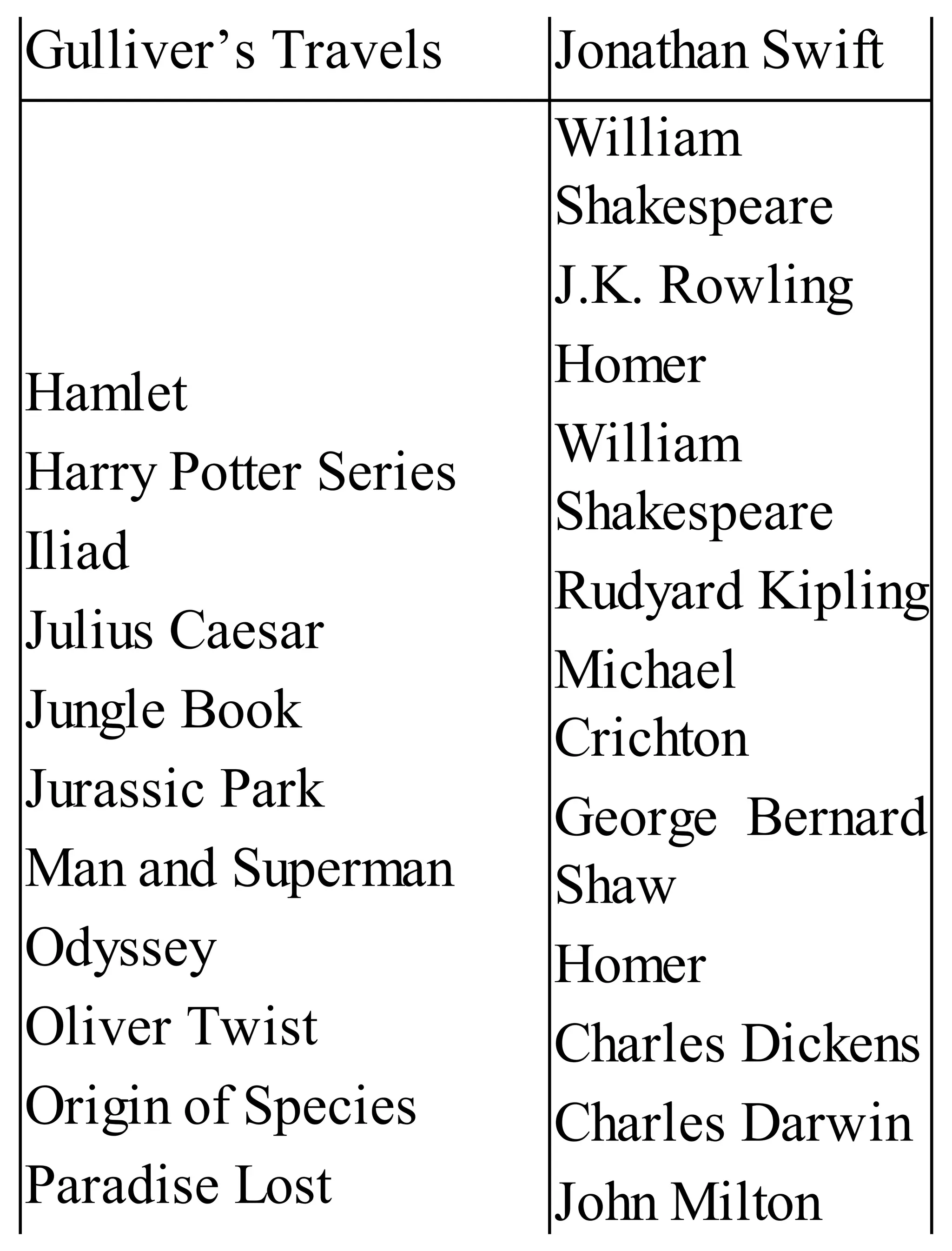
Gulliver’s Travels Jonathan Swift
Hamlet
Harry Potter Series
Iliad
Julius Caesar
Jungle Book
Jurassic Park
Man and Superman
Odyssey
Oliver Twist
Origin of Species
Paradise Lost
William
Shakespeare
J.K. Rowling
Homer
William
Shakespeare
Rudyard Kipling
Michael
Crichton
George Bernard
Shaw
Homer
Charles Dickens
Charles Darwin
John Milton
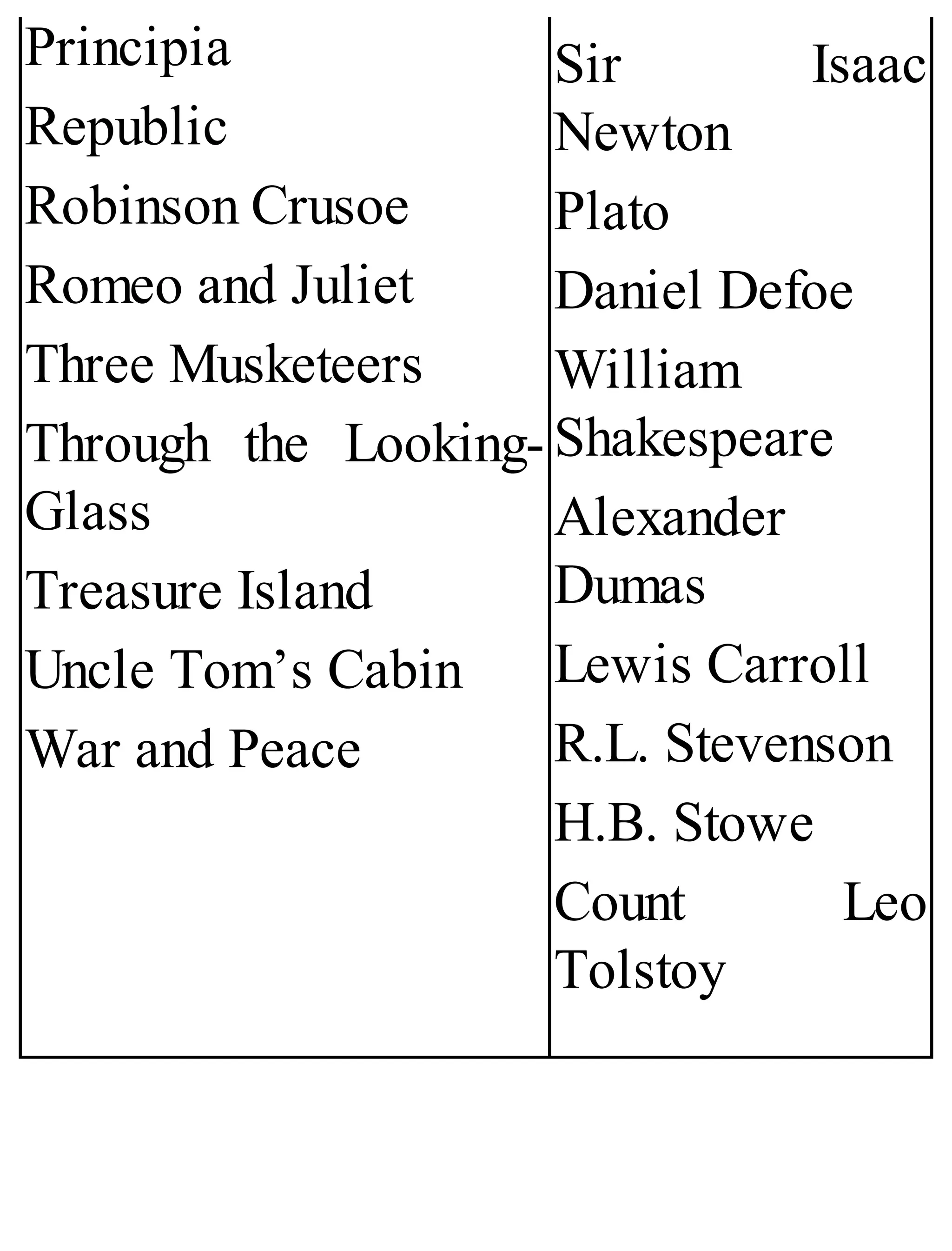
Principia
Republic
Robinson Crusoe
Romeo and Juliet
Three Musketeers
Through the Looking-
Glass
Treasure Island
Uncle Tom’s Cabin
War and Peace
Sir Isaac
Newton
Plato
Daniel Defoe
William
Shakespeare
Alexander
Dumas
Lewis Carroll
R.L. Stevenson
H.B. Stowe
Count Leo
Tolstoy
William Shakespeare
4.
Hello India
NATIONAL SYMBOLS
National Flag
Our National Flag is a tricolour with
deep saffron at the top, white in the
middle and dark green at the bottom in
equal proportion. The ratio of the width
of the flag to its length is 2:3. In the
centre of the white band is a navy blue
wheel known as Ashok Chakra. It has 24
spokes.
Each colour of the flag has its own
significance :
Saffron — signifies courage and
sacrifice
White — signifies truth and peace
Green — signifies faith and prosperity
The wheel is a symbol of progress round
the clock.
National Emblem
Our National Emblem is a Lion Capital,
adopted from the Ashoka’s Pillar at
Sarnath. It has four lions, standing back
to back, mounted on a base. However
only three lions are visible, the fourth
one remains hidden from the front view.
There is a Dharam Chakra in the centre
of the base, on the right of which is a
figure of a bull and on the left that of a
horse. The words Satyamev Jayate
(Truth Alone Triumphs) are inscribed
below the base.
National Anthem
Jana-gana-mana is our National
Anthem. It was composed originally in
Bengali by Rabindranath Tagore. The
playing time of our National Anthem is
about 52 seconds.
National Song
Vande Mataram is our National Song. It
was composed originally in Sanskrit by
Bankim Chandra Chatterji. It has been
taken from his novel Anand Math.
National Calendar
Saka is our National Calendar. Chaitra
is the first month and Phalguna is the
last month of the Saka year. A normal
Saka year has 365 days.
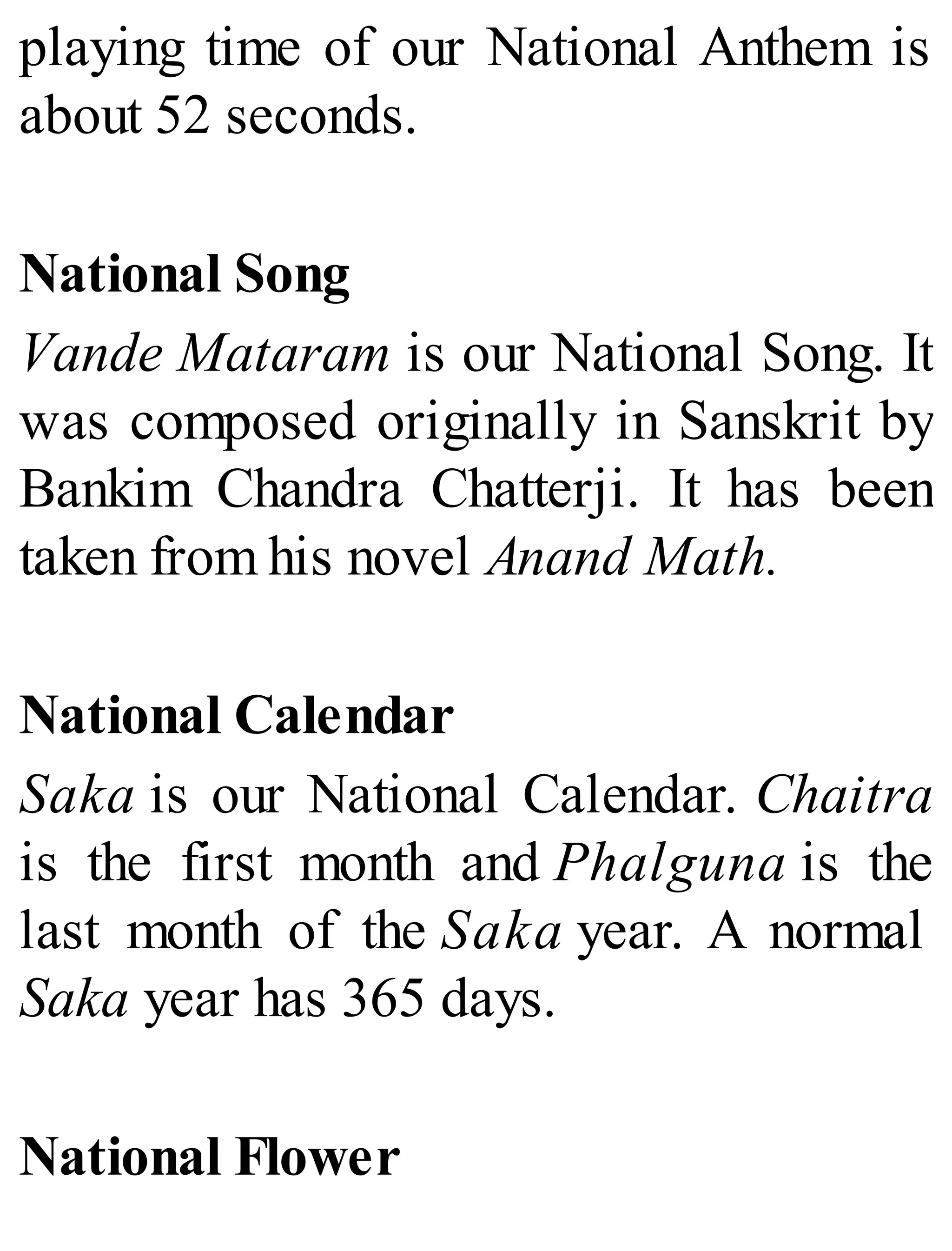
National Flower
Lotus is our National Flower. It is a
sacred flower and occupies a unique
position in the art and mythology of
ancient India.
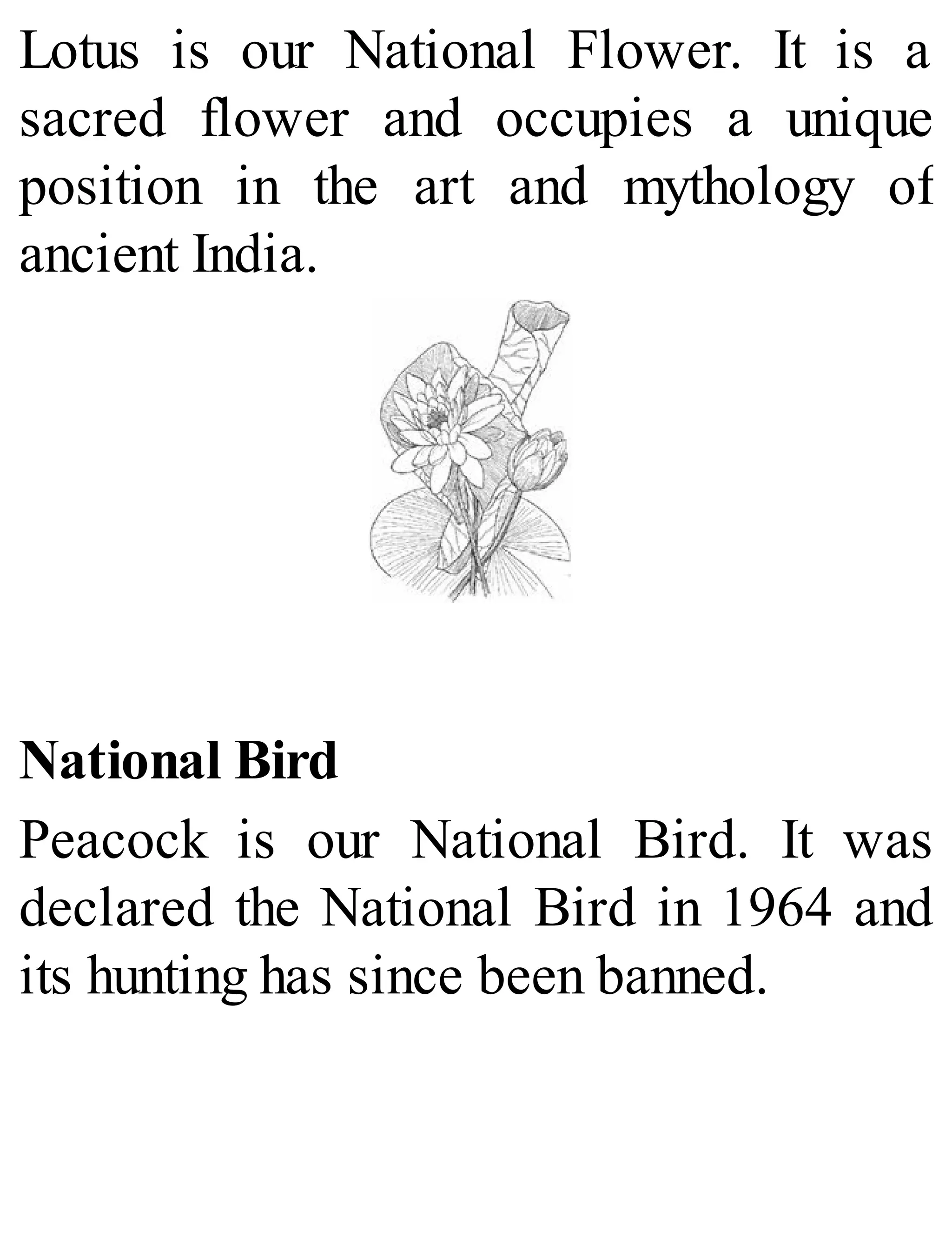
National Bird
Peacock is our National Bird. It was
declared the National Bird in 1964 and
its hunting has since been banned.
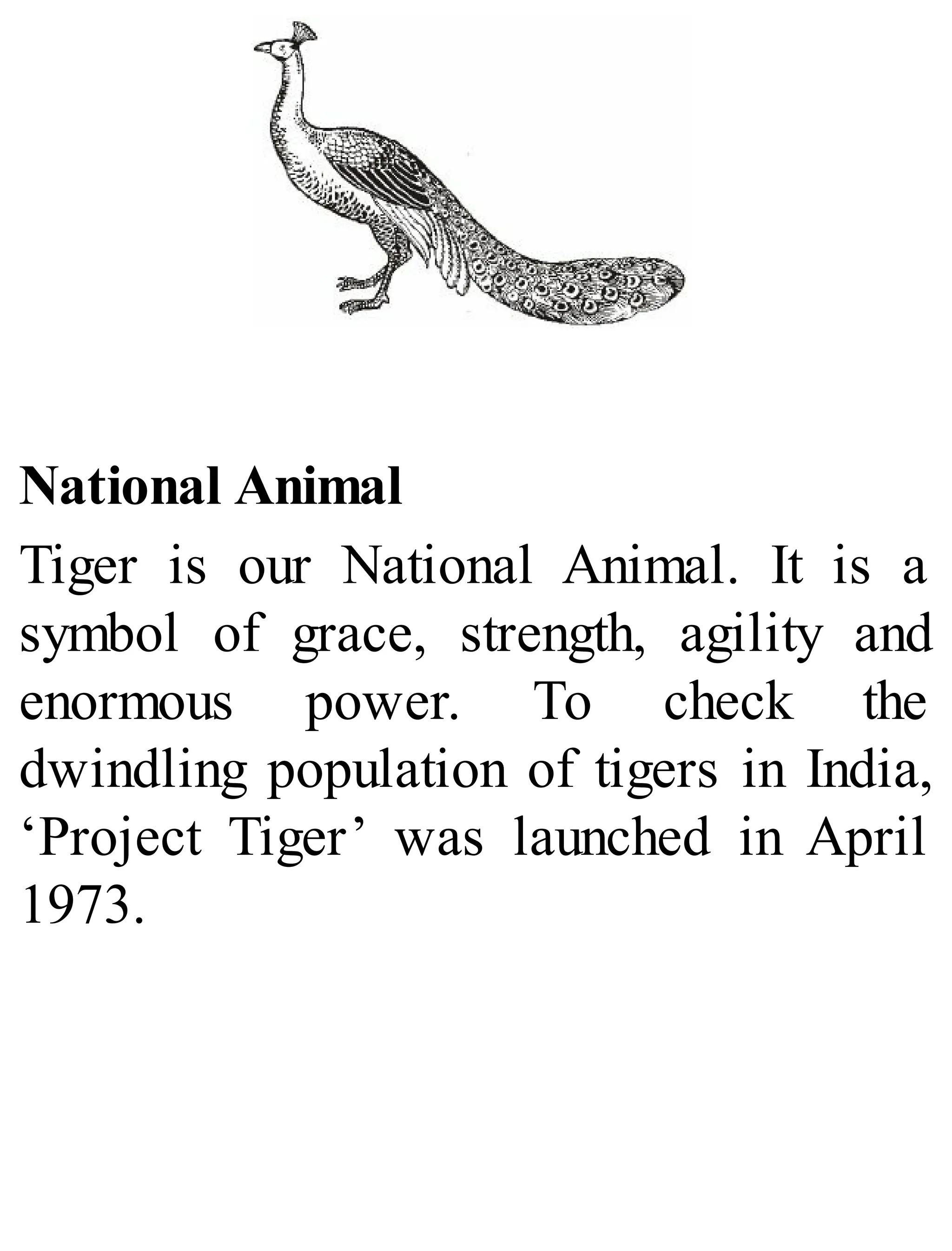
National Animal
Tiger is our National Animal. It is a
symbol of grace, strength, agility and
enormous power. To check the
dwindling population of tigers in India,
‘Project Tiger’ was launched in April
1973.
National Game
Hockey is our National Game. India has
won 8 Gold, 1 Silver and 2 Bronze
medals in Olympics.
OTHER FACTS
India is the seventh largest and the
second most populous country in the
world. Here are some important facts
about India :
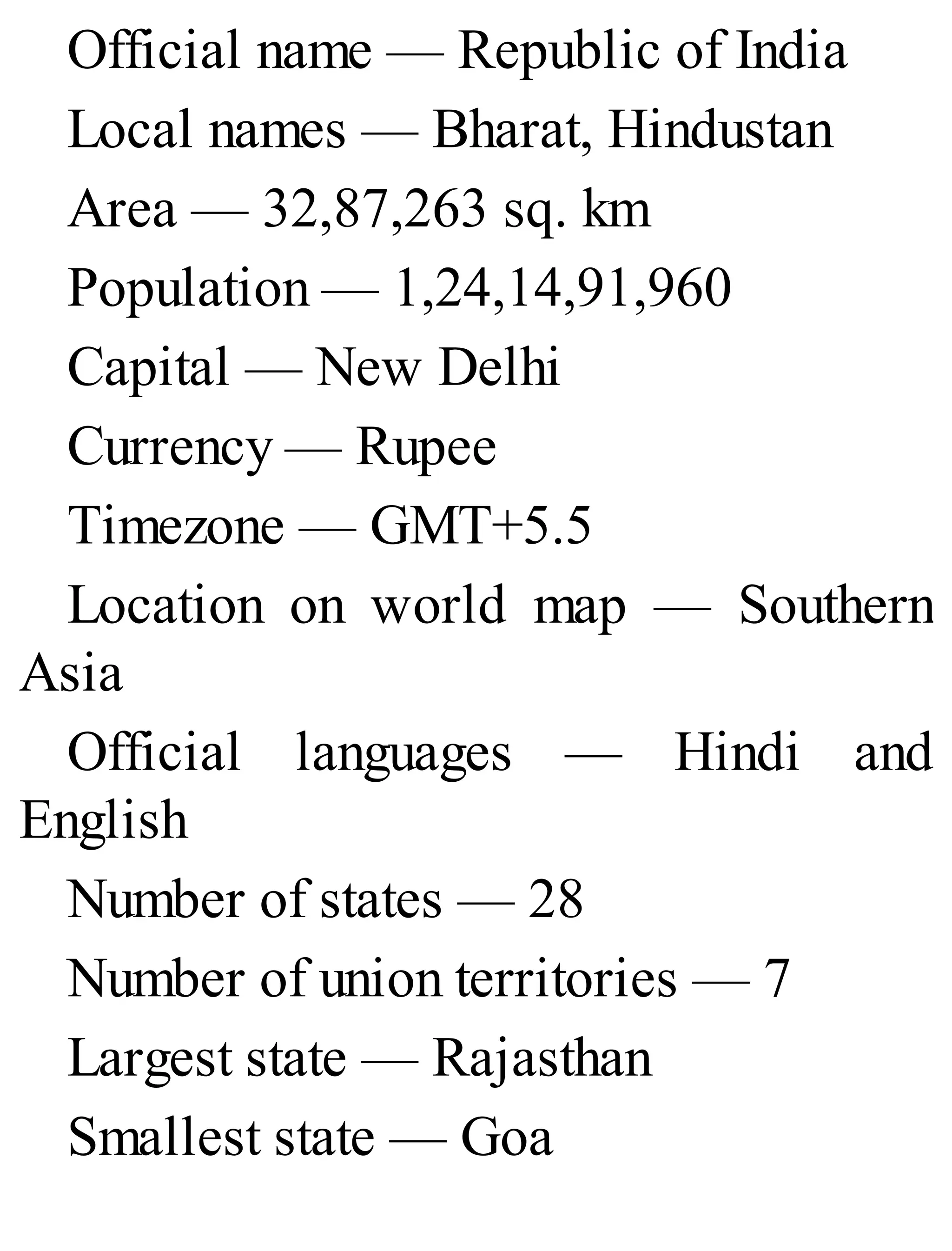
Official name — Republic of India
Local names — Bharat, Hindustan
Area — 32,87,263 sq. km
Population — 1,24,14,91,960
Capital — New Delhi
Currency — Rupee
Timezone — GMT+5.5
Location on world map — Southern
Asia
Official languages — Hindi and
English
Number of states — 28
Number of union territories — 7
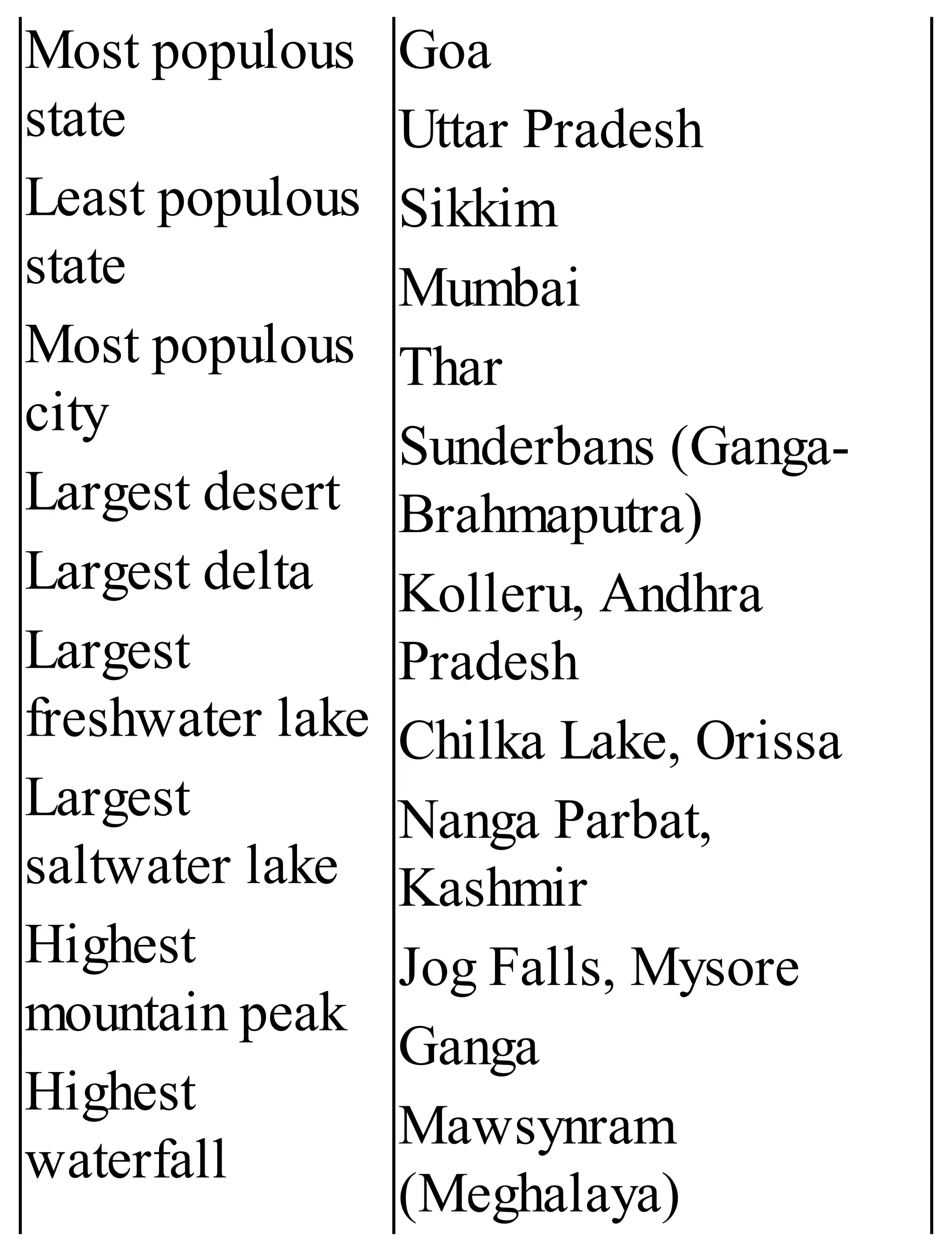
Largest state — Rajasthan
Smallest state — Goa
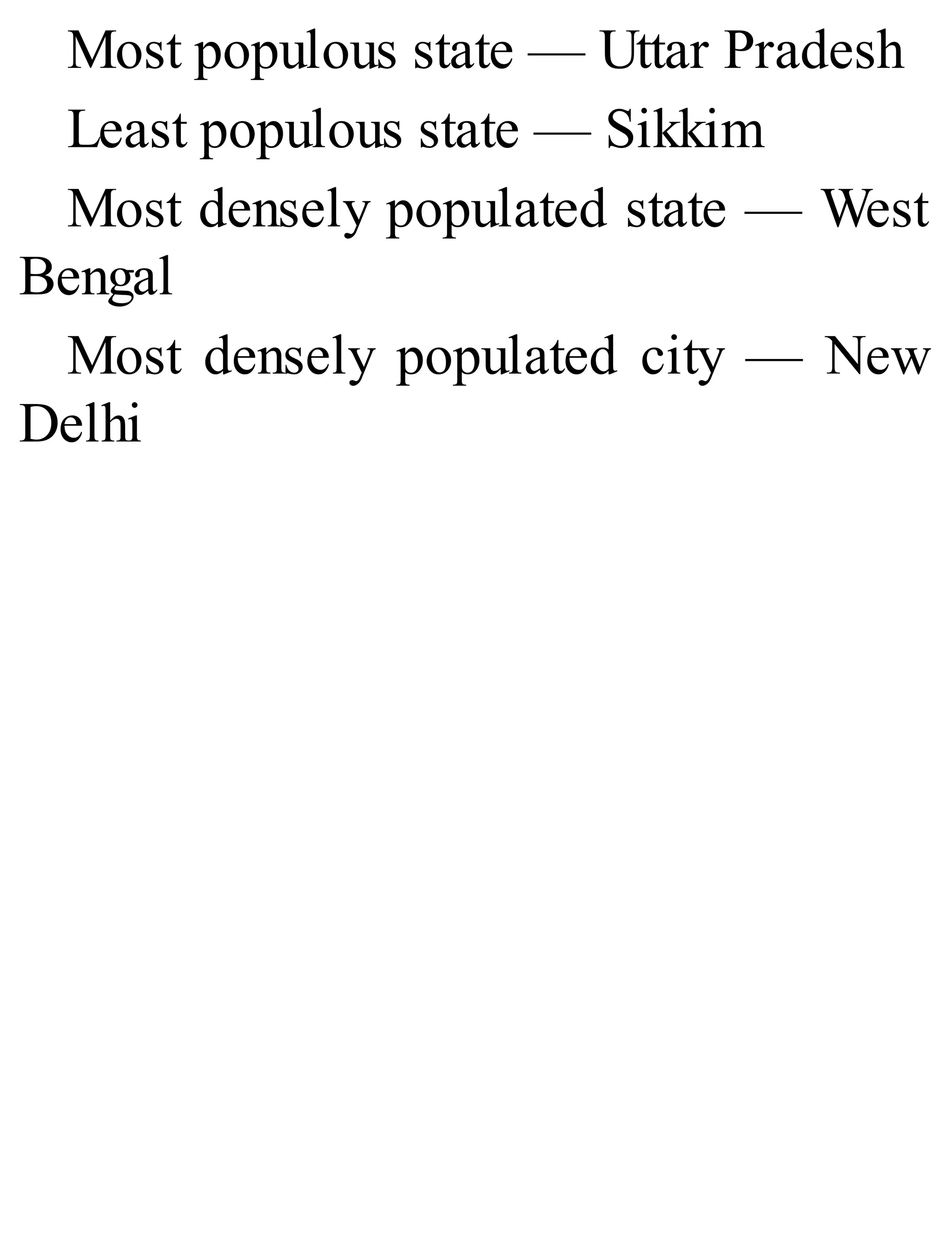
Most populous state — Uttar Pradesh
Least populous state — Sikkim
Most densely populated state — West
Bengal
Most densely populated city — New
Delhi
5.
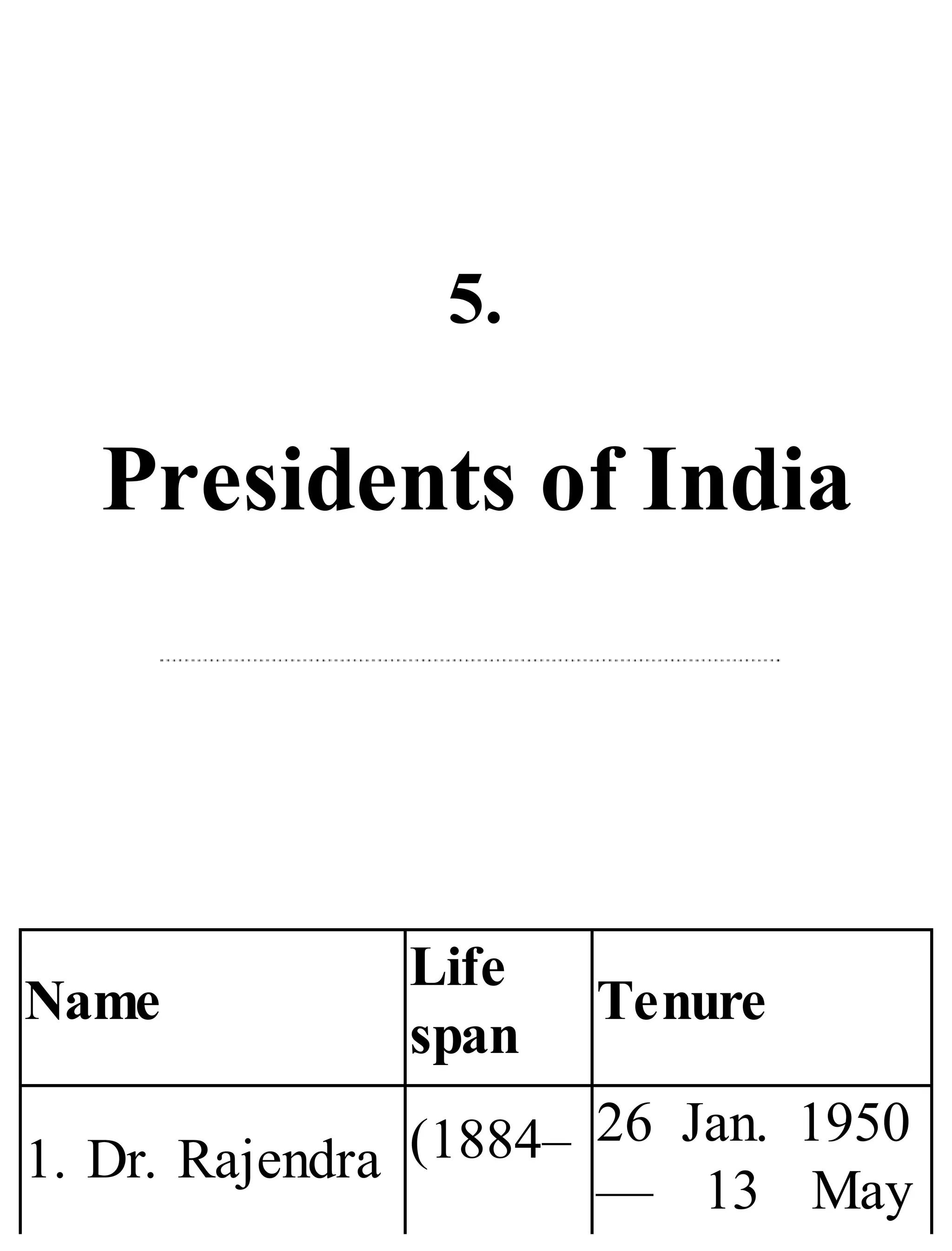
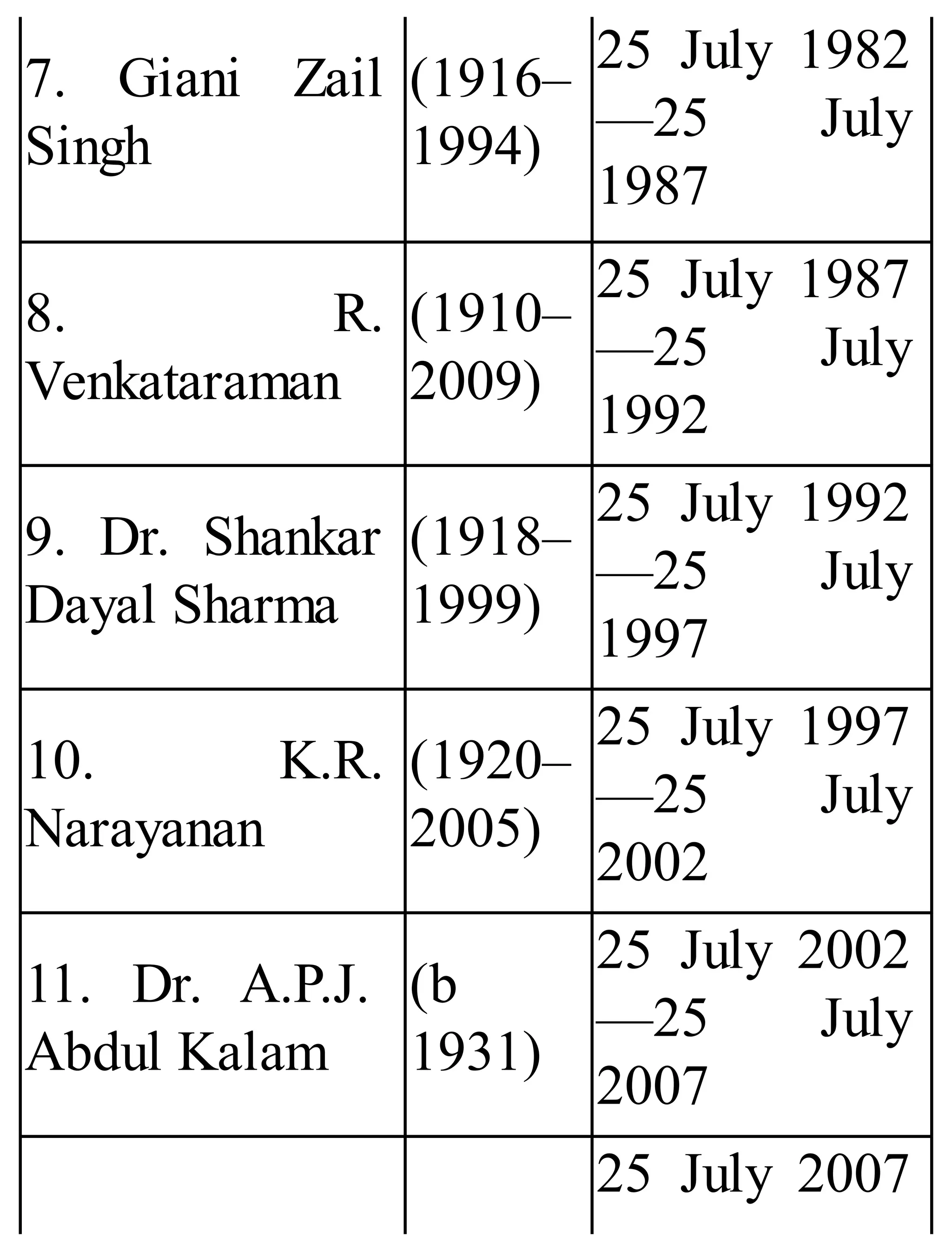
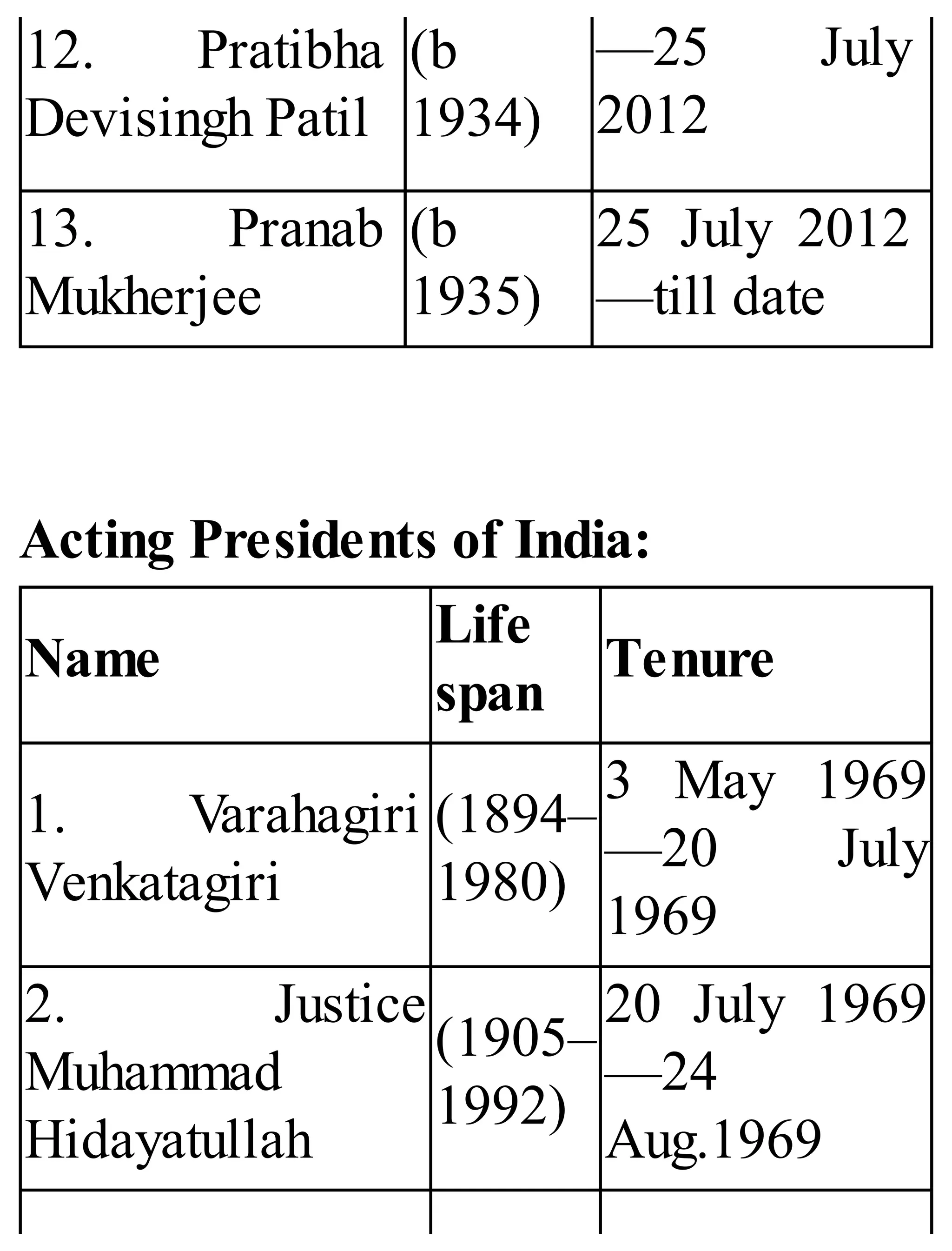
Presidents of India
Name
Life
span
Tenure
1. Dr. Rajendra (1884– 26 Jan. 1950
— 13 May
Prasad 1963) 1962
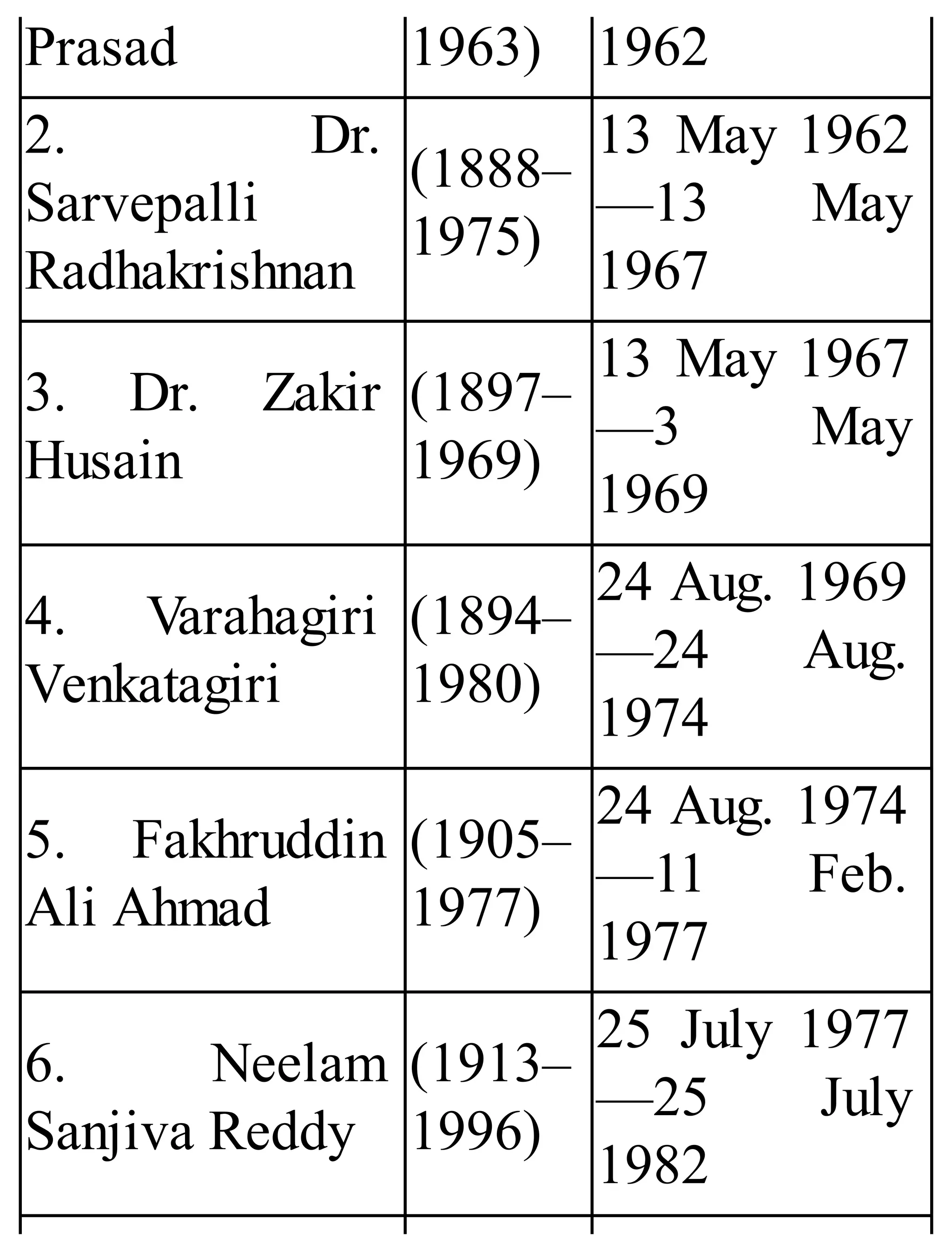
2. Dr.
Sarvepalli
Radhakrishnan
(1888–
1975)
13 May 1962
—13 May
1967
3. Dr. Zakir
Husain
(1897–
1969)
13 May 1967
—3 May
1969
4. Varahagiri
Venkatagiri
(1894–
1980)
24 Aug. 1969
—24 Aug.
1974
5. Fakhruddin
Ali Ahmad
(1905–
1977)
24 Aug. 1974
—11 Feb.
1977
6. Neelam
Sanjiva Reddy
(1913–
1996)
25 July 1977
—25 July
1982
7. Giani Zail
Singh
(1916–
1994)
25 July 1982
—25 July
1987
8. R.
Venkataraman
(1910–
2009)
25 July 1987
—25 July
1992
9. Dr. Shankar
Dayal Sharma
(1918–
1999)
25 July 1992
—25 July
1997
10. K.R.
Narayanan
(1920–
2005)
25 July 1997
—25 July
2002
11. Dr. A.P.J.
Abdul Kalam
(b
1931)
25 July 2002
—25 July
2007
25 July 2007
12. Pratibha
Devisingh Patil
(b
1934)
—25 July
2012
13. Pranab
Mukherjee
(b
1935)
25 July 2012
—till date
Acting Presidents of India:
Name
Life
span
Tenure
1. Varahagiri
Venkatagiri
(1894–
1980)
3 May 1969
—20 July
1969
2. Justice
Muhammad
Hidayatullah
(1905–
1992)
20 July 1969
—24
Aug.1969
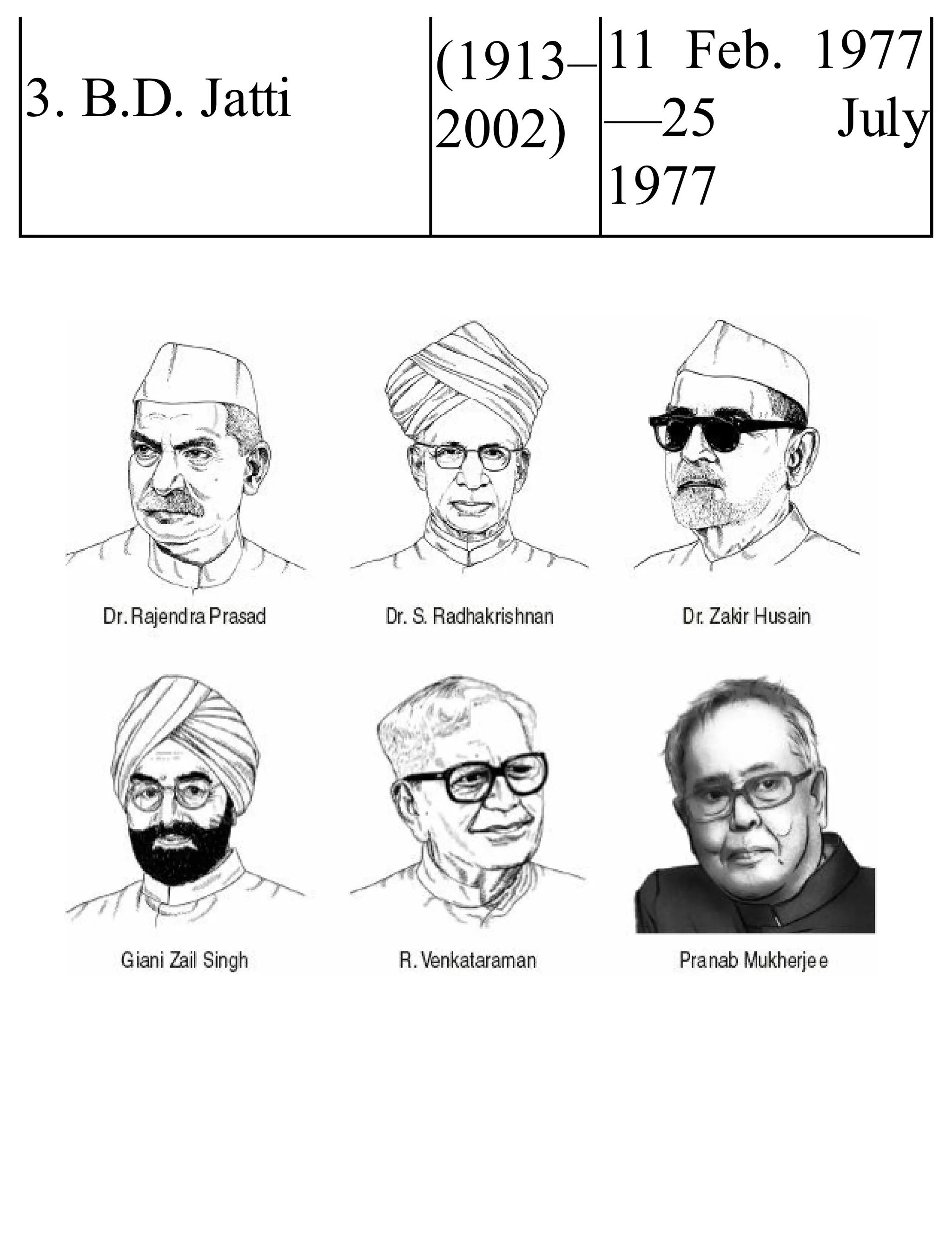
3. B.D. Jatti
(1913–
2002)
11 Feb. 1977
—25 July
1977
6.
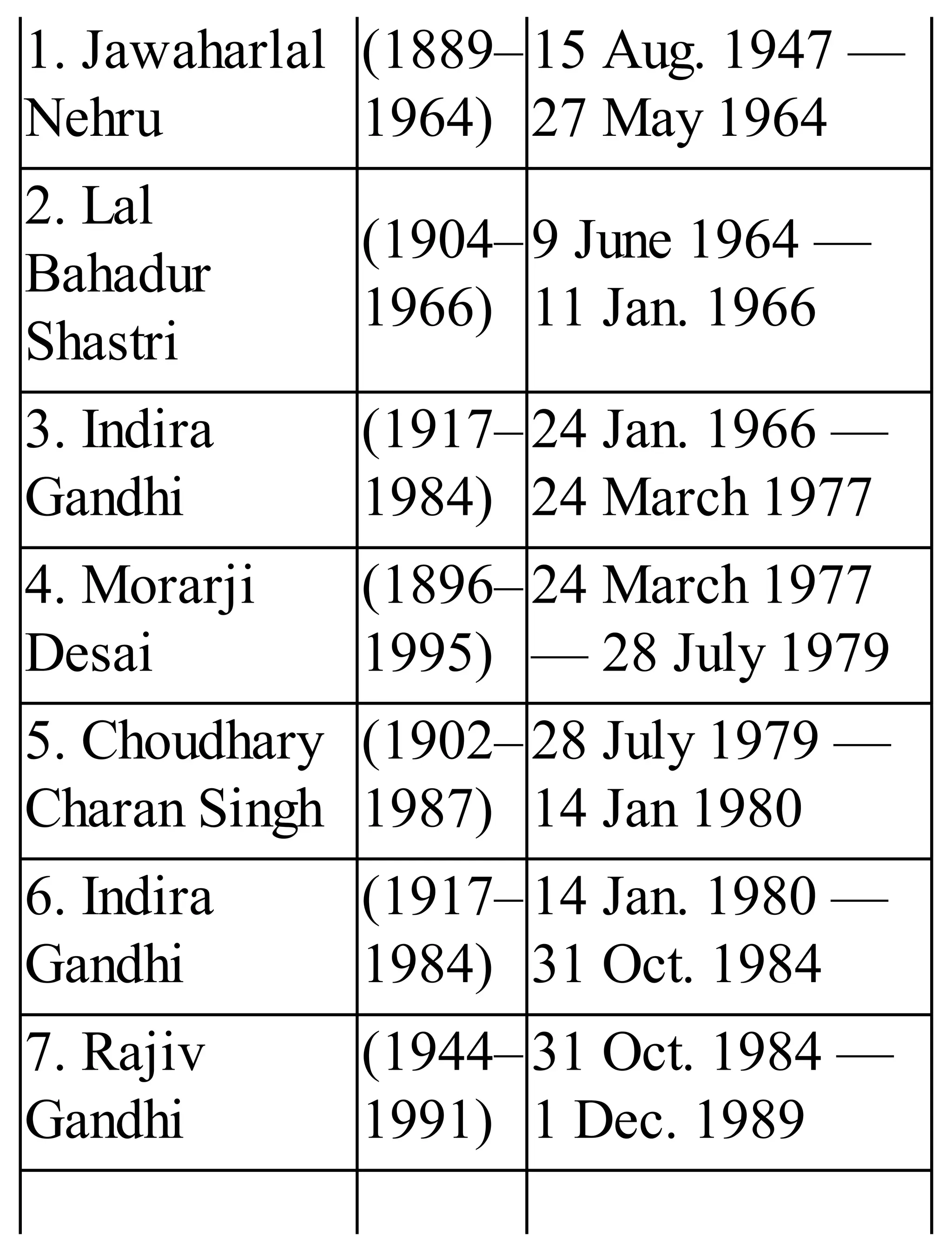
Prime Ministers of
India
Name
Life
span
Tenure
1. Jawaharlal
Nehru
(1889–
1964)
15 Aug. 1947 —
27 May 1964
2. Lal
Bahadur
Shastri
(1904–
1966)
9 June 1964 —
11 Jan. 1966
3. Indira
Gandhi
(1917–
1984)
24 Jan. 1966 —
24 March 1977
4. Morarji
Desai
(1896–
1995)
24 March 1977
— 28 July 1979
5. Choudhary
Charan Singh
(1902–
1987)
28 July 1979 —
14 Jan 1980
6. Indira
Gandhi
(1917–
1984)
14 Jan. 1980 —
31 Oct. 1984
7. Rajiv
Gandhi
(1944–
1991)
31 Oct. 1984 —
1 Dec. 1989
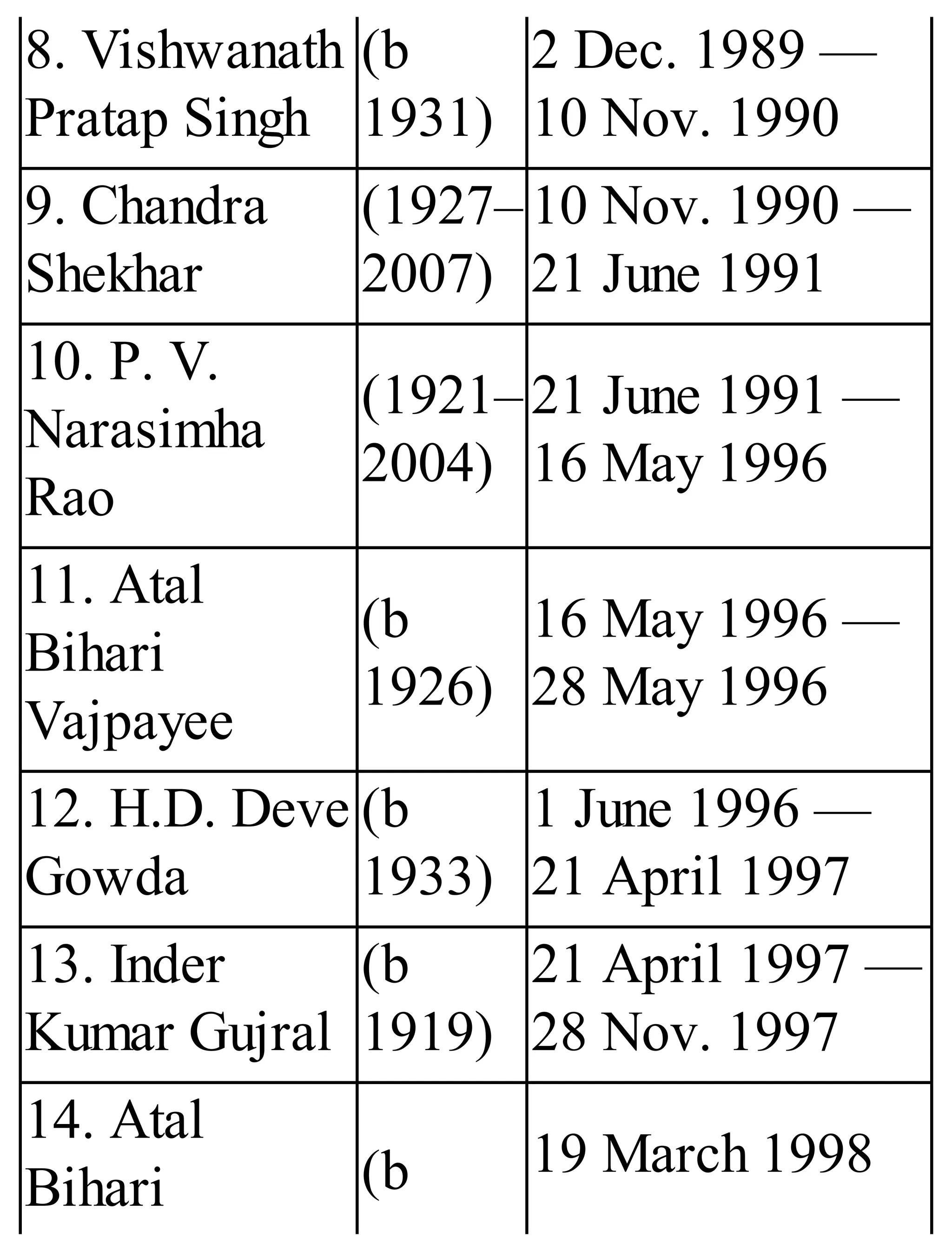
8. Vishwanath
Pratap Singh
(b
1931)
2 Dec. 1989 —
10 Nov. 1990
9. Chandra
Shekhar
(1927–
2007)
10 Nov. 1990 —
21 June 1991
10. P. V.
Narasimha
Rao
(1921–
2004)
21 June 1991 —
16 May 1996
11. Atal
Bihari
Vajpayee
(b
1926)
16 May 1996 —
28 May 1996
12. H.D. Deve
Gowda
(b
1933)
1 June 1996 —
21 April 1997
13. Inder
Kumar Gujral
(b
1919)
21 April 1997 —
28 Nov. 1997
14. Atal
Bihari (b 19 March 1998
Vajpayee 1926) — 17 April 1999
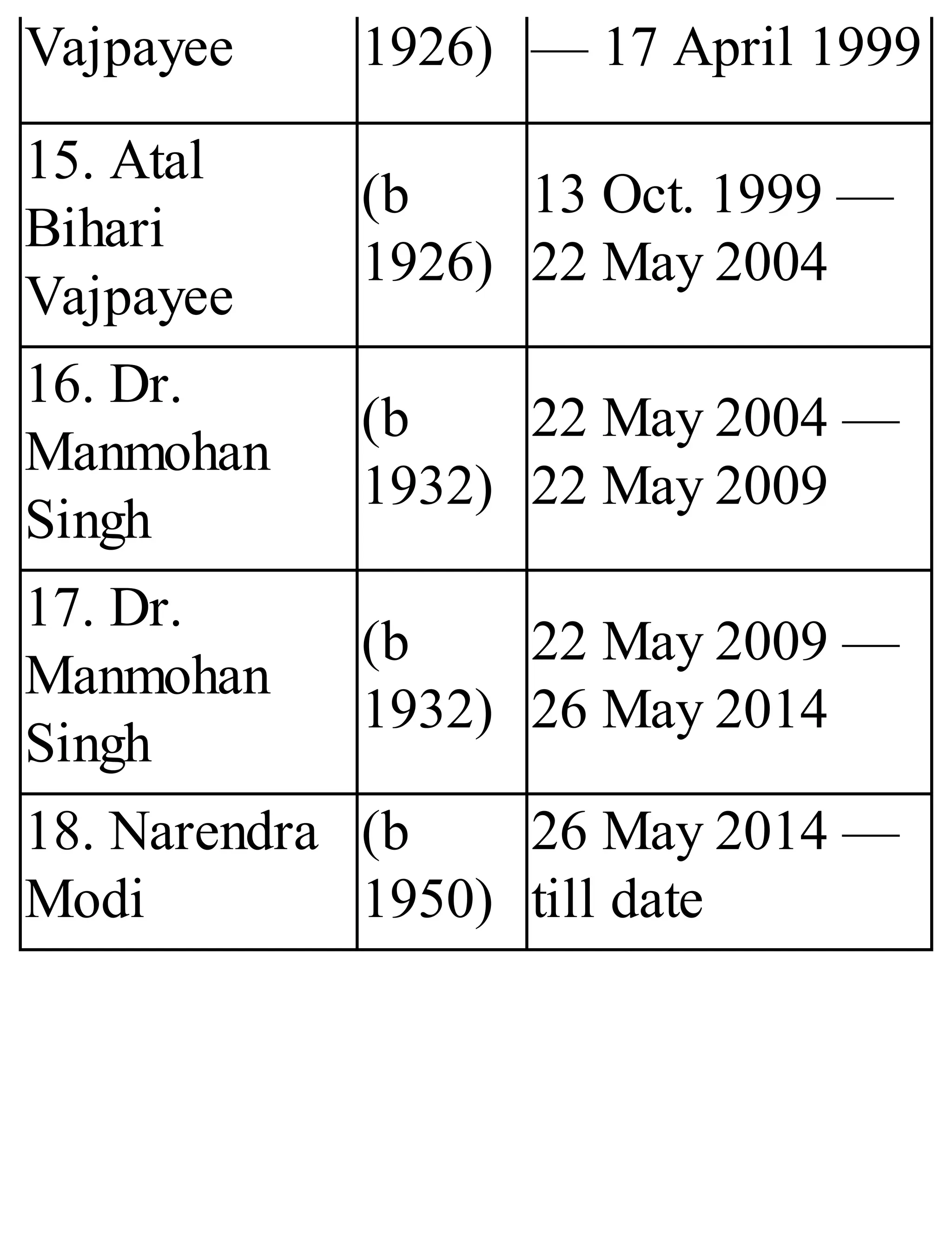
15. Atal
Bihari
Vajpayee
(b
1926)
13 Oct. 1999 —
22 May 2004
16. Dr.
Manmohan
Singh
(b
1932)
22 May 2004 —
22 May 2009
17. Dr.
Manmohan
Singh
(b
1932)
22 May 2009 —
26 May 2014
18. Narendra
Modi
(b
1950)
26 May 2014 —
till date
7.
Indian States and their
Capitals
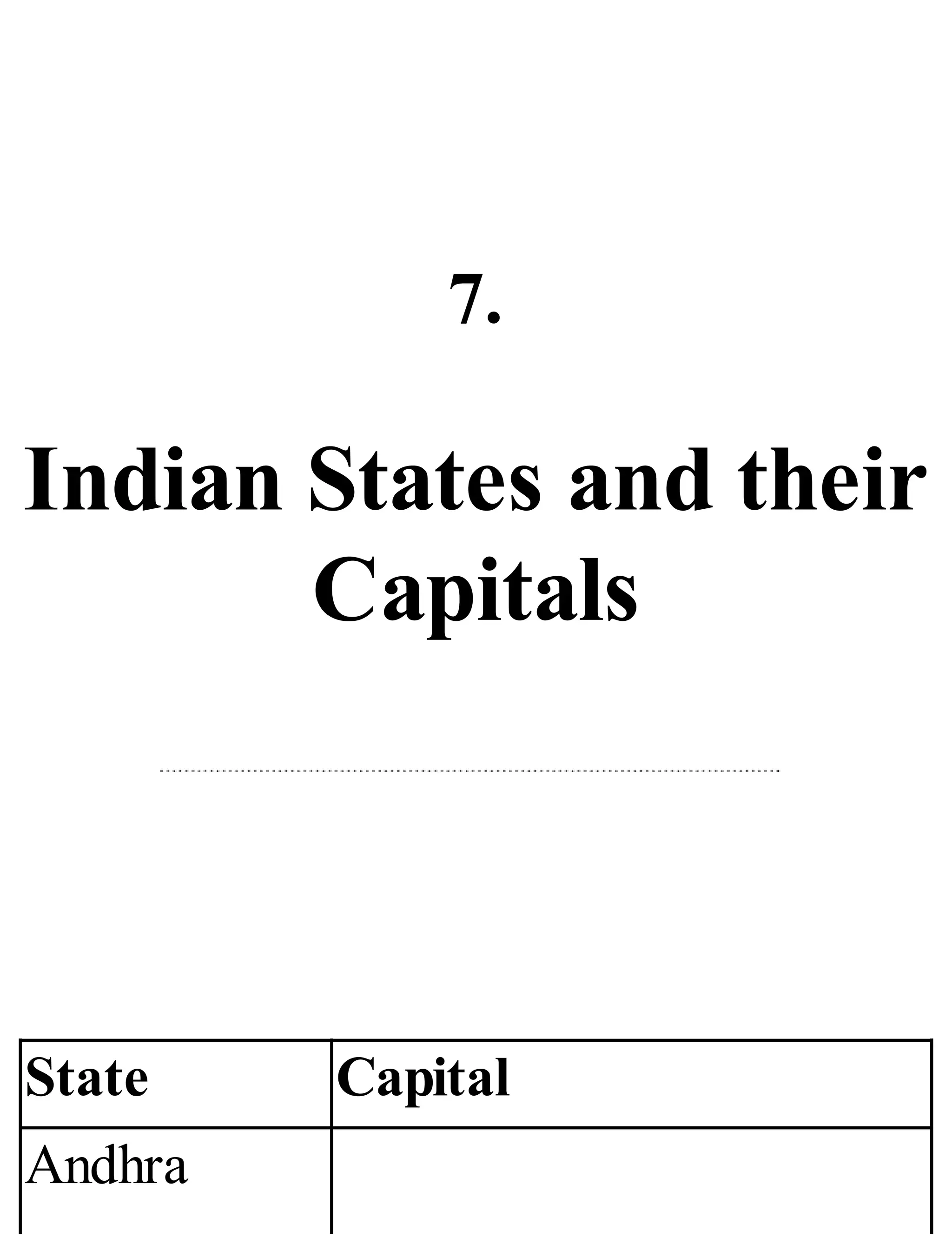
State Capital
Andhra
Pradesh
Arunachal
Pradesh
Assam
Bihar
Chhattisgarh
Goa
Gujarat
Haryana
Himachal
Pradesh
Jammu and
Kashmir
Jharkhand
Karnataka
Kerala
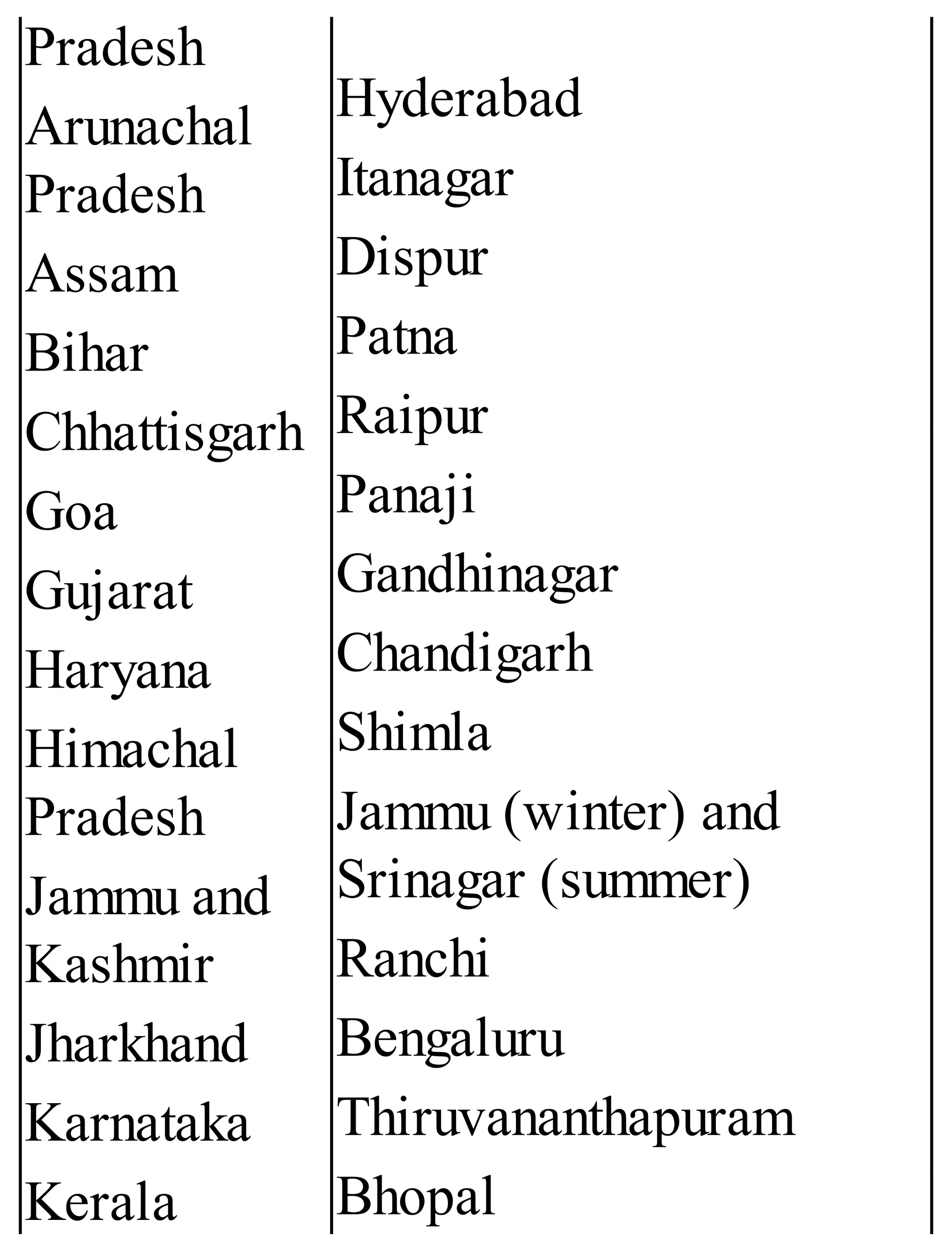
Hyderabad
Itanagar
Dispur
Patna
Raipur
Panaji
Gandhinagar
Chandigarh
Shimla
Jammu (winter) and
Srinagar (summer)
Ranchi
Bengaluru
Thiruvananthapuram
Bhopal
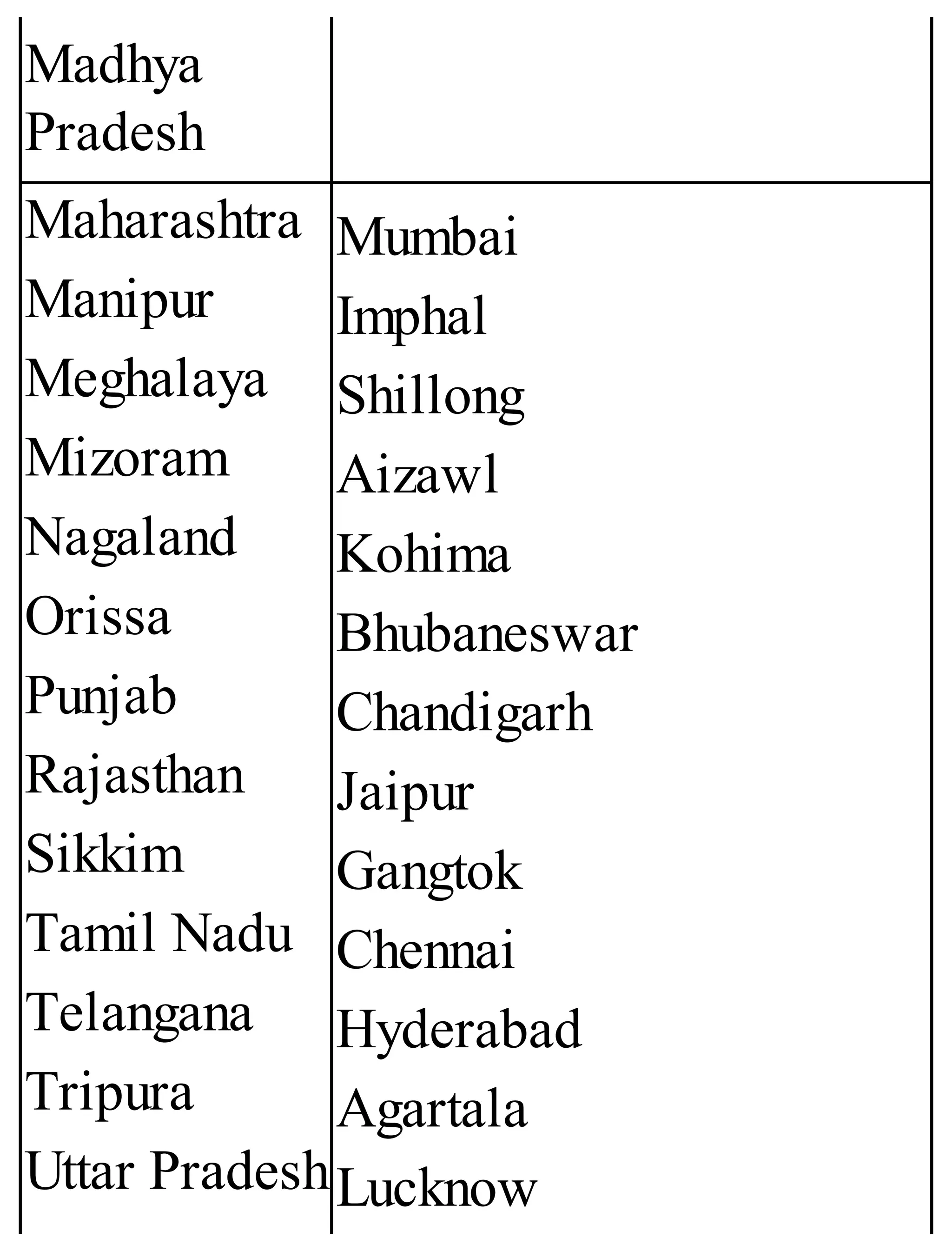
Madhya
Pradesh
Maharashtra
Manipur
Meghalaya
Mizoram
Nagaland
Orissa
Punjab
Rajasthan
Sikkim
Tamil Nadu
Telangana
Tripura
Uttar Pradesh
Mumbai
Imphal
Shillong
Aizawl
Kohima
Bhubaneswar
Chandigarh
Jaipur
Gangtok
Chennai
Hyderabad
Agartala
Lucknow
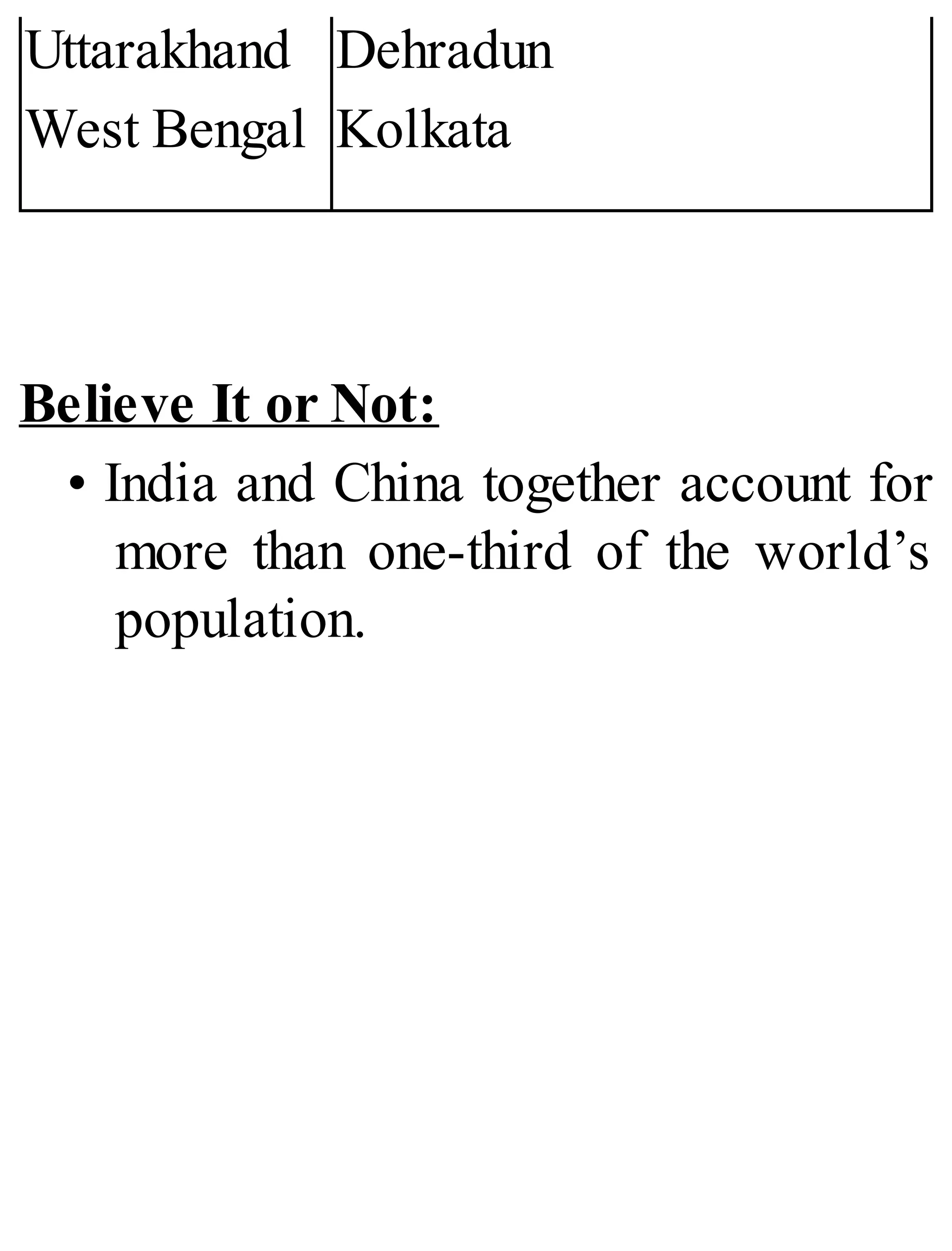
Uttarakhand
West Bengal
Dehradun
Kolkata
Believe It or Not:
• India and China together account for
more than one-third of the world’s
population.
8.
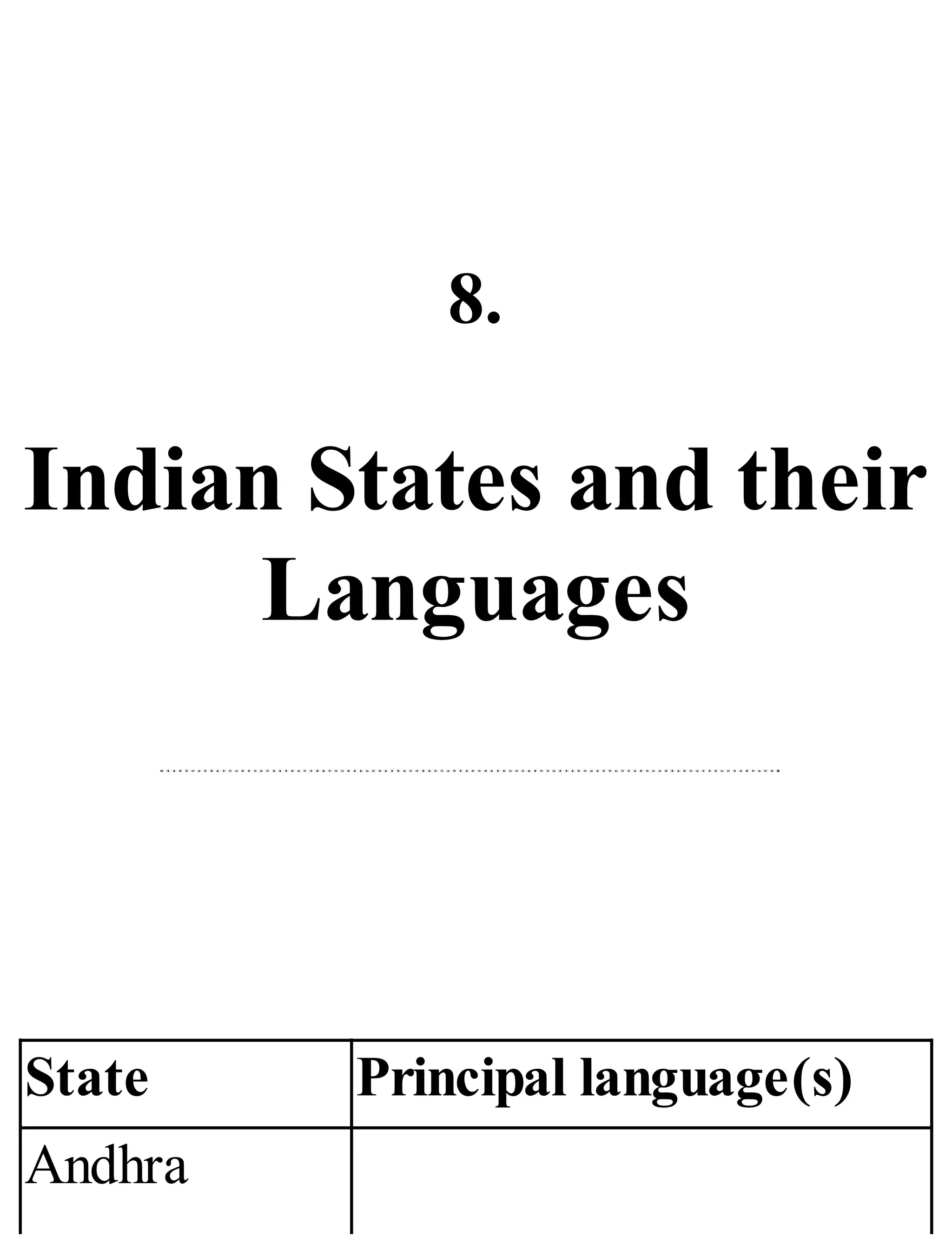
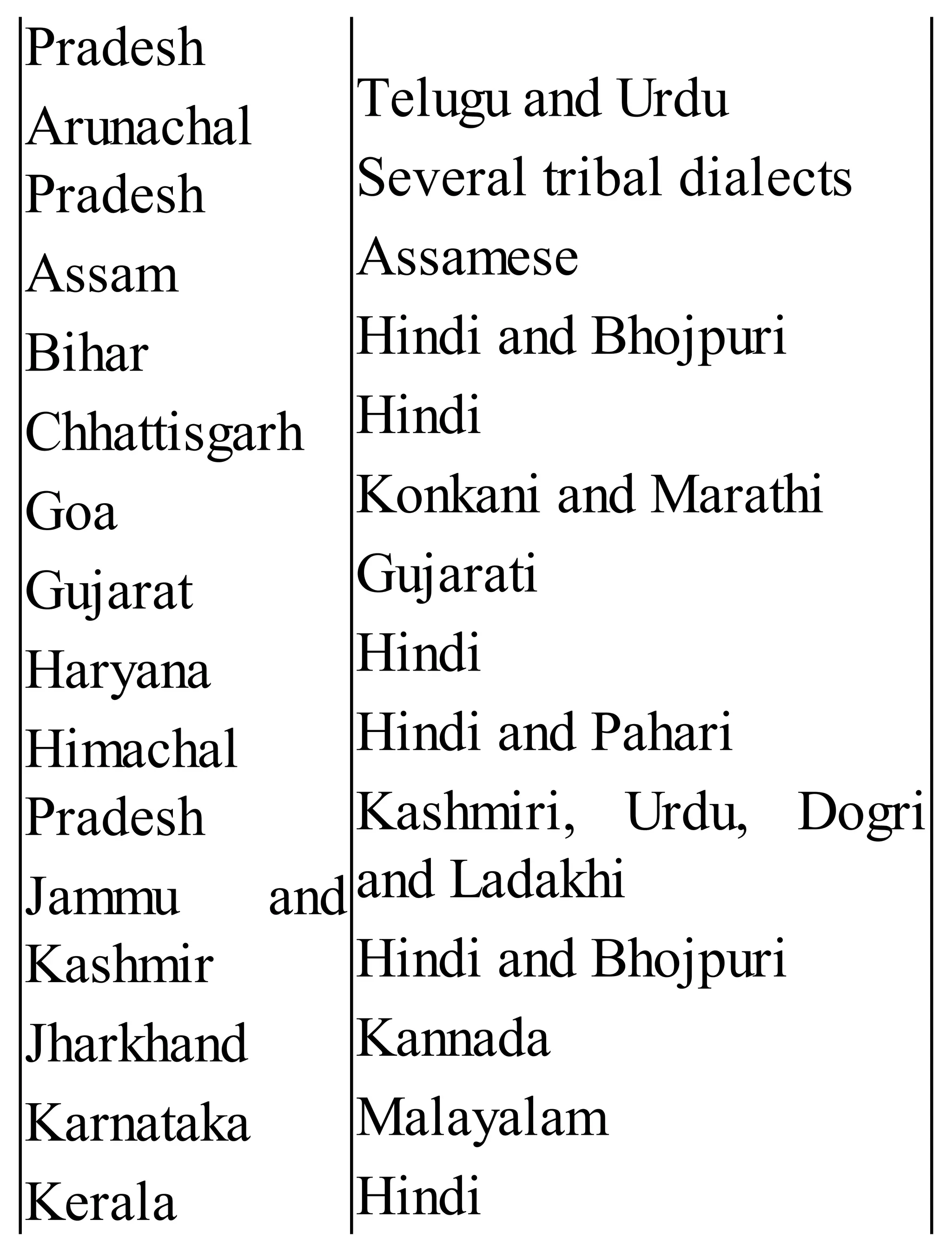
Indian States and their
Languages
State Principal language(s)
Andhra
Pradesh
Arunachal
Pradesh
Assam
Bihar
Chhattisgarh
Goa
Gujarat
Haryana
Himachal
Pradesh
Jammu and
Kashmir
Jharkhand
Karnataka
Kerala
Telugu and Urdu
Several tribal dialects
Assamese
Hindi and Bhojpuri
Hindi
Konkani and Marathi
Gujarati
Hindi
Hindi and Pahari
Kashmiri, Urdu, Dogri
and Ladakhi
Hindi and Bhojpuri
Kannada
Malayalam
Hindi
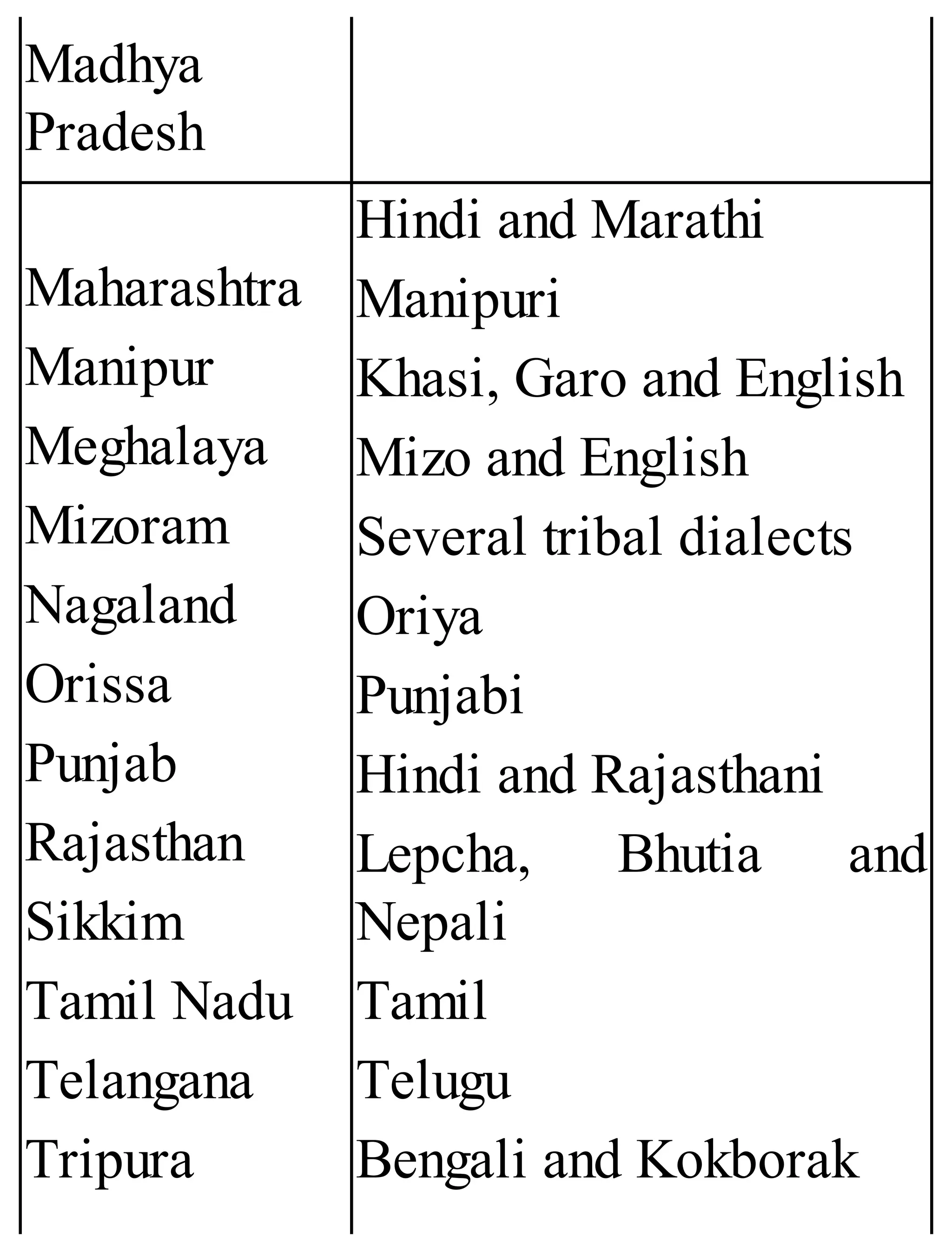
Madhya
Pradesh
Maharashtra
Manipur
Meghalaya
Mizoram
Nagaland
Orissa
Punjab
Rajasthan
Sikkim
Tamil Nadu
Telangana
Tripura
Hindi and Marathi
Manipuri
Khasi, Garo and English
Mizo and English
Several tribal dialects
Oriya
Punjabi
Hindi and Rajasthani
Lepcha, Bhutia and
Nepali
Tamil
Telugu
Bengali and Kokborak
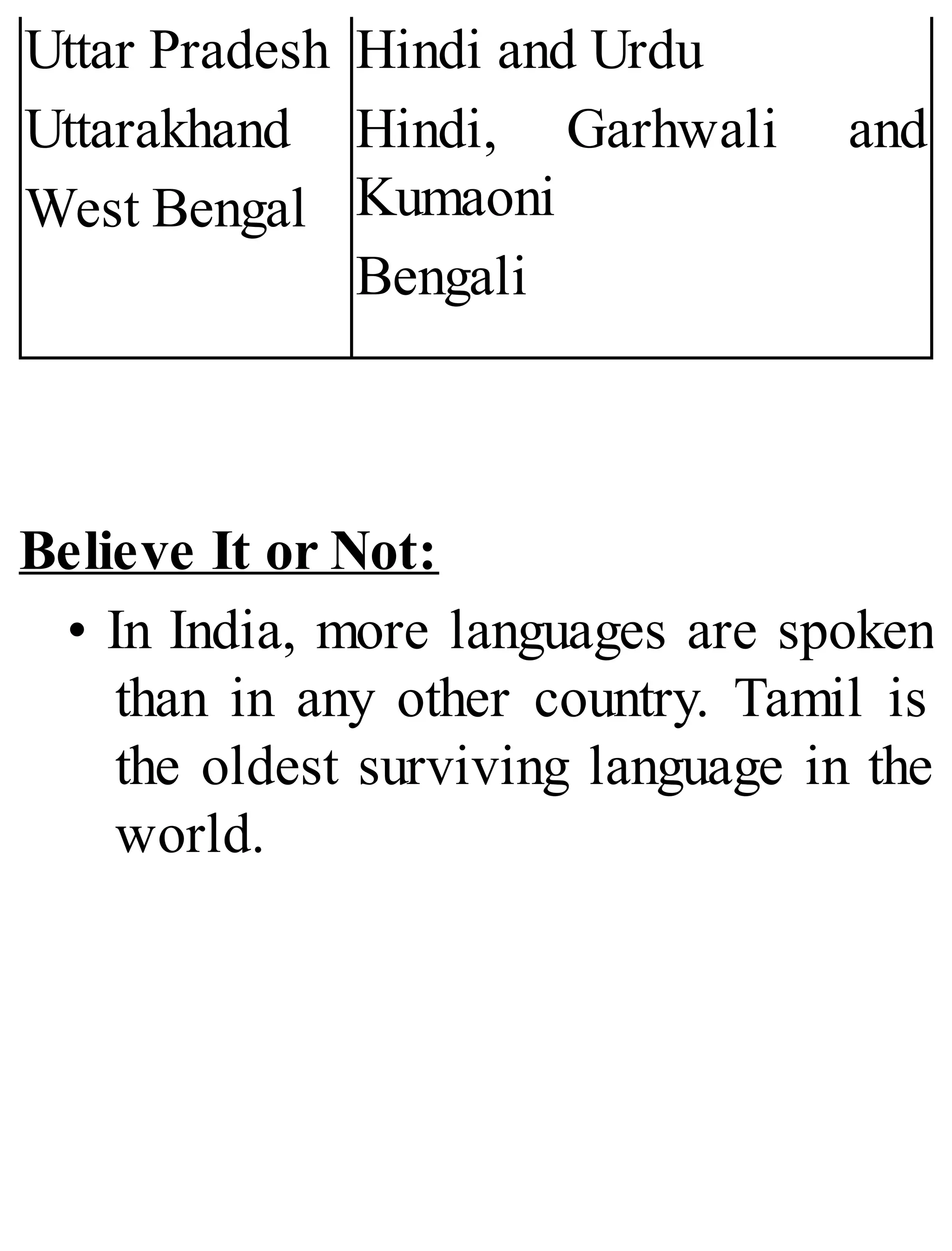
Uttar Pradesh
Uttarakhand
West Bengal
Hindi and Urdu
Hindi, Garhwali and
Kumaoni
Bengali
Believe It or Not:
• In India, more languages are spoken
than in any other country. Tamil is
the oldest surviving language in the
world.
9.
Dances of India
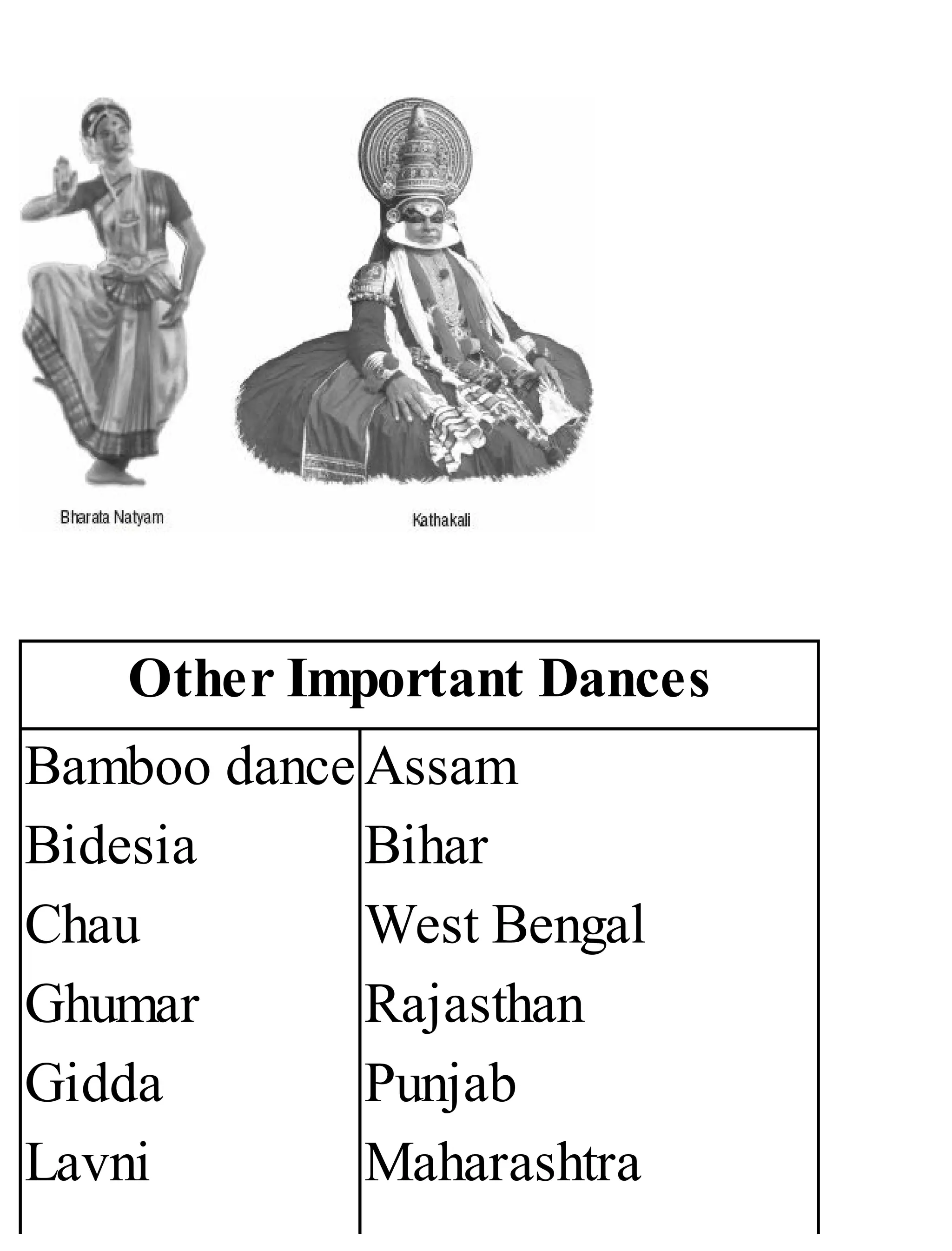
Dance in India has an unbroken tradition
of over 2,000 years. Its themes are
derived from mythology, legends and
classical literature. The main classical,
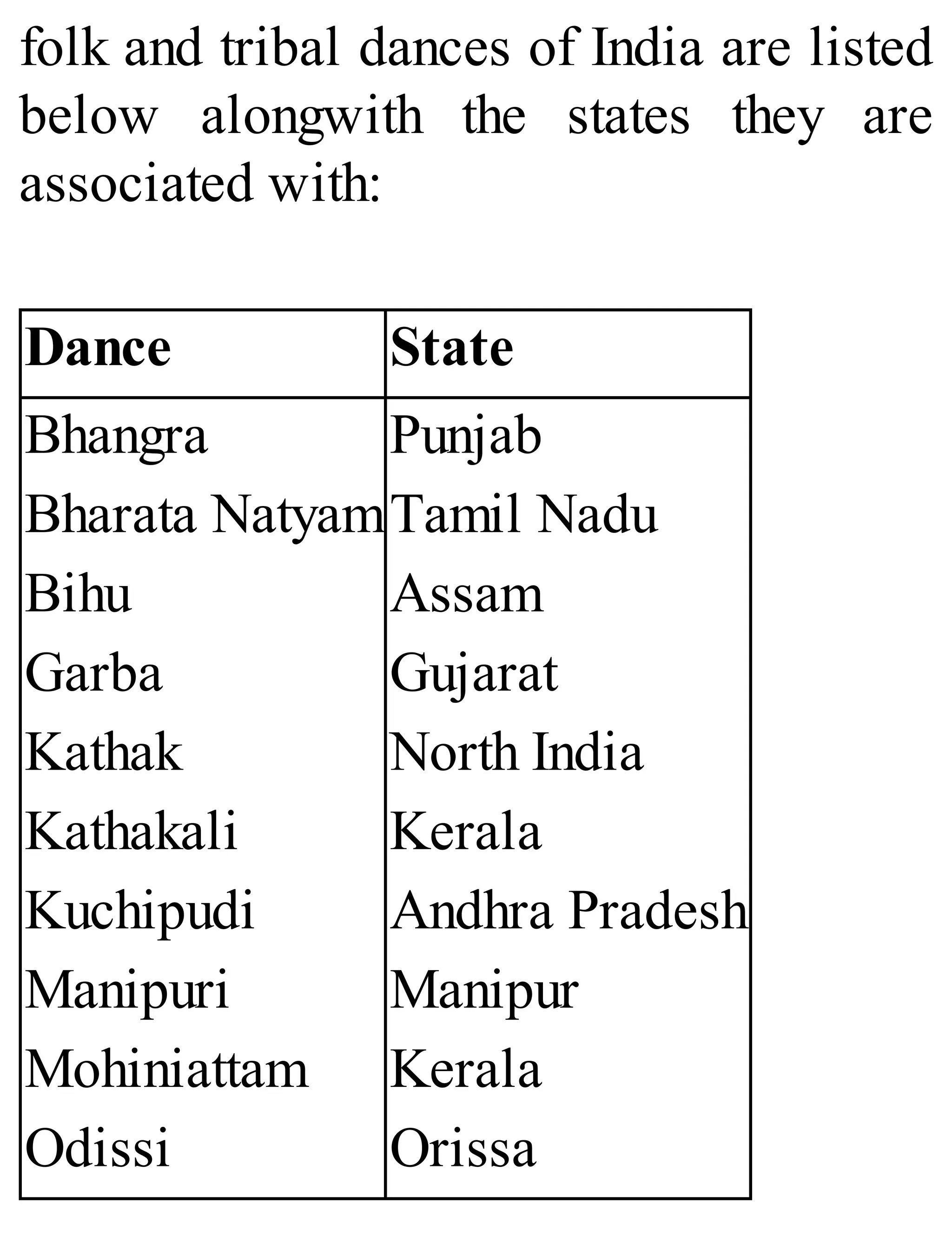
folk and tribal dances of India are listed
below alongwith the states they are
associated with:
Dance State
Bhangra
Bharata Natyam
Bihu
Garba
Kathak
Kathakali
Kuchipudi
Manipuri
Mohiniattam
Odissi
Punjab
Tamil Nadu
Assam
Gujarat
North India
Kerala
Andhra Pradesh
Manipur
Kerala
Orissa
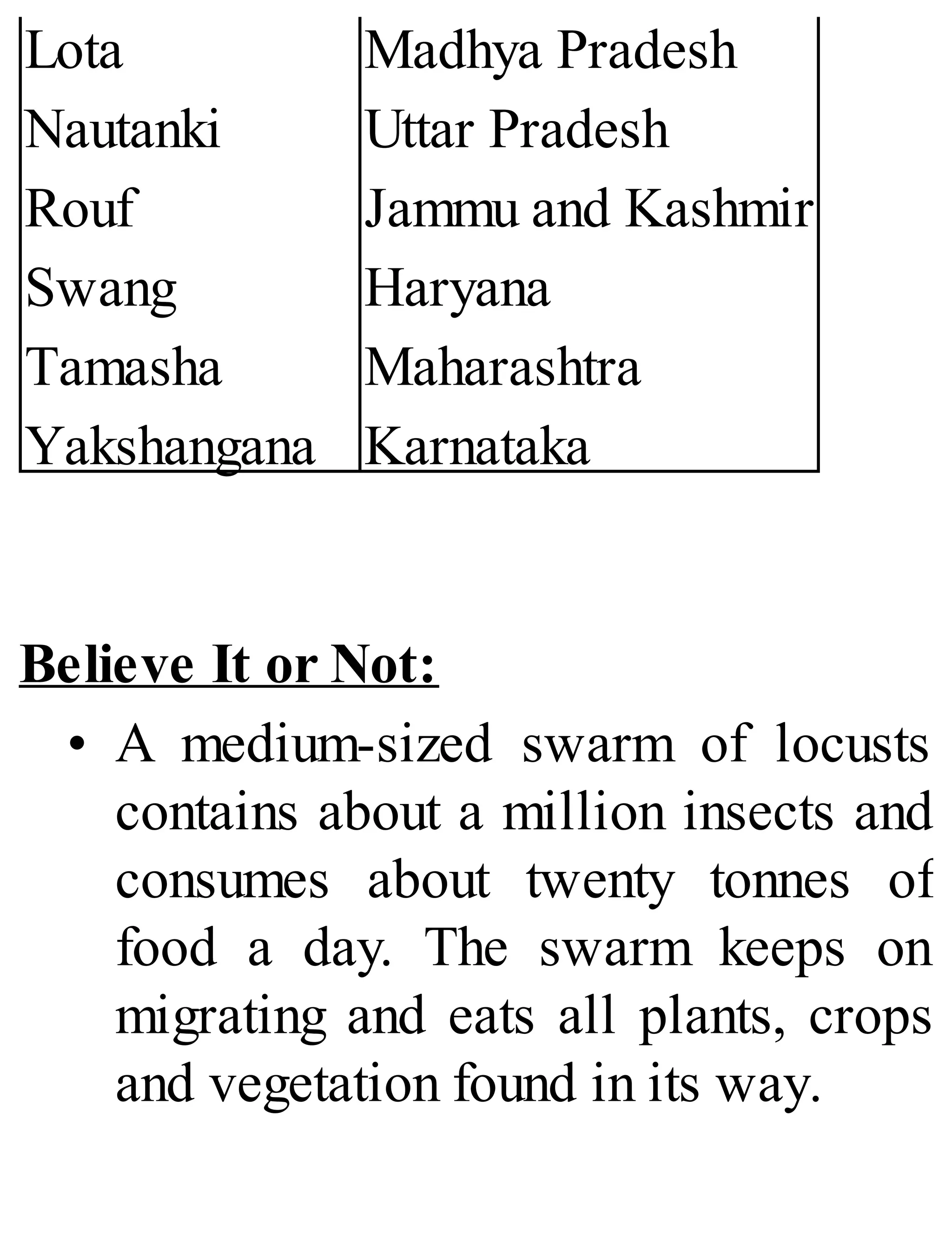
Other Important Dances
Bamboo dance
Bidesia
Chau
Ghumar
Gidda
Lavni
Assam
Bihar
West Bengal
Rajasthan
Punjab
Maharashtra
Lota
Nautanki
Rouf
Swang
Tamasha
Yakshangana
Madhya Pradesh
Uttar Pradesh
Jammu and Kashmir
Haryana
Maharashtra
Karnataka
Believe It or Not:
• A medium-sized swarm of locusts
contains about a million insects and
consumes about twenty tonnes of
food a day. The swarm keeps on
migrating and eats all plants, crops
and vegetation found in its way.
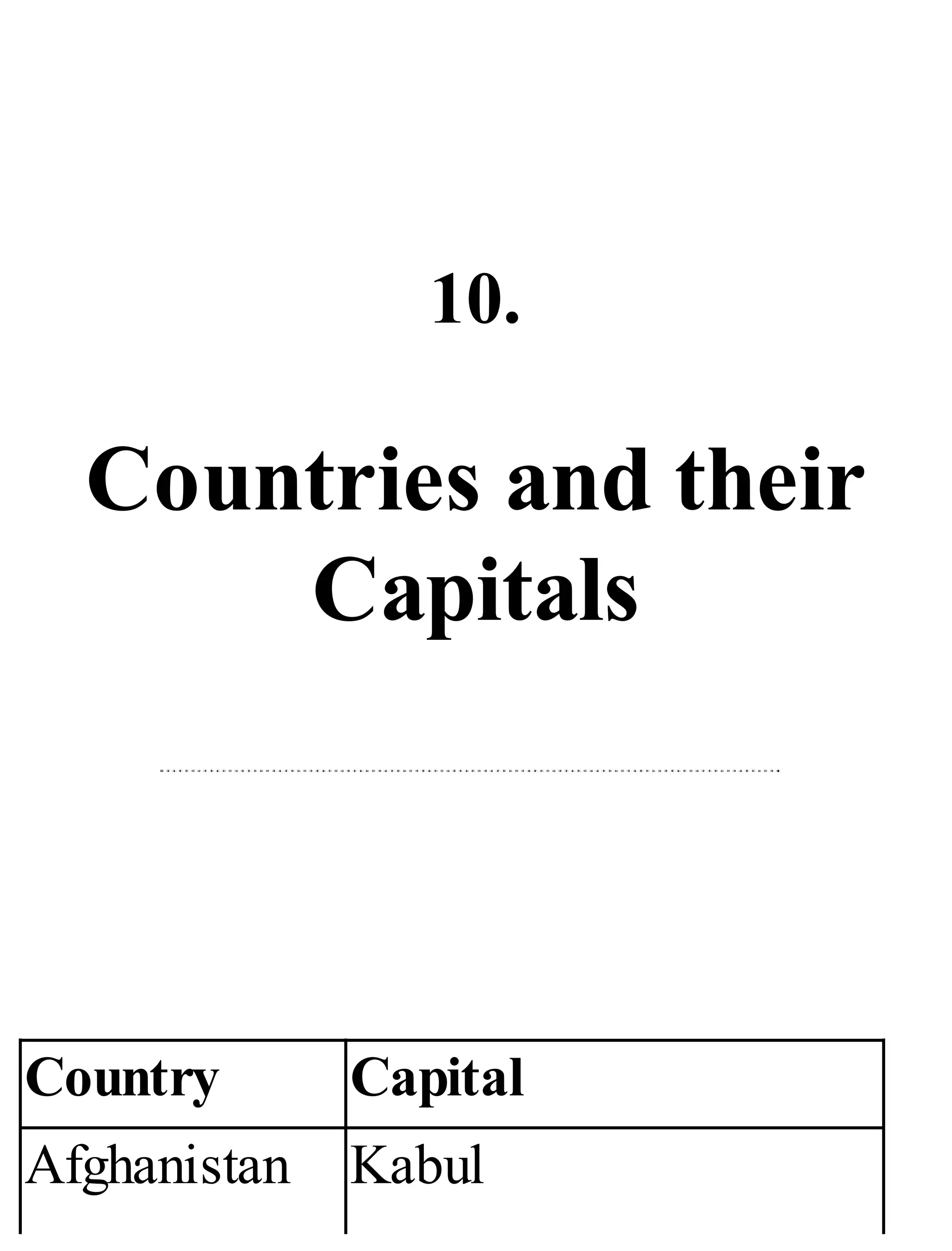
10.
Countries and their
Capitals
Country Capital
Afghanistan Kabul
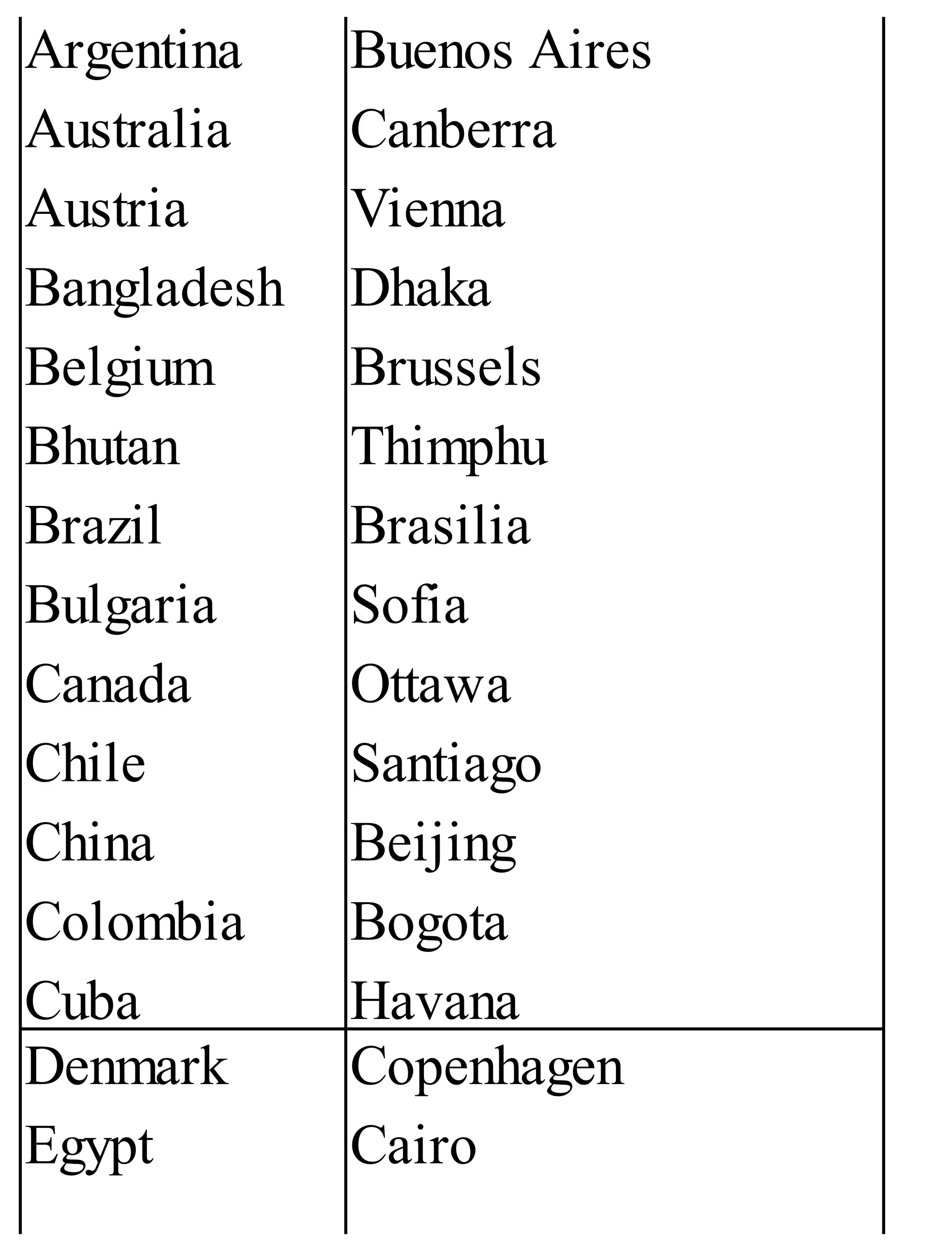
Argentina
Australia
Austria
Bangladesh
Belgium
Bhutan
Brazil
Bulgaria
Canada
Chile
China
Colombia
Cuba
Buenos Aires
Canberra
Vienna
Dhaka
Brussels
Thimphu
Brasilia
Sofia
Ottawa
Santiago
Beijing
Bogota
Havana
Denmark
Egypt
Copenhagen
Cairo
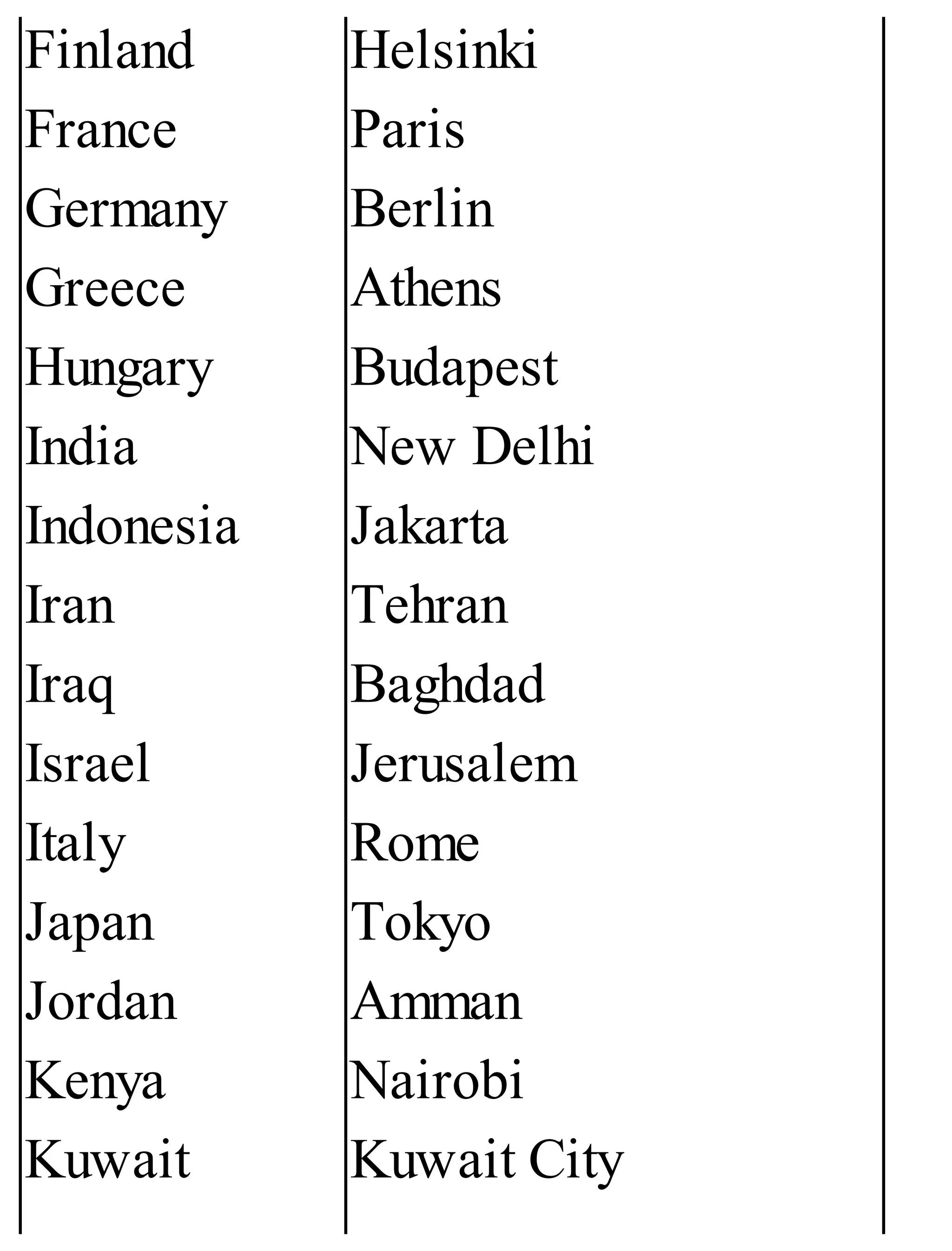
Finland
France
Germany
Greece
Hungary
India
Indonesia
Iran
Iraq
Israel
Italy
Japan
Jordan
Kenya
Kuwait
Helsinki
Paris
Berlin
Athens
Budapest
New Delhi
Jakarta
Tehran
Baghdad
Jerusalem
Rome
Tokyo
Amman
Nairobi
Kuwait City
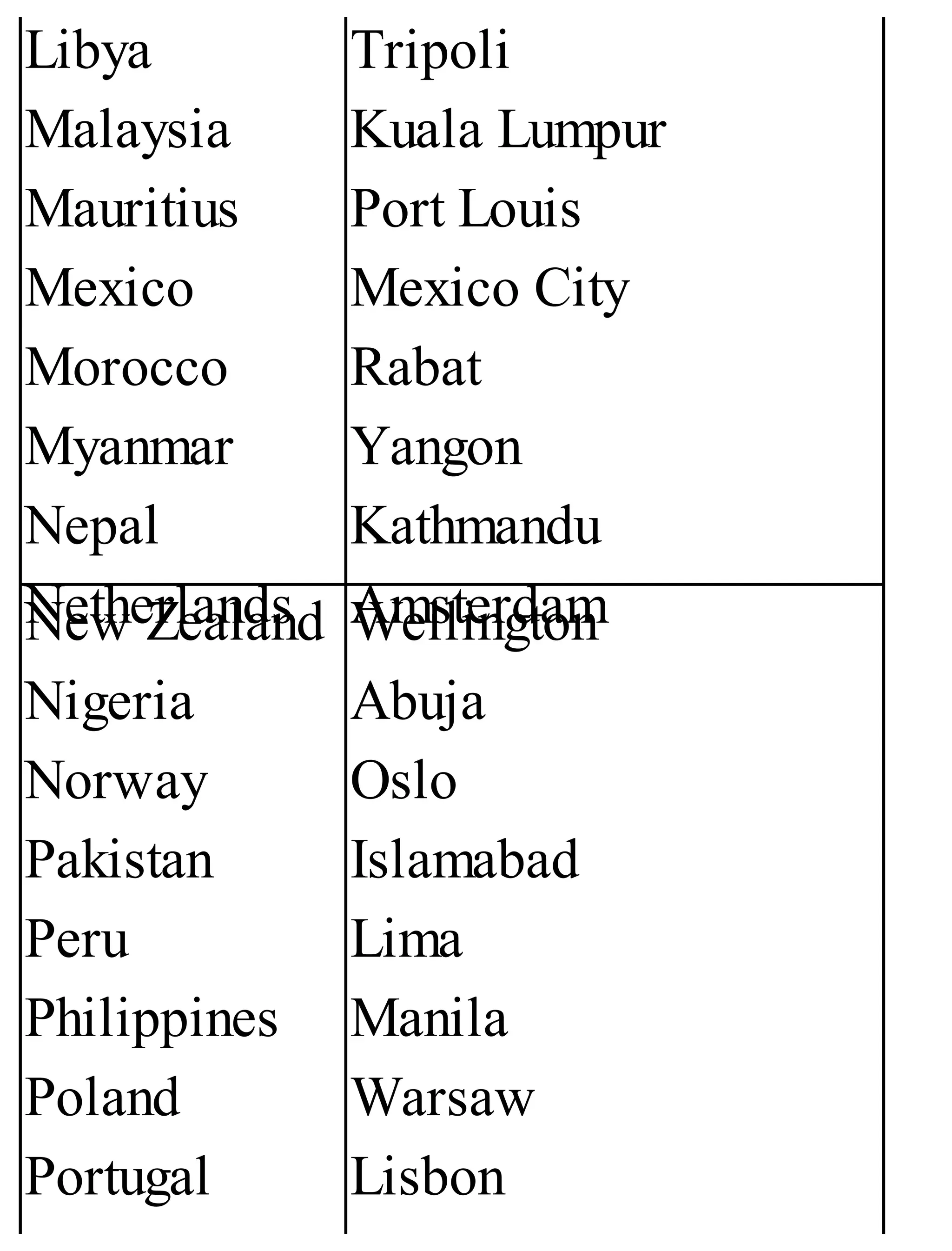
Libya
Malaysia
Mauritius
Mexico
Morocco
Myanmar
Nepal
Netherlands
Tripoli
Kuala Lumpur
Port Louis
Mexico City
Rabat
Yangon
Kathmandu
Amsterdam
New Zealand
Nigeria
Norway
Pakistan
Peru
Philippines
Poland
Portugal
Wellington
Abuja
Oslo
Islamabad
Lima
Manila
Warsaw
Lisbon
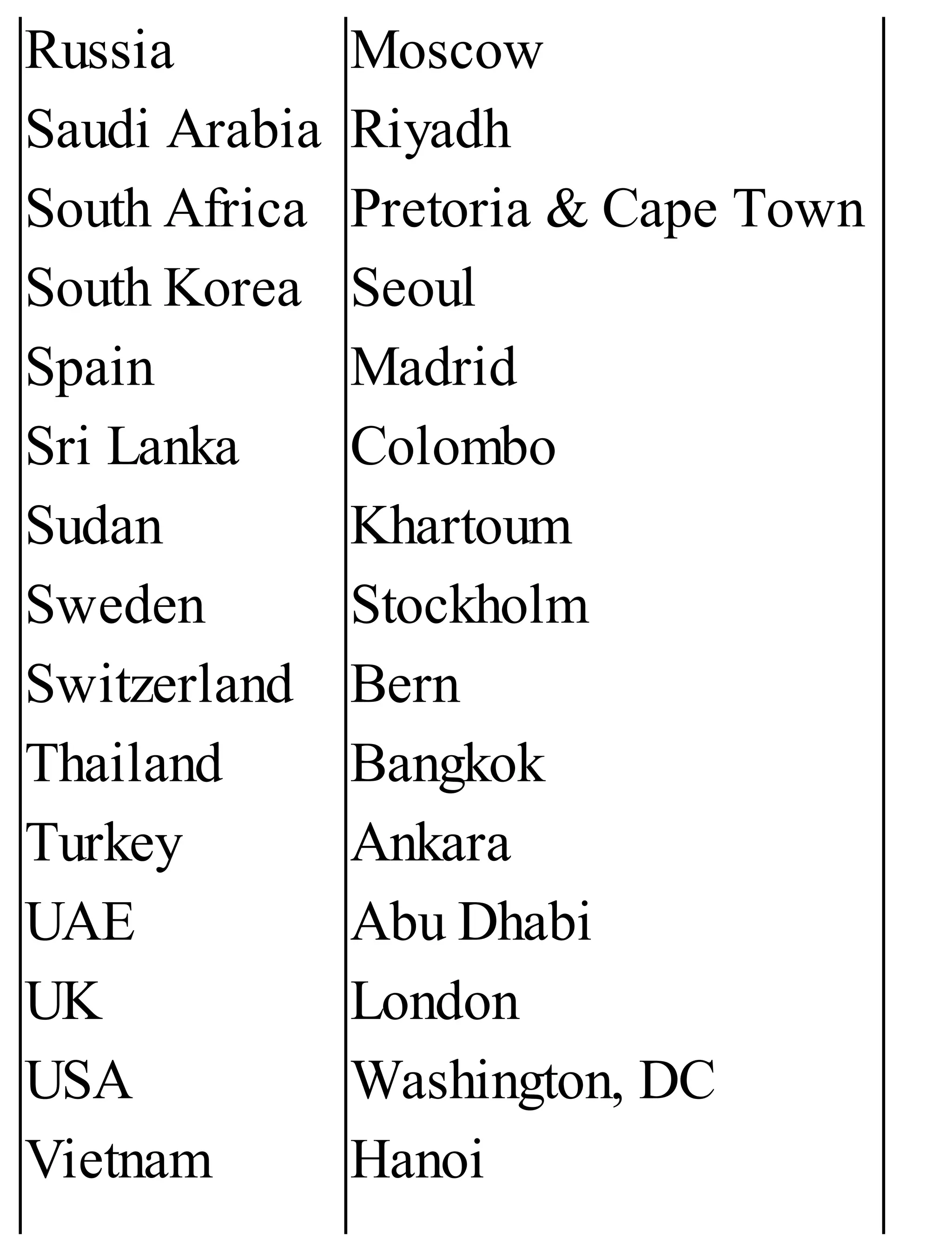
Russia
Saudi Arabia
South Africa
South Korea
Spain
Sri Lanka
Sudan
Sweden
Switzerland
Thailand
Turkey
UAE
UK
USA
Vietnam
Moscow
Riyadh
Pretoria & Cape Town
Seoul
Madrid
Colombo
Khartoum
Stockholm
Bern
Bangkok
Ankara
Abu Dhabi
London
Washington, DC
Hanoi
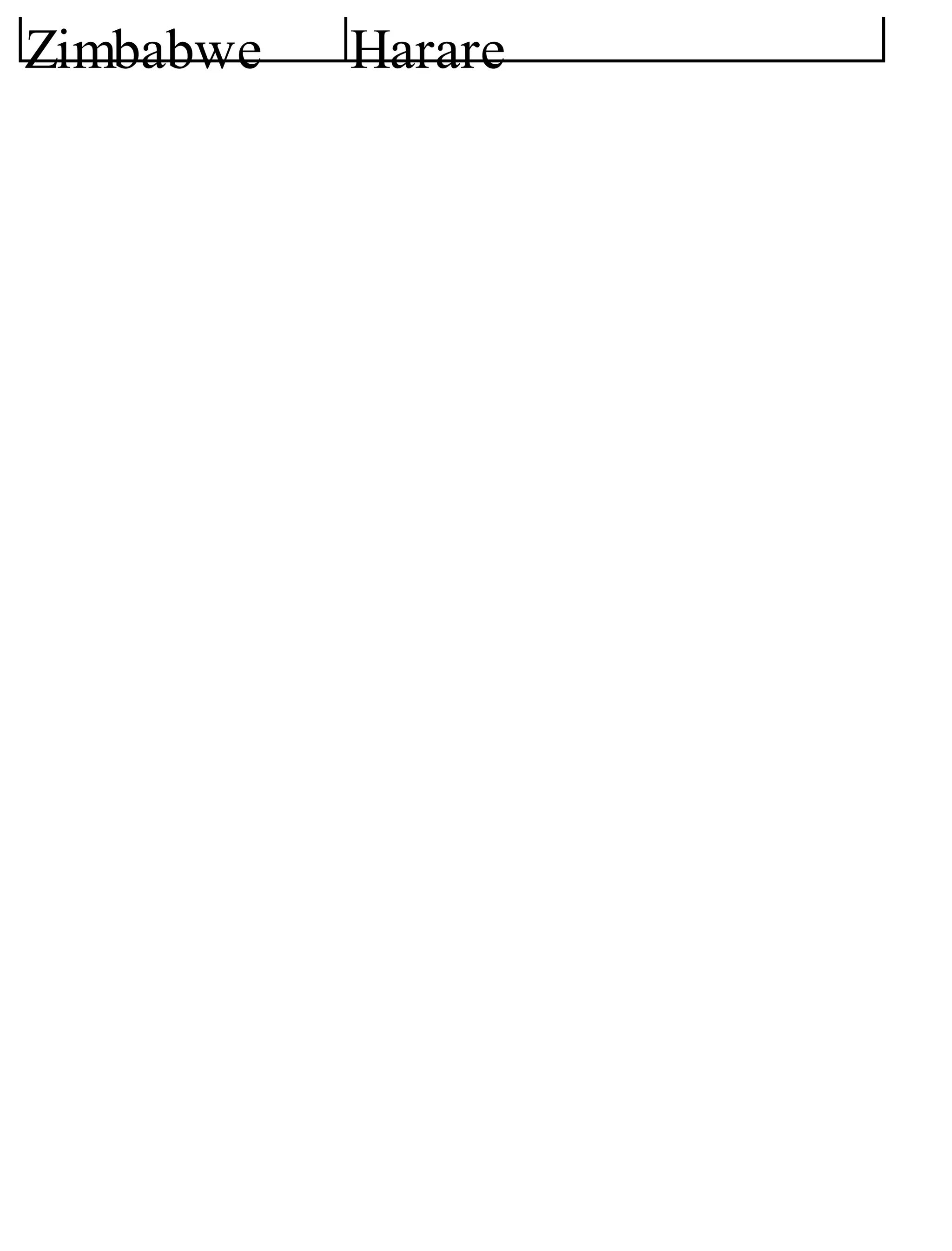
Zimbabwe Harare
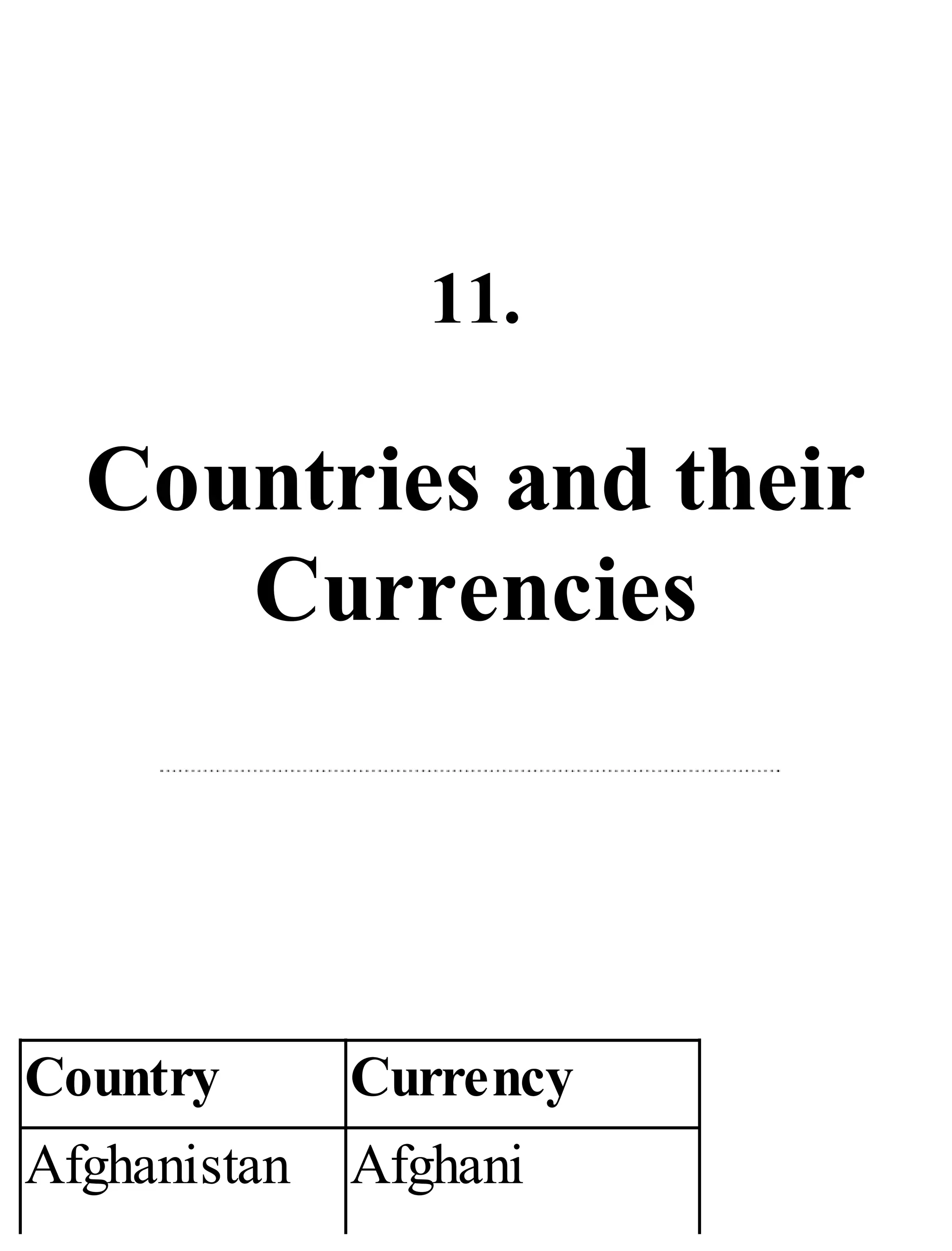
11.
Countries and their
Currencies
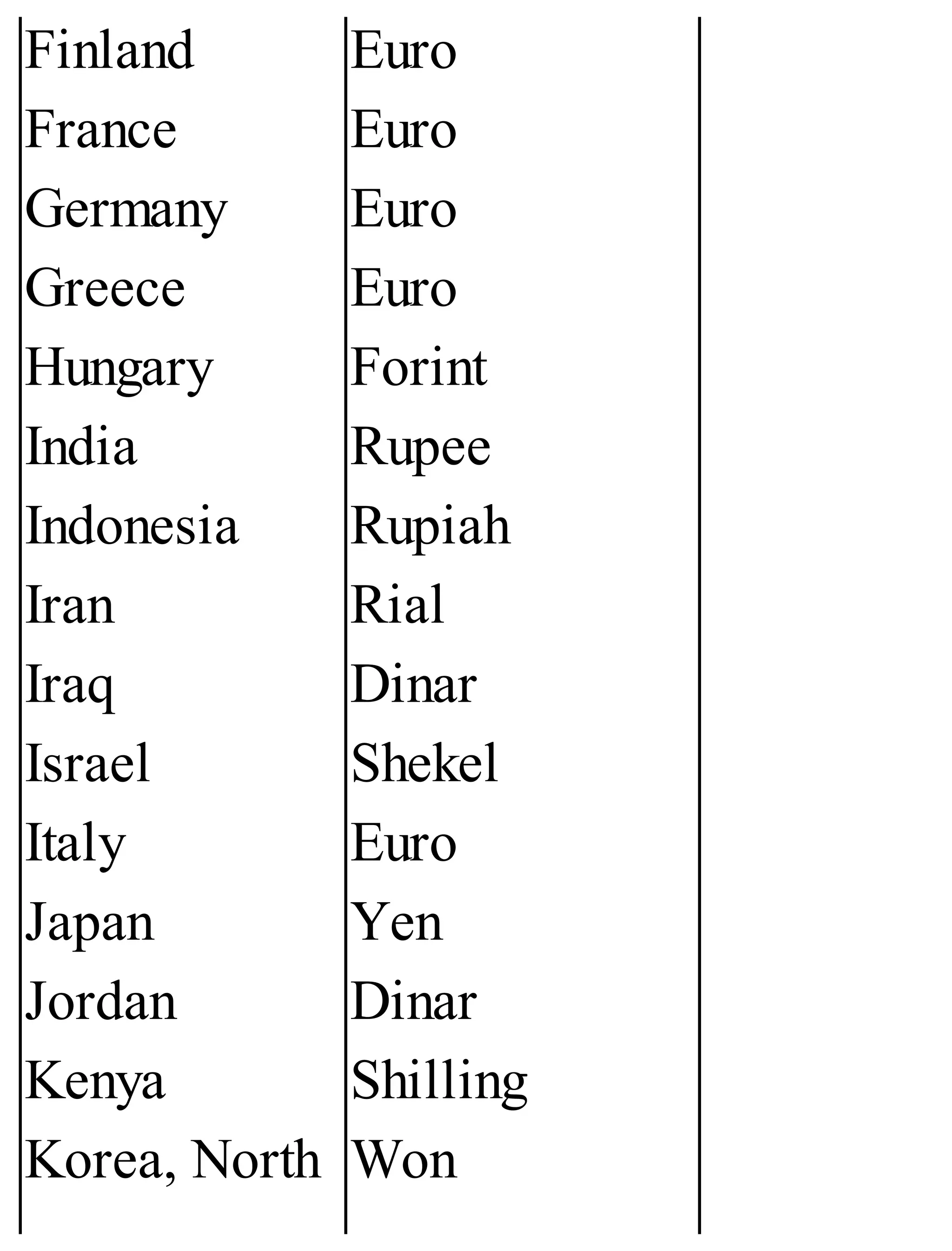
Country Currency
Afghanistan Afghani
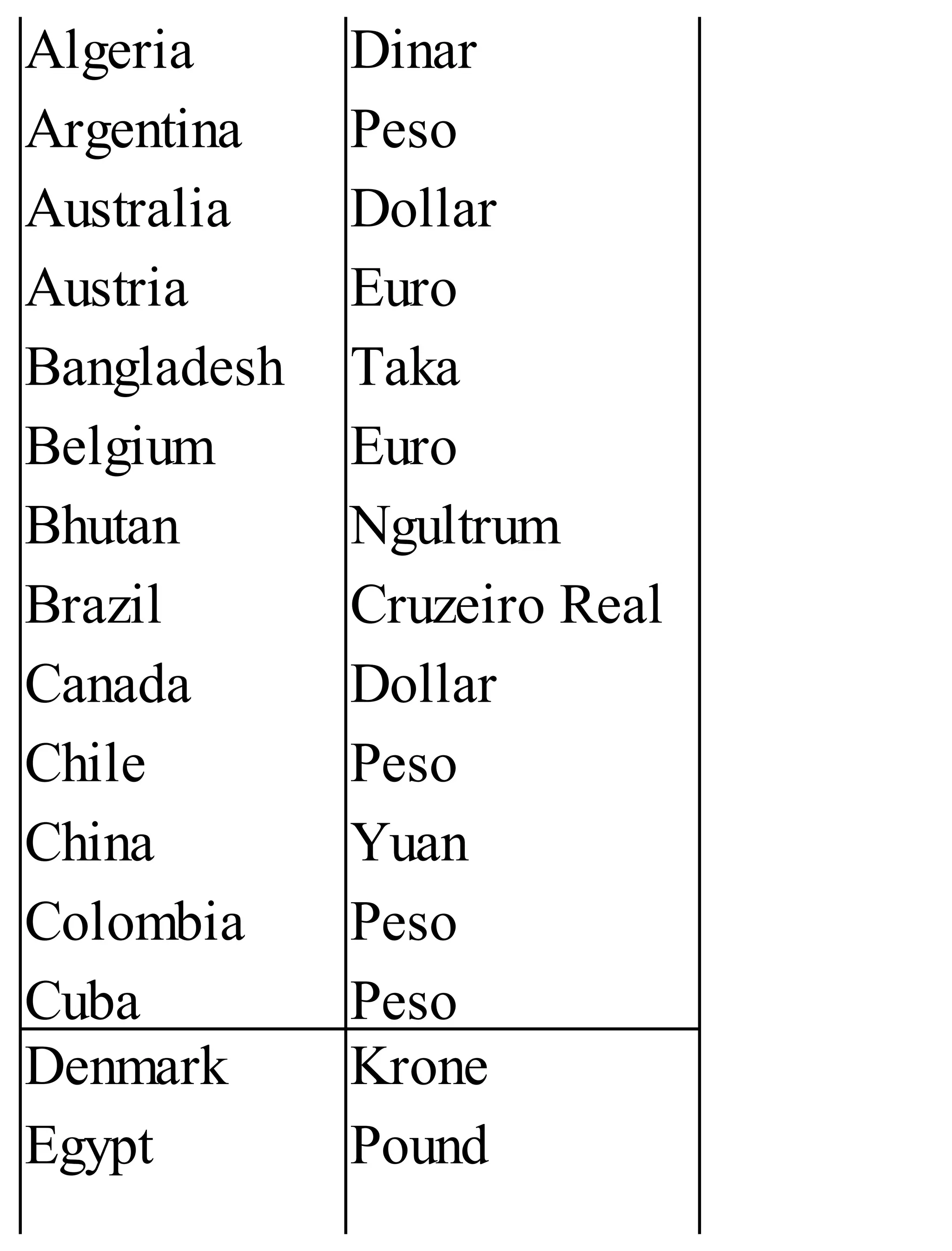
Algeria
Argentina
Australia
Austria
Bangladesh
Belgium
Bhutan
Brazil
Canada
Chile
China
Colombia
Cuba
Dinar
Peso
Dollar
Euro
Taka
Euro
Ngultrum
Cruzeiro Real
Dollar
Peso
Yuan
Peso
Peso
Denmark
Egypt
Krone
Pound
Finland
France
Germany
Greece
Hungary
India
Indonesia
Iran
Iraq
Israel
Italy
Japan
Jordan
Kenya
Korea, North
Euro
Euro
Euro
Euro
Forint
Rupee
Rupiah
Rial
Dinar
Shekel
Euro
Yen
Dinar
Shilling
Won
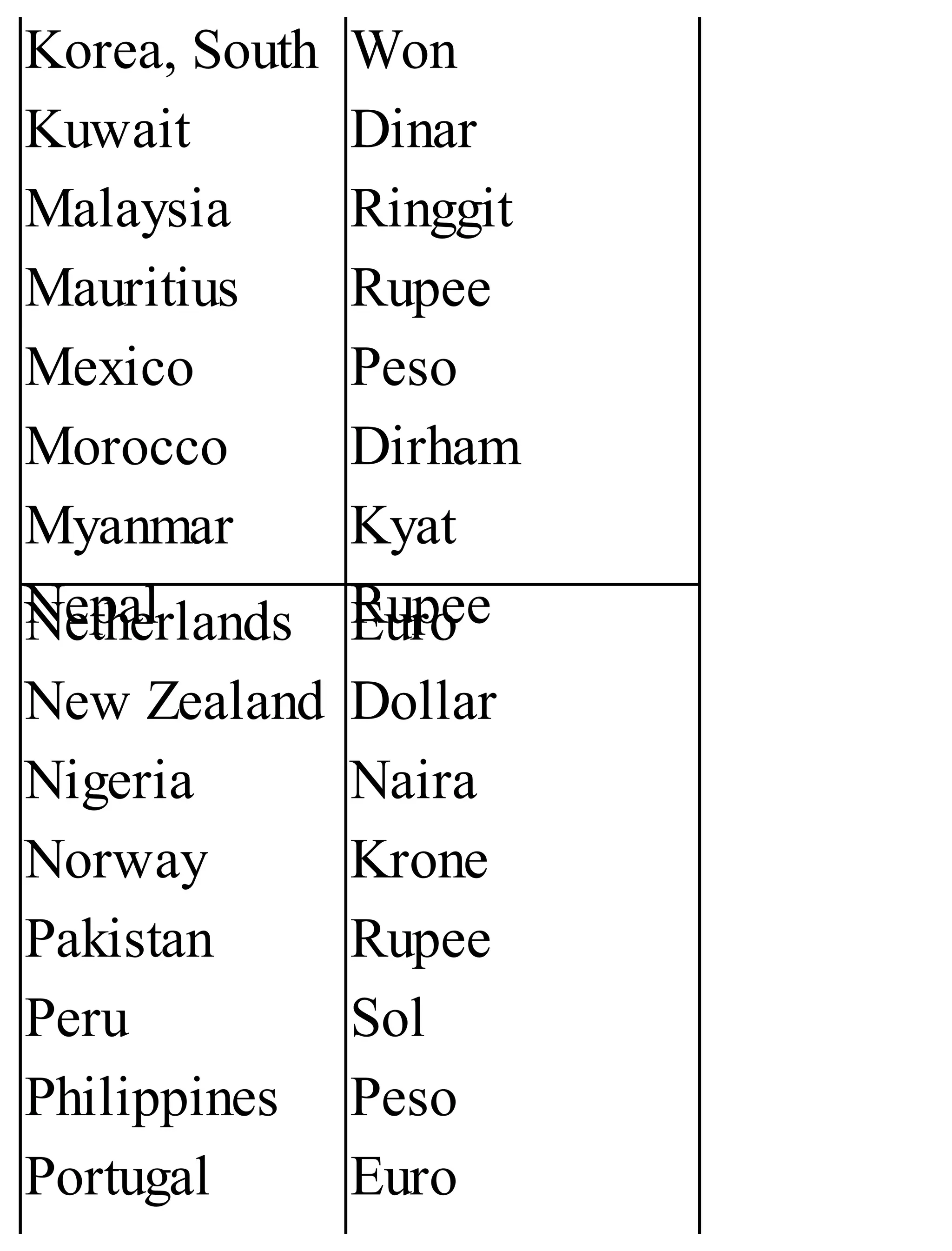
Korea, South
Kuwait
Malaysia
Mauritius
Mexico
Morocco
Myanmar
Nepal
Won
Dinar
Ringgit
Rupee
Peso
Dirham
Kyat
Rupee
Netherlands
New Zealand
Nigeria
Norway
Pakistan
Peru
Philippines
Portugal
Euro
Dollar
Naira
Krone
Rupee
Sol
Peso
Euro
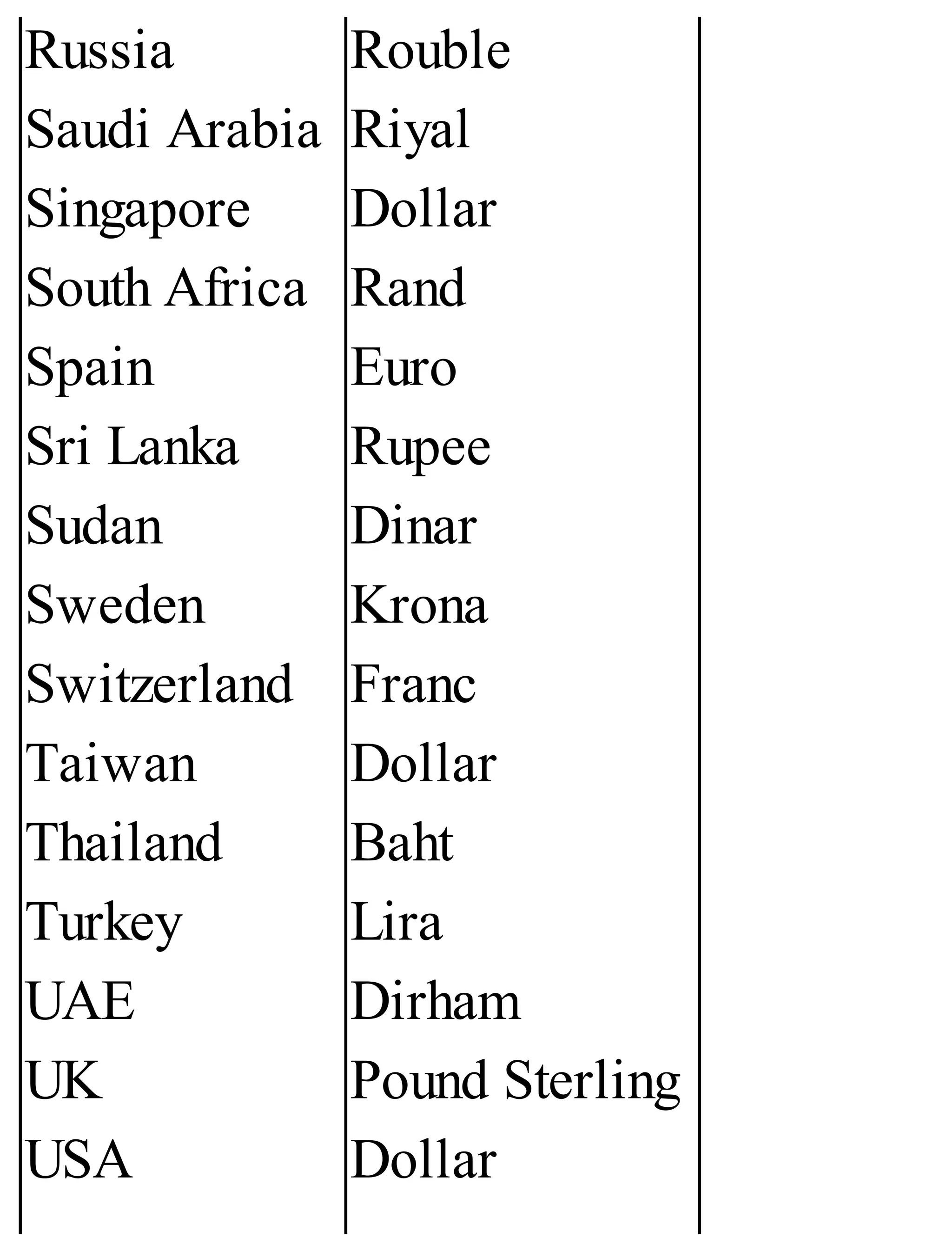
Russia
Saudi Arabia
Singapore
South Africa
Spain
Sri Lanka
Sudan
Sweden
Switzerland
Taiwan
Thailand
Turkey
UAE
UK
USA
Rouble
Riyal
Dollar
Rand
Euro
Rupee
Dinar
Krona
Franc
Dollar
Baht
Lira
Dirham
Pound Sterling
Dollar
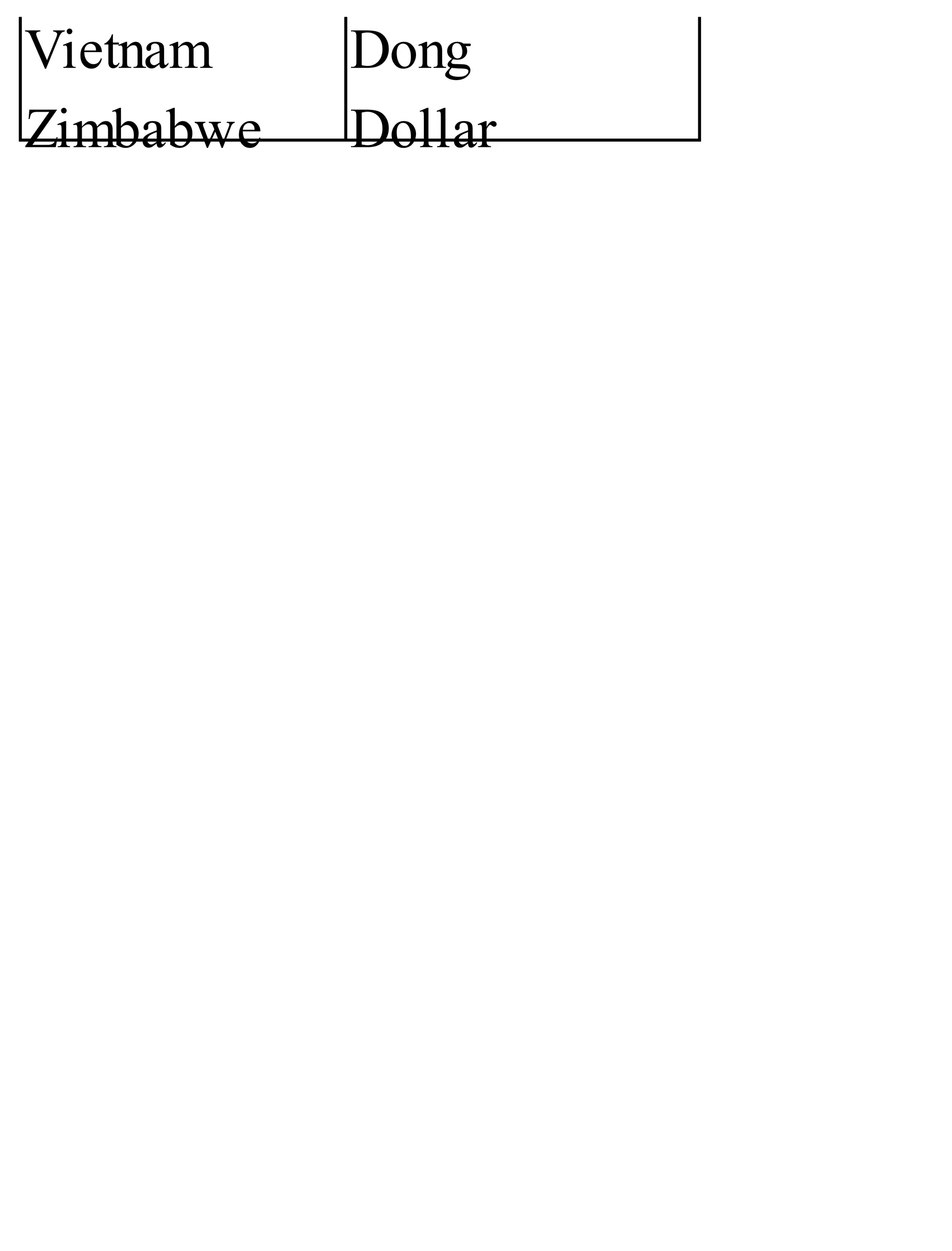
Vietnam
Zimbabwe
Dong
Dollar
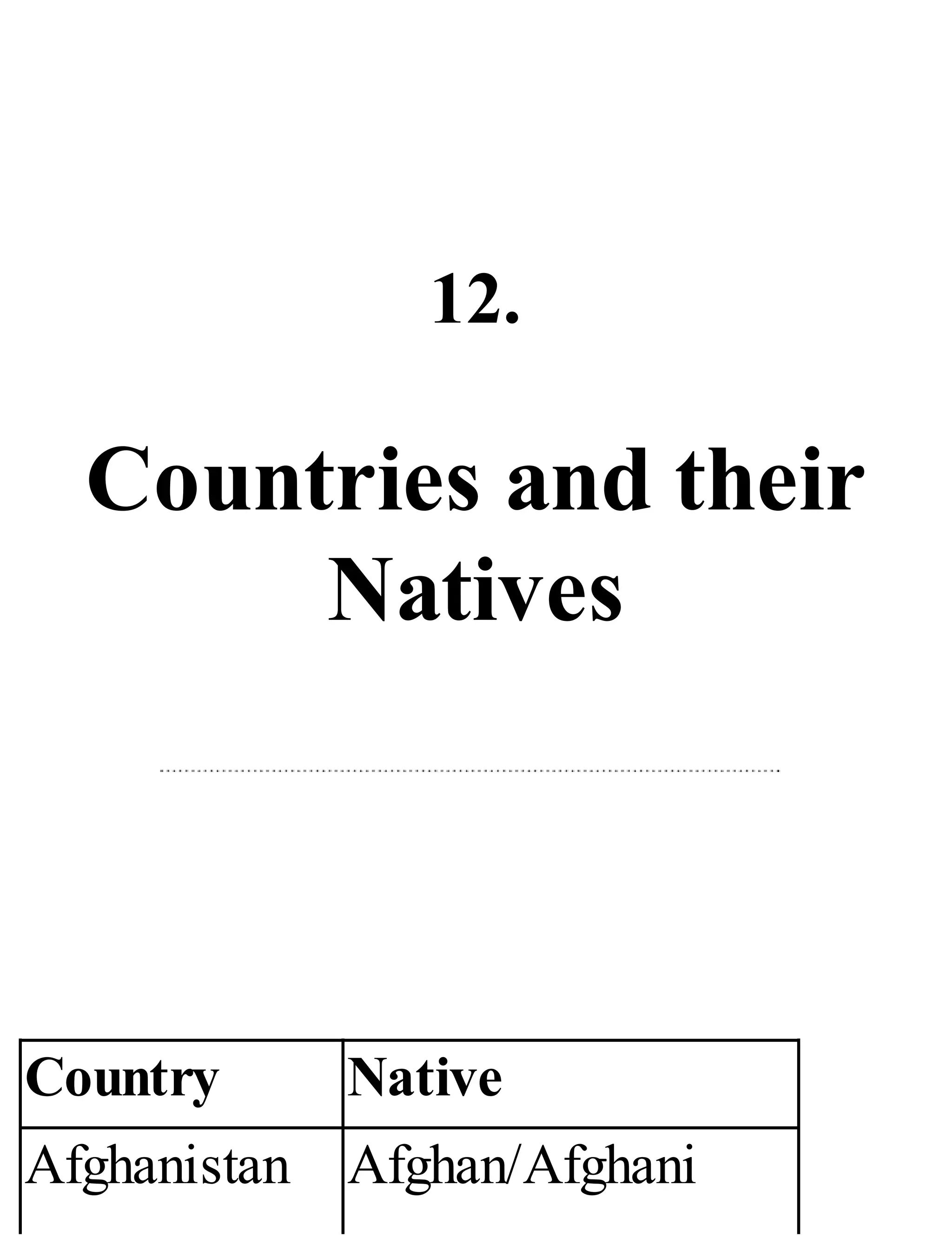
12.
Countries and their
Natives
Country Native
Afghanistan Afghan/Afghani
Algeria
Argentina
Australia
Bangladesh
Belgium
Bhutan
Brazil
Britain
Canada
Chile
China
Cuba
Denmark
Algerian
Argentinian
Australian
Bangladeshi
Belgian
Bhutani/Bhutanese
Brazilian
British
Canadian
Chilean
Chinese
Cuban
Dane/Danish
Egypt
England
Egyptian
English
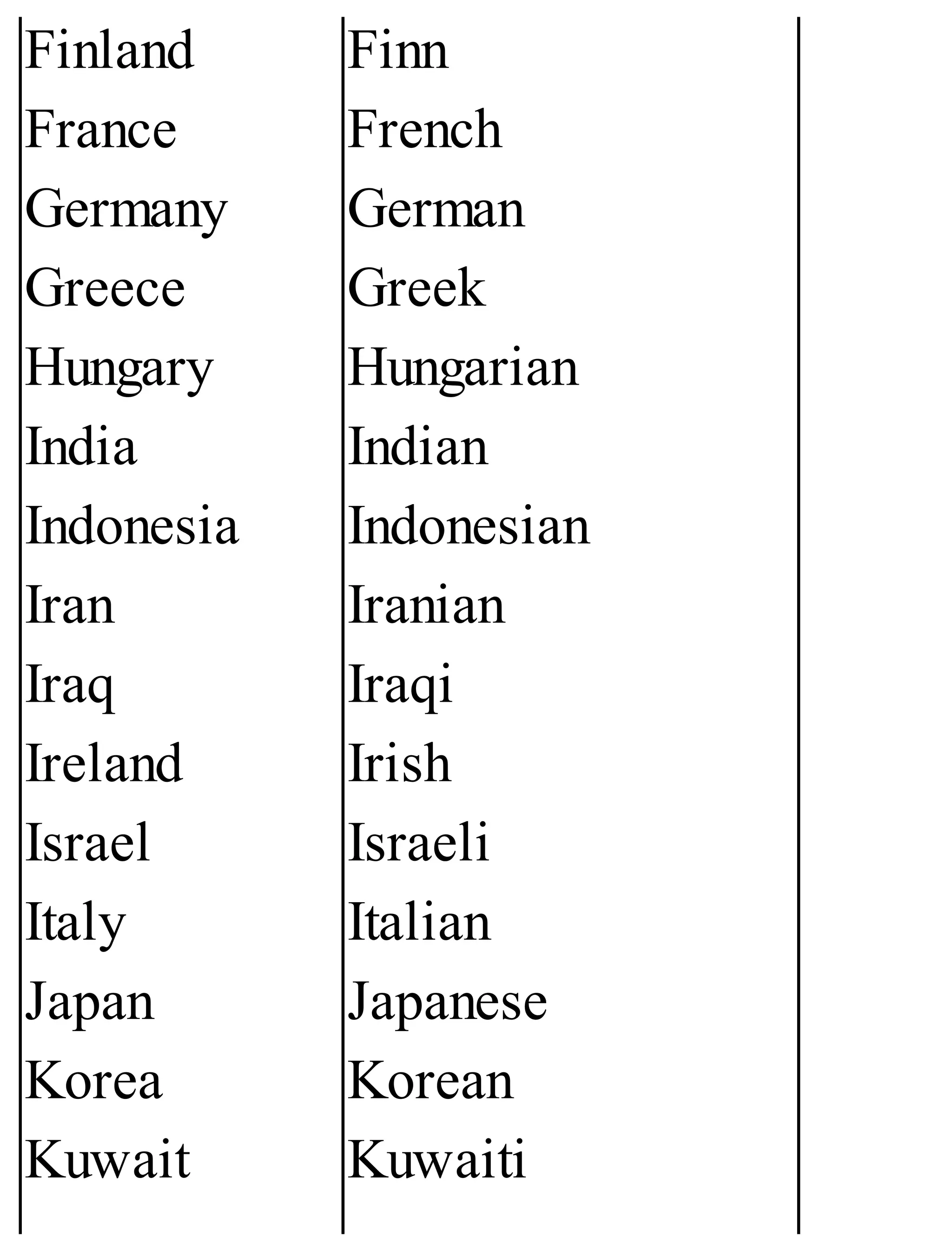
Finland
France
Germany
Greece
Hungary
India
Indonesia
Iran
Iraq
Ireland
Israel
Italy
Japan
Korea
Kuwait
Finn
French
German
Greek
Hungarian
Indian
Indonesian
Iranian
Iraqi
Irish
Israeli
Italian
Japanese
Korean
Kuwaiti
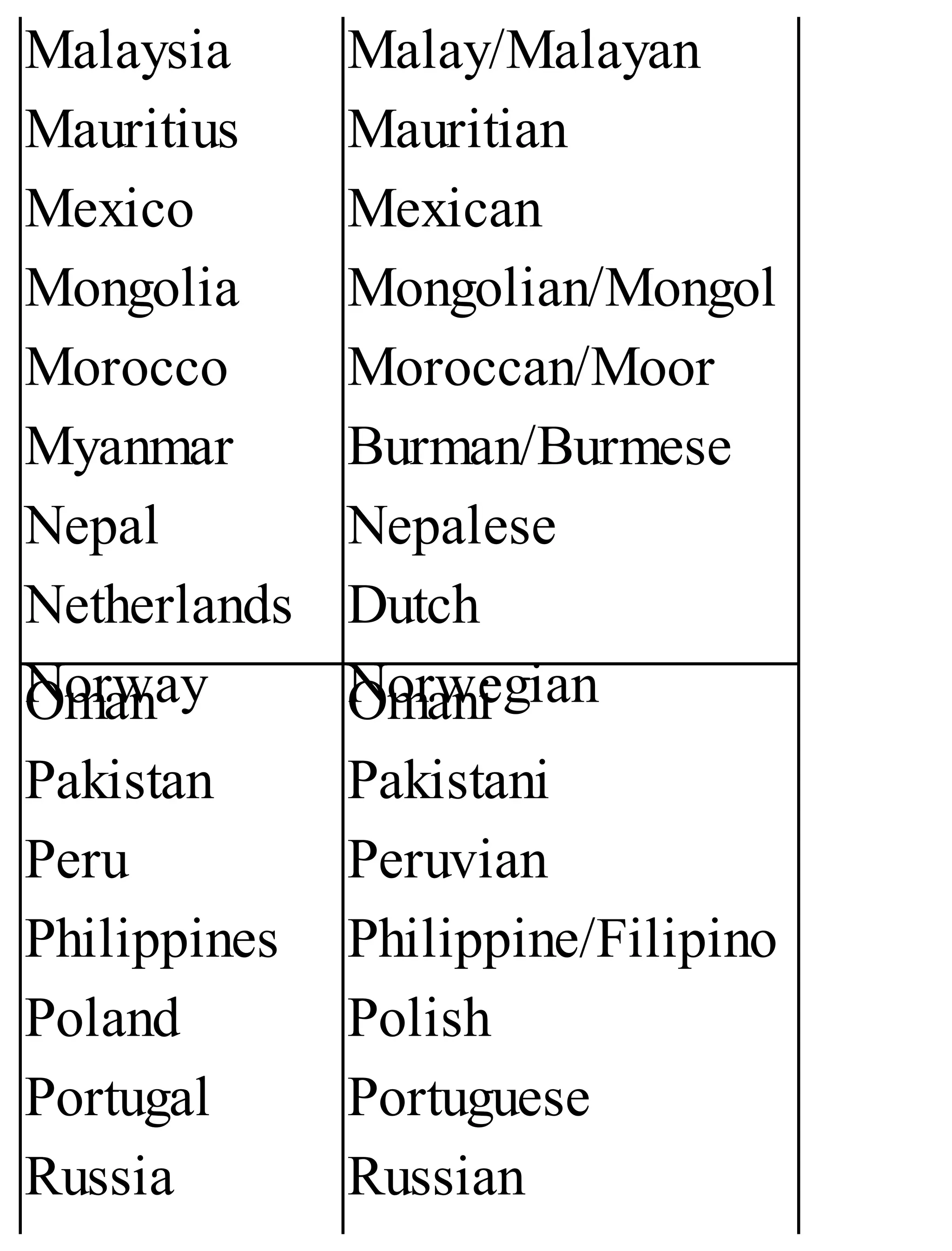
Malaysia
Mauritius
Mexico
Mongolia
Morocco
Myanmar
Nepal
Netherlands
Norway
Malay/Malayan
Mauritian
Mexican
Mongolian/Mongol
Moroccan/Moor
Burman/Burmese
Nepalese
Dutch
Norwegian
Oman
Pakistan
Peru
Philippines
Poland
Portugal
Russia
Omani
Pakistani
Peruvian
Philippine/Filipino
Polish
Portuguese
Russian
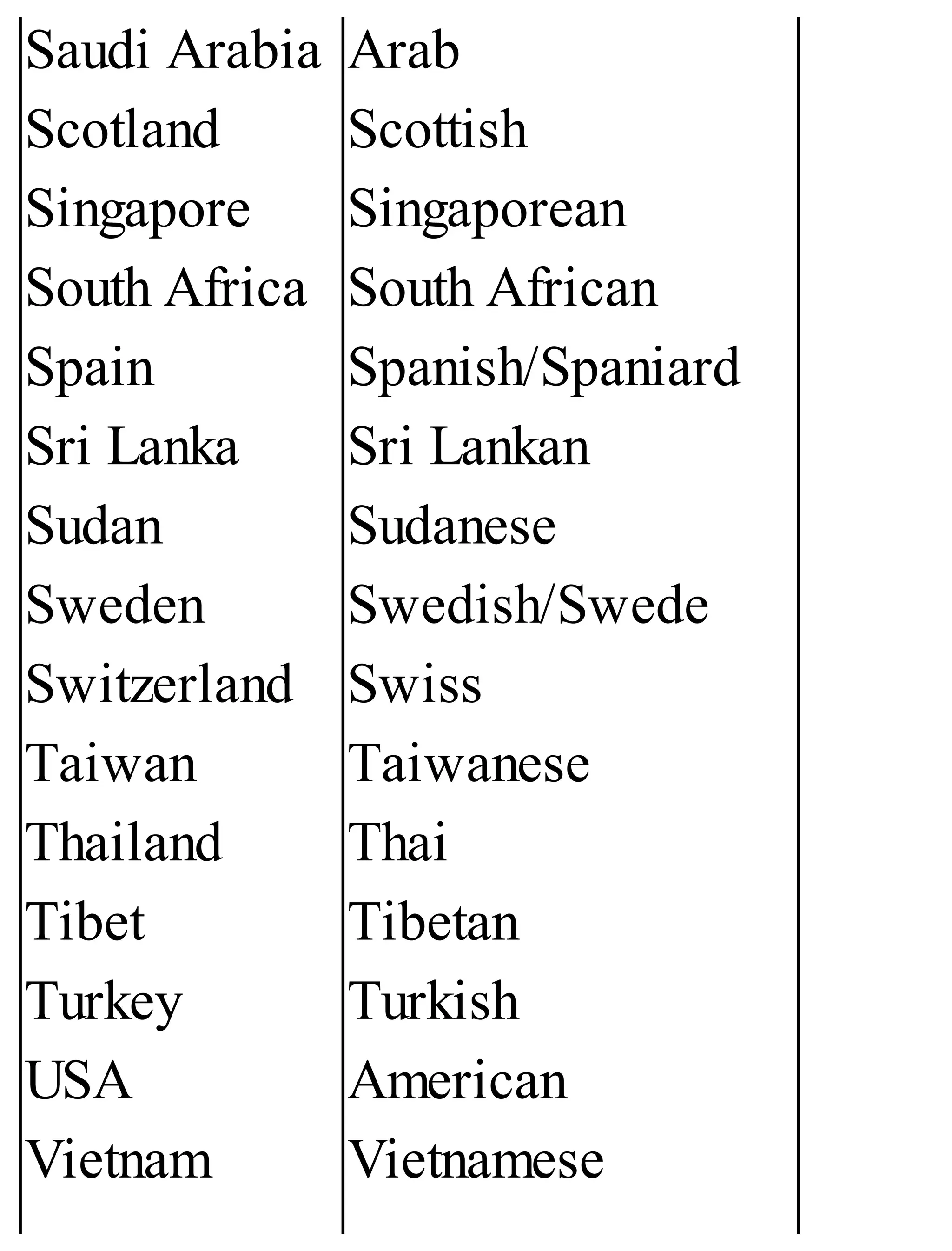
Saudi Arabia
Scotland
Singapore
South Africa
Spain
Sri Lanka
Sudan
Sweden
Switzerland
Taiwan
Thailand
Tibet
Turkey
USA
Vietnam
Arab
Scottish
Singaporean
South African
Spanish/Spaniard
Sri Lankan
Sudanese
Swedish/Swede
Swiss
Taiwanese
Thai
Tibetan
Turkish
American
Vietnamese
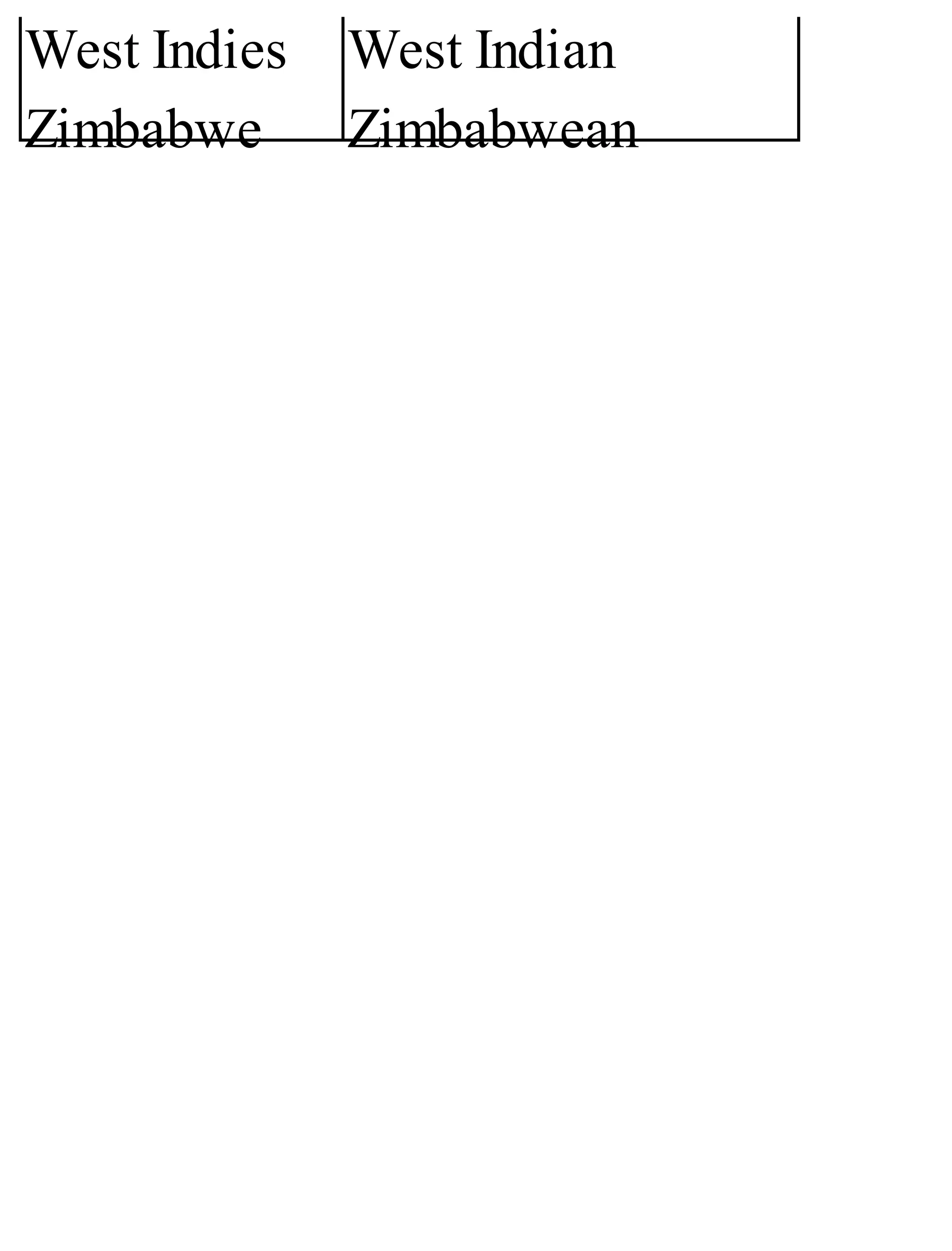
West Indies
Zimbabwe
West Indian
Zimbabwean
13.
Countries and their
Languages
The world is full of languages. Not
certain, but it is estimated that the
languages spoken throughout the world
usually range between 5,000 and 7,000.
Here are some countries of the world
and their official languages:
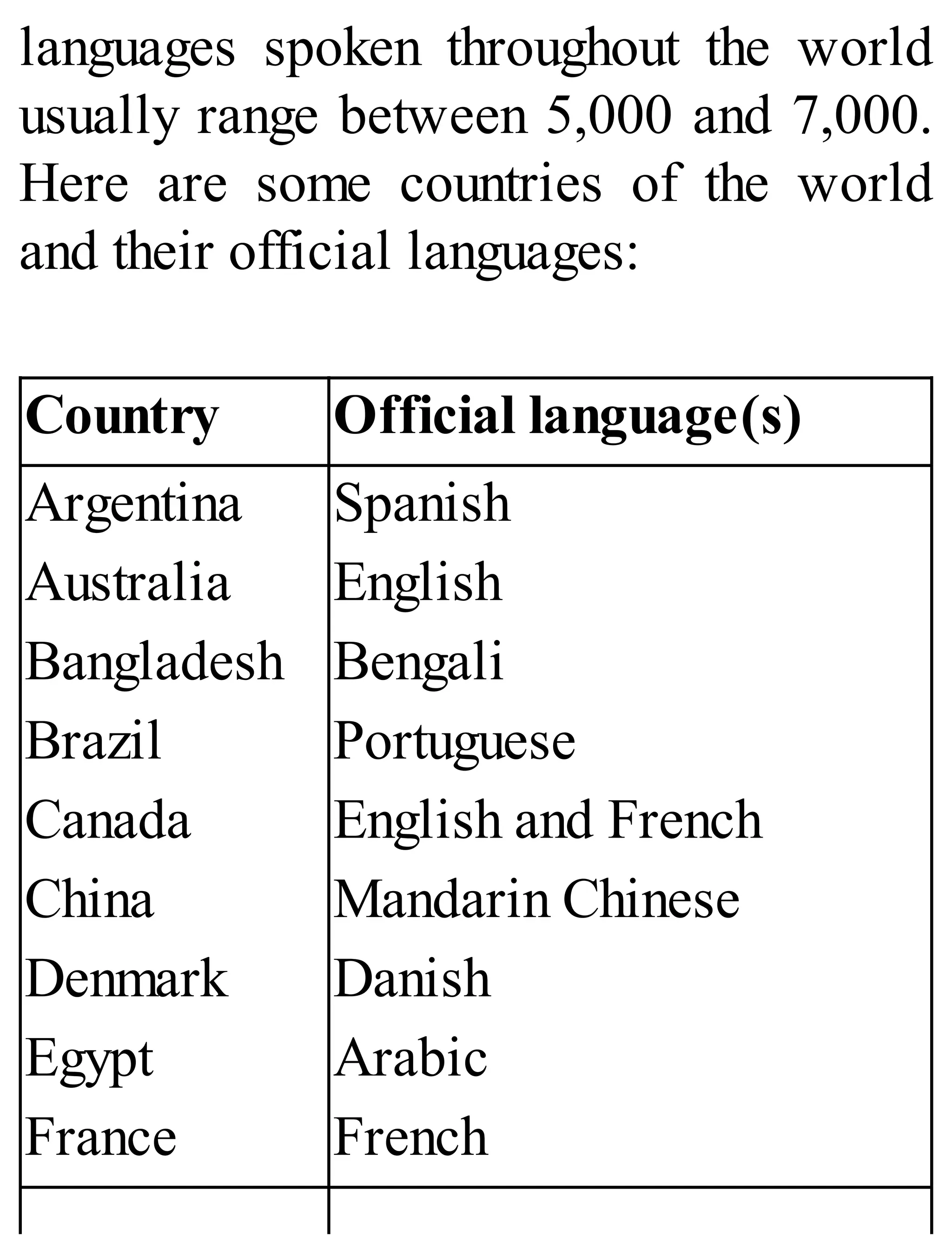
Country Official language(s)
Argentina
Australia
Bangladesh
Brazil
Canada
China
Denmark
Egypt
France
Spanish
English
Bengali
Portuguese
English and French
Mandarin Chinese
Danish
Arabic
French
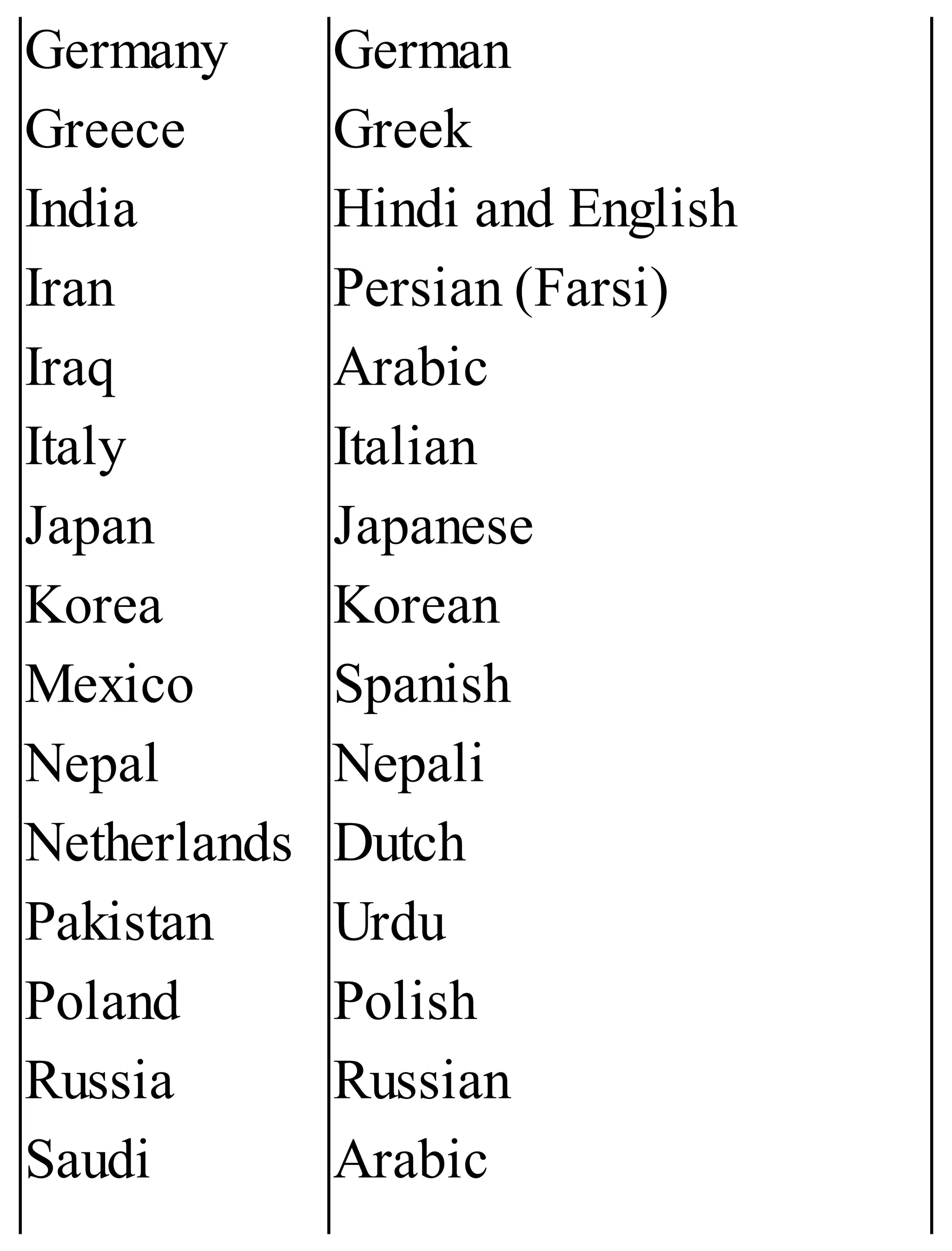
Germany
Greece
India
Iran
Iraq
Italy
Japan
Korea
Mexico
Nepal
Netherlands
Pakistan
Poland
Russia
Saudi
German
Greek
Hindi and English
Persian (Farsi)
Arabic
Italian
Japanese
Korean
Spanish
Nepali
Dutch
Urdu
Polish
Russian
Arabic
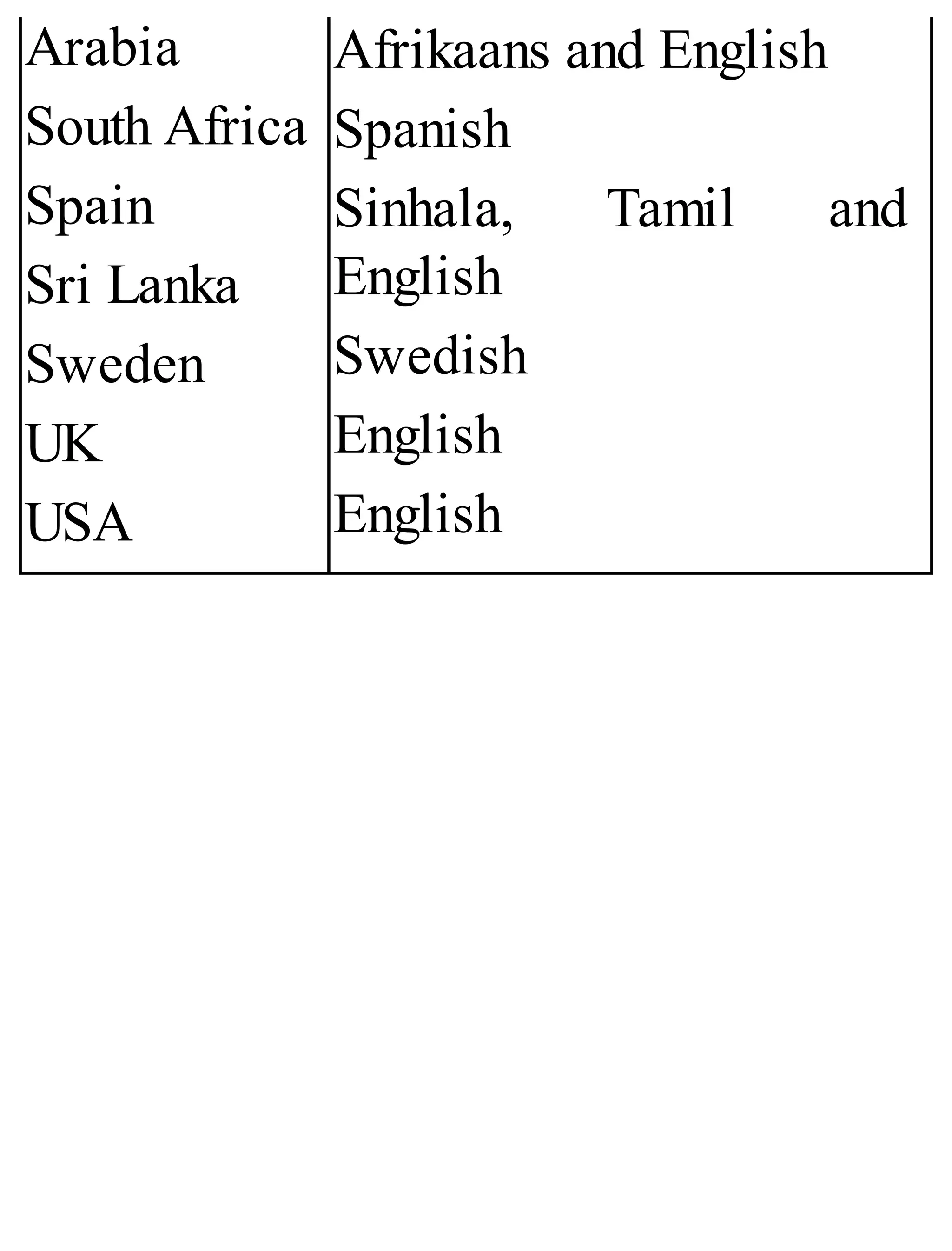
Arabia
South Africa
Spain
Sri Lanka
Sweden
UK
USA
Afrikaans and English
Spanish
Sinhala, Tamil and
English
Swedish
English
English
14.
Countries and their
Religions
The Christianity is the major religion of
the world followed by the Islam. Here
are some countries of the world and
their major religions :
Country Major religion(s)
Australia
Bangladesh
Brazil
Cambodia
Canada
China
Egypt
France
Germany
Greece
Christianity
Islam
Christianity
Buddhism
Christianity
Confucianism, Buddhism
and Taoism
Islam
Christianity
Christianity
Greek Orthodox
India Hinduism, Islam, Sikhism,
Iran
Iraq
Italy
Japan
Malaysia
Nepal
Netherlands
Pakistan
Russia
Saudi
Arabia
South
Africa
Spain
Sri Lanka
Christianity, Buddhism
and Jainism
Islam
Islam
Christianity
Shintoism and Buddhism
Islam
Hinduism
Christianity
Islam
Christianity and Islam
Islam
Christianity
Christianity
Buddhism
Sudan
Switzerland
Thailand
UAE
UK
USA
Islam
Christianity
Buddhism
Islam
Christianity
Christianity
15.
Continents and
Countries
The Earth’s surface is divided into
seven continents, out of which six are
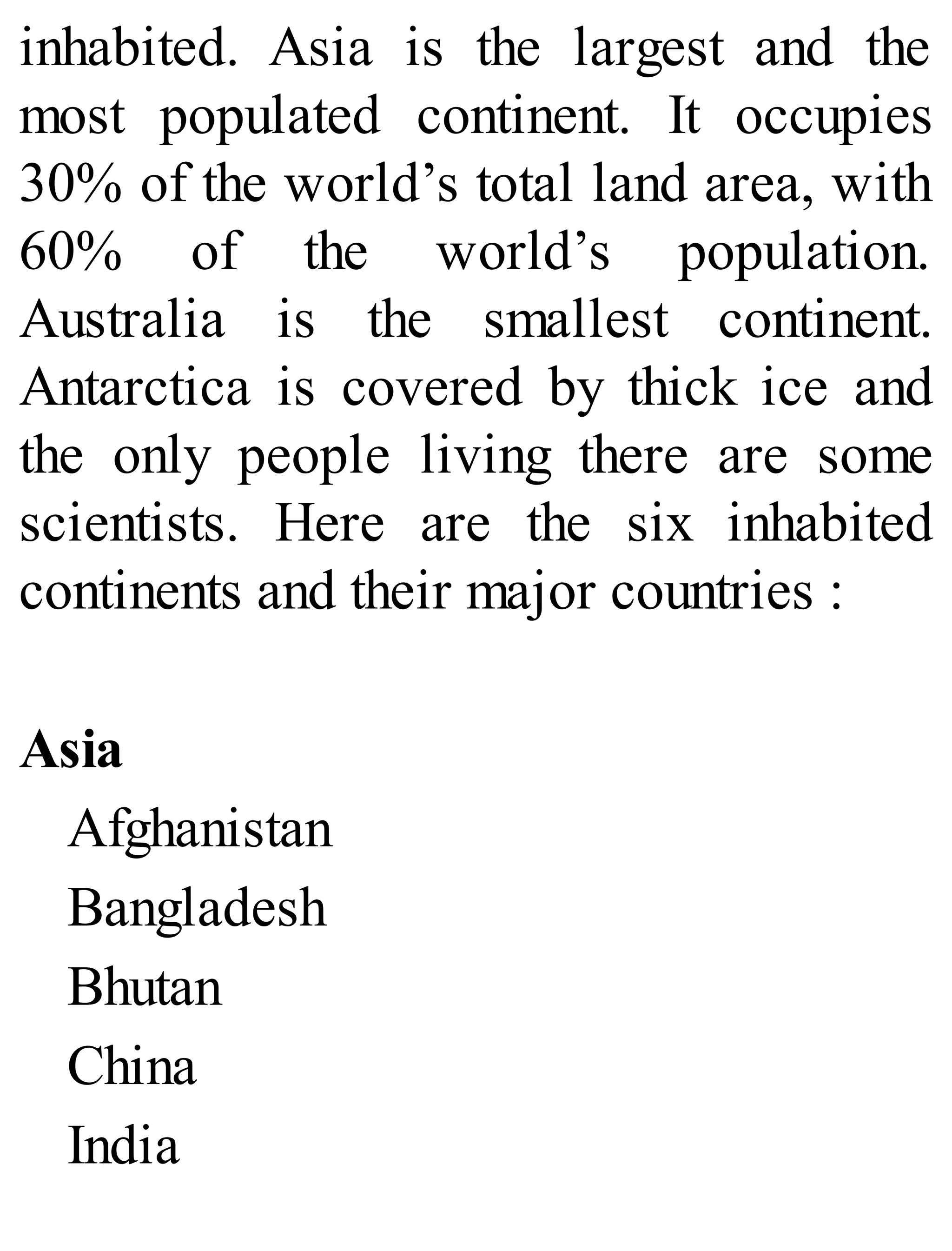
inhabited. Asia is the largest and the
most populated continent. It occupies
30% of the world’s total land area, with
60% of the world’s population.
Australia is the smallest continent.
Antarctica is covered by thick ice and
the only people living there are some
scientists. Here are the six inhabited
continents and their major countries :
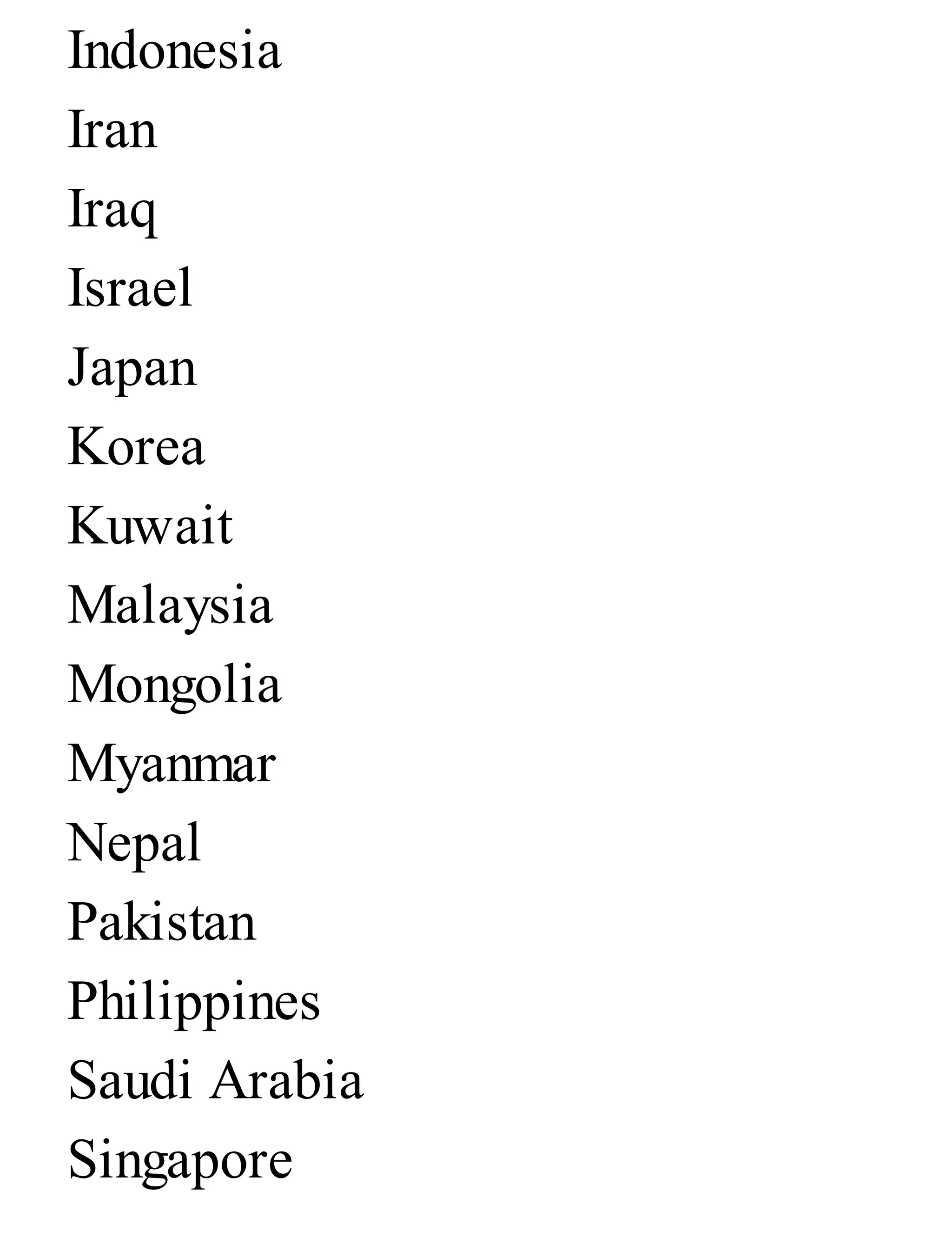
Asia
Afghanistan
Bangladesh
Bhutan
China
India
Indonesia
Iran
Iraq
Israel
Japan
Korea
Kuwait
Malaysia
Mongolia
Myanmar
Nepal
Pakistan
Philippines
Saudi Arabia
Singapore
Sri Lanka
Taiwan
Thailand
Turkey
UAE
Vietnam
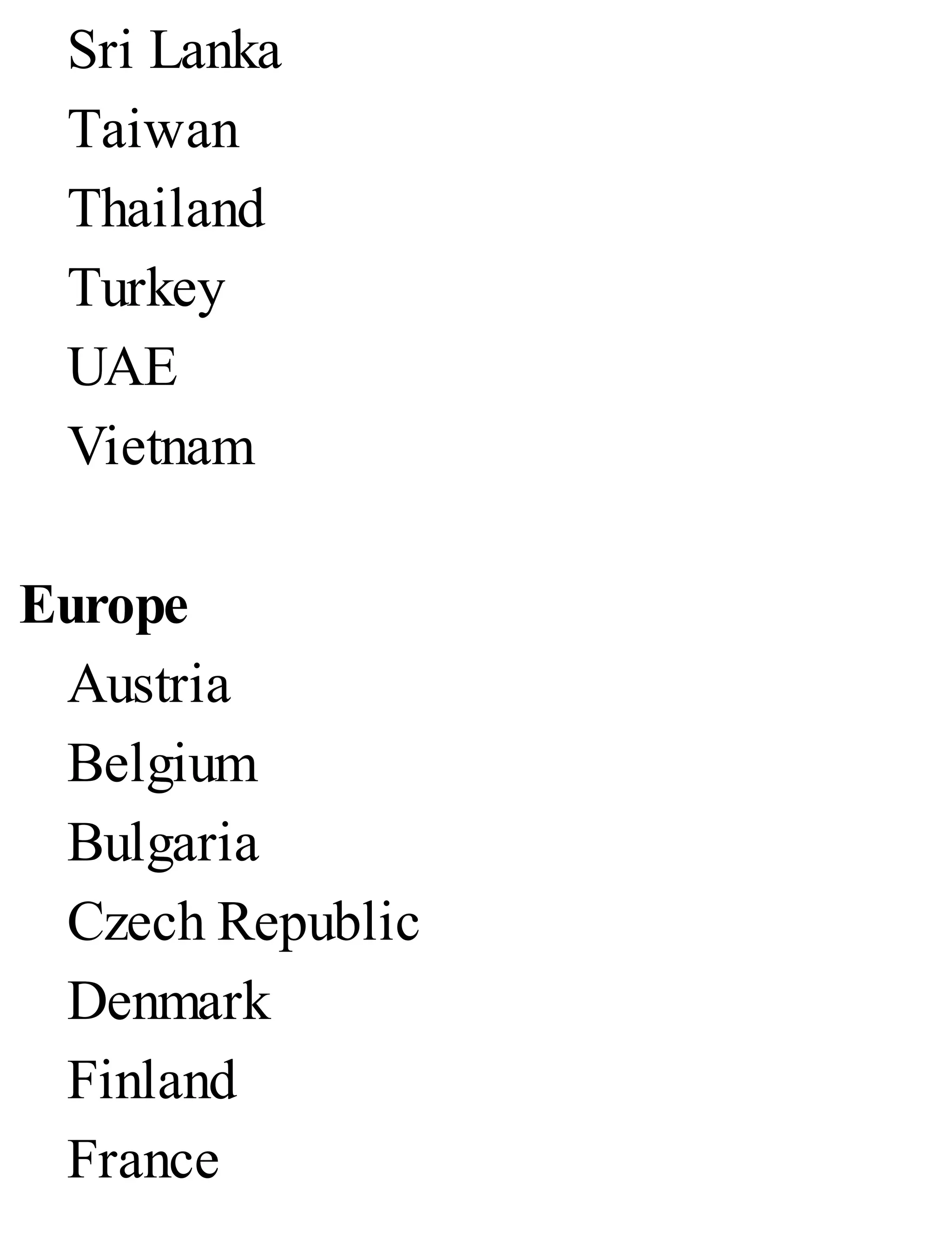
Europe
Austria
Belgium
Bulgaria
Czech Republic
Denmark
Finland
France
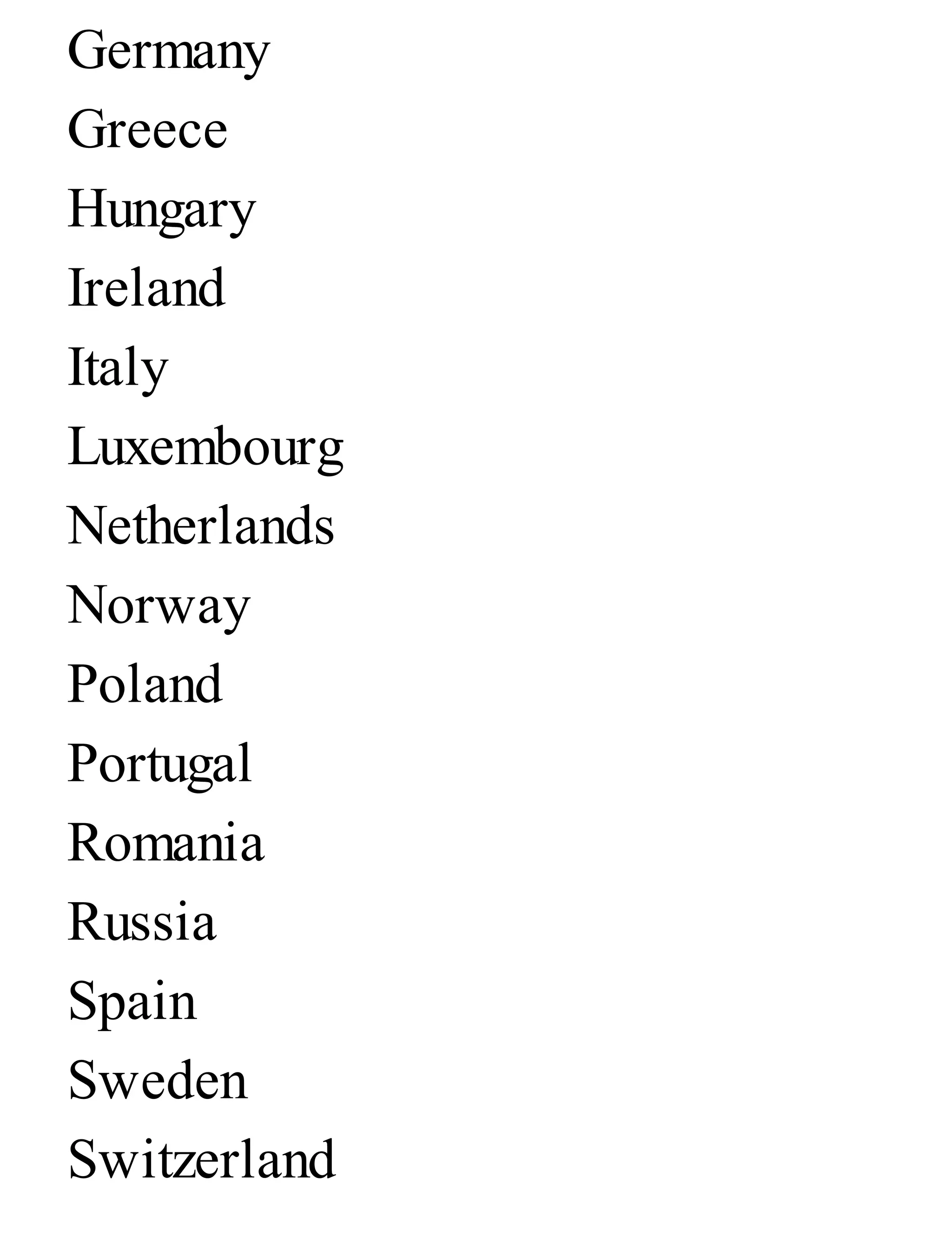
Germany
Greece
Hungary
Ireland
Italy
Luxembourg
Netherlands
Norway
Poland
Portugal
Romania
Russia
Spain
Sweden
Switzerland
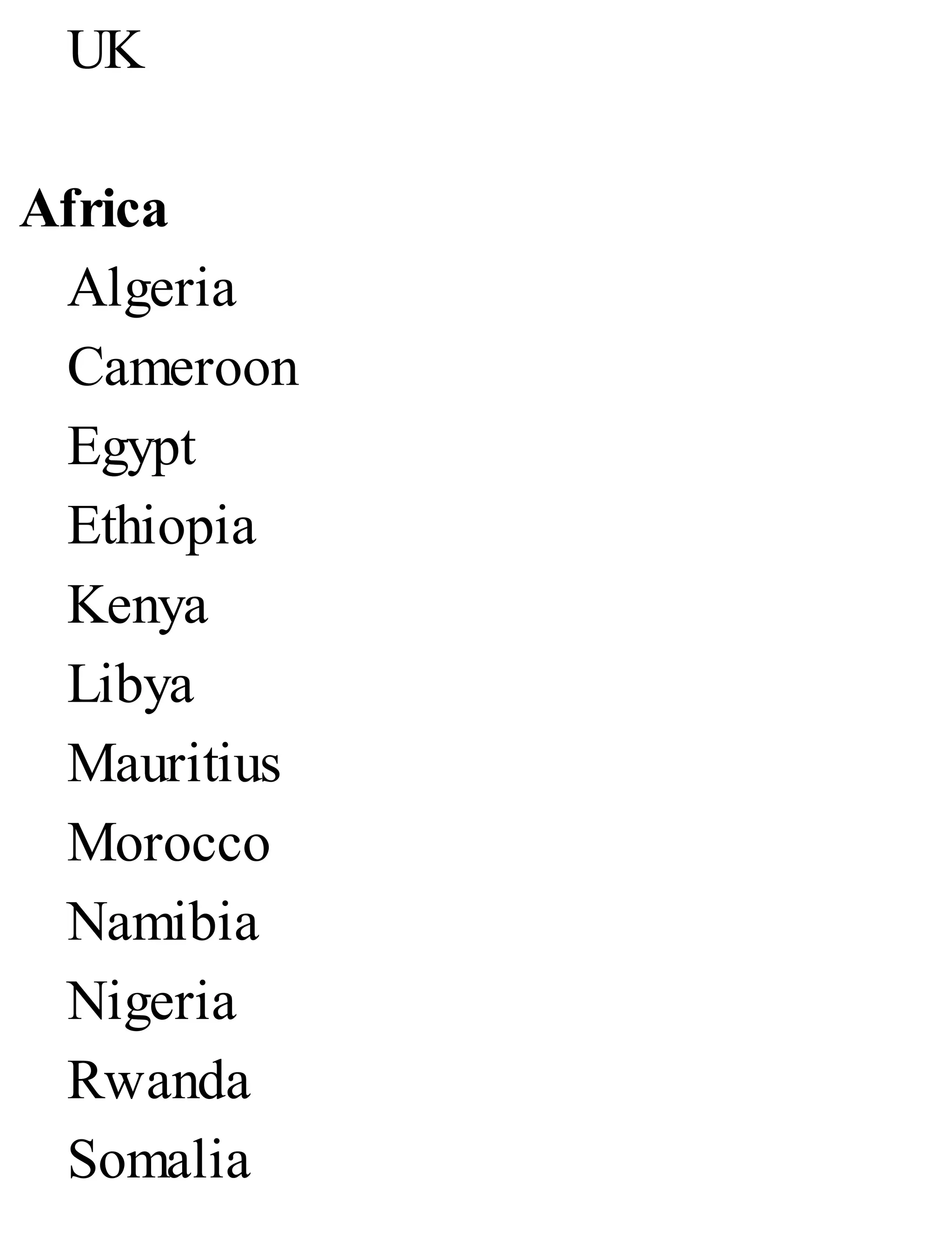
UK
Africa
Algeria
Cameroon
Egypt
Ethiopia
Kenya
Libya
Mauritius
Morocco
Namibia
Nigeria
Rwanda
Somalia
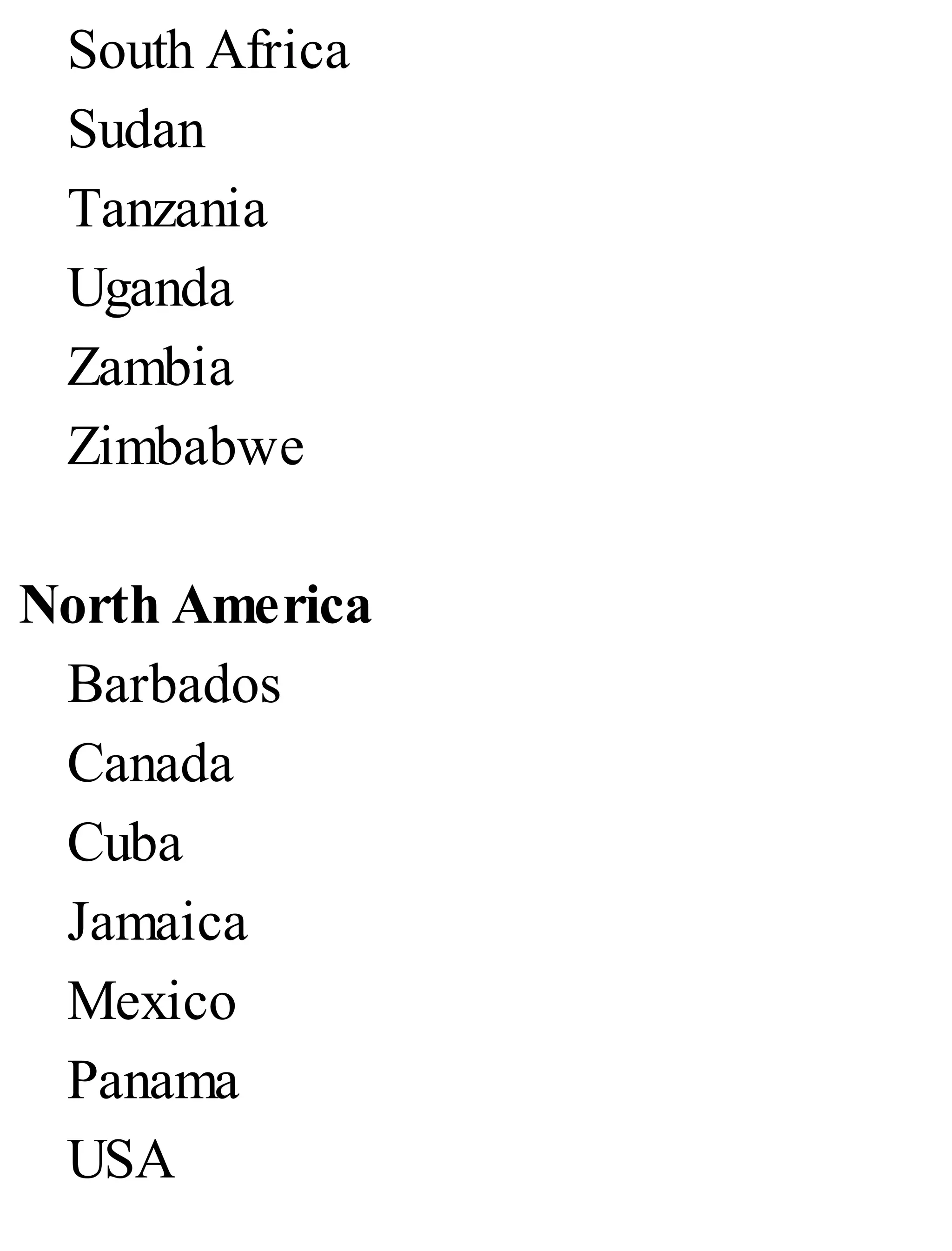
South Africa
Sudan
Tanzania
Uganda
Zambia
Zimbabwe
North America
Barbados
Canada
Cuba
Jamaica
Mexico
Panama
USA
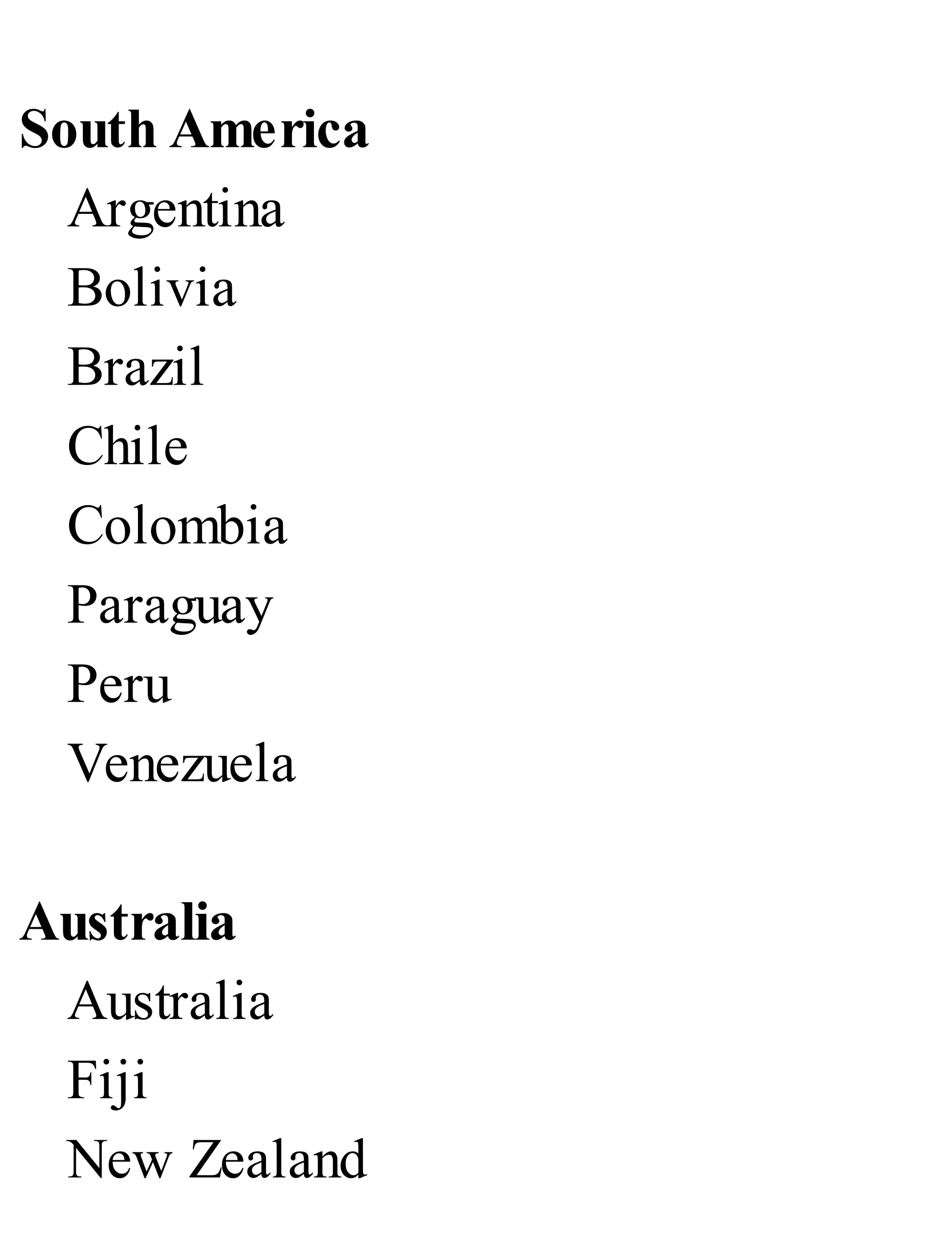
South America
Argentina
Bolivia
Brazil
Chile
Colombia
Paraguay
Peru
Venezuela
Australia
Australia
Fiji
New Zealand
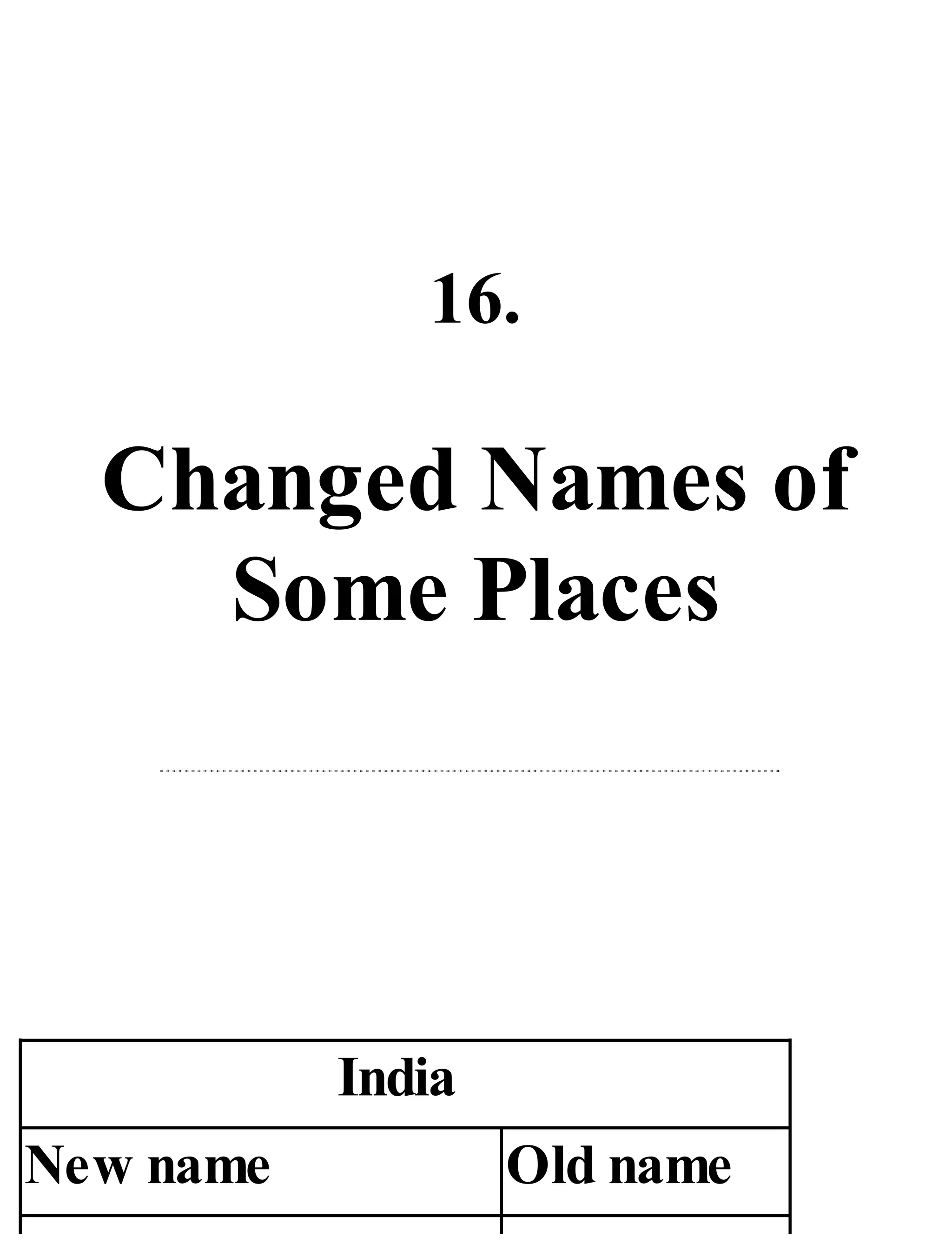
16.
Changed Names of
Some Places
India
New name Old name
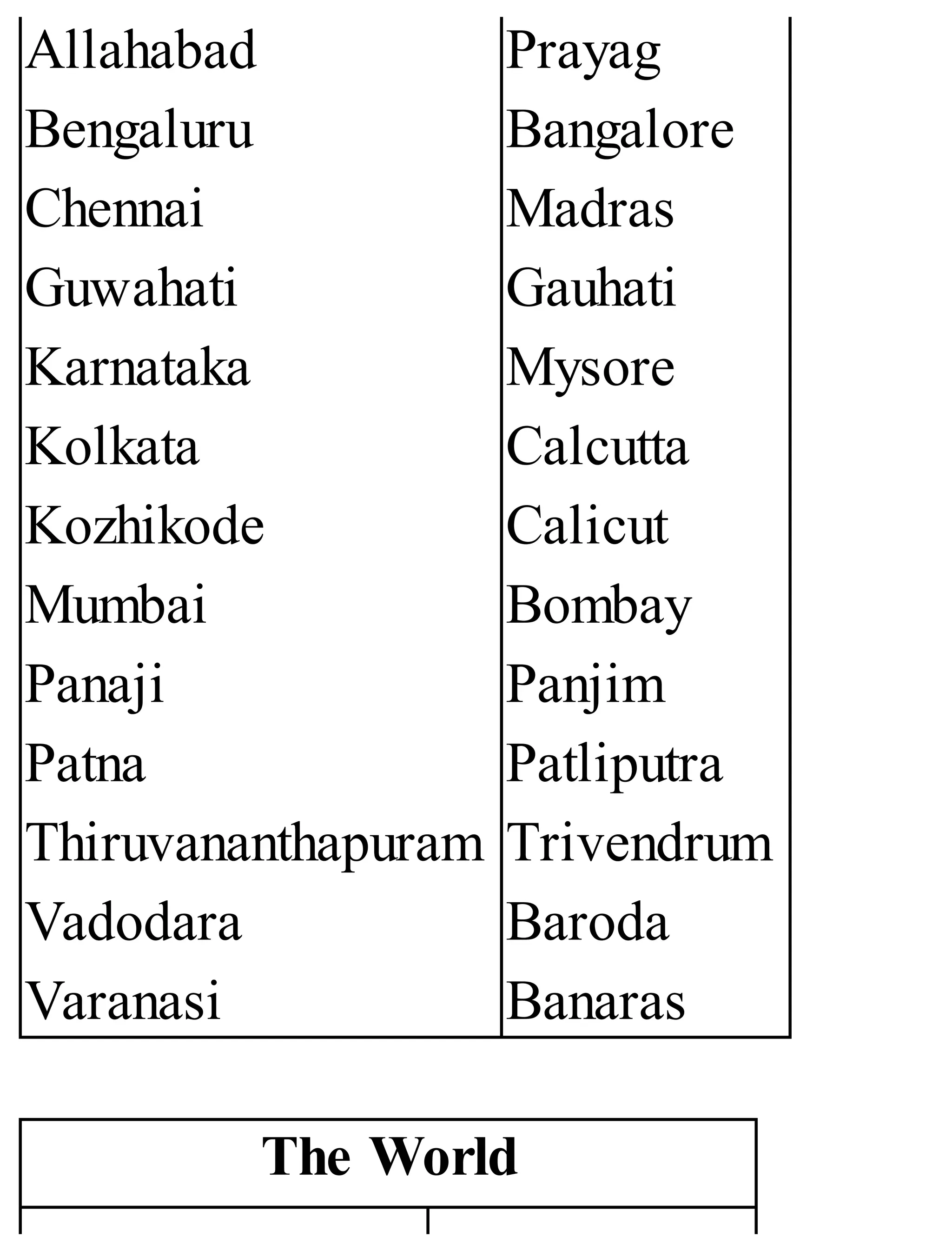
Allahabad
Bengaluru
Chennai
Guwahati
Karnataka
Kolkata
Kozhikode
Mumbai
Panaji
Patna
Thiruvananthapuram
Vadodara
Varanasi
Prayag
Bangalore
Madras
Gauhati
Mysore
Calcutta
Calicut
Bombay
Panjim
Patliputra
Trivendrum
Baroda
Banaras
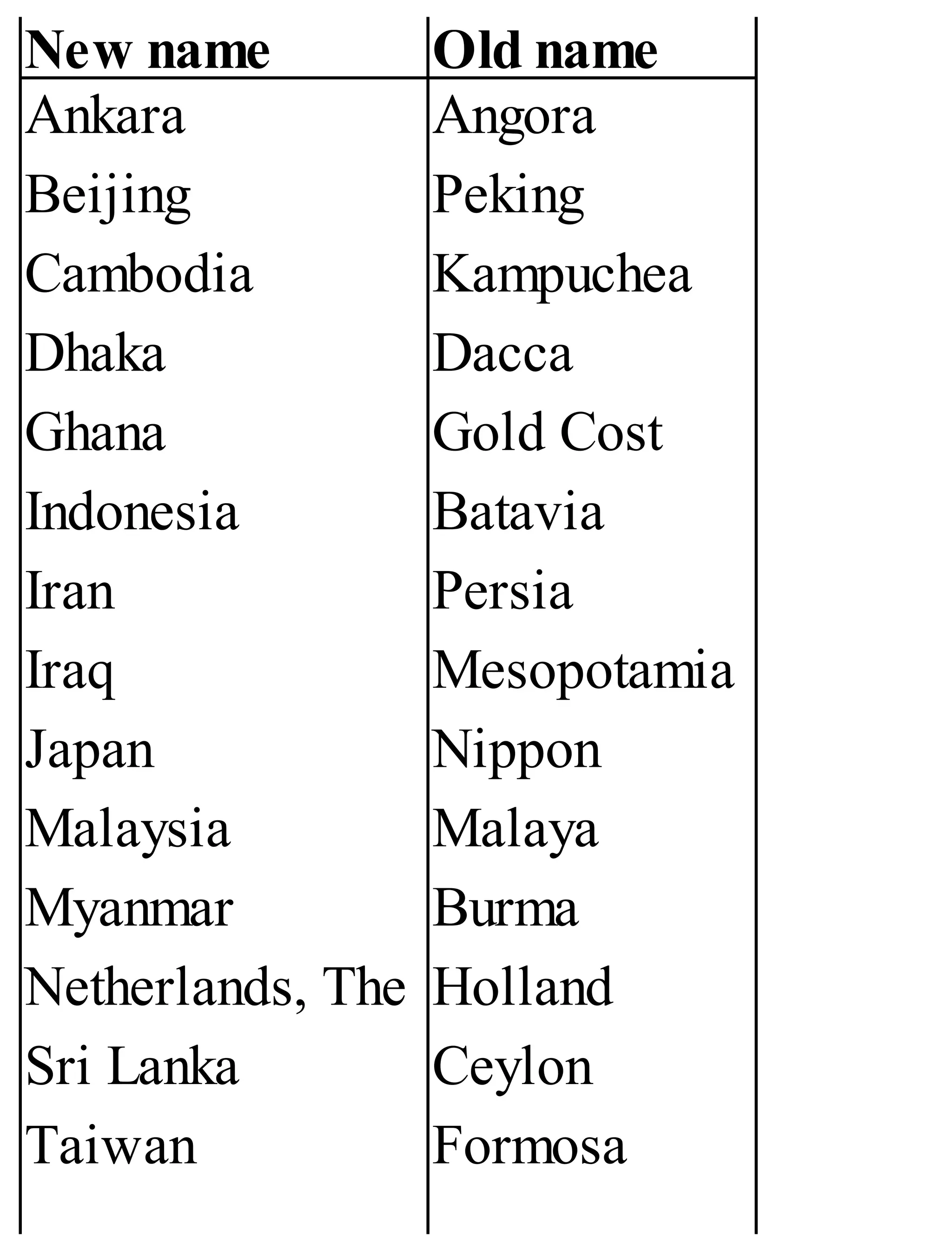
The World
New name Old name
Ankara
Beijing
Cambodia
Dhaka
Ghana
Indonesia
Iran
Iraq
Japan
Malaysia
Myanmar
Netherlands, The
Sri Lanka
Taiwan
Angora
Peking
Kampuchea
Dacca
Gold Cost
Batavia
Persia
Mesopotamia
Nippon
Malaya
Burma
Holland
Ceylon
Formosa
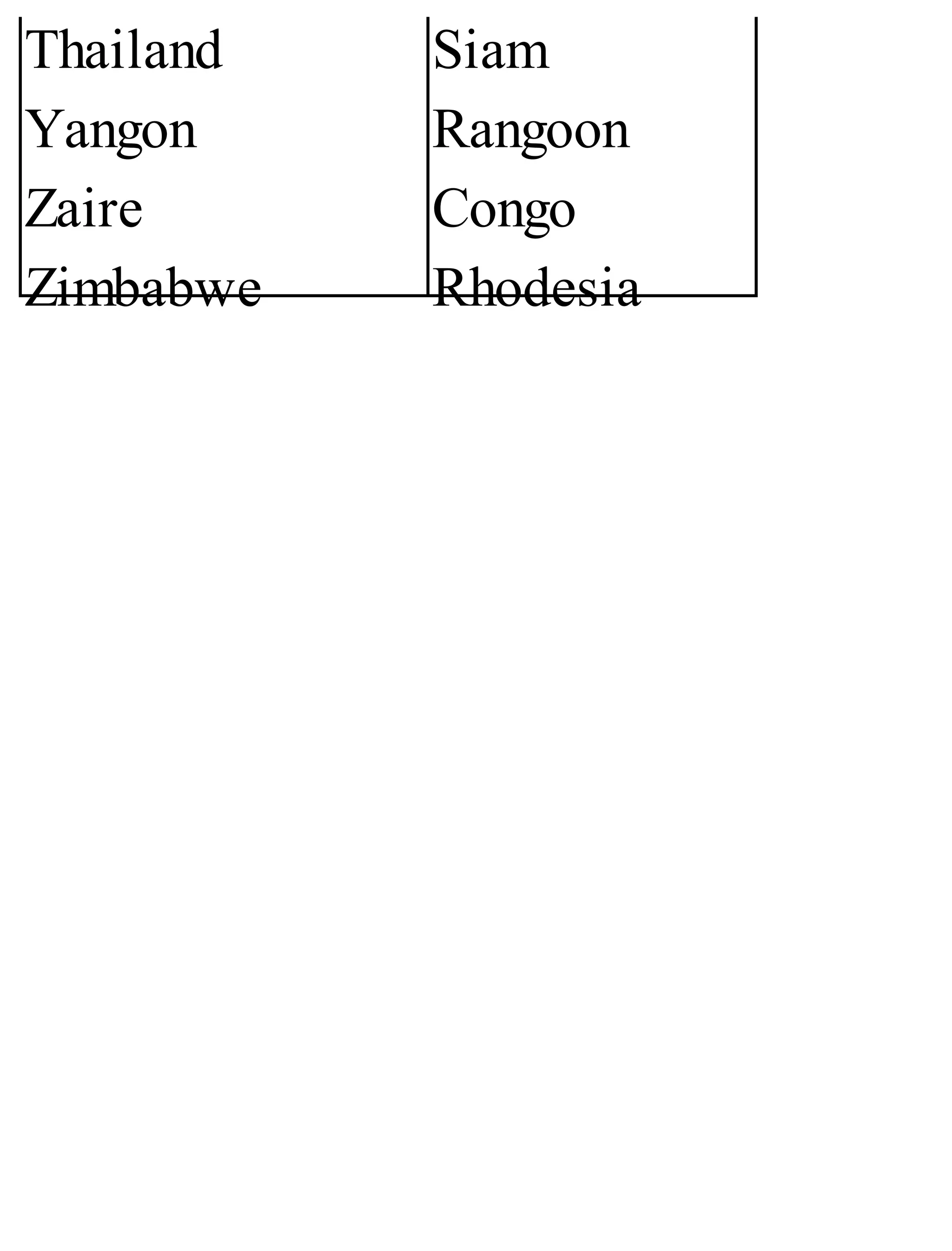
Thailand
Yangon
Zaire
Zimbabwe
Siam
Rangoon
Congo
Rhodesia
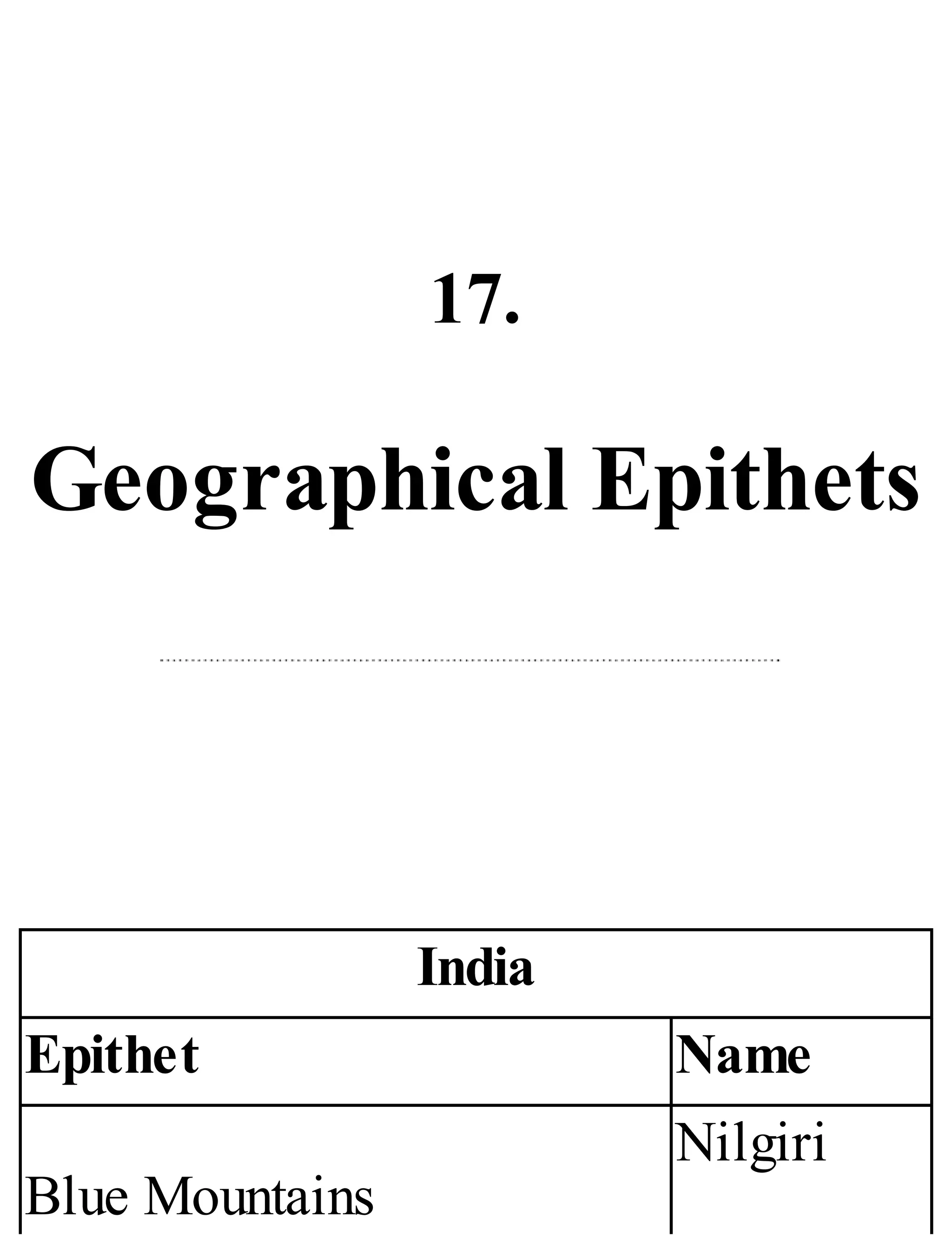
17.
Geographical Epithets
India
Epithet Name
Blue Mountains
Nilgiri
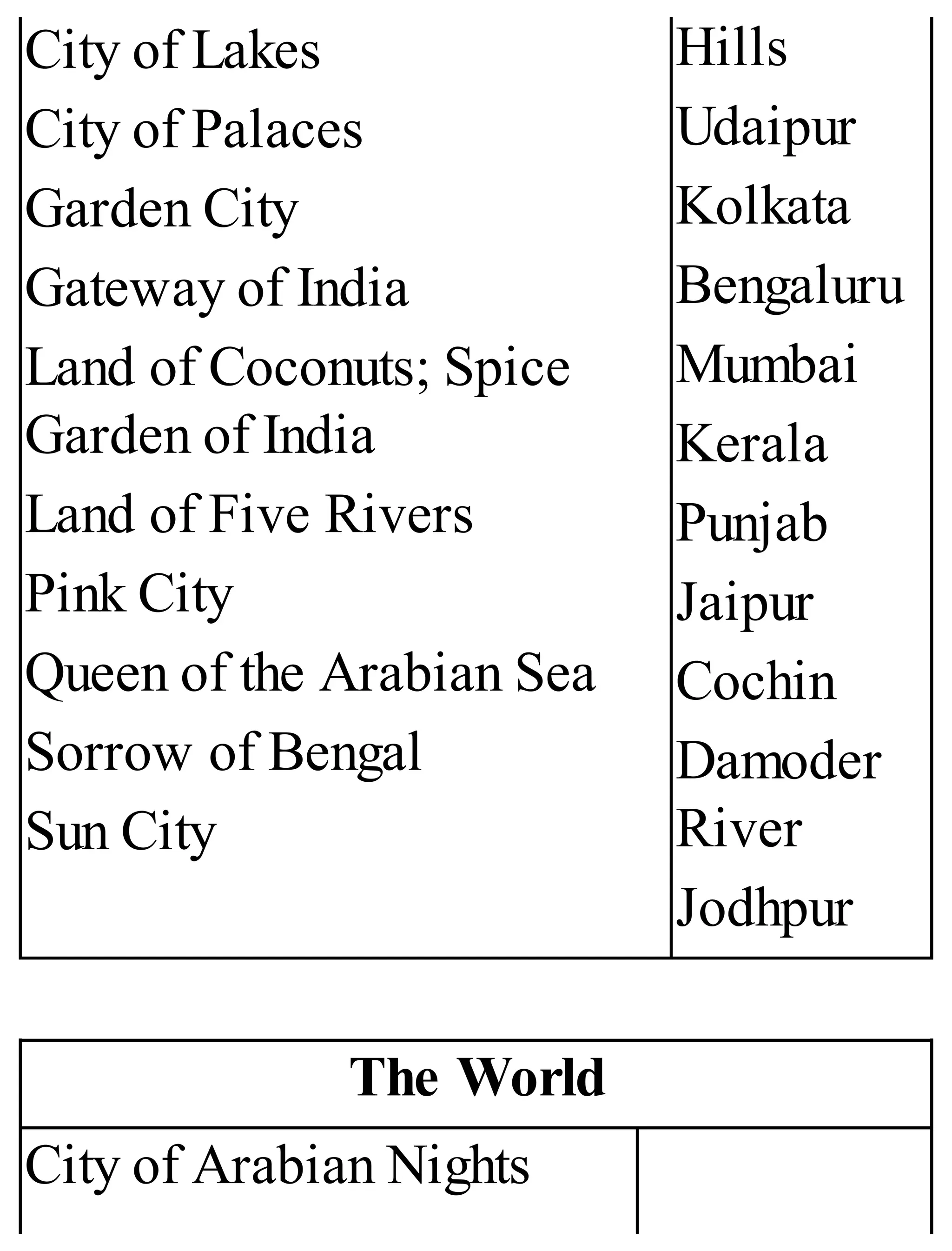
City of Lakes
City of Palaces
Garden City
Gateway of India
Land of Coconuts; Spice
Garden of India
Land of Five Rivers
Pink City
Queen of the Arabian Sea
Sorrow of Bengal
Sun City
Hills
Udaipur
Kolkata
Bengaluru
Mumbai
Kerala
Punjab
Jaipur
Cochin
Damoder
River
Jodhpur
The World
City of Arabian Nights
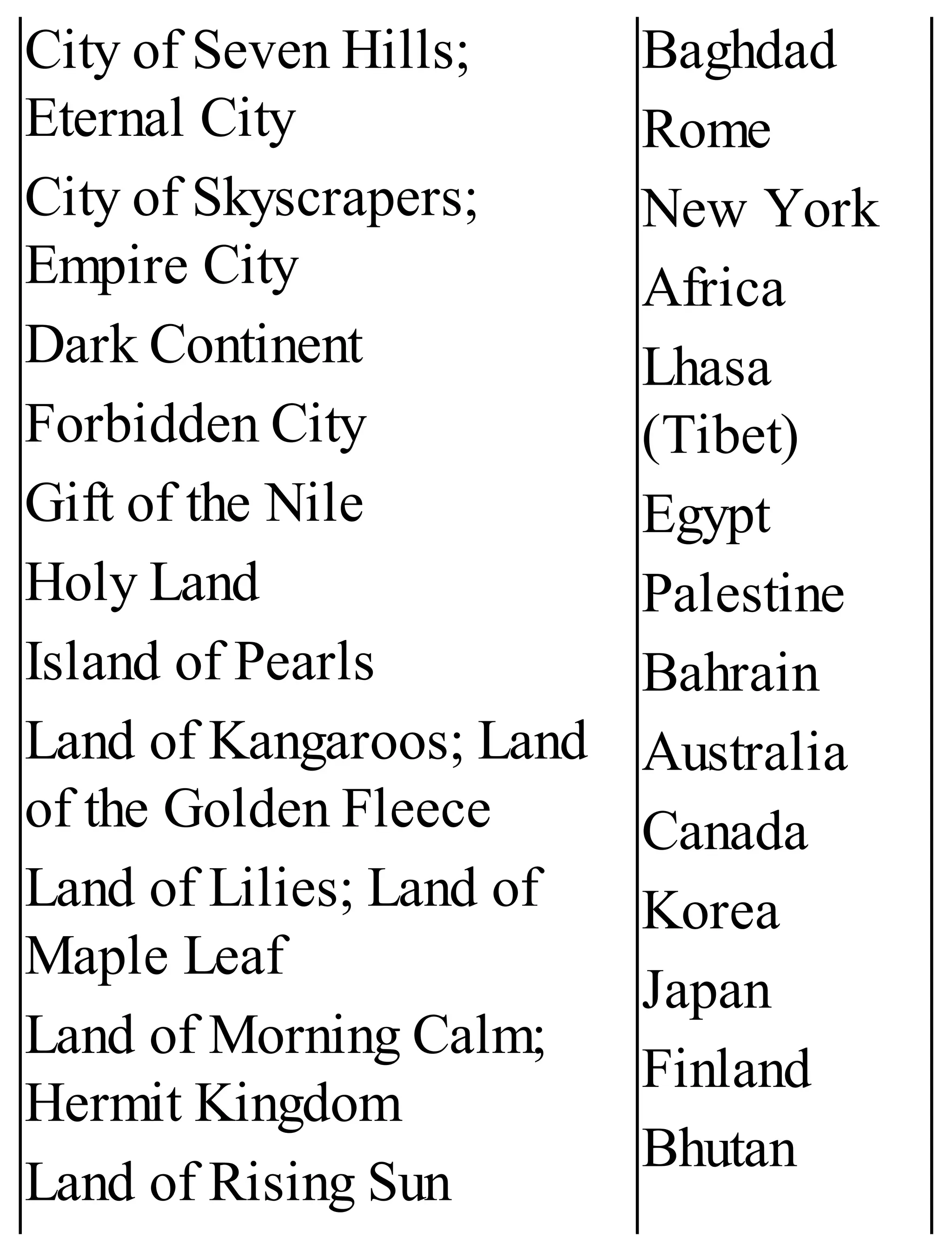
City of Seven Hills;
Eternal City
City of Skyscrapers;
Empire City
Dark Continent
Forbidden City
Gift of the Nile
Holy Land
Island of Pearls
Land of Kangaroos; Land
of the Golden Fleece
Land of Lilies; Land of
Maple Leaf
Land of Morning Calm;
Hermit Kingdom
Land of Rising Sun
Baghdad
Rome
New York
Africa
Lhasa
(Tibet)
Egypt
Palestine
Bahrain
Australia
Canada
Korea
Japan
Finland
Bhutan
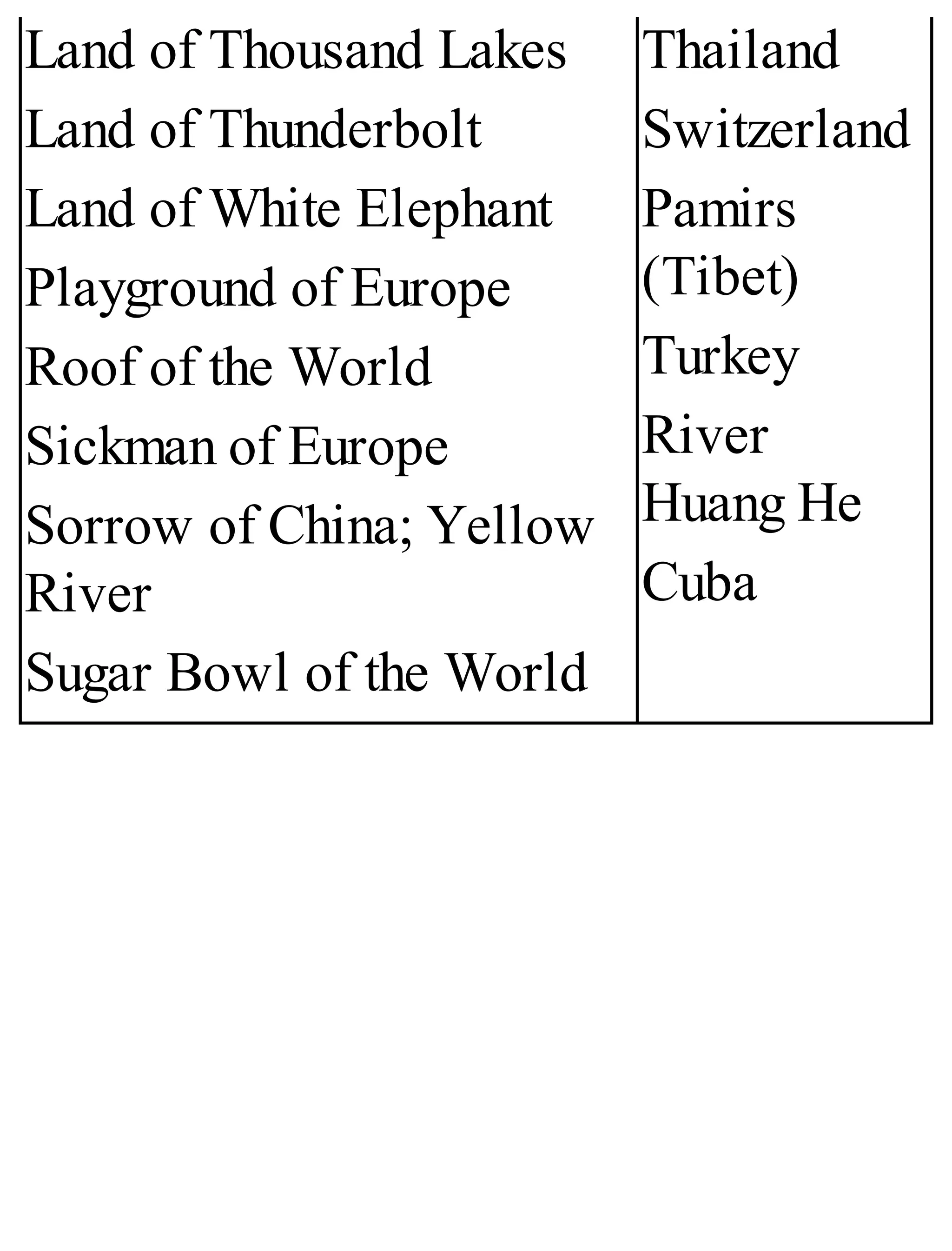
Land of Thousand Lakes
Land of Thunderbolt
Land of White Elephant
Playground of Europe
Roof of the World
Sickman of Europe
Sorrow of China; Yellow
River
Sugar Bowl of the World
Thailand
Switzerland
Pamirs
(Tibet)
Turkey
River
Huang He
Cuba
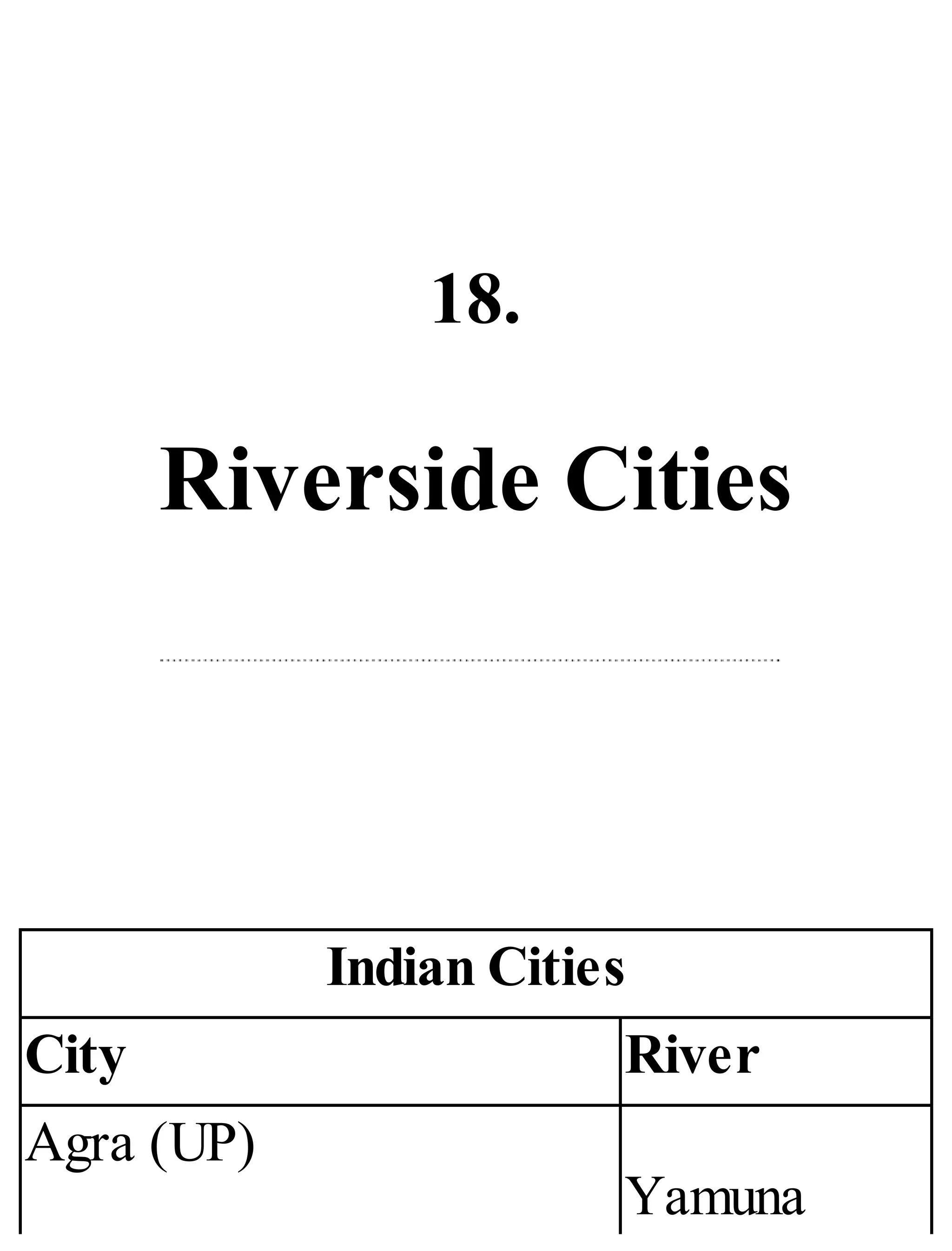
18.
Riverside Cities
Indian Cities
City River
Agra (UP)
Yamuna
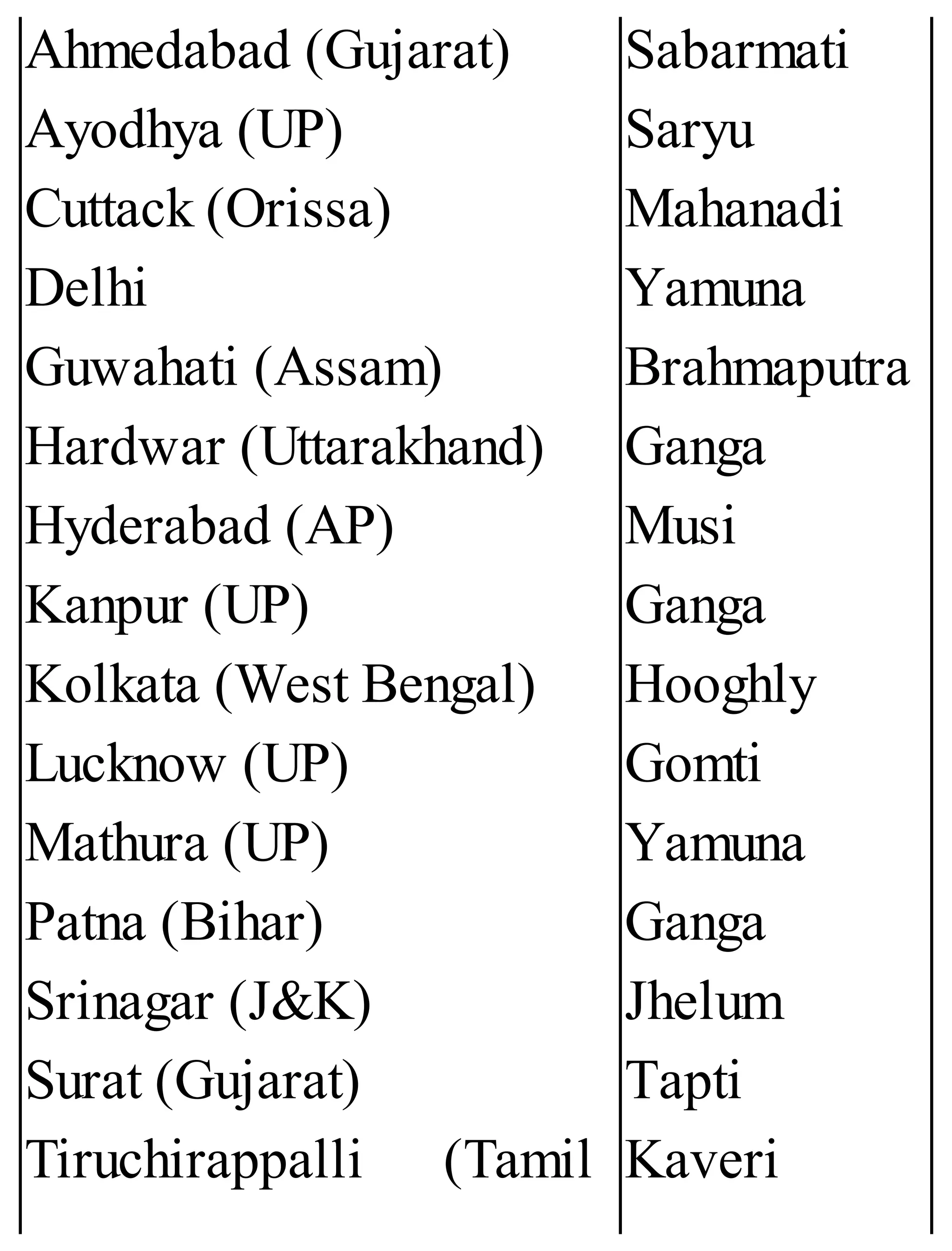
Ahmedabad (Gujarat)
Ayodhya (UP)
Cuttack (Orissa)
Delhi
Guwahati (Assam)
Hardwar (Uttarakhand)
Hyderabad (AP)
Kanpur (UP)
Kolkata (West Bengal)
Lucknow (UP)
Mathura (UP)
Patna (Bihar)
Srinagar (J&K)
Surat (Gujarat)
Tiruchirappalli (Tamil
Sabarmati
Saryu
Mahanadi
Yamuna
Brahmaputra
Ganga
Musi
Ganga
Hooghly
Gomti
Yamuna
Ganga
Jhelum
Tapti
Kaveri
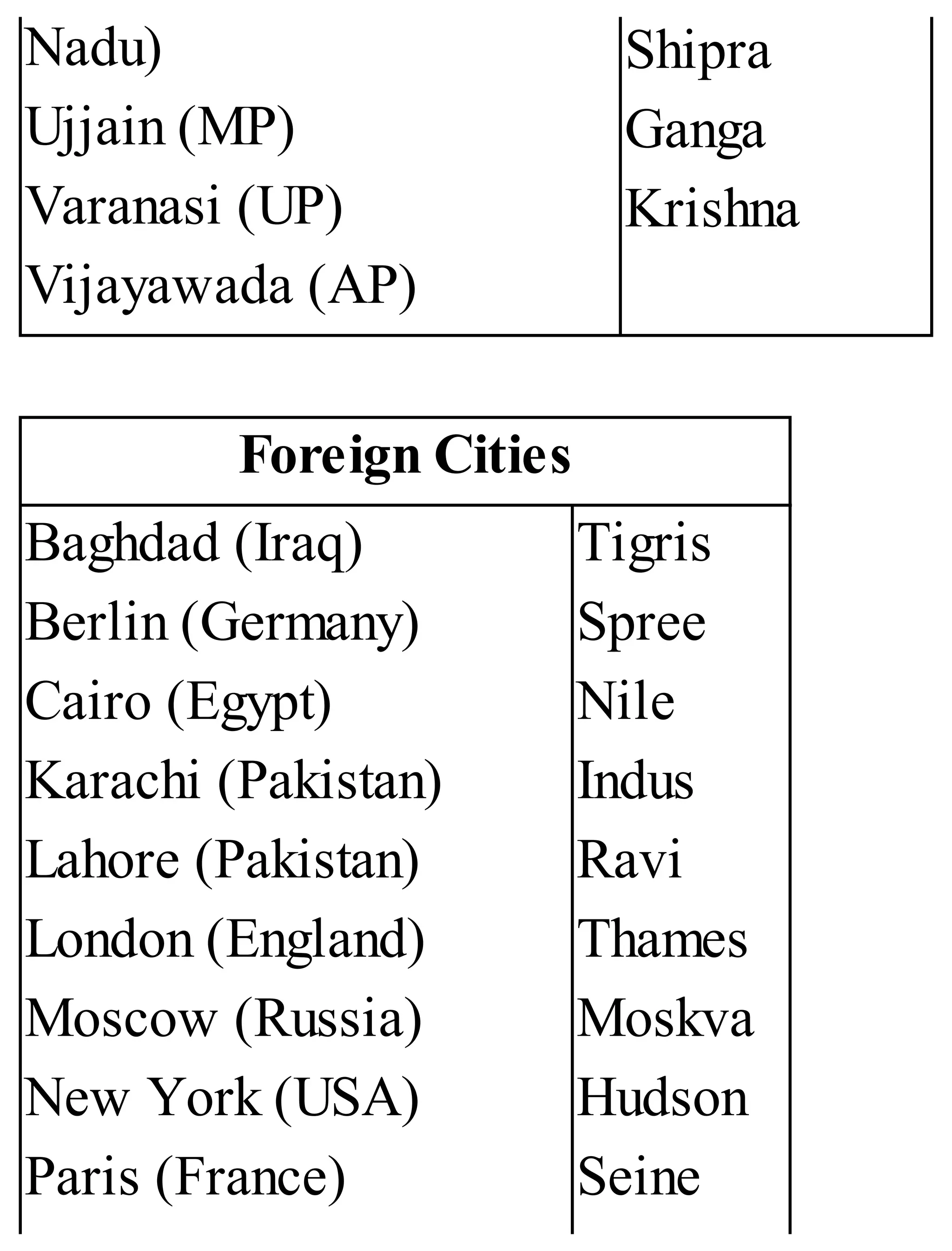
Nadu)
Ujjain (MP)
Varanasi (UP)
Vijayawada (AP)
Shipra
Ganga
Krishna
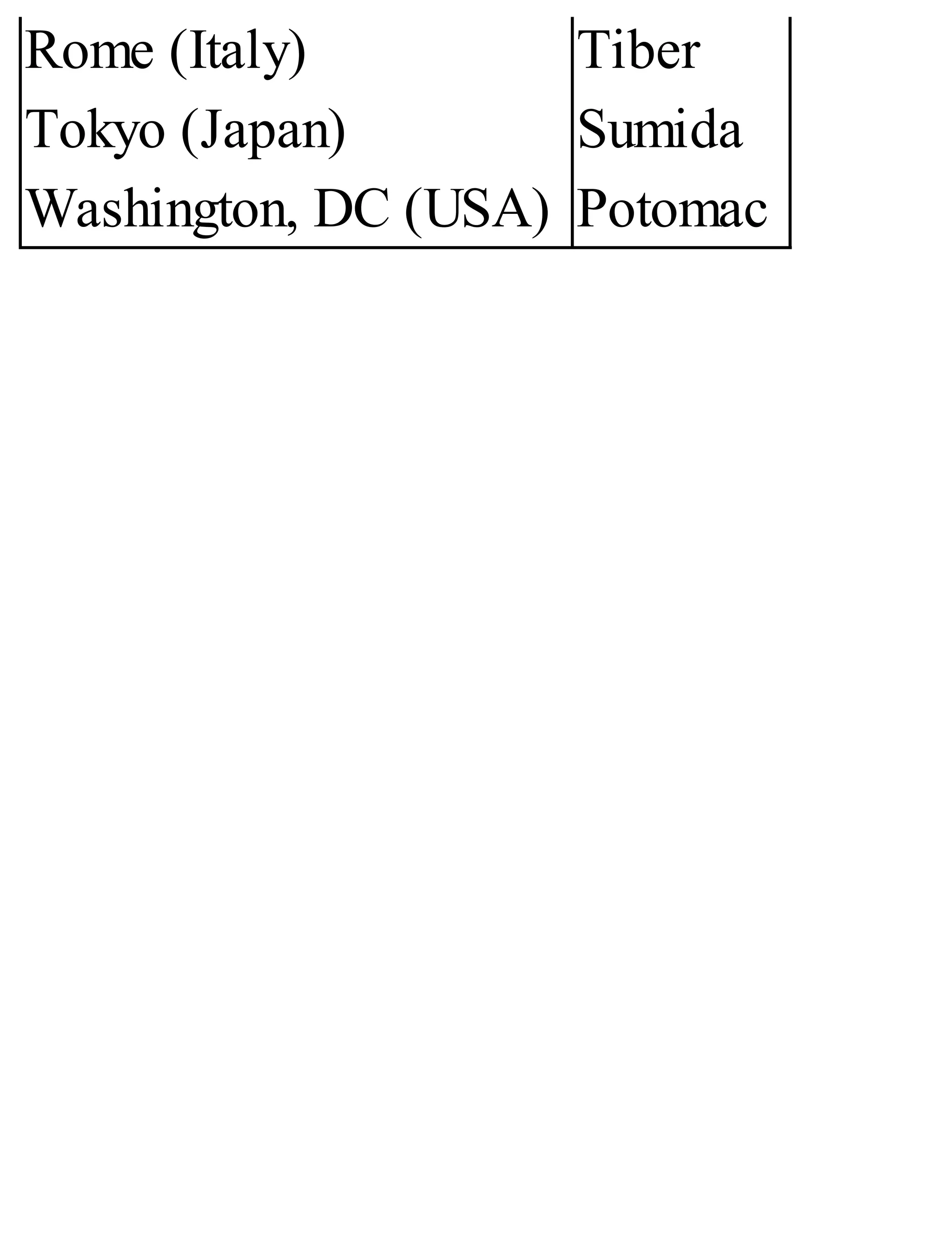
Foreign Cities
Baghdad (Iraq)
Berlin (Germany)
Cairo (Egypt)
Karachi (Pakistan)
Lahore (Pakistan)
London (England)
Moscow (Russia)
New York (USA)
Paris (France)
Tigris
Spree
Nile
Indus
Ravi
Thames
Moskva
Hudson
Seine
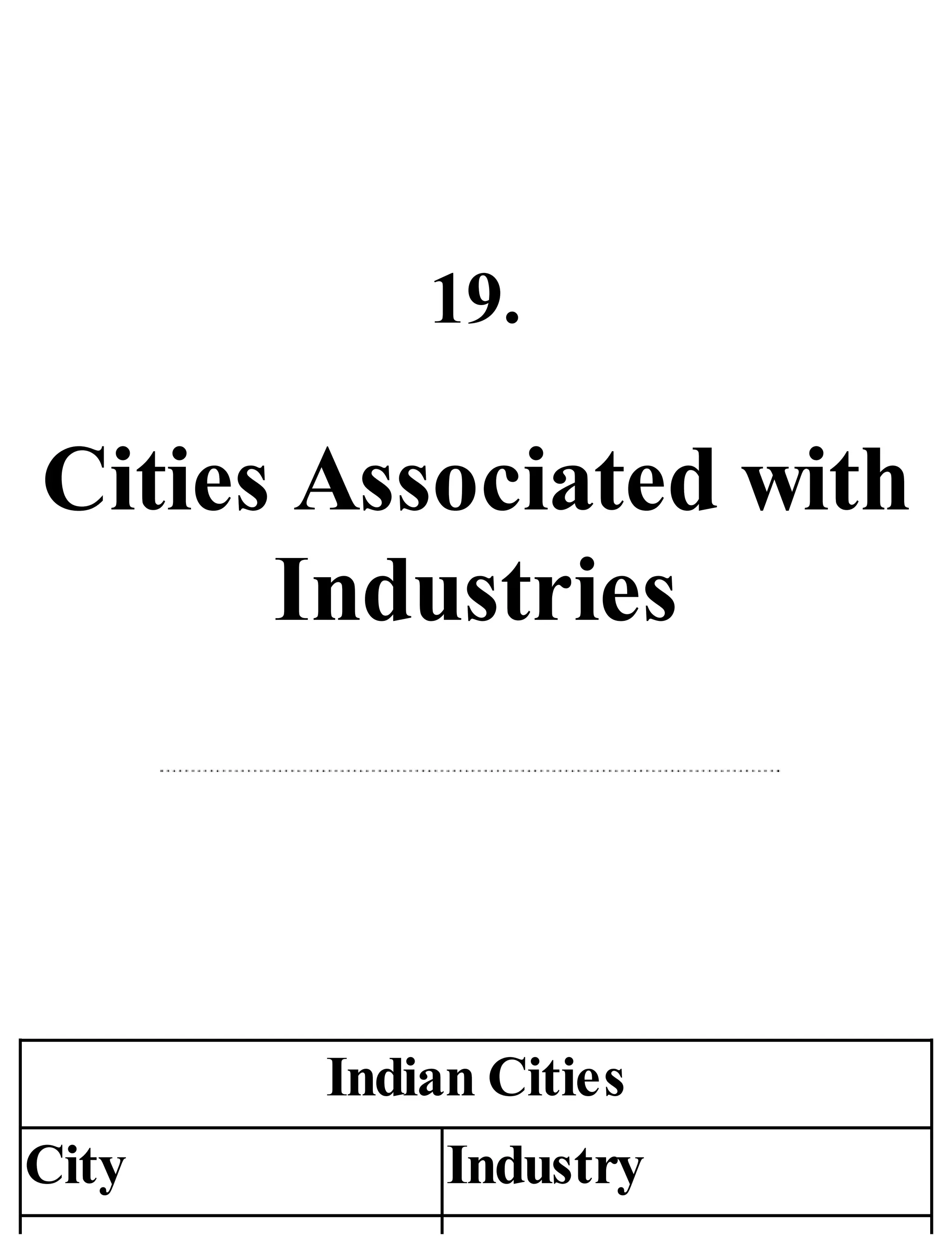
Rome (Italy)
Tokyo (Japan)
Washington, DC (USA)
Tiber
Sumida
Potomac
19.
Cities Associated with
Industries
Indian Cities
City Industry
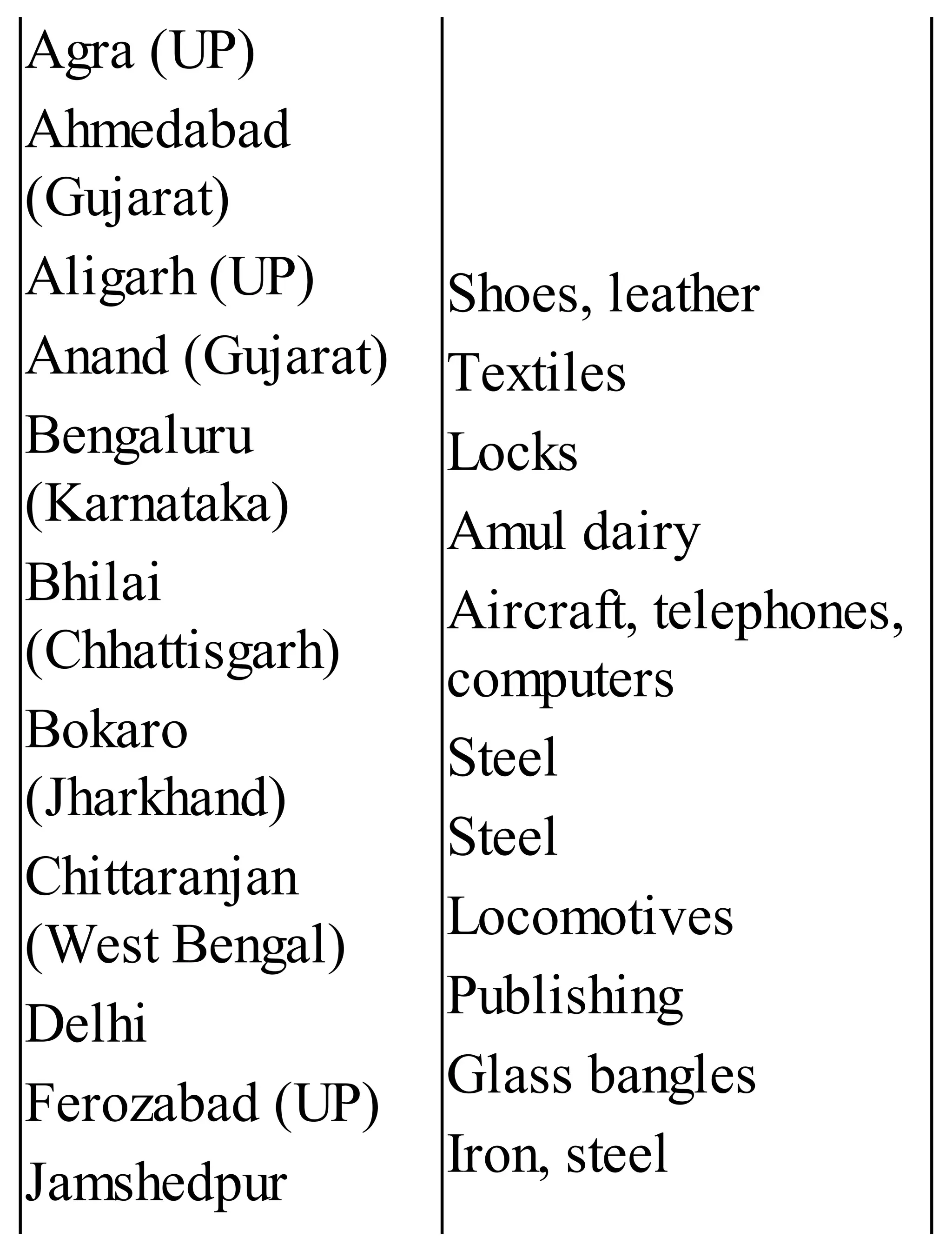
Agra (UP)
Ahmedabad
(Gujarat)
Aligarh (UP)
Anand (Gujarat)
Bengaluru
(Karnataka)
Bhilai
(Chhattisgarh)
Bokaro
(Jharkhand)
Chittaranjan
(West Bengal)
Delhi
Ferozabad (UP)
Jamshedpur
Shoes, leather
Textiles
Locks
Amul dairy
Aircraft, telephones,
computers
Steel
Steel
Locomotives
Publishing
Glass bangles
Iron, steel
(Jharkhand)
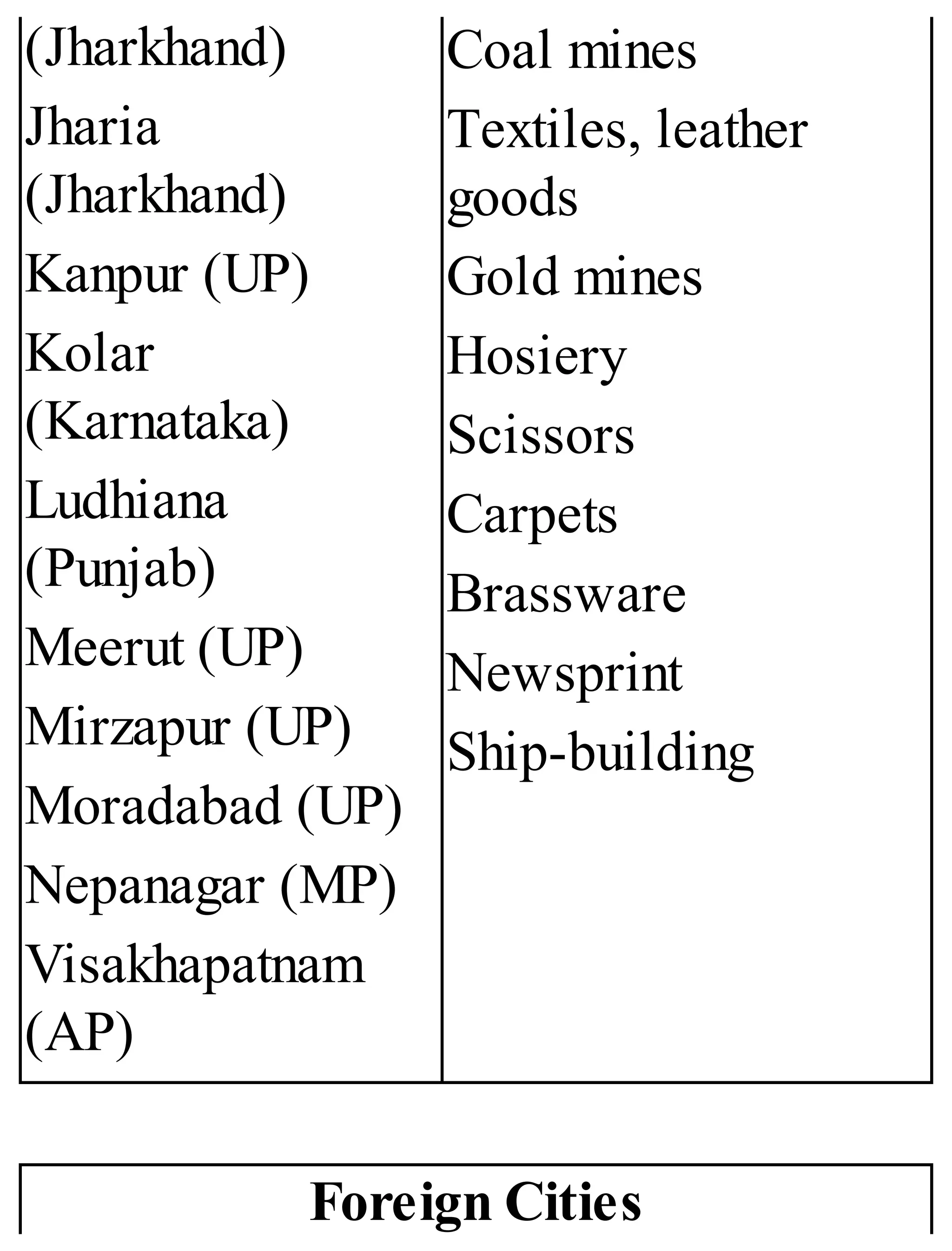
Jharia
(Jharkhand)
Kanpur (UP)
Kolar
(Karnataka)
Ludhiana
(Punjab)
Meerut (UP)
Mirzapur (UP)
Moradabad (UP)
Nepanagar (MP)
Visakhapatnam
(AP)
Coal mines
Textiles, leather
goods
Gold mines
Hosiery
Scissors
Carpets
Brassware
Newsprint
Ship-building
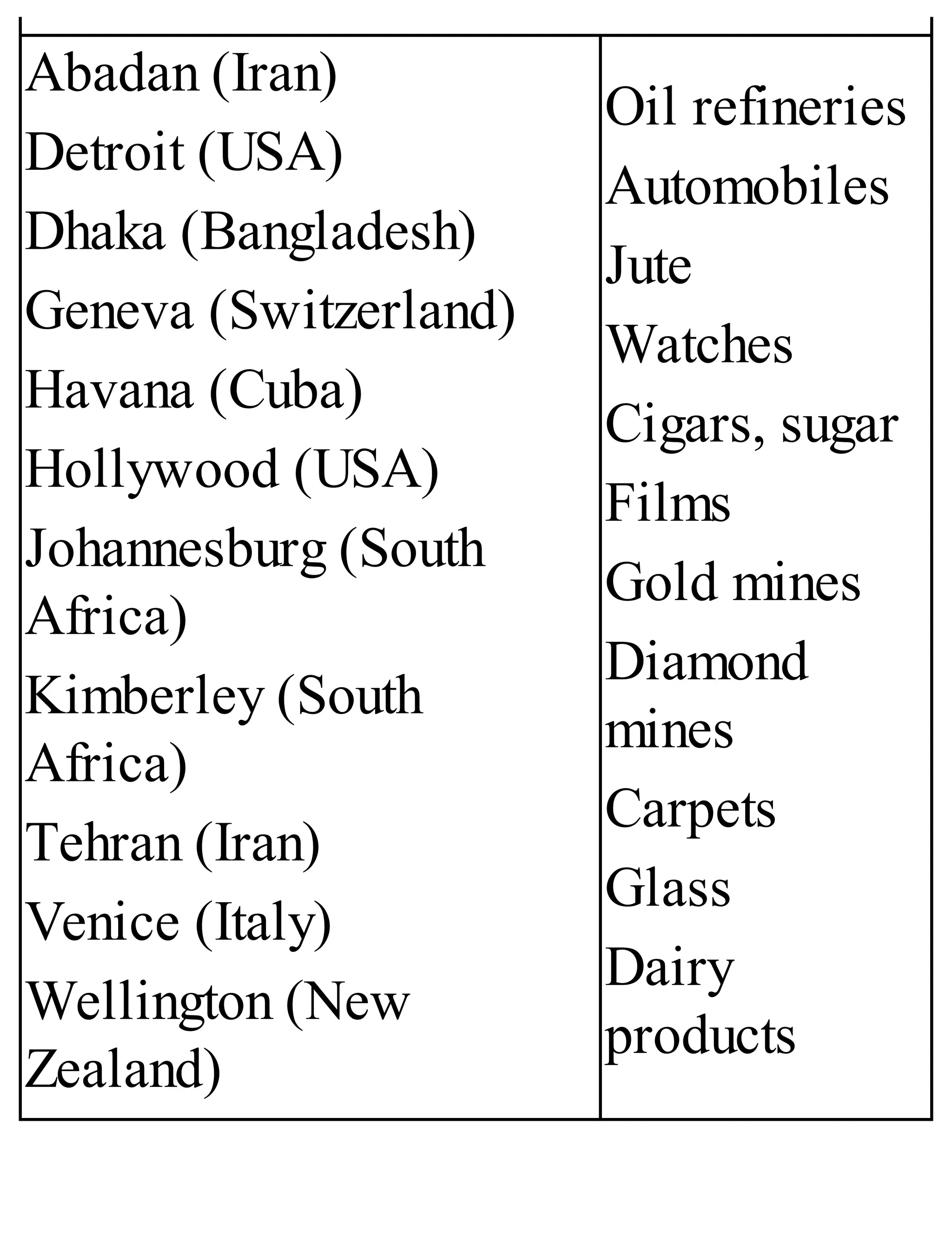
Foreign Cities
Abadan (Iran)
Detroit (USA)
Dhaka (Bangladesh)
Geneva (Switzerland)
Havana (Cuba)
Hollywood (USA)
Johannesburg (South
Africa)
Kimberley (South
Africa)
Tehran (Iran)
Venice (Italy)
Wellington (New
Zealand)
Oil refineries
Automobiles
Jute
Watches
Cigars, sugar
Films
Gold mines
Diamond
mines
Carpets
Glass
Dairy
products
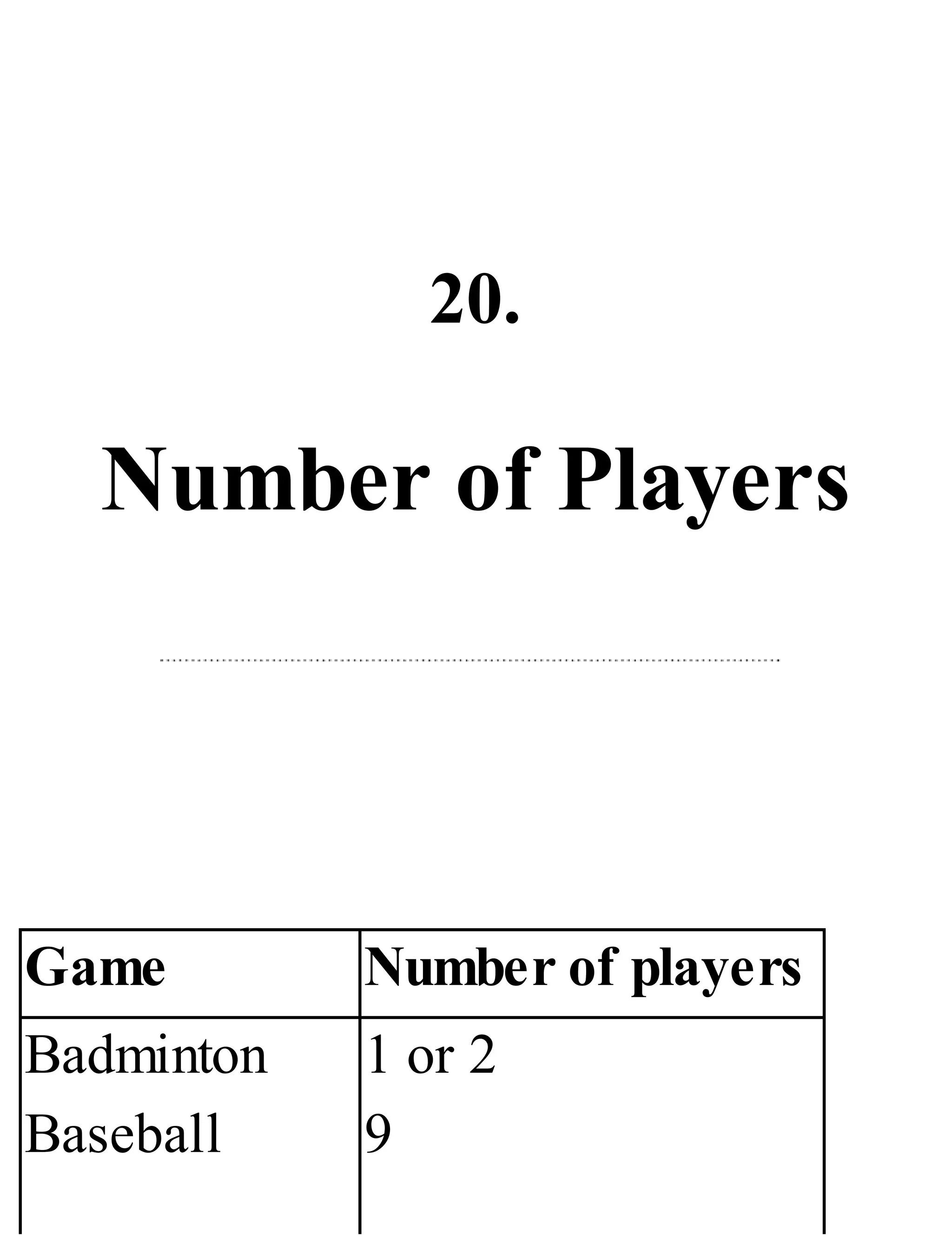
20.
Number of Players
Game Number of players
Badminton
Baseball
1 or 2
9
Basketball
Cricket
Football
Hockey
Ice hockey
Kabaddi
Polo
Rugby League
Rugby Union
Table tennis
Tennis
Volleyball
Water polo
5
11
11
11
6
8
4
13
15
1 or 2
1 or 2
6
7
Believe It or Not:
• Ice hockey is the world’s fastest
team game.
• There is enough salt in the sea to
cover all the continents with a layer
of salt 150 m thick.
• The world’s longest boundary lies
between Canada and the USA,
which extends for 6,416 km.
21.
Names of Playgrounds
Game Playground
Badminton
Baseball
Court
Diamond
Basketball
Billiards
Boxing
Chess
Cricket
Football
Golf
Hockey
Ice hockey
Polo
Race
Shooting
Court
Table
Ring
Board
Ground
Ground
Course
Field
Rink
Ground
Track
Range
Skating
Swimming
Table tennis
Tennis
Rink
Pool
Table
Court
Volleyball
Wrestling
Court
Arena
Believe It or Not:
• The kiwi lays an egg a quarter of her
own weight. The egg weighs 420 g
— the kiwi weighs 1.7 kg.
• A huge underwater river flows
underneath the Nile, with six times
more water than the river above.
• Termites build their nests in huge
mounds many times taller than
themselves. If people lived in huge
buildings equivalent to a termite’s
nest, they would be over 4,000 m
high.
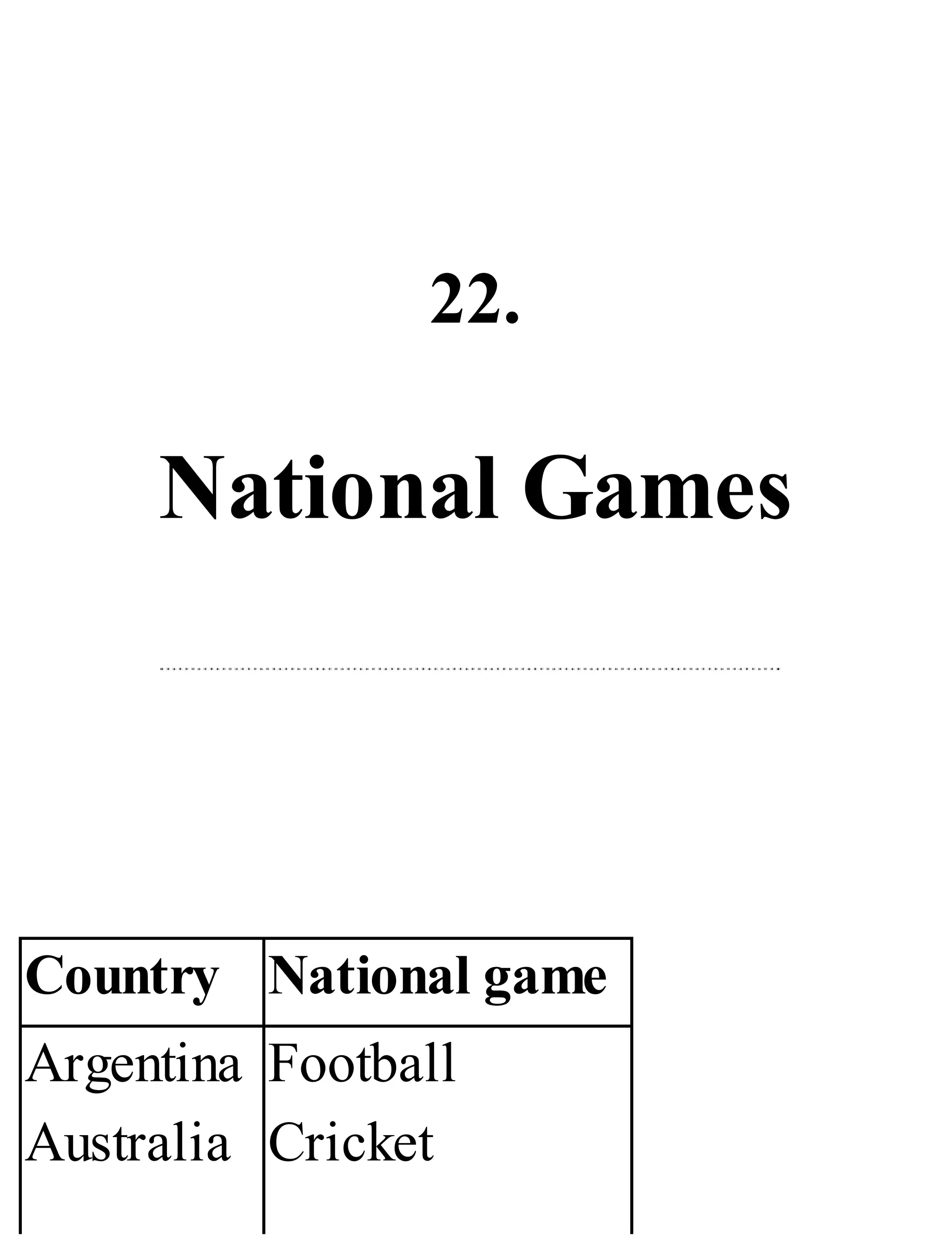
22.
National Games
Country National game
Argentina
Australia
Football
Cricket
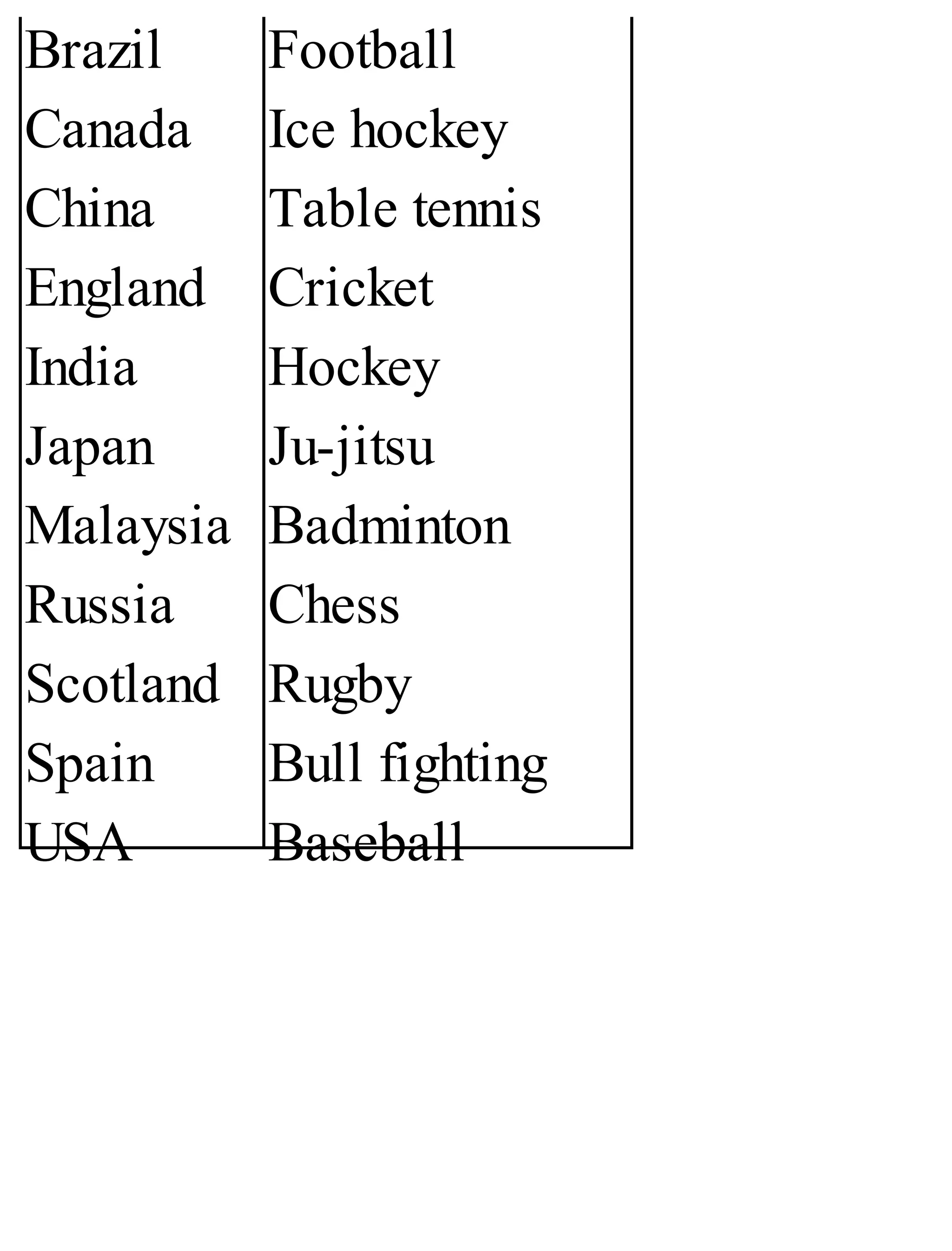
Brazil
Canada
China
England
India
Japan
Malaysia
Russia
Scotland
Spain
USA
Football
Ice hockey
Table tennis
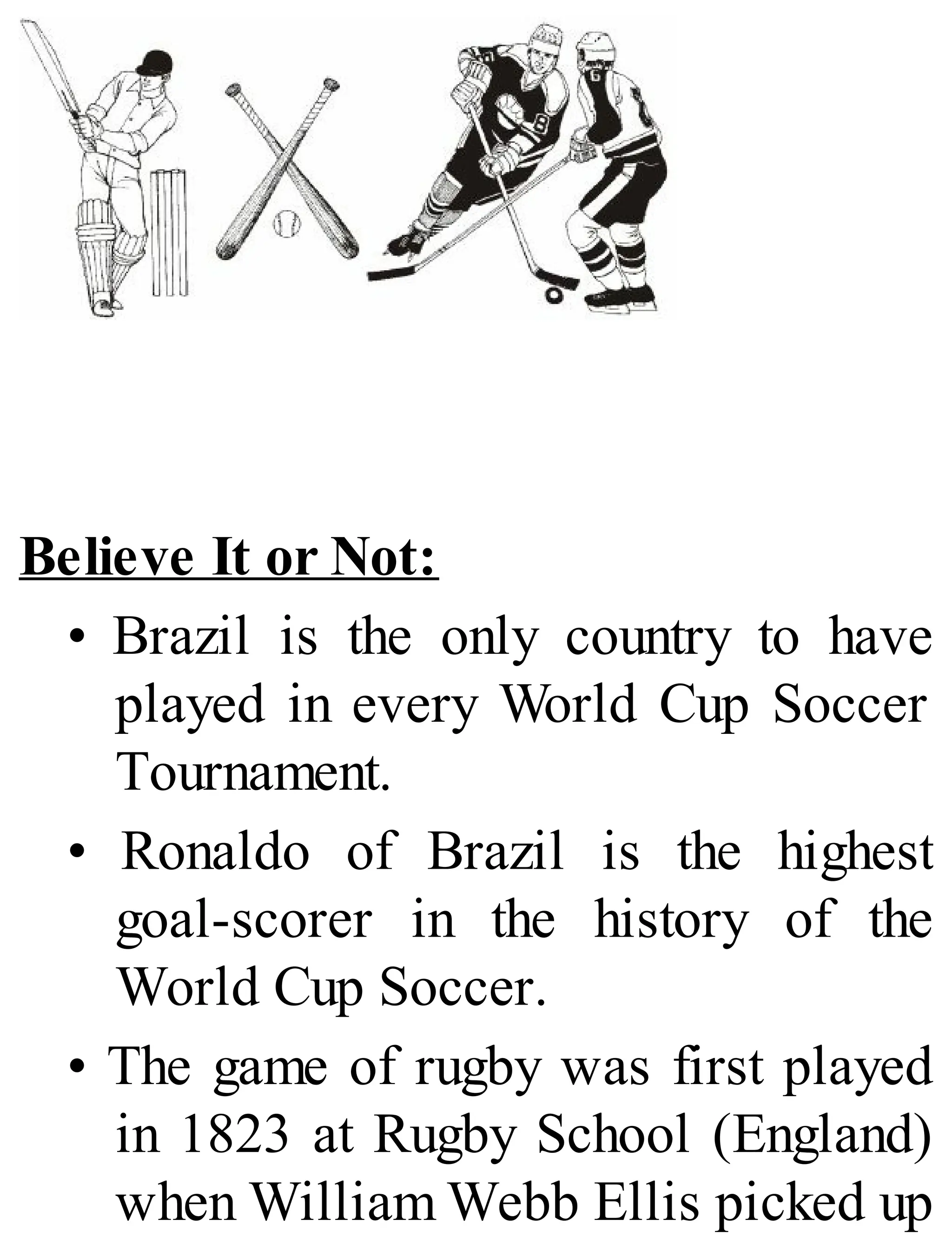
Cricket
Hockey
Ju-jitsu
Badminton
Chess
Rugby
Bull fighting
Baseball
Believe It or Not:
• Brazil is the only country to have
played in every World Cup Soccer
Tournament.
• Ronaldo of Brazil is the highest
goal-scorer in the history of the
World Cup Soccer.
• The game of rugby was first played
in 1823 at Rugby School (England)
when William Webb Ellis picked up
the ball and ran with it during a
game of football.
23.
Olympic Games
Olympic Games are the most important
international athletic competition in the
world. They are held every four years,
each time in a different country. This
world’s oldest sports event brings
together thousands of the world’s finest
athletes to compete against one another
in a variety of individual and team
sports. More than 10,000 athletes
representing over 190 nations
participate in the Olympics. Millions of
people attend the games and more than 1
billion people throughout the world
watch the Olympics on television.
Ancient Olympics
The Olympics Games originated in
ancient Greece and were held from 776
BC to AD 393. They were celebrated
like religious festivals, honouring Zeus,
the king of the gods. The Roman
conquered Greece during the 140’s BC,
and the games soon lost their religious
meaning. In AD 393, Emperor
Theodosius I banned the games.
Modern Olympics
Baron Pierre de Coubertine, a french
educator, revived the games to
encourage world peace and friendship
and to promote healthy sporting
competition for the youth of the world.
The first modern Olympic Games were
held in Athens, Greece, in 1896. In the
opening ceremony, the athletes of
Greece march into the stadium first, in
honour of the original games held in
ancient Greece. The athletes of the host
country enter last.
The International Olympic Committee
(IOC) is the governing body of the
Olympic Games. The IOC has its
headquarters in Lausanne, Switzerland.
The Committee approves the sports and
events to be included in the games. The
IOC also selects the host cities for the
games, seven years in advance. Host
cities provide a special housing
compound called the Olympic Village
for the athletes and coaches.
Olympic Flame
The flame symbolizes the light of spirit,
knowledge and life, and it is a message
of peace. The fire is ignited in Olympia,
Greece, by using a mirror to concentrate
the rays of the Sun. Runners transport the
flame in a torch relay from Greece to the
site of the games. The final runner
carries the torch into the stadium, circles
the tract and lights a huge cauldron
(pot). The flame is kept burning
throughout the games and then
extinguished during the closing
ceremony.
Olympic Emblem and Flag
The Olympic Emblem, created in 1913,
consists of five interlocking rings that
represent the continents of Africa, Asia,
Australia, Europe and the Americas. The
flag of every nation competing in the
games has at least one of these colours.
The Olympic Flag is white in colour,
originally made of cotton. The Emblem
is placed in the middle of the flag.
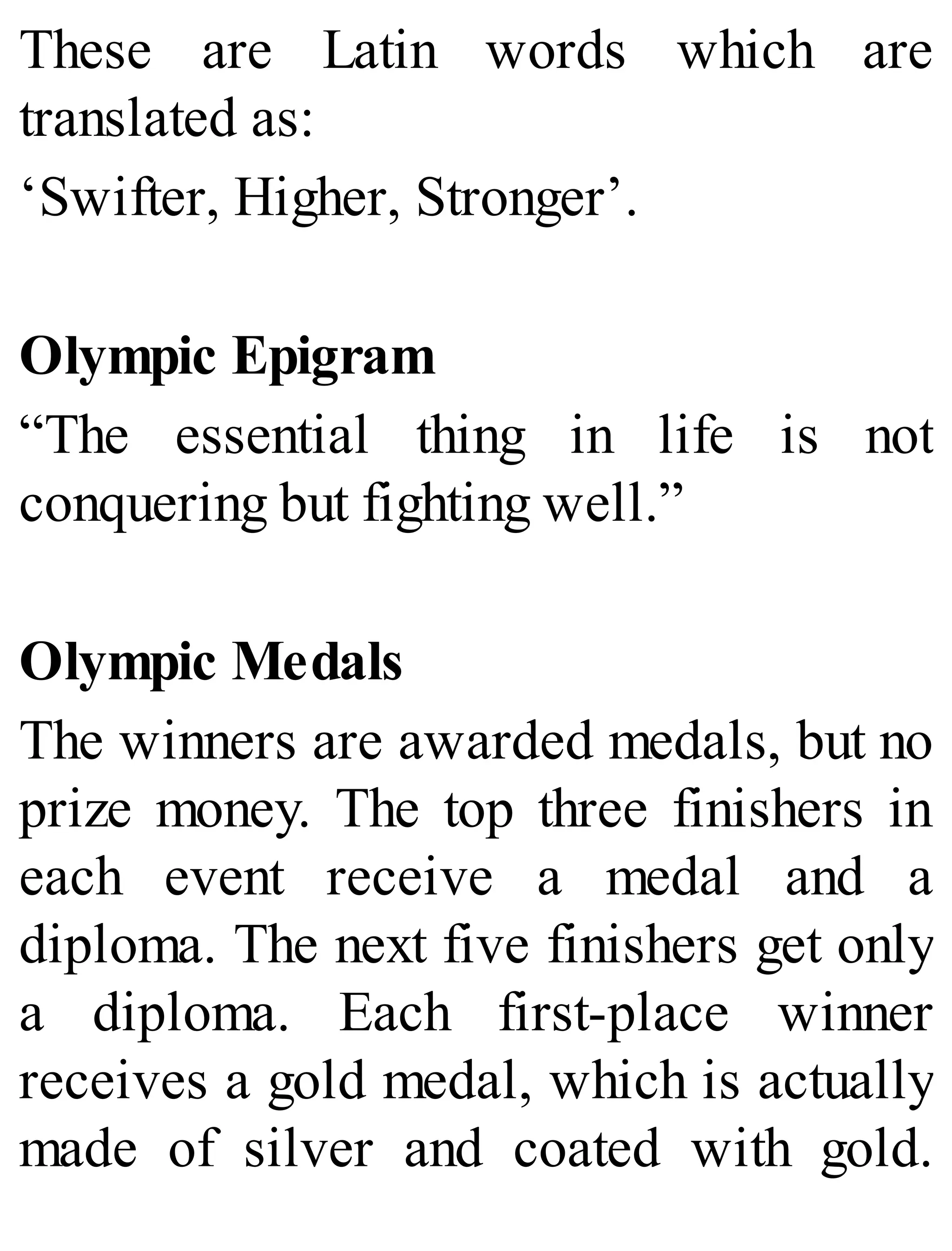
Colour of ring Continent represented
Blue ring
Yellow ring
Black ring
Green ring
Red ring
Europe
Asia
Africa
Australia
America
Olympic Motto
Citius, Altius, Fortius
These are Latin words which are
translated as:
‘Swifter, Higher, Stronger’.
Olympic Epigram
“The essential thing in life is not
conquering but fighting well.”
Olympic Medals
The winners are awarded medals, but no
prize money. The top three finishers in
each event receive a medal and a
diploma. The next five finishers get only
a diploma. Each first-place winner
receives a gold medal, which is actually
made of silver and coated with gold.
The second-place medal is made of
silver and the third-place medal is made
of bronze. The design for the medal
changes for each Olympics. All
members of a winning relay team get a
medal. In team sports, all the members
of a winning team who have played in at
least one of the games during the
competition receive a medal.
The Summer Games
The Olympic Games consist of the
Summer Games and the Winter Games.
The Summer Games are held during the
summer season of the host city, usually
between July and October. These games
last 16 days. Athletes compete in more
than 270 separate events during the
Summer Games. Women first
participated in Olympics in 1900 in
Paris.
The Winter Games
The Winter Games with over 60 events
are usually held in February and last 16
days. The games attract approximately
2,000 athletes from around 60 countries.
The Winter Games, established in 1924,
took place the same year as the Summer
Games. Beginning in 1994, the Winter
and Summer Games were divided and
scheduled on four-year cycles two years
apart.
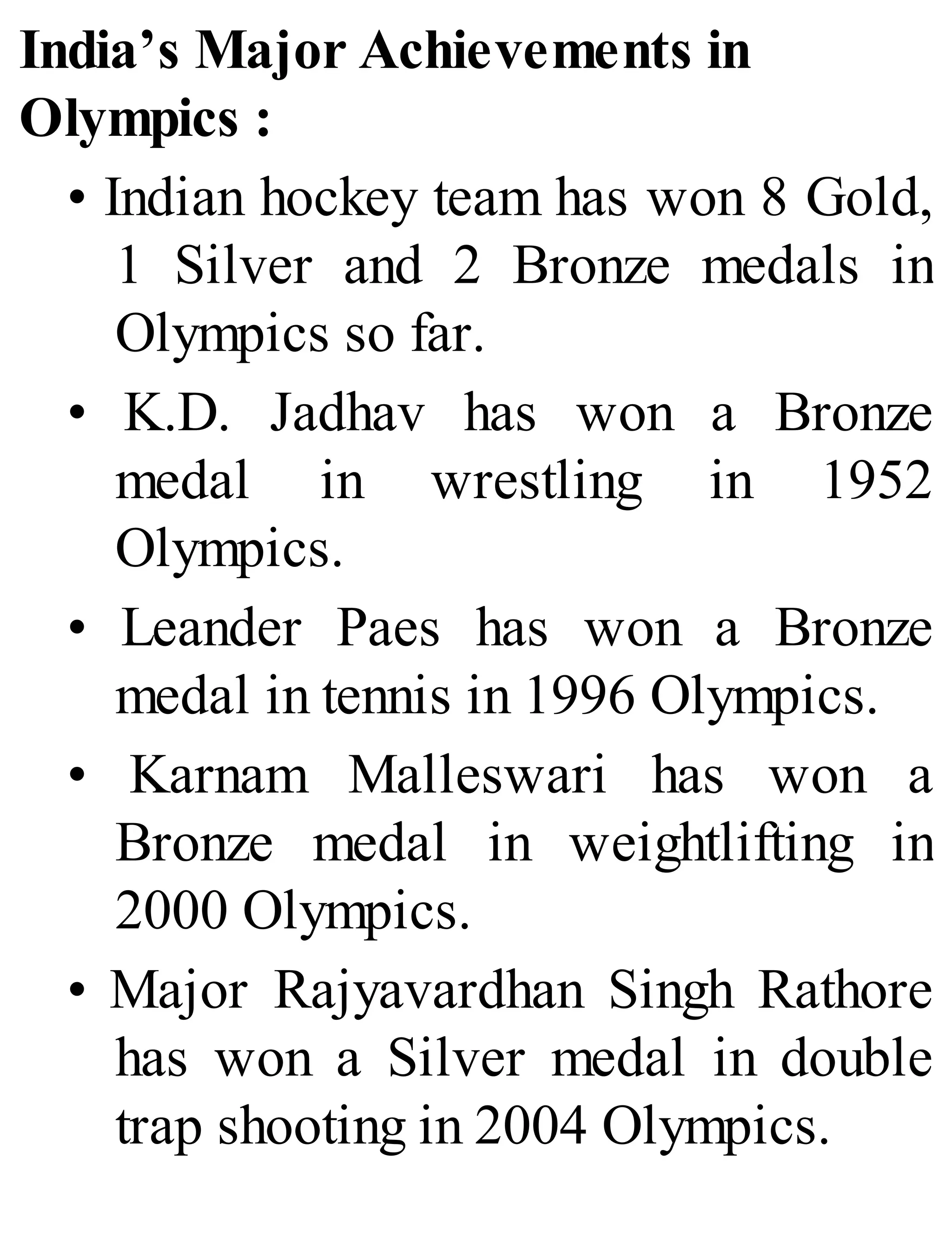
India’s Major Achievements in
Olympics :
• Indian hockey team has won 8 Gold,
1 Silver and 2 Bronze medals in
Olympics so far.
• K.D. Jadhav has won a Bronze
medal in wrestling in 1952
Olympics.
• Leander Paes has won a Bronze
medal in tennis in 1996 Olympics.
• Karnam Malleswari has won a
Bronze medal in weightlifting in
2000 Olympics.
• Major Rajyavardhan Singh Rathore
has won a Silver medal in double
trap shooting in 2004 Olympics.
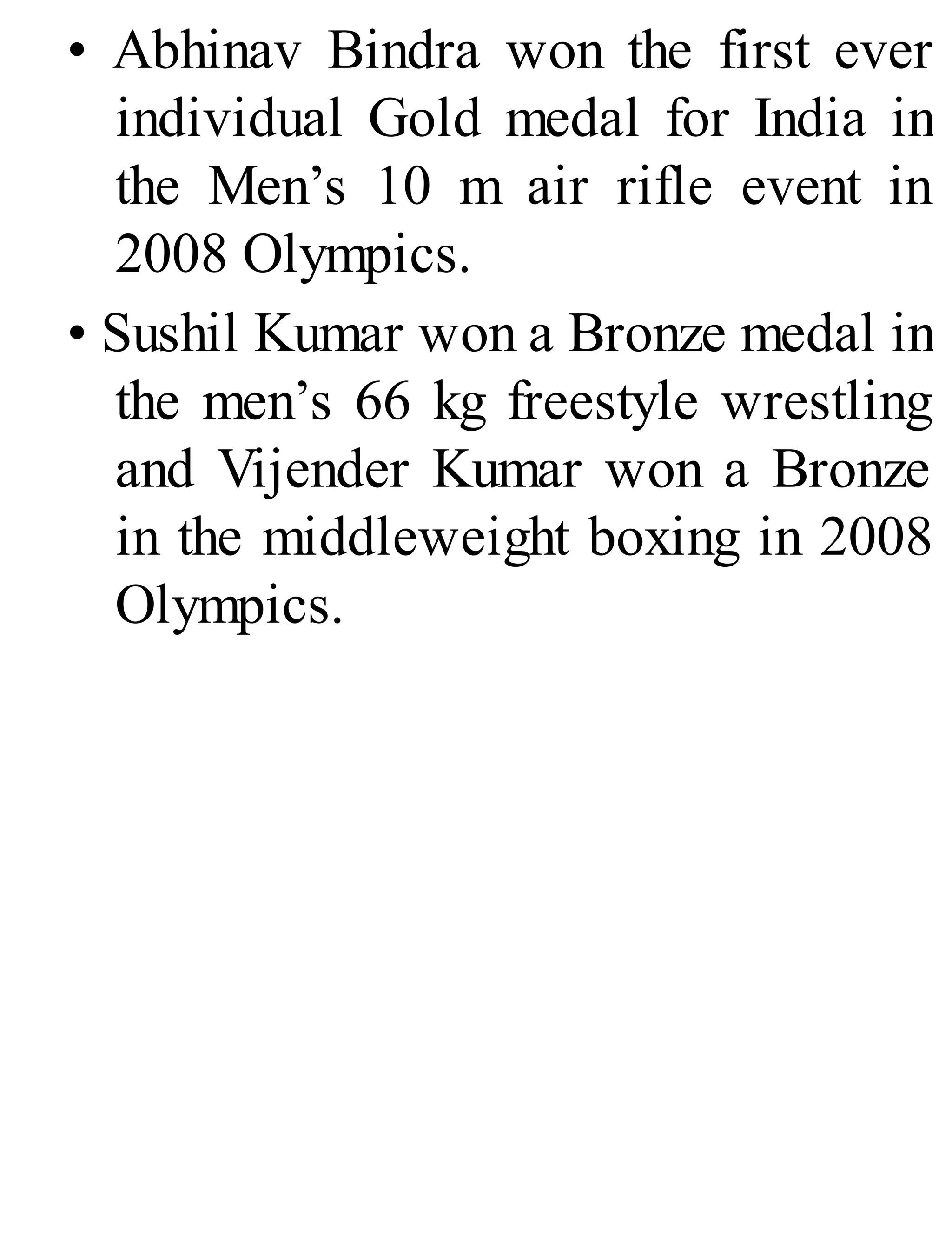
• Abhinav Bindra won the first ever
individual Gold medal for India in
the Men’s 10 m air rifle event in
2008 Olympics.
• Sushil Kumar won a Bronze medal in
the men’s 66 kg freestyle wrestling
and Vijender Kumar won a Bronze
in the middleweight boxing in 2008
Olympics.
24.
World Cup Soccer
The World Cup Soccer Tournament,
organized by the Federation of the
International Football Association
(FIFA), is one of the most popular sports
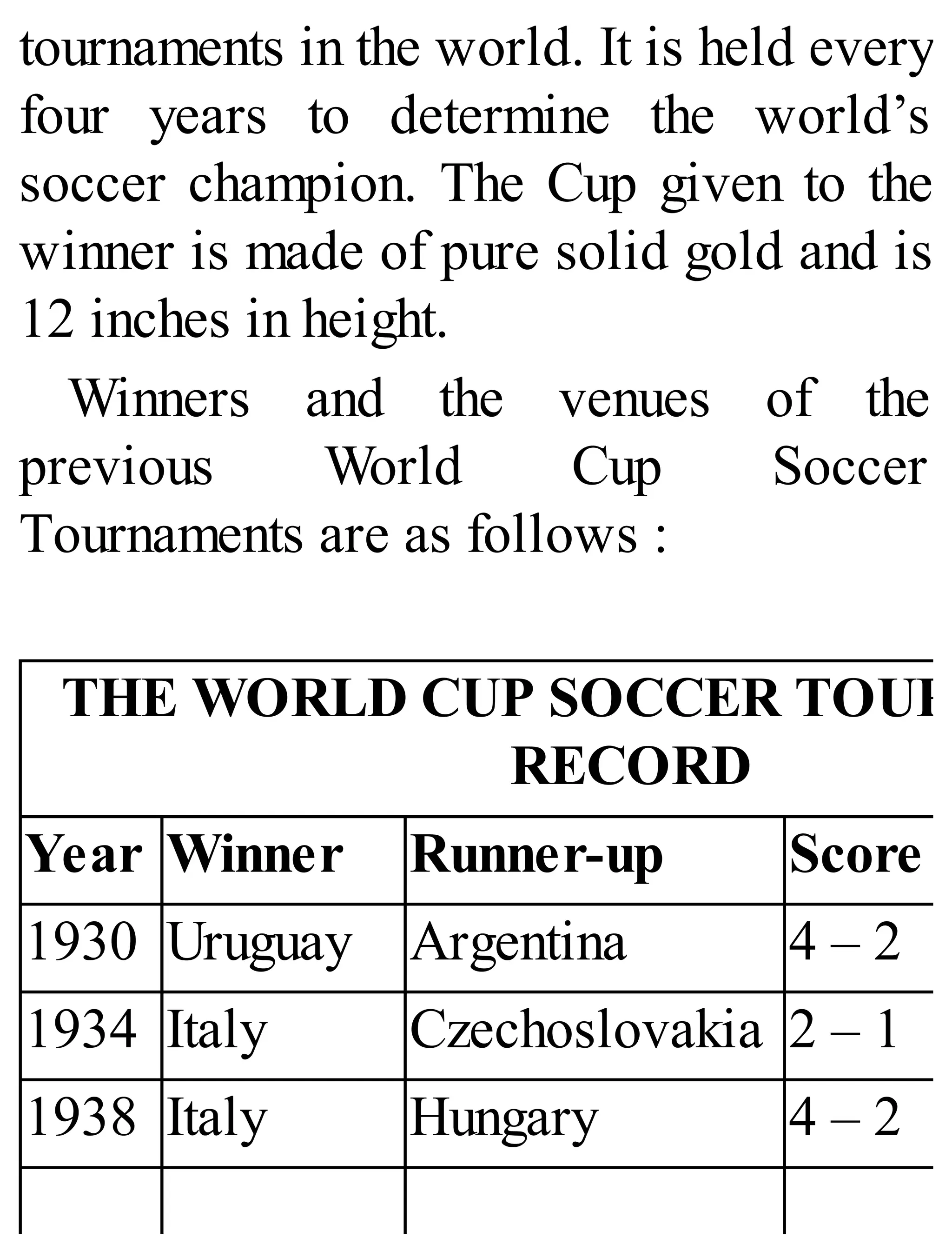
tournaments in the world. It is held every
four years to determine the world’s
soccer champion. The Cup given to the
winner is made of pure solid gold and is
12 inches in height.
Winners and the venues of the
previous World Cup Soccer
Tournaments are as follows :
THE WORLD CUP SOCCER TOUR
RECORD
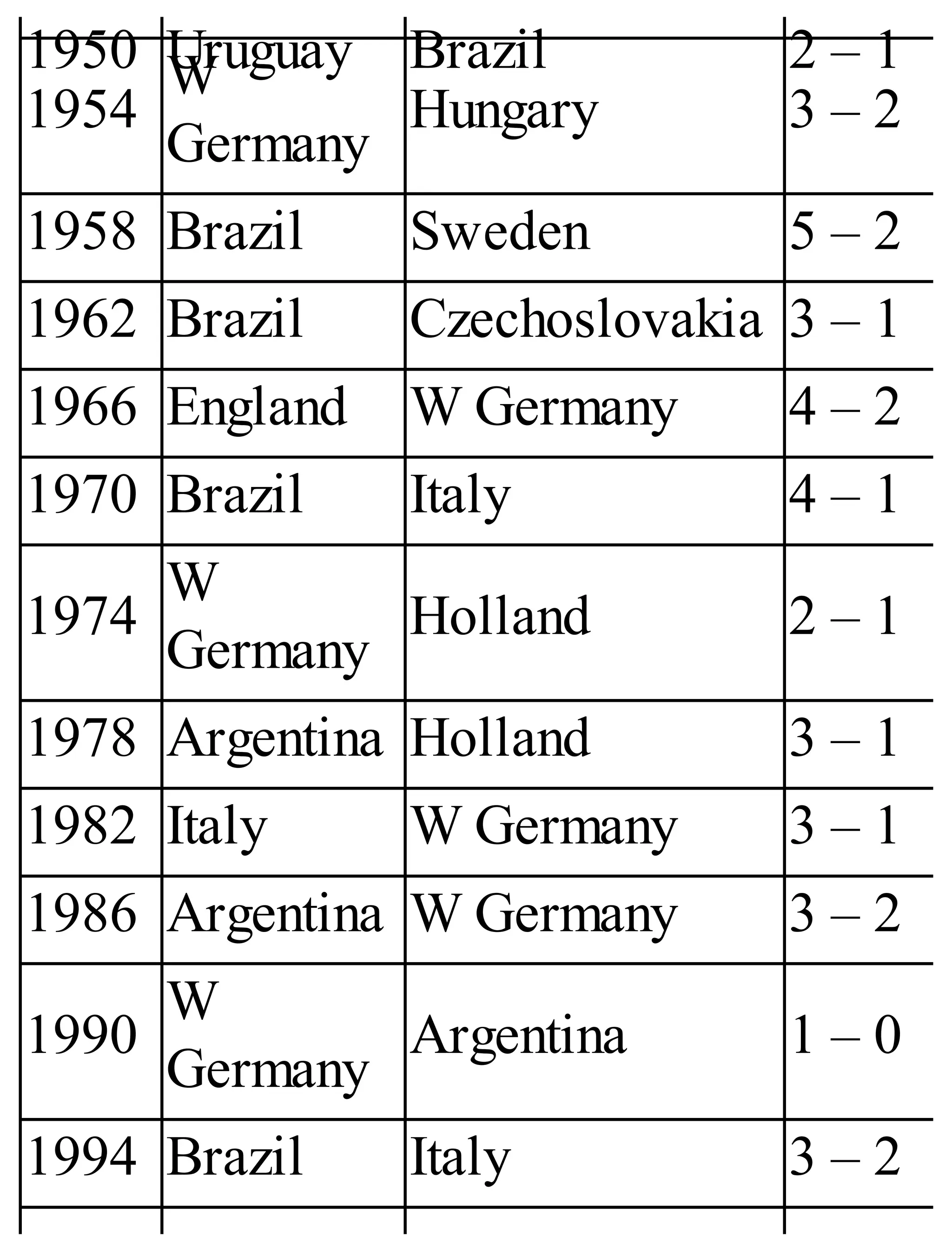
Year Winner Runner-up Score
1930 Uruguay Argentina 4 – 2
1934 Italy Czechoslovakia 2 – 1
1938 Italy Hungary 4 – 2
1950 Uruguay Brazil 2 – 1
1954
W
Germany
Hungary 3 – 2
1958 Brazil Sweden 5 – 2
1962 Brazil Czechoslovakia 3 – 1
1966 England W Germany 4 – 2
1970 Brazil Italy 4 – 1
1974
W
Germany
Holland 2 – 1
1978 Argentina Holland 3 – 1
1982 Italy W Germany 3 – 1
1986 Argentina W Germany 3 – 2
1990
W
Germany
Argentina 1 – 0
1994 Brazil Italy 3 – 2
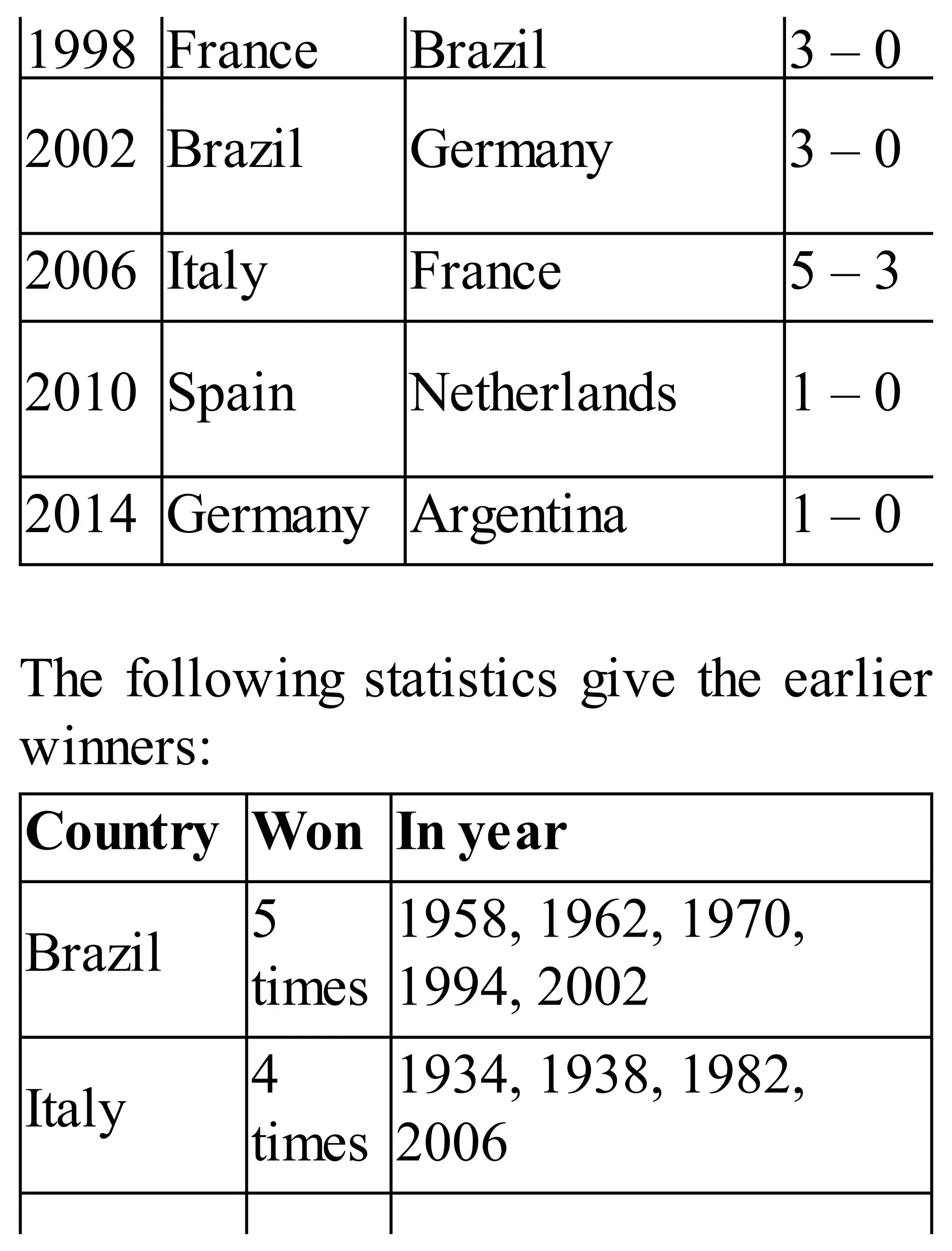
1998 France Brazil 3 – 0
2002 Brazil Germany 3 – 0
2006 Italy France 5 – 3
2010 Spain Netherlands 1 – 0
2014 Germany Argentina 1 – 0
The following statistics give the earlier
winners:
Country Won In year
Brazil
5
times
1958, 1962, 1970,
1994, 2002
Italy
4
times
1934, 1938, 1982,
2006
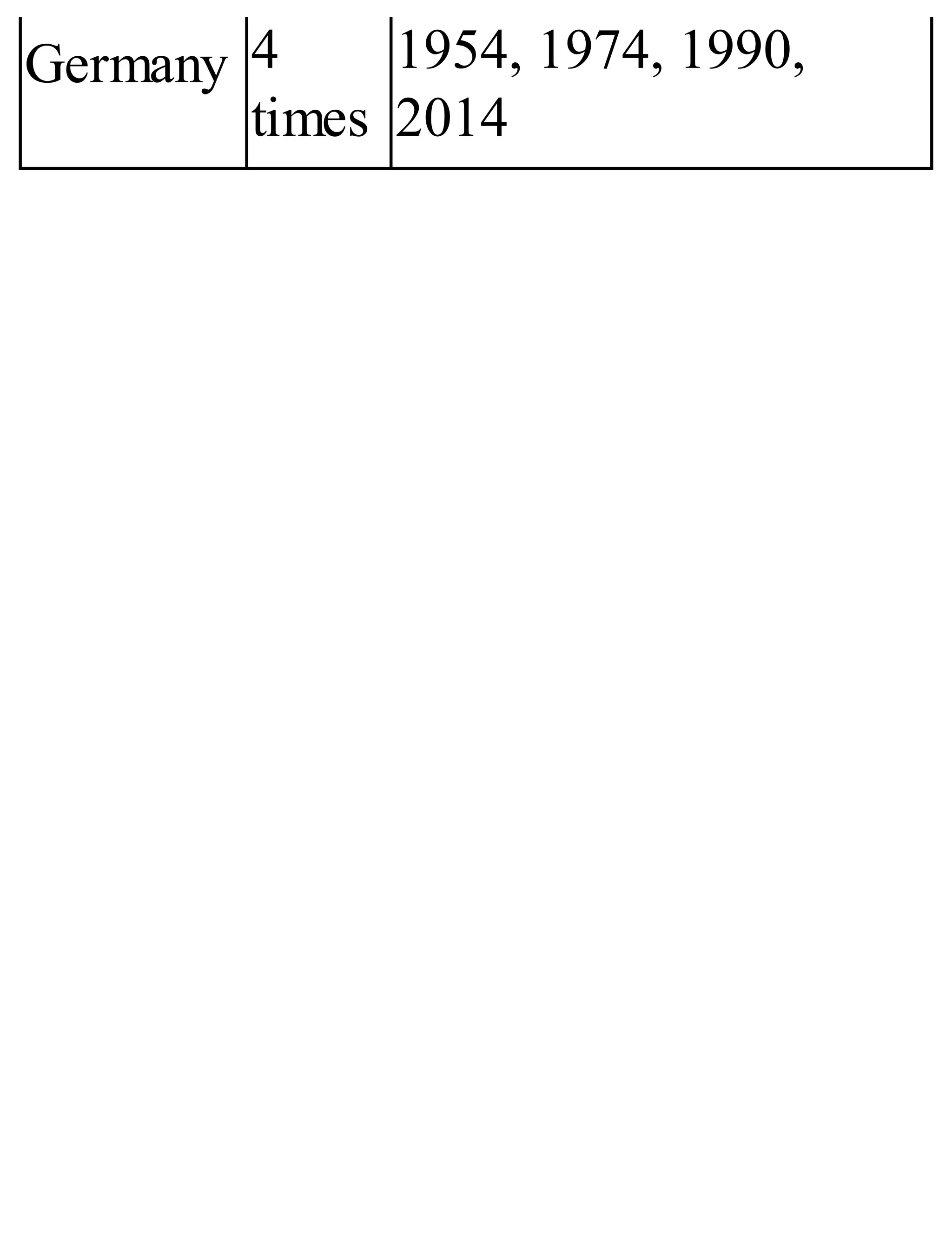
Germany 4
times
1954, 1974, 1990,
2014
25.
World Cup Cricket
The World Cup Cricket Tournament is
held every four years. The first
tournament was held in 1975 in England
in which England, Australia, West
Indies, New Zealand, India and Pakistan
took Part. The West Indies won this
tournament and also the next one in
1979. The first three tournaments, for
three consecutive occasions — 1975,
1979 and 1983, were held in England.
The ICC (International Cricket
Council) is in charge of the overall
administration of the World Cup Cricket
Tournament, though the ruling bodies of
the countries where the tournaments take
place are responsible for local
arrangements. The ICC was originally
founded in 1909 as the Imperial Cricket
Conference but was renamed the
International Cricket Council in 1989.
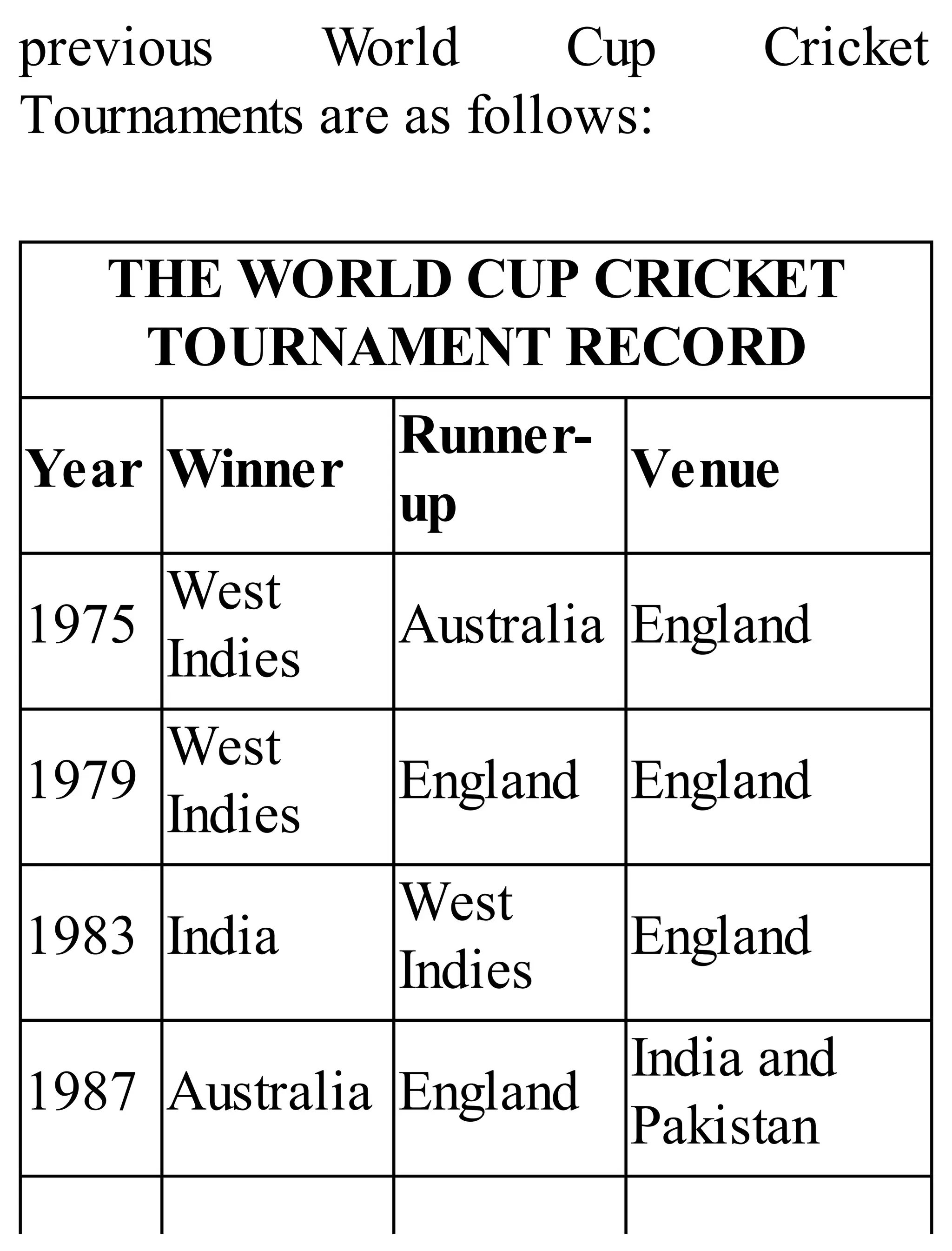
Winners and the venues of the
previous World Cup Cricket
Tournaments are as follows:
THE WORLD CUP CRICKET
TOURNAMENT RECORD
Year Winner
Runner-
up
Venue
1975
West
Indies
Australia England
1979
West
Indies
England England
1983 India
West
Indies
England
1987 Australia England
India and
Pakistan
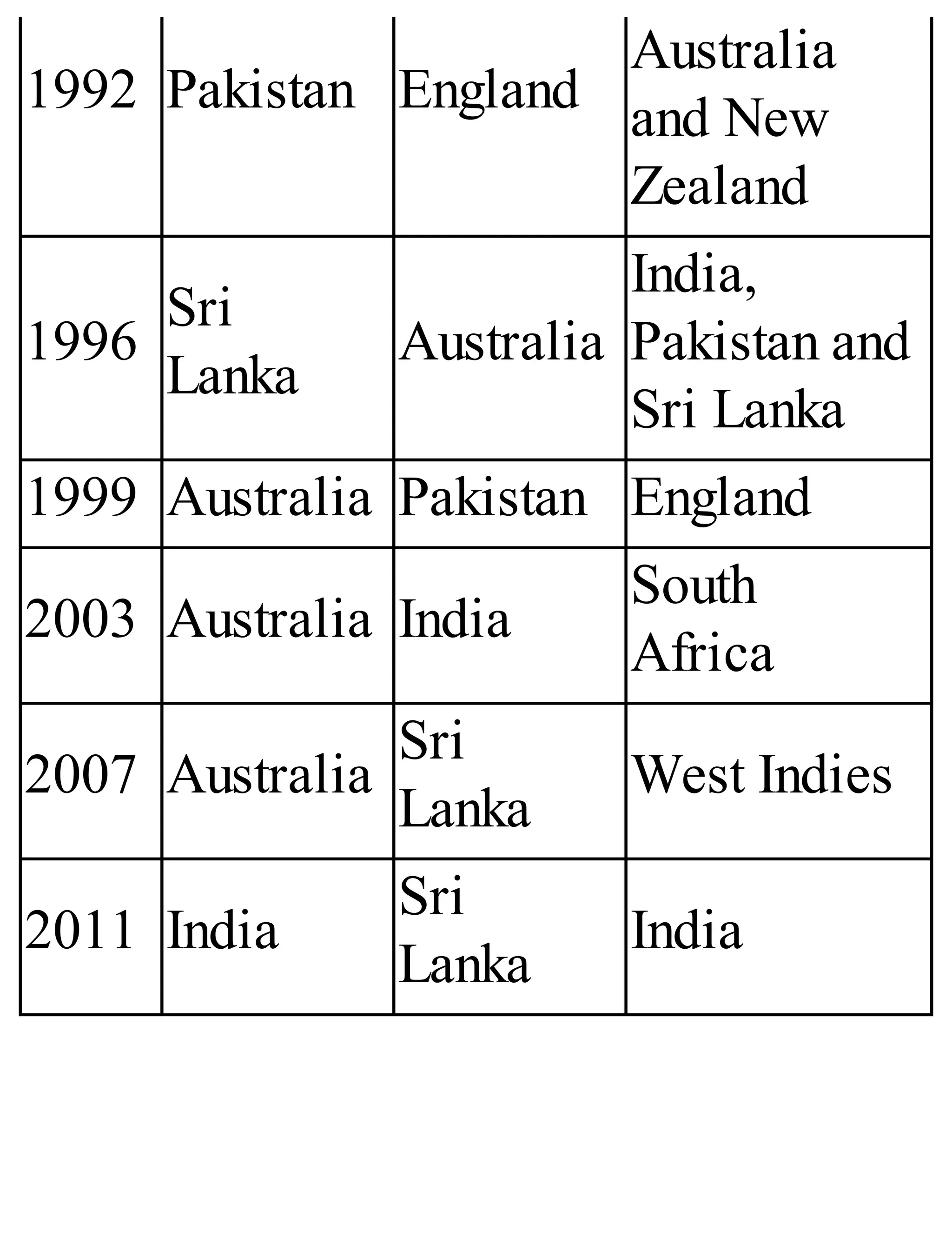
1992 Pakistan England
Australia
and New
Zealand
1996
Sri
Lanka
Australia
India,
Pakistan and
Sri Lanka
1999 Australia Pakistan England
2003 Australia India
South
Africa
2007 Australia
Sri
Lanka
West Indies
2011 India
Sri
Lanka
India
Believe It or Not:
• The English, the founder of the
cricket, have never won the World
Cup.
• Indian hockey team failed to qualify
for the Beijing Olympics 2008.
• Some species of the bamboo plant
have been found to grow at up to 91
cm per day.
26.
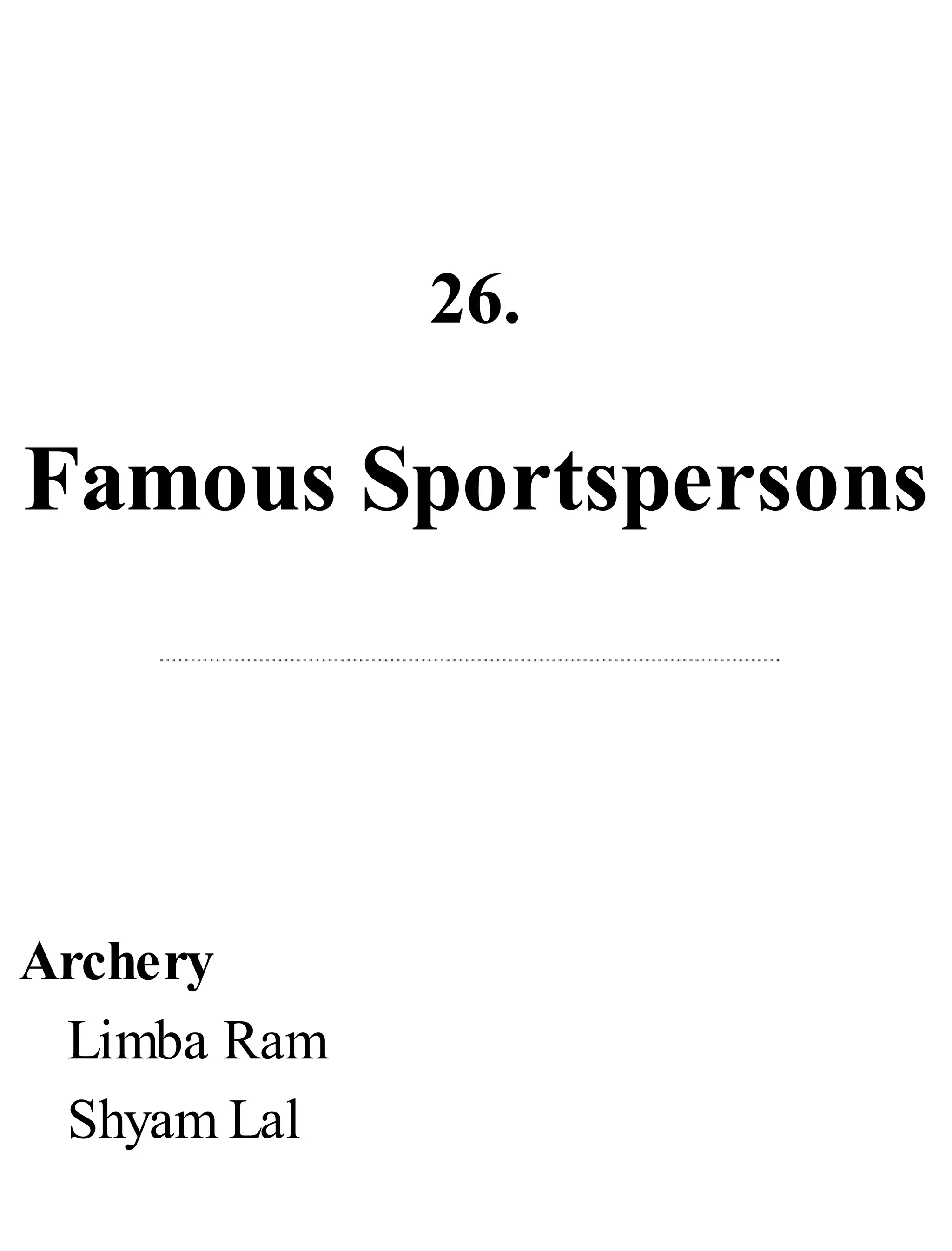
Famous Sportspersons
Archery
Limba Ram
Shyam Lal
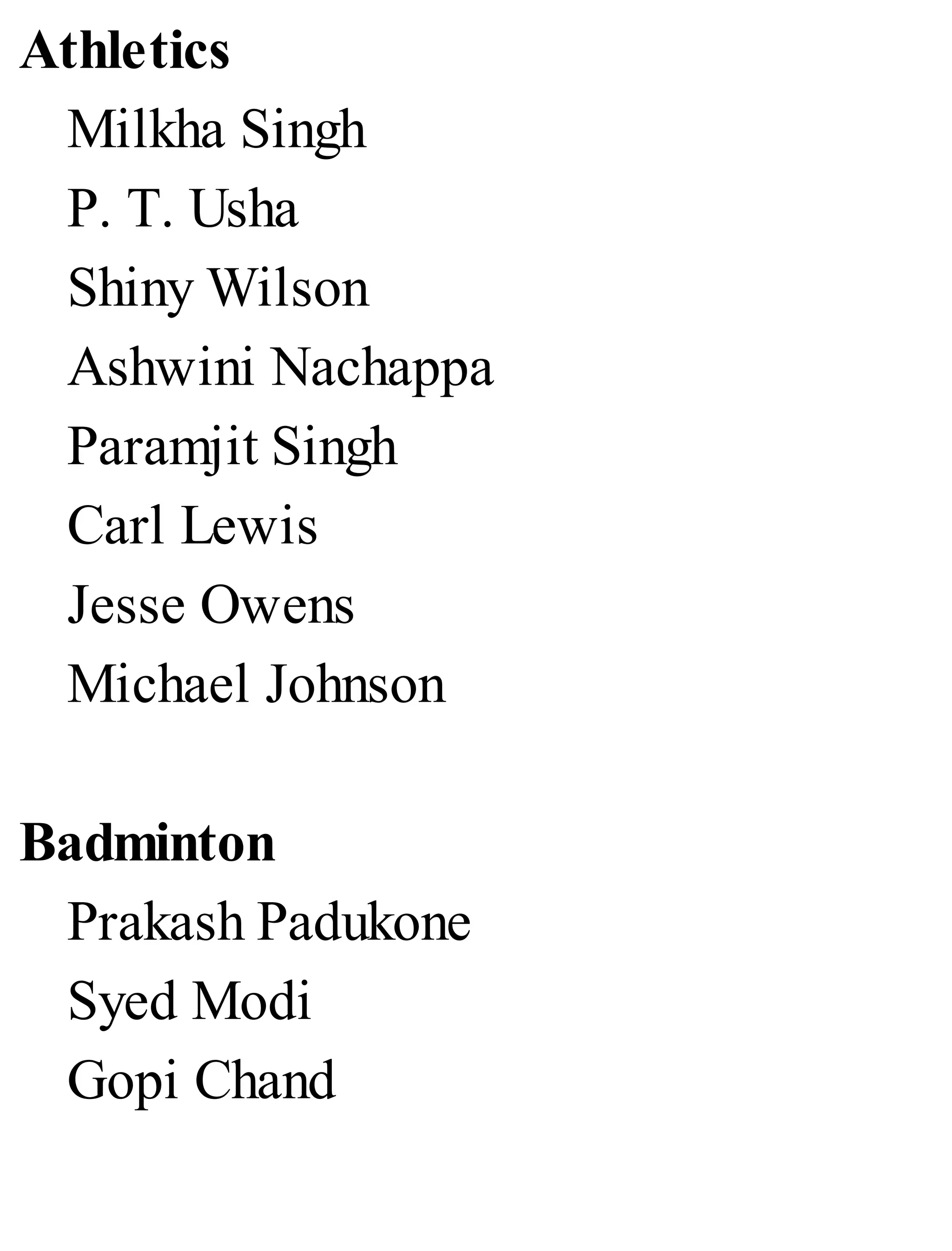
Athletics
Milkha Singh
P. T. Usha
Shiny Wilson
Ashwini Nachappa
Paramjit Singh
Carl Lewis
Jesse Owens
Michael Johnson
Badminton
Prakash Padukone
Syed Modi
Gopi Chand
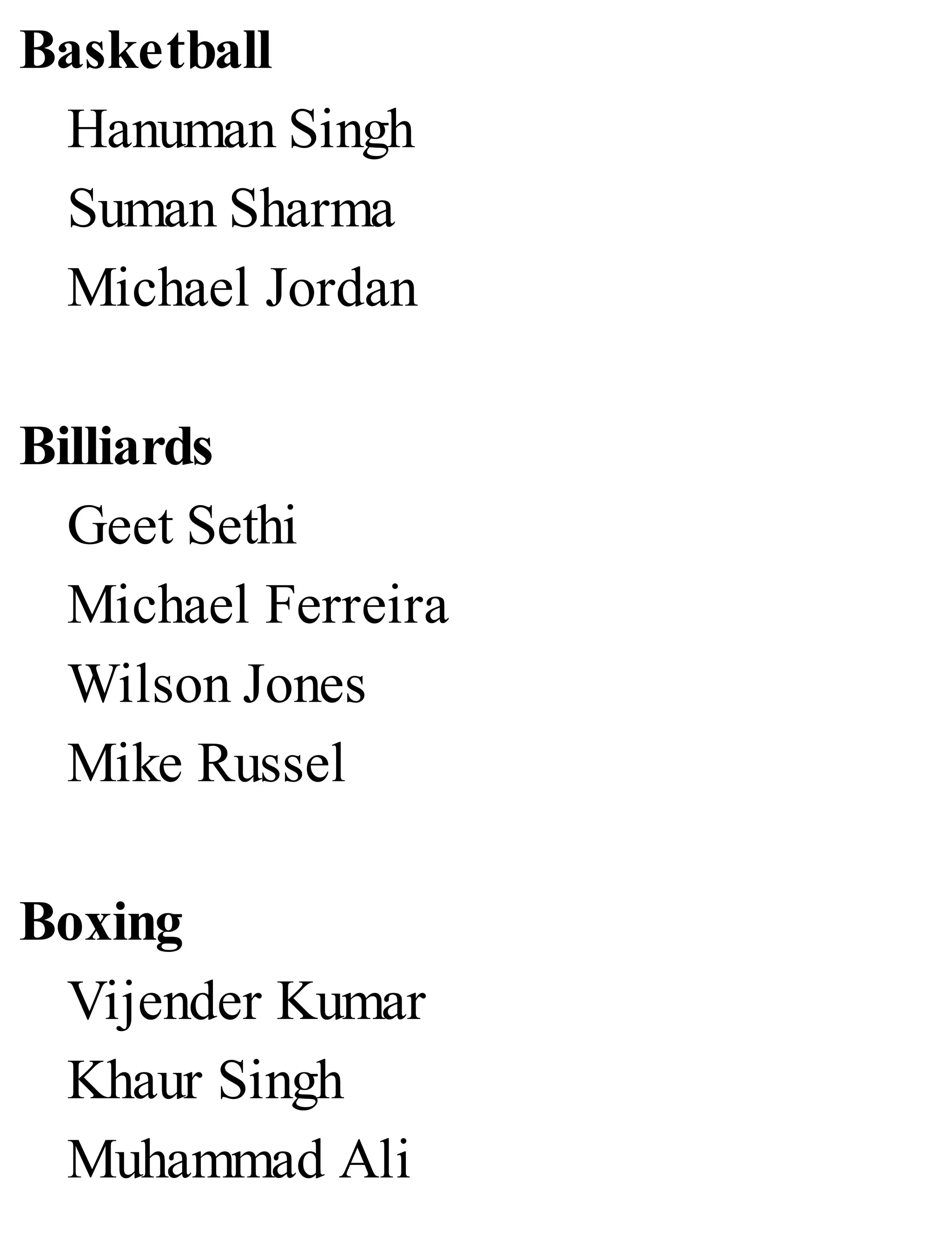
Basketball
Hanuman Singh
Suman Sharma
Michael Jordan
Billiards
Geet Sethi
Michael Ferreira
Wilson Jones
Mike Russel
Boxing
Vijender Kumar
Khaur Singh
Muhammad Ali
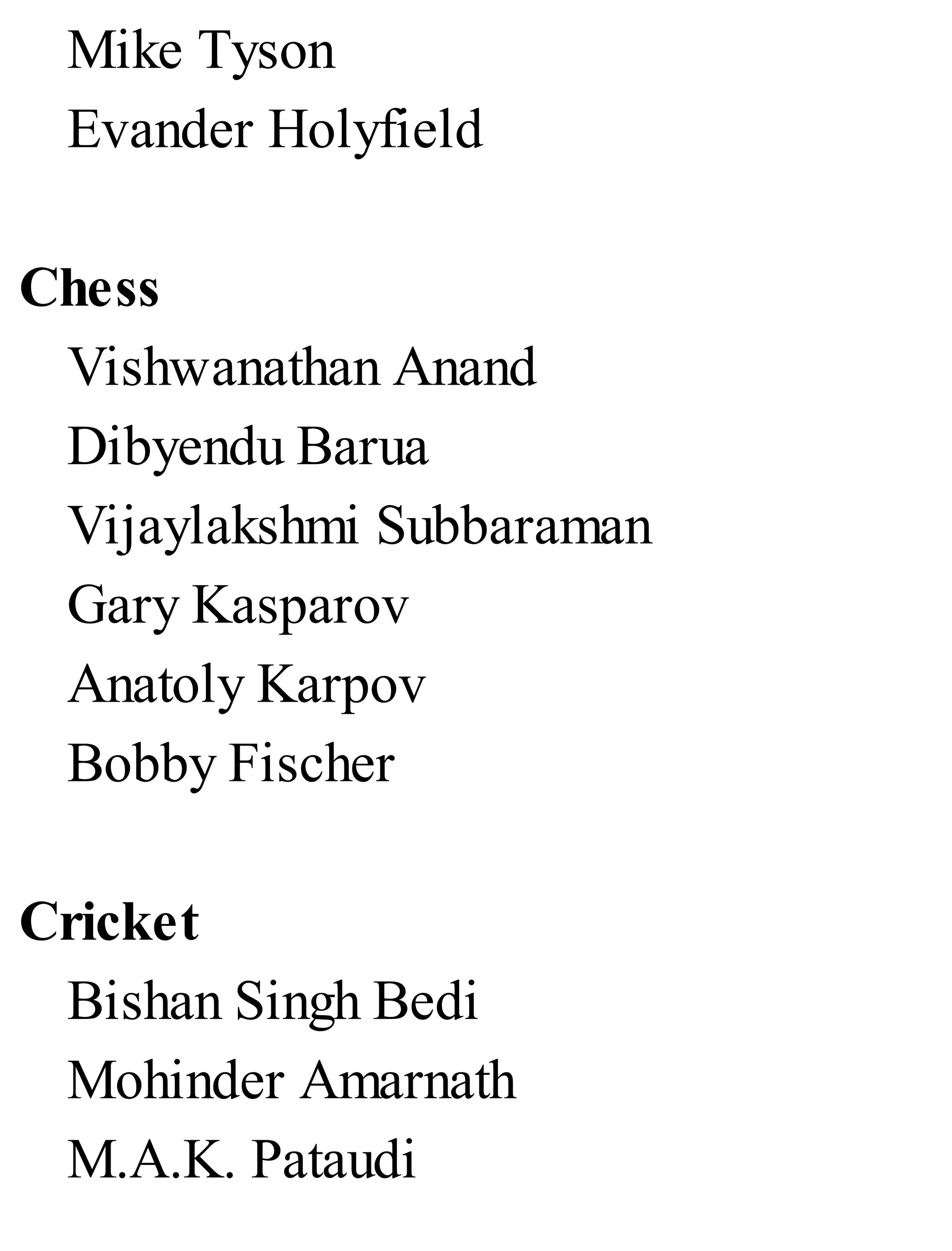
Mike Tyson
Evander Holyfield
Chess
Vishwanathan Anand
Dibyendu Barua
Vijaylakshmi Subbaraman
Gary Kasparov
Anatoly Karpov
Bobby Fischer
Cricket
Bishan Singh Bedi
Mohinder Amarnath
M.A.K. Pataudi
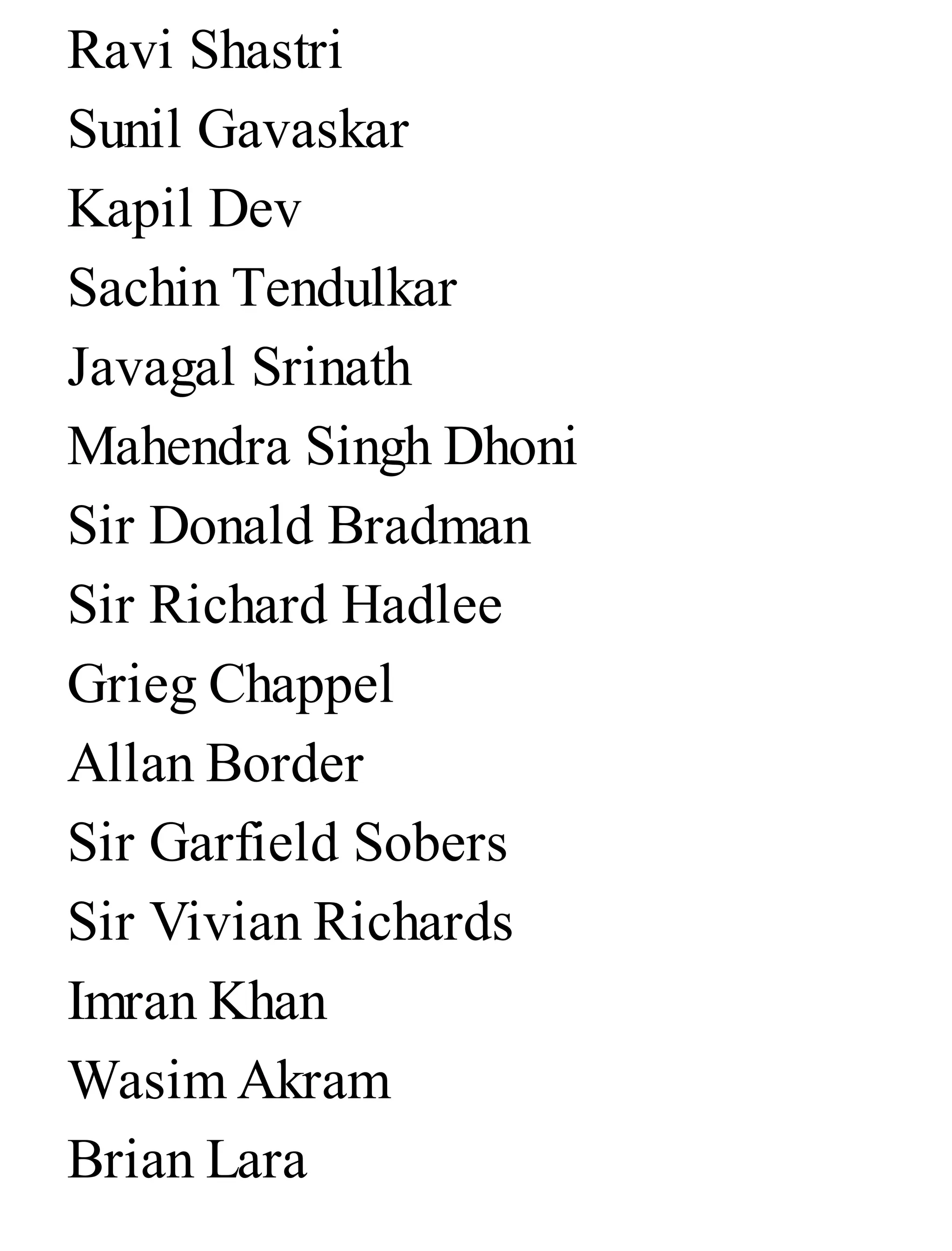
Ravi Shastri
Sunil Gavaskar
Kapil Dev
Sachin Tendulkar
Javagal Srinath
Mahendra Singh Dhoni
Sir Donald Bradman
Sir Richard Hadlee
Grieg Chappel
Allan Border
Sir Garfield Sobers
Sir Vivian Richards
Imran Khan
Wasim Akram
Brian Lara
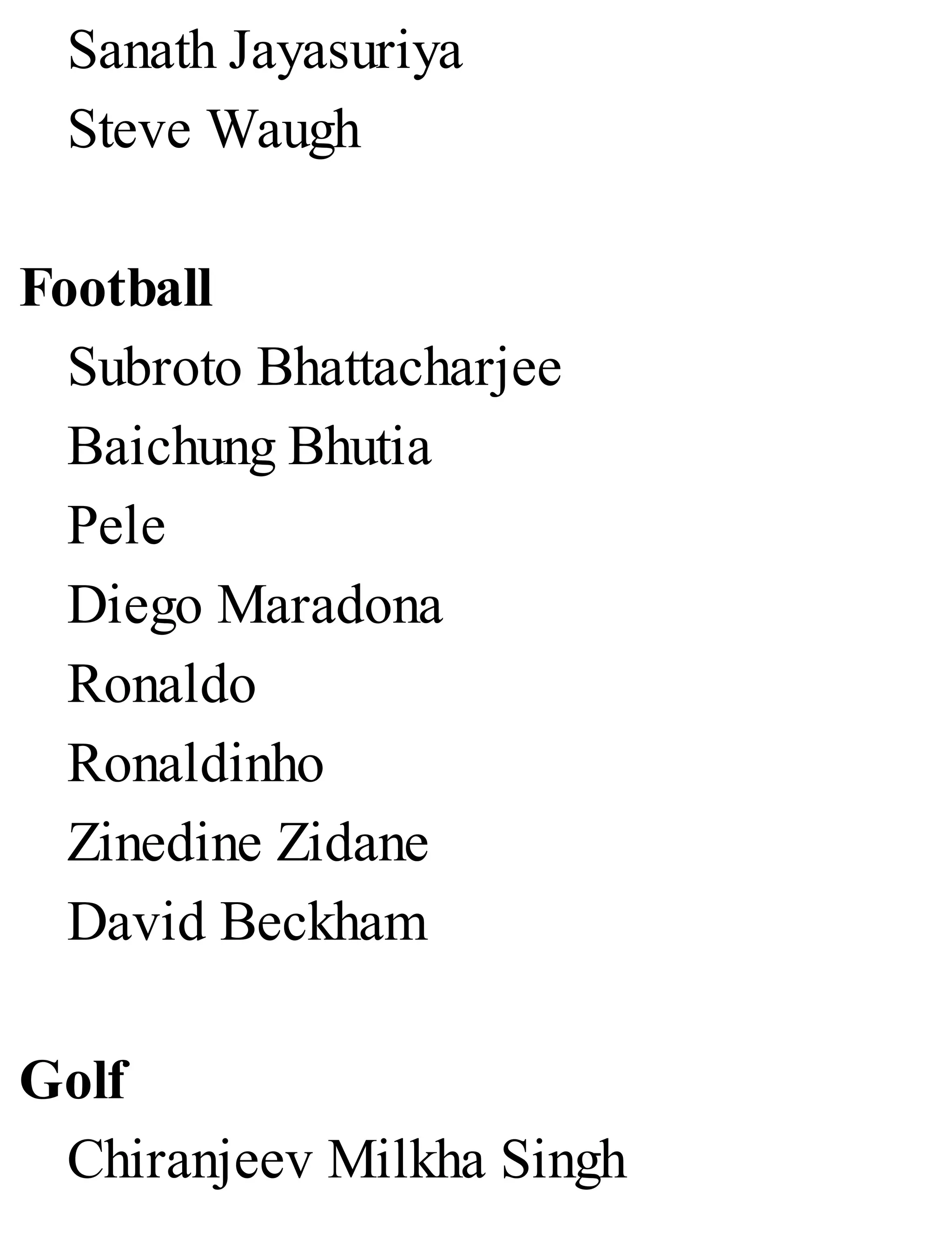
Sanath Jayasuriya
Steve Waugh
Football
Subroto Bhattacharjee
Baichung Bhutia
Pele
Diego Maradona
Ronaldo
Ronaldinho
Zinedine Zidane
David Beckham
Golf
Chiranjeev Milkha Singh
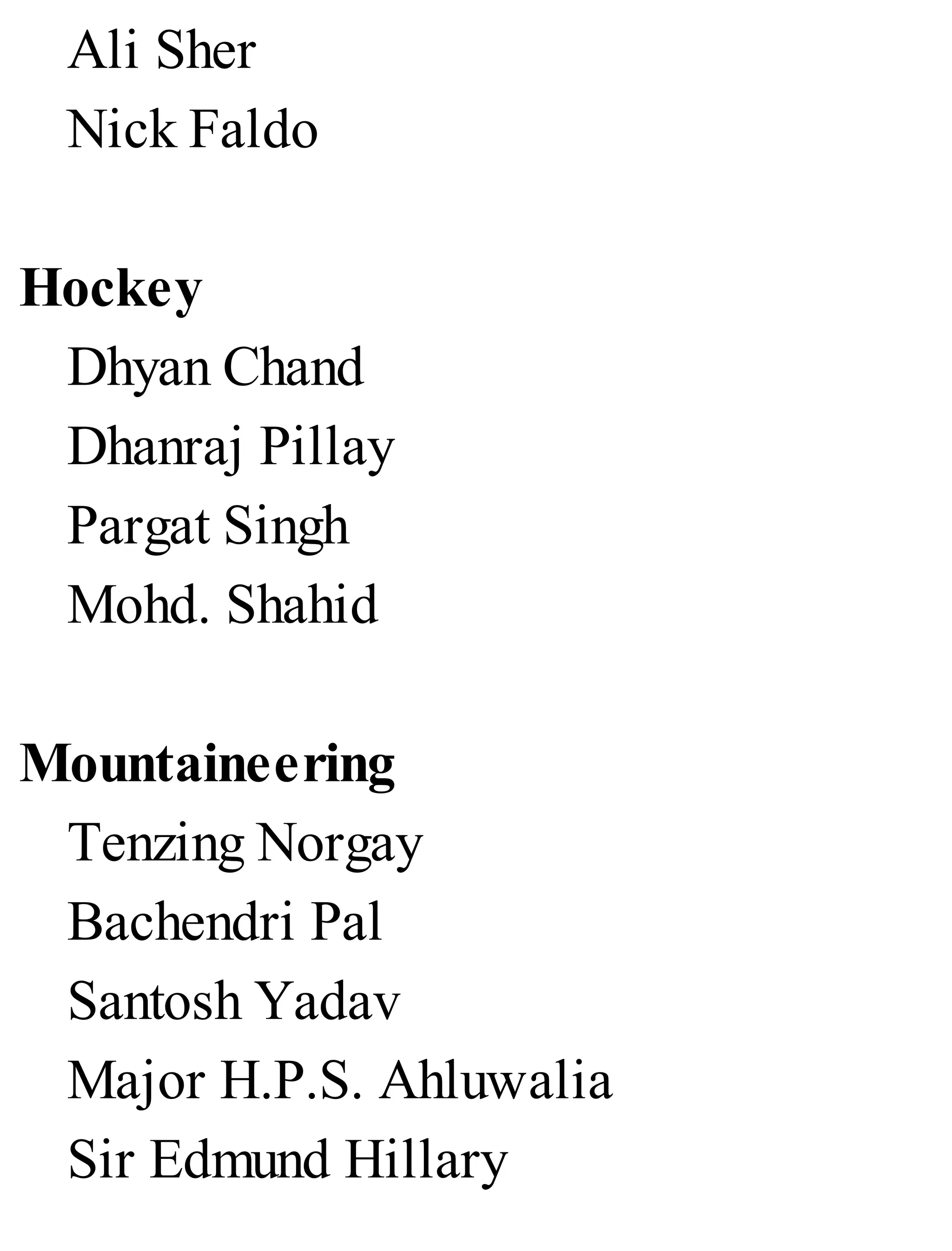
Ali Sher
Nick Faldo
Hockey
Dhyan Chand
Dhanraj Pillay
Pargat Singh
Mohd. Shahid
Mountaineering
Tenzing Norgay
Bachendri Pal
Santosh Yadav
Major H.P.S. Ahluwalia
Sir Edmund Hillary
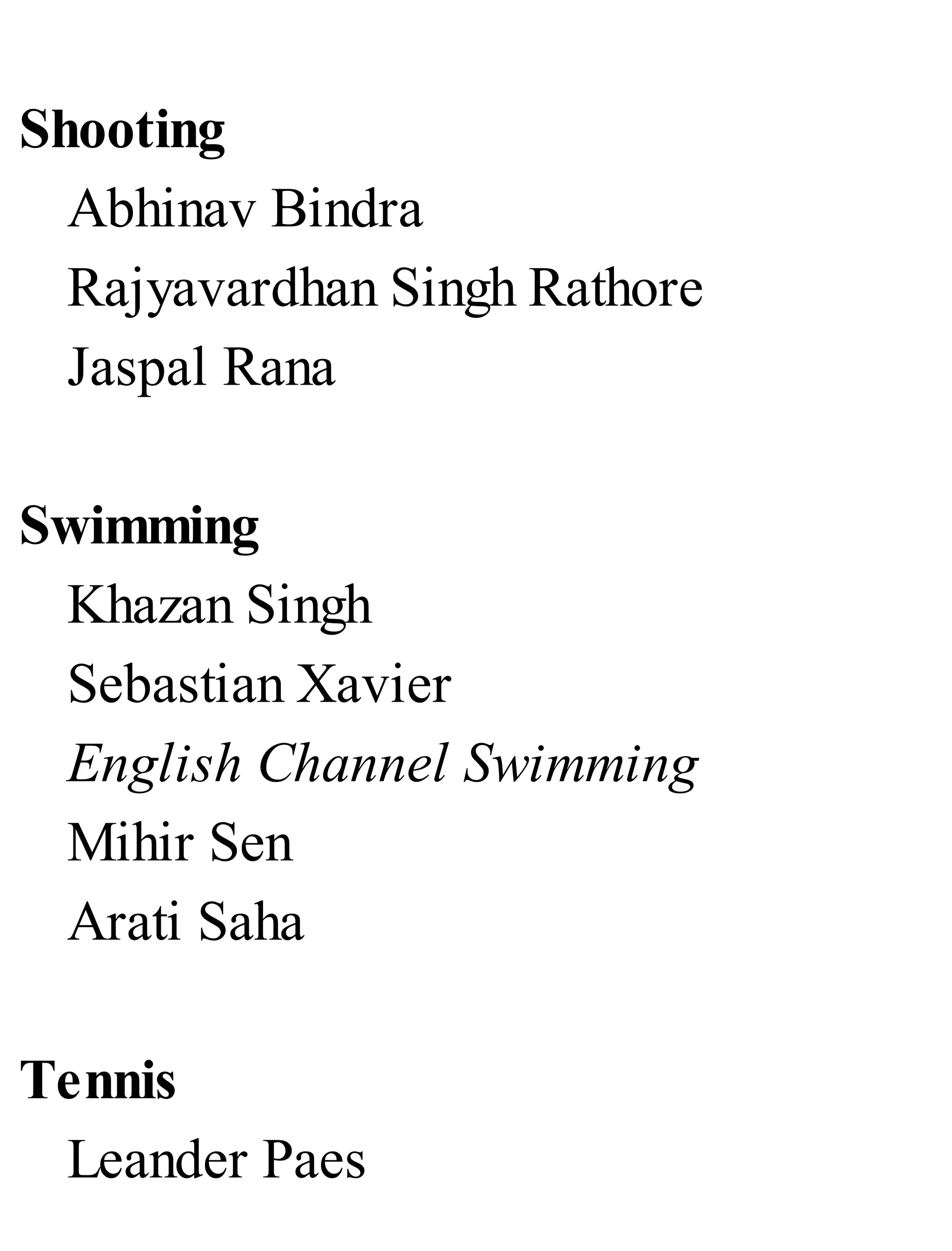
Shooting
Abhinav Bindra
Rajyavardhan Singh Rathore
Jaspal Rana
Swimming
Khazan Singh
Sebastian Xavier
English Channel Swimming
Mihir Sen
Arati Saha
Tennis
Leander Paes
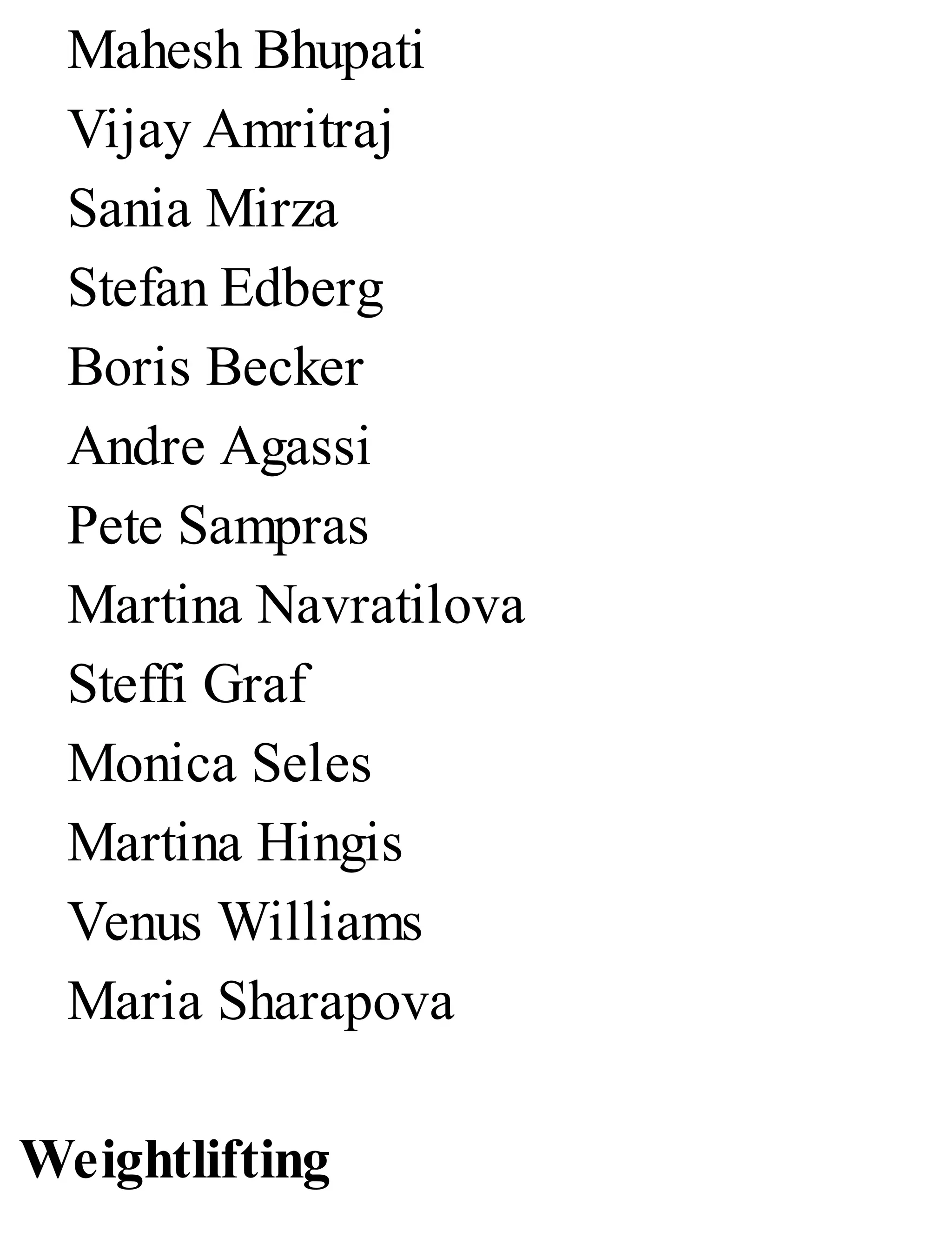
Mahesh Bhupati
Vijay Amritraj
Sania Mirza
Stefan Edberg
Boris Becker
Andre Agassi
Pete Sampras
Martina Navratilova
Steffi Graf
Monica Seles
Martina Hingis
Venus Williams
Maria Sharapova
Weightlifting
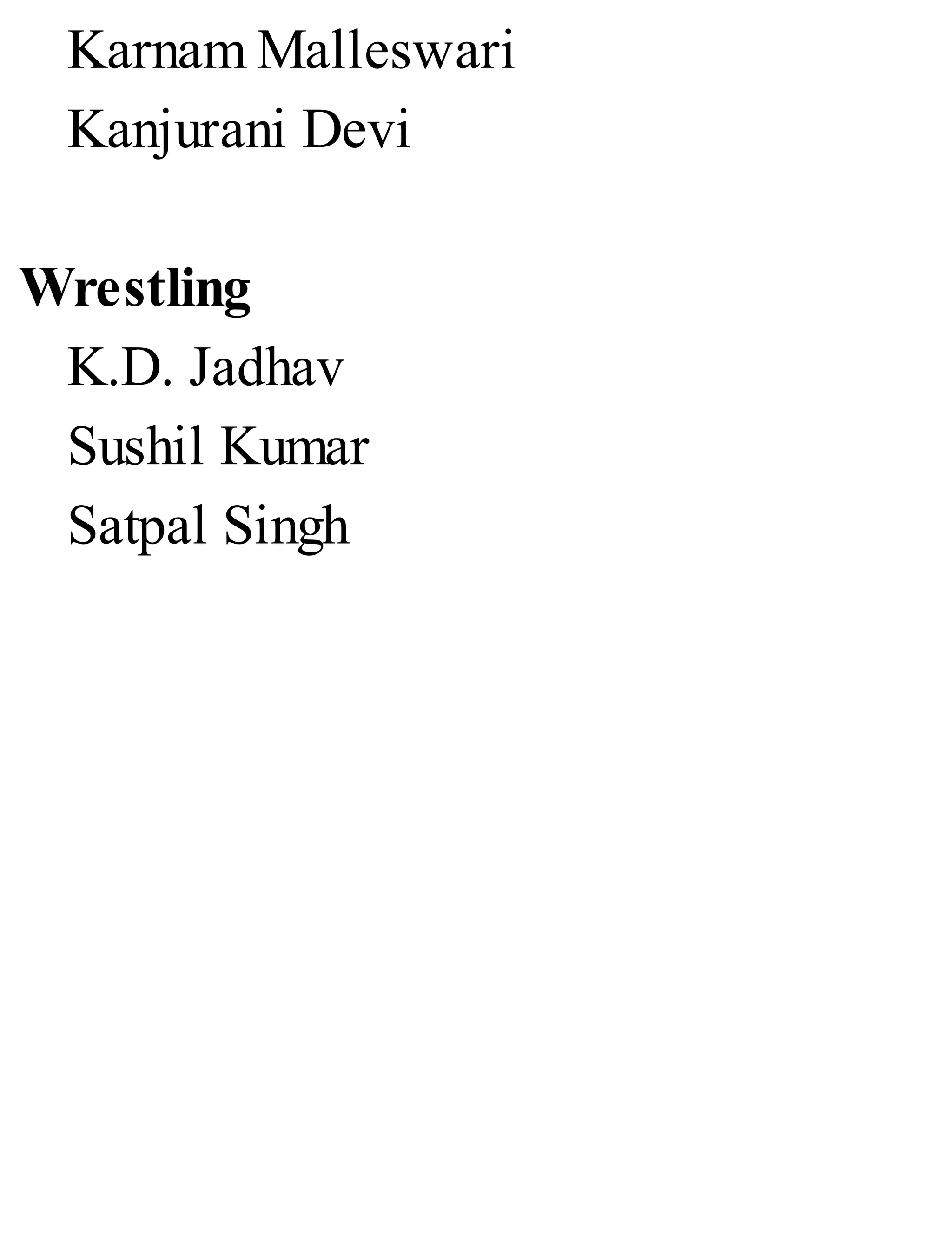
Karnam Malleswari
Kanjurani Devi
Wrestling
K.D. Jadhav
Sushil Kumar
Satpal Singh
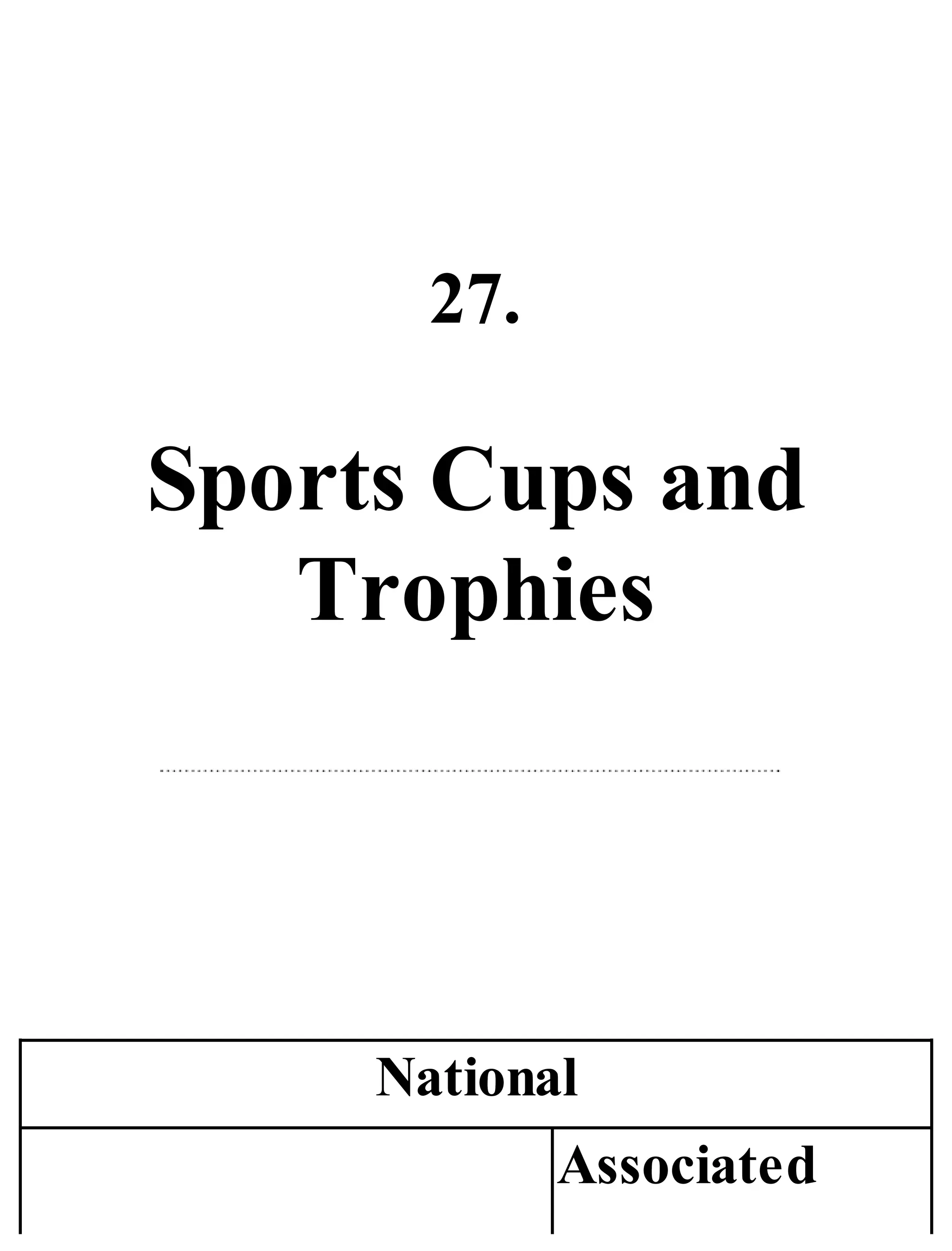
27.
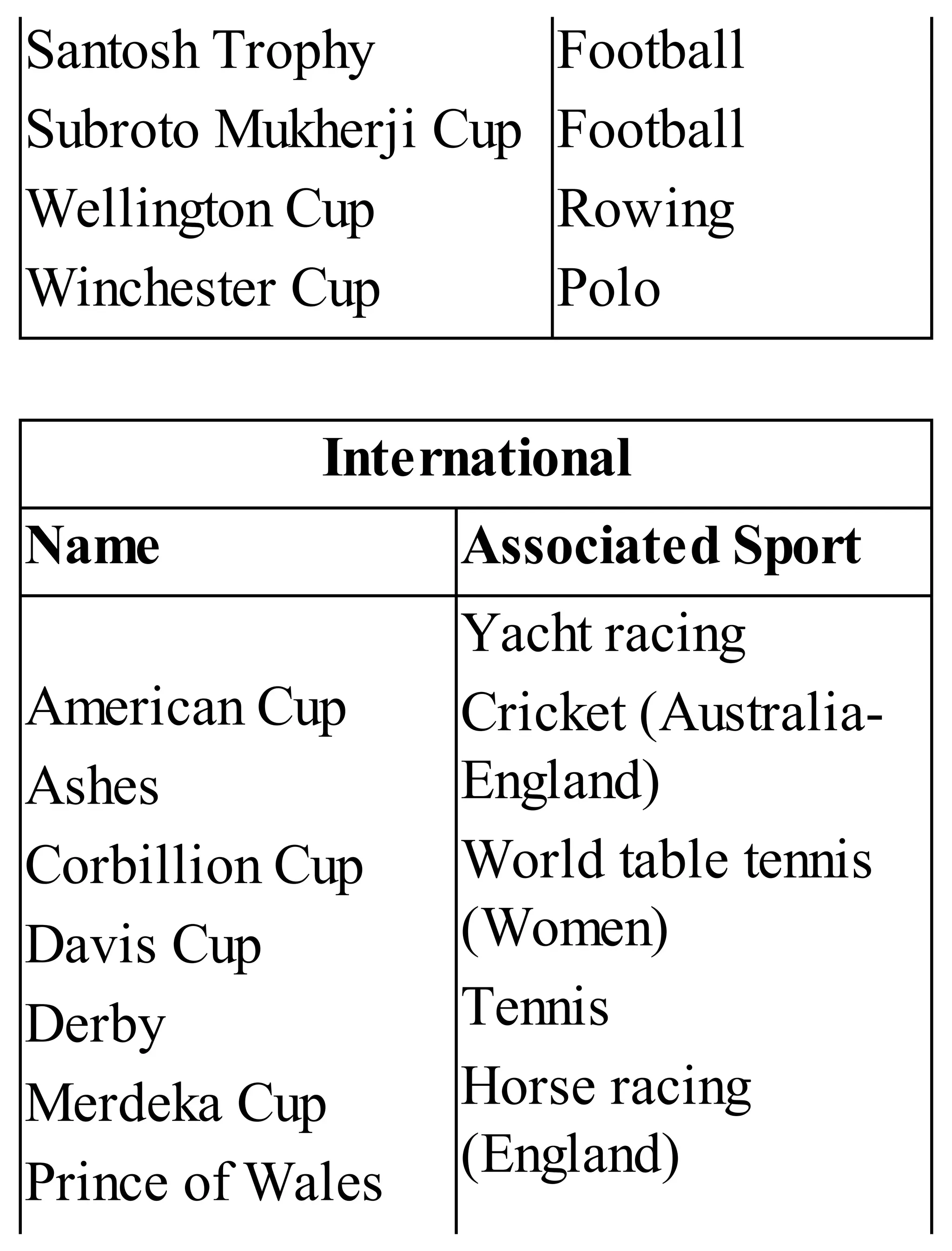
Sports Cups and
Trophies
National
Associated
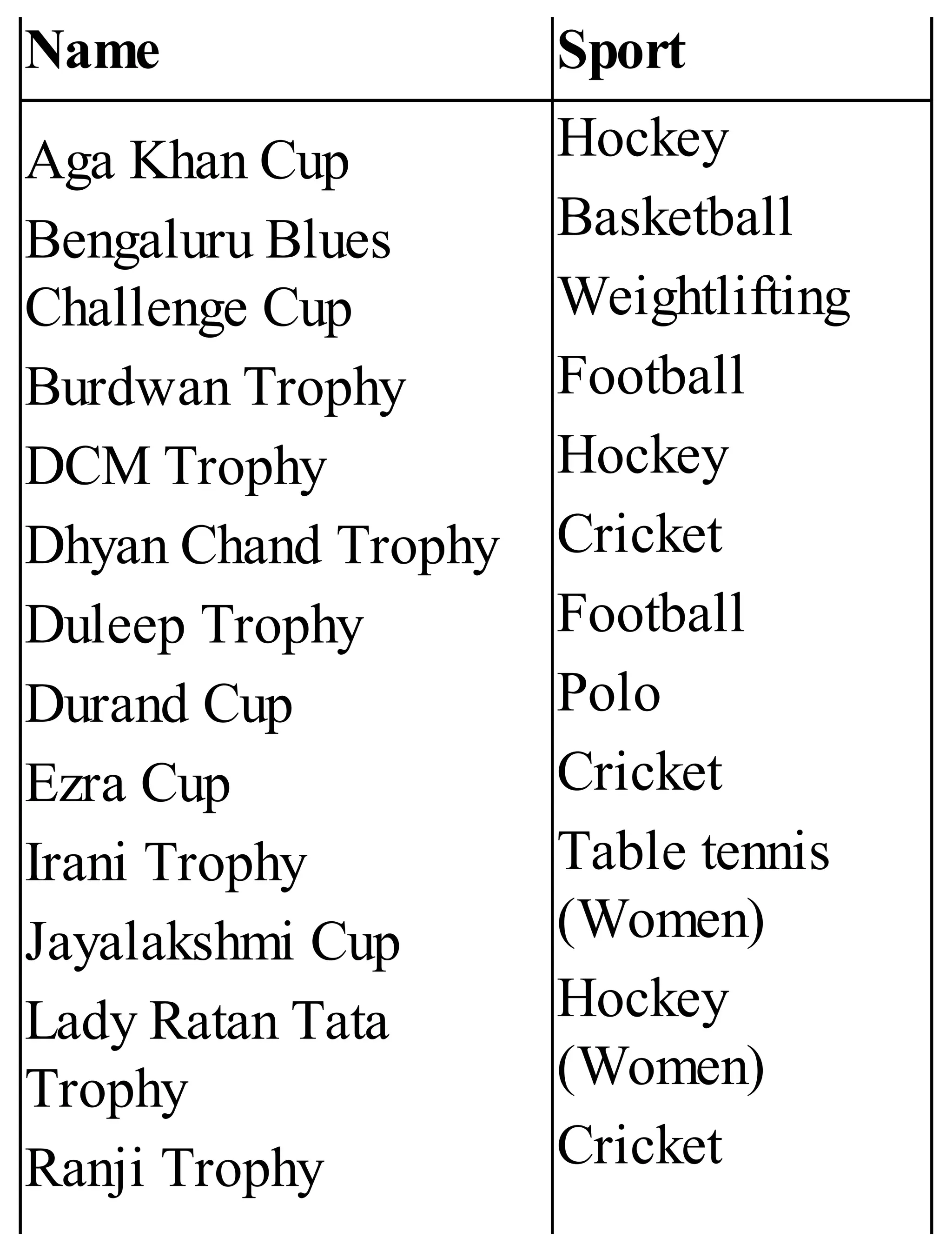
Name Sport
Aga Khan Cup
Bengaluru Blues
Challenge Cup
Burdwan Trophy
DCM Trophy
Dhyan Chand Trophy
Duleep Trophy
Durand Cup
Ezra Cup
Irani Trophy
Jayalakshmi Cup
Lady Ratan Tata
Trophy
Ranji Trophy
Hockey
Basketball
Weightlifting
Football
Hockey
Cricket
Football
Polo
Cricket
Table tennis
(Women)
Hockey
(Women)
Cricket
Santosh Trophy
Subroto Mukherji Cup
Wellington Cup
Winchester Cup
Football
Football
Rowing
Polo
International
Name Associated Sport
American Cup
Ashes
Corbillion Cup
Davis Cup
Derby
Merdeka Cup
Prince of Wales
Yacht racing
Cricket (Australia-
England)
World table tennis
(Women)
Tennis
Horse racing
(England)
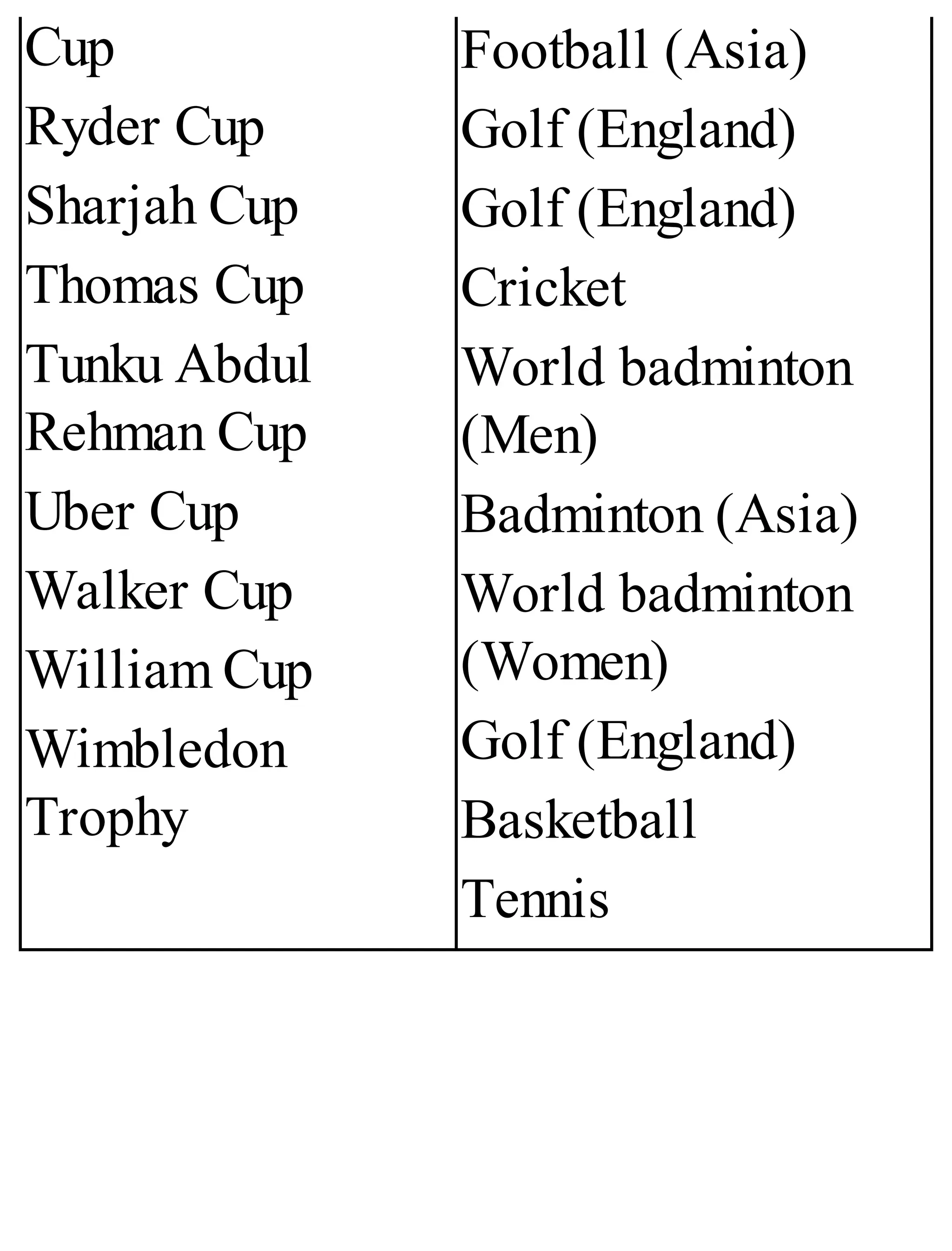
Cup
Ryder Cup
Sharjah Cup
Thomas Cup
Tunku Abdul
Rehman Cup
Uber Cup
Walker Cup
William Cup
Wimbledon
Trophy
Football (Asia)
Golf (England)
Golf (England)
Cricket
World badminton
(Men)
Badminton (Asia)
World badminton
(Women)
Golf (England)
Basketball
Tennis
28.
Sports Terms
Archery
Target
Bull’s-eye
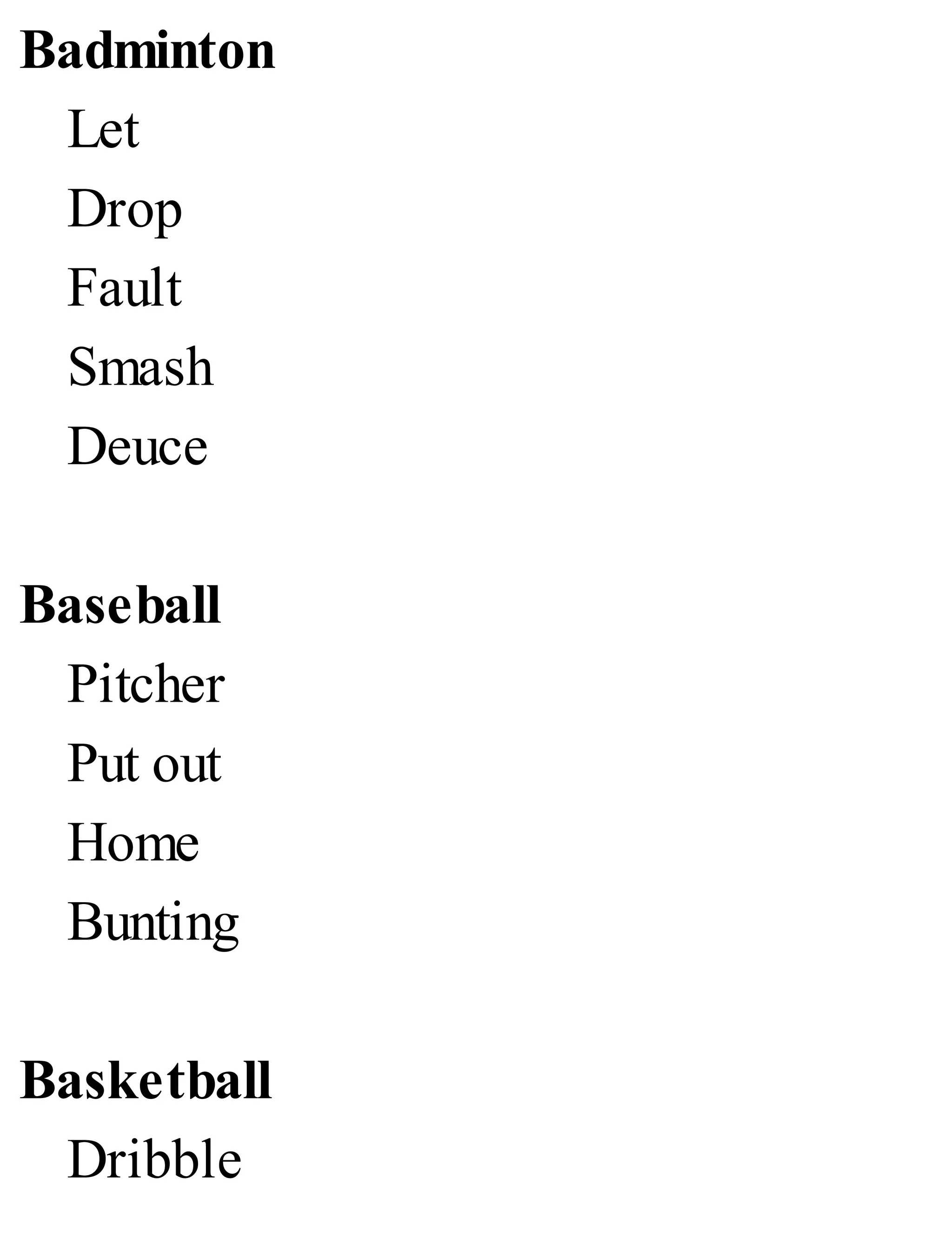
Badminton
Let
Drop
Fault
Smash
Deuce
Baseball
Pitcher
Put out
Home
Bunting
Basketball
Dribble
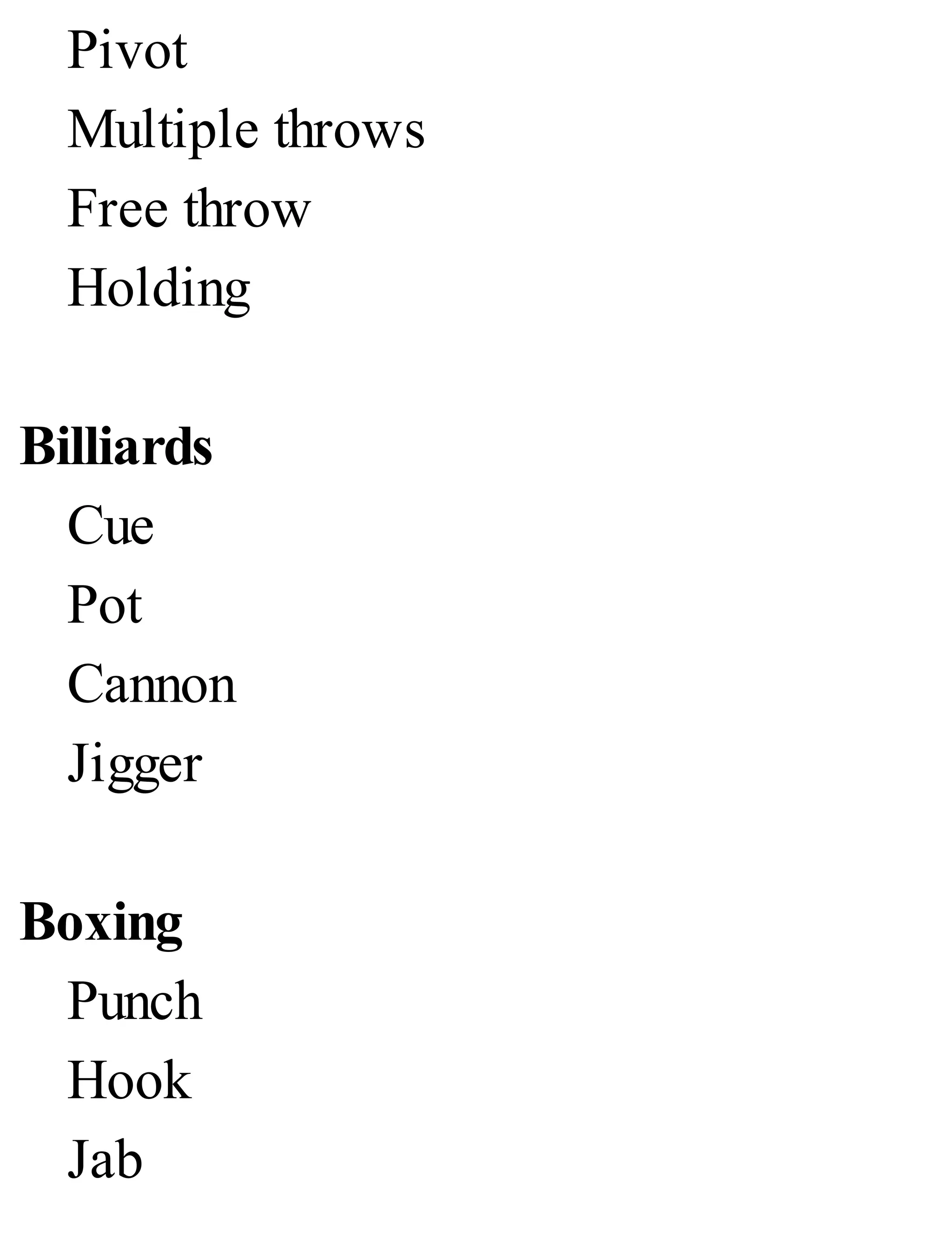
Pivot
Multiple throws
Free throw
Holding
Billiards
Cue
Pot
Cannon
Jigger
Boxing
Punch
Hook
Jab
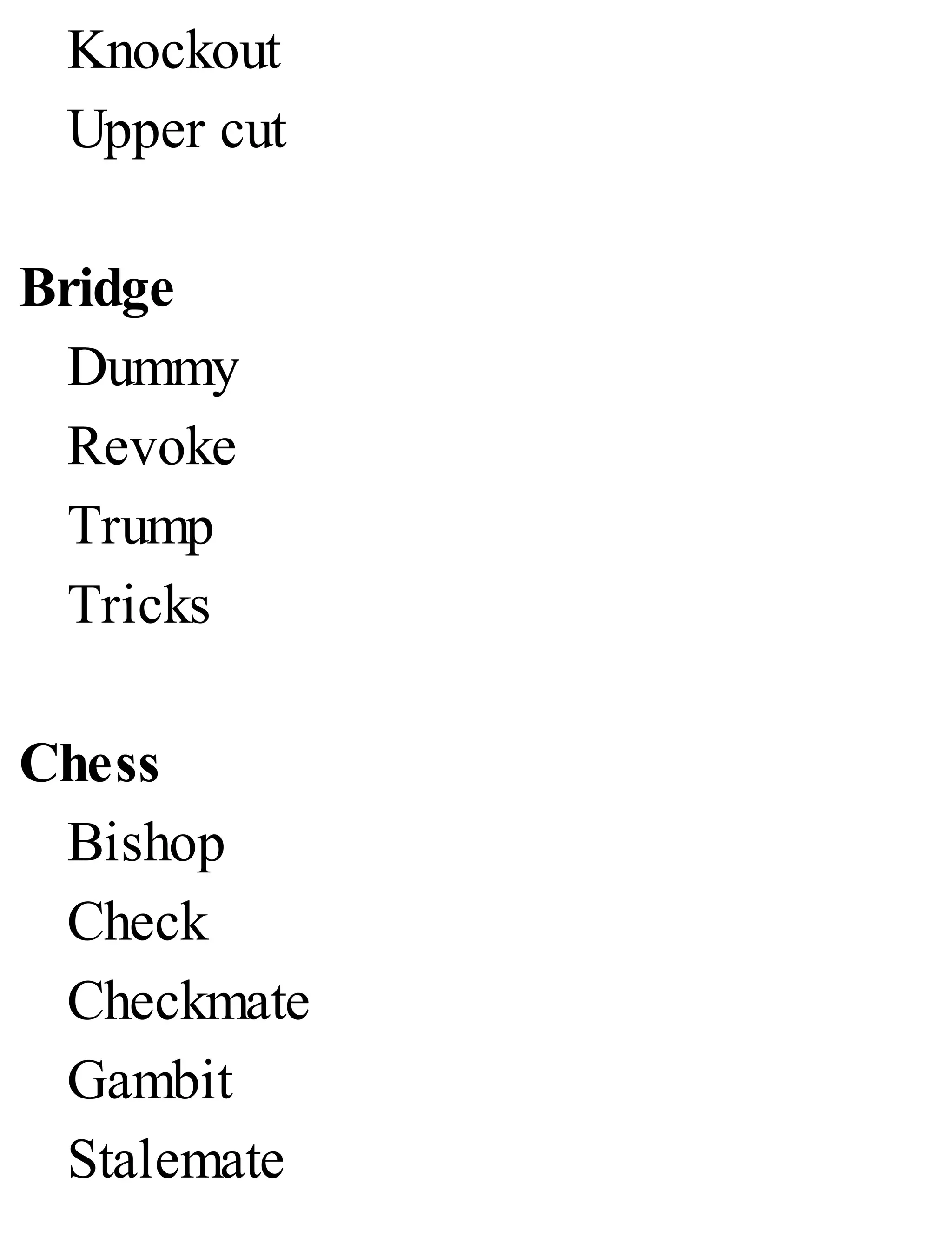
Knockout
Upper cut
Bridge
Dummy
Revoke
Trump
Tricks
Chess
Bishop
Check
Checkmate
Gambit
Stalemate
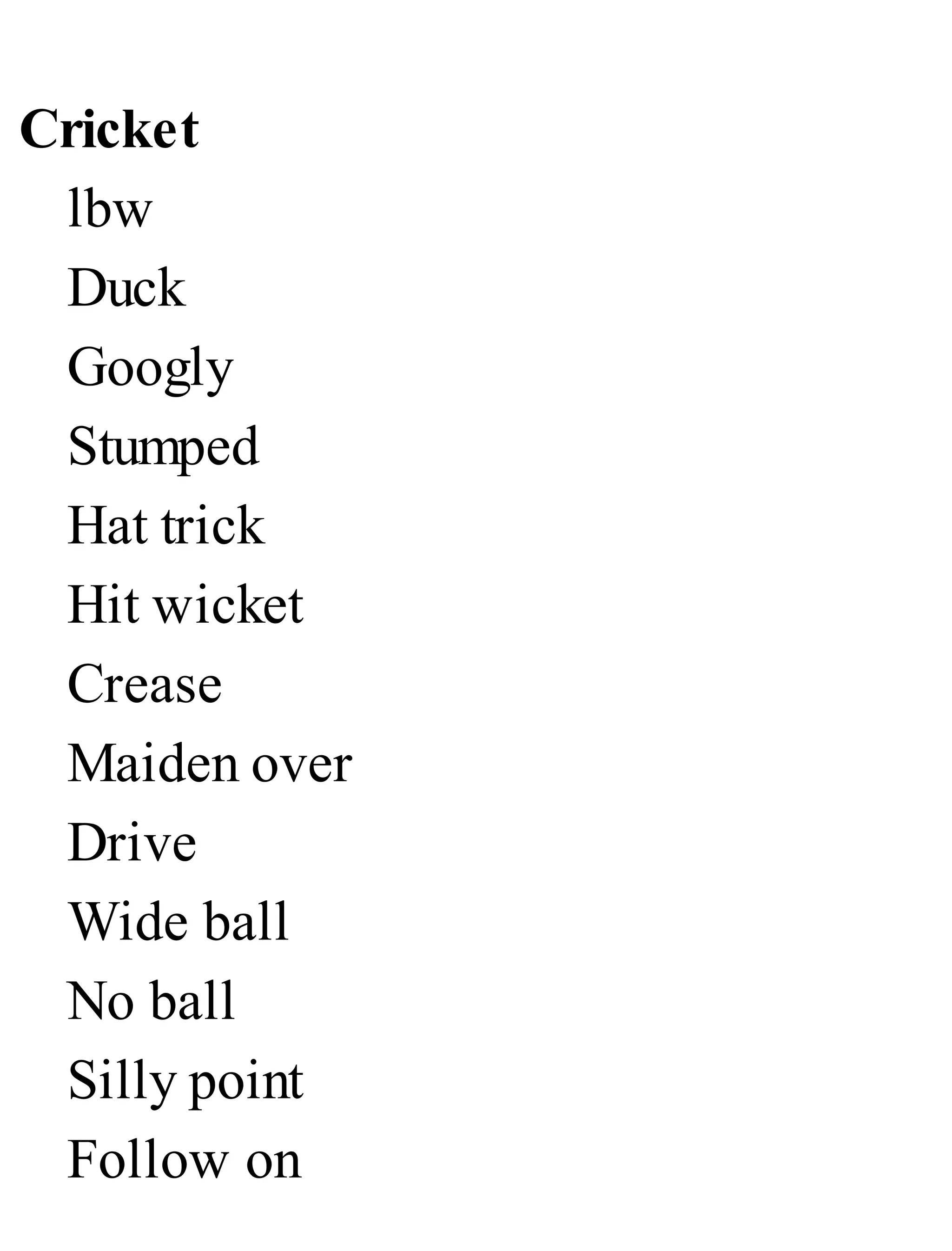
Cricket
lbw
Duck
Googly
Stumped
Hat trick
Hit wicket
Crease
Maiden over
Drive
Wide ball
No ball
Silly point
Follow on
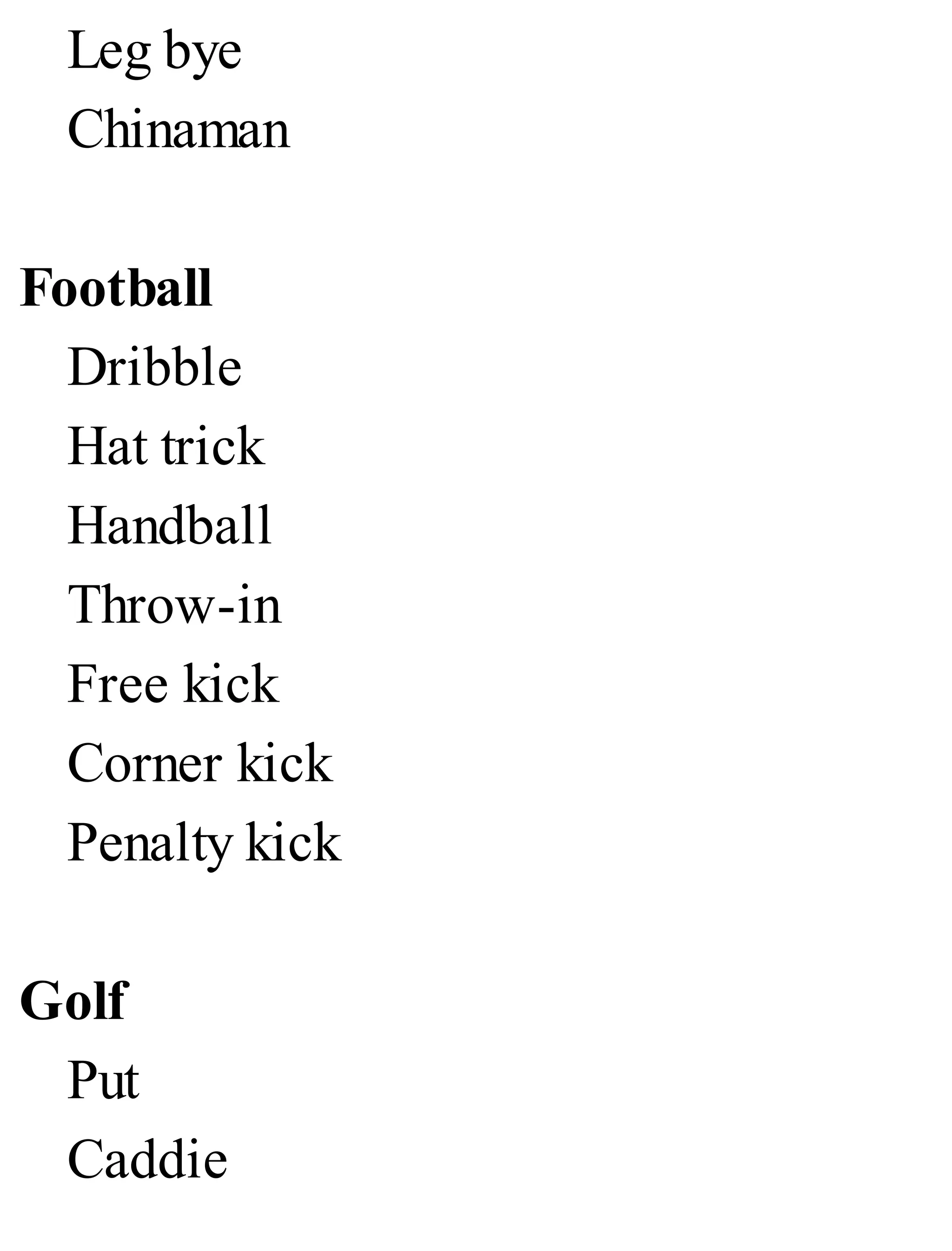
Leg bye
Chinaman
Football
Dribble
Hat trick
Handball
Throw-in
Free kick
Corner kick
Penalty kick
Golf
Put
Caddie
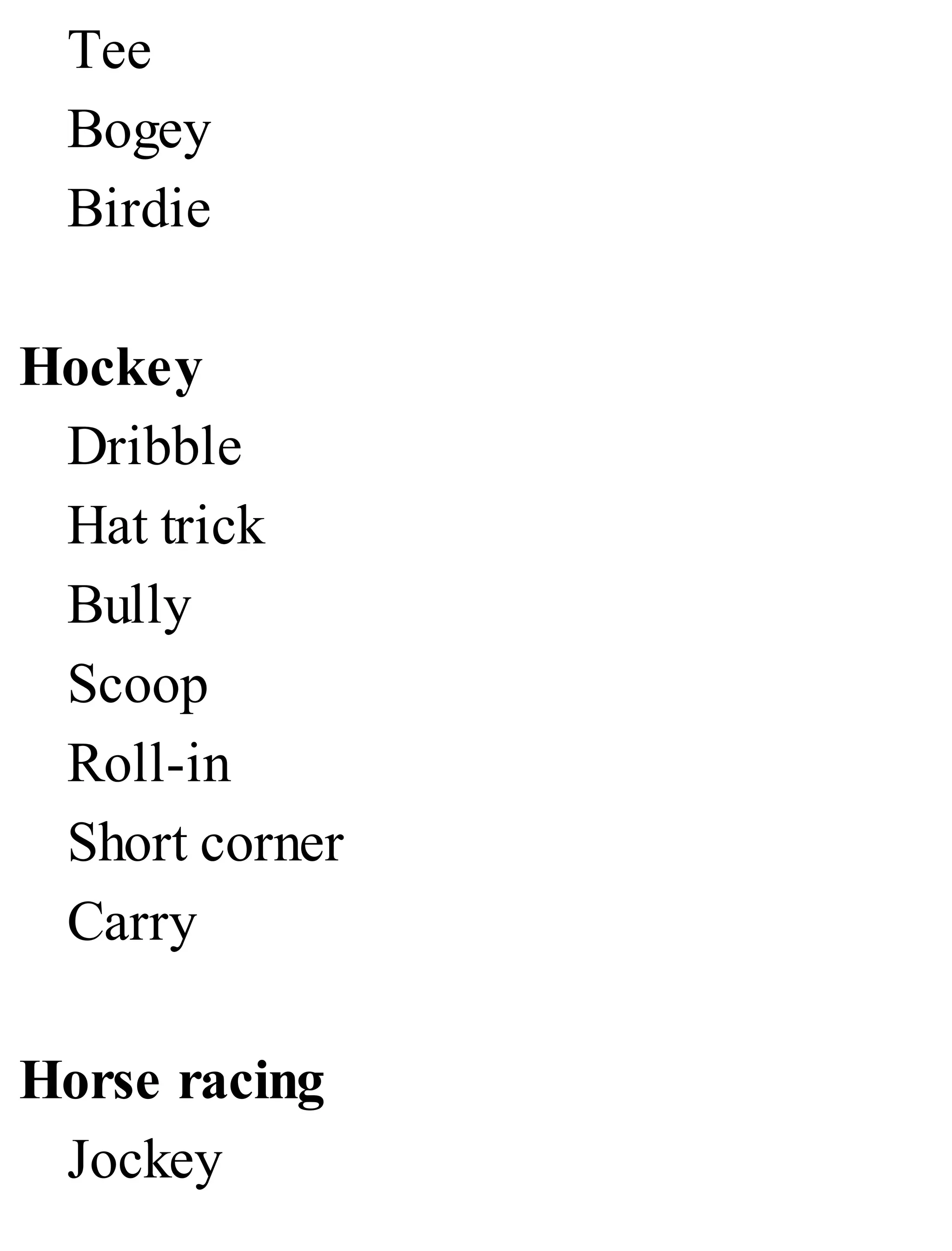
Tee
Bogey
Birdie
Hockey
Dribble
Hat trick
Bully
Scoop
Roll-in
Short corner
Carry
Horse racing
Jockey
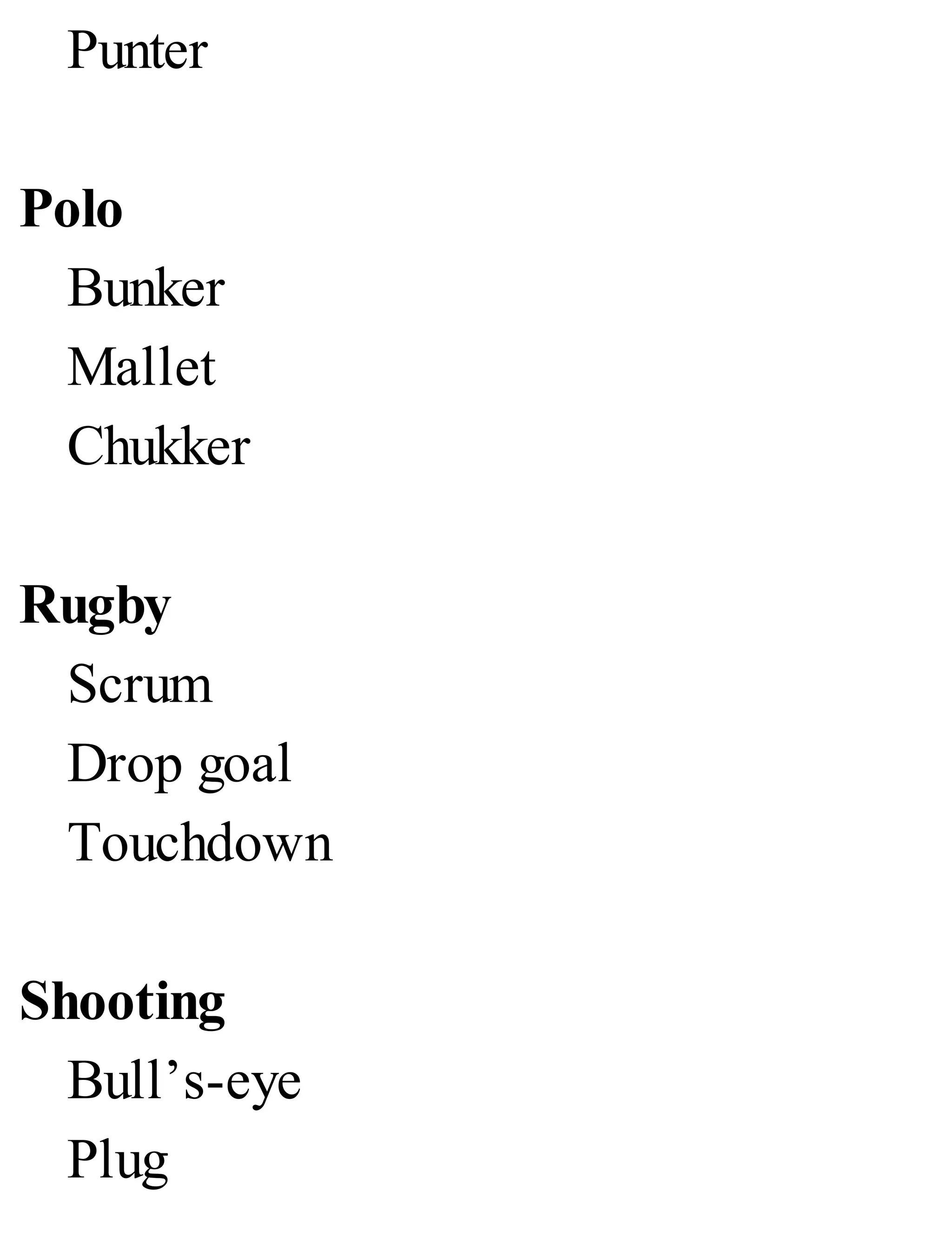
Punter
Polo
Bunker
Mallet
Chukker
Rugby
Scrum
Drop goal
Touchdown
Shooting
Bull’s-eye
Plug
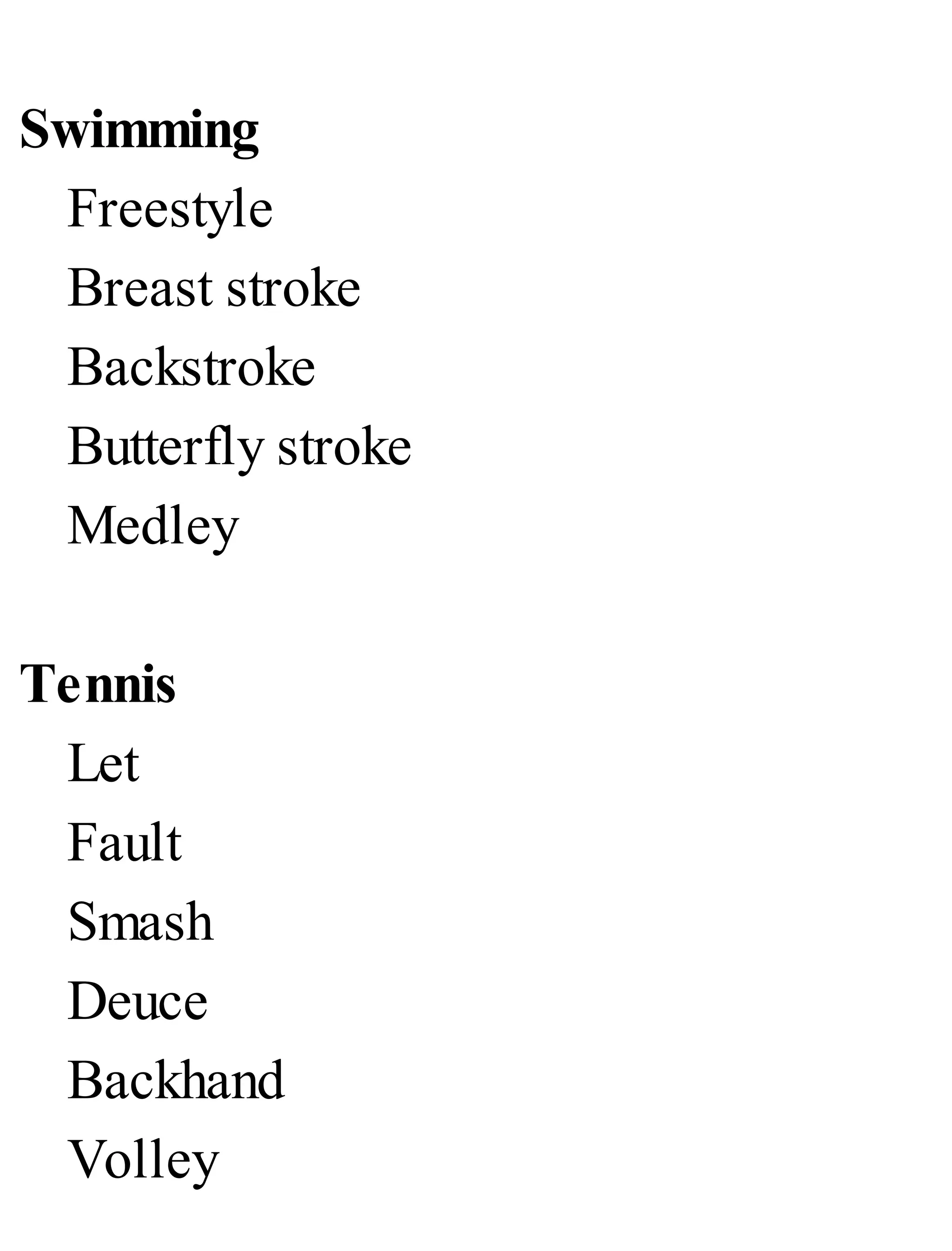
Swimming
Freestyle
Breast stroke
Backstroke
Butterfly stroke
Medley
Tennis
Let
Fault
Smash
Deuce
Backhand
Volley
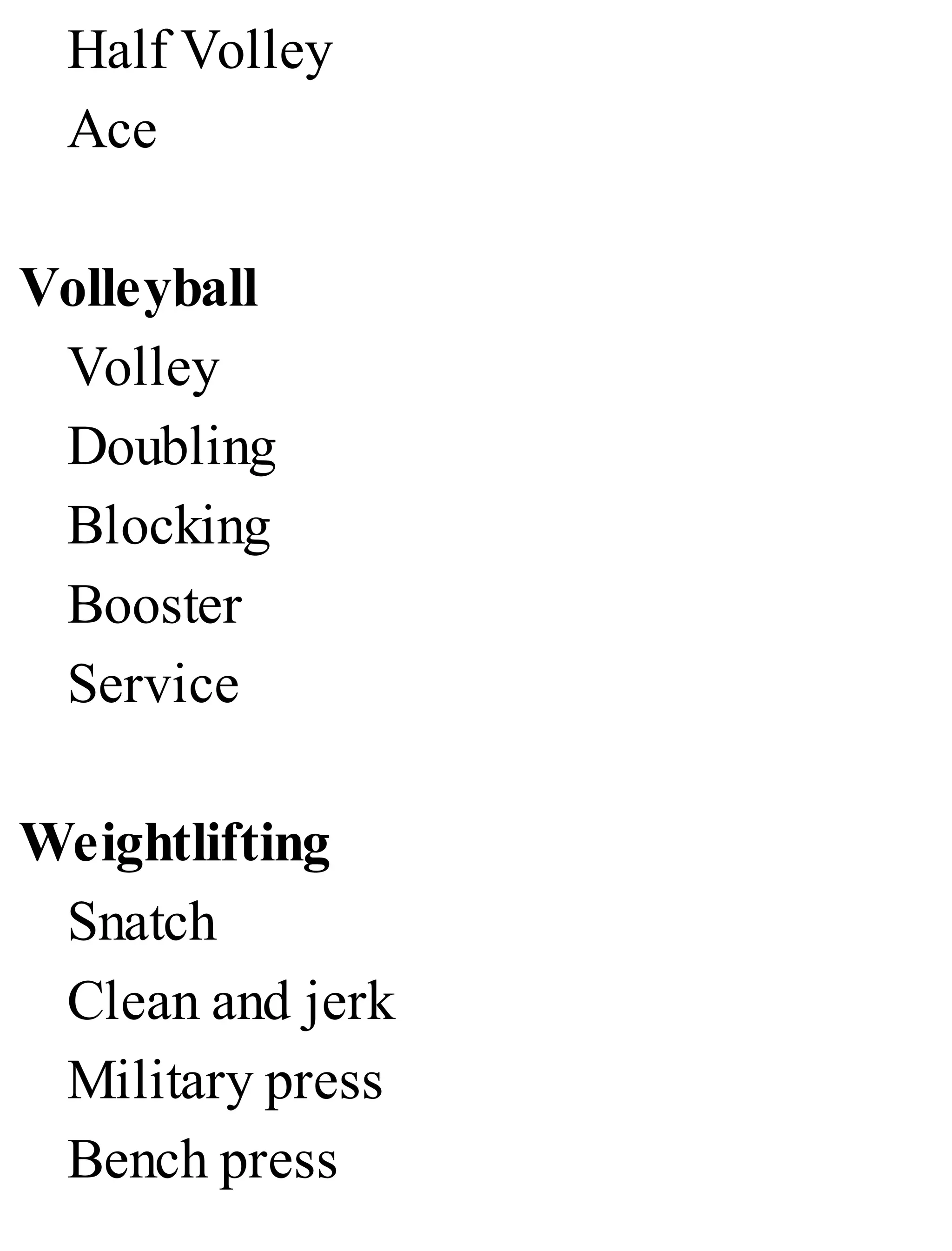
Half Volley
Ace
Volleyball
Volley
Doubling
Blocking
Booster
Service
Weightlifting
Snatch
Clean and jerk
Military press
Bench press
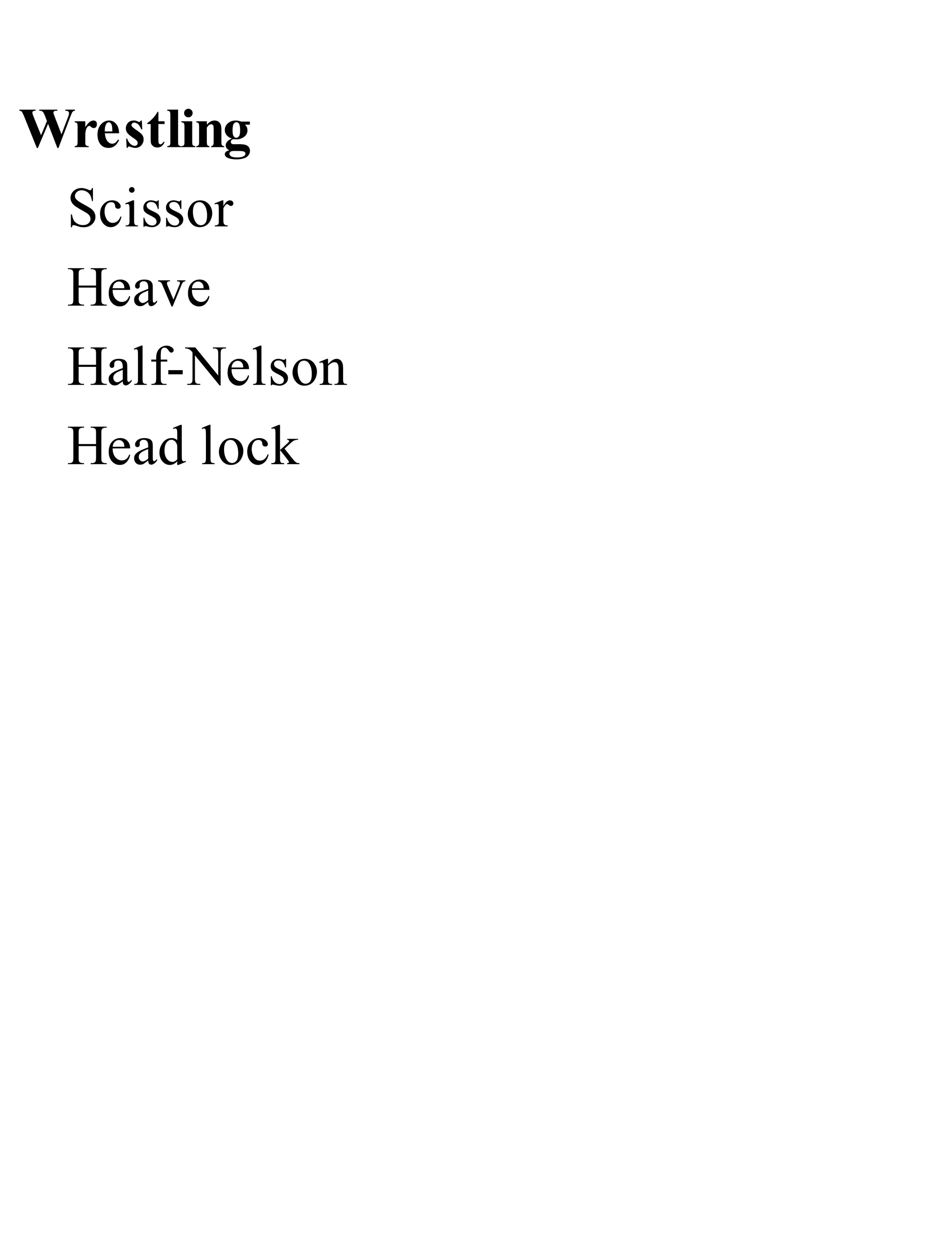
Wrestling
Scissor
Heave
Half-Nelson
Head lock
29.
Sports Measurements
Here are standard measurements of some
sports playgrounds and goods:
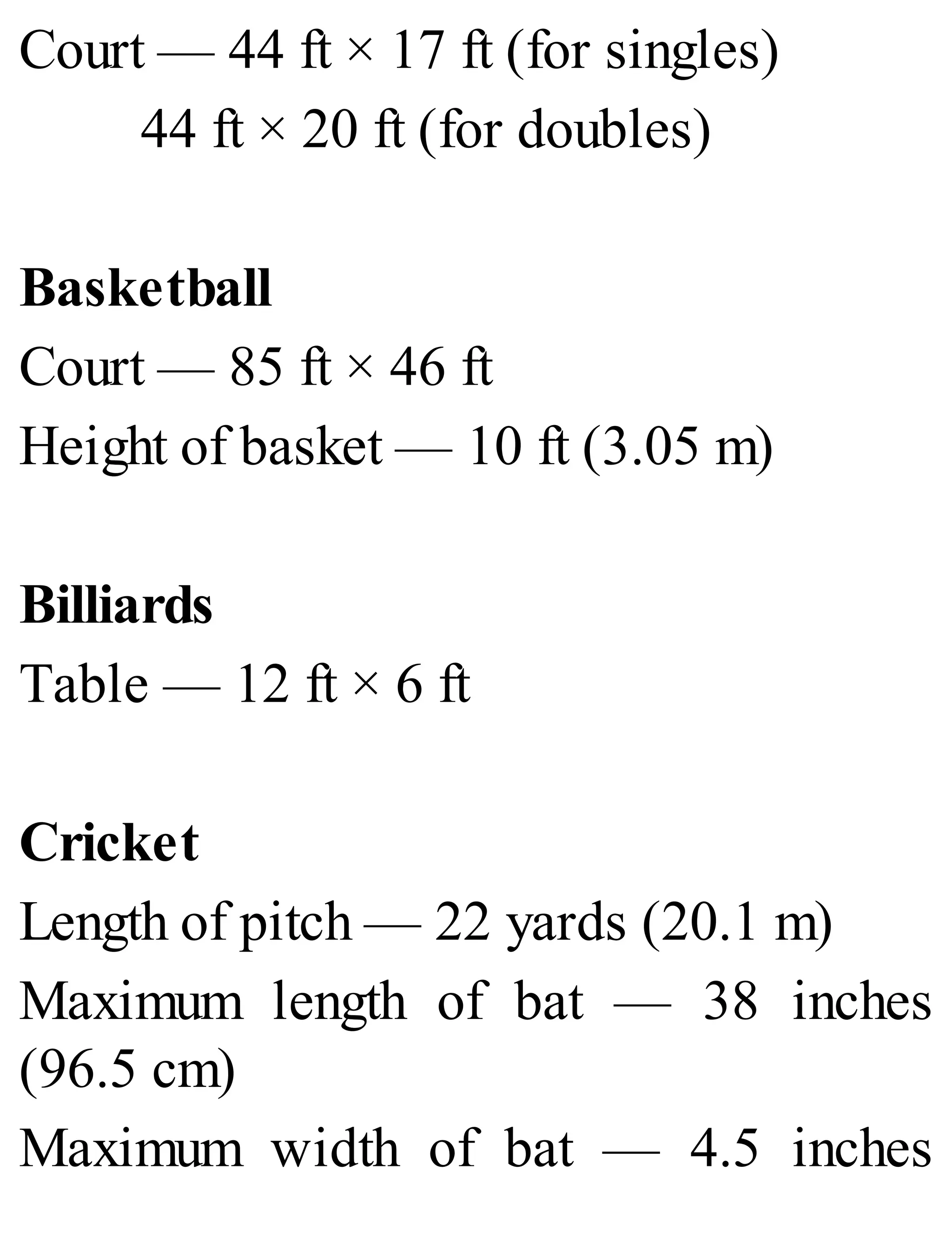
Badminton
Court — 44 ft × 17 ft (for singles)
44 ft × 20 ft (for doubles)
Basketball
Court — 85 ft × 46 ft
Height of basket — 10 ft (3.05 m)
Billiards
Table — 12 ft × 6 ft
Cricket
Length of pitch — 22 yards (20.1 m)
Maximum length of bat — 38 inches
(96.5 cm)
Maximum width of bat — 4.5 inches
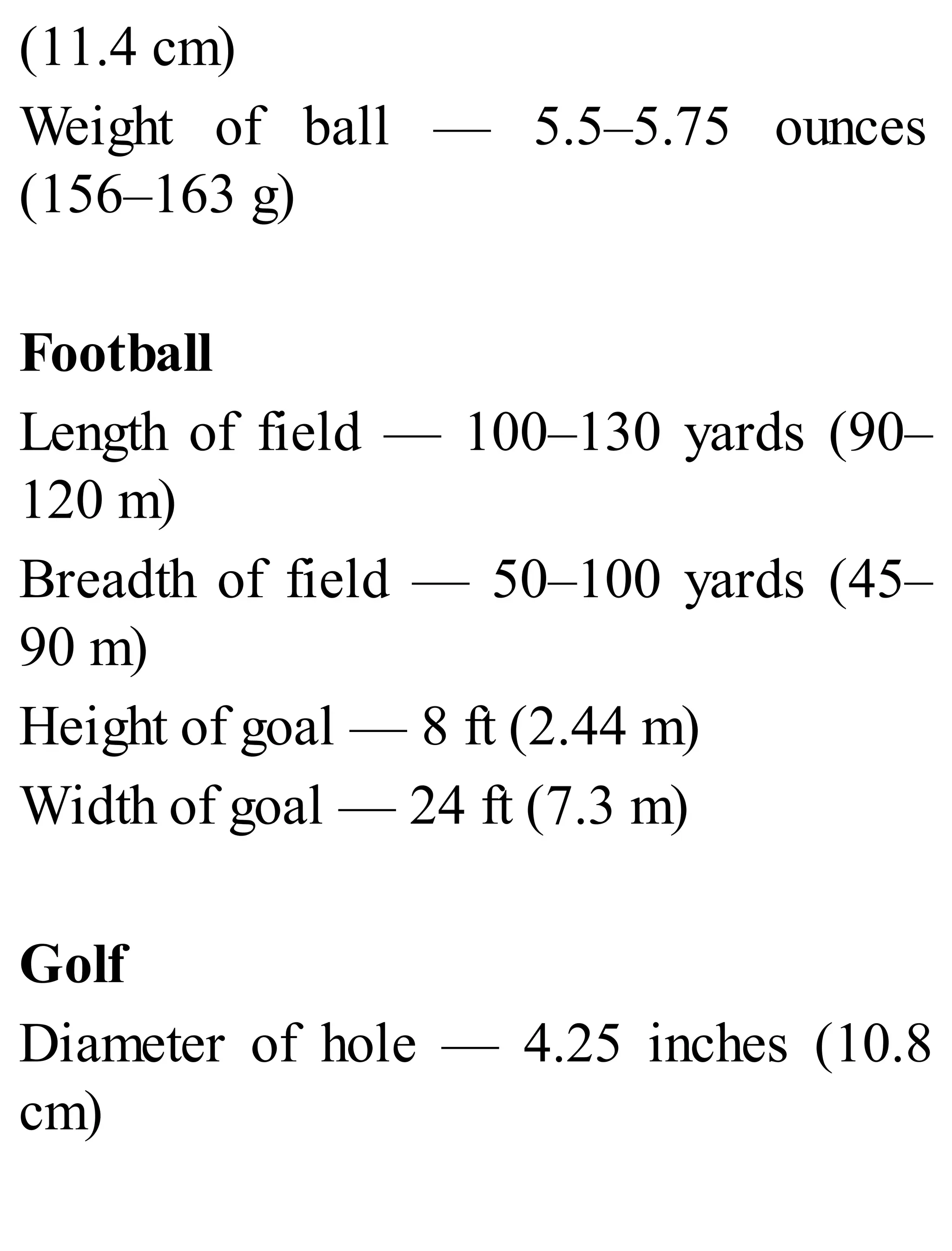
(11.4 cm)
Weight of ball — 5.5–5.75 ounces
(156–163 g)
Football
Length of field — 100–130 yards (90–
120 m)
Breadth of field — 50–100 yards (45–
90 m)
Height of goal — 8 ft (2.44 m)
Width of goal — 24 ft (7.3 m)
Golf
Diameter of hole — 4.25 inches (10.8
cm)
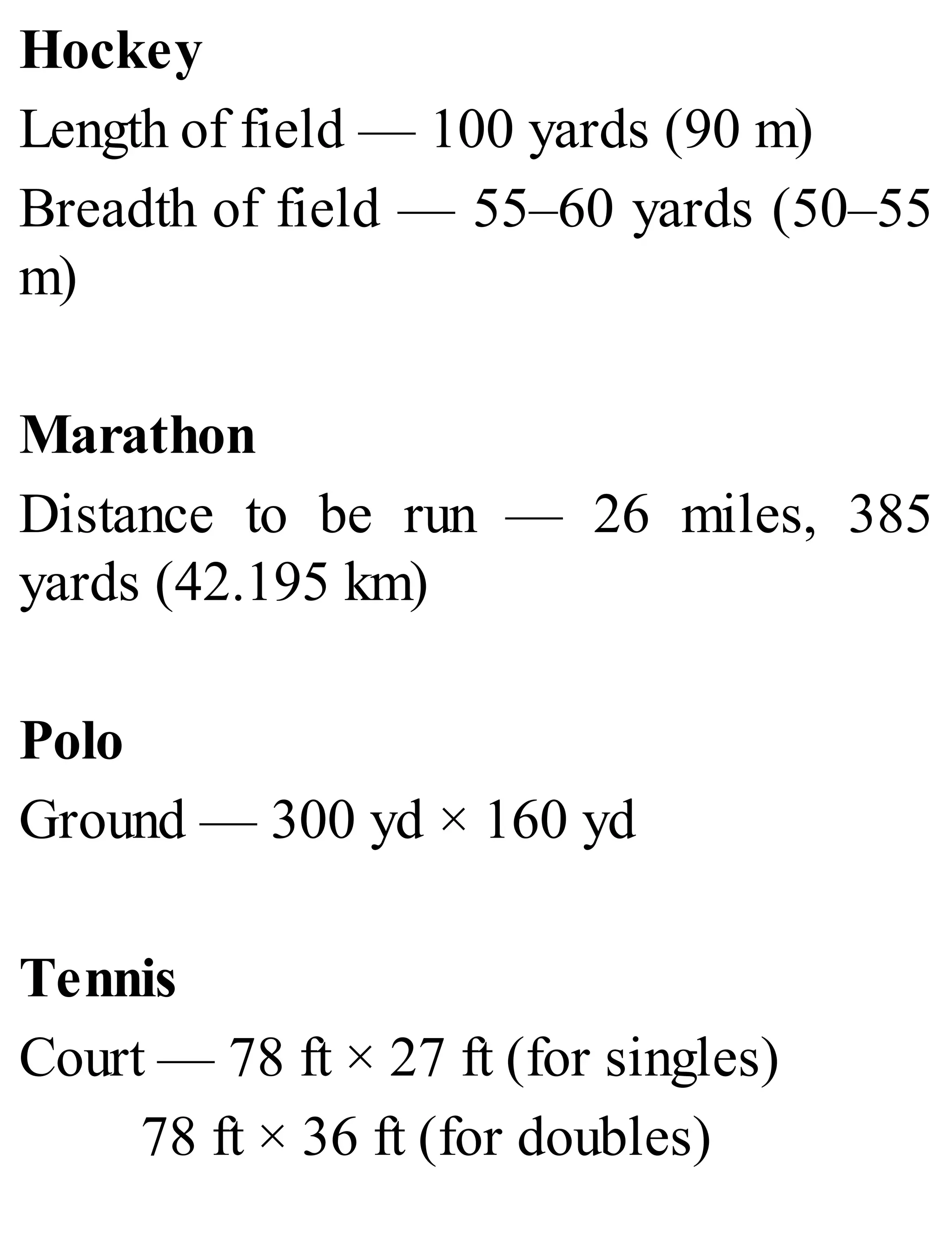
Hockey
Length of field — 100 yards (90 m)
Breadth of field — 55–60 yards (50–55
m)
Marathon
Distance to be run — 26 miles, 385
yards (42.195 km)
Polo
Ground — 300 yd × 160 yd
Tennis
Court — 78 ft × 27 ft (for singles)
78 ft × 36 ft (for doubles)
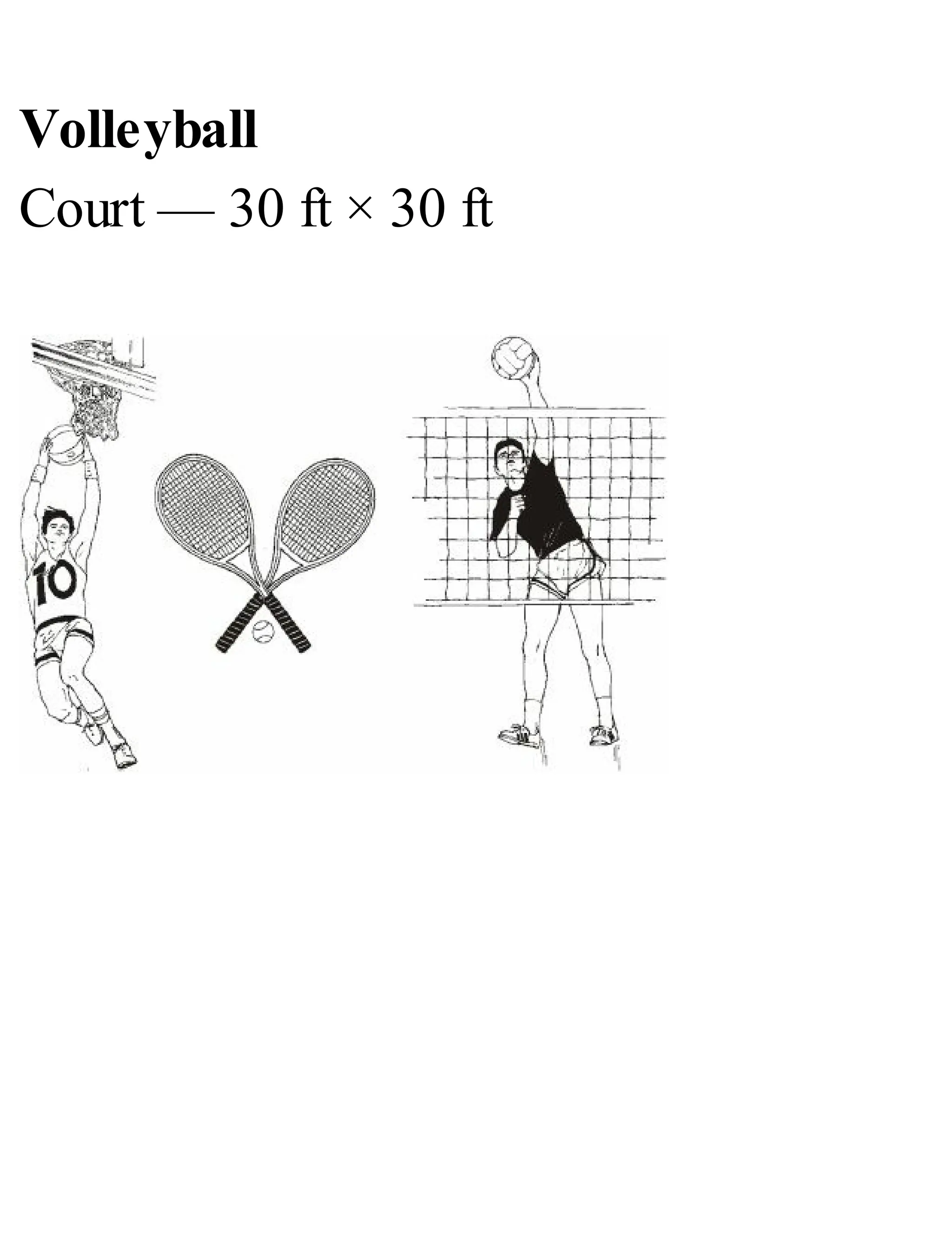
Volleyball
Court — 30 ft × 30 ft
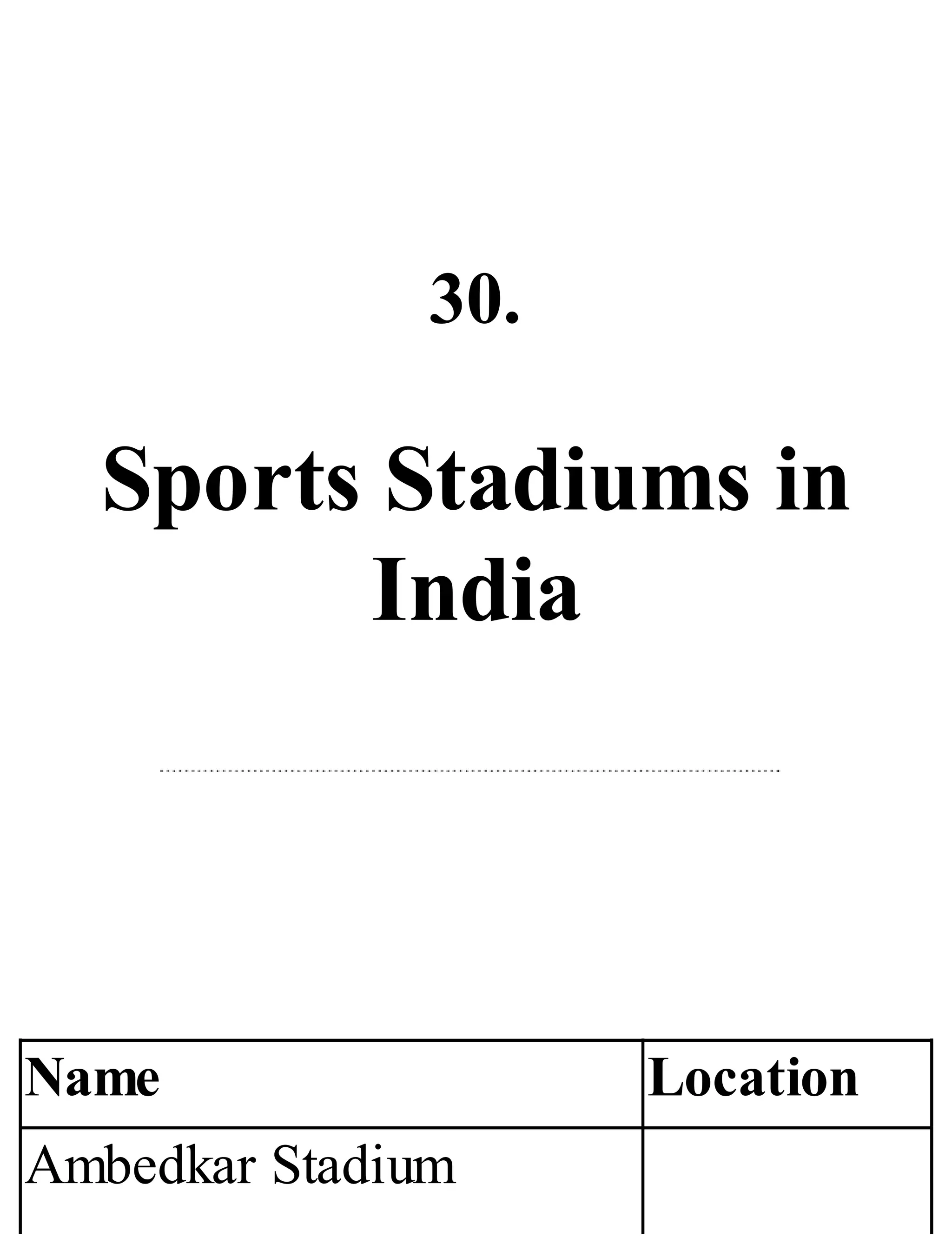
30.
Sports Stadiums in
India
Name Location
Ambedkar Stadium
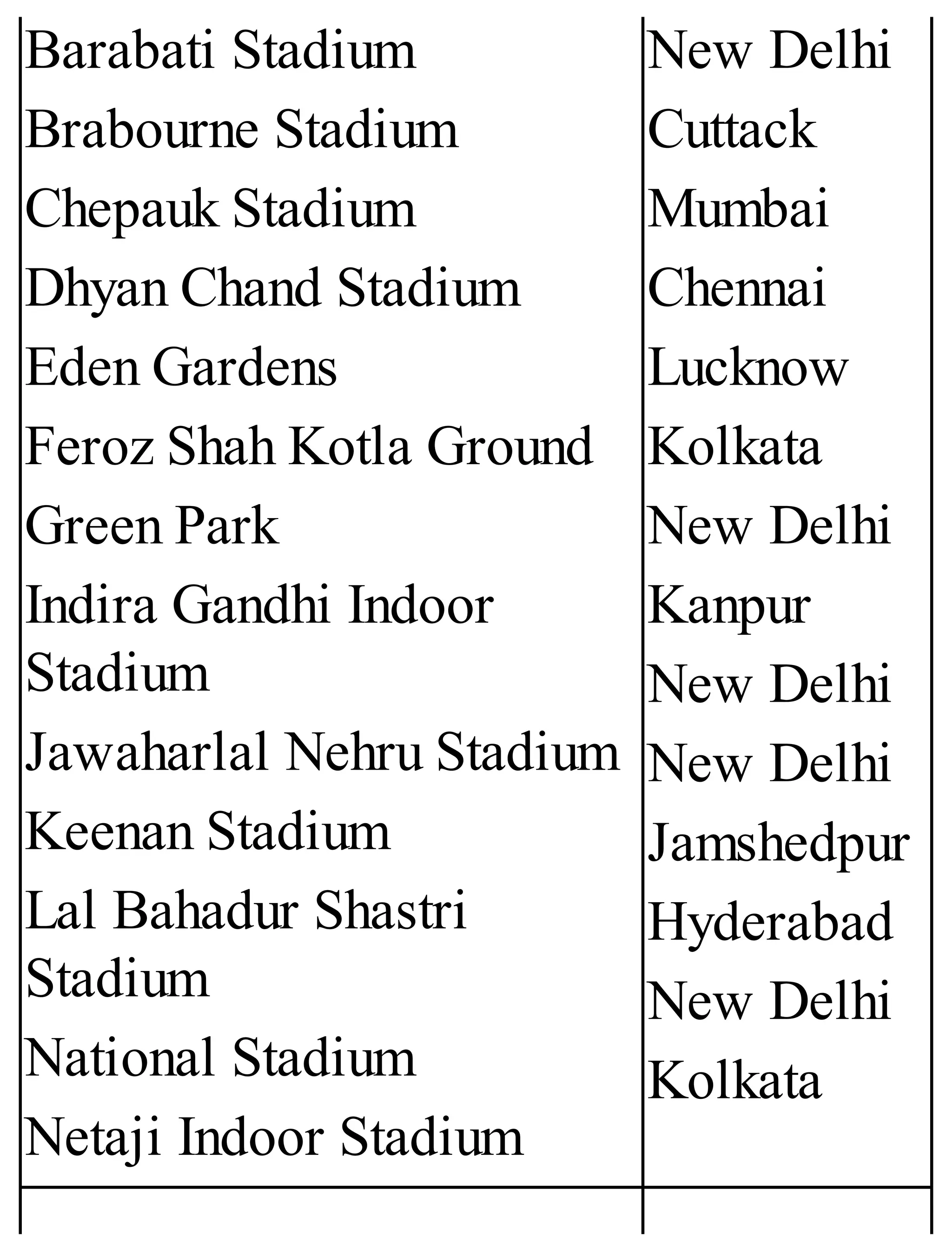
Barabati Stadium
Brabourne Stadium
Chepauk Stadium
Dhyan Chand Stadium
Eden Gardens
Feroz Shah Kotla Ground
Green Park
Indira Gandhi Indoor
Stadium
Jawaharlal Nehru Stadium
Keenan Stadium
Lal Bahadur Shastri
Stadium
National Stadium
Netaji Indoor Stadium
New Delhi
Cuttack
Mumbai
Chennai
Lucknow
Kolkata
New Delhi
Kanpur
New Delhi
New Delhi
Jamshedpur
Hyderabad
New Delhi
Kolkata
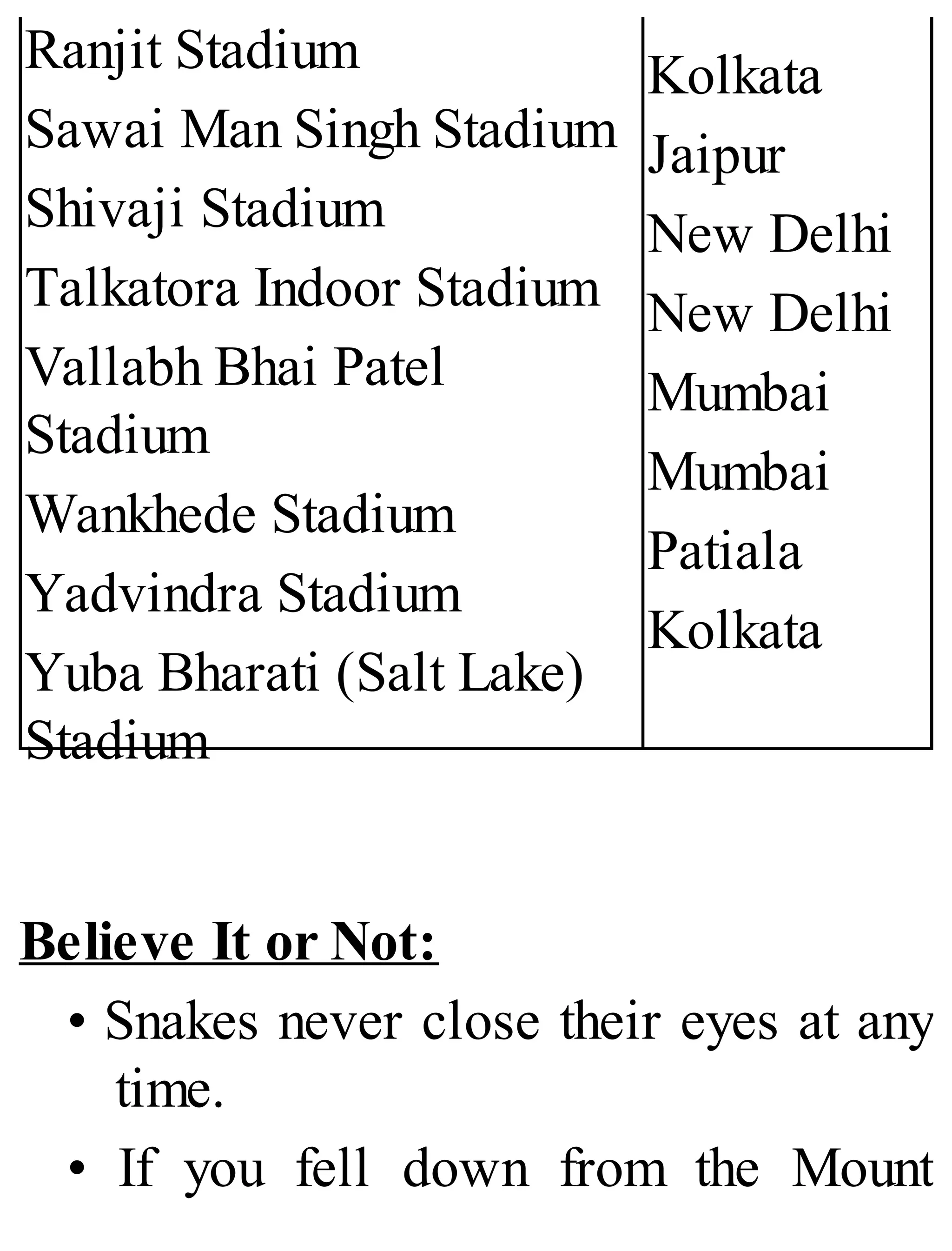
Ranjit Stadium
Sawai Man Singh Stadium
Shivaji Stadium
Talkatora Indoor Stadium
Vallabh Bhai Patel
Stadium
Wankhede Stadium
Yadvindra Stadium
Yuba Bharati (Salt Lake)
Stadium
Kolkata
Jaipur
New Delhi
New Delhi
Mumbai
Mumbai
Patiala
Kolkata
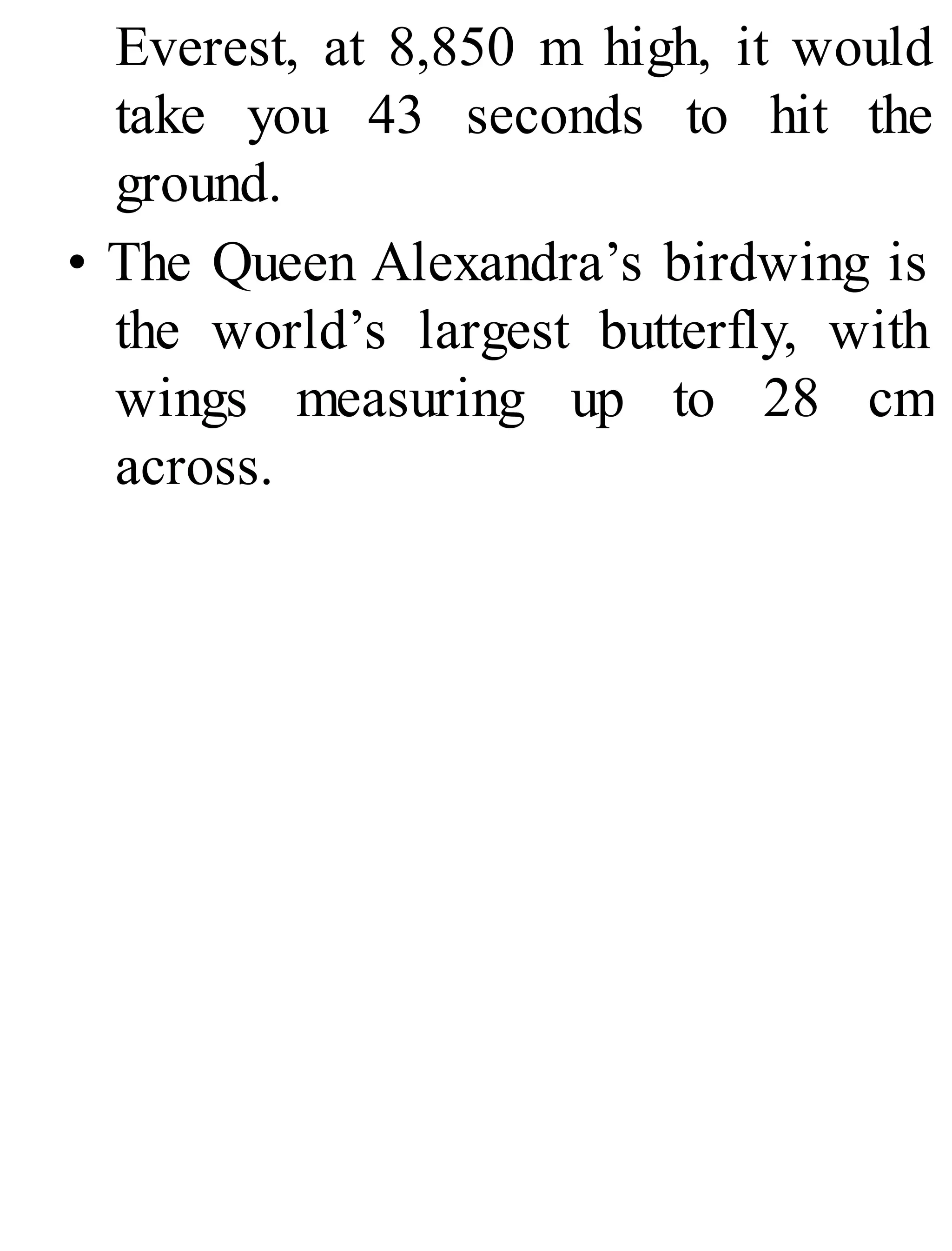
Believe It or Not:
• Snakes never close their eyes at any
time.
• If you fell down from the Mount
Everest, at 8,850 m high, it would
take you 43 seconds to hit the
ground.
• The Queen Alexandra’s birdwing is
the world’s largest butterfly, with
wings measuring up to 28 cm
across.
31.
Places Associated with
Sports
National
Associated
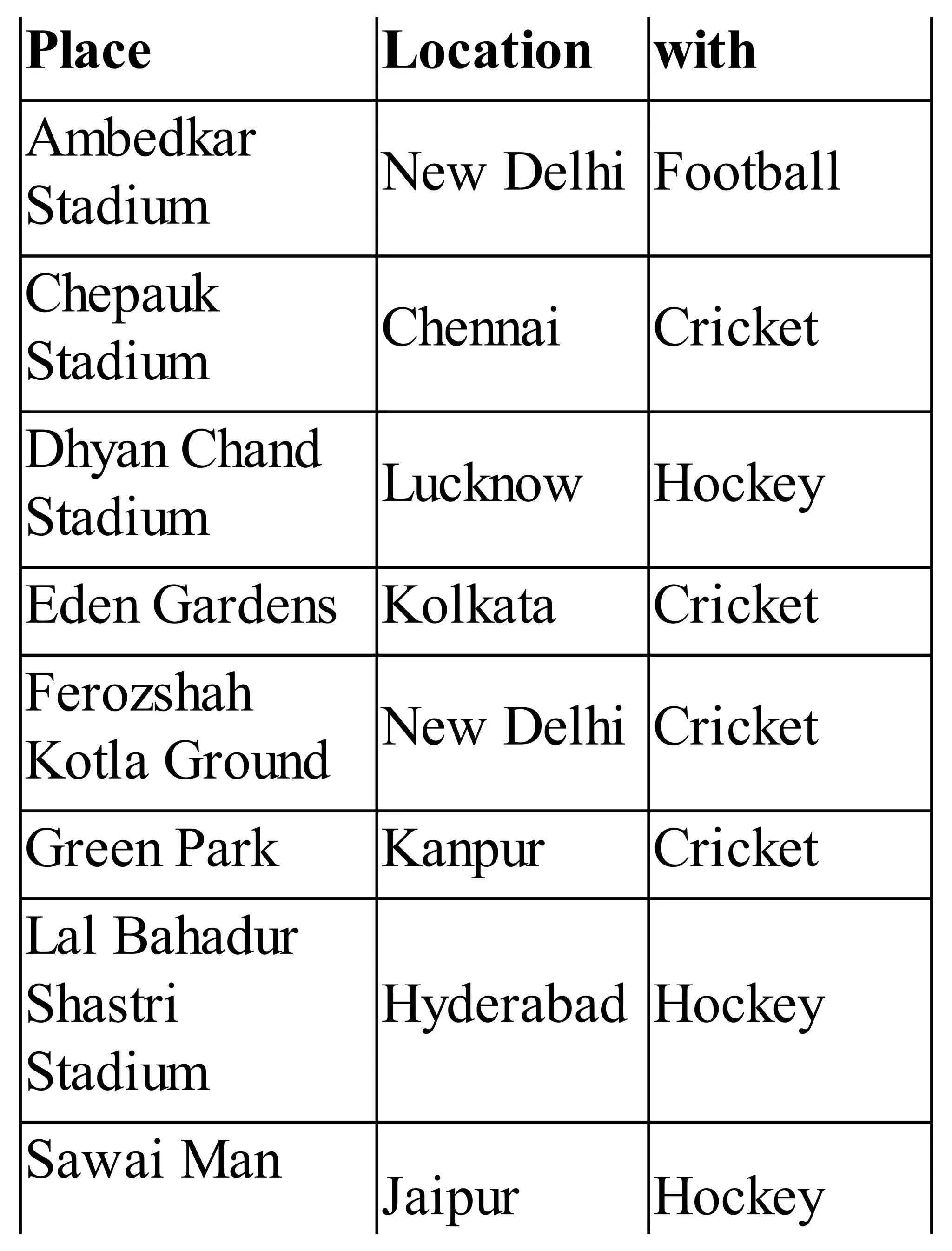
Place Location with
Ambedkar
Stadium
New Delhi Football
Chepauk
Stadium
Chennai Cricket
Dhyan Chand
Stadium
Lucknow Hockey
Eden Gardens Kolkata Cricket
Ferozshah
Kotla Ground
New Delhi Cricket
Green Park Kanpur Cricket
Lal Bahadur
Shastri
Stadium
Hyderabad Hockey
Sawai Man
Jaipur Hockey
Singh Stadium
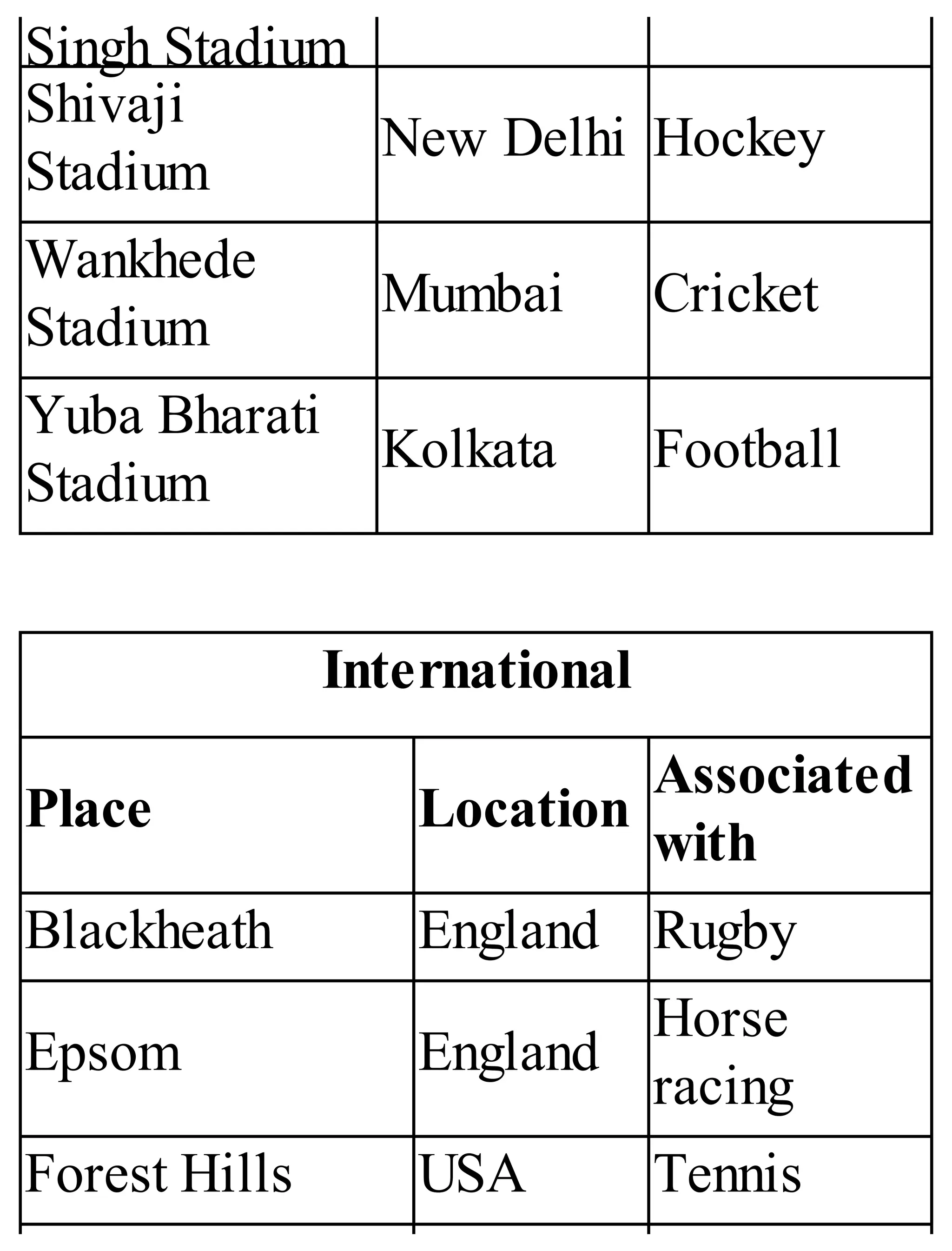
Shivaji
Stadium
New Delhi Hockey
Wankhede
Stadium
Mumbai Cricket
Yuba Bharati
Stadium
Kolkata Football
International
Place Location
Associated
with
Blackheath England Rugby
Epsom England
Horse
racing
Forest Hills USA Tennis
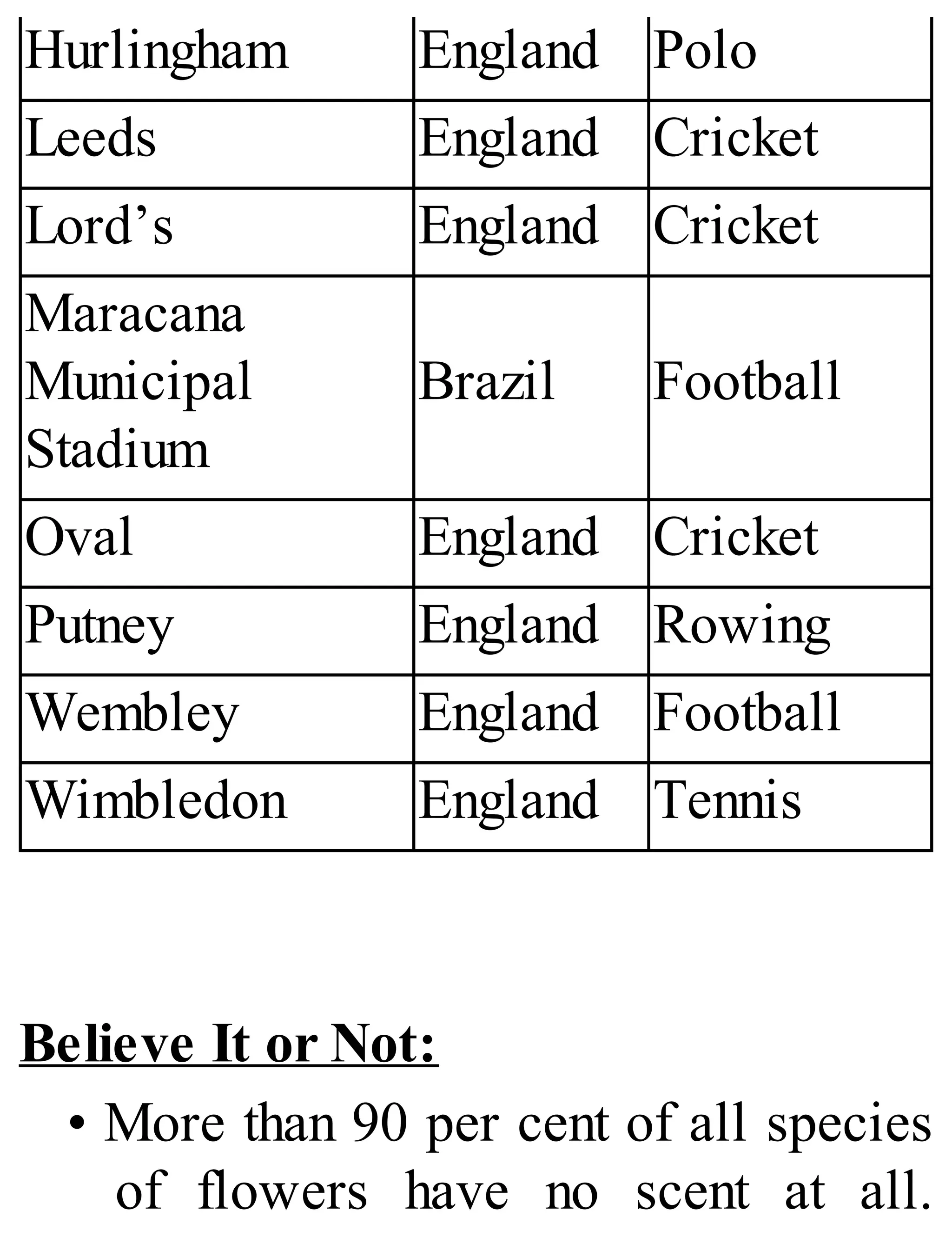
Hurlingham England Polo
Leeds England Cricket
Lord’s England Cricket
Maracana
Municipal
Stadium
Brazil Football
Oval England Cricket
Putney England Rowing
Wembley England Football
Wimbledon England Tennis
Believe It or Not:
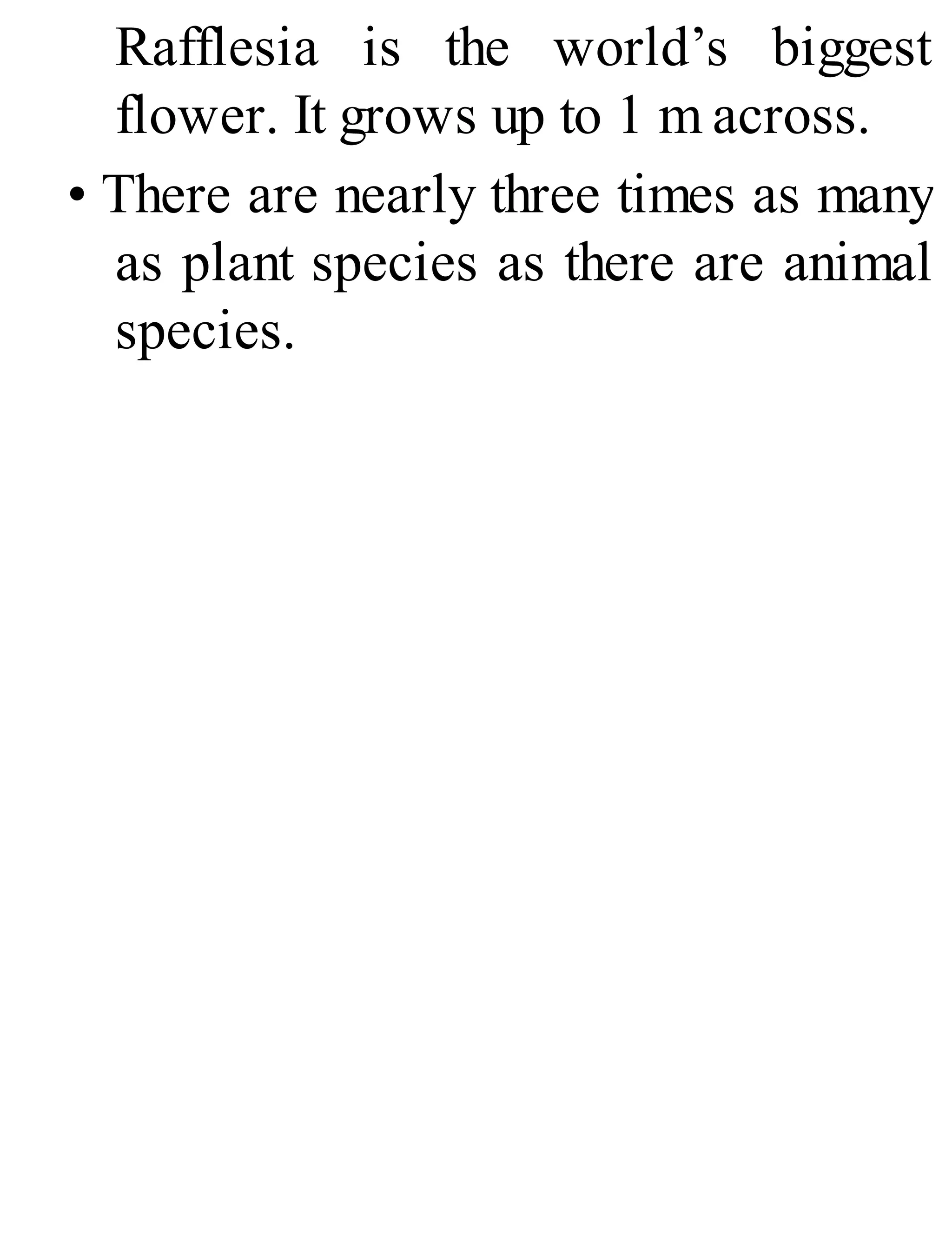
• More than 90 per cent of all species
of flowers have no scent at all.
Rafflesia is the world’s biggest
flower. It grows up to 1 m across.
• There are nearly three times as many
as plant species as there are animal
species.
32.
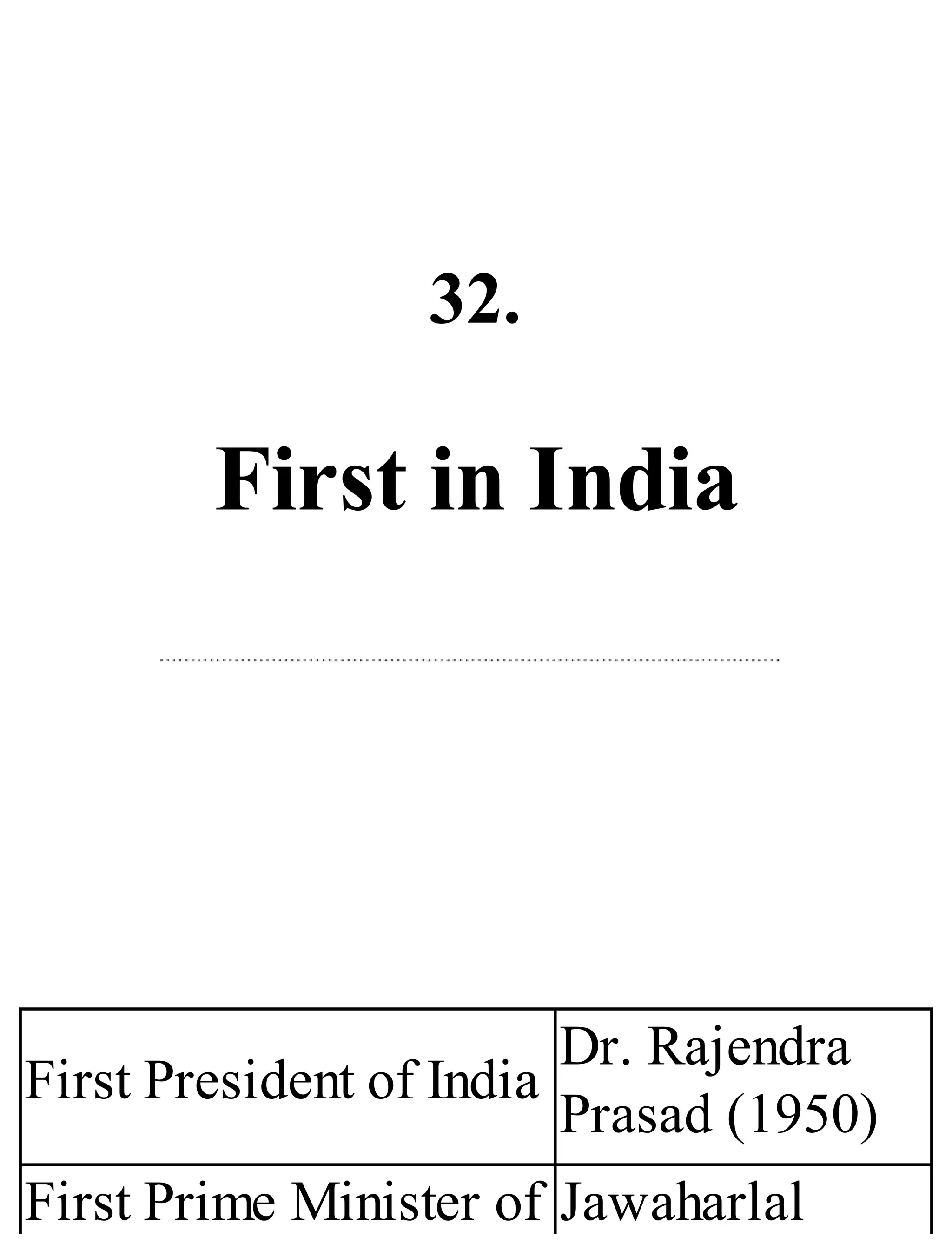
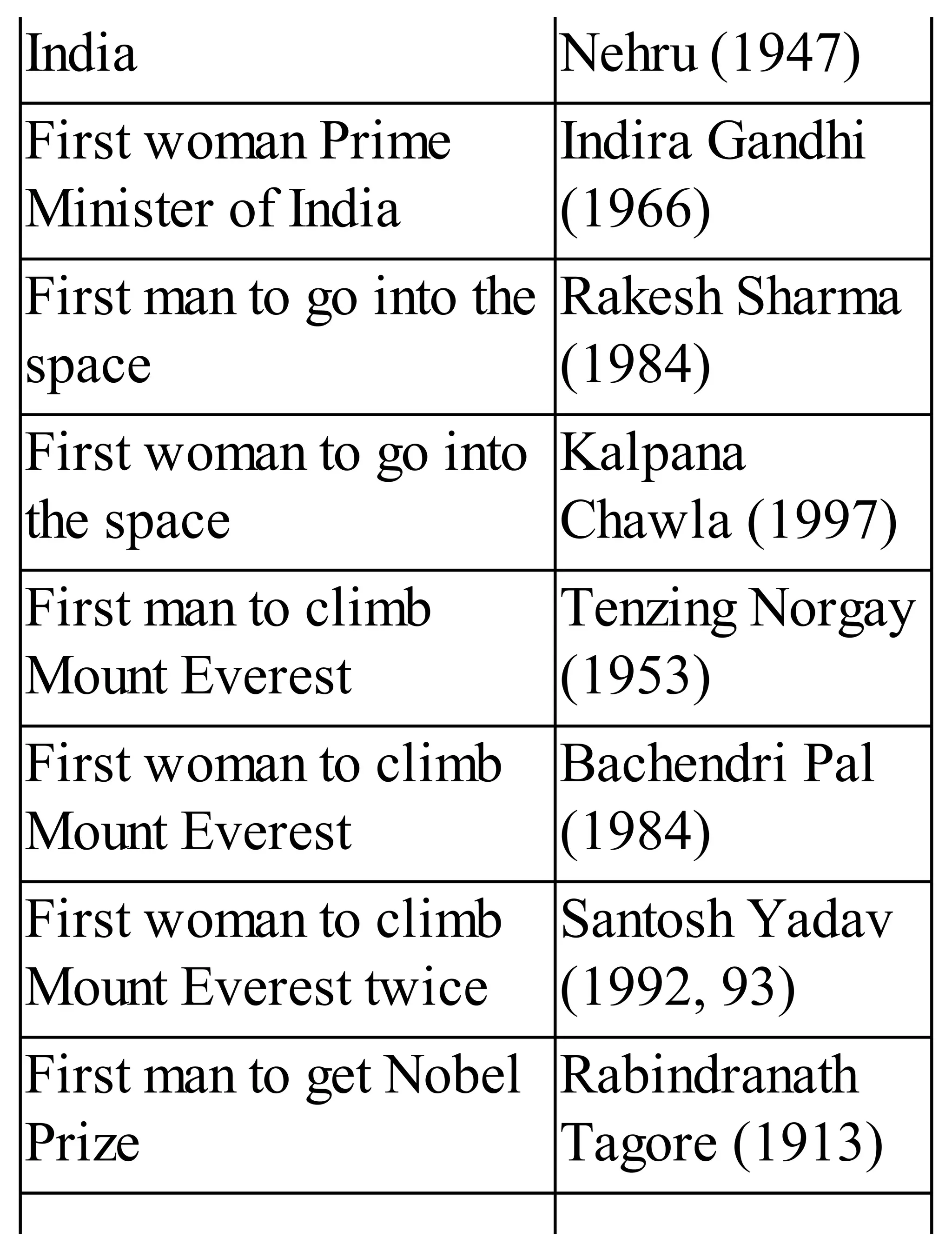
First in India
First President of India
Dr. Rajendra
Prasad (1950)
First Prime Minister of Jawaharlal
India Nehru (1947)
First woman Prime
Minister of India
Indira Gandhi
(1966)
First man to go into the
space
Rakesh Sharma
(1984)
First woman to go into
the space
Kalpana
Chawla (1997)
First man to climb
Mount Everest
Tenzing Norgay
(1953)
First woman to climb
Mount Everest
Bachendri Pal
(1984)
First woman to climb
Mount Everest twice
Santosh Yadav
(1992, 93)
First man to get Nobel
Prize
Rabindranath
Tagore (1913)
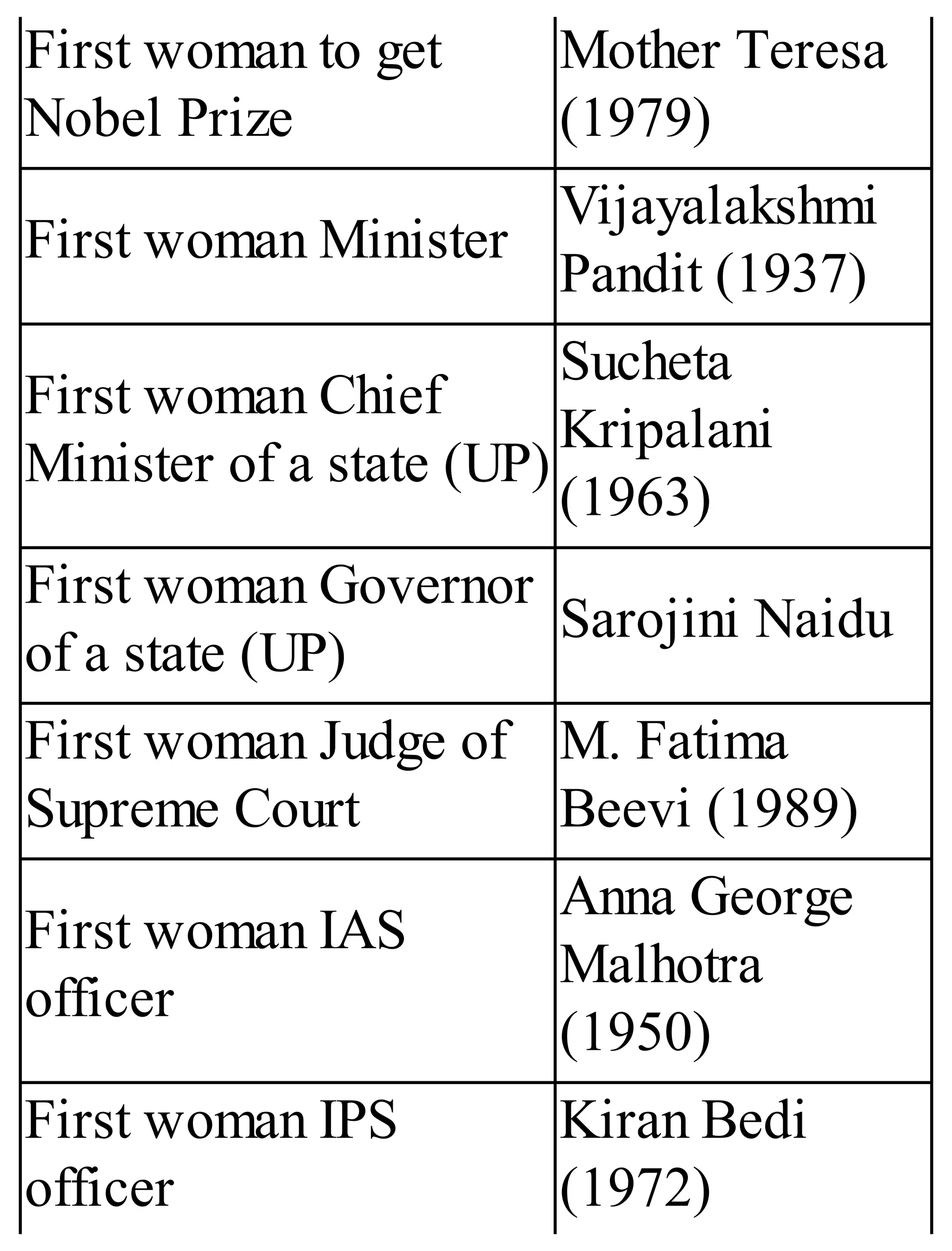
First woman to get
Nobel Prize
Mother Teresa
(1979)
First woman Minister
Vijayalakshmi
Pandit (1937)
First woman Chief
Minister of a state (UP)
Sucheta
Kripalani
(1963)
First woman Governor
of a state (UP)
Sarojini Naidu
First woman Judge of
Supreme Court
M. Fatima
Beevi (1989)
First woman IAS
officer
Anna George
Malhotra
(1950)
First woman IPS
officer
Kiran Bedi
(1972)
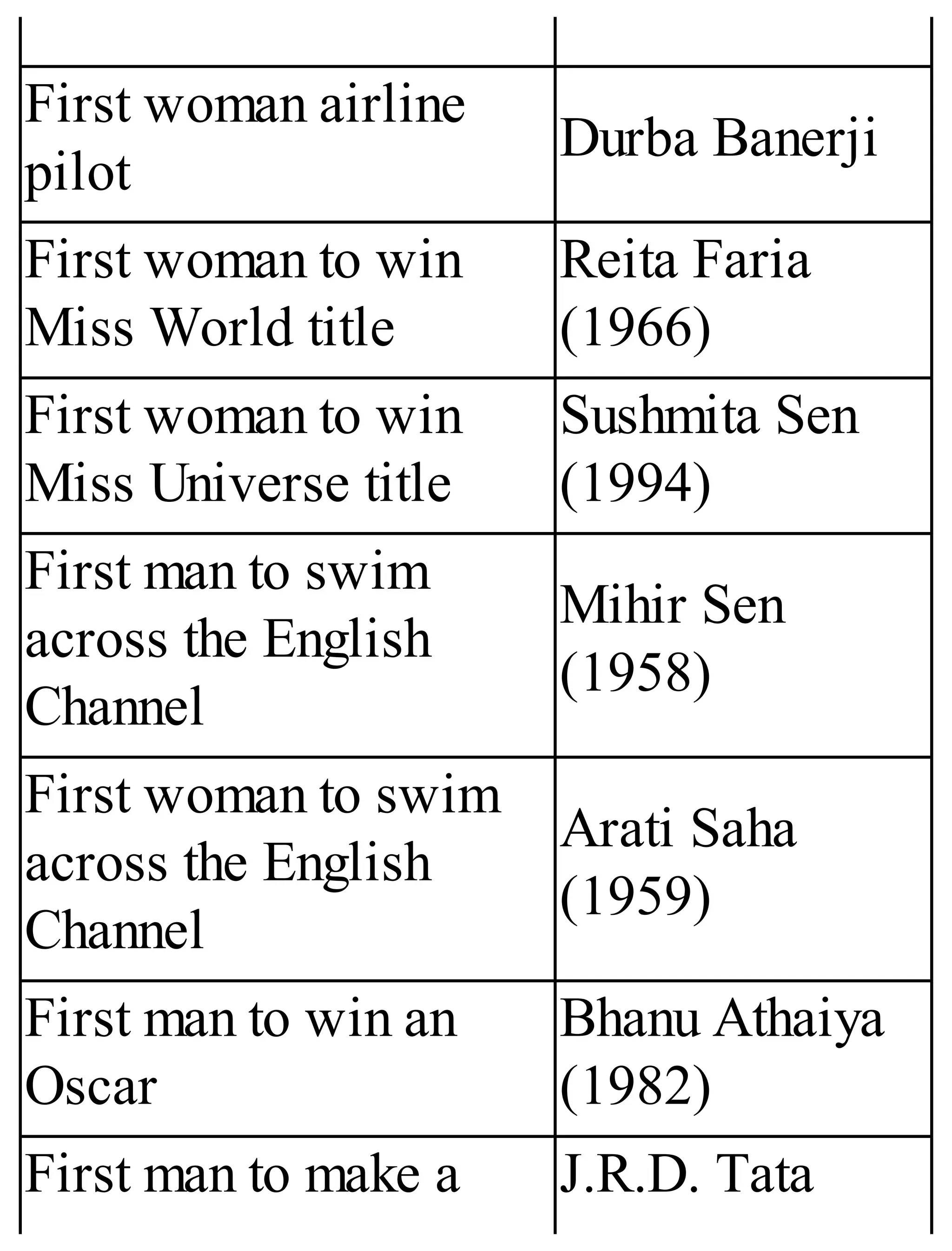
First woman airline
pilot
Durba Banerji
First woman to win
Miss World title
Reita Faria
(1966)
First woman to win
Miss Universe title
Sushmita Sen
(1994)
First man to swim
across the English
Channel
Mihir Sen
(1958)
First woman to swim
across the English
Channel
Arati Saha
(1959)
First man to win an
Oscar
Bhanu Athaiya
(1982)
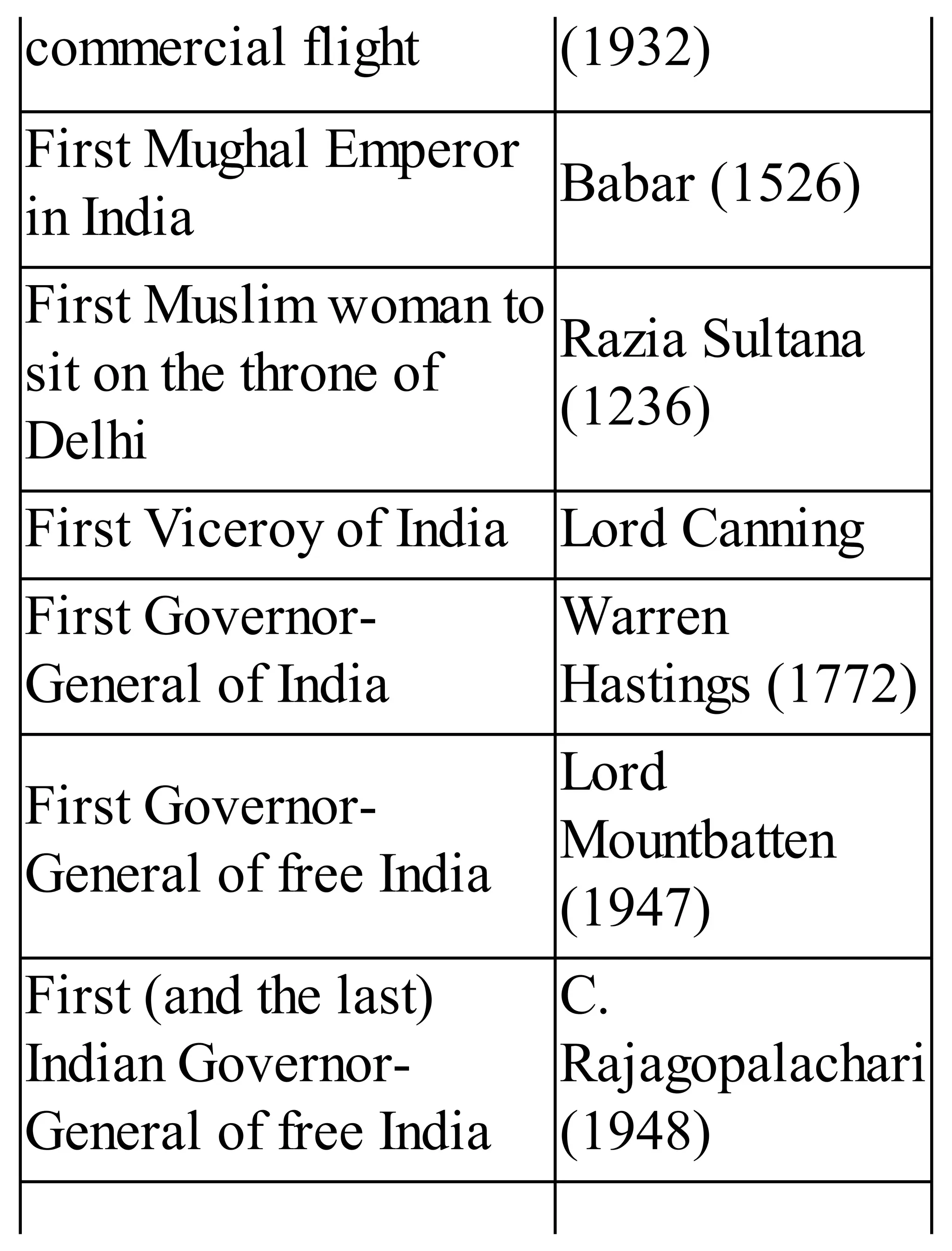
First man to make a J.R.D. Tata
commercial flight (1932)
First Mughal Emperor
in India
Babar (1526)
First Muslim woman to
sit on the throne of
Delhi
Razia Sultana
(1236)
First Viceroy of India Lord Canning
First Governor-
General of India
Warren
Hastings (1772)
First Governor-
General of free India
Lord
Mountbatten
(1947)
First (and the last)
Indian Governor-
General of free India
C.
Rajagopalachari
(1948)
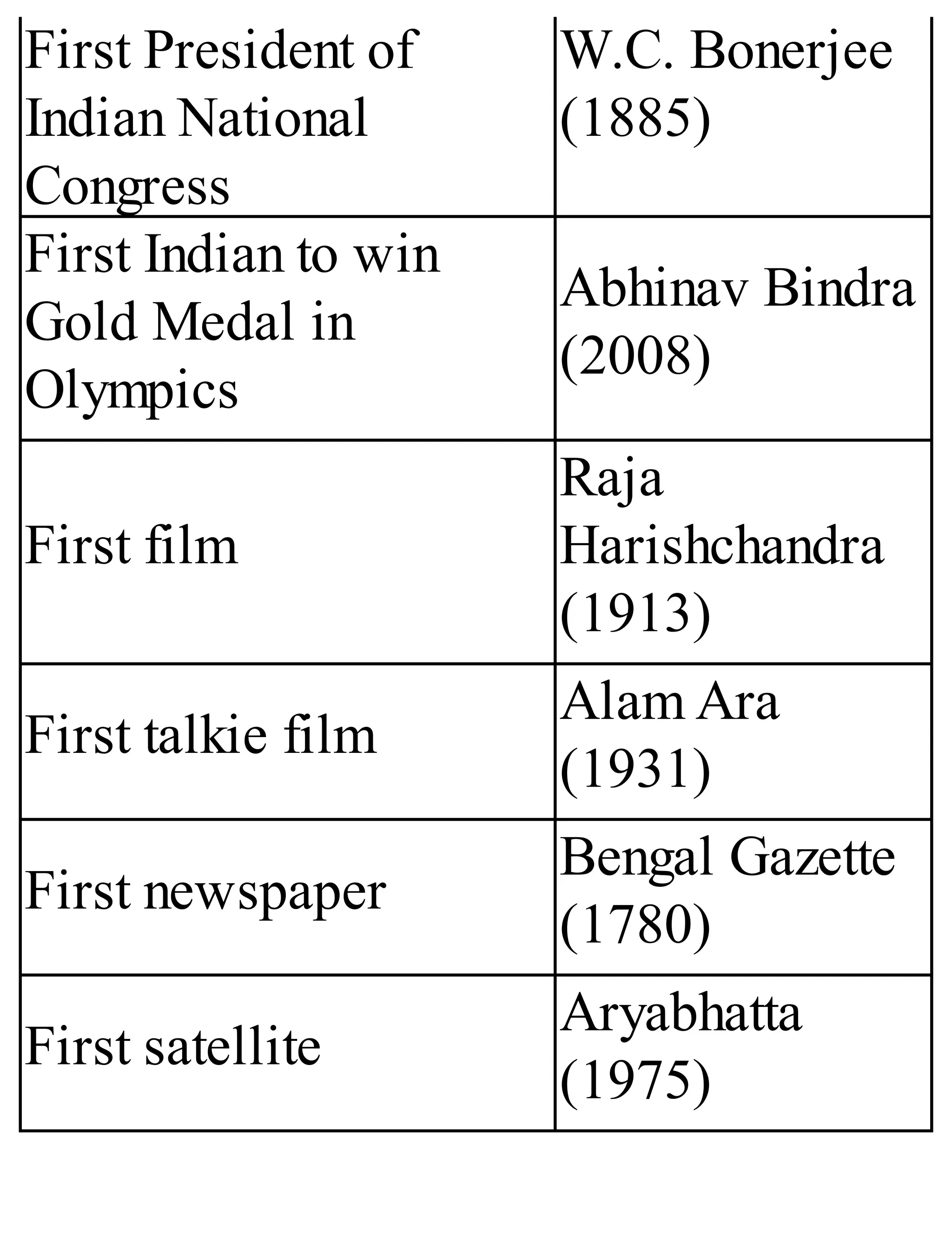
First President of
Indian National
Congress
W.C. Bonerjee
(1885)
First Indian to win
Gold Medal in
Olympics
Abhinav Bindra
(2008)
First film
Raja
Harishchandra
(1913)
First talkie film
Alam Ara
(1931)
First newspaper
Bengal Gazette
(1780)
First satellite
Aryabhatta
(1975)
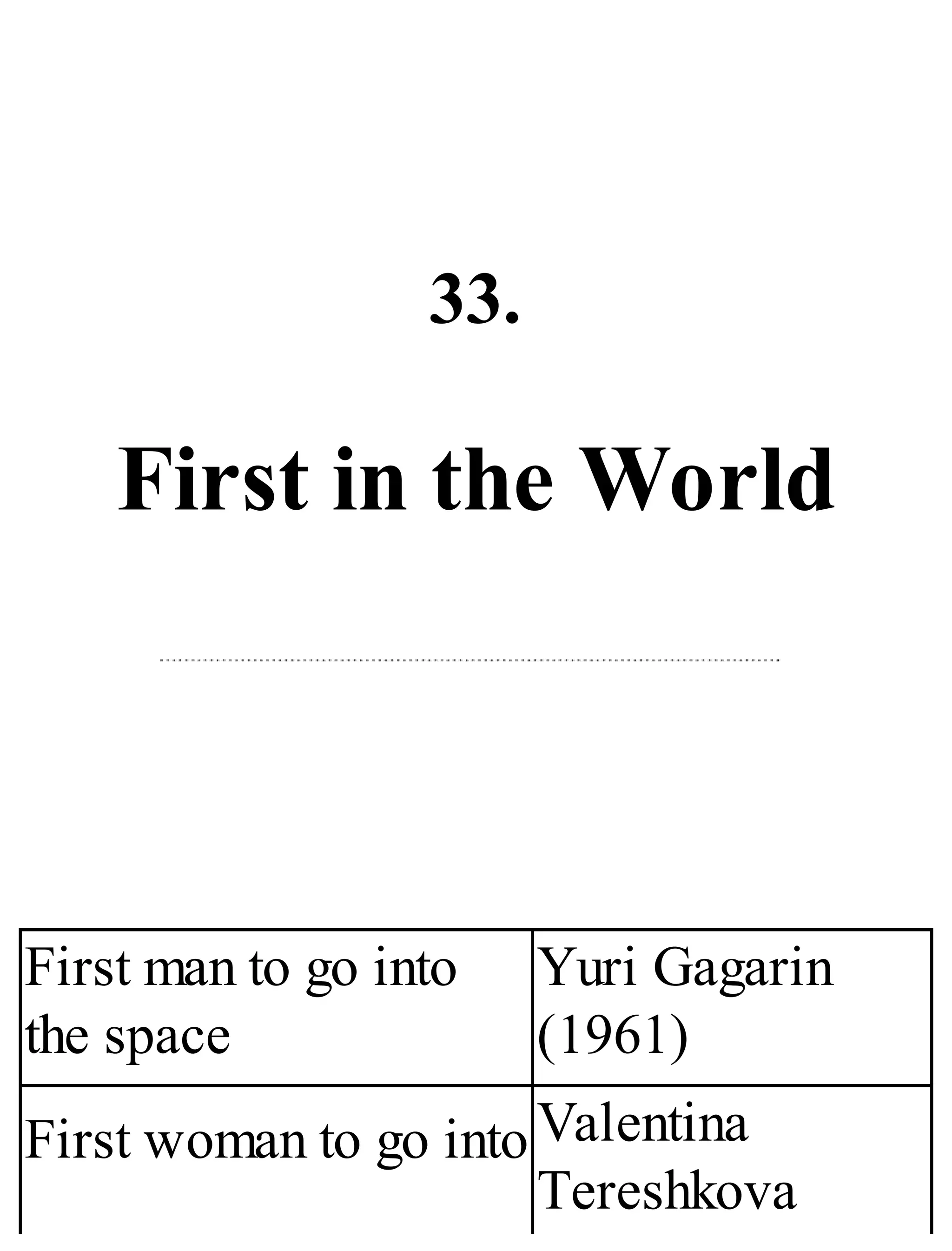
33.
First in the World
First man to go into
the space
Yuri Gagarin
(1961)
First woman to go into Valentina
Tereshkova
the space (1963)
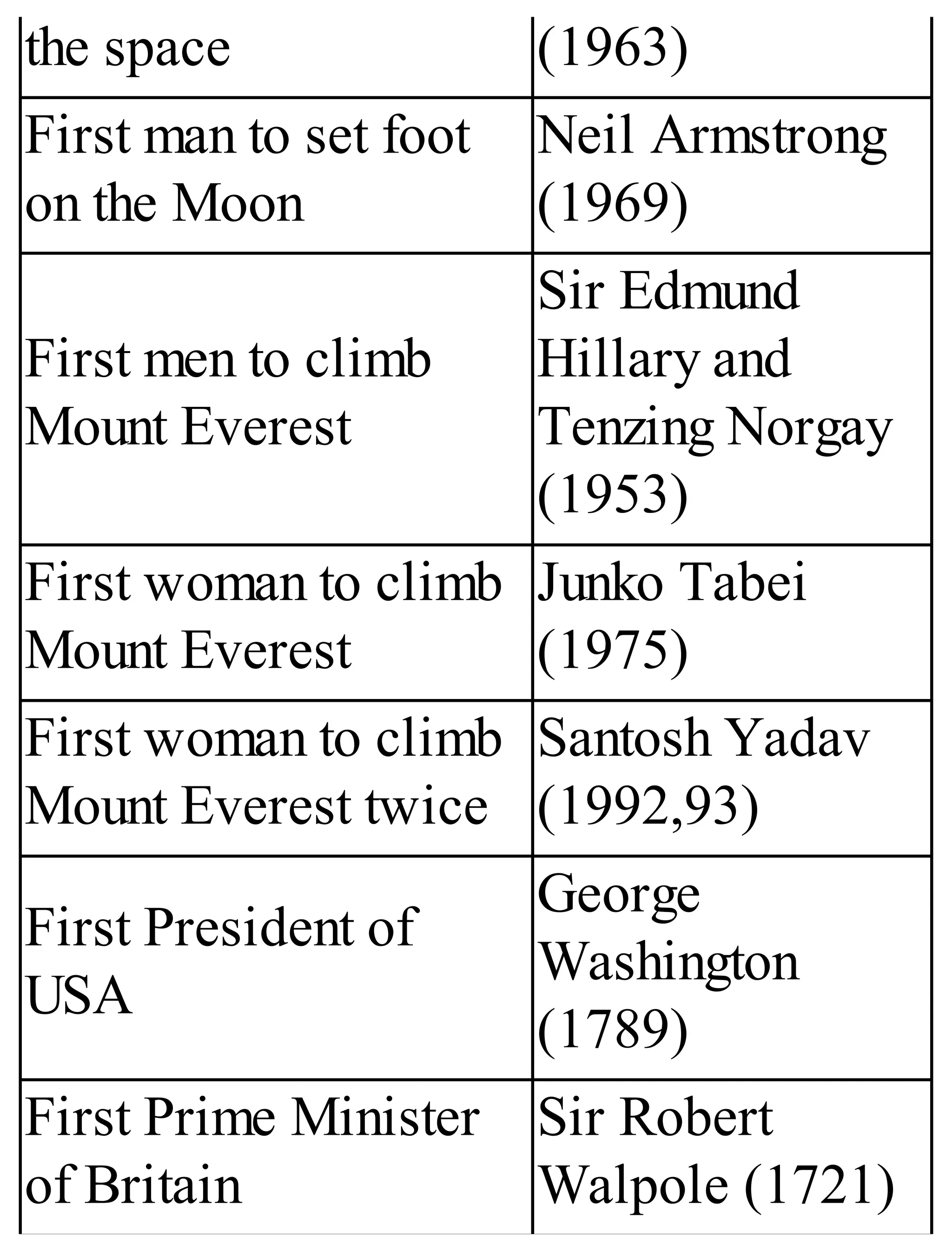
First man to set foot
on the Moon
Neil Armstrong
(1969)
First men to climb
Mount Everest
Sir Edmund
Hillary and
Tenzing Norgay
(1953)
First woman to climb
Mount Everest
Junko Tabei
(1975)
First woman to climb
Mount Everest twice
Santosh Yadav
(1992,93)
First President of
USA
George
Washington
(1789)
First Prime Minister
of Britain
Sir Robert
Walpole (1721)
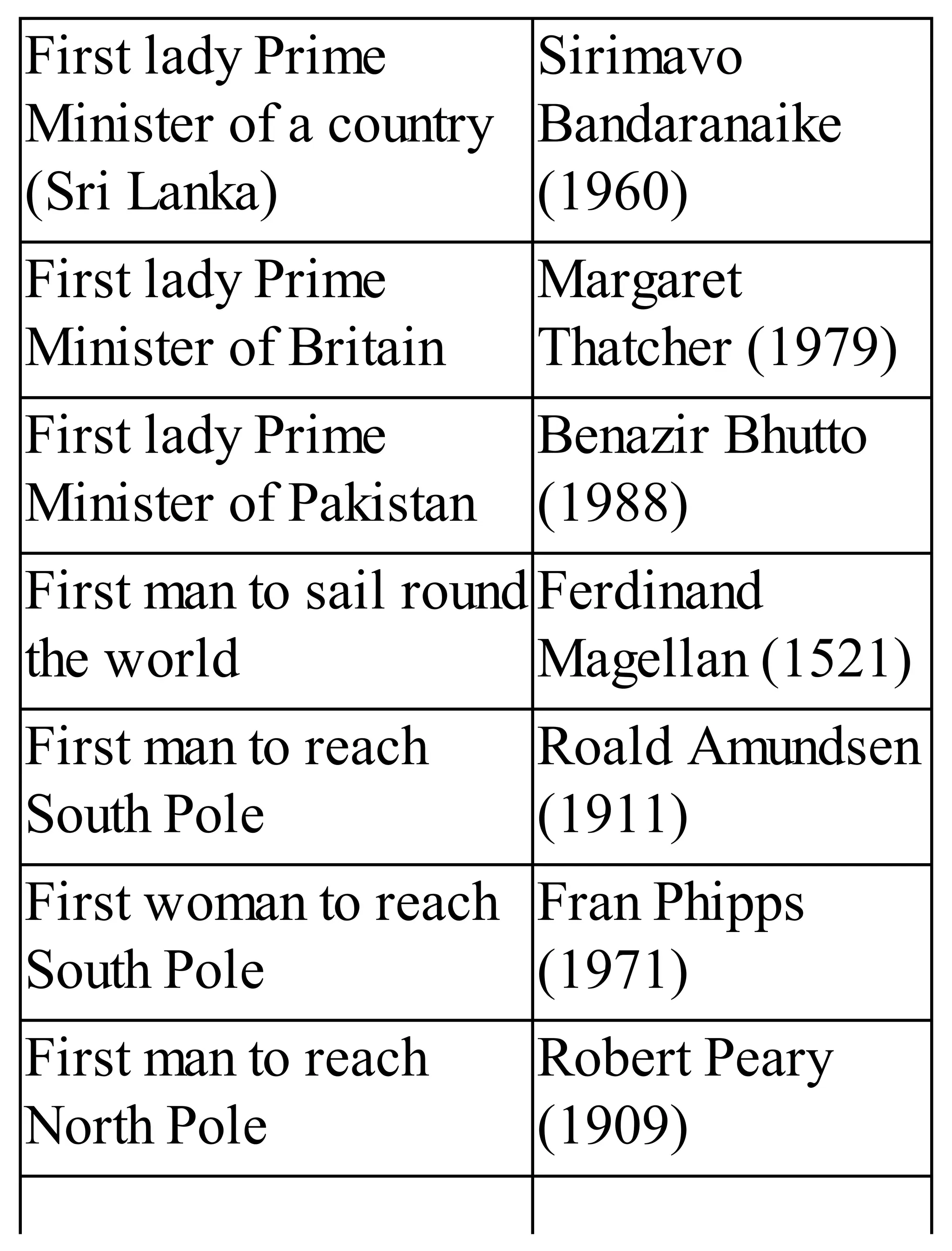
First lady Prime
Minister of a country
(Sri Lanka)
Sirimavo
Bandaranaike
(1960)
First lady Prime
Minister of Britain
Margaret
Thatcher (1979)
First lady Prime
Minister of Pakistan
Benazir Bhutto
(1988)
First man to sail round
the world
Ferdinand
Magellan (1521)
First man to reach
South Pole
Roald Amundsen
(1911)
First woman to reach
South Pole
Fran Phipps
(1971)
First man to reach
North Pole
Robert Peary
(1909)
First woman to reach
North Pole
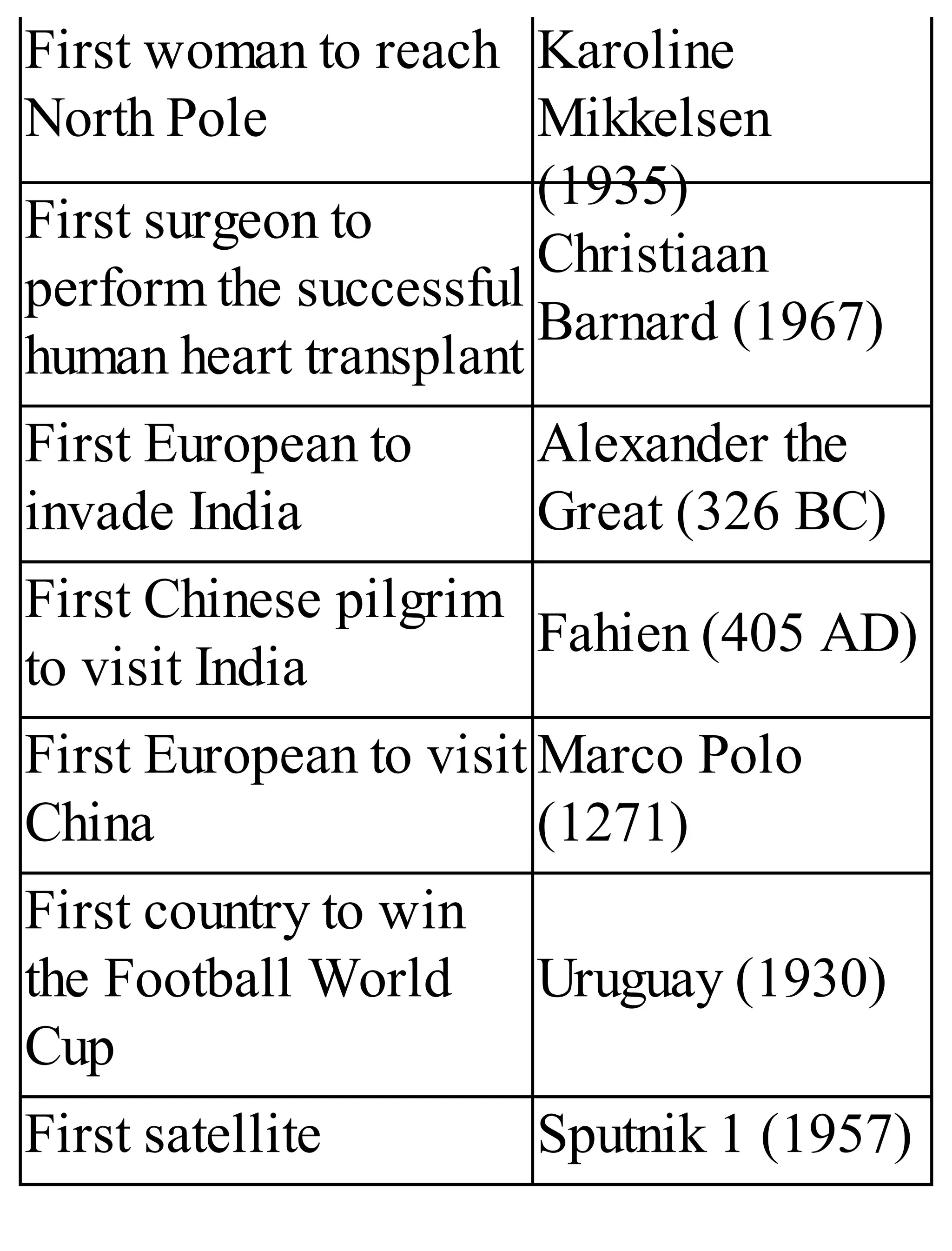
Karoline
Mikkelsen
(1935)
First surgeon to
perform the successful
human heart transplant
Christiaan
Barnard (1967)
First European to
invade India
Alexander the
Great (326 BC)
First Chinese pilgrim
to visit India
Fahien (405 AD)
First European to visit
China
Marco Polo
(1271)
First country to win
the Football World
Cup
Uruguay (1930)
First satellite Sputnik 1 (1957)
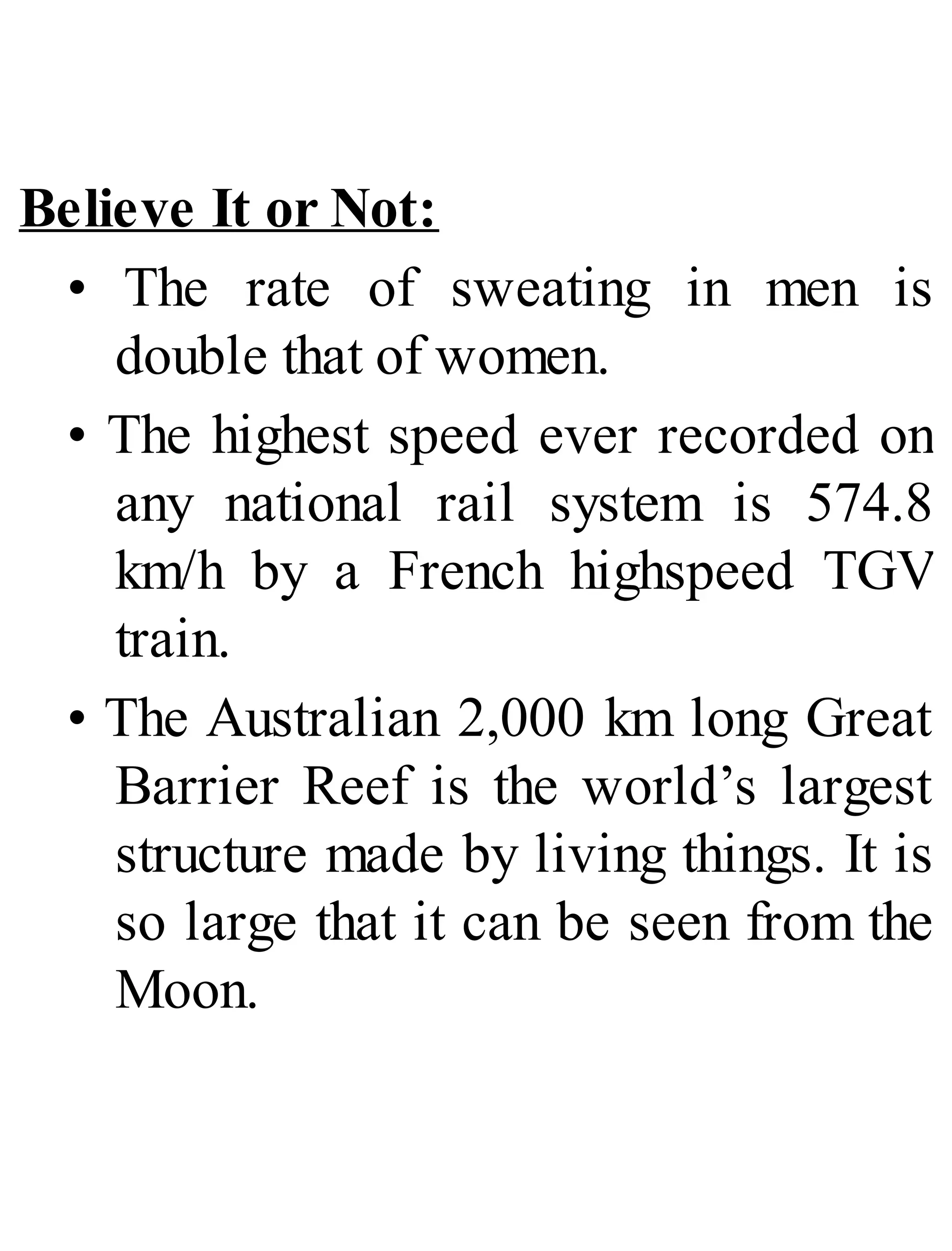
Believe It or Not:
• The rate of sweating in men is
double that of women.
• The highest speed ever recorded on
any national rail system is 574.8
km/h by a French highspeed TGV
train.
• The Australian 2,000 km long Great
Barrier Reef is the world’s largest
structure made by living things. It is
so large that it can be seen from the
Moon.
34.
Popular Titles of
Famous Personalities
India
Title Original name
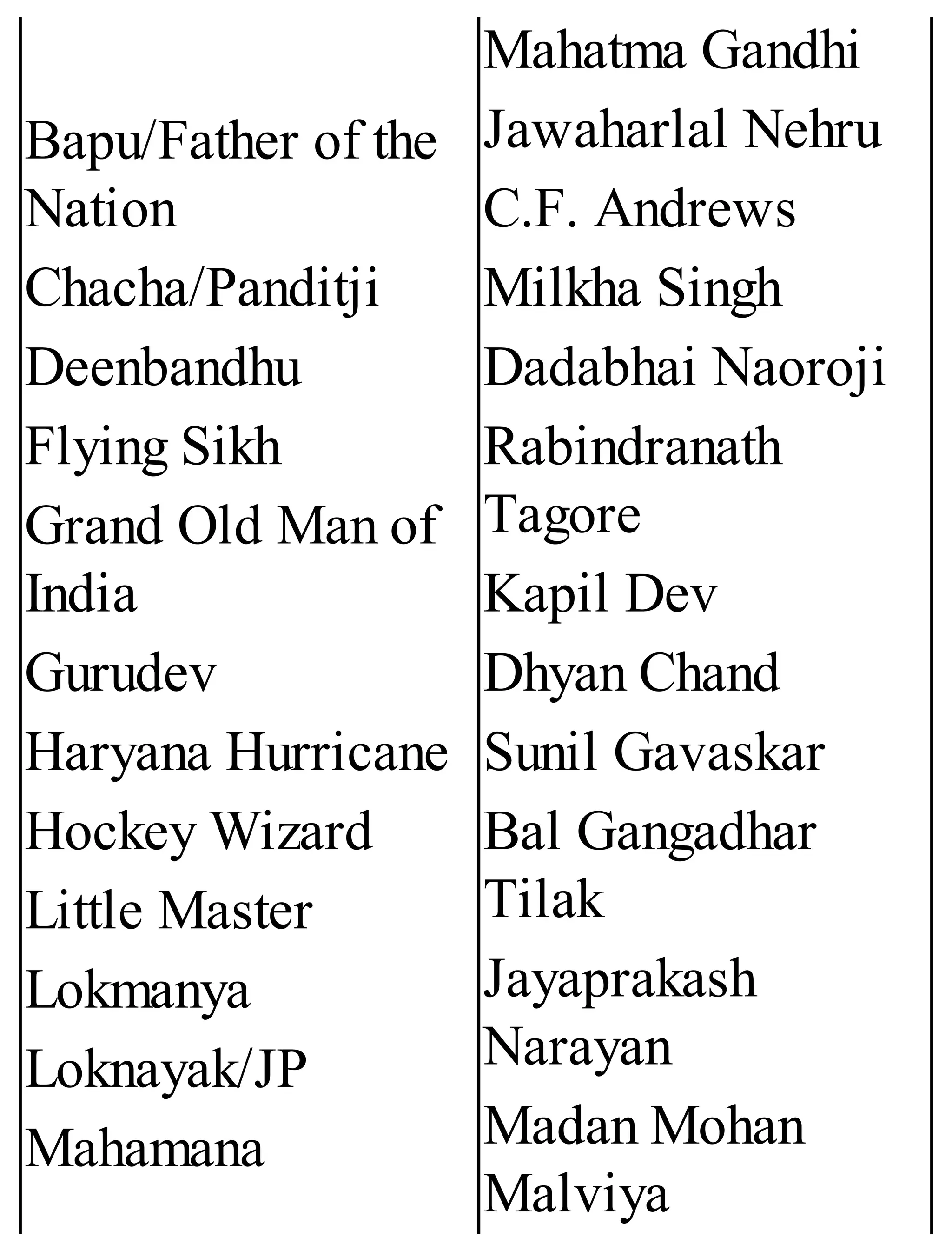
Bapu/Father of the
Nation
Chacha/Panditji
Deenbandhu
Flying Sikh
Grand Old Man of
India
Gurudev
Haryana Hurricane
Hockey Wizard
Little Master
Lokmanya
Loknayak/JP
Mahamana
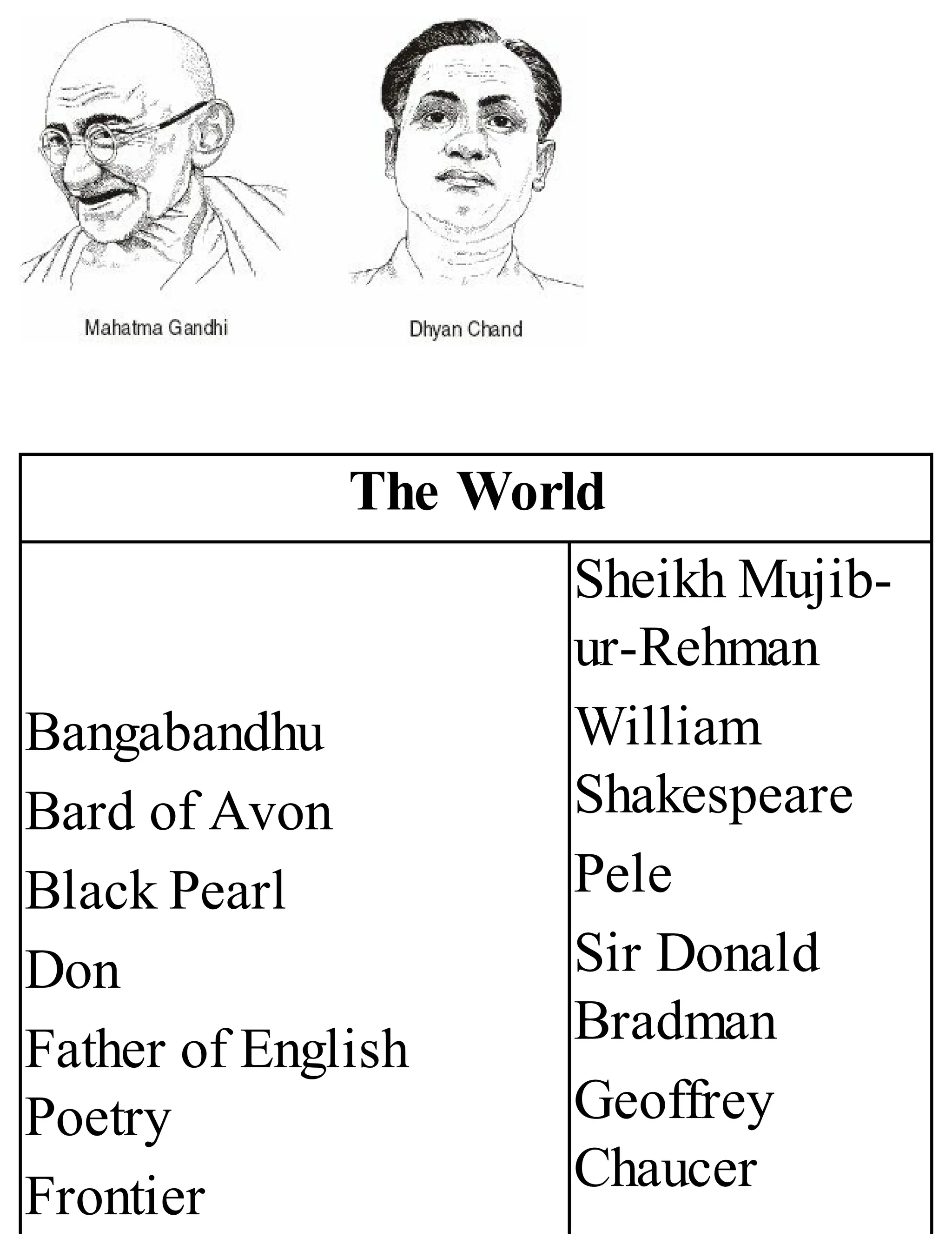
Mahatma Gandhi
Jawaharlal Nehru
C.F. Andrews
Milkha Singh
Dadabhai Naoroji
Rabindranath
Tagore
Kapil Dev
Dhyan Chand
Sunil Gavaskar
Bal Gangadhar
Tilak
Jayaprakash
Narayan
Madan Mohan
Malviya
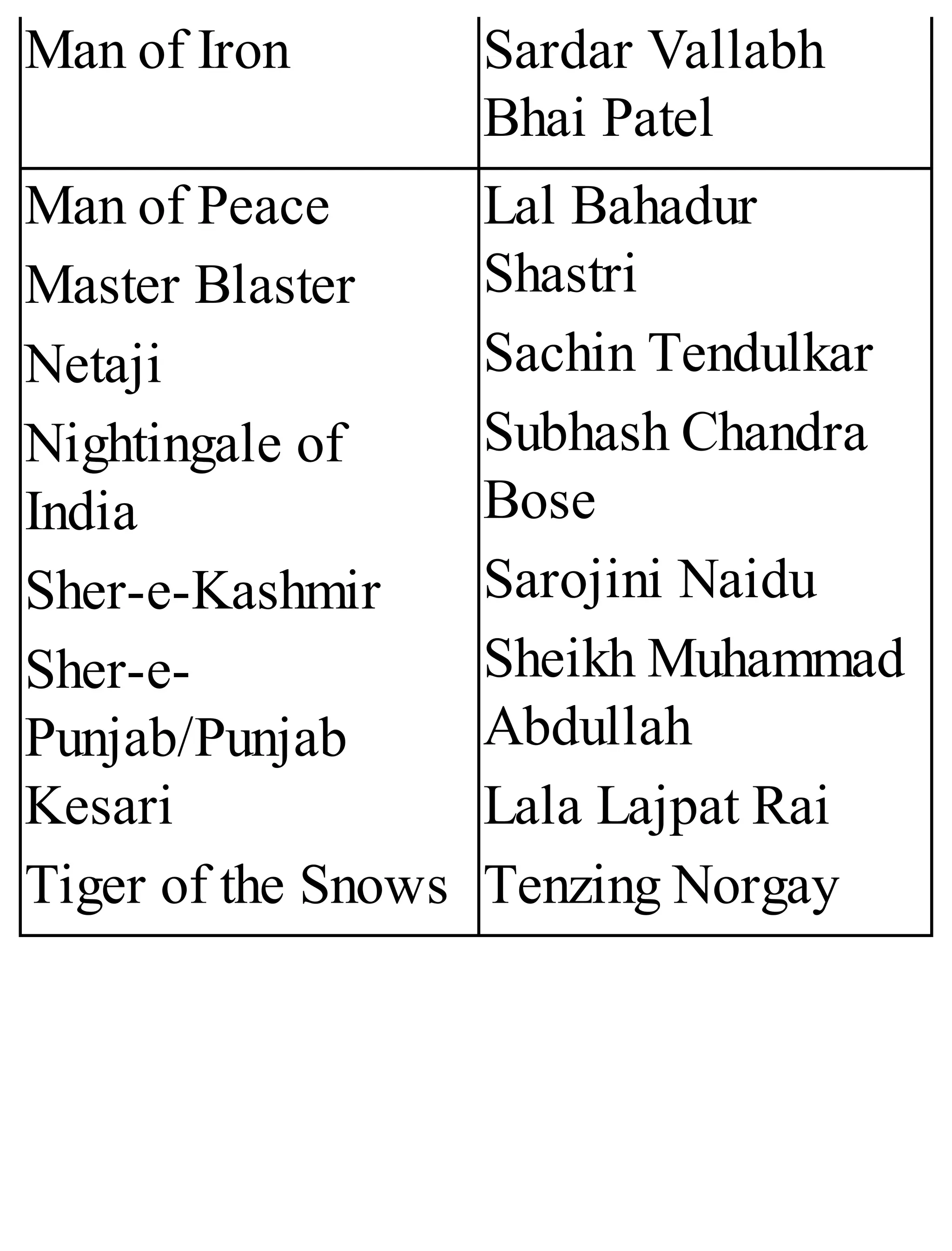
Man of Iron Sardar Vallabh
Bhai Patel
Man of Peace
Master Blaster
Netaji
Nightingale of
India
Sher-e-Kashmir
Sher-e-
Punjab/Punjab
Kesari
Tiger of the Snows
Lal Bahadur
Shastri
Sachin Tendulkar
Subhash Chandra
Bose
Sarojini Naidu
Sheikh Muhammad
Abdullah
Lala Lajpat Rai
Tenzing Norgay
The World
Bangabandhu
Bard of Avon
Black Pearl
Don
Father of English
Poetry
Frontier
Sheikh Mujib-
ur-Rehman
William
Shakespeare
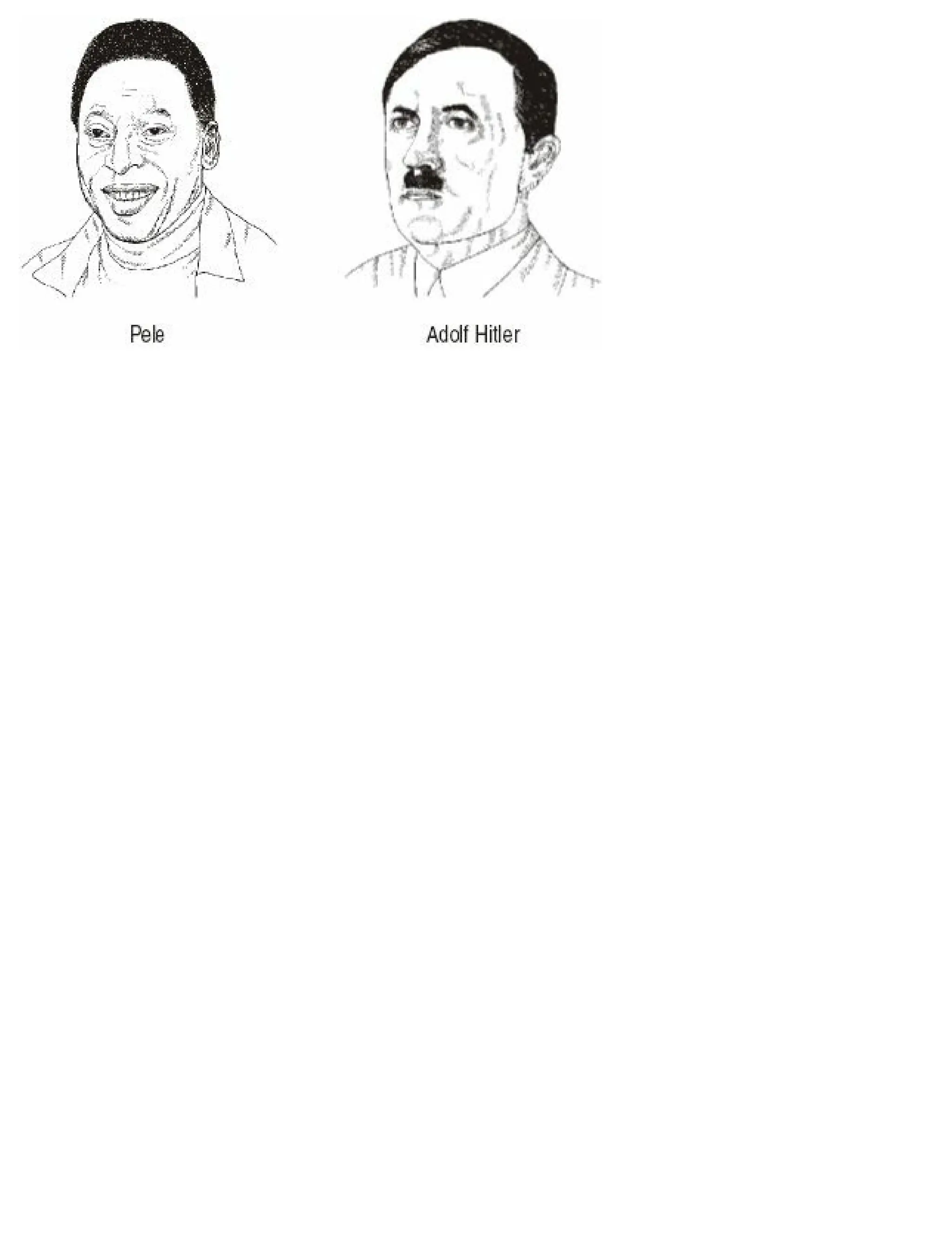
Pele
Sir Donald
Bradman
Geoffrey
Chaucer
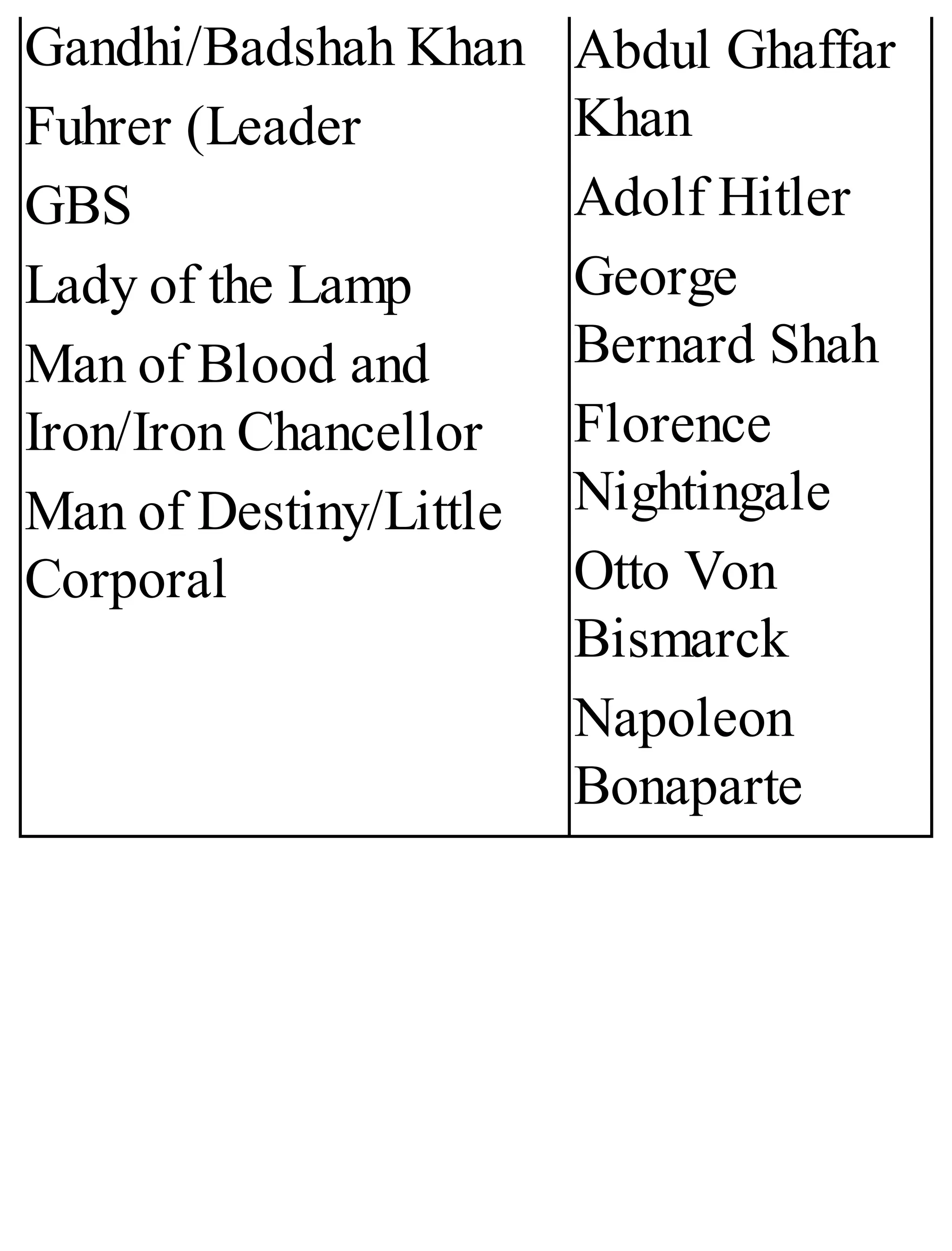
Gandhi/Badshah Khan
Fuhrer (Leader
GBS
Lady of the Lamp
Man of Blood and
Iron/Iron Chancellor
Man of Destiny/Little
Corporal
Abdul Ghaffar
Khan
Adolf Hitler
George
Bernard Shah
Florence
Nightingale
Otto Von
Bismarck
Napoleon
Bonaparte
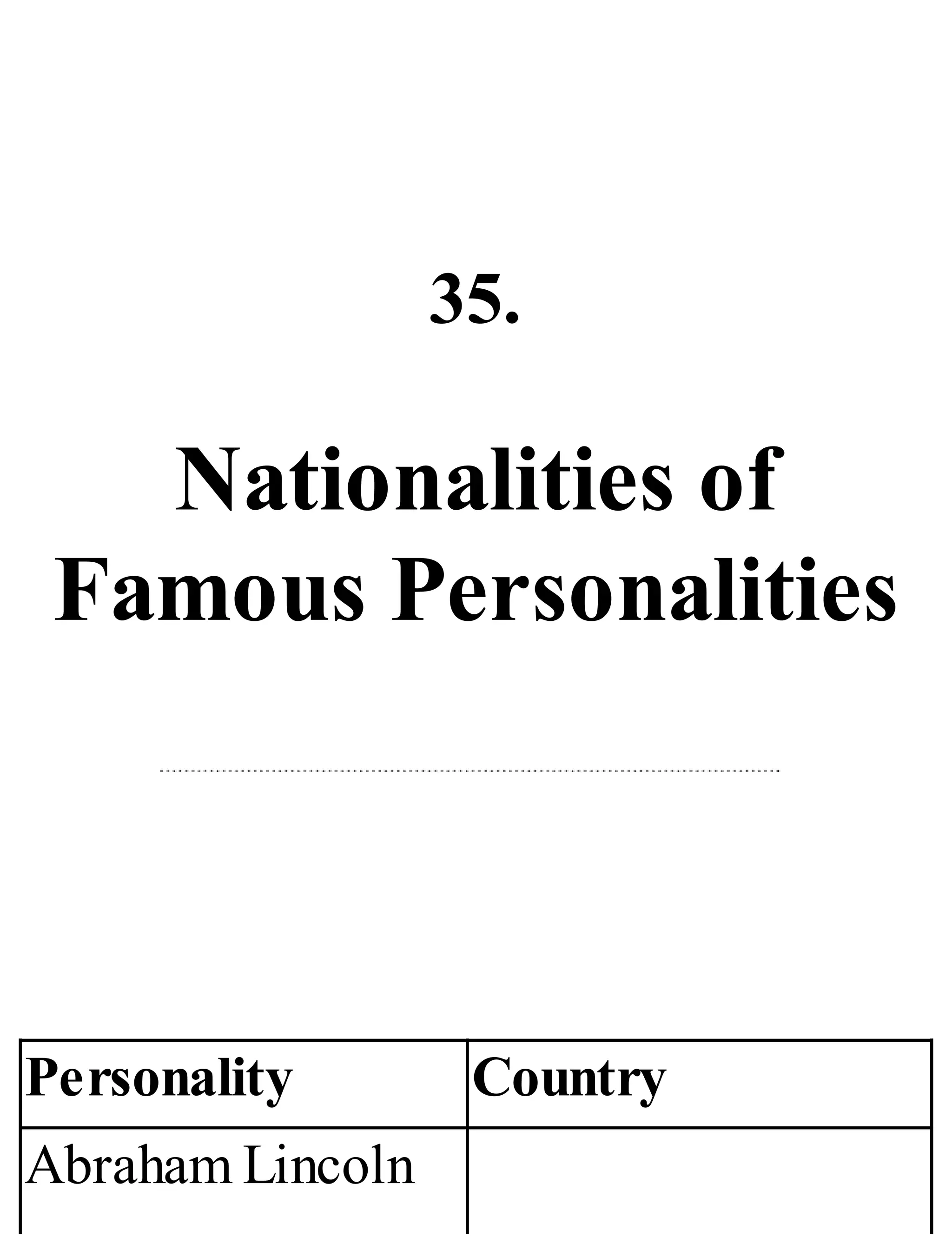
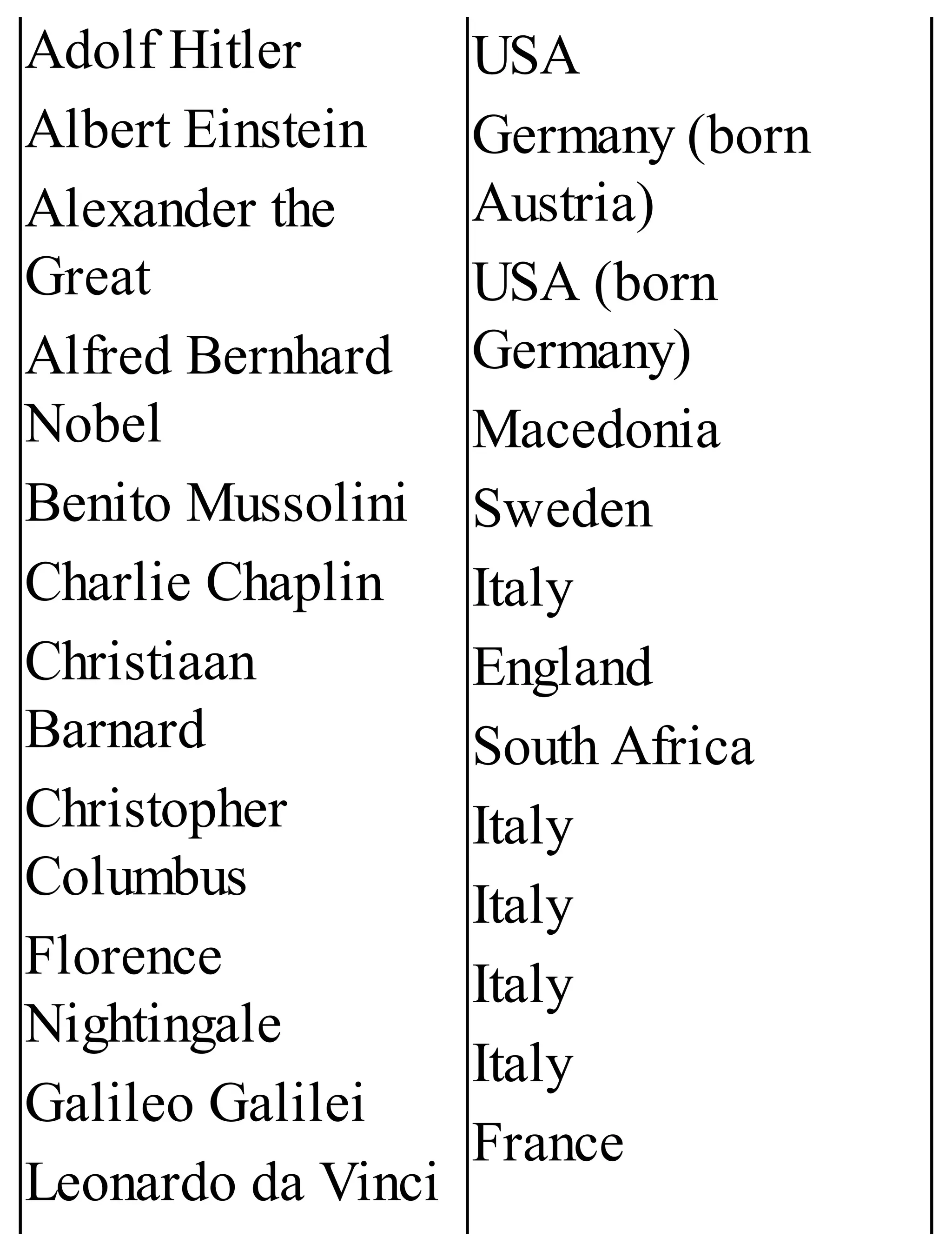
35.
Nationalities of
Famous Personalities
Personality Country
Abraham Lincoln
Adolf Hitler
Albert Einstein
Alexander the
Great
Alfred Bernhard
Nobel
Benito Mussolini
Charlie Chaplin
Christiaan
Barnard
Christopher
Columbus
Florence
Nightingale
Galileo Galilei
Leonardo da Vinci
USA
Germany (born
Austria)
USA (born
Germany)
Macedonia
Sweden
Italy
England
South Africa
Italy
Italy
Italy
Italy
France
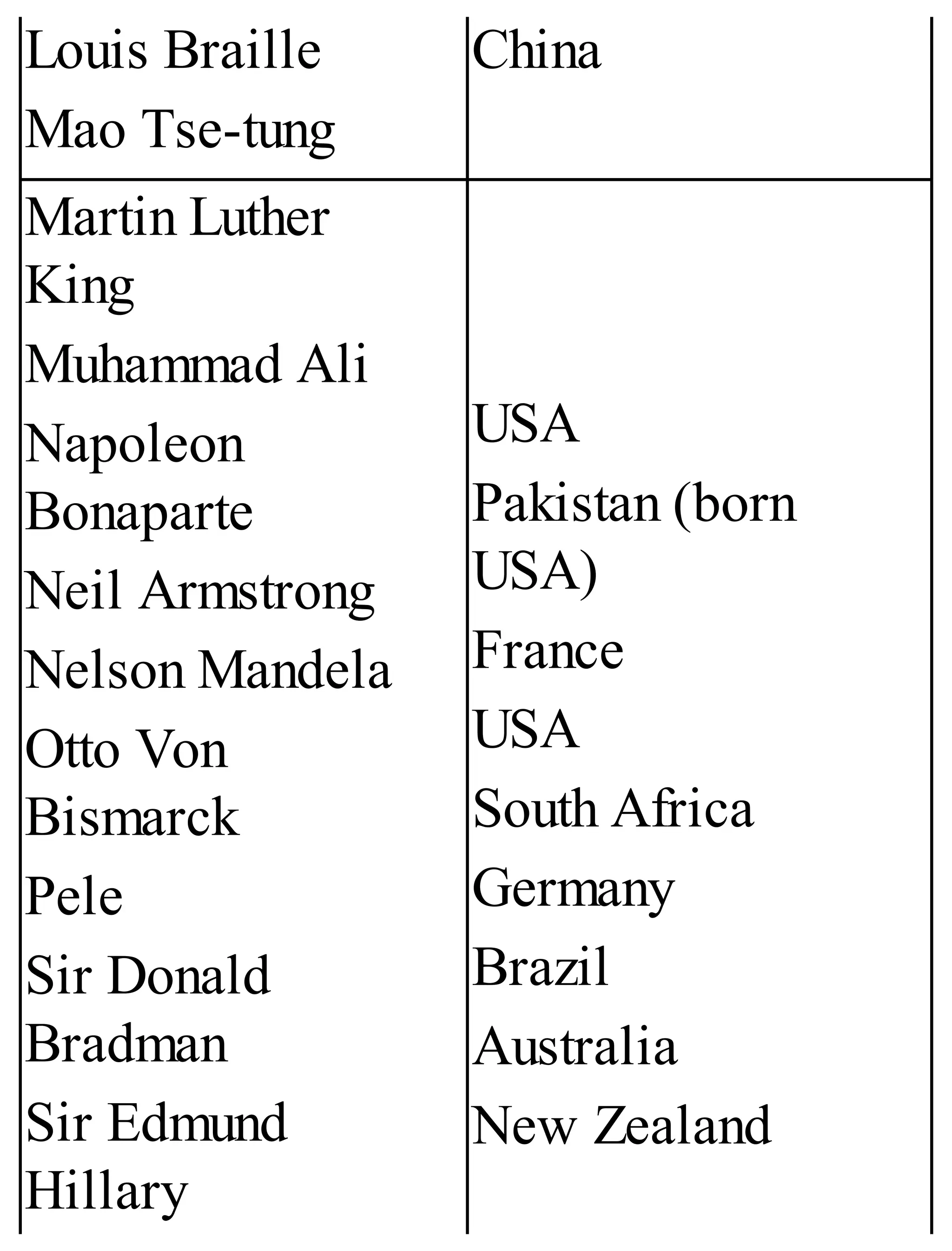
Louis Braille
Mao Tse-tung
China
Martin Luther
King
Muhammad Ali
Napoleon
Bonaparte
Neil Armstrong
Nelson Mandela
Otto Von
Bismarck
Pele
Sir Donald
Bradman
Sir Edmund
Hillary
USA
Pakistan (born
USA)
France
USA
South Africa
Germany
Brazil
Australia
New Zealand
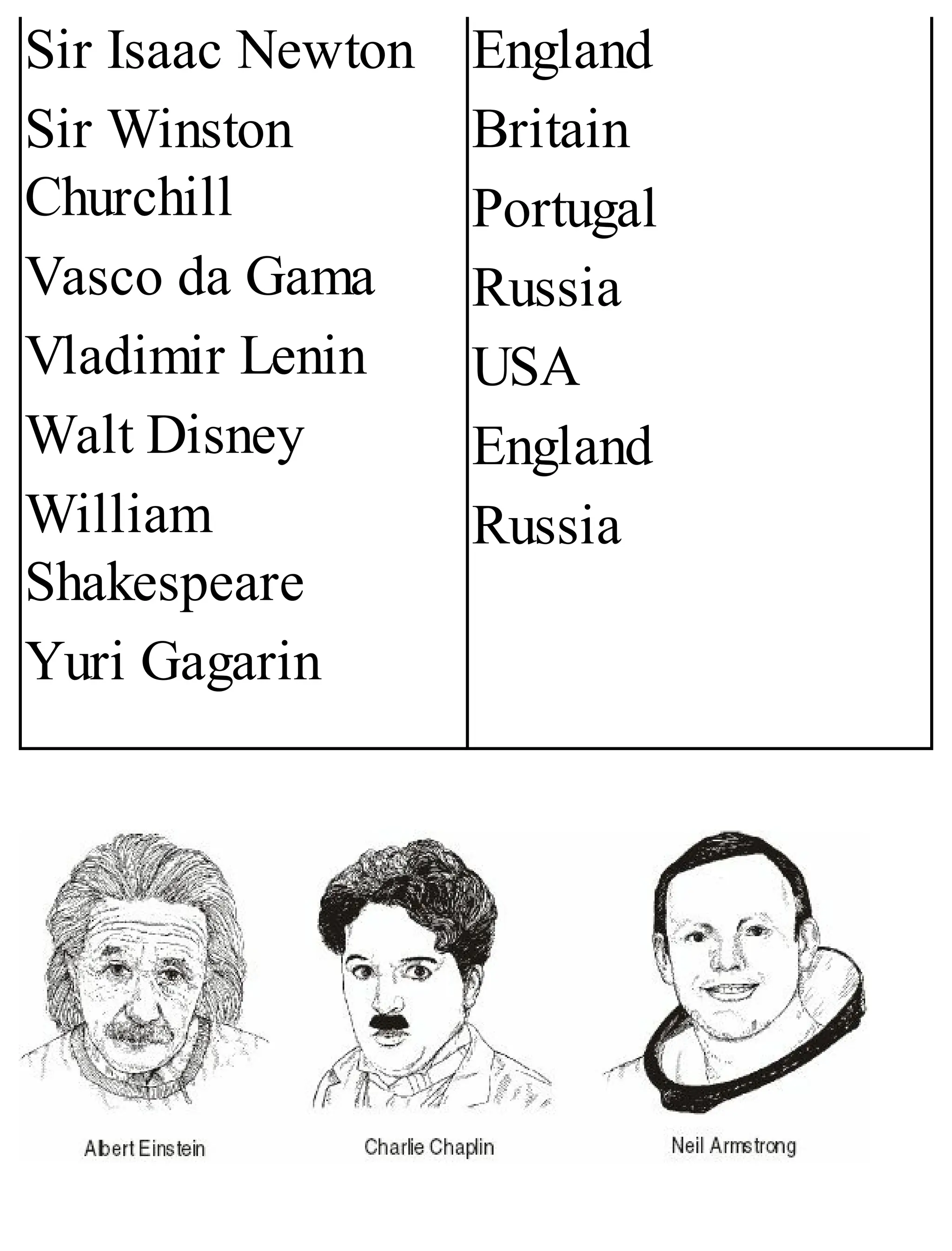
Sir Isaac Newton
Sir Winston
Churchill
Vasco da Gama
Vladimir Lenin
Walt Disney
William
Shakespeare
Yuri Gagarin
England
Britain
Portugal
Russia
USA
England
Russia
Believe It or Not:
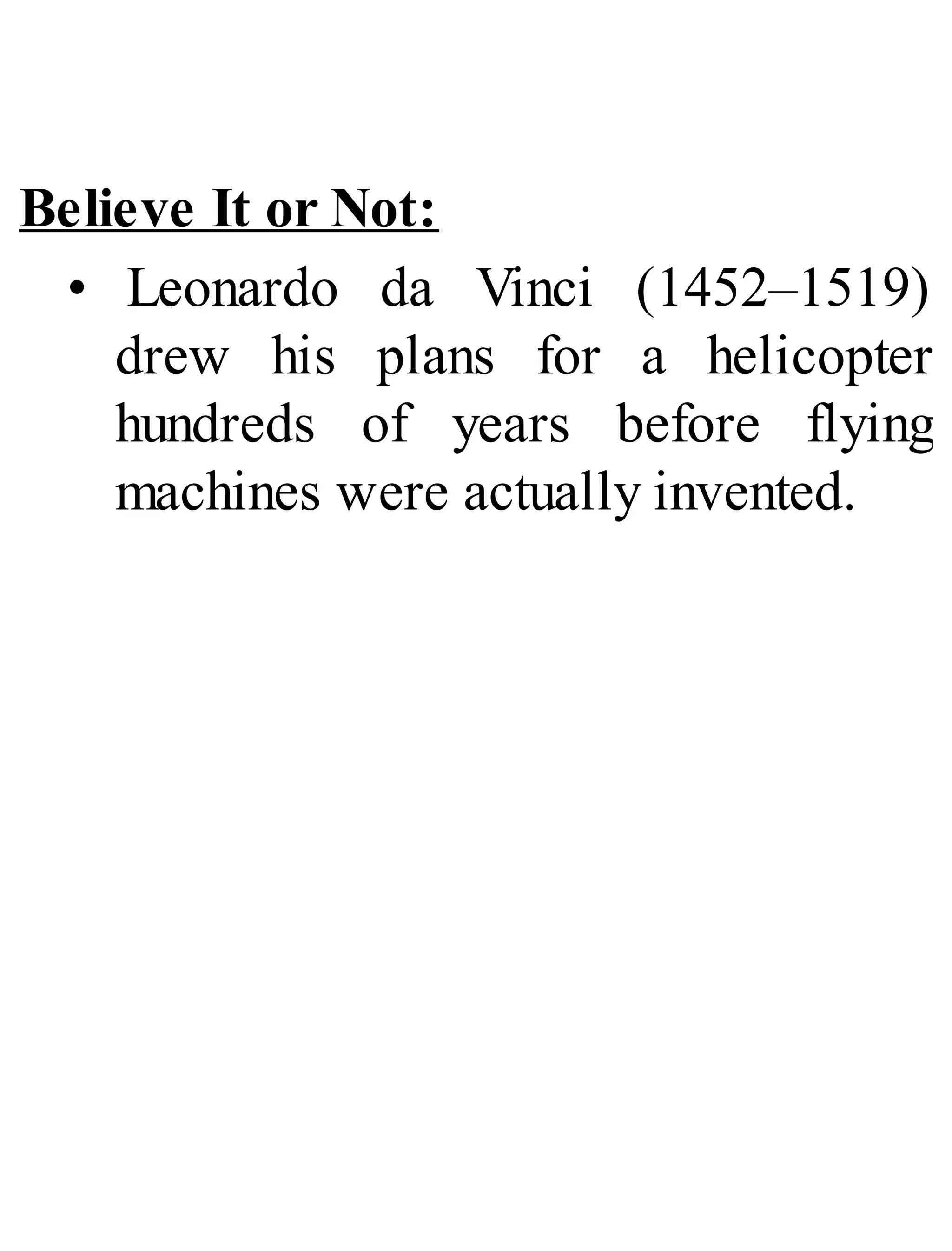
• Leonardo da Vinci (1452–1519)
drew his plans for a helicopter
hundreds of years before flying
machines were actually invented.
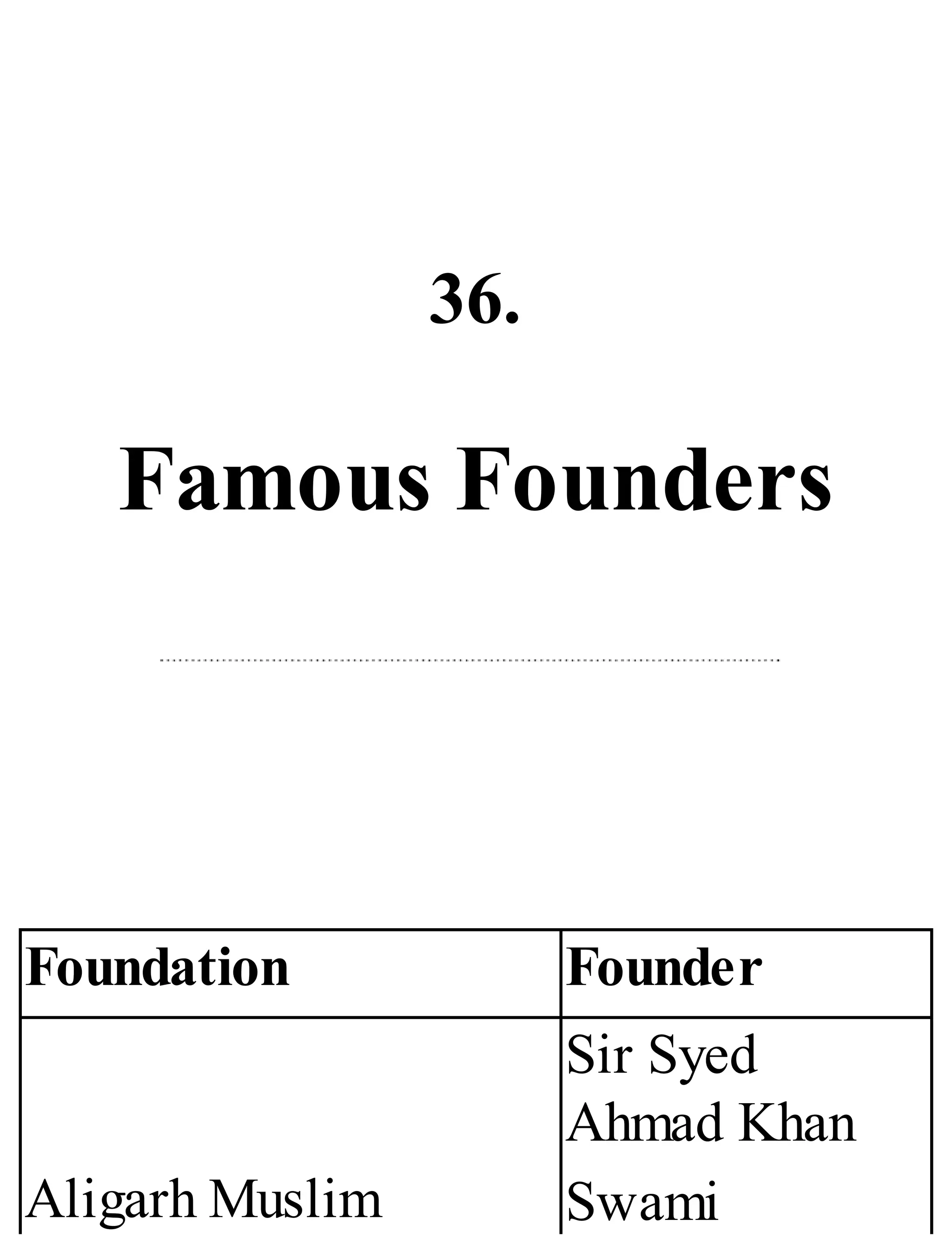
36.
Famous Founders
Foundation Founder
Aligarh Muslim
Sir Syed
Ahmad Khan
Swami
University
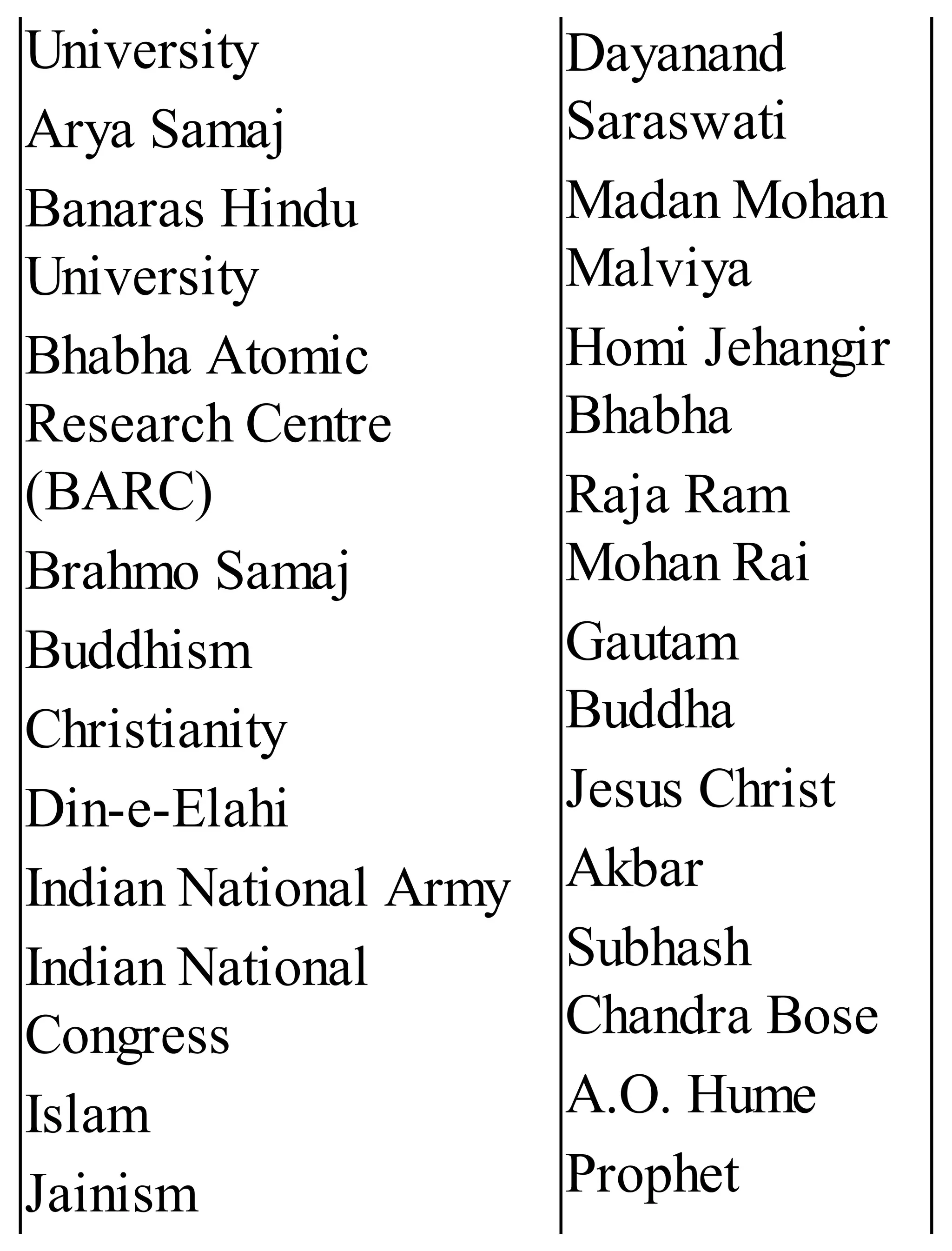
Arya Samaj
Banaras Hindu
University
Bhabha Atomic
Research Centre
(BARC)
Brahmo Samaj
Buddhism
Christianity
Din-e-Elahi
Indian National Army
Indian National
Congress
Islam
Jainism
Dayanand
Saraswati
Madan Mohan
Malviya
Homi Jehangir
Bhabha
Raja Ram
Mohan Rai
Gautam
Buddha
Jesus Christ
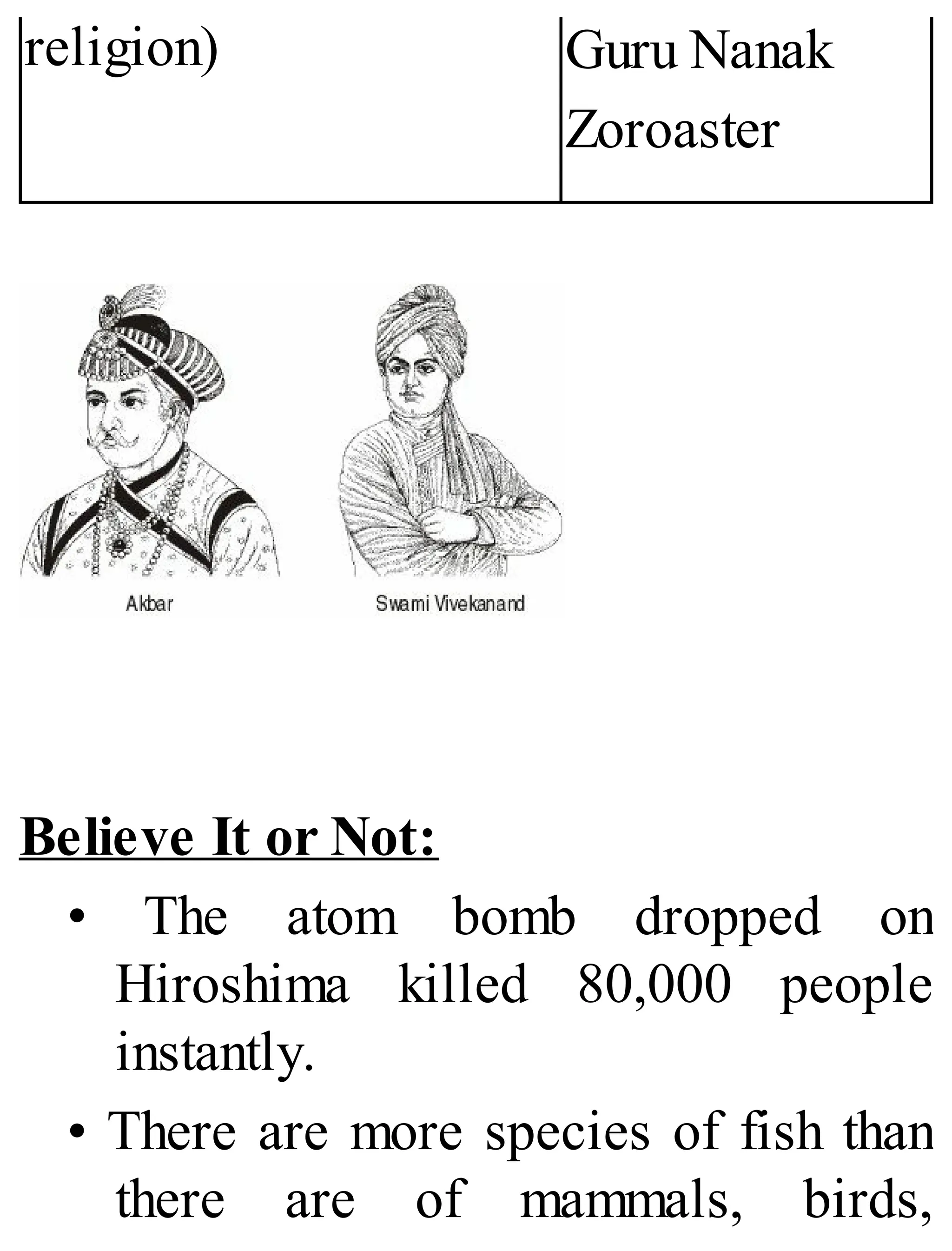
Akbar
Subhash
Chandra Bose
A.O. Hume
Prophet
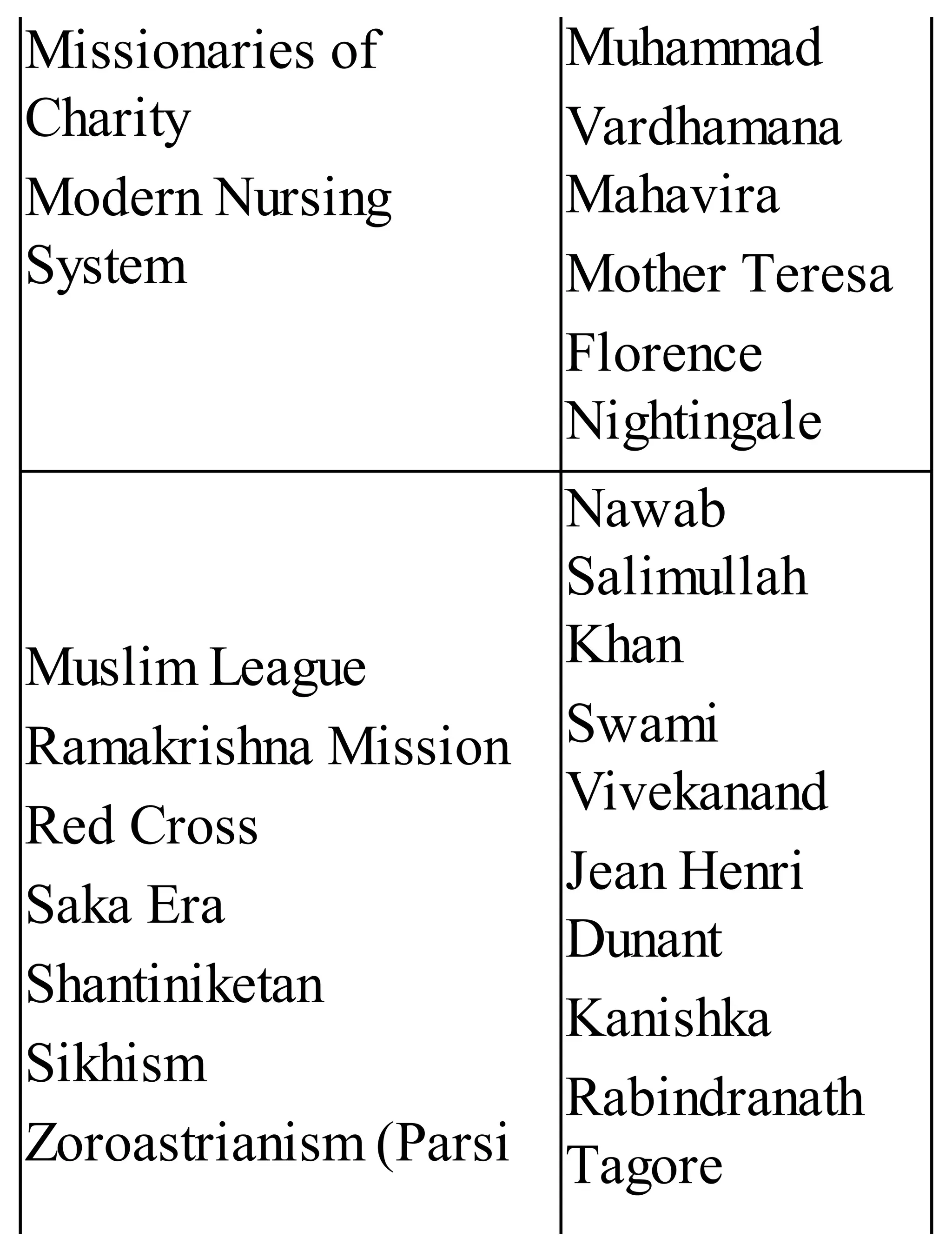
Missionaries of
Charity
Modern Nursing
System
Muhammad
Vardhamana
Mahavira
Mother Teresa
Florence
Nightingale
Muslim League
Ramakrishna Mission
Red Cross
Saka Era
Shantiniketan
Sikhism
Zoroastrianism (Parsi
Nawab
Salimullah
Khan
Swami
Vivekanand
Jean Henri
Dunant
Kanishka
Rabindranath
Tagore
religion) Guru Nanak
Zoroaster
Believe It or Not:
• The atom bomb dropped on
Hiroshima killed 80,000 people
instantly.
• There are more species of fish than
there are of mammals, birds,
reptiles and amphibians put
together.
• There is about 200 times more gold
buried in the sea than has been
mined from the land.
37.
Popular Slogans
Do or die.
— Mahatma Gandhi
Aram haram hai.
— Jawaharlal Nehru
Play the game in the spirit of the game.
— Jawaharlal Nehru
Give me blood, I will give you freedom.
— Subhash Chandra Bose
Dilli Chalo.
— Subhash Chandra Bose
Swaraj is my birthright and I will have
it.
— Bal Gangadhar Tilak
Jai Jawan, Jai Kisan.
— Lal Bahadur Shastri
Direct Action.
— Ali Jinnah
Government of the people, by the
people, for the people.
— Abraham Lincoln
Just as I would not like to be a slave, so
I would not like to be a master.
— Abraham Lincoln
That’s one small step for man, one giant
leap for mankind.
—Neil Armstrong
Eureka! Eureka! (I have found it.)
— Archimedes
Man is by nature a political animal.
—Aristotle
The roots of education are bitter, but the
fruit is sweet.
—Aristotle
I am the greatest!
—Muhammad Ali
Every man has his price.
—Sir Robert Walpole
The child is the father of a man.
—William Wordsworth
Old wood best to burn, old wine to
drink, old friends to trust and old authors
to read.
—Francis Bacon
Believe It or Not:
• An ant can pull a load 300 times
heavier than itself and lift an item 50
times its own weight.
• It rains nearly everyday on Mount
Waialeale in Hawaii. In fact, there
are only about 15 days in a year
when it does not rain.
38.
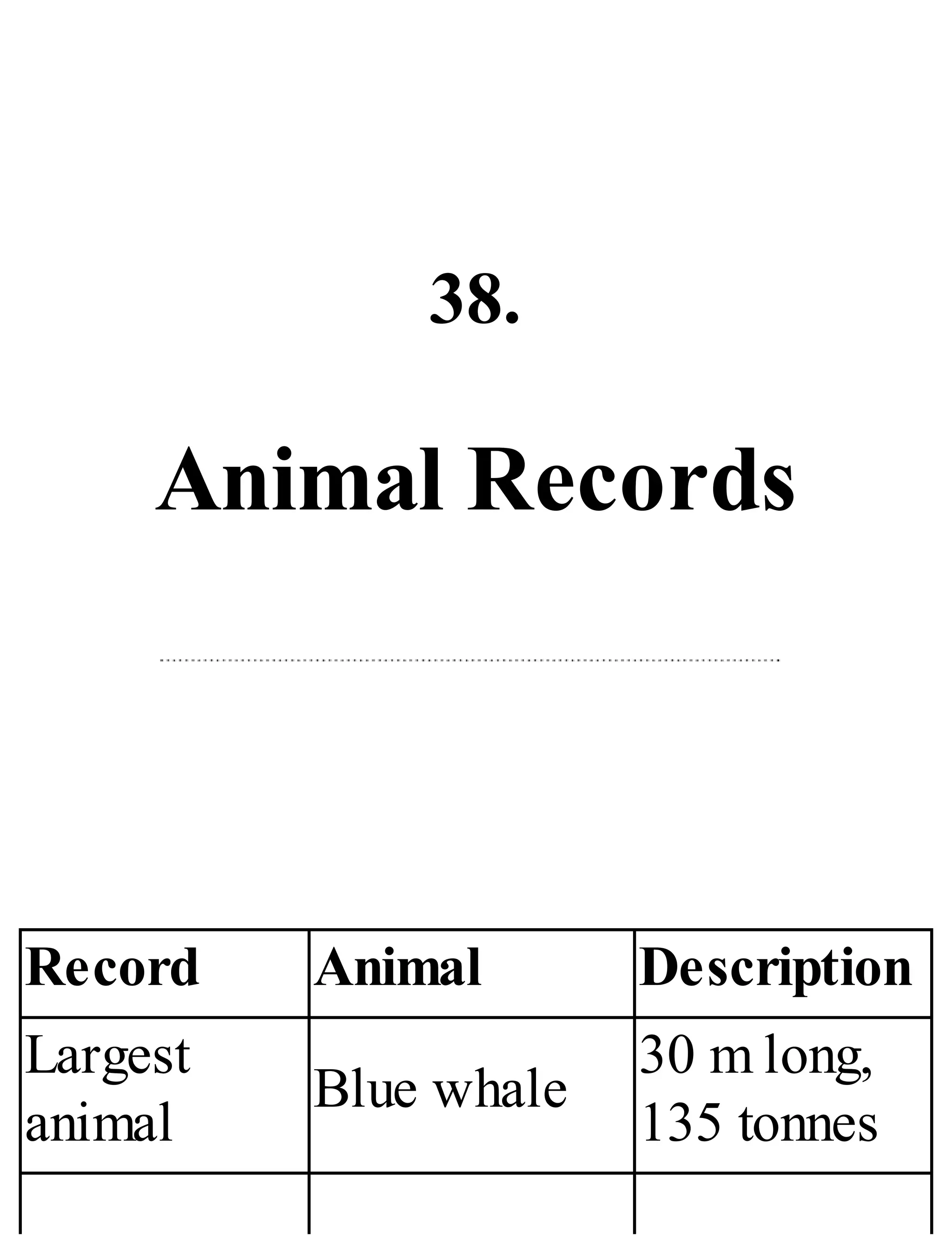
Animal Records
Record Animal Description
Largest
animal
Blue whale
30 m long,
135 tonnes
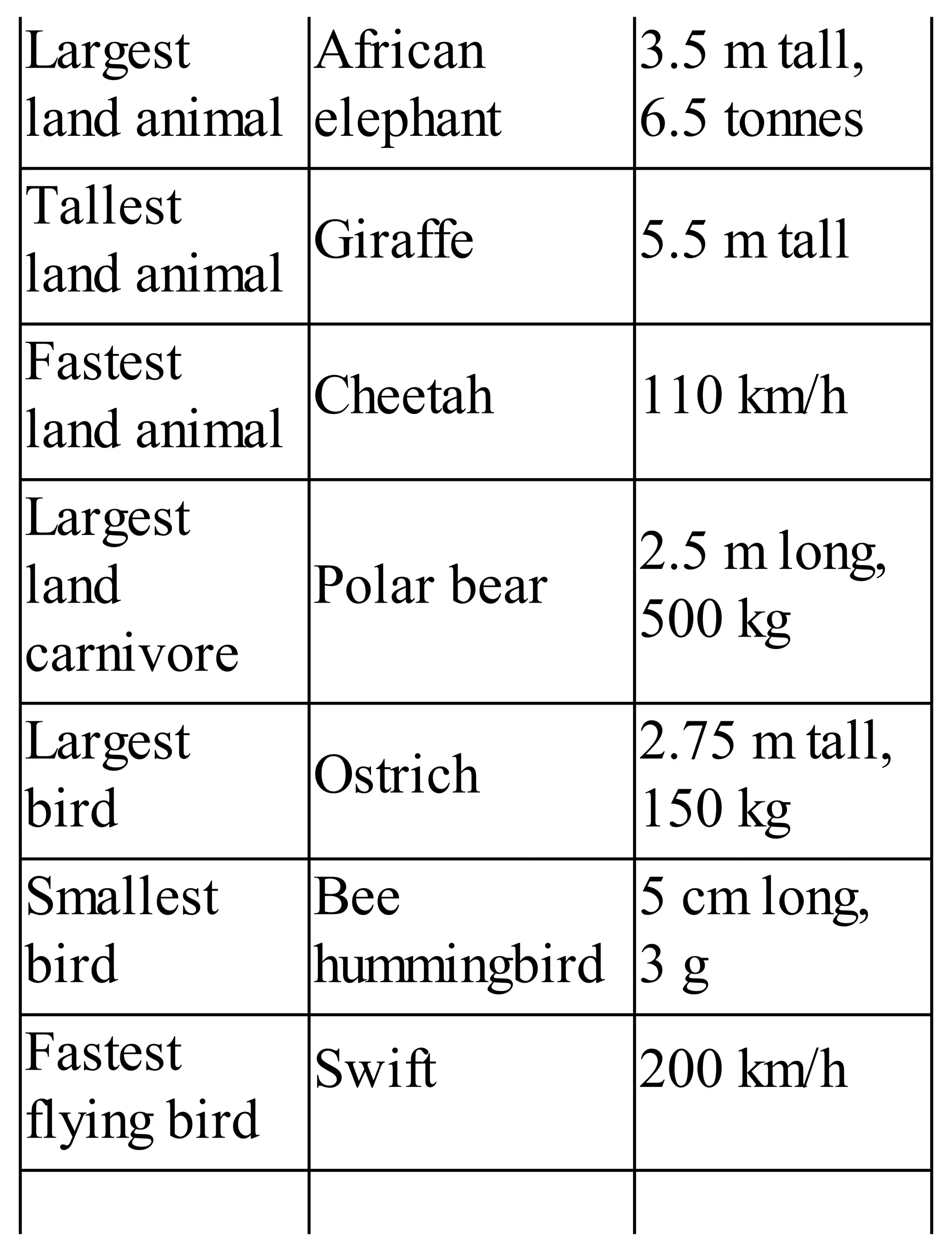
Largest
land animal
African
elephant
3.5 m tall,
6.5 tonnes
Tallest
land animal
Giraffe 5.5 m tall
Fastest
land animal
Cheetah 110 km/h
Largest
land
carnivore
Polar bear
2.5 m long,
500 kg
Largest
bird
Ostrich
2.75 m tall,
150 kg
Smallest
bird
Bee
hummingbird
5 cm long,
3 g
Fastest
flying bird
Swift 200 km/h
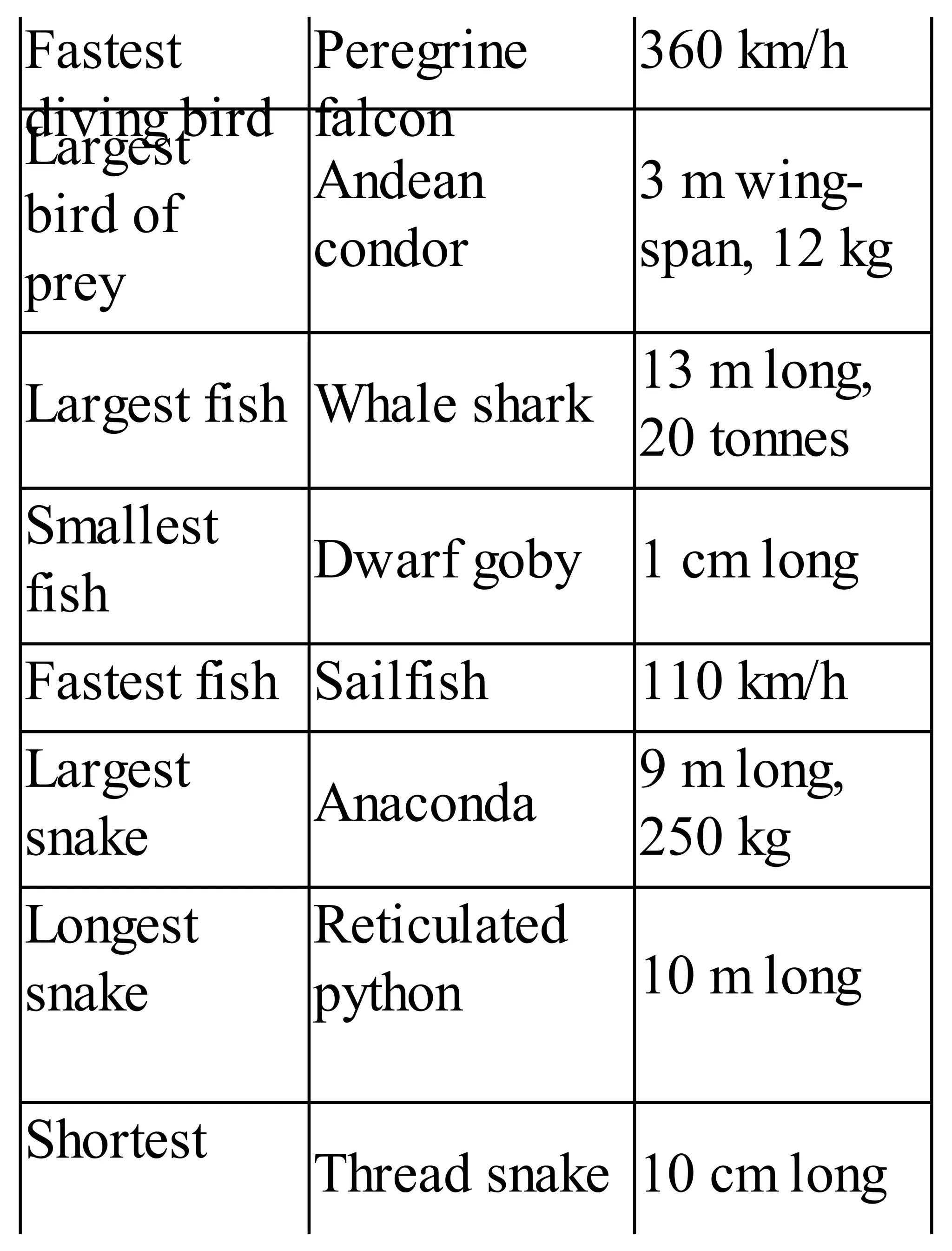
Fastest
diving bird
Peregrine
falcon
360 km/h
Largest
bird of
prey
Andean
condor
3 m wing-
span, 12 kg
Largest fish Whale shark
13 m long,
20 tonnes
Smallest
fish
Dwarf goby 1 cm long
Fastest fish Sailfish 110 km/h
Largest
snake
Anaconda
9 m long,
250 kg
Longest
snake
Reticulated
python 10 m long
Shortest
Thread snake 10 cm long
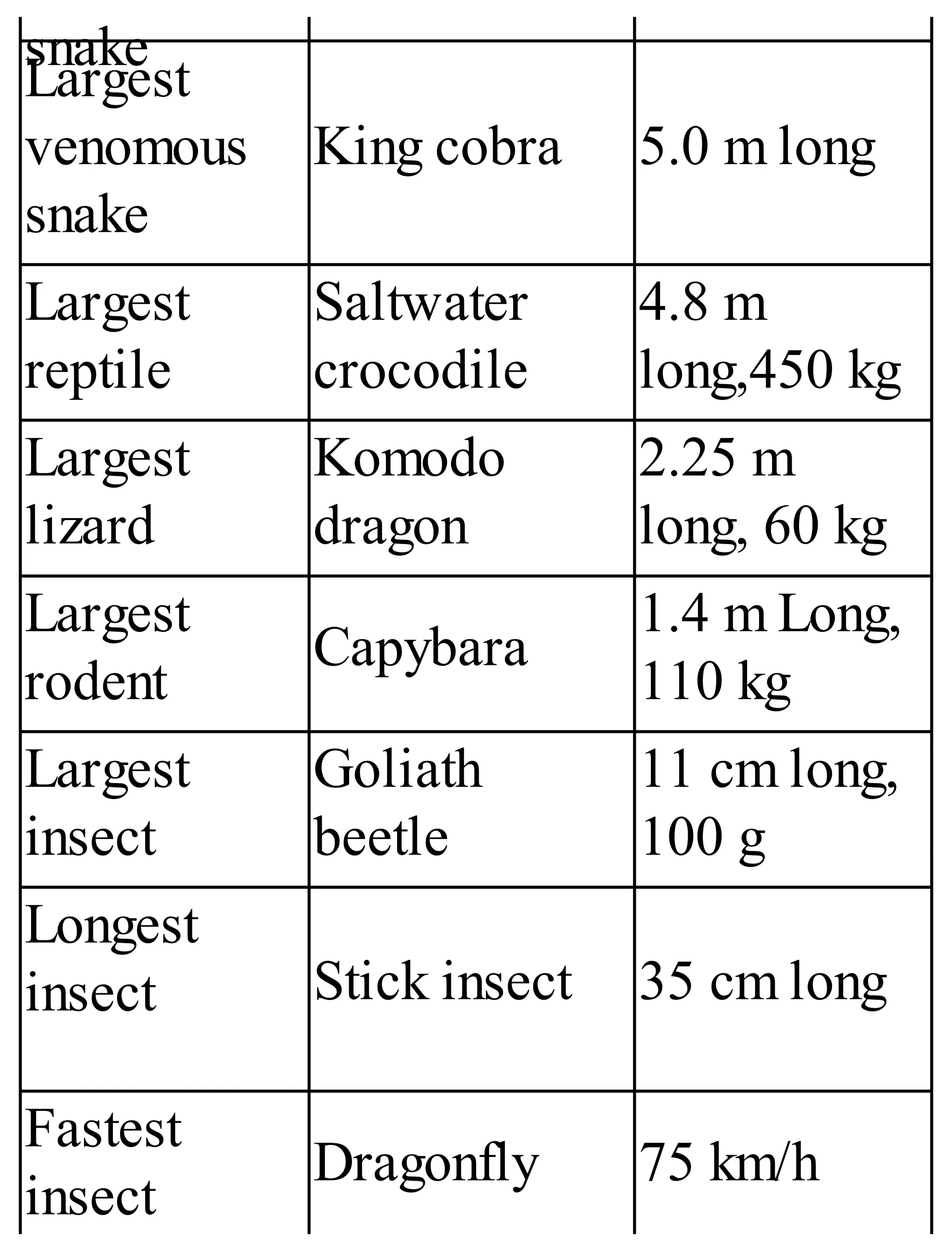
snake
Largest
venomous
snake
King cobra 5.0 m long
Largest
reptile
Saltwater
crocodile
4.8 m
long,450 kg
Largest
lizard
Komodo
dragon
2.25 m
long, 60 kg
Largest
rodent
Capybara
1.4 m Long,
110 kg
Largest
insect
Goliath
beetle
11 cm long,
100 g
Longest
insect Stick insect 35 cm long
Fastest
insect
Dragonfly 75 km/h
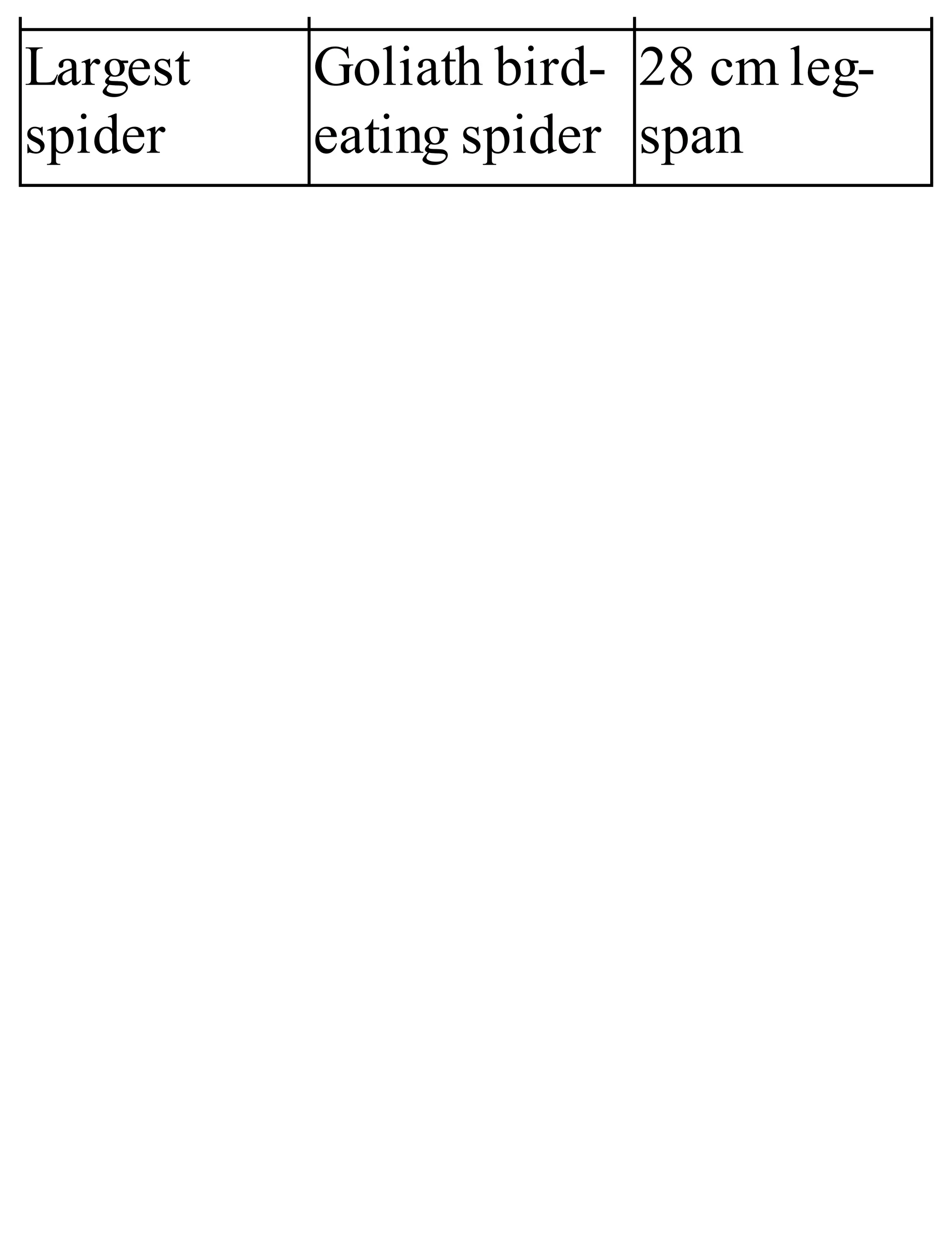
Largest
spider
Goliath bird-
eating spider
28 cm leg-
span
39.
Animal Facts
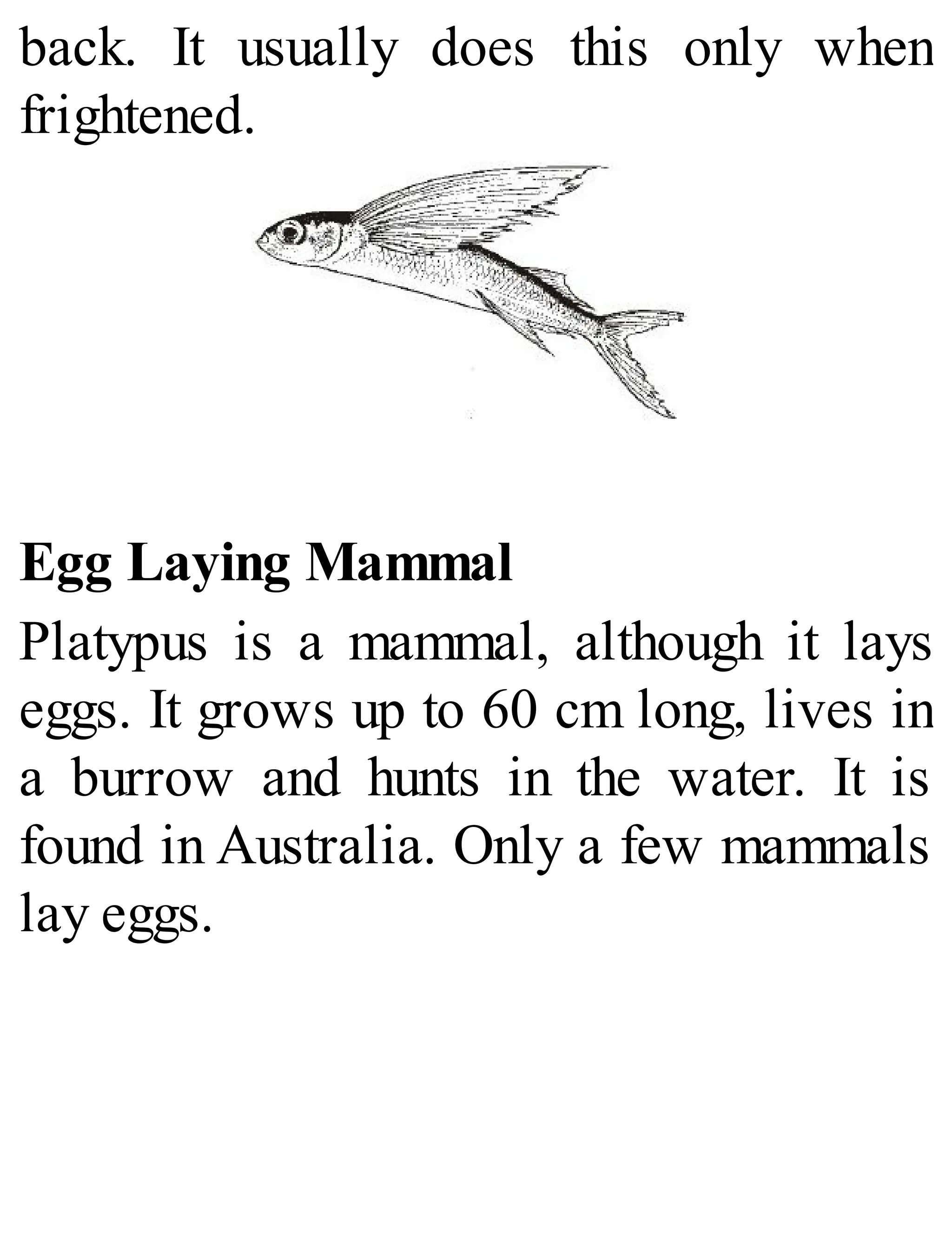
Flying Fish
The flying fish cannot fly like a bird, but
it leaps into the air, up to 3 m and then
glides for about 200 m before splashing
back. It usually does this only when
frightened.
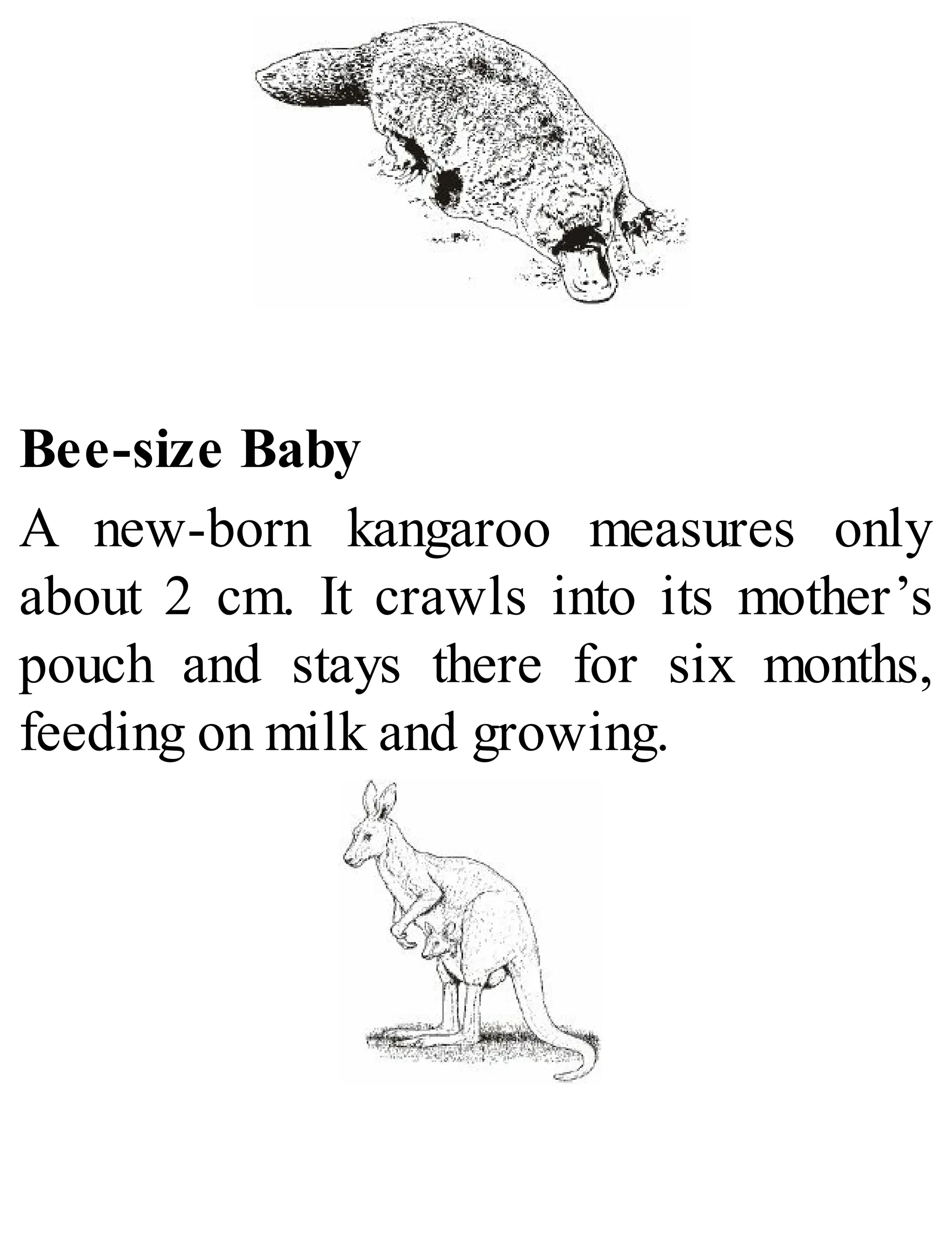
Egg Laying Mammal
Platypus is a mammal, although it lays
eggs. It grows up to 60 cm long, lives in
a burrow and hunts in the water. It is
found in Australia. Only a few mammals
lay eggs.
Bee-size Baby
A new-born kangaroo measures only
about 2 cm. It crawls into its mother’s
pouch and stays there for six months,
feeding on milk and growing.
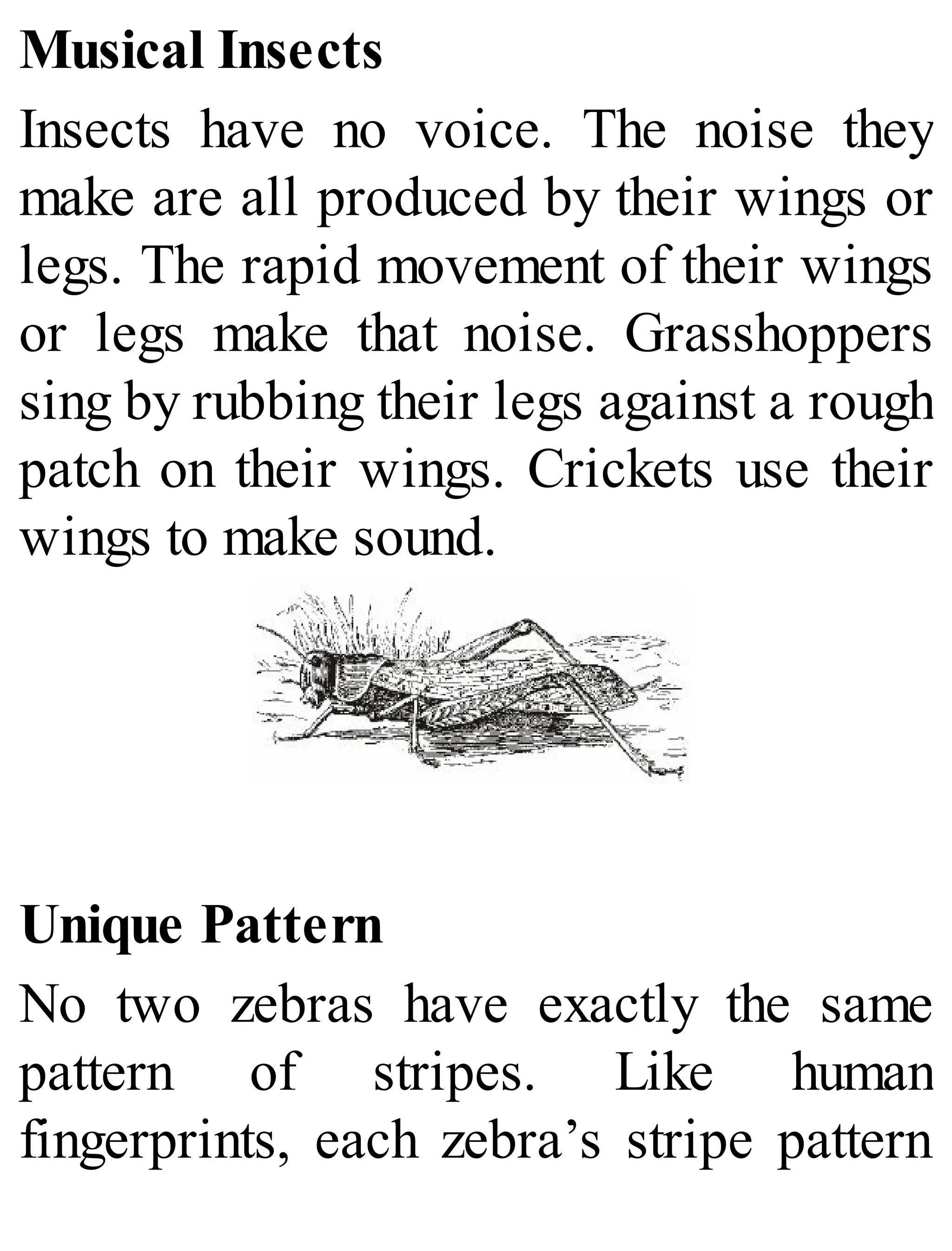
Musical Insects
Insects have no voice. The noise they
make are all produced by their wings or
legs. The rapid movement of their wings
or legs make that noise. Grasshoppers
sing by rubbing their legs against a rough
patch on their wings. Crickets use their
wings to make sound.
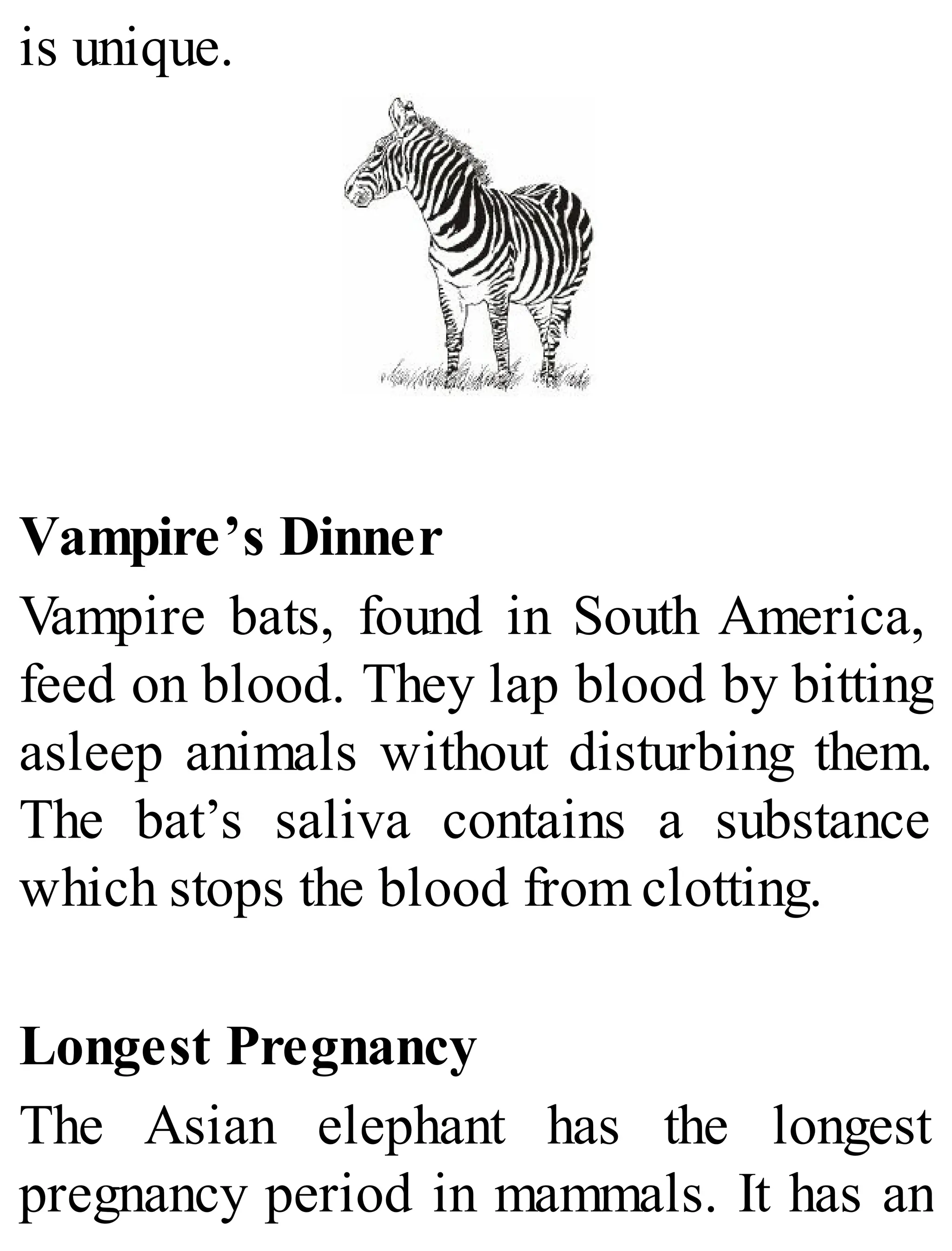
Unique Pattern
No two zebras have exactly the same
pattern of stripes. Like human
fingerprints, each zebra’s stripe pattern
is unique.
Vampire’s Dinner
Vampire bats, found in South America,
feed on blood. They lap blood by bitting
asleep animals without disturbing them.
The bat’s saliva contains a substance
which stops the blood from clotting.
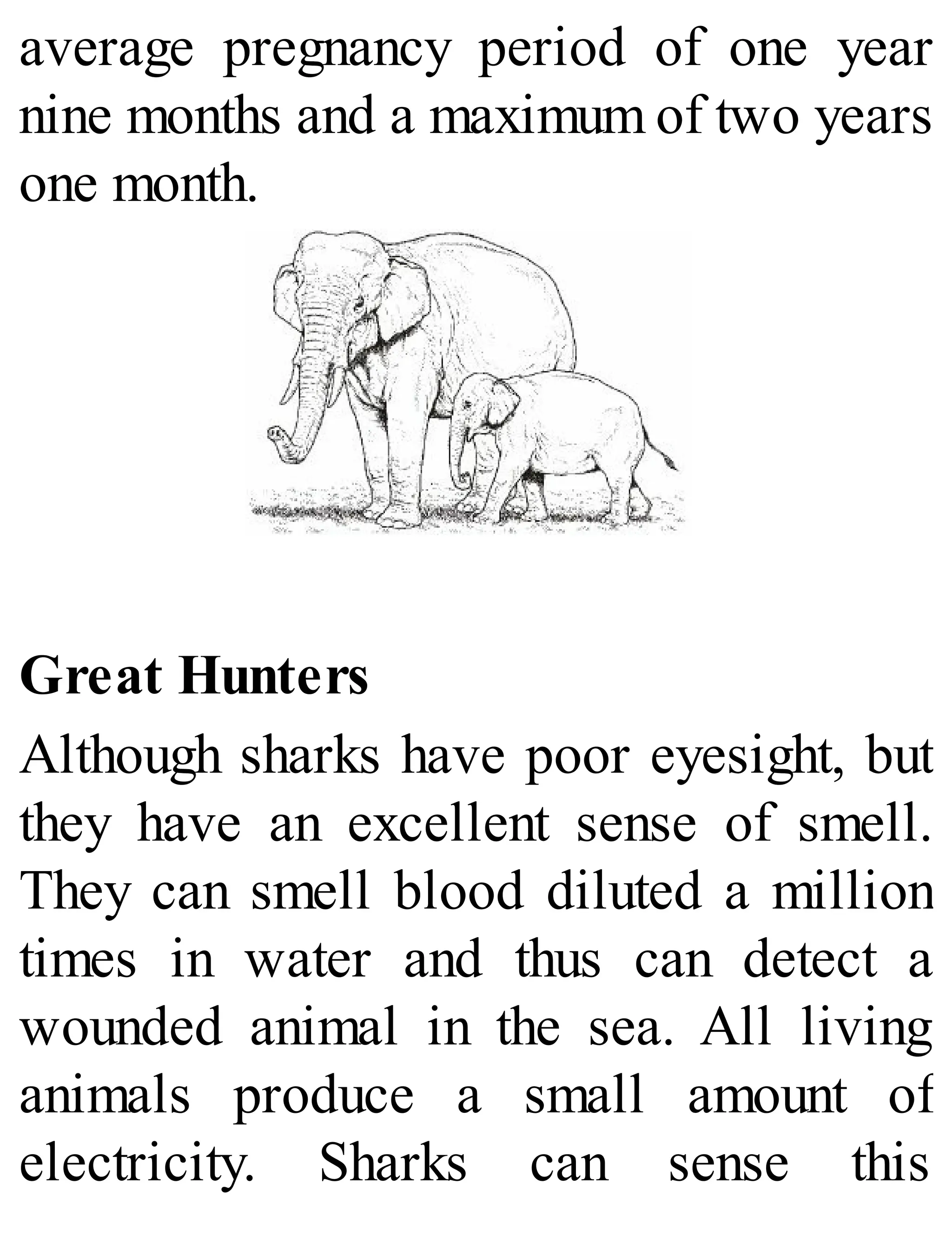
Longest Pregnancy
The Asian elephant has the longest
pregnancy period in mammals. It has an
average pregnancy period of one year
nine months and a maximum of two years
one month.
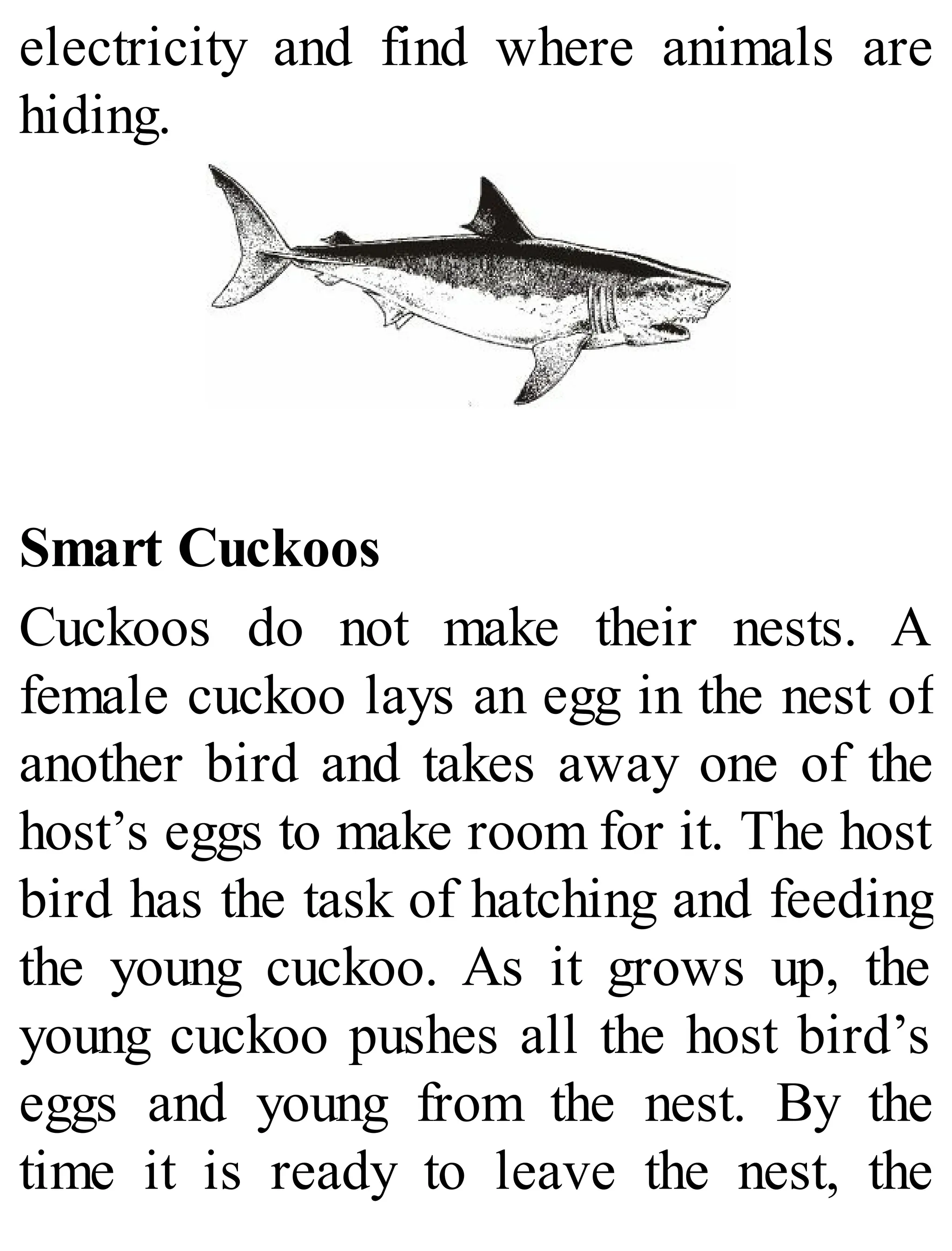
Great Hunters
Although sharks have poor eyesight, but
they have an excellent sense of smell.
They can smell blood diluted a million
times in water and thus can detect a
wounded animal in the sea. All living
animals produce a small amount of
electricity. Sharks can sense this
electricity and find where animals are
hiding.
Smart Cuckoos
Cuckoos do not make their nests. A
female cuckoo lays an egg in the nest of
another bird and takes away one of the
host’s eggs to make room for it. The host
bird has the task of hatching and feeding
the young cuckoo. As it grows up, the
young cuckoo pushes all the host bird’s
eggs and young from the nest. By the
time it is ready to leave the nest, the
young cuckoo may be several times the
size of its long-suffering foster parents.
Electric Eel
An electric eel is a freshwater fish
measuring up to 2 m long. It produces
powerful electric shocks of up to 500
volts. A shock of this power can kill a
human.
Champion Migrant
The Arctic tern is the champion in
migration. It travels the longest distance
during the migratory journey. It covers a
round trip of about 36,000 km from the
Arctic to the Antarctic and back.
Wandering Wonder
The wandering albatross has the longest
wings of any bird. When outstretched,
they measure as much as 3.3 m from tip
to tip.
Red Alert
Most of the people think that a bull is
irritated by the red colour. Well, it is not
the colour that irritates the animal. A
bull is colour-blind! It gets angry to see
the cloth or bull fighter’s cape because it
is being waved about.
Sense of Smell
Unlike most birds, the kiwi has a good
sense of smell which helps it to find
food at night. A kiwi has nostrils at the
tip of its long beak. It uses its sense of
smell to find out earthworms and insects
hiding in the soil.
Rarest Pandas
Giant pandas are some of the rarest
animals in the world. There are less than
1,000 giant pandas left. They live only in
high mountain ranges in three isolated
parts of China. They need to eat about 20
kg of one special type of bamboo a day
and spend about twelve hours a day
feeding. Many pandas starve if the
bamboo crop fails or is cut down.
Whales are Mammals
Whales are not fish. They are mammals,
as they give birth to babies and feed
them on milk. They do not have gills like
fish and therefore come to the surface
every 5-10 minutes to breathe. They
breathe through blowholes on their
backs.
They are not Insects
Spiders and scorpions are not insects.
An insect has six legs whereas a spider
or a scorpion has eight legs. They belong
to a family of animals called Arachnida.
Do they really Dance
It is a myth that snakes dance on the
music played by a snake-charmer for
them. In fact, they are deaf! They just
follow the movements of the flute as they
get frightened.
40.
National Parks and
Sanctuaries
A national park or a sanctuary is a
protected area for the animals. Poaching
and killing of wildlife is illegal under
the Wildlife Protection Act. Cultivation,
grazing domestic animals and collection
of forest products are permitted in a
sanctuary, but such activities are strictly
prohibited in a national park. At present,
India has 89 national parks and 490
sanctuaries covering about 4.7% of the
total geographical area of the country.
Here are some important national parks
and sanctuaries:
Name
Area
(sq.
km.)
Location
Annamalai
Sanctuary
958
Annamalai,
Tamil Nadu
Bandhavgarh
National Park
449 Shahdol, MP
Bandipur
National Park
866
Near Mysore,
Karnataka
Corbett
National Park
1,134
Nainital,
Uttarakhand
Dachigam
National Park
141
Dachigam,
Kashmir
Dandeli
Sanctuary
5,730
Near Dharwar,
Karnataka
Dhauladhar
Sanctuary
944
Kangra,
Himachal
Pradesh
Dudhwa
National Park
811
Lakhimpurkheri,
UP
Gir National
Park
259 Junagarh,
Gujarat
Hazaribagh
Sanctuary
186
Hazaribagh,
Jharkhand
Hemis
National Park
4,100
Ladakh, Jammu
& Kashmir
Kanha
National Park
1,945 Mandla, MP
Kaziranga
National Park
696 Jorhat, Assam
Keoladeo
Ghana Bird
Sanctuary
28
Bharatpur,
Rajasthan
Manas
Sanctuary
390
Barpeta Road,
Assam
Pachmarhi Hoshangabad,
Sanctuary 461 MP
Periyar
Sanctuary
775 Idukki, Kerala
Rajaji
National Park
820
Near Dehradun,
Uttarakhand
Ranthambhor
National Park
1,174
Sawai
Madhopur,
Rajasthan
Sanjay Gandhi
National Park 103
Mumbai,
Maharashtra
Sariska
Sanctuary
800
Alwar,
Rajasthan
Similipal
National Park
2,750
Mayurbhanj,
Orissa
Sonai-Rupai
175 Tezpur, Assam
Sanctuary
Sunderban
National Park
2,585
24, Pargana,
West Bengal
Wild Ass
Sanctuary
4,953
Rann of Kutch,
Gujarat
41.
Famous Sites (India)
Site Location
Ajanta & Ellora
Akbar’s Tomb Aurangabad,
Maharashtra
Amarnath Cave
Anand Bhavan
Brindavan
Gardens
Buland
Darwaza
Char Minar
Chilka Lake
Dal Lake
Dalal Street
Dilwara
Temples
Dolls Museum
Gateway of
India
Gol Gumbaz
Sikandara, Near Agra
Pahalgam, J&K
Allahabad
Mysore, Karnataka
Fatehpur Sikri, Near
Agra
Hyderabad
Bhubaneswar
Srinagar
Mumbai
Mount Abu, Rajasthan
New Delhi
Mumbai
Bijapur, Karnataka
Golden Temple
Hawa Mahal
Howrah Bridge
Humayun’s
Tomb
India Gate
Jagannath
Temple
Jallianwala
Bagh
Jama Masjid
Jantar Mantar
Jog Falls
Juhu Beach
Kanyakumari
Amritsar, Punjab
Jaipur, Rajasthan
Howrah
New Delhi
New Delhi
Puri (Orissa)
Amritsar, Punjab
Delhi
New Delhi
Mysore, Karnataka
Mumbai
Tamil Nadu
Madhya Pradesh
Khajuraho
Kranti Maidan
Lotus Temple
Marina Beach
Meenakshi
Temple
Moti Masjid
Natraj Temple
Nishat Bagh
Parliament
House
Pushkar
Qutub Minar
Raj Ghat
Rameshwaram
Mumbai
New Delhi
Chennai
Madurai, Tamil Nadu
Agra
Chennai
Srinagar
New Delhi
Near Ajmer,
Rajasthan
New Delhi
Delhi
Tamil Nadu
Rashtrapati
Bhavan
Red Fort
Rock Garden
Sanchi Stupa
Sarnath Stupa
Science City
Shalimar
Gardens
Somnath
Temple
Sun Temple
Supreme Court
Taj Mahal
Tirupati Temple
New Delhi
Delhi
Chandigarh
Sanchi, Near Bhopal
Sarnath, Near
Varanasi
Kolkata
Srinagar
Gujarat
Konark, Orissa
New Delhi
Agra
Andhra Pradesh
Kolkata
Victoria
Memorial
42.
Famous Sites (World)
Site Location
Angel Falls
Angkor Vat
Venezuela
Aswan Dam
Big Ben
British Museum
Buckingham
Palace
CN Tower
Colosseum
Downing Street
Eiffel Tower
Elysee Palace
Empire State
Building
Grand Canyon
Great Barrier
Reef
Cambodia
Egypt
London, UK
London, UK
London, UK
Toronto, Canada
Rome, Italy
London, UK
Paris, France
Paris, France
New York, USA
Arizona, USA
Australia
Great Sphinx
Great Wall of
China
Harappa
Kaaba
Kailash Parvat
Leaning Tower of
Pisa
London Bridge
Merdeka Palace
Mohenjo-daro
Mount Rushmore
Pearl Harbour
Pentagon
Petronas Twin
Giza, Egypt
China
Pakistan
Mecca, Saudi
Arabia
Tibet
Pisa, Italy
London
Jakarta, Indonesia
Sindh, Pakistan
South Dakota, USA
Hawaii Islands,
USA
Washington, DC,
USA
Towers
Procelain Tower
Pyramids of Giza
Red Square
Scotland Yard
Statue of Liberty
Stonehenge
Suez Canal
Kuala Lumpur,
Malaysia
Nanking, China
Cairo, Egypt
Moscow, Russia
London, UK
New York, USA
Wiltshire, England
Egypt
Sydney Opera
House
Vatican City
Victoria Falls
Wailing Wall
Wall Street
White House
Sydney, Australia
Rome, Italy
Zambia
Jerusalem, Israel
New York, USA
Washington, DC,
USA
Whitehall London, UK
43.
India’s Superlatives
Geographical Superlatives
Largest state
Smallest state
Rajasthan
Most populous
state
Least populous
state
Most populous
city
Largest desert
Largest delta
Largest
freshwater lake
Largest
saltwater lake
Highest
mountain peak
Highest
waterfall
Goa
Uttar Pradesh
Sikkim
Mumbai
Thar
Sunderbans (Ganga-
Brahmaputra)
Kolleru, Andhra
Pradesh
Chilka Lake, Orissa
Nanga Parbat,
Kashmir
Jog Falls, Mysore
Ganga
Mawsynram
(Meghalaya)
Longest river
Wettest place
Other Superlatives
Largest fort
Largest
residence
Largest temple
Largest mosque
Largest
gurdwara
Largest church
Largest
covered
stadium
Red Fort, Delhi
Rashtrapati Bhavan
Srirangam Temple,
Tiruchirappalli
Jama Masjid, Delhi
Golden Temple,
Amritsar
Se Cathedral, Old
Goa
Yuba Bharati (Salt
Lake)
Largest indoor
stadium
Largest dome
Largest prison
Largest zoo
Largest
cantilever
bridge
Tallest building
Tallest minaret
Highest
gateway
Highest dam
Longest
railway
platform
Indira Gandhi Indoor
Stadium
Gol Gumbaz, Bijapur
Tihar Central Jail,
New Delhi
Zoological Garden,
Kolkata
Howrah Bridge
Shreepati Arcade,
Mumbai
Qutub Minar
Buland Darwaza
Bhakra Nangal Dam,
Punjab
Kharagpur, West
Bengal
Longest road
Longest river
bridge
Fastest train
Grand Trunk Road
Mahatma Gandhi Setu,
Patna
Shatabdi Express
44.
World’s Superlatives
Geographical Superlatives
Largest continent
Smallest
continent
Largest country
Smallest country
Most populous
country
Most populous
city
Largest
democratic
country
Largest and
deepest ocean
Smallest ocean
Largest sea
Largest desert
Largest delta
Largest
Asia
Australia
Russia
Vatican City
China
Tokyo
India
Pacific
Arctic
Coral Sea
Sahara
Sunderbans (Ganga-
Brahmaputra)
Lake Superior,
Canada-USA
freshwater lake
Largest
saltwater lake
Caspian Sea
Largest island
Largest
peninsula
Largest river
Longest river
Highest
mountain peak
Highest
waterfall
Highest plateau
Longest
mountain range
Lowest point on
Greenland
Arabia
Amazon, Brazil
Nile, Egypt
Mount Everest,
Nepal-Tibet
Angel Falls,
Venezuela
Tibet
Andes, South
America
Dead Sea, Israel-
the Earth
Deepest point in
the oceans
Jordan
Mariana Trench,
Pacific Ocean
Other Superlatives
Largest
office
building
Largest
church
Largest
stadium
Largest
airport
Tallest
building
Pentagon, Washington,
DC
Basilica of St. Peter,
Vatican City
Strahov Stadium, Prague
King Khalid International
Airport, Saudi Arabia
Petronas Twin Towers,
Kuala Lumpur
Tallest
statue
Longest
wall
Fastest
train
Statue of Liberty, New
York
The Great Wall of China
TGV Express, France
45.
Seven Wonders of the
Ancient World
The Seven Wonders of the ancient world
were seven outstanding objects that
were built in ancient times. Today, only
the pyramids are still standing. All the
rest have been destroyed by earthquakes,
fire or invaders. These Seven Wonders
are arranged here in the order in which
they were built.
The Pyramids of Egypt
(Giza, Egypt; built from 2700 to 2500
BC)
They were built as royal tombs for the
Egyptian pharoahs. There are many
ancient pyramids in Egypt, but the
greatest are the three at Giza. The largest
of these is the Great Pyramid of Cheops
which stands about 146 m high.
The Hanging Gardens of Babylon
(Iraq; built around 580 BC)
These were spectacular gardens, rising
in a series of terraces (rather than
hanging). They were built by king
Nebuchadnezzar II for his wife. Nothing
remains of them.
The Statue of Zeus at Olympia
(Greece; made around 457 BC)
It was a wooden statue of the king of the
gods, Zeus, covered with gold and ivory.
This 12 m high majestic seated figure
was created by the sculptor Phidias.
The Temple of Artemis (or Diana) at
Ephesus
(Turkey; built around 400 BC)
It was one of the largest temples in the
ancient world built mostly of marble in
honour of a Greek goddess, Artemis.
Some of its marble columns are in the
British Museum in London.
The Tomb of Mausolus
(Turkey; built around 353 BC)
This was a magnificent tomb of
Mausolus, a ruler of Caria, built at
Helicarnassus by his widow. It was a
very massive tomb of white marble.
The Colossus of Rhodes
(Greece; built around 280 BC)
It was a huge, bronze statue of Sun god
Helios, stood at the entrance of the
harbour of Rhodes. It was about 30 m
high.
The Pharos of Alexanderia
(Egypt; built around 270 BC)
This was the largest lighthouse of the
ancient world, built on the island of
Pharos in the harbour of Alexandria by
Ptolemy II. It was about 135 m tall. It
had a wood fire burning on top and its
light could be seen 65 km away.
46.
Museums in India
For the preservation of Indian heritage in
the fields of art, sculpture, technology
etc., a number of museums have been
maintained. Here are some famous
museums and the cities in which they are
situated:
Museum Location
Allahabad Museum
Art in Industry Museum
Bharat Kala Bhavan
Birla Technological &
Industrial Museum
Calico Textiles Museum
Gandhi Memorial
Museum
Ganga Museum
Indian Museum
National Gallery of
Allahabad
Kolkata
Varanasi
Kolkata
Ahmedabad
Madurai
Bikaner
Kolkata
New Delhi
Modern Art
National Museum
New Delhi
National Museum of
Natural History
National Sports Museum
Prince of Wales Museum
Salar Jung Museum
Shankar’s International
Dolls Museum
Victoria Memorial
War Memorial Museum
Watson Museum
New Delhi
Patiala
Mumbai
Hyderabad
New Delhi
Kolkata
Delhi
Rajkot
Believe It or Not:
• Prehistoric paintings show the
Sahara desert as fertile land
inhabited by a wide variety of
animals.
• The Eiffel Tower in Paris was built
in 1889 using more than 7,000
tonnes of iron.
• The last ‘super volcanic’ eruption
occurred in April 1815, when
Tambora in Indonesia exploded
with the eruption column reaching a
height of about 28 miles killing
more than 90,000 people.
47.
United Nations
The United Nations is the largest
international organization with 193
member countries. It works for world
peace and security and the betterment of
humanity. The United Nations was
established on October 24, 1945, shortly
after World War II. As the war drew to
an end, the nations that opposed
Germany, Italy and Japan decided that
such a war must never happen again.
Therefore, representatives of these
nations worked out a plan for an
organization to help keep peace in the
world. The name United Nations was
proposed by US President Franklin D.
Roosevelt.
UN Headquarters
The UN headquarters consists of several
buildings along the East river in New
York city. The three main buildings are
the General Assembly Building, the
Secretariat Building and the Conference
Building. The flags of all the member
nations fly in front of the UN
headquarters.
UN Flag
The white UN emblem is superimposed
on a light blue background. The emblem
consists of the global map, surrounded
by the two olive branches open at the
top.
Official Languages
The official languages of the UN are —
Arabic, Chinese, English, French,
Russian and Spanish. However, the
working languages are English and
French only. Delegates of different
nations may address the General
Assembly in any language if they
provide a translation into one of the
official languages.
UN Charter
The Charter of the United Nations is the
Constitution of the UN. It includes the
plan used for organizing the UN and the
rules by which the UN is governed. UN
members agree to carry out the
requirements of the Charter. A member
nation that violates the Charter may be
suspended or even expelled from the
UN. The Charter has 19 chapters
divided into 11 articles that explains the
purposes and principles of the UN.
Purposes and Principles of UN
The Charter lists four purposes and
seven principles of the United Nations:
The four purposes of the United
Nations are as follows:
1. To preserve world peace and
security.
2. To encourage nations to be just in
their actions towards each other.
3. To help nations cooperate in trying
to solve their problems.
4. To serve as an agency through
which nations can work towards these
goals.
The seven principles of the United
Nations are as follows:
1. All members have equal rights.
2. All members are expected to carry
out their duties under the Charter.
3. All members agree to the principle
of settling their disputes peacefully.
4. All members agree not to use force
or the threat of force against other
nations, except in self-defense.
5. All members agree to help the UN
in every action it takes to carry out the
purposes of the Charter.
6. The UN agrees to act on the
principle that non-member nations have
the same duties as member nations to
preserve world peace and security.
7. The UN accepts the principle of not
interfering in the actions of a member
nation within its own borders. But these
actions must not hurt other nations .
The Six Major UN Organs
The Charter sets up the six main organs
of the UN and explains the duties,
powers and operating methods of each.
These organs are:
1. General Assembly
2. Security Council
3. Secretariat
4. Economic and Social Council
5. International Court of Justice
6. Trusteeship Council
Here are the functions in brief of these
six major UN organs:
1. The General Assembly is the only
major organ of the UN in which all
members are represented. It controls
much of the UN’s work and debates
major issues of international affairs.
2. The Security Council has the major
responsibility in the UN to maintain
international peace and security. The
Charter gives the council special powers
to carry out this responsibility.
3. The Secretariat manages the day-to-
day business of the United Nations. Its
main job is to provide services for all
the other UN organs.
4. The Economic and Social Council
works to encourage higher standards of
living, better health, cultural and
educational cooperation among nations
and observance of human rights.
5. The International Council of Justice
handles international legal disputes. The
headquarters of the court are at The
Hague in the Netherlands.
6. The Trusteeship Council was
designed to help a number of territories
that were not self-governing at the time
the UN was founded. The council
suspended its operations in 1994, after
the last of the territories gained
independence but it still exists under the
UN Charter.
48.
Nobel Prize
Nobel Prize, named after Alfred
Bernhard Nobel, is the most prestigious
award in the world. The six Nobel
Prizes are awarded each year to those
who, in the opinion of judges, have
contributed the most in the fields of
physics, chemistry, physiology or
medicine, literature, peace and
economics. The first prizes were
awarded in 1901. The Nobel Prize for
economics was established by the
Swedish National Bank and awarded for
the first time in 1969.
The Nobel Prizes are awarded
annually on December 10, the death
anniversary of the founder. He left 9
million US dollars to set up the prizes.
The interest that this money earns each
year is used for the prizes. The value of
each of the six prizes is about 1 million
US dollars. Besides the cash prize, each
award consists of a gold medal and a
diploma bearing a citation. The peace
prize is awarded in Oslo, Norway. The
other prizes are presented in Stockholm,
Sweden.
A candidate may not apply directly for
a prize. A qualified person must submit
each name in writing. Two or three
people may share a prize. Sometimes,
prizes are not awarded or awarded in a
latter year. The peace prize has been
omitted most frequently. For the literary
prize, the Swedish Academy considers
only works that have appeared in print.
The academy usually selects an author
for his or her complete work rather than
for one book.
Year of
institution
1901
Founder Alfred Bernhard Nobel
Awarded
on
December 10
Disciplines
Physics, Chemistry,
Physiology/Medicine, Literature,
Peace and Economics
Alfred Bernhard Nobel (1833–1896)
Alfred Bernhard Nobel was a Swedish
inventor and industrialist. He was born
in Stockholm in 1833. He invented how
to make a safe and manageable
explosive, called dynamite, in 1866.
Construction and mining companies
and the military ordered large
quantities of dynamite because of its
relative safety and explosive power.
Nobel set up factories around the
world, and sales of dynamite and other
explosives brought him great wealth.
Within a few years, Nobel became one
of the world’s richest men.
Nobel was found dead on December
10, 1896 at his desk. Swedes found out
about the Nobel Prizes after his death,
when they read his will in which he had
donated the annual income from his
fortune to support the award. In his
will, he ordered that, “The most worthy
shall receive the prize, whether he is
Swedish or not.”
49.
Indian Nobel
Laureates
Rabindranath Tagore (1861–1941)
Literature, 1913
He was awarded the Nobel Prize in
recognition of his work Gitanjali (Song
Offerings), a collection of 103 poems.
He was a distinguished poet, dramatist,
novelist, painter and philosopher, who
founded Shantiniketan.
Sir C.V. Raman (1888–1970)
Physics, 1930
He received the Nobel Prize for his
theory relating to the scattering of light,
known as ‘Raman’s Effect’. The theory
discovered in 1928 explains the change
in the frequency of light passing through
a transparent medium.
Dr. Har Gobind Khorana (1922–1996)
Medicine, 1968
He received the Nobel Prize for
interpreting the genetic code and
analysing its function in protein
synthesis. He shared the Nobel Prize
with two other fellow scientists,
Marshall W. Nirenberg and Robert W.
Holley.
Mother Teresa (1910–1997)
Peace, 1979
She was awarded the Nobel Prize for
her missionary services. She was born
in Yugoslavia and came to Kolkata in
1929 as a missionary. She founded
Missionaries of Charity and served
dying destitutes, lepers and drug addicts.
Dr. Subramaniam Chandrashekhar
(1910–1995)
Physics, 1983
He received the Nobel Prize for his
theory on white dwarf stars known as
‘Chandrashekhar Limit’, which
determines the minimum mass of a dying
star which enables it to survive. He
authored several books on astrophysics.
Dr. Amartya Sen (b 1933)
Economics, 1998
He was awarded the Nobel Prize for his
theory which relates economics with
common man. He has distinguished
himself with his outstanding writings on
famine, poverty, democracy and social
issues.
50.
Bharat Ratna
Bharat Ratna is the highest civilian
award given in India. It is generally
conferred on 23 January each year for
exceptional service towards the
advancement of art, literature and
science, and in recognition of public
service of the higher order.
The Bharat Ratna medallion is made
of bronze and shaped like a pipal leaf.
The ribbon is white in colour. The
award can also be granted
posthumously.
Recipients of Bharat Ratna
1954
Dr. S. Radhakrishnan
C. Rajagopalachari
Dr. C.V. Raman
1955
Dr. Bhagwan Das
Dr. M. Visvesvaraya
Jawaharlal Nehru
1957 Govind Ballabh Pant
1958 Dr. D.K. Karve
1961
Dr. B.C. Roy
Purushottam Das Tondon
1962 Dr. Rajendra Prasad
1963
Dr. Zakir Husain
Dr. P. V. Kane
1966 Lal Bahadur Shastri*
1971 Indira Gandhi
1975 V. V. Giri
1976 K. Kamraj*
1980 Mother Teresa
1983 Acharya Vinobha Bhave*
1987 Khan Abdul Gaffar Khan
1988 M.G. Ramachandran*
1990
Dr. B.R. Ambedkar*
Dr. Nelson Mandela
1991
Rajiv Gandhi*
Sardar Vallabh Bhai Patel*
Morarji Desai
1992
Maulana Abul Kalam Azad*
J.R.D. Tata
Satyajit Ray
1997
Aruna Asaf Ali*
Gulzari Lal Nanda*
Dr. A.P.J. Abdul Kalam
1998
M.S. Subbalakshmi
Chidambaram Subramaniam
1999
Jayaprakash Narayan*
Dr. Amartya Sen
Gopinath Bordoloi*
Pandit Ravi Shankar
2001
Lata Mangeshkar
Bismillah Khan
2008 Pandit Bhimsen Joshi
Note: *stands for posthumous.
51.
National Awards
Arjuna Award
This award is given to a sportsperson
who has displayed outstanding
performance for three years, both at
national and international levels.
Aryabhatta Award
This award was instituted by the
Astronautics Society of India and is
given to a scientist who contributes to
the promotion of astronautics in the
country.
Bharat Ratna
It is the highest civilian award in India.
It is given for exceptional service
towards the advancement of art,
literature and science, and in recognition
of public service of the highest order.
Bharatiya Jnanpith Award
It is regarded as the highest literary
award in India. It is awarded to
outstanding authors of creative literature
in any of the Indian languages recognized
by the Constitution of India.
Bhatnagar Award
This award is given by the Council of
Scientific and Industrial Research
(CSIR) in memory of the late Dr. Shanti
Swarup Bhatnagar for important
contribution in any field of science.
Borlaug Award
This award is given to outstanding
agricultural scientists. It was instituted
in honour of the world’s renowned
wheat scientist Norman E. Borlaug.
Dada Saheb Phalke Award
This award is conferred by the
Government of India for outstanding
contribution to the Indian film industry.
The award is named after Dhundiraj
Govind Phalke, the father of Indian
cinema, who made India’s first feature
film, Raja Harishchandra, in 1913.
Dronacharya Award
This award is given to sports coaches
who have trained sportspersons or teams
making outstanding achievements in the
year for which the award is given.
Param Vir Chakra
It is the highest gallantry award in India.
It is awarded for the most conspicuous
bravery, or some act of valour or self-
sacrifice, in the presence of the enemy,
whether on land, at sea or in the air.
Sahitya Akademi Award
This award is given by the Sahitya
Akademi for outstanding literary work in
Indian languages. The Akademi gives 22
awards to literary works in the Indian
languages recognized by it.
52.
Inventions
Invention Inventor Coun
Aeroplane
Wright
Brothers
USA
Bicycle K.
Macmillan
Scotla
Cinematograph
Thomas
Alva
Edison
USA
Computer
Charles
Babbage
Engla
Dynamite
Alfred
Bernhard
Nobel
Swed
Dynamo
Michael
Faraday
Engla
Electric bulb
Thomas
Alva
Edison
USA
Gramophone
E.
Berliner
USA
Helicopter Sikorsky USA
Hovercraft
C.
Cockerell
Engla
Lift E.G. Otis USA
Microphone
E.
Berliner
USA
Microscope Z. Jansen Nethe
Motor car/automobile Karl Benz Germ
Parachute
F.
Blanchard
Franc
Pneumatic bicycle tyre
J.B.
Dunlop
Scotla
Printing press
Johannes
Gutenburg
Germ
E.
Radio Marconi Italy
Revolver
Samuel
Colt
USA
Safety razor
K.C.
Gillette
USA
Sewing machine
Elias
Howe
USA
Shorthand/Stenography
Sir Isaac
Pitman
Engla
Steam engine
James
Watt
Scotla
Stethoscope Laennac Franc
Submarine
David
Bushnell
USA
Telegraph
Samuel
USA
Morse
Telephone
Alexander
Graham
Bell
USA
Telescope
Galileo
Galilei
Italy
Television
John
Logie
Baird
Scotla
Thermometer
G.D.
Fahrenheit
Polan
Typewriter C. Sholes USA
X-ray machine
Wilhelm
Roentgen
Germ
53.
Scientific Discoveries
Discovery Discoverer Country Year
Blood
circulation
William
Harvey
England 1628
Electrons J.J.
Thomson
England 1897
Hydrogen
Henry
Cavendish
France 1766
Insulin
Frederick
Banting &
J.J.R.
Macleod
Canada 1921
Law of
gravitation
Isaac
Newton
England 1666
Laws of
motion
Isaac
Newton
England 1687
Lightning
conductor
Benjamin
Franklin
USA 1746
Oxygen
Joseph
Priestly
England 1774
Penicillin Alexander
Fleming
England 1928
Rabies
vaccine
Louis
Pasteur
France 1860
Radium
Marie
Curie &
Pierre
Curie
France 1898
Theory of
evolution
Charles
Darwin
England 1859
Theory of
relativity
Albert
Einstein
Germany 1905
Vaccination
Edward
Jenner
England 1796
Vitamins C. Funk Poland 1912
Difference between an invention and a
discovery:
Invention — the act of creating or
designing something which did not exist
before e.g. Graham Bell invented
telephone.
Discovery — the act of finding out or
bringing to light or gaining knowledge of
something, especially for the first time
which already existed e.g. Columbus
discovered America.
Believe It or Not:
• Thomas Alva Edison obtained 1,093
United States patents, the most the
US patent office has ever issued to
one person.
• Astronauts become a little taller in
space! Because there is less gravity,
so their bones are less squashed
together.
• Atomic clocks are accurate to 0.001
seconds in 1,000 years. Since 1967,
the world’s time has been set by
atomic clocks.
54.
Scientific Instruments
Altimeter — used especially in an
aircraft for measuring altitude (the height
above sea level).
Amplifier — used for amplifying sound
or radio signals.
Anemometer — used for measuring the
velocity and force of wind.
Audiometer — used for measuring the
intensity of sound.
Barometer — used for measuring
atmospheric pressure.
Binoculars — used for seeing distant
objects.
Cardiograph — used for recording
movements of the heart.
Compass — used for finding direction.
Dynamo — used for converting
mechanical energy into electrical energy.
Endoscope — used for viewing the
internal organs of a body.
Hygrometer — used for measuring
humidity in atmosphere.
Lactometer — used for determining the
purity of milk.
Microphone — used for changing sound
waves into electrical signals.
Microscope — used for looking very
small objects which cannot be seen with
the naked eye.
Odometer — used for measuring the
distance travelled by a vehicle.
Periscope — used especially in a
submarine for seeing objects above the
sea level.
Photometer — used for measuring the
luminous intensity of a source of light.
Projector — used for presenting an
enlarged image of a photograph or a film
onto a screen.
Radar — used for detecting the
direction and range of an approaching
aircraft.
Rain gauge — used for measuring the
amount of rainfall.
Seismograph — used for recording and
measuring earthquakes.
Sextant — used for measuring the angle
of elevation of an object, usually a high
building, mountain or heavenly body, in
order to find its distance and height.
Speedometer — used for measuring the
speed of a vehicle.
Sphygmomanometer — used for
measuring blood pressure.
Stethoscope — used by a doctor for
examining the movements of heart and
lungs.
Telescope — used for observing
heavenly bodies.
Transformer — used for increasing or
reducing the voltage.
Transponder — used for receiving
signals and transmitting them
immediately by its own.
55.
Branches of Science
Acoustics — deals with the study of
sound.
Aeronautics — deals with the study or
practice of constructing and flying
aircraft.
Anatomy — deals with the study of the
internal parts of living organisms.
Astronomy — deals with the study of
the heavenly bodies such as the Sun,
Moon, stars, planets, etc.
Biology — deals with the study of the
living things.
Botany — deals with the study of
plants.
Chemistry — deals with the study of the
composition of substances and laws of
their combination, etc.
Cosmology — deals with the study of
the universe — its origin, nature,
structure, evolution and development.
Ecology — deals with the study of the
relationship between living organisms
and their environment.
Entomology — deals with the study of
insects.
Genetics — deals with the study of the
ways in which different characteristics
are passed from one generation of living
organisms to the next.
Geology — deals with the study of the
Earth — its origin, structure,
composition, etc.
Hydrology — deals with the study of the
occurrence and distribution of water —
underground, in oceans and in the
atmosphere.
Meteorology — deals with the study of
the earth’s atmosphere and its changes,
used especially for forecasting weather.
Morphology — deals with the study of
the form and external structure of living
organisms.
Optics — deals with the study of light.
Ornithology — deals with the study of
birds.
Pharmacology — deals with the study
of medicines and their uses.
Physics — deals with the study of
matter, force and energy, e.g. heat, light,
sound, gravity, etc.
Psychiatry — deals with the study,
diagnosis, prevention and treatment of
mental disorders.
Psychology — deals with the study of
the mind and behaviour of humans and
animals.
Seismology — deals with the study of
earthquakes.
Zoology — deals with the study of
animals.
56.
The Planets
The word ‘planet’ comes from the Greek
word planetes meaning ‘wanderer’. Our
Solar System has eight planets. Here is
the important data about these planets:
Planet
Mean
distance
from
the Sun
(million
km)
Equatorial
diameter
(km)
Period of
revolution
round the
Sun
Mercury 57.9 4,879 88 days
Venus 108.2 12,100 224.7 days
Earth 149.6 12,756
365.26
days
Mars 227.9 6,796 687 days
Jupiter 778.4 142,800
11.86
years
Saturn 1,429.4 120,000
29.46
years
Uranus 2,875.0 51,000 84 years
Neptune 4,504.3 49,500
164.79
years
Note : The data given here is as per
NASA’s website. Some planets also
have many smaller satellites or moons.
Important Facts:
• Largest planet — Jupiter
• Smallest planet — Mercury
• Planet nearest to the Sun — Mercury
• Planet farthest from the Sun —
Neptune
• Hottest and brightest planet — Venus
• Coldest planet — Uranus
• Longest days — Mercury
• Shortest days — Jupiter
• Saturn is the only planet which has
rings around it.
• Jupiter is twice the size of all the
other planets put together.
• Mars is also called the ‘red planet’
because its soil and rocks are red.
57.
Body Facts
• Liver is the largest organ in our
body, weighing about 1.6 kg.
• Each day our heart beats normally
over 1,00,000 times.
• The normal temperature of our body
is 37oC or 98oF.
• There are 206 bones in our skeleton.
A new-born baby has 300 bones, out
of which 94 bones join together as
he or she grows.
• Most people have 12 pairs of ribs.
But one out of every 20 people has
at least one extra pair.
• An average man has about 5.5 liters
of blood.
• Each side of the brain controls the
opposite side of the body.
• The hair on our head usually lives
for 2-6 years before dropping out.
• The fastest muscles in our body are
those that blink the eyelids. We can
blink as fast as 200 times per
minute.
• Our eyelids have the thinnest skin on
our body (only 1 mm thick) while
our soles have the thickest skin
(about 3 mm thick).
• It takes about 17 muscles to smile,
but about 43 to frown.
• The size and shape of a person’s
nose can affect his or her voice.
• The coronary heart disease is the
most common cause of sudden
death.
• One brain cell may be connected to
as many as 25,000 other brain cells.
• A meal takes as long as 15 hours to
pass through our whole digestive
system.
• Through blinking we spend about
half an hour of our waking day with
our eyes closed.
• The thigh bone, called femur, is the
longest and the largest bone in our
body. The smallest bone is the
stirrup bone in the middle ear.
58.
Vitamins
Here is a brief description about the
functions of all important vitamins,
diseases caused due to their deficiencies
and their sources:
Functions
Deficiency
symptoms
Vitamin
A
Essential for
the
development
of babies
before birth
and the
growth of
children;
especially
needed for
the growth of
bones and
teeth; keeps
the skin
Night
blindness; poor
growth, rough
and dry skin;
xerophthalmia,
in which the
surface of the
eyes becomes
dry.
healthy.
Vitamin
B1
Like vitamin
A, this
vitamin is
also needed
for growth;
our body also
needs it to
change
carbohydrates
into energy.
Beriberi, a
disease of the
nervous
system.
Vitamin
B2
Needed for
growth and
for healthy
skin and eyes;
promotes the
body’s use of
Cracks in the
skin at the
corners of the
mouth; scaly
skin around the
nose and ears;
oxygen in
converting
food into
energy.
eyes become
extremely
sensitive to
light.
Vitamin
B12
Essential for
the normal
functioning of
an another
vitamin
called folic
acid; they
both are
needed to
produce
DNA.
A deficiency of
either of these
vitamins
causes
anaemia; lack
of vitamin B12
also damages
the nervous
system.
Essential for
healthy blood
Vitamin
C
vessels,
bones and
teeth; also
helps to form
collagen, a
protein that
holds tissues
together.
S c u r v y , a
disease in
which bleeding
occurs under
the skin,
around teeth
and bones.
Vitamin
D
Helps in
absorption
and
metabolism
of calcium
and
phosphorus
and thus
assists in
R i c k e t s , a
disease in
which bones
fail to harden
sufficiently and
become bent.
body growth.
Vitamin
E
Plays an
important
role in
maintaining
cell
membranes.
Deficiency of
vitamin E
occurs rarely
and produces
few symptoms.
Vitamin
K
Essential for
blood
clotting.
Delay in blood
clotting.
59.
Diseases and Human
Body
Here are the names of some diseases and
parts of the human body affected by
them:
Diseases
Parts of the human
body affected
AIDS
Arthritis
Asthma
Cataract
Dermatitis
Diabetes
Diphtheria
Eczema
Goitre
Jaundice
Immune system of the
body
Joints
Bronchial muscles
Eyes
Skin
Pancreas, Blood
Throat
Skin
Thyroid gland
Liver
Leukaemia Blood
Malaria
Paralysis
Pneumonia
Polio
Pyrrhoea
Rickets
Tetanus
Tonsillitis
Trachoma
Tuberculosis
Typhoid
Spinal cord
Nervous system
Lungs
Legs
Gums
Bones
Muscles
Tonsils (Glands in
throat)
Eyes
Lungs
Intestines
Believe It or Not:
• Through blinking we spend about
half an hour of our waking day with
our eyes closed.
• The fastest muscles in our body are
those that blink our eyelids.
Although we normally blink without
thinking but we can blink up to 200
times a minute.
60.
Festivals of India
Here are some important festivals of
India with their brief descriptions:
Baisakhi
A harvest festival of Punjab.
Basant Panchmi
A festival marking the beginning of
spring; celebrated in February.
Buddh Poornima
A festival celebrating the birth
anniversary of Lord Buddha.
Christmas
A festival celebrating the birth
anniversary of Jesus Christ, occurs on
25th December.
Dashera
A festival celebrated to commemorate
the victory of Rama (the Good) over
Ravana (the Evil).
Diwali (also Deepawali)
A festival of lights, held in October or
November, celebrated to commemorate
the return of Lord Rama to Ayodhya
after 14 years of exile.
Easter
A festival celebrating the resurrection (a
rising from the dead) of Jesus Christ that
occurs on a Sunday in March or April.
Eid Milad-un-Nabi
A Muslim festival to observe the birth
and death anniversary of Prophet
Muhammad.
Eid-ul-Fitr
A Muslim festival, the ‘Feast of
Breaking Fast’, held on the first day after
the month of Ramzan.
Eid-ul-Zuha (also Baqraeid)
A Muslim festival, the ‘Feast of
Sacrifice’, celebrated to show the
intention of ‘Kurbani’ (sacrifice) in the
name of God.
Good Friday
A Friday before Easter, remembered by
Christians as the day of crucifixion
(killing by fastening to a cross with
nails) of Jesus Christ.
Guruparv
A festival celebrating the birth
anniversary of Guru Nanak.
Holi
A festival of colours, held in March,
marking the end of winter.
Janmashtmi
A festival celebrating the birth
anniversary of Lord Krishna.
Mahavir Jayanti
A festival celebrating the birth
anniversary of Lord Mahavira.
Muharram
A Muslim festival, observed in the
memory of the martyrdom of Hasan and
Husain, the grandsons of Prophet
Muhammad.
Navroz (also Nowroj)
A Parsi festival celebrated on the first
day of the Parsi new year.
Onam
A harvest festival of Kerala (during
which boat races are held).
Pongal
A harvest festival celebrated in many
parts of South India (Tamil Nadu,
Andhra Pradesh, Karnataka, etc.)
Raksha Bandhan
A festival in which sisters tie rakhis on
their brothers’ wrists and pray for them.
Brothers promise them to provide
security and support.
Ram Navmi
A festival celebrating the birth
anniversary of Lord Rama.
61.
Major Religions
BUDDHISM
Founder
Gautam Siddhartha Buddha
(563–483 BC), born in
Lumbini, Nepal
Date
founded
500 BC, India
Sacred
text
The Tripitaka (a collection
of Buddha’s teachings)
Places of
worship
Vihar (Temple) and
Monastery (where monks
reside)
Sects Mahayana and Hinayana
Sacred
places
Lumbini (Nepal) where
Buddha was born, Bodh
Gaya (Bihar) where he
received Enlightenment and
Kusinagar (UP) where he
attained ‘Nirvana’.
China, Tibet, Korea, Nepal,
Bhutan, Thailand, Myanmar,
Followed
in
Sri Lanka, Mongolia,
Cambodia, Taiwan,
Indonesia and Vietnam
CHRISTIANITY
Founder
Jesus Christ (4 BC–AD 30),
born in Bethlehem, also
called Jesus of Nazareth
Date
founded
1st AD
Sacred
text
Holy Bible consisting of the
Old Testament (before
Christ) and the New
Testament (during and after
Christ)
Place of
worship Church
Sects Catholics and Protestants
Sacred
place
Jerusalem where Christ
lived and preached
Followed
in
Spread all over the world
HINDUISM
Founder Of divine origin
Date
founded
1500 BC, India
Sacred
texts
The Vedas, the Upanishads,
the Bhagavadgita and the
epics of the Mahabharata
and the Ramayana
Place of
worship
Mandir (Temple)
Sacred
places
Ayodhya, Mathura,
Amarnath, Hardwar,
Varanasi, Tirupati, Puri,
Rameshwaram, Kedarnath,
etc.
Followed
in
Concentrated in India and
Nepal and also in Mauritius,
Sri Lanka, Bhutan, Fiji,
Indonesia, Guyana and
Trinidad
ISLAM
Founder
Prophet Muhammad (AD
570–632), born in Mecca,
Saudi Arabia
Date
founded
7th AD, Arabian Peninsula
Sacred
texts
The Qur’an (words of
God), the Hadis (collection
of Prophet’s sayings)
Place of
worship
Masjid (Mosque)
Sects Sunnis and Shias
Sacred
places
Mecca and Medina
Followed
in
Spread all over the world
JAINISM
Founder
Vardhamana Mahavira
(599–527 BC), born in
Kunda near Vaishali, India
Date
founded
600 BC, India
Sacred
text
No specific text
Place of
worship
Temple
Sacred
place
Kunda near Vaishali, India
Followed
in
Mainly concentrated in India
JUDAISM
Founder
Abraham (2000 BC) and
Moses (1200 BC), born in
Egypt
Date
founded
2000 BC
Sacred
texts
The Hals, found particularly
in the five books of the
Bible; commentary on Torah
known as Talmud and
Midrash
Place of
worship
Synagogue
Sacred
place
Jerusalem
Followed
in
Worldwide with
concentration in Israel and
United States
SIKHISM
Founder
Guru Nanak (1469–1539),
born in Talwandi village,
now in Pakistan
Date
founded
1500 AD
Sacred
text
The Guru Granth Sahib
Place of
worship
Gurdwara
Sacred
place
Golden Temple, Amritsar
Followed
in
India
ZOROASTRIANISM (PARSI
RELIGION)
Founder
Zoroaster (600 BC),
born in Iran
Date
founded
600 BC, Iran
Sacred text The Zend Avesta
Place of
worship
Fire Temple
Followed in Iran and north-west India
62.
Important Days
National
Armed Forces Flag Day
Children’s Day
December 7
November
14
Gandhi Jayanti
Independence Day
Jallianwala Bagh Day
Kisan Divas (Farmer’s
Day)
Martyrs’ Day
National Integration Day
National Science Day
Republic Day
Teachers’ Day
October 2
August 15
April 13
December
23
January 30
October 31
February 28
January 26
September 5
International
Earth Day
Human Rights Day
International Labour Day
April 22
December
10
International Literacy
Day
International Women’s
Day
Red Cross Day
UN Day
World AIDS Day
World Environment Day
World Health Day
World No Tobacco Day
World Population Day
May 1
September 8
March 8
May 8
October 24
December 1
June 5
April 7
May 31
July 11
Believe It or Not:
• With no wind or rain, the footprints
made by the astronauts will remain
on the Moon forever.
• The heaviest hailstones on record
weighed up to 1 kg and are reported
to have killed 92 people in the
Gopalganj area of Bangladesh on
April 14, 1986.
63.
Important events in
Indian History
1526 — First Battle of Panipat
1556 — Second Battle of Panipat
1576 — Battle of Haldighati — Rana
Pratap defeated by Akbar
1600 — East India Company established
in India
1761 — Third Battle of Panipat
1853 — First railway line opened in
India between Bombay and Thane
1857 — First War of Independence
1885 — Indian National Congress
founded by A.O. Hume
1905 — Partition of Bengal
1911 — Capital of India transferred
from Calcutta to Delhi
1919 — Jallianwala Bagh massacre at
Amritsar (April 13)
1943 — Indian National Army organized
by Subhash Chandra Bose at Singapore;
Bengal famine
1947 — India became Independent;
Partition of India
1948 — Mahatma Gandhi assassinated
by Nathuram Vinayak Godse (Jan. 30)
1950 — India became a Republic (Jan.
26)
1952 — First General Elections held
1962 — Indo-China War
1965 — First Indo-Pak War
1971 — Second Indo-Pak War;
Birth of Bangladesh
1972 — Shimla Agreement signed
between India and Pakistan
1974 — First underground nuclear test
conducted at Pokhran, Rajasthan
1975 — First Indian satellite,
Aryabhatta, launched (April 19);
Emergency declared in the country
(June 26)
1983 — India won the Cricket World
Cup
1984 — First Indian, Rakesh Sharma,
went into the space;
Indira Gandhi assassinated
1991 — Rajiv Gandhi assassinated
1998 — Five underground nuclear tests
conducted at Pokhran
2003 — Kalpana Chawla died with
other six crew members in the Columbia
Space Shuttle explosion (Feb. 1)
2007 — India won the inaugural ICC
World Twenty20 tournament at
Johannesburg
64.
Important events in
World History
563 BC — Birth of Lord Buddha
4 BC — Birth of Jesus Christ
570 AD — Birth of Prophet Muhammad
1492 — Columbus discovered America
1564 — Birth of William Shakespeare
1783 — USA became independent
1789 — French Revolution
1837 — Accession of Queen Victoria to
the throne of England
1865 — Abraham Lincoln assassinated
1896 — Olympic Games revived in
Athens
1901 — Nobel Prize first awarded
1903 — Wright Brothers make their first
flight
1904 — FIFA founded in Paris
1914–18 — World War I
1917 — Russian Revolution
1920 — League of Nations founded
1939–45 — World War II
1941 — Japan attacked Pearl Harbour
1945 — First atom bomb dropped on
Hiroshima (Aug. 6);
Second atom bomb dropped on
Nagasaki (Aug. 9);
UNO founded (Oct. 24)
1957 — First man-made satellite,
Sputnik I, launched by the former
USSR
1961 — First man, Yuri Gagarin, went
into the space
1967 — First human heart transplant
operation conducted by Christiaan
Barnard
1969 — US astronauts, Neil Armstrong
and Edwin Aldrin, landed on the
Moon
1981 — First reports of AIDS
1983 — IBM launched personal
computer (PC)
1990 — Nelson Mandela freed from
prison after 27 years;
West and East Germany united
1991 — USSR disintegrated into 15
Republics
1997 — Hong Kong returned to China
after 99 years of British rule
2001 — Terrorist attacks on America
(Sep. 11)
2002 — ‘Euro’ becomes the official
currency of twelve European
countries
2008 — Barack Obama elected the 44th
President of United States
65.
Fictional Characters
and their Creators
Here are some famous fictional
characters and their creators :
Character Creator
Adam
Alice
Chacha
Chaudhary
David
Copperfield
Dr. Zhivago
Gora
Gulliver
Hamid
Hamlet
Harry Poter
Huckleberry
Finn
John Milton
Lewis Carroll
Pran
Charles Dickens
Boris Pasternak
Rabindranath Tagore
Jonathan Swift
Premchand
William Shakespeare
J.K. Rowling
Mark Twain
Ian Fleming
Walt Disney
James Bond
Mickey Mouse
Mowgli
Romeo
Shakuntala
Sherlock
Holmes
Rudyard Kipling
William Shakespeare
Kalidas
Sir Arthur Conan
Doyle
Believe It or Not:
• The dragon in China is a symbol of
good luck. They think that dragons
bring prosperity and good fortune.
• A bird known as mocking bird, can
imitate the songs of about forty
different birds.
• The world’s largest leaves are those
of the Raffia palm, which grow up
to 20 m long.
• The United States Library of
Congress contains more than 86
million items. It is the largest library
in the world.
66.
Defining Places
Apiary — a place where bees are kept.
Arsenal — a place where weapons and
explosives are made or stored.
Asylum — a hospital for the care of
mentally ill people.
Aviary — a large cage or building
where birds are kept.
Barracks — a large building or a group
of buildings where soldiers live.
Brewery — a building in which beer is
made.
Cafe — a small restaurant serving
meals and drinks at a cheap rate.
Castle — a large building with thick
walls, towers, etc. for defence.
Cloakroom — a room for keeping
luggage at a railway station or in any
public building.
Convent — a building in which nuns
live.
Creche — a place where babies are
looked after while their parents work,
shop, etc.
Crematory — a place where dead
people are burnt.
Dockyard — a place where ships are
built and repaired.
Dormitory — a room or hall for several
people to sleep in, especially in a
school, hotel or other institution.
Galley — a kitchen in a ship or an
aircraft.
Hangar — a large shed in which
aircraft are kept.
Harbour — an area of water in which
ships can take shelter.
Kiln — a place where bricks are made.
Laboratory — a room or building used
for scientific experiments, testing,
research, etc.
Mess — a building or room in which
members of a hostel or the armed forces
have their meals.
Mint — a place where money is coined.
Mortuary — a room or building in the
hospital used for the temporary storage
of dead bodies.
Motel — a hotel for motorists, with
space for parking cars near the rooms.
Orchard — a piece of land, usually
enclosed, in which fruit trees are grown.
Pantry — a small room or large
cupboard close to a kitchen, for keeping
food, etc. in.
Pavilion — a building next to a sports
ground where players sit during a match.
Ward — a separate part or room in a
hospital for a particular group of
patients.
67.
Different Subjects
Anthropology — the study of the human
beings, especially their origins,
developments, customs and beliefs.
Archaeology — the study of ancient
cultures, people and periods of history
by scientific analysis of their material
remains.
Astrology — the study of the positions
and movements of the stars and planets
in the belief that they influence human
affairs.
Cartography — the art of drawing maps
and charts.
Chronology — the art of arranging dates
of historical events in the order in which
they occurred.
Demography — the study of the
population, especially with reference to
its size, distribution, rate of birth, death,
diseases, etc.
Economics — the study of the principles
of production and distribution of goods,
the creation of wealth, and national
income.
Geography — the study of the earth’s
surface, its physical features, divisions,
climate, products, population, etc.
Lexicography — the art of writing and
editing dictionaries.
Numismatics — the study and collection
of cions and medals.
Philately — the study and collection of
postage stamps.
Philology — the study of the historical
development of languages or a particular
language.
Phonetics — the study of speech
sounds, their pronunciation and their
production.
Telepathy — the art of communication
of thoughts or feelings from one mind to
another without the normal use of the
senses.
Theology — the study of the nature of
God and of the foundations of religious
belief.
Believe It or Not:
• It is impossible to sneeze and keep
your eyes open at the same time.
• The tsunami waves move at over 700
km/h and can be up to 30 m high.
• The Moon is moving slowly away
from the Earth at the rate of an inch
per year.
68.
Professionals
Astrologer — a person who predicts
future from the study of the positions of
the stars and the movements of the
planets.
Blacksmith — a person who makes and
repairs things made of iron.
Broker — a person who acts as a
middleman in bargains.
Butcher — a person who sells meat or
kills animals for this.
Cartographer — a person who draws
maps and charts.
Choreographer — a person who
arranges the steps and movements in
dances.
Confectioner — a person who makes
and sells sweets, cakes, pastries, etc.
Draper — a person who sells clothes.
Florist — a person who sells flowers.
Goldsmith — a person who makes
articles of gold.
Grocer — a person who sells food in
packets and general small household
goods.
Jockey — a person who rides in horse
races.
Lexicographer — a person who writes
and edits dictionaries.
Lyricist — a person who writes the
words of songs.
Mason — a person who builds stone
houses.
Optician — a person who makes and
sells spectacles, contact lenses and other
optical goods.
Plumber — a person who fits or repairs
pipes and taps.
Porter — a person who carries
people’s luggage and other loads.
Publisher — a person who publishes
books, newspapers, magazines, etc.
Retailer — a shopkeeper who sells
goods in small quantities to the general
public.
Sculptor — a person who makes figures
or objects by carving wood or stones,
shaping clay, etc.
Surgeon — a doctor who performs
medical operations.
Tanner — a person who makes animal
skin into leather by treating it with
chemicals.
Teller — a cashier who pays out money
especially in a bank.
Undertaker — a person who arranges
funerals.
Veterinarian — a doctor who treats
animal diseases and injuries.
Vintner — a person who sells wines.
69.
Important Terms
Affidavit — a written statement made
on oath before an authority, that can be
used as evidence in court.
Ambassador — a person who lives in a
foreign country and represents there his
or her own country.
Atheist — a person who does not
believe in the existence of God.
Auction — a public event at which
things are sold to the person who offers
the most money for them.
Ballot — a system of secret voting.
Bankrupt — a person who is unable to
pay his or her debts, whose property is
then taken by the court and used to repay
those debts.
Bibliophile — a person who loves and
collects books.
Brain Drain — the loss of a country
when skilled and intelligent people
leave it to go and live in other countries
for better opportunities.
Calligraphy — an art of beautiful
handwriting.
Capital punishment — a punishment of
death.
Catalogue — a complete list of items,
e.g. books, etc.
Census — the official counting of a
country’s population.
Coalition — a temporary union of
separate political parties, usually in
order to form a government.
Copyright — an exclusive legal right,
held for certain years, to print, publish,
sell, broadcast, film or record an
original work or any part of it.
Curfew — an official order for the
civilians to stay indoors for a specific
period.
Epicure — a person fond of food and
drink of high quality.
Extravagant — a person who spends
money unnecessarily.
Fourth State — a term that is applied to
the press, e.g. newspapers, journalists,
etc.
Honorary — a post or a person which
is not paid or a degree given as an
honour, without the usual qualification
being required.
Ledger — a book in which a bank,
business firm, etc. records its accounts.
Licence — a written permission from
the government to carry out a trade or
use something.
Lullaby — a soft gentle song sung to
make a child go to sleep.
Manifesto — declaration of principles
and policies by a political party on the
eve of a general election.
Manuscript — a paper or a document,
especially an author’s work when it is
written by hand or typed.
Massacre — the killing of a large
number of human beings.
Migration — moving from one place to
another to live or to work.
Monarchy — a system of government
where the king or the queen is the head.
Obituary — notification of a person’s
death, especially in a newspaper, often
with a short account of his or her life
and achievements.
Optimist — a person who is always
hopeful and looks only on the bright side
of a thing.
Orphan — a child whose parents are
dead.
Paparazzi — journalists or
photographers who follow famous
people around in order to get interesting
stories and photographs.
Passbook — a book provided by the
bank which contains the record of a
customer’s account.
Patent — an official document giving
the holder the sole right to make, use or
sell an invention and preventing others
from copying it.
Pessimist — a person who is always
disappointed and looks only on the dark
side of a thing.
Piracy — illegal copying of books,
cassettes, CDs, etc.
Post-mortem — a medical examination
of a person’s body made after his or her
death in order to find the cause of death.
Prospectus — a printed document or a
thin book that gives details about a
course, school, college, business, etc.
Quack — a person who dishonestly
claims to have special knowledge and
skill, especially in medicine.
Refugee — a person who has been
forced to leave his or her country for
political or religious reasons and takes
shelter in a foreign country.
Republic — a system of government in
which there is an elected president, but
no king or queen.
Royalty — the percentage to which a
writer, illustrator or musician is entitled
on the sale of a book, painting, or a
musical composition.
Sovereign — a fully independent nation
or state with complete freedom to
govern itself.
Summons — an order to a person to
appear in a law court at a specific time.
Theist — a person who believes in the
existence of God.
Universal — a law, theory, etc. which is
applicable to all or same anywhere.
Veteran — a person who has a long
experience in any profession.
Volunteer — a person who does
something or offers service, of his or her
own will.
Warrant — a written order from a
court, giving the police authority to
arrest someone or to search a place.
White Elephant — a possession or a
thing that is useless and often expensive
to maintain.
Will — a legal document in which a
person states how he or she wants his or
her property and money to be disposed
of after his or her death.
Calligraphy
70.
World Records held
by India(ns)
• Lata Mangeshkar has the world
record for maximum number of song
recordings to her credit.
• Santosh Yadav is the only woman in
the world to have climbed Mount
Everest twice.
• Captain Durba Banerjee is the only
woman pilot in the world with most
flying hours (18,500 flying hours
between 1959–88).
• Dr. M.C. Modi has the world record
for performing the most eye
operations to his credit. He has
performed about 5,95,000 eye
operations between 1943 and 1997.
• Gul Muhammad (1957–97), a
resident of Ballimaran, Delhi, was
the shortest man in the world. He
was 22.5 inches (57.2 cm) tall and
weighed 17 kg.
• Zero was first used in India.
Brahmagupta (598–660 AD) was
the first mathematician to treat zero
as a number.
• There are about 325 languages and
dialects being used in India, much
more than any other country.
• Tamil is the oldest of all Indian
languages and also the oldest living
language in the world.
• The Constitution of India is the
longest in the world. It has 395
Articles and 12 Schedules.
• India tops the world in film
production. More than 800 films a
year are made in India.
• India leads the world in cattle
population. There are over 80
million draught animals in India.
• India has the largest postal network
in the world. It has 1,53,454 post
offices of which 89% are in the
rural areas.
• The State Bank of India has the
maximum number of branches. It has
over 9,000 branches with 51 foreign
offices in 31 countries.
• The Hero Cycles Ltd. is the largest
manufacturer of bicycles in the
world. The company was started
with a capacity of 25 bicycles per
day and today it has a production
capacity of 19,500 bicycles per day
at two units.
• Mawsynram in Meghalaya, with an
average annual rainfall of 467
inches, is the wettest place in the
world, closely followed by
Cherrapunjee with 450 inches of
rainfall per year.
• Shankar’s International Dolls
Museum in New Delhi has the
largest collection of costume dolls
in the world. It has over 6,000 dolls
from 80 countries and all of them
are dressed in the traditional
costumes of their countries.
• India is the largest producer of milk
in the world. Its annual production
of milk is over 70 million tonnes.
• India is the largest producer of tea in
the world. 30% of the world’s
output is produced in India.
• India leads the world in mango
production. Its annual production of
10 million metric tonnes accounts
for 65% of the world production.
• India’s annual spice production of
2.5 million tonnes accounts for
about 33% of the world production.
• The 833 m long Kharagpur Railway
Platform in West Bengal is the
longest railway platform in the
world.
• The Sunderbans (Ganga-Brahmputra)
Delta in West Bengal and
Bangladesh is the largest delta in the
world. It covers an area of 75,000
sq. km.
• The Siachen Glacier on the Indo-Pak
border is the world’s longest
glacier. It is 75.6 km long and 2.8
km broad. It is also the highest battle
ground in the world.
• The 1,220 m long corridor of the
Ramanathaswamy Temple at
Rameshwaram, Tamil Nadu is the
longest corridor in the world. It has
983 richly carved pillars.
• The Khardungla Road in Leh-Manali
sector at a height of 5,682 m is the
highest motorable road in the world.
• The Leh Airport in Ladakh at a
height of 3,256 m is the highest non-
military airport in the world.
• The ‘Samrat Yantra’, built by Sawai
Jai Singh II at Jaipur in 1728, is the
biggest sundial in the world. It is
27.4 m tall.
Lata Mangeshkar
71.
Newspapers and
Periodicals
Here are some important facts about
Indian newspapers and periodicals:
First Newspaper of India
Bengal Gazette, published from Kolkata
in 1780. It was a weekly brought out on
Saturdays by James Augustus Hickey.
Oldest Existing Newspaper
Mumbai Samachar, started in 1822. This
Gujarati daily, published from Mumbai
is the oldest daily of Asia.
Oldest existing English Daily
The Times of India, started in 1838 from
Mumbai.
Oldest Magazine
Calcutta Review in English since 1844.
Number of Daily Newspapers
More than 5,000 daily newspapers are
published in India in about 100
languages and dialects.
Most Newspapers in a Language
The highest number of newspapers are
published in Hindi (about 2,200 dailies).
Most Newspapers from a State
Uttar Pradesh, with 8,400 newspapers
including 810 dailies.
Largest Selling Daily
The Times of India, having twelve
editions in English. It has a circulation
of 21,52,000.
Largest Selling Periodical
Saras Salil, a Hindi fortnightly,
published from New Delhi. It has a
circulation of 11,01,600 copies.
Most Editions of a Daily
The Indian Express, published from 18
centres.
First Financial Daily
The Economic Times, launched by the
Times Group in 1961.
Longest Running Cartoon
R.K. Laxman’s cartoon ‘You Said It’
featuring the common man has been
appearing regularly in The Times of
India since 1951.
Oldest Existing Children’s Magazine
Chandamama, started in July 1947 from
Chennai by B. Vishwanath Reddy. It is
now published in 12 languages.
Only Children’s Magazine in Braille
Chandamama started a special version in
Braille in 1981. It is currently a
quarterly, combining three issues of
ordinary Chandamama which is a
monthly.
News Ngencies
Press Trust of India (PTI), started in
1947;
United News of India (UNI), started in
1961.
72.
The Top 5
Largest Continents
Continent
Approx. area (sq.
km)
1. Asia
2. Africa
3. North
America
4. South
America
5. Antarctica
4,44,93,000
3,02,93,000
2,44,54,000
1,78,38,000
1,42,00,000
Largest Oceans
Ocean
Approx. area (sq.
km)
1. Pacific Ocean
2. Atlantic
Ocean
3. Indian Ocean
16,62,40,000
8,22,17,000
7,34,26,000
4. Southern
Ocean
5. Arctic Ocean
2,03,27,000
1,39,86,000
Largest Countries
Country Area (sq. km)
1. Russia
2. Canada
3. China
4. USA
5. Brazil
1,70,75,400
99,70,537
95,96,961
93,72,614
85,11,965
Largest Seas
Sea
Approx. area (sq.
km)
1. Coral Sea
2. Arabian Sea
3. South China Sea
4. Caribbean Sea
5. Mediterranean
Sea
47,91,000
38,64,000
36,86,000
27,53,000
25,15,000
Smallest Countries
Country Area (sq. km)
1. Vatican City
2. Monaco
3. Nauru
4. Tuvalu
5. San Marino
0.44
1.95
21.23
26.00
61.00
Largest Planets
Planet Max. diameter (km)
1. Jupiter
2. Saturn
3. Uranus
4. Neptune
5. Earth
1,42,800
1,20,000
51,000
49,500
12,756
Countries with the Highest Population
Country Estimated population
(2009)
1. China
2. India
3. USA
4.
Indonesia
5. Brazil
1,33,00,44,000
1,14,79,95,000
30,38,24,000
23,75,12,000
19,19,08,000
Organized Religions
Religion Followers
1. Christianity
2. Islam
3. Hinduism
2,13,00,00,000
1,51,00,00,000
90,70,00,000
4. Buddhism
5. Judaism
38,75,00,000
2,13,50,000
Highest Mountains
Mountain Location
Height
(m)
1. Everest
2. K 2 (Godwin-
Austen)
3. Kanchenjunga
4. Lhotse
5. Makalu
Nepal-
Tibet
Kashmir-
China
Nepal-
Sikkim
Nepal-
Tibet
Nepal-
Tibet
8,850
8,611
8,598
8,501
8,470
Largest Human Organs
Organ Average weight (g)
1. Liver 1,560
2. Brain male 1,410
female 1,265
3. Lungs right 580
left 510
total 1,090
4. Heart male 315
female 265
5. Kidney left 150
right 140
total 290
Largest Deserts
Desert Location
Approx. area
(sq. km)
1. Sahara
2. Arabian
3. Gobi
4.
North
Africa
Southwest
Asia
Mongolia-
90,00,000
23,30,000
12,95,000
Patagonian
5. Great
Basin
China
Argentina
Southwest
USA
6,73,000
4,92,000
Longest Rivers
River
Length
(km)
1. Nile (Tanzania, Uganda,
Sudan, Egypt)
2. Amazon (Brazil)
3. Yangtze Kiang (China)
4. Mississippi-Missouri-Red
Rock (USA)
5. Yenisey-Angara-Selenga
6,670
6,450
6,300
5,970
5,540
(Russia)
Largest Lakes
Lake Location
Approx.
area (sq.
km)
1.
Caspian
Sea
2.
Superior
3.
Victoria
4. Aral
Sea
5. Huron
Iran-Rep. of
former USSR
USA-Canada
Kenya-
Tanzania-
Uganda
Kazakhstan
USA-Canada
3,71,000
82,350
69,500
65,500
59,600
Highest Waterfalls
Waterfall River Location
Drop
(m)
1. Angel
2. Tugela
3. Utigard
4.
Mongefossen
5. Yosemite
Caroni
Tugela
Jostedal
Glacier
Monge
Yosemite
Creek
Venezuela
South
Africa
Norway
Norway
USA
980
948
800
774
739
Most Widely Spoken Languages
Language No. of speakers
1. Mandarin Chinese 1,00,00,00,000
2. English
3. Hindi
4. Spanish
5. Russian
52,00,00,000
45,00,00,000
35,00,00,000
30,00,00,000
Highest Mountains
Mountain Location
Height
(m)
1. Everest
2. K 2 (Godwin-
Austen)
3. Kanchenjunga
4. Lhotse
5. Makalu
Nepal-
Tibet
Kashmir-
China
Nepal-
Sikkim
Nepal-
Tibet
8,850
8,611
8,598
8,501
8,470
Nepal-
Tibet
Largest Islands
Island Location
Approx. area
(sq. km)
1.
Greenland
2. New
Guinea
3. Borneo
4.
Madagascar
5. Baffin
Arctic
Ocean
West
Pacific
Ocean
Indian
Ocean
Indian
Ocean
Arctic
21,75,600
7,89,900
7,51,000
5,87,040
5,07,450
Ocean
Deadliest Snakes
Species Native Region
1. Taipan
2. Black
Mamba
3. Tiger Snake
4. Common
Krait
5. Death
Adder
Australia & New
Guinea
Southern & Central
Africa
Australia
South Asia
Australia
Tallest Habitable Buildings
Building Location Storeys Height(m)
1. Burj
Dubai
2. Taipei
101
3.
Shanghai
World
Financial
Dubai
(UAE)
Taipei
(Taiwan)
162
101
818
509
Centre
4.
Petronas
Twin
Towers
5. Wills
Tower
(Sears)
Shanghai
Kuala
Lumpur
Chicago
101
88
110
492
452
442
Commonest Phobias
Object of Phobia Medical Term
1. Spiders
2. People & social
situations
3. Flying
4. Heights
Arachnophobia
Anthrophobia or
Sociophobia
Aerophobia
Acrophobia or
5. Confined
spaces
Altophobia
Claustrophobia
Longest Bridges
Bridge Country
Length
(m)
1. Akashi Kaikyo
(1998)
2. Store Baelt
(1998)
3. Humber (1981)
4. Jiangyin (1998)
5. Tsing Ma (1997)
Japan
Denmark
UK
China
China
1,991
1,624
1,410
1,385
1,377
73.
Miscellaneous
UNION TERRITORIES OF INDIA
Name Capital
Area
(sq.
km)
Populati
1.
Andaman
& Nicobar
Islands
Port Blair 8,249 3,56,1
2.
Chandigarh
Chandigarh 114 9,00,6
3. Dadra &
Nagar
Haveli
Silvassa 491 2,20,4
4. Daman
& Diu
Daman 112 1,58,2
5. Delhi New Delhi 1,483 1,38,50,5
6.
Lakshadeep
Kavaratti 32 60,6
7.
Puducherry
Puducherry 492 9,74,3
COMMISSIONED RANKS IN
INDIAN FORCE
The following are the commissioned
ranks in the three services, beginning
with the highest rank and going down
the order; each rank is shown opposite
its equivalent in the other service:
Army Navy Air Force
General Admiral
Air Chief
Marshal
Lieutenant
General
Vice Admiral Air Marshal
Major
General
Rear Admiral
Air Vice
Marshal
Brigadier Commodore Air
Commodore
Colonel Captain
Group
Captain
Lieutenant
Colonel
Commander
Wing
Commander
Major
Lieutenant
Commander
Squadron
Leader
Captain Lieutenant
Flight
Lieutenant
Lieutenant
Sub
Lieutenant
Flying
Officer
WORLD LEADERS
ASSASSINATED
Abraham President of the 1865
Lincoln United Sates
Indira Gandhi
Prime Minister of
India
1984
John F.
Kennedy
President of the
United States
1963
Liyaqat Ali
Khan
First Prime
Minister of
Pakistan
1951
Mahatma
Gandhi
Father of the
Nation, India
1948
Martin Luther
King
American Negro
Leader
1968
Rajiv Gandhi
Former Prime
Minister of India
1991
Ranasingha President of Sri
1993
Premdasa Lanka
Sheikh
Mujib-ur-
Rehman
President of
Bangladesh
1975
Zia-ur-
Rehman
President of
Bangladesh
1981
Benazir
Bhutto
Former Prime
Minister of
Pakistan
2007
UNITS OF MEASUREMENTS
Name of unit Used to measure
Ampere Electric current
Calorie Quantity of heat
Carat Purity of gold
Celsius (Centigrade) Temperature
Decibel Sound
Diopter Power of a lense
Fahrenheit Temperature
Joule Energy
Kelvin Temperature
Knot Speed of a ship
Light Year Distance in space
Newton Force
Ream Sheets of paper
Watt Electric power
CONVERSION FACTORS
Length
1 inch = 2.54 cm
12 inch = 1 foot
3 feet = 1 yard
1 mile = 1.6 km
1 nautical mile = 1.85 km
Weight
1 ounce = 28.35 g
16 ounce = 1 pound
1 pound = 454 g
1 tonne = 1,000 kg
Capacity
1 gallon (UK) = 4.55 litres
74.
Quiz
1. What is the full form of ATM?
2. What does FIR stand for?
3. What is the full form of MBBS?
4. What does WWF stand for?
5. Who wrote ‘Ramayana’?
6. Who is the author of ‘A Suitable
Boy’?
7. Who wrote ‘Arabian Nights’?
8. Who is the author of ‘Jungle Book’?
9. What colour in our National Flag
signifies faith and prosperity?
10. How many lions are there in our
National Emblem?
11. Which book is the source of our
National Song?
12. Which is the third most widely
spoken language in the world?
13. How many states and union
territories are there in India?
14. Which is the largest Indian state?
15. Which is the most populous state in
India?
16. Who was the first President of India?
17. Which Indian President occupied the
office for the shortest term?
18. Who was the first President of India
to be elected unopposed?
19. Who was the President of India
when Prime Minister Indira Gandhi
declared a state of emergency in 1975?
20. Who is known as ‘The Father of
India’s Missile Programme’?
21. Who was the youngest Prime
Minister of India?
22. Which Indian Prime Minister died in
Russia?
23. What is the capital of Uttarakhand?
24. Which city is the capital of two
Indian states?
25. Which language is spoken in Kerala?
26. Telugu is the principal language of
which Indian state?
27. What is the famous classical dance
form of Kerala?
28. Which Indian state would you
associate with Garba?
29. Bihu is the famous dance form of
which Indian state?
30. What is the capital of Australia?
31. What is the capital of Malaysia?
32. What is the currency of China?
33. What is the currency of Saudi
Arabia?
34. What is the single currency of the
European Union?
35. What are the natives of Netherlands
called?
36. What are the natives of Scotland
called?
37. What is the official language of
Brazil?
38. What is the official language of Iran?
39. What is the major religion in
Thailand?
40. In which country is the religion
Shintoism followed?
41. Which is the largest and the most
populated continent?
42. On which continent is Brazil?
43. Which country has the longest
international boundary with India?
44. On which continent is the South
Pole?
45. How is Banaras better known today?
46. What was the old name of Japan?
47. How is Mesopotamia better known
today?
48. Which city is called ‘The Gateway
of India’?
49. Which country is known as ‘The Gift
of the Nile’?
50. On the banks of which river
Guwahati is situated?
51. Which capital city is situated on the
banks of river Thames?
52. Which river flows through Baghdad?
53. What is Moradabad famous for?
54. What is Johannesburg famous for?
55. How many players are there in a
team of basketball?
56. Which is considered the fastest team
game in the world?
57. Which two countries share the
world’s longest boundary?
58. What is the playground of wrestling
called?
59. Which game is also known as ping-
pong?
60. Which ball game is played in the
largest ground?
61. What is the national game of Russia?
62. What is the national game of USA?
63. Which country invented ice hockey?
64. Where were the Olympic Games
originated?
65. Who is said to be ‘The Father of
Modern Olympics’?
66. How many rings are there in the
Olympic flag?
67. What colour ring in the Olympic flag
represents Asia?
68. How many days do the Summer
Olympic Games last?
69. Which country has won the most
Gold medals in the Olympic hockey?
70. Who won the Silver Medal for India
in double trap shooting in Athens
Olympics, 2004?
71. Which is the only country to have
played in every World Cup Soccer
Tournament?
72. Which country has won the most
World Cup Soccer Tournaments?
73. Who is the highest goal-scorer in the
history of the World Cup Soccer?
74. In which year did India win the
World Cup in cricket?
75. Who was the captain of the Indian
cricket team that won the World Cup in
1983?
76. Which game is Baichung Bhutia
associated with?
77. What was the original name of
Muhammad Ali?
78. For what country did Zinedine
Zidane play?
79. Who is the only woman tennis player
to win the Wimbledon singles title nine
times?
80. Which game the Irani Trophy is
associated with?
81. Which game the Davis Cup is
associated with?
82. Which is the oldest football
tournament in India?
83. Which game the term knockout is
associated with?
84. What is the colour of the highest belt
in karate?
85. What colour is the card that means
the player is sent off the field in soccer?
86. What is the length of a cricket pitch?
87. What is the width of a football goal?
88. At what height are the baskets hung
in basketball?
89. What is the duration of a normal
hockey match?
90. Where is the Wankhede Stadium?
91. Which is the largest indoor stadium
in India?
92. Which cricket stadium in India has
the largest seating capacity?
93. Which game the Ambedkar Stadium
is associated with?
94. Which game the Maracana
Municipal Stadium is associated with?
95. Which is the world’s biggest
flower?
96. Who was the first Indian to win an
Oscar?
97. Which was the first Indian talkie
film?
98. Who were the first people to reach
the top of Mount Everest?
99. Which country has TGVs?
100. The Great Barrier Reef lies off the
coast of which country?
101. Who is popularly known as ‘The
Nightingale of India’?
102. Who is popularly known as ‘The
Black Pearl’?
103. What nationality was Florence
Nightingale?
104. In which country was Albert
Einstein born?
105. Which great 16th-century Italian
artist and thinker designed a helicopter
that was never built?
106. Who founded the Missionaries of
Charity?
107. Who founded the Aligarh Muslim
University?
108. Who gave the popular slogan ‘Jai
Jawan, Jai Kisan’?
109. Who said ‘That’s one small step for
man, one giant leap for mankind’?
110. Which is the fastest land animal?
111. Which is the smallest bird?
112. Which is the largest lizard?
113. Name one egg laying mammal.
114. Which mammal has the longest
pregnancy period?
115. Which bird travels the longest
distance during its migratory journey?
116. Which bird has the longest wings?
117. Where is the Kaziranga National
Park?
118. Which National Park is famous for
Asiatic lions?
119. Where is the Rock Garden in India?
120. Where is Science City in India?
121. Where is Grand Canyon?
122. Name the building which houses the
US Defence Ministry in Washington,
DC.
123. Which is the largest prison in
India?
124. Which is the highest mountain peak
in Indian territory?
125. Which is the tallest building in
India?
126. Which place in India receives the
maximum rainfall annually?
127. Which is the largest river in the
world?
128. Which is the largest and deepest
Ocean?
129. Which is the lowest point on the
earth?
130. Which is the highest waterfall in the
world?
131. How many triangular sides does a
pyramid have?
132. Where were the Hanging Gardens
of Babylon built?
133. Where is the Salar Jung Museum?
134. Who first proposed the name
‘United Nations’?
135. How many countries are in the UN?
136. In what city is the UN
headquarters?
137. On which date the Nobel Prizes are
awarded annually?
138. Who invented the dynamite?
139. Which Indian scientist won the
Nobel Prize for Medicine in 1968?
140. For what discipline was Amartya
Sen awarded the Nobel Prize in 1998?
141. Who was the first foreigner to
receive Bharat Ratna?
142. Which is the highest sports award
given to sportspersons in India?
143. Which is the highest gallantry
award in India?
144. Who invented the helicopter?
145. Which invention is usually credited
to Johannes Gutenburg?
146. Who propounded ‘The Theory of
Evolution’?
147. Which scientist obtained the most
patents from the US patent office?
148. Which instrument is used for
measuring the distance travelled by a
vehicle?
149. What device is used by submarine
crews to see above the water?
150. Which branch of science deals with
the study of plants?
151. What is a scientist who studies the
weather called?
152. Which is usually associated with
fine weather : high pressure or low
pressure?
153. Which is the largest planet in our
Solar System?
154. Which planet is famous for the
rings around it?
155. Which is the largest organ in our
body?
156. What is the largest bone in our
body?
157. How many bones are there in an
adult’s skull?
158. Deficiency of which vitamin causes
night blindness?
159. Which vitamin helps in blood
clotting?
160. Which part of our body is affected
by jaundice?
161. Which goddess is worshiped on the
Diwali festival?
162. Name the festival of Kerala during
which boat races are held.
163. Where was Lord Buddha born?
164. Where was Jesus Christ born?
165. What is the meaning of
Bhagavadgita?
166. What is the holy journey to Mecca
made by the Muslims called?
167. To which religion do the sects
Sunnis and Shias belong?
168. Who worship in a Fire Temple?
169. On which date do we celebrate
Children’s Day?
170. Whose birthday is celebrated as
Teachers’ Day in India?
171. In which year did India become a
Republic?
172. Which Indian astronaut died in the
Columbia Space Shuttle explosion in
2003?
173. In which year did people first walk
on the moon?
174. In which year did the atom bombs
drop on Japan?
175. What large machine was used for
the first time in World War I?
176. Who created the famous cartoon
character Micky Mouse?
177. Who is the creator of the fictional
character Mowgli?
178. What is a place where money is
coined called?
179. What we call a room at a railway
station that is used for keeping luggage?
180. What subject deals with the study
and collection of postage stamps?
181. How fast do tsunami waves move?
182. What is a person who draws maps
and charts called?
183. What is a doctor who treats animals
called?
184. What is a person who loves and
collects books called?
185. What is the illegal copying of
books, CDs and cassettes called?
186. Which is the oldest living language
in the world?
187. Which country has the largest
postal network?
188. Which is the longest railway
platform in the world?
189. Which is the world’s highest battle
ground?
190. Which is the oldest existing English
daily in India?
191. Which is the largest country?
192. Which is the second most populated
country?
193. Which religion has the largest
followers in the world?
194. Which is the fastest growing
religion in the world?
195. How high is Mount Everest?
196. In which continent are the world’s
highest mountains?
197. Which is the most widely spoken
language in the world?
198. Which is the highest commissioned
rank in Indian navy?
199. What is the unit of sound?
200. How many centimeters are there in
one inch?
75.
Answers
1. Automated Teller Machine
2. First Information Report
3. Bachelor of Medicine and Bachelor
of Surgery
4. Worldwide Fund for Nature
5. Valmiki
6. Vikram Seth
7. Sir Richard Burton
8. Rudyard Kipling
9. Green
10. Four
11. Anand Math
12. Hindi
13. 28 states & 7 union territories
14. Rajasthan
15. Uttar Pradesh
16. Dr. Rajendra Prasad
17. Dr. Zakir Husain (2 years)
18. Neelam Sanjiva Reddy
19. Fakhruddin Ali Ahmad
20. Dr. A.P.J. Abdul Kalam
21. Rajiv Gandhi
22. Lal Bahadur Shastri
23. Dehradun
24. Chandigarh
25. Malayalam
26. Andhra Pradesh
27. Kathakali
28. Gujarat
29. Assam
30. Canberra
31. Kuala Lumpur
32. Yuan
33. Riyal
34. Euro
35. Dutch
36. Scottish
37. Portuguese
38. Persian
39. Buddhism
40. Japan
41. Asia
42. South America
43. China
44. Antarctica
45. Varanasi
46. Nippon
47. Iraq
48. Mumbai
49. Egypt
50. Brahmaputra
51. London
52. Tigris
53. Brassware
54. Gold mines
55. Five
56. Ice hockey
57. Canada and the USA
58. Arena
59. Table tennis
60. Polo
61. Chess
62. Baseball
63. Canada
64. Greece
65. Baron Pierre de Coubertine
66. Five
67. Yellow
68. 16 days
69. India (8 medals)
70. Major Rajyavardhan Singh Rathore
71. Brazil
72. Brazil (5 times)
73. Ronaldo (Brazil)
74. 1983
75. Kapil Dev
76. Football
77. Cassius Clay
78. France
79. Martina Navratilova
80. Cricket
81. Tennis
82. Durand Cup
83. Boxing
84. Black
85. Red
86. 22 yards (66 feet)
87. 24 feet
88. 10 feet
89. 70 minutes
90. Mumbai
91. Indira Gandhi Indoor Stadium
92. Eden Gardens (Kolkata)
93. Football
94. Football
95. Rafflesia
96. Bhanu Athaiya
97. Alam Ara
098. Sir Edmund Hillary and Tenzing
Norgay
099. France
100. Australia
101. Sarojini Naidu
102. Pele
103. Italian
104. Germany
105. Leonardo da Vinci
106. Mother Teresa
107. Sir Syed Ahmad Khan
108. Lal Bahadur Shastri
109. Neil Armstrong
110. Cheetah
111. Bee hummingbird
112. Komodo dragon
113. Platypus
114. Asian elephant
115. Arctic tern
116. Wandering albatross
117. Jorhat (Assam)
118. Gir National Park
119. Chandigarh
120. Kolkata
121. Arizona (USA)
122. Pentagon
123. Tihar Central Jail
124. Nanga Parbat (Kashmir)
125. Shreepati Arcade (Mumbai)
126. Mawsynram (Meghalaya)
127. Amazon
128. Pacific
129. Dead Sea
130. Angel Falls
131. Four
132. Iraq
133. Hyderabad
134. Franklin D. Roosevelt (US
President)
135. 191
136. New York City
137. December 10
138. Alfred Bernhard Nobel
139. Dr. Har Gobind Khorana
140. Economics
141. Khan Abdul Gaffar Khan
142. Arjuna Award
143. Param Vir Chakra
144. Sikorsky
145. Printing Press
146. Charles Darwin
147. Thomas Alva Edison
148. Odometer
149. Periscope
150. Botany
151. Meteorologist
152. High pressure
153. Jupiter
154. Saturn
155. Liver
156. Thigh bone (femur)
157. 22
158. Vitamin A
159. Vitamin K
160. Liver
161. Lakshmi
162. Onam
163. Lumbini (Nepal)
164. Bethlehem
165. Song of the Lord
166. Hajj
167. Islam
168. Parsees
169. November 14
170. Dr. S. Radhakrishnan’s
171. 1950
172. Kalpana Chawla
173. 1969
174. 1945
175. Tank
176. Walt Disney
177. Rudyard Kipling
178. Mint
179. Cloakroom
180. Philately
181. At over 700 km/h
182. Cartographer
183. Veterinarian
184. Bibliophile
185. Piracy
186. Tamil
187. India
188. Kharagpur
189. Siachen Glacier
190. The Times of India
191. Russia
192. India
193. Christianity
194. Islam
195. 8,850 m
196. Asia
197. Mandarin Chinese
198. Admiral
199. Decibel
200. 2.54 cm
76.
Index
abbreviations
animals
deadliest snakes
facts
national parks and sanctuaries
records
assassinations, world leaders
awards
Bharat Ratna
national
Nobel Prize
Bharat Ratna
body facts
books
India
world
bridges, longest
buildings, tallest
capitals
countries
Indian states
Chandrashekhar, Dr. S.
changed names of some places
cities and industries
commissioned ranks in indian force
continents
largest
conversion factors
countries
capitals
currencies
languages
largest
natives
population
Religions
smallest
cricket, World Cup
currencies
dances of india
dates, historic
india
world
days, important
defence, ranks
defining places
deserts, largest
discoveries, scientific
diseases
epithets, geographical
facts
animals
human body
India
planets
festivals
fictional characters and their creators
first in
India
world
founders, famous
games
national
Olympic
history, important events
India
world
human body
diseases
facts
organs, largest
India
industrial cities
instruments, scientific
inventions
islands, largest
Khorana, Dr. Har Gobind
lakes, largest
languages
countries
Indian states
most widely spoken
largest, tallest.....
animals
India
top 5
world
measurements, sports
media, print
monuments
India
seven wonders
world
mountains, largest
museums
national parks and sanctuaries
nationalities of famous personalities
natives of different countries
newspapers and periodicals
nobel laureates, indian
Nobel Prize
Nobel, Alfred Bernhard
oceans, largest
old and new names
Olympic games
India’s achievements
persons, famous
assassinated
founders
nationalities
slogans
titles
phobias, commonest
places, definitions
planets
largest
players, number of
playgrounds, names of
population
presidents of india
prime ministers of india
professionals
Raman, Sir C.V.
records
animals
India(ns)
record makers
India
world
religions
countries
Top 5
rivers
cities
longest
science
branches
discoveries
instruments
inventions
planets
seas, largest
Sen, Dr. Amartya
Seven Wonders
sites, famous
India
world
slogans
snakes, deadliest
Soccer, World Cup
sports cups and trophies
sports measurements
sports stadiums
India (places associated with sports)
international (places associated with
sports)
sports
cups and trophies
measurements
names of playgrounds
national games
number of players
olympic games
sportspersons
stadiums, india
stadium, international (places
associated with sports)
terms
World Cup Cricket
World Cup Soccer
subjects, different
superlatives
India
world
symbols, national
Tagore, Rabindranath
Teresa, Mother
terms, important
titles
geographical
persons
top 5
cups and trophies, sports
union territories of india
United Nations
units of measurements
vitamins
waterfalls, highest
World Cup
cricket
soccer
World Records held by India(ns)
• Bestselling eBooks •
• 1984 by George Orwell
ISBN: 9789380914947
• A Lot like Love by Sumrit Shahi
ISBN: 9789380914114
• Animal Farm by George Orwell
ISBN: 9789380914701
• Gitanjali by Ranbindranath Tagore
ISBN: 9789380914886
• How to Analyze People on Sight by Elsie
Lincoln Benedict and Ralph Paine Benedict
ISBN: 9789380914015
• Love Happens only Once by Rochak
Bhatnagar
ISBN: 9789380914183
• Mein Kampf (My Struggle) by Adolf Hitler
ISBN: 9789380914855
• Muhammad: The Last Prophet of Islam by
G.M. Draycott
ISBN: 9788190276696
• My Experiments with Truth by M.K.
Gandhi
ISBN: 9789380914619
• One Life One Love by Rochak Bhatnagar
ISBN: 9789380914350
• Polka Dots, Pony Tails and Purple Pouts
by Amrita Anand
ISBN: 9789380914305
• Relativity by Albert Einstein
ISBN: 9789380914220
• Selected Stories of Rabindranath Tagore
ISBN: 9789380914770
• Siddhartha by Hermann Hesse
ISBN: 9789380914145
• The Art of War by Sun Tzu
ISBN: 9789380914893
• The Autobiography of a Yogi by
Parmahansa Yogananda
ISBN: 9789380914602
• The Bhagavad Gita by Sir Edwin Arnold
ISBN: 9789380914275
• The Diary of a Young Girl by Anne Frank
ISBN: 9789380914312
• Thirty Year Old Virgin by Ankit Uttam
ISBN: 9789380914206
• Uff Ye Emotions 2 by Vinit K. Bansal
ISBN: 9789380914756

KeyShot Crack 2025 With Keygen Free Download {PRO}

  • 2.
  • 4.
    STUDENT’S ENCYCLOPEDIA OF GENERAL KNOWLEDGE The BestReference Book for Students, Teachers and Parents.
  • 5.
  • 6.
  • 7.
    Published by GENERAL PRESS 4228/1,Ansari Road, Daryaganj New Delhi – 110002 Ph. : 011 – 23282971, 9911359970 e-mail : generalpressindia@gmail.com © General Press All rights reserved. No part of this publication may be reproduced, stored in a retrieval system, or transmitted, in any form or by any means—electronic, mechanical, photocopying, recording or otherwise—without the prior written permission of the publishers.
  • 8.
    First Edition :2007 Ninth Edition : 2015 ISBN : 9789380914190 Purchase our eBooks from: Amazon Kindle Kobo Flipkart Published by Azeem Ahmad Khan for General Press
  • 9.
    Contents Preface Common Abbreviations Famous Books(India) Famous Books (World) Hello India Presidents of India Prime Ministers of India Indian States and their Capitals Indian States and their Languages Dances of India Countries and their Capitals Countries and their Currencies
  • 10.
    Countries and theirNatives Countries and their Languages Countries and their Religions Continents and Countries Changed Names of Some Places Geographical Epithets Riverside Cities Cities Associated with Industries Number of Players Names of Playgrounds National Games Olympic Games World Cup Soccer World Cup Cricket Famous Sportspersons
  • 11.
    Sports Cups andTrophies Sports Terms Sports Measurements Sports Stadiums in India Places Associated with Sports First in India First in the World Popular Titles of Famous Personalities Nationalities of Famous Personalities Famous Founders Popular Slogans Animal Records Animal Facts National Parks and Sanctuaries Famous Sites (India)
  • 12.
    Famous Sites (World) India’sSuperlatives World’s Superlatives Seven Wonders of the Ancient World Museums in India United Nations Nobel Prize Indian Nobel Laureates Bharat Ratna National Awards Inventions Scientific Discoveries Scientific Instruments Branches of Science The Planets
  • 13.
    Body Facts Vitamins Diseases andHuman Body Festivals of India Major Religions Important Days Important events in Indian History Important events in World History Fictional Characters and their Creators Defining Places Different Subjects Professionals Important Terms World Records held by India(ns) Newspapers and Periodicals
  • 14.
  • 15.
    Preface Student’s Encyclopedia ofGeneral Knowledge provides the best of GK to its readers. This handy volume is a useful source of information and reference, particularly for students of classes III to VIII. It is the best reference
  • 16.
    work in asingle volume for GK teachers and parents who regularly need to check facts & figures. Student’s Encyclopedia of General Knowledge is a book like no other. Completely up-to-date, it brings a wealth of information to the whole class. The alphabetical order of entries in each chapter and clear design make the book an outstanding reference work, while the lavish and spectacular illustrations ensure that it is always a pleasure to use. Every piece of information is authentic —culled together from several areas of knowledge ranging from encyclopedias, fact books, year books, official government releases, internet and other
  • 17.
    reliable sources—and verifiedfor accuracy. This book is full of features that aim to provide useful data in an easily accessible format. The contents cover a wide range of subjects including language & literature, sports & culture, people & places, history & geography, science & technology, mythology & current affairs, etc. ‘Believe It or Not’ boxes contain interesting and amazing facts. Quiz, given at the end, is an exciting way to test your knowledge. It contains 200 important questions based on the contents of the book. A comprehensive index helps to find out a topic quickly.
  • 18.
    Once you areconvinced that Student’s Encyclopedia of General Knowledge is truly a book like no other, kindly recommend it to your students along with their school curriculum. It would help them to broaden their field of knowledge. This book will be updated and revised annually, and published every year in a new edition. We would welcome responses from students, teachers and parents about how useful they found the book, and any suggestions they might have towards its improvement. You can keep in touch with the editors directly. E-mail them at generalpressindia@gmail.com. Looking
  • 19.
    forward for yourcomments and suggestions. —Publishers Albert Einstein
  • 20.
    1. Common Abbreviations An abbreviation isa short form of a word or a group of words. They are
  • 21.
    commonly used becausethey save time and space. Here are some common abbreviations: AD — Anno Domini (in the year of Our Lord) AIDS — Acquired Immune Deficiency Syndrome AIIMS — All India Institute of Medical Sciences AIR — All India Radio a.m. — ante meridiem (before noon) AMU — Aligarh Muslim University AP — Associated Press ATM — Automated Teller Machine B&W — Black and White BA — Bachelor of Arts
  • 22.
    B B C— British Broadcasting Corporation BC — Before Christ BEd. — Bachelor of Education BP — Blood Pressure BSc. — Bachelor of Science BSF — Border Security Force B S N L — Bharat Sanchar Nigam Limited CA — Chartered Accountant CBI — Central Bureau of Investigation CBSE — Central Board of Secondary Education CBT — Children’s Book Trust CFL — Compact Fluorescent Lamp
  • 23.
    C I A— Central Intelligence Agency (USA) C I D — Criminal Investigation Department CNN — Cable News Network CTB T — Comprehensive Test Ban Treaty DIG — Deputy Inspector General DNA — Deoxyribonucleic Acid DOS — Disk Operating System DTP — Desk-top Publishing DVD — Digital Versatile Disc E & O E — Errors and Omissions Exempted ECG — Electrocardiogram e.g. — exempli gratia (for example)
  • 24.
    EMI — EquatedMonthly Installments etc. — et cetera (and other things) FBI — Federal Bureau of Investigation FIFA — Federation International de Football Association (Federation of the International Football Association) FIR — First Information Report FM — Frequency Modulation GMT — Greenwich Mean Time Govt. — Government GPO — General Post Office HIV — Human Immunodeficiency Virus HQ — Headquarters IA — Indian Airlines
  • 25.
    IAF — IndianAir Force IAS — Indian Administrative Service IBM — International Business Machines ICU — Intensive Care Unit i.e. — id est (that is) IG NO U — Indira Gandhi National Open University IIT — Indian Institute of Technology INA — Indian National Army INTERPOL — International Criminal Police Commission IPS — Indian Police Service IQ — Intelligence Quotient ISBN — International Standard Book Number
  • 26.
    ISD — InternationalSubscriber Dialling ISI — Indian Standards Institution/Inter- Services Intelligence (Pakistan) IST — Indian Standard Time ISRO — Indian Space Research Organization ITI — Industrial Training Institute ITO — Income Tax Officer/International Trade Organization lbw — leg before wicket LCD — Liquid-crystal Display LIC — Life Insurance Corporation LLB — Bachelor of Laws LPG — Liquefied Petroleum Gas Ltd. — Limited
  • 27.
    LTTE — LiberationTigers of Tamil Eelam MA — Master of Arts MBA — Master of Business Administration MBBS — Bachelor of Medicine and Bachelor of Surgery MLA — Member of Legislative Assembly MNC — Multinational Corporation MO — Money Order MP — Member of Parliament Mr. — Mister Mrs. — Missus/Missis MSc. — Master of Science MTNL — Mahanagar Telephone Nigam
  • 28.
    Limited NASA — NationalAeronautics and Space Administration (USA) NATO — North Atlantic Treaty Organization NB — nota bene (note well) NBT — National Book Trust NCC — National Cadet Corps NCERT — National Council of Educational Research and Training NDA — National Defence Academy NFDC — National Film Development Corporation NIIT — National Institute of Information Technology NRI — Non-resident Indian
  • 29.
    OK — Okay(all correct) OPD — Outdoor Patients Department PC — Personal Computer Ph.D — Doctor of Philosophy PIB — Press Information Bureau PIN — Postal Index Number/Personal Identification Number p.m. — post meridiem (after noon) PM — Prime Minister PNB — Punjab National Bank PO — Post Office PTI — Press Trust of India PTO — Please Turn Over Pvt. — Private R&D — Research and Development
  • 30.
    RBI — ReserveBank of India RSVP — repondez sil vous plait (please reply) SAARC — South Asian Association for Regional Co-operation SAIL — Steel Authority of India Limited SBI — State Bank of India SC — Supreme Court/Schedule Caste Sign. — Signature SIM — Subscriber Identification Module (Card) SLV — Satellite Launch Vehicle SMS — Short Message Service SOS — Save Our Souls STD — Subscriber Trunk Dialling
  • 31.
    TTE — TrainTicket Examiner UFO — Unidentified Flying Object UNESCO — United Nations Educational, Scientific and Cultural Organization UNI — United News of India UNICEF — United Nations Children’s Fund UNO — United Nations Organization UPSC — Union Public Service Commission via — by way of VIP — Very Important Person viz. — videlicet (namely) VPP — Value Payable Post vs. — versus (against)
  • 32.
    WHO — WorldHealth Organization WWF — Worldwide Fund for Nature www — worldwide web Xmas — Christmas YMCA — Young Men’s Christian Association YWCA — Young Women’s Christian Association
  • 33.
    2. Famous Books (India) Nameof the book Author A Suitable Boy Ain-i-Akbari Vikram Seth Abul Fazal
  • 34.
    Anand Math Arthashastra Babarnama Bhagavadgita Broken Wing Devdas Dewan-e-Ghalib Discoveryof India Gitanjali Glimpses of World History Godan Golden Gate Bankim Chandra Chatterji Kautilya Babar Ved Vyas Sarojini Naidu Sharat Chandra Chatterji Mirza Ghalib Jawaharlal Nehru Rabindranath Tagore Jawaharlal Nehru Premchand Vikram Seth Gora
  • 35.
    Guide Guru Granth Sahib IndiaDivided India Wins Freedom Mahabharata Man-eaters of Kumaon Meghdoot Midnight’s Children My Experiments with Truth My Truth Panchatantra Ram Charit Manas Rabindranath Tagore R.K. Narayan Guru Arjun Dev Dr. Rajendra Prasad Maulana Abul Kalam Azad Ved Vyas Jim Corbett Kalidas Salman Rushdie Mahatma Gandhi Indira Gandhi Vishnu Sharma
  • 36.
    Ramayana Rangbhoomi Satanic Verses Shakuntala Song ofIndia Sunny Days The God of Small Things Tulsidas Valmiki Premchand Salman Rushdie Kalidas Sarojini Naidu Sunil Gavaskar Arundhati Roy Mirza Ghalib
  • 37.
  • 38.
    3. Famous Books (World) Name ofthe book Author E.M. Forster
  • 39.
    A Passage toIndia A Tale of Two Cities Adventures of Sherlock Holmes Alice in Wonderland Animal Farm Arabian Nights Arms and the Man Around the World in Eighty Days As You Like It Das Kapital David Copperfield Dr. Zhivago Great Expectations Charles Dickens Sir Arthur Conan Doyle Lewis Carroll George Orwell Sir Richard Burton George Bernard Shaw Jules Verne William Shakespeare Karl Marx Charles Dickens Boris Pasternak Charles Dickens
  • 40.
    Gulliver’s Travels JonathanSwift Hamlet Harry Potter Series Iliad Julius Caesar Jungle Book Jurassic Park Man and Superman Odyssey Oliver Twist Origin of Species Paradise Lost William Shakespeare J.K. Rowling Homer William Shakespeare Rudyard Kipling Michael Crichton George Bernard Shaw Homer Charles Dickens Charles Darwin John Milton
  • 41.
    Principia Republic Robinson Crusoe Romeo andJuliet Three Musketeers Through the Looking- Glass Treasure Island Uncle Tom’s Cabin War and Peace Sir Isaac Newton Plato Daniel Defoe William Shakespeare Alexander Dumas Lewis Carroll R.L. Stevenson H.B. Stowe Count Leo Tolstoy
  • 42.
  • 43.
    4. Hello India NATIONAL SYMBOLS NationalFlag Our National Flag is a tricolour with deep saffron at the top, white in the
  • 44.
    middle and darkgreen at the bottom in equal proportion. The ratio of the width of the flag to its length is 2:3. In the centre of the white band is a navy blue wheel known as Ashok Chakra. It has 24 spokes. Each colour of the flag has its own significance : Saffron — signifies courage and sacrifice White — signifies truth and peace Green — signifies faith and prosperity The wheel is a symbol of progress round the clock. National Emblem
  • 45.
    Our National Emblemis a Lion Capital, adopted from the Ashoka’s Pillar at Sarnath. It has four lions, standing back to back, mounted on a base. However only three lions are visible, the fourth one remains hidden from the front view. There is a Dharam Chakra in the centre of the base, on the right of which is a figure of a bull and on the left that of a horse. The words Satyamev Jayate (Truth Alone Triumphs) are inscribed below the base. National Anthem Jana-gana-mana is our National Anthem. It was composed originally in Bengali by Rabindranath Tagore. The
  • 46.
    playing time ofour National Anthem is about 52 seconds. National Song Vande Mataram is our National Song. It was composed originally in Sanskrit by Bankim Chandra Chatterji. It has been taken from his novel Anand Math. National Calendar Saka is our National Calendar. Chaitra is the first month and Phalguna is the last month of the Saka year. A normal Saka year has 365 days. National Flower
  • 47.
    Lotus is ourNational Flower. It is a sacred flower and occupies a unique position in the art and mythology of ancient India. National Bird Peacock is our National Bird. It was declared the National Bird in 1964 and its hunting has since been banned.
  • 48.
    National Animal Tiger isour National Animal. It is a symbol of grace, strength, agility and enormous power. To check the dwindling population of tigers in India, ‘Project Tiger’ was launched in April 1973.
  • 49.
    National Game Hockey isour National Game. India has won 8 Gold, 1 Silver and 2 Bronze medals in Olympics. OTHER FACTS India is the seventh largest and the second most populous country in the world. Here are some important facts about India :
  • 50.
    Official name —Republic of India Local names — Bharat, Hindustan Area — 32,87,263 sq. km Population — 1,24,14,91,960 Capital — New Delhi Currency — Rupee Timezone — GMT+5.5 Location on world map — Southern Asia Official languages — Hindi and English Number of states — 28 Number of union territories — 7 Largest state — Rajasthan Smallest state — Goa
  • 51.
    Most populous state— Uttar Pradesh Least populous state — Sikkim Most densely populated state — West Bengal Most densely populated city — New Delhi
  • 52.
    5. Presidents of India Name Life span Tenure 1.Dr. Rajendra (1884– 26 Jan. 1950 — 13 May
  • 53.
    Prasad 1963) 1962 2.Dr. Sarvepalli Radhakrishnan (1888– 1975) 13 May 1962 —13 May 1967 3. Dr. Zakir Husain (1897– 1969) 13 May 1967 —3 May 1969 4. Varahagiri Venkatagiri (1894– 1980) 24 Aug. 1969 —24 Aug. 1974 5. Fakhruddin Ali Ahmad (1905– 1977) 24 Aug. 1974 —11 Feb. 1977 6. Neelam Sanjiva Reddy (1913– 1996) 25 July 1977 —25 July 1982
  • 54.
    7. Giani Zail Singh (1916– 1994) 25July 1982 —25 July 1987 8. R. Venkataraman (1910– 2009) 25 July 1987 —25 July 1992 9. Dr. Shankar Dayal Sharma (1918– 1999) 25 July 1992 —25 July 1997 10. K.R. Narayanan (1920– 2005) 25 July 1997 —25 July 2002 11. Dr. A.P.J. Abdul Kalam (b 1931) 25 July 2002 —25 July 2007 25 July 2007
  • 55.
    12. Pratibha Devisingh Patil (b 1934) —25July 2012 13. Pranab Mukherjee (b 1935) 25 July 2012 —till date Acting Presidents of India: Name Life span Tenure 1. Varahagiri Venkatagiri (1894– 1980) 3 May 1969 —20 July 1969 2. Justice Muhammad Hidayatullah (1905– 1992) 20 July 1969 —24 Aug.1969
  • 56.
    3. B.D. Jatti (1913– 2002) 11Feb. 1977 —25 July 1977
  • 57.
  • 58.
    1. Jawaharlal Nehru (1889– 1964) 15 Aug.1947 — 27 May 1964 2. Lal Bahadur Shastri (1904– 1966) 9 June 1964 — 11 Jan. 1966 3. Indira Gandhi (1917– 1984) 24 Jan. 1966 — 24 March 1977 4. Morarji Desai (1896– 1995) 24 March 1977 — 28 July 1979 5. Choudhary Charan Singh (1902– 1987) 28 July 1979 — 14 Jan 1980 6. Indira Gandhi (1917– 1984) 14 Jan. 1980 — 31 Oct. 1984 7. Rajiv Gandhi (1944– 1991) 31 Oct. 1984 — 1 Dec. 1989
  • 59.
    8. Vishwanath Pratap Singh (b 1931) 2Dec. 1989 — 10 Nov. 1990 9. Chandra Shekhar (1927– 2007) 10 Nov. 1990 — 21 June 1991 10. P. V. Narasimha Rao (1921– 2004) 21 June 1991 — 16 May 1996 11. Atal Bihari Vajpayee (b 1926) 16 May 1996 — 28 May 1996 12. H.D. Deve Gowda (b 1933) 1 June 1996 — 21 April 1997 13. Inder Kumar Gujral (b 1919) 21 April 1997 — 28 Nov. 1997 14. Atal Bihari (b 19 March 1998
  • 60.
    Vajpayee 1926) —17 April 1999 15. Atal Bihari Vajpayee (b 1926) 13 Oct. 1999 — 22 May 2004 16. Dr. Manmohan Singh (b 1932) 22 May 2004 — 22 May 2009 17. Dr. Manmohan Singh (b 1932) 22 May 2009 — 26 May 2014 18. Narendra Modi (b 1950) 26 May 2014 — till date
  • 62.
    7. Indian States andtheir Capitals State Capital Andhra
  • 63.
  • 64.
  • 65.
    Uttarakhand West Bengal Dehradun Kolkata Believe Itor Not: • India and China together account for more than one-third of the world’s population.
  • 66.
    8. Indian States andtheir Languages State Principal language(s) Andhra
  • 67.
    Pradesh Arunachal Pradesh Assam Bihar Chhattisgarh Goa Gujarat Haryana Himachal Pradesh Jammu and Kashmir Jharkhand Karnataka Kerala Telugu andUrdu Several tribal dialects Assamese Hindi and Bhojpuri Hindi Konkani and Marathi Gujarati Hindi Hindi and Pahari Kashmiri, Urdu, Dogri and Ladakhi Hindi and Bhojpuri Kannada Malayalam Hindi
  • 68.
    Madhya Pradesh Maharashtra Manipur Meghalaya Mizoram Nagaland Orissa Punjab Rajasthan Sikkim Tamil Nadu Telangana Tripura Hindi andMarathi Manipuri Khasi, Garo and English Mizo and English Several tribal dialects Oriya Punjabi Hindi and Rajasthani Lepcha, Bhutia and Nepali Tamil Telugu Bengali and Kokborak
  • 69.
    Uttar Pradesh Uttarakhand West Bengal Hindiand Urdu Hindi, Garhwali and Kumaoni Bengali Believe It or Not: • In India, more languages are spoken than in any other country. Tamil is the oldest surviving language in the world.
  • 70.
    9. Dances of India Dancein India has an unbroken tradition of over 2,000 years. Its themes are derived from mythology, legends and classical literature. The main classical,
  • 71.
    folk and tribaldances of India are listed below alongwith the states they are associated with: Dance State Bhangra Bharata Natyam Bihu Garba Kathak Kathakali Kuchipudi Manipuri Mohiniattam Odissi Punjab Tamil Nadu Assam Gujarat North India Kerala Andhra Pradesh Manipur Kerala Orissa
  • 72.
    Other Important Dances Bamboodance Bidesia Chau Ghumar Gidda Lavni Assam Bihar West Bengal Rajasthan Punjab Maharashtra
  • 73.
    Lota Nautanki Rouf Swang Tamasha Yakshangana Madhya Pradesh Uttar Pradesh Jammuand Kashmir Haryana Maharashtra Karnataka Believe It or Not: • A medium-sized swarm of locusts contains about a million insects and consumes about twenty tonnes of food a day. The swarm keeps on migrating and eats all plants, crops and vegetation found in its way.
  • 74.
  • 75.
  • 76.
  • 77.
    Libya Malaysia Mauritius Mexico Morocco Myanmar Nepal Netherlands Tripoli Kuala Lumpur Port Louis MexicoCity Rabat Yangon Kathmandu Amsterdam New Zealand Nigeria Norway Pakistan Peru Philippines Poland Portugal Wellington Abuja Oslo Islamabad Lima Manila Warsaw Lisbon
  • 78.
    Russia Saudi Arabia South Africa SouthKorea Spain Sri Lanka Sudan Sweden Switzerland Thailand Turkey UAE UK USA Vietnam Moscow Riyadh Pretoria & Cape Town Seoul Madrid Colombo Khartoum Stockholm Bern Bangkok Ankara Abu Dhabi London Washington, DC Hanoi
  • 79.
  • 80.
    11. Countries and their Currencies CountryCurrency Afghanistan Afghani
  • 81.
  • 82.
  • 83.
  • 84.
    Russia Saudi Arabia Singapore South Africa Spain SriLanka Sudan Sweden Switzerland Taiwan Thailand Turkey UAE UK USA Rouble Riyal Dollar Rand Euro Rupee Dinar Krona Franc Dollar Baht Lira Dirham Pound Sterling Dollar
  • 85.
  • 86.
    12. Countries and their Natives CountryNative Afghanistan Afghan/Afghani
  • 87.
  • 88.
  • 89.
  • 90.
    Saudi Arabia Scotland Singapore South Africa Spain SriLanka Sudan Sweden Switzerland Taiwan Thailand Tibet Turkey USA Vietnam Arab Scottish Singaporean South African Spanish/Spaniard Sri Lankan Sudanese Swedish/Swede Swiss Taiwanese Thai Tibetan Turkish American Vietnamese
  • 91.
  • 92.
    13. Countries and their Languages Theworld is full of languages. Not certain, but it is estimated that the
  • 93.
    languages spoken throughoutthe world usually range between 5,000 and 7,000. Here are some countries of the world and their official languages: Country Official language(s) Argentina Australia Bangladesh Brazil Canada China Denmark Egypt France Spanish English Bengali Portuguese English and French Mandarin Chinese Danish Arabic French
  • 94.
  • 95.
    Arabia South Africa Spain Sri Lanka Sweden UK USA Afrikaansand English Spanish Sinhala, Tamil and English Swedish English English
  • 96.
    14. Countries and their Religions TheChristianity is the major religion of the world followed by the Islam. Here
  • 97.
    are some countriesof the world and their major religions : Country Major religion(s) Australia Bangladesh Brazil Cambodia Canada China Egypt France Germany Greece Christianity Islam Christianity Buddhism Christianity Confucianism, Buddhism and Taoism Islam Christianity Christianity Greek Orthodox India Hinduism, Islam, Sikhism,
  • 98.
    Iran Iraq Italy Japan Malaysia Nepal Netherlands Pakistan Russia Saudi Arabia South Africa Spain Sri Lanka Christianity, Buddhism andJainism Islam Islam Christianity Shintoism and Buddhism Islam Hinduism Christianity Islam Christianity and Islam Islam Christianity Christianity Buddhism
  • 99.
  • 100.
    15. Continents and Countries The Earth’ssurface is divided into seven continents, out of which six are
  • 101.
    inhabited. Asia isthe largest and the most populated continent. It occupies 30% of the world’s total land area, with 60% of the world’s population. Australia is the smallest continent. Antarctica is covered by thick ice and the only people living there are some scientists. Here are the six inhabited continents and their major countries : Asia Afghanistan Bangladesh Bhutan China India
  • 102.
  • 103.
  • 104.
  • 105.
  • 106.
  • 107.
  • 109.
    16. Changed Names of SomePlaces India New name Old name
  • 110.
  • 111.
    New name Oldname Ankara Beijing Cambodia Dhaka Ghana Indonesia Iran Iraq Japan Malaysia Myanmar Netherlands, The Sri Lanka Taiwan Angora Peking Kampuchea Dacca Gold Cost Batavia Persia Mesopotamia Nippon Malaya Burma Holland Ceylon Formosa
  • 112.
  • 113.
  • 114.
    City of Lakes Cityof Palaces Garden City Gateway of India Land of Coconuts; Spice Garden of India Land of Five Rivers Pink City Queen of the Arabian Sea Sorrow of Bengal Sun City Hills Udaipur Kolkata Bengaluru Mumbai Kerala Punjab Jaipur Cochin Damoder River Jodhpur The World City of Arabian Nights
  • 115.
    City of SevenHills; Eternal City City of Skyscrapers; Empire City Dark Continent Forbidden City Gift of the Nile Holy Land Island of Pearls Land of Kangaroos; Land of the Golden Fleece Land of Lilies; Land of Maple Leaf Land of Morning Calm; Hermit Kingdom Land of Rising Sun Baghdad Rome New York Africa Lhasa (Tibet) Egypt Palestine Bahrain Australia Canada Korea Japan Finland Bhutan
  • 116.
    Land of ThousandLakes Land of Thunderbolt Land of White Elephant Playground of Europe Roof of the World Sickman of Europe Sorrow of China; Yellow River Sugar Bowl of the World Thailand Switzerland Pamirs (Tibet) Turkey River Huang He Cuba
  • 117.
  • 118.
    Ahmedabad (Gujarat) Ayodhya (UP) Cuttack(Orissa) Delhi Guwahati (Assam) Hardwar (Uttarakhand) Hyderabad (AP) Kanpur (UP) Kolkata (West Bengal) Lucknow (UP) Mathura (UP) Patna (Bihar) Srinagar (J&K) Surat (Gujarat) Tiruchirappalli (Tamil Sabarmati Saryu Mahanadi Yamuna Brahmaputra Ganga Musi Ganga Hooghly Gomti Yamuna Ganga Jhelum Tapti Kaveri
  • 119.
    Nadu) Ujjain (MP) Varanasi (UP) Vijayawada(AP) Shipra Ganga Krishna Foreign Cities Baghdad (Iraq) Berlin (Germany) Cairo (Egypt) Karachi (Pakistan) Lahore (Pakistan) London (England) Moscow (Russia) New York (USA) Paris (France) Tigris Spree Nile Indus Ravi Thames Moskva Hudson Seine
  • 120.
    Rome (Italy) Tokyo (Japan) Washington,DC (USA) Tiber Sumida Potomac
  • 121.
  • 122.
    Agra (UP) Ahmedabad (Gujarat) Aligarh (UP) Anand(Gujarat) Bengaluru (Karnataka) Bhilai (Chhattisgarh) Bokaro (Jharkhand) Chittaranjan (West Bengal) Delhi Ferozabad (UP) Jamshedpur Shoes, leather Textiles Locks Amul dairy Aircraft, telephones, computers Steel Steel Locomotives Publishing Glass bangles Iron, steel
  • 123.
    (Jharkhand) Jharia (Jharkhand) Kanpur (UP) Kolar (Karnataka) Ludhiana (Punjab) Meerut (UP) Mirzapur(UP) Moradabad (UP) Nepanagar (MP) Visakhapatnam (AP) Coal mines Textiles, leather goods Gold mines Hosiery Scissors Carpets Brassware Newsprint Ship-building Foreign Cities
  • 124.
    Abadan (Iran) Detroit (USA) Dhaka(Bangladesh) Geneva (Switzerland) Havana (Cuba) Hollywood (USA) Johannesburg (South Africa) Kimberley (South Africa) Tehran (Iran) Venice (Italy) Wellington (New Zealand) Oil refineries Automobiles Jute Watches Cigars, sugar Films Gold mines Diamond mines Carpets Glass Dairy products
  • 125.
    20. Number of Players GameNumber of players Badminton Baseball 1 or 2 9
  • 126.
    Basketball Cricket Football Hockey Ice hockey Kabaddi Polo Rugby League RugbyUnion Table tennis Tennis Volleyball Water polo 5 11 11 11 6 8 4 13 15 1 or 2 1 or 2 6 7
  • 127.
    Believe It orNot: • Ice hockey is the world’s fastest team game. • There is enough salt in the sea to cover all the continents with a layer of salt 150 m thick. • The world’s longest boundary lies between Canada and the USA, which extends for 6,416 km.
  • 129.
    21. Names of Playgrounds GamePlayground Badminton Baseball Court Diamond
  • 130.
  • 131.
    Volleyball Wrestling Court Arena Believe It orNot: • The kiwi lays an egg a quarter of her own weight. The egg weighs 420 g — the kiwi weighs 1.7 kg. • A huge underwater river flows underneath the Nile, with six times
  • 132.
    more water thanthe river above. • Termites build their nests in huge mounds many times taller than themselves. If people lived in huge buildings equivalent to a termite’s nest, they would be over 4,000 m high.
  • 133.
    22. National Games Country Nationalgame Argentina Australia Football Cricket
  • 134.
  • 135.
    Believe It orNot: • Brazil is the only country to have played in every World Cup Soccer Tournament. • Ronaldo of Brazil is the highest goal-scorer in the history of the World Cup Soccer. • The game of rugby was first played in 1823 at Rugby School (England) when William Webb Ellis picked up
  • 136.
    the ball andran with it during a game of football.
  • 137.
    23. Olympic Games Olympic Gamesare the most important international athletic competition in the world. They are held every four years, each time in a different country. This
  • 138.
    world’s oldest sportsevent brings together thousands of the world’s finest athletes to compete against one another in a variety of individual and team sports. More than 10,000 athletes representing over 190 nations participate in the Olympics. Millions of people attend the games and more than 1 billion people throughout the world watch the Olympics on television. Ancient Olympics The Olympics Games originated in ancient Greece and were held from 776 BC to AD 393. They were celebrated like religious festivals, honouring Zeus, the king of the gods. The Roman
  • 139.
    conquered Greece duringthe 140’s BC, and the games soon lost their religious meaning. In AD 393, Emperor Theodosius I banned the games. Modern Olympics Baron Pierre de Coubertine, a french educator, revived the games to encourage world peace and friendship and to promote healthy sporting competition for the youth of the world. The first modern Olympic Games were held in Athens, Greece, in 1896. In the opening ceremony, the athletes of Greece march into the stadium first, in honour of the original games held in ancient Greece. The athletes of the host
  • 140.
    country enter last. TheInternational Olympic Committee The International Olympic Committee (IOC) is the governing body of the Olympic Games. The IOC has its headquarters in Lausanne, Switzerland. The Committee approves the sports and events to be included in the games. The IOC also selects the host cities for the games, seven years in advance. Host cities provide a special housing compound called the Olympic Village for the athletes and coaches. Olympic Flame The flame symbolizes the light of spirit,
  • 141.
    knowledge and life,and it is a message of peace. The fire is ignited in Olympia, Greece, by using a mirror to concentrate the rays of the Sun. Runners transport the flame in a torch relay from Greece to the site of the games. The final runner carries the torch into the stadium, circles the tract and lights a huge cauldron (pot). The flame is kept burning throughout the games and then extinguished during the closing ceremony. Olympic Emblem and Flag The Olympic Emblem, created in 1913, consists of five interlocking rings that represent the continents of Africa, Asia,
  • 142.
    Australia, Europe andthe Americas. The flag of every nation competing in the games has at least one of these colours. The Olympic Flag is white in colour, originally made of cotton. The Emblem is placed in the middle of the flag. Colour of ring Continent represented Blue ring Yellow ring Black ring Green ring Red ring Europe Asia Africa Australia America Olympic Motto Citius, Altius, Fortius
  • 143.
    These are Latinwords which are translated as: ‘Swifter, Higher, Stronger’. Olympic Epigram “The essential thing in life is not conquering but fighting well.” Olympic Medals The winners are awarded medals, but no prize money. The top three finishers in each event receive a medal and a diploma. The next five finishers get only a diploma. Each first-place winner receives a gold medal, which is actually made of silver and coated with gold.
  • 144.
    The second-place medalis made of silver and the third-place medal is made of bronze. The design for the medal changes for each Olympics. All members of a winning relay team get a medal. In team sports, all the members of a winning team who have played in at least one of the games during the competition receive a medal. The Summer Games The Olympic Games consist of the Summer Games and the Winter Games. The Summer Games are held during the summer season of the host city, usually between July and October. These games last 16 days. Athletes compete in more
  • 145.
    than 270 separateevents during the Summer Games. Women first participated in Olympics in 1900 in Paris. The Winter Games The Winter Games with over 60 events are usually held in February and last 16 days. The games attract approximately 2,000 athletes from around 60 countries. The Winter Games, established in 1924, took place the same year as the Summer Games. Beginning in 1994, the Winter and Summer Games were divided and scheduled on four-year cycles two years apart.
  • 146.
    India’s Major Achievementsin Olympics : • Indian hockey team has won 8 Gold, 1 Silver and 2 Bronze medals in Olympics so far. • K.D. Jadhav has won a Bronze medal in wrestling in 1952 Olympics. • Leander Paes has won a Bronze medal in tennis in 1996 Olympics. • Karnam Malleswari has won a Bronze medal in weightlifting in 2000 Olympics. • Major Rajyavardhan Singh Rathore has won a Silver medal in double trap shooting in 2004 Olympics.
  • 147.
    • Abhinav Bindrawon the first ever individual Gold medal for India in the Men’s 10 m air rifle event in 2008 Olympics. • Sushil Kumar won a Bronze medal in the men’s 66 kg freestyle wrestling and Vijender Kumar won a Bronze in the middleweight boxing in 2008 Olympics.
  • 148.
    24. World Cup Soccer TheWorld Cup Soccer Tournament, organized by the Federation of the International Football Association (FIFA), is one of the most popular sports
  • 149.
    tournaments in theworld. It is held every four years to determine the world’s soccer champion. The Cup given to the winner is made of pure solid gold and is 12 inches in height. Winners and the venues of the previous World Cup Soccer Tournaments are as follows : THE WORLD CUP SOCCER TOUR RECORD Year Winner Runner-up Score 1930 Uruguay Argentina 4 – 2 1934 Italy Czechoslovakia 2 – 1 1938 Italy Hungary 4 – 2
  • 150.
    1950 Uruguay Brazil2 – 1 1954 W Germany Hungary 3 – 2 1958 Brazil Sweden 5 – 2 1962 Brazil Czechoslovakia 3 – 1 1966 England W Germany 4 – 2 1970 Brazil Italy 4 – 1 1974 W Germany Holland 2 – 1 1978 Argentina Holland 3 – 1 1982 Italy W Germany 3 – 1 1986 Argentina W Germany 3 – 2 1990 W Germany Argentina 1 – 0 1994 Brazil Italy 3 – 2
  • 151.
    1998 France Brazil3 – 0 2002 Brazil Germany 3 – 0 2006 Italy France 5 – 3 2010 Spain Netherlands 1 – 0 2014 Germany Argentina 1 – 0 The following statistics give the earlier winners: Country Won In year Brazil 5 times 1958, 1962, 1970, 1994, 2002 Italy 4 times 1934, 1938, 1982, 2006
  • 152.
  • 153.
    25. World Cup Cricket TheWorld Cup Cricket Tournament is held every four years. The first tournament was held in 1975 in England in which England, Australia, West
  • 154.
    Indies, New Zealand,India and Pakistan took Part. The West Indies won this tournament and also the next one in 1979. The first three tournaments, for three consecutive occasions — 1975, 1979 and 1983, were held in England. The ICC (International Cricket Council) is in charge of the overall administration of the World Cup Cricket Tournament, though the ruling bodies of the countries where the tournaments take place are responsible for local arrangements. The ICC was originally founded in 1909 as the Imperial Cricket Conference but was renamed the International Cricket Council in 1989. Winners and the venues of the
  • 155.
    previous World CupCricket Tournaments are as follows: THE WORLD CUP CRICKET TOURNAMENT RECORD Year Winner Runner- up Venue 1975 West Indies Australia England 1979 West Indies England England 1983 India West Indies England 1987 Australia England India and Pakistan
  • 156.
    1992 Pakistan England Australia andNew Zealand 1996 Sri Lanka Australia India, Pakistan and Sri Lanka 1999 Australia Pakistan England 2003 Australia India South Africa 2007 Australia Sri Lanka West Indies 2011 India Sri Lanka India
  • 157.
    Believe It orNot: • The English, the founder of the cricket, have never won the World Cup. • Indian hockey team failed to qualify for the Beijing Olympics 2008. • Some species of the bamboo plant have been found to grow at up to 91 cm per day.
  • 158.
  • 159.
    Athletics Milkha Singh P. T.Usha Shiny Wilson Ashwini Nachappa Paramjit Singh Carl Lewis Jesse Owens Michael Johnson Badminton Prakash Padukone Syed Modi Gopi Chand
  • 160.
    Basketball Hanuman Singh Suman Sharma MichaelJordan Billiards Geet Sethi Michael Ferreira Wilson Jones Mike Russel Boxing Vijender Kumar Khaur Singh Muhammad Ali
  • 161.
    Mike Tyson Evander Holyfield Chess VishwanathanAnand Dibyendu Barua Vijaylakshmi Subbaraman Gary Kasparov Anatoly Karpov Bobby Fischer Cricket Bishan Singh Bedi Mohinder Amarnath M.A.K. Pataudi
  • 162.
    Ravi Shastri Sunil Gavaskar KapilDev Sachin Tendulkar Javagal Srinath Mahendra Singh Dhoni Sir Donald Bradman Sir Richard Hadlee Grieg Chappel Allan Border Sir Garfield Sobers Sir Vivian Richards Imran Khan Wasim Akram Brian Lara
  • 163.
    Sanath Jayasuriya Steve Waugh Football SubrotoBhattacharjee Baichung Bhutia Pele Diego Maradona Ronaldo Ronaldinho Zinedine Zidane David Beckham Golf Chiranjeev Milkha Singh
  • 164.
    Ali Sher Nick Faldo Hockey DhyanChand Dhanraj Pillay Pargat Singh Mohd. Shahid Mountaineering Tenzing Norgay Bachendri Pal Santosh Yadav Major H.P.S. Ahluwalia Sir Edmund Hillary
  • 165.
    Shooting Abhinav Bindra Rajyavardhan SinghRathore Jaspal Rana Swimming Khazan Singh Sebastian Xavier English Channel Swimming Mihir Sen Arati Saha Tennis Leander Paes
  • 166.
    Mahesh Bhupati Vijay Amritraj SaniaMirza Stefan Edberg Boris Becker Andre Agassi Pete Sampras Martina Navratilova Steffi Graf Monica Seles Martina Hingis Venus Williams Maria Sharapova Weightlifting
  • 167.
    Karnam Malleswari Kanjurani Devi Wrestling K.D.Jadhav Sushil Kumar Satpal Singh
  • 168.
  • 169.
    Name Sport Aga KhanCup Bengaluru Blues Challenge Cup Burdwan Trophy DCM Trophy Dhyan Chand Trophy Duleep Trophy Durand Cup Ezra Cup Irani Trophy Jayalakshmi Cup Lady Ratan Tata Trophy Ranji Trophy Hockey Basketball Weightlifting Football Hockey Cricket Football Polo Cricket Table tennis (Women) Hockey (Women) Cricket
  • 170.
    Santosh Trophy Subroto MukherjiCup Wellington Cup Winchester Cup Football Football Rowing Polo International Name Associated Sport American Cup Ashes Corbillion Cup Davis Cup Derby Merdeka Cup Prince of Wales Yacht racing Cricket (Australia- England) World table tennis (Women) Tennis Horse racing (England)
  • 171.
    Cup Ryder Cup Sharjah Cup ThomasCup Tunku Abdul Rehman Cup Uber Cup Walker Cup William Cup Wimbledon Trophy Football (Asia) Golf (England) Golf (England) Cricket World badminton (Men) Badminton (Asia) World badminton (Women) Golf (England) Basketball Tennis
  • 172.
  • 173.
  • 174.
  • 175.
  • 176.
    Cricket lbw Duck Googly Stumped Hat trick Hit wicket Crease Maidenover Drive Wide ball No ball Silly point Follow on
  • 177.
    Leg bye Chinaman Football Dribble Hat trick Handball Throw-in Freekick Corner kick Penalty kick Golf Put Caddie
  • 178.
  • 179.
  • 180.
  • 181.
  • 182.
  • 183.
    29. Sports Measurements Here arestandard measurements of some sports playgrounds and goods: Badminton
  • 184.
    Court — 44ft × 17 ft (for singles) 44 ft × 20 ft (for doubles) Basketball Court — 85 ft × 46 ft Height of basket — 10 ft (3.05 m) Billiards Table — 12 ft × 6 ft Cricket Length of pitch — 22 yards (20.1 m) Maximum length of bat — 38 inches (96.5 cm) Maximum width of bat — 4.5 inches
  • 185.
    (11.4 cm) Weight ofball — 5.5–5.75 ounces (156–163 g) Football Length of field — 100–130 yards (90– 120 m) Breadth of field — 50–100 yards (45– 90 m) Height of goal — 8 ft (2.44 m) Width of goal — 24 ft (7.3 m) Golf Diameter of hole — 4.25 inches (10.8 cm)
  • 186.
    Hockey Length of field— 100 yards (90 m) Breadth of field — 55–60 yards (50–55 m) Marathon Distance to be run — 26 miles, 385 yards (42.195 km) Polo Ground — 300 yd × 160 yd Tennis Court — 78 ft × 27 ft (for singles) 78 ft × 36 ft (for doubles)
  • 187.
  • 188.
    30. Sports Stadiums in India NameLocation Ambedkar Stadium
  • 189.
    Barabati Stadium Brabourne Stadium ChepaukStadium Dhyan Chand Stadium Eden Gardens Feroz Shah Kotla Ground Green Park Indira Gandhi Indoor Stadium Jawaharlal Nehru Stadium Keenan Stadium Lal Bahadur Shastri Stadium National Stadium Netaji Indoor Stadium New Delhi Cuttack Mumbai Chennai Lucknow Kolkata New Delhi Kanpur New Delhi New Delhi Jamshedpur Hyderabad New Delhi Kolkata
  • 190.
    Ranjit Stadium Sawai ManSingh Stadium Shivaji Stadium Talkatora Indoor Stadium Vallabh Bhai Patel Stadium Wankhede Stadium Yadvindra Stadium Yuba Bharati (Salt Lake) Stadium Kolkata Jaipur New Delhi New Delhi Mumbai Mumbai Patiala Kolkata Believe It or Not: • Snakes never close their eyes at any time. • If you fell down from the Mount
  • 191.
    Everest, at 8,850m high, it would take you 43 seconds to hit the ground. • The Queen Alexandra’s birdwing is the world’s largest butterfly, with wings measuring up to 28 cm across.
  • 192.
  • 193.
    Place Location with Ambedkar Stadium NewDelhi Football Chepauk Stadium Chennai Cricket Dhyan Chand Stadium Lucknow Hockey Eden Gardens Kolkata Cricket Ferozshah Kotla Ground New Delhi Cricket Green Park Kanpur Cricket Lal Bahadur Shastri Stadium Hyderabad Hockey Sawai Man Jaipur Hockey
  • 194.
    Singh Stadium Shivaji Stadium New DelhiHockey Wankhede Stadium Mumbai Cricket Yuba Bharati Stadium Kolkata Football International Place Location Associated with Blackheath England Rugby Epsom England Horse racing Forest Hills USA Tennis
  • 195.
    Hurlingham England Polo LeedsEngland Cricket Lord’s England Cricket Maracana Municipal Stadium Brazil Football Oval England Cricket Putney England Rowing Wembley England Football Wimbledon England Tennis Believe It or Not: • More than 90 per cent of all species of flowers have no scent at all.
  • 196.
    Rafflesia is theworld’s biggest flower. It grows up to 1 m across. • There are nearly three times as many as plant species as there are animal species.
  • 197.
    32. First in India FirstPresident of India Dr. Rajendra Prasad (1950) First Prime Minister of Jawaharlal
  • 198.
    India Nehru (1947) Firstwoman Prime Minister of India Indira Gandhi (1966) First man to go into the space Rakesh Sharma (1984) First woman to go into the space Kalpana Chawla (1997) First man to climb Mount Everest Tenzing Norgay (1953) First woman to climb Mount Everest Bachendri Pal (1984) First woman to climb Mount Everest twice Santosh Yadav (1992, 93) First man to get Nobel Prize Rabindranath Tagore (1913)
  • 199.
    First woman toget Nobel Prize Mother Teresa (1979) First woman Minister Vijayalakshmi Pandit (1937) First woman Chief Minister of a state (UP) Sucheta Kripalani (1963) First woman Governor of a state (UP) Sarojini Naidu First woman Judge of Supreme Court M. Fatima Beevi (1989) First woman IAS officer Anna George Malhotra (1950) First woman IPS officer Kiran Bedi (1972)
  • 200.
    First woman airline pilot DurbaBanerji First woman to win Miss World title Reita Faria (1966) First woman to win Miss Universe title Sushmita Sen (1994) First man to swim across the English Channel Mihir Sen (1958) First woman to swim across the English Channel Arati Saha (1959) First man to win an Oscar Bhanu Athaiya (1982) First man to make a J.R.D. Tata
  • 201.
    commercial flight (1932) FirstMughal Emperor in India Babar (1526) First Muslim woman to sit on the throne of Delhi Razia Sultana (1236) First Viceroy of India Lord Canning First Governor- General of India Warren Hastings (1772) First Governor- General of free India Lord Mountbatten (1947) First (and the last) Indian Governor- General of free India C. Rajagopalachari (1948)
  • 202.
    First President of IndianNational Congress W.C. Bonerjee (1885) First Indian to win Gold Medal in Olympics Abhinav Bindra (2008) First film Raja Harishchandra (1913) First talkie film Alam Ara (1931) First newspaper Bengal Gazette (1780) First satellite Aryabhatta (1975)
  • 203.
    33. First in theWorld First man to go into the space Yuri Gagarin (1961) First woman to go into Valentina Tereshkova
  • 204.
    the space (1963) Firstman to set foot on the Moon Neil Armstrong (1969) First men to climb Mount Everest Sir Edmund Hillary and Tenzing Norgay (1953) First woman to climb Mount Everest Junko Tabei (1975) First woman to climb Mount Everest twice Santosh Yadav (1992,93) First President of USA George Washington (1789) First Prime Minister of Britain Sir Robert Walpole (1721)
  • 205.
    First lady Prime Ministerof a country (Sri Lanka) Sirimavo Bandaranaike (1960) First lady Prime Minister of Britain Margaret Thatcher (1979) First lady Prime Minister of Pakistan Benazir Bhutto (1988) First man to sail round the world Ferdinand Magellan (1521) First man to reach South Pole Roald Amundsen (1911) First woman to reach South Pole Fran Phipps (1971) First man to reach North Pole Robert Peary (1909)
  • 206.
    First woman toreach North Pole Karoline Mikkelsen (1935) First surgeon to perform the successful human heart transplant Christiaan Barnard (1967) First European to invade India Alexander the Great (326 BC) First Chinese pilgrim to visit India Fahien (405 AD) First European to visit China Marco Polo (1271) First country to win the Football World Cup Uruguay (1930) First satellite Sputnik 1 (1957)
  • 207.
    Believe It orNot: • The rate of sweating in men is double that of women. • The highest speed ever recorded on any national rail system is 574.8 km/h by a French highspeed TGV train. • The Australian 2,000 km long Great Barrier Reef is the world’s largest structure made by living things. It is so large that it can be seen from the Moon.
  • 208.
    34. Popular Titles of FamousPersonalities India Title Original name
  • 209.
    Bapu/Father of the Nation Chacha/Panditji Deenbandhu FlyingSikh Grand Old Man of India Gurudev Haryana Hurricane Hockey Wizard Little Master Lokmanya Loknayak/JP Mahamana Mahatma Gandhi Jawaharlal Nehru C.F. Andrews Milkha Singh Dadabhai Naoroji Rabindranath Tagore Kapil Dev Dhyan Chand Sunil Gavaskar Bal Gangadhar Tilak Jayaprakash Narayan Madan Mohan Malviya
  • 210.
    Man of IronSardar Vallabh Bhai Patel Man of Peace Master Blaster Netaji Nightingale of India Sher-e-Kashmir Sher-e- Punjab/Punjab Kesari Tiger of the Snows Lal Bahadur Shastri Sachin Tendulkar Subhash Chandra Bose Sarojini Naidu Sheikh Muhammad Abdullah Lala Lajpat Rai Tenzing Norgay
  • 211.
    The World Bangabandhu Bard ofAvon Black Pearl Don Father of English Poetry Frontier Sheikh Mujib- ur-Rehman William Shakespeare Pele Sir Donald Bradman Geoffrey Chaucer
  • 212.
    Gandhi/Badshah Khan Fuhrer (Leader GBS Ladyof the Lamp Man of Blood and Iron/Iron Chancellor Man of Destiny/Little Corporal Abdul Ghaffar Khan Adolf Hitler George Bernard Shah Florence Nightingale Otto Von Bismarck Napoleon Bonaparte
  • 214.
  • 215.
    Adolf Hitler Albert Einstein Alexanderthe Great Alfred Bernhard Nobel Benito Mussolini Charlie Chaplin Christiaan Barnard Christopher Columbus Florence Nightingale Galileo Galilei Leonardo da Vinci USA Germany (born Austria) USA (born Germany) Macedonia Sweden Italy England South Africa Italy Italy Italy Italy France
  • 216.
    Louis Braille Mao Tse-tung China MartinLuther King Muhammad Ali Napoleon Bonaparte Neil Armstrong Nelson Mandela Otto Von Bismarck Pele Sir Donald Bradman Sir Edmund Hillary USA Pakistan (born USA) France USA South Africa Germany Brazil Australia New Zealand
  • 217.
    Sir Isaac Newton SirWinston Churchill Vasco da Gama Vladimir Lenin Walt Disney William Shakespeare Yuri Gagarin England Britain Portugal Russia USA England Russia
  • 218.
    Believe It orNot: • Leonardo da Vinci (1452–1519) drew his plans for a helicopter hundreds of years before flying machines were actually invented.
  • 219.
    36. Famous Founders Foundation Founder AligarhMuslim Sir Syed Ahmad Khan Swami
  • 220.
    University Arya Samaj Banaras Hindu University BhabhaAtomic Research Centre (BARC) Brahmo Samaj Buddhism Christianity Din-e-Elahi Indian National Army Indian National Congress Islam Jainism Dayanand Saraswati Madan Mohan Malviya Homi Jehangir Bhabha Raja Ram Mohan Rai Gautam Buddha Jesus Christ Akbar Subhash Chandra Bose A.O. Hume Prophet
  • 221.
    Missionaries of Charity Modern Nursing System Muhammad Vardhamana Mahavira MotherTeresa Florence Nightingale Muslim League Ramakrishna Mission Red Cross Saka Era Shantiniketan Sikhism Zoroastrianism (Parsi Nawab Salimullah Khan Swami Vivekanand Jean Henri Dunant Kanishka Rabindranath Tagore
  • 222.
    religion) Guru Nanak Zoroaster BelieveIt or Not: • The atom bomb dropped on Hiroshima killed 80,000 people instantly. • There are more species of fish than there are of mammals, birds,
  • 223.
    reptiles and amphibiansput together. • There is about 200 times more gold buried in the sea than has been mined from the land.
  • 224.
    37. Popular Slogans Do ordie. — Mahatma Gandhi Aram haram hai.
  • 225.
    — Jawaharlal Nehru Playthe game in the spirit of the game. — Jawaharlal Nehru Give me blood, I will give you freedom. — Subhash Chandra Bose Dilli Chalo. — Subhash Chandra Bose Swaraj is my birthright and I will have it. — Bal Gangadhar Tilak
  • 226.
    Jai Jawan, JaiKisan. — Lal Bahadur Shastri Direct Action. — Ali Jinnah Government of the people, by the people, for the people. — Abraham Lincoln Just as I would not like to be a slave, so I would not like to be a master. — Abraham Lincoln That’s one small step for man, one giant
  • 227.
    leap for mankind. —NeilArmstrong Eureka! Eureka! (I have found it.) — Archimedes Man is by nature a political animal. —Aristotle The roots of education are bitter, but the fruit is sweet. —Aristotle I am the greatest! —Muhammad Ali
  • 228.
    Every man hashis price. —Sir Robert Walpole The child is the father of a man. —William Wordsworth Old wood best to burn, old wine to drink, old friends to trust and old authors to read. —Francis Bacon Believe It or Not: • An ant can pull a load 300 times
  • 229.
    heavier than itselfand lift an item 50 times its own weight. • It rains nearly everyday on Mount Waialeale in Hawaii. In fact, there are only about 15 days in a year when it does not rain.
  • 230.
    38. Animal Records Record AnimalDescription Largest animal Blue whale 30 m long, 135 tonnes
  • 231.
    Largest land animal African elephant 3.5 mtall, 6.5 tonnes Tallest land animal Giraffe 5.5 m tall Fastest land animal Cheetah 110 km/h Largest land carnivore Polar bear 2.5 m long, 500 kg Largest bird Ostrich 2.75 m tall, 150 kg Smallest bird Bee hummingbird 5 cm long, 3 g Fastest flying bird Swift 200 km/h
  • 232.
    Fastest diving bird Peregrine falcon 360 km/h Largest birdof prey Andean condor 3 m wing- span, 12 kg Largest fish Whale shark 13 m long, 20 tonnes Smallest fish Dwarf goby 1 cm long Fastest fish Sailfish 110 km/h Largest snake Anaconda 9 m long, 250 kg Longest snake Reticulated python 10 m long Shortest Thread snake 10 cm long
  • 233.
    snake Largest venomous snake King cobra 5.0m long Largest reptile Saltwater crocodile 4.8 m long,450 kg Largest lizard Komodo dragon 2.25 m long, 60 kg Largest rodent Capybara 1.4 m Long, 110 kg Largest insect Goliath beetle 11 cm long, 100 g Longest insect Stick insect 35 cm long Fastest insect Dragonfly 75 km/h
  • 234.
  • 235.
    39. Animal Facts Flying Fish Theflying fish cannot fly like a bird, but it leaps into the air, up to 3 m and then glides for about 200 m before splashing
  • 236.
    back. It usuallydoes this only when frightened. Egg Laying Mammal Platypus is a mammal, although it lays eggs. It grows up to 60 cm long, lives in a burrow and hunts in the water. It is found in Australia. Only a few mammals lay eggs.
  • 237.
    Bee-size Baby A new-bornkangaroo measures only about 2 cm. It crawls into its mother’s pouch and stays there for six months, feeding on milk and growing.
  • 238.
    Musical Insects Insects haveno voice. The noise they make are all produced by their wings or legs. The rapid movement of their wings or legs make that noise. Grasshoppers sing by rubbing their legs against a rough patch on their wings. Crickets use their wings to make sound. Unique Pattern No two zebras have exactly the same pattern of stripes. Like human fingerprints, each zebra’s stripe pattern
  • 239.
    is unique. Vampire’s Dinner Vampirebats, found in South America, feed on blood. They lap blood by bitting asleep animals without disturbing them. The bat’s saliva contains a substance which stops the blood from clotting. Longest Pregnancy The Asian elephant has the longest pregnancy period in mammals. It has an
  • 240.
    average pregnancy periodof one year nine months and a maximum of two years one month. Great Hunters Although sharks have poor eyesight, but they have an excellent sense of smell. They can smell blood diluted a million times in water and thus can detect a wounded animal in the sea. All living animals produce a small amount of electricity. Sharks can sense this
  • 241.
    electricity and findwhere animals are hiding. Smart Cuckoos Cuckoos do not make their nests. A female cuckoo lays an egg in the nest of another bird and takes away one of the host’s eggs to make room for it. The host bird has the task of hatching and feeding the young cuckoo. As it grows up, the young cuckoo pushes all the host bird’s eggs and young from the nest. By the time it is ready to leave the nest, the
  • 242.
    young cuckoo maybe several times the size of its long-suffering foster parents. Electric Eel An electric eel is a freshwater fish measuring up to 2 m long. It produces powerful electric shocks of up to 500 volts. A shock of this power can kill a human. Champion Migrant The Arctic tern is the champion in
  • 243.
    migration. It travelsthe longest distance during the migratory journey. It covers a round trip of about 36,000 km from the Arctic to the Antarctic and back. Wandering Wonder The wandering albatross has the longest wings of any bird. When outstretched, they measure as much as 3.3 m from tip to tip.
  • 244.
    Red Alert Most ofthe people think that a bull is irritated by the red colour. Well, it is not the colour that irritates the animal. A bull is colour-blind! It gets angry to see the cloth or bull fighter’s cape because it is being waved about. Sense of Smell Unlike most birds, the kiwi has a good sense of smell which helps it to find
  • 245.
    food at night.A kiwi has nostrils at the tip of its long beak. It uses its sense of smell to find out earthworms and insects hiding in the soil. Rarest Pandas Giant pandas are some of the rarest animals in the world. There are less than 1,000 giant pandas left. They live only in high mountain ranges in three isolated parts of China. They need to eat about 20 kg of one special type of bamboo a day and spend about twelve hours a day feeding. Many pandas starve if the bamboo crop fails or is cut down.
  • 246.
    Whales are Mammals Whalesare not fish. They are mammals, as they give birth to babies and feed them on milk. They do not have gills like fish and therefore come to the surface every 5-10 minutes to breathe. They breathe through blowholes on their backs.
  • 247.
    They are notInsects Spiders and scorpions are not insects. An insect has six legs whereas a spider or a scorpion has eight legs. They belong to a family of animals called Arachnida. Do they really Dance
  • 248.
    It is amyth that snakes dance on the music played by a snake-charmer for them. In fact, they are deaf! They just follow the movements of the flute as they get frightened.
  • 249.
    40. National Parks and Sanctuaries Anational park or a sanctuary is a protected area for the animals. Poaching
  • 250.
    and killing ofwildlife is illegal under the Wildlife Protection Act. Cultivation, grazing domestic animals and collection of forest products are permitted in a sanctuary, but such activities are strictly prohibited in a national park. At present, India has 89 national parks and 490 sanctuaries covering about 4.7% of the total geographical area of the country. Here are some important national parks and sanctuaries: Name Area (sq. km.) Location Annamalai Sanctuary 958 Annamalai, Tamil Nadu
  • 251.
    Bandhavgarh National Park 449 Shahdol,MP Bandipur National Park 866 Near Mysore, Karnataka Corbett National Park 1,134 Nainital, Uttarakhand Dachigam National Park 141 Dachigam, Kashmir Dandeli Sanctuary 5,730 Near Dharwar, Karnataka Dhauladhar Sanctuary 944 Kangra, Himachal Pradesh Dudhwa National Park 811 Lakhimpurkheri, UP
  • 252.
    Gir National Park 259 Junagarh, Gujarat Hazaribagh Sanctuary 186 Hazaribagh, Jharkhand Hemis NationalPark 4,100 Ladakh, Jammu & Kashmir Kanha National Park 1,945 Mandla, MP Kaziranga National Park 696 Jorhat, Assam Keoladeo Ghana Bird Sanctuary 28 Bharatpur, Rajasthan Manas Sanctuary 390 Barpeta Road, Assam Pachmarhi Hoshangabad,
  • 253.
    Sanctuary 461 MP Periyar Sanctuary 775Idukki, Kerala Rajaji National Park 820 Near Dehradun, Uttarakhand Ranthambhor National Park 1,174 Sawai Madhopur, Rajasthan Sanjay Gandhi National Park 103 Mumbai, Maharashtra Sariska Sanctuary 800 Alwar, Rajasthan Similipal National Park 2,750 Mayurbhanj, Orissa Sonai-Rupai 175 Tezpur, Assam
  • 254.
    Sanctuary Sunderban National Park 2,585 24, Pargana, WestBengal Wild Ass Sanctuary 4,953 Rann of Kutch, Gujarat
  • 255.
    41. Famous Sites (India) SiteLocation Ajanta & Ellora Akbar’s Tomb Aurangabad, Maharashtra
  • 256.
    Amarnath Cave Anand Bhavan Brindavan Gardens Buland Darwaza CharMinar Chilka Lake Dal Lake Dalal Street Dilwara Temples Dolls Museum Gateway of India Gol Gumbaz Sikandara, Near Agra Pahalgam, J&K Allahabad Mysore, Karnataka Fatehpur Sikri, Near Agra Hyderabad Bhubaneswar Srinagar Mumbai Mount Abu, Rajasthan New Delhi Mumbai Bijapur, Karnataka
  • 257.
    Golden Temple Hawa Mahal HowrahBridge Humayun’s Tomb India Gate Jagannath Temple Jallianwala Bagh Jama Masjid Jantar Mantar Jog Falls Juhu Beach Kanyakumari Amritsar, Punjab Jaipur, Rajasthan Howrah New Delhi New Delhi Puri (Orissa) Amritsar, Punjab Delhi New Delhi Mysore, Karnataka Mumbai Tamil Nadu Madhya Pradesh
  • 258.
    Khajuraho Kranti Maidan Lotus Temple MarinaBeach Meenakshi Temple Moti Masjid Natraj Temple Nishat Bagh Parliament House Pushkar Qutub Minar Raj Ghat Rameshwaram Mumbai New Delhi Chennai Madurai, Tamil Nadu Agra Chennai Srinagar New Delhi Near Ajmer, Rajasthan New Delhi Delhi Tamil Nadu
  • 259.
    Rashtrapati Bhavan Red Fort Rock Garden SanchiStupa Sarnath Stupa Science City Shalimar Gardens Somnath Temple Sun Temple Supreme Court Taj Mahal Tirupati Temple New Delhi Delhi Chandigarh Sanchi, Near Bhopal Sarnath, Near Varanasi Kolkata Srinagar Gujarat Konark, Orissa New Delhi Agra Andhra Pradesh Kolkata
  • 260.
  • 261.
    42. Famous Sites (World) SiteLocation Angel Falls Angkor Vat Venezuela
  • 262.
    Aswan Dam Big Ben BritishMuseum Buckingham Palace CN Tower Colosseum Downing Street Eiffel Tower Elysee Palace Empire State Building Grand Canyon Great Barrier Reef Cambodia Egypt London, UK London, UK London, UK Toronto, Canada Rome, Italy London, UK Paris, France Paris, France New York, USA Arizona, USA Australia
  • 263.
    Great Sphinx Great Wallof China Harappa Kaaba Kailash Parvat Leaning Tower of Pisa London Bridge Merdeka Palace Mohenjo-daro Mount Rushmore Pearl Harbour Pentagon Petronas Twin Giza, Egypt China Pakistan Mecca, Saudi Arabia Tibet Pisa, Italy London Jakarta, Indonesia Sindh, Pakistan South Dakota, USA Hawaii Islands, USA Washington, DC, USA
  • 264.
    Towers Procelain Tower Pyramids ofGiza Red Square Scotland Yard Statue of Liberty Stonehenge Suez Canal Kuala Lumpur, Malaysia Nanking, China Cairo, Egypt Moscow, Russia London, UK New York, USA Wiltshire, England Egypt Sydney Opera House Vatican City Victoria Falls Wailing Wall Wall Street White House Sydney, Australia Rome, Italy Zambia Jerusalem, Israel New York, USA Washington, DC, USA
  • 265.
  • 266.
  • 267.
    Most populous state Least populous state Mostpopulous city Largest desert Largest delta Largest freshwater lake Largest saltwater lake Highest mountain peak Highest waterfall Goa Uttar Pradesh Sikkim Mumbai Thar Sunderbans (Ganga- Brahmaputra) Kolleru, Andhra Pradesh Chilka Lake, Orissa Nanga Parbat, Kashmir Jog Falls, Mysore Ganga Mawsynram (Meghalaya)
  • 268.
    Longest river Wettest place OtherSuperlatives Largest fort Largest residence Largest temple Largest mosque Largest gurdwara Largest church Largest covered stadium Red Fort, Delhi Rashtrapati Bhavan Srirangam Temple, Tiruchirappalli Jama Masjid, Delhi Golden Temple, Amritsar Se Cathedral, Old Goa Yuba Bharati (Salt Lake)
  • 269.
    Largest indoor stadium Largest dome Largestprison Largest zoo Largest cantilever bridge Tallest building Tallest minaret Highest gateway Highest dam Longest railway platform Indira Gandhi Indoor Stadium Gol Gumbaz, Bijapur Tihar Central Jail, New Delhi Zoological Garden, Kolkata Howrah Bridge Shreepati Arcade, Mumbai Qutub Minar Buland Darwaza Bhakra Nangal Dam, Punjab Kharagpur, West Bengal
  • 270.
    Longest road Longest river bridge Fastesttrain Grand Trunk Road Mahatma Gandhi Setu, Patna Shatabdi Express
  • 271.
  • 272.
    Largest country Smallest country Mostpopulous country Most populous city Largest democratic country Largest and deepest ocean Smallest ocean Largest sea Largest desert Largest delta Largest Asia Australia Russia Vatican City China Tokyo India Pacific Arctic Coral Sea Sahara Sunderbans (Ganga- Brahmaputra) Lake Superior, Canada-USA
  • 273.
    freshwater lake Largest saltwater lake CaspianSea Largest island Largest peninsula Largest river Longest river Highest mountain peak Highest waterfall Highest plateau Longest mountain range Lowest point on Greenland Arabia Amazon, Brazil Nile, Egypt Mount Everest, Nepal-Tibet Angel Falls, Venezuela Tibet Andes, South America Dead Sea, Israel-
  • 274.
    the Earth Deepest pointin the oceans Jordan Mariana Trench, Pacific Ocean Other Superlatives Largest office building Largest church Largest stadium Largest airport Tallest building Pentagon, Washington, DC Basilica of St. Peter, Vatican City Strahov Stadium, Prague King Khalid International Airport, Saudi Arabia Petronas Twin Towers, Kuala Lumpur
  • 275.
    Tallest statue Longest wall Fastest train Statue of Liberty,New York The Great Wall of China TGV Express, France
  • 276.
    45. Seven Wonders ofthe Ancient World The Seven Wonders of the ancient world were seven outstanding objects that
  • 277.
    were built inancient times. Today, only the pyramids are still standing. All the rest have been destroyed by earthquakes, fire or invaders. These Seven Wonders are arranged here in the order in which they were built. The Pyramids of Egypt (Giza, Egypt; built from 2700 to 2500 BC) They were built as royal tombs for the Egyptian pharoahs. There are many ancient pyramids in Egypt, but the greatest are the three at Giza. The largest of these is the Great Pyramid of Cheops which stands about 146 m high.
  • 278.
    The Hanging Gardensof Babylon (Iraq; built around 580 BC) These were spectacular gardens, rising in a series of terraces (rather than hanging). They were built by king Nebuchadnezzar II for his wife. Nothing remains of them.
  • 279.
    The Statue ofZeus at Olympia (Greece; made around 457 BC) It was a wooden statue of the king of the gods, Zeus, covered with gold and ivory. This 12 m high majestic seated figure was created by the sculptor Phidias.
  • 280.
    The Temple ofArtemis (or Diana) at Ephesus (Turkey; built around 400 BC) It was one of the largest temples in the ancient world built mostly of marble in honour of a Greek goddess, Artemis. Some of its marble columns are in the British Museum in London.
  • 281.
    The Tomb ofMausolus (Turkey; built around 353 BC) This was a magnificent tomb of Mausolus, a ruler of Caria, built at Helicarnassus by his widow. It was a very massive tomb of white marble.
  • 282.
    The Colossus ofRhodes (Greece; built around 280 BC) It was a huge, bronze statue of Sun god Helios, stood at the entrance of the harbour of Rhodes. It was about 30 m high.
  • 283.
    The Pharos ofAlexanderia (Egypt; built around 270 BC) This was the largest lighthouse of the ancient world, built on the island of Pharos in the harbour of Alexandria by Ptolemy II. It was about 135 m tall. It had a wood fire burning on top and its light could be seen 65 km away.
  • 285.
    46. Museums in India Forthe preservation of Indian heritage in the fields of art, sculpture, technology etc., a number of museums have been maintained. Here are some famous
  • 286.
    museums and thecities in which they are situated: Museum Location Allahabad Museum Art in Industry Museum Bharat Kala Bhavan Birla Technological & Industrial Museum Calico Textiles Museum Gandhi Memorial Museum Ganga Museum Indian Museum National Gallery of Allahabad Kolkata Varanasi Kolkata Ahmedabad Madurai Bikaner Kolkata New Delhi
  • 287.
    Modern Art National Museum NewDelhi National Museum of Natural History National Sports Museum Prince of Wales Museum Salar Jung Museum Shankar’s International Dolls Museum Victoria Memorial War Memorial Museum Watson Museum New Delhi Patiala Mumbai Hyderabad New Delhi Kolkata Delhi Rajkot Believe It or Not:
  • 288.
    • Prehistoric paintingsshow the Sahara desert as fertile land inhabited by a wide variety of animals. • The Eiffel Tower in Paris was built in 1889 using more than 7,000 tonnes of iron. • The last ‘super volcanic’ eruption occurred in April 1815, when Tambora in Indonesia exploded with the eruption column reaching a height of about 28 miles killing more than 90,000 people.
  • 289.
    47. United Nations The UnitedNations is the largest international organization with 193 member countries. It works for world peace and security and the betterment of
  • 290.
    humanity. The UnitedNations was established on October 24, 1945, shortly after World War II. As the war drew to an end, the nations that opposed Germany, Italy and Japan decided that such a war must never happen again. Therefore, representatives of these nations worked out a plan for an organization to help keep peace in the world. The name United Nations was proposed by US President Franklin D. Roosevelt. UN Headquarters The UN headquarters consists of several buildings along the East river in New York city. The three main buildings are
  • 291.
    the General AssemblyBuilding, the Secretariat Building and the Conference Building. The flags of all the member nations fly in front of the UN headquarters. UN Flag The white UN emblem is superimposed on a light blue background. The emblem consists of the global map, surrounded by the two olive branches open at the top.
  • 292.
    Official Languages The officiallanguages of the UN are — Arabic, Chinese, English, French, Russian and Spanish. However, the working languages are English and French only. Delegates of different nations may address the General Assembly in any language if they provide a translation into one of the official languages.
  • 293.
    UN Charter The Charterof the United Nations is the Constitution of the UN. It includes the plan used for organizing the UN and the rules by which the UN is governed. UN members agree to carry out the requirements of the Charter. A member nation that violates the Charter may be suspended or even expelled from the UN. The Charter has 19 chapters divided into 11 articles that explains the purposes and principles of the UN. Purposes and Principles of UN The Charter lists four purposes and seven principles of the United Nations: The four purposes of the United
  • 294.
    Nations are asfollows: 1. To preserve world peace and security. 2. To encourage nations to be just in their actions towards each other. 3. To help nations cooperate in trying to solve their problems. 4. To serve as an agency through which nations can work towards these goals. The seven principles of the United Nations are as follows: 1. All members have equal rights. 2. All members are expected to carry out their duties under the Charter.
  • 295.
    3. All membersagree to the principle of settling their disputes peacefully. 4. All members agree not to use force or the threat of force against other nations, except in self-defense. 5. All members agree to help the UN in every action it takes to carry out the purposes of the Charter. 6. The UN agrees to act on the principle that non-member nations have the same duties as member nations to preserve world peace and security. 7. The UN accepts the principle of not interfering in the actions of a member nation within its own borders. But these actions must not hurt other nations .
  • 296.
    The Six MajorUN Organs The Charter sets up the six main organs of the UN and explains the duties, powers and operating methods of each. These organs are: 1. General Assembly 2. Security Council 3. Secretariat 4. Economic and Social Council 5. International Court of Justice 6. Trusteeship Council Here are the functions in brief of these six major UN organs: 1. The General Assembly is the only major organ of the UN in which all
  • 297.
    members are represented.It controls much of the UN’s work and debates major issues of international affairs. 2. The Security Council has the major responsibility in the UN to maintain international peace and security. The Charter gives the council special powers to carry out this responsibility. 3. The Secretariat manages the day-to- day business of the United Nations. Its main job is to provide services for all the other UN organs. 4. The Economic and Social Council works to encourage higher standards of living, better health, cultural and educational cooperation among nations and observance of human rights.
  • 298.
    5. The InternationalCouncil of Justice handles international legal disputes. The headquarters of the court are at The Hague in the Netherlands. 6. The Trusteeship Council was designed to help a number of territories that were not self-governing at the time the UN was founded. The council suspended its operations in 1994, after the last of the territories gained independence but it still exists under the UN Charter.
  • 299.
    48. Nobel Prize Nobel Prize,named after Alfred Bernhard Nobel, is the most prestigious award in the world. The six Nobel Prizes are awarded each year to those
  • 300.
    who, in theopinion of judges, have contributed the most in the fields of physics, chemistry, physiology or medicine, literature, peace and economics. The first prizes were awarded in 1901. The Nobel Prize for economics was established by the Swedish National Bank and awarded for the first time in 1969. The Nobel Prizes are awarded annually on December 10, the death anniversary of the founder. He left 9 million US dollars to set up the prizes. The interest that this money earns each year is used for the prizes. The value of each of the six prizes is about 1 million US dollars. Besides the cash prize, each
  • 301.
    award consists ofa gold medal and a diploma bearing a citation. The peace prize is awarded in Oslo, Norway. The other prizes are presented in Stockholm, Sweden. A candidate may not apply directly for a prize. A qualified person must submit each name in writing. Two or three people may share a prize. Sometimes, prizes are not awarded or awarded in a latter year. The peace prize has been omitted most frequently. For the literary prize, the Swedish Academy considers only works that have appeared in print. The academy usually selects an author for his or her complete work rather than for one book.
  • 302.
    Year of institution 1901 Founder AlfredBernhard Nobel Awarded on December 10 Disciplines Physics, Chemistry, Physiology/Medicine, Literature, Peace and Economics Alfred Bernhard Nobel (1833–1896) Alfred Bernhard Nobel was a Swedish inventor and industrialist. He was born in Stockholm in 1833. He invented how to make a safe and manageable explosive, called dynamite, in 1866. Construction and mining companies
  • 303.
    and the militaryordered large quantities of dynamite because of its relative safety and explosive power. Nobel set up factories around the world, and sales of dynamite and other explosives brought him great wealth. Within a few years, Nobel became one of the world’s richest men. Nobel was found dead on December 10, 1896 at his desk. Swedes found out
  • 304.
    about the NobelPrizes after his death, when they read his will in which he had donated the annual income from his fortune to support the award. In his will, he ordered that, “The most worthy shall receive the prize, whether he is Swedish or not.”
  • 305.
    49. Indian Nobel Laureates Rabindranath Tagore(1861–1941) Literature, 1913
  • 306.
    He was awardedthe Nobel Prize in recognition of his work Gitanjali (Song Offerings), a collection of 103 poems. He was a distinguished poet, dramatist, novelist, painter and philosopher, who founded Shantiniketan. Sir C.V. Raman (1888–1970) Physics, 1930 He received the Nobel Prize for his theory relating to the scattering of light,
  • 307.
    known as ‘Raman’sEffect’. The theory discovered in 1928 explains the change in the frequency of light passing through a transparent medium. Dr. Har Gobind Khorana (1922–1996) Medicine, 1968 He received the Nobel Prize for interpreting the genetic code and analysing its function in protein synthesis. He shared the Nobel Prize
  • 308.
    with two otherfellow scientists, Marshall W. Nirenberg and Robert W. Holley. Mother Teresa (1910–1997) Peace, 1979 She was awarded the Nobel Prize for her missionary services. She was born in Yugoslavia and came to Kolkata in 1929 as a missionary. She founded Missionaries of Charity and served
  • 309.
    dying destitutes, lepersand drug addicts. Dr. Subramaniam Chandrashekhar (1910–1995) Physics, 1983 He received the Nobel Prize for his theory on white dwarf stars known as ‘Chandrashekhar Limit’, which determines the minimum mass of a dying star which enables it to survive. He authored several books on astrophysics.
  • 310.
    Dr. Amartya Sen(b 1933) Economics, 1998 He was awarded the Nobel Prize for his theory which relates economics with common man. He has distinguished himself with his outstanding writings on famine, poverty, democracy and social issues.
  • 312.
    50. Bharat Ratna Bharat Ratnais the highest civilian award given in India. It is generally conferred on 23 January each year for exceptional service towards the
  • 313.
    advancement of art,literature and science, and in recognition of public service of the higher order. The Bharat Ratna medallion is made of bronze and shaped like a pipal leaf. The ribbon is white in colour. The award can also be granted posthumously. Recipients of Bharat Ratna 1954 Dr. S. Radhakrishnan C. Rajagopalachari Dr. C.V. Raman 1955 Dr. Bhagwan Das Dr. M. Visvesvaraya Jawaharlal Nehru
  • 314.
    1957 Govind BallabhPant 1958 Dr. D.K. Karve 1961 Dr. B.C. Roy Purushottam Das Tondon 1962 Dr. Rajendra Prasad 1963 Dr. Zakir Husain Dr. P. V. Kane 1966 Lal Bahadur Shastri* 1971 Indira Gandhi 1975 V. V. Giri 1976 K. Kamraj* 1980 Mother Teresa 1983 Acharya Vinobha Bhave* 1987 Khan Abdul Gaffar Khan
  • 315.
    1988 M.G. Ramachandran* 1990 Dr.B.R. Ambedkar* Dr. Nelson Mandela 1991 Rajiv Gandhi* Sardar Vallabh Bhai Patel* Morarji Desai 1992 Maulana Abul Kalam Azad* J.R.D. Tata Satyajit Ray 1997 Aruna Asaf Ali* Gulzari Lal Nanda* Dr. A.P.J. Abdul Kalam 1998 M.S. Subbalakshmi Chidambaram Subramaniam
  • 316.
    1999 Jayaprakash Narayan* Dr. AmartyaSen Gopinath Bordoloi* Pandit Ravi Shankar 2001 Lata Mangeshkar Bismillah Khan 2008 Pandit Bhimsen Joshi Note: *stands for posthumous.
  • 317.
    51. National Awards Arjuna Award Thisaward is given to a sportsperson who has displayed outstanding performance for three years, both at
  • 318.
    national and internationallevels. Aryabhatta Award This award was instituted by the Astronautics Society of India and is given to a scientist who contributes to the promotion of astronautics in the country. Bharat Ratna It is the highest civilian award in India. It is given for exceptional service towards the advancement of art, literature and science, and in recognition of public service of the highest order.
  • 319.
    Bharatiya Jnanpith Award Itis regarded as the highest literary award in India. It is awarded to outstanding authors of creative literature in any of the Indian languages recognized by the Constitution of India. Bhatnagar Award This award is given by the Council of Scientific and Industrial Research (CSIR) in memory of the late Dr. Shanti Swarup Bhatnagar for important contribution in any field of science. Borlaug Award This award is given to outstanding
  • 320.
    agricultural scientists. Itwas instituted in honour of the world’s renowned wheat scientist Norman E. Borlaug. Dada Saheb Phalke Award This award is conferred by the Government of India for outstanding contribution to the Indian film industry. The award is named after Dhundiraj Govind Phalke, the father of Indian cinema, who made India’s first feature film, Raja Harishchandra, in 1913. Dronacharya Award This award is given to sports coaches who have trained sportspersons or teams making outstanding achievements in the
  • 321.
    year for whichthe award is given. Param Vir Chakra It is the highest gallantry award in India. It is awarded for the most conspicuous bravery, or some act of valour or self- sacrifice, in the presence of the enemy, whether on land, at sea or in the air. Sahitya Akademi Award This award is given by the Sahitya Akademi for outstanding literary work in Indian languages. The Akademi gives 22 awards to literary works in the Indian languages recognized by it.
  • 322.
  • 323.
  • 324.
    Helicopter Sikorsky USA Hovercraft C. Cockerell Engla LiftE.G. Otis USA Microphone E. Berliner USA Microscope Z. Jansen Nethe Motor car/automobile Karl Benz Germ Parachute F. Blanchard Franc Pneumatic bicycle tyre J.B. Dunlop Scotla Printing press Johannes Gutenburg Germ E.
  • 325.
    Radio Marconi Italy Revolver Samuel Colt USA Safetyrazor K.C. Gillette USA Sewing machine Elias Howe USA Shorthand/Stenography Sir Isaac Pitman Engla Steam engine James Watt Scotla Stethoscope Laennac Franc Submarine David Bushnell USA Telegraph Samuel USA
  • 326.
  • 328.
    53. Scientific Discoveries Discovery DiscovererCountry Year Blood circulation William Harvey England 1628
  • 329.
    Electrons J.J. Thomson England 1897 Hydrogen Henry Cavendish France1766 Insulin Frederick Banting & J.J.R. Macleod Canada 1921 Law of gravitation Isaac Newton England 1666 Laws of motion Isaac Newton England 1687 Lightning conductor Benjamin Franklin USA 1746 Oxygen Joseph Priestly England 1774
  • 330.
    Penicillin Alexander Fleming England 1928 Rabies vaccine Louis Pasteur France1860 Radium Marie Curie & Pierre Curie France 1898 Theory of evolution Charles Darwin England 1859 Theory of relativity Albert Einstein Germany 1905 Vaccination Edward Jenner England 1796 Vitamins C. Funk Poland 1912
  • 331.
    Difference between aninvention and a discovery: Invention — the act of creating or designing something which did not exist before e.g. Graham Bell invented telephone. Discovery — the act of finding out or bringing to light or gaining knowledge of something, especially for the first time which already existed e.g. Columbus discovered America. Believe It or Not: • Thomas Alva Edison obtained 1,093 United States patents, the most the
  • 332.
    US patent officehas ever issued to one person. • Astronauts become a little taller in space! Because there is less gravity, so their bones are less squashed together. • Atomic clocks are accurate to 0.001 seconds in 1,000 years. Since 1967, the world’s time has been set by atomic clocks.
  • 333.
    54. Scientific Instruments Altimeter —used especially in an aircraft for measuring altitude (the height above sea level). Amplifier — used for amplifying sound
  • 334.
    or radio signals. Anemometer— used for measuring the velocity and force of wind. Audiometer — used for measuring the intensity of sound. Barometer — used for measuring atmospheric pressure. Binoculars — used for seeing distant objects. Cardiograph — used for recording movements of the heart. Compass — used for finding direction. Dynamo — used for converting mechanical energy into electrical energy. Endoscope — used for viewing the internal organs of a body.
  • 335.
    Hygrometer — usedfor measuring humidity in atmosphere. Lactometer — used for determining the purity of milk. Microphone — used for changing sound waves into electrical signals. Microscope — used for looking very small objects which cannot be seen with the naked eye. Odometer — used for measuring the distance travelled by a vehicle. Periscope — used especially in a submarine for seeing objects above the sea level. Photometer — used for measuring the luminous intensity of a source of light.
  • 336.
    Projector — usedfor presenting an enlarged image of a photograph or a film onto a screen. Radar — used for detecting the direction and range of an approaching aircraft. Rain gauge — used for measuring the amount of rainfall. Seismograph — used for recording and measuring earthquakes. Sextant — used for measuring the angle of elevation of an object, usually a high building, mountain or heavenly body, in order to find its distance and height. Speedometer — used for measuring the speed of a vehicle.
  • 337.
    Sphygmomanometer — usedfor measuring blood pressure. Stethoscope — used by a doctor for examining the movements of heart and lungs. Telescope — used for observing heavenly bodies. Transformer — used for increasing or reducing the voltage. Transponder — used for receiving signals and transmitting them immediately by its own.
  • 339.
    55. Branches of Science Acoustics— deals with the study of sound. Aeronautics — deals with the study or practice of constructing and flying
  • 340.
    aircraft. Anatomy — dealswith the study of the internal parts of living organisms. Astronomy — deals with the study of the heavenly bodies such as the Sun, Moon, stars, planets, etc. Biology — deals with the study of the living things. Botany — deals with the study of plants. Chemistry — deals with the study of the composition of substances and laws of their combination, etc. Cosmology — deals with the study of the universe — its origin, nature, structure, evolution and development.
  • 341.
    Ecology — dealswith the study of the relationship between living organisms and their environment. Entomology — deals with the study of insects. Genetics — deals with the study of the ways in which different characteristics are passed from one generation of living organisms to the next. Geology — deals with the study of the Earth — its origin, structure, composition, etc. Hydrology — deals with the study of the occurrence and distribution of water — underground, in oceans and in the atmosphere. Meteorology — deals with the study of
  • 342.
    the earth’s atmosphereand its changes, used especially for forecasting weather. Morphology — deals with the study of the form and external structure of living organisms. Optics — deals with the study of light. Ornithology — deals with the study of birds. Pharmacology — deals with the study of medicines and their uses. Physics — deals with the study of matter, force and energy, e.g. heat, light, sound, gravity, etc. Psychiatry — deals with the study, diagnosis, prevention and treatment of mental disorders.
  • 343.
    Psychology — dealswith the study of the mind and behaviour of humans and animals. Seismology — deals with the study of earthquakes. Zoology — deals with the study of animals.
  • 344.
    56. The Planets The word‘planet’ comes from the Greek word planetes meaning ‘wanderer’. Our Solar System has eight planets. Here is the important data about these planets:
  • 345.
    Planet Mean distance from the Sun (million km) Equatorial diameter (km) Period of revolution roundthe Sun Mercury 57.9 4,879 88 days Venus 108.2 12,100 224.7 days Earth 149.6 12,756 365.26 days Mars 227.9 6,796 687 days Jupiter 778.4 142,800 11.86 years
  • 346.
    Saturn 1,429.4 120,000 29.46 years Uranus2,875.0 51,000 84 years Neptune 4,504.3 49,500 164.79 years Note : The data given here is as per NASA’s website. Some planets also have many smaller satellites or moons. Important Facts: • Largest planet — Jupiter • Smallest planet — Mercury • Planet nearest to the Sun — Mercury
  • 347.
    • Planet farthestfrom the Sun — Neptune • Hottest and brightest planet — Venus • Coldest planet — Uranus • Longest days — Mercury • Shortest days — Jupiter • Saturn is the only planet which has rings around it. • Jupiter is twice the size of all the other planets put together. • Mars is also called the ‘red planet’ because its soil and rocks are red.
  • 349.
    57. Body Facts • Liveris the largest organ in our body, weighing about 1.6 kg. • Each day our heart beats normally over 1,00,000 times.
  • 350.
    • The normaltemperature of our body is 37oC or 98oF. • There are 206 bones in our skeleton. A new-born baby has 300 bones, out of which 94 bones join together as he or she grows. • Most people have 12 pairs of ribs. But one out of every 20 people has at least one extra pair. • An average man has about 5.5 liters of blood. • Each side of the brain controls the opposite side of the body. • The hair on our head usually lives for 2-6 years before dropping out. • The fastest muscles in our body are
  • 351.
    those that blinkthe eyelids. We can blink as fast as 200 times per minute. • Our eyelids have the thinnest skin on our body (only 1 mm thick) while our soles have the thickest skin (about 3 mm thick). • It takes about 17 muscles to smile, but about 43 to frown. • The size and shape of a person’s nose can affect his or her voice. • The coronary heart disease is the most common cause of sudden death. • One brain cell may be connected to as many as 25,000 other brain cells.
  • 352.
    • A mealtakes as long as 15 hours to pass through our whole digestive system. • Through blinking we spend about half an hour of our waking day with our eyes closed. • The thigh bone, called femur, is the longest and the largest bone in our body. The smallest bone is the stirrup bone in the middle ear.
  • 353.
    58. Vitamins Here is abrief description about the functions of all important vitamins, diseases caused due to their deficiencies and their sources:
  • 354.
    Functions Deficiency symptoms Vitamin A Essential for the development of babies beforebirth and the growth of children; especially needed for the growth of bones and teeth; keeps the skin Night blindness; poor growth, rough and dry skin; xerophthalmia, in which the surface of the eyes becomes dry.
  • 355.
    healthy. Vitamin B1 Like vitamin A, this vitaminis also needed for growth; our body also needs it to change carbohydrates into energy. Beriberi, a disease of the nervous system. Vitamin B2 Needed for growth and for healthy skin and eyes; promotes the body’s use of Cracks in the skin at the corners of the mouth; scaly skin around the nose and ears;
  • 356.
    oxygen in converting food into energy. eyesbecome extremely sensitive to light. Vitamin B12 Essential for the normal functioning of an another vitamin called folic acid; they both are needed to produce DNA. A deficiency of either of these vitamins causes anaemia; lack of vitamin B12 also damages the nervous system. Essential for healthy blood
  • 357.
    Vitamin C vessels, bones and teeth; also helpsto form collagen, a protein that holds tissues together. S c u r v y , a disease in which bleeding occurs under the skin, around teeth and bones. Vitamin D Helps in absorption and metabolism of calcium and phosphorus and thus assists in R i c k e t s , a disease in which bones fail to harden sufficiently and become bent.
  • 358.
    body growth. Vitamin E Plays an important rolein maintaining cell membranes. Deficiency of vitamin E occurs rarely and produces few symptoms. Vitamin K Essential for blood clotting. Delay in blood clotting.
  • 359.
    59. Diseases and Human Body Hereare the names of some diseases and parts of the human body affected by
  • 360.
    them: Diseases Parts of thehuman body affected AIDS Arthritis Asthma Cataract Dermatitis Diabetes Diphtheria Eczema Goitre Jaundice Immune system of the body Joints Bronchial muscles Eyes Skin Pancreas, Blood Throat Skin Thyroid gland Liver
  • 361.
  • 362.
    Believe It orNot: • Through blinking we spend about half an hour of our waking day with our eyes closed. • The fastest muscles in our body are those that blink our eyelids. Although we normally blink without thinking but we can blink up to 200 times a minute.
  • 363.
    60. Festivals of India Hereare some important festivals of India with their brief descriptions: Baisakhi
  • 364.
    A harvest festivalof Punjab. Basant Panchmi A festival marking the beginning of spring; celebrated in February. Buddh Poornima A festival celebrating the birth anniversary of Lord Buddha. Christmas A festival celebrating the birth anniversary of Jesus Christ, occurs on 25th December. Dashera
  • 365.
    A festival celebratedto commemorate the victory of Rama (the Good) over Ravana (the Evil). Diwali (also Deepawali) A festival of lights, held in October or November, celebrated to commemorate the return of Lord Rama to Ayodhya after 14 years of exile. Easter A festival celebrating the resurrection (a rising from the dead) of Jesus Christ that occurs on a Sunday in March or April. Eid Milad-un-Nabi
  • 366.
    A Muslim festivalto observe the birth and death anniversary of Prophet Muhammad. Eid-ul-Fitr A Muslim festival, the ‘Feast of Breaking Fast’, held on the first day after the month of Ramzan. Eid-ul-Zuha (also Baqraeid) A Muslim festival, the ‘Feast of Sacrifice’, celebrated to show the intention of ‘Kurbani’ (sacrifice) in the name of God. Good Friday
  • 367.
    A Friday beforeEaster, remembered by Christians as the day of crucifixion (killing by fastening to a cross with nails) of Jesus Christ. Guruparv A festival celebrating the birth anniversary of Guru Nanak. Holi A festival of colours, held in March, marking the end of winter. Janmashtmi A festival celebrating the birth anniversary of Lord Krishna.
  • 368.
    Mahavir Jayanti A festivalcelebrating the birth anniversary of Lord Mahavira. Muharram A Muslim festival, observed in the memory of the martyrdom of Hasan and Husain, the grandsons of Prophet Muhammad. Navroz (also Nowroj) A Parsi festival celebrated on the first day of the Parsi new year. Onam
  • 369.
    A harvest festivalof Kerala (during which boat races are held). Pongal A harvest festival celebrated in many parts of South India (Tamil Nadu, Andhra Pradesh, Karnataka, etc.) Raksha Bandhan A festival in which sisters tie rakhis on their brothers’ wrists and pray for them. Brothers promise them to provide security and support. Ram Navmi A festival celebrating the birth
  • 370.
  • 371.
    61. Major Religions BUDDHISM Founder Gautam SiddharthaBuddha (563–483 BC), born in Lumbini, Nepal
  • 372.
    Date founded 500 BC, India Sacred text TheTripitaka (a collection of Buddha’s teachings) Places of worship Vihar (Temple) and Monastery (where monks reside) Sects Mahayana and Hinayana Sacred places Lumbini (Nepal) where Buddha was born, Bodh Gaya (Bihar) where he received Enlightenment and Kusinagar (UP) where he attained ‘Nirvana’. China, Tibet, Korea, Nepal, Bhutan, Thailand, Myanmar,
  • 373.
    Followed in Sri Lanka, Mongolia, Cambodia,Taiwan, Indonesia and Vietnam CHRISTIANITY Founder Jesus Christ (4 BC–AD 30), born in Bethlehem, also called Jesus of Nazareth Date founded 1st AD Sacred text Holy Bible consisting of the Old Testament (before Christ) and the New Testament (during and after Christ) Place of
  • 374.
    worship Church Sects Catholicsand Protestants Sacred place Jerusalem where Christ lived and preached Followed in Spread all over the world HINDUISM Founder Of divine origin Date founded 1500 BC, India Sacred texts The Vedas, the Upanishads, the Bhagavadgita and the epics of the Mahabharata and the Ramayana
  • 375.
    Place of worship Mandir (Temple) Sacred places Ayodhya,Mathura, Amarnath, Hardwar, Varanasi, Tirupati, Puri, Rameshwaram, Kedarnath, etc. Followed in Concentrated in India and Nepal and also in Mauritius, Sri Lanka, Bhutan, Fiji, Indonesia, Guyana and Trinidad ISLAM Founder Prophet Muhammad (AD 570–632), born in Mecca,
  • 376.
    Saudi Arabia Date founded 7th AD,Arabian Peninsula Sacred texts The Qur’an (words of God), the Hadis (collection of Prophet’s sayings) Place of worship Masjid (Mosque) Sects Sunnis and Shias Sacred places Mecca and Medina Followed in Spread all over the world JAINISM
  • 377.
    Founder Vardhamana Mahavira (599–527 BC),born in Kunda near Vaishali, India Date founded 600 BC, India Sacred text No specific text Place of worship Temple Sacred place Kunda near Vaishali, India Followed in Mainly concentrated in India JUDAISM
  • 378.
    Founder Abraham (2000 BC)and Moses (1200 BC), born in Egypt Date founded 2000 BC Sacred texts The Hals, found particularly in the five books of the Bible; commentary on Torah known as Talmud and Midrash Place of worship Synagogue Sacred place Jerusalem Followed in Worldwide with concentration in Israel and
  • 379.
    United States SIKHISM Founder Guru Nanak(1469–1539), born in Talwandi village, now in Pakistan Date founded 1500 AD Sacred text The Guru Granth Sahib Place of worship Gurdwara Sacred place Golden Temple, Amritsar Followed in India
  • 380.
    ZOROASTRIANISM (PARSI RELIGION) Founder Zoroaster (600BC), born in Iran Date founded 600 BC, Iran Sacred text The Zend Avesta Place of worship Fire Temple Followed in Iran and north-west India
  • 381.
    62. Important Days National Armed ForcesFlag Day Children’s Day December 7 November 14
  • 382.
    Gandhi Jayanti Independence Day JallianwalaBagh Day Kisan Divas (Farmer’s Day) Martyrs’ Day National Integration Day National Science Day Republic Day Teachers’ Day October 2 August 15 April 13 December 23 January 30 October 31 February 28 January 26 September 5 International Earth Day Human Rights Day International Labour Day April 22 December 10
  • 383.
    International Literacy Day International Women’s Day RedCross Day UN Day World AIDS Day World Environment Day World Health Day World No Tobacco Day World Population Day May 1 September 8 March 8 May 8 October 24 December 1 June 5 April 7 May 31 July 11 Believe It or Not: • With no wind or rain, the footprints
  • 384.
    made by theastronauts will remain on the Moon forever. • The heaviest hailstones on record weighed up to 1 kg and are reported to have killed 92 people in the Gopalganj area of Bangladesh on April 14, 1986.
  • 385.
    63. Important events in IndianHistory 1526 — First Battle of Panipat 1556 — Second Battle of Panipat
  • 386.
    1576 — Battleof Haldighati — Rana Pratap defeated by Akbar 1600 — East India Company established in India 1761 — Third Battle of Panipat 1853 — First railway line opened in India between Bombay and Thane 1857 — First War of Independence 1885 — Indian National Congress founded by A.O. Hume 1905 — Partition of Bengal 1911 — Capital of India transferred from Calcutta to Delhi 1919 — Jallianwala Bagh massacre at Amritsar (April 13) 1943 — Indian National Army organized
  • 387.
    by Subhash ChandraBose at Singapore; Bengal famine 1947 — India became Independent; Partition of India 1948 — Mahatma Gandhi assassinated by Nathuram Vinayak Godse (Jan. 30) 1950 — India became a Republic (Jan. 26) 1952 — First General Elections held 1962 — Indo-China War 1965 — First Indo-Pak War 1971 — Second Indo-Pak War; Birth of Bangladesh 1972 — Shimla Agreement signed between India and Pakistan 1974 — First underground nuclear test
  • 388.
    conducted at Pokhran,Rajasthan 1975 — First Indian satellite, Aryabhatta, launched (April 19); Emergency declared in the country (June 26) 1983 — India won the Cricket World Cup 1984 — First Indian, Rakesh Sharma, went into the space; Indira Gandhi assassinated 1991 — Rajiv Gandhi assassinated 1998 — Five underground nuclear tests conducted at Pokhran 2003 — Kalpana Chawla died with other six crew members in the Columbia Space Shuttle explosion (Feb. 1)
  • 389.
    2007 — Indiawon the inaugural ICC World Twenty20 tournament at Johannesburg
  • 390.
    64. Important events in WorldHistory 563 BC — Birth of Lord Buddha 4 BC — Birth of Jesus Christ
  • 391.
    570 AD —Birth of Prophet Muhammad 1492 — Columbus discovered America 1564 — Birth of William Shakespeare 1783 — USA became independent 1789 — French Revolution 1837 — Accession of Queen Victoria to the throne of England 1865 — Abraham Lincoln assassinated 1896 — Olympic Games revived in Athens 1901 — Nobel Prize first awarded 1903 — Wright Brothers make their first flight 1904 — FIFA founded in Paris 1914–18 — World War I
  • 392.
    1917 — RussianRevolution 1920 — League of Nations founded 1939–45 — World War II 1941 — Japan attacked Pearl Harbour 1945 — First atom bomb dropped on Hiroshima (Aug. 6); Second atom bomb dropped on Nagasaki (Aug. 9); UNO founded (Oct. 24) 1957 — First man-made satellite, Sputnik I, launched by the former USSR 1961 — First man, Yuri Gagarin, went into the space 1967 — First human heart transplant operation conducted by Christiaan
  • 393.
    Barnard 1969 — USastronauts, Neil Armstrong and Edwin Aldrin, landed on the Moon 1981 — First reports of AIDS 1983 — IBM launched personal computer (PC) 1990 — Nelson Mandela freed from prison after 27 years; West and East Germany united 1991 — USSR disintegrated into 15 Republics 1997 — Hong Kong returned to China after 99 years of British rule 2001 — Terrorist attacks on America (Sep. 11)
  • 394.
    2002 — ‘Euro’becomes the official currency of twelve European countries 2008 — Barack Obama elected the 44th President of United States
  • 395.
    65. Fictional Characters and theirCreators Here are some famous fictional characters and their creators :
  • 396.
    Character Creator Adam Alice Chacha Chaudhary David Copperfield Dr. Zhivago Gora Gulliver Hamid Hamlet HarryPoter Huckleberry Finn John Milton Lewis Carroll Pran Charles Dickens Boris Pasternak Rabindranath Tagore Jonathan Swift Premchand William Shakespeare J.K. Rowling Mark Twain Ian Fleming Walt Disney
  • 397.
    James Bond Mickey Mouse Mowgli Romeo Shakuntala Sherlock Holmes RudyardKipling William Shakespeare Kalidas Sir Arthur Conan Doyle Believe It or Not: • The dragon in China is a symbol of good luck. They think that dragons bring prosperity and good fortune. • A bird known as mocking bird, can imitate the songs of about forty different birds.
  • 398.
    • The world’slargest leaves are those of the Raffia palm, which grow up to 20 m long. • The United States Library of Congress contains more than 86 million items. It is the largest library in the world.
  • 399.
    66. Defining Places Apiary —a place where bees are kept. Arsenal — a place where weapons and explosives are made or stored. Asylum — a hospital for the care of
  • 400.
    mentally ill people. Aviary— a large cage or building where birds are kept. Barracks — a large building or a group of buildings where soldiers live. Brewery — a building in which beer is made. Cafe — a small restaurant serving meals and drinks at a cheap rate. Castle — a large building with thick walls, towers, etc. for defence. Cloakroom — a room for keeping luggage at a railway station or in any public building. Convent — a building in which nuns live.
  • 401.
    Creche — aplace where babies are looked after while their parents work, shop, etc. Crematory — a place where dead people are burnt. Dockyard — a place where ships are built and repaired. Dormitory — a room or hall for several people to sleep in, especially in a school, hotel or other institution. Galley — a kitchen in a ship or an aircraft. Hangar — a large shed in which aircraft are kept. Harbour — an area of water in which ships can take shelter.
  • 402.
    Kiln — aplace where bricks are made. Laboratory — a room or building used for scientific experiments, testing, research, etc. Mess — a building or room in which members of a hostel or the armed forces have their meals. Mint — a place where money is coined. Mortuary — a room or building in the hospital used for the temporary storage of dead bodies. Motel — a hotel for motorists, with space for parking cars near the rooms. Orchard — a piece of land, usually enclosed, in which fruit trees are grown. Pantry — a small room or large
  • 403.
    cupboard close toa kitchen, for keeping food, etc. in. Pavilion — a building next to a sports ground where players sit during a match. Ward — a separate part or room in a hospital for a particular group of patients.
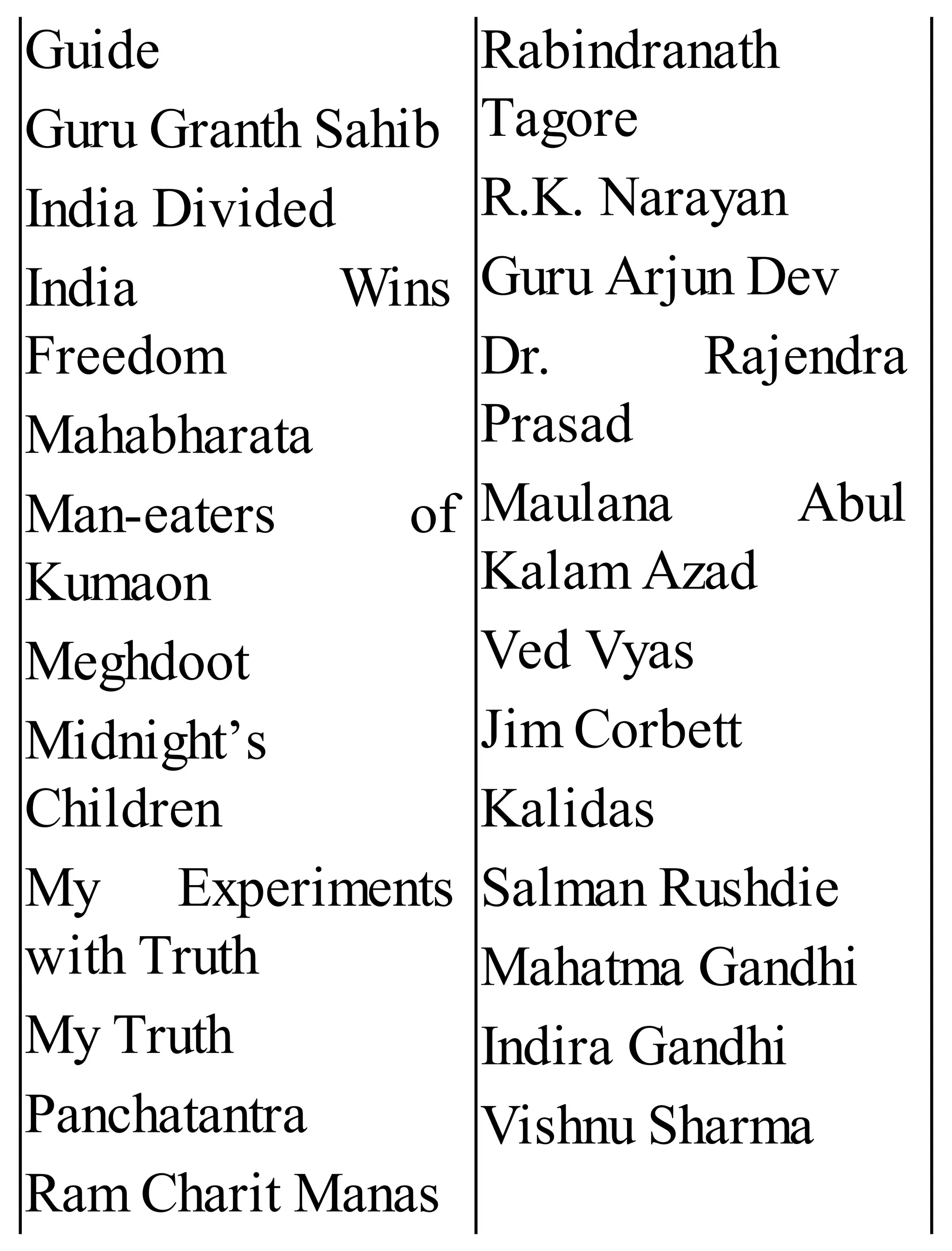
  • 404.
    67. Different Subjects Anthropology —the study of the human beings, especially their origins, developments, customs and beliefs. Archaeology — the study of ancient
  • 405.
    cultures, people andperiods of history by scientific analysis of their material remains. Astrology — the study of the positions and movements of the stars and planets in the belief that they influence human affairs. Cartography — the art of drawing maps and charts. Chronology — the art of arranging dates of historical events in the order in which they occurred. Demography — the study of the population, especially with reference to its size, distribution, rate of birth, death, diseases, etc. Economics — the study of the principles
  • 406.
    of production anddistribution of goods, the creation of wealth, and national income. Geography — the study of the earth’s surface, its physical features, divisions, climate, products, population, etc. Lexicography — the art of writing and editing dictionaries. Numismatics — the study and collection of cions and medals. Philately — the study and collection of postage stamps. Philology — the study of the historical development of languages or a particular language. Phonetics — the study of speech sounds, their pronunciation and their
  • 407.
    production. Telepathy — theart of communication of thoughts or feelings from one mind to another without the normal use of the senses. Theology — the study of the nature of God and of the foundations of religious belief. Believe It or Not: • It is impossible to sneeze and keep your eyes open at the same time. • The tsunami waves move at over 700 km/h and can be up to 30 m high.
  • 408.
    • The Moonis moving slowly away from the Earth at the rate of an inch per year.
  • 409.
    68. Professionals Astrologer — aperson who predicts future from the study of the positions of the stars and the movements of the planets.
  • 410.
    Blacksmith — aperson who makes and repairs things made of iron. Broker — a person who acts as a middleman in bargains. Butcher — a person who sells meat or kills animals for this. Cartographer — a person who draws maps and charts. Choreographer — a person who arranges the steps and movements in dances. Confectioner — a person who makes and sells sweets, cakes, pastries, etc. Draper — a person who sells clothes. Florist — a person who sells flowers. Goldsmith — a person who makes
  • 411.
    articles of gold. Grocer— a person who sells food in packets and general small household goods. Jockey — a person who rides in horse races. Lexicographer — a person who writes and edits dictionaries. Lyricist — a person who writes the words of songs. Mason — a person who builds stone houses. Optician — a person who makes and sells spectacles, contact lenses and other optical goods. Plumber — a person who fits or repairs
  • 412.
    pipes and taps. Porter— a person who carries people’s luggage and other loads. Publisher — a person who publishes books, newspapers, magazines, etc. Retailer — a shopkeeper who sells goods in small quantities to the general public. Sculptor — a person who makes figures or objects by carving wood or stones, shaping clay, etc. Surgeon — a doctor who performs medical operations. Tanner — a person who makes animal skin into leather by treating it with chemicals.
  • 413.
    Teller — acashier who pays out money especially in a bank. Undertaker — a person who arranges funerals. Veterinarian — a doctor who treats animal diseases and injuries. Vintner — a person who sells wines.
  • 414.
    69. Important Terms Affidavit —a written statement made on oath before an authority, that can be used as evidence in court. Ambassador — a person who lives in a
  • 415.
    foreign country andrepresents there his or her own country. Atheist — a person who does not believe in the existence of God. Auction — a public event at which things are sold to the person who offers the most money for them. Ballot — a system of secret voting. Bankrupt — a person who is unable to pay his or her debts, whose property is then taken by the court and used to repay those debts. Bibliophile — a person who loves and collects books. Brain Drain — the loss of a country when skilled and intelligent people leave it to go and live in other countries
  • 416.
    for better opportunities. Calligraphy— an art of beautiful handwriting. Capital punishment — a punishment of death. Catalogue — a complete list of items, e.g. books, etc. Census — the official counting of a country’s population. Coalition — a temporary union of separate political parties, usually in order to form a government. Copyright — an exclusive legal right, held for certain years, to print, publish, sell, broadcast, film or record an original work or any part of it.
  • 417.
    Curfew — anofficial order for the civilians to stay indoors for a specific period. Epicure — a person fond of food and drink of high quality. Extravagant — a person who spends money unnecessarily. Fourth State — a term that is applied to the press, e.g. newspapers, journalists, etc. Honorary — a post or a person which is not paid or a degree given as an honour, without the usual qualification being required. Ledger — a book in which a bank, business firm, etc. records its accounts.
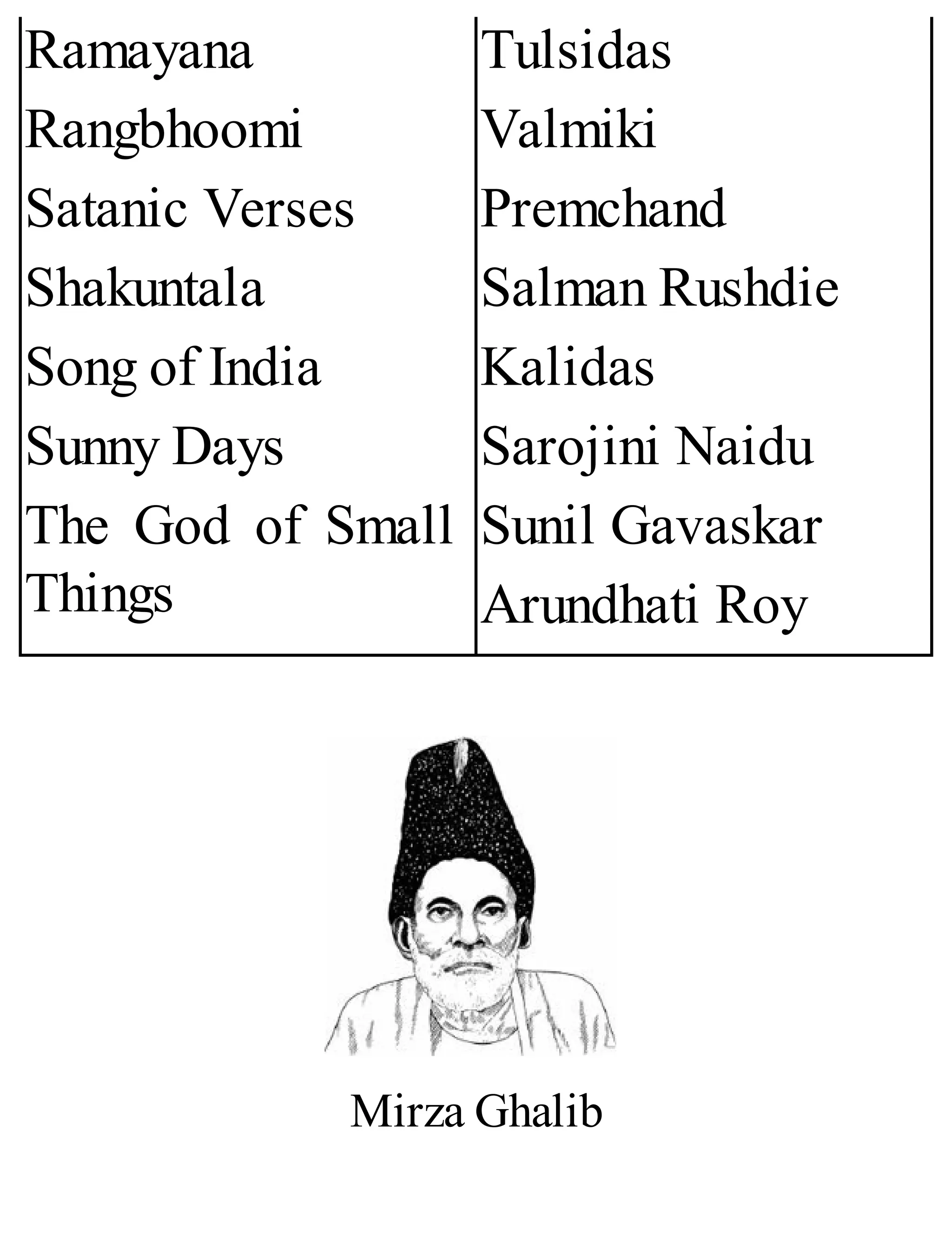
  • 418.
    Licence — awritten permission from the government to carry out a trade or use something. Lullaby — a soft gentle song sung to make a child go to sleep. Manifesto — declaration of principles and policies by a political party on the eve of a general election. Manuscript — a paper or a document, especially an author’s work when it is written by hand or typed. Massacre — the killing of a large number of human beings. Migration — moving from one place to another to live or to work. Monarchy — a system of government
  • 419.
    where the kingor the queen is the head. Obituary — notification of a person’s death, especially in a newspaper, often with a short account of his or her life and achievements. Optimist — a person who is always hopeful and looks only on the bright side of a thing. Orphan — a child whose parents are dead. Paparazzi — journalists or photographers who follow famous people around in order to get interesting stories and photographs. Passbook — a book provided by the bank which contains the record of a customer’s account.
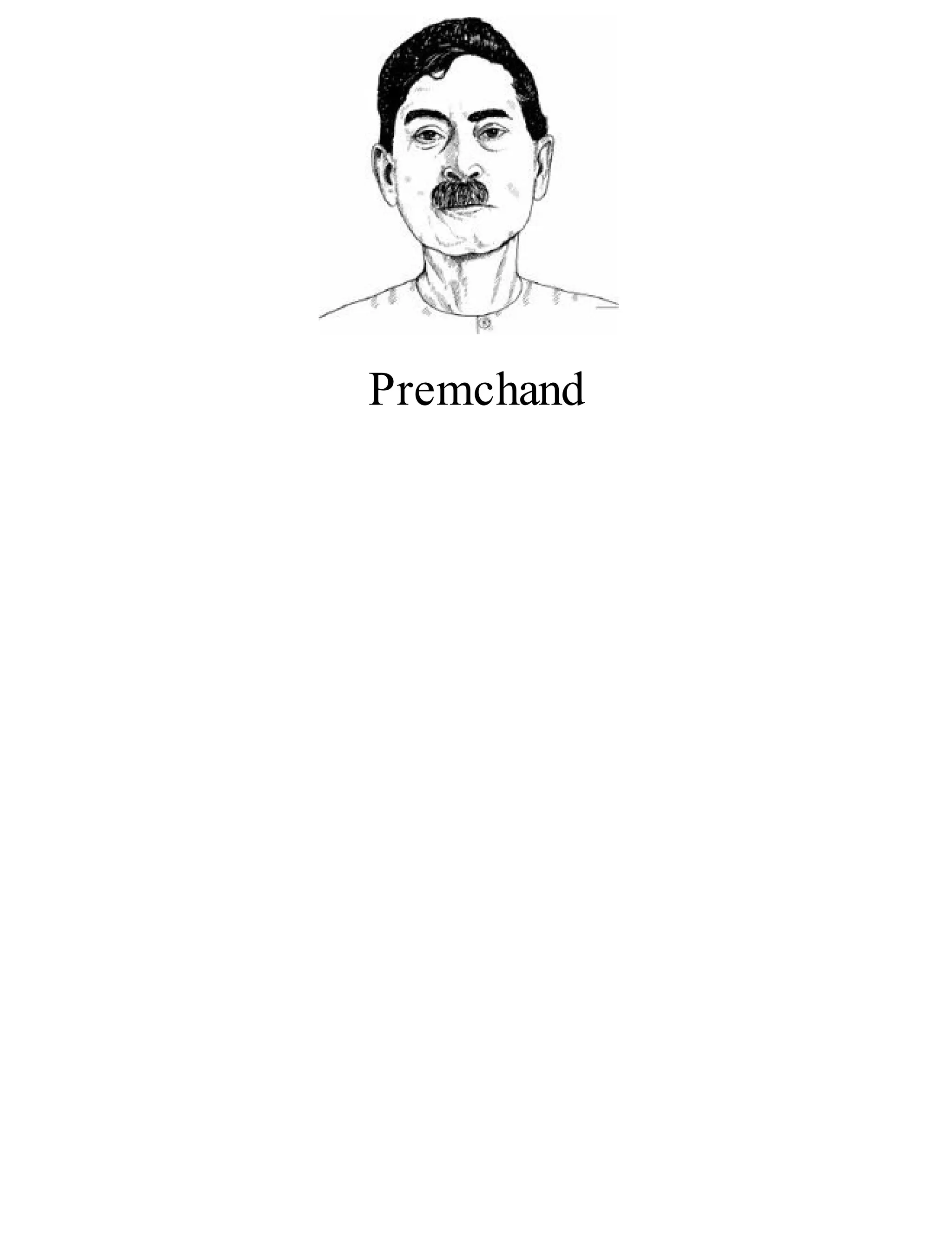
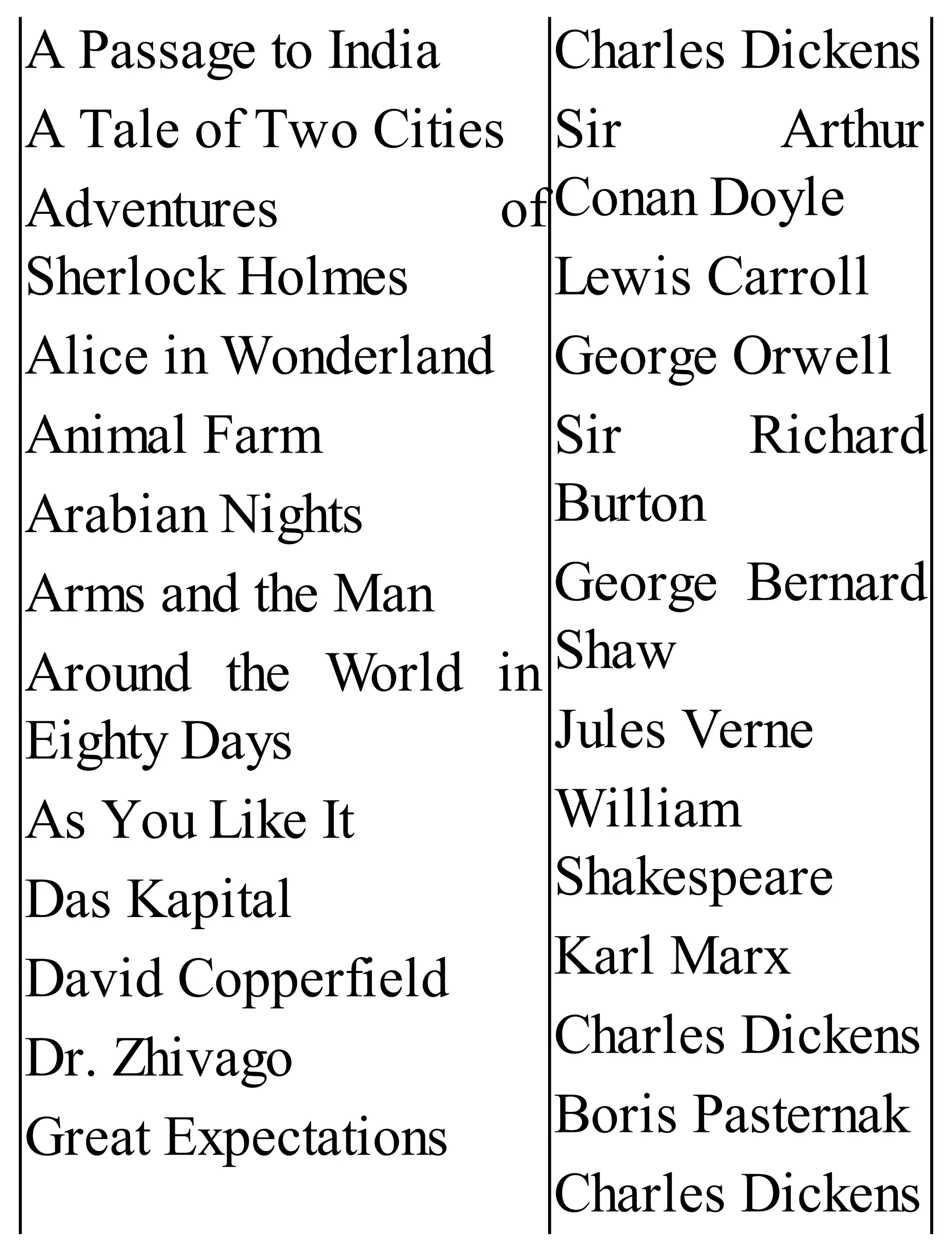
  • 420.
    Patent — anofficial document giving the holder the sole right to make, use or sell an invention and preventing others from copying it. Pessimist — a person who is always disappointed and looks only on the dark side of a thing. Piracy — illegal copying of books, cassettes, CDs, etc. Post-mortem — a medical examination of a person’s body made after his or her death in order to find the cause of death. Prospectus — a printed document or a thin book that gives details about a course, school, college, business, etc. Quack — a person who dishonestly claims to have special knowledge and
  • 421.
    skill, especially inmedicine. Refugee — a person who has been forced to leave his or her country for political or religious reasons and takes shelter in a foreign country. Republic — a system of government in which there is an elected president, but no king or queen. Royalty — the percentage to which a writer, illustrator or musician is entitled on the sale of a book, painting, or a musical composition. Sovereign — a fully independent nation or state with complete freedom to govern itself. Summons — an order to a person to appear in a law court at a specific time.
  • 422.
    Theist — aperson who believes in the existence of God. Universal — a law, theory, etc. which is applicable to all or same anywhere. Veteran — a person who has a long experience in any profession. Volunteer — a person who does something or offers service, of his or her own will. Warrant — a written order from a court, giving the police authority to arrest someone or to search a place. White Elephant — a possession or a thing that is useless and often expensive to maintain. Will — a legal document in which a
  • 423.
    person states howhe or she wants his or her property and money to be disposed of after his or her death. Calligraphy
  • 424.
    70. World Records held byIndia(ns) • Lata Mangeshkar has the world record for maximum number of song
  • 425.
    recordings to hercredit. • Santosh Yadav is the only woman in the world to have climbed Mount Everest twice. • Captain Durba Banerjee is the only woman pilot in the world with most flying hours (18,500 flying hours between 1959–88). • Dr. M.C. Modi has the world record for performing the most eye operations to his credit. He has performed about 5,95,000 eye operations between 1943 and 1997. • Gul Muhammad (1957–97), a resident of Ballimaran, Delhi, was the shortest man in the world. He was 22.5 inches (57.2 cm) tall and
  • 426.
    weighed 17 kg. •Zero was first used in India. Brahmagupta (598–660 AD) was the first mathematician to treat zero as a number. • There are about 325 languages and dialects being used in India, much more than any other country. • Tamil is the oldest of all Indian languages and also the oldest living language in the world. • The Constitution of India is the longest in the world. It has 395 Articles and 12 Schedules. • India tops the world in film production. More than 800 films a year are made in India.
  • 427.
    • India leadsthe world in cattle population. There are over 80 million draught animals in India. • India has the largest postal network in the world. It has 1,53,454 post offices of which 89% are in the rural areas. • The State Bank of India has the maximum number of branches. It has over 9,000 branches with 51 foreign offices in 31 countries. • The Hero Cycles Ltd. is the largest manufacturer of bicycles in the world. The company was started with a capacity of 25 bicycles per day and today it has a production capacity of 19,500 bicycles per day
  • 428.
    at two units. •Mawsynram in Meghalaya, with an average annual rainfall of 467 inches, is the wettest place in the world, closely followed by Cherrapunjee with 450 inches of rainfall per year. • Shankar’s International Dolls Museum in New Delhi has the largest collection of costume dolls in the world. It has over 6,000 dolls from 80 countries and all of them are dressed in the traditional costumes of their countries. • India is the largest producer of milk in the world. Its annual production of milk is over 70 million tonnes.
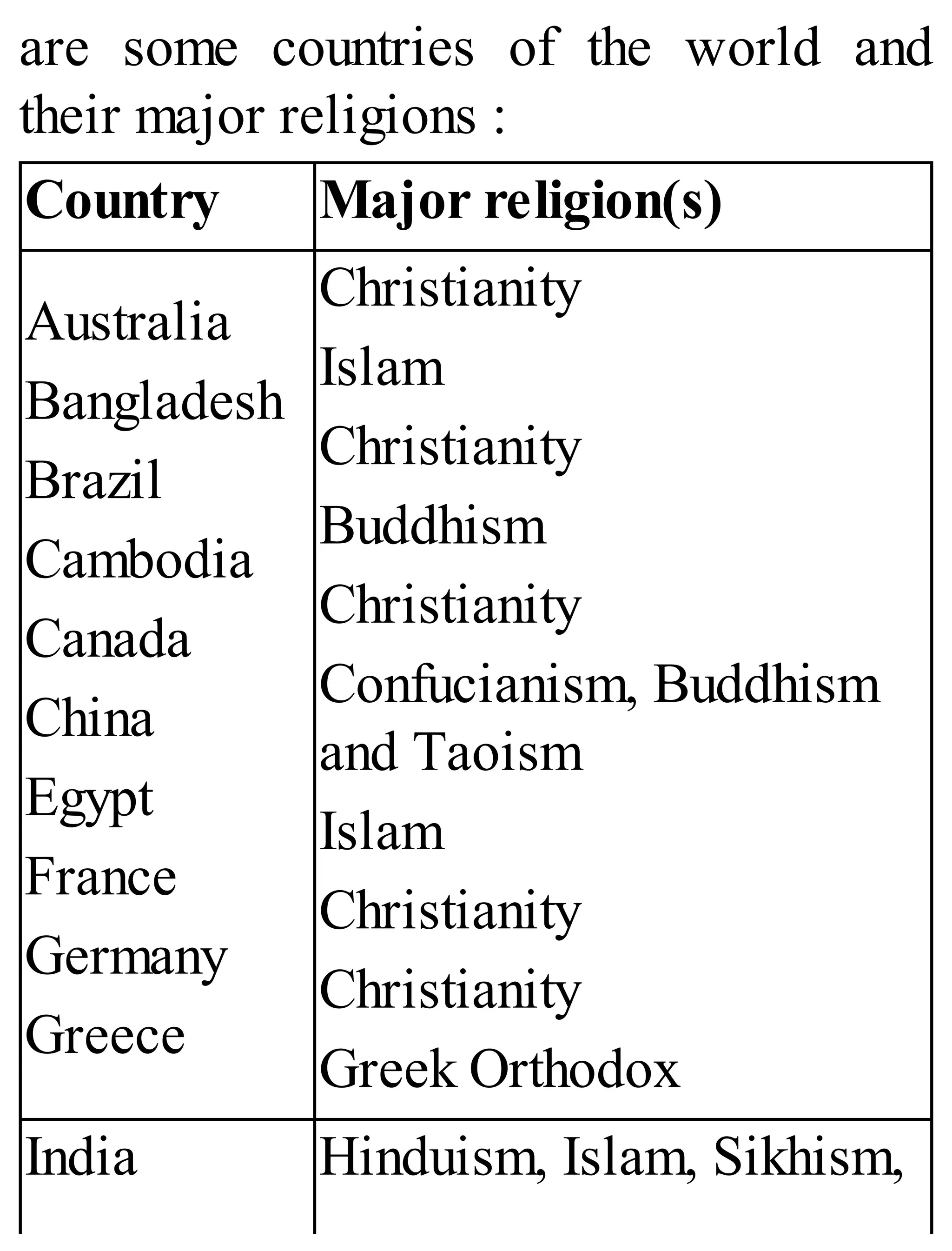
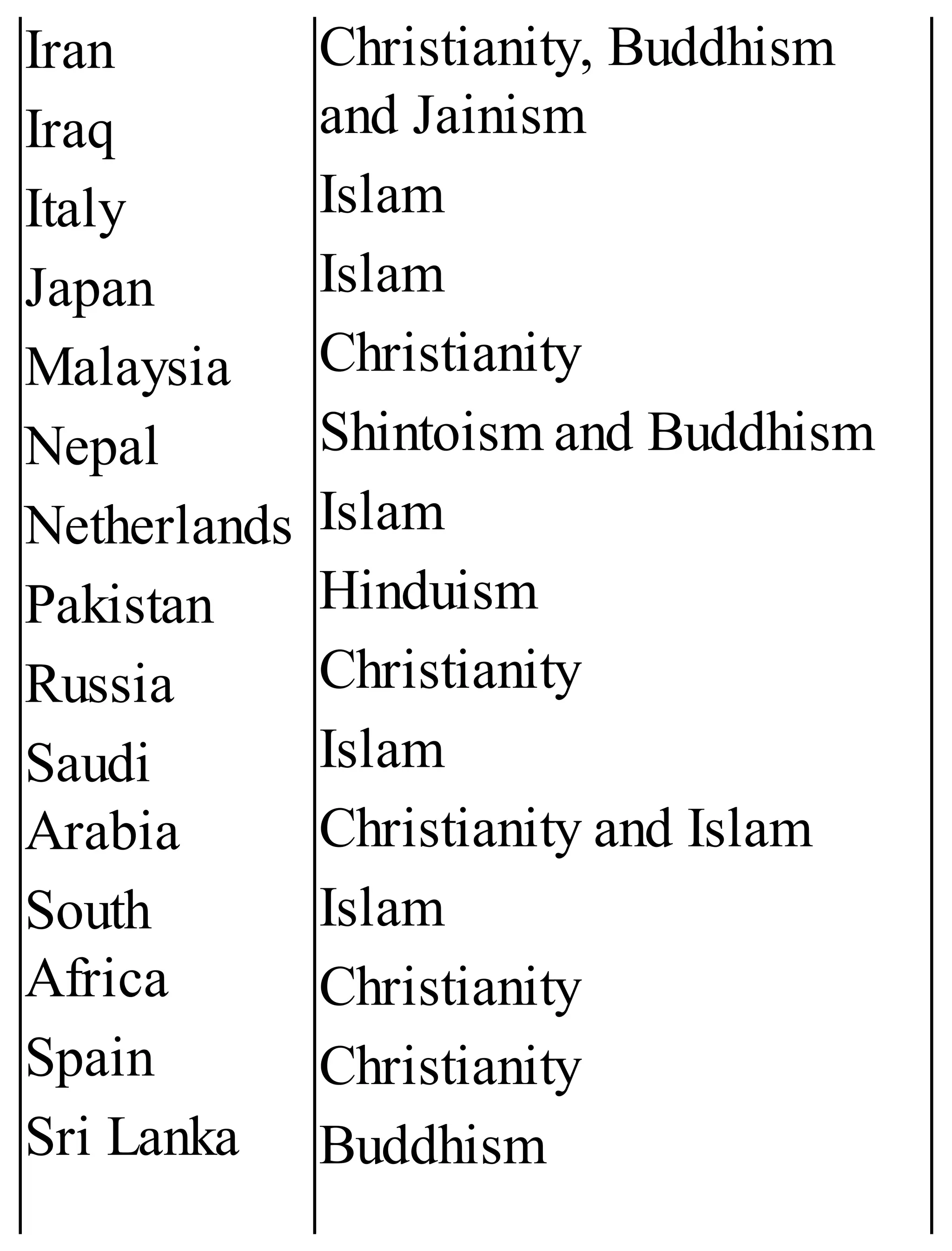
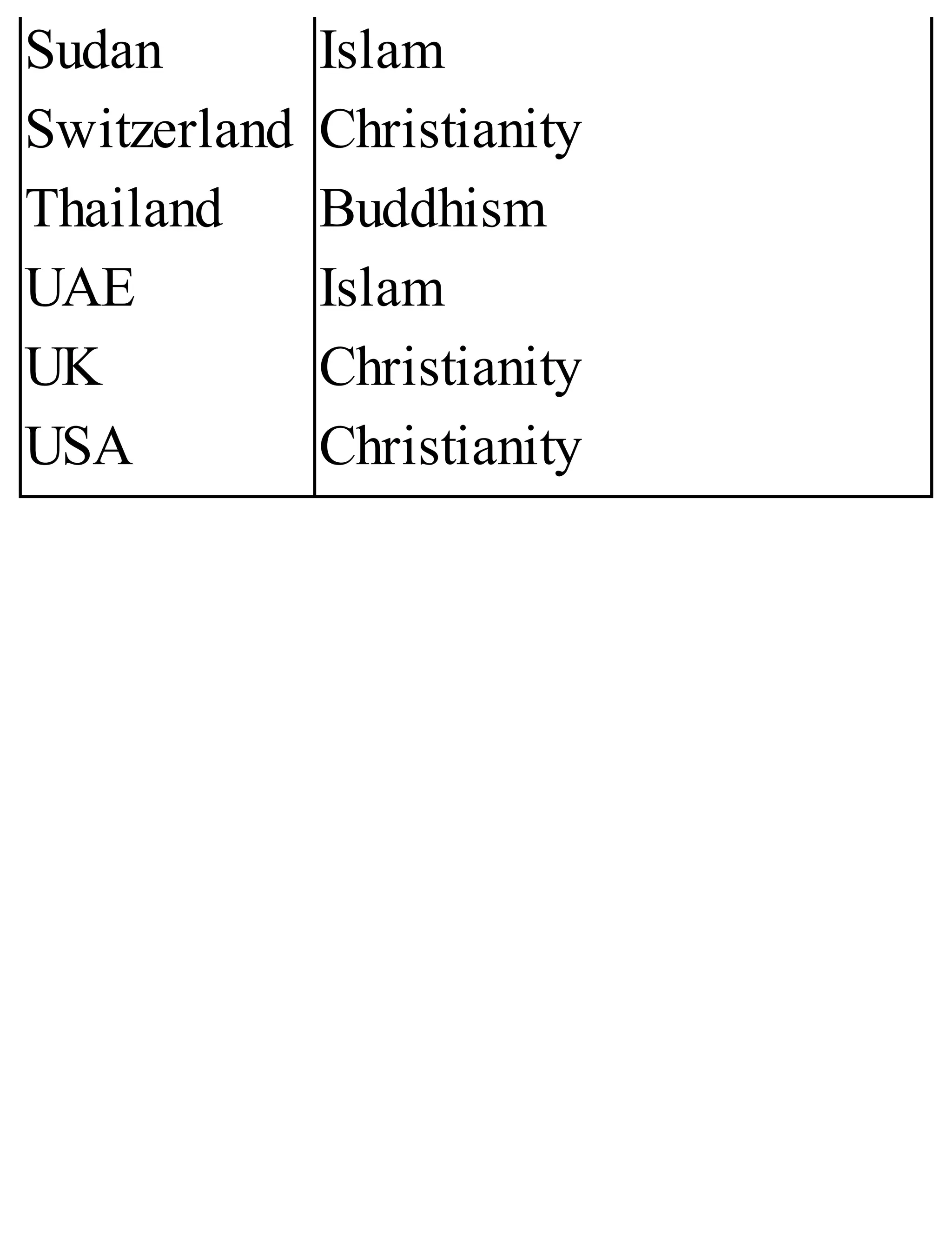
  • 429.
    • India isthe largest producer of tea in the world. 30% of the world’s output is produced in India. • India leads the world in mango production. Its annual production of 10 million metric tonnes accounts for 65% of the world production. • India’s annual spice production of 2.5 million tonnes accounts for about 33% of the world production. • The 833 m long Kharagpur Railway Platform in West Bengal is the longest railway platform in the world. • The Sunderbans (Ganga-Brahmputra) Delta in West Bengal and Bangladesh is the largest delta in the
  • 430.
    world. It coversan area of 75,000 sq. km. • The Siachen Glacier on the Indo-Pak border is the world’s longest glacier. It is 75.6 km long and 2.8 km broad. It is also the highest battle ground in the world. • The 1,220 m long corridor of the Ramanathaswamy Temple at Rameshwaram, Tamil Nadu is the longest corridor in the world. It has 983 richly carved pillars. • The Khardungla Road in Leh-Manali sector at a height of 5,682 m is the highest motorable road in the world. • The Leh Airport in Ladakh at a height of 3,256 m is the highest non-
  • 431.
    military airport inthe world. • The ‘Samrat Yantra’, built by Sawai Jai Singh II at Jaipur in 1728, is the biggest sundial in the world. It is 27.4 m tall. Lata Mangeshkar
  • 432.
    71. Newspapers and Periodicals Here aresome important facts about Indian newspapers and periodicals:
  • 433.
    First Newspaper ofIndia Bengal Gazette, published from Kolkata in 1780. It was a weekly brought out on Saturdays by James Augustus Hickey. Oldest Existing Newspaper Mumbai Samachar, started in 1822. This Gujarati daily, published from Mumbai is the oldest daily of Asia. Oldest existing English Daily The Times of India, started in 1838 from Mumbai. Oldest Magazine
  • 434.
    Calcutta Review inEnglish since 1844. Number of Daily Newspapers More than 5,000 daily newspapers are published in India in about 100 languages and dialects. Most Newspapers in a Language The highest number of newspapers are published in Hindi (about 2,200 dailies). Most Newspapers from a State Uttar Pradesh, with 8,400 newspapers including 810 dailies. Largest Selling Daily
  • 435.
    The Times ofIndia, having twelve editions in English. It has a circulation of 21,52,000. Largest Selling Periodical Saras Salil, a Hindi fortnightly, published from New Delhi. It has a circulation of 11,01,600 copies. Most Editions of a Daily The Indian Express, published from 18 centres. First Financial Daily The Economic Times, launched by the Times Group in 1961.
  • 436.
    Longest Running Cartoon R.K.Laxman’s cartoon ‘You Said It’ featuring the common man has been appearing regularly in The Times of India since 1951. Oldest Existing Children’s Magazine Chandamama, started in July 1947 from Chennai by B. Vishwanath Reddy. It is now published in 12 languages. Only Children’s Magazine in Braille Chandamama started a special version in Braille in 1981. It is currently a quarterly, combining three issues of
  • 437.
    ordinary Chandamama whichis a monthly. News Ngencies Press Trust of India (PTI), started in 1947; United News of India (UNI), started in 1961.
  • 438.
    72. The Top 5 LargestContinents Continent Approx. area (sq. km)
  • 439.
    1. Asia 2. Africa 3.North America 4. South America 5. Antarctica 4,44,93,000 3,02,93,000 2,44,54,000 1,78,38,000 1,42,00,000 Largest Oceans Ocean Approx. area (sq. km) 1. Pacific Ocean 2. Atlantic Ocean 3. Indian Ocean 16,62,40,000 8,22,17,000 7,34,26,000
  • 440.
    4. Southern Ocean 5. ArcticOcean 2,03,27,000 1,39,86,000 Largest Countries Country Area (sq. km) 1. Russia 2. Canada 3. China 4. USA 5. Brazil 1,70,75,400 99,70,537 95,96,961 93,72,614 85,11,965 Largest Seas Sea Approx. area (sq. km)
  • 441.
    1. Coral Sea 2.Arabian Sea 3. South China Sea 4. Caribbean Sea 5. Mediterranean Sea 47,91,000 38,64,000 36,86,000 27,53,000 25,15,000 Smallest Countries Country Area (sq. km) 1. Vatican City 2. Monaco 3. Nauru 4. Tuvalu 5. San Marino 0.44 1.95 21.23 26.00 61.00
  • 442.
    Largest Planets Planet Max.diameter (km) 1. Jupiter 2. Saturn 3. Uranus 4. Neptune 5. Earth 1,42,800 1,20,000 51,000 49,500 12,756 Countries with the Highest Population
  • 443.
    Country Estimated population (2009) 1.China 2. India 3. USA 4. Indonesia 5. Brazil 1,33,00,44,000 1,14,79,95,000 30,38,24,000 23,75,12,000 19,19,08,000 Organized Religions Religion Followers 1. Christianity 2. Islam 3. Hinduism 2,13,00,00,000 1,51,00,00,000 90,70,00,000
  • 444.
    4. Buddhism 5. Judaism 38,75,00,000 2,13,50,000 HighestMountains Mountain Location Height (m) 1. Everest 2. K 2 (Godwin- Austen) 3. Kanchenjunga 4. Lhotse 5. Makalu Nepal- Tibet Kashmir- China Nepal- Sikkim Nepal- Tibet Nepal- Tibet 8,850 8,611 8,598 8,501 8,470
  • 445.
    Largest Human Organs OrganAverage weight (g) 1. Liver 1,560 2. Brain male 1,410 female 1,265 3. Lungs right 580 left 510
  • 446.
    total 1,090 4. Heartmale 315 female 265 5. Kidney left 150 right 140 total 290 Largest Deserts Desert Location Approx. area (sq. km) 1. Sahara 2. Arabian 3. Gobi 4. North Africa Southwest Asia Mongolia- 90,00,000 23,30,000 12,95,000
  • 447.
    Patagonian 5. Great Basin China Argentina Southwest USA 6,73,000 4,92,000 Longest Rivers River Length (km) 1.Nile (Tanzania, Uganda, Sudan, Egypt) 2. Amazon (Brazil) 3. Yangtze Kiang (China) 4. Mississippi-Missouri-Red Rock (USA) 5. Yenisey-Angara-Selenga 6,670 6,450 6,300 5,970 5,540
  • 448.
    (Russia) Largest Lakes Lake Location Approx. area(sq. km) 1. Caspian Sea 2. Superior 3. Victoria 4. Aral Sea 5. Huron Iran-Rep. of former USSR USA-Canada Kenya- Tanzania- Uganda Kazakhstan USA-Canada 3,71,000 82,350 69,500 65,500 59,600
  • 449.
    Highest Waterfalls Waterfall RiverLocation Drop (m) 1. Angel 2. Tugela 3. Utigard 4. Mongefossen 5. Yosemite Caroni Tugela Jostedal Glacier Monge Yosemite Creek Venezuela South Africa Norway Norway USA 980 948 800 774 739 Most Widely Spoken Languages Language No. of speakers 1. Mandarin Chinese 1,00,00,00,000
  • 450.
    2. English 3. Hindi 4.Spanish 5. Russian 52,00,00,000 45,00,00,000 35,00,00,000 30,00,00,000 Highest Mountains Mountain Location Height (m) 1. Everest 2. K 2 (Godwin- Austen) 3. Kanchenjunga 4. Lhotse 5. Makalu Nepal- Tibet Kashmir- China Nepal- Sikkim Nepal- Tibet 8,850 8,611 8,598 8,501 8,470
  • 451.
    Nepal- Tibet Largest Islands Island Location Approx.area (sq. km) 1. Greenland 2. New Guinea 3. Borneo 4. Madagascar 5. Baffin Arctic Ocean West Pacific Ocean Indian Ocean Indian Ocean Arctic 21,75,600 7,89,900 7,51,000 5,87,040 5,07,450
  • 452.
    Ocean Deadliest Snakes Species NativeRegion 1. Taipan 2. Black Mamba 3. Tiger Snake 4. Common Krait 5. Death Adder Australia & New Guinea Southern & Central Africa Australia South Asia Australia
  • 453.
    Tallest Habitable Buildings BuildingLocation Storeys Height(m) 1. Burj Dubai 2. Taipei 101 3. Shanghai World Financial Dubai (UAE) Taipei (Taiwan) 162 101 818 509
  • 454.
    Centre 4. Petronas Twin Towers 5. Wills Tower (Sears) Shanghai Kuala Lumpur Chicago 101 88 110 492 452 442 Commonest Phobias Objectof Phobia Medical Term 1. Spiders 2. People & social situations 3. Flying 4. Heights Arachnophobia Anthrophobia or Sociophobia Aerophobia Acrophobia or
  • 455.
    5. Confined spaces Altophobia Claustrophobia Longest Bridges BridgeCountry Length (m) 1. Akashi Kaikyo (1998) 2. Store Baelt (1998) 3. Humber (1981) 4. Jiangyin (1998) 5. Tsing Ma (1997) Japan Denmark UK China China 1,991 1,624 1,410 1,385 1,377
  • 456.
    73. Miscellaneous UNION TERRITORIES OFINDIA Name Capital Area (sq. km) Populati
  • 457.
    1. Andaman & Nicobar Islands Port Blair8,249 3,56,1 2. Chandigarh Chandigarh 114 9,00,6 3. Dadra & Nagar Haveli Silvassa 491 2,20,4 4. Daman & Diu Daman 112 1,58,2 5. Delhi New Delhi 1,483 1,38,50,5 6. Lakshadeep Kavaratti 32 60,6 7. Puducherry Puducherry 492 9,74,3
  • 458.
    COMMISSIONED RANKS IN INDIANFORCE The following are the commissioned ranks in the three services, beginning with the highest rank and going down the order; each rank is shown opposite its equivalent in the other service: Army Navy Air Force General Admiral Air Chief Marshal Lieutenant General Vice Admiral Air Marshal Major General Rear Admiral Air Vice Marshal
  • 459.
    Brigadier Commodore Air Commodore ColonelCaptain Group Captain Lieutenant Colonel Commander Wing Commander Major Lieutenant Commander Squadron Leader Captain Lieutenant Flight Lieutenant Lieutenant Sub Lieutenant Flying Officer WORLD LEADERS ASSASSINATED Abraham President of the 1865
  • 460.
    Lincoln United Sates IndiraGandhi Prime Minister of India 1984 John F. Kennedy President of the United States 1963 Liyaqat Ali Khan First Prime Minister of Pakistan 1951 Mahatma Gandhi Father of the Nation, India 1948 Martin Luther King American Negro Leader 1968 Rajiv Gandhi Former Prime Minister of India 1991 Ranasingha President of Sri 1993
  • 461.
    Premdasa Lanka Sheikh Mujib-ur- Rehman President of Bangladesh 1975 Zia-ur- Rehman Presidentof Bangladesh 1981 Benazir Bhutto Former Prime Minister of Pakistan 2007 UNITS OF MEASUREMENTS Name of unit Used to measure Ampere Electric current Calorie Quantity of heat Carat Purity of gold Celsius (Centigrade) Temperature
  • 462.
    Decibel Sound Diopter Powerof a lense Fahrenheit Temperature Joule Energy Kelvin Temperature Knot Speed of a ship Light Year Distance in space Newton Force Ream Sheets of paper Watt Electric power CONVERSION FACTORS Length 1 inch = 2.54 cm
  • 463.
    12 inch =1 foot 3 feet = 1 yard 1 mile = 1.6 km 1 nautical mile = 1.85 km Weight 1 ounce = 28.35 g 16 ounce = 1 pound 1 pound = 454 g 1 tonne = 1,000 kg Capacity 1 gallon (UK) = 4.55 litres
  • 464.
    74. Quiz 1. What isthe full form of ATM? 2. What does FIR stand for? 3. What is the full form of MBBS? 4. What does WWF stand for?
  • 465.
    5. Who wrote‘Ramayana’? 6. Who is the author of ‘A Suitable Boy’? 7. Who wrote ‘Arabian Nights’? 8. Who is the author of ‘Jungle Book’? 9. What colour in our National Flag signifies faith and prosperity? 10. How many lions are there in our National Emblem? 11. Which book is the source of our National Song? 12. Which is the third most widely spoken language in the world? 13. How many states and union territories are there in India? 14. Which is the largest Indian state?
  • 466.
    15. Which isthe most populous state in India? 16. Who was the first President of India? 17. Which Indian President occupied the office for the shortest term? 18. Who was the first President of India to be elected unopposed? 19. Who was the President of India when Prime Minister Indira Gandhi declared a state of emergency in 1975? 20. Who is known as ‘The Father of India’s Missile Programme’? 21. Who was the youngest Prime Minister of India? 22. Which Indian Prime Minister died in Russia?
  • 467.
    23. What isthe capital of Uttarakhand? 24. Which city is the capital of two Indian states? 25. Which language is spoken in Kerala? 26. Telugu is the principal language of which Indian state? 27. What is the famous classical dance form of Kerala? 28. Which Indian state would you associate with Garba? 29. Bihu is the famous dance form of which Indian state? 30. What is the capital of Australia? 31. What is the capital of Malaysia? 32. What is the currency of China? 33. What is the currency of Saudi
  • 468.
    Arabia? 34. What isthe single currency of the European Union? 35. What are the natives of Netherlands called? 36. What are the natives of Scotland called? 37. What is the official language of Brazil? 38. What is the official language of Iran? 39. What is the major religion in Thailand? 40. In which country is the religion Shintoism followed? 41. Which is the largest and the most populated continent?
  • 469.
    42. On whichcontinent is Brazil? 43. Which country has the longest international boundary with India? 44. On which continent is the South Pole? 45. How is Banaras better known today? 46. What was the old name of Japan? 47. How is Mesopotamia better known today? 48. Which city is called ‘The Gateway of India’? 49. Which country is known as ‘The Gift of the Nile’? 50. On the banks of which river Guwahati is situated? 51. Which capital city is situated on the
  • 470.
    banks of riverThames? 52. Which river flows through Baghdad? 53. What is Moradabad famous for? 54. What is Johannesburg famous for? 55. How many players are there in a team of basketball? 56. Which is considered the fastest team game in the world? 57. Which two countries share the world’s longest boundary? 58. What is the playground of wrestling called? 59. Which game is also known as ping- pong? 60. Which ball game is played in the largest ground?
  • 471.
    61. What isthe national game of Russia? 62. What is the national game of USA? 63. Which country invented ice hockey? 64. Where were the Olympic Games originated? 65. Who is said to be ‘The Father of Modern Olympics’? 66. How many rings are there in the Olympic flag? 67. What colour ring in the Olympic flag represents Asia? 68. How many days do the Summer Olympic Games last? 69. Which country has won the most Gold medals in the Olympic hockey? 70. Who won the Silver Medal for India
  • 472.
    in double trapshooting in Athens Olympics, 2004? 71. Which is the only country to have played in every World Cup Soccer Tournament? 72. Which country has won the most World Cup Soccer Tournaments? 73. Who is the highest goal-scorer in the history of the World Cup Soccer? 74. In which year did India win the World Cup in cricket? 75. Who was the captain of the Indian cricket team that won the World Cup in 1983? 76. Which game is Baichung Bhutia associated with?
  • 473.
    77. What wasthe original name of Muhammad Ali? 78. For what country did Zinedine Zidane play? 79. Who is the only woman tennis player to win the Wimbledon singles title nine times? 80. Which game the Irani Trophy is associated with? 81. Which game the Davis Cup is associated with? 82. Which is the oldest football tournament in India? 83. Which game the term knockout is associated with? 84. What is the colour of the highest belt
  • 474.
    in karate? 85. Whatcolour is the card that means the player is sent off the field in soccer? 86. What is the length of a cricket pitch? 87. What is the width of a football goal? 88. At what height are the baskets hung in basketball? 89. What is the duration of a normal hockey match? 90. Where is the Wankhede Stadium? 91. Which is the largest indoor stadium in India? 92. Which cricket stadium in India has the largest seating capacity? 93. Which game the Ambedkar Stadium is associated with?
  • 475.
    94. Which gamethe Maracana Municipal Stadium is associated with? 95. Which is the world’s biggest flower? 96. Who was the first Indian to win an Oscar? 97. Which was the first Indian talkie film? 98. Who were the first people to reach the top of Mount Everest? 99. Which country has TGVs? 100. The Great Barrier Reef lies off the coast of which country? 101. Who is popularly known as ‘The Nightingale of India’? 102. Who is popularly known as ‘The
  • 476.
    Black Pearl’? 103. Whatnationality was Florence Nightingale? 104. In which country was Albert Einstein born? 105. Which great 16th-century Italian artist and thinker designed a helicopter that was never built? 106. Who founded the Missionaries of Charity? 107. Who founded the Aligarh Muslim University? 108. Who gave the popular slogan ‘Jai Jawan, Jai Kisan’? 109. Who said ‘That’s one small step for man, one giant leap for mankind’?
  • 477.
    110. Which isthe fastest land animal? 111. Which is the smallest bird? 112. Which is the largest lizard? 113. Name one egg laying mammal. 114. Which mammal has the longest pregnancy period? 115. Which bird travels the longest distance during its migratory journey? 116. Which bird has the longest wings? 117. Where is the Kaziranga National Park? 118. Which National Park is famous for Asiatic lions? 119. Where is the Rock Garden in India? 120. Where is Science City in India? 121. Where is Grand Canyon?
  • 478.
    122. Name thebuilding which houses the US Defence Ministry in Washington, DC. 123. Which is the largest prison in India? 124. Which is the highest mountain peak in Indian territory? 125. Which is the tallest building in India? 126. Which place in India receives the maximum rainfall annually? 127. Which is the largest river in the world? 128. Which is the largest and deepest Ocean? 129. Which is the lowest point on the
  • 479.
    earth? 130. Which isthe highest waterfall in the world? 131. How many triangular sides does a pyramid have? 132. Where were the Hanging Gardens of Babylon built? 133. Where is the Salar Jung Museum? 134. Who first proposed the name ‘United Nations’? 135. How many countries are in the UN? 136. In what city is the UN headquarters? 137. On which date the Nobel Prizes are awarded annually? 138. Who invented the dynamite?
  • 480.
    139. Which Indianscientist won the Nobel Prize for Medicine in 1968? 140. For what discipline was Amartya Sen awarded the Nobel Prize in 1998? 141. Who was the first foreigner to receive Bharat Ratna? 142. Which is the highest sports award given to sportspersons in India? 143. Which is the highest gallantry award in India? 144. Who invented the helicopter? 145. Which invention is usually credited to Johannes Gutenburg? 146. Who propounded ‘The Theory of Evolution’? 147. Which scientist obtained the most
  • 481.
    patents from theUS patent office? 148. Which instrument is used for measuring the distance travelled by a vehicle? 149. What device is used by submarine crews to see above the water? 150. Which branch of science deals with the study of plants? 151. What is a scientist who studies the weather called? 152. Which is usually associated with fine weather : high pressure or low pressure? 153. Which is the largest planet in our Solar System? 154. Which planet is famous for the
  • 482.
    rings around it? 155.Which is the largest organ in our body? 156. What is the largest bone in our body? 157. How many bones are there in an adult’s skull? 158. Deficiency of which vitamin causes night blindness? 159. Which vitamin helps in blood clotting? 160. Which part of our body is affected by jaundice? 161. Which goddess is worshiped on the Diwali festival? 162. Name the festival of Kerala during
  • 483.
    which boat racesare held. 163. Where was Lord Buddha born? 164. Where was Jesus Christ born? 165. What is the meaning of Bhagavadgita? 166. What is the holy journey to Mecca made by the Muslims called? 167. To which religion do the sects Sunnis and Shias belong? 168. Who worship in a Fire Temple? 169. On which date do we celebrate Children’s Day? 170. Whose birthday is celebrated as Teachers’ Day in India? 171. In which year did India become a Republic?
  • 484.
    172. Which Indianastronaut died in the Columbia Space Shuttle explosion in 2003? 173. In which year did people first walk on the moon? 174. In which year did the atom bombs drop on Japan? 175. What large machine was used for the first time in World War I? 176. Who created the famous cartoon character Micky Mouse? 177. Who is the creator of the fictional character Mowgli? 178. What is a place where money is coined called? 179. What we call a room at a railway
  • 485.
    station that isused for keeping luggage? 180. What subject deals with the study and collection of postage stamps? 181. How fast do tsunami waves move? 182. What is a person who draws maps and charts called? 183. What is a doctor who treats animals called? 184. What is a person who loves and collects books called? 185. What is the illegal copying of books, CDs and cassettes called? 186. Which is the oldest living language in the world? 187. Which country has the largest postal network?
  • 486.
    188. Which isthe longest railway platform in the world? 189. Which is the world’s highest battle ground? 190. Which is the oldest existing English daily in India? 191. Which is the largest country? 192. Which is the second most populated country? 193. Which religion has the largest followers in the world? 194. Which is the fastest growing religion in the world? 195. How high is Mount Everest? 196. In which continent are the world’s highest mountains?
  • 487.
    197. Which isthe most widely spoken language in the world? 198. Which is the highest commissioned rank in Indian navy? 199. What is the unit of sound? 200. How many centimeters are there in one inch?
  • 488.
    75. Answers 1. Automated TellerMachine 2. First Information Report 3. Bachelor of Medicine and Bachelor of Surgery
  • 489.
    4. Worldwide Fundfor Nature 5. Valmiki 6. Vikram Seth 7. Sir Richard Burton 8. Rudyard Kipling 9. Green 10. Four 11. Anand Math 12. Hindi 13. 28 states & 7 union territories 14. Rajasthan 15. Uttar Pradesh 16. Dr. Rajendra Prasad 17. Dr. Zakir Husain (2 years) 18. Neelam Sanjiva Reddy
  • 490.
    19. Fakhruddin AliAhmad 20. Dr. A.P.J. Abdul Kalam 21. Rajiv Gandhi 22. Lal Bahadur Shastri 23. Dehradun 24. Chandigarh 25. Malayalam 26. Andhra Pradesh 27. Kathakali 28. Gujarat 29. Assam 30. Canberra 31. Kuala Lumpur 32. Yuan 33. Riyal
  • 491.
    34. Euro 35. Dutch 36.Scottish 37. Portuguese 38. Persian 39. Buddhism 40. Japan 41. Asia 42. South America 43. China 44. Antarctica 45. Varanasi 46. Nippon 47. Iraq 48. Mumbai
  • 492.
    49. Egypt 50. Brahmaputra 51.London 52. Tigris 53. Brassware 54. Gold mines 55. Five 56. Ice hockey 57. Canada and the USA 58. Arena 59. Table tennis 60. Polo 61. Chess 62. Baseball 63. Canada
  • 493.
    64. Greece 65. BaronPierre de Coubertine 66. Five 67. Yellow 68. 16 days 69. India (8 medals) 70. Major Rajyavardhan Singh Rathore 71. Brazil 72. Brazil (5 times) 73. Ronaldo (Brazil) 74. 1983 75. Kapil Dev 76. Football 77. Cassius Clay 78. France
  • 494.
    79. Martina Navratilova 80.Cricket 81. Tennis 82. Durand Cup 83. Boxing 84. Black 85. Red 86. 22 yards (66 feet) 87. 24 feet 88. 10 feet 89. 70 minutes 90. Mumbai 91. Indira Gandhi Indoor Stadium 92. Eden Gardens (Kolkata) 93. Football
  • 495.
    94. Football 95. Rafflesia 96.Bhanu Athaiya 97. Alam Ara 098. Sir Edmund Hillary and Tenzing Norgay 099. France 100. Australia 101. Sarojini Naidu 102. Pele 103. Italian 104. Germany 105. Leonardo da Vinci 106. Mother Teresa 107. Sir Syed Ahmad Khan
  • 496.
    108. Lal BahadurShastri 109. Neil Armstrong 110. Cheetah 111. Bee hummingbird 112. Komodo dragon 113. Platypus 114. Asian elephant 115. Arctic tern 116. Wandering albatross 117. Jorhat (Assam) 118. Gir National Park 119. Chandigarh 120. Kolkata 121. Arizona (USA) 122. Pentagon
  • 497.
    123. Tihar CentralJail 124. Nanga Parbat (Kashmir) 125. Shreepati Arcade (Mumbai) 126. Mawsynram (Meghalaya) 127. Amazon 128. Pacific 129. Dead Sea 130. Angel Falls 131. Four 132. Iraq 133. Hyderabad 134. Franklin D. Roosevelt (US President) 135. 191 136. New York City
  • 498.
    137. December 10 138.Alfred Bernhard Nobel 139. Dr. Har Gobind Khorana 140. Economics 141. Khan Abdul Gaffar Khan 142. Arjuna Award 143. Param Vir Chakra 144. Sikorsky 145. Printing Press 146. Charles Darwin 147. Thomas Alva Edison 148. Odometer 149. Periscope 150. Botany 151. Meteorologist
  • 499.
    152. High pressure 153.Jupiter 154. Saturn 155. Liver 156. Thigh bone (femur) 157. 22 158. Vitamin A 159. Vitamin K 160. Liver 161. Lakshmi 162. Onam 163. Lumbini (Nepal) 164. Bethlehem 165. Song of the Lord 166. Hajj
  • 500.
    167. Islam 168. Parsees 169.November 14 170. Dr. S. Radhakrishnan’s 171. 1950 172. Kalpana Chawla 173. 1969 174. 1945 175. Tank 176. Walt Disney 177. Rudyard Kipling 178. Mint 179. Cloakroom 180. Philately 181. At over 700 km/h
  • 501.
    182. Cartographer 183. Veterinarian 184.Bibliophile 185. Piracy 186. Tamil 187. India 188. Kharagpur 189. Siachen Glacier 190. The Times of India 191. Russia 192. India 193. Christianity 194. Islam 195. 8,850 m 196. Asia
  • 502.
    197. Mandarin Chinese 198.Admiral 199. Decibel 200. 2.54 cm
  • 503.
  • 504.
    national parks andsanctuaries records assassinations, world leaders awards Bharat Ratna national Nobel Prize Bharat Ratna body facts books India world bridges, longest buildings, tallest capitals
  • 505.
    countries Indian states Chandrashekhar, Dr.S. changed names of some places cities and industries commissioned ranks in indian force continents largest conversion factors countries capitals currencies languages largest natives
  • 506.
    population Religions smallest cricket, World Cup currencies dancesof india dates, historic india world days, important defence, ranks defining places deserts, largest discoveries, scientific diseases
  • 507.
    epithets, geographical facts animals human body India planets festivals fictionalcharacters and their creators first in India world founders, famous games national Olympic
  • 508.
    history, important events India world humanbody diseases facts organs, largest India industrial cities instruments, scientific inventions islands, largest Khorana, Dr. Har Gobind lakes, largest languages
  • 509.
    countries Indian states most widelyspoken largest, tallest..... animals India top 5 world measurements, sports media, print monuments India seven wonders world mountains, largest
  • 510.
    museums national parks andsanctuaries nationalities of famous personalities natives of different countries newspapers and periodicals nobel laureates, indian Nobel Prize Nobel, Alfred Bernhard oceans, largest old and new names Olympic games India’s achievements persons, famous assassinated founders
  • 511.
    nationalities slogans titles phobias, commonest places, definitions planets largest players,number of playgrounds, names of population presidents of india prime ministers of india professionals Raman, Sir C.V. records
  • 512.
  • 513.
    inventions planets seas, largest Sen, Dr.Amartya Seven Wonders sites, famous India world slogans snakes, deadliest Soccer, World Cup sports cups and trophies sports measurements sports stadiums India (places associated with sports)
  • 514.
    international (places associatedwith sports) sports cups and trophies measurements names of playgrounds national games number of players olympic games sportspersons stadiums, india stadium, international (places associated with sports) terms World Cup Cricket
  • 515.
    World Cup Soccer subjects,different superlatives India world symbols, national Tagore, Rabindranath Teresa, Mother terms, important titles geographical persons top 5 cups and trophies, sports union territories of india
  • 516.
    United Nations units ofmeasurements vitamins waterfalls, highest World Cup cricket soccer World Records held by India(ns)
  • 517.
    • Bestselling eBooks• • 1984 by George Orwell ISBN: 9789380914947 • A Lot like Love by Sumrit Shahi ISBN: 9789380914114 • Animal Farm by George Orwell ISBN: 9789380914701 • Gitanjali by Ranbindranath Tagore ISBN: 9789380914886 • How to Analyze People on Sight by Elsie Lincoln Benedict and Ralph Paine Benedict ISBN: 9789380914015
  • 518.
    • Love Happensonly Once by Rochak Bhatnagar ISBN: 9789380914183 • Mein Kampf (My Struggle) by Adolf Hitler ISBN: 9789380914855 • Muhammad: The Last Prophet of Islam by G.M. Draycott ISBN: 9788190276696 • My Experiments with Truth by M.K. Gandhi ISBN: 9789380914619 • One Life One Love by Rochak Bhatnagar ISBN: 9789380914350 • Polka Dots, Pony Tails and Purple Pouts by Amrita Anand
  • 519.
    ISBN: 9789380914305 • Relativityby Albert Einstein ISBN: 9789380914220 • Selected Stories of Rabindranath Tagore ISBN: 9789380914770 • Siddhartha by Hermann Hesse ISBN: 9789380914145 • The Art of War by Sun Tzu ISBN: 9789380914893 • The Autobiography of a Yogi by Parmahansa Yogananda ISBN: 9789380914602 • The Bhagavad Gita by Sir Edwin Arnold ISBN: 9789380914275
  • 520.
    • The Diaryof a Young Girl by Anne Frank ISBN: 9789380914312 • Thirty Year Old Virgin by Ankit Uttam ISBN: 9789380914206 • Uff Ye Emotions 2 by Vinit K. Bansal ISBN: 9789380914756