1992 INDIAN STOCK MARKET
SCAM
(PRESENTED BY NEHA KUSHWAH)
CONTENTS
OVERVIEW OF THE BOMBAY STOCK
EXCHANGE
KEY FIGURES INVOLVED
IMPACT OF THE SCAM
CONCLUSION AND LESSONS LEARNED
BACKGROUND AND CONTEXT
OVERVIEW OF THE BOMBAY STOCK EXCHANGE
EMERGENCE OF
STOCK MARKET
INDIA
KEY PLAYERS
AND THEIR
ROLES
ECONOMIC
CLIMATE OF
THE PERIOD
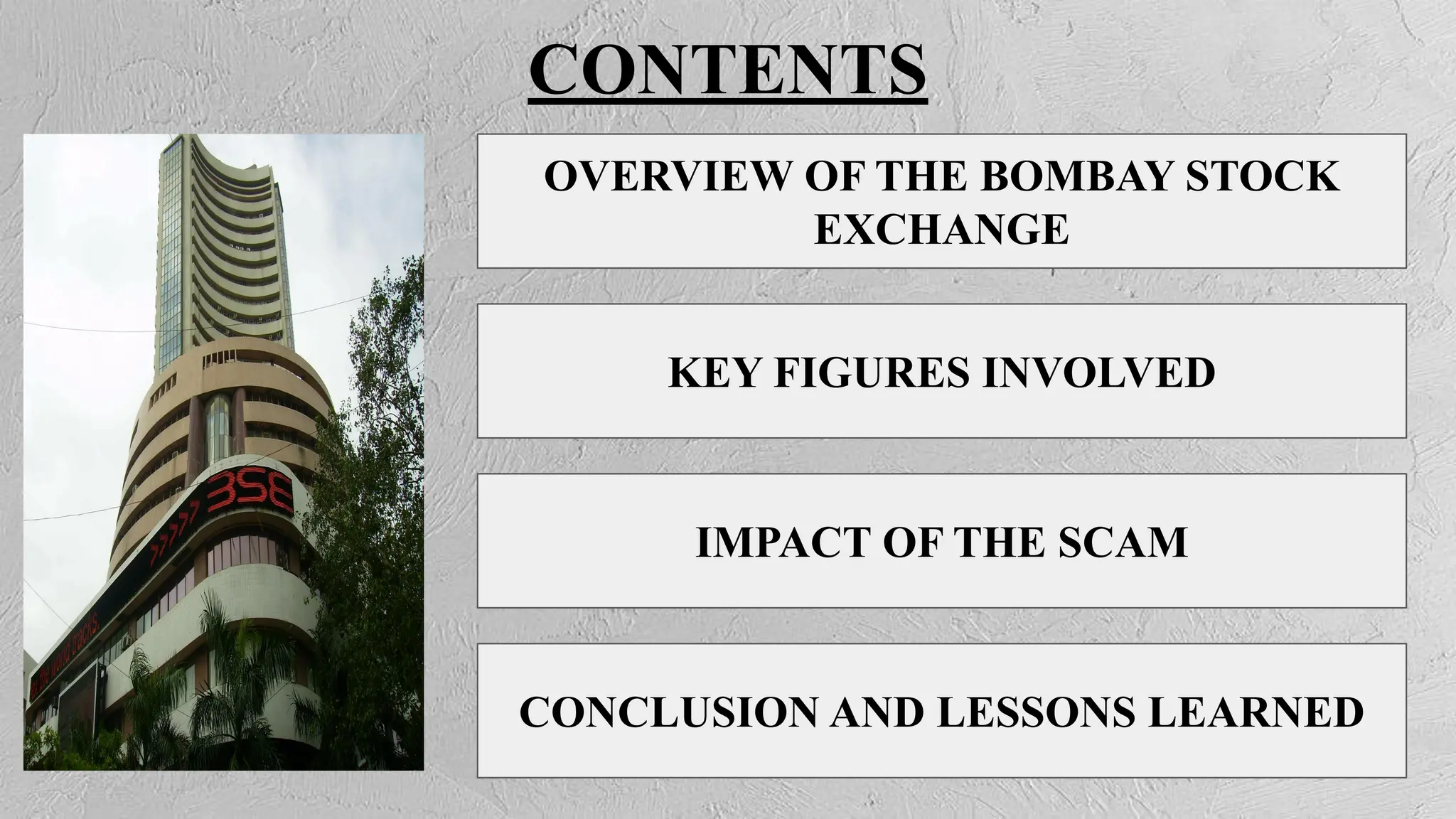
The Bombay Stock Exchange (BSE) emerged in 1875 as a platform
for trading securities in Mumbai, India. It became the largest and
oldest stock exchange, facilitating financial growth and development.
Key players in BSE include brokers, investors, listed companies,
BSE itself, regulators (SEBI), market makers, and clearing
corporations, ensuring smooth and regulated market operations.
The economic climate during BSE's early years (late 1800s) was
characterized by British colonial influence, industrial growth, limited
trading, and emerging financial markets in India.
UNFOLDING OF THE SCAM
INITIAL SIGNS OF FRAUD: The 1992 securities scam, led by Harshad Mehta,
involved fraudulent activities where Mehta manipulated stock prices using illegal funds
and bank receipts
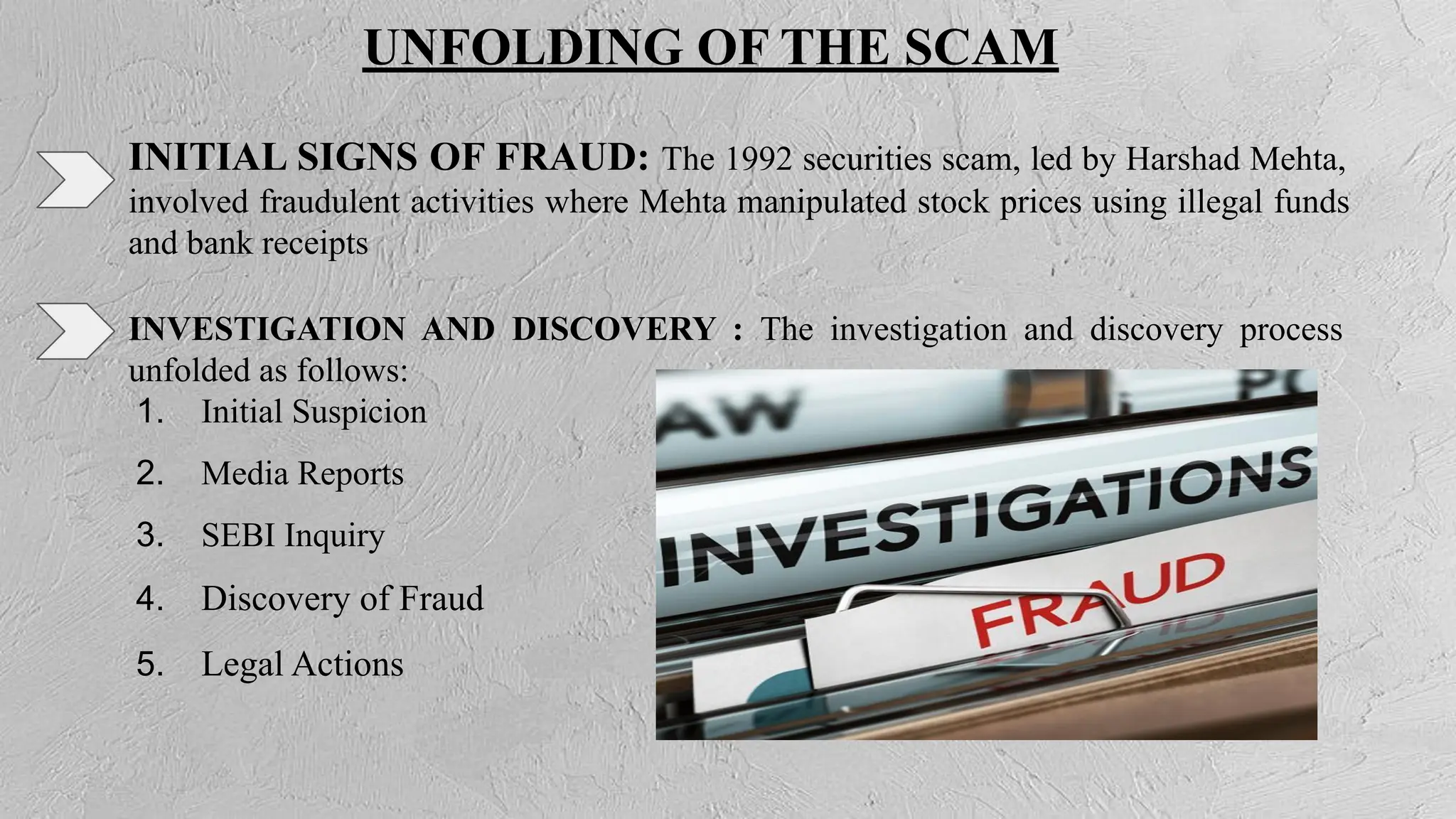
INVESTIGATION AND DISCOVERY : The investigation and discovery process
unfolded as follows:
1. Initial Suspicion
2. Media Reports
3. SEBI Inquiry
4. Discovery of Fraud
5. Legal Actions
REGULATORY RESPONSE :
SEBI's Immediate Response (1992)
Government Action
Reforms and Measures (Post-1992)
1.
2.
3.
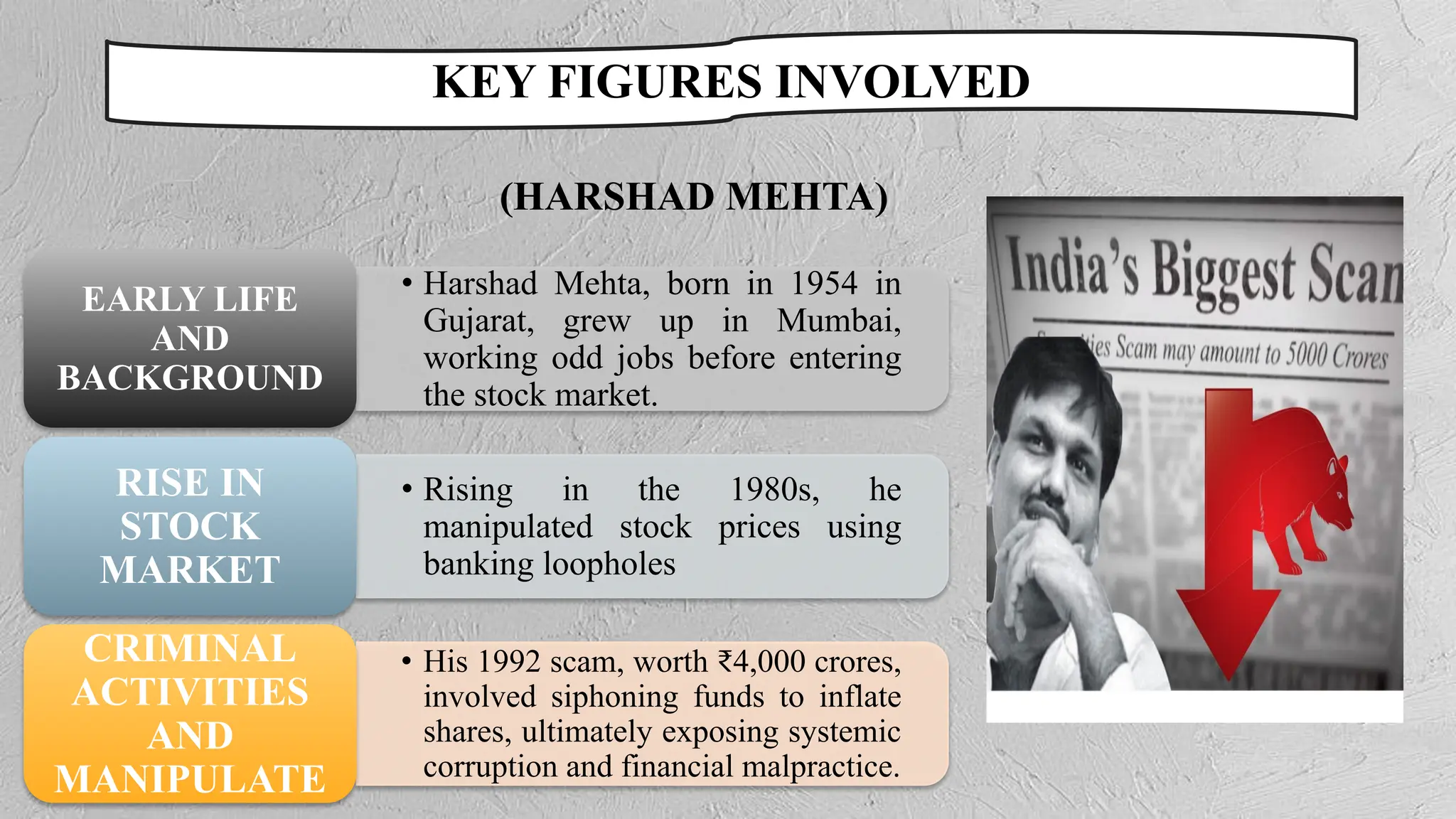
KEY FIGURES INVOLVED
• Harshad Mehta, born in 1954 in
Gujarat, grew up in Mumbai,
working odd jobs before entering
the stock market.
EARLY LIFE
AND
BACKGROUND
• Rising in the 1980s, he
manipulated stock prices using
banking loopholes
RISE IN
STOCK
MARKET
• His 1992 scam, worth ₹4,000 crores,
involved siphoning funds to inflate
shares, ultimately exposing systemic
corruption and financial malpractice.
CRIMINAL
ACTIVITIES
AND
MANIPULATE
(HARSHAD MEHTA)
(OTHER NOTEWORTHY PERSONALITIES)
● Hiten Dalal – A broker known for facilitating fraudulent transactions in
government securities.
● Bhupen Dalal – Another stockbroker involved in irregular trading activities.
● Amit Rathi – A broker linked to unethical stock market practices.
● Several Others – Many smaller brokers benefited from the scam by riding the
market wave created by Mehta
Colluding brokers
Government officials
● Some Officials from the Reserve Bank of India (RBI) – Although RBI
eventually investigated the scam, some lower-level officials failed to monitor
irregular transactions effectively.
● State Bank of India (SBI) and Other Banks’ Officials – Officials from SBI
and other banks issued fake Bank Receipts (BRs), which Mehta used to siphon
funds.
● Officials from UTI (Unit Trust of India) – UTI and other financial institutions
invested in stocks manipulated by Mehta.
● Finance Ministry Officials – Some officials were accused of negligence or
indirect involvement in allowing the scam to go unchecked.
Investigative journalists
Sucheta Dalal – A senior journalist at The Times of India, she broke the story
about Harshad Mehta’s fraudulent activities on April 23, 1992. Her investigative
work revealed how Mehta manipulated the stock market using fake bank receipts
and banking loopholes. She later co-authored the book "The Scam: Who Won, Who
Lost, Who Got Away" with Debashis Basu, detailing the entire case.
Debashis Basu – A financial journalist and co-author of The Scam, who helped
uncover the deep-rooted corruption in the stock market and banking system.
IMPACT OF THE SCAM
FINANCIAL CONSEQUENCES
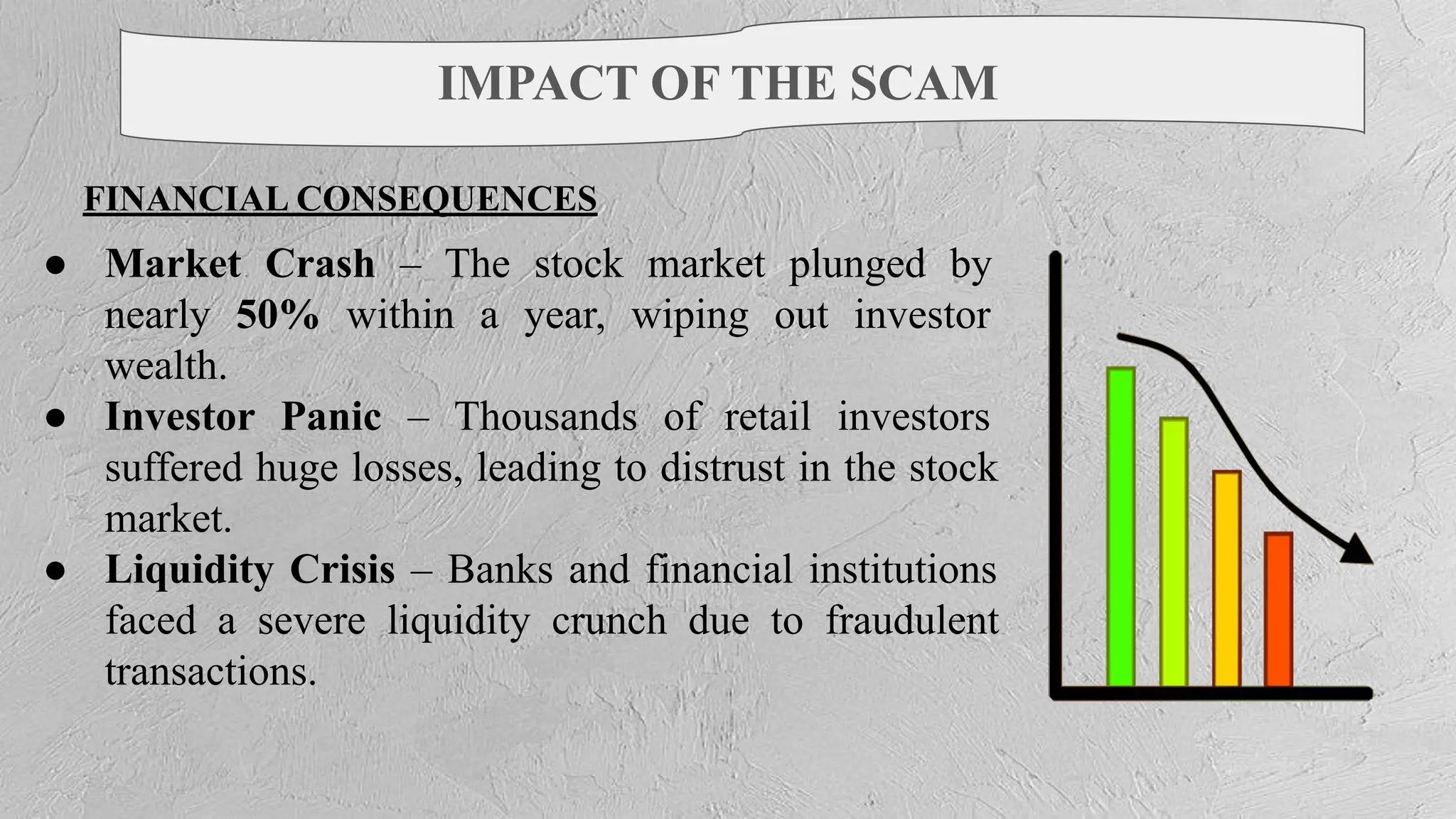
● Market Crash – The stock market plunged by
nearly 50% within a year, wiping out investor
wealth.
● Investor Panic – Thousands of retail investors
suffered huge losses, leading to distrust in the stock
market.
● Liquidity Crisis – Banks and financial institutions
faced a severe liquidity crunch due to fraudulent
transactions.
LEGALAND REGULATORY CHANGES
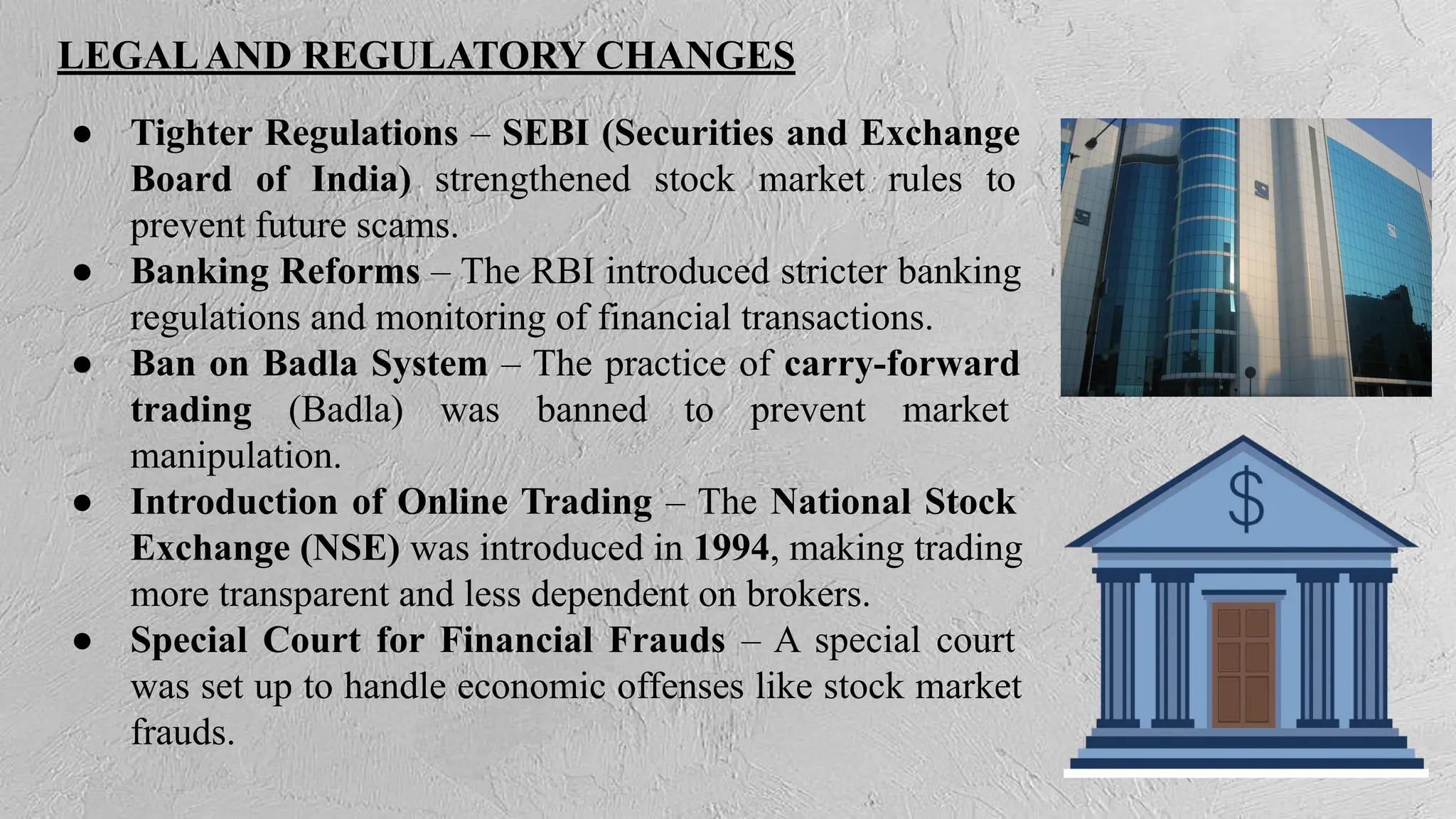
● Tighter Regulations – SEBI (Securities and Exchange
Board of India) strengthened stock market rules to
prevent future scams.
● Banking Reforms – The RBI introduced stricter banking
regulations and monitoring of financial transactions.
● Ban on Badla System – The practice of carry-forward
trading (Badla) was banned to prevent market
manipulation.
● Introduction of Online Trading – The National Stock
Exchange (NSE) was introduced in 1994, making trading
more transparent and less dependent on brokers.
● Special Court for Financial Frauds – A special court
was set up to handle economic offenses like stock market
frauds.
PUBLIC AND MEDIA RESPONSE
● Extensive Coverage – Newspapers like The Times of
India and The Economic Times exposed the fraud.
● TV Debates & Investigations – Channels discussed
financial loopholes and regulatory failures.
● Books & Documentaries – "The Scam: Who Won, Who
Lost, Who Got Away" by Sucheta Dalal & Debashis
Basu.
● Recent Depictions – Web series "Scam 1992" (2020)
renewed public interest.
● Harshad Mehta’s Infamy – Gained the title “The Big
Bull”, admired by some, hated by many.
CONCLUSION AND LESSONS LEARNED
SUMMARY OF EVENT
Key Developments:
● Stock Manipulation – Harshad Mehta used fake Bank Receipts (BRs)
to siphon bank funds and inflate stock prices.
● CBI & JPC Investigations – Central Bureau of Investigation (CBI)
arrested Mehta; Joint Parliamentary Committee (JPC) probed
regulatory failures.
● Legal Actions – Mehta was charged with multiple fraud cases; his
assets were seized.
.
End Result:
● Harshad Mehta was banned from stock trading and faced multiple legal
cases until his death in 2001.
● Retail investors suffered, making them cautious about stock
investments.
● The scam transformed India's financial system, leading to better
stock market and banking regulations.
The PACL Scam
(Understanding the mechanics and impact of a ponzi scheme)
INTRODUCTION
PROMISES VS. REALITY
IMPACT OF THE PACL SCAM
LEGAL RAMIFICATIONS
LESSONS LEARNED
CONTENTS
CONCLUSION
WHAT IS PACL
INTRODUCTION
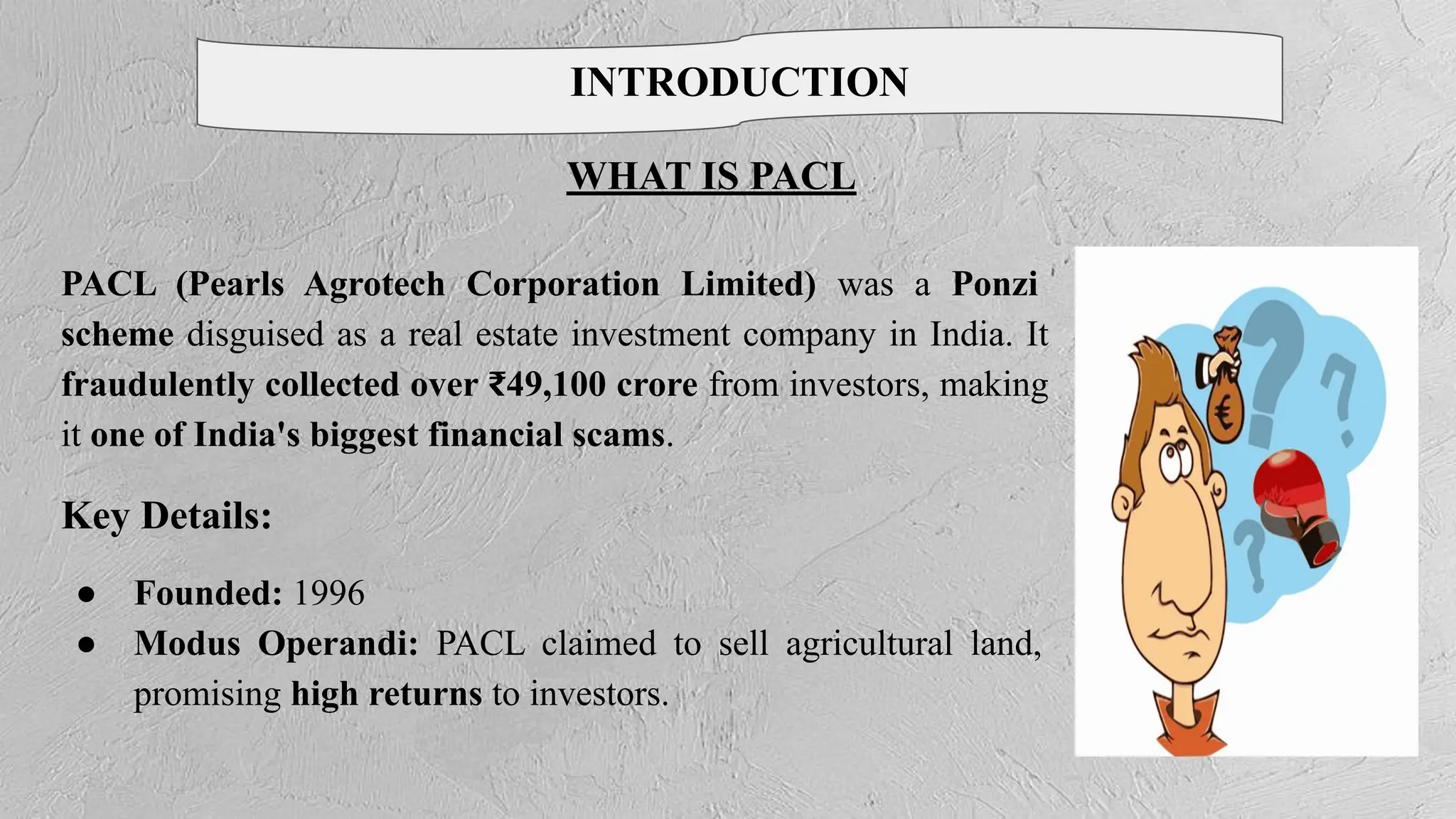
PACL (Pearls Agrotech Corporation Limited) was a Ponzi
scheme disguised as a real estate investment company in India. It
fraudulently collected over ₹49,100 crore from investors, making
it one of India's biggest financial scams.
Key Details:
● Founded: 1996
● Modus Operandi: PACL claimed to sell agricultural land,
promising high returns to investors.
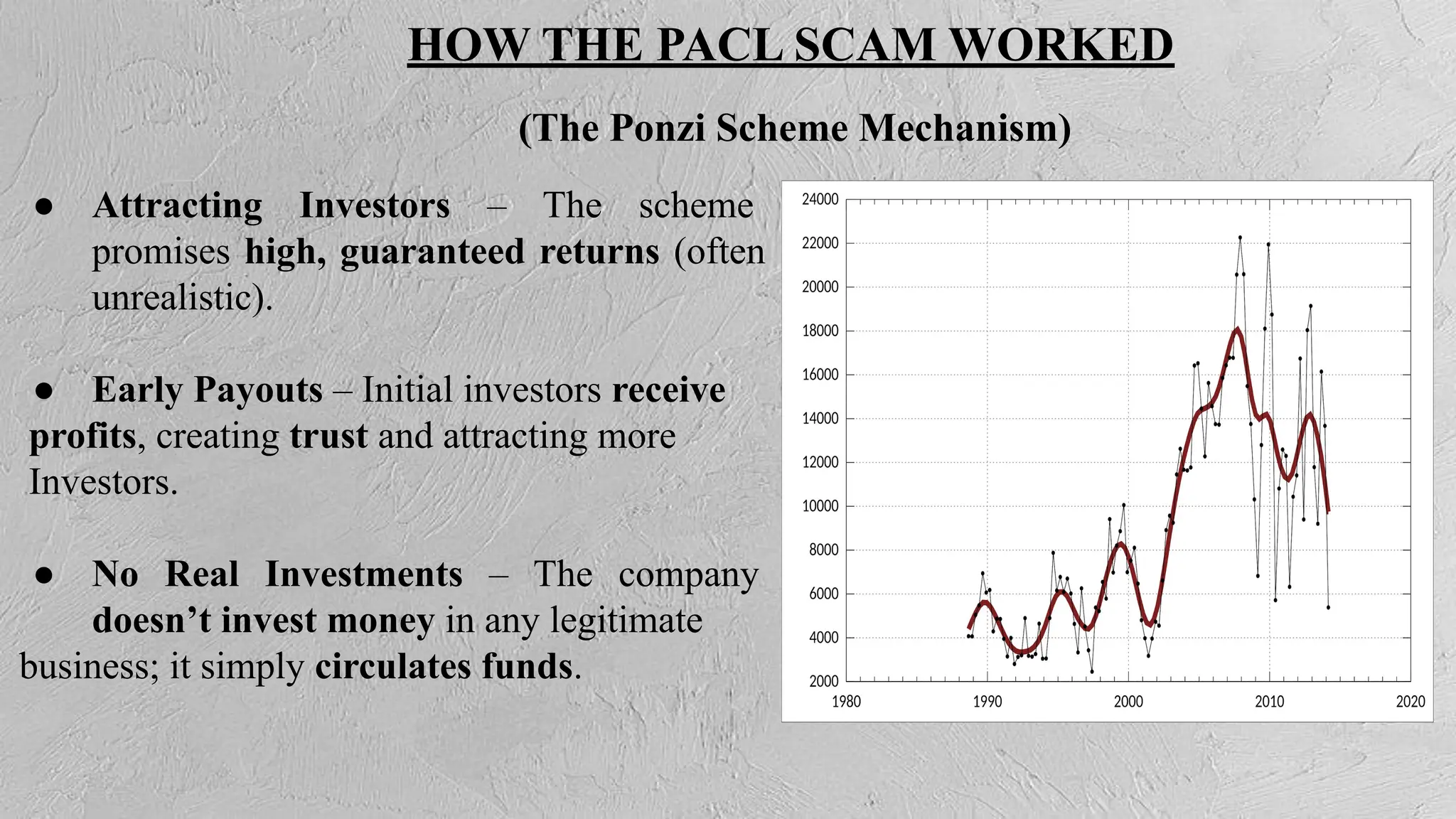
HOW THE PACL SCAM WORKED
(The Ponzi Scheme Mechanism)
● Attracting Investors – The scheme
promises high, guaranteed returns (often
unrealistic).
● Early Payouts – Initial investors receive
profits, creating trust and attracting more
Investors.
● No Real Investments – The company
doesn’t invest money in any legitimate
business; it simply circulates funds.
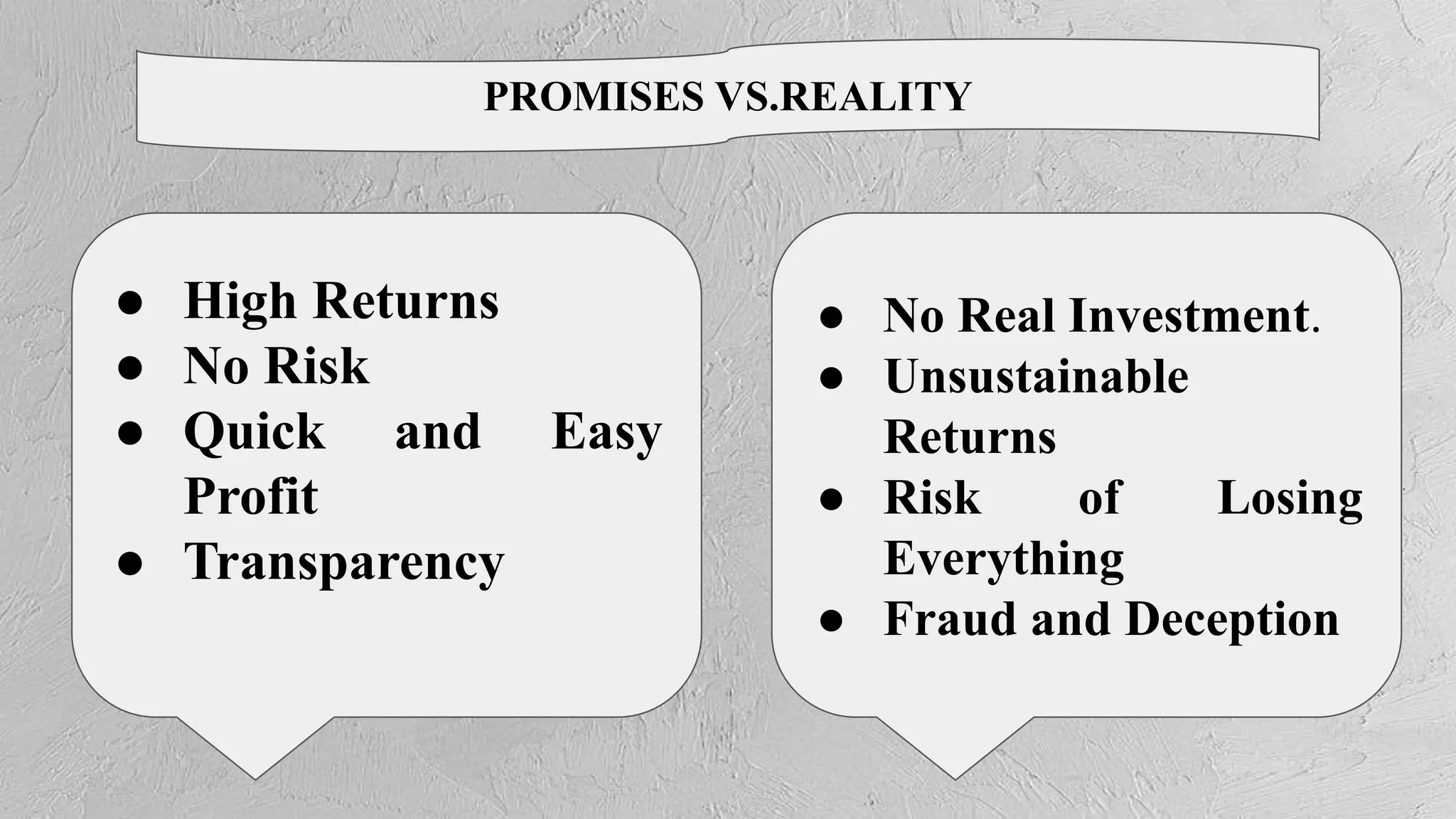
PROMISES VS.REALITY
● High Returns
● No Risk
● Quick and Easy
Profit
● Transparency
● No Real Investment.
● Unsustainable
Returns
● Risk of Losing
Everything
● Fraud and Deception
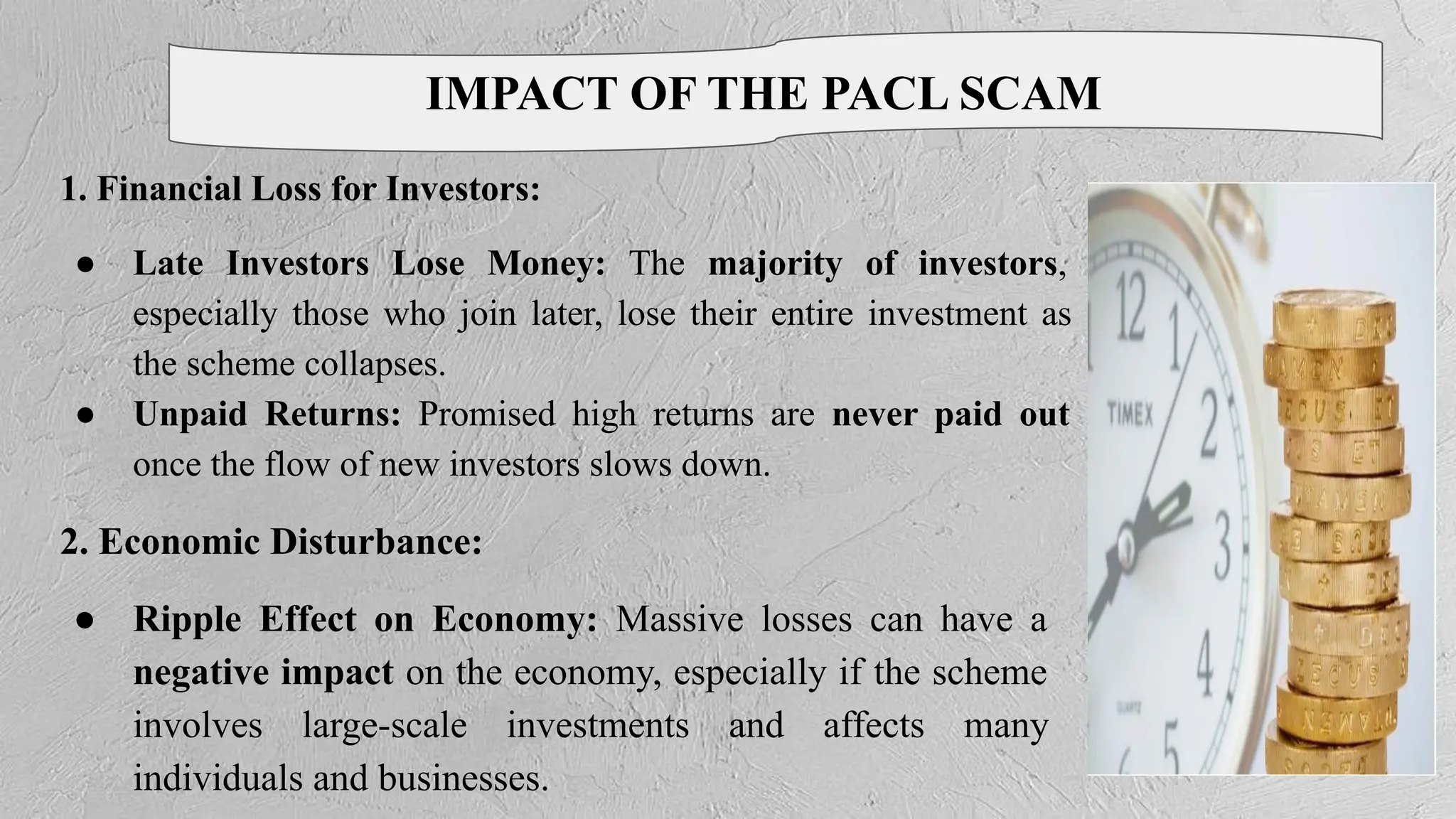
IMPACT OF THE PACL SCAM
1. Financial Loss for Investors:
● Late Investors Lose Money: The majority of investors,
especially those who join later, lose their entire investment as
the scheme collapses.
● Unpaid Returns: Promised high returns are never paid out
once the flow of new investors slows down.
2. Economic Disturbance:
● Ripple Effect on Economy: Massive losses can have a
negative impact on the economy, especially if the scheme
involves large-scale investments and affects many
individuals and businesses.
3.Reputation Damage:
● To Promoters: The promoters of the scheme face
severe reputational damage, even if they are caught
later. Their actions tarnish their personal and
professional image permanently.
● To Industry/Brand: Any organization or brand
linked with the scheme risks significant damage to
its credibility and customer trust.
4.Legal and Regulatory Consequences:
● Criminal Charges: Scheme operators face fraud
charges, legal actions, and imprisonment.
● Regulatory Crackdown: Governments and
financial authorities tighten regulations and increase
vigilance to prevent future frauds.
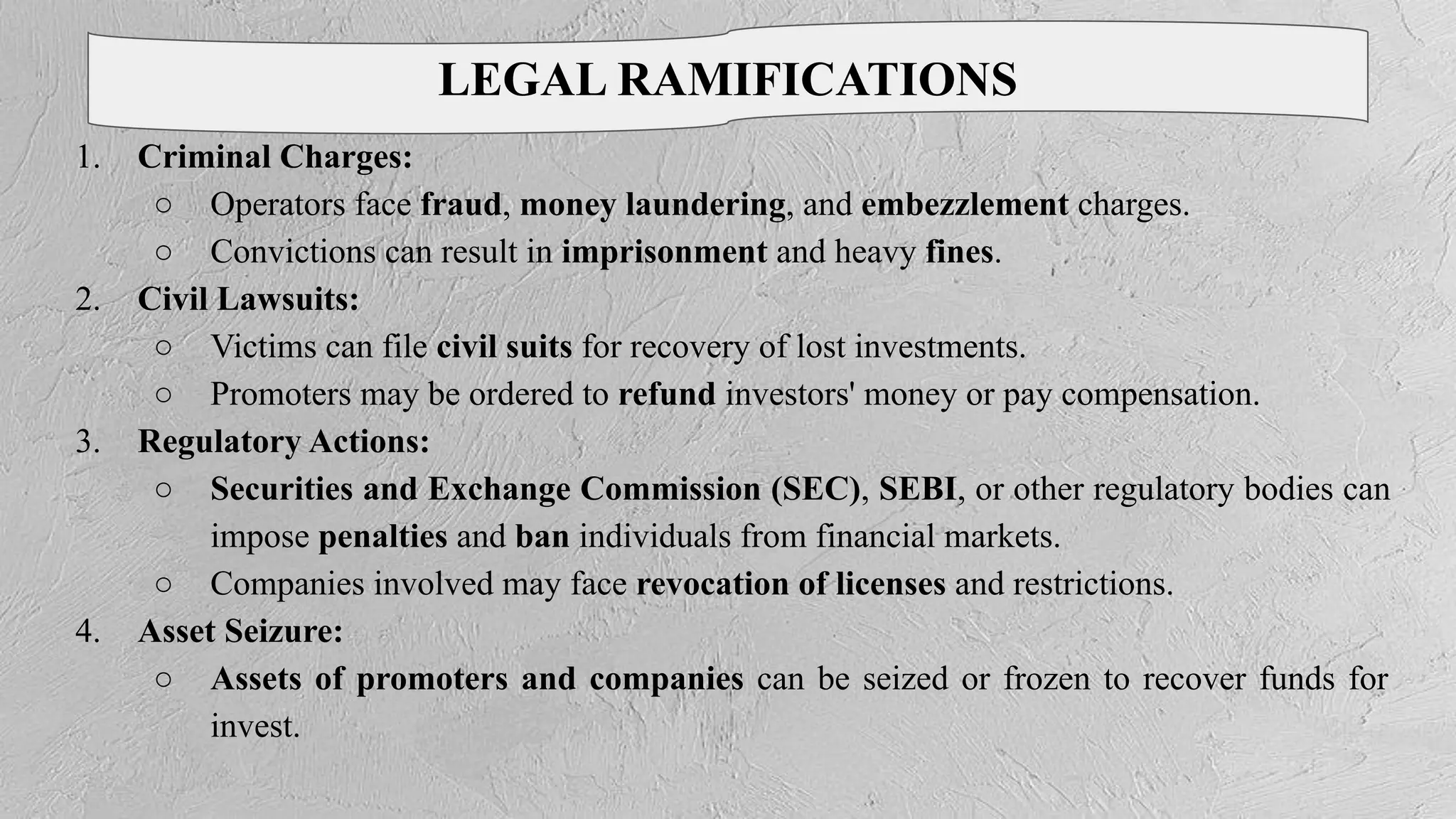
LEGAL RAMIFICATIONS
1. Criminal Charges:
○ Operators face fraud, money laundering, and embezzlement charges.
○ Convictions can result in imprisonment and heavy fines.
2. Civil Lawsuits:
○ Victims can file civil suits for recovery of lost investments.
○ Promoters may be ordered to refund investors' money or pay compensation.
3. Regulatory Actions:
○ Securities and Exchange Commission (SEC), SEBI, or other regulatory bodies can
impose penalties and ban individuals from financial markets.
○ Companies involved may face revocation of licenses and restrictions.
4. Asset Seizure:
○ Assets of promoters and companies can be seized or frozen to recover funds for
invest.
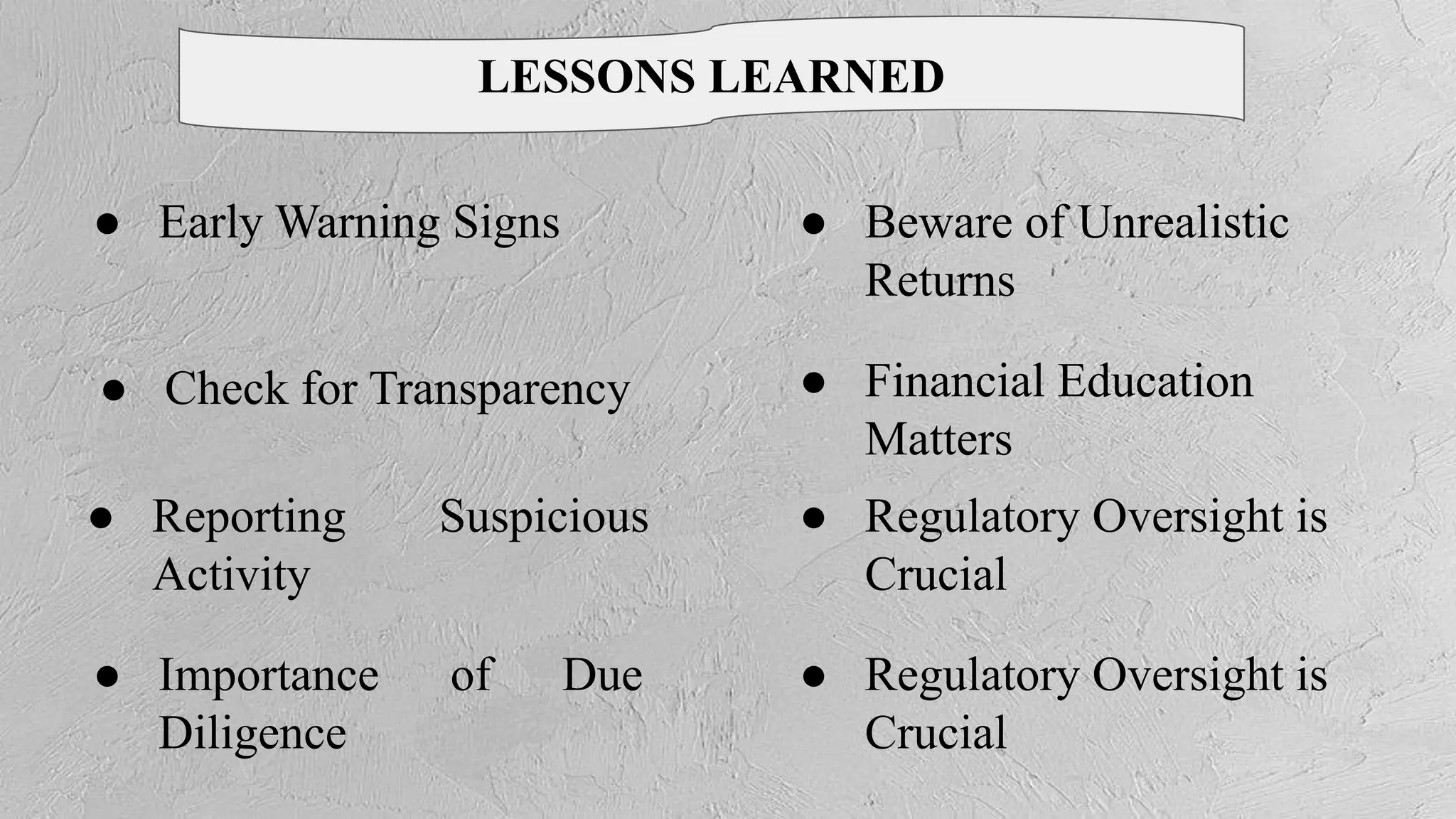
● Importance of Due
Diligence
● Beware of Unrealistic
Returns
● Regulatory Oversight is
Crucial
● Regulatory Oversight is
Crucial
● Financial Education
Matters
● Check for Transparency
● Reporting Suspicious
Activity
● Early Warning Signs
LESSONS LEARNED
CONCLUSION
● Ponzi schemes are fraudulent operations that deceive investors
with promises of high returns, only to pay earlier investors using
the funds of new ones. These scams not only lead to severe
financial losses for investors but also undermine trust in the
financial system. The 1992 Harshad Mehta scam and PACL are
among the most notable examples in India, exposing weaknesses
in regulations and investor protection.
● The legal ramifications are significant, with perpetrators facing
criminal charges, civil suits, and regulatory penalties, often leading
to imprisonment and asset seizure. However, the impact extends
beyond financial loss, causing emotional distress and reputational
damage to those involved.
● Key lessons learned include the importance of due diligence,
diversification, and financial education. Transparency, realistic
returns, and proper regulatory oversight are essential to prevent such
scams. By being vigilant and informed, investors can avoid falling victim
to Ponzi schemes and contribute to a safer financial environment.
● Ultimately, while Ponzi schemes have caused significant damage, they
have also led to tighter regulations and greater awareness, making the
financial system more resilient in the long run.
1992 INDIAN STOCK MARKET SCAM Harshad Mehta

1992 INDIAN STOCK MARKET SCAM Harshad Mehta

  • 1.
    1992 INDIAN STOCKMARKET SCAM (PRESENTED BY NEHA KUSHWAH)
  • 2.
    CONTENTS OVERVIEW OF THEBOMBAY STOCK EXCHANGE KEY FIGURES INVOLVED IMPACT OF THE SCAM CONCLUSION AND LESSONS LEARNED
  • 3.
    BACKGROUND AND CONTEXT OVERVIEWOF THE BOMBAY STOCK EXCHANGE EMERGENCE OF STOCK MARKET INDIA KEY PLAYERS AND THEIR ROLES ECONOMIC CLIMATE OF THE PERIOD The Bombay Stock Exchange (BSE) emerged in 1875 as a platform for trading securities in Mumbai, India. It became the largest and oldest stock exchange, facilitating financial growth and development. Key players in BSE include brokers, investors, listed companies, BSE itself, regulators (SEBI), market makers, and clearing corporations, ensuring smooth and regulated market operations. The economic climate during BSE's early years (late 1800s) was characterized by British colonial influence, industrial growth, limited trading, and emerging financial markets in India.
  • 4.
    UNFOLDING OF THESCAM INITIAL SIGNS OF FRAUD: The 1992 securities scam, led by Harshad Mehta, involved fraudulent activities where Mehta manipulated stock prices using illegal funds and bank receipts INVESTIGATION AND DISCOVERY : The investigation and discovery process unfolded as follows: 1. Initial Suspicion 2. Media Reports 3. SEBI Inquiry 4. Discovery of Fraud 5. Legal Actions
  • 5.
    REGULATORY RESPONSE : SEBI'sImmediate Response (1992) Government Action Reforms and Measures (Post-1992) 1. 2. 3.
  • 6.
    KEY FIGURES INVOLVED •Harshad Mehta, born in 1954 in Gujarat, grew up in Mumbai, working odd jobs before entering the stock market. EARLY LIFE AND BACKGROUND • Rising in the 1980s, he manipulated stock prices using banking loopholes RISE IN STOCK MARKET • His 1992 scam, worth ₹4,000 crores, involved siphoning funds to inflate shares, ultimately exposing systemic corruption and financial malpractice. CRIMINAL ACTIVITIES AND MANIPULATE (HARSHAD MEHTA)
  • 7.
    (OTHER NOTEWORTHY PERSONALITIES) ●Hiten Dalal – A broker known for facilitating fraudulent transactions in government securities. ● Bhupen Dalal – Another stockbroker involved in irregular trading activities. ● Amit Rathi – A broker linked to unethical stock market practices. ● Several Others – Many smaller brokers benefited from the scam by riding the market wave created by Mehta Colluding brokers Government officials ● Some Officials from the Reserve Bank of India (RBI) – Although RBI eventually investigated the scam, some lower-level officials failed to monitor irregular transactions effectively. ● State Bank of India (SBI) and Other Banks’ Officials – Officials from SBI and other banks issued fake Bank Receipts (BRs), which Mehta used to siphon funds.
  • 8.
    ● Officials fromUTI (Unit Trust of India) – UTI and other financial institutions invested in stocks manipulated by Mehta. ● Finance Ministry Officials – Some officials were accused of negligence or indirect involvement in allowing the scam to go unchecked. Investigative journalists Sucheta Dalal – A senior journalist at The Times of India, she broke the story about Harshad Mehta’s fraudulent activities on April 23, 1992. Her investigative work revealed how Mehta manipulated the stock market using fake bank receipts and banking loopholes. She later co-authored the book "The Scam: Who Won, Who Lost, Who Got Away" with Debashis Basu, detailing the entire case. Debashis Basu – A financial journalist and co-author of The Scam, who helped uncover the deep-rooted corruption in the stock market and banking system.
  • 9.
    IMPACT OF THESCAM FINANCIAL CONSEQUENCES ● Market Crash – The stock market plunged by nearly 50% within a year, wiping out investor wealth. ● Investor Panic – Thousands of retail investors suffered huge losses, leading to distrust in the stock market. ● Liquidity Crisis – Banks and financial institutions faced a severe liquidity crunch due to fraudulent transactions.
  • 10.
    LEGALAND REGULATORY CHANGES ●Tighter Regulations – SEBI (Securities and Exchange Board of India) strengthened stock market rules to prevent future scams. ● Banking Reforms – The RBI introduced stricter banking regulations and monitoring of financial transactions. ● Ban on Badla System – The practice of carry-forward trading (Badla) was banned to prevent market manipulation. ● Introduction of Online Trading – The National Stock Exchange (NSE) was introduced in 1994, making trading more transparent and less dependent on brokers. ● Special Court for Financial Frauds – A special court was set up to handle economic offenses like stock market frauds.
  • 11.
    PUBLIC AND MEDIARESPONSE ● Extensive Coverage – Newspapers like The Times of India and The Economic Times exposed the fraud. ● TV Debates & Investigations – Channels discussed financial loopholes and regulatory failures. ● Books & Documentaries – "The Scam: Who Won, Who Lost, Who Got Away" by Sucheta Dalal & Debashis Basu. ● Recent Depictions – Web series "Scam 1992" (2020) renewed public interest. ● Harshad Mehta’s Infamy – Gained the title “The Big Bull”, admired by some, hated by many.
  • 12.
    CONCLUSION AND LESSONSLEARNED SUMMARY OF EVENT Key Developments: ● Stock Manipulation – Harshad Mehta used fake Bank Receipts (BRs) to siphon bank funds and inflate stock prices. ● CBI & JPC Investigations – Central Bureau of Investigation (CBI) arrested Mehta; Joint Parliamentary Committee (JPC) probed regulatory failures. ● Legal Actions – Mehta was charged with multiple fraud cases; his assets were seized.
  • 13.
    . End Result: ● HarshadMehta was banned from stock trading and faced multiple legal cases until his death in 2001. ● Retail investors suffered, making them cautious about stock investments. ● The scam transformed India's financial system, leading to better stock market and banking regulations.
  • 14.
    The PACL Scam (Understandingthe mechanics and impact of a ponzi scheme)
  • 15.
    INTRODUCTION PROMISES VS. REALITY IMPACTOF THE PACL SCAM LEGAL RAMIFICATIONS LESSONS LEARNED CONTENTS CONCLUSION
  • 16.
    WHAT IS PACL INTRODUCTION PACL(Pearls Agrotech Corporation Limited) was a Ponzi scheme disguised as a real estate investment company in India. It fraudulently collected over ₹49,100 crore from investors, making it one of India's biggest financial scams. Key Details: ● Founded: 1996 ● Modus Operandi: PACL claimed to sell agricultural land, promising high returns to investors.
  • 17.
    HOW THE PACLSCAM WORKED (The Ponzi Scheme Mechanism) ● Attracting Investors – The scheme promises high, guaranteed returns (often unrealistic). ● Early Payouts – Initial investors receive profits, creating trust and attracting more Investors. ● No Real Investments – The company doesn’t invest money in any legitimate business; it simply circulates funds.
  • 18.
    PROMISES VS.REALITY ● HighReturns ● No Risk ● Quick and Easy Profit ● Transparency ● No Real Investment. ● Unsustainable Returns ● Risk of Losing Everything ● Fraud and Deception
  • 19.
    IMPACT OF THEPACL SCAM 1. Financial Loss for Investors: ● Late Investors Lose Money: The majority of investors, especially those who join later, lose their entire investment as the scheme collapses. ● Unpaid Returns: Promised high returns are never paid out once the flow of new investors slows down. 2. Economic Disturbance: ● Ripple Effect on Economy: Massive losses can have a negative impact on the economy, especially if the scheme involves large-scale investments and affects many individuals and businesses.
  • 20.
    3.Reputation Damage: ● ToPromoters: The promoters of the scheme face severe reputational damage, even if they are caught later. Their actions tarnish their personal and professional image permanently. ● To Industry/Brand: Any organization or brand linked with the scheme risks significant damage to its credibility and customer trust. 4.Legal and Regulatory Consequences: ● Criminal Charges: Scheme operators face fraud charges, legal actions, and imprisonment. ● Regulatory Crackdown: Governments and financial authorities tighten regulations and increase vigilance to prevent future frauds.
  • 21.
    LEGAL RAMIFICATIONS 1. CriminalCharges: ○ Operators face fraud, money laundering, and embezzlement charges. ○ Convictions can result in imprisonment and heavy fines. 2. Civil Lawsuits: ○ Victims can file civil suits for recovery of lost investments. ○ Promoters may be ordered to refund investors' money or pay compensation. 3. Regulatory Actions: ○ Securities and Exchange Commission (SEC), SEBI, or other regulatory bodies can impose penalties and ban individuals from financial markets. ○ Companies involved may face revocation of licenses and restrictions. 4. Asset Seizure: ○ Assets of promoters and companies can be seized or frozen to recover funds for invest.
  • 22.
    ● Importance ofDue Diligence ● Beware of Unrealistic Returns ● Regulatory Oversight is Crucial ● Regulatory Oversight is Crucial ● Financial Education Matters ● Check for Transparency ● Reporting Suspicious Activity ● Early Warning Signs LESSONS LEARNED
  • 23.
    CONCLUSION ● Ponzi schemesare fraudulent operations that deceive investors with promises of high returns, only to pay earlier investors using the funds of new ones. These scams not only lead to severe financial losses for investors but also undermine trust in the financial system. The 1992 Harshad Mehta scam and PACL are among the most notable examples in India, exposing weaknesses in regulations and investor protection. ● The legal ramifications are significant, with perpetrators facing criminal charges, civil suits, and regulatory penalties, often leading to imprisonment and asset seizure. However, the impact extends beyond financial loss, causing emotional distress and reputational damage to those involved.
  • 24.
    ● Key lessonslearned include the importance of due diligence, diversification, and financial education. Transparency, realistic returns, and proper regulatory oversight are essential to prevent such scams. By being vigilant and informed, investors can avoid falling victim to Ponzi schemes and contribute to a safer financial environment. ● Ultimately, while Ponzi schemes have caused significant damage, they have also led to tighter regulations and greater awareness, making the financial system more resilient in the long run.