Budget of the Department of Defense
Billions of 2025 dollars
Military personnel
Operation and
maintenance
Procurement
Research,
development, test,
and evaluation
Military construction
Family housing
Large-scale
operations in Iraq
and Afghanistan
DoD’s military
compensation
Budget of the Department of Veterans Affairs
Billions of 2025 dollars
VA’s total budget
Income security
Medical care
Other
DoD’s military
compensation
S
N
E
W
Compensation for military personnel is found in both
the defense and nondefense parts of the federal bud-
get. Defense funding, in the Department of Defense’s
(DoD’s) budget, is mostly for current military personnel.
Nondefense funding in the Department of Veterans
Affairs (VA) is mostly for former military personnel.
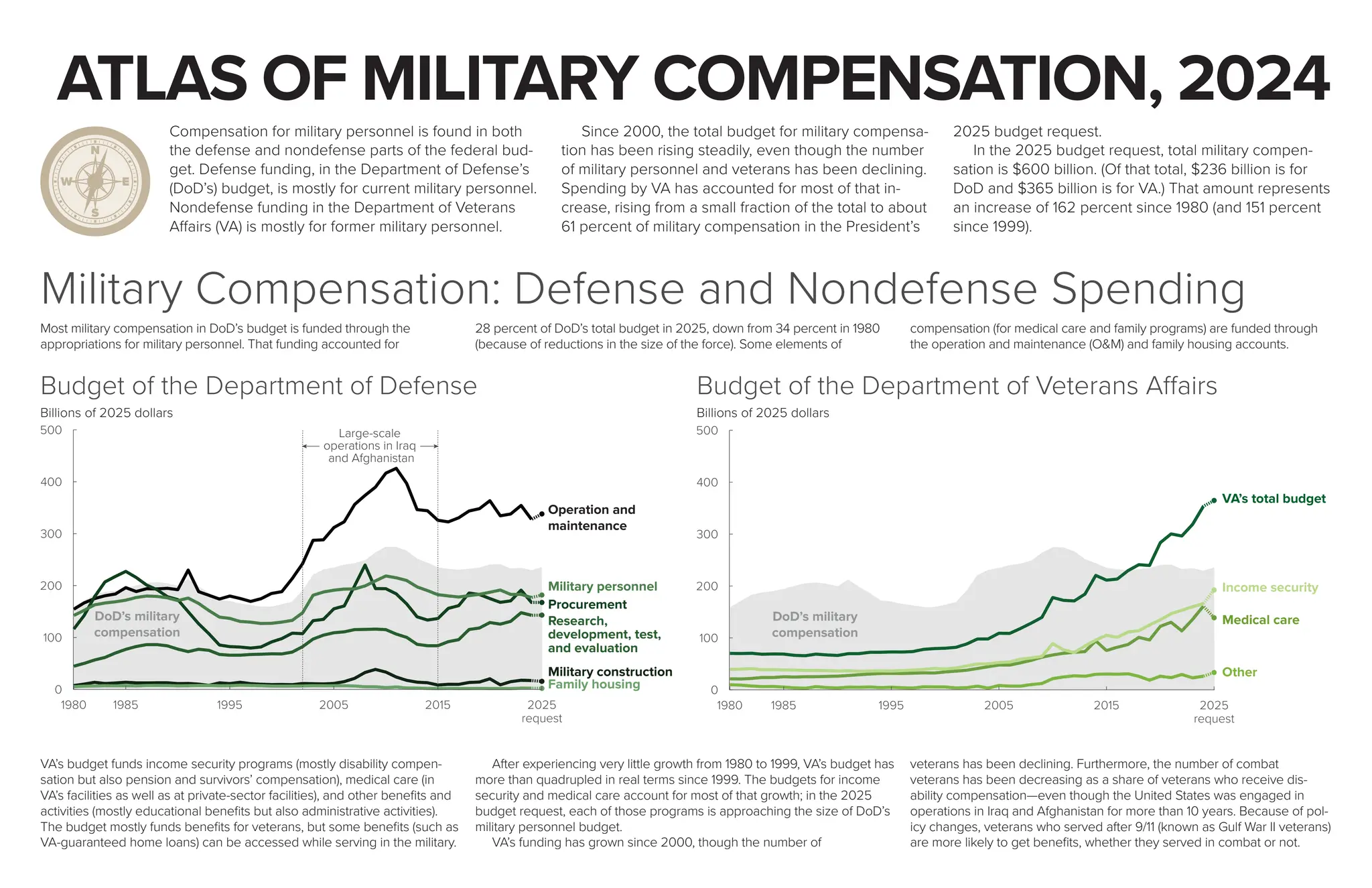
Since 2000, the total budget for military compensa-
tion has been rising steadily, even though the number
of military personnel and veterans has been declining.
Spending by VA has accounted for most of that in-
crease, rising from a small fraction of the total to about
61 percent of military compensation in the President’s
2025 budget request.
In the 2025 budget request, total military compen-
sation is $600 billion. (Of that total, $236 billion is for
DoD and $365 billion is for VA.) That amount represents
an increase of 162 percent since 1980 (and 151 percent
since 1999).
Military Compensation: Defense and Nondefense Spending
Most military compensation in DoD’s budget is funded through the
appropriations for military personnel. That funding accounted for
28 percent of DoD’s total budget in 2025, down from 34 percent in 1980
(because of reductions in the size of the force). Some elements of
compensation (for medical care and family programs) are funded through
the operation and maintenance (O&M) and family housing accounts.
VA’s budget funds income security programs (mostly disability compen-
sation but also pension and survivors’ compensation), medical care (in
VA’s facilities as well as at private-sector facilities), and other benefits and
activities (mostly educational benefits but also administrative activities).
The budget mostly funds benefits for veterans, but some benefits (such as
VA-guaranteed home loans) can be accessed while serving in the military.
After experiencing very little growth from 1980 to 1999, VA’s budget has
more than quadrupled in real terms since 1999. The budgets for income
security and medical care account for most of that growth; in the 2025
budget request, each of those programs is approaching the size of DoD’s
military personnel budget.
VA’s funding has grown since 2000, though the number of
veterans has been declining. Furthermore, the number of combat
veterans has been decreasing as a share of veterans who receive dis-
ability compensation—even though the United States was engaged in
operations in Iraq and Afghanistan for more than 10 years. Because of pol-
icy changes, veterans who served after 9/11 (known as Gulf War II veterans)
are more likely to get benefits, whether they served in combat or not.
ATLAS OF MILITARY COMPENSATION, 2024
Trends in Total Compensation in DoD’s Budget
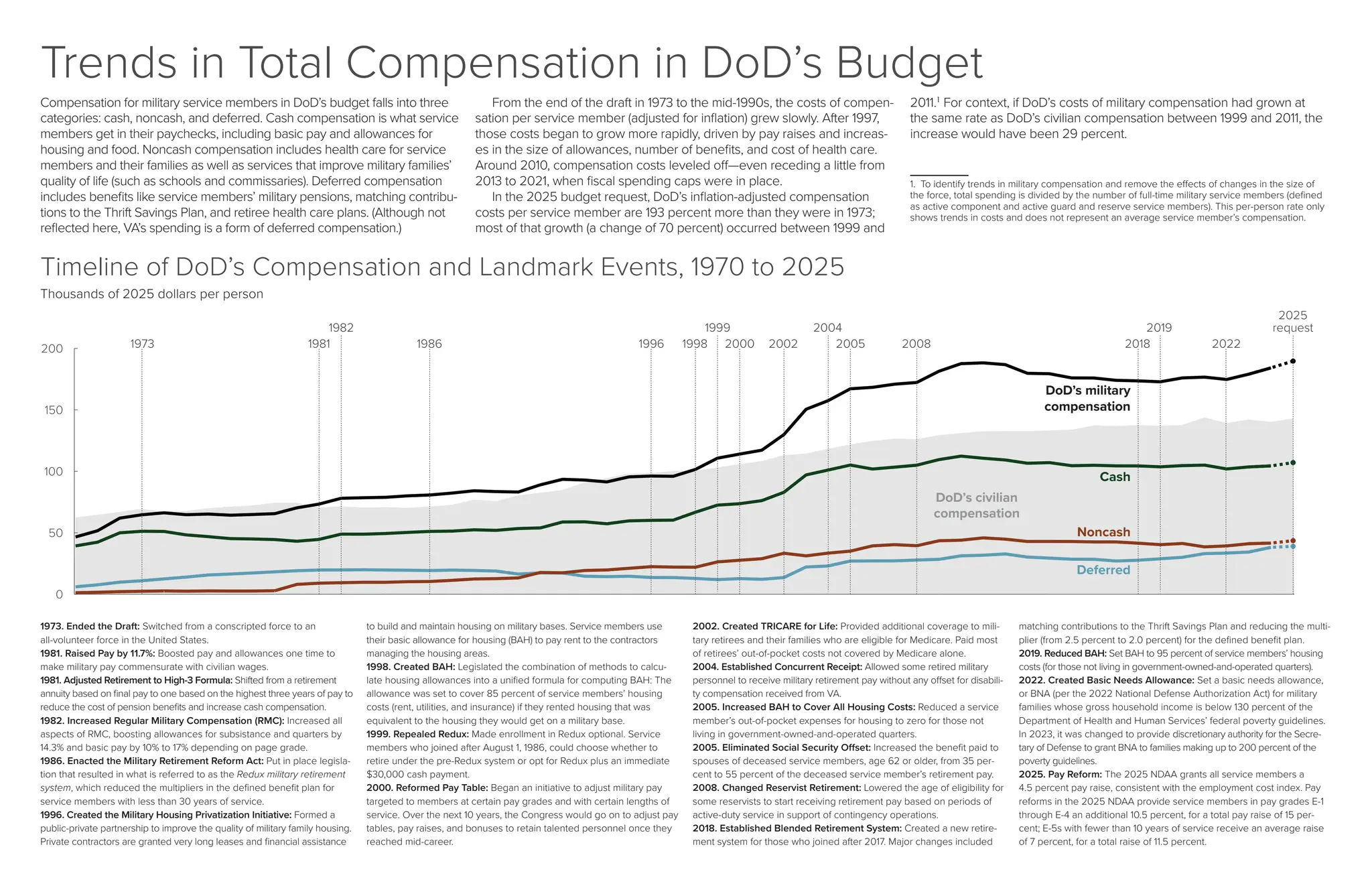
Compensation for military service members in DoD’s budget falls into three
categories: cash, noncash, and deferred. Cash compensation is what service
members get in their paychecks, including basic pay and allowances for
housing and food. Noncash compensation includes health care for service
members and their families as well as services that improve military families’
quality of life (such as schools and commissaries). Deferred compensation
includes benefits like service members’ military pensions, matching contribu-
tions to the Thrift Savings Plan, and retiree health care plans. (Although not
reflected here, VA’s spending is a form of deferred compensation.)
From the end of the draft in 1973 to the mid-1990s, the costs of compen-
sation per service member (adjusted for inflation) grew slowly. After 1997,
those costs began to grow more rapidly, driven by pay raises and increas-
es in the size of allowances, number of benefits, and cost of health care.
Around 2010, compensation costs leveled off—even receding a little from
2013 to 2021, when fiscal spending caps were in place.
In the 2025 budget request, DoD’s inflation-adjusted compensation
costs per service member are 193 percent more than they were in 1973;
most of that growth (a change of 70 percent) occurred between 1999 and
2011.1
For context, if DoD’s costs of military compensation had grown at
the same rate as DoD’s civilian compensation between 1999 and 2011, the
increase would have been 29 percent.
1. To identify trends in military compensation and remove the effects of changes in the size of
the force, total spending is divided by the number of full-time military service members (defined
as active component and active guard and reserve service members). This per-person rate only
shows trends in costs and does not represent an average service member’s compensation.
1973. Ended the Draft: Switched from a conscripted force to an
all-volunteer force in the United States.
1981. Raised Pay by 11.7%: Boosted pay and allowances one time to
make military pay commensurate with civilian wages.
1981. Adjusted Retirement to High-3 Formula: Shifted from a retirement
annuity based on final pay to one based on the highest three years of pay to
reduce the cost of pension benefits and increase cash compensation.
1982. Increased Regular Military Compensation (RMC): Increased all
aspects of RMC, boosting allowances for subsistance and quarters by
14.3% and basic pay by 10% to 17% depending on page grade.
1986. Enacted the Military Retirement Reform Act: Put in place legisla-
tion that resulted in what is referred to as the Redux military retirement
system, which reduced the multipliers in the defined benefit plan for
service members with less than 30 years of service.
1996. Created the Military Housing Privatization Initiative: Formed a
public-private partnership to improve the quality of military family housing.
Private contractors are granted very long leases and financial assistance
to build and maintain housing on military bases. Service members use
their basic allowance for housing (BAH) to pay rent to the contractors
managing the housing areas.
1998. Created BAH: Legislated the combination of methods to calcu-
late housing allowances into a unified formula for computing BAH: The
allowance was set to cover 85 percent of service members’ housing
costs (rent, utilities, and insurance) if they rented housing that was
equivalent to the housing they would get on a military base.
1999. Repealed Redux: Made enrollment in Redux optional. Service
members who joined after August 1, 1986, could choose whether to
retire under the pre-Redux system or opt for Redux plus an immediate
$30,000 cash payment.
2000. Reformed Pay Table: Began an initiative to adjust military pay
targeted to members at certain pay grades and with certain lengths of
service. Over the next 10 years, the Congress would go on to adjust pay
tables, pay raises, and bonuses to retain talented personnel once they
reached mid-career.
2002. Created TRICARE for Life: Provided additional coverage to mili-
tary retirees and their families who are eligible for Medicare. Paid most
of retirees’ out-of-pocket costs not covered by Medicare alone.
2004. Established Concurrent Receipt: Allowed some retired military
personnel to receive military retirement pay without any offset for disabili-
ty compensation received from VA.
2005. Increased BAH to Cover All Housing Costs: Reduced a service
member’s out-of-pocket expenses for housing to zero for those not
living in government-owned-and-operated quarters.
2005. Eliminated Social Security Offset: Increased the benefit paid to
spouses of deceased service members, age 62 or older, from 35 per-
cent to 55 percent of the deceased service member’s retirement pay.
2008. Changed Reservist Retirement: Lowered the age of eligibility for
some reservists to start receiving retirement pay based on periods of
active-duty service in support of contingency operations.
2018. Established Blended Retirement System: Created a new retire-
ment system for those who joined after 2017. Major changes included
matching contributions to the Thrift Savings Plan and reducing the multi-
plier (from 2.5 percent to 2.0 percent) for the defined benefit plan.
2019. Reduced BAH: Set BAH to 95 percent of service members’ housing
costs (for those not living in government-owned-and-operated quarters).
2022. Created Basic Needs Allowance: Set a basic needs allowance,
or BNA (per the 2022 National Defense Authorization Act) for military
families whose gross household income is below 130 percent of the
Department of Health and Human Services’ federal poverty guidelines.
In 2023, it was changed to provide discretionary authority for the Secre-
tary of Defense to grant BNA to families making up to 200 percent of the
poverty guidelines.
2025. Pay Reform: The 2025 NDAA grants all service members a
4.5 percent pay raise, consistent with the employment cost index. Pay
reforms in the 2025 NDAA provide service members in pay grades E-1
through E-4 an additional 10.5 percent, for a total pay raise of 15 per-
cent; E-5s with fewer than 10 years of service receive an average raise
of 7 percent, for a total raise of 11.5 percent.
Timeline of DoD’s Compensation and Landmark Events, 1970 to 2025
Thousands of 2025 dollars per person
DoD’s military
compensation
Deferred
Cash
Noncash
1973 1981
1982
1986 1996 1998 2000 2002 2005 2018 2022
2008
2004
1999 2019
2025
request
DoD’s civilian
compensation
Noncash
Thousands of 2025 dollars per person
Family housing
Relocationc
Other benefits
Supportd
Health careb
Created
TRICARE
for Life
b.Health care is funded out of the operation and maintenance accounts.
c. When service members are required to change geographic location for their job.
d.Programs that improve the quality of life for service members and their families.
Examples are DoD’s schools, commissaries, child care, and welfare and recreation.
Cash
Thousands of 2025 dollars per person
Basic pay
Special pay
Food allowancea
Housing allowancea
Reserve pay
Reformed
pay table
a. The allowances for housing and food are not taxed, increasing the cost of military
compensation in the federal budget, not shown here.
Deferred
Thousands of 2025 dollars per person
Concurrent
receipte
Retirees’
health care
Retirement
Created
TRICARE
for Life
e.The cost of paying retired military personnel their military retirement pay without
any offset for disability compensation received from VA.
Basic Pay
Thousands of 2025 dollars per person
Basic pay
Budget for basic pay if it grew with the ECI after 1999a
Reformed
pay table
a. The ECI is based on measurements from the Bureau of Labor Statistics that are reported by CBO in its historical budget and
economic data: www.cbo.gov/data/budget-economic-data.
Military Housing Benefits
Thousands of 2025 dollars per person
Total military
housing
Family housing
Budget for basic allowance for housing if it grew
at the same rate as residential rents after 1999b
Basic allowance
for housing
Increased BAH to 100%
of housing costs
Reduced BAH
to 95%
b.The rate of growth in residential rents can be found in CBO’s historical budget and economic data: www.cbo.gov/data/budget-
economic-data.
A Detailed Look at the Categories of DoD’s Compensation
Trends in Cash Compensation
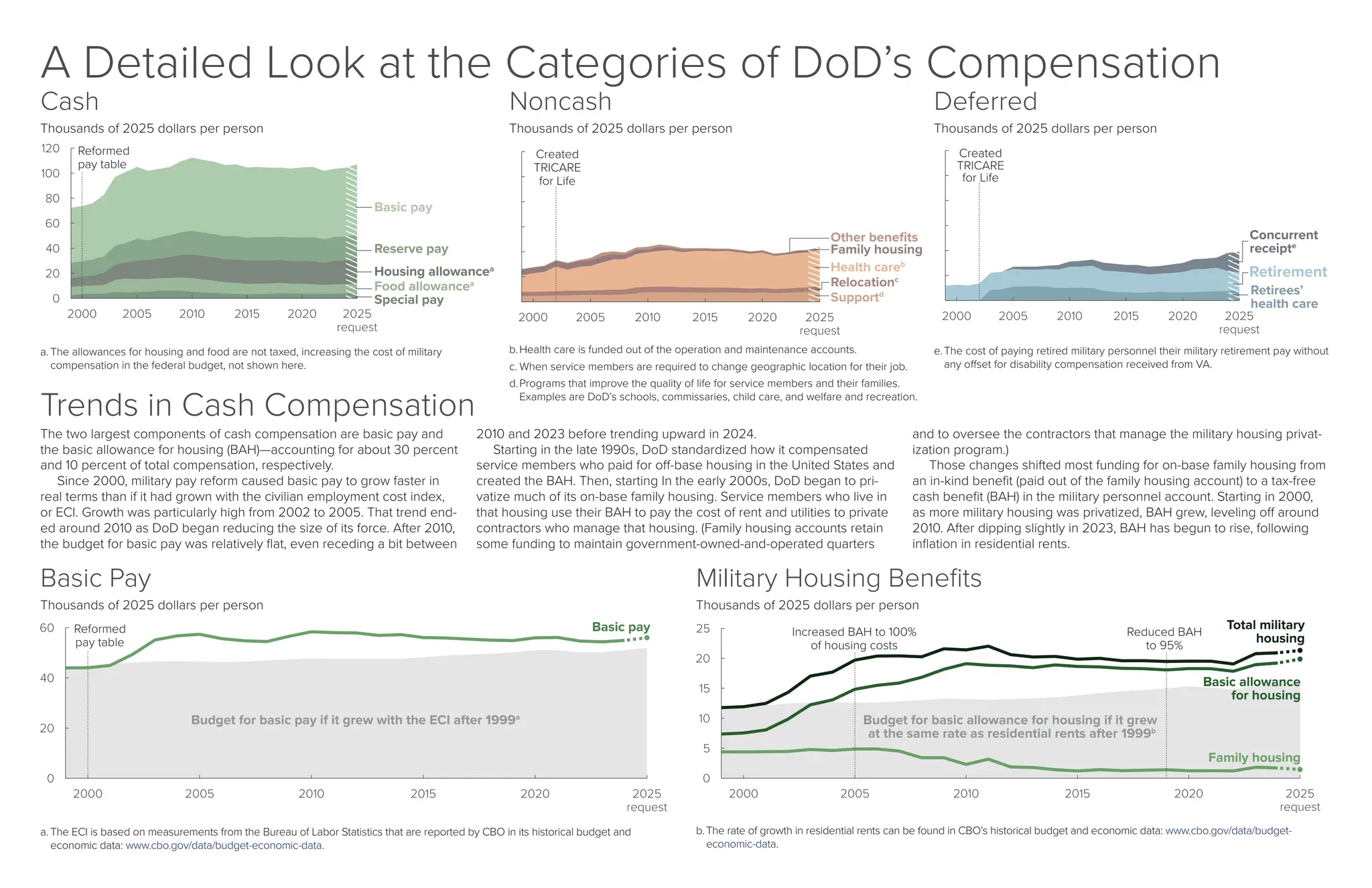
The two largest components of cash compensation are basic pay and
the basic allowance for housing (BAH)—accounting for about 30 percent
and 10 percent of total compensation, respectively.
Since 2000, military pay reform caused basic pay to grow faster in
real terms than if it had grown with the civilian employment cost index,
or ECI. Growth was particularly high from 2002 to 2005. That trend end-
ed around 2010 as DoD began reducing the size of its force. After 2010,
the budget for basic pay was relatively flat, even receding a bit between
2010 and 2023 before trending upward in 2024.
Starting in the late 1990s, DoD standardized how it compensated
service members who paid for off-base housing in the United States and
created the BAH. Then, starting In the early 2000s, DoD began to pri-
vatize much of its on-base family housing. Service members who live in
that housing use their BAH to pay the cost of rent and utilities to private
contractors who manage that housing. (Family housing accounts retain
some funding to maintain government-owned-and-operated quarters
and to oversee the contractors that manage the military housing privat-
ization program.)
Those changes shifted most funding for on-base family housing from
an in-kind benefit (paid out of the family housing account) to a tax-free
cash benefit (BAH) in the military personnel account. Starting in 2000,
as more military housing was privatized, BAH grew, leveling off around
2010. After dipping slightly in 2023, BAH has begun to rise, following
inflation in residential rents.
Cost of Compensation per Service Member, 2024
Tax
advantagea
5%
Tax
advantagea
3%
Active-duty
health care
11%
Noncash
$21,300
Cash
(regular military
compensation)
$70,700
Deferred
$23,400
Allowances
for housing
and food
26%
Basic pay
31%
Retirement
pay 8% Retirement
pay 12%
Retirees’
health care 12%
Retirees’
health care 8%
Other
noncash
7% Active-duty
health care 7%
Other
noncash 5%
Noncash
$21,300
Cash
(regular military
compensation)
$126,600
Deferred
$36,700
Allowances
for housing
and food
19%
Basic pay
46%
Total compensation costs = $115,400
Median enlisted personnel
(E-4 with dependents, average age: 22)
Total compensation costs = $184,600
Median officers
(O-3 with dependents, average age: 28)
a. DoD’s estimate of the benefit a service member receives from the tax-free allowances for food and housing. That amount represents a cost to the federal government in terms
of lost tax revenues.
Components of Service Members’ Compensation
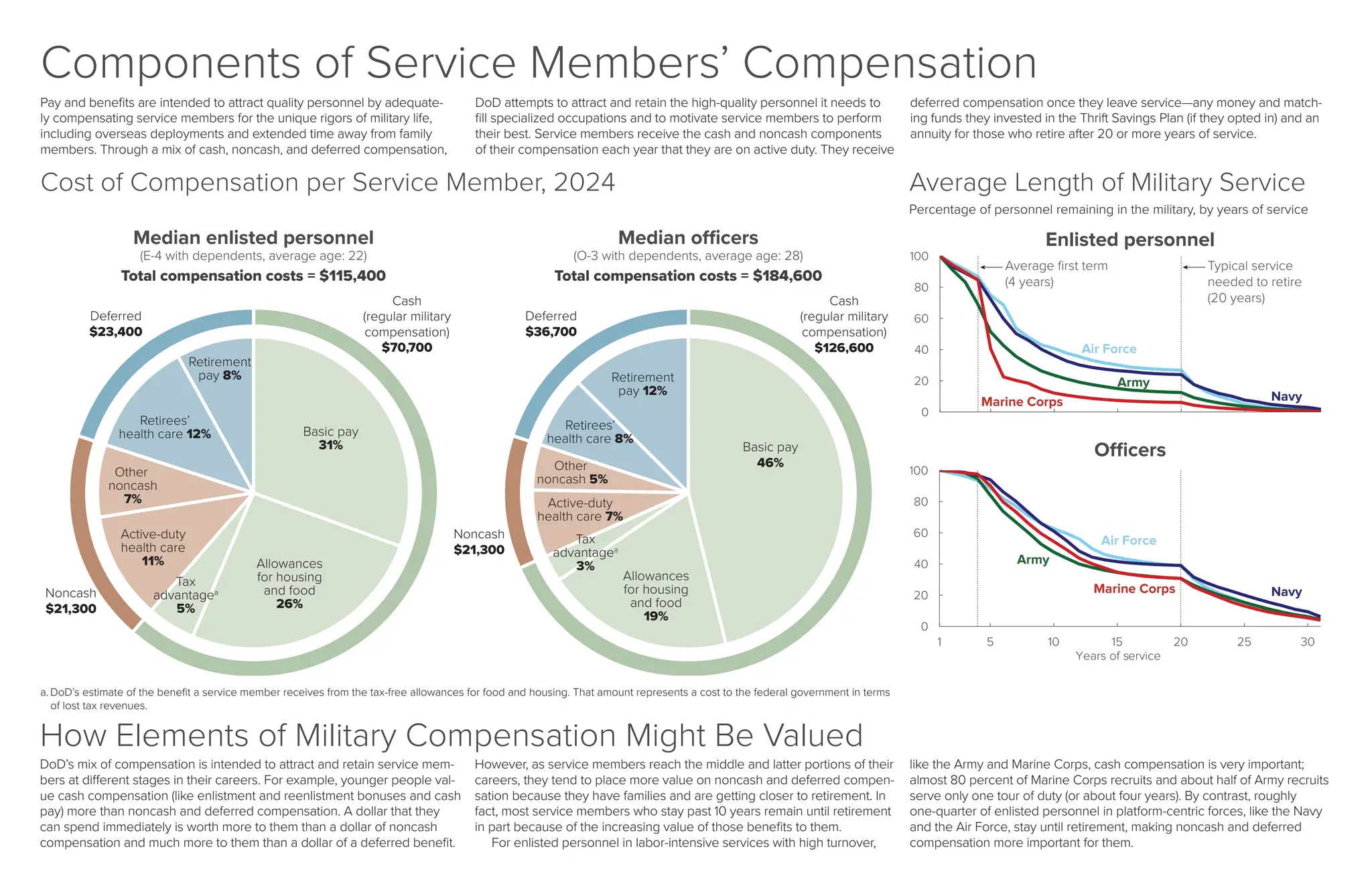
Pay and benefits are intended to attract quality personnel by adequate-
ly compensating service members for the unique rigors of military life,
including overseas deployments and extended time away from family
members. Through a mix of cash, noncash, and deferred compensation,
DoD attempts to attract and retain the high-quality personnel it needs to
fill specialized occupations and to motivate service members to perform
their best. Service members receive the cash and noncash components
of their compensation each year that they are on active duty. They receive
deferred compensation once they leave service—any money and match-
ing funds they invested in the Thrift Savings Plan (if they opted in) and an
annuity for those who retire after 20 or more years of service.
How Elements of Military Compensation Might Be Valued
DoD’s mix of compensation is intended to attract and retain service mem-
bers at different stages in their careers. For example, younger people val-
ue cash compensation (like enlistment and reenlistment bonuses and cash
pay) more than noncash and deferred compensation. A dollar that they
can spend immediately is worth more to them than a dollar of noncash
compensation and much more to them than a dollar of a deferred benefit.
However, as service members reach the middle and latter portions of their
careers, they tend to place more value on noncash and deferred compen-
sation because they have families and are getting closer to retirement. In
fact, most service members who stay past 10 years remain until retirement
in part because of the increasing value of those benefits to them.
For enlisted personnel in labor-intensive services with high turnover,
like the Army and Marine Corps, cash compensation is very important;
almost 80 percent of Marine Corps recruits and about half of Army recruits
serve only one tour of duty (or about four years). By contrast, roughly
one-quarter of enlisted personnel in platform-centric forces, like the Navy
and the Air Force, stay until retirement, making noncash and deferred
compensation more important for them.
Average Length of Military Service
Percentage of personnel remaining in the military, by years of service
Officers
Enlisted personnel
Air Force
Navy
Navy
Marine Corps
Army
Average first term
(4 years)
Typical service
needed to retire
(20 years)
Air Force
Marine Corps
Army
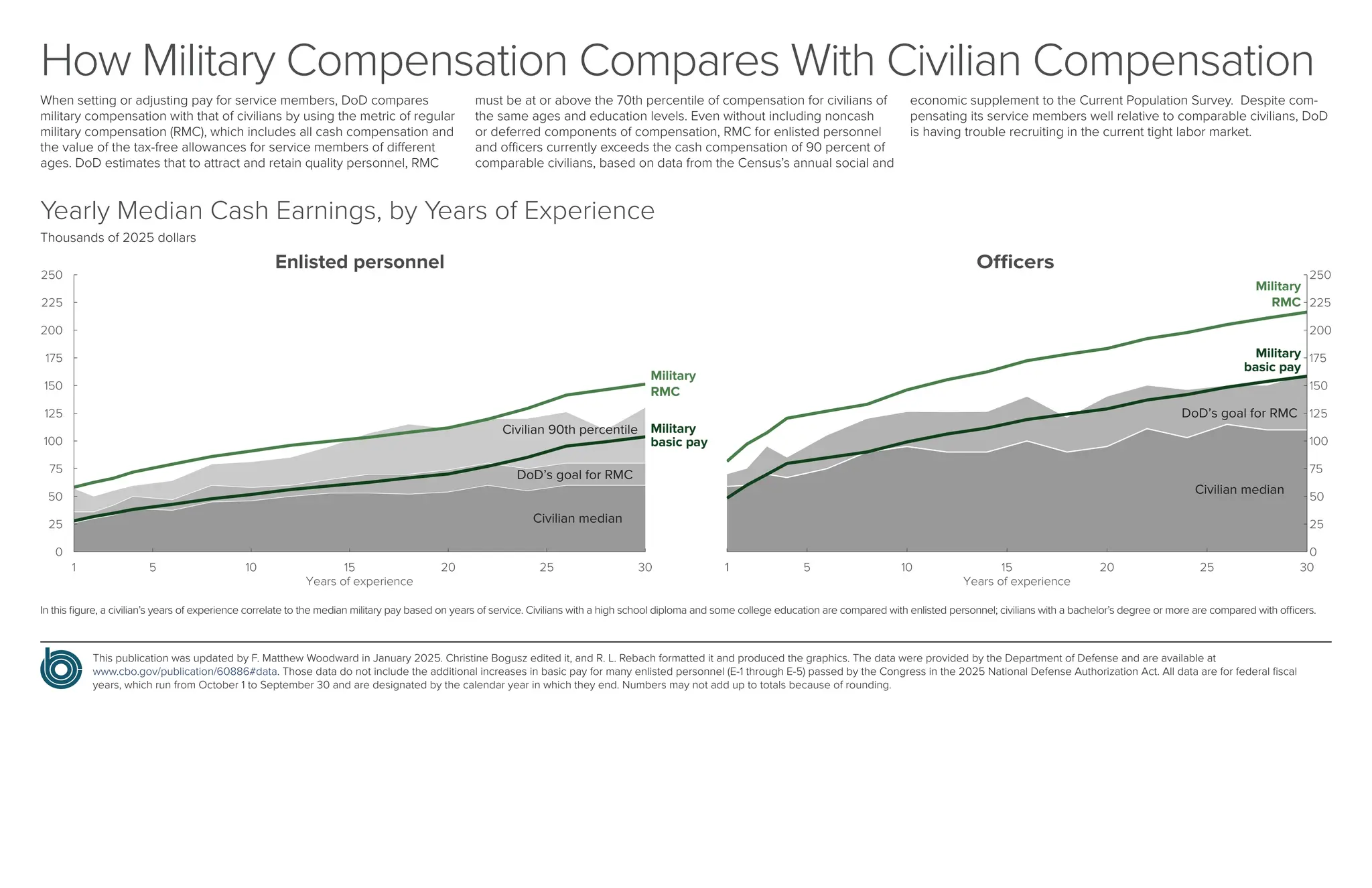
Yearly Median Cash Earnings, by Years of Experience
Thousands of 2025 dollars
1
Civilian median
Civilian median
Military
RMC
Military
RMC
Military
basic pay
Military
basic pay
DoD’s goal for RMC
DoD’s goal for RMC
Civilian 90th percentile
Enlisted personnel Officers
In this figure, a civilian’s years of experience correlate to the median military pay based on years of service. Civilians with a high school diploma and some college education are compared with enlisted personnel; civilians with a bachelor’s degree or more are compared with officers.
This publication was updated by F. Matthew Woodward in January 2025. Christine Bogusz edited it, and R. L. Rebach formatted it and produced the graphics. The data were provided by the Department of Defense and are available at
www.cbo.gov/publication/60886#data. Those data do not include the additional increases in basic pay for many enlisted personnel (E-1 through E-5) passed by the Congress in the 2025 National Defense Authorization Act. All data are for federal fiscal
years, which run from October 1 to September 30 and are designated by the calendar year in which they end. Numbers may not add up to totals because of rounding.
How Military Compensation Compares With Civilian Compensation
When setting or adjusting pay for service members, DoD compares
military compensation with that of civilians by using the metric of regular
military compensation (RMC), which includes all cash compensation and
the value of the tax-free allowances for service members of different
ages. DoD estimates that to attract and retain quality personnel, RMC
must be at or above the 70th percentile of compensation for civilians of
the same ages and education levels. Even without including noncash
or deferred components of compensation, RMC for enlisted personnel
and officers currently exceeds the cash compensation of 90 percent of
comparable civilians, based on data from the Census’s annual social and
economic supplement to the Current Population Survey. Despite com-
pensating its service members well relative to comparable civilians, DoD
is having trouble recruiting in the current tight labor market.

Atlas of Military Compensation, 2024 (Infographic)

  • 1.
    Budget of theDepartment of Defense Billions of 2025 dollars Military personnel Operation and maintenance Procurement Research, development, test, and evaluation Military construction Family housing Large-scale operations in Iraq and Afghanistan DoD’s military compensation Budget of the Department of Veterans Affairs Billions of 2025 dollars VA’s total budget Income security Medical care Other DoD’s military compensation S N E W Compensation for military personnel is found in both the defense and nondefense parts of the federal bud- get. Defense funding, in the Department of Defense’s (DoD’s) budget, is mostly for current military personnel. Nondefense funding in the Department of Veterans Affairs (VA) is mostly for former military personnel. Since 2000, the total budget for military compensa- tion has been rising steadily, even though the number of military personnel and veterans has been declining. Spending by VA has accounted for most of that in- crease, rising from a small fraction of the total to about 61 percent of military compensation in the President’s 2025 budget request. In the 2025 budget request, total military compen- sation is $600 billion. (Of that total, $236 billion is for DoD and $365 billion is for VA.) That amount represents an increase of 162 percent since 1980 (and 151 percent since 1999). Military Compensation: Defense and Nondefense Spending Most military compensation in DoD’s budget is funded through the appropriations for military personnel. That funding accounted for 28 percent of DoD’s total budget in 2025, down from 34 percent in 1980 (because of reductions in the size of the force). Some elements of compensation (for medical care and family programs) are funded through the operation and maintenance (O&M) and family housing accounts. VA’s budget funds income security programs (mostly disability compen- sation but also pension and survivors’ compensation), medical care (in VA’s facilities as well as at private-sector facilities), and other benefits and activities (mostly educational benefits but also administrative activities). The budget mostly funds benefits for veterans, but some benefits (such as VA-guaranteed home loans) can be accessed while serving in the military. After experiencing very little growth from 1980 to 1999, VA’s budget has more than quadrupled in real terms since 1999. The budgets for income security and medical care account for most of that growth; in the 2025 budget request, each of those programs is approaching the size of DoD’s military personnel budget. VA’s funding has grown since 2000, though the number of veterans has been declining. Furthermore, the number of combat veterans has been decreasing as a share of veterans who receive dis- ability compensation—even though the United States was engaged in operations in Iraq and Afghanistan for more than 10 years. Because of pol- icy changes, veterans who served after 9/11 (known as Gulf War II veterans) are more likely to get benefits, whether they served in combat or not. ATLAS OF MILITARY COMPENSATION, 2024
  • 2.
    Trends in TotalCompensation in DoD’s Budget Compensation for military service members in DoD’s budget falls into three categories: cash, noncash, and deferred. Cash compensation is what service members get in their paychecks, including basic pay and allowances for housing and food. Noncash compensation includes health care for service members and their families as well as services that improve military families’ quality of life (such as schools and commissaries). Deferred compensation includes benefits like service members’ military pensions, matching contribu- tions to the Thrift Savings Plan, and retiree health care plans. (Although not reflected here, VA’s spending is a form of deferred compensation.) From the end of the draft in 1973 to the mid-1990s, the costs of compen- sation per service member (adjusted for inflation) grew slowly. After 1997, those costs began to grow more rapidly, driven by pay raises and increas- es in the size of allowances, number of benefits, and cost of health care. Around 2010, compensation costs leveled off—even receding a little from 2013 to 2021, when fiscal spending caps were in place. In the 2025 budget request, DoD’s inflation-adjusted compensation costs per service member are 193 percent more than they were in 1973; most of that growth (a change of 70 percent) occurred between 1999 and 2011.1 For context, if DoD’s costs of military compensation had grown at the same rate as DoD’s civilian compensation between 1999 and 2011, the increase would have been 29 percent. 1. To identify trends in military compensation and remove the effects of changes in the size of the force, total spending is divided by the number of full-time military service members (defined as active component and active guard and reserve service members). This per-person rate only shows trends in costs and does not represent an average service member’s compensation. 1973. Ended the Draft: Switched from a conscripted force to an all-volunteer force in the United States. 1981. Raised Pay by 11.7%: Boosted pay and allowances one time to make military pay commensurate with civilian wages. 1981. Adjusted Retirement to High-3 Formula: Shifted from a retirement annuity based on final pay to one based on the highest three years of pay to reduce the cost of pension benefits and increase cash compensation. 1982. Increased Regular Military Compensation (RMC): Increased all aspects of RMC, boosting allowances for subsistance and quarters by 14.3% and basic pay by 10% to 17% depending on page grade. 1986. Enacted the Military Retirement Reform Act: Put in place legisla- tion that resulted in what is referred to as the Redux military retirement system, which reduced the multipliers in the defined benefit plan for service members with less than 30 years of service. 1996. Created the Military Housing Privatization Initiative: Formed a public-private partnership to improve the quality of military family housing. Private contractors are granted very long leases and financial assistance to build and maintain housing on military bases. Service members use their basic allowance for housing (BAH) to pay rent to the contractors managing the housing areas. 1998. Created BAH: Legislated the combination of methods to calcu- late housing allowances into a unified formula for computing BAH: The allowance was set to cover 85 percent of service members’ housing costs (rent, utilities, and insurance) if they rented housing that was equivalent to the housing they would get on a military base. 1999. Repealed Redux: Made enrollment in Redux optional. Service members who joined after August 1, 1986, could choose whether to retire under the pre-Redux system or opt for Redux plus an immediate $30,000 cash payment. 2000. Reformed Pay Table: Began an initiative to adjust military pay targeted to members at certain pay grades and with certain lengths of service. Over the next 10 years, the Congress would go on to adjust pay tables, pay raises, and bonuses to retain talented personnel once they reached mid-career. 2002. Created TRICARE for Life: Provided additional coverage to mili- tary retirees and their families who are eligible for Medicare. Paid most of retirees’ out-of-pocket costs not covered by Medicare alone. 2004. Established Concurrent Receipt: Allowed some retired military personnel to receive military retirement pay without any offset for disabili- ty compensation received from VA. 2005. Increased BAH to Cover All Housing Costs: Reduced a service member’s out-of-pocket expenses for housing to zero for those not living in government-owned-and-operated quarters. 2005. Eliminated Social Security Offset: Increased the benefit paid to spouses of deceased service members, age 62 or older, from 35 per- cent to 55 percent of the deceased service member’s retirement pay. 2008. Changed Reservist Retirement: Lowered the age of eligibility for some reservists to start receiving retirement pay based on periods of active-duty service in support of contingency operations. 2018. Established Blended Retirement System: Created a new retire- ment system for those who joined after 2017. Major changes included matching contributions to the Thrift Savings Plan and reducing the multi- plier (from 2.5 percent to 2.0 percent) for the defined benefit plan. 2019. Reduced BAH: Set BAH to 95 percent of service members’ housing costs (for those not living in government-owned-and-operated quarters). 2022. Created Basic Needs Allowance: Set a basic needs allowance, or BNA (per the 2022 National Defense Authorization Act) for military families whose gross household income is below 130 percent of the Department of Health and Human Services’ federal poverty guidelines. In 2023, it was changed to provide discretionary authority for the Secre- tary of Defense to grant BNA to families making up to 200 percent of the poverty guidelines. 2025. Pay Reform: The 2025 NDAA grants all service members a 4.5 percent pay raise, consistent with the employment cost index. Pay reforms in the 2025 NDAA provide service members in pay grades E-1 through E-4 an additional 10.5 percent, for a total pay raise of 15 per- cent; E-5s with fewer than 10 years of service receive an average raise of 7 percent, for a total raise of 11.5 percent. Timeline of DoD’s Compensation and Landmark Events, 1970 to 2025 Thousands of 2025 dollars per person DoD’s military compensation Deferred Cash Noncash 1973 1981 1982 1986 1996 1998 2000 2002 2005 2018 2022 2008 2004 1999 2019 2025 request DoD’s civilian compensation
  • 3.
    Noncash Thousands of 2025dollars per person Family housing Relocationc Other benefits Supportd Health careb Created TRICARE for Life b.Health care is funded out of the operation and maintenance accounts. c. When service members are required to change geographic location for their job. d.Programs that improve the quality of life for service members and their families. Examples are DoD’s schools, commissaries, child care, and welfare and recreation. Cash Thousands of 2025 dollars per person Basic pay Special pay Food allowancea Housing allowancea Reserve pay Reformed pay table a. The allowances for housing and food are not taxed, increasing the cost of military compensation in the federal budget, not shown here. Deferred Thousands of 2025 dollars per person Concurrent receipte Retirees’ health care Retirement Created TRICARE for Life e.The cost of paying retired military personnel their military retirement pay without any offset for disability compensation received from VA. Basic Pay Thousands of 2025 dollars per person Basic pay Budget for basic pay if it grew with the ECI after 1999a Reformed pay table a. The ECI is based on measurements from the Bureau of Labor Statistics that are reported by CBO in its historical budget and economic data: www.cbo.gov/data/budget-economic-data. Military Housing Benefits Thousands of 2025 dollars per person Total military housing Family housing Budget for basic allowance for housing if it grew at the same rate as residential rents after 1999b Basic allowance for housing Increased BAH to 100% of housing costs Reduced BAH to 95% b.The rate of growth in residential rents can be found in CBO’s historical budget and economic data: www.cbo.gov/data/budget- economic-data. A Detailed Look at the Categories of DoD’s Compensation Trends in Cash Compensation The two largest components of cash compensation are basic pay and the basic allowance for housing (BAH)—accounting for about 30 percent and 10 percent of total compensation, respectively. Since 2000, military pay reform caused basic pay to grow faster in real terms than if it had grown with the civilian employment cost index, or ECI. Growth was particularly high from 2002 to 2005. That trend end- ed around 2010 as DoD began reducing the size of its force. After 2010, the budget for basic pay was relatively flat, even receding a bit between 2010 and 2023 before trending upward in 2024. Starting in the late 1990s, DoD standardized how it compensated service members who paid for off-base housing in the United States and created the BAH. Then, starting In the early 2000s, DoD began to pri- vatize much of its on-base family housing. Service members who live in that housing use their BAH to pay the cost of rent and utilities to private contractors who manage that housing. (Family housing accounts retain some funding to maintain government-owned-and-operated quarters and to oversee the contractors that manage the military housing privat- ization program.) Those changes shifted most funding for on-base family housing from an in-kind benefit (paid out of the family housing account) to a tax-free cash benefit (BAH) in the military personnel account. Starting in 2000, as more military housing was privatized, BAH grew, leveling off around 2010. After dipping slightly in 2023, BAH has begun to rise, following inflation in residential rents.
  • 4.
    Cost of Compensationper Service Member, 2024 Tax advantagea 5% Tax advantagea 3% Active-duty health care 11% Noncash $21,300 Cash (regular military compensation) $70,700 Deferred $23,400 Allowances for housing and food 26% Basic pay 31% Retirement pay 8% Retirement pay 12% Retirees’ health care 12% Retirees’ health care 8% Other noncash 7% Active-duty health care 7% Other noncash 5% Noncash $21,300 Cash (regular military compensation) $126,600 Deferred $36,700 Allowances for housing and food 19% Basic pay 46% Total compensation costs = $115,400 Median enlisted personnel (E-4 with dependents, average age: 22) Total compensation costs = $184,600 Median officers (O-3 with dependents, average age: 28) a. DoD’s estimate of the benefit a service member receives from the tax-free allowances for food and housing. That amount represents a cost to the federal government in terms of lost tax revenues. Components of Service Members’ Compensation Pay and benefits are intended to attract quality personnel by adequate- ly compensating service members for the unique rigors of military life, including overseas deployments and extended time away from family members. Through a mix of cash, noncash, and deferred compensation, DoD attempts to attract and retain the high-quality personnel it needs to fill specialized occupations and to motivate service members to perform their best. Service members receive the cash and noncash components of their compensation each year that they are on active duty. They receive deferred compensation once they leave service—any money and match- ing funds they invested in the Thrift Savings Plan (if they opted in) and an annuity for those who retire after 20 or more years of service. How Elements of Military Compensation Might Be Valued DoD’s mix of compensation is intended to attract and retain service mem- bers at different stages in their careers. For example, younger people val- ue cash compensation (like enlistment and reenlistment bonuses and cash pay) more than noncash and deferred compensation. A dollar that they can spend immediately is worth more to them than a dollar of noncash compensation and much more to them than a dollar of a deferred benefit. However, as service members reach the middle and latter portions of their careers, they tend to place more value on noncash and deferred compen- sation because they have families and are getting closer to retirement. In fact, most service members who stay past 10 years remain until retirement in part because of the increasing value of those benefits to them. For enlisted personnel in labor-intensive services with high turnover, like the Army and Marine Corps, cash compensation is very important; almost 80 percent of Marine Corps recruits and about half of Army recruits serve only one tour of duty (or about four years). By contrast, roughly one-quarter of enlisted personnel in platform-centric forces, like the Navy and the Air Force, stay until retirement, making noncash and deferred compensation more important for them. Average Length of Military Service Percentage of personnel remaining in the military, by years of service Officers Enlisted personnel Air Force Navy Navy Marine Corps Army Average first term (4 years) Typical service needed to retire (20 years) Air Force Marine Corps Army
  • 5.
    Yearly Median CashEarnings, by Years of Experience Thousands of 2025 dollars 1 Civilian median Civilian median Military RMC Military RMC Military basic pay Military basic pay DoD’s goal for RMC DoD’s goal for RMC Civilian 90th percentile Enlisted personnel Officers In this figure, a civilian’s years of experience correlate to the median military pay based on years of service. Civilians with a high school diploma and some college education are compared with enlisted personnel; civilians with a bachelor’s degree or more are compared with officers. This publication was updated by F. Matthew Woodward in January 2025. Christine Bogusz edited it, and R. L. Rebach formatted it and produced the graphics. The data were provided by the Department of Defense and are available at www.cbo.gov/publication/60886#data. Those data do not include the additional increases in basic pay for many enlisted personnel (E-1 through E-5) passed by the Congress in the 2025 National Defense Authorization Act. All data are for federal fiscal years, which run from October 1 to September 30 and are designated by the calendar year in which they end. Numbers may not add up to totals because of rounding. How Military Compensation Compares With Civilian Compensation When setting or adjusting pay for service members, DoD compares military compensation with that of civilians by using the metric of regular military compensation (RMC), which includes all cash compensation and the value of the tax-free allowances for service members of different ages. DoD estimates that to attract and retain quality personnel, RMC must be at or above the 70th percentile of compensation for civilians of the same ages and education levels. Even without including noncash or deferred components of compensation, RMC for enlisted personnel and officers currently exceeds the cash compensation of 90 percent of comparable civilians, based on data from the Census’s annual social and economic supplement to the Current Population Survey. Despite com- pensating its service members well relative to comparable civilians, DoD is having trouble recruiting in the current tight labor market.