PAS NPPF Housing Numbers Webinar
Online: Thursday 23rd
January 2025
We start at 1pm
Please login to Slido to ask questions / answer polls
through the session.
Webinar Agenda
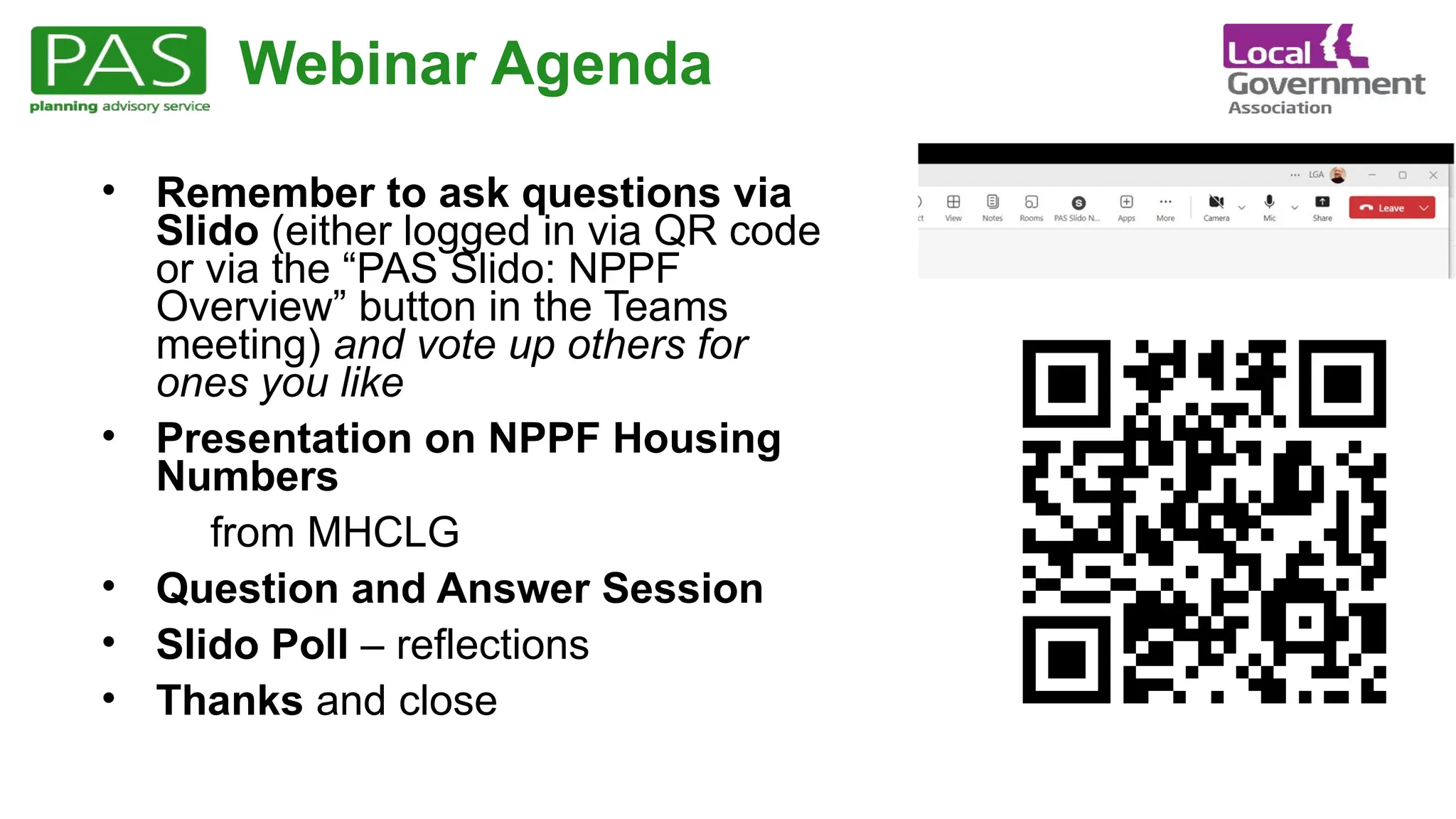
• Remember to ask questions via
Slido (either logged in via QR code
or via the “PAS Slido: NPPF
Overview” button in the Teams
meeting) and vote up others for
ones you like
• Presentation on NPPF Housing
Numbers
from MHCLG
• Question and Answer Session
• Slido Poll – reflections
• Thanks and close
OFFICIAL
OFFICIAL
OFFICIAL
The New National Planning
Policy Framework
Planning for Housing
January 2025
OFFICIAL
OFFICIAL
OFFICIAL
• Local Housing Need
• 5 Year Housing Land Supply
• Housing Delivery Test
OFFICIAL
OFFICIAL 5
Local Housing Need
Overview and drivers for change
• Local housing need is an unconstrained assessment of the minimum
number of homes needed in an area (policy off)
• Gives councils a 'starting point' for how many homes they should plan
for through their local plan (the housing requirement – policy on)
• LHN is usually calculated through the ‘standard method’
• 1.5 million new homes – Manifesto commitment ‘Plan for Change’
• A more balanced distribution of homes – with a strong emphasis on
affordability
• Certainty and stability – more predictable, consistent outcomes, avoid
complexity
What is local housing need and the standard method?
Drivers for change – why a new method / approach?
OFFICIAL
OFFICIAL 6
Local Housing Need
The Key Changes
• A new standard method – based on housing stock (0.8%) and housing affordability (0.95% multiplier
using 5 year average affordability, multiplier kicks in where affordability ratio is 5+)
• Removal of urban uplift, cap
• Increase in national figure – c300k to c370k
• Policy changes - removal of exceptional circumstances for use of an alternative approach - strong
expectation the standard method is used (NPPF para 62)
• Revised NPPF and Housing Needs PPG
• Proposed method revised to respond further to local affordability pressures
• the final method incorporates a higher affordability adjustment (from 0.6 to 0.95) + other changes
• increases LHN in areas with strongest affordability pressures, reducing in more affordable areas
• While remaining c370k nationally
December 2024 changes – key changes
What we changed as a result of the consultation
OFFICIAL
OFFICIAL 7
Local Housing Need
Consultation – key themes
• General comments on need for certainty and clarity – in policy and the standard method formula
• Further guidance on implementing local housing need and on how constraints should be considered
• Local authority call for more discretion on planning for housing, concerns over top down targets
• Urban uplift – urban areas should continue to be a focus for housing but uplift not effective
• Broad range of views on use of housing stock v household projections
• Support for continued use of affordability in method but some concerns over spatial distribution
• Support for consideration of rental affordability as well as house price affordability
• Range of views on the outcomes and deliverability
Key themes from consultation
OFFICIAL
OFFICIAL 8
Local Housing Need
The formula and calculation
• Housing stock – 62,500
• 0.8% of stock = 500
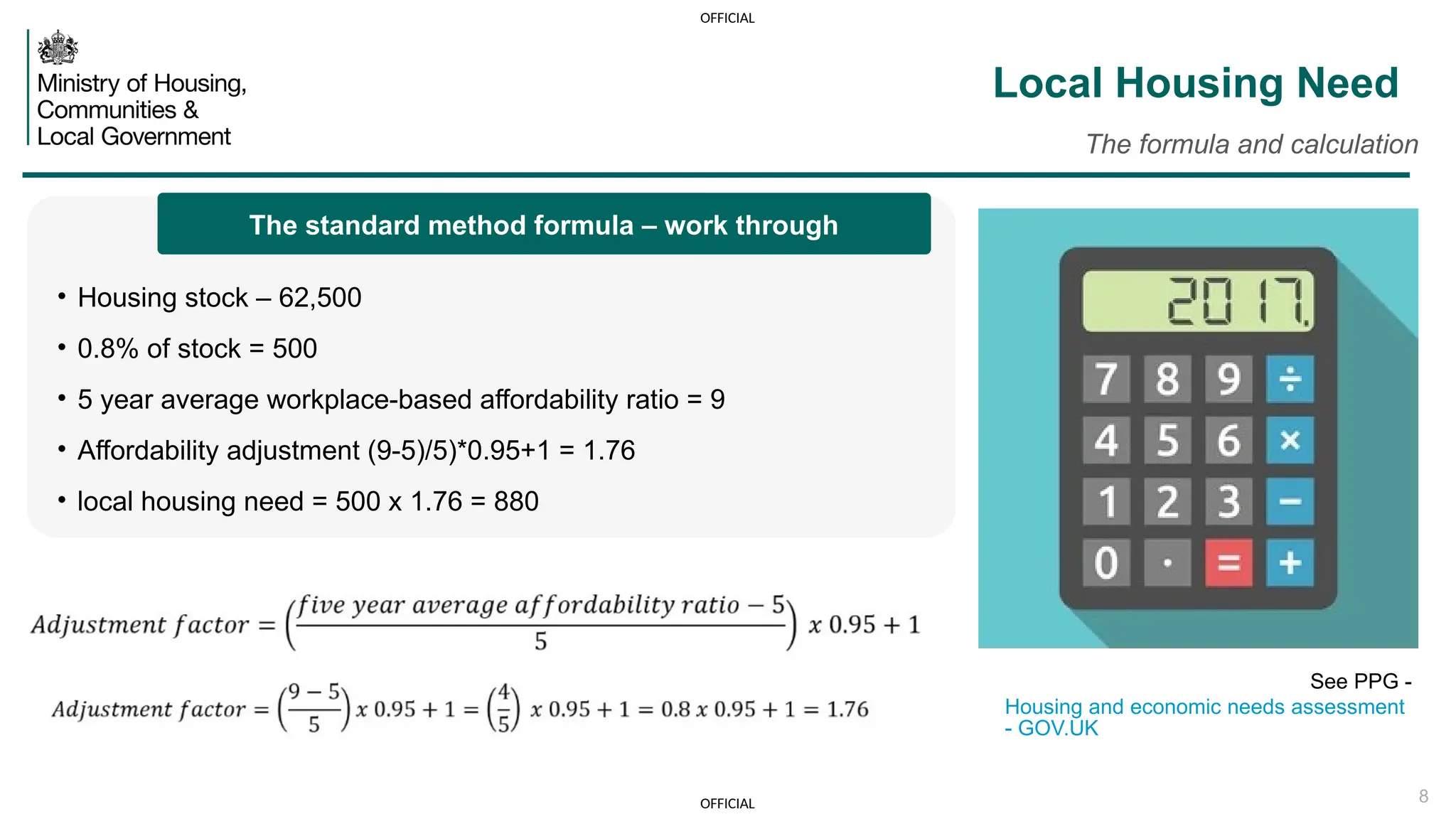
• 5 year average workplace-based affordability ratio = 9
• Affordability adjustment (9-5)/5)*0.95+1 = 1.76
• local housing need = 500 x 1.76 = 880
The standard method formula – work through
See PPG -
Housing and economic needs assessment
- GOV.UK
OFFICIAL
OFFICIAL 9
Local Housing Need
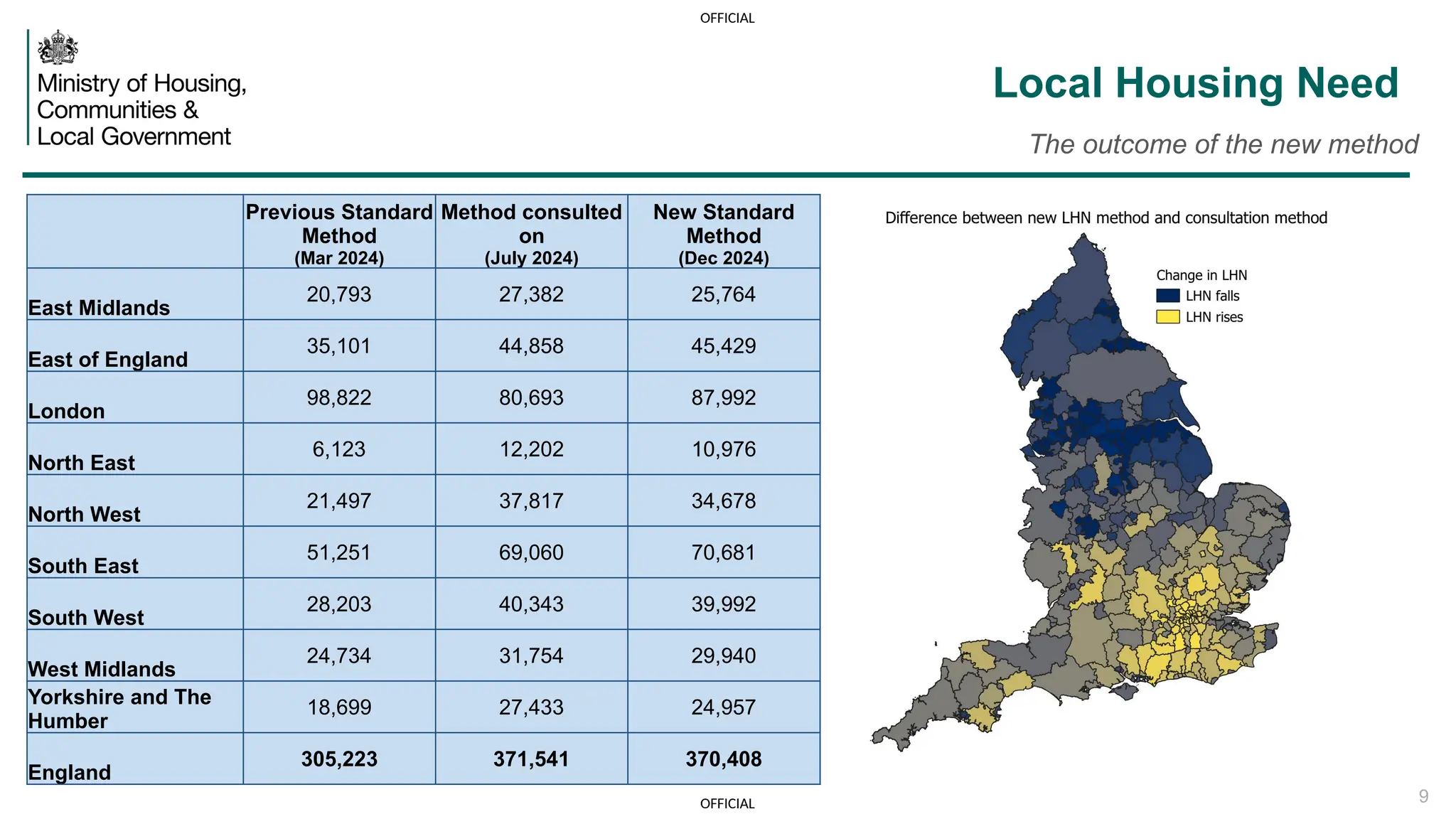
The outcome of the new method
xxx
Previous Standard
Method
(Mar 2024)
Method consulted
on
(July 2024)
New Standard
Method
(Dec 2024)
East Midlands
20,793 27,382 25,764
East of England
35,101 44,858 45,429
London
98,822 80,693 87,992
North East
6,123 12,202 10,976
North West
21,497 37,817 34,678
South East
51,251 69,060 70,681
South West
28,203 40,343 39,992
West Midlands
24,734 31,754 29,940
Yorkshire and The
Humber
18,699 27,433 24,957
England
305,223 371,541 370,408
OFFICIAL
OFFICIAL 10
Housing Need and Requirement
Establishing a housing requirement
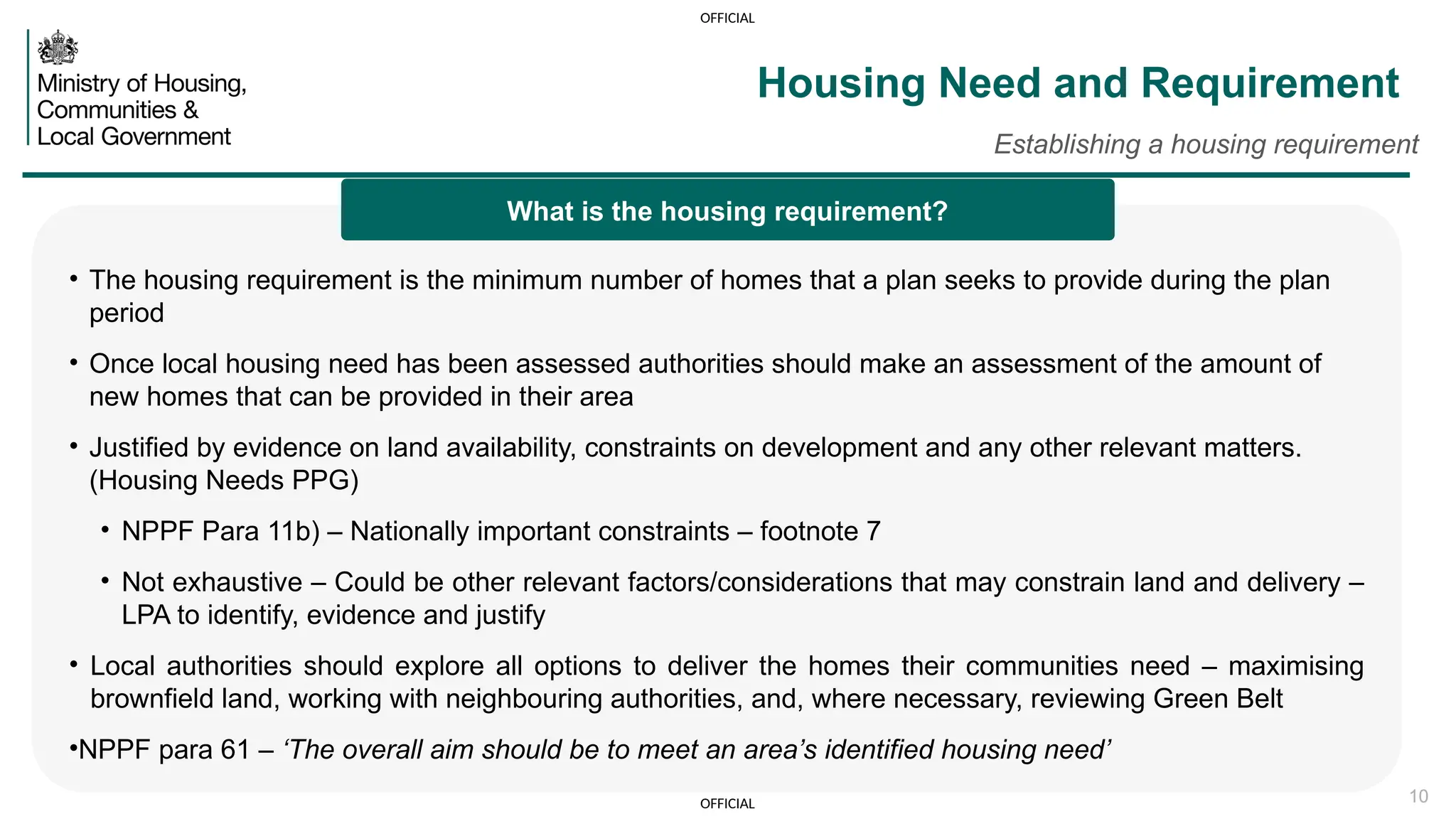
• The housing requirement is the minimum number of homes that a plan seeks to provide during the plan
period
• Once local housing need has been assessed authorities should make an assessment of the amount of
new homes that can be provided in their area
• Justified by evidence on land availability, constraints on development and any other relevant matters.
(Housing Needs PPG)
• NPPF Para 11b) – Nationally important constraints – footnote 7
• Not exhaustive – Could be other relevant factors/considerations that may constrain land and delivery –
LPA to identify, evidence and justify
• Local authorities should explore all options to deliver the homes their communities need – maximising
brownfield land, working with neighbouring authorities, and, where necessary, reviewing Green Belt
•NPPF para 61 – ‘The overall aim should be to meet an area’s identified housing need’
What is the housing requirement?
OFFICIAL
OFFICIAL
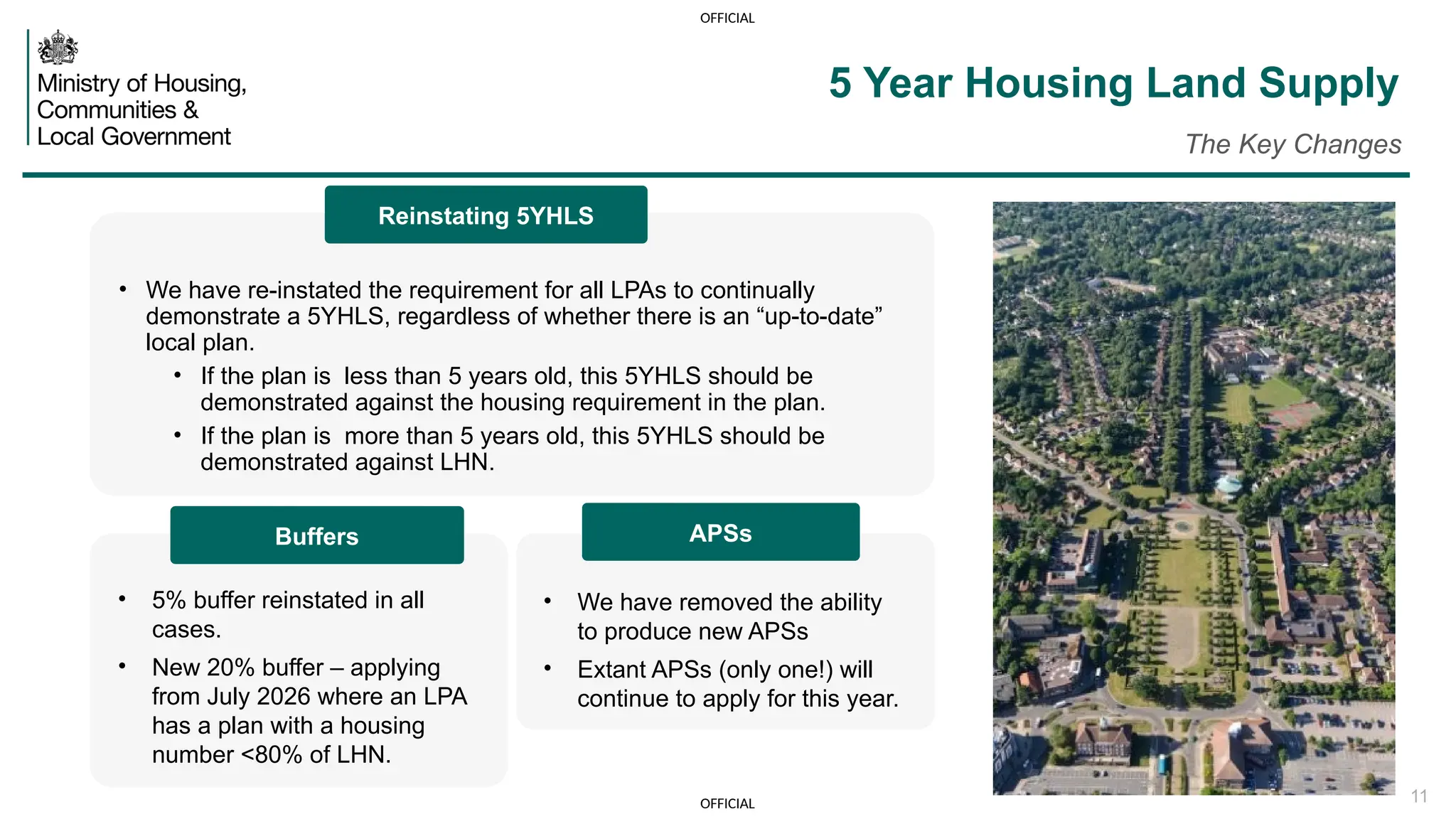
• 5% buffer reinstated in all
cases.
• New 20% buffer – applying
from July 2026 where an LPA
has a plan with a housing
number <80% of LHN.
11
5 Year Housing Land Supply
The Key Changes
• We have re-instated the requirement for all LPAs to continually
demonstrate a 5YHLS, regardless of whether there is an “up-to-date”
local plan.
• If the plan is less than 5 years old, this 5YHLS should be
demonstrated against the housing requirement in the plan.
• If the plan is more than 5 years old, this 5YHLS should be
demonstrated against LHN.
• We have removed the ability
to produce new APSs
• Extant APSs (only one!) will
continue to apply for this year.
Reinstating 5YHLS
Buffers APSs
OFFICIAL
OFFICIAL
• We are exploring options to return to a more regular HDT
publication. We will share more details in due course.
12
Housing Delivery Test
The Key Changes
• We published the 2023 HDT results alongside the updated NPPF in
December 2023. We made no policy changes to how the HDT
operates in December.
2023 HDT
2024 HDT and beyond
OFFICIAL
OFFICIAL
OFFICIAL
Q and A
Thank you
• Please complete the Slido polls for event
input/feedback
• We are delivering other PAS topic
focused NPPF Webinars –
places are still available:
 Green Belt: 1-2pm, 18 Feb
 Golden Rules: 1-2pm, 19 Feb
• Slides of this session will be posted shortly on
the PAS website

NPPF Dec 24 - Housing Numbers Webinar PAS FINAL Version.pptx

  • 1.
    PAS NPPF HousingNumbers Webinar Online: Thursday 23rd January 2025 We start at 1pm Please login to Slido to ask questions / answer polls through the session.
  • 2.
    Webinar Agenda • Rememberto ask questions via Slido (either logged in via QR code or via the “PAS Slido: NPPF Overview” button in the Teams meeting) and vote up others for ones you like • Presentation on NPPF Housing Numbers from MHCLG • Question and Answer Session • Slido Poll – reflections • Thanks and close
  • 3.
    OFFICIAL OFFICIAL OFFICIAL The New NationalPlanning Policy Framework Planning for Housing January 2025
  • 4.
    OFFICIAL OFFICIAL OFFICIAL • Local HousingNeed • 5 Year Housing Land Supply • Housing Delivery Test
  • 5.
    OFFICIAL OFFICIAL 5 Local HousingNeed Overview and drivers for change • Local housing need is an unconstrained assessment of the minimum number of homes needed in an area (policy off) • Gives councils a 'starting point' for how many homes they should plan for through their local plan (the housing requirement – policy on) • LHN is usually calculated through the ‘standard method’ • 1.5 million new homes – Manifesto commitment ‘Plan for Change’ • A more balanced distribution of homes – with a strong emphasis on affordability • Certainty and stability – more predictable, consistent outcomes, avoid complexity What is local housing need and the standard method? Drivers for change – why a new method / approach?
  • 6.
    OFFICIAL OFFICIAL 6 Local HousingNeed The Key Changes • A new standard method – based on housing stock (0.8%) and housing affordability (0.95% multiplier using 5 year average affordability, multiplier kicks in where affordability ratio is 5+) • Removal of urban uplift, cap • Increase in national figure – c300k to c370k • Policy changes - removal of exceptional circumstances for use of an alternative approach - strong expectation the standard method is used (NPPF para 62) • Revised NPPF and Housing Needs PPG • Proposed method revised to respond further to local affordability pressures • the final method incorporates a higher affordability adjustment (from 0.6 to 0.95) + other changes • increases LHN in areas with strongest affordability pressures, reducing in more affordable areas • While remaining c370k nationally December 2024 changes – key changes What we changed as a result of the consultation
  • 7.
    OFFICIAL OFFICIAL 7 Local HousingNeed Consultation – key themes • General comments on need for certainty and clarity – in policy and the standard method formula • Further guidance on implementing local housing need and on how constraints should be considered • Local authority call for more discretion on planning for housing, concerns over top down targets • Urban uplift – urban areas should continue to be a focus for housing but uplift not effective • Broad range of views on use of housing stock v household projections • Support for continued use of affordability in method but some concerns over spatial distribution • Support for consideration of rental affordability as well as house price affordability • Range of views on the outcomes and deliverability Key themes from consultation
  • 8.
    OFFICIAL OFFICIAL 8 Local HousingNeed The formula and calculation • Housing stock – 62,500 • 0.8% of stock = 500 • 5 year average workplace-based affordability ratio = 9 • Affordability adjustment (9-5)/5)*0.95+1 = 1.76 • local housing need = 500 x 1.76 = 880 The standard method formula – work through See PPG - Housing and economic needs assessment - GOV.UK
  • 9.
    OFFICIAL OFFICIAL 9 Local HousingNeed The outcome of the new method xxx Previous Standard Method (Mar 2024) Method consulted on (July 2024) New Standard Method (Dec 2024) East Midlands 20,793 27,382 25,764 East of England 35,101 44,858 45,429 London 98,822 80,693 87,992 North East 6,123 12,202 10,976 North West 21,497 37,817 34,678 South East 51,251 69,060 70,681 South West 28,203 40,343 39,992 West Midlands 24,734 31,754 29,940 Yorkshire and The Humber 18,699 27,433 24,957 England 305,223 371,541 370,408
  • 10.
    OFFICIAL OFFICIAL 10 Housing Needand Requirement Establishing a housing requirement • The housing requirement is the minimum number of homes that a plan seeks to provide during the plan period • Once local housing need has been assessed authorities should make an assessment of the amount of new homes that can be provided in their area • Justified by evidence on land availability, constraints on development and any other relevant matters. (Housing Needs PPG) • NPPF Para 11b) – Nationally important constraints – footnote 7 • Not exhaustive – Could be other relevant factors/considerations that may constrain land and delivery – LPA to identify, evidence and justify • Local authorities should explore all options to deliver the homes their communities need – maximising brownfield land, working with neighbouring authorities, and, where necessary, reviewing Green Belt •NPPF para 61 – ‘The overall aim should be to meet an area’s identified housing need’ What is the housing requirement?
  • 11.
    OFFICIAL OFFICIAL • 5% bufferreinstated in all cases. • New 20% buffer – applying from July 2026 where an LPA has a plan with a housing number <80% of LHN. 11 5 Year Housing Land Supply The Key Changes • We have re-instated the requirement for all LPAs to continually demonstrate a 5YHLS, regardless of whether there is an “up-to-date” local plan. • If the plan is less than 5 years old, this 5YHLS should be demonstrated against the housing requirement in the plan. • If the plan is more than 5 years old, this 5YHLS should be demonstrated against LHN. • We have removed the ability to produce new APSs • Extant APSs (only one!) will continue to apply for this year. Reinstating 5YHLS Buffers APSs
  • 12.
    OFFICIAL OFFICIAL • We areexploring options to return to a more regular HDT publication. We will share more details in due course. 12 Housing Delivery Test The Key Changes • We published the 2023 HDT results alongside the updated NPPF in December 2023. We made no policy changes to how the HDT operates in December. 2023 HDT 2024 HDT and beyond
  • 13.
  • 14.
    Thank you • Pleasecomplete the Slido polls for event input/feedback • We are delivering other PAS topic focused NPPF Webinars – places are still available:  Green Belt: 1-2pm, 18 Feb  Golden Rules: 1-2pm, 19 Feb • Slides of this session will be posted shortly on the PAS website

Editor's Notes

  • #5 Plan for change – 5 December just before NPPF published – 1.5m commitment over parliament
  • #6 Around a dozen LPAs have affordability ratio below 5 – meaning there is no adjustment in those places. Other places where affordability is lower see LHN fall compared to method consulted on
  • #8 The example set out in PPG
  • #9 Approx 60% of LPAs saw a decrease from method consulted on and 40% saw an increase London, SE and EofE see increases under the final method compared to consulted on But remains around 370k
  • #10 Brownfield passports, national policies for decision making PAS session coming up on GB Plans and decisions should apply a presumption in favour of sustainable development. For plan-making this means that: all plans should promote a sustainable pattern of development that seeks to: meet the development needs of their area; align growth and infrastructure; improve the environment; mitigate climate change (including by making effective use of land in urban areas) and adapt to its effects; b) strategic policies should, as a minimum, provide for objectively assessed needs for housing and other uses, as well as any needs that cannot be met within neighbouring areas6 , unless: the application of policies in this Framework that protect areas or assets of particular importance provides a strong reason for restricting the overall scale, type or distribution of development in the plan area ; any adverse impacts of doing so would significantly and demonstrably outweigh the benefits, when assessed against the policies in this Framework taken as a whole.
  • #14 If planning interests you, sign up for our bulletin!