Los Santos Police Department
Field Training Officer
Classroom Presentation
Table Of Contents
Section 1: Response
Section 2: Self Initiated Field Activity
Section 3: Officer Safety
Section 4: Someone in Custody
Section 5: Radio Usage
Section 6: CAD/MDT
Section 7: Investigative Skill
Section 8: License Plate & Districts
Section 9: Policy & Procedure
Section 10: State Penal Code/Case Law
Section 11: First Aid
Section 12: De Escalation & Use of Force
Section 13: Patrol Equipment
Section 14: Key Bindings & Commands
Section 15: Tactics
Section 1: Response
Emergency Driving (Code 3); Lights
and Sirens
- Felonies in progress
- Life threatening circumstances
- Pursuit Driving
- Major Vehicle Accidents
- Anytime someone's life could be
in danger
- Fight with Guns
**DISCLAIMER WHEN YOU ARE UTILIZING CODE 3 & CODE 2 YOU ARE EXEMPT FROM TRAFFIC
STATUS***
(Code 2); Lights and Sirens
when approaching
intersections
- Silent Alarms
- 10-32 Request (Traffic
Stop)
- Trespassing in progress
- Traffic Control (Use Best
Judgement)
- Suspicious Vehicle
- Suspicious Person
(Code 1); No Lights and
Sirens
- Property Checks
- Civil Reports
- Public Events
- Disturbances
Section 1: Response Clearing
Intersections (cont.)
What you should do relating to traffic signals
Red Light;
- Begin Decreasing your
speed
- Make a complete stop
- Change your tones
- Continue as necessary
Yellow & Green Light
- Begin Decreasing your speed
- Look left & right
- Ensure there is no moving
traffic
- Continue as necessary
**DISCLAIMER MAKE SURE TO LOOK OUT FOR PEDESTRIANS, ANIMALS & OTHER VEHICLES
BECAUSE THEY COULD COME OUT OF NOWHERE ***
Clearing Intersection Video;
Red Light;
https://mwrp.de
v/q2kNZq
Green Light;
https://mwrp.de
v/chvdO4
Section 2: Self Initiated Activity Traffic
Stop
Traffic Stops; while on traffic stops do the following
- Turn on Emergency Lighting
- After the vehicle stops angle your vehicle for safety
- Begin calling out your traffic stop; Begin your traffic callout over radio (Exp: Officer: 2B-400
10-11, Dispatch: Go ahead with 10-11, Officer: 2B-400 10-11 121 Davis Avenue the vehicle is
going to be a red ford F-150, 10-28 when ready, Dispatch: Go Ahead with 10-28, Officer: The 10-
28 is going to be 56AAS45, Dispatch: Return *Vehicle information* (In the event of condition
yellow, input all information into CAD)
- Run the vehicles license plate, preferably also run the Registered owner.
- Introduce yourself; Hello (gender pronoun) my name is Officer Johnson with the Los Santos
Police Department, the reason for the stop is I witnessed you run that red light back there
Drivers License, registration & proof of insurance please. Where are you heading to? Where are
you coming from? Anything in the vehicle I need to be worried about. Weapons? Narcotics?
Explosives?
Section 2: Self Initiated Activity Property
Check
What is a property check? A property check is when a Peace Officer walks through/checks a business
location to ensure there’s no signs of a break in or unwanted persons.
What are signs of a break in?
● Abnormal broken glass
● Lights on after business hours
● Abnormal doors open
● Unusual noises
● Shadows after hours
If you notice a business that might possibly be a break in follow
these steps.
● Notify dispatch you might have a burglary in progress
and request additional officers.
● Observe the location and ensure you don’t see any
further signs.
● Attempt to call the owner of the business to verify no
one should be present after hours.
● After you’ve verified your suspicions of a break in
request a Signal 100 to clear the residence.
● Get multiple officers and safely begin clearing the
building in an attempt to locate the perp.
● If located detain the persons and verify his reasoning for
being there.
Section 3: Officer Safety
What is Officer Safety? Precautions taken by fellow LEO’s or Dispatchers to prevent possible dangerous
situations that would place an Officer in an unsafe/uncomfortable/dangerous situation.
What are steps I can take for Officer Safety?
1. Maintain control of your scene, ensure everyone is following all of your lawful orders.
2. Request additional Officer(s) to your location if necessary.
3. If things are getting out of hand don’t be afraid to separate people and place them in handcuffs
for further detainment.
4. Ensure that all of your Weaponry I.E. Taser, Baton and Handgun are secured.
5. Do not allow someone to leave their vehicle on a traffic stop, unless ordered to.
6. If someone steps out of their vehicle or they are out of their vehicle when you arrive, DO NOT
allow them to return to their vehicle. They could use this opportunity to grab a weapon or flee.
7. Do not allow people to be mobile, walking around, reaching into pockets, reaching into their
vehicle, etc.
8. Ensure that you’re updating dispatch as necessary.
9. Do not hog Radio Traffic, be quick, clear and simple.
10. Always be aware of your surroundings, perform pat downs for weapons (Terry vs Ohio protects
you).
11. Always maintain eyes on people .
12. Don’t let people with tinted windows roll their windows up,.
Section 3: Officer Safety Crossfire
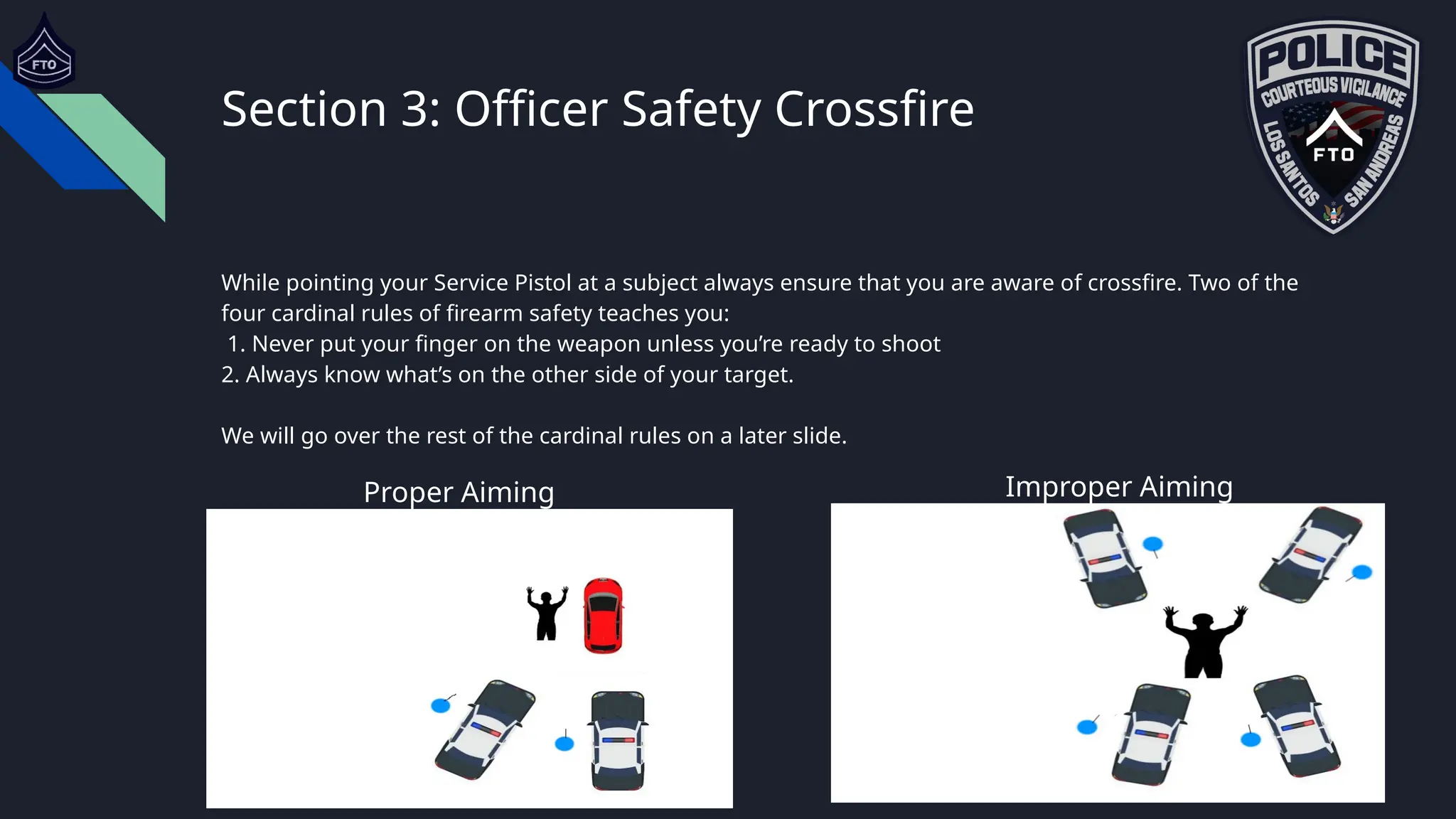
While pointing your Service Pistol at a subject always ensure that you are aware of crossfire. Two of the
four cardinal rules of firearm safety teaches you:
1. Never put your finger on the weapon unless you’re ready to shoot
2. Always know what’s on the other side of your target.
We will go over the rest of the cardinal rules on a later slide.
Proper Aiming
Proper Aiming
Improper Aiming
Section 3: Calling additional units
When should I call for additional units? There’s a few reasons you should call for additional units.
1. You do not feel comfortable on a scene.
2. You are outnumbered.
3. Suspects are acting out of the ordinary and dodging officers questions.
4. If the call warrants it. It’s always easier to clear off unneeded units then to need units and not have
them available or waiting for their response time.
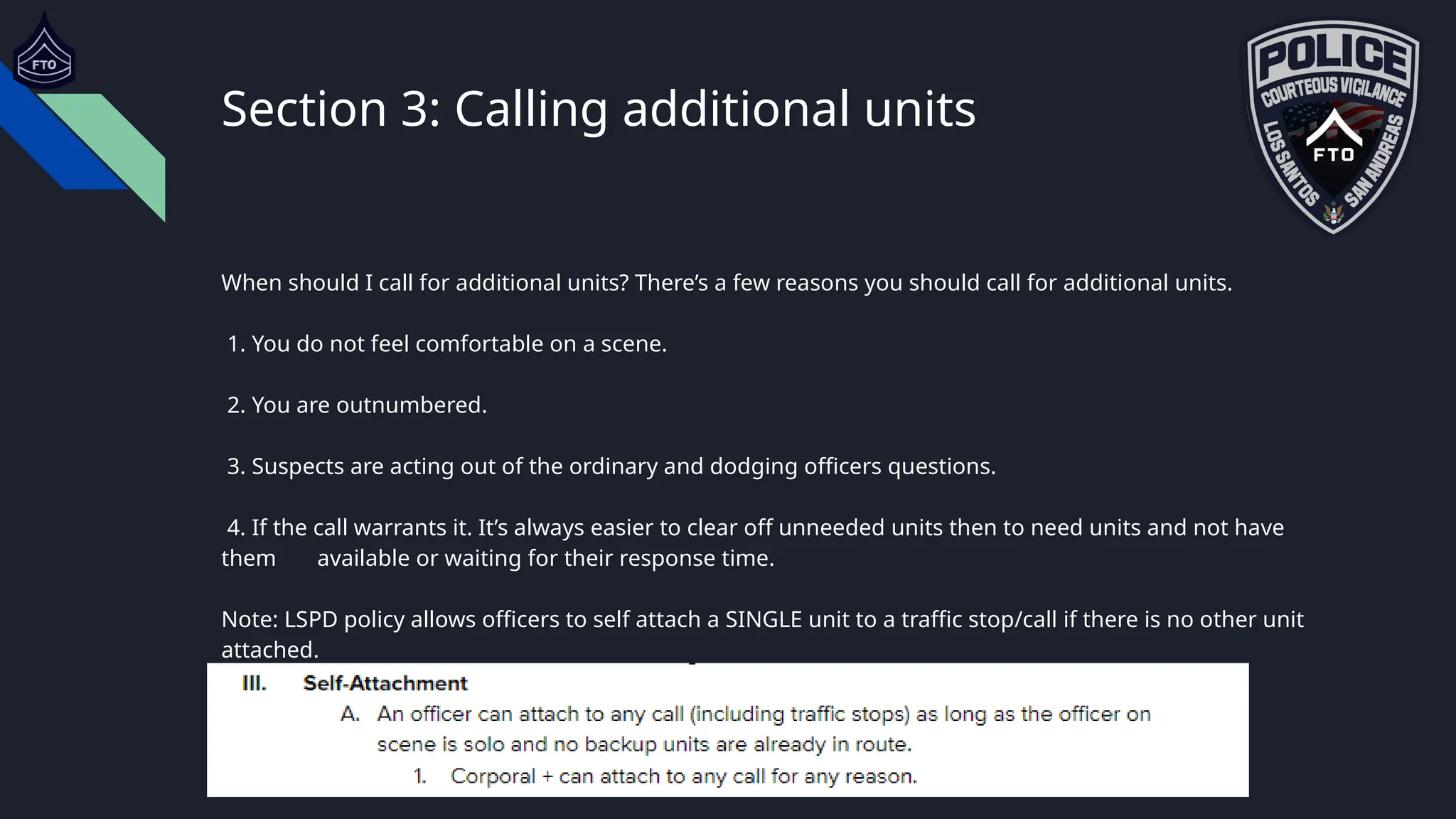
Note: LSPD policy allows officers to self attach a SINGLE unit to a traffic stop/call if there is no other unit
attached.
Section 4: Someone In Custody
While you have someone in custody if they begin head butting officers, spitting or kicking don’t be
afraid to safely restrain them using some of these items:
● A foam helmet
● Spit mask or a hobble to secure their legs
Never get violent and begin using unnecessary force on them. Do not ever allow your personal feelings
to effect your duties as a Peace Officer in correlation to the subjects crime.
Don’t ever neglect the subject I.E. turning the AC off, turning the heater on unnecessarily, etc.
Section 5: Radio Etiquette
What is Radio Traffic Only (RTO)?
- It is a channel within the MidwestRP Teamspeak that allows for the SAHP, LSPD, BCSO and many
other entities to communicate with each other as well as with Dispatchers from the San Andreas
Communications Division.
You must be in this channel at ALL times while on patrol.
Always stay in character while on the radio.
Be professional, don’t swear, or speak casually.
Do not deafen while in this channel. Dispatch may need to get a hold of you.
Set up keybinds to turn down your radio (teamspeak) or up.
Section 5: Radio Traffic (RTO) Regulations
RTO Channels are controlled, professional and maintained channels as there are some regulations.
1. You must wait 5-10 seconds between each radio transmissions. This is to ensure Officers are not
speaking over each other and mangling radio traffic.
2. You must make clean, clear and quick transmission. Think of what you’re going to say before you say
it. Try to limit verbal pauses such as uhhhh, etc.
3. Do not say “Break” over RTO. If you have a priority, deal with the threat and wait for the air to clear.
Alternatively use your panic button to clear the air (This should only be used during an active
emergency, I.E you’re getting shot at).
4. Read over and follow the RTO Regulations to ensure that you do not perform an RTO infraction.
Click Here
Section 5: Radio Traffic (RTO) Callsign usage
Within the Los Santos Police Department there are a lot of different callsigns and a variety of ways that
people callout.
Callsign information. The LSPD Patrol Divisions callsigns are 2B-XXX, Exp: 2B-400 (2-Bravo-400) 2-
Departmental/Jurisdiction Identifier, B (Bravo)-Department Phonetic, XXX (Identifying number) Exp: 400.
Ensure that you’re saying your full callsign I.E. 2B-400.
DO NOT Callout as B-XXX or XXX Always callout as 2B-XXX.
When calling out to radio it should sound like this, “Two bravo four-hundred, Dispatch”.
This states who you are (2B-400) and who you are calling (Dispatch).
Section 5: Radio Traffic (RTO) 10 Codes
Link Here
https://cutt.ly/KjL6g6
U
Section 5: Radio Traffic (RTO) Channel Types
There are 2 things that can be placed in effect within RTO Channels. Those 2 things are Signal 100 and
10-3
10-3 - Means that the channel is being held by Communications Staff+ or a Red Admin and you may not
speak at all.
Signal 100 - Means there’s an ongoing priority such as Shots fired, a 10-80, etc. During a Signal 100 you
can only callout 1 of 2 things.
1. Radio traffic that corresponds with the active priority.
2. You have separate emergency traffic such as shots fired, etc.
Section 6: CAD/MDT
CAD stands for Computer Aided Dispatching. This allows officers to run certain things on their own
computers, rather than taking airtime on the radio.
After you’ve created your account and gained CAD access there’s a few things you need to know.
1. How to go 10-41, 10-8.
2. How to Run Names, Vehicle Plates and Weapon Serial Numbers.
3. How to create bolos.
4. How to write citations.
5. How to write warnings.
6. How to write arrest reports.
7. Arrest Warrants Must be completed by a Sgt+.
Section 6: CAD/MDT - Tutorial
After you’ve gained access to your CAD/MDT, you may choose to set Midwest Roleplay as your default
community. Then, select the “Police” option. You will need to save your information including callsigns
for districts. Select the area where it shows either “New Unit Not Set” or “[Your Unit Number] LSPD.”
You will be then given the opportunity to enter or edit your information. Do not edit the “Location”
option. To create multiple identifiers for ease of use, click on “Switch Identifier” and select “New.” You
will be then prompted to fill out your new information. It is encouraged that you save identifiers for
both when districts are active and inactive. Your unit number should be formatted as 2B-### when
districts are out of effect or 2B-### // District when they are in effect.
The following examples show how your name should be displayed on TeamSpeak3 and CAD/MDT:
2B-20 // M
2B-20 // VW
2B-20 // DP
Section 6: MDT Tutorial - Documents, etc.
There are many type of documents you can file or search for including arrest reports, citations, records,
etc.
Section 6: When, What & How - Reports
There are multiple types of reports, including Incident Reports, Arrest Reports and Trespass Notices.
Once a scene concludes that warrants a report, whether it is an Incident Report, Arrest Report or a
Trespass Notice, it is the officers responsibility to write and submit the report in a timely manner to
allow proper reviewal of the report.
Incident Reports:
Incident Reports shall be written for any
general citation issuance or any major scenes.
This includes but is not limited to, any SWAT
activation, any call requiring 3 or more units,
or any call that involves any use of force. The
primary unit on scene has the duty and
responsibility to fill out and submit the incident
report. Extremely small events that do not
result in any outcome do not warrant an
incident report submission. For example, an
officer originated property check with no
further outcome.
Arrest Reports:
Arrest Reports are to be written by the
arresting officer in any arrest, not the primary
unit or the transporting unit. The arresting
officer is the officer who requested for an
arrest and/or the officer who is pressing
charges on the suspect. In exigent
circumstances, the arresting officer may not be
able to write the Arrest Report and this would
result in any officer, with knowledge on why
the arrest is being made, writing the report.
Trespass Notices:
Trespass Notices are to be written when an individual is trespassed from a property.
They are for the sole purpose of notifying other units that may deal with the same
individual that they have been trespassed from the property in question before. When
issuing a Trespass Notice, verify that the individual is actually within violation of 200.13
Trespassing.
Section 6: When, What & How - Reports
When writing any reports, regardless of type, the following should be included and clearly understood:
❖ Include a full, subjective narrative.
❖ Use correct grammar and punctuations (include ALL commas [,], full stops [.], colons [:], etc.).
❖ Reports shall be at least 4 sentences in length.
❖ Use past-tense wording and consistent point-of-view.
➢ Either write the report in First Person (I, me, we) Point-of-View or Third Person (he/she,
they) Point-of-View.
❖ Start the report with the setting of the scene (time, location, weather if needed, etc).
❖ Reports should not contain any radio codes or other law enforcement slang, such as “5150” or
“10-11.”
❖ List all personnel involved, regardless of agency.
❖ Include the smallest of details that can otherwise cause misunderstanding.
❖ Follow proper regulations when referencing another LEO
➢ Example - First Mention: Assistant Chief of Police Tyler P.
➢ Example - Post-First Mention: ACOP Tyler P.
Arrest Report Template:
On [Month] [Day], [Year] at [XXXX] hours [Timezone],
I [Rank] [Name] [Serial Number] with the Los Santos
Police Department [Conducted a traffic stop on
[Vehicle description] for [Violation]. // Responded to
reports of …. // Observed …. ] at [Location of the
incident]. [Now, you need to provide what led you to
arrest the civilian. Whether you found illegal items
such as narcotics or firearms on them, discovered
them DUI, observed them assault another
individual, whatever your reasoning may be with a
detailed explanation.] I placed [Suspect’s full name]
under arrest at [XXXX] hours. [Suspect’s full name]
was placed into handcuffs and sat in the prisoner
cage of my patrol vehicle. Prior to placing [Suspect’s
full name] into my patrol vehicle, I conducted a
visual sweep of the interior of the prisoner cage and
found it to be empty. [Suspect’s full name] was then
transported, booked and submitted into
Bolingbroke Penitentiary for the above listed
offences.
[Rank] [Name] [Serial Number]
Section 6: When, What & How - Reports
Arrest Report Example:
On May 18th, 2021 at 2325 hours EST, I, Corporal
Cooper W. 5212 with the Los Santos Police
Department, conducted a traffic stop on a black
Ubermacht Oracle for performing an illegal u-turn
at Bridge Street intersecting Glory Way. During my
initial interaction with the driver, who was identified
as George Anderson, the male seemed nervous and
provided me with the requested pieces of
information. I returned to my patrol vehicle to find
George Anderson’s San Andreas driver’s license was
suspended prior to the traffic stop. I requested an
additional Officer to which Corporal Troy R.
responded. CPL Troy R. and I placed George
Anderson under arrest at 2330 hours. George
Anderson was placed into handcuffs and sat in the
prisoner cage of my patrol vehicle. Prior to placing
George Anderson into my patrol vehicle, I
conducted a visual sweep of the interior of the
prisoner cage and found it to be empty. George
Anderson was then transported, booked and
submitted into Bolingbroke Penitentiary for the
above listed offences.
Corporal Cooper W. 5212
Incident Report Template:
On [Month] [Day], [Year] at [XXXX] hours [Timezone],
I [Rank] [Name] [Serial Number] with the Los Santos
Police Department, responded to reports of
[Incident and location]. Upon arriving, I witnessed
[Explain what you saw upon your arrival to the
scene]. I then [State your initial and preliminary
actions, should be 2-3 sentences]. [Now, you will
explain the result of your interaction, did the subject
get a citation, warning, trespass notice, etc.]
[Rank] [Name] [Serial Number]
Section 6: When, What & How - Reports
Incident Report Example:
On February 19th, 2021 at 1704 hours EST, I, Corporal
Troy R. 8310 with the Los Santos Police Department,
responded to reports of a disturbance at the 24/7 on
Clinton Ave intersecting Alta Street. Upon arriving, I
witnessed a white male wearing black shorts, a black shirt
and a green hat screaming extremely vulgar language to
the clerk in which I then requested an additional unit . I
approached the male and attempted to de-escalate the
situation by calming the suspect down. The male had
taken a few deep breaths and I had separated both
parties and requested information such as identification
and then took down statements of what happened. At
this time, the additional unit had arrived on scene,
Corporal Cooper W. The clerk, identified as James White,
stated that the male in question had entered the store
and shortly after started yelling at the clerk because they
did not sell marijuana. The male in question, identified as
Daniel Miller, stated that he was trying to buy marijuana
legally and thought that the 24/7 would sell it. After I
copied both statements, Miller was issued a
misdemeanor citation for 400.08(c) Disturbing the Peace,
a $150 fine, as he was using offensive words in a public
setting.
Corporal Troy R. 8310
Section 7: Investigative Skills
Not every scene is going to require a detective so it’s good to always have proper investigative skills.
Here are some important skills you need to learn:
- Inspect for things out of the ordinary.
- How to properly check CCTV (Closed Circuit Television)
- Obtain witness statements.
- Looking for discrepancies in suspect stories.
- Preserving and inventorying evidence.
Section 8: License Plate & Districts
This slide will explain how your license plate should look while on patrol. You must follow the license
plate policy at all times. Each LSPD member is assigned a Precinct (Precinct 21, 44, or 99), and every
cycle, Precincts will be assigned a district to patrol every cycle. When districts are not in effect, you will
follow the plate format of “PD XXXX”. When districts go into effect, your license plate should reflect the
current district you are patrolling. Ex. PD1806VW, PD1806DP and even PD1806M.
Disclaimer while the AOP is anywhere within the Blaine County area your License plate
should be PD Serial Number. Ex. PD 1806
Section 8: License Plate & Districts
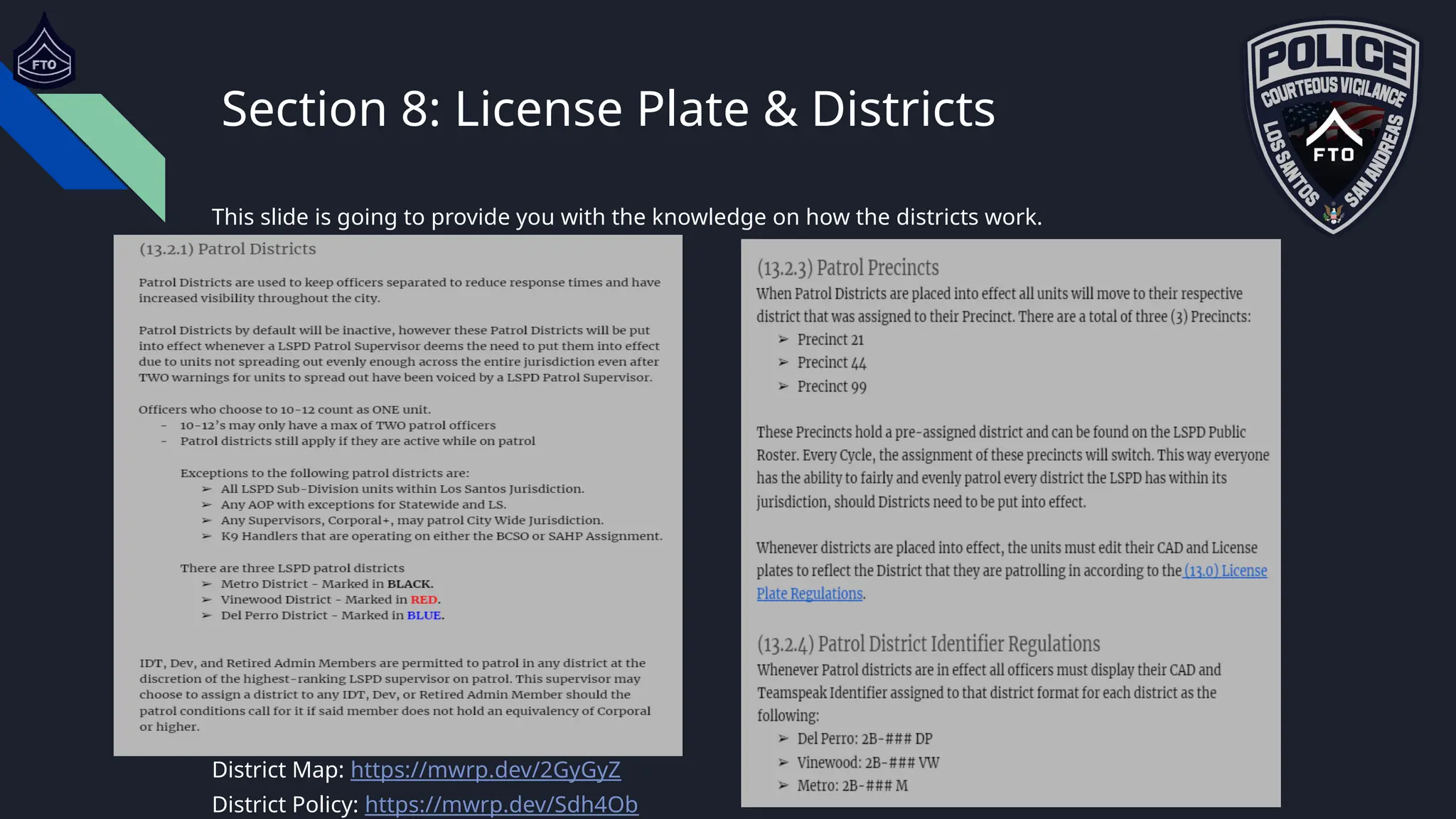
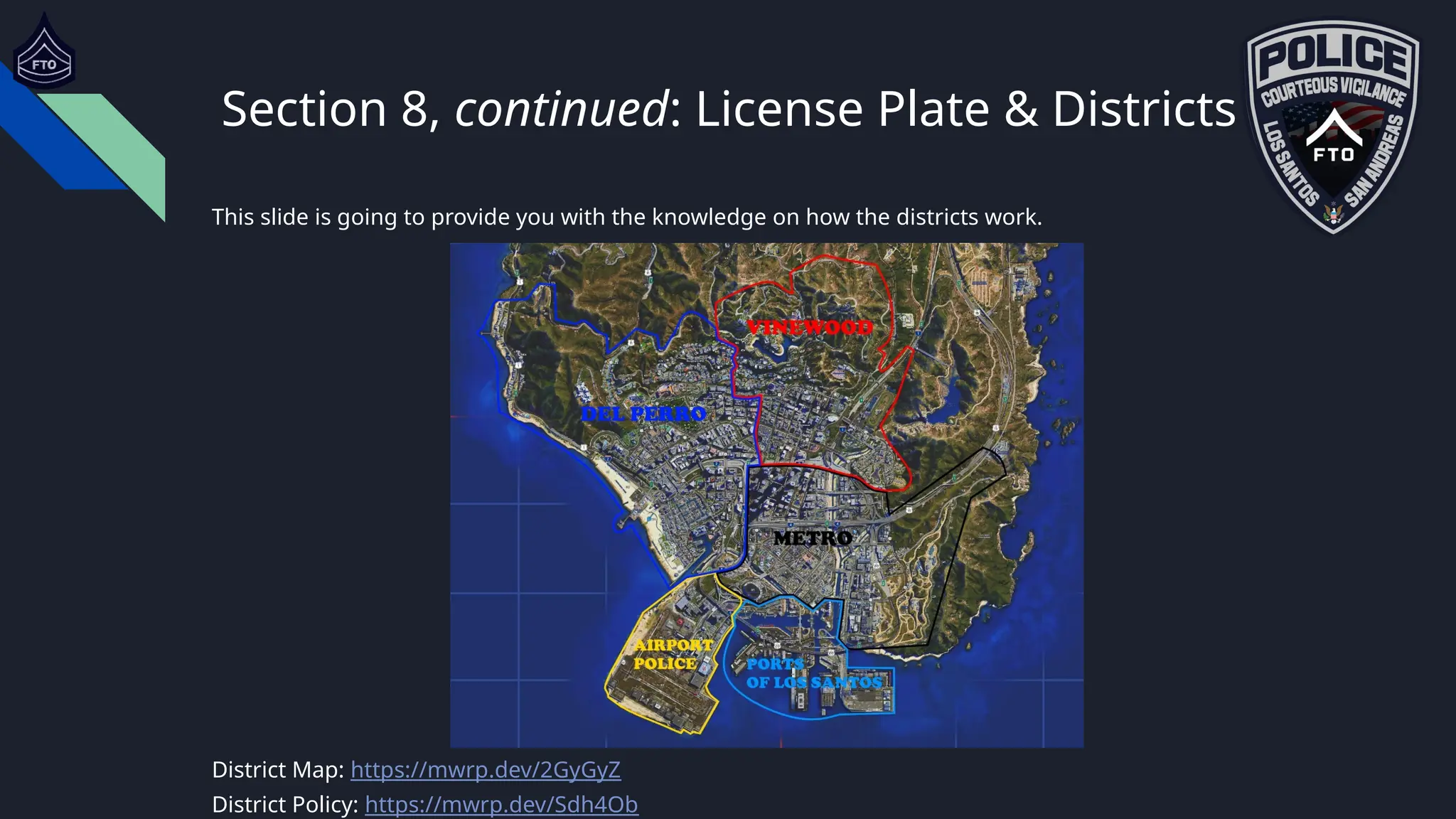
This slide is going to provide you with the knowledge on how the districts work.
District Map: https://mwrp.dev/2GyGyZ
District Policy: https://mwrp.dev/Sdh4Ob
Section 8, continued: License Plate & Districts
This slide is going to provide you with the knowledge on how the districts work.
District Map: https://mwrp.dev/2GyGyZ
District Policy: https://mwrp.dev/Sdh4Ob
Section 9: Policy & Procedure
There are a lot of LSPD Policies and Procedures that need to be followed. Here are a few key policies,
Please read over each carefully.
● Section 5 - Officer Conduct
● Section 9 - Uniforms
● Section 11- Use of Department Vehicles
● Section 12 - Use of Force
● Section 8 - Radio Communications
● Section 7 - Internal Affairs
● Section 13.2 - Patrol Jurisdiction
● Section 13.5 - Rewards
● Section 10 - Patrol Equipment
● MWRP Pursuit Policy
Section 9: Policy & Procedure Cont.
● Section 5 - Officer Conduct
Let’s take the time to acknowledge and adhere the policy, “Officer conduct”. You may ask what is
officer conduct; it is the way a police officer decides to act and behave.
While you are on patrol you are required to stay professional, and respectful to other law
enforcement officers and the citizens you come into contact with.
If you see anyone that is not following this policy or if you have any questions please contact
your supervisor or even that supervisors, supervisor. If it is a officer conduct issue you may file a
complaint or if the supervisor tells you to.
Complaint Form: https://mwrp.dev/rXIQOz
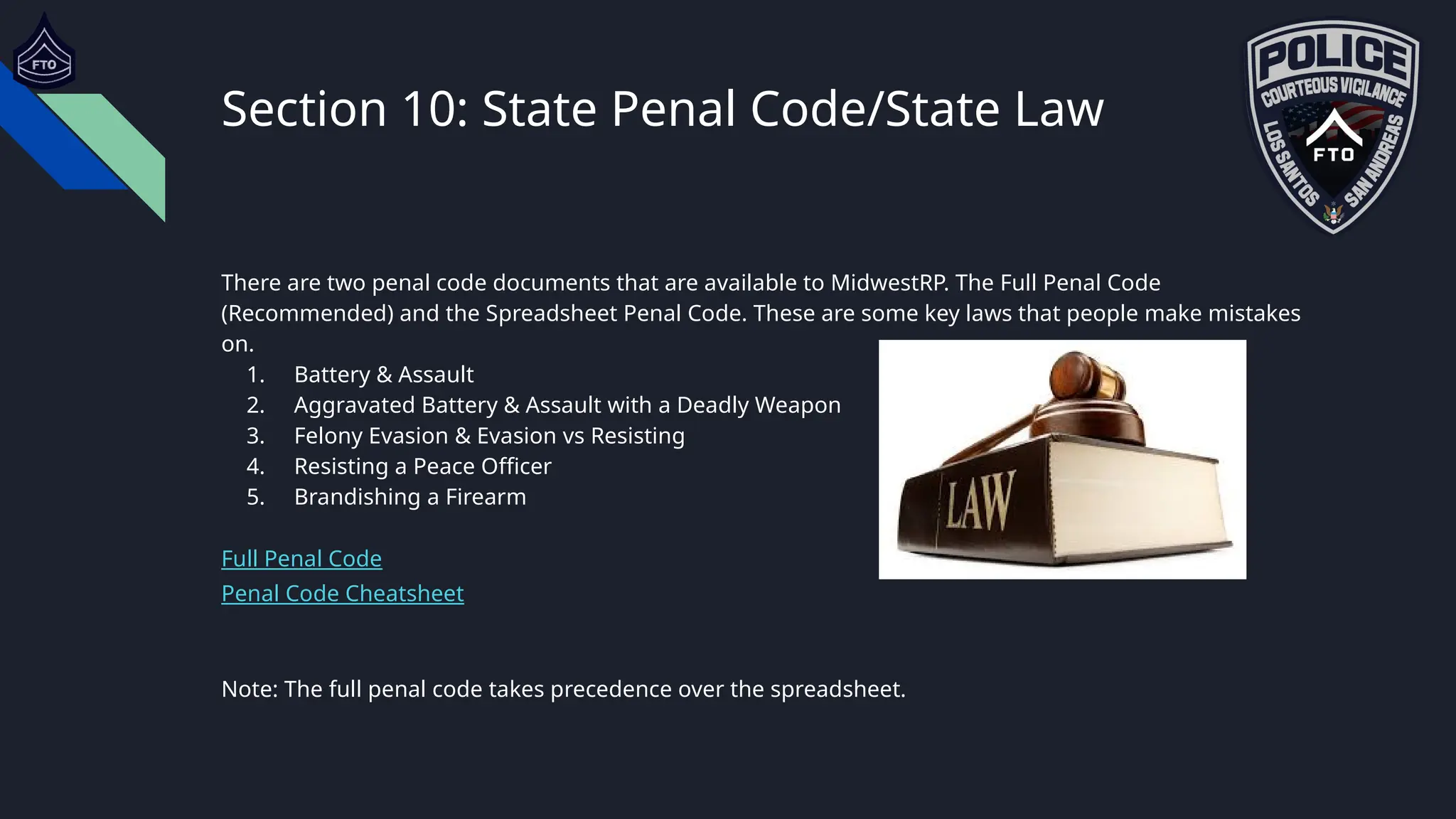
Section 10: State Penal Code/State Law
There are two penal code documents that are available to MidwestRP. The Full Penal Code
(Recommended) and the Spreadsheet Penal Code. These are some key laws that people make mistakes
on.
1. Battery & Assault
2. Aggravated Battery & Assault with a Deadly Weapon
3. Felony Evasion & Evasion vs Resisting
4. Resisting a Peace Officer
5. Brandishing a Firearm
Full Penal Code
Penal Code Cheatsheet
Note: The full penal code takes precedence over the spreadsheet.
Section 10: San Andreas Penal Code
Law stating subjects have to exit their vehicle on a traffic stop: Pennsylvania v. Mimms
" Pennsylvania v. Mimms, 434 U.S. 106, is a United States Supreme Court criminal law decision holding that a
police officer ordering a person out of a car following a traffic stop and conducting a pat-down to check for
weapons did not violate the Fourth Amendment to the United States Constitution "
Law stating an officer has the right to pat-down a subject on a traffic stop: Arizona v. Johnson
" Arizona v. Johnson, 555 U.S. 323 (2009), is a United States Supreme Court case in which the Court held, by
unanimous decision, that police may conduct a pat down search of a passenger in an automobile that has
been lawfully stopped for a minor traffic violation, provided the police reasonably suspect the passenger is
armed and dangerous. "
Section 10: San Andreas Penal Code
Law stating an officer may stop someone for a traffic offense: Whren v. United States
" Whren v. United States, 517 U.S. 806 was a unanimous United States Supreme Court decision that "declared
that any traffic offense committed by a driver was a legitimate legal basis for a stop."
Law stating that all subjects inside of a vehicle are detained on a traffic stop: Brendlin v.
California
" Brendlin v. California, 551 U.S. 249, was a decision by the Supreme Court of the United States that held that
all occupants of a car are "seized" for purposes of the Fourth Amendment during a traffic stop, not just the
driver. "
Section 10: San Andreas Penal Code
Law stating officers may search a vehicle without a warrant: Carrol v. United States
" Carroll v. United States, 267 U.S. 132, was a decision by the United States Supreme Court that upheld the
warrantless searches of an automobile, which is known as the automobile exception. "
Law stating officers may not use lethal force on a fleeing subject: Tennessee v. Garner
Tennessee v. Garner, 471 U.S. 1 (USSC)(1985)-The use of deadly force to stop a fleeing felon is not justified
unless it is necessary to prevent the escape, and it complies with the following requirements. The officer has to
have probable cause to believe that the suspect poses a significant threat of death or serious physical injury to
the officer or others.
Section 11: First Aid (Optional)
Our awesome friends over at the San Andreas Fire & Rescue provided us with a First Aid Training
Slideshow. Read this if you’d like. Click Here
Section 12: De-escalation & Use of Force
As an officer you want to have control of any situation that you are on. When people are angry this escalates
tension, aggressions, and makes the situation more dangerous. So the first thing that you should do? Try and de-
escalate things. An officer's words and talking skills are one of his/her many tools that you have with your duty belt.
Many people look at the police and see a robot in a uniform that is only there to ruin their lives. Bridge that gap
between you and your suspect. Speak to them in a personal manner, try to get their name, so that you can address
them by their name instead of a suspect. Once individuals realize they are talking to another human being that is
their for their benefit, often they feel more at ease.
Watch your language and tone. Avoid using words or phrases that would trigger and irritate the individual you are
talking to.
Avoid crowding someone by either being too close or having too many officers surrounding them. Not only is space
important for officer safety, but this lets your suspect feel more comfortable. Have officers ready, but avoid
crowding the person, once someone feels cornered, they will often overreact in attempt to free themselves.
Remind the person that you are there to help, provide them with assistance if you can. Maybe you'll have to help an
angry motorist on the side of the road with a flat tire. De escalation doesn’t always mean a armed standoff or
domestic call, sometimes it’s the simple things.
Serve and protect. That's what we do as law enforcement, we are not here to hurt people if unnecessary. Speaking
to someone to de escalate a situation is always better and should be the first step before having to go physical, if
you can.
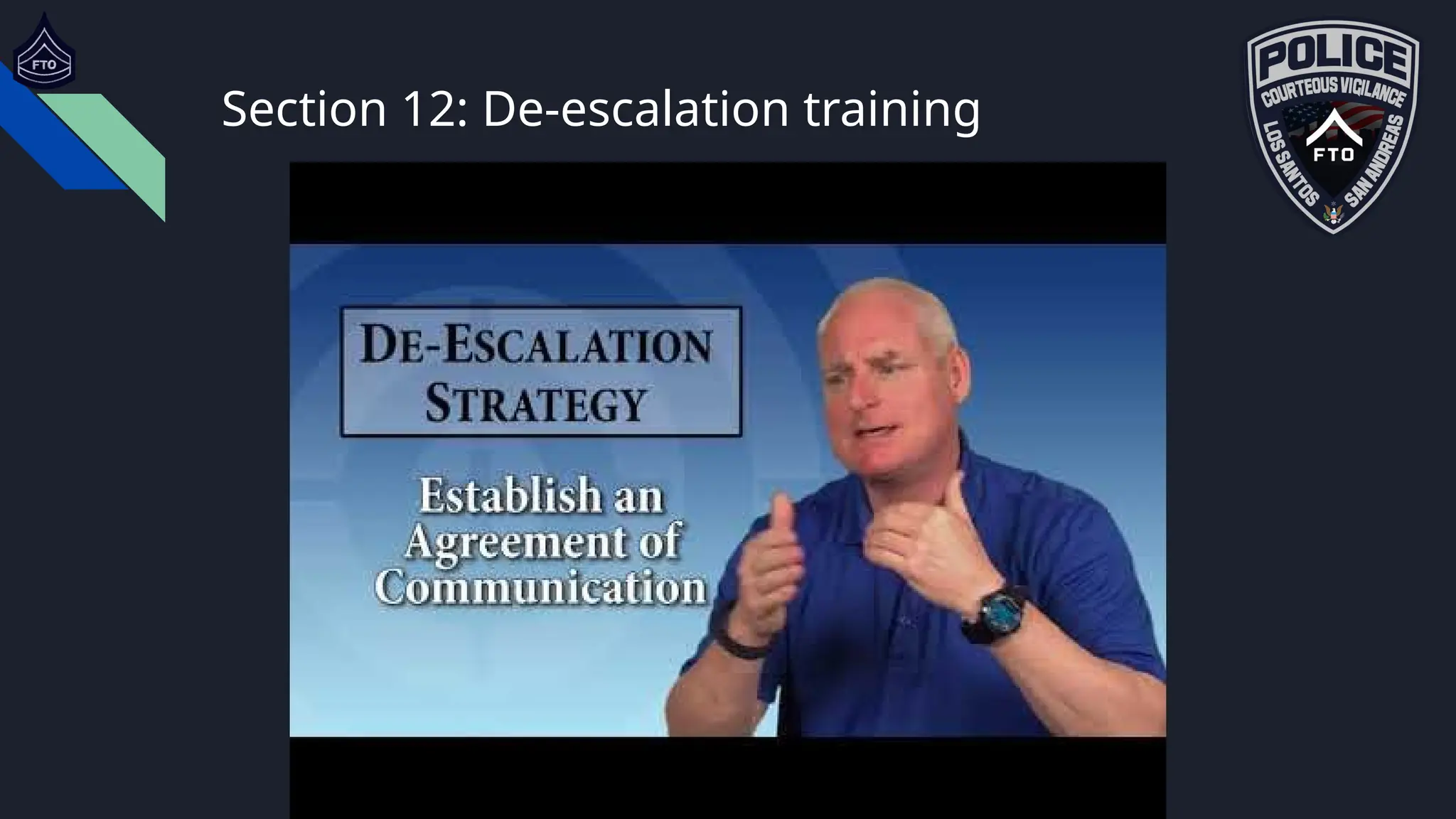
Section 12: De-escalation training
Section 12: Use of Force
Use of Force is using the appropriate level of force that is required to eliminate a threat. I.E. If a male is
arguing with his girlfriend and pushes her this does not warrant Lethal Force.
Less Lethal Force - Taser x26’s, Batons, Beanbag Shotgun (PO1+), and Mace/Pepper Spray.
Lethal Force - AR-15, Remington 870 Shotgun, Glock 17 & any vehicle used to strike an individual.
3 Step LEO Stair
1. Ask
2. Tell
3. Make
If someone does not comply after following these steps escalate to Less Lethal Force as necessary.
Match the subjects force level. If he/she is non lethal use non or less lethal. If he/she escalates to lethal
force match or be above their force level by one level. Gun - Gun, Knife - Gun, etc. (If he’s using a
Weapon I.E, Taser, stick, etc. Use Lethal Force if necessary)
Lethal Force:The only time Lethal Force is to be used is if someone's presenting possible bodily
harm/death to yourself or other citizens. Lethal Force should NEVER be used to subdue a suspect or
apprehend a suspect who isn’t presenting a danger.
Section 12: Use of Force
Section 12: Use of Force:
After Lethal Force is Used
In the event that you’ve had to discharge/shoot someone who was posing a threat to other beings. You
should immediately follow these steps.
1. Clear the subject of weapons and secure them in handcuffs.
2. Request Fire/EMS (10-52’s and 10-53’s) to your location.
3. Request for a 71 (Supervisor) to your location
4. Grab your Medical bag and begin rendering medical aid to the downed subject.
Section 13: Patrol Equipment
1. Glock 17 with Optional Tactical Light
2. Taser x26 with 2x Cartridges
3. Remington 870 Pump Action
Shotgun with Optional Tactical Light
4. AR15 (Semi Automatic) with
Optional Tactical Light
5. Flashlight
6. ASP Collapsible Baton
7. First Aid Kit
● CPR Mask
● Bandages and Gauze
● Waterproof tape
● Alcohol Wipes
● Small Cold Packs
● Foam Blanket
● 10 Pairs of Latex Gloves
● 1 Mini Mag Flashlight
● Trauma Shears (Scissors)
● First Aid Booklet
● Hemostatic Gauze (Blood Stoppers)
1. Trauma Kit - Only to be used for gunshot or
major trauma victims where the bleeding
must be stopped immediately to prevent loss
of life
● Combat Application Tourniquet (C.A.T.)
● Hemostatic Gauze
● 2 Hyphen chest seals
● 3 Triangular Bandages
● Medical grade tape
● Z-fold gauze
1. Automated External Defibrillator
2. DNA Swabs
3. Evidence Collection and Documentation
Material
4. Fingerprint Kit
Patrol Equipment:
https://mwrp.dev/cKhf0J
Patrol Equipment Real Life Equivalency
https://mwrp.dev/lbU0bE
Section 14: Key Binds & Commands
Teamspeak Key Binds
Tools<HotKeys<Add<Show
Advanced Actions<Master Volume
**DISCLAIMER THIS SLIDE IS OPTIONAL BUT VERY HELPFUL**
Link: https://mwrp.dev/e85a9
Section 15: Tactics
Tactics are extremely important when it comes to clearing residences to ensure that all of your fellow
officers are safe. You need constant communication with your fellow officer while clearing any location
whatsoever.
If you have an active hostage situation, call SWAT, if none are available attempt negotiations. Do not
just instantly escalate to lethal force, try de-escalation and to make contact.
Once you understand why someone is doing something, this gives you a huge advantage and allows
you to determine how you want to negotiate with someone.
Employ the same tactics during the de-escalation slides and build a rapport with the individual.
Be careful!
Section 15: Tactics: Room Clearing
Section 15: Tactics Room Clearing
Awesome! You are now
complete with your
classroom presentation
Good Luck!

LSPD FTO Classroom Training Guide for FiveM

  • 1.
    Los Santos PoliceDepartment Field Training Officer Classroom Presentation
  • 2.
    Table Of Contents Section1: Response Section 2: Self Initiated Field Activity Section 3: Officer Safety Section 4: Someone in Custody Section 5: Radio Usage Section 6: CAD/MDT Section 7: Investigative Skill Section 8: License Plate & Districts Section 9: Policy & Procedure Section 10: State Penal Code/Case Law Section 11: First Aid Section 12: De Escalation & Use of Force Section 13: Patrol Equipment Section 14: Key Bindings & Commands Section 15: Tactics
  • 3.
    Section 1: Response EmergencyDriving (Code 3); Lights and Sirens - Felonies in progress - Life threatening circumstances - Pursuit Driving - Major Vehicle Accidents - Anytime someone's life could be in danger - Fight with Guns **DISCLAIMER WHEN YOU ARE UTILIZING CODE 3 & CODE 2 YOU ARE EXEMPT FROM TRAFFIC STATUS*** (Code 2); Lights and Sirens when approaching intersections - Silent Alarms - 10-32 Request (Traffic Stop) - Trespassing in progress - Traffic Control (Use Best Judgement) - Suspicious Vehicle - Suspicious Person (Code 1); No Lights and Sirens - Property Checks - Civil Reports - Public Events - Disturbances
  • 4.
    Section 1: ResponseClearing Intersections (cont.) What you should do relating to traffic signals Red Light; - Begin Decreasing your speed - Make a complete stop - Change your tones - Continue as necessary Yellow & Green Light - Begin Decreasing your speed - Look left & right - Ensure there is no moving traffic - Continue as necessary **DISCLAIMER MAKE SURE TO LOOK OUT FOR PEDESTRIANS, ANIMALS & OTHER VEHICLES BECAUSE THEY COULD COME OUT OF NOWHERE *** Clearing Intersection Video; Red Light; https://mwrp.de v/q2kNZq Green Light; https://mwrp.de v/chvdO4
  • 5.
    Section 2: SelfInitiated Activity Traffic Stop Traffic Stops; while on traffic stops do the following - Turn on Emergency Lighting - After the vehicle stops angle your vehicle for safety - Begin calling out your traffic stop; Begin your traffic callout over radio (Exp: Officer: 2B-400 10-11, Dispatch: Go ahead with 10-11, Officer: 2B-400 10-11 121 Davis Avenue the vehicle is going to be a red ford F-150, 10-28 when ready, Dispatch: Go Ahead with 10-28, Officer: The 10- 28 is going to be 56AAS45, Dispatch: Return *Vehicle information* (In the event of condition yellow, input all information into CAD) - Run the vehicles license plate, preferably also run the Registered owner. - Introduce yourself; Hello (gender pronoun) my name is Officer Johnson with the Los Santos Police Department, the reason for the stop is I witnessed you run that red light back there Drivers License, registration & proof of insurance please. Where are you heading to? Where are you coming from? Anything in the vehicle I need to be worried about. Weapons? Narcotics? Explosives?
  • 6.
    Section 2: SelfInitiated Activity Property Check What is a property check? A property check is when a Peace Officer walks through/checks a business location to ensure there’s no signs of a break in or unwanted persons. What are signs of a break in? ● Abnormal broken glass ● Lights on after business hours ● Abnormal doors open ● Unusual noises ● Shadows after hours If you notice a business that might possibly be a break in follow these steps. ● Notify dispatch you might have a burglary in progress and request additional officers. ● Observe the location and ensure you don’t see any further signs. ● Attempt to call the owner of the business to verify no one should be present after hours. ● After you’ve verified your suspicions of a break in request a Signal 100 to clear the residence. ● Get multiple officers and safely begin clearing the building in an attempt to locate the perp. ● If located detain the persons and verify his reasoning for being there.
  • 7.
    Section 3: OfficerSafety What is Officer Safety? Precautions taken by fellow LEO’s or Dispatchers to prevent possible dangerous situations that would place an Officer in an unsafe/uncomfortable/dangerous situation. What are steps I can take for Officer Safety? 1. Maintain control of your scene, ensure everyone is following all of your lawful orders. 2. Request additional Officer(s) to your location if necessary. 3. If things are getting out of hand don’t be afraid to separate people and place them in handcuffs for further detainment. 4. Ensure that all of your Weaponry I.E. Taser, Baton and Handgun are secured. 5. Do not allow someone to leave their vehicle on a traffic stop, unless ordered to. 6. If someone steps out of their vehicle or they are out of their vehicle when you arrive, DO NOT allow them to return to their vehicle. They could use this opportunity to grab a weapon or flee. 7. Do not allow people to be mobile, walking around, reaching into pockets, reaching into their vehicle, etc. 8. Ensure that you’re updating dispatch as necessary. 9. Do not hog Radio Traffic, be quick, clear and simple. 10. Always be aware of your surroundings, perform pat downs for weapons (Terry vs Ohio protects you). 11. Always maintain eyes on people . 12. Don’t let people with tinted windows roll their windows up,.
  • 8.
    Section 3: OfficerSafety Crossfire While pointing your Service Pistol at a subject always ensure that you are aware of crossfire. Two of the four cardinal rules of firearm safety teaches you: 1. Never put your finger on the weapon unless you’re ready to shoot 2. Always know what’s on the other side of your target. We will go over the rest of the cardinal rules on a later slide. Proper Aiming Proper Aiming Improper Aiming
  • 9.
    Section 3: Callingadditional units When should I call for additional units? There’s a few reasons you should call for additional units. 1. You do not feel comfortable on a scene. 2. You are outnumbered. 3. Suspects are acting out of the ordinary and dodging officers questions. 4. If the call warrants it. It’s always easier to clear off unneeded units then to need units and not have them available or waiting for their response time. Note: LSPD policy allows officers to self attach a SINGLE unit to a traffic stop/call if there is no other unit attached.
  • 10.
    Section 4: SomeoneIn Custody While you have someone in custody if they begin head butting officers, spitting or kicking don’t be afraid to safely restrain them using some of these items: ● A foam helmet ● Spit mask or a hobble to secure their legs Never get violent and begin using unnecessary force on them. Do not ever allow your personal feelings to effect your duties as a Peace Officer in correlation to the subjects crime. Don’t ever neglect the subject I.E. turning the AC off, turning the heater on unnecessarily, etc.
  • 11.
    Section 5: RadioEtiquette What is Radio Traffic Only (RTO)? - It is a channel within the MidwestRP Teamspeak that allows for the SAHP, LSPD, BCSO and many other entities to communicate with each other as well as with Dispatchers from the San Andreas Communications Division. You must be in this channel at ALL times while on patrol. Always stay in character while on the radio. Be professional, don’t swear, or speak casually. Do not deafen while in this channel. Dispatch may need to get a hold of you. Set up keybinds to turn down your radio (teamspeak) or up.
  • 12.
    Section 5: RadioTraffic (RTO) Regulations RTO Channels are controlled, professional and maintained channels as there are some regulations. 1. You must wait 5-10 seconds between each radio transmissions. This is to ensure Officers are not speaking over each other and mangling radio traffic. 2. You must make clean, clear and quick transmission. Think of what you’re going to say before you say it. Try to limit verbal pauses such as uhhhh, etc. 3. Do not say “Break” over RTO. If you have a priority, deal with the threat and wait for the air to clear. Alternatively use your panic button to clear the air (This should only be used during an active emergency, I.E you’re getting shot at). 4. Read over and follow the RTO Regulations to ensure that you do not perform an RTO infraction. Click Here
  • 13.
    Section 5: RadioTraffic (RTO) Callsign usage Within the Los Santos Police Department there are a lot of different callsigns and a variety of ways that people callout. Callsign information. The LSPD Patrol Divisions callsigns are 2B-XXX, Exp: 2B-400 (2-Bravo-400) 2- Departmental/Jurisdiction Identifier, B (Bravo)-Department Phonetic, XXX (Identifying number) Exp: 400. Ensure that you’re saying your full callsign I.E. 2B-400. DO NOT Callout as B-XXX or XXX Always callout as 2B-XXX. When calling out to radio it should sound like this, “Two bravo four-hundred, Dispatch”. This states who you are (2B-400) and who you are calling (Dispatch).
  • 14.
    Section 5: RadioTraffic (RTO) 10 Codes Link Here https://cutt.ly/KjL6g6 U
  • 15.
    Section 5: RadioTraffic (RTO) Channel Types There are 2 things that can be placed in effect within RTO Channels. Those 2 things are Signal 100 and 10-3 10-3 - Means that the channel is being held by Communications Staff+ or a Red Admin and you may not speak at all. Signal 100 - Means there’s an ongoing priority such as Shots fired, a 10-80, etc. During a Signal 100 you can only callout 1 of 2 things. 1. Radio traffic that corresponds with the active priority. 2. You have separate emergency traffic such as shots fired, etc.
  • 16.
    Section 6: CAD/MDT CADstands for Computer Aided Dispatching. This allows officers to run certain things on their own computers, rather than taking airtime on the radio. After you’ve created your account and gained CAD access there’s a few things you need to know. 1. How to go 10-41, 10-8. 2. How to Run Names, Vehicle Plates and Weapon Serial Numbers. 3. How to create bolos. 4. How to write citations. 5. How to write warnings. 6. How to write arrest reports. 7. Arrest Warrants Must be completed by a Sgt+.
  • 17.
    Section 6: CAD/MDT- Tutorial After you’ve gained access to your CAD/MDT, you may choose to set Midwest Roleplay as your default community. Then, select the “Police” option. You will need to save your information including callsigns for districts. Select the area where it shows either “New Unit Not Set” or “[Your Unit Number] LSPD.” You will be then given the opportunity to enter or edit your information. Do not edit the “Location” option. To create multiple identifiers for ease of use, click on “Switch Identifier” and select “New.” You will be then prompted to fill out your new information. It is encouraged that you save identifiers for both when districts are active and inactive. Your unit number should be formatted as 2B-### when districts are out of effect or 2B-### // District when they are in effect. The following examples show how your name should be displayed on TeamSpeak3 and CAD/MDT: 2B-20 // M 2B-20 // VW 2B-20 // DP
  • 18.
    Section 6: MDTTutorial - Documents, etc. There are many type of documents you can file or search for including arrest reports, citations, records, etc.
  • 19.
    Section 6: When,What & How - Reports There are multiple types of reports, including Incident Reports, Arrest Reports and Trespass Notices. Once a scene concludes that warrants a report, whether it is an Incident Report, Arrest Report or a Trespass Notice, it is the officers responsibility to write and submit the report in a timely manner to allow proper reviewal of the report. Incident Reports: Incident Reports shall be written for any general citation issuance or any major scenes. This includes but is not limited to, any SWAT activation, any call requiring 3 or more units, or any call that involves any use of force. The primary unit on scene has the duty and responsibility to fill out and submit the incident report. Extremely small events that do not result in any outcome do not warrant an incident report submission. For example, an officer originated property check with no further outcome. Arrest Reports: Arrest Reports are to be written by the arresting officer in any arrest, not the primary unit or the transporting unit. The arresting officer is the officer who requested for an arrest and/or the officer who is pressing charges on the suspect. In exigent circumstances, the arresting officer may not be able to write the Arrest Report and this would result in any officer, with knowledge on why the arrest is being made, writing the report. Trespass Notices: Trespass Notices are to be written when an individual is trespassed from a property. They are for the sole purpose of notifying other units that may deal with the same individual that they have been trespassed from the property in question before. When issuing a Trespass Notice, verify that the individual is actually within violation of 200.13 Trespassing.
  • 20.
    Section 6: When,What & How - Reports When writing any reports, regardless of type, the following should be included and clearly understood: ❖ Include a full, subjective narrative. ❖ Use correct grammar and punctuations (include ALL commas [,], full stops [.], colons [:], etc.). ❖ Reports shall be at least 4 sentences in length. ❖ Use past-tense wording and consistent point-of-view. ➢ Either write the report in First Person (I, me, we) Point-of-View or Third Person (he/she, they) Point-of-View. ❖ Start the report with the setting of the scene (time, location, weather if needed, etc). ❖ Reports should not contain any radio codes or other law enforcement slang, such as “5150” or “10-11.” ❖ List all personnel involved, regardless of agency. ❖ Include the smallest of details that can otherwise cause misunderstanding. ❖ Follow proper regulations when referencing another LEO ➢ Example - First Mention: Assistant Chief of Police Tyler P. ➢ Example - Post-First Mention: ACOP Tyler P.
  • 21.
    Arrest Report Template: On[Month] [Day], [Year] at [XXXX] hours [Timezone], I [Rank] [Name] [Serial Number] with the Los Santos Police Department [Conducted a traffic stop on [Vehicle description] for [Violation]. // Responded to reports of …. // Observed …. ] at [Location of the incident]. [Now, you need to provide what led you to arrest the civilian. Whether you found illegal items such as narcotics or firearms on them, discovered them DUI, observed them assault another individual, whatever your reasoning may be with a detailed explanation.] I placed [Suspect’s full name] under arrest at [XXXX] hours. [Suspect’s full name] was placed into handcuffs and sat in the prisoner cage of my patrol vehicle. Prior to placing [Suspect’s full name] into my patrol vehicle, I conducted a visual sweep of the interior of the prisoner cage and found it to be empty. [Suspect’s full name] was then transported, booked and submitted into Bolingbroke Penitentiary for the above listed offences. [Rank] [Name] [Serial Number] Section 6: When, What & How - Reports Arrest Report Example: On May 18th, 2021 at 2325 hours EST, I, Corporal Cooper W. 5212 with the Los Santos Police Department, conducted a traffic stop on a black Ubermacht Oracle for performing an illegal u-turn at Bridge Street intersecting Glory Way. During my initial interaction with the driver, who was identified as George Anderson, the male seemed nervous and provided me with the requested pieces of information. I returned to my patrol vehicle to find George Anderson’s San Andreas driver’s license was suspended prior to the traffic stop. I requested an additional Officer to which Corporal Troy R. responded. CPL Troy R. and I placed George Anderson under arrest at 2330 hours. George Anderson was placed into handcuffs and sat in the prisoner cage of my patrol vehicle. Prior to placing George Anderson into my patrol vehicle, I conducted a visual sweep of the interior of the prisoner cage and found it to be empty. George Anderson was then transported, booked and submitted into Bolingbroke Penitentiary for the above listed offences. Corporal Cooper W. 5212
  • 22.
    Incident Report Template: On[Month] [Day], [Year] at [XXXX] hours [Timezone], I [Rank] [Name] [Serial Number] with the Los Santos Police Department, responded to reports of [Incident and location]. Upon arriving, I witnessed [Explain what you saw upon your arrival to the scene]. I then [State your initial and preliminary actions, should be 2-3 sentences]. [Now, you will explain the result of your interaction, did the subject get a citation, warning, trespass notice, etc.] [Rank] [Name] [Serial Number] Section 6: When, What & How - Reports Incident Report Example: On February 19th, 2021 at 1704 hours EST, I, Corporal Troy R. 8310 with the Los Santos Police Department, responded to reports of a disturbance at the 24/7 on Clinton Ave intersecting Alta Street. Upon arriving, I witnessed a white male wearing black shorts, a black shirt and a green hat screaming extremely vulgar language to the clerk in which I then requested an additional unit . I approached the male and attempted to de-escalate the situation by calming the suspect down. The male had taken a few deep breaths and I had separated both parties and requested information such as identification and then took down statements of what happened. At this time, the additional unit had arrived on scene, Corporal Cooper W. The clerk, identified as James White, stated that the male in question had entered the store and shortly after started yelling at the clerk because they did not sell marijuana. The male in question, identified as Daniel Miller, stated that he was trying to buy marijuana legally and thought that the 24/7 would sell it. After I copied both statements, Miller was issued a misdemeanor citation for 400.08(c) Disturbing the Peace, a $150 fine, as he was using offensive words in a public setting. Corporal Troy R. 8310
  • 23.
    Section 7: InvestigativeSkills Not every scene is going to require a detective so it’s good to always have proper investigative skills. Here are some important skills you need to learn: - Inspect for things out of the ordinary. - How to properly check CCTV (Closed Circuit Television) - Obtain witness statements. - Looking for discrepancies in suspect stories. - Preserving and inventorying evidence.
  • 24.
    Section 8: LicensePlate & Districts This slide will explain how your license plate should look while on patrol. You must follow the license plate policy at all times. Each LSPD member is assigned a Precinct (Precinct 21, 44, or 99), and every cycle, Precincts will be assigned a district to patrol every cycle. When districts are not in effect, you will follow the plate format of “PD XXXX”. When districts go into effect, your license plate should reflect the current district you are patrolling. Ex. PD1806VW, PD1806DP and even PD1806M. Disclaimer while the AOP is anywhere within the Blaine County area your License plate should be PD Serial Number. Ex. PD 1806
  • 25.
    Section 8: LicensePlate & Districts This slide is going to provide you with the knowledge on how the districts work. District Map: https://mwrp.dev/2GyGyZ District Policy: https://mwrp.dev/Sdh4Ob
  • 26.
    Section 8, continued:License Plate & Districts This slide is going to provide you with the knowledge on how the districts work. District Map: https://mwrp.dev/2GyGyZ District Policy: https://mwrp.dev/Sdh4Ob
  • 27.
    Section 9: Policy& Procedure There are a lot of LSPD Policies and Procedures that need to be followed. Here are a few key policies, Please read over each carefully. ● Section 5 - Officer Conduct ● Section 9 - Uniforms ● Section 11- Use of Department Vehicles ● Section 12 - Use of Force ● Section 8 - Radio Communications ● Section 7 - Internal Affairs ● Section 13.2 - Patrol Jurisdiction ● Section 13.5 - Rewards ● Section 10 - Patrol Equipment ● MWRP Pursuit Policy
  • 28.
    Section 9: Policy& Procedure Cont. ● Section 5 - Officer Conduct Let’s take the time to acknowledge and adhere the policy, “Officer conduct”. You may ask what is officer conduct; it is the way a police officer decides to act and behave. While you are on patrol you are required to stay professional, and respectful to other law enforcement officers and the citizens you come into contact with. If you see anyone that is not following this policy or if you have any questions please contact your supervisor or even that supervisors, supervisor. If it is a officer conduct issue you may file a complaint or if the supervisor tells you to. Complaint Form: https://mwrp.dev/rXIQOz
  • 29.
    Section 10: StatePenal Code/State Law There are two penal code documents that are available to MidwestRP. The Full Penal Code (Recommended) and the Spreadsheet Penal Code. These are some key laws that people make mistakes on. 1. Battery & Assault 2. Aggravated Battery & Assault with a Deadly Weapon 3. Felony Evasion & Evasion vs Resisting 4. Resisting a Peace Officer 5. Brandishing a Firearm Full Penal Code Penal Code Cheatsheet Note: The full penal code takes precedence over the spreadsheet.
  • 30.
    Section 10: SanAndreas Penal Code Law stating subjects have to exit their vehicle on a traffic stop: Pennsylvania v. Mimms " Pennsylvania v. Mimms, 434 U.S. 106, is a United States Supreme Court criminal law decision holding that a police officer ordering a person out of a car following a traffic stop and conducting a pat-down to check for weapons did not violate the Fourth Amendment to the United States Constitution " Law stating an officer has the right to pat-down a subject on a traffic stop: Arizona v. Johnson " Arizona v. Johnson, 555 U.S. 323 (2009), is a United States Supreme Court case in which the Court held, by unanimous decision, that police may conduct a pat down search of a passenger in an automobile that has been lawfully stopped for a minor traffic violation, provided the police reasonably suspect the passenger is armed and dangerous. "
  • 31.
    Section 10: SanAndreas Penal Code Law stating an officer may stop someone for a traffic offense: Whren v. United States " Whren v. United States, 517 U.S. 806 was a unanimous United States Supreme Court decision that "declared that any traffic offense committed by a driver was a legitimate legal basis for a stop." Law stating that all subjects inside of a vehicle are detained on a traffic stop: Brendlin v. California " Brendlin v. California, 551 U.S. 249, was a decision by the Supreme Court of the United States that held that all occupants of a car are "seized" for purposes of the Fourth Amendment during a traffic stop, not just the driver. "
  • 32.
    Section 10: SanAndreas Penal Code Law stating officers may search a vehicle without a warrant: Carrol v. United States " Carroll v. United States, 267 U.S. 132, was a decision by the United States Supreme Court that upheld the warrantless searches of an automobile, which is known as the automobile exception. " Law stating officers may not use lethal force on a fleeing subject: Tennessee v. Garner Tennessee v. Garner, 471 U.S. 1 (USSC)(1985)-The use of deadly force to stop a fleeing felon is not justified unless it is necessary to prevent the escape, and it complies with the following requirements. The officer has to have probable cause to believe that the suspect poses a significant threat of death or serious physical injury to the officer or others.
  • 33.
    Section 11: FirstAid (Optional) Our awesome friends over at the San Andreas Fire & Rescue provided us with a First Aid Training Slideshow. Read this if you’d like. Click Here
  • 34.
    Section 12: De-escalation& Use of Force As an officer you want to have control of any situation that you are on. When people are angry this escalates tension, aggressions, and makes the situation more dangerous. So the first thing that you should do? Try and de- escalate things. An officer's words and talking skills are one of his/her many tools that you have with your duty belt. Many people look at the police and see a robot in a uniform that is only there to ruin their lives. Bridge that gap between you and your suspect. Speak to them in a personal manner, try to get their name, so that you can address them by their name instead of a suspect. Once individuals realize they are talking to another human being that is their for their benefit, often they feel more at ease. Watch your language and tone. Avoid using words or phrases that would trigger and irritate the individual you are talking to. Avoid crowding someone by either being too close or having too many officers surrounding them. Not only is space important for officer safety, but this lets your suspect feel more comfortable. Have officers ready, but avoid crowding the person, once someone feels cornered, they will often overreact in attempt to free themselves. Remind the person that you are there to help, provide them with assistance if you can. Maybe you'll have to help an angry motorist on the side of the road with a flat tire. De escalation doesn’t always mean a armed standoff or domestic call, sometimes it’s the simple things. Serve and protect. That's what we do as law enforcement, we are not here to hurt people if unnecessary. Speaking to someone to de escalate a situation is always better and should be the first step before having to go physical, if you can.
  • 35.
  • 36.
    Section 12: Useof Force Use of Force is using the appropriate level of force that is required to eliminate a threat. I.E. If a male is arguing with his girlfriend and pushes her this does not warrant Lethal Force. Less Lethal Force - Taser x26’s, Batons, Beanbag Shotgun (PO1+), and Mace/Pepper Spray. Lethal Force - AR-15, Remington 870 Shotgun, Glock 17 & any vehicle used to strike an individual. 3 Step LEO Stair 1. Ask 2. Tell 3. Make If someone does not comply after following these steps escalate to Less Lethal Force as necessary. Match the subjects force level. If he/she is non lethal use non or less lethal. If he/she escalates to lethal force match or be above their force level by one level. Gun - Gun, Knife - Gun, etc. (If he’s using a Weapon I.E, Taser, stick, etc. Use Lethal Force if necessary) Lethal Force:The only time Lethal Force is to be used is if someone's presenting possible bodily harm/death to yourself or other citizens. Lethal Force should NEVER be used to subdue a suspect or apprehend a suspect who isn’t presenting a danger.
  • 37.
  • 38.
    Section 12: Useof Force: After Lethal Force is Used In the event that you’ve had to discharge/shoot someone who was posing a threat to other beings. You should immediately follow these steps. 1. Clear the subject of weapons and secure them in handcuffs. 2. Request Fire/EMS (10-52’s and 10-53’s) to your location. 3. Request for a 71 (Supervisor) to your location 4. Grab your Medical bag and begin rendering medical aid to the downed subject.
  • 39.
    Section 13: PatrolEquipment 1. Glock 17 with Optional Tactical Light 2. Taser x26 with 2x Cartridges 3. Remington 870 Pump Action Shotgun with Optional Tactical Light 4. AR15 (Semi Automatic) with Optional Tactical Light 5. Flashlight 6. ASP Collapsible Baton 7. First Aid Kit ● CPR Mask ● Bandages and Gauze ● Waterproof tape ● Alcohol Wipes ● Small Cold Packs ● Foam Blanket ● 10 Pairs of Latex Gloves ● 1 Mini Mag Flashlight ● Trauma Shears (Scissors) ● First Aid Booklet ● Hemostatic Gauze (Blood Stoppers) 1. Trauma Kit - Only to be used for gunshot or major trauma victims where the bleeding must be stopped immediately to prevent loss of life ● Combat Application Tourniquet (C.A.T.) ● Hemostatic Gauze ● 2 Hyphen chest seals ● 3 Triangular Bandages ● Medical grade tape ● Z-fold gauze 1. Automated External Defibrillator 2. DNA Swabs 3. Evidence Collection and Documentation Material 4. Fingerprint Kit Patrol Equipment: https://mwrp.dev/cKhf0J Patrol Equipment Real Life Equivalency https://mwrp.dev/lbU0bE
  • 40.
    Section 14: KeyBinds & Commands Teamspeak Key Binds Tools<HotKeys<Add<Show Advanced Actions<Master Volume **DISCLAIMER THIS SLIDE IS OPTIONAL BUT VERY HELPFUL** Link: https://mwrp.dev/e85a9
  • 41.
    Section 15: Tactics Tacticsare extremely important when it comes to clearing residences to ensure that all of your fellow officers are safe. You need constant communication with your fellow officer while clearing any location whatsoever. If you have an active hostage situation, call SWAT, if none are available attempt negotiations. Do not just instantly escalate to lethal force, try de-escalation and to make contact. Once you understand why someone is doing something, this gives you a huge advantage and allows you to determine how you want to negotiate with someone. Employ the same tactics during the de-escalation slides and build a rapport with the individual. Be careful!
  • 42.
    Section 15: Tactics:Room Clearing
  • 43.
    Section 15: TacticsRoom Clearing
  • 44.
    Awesome! You arenow complete with your classroom presentation Good Luck!