Include
Daily Practice Paper
1.
NCERT Solutions
2.
NCERT Exemplars
3.
Chapter Wise Mind Maps
4.
OPTIMAL STRATEGIES FOR ACHIEVING
A PERFECT SCORE OF 100/100 IN YOUR
EXAMS
CHAPTER WISE
TOPIC WISE
NOTES
AS PER LATEST CBSE CURRICULUM 2024-25
Commence your study session equipped with our
meticulously crafted chapter-wise and topic-wise notes,
designed to optimize your exam performance, exclusively
provided by Artham Resources.
CLASS IX
SOCIAL SCIENCE
FRENCH SOCIETY DURING LATE 18TH CENTURY
THE FRENCH REVOLUTION
01
Class 9th Social Science (History)
FRENCH SOCIETY DURING LATE 18TH CENTURY
French Society during late 18th Century
What happened in 1774?
In 1774, Louis XVI of the Bourbon family, 20 years old and married to the Austrian princess Marie
Antoinette, ascended the throne of France. Upon his accession the new king found empty treasury.
Reasons for empty treasure in France
The five causes for the empty treasury in France under Louis XIV were:
1. long years of war had drained the financial resources of
France.
2. High cost of maintenance of immense palace of Versailles
and court.
3. To meet its regular expenses, such as the cost of maintaining an army,
the court, running government offices or universities, the state was
forced to increase taxes.
4. Under Louis XVI, France helped the thirteen American colonies to gain
their independence from the common enemy, Britain which added more
than a billion livres to a debt that had already risen to more than 2 billion
livres.
5. Lenders who gave the state credit, now began to charge 10 percent
interest on loans.
French division of society in 18th Century
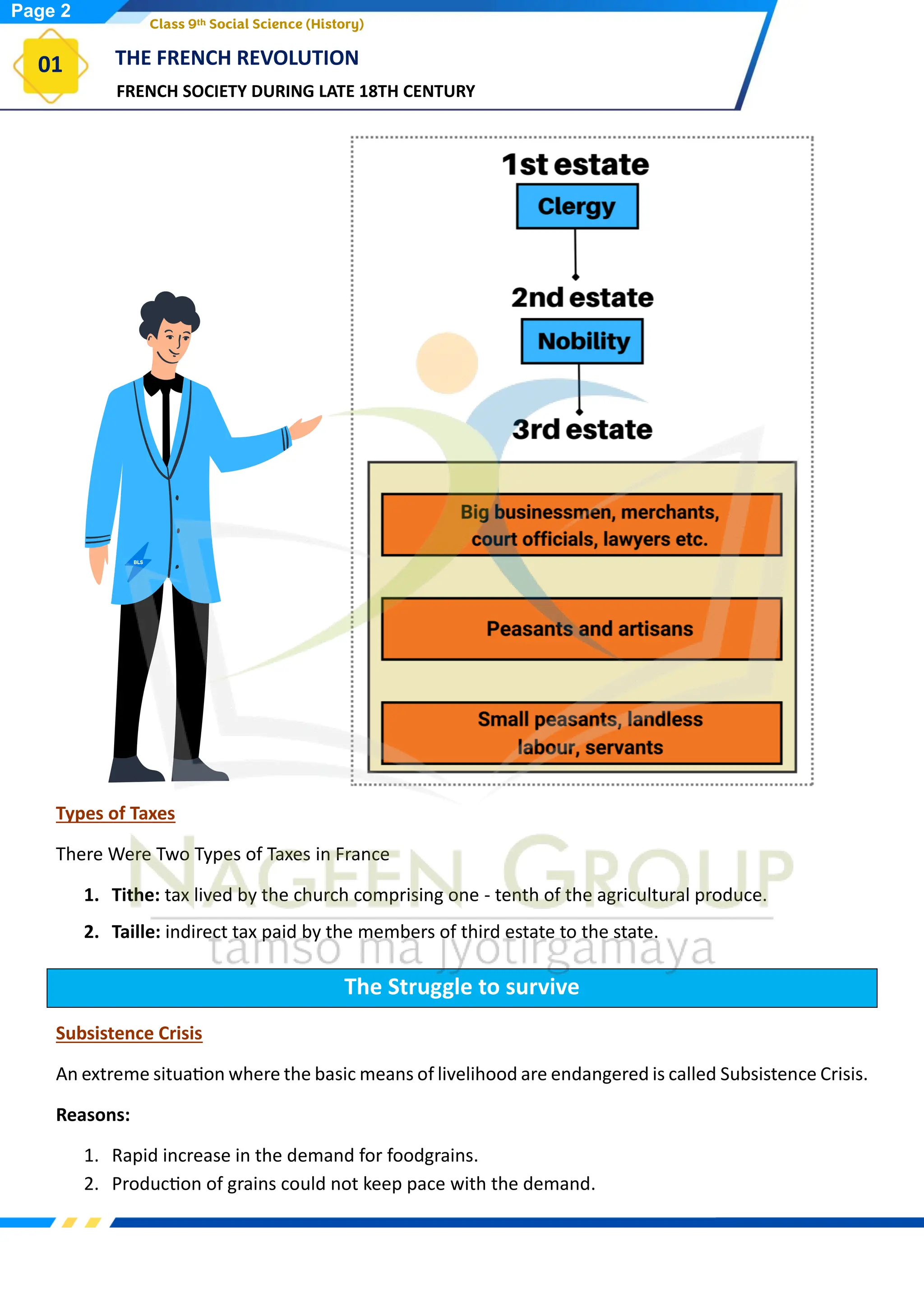
• 1st Estate: Clergy (Group of persons involved in church matters)
• 2nd Estate: Nobility (Persons who have high rank in state administration)
• 3rd Estate: (Comprises of Big businessmen, merchants, court officials, lawyers, Peasants and
artisans, landless labour, servants)
First two classes were exempted from paying taxes. They enjoyed privileges by birth. Nobility classes
also enjoyed feudal privileges. Only the members of the third estate had to pay taxes to the state.
Page 1
FRENCH SOCIETY DURING LATE 18TH CENTURY
THE FRENCH REVOLUTION
01
Class 9th Social Science (History)
Types of Taxes
There Were Two Types of Taxes in France
1. Tithe: tax lived by the church comprising one - tenth of the agricultural produce.
2. Taille: indirect tax paid by the members of third estate to the state.
The Struggle to survive
Subsistence Crisis
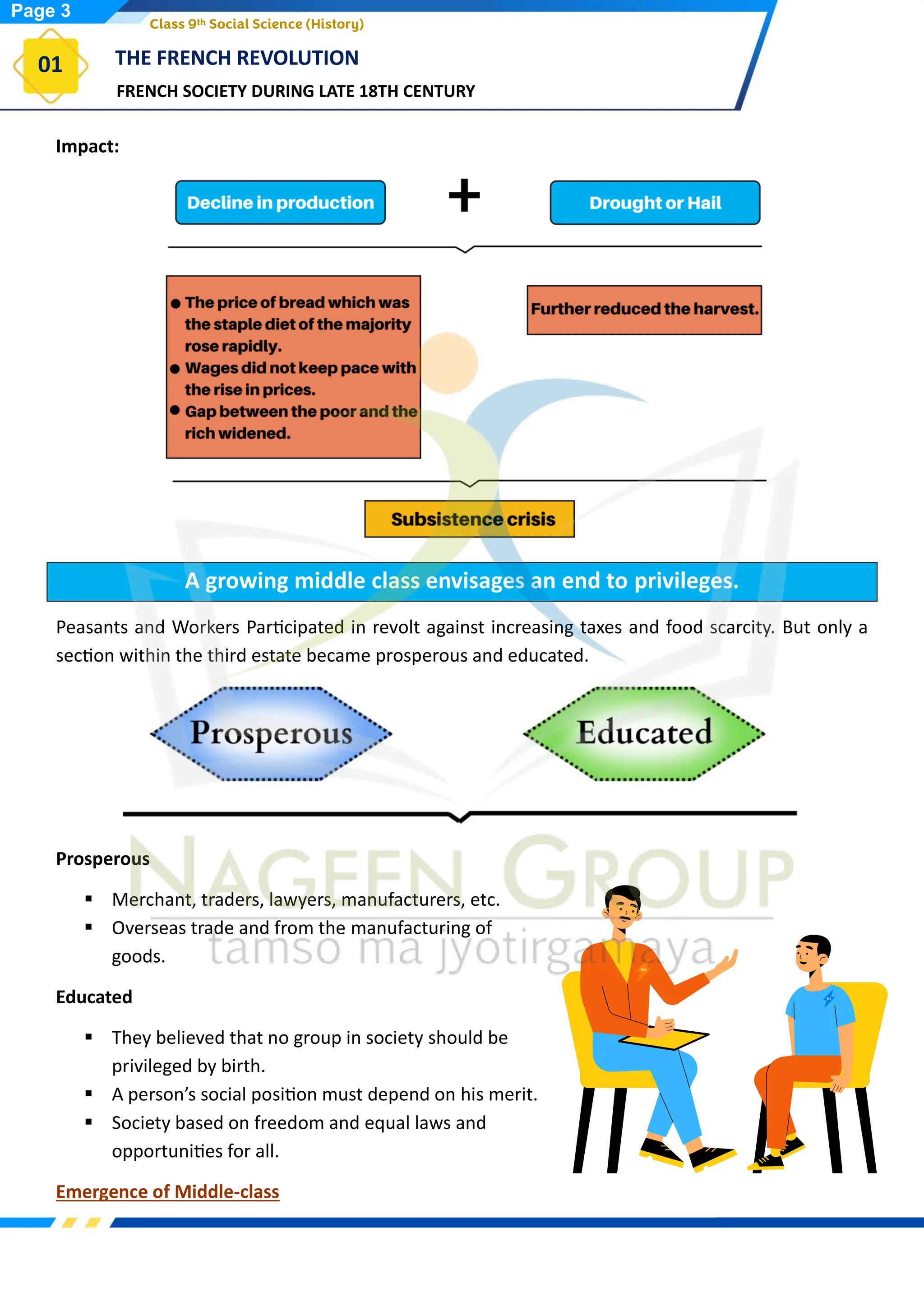
An extreme situation where the basic means of livelihood are endangered is called Subsistence Crisis.
Reasons:
1. Rapid increase in the demand for foodgrains.
2. Production of grains could not keep pace with the demand.
Page 2
FRENCH SOCIETY DURING LATE 18TH CENTURY
THE FRENCH REVOLUTION
01
Class 9th Social Science (History)
Impact:
A growing middle class envisages an end to privileges.
Peasants and Workers Participated in revolt against increasing taxes and food scarcity. But only a
section within the third estate became prosperous and educated.
Prosperous
▪ Merchant, traders, lawyers, manufacturers, etc.
▪ Overseas trade and from the manufacturing of
goods.

Educated
▪ They believed that no group in society should be
privileged by birth.
▪ A person’s social position must depend on his merit.
▪ Society based on freedom and equal laws and
opportunities for all.
Emergence of Middle-class
Page 3
FRENCH SOCIETY DURING LATE 18TH CENTURY
THE FRENCH REVOLUTION
01
Class 9th Social Science (History)
The 18th century witnessed the emergence of social groups, termed the middle class, who earned
their wealth through an expanding overseas trade and form the manufacture of goods such as
woollen and silk textiles that were either exported or bought by the richer members of society. In
addition to merchant and manufacturers, the third estate included professions such as lawyers or
administrative officials. All of these were educated and believed that no group in society should be
privileged by birth. Rather, a person's social position must depend on his merit. These ideas
envisaging a society based on freedom and equal laws.
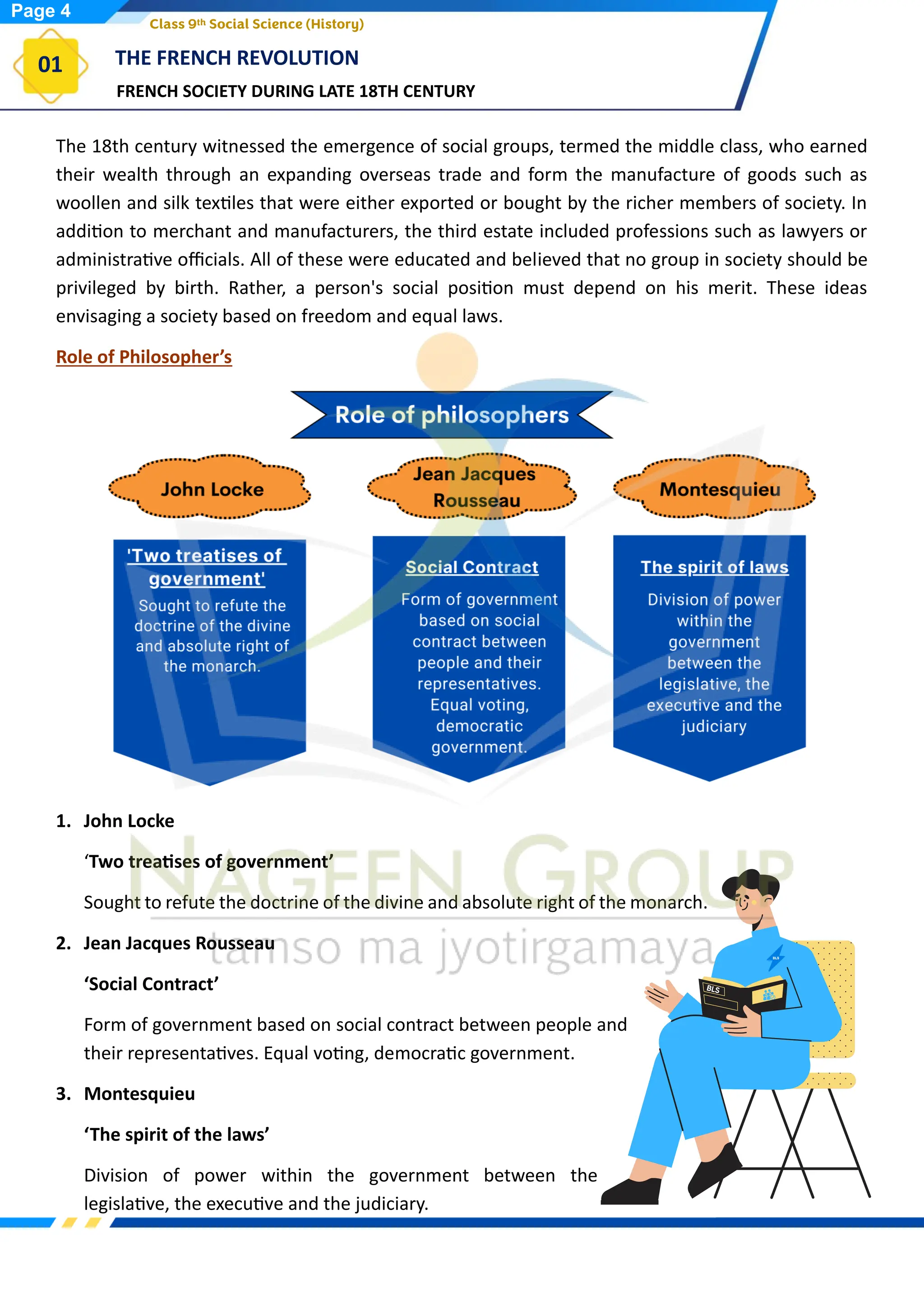
Role of Philosopher’s
1. John Locke
‘Two treatises of government’
Sought to refute the doctrine of the divine and absolute right of the monarch.
2. Jean Jacques Rousseau
‘Social Contract’
Form of government based on social contract between people and
their representatives. Equal voting, democratic government.
3. Montesquieu
‘The spirit of the laws’
Division of power within the government between the
legislative, the executive and the judiciary.
Page 4
FRENCH SOCIETY DURING LATE 18TH CENTURY
THE FRENCH REVOLUTION
01
Class 9th Social Science (History)
Impact of their Ideas
Impact of these enlightened ideas
• The ideas of these philosophers were discussed intensively in salons and coffee-houses. and
spread among people through books and newspapers.
• These were frequently read aloud in groups for the benefit of those who could not read and
write.
Page 5
THE OUTBREAK OF THE REVOLUTION
THE FRENCH REVOLUTION
01
Class 9th Social Science (History)
THE OUTBREAK OF THE REVOLUTION
Meeting of Estate General
For increasing taxes, Louis XVI had to call a meeting of the Estates General which would then pass
his proposals for new taxes.
1. Meaning of Estate General
The Estates-General was an assembly comprising of the clergy of the French nobles and the
middle class. It was in 1614 that the Estates-General was last called. Before the French
Revolution, which took place in 1789, the general assembly was recognized as the Estates-
General.
2. Meeting at Versailles
• The first and second estates sent 300 representatives each, who were
seated in rows facing. each other on two sides.
• The 600 members of the third estate had to stand at the back.
• The third estate was represented by its more prosperous and educated
members.
• Peasants, artisans, and women were denied entry to the assembly.
• However, their grievances and demands were listed in some 40,000 letters
which the representatives had brought with them.
• According to the principle that each estate had one vote. This time too Louis
XVI was determined to continue the same practice. But members of the third
estate demanded that voting now be conducted by the assembly as a whole,
where each member would have one vote.
3. Outcome of the meeting
The king rejected this proposal. Members of the third estate walked out of the assembly in
protest. The representatives of third estate assembled in the half of an indoor tennis court in the
ground of Versailles. They declared themselves a National Assembly. Swore not to disperse till
they had drafted a constitution for France that would limit the powers of the monarch.
Events at the Countryside
In the countryside rumours spread from village to village that the lords of the manor had hired bands
of brigands who were on their way to destroy the ripe crops. Caught in a frenzy of fear, peasants in
several districts seized hoes and pitchforks and attacked chateaux. They looted hoarded grain and
burnt down documents containing records of manorial dues. A large number of nobles fled from
their homes, many of them migrating to neighbouring countries.
Page 1
THE OUTBREAK OF THE REVOLUTION
THE FRENCH REVOLUTION
01
Class 9th Social Science (History)
Impact and result of the events
• Louis XVI finally accorded recognition to the National Assembly and accepted
the constitution.
• On the night of 4 August 1789, the Assembly passed a decree abolishing the
feudal system of obligations and taxes.
• Members of the clergy too were forced to give up their privileges.
• Tithes were abolished and lands owned by the Church were confiscated.
France becomes a Constitutional Monarchy
National Assembly Completed the draft of the constitution in 1791. Its main object was to limit the
powers of the monarch. These powers instead of being concentrated in the hands of one person,
were now separated and assigned to different institutions – the legislature, executive and judiciary.
This made France a constitutional monarchy.
1. Elections
• National assembly was indirectly elected.
• Citizens voted for a group of electors, who in turn chose the Assembly.
• Not all citizens, however, had the right to vote.
a) Active Citizens
▪ Only men above 25 years of age who paid taxes equal to
at least 3 days of a labourer’s wage were given the status of active
citizens.
▪ They were entitled to vote.
b) Passive Citizens
▪ The remaining men and all women were classed as passive citizens.
▪ They were not entitled to vote.
▪ To qualify as an elector and then as a member of the Assembly, a man
had to belong to the highest bracket of taxpayers.
2. Constitution
• The Constitution began with a “Declaration of the Rights of Man and Citizen”.
• Rights such as the right to life, freedom of speech, freedom of opinion, equality before law,
were established as ‘natural and inalienable’ rights.
• They belonged to each human being by birth and could not be taken away.
• It was the duty of the state to protect each citizen’s natural rights.
Page 2
THE OUTBREAK OF THE REVOLUTION
THE FRENCH REVOLUTION
01
Class 9th Social Science (History)
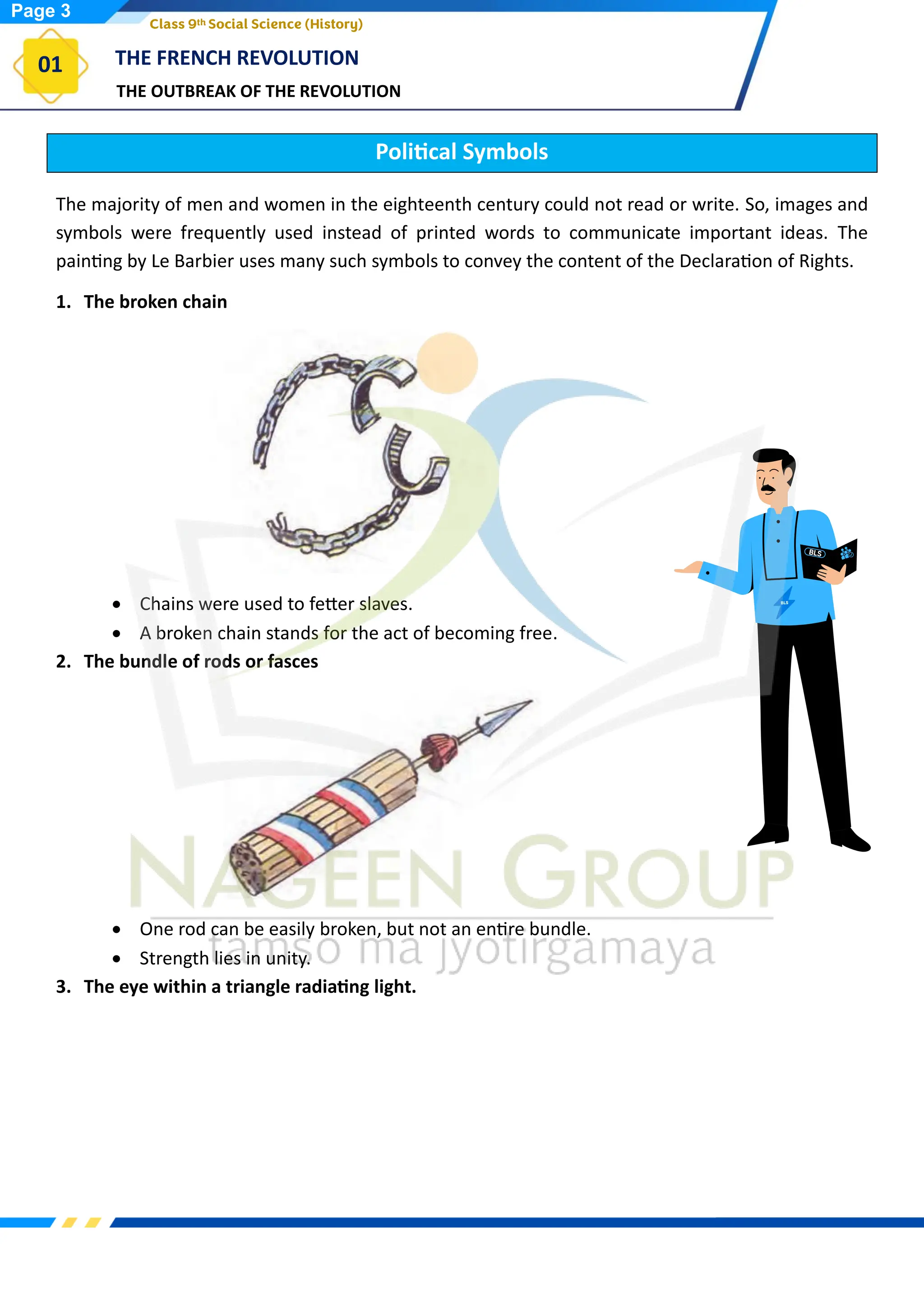
Political Symbols
The majority of men and women in the eighteenth century could not read or write. So, images and
symbols were frequently used instead of printed words to communicate important ideas. The
painting by Le Barbier uses many such symbols to convey the content of the Declaration of Rights.
1. The broken chain
• Chains were used to fetter slaves.
• A broken chain stands for the act of becoming free.
2. The bundle of rods or fasces
• One rod can be easily broken, but not an entire bundle.
• Strength lies in unity.
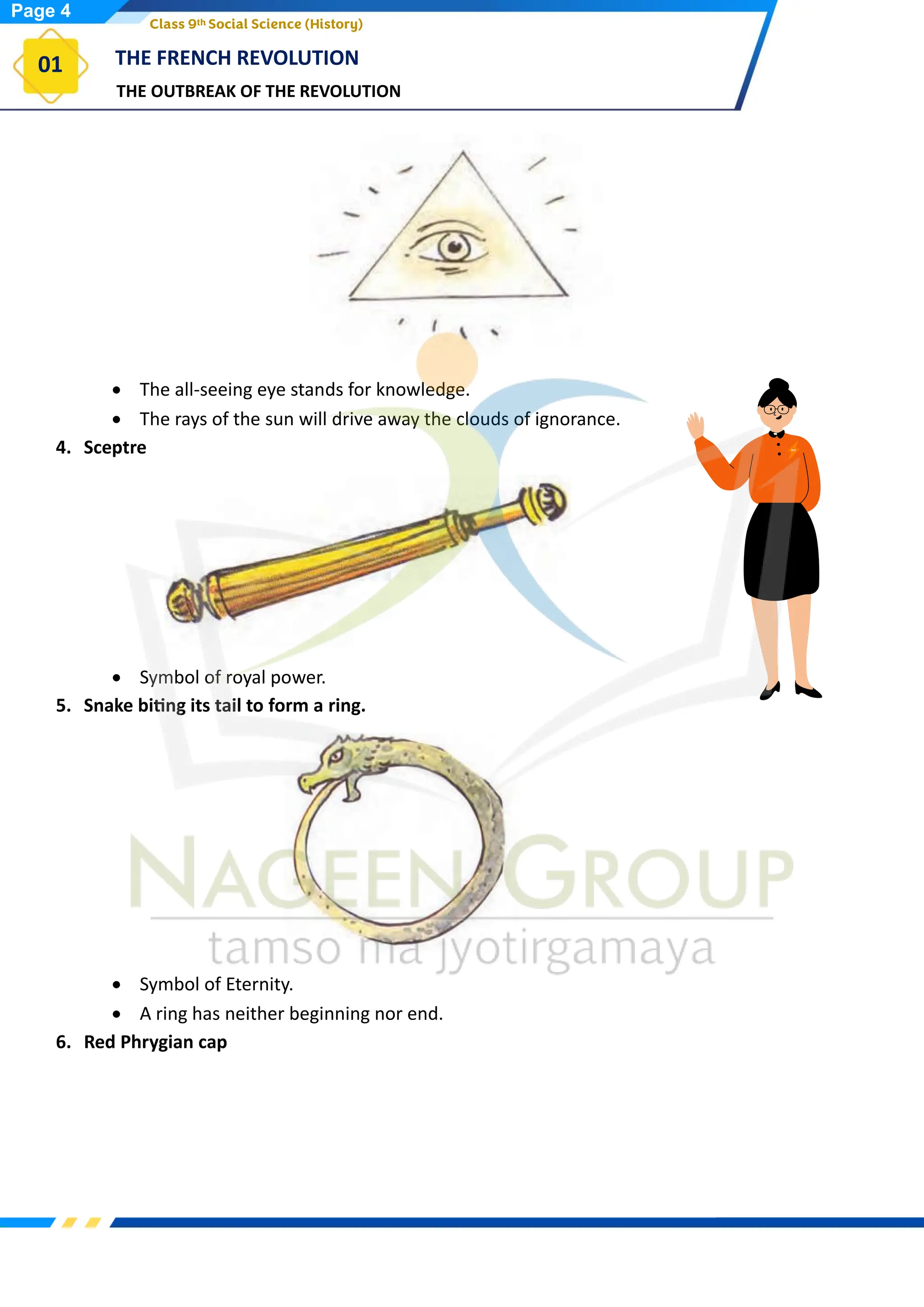
3. The eye within a triangle radiating light.
Page 3
THE OUTBREAK OF THE REVOLUTION
THE FRENCH REVOLUTION
01
Class 9th Social Science (History)
• The all-seeing eye stands for knowledge.
• The rays of the sun will drive away the clouds of ignorance.
4. Sceptre
• Symbol of royal power.
5. Snake biting its tail to form a ring.
• Symbol of Eternity.
• A ring has neither beginning nor end.
6. Red Phrygian cap
Page 4
THE OUTBREAK OF THE REVOLUTION
THE FRENCH REVOLUTION
01
Class 9th Social Science (History)
• Cap worn by a slave upon becoming free.
7. Blue-white-red
• The national colours of France.
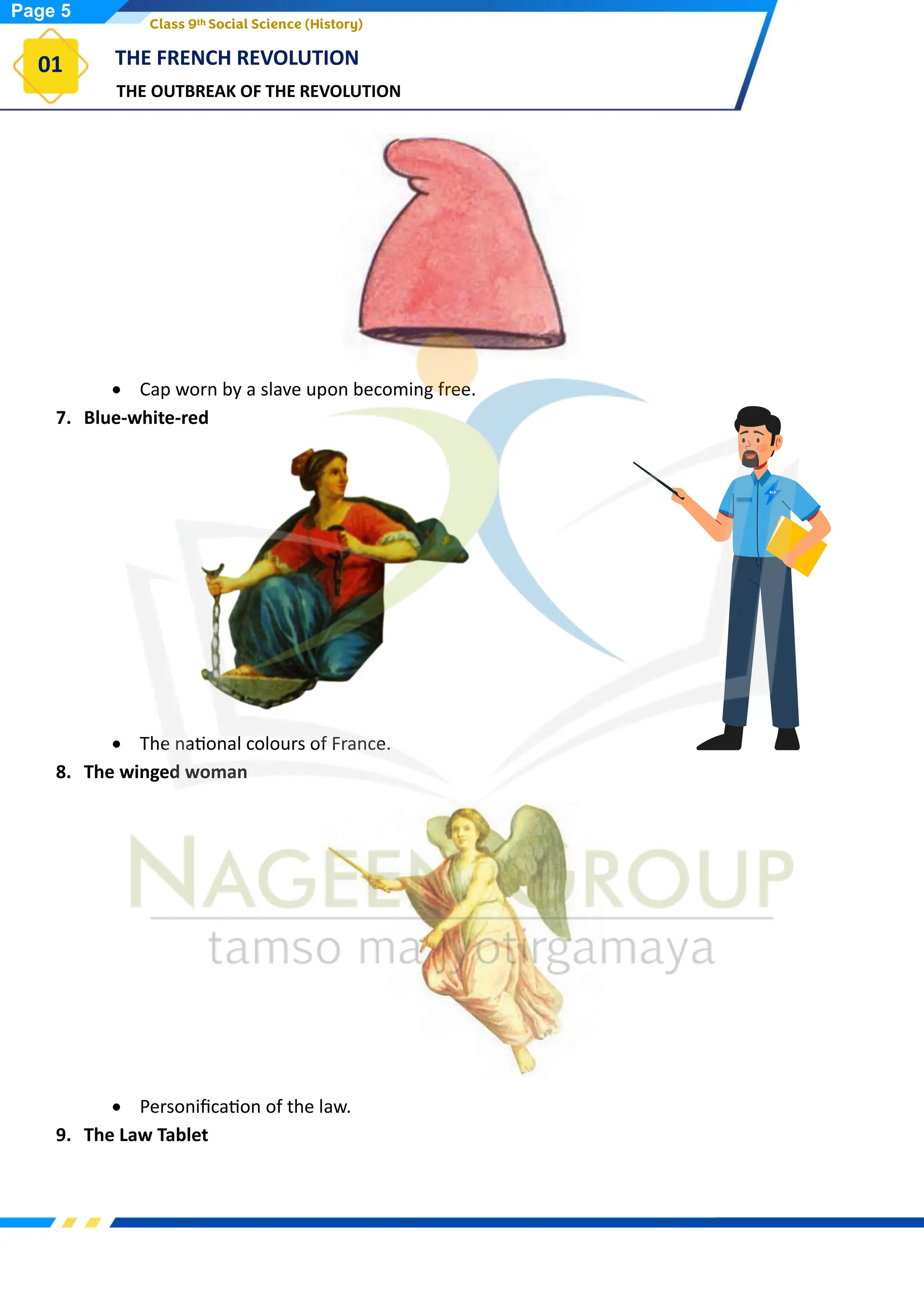
8. The winged woman
• Personification of the law.
9. The Law Tablet
Page 5
THE OUTBREAK OF THE REVOLUTION
THE FRENCH REVOLUTION
01
Class 9th Social Science (History)
• The law is the same for all, and all are equal before it.
Page 6
FRANCE ABOLISHES MONARCHY AND BECOMES A REPUBLIC
THE FRENCH REVOLUTION
01
Class 9th Social Science (History)
FRANCE ABOLISHES MONARCHY AND BECOMES A REPUBLIC
War against Prussia and Austria
Impact of war
Thousands of volunteers thronged from the provinces to join the army.
• They saw this as a war of the people against kings and
aristocracies all over Europe.
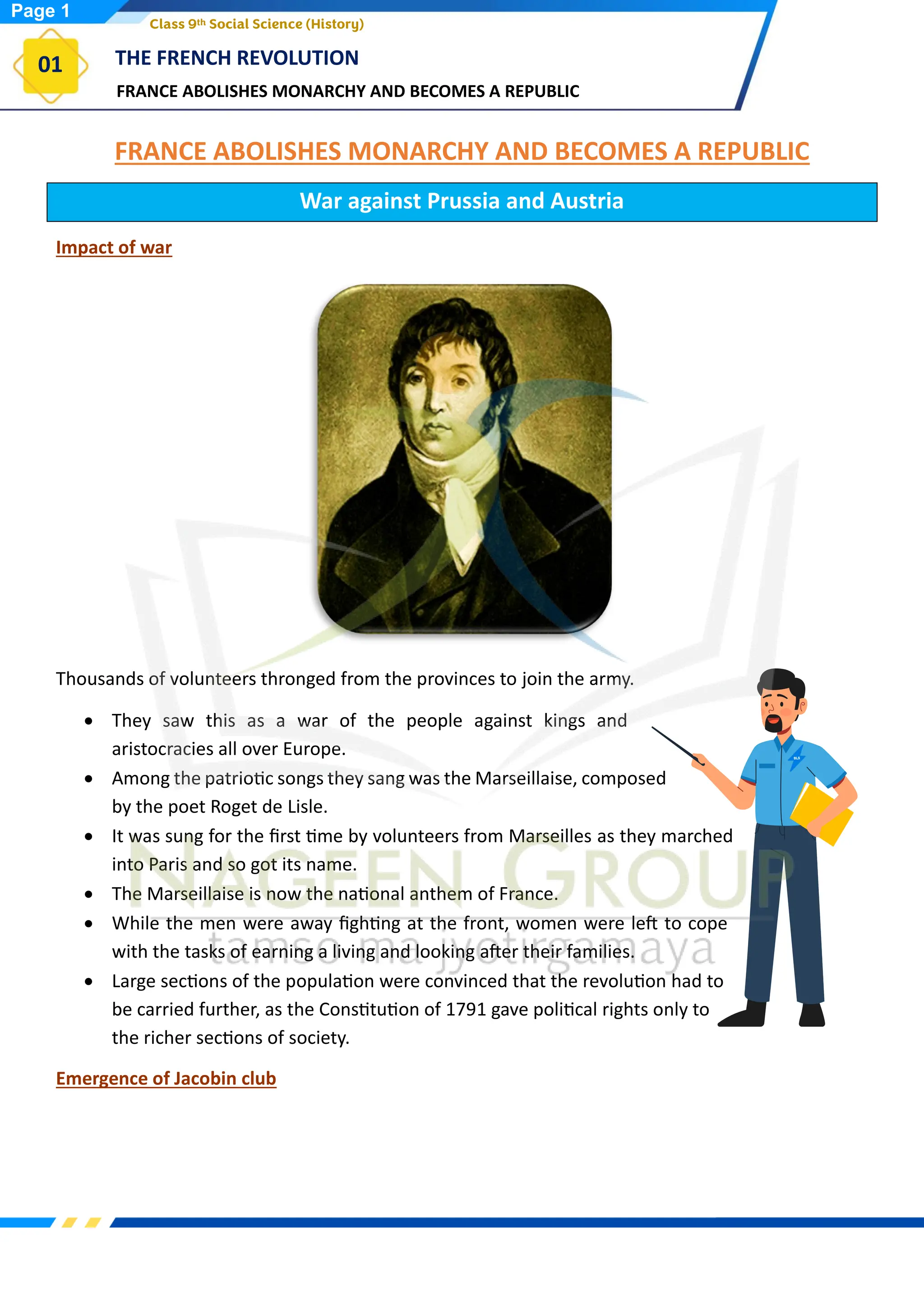
• Among the patriotic songs they sang was the Marseillaise, composed
by the poet Roget de Lisle.
• It was sung for the first time by volunteers from Marseilles as they marched
into Paris and so got its name.
• The Marseillaise is now the national anthem of France.
• While the men were away fighting at the front, women were left to cope
with the tasks of earning a living and looking after their families.
• Large sections of the population were convinced that the revolution had to
be carried further, as the Constitution of 1791 gave political rights only to
the richer sections of society.
Emergence of Jacobin club
Page 1
FRANCE ABOLISHES MONARCHY AND BECOMES A REPUBLIC
THE FRENCH REVOLUTION
01
Class 9th Social Science (History)
• Political clubs became an important rallying point for people who wished to discuss
government policies and plan their own forms of action.
• The most successful of these clubs was that of the Jacobins, which got its name from the
former convent of St Jacob in Paris.
• Women too, who had been active throughout this period, formed their own clubs.
Jacobin club
• The members of the Jacobin club belonged mainly to the less prosperous sections of society.
Page 2
FRANCE ABOLISHES MONARCHY AND BECOMES A REPUBLIC
THE FRENCH REVOLUTION
01
Class 9th Social Science (History)
• They included small shopkeepers, artisans such as shoemakers, pastry cooks, watchmakers,
printers, as well as servants and daily-wage workers.
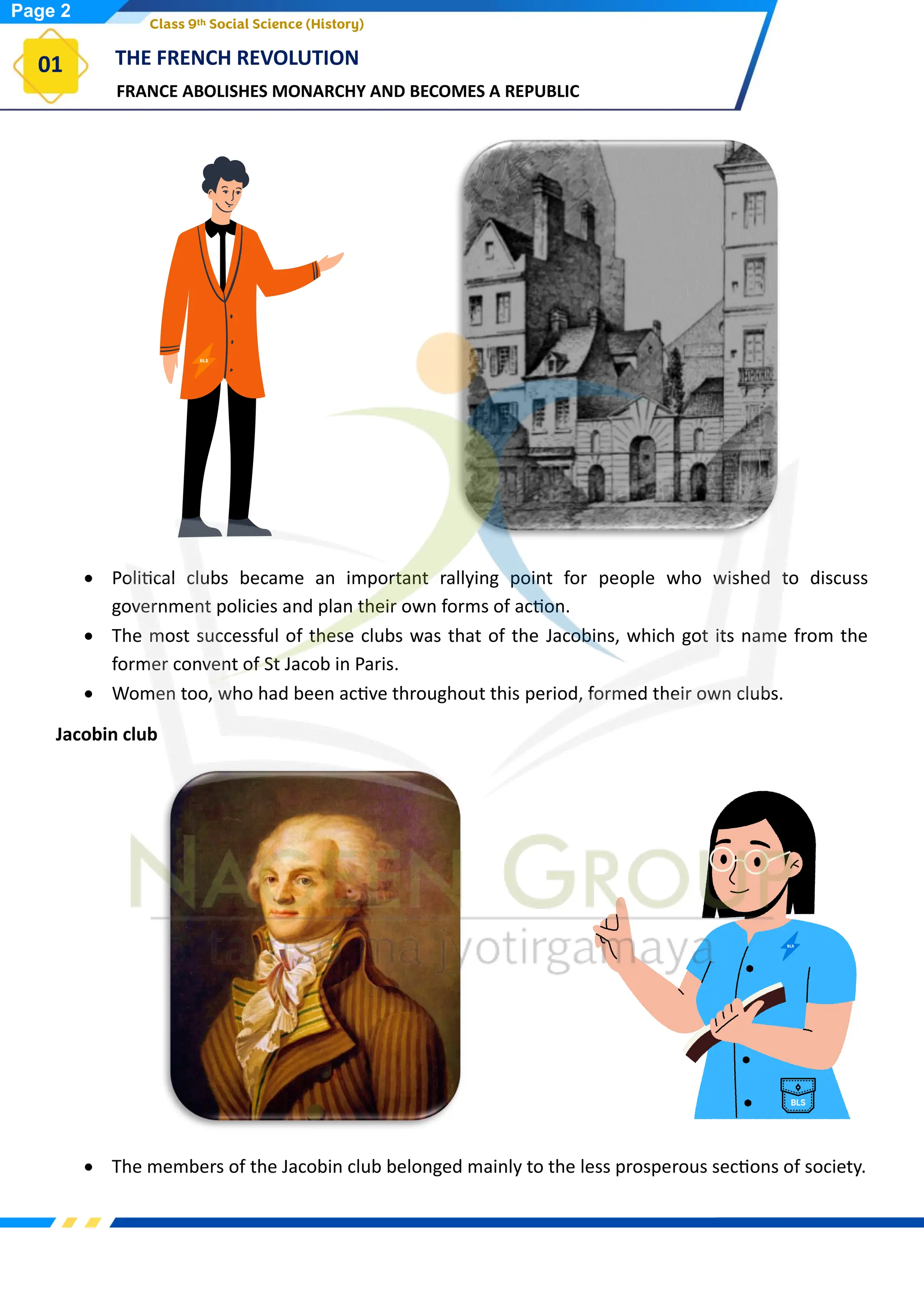
• Their leader was Maximilien Robespierre.
• A large group among the Jacobins decided to start wearing long striped trousers similar to
those worn by dock workers.
• These Jacobins came to be known as the sans-culottes, literally
meaning ‘those without knee breeches.
• Sans Culottes men wore in addition the red cap that symbolizes
liberty. Women however were not allowed to do so.
Incidents in the summer of 1792
• The Jacobins planned an insurrection of a large number of Parisians who
were angered by the short supplies and high prices of food.
• On the morning of August 10, they stormed the Palace of the Tuileries,
massacred the king’s guards, and held the king himself as hostage for
several hours.
• Later the Assembly voted to imprison the royal family.
• Elections were held.
• From now on all men of 21 years and above, regardless of wealth, got the right to vote.
The Reign of Terror
• The period from 1793 to 1794 Robespierre followed a policy of severe control and
punishment.
• All those whom he saw as being ‘enemies’ of the republic – ex-nobles and clergy, members of
other political parties, even members of his own party who did not agree with his methods,
were arrested, imprisoned, and then tried by a revolutionary tribunal.
• If the court found them ‘guilty’ they were guillotined.
Steps taken by Robespierre’s Government
• Robespierre’s government issued laws placing a maximum
ceiling on wages and prices. Meat and bread were rationed.
• Peasants were forced to transport their grain to the cities and
sell it at prices fixed by the government.
• Equality was also sought to be practised through forms of
speech and address.
• Instead of the traditional Monsieur (Sir) and Madame (Madam) all French men and women
were henceforth Citizen and Cito Yenne (Citizen).
Page 3
FRANCE ABOLISHES MONARCHY AND BECOMES A REPUBLIC
THE FRENCH REVOLUTION
01
Class 9th Social Science (History)
• Churches were shut down and their buildings converted into barracks or offices.
Result
• Robespierre pursued his policies so relentlessly that even his supporters began to demand
moderation.
• He was convicted by a court in July 1794.
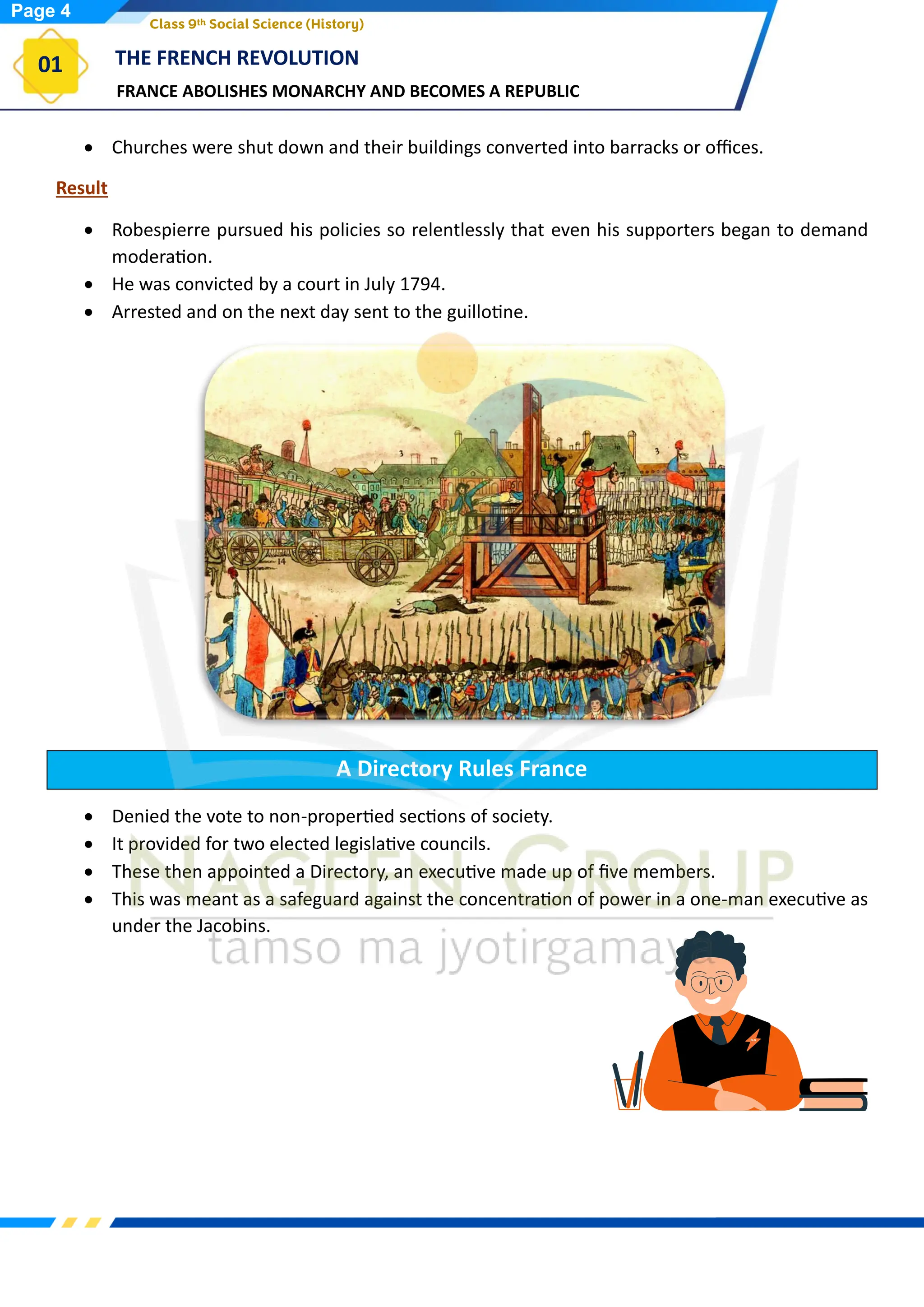
• Arrested and on the next day sent to the guillotine.
A Directory Rules France
• Denied the vote to non-propertied sections of society.
• It provided for two elected legislative councils.
• These then appointed a Directory, an executive made up of five members.
• This was meant as a safeguard against the concentration of power in a one-man executive as
under the Jacobins.
Page 4
DID WOMEN HAD A REVOLUTION
THE FRENCH REVOLUTION
01
Class 9th Social Science (History)
DID WOMEN HAD A REVOLUTION?
Role of women in the revolution and their demands
• Women played a very significant role in the French Revolution.
• Most of the women belonging to the third estate worked for a living and their
occupations included dress makers, laundry workers, flowers vendors etc.
Sometimes worked as maid servants in the houses of the rich.
• Women in France were disappointed with the Constitution of 1791,
which reduced them to passive citizens who had no political rights.
They demanded political rights viz, right to vote, to be elected to
Assembly and to hold political office.
• To express their own views and demand women started their own political
clubs and newspapers. About 60 women's Clubs came up in different cities of
France.
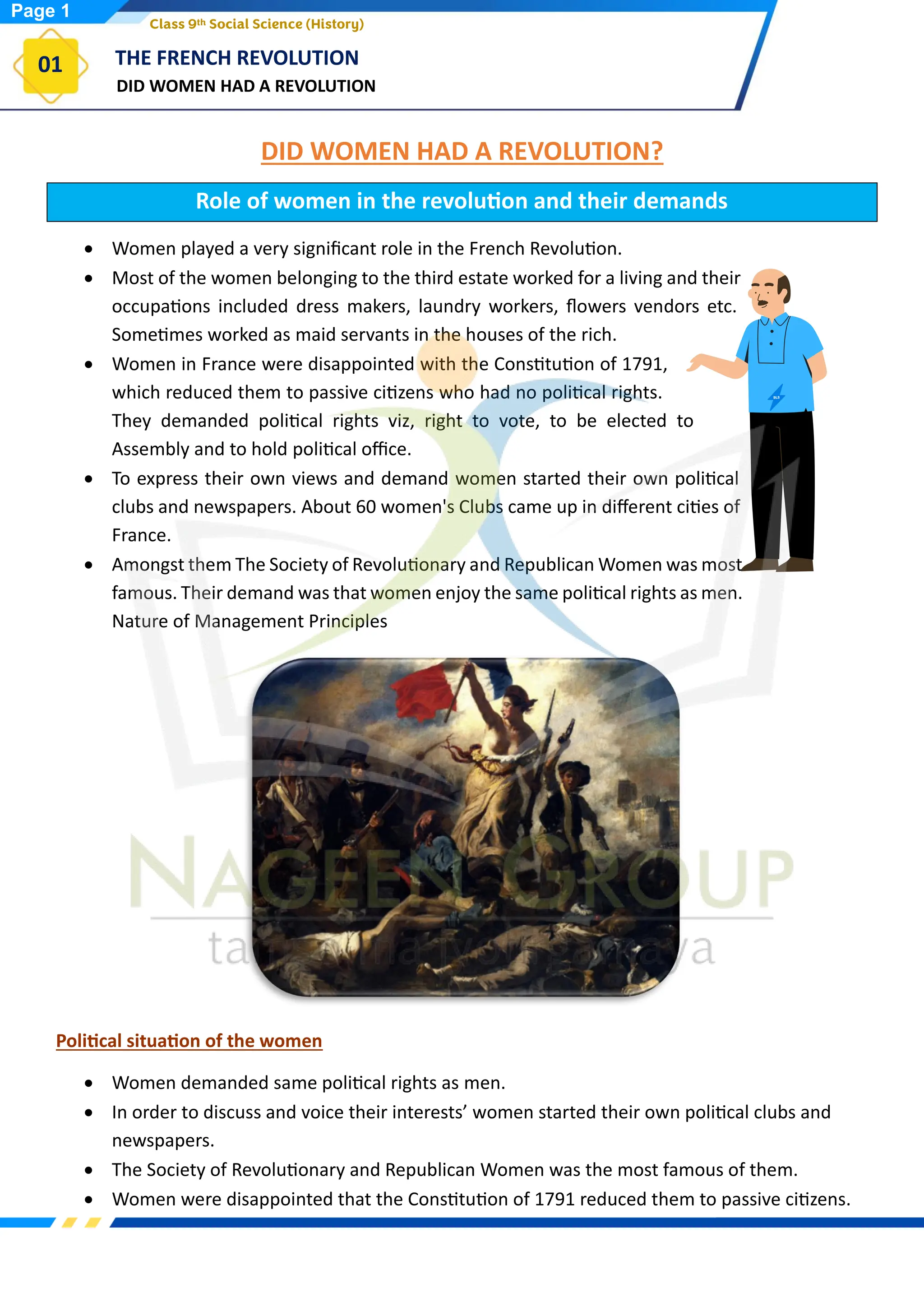
• Amongst them The Society of Revolutionary and Republican Women was most
famous. Their demand was that women enjoy the same political rights as men.
Nature of Management Principles
Political situation of the women
• Women demanded same political rights as men.
• In order to discuss and voice their interests’ women started their own political clubs and
newspapers.
• The Society of Revolutionary and Republican Women was the most famous of them.
• Women were disappointed that the Constitution of 1791 reduced them to passive citizens.
Page 1
DID WOMEN HAD A REVOLUTION
THE FRENCH REVOLUTION
01
Class 9th Social Science (History)
• They demanded the right to vote, to be elected to the Assembly and to hold political office.
Steps taken by Government to improve the Conditions of women
• With the creation of state schools, schooling was made compulsories for all girls.
• Their fathers could no longer force them into marriage against their will.
• Marriage was made into a contract entered into freely and registered under civil law.
• Divorce was made legal and could be applied for by both women and men.
• Women could now train for jobs, could become artists, or run small businesses.
• Women’s struggle for equal political rights, however, continued.
• During the Reign of Terror, the new government issued laws ordering closure of women’s
clubs and banning their political activities.
• Many prominent women were arrested and a number of them executed.
• They were denied voting rights and equal wages.
Page 2
ABOLITION OF SLAVERY
THE FRENCH REVOLUTION
01
Class 9th Social Science (History)
ABOLITION OF SLAVERY
Reasons for Slavery
• The colonies in the Caribbean - Martinique, Guadeloupe, and San Domingo – were important
suppliers of commodities such as tobacco, indigo, sugar, and coffee.
• But the reluctance of Europeans to go and work in distant and unfamiliar lands meant a
shortage of labour on the plantations.
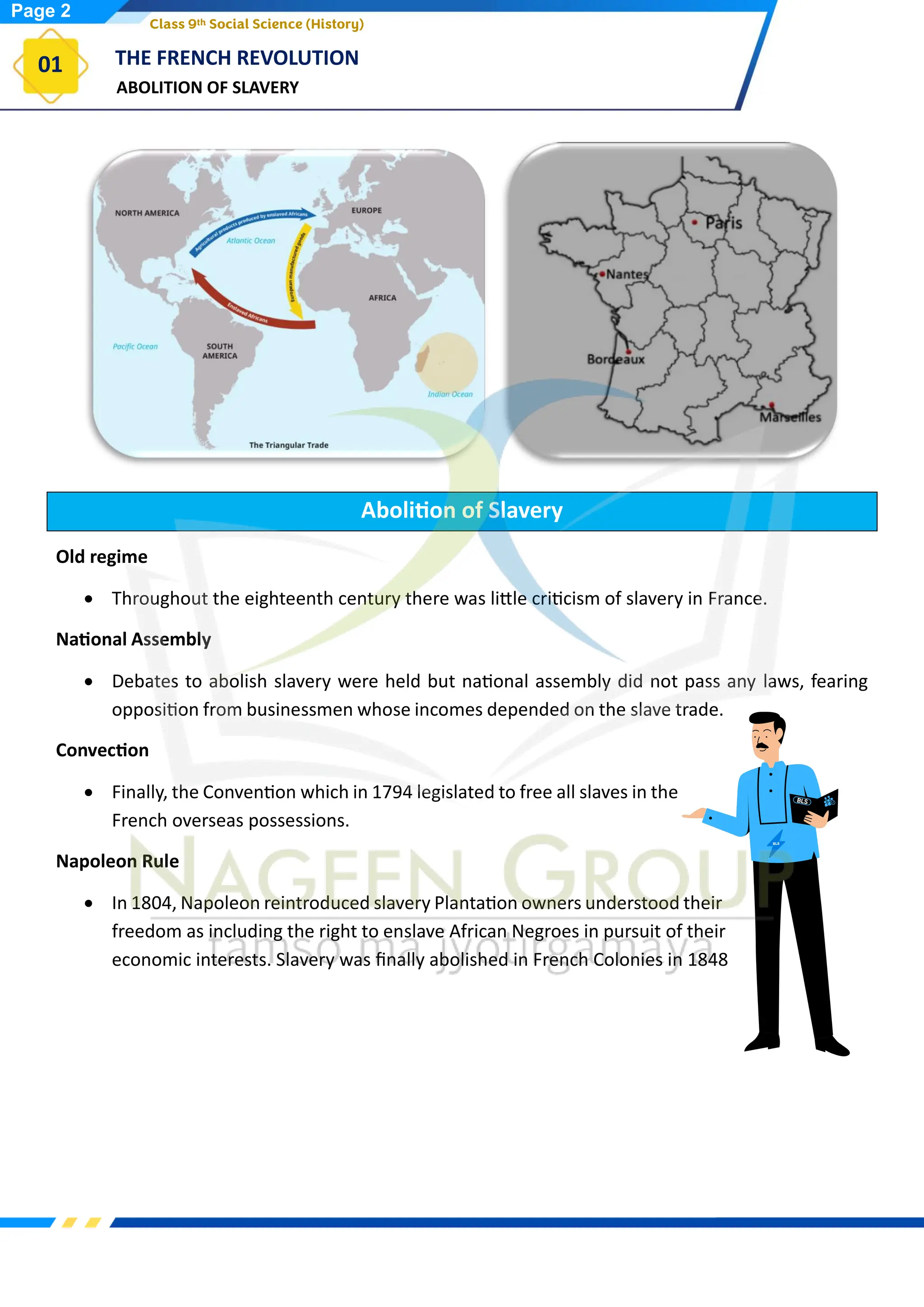
• So, this was met by a triangular slave trade between Europe, Africa, and the Americas.
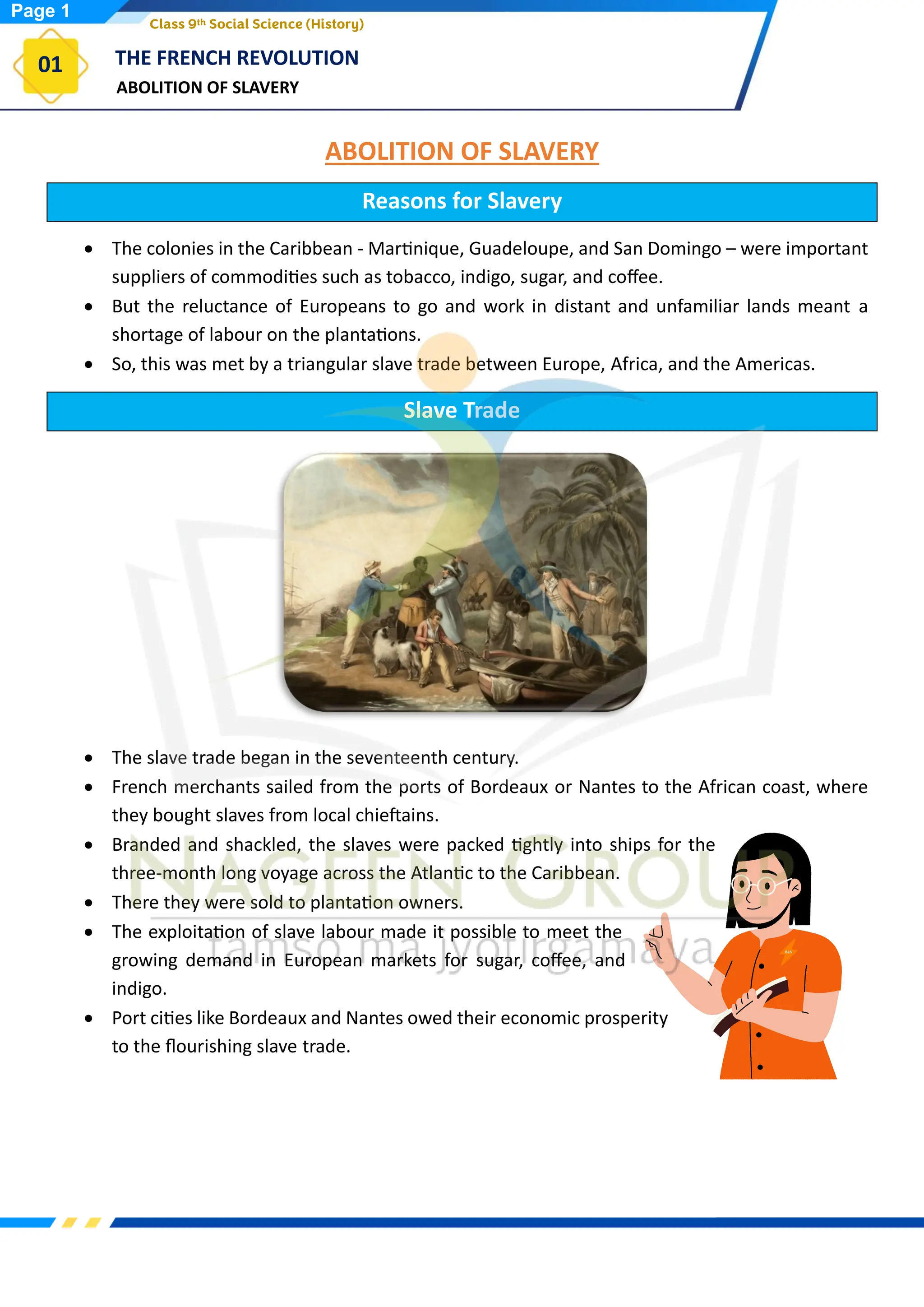
Slave Trade
• The slave trade began in the seventeenth century.
• French merchants sailed from the ports of Bordeaux or Nantes to the African coast, where
they bought slaves from local chieftains.
• Branded and shackled, the slaves were packed tightly into ships for the
three-month long voyage across the Atlantic to the Caribbean.
• There they were sold to plantation owners.
• The exploitation of slave labour made it possible to meet the
growing demand in European markets for sugar, coffee, and
indigo.
• Port cities like Bordeaux and Nantes owed their economic prosperity
to the flourishing slave trade.
Page 1
ABOLITION OF SLAVERY
THE FRENCH REVOLUTION
01
Class 9th Social Science (History)
Abolition of Slavery
Old regime
• Throughout the eighteenth century there was little criticism of slavery in France.
National Assembly
• Debates to abolish slavery were held but national assembly did not pass any laws, fearing
opposition from businessmen whose incomes depended on the slave trade.
Convection
• Finally, the Convention which in 1794 legislated to free all slaves in the
French overseas possessions.
Napoleon Rule
• In 1804, Napoleon reintroduced slavery Plantation owners understood their
freedom as including the right to enslave African Negroes in pursuit of their
economic interests. Slavery was finally abolished in French Colonies in 1848
Page 2
THE REVOLUTION AND EVERYDAY LIFE
THE FRENCH REVOLUTION
01
Class 9th Social Science (History)
THE REVOLUTION AND EVERYDAY LIFE
The revolutionary governments took it upon themselves to pass laws that would translate the ideals
of liberty and equality into everyday practice.
Abolition of censorship
• In the Old Regime all written material and cultural activities - books, newspapers, plays - could
be published or performed only after they had been approved by the censors of the king.
• After the storming of Bastille, the Declaration of the Rights of Man and Citizen
proclaimed freedom of speech and expression to be a natural right.
• Newspapers, pamphlets, books, and printed pictures flooded the
towns of France from where they travelled rapidly into the countryside.
• They all described and discussed the events and changes taking place in
France.
Abolition of censorship = Freedom of the press
• Meant that opposing views of events could be expressed.
• Each side sought to convince the others of its position through the medium of
print.
• Plays, songs and festive processions attracted large numbers of people.
This was one way they could grasp and identify with ideas such as liberty or justice
that political philosophers wrote about at length in texts which only a handful of educated people
could read.
Conclusion
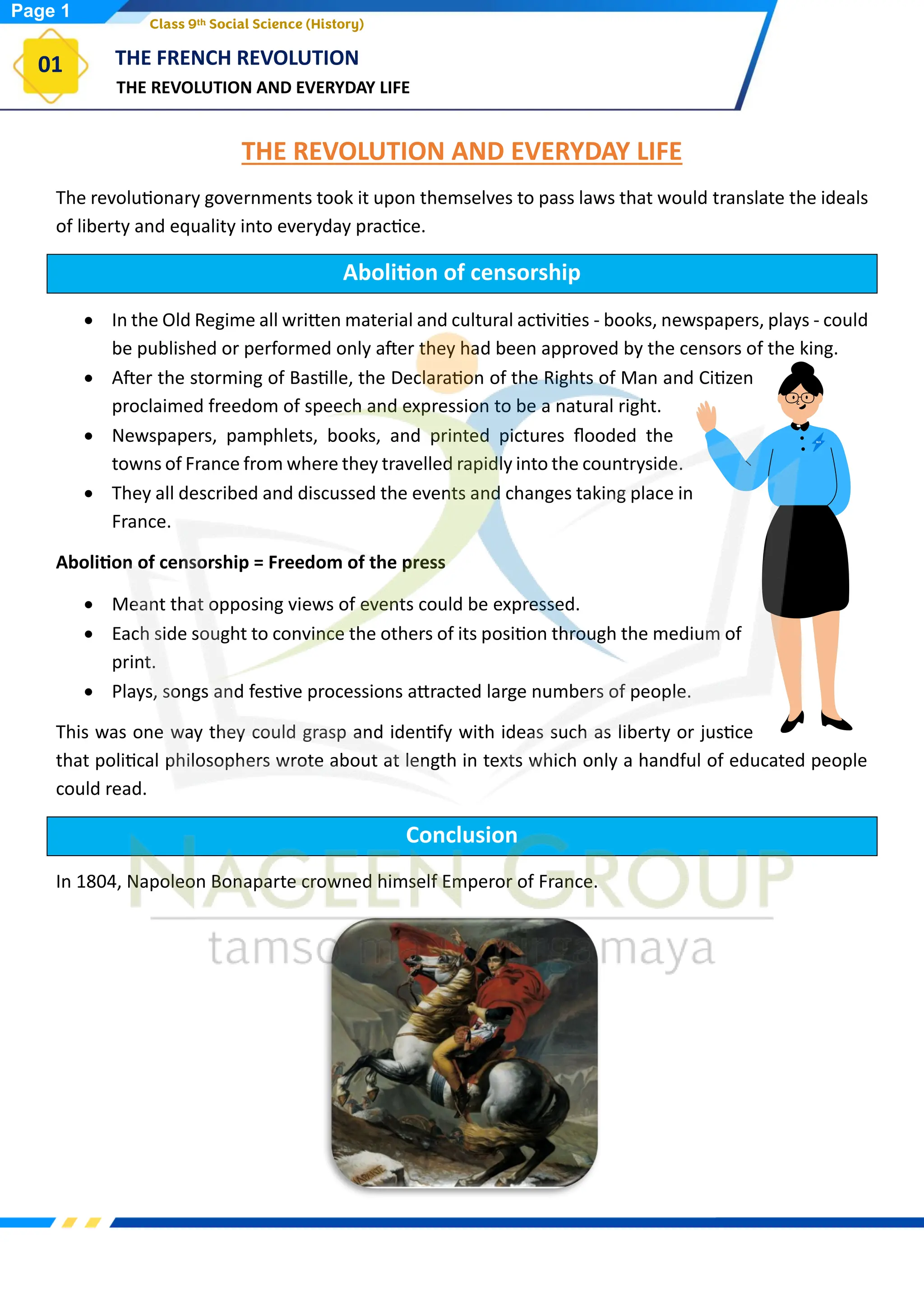
In 1804, Napoleon Bonaparte crowned himself Emperor of France.
Page 1
THE REVOLUTION AND EVERYDAY LIFE
THE FRENCH REVOLUTION
01
Class 9th Social Science (History)
• He set out to conquer neighbouring European countries, dispossessing dynasties and creating
kingdoms where he placed members of his family.
• Napoleon saw his role as a moderniser of Europe.
He introduced many laws such as the protection of private
property and a uniform system of weights and measures
provided by the decimal system.
Page 2
FRENCH SOCIETY DURING LATE 18TH CENTURY
THE FRENCH REVOLUTION
01
Class 9th History
(Practice Sheet)
1 What was the social hierarchy in France during the late 18th century called?
A. Caste system B. Estates system
C. Class system D. Guild system
2 Which estate in France consisted of the clergy?
A. First Estate B. Second Estate
C. Third Estate D. Fourth Estate
3 The Third Estate in France was made up of which groups?
A. Nobility and clergy B. Peasants, artisans, and bourgeoisie
C. Merchants and traders D. Intellectuals and artists
4 What percentage of the French population belonged to the Third Estate?
A. About 10% B. About 25%
C. About 50% D. About 97%
5 Which group in the Third Estate was influenced by Enlightenment ideas and played a
significant role in the French Revolution?
A. Peasants B. Artisans
C. Bourgeoisie D. Serfs
6 What were the three estates in French society during the late 18th century?
7 What percentage of the French population belonged to the third estate?
8 Why did the third estate resent the privileges of the first and second estates?
9 What were the economic hardships faced by the common people in France at that time?
10 How did the Enlightenment ideas influence French society during the late 18th century?
Page 1
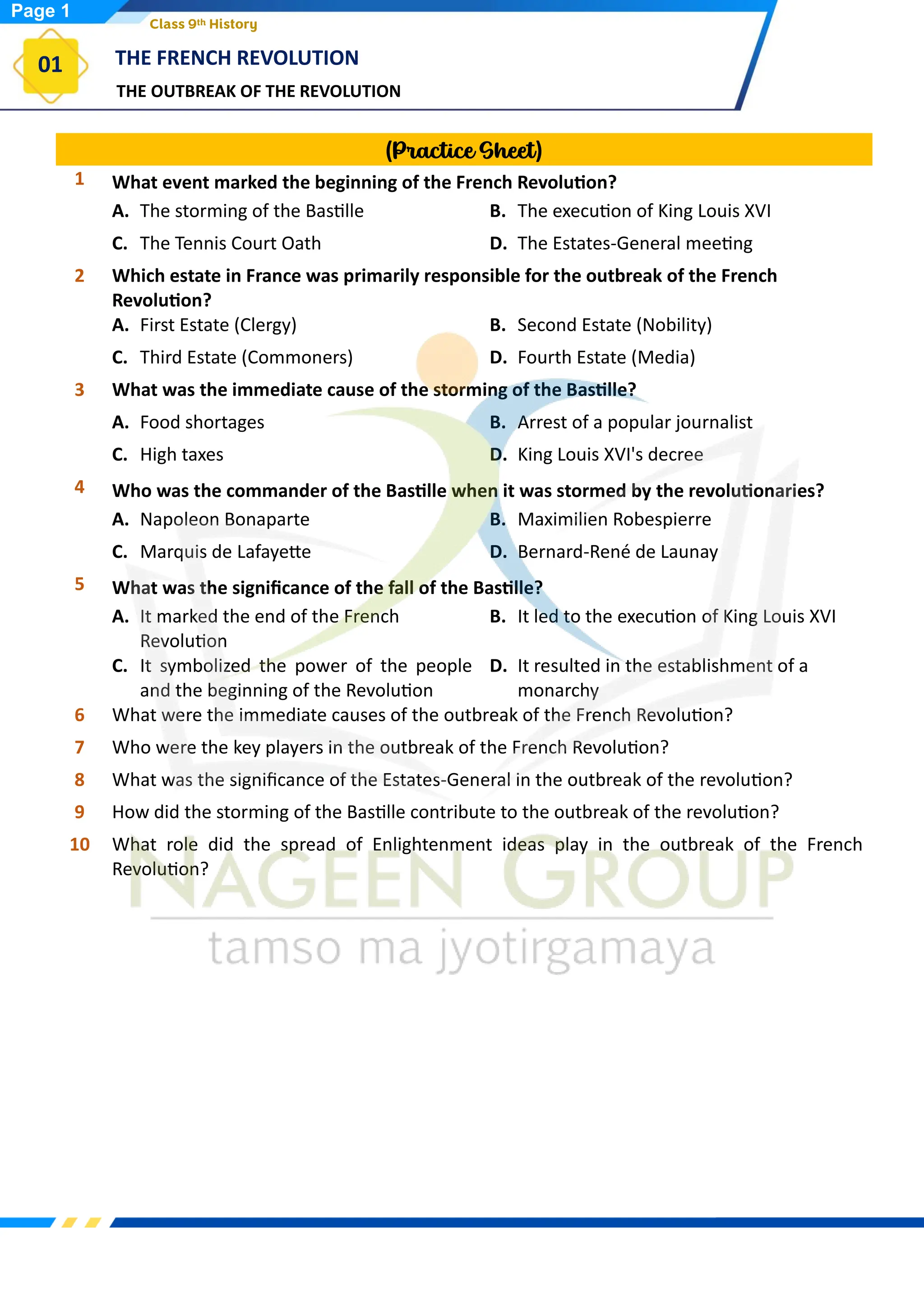
THE OUTBREAK OF THE REVOLUTION
THE FRENCH REVOLUTION
01
Class 9th History
(Practice Sheet)
1 What event marked the beginning of the French Revolution?
A. The storming of the Bastille B. The execution of King Louis XVI
C. The Tennis Court Oath D. The Estates-General meeting
2 Which estate in France was primarily responsible for the outbreak of the French
Revolution?
A. First Estate (Clergy) B. Second Estate (Nobility)
C. Third Estate (Commoners) D. Fourth Estate (Media)
3 What was the immediate cause of the storming of the Bastille?
A. Food shortages B. Arrest of a popular journalist
C. High taxes D. King Louis XVI's decree
4 Who was the commander of the Bastille when it was stormed by the revolutionaries?
A. Napoleon Bonaparte B. Maximilien Robespierre
C. Marquis de Lafayette D. Bernard-René de Launay
5 What was the significance of the fall of the Bastille?
A. It marked the end of the French
Revolution
B. It led to the execution of King Louis XVI
C. It symbolized the power of the people
and the beginning of the Revolution
D. It resulted in the establishment of a
monarchy
6 What were the immediate causes of the outbreak of the French Revolution?
7 Who were the key players in the outbreak of the French Revolution?
8 What was the significance of the Estates-General in the outbreak of the revolution?
9 How did the storming of the Bastille contribute to the outbreak of the revolution?
10 What role did the spread of Enlightenment ideas play in the outbreak of the French
Revolution?
Page 1
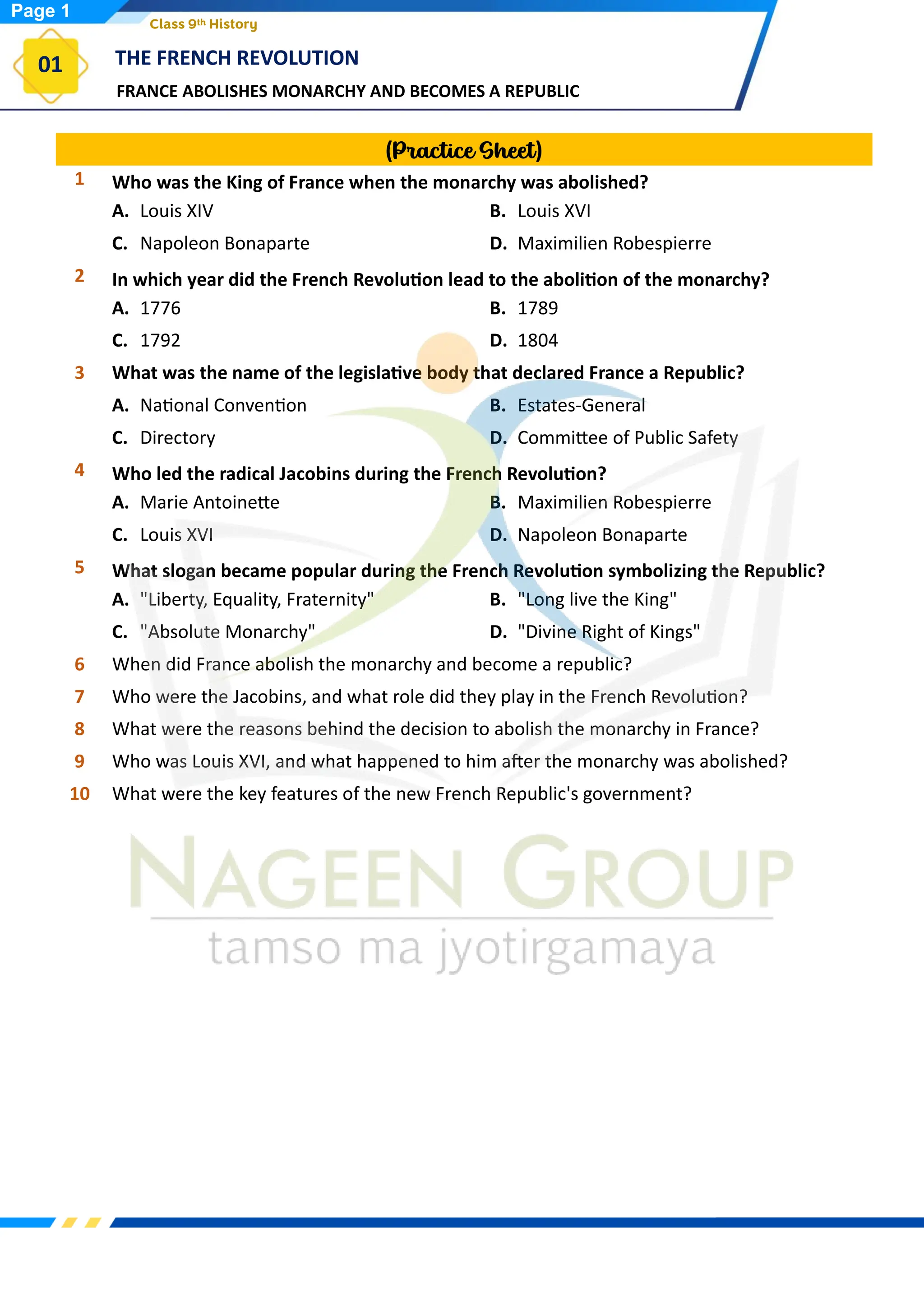
FRANCE ABOLISHES MONARCHY AND BECOMES A REPUBLIC
THE FRENCH REVOLUTION
01
Class 9th History
(Practice Sheet)
1 Who was the King of France when the monarchy was abolished?
A. Louis XIV B. Louis XVI
C. Napoleon Bonaparte D. Maximilien Robespierre
2 In which year did the French Revolution lead to the abolition of the monarchy?
A. 1776 B. 1789
C. 1792 D. 1804
3 What was the name of the legislative body that declared France a Republic?
A. National Convention B. Estates-General
C. Directory D. Committee of Public Safety
4 Who led the radical Jacobins during the French Revolution?
A. Marie Antoinette B. Maximilien Robespierre
C. Louis XVI D. Napoleon Bonaparte
5 What slogan became popular during the French Revolution symbolizing the Republic?
A. "Liberty, Equality, Fraternity" B. "Long live the King"
C. "Absolute Monarchy" D. "Divine Right of Kings"
6 When did France abolish the monarchy and become a republic?
7 Who were the Jacobins, and what role did they play in the French Revolution?
8 What were the reasons behind the decision to abolish the monarchy in France?
9 Who was Louis XVI, and what happened to him after the monarchy was abolished?
10 What were the key features of the new French Republic's government?
Page 1
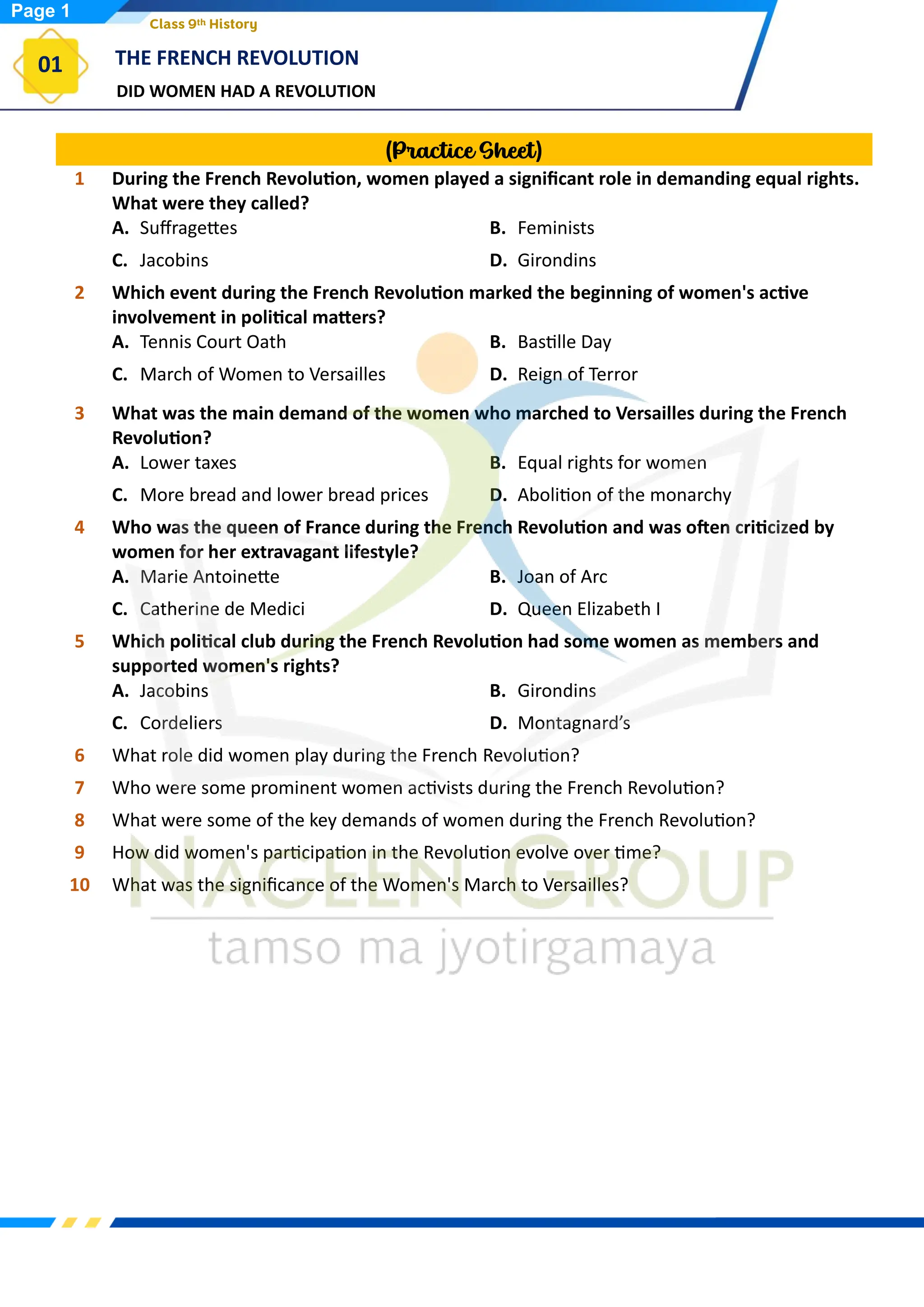
DID WOMEN HAD A REVOLUTION
THE FRENCH REVOLUTION
01
Class 9th History
(Practice Sheet)
1 During the French Revolution, women played a significant role in demanding equal rights.
What were they called?
A. Suffragettes B. Feminists
C. Jacobins D. Girondins
2 Which event during the French Revolution marked the beginning of women's active
involvement in political matters?
A. Tennis Court Oath B. Bastille Day
C. March of Women to Versailles D. Reign of Terror
3 What was the main demand of the women who marched to Versailles during the French
Revolution?
A. Lower taxes B. Equal rights for women
C. More bread and lower bread prices D. Abolition of the monarchy
4 Who was the queen of France during the French Revolution and was often criticized by
women for her extravagant lifestyle?
A. Marie Antoinette B. Joan of Arc
C. Catherine de Medici D. Queen Elizabeth I
5 Which political club during the French Revolution had some women as members and
supported women's rights?
A. Jacobins B. Girondins
C. Cordeliers D. Montagnard’s
6 What role did women play during the French Revolution?
7 Who were some prominent women activists during the French Revolution?
8 What were some of the key demands of women during the French Revolution?
9 How did women's participation in the Revolution evolve over time?
10 What was the significance of the Women's March to Versailles?
Page 1
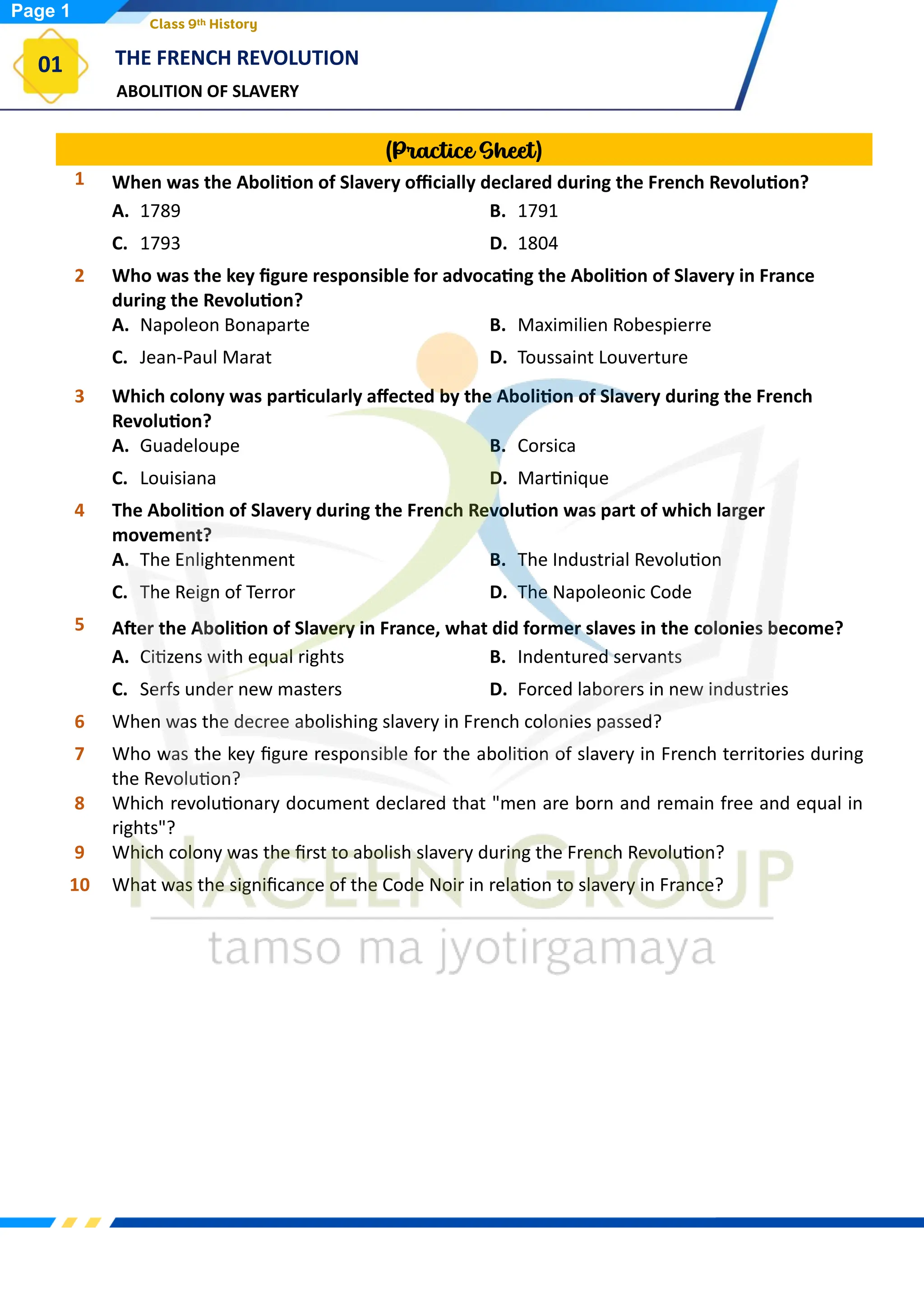
ABOLITION OF SLAVERY
THE FRENCH REVOLUTION
01
Class 9th History
(Practice Sheet)
1 When was the Abolition of Slavery officially declared during the French Revolution?
A. 1789 B. 1791
C. 1793 D. 1804
2 Who was the key figure responsible for advocating the Abolition of Slavery in France
during the Revolution?
A. Napoleon Bonaparte B. Maximilien Robespierre
C. Jean-Paul Marat D. Toussaint Louverture
3 Which colony was particularly affected by the Abolition of Slavery during the French
Revolution?
A. Guadeloupe B. Corsica
C. Louisiana D. Martinique
4 The Abolition of Slavery during the French Revolution was part of which larger
movement?
A. The Enlightenment B. The Industrial Revolution
C. The Reign of Terror D. The Napoleonic Code
5 After the Abolition of Slavery in France, what did former slaves in the colonies become?
A. Citizens with equal rights B. Indentured servants
C. Serfs under new masters D. Forced laborers in new industries
6 When was the decree abolishing slavery in French colonies passed?
7 Who was the key figure responsible for the abolition of slavery in French territories during
the Revolution?
8 Which revolutionary document declared that "men are born and remain free and equal in
rights"?
9 Which colony was the first to abolish slavery during the French Revolution?
10 What was the significance of the Code Noir in relation to slavery in France?
Page 1
FRENCH SOCIETY DURING LATE 18TH CENTURY
THE FRENCH REVOLUTION
01
Class 9th History
(Practice Sheet)
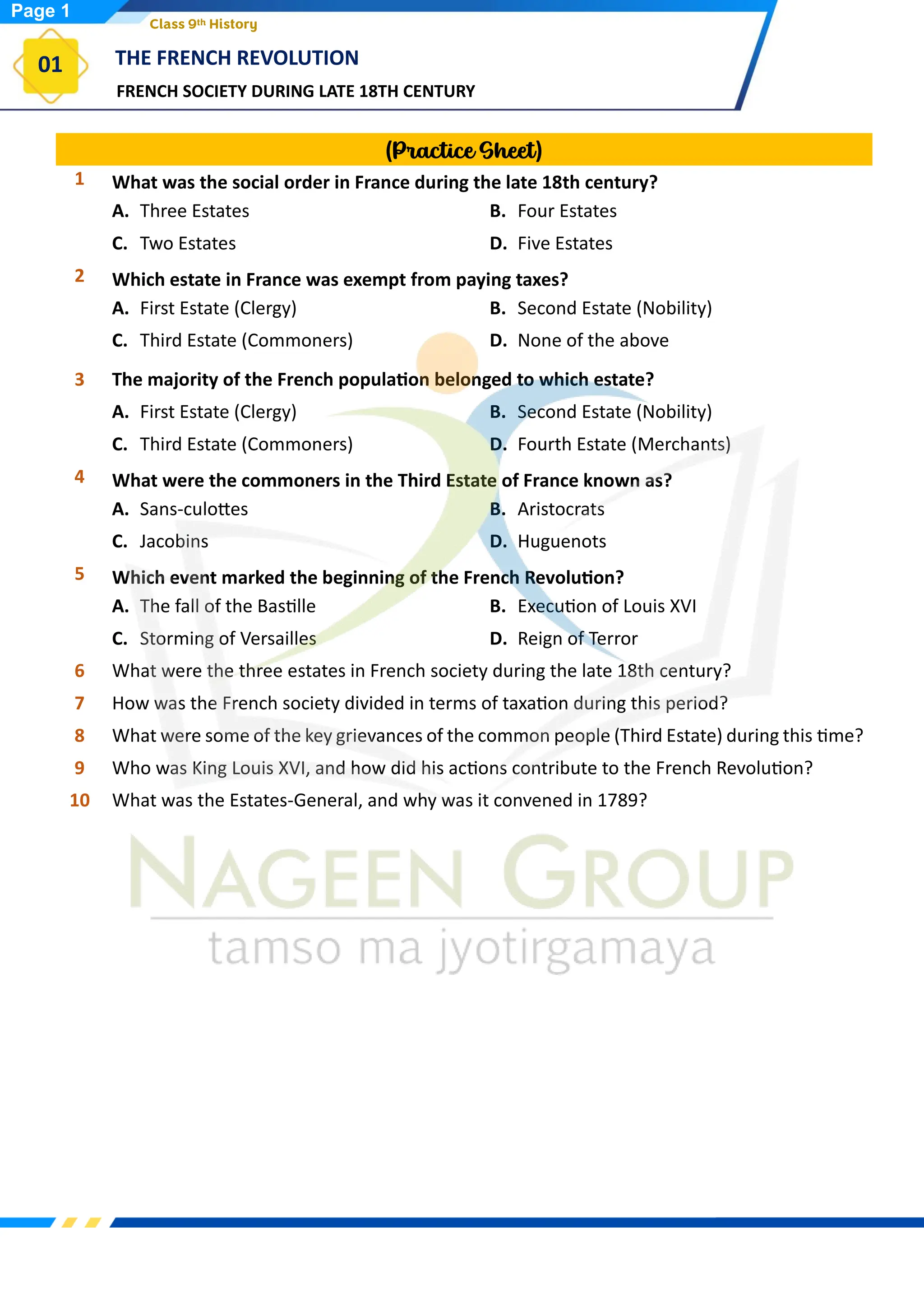
1 What was the social order in France during the late 18th century?
A. Three Estates B. Four Estates
C. Two Estates D. Five Estates
2 Which estate in France was exempt from paying taxes?
A. First Estate (Clergy) B. Second Estate (Nobility)
C. Third Estate (Commoners) D. None of the above
3 The majority of the French population belonged to which estate?
A. First Estate (Clergy) B. Second Estate (Nobility)
C. Third Estate (Commoners) D. Fourth Estate (Merchants)
4 What were the commoners in the Third Estate of France known as?
A. Sans-culottes B. Aristocrats
C. Jacobins D. Huguenots
5 Which event marked the beginning of the French Revolution?
A. The fall of the Bastille B. Execution of Louis XVI
C. Storming of Versailles D. Reign of Terror
6 What were the three estates in French society during the late 18th century?
7 How was the French society divided in terms of taxation during this period?
8 What were some of the key grievances of the common people (Third Estate) during this time?
9 Who was King Louis XVI, and how did his actions contribute to the French Revolution?
10 What was the Estates-General, and why was it convened in 1789?
Page 1
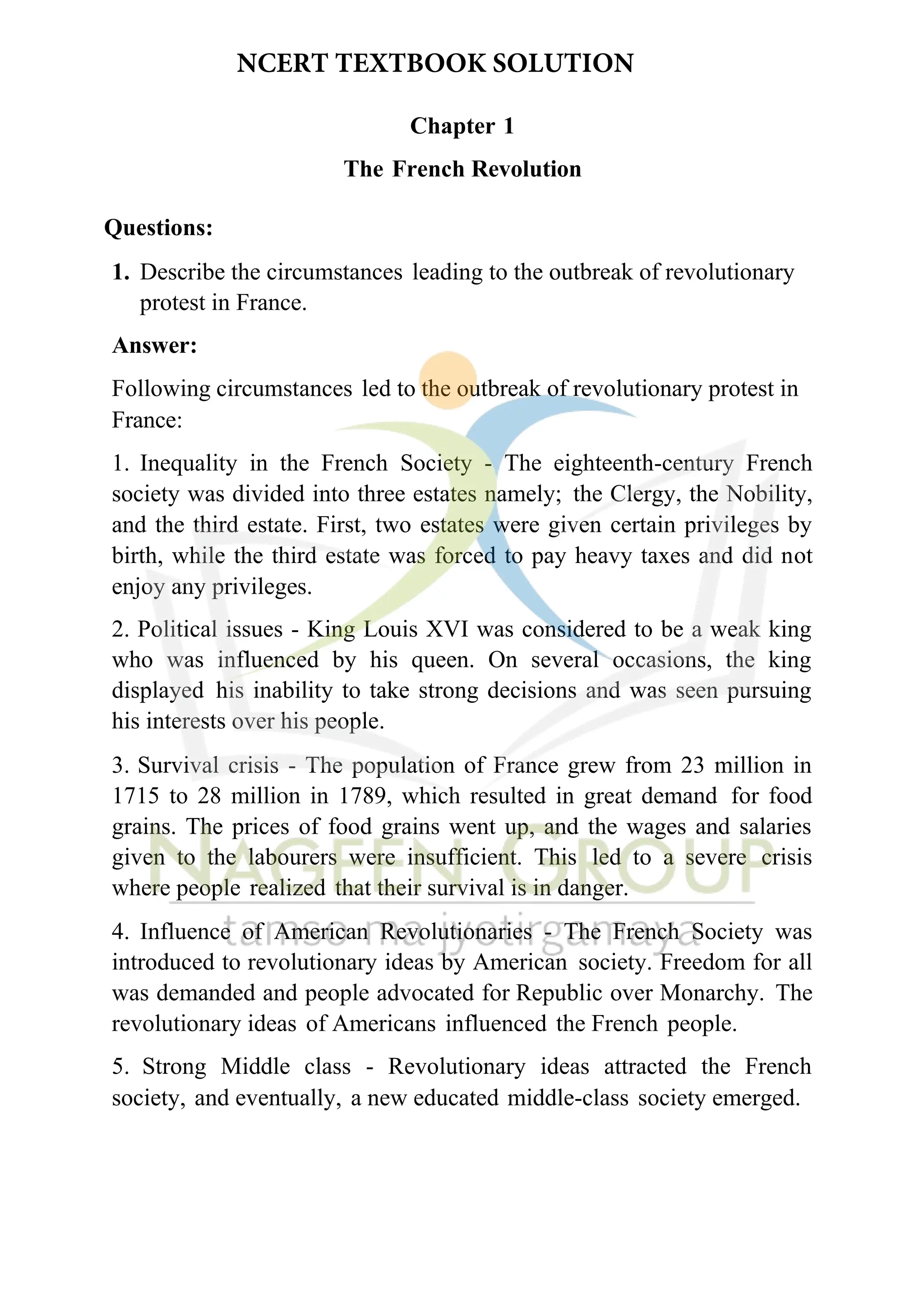
Chapter 1
The French Revolution
Questions:
1. Describe the circumstances leading to the outbreak of revolutionary
protest in France.
Answer:
Following circumstances led to the outbreak of revolutionary protest in
France:
1. Inequality in the French Society - The eighteenth-century French
society was divided into three estates namely; the Clergy, the Nobility,
and the third estate. First, two estates were given certain privileges by
birth, while the third estate was forced to pay heavy taxes and did not
enjoy any privileges.
2. Political issues - King Louis XVI was considered to be a weak king
who was influenced by his queen. On several occasions, the king
displayed his inability to take strong decisions and was seen pursuing
his interests over his people.
3. Survival crisis - The population of France grew from 23 million in
1715 to 28 million in 1789, which resulted in great demand for food
grains. The prices of food grains went up, and the wages and salaries
given to the labourers were insufficient. This led to a severe crisis
where people realized that their survival is in danger.
4. Influence of American Revolutionaries - The French Society was
introduced to revolutionary ideas by American society. Freedom for all
was demanded and people advocated for Republic over Monarchy. The
revolutionary ideas of Americans influenced the French people.
5. Strong Middle class - Revolutionary ideas attracted the French
society, and eventually, a new educated middle-class society emerged.
NCERT TEXTBOOK SOLUTION
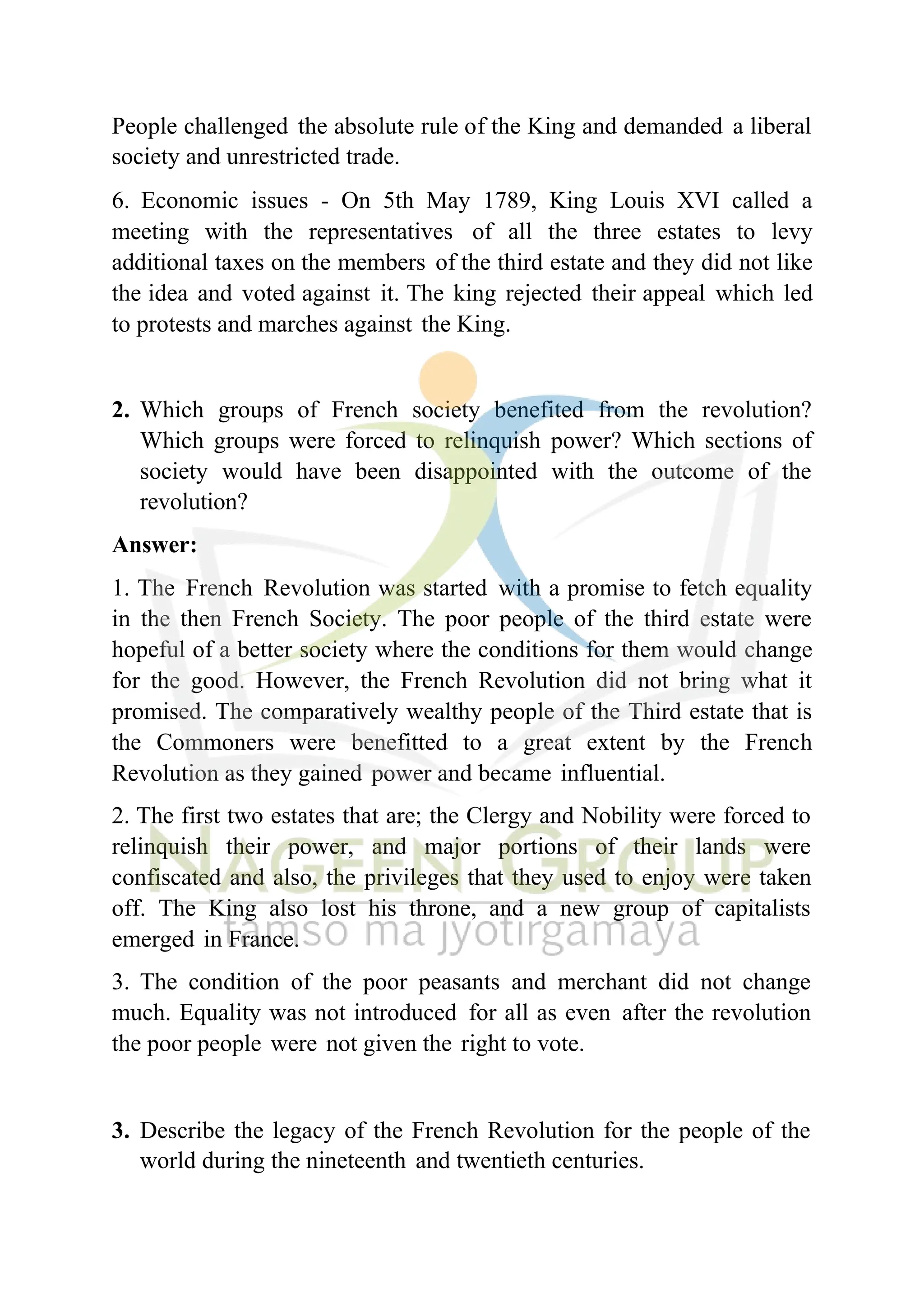
People challenged the absolute rule of the King and demanded a liberal
society and unrestricted trade.
6. Economic issues - On 5th May 1789, King Louis XVI called a
meeting with the representatives of all the three estates to levy
additional taxes on the members of the third estate and they did not like
the idea and voted against it. The king rejected their appeal which led
to protests and marches against the King.
2. Which groups of French society benefited from the revolution?
Which groups were forced to relinquish power? Which sections of
society would have been disappointed with the outcome of the
revolution?
Answer:
1. The French Revolution was started with a promise to fetch equality
in the then French Society. The poor people of the third estate were
hopeful of a better society where the conditions for them would change
for the good. However, the French Revolution did not bring what it
promised. The comparatively wealthy people of the Third estate that is
the Commoners were benefitted to a great extent by the French
Revolution as they gained power and became influential.
2. The first two estates that are; the Clergy and Nobility were forced to
relinquish their power, and major portions of their lands were
confiscated and also, the privileges that they used to enjoy were taken
off. The King also lost his throne, and a new group of capitalists
emerged in France.
3. The condition of the poor peasants and merchant did not change
much. Equality was not introduced for all as even after the revolution
the poor people were not given the right to vote.
3. Describe the legacy of the French Revolution for the people of the
world during the nineteenth and twentieth centuries.
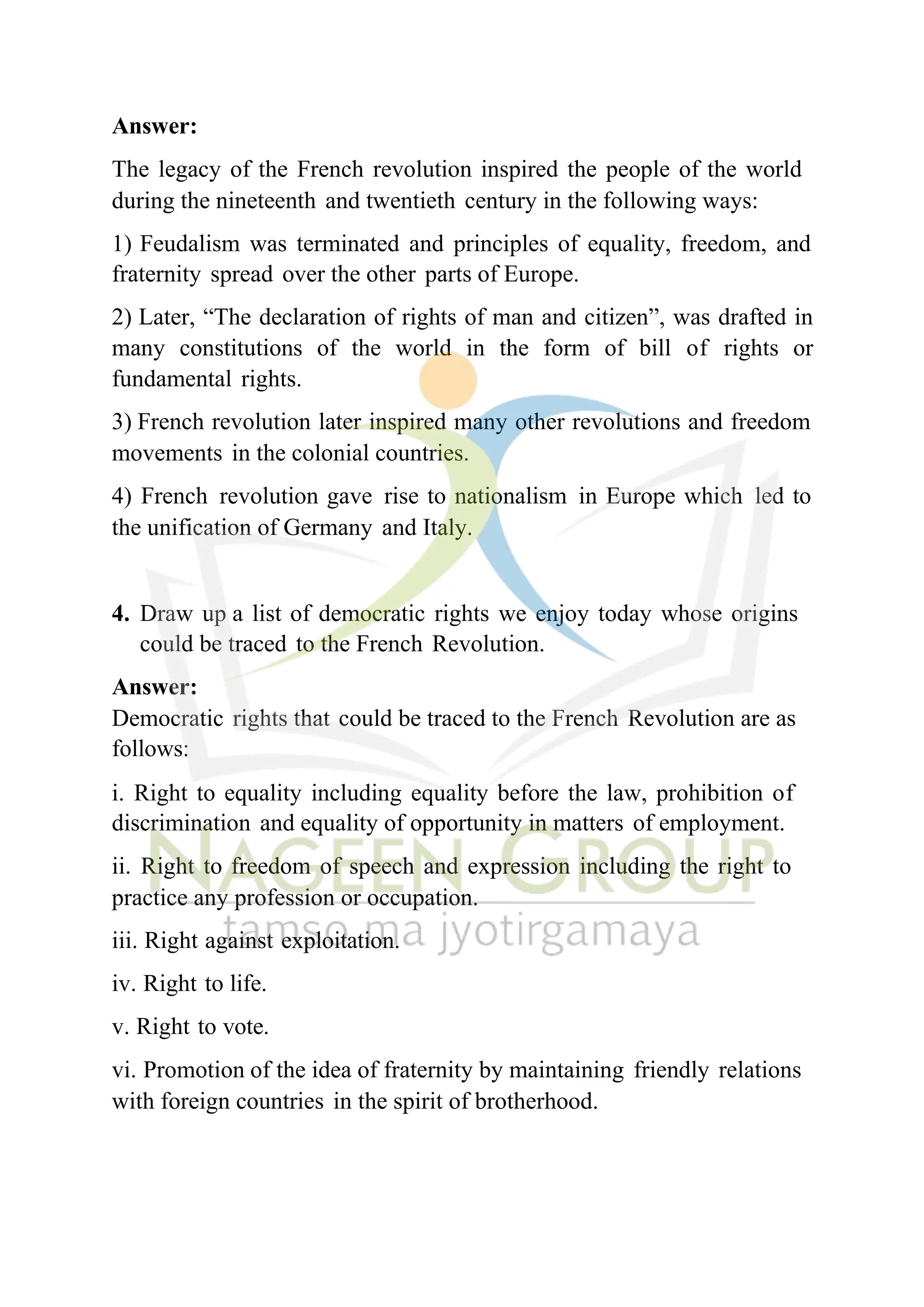
Answer:
The legacy of the French revolution inspired the people of the world
during the nineteenth and twentieth century in the following ways:
1) Feudalism was terminated and principles of equality, freedom, and
fraternity spread over the other parts of Europe.
2) Later, “The declaration of rights of man and citizen”, was drafted in
many constitutions of the world in the form of bill of rights or
fundamental rights.
3) French revolution later inspired many other revolutions and freedom
movements in the colonial countries.
4) French revolution gave rise to nationalism in Europe which led to
the unification of Germany and Italy.
4. Draw up a list of democratic rights we enjoy today whose origins
could be traced to the French Revolution.
Answer:
Democratic rights that could be traced to the French Revolution are as
follows:
i. Right to equality including equality before the law, prohibition of
discrimination and equality of opportunity in matters of employment.
ii. Right to freedom of speech and expression including the right to
practice any profession or occupation.
iii. Right against exploitation.
iv. Right to life.
v. Right to vote.
vi. Promotion of the idea of fraternity by maintaining friendly relations
with foreign countries in the spirit of brotherhood.
5. Would you agree with the view that the message of universal rights
was beset with contradictions? Explain.
Answer:
Yes, I agree with the view that the message of universal rights was beset
with several contradictions because:
1. Even after the revolution when France was converted into a
constitutional monarchy, millions of people were not granted voting
rights.
2. Though the universal rights advocated for equal rights, the women
who took an active part in the revolution were not given equal rights.
Most of the imperialist powers did not grant full freedom to the peoples
of their colonies.
3. The poor people were not granted voting rights despite the fact that
most of the population comprised of the poor laborers. The poor were
termed passive citizens and had not given any rights.
4. Universal rights did not help the poor people at all, and they were
continued to be suppressed. Women were also neglected, and only the
rich men of the society gained the power.
6. How would you explain the rise of Napoleon?
Answer:
Following are the reason responsible for the rise of Napoleon
Bonaparte:
(1) French became a republic in 1792 after the fall of the Jacobean rule.
(2) Robespierre, the then ruler of France, favored the rich and wealthy
people and completely ignored the other sections of the society. He was
a tyrant, and people faced Reign of Terror for several years.
(3) Following Robespierre's subsequent downfall, a new directory was
formed to avoid concentration of power in one hand. Later, the
members of the directory fought among themselves, which resulted in
political unrest.
(4) This created chaos and a political vacuum in France. Napoleon
Bonaparte used this situation and took power and declared himself the
military dictator of France.
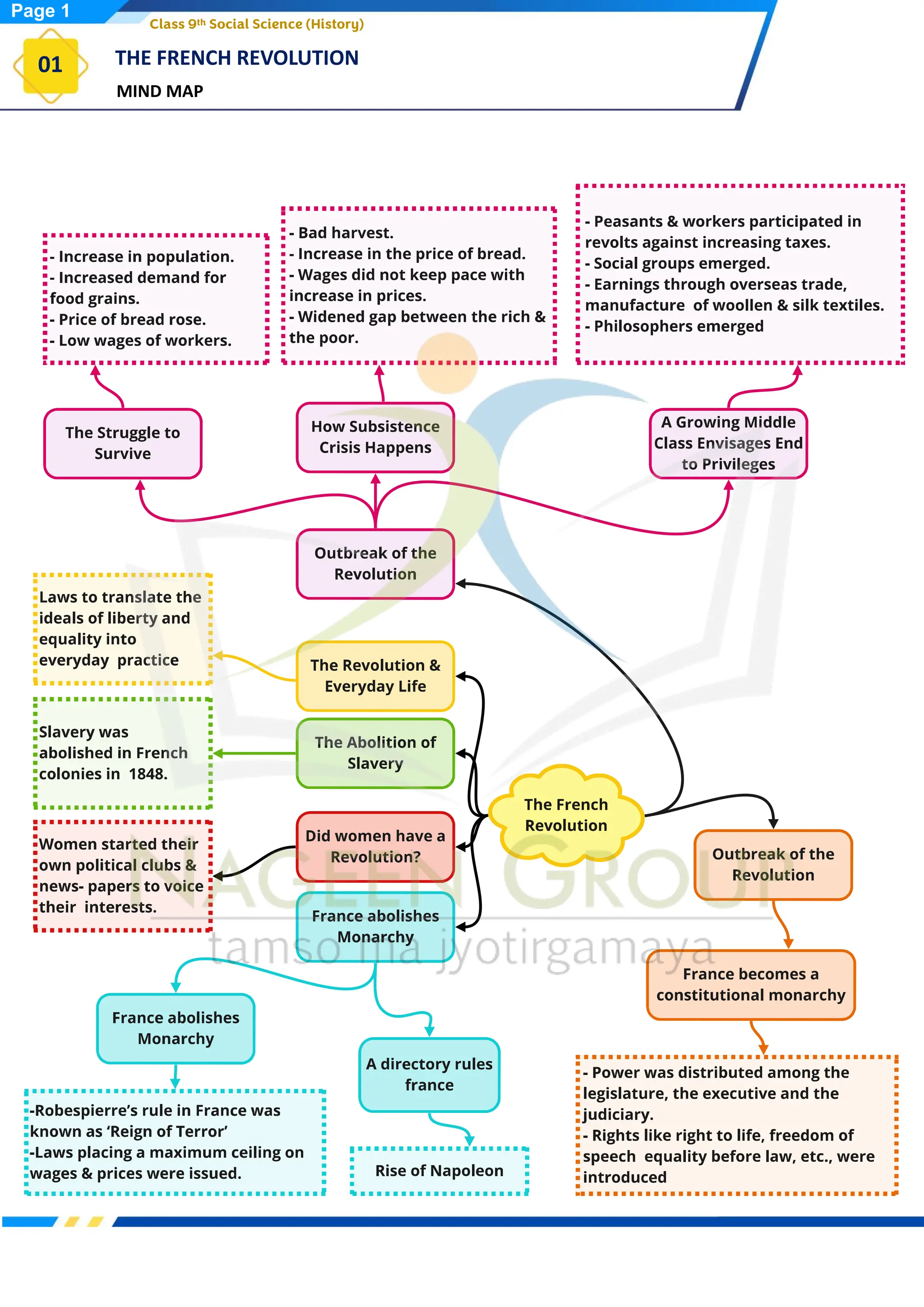
THE FRENCH REVOLUTION
MIND MAP
01
Class 9th Social Science (History)
Page 1
CLICK TO DOWNLOAD MORE CHAPTERS
Dear Teachers and Students,
Join School of Educators' exclusive WhatsApp, Telegram, and Signal groups for FREE access
to a vast range of educational resources designed to help you achieve 100/100 in exams!
Separate groups for teachers and students are available, packed with valuable content to
boost your performance.
Additionally, benefit from expert tips, practical advice, and study hacks designed to enhance
performance in both CBSE exams and competitive entrance tests.
Don’t miss out—join today and take the first step toward academic excellence!
Join the Teachers and Students
Group by Clicking the Link Below
JOIN OUR
WHATSAPP
GROUPS
FOR FREE EDUCATIONAL
RESOURCES
JOIN SCHOOL OF EDUCATORS WHATSAPP GROUPS
FOR FREE EDUCATIONAL RESOURCES
BENEFITS OF SOE WHATSAPP GROUPS
We are thrilled to introduce the School of Educators WhatsApp Group, a
platform designed exclusively for educators to enhance your teaching & Learning
experience and learning outcomes. Here are some of the key benefits you can
expect from joining our group:
Abundance of Content: Members gain access to an extensive repository of
educational materials tailored to their class level. This includes various formats such
as PDFs, Word files, PowerPoint presentations, lesson plans, worksheets, practical
tips, viva questions, reference books, smart content, curriculum details, syllabus,
marking schemes, exam patterns, and blueprints. This rich assortment of resources
enhances teaching and learning experiences.
Immediate Doubt Resolution: The group facilitates quick clarification of doubts.
Members can seek assistance by sending messages, and experts promptly respond
to queries. This real-time interaction fosters a supportive learning environment
where educators and students can exchange knowledge and address concerns
effectively.
Access to Previous Years' Question Papers and Topper Answers: The group
provides access to previous years' question papers (PYQ) and exemplary answer
scripts of toppers. This resource is invaluable for exam preparation, allowing
individuals to familiarize themselves with the exam format, gain insights into scoring
techniques, and enhance their performance in assessments.
Free and Unlimited Resources: Members enjoy the benefit of accessing an array of
educational resources without any cost restrictions. Whether its study materials,
teaching aids, or assessment tools, the group offers an abundance of resources
tailored to individual needs. This accessibility ensures that educators and students
have ample support in their academic endeavors without financial constraints.
Instant Access to Educational Content: SOE WhatsApp groups are a platform where
teachers can access a wide range of educational content instantly. This includes study
materials, notes, sample papers, reference materials, and relevant links shared by
group members and moderators.
Timely Updates and Reminders: SOE WhatsApp groups serve as a source of timely
updates and reminders about important dates, exam schedules, syllabus changes, and
academic events. Teachers can stay informed and well-prepared for upcoming
assessments and activities.
Interactive Learning Environment: Teachers can engage in discussions, ask questions,
and seek clarifications within the group, creating an interactive learning environment.
This fosters collaboration, peer learning, and knowledge sharing among group
members, enhancing understanding and retention of concepts.
Access to Expert Guidance: SOE WhatsApp groups are moderated by subject matter
experts, teachers, or experienced educators can benefit from their guidance,
expertise, and insights on various academic topics, exam strategies, and study
techniques.
Join the School of Educators WhatsApp Group today and unlock a world of resources,
support, and collaboration to take your teaching to new heights. To join, simply click
on the group links provided below or send a message to +91-95208-77777 expressing
your interest.
Together, let's empower ourselves & Our Students and
inspire the next generation of learners.
Best Regards,
Team
School of Educators
Join School of Educators WhatsApp Groups
You will get Pre- Board Papers PDF, Word file, PPT, Lesson Plan, Worksheet, practical
tips and Viva questions, reference books, smart content, curriculum, syllabus,
marking scheme, toppers answer scripts, revised exam pattern, revised syllabus,
Blue Print etc. here . Join Your Subject / Class WhatsApp Group.
Kindergarten to Class XII (For Teachers Only)
Class 1 Class 2 Class 3
Class 4 Class 5 Class 6
Class 7 Class 8 Class 9
Class 10 Class 11 (Science) Class 11 (Humanities)
Class 11 (Commerce)
Class 12 (Commerce)
Class 12 (Science) Class 12 (Humanities)
Kindergarten
Subject Wise Secondary and Senior Secondary Groups
(IX & X For Teachers Only)
Secondary Groups (IX & X)
Senior Secondary Groups (XI & XII For Teachers Only)
SST Mathematics Science
English Hindi-A IT Code-402
Physics Chemistry English
Mathematics
Economics
Biology
BST
Accountancy
History
Hindi-B Artificial Intelligence
Hindi Core Home Science Sanskrit
Psychology Political Science Painting
Vocal Music Comp. Science IP
Physical Education APP. Mathematics Legal Studies
Entrepreneurship French
Teachers Jobs
Principal’s Group IIT/NEET
Other Important Groups (For Teachers & Principal’s)
IT
Sociology Hindi Elective
Geography
Artificial Intelligence
Join School of Educators WhatsApp Groups
You will get Pre- Board Papers PDF, Word file, PPT, Lesson Plan, Worksheet, practical
tips and Viva questions, reference books, smart content, curriculum, syllabus,
marking scheme, toppers answer scripts, revised exam pattern, revised syllabus,
Blue Print etc. here . Join Your Subject / Class WhatsApp Group.
Kindergarten to Class XII (For Students Only)
Class 1 Class 2 Class 3
Class 4 Class 5 Class 6
Class 7 Class 8 Class 9
Class 10 Class 11 (Science) Class 11 (Humanities)
Class 11 (Commerce)
Class 12 (Commerce)
Class 12 (Science) Class 12 (Humanities)
Artificial Intelligence
(VI TO VIII)
Subject Wise Secondary and Senior Secondary Groups
(IX & X For Students Only)
Secondary Groups (IX & X)
Senior Secondary Groups (XI & XII For Students Only)
SST Mathematics Science
English Hindi IT Code
Physics Chemistry English
Mathematics
Economics
Biology
BST
Accountancy
History
Artificial Intelligence
Hindi Core Home Science Sanskrit
Psychology Political Science Painting
Music Comp. Science IP
Physical Education APP. Mathematics Legal Studies
Entrepreneurship French IT
Sociology Hindi Elective
Geography
IIT/NEET
AI CUET
To maximize the benefits of these WhatsApp groups, follow these guidelines:
1. Share your valuable resources with the group.
2. Help your fellow educators by answering their queries.
3. Watch and engage with shared videos in the group.
4. Distribute WhatsApp group resources among your students.
5. Encourage your colleagues to join these groups.
Additional notes:
1. Avoid posting messages between 9 PM and 7 AM.
2. After sharing resources with students, consider deleting outdated data if necessary.
3. It's a NO Nuisance groups, single nuisance and you will be removed.
No introductions.
No greetings or wish messages.
No personal chats or messages.
No spam. Or voice calls
Share and seek learning resources only.
Groups Rules & Regulations:
Please only share and request learning resources. For assistance,
contact the helpline via WhatsApp: +91-95208-77777.
Join Premium WhatsApp Groups
Ultimate Educational Resources!!
Join our premium groups and just Rs. 1000 and gain access to all our exclusive
materials for the entire academic year. Whether you're a student in Class IX, X, XI, or
XII, or a teacher for these grades, Artham Resources provides the ultimate tools to
enhance learning. Pay now to delve into a world of premium educational content!
Class 9 Class 10 Class 11
Click here for more details
📣 Don't Miss Out! Elevate your academic journey with top-notch study materials and secure
your path to top scores! Revolutionize your study routine and reach your academic goals with
our comprehensive resources. Join now and set yourself up for success! 📚🌟
Best Wishes,
Team
School of Educators & Artham Resources
Class 12
SKILL MODULES BEING OFFERED IN
MIDDLE SCHOOL
Artificial Intelligence Beauty & Wellness Design Thinking &
Innovation
Financial Literacy
Handicrafts Information Technology Marketing/Commercial
Application
Mass Media - Being Media
Literate
Travel & Tourism Coding Data Science (Class VIII
only)
Augmented Reality /
Virtual Reality
Digital Citizenship Life Cycle of Medicine &
Vaccine
Things you should know
about keeping Medicines
at home
What to do when Doctor
is not around
Humanity & Covid-19 Blue Pottery Pottery Block Printing
Food Food Preservation Baking Herbal Heritage
Khadi Mask Making Mass Media Making of a Graphic
Novel
Kashmiri
Embroidery
Embroidery Rockets Satellites
Application of
Satellites
Photography
SKILL SUBJECTS AT SECONDARY LEVEL (CLASSES IX – X)
Retail Information Technology
Security
Automotive
Introduction To Financial
Markets
Introduction To Tourism Beauty & Wellness Agriculture
Food Production Front Office Operations Banking & Insurance Marketing & Sales
Health Care Apparel Multi Media Multi Skill Foundation
Course
Artificial Intelligence
Physical Activity Trainer
Data Science Electronics & Hardware
(NEW)
Design Thinking & Innovation (NEW)
Foundation Skills For Sciences
(Pharmaceutical & Biotechnology)(NEW)
SKILL SUBJECTS AT SR. SEC. LEVEL
(CLASSES XI – XII)
Retail InformationTechnology Web Application Automotive
Financial Markets Management Tourism Beauty & Wellness Agriculture
Food Production Front Office Operations Banking Marketing
Health Care Insurance Horticulture Typography & Comp.
Application
Geospatial Technology Electrical Technology Electronic Technology Multi-Media
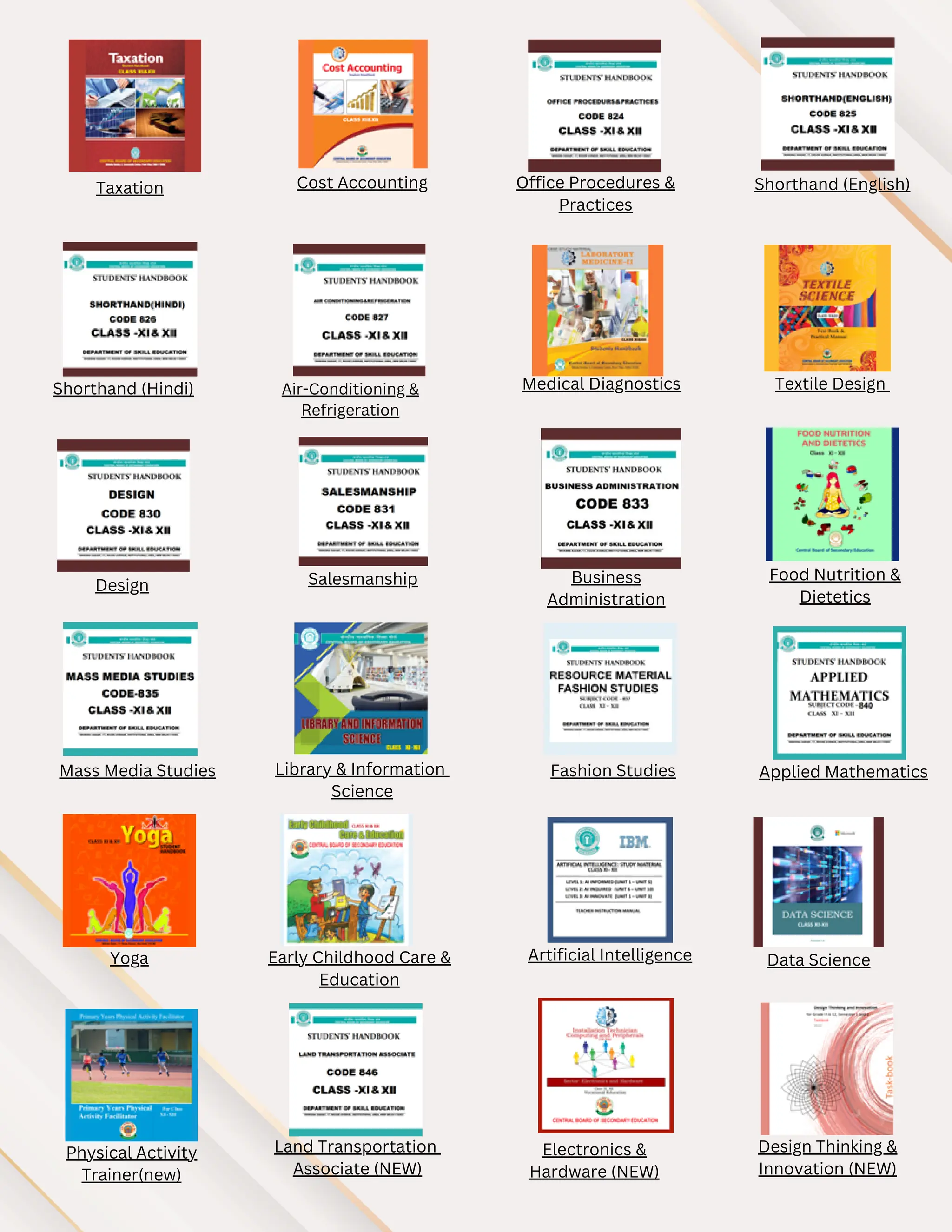
Taxation Cost Accounting Office Procedures &
Practices
Shorthand (English)
Shorthand (Hindi) Air-Conditioning &
Refrigeration
Medical Diagnostics Textile Design
Design Salesmanship Business
Administration
Food Nutrition &
Dietetics
Mass Media Studies Library & Information
Science
Fashion Studies Applied Mathematics
Yoga Early Childhood Care &
Education
Artificial Intelligence Data Science
Physical Activity
Trainer(new)
Land Transportation
Associate (NEW)
Electronics &
Hardware (NEW)
Design Thinking &
Innovation (NEW)
Join School of Educators Signal Groups
You will get Pre- Board Papers PDF, Word file, PPT, Lesson Plan, Worksheet, practical
tips and Viva questions, reference books, smart content, curriculum, syllabus,
marking scheme, toppers answer scripts, revised exam pattern, revised syllabus,
Blue Print etc. here . Join Your Subject / Class signal Group.
Kindergarten to Class XII
Class 2 Class 3
Class 4
Class 5 Class 6
Class 7 Class 8 Class 9
Class 10
Class 1
Class 11 (Humanities)
Class 11 (Science)
Class 11 (Commerce) Class 12 (Science) Class 12 (Humanities)
Class 12 (Commerce) Kindergarten Artifical intelligence
Subject Wise Secondary and Senior Secondary
Groups IX & X
Secondary Groups (IX & X)
SST Mathematics Science
English Hindi-A
IT Code-402
Hindi-B
Senior Secondary Groups XI & XII
Physics Chemistry English
Mathematics Biology Accountancy
Economics
BST History
IT Artifical intelligence
Geography Sociology Hindi Elective
Hindi Core Home Science Sanskrit
Psychology Political Science Painting
Vocal Music Comp. Science
IP
Physical Education APP. Mathematics Legal Studies
Entrepreneurship French
Artifical intelligence CUET
IIT/NEET
Join School of Educators CBSE Telegram Groups
Kindergarten
All classes Class 1 Class 2
Class 3 Class 4 Class 5
Class 6 Class 7 Class 8
Class 9 Class 10 Class 11 (Sci)
Class 11 (Com) Class 11 (Hum) Class 12 (Sci)
Class 12 (Com) Class 12 (Hum) JEE/NEET
CUET NDA, OLYMPIAD, NTSE Principal Professional Group
Teachers Professional Group Project File Group
Join School of Educators ICSE Telegram Groups
Kindergarten Class 1 Class 2
Class 3 Class 4 Class 5
Class 6 Class 7 Class 8
Class 9 Class 10 Class 11 (Sci)
Class 11 (Com) Class 11 (Hum) Class 12 (Sci)
Class 12 (Com) Class 12 (Hum)
W W W . E D U C A T O R S R E S O U R C E . I N

Class 9 History Chapter Wise Topic Wise Notes Chapter 1 The French Revolution

  • 1.
    Include Daily Practice Paper 1. NCERTSolutions 2. NCERT Exemplars 3. Chapter Wise Mind Maps 4. OPTIMAL STRATEGIES FOR ACHIEVING A PERFECT SCORE OF 100/100 IN YOUR EXAMS CHAPTER WISE TOPIC WISE NOTES AS PER LATEST CBSE CURRICULUM 2024-25 Commence your study session equipped with our meticulously crafted chapter-wise and topic-wise notes, designed to optimize your exam performance, exclusively provided by Artham Resources. CLASS IX SOCIAL SCIENCE
  • 2.
    FRENCH SOCIETY DURINGLATE 18TH CENTURY THE FRENCH REVOLUTION 01 Class 9th Social Science (History) FRENCH SOCIETY DURING LATE 18TH CENTURY French Society during late 18th Century What happened in 1774? In 1774, Louis XVI of the Bourbon family, 20 years old and married to the Austrian princess Marie Antoinette, ascended the throne of France. Upon his accession the new king found empty treasury. Reasons for empty treasure in France The five causes for the empty treasury in France under Louis XIV were: 1. long years of war had drained the financial resources of France. 2. High cost of maintenance of immense palace of Versailles and court. 3. To meet its regular expenses, such as the cost of maintaining an army, the court, running government offices or universities, the state was forced to increase taxes. 4. Under Louis XVI, France helped the thirteen American colonies to gain their independence from the common enemy, Britain which added more than a billion livres to a debt that had already risen to more than 2 billion livres. 5. Lenders who gave the state credit, now began to charge 10 percent interest on loans. French division of society in 18th Century • 1st Estate: Clergy (Group of persons involved in church matters) • 2nd Estate: Nobility (Persons who have high rank in state administration) • 3rd Estate: (Comprises of Big businessmen, merchants, court officials, lawyers, Peasants and artisans, landless labour, servants) First two classes were exempted from paying taxes. They enjoyed privileges by birth. Nobility classes also enjoyed feudal privileges. Only the members of the third estate had to pay taxes to the state. Page 1
  • 3.
    FRENCH SOCIETY DURINGLATE 18TH CENTURY THE FRENCH REVOLUTION 01 Class 9th Social Science (History) Types of Taxes There Were Two Types of Taxes in France 1. Tithe: tax lived by the church comprising one - tenth of the agricultural produce. 2. Taille: indirect tax paid by the members of third estate to the state. The Struggle to survive Subsistence Crisis An extreme situation where the basic means of livelihood are endangered is called Subsistence Crisis. Reasons: 1. Rapid increase in the demand for foodgrains. 2. Production of grains could not keep pace with the demand. Page 2
  • 4.
    FRENCH SOCIETY DURINGLATE 18TH CENTURY THE FRENCH REVOLUTION 01 Class 9th Social Science (History) Impact: A growing middle class envisages an end to privileges. Peasants and Workers Participated in revolt against increasing taxes and food scarcity. But only a section within the third estate became prosperous and educated. Prosperous ▪ Merchant, traders, lawyers, manufacturers, etc. ▪ Overseas trade and from the manufacturing of goods. Educated ▪ They believed that no group in society should be privileged by birth. ▪ A person’s social position must depend on his merit. ▪ Society based on freedom and equal laws and opportunities for all. Emergence of Middle-class Page 3
  • 5.
    FRENCH SOCIETY DURINGLATE 18TH CENTURY THE FRENCH REVOLUTION 01 Class 9th Social Science (History) The 18th century witnessed the emergence of social groups, termed the middle class, who earned their wealth through an expanding overseas trade and form the manufacture of goods such as woollen and silk textiles that were either exported or bought by the richer members of society. In addition to merchant and manufacturers, the third estate included professions such as lawyers or administrative officials. All of these were educated and believed that no group in society should be privileged by birth. Rather, a person's social position must depend on his merit. These ideas envisaging a society based on freedom and equal laws. Role of Philosopher’s 1. John Locke ‘Two treatises of government’ Sought to refute the doctrine of the divine and absolute right of the monarch. 2. Jean Jacques Rousseau ‘Social Contract’ Form of government based on social contract between people and their representatives. Equal voting, democratic government. 3. Montesquieu ‘The spirit of the laws’ Division of power within the government between the legislative, the executive and the judiciary. Page 4
  • 6.
    FRENCH SOCIETY DURINGLATE 18TH CENTURY THE FRENCH REVOLUTION 01 Class 9th Social Science (History) Impact of their Ideas Impact of these enlightened ideas • The ideas of these philosophers were discussed intensively in salons and coffee-houses. and spread among people through books and newspapers. • These were frequently read aloud in groups for the benefit of those who could not read and write. Page 5
  • 7.
    THE OUTBREAK OFTHE REVOLUTION THE FRENCH REVOLUTION 01 Class 9th Social Science (History) THE OUTBREAK OF THE REVOLUTION Meeting of Estate General For increasing taxes, Louis XVI had to call a meeting of the Estates General which would then pass his proposals for new taxes. 1. Meaning of Estate General The Estates-General was an assembly comprising of the clergy of the French nobles and the middle class. It was in 1614 that the Estates-General was last called. Before the French Revolution, which took place in 1789, the general assembly was recognized as the Estates- General. 2. Meeting at Versailles • The first and second estates sent 300 representatives each, who were seated in rows facing. each other on two sides. • The 600 members of the third estate had to stand at the back. • The third estate was represented by its more prosperous and educated members. • Peasants, artisans, and women were denied entry to the assembly. • However, their grievances and demands were listed in some 40,000 letters which the representatives had brought with them. • According to the principle that each estate had one vote. This time too Louis XVI was determined to continue the same practice. But members of the third estate demanded that voting now be conducted by the assembly as a whole, where each member would have one vote. 3. Outcome of the meeting The king rejected this proposal. Members of the third estate walked out of the assembly in protest. The representatives of third estate assembled in the half of an indoor tennis court in the ground of Versailles. They declared themselves a National Assembly. Swore not to disperse till they had drafted a constitution for France that would limit the powers of the monarch. Events at the Countryside In the countryside rumours spread from village to village that the lords of the manor had hired bands of brigands who were on their way to destroy the ripe crops. Caught in a frenzy of fear, peasants in several districts seized hoes and pitchforks and attacked chateaux. They looted hoarded grain and burnt down documents containing records of manorial dues. A large number of nobles fled from their homes, many of them migrating to neighbouring countries. Page 1
  • 8.
    THE OUTBREAK OFTHE REVOLUTION THE FRENCH REVOLUTION 01 Class 9th Social Science (History) Impact and result of the events • Louis XVI finally accorded recognition to the National Assembly and accepted the constitution. • On the night of 4 August 1789, the Assembly passed a decree abolishing the feudal system of obligations and taxes. • Members of the clergy too were forced to give up their privileges. • Tithes were abolished and lands owned by the Church were confiscated. France becomes a Constitutional Monarchy National Assembly Completed the draft of the constitution in 1791. Its main object was to limit the powers of the monarch. These powers instead of being concentrated in the hands of one person, were now separated and assigned to different institutions – the legislature, executive and judiciary. This made France a constitutional monarchy. 1. Elections • National assembly was indirectly elected. • Citizens voted for a group of electors, who in turn chose the Assembly. • Not all citizens, however, had the right to vote. a) Active Citizens ▪ Only men above 25 years of age who paid taxes equal to at least 3 days of a labourer’s wage were given the status of active citizens. ▪ They were entitled to vote. b) Passive Citizens ▪ The remaining men and all women were classed as passive citizens. ▪ They were not entitled to vote. ▪ To qualify as an elector and then as a member of the Assembly, a man had to belong to the highest bracket of taxpayers. 2. Constitution • The Constitution began with a “Declaration of the Rights of Man and Citizen”. • Rights such as the right to life, freedom of speech, freedom of opinion, equality before law, were established as ‘natural and inalienable’ rights. • They belonged to each human being by birth and could not be taken away. • It was the duty of the state to protect each citizen’s natural rights. Page 2
  • 9.
    THE OUTBREAK OFTHE REVOLUTION THE FRENCH REVOLUTION 01 Class 9th Social Science (History) Political Symbols The majority of men and women in the eighteenth century could not read or write. So, images and symbols were frequently used instead of printed words to communicate important ideas. The painting by Le Barbier uses many such symbols to convey the content of the Declaration of Rights. 1. The broken chain • Chains were used to fetter slaves. • A broken chain stands for the act of becoming free. 2. The bundle of rods or fasces • One rod can be easily broken, but not an entire bundle. • Strength lies in unity. 3. The eye within a triangle radiating light. Page 3
  • 10.
    THE OUTBREAK OFTHE REVOLUTION THE FRENCH REVOLUTION 01 Class 9th Social Science (History) • The all-seeing eye stands for knowledge. • The rays of the sun will drive away the clouds of ignorance. 4. Sceptre • Symbol of royal power. 5. Snake biting its tail to form a ring. • Symbol of Eternity. • A ring has neither beginning nor end. 6. Red Phrygian cap Page 4
  • 11.
    THE OUTBREAK OFTHE REVOLUTION THE FRENCH REVOLUTION 01 Class 9th Social Science (History) • Cap worn by a slave upon becoming free. 7. Blue-white-red • The national colours of France. 8. The winged woman • Personification of the law. 9. The Law Tablet Page 5
  • 12.
    THE OUTBREAK OFTHE REVOLUTION THE FRENCH REVOLUTION 01 Class 9th Social Science (History) • The law is the same for all, and all are equal before it. Page 6
  • 13.
    FRANCE ABOLISHES MONARCHYAND BECOMES A REPUBLIC THE FRENCH REVOLUTION 01 Class 9th Social Science (History) FRANCE ABOLISHES MONARCHY AND BECOMES A REPUBLIC War against Prussia and Austria Impact of war Thousands of volunteers thronged from the provinces to join the army. • They saw this as a war of the people against kings and aristocracies all over Europe. • Among the patriotic songs they sang was the Marseillaise, composed by the poet Roget de Lisle. • It was sung for the first time by volunteers from Marseilles as they marched into Paris and so got its name. • The Marseillaise is now the national anthem of France. • While the men were away fighting at the front, women were left to cope with the tasks of earning a living and looking after their families. • Large sections of the population were convinced that the revolution had to be carried further, as the Constitution of 1791 gave political rights only to the richer sections of society. Emergence of Jacobin club Page 1
  • 14.
    FRANCE ABOLISHES MONARCHYAND BECOMES A REPUBLIC THE FRENCH REVOLUTION 01 Class 9th Social Science (History) • Political clubs became an important rallying point for people who wished to discuss government policies and plan their own forms of action. • The most successful of these clubs was that of the Jacobins, which got its name from the former convent of St Jacob in Paris. • Women too, who had been active throughout this period, formed their own clubs. Jacobin club • The members of the Jacobin club belonged mainly to the less prosperous sections of society. Page 2
  • 15.
    FRANCE ABOLISHES MONARCHYAND BECOMES A REPUBLIC THE FRENCH REVOLUTION 01 Class 9th Social Science (History) • They included small shopkeepers, artisans such as shoemakers, pastry cooks, watchmakers, printers, as well as servants and daily-wage workers. • Their leader was Maximilien Robespierre. • A large group among the Jacobins decided to start wearing long striped trousers similar to those worn by dock workers. • These Jacobins came to be known as the sans-culottes, literally meaning ‘those without knee breeches. • Sans Culottes men wore in addition the red cap that symbolizes liberty. Women however were not allowed to do so. Incidents in the summer of 1792 • The Jacobins planned an insurrection of a large number of Parisians who were angered by the short supplies and high prices of food. • On the morning of August 10, they stormed the Palace of the Tuileries, massacred the king’s guards, and held the king himself as hostage for several hours. • Later the Assembly voted to imprison the royal family. • Elections were held. • From now on all men of 21 years and above, regardless of wealth, got the right to vote. The Reign of Terror • The period from 1793 to 1794 Robespierre followed a policy of severe control and punishment. • All those whom he saw as being ‘enemies’ of the republic – ex-nobles and clergy, members of other political parties, even members of his own party who did not agree with his methods, were arrested, imprisoned, and then tried by a revolutionary tribunal. • If the court found them ‘guilty’ they were guillotined. Steps taken by Robespierre’s Government • Robespierre’s government issued laws placing a maximum ceiling on wages and prices. Meat and bread were rationed. • Peasants were forced to transport their grain to the cities and sell it at prices fixed by the government. • Equality was also sought to be practised through forms of speech and address. • Instead of the traditional Monsieur (Sir) and Madame (Madam) all French men and women were henceforth Citizen and Cito Yenne (Citizen). Page 3
  • 16.
    FRANCE ABOLISHES MONARCHYAND BECOMES A REPUBLIC THE FRENCH REVOLUTION 01 Class 9th Social Science (History) • Churches were shut down and their buildings converted into barracks or offices. Result • Robespierre pursued his policies so relentlessly that even his supporters began to demand moderation. • He was convicted by a court in July 1794. • Arrested and on the next day sent to the guillotine. A Directory Rules France • Denied the vote to non-propertied sections of society. • It provided for two elected legislative councils. • These then appointed a Directory, an executive made up of five members. • This was meant as a safeguard against the concentration of power in a one-man executive as under the Jacobins. Page 4
  • 17.
    DID WOMEN HADA REVOLUTION THE FRENCH REVOLUTION 01 Class 9th Social Science (History) DID WOMEN HAD A REVOLUTION? Role of women in the revolution and their demands • Women played a very significant role in the French Revolution. • Most of the women belonging to the third estate worked for a living and their occupations included dress makers, laundry workers, flowers vendors etc. Sometimes worked as maid servants in the houses of the rich. • Women in France were disappointed with the Constitution of 1791, which reduced them to passive citizens who had no political rights. They demanded political rights viz, right to vote, to be elected to Assembly and to hold political office. • To express their own views and demand women started their own political clubs and newspapers. About 60 women's Clubs came up in different cities of France. • Amongst them The Society of Revolutionary and Republican Women was most famous. Their demand was that women enjoy the same political rights as men. Nature of Management Principles Political situation of the women • Women demanded same political rights as men. • In order to discuss and voice their interests’ women started their own political clubs and newspapers. • The Society of Revolutionary and Republican Women was the most famous of them. • Women were disappointed that the Constitution of 1791 reduced them to passive citizens. Page 1
  • 18.
    DID WOMEN HADA REVOLUTION THE FRENCH REVOLUTION 01 Class 9th Social Science (History) • They demanded the right to vote, to be elected to the Assembly and to hold political office. Steps taken by Government to improve the Conditions of women • With the creation of state schools, schooling was made compulsories for all girls. • Their fathers could no longer force them into marriage against their will. • Marriage was made into a contract entered into freely and registered under civil law. • Divorce was made legal and could be applied for by both women and men. • Women could now train for jobs, could become artists, or run small businesses. • Women’s struggle for equal political rights, however, continued. • During the Reign of Terror, the new government issued laws ordering closure of women’s clubs and banning their political activities. • Many prominent women were arrested and a number of them executed. • They were denied voting rights and equal wages. Page 2
  • 19.
    ABOLITION OF SLAVERY THEFRENCH REVOLUTION 01 Class 9th Social Science (History) ABOLITION OF SLAVERY Reasons for Slavery • The colonies in the Caribbean - Martinique, Guadeloupe, and San Domingo – were important suppliers of commodities such as tobacco, indigo, sugar, and coffee. • But the reluctance of Europeans to go and work in distant and unfamiliar lands meant a shortage of labour on the plantations. • So, this was met by a triangular slave trade between Europe, Africa, and the Americas. Slave Trade • The slave trade began in the seventeenth century. • French merchants sailed from the ports of Bordeaux or Nantes to the African coast, where they bought slaves from local chieftains. • Branded and shackled, the slaves were packed tightly into ships for the three-month long voyage across the Atlantic to the Caribbean. • There they were sold to plantation owners. • The exploitation of slave labour made it possible to meet the growing demand in European markets for sugar, coffee, and indigo. • Port cities like Bordeaux and Nantes owed their economic prosperity to the flourishing slave trade. Page 1
  • 20.
    ABOLITION OF SLAVERY THEFRENCH REVOLUTION 01 Class 9th Social Science (History) Abolition of Slavery Old regime • Throughout the eighteenth century there was little criticism of slavery in France. National Assembly • Debates to abolish slavery were held but national assembly did not pass any laws, fearing opposition from businessmen whose incomes depended on the slave trade. Convection • Finally, the Convention which in 1794 legislated to free all slaves in the French overseas possessions. Napoleon Rule • In 1804, Napoleon reintroduced slavery Plantation owners understood their freedom as including the right to enslave African Negroes in pursuit of their economic interests. Slavery was finally abolished in French Colonies in 1848 Page 2
  • 21.
    THE REVOLUTION ANDEVERYDAY LIFE THE FRENCH REVOLUTION 01 Class 9th Social Science (History) THE REVOLUTION AND EVERYDAY LIFE The revolutionary governments took it upon themselves to pass laws that would translate the ideals of liberty and equality into everyday practice. Abolition of censorship • In the Old Regime all written material and cultural activities - books, newspapers, plays - could be published or performed only after they had been approved by the censors of the king. • After the storming of Bastille, the Declaration of the Rights of Man and Citizen proclaimed freedom of speech and expression to be a natural right. • Newspapers, pamphlets, books, and printed pictures flooded the towns of France from where they travelled rapidly into the countryside. • They all described and discussed the events and changes taking place in France. Abolition of censorship = Freedom of the press • Meant that opposing views of events could be expressed. • Each side sought to convince the others of its position through the medium of print. • Plays, songs and festive processions attracted large numbers of people. This was one way they could grasp and identify with ideas such as liberty or justice that political philosophers wrote about at length in texts which only a handful of educated people could read. Conclusion In 1804, Napoleon Bonaparte crowned himself Emperor of France. Page 1
  • 22.
    THE REVOLUTION ANDEVERYDAY LIFE THE FRENCH REVOLUTION 01 Class 9th Social Science (History) • He set out to conquer neighbouring European countries, dispossessing dynasties and creating kingdoms where he placed members of his family. • Napoleon saw his role as a moderniser of Europe. He introduced many laws such as the protection of private property and a uniform system of weights and measures provided by the decimal system. Page 2
  • 23.
    FRENCH SOCIETY DURINGLATE 18TH CENTURY THE FRENCH REVOLUTION 01 Class 9th History (Practice Sheet) 1 What was the social hierarchy in France during the late 18th century called? A. Caste system B. Estates system C. Class system D. Guild system 2 Which estate in France consisted of the clergy? A. First Estate B. Second Estate C. Third Estate D. Fourth Estate 3 The Third Estate in France was made up of which groups? A. Nobility and clergy B. Peasants, artisans, and bourgeoisie C. Merchants and traders D. Intellectuals and artists 4 What percentage of the French population belonged to the Third Estate? A. About 10% B. About 25% C. About 50% D. About 97% 5 Which group in the Third Estate was influenced by Enlightenment ideas and played a significant role in the French Revolution? A. Peasants B. Artisans C. Bourgeoisie D. Serfs 6 What were the three estates in French society during the late 18th century? 7 What percentage of the French population belonged to the third estate? 8 Why did the third estate resent the privileges of the first and second estates? 9 What were the economic hardships faced by the common people in France at that time? 10 How did the Enlightenment ideas influence French society during the late 18th century? Page 1
  • 24.
    THE OUTBREAK OFTHE REVOLUTION THE FRENCH REVOLUTION 01 Class 9th History (Practice Sheet) 1 What event marked the beginning of the French Revolution? A. The storming of the Bastille B. The execution of King Louis XVI C. The Tennis Court Oath D. The Estates-General meeting 2 Which estate in France was primarily responsible for the outbreak of the French Revolution? A. First Estate (Clergy) B. Second Estate (Nobility) C. Third Estate (Commoners) D. Fourth Estate (Media) 3 What was the immediate cause of the storming of the Bastille? A. Food shortages B. Arrest of a popular journalist C. High taxes D. King Louis XVI's decree 4 Who was the commander of the Bastille when it was stormed by the revolutionaries? A. Napoleon Bonaparte B. Maximilien Robespierre C. Marquis de Lafayette D. Bernard-René de Launay 5 What was the significance of the fall of the Bastille? A. It marked the end of the French Revolution B. It led to the execution of King Louis XVI C. It symbolized the power of the people and the beginning of the Revolution D. It resulted in the establishment of a monarchy 6 What were the immediate causes of the outbreak of the French Revolution? 7 Who were the key players in the outbreak of the French Revolution? 8 What was the significance of the Estates-General in the outbreak of the revolution? 9 How did the storming of the Bastille contribute to the outbreak of the revolution? 10 What role did the spread of Enlightenment ideas play in the outbreak of the French Revolution? Page 1
  • 25.
    FRANCE ABOLISHES MONARCHYAND BECOMES A REPUBLIC THE FRENCH REVOLUTION 01 Class 9th History (Practice Sheet) 1 Who was the King of France when the monarchy was abolished? A. Louis XIV B. Louis XVI C. Napoleon Bonaparte D. Maximilien Robespierre 2 In which year did the French Revolution lead to the abolition of the monarchy? A. 1776 B. 1789 C. 1792 D. 1804 3 What was the name of the legislative body that declared France a Republic? A. National Convention B. Estates-General C. Directory D. Committee of Public Safety 4 Who led the radical Jacobins during the French Revolution? A. Marie Antoinette B. Maximilien Robespierre C. Louis XVI D. Napoleon Bonaparte 5 What slogan became popular during the French Revolution symbolizing the Republic? A. "Liberty, Equality, Fraternity" B. "Long live the King" C. "Absolute Monarchy" D. "Divine Right of Kings" 6 When did France abolish the monarchy and become a republic? 7 Who were the Jacobins, and what role did they play in the French Revolution? 8 What were the reasons behind the decision to abolish the monarchy in France? 9 Who was Louis XVI, and what happened to him after the monarchy was abolished? 10 What were the key features of the new French Republic's government? Page 1
  • 26.
    DID WOMEN HADA REVOLUTION THE FRENCH REVOLUTION 01 Class 9th History (Practice Sheet) 1 During the French Revolution, women played a significant role in demanding equal rights. What were they called? A. Suffragettes B. Feminists C. Jacobins D. Girondins 2 Which event during the French Revolution marked the beginning of women's active involvement in political matters? A. Tennis Court Oath B. Bastille Day C. March of Women to Versailles D. Reign of Terror 3 What was the main demand of the women who marched to Versailles during the French Revolution? A. Lower taxes B. Equal rights for women C. More bread and lower bread prices D. Abolition of the monarchy 4 Who was the queen of France during the French Revolution and was often criticized by women for her extravagant lifestyle? A. Marie Antoinette B. Joan of Arc C. Catherine de Medici D. Queen Elizabeth I 5 Which political club during the French Revolution had some women as members and supported women's rights? A. Jacobins B. Girondins C. Cordeliers D. Montagnard’s 6 What role did women play during the French Revolution? 7 Who were some prominent women activists during the French Revolution? 8 What were some of the key demands of women during the French Revolution? 9 How did women's participation in the Revolution evolve over time? 10 What was the significance of the Women's March to Versailles? Page 1
  • 27.
    ABOLITION OF SLAVERY THEFRENCH REVOLUTION 01 Class 9th History (Practice Sheet) 1 When was the Abolition of Slavery officially declared during the French Revolution? A. 1789 B. 1791 C. 1793 D. 1804 2 Who was the key figure responsible for advocating the Abolition of Slavery in France during the Revolution? A. Napoleon Bonaparte B. Maximilien Robespierre C. Jean-Paul Marat D. Toussaint Louverture 3 Which colony was particularly affected by the Abolition of Slavery during the French Revolution? A. Guadeloupe B. Corsica C. Louisiana D. Martinique 4 The Abolition of Slavery during the French Revolution was part of which larger movement? A. The Enlightenment B. The Industrial Revolution C. The Reign of Terror D. The Napoleonic Code 5 After the Abolition of Slavery in France, what did former slaves in the colonies become? A. Citizens with equal rights B. Indentured servants C. Serfs under new masters D. Forced laborers in new industries 6 When was the decree abolishing slavery in French colonies passed? 7 Who was the key figure responsible for the abolition of slavery in French territories during the Revolution? 8 Which revolutionary document declared that "men are born and remain free and equal in rights"? 9 Which colony was the first to abolish slavery during the French Revolution? 10 What was the significance of the Code Noir in relation to slavery in France? Page 1
  • 28.
    FRENCH SOCIETY DURINGLATE 18TH CENTURY THE FRENCH REVOLUTION 01 Class 9th History (Practice Sheet) 1 What was the social order in France during the late 18th century? A. Three Estates B. Four Estates C. Two Estates D. Five Estates 2 Which estate in France was exempt from paying taxes? A. First Estate (Clergy) B. Second Estate (Nobility) C. Third Estate (Commoners) D. None of the above 3 The majority of the French population belonged to which estate? A. First Estate (Clergy) B. Second Estate (Nobility) C. Third Estate (Commoners) D. Fourth Estate (Merchants) 4 What were the commoners in the Third Estate of France known as? A. Sans-culottes B. Aristocrats C. Jacobins D. Huguenots 5 Which event marked the beginning of the French Revolution? A. The fall of the Bastille B. Execution of Louis XVI C. Storming of Versailles D. Reign of Terror 6 What were the three estates in French society during the late 18th century? 7 How was the French society divided in terms of taxation during this period? 8 What were some of the key grievances of the common people (Third Estate) during this time? 9 Who was King Louis XVI, and how did his actions contribute to the French Revolution? 10 What was the Estates-General, and why was it convened in 1789? Page 1
  • 29.
    Chapter 1 The FrenchRevolution Questions: 1. Describe the circumstances leading to the outbreak of revolutionary protest in France. Answer: Following circumstances led to the outbreak of revolutionary protest in France: 1. Inequality in the French Society - The eighteenth-century French society was divided into three estates namely; the Clergy, the Nobility, and the third estate. First, two estates were given certain privileges by birth, while the third estate was forced to pay heavy taxes and did not enjoy any privileges. 2. Political issues - King Louis XVI was considered to be a weak king who was influenced by his queen. On several occasions, the king displayed his inability to take strong decisions and was seen pursuing his interests over his people. 3. Survival crisis - The population of France grew from 23 million in 1715 to 28 million in 1789, which resulted in great demand for food grains. The prices of food grains went up, and the wages and salaries given to the labourers were insufficient. This led to a severe crisis where people realized that their survival is in danger. 4. Influence of American Revolutionaries - The French Society was introduced to revolutionary ideas by American society. Freedom for all was demanded and people advocated for Republic over Monarchy. The revolutionary ideas of Americans influenced the French people. 5. Strong Middle class - Revolutionary ideas attracted the French society, and eventually, a new educated middle-class society emerged. NCERT TEXTBOOK SOLUTION
  • 30.
    People challenged theabsolute rule of the King and demanded a liberal society and unrestricted trade. 6. Economic issues - On 5th May 1789, King Louis XVI called a meeting with the representatives of all the three estates to levy additional taxes on the members of the third estate and they did not like the idea and voted against it. The king rejected their appeal which led to protests and marches against the King. 2. Which groups of French society benefited from the revolution? Which groups were forced to relinquish power? Which sections of society would have been disappointed with the outcome of the revolution? Answer: 1. The French Revolution was started with a promise to fetch equality in the then French Society. The poor people of the third estate were hopeful of a better society where the conditions for them would change for the good. However, the French Revolution did not bring what it promised. The comparatively wealthy people of the Third estate that is the Commoners were benefitted to a great extent by the French Revolution as they gained power and became influential. 2. The first two estates that are; the Clergy and Nobility were forced to relinquish their power, and major portions of their lands were confiscated and also, the privileges that they used to enjoy were taken off. The King also lost his throne, and a new group of capitalists emerged in France. 3. The condition of the poor peasants and merchant did not change much. Equality was not introduced for all as even after the revolution the poor people were not given the right to vote. 3. Describe the legacy of the French Revolution for the people of the world during the nineteenth and twentieth centuries.
  • 31.
    Answer: The legacy ofthe French revolution inspired the people of the world during the nineteenth and twentieth century in the following ways: 1) Feudalism was terminated and principles of equality, freedom, and fraternity spread over the other parts of Europe. 2) Later, “The declaration of rights of man and citizen”, was drafted in many constitutions of the world in the form of bill of rights or fundamental rights. 3) French revolution later inspired many other revolutions and freedom movements in the colonial countries. 4) French revolution gave rise to nationalism in Europe which led to the unification of Germany and Italy. 4. Draw up a list of democratic rights we enjoy today whose origins could be traced to the French Revolution. Answer: Democratic rights that could be traced to the French Revolution are as follows: i. Right to equality including equality before the law, prohibition of discrimination and equality of opportunity in matters of employment. ii. Right to freedom of speech and expression including the right to practice any profession or occupation. iii. Right against exploitation. iv. Right to life. v. Right to vote. vi. Promotion of the idea of fraternity by maintaining friendly relations with foreign countries in the spirit of brotherhood.
  • 32.
    5. Would youagree with the view that the message of universal rights was beset with contradictions? Explain. Answer: Yes, I agree with the view that the message of universal rights was beset with several contradictions because: 1. Even after the revolution when France was converted into a constitutional monarchy, millions of people were not granted voting rights. 2. Though the universal rights advocated for equal rights, the women who took an active part in the revolution were not given equal rights. Most of the imperialist powers did not grant full freedom to the peoples of their colonies. 3. The poor people were not granted voting rights despite the fact that most of the population comprised of the poor laborers. The poor were termed passive citizens and had not given any rights. 4. Universal rights did not help the poor people at all, and they were continued to be suppressed. Women were also neglected, and only the rich men of the society gained the power. 6. How would you explain the rise of Napoleon? Answer: Following are the reason responsible for the rise of Napoleon Bonaparte: (1) French became a republic in 1792 after the fall of the Jacobean rule. (2) Robespierre, the then ruler of France, favored the rich and wealthy people and completely ignored the other sections of the society. He was a tyrant, and people faced Reign of Terror for several years. (3) Following Robespierre's subsequent downfall, a new directory was formed to avoid concentration of power in one hand. Later, the
  • 33.
    members of thedirectory fought among themselves, which resulted in political unrest. (4) This created chaos and a political vacuum in France. Napoleon Bonaparte used this situation and took power and declared himself the military dictator of France.
  • 34.
    THE FRENCH REVOLUTION MINDMAP 01 Class 9th Social Science (History) Page 1
  • 35.
    CLICK TO DOWNLOADMORE CHAPTERS
  • 36.
    Dear Teachers andStudents, Join School of Educators' exclusive WhatsApp, Telegram, and Signal groups for FREE access to a vast range of educational resources designed to help you achieve 100/100 in exams! Separate groups for teachers and students are available, packed with valuable content to boost your performance. Additionally, benefit from expert tips, practical advice, and study hacks designed to enhance performance in both CBSE exams and competitive entrance tests. Don’t miss out—join today and take the first step toward academic excellence! Join the Teachers and Students Group by Clicking the Link Below
  • 37.
    JOIN OUR WHATSAPP GROUPS FOR FREEEDUCATIONAL RESOURCES
  • 38.
    JOIN SCHOOL OFEDUCATORS WHATSAPP GROUPS FOR FREE EDUCATIONAL RESOURCES BENEFITS OF SOE WHATSAPP GROUPS We are thrilled to introduce the School of Educators WhatsApp Group, a platform designed exclusively for educators to enhance your teaching & Learning experience and learning outcomes. Here are some of the key benefits you can expect from joining our group: Abundance of Content: Members gain access to an extensive repository of educational materials tailored to their class level. This includes various formats such as PDFs, Word files, PowerPoint presentations, lesson plans, worksheets, practical tips, viva questions, reference books, smart content, curriculum details, syllabus, marking schemes, exam patterns, and blueprints. This rich assortment of resources enhances teaching and learning experiences. Immediate Doubt Resolution: The group facilitates quick clarification of doubts. Members can seek assistance by sending messages, and experts promptly respond to queries. This real-time interaction fosters a supportive learning environment where educators and students can exchange knowledge and address concerns effectively. Access to Previous Years' Question Papers and Topper Answers: The group provides access to previous years' question papers (PYQ) and exemplary answer scripts of toppers. This resource is invaluable for exam preparation, allowing individuals to familiarize themselves with the exam format, gain insights into scoring techniques, and enhance their performance in assessments.
  • 39.
    Free and UnlimitedResources: Members enjoy the benefit of accessing an array of educational resources without any cost restrictions. Whether its study materials, teaching aids, or assessment tools, the group offers an abundance of resources tailored to individual needs. This accessibility ensures that educators and students have ample support in their academic endeavors without financial constraints. Instant Access to Educational Content: SOE WhatsApp groups are a platform where teachers can access a wide range of educational content instantly. This includes study materials, notes, sample papers, reference materials, and relevant links shared by group members and moderators. Timely Updates and Reminders: SOE WhatsApp groups serve as a source of timely updates and reminders about important dates, exam schedules, syllabus changes, and academic events. Teachers can stay informed and well-prepared for upcoming assessments and activities. Interactive Learning Environment: Teachers can engage in discussions, ask questions, and seek clarifications within the group, creating an interactive learning environment. This fosters collaboration, peer learning, and knowledge sharing among group members, enhancing understanding and retention of concepts. Access to Expert Guidance: SOE WhatsApp groups are moderated by subject matter experts, teachers, or experienced educators can benefit from their guidance, expertise, and insights on various academic topics, exam strategies, and study techniques. Join the School of Educators WhatsApp Group today and unlock a world of resources, support, and collaboration to take your teaching to new heights. To join, simply click on the group links provided below or send a message to +91-95208-77777 expressing your interest. Together, let's empower ourselves & Our Students and inspire the next generation of learners. Best Regards, Team School of Educators
  • 40.
    Join School ofEducators WhatsApp Groups You will get Pre- Board Papers PDF, Word file, PPT, Lesson Plan, Worksheet, practical tips and Viva questions, reference books, smart content, curriculum, syllabus, marking scheme, toppers answer scripts, revised exam pattern, revised syllabus, Blue Print etc. here . Join Your Subject / Class WhatsApp Group. Kindergarten to Class XII (For Teachers Only) Class 1 Class 2 Class 3 Class 4 Class 5 Class 6 Class 7 Class 8 Class 9 Class 10 Class 11 (Science) Class 11 (Humanities) Class 11 (Commerce) Class 12 (Commerce) Class 12 (Science) Class 12 (Humanities) Kindergarten
  • 41.
    Subject Wise Secondaryand Senior Secondary Groups (IX & X For Teachers Only) Secondary Groups (IX & X) Senior Secondary Groups (XI & XII For Teachers Only) SST Mathematics Science English Hindi-A IT Code-402 Physics Chemistry English Mathematics Economics Biology BST Accountancy History Hindi-B Artificial Intelligence
  • 42.
    Hindi Core HomeScience Sanskrit Psychology Political Science Painting Vocal Music Comp. Science IP Physical Education APP. Mathematics Legal Studies Entrepreneurship French Teachers Jobs Principal’s Group IIT/NEET Other Important Groups (For Teachers & Principal’s) IT Sociology Hindi Elective Geography Artificial Intelligence
  • 43.
    Join School ofEducators WhatsApp Groups You will get Pre- Board Papers PDF, Word file, PPT, Lesson Plan, Worksheet, practical tips and Viva questions, reference books, smart content, curriculum, syllabus, marking scheme, toppers answer scripts, revised exam pattern, revised syllabus, Blue Print etc. here . Join Your Subject / Class WhatsApp Group. Kindergarten to Class XII (For Students Only) Class 1 Class 2 Class 3 Class 4 Class 5 Class 6 Class 7 Class 8 Class 9 Class 10 Class 11 (Science) Class 11 (Humanities) Class 11 (Commerce) Class 12 (Commerce) Class 12 (Science) Class 12 (Humanities) Artificial Intelligence (VI TO VIII)
  • 44.
    Subject Wise Secondaryand Senior Secondary Groups (IX & X For Students Only) Secondary Groups (IX & X) Senior Secondary Groups (XI & XII For Students Only) SST Mathematics Science English Hindi IT Code Physics Chemistry English Mathematics Economics Biology BST Accountancy History Artificial Intelligence
  • 45.
    Hindi Core HomeScience Sanskrit Psychology Political Science Painting Music Comp. Science IP Physical Education APP. Mathematics Legal Studies Entrepreneurship French IT Sociology Hindi Elective Geography IIT/NEET AI CUET
  • 46.
    To maximize thebenefits of these WhatsApp groups, follow these guidelines: 1. Share your valuable resources with the group. 2. Help your fellow educators by answering their queries. 3. Watch and engage with shared videos in the group. 4. Distribute WhatsApp group resources among your students. 5. Encourage your colleagues to join these groups. Additional notes: 1. Avoid posting messages between 9 PM and 7 AM. 2. After sharing resources with students, consider deleting outdated data if necessary. 3. It's a NO Nuisance groups, single nuisance and you will be removed. No introductions. No greetings or wish messages. No personal chats or messages. No spam. Or voice calls Share and seek learning resources only. Groups Rules & Regulations: Please only share and request learning resources. For assistance, contact the helpline via WhatsApp: +91-95208-77777.
  • 47.
    Join Premium WhatsAppGroups Ultimate Educational Resources!! Join our premium groups and just Rs. 1000 and gain access to all our exclusive materials for the entire academic year. Whether you're a student in Class IX, X, XI, or XII, or a teacher for these grades, Artham Resources provides the ultimate tools to enhance learning. Pay now to delve into a world of premium educational content! Class 9 Class 10 Class 11 Click here for more details 📣 Don't Miss Out! Elevate your academic journey with top-notch study materials and secure your path to top scores! Revolutionize your study routine and reach your academic goals with our comprehensive resources. Join now and set yourself up for success! 📚🌟 Best Wishes, Team School of Educators & Artham Resources Class 12
  • 48.
    SKILL MODULES BEINGOFFERED IN MIDDLE SCHOOL Artificial Intelligence Beauty & Wellness Design Thinking & Innovation Financial Literacy Handicrafts Information Technology Marketing/Commercial Application Mass Media - Being Media Literate Travel & Tourism Coding Data Science (Class VIII only) Augmented Reality / Virtual Reality Digital Citizenship Life Cycle of Medicine & Vaccine Things you should know about keeping Medicines at home What to do when Doctor is not around Humanity & Covid-19 Blue Pottery Pottery Block Printing
  • 49.
    Food Food PreservationBaking Herbal Heritage Khadi Mask Making Mass Media Making of a Graphic Novel Kashmiri Embroidery Embroidery Rockets Satellites Application of Satellites Photography
  • 50.
    SKILL SUBJECTS ATSECONDARY LEVEL (CLASSES IX – X) Retail Information Technology Security Automotive Introduction To Financial Markets Introduction To Tourism Beauty & Wellness Agriculture Food Production Front Office Operations Banking & Insurance Marketing & Sales Health Care Apparel Multi Media Multi Skill Foundation Course Artificial Intelligence Physical Activity Trainer Data Science Electronics & Hardware (NEW) Design Thinking & Innovation (NEW) Foundation Skills For Sciences (Pharmaceutical & Biotechnology)(NEW)
  • 51.
    SKILL SUBJECTS ATSR. SEC. LEVEL (CLASSES XI – XII) Retail InformationTechnology Web Application Automotive Financial Markets Management Tourism Beauty & Wellness Agriculture Food Production Front Office Operations Banking Marketing Health Care Insurance Horticulture Typography & Comp. Application Geospatial Technology Electrical Technology Electronic Technology Multi-Media
  • 52.
    Taxation Cost AccountingOffice Procedures & Practices Shorthand (English) Shorthand (Hindi) Air-Conditioning & Refrigeration Medical Diagnostics Textile Design Design Salesmanship Business Administration Food Nutrition & Dietetics Mass Media Studies Library & Information Science Fashion Studies Applied Mathematics Yoga Early Childhood Care & Education Artificial Intelligence Data Science Physical Activity Trainer(new) Land Transportation Associate (NEW) Electronics & Hardware (NEW) Design Thinking & Innovation (NEW)
  • 53.
    Join School ofEducators Signal Groups You will get Pre- Board Papers PDF, Word file, PPT, Lesson Plan, Worksheet, practical tips and Viva questions, reference books, smart content, curriculum, syllabus, marking scheme, toppers answer scripts, revised exam pattern, revised syllabus, Blue Print etc. here . Join Your Subject / Class signal Group. Kindergarten to Class XII Class 2 Class 3 Class 4 Class 5 Class 6 Class 7 Class 8 Class 9 Class 10 Class 1 Class 11 (Humanities) Class 11 (Science) Class 11 (Commerce) Class 12 (Science) Class 12 (Humanities) Class 12 (Commerce) Kindergarten Artifical intelligence
  • 54.
    Subject Wise Secondaryand Senior Secondary Groups IX & X Secondary Groups (IX & X) SST Mathematics Science English Hindi-A IT Code-402 Hindi-B Senior Secondary Groups XI & XII Physics Chemistry English Mathematics Biology Accountancy Economics BST History IT Artifical intelligence
  • 55.
    Geography Sociology HindiElective Hindi Core Home Science Sanskrit Psychology Political Science Painting Vocal Music Comp. Science IP Physical Education APP. Mathematics Legal Studies Entrepreneurship French Artifical intelligence CUET IIT/NEET
  • 56.
    Join School ofEducators CBSE Telegram Groups Kindergarten All classes Class 1 Class 2 Class 3 Class 4 Class 5 Class 6 Class 7 Class 8 Class 9 Class 10 Class 11 (Sci) Class 11 (Com) Class 11 (Hum) Class 12 (Sci) Class 12 (Com) Class 12 (Hum) JEE/NEET CUET NDA, OLYMPIAD, NTSE Principal Professional Group Teachers Professional Group Project File Group
  • 57.
    Join School ofEducators ICSE Telegram Groups Kindergarten Class 1 Class 2 Class 3 Class 4 Class 5 Class 6 Class 7 Class 8 Class 9 Class 10 Class 11 (Sci) Class 11 (Com) Class 11 (Hum) Class 12 (Sci) Class 12 (Com) Class 12 (Hum)
  • 58.
    W W W. E D U C A T O R S R E S O U R C E . I N