LECTURE ON POLICY AND PROCEDURES OF LAUNDRY AND
LINEN MANAGEMENT IN HOSPITAL SERVICES
Prepared By
Dr.Anjalatchi Muthukumaran
Professor Cum Vice Principal And Nursing Supt.
Era College Of Nursing , Elmch , Era University
Lucknow 226003
TERM USED IN CHAPTER
• SOILED LINEN: LINEN VISIBLY CONTAMINATED BY BLOOD, BODY FLUIDS, SECRETIONS AND
EXCRETIONS ARE “SOILED / CONTAMINATED / DIRTY / FOULED”.
• USED LINEN: ALL OTHER USED LINEN IS TERMED “USED”.
• CLEAN LINEN: WITHOUT DIRTY, AFTER CLEAN, IRON, AND FOLDED TO KEPT IN RACK
FOLLOWED BY DELIVERY SERVICES TO THE CUSTOMER .
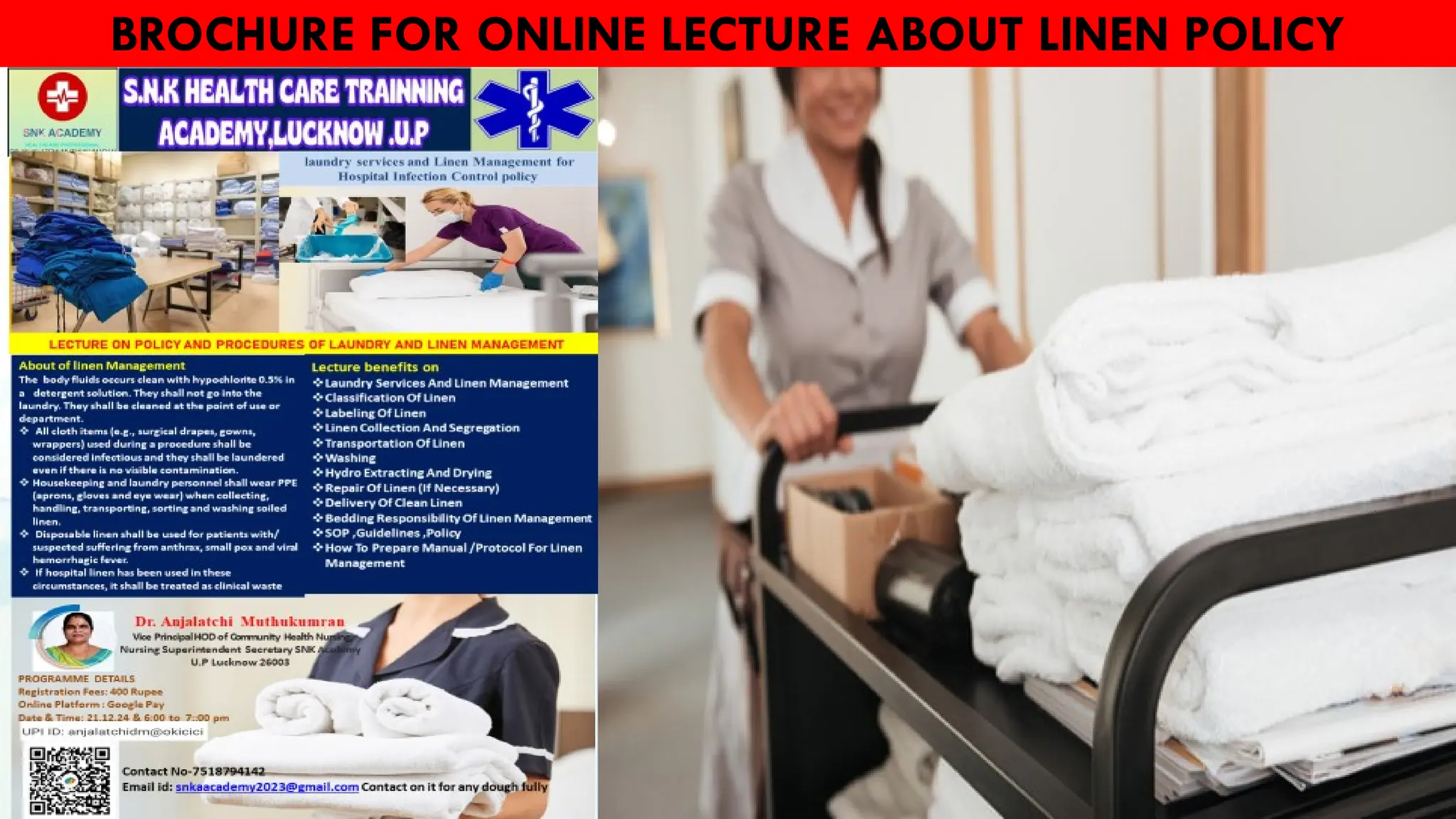
BROCHURE FOR ONLINE LECTURE ABOUT LINEN POLICY
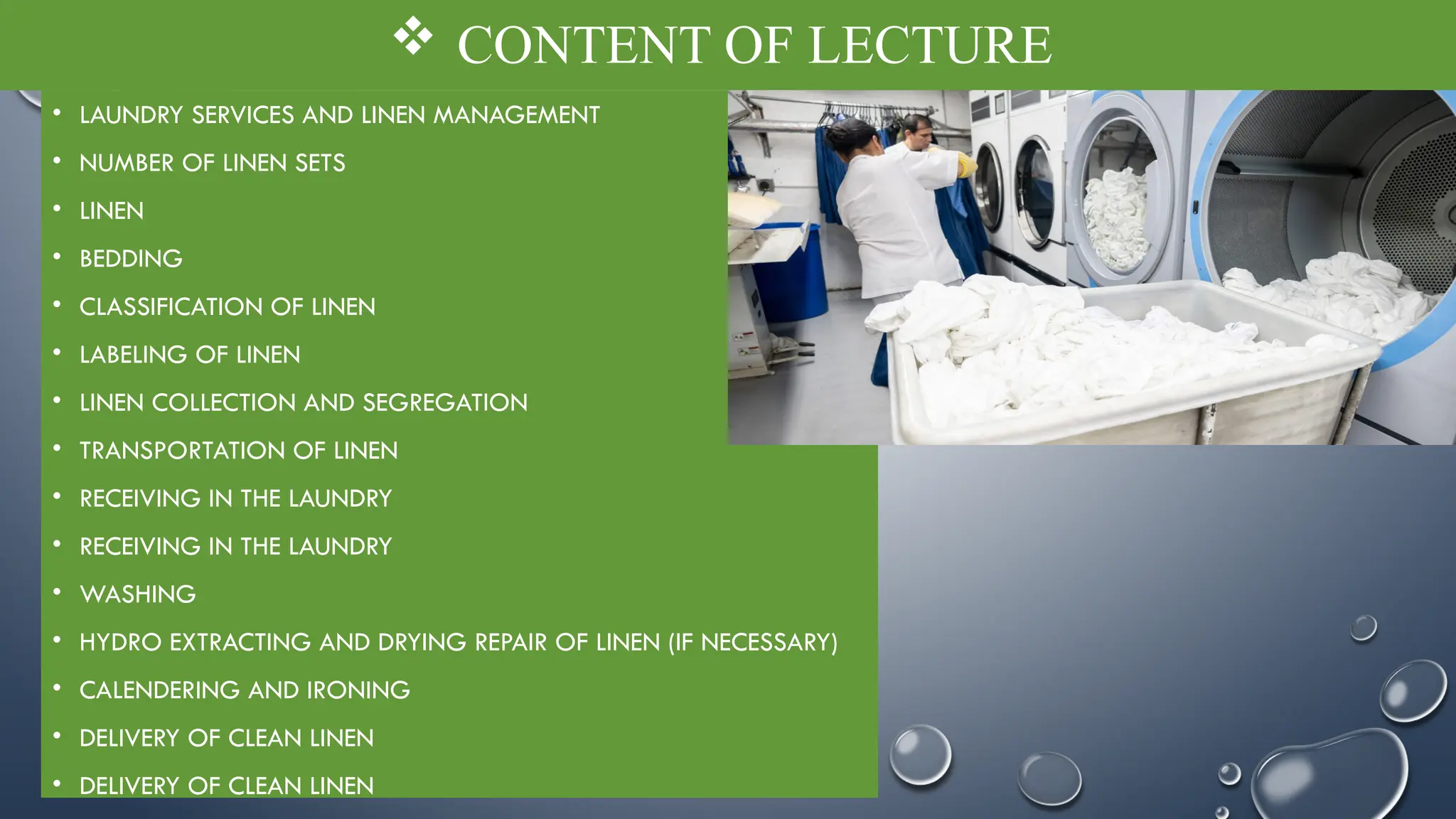
 CONTENT OF LECTURE
• LAUNDRY SERVICES AND LINEN MANAGEMENT
• NUMBER OF LINEN SETS
• LINEN
• BEDDING
• CLASSIFICATION OF LINEN
• LABELING OF LINEN
• LINEN COLLECTION AND SEGREGATION
• TRANSPORTATION OF LINEN
• RECEIVING IN THE LAUNDRY
• WASHING
• HYDRO EXTRACTING AND DRYING REPAIR OF LINEN (IF NECESSARY)
• CALENDERING AND IRONING
• DELIVERY OF CLEAN LINEN
 HOSPITAL SUPPORT SERVICE
Support Services In The Hospital Play A Major Role In Ensuring That They Provide The Defined Services In An
Efficient Manner And Also Enable The Other Staff Of The Hospital To Carry On The Activities Which Are Required
For Patient Care Delivery. An Engaged And Integrated Support Service Team Has Significant Effect On Hospital
Services Which Allows Patients To Heal Quicker, Promotes A Safer Environment, And Improves The Satisfaction Of
Staff, Patients, And Families. The Contributions Made By Support Service Personnel In Today’s Hospitals Have
Become A Crucial Component To The Organization's Success.
The Major Support Services Areas Covered Under These Guidelines Include:
• Laundry Services & Linen Management
• Water Sanitation
• Kitchen Services
• Security Services
• Outsourced Services Management
 LAUNDRY SERVICES AND LINEN MANAGEMENT
• The Provision Of Clean Linen Is A Fundamental Requirement For
Patient Care. Incorrect Procedures For Handling Or Processing Of
Linen Can Present An Infection Risk Both To Staff And Patients Who
Subsequently Use It. Hence, Correct Linen Management Is Important
To Prevent HAI And Ensure A Better Hygienic Hospital Environment.
• The Term ‘Hospital Linen’ Includes All Textiles Used In The Hospital
Including Mattresses, Pillow Covers, Blankets, Bed Sheets, Towels,
Screens, Curtains, Doctors Coats, Theatre Clothes And Table Clothes.
The Hospital Receives All These Materials From Different Areas Like
OT, Wards, Outpatient Departments And Office Areas.
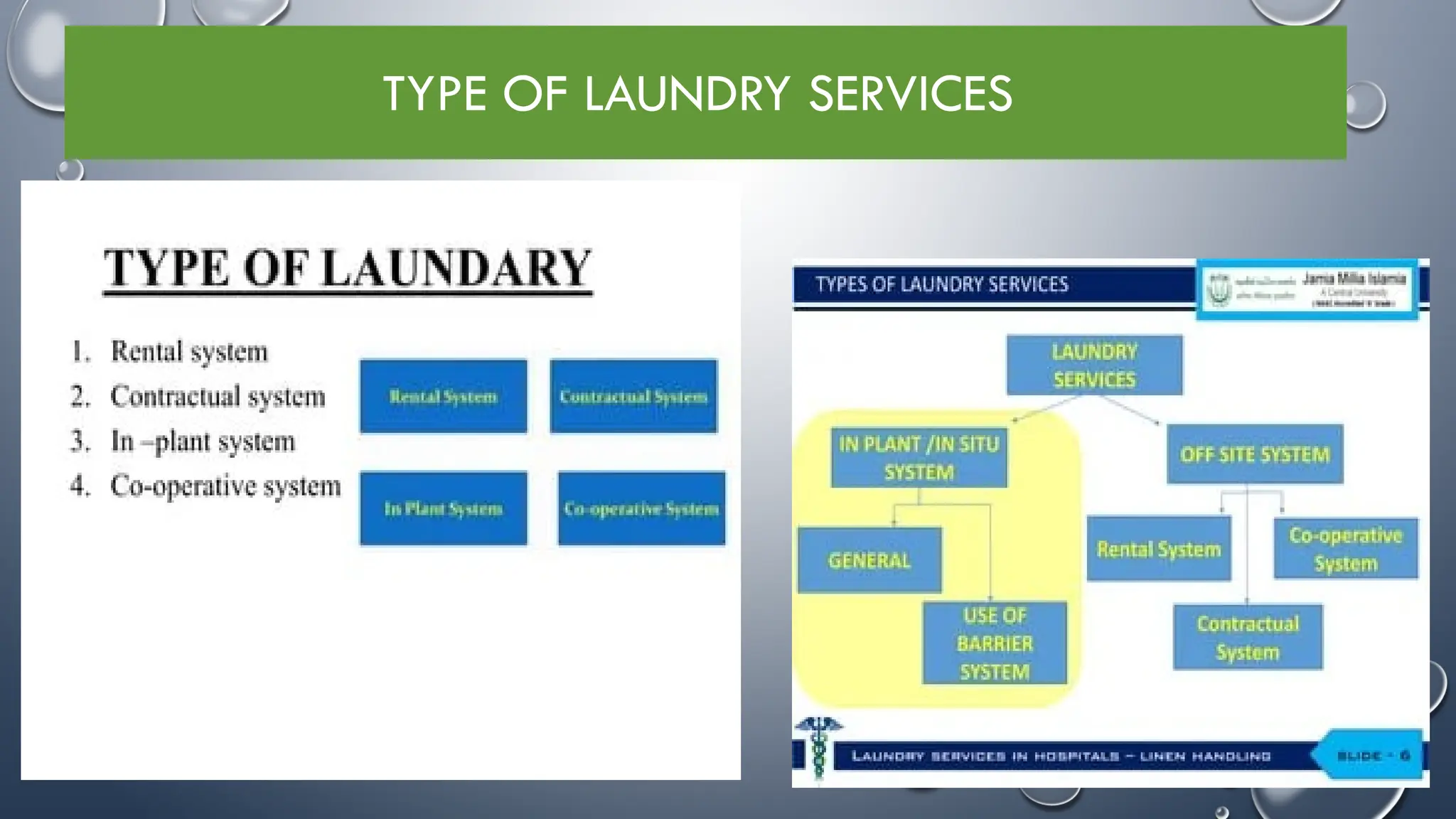
TYPE OF LAUNDRY SERVICES
CLASSIFICATION OF HOSPITAL LINEN
Classification of Hospital Linen - Classification based on use of linen:
a) General Purpose linen: This includes curtains, drapes, table clothes and
similar items commonly used in all parts of the hospital . This is the linen
which is not used for patient care.
b) Patient linen: This consists of patient clothing such as patient pyjamas,
shirts, gown, coats etc.
c) Ward Linen: This consists of patient-bed clothing such as bed sheets,
pillow covers , blankets used by the patient.
d) OT, Labour room,
Procedure room linen: This includes items such as pyjamas, kurtas, gowns,
coats , shirts etc. worn by surgeons, anaesthetists, OT personnel and also
surgical gowns, caps, masks, trolley covers, OT towels etc. required in OT,
labour room and procedure room. Classification based on colour of linen:
a) Ward Linen: This linen should be white in colour
b) Operation Theatre Linen: This should be green in colour including
doctor’s gown
c) Patient Linen: This should be blue in colour
CLASSIFICATION OF LINEN
 Dirty Linen
Dirty Linen Is Used Linen, But Not Visibly Soiled
With Blood Or Blood Tinged Body Secretions.
 Soiled Linen
Oiled Linen Is Known, Or Potentially, Infected/Infested
Linen. All Linen Which Is Contaminated With Excreta,
Blood Or Body Fluids Or Contaminated Linen From A
Patient Who Is Known Or Clinically Suspected, To Be
Infected With Diseases Like Salmonella, Hepatitis A, B
Or C, Open Pulmonary Tuberculosis, HIV Etc.
 NUMBER OF LINEN SETS IDEAL TO BE
Hospitals Need To Ensure That They Have At Least Four Sets Of Linen
Per Day, Even Though Six Sets Are Preferable. Classification Of Six Sets
Of Linen Needed In Hospitals Is As Follows:
• One Already In Use (On Bed)
• One Ready To Use (In Sub Store)
• One In Transit-route To Laundry Or To The Ward
• One In Washing Cycle In Laundry
• Two In Stock (In Central Store) Thus, In An Ideal Situation, For A
100-bedded Hospital, 600 Bed Sheets Are Needed
. Hospitals Need To Maintain The Linen Stock Register For Available
Linen In The Central Store Or With Laundry In-charge Of The Hospital.
BASIC PRINCIPLES OF LINEN MANAGEMENT
The Basic Principles Of Linen Management Are As Follows:
Place Used Linen In Appropriate Bags At The Point Of Generation
• Contain Linen Soiled With Body Substances Or Other Fluids Within Suitable
Impermeable Bags And Close The Bags Securely For Transportation
To Avoid Any Spills Or Drips Of Blood, Body Fluids, Secretions Or Excretions
• Do Not Rinse Or Sort Linen In Patient Care Areas (Sort In Appropriate Areas)
• Handle All Linen With Minimum Agitation
To Avoid Aerosolisation Of Pathogenic Micro-organisms
• Separate Clean From Soiled Linen And Transport/Store Separately
• Wash Used Linen (Sheets, Cotton Blankets) In Hot Water (70°C To 80°C) And
Detergent, Rinse And Dry Preferably In A Dryer Or In The Sun
• Autoclave Linen Before Being Supplied To The Operating Rooms/Theatres
TYPE OF LINEN USED IN HOSPITAL SERVICES
IMPORTANCE OF LINEN IN HOSPITALS
SOURCE OF LINEN AVAILABLE
HANDLING OF LINEN
DESIGN AND PLAN REQUIREMENTS
WORK FLOW OF LINEN MANAGEMENT
 LABELING OF LINEN
All Linen Being Used In Hospitals Needs To Be Labelled For
Identification And Traceability. Proper Labelling Of The Linen Also
Helps In Proper Inventory Management. The Label Of The Linen
Includes The Following Minimum Details:
• Name Of The Hospital (XYZ)
• Name Of The Department Or Number Of Ward (ICU/OBS/WARD)
• Type Of Linen Like Bed Sheets (BS), Patient Gown (PG), Pillow
Cover (PC)
• Number Of Linen I.E. 1, 2, 3…
• Doctors Coat Labelled With Doctor’s Name For Example, Bed
Sheets Used In Icu Of Hospital Can Be Labelled As: Xyz/Icu/Bs/1,
Similarly Bed Sheet In General Ward 1 Can Be Labelled As:
Xyz/Gw1/Bs/06
 LINEN COLLECTION AND SEGREGATION
• The Hospital Should Have Fixed Schedule For The Collection Of Linen From Different
Areas Of The Hospital
• All The Patient Linen Including Bed Sheets, Patient Gowns Needs To Be Changed
Daily
• All The Linen Of Critical Areas Like OT And ICU Etc. Need To Be Changed Daily
• The Staff Linen Needs To Be Changed On Weekly Basis
• It Is Strongly Recommended To Change All The Linen Used In The Hospital When
Visibly Dirty Or Are Soiled
• While Collecting Linen, Care Should Be Taken To Ensure All Sharps Or Patient
Equipment Is Removed
• Staff Should Wear Appropriate PPE Like Heavy Duty Gloves, Apron And Mask
During Linen Handling. Any Skin Lesions On Hands Should Be Covered
• Hand Hygiene Should Be Practiced After Linen Handling
• Linen Needs To Be Collected In Bags And Trolleys And Should Not Be Placed On The
Floor Or Any Other Surfaces
 CONTINUE
• To Minimize Aero Soilsation Of Any Organisms Contaminating Linen,
Linen Should Not Be Rinsed, Shaken Or Sorted In The Clinical Area.
The Personnel Should Keep his/her Hands Away From Face While
Handling Linen
• • The Collected Linen Needs To Be Stored At A Designated Place I.E.
In Dirty Utility Of The Area Of Generation.
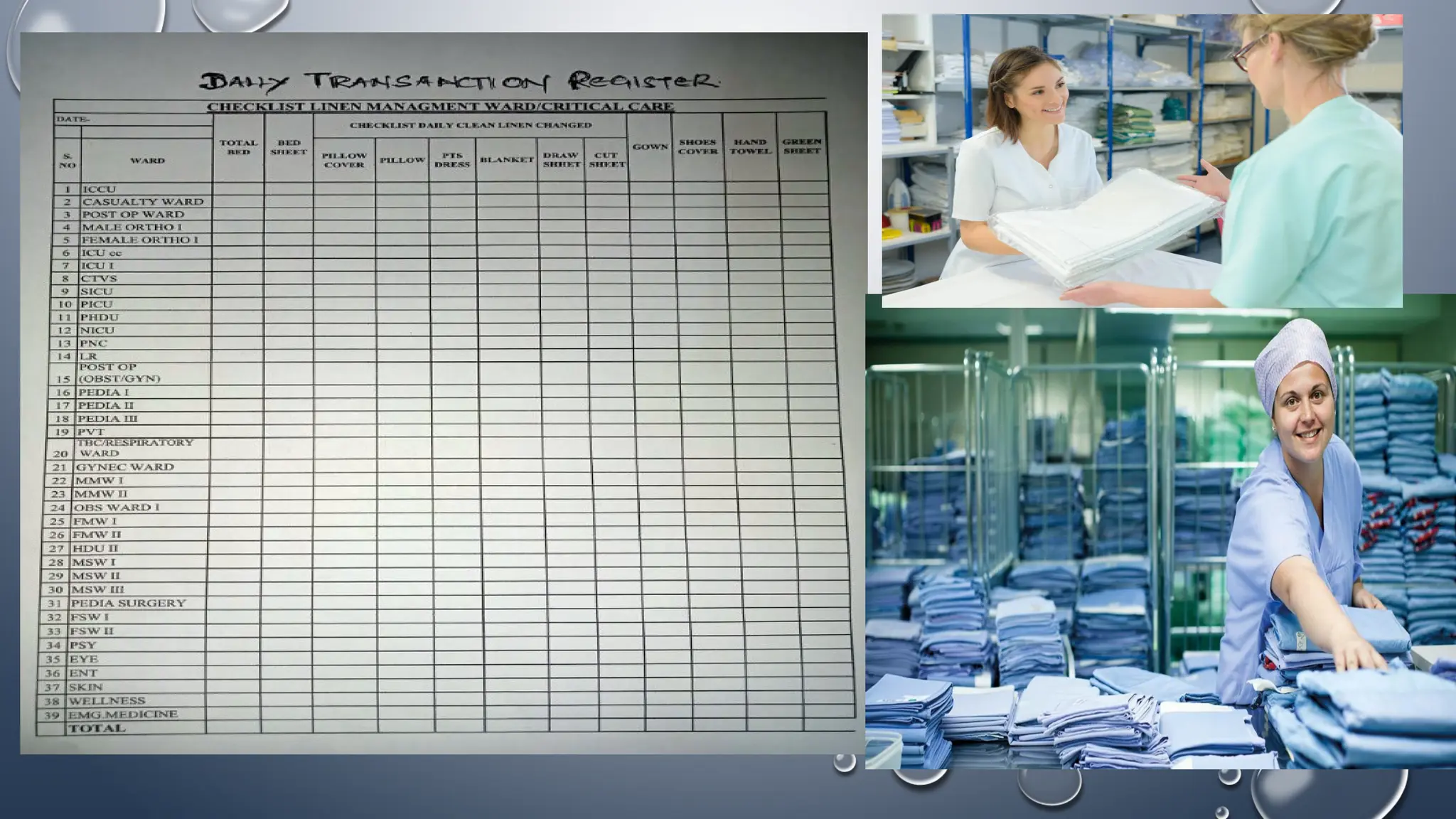
• • The Attendant/Sister In-charge Of The Area Needs To Update The
Daily Transaction Register Every Time Linen Is Collected From The
Area. The Transaction Register Should Include The Details Of The
Number Of Different Types Of Linen Items Collected From The
Particular Area.
• A Separate Register Has To Be Maintained In Different Areas For The
Same.
 TRANSPORTATION OF LINEN
Linen Collected From Different Areas Of The Hospital Needs To Be
Transported In The Covered Trolleys To The Laundry.
• Dirty And Soiled Linen Needs To Be Transported In Separate Trolleys
• A Dedicated Trolley For Transportation Of Linen Needs To Be Used And
Trolleys Used For Waste Collection Or Any Other Purpose Should Not Be
Used For Transportation Of Linen
• During Transportation It Is To Be Ensured That The Bags Used For
Collection Of Linen Are Properly Tied . Linen bag to be filled 2/3 laundry bag.
• In Case Of Any Spillage Of The Soiled Linen During Transport, The Linen
Needs To Be Securely Placed In The Transportation Trolley And Cleaning Of
The Surface Is Undertaken As Per The Spill Management Protocol Of The
Hospital.
 RECEIVING LINEN IN LAUNDRY
The Person Responsible For Receiving Linen In The Laundry Needs To Enter The Details Of The Linen In The
Receiving And Distribution Register At The Laundry.
The Details Include Type And Quantity Of Linen Received, The Department From Where Linen Is Received, Time
And Date Of Receiving. Records Are Necessary To Ensure Quality Assurance Of Linen And Laundry Management
In The Hospital
HOSPITAL LINEN STAIN REMOVAL PROCEDURE
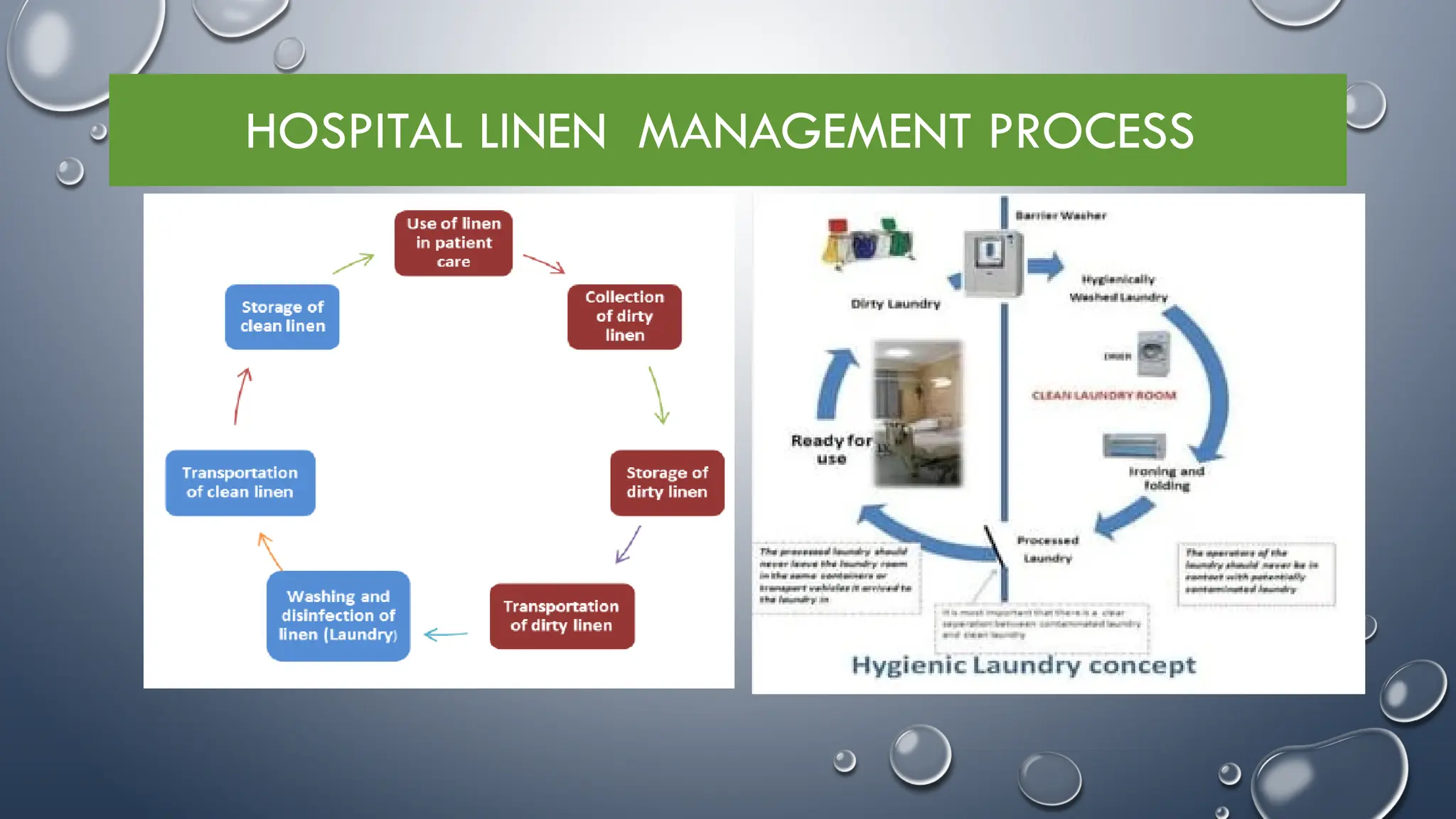
HOSPITAL LINEN MANAGEMENT PROCESS
INFRASTRUCTURE AND WORKFLOW CYCLE
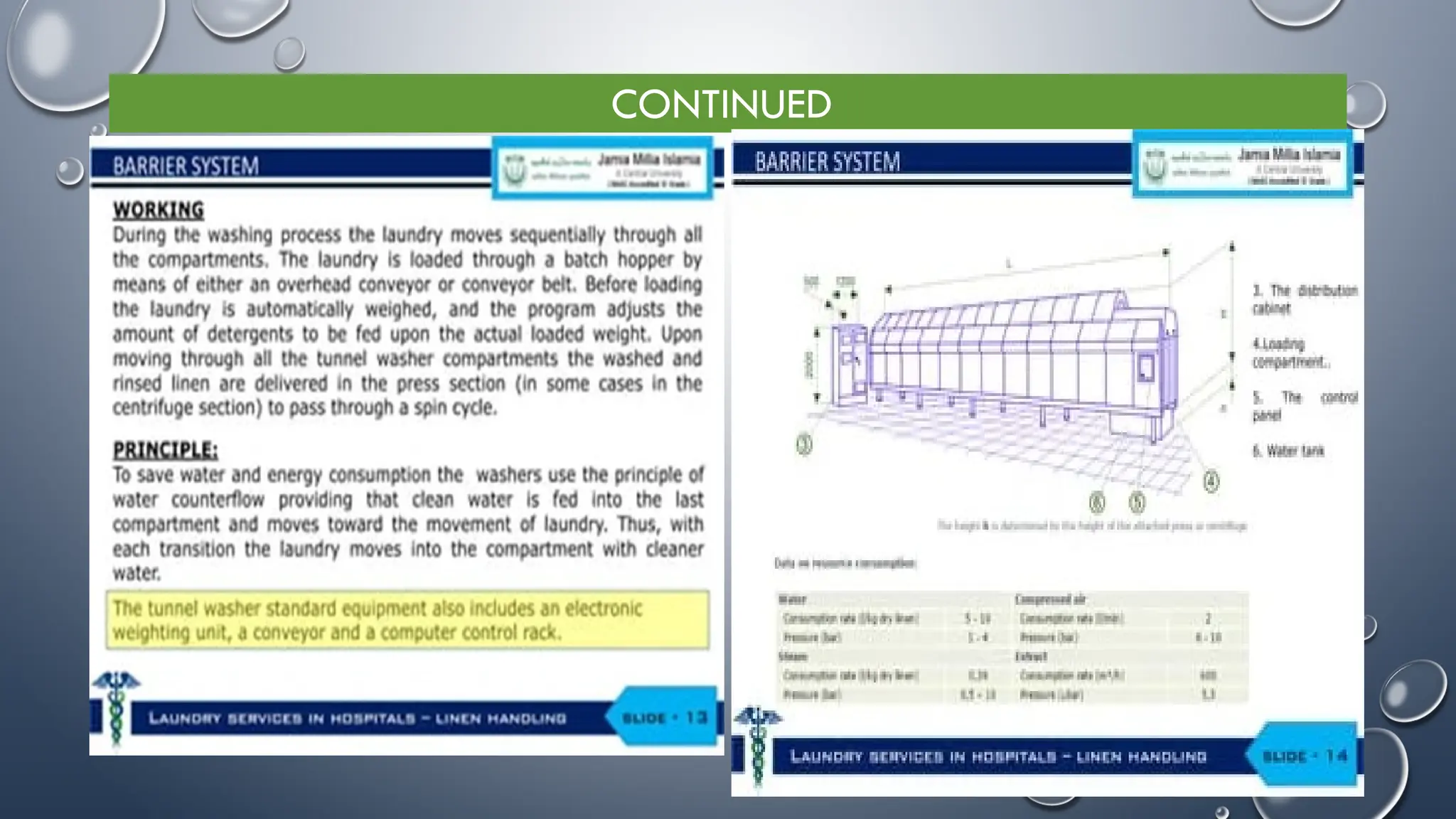
BARRIER SYSTEM WORKING FLOW
CONTINUED
 WASHING OF HOSPITAL LINEN PROCESS
• Washing By Hand
• STEP1: Wash Heavily Soiled/Infected Linen Separately From Non-
soiled Linen
• STEP 2: Wash The Entire Item In Water With Liquid Soap
• To Remove All Soilage, Even If Not Visible
REMEMBER: Pre-soak In Soap, Water And Bleach ONLY If Linen Is
Soiled-
 Use Warm Water If Available
 Add Bleach (For Example, 30–60 Ml [About 2–3 Tablespoons], Of A
5%chlorine Solution) To Aid Cleaning And Bactericidal Action
 Add Sour (A Mild Acid Agent) To Prevent Yellowing Of Linen, If
Desirable
Step-3: Check The Item For Cleanliness. Rewash If It Is Dirty Or Stained
STEP 4: Rinse The Item With Clean Water
• HYDRO EXTRACTING AND DRYING
All The Linen Is Checked For Any Damage, Wear And Tear
• In Case Of Any Damage Like Minor Hole Or Tear Observed, It
Should Be Sent For Repair And Mending
• If The Linen Is Severely Damaged And Cannot Be Repaired,
The Same Can Be Discarded Or Condemned As Per The Hospital
Condemnation Policy, By The Laundry Supervisor
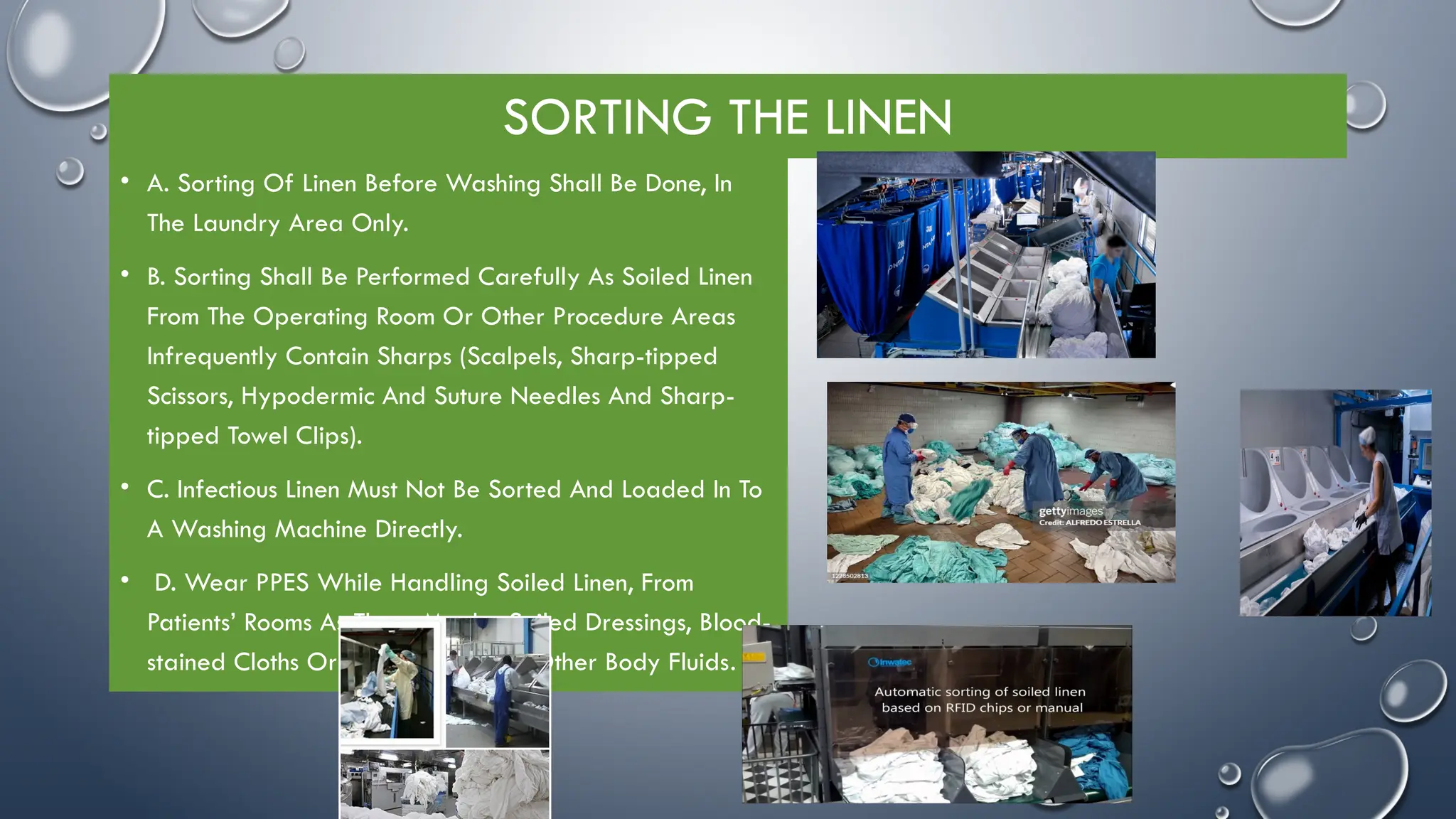
SORTING THE LINEN
• A. Sorting Of Linen Before Washing Shall Be Done, In
The Laundry Area Only.
• B. Sorting Shall Be Performed Carefully As Soiled Linen
From The Operating Room Or Other Procedure Areas
Infrequently Contain Sharps (Scalpels, Sharp-tipped
Scissors, Hypodermic And Suture Needles And Sharp-
tipped Towel Clips).
• C. Infectious Linen Must Not Be Sorted And Loaded In To
A Washing Machine Directly.
• D. Wear PPES While Handling Soiled Linen, From
Patients’ Rooms As There Maybe Soiled Dressings, Blood-
stained Cloths Or Cloths Wet With Other Body Fluids.
CARE OF LINEN MATERIALS
• 1. linen materials should be stored in dry places
• 2. using large amount of washing soda and bleaching agent
can damage the linen.
• 3. rinse the fabrics properly to avoid deposition of detergents
• 4. the materials should be dried out properly otherwise it
generate terrible odour and also the lifetime of the materials
will be shortened.
• 5. should not use bleaching powder directly on the fabric.
• 6. remove deposited stains immediately from the fabric.
• 7. should not mix infected linen with others.
• 8. should not overload washing or squeezing machines.
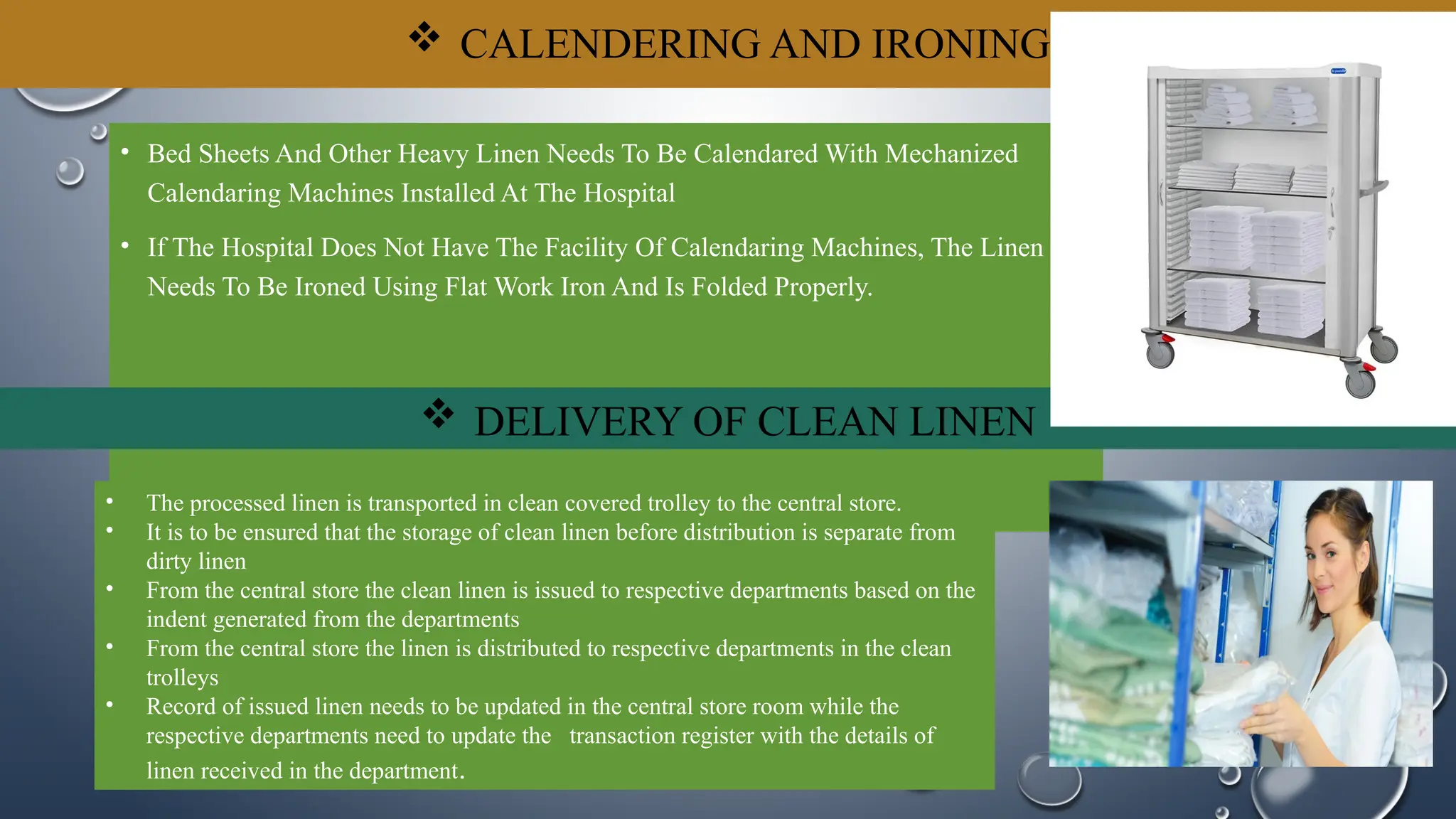
 CALENDERING AND IRONING
• Bed Sheets And Other Heavy Linen Needs To Be Calendared With Mechanized
Calendaring Machines Installed At The Hospital
• If The Hospital Does Not Have The Facility Of Calendaring Machines, The Linen
Needs To Be Ironed Using Flat Work Iron And Is Folded Properly.
 DELIVERY OF CLEAN LINEN
• The processed linen is transported in clean covered trolley to the central store.
• It is to be ensured that the storage of clean linen before distribution is separate from
dirty linen
• From the central store the clean linen is issued to respective departments based on the
indent generated from the departments
• From the central store the linen is distributed to respective departments in the clean
trolleys
• Record of issued linen needs to be updated in the central store room while the
respective departments need to update the transaction register with the details of
linen received in the department.
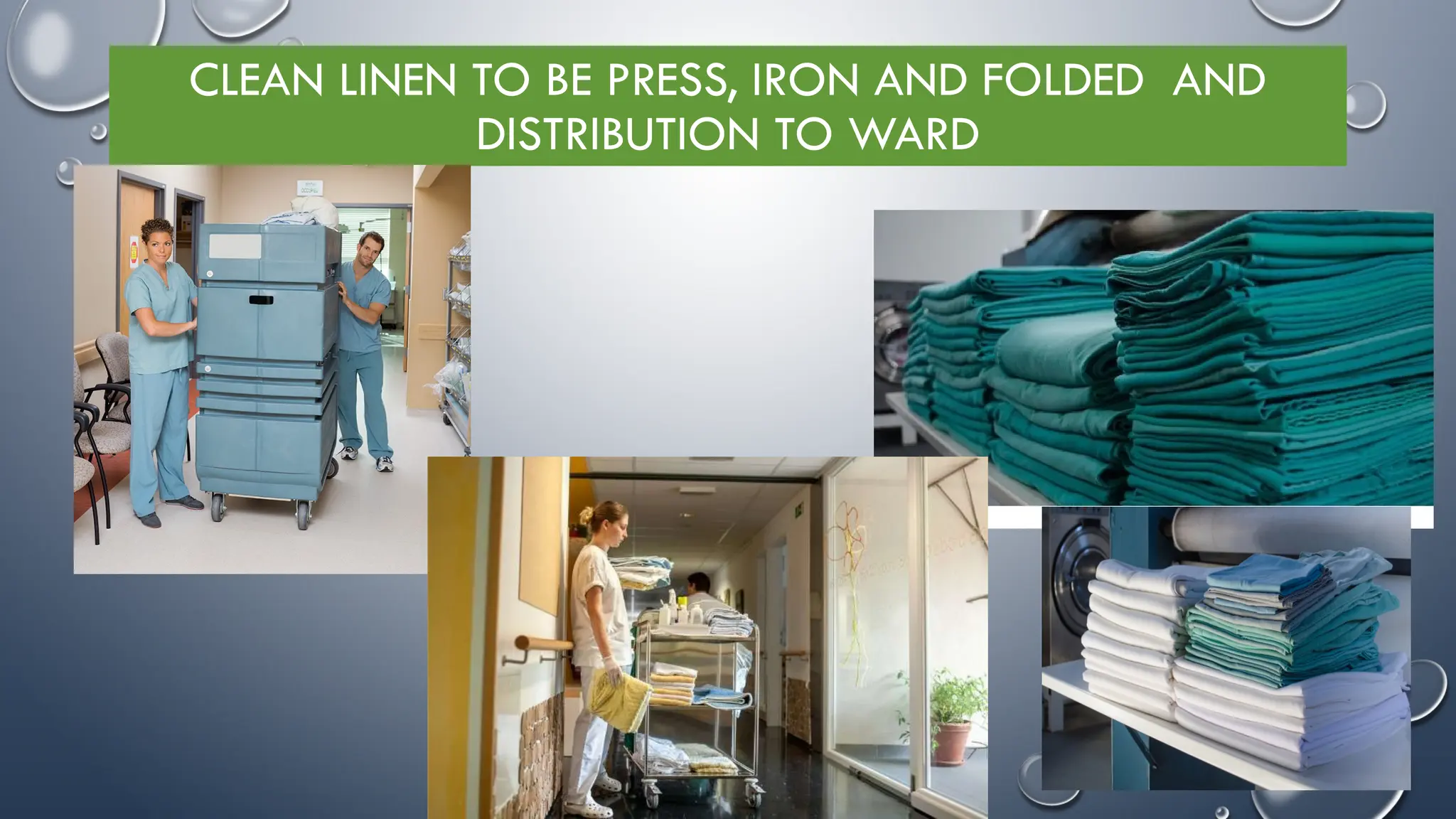
CLEAN LINEN TO BE PRESS, IRON AND FOLDED AND
DISTRIBUTION TO WARD
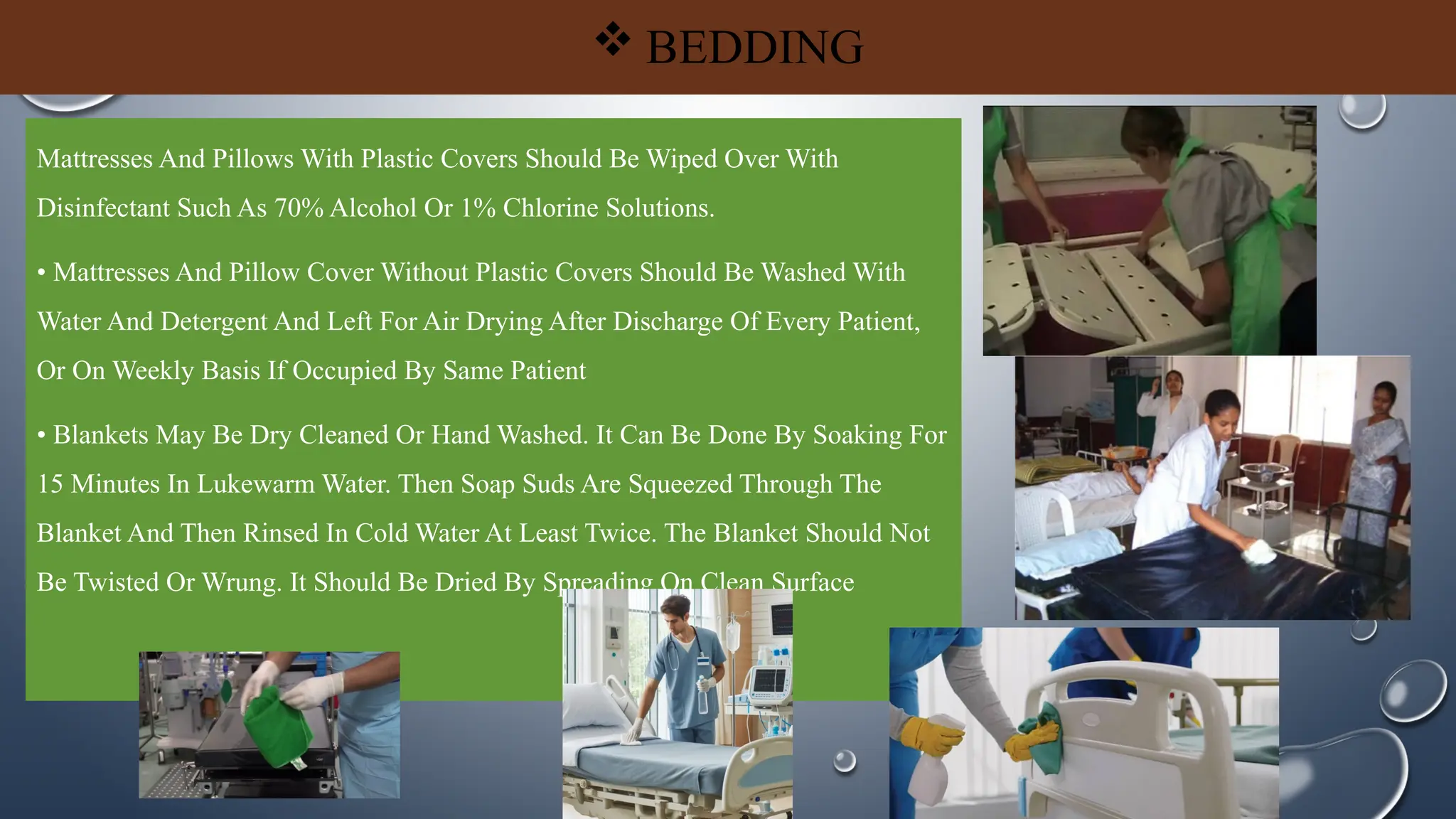
 BEDDING
Mattresses And Pillows With Plastic Covers Should Be Wiped Over With
Disinfectant Such As 70% Alcohol Or 1% Chlorine Solutions.
• Mattresses And Pillow Cover Without Plastic Covers Should Be Washed With
Water And Detergent And Left For Air Drying After Discharge Of Every Patient,
Or On Weekly Basis If Occupied By Same Patient
• Blankets May Be Dry Cleaned Or Hand Washed. It Can Be Done By Soaking For
15 Minutes In Lukewarm Water. Then Soap Suds Are Squeezed Through The
Blanket And Then Rinsed In Cold Water At Least Twice. The Blanket Should Not
Be Twisted Or Wrung. It Should Be Dried By Spreading On Clean Surface
AFTER DISINFECTANT EXPOSED WITH SUN LIGHT
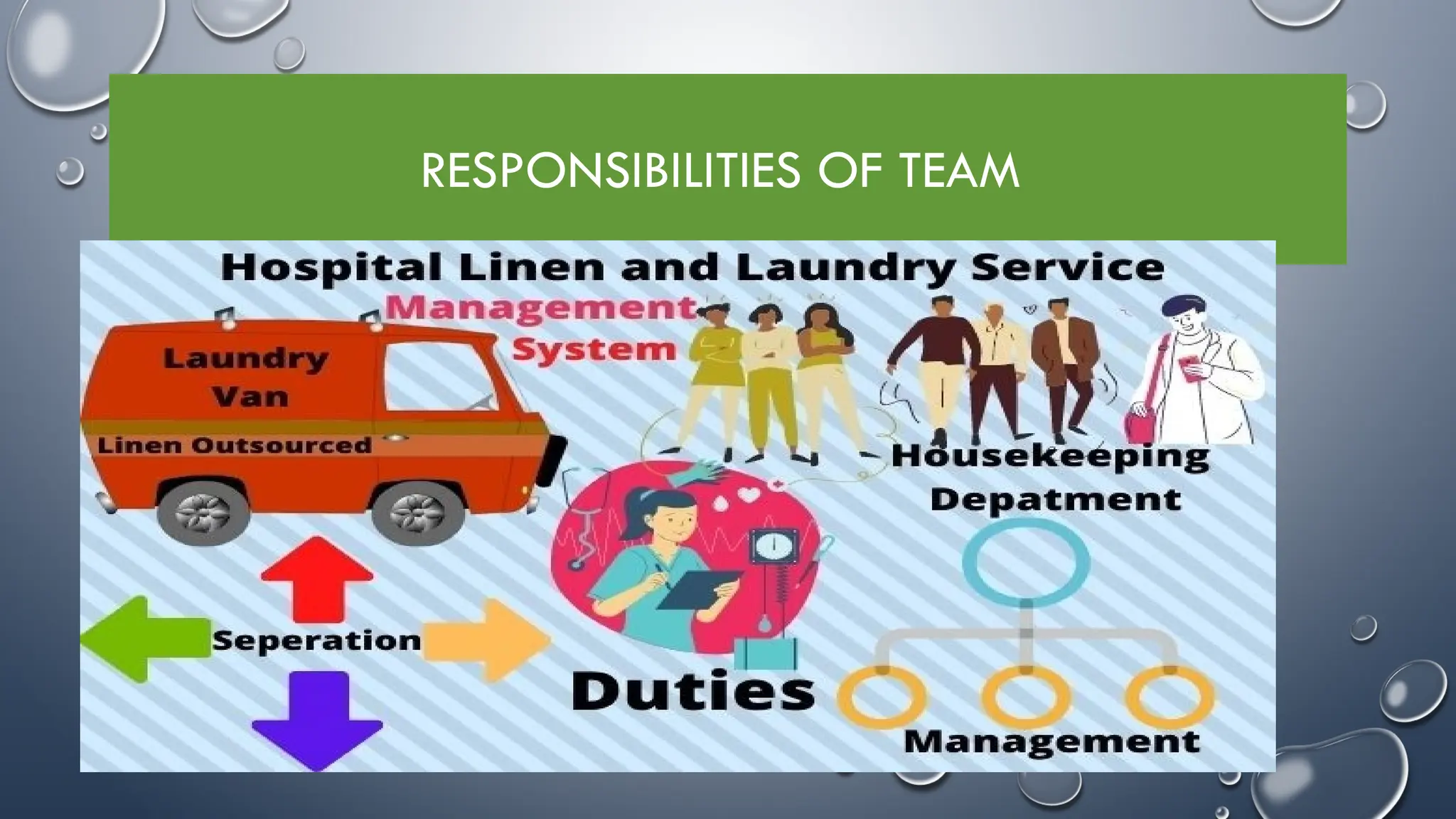
RESPONSIBILITIES OF TEAM
 RESPONSIBILITY OF LINEN MANAGEMENT
• Change Of Linen - Staff Nurse/Ward Attendant
• Sorting And Storing Of Used Linen - Ward Attendant/Housekeeping Staff
• Disinfection Of Soiled/Infected Linen - Housekeeping/Laundry Staff
• Collection Of Used/Soiled Linen - Laundry Staff
• Counting Of Collected Linen - Laundry Staff/Nursing In-charge
• Transporting Dirty Linen - Laundry Staff
• Washing, Drying And Ironing - Laundry Staff
• Receipt Of Washed Linen In Departments - Nursing In-charge
• s Storage And Issue Of Washed Linen - Nurse In-charge
TABLE 23: DO’S AND DON’TS FOR LINEN
MANAGEMENT
DETERGENT REQUIREMENT PER 100 KG LINEN
PREPARATION OF CHLORINE SOLUTION USING HYPOCHLORITE
SOLUTION
Concentration of
commercially available
hypochlorite solution
Required chlorine
Concentration
To prepare 1000 ml
Solution in ml Add water in ml
5%
2 400 600
1 200 800
0.50% 100 900
10%
0.50% 50 950
1 100 900
2 200 800
PREPARATION OF CHLORINE SOLUTION USING BLEACHING POWDER SOLUTION
PREPARATION OF DILUTE SOLUTIONS OF BLEACHING POWDER
Strength of SBP (Strength
of beaching powder)
Volume of water
Desired
concentration
Bleaching powder in grams per
litre
20% 1 litre
0.50% 25
1% 50
2% 200
5% 250
10% 500
25% 1 litre
0.50% 25
1% 40
2% 80
5% 200
10 400
30% 1 litre
0.50% 17
1% 33
2% 67
5% 167
LINEN CHANGING POLICY GUIDELINES:
• 7.1 hospital linen or clothing:
• 7.1.1 shall be changed and laundered between patients change.
• 7.1.2 shall be changed daily for patients nursed in isolation or
• 7.1.3 when they are soiled or fouled shall be changed.
• 7.2 pillows and mattresses: impervious cover of these items shall be routinely
wiped clean between patients change with hot water and detergent. if surface
contamination with blood or body fluids occurs clean with hypochlorite 0.5% in a
detergent solution. they shall not go into the laundry. they shall be cleaned at the
point of use or department. the damaged item shall be discarded as clinical waste.
• 7.3 all cloth items (e.g., surgical drapes, gowns, wrappers) used during a procedure
shall be considered infectious and they shall be laundered even if there is no visible
contamination.
• 7.4 housekeeping and laundry personnel shall wear PPE (aprons, gloves and eye
wear) when collecting, handling, transporting, sorting and washing soiled linen.
• 7.5 disposable linen shall be used for patients with/ suspected suffering from
anthrax, small pox and viral hemorrhagic fever.
• 7.6 if hospital linen has been used in these circumstances, it shall be treated as
clinical waste.
The functions of the laundry services:
1. Collecting soiled linen from various
places.
2. Sorting the linen and processing
(Cleaning) them
3. Inspecting and repairing or replacing
damaged materials.
4. Distributing clean linen to the
respective user departments.
5. Maintaining different types of
registers.
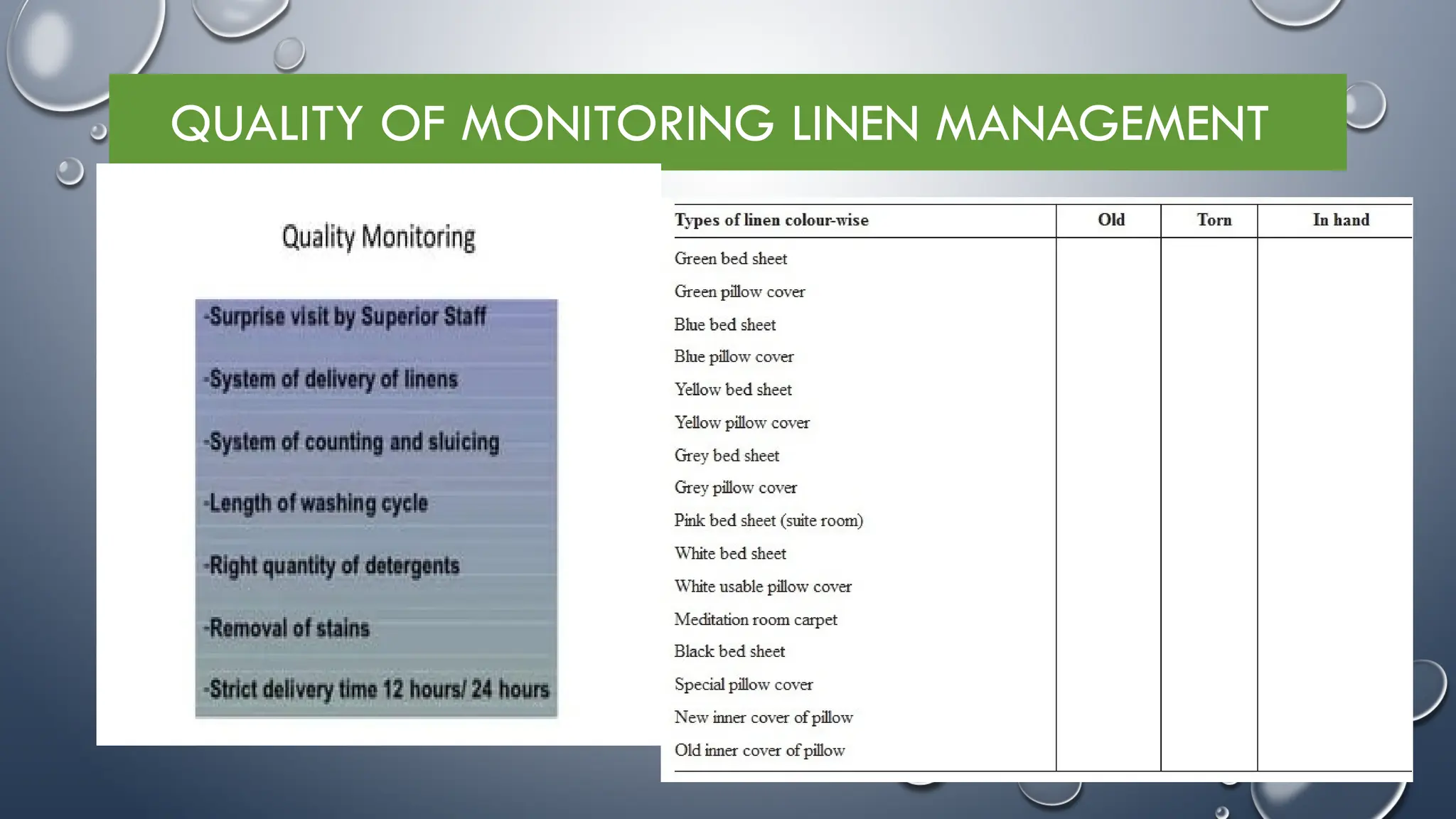
QUALITY OF MONITORING LINEN MANAGEMENT
PPE FOR HOUSEKEEPING STAFF AND LAUNDRY
STAFFS:
• GLOVES: THICK UTILITY OR HEAVY-DUTY HOUSE HOLD GLOVES
TO MINIMIZE THE RISK OF ACCIDENTAL INJURY FROM A NEEDLE-
STICK OR OTHER SHARP OBJECT, INCLUDING BROKEN GLASS.
• APRON: MADE OF PLASTIC OR RUBBER.
• CLOSED SHOES
• PROTECTIVE EYE WEAR
• USAGE OF PPE:
• HANDLING DISINFECTANT SOLUTIONS.
• COLLECTING AND HANDLING SOILED LINEN
• TRANSPORTING SOILED LINEN
• SORTING SOILED LINEN
• HAND WASHING SOILED LINEN
• LOADING AUTOMATIC WASHERS
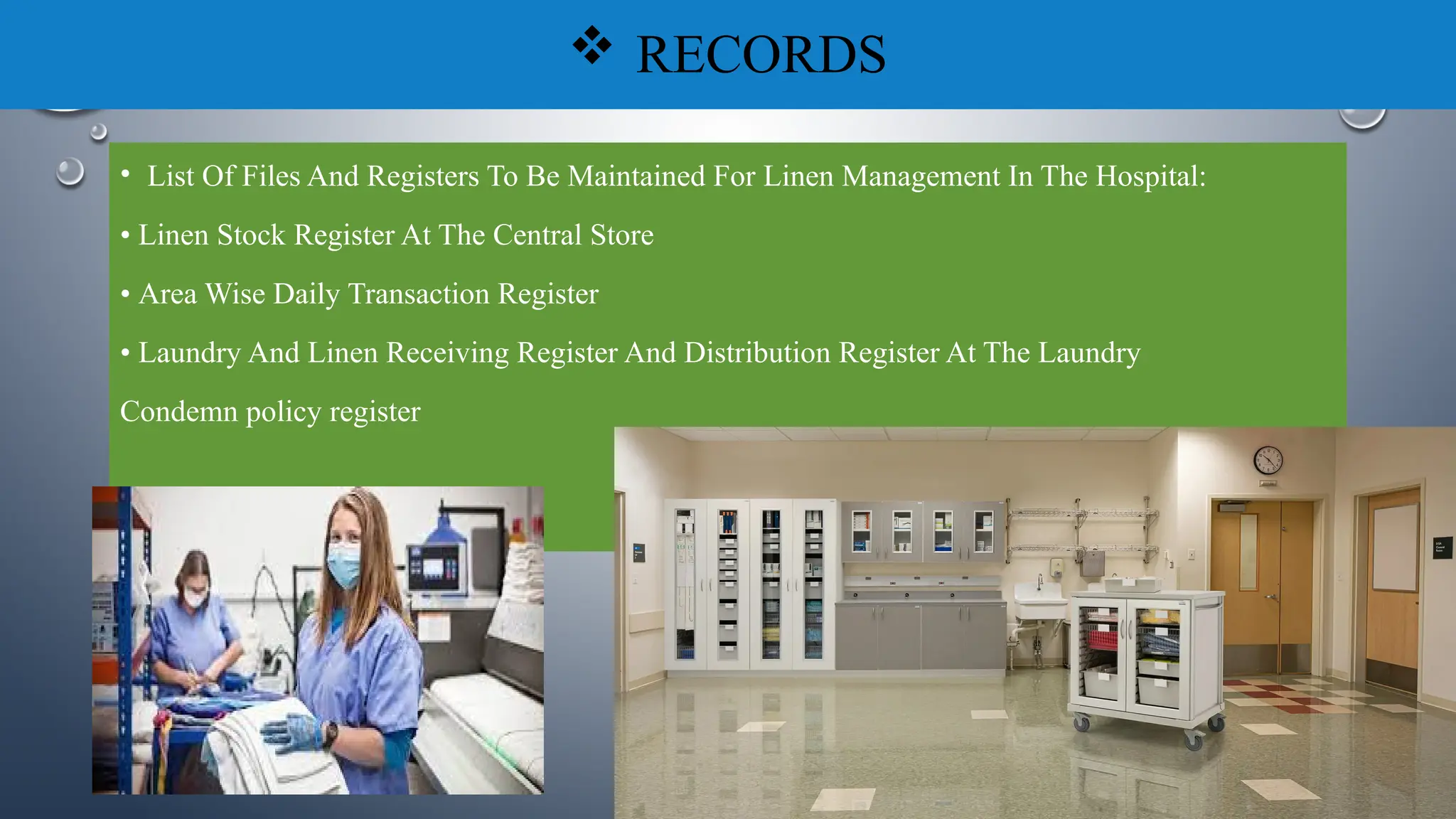
 RECORDS
• List Of Files And Registers To Be Maintained For Linen Management In The Hospital:
• Linen Stock Register At The Central Store
• Area Wise Daily Transaction Register
• Laundry And Linen Receiving Register And Distribution Register At The Laundry
Condemn policy register
LIST OF RECORDS AND REGISTER
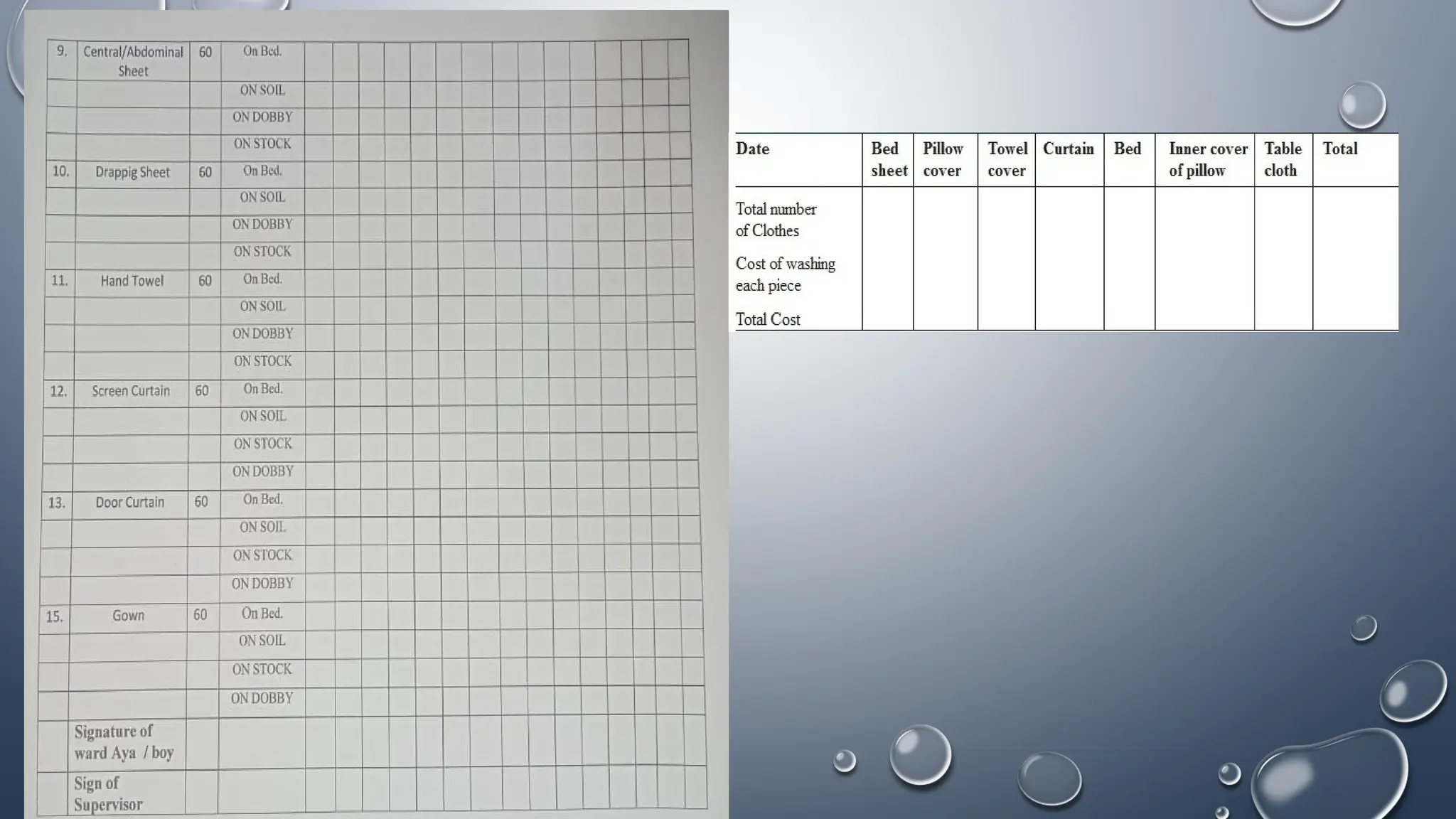
SAMPLE OF FORMAT FOR LINEN MANAGEMENT
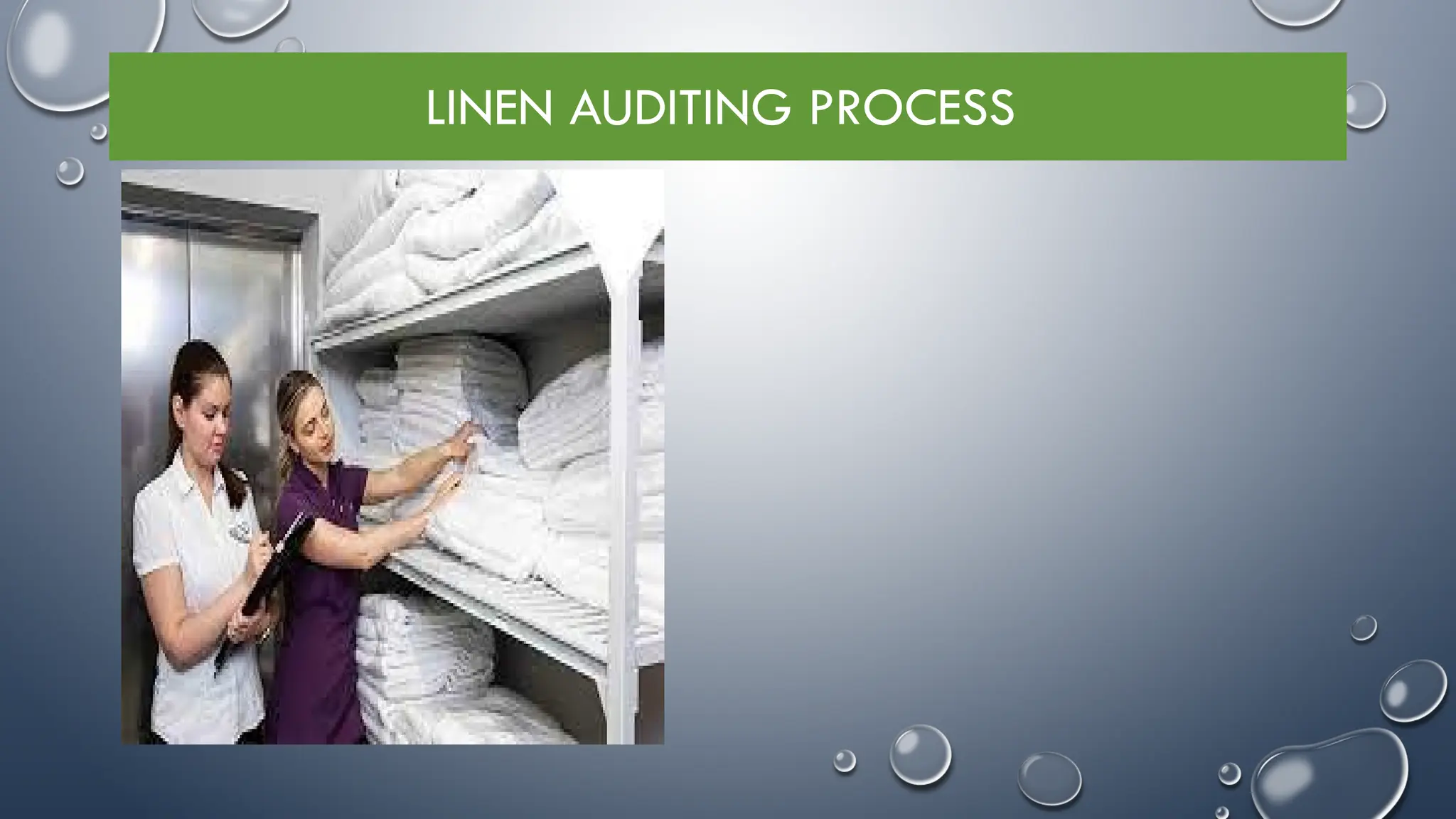
LINEN AUDITING PROCESS
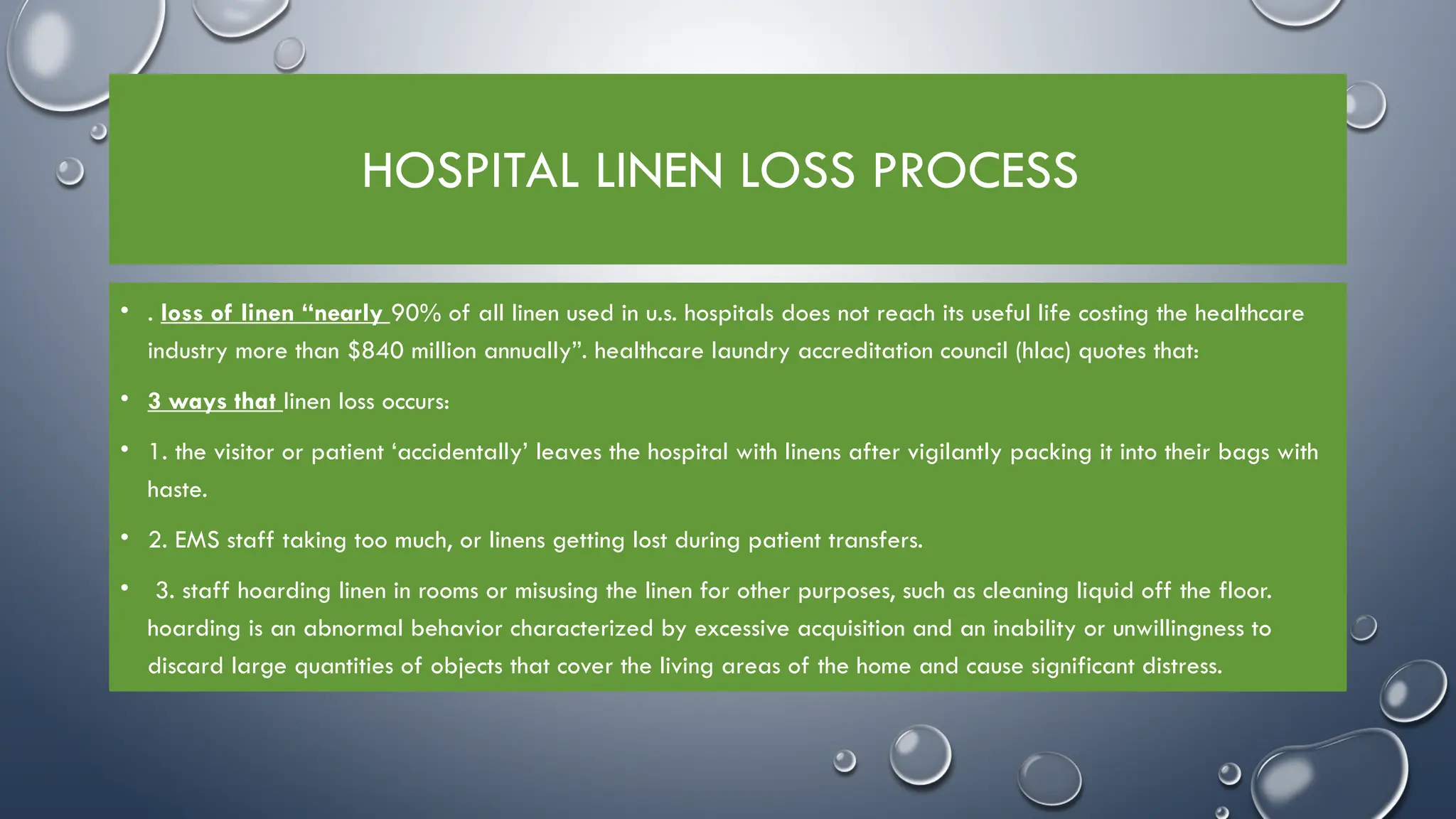
HOSPITAL LINEN LOSS PROCESS
• . loss of linen “nearly 90% of all linen used in u.s. hospitals does not reach its useful life costing the healthcare
industry more than $840 million annually”. healthcare laundry accreditation council (hlac) quotes that:
• 3 ways that linen loss occurs:
• 1. the visitor or patient ‘accidentally’ leaves the hospital with linens after vigilantly packing it into their bags with
haste.
• 2. EMS staff taking too much, or linens getting lost during patient transfers.
• 3. staff hoarding linen in rooms or misusing the linen for other purposes, such as cleaning liquid off the floor.
hoarding is an abnormal behavior characterized by excessive acquisition and an inability or unwillingness to
discard large quantities of objects that cover the living areas of the home and cause significant distress.
HOW TO PREVENT LINEN LOSS
• • LINEN AUTOMATION SYSTEM: AMOUNT OF LINEN TAKEN OUT OF THE LINEN CART IS TRACKED. SUPPORT
SERVICES RECEIVE REAL-TIME UPDATES OF LINEN LEVELS.
• • CONTROL THE ACCESS TO THE LINEN. ONLY ALLOW ACCESS TO AUTHORIZED STAFF THROUGH THEIR
EXISTING ID SCAN BADGES.
• • LINEN AUDIT: TAKING A PHYSICAL INVENTORY OF ALL LINENS YOU HAVE ON HAND REGULARLY.
• • EDUCATE YOUR EMPLOYEES. A GOOD PORTION OF LINEN LOSS IS DUE TO EMPLOYEES TOSSING SOILED
LINENS INTO THE TRASH.
• • KEEPING A RECORD OF WHEN THE EMPLOYEE RECEIVED THEIR UNIFORMS AND HOW MANY UNIFORMS
WERE SUPPLIED. • INSPECT PATIENTS’, VISITORS’ AND EMPLOYEES’ BAGS AS THEY EXIT THE FACILITY.
CONCLUSION
• An efficient and effective linen and laundry services can enhance patient experience and reduce
the risk of cross contamination. laundry and its products should preserve the patients’ dignity,
promote the patients’ care and be appropriate to patient group, gender, clinical status, religion
and beliefs. quality inspectors may wish to understand how the laundry process impacts above
and design a framework to identify necessary quality requirements within the organization
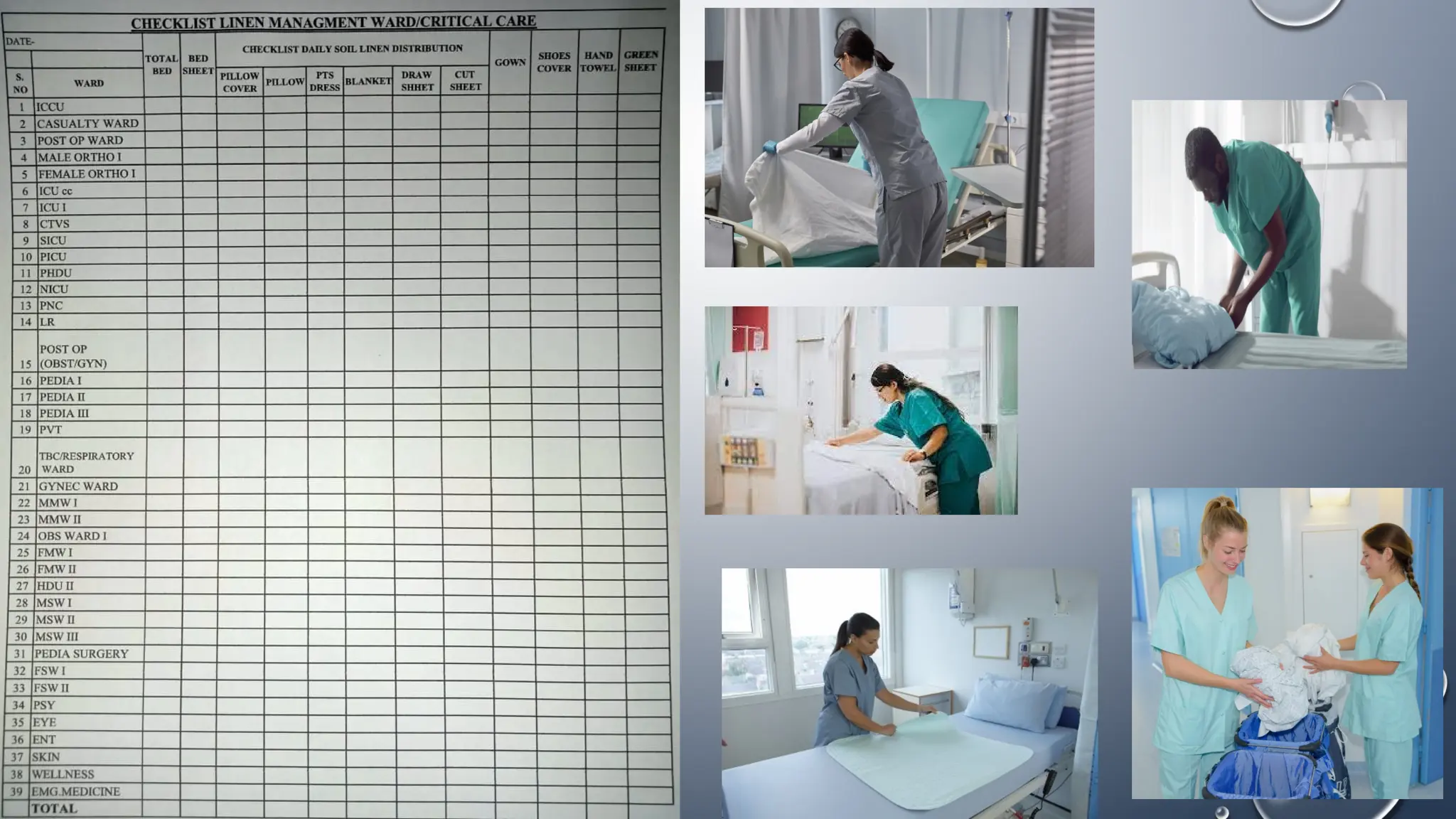
LINEN INVENTORY CHECKLIST
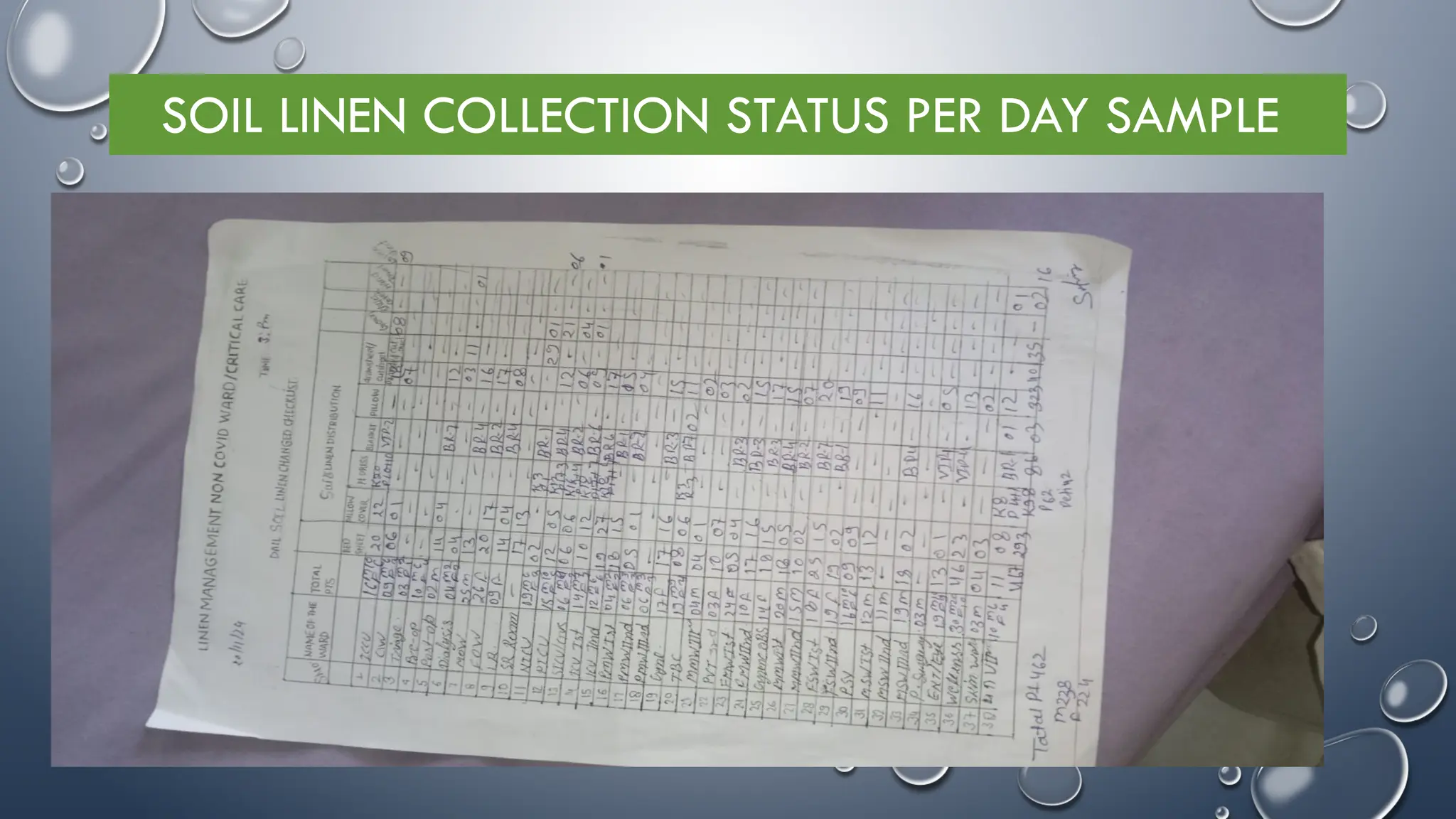
SOIL LINEN COLLECTION STATUS PER DAY SAMPLE
CLEAN LINEN
DISTRIBUTION LIST
PER DAY
THANK YOU

Linen Managment services in hospital ppt 2024.pptx

  • 1.
    LECTURE ON POLICYAND PROCEDURES OF LAUNDRY AND LINEN MANAGEMENT IN HOSPITAL SERVICES Prepared By Dr.Anjalatchi Muthukumaran Professor Cum Vice Principal And Nursing Supt. Era College Of Nursing , Elmch , Era University Lucknow 226003
  • 2.
    TERM USED INCHAPTER • SOILED LINEN: LINEN VISIBLY CONTAMINATED BY BLOOD, BODY FLUIDS, SECRETIONS AND EXCRETIONS ARE “SOILED / CONTAMINATED / DIRTY / FOULED”. • USED LINEN: ALL OTHER USED LINEN IS TERMED “USED”. • CLEAN LINEN: WITHOUT DIRTY, AFTER CLEAN, IRON, AND FOLDED TO KEPT IN RACK FOLLOWED BY DELIVERY SERVICES TO THE CUSTOMER .
  • 3.
    BROCHURE FOR ONLINELECTURE ABOUT LINEN POLICY
  • 4.
     CONTENT OFLECTURE • LAUNDRY SERVICES AND LINEN MANAGEMENT • NUMBER OF LINEN SETS • LINEN • BEDDING • CLASSIFICATION OF LINEN • LABELING OF LINEN • LINEN COLLECTION AND SEGREGATION • TRANSPORTATION OF LINEN • RECEIVING IN THE LAUNDRY • RECEIVING IN THE LAUNDRY • WASHING • HYDRO EXTRACTING AND DRYING REPAIR OF LINEN (IF NECESSARY) • CALENDERING AND IRONING • DELIVERY OF CLEAN LINEN • DELIVERY OF CLEAN LINEN
  • 5.
     HOSPITAL SUPPORTSERVICE Support Services In The Hospital Play A Major Role In Ensuring That They Provide The Defined Services In An Efficient Manner And Also Enable The Other Staff Of The Hospital To Carry On The Activities Which Are Required For Patient Care Delivery. An Engaged And Integrated Support Service Team Has Significant Effect On Hospital Services Which Allows Patients To Heal Quicker, Promotes A Safer Environment, And Improves The Satisfaction Of Staff, Patients, And Families. The Contributions Made By Support Service Personnel In Today’s Hospitals Have Become A Crucial Component To The Organization's Success. The Major Support Services Areas Covered Under These Guidelines Include: • Laundry Services & Linen Management • Water Sanitation • Kitchen Services • Security Services • Outsourced Services Management
  • 6.
     LAUNDRY SERVICESAND LINEN MANAGEMENT • The Provision Of Clean Linen Is A Fundamental Requirement For Patient Care. Incorrect Procedures For Handling Or Processing Of Linen Can Present An Infection Risk Both To Staff And Patients Who Subsequently Use It. Hence, Correct Linen Management Is Important To Prevent HAI And Ensure A Better Hygienic Hospital Environment. • The Term ‘Hospital Linen’ Includes All Textiles Used In The Hospital Including Mattresses, Pillow Covers, Blankets, Bed Sheets, Towels, Screens, Curtains, Doctors Coats, Theatre Clothes And Table Clothes. The Hospital Receives All These Materials From Different Areas Like OT, Wards, Outpatient Departments And Office Areas.
  • 7.
  • 8.
    CLASSIFICATION OF HOSPITALLINEN Classification of Hospital Linen - Classification based on use of linen: a) General Purpose linen: This includes curtains, drapes, table clothes and similar items commonly used in all parts of the hospital . This is the linen which is not used for patient care. b) Patient linen: This consists of patient clothing such as patient pyjamas, shirts, gown, coats etc. c) Ward Linen: This consists of patient-bed clothing such as bed sheets, pillow covers , blankets used by the patient. d) OT, Labour room, Procedure room linen: This includes items such as pyjamas, kurtas, gowns, coats , shirts etc. worn by surgeons, anaesthetists, OT personnel and also surgical gowns, caps, masks, trolley covers, OT towels etc. required in OT, labour room and procedure room. Classification based on colour of linen: a) Ward Linen: This linen should be white in colour b) Operation Theatre Linen: This should be green in colour including doctor’s gown c) Patient Linen: This should be blue in colour
  • 9.
    CLASSIFICATION OF LINEN Dirty Linen Dirty Linen Is Used Linen, But Not Visibly Soiled With Blood Or Blood Tinged Body Secretions.  Soiled Linen Oiled Linen Is Known, Or Potentially, Infected/Infested Linen. All Linen Which Is Contaminated With Excreta, Blood Or Body Fluids Or Contaminated Linen From A Patient Who Is Known Or Clinically Suspected, To Be Infected With Diseases Like Salmonella, Hepatitis A, B Or C, Open Pulmonary Tuberculosis, HIV Etc.
  • 10.
     NUMBER OFLINEN SETS IDEAL TO BE Hospitals Need To Ensure That They Have At Least Four Sets Of Linen Per Day, Even Though Six Sets Are Preferable. Classification Of Six Sets Of Linen Needed In Hospitals Is As Follows: • One Already In Use (On Bed) • One Ready To Use (In Sub Store) • One In Transit-route To Laundry Or To The Ward • One In Washing Cycle In Laundry • Two In Stock (In Central Store) Thus, In An Ideal Situation, For A 100-bedded Hospital, 600 Bed Sheets Are Needed . Hospitals Need To Maintain The Linen Stock Register For Available Linen In The Central Store Or With Laundry In-charge Of The Hospital.
  • 11.
    BASIC PRINCIPLES OFLINEN MANAGEMENT The Basic Principles Of Linen Management Are As Follows: Place Used Linen In Appropriate Bags At The Point Of Generation • Contain Linen Soiled With Body Substances Or Other Fluids Within Suitable Impermeable Bags And Close The Bags Securely For Transportation To Avoid Any Spills Or Drips Of Blood, Body Fluids, Secretions Or Excretions • Do Not Rinse Or Sort Linen In Patient Care Areas (Sort In Appropriate Areas) • Handle All Linen With Minimum Agitation To Avoid Aerosolisation Of Pathogenic Micro-organisms • Separate Clean From Soiled Linen And Transport/Store Separately • Wash Used Linen (Sheets, Cotton Blankets) In Hot Water (70°C To 80°C) And Detergent, Rinse And Dry Preferably In A Dryer Or In The Sun • Autoclave Linen Before Being Supplied To The Operating Rooms/Theatres
  • 12.
    TYPE OF LINENUSED IN HOSPITAL SERVICES
  • 13.
    IMPORTANCE OF LINENIN HOSPITALS
  • 14.
    SOURCE OF LINENAVAILABLE
  • 15.
  • 16.
    DESIGN AND PLANREQUIREMENTS
  • 17.
    WORK FLOW OFLINEN MANAGEMENT
  • 18.
     LABELING OFLINEN All Linen Being Used In Hospitals Needs To Be Labelled For Identification And Traceability. Proper Labelling Of The Linen Also Helps In Proper Inventory Management. The Label Of The Linen Includes The Following Minimum Details: • Name Of The Hospital (XYZ) • Name Of The Department Or Number Of Ward (ICU/OBS/WARD) • Type Of Linen Like Bed Sheets (BS), Patient Gown (PG), Pillow Cover (PC) • Number Of Linen I.E. 1, 2, 3… • Doctors Coat Labelled With Doctor’s Name For Example, Bed Sheets Used In Icu Of Hospital Can Be Labelled As: Xyz/Icu/Bs/1, Similarly Bed Sheet In General Ward 1 Can Be Labelled As: Xyz/Gw1/Bs/06
  • 19.
     LINEN COLLECTIONAND SEGREGATION • The Hospital Should Have Fixed Schedule For The Collection Of Linen From Different Areas Of The Hospital • All The Patient Linen Including Bed Sheets, Patient Gowns Needs To Be Changed Daily • All The Linen Of Critical Areas Like OT And ICU Etc. Need To Be Changed Daily • The Staff Linen Needs To Be Changed On Weekly Basis • It Is Strongly Recommended To Change All The Linen Used In The Hospital When Visibly Dirty Or Are Soiled • While Collecting Linen, Care Should Be Taken To Ensure All Sharps Or Patient Equipment Is Removed • Staff Should Wear Appropriate PPE Like Heavy Duty Gloves, Apron And Mask During Linen Handling. Any Skin Lesions On Hands Should Be Covered • Hand Hygiene Should Be Practiced After Linen Handling • Linen Needs To Be Collected In Bags And Trolleys And Should Not Be Placed On The Floor Or Any Other Surfaces
  • 20.
     CONTINUE • ToMinimize Aero Soilsation Of Any Organisms Contaminating Linen, Linen Should Not Be Rinsed, Shaken Or Sorted In The Clinical Area. The Personnel Should Keep his/her Hands Away From Face While Handling Linen • • The Collected Linen Needs To Be Stored At A Designated Place I.E. In Dirty Utility Of The Area Of Generation. • • The Attendant/Sister In-charge Of The Area Needs To Update The Daily Transaction Register Every Time Linen Is Collected From The Area. The Transaction Register Should Include The Details Of The Number Of Different Types Of Linen Items Collected From The Particular Area. • A Separate Register Has To Be Maintained In Different Areas For The Same.
  • 21.
     TRANSPORTATION OFLINEN Linen Collected From Different Areas Of The Hospital Needs To Be Transported In The Covered Trolleys To The Laundry. • Dirty And Soiled Linen Needs To Be Transported In Separate Trolleys • A Dedicated Trolley For Transportation Of Linen Needs To Be Used And Trolleys Used For Waste Collection Or Any Other Purpose Should Not Be Used For Transportation Of Linen • During Transportation It Is To Be Ensured That The Bags Used For Collection Of Linen Are Properly Tied . Linen bag to be filled 2/3 laundry bag. • In Case Of Any Spillage Of The Soiled Linen During Transport, The Linen Needs To Be Securely Placed In The Transportation Trolley And Cleaning Of The Surface Is Undertaken As Per The Spill Management Protocol Of The Hospital.
  • 22.
     RECEIVING LINENIN LAUNDRY The Person Responsible For Receiving Linen In The Laundry Needs To Enter The Details Of The Linen In The Receiving And Distribution Register At The Laundry. The Details Include Type And Quantity Of Linen Received, The Department From Where Linen Is Received, Time And Date Of Receiving. Records Are Necessary To Ensure Quality Assurance Of Linen And Laundry Management In The Hospital
  • 23.
    HOSPITAL LINEN STAINREMOVAL PROCEDURE
  • 25.
  • 26.
  • 27.
  • 28.
  • 29.
     WASHING OFHOSPITAL LINEN PROCESS • Washing By Hand • STEP1: Wash Heavily Soiled/Infected Linen Separately From Non- soiled Linen • STEP 2: Wash The Entire Item In Water With Liquid Soap • To Remove All Soilage, Even If Not Visible REMEMBER: Pre-soak In Soap, Water And Bleach ONLY If Linen Is Soiled-  Use Warm Water If Available  Add Bleach (For Example, 30–60 Ml [About 2–3 Tablespoons], Of A 5%chlorine Solution) To Aid Cleaning And Bactericidal Action  Add Sour (A Mild Acid Agent) To Prevent Yellowing Of Linen, If Desirable Step-3: Check The Item For Cleanliness. Rewash If It Is Dirty Or Stained STEP 4: Rinse The Item With Clean Water
  • 30.
    • HYDRO EXTRACTINGAND DRYING All The Linen Is Checked For Any Damage, Wear And Tear • In Case Of Any Damage Like Minor Hole Or Tear Observed, It Should Be Sent For Repair And Mending • If The Linen Is Severely Damaged And Cannot Be Repaired, The Same Can Be Discarded Or Condemned As Per The Hospital Condemnation Policy, By The Laundry Supervisor
  • 31.
    SORTING THE LINEN •A. Sorting Of Linen Before Washing Shall Be Done, In The Laundry Area Only. • B. Sorting Shall Be Performed Carefully As Soiled Linen From The Operating Room Or Other Procedure Areas Infrequently Contain Sharps (Scalpels, Sharp-tipped Scissors, Hypodermic And Suture Needles And Sharp- tipped Towel Clips). • C. Infectious Linen Must Not Be Sorted And Loaded In To A Washing Machine Directly. • D. Wear PPES While Handling Soiled Linen, From Patients’ Rooms As There Maybe Soiled Dressings, Blood- stained Cloths Or Cloths Wet With Other Body Fluids.
  • 32.
    CARE OF LINENMATERIALS • 1. linen materials should be stored in dry places • 2. using large amount of washing soda and bleaching agent can damage the linen. • 3. rinse the fabrics properly to avoid deposition of detergents • 4. the materials should be dried out properly otherwise it generate terrible odour and also the lifetime of the materials will be shortened. • 5. should not use bleaching powder directly on the fabric. • 6. remove deposited stains immediately from the fabric. • 7. should not mix infected linen with others. • 8. should not overload washing or squeezing machines.
  • 33.
     CALENDERING ANDIRONING • Bed Sheets And Other Heavy Linen Needs To Be Calendared With Mechanized Calendaring Machines Installed At The Hospital • If The Hospital Does Not Have The Facility Of Calendaring Machines, The Linen Needs To Be Ironed Using Flat Work Iron And Is Folded Properly.  DELIVERY OF CLEAN LINEN • The processed linen is transported in clean covered trolley to the central store. • It is to be ensured that the storage of clean linen before distribution is separate from dirty linen • From the central store the clean linen is issued to respective departments based on the indent generated from the departments • From the central store the linen is distributed to respective departments in the clean trolleys • Record of issued linen needs to be updated in the central store room while the respective departments need to update the transaction register with the details of linen received in the department.
  • 34.
    CLEAN LINEN TOBE PRESS, IRON AND FOLDED AND DISTRIBUTION TO WARD
  • 35.
     BEDDING Mattresses AndPillows With Plastic Covers Should Be Wiped Over With Disinfectant Such As 70% Alcohol Or 1% Chlorine Solutions. • Mattresses And Pillow Cover Without Plastic Covers Should Be Washed With Water And Detergent And Left For Air Drying After Discharge Of Every Patient, Or On Weekly Basis If Occupied By Same Patient • Blankets May Be Dry Cleaned Or Hand Washed. It Can Be Done By Soaking For 15 Minutes In Lukewarm Water. Then Soap Suds Are Squeezed Through The Blanket And Then Rinsed In Cold Water At Least Twice. The Blanket Should Not Be Twisted Or Wrung. It Should Be Dried By Spreading On Clean Surface
  • 36.
  • 37.
  • 38.
     RESPONSIBILITY OFLINEN MANAGEMENT • Change Of Linen - Staff Nurse/Ward Attendant • Sorting And Storing Of Used Linen - Ward Attendant/Housekeeping Staff • Disinfection Of Soiled/Infected Linen - Housekeeping/Laundry Staff • Collection Of Used/Soiled Linen - Laundry Staff • Counting Of Collected Linen - Laundry Staff/Nursing In-charge • Transporting Dirty Linen - Laundry Staff • Washing, Drying And Ironing - Laundry Staff • Receipt Of Washed Linen In Departments - Nursing In-charge • s Storage And Issue Of Washed Linen - Nurse In-charge
  • 39.
    TABLE 23: DO’SAND DON’TS FOR LINEN MANAGEMENT
  • 40.
  • 41.
    PREPARATION OF CHLORINESOLUTION USING HYPOCHLORITE SOLUTION Concentration of commercially available hypochlorite solution Required chlorine Concentration To prepare 1000 ml Solution in ml Add water in ml 5% 2 400 600 1 200 800 0.50% 100 900 10% 0.50% 50 950 1 100 900 2 200 800
  • 42.
    PREPARATION OF CHLORINESOLUTION USING BLEACHING POWDER SOLUTION PREPARATION OF DILUTE SOLUTIONS OF BLEACHING POWDER Strength of SBP (Strength of beaching powder) Volume of water Desired concentration Bleaching powder in grams per litre 20% 1 litre 0.50% 25 1% 50 2% 200 5% 250 10% 500 25% 1 litre 0.50% 25 1% 40 2% 80 5% 200 10 400 30% 1 litre 0.50% 17 1% 33 2% 67 5% 167
  • 43.
    LINEN CHANGING POLICYGUIDELINES: • 7.1 hospital linen or clothing: • 7.1.1 shall be changed and laundered between patients change. • 7.1.2 shall be changed daily for patients nursed in isolation or • 7.1.3 when they are soiled or fouled shall be changed. • 7.2 pillows and mattresses: impervious cover of these items shall be routinely wiped clean between patients change with hot water and detergent. if surface contamination with blood or body fluids occurs clean with hypochlorite 0.5% in a detergent solution. they shall not go into the laundry. they shall be cleaned at the point of use or department. the damaged item shall be discarded as clinical waste. • 7.3 all cloth items (e.g., surgical drapes, gowns, wrappers) used during a procedure shall be considered infectious and they shall be laundered even if there is no visible contamination. • 7.4 housekeeping and laundry personnel shall wear PPE (aprons, gloves and eye wear) when collecting, handling, transporting, sorting and washing soiled linen. • 7.5 disposable linen shall be used for patients with/ suspected suffering from anthrax, small pox and viral hemorrhagic fever. • 7.6 if hospital linen has been used in these circumstances, it shall be treated as clinical waste. The functions of the laundry services: 1. Collecting soiled linen from various places. 2. Sorting the linen and processing (Cleaning) them 3. Inspecting and repairing or replacing damaged materials. 4. Distributing clean linen to the respective user departments. 5. Maintaining different types of registers.
  • 44.
    QUALITY OF MONITORINGLINEN MANAGEMENT
  • 45.
    PPE FOR HOUSEKEEPINGSTAFF AND LAUNDRY STAFFS: • GLOVES: THICK UTILITY OR HEAVY-DUTY HOUSE HOLD GLOVES TO MINIMIZE THE RISK OF ACCIDENTAL INJURY FROM A NEEDLE- STICK OR OTHER SHARP OBJECT, INCLUDING BROKEN GLASS. • APRON: MADE OF PLASTIC OR RUBBER. • CLOSED SHOES • PROTECTIVE EYE WEAR • USAGE OF PPE: • HANDLING DISINFECTANT SOLUTIONS. • COLLECTING AND HANDLING SOILED LINEN • TRANSPORTING SOILED LINEN • SORTING SOILED LINEN • HAND WASHING SOILED LINEN • LOADING AUTOMATIC WASHERS
  • 46.
     RECORDS • ListOf Files And Registers To Be Maintained For Linen Management In The Hospital: • Linen Stock Register At The Central Store • Area Wise Daily Transaction Register • Laundry And Linen Receiving Register And Distribution Register At The Laundry Condemn policy register
  • 47.
    LIST OF RECORDSAND REGISTER
  • 48.
    SAMPLE OF FORMATFOR LINEN MANAGEMENT
  • 49.
  • 50.
    HOSPITAL LINEN LOSSPROCESS • . loss of linen “nearly 90% of all linen used in u.s. hospitals does not reach its useful life costing the healthcare industry more than $840 million annually”. healthcare laundry accreditation council (hlac) quotes that: • 3 ways that linen loss occurs: • 1. the visitor or patient ‘accidentally’ leaves the hospital with linens after vigilantly packing it into their bags with haste. • 2. EMS staff taking too much, or linens getting lost during patient transfers. • 3. staff hoarding linen in rooms or misusing the linen for other purposes, such as cleaning liquid off the floor. hoarding is an abnormal behavior characterized by excessive acquisition and an inability or unwillingness to discard large quantities of objects that cover the living areas of the home and cause significant distress.
  • 51.
    HOW TO PREVENTLINEN LOSS • • LINEN AUTOMATION SYSTEM: AMOUNT OF LINEN TAKEN OUT OF THE LINEN CART IS TRACKED. SUPPORT SERVICES RECEIVE REAL-TIME UPDATES OF LINEN LEVELS. • • CONTROL THE ACCESS TO THE LINEN. ONLY ALLOW ACCESS TO AUTHORIZED STAFF THROUGH THEIR EXISTING ID SCAN BADGES. • • LINEN AUDIT: TAKING A PHYSICAL INVENTORY OF ALL LINENS YOU HAVE ON HAND REGULARLY. • • EDUCATE YOUR EMPLOYEES. A GOOD PORTION OF LINEN LOSS IS DUE TO EMPLOYEES TOSSING SOILED LINENS INTO THE TRASH. • • KEEPING A RECORD OF WHEN THE EMPLOYEE RECEIVED THEIR UNIFORMS AND HOW MANY UNIFORMS WERE SUPPLIED. • INSPECT PATIENTS’, VISITORS’ AND EMPLOYEES’ BAGS AS THEY EXIT THE FACILITY.
  • 52.
    CONCLUSION • An efficientand effective linen and laundry services can enhance patient experience and reduce the risk of cross contamination. laundry and its products should preserve the patients’ dignity, promote the patients’ care and be appropriate to patient group, gender, clinical status, religion and beliefs. quality inspectors may wish to understand how the laundry process impacts above and design a framework to identify necessary quality requirements within the organization
  • 53.
  • 56.
    SOIL LINEN COLLECTIONSTATUS PER DAY SAMPLE
  • 57.
  • 59.