Post Office Regulations, 2024
Empowering Employees with Updated
Compliance, Service and Operational Standards
Presented by: Team PTC Vadodara
Date : 22 & 23.11.2024
Objectives
At the end of this session, participants will be able to
state and explain..
 Implementable procedures as outlined in the Post
Office Regulations 2024,
 Application of new standards in compliance, customer
service, and operational practices.
 Assess situations and ensure adherence to updated
financial and operational protocols.
Background
 The Post Office Rules, 1933 were established to create a standardized
framework under the Indian Post Office Act, 1898. These rules were
introduced to bring uniformity and efficiency to postal operations across
British India.
 Over the time, advancements in communication technologies and the
expansion of services necessitated updates to postal regulations. The
introduction of the Post Office Bill, 2023 aimed to replace the colonial-era
Indian Post Office Act of 1898, reflecting contemporary needs and
services.
Background
 The Post Office Regulations, 2024 were formulated to address these
evolving needs, ensuring that India's postal services remain efficient,
secure, and responsive to the demands of modern communication. These
regulations encompass updated definitions, service protocols,
operational procedures, financial provisions, and compliance
requirements, reflecting the dynamic landscape of postal services in
India.
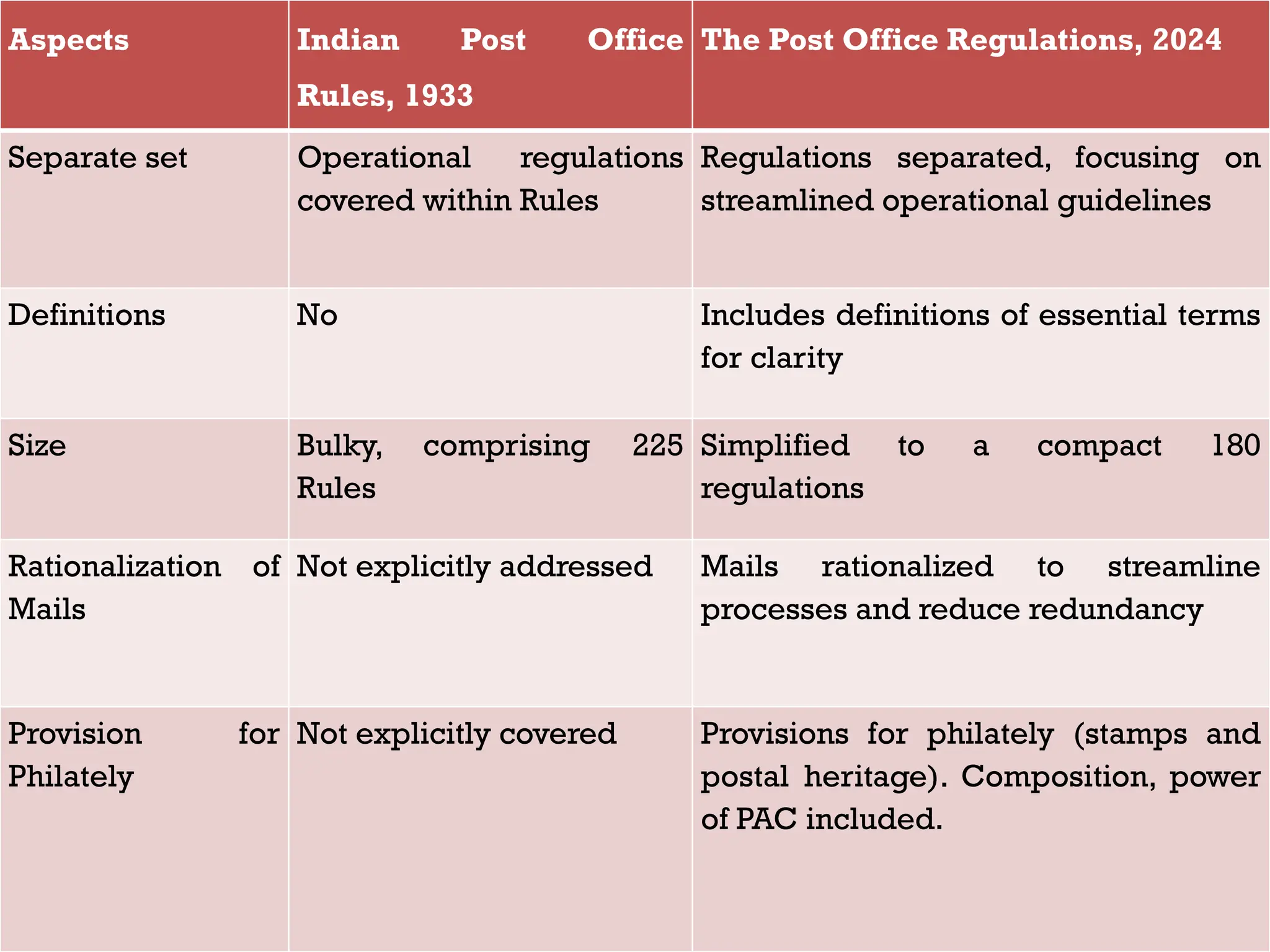
 Earlier, Rules and Regulatory provisions were incorporated in Indian
Post Office Rules, 1933. Now, both compiled and consolidated
separately as Post Office Rules, 2024 and Post Office Regulations, 2024.
Preliminary
Regulations 1 to 2
Short title and commencement
• Notification issued by the Department of Posts, Ministry
of Communications on _____day of _____, 2024
• The Post Office Regulations, 2024 came into force on
____day of______,2024, which comprises 180
regulations in 15 chapters & 5 Schedules.
Important Definitions
• “Accountable items” means such items that Provide a receipt for
tracking at booking and Require a recipient's signature (ink or digital)
for delivery confirmation,
• “Act” means the Post Office Act, 2023 (43 of 2023);
• “Addressee” means the intended recipient or the person to whom any
item is to be delivered;
• “Administrative instructions” means the executive or administrative
orders or instructions including guidelines issued as specified under
regulation 178 or regulation 179 or regulation 180, as the case may be;
• “Authorised person” means a person, duly authorised by the
addressee to receive the item or by a payee to receive the money on his
behalf;
• “Delivery” means the process of delivering an item to the addressee's
address or to an authorized person or location designated to receive it,
following the standard delivery practices for that addressee,
Important Definitions
• “Director (Postal Services)” means the Director in any administrative
office of the Post Office or an officer exercising the powers of Director
(Postal Services),
• “In course of transmission by post” means the period starting from
receipt of an item by the Post Office to its delivery to the addressee or return
to the sender or otherwise disposed of,
• “Letter box” means a box installed in Post Offices or mail offices or at
public places, for posting of fully prepaid letters, postcards, letter cards and
book post items,
• “Payee” means the person who intends to receive money through money
remittance services;
• “Post" means any system for collection, clearance, sorting, dispatch,
conveyance, and delivery of items by the postal network;
• “Postmaster” means the Director or Chief Postmaster of General Post
Office, or Senior Postmaster or Head Postmaster of Head Post Office, or an
officer exercising the powers of Postmaster, as the case may be, who is the
head of such Post Office;
Important Definitions
• “Redirection” means action of assigning or directing an
item to an address, other than the one to which it was initially
addressed, for a specific reason;
• “Remitter” means the person who remits money through
money remittance services;
• “Rules” means the Post Office Rules, 2024 and the
expression “rule” shall mean a rule of the said rules;
• “Schedule” means the schedule annexed to these
regulations;
• “Sender” means a person who sends any item; and
• “Weight” means gross weight or volumetric weight,
whichever is higher, except when stated otherwise.
Let’s have some quiz
1.Which of the following is NOT considered an "accountable item" under these
regulations?
1. A) India Post Parcel
2. B) Ordinary Letter
3. C) Speed Post
4. D) Money Order
Answer: B) Ordinary Letter
2.In the context of these regulations, who is defined as the 'payee'?
1. A) The person who sends any item
2. B) The person who receives money through money remittance services
3. C) The person who posts the item
4. D) The person authorized to deliver items
Answer: B) The person who receives money through money remittance services
3.What does "in course of transmission by post" refer to?
1. A) Only the period of sorting items in the postal office
2. B) From receipt of an item until its delivery, return, or disposal
3. C) The period of transporting items between cities
4. D) Only the delivery time of the item
Answer: B) From receipt of an item until its delivery, return, or disposal
5. Under these regulations, what is meant by "redirection"?
A) Returning an undelivered item to the sender
B) Delivering an item to an alternate address
C) Changing the weight classification of an item
D) Reclassifying the type of delivery service
Answer: B) Delivering an item to an alternate address
6. Who is referred to as the "Director (Postal Services)" in these regulations?
A) An officer responsible for handling international mail
B) The officer in charge of any administrative office of the Post Office or one
exercising Director-level powers
C) The person in charge of logistics operations at the Post Office
D) A supervisory officer in each postal region
Answer: B) The officer in charge of any administrative office of the Post Office or
one exercising Director-level powers
7. What is meant by 'weight' in the context of the Post Office Regulations, 2024?
A) Only the volumetric weight of the item
B) The weight after packaging only
C) Either gross weight or volumetric weight, whichever is higher
D) The weight after all postage stamps are added
Answer: C) Either gross weight or volumetric weight, whichever is higher
General
Regulations 3 to 40
Business hours
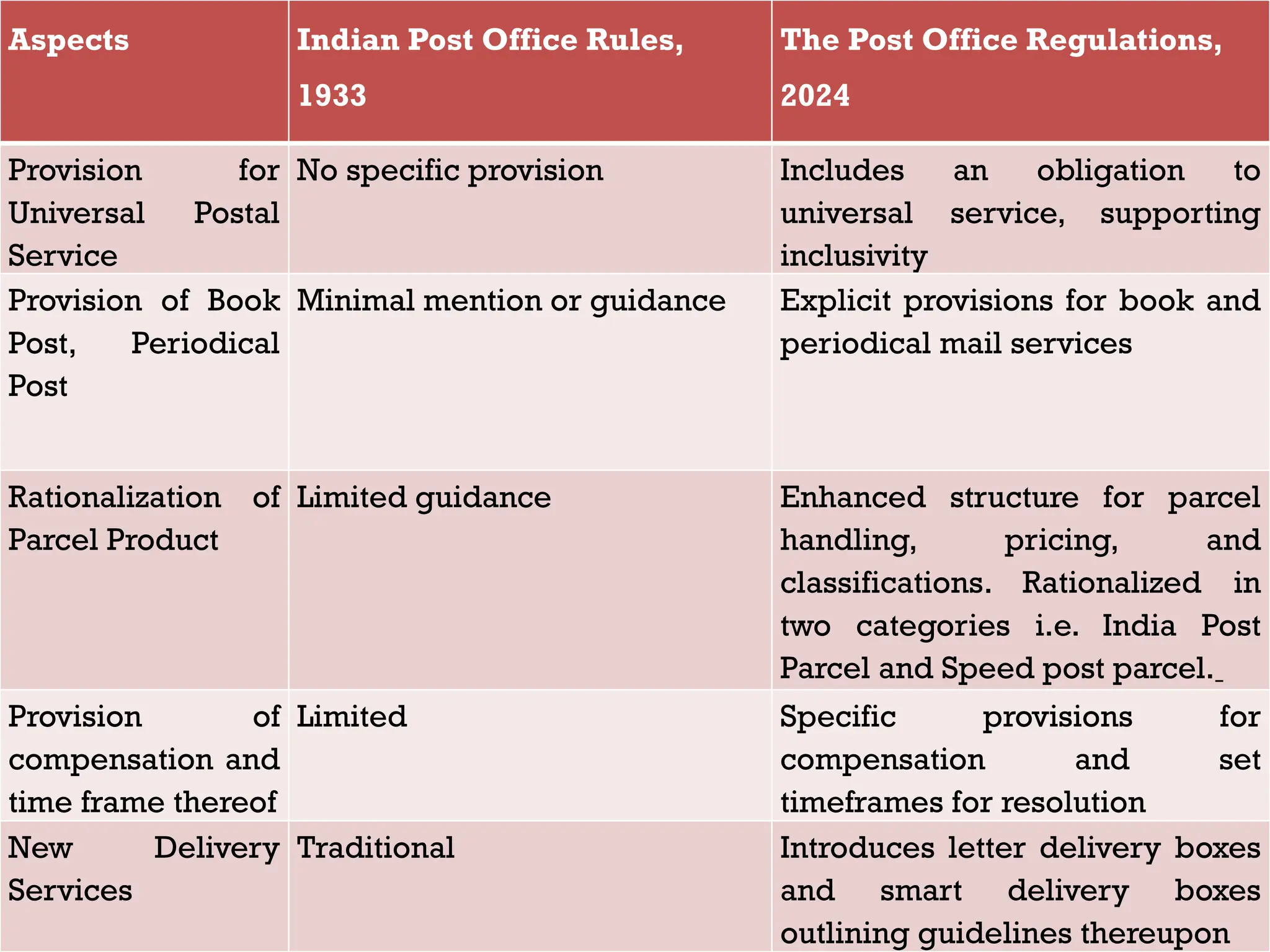
• Six hours prescribed as business hours for Post Offices, during which
business is transacted with the public.
• For references and enquiries, it shall be kept open for entire working
hours of the Office.
• Branch Post Offices shall be kept open for a maximum period of five
hours in a day.
• Circle/Regional/Divisional Head shall empower to specify the period of
business hours for each of PO under the Jurisdictions.
• Regional Head can authorize additional hours for high-demand services
or can fix hours/transaction limit as the case may be.
Payment of Postage
 Postage shall generally be paid by modes mentioned in
Rule-9,
 Pre-payment of postage and other sums payable shall be
mandatory except otherwise mentioned,
 Unpaid or insufficiently paid items are liable to be kept on
hold for charging the postage due on them,
 Invalid Conditions for Prepayment:
• Stamps or impressions not authorized by the regulations.
• Stamps that are defaced, torn, or otherwise damaged.
Payment of Postage
• Stamps or franking impressions with added words, letters,
or designs (unless officially marked by the Director
General).
• Stamps cut or separated from an embossed envelope,
postcard, or wrapper.
Exceptions:
• Stamps may have perforated identifying marks/initials.
• "Book Now Pay Later" (BNPL) items and others, as
specified in administrative guidelines, are exceptions to
this regulation.
Supply, fraudulent usage, illegal manufacture
and usage of Postage stamp
• Guidelines Set by Administration: Procedures for handling
i.e. supply, custody and sale of postage stamps shall be
specified in administrative instructions from time to time.
• Permission Required for Sale: Only those with Central
Government approval shall sell or distribute postage stamps.
• Penalties for Violations: Unauthorized sale or breach of
terms is punishable by law for time being in force.
• Punishable Offense: Reusing postage stamps fraudulently or
to cause loss to the Government is illegal and punishable by
law for time being in force.
Supply, fraudulent usage, illegal manufacture
and usage of Postage stamp
• Non-Delivery of Items: Items with detected reused stamps
shall not be delivered and will be handled as per
administrative instructions issued time to time.
• Counterfeit Stamps: Manufacturing or using forged,
counterfeit, or fictitious postage stamps is illegal and
punishable under applicable law.
• Allowed Reproductions: Stamps may only be reproduced
for philatelic publications or educational sections related to
postage, following specific administrative instructions issued
time to time.
Philately
• Definition and procedures: The study and collection of stamps, postal
stationery, postmarks, and other philatelic materials. Operational
procedures shall be specified by administrative instructions from time to
time.
• Philatelic Materials: These materials shall be issued, sold and activities
thereon as per administrative instructions from time to time. Materials
includes;
o Philatelic stamps,
o First day covers, brochures or information sheets, special covers,
maxim cards, annual packs, postal stationeries and various Philatelic
publications and ancillaries,
o Artworks, proofs, progressive sheets, printed sheets and printing
plates of philatelic stamps; and
o Postmarks, slogan dies and other artifacts used in connection with the
production of philatelic stamps.
Philately
• Issuance of Postage Stamps: The postage stamps shall be issued in the
following types;-
o Definitive Stamps: For everyday postage needs, reprinted as
necessary.
o Commemorative Stamps: Issued once to honor events, institute,
theme and personages in limited numbers and are sold for a limited
period, as may be specified by administrative instructions from time
to time, collectible and usable for postage.
o Special Stamps: Thematic stamps featuring flora, fauna, art or
architecture.
o Joint Issue Stamps: Issued on mutual agreed terms and conditions
with other countries.
o My Stamps: Customizable stamps based on user-provided elements.
Philately
• Issuance of Commemorative Stamps:
o Any citizen can propose a commemorative stamp in
accordance with administrative guidelines specified from
time to time,
o Proposals shall be examined on the basis of guidelines
and approved stamps shall be purchased in set quantities
unless exceptions allow,
o Stamp values shall be aligned with domestic and
international postal rates,
o Stamps shall not be issued featuring living individuals,
o The Central Government shall approve all stamp designs
and denominations,
o Philatelic items (e.g., stamps, brochures, first-day covers)
shall be sold at their denoted or specified values by the
Post Office,
Philately
• Philatelic Advisory Committee:-
o Advises on commemorative stamps, special stamps and
other related matters,
o The Union Minister- in -Charge of the Ministry of
Communications shall be the ex-officio Chairperson and
shall nominate the official and non-official members as per
the administrative instructions specified from time to time,
• Stamp Affixing:
o Stamps affixed to an item must be completely adherent to
the item itself,
o The stamps should be affixed to the right-hand top corner
of the address side,
o The provisions of this regulation shall apply to franking of
items in toto,
Regulations on Price, Booking etc.
• Single Delivery Address: Each item should have only one delivery
address. Exceptions may be made according to administrative guidelines
specified time to time.
• Address Format:
o Required Elements (in order): Name, C/o or similar, optional mobile
number, house/building, street, landmark, area, village/town, post
office, district, state, and PIN code.
o Placement: The recipient's address should be centered on the front of
the envelope, while the sender's address goes on the lower left,
starting with "To" and "From," respectively.
• Envelope Specifications:
o Margins: Minimum 15mm blank space on three sides; 40mm gap from
the top for the address block.
o Stamp/Frank Position: Limited to a 74mm area in the top right
corner.
Regulations on Price, Booking etc.
• Parallel Positioning: The address should be aligned parallel to the
envelope’s length.
• Clear Zone: A 10mm area around the address block should remain clear.
• Address Content Rules:
o Non-address information, like codes or serial numbers, should only
appear above the address, not below it.
o Uniform spacing of 1-5mm between lines; each line should contain a
maximum of 40 characters.
• Accountable Items:
o shall be addressed to a specific person or entity to be accepted.
o Items addressed to a registered post box are permitted. If the post box
is inactive or not registered in the name of addressee, item shall be
returned to the sender.
Regulations on Price, Booking etc.
• Addressing Standards for Defense Personnel (Army Post Offices):
o No. , Rank, Name, Unit
o Such items should be addressed to Care of (C/o) 56 A.P.O. or Care of
(C/o) 99 A.P.O.
• Exemption in method of addressing;
o Certain item(s) addressed to specific authorities, with specified
superscription on the envelope, shall be accepted without the sender’s
name and complete address as may be specified by administrative
instructions from time to time.
• Methods for Posting Items;
o Letter Boxes: Fully prepaid items like letters, aerogrammes, postcards,
book posts, small packets, printed papers, and literature for the blind.
o Restrictions: Registered newspapers, periodical posts, franked items
shall not be posted, if posted, shall be treated as unpaid. Accountable
items and Large items that don’t fit in the letter box can be handed over at
the post office counter.
Regulations on Price, Booking etc.
• Post Office Counter: All accountable items must be presented at the post
office counter for transmission.
• Franchisee Outlet: Items as specified, may be presented through the
franchisee outlet of the Post Office.
• Self-Booking Kiosk: Available at select Post Offices designated by the
Regional Head, allowing for self-service posting of items as per
administrative instructions.
• Web or Mobile Application: Authorized web portals or mobile apps may
be used for item posting, as may be specified by administrative
instructions from time to time.
Regulations on Price, Booking etc.
• A receipt shall be given to the person who presents an accountable item
for transmission by post.
• Ownership of the domestic and International article shall remain with the
sender until delivery to the intended recipient, except in cases of legal
seizure, laws of the origin, transit, or destination country.
• Prohibition of Domestic Items;
o Hazardous and Dangerous Items: Explosives, noxious substances,
unprotected sharp objects, and any items that could harm postal items
or staff.
o Injurious Materials: Any item likely to damage other mail or injure
postal employees.
o Lottery-Related Materials: Lottery tickets or advertisements, unless
authorized by the Central or State Government.
Regulations on Price, Booking etc.
o Obscene or Offensive Content: Items with indecent, obscene, or
offensive words, images, or messages.
o Law and Order Risks: Items with seditious or threatening content or
featuring images of convicted offenders.
o Drug-Related Substances: Narcotics, psychotropic substances, and
other illegal drugs as defined by law.
o Counterfeit Goods: Including pirated items and items
misrepresenting as postal stamps.
o Dangerous Goods: As per IATA and ICAO guidelines, including
batteries restricted from air transport.
Regulations on Price, Booking etc.
o Live Animals: Only allowed if specifically permitted by regulations.
o Valuable Items: Coins, currency notes, and other valuables, unless
sent via an insured service and in accordance with RBI guidelines.
o Prohibited Documents: Items containing personal correspondence
exchanged between unrelated third parties.
o Items Restricted by International or National Law: Any items
prohibited by UPU or as specified by the Central Government.
• Prohibition of international items;
o Non-Compliant Items: International items that do not meet the
specified postal regulations shall not be admitted.
o Fraudulent Intent: Items sent with the intention to commit fraud or
evade postal fees shall also not be admitted.
Regulations on Price, Booking etc.
• Prohibition on international items: Prohibition of domestic items shall
apply to International items as well except following;-
o Certain dangerous goods may be sent internationally if both the
origin and destination countries have agreed to allow them, following
relevant laws.
o Permissible Live Animals:
 Letter Post: Bees, leeches, silkworms, and specific parasites or
research flies are allowed if exchanged between recognized
institutions.
 Parcels: Live animals authorized by the postal regulations or by
applicable laws of the involved countries.
Regulations on Price, Booking etc.
• Transmission of precious metals and precious stones;
o Precious metals (gold, silver, platinum), precious stones (including
diamonds), jewelry, coins, banknotes, currency notes, securities, and
travelers’ cheques shall, in no case, be transmitted by post in an
uninsured letter-post items.
o Individual countries or territories may restrict the sending of gold
bullion, whether insured or uninsured, in parcels originating from,
addressed to, or transiting through their region.
• Items for blind prohibited in certain cases;
o Items (Printed papers & literature) shall not bear any inscription or
contain any item of correspondence.
o Items shall not contain postage stamps, prepayment forms, or any
monetary value papers, except when they include a prepaid return
card, envelope, or wrapper with the sender’s printed address.
Regulations on Price, Booking etc.
• Items transmitted in contravention of Regulation 27(Exception in
international items);
o Items that violate Regulation 27 shall, in no case, be forwarded to its
destination.
o If discovered in transit, it shall be handled under the applicable law of
the country or territory of transit.
o If discovered during transmission, non-compliant items shall be
removed and disposed of as specified by administrative instructions
from time to time. Remainder of the items shall be forwarded to its
destination together with information about the disposal of
inadmissible item.
Regulations on Price, Booking etc.
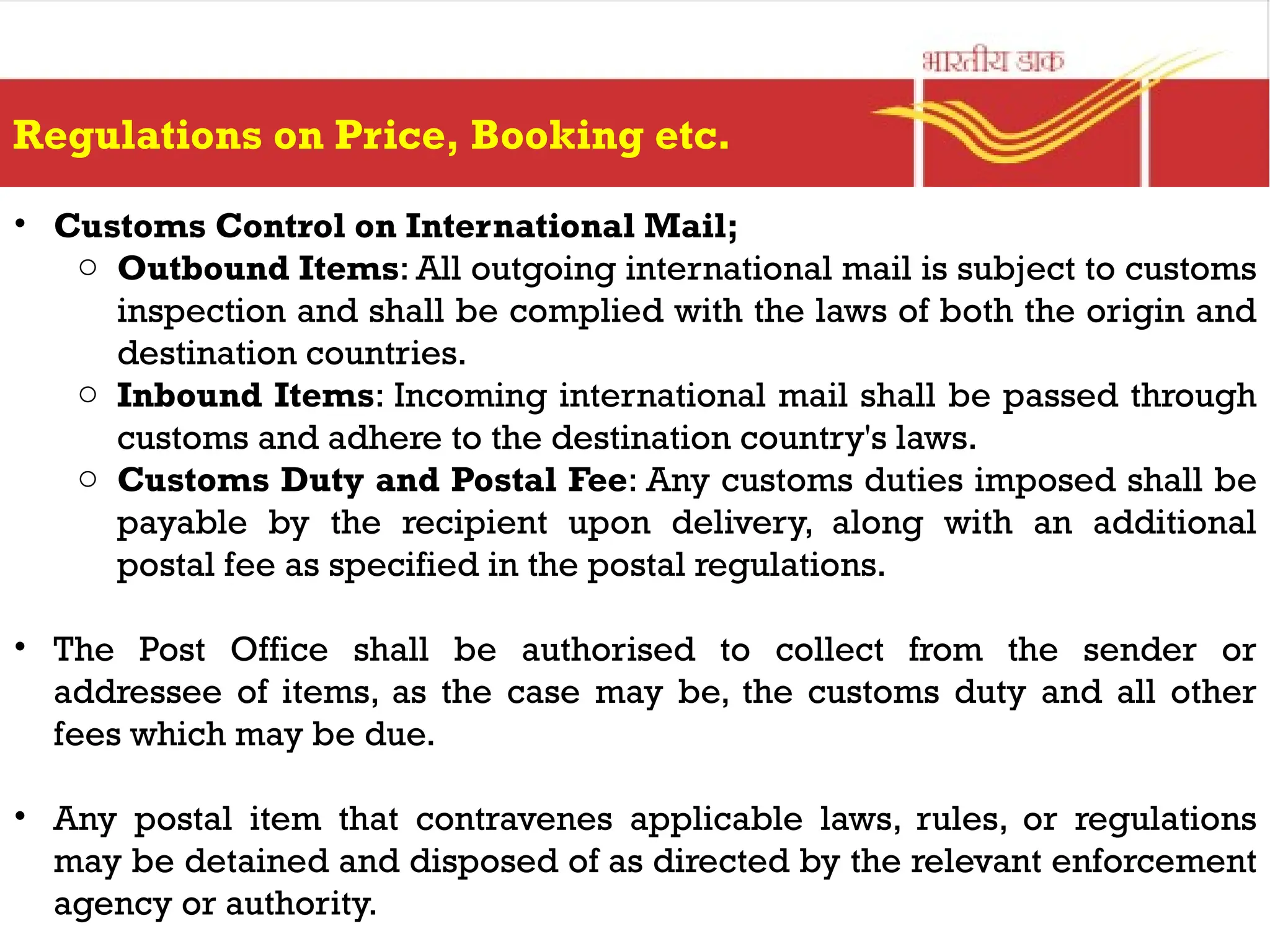
• Customs Control on International Mail;
o Outbound Items: All outgoing international mail is subject to customs
inspection and shall be complied with the laws of both the origin and
destination countries.
o Inbound Items: Incoming international mail shall be passed through
customs and adhere to the destination country's laws.
o Customs Duty and Postal Fee: Any customs duties imposed shall be
payable by the recipient upon delivery, along with an additional
postal fee as specified in the postal regulations.
• The Post Office shall be authorised to collect from the sender or
addressee of items, as the case may be, the customs duty and all other
fees which may be due.
• Any postal item that contravenes applicable laws, rules, or regulations
may be detained and disposed of as directed by the relevant enforcement
agency or authority.
Regulations on Price, Booking etc.
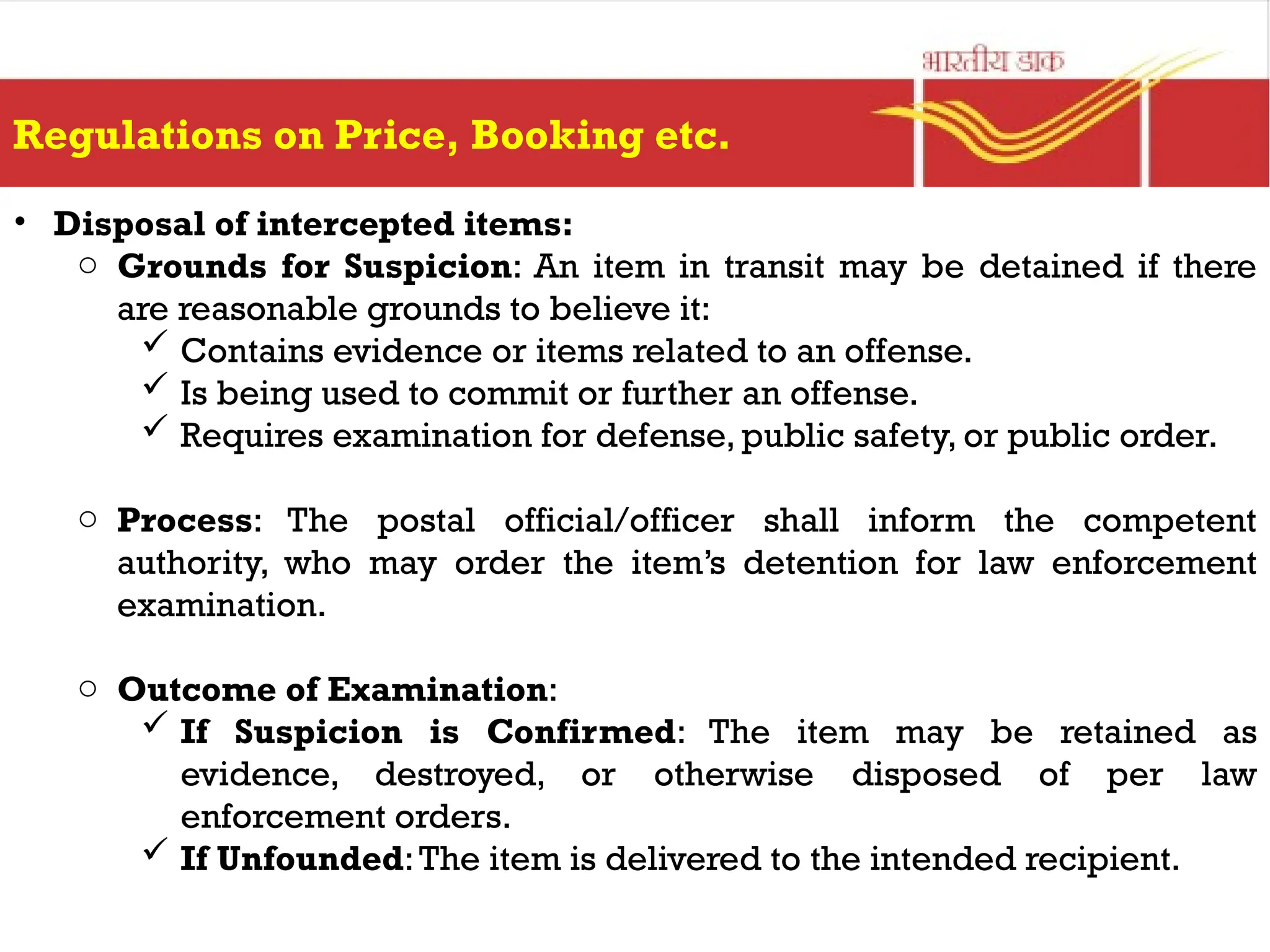
• Disposal of intercepted items:
o Grounds for Suspicion: An item in transit may be detained if there
are reasonable grounds to believe it:
 Contains evidence or items related to an offense.
 Is being used to commit or further an offense.
 Requires examination for defense, public safety, or public order.
o Process: The postal official/officer shall inform the competent
authority, who may order the item’s detention for law enforcement
examination.
o Outcome of Examination:
 If Suspicion is Confirmed: The item may be retained as
evidence, destroyed, or otherwise disposed of per law
enforcement orders.
 If Unfounded:The item is delivered to the intended recipient.
Regulations on Price, Booking etc.
• Items suspected to contain dangerous substances:
o Interception and Detention:
 If an item is suspected to contain explosives, dangerous or harmful
substances, or anything likely to harm postal items or staff, it will
be intercepted and detained at the point of detection.
o Notification of Authorities:
 The officer-in-charge of Post offiec shall immediately inform
Police authorities, Postal authorities, and any other relevant
agencies, as may be applicable.
o Further Action:
 The item shall be handled according to directions from the
concerned authorities.
Regulations on Price, Booking etc.
• Confidentiality in Postal Operations:
o Non-Disclosure Rule: Postal employees are prohibited from
disclosing any information or communication obtained during the
performance of their duties.
o Exceptions:
 If it is necessary for another person performing similar duties
under these regulations.
 When required by law or as evidence in a court of law.
Regulations on Price, Booking etc.
• Notice of Opening of Item: When an item opened by a postal officer is
deemed unlawful, a notice shall be sent to the sender. If the sender cannot
be located, the notice is sent to the addressee.
• No relief from Liability: The detention, opening, examination,
destruction, or disposal of an item under postal regulations does not
absolve any person from the liability for offenses committed in violation of
these regulations.
• No right to Compensation: No person shall have any right to
compensation for any actions taken by the Post Office—including
detention, opening, examination, forfeiture, destruction, or disposal of
items—under the powers granted by the Act, rules, or regulations. The
Post Office and its officials bear no liability for carrying out these actions.
Let’s have some quiz
1. What is the maximum area for stamps or franking impressions on an
envelope?
A) 50 mm
B) 74 mm
C) 100 mm
D) 60 mm
Answer: B) 74 mm
2. Who determines the price of Special Rakhi Envelopes?
A) Central Government
B) Regional Head
C) Circle Head
D) Post Office Manager
Answer: C) Circle Head
3. Which of the following items is NOT allowed in domestic mail?
A) Books
B) Narcotics
C) Letters
D) Magazines
Answer: B) Narcotics
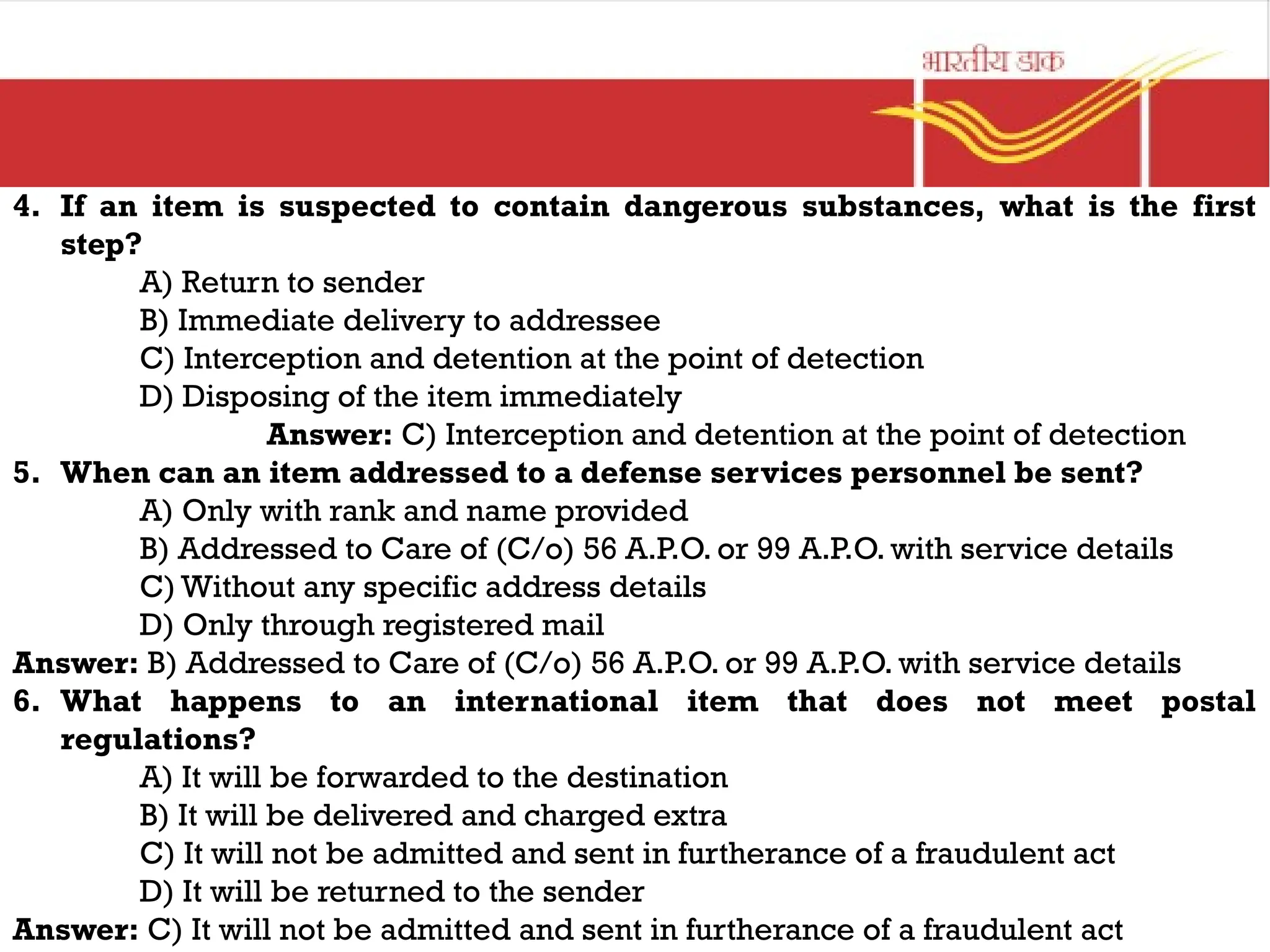
4. If an item is suspected to contain dangerous substances, what is the first
step?
A) Return to sender
B) Immediate delivery to addressee
C) Interception and detention at the point of detection
D) Disposing of the item immediately
Answer: C) Interception and detention at the point of detection
5. When can an item addressed to a defense services personnel be sent?
A) Only with rank and name provided
B) Addressed to Care of (C/o) 56 A.P.O. or 99 A.P.O. with service details
C) Without any specific address details
D) Only through registered mail
Answer: B) Addressed to Care of (C/o) 56 A.P.O. or 99 A.P.O. with service details
6. What happens to an international item that does not meet postal
regulations?
A) It will be forwarded to the destination
B) It will be delivered and charged extra
C) It will not be admitted and sent in furtherance of a fraudulent act
D) It will be returned to the sender
Answer: C) It will not be admitted and sent in furtherance of a fraudulent act
7. If a postal item is opened and found to be lawful, what action is
taken?
A) The item is discarded
B) The item is returned to the sender
C) The item is delivered to the recipient as if unopened
D) The item is kept in postal custody
Answer: C) The item is delivered to the recipient as if unopened
8. Which of the following requires an official notice if found unlawful?
A) If the item is disposed of without inspection
B) If the item is opened under section 9 of the Act
C) If the item is deemed low-risk
D) If the item is returned without further inspection
Answer: B) If the item is opened under section 9 of the Act
9. What is required if an item addressed internationally contains
narcotics?
A) The item is handled according to transit country laws
B) The item is immediately delivered to the addressee
C) It is returned to the sender
D) It is discarded with no record
Answer: A) The item is handled according to transit country laws
10. Under which circumstances can a postal officer disclose
information obtained during duty?
A) Only for official functions or as required by law
B) To anyone asking for the information
C) Only to the sender
D) For any personal reason
Answer: A) Only for official functions or as required by law
Manner of Delivery of Items
Regulations 41 to 72
• Delivery of Accountable Items: Accountable items like registered items,
insured items, Money order and CODs shall be delivered to the addressee
or authorized person. In case of Speed post item, India Post parcel etc., it
shall be delivered to the authorized person or on the address.
• Single Attempt for Delivery of accountable items: Accountable items
shall be issued for delivery only once. If not delivered on the first
presentation, it shall be brought back to the Post Office and shall not be
issued again for delivery. A notice of arrival of the accountable item shall
be issued to the addressee for taking delivery of item himself or by
authorised person from the PO.
• Addressee Signatures and Verification: The addressee or authorized
person shall sign for receipt. If tampering appears suspicious, items shall
be opened in the presence of the Postmaster at PO and contents shall be
inventoried which shall be prepared in duplicate and shall be signed by
the addressee.
Delivery & Disposal of items
 Letter Delivery Boxes of items other than accountable items:
• Use of Post Box or Post Bag: Items may be delivered to the addressee's
post box or post bag if they have opted for these facilities.
• Delivery to Letter Delivery Box: For addressees without a post box or
post bag, items will be delivered to a letter delivery box installed at their
premises.
• Installation Requirements:
o A letter delivery box, labeled with the addressee’s name and address,
should be placed on the ground floor of each house and building
(with two or more storeys).
o It should be conveniently accessible for the Postman or delivery
person.
o A common delivery box may be installed for multiple addressees on
the same floor or within the same floor of building.
Delivery & Disposal of items
• Intimation for Undelivered Items: If an item requiring receipt remains
undelivered due to the addressee’s unavailability, an intimation may be left in
the letter delivery box or sent digitally.
• Design Specifications: Each letter delivery box shall have a top-facing
posting aperture with a horizontal ledge on the inside edge to facilitate secure
delivery.
• Lack of Letter Delivery Box: If the required letter delivery box shall not be
installed, the delivery of such items shall only be effected at the Post Office till
the time the letter delivery box is installed. If a building faces genuine
difficulties in complying, the Divisional Head may exempt it from this
regulation with written justification.
• Oversized or Unpaid Items:
o Items too large for the delivery box or unpaid/insufficiently paid items
will be delivered in person to the addressee or authorized person.
o Delivery of unpaid or insufficiently paid items is conditional upon the
collection of due postage.
Delivery & Disposal of items
• Window Delivery : The addressee of an item may avail the facility of receiving
items at the Post Office during business hours without having the facility of post
box or post bag system, by giving a written request to the Postmaster without any
charge and in such case, the item shall not be given to Postman for doorstep
delivery.
• Post Box & Post Bag : A person, a firm, or other body, may avail the facility of
post box/Post bag at certain Post Offices by an application accompanied by the
applicable fee for delivery of fully prepaid items bearing the post box/post bag
number, through the post box/post bag. The conditions related to the post
box/post bag shall be specified by administrative instructions from time to time.
• Smart Delivery Box :
o The Circle Head is authorised to designate the Post Offices or other locations,
where the services of the smart delivery box are available.
o The service shall be availed by anyone by applying to the Post Office along
with the fee or charge as specified.
o The smart delivery box shall be used for delivery of such items addressed to
the assignee of the box as specified from time to time.
Delivery & Disposal of items
• Delivery to Public Officers:
o Items Marked "On India Government Service":
 Items addressed to a public officer with both name and designation, or
does not contain the official designation, shall be delivered or redirected
based on the official designation, even if the officer no longer holds the
position or has relocated.
o ItemsWithout "On India Government Service" Marking:
 If the item includes both the officer's name and designation, it will be
delivered based on the name.
 If only the designation is included, the item will be delivered to
designation accordingly.
• Special procedure for delivery to firm etc.: Items addressed to a firm or
company will be delivered to an authorized person designated by the owner,
partner, or proprietor on an authority letter to the Postmaster at the delivery Post
Office, authorizing the recipient to collect the mail.
• Items addressed to deceased persons: Items addressed to persons who are
dead, shall be treated as if they were unclaimed and disposed of as per provisions,
Delivery & Disposal of items
• Delivery of damaged item: Where an accountable item is received in the
office of delivery in a damaged condition, a notice shall be sent to the
addressee requesting him to attend the Post Office within seven days in
the case of domestic item and fifteen days in the case of international item
to take delivery and the delivery or disposal of such item shall be effected
as may be specified by administrative instructions.
• Seeking identification, if needed: The delivery of accountable items
containing passport, Permanent Account Number(PAN) card, driving
licence, and other items, shall be delivered only after seeking the
identification of the recipient in a manner as may be specified by
administrative instructions from time to time.
Delivery & Disposal of items
 Redirection and request facilities for accountable items:
• Redirection Options:
o Sender’s Facilities:The sender can:
 Recall an accountable domestic or international item on paying
applicable fees (may be cancelled if not yet dispatched from booking
office).
 Change the address or name of the addressee without their consent.
o Addressee’s Facilities:The addressee can request an address change:
 Free within the same Post Office delivery area.
 For a fee if it is outside the area.
• Request Process:
o Requests shall be in writing, include reasons, and be accompanied by the fee.
o International requests shall be limited to specified destinations as specified.
o Fees are non-refundable in such case.
• Liability and Refunds :
o The Post Office is not liable if a request cannot be fulfilled and may refund the
request fee if the application is not honored.
Delivery & Disposal of items
• Postage Payable on Delivery :
o The Postmaster or officer in charge ensures that postage is collected
for:
 Insufficiently paid items mistakenly treated as fully prepaid.
 Unpaid items lacking a postage-due stamp.
 Items with incorrect postage from the dispatch office.
• Postage-Due Stamp :
o Application: The postage-due stamp shall be impressed on the items,
with the amount marked and initialed by the Postmaster or authorized
official.
o Foreign Postage Handling:
 Only the foreign post office of entry shall charge postage due to
international items.
 Unpaid foreign items lacking a "T-stamp" or correct postage
marking will be returned to the foreign post office for proper
taxation before delivery.
o Exemptions: Items with phrases like "Tax persue" or "Port payé" from
the origin country, indicating postage paid without an amount, are
Delivery & Disposal of items
• Delivery of items on which customs duty is due: Items on which customs duty to
be recovered is in excess of the amount as specified from time to time, shall
ordinarily be delivered at the Post Office window and such duty may be paid
either in cash or by cheque or by any other specified mode.
• Refusal of Items :
o The addressee may refuse an item and is not obligated to pay any amount due
on it. In such cases, the Postman will mark "Refused" on the item.
o Domestic Items: Unclaimed or refused items are returned to the sender’s
Post Office. If the sender cannot be located, the item is sent to the Returned
Letter Office (RLO).
o International Items: Refused or unclaimed international items shall be
returned to the foreign post office for further disposal.
o If a person takes delivery of an item, a sender or addressee shall pay the
amount marked due.
• Deposit of Undelivered Items at the Post Office:
o Ordinary deposit period : Seven days.
o Extended Deposit upon Request: If the addressee requests the item to be
held, it will remain in the Post Office for a specified period as per
administrative instructions.
Delivery & Disposal of items
• Return of Undelivered Items:
o Conditions for Return: An undelivered item will be returned if;
• The addressee refuses or does not collect it within the specified period.
• The addressee has left without information as to the redirection.
• The addressee is deceased with no recipient to accept the item.
o Return Process: If the sender’s name and address are visible, the item shall
be returned to the sender. Otherwise, it shall sent to the Returned Letter Office
(RLO).
o Proof of Delivery: Any proof of delivery accompanying the item shall be
destroyed before returning item to the sender or RLO.
• Standard remarks on undelivered items:
o The reasons for non-delivery shall be recorded by use of the standard
remarks, as specified.
o An item bearing the official Post Office mark with these remarks denote as
proof of the fact so denoted. The person from whom the item is purported to
have come, shall be deemed to be the sender, until proven otherwise.
Delivery & Disposal of items
• Detention and Disposal of Undelivered Items at the Returned Letter
Office (RLO):
o Detention Period
 Unaccountable Items: Held for 15 days at the RLO.
 Accountable Items: Held for 30 days at the RLO.
o The RLO shall manage undelivered items, including those unclaimed,
refused, or with incomplete addresses.
o Disposal Procedure : After the specified detention period, undelivered
items shall be disposed of in a manner as deemed fit by HOC/HOR
concerned as follows:
 Items without intrinsic value (e.g., printed/handwritten papers) shall
be either sold as waste or destroyed.
 Magazines, periodicals, and newspapers may be used for public
purposes as per the Regional Head’s discretion.
 Items with intrinsic value shall be auctioned.
 Unpaid postcards and letter cards shall be destroyed immediately.
o Nothing shall prevent the immediate destruction of any item deemed
necessary for public good.
Delivery & Disposal of items
• Validity of intimation for change of address:
o A resident can give written intimation, regarding change in his residential or
official address, to the concerned Post Office for delivery of the items.
o Intimation shall remain valid for the period not exceeding 3 months.
o The provisions of redirection of items shall mutatis mutandis applicable.
• Authorized Officers/Officials to make an official mark:
o The following officials are authorized to mark items indicating unpaid
postage or undeliverable status:
 Postmaster of the office.
 Supervisor and assigned delivery officials handling the items.
 Postman or authorized delivery person.
 In Branch Post Offices, the GDSBPM and GDS responsible for delivery
duties.
o The procedure for the purposes of these regulations shall be as specified by
administrative instructions from time to time.
• For outward international items with unpaid or insufficient postage, the item will
not be forwarded. Instead, it will be returned to the sender without any charge.
Delivery & Disposal of items
Let’s have some quiz
1. How many delivery attempts are made for accountable items ?
A) One
B) Two
C) Three
D) Four
Answer: A) One
2. If an accountable item is not delivered on the first attempt, what is to be sent
to the addressee?
A) Another delivery attempt
B) A notice of arrival
C) A refund
D) The item is returned to the sender
Answer: B) A notice of arrival
3.Who is authorized to sign for an accountable item upon delivery?
A) Only the addressee
B) The addressee or authorized person
C) Any household member
D) Only the Postman
Answer: B) The addressee or authorized person
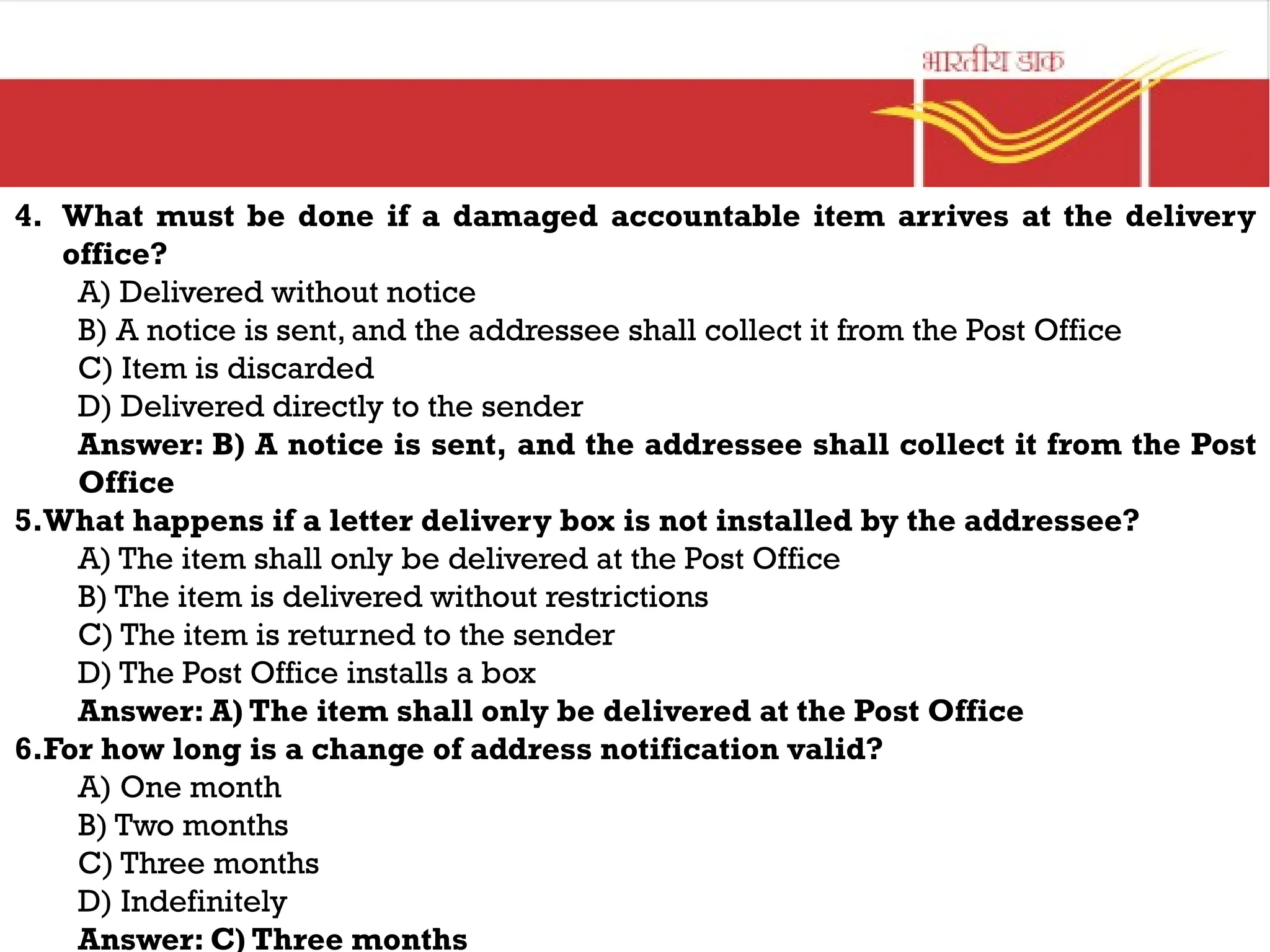
4. What must be done if a damaged accountable item arrives at the delivery
office?
A) Delivered without notice
B) A notice is sent, and the addressee shall collect it from the Post Office
C) Item is discarded
D) Delivered directly to the sender
Answer: B) A notice is sent, and the addressee shall collect it from the Post
Office
5.What happens if a letter delivery box is not installed by the addressee?
A) The item shall only be delivered at the Post Office
B) The item is delivered without restrictions
C) The item is returned to the sender
D) The Post Office installs a box
Answer: A) The item shall only be delivered at the Post Office
6.For how long is a change of address notification valid?
A) One month
B) Two months
C) Three months
D) Indefinitely
Answer: C) Three months
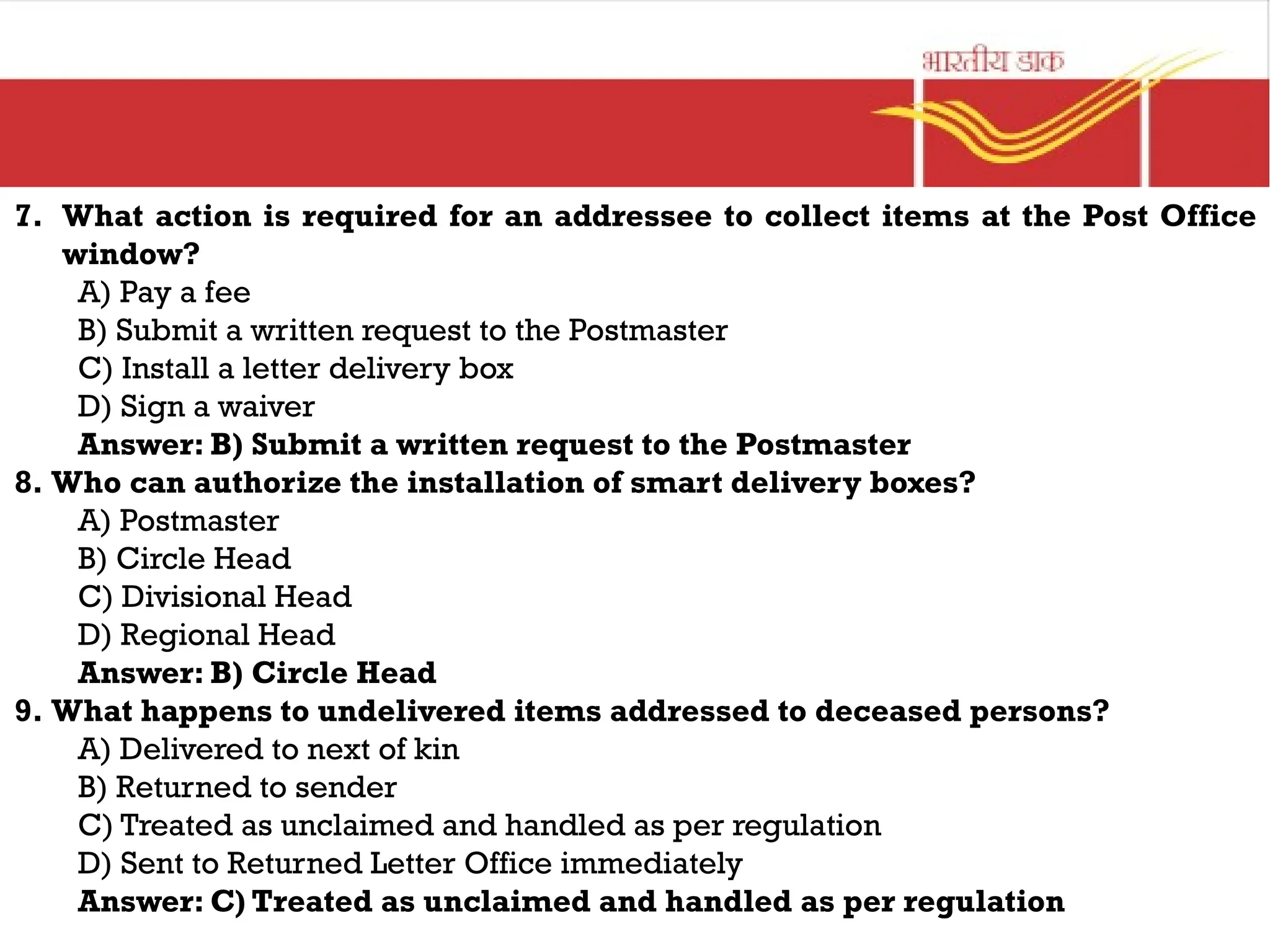
7. What action is required for an addressee to collect items at the Post Office
window?
A) Pay a fee
B) Submit a written request to the Postmaster
C) Install a letter delivery box
D) Sign a waiver
Answer: B) Submit a written request to the Postmaster
8. Who can authorize the installation of smart delivery boxes?
A) Postmaster
B) Circle Head
C) Divisional Head
D) Regional Head
Answer: B) Circle Head
9. What happens to undelivered items addressed to deceased persons?
A) Delivered to next of kin
B) Returned to sender
C) Treated as unclaimed and handled as per regulation
D) Sent to Returned Letter Office immediately
Answer: C) Treated as unclaimed and handled as per regulation
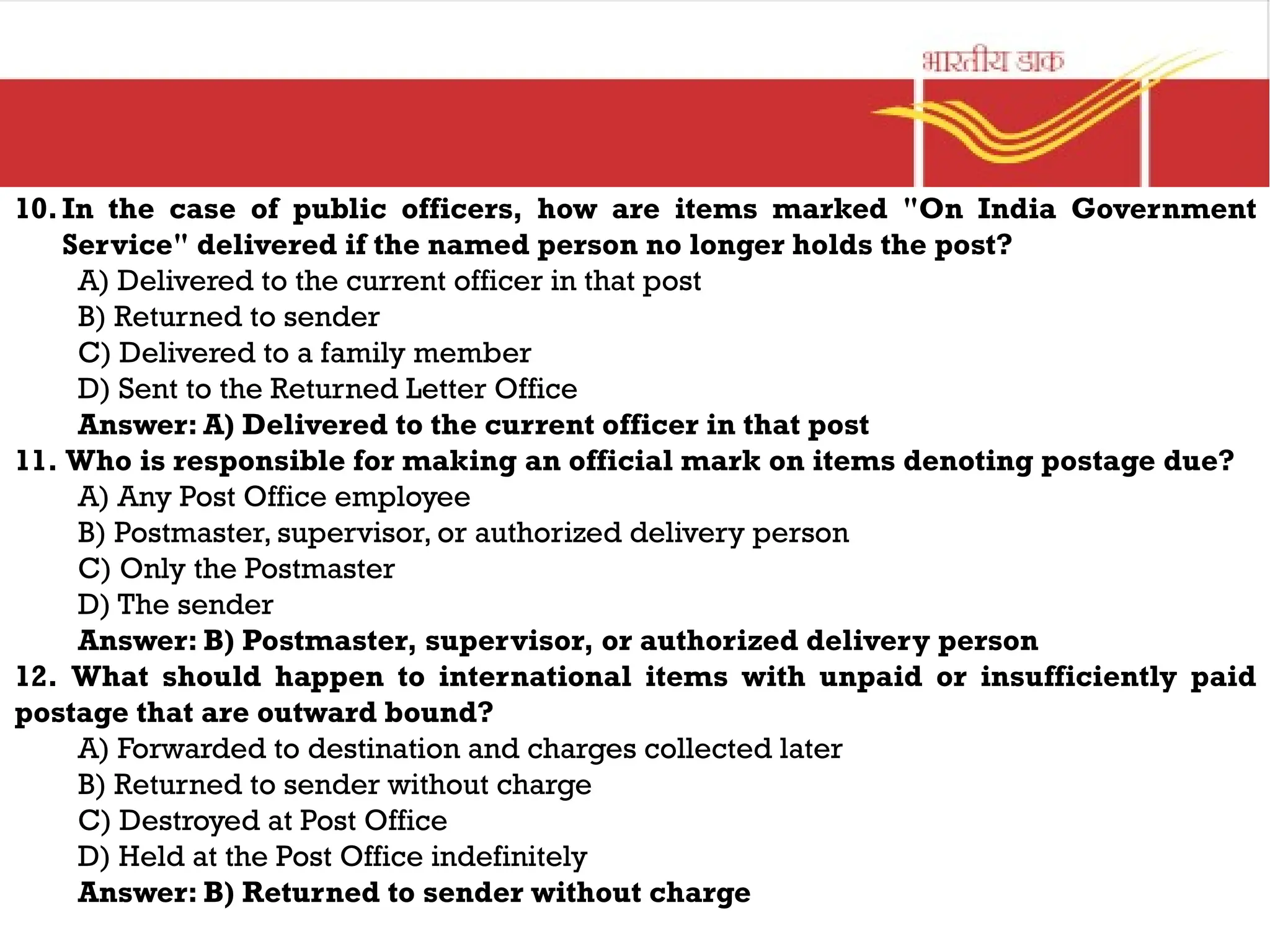
10.In the case of public officers, how are items marked "On India Government
Service" delivered if the named person no longer holds the post?
A) Delivered to the current officer in that post
B) Returned to sender
C) Delivered to a family member
D) Sent to the Returned Letter Office
Answer: A) Delivered to the current officer in that post
11. Who is responsible for making an official mark on items denoting postage due?
A) Any Post Office employee
B) Postmaster, supervisor, or authorized delivery person
C) Only the Postmaster
D) The sender
Answer: B) Postmaster, supervisor, or authorized delivery person
12. What should happen to international items with unpaid or insufficiently paid
postage that are outward bound?
A) Forwarded to destination and charges collected later
B) Returned to sender without charge
C) Destroyed at Post Office
D) Held at the Post Office indefinitely
Answer: B) Returned to sender without charge
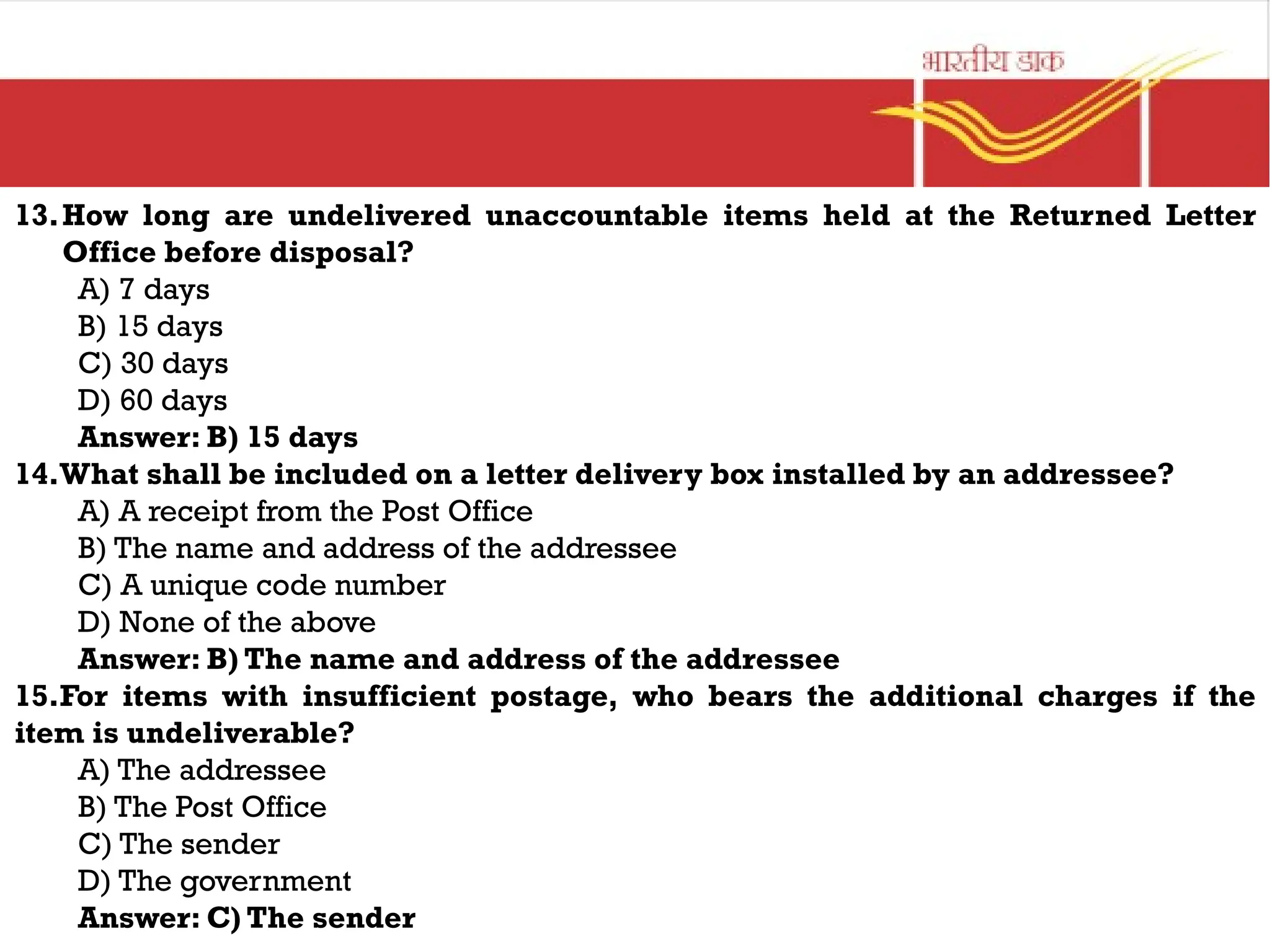
13.How long are undelivered unaccountable items held at the Returned Letter
Office before disposal?
A) 7 days
B) 15 days
C) 30 days
D) 60 days
Answer: B) 15 days
14.What shall be included on a letter delivery box installed by an addressee?
A) A receipt from the Post Office
B) The name and address of the addressee
C) A unique code number
D) None of the above
Answer: B) The name and address of the addressee
15.For items with insufficient postage, who bears the additional charges if the
item is undeliverable?
A) The addressee
B) The Post Office
C) The sender
D) The government
Answer: C) The sender
Compensation
Regulations 73 to 86
• Compensation for Domestic Items :
o Eligibility : The Central Government shall provide compensation for loss,
damage, partial loss, or delay of a domestic item, except as otherwise
specified.
o Exceptions: No compensation shall be considered if:
 The item is undeliverable due to incorrect, incomplete, or unsafe
addressing, unoccupied premises, or health and safety risks.
 Conditions required by regulations are unmet, such as insufficient
postage or presence of prohibited items.
 The item is undeliverable due to uncontrollable events (e.g., severe
weather, terrorism etc).
o Compensation Amount: Details of compensation amounts are specified in
Table V of Schedule I to this Regulations.
• Compensation for Insured Items :
o Amount: Compensation up to the insured value shall be payable for loss,
damage, or partial loss during transmission by post except in cases as
specified by administrative instructions from time to time .
o Limitations: The compensation cannot exceed the actual value of lost or
damaged items. Full details of the item’s contents and value shall be provided
by the sender.
Compensation, Complaints, and Treatment of
Lost or Insured Items (domestic)
• Filing Complaints :
o Time frames:
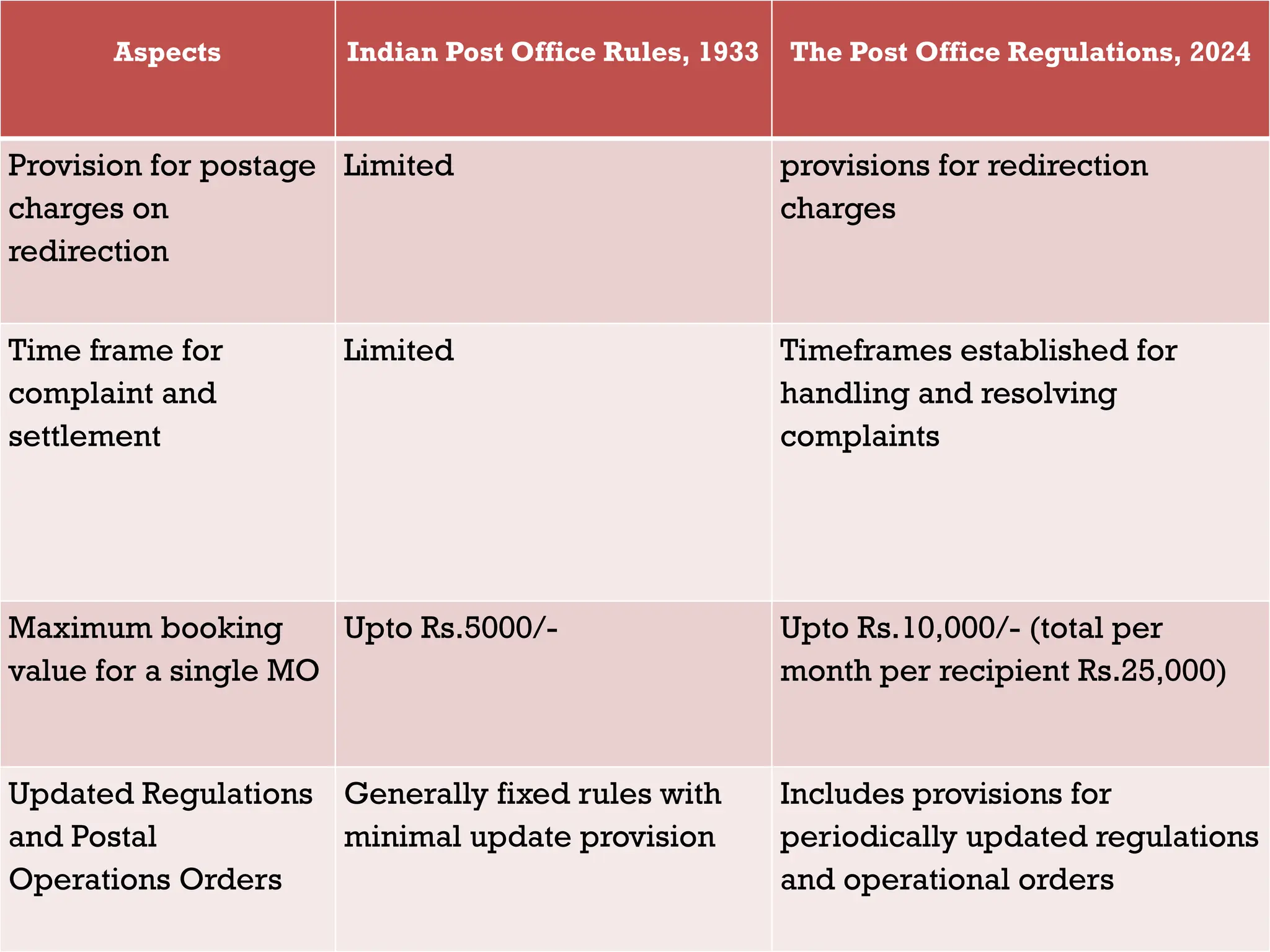
 Non-Receipt: Complaints for non-receipt shall be made between
15 and 60 days after booking.
 Damage or Loss: Complaints for damage or loss shall be filed
within 2 days of receiving the item.
o Claim Limitation: No claims for compensation shall be accepted if
filed more than 60 days after posting.
o Modes of Complaint: Complaints may be filed through channels
specified in this Regulation following administrative instructions from
time to time.
• Payment of Compensation :
o Timeline: Compensation is to be paid within 30 days of the sender’s
notification of loss, followed by an additional 10 days for processing.
o Delayed Payment: Compensation may be provided if there is a
delay, as per administrative instructions from time to time.
Compensation, Complaints, and Treatment of
Lost or Insured Items
• Treatment of Items as Lost:
o Timeframe for Declaring Loss: An item may be declared lost in
absence of final delivery status, shall be 60 days from date of
booking or 30 days from the date of receipt of complaint, whichever
is later, provided the complaint shall be filed within this period.
o Compensation for Declared Lost Items: Compensation for lost
items shall be paid within 10 days of the item being officially
declared lost.
o Claim Requirements: Valid proof of booking and a written request
shall be submitted by the sender or addressee to claim
compensation.
Compensation, Complaints, and Treatment of
Lost or Insured Items
• Compensation for International Items :
o Eligibility: Compensation shall be payable only for accountable
international items, subject to the conditions mentioned in these
regulations.
o Exceptions:
 No compensation if undeliverable due to incomplete/incorrect
address, unsafe location, or other delivery impediments.
 Exclusions include insufficient postage, prohibited contents, force
majeure events, or Customs-related issues.
 Registered bulk bags (M Bags) and items seized or lost due to
sender negligence, fraud, or impractical circumstances are also
excluded.
o Compensation Amount: Details of compensation amounts are
provided in Table IX of Schedule III.
Compensation, Complaints etc. for
International Items
• Complaint Filing for International Items :
o Timeframes:
 Damage or Partial Loss/theft: Complaint shall be filed within 24 hours
of receipt.
 Non-Receipt:
• Parcels/Registered/Insured Items: Within 6 months of posting
date.
• Express Mail Service:Within 4 months of posting date.
o Limitations: No claims shall be accepted after the timelines specified above.
• No Compensation in Certain Cases :
o Ineligible Cases:
 Fault or negligence by sender, fraud, inadequate packaging, force
majeure events (e.g., war, natural disasters).
 Issues like improper insurance value, seizure by authorities, or refusal by
addressee without immediate complaint.
Refund: The sender shall eligible for a refund of service charges and fees if no
compensation is payable, except for the insurance fee.
Compensation, Complaints etc. for international
Items
• Settlement Period for Compensation :
o Settlement Timeline: Compensation shall be settled within 30 days
of the complaint date or claim application date.
o Delayed Settlement: Compensation shall be payable in event of any
delay for reasons to be recorded in writing as specified by
administrative instructions from time to time.
o Claim Requirements: The sender or addressee shall submit valid
proof of booking and a formal request, as per administrative
guidelines.
Compensation, Complaints etc. for international
Items
• A sender or addressee may make a complaint through the following
means:
o Suggestion and Complaints Book: Available at all Post Offices during
working hours.
o Web Portal of the Post Office.
o Social Media platforms.
o Toll-Free Numbers for the purpose.
o Written Complaint
• The Director General may issue administrative instructions specifying
the officers authorized to handle complaints, based on the compensation
amount and jurisdiction. Complaints are to be reviewed with a formal
decision recorded in writing, ensuring a fair hearing opportunity for the
complainant.
Complaint, how to be made
• Suspension or Restriction of Transmission :
o Authority:The Circle Head or Regional Head may suspend or restrict
the acceptance and dispatch of specific types or classes of items at
any Post Office within their jurisdiction.
• Handling of Counterfeit Currency :
o Counterfeit currency received by the Post Office for any purpose shall
be dealt with in the manner mentioned under the instructions and
guidelines relating to the detection and impounding of counterfeit
currency, issued by the Reserve Bank of India or the Ministry of
Finance.
Suspension, Transmission, and Treatment of
Specific Items
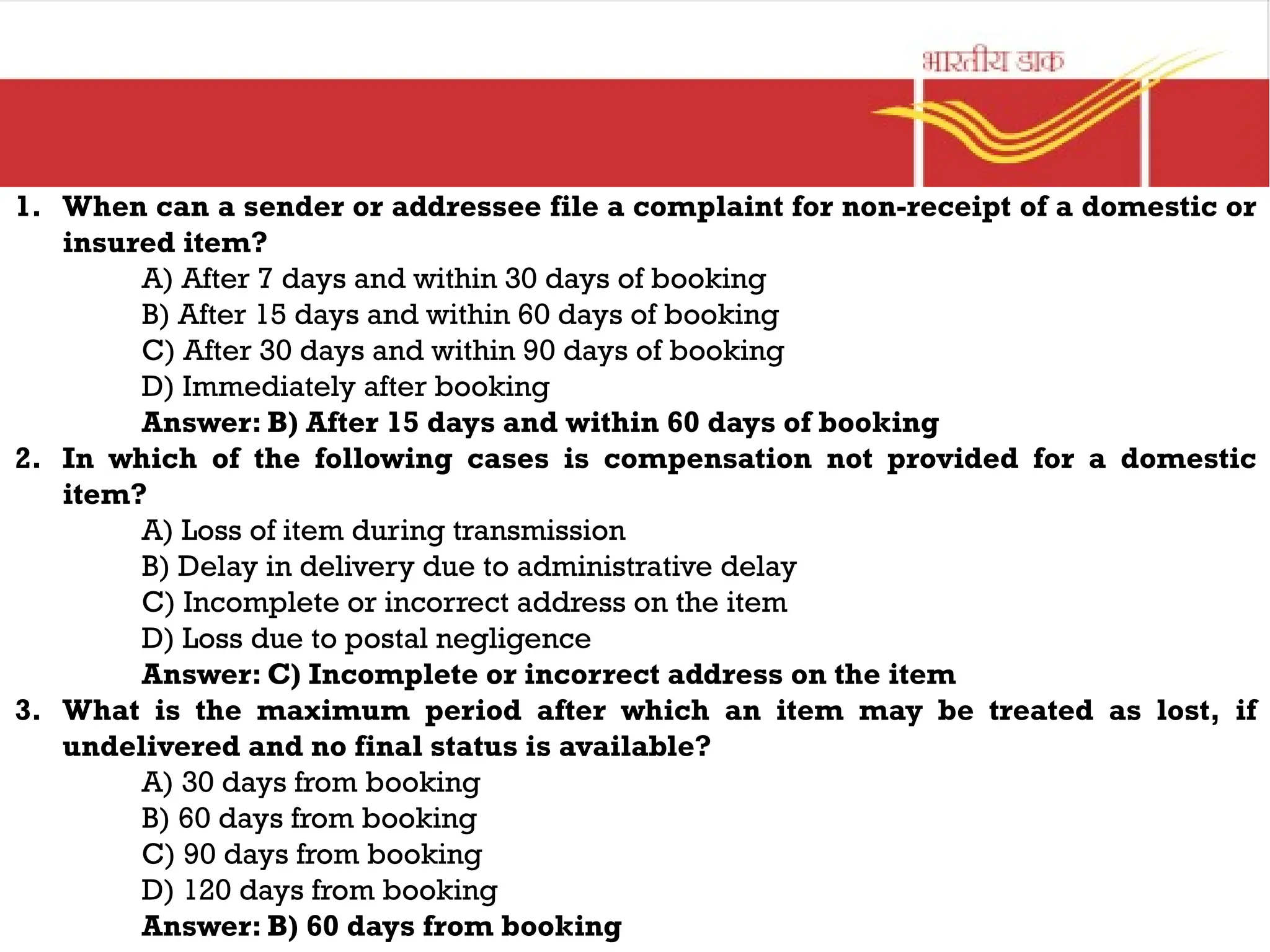
Lets have some Quiz
1. When can a sender or addressee file a complaint for non-receipt of a domestic or
insured item?
A) After 7 days and within 30 days of booking
B) After 15 days and within 60 days of booking
C) After 30 days and within 90 days of booking
D) Immediately after booking
Answer: B) After 15 days and within 60 days of booking
2. In which of the following cases is compensation not provided for a domestic
item?
A) Loss of item during transmission
B) Delay in delivery due to administrative delay
C) Incomplete or incorrect address on the item
D) Loss due to postal negligence
Answer: C) Incomplete or incorrect address on the item
3. What is the maximum period after which an item may be treated as lost, if
undelivered and no final status is available?
A) 30 days from booking
B) 60 days from booking
C) 90 days from booking
D) 120 days from booking
Answer: B) 60 days from booking
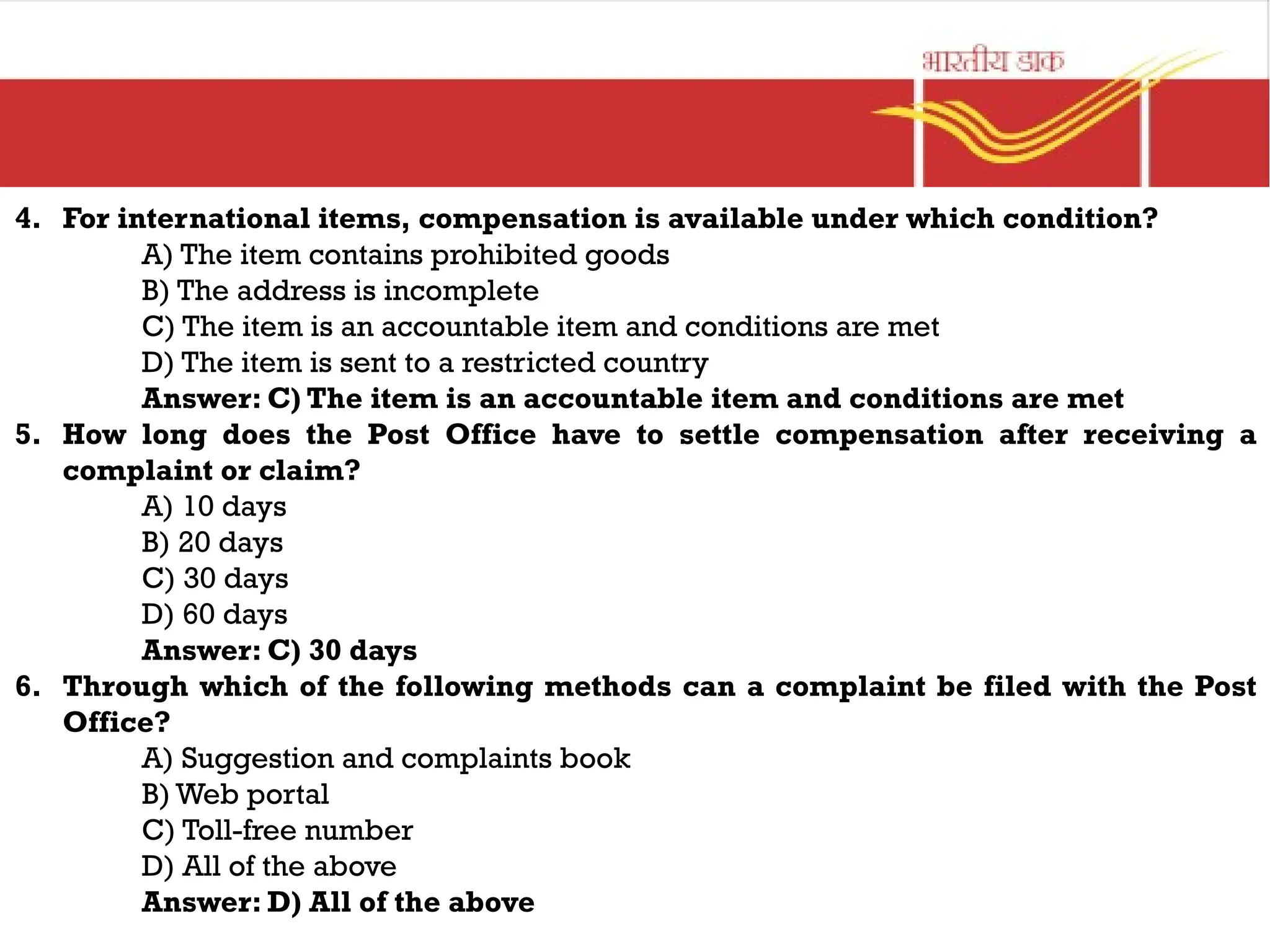
4. For international items, compensation is available under which condition?
A) The item contains prohibited goods
B) The address is incomplete
C) The item is an accountable item and conditions are met
D) The item is sent to a restricted country
Answer: C) The item is an accountable item and conditions are met
5. How long does the Post Office have to settle compensation after receiving a
complaint or claim?
A) 10 days
B) 20 days
C) 30 days
D) 60 days
Answer: C) 30 days
6. Through which of the following methods can a complaint be filed with the Post
Office?
A) Suggestion and complaints book
B) Web portal
C) Toll-free number
D) All of the above
Answer: D) All of the above
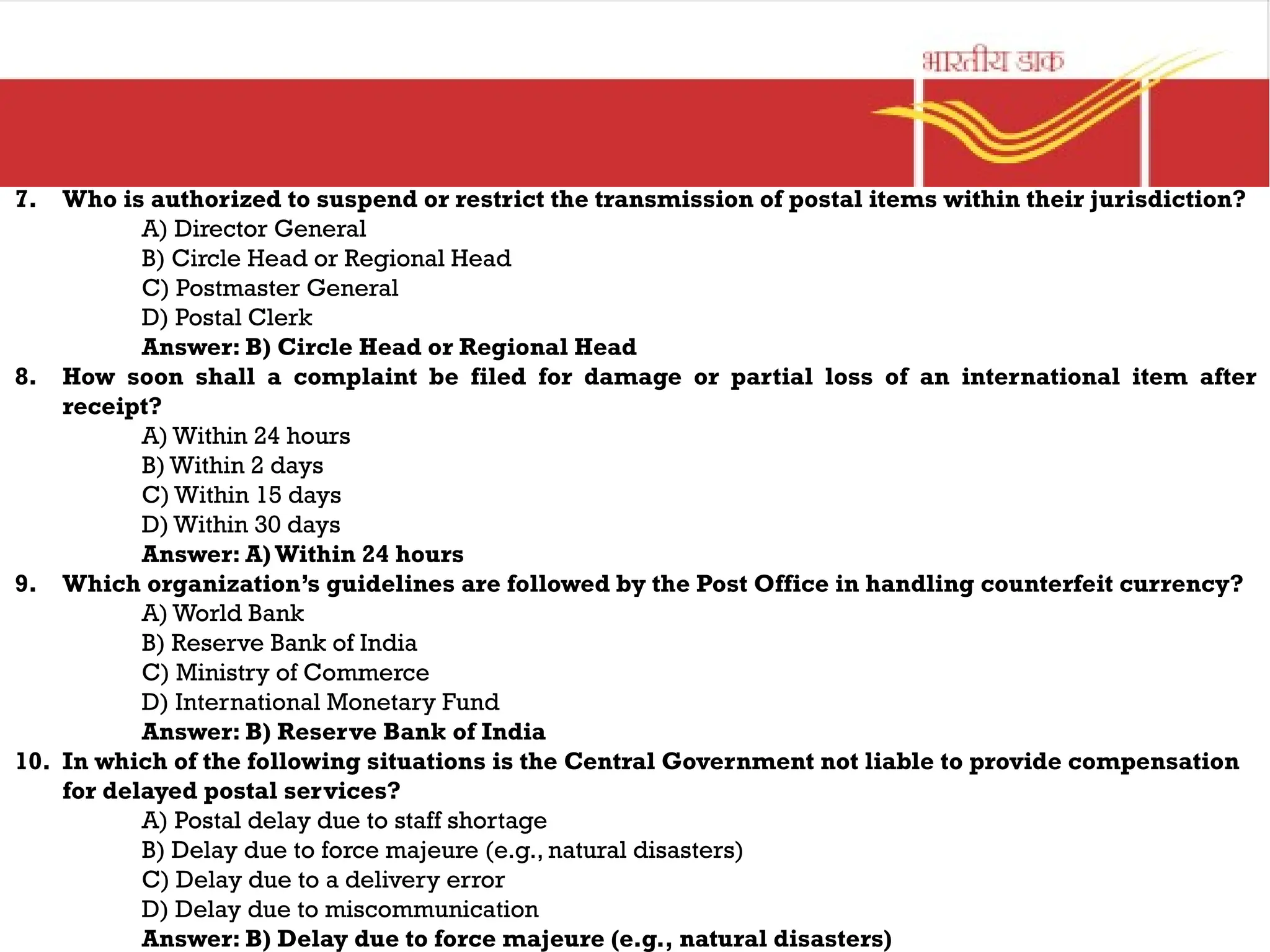
7. Who is authorized to suspend or restrict the transmission of postal items within their jurisdiction?
A) Director General
B) Circle Head or Regional Head
C) Postmaster General
D) Postal Clerk
Answer: B) Circle Head or Regional Head
8. How soon shall a complaint be filed for damage or partial loss of an international item after
receipt?
A) Within 24 hours
B) Within 2 days
C) Within 15 days
D) Within 30 days
Answer: A)Within 24 hours
9. Which organization’s guidelines are followed by the Post Office in handling counterfeit currency?
A) World Bank
B) Reserve Bank of India
C) Ministry of Commerce
D) International Monetary Fund
Answer: B) Reserve Bank of India
10. In which of the following situations is the Central Government not liable to provide compensation
for delayed postal services?
A) Postal delay due to staff shortage
B) Delay due to force majeure (e.g., natural disasters)
C) Delay due to a delivery error
D) Delay due to miscommunication
Answer: B) Delay due to force majeure (e.g., natural disasters)
Domestic Items
Regulations 87 to 106
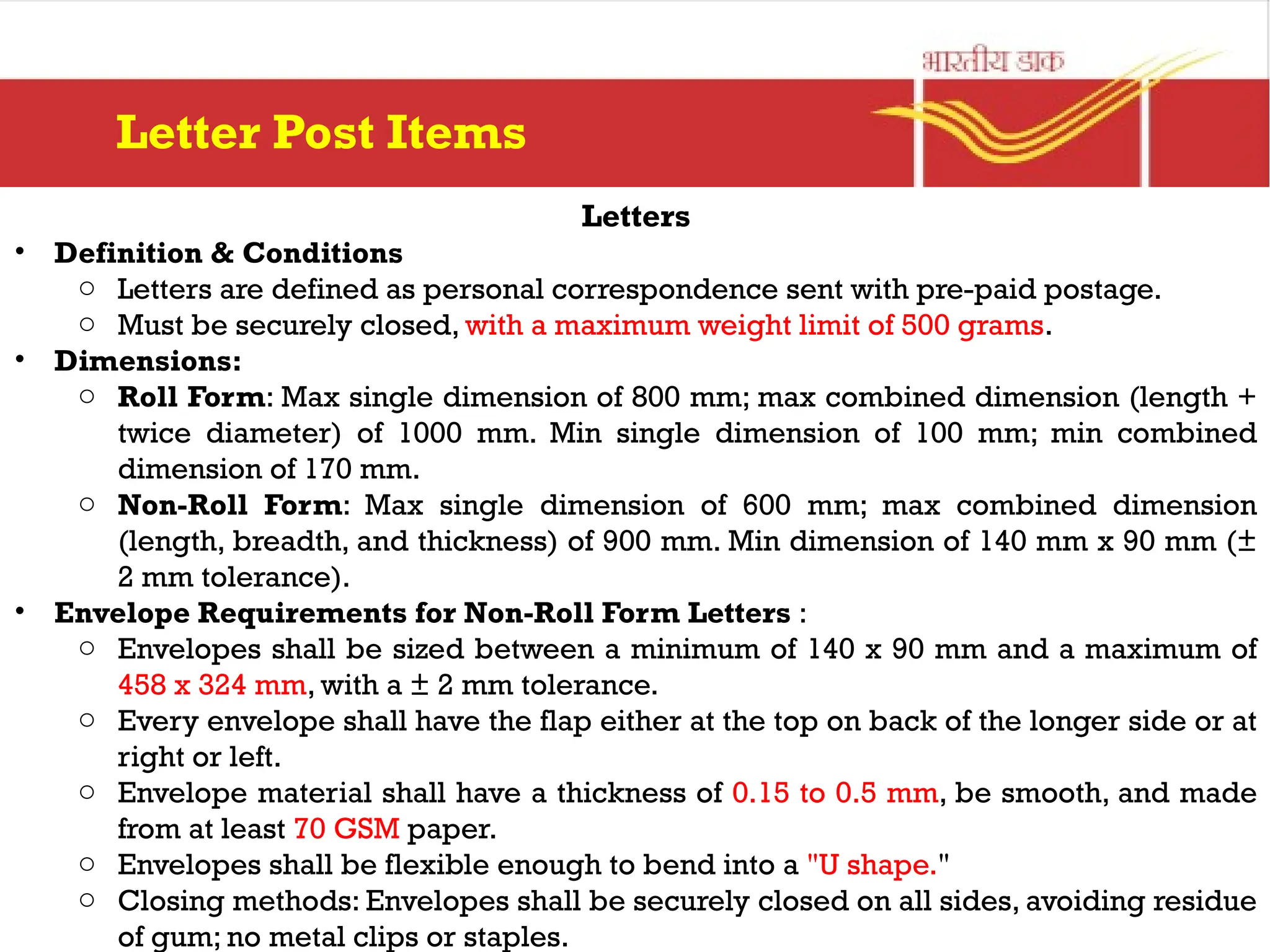
Letters
• Definition & Conditions
o Letters are defined as personal correspondence sent with pre-paid postage.
o Must be securely closed, with a maximum weight limit of 500 grams.
• Dimensions:
o Roll Form: Max single dimension of 800 mm; max combined dimension (length +
twice diameter) of 1000 mm. Min single dimension of 100 mm; min combined
dimension of 170 mm.
o Non-Roll Form: Max single dimension of 600 mm; max combined dimension
(length, breadth, and thickness) of 900 mm. Min dimension of 140 mm x 90 mm (±
2 mm tolerance).
• Envelope Requirements for Non-Roll Form Letters :
o Envelopes shall be sized between a minimum of 140 x 90 mm and a maximum of
458 x 324 mm, with a ± 2 mm tolerance.
o Every envelope shall have the flap either at the top on back of the longer side or at
right or left.
o Envelope material shall have a thickness of 0.15 to 0.5 mm, be smooth, and made
from at least 70 GSM paper.
o Envelopes shall be flexible enough to bend into a "U shape."
o Closing methods: Envelopes shall be securely closed on all sides, avoiding residue
of gum; no metal clips or staples.
Letter Post Items
Letter Post Items
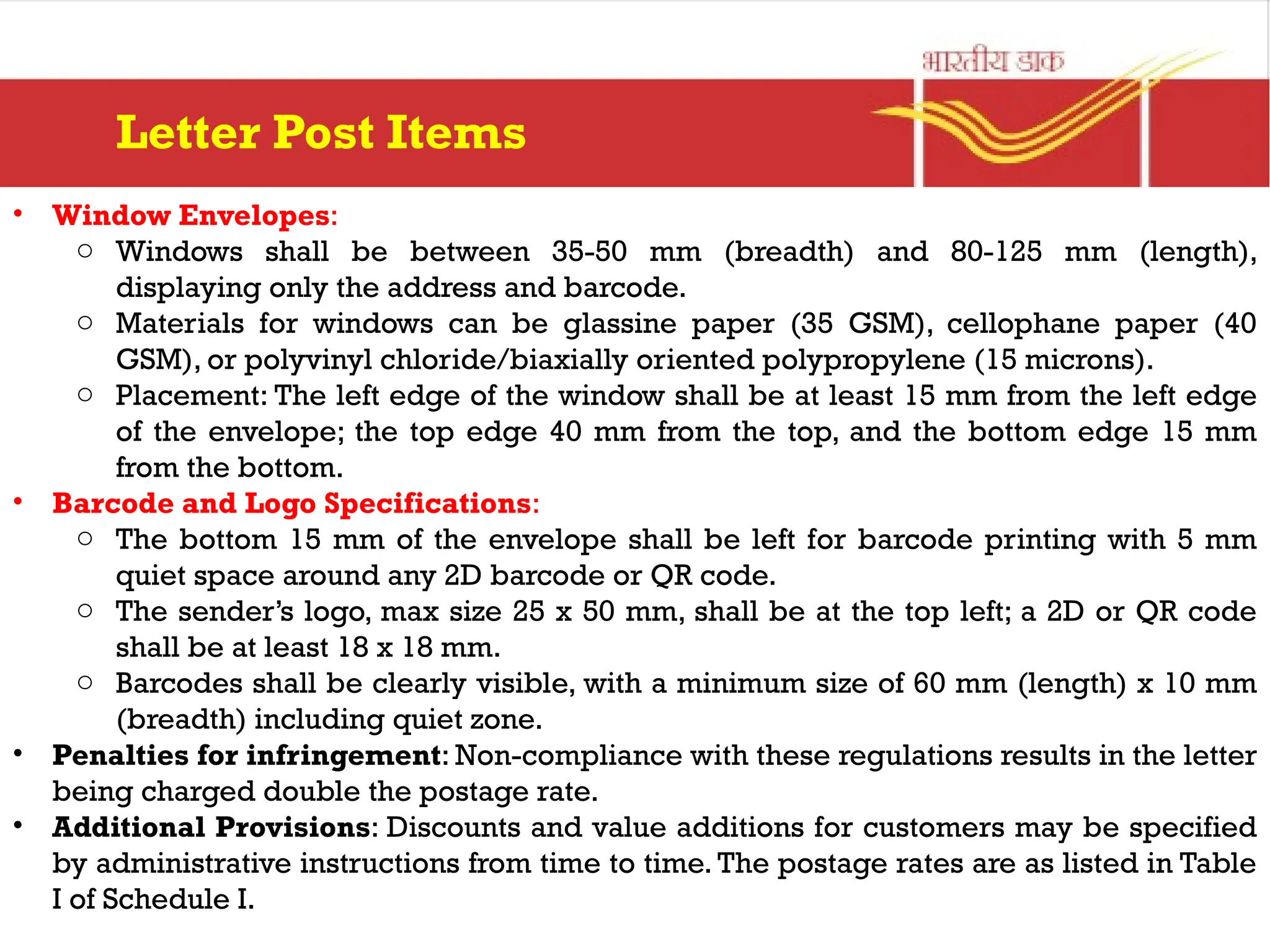
• Window Envelopes:
o Windows shall be between 35-50 mm (breadth) and 80-125 mm (length),
displaying only the address and barcode.
o Materials for windows can be glassine paper (35 GSM), cellophane paper (40
GSM), or polyvinyl chloride/biaxially oriented polypropylene (15 microns).
o Placement: The left edge of the window shall be at least 15 mm from the left edge
of the envelope; the top edge 40 mm from the top, and the bottom edge 15 mm
from the bottom.
• Barcode and Logo Specifications:
o The bottom 15 mm of the envelope shall be left for barcode printing with 5 mm
quiet space around any 2D barcode or QR code.
o The sender’s logo, max size 25 x 50 mm, shall be at the top left; a 2D or QR code
shall be at least 18 x 18 mm.
o Barcodes shall be clearly visible, with a minimum size of 60 mm (length) x 10 mm
(breadth) including quiet zone.
• Penalties for infringement: Non-compliance with these regulations results in the letter
being charged double the postage rate.
• Additional Provisions: Discounts and value additions for customers may be specified
by administrative instructions from time to time. The postage rates are as listed in Table
I of Schedule I.
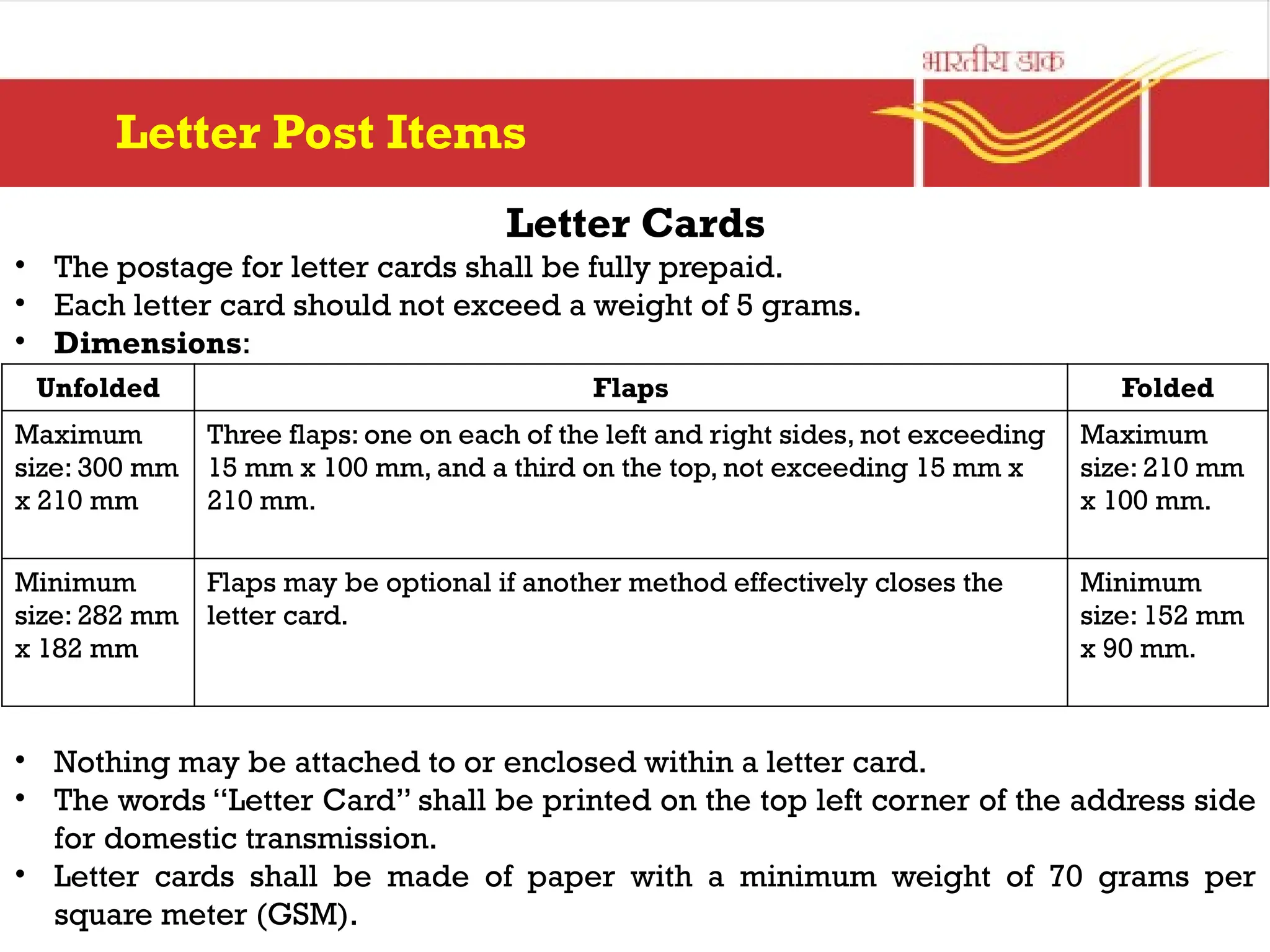
Letter Cards
• The postage for letter cards shall be fully prepaid.
• Each letter card should not exceed a weight of 5 grams.
• Dimensions:
• Nothing may be attached to or enclosed within a letter card.
• The words “Letter Card” shall be printed on the top left corner of the address side
for domestic transmission.
• Letter cards shall be made of paper with a minimum weight of 70 grams per
square meter (GSM).
Letter Post Items
Unfolded Flaps Folded
Maximum
size: 300 mm
x 210 mm
Three flaps: one on each of the left and right sides, not exceeding
15 mm x 100 mm, and a third on the top, not exceeding 15 mm x
210 mm.
Maximum
size: 210 mm
x 100 mm.
Minimum
size: 282 mm
x 182 mm
Flaps may be optional if another method effectively closes the
letter card.
Minimum
size: 152 mm
x 90 mm.
• Definition : It refers to a sheet of paper intended for letter writing that is
appropriately folded and gummed.
• Private Manufacture: Privately made letter cards shall be fully closed on
three sides using continuous gumming, glue, or another adhesive, while
complying with the dimensions and conditions outlined above.
• Penalty for Non-Compliance
o Treatment as a Letter: If a letter card does not meet the specified
conditions, it will be treated as a letter and charged with double the
postage deficiency upon delivery.
o Postage Rates :The rates for letter cards are specified in Table I of
Schedule I.
Letter Post Items
Postcards
• Definition : A rectangular card used for open communication, with an impressed
stamp of the prescribed value on it.
• Prepaid Postage: Fully
• Weight Limit: 5 grams
• Dimensions: Precisely 140 mm x 90 mm & the legend “Post Card” shall be printed
on the address side in either Hindi or English.
• Material Standards: Postcards shall match the thickness and flexibility of those
issued by the Post Office, ensuring durability during handling.
• Prohibitions on Modification:
o Postcards shall not be folded, enclosed in a cover, cut, or altered in any way.
o The only permitted alteration is perforation with initials on the impressed
postage stamp, if present.
• Address Side Layout:
o The right side of the address side shall be reserved strictly for : The recipient’s
address, Prepayment stamp or stamp impression (preferably in the upper right-
hand corner) & Postal directions.
o The left side of the address side and the back may be used for: Sender’s
communication, Single or multi-color printed advertisements, Sender's address
(placed at the top left-hand corner of the back).
Letter Post Items
• Attachments allowed on postcards:
o Stamps for payment of additional postage or postal fees (shall be affixed to
the back).
o Gummed Label with the recipient's name and address (shall be fully adhered
to the card).
o Sender Label not exceeding 50 mm x 20 mm (also fully adhered).
o Thin Adhered Materials such as engravings, illustrations, drawings, or
photographs.
o Attachments shall be applied only to the back or the left side of the address
side.
• Penalty for Non-Compliance
o Treatment as a Letter: Non-compliant postcards shall be treated as letters
and are subject to double the postage deficiency, with a minimum charge of
one rupee.
• Postage Rates
o Postage rates for postcards are specified in Table I of Schedule I.
Letter Post Items
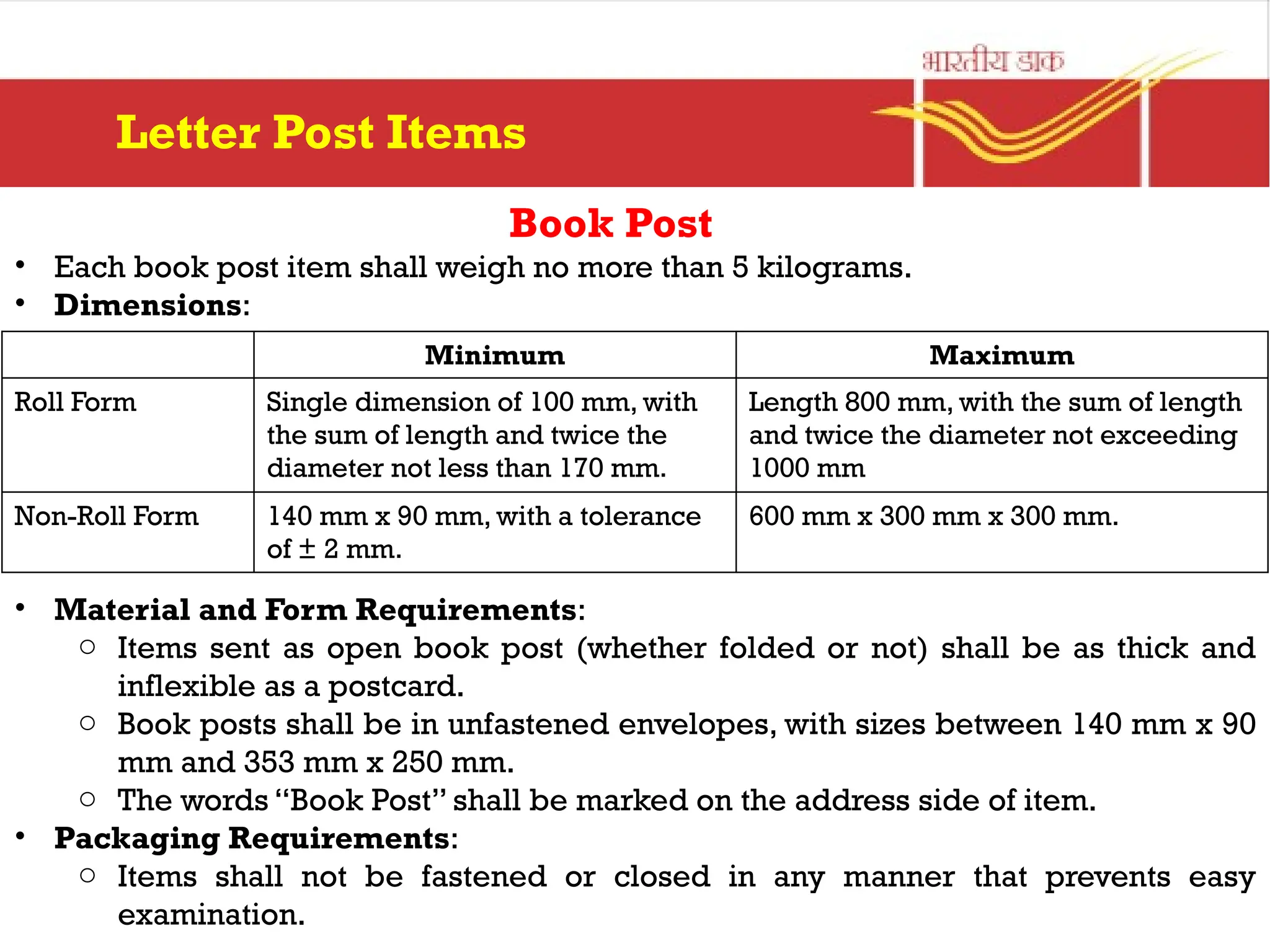
Book Post
• Each book post item shall weigh no more than 5 kilograms.
• Dimensions:
• Material and Form Requirements:
o Items sent as open book post (whether folded or not) shall be as thick and
inflexible as a postcard.
o Book posts shall be in unfastened envelopes, with sizes between 140 mm x 90
mm and 353 mm x 250 mm.
o The words “Book Post” shall be marked on the address side of item.
• Packaging Requirements:
o Items shall not be fastened or closed in any manner that prevents easy
examination.
Letter Post Items
Minimum Maximum
Roll Form Single dimension of 100 mm, with
the sum of length and twice the
diameter not less than 170 mm.
Length 800 mm, with the sum of length
and twice the diameter not exceeding
1000 mm
Non-Roll Form 140 mm x 90 mm, with a tolerance
of ± 2 mm.
600 mm x 300 mm x 300 mm.
o Book posts shall be packed in such a way that they can be inspected easily
without breaking any seals or tearing. They can be posted without a cover, in
an unfastened envelope, or in a loosely sealed cover marked “Book Post.”
• Prohibited Contents:
o No "paper money" is allowed, including unobliterated postage stamps,
cheques, bills of exchange, and orders for payment of money.
o Book posts may contain one stamped and addressed envelope, postcard, or
wrapper with the sender's or another person's details.
• Restrictions on Addressees:
o Any document contained in the book post item shall not be addressed to an
addressee, nor stem from a sender other than those of the item.
o Weight-Based Classification:
 Items under 500 grams are treated as letter posts.
 Items over 500 grams are treated as parcel posts.
• Penalty for Non-Compliance
o Treatment as Letter or Parcel: For breach of conditions, it will be treated as
a letter (if under 500 grams) or a parcel (if over 500 grams), and double the
applicable postage will be charged upon delivery.
• Postage Rates : Postage rates for book posts are specified in Table I of Schedule I.
Letter Post Items
Literature for blind
• Permissible Contents:
o The content shall be materials specifically created for the visually impaired,
such as items in Braille or other special formats for blind users.
o The item should not contain any communication in ordinary print or
handwriting, except;
 Title and table of contents of the book or periodical.
 Instructions or a key for the special format.
 A return label.
• Labeling Requirements:
o The item shall have “Literature for the Blind” marked on the outside.
o The sender’s name and address shall also be written or printed on the
outside.
• Packaging Requirements:
o Items shall be posted without a cover or in a cover that is open at both ends,
allowing for easy examination.
Letter Post Items
• Weight and Size Limits:
o Maximum Weight: 7 kilograms.
o Dimensions:
 Roll Form: Max length 800 mm, with a combined length and twice the
diameter limit of 1000 mm. Minimum length of 100 mm, with a combined
dimension of 170 mm.
 Non-Roll Form: Maximum 600 mm x 300 mm x 300 mm, with a minimum
of 100 mm x 70 mm.
• Additional Media:
o Items like sound records, discs, films, tapes, and wires with recorded
messages for the blind shall also be considered "Literature for the Blind" if
they are sent by or to an officially recognized institution for the blind.
• No Postage Charge:There is no postage fee for Literature for the Blind items.
• Air Mail Fee: An air mail fee shall be applicable if the item shall sent by air.
• Penalty for Non-Compliance : For breach of condition, the item will be charged
double the standard postage rate for the applicable postal item.
Letter Post Items
Periodical Post
• Eligibility Requirements:
o The publication shall be classified as a periodical under the Press and Registration
of Periodicals Act, 2023 (Act No. 51 of 2023).
o It shall be printed, published, or brought out exclusively in India.
o The periodical shall be registered with the Press Registrar General of India,
possessing a valid registration certificate as per the Act.
o Only regular periodicals shall be allowed; books or scientific, technical, and
academic journals shall be explicitly excluded from transmission under this
category.
• Registration Requirements:
o A separate postal registration is generally not required for mailing periodicals.
o However, for periodicals that fall under the category of newspapers and wish to
avail concessional postage rates, a distinct postal registration or license shall be
obtained by the owner or publisher.
• Superscription Requirement: Each periodical shall display the superscription “Press
Registrar of General of India under No……………” on either the first or last page.
• Non-Compliance Penalty: If any of the eligibility conditions or the superscription
requirement shall not meet, the periodical item will be treated and charged as a book
post item.
Letter Post Items
Postal Registration of RNP
• Eligibility Requirements:
o The newspaper shall qualify as a periodical under the Press and Registration
of Periodicals Act, 2023 (Act No. 51 of 2023).
o It shall be printed, published, or otherwise produced exclusively in India.
o The newspaper shall be registered with the Press Registrar General of India
and have a certificate of registration as mandated by the Act.
o Compliance with all provisions of the Press and Registration of Periodicals
Act, 2023, is required.
• Administrative and Operative Guidelines:
o The administrative and operative guidelines related to registered newspaper
shall be as specified from time to time.
Letter Post Items
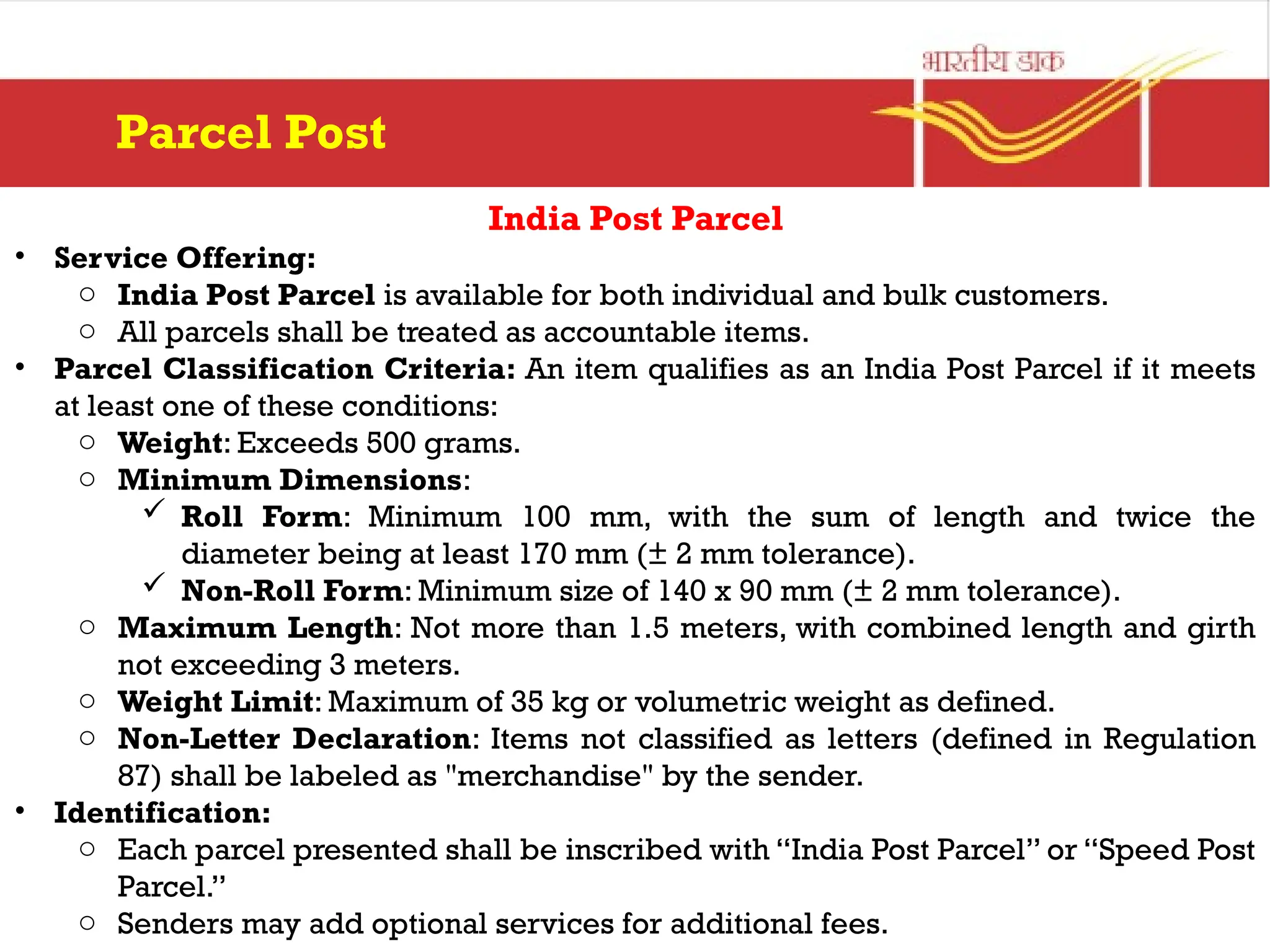
India Post Parcel
• Service Offering:
o India Post Parcel is available for both individual and bulk customers.
o All parcels shall be treated as accountable items.
• Parcel Classification Criteria: An item qualifies as an India Post Parcel if it meets
at least one of these conditions:
o Weight: Exceeds 500 grams.
o Minimum Dimensions:
 Roll Form: Minimum 100 mm, with the sum of length and twice the
diameter being at least 170 mm (± 2 mm tolerance).
 Non-Roll Form: Minimum size of 140 x 90 mm (± 2 mm tolerance).
o Maximum Length: Not more than 1.5 meters, with combined length and girth
not exceeding 3 meters.
o Weight Limit: Maximum of 35 kg or volumetric weight as defined.
o Non-Letter Declaration: Items not classified as letters (defined in Regulation
87) shall be labeled as "merchandise" by the sender.
• Identification:
o Each parcel presented shall be inscribed with “India Post Parcel” or “Speed Post
Parcel.”
o Senders may add optional services for additional fees.
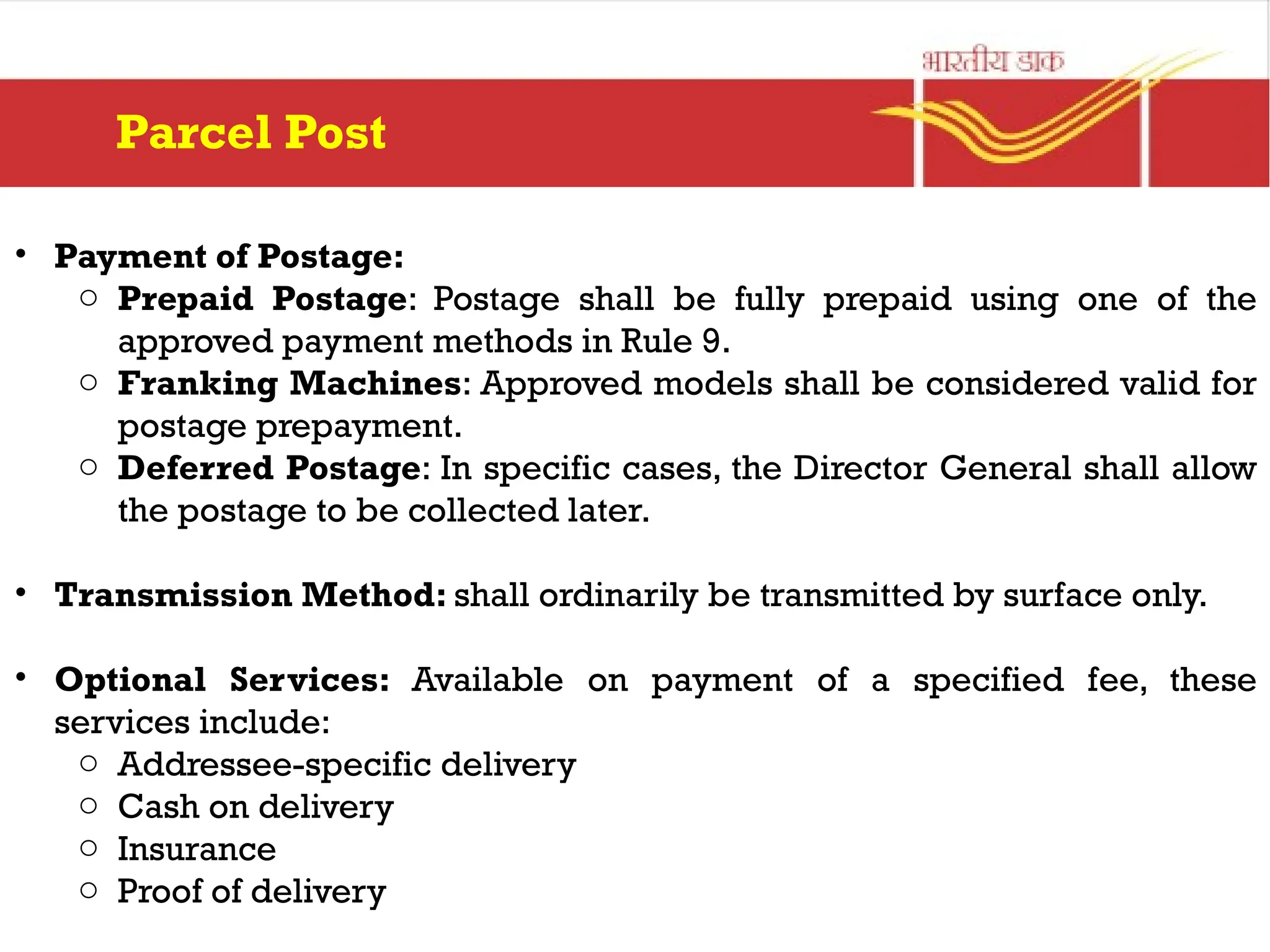
Parcel Post
• Payment of Postage:
o Prepaid Postage: Postage shall be fully prepaid using one of the
approved payment methods in Rule 9.
o Franking Machines: Approved models shall be considered valid for
postage prepayment.
o Deferred Postage: In specific cases, the Director General shall allow
the postage to be collected later.
• Transmission Method: shall ordinarily be transmitted by surface only.
• Optional Services: Available on payment of a specified fee, these
services include:
o Addressee-specific delivery
o Cash on delivery
o Insurance
o Proof of delivery
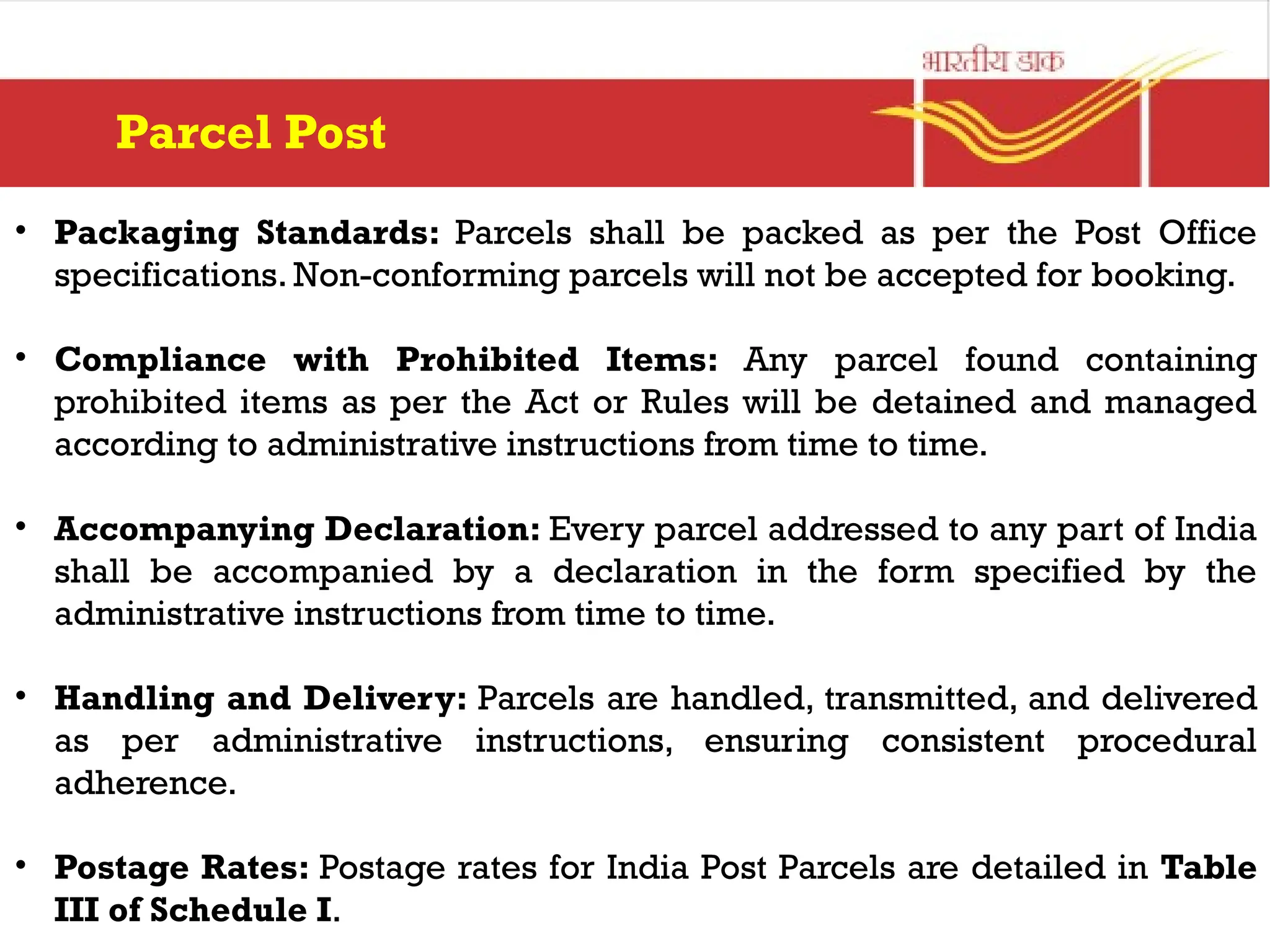
Parcel Post
• Packaging Standards: Parcels shall be packed as per the Post Office
specifications. Non-conforming parcels will not be accepted for booking.
• Compliance with Prohibited Items: Any parcel found containing
prohibited items as per the Act or Rules will be detained and managed
according to administrative instructions from time to time.
• Accompanying Declaration: Every parcel addressed to any part of India
shall be accompanied by a declaration in the form specified by the
administrative instructions from time to time.
• Handling and Delivery: Parcels are handled, transmitted, and delivered
as per administrative instructions, ensuring consistent procedural
adherence.
• Postage Rates: Postage rates for India Post Parcels are detailed in Table
III of Schedule I.
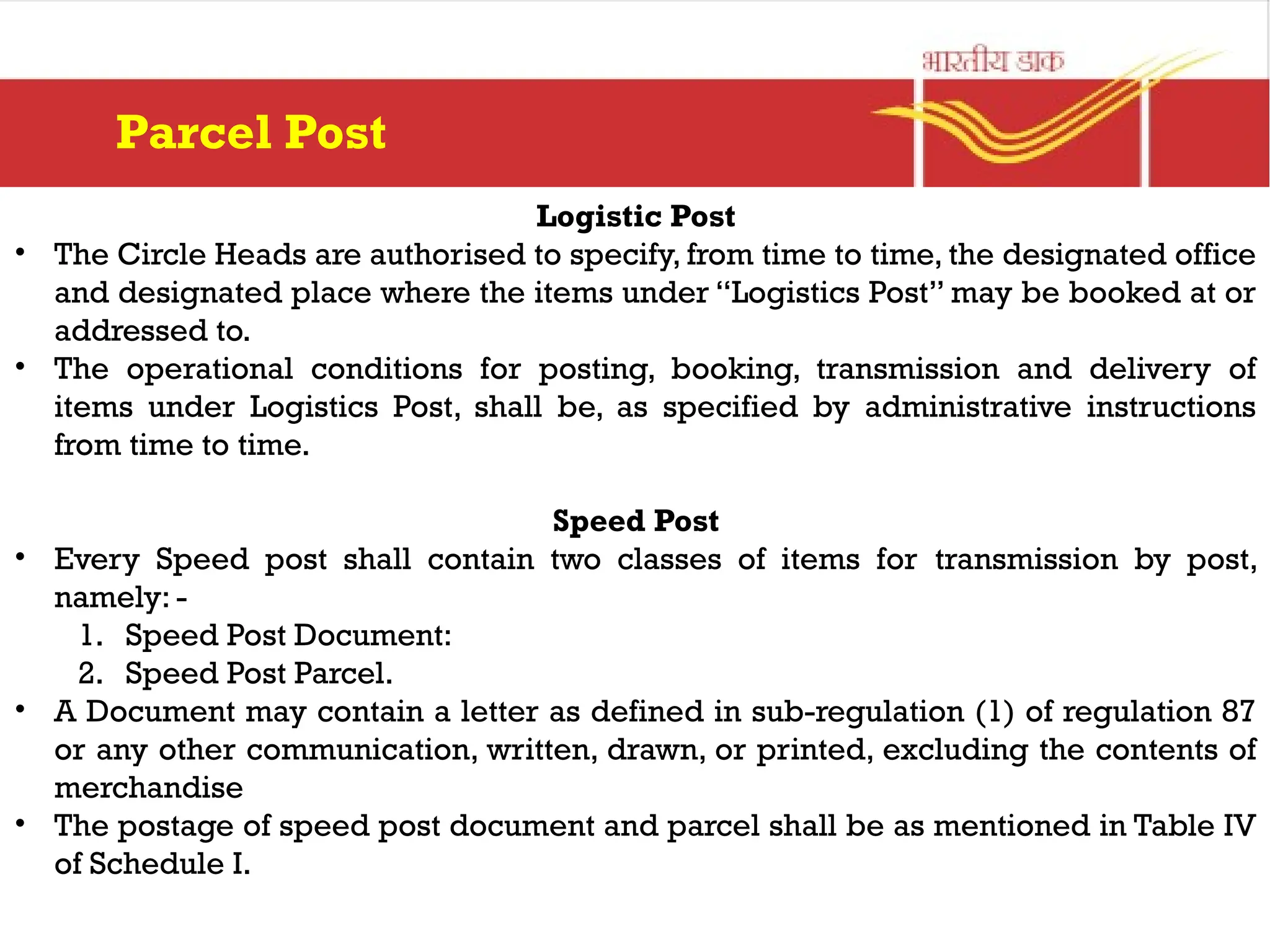
Parcel Post
Logistic Post
• The Circle Heads are authorised to specify, from time to time, the designated office
and designated place where the items under “Logistics Post” may be booked at or
addressed to.
• The operational conditions for posting, booking, transmission and delivery of
items under Logistics Post, shall be, as specified by administrative instructions
from time to time.
Speed Post
• Every Speed post shall contain two classes of items for transmission by post,
namely: -
1. Speed Post Document:
2. Speed Post Parcel.
• A Document may contain a letter as defined in sub-regulation (1) of regulation 87
or any other communication, written, drawn, or printed, excluding the contents of
merchandise
• The postage of speed post document and parcel shall be as mentioned in Table IV
of Schedule I.
Parcel Post
Speed Post Document
• Transmission Method:
o Primary Mode: Speed Post Documents shall generally be transmitted by air.
o Alternative Mode: If surface transport shall be faster than air on certain
routes, it may be used.
• Weight Limit: The weight of an item for the speed post document shall not
exceed 500 grams including volumetric weight.
• Postage Calculation: Postage and other fees chargeable, shall be based on the
higher value between volumetric weight and gross weight.
• Size Limitations: Maximum dimensions for a Speed Post Document are 420 mm
(length) x 297 mm (breadth) x 24 mm (thickness).
• Optional Services: Services such as pick-up, proof of delivery, insurance,
registration, and other value-added options shall be available for an additional
fee as specified by administrative instructions from time to time.
• Address-Specific Delivery:The item posted under the speed post shall generally
be address specific that is it shall be delivered at the given address, unless
otherwise specified.
Parcel Post
Speed Post Parcel
• Application of India Post Parcel Regulations:
o Sub-regulations from India Post Parcel Regulation 96 apply to
Speed Post Parcels, specifically sub-regulations (1), (2), (4), (6), (7) to
(10). These cover aspects like customer eligibility, packaging
standards, compliance with prohibited items, and required
documentation.
• Transmission Method:
o Primary Mode: Speed Post Parcels shall primarily be transmitted by
air.
o Alternative Mode: Surface transport shall be allowed if it shall be
faster on certain routes.
o Priority Handling: When transmitted by surface, Speed Post Parcels
shall be prioritized over India Post Parcels at every stage of
transmission.
• Identification: any speed post parcel presented at the window shall have
the inscription “Speed Post Parcel” on it with such value additions as may
be paid for, by the sender.
Parcel Post
Direct Post
• Definition:
o Direct Post includes unaddressed mail items, such as letters, brochures, posters, etc.,
intended for bulk distribution.
o These items usually contain marketing or promotional messages targeting specific
consumer or business markets.
• Posting and Bundling:
o Accepted in bulk at designated post offices only; shall not be posted in regular
letterboxes.
o For out-of-town delivery, items shall be bundled according to Postal Index Number (PIN)
Codes.
• Conditions and Rates:
o Minimum quantity requirements and other conditions are determined by administrative
instructions.
o Rates are listed in Table I of Schedule II.
e-Payment
• Service:
o e-Payment offers collection services for bills or other payments on behalf of third
parties, via agreements with the Post Office.
• Conditions and Fees:
o The operational conditions and fee relating to e-Payment shall be such as may be
specified by administrative instructions from time to time.
Other Postal Products
Media Post
• Purpose:
o Media Post shall a targeted advertising medium, allowing governments and corporate
clients to advertise via postal stationery and premises.
• Display of Advertisements:
o Advertisements shall be displayed at designated areas within post office premises.
• Conditions and Rates:
o Conditions for using Media Post shall be such as may be specified by administrative
instructions from time to time.
o Rates are specified in Table II of Schedule II.
e-Post
• Service Overview:
o e-Post allows messages to be sent electronically and printed at the destination post
office for physical delivery.
• Availability:
o Offered to retail and bulk customers (bulk customers need an agreement with the Post
Office).
• Conditions and Fees:
o Operational conditions are determined by administrative instructions from time to time.
o Fees are listed in Table III of Schedule II.
Other Postal Products
Retail Post
• Service Scope : Retail Post allows the sale of departmental and third-party products/services
through post offices, enhancing public convenience.
• Departmental and Third-Party Products:
o Products/services specified by administrative instructions from time to time.
o Agreements shall be required with public/private sector entities for third-party
offerings.
• Charges and Operational Conditions:
o Operational conditions and Charges shall be such as may be specified by administrative
instructions from time to time.
o Circle Head is authorized to formalize agreements for third-party services.
Magazine Post
• Eligibility: Publications shall qualify for Magazine Post if they meet criteria like being
registered as a periodical in India, having a valid registration certificate, a subscriber list of
at least 500, and a minimum posting volume of 500 copies at a time.
• Delivery and Payment:
o Magazine Posts shall be delivered to specific addresses as accountable items.
o Payment options include cash, Book Now Pay Later (BNPL), and advance payment.
• Conditions and Rates:
o Non-compliant items shall be treated and charged as Speed Post items.
o Rates are provided in Table IV of Schedule II.
Other Postal Products
Lets have some Quiz
1. What is the maximum permissible weight for a letter in the postal regulations?
A. 100 grams
B. 250 grams
C. 500 grams
D. 1 kilogram
Answer: C. 500 grams
2. Which of the following dimensions is correct for an unfolded letter card
according to the regulations?
A. Maximum 300 mm by 210 mm
B. Minimum 200 mm by 150 mm
C. Maximum 250 mm by 150 mm
D. Minimum 282 mm by 150 mm
Answer: A. Maximum 300 mm by 210 mm
3. If a Speed Post Document is transmitted by air, under what condition can it be
transmitted by surface?
A. If the document exceeds 500 grams
B. If surface transport is faster on a specific route
C. If air transmission is temporarily unavailable
D. If the sender requests surface transmission
Answer: B. If surface transport is faster on a specific route
4. For which of the following items is the phrase “Literature for the Blind” used?
A. Books in Braille or other special types for the blind
B. Government notices for the visually impaired
C. Standard letters with large print
D. All printed materials with text over a certain size
Answer: A. Books in Braille or other special types for the blind
5. If a post card does not meet the prescribed conditions, it will be charged as a:
A. Book Post item
B. Speed Post item
C. Parcel
D. Letter
Answer: D. Letter
6. What is the maximum size allowed for a Speed Post Document in terms of length,
breadth, and thickness?
A. 500 mm x 300 mm x 20 mm
B. 420 mm x 297 mm x 24 mm
C. 450 mm x 350 mm x 25 mm
D. 400 mm x 250 mm x 22 mm
Answer: B. 420 mm x 297 mm x 24 mm
7. Which of the following is true regarding the handling of Book Post items?
A.They shall be posted in a closed envelope
B.They should be marked as "Book Post" on the address side
C.They can contain paper money or checks
D.They shall not exceed 10 kg in weight
Answer: B.They should be marked as "Book Post" on the address side
8. What is the primary purpose of "Direct Post" service?
A. Delivery of personal letters
B. Distribution of unaddressed promotional mail
C.Transmitting official government notices
D. Providing e-commerce parcel delivery
Answer: B. Distribution of unaddressed promotional mail
9. For a publication to qualify as a "Magazine Post," which of the following is
NOT required?
A. Having at least 500 subscribers
B. Being registered under the Press and Registration of Periodicals Act, 2023
C. Being published outside India
D. Having a minimum posting volume of 500 copies
Answer: C. Being published outside India
International Items and
Service
Regulations 107 to 127
• Letter Post:
o Includes items such as letters, postcards, aerogrammes, printed
papers (including books and registered newspapers), small packets,
literature for the blind, M Bags (Bulk Bags for multiple printed
materials), and the International Tracked Packet Service (ITPS) for
tracked items.
• Parcel Post:
o Covers larger items and packages, including international air parcels,
international surface airlifted parcels (SAL), and international surface
parcels.
• Express Mail Service (EMS):
o The fastest service option for sending documents and merchandise
globally, prioritizing speed for international delivery.
International Post
Letter
• Definition: A letter shall contain a communication enclosed in an
envelope, addressed, and sent to or from international locations.
• Weight Limit: Up to 2 kilograms.
• Dimensions:
• Maximum:
o Combined length, width, and depth: 900 mm, with no single
dimension exceeding 600 mm (± 2 mm tolerance).
o In roll form: Length plus twice the diameter should not exceed 1,040
mm, with no single dimension exceeding 900 mm.
• Minimum:
o Surface area: Not less than 90 x 140 mm (± 2 mm tolerance).
o In roll form: Length plus twice the diameter shall be at least 170 mm,
with no single dimension less than 100 mm.
• Postage Rates: Listed in Table I of Schedule III of Regulations.
Letter Post (International)
Aerogramme
• Definition and Purpose:
o An aerogramme is a priority item used for international communication,
consisting of a single sheet of paper that is folded and gummed on all sides to
ensure secure closure.
o It is exclusively transmitted by air to or from international addressees or
senders.
• Availability:
o Aerogrammes shall only be sold through designated Post Offices, ensuring
quality control and adherence to postal standards.
o Privately manufactured aerogrammes shall not be permitted for transmission.
• Dimensions:
o Maximum Size: 110 x 220 mm when folded. In this folded form, the length shall
be equal to or greater than the width multiplied by √2 (approximately 1.4).
o Minimum Size: 90 x 140 mm, the same as the minimum dimensions required for
international letters.
• Postage Rates:
o The rates of postage for aerogrammes shall be specified in Table V of Schedule
III to Regulations.
Letter Post (International)
Post card
• Definition: An open communication sent by surface mail using a single sheet of
paper.
• Dimensions:
• Maximum: 120 x 235 mm, with a tolerance of ±2 mm, and shall be stiff enough to
withstand processing.
• Minimum: 90 x 140 mm, with a tolerance of ±2 mm.
• Acceptance:
• Both Post Office-issued and privately manufactured postcards shall be accepted if
they shall meet size and material requirements.
• Privately manufactured postcards shall be rectangular and made from material
comparable to Post Office-issued postcards.
• Postage Rates: Listed in Table I of Schedule III to Regulations.
Airmail postcard
• Definition: A type of postcard specifically designated for air transmission.
• Specifications:
• Shall meet the same dimensional and material requirements as the standard
international postcard (per Regulation 110).
• Postage Rates: Listed in Table V of Schedule III to Regulations.
Letter Post (International)
Small Packet
• Definition: Letter post items that may contain small quantities of goods such as gifts, saleable
items, or merchandise samples, but cannot include personal correspondence or documents not
intended for the sender or addressee.
• Dimensions:
o Maximum: Combined length, width, and depth of 900 mm (no single dimension over 600
mm); in roll form, length plus twice diameter must not exceed 1,040 mm (no dimension over
900 mm).
o Minimum: Surface area of at least 90 x 140 mm; in roll form, length plus twice the diameter
must be at least 170 mm (no dimension under 100 mm).
• Weight: Between 100 grams and 2 kilograms.
• Postage Rates: Listed in Table I of Schedule III to regulations.
Printed papers
• Definition: Letter post items containing newspapers or other printed materials, with the
condition that multiple papers in one item shall be addressed to the same addressee.
• Packaging: shall be packed to protect contents while allowing easy inspection.
• Weight: Between 20 grams and 2 kilograms.
• Postage Rates: Listed in Table I of Schedule III to regulations.
Literature for blind
• Definition: Items including papers, books, and periodicals in Braille or other formats for the
visually impaired, with sound recordings allowed if sent to or from recognized institutions.
• Weight: Up to 7 kilograms.
• Postage: Exempt from postage fees, but an additional fee may apply for air or surface airlift.
Letter Post (International)
M bag (bulk bag)
• Definition: Special bulk bags used to send printed papers, newspapers, periodicals, books, and
similar documentation for the same recipient at the same address. Marked with the letter “M.”
• Weight: Maximum of 30 kilograms or the destination country’s specified weight limit, whichever
is lower.
• Requirements:
o Form CN22 or CN23 shall accompany each M-Bag for customs.
o Shall have a rigid address label with the addressee's details, measuring no more than 90 x
140 mm.
o May include additional items related to the printed materials, provided each weighs under
2 kg.
• Postage Rates: Listed in Table II of Schedule III to regulations.
International Tracked Packet Service (ITPS)
• Definition: Special bulk bags used to send printed papers, newspapers, periodicals, books, and
similar documentation for the same recipient at the same address. Marked with the letter “M.”
• Weight: Maximum of 30 kilograms or the destination country’s specified weight limit, whichever
is lower.
• Requirements:
o Form CN22 or CN23 must accompany each M-Bag for customs.
o Must have a rigid address label with the addressee's details, measuring no more than 90 x 140
mm.
o May include additional items related to the printed materials, provided each weighs under 2 kg.
• Postage Rates: Listed in Table II of Schedule III to regulations.
Letter Post (International)
International Air Parcel
• Service Overview:
o Designed for efficient, economical, and faster transmission of documents and
goods internationally.
o Offers track and trace functionality for added security and monitoring.
• Booking Conditions:
o Available at specified Post Offices as per administrative instructions time to time.
• Weight and Size Limits:
o Maximum Weight: Up to 20 kilograms, but may vary depending on the maximum
acceptable limit of the destination country.
o Maximum Dimensions:
 Single dimension shall not exceed 1.5 meters.
 Combined length and the greatest circumference (measured in a direction
other than the length) should not exceed 3 meters.
• Minimum Size: Shall meet the minimum size requirement for letters, i.e., 90 mm x 140
mm.
• Handling and Delivery: Booking, transmission, and delivery shall be managed
according to procedures specified by administrative instructions from time to time.
• Postage Rates:
• Rates for international air parcels are specified in Table VI of Schedule III to Regulation.
Parcel Post Items (International)
• Service Overview:
o EMS shall provide the fastest possible international postal service for sending
documents and merchandise.
o Documents: Includes any non-dutiable or non-saleable items containing data
or information in various formats.
o Merchandise: Includes any mailable items other than documents, with
optional insurance.
• Booking and Availability: Available across specified Post Offices in India, with
booking procedures defined by administrative instructions from time to time.
• Weight and Size Limits:
o Maximum Weight: Up to 35 kilograms, or the weight limit specified by the
destination country, whichever is lower.
o Size:
 Single dimension limit of 1.5 meters.
 Combined length and circumference (measured in a direction other than the
length) should not exceed 3 meters.
• Additional Customer Benefits:
o Discounts and additional services (value additions) shall be offered as
specified in administrative instructions from time to time.
International Speed Post (EMS)
• Insurance for High-Value Items:
o EMS items shall include high-value items such as precious metals, stones, and
currency, but it shall be insured.
o Insurance coverage for such items shall be capped at 1,00,000, though
₹
higher coverage limits may be specified for certain items.
o Restricted items shall be sent through insured EMS to ensure safe handling.
• Handling and Delivery:
o Booking, transmission, and delivery shall be managed according to
administrative instructions from time to time.
• Prohibited Items:
o Restricted items include precious metals, stones, jewelry, coins, banknotes,
currency notes, securities payable to the bearer, and travelers' cheques.These
can only be sent via insured EMS with the appropriate insurance coverage.
• Postage Rates:
o EMS postage rates are detailed in Table VII of Schedule III to regulations.
International Speed Post (EMS)
• Booking and Postage:
o Postage Fees: International postage rates are detailed in Schedule III.
o Refunds: If services shall be suspended, the sender may receive
refunds for postage, special fees, or air surcharges.
o Electronic Advance Data (EAD):
 Purpose: EAD shall be required for items containing goods,
helping meet import customs and security requirements in the
destination country.
o Customs Declarations:
 Form CN22: For items valued at or below 300 Special Drawing
Rights (SDR).
 Form CN23: For items over 300 SDR, alongside Form CN23 for
detailed information.
o Know Your Customer (KYC): Senders shall provide KYC/eKYC
documents for international mail with merchandise.
o Exemptions: Letters, postcards, printed papers (excluding books),
and letter-post items for the blind that are duty-exempt do not need
EAD.
Common Regulations related with International
mails
• Packaging:
o Requirements: Secure packaging to prevent entrapment of other
items, risk of harm to postal staff, or damage to equipment.
o Safety Measures: Packaging should safeguard health and avoid
contamination or injury.
o Guidelines: Detailed packaging instructions shall be provided
through administrative directives from time to time.
• Delivery in Destination Country:
o Local Laws Compliance: Delivery shall be performed following the
destination country’s laws and regulations.
o Liability: The postal service shall not be liable for how items shall be
delivered or handled if done according to local regulations.
o Undeliverable Items: Detention periods and handling of undelivered
items shall be subject to the laws of the destination country.
Common Regulations related with
International mails
• Accountability for Outward International Items: Accountable items (those that
require tracking, receipts, or special handling) shall be presented at the Post
Office, where a receipt will be issued to the person submitting the item.
• Track and Trace Service: For accountable international items, tracking shall be
available at item, receptacle, and airline levels, enhancing transparency.
• Note: This tracking service may be unavailable for registered letter items in some
destination countries due to their internal regulations.
• Inward International Mails :
o Transmission Conditions: Set by administrative instructions.
o Accountable Items: shall be signed for by an authorized person before
delivery.
o Newspapers: Domestic regulations for registered newspapers apply to
international newspapers as well.
• Failure to Take Delivery – Demurrage Charges
o International Air Parcel: If not collected within 10 days of the first delivery
attempt or notification, a demurrage charge applies from the 11th day.
o Alternate Address: If an air parcel has an alternate address, and delivery to
the original address fails, demurrage due from the first addressee may be
collected from the second addressee upon delivery.
Other Features of International Mail items
o Other Inward Items (weighing over 500 grams): This includes printed
papers, small packets, insured letters, and boxes. If uncollected within 7 days,
demurrage applies from the 8th day.
• Post Restante Parcels – Demurrage Charges
o International Air Parcels Addressed as Poste Restante: If uncollected
within 7 days of arrival, demurrage applies from the 8th day.
o Other Poste Restante Items: Applies to printed papers, business papers,
insured letters, and insured boxes weighing over 500 grams.
• Demurrage Charges:
o The specific charges for delayed collection of these items are listed in Table X
of Schedule III to regulations.
Other Features of International Mail items
Lets have some Quiz
1. What is the maximum weight allowed for an international letter?
A) 1 kg
B) 2 kg
C) 5 kg
D) 10 kg
Answer: B) 2 kg
2. Which of the following items is NOT included in the international letter post
category?
A) Aerogramme
B) International Tracked Packet Service (ITPS)
C) Small Packet
D) International Air Parcel
Answer: D) International Air Parcel
3. What is the maximum dimension allowed for a small packet sent via
international mail?
A) 900 mm in total (length, width, and depth combined)
B) 120 mm in length
C) 600 mm in total (length, width, and depth combined)
D) 1,000 mm in length
Answer: A) 900 mm in total (length, width, and depth combined)
4. Which of the following items is exempted from electronic advance data
(EAD) requirements?
A) Literature for the Blind
B) International small packets
C) EMS parcels
D) International Tracked Packet Service
Answer: A) Literature for the Blind
5. What is the maximum weight limit for an M-Bag in international mail?
A) 7 kg
B) 20 kg
C) 30 kg
D) 35 kg
Answer: C) 30 kg
6. What is the maximum gross weight allowed for an international air parcel?
A) 20 kg
B) 25 kg
C) 30 kg
D) 35 kg
Answer: A) 20 kg
7. What is the maximum weight limit for an item sent via International Speed Post
(EMS)?
A) 20 kg
B) 25 kg
C) 30 kg
D) 35 kg
Answer: D) 35 kg
8. Which of the following items is subject to demurrage charges if not collected
within 10 days of arrival?
A) Aerogrammes
B) International air parcels
C) Small packets
D) Postcards
Answer: B) International air parcels
9. In the case of International Tracked Packet Service (ITPS), what is the maximum
allowable weight?
A) 500 g
B) 1 kg
C) 1.5 kg
D) 2 kg
Answer: D) 2 kg
Universal Postal Service
Regulations 128
 Every Post Office shall offer the following products of mails services under the
Universal Postal Services, namely :-
Official Correspondence
Regulations 129 to 131
• On postal service : Items of any class on the service of the Post Office by officers of
the Post Office, Posts Audit Officers and such other officers, as may be authorised in
this behalf, shall be transmitted free of postage and all other postal fees.
• Provisions for “On Postal Service” Items :
o Insurable Items: Certain items may be insured under "On Postal Service" if
they are:
 Items with intrinsic value.
 Important documents, such as service books, Annual Performance
Assessment Reports (APAR), and official files.
 Documents related to investigations, vigilance cases, or examinations.
 Other important documents deemed appropriate for insurance.
o Registrable Items: Certain items shall be registered under "On Postal Service,"
including:
 Important official documents like Annual Performance Assessment Reports
(APAR).
 Items legally required to be sent through registered post, such as charge
sheets.
 Other significant documents deemed suitable for registration.
o “On Postal service” shall not be available for items posted under speed post.
Value added services
Regulations 132 to 144
Domestic Items
• Registration of Domestic Items:
o Items shall be registered on payment of applicable fee (free for blind literature).
o Registered items shall be addressee-specific, requiring a signed receipt upon delivery.
• Insurance of Domestic Items:
o Accountable items can be insured up to 1,00,000.
₹
o Currency or bank notes can be insured up to 20,000.
₹
o Items containing precious metals, stones, or valuable documents shall also be insured.
o Proof of delivery shall available free for insured items, and compensation shall be offered
in cases of loss or damage, excluding specific conditions like acts of God or force majeure.
• Airmail Service : Items sent by air shall subject to an additional airmail fee on top of standard
postage.
• Cash on Delivery (COD):
o COD service shall available for a fee, with payment collected upon delivery and remitted
to the sender.
o Conditions apply, including signing an agreement and insurance options for COD items.
• Proof of Delivery:
o Senders can request proof of delivery for accountable items, which shall be signed by the
recipient or an authorized person.
o Attested copies of receipts can be obtained for a fee (no charge for blind literature).
• Pre-Mailing Activities : Services like printing, collection, addressing, and franking are
available to simplify mailing preparation as specified by administrative instructions from time
to time.
International Items
• Registration :
o Items like letters, postcards, small packets, printed papers, aerogrammes,
literature for the blind, and M-Bags may be registered for transmission to
foreign destinations.
o Registered items incur a fee (no fee for blind literature), and domestic
registration rules also apply.
• Insurance :
o International letter post, parcel post, and Express Mail Service (EMS) items
may be insured at specified Post Offices, with fees as per Schedule IV.
o Precious items (e.g., metals, stones, currency) shall be insured for their actual
value. If insurance shall unavailable in the destination country, items shall be
insured for their domestic transit within India.
o Insurance service may also be provided by the Post Office through a third-
party insurance provider as may be specified by administrative instructions.
• Handling of Precious Metals and Valuables:
o Items containing precious metals, stones, jewelry, or high-value currency shall
be insured; otherwise, they shall not be accepted for transmission.
International Items
• Redirected or Returned Items:
o A fresh insurance fees shall be recoverable on delivery if an insured
international parcel shall be redirected or returned in India.
• Compensation for Loss or Damage:
o Compensation shall be provided for lost or damaged insured items, up to the
insured amount, with exceptions for certain items sent to prisoners of war and
similar entities.
o Claims can be made by the sender or addressee, depending on proof of loss
before delivery.
• Surface Airlift and Air Surcharge:
o Items like letters, postcards, printed paper, and M-bags can be sent by surface
airlift or air for an additional fee on top of standard postage.
• Advice of Delivery:
o Senders can request advice of delivery (Form CN07) for registered or insured
items by paying an additional fee.
o Enquiries for delivery information can be requested without extra fees if the
sender did not originally pay for advice of delivery.
Lets have some Quiz
1. Which of the following items is NOT part of the Universal Postal Services for
domestic mail?
A. Letters
B. Aerogramme
C. Periodical Post
D. India Post Parcel
Answer: B. Aerogramme
2. What is the maximum insurance value allowed for domestic items at identified
Post Offices?
A. 50,000
₹
B. 1,00,000
₹
C. 25,000
₹
D. 1,50,000
₹
Answer: B. 1,00,000
₹
3. For which of the following domestic items is there no fee charged for registration?
A. Postcards
B. Literature for the Blind
C. Book Post
D. India Post Parcel
Answer: B. Literature for the Blind
4. Which of the following items can be insured "On Postal Service"?
A. Personal letters
B. Official files related to investigation
C. Postcards
D. General literature
Answer: B. Official files related to investigation
5. Which service is designed for expedited, global transmission of documents and
merchandise?
A. Registered Post
B. Cash on Delivery
C. Express Mail Service (EMS)
D. Surface Mail
Answer: C. Express Mail Service (EMS)
6. What is the maximum weight allowed for an international air parcel under Universal
Postal Service regulations?
A. 10 kg
B. 20 kg
C. 25 kg
D. 30 kg
Answer: B. 20 kg
7. For which of the following items is an advice of delivery in Form CN07 applicable?
A. Domestic letters
B. International air parcel
C. Unregistered small packets
D. Domestic printed papers
Answer: B. International air parcel
8. Which document shall accompany each M-Bag for international shipments containing
printed materials?
A. Form CN07
B. Customs Form CN22 or CN23
C. Proof of Delivery Receipt
D. Declaration of Contents Form
Answer: B. Customs Form CN22 or CN23
9. What is the maximum value of currency notes that can be sent by insured post
domestically?
A. 10,000
₹
B. 15,000
₹
C. 20,000
₹
D. 25,000
₹
Answer: C. 20,000
₹
Money remittance services
Regulations 145 to 169
Domestic Money Order
• Domestic Money Order (MO):
o A service for remitting money to a designated person within India.
o Maximum amount for a single MO: 10,000 (total per month per recipient:
₹
25,000).
₹
o Commission shall be charged as per Schedule V, with exemptions for contributions
to Government relief funds.
o Can be categorized into:
 Retail MO (person-to-person),
 Bulk MO (one-to-many or many-to-one),
 Service MO (departmental use).
• The currency period of the money order shall expire upon the end of the last day
of the second month following the month of issue.
• Money Order Features:
o Free electronic intimation in shape of short message or any other digital mode and
certificate of payment (if requested within three months).
o MOs shall be redirected free of charge if the payee requests as specified by
administrative instructions with proof of identity.
o No alteration in name of payee shall be permitted.
o Money order may be stopped and returned to the remitter, free of charge, if the remitter
makes a request as specified excluding commission.
o In case of the payee’s or remitter’s death, money order shall be paid to legal heir as
Domestic Money Order
• Exemption from liability of Post Office :
o The Post Office shall not be responsible for the wrong payment of a
money order by incorrect or incomplete information given by the
remitter.
o After a money order has been paid, to whosoever it is meant for
payment, the Post Office shall not be liable to any further claim.
• Forfeiture of money order amount: The amount of money order unpaid
beyond three years from the date of booking shall be forfeited and such
amount shall be treated as revenue to the Government of India.
• Suspension of service: HOC may suspend the services of money order in
special circumstances at any particular post office by order in writing.
Postal Order
• Denominations:
o Issued in 10, 20, 50, or 100.
₹ ₹ ₹ ₹
o Electronic postal orders shall be issued in 10 denominations.
₹
• Commission:
o Commission fees for postal orders shall be as mentioned in Schedule V,
Table II.
o Broken amounts shall be made up by affixing postage stamps (up to four,
totaling no more than 9) on the postal order.
₹
• Precautions:
o The recipient’s name and payment office name should be filled in to
prevent loss or theft.
o Crossed postal orders shall include the payee's name and shall be
payable only through a bank.
• Currency Period:
o Encashable within 24 months without a second commission.
o If presented after 24 months but before 36 months, a second commission
shall be charged.
o Forfeited if presented beyond 36 months.
Postal Order
• Repayment:
o Purchasers shall request a refund within 24 months (without
commission) at the original issuing Post Office.
o After 24 months (up to 36 months), repayment shall possible with a
second commission.
• Payment Requirements:
o Payment will only occur if the payee’s name is filled in, even if a bank
presents the postal order.
o Crossed postal orders shall be payable only through the specified
bank.
• Mutilated Postal Orders:
o Payment may be refused if the order is defaced, altered, or cut.
• Electronic Postal Orders (e-IPO):
o The provision mentioned for physical money order shall apply mutatis
mutandis to the electronic IPO.
International Money Order
• Categories of Foreign Money Orders:
o Electronic Money Order and POS Transfer through systems like
International Financial System (IFS) or Universal Postal Union Interconnection
Platform (UPU-IP).
• Country Agreements:
o Foreign money order services shall be available with selected countries and
territories based on bilateral or multilateral agreements as specified by
administrative instructions time to time.
o These agreements shall be activated or deactivated by the Central
Government.
• Fees and Booking:
o Foreign money orders require payment of both the remittance amount and a
service fee as determined by administrative instructions from time to time.
• Conditions and Limits:
o Operational conditions, maximum and minimum remittance amounts, and the
number of remittances per year shall be set by the Central Government from
time to time.
• Advice of Payment:
o The remitter shall request advice of payment by paying an additional fee.
International Money Order
• Changes and Cancellations:
o The remitter may change the payee’s name or address or stop
payment (if unpaid) by paying a second fee.
o If the Post Office shall not fulfill these requests, the fee for the
requested service will be refunded.
• Inward Foreign Money Orders:
o Payments for inbound foreign money orders shall follow the same
process as domestic electronic money orders unless specified
otherwise.
o Undeliverable inbound money orders shall be returned to the
remitter.
• Returning Unclaimed Orders:
o Outbound orders that are undeliverable and returned from the
destination country will be sent back to the remitter.
o In the event of inability to return the MO to the remitter, it shall be
handled according to regulations on voided or forfeited money
orders (Regulations 154 and 155).
Lets have some Quiz
1. What is the maximum amount for which a single domestic money order can be
issued?
A) 5,000
₹
B) 10,000
₹
C) 15,000
₹
D) 25,000
₹
Answer: B) 10,000
₹
2. How long is the validity period of a domestic money order before it is considered
void?
A) One month after issue
B) End of the second month following the month of issue
C) Six months after issue
D) One year after issue
Answer: B) End of the second month following the month of issue
3. Which of the following items can be sent via a service money order free of
charge?
A) Personal remittances
B) Contributions to the Prime Minister's Relief Fund
C) Business payments
D) Bulk payments to multiple recipients
Answer: B) Contributions to the Prime Minister's Relief Fund
4. If a remitter wishes to change the payee's name or address on a foreign money
order, they shall:
A) Cancel the original money order and issue a new one
B) Pay a second fee for the change
C) Contact the Post Office within 24 hours of booking
D) Wait until the money order is returned to the country of origin
Answer: B) Pay a second commission for the change
5. What happens to the amount of a money order if it remains unpaid beyond three
years from the date of booking?
A) It is returned to the remitter
B) It is forfeited and considered government revenue
C) It is donated to a charity fund
D) It is held indefinitely for the remitter to claim
Answer: B) It is forfeited and considered government revenue
6. Which of the following is true regarding the currency period for a postal order?
A) It can be encashed within 24 months without a second commission.
B) It must be used within 12 months of issuance.
C) It is void after 48 months from the date of issue.
D) It can only be encashed within the issuing post office region.
Answer: A) It can be encashed within 24 months without a second commission.
Business solutions
Regulations 170 to 173
Book Now Pay Later (BNPL) Facility
• Eligibility: Corporate customers who enter into an agreement with the Post Office
and meet a specified minimum business volume in postage and other fees per
month can utilize BNPL, a credit facility for payment.
• Regional Head's Role: The Regional Head shall be authorized to relax the
minimum business requirements based on specified conditions as may be
specified by administrative instructions from time to time.
• Multi-location Eligibility: Customers using BNPL across multiple booking
locations within a region or circle are assessed based on combined monthly
business across all sites. In exceptional cases, the Circle or Regional Head shall
approve further relaxations.
• Approval Authority:
o Divisional Head: Responsible for enrolling corporate customers in the BNPL
credit facility within their jurisdiction. They shall also designate specific
booking locations for BNPL use.
o General Post Office (GPO) or Class-1 Head Post Office (HO): The Director
or Chief Post Master holds authority to approve BNPL enrollment within GPO
or Class-1 HO locations.
o Circle or Regional Head: Has the authority to approve BNPL for customers
with multi-location bookings within a region or circle as the case may be.
National Account Facility (NAF)
• Eligibility: The National Account Facility (NAF) shall be available to customers
who need to post items from multiple postal circles. It shall consolidate postage
and other related fees or charges across different regions.
• Application Process: Eligibility requirements and the process for enrolling in
NAF shall be determined by administrative instructions from time to time.
Advance Payment Facility
• Eligibility: The Advance Payment Facility shall be available to contractual
customers who enter into an agreement with the designated authority of a Post
Office. This facility shall be allowed these customers to pay postage and other
associated fees in advance for specified items.
• Data Requirements: To use this facility, customers shall provide booking data to
the booking office in a specific electronic format as outlined in the agreement.
• Application Process: The eligibility criteria and application process for enrolling
in the Advance Payment Facility shall be governed by administrative instructions
from time to time.
Products and services
offered through collaboration
Regulations 174
• Citizen-Centric Services: All Post Offices shall provide its network to
deliver services from various Ministries or Departments under the Central
Government, based on mutually agreed terms and conditions. This
includes services aimed at benefiting citizens directly.
• Partnerships with State and Private Entities: Post Offices shall partner
with State Governments, local bodies, and public or private entities.
Through these partnerships, they shall provide products or services that
support policy promotions or implementations at the state or local level.
These services shall operate under mutually agreed terms and conditions.
• Operational Guidelines: The Director General shall issue instructions
regarding charges, operational, and accounting procedures to ensure the
effective functioning of these collaborations. These guidelines shall be
updated periodically to align with administrative requirements.
Miscellaneous
Regulations 175 to 178
Remotely Managed Franking Machine
• Authorized Use: Only models of remotely managed franking machines (RMFMs)
authorized by the Director General can be used for franking postage values. RMFMs
allow postage payment through a unique frank impression, managed remotely via
server uploads.
• Liability: The Post Office shall not be responsible for damages or losses from
unapproved or defective machines.
• License Requirement: Any individual, organization, or authority using a franking
machine shall obtain a license. The Divisional Head or independent Gazetted
Postmaster shall serve as the licensing authority, handling issuance, renewal,
suspension, and cancellation of licenses.
• Conditions for License Issuance: Licensing authority can refuse, suspend, or cancel a
license, providing the licensee an opportunity to be heard and recording reasons in
writing.
• Presentation of Franked Mail: Mail franked on a particular day shall be presented at
the designated Post Office (chosen during license issuance) on the same day or the
next working day. In special cases, this period shall be extended by the licensing
authority with reasons documented in writing.
• Operational Conditions: Procedures for recharging, checking, and general usage of
franking machines shall be governed by administrative instructions from time to time.
Postal Index Number
• PIN Code (Postal Index Number Code) is a six-digit postcode for the particular
area mapped to the Post Office that receives the mail items for delivery under its
jurisdiction.
• PIN Code shall be specified by the Director General from time to time.
• The writing of PIN code shall be mandatory on each item for transmission by post.
Issuance of updated version of regulations Annually
• All the amendments made to these regulations may be compiled and an updated
version of these regulations containing all the amendments made during a
particular year, shall be published in the month of January of the following year.
Postal operations order
• Issuance of Orders: Executive or administrative orders under these regulations
shall be issued by the Department of Posts, Government of India, as "Postal
Operations Orders" or "PO Orders."
• Compilation and Publication:These orders shall be compiled biannually:
o January: Compilation for orders issued from July to December (preceding
year).
o July: Compilation for orders issued from January to June.
Postal Life Insurance (Regulation- 179)
Administrative instructions for insurance services
• Authority: The administration of insurance services (such as Life
Insurance and any other insurance provided by the Post Office) shall be
vested in the Director General.
• Issuance of Instructions: The Director General shall be authorized to
issue necessary administrative instructions and guidelines for the
operation of these insurance services time to time.
• Approval Requirement: All administrative instructions and guidelines
shall have prior approval from the Central Government for
operationalization.
Financial Services (Regulation- 180)
Administrative instructions for financial services
• Authority: The procedural guidelines and administrative instructions for
issuing for the savings schemes offered through the Post Office shall be
issued by the Director General.
• Approval Requirement: These guidelines and instructions shall require
prior approval from the Central Government.
• Updates: The guidelines for savings schemes shall be updated as
specified by the Director General from time to time, ensuring they remain
aligned with current regulations and needs.
Lets have some Quiz
1. Who is eligible for the Book Now Pay Later (BNPL) facility?
A) Any individual
B) Corporate customers with an agreement
C) Government officials only
D) Only non-profit organizations
Answer: B) Corporate customers with an agreement
2. What authority is responsible for approving the Book Now Pay Later (BNPL)
facility at multiple locations within a region?
A) Director General
B) Divisional Head
C) Regional Head or Circle Head as the case may be
D) Postmaster General
Answer: C) Regional Head or Circle Head as the case may be
3. What is the National Account Facility (NAF) primarily intended for?
A) Customers needing access to international postal services
B) Customers requiring cross-circle postal services
C) Individuals wanting domestic money orders
D) Corporate customers eligible for insurance services
Answer: B) Customers requiring cross-circle postal services
4. In the Book Now Pay Later (BNPL) facility, who can relax the minimum business
requirement for corporate customers?
A) Postmaster General
B) Regional Head
C) Director General
D) Divisional Head
Answer: B) Regional Head
5. For how long are "Postal Operations Orders" compiled before publication?
A) Annually
B) Quarterly
C) Half-yearly
D) Every five years
Answer: C) Half-yearly
6. How frequently does the Department of Posts publish an updated version of the
postal regulations?
A) Monthly
B) Annually in January
C) Quarterly
D) Every two years
Answer: B) Annually in January
7. What is the six-digit code used for postal delivery purposes in India called?
A) Zone Code
B) Postal Code
C) PIN Code
D) Area Code
Answer: C) PIN Code
8. Who issues the administrative instructions for operationalizing postal life
insurance services?
A) Ministry of Finance
B) Director General with approval from the Central Government
C) Regional Head
D) Postmaster General
Answer: B) Director General with approval from the Central Government
9. Who shall be authorized to relax the limit of providing the monthly business of
postage and other fee or charges ?
A) Head of Division
B) Head of Region
C) Postmaster concerned
D) None of the above
Answer: B) Head of Region
Major Changes
Aspects Indian Post Office
Rules, 1933
The Post Office Regulations, 2024
Separate set Operational regulations
covered within Rules
Regulations separated, focusing on
streamlined operational guidelines
Definitions No Includes definitions of essential terms
for clarity
Size Bulky, comprising 225
Rules
Simplified to a compact 180
regulations
Rationalization of
Mails
Not explicitly addressed Mails rationalized to streamline
processes and reduce redundancy
Provision for
Philately
Not explicitly covered Provisions for philately (stamps and
postal heritage). Composition, power
of PAC included.
Aspects Indian Post Office Rules,
1933
The Post Office Regulations,
2024
Provision for
Universal Postal
Service
No specific provision Includes an obligation to
universal service, supporting
inclusivity
Provision of Book
Post, Periodical
Post
Minimal mention or guidance Explicit provisions for book and
periodical mail services
Rationalization of
Parcel Product
Limited guidance Enhanced structure for parcel
handling, pricing, and
classifications. Rationalized in
two categories i.e. India Post
Parcel and Speed post parcel.
Provision of
compensation and
time frame thereof
Limited Specific provisions for
compensation and set
timeframes for resolution
New Delivery
Services
Traditional Introduces letter delivery boxes
and smart delivery boxes
outlining guidelines thereupon
Aspects Indian Post Office Rules, 1933 The Post Office Regulations, 2024
Provision for postage
charges on
redirection
Limited provisions for redirection
charges
Time frame for
complaint and
settlement
Limited Timeframes established for
handling and resolving
complaints
Maximum booking
value for a single MO
Upto Rs.5000/- Upto Rs.10,000/- (total per
month per recipient Rs.25,000)
Updated Regulations
and Postal
Operations Orders
Generally fixed rules with
minimal update provision
Includes provisions for
periodically updated regulations
and operational orders
Any Question ?
Thank you

Post Office Regulations 2024-2025 Post office

  • 1.
    Post Office Regulations,2024 Empowering Employees with Updated Compliance, Service and Operational Standards Presented by: Team PTC Vadodara Date : 22 & 23.11.2024
  • 2.
    Objectives At the endof this session, participants will be able to state and explain..  Implementable procedures as outlined in the Post Office Regulations 2024,  Application of new standards in compliance, customer service, and operational practices.  Assess situations and ensure adherence to updated financial and operational protocols.
  • 3.
    Background  The PostOffice Rules, 1933 were established to create a standardized framework under the Indian Post Office Act, 1898. These rules were introduced to bring uniformity and efficiency to postal operations across British India.  Over the time, advancements in communication technologies and the expansion of services necessitated updates to postal regulations. The introduction of the Post Office Bill, 2023 aimed to replace the colonial-era Indian Post Office Act of 1898, reflecting contemporary needs and services.
  • 4.
    Background  The PostOffice Regulations, 2024 were formulated to address these evolving needs, ensuring that India's postal services remain efficient, secure, and responsive to the demands of modern communication. These regulations encompass updated definitions, service protocols, operational procedures, financial provisions, and compliance requirements, reflecting the dynamic landscape of postal services in India.  Earlier, Rules and Regulatory provisions were incorporated in Indian Post Office Rules, 1933. Now, both compiled and consolidated separately as Post Office Rules, 2024 and Post Office Regulations, 2024.
  • 5.
  • 6.
    Short title andcommencement • Notification issued by the Department of Posts, Ministry of Communications on _____day of _____, 2024 • The Post Office Regulations, 2024 came into force on ____day of______,2024, which comprises 180 regulations in 15 chapters & 5 Schedules.
  • 7.
    Important Definitions • “Accountableitems” means such items that Provide a receipt for tracking at booking and Require a recipient's signature (ink or digital) for delivery confirmation, • “Act” means the Post Office Act, 2023 (43 of 2023); • “Addressee” means the intended recipient or the person to whom any item is to be delivered; • “Administrative instructions” means the executive or administrative orders or instructions including guidelines issued as specified under regulation 178 or regulation 179 or regulation 180, as the case may be; • “Authorised person” means a person, duly authorised by the addressee to receive the item or by a payee to receive the money on his behalf; • “Delivery” means the process of delivering an item to the addressee's address or to an authorized person or location designated to receive it, following the standard delivery practices for that addressee,
  • 8.
    Important Definitions • “Director(Postal Services)” means the Director in any administrative office of the Post Office or an officer exercising the powers of Director (Postal Services), • “In course of transmission by post” means the period starting from receipt of an item by the Post Office to its delivery to the addressee or return to the sender or otherwise disposed of, • “Letter box” means a box installed in Post Offices or mail offices or at public places, for posting of fully prepaid letters, postcards, letter cards and book post items, • “Payee” means the person who intends to receive money through money remittance services; • “Post" means any system for collection, clearance, sorting, dispatch, conveyance, and delivery of items by the postal network; • “Postmaster” means the Director or Chief Postmaster of General Post Office, or Senior Postmaster or Head Postmaster of Head Post Office, or an officer exercising the powers of Postmaster, as the case may be, who is the head of such Post Office;
  • 9.
    Important Definitions • “Redirection”means action of assigning or directing an item to an address, other than the one to which it was initially addressed, for a specific reason; • “Remitter” means the person who remits money through money remittance services; • “Rules” means the Post Office Rules, 2024 and the expression “rule” shall mean a rule of the said rules; • “Schedule” means the schedule annexed to these regulations; • “Sender” means a person who sends any item; and • “Weight” means gross weight or volumetric weight, whichever is higher, except when stated otherwise.
  • 10.
  • 11.
    1.Which of thefollowing is NOT considered an "accountable item" under these regulations? 1. A) India Post Parcel 2. B) Ordinary Letter 3. C) Speed Post 4. D) Money Order Answer: B) Ordinary Letter 2.In the context of these regulations, who is defined as the 'payee'? 1. A) The person who sends any item 2. B) The person who receives money through money remittance services 3. C) The person who posts the item 4. D) The person authorized to deliver items Answer: B) The person who receives money through money remittance services 3.What does "in course of transmission by post" refer to? 1. A) Only the period of sorting items in the postal office 2. B) From receipt of an item until its delivery, return, or disposal 3. C) The period of transporting items between cities 4. D) Only the delivery time of the item Answer: B) From receipt of an item until its delivery, return, or disposal
  • 12.
    5. Under theseregulations, what is meant by "redirection"? A) Returning an undelivered item to the sender B) Delivering an item to an alternate address C) Changing the weight classification of an item D) Reclassifying the type of delivery service Answer: B) Delivering an item to an alternate address 6. Who is referred to as the "Director (Postal Services)" in these regulations? A) An officer responsible for handling international mail B) The officer in charge of any administrative office of the Post Office or one exercising Director-level powers C) The person in charge of logistics operations at the Post Office D) A supervisory officer in each postal region Answer: B) The officer in charge of any administrative office of the Post Office or one exercising Director-level powers 7. What is meant by 'weight' in the context of the Post Office Regulations, 2024? A) Only the volumetric weight of the item B) The weight after packaging only C) Either gross weight or volumetric weight, whichever is higher D) The weight after all postage stamps are added Answer: C) Either gross weight or volumetric weight, whichever is higher
  • 13.
  • 14.
    Business hours • Sixhours prescribed as business hours for Post Offices, during which business is transacted with the public. • For references and enquiries, it shall be kept open for entire working hours of the Office. • Branch Post Offices shall be kept open for a maximum period of five hours in a day. • Circle/Regional/Divisional Head shall empower to specify the period of business hours for each of PO under the Jurisdictions. • Regional Head can authorize additional hours for high-demand services or can fix hours/transaction limit as the case may be.
  • 15.
    Payment of Postage Postage shall generally be paid by modes mentioned in Rule-9,  Pre-payment of postage and other sums payable shall be mandatory except otherwise mentioned,  Unpaid or insufficiently paid items are liable to be kept on hold for charging the postage due on them,  Invalid Conditions for Prepayment: • Stamps or impressions not authorized by the regulations. • Stamps that are defaced, torn, or otherwise damaged.
  • 16.
    Payment of Postage •Stamps or franking impressions with added words, letters, or designs (unless officially marked by the Director General). • Stamps cut or separated from an embossed envelope, postcard, or wrapper. Exceptions: • Stamps may have perforated identifying marks/initials. • "Book Now Pay Later" (BNPL) items and others, as specified in administrative guidelines, are exceptions to this regulation.
  • 17.
    Supply, fraudulent usage,illegal manufacture and usage of Postage stamp • Guidelines Set by Administration: Procedures for handling i.e. supply, custody and sale of postage stamps shall be specified in administrative instructions from time to time. • Permission Required for Sale: Only those with Central Government approval shall sell or distribute postage stamps. • Penalties for Violations: Unauthorized sale or breach of terms is punishable by law for time being in force. • Punishable Offense: Reusing postage stamps fraudulently or to cause loss to the Government is illegal and punishable by law for time being in force.
  • 18.
    Supply, fraudulent usage,illegal manufacture and usage of Postage stamp • Non-Delivery of Items: Items with detected reused stamps shall not be delivered and will be handled as per administrative instructions issued time to time. • Counterfeit Stamps: Manufacturing or using forged, counterfeit, or fictitious postage stamps is illegal and punishable under applicable law. • Allowed Reproductions: Stamps may only be reproduced for philatelic publications or educational sections related to postage, following specific administrative instructions issued time to time.
  • 19.
    Philately • Definition andprocedures: The study and collection of stamps, postal stationery, postmarks, and other philatelic materials. Operational procedures shall be specified by administrative instructions from time to time. • Philatelic Materials: These materials shall be issued, sold and activities thereon as per administrative instructions from time to time. Materials includes; o Philatelic stamps, o First day covers, brochures or information sheets, special covers, maxim cards, annual packs, postal stationeries and various Philatelic publications and ancillaries, o Artworks, proofs, progressive sheets, printed sheets and printing plates of philatelic stamps; and o Postmarks, slogan dies and other artifacts used in connection with the production of philatelic stamps.
  • 20.
    Philately • Issuance ofPostage Stamps: The postage stamps shall be issued in the following types;- o Definitive Stamps: For everyday postage needs, reprinted as necessary. o Commemorative Stamps: Issued once to honor events, institute, theme and personages in limited numbers and are sold for a limited period, as may be specified by administrative instructions from time to time, collectible and usable for postage. o Special Stamps: Thematic stamps featuring flora, fauna, art or architecture. o Joint Issue Stamps: Issued on mutual agreed terms and conditions with other countries. o My Stamps: Customizable stamps based on user-provided elements.
  • 21.
    Philately • Issuance ofCommemorative Stamps: o Any citizen can propose a commemorative stamp in accordance with administrative guidelines specified from time to time, o Proposals shall be examined on the basis of guidelines and approved stamps shall be purchased in set quantities unless exceptions allow, o Stamp values shall be aligned with domestic and international postal rates, o Stamps shall not be issued featuring living individuals, o The Central Government shall approve all stamp designs and denominations, o Philatelic items (e.g., stamps, brochures, first-day covers) shall be sold at their denoted or specified values by the Post Office,
  • 22.
    Philately • Philatelic AdvisoryCommittee:- o Advises on commemorative stamps, special stamps and other related matters, o The Union Minister- in -Charge of the Ministry of Communications shall be the ex-officio Chairperson and shall nominate the official and non-official members as per the administrative instructions specified from time to time, • Stamp Affixing: o Stamps affixed to an item must be completely adherent to the item itself, o The stamps should be affixed to the right-hand top corner of the address side, o The provisions of this regulation shall apply to franking of items in toto,
  • 23.
    Regulations on Price,Booking etc. • Single Delivery Address: Each item should have only one delivery address. Exceptions may be made according to administrative guidelines specified time to time. • Address Format: o Required Elements (in order): Name, C/o or similar, optional mobile number, house/building, street, landmark, area, village/town, post office, district, state, and PIN code. o Placement: The recipient's address should be centered on the front of the envelope, while the sender's address goes on the lower left, starting with "To" and "From," respectively. • Envelope Specifications: o Margins: Minimum 15mm blank space on three sides; 40mm gap from the top for the address block. o Stamp/Frank Position: Limited to a 74mm area in the top right corner.
  • 24.
    Regulations on Price,Booking etc. • Parallel Positioning: The address should be aligned parallel to the envelope’s length. • Clear Zone: A 10mm area around the address block should remain clear. • Address Content Rules: o Non-address information, like codes or serial numbers, should only appear above the address, not below it. o Uniform spacing of 1-5mm between lines; each line should contain a maximum of 40 characters. • Accountable Items: o shall be addressed to a specific person or entity to be accepted. o Items addressed to a registered post box are permitted. If the post box is inactive or not registered in the name of addressee, item shall be returned to the sender.
  • 25.
    Regulations on Price,Booking etc. • Addressing Standards for Defense Personnel (Army Post Offices): o No. , Rank, Name, Unit o Such items should be addressed to Care of (C/o) 56 A.P.O. or Care of (C/o) 99 A.P.O. • Exemption in method of addressing; o Certain item(s) addressed to specific authorities, with specified superscription on the envelope, shall be accepted without the sender’s name and complete address as may be specified by administrative instructions from time to time. • Methods for Posting Items; o Letter Boxes: Fully prepaid items like letters, aerogrammes, postcards, book posts, small packets, printed papers, and literature for the blind. o Restrictions: Registered newspapers, periodical posts, franked items shall not be posted, if posted, shall be treated as unpaid. Accountable items and Large items that don’t fit in the letter box can be handed over at the post office counter.
  • 26.
    Regulations on Price,Booking etc. • Post Office Counter: All accountable items must be presented at the post office counter for transmission. • Franchisee Outlet: Items as specified, may be presented through the franchisee outlet of the Post Office. • Self-Booking Kiosk: Available at select Post Offices designated by the Regional Head, allowing for self-service posting of items as per administrative instructions. • Web or Mobile Application: Authorized web portals or mobile apps may be used for item posting, as may be specified by administrative instructions from time to time.
  • 27.
    Regulations on Price,Booking etc. • A receipt shall be given to the person who presents an accountable item for transmission by post. • Ownership of the domestic and International article shall remain with the sender until delivery to the intended recipient, except in cases of legal seizure, laws of the origin, transit, or destination country. • Prohibition of Domestic Items; o Hazardous and Dangerous Items: Explosives, noxious substances, unprotected sharp objects, and any items that could harm postal items or staff. o Injurious Materials: Any item likely to damage other mail or injure postal employees. o Lottery-Related Materials: Lottery tickets or advertisements, unless authorized by the Central or State Government.
  • 28.
    Regulations on Price,Booking etc. o Obscene or Offensive Content: Items with indecent, obscene, or offensive words, images, or messages. o Law and Order Risks: Items with seditious or threatening content or featuring images of convicted offenders. o Drug-Related Substances: Narcotics, psychotropic substances, and other illegal drugs as defined by law. o Counterfeit Goods: Including pirated items and items misrepresenting as postal stamps. o Dangerous Goods: As per IATA and ICAO guidelines, including batteries restricted from air transport.
  • 29.
    Regulations on Price,Booking etc. o Live Animals: Only allowed if specifically permitted by regulations. o Valuable Items: Coins, currency notes, and other valuables, unless sent via an insured service and in accordance with RBI guidelines. o Prohibited Documents: Items containing personal correspondence exchanged between unrelated third parties. o Items Restricted by International or National Law: Any items prohibited by UPU or as specified by the Central Government. • Prohibition of international items; o Non-Compliant Items: International items that do not meet the specified postal regulations shall not be admitted. o Fraudulent Intent: Items sent with the intention to commit fraud or evade postal fees shall also not be admitted.
  • 30.
    Regulations on Price,Booking etc. • Prohibition on international items: Prohibition of domestic items shall apply to International items as well except following;- o Certain dangerous goods may be sent internationally if both the origin and destination countries have agreed to allow them, following relevant laws. o Permissible Live Animals:  Letter Post: Bees, leeches, silkworms, and specific parasites or research flies are allowed if exchanged between recognized institutions.  Parcels: Live animals authorized by the postal regulations or by applicable laws of the involved countries.
  • 31.
    Regulations on Price,Booking etc. • Transmission of precious metals and precious stones; o Precious metals (gold, silver, platinum), precious stones (including diamonds), jewelry, coins, banknotes, currency notes, securities, and travelers’ cheques shall, in no case, be transmitted by post in an uninsured letter-post items. o Individual countries or territories may restrict the sending of gold bullion, whether insured or uninsured, in parcels originating from, addressed to, or transiting through their region. • Items for blind prohibited in certain cases; o Items (Printed papers & literature) shall not bear any inscription or contain any item of correspondence. o Items shall not contain postage stamps, prepayment forms, or any monetary value papers, except when they include a prepaid return card, envelope, or wrapper with the sender’s printed address.
  • 32.
    Regulations on Price,Booking etc. • Items transmitted in contravention of Regulation 27(Exception in international items); o Items that violate Regulation 27 shall, in no case, be forwarded to its destination. o If discovered in transit, it shall be handled under the applicable law of the country or territory of transit. o If discovered during transmission, non-compliant items shall be removed and disposed of as specified by administrative instructions from time to time. Remainder of the items shall be forwarded to its destination together with information about the disposal of inadmissible item.
  • 33.
    Regulations on Price,Booking etc. • Customs Control on International Mail; o Outbound Items: All outgoing international mail is subject to customs inspection and shall be complied with the laws of both the origin and destination countries. o Inbound Items: Incoming international mail shall be passed through customs and adhere to the destination country's laws. o Customs Duty and Postal Fee: Any customs duties imposed shall be payable by the recipient upon delivery, along with an additional postal fee as specified in the postal regulations. • The Post Office shall be authorised to collect from the sender or addressee of items, as the case may be, the customs duty and all other fees which may be due. • Any postal item that contravenes applicable laws, rules, or regulations may be detained and disposed of as directed by the relevant enforcement agency or authority.
  • 34.
    Regulations on Price,Booking etc. • Disposal of intercepted items: o Grounds for Suspicion: An item in transit may be detained if there are reasonable grounds to believe it:  Contains evidence or items related to an offense.  Is being used to commit or further an offense.  Requires examination for defense, public safety, or public order. o Process: The postal official/officer shall inform the competent authority, who may order the item’s detention for law enforcement examination. o Outcome of Examination:  If Suspicion is Confirmed: The item may be retained as evidence, destroyed, or otherwise disposed of per law enforcement orders.  If Unfounded:The item is delivered to the intended recipient.
  • 35.
    Regulations on Price,Booking etc. • Items suspected to contain dangerous substances: o Interception and Detention:  If an item is suspected to contain explosives, dangerous or harmful substances, or anything likely to harm postal items or staff, it will be intercepted and detained at the point of detection. o Notification of Authorities:  The officer-in-charge of Post offiec shall immediately inform Police authorities, Postal authorities, and any other relevant agencies, as may be applicable. o Further Action:  The item shall be handled according to directions from the concerned authorities.
  • 36.
    Regulations on Price,Booking etc. • Confidentiality in Postal Operations: o Non-Disclosure Rule: Postal employees are prohibited from disclosing any information or communication obtained during the performance of their duties. o Exceptions:  If it is necessary for another person performing similar duties under these regulations.  When required by law or as evidence in a court of law.
  • 37.
    Regulations on Price,Booking etc. • Notice of Opening of Item: When an item opened by a postal officer is deemed unlawful, a notice shall be sent to the sender. If the sender cannot be located, the notice is sent to the addressee. • No relief from Liability: The detention, opening, examination, destruction, or disposal of an item under postal regulations does not absolve any person from the liability for offenses committed in violation of these regulations. • No right to Compensation: No person shall have any right to compensation for any actions taken by the Post Office—including detention, opening, examination, forfeiture, destruction, or disposal of items—under the powers granted by the Act, rules, or regulations. The Post Office and its officials bear no liability for carrying out these actions.
  • 38.
  • 39.
    1. What isthe maximum area for stamps or franking impressions on an envelope? A) 50 mm B) 74 mm C) 100 mm D) 60 mm Answer: B) 74 mm 2. Who determines the price of Special Rakhi Envelopes? A) Central Government B) Regional Head C) Circle Head D) Post Office Manager Answer: C) Circle Head 3. Which of the following items is NOT allowed in domestic mail? A) Books B) Narcotics C) Letters D) Magazines Answer: B) Narcotics
  • 40.
    4. If anitem is suspected to contain dangerous substances, what is the first step? A) Return to sender B) Immediate delivery to addressee C) Interception and detention at the point of detection D) Disposing of the item immediately Answer: C) Interception and detention at the point of detection 5. When can an item addressed to a defense services personnel be sent? A) Only with rank and name provided B) Addressed to Care of (C/o) 56 A.P.O. or 99 A.P.O. with service details C) Without any specific address details D) Only through registered mail Answer: B) Addressed to Care of (C/o) 56 A.P.O. or 99 A.P.O. with service details 6. What happens to an international item that does not meet postal regulations? A) It will be forwarded to the destination B) It will be delivered and charged extra C) It will not be admitted and sent in furtherance of a fraudulent act D) It will be returned to the sender Answer: C) It will not be admitted and sent in furtherance of a fraudulent act
  • 41.
    7. If apostal item is opened and found to be lawful, what action is taken? A) The item is discarded B) The item is returned to the sender C) The item is delivered to the recipient as if unopened D) The item is kept in postal custody Answer: C) The item is delivered to the recipient as if unopened 8. Which of the following requires an official notice if found unlawful? A) If the item is disposed of without inspection B) If the item is opened under section 9 of the Act C) If the item is deemed low-risk D) If the item is returned without further inspection Answer: B) If the item is opened under section 9 of the Act
  • 42.
    9. What isrequired if an item addressed internationally contains narcotics? A) The item is handled according to transit country laws B) The item is immediately delivered to the addressee C) It is returned to the sender D) It is discarded with no record Answer: A) The item is handled according to transit country laws 10. Under which circumstances can a postal officer disclose information obtained during duty? A) Only for official functions or as required by law B) To anyone asking for the information C) Only to the sender D) For any personal reason Answer: A) Only for official functions or as required by law
  • 43.
    Manner of Deliveryof Items Regulations 41 to 72
  • 44.
    • Delivery ofAccountable Items: Accountable items like registered items, insured items, Money order and CODs shall be delivered to the addressee or authorized person. In case of Speed post item, India Post parcel etc., it shall be delivered to the authorized person or on the address. • Single Attempt for Delivery of accountable items: Accountable items shall be issued for delivery only once. If not delivered on the first presentation, it shall be brought back to the Post Office and shall not be issued again for delivery. A notice of arrival of the accountable item shall be issued to the addressee for taking delivery of item himself or by authorised person from the PO. • Addressee Signatures and Verification: The addressee or authorized person shall sign for receipt. If tampering appears suspicious, items shall be opened in the presence of the Postmaster at PO and contents shall be inventoried which shall be prepared in duplicate and shall be signed by the addressee. Delivery & Disposal of items
  • 45.
     Letter DeliveryBoxes of items other than accountable items: • Use of Post Box or Post Bag: Items may be delivered to the addressee's post box or post bag if they have opted for these facilities. • Delivery to Letter Delivery Box: For addressees without a post box or post bag, items will be delivered to a letter delivery box installed at their premises. • Installation Requirements: o A letter delivery box, labeled with the addressee’s name and address, should be placed on the ground floor of each house and building (with two or more storeys). o It should be conveniently accessible for the Postman or delivery person. o A common delivery box may be installed for multiple addressees on the same floor or within the same floor of building. Delivery & Disposal of items
  • 46.
    • Intimation forUndelivered Items: If an item requiring receipt remains undelivered due to the addressee’s unavailability, an intimation may be left in the letter delivery box or sent digitally. • Design Specifications: Each letter delivery box shall have a top-facing posting aperture with a horizontal ledge on the inside edge to facilitate secure delivery. • Lack of Letter Delivery Box: If the required letter delivery box shall not be installed, the delivery of such items shall only be effected at the Post Office till the time the letter delivery box is installed. If a building faces genuine difficulties in complying, the Divisional Head may exempt it from this regulation with written justification. • Oversized or Unpaid Items: o Items too large for the delivery box or unpaid/insufficiently paid items will be delivered in person to the addressee or authorized person. o Delivery of unpaid or insufficiently paid items is conditional upon the collection of due postage. Delivery & Disposal of items
  • 47.
    • Window Delivery: The addressee of an item may avail the facility of receiving items at the Post Office during business hours without having the facility of post box or post bag system, by giving a written request to the Postmaster without any charge and in such case, the item shall not be given to Postman for doorstep delivery. • Post Box & Post Bag : A person, a firm, or other body, may avail the facility of post box/Post bag at certain Post Offices by an application accompanied by the applicable fee for delivery of fully prepaid items bearing the post box/post bag number, through the post box/post bag. The conditions related to the post box/post bag shall be specified by administrative instructions from time to time. • Smart Delivery Box : o The Circle Head is authorised to designate the Post Offices or other locations, where the services of the smart delivery box are available. o The service shall be availed by anyone by applying to the Post Office along with the fee or charge as specified. o The smart delivery box shall be used for delivery of such items addressed to the assignee of the box as specified from time to time. Delivery & Disposal of items
  • 48.
    • Delivery toPublic Officers: o Items Marked "On India Government Service":  Items addressed to a public officer with both name and designation, or does not contain the official designation, shall be delivered or redirected based on the official designation, even if the officer no longer holds the position or has relocated. o ItemsWithout "On India Government Service" Marking:  If the item includes both the officer's name and designation, it will be delivered based on the name.  If only the designation is included, the item will be delivered to designation accordingly. • Special procedure for delivery to firm etc.: Items addressed to a firm or company will be delivered to an authorized person designated by the owner, partner, or proprietor on an authority letter to the Postmaster at the delivery Post Office, authorizing the recipient to collect the mail. • Items addressed to deceased persons: Items addressed to persons who are dead, shall be treated as if they were unclaimed and disposed of as per provisions, Delivery & Disposal of items
  • 49.
    • Delivery ofdamaged item: Where an accountable item is received in the office of delivery in a damaged condition, a notice shall be sent to the addressee requesting him to attend the Post Office within seven days in the case of domestic item and fifteen days in the case of international item to take delivery and the delivery or disposal of such item shall be effected as may be specified by administrative instructions. • Seeking identification, if needed: The delivery of accountable items containing passport, Permanent Account Number(PAN) card, driving licence, and other items, shall be delivered only after seeking the identification of the recipient in a manner as may be specified by administrative instructions from time to time. Delivery & Disposal of items
  • 50.
     Redirection andrequest facilities for accountable items: • Redirection Options: o Sender’s Facilities:The sender can:  Recall an accountable domestic or international item on paying applicable fees (may be cancelled if not yet dispatched from booking office).  Change the address or name of the addressee without their consent. o Addressee’s Facilities:The addressee can request an address change:  Free within the same Post Office delivery area.  For a fee if it is outside the area. • Request Process: o Requests shall be in writing, include reasons, and be accompanied by the fee. o International requests shall be limited to specified destinations as specified. o Fees are non-refundable in such case. • Liability and Refunds : o The Post Office is not liable if a request cannot be fulfilled and may refund the request fee if the application is not honored. Delivery & Disposal of items
  • 51.
    • Postage Payableon Delivery : o The Postmaster or officer in charge ensures that postage is collected for:  Insufficiently paid items mistakenly treated as fully prepaid.  Unpaid items lacking a postage-due stamp.  Items with incorrect postage from the dispatch office. • Postage-Due Stamp : o Application: The postage-due stamp shall be impressed on the items, with the amount marked and initialed by the Postmaster or authorized official. o Foreign Postage Handling:  Only the foreign post office of entry shall charge postage due to international items.  Unpaid foreign items lacking a "T-stamp" or correct postage marking will be returned to the foreign post office for proper taxation before delivery. o Exemptions: Items with phrases like "Tax persue" or "Port payé" from the origin country, indicating postage paid without an amount, are Delivery & Disposal of items
  • 52.
    • Delivery ofitems on which customs duty is due: Items on which customs duty to be recovered is in excess of the amount as specified from time to time, shall ordinarily be delivered at the Post Office window and such duty may be paid either in cash or by cheque or by any other specified mode. • Refusal of Items : o The addressee may refuse an item and is not obligated to pay any amount due on it. In such cases, the Postman will mark "Refused" on the item. o Domestic Items: Unclaimed or refused items are returned to the sender’s Post Office. If the sender cannot be located, the item is sent to the Returned Letter Office (RLO). o International Items: Refused or unclaimed international items shall be returned to the foreign post office for further disposal. o If a person takes delivery of an item, a sender or addressee shall pay the amount marked due. • Deposit of Undelivered Items at the Post Office: o Ordinary deposit period : Seven days. o Extended Deposit upon Request: If the addressee requests the item to be held, it will remain in the Post Office for a specified period as per administrative instructions. Delivery & Disposal of items
  • 53.
    • Return ofUndelivered Items: o Conditions for Return: An undelivered item will be returned if; • The addressee refuses or does not collect it within the specified period. • The addressee has left without information as to the redirection. • The addressee is deceased with no recipient to accept the item. o Return Process: If the sender’s name and address are visible, the item shall be returned to the sender. Otherwise, it shall sent to the Returned Letter Office (RLO). o Proof of Delivery: Any proof of delivery accompanying the item shall be destroyed before returning item to the sender or RLO. • Standard remarks on undelivered items: o The reasons for non-delivery shall be recorded by use of the standard remarks, as specified. o An item bearing the official Post Office mark with these remarks denote as proof of the fact so denoted. The person from whom the item is purported to have come, shall be deemed to be the sender, until proven otherwise. Delivery & Disposal of items
  • 54.
    • Detention andDisposal of Undelivered Items at the Returned Letter Office (RLO): o Detention Period  Unaccountable Items: Held for 15 days at the RLO.  Accountable Items: Held for 30 days at the RLO. o The RLO shall manage undelivered items, including those unclaimed, refused, or with incomplete addresses. o Disposal Procedure : After the specified detention period, undelivered items shall be disposed of in a manner as deemed fit by HOC/HOR concerned as follows:  Items without intrinsic value (e.g., printed/handwritten papers) shall be either sold as waste or destroyed.  Magazines, periodicals, and newspapers may be used for public purposes as per the Regional Head’s discretion.  Items with intrinsic value shall be auctioned.  Unpaid postcards and letter cards shall be destroyed immediately. o Nothing shall prevent the immediate destruction of any item deemed necessary for public good. Delivery & Disposal of items
  • 55.
    • Validity ofintimation for change of address: o A resident can give written intimation, regarding change in his residential or official address, to the concerned Post Office for delivery of the items. o Intimation shall remain valid for the period not exceeding 3 months. o The provisions of redirection of items shall mutatis mutandis applicable. • Authorized Officers/Officials to make an official mark: o The following officials are authorized to mark items indicating unpaid postage or undeliverable status:  Postmaster of the office.  Supervisor and assigned delivery officials handling the items.  Postman or authorized delivery person.  In Branch Post Offices, the GDSBPM and GDS responsible for delivery duties. o The procedure for the purposes of these regulations shall be as specified by administrative instructions from time to time. • For outward international items with unpaid or insufficient postage, the item will not be forwarded. Instead, it will be returned to the sender without any charge. Delivery & Disposal of items
  • 56.
  • 57.
    1. How manydelivery attempts are made for accountable items ? A) One B) Two C) Three D) Four Answer: A) One 2. If an accountable item is not delivered on the first attempt, what is to be sent to the addressee? A) Another delivery attempt B) A notice of arrival C) A refund D) The item is returned to the sender Answer: B) A notice of arrival 3.Who is authorized to sign for an accountable item upon delivery? A) Only the addressee B) The addressee or authorized person C) Any household member D) Only the Postman Answer: B) The addressee or authorized person
  • 58.
    4. What mustbe done if a damaged accountable item arrives at the delivery office? A) Delivered without notice B) A notice is sent, and the addressee shall collect it from the Post Office C) Item is discarded D) Delivered directly to the sender Answer: B) A notice is sent, and the addressee shall collect it from the Post Office 5.What happens if a letter delivery box is not installed by the addressee? A) The item shall only be delivered at the Post Office B) The item is delivered without restrictions C) The item is returned to the sender D) The Post Office installs a box Answer: A) The item shall only be delivered at the Post Office 6.For how long is a change of address notification valid? A) One month B) Two months C) Three months D) Indefinitely Answer: C) Three months
  • 59.
    7. What actionis required for an addressee to collect items at the Post Office window? A) Pay a fee B) Submit a written request to the Postmaster C) Install a letter delivery box D) Sign a waiver Answer: B) Submit a written request to the Postmaster 8. Who can authorize the installation of smart delivery boxes? A) Postmaster B) Circle Head C) Divisional Head D) Regional Head Answer: B) Circle Head 9. What happens to undelivered items addressed to deceased persons? A) Delivered to next of kin B) Returned to sender C) Treated as unclaimed and handled as per regulation D) Sent to Returned Letter Office immediately Answer: C) Treated as unclaimed and handled as per regulation
  • 60.
    10.In the caseof public officers, how are items marked "On India Government Service" delivered if the named person no longer holds the post? A) Delivered to the current officer in that post B) Returned to sender C) Delivered to a family member D) Sent to the Returned Letter Office Answer: A) Delivered to the current officer in that post 11. Who is responsible for making an official mark on items denoting postage due? A) Any Post Office employee B) Postmaster, supervisor, or authorized delivery person C) Only the Postmaster D) The sender Answer: B) Postmaster, supervisor, or authorized delivery person 12. What should happen to international items with unpaid or insufficiently paid postage that are outward bound? A) Forwarded to destination and charges collected later B) Returned to sender without charge C) Destroyed at Post Office D) Held at the Post Office indefinitely Answer: B) Returned to sender without charge
  • 61.
    13.How long areundelivered unaccountable items held at the Returned Letter Office before disposal? A) 7 days B) 15 days C) 30 days D) 60 days Answer: B) 15 days 14.What shall be included on a letter delivery box installed by an addressee? A) A receipt from the Post Office B) The name and address of the addressee C) A unique code number D) None of the above Answer: B) The name and address of the addressee 15.For items with insufficient postage, who bears the additional charges if the item is undeliverable? A) The addressee B) The Post Office C) The sender D) The government Answer: C) The sender
  • 62.
  • 63.
    • Compensation forDomestic Items : o Eligibility : The Central Government shall provide compensation for loss, damage, partial loss, or delay of a domestic item, except as otherwise specified. o Exceptions: No compensation shall be considered if:  The item is undeliverable due to incorrect, incomplete, or unsafe addressing, unoccupied premises, or health and safety risks.  Conditions required by regulations are unmet, such as insufficient postage or presence of prohibited items.  The item is undeliverable due to uncontrollable events (e.g., severe weather, terrorism etc). o Compensation Amount: Details of compensation amounts are specified in Table V of Schedule I to this Regulations. • Compensation for Insured Items : o Amount: Compensation up to the insured value shall be payable for loss, damage, or partial loss during transmission by post except in cases as specified by administrative instructions from time to time . o Limitations: The compensation cannot exceed the actual value of lost or damaged items. Full details of the item’s contents and value shall be provided by the sender. Compensation, Complaints, and Treatment of Lost or Insured Items (domestic)
  • 64.
    • Filing Complaints: o Time frames:  Non-Receipt: Complaints for non-receipt shall be made between 15 and 60 days after booking.  Damage or Loss: Complaints for damage or loss shall be filed within 2 days of receiving the item. o Claim Limitation: No claims for compensation shall be accepted if filed more than 60 days after posting. o Modes of Complaint: Complaints may be filed through channels specified in this Regulation following administrative instructions from time to time. • Payment of Compensation : o Timeline: Compensation is to be paid within 30 days of the sender’s notification of loss, followed by an additional 10 days for processing. o Delayed Payment: Compensation may be provided if there is a delay, as per administrative instructions from time to time. Compensation, Complaints, and Treatment of Lost or Insured Items
  • 65.
    • Treatment ofItems as Lost: o Timeframe for Declaring Loss: An item may be declared lost in absence of final delivery status, shall be 60 days from date of booking or 30 days from the date of receipt of complaint, whichever is later, provided the complaint shall be filed within this period. o Compensation for Declared Lost Items: Compensation for lost items shall be paid within 10 days of the item being officially declared lost. o Claim Requirements: Valid proof of booking and a written request shall be submitted by the sender or addressee to claim compensation. Compensation, Complaints, and Treatment of Lost or Insured Items
  • 66.
    • Compensation forInternational Items : o Eligibility: Compensation shall be payable only for accountable international items, subject to the conditions mentioned in these regulations. o Exceptions:  No compensation if undeliverable due to incomplete/incorrect address, unsafe location, or other delivery impediments.  Exclusions include insufficient postage, prohibited contents, force majeure events, or Customs-related issues.  Registered bulk bags (M Bags) and items seized or lost due to sender negligence, fraud, or impractical circumstances are also excluded. o Compensation Amount: Details of compensation amounts are provided in Table IX of Schedule III. Compensation, Complaints etc. for International Items
  • 67.
    • Complaint Filingfor International Items : o Timeframes:  Damage or Partial Loss/theft: Complaint shall be filed within 24 hours of receipt.  Non-Receipt: • Parcels/Registered/Insured Items: Within 6 months of posting date. • Express Mail Service:Within 4 months of posting date. o Limitations: No claims shall be accepted after the timelines specified above. • No Compensation in Certain Cases : o Ineligible Cases:  Fault or negligence by sender, fraud, inadequate packaging, force majeure events (e.g., war, natural disasters).  Issues like improper insurance value, seizure by authorities, or refusal by addressee without immediate complaint. Refund: The sender shall eligible for a refund of service charges and fees if no compensation is payable, except for the insurance fee. Compensation, Complaints etc. for international Items
  • 68.
    • Settlement Periodfor Compensation : o Settlement Timeline: Compensation shall be settled within 30 days of the complaint date or claim application date. o Delayed Settlement: Compensation shall be payable in event of any delay for reasons to be recorded in writing as specified by administrative instructions from time to time. o Claim Requirements: The sender or addressee shall submit valid proof of booking and a formal request, as per administrative guidelines. Compensation, Complaints etc. for international Items
  • 69.
    • A senderor addressee may make a complaint through the following means: o Suggestion and Complaints Book: Available at all Post Offices during working hours. o Web Portal of the Post Office. o Social Media platforms. o Toll-Free Numbers for the purpose. o Written Complaint • The Director General may issue administrative instructions specifying the officers authorized to handle complaints, based on the compensation amount and jurisdiction. Complaints are to be reviewed with a formal decision recorded in writing, ensuring a fair hearing opportunity for the complainant. Complaint, how to be made
  • 70.
    • Suspension orRestriction of Transmission : o Authority:The Circle Head or Regional Head may suspend or restrict the acceptance and dispatch of specific types or classes of items at any Post Office within their jurisdiction. • Handling of Counterfeit Currency : o Counterfeit currency received by the Post Office for any purpose shall be dealt with in the manner mentioned under the instructions and guidelines relating to the detection and impounding of counterfeit currency, issued by the Reserve Bank of India or the Ministry of Finance. Suspension, Transmission, and Treatment of Specific Items
  • 71.
  • 72.
    1. When cana sender or addressee file a complaint for non-receipt of a domestic or insured item? A) After 7 days and within 30 days of booking B) After 15 days and within 60 days of booking C) After 30 days and within 90 days of booking D) Immediately after booking Answer: B) After 15 days and within 60 days of booking 2. In which of the following cases is compensation not provided for a domestic item? A) Loss of item during transmission B) Delay in delivery due to administrative delay C) Incomplete or incorrect address on the item D) Loss due to postal negligence Answer: C) Incomplete or incorrect address on the item 3. What is the maximum period after which an item may be treated as lost, if undelivered and no final status is available? A) 30 days from booking B) 60 days from booking C) 90 days from booking D) 120 days from booking Answer: B) 60 days from booking
  • 73.
    4. For internationalitems, compensation is available under which condition? A) The item contains prohibited goods B) The address is incomplete C) The item is an accountable item and conditions are met D) The item is sent to a restricted country Answer: C) The item is an accountable item and conditions are met 5. How long does the Post Office have to settle compensation after receiving a complaint or claim? A) 10 days B) 20 days C) 30 days D) 60 days Answer: C) 30 days 6. Through which of the following methods can a complaint be filed with the Post Office? A) Suggestion and complaints book B) Web portal C) Toll-free number D) All of the above Answer: D) All of the above
  • 74.
    7. Who isauthorized to suspend or restrict the transmission of postal items within their jurisdiction? A) Director General B) Circle Head or Regional Head C) Postmaster General D) Postal Clerk Answer: B) Circle Head or Regional Head 8. How soon shall a complaint be filed for damage or partial loss of an international item after receipt? A) Within 24 hours B) Within 2 days C) Within 15 days D) Within 30 days Answer: A)Within 24 hours 9. Which organization’s guidelines are followed by the Post Office in handling counterfeit currency? A) World Bank B) Reserve Bank of India C) Ministry of Commerce D) International Monetary Fund Answer: B) Reserve Bank of India 10. In which of the following situations is the Central Government not liable to provide compensation for delayed postal services? A) Postal delay due to staff shortage B) Delay due to force majeure (e.g., natural disasters) C) Delay due to a delivery error D) Delay due to miscommunication Answer: B) Delay due to force majeure (e.g., natural disasters)
  • 75.
  • 76.
    Letters • Definition &Conditions o Letters are defined as personal correspondence sent with pre-paid postage. o Must be securely closed, with a maximum weight limit of 500 grams. • Dimensions: o Roll Form: Max single dimension of 800 mm; max combined dimension (length + twice diameter) of 1000 mm. Min single dimension of 100 mm; min combined dimension of 170 mm. o Non-Roll Form: Max single dimension of 600 mm; max combined dimension (length, breadth, and thickness) of 900 mm. Min dimension of 140 mm x 90 mm (± 2 mm tolerance). • Envelope Requirements for Non-Roll Form Letters : o Envelopes shall be sized between a minimum of 140 x 90 mm and a maximum of 458 x 324 mm, with a ± 2 mm tolerance. o Every envelope shall have the flap either at the top on back of the longer side or at right or left. o Envelope material shall have a thickness of 0.15 to 0.5 mm, be smooth, and made from at least 70 GSM paper. o Envelopes shall be flexible enough to bend into a "U shape." o Closing methods: Envelopes shall be securely closed on all sides, avoiding residue of gum; no metal clips or staples. Letter Post Items
  • 77.
    Letter Post Items •Window Envelopes: o Windows shall be between 35-50 mm (breadth) and 80-125 mm (length), displaying only the address and barcode. o Materials for windows can be glassine paper (35 GSM), cellophane paper (40 GSM), or polyvinyl chloride/biaxially oriented polypropylene (15 microns). o Placement: The left edge of the window shall be at least 15 mm from the left edge of the envelope; the top edge 40 mm from the top, and the bottom edge 15 mm from the bottom. • Barcode and Logo Specifications: o The bottom 15 mm of the envelope shall be left for barcode printing with 5 mm quiet space around any 2D barcode or QR code. o The sender’s logo, max size 25 x 50 mm, shall be at the top left; a 2D or QR code shall be at least 18 x 18 mm. o Barcodes shall be clearly visible, with a minimum size of 60 mm (length) x 10 mm (breadth) including quiet zone. • Penalties for infringement: Non-compliance with these regulations results in the letter being charged double the postage rate. • Additional Provisions: Discounts and value additions for customers may be specified by administrative instructions from time to time. The postage rates are as listed in Table I of Schedule I.
  • 78.
    Letter Cards • Thepostage for letter cards shall be fully prepaid. • Each letter card should not exceed a weight of 5 grams. • Dimensions: • Nothing may be attached to or enclosed within a letter card. • The words “Letter Card” shall be printed on the top left corner of the address side for domestic transmission. • Letter cards shall be made of paper with a minimum weight of 70 grams per square meter (GSM). Letter Post Items Unfolded Flaps Folded Maximum size: 300 mm x 210 mm Three flaps: one on each of the left and right sides, not exceeding 15 mm x 100 mm, and a third on the top, not exceeding 15 mm x 210 mm. Maximum size: 210 mm x 100 mm. Minimum size: 282 mm x 182 mm Flaps may be optional if another method effectively closes the letter card. Minimum size: 152 mm x 90 mm.
  • 79.
    • Definition :It refers to a sheet of paper intended for letter writing that is appropriately folded and gummed. • Private Manufacture: Privately made letter cards shall be fully closed on three sides using continuous gumming, glue, or another adhesive, while complying with the dimensions and conditions outlined above. • Penalty for Non-Compliance o Treatment as a Letter: If a letter card does not meet the specified conditions, it will be treated as a letter and charged with double the postage deficiency upon delivery. o Postage Rates :The rates for letter cards are specified in Table I of Schedule I. Letter Post Items
  • 80.
    Postcards • Definition :A rectangular card used for open communication, with an impressed stamp of the prescribed value on it. • Prepaid Postage: Fully • Weight Limit: 5 grams • Dimensions: Precisely 140 mm x 90 mm & the legend “Post Card” shall be printed on the address side in either Hindi or English. • Material Standards: Postcards shall match the thickness and flexibility of those issued by the Post Office, ensuring durability during handling. • Prohibitions on Modification: o Postcards shall not be folded, enclosed in a cover, cut, or altered in any way. o The only permitted alteration is perforation with initials on the impressed postage stamp, if present. • Address Side Layout: o The right side of the address side shall be reserved strictly for : The recipient’s address, Prepayment stamp or stamp impression (preferably in the upper right- hand corner) & Postal directions. o The left side of the address side and the back may be used for: Sender’s communication, Single or multi-color printed advertisements, Sender's address (placed at the top left-hand corner of the back). Letter Post Items
  • 81.
    • Attachments allowedon postcards: o Stamps for payment of additional postage or postal fees (shall be affixed to the back). o Gummed Label with the recipient's name and address (shall be fully adhered to the card). o Sender Label not exceeding 50 mm x 20 mm (also fully adhered). o Thin Adhered Materials such as engravings, illustrations, drawings, or photographs. o Attachments shall be applied only to the back or the left side of the address side. • Penalty for Non-Compliance o Treatment as a Letter: Non-compliant postcards shall be treated as letters and are subject to double the postage deficiency, with a minimum charge of one rupee. • Postage Rates o Postage rates for postcards are specified in Table I of Schedule I. Letter Post Items
  • 82.
    Book Post • Eachbook post item shall weigh no more than 5 kilograms. • Dimensions: • Material and Form Requirements: o Items sent as open book post (whether folded or not) shall be as thick and inflexible as a postcard. o Book posts shall be in unfastened envelopes, with sizes between 140 mm x 90 mm and 353 mm x 250 mm. o The words “Book Post” shall be marked on the address side of item. • Packaging Requirements: o Items shall not be fastened or closed in any manner that prevents easy examination. Letter Post Items Minimum Maximum Roll Form Single dimension of 100 mm, with the sum of length and twice the diameter not less than 170 mm. Length 800 mm, with the sum of length and twice the diameter not exceeding 1000 mm Non-Roll Form 140 mm x 90 mm, with a tolerance of ± 2 mm. 600 mm x 300 mm x 300 mm.
  • 83.
    o Book postsshall be packed in such a way that they can be inspected easily without breaking any seals or tearing. They can be posted without a cover, in an unfastened envelope, or in a loosely sealed cover marked “Book Post.” • Prohibited Contents: o No "paper money" is allowed, including unobliterated postage stamps, cheques, bills of exchange, and orders for payment of money. o Book posts may contain one stamped and addressed envelope, postcard, or wrapper with the sender's or another person's details. • Restrictions on Addressees: o Any document contained in the book post item shall not be addressed to an addressee, nor stem from a sender other than those of the item. o Weight-Based Classification:  Items under 500 grams are treated as letter posts.  Items over 500 grams are treated as parcel posts. • Penalty for Non-Compliance o Treatment as Letter or Parcel: For breach of conditions, it will be treated as a letter (if under 500 grams) or a parcel (if over 500 grams), and double the applicable postage will be charged upon delivery. • Postage Rates : Postage rates for book posts are specified in Table I of Schedule I. Letter Post Items
  • 84.
    Literature for blind •Permissible Contents: o The content shall be materials specifically created for the visually impaired, such as items in Braille or other special formats for blind users. o The item should not contain any communication in ordinary print or handwriting, except;  Title and table of contents of the book or periodical.  Instructions or a key for the special format.  A return label. • Labeling Requirements: o The item shall have “Literature for the Blind” marked on the outside. o The sender’s name and address shall also be written or printed on the outside. • Packaging Requirements: o Items shall be posted without a cover or in a cover that is open at both ends, allowing for easy examination. Letter Post Items
  • 85.
    • Weight andSize Limits: o Maximum Weight: 7 kilograms. o Dimensions:  Roll Form: Max length 800 mm, with a combined length and twice the diameter limit of 1000 mm. Minimum length of 100 mm, with a combined dimension of 170 mm.  Non-Roll Form: Maximum 600 mm x 300 mm x 300 mm, with a minimum of 100 mm x 70 mm. • Additional Media: o Items like sound records, discs, films, tapes, and wires with recorded messages for the blind shall also be considered "Literature for the Blind" if they are sent by or to an officially recognized institution for the blind. • No Postage Charge:There is no postage fee for Literature for the Blind items. • Air Mail Fee: An air mail fee shall be applicable if the item shall sent by air. • Penalty for Non-Compliance : For breach of condition, the item will be charged double the standard postage rate for the applicable postal item. Letter Post Items
  • 86.
    Periodical Post • EligibilityRequirements: o The publication shall be classified as a periodical under the Press and Registration of Periodicals Act, 2023 (Act No. 51 of 2023). o It shall be printed, published, or brought out exclusively in India. o The periodical shall be registered with the Press Registrar General of India, possessing a valid registration certificate as per the Act. o Only regular periodicals shall be allowed; books or scientific, technical, and academic journals shall be explicitly excluded from transmission under this category. • Registration Requirements: o A separate postal registration is generally not required for mailing periodicals. o However, for periodicals that fall under the category of newspapers and wish to avail concessional postage rates, a distinct postal registration or license shall be obtained by the owner or publisher. • Superscription Requirement: Each periodical shall display the superscription “Press Registrar of General of India under No……………” on either the first or last page. • Non-Compliance Penalty: If any of the eligibility conditions or the superscription requirement shall not meet, the periodical item will be treated and charged as a book post item. Letter Post Items
  • 87.
    Postal Registration ofRNP • Eligibility Requirements: o The newspaper shall qualify as a periodical under the Press and Registration of Periodicals Act, 2023 (Act No. 51 of 2023). o It shall be printed, published, or otherwise produced exclusively in India. o The newspaper shall be registered with the Press Registrar General of India and have a certificate of registration as mandated by the Act. o Compliance with all provisions of the Press and Registration of Periodicals Act, 2023, is required. • Administrative and Operative Guidelines: o The administrative and operative guidelines related to registered newspaper shall be as specified from time to time. Letter Post Items
  • 88.
    India Post Parcel •Service Offering: o India Post Parcel is available for both individual and bulk customers. o All parcels shall be treated as accountable items. • Parcel Classification Criteria: An item qualifies as an India Post Parcel if it meets at least one of these conditions: o Weight: Exceeds 500 grams. o Minimum Dimensions:  Roll Form: Minimum 100 mm, with the sum of length and twice the diameter being at least 170 mm (± 2 mm tolerance).  Non-Roll Form: Minimum size of 140 x 90 mm (± 2 mm tolerance). o Maximum Length: Not more than 1.5 meters, with combined length and girth not exceeding 3 meters. o Weight Limit: Maximum of 35 kg or volumetric weight as defined. o Non-Letter Declaration: Items not classified as letters (defined in Regulation 87) shall be labeled as "merchandise" by the sender. • Identification: o Each parcel presented shall be inscribed with “India Post Parcel” or “Speed Post Parcel.” o Senders may add optional services for additional fees. Parcel Post
  • 89.
    • Payment ofPostage: o Prepaid Postage: Postage shall be fully prepaid using one of the approved payment methods in Rule 9. o Franking Machines: Approved models shall be considered valid for postage prepayment. o Deferred Postage: In specific cases, the Director General shall allow the postage to be collected later. • Transmission Method: shall ordinarily be transmitted by surface only. • Optional Services: Available on payment of a specified fee, these services include: o Addressee-specific delivery o Cash on delivery o Insurance o Proof of delivery Parcel Post
  • 90.
    • Packaging Standards:Parcels shall be packed as per the Post Office specifications. Non-conforming parcels will not be accepted for booking. • Compliance with Prohibited Items: Any parcel found containing prohibited items as per the Act or Rules will be detained and managed according to administrative instructions from time to time. • Accompanying Declaration: Every parcel addressed to any part of India shall be accompanied by a declaration in the form specified by the administrative instructions from time to time. • Handling and Delivery: Parcels are handled, transmitted, and delivered as per administrative instructions, ensuring consistent procedural adherence. • Postage Rates: Postage rates for India Post Parcels are detailed in Table III of Schedule I. Parcel Post
  • 91.
    Logistic Post • TheCircle Heads are authorised to specify, from time to time, the designated office and designated place where the items under “Logistics Post” may be booked at or addressed to. • The operational conditions for posting, booking, transmission and delivery of items under Logistics Post, shall be, as specified by administrative instructions from time to time. Speed Post • Every Speed post shall contain two classes of items for transmission by post, namely: - 1. Speed Post Document: 2. Speed Post Parcel. • A Document may contain a letter as defined in sub-regulation (1) of regulation 87 or any other communication, written, drawn, or printed, excluding the contents of merchandise • The postage of speed post document and parcel shall be as mentioned in Table IV of Schedule I. Parcel Post
  • 92.
    Speed Post Document •Transmission Method: o Primary Mode: Speed Post Documents shall generally be transmitted by air. o Alternative Mode: If surface transport shall be faster than air on certain routes, it may be used. • Weight Limit: The weight of an item for the speed post document shall not exceed 500 grams including volumetric weight. • Postage Calculation: Postage and other fees chargeable, shall be based on the higher value between volumetric weight and gross weight. • Size Limitations: Maximum dimensions for a Speed Post Document are 420 mm (length) x 297 mm (breadth) x 24 mm (thickness). • Optional Services: Services such as pick-up, proof of delivery, insurance, registration, and other value-added options shall be available for an additional fee as specified by administrative instructions from time to time. • Address-Specific Delivery:The item posted under the speed post shall generally be address specific that is it shall be delivered at the given address, unless otherwise specified. Parcel Post
  • 93.
    Speed Post Parcel •Application of India Post Parcel Regulations: o Sub-regulations from India Post Parcel Regulation 96 apply to Speed Post Parcels, specifically sub-regulations (1), (2), (4), (6), (7) to (10). These cover aspects like customer eligibility, packaging standards, compliance with prohibited items, and required documentation. • Transmission Method: o Primary Mode: Speed Post Parcels shall primarily be transmitted by air. o Alternative Mode: Surface transport shall be allowed if it shall be faster on certain routes. o Priority Handling: When transmitted by surface, Speed Post Parcels shall be prioritized over India Post Parcels at every stage of transmission. • Identification: any speed post parcel presented at the window shall have the inscription “Speed Post Parcel” on it with such value additions as may be paid for, by the sender. Parcel Post
  • 94.
    Direct Post • Definition: oDirect Post includes unaddressed mail items, such as letters, brochures, posters, etc., intended for bulk distribution. o These items usually contain marketing or promotional messages targeting specific consumer or business markets. • Posting and Bundling: o Accepted in bulk at designated post offices only; shall not be posted in regular letterboxes. o For out-of-town delivery, items shall be bundled according to Postal Index Number (PIN) Codes. • Conditions and Rates: o Minimum quantity requirements and other conditions are determined by administrative instructions. o Rates are listed in Table I of Schedule II. e-Payment • Service: o e-Payment offers collection services for bills or other payments on behalf of third parties, via agreements with the Post Office. • Conditions and Fees: o The operational conditions and fee relating to e-Payment shall be such as may be specified by administrative instructions from time to time. Other Postal Products
  • 95.
    Media Post • Purpose: oMedia Post shall a targeted advertising medium, allowing governments and corporate clients to advertise via postal stationery and premises. • Display of Advertisements: o Advertisements shall be displayed at designated areas within post office premises. • Conditions and Rates: o Conditions for using Media Post shall be such as may be specified by administrative instructions from time to time. o Rates are specified in Table II of Schedule II. e-Post • Service Overview: o e-Post allows messages to be sent electronically and printed at the destination post office for physical delivery. • Availability: o Offered to retail and bulk customers (bulk customers need an agreement with the Post Office). • Conditions and Fees: o Operational conditions are determined by administrative instructions from time to time. o Fees are listed in Table III of Schedule II. Other Postal Products
  • 96.
    Retail Post • ServiceScope : Retail Post allows the sale of departmental and third-party products/services through post offices, enhancing public convenience. • Departmental and Third-Party Products: o Products/services specified by administrative instructions from time to time. o Agreements shall be required with public/private sector entities for third-party offerings. • Charges and Operational Conditions: o Operational conditions and Charges shall be such as may be specified by administrative instructions from time to time. o Circle Head is authorized to formalize agreements for third-party services. Magazine Post • Eligibility: Publications shall qualify for Magazine Post if they meet criteria like being registered as a periodical in India, having a valid registration certificate, a subscriber list of at least 500, and a minimum posting volume of 500 copies at a time. • Delivery and Payment: o Magazine Posts shall be delivered to specific addresses as accountable items. o Payment options include cash, Book Now Pay Later (BNPL), and advance payment. • Conditions and Rates: o Non-compliant items shall be treated and charged as Speed Post items. o Rates are provided in Table IV of Schedule II. Other Postal Products
  • 97.
  • 98.
    1. What isthe maximum permissible weight for a letter in the postal regulations? A. 100 grams B. 250 grams C. 500 grams D. 1 kilogram Answer: C. 500 grams 2. Which of the following dimensions is correct for an unfolded letter card according to the regulations? A. Maximum 300 mm by 210 mm B. Minimum 200 mm by 150 mm C. Maximum 250 mm by 150 mm D. Minimum 282 mm by 150 mm Answer: A. Maximum 300 mm by 210 mm 3. If a Speed Post Document is transmitted by air, under what condition can it be transmitted by surface? A. If the document exceeds 500 grams B. If surface transport is faster on a specific route C. If air transmission is temporarily unavailable D. If the sender requests surface transmission Answer: B. If surface transport is faster on a specific route
  • 99.
    4. For whichof the following items is the phrase “Literature for the Blind” used? A. Books in Braille or other special types for the blind B. Government notices for the visually impaired C. Standard letters with large print D. All printed materials with text over a certain size Answer: A. Books in Braille or other special types for the blind 5. If a post card does not meet the prescribed conditions, it will be charged as a: A. Book Post item B. Speed Post item C. Parcel D. Letter Answer: D. Letter 6. What is the maximum size allowed for a Speed Post Document in terms of length, breadth, and thickness? A. 500 mm x 300 mm x 20 mm B. 420 mm x 297 mm x 24 mm C. 450 mm x 350 mm x 25 mm D. 400 mm x 250 mm x 22 mm Answer: B. 420 mm x 297 mm x 24 mm
  • 100.
    7. Which ofthe following is true regarding the handling of Book Post items? A.They shall be posted in a closed envelope B.They should be marked as "Book Post" on the address side C.They can contain paper money or checks D.They shall not exceed 10 kg in weight Answer: B.They should be marked as "Book Post" on the address side 8. What is the primary purpose of "Direct Post" service? A. Delivery of personal letters B. Distribution of unaddressed promotional mail C.Transmitting official government notices D. Providing e-commerce parcel delivery Answer: B. Distribution of unaddressed promotional mail 9. For a publication to qualify as a "Magazine Post," which of the following is NOT required? A. Having at least 500 subscribers B. Being registered under the Press and Registration of Periodicals Act, 2023 C. Being published outside India D. Having a minimum posting volume of 500 copies Answer: C. Being published outside India
  • 101.
  • 102.
    • Letter Post: oIncludes items such as letters, postcards, aerogrammes, printed papers (including books and registered newspapers), small packets, literature for the blind, M Bags (Bulk Bags for multiple printed materials), and the International Tracked Packet Service (ITPS) for tracked items. • Parcel Post: o Covers larger items and packages, including international air parcels, international surface airlifted parcels (SAL), and international surface parcels. • Express Mail Service (EMS): o The fastest service option for sending documents and merchandise globally, prioritizing speed for international delivery. International Post
  • 103.
    Letter • Definition: Aletter shall contain a communication enclosed in an envelope, addressed, and sent to or from international locations. • Weight Limit: Up to 2 kilograms. • Dimensions: • Maximum: o Combined length, width, and depth: 900 mm, with no single dimension exceeding 600 mm (± 2 mm tolerance). o In roll form: Length plus twice the diameter should not exceed 1,040 mm, with no single dimension exceeding 900 mm. • Minimum: o Surface area: Not less than 90 x 140 mm (± 2 mm tolerance). o In roll form: Length plus twice the diameter shall be at least 170 mm, with no single dimension less than 100 mm. • Postage Rates: Listed in Table I of Schedule III of Regulations. Letter Post (International)
  • 104.
    Aerogramme • Definition andPurpose: o An aerogramme is a priority item used for international communication, consisting of a single sheet of paper that is folded and gummed on all sides to ensure secure closure. o It is exclusively transmitted by air to or from international addressees or senders. • Availability: o Aerogrammes shall only be sold through designated Post Offices, ensuring quality control and adherence to postal standards. o Privately manufactured aerogrammes shall not be permitted for transmission. • Dimensions: o Maximum Size: 110 x 220 mm when folded. In this folded form, the length shall be equal to or greater than the width multiplied by √2 (approximately 1.4). o Minimum Size: 90 x 140 mm, the same as the minimum dimensions required for international letters. • Postage Rates: o The rates of postage for aerogrammes shall be specified in Table V of Schedule III to Regulations. Letter Post (International)
  • 105.
    Post card • Definition:An open communication sent by surface mail using a single sheet of paper. • Dimensions: • Maximum: 120 x 235 mm, with a tolerance of ±2 mm, and shall be stiff enough to withstand processing. • Minimum: 90 x 140 mm, with a tolerance of ±2 mm. • Acceptance: • Both Post Office-issued and privately manufactured postcards shall be accepted if they shall meet size and material requirements. • Privately manufactured postcards shall be rectangular and made from material comparable to Post Office-issued postcards. • Postage Rates: Listed in Table I of Schedule III to Regulations. Airmail postcard • Definition: A type of postcard specifically designated for air transmission. • Specifications: • Shall meet the same dimensional and material requirements as the standard international postcard (per Regulation 110). • Postage Rates: Listed in Table V of Schedule III to Regulations. Letter Post (International)
  • 106.
    Small Packet • Definition:Letter post items that may contain small quantities of goods such as gifts, saleable items, or merchandise samples, but cannot include personal correspondence or documents not intended for the sender or addressee. • Dimensions: o Maximum: Combined length, width, and depth of 900 mm (no single dimension over 600 mm); in roll form, length plus twice diameter must not exceed 1,040 mm (no dimension over 900 mm). o Minimum: Surface area of at least 90 x 140 mm; in roll form, length plus twice the diameter must be at least 170 mm (no dimension under 100 mm). • Weight: Between 100 grams and 2 kilograms. • Postage Rates: Listed in Table I of Schedule III to regulations. Printed papers • Definition: Letter post items containing newspapers or other printed materials, with the condition that multiple papers in one item shall be addressed to the same addressee. • Packaging: shall be packed to protect contents while allowing easy inspection. • Weight: Between 20 grams and 2 kilograms. • Postage Rates: Listed in Table I of Schedule III to regulations. Literature for blind • Definition: Items including papers, books, and periodicals in Braille or other formats for the visually impaired, with sound recordings allowed if sent to or from recognized institutions. • Weight: Up to 7 kilograms. • Postage: Exempt from postage fees, but an additional fee may apply for air or surface airlift. Letter Post (International)
  • 107.
    M bag (bulkbag) • Definition: Special bulk bags used to send printed papers, newspapers, periodicals, books, and similar documentation for the same recipient at the same address. Marked with the letter “M.” • Weight: Maximum of 30 kilograms or the destination country’s specified weight limit, whichever is lower. • Requirements: o Form CN22 or CN23 shall accompany each M-Bag for customs. o Shall have a rigid address label with the addressee's details, measuring no more than 90 x 140 mm. o May include additional items related to the printed materials, provided each weighs under 2 kg. • Postage Rates: Listed in Table II of Schedule III to regulations. International Tracked Packet Service (ITPS) • Definition: Special bulk bags used to send printed papers, newspapers, periodicals, books, and similar documentation for the same recipient at the same address. Marked with the letter “M.” • Weight: Maximum of 30 kilograms or the destination country’s specified weight limit, whichever is lower. • Requirements: o Form CN22 or CN23 must accompany each M-Bag for customs. o Must have a rigid address label with the addressee's details, measuring no more than 90 x 140 mm. o May include additional items related to the printed materials, provided each weighs under 2 kg. • Postage Rates: Listed in Table II of Schedule III to regulations. Letter Post (International)
  • 108.
    International Air Parcel •Service Overview: o Designed for efficient, economical, and faster transmission of documents and goods internationally. o Offers track and trace functionality for added security and monitoring. • Booking Conditions: o Available at specified Post Offices as per administrative instructions time to time. • Weight and Size Limits: o Maximum Weight: Up to 20 kilograms, but may vary depending on the maximum acceptable limit of the destination country. o Maximum Dimensions:  Single dimension shall not exceed 1.5 meters.  Combined length and the greatest circumference (measured in a direction other than the length) should not exceed 3 meters. • Minimum Size: Shall meet the minimum size requirement for letters, i.e., 90 mm x 140 mm. • Handling and Delivery: Booking, transmission, and delivery shall be managed according to procedures specified by administrative instructions from time to time. • Postage Rates: • Rates for international air parcels are specified in Table VI of Schedule III to Regulation. Parcel Post Items (International)
  • 109.
    • Service Overview: oEMS shall provide the fastest possible international postal service for sending documents and merchandise. o Documents: Includes any non-dutiable or non-saleable items containing data or information in various formats. o Merchandise: Includes any mailable items other than documents, with optional insurance. • Booking and Availability: Available across specified Post Offices in India, with booking procedures defined by administrative instructions from time to time. • Weight and Size Limits: o Maximum Weight: Up to 35 kilograms, or the weight limit specified by the destination country, whichever is lower. o Size:  Single dimension limit of 1.5 meters.  Combined length and circumference (measured in a direction other than the length) should not exceed 3 meters. • Additional Customer Benefits: o Discounts and additional services (value additions) shall be offered as specified in administrative instructions from time to time. International Speed Post (EMS)
  • 110.
    • Insurance forHigh-Value Items: o EMS items shall include high-value items such as precious metals, stones, and currency, but it shall be insured. o Insurance coverage for such items shall be capped at 1,00,000, though ₹ higher coverage limits may be specified for certain items. o Restricted items shall be sent through insured EMS to ensure safe handling. • Handling and Delivery: o Booking, transmission, and delivery shall be managed according to administrative instructions from time to time. • Prohibited Items: o Restricted items include precious metals, stones, jewelry, coins, banknotes, currency notes, securities payable to the bearer, and travelers' cheques.These can only be sent via insured EMS with the appropriate insurance coverage. • Postage Rates: o EMS postage rates are detailed in Table VII of Schedule III to regulations. International Speed Post (EMS)
  • 111.
    • Booking andPostage: o Postage Fees: International postage rates are detailed in Schedule III. o Refunds: If services shall be suspended, the sender may receive refunds for postage, special fees, or air surcharges. o Electronic Advance Data (EAD):  Purpose: EAD shall be required for items containing goods, helping meet import customs and security requirements in the destination country. o Customs Declarations:  Form CN22: For items valued at or below 300 Special Drawing Rights (SDR).  Form CN23: For items over 300 SDR, alongside Form CN23 for detailed information. o Know Your Customer (KYC): Senders shall provide KYC/eKYC documents for international mail with merchandise. o Exemptions: Letters, postcards, printed papers (excluding books), and letter-post items for the blind that are duty-exempt do not need EAD. Common Regulations related with International mails
  • 112.
    • Packaging: o Requirements:Secure packaging to prevent entrapment of other items, risk of harm to postal staff, or damage to equipment. o Safety Measures: Packaging should safeguard health and avoid contamination or injury. o Guidelines: Detailed packaging instructions shall be provided through administrative directives from time to time. • Delivery in Destination Country: o Local Laws Compliance: Delivery shall be performed following the destination country’s laws and regulations. o Liability: The postal service shall not be liable for how items shall be delivered or handled if done according to local regulations. o Undeliverable Items: Detention periods and handling of undelivered items shall be subject to the laws of the destination country. Common Regulations related with International mails
  • 113.
    • Accountability forOutward International Items: Accountable items (those that require tracking, receipts, or special handling) shall be presented at the Post Office, where a receipt will be issued to the person submitting the item. • Track and Trace Service: For accountable international items, tracking shall be available at item, receptacle, and airline levels, enhancing transparency. • Note: This tracking service may be unavailable for registered letter items in some destination countries due to their internal regulations. • Inward International Mails : o Transmission Conditions: Set by administrative instructions. o Accountable Items: shall be signed for by an authorized person before delivery. o Newspapers: Domestic regulations for registered newspapers apply to international newspapers as well. • Failure to Take Delivery – Demurrage Charges o International Air Parcel: If not collected within 10 days of the first delivery attempt or notification, a demurrage charge applies from the 11th day. o Alternate Address: If an air parcel has an alternate address, and delivery to the original address fails, demurrage due from the first addressee may be collected from the second addressee upon delivery. Other Features of International Mail items
  • 114.
    o Other InwardItems (weighing over 500 grams): This includes printed papers, small packets, insured letters, and boxes. If uncollected within 7 days, demurrage applies from the 8th day. • Post Restante Parcels – Demurrage Charges o International Air Parcels Addressed as Poste Restante: If uncollected within 7 days of arrival, demurrage applies from the 8th day. o Other Poste Restante Items: Applies to printed papers, business papers, insured letters, and insured boxes weighing over 500 grams. • Demurrage Charges: o The specific charges for delayed collection of these items are listed in Table X of Schedule III to regulations. Other Features of International Mail items
  • 115.
  • 116.
    1. What isthe maximum weight allowed for an international letter? A) 1 kg B) 2 kg C) 5 kg D) 10 kg Answer: B) 2 kg 2. Which of the following items is NOT included in the international letter post category? A) Aerogramme B) International Tracked Packet Service (ITPS) C) Small Packet D) International Air Parcel Answer: D) International Air Parcel 3. What is the maximum dimension allowed for a small packet sent via international mail? A) 900 mm in total (length, width, and depth combined) B) 120 mm in length C) 600 mm in total (length, width, and depth combined) D) 1,000 mm in length Answer: A) 900 mm in total (length, width, and depth combined)
  • 117.
    4. Which ofthe following items is exempted from electronic advance data (EAD) requirements? A) Literature for the Blind B) International small packets C) EMS parcels D) International Tracked Packet Service Answer: A) Literature for the Blind 5. What is the maximum weight limit for an M-Bag in international mail? A) 7 kg B) 20 kg C) 30 kg D) 35 kg Answer: C) 30 kg 6. What is the maximum gross weight allowed for an international air parcel? A) 20 kg B) 25 kg C) 30 kg D) 35 kg Answer: A) 20 kg
  • 118.
    7. What isthe maximum weight limit for an item sent via International Speed Post (EMS)? A) 20 kg B) 25 kg C) 30 kg D) 35 kg Answer: D) 35 kg 8. Which of the following items is subject to demurrage charges if not collected within 10 days of arrival? A) Aerogrammes B) International air parcels C) Small packets D) Postcards Answer: B) International air parcels 9. In the case of International Tracked Packet Service (ITPS), what is the maximum allowable weight? A) 500 g B) 1 kg C) 1.5 kg D) 2 kg Answer: D) 2 kg
  • 119.
  • 120.
     Every PostOffice shall offer the following products of mails services under the Universal Postal Services, namely :-
  • 121.
  • 122.
    • On postalservice : Items of any class on the service of the Post Office by officers of the Post Office, Posts Audit Officers and such other officers, as may be authorised in this behalf, shall be transmitted free of postage and all other postal fees. • Provisions for “On Postal Service” Items : o Insurable Items: Certain items may be insured under "On Postal Service" if they are:  Items with intrinsic value.  Important documents, such as service books, Annual Performance Assessment Reports (APAR), and official files.  Documents related to investigations, vigilance cases, or examinations.  Other important documents deemed appropriate for insurance. o Registrable Items: Certain items shall be registered under "On Postal Service," including:  Important official documents like Annual Performance Assessment Reports (APAR).  Items legally required to be sent through registered post, such as charge sheets.  Other significant documents deemed suitable for registration. o “On Postal service” shall not be available for items posted under speed post.
  • 123.
  • 124.
    Domestic Items • Registrationof Domestic Items: o Items shall be registered on payment of applicable fee (free for blind literature). o Registered items shall be addressee-specific, requiring a signed receipt upon delivery. • Insurance of Domestic Items: o Accountable items can be insured up to 1,00,000. ₹ o Currency or bank notes can be insured up to 20,000. ₹ o Items containing precious metals, stones, or valuable documents shall also be insured. o Proof of delivery shall available free for insured items, and compensation shall be offered in cases of loss or damage, excluding specific conditions like acts of God or force majeure. • Airmail Service : Items sent by air shall subject to an additional airmail fee on top of standard postage. • Cash on Delivery (COD): o COD service shall available for a fee, with payment collected upon delivery and remitted to the sender. o Conditions apply, including signing an agreement and insurance options for COD items. • Proof of Delivery: o Senders can request proof of delivery for accountable items, which shall be signed by the recipient or an authorized person. o Attested copies of receipts can be obtained for a fee (no charge for blind literature). • Pre-Mailing Activities : Services like printing, collection, addressing, and franking are available to simplify mailing preparation as specified by administrative instructions from time to time.
  • 125.
    International Items • Registration: o Items like letters, postcards, small packets, printed papers, aerogrammes, literature for the blind, and M-Bags may be registered for transmission to foreign destinations. o Registered items incur a fee (no fee for blind literature), and domestic registration rules also apply. • Insurance : o International letter post, parcel post, and Express Mail Service (EMS) items may be insured at specified Post Offices, with fees as per Schedule IV. o Precious items (e.g., metals, stones, currency) shall be insured for their actual value. If insurance shall unavailable in the destination country, items shall be insured for their domestic transit within India. o Insurance service may also be provided by the Post Office through a third- party insurance provider as may be specified by administrative instructions. • Handling of Precious Metals and Valuables: o Items containing precious metals, stones, jewelry, or high-value currency shall be insured; otherwise, they shall not be accepted for transmission.
  • 126.
    International Items • Redirectedor Returned Items: o A fresh insurance fees shall be recoverable on delivery if an insured international parcel shall be redirected or returned in India. • Compensation for Loss or Damage: o Compensation shall be provided for lost or damaged insured items, up to the insured amount, with exceptions for certain items sent to prisoners of war and similar entities. o Claims can be made by the sender or addressee, depending on proof of loss before delivery. • Surface Airlift and Air Surcharge: o Items like letters, postcards, printed paper, and M-bags can be sent by surface airlift or air for an additional fee on top of standard postage. • Advice of Delivery: o Senders can request advice of delivery (Form CN07) for registered or insured items by paying an additional fee. o Enquiries for delivery information can be requested without extra fees if the sender did not originally pay for advice of delivery.
  • 127.
  • 128.
    1. Which ofthe following items is NOT part of the Universal Postal Services for domestic mail? A. Letters B. Aerogramme C. Periodical Post D. India Post Parcel Answer: B. Aerogramme 2. What is the maximum insurance value allowed for domestic items at identified Post Offices? A. 50,000 ₹ B. 1,00,000 ₹ C. 25,000 ₹ D. 1,50,000 ₹ Answer: B. 1,00,000 ₹ 3. For which of the following domestic items is there no fee charged for registration? A. Postcards B. Literature for the Blind C. Book Post D. India Post Parcel Answer: B. Literature for the Blind
  • 129.
    4. Which ofthe following items can be insured "On Postal Service"? A. Personal letters B. Official files related to investigation C. Postcards D. General literature Answer: B. Official files related to investigation 5. Which service is designed for expedited, global transmission of documents and merchandise? A. Registered Post B. Cash on Delivery C. Express Mail Service (EMS) D. Surface Mail Answer: C. Express Mail Service (EMS) 6. What is the maximum weight allowed for an international air parcel under Universal Postal Service regulations? A. 10 kg B. 20 kg C. 25 kg D. 30 kg Answer: B. 20 kg
  • 130.
    7. For whichof the following items is an advice of delivery in Form CN07 applicable? A. Domestic letters B. International air parcel C. Unregistered small packets D. Domestic printed papers Answer: B. International air parcel 8. Which document shall accompany each M-Bag for international shipments containing printed materials? A. Form CN07 B. Customs Form CN22 or CN23 C. Proof of Delivery Receipt D. Declaration of Contents Form Answer: B. Customs Form CN22 or CN23 9. What is the maximum value of currency notes that can be sent by insured post domestically? A. 10,000 ₹ B. 15,000 ₹ C. 20,000 ₹ D. 25,000 ₹ Answer: C. 20,000 ₹
  • 131.
  • 132.
    Domestic Money Order •Domestic Money Order (MO): o A service for remitting money to a designated person within India. o Maximum amount for a single MO: 10,000 (total per month per recipient: ₹ 25,000). ₹ o Commission shall be charged as per Schedule V, with exemptions for contributions to Government relief funds. o Can be categorized into:  Retail MO (person-to-person),  Bulk MO (one-to-many or many-to-one),  Service MO (departmental use). • The currency period of the money order shall expire upon the end of the last day of the second month following the month of issue. • Money Order Features: o Free electronic intimation in shape of short message or any other digital mode and certificate of payment (if requested within three months). o MOs shall be redirected free of charge if the payee requests as specified by administrative instructions with proof of identity. o No alteration in name of payee shall be permitted. o Money order may be stopped and returned to the remitter, free of charge, if the remitter makes a request as specified excluding commission. o In case of the payee’s or remitter’s death, money order shall be paid to legal heir as
  • 133.
    Domestic Money Order •Exemption from liability of Post Office : o The Post Office shall not be responsible for the wrong payment of a money order by incorrect or incomplete information given by the remitter. o After a money order has been paid, to whosoever it is meant for payment, the Post Office shall not be liable to any further claim. • Forfeiture of money order amount: The amount of money order unpaid beyond three years from the date of booking shall be forfeited and such amount shall be treated as revenue to the Government of India. • Suspension of service: HOC may suspend the services of money order in special circumstances at any particular post office by order in writing.
  • 134.
    Postal Order • Denominations: oIssued in 10, 20, 50, or 100. ₹ ₹ ₹ ₹ o Electronic postal orders shall be issued in 10 denominations. ₹ • Commission: o Commission fees for postal orders shall be as mentioned in Schedule V, Table II. o Broken amounts shall be made up by affixing postage stamps (up to four, totaling no more than 9) on the postal order. ₹ • Precautions: o The recipient’s name and payment office name should be filled in to prevent loss or theft. o Crossed postal orders shall include the payee's name and shall be payable only through a bank. • Currency Period: o Encashable within 24 months without a second commission. o If presented after 24 months but before 36 months, a second commission shall be charged. o Forfeited if presented beyond 36 months.
  • 135.
    Postal Order • Repayment: oPurchasers shall request a refund within 24 months (without commission) at the original issuing Post Office. o After 24 months (up to 36 months), repayment shall possible with a second commission. • Payment Requirements: o Payment will only occur if the payee’s name is filled in, even if a bank presents the postal order. o Crossed postal orders shall be payable only through the specified bank. • Mutilated Postal Orders: o Payment may be refused if the order is defaced, altered, or cut. • Electronic Postal Orders (e-IPO): o The provision mentioned for physical money order shall apply mutatis mutandis to the electronic IPO.
  • 136.
    International Money Order •Categories of Foreign Money Orders: o Electronic Money Order and POS Transfer through systems like International Financial System (IFS) or Universal Postal Union Interconnection Platform (UPU-IP). • Country Agreements: o Foreign money order services shall be available with selected countries and territories based on bilateral or multilateral agreements as specified by administrative instructions time to time. o These agreements shall be activated or deactivated by the Central Government. • Fees and Booking: o Foreign money orders require payment of both the remittance amount and a service fee as determined by administrative instructions from time to time. • Conditions and Limits: o Operational conditions, maximum and minimum remittance amounts, and the number of remittances per year shall be set by the Central Government from time to time. • Advice of Payment: o The remitter shall request advice of payment by paying an additional fee.
  • 137.
    International Money Order •Changes and Cancellations: o The remitter may change the payee’s name or address or stop payment (if unpaid) by paying a second fee. o If the Post Office shall not fulfill these requests, the fee for the requested service will be refunded. • Inward Foreign Money Orders: o Payments for inbound foreign money orders shall follow the same process as domestic electronic money orders unless specified otherwise. o Undeliverable inbound money orders shall be returned to the remitter. • Returning Unclaimed Orders: o Outbound orders that are undeliverable and returned from the destination country will be sent back to the remitter. o In the event of inability to return the MO to the remitter, it shall be handled according to regulations on voided or forfeited money orders (Regulations 154 and 155).
  • 138.
  • 139.
    1. What isthe maximum amount for which a single domestic money order can be issued? A) 5,000 ₹ B) 10,000 ₹ C) 15,000 ₹ D) 25,000 ₹ Answer: B) 10,000 ₹ 2. How long is the validity period of a domestic money order before it is considered void? A) One month after issue B) End of the second month following the month of issue C) Six months after issue D) One year after issue Answer: B) End of the second month following the month of issue 3. Which of the following items can be sent via a service money order free of charge? A) Personal remittances B) Contributions to the Prime Minister's Relief Fund C) Business payments D) Bulk payments to multiple recipients Answer: B) Contributions to the Prime Minister's Relief Fund
  • 140.
    4. If aremitter wishes to change the payee's name or address on a foreign money order, they shall: A) Cancel the original money order and issue a new one B) Pay a second fee for the change C) Contact the Post Office within 24 hours of booking D) Wait until the money order is returned to the country of origin Answer: B) Pay a second commission for the change 5. What happens to the amount of a money order if it remains unpaid beyond three years from the date of booking? A) It is returned to the remitter B) It is forfeited and considered government revenue C) It is donated to a charity fund D) It is held indefinitely for the remitter to claim Answer: B) It is forfeited and considered government revenue 6. Which of the following is true regarding the currency period for a postal order? A) It can be encashed within 24 months without a second commission. B) It must be used within 12 months of issuance. C) It is void after 48 months from the date of issue. D) It can only be encashed within the issuing post office region. Answer: A) It can be encashed within 24 months without a second commission.
  • 141.
  • 142.
    Book Now PayLater (BNPL) Facility • Eligibility: Corporate customers who enter into an agreement with the Post Office and meet a specified minimum business volume in postage and other fees per month can utilize BNPL, a credit facility for payment. • Regional Head's Role: The Regional Head shall be authorized to relax the minimum business requirements based on specified conditions as may be specified by administrative instructions from time to time. • Multi-location Eligibility: Customers using BNPL across multiple booking locations within a region or circle are assessed based on combined monthly business across all sites. In exceptional cases, the Circle or Regional Head shall approve further relaxations. • Approval Authority: o Divisional Head: Responsible for enrolling corporate customers in the BNPL credit facility within their jurisdiction. They shall also designate specific booking locations for BNPL use. o General Post Office (GPO) or Class-1 Head Post Office (HO): The Director or Chief Post Master holds authority to approve BNPL enrollment within GPO or Class-1 HO locations. o Circle or Regional Head: Has the authority to approve BNPL for customers with multi-location bookings within a region or circle as the case may be.
  • 143.
    National Account Facility(NAF) • Eligibility: The National Account Facility (NAF) shall be available to customers who need to post items from multiple postal circles. It shall consolidate postage and other related fees or charges across different regions. • Application Process: Eligibility requirements and the process for enrolling in NAF shall be determined by administrative instructions from time to time. Advance Payment Facility • Eligibility: The Advance Payment Facility shall be available to contractual customers who enter into an agreement with the designated authority of a Post Office. This facility shall be allowed these customers to pay postage and other associated fees in advance for specified items. • Data Requirements: To use this facility, customers shall provide booking data to the booking office in a specific electronic format as outlined in the agreement. • Application Process: The eligibility criteria and application process for enrolling in the Advance Payment Facility shall be governed by administrative instructions from time to time.
  • 144.
    Products and services offeredthrough collaboration Regulations 174
  • 145.
    • Citizen-Centric Services:All Post Offices shall provide its network to deliver services from various Ministries or Departments under the Central Government, based on mutually agreed terms and conditions. This includes services aimed at benefiting citizens directly. • Partnerships with State and Private Entities: Post Offices shall partner with State Governments, local bodies, and public or private entities. Through these partnerships, they shall provide products or services that support policy promotions or implementations at the state or local level. These services shall operate under mutually agreed terms and conditions. • Operational Guidelines: The Director General shall issue instructions regarding charges, operational, and accounting procedures to ensure the effective functioning of these collaborations. These guidelines shall be updated periodically to align with administrative requirements.
  • 146.
  • 147.
    Remotely Managed FrankingMachine • Authorized Use: Only models of remotely managed franking machines (RMFMs) authorized by the Director General can be used for franking postage values. RMFMs allow postage payment through a unique frank impression, managed remotely via server uploads. • Liability: The Post Office shall not be responsible for damages or losses from unapproved or defective machines. • License Requirement: Any individual, organization, or authority using a franking machine shall obtain a license. The Divisional Head or independent Gazetted Postmaster shall serve as the licensing authority, handling issuance, renewal, suspension, and cancellation of licenses. • Conditions for License Issuance: Licensing authority can refuse, suspend, or cancel a license, providing the licensee an opportunity to be heard and recording reasons in writing. • Presentation of Franked Mail: Mail franked on a particular day shall be presented at the designated Post Office (chosen during license issuance) on the same day or the next working day. In special cases, this period shall be extended by the licensing authority with reasons documented in writing. • Operational Conditions: Procedures for recharging, checking, and general usage of franking machines shall be governed by administrative instructions from time to time.
  • 148.
    Postal Index Number •PIN Code (Postal Index Number Code) is a six-digit postcode for the particular area mapped to the Post Office that receives the mail items for delivery under its jurisdiction. • PIN Code shall be specified by the Director General from time to time. • The writing of PIN code shall be mandatory on each item for transmission by post. Issuance of updated version of regulations Annually • All the amendments made to these regulations may be compiled and an updated version of these regulations containing all the amendments made during a particular year, shall be published in the month of January of the following year. Postal operations order • Issuance of Orders: Executive or administrative orders under these regulations shall be issued by the Department of Posts, Government of India, as "Postal Operations Orders" or "PO Orders." • Compilation and Publication:These orders shall be compiled biannually: o January: Compilation for orders issued from July to December (preceding year). o July: Compilation for orders issued from January to June.
  • 149.
    Postal Life Insurance(Regulation- 179) Administrative instructions for insurance services • Authority: The administration of insurance services (such as Life Insurance and any other insurance provided by the Post Office) shall be vested in the Director General. • Issuance of Instructions: The Director General shall be authorized to issue necessary administrative instructions and guidelines for the operation of these insurance services time to time. • Approval Requirement: All administrative instructions and guidelines shall have prior approval from the Central Government for operationalization.
  • 150.
    Financial Services (Regulation-180) Administrative instructions for financial services • Authority: The procedural guidelines and administrative instructions for issuing for the savings schemes offered through the Post Office shall be issued by the Director General. • Approval Requirement: These guidelines and instructions shall require prior approval from the Central Government. • Updates: The guidelines for savings schemes shall be updated as specified by the Director General from time to time, ensuring they remain aligned with current regulations and needs.
  • 151.
  • 152.
    1. Who iseligible for the Book Now Pay Later (BNPL) facility? A) Any individual B) Corporate customers with an agreement C) Government officials only D) Only non-profit organizations Answer: B) Corporate customers with an agreement 2. What authority is responsible for approving the Book Now Pay Later (BNPL) facility at multiple locations within a region? A) Director General B) Divisional Head C) Regional Head or Circle Head as the case may be D) Postmaster General Answer: C) Regional Head or Circle Head as the case may be 3. What is the National Account Facility (NAF) primarily intended for? A) Customers needing access to international postal services B) Customers requiring cross-circle postal services C) Individuals wanting domestic money orders D) Corporate customers eligible for insurance services Answer: B) Customers requiring cross-circle postal services
  • 153.
    4. In theBook Now Pay Later (BNPL) facility, who can relax the minimum business requirement for corporate customers? A) Postmaster General B) Regional Head C) Director General D) Divisional Head Answer: B) Regional Head 5. For how long are "Postal Operations Orders" compiled before publication? A) Annually B) Quarterly C) Half-yearly D) Every five years Answer: C) Half-yearly 6. How frequently does the Department of Posts publish an updated version of the postal regulations? A) Monthly B) Annually in January C) Quarterly D) Every two years Answer: B) Annually in January
  • 154.
    7. What isthe six-digit code used for postal delivery purposes in India called? A) Zone Code B) Postal Code C) PIN Code D) Area Code Answer: C) PIN Code 8. Who issues the administrative instructions for operationalizing postal life insurance services? A) Ministry of Finance B) Director General with approval from the Central Government C) Regional Head D) Postmaster General Answer: B) Director General with approval from the Central Government 9. Who shall be authorized to relax the limit of providing the monthly business of postage and other fee or charges ? A) Head of Division B) Head of Region C) Postmaster concerned D) None of the above Answer: B) Head of Region
  • 155.
  • 156.
    Aspects Indian PostOffice Rules, 1933 The Post Office Regulations, 2024 Separate set Operational regulations covered within Rules Regulations separated, focusing on streamlined operational guidelines Definitions No Includes definitions of essential terms for clarity Size Bulky, comprising 225 Rules Simplified to a compact 180 regulations Rationalization of Mails Not explicitly addressed Mails rationalized to streamline processes and reduce redundancy Provision for Philately Not explicitly covered Provisions for philately (stamps and postal heritage). Composition, power of PAC included.
  • 157.
    Aspects Indian PostOffice Rules, 1933 The Post Office Regulations, 2024 Provision for Universal Postal Service No specific provision Includes an obligation to universal service, supporting inclusivity Provision of Book Post, Periodical Post Minimal mention or guidance Explicit provisions for book and periodical mail services Rationalization of Parcel Product Limited guidance Enhanced structure for parcel handling, pricing, and classifications. Rationalized in two categories i.e. India Post Parcel and Speed post parcel. Provision of compensation and time frame thereof Limited Specific provisions for compensation and set timeframes for resolution New Delivery Services Traditional Introduces letter delivery boxes and smart delivery boxes outlining guidelines thereupon
  • 158.
    Aspects Indian PostOffice Rules, 1933 The Post Office Regulations, 2024 Provision for postage charges on redirection Limited provisions for redirection charges Time frame for complaint and settlement Limited Timeframes established for handling and resolving complaints Maximum booking value for a single MO Upto Rs.5000/- Upto Rs.10,000/- (total per month per recipient Rs.25,000) Updated Regulations and Postal Operations Orders Generally fixed rules with minimal update provision Includes provisions for periodically updated regulations and operational orders
  • 159.
  • 160.