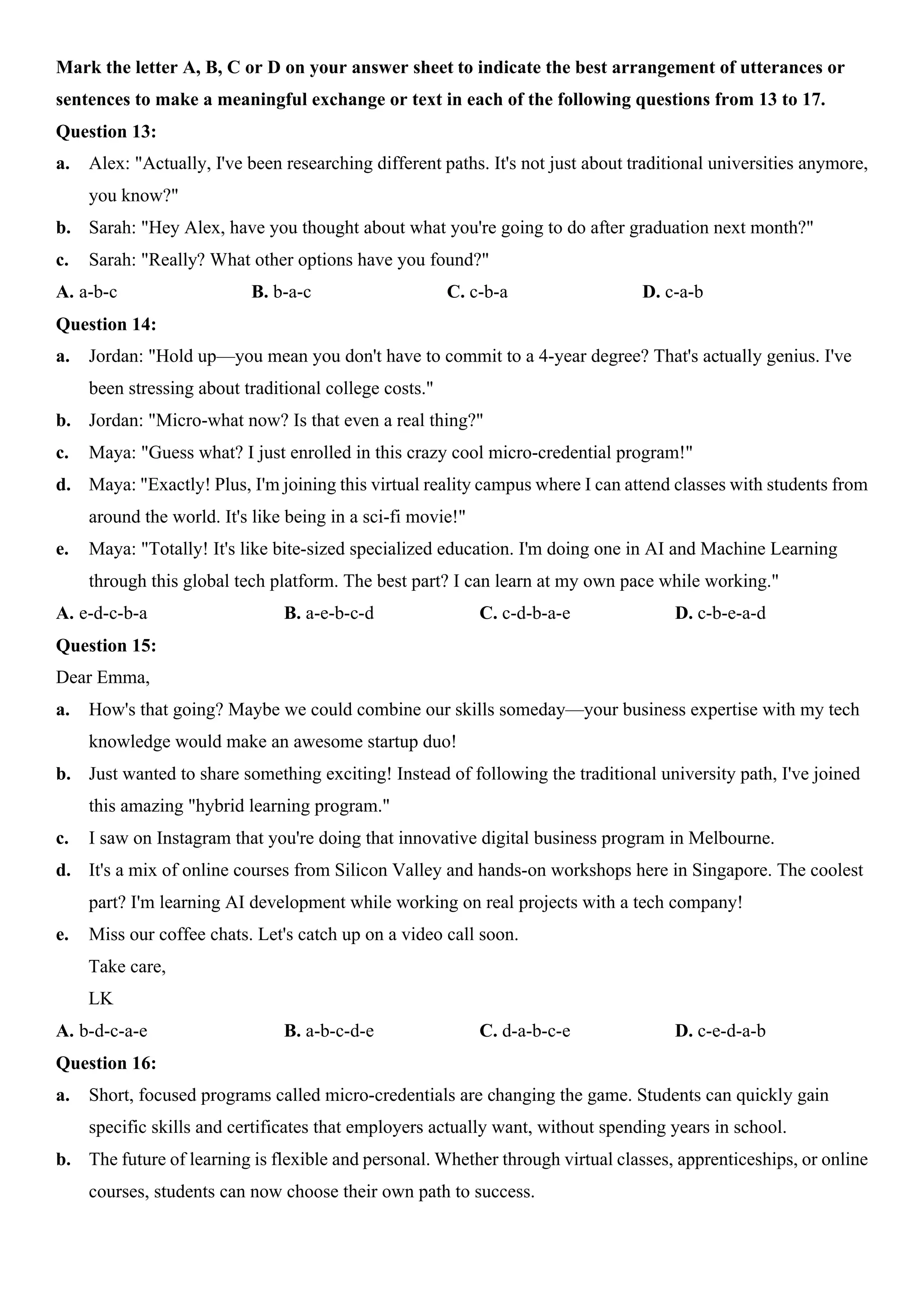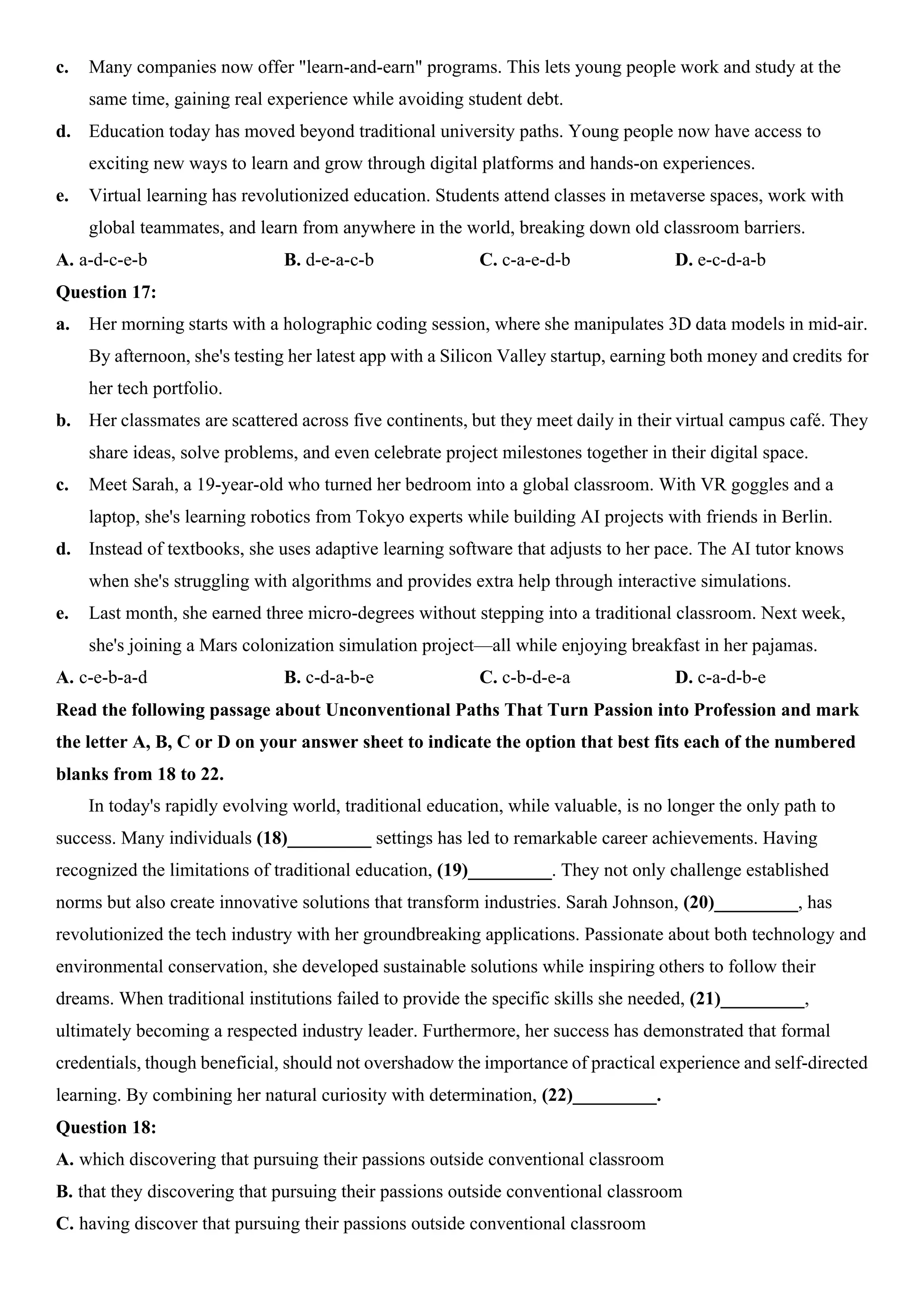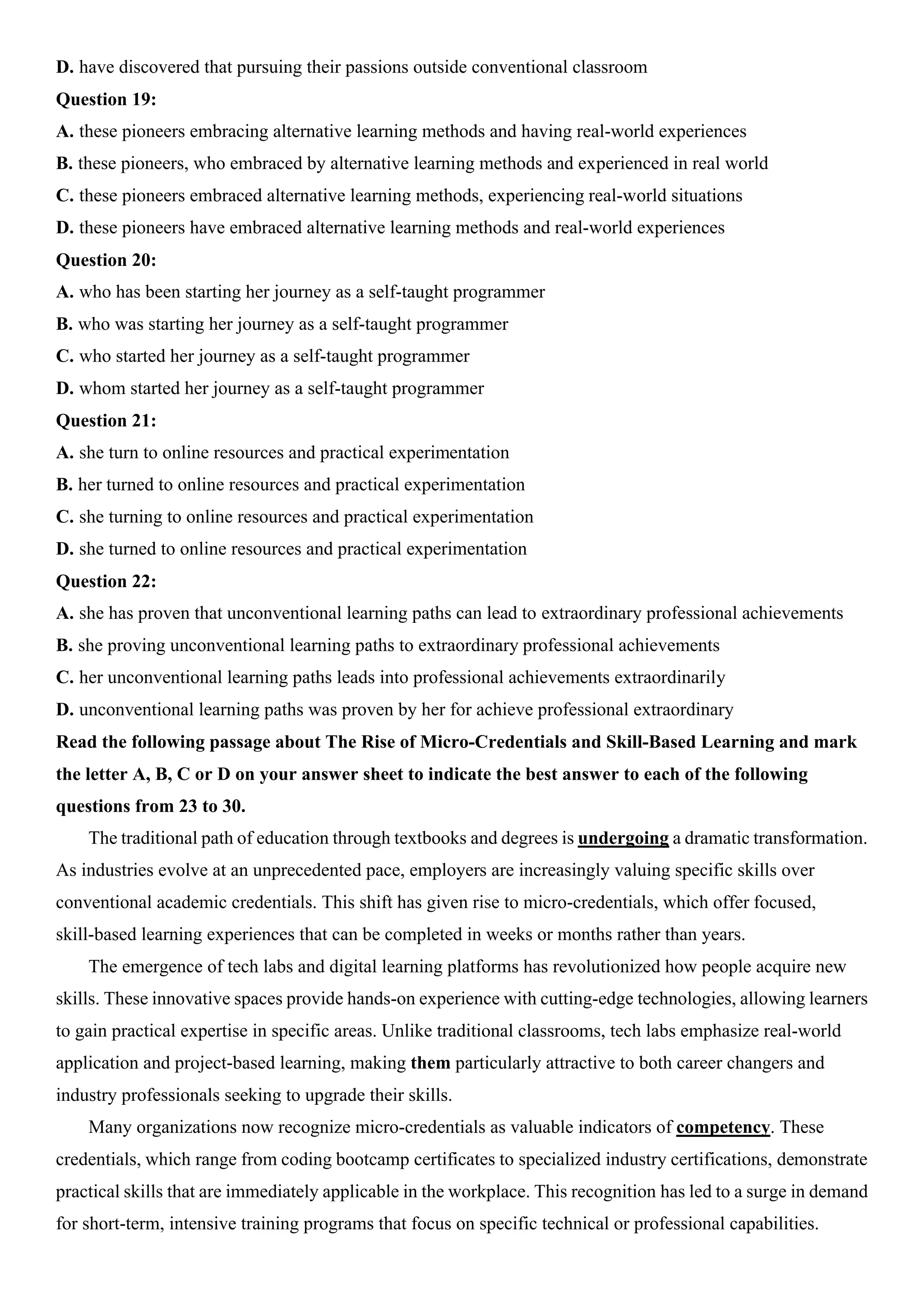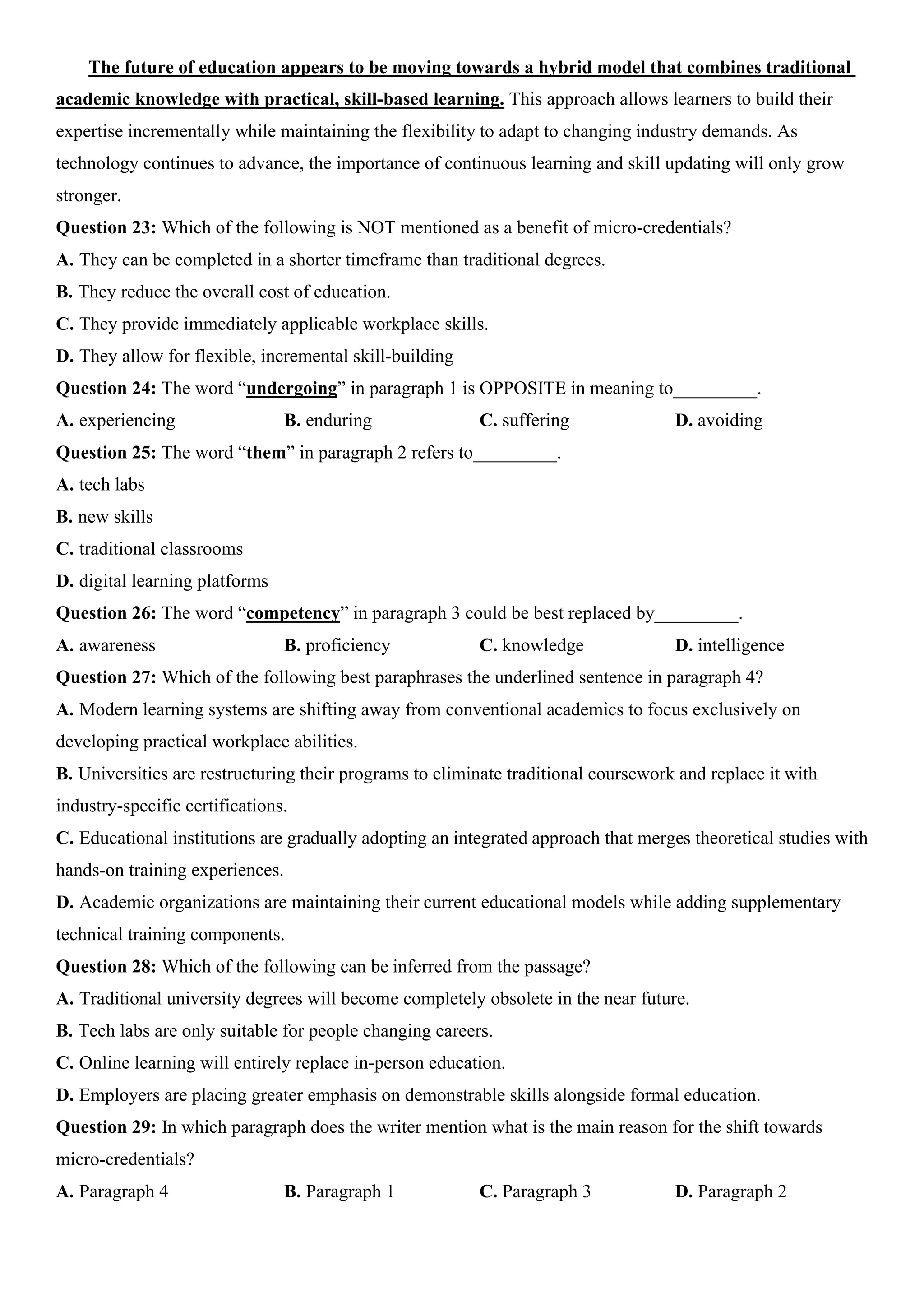
ĐỀ KIỂM TRA THEO UNIT MÔN TIẾNG ANH GLOBAL SUCCESS 11 - HK2 (BẢN HS-GV) (3 TESTS ÔN TẬP ĐƯỢC BIÊN SOẠN THEO FORM ĐỀ 2025 MỚI NHẤT CỦA BGD).pdf
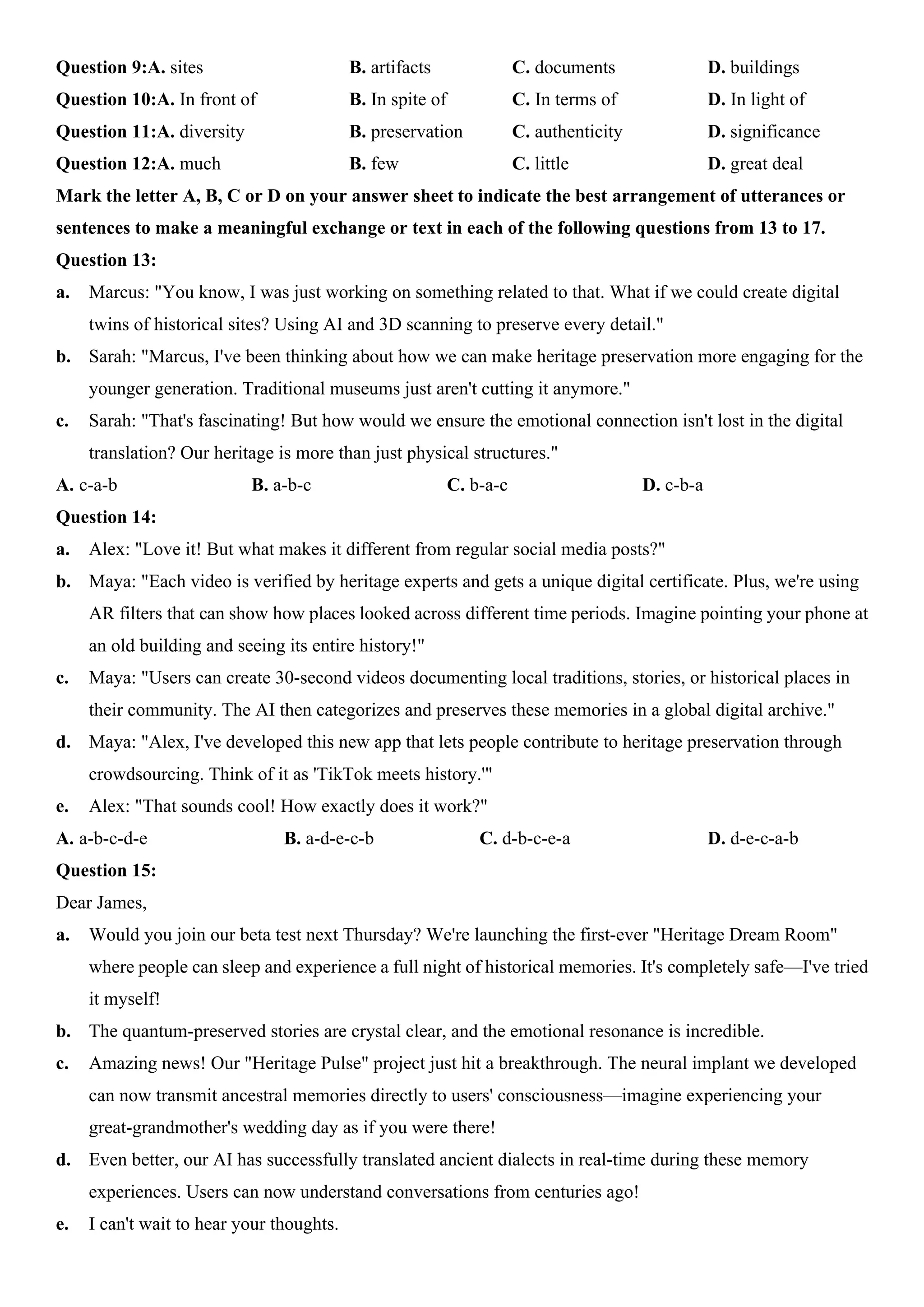
Tài liệu này gồm các bài kiểm tra môn tiếng Anh theo unit 11 - hk2 và các câu hỏi ôn tập liên quan đến việc bảo tồn di sản văn hóa bằng công nghệ. Nó bao gồm các đoạn văn cần điền từ, sắp xếp câu, và lựa chọn câu trả lời tốt nhất, đề cập đến việc sử dụng công nghệ hiện đại để bảo tồn các giá trị văn hóa truyền thống. Nội dung cũng thảo luận về sự phát triển của thế hệ trẻ trong việc sáng tạo và duy trì các truyền thống văn hóa thông qua các nền tảng số.
The presentation discusses various methods of preserving heritage through education, digital technologies, and innovative approaches. It highlights the need for adaptability and the role of modern educational methods for both cultural retention and career development.
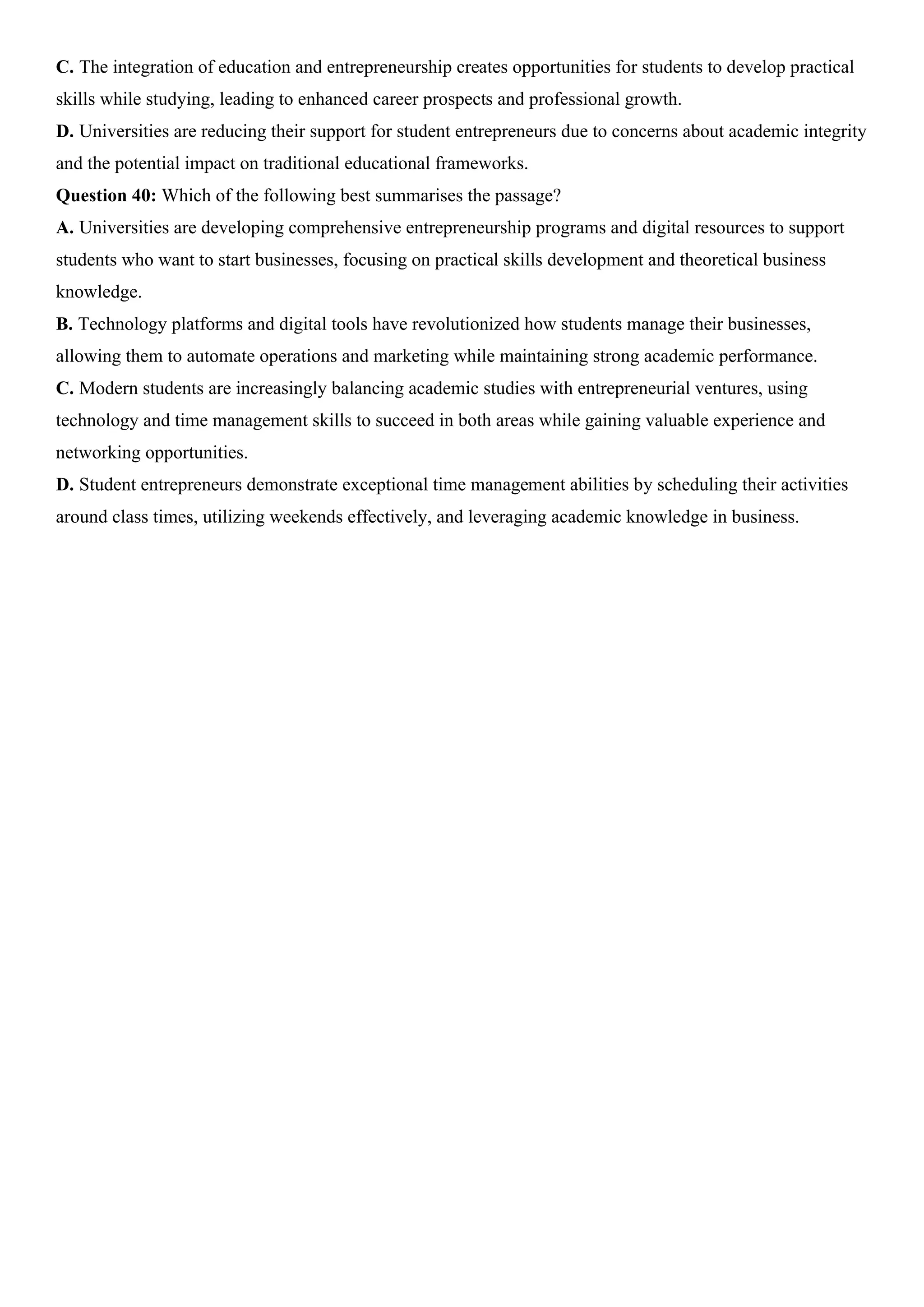
The discussion focuses on how students are increasingly integrating education with entrepreneurship. It emphasizes micro-credentials, innovative learning paths, and the importance of skills development while managing studies.
Similar to ĐỀ KIỂM TRA THEO UNIT MÔN TIẾNG ANH GLOBAL SUCCESS 11 - HK2 (BẢN HS-GV) (3 TESTS ÔN TẬP ĐƯỢC BIÊN SOẠN THEO FORM ĐỀ 2025 MỚI NHẤT CỦA BGD).pdf
PDF
HỌC TỐT TIẾNG ANH 11 THEO CHƯƠNG TRÌNH GLOBAL SUCCESS ĐÁP ÁN CHI TIẾT - HK2 (...
ĐỀ KIỂM TRA THEO UNIT MÔN TIẾNG ANH GLOBAL SUCCESS 11 - HK2 (BẢN HS-GV) (3 TESTS ÔN TẬP ĐƯỢC BIÊN SOẠN THEO FORM ĐỀ 2025 MỚI NHẤT CỦA BGD).pdf
1.
ĐỀ KIỂM TRATHEO UNIT MÔN TIẾNG ANH
GLOBAL SUCCESS 11 - HK2 (BẢN HS-GV)
(3 TESTS ÔN TẬP ĐƯỢC BIÊN SOẠN THEO
FORM ĐỀ 2025 MỚI NHẤT CỦA BGD)
WORD VERSION | 2025 EDITION
ORDER NOW / CHUYỂN GIAO QUA EMAIL
TAILIEUCHUANTHAMKHAO@GMAIL.COM
Đ Ề K I Ể M T R A T H E O U N I T
M Ô N T I Ế N G A N H
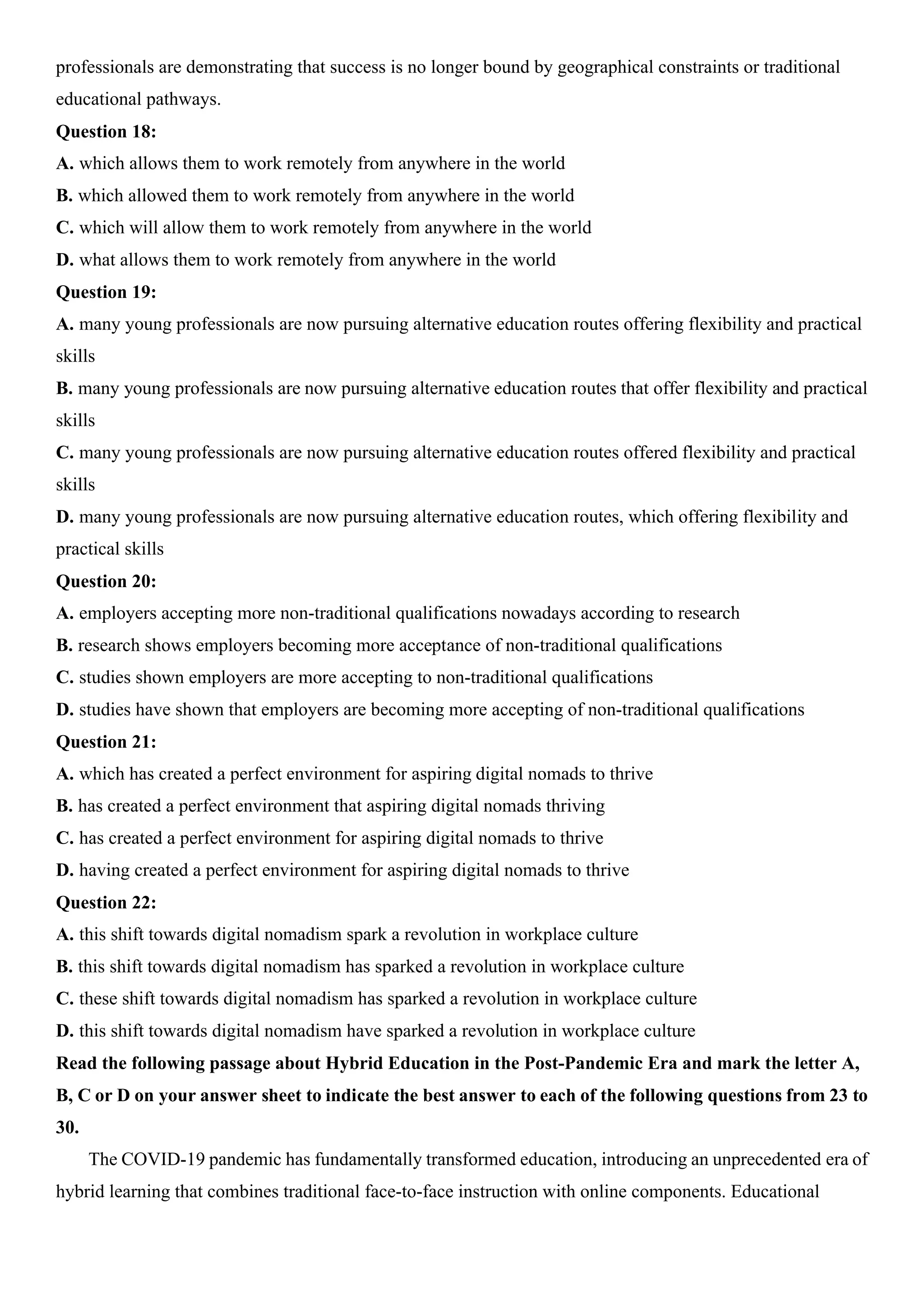
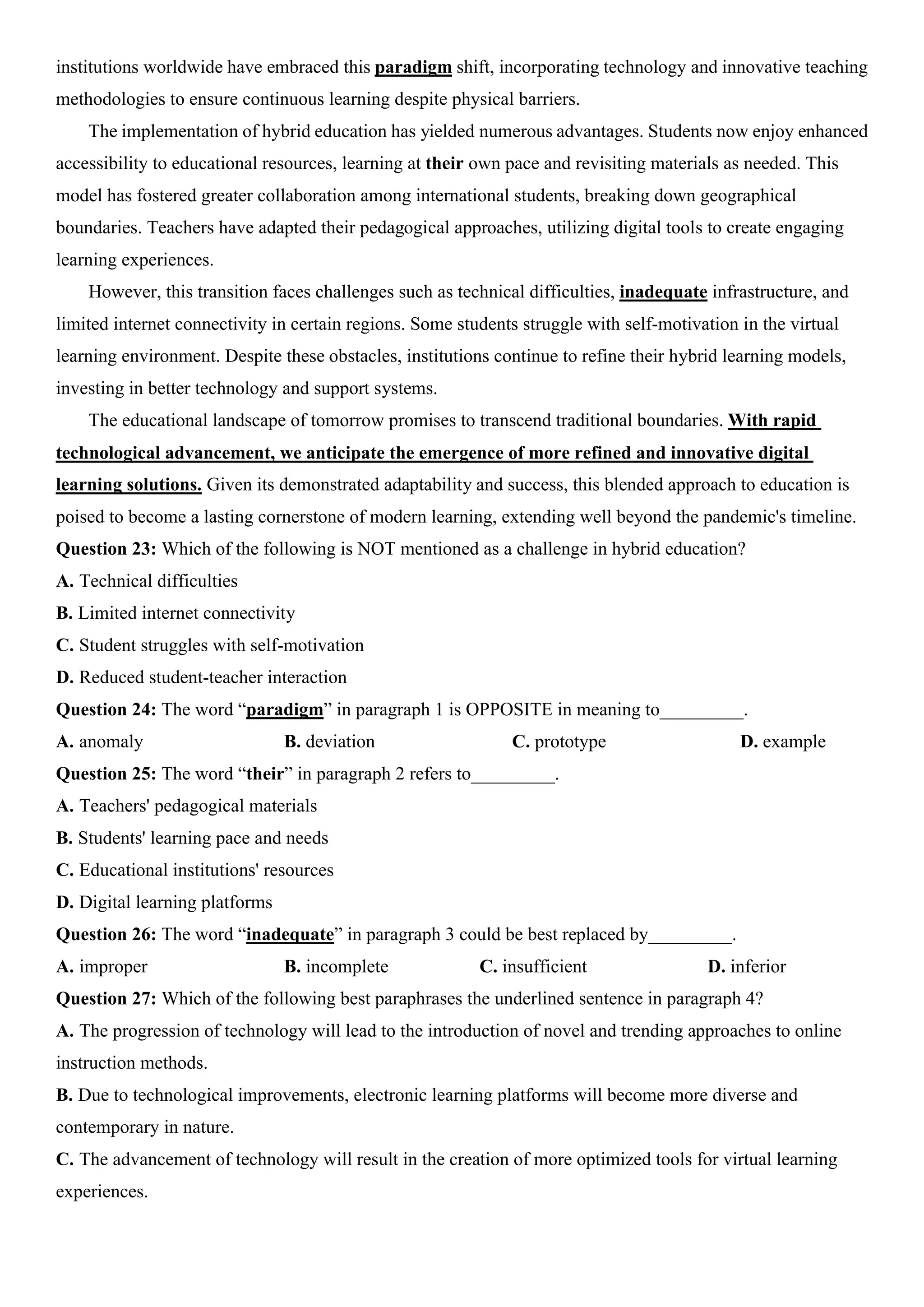
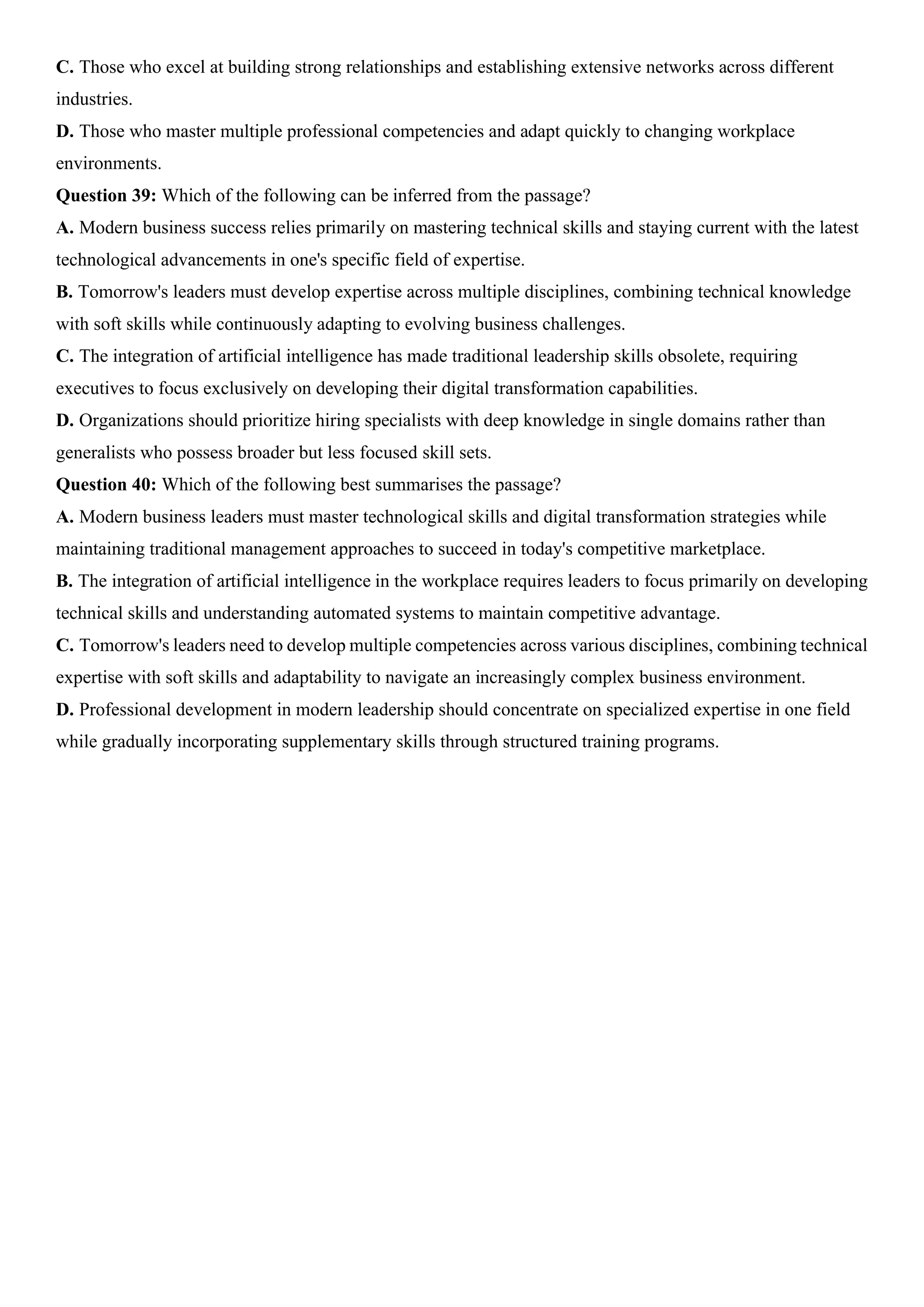
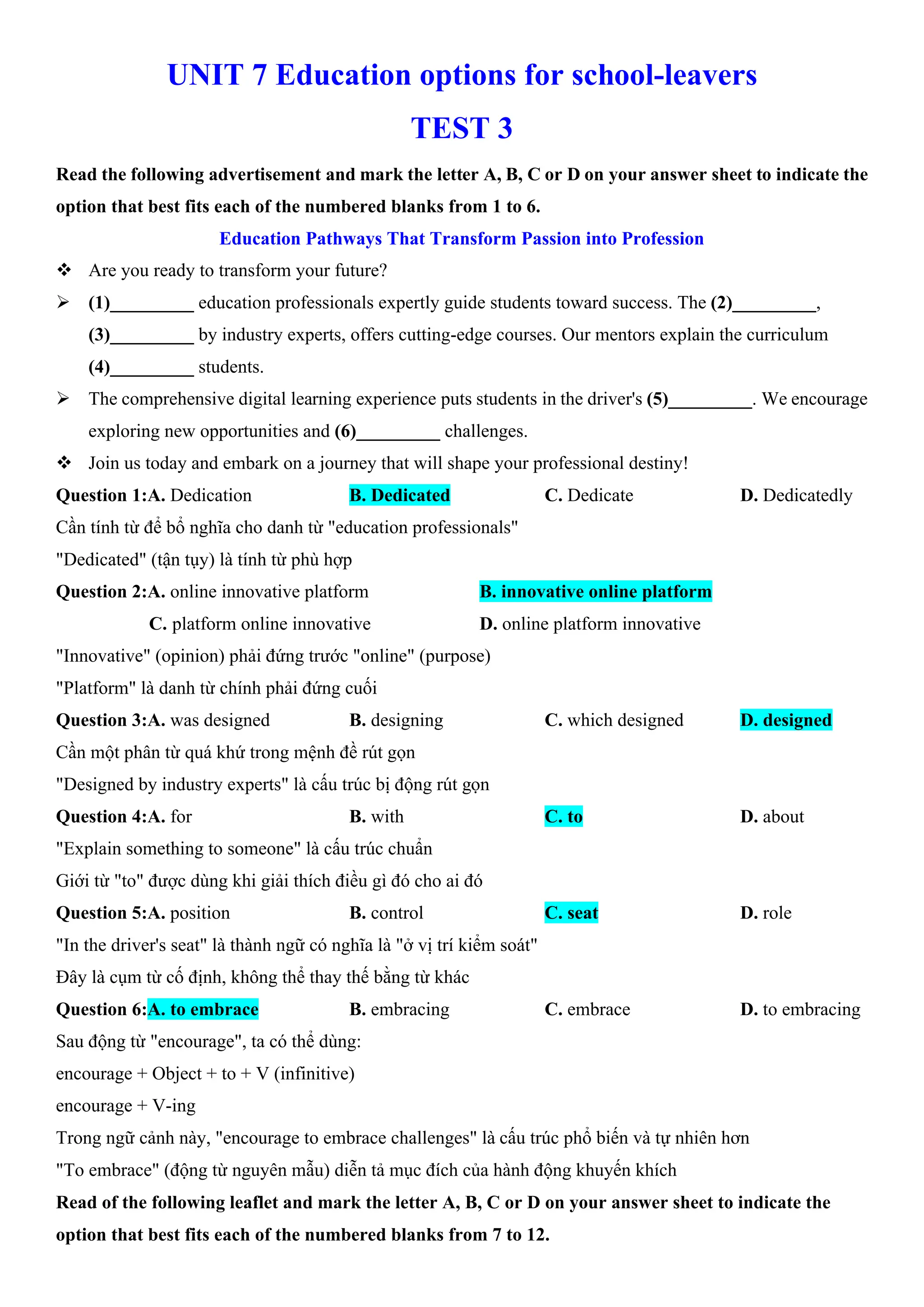
Ths Nguyễn Thanh Tú
eBook Collection
Hỗ trợ trực tuyến
Fb www.facebook.com/DayKemQuyNhon
Mobi/Zalo 0905779594
Tài liệu chuẩn tham khảo
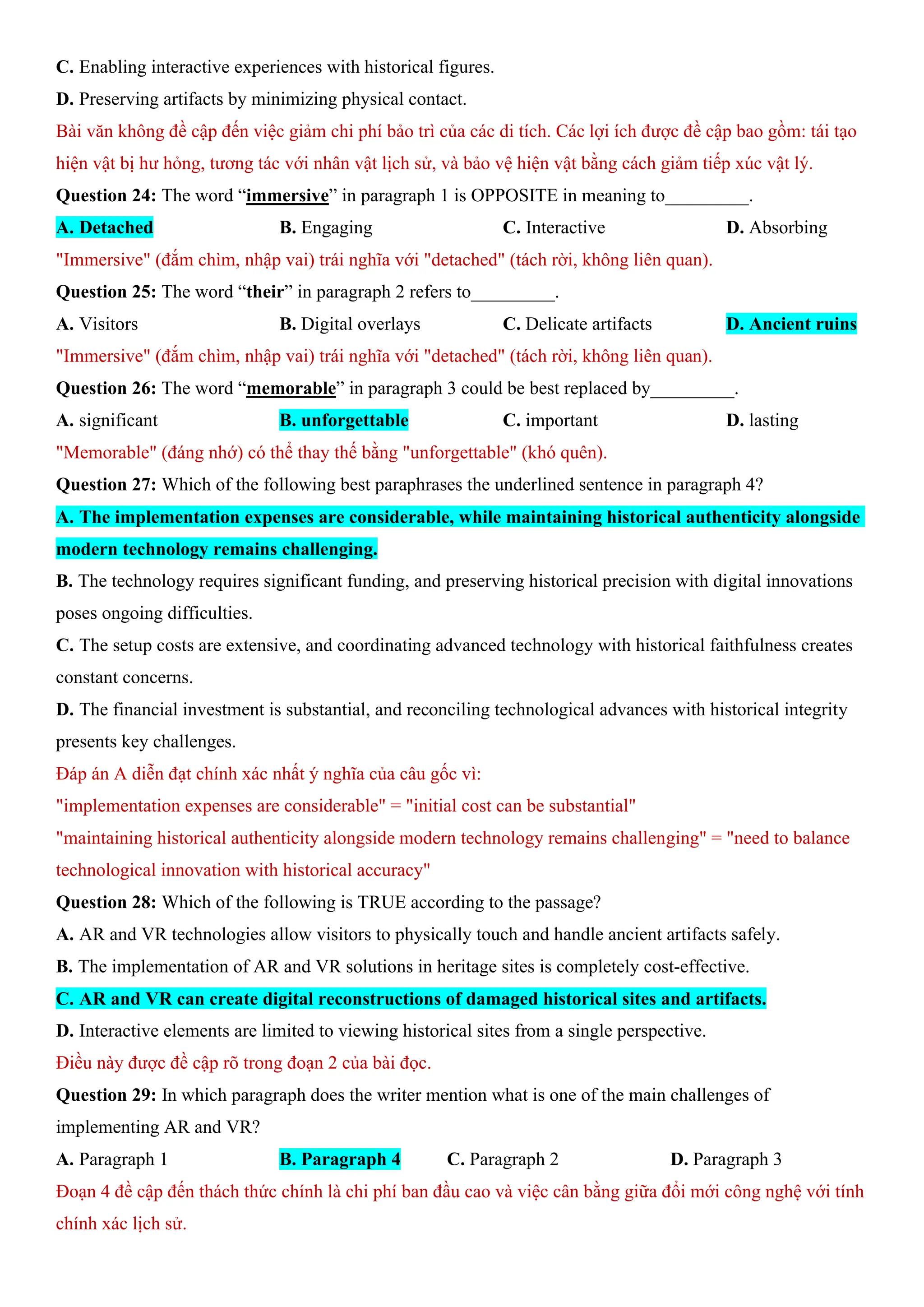
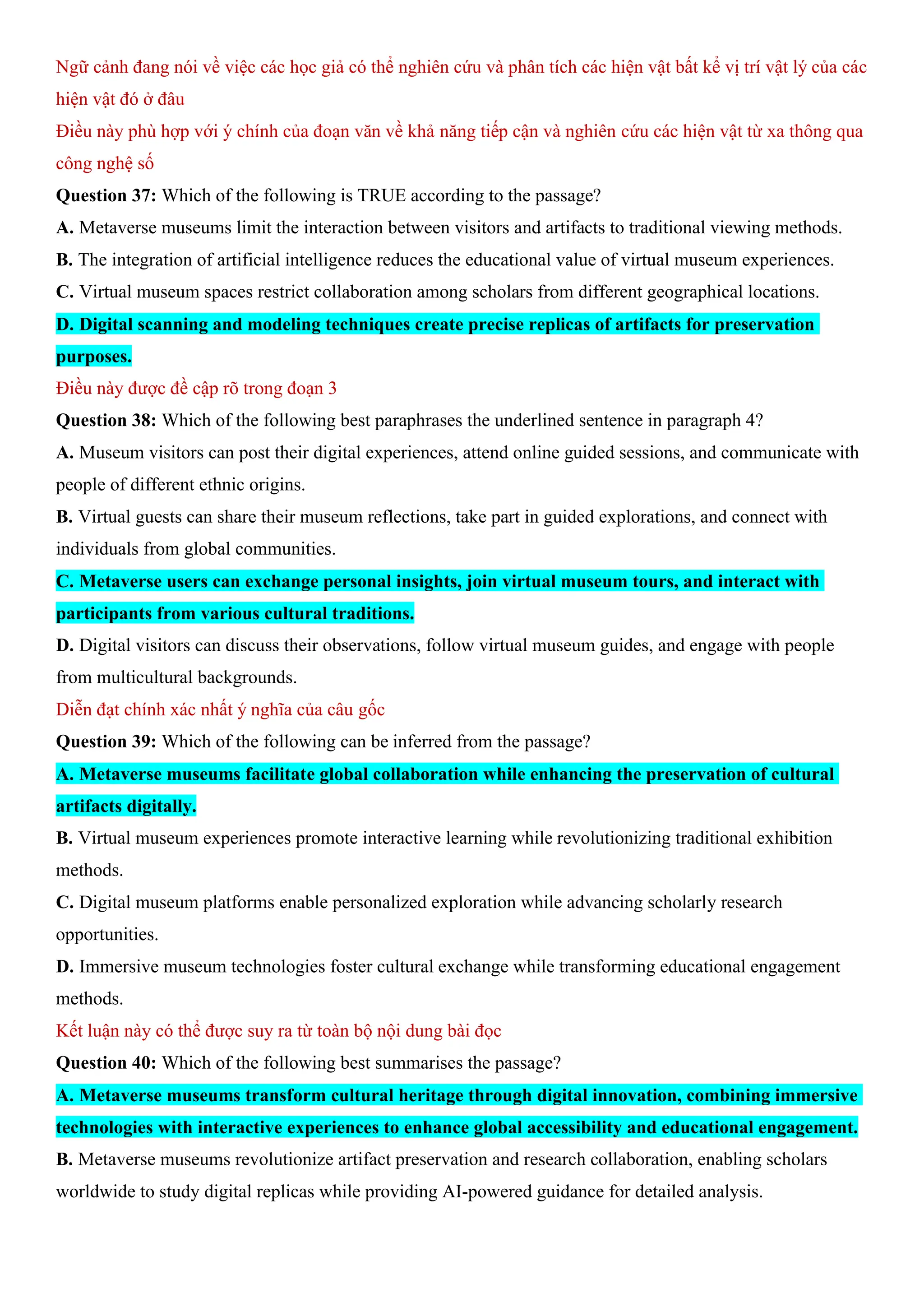
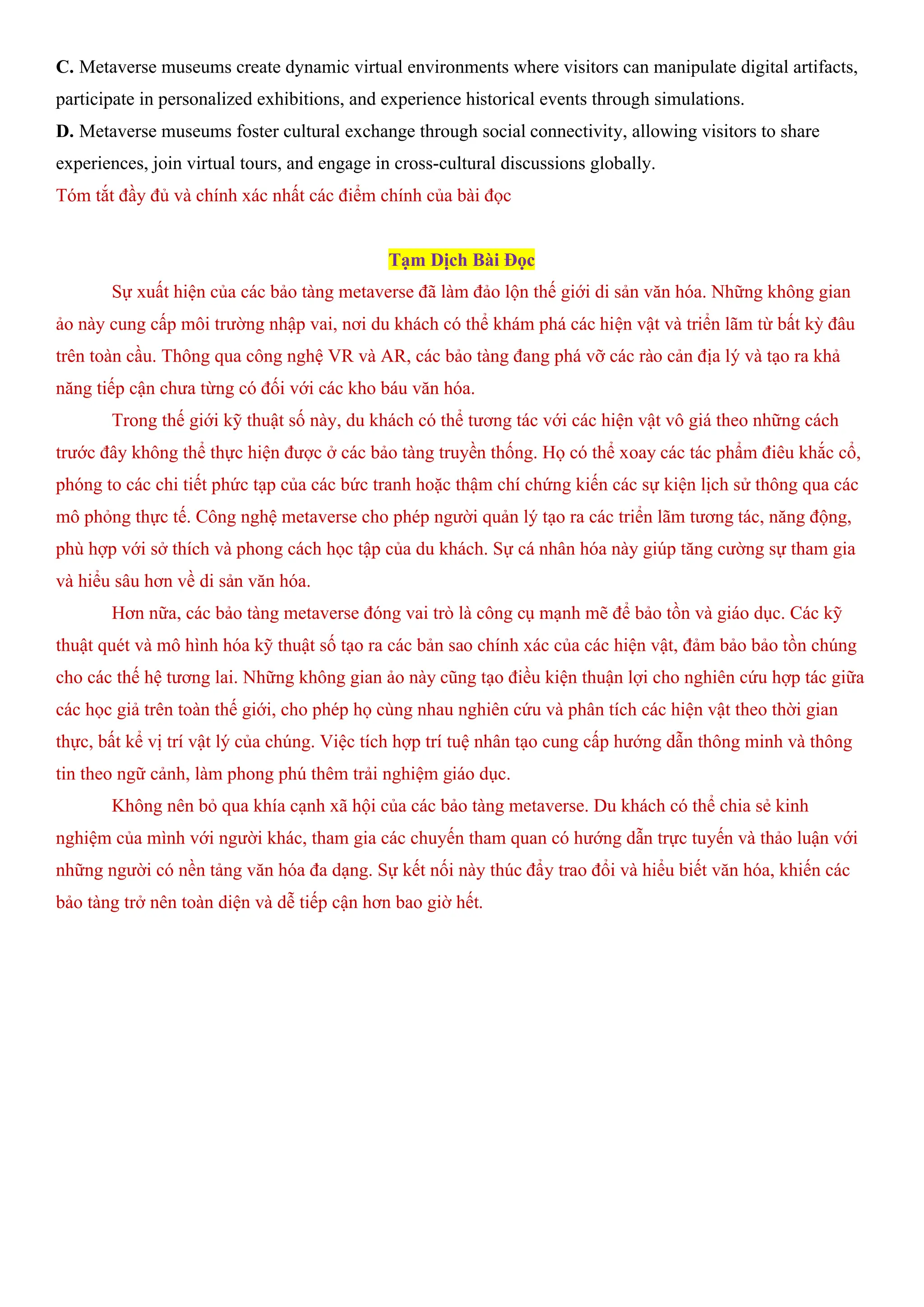
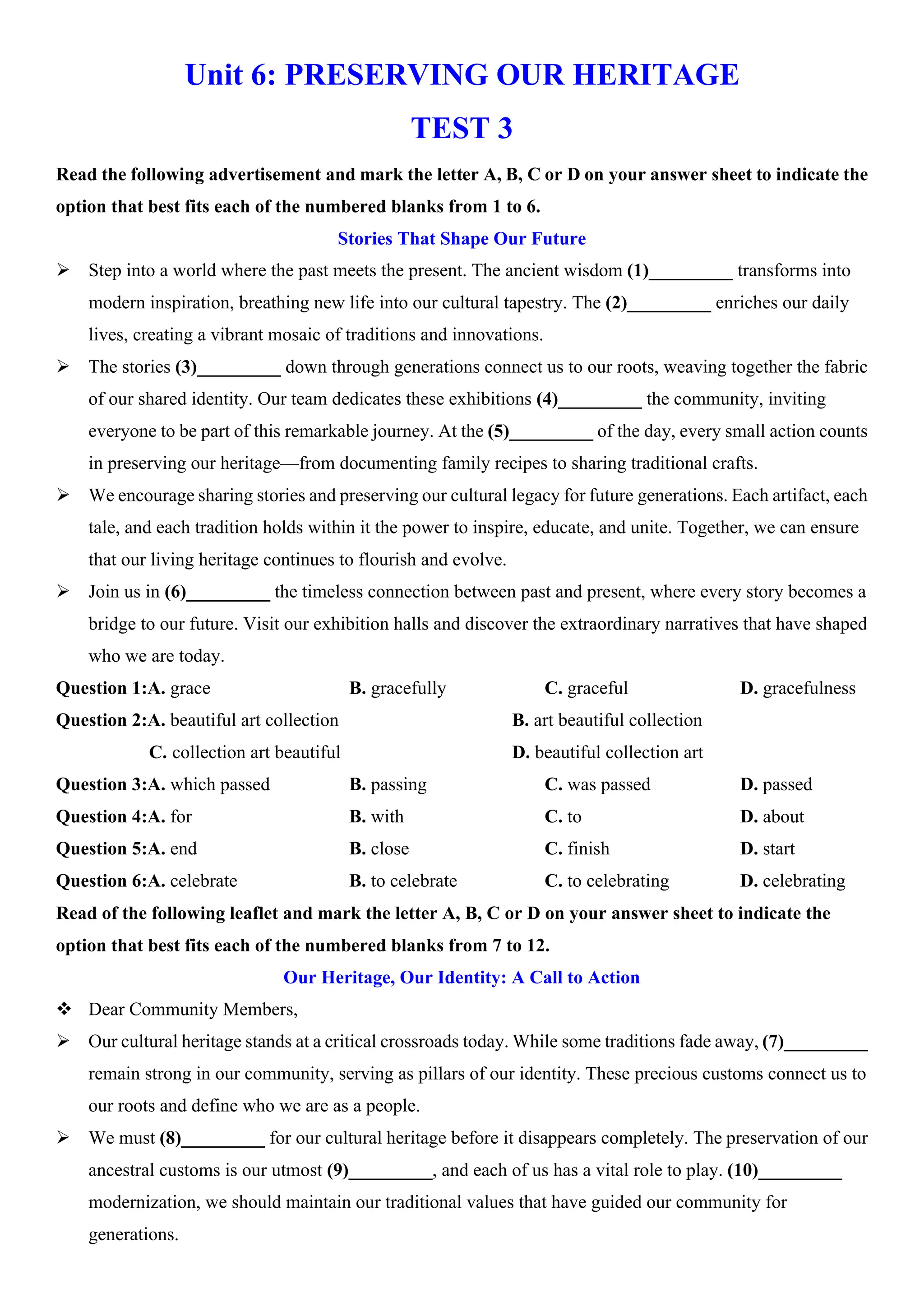
Phát triển kênh bởi
Ths Nguyễn Thanh Tú
Đơn vị tài trợ / phát hành / chia sẻ học thuật :
Nguyen Thanh Tu Group
vectorstock.com/31086119
2.
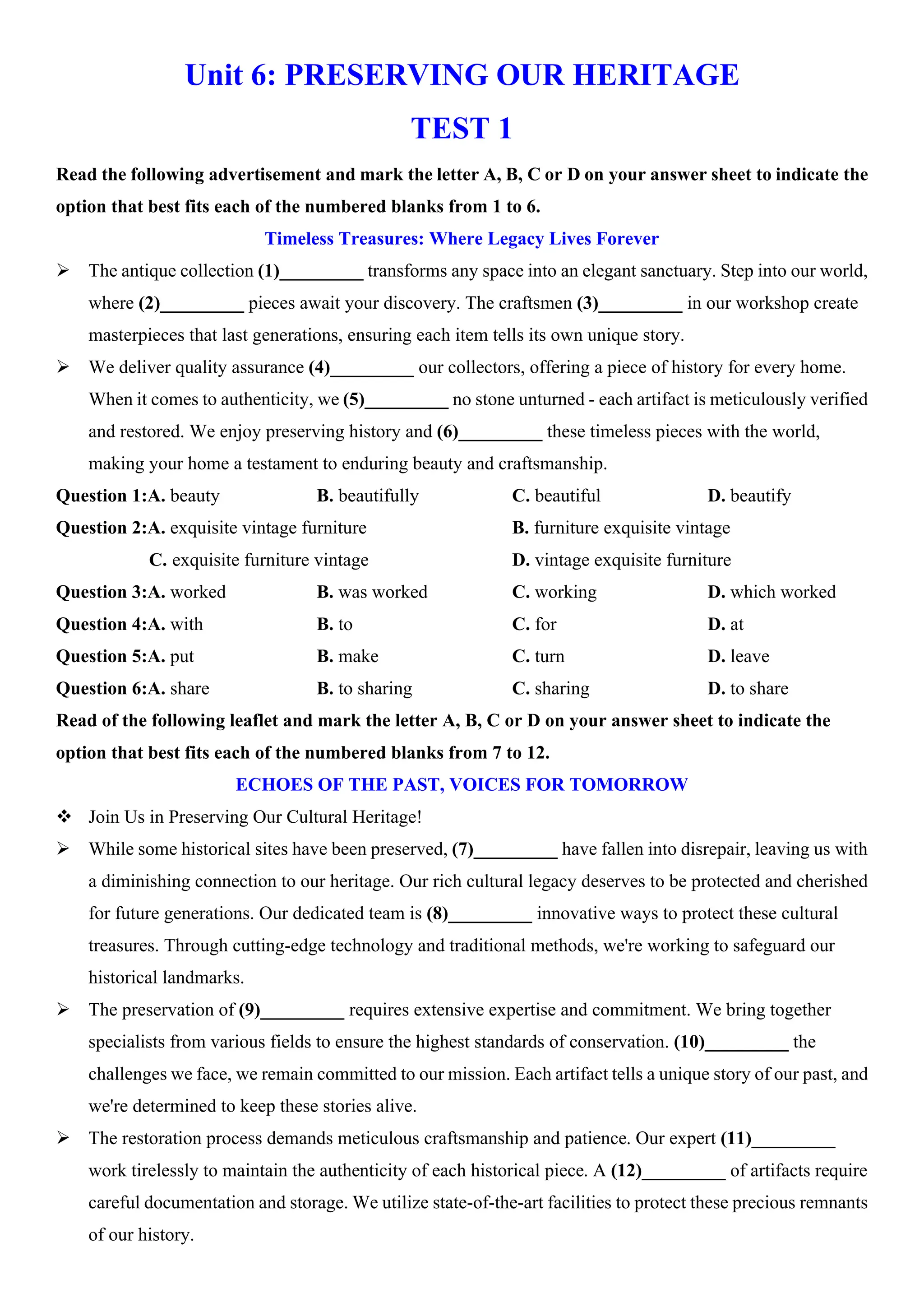
Unit 6: PRESERVINGOUR HERITAGE
TEST 1
Read the following advertisement and mark the letter A, B, C or D on your answer sheet to indicate the
option that best fits each of the numbered blanks from 1 to 6.
Timeless Treasures: Where Legacy Lives Forever
ÿ The antique collection (1)_________ transforms any space into an elegant sanctuary. Step into our world,
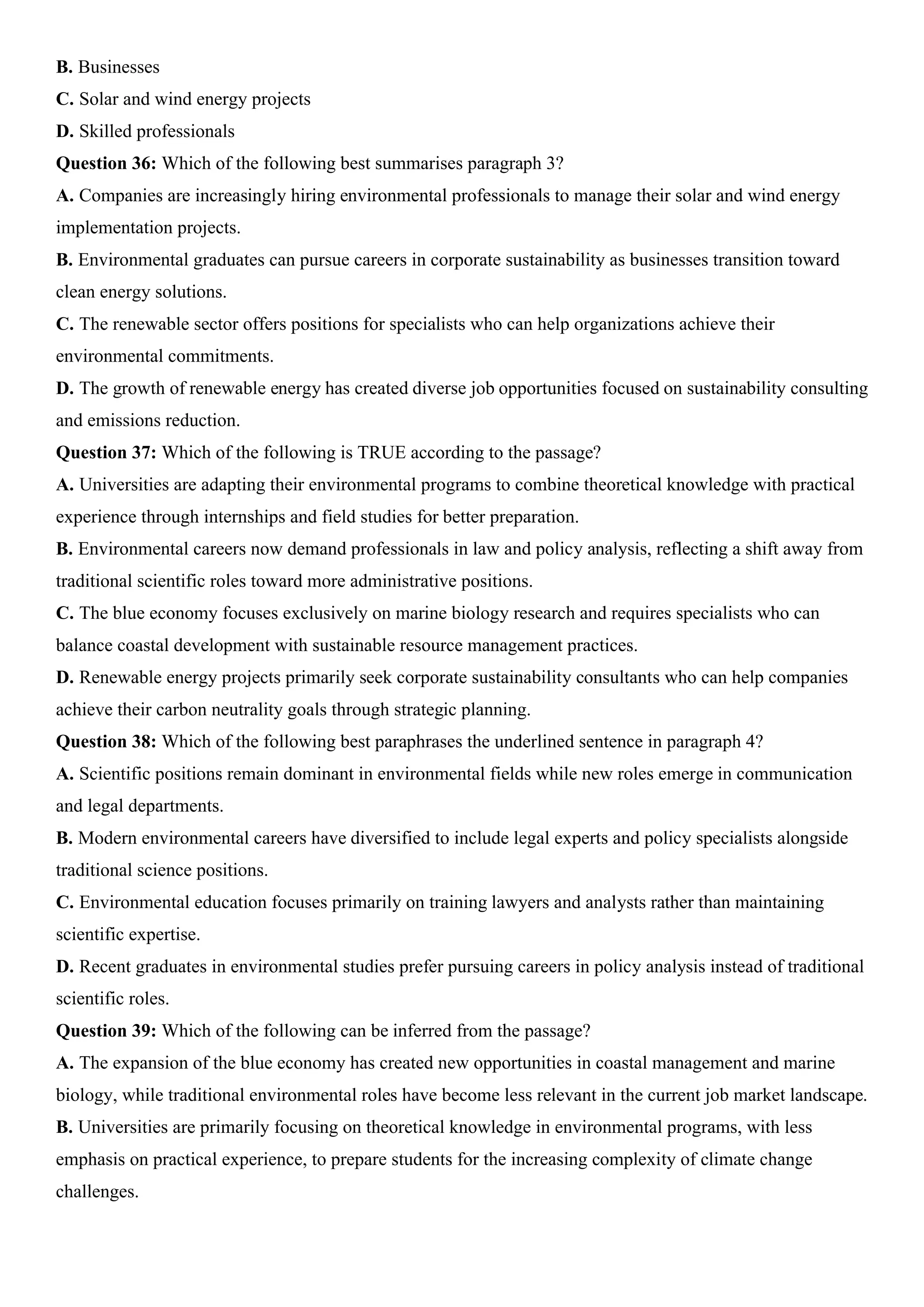
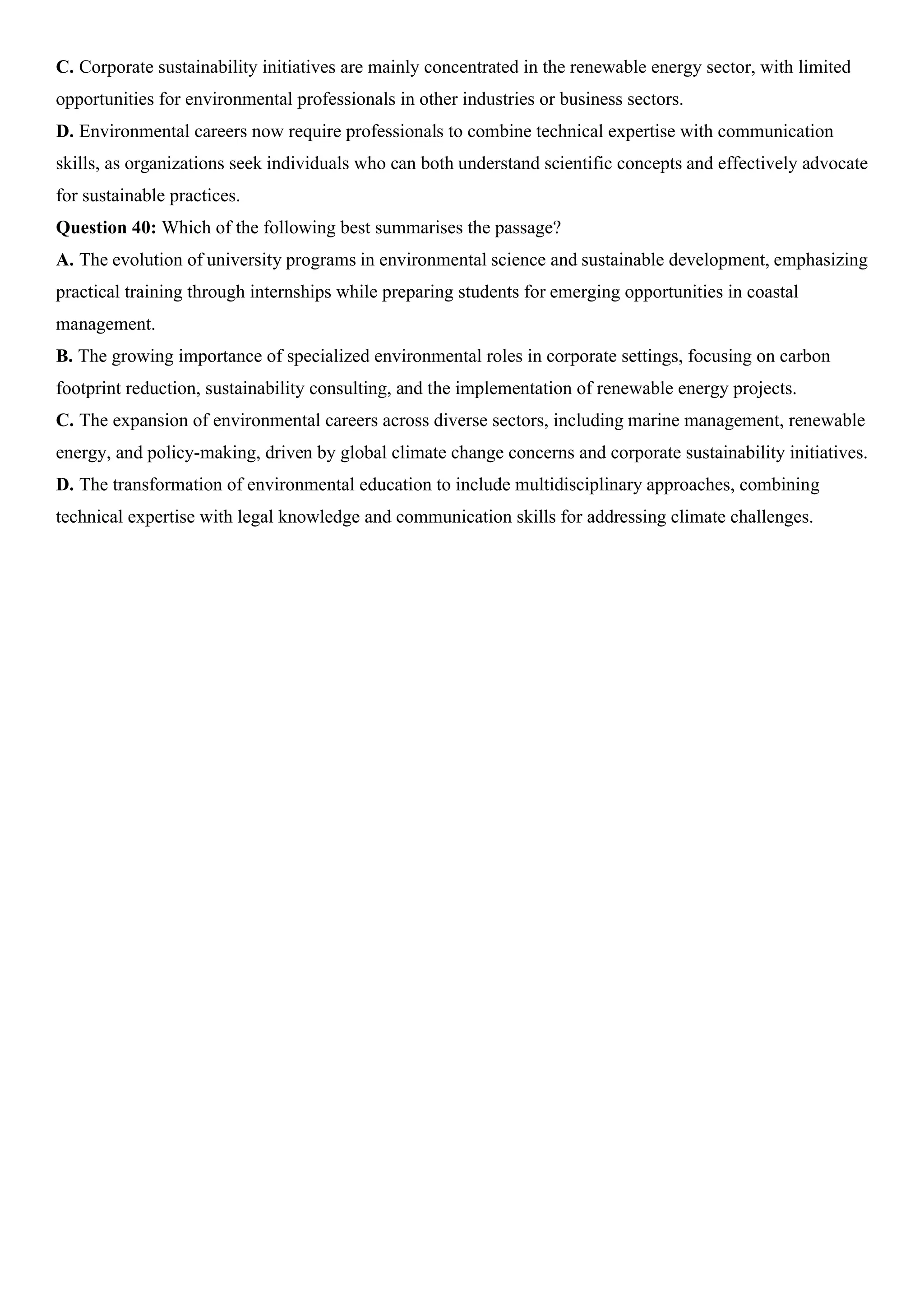
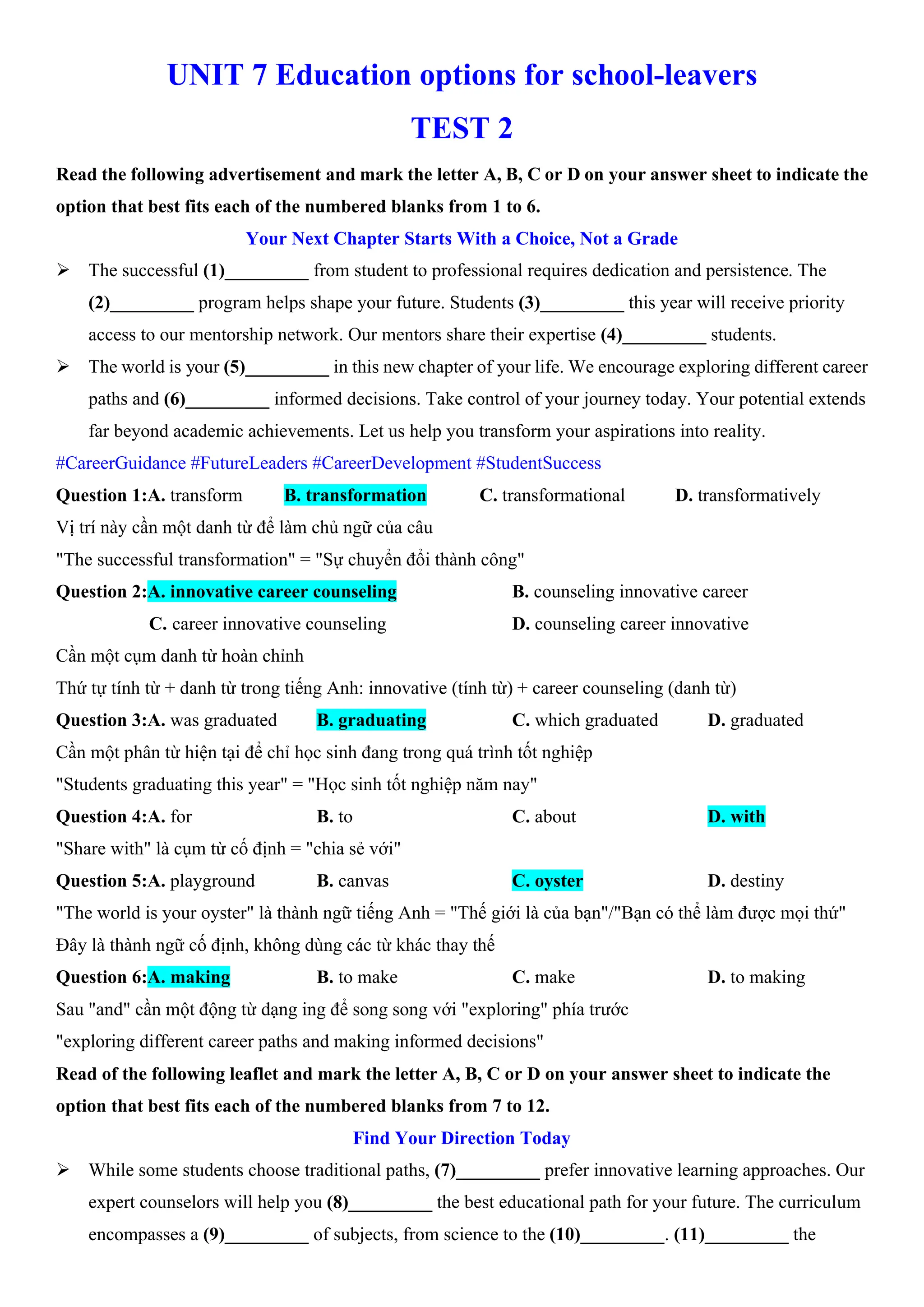
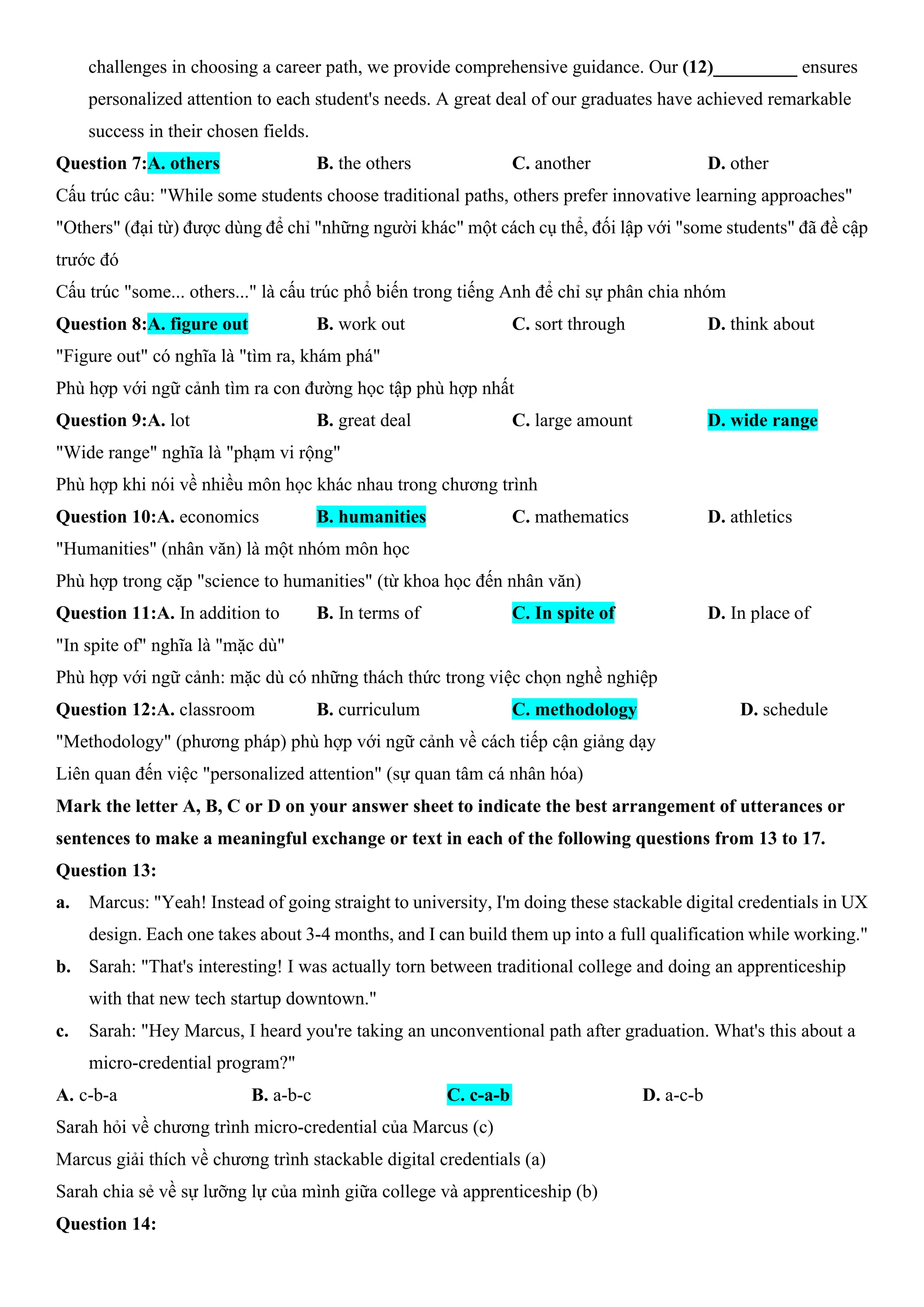
where (2)_________ pieces await your discovery. The craftsmen (3)_________ in our workshop create
masterpieces that last generations, ensuring each item tells its own unique story.
ÿ We deliver quality assurance (4)_________ our collectors, offering a piece of history for every home.
When it comes to authenticity, we (5)_________ no stone unturned - each artifact is meticulously verified
and restored. We enjoy preserving history and (6)_________ these timeless pieces with the world,
making your home a testament to enduring beauty and craftsmanship.
Question 1:A. beauty B. beautifully C. beautiful D. beautify
Question 2:A. exquisite vintage furniture B. furniture exquisite vintage
C. exquisite furniture vintage D. vintage exquisite furniture
Question 3:A. worked B. was worked C. working D. which worked
Question 4:A. with B. to C. for D. at
Question 5:A. put B. make C. turn D. leave
Question 6:A. share B. to sharing C. sharing D. to share
Read of the following leaflet and mark the letter A, B, C or D on your answer sheet to indicate the
option that best fits each of the numbered blanks from 7 to 12.
ECHOES OF THE PAST, VOICES FOR TOMORROW
v Join Us in Preserving Our Cultural Heritage!
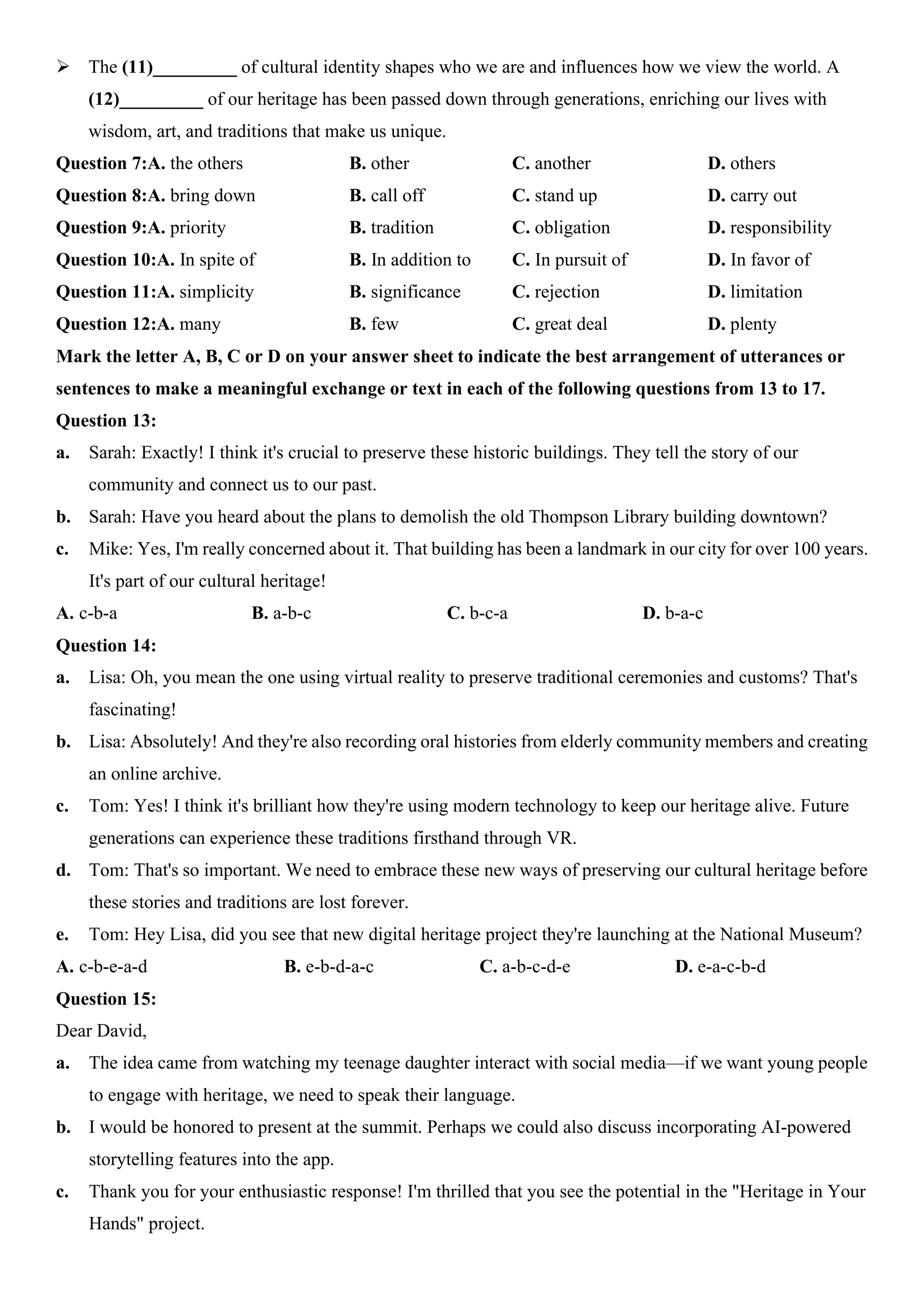
ÿ While some historical sites have been preserved, (7)_________ have fallen into disrepair, leaving us with
a diminishing connection to our heritage. Our rich cultural legacy deserves to be protected and cherished
for future generations. Our dedicated team is (8)_________ innovative ways to protect these cultural
treasures. Through cutting-edge technology and traditional methods, we're working to safeguard our
historical landmarks.
ÿ The preservation of (9)_________ requires extensive expertise and commitment. We bring together
specialists from various fields to ensure the highest standards of conservation. (10)_________ the
challenges we face, we remain committed to our mission. Each artifact tells a unique story of our past, and
we're determined to keep these stories alive.
ÿ The restoration process demands meticulous craftsmanship and patience. Our expert (11)_________
work tirelessly to maintain the authenticity of each historical piece. A (12)_________ of artifacts require
careful documentation and storage. We utilize state-of-the-art facilities to protect these precious remnants
of our history.
3.
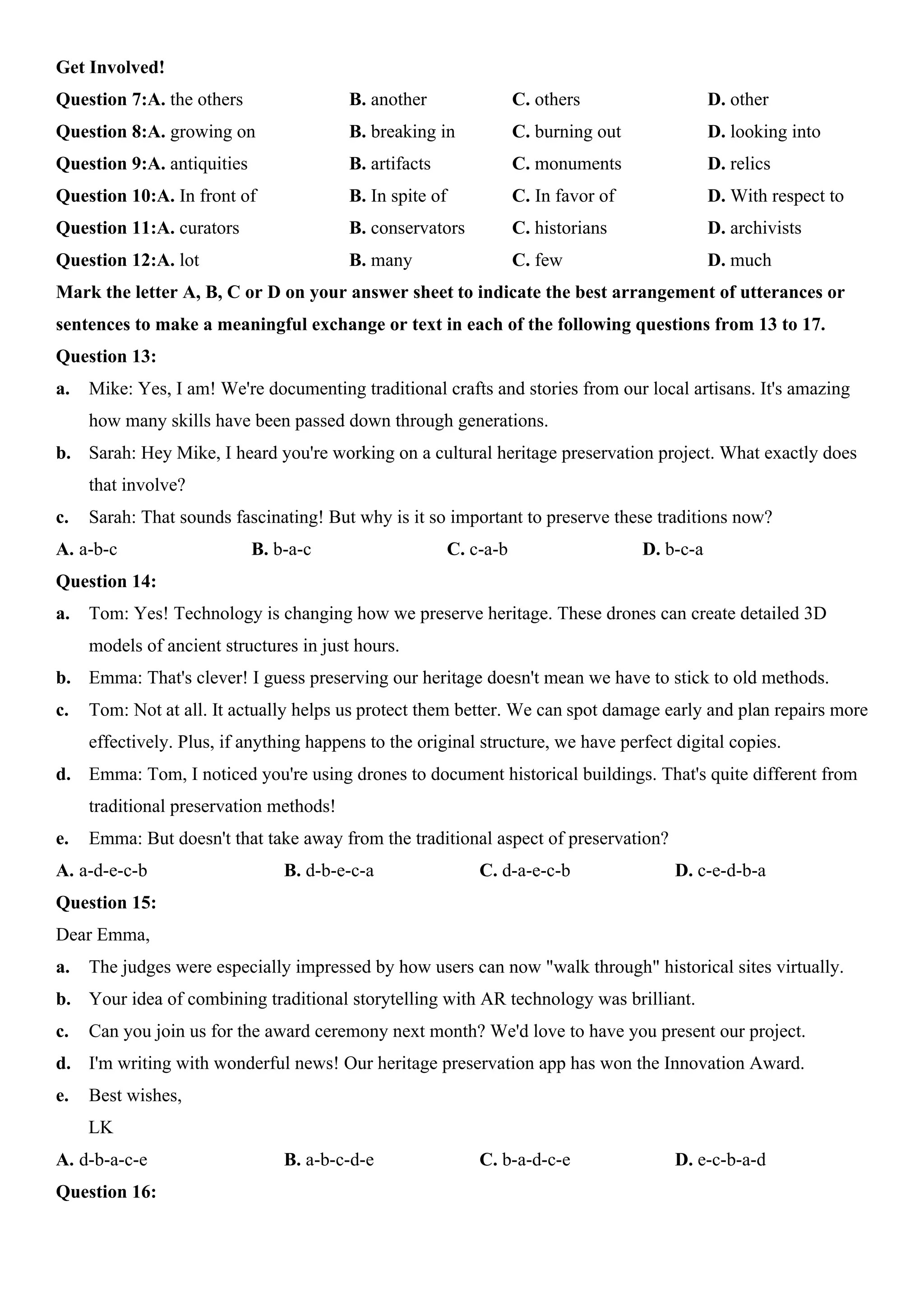
Get Involved!
Question 7:A.the others B. another C. others D. other
Question 8:A. growing on B. breaking in C. burning out D. looking into
Question 9:A. antiquities B. artifacts C. monuments D. relics
Question 10:A. In front of B. In spite of C. In favor of D. With respect to
Question 11:A. curators B. conservators C. historians D. archivists
Question 12:A. lot B. many C. few D. much
Mark the letter A, B, C or D on your answer sheet to indicate the best arrangement of utterances or
sentences to make a meaningful exchange or text in each of the following questions from 13 to 17.
Question 13:
a. Mike: Yes, I am! We're documenting traditional crafts and stories from our local artisans. It's amazing
how many skills have been passed down through generations.
b. Sarah: Hey Mike, I heard you're working on a cultural heritage preservation project. What exactly does
that involve?
c. Sarah: That sounds fascinating! But why is it so important to preserve these traditions now?
A. a-b-c B. b-a-c C. c-a-b D. b-c-a
Question 14:
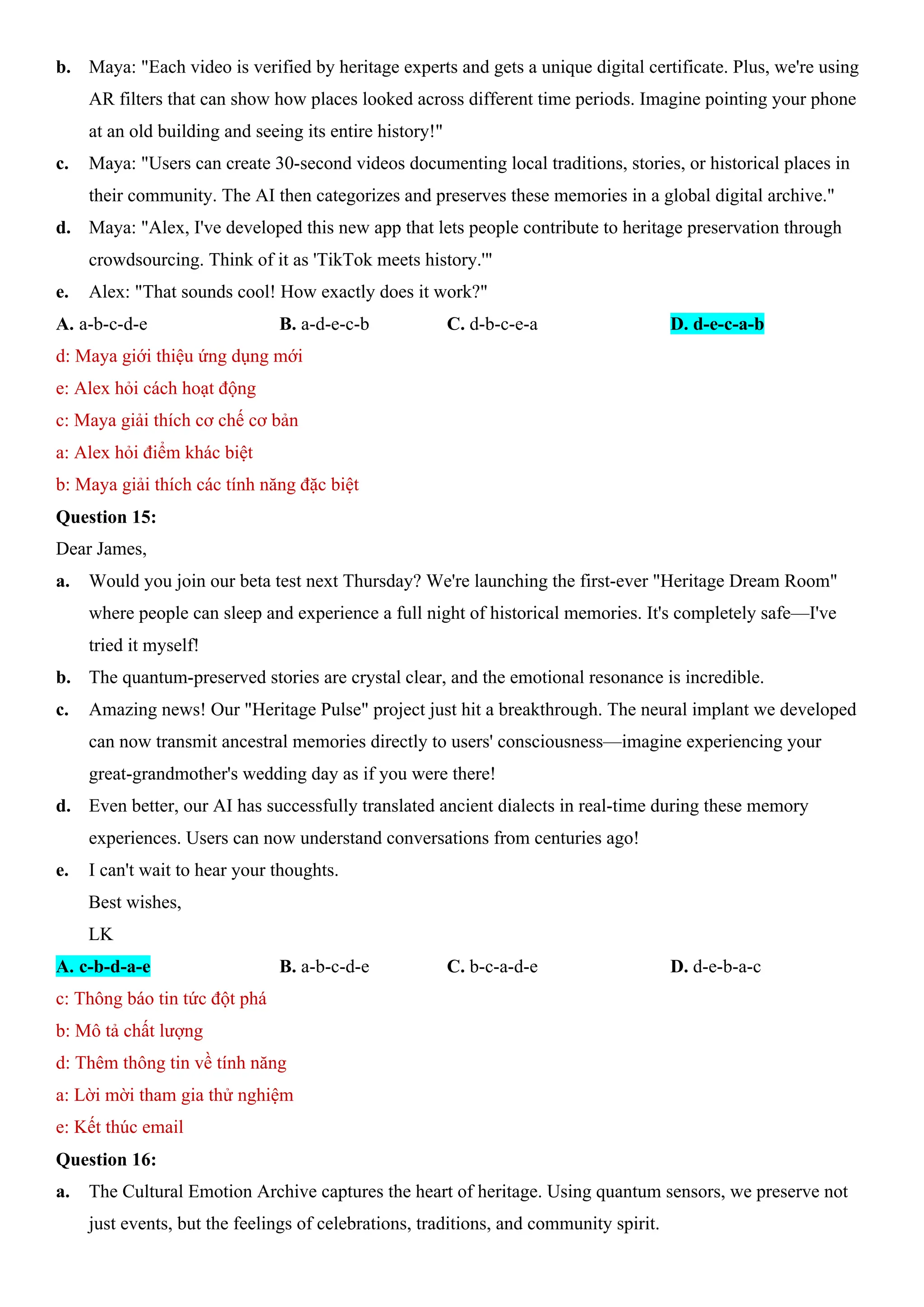
a. Tom: Yes! Technology is changing how we preserve heritage. These drones can create detailed 3D
models of ancient structures in just hours.
b. Emma: That's clever! I guess preserving our heritage doesn't mean we have to stick to old methods.
c. Tom: Not at all. It actually helps us protect them better. We can spot damage early and plan repairs more
effectively. Plus, if anything happens to the original structure, we have perfect digital copies.
d. Emma: Tom, I noticed you're using drones to document historical buildings. That's quite different from
traditional preservation methods!
e. Emma: But doesn't that take away from the traditional aspect of preservation?
A. a-d-e-c-b B. d-b-e-c-a C. d-a-e-c-b D. c-e-d-b-a
Question 15:
Dear Emma,
a. The judges were especially impressed by how users can now "walk through" historical sites virtually.
b. Your idea of combining traditional storytelling with AR technology was brilliant.
c. Can you join us for the award ceremony next month? We'd love to have you present our project.
d. I'm writing with wonderful news! Our heritage preservation app has won the Innovation Award.
e. Best wishes,
LK
A. d-b-a-c-e B. a-b-c-d-e C. b-a-d-c-e D. e-c-b-a-d
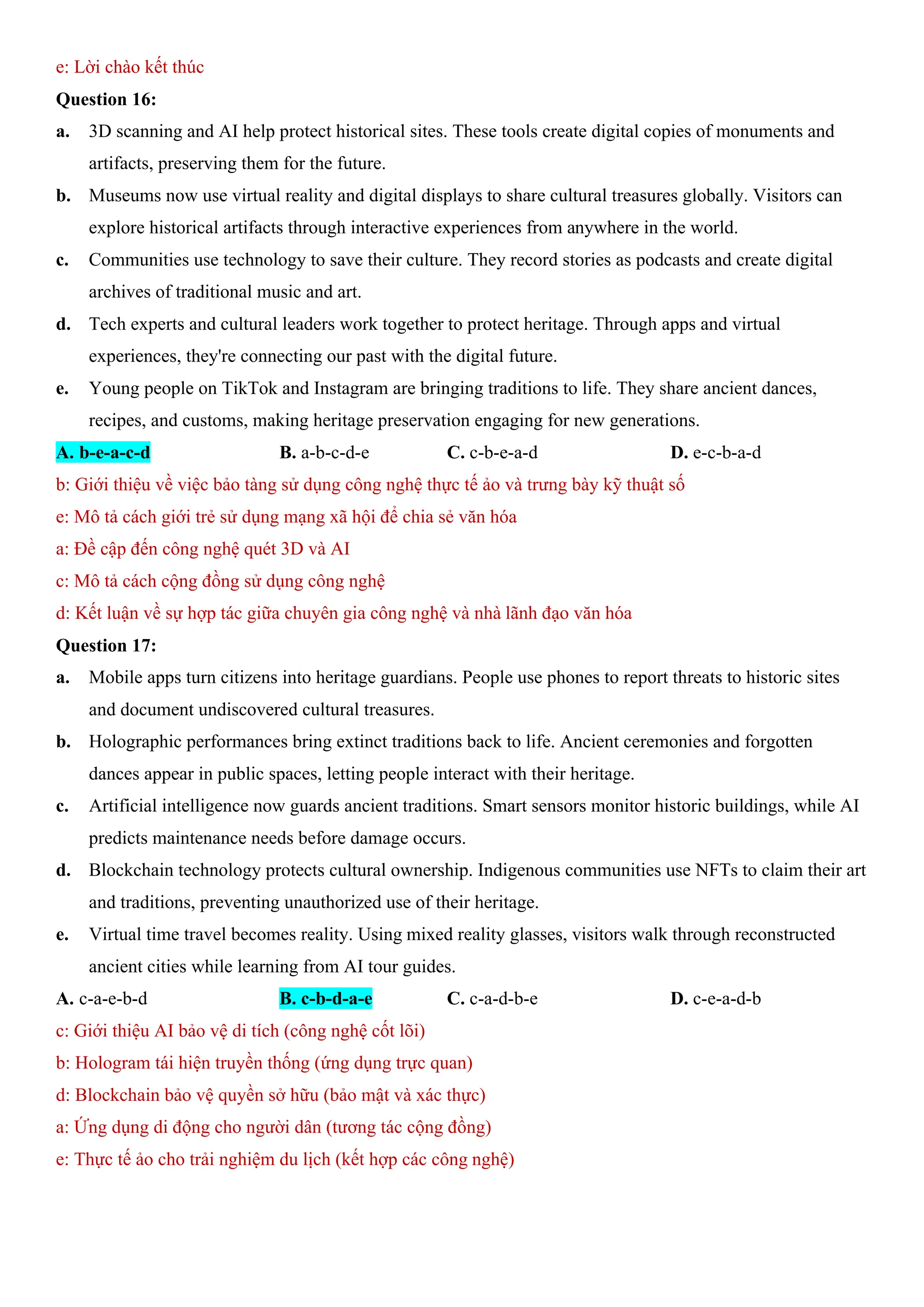
Question 16:
4.
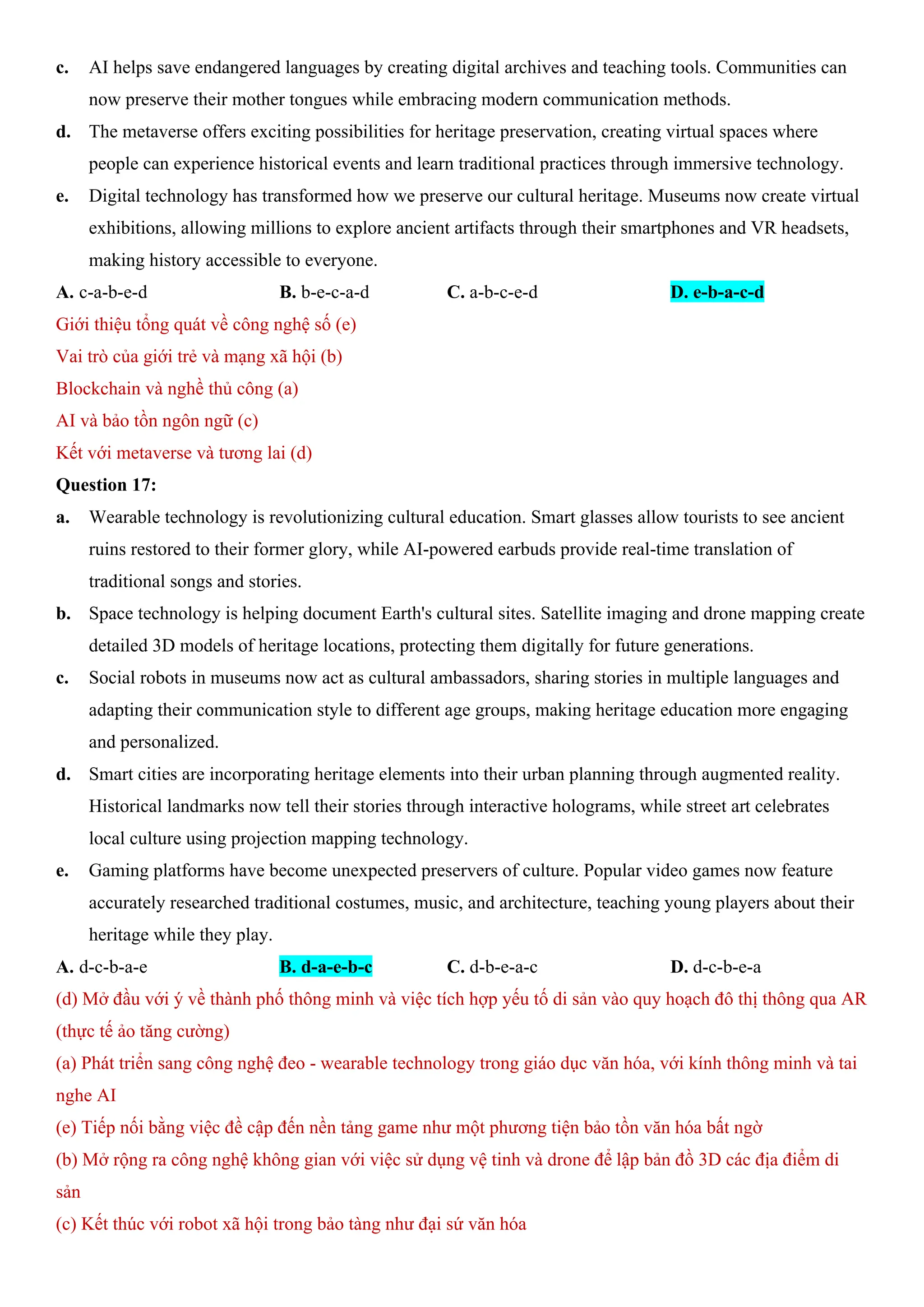
a. Blockchain technologyis protecting traditional crafts in new ways. Digital certificates now authenticate
indigenous art and designs, while ensuring artisans receive fair payment for their work.
b. Young people are becoming unexpected guardians of tradition through social media. On platforms like
TikTok and Instagram, traditional recipes, folk dances, and cultural stories are trending, reaching
audiences worldwide in seconds.
c. AI helps save endangered languages by creating digital archives and teaching tools. Communities can
now preserve their mother tongues while embracing modern communication methods.
d. The metaverse offers exciting possibilities for heritage preservation, creating virtual spaces where people
can experience historical events and learn traditional practices through immersive technology.
e. Digital technology has transformed how we preserve our cultural heritage. Museums now create virtual
exhibitions, allowing millions to explore ancient artifacts through their smartphones and VR headsets,
making history accessible to everyone.
A. c-a-b-e-d B. b-e-c-a-d C. a-b-c-e-d D. e-b-a-c-d
Question 17:
a. Wearable technology is revolutionizing cultural education. Smart glasses allow tourists to see ancient
ruins restored to their former glory, while AI-powered earbuds provide real-time translation of traditional
songs and stories.
b. Space technology is helping document Earth's cultural sites. Satellite imaging and drone mapping create
detailed 3D models of heritage locations, protecting them digitally for future generations.
c. Social robots in museums now act as cultural ambassadors, sharing stories in multiple languages and
adapting their communication style to different age groups, making heritage education more engaging
and personalized.
d. Smart cities are incorporating heritage elements into their urban planning through augmented reality.
Historical landmarks now tell their stories through interactive holograms, while street art celebrates local
culture using projection mapping technology.
e. Gaming platforms have become unexpected preservers of culture. Popular video games now feature
accurately researched traditional costumes, music, and architecture, teaching young players about their
heritage while they play.
A. d-c-b-a-e B. d-a-e-b-c C. d-b-e-a-c D. d-c-b-e-a
Read the following passage about How Technology is Revolutionizing Heritage Preservation and mark
the letter A, B, C or D on your answer sheet to indicate the option that best fits each of the numbered
blanks from 18 to 22.
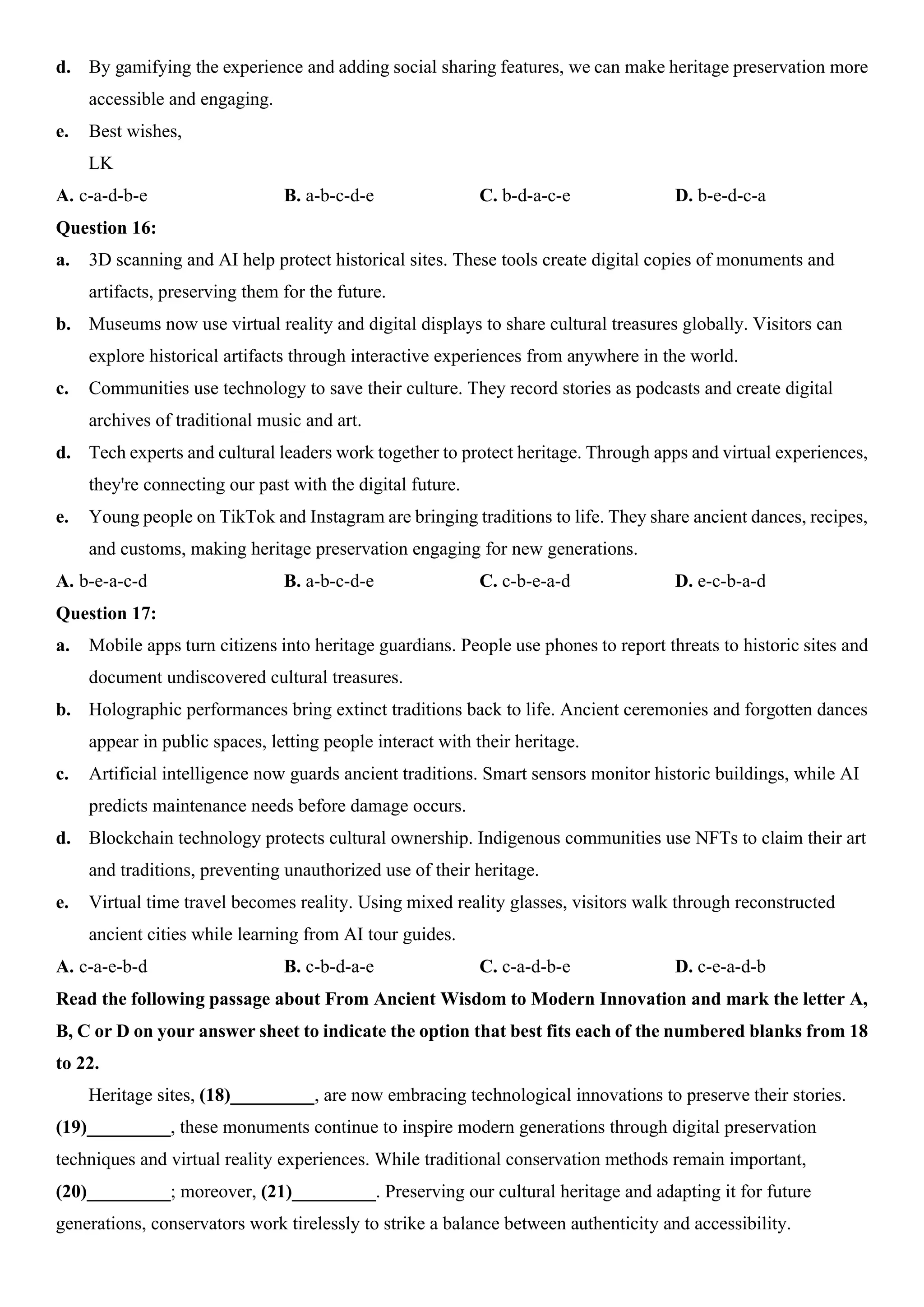
In recent years, cutting-edge technology (18)_________, having revolutionized traditional conservation
methods. Museums and cultural institutions, (19)_________, are now able to protect and share their
collections more effectively than ever before. While traditional preservation techniques continue to play a
vital role, digital tools have opened up new possibilities for documentation and conservation. Advanced 3D
5.
scanning technology, creatingdetailed digital replicas of artifacts, (20)_________. These digital archives not
only serve as backup copies but also democratize access to cultural heritage.
The integration of artificial intelligence and machine learning has enhanced our ability to analyze and
preserve historical artifacts. (21)_________, have made significant breakthroughs in digital conservation. By
utilizing these technologies, institutions can detect early signs of deterioration and implement preventive
measures. (22)_________ that future generations will have access to our shared cultural legacy.
Question 18:
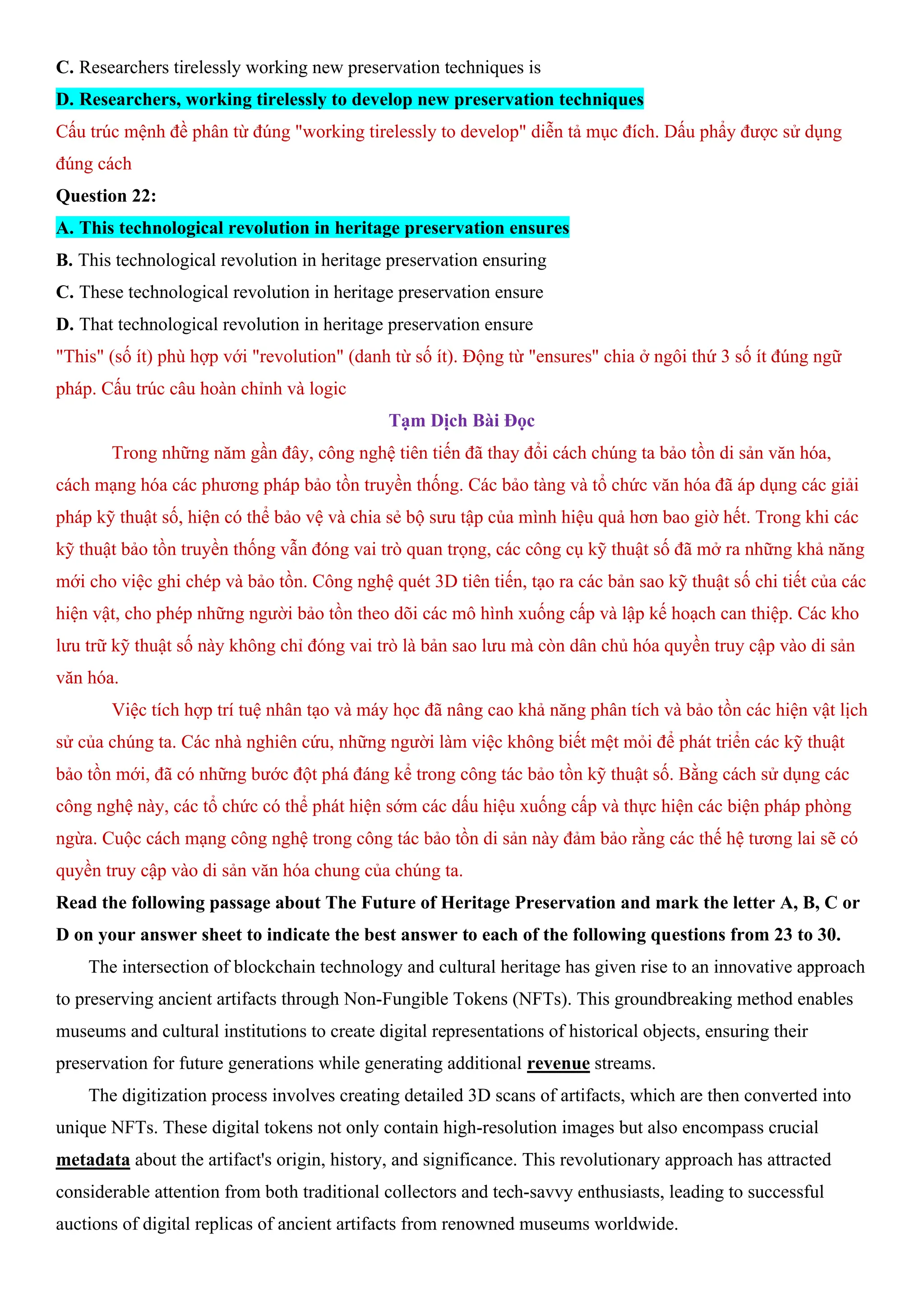
A. has transformed the way we preserve our cultural heritage
B. which transforming the way we preserve our cultural heritage
C. that has transform the way which we preserve our cultural heritage
D. having transform the way we preserve our cultural heritage
Question 19:
A. which has embraced digital solutions
B. which embraced digital solutions
C. which have embraced digital solutions
D. whose have embraced digital solutions
Question 20:
A. enabling conservators monitoring degradation patterns and planning interventions
B. enables conservators to monitor degradation patterns and plan interventions
C. enabled conservators, who monitoring degradation patterns and planning interventions
D. having enabled conservators monitor degradation patterns and planning interventions
Question 21:
A. Researchers working tirelessly but develop preservation techniques
B. Researchers they are working tirelessly for preservation techniques
C. Researchers tirelessly working new preservation techniques is
D. Researchers, working tirelessly to develop new preservation techniques
Question 22:
A. This technological revolution in heritage preservation ensures
B. This technological revolution in heritage preservation ensuring
C. These technological revolution in heritage preservation ensure
D. That technological revolution in heritage preservation ensure
Read the following passage about The Future of Heritage Preservation and mark the letter A, B, C or D
on your answer sheet to indicate the best answer to each of the following questions from 23 to 30.
The intersection of blockchain technology and cultural heritage has given rise to an innovative approach
to preserving ancient artifacts through Non-Fungible Tokens (NFTs). This groundbreaking method enables
museums and cultural institutions to create digital representations of historical objects, ensuring their
preservation for future generations while generating additional revenue streams.
6.
The digitization processinvolves creating detailed 3D scans of artifacts, which are then converted into
unique NFTs. These digital tokens not only contain high-resolution images but also encompass crucial
metadata about the artifact's origin, history, and significance. This revolutionary approach has attracted
considerable attention from both traditional collectors and tech-savvy enthusiasts, leading to successful
auctions of digital replicas of ancient artifacts from renowned museums worldwide.
However, this technological advancement has sparked debate within the archaeological community.
Critics argue that NFTs might inadvertently encourage the illegal trafficking of physical artifacts, as
digital ownership could potentially be used to legitimize stolen items. Supporters counter that blockchain
technology actually enhances transparency in artifact ownership and helps track the provenance of historical
objects more effectively.
Looking ahead, the integration of NFTs in heritage preservation presents both opportunities and
challenges. While it offers new ways to engage younger generations with historical artifacts and provides
additional funding for conservation efforts, institutions must carefully balance technological innovation with
ethical considerations. The success of this initiative will largely depend on establishing clear guidelines and
regulations for the digital representation of cultural heritage.
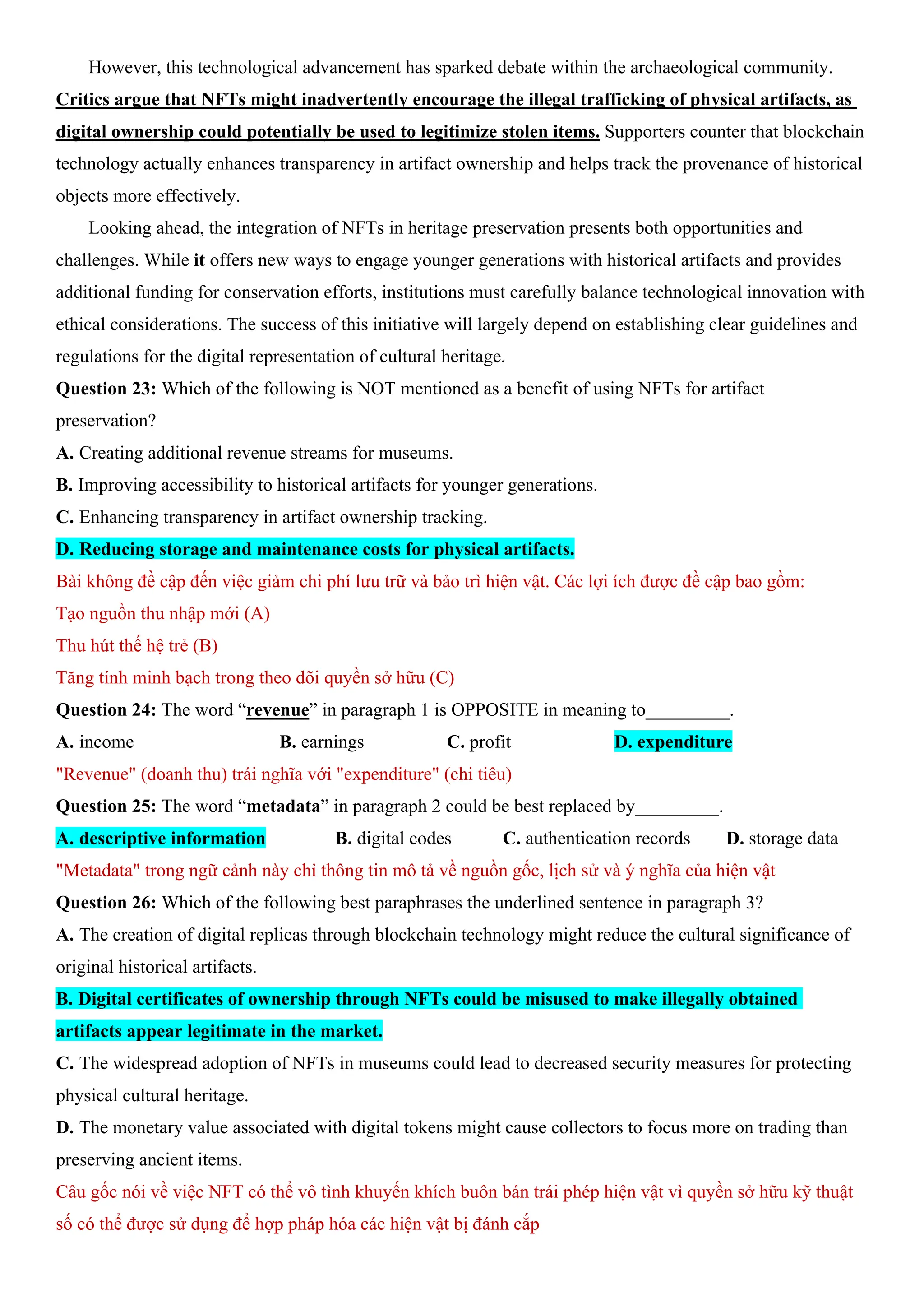
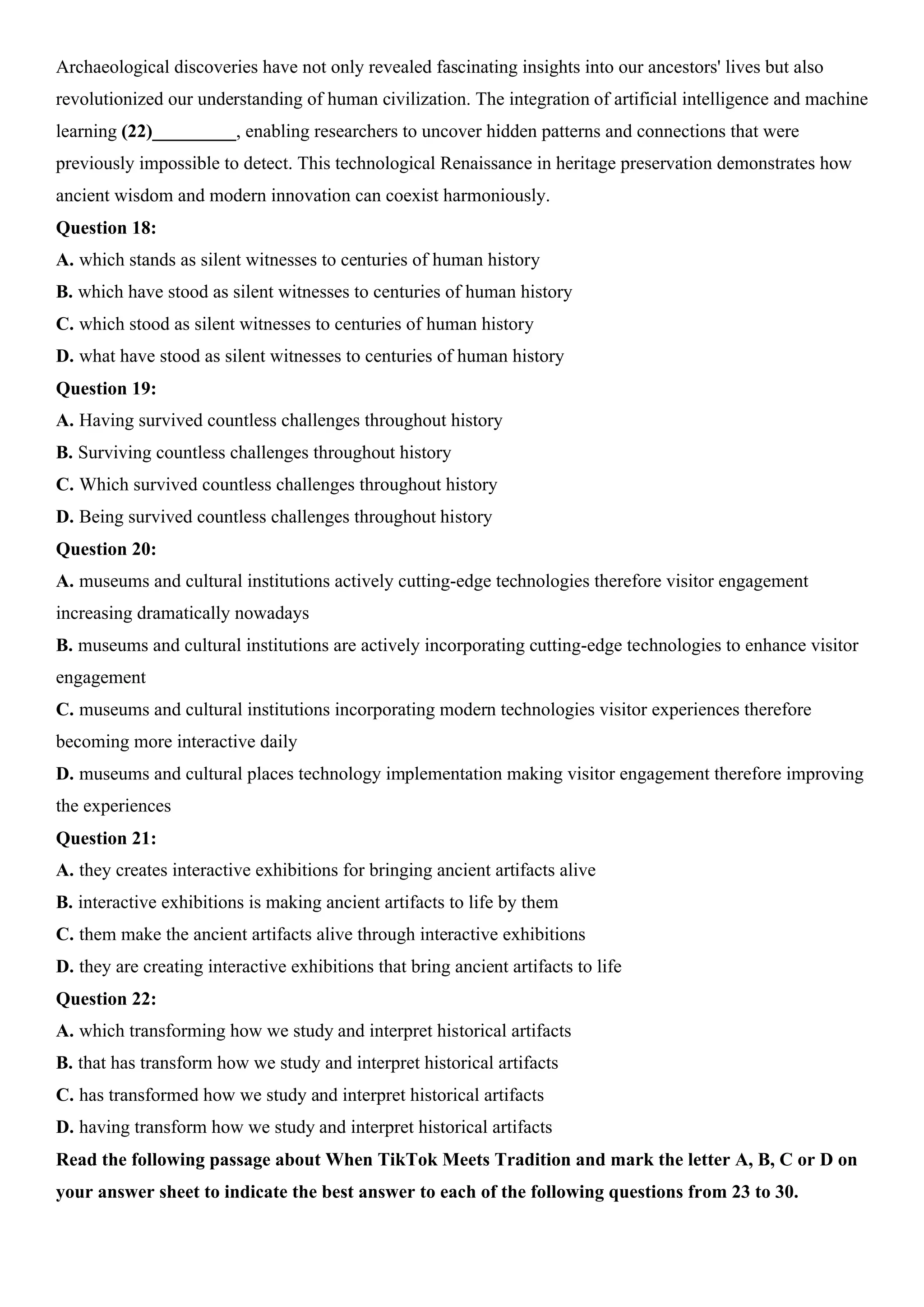
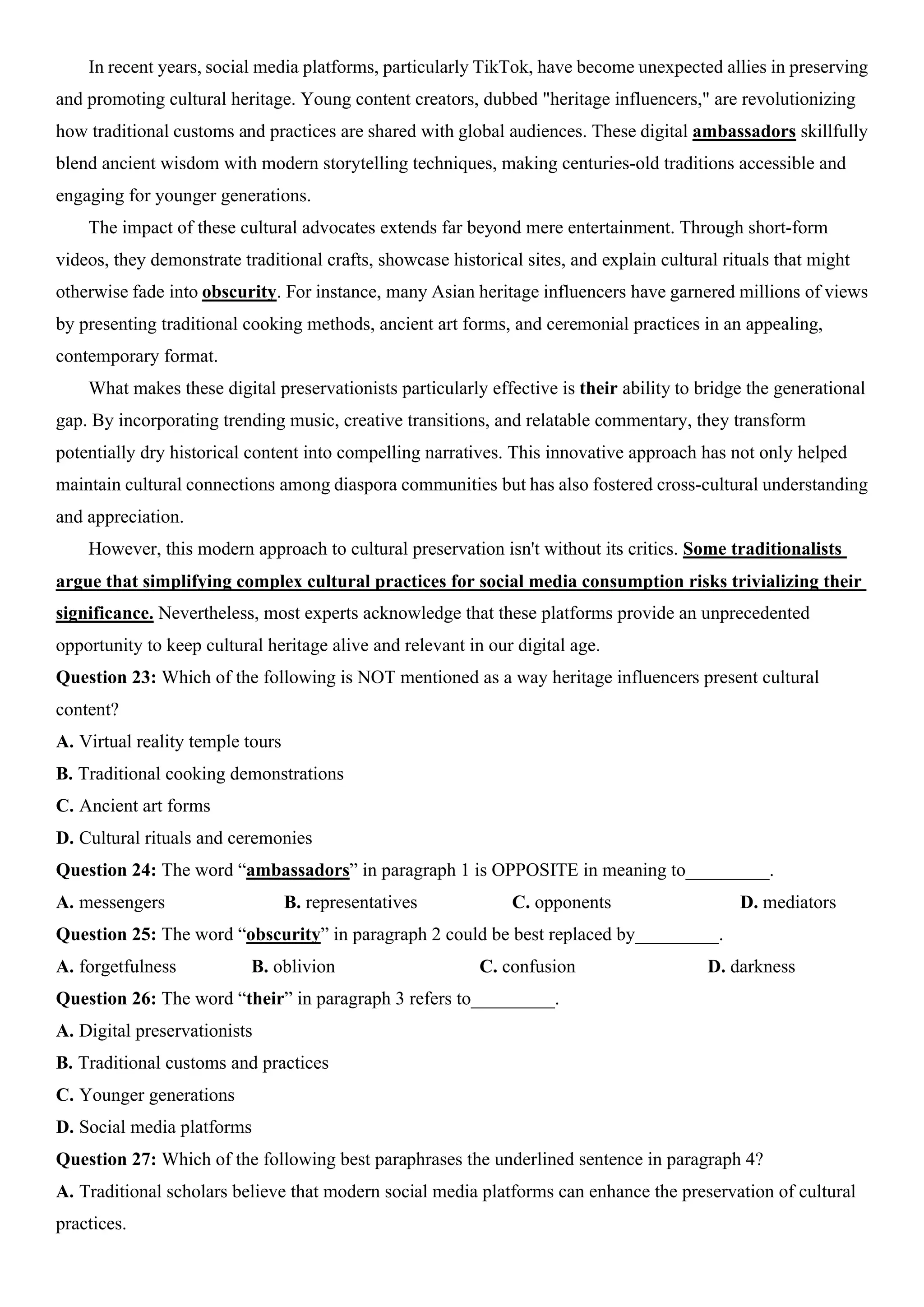
Question 23: Which of the following is NOT mentioned as a benefit of using NFTs for artifact preservation?
A. Creating additional revenue streams for museums.
B. Improving accessibility to historical artifacts for younger generations.
C. Enhancing transparency in artifact ownership tracking.
D. Reducing storage and maintenance costs for physical artifacts.
Question 24: The word “revenue” in paragraph 1 is OPPOSITE in meaning to_________.
A. income B. earnings C. profit D. expenditure
Question 25: The word “metadata” in paragraph 2 could be best replaced by_________.
A. descriptive information B. digital codes C. authentication records D. storage data
Question 26: Which of the following best paraphrases the underlined sentence in paragraph 3?
A. The creation of digital replicas through blockchain technology might reduce the cultural significance of
original historical artifacts.
B. Digital certificates of ownership through NFTs could be misused to make illegally obtained artifacts appear
legitimate in the market.
C. The widespread adoption of NFTs in museums could lead to decreased security measures for protecting
physical cultural heritage.
D. The monetary value associated with digital tokens might cause collectors to focus more on trading than
preserving ancient items.
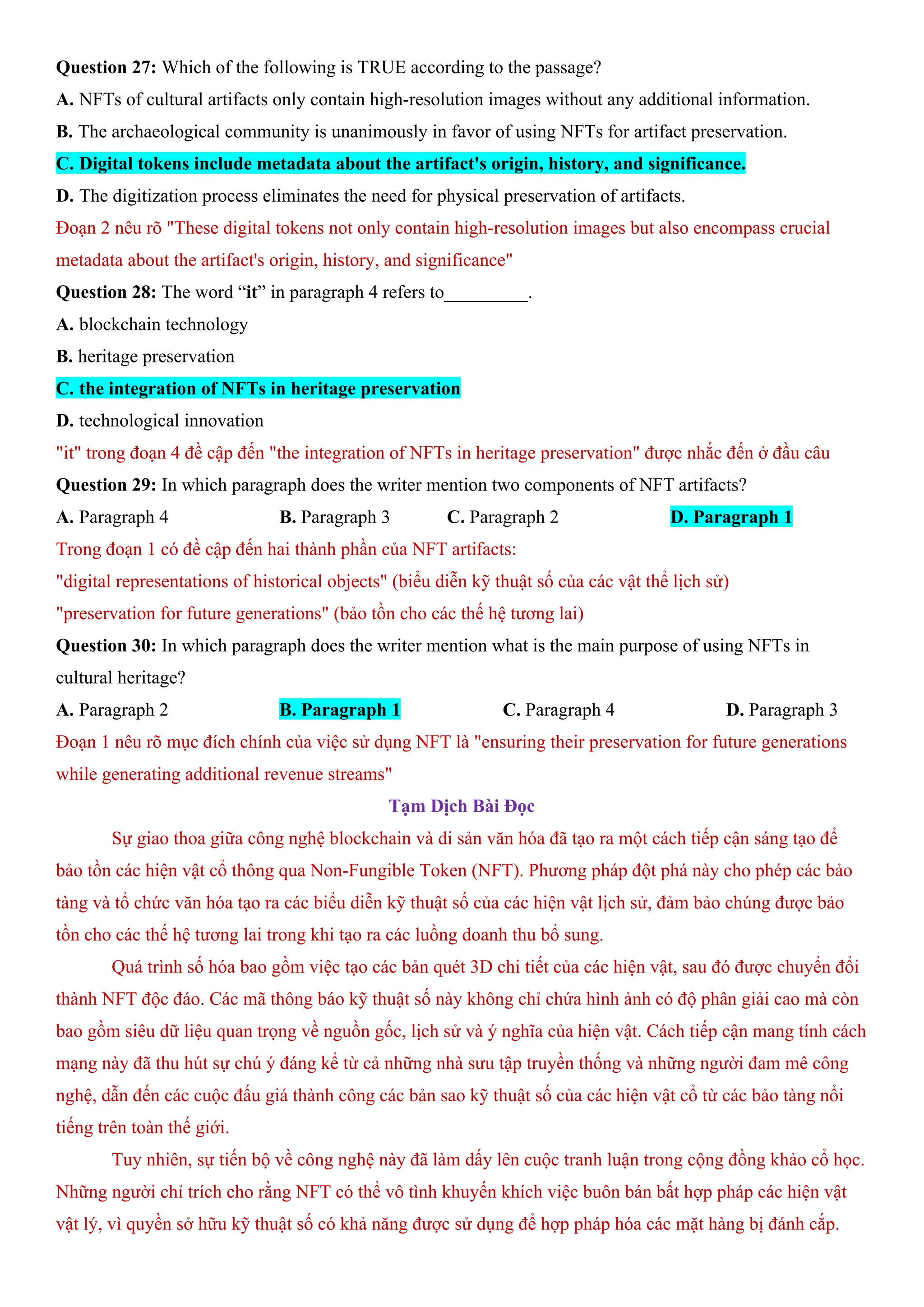
Question 27: Which of the following is TRUE according to the passage?
A. NFTs of cultural artifacts only contain high-resolution images without any additional information.
B. The archaeological community is unanimously in favor of using NFTs for artifact preservation.
C. Digital tokens include metadata about the artifact's origin, history, and significance.
7.
D. The digitizationprocess eliminates the need for physical preservation of artifacts.
Question 28: The word “it” in paragraph 4 refers to_________.
A. blockchain technology
B. heritage preservation
C. the integration of NFTs in heritage preservation
D. technological innovation
Question 29: In which paragraph does the writer mention two components of NFT artifacts?
A. Paragraph 4 B. Paragraph 3 C. Paragraph 2 D. Paragraph 1
Question 30: In which paragraph does the writer mention what is the main purpose of using NFTs in cultural
heritage?
A. Paragraph 2 B. Paragraph 1 C. Paragraph 4 D. Paragraph 3
Read the following passage about the When Gen Z Reinvents Tradition and mark the letter A, B, C or
D on your answer sheet to indicate the best answer to each of the following questions from 31 to 40.
In recent years, Generation Z has been revolutionizing traditional cultural practices in unprecedented
ways. These young innovators are not simply preserving heritage; they are putting a new spin on it through
digital platforms and modern interpretations. From reimagining traditional crafts through 3D printing to
creating viral social media content featuring ancient customs, Gen Z is ensuring cultural traditions don't fall
by the wayside.
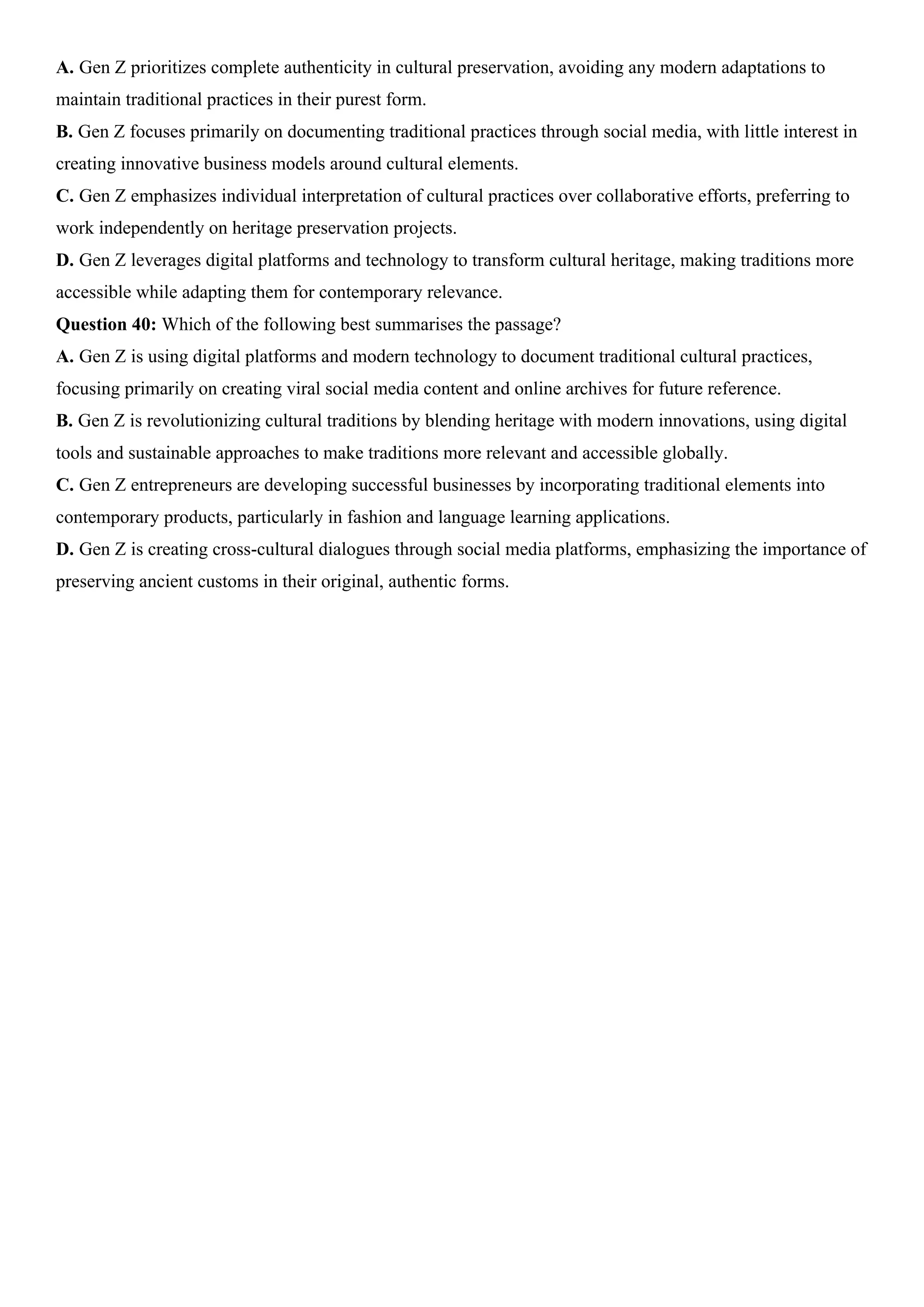
[I]The digital transformation of cultural heritage by Gen Z extends far beyond mere documentation.
[II]Young entrepreneurs are launching successful businesses that blend traditional elements with
contemporary designs, making cultural products more appealing to modern consumers. [III], while others are
developing apps that teach ancient languages through gamification. [IV]
What makes this movement particularly significant is its global reach and collaborative nature. Through
social media platforms, young cultural innovators can instantly share their reinterpretations with audiences
worldwide, creating cross-cultural dialogues and inspiring others to explore their own heritage in creative
ways. This digital preservation of culture ensures that traditions remain relevant and accessible to future
generations.
Perhaps most importantly, Gen Z's approach to cultural preservation reflects a deeper understanding of
sustainability and inclusivity. They recognize that for traditions to survive, they must adapt to changing social
values and environmental concerns. Many young innovators are finding ways to make traditional crafts
more sustainable by using eco-friendly materials or reducing waste through digital tools while making
cultural practices more inclusive through technology.
Question 31: Which of the following is NOT mentioned as a way Gen Z preserves tradition?
A. Organizing traditional food festivals and cooking competitions.
B. Creating viral social media content featuring ancient customs.
C. Using 3D printing to reimagine traditional crafts.
D. Incorporating traditional patterns into streetwear fashion.
8.
Question 32: Theword “it” in paragraph 1 refers to_________.
A. digital platforms B. heritage C. Generation Z D. cultural practices
Question 33: The phrase “fall by the wayside” in paragraph 1 could be best replaced by_________.
A. take off B. come across C. break down D. die out
Question 34: Where in paragraph 2 does the following sentence best fit?
For instance, some are incorporating traditional patterns into streetwear fashion
A. [I] B. [II] C. [III] D. [IV]
Question 35: The word “reinterpretations” in paragraph 3 is OPPOSITE in meaning to_________.
A. modifications B. reproductions C. duplications D. originals
Question 36: Which of the following best summarises paragraph 3?
A. The movement creates worldwide connections through social media platforms, fostering cultural exchange
and heritage exploration.
B. The movement enables digital archiving of cultural practices while promoting global awareness through
technological documentation.
C. The movement transforms traditional practices into profitable ventures through strategic implementation
of digital marketing tools.
D. The movement maintains cultural authenticity by limiting modern interpretations while ensuring
widespread digital distribution.
Question 37: Which of the following is TRUE according to the passage?
A. They focus exclusively on digitizing traditional practices through social media platforms and avoid making
any modifications to preserve authenticity.
B. They combine modern technology with traditional elements while ensuring sustainability and inclusivity in
their cultural preservation efforts.
C. They primarily concentrate on developing mobile applications and games that teach cultural practices
without considering traditional methods.
D. They emphasize individual entrepreneurship in cultural preservation while limiting cross-cultural
collaboration and international engagement.
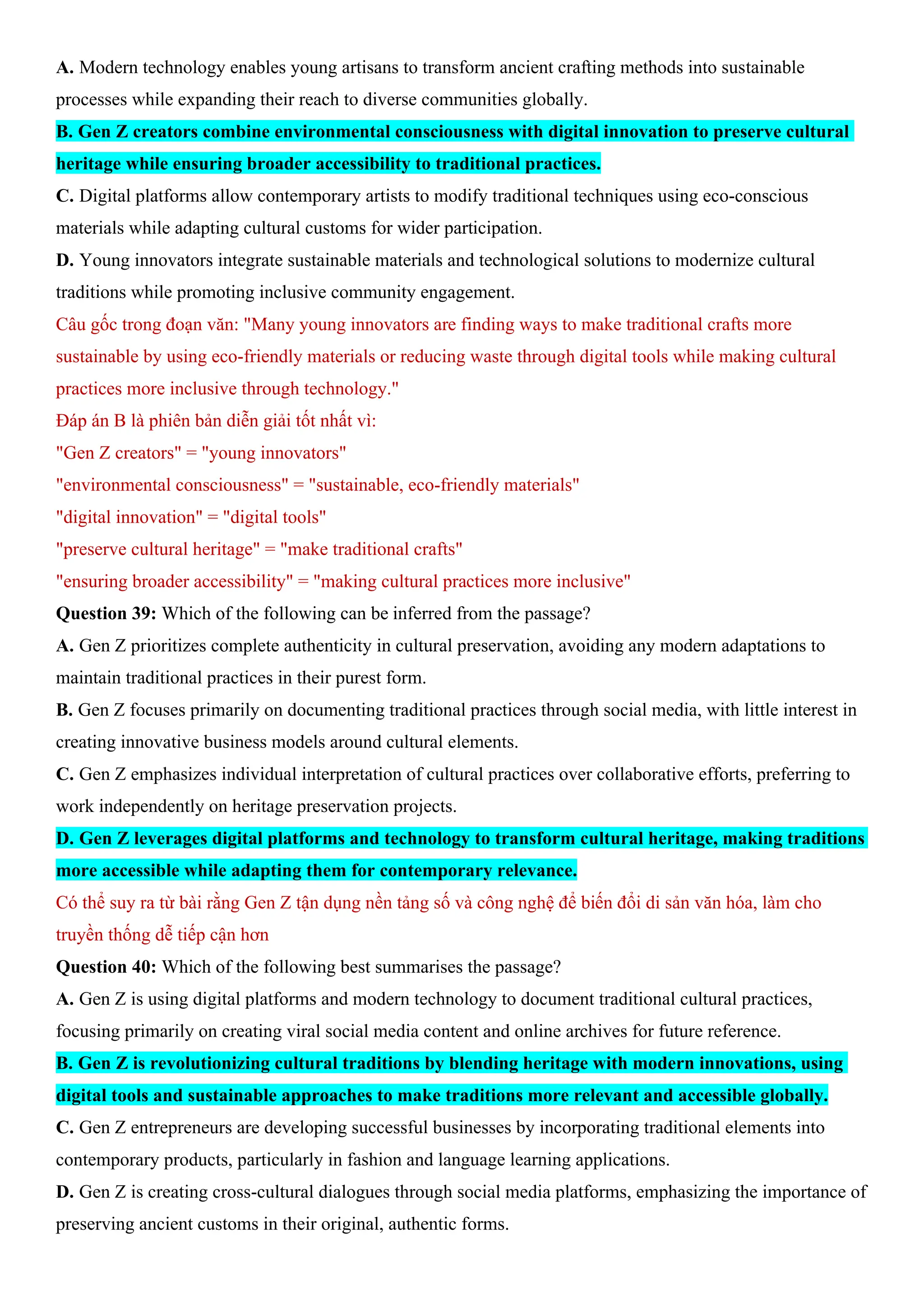
Question 38: Which of the following best paraphrases the underlined sentence in paragraph 4?
A. Modern technology enables young artisans to transform ancient crafting methods into sustainable
processes while expanding their reach to diverse communities globally.
B. Gen Z creators combine environmental consciousness with digital innovation to preserve cultural heritage
while ensuring broader accessibility to traditional practices.
C. Digital platforms allow contemporary artists to modify traditional techniques using eco-conscious
materials while adapting cultural customs for wider participation.
D. Young innovators integrate sustainable materials and technological solutions to modernize cultural
traditions while promoting inclusive community engagement.
Question 39: Which of the following can be inferred from the passage?
9.
A. Gen Zprioritizes complete authenticity in cultural preservation, avoiding any modern adaptations to
maintain traditional practices in their purest form.
B. Gen Z focuses primarily on documenting traditional practices through social media, with little interest in
creating innovative business models around cultural elements.
C. Gen Z emphasizes individual interpretation of cultural practices over collaborative efforts, preferring to
work independently on heritage preservation projects.
D. Gen Z leverages digital platforms and technology to transform cultural heritage, making traditions more
accessible while adapting them for contemporary relevance.
Question 40: Which of the following best summarises the passage?
A. Gen Z is using digital platforms and modern technology to document traditional cultural practices,
focusing primarily on creating viral social media content and online archives for future reference.
B. Gen Z is revolutionizing cultural traditions by blending heritage with modern innovations, using digital
tools and sustainable approaches to make traditions more relevant and accessible globally.
C. Gen Z entrepreneurs are developing successful businesses by incorporating traditional elements into
contemporary products, particularly in fashion and language learning applications.
D. Gen Z is creating cross-cultural dialogues through social media platforms, emphasizing the importance of
preserving ancient customs in their original, authentic forms.
10.
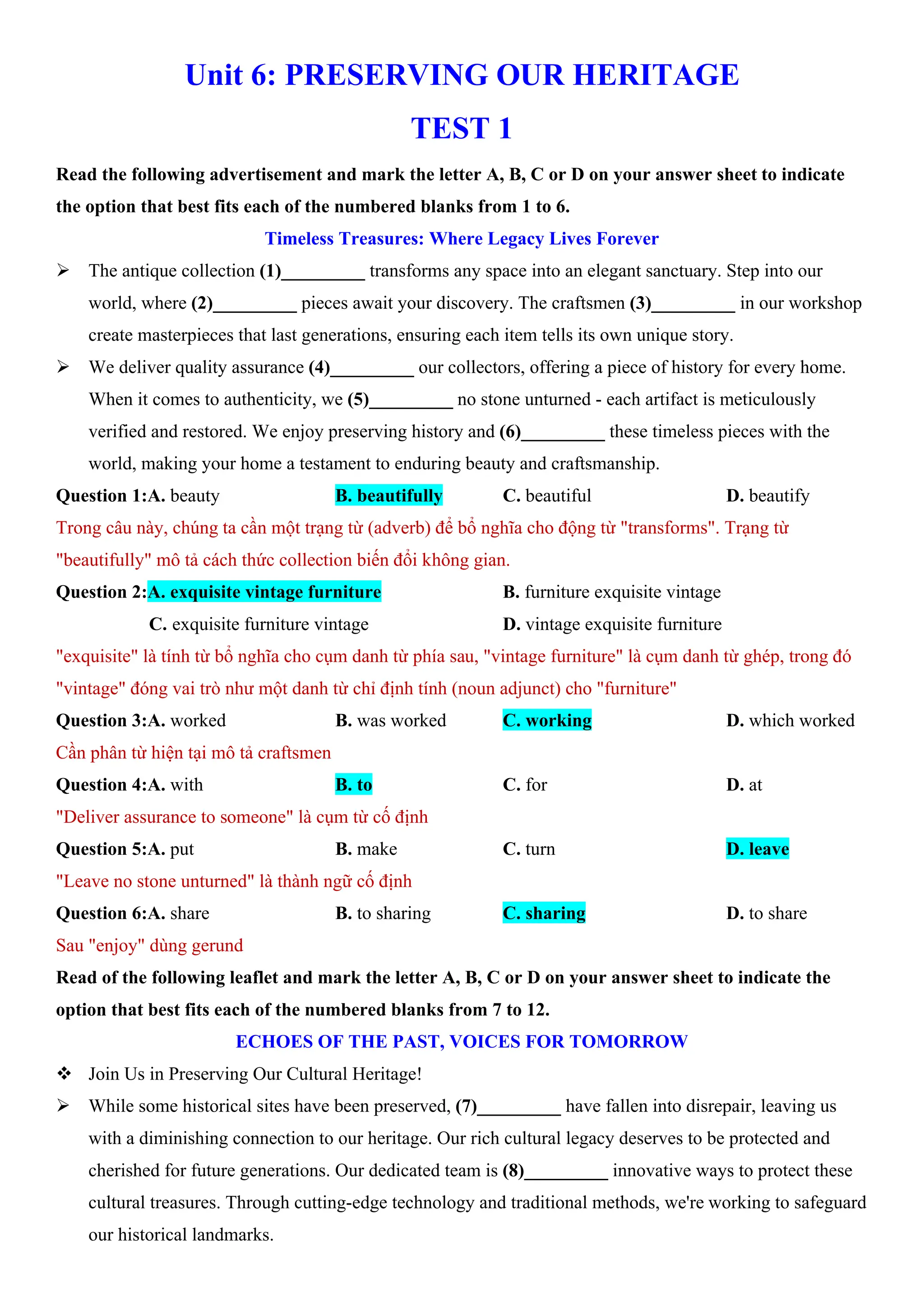
Unit 6: PRESERVINGOUR HERITAGE
TEST 1
Read the following advertisement and mark the letter A, B, C or D on your answer sheet to indicate
the option that best fits each of the numbered blanks from 1 to 6.
Timeless Treasures: Where Legacy Lives Forever
ÿ The antique collection (1)_________ transforms any space into an elegant sanctuary. Step into our
world, where (2)_________ pieces await your discovery. The craftsmen (3)_________ in our workshop
create masterpieces that last generations, ensuring each item tells its own unique story.
ÿ We deliver quality assurance (4)_________ our collectors, offering a piece of history for every home.
When it comes to authenticity, we (5)_________ no stone unturned - each artifact is meticulously
verified and restored. We enjoy preserving history and (6)_________ these timeless pieces with the
world, making your home a testament to enduring beauty and craftsmanship.
Question 1:A. beauty B. beautifully C. beautiful D. beautify
Trong câu này, chúng ta cần một trạng từ (adverb) để bổ nghĩa cho động từ "transforms". Trạng từ
"beautifully" mô tả cách thức collection biến đổi không gian.
Question 2:A. exquisite vintage furniture B. furniture exquisite vintage
C. exquisite furniture vintage D. vintage exquisite furniture
"exquisite" là tính từ bổ nghĩa cho cụm danh từ phía sau, "vintage furniture" là cụm danh từ ghép, trong đó
"vintage" đóng vai trò như một danh từ chỉ định tính (noun adjunct) cho "furniture"
Question 3:A. worked B. was worked C. working D. which worked
Cần phân từ hiện tại mô tả craftsmen
Question 4:A. with B. to C. for D. at
"Deliver assurance to someone" là cụm từ cố định
Question 5:A. put B. make C. turn D. leave
"Leave no stone unturned" là thành ngữ cố định
Question 6:A. share B. to sharing C. sharing D. to share
Sau "enjoy" dùng gerund
Read of the following leaflet and mark the letter A, B, C or D on your answer sheet to indicate the
option that best fits each of the numbered blanks from 7 to 12.
ECHOES OF THE PAST, VOICES FOR TOMORROW
v Join Us in Preserving Our Cultural Heritage!
ÿ While some historical sites have been preserved, (7)_________ have fallen into disrepair, leaving us
with a diminishing connection to our heritage. Our rich cultural legacy deserves to be protected and
cherished for future generations. Our dedicated team is (8)_________ innovative ways to protect these
cultural treasures. Through cutting-edge technology and traditional methods, we're working to safeguard
our historical landmarks.
11.
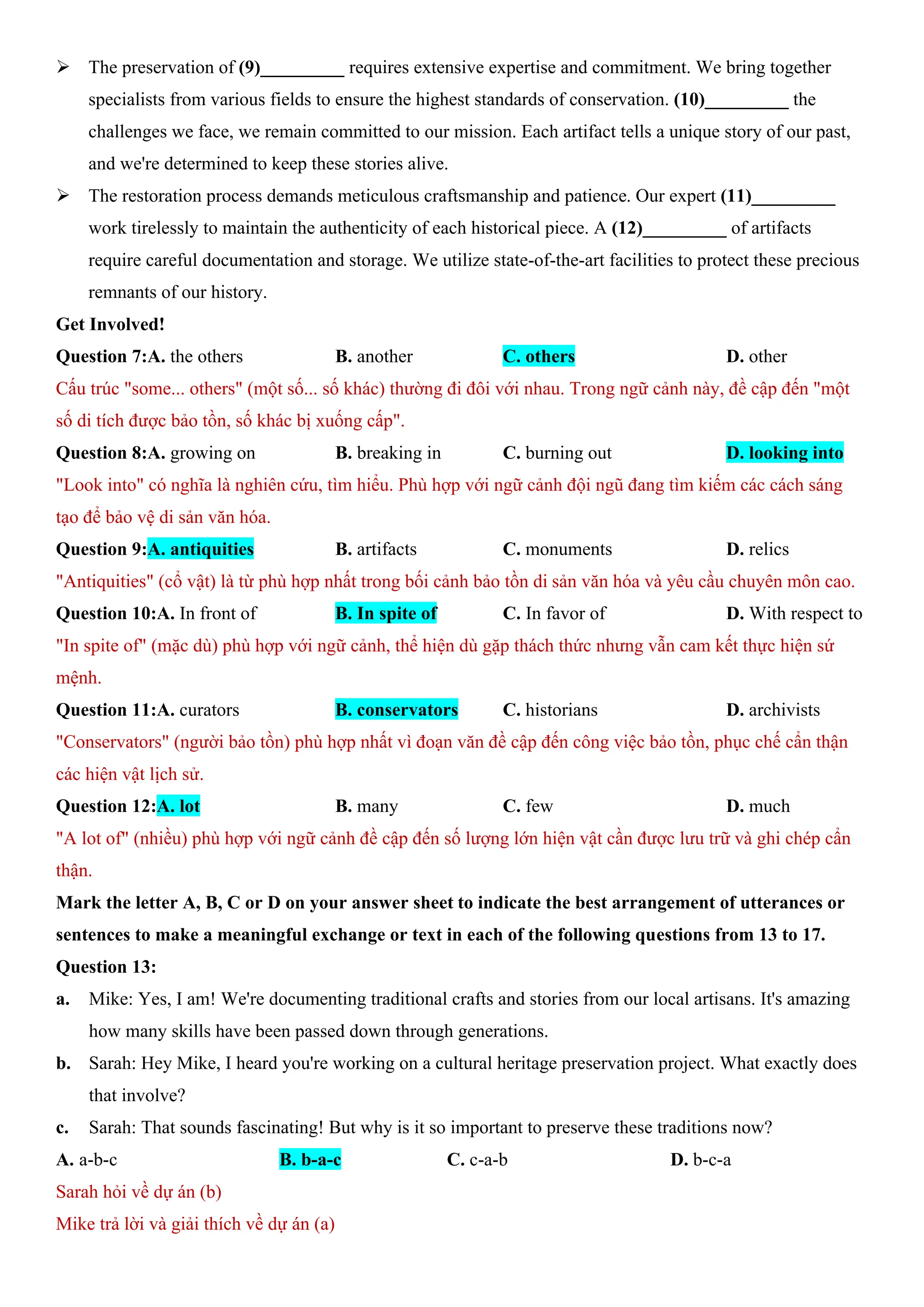
ÿ The preservationof (9)_________ requires extensive expertise and commitment. We bring together
specialists from various fields to ensure the highest standards of conservation. (10)_________ the
challenges we face, we remain committed to our mission. Each artifact tells a unique story of our past,
and we're determined to keep these stories alive.
ÿ The restoration process demands meticulous craftsmanship and patience. Our expert (11)_________
work tirelessly to maintain the authenticity of each historical piece. A (12)_________ of artifacts
require careful documentation and storage. We utilize state-of-the-art facilities to protect these precious
remnants of our history.
Get Involved!
Question 7:A. the others B. another C. others D. other
Cấu trúc "some... others" (một số... số khác) thường đi đôi với nhau. Trong ngữ cảnh này, đề cập đến "một
số di tích được bảo tồn, số khác bị xuống cấp".
Question 8:A. growing on B. breaking in C. burning out D. looking into
"Look into" có nghĩa là nghiên cứu, tìm hiểu. Phù hợp với ngữ cảnh đội ngũ đang tìm kiếm các cách sáng
tạo để bảo vệ di sản văn hóa.
Question 9:A. antiquities B. artifacts C. monuments D. relics
"Antiquities" (cổ vật) là từ phù hợp nhất trong bối cảnh bảo tồn di sản văn hóa và yêu cầu chuyên môn cao.
Question 10:A. In front of B. In spite of C. In favor of D. With respect to
"In spite of" (mặc dù) phù hợp với ngữ cảnh, thể hiện dù gặp thách thức nhưng vẫn cam kết thực hiện sứ
mệnh.
Question 11:A. curators B. conservators C. historians D. archivists
"Conservators" (người bảo tồn) phù hợp nhất vì đoạn văn đề cập đến công việc bảo tồn, phục chế cẩn thận
các hiện vật lịch sử.
Question 12:A. lot B. many C. few D. much
"A lot of" (nhiều) phù hợp với ngữ cảnh đề cập đến số lượng lớn hiện vật cần được lưu trữ và ghi chép cẩn
thận.
Mark the letter A, B, C or D on your answer sheet to indicate the best arrangement of utterances or
sentences to make a meaningful exchange or text in each of the following questions from 13 to 17.
Question 13:
a. Mike: Yes, I am! We're documenting traditional crafts and stories from our local artisans. It's amazing
how many skills have been passed down through generations.
b. Sarah: Hey Mike, I heard you're working on a cultural heritage preservation project. What exactly does
that involve?
c. Sarah: That sounds fascinating! But why is it so important to preserve these traditions now?
A. a-b-c B. b-a-c C. c-a-b D. b-c-a
Sarah hỏi về dự án (b)
Mike trả lời và giải thích về dự án (a)
12.
Sarah thể hiệnsự quan tâm và hỏi thêm về tầm quan trọng (c)
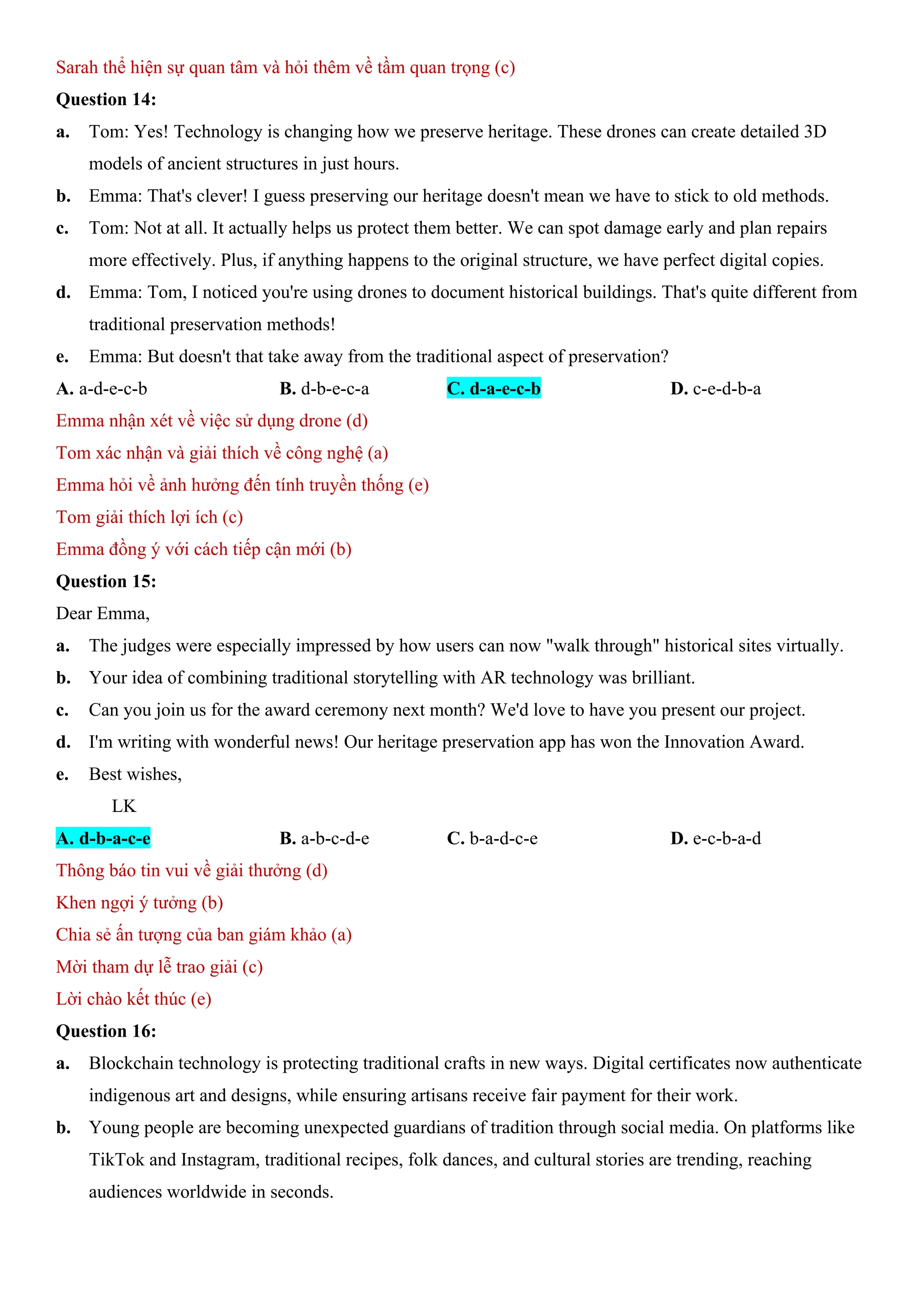
Question 14:
a. Tom: Yes! Technology is changing how we preserve heritage. These drones can create detailed 3D
models of ancient structures in just hours.
b. Emma: That's clever! I guess preserving our heritage doesn't mean we have to stick to old methods.
c. Tom: Not at all. It actually helps us protect them better. We can spot damage early and plan repairs
more effectively. Plus, if anything happens to the original structure, we have perfect digital copies.
d. Emma: Tom, I noticed you're using drones to document historical buildings. That's quite different from
traditional preservation methods!
e. Emma: But doesn't that take away from the traditional aspect of preservation?
A. a-d-e-c-b B. d-b-e-c-a C. d-a-e-c-b D. c-e-d-b-a
Emma nhận xét về việc sử dụng drone (d)
Tom xác nhận và giải thích về công nghệ (a)
Emma hỏi về ảnh hưởng đến tính truyền thống (e)
Tom giải thích lợi ích (c)
Emma đồng ý với cách tiếp cận mới (b)
Question 15:
Dear Emma,
a. The judges were especially impressed by how users can now "walk through" historical sites virtually.
b. Your idea of combining traditional storytelling with AR technology was brilliant.
c. Can you join us for the award ceremony next month? We'd love to have you present our project.
d. I'm writing with wonderful news! Our heritage preservation app has won the Innovation Award.
e. Best wishes,
LK
A. d-b-a-c-e B. a-b-c-d-e C. b-a-d-c-e D. e-c-b-a-d
Thông báo tin vui về giải thưởng (d)
Khen ngợi ý tưởng (b)
Chia sẻ ấn tượng của ban giám khảo (a)
Mời tham dự lễ trao giải (c)
Lời chào kết thúc (e)
Question 16:
a. Blockchain technology is protecting traditional crafts in new ways. Digital certificates now authenticate
indigenous art and designs, while ensuring artisans receive fair payment for their work.
b. Young people are becoming unexpected guardians of tradition through social media. On platforms like
TikTok and Instagram, traditional recipes, folk dances, and cultural stories are trending, reaching
audiences worldwide in seconds.
13.
c. AI helpssave endangered languages by creating digital archives and teaching tools. Communities can
now preserve their mother tongues while embracing modern communication methods.
d. The metaverse offers exciting possibilities for heritage preservation, creating virtual spaces where
people can experience historical events and learn traditional practices through immersive technology.
e. Digital technology has transformed how we preserve our cultural heritage. Museums now create virtual
exhibitions, allowing millions to explore ancient artifacts through their smartphones and VR headsets,
making history accessible to everyone.
A. c-a-b-e-d B. b-e-c-a-d C. a-b-c-e-d D. e-b-a-c-d
Giới thiệu tổng quát về công nghệ số (e)
Vai trò của giới trẻ và mạng xã hội (b)
Blockchain và nghề thủ công (a)
AI và bảo tồn ngôn ngữ (c)
Kết với metaverse và tương lai (d)
Question 17:
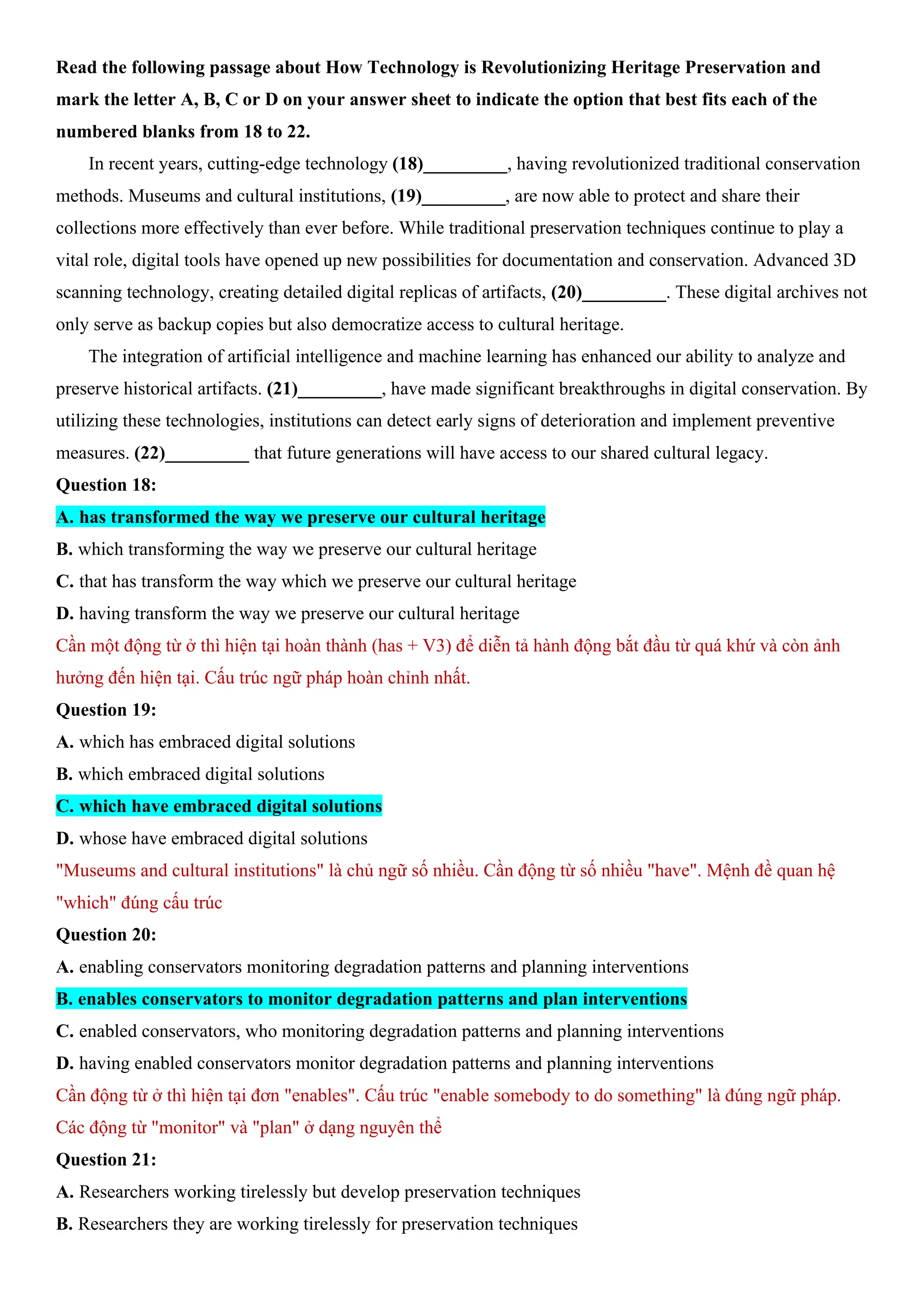
a. Wearable technology is revolutionizing cultural education. Smart glasses allow tourists to see ancient
ruins restored to their former glory, while AI-powered earbuds provide real-time translation of
traditional songs and stories.
b. Space technology is helping document Earth's cultural sites. Satellite imaging and drone mapping create
detailed 3D models of heritage locations, protecting them digitally for future generations.
c. Social robots in museums now act as cultural ambassadors, sharing stories in multiple languages and
adapting their communication style to different age groups, making heritage education more engaging
and personalized.
d. Smart cities are incorporating heritage elements into their urban planning through augmented reality.
Historical landmarks now tell their stories through interactive holograms, while street art celebrates
local culture using projection mapping technology.
e. Gaming platforms have become unexpected preservers of culture. Popular video games now feature
accurately researched traditional costumes, music, and architecture, teaching young players about their
heritage while they play.
A. d-c-b-a-e B. d-a-e-b-c C. d-b-e-a-c D. d-c-b-e-a
(d) Mở đầu với ý về thành phố thông minh và việc tích hợp yếu tố di sản vào quy hoạch đô thị thông qua AR
(thực tế ảo tăng cường)
(a) Phát triển sang công nghệ đeo - wearable technology trong giáo dục văn hóa, với kính thông minh và tai
nghe AI
(e) Tiếp nối bằng việc đề cập đến nền tảng game như một phương tiện bảo tồn văn hóa bất ngờ
(b) Mở rộng ra công nghệ không gian với việc sử dụng vệ tinh và drone để lập bản đồ 3D các địa điểm di
sản
(c) Kết thúc với robot xã hội trong bảo tàng như đại sứ văn hóa
14.
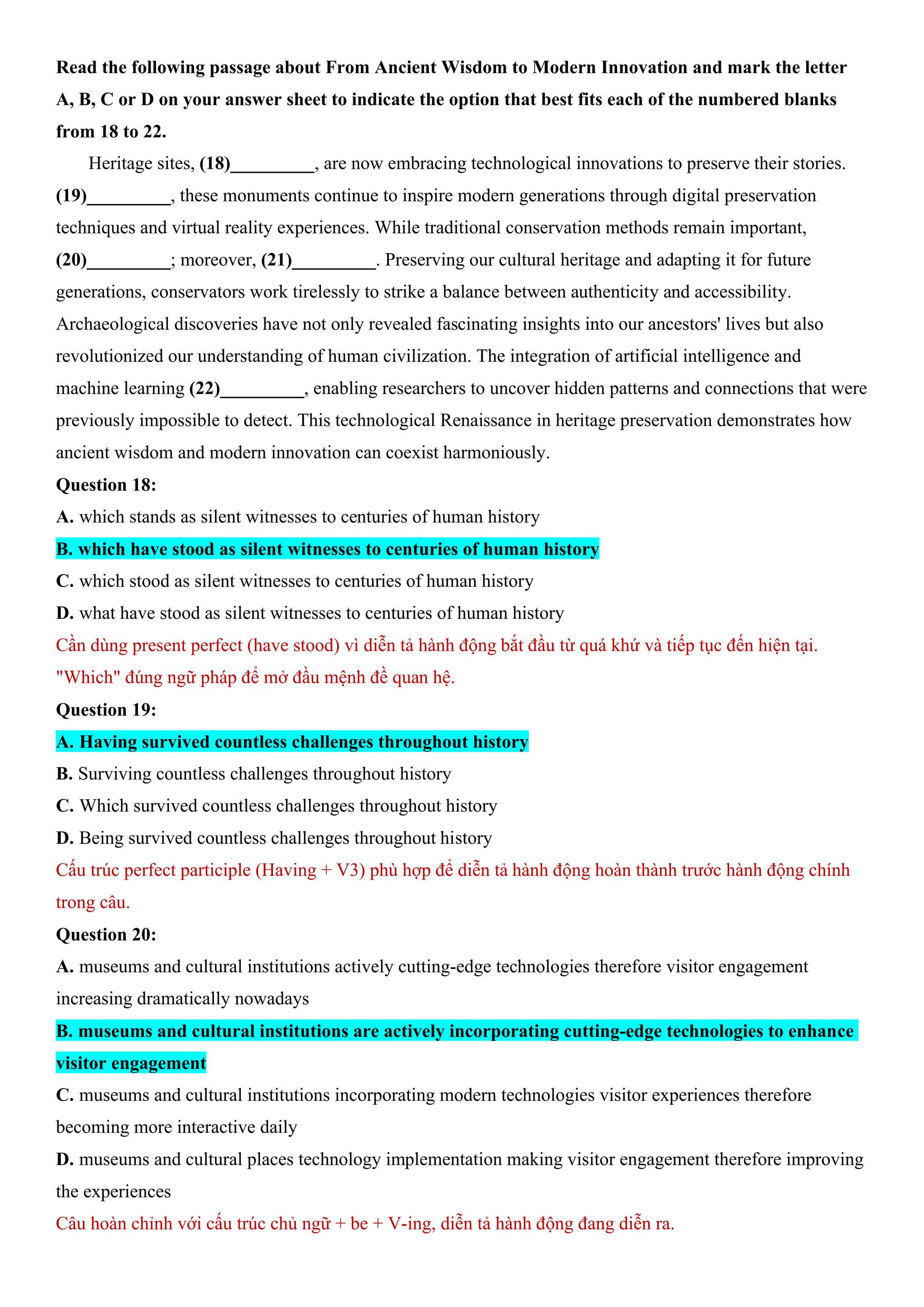
Read the followingpassage about How Technology is Revolutionizing Heritage Preservation and
mark the letter A, B, C or D on your answer sheet to indicate the option that best fits each of the
numbered blanks from 18 to 22.
In recent years, cutting-edge technology (18)_________, having revolutionized traditional conservation
methods. Museums and cultural institutions, (19)_________, are now able to protect and share their
collections more effectively than ever before. While traditional preservation techniques continue to play a
vital role, digital tools have opened up new possibilities for documentation and conservation. Advanced 3D
scanning technology, creating detailed digital replicas of artifacts, (20)_________. These digital archives not
only serve as backup copies but also democratize access to cultural heritage.
The integration of artificial intelligence and machine learning has enhanced our ability to analyze and
preserve historical artifacts. (21)_________, have made significant breakthroughs in digital conservation. By
utilizing these technologies, institutions can detect early signs of deterioration and implement preventive
measures. (22)_________ that future generations will have access to our shared cultural legacy.
Question 18:
A. has transformed the way we preserve our cultural heritage
B. which transforming the way we preserve our cultural heritage
C. that has transform the way which we preserve our cultural heritage
D. having transform the way we preserve our cultural heritage
Cần một động từ ở thì hiện tại hoàn thành (has + V3) để diễn tả hành động bắt đầu từ quá khứ và còn ảnh
hưởng đến hiện tại. Cấu trúc ngữ pháp hoàn chỉnh nhất.
Question 19:
A. which has embraced digital solutions
B. which embraced digital solutions
C. which have embraced digital solutions
D. whose have embraced digital solutions
"Museums and cultural institutions" là chủ ngữ số nhiều. Cần động từ số nhiều "have". Mệnh đề quan hệ
"which" đúng cấu trúc
Question 20:
A. enabling conservators monitoring degradation patterns and planning interventions
B. enables conservators to monitor degradation patterns and plan interventions
C. enabled conservators, who monitoring degradation patterns and planning interventions
D. having enabled conservators monitor degradation patterns and planning interventions
Cần động từ ở thì hiện tại đơn "enables". Cấu trúc "enable somebody to do something" là đúng ngữ pháp.
Các động từ "monitor" và "plan" ở dạng nguyên thể
Question 21:
A. Researchers working tirelessly but develop preservation techniques
B. Researchers they are working tirelessly for preservation techniques
15.
C. Researchers tirelesslyworking new preservation techniques is
D. Researchers, working tirelessly to develop new preservation techniques
Cấu trúc mệnh đề phân từ đúng "working tirelessly to develop" diễn tả mục đích. Dấu phẩy được sử dụng
đúng cách
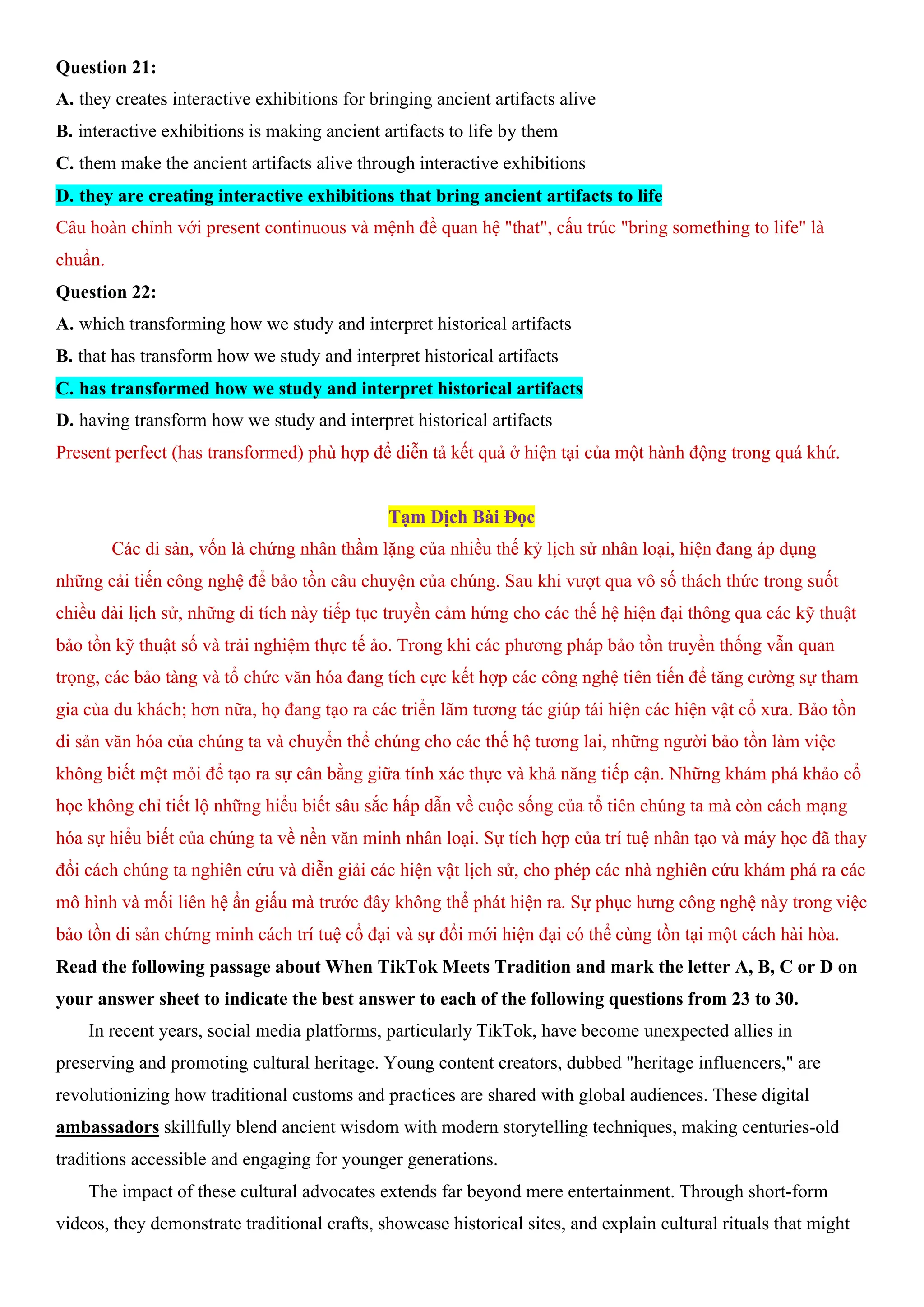
Question 22:
A. This technological revolution in heritage preservation ensures
B. This technological revolution in heritage preservation ensuring
C. These technological revolution in heritage preservation ensure
D. That technological revolution in heritage preservation ensure
"This" (số ít) phù hợp với "revolution" (danh từ số ít). Động từ "ensures" chia ở ngôi thứ 3 số ít đúng ngữ
pháp. Cấu trúc câu hoàn chỉnh và logic
Tạm Dịch Bài Đọc
Trong những năm gần đây, công nghệ tiên tiến đã thay đổi cách chúng ta bảo tồn di sản văn hóa,
cách mạng hóa các phương pháp bảo tồn truyền thống. Các bảo tàng và tổ chức văn hóa đã áp dụng các giải
pháp kỹ thuật số, hiện có thể bảo vệ và chia sẻ bộ sưu tập của mình hiệu quả hơn bao giờ hết. Trong khi các
kỹ thuật bảo tồn truyền thống vẫn đóng vai trò quan trọng, các công cụ kỹ thuật số đã mở ra những khả năng
mới cho việc ghi chép và bảo tồn. Công nghệ quét 3D tiên tiến, tạo ra các bản sao kỹ thuật số chi tiết của các
hiện vật, cho phép những người bảo tồn theo dõi các mô hình xuống cấp và lập kế hoạch can thiệp. Các kho
lưu trữ kỹ thuật số này không chỉ đóng vai trò là bản sao lưu mà còn dân chủ hóa quyền truy cập vào di sản
văn hóa.
Việc tích hợp trí tuệ nhân tạo và máy học đã nâng cao khả năng phân tích và bảo tồn các hiện vật lịch
sử của chúng ta. Các nhà nghiên cứu, những người làm việc không biết mệt mỏi để phát triển các kỹ thuật
bảo tồn mới, đã có những bước đột phá đáng kể trong công tác bảo tồn kỹ thuật số. Bằng cách sử dụng các
công nghệ này, các tổ chức có thể phát hiện sớm các dấu hiệu xuống cấp và thực hiện các biện pháp phòng
ngừa. Cuộc cách mạng công nghệ trong công tác bảo tồn di sản này đảm bảo rằng các thế hệ tương lai sẽ có
quyền truy cập vào di sản văn hóa chung của chúng ta.
Read the following passage about The Future of Heritage Preservation and mark the letter A, B, C or
D on your answer sheet to indicate the best answer to each of the following questions from 23 to 30.
The intersection of blockchain technology and cultural heritage has given rise to an innovative approach
to preserving ancient artifacts through Non-Fungible Tokens (NFTs). This groundbreaking method enables
museums and cultural institutions to create digital representations of historical objects, ensuring their
preservation for future generations while generating additional revenue streams.
The digitization process involves creating detailed 3D scans of artifacts, which are then converted into
unique NFTs. These digital tokens not only contain high-resolution images but also encompass crucial
metadata about the artifact's origin, history, and significance. This revolutionary approach has attracted
considerable attention from both traditional collectors and tech-savvy enthusiasts, leading to successful
auctions of digital replicas of ancient artifacts from renowned museums worldwide.
16.
However, this technologicaladvancement has sparked debate within the archaeological community.
Critics argue that NFTs might inadvertently encourage the illegal trafficking of physical artifacts, as
digital ownership could potentially be used to legitimize stolen items. Supporters counter that blockchain
technology actually enhances transparency in artifact ownership and helps track the provenance of historical
objects more effectively.
Looking ahead, the integration of NFTs in heritage preservation presents both opportunities and
challenges. While it offers new ways to engage younger generations with historical artifacts and provides
additional funding for conservation efforts, institutions must carefully balance technological innovation with
ethical considerations. The success of this initiative will largely depend on establishing clear guidelines and
regulations for the digital representation of cultural heritage.
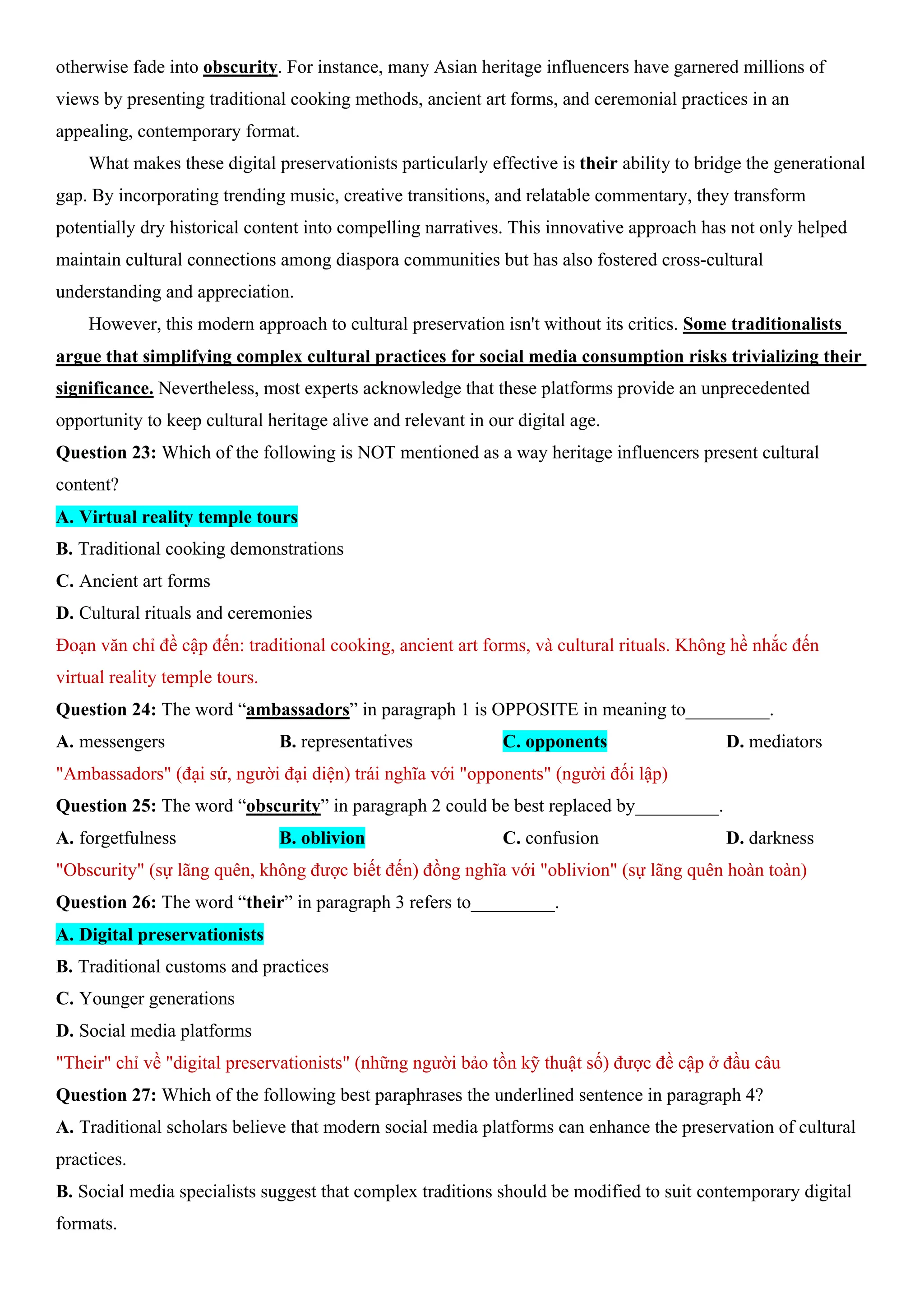
Question 23: Which of the following is NOT mentioned as a benefit of using NFTs for artifact
preservation?
A. Creating additional revenue streams for museums.
B. Improving accessibility to historical artifacts for younger generations.
C. Enhancing transparency in artifact ownership tracking.
D. Reducing storage and maintenance costs for physical artifacts.
Bài không đề cập đến việc giảm chi phí lưu trữ và bảo trì hiện vật. Các lợi ích được đề cập bao gồm:
Tạo nguồn thu nhập mới (A)
Thu hút thế hệ trẻ (B)
Tăng tính minh bạch trong theo dõi quyền sở hữu (C)
Question 24: The word “revenue” in paragraph 1 is OPPOSITE in meaning to_________.
A. income B. earnings C. profit D. expenditure
"Revenue" (doanh thu) trái nghĩa với "expenditure" (chi tiêu)
Question 25: The word “metadata” in paragraph 2 could be best replaced by_________.
A. descriptive information B. digital codes C. authentication records D. storage data
"Metadata" trong ngữ cảnh này chỉ thông tin mô tả về nguồn gốc, lịch sử và ý nghĩa của hiện vật
Question 26: Which of the following best paraphrases the underlined sentence in paragraph 3?
A. The creation of digital replicas through blockchain technology might reduce the cultural significance of
original historical artifacts.
B. Digital certificates of ownership through NFTs could be misused to make illegally obtained
artifacts appear legitimate in the market.
C. The widespread adoption of NFTs in museums could lead to decreased security measures for protecting
physical cultural heritage.
D. The monetary value associated with digital tokens might cause collectors to focus more on trading than
preserving ancient items.
Câu gốc nói về việc NFT có thể vô tình khuyến khích buôn bán trái phép hiện vật vì quyền sở hữu kỹ thuật
số có thể được sử dụng để hợp pháp hóa các hiện vật bị đánh cắp
17.
Question 27: Whichof the following is TRUE according to the passage?
A. NFTs of cultural artifacts only contain high-resolution images without any additional information.
B. The archaeological community is unanimously in favor of using NFTs for artifact preservation.
C. Digital tokens include metadata about the artifact's origin, history, and significance.
D. The digitization process eliminates the need for physical preservation of artifacts.
Đoạn 2 nêu rõ "These digital tokens not only contain high-resolution images but also encompass crucial
metadata about the artifact's origin, history, and significance"
Question 28: The word “it” in paragraph 4 refers to_________.
A. blockchain technology
B. heritage preservation
C. the integration of NFTs in heritage preservation
D. technological innovation
"it" trong đoạn 4 đề cập đến "the integration of NFTs in heritage preservation" được nhắc đến ở đầu câu
Question 29: In which paragraph does the writer mention two components of NFT artifacts?
A. Paragraph 4 B. Paragraph 3 C. Paragraph 2 D. Paragraph 1
Trong đoạn 1 có đề cập đến hai thành phần của NFT artifacts:
"digital representations of historical objects" (biểu diễn kỹ thuật số của các vật thể lịch sử)
"preservation for future generations" (bảo tồn cho các thế hệ tương lai)
Question 30: In which paragraph does the writer mention what is the main purpose of using NFTs in
cultural heritage?
A. Paragraph 2 B. Paragraph 1 C. Paragraph 4 D. Paragraph 3
Đoạn 1 nêu rõ mục đích chính của việc sử dụng NFT là "ensuring their preservation for future generations
while generating additional revenue streams"
Tạm Dịch Bài Đọc
Sự giao thoa giữa công nghệ blockchain và di sản văn hóa đã tạo ra một cách tiếp cận sáng tạo để
bảo tồn các hiện vật cổ thông qua Non-Fungible Token (NFT). Phương pháp đột phá này cho phép các bảo
tàng và tổ chức văn hóa tạo ra các biểu diễn kỹ thuật số của các hiện vật lịch sử, đảm bảo chúng được bảo
tồn cho các thế hệ tương lai trong khi tạo ra các luồng doanh thu bổ sung.
Quá trình số hóa bao gồm việc tạo các bản quét 3D chi tiết của các hiện vật, sau đó được chuyển đổi
thành NFT độc đáo. Các mã thông báo kỹ thuật số này không chỉ chứa hình ảnh có độ phân giải cao mà còn
bao gồm siêu dữ liệu quan trọng về nguồn gốc, lịch sử và ý nghĩa của hiện vật. Cách tiếp cận mang tính cách
mạng này đã thu hút sự chú ý đáng kể từ cả những nhà sưu tập truyền thống và những người đam mê công
nghệ, dẫn đến các cuộc đấu giá thành công các bản sao kỹ thuật số của các hiện vật cổ từ các bảo tàng nổi
tiếng trên toàn thế giới.
Tuy nhiên, sự tiến bộ về công nghệ này đã làm dấy lên cuộc tranh luận trong cộng đồng khảo cổ học.
Những người chỉ trích cho rằng NFT có thể vô tình khuyến khích việc buôn bán bất hợp pháp các hiện vật
vật lý, vì quyền sở hữu kỹ thuật số có khả năng được sử dụng để hợp pháp hóa các mặt hàng bị đánh cắp.
18.
Những người ủnghộ phản bác rằng công nghệ blockchain thực sự tăng cường tính minh bạch trong quyền
sở hữu hiện vật và giúp theo dõi nguồn gốc của các đối tượng lịch sử hiệu quả hơn.
Nhìn về phía trước, việc tích hợp NFT vào bảo tồn di sản mang đến cả cơ hội và thách thức. Mặc dù
nó cung cấp những cách mới để thu hút thế hệ trẻ hơn với các hiện vật lịch sử và cung cấp thêm kinh phí cho
các nỗ lực bảo tồn, các tổ chức phải cân bằng cẩn thận giữa đổi mới công nghệ với các cân nhắc về đạo đức.
Sự thành công của sáng kiến này phần lớn sẽ phụ thuộc vào việc thiết lập các hướng dẫn và quy định rõ ràng
cho việc thể hiện kỹ thuật số của di sản văn hóa.
Read the following passage about the When Gen Z Reinvents Tradition and mark the letter A, B, C or
D on your answer sheet to indicate the best answer to each of the following questions from 31 to 40.
In recent years, Generation Z has been revolutionizing traditional cultural practices in unprecedented
ways. These young innovators are not simply preserving heritage; they are putting a new spin on it through
digital platforms and modern interpretations. From reimagining traditional crafts through 3D printing to
creating viral social media content featuring ancient customs, Gen Z is ensuring cultural traditions don't fall
by the wayside.
[I]The digital transformation of cultural heritage by Gen Z extends far beyond mere documentation.
[II]Young entrepreneurs are launching successful businesses that blend traditional elements with
contemporary designs, making cultural products more appealing to modern consumers. [III], while others
are developing apps that teach ancient languages through gamification. [IV]
What makes this movement particularly significant is its global reach and collaborative nature. Through
social media platforms, young cultural innovators can instantly share their reinterpretations with audiences
worldwide, creating cross-cultural dialogues and inspiring others to explore their own heritage in creative
ways. This digital preservation of culture ensures that traditions remain relevant and accessible to future
generations.
Perhaps most importantly, Gen Z's approach to cultural preservation reflects a deeper understanding of
sustainability and inclusivity. They recognize that for traditions to survive, they must adapt to changing
social values and environmental concerns. Many young innovators are finding ways to make traditional
crafts more sustainable by using eco-friendly materials or reducing waste through digital tools while
making cultural practices more inclusive through technology.
Question 31: Which of the following is NOT mentioned as a way Gen Z preserves tradition?
A. Organizing traditional food festivals and cooking competitions.
B. Creating viral social media content featuring ancient customs.
C. Using 3D printing to reimagine traditional crafts.
D. Incorporating traditional patterns into streetwear fashion.
Bài không đề cập đến việc tổ chức lễ hội ẩm thực và cuộc thi nấu ăn truyền thống. Các hoạt động được đề
cập bao gồm:
Sử dụng in 3D (C)
Tạo nội dung viral trên mạng xã hội (B)
19.
Kết hợp họatiết truyền thống vào thời trang đường phố (D)
Question 32: The word “it” in paragraph 1 refers to_________.
A. digital platforms B. heritage C. Generation Z D. cultural practices
"it" trong đoạn 1 đề cập đến "heritage" - di sản văn hóa mà Gen Z đang đổi mới
Question 33: The phrase “fall by the wayside” in paragraph 1 could be best replaced by_________.
A. take off B. come across C. break down D. die out
"fall by the wayside" nghĩa là biến mất, không còn tồn tại, đồng nghĩa với "die out"
Question 34: Where in paragraph 2 does the following sentence best fit?
For instance, some are incorporating traditional patterns into streetwear fashion
A. [I] B. [II] C. [III] D. [IV]
Câu này phù hợp nhất khi đặt ở vị trí [III], làm ví dụ minh họa cùng với việc phát triển ứng dụng dạy ngôn
ngữ cổ
Question 35: The word “reinterpretations” in paragraph 3 is OPPOSITE in meaning to_________.
A. modifications B. reproductions C. duplications D. originals
"reinterpretations" (diễn giải lại) trái nghĩa với "originals" (nguyên bản)
Question 36: Which of the following best summarises paragraph 3?
A. The movement creates worldwide connections through social media platforms, fostering cultural
exchange and heritage exploration.
B. The movement enables digital archiving of cultural practices while promoting global awareness through
technological documentation.
C. The movement transforms traditional practices into profitable ventures through strategic implementation
of digital marketing tools.
D. The movement maintains cultural authenticity by limiting modern interpretations while ensuring
widespread digital distribution.
Đoạn 3 nhấn mạnh về tầm với toàn cầu và tính chất hợp tác của phong trào thông qua nền tảng mạng xã hội
Question 37: Which of the following is TRUE according to the passage?
A. They focus exclusively on digitizing traditional practices through social media platforms and avoid
making any modifications to preserve authenticity.
B. They combine modern technology with traditional elements while ensuring sustainability and
inclusivity in their cultural preservation efforts.
C. They primarily concentrate on developing mobile applications and games that teach cultural practices
without considering traditional methods.
D. They emphasize individual entrepreneurship in cultural preservation while limiting cross-cultural
collaboration and international engagement.
Bài viết cho thấy Gen Z kết hợp công nghệ hiện đại với yếu tố truyền thống, đồng thời đảm bảo tính bền
vững và bao trùm
Question 38: Which of the following best paraphrases the underlined sentence in paragraph 4?
20.
A. Modern technologyenables young artisans to transform ancient crafting methods into sustainable
processes while expanding their reach to diverse communities globally.
B. Gen Z creators combine environmental consciousness with digital innovation to preserve cultural
heritage while ensuring broader accessibility to traditional practices.
C. Digital platforms allow contemporary artists to modify traditional techniques using eco-conscious
materials while adapting cultural customs for wider participation.
D. Young innovators integrate sustainable materials and technological solutions to modernize cultural
traditions while promoting inclusive community engagement.
Câu gốc trong đoạn văn: "Many young innovators are finding ways to make traditional crafts more
sustainable by using eco-friendly materials or reducing waste through digital tools while making cultural
practices more inclusive through technology."
Đáp án B là phiên bản diễn giải tốt nhất vì:
"Gen Z creators" = "young innovators"
"environmental consciousness" = "sustainable, eco-friendly materials"
"digital innovation" = "digital tools"
"preserve cultural heritage" = "make traditional crafts"
"ensuring broader accessibility" = "making cultural practices more inclusive"
Question 39: Which of the following can be inferred from the passage?
A. Gen Z prioritizes complete authenticity in cultural preservation, avoiding any modern adaptations to
maintain traditional practices in their purest form.
B. Gen Z focuses primarily on documenting traditional practices through social media, with little interest in
creating innovative business models around cultural elements.
C. Gen Z emphasizes individual interpretation of cultural practices over collaborative efforts, preferring to
work independently on heritage preservation projects.
D. Gen Z leverages digital platforms and technology to transform cultural heritage, making traditions
more accessible while adapting them for contemporary relevance.
Có thể suy ra từ bài rằng Gen Z tận dụng nền tảng số và công nghệ để biến đổi di sản văn hóa, làm cho
truyền thống dễ tiếp cận hơn
Question 40: Which of the following best summarises the passage?
A. Gen Z is using digital platforms and modern technology to document traditional cultural practices,
focusing primarily on creating viral social media content and online archives for future reference.
B. Gen Z is revolutionizing cultural traditions by blending heritage with modern innovations, using
digital tools and sustainable approaches to make traditions more relevant and accessible globally.
C. Gen Z entrepreneurs are developing successful businesses by incorporating traditional elements into
contemporary products, particularly in fashion and language learning applications.
D. Gen Z is creating cross-cultural dialogues through social media platforms, emphasizing the importance of
preserving ancient customs in their original, authentic forms.
21.
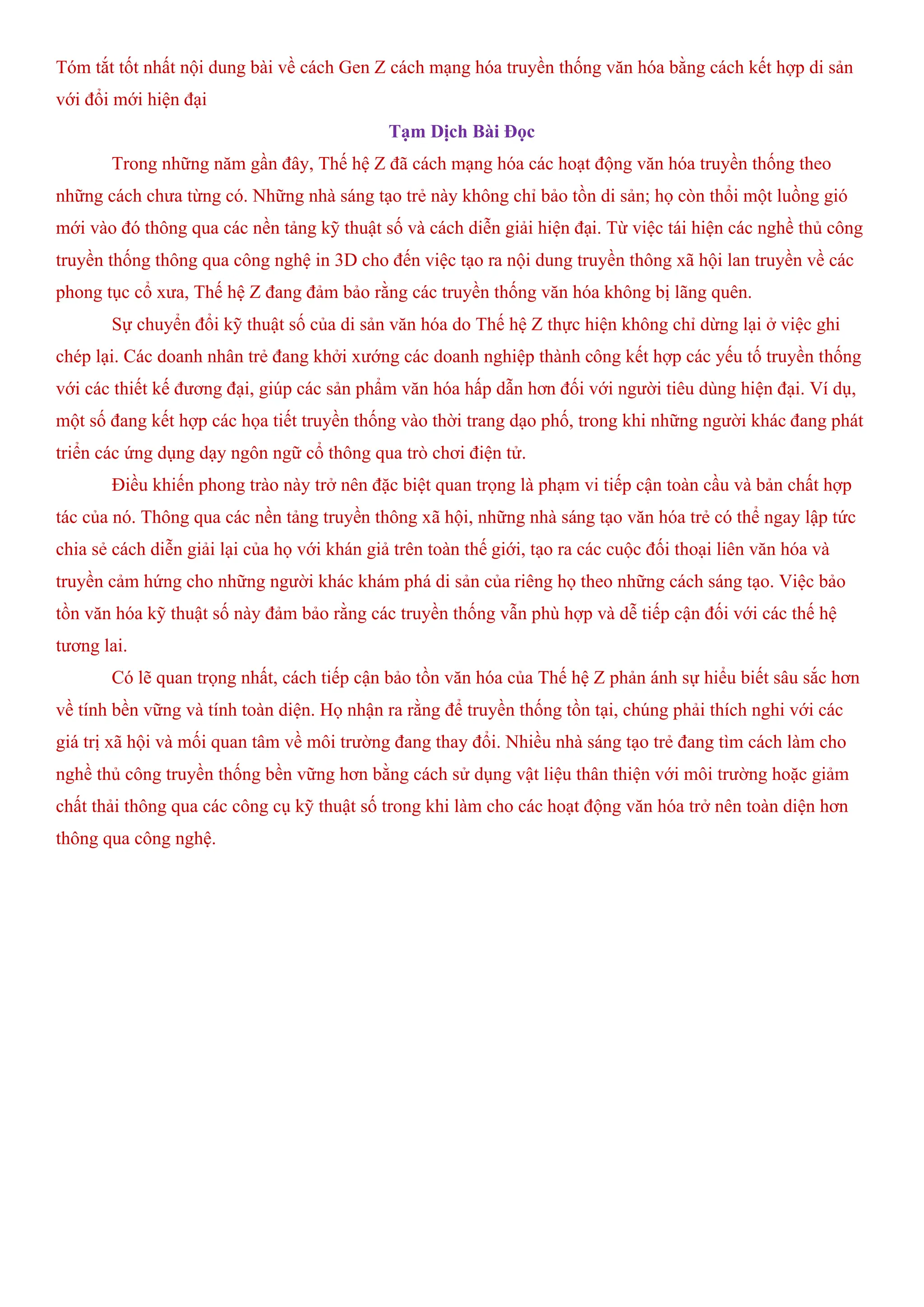
Tóm tắt tốtnhất nội dung bài về cách Gen Z cách mạng hóa truyền thống văn hóa bằng cách kết hợp di sản
với đổi mới hiện đại
Tạm Dịch Bài Đọc
Trong những năm gần đây, Thế hệ Z đã cách mạng hóa các hoạt động văn hóa truyền thống theo
những cách chưa từng có. Những nhà sáng tạo trẻ này không chỉ bảo tồn di sản; họ còn thổi một luồng gió
mới vào đó thông qua các nền tảng kỹ thuật số và cách diễn giải hiện đại. Từ việc tái hiện các nghề thủ công
truyền thống thông qua công nghệ in 3D cho đến việc tạo ra nội dung truyền thông xã hội lan truyền về các
phong tục cổ xưa, Thế hệ Z đang đảm bảo rằng các truyền thống văn hóa không bị lãng quên.
Sự chuyển đổi kỹ thuật số của di sản văn hóa do Thế hệ Z thực hiện không chỉ dừng lại ở việc ghi
chép lại. Các doanh nhân trẻ đang khởi xướng các doanh nghiệp thành công kết hợp các yếu tố truyền thống
với các thiết kế đương đại, giúp các sản phẩm văn hóa hấp dẫn hơn đối với người tiêu dùng hiện đại. Ví dụ,
một số đang kết hợp các họa tiết truyền thống vào thời trang dạo phố, trong khi những người khác đang phát
triển các ứng dụng dạy ngôn ngữ cổ thông qua trò chơi điện tử.
Điều khiến phong trào này trở nên đặc biệt quan trọng là phạm vi tiếp cận toàn cầu và bản chất hợp
tác của nó. Thông qua các nền tảng truyền thông xã hội, những nhà sáng tạo văn hóa trẻ có thể ngay lập tức
chia sẻ cách diễn giải lại của họ với khán giả trên toàn thế giới, tạo ra các cuộc đối thoại liên văn hóa và
truyền cảm hứng cho những người khác khám phá di sản của riêng họ theo những cách sáng tạo. Việc bảo
tồn văn hóa kỹ thuật số này đảm bảo rằng các truyền thống vẫn phù hợp và dễ tiếp cận đối với các thế hệ
tương lai.
Có lẽ quan trọng nhất, cách tiếp cận bảo tồn văn hóa của Thế hệ Z phản ánh sự hiểu biết sâu sắc hơn
về tính bền vững và tính toàn diện. Họ nhận ra rằng để truyền thống tồn tại, chúng phải thích nghi với các
giá trị xã hội và mối quan tâm về môi trường đang thay đổi. Nhiều nhà sáng tạo trẻ đang tìm cách làm cho
nghề thủ công truyền thống bền vững hơn bằng cách sử dụng vật liệu thân thiện với môi trường hoặc giảm
chất thải thông qua các công cụ kỹ thuật số trong khi làm cho các hoạt động văn hóa trở nên toàn diện hơn
thông qua công nghệ.
22.
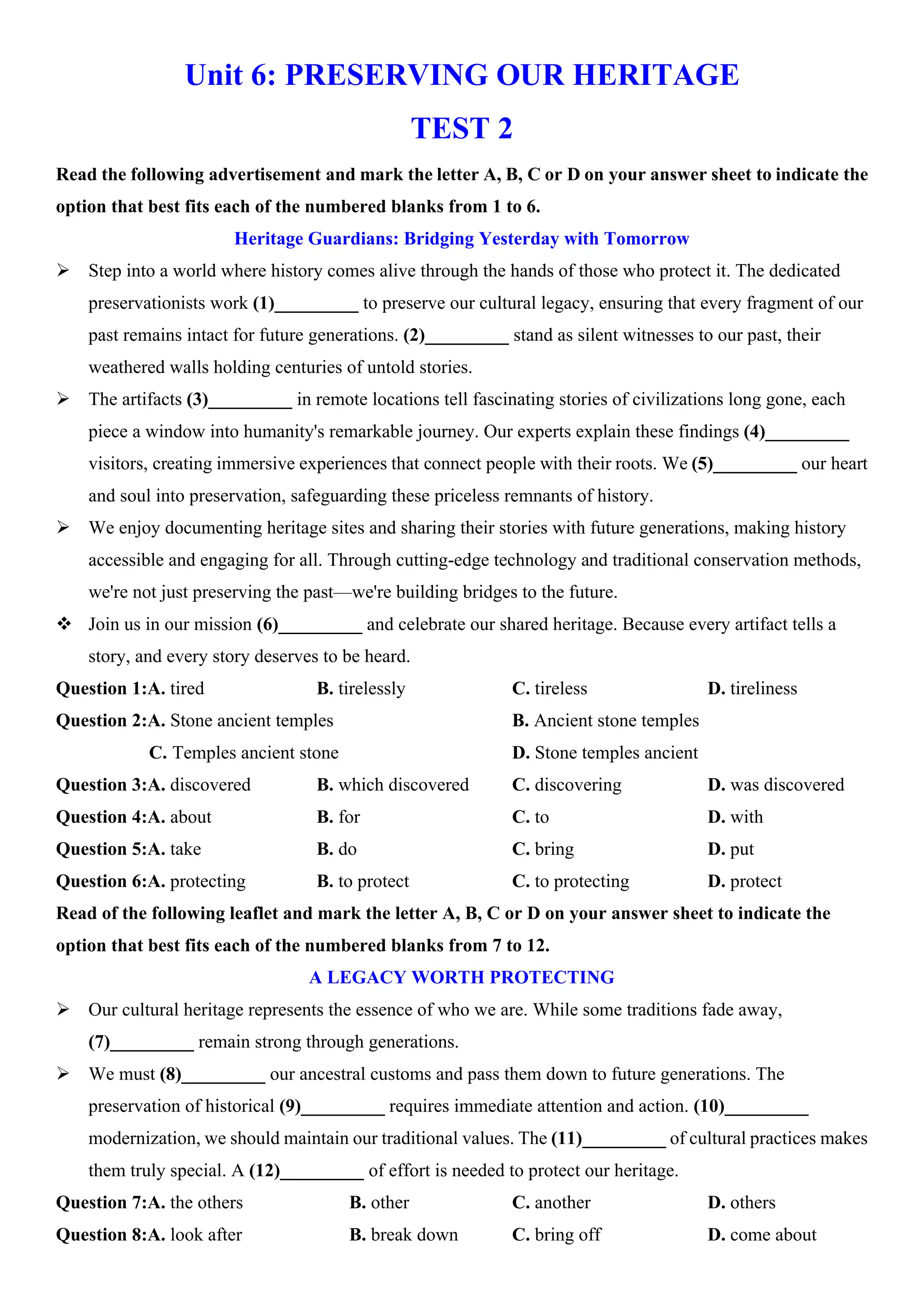
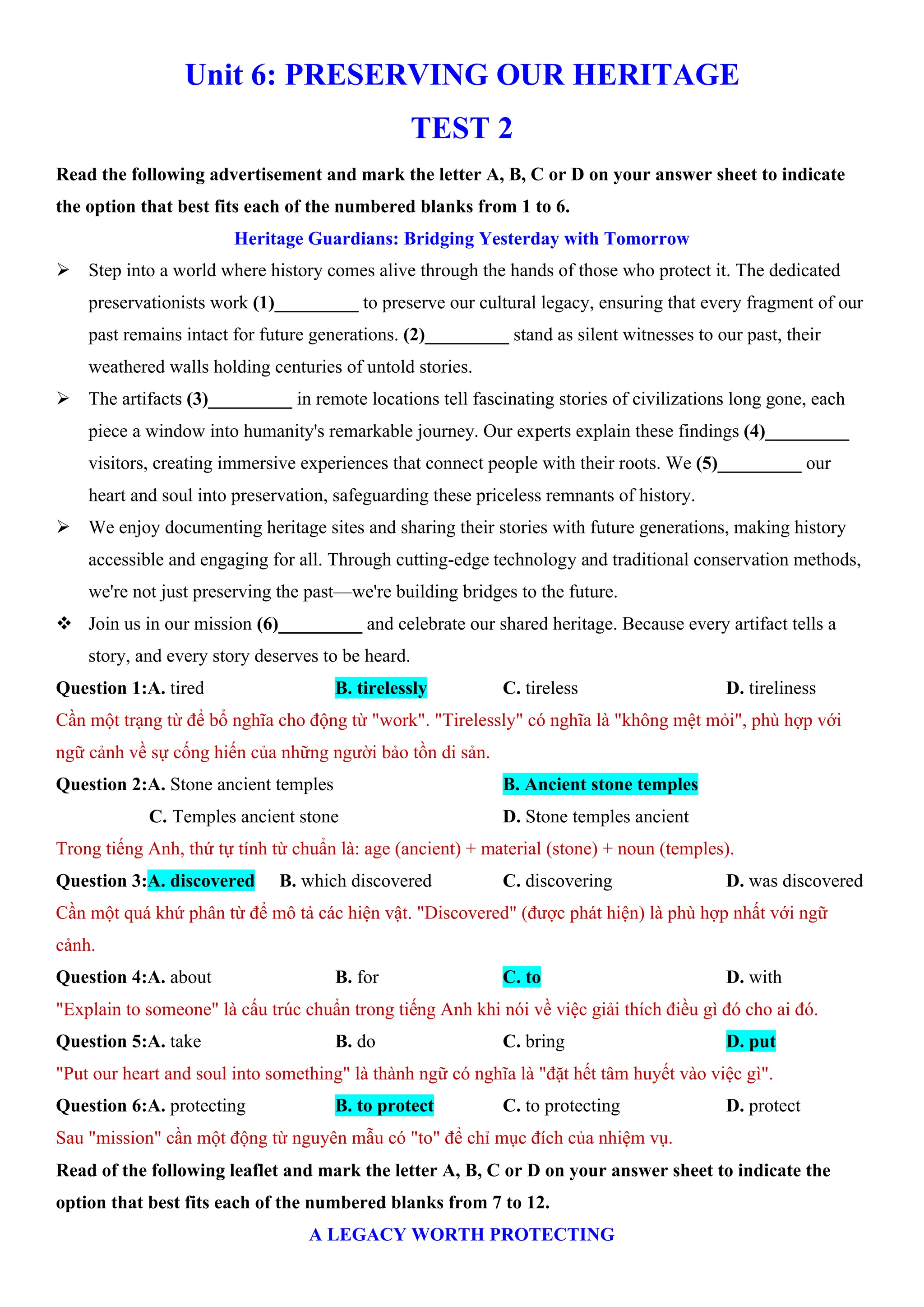
Unit 6: PRESERVINGOUR HERITAGE
TEST 2
Read the following advertisement and mark the letter A, B, C or D on your answer sheet to indicate the
option that best fits each of the numbered blanks from 1 to 6.
Heritage Guardians: Bridging Yesterday with Tomorrow
ÿ Step into a world where history comes alive through the hands of those who protect it. The dedicated
preservationists work (1)_________ to preserve our cultural legacy, ensuring that every fragment of our
past remains intact for future generations. (2)_________ stand as silent witnesses to our past, their
weathered walls holding centuries of untold stories.
ÿ The artifacts (3)_________ in remote locations tell fascinating stories of civilizations long gone, each
piece a window into humanity's remarkable journey. Our experts explain these findings (4)_________
visitors, creating immersive experiences that connect people with their roots. We (5)_________ our heart
and soul into preservation, safeguarding these priceless remnants of history.
ÿ We enjoy documenting heritage sites and sharing their stories with future generations, making history
accessible and engaging for all. Through cutting-edge technology and traditional conservation methods,
we're not just preserving the past—we're building bridges to the future.
v Join us in our mission (6)_________ and celebrate our shared heritage. Because every artifact tells a
story, and every story deserves to be heard.
Question 1:A. tired B. tirelessly C. tireless D. tireliness
Question 2:A. Stone ancient temples B. Ancient stone temples
C. Temples ancient stone D. Stone temples ancient
Question 3:A. discovered B. which discovered C. discovering D. was discovered
Question 4:A. about B. for C. to D. with
Question 5:A. take B. do C. bring D. put
Question 6:A. protecting B. to protect C. to protecting D. protect
Read of the following leaflet and mark the letter A, B, C or D on your answer sheet to indicate the
option that best fits each of the numbered blanks from 7 to 12.
A LEGACY WORTH PROTECTING
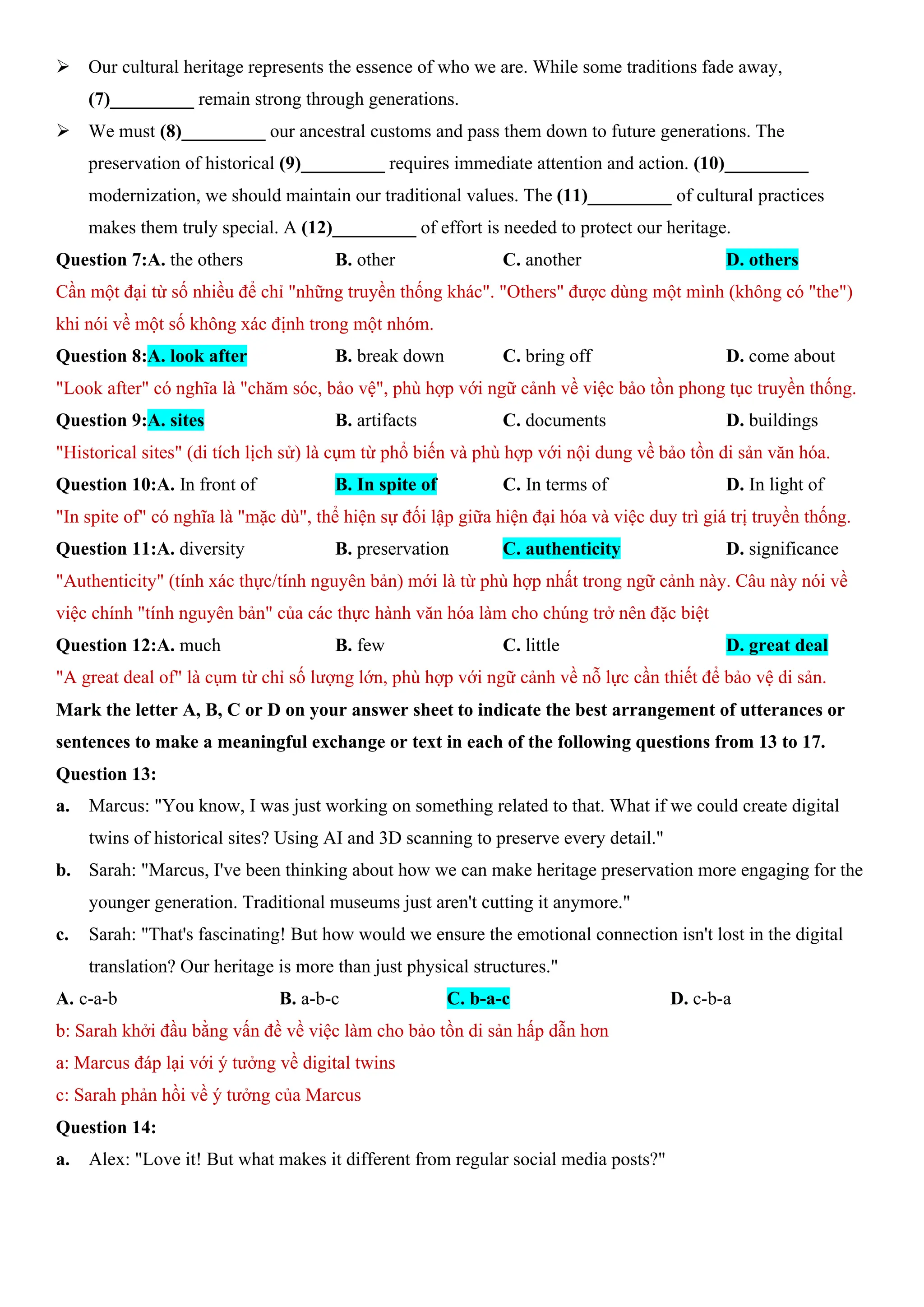
ÿ Our cultural heritage represents the essence of who we are. While some traditions fade away,
(7)_________ remain strong through generations.
ÿ We must (8)_________ our ancestral customs and pass them down to future generations. The
preservation of historical (9)_________ requires immediate attention and action. (10)_________
modernization, we should maintain our traditional values. The (11)_________ of cultural practices makes
them truly special. A (12)_________ of effort is needed to protect our heritage.
Question 7:A. the others B. other C. another D. others
Question 8:A. look after B. break down C. bring off D. come about
23.
Question 9:A. sitesB. artifacts C. documents D. buildings
Question 10:A. In front of B. In spite of C. In terms of D. In light of
Question 11:A. diversity B. preservation C. authenticity D. significance
Question 12:A. much B. few C. little D. great deal
Mark the letter A, B, C or D on your answer sheet to indicate the best arrangement of utterances or
sentences to make a meaningful exchange or text in each of the following questions from 13 to 17.
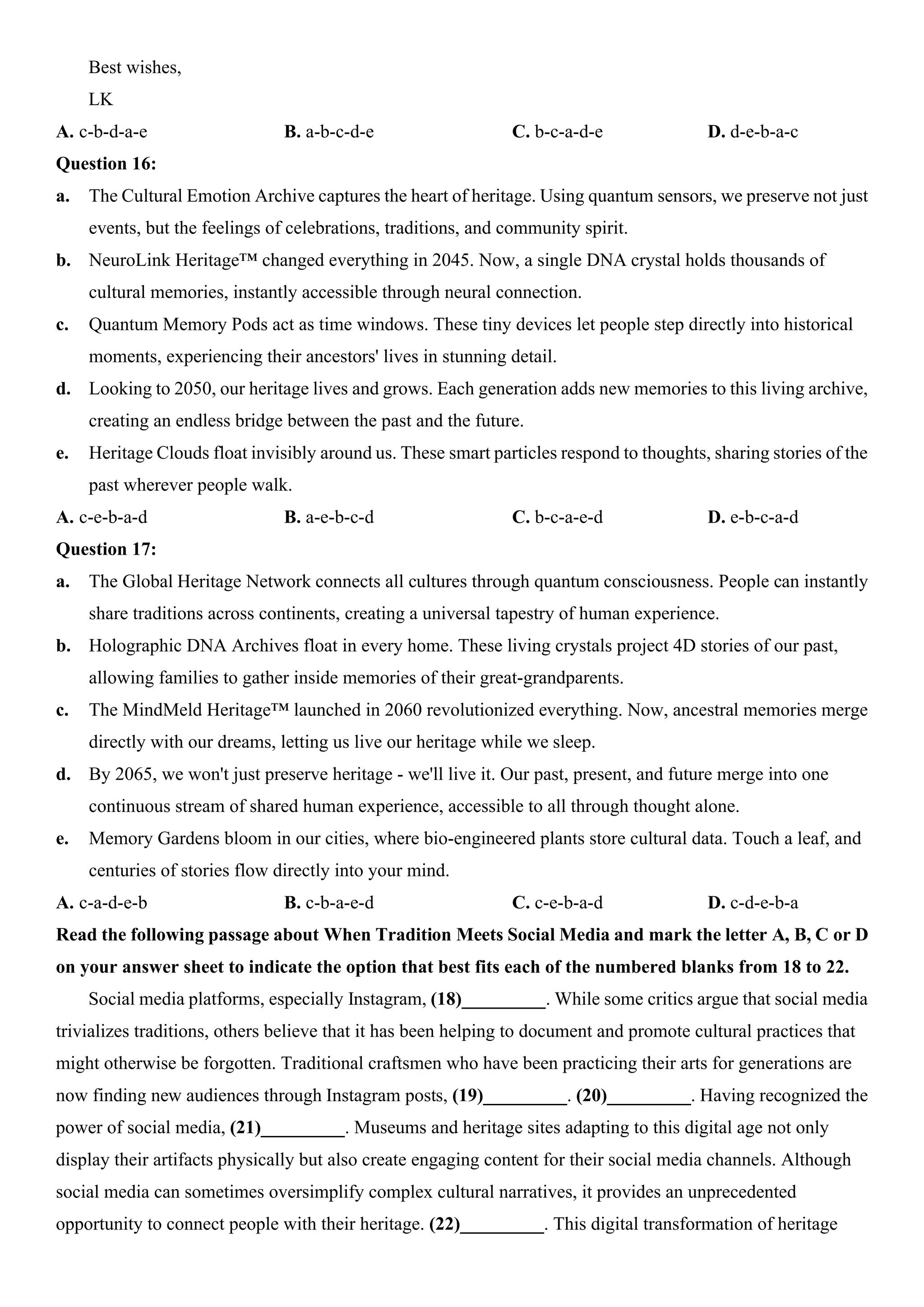
Question 13:
a. Marcus: "You know, I was just working on something related to that. What if we could create digital
twins of historical sites? Using AI and 3D scanning to preserve every detail."
b. Sarah: "Marcus, I've been thinking about how we can make heritage preservation more engaging for the
younger generation. Traditional museums just aren't cutting it anymore."
c. Sarah: "That's fascinating! But how would we ensure the emotional connection isn't lost in the digital
translation? Our heritage is more than just physical structures."
A. c-a-b B. a-b-c C. b-a-c D. c-b-a
Question 14:
a. Alex: "Love it! But what makes it different from regular social media posts?"
b. Maya: "Each video is verified by heritage experts and gets a unique digital certificate. Plus, we're using
AR filters that can show how places looked across different time periods. Imagine pointing your phone at
an old building and seeing its entire history!"
c. Maya: "Users can create 30-second videos documenting local traditions, stories, or historical places in
their community. The AI then categorizes and preserves these memories in a global digital archive."
d. Maya: "Alex, I've developed this new app that lets people contribute to heritage preservation through
crowdsourcing. Think of it as 'TikTok meets history.'"
e. Alex: "That sounds cool! How exactly does it work?"
A. a-b-c-d-e B. a-d-e-c-b C. d-b-c-e-a D. d-e-c-a-b
Question 15:
Dear James,
a. Would you join our beta test next Thursday? We're launching the first-ever "Heritage Dream Room"
where people can sleep and experience a full night of historical memories. It's completely safe—I've tried
it myself!
b. The quantum-preserved stories are crystal clear, and the emotional resonance is incredible.
c. Amazing news! Our "Heritage Pulse" project just hit a breakthrough. The neural implant we developed
can now transmit ancestral memories directly to users' consciousness—imagine experiencing your
great-grandmother's wedding day as if you were there!
d. Even better, our AI has successfully translated ancient dialects in real-time during these memory
experiences. Users can now understand conversations from centuries ago!
e. I can't wait to hear your thoughts.
24.
Best wishes,
LK
A. c-b-d-a-eB. a-b-c-d-e C. b-c-a-d-e D. d-e-b-a-c
Question 16:
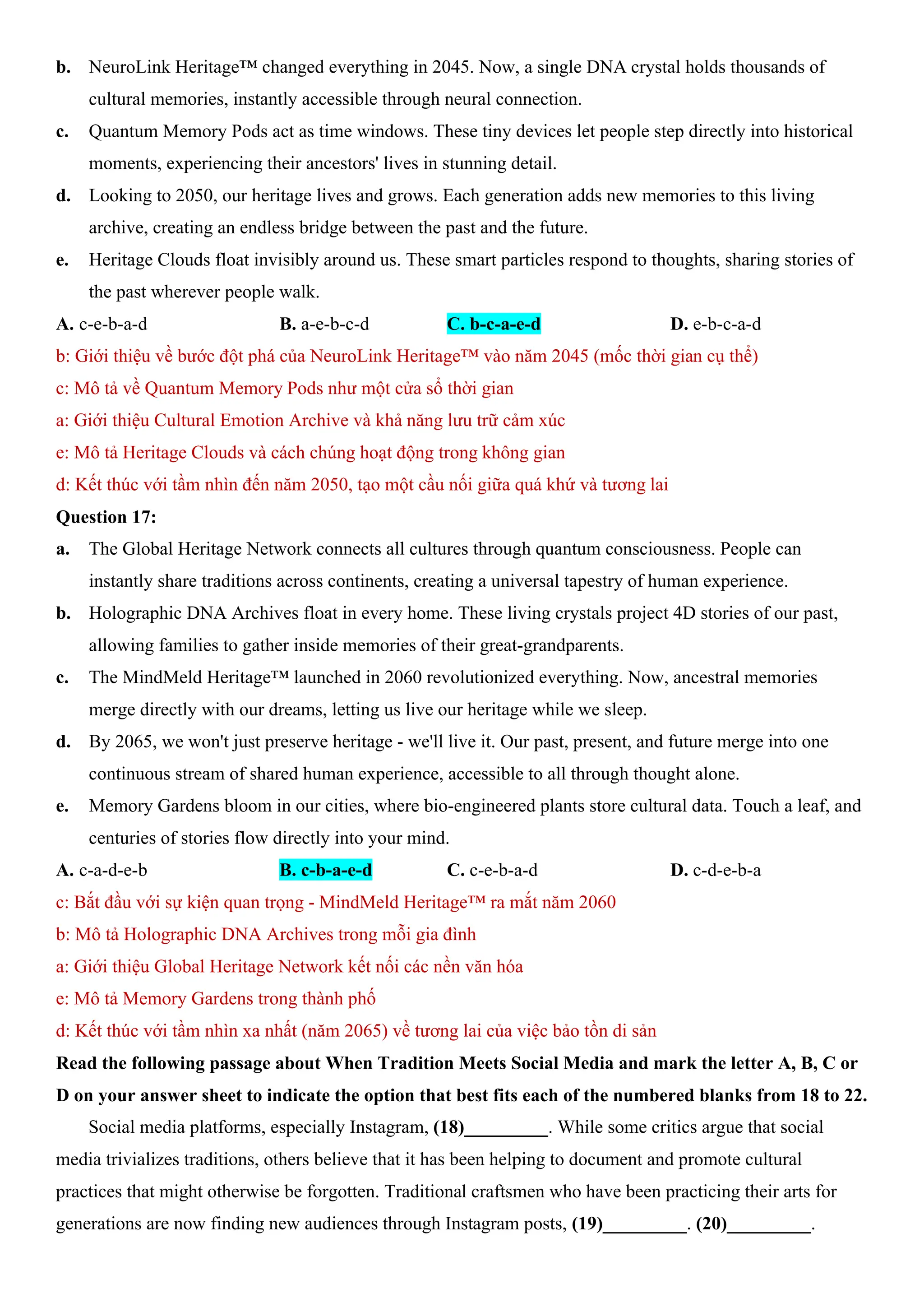
a. The Cultural Emotion Archive captures the heart of heritage. Using quantum sensors, we preserve not just
events, but the feelings of celebrations, traditions, and community spirit.
b. NeuroLink Heritage™ changed everything in 2045. Now, a single DNA crystal holds thousands of
cultural memories, instantly accessible through neural connection.
c. Quantum Memory Pods act as time windows. These tiny devices let people step directly into historical
moments, experiencing their ancestors' lives in stunning detail.
d. Looking to 2050, our heritage lives and grows. Each generation adds new memories to this living archive,
creating an endless bridge between the past and the future.
e. Heritage Clouds float invisibly around us. These smart particles respond to thoughts, sharing stories of the
past wherever people walk.
A. c-e-b-a-d B. a-e-b-c-d C. b-c-a-e-d D. e-b-c-a-d
Question 17:
a. The Global Heritage Network connects all cultures through quantum consciousness. People can instantly
share traditions across continents, creating a universal tapestry of human experience.
b. Holographic DNA Archives float in every home. These living crystals project 4D stories of our past,
allowing families to gather inside memories of their great-grandparents.
c. The MindMeld Heritage™ launched in 2060 revolutionized everything. Now, ancestral memories merge
directly with our dreams, letting us live our heritage while we sleep.
d. By 2065, we won't just preserve heritage - we'll live it. Our past, present, and future merge into one
continuous stream of shared human experience, accessible to all through thought alone.
e. Memory Gardens bloom in our cities, where bio-engineered plants store cultural data. Touch a leaf, and
centuries of stories flow directly into your mind.
A. c-a-d-e-b B. c-b-a-e-d C. c-e-b-a-d D. c-d-e-b-a
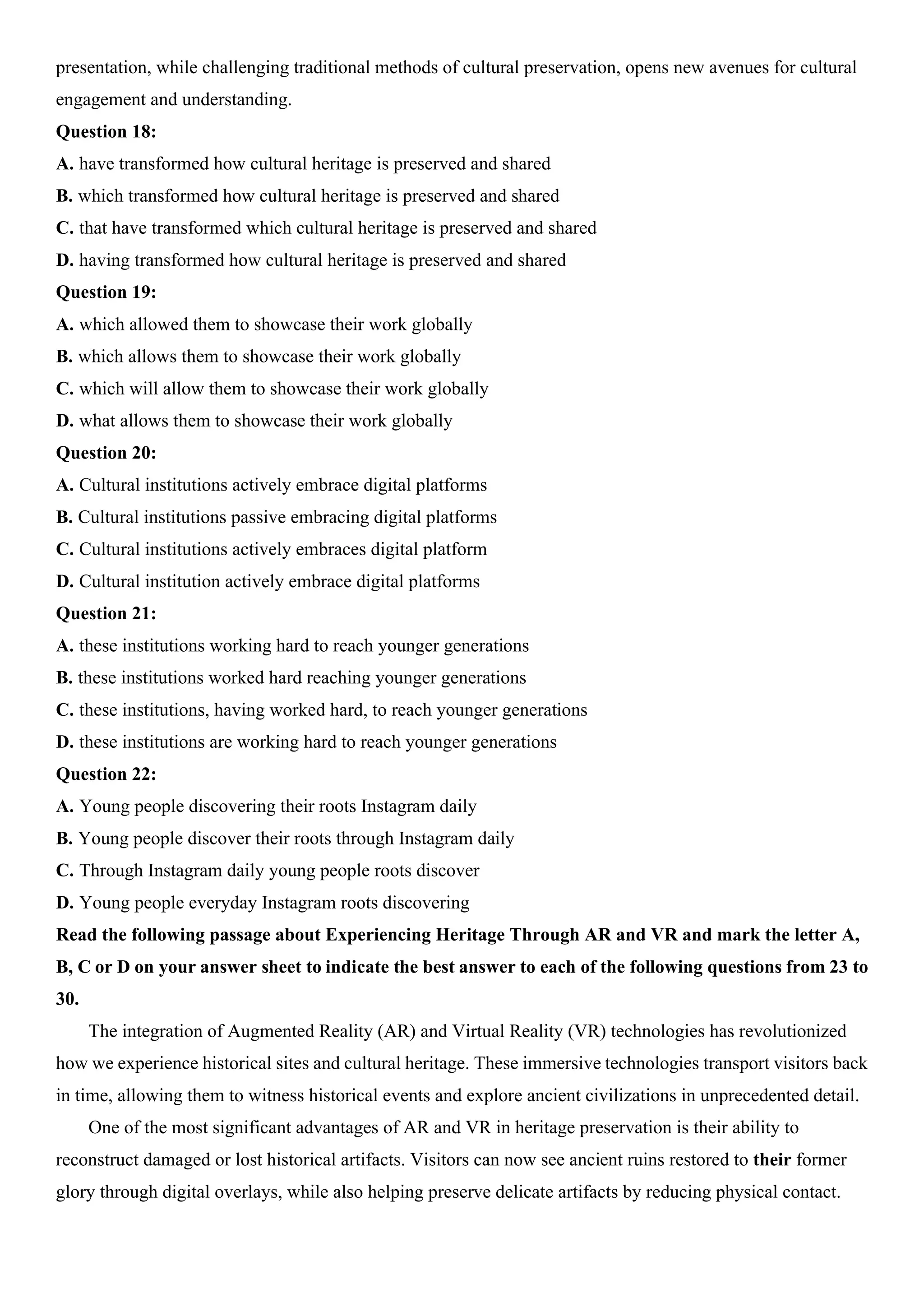
Read the following passage about When Tradition Meets Social Media and mark the letter A, B, C or D
on your answer sheet to indicate the option that best fits each of the numbered blanks from 18 to 22.
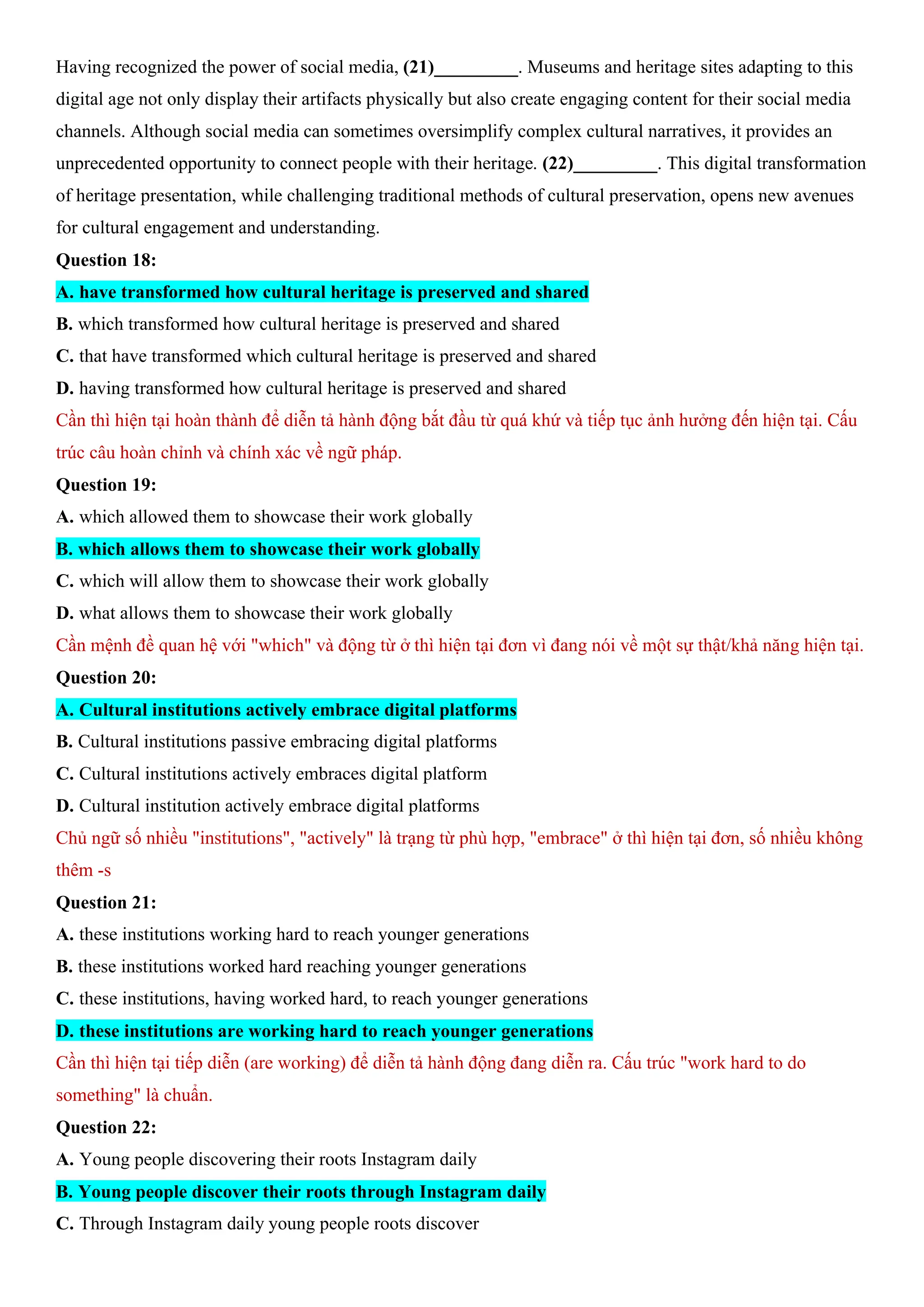
Social media platforms, especially Instagram, (18)_________. While some critics argue that social media
trivializes traditions, others believe that it has been helping to document and promote cultural practices that
might otherwise be forgotten. Traditional craftsmen who have been practicing their arts for generations are
now finding new audiences through Instagram posts, (19)_________. (20)_________. Having recognized the
power of social media, (21)_________. Museums and heritage sites adapting to this digital age not only
display their artifacts physically but also create engaging content for their social media channels. Although
social media can sometimes oversimplify complex cultural narratives, it provides an unprecedented
opportunity to connect people with their heritage. (22)_________. This digital transformation of heritage
25.
presentation, while challengingtraditional methods of cultural preservation, opens new avenues for cultural
engagement and understanding.
Question 18:
A. have transformed how cultural heritage is preserved and shared
B. which transformed how cultural heritage is preserved and shared
C. that have transformed which cultural heritage is preserved and shared
D. having transformed how cultural heritage is preserved and shared
Question 19:
A. which allowed them to showcase their work globally
B. which allows them to showcase their work globally
C. which will allow them to showcase their work globally
D. what allows them to showcase their work globally
Question 20:
A. Cultural institutions actively embrace digital platforms
B. Cultural institutions passive embracing digital platforms
C. Cultural institutions actively embraces digital platform
D. Cultural institution actively embrace digital platforms
Question 21:
A. these institutions working hard to reach younger generations
B. these institutions worked hard reaching younger generations
C. these institutions, having worked hard, to reach younger generations
D. these institutions are working hard to reach younger generations
Question 22:
A. Young people discovering their roots Instagram daily
B. Young people discover their roots through Instagram daily
C. Through Instagram daily young people roots discover
D. Young people everyday Instagram roots discovering
Read the following passage about Experiencing Heritage Through AR and VR and mark the letter A,
B, C or D on your answer sheet to indicate the best answer to each of the following questions from 23 to
30.
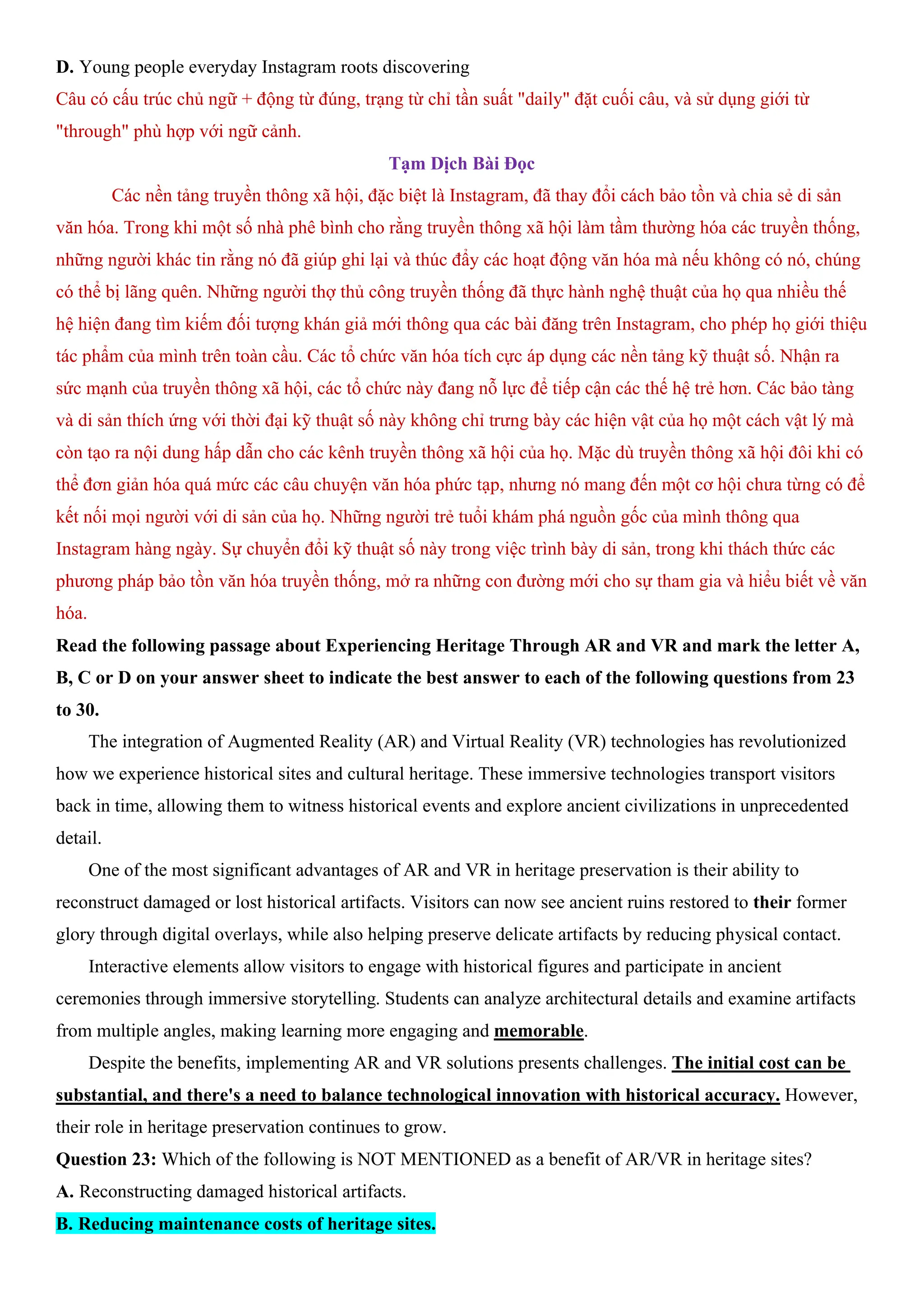
The integration of Augmented Reality (AR) and Virtual Reality (VR) technologies has revolutionized
how we experience historical sites and cultural heritage. These immersive technologies transport visitors back
in time, allowing them to witness historical events and explore ancient civilizations in unprecedented detail.
One of the most significant advantages of AR and VR in heritage preservation is their ability to
reconstruct damaged or lost historical artifacts. Visitors can now see ancient ruins restored to their former
glory through digital overlays, while also helping preserve delicate artifacts by reducing physical contact.
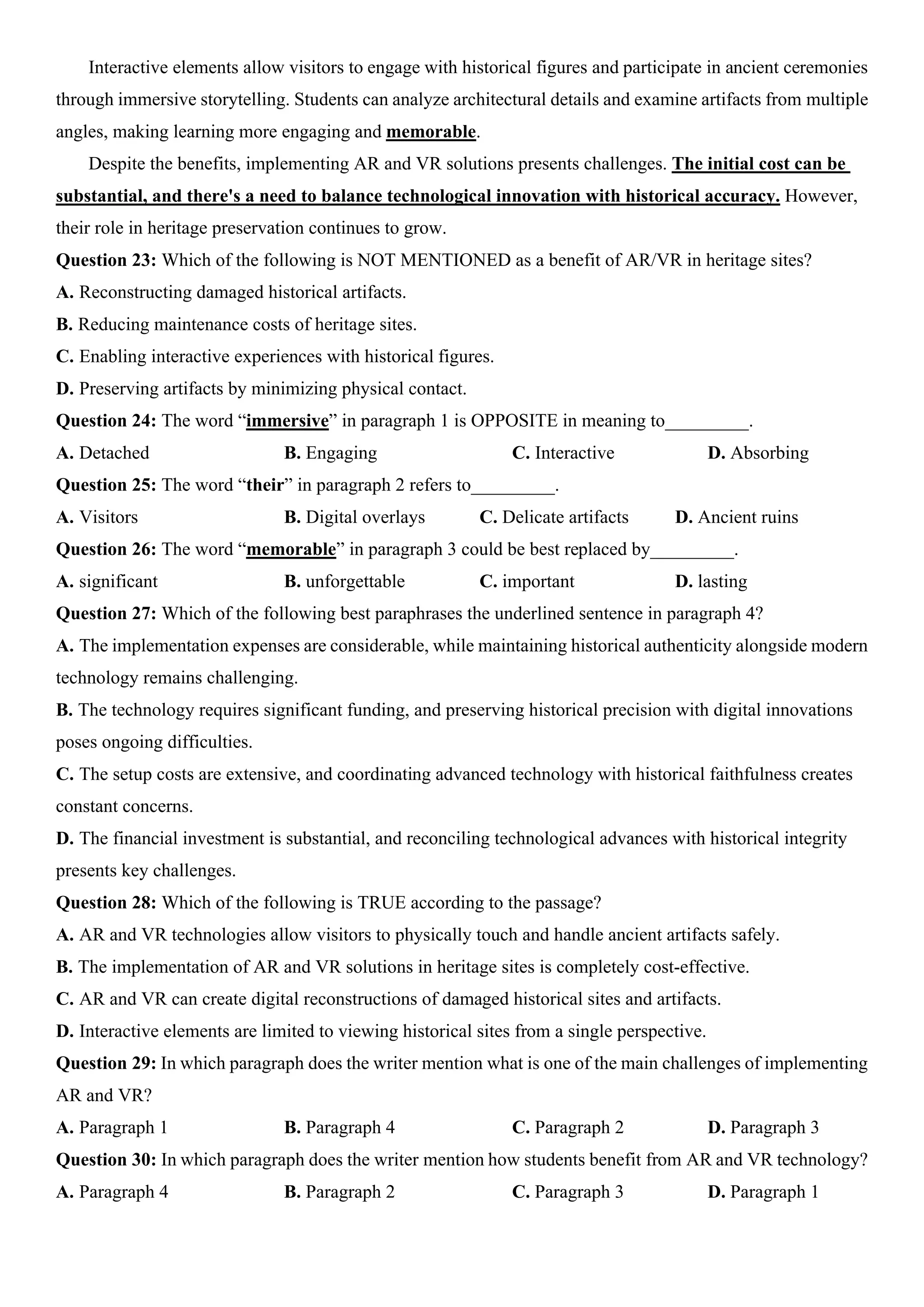
26.
Interactive elements allowvisitors to engage with historical figures and participate in ancient ceremonies
through immersive storytelling. Students can analyze architectural details and examine artifacts from multiple
angles, making learning more engaging and memorable.
Despite the benefits, implementing AR and VR solutions presents challenges. The initial cost can be
substantial, and there's a need to balance technological innovation with historical accuracy. However,
their role in heritage preservation continues to grow.
Question 23: Which of the following is NOT MENTIONED as a benefit of AR/VR in heritage sites?
A. Reconstructing damaged historical artifacts.
B. Reducing maintenance costs of heritage sites.
C. Enabling interactive experiences with historical figures.
D. Preserving artifacts by minimizing physical contact.
Question 24: The word “immersive” in paragraph 1 is OPPOSITE in meaning to_________.
A. Detached B. Engaging C. Interactive D. Absorbing
Question 25: The word “their” in paragraph 2 refers to_________.
A. Visitors B. Digital overlays C. Delicate artifacts D. Ancient ruins
Question 26: The word “memorable” in paragraph 3 could be best replaced by_________.
A. significant B. unforgettable C. important D. lasting
Question 27: Which of the following best paraphrases the underlined sentence in paragraph 4?
A. The implementation expenses are considerable, while maintaining historical authenticity alongside modern
technology remains challenging.
B. The technology requires significant funding, and preserving historical precision with digital innovations
poses ongoing difficulties.
C. The setup costs are extensive, and coordinating advanced technology with historical faithfulness creates
constant concerns.
D. The financial investment is substantial, and reconciling technological advances with historical integrity
presents key challenges.
Question 28: Which of the following is TRUE according to the passage?
A. AR and VR technologies allow visitors to physically touch and handle ancient artifacts safely.
B. The implementation of AR and VR solutions in heritage sites is completely cost-effective.
C. AR and VR can create digital reconstructions of damaged historical sites and artifacts.
D. Interactive elements are limited to viewing historical sites from a single perspective.
Question 29: In which paragraph does the writer mention what is one of the main challenges of implementing
AR and VR?
A. Paragraph 1 B. Paragraph 4 C. Paragraph 2 D. Paragraph 3
Question 30: In which paragraph does the writer mention how students benefit from AR and VR technology?
A. Paragraph 4 B. Paragraph 2 C. Paragraph 3 D. Paragraph 1
27.
Read the followingpassage about the Heritage Goes Hyper-Digital and mark the letter A, B, C or D on
your answer sheet to indicate the best answer to each of the following questions from 31 to 40.
The emergence of metaverse museums has turned the world of cultural heritage on its head. These
virtual spaces offer immersive environments where visitors can explore artifacts and exhibitions from
anywhere globally. Through VR and AR technologies, museums are breaking down geographical barriers and
creating unprecedented access to cultural treasures.
In these digital realms, [I]. They can rotate ancient sculptures,[II] zoom in on intricate details of
paintings, or even witness historical events through realistic simulations. The metaverse technology enables
curators to create dynamic, [III]interactive exhibitions that adapt to visitors' interests and learning styles. This
personalization enhances engagement and deepens understanding of cultural heritage[IV].
Moreover, metaverse museums serve as powerful tools for preservation and education. Digital scanning
and modeling techniques create precise replicas of artifacts, ensuring their preservation for future generations.
These virtual spaces also facilitate collaborative research among scholars worldwide, enabling them to study
and analyze artifacts together in real-time, regardless of their physical location. The integration of artificial
intelligence provides intelligent guidance and contextual information, enriching the educational experience.
The social aspect of metaverse museums shouldn't be overlooked. Visitors can share their experiences
with others, participate in virtual guided tours, and engage in discussions with people from diverse
cultural backgrounds. This interconnectedness fosters cultural exchange and understanding, making
museums more inclusive and accessible than ever before.
Question 31: The phrase “turn something on its head” in paragraph 1 could be best replaced by________.
A. break down B. zoom in C. shake up D. look over
Question 32: Where in paragraph 2 does the following sentence best fit?
visitors can interact with priceless artifacts in ways previously impossible in traditional museums
A. [I] B. [II] C. [III] D. [IV]
Question 33: Which of the following is NOT mentioned as a benefit of metaverse museums?
A. Revenue generation through virtual ticket sales and digital gift shops.
B. Interactive manipulation of artifacts through VR and AR technologies.
C. Preservation of cultural artifacts through digital scanning.
D. Real-time collaboration among scholars worldwide.
Question 34: Which of the following best summarises paragraph 2?
A. Virtual reality technology enables detailed examination of historical objects while providing interactive
simulations that recreate significant events from the past.
B. Metaverse museums allow visitors to manipulate digital artifacts and experience personalized exhibitions
that adapt to individual preferences and learning approaches.
C. Digital museum spaces incorporate advanced visualization tools that let users explore artwork details and
participate in customized educational experiences.
28.
D. Modern museumtechnology transforms traditional viewing into dynamic interactions where visitors can
examine artifacts and engage with adaptive content.
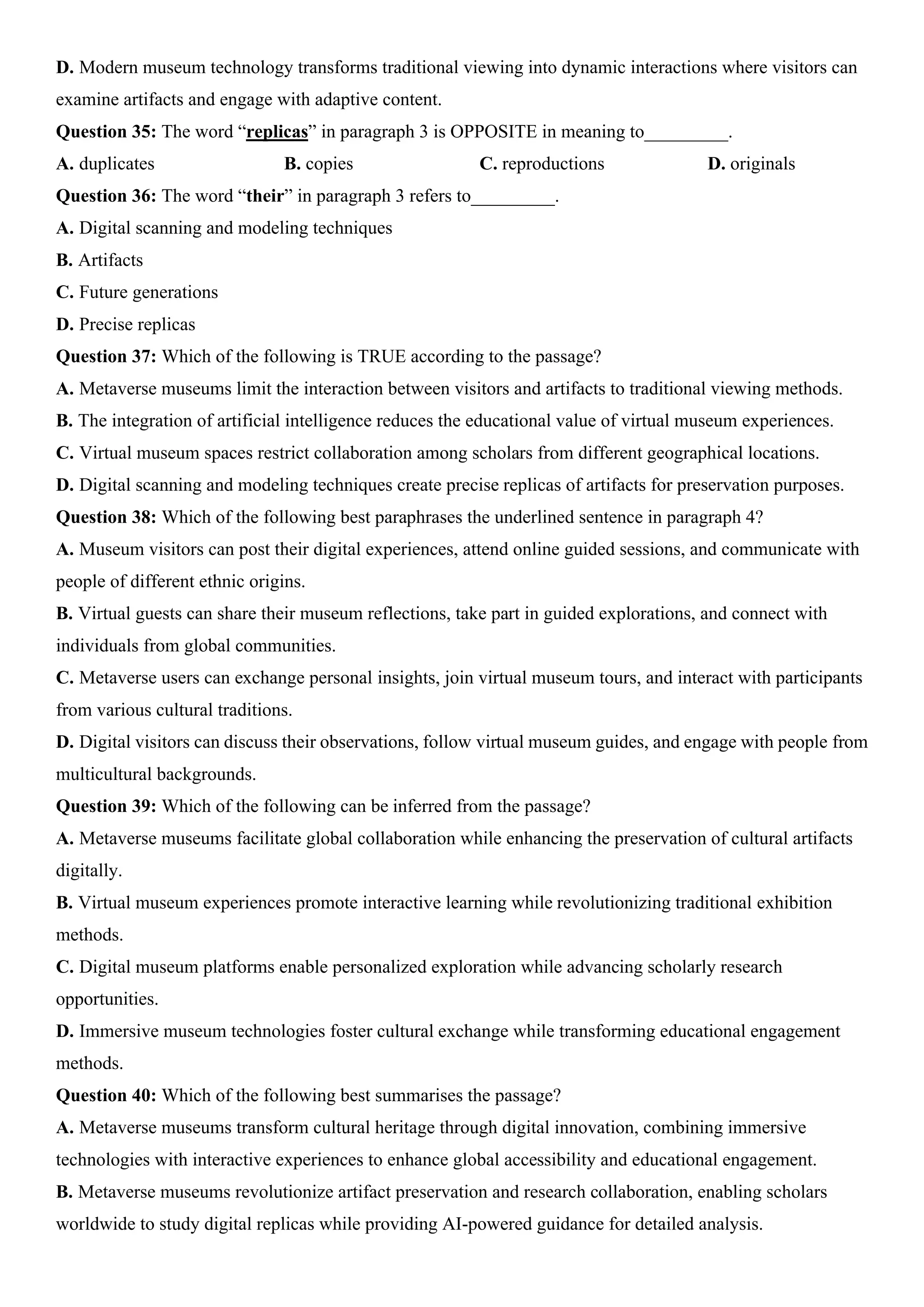
Question 35: The word “replicas” in paragraph 3 is OPPOSITE in meaning to_________.
A. duplicates B. copies C. reproductions D. originals
Question 36: The word “their” in paragraph 3 refers to_________.
A. Digital scanning and modeling techniques
B. Artifacts
C. Future generations
D. Precise replicas
Question 37: Which of the following is TRUE according to the passage?
A. Metaverse museums limit the interaction between visitors and artifacts to traditional viewing methods.
B. The integration of artificial intelligence reduces the educational value of virtual museum experiences.
C. Virtual museum spaces restrict collaboration among scholars from different geographical locations.
D. Digital scanning and modeling techniques create precise replicas of artifacts for preservation purposes.
Question 38: Which of the following best paraphrases the underlined sentence in paragraph 4?
A. Museum visitors can post their digital experiences, attend online guided sessions, and communicate with
people of different ethnic origins.
B. Virtual guests can share their museum reflections, take part in guided explorations, and connect with
individuals from global communities.
C. Metaverse users can exchange personal insights, join virtual museum tours, and interact with participants
from various cultural traditions.
D. Digital visitors can discuss their observations, follow virtual museum guides, and engage with people from
multicultural backgrounds.
Question 39: Which of the following can be inferred from the passage?
A. Metaverse museums facilitate global collaboration while enhancing the preservation of cultural artifacts
digitally.
B. Virtual museum experiences promote interactive learning while revolutionizing traditional exhibition
methods.
C. Digital museum platforms enable personalized exploration while advancing scholarly research
opportunities.
D. Immersive museum technologies foster cultural exchange while transforming educational engagement
methods.
Question 40: Which of the following best summarises the passage?
A. Metaverse museums transform cultural heritage through digital innovation, combining immersive
technologies with interactive experiences to enhance global accessibility and educational engagement.
B. Metaverse museums revolutionize artifact preservation and research collaboration, enabling scholars
worldwide to study digital replicas while providing AI-powered guidance for detailed analysis.
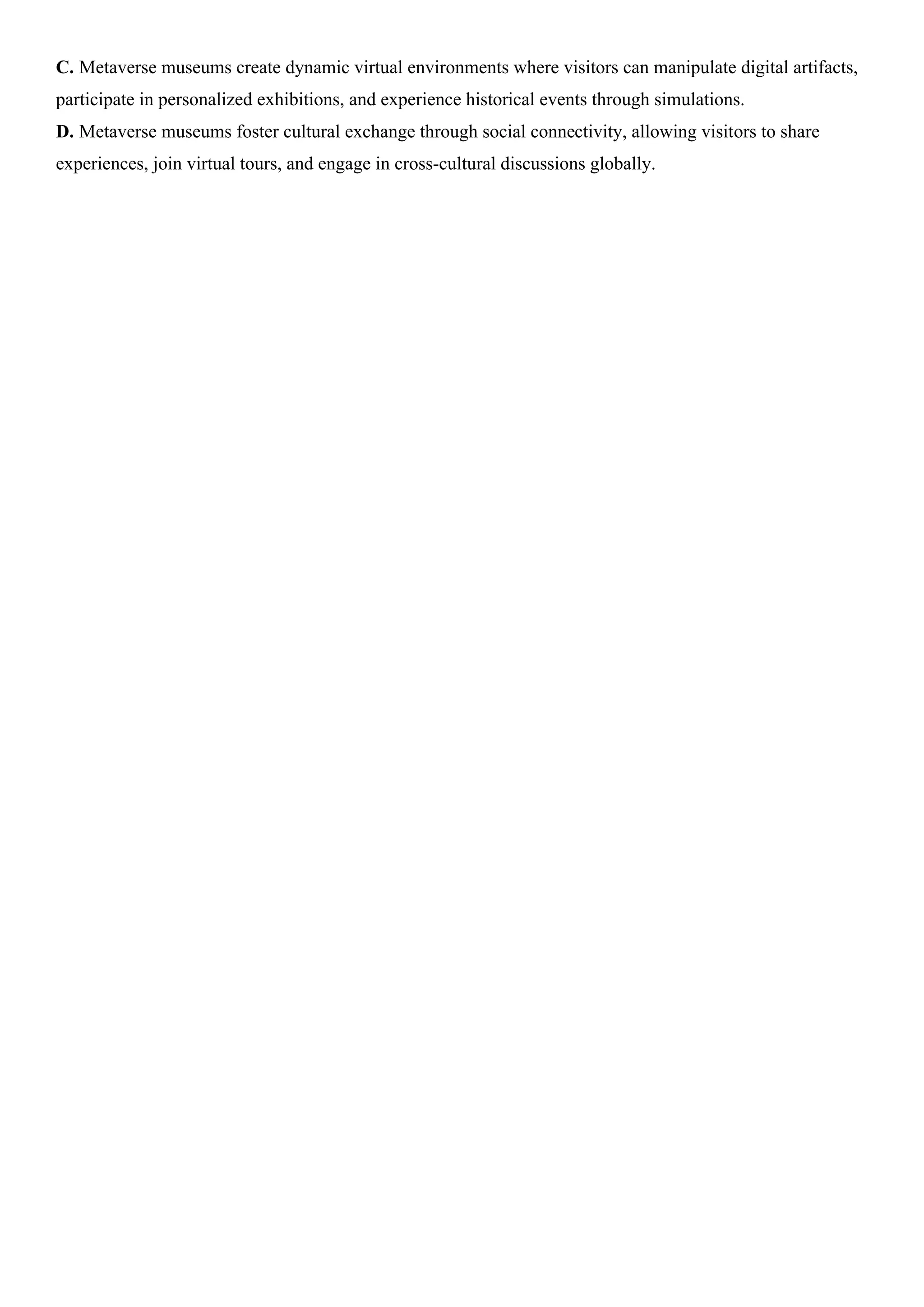
29.
C. Metaverse museumscreate dynamic virtual environments where visitors can manipulate digital artifacts,
participate in personalized exhibitions, and experience historical events through simulations.
D. Metaverse museums foster cultural exchange through social connectivity, allowing visitors to share
experiences, join virtual tours, and engage in cross-cultural discussions globally.
30.
Unit 6: PRESERVINGOUR HERITAGE
TEST 2
Read the following advertisement and mark the letter A, B, C or D on your answer sheet to indicate
the option that best fits each of the numbered blanks from 1 to 6.
Heritage Guardians: Bridging Yesterday with Tomorrow
ÿ Step into a world where history comes alive through the hands of those who protect it. The dedicated
preservationists work (1)_________ to preserve our cultural legacy, ensuring that every fragment of our
past remains intact for future generations. (2)_________ stand as silent witnesses to our past, their
weathered walls holding centuries of untold stories.
ÿ The artifacts (3)_________ in remote locations tell fascinating stories of civilizations long gone, each
piece a window into humanity's remarkable journey. Our experts explain these findings (4)_________
visitors, creating immersive experiences that connect people with their roots. We (5)_________ our
heart and soul into preservation, safeguarding these priceless remnants of history.
ÿ We enjoy documenting heritage sites and sharing their stories with future generations, making history
accessible and engaging for all. Through cutting-edge technology and traditional conservation methods,
we're not just preserving the past—we're building bridges to the future.
v Join us in our mission (6)_________ and celebrate our shared heritage. Because every artifact tells a
story, and every story deserves to be heard.
Question 1:A. tired B. tirelessly C. tireless D. tireliness
Cần một trạng từ để bổ nghĩa cho động từ "work". "Tirelessly" có nghĩa là "không mệt mỏi", phù hợp với
ngữ cảnh về sự cống hiến của những người bảo tồn di sản.
Question 2:A. Stone ancient temples B. Ancient stone temples
C. Temples ancient stone D. Stone temples ancient
Trong tiếng Anh, thứ tự tính từ chuẩn là: age (ancient) + material (stone) + noun (temples).
Question 3:A. discovered B. which discovered C. discovering D. was discovered
Cần một quá khứ phân từ để mô tả các hiện vật. "Discovered" (được phát hiện) là phù hợp nhất với ngữ
cảnh.
Question 4:A. about B. for C. to D. with
"Explain to someone" là cấu trúc chuẩn trong tiếng Anh khi nói về việc giải thích điều gì đó cho ai đó.
Question 5:A. take B. do C. bring D. put
"Put our heart and soul into something" là thành ngữ có nghĩa là "đặt hết tâm huyết vào việc gì".
Question 6:A. protecting B. to protect C. to protecting D. protect
Sau "mission" cần một động từ nguyên mẫu có "to" để chỉ mục đích của nhiệm vụ.
Read of the following leaflet and mark the letter A, B, C or D on your answer sheet to indicate the
option that best fits each of the numbered blanks from 7 to 12.
A LEGACY WORTH PROTECTING
31.
ÿ Our culturalheritage represents the essence of who we are. While some traditions fade away,
(7)_________ remain strong through generations.
ÿ We must (8)_________ our ancestral customs and pass them down to future generations. The
preservation of historical (9)_________ requires immediate attention and action. (10)_________
modernization, we should maintain our traditional values. The (11)_________ of cultural practices
makes them truly special. A (12)_________ of effort is needed to protect our heritage.
Question 7:A. the others B. other C. another D. others
Cần một đại từ số nhiều để chỉ "những truyền thống khác". "Others" được dùng một mình (không có "the")
khi nói về một số không xác định trong một nhóm.
Question 8:A. look after B. break down C. bring off D. come about
"Look after" có nghĩa là "chăm sóc, bảo vệ", phù hợp với ngữ cảnh về việc bảo tồn phong tục truyền thống.
Question 9:A. sites B. artifacts C. documents D. buildings
"Historical sites" (di tích lịch sử) là cụm từ phổ biến và phù hợp với nội dung về bảo tồn di sản văn hóa.
Question 10:A. In front of B. In spite of C. In terms of D. In light of
"In spite of" có nghĩa là "mặc dù", thể hiện sự đối lập giữa hiện đại hóa và việc duy trì giá trị truyền thống.
Question 11:A. diversity B. preservation C. authenticity D. significance
"Authenticity" (tính xác thực/tính nguyên bản) mới là từ phù hợp nhất trong ngữ cảnh này. Câu này nói về
việc chính "tính nguyên bản" của các thực hành văn hóa làm cho chúng trở nên đặc biệt
Question 12:A. much B. few C. little D. great deal
"A great deal of" là cụm từ chỉ số lượng lớn, phù hợp với ngữ cảnh về nỗ lực cần thiết để bảo vệ di sản.
Mark the letter A, B, C or D on your answer sheet to indicate the best arrangement of utterances or
sentences to make a meaningful exchange or text in each of the following questions from 13 to 17.
Question 13:
a. Marcus: "You know, I was just working on something related to that. What if we could create digital
twins of historical sites? Using AI and 3D scanning to preserve every detail."
b. Sarah: "Marcus, I've been thinking about how we can make heritage preservation more engaging for the
younger generation. Traditional museums just aren't cutting it anymore."
c. Sarah: "That's fascinating! But how would we ensure the emotional connection isn't lost in the digital
translation? Our heritage is more than just physical structures."
A. c-a-b B. a-b-c C. b-a-c D. c-b-a
b: Sarah khởi đầu bằng vấn đề về việc làm cho bảo tồn di sản hấp dẫn hơn
a: Marcus đáp lại với ý tưởng về digital twins
c: Sarah phản hồi về ý tưởng của Marcus
Question 14:
a. Alex: "Love it! But what makes it different from regular social media posts?"
32.
b. Maya: "Eachvideo is verified by heritage experts and gets a unique digital certificate. Plus, we're using
AR filters that can show how places looked across different time periods. Imagine pointing your phone
at an old building and seeing its entire history!"
c. Maya: "Users can create 30-second videos documenting local traditions, stories, or historical places in
their community. The AI then categorizes and preserves these memories in a global digital archive."
d. Maya: "Alex, I've developed this new app that lets people contribute to heritage preservation through
crowdsourcing. Think of it as 'TikTok meets history.'"
e. Alex: "That sounds cool! How exactly does it work?"
A. a-b-c-d-e B. a-d-e-c-b C. d-b-c-e-a D. d-e-c-a-b
d: Maya giới thiệu ứng dụng mới
e: Alex hỏi cách hoạt động
c: Maya giải thích cơ chế cơ bản
a: Alex hỏi điểm khác biệt
b: Maya giải thích các tính năng đặc biệt
Question 15:
Dear James,
a. Would you join our beta test next Thursday? We're launching the first-ever "Heritage Dream Room"
where people can sleep and experience a full night of historical memories. It's completely safe—I've
tried it myself!
b. The quantum-preserved stories are crystal clear, and the emotional resonance is incredible.
c. Amazing news! Our "Heritage Pulse" project just hit a breakthrough. The neural implant we developed
can now transmit ancestral memories directly to users' consciousness—imagine experiencing your
great-grandmother's wedding day as if you were there!
d. Even better, our AI has successfully translated ancient dialects in real-time during these memory
experiences. Users can now understand conversations from centuries ago!
e. I can't wait to hear your thoughts.
Best wishes,
LK
A. c-b-d-a-e B. a-b-c-d-e C. b-c-a-d-e D. d-e-b-a-c
c: Thông báo tin tức đột phá
b: Mô tả chất lượng
d: Thêm thông tin về tính năng
a: Lời mời tham gia thử nghiệm
e: Kết thúc email
Question 16:
a. The Cultural Emotion Archive captures the heart of heritage. Using quantum sensors, we preserve not
just events, but the feelings of celebrations, traditions, and community spirit.
33.
b. NeuroLink Heritage™changed everything in 2045. Now, a single DNA crystal holds thousands of
cultural memories, instantly accessible through neural connection.
c. Quantum Memory Pods act as time windows. These tiny devices let people step directly into historical
moments, experiencing their ancestors' lives in stunning detail.
d. Looking to 2050, our heritage lives and grows. Each generation adds new memories to this living
archive, creating an endless bridge between the past and the future.
e. Heritage Clouds float invisibly around us. These smart particles respond to thoughts, sharing stories of
the past wherever people walk.
A. c-e-b-a-d B. a-e-b-c-d C. b-c-a-e-d D. e-b-c-a-d
b: Giới thiệu về bước đột phá của NeuroLink Heritage™ vào năm 2045 (mốc thời gian cụ thể)
c: Mô tả về Quantum Memory Pods như một cửa sổ thời gian
a: Giới thiệu Cultural Emotion Archive và khả năng lưu trữ cảm xúc
e: Mô tả Heritage Clouds và cách chúng hoạt động trong không gian
d: Kết thúc với tầm nhìn đến năm 2050, tạo một cầu nối giữa quá khứ và tương lai
Question 17:
a. The Global Heritage Network connects all cultures through quantum consciousness. People can
instantly share traditions across continents, creating a universal tapestry of human experience.
b. Holographic DNA Archives float in every home. These living crystals project 4D stories of our past,
allowing families to gather inside memories of their great-grandparents.
c. The MindMeld Heritage™ launched in 2060 revolutionized everything. Now, ancestral memories
merge directly with our dreams, letting us live our heritage while we sleep.
d. By 2065, we won't just preserve heritage - we'll live it. Our past, present, and future merge into one
continuous stream of shared human experience, accessible to all through thought alone.
e. Memory Gardens bloom in our cities, where bio-engineered plants store cultural data. Touch a leaf, and
centuries of stories flow directly into your mind.
A. c-a-d-e-b B. c-b-a-e-d C. c-e-b-a-d D. c-d-e-b-a
c: Bắt đầu với sự kiện quan trọng - MindMeld Heritage™ ra mắt năm 2060
b: Mô tả Holographic DNA Archives trong mỗi gia đình
a: Giới thiệu Global Heritage Network kết nối các nền văn hóa
e: Mô tả Memory Gardens trong thành phố
d: Kết thúc với tầm nhìn xa nhất (năm 2065) về tương lai của việc bảo tồn di sản
Read the following passage about When Tradition Meets Social Media and mark the letter A, B, C or
D on your answer sheet to indicate the option that best fits each of the numbered blanks from 18 to 22.
Social media platforms, especially Instagram, (18)_________. While some critics argue that social
media trivializes traditions, others believe that it has been helping to document and promote cultural
practices that might otherwise be forgotten. Traditional craftsmen who have been practicing their arts for
generations are now finding new audiences through Instagram posts, (19)_________. (20)_________.
34.
Having recognized thepower of social media, (21)_________. Museums and heritage sites adapting to this
digital age not only display their artifacts physically but also create engaging content for their social media
channels. Although social media can sometimes oversimplify complex cultural narratives, it provides an
unprecedented opportunity to connect people with their heritage. (22)_________. This digital transformation
of heritage presentation, while challenging traditional methods of cultural preservation, opens new avenues
for cultural engagement and understanding.
Question 18:
A. have transformed how cultural heritage is preserved and shared
B. which transformed how cultural heritage is preserved and shared
C. that have transformed which cultural heritage is preserved and shared
D. having transformed how cultural heritage is preserved and shared
Cần thì hiện tại hoàn thành để diễn tả hành động bắt đầu từ quá khứ và tiếp tục ảnh hưởng đến hiện tại. Cấu
trúc câu hoàn chỉnh và chính xác về ngữ pháp.
Question 19:
A. which allowed them to showcase their work globally
B. which allows them to showcase their work globally
C. which will allow them to showcase their work globally
D. what allows them to showcase their work globally
Cần mệnh đề quan hệ với "which" và động từ ở thì hiện tại đơn vì đang nói về một sự thật/khả năng hiện tại.
Question 20:
A. Cultural institutions actively embrace digital platforms
B. Cultural institutions passive embracing digital platforms
C. Cultural institutions actively embraces digital platform
D. Cultural institution actively embrace digital platforms
Chủ ngữ số nhiều "institutions", "actively" là trạng từ phù hợp, "embrace" ở thì hiện tại đơn, số nhiều không
thêm -s
Question 21:
A. these institutions working hard to reach younger generations
B. these institutions worked hard reaching younger generations
C. these institutions, having worked hard, to reach younger generations
D. these institutions are working hard to reach younger generations
Cần thì hiện tại tiếp diễn (are working) để diễn tả hành động đang diễn ra. Cấu trúc "work hard to do
something" là chuẩn.
Question 22:
A. Young people discovering their roots Instagram daily
B. Young people discover their roots through Instagram daily
C. Through Instagram daily young people roots discover
35.
D. Young peopleeveryday Instagram roots discovering
Câu có cấu trúc chủ ngữ + động từ đúng, trạng từ chỉ tần suất "daily" đặt cuối câu, và sử dụng giới từ
"through" phù hợp với ngữ cảnh.
Tạm Dịch Bài Đọc
Các nền tảng truyền thông xã hội, đặc biệt là Instagram, đã thay đổi cách bảo tồn và chia sẻ di sản
văn hóa. Trong khi một số nhà phê bình cho rằng truyền thông xã hội làm tầm thường hóa các truyền thống,
những người khác tin rằng nó đã giúp ghi lại và thúc đẩy các hoạt động văn hóa mà nếu không có nó, chúng
có thể bị lãng quên. Những người thợ thủ công truyền thống đã thực hành nghệ thuật của họ qua nhiều thế
hệ hiện đang tìm kiếm đối tượng khán giả mới thông qua các bài đăng trên Instagram, cho phép họ giới thiệu
tác phẩm của mình trên toàn cầu. Các tổ chức văn hóa tích cực áp dụng các nền tảng kỹ thuật số. Nhận ra
sức mạnh của truyền thông xã hội, các tổ chức này đang nỗ lực để tiếp cận các thế hệ trẻ hơn. Các bảo tàng
và di sản thích ứng với thời đại kỹ thuật số này không chỉ trưng bày các hiện vật của họ một cách vật lý mà
còn tạo ra nội dung hấp dẫn cho các kênh truyền thông xã hội của họ. Mặc dù truyền thông xã hội đôi khi có
thể đơn giản hóa quá mức các câu chuyện văn hóa phức tạp, nhưng nó mang đến một cơ hội chưa từng có để
kết nối mọi người với di sản của họ. Những người trẻ tuổi khám phá nguồn gốc của mình thông qua
Instagram hàng ngày. Sự chuyển đổi kỹ thuật số này trong việc trình bày di sản, trong khi thách thức các
phương pháp bảo tồn văn hóa truyền thống, mở ra những con đường mới cho sự tham gia và hiểu biết về văn
hóa.
Read the following passage about Experiencing Heritage Through AR and VR and mark the letter A,
B, C or D on your answer sheet to indicate the best answer to each of the following questions from 23
to 30.
The integration of Augmented Reality (AR) and Virtual Reality (VR) technologies has revolutionized
how we experience historical sites and cultural heritage. These immersive technologies transport visitors
back in time, allowing them to witness historical events and explore ancient civilizations in unprecedented
detail.
One of the most significant advantages of AR and VR in heritage preservation is their ability to
reconstruct damaged or lost historical artifacts. Visitors can now see ancient ruins restored to their former
glory through digital overlays, while also helping preserve delicate artifacts by reducing physical contact.
Interactive elements allow visitors to engage with historical figures and participate in ancient
ceremonies through immersive storytelling. Students can analyze architectural details and examine artifacts
from multiple angles, making learning more engaging and memorable.
Despite the benefits, implementing AR and VR solutions presents challenges. The initial cost can be
substantial, and there's a need to balance technological innovation with historical accuracy. However,
their role in heritage preservation continues to grow.
Question 23: Which of the following is NOT MENTIONED as a benefit of AR/VR in heritage sites?
A. Reconstructing damaged historical artifacts.
B. Reducing maintenance costs of heritage sites.
36.
C. Enabling interactiveexperiences with historical figures.
D. Preserving artifacts by minimizing physical contact.
Bài văn không đề cập đến việc giảm chi phí bảo trì của các di tích. Các lợi ích được đề cập bao gồm: tái tạo
hiện vật bị hư hỏng, tương tác với nhân vật lịch sử, và bảo vệ hiện vật bằng cách giảm tiếp xúc vật lý.
Question 24: The word “immersive” in paragraph 1 is OPPOSITE in meaning to_________.
A. Detached B. Engaging C. Interactive D. Absorbing
"Immersive" (đắm chìm, nhập vai) trái nghĩa với "detached" (tách rời, không liên quan).
Question 25: The word “their” in paragraph 2 refers to_________.
A. Visitors B. Digital overlays C. Delicate artifacts D. Ancient ruins
"Immersive" (đắm chìm, nhập vai) trái nghĩa với "detached" (tách rời, không liên quan).
Question 26: The word “memorable” in paragraph 3 could be best replaced by_________.
A. significant B. unforgettable C. important D. lasting
"Memorable" (đáng nhớ) có thể thay thế bằng "unforgettable" (khó quên).
Question 27: Which of the following best paraphrases the underlined sentence in paragraph 4?
A. The implementation expenses are considerable, while maintaining historical authenticity alongside
modern technology remains challenging.
B. The technology requires significant funding, and preserving historical precision with digital innovations
poses ongoing difficulties.
C. The setup costs are extensive, and coordinating advanced technology with historical faithfulness creates
constant concerns.
D. The financial investment is substantial, and reconciling technological advances with historical integrity
presents key challenges.
Đáp án A diễn đạt chính xác nhất ý nghĩa của câu gốc vì:
"implementation expenses are considerable" = "initial cost can be substantial"
"maintaining historical authenticity alongside modern technology remains challenging" = "need to balance
technological innovation with historical accuracy"
Question 28: Which of the following is TRUE according to the passage?
A. AR and VR technologies allow visitors to physically touch and handle ancient artifacts safely.
B. The implementation of AR and VR solutions in heritage sites is completely cost-effective.
C. AR and VR can create digital reconstructions of damaged historical sites and artifacts.
D. Interactive elements are limited to viewing historical sites from a single perspective.
Điều này được đề cập rõ trong đoạn 2 của bài đọc.
Question 29: In which paragraph does the writer mention what is one of the main challenges of
implementing AR and VR?
A. Paragraph 1 B. Paragraph 4 C. Paragraph 2 D. Paragraph 3
Đoạn 4 đề cập đến thách thức chính là chi phí ban đầu cao và việc cân bằng giữa đổi mới công nghệ với tính
chính xác lịch sử.
37.
Question 30: Inwhich paragraph does the writer mention how students benefit from AR and VR
technology?
A. Paragraph 4 B. Paragraph 2 C. Paragraph 3 D. Paragraph 1
Đoạn 3 đề cập đến việc học sinh có thể phân tích chi tiết kiến trúc và xem xét hiện vật từ nhiều góc độ khác
nhau.
Tạm Dịch Bài Đọc
Sự tích hợp của công nghệ Thực tế tăng cường (AR) và Thực tế ảo (VR) đã cách mạng hóa cách
chúng ta trải nghiệm các di tích lịch sử và di sản văn hóa. Những công nghệ nhập vai này đưa du khách
ngược thời gian, cho phép họ chứng kiến các sự kiện lịch sử và khám phá các nền văn minh cổ đại với chi
tiết chưa từng có.
Một trong những lợi thế quan trọng nhất của AR và VR trong việc bảo tồn di sản là khả năng tái tạo
các hiện vật lịch sử bị hư hỏng hoặc bị mất. Giờ đây, du khách có thể nhìn thấy những tàn tích cổ đại được
phục hồi lại vẻ đẹp trước đây thông qua lớp phủ kỹ thuật số, đồng thời giúp bảo tồn các hiện vật tinh xảo
bằng cách giảm tiếp xúc vật lý.
Các yếu tố tương tác cho phép du khách tương tác với các nhân vật lịch sử và tham gia vào các nghi
lễ cổ xưa thông qua việc kể chuyện nhập vai. Học sinh có thể phân tích các chi tiết kiến trúc và xem xét các
hiện vật từ nhiều góc độ, giúp việc học trở nên hấp dẫn và đáng nhớ hơn.
Mặc dù có những lợi ích, việc triển khai các giải pháp AR và VR cũng đặt ra nhiều thách thức. Chi
phí ban đầu có thể rất lớn và cần phải cân bằng giữa đổi mới công nghệ với tính chính xác về mặt lịch sử.
Tuy nhiên, vai trò của chúng trong việc bảo tồn di sản vẫn tiếp tục tăng lên.
Read the following passage about the Heritage Goes Hyper-Digital and mark the letter A, B, C or D
on your answer sheet to indicate the best answer to each of the following questions from 31 to 40.
The emergence of metaverse museums has turned the world of cultural heritage on its head. These
virtual spaces offer immersive environments where visitors can explore artifacts and exhibitions from
anywhere globally. Through VR and AR technologies, museums are breaking down geographical barriers
and creating unprecedented access to cultural treasures.
In these digital realms, [I]. They can rotate ancient sculptures,[II] zoom in on intricate details of
paintings, or even witness historical events through realistic simulations. The metaverse technology enables
curators to create dynamic, [III]interactive exhibitions that adapt to visitors' interests and learning styles.
This personalization enhances engagement and deepens understanding of cultural heritage[IV].
Moreover, metaverse museums serve as powerful tools for preservation and education. Digital scanning
and modeling techniques create precise replicas of artifacts, ensuring their preservation for future
generations. These virtual spaces also facilitate collaborative research among scholars worldwide, enabling
them to study and analyze artifacts together in real-time, regardless of their physical location. The
integration of artificial intelligence provides intelligent guidance and contextual information, enriching the
educational experience.
38.
The social aspectof metaverse museums shouldn't be overlooked. Visitors can share their experiences
with others, participate in virtual guided tours, and engage in discussions with people from diverse
cultural backgrounds. This interconnectedness fosters cultural exchange and understanding, making
museums more inclusive and accessible than ever before.
Question 31: The phrase “turn something on its head” in paragraph 1 could be best replaced by________.
A. break down B. zoom in C. shake up D. look over
"Turn something on its head" nghĩa là làm thay đổi hoàn toàn, đảo lộn - tương đương với "shake up"
Question 32: Where in paragraph 2 does the following sentence best fit?
visitors can interact with priceless artifacts in ways previously impossible in traditional museums
A. [I] B. [II] C. [III] D. [IV]
Câu này phù hợp nhất ở vị trí [I] vì nó giới thiệu khả năng tương tác với hiện vật, sau đó các ví dụ cụ thể
được liệt kê
Question 33: Which of the following is NOT mentioned as a benefit of metaverse museums?
A. Revenue generation through virtual ticket sales and digital gift shops.
B. Interactive manipulation of artifacts through VR and AR technologies.
C. Preservation of cultural artifacts through digital scanning.
D. Real-time collaboration among scholars worldwide.
Bài không đề cập đến việc tạo doanh thu từ bán vé ảo và cửa hàng quà tặng số
Question 34: Which of the following best summarises paragraph 2?
A. Virtual reality technology enables detailed examination of historical objects while providing interactive
simulations that recreate significant events from the past.
B. Metaverse museums allow visitors to manipulate digital artifacts and experience personalized
exhibitions that adapt to individual preferences and learning approaches.
C. Digital museum spaces incorporate advanced visualization tools that let users explore artwork details and
participate in customized educational experiences.
D. Modern museum technology transforms traditional viewing into dynamic interactions where visitors can
examine artifacts and engage with adaptive content.
Tóm tắt chính xác nhất nội dung đoạn 2 về khả năng tương tác và cá nhân hóa
Question 35: The word “replicas” in paragraph 3 is OPPOSITE in meaning to_________.
A. duplicates B. copies C. reproductions D. originals
"Replicas" (bản sao) trái nghĩa với "originals" (bản gốc)
Question 36: The word “their” in paragraph 3 refers to_________.
A. Digital scanning and modeling techniques
B. Artifacts
C. Future generations
D. Precise replicas
"Their" ở đây đề cập đến "artifacts" (các hiện vật) vì:
39.
Ngữ cảnh đangnói về việc các học giả có thể nghiên cứu và phân tích các hiện vật bất kể vị trí vật lý của các
hiện vật đó ở đâu
Điều này phù hợp với ý chính của đoạn văn về khả năng tiếp cận và nghiên cứu các hiện vật từ xa thông qua
công nghệ số
Question 37: Which of the following is TRUE according to the passage?
A. Metaverse museums limit the interaction between visitors and artifacts to traditional viewing methods.
B. The integration of artificial intelligence reduces the educational value of virtual museum experiences.
C. Virtual museum spaces restrict collaboration among scholars from different geographical locations.
D. Digital scanning and modeling techniques create precise replicas of artifacts for preservation
purposes.
Điều này được đề cập rõ trong đoạn 3
Question 38: Which of the following best paraphrases the underlined sentence in paragraph 4?
A. Museum visitors can post their digital experiences, attend online guided sessions, and communicate with
people of different ethnic origins.
B. Virtual guests can share their museum reflections, take part in guided explorations, and connect with
individuals from global communities.
C. Metaverse users can exchange personal insights, join virtual museum tours, and interact with
participants from various cultural traditions.
D. Digital visitors can discuss their observations, follow virtual museum guides, and engage with people
from multicultural backgrounds.
Diễn đạt chính xác nhất ý nghĩa của câu gốc
Question 39: Which of the following can be inferred from the passage?
A. Metaverse museums facilitate global collaboration while enhancing the preservation of cultural
artifacts digitally.
B. Virtual museum experiences promote interactive learning while revolutionizing traditional exhibition
methods.
C. Digital museum platforms enable personalized exploration while advancing scholarly research
opportunities.
D. Immersive museum technologies foster cultural exchange while transforming educational engagement
methods.
Kết luận này có thể được suy ra từ toàn bộ nội dung bài đọc
Question 40: Which of the following best summarises the passage?
A. Metaverse museums transform cultural heritage through digital innovation, combining immersive
technologies with interactive experiences to enhance global accessibility and educational engagement.
B. Metaverse museums revolutionize artifact preservation and research collaboration, enabling scholars
worldwide to study digital replicas while providing AI-powered guidance for detailed analysis.
40.
C. Metaverse museumscreate dynamic virtual environments where visitors can manipulate digital artifacts,
participate in personalized exhibitions, and experience historical events through simulations.
D. Metaverse museums foster cultural exchange through social connectivity, allowing visitors to share
experiences, join virtual tours, and engage in cross-cultural discussions globally.
Tóm tắt đầy đủ và chính xác nhất các điểm chính của bài đọc
Tạm Dịch Bài Đọc
Sự xuất hiện của các bảo tàng metaverse đã làm đảo lộn thế giới di sản văn hóa. Những không gian
ảo này cung cấp môi trường nhập vai, nơi du khách có thể khám phá các hiện vật và triển lãm từ bất kỳ đâu
trên toàn cầu. Thông qua công nghệ VR và AR, các bảo tàng đang phá vỡ các rào cản địa lý và tạo ra khả
năng tiếp cận chưa từng có đối với các kho báu văn hóa.
Trong thế giới kỹ thuật số này, du khách có thể tương tác với các hiện vật vô giá theo những cách
trước đây không thể thực hiện được ở các bảo tàng truyền thống. Họ có thể xoay các tác phẩm điêu khắc cổ,
phóng to các chi tiết phức tạp của các bức tranh hoặc thậm chí chứng kiến các sự kiện lịch sử thông qua các
mô phỏng thực tế. Công nghệ metaverse cho phép người quản lý tạo ra các triển lãm tương tác, năng động,
phù hợp với sở thích và phong cách học tập của du khách. Sự cá nhân hóa này giúp tăng cường sự tham gia
và hiểu sâu hơn về di sản văn hóa.
Hơn nữa, các bảo tàng metaverse đóng vai trò là công cụ mạnh mẽ để bảo tồn và giáo dục. Các kỹ
thuật quét và mô hình hóa kỹ thuật số tạo ra các bản sao chính xác của các hiện vật, đảm bảo bảo tồn chúng
cho các thế hệ tương lai. Những không gian ảo này cũng tạo điều kiện thuận lợi cho nghiên cứu hợp tác giữa
các học giả trên toàn thế giới, cho phép họ cùng nhau nghiên cứu và phân tích các hiện vật theo thời gian
thực, bất kể vị trí vật lý của chúng. Việc tích hợp trí tuệ nhân tạo cung cấp hướng dẫn thông minh và thông
tin theo ngữ cảnh, làm phong phú thêm trải nghiệm giáo dục.
Không nên bỏ qua khía cạnh xã hội của các bảo tàng metaverse. Du khách có thể chia sẻ kinh
nghiệm của mình với người khác, tham gia các chuyến tham quan có hướng dẫn trực tuyến và thảo luận với
những người có nền tảng văn hóa đa dạng. Sự kết nối này thúc đẩy trao đổi và hiểu biết văn hóa, khiến các
bảo tàng trở nên toàn diện và dễ tiếp cận hơn bao giờ hết.
41.
Unit 6: PRESERVINGOUR HERITAGE
TEST 3
Read the following advertisement and mark the letter A, B, C or D on your answer sheet to indicate the
option that best fits each of the numbered blanks from 1 to 6.
Stories That Shape Our Future
ÿ Step into a world where the past meets the present. The ancient wisdom (1)_________ transforms into
modern inspiration, breathing new life into our cultural tapestry. The (2)_________ enriches our daily
lives, creating a vibrant mosaic of traditions and innovations.
ÿ The stories (3)_________ down through generations connect us to our roots, weaving together the fabric
of our shared identity. Our team dedicates these exhibitions (4)_________ the community, inviting
everyone to be part of this remarkable journey. At the (5)_________ of the day, every small action counts
in preserving our heritage—from documenting family recipes to sharing traditional crafts.
ÿ We encourage sharing stories and preserving our cultural legacy for future generations. Each artifact, each
tale, and each tradition holds within it the power to inspire, educate, and unite. Together, we can ensure
that our living heritage continues to flourish and evolve.
ÿ Join us in (6)_________ the timeless connection between past and present, where every story becomes a
bridge to our future. Visit our exhibition halls and discover the extraordinary narratives that have shaped
who we are today.
Question 1:A. grace B. gracefully C. graceful D. gracefulness
Question 2:A. beautiful art collection B. art beautiful collection
C. collection art beautiful D. beautiful collection art
Question 3:A. which passed B. passing C. was passed D. passed
Question 4:A. for B. with C. to D. about
Question 5:A. end B. close C. finish D. start
Question 6:A. celebrate B. to celebrate C. to celebrating D. celebrating
Read of the following leaflet and mark the letter A, B, C or D on your answer sheet to indicate the
option that best fits each of the numbered blanks from 7 to 12.
Our Heritage, Our Identity: A Call to Action
v Dear Community Members,
ÿ Our cultural heritage stands at a critical crossroads today. While some traditions fade away, (7)_________
remain strong in our community, serving as pillars of our identity. These precious customs connect us to
our roots and define who we are as a people.
ÿ We must (8)_________ for our cultural heritage before it disappears completely. The preservation of our
ancestral customs is our utmost (9)_________, and each of us has a vital role to play. (10)_________
modernization, we should maintain our traditional values that have guided our community for
generations.
42.
ÿ The (11)_________of cultural identity shapes who we are and influences how we view the world. A
(12)_________ of our heritage has been passed down through generations, enriching our lives with
wisdom, art, and traditions that make us unique.
Question 7:A. the others B. other C. another D. others
Question 8:A. bring down B. call off C. stand up D. carry out
Question 9:A. priority B. tradition C. obligation D. responsibility
Question 10:A. In spite of B. In addition to C. In pursuit of D. In favor of
Question 11:A. simplicity B. significance C. rejection D. limitation
Question 12:A. many B. few C. great deal D. plenty
Mark the letter A, B, C or D on your answer sheet to indicate the best arrangement of utterances or
sentences to make a meaningful exchange or text in each of the following questions from 13 to 17.
Question 13:
a. Sarah: Exactly! I think it's crucial to preserve these historic buildings. They tell the story of our
community and connect us to our past.
b. Sarah: Have you heard about the plans to demolish the old Thompson Library building downtown?
c. Mike: Yes, I'm really concerned about it. That building has been a landmark in our city for over 100 years.
It's part of our cultural heritage!
A. c-b-a B. a-b-c C. b-c-a D. b-a-c
Question 14:
a. Lisa: Oh, you mean the one using virtual reality to preserve traditional ceremonies and customs? That's
fascinating!
b. Lisa: Absolutely! And they're also recording oral histories from elderly community members and creating
an online archive.
c. Tom: Yes! I think it's brilliant how they're using modern technology to keep our heritage alive. Future
generations can experience these traditions firsthand through VR.
d. Tom: That's so important. We need to embrace these new ways of preserving our cultural heritage before
these stories and traditions are lost forever.
e. Tom: Hey Lisa, did you see that new digital heritage project they're launching at the National Museum?
A. c-b-e-a-d B. e-b-d-a-c C. a-b-c-d-e D. e-a-c-b-d
Question 15:
Dear David,
a. The idea came from watching my teenage daughter interact with social media—if we want young people
to engage with heritage, we need to speak their language.
b. I would be honored to present at the summit. Perhaps we could also discuss incorporating AI-powered
storytelling features into the app.
c. Thank you for your enthusiastic response! I'm thrilled that you see the potential in the "Heritage in Your
Hands" project.
43.
d. By gamifyingthe experience and adding social sharing features, we can make heritage preservation more
accessible and engaging.
e. Best wishes,
LK
A. c-a-d-b-e B. a-b-c-d-e C. b-d-a-c-e D. b-e-d-c-a
Question 16:
a. 3D scanning and AI help protect historical sites. These tools create digital copies of monuments and
artifacts, preserving them for the future.
b. Museums now use virtual reality and digital displays to share cultural treasures globally. Visitors can
explore historical artifacts through interactive experiences from anywhere in the world.
c. Communities use technology to save their culture. They record stories as podcasts and create digital
archives of traditional music and art.
d. Tech experts and cultural leaders work together to protect heritage. Through apps and virtual experiences,
they're connecting our past with the digital future.
e. Young people on TikTok and Instagram are bringing traditions to life. They share ancient dances, recipes,
and customs, making heritage preservation engaging for new generations.
A. b-e-a-c-d B. a-b-c-d-e C. c-b-e-a-d D. e-c-b-a-d
Question 17:
a. Mobile apps turn citizens into heritage guardians. People use phones to report threats to historic sites and
document undiscovered cultural treasures.
b. Holographic performances bring extinct traditions back to life. Ancient ceremonies and forgotten dances
appear in public spaces, letting people interact with their heritage.
c. Artificial intelligence now guards ancient traditions. Smart sensors monitor historic buildings, while AI
predicts maintenance needs before damage occurs.
d. Blockchain technology protects cultural ownership. Indigenous communities use NFTs to claim their art
and traditions, preventing unauthorized use of their heritage.
e. Virtual time travel becomes reality. Using mixed reality glasses, visitors walk through reconstructed
ancient cities while learning from AI tour guides.
A. c-a-e-b-d B. c-b-d-a-e C. c-a-d-b-e D. c-e-a-d-b
Read the following passage about From Ancient Wisdom to Modern Innovation and mark the letter A,
B, C or D on your answer sheet to indicate the option that best fits each of the numbered blanks from 18
to 22.
Heritage sites, (18)_________, are now embracing technological innovations to preserve their stories.
(19)_________, these monuments continue to inspire modern generations through digital preservation
techniques and virtual reality experiences. While traditional conservation methods remain important,
(20)_________; moreover, (21)_________. Preserving our cultural heritage and adapting it for future
generations, conservators work tirelessly to strike a balance between authenticity and accessibility.
44.
Archaeological discoveries havenot only revealed fascinating insights into our ancestors' lives but also
revolutionized our understanding of human civilization. The integration of artificial intelligence and machine
learning (22)_________, enabling researchers to uncover hidden patterns and connections that were
previously impossible to detect. This technological Renaissance in heritage preservation demonstrates how
ancient wisdom and modern innovation can coexist harmoniously.
Question 18:
A. which stands as silent witnesses to centuries of human history
B. which have stood as silent witnesses to centuries of human history
C. which stood as silent witnesses to centuries of human history
D. what have stood as silent witnesses to centuries of human history
Question 19:
A. Having survived countless challenges throughout history
B. Surviving countless challenges throughout history
C. Which survived countless challenges throughout history
D. Being survived countless challenges throughout history
Question 20:
A. museums and cultural institutions actively cutting-edge technologies therefore visitor engagement
increasing dramatically nowadays
B. museums and cultural institutions are actively incorporating cutting-edge technologies to enhance visitor
engagement
C. museums and cultural institutions incorporating modern technologies visitor experiences therefore
becoming more interactive daily
D. museums and cultural places technology implementation making visitor engagement therefore improving
the experiences
Question 21:
A. they creates interactive exhibitions for bringing ancient artifacts alive
B. interactive exhibitions is making ancient artifacts to life by them
C. them make the ancient artifacts alive through interactive exhibitions
D. they are creating interactive exhibitions that bring ancient artifacts to life
Question 22:
A. which transforming how we study and interpret historical artifacts
B. that has transform how we study and interpret historical artifacts
C. has transformed how we study and interpret historical artifacts
D. having transform how we study and interpret historical artifacts
Read the following passage about When TikTok Meets Tradition and mark the letter A, B, C or D on
your answer sheet to indicate the best answer to each of the following questions from 23 to 30.
45.
In recent years,social media platforms, particularly TikTok, have become unexpected allies in preserving
and promoting cultural heritage. Young content creators, dubbed "heritage influencers," are revolutionizing
how traditional customs and practices are shared with global audiences. These digital ambassadors skillfully
blend ancient wisdom with modern storytelling techniques, making centuries-old traditions accessible and
engaging for younger generations.
The impact of these cultural advocates extends far beyond mere entertainment. Through short-form
videos, they demonstrate traditional crafts, showcase historical sites, and explain cultural rituals that might
otherwise fade into obscurity. For instance, many Asian heritage influencers have garnered millions of views
by presenting traditional cooking methods, ancient art forms, and ceremonial practices in an appealing,
contemporary format.
What makes these digital preservationists particularly effective is their ability to bridge the generational
gap. By incorporating trending music, creative transitions, and relatable commentary, they transform
potentially dry historical content into compelling narratives. This innovative approach has not only helped
maintain cultural connections among diaspora communities but has also fostered cross-cultural understanding
and appreciation.
However, this modern approach to cultural preservation isn't without its critics. Some traditionalists
argue that simplifying complex cultural practices for social media consumption risks trivializing their
significance. Nevertheless, most experts acknowledge that these platforms provide an unprecedented
opportunity to keep cultural heritage alive and relevant in our digital age.
Question 23: Which of the following is NOT mentioned as a way heritage influencers present cultural
content?
A. Virtual reality temple tours
B. Traditional cooking demonstrations
C. Ancient art forms
D. Cultural rituals and ceremonies
Question 24: The word “ambassadors” in paragraph 1 is OPPOSITE in meaning to_________.
A. messengers B. representatives C. opponents D. mediators
Question 25: The word “obscurity” in paragraph 2 could be best replaced by_________.
A. forgetfulness B. oblivion C. confusion D. darkness
Question 26: The word “their” in paragraph 3 refers to_________.
A. Digital preservationists
B. Traditional customs and practices
C. Younger generations
D. Social media platforms
Question 27: Which of the following best paraphrases the underlined sentence in paragraph 4?
A. Traditional scholars believe that modern social media platforms can enhance the preservation of cultural
practices.
46.
B. Social mediaspecialists suggest that complex traditions should be modified to suit contemporary digital
formats.
C. Heritage professionals argue that cultural practices need significant changes to remain relevant in modern
contexts.
D. Cultural experts express concern that adapting traditions for social platforms may reduce their deeper
cultural value.
Question 28: Which of the following is TRUE according to the passage?
A. They focus mainly on entertainment value while documenting traditions, leading to increased viewership
but decreased cultural authenticity.
B. They successfully bridge generational gaps by combining traditional content with modern digital
storytelling techniques and trending elements.
C. They primarily serve diaspora communities by creating content that helps maintain connections to their
ancestral cultural practices exclusively.
D. They collaborate with traditional cultural experts to ensure precise documentation while sacrificing social
media engagement and accessibility.
Question 29: In which paragraph does the writer mention what are the TWO main characteristics of heritage
influencers?
A. Paragraph 4 B. Paragraph 1 C. Paragraph 2 D. Paragraph 3
Question 30: In which paragraph does the writer mention the creative tools used by heritage influencers to
make their content engaging?
A. Paragraph 2 B. Paragraph 4 C. Paragraph 3 D. Paragraph 1
Read the following passage about the When AI Decodes Our Heritage and mark the letter A, B, C or D
on your answer sheet to indicate the best answer to each of the following questions from 31 to 40.
[I]In the digital age, artificial intelligence is turning the tables on how we understand and preserve
cultural heritage. [II]This technological advancement allows us to analyze vast amounts of historical data,
uncovering patterns and connections that were previously invisible to human researchers[III]. [IV].
AI tools are particularly effective in decoding ancient languages, preserving endangered cultural
practices, and reconstructing historical sites through digital modeling. Machine learning algorithms help
archaeologists piece together fragmented artifacts and predict the original appearance of damaged
monuments. AI-powered language processing systems are also creating comprehensive digital archives of
endangered languages.
However, this technological approach raises questions about authenticity and interpretation. While AI
can process data efficiently, the human element in understanding cultural context remains
irreplaceable. The challenge lies in balancing technological innovation with maintaining authentic cultural
heritage.
47.
The future ofcultural preservation depends on integrating AI capabilities with human insight. As
technology evolves, we must leverage these tools while preserving the authentic spirit of cultural traditions.
This balanced approach will help protect our heritage for future generations.
Question 31: The phrase “turning the tables” in paragraph 1 could be best replaced by_________.
A. bringing about B. taking over C. shaking up D. breaking down
Question 32: Where in paragraph 1 does the following sentence best fit?
AI systems can now process thousands of cultural artifacts and historical records simultaneously
A. [I] B. [II] C. [III] D. [IV]
Question 33: The word “fragmented” in paragraph 2 is OPPOSITE in meaning to_________.
A. broken B. scattered C. divided D. whole
Question 34: Which of the following is NOT mentioned as a benefit of AI in cultural preservation?
A. Decoding ancient languages
B. Authenticating art market valuations
C. Reconstructing historical sites
D. Preserving endangered cultural practices
Question 35: Which of the following best summarises paragraph 2?
A. Digital modeling and language processing systems are revolutionizing archaeology by enabling
researchers to analyze cultural artifacts and preserve endangered languages.
B. Archaeological research has been transformed by AI's ability to decode ancient languages and reconstruct
historical monuments through advanced digital technologies.
C. AI systems excel at processing historical artifacts and reconstructing ancient sites, while machine learning
helps piece together fragments and predict original monument appearances.
D. Modern AI tools facilitate the simultaneous analysis of cultural artifacts, helping researchers understand
historical records and preserve endangered languages.
Question 36: Which of the following best paraphrases the underlined sentence in paragraph 3?
A. Although computers can analyze information quickly, human expertise is still essential for interpreting
cultural meanings and nuances.
B. Despite artificial intelligence's speed in handling data, machines cannot fully replace human judgment in
evaluating societal patterns.
C. Even though AI systems process large amounts of information rapidly, they lack the ability to comprehend
deeper cultural significance.
D. While technology excels at computational tasks and data analysis, human insight is crucial for
understanding cultural relationships.
Question 37: The word “these” in paragraph 4 refers to_________.
A. Cultural traditions B. AI capabilities C. Future generations D. Human insights
Question 38: Which of the following is TRUE according to the passage?
A. AI systems can only process a limited number of cultural artifacts at a time.
48.
B. AI haseliminated the need for human interpretation in cultural heritage preservation.
C. The use of AI in cultural heritage preservation has been universally rejected by researchers.
D. AI tools can help decode ancient languages and reconstruct historical sites through digital modeling.
Question 39: Which of the following can be inferred from the passage?
A. AI technology enhances cultural preservation by processing vast data sets, but may compromise the
authenticity of traditional interpretation methods.
B. Machine learning algorithms excel at reconstructing historical artifacts, while human experts are becoming
less relevant in cultural heritage analysis.
C. Digital preservation tools accelerate data processing in cultural studies, yet require human expertise to
maintain contextual understanding.
D. The integration of AI in heritage studies creates a perfect balance between technological efficiency and
traditional archaeological approaches.
Question 40: Which of the following best summarises the passage?
A. AI technology revolutionizes cultural heritage preservation by processing vast data and uncovering hidden
patterns, but requires balancing technological capabilities with human understanding to maintain authenticity.
B. Modern archaeological practices have been transformed by machine learning algorithms that can
reconstruct artifacts and predict monument appearances, while creating digital archives of endangered
languages.
C. The preservation of cultural heritage faces significant challenges in the digital age, as traditional methods
of documentation are being replaced by artificial intelligence and automated systems.
D. Digital modeling and language processing systems represent the future of cultural preservation,
demonstrating how technology can effectively replace traditional methods of heritage documentation.
49.
Unit 6: PRESERVINGOUR HERITAGE
TEST 3
Read the following advertisement and mark the letter A, B, C or D on your answer sheet to indicate
the option that best fits each of the numbered blanks from 1 to 6.
Stories That Shape Our Future
ÿ Step into a world where the past meets the present. The ancient wisdom (1)_________ transforms into
modern inspiration, breathing new life into our cultural tapestry. The (2)_________ enriches our daily
lives, creating a vibrant mosaic of traditions and innovations.
ÿ The stories (3)_________ down through generations connect us to our roots, weaving together the fabric
of our shared identity. Our team dedicates these exhibitions (4)_________ the community, inviting
everyone to be part of this remarkable journey. At the (5)_________ of the day, every small action
counts in preserving our heritage—from documenting family recipes to sharing traditional crafts.
ÿ We encourage sharing stories and preserving our cultural legacy for future generations. Each artifact,
each tale, and each tradition holds within it the power to inspire, educate, and unite. Together, we can
ensure that our living heritage continues to flourish and evolve.
ÿ Join us in (6)_________ the timeless connection between past and present, where every story becomes a
bridge to our future. Visit our exhibition halls and discover the extraordinary narratives that have shaped
who we are today.
Question 1:A. grace B. gracefully C. graceful D. gracefulness
Cần một trạng từ (adverb) để bổ nghĩa cho động từ "transforms". "Gracefully" mang nghĩa "một cách duyên
dáng, mềm mại"
Question 2:A. beautiful art collection B. art beautiful collection
C. collection art beautiful D. beautiful collection art
Tính từ chỉ đánh giá/quan điểm (beautiful) đứng trước
Danh từ làm tính từ (art) đứng gần danh từ chính nhất
Danh từ chính (collection) đứng cuối cùng
Question 3:A. which passed B. passing C. was passed D. passed
"Stories passed down" là cụm từ phổ biến, dùng động từ quá khứ phân từ "passed"
Question 4:A. for B. with C. to D. about
"Dedicate something to someone" là cấu trúc cố định, nghĩa là "dành tặng cho ai"
Question 5:A. end B. close C. finish D. start
"At the end of the day" là thành ngữ cố định, nghĩa là "cuối cùng thì"
Question 6:A. celebrate B. to celebrate C. to celebrating D. celebrating
Sau giới từ "in" cần dùng động từ dạng V-ing (gerund)
Read of the following leaflet and mark the letter A, B, C or D on your answer sheet to indicate the
option that best fits each of the numbered blanks from 7 to 12.
50.
Our Heritage, OurIdentity: A Call to Action
v Dear Community Members,
ÿ Our cultural heritage stands at a critical crossroads today. While some traditions fade away,
(7)_________ remain strong in our community, serving as pillars of our identity. These precious
customs connect us to our roots and define who we are as a people.
ÿ We must (8)_________ for our cultural heritage before it disappears completely. The preservation of
our ancestral customs is our utmost (9)_________, and each of us has a vital role to play.
(10)_________ modernization, we should maintain our traditional values that have guided our
community for generations.
ÿ The (11)_________ of cultural identity shapes who we are and influences how we view the world. A
(12)_________ of our heritage has been passed down through generations, enriching our lives with
wisdom, art, and traditions that make us unique.
Question 7:A. the others B. other C. another D. others
Trong ngữ cảnh này, "others" (những cái khác) đối lập với "some traditions" ở đầu câu. Không cần "the" vì
không chỉ định cụ thể.
Question 8:A. bring down B. call off C. stand up D. carry out
"Stand up for" là cụm động từ có nghĩa là "đứng lên bảo vệ/ủng hộ", phù hợp với ngữ cảnh bảo vệ di sản
văn hóa.
Question 9:A. priority B. tradition C. obligation D. responsibility
Trong ngữ cảnh của một lời kêu gọi cộng đồng (Call to Action), từ "responsibility" phản ánh đúng tinh thần
kêu gọi mọi người nhận thức về trách nhiệm của mình đối với việc bảo tồn di sản văn hóa.
Question 10:A. In spite of B. In addition to C. In pursuit of D. In favor of
Cần một cụm từ chỉ sự đối lập - "mặc dù có hiện đại hóa". "In spite of" mang nghĩa này và phù hợp với ngữ
cảnh.
Question 11:A. simplicity B. significance C. rejection D. limitation
"Significance" (tầm quan trọng, ý nghĩa) phù hợp khi nói về vai trò của bản sắc văn hóa.
Question 12:A. many B. few C. great deal D. plenty
"A great deal of" là cụm từ chỉ số lượng lớn, phù hợp khi nói về di sản được truyền qua nhiều thế hệ. Cấu
trúc ngữ pháp cũng đúng với "a" ở đầu câu.
Mark the letter A, B, C or D on your answer sheet to indicate the best arrangement of utterances or
sentences to make a meaningful exchange or text in each of the following questions from 13 to 17.
Question 13:
a. Sarah: Exactly! I think it's crucial to preserve these historic buildings. They tell the story of our
community and connect us to our past.
b. Sarah: Have you heard about the plans to demolish the old Thompson Library building downtown?
c. Mike: Yes, I'm really concerned about it. That building has been a landmark in our city for over 100
years. It's part of our cultural heritage!
51.
A. c-b-a B.a-b-c C. b-c-a D. b-a-c
b: Sarah hỏi về kế hoạch phá bỏ tòa nhà thư viện
c: Mike bày tỏ sự lo ngại về việc này
a: Sarah đồng tình và nhấn mạnh tầm quan trọng của việc bảo tồn
Question 14:
a. Lisa: Oh, you mean the one using virtual reality to preserve traditional ceremonies and customs? That's
fascinating!
b. Lisa: Absolutely! And they're also recording oral histories from elderly community members and
creating an online archive.
c. Tom: Yes! I think it's brilliant how they're using modern technology to keep our heritage alive. Future
generations can experience these traditions firsthand through VR.
d. Tom: That's so important. We need to embrace these new ways of preserving our cultural heritage
before these stories and traditions are lost forever.
e. Tom: Hey Lisa, did you see that new digital heritage project they're launching at the National Museum?
A. c-b-e-a-d B. e-b-d-a-c C. a-b-c-d-e D. e-a-c-b-d
e: Tom giới thiệu về dự án di sản số
a: Lisa hỏi xác nhận về việc sử dụng VR
c: Tom khẳng định và bày tỏ sự ủng hộ
b: Lisa bổ sung thông tin về ghi âm lịch sử
d: Tom kết luận về tầm quan trọng của việc bảo tồn
Question 15:
Dear David,
a. The idea came from watching my teenage daughter interact with social media—if we want young
people to engage with heritage, we need to speak their language.
b. I would be honored to present at the summit. Perhaps we could also discuss incorporating AI-powered
storytelling features into the app.
c. Thank you for your enthusiastic response! I'm thrilled that you see the potential in the "Heritage in Your
Hands" project.
d. By gamifying the experience and adding social sharing features, we can make heritage preservation
more accessible and engaging.
e. Best wishes,
LK
A. c-a-d-b-e B. a-b-c-d-e C. b-d-a-c-e D. b-e-d-c-a
c: Lời cảm ơn và mở đầu
a: Giải thích nguồn gốc ý tưởng
d: Mô tả cách thức thực hiện
b: Đồng ý tham gia và đề xuất
52.
e: Lời chàokết thúc
Question 16:
a. 3D scanning and AI help protect historical sites. These tools create digital copies of monuments and
artifacts, preserving them for the future.
b. Museums now use virtual reality and digital displays to share cultural treasures globally. Visitors can
explore historical artifacts through interactive experiences from anywhere in the world.
c. Communities use technology to save their culture. They record stories as podcasts and create digital
archives of traditional music and art.
d. Tech experts and cultural leaders work together to protect heritage. Through apps and virtual
experiences, they're connecting our past with the digital future.
e. Young people on TikTok and Instagram are bringing traditions to life. They share ancient dances,
recipes, and customs, making heritage preservation engaging for new generations.
A. b-e-a-c-d B. a-b-c-d-e C. c-b-e-a-d D. e-c-b-a-d
b: Giới thiệu về việc bảo tàng sử dụng công nghệ thực tế ảo và trưng bày kỹ thuật số
e: Mô tả cách giới trẻ sử dụng mạng xã hội để chia sẻ văn hóa
a: Đề cập đến công nghệ quét 3D và AI
c: Mô tả cách cộng đồng sử dụng công nghệ
d: Kết luận về sự hợp tác giữa chuyên gia công nghệ và nhà lãnh đạo văn hóa
Question 17:
a. Mobile apps turn citizens into heritage guardians. People use phones to report threats to historic sites
and document undiscovered cultural treasures.
b. Holographic performances bring extinct traditions back to life. Ancient ceremonies and forgotten
dances appear in public spaces, letting people interact with their heritage.
c. Artificial intelligence now guards ancient traditions. Smart sensors monitor historic buildings, while AI
predicts maintenance needs before damage occurs.
d. Blockchain technology protects cultural ownership. Indigenous communities use NFTs to claim their art
and traditions, preventing unauthorized use of their heritage.
e. Virtual time travel becomes reality. Using mixed reality glasses, visitors walk through reconstructed
ancient cities while learning from AI tour guides.
A. c-a-e-b-d B. c-b-d-a-e C. c-a-d-b-e D. c-e-a-d-b
c: Giới thiệu AI bảo vệ di tích (công nghệ cốt lõi)
b: Hologram tái hiện truyền thống (ứng dụng trực quan)
d: Blockchain bảo vệ quyền sở hữu (bảo mật và xác thực)
a: Ứng dụng di động cho người dân (tương tác cộng đồng)
e: Thực tế ảo cho trải nghiệm du lịch (kết hợp các công nghệ)
53.
Read the followingpassage about From Ancient Wisdom to Modern Innovation and mark the letter
A, B, C or D on your answer sheet to indicate the option that best fits each of the numbered blanks
from 18 to 22.
Heritage sites, (18)_________, are now embracing technological innovations to preserve their stories.
(19)_________, these monuments continue to inspire modern generations through digital preservation
techniques and virtual reality experiences. While traditional conservation methods remain important,
(20)_________; moreover, (21)_________. Preserving our cultural heritage and adapting it for future
generations, conservators work tirelessly to strike a balance between authenticity and accessibility.
Archaeological discoveries have not only revealed fascinating insights into our ancestors' lives but also
revolutionized our understanding of human civilization. The integration of artificial intelligence and
machine learning (22)_________, enabling researchers to uncover hidden patterns and connections that were
previously impossible to detect. This technological Renaissance in heritage preservation demonstrates how
ancient wisdom and modern innovation can coexist harmoniously.
Question 18:
A. which stands as silent witnesses to centuries of human history
B. which have stood as silent witnesses to centuries of human history
C. which stood as silent witnesses to centuries of human history
D. what have stood as silent witnesses to centuries of human history
Cần dùng present perfect (have stood) vì diễn tả hành động bắt đầu từ quá khứ và tiếp tục đến hiện tại.
"Which" đúng ngữ pháp để mở đầu mệnh đề quan hệ.
Question 19:
A. Having survived countless challenges throughout history
B. Surviving countless challenges throughout history
C. Which survived countless challenges throughout history
D. Being survived countless challenges throughout history
Cấu trúc perfect participle (Having + V3) phù hợp để diễn tả hành động hoàn thành trước hành động chính
trong câu.
Question 20:
A. museums and cultural institutions actively cutting-edge technologies therefore visitor engagement
increasing dramatically nowadays
B. museums and cultural institutions are actively incorporating cutting-edge technologies to enhance
visitor engagement
C. museums and cultural institutions incorporating modern technologies visitor experiences therefore
becoming more interactive daily
D. museums and cultural places technology implementation making visitor engagement therefore improving
the experiences
Câu hoàn chỉnh với cấu trúc chủ ngữ + be + V-ing, diễn tả hành động đang diễn ra.
54.
Question 21:
A. theycreates interactive exhibitions for bringing ancient artifacts alive
B. interactive exhibitions is making ancient artifacts to life by them
C. them make the ancient artifacts alive through interactive exhibitions
D. they are creating interactive exhibitions that bring ancient artifacts to life
Câu hoàn chỉnh với present continuous và mệnh đề quan hệ "that", cấu trúc "bring something to life" là
chuẩn.
Question 22:
A. which transforming how we study and interpret historical artifacts
B. that has transform how we study and interpret historical artifacts
C. has transformed how we study and interpret historical artifacts
D. having transform how we study and interpret historical artifacts
Present perfect (has transformed) phù hợp để diễn tả kết quả ở hiện tại của một hành động trong quá khứ.
Tạm Dịch Bài Đọc
Các di sản, vốn là chứng nhân thầm lặng của nhiều thế kỷ lịch sử nhân loại, hiện đang áp dụng
những cải tiến công nghệ để bảo tồn câu chuyện của chúng. Sau khi vượt qua vô số thách thức trong suốt
chiều dài lịch sử, những di tích này tiếp tục truyền cảm hứng cho các thế hệ hiện đại thông qua các kỹ thuật
bảo tồn kỹ thuật số và trải nghiệm thực tế ảo. Trong khi các phương pháp bảo tồn truyền thống vẫn quan
trọng, các bảo tàng và tổ chức văn hóa đang tích cực kết hợp các công nghệ tiên tiến để tăng cường sự tham
gia của du khách; hơn nữa, họ đang tạo ra các triển lãm tương tác giúp tái hiện các hiện vật cổ xưa. Bảo tồn
di sản văn hóa của chúng ta và chuyển thể chúng cho các thế hệ tương lai, những người bảo tồn làm việc
không biết mệt mỏi để tạo ra sự cân bằng giữa tính xác thực và khả năng tiếp cận. Những khám phá khảo cổ
học không chỉ tiết lộ những hiểu biết sâu sắc hấp dẫn về cuộc sống của tổ tiên chúng ta mà còn cách mạng
hóa sự hiểu biết của chúng ta về nền văn minh nhân loại. Sự tích hợp của trí tuệ nhân tạo và máy học đã thay
đổi cách chúng ta nghiên cứu và diễn giải các hiện vật lịch sử, cho phép các nhà nghiên cứu khám phá ra các
mô hình và mối liên hệ ẩn giấu mà trước đây không thể phát hiện ra. Sự phục hưng công nghệ này trong việc
bảo tồn di sản chứng minh cách trí tuệ cổ đại và sự đổi mới hiện đại có thể cùng tồn tại một cách hài hòa.
Read the following passage about When TikTok Meets Tradition and mark the letter A, B, C or D on
your answer sheet to indicate the best answer to each of the following questions from 23 to 30.
In recent years, social media platforms, particularly TikTok, have become unexpected allies in
preserving and promoting cultural heritage. Young content creators, dubbed "heritage influencers," are
revolutionizing how traditional customs and practices are shared with global audiences. These digital
ambassadors skillfully blend ancient wisdom with modern storytelling techniques, making centuries-old
traditions accessible and engaging for younger generations.
The impact of these cultural advocates extends far beyond mere entertainment. Through short-form
videos, they demonstrate traditional crafts, showcase historical sites, and explain cultural rituals that might
55.
otherwise fade intoobscurity. For instance, many Asian heritage influencers have garnered millions of
views by presenting traditional cooking methods, ancient art forms, and ceremonial practices in an
appealing, contemporary format.
What makes these digital preservationists particularly effective is their ability to bridge the generational
gap. By incorporating trending music, creative transitions, and relatable commentary, they transform
potentially dry historical content into compelling narratives. This innovative approach has not only helped
maintain cultural connections among diaspora communities but has also fostered cross-cultural
understanding and appreciation.
However, this modern approach to cultural preservation isn't without its critics. Some traditionalists
argue that simplifying complex cultural practices for social media consumption risks trivializing their
significance. Nevertheless, most experts acknowledge that these platforms provide an unprecedented
opportunity to keep cultural heritage alive and relevant in our digital age.
Question 23: Which of the following is NOT mentioned as a way heritage influencers present cultural
content?
A. Virtual reality temple tours
B. Traditional cooking demonstrations
C. Ancient art forms
D. Cultural rituals and ceremonies
Đoạn văn chỉ đề cập đến: traditional cooking, ancient art forms, và cultural rituals. Không hề nhắc đến
virtual reality temple tours.
Question 24: The word “ambassadors” in paragraph 1 is OPPOSITE in meaning to_________.
A. messengers B. representatives C. opponents D. mediators
"Ambassadors" (đại sứ, người đại diện) trái nghĩa với "opponents" (người đối lập)
Question 25: The word “obscurity” in paragraph 2 could be best replaced by_________.
A. forgetfulness B. oblivion C. confusion D. darkness
"Obscurity" (sự lãng quên, không được biết đến) đồng nghĩa với "oblivion" (sự lãng quên hoàn toàn)
Question 26: The word “their” in paragraph 3 refers to_________.
A. Digital preservationists
B. Traditional customs and practices
C. Younger generations
D. Social media platforms
"Their" chỉ về "digital preservationists" (những người bảo tồn kỹ thuật số) được đề cập ở đầu câu
Question 27: Which of the following best paraphrases the underlined sentence in paragraph 4?
A. Traditional scholars believe that modern social media platforms can enhance the preservation of cultural
practices.
B. Social media specialists suggest that complex traditions should be modified to suit contemporary digital
formats.
56.
C. Heritage professionalsargue that cultural practices need significant changes to remain relevant in modern
contexts.
D. Cultural experts express concern that adapting traditions for social platforms may reduce their
deeper cultural value.
Câu này diễn đạt lại ý của câu gốc về việc đơn giản hóa các thực hành văn hóa phức tạp có thể làm giảm ý
nghĩa của chúng
Question 28: Which of the following is TRUE according to the passage?
A. They focus mainly on entertainment value while documenting traditions, leading to increased viewership
but decreased cultural authenticity.
B. They successfully bridge generational gaps by combining traditional content with modern digital
storytelling techniques and trending elements.
C. They primarily serve diaspora communities by creating content that helps maintain connections to their
ancestral cultural practices exclusively.
D. They collaborate with traditional cultural experts to ensure precise documentation while sacrificing social
media engagement and accessibility.
Phù hợp với nội dung đoạn 3 về việc kết nối khoảng cách thế hệ thông qua việc kết hợp nội dung truyền
thống với kỹ thuật kể chuyện hiện đại
Question 29: In which paragraph does the writer mention what are the TWO main characteristics of heritage
influencers?
A. Paragraph 4 B. Paragraph 1 C. Paragraph 2 D. Paragraph 3
Đoạn văn 3 rõ ràng nêu bật hai đặc điểm chính về vai trò và tầm ảnh hưởng của heritage influencers, nên
đáp án C là chính xác.
Question 30: In which paragraph does the writer mention the creative tools used by heritage influencers to
make their content engaging?
A. Paragraph 2 B. Paragraph 4 C. Paragraph 3 D. Paragraph 1
Đoạn 3 liệt kê các công cụ sáng tạo: trending music, creative transitions, và relatable commentary
Tạm Dịch Bài Đọc
Trong những năm gần đây, các nền tảng truyền thông xã hội, đặc biệt là TikTok, đã trở thành đồng
minh bất ngờ trong việc bảo tồn và quảng bá di sản văn hóa. Những người sáng tạo nội dung trẻ, được mệnh
danh là "người có ảnh hưởng đến di sản", đang cách mạng hóa cách chia sẻ các phong tục và tập quán truyền
thống với khán giả toàn cầu. Những đại sứ kỹ thuật số này khéo léo kết hợp trí tuệ cổ xưa với các kỹ thuật
kể chuyện hiện đại, giúp các truyền thống lâu đời trở nên dễ tiếp cận và hấp dẫn đối với thế hệ trẻ.
Tác động của những người ủng hộ văn hóa này vượt xa mục đích giải trí đơn thuần. Thông qua các
video ngắn, họ trình diễn các nghề thủ công truyền thống, giới thiệu các địa điểm lịch sử và giải thích các
nghi lễ văn hóa mà nếu không có họ có thể sẽ bị lãng quên. Ví dụ, nhiều người có ảnh hưởng đến di sản
57.
châu Á đãthu hút hàng triệu lượt xem bằng cách trình bày các phương pháp nấu ăn truyền thống, các hình
thức nghệ thuật cổ đại và các nghi lễ theo định dạng đương đại hấp dẫn.
Điều khiến những người bảo tồn kỹ thuật số này đặc biệt hiệu quả là khả năng thu hẹp khoảng cách
thế hệ. Bằng cách kết hợp âm nhạc thịnh hành, quá trình chuyển đổi sáng tạo và bình luận dễ hiểu, họ biến
nội dung lịch sử có khả năng khô khan thành những câu chuyện hấp dẫn. Cách tiếp cận sáng tạo này không
chỉ giúp duy trì kết nối văn hóa giữa các cộng đồng di cư mà còn thúc đẩy sự hiểu biết và trân trọng giữa các
nền văn hóa.
Tuy nhiên, cách tiếp cận hiện đại này đối với việc bảo tồn văn hóa không phải là không có những lời
chỉ trích. Một số người theo chủ nghĩa truyền thống cho rằng việc đơn giản hóa các hoạt động văn hóa phức
tạp để tiêu thụ trên mạng xã hội có nguy cơ làm giảm tầm quan trọng của chúng. Tuy nhiên, hầu hết các
chuyên gia đều thừa nhận rằng các nền tảng này cung cấp một cơ hội chưa từng có để giữ cho di sản văn hóa
tồn tại và phù hợp trong thời đại kỹ thuật số của chúng ta.
Read the following passage about the When AI Decodes Our Heritage and mark the letter A, B, C or
D on your answer sheet to indicate the best answer to each of the following questions from 31 to 40.
[I]In the digital age, artificial intelligence is turning the tables on how we understand and preserve
cultural heritage. [II]This technological advancement allows us to analyze vast amounts of historical data,
uncovering patterns and connections that were previously invisible to human researchers[III]. [IV].
AI tools are particularly effective in decoding ancient languages, preserving endangered cultural
practices, and reconstructing historical sites through digital modeling. Machine learning algorithms help
archaeologists piece together fragmented artifacts and predict the original appearance of damaged
monuments. AI-powered language processing systems are also creating comprehensive digital archives of
endangered languages.
However, this technological approach raises questions about authenticity and interpretation. While AI
can process data efficiently, the human element in understanding cultural context remains
irreplaceable. The challenge lies in balancing technological innovation with maintaining authentic cultural
heritage.
The future of cultural preservation depends on integrating AI capabilities with human insight. As
technology evolves, we must leverage these tools while preserving the authentic spirit of cultural traditions.
This balanced approach will help protect our heritage for future generations.
Question 31: The phrase “turning the tables” in paragraph 1 could be best replaced by_________.
A. bringing about B. taking over C. shaking up D. breaking down
"Turning the tables" nghĩa là thay đổi hoàn toàn cách thức/làm đảo lộn, phù hợp với "shaking up" (làm thay
đổi đột ngột)
Question 32: Where in paragraph 1 does the following sentence best fit?
AI systems can now process thousands of cultural artifacts and historical records simultaneously
A. [I] B. [II] C. [III] D. [IV]
Câu này nên đặt ở vị trí [IV] vì:
58.
Nó cung cấpmột ví dụ cụ thể về khả năng của AI
Nó là sự chuyển tiếp tự nhiên để dẫn đến đoạn 2 (nói về các ứng dụng cụ thể của AI)
Nó bổ sung và mở rộng ý từ câu trước về khả năng phân tích dữ liệu
Việc đặt câu này ở [IV] tạo ra một tiến trình logic:
Từ tổng quan → chi tiết kỹ thuật → ví dụ cụ thể
Tạo sự kết nối mượt mà với đoạn tiếp theo
Question 33: The word “fragmented” in paragraph 2 is OPPOSITE in meaning to_________.
A. broken B. scattered C. divided D. whole
"Fragmented" (bị vỡ thành mảnh) trái nghĩa với "whole" (nguyên vẹn)
Question 34: Which of the following is NOT mentioned as a benefit of AI in cultural preservation?
A. Decoding ancient languages
B. Authenticating art market valuations
C. Reconstructing historical sites
D. Preserving endangered cultural practices
Đoạn văn không đề cập đến việc định giá nghệ thuật
Question 35: Which of the following best summarises paragraph 2?
A. Digital modeling and language processing systems are revolutionizing archaeology by enabling
researchers to analyze cultural artifacts and preserve endangered languages.
B. Archaeological research has been transformed by AI's ability to decode ancient languages and reconstruct
historical monuments through advanced digital technologies.
C. AI systems excel at processing historical artifacts and reconstructing ancient sites, while machine
learning helps piece together fragments and predict original monument appearances.
D. Modern AI tools facilitate the simultaneous analysis of cultural artifacts, helping researchers understand
historical records and preserve endangered languages.
Tóm tắt chính xác nội dung đoạn 2 về khả năng của AI
Question 36: Which of the following best paraphrases the underlined sentence in paragraph 3?
A. Although computers can analyze information quickly, human expertise is still essential for
interpreting cultural meanings and nuances.
B. Despite artificial intelligence's speed in handling data, machines cannot fully replace human judgment in
evaluating societal patterns.
C. Even though AI systems process large amounts of information rapidly, they lack the ability to
comprehend deeper cultural significance.
D. While technology excels at computational tasks and data analysis, human insight is crucial for
understanding cultural relationships.
Diễn đạt lại chính xác ý nghĩa của câu gốc về vai trò không thể thay thế của con người
Question 37: The word “these” in paragraph 4 refers to_________.
A. Cultural traditions B. AI capabilities C. Future generations D. Human insights
59.
"These" chỉ về"AI capabilities" được đề cập trước đó
Question 38: Which of the following is TRUE according to the passage?
A. AI systems can only process a limited number of cultural artifacts at a time.
B. AI has eliminated the need for human interpretation in cultural heritage preservation.
C. The use of AI in cultural heritage preservation has been universally rejected by researchers.
D. AI tools can help decode ancient languages and reconstruct historical sites through digital
modeling.
Thông tin này được đề cập rõ trong đoạn 2
Question 39: Which of the following can be inferred from the passage?
A. AI technology enhances cultural preservation by processing vast data sets, but may compromise the
authenticity of traditional interpretation methods.
B. Machine learning algorithms excel at reconstructing historical artifacts, while human experts are
becoming less relevant in cultural heritage analysis.
C. Digital preservation tools accelerate data processing in cultural studies, yet require human
expertise to maintain contextual understanding.
D. The integration of AI in heritage studies creates a perfect balance between technological efficiency and
traditional archaeological approaches.
Suy luận hợp lý từ nội dung bài về sự cần thiết kết hợp giữa AI và chuyên môn của con người
Question 40: Which of the following best summarises the passage?
A. AI technology revolutionizes cultural heritage preservation by processing vast data and uncovering
hidden patterns, but requires balancing technological capabilities with human understanding to
maintain authenticity.
B. Modern archaeological practices have been transformed by machine learning algorithms that can
reconstruct artifacts and predict monument appearances, while creating digital archives of endangered
languages.
C. The preservation of cultural heritage faces significant challenges in the digital age, as traditional methods
of documentation are being replaced by artificial intelligence and automated systems.
D. Digital modeling and language processing systems represent the future of cultural preservation,
demonstrating how technology can effectively replace traditional methods of heritage documentation.
Tóm tắt đầy đủ và chính xác nhất nội dung chính của bài
Tạm Dịch Bài Đọc
Trong thời đại kỹ thuật số, trí tuệ nhân tạo đang thay đổi cách chúng ta hiểu và bảo tồn di sản văn
hóa. Sự tiến bộ về công nghệ này cho phép chúng ta phân tích lượng lớn dữ liệu lịch sử, khám phá ra các mô
hình và mối liên hệ mà trước đây các nhà nghiên cứu con người không thể nhìn thấy. Các hệ thống AI hiện
có thể xử lý hàng nghìn hiện vật văn hóa và hồ sơ lịch sử cùng lúc.
60.
Các công cụAI đặc biệt hiệu quả trong việc giải mã các ngôn ngữ cổ, bảo tồn các hoạt động văn hóa
đang bị đe dọa và tái tạo các di tích lịch sử thông qua mô hình kỹ thuật số. Các thuật toán học máy giúp các
nhà khảo cổ học ghép lại các hiện vật bị phân mảnh và dự đoán diện mạo ban đầu của các di tích bị hư hại.
Các hệ thống xử lý ngôn ngữ hỗ trợ AI cũng đang tạo ra kho lưu trữ kỹ thuật số toàn diện về các ngôn ngữ
đang bị đe dọa.
Tuy nhiên, phương pháp tiếp cận công nghệ này đặt ra câu hỏi về tính xác thực và cách diễn giải.
Mặc dù AI có thể xử lý dữ liệu hiệu quả, nhưng yếu tố con người trong việc hiểu bối cảnh văn hóa vẫn
không thể thay thế. Thách thức nằm ở việc cân bằng giữa đổi mới công nghệ với việc duy trì di sản văn hóa
đích thực.
Tương lai của việc bảo tồn văn hóa phụ thuộc vào việc tích hợp các khả năng của AI với hiểu biết
của con người. Khi công nghệ phát triển, chúng ta phải tận dụng các công cụ này trong khi vẫn bảo tồn tinh
thần đích thực của các truyền thống văn hóa. Phương pháp tiếp cận cân bằng này sẽ giúp bảo vệ di sản của
chúng ta cho các thế hệ tương lai.
61.
UNIT 7 Educationoptions for school-leavers
TEST 1
Read the following advertisement and mark the letter A, B, C or D on your answer sheet to indicate the
option that best fits each of the numbered blanks from 1 to 6.
Where Traditional Paths Meet Unconventional Dreams
ÿ The innovative approach transforms ordinary careers into (1)_________ achievements. The
(2)_________ opens endless possibilities. The professionals (3)_________ in our program achieved
remarkable success. We provide students (4)_________ personalized guidance. It's time to (5)_________
outside the box and create your unique journey. Starting your own business requires you to develop strong
leadership skills.
ÿ Join us today and discover how we can help you bridge the gap between traditional education and your
innovative career aspirations. Our expert mentors are ready (6)_________ you toward success in any field
you choose to pursue.
v Let's design your future together!
Question 1:A. extraordinary B. extraordinaryness C. extraordinarily D. extraordinaire
Question 2:A. path creative career B. career path creative
C. creative career path D. path career creative
Question 3:A. working B. which worked C. worked D. was worked
Question 4:A. for B. with C. about D. to
Question 5:A. create B. make C. feel D. think
Question 6:A. guiding B. guide C. to guide D. to guiding
Read of the following leaflet and mark the letter A, B, C or D on your answer sheet to indicate the
option that best fits each of the numbered blanks from 7 to 12.
Your Future in Focus: 2024 Education Roadmap
ÿ While some students prefer traditional learning paths, (7)_________ opt for innovative online programs
that combine flexibility and excellence. Our program helps students (8)_________ their limitations and
reach their full potential. The (9)_________ offers a perfect blend of theoretical knowledge and practical
experience. (10)_________ international standards, our programs are designed to meet global education
requirements. Our state-of-the-art (11)_________ provide an optimal learning environment for all
students. A (12)_________ of our graduates achieve remarkable success in their chosen careers.
Question 7:A. the others B. another C. others D. other
Question 8:A. break through B. bring in C. burn out D. come about
Question 9:A. curriculum B. schedule C. textbook D. syllabus
Question 10:A. In addition to B. In spite of C. In place of D. In accordance with
Question 11:A. equipment B. facilities C. technology D. resources
Question 12:A. lot B. plenty C. majority D. most
62.
Mark the letterA, B, C or D on your answer sheet to indicate the best arrangement of utterances or
sentences to make a meaningful exchange or text in each of the following questions from 13 to 17.
Question 13:
a. Alex: "Actually, I've been researching different paths. It's not just about traditional universities anymore,
you know?"
b. Sarah: "Hey Alex, have you thought about what you're going to do after graduation next month?"
c. Sarah: "Really? What other options have you found?"
A. a-b-c B. b-a-c C. c-b-a D. c-a-b
Question 14:
a. Jordan: "Hold up—you mean you don't have to commit to a 4-year degree? That's actually genius. I've
been stressing about traditional college costs."
b. Jordan: "Micro-what now? Is that even a real thing?"
c. Maya: "Guess what? I just enrolled in this crazy cool micro-credential program!"
d. Maya: "Exactly! Plus, I'm joining this virtual reality campus where I can attend classes with students from
around the world. It's like being in a sci-fi movie!"
e. Maya: "Totally! It's like bite-sized specialized education. I'm doing one in AI and Machine Learning
through this global tech platform. The best part? I can learn at my own pace while working."
A. e-d-c-b-a B. a-e-b-c-d C. c-d-b-a-e D. c-b-e-a-d
Question 15:
Dear Emma,
a. How's that going? Maybe we could combine our skills someday—your business expertise with my tech
knowledge would make an awesome startup duo!
b. Just wanted to share something exciting! Instead of following the traditional university path, I've joined
this amazing "hybrid learning program."
c. I saw on Instagram that you're doing that innovative digital business program in Melbourne.
d. It's a mix of online courses from Silicon Valley and hands-on workshops here in Singapore. The coolest
part? I'm learning AI development while working on real projects with a tech company!
e. Miss our coffee chats. Let's catch up on a video call soon.
Take care,
LK
A. b-d-c-a-e B. a-b-c-d-e C. d-a-b-c-e D. c-e-d-a-b
Question 16:
a. Short, focused programs called micro-credentials are changing the game. Students can quickly gain
specific skills and certificates that employers actually want, without spending years in school.
b. The future of learning is flexible and personal. Whether through virtual classes, apprenticeships, or online
courses, students can now choose their own path to success.
63.
c. Many companiesnow offer "learn-and-earn" programs. This lets young people work and study at the
same time, gaining real experience while avoiding student debt.
d. Education today has moved beyond traditional university paths. Young people now have access to
exciting new ways to learn and grow through digital platforms and hands-on experiences.
e. Virtual learning has revolutionized education. Students attend classes in metaverse spaces, work with
global teammates, and learn from anywhere in the world, breaking down old classroom barriers.
A. a-d-c-e-b B. d-e-a-c-b C. c-a-e-d-b D. e-c-d-a-b
Question 17:
a. Her morning starts with a holographic coding session, where she manipulates 3D data models in mid-air.
By afternoon, she's testing her latest app with a Silicon Valley startup, earning both money and credits for
her tech portfolio.
b. Her classmates are scattered across five continents, but they meet daily in their virtual campus café. They
share ideas, solve problems, and even celebrate project milestones together in their digital space.
c. Meet Sarah, a 19-year-old who turned her bedroom into a global classroom. With VR goggles and a
laptop, she's learning robotics from Tokyo experts while building AI projects with friends in Berlin.
d. Instead of textbooks, she uses adaptive learning software that adjusts to her pace. The AI tutor knows
when she's struggling with algorithms and provides extra help through interactive simulations.
e. Last month, she earned three micro-degrees without stepping into a traditional classroom. Next week,
she's joining a Mars colonization simulation project—all while enjoying breakfast in her pajamas.
A. c-e-b-a-d B. c-d-a-b-e C. c-b-d-e-a D. c-a-d-b-e
Read the following passage about Unconventional Paths That Turn Passion into Profession and mark
the letter A, B, C or D on your answer sheet to indicate the option that best fits each of the numbered
blanks from 18 to 22.
In today's rapidly evolving world, traditional education, while valuable, is no longer the only path to
success. Many individuals (18)_________ settings has led to remarkable career achievements. Having
recognized the limitations of traditional education, (19)_________. They not only challenge established
norms but also create innovative solutions that transform industries. Sarah Johnson, (20)_________, has
revolutionized the tech industry with her groundbreaking applications. Passionate about both technology and
environmental conservation, she developed sustainable solutions while inspiring others to follow their
dreams. When traditional institutions failed to provide the specific skills she needed, (21)_________,
ultimately becoming a respected industry leader. Furthermore, her success has demonstrated that formal
credentials, though beneficial, should not overshadow the importance of practical experience and self-directed
learning. By combining her natural curiosity with determination, (22)_________.
Question 18:
A. which discovering that pursuing their passions outside conventional classroom
B. that they discovering that pursuing their passions outside conventional classroom
C. having discover that pursuing their passions outside conventional classroom
64.
D. have discoveredthat pursuing their passions outside conventional classroom
Question 19:
A. these pioneers embracing alternative learning methods and having real-world experiences
B. these pioneers, who embraced by alternative learning methods and experienced in real world
C. these pioneers embraced alternative learning methods, experiencing real-world situations
D. these pioneers have embraced alternative learning methods and real-world experiences
Question 20:
A. who has been starting her journey as a self-taught programmer
B. who was starting her journey as a self-taught programmer
C. who started her journey as a self-taught programmer
D. whom started her journey as a self-taught programmer
Question 21:
A. she turn to online resources and practical experimentation
B. her turned to online resources and practical experimentation
C. she turning to online resources and practical experimentation
D. she turned to online resources and practical experimentation
Question 22:
A. she has proven that unconventional learning paths can lead to extraordinary professional achievements
B. she proving unconventional learning paths to extraordinary professional achievements
C. her unconventional learning paths leads into professional achievements extraordinarily
D. unconventional learning paths was proven by her for achieve professional extraordinary
Read the following passage about The Rise of Micro-Credentials and Skill-Based Learning and mark
the letter A, B, C or D on your answer sheet to indicate the best answer to each of the following
questions from 23 to 30.
The traditional path of education through textbooks and degrees is undergoing a dramatic transformation.
As industries evolve at an unprecedented pace, employers are increasingly valuing specific skills over
conventional academic credentials. This shift has given rise to micro-credentials, which offer focused,
skill-based learning experiences that can be completed in weeks or months rather than years.
The emergence of tech labs and digital learning platforms has revolutionized how people acquire new
skills. These innovative spaces provide hands-on experience with cutting-edge technologies, allowing learners
to gain practical expertise in specific areas. Unlike traditional classrooms, tech labs emphasize real-world
application and project-based learning, making them particularly attractive to both career changers and
industry professionals seeking to upgrade their skills.
Many organizations now recognize micro-credentials as valuable indicators of competency. These
credentials, which range from coding bootcamp certificates to specialized industry certifications, demonstrate
practical skills that are immediately applicable in the workplace. This recognition has led to a surge in demand
for short-term, intensive training programs that focus on specific technical or professional capabilities.
65.
The future ofeducation appears to be moving towards a hybrid model that combines traditional
academic knowledge with practical, skill-based learning. This approach allows learners to build their
expertise incrementally while maintaining the flexibility to adapt to changing industry demands. As
technology continues to advance, the importance of continuous learning and skill updating will only grow
stronger.
Question 23: Which of the following is NOT mentioned as a benefit of micro-credentials?
A. They can be completed in a shorter timeframe than traditional degrees.
B. They reduce the overall cost of education.
C. They provide immediately applicable workplace skills.
D. They allow for flexible, incremental skill-building
Question 24: The word “undergoing” in paragraph 1 is OPPOSITE in meaning to_________.
A. experiencing B. enduring C. suffering D. avoiding
Question 25: The word “them” in paragraph 2 refers to_________.
A. tech labs
B. new skills
C. traditional classrooms
D. digital learning platforms
Question 26: The word “competency” in paragraph 3 could be best replaced by_________.
A. awareness B. proficiency C. knowledge D. intelligence
Question 27: Which of the following best paraphrases the underlined sentence in paragraph 4?
A. Modern learning systems are shifting away from conventional academics to focus exclusively on
developing practical workplace abilities.
B. Universities are restructuring their programs to eliminate traditional coursework and replace it with
industry-specific certifications.
C. Educational institutions are gradually adopting an integrated approach that merges theoretical studies with
hands-on training experiences.
D. Academic organizations are maintaining their current educational models while adding supplementary
technical training components.
Question 28: Which of the following can be inferred from the passage?
A. Traditional university degrees will become completely obsolete in the near future.
B. Tech labs are only suitable for people changing careers.
C. Online learning will entirely replace in-person education.
D. Employers are placing greater emphasis on demonstrable skills alongside formal education.
Question 29: In which paragraph does the writer mention what is the main reason for the shift towards
micro-credentials?
A. Paragraph 4 B. Paragraph 1 C. Paragraph 3 D. Paragraph 2
66.
Question 30: Inwhich paragraph does the writer mention what is the primary advantage of micro-credentials
for employers?
A. Paragraph 3 B. Paragraph 2 C. Paragraph 1 D. Paragraph 4
Read the following passage about the Combining Education with Entrepreneurship and mark the
letter A, B, C or D on your answer sheet to indicate the best answer to each of the following questions
from 31 to 40.
In today's dynamic world, many students are killing two birds with one stone by combining education
and entrepreneurship. While pursuing their academic goals, these ambitious individuals are launching side
businesses that not only generate income but also provide valuable real-world experience. This growing trend
of "student entrepreneurs" demonstrates how modern education can coexist with business ventures.
The key to successful side-hustling while studying lies in effective time management and prioritization.
Successful student entrepreneurs often leverage their academic knowledge to inform their business decisions,
while their entrepreneurial experiences enhance their understanding of theoretical concepts. They carefully
schedule their activities, utilizing breaks between classes and weekends to develop their ventures without
compromising their academic performance.
[I]. Digital tools and platforms allow them to automate various aspects of their operations, from social
media marketing to inventory management[II]. [III]Moreover, many universities now offer entrepreneurship
programs and resources, creating a supportive ecosystem for students who wish to explore business
opportunities while maintaining their academic focus. [IV]
The benefits of combining education with entrepreneurship extend beyond financial gains. Students
develop crucial skills such as problem-solving, leadership, and adaptability, which are highly valued in
today's job market. Furthermore, these experiences often lead to networking opportunities and potential
career paths that might not have been available through traditional academic routes alone.
Question 31: The phrase “killing two birds with one stone” in paragraph 1 could be best replaced
by_________.
A. Carry out B. Double up C. Pull off D. Break down
Question 32: The word “their” in paragraph 2 refers to_________.
A. Student entrepreneurs
B. Academic institutions
C. Business ventures
D. Digital platforms
Question 33: Which of the following is NOT mentioned as a benefit of student entrepreneurship?
A. Increased academic performance scores
B. Development of leadership skills
C. Valuable networking opportunities
D. Real-world business experience
Question 34: Which of the following best summarises paragraph 2?
67.
A. They focuson maximizing their academic performance first and dedicate remaining time to business
ventures during semester breaks.
B. They integrate their classroom learning with business practices while strategically allocating time between
studies and entrepreneurship.
C. They prioritize their business development during weekends and holidays while maintaining minimal
engagement in academic activities.
D. They alternate between periods of intense academic focus and concentrated business development
throughout the academic year.
Question 35: Where in paragraph 3 does the following sentence best fit?
Technology plays a crucial role in enabling students to manage both their studies and businesses
efficiently
A. [I] B. [II] C. [III] D. [IV]
Question 36: The word “inventory” in paragraph 3 is OPPOSITE in meaning to_________.
A. catalog B. collection C. abundance D. shortage
Question 37: Which of the following is TRUE according to the passage?
A. They prioritize their business ventures over academic performance and dedicate most of their free time to
entrepreneurial activities.
B. They participate exclusively in university-sponsored entrepreneurship programs and rely solely on
institutional support for success.
C. They utilize digital platforms and technology to automate business operations while maintaining focus on
their academic responsibilities.
D. They separate their academic learning from business ventures to avoid confusion and maintain clear
boundaries between both pursuits.
Question 38: Which of the following best paraphrases the underlined sentence in paragraph 4?
A. Modern employers actively seek candidates who demonstrate essential competencies gained through
entrepreneurial experiences while studying.
B. Educational institutions recognize that combining academics with entrepreneurship helps students develop
skills needed for employment success.
C. Business activities during college years enable students to cultivate fundamental capabilities that
employers consider highly desirable.
D. The contemporary workplace environment places significant emphasis on practical abilities that students
acquire through business ventures.
Question 39: Which of the following can be inferred from the passage?
A. Modern educational institutions actively discourage students from pursuing entrepreneurial ventures while
studying, as it may interfere with their academic performance and learning outcomes.
B. Student entrepreneurs primarily rely on traditional business methods and avoid using digital tools,
preferring to focus on face-to-face interactions and manual management systems.
68.
C. The integrationof education and entrepreneurship creates opportunities for students to develop practical
skills while studying, leading to enhanced career prospects and professional growth.
D. Universities are reducing their support for student entrepreneurs due to concerns about academic integrity
and the potential impact on traditional educational frameworks.
Question 40: Which of the following best summarises the passage?
A. Universities are developing comprehensive entrepreneurship programs and digital resources to support
students who want to start businesses, focusing on practical skills development and theoretical business
knowledge.
B. Technology platforms and digital tools have revolutionized how students manage their businesses,
allowing them to automate operations and marketing while maintaining strong academic performance.
C. Modern students are increasingly balancing academic studies with entrepreneurial ventures, using
technology and time management skills to succeed in both areas while gaining valuable experience and
networking opportunities.
D. Student entrepreneurs demonstrate exceptional time management abilities by scheduling their activities
around class times, utilizing weekends effectively, and leveraging academic knowledge in business.
69.
UNIT 7 Educationoptions for school-leavers
TEST 1
Read the following advertisement and mark the letter A, B, C or D on your answer sheet to indicate
the option that best fits each of the numbered blanks from 1 to 6.
Where Traditional Paths Meet Unconventional Dreams
ÿ The innovative approach transforms ordinary careers into (1)_________ achievements. The
(2)_________ opens endless possibilities. The professionals (3)_________ in our program achieved
remarkable success. We provide students (4)_________ personalized guidance. It's time to
(5)_________ outside the box and create your unique journey. Starting your own business requires you
to develop strong leadership skills.
ÿ Join us today and discover how we can help you bridge the gap between traditional education and your
innovative career aspirations. Our expert mentors are ready (6)_________ you toward success in any
field you choose to pursue.
v Let's design your future together!
Question 1:A. extraordinary B. extraordinaryness C. extraordinarily D. extraordinaire
Cần một tính từ để mô tả "achievements". "Extraordinary" (phi thường) là tính từ phù hợp nhất trong ngữ
cảnh này.
Question 2:A. path creative career B. career path creative
C. creative career path D. path career creative
Đây là cụm danh từ đúng ngữ pháp tiếng Anh, trong đó "creative" là tính từ bổ nghĩa cho "career path" (con
đường sự nghiệp sáng tạo).
Question 3:A. working B. which worked C. worked D. was worked
"Working" ở đây là hiện tại phân từ (present participle) được dùng như một phân từ rút gọn (reduced
relative clause)
Câu đầy đủ sẽ là: "The professionals who are/were working in our program..."
Việc rút gọn mệnh đề quan hệ này là phổ biến trong tiếng Anh và mang tính trang trọng, phù hợp với văn
phong quảng cáo
Question 4:A. for B. with C. about D. to
"Provide someone with something" là cấu trúc đúng trong tiếng Anh, có nghĩa là "cung cấp cho ai đó điều
gì".
Question 5:A. create B. make C. feel D. think
Thành ngữ "think outside the box" (tư duy đột phá) là cách diễn đạt chuẩn trong tiếng Anh.
Question 6:A. guiding B. guide C. to guide D. to guiding
Sau "ready", ta dùng động từ nguyên mẫu có "to" (to-infinitive). "Ready to guide" là cấu trúc đúng ngữ
pháp.
70.
Read of thefollowing leaflet and mark the letter A, B, C or D on your answer sheet to indicate the
option that best fits each of the numbered blanks from 7 to 12.
Your Future in Focus: 2024 Education Roadmap
ÿ While some students prefer traditional learning paths, (7)_________ opt for innovative online programs
that combine flexibility and excellence. Our program helps students (8)_________ their limitations and
reach their full potential. The (9)_________ offers a perfect blend of theoretical knowledge and
practical experience. (10)_________ international standards, our programs are designed to meet global
education requirements. Our state-of-the-art (11)_________ provide an optimal learning environment
for all students. A (12)_________ of our graduates achieve remarkable success in their chosen careers.
Question 7:A. the others B. another C. others D. other
"others" dùng để chỉ "những người khác" một cách tổng quát, phù hợp với ngữ cảnh so sánh giữa hai nhóm
học sinh (một nhóm thích học truyền thống, nhóm khác thích học online).
Question 8:A. break through B. bring in C. burn out D. come about
"break through" có nghĩa là "vượt qua", phù hợp với ngữ cảnh về việc vượt qua giới hạn để đạt được tiềm
năng tối đa.
Question 9:A. curriculum B. schedule C. textbook D. syllabus
"curriculum" (chương trình giảng dạy) là từ phù hợp nhất khi nói về sự kết hợp giữa kiến thức lý thuyết và
thực hành.
Question 10:A. In addition to B. In spite of C. In place of D. In accordance with
"In accordance with" có nghĩa là "phù hợp với/tuân theo", đúng với ngữ cảnh về việc thiết kế chương trình
theo tiêu chuẩn quốc tế.
Question 11:A. equipment B. facilities C. technology D. resources
"facilities" (cơ sở vật chất) là từ phù hợp nhất khi nói về môi trường học tập hiện đại, bao gồm tất cả các
trang thiết bị và điều kiện học tập.
Question 12:A. lot B. plenty C. majority D. most
"majority" (đa số) phù hợp với ngữ cảnh nói về số lượng lớn sinh viên tốt nghiệp thành công trong sự
nghiệp.
Mark the letter A, B, C or D on your answer sheet to indicate the best arrangement of utterances or
sentences to make a meaningful exchange or text in each of the following questions from 13 to 17.
Question 13:
a. Alex: "Actually, I've been researching different paths. It's not just about traditional universities
anymore, you know?"
b. Sarah: "Hey Alex, have you thought about what you're going to do after graduation next month?"
c. Sarah: "Really? What other options have you found?"
A. a-b-c B. b-a-c C. c-b-a D. c-a-b
Đầu tiên là Sarah hỏi Alex về kế hoạch sau tốt nghiệp (b)
Alex trả lời đang nghiên cứu các lựa chọn khác nhau (a)
71.
Sarah tò mòhỏi thêm về các lựa chọn đó (c)
Question 14:
a. Jordan: "Hold up—you mean you don't have to commit to a 4-year degree? That's actually genius. I've
been stressing about traditional college costs."
b. Jordan: "Micro-what now? Is that even a real thing?"
c. Maya: "Guess what? I just enrolled in this crazy cool micro-credential program!"
d. Maya: "Exactly! Plus, I'm joining this virtual reality campus where I can attend classes with students
from around the world. It's like being in a sci-fi movie!"
e. Maya: "Totally! It's like bite-sized specialized education. I'm doing one in AI and Machine Learning
through this global tech platform. The best part? I can learn at my own pace while working."
A. e-d-c-b-a B. a-e-b-c-d C. c-d-b-a-e D. c-b-e-a-d
Maya thông báo về việc đăng ký chương trình micro-credential (c)
Jordan không hiểu khái niệm này (b)
Maya giải thích về chương trình (e)
Jordan bày tỏ sự thích thú về tính linh hoạt của chương trình (a)
Maya chia sẻ thêm về campus ảo (d)
Question 15:
Dear Emma,
a. How's that going? Maybe we could combine our skills someday—your business expertise with my tech
knowledge would make an awesome startup duo!
b. Just wanted to share something exciting! Instead of following the traditional university path, I've joined
this amazing "hybrid learning program."
c. I saw on Instagram that you're doing that innovative digital business program in Melbourne.
d. It's a mix of online courses from Silicon Valley and hands-on workshops here in Singapore. The coolest
part? I'm learning AI development while working on real projects with a tech company!
e. Miss our coffee chats. Let's catch up on a video call soon.
Take care,
LK
A. b-d-c-a-e B. a-b-c-d-e C. d-a-b-c-e D. c-e-d-a-b
Mở đầu bằng việc chia sẻ tin hào hứng về chương trình học mới (b)
Giải thích chi tiết về chương trình (d)
Nhắc đến chương trình của Emma ở Melbourne (c)
Đề xuất kết hợp kỹ năng (a)
Kết thúc bằng lời hẹn gặp (e)
Question 16:
a. Short, focused programs called micro-credentials are changing the game. Students can quickly gain
specific skills and certificates that employers actually want, without spending years in school.
72.
b. The futureof learning is flexible and personal. Whether through virtual classes, apprenticeships, or
online courses, students can now choose their own path to success.
c. Many companies now offer "learn-and-earn" programs. This lets young people work and study at the
same time, gaining real experience while avoiding student debt.
d. Education today has moved beyond traditional university paths. Young people now have access to
exciting new ways to learn and grow through digital platforms and hands-on experiences.
e. Virtual learning has revolutionized education. Students attend classes in metaverse spaces, work with
global teammates, and learn from anywhere in the world, breaking down old classroom barriers.
A. a-d-c-e-b B. d-e-a-c-b C. c-a-e-d-b D. e-c-d-a-b
Giới thiệu tổng quan về giáo dục hiện đại (d)
Nói về học tập ảo (e)
Giải thích về micro-credentials (a)
Đề cập đến chương trình "learn-and-earn" (c)
Kết luận về tính linh hoạt của giáo dục tương lai (b)
Question 17:
a. Her morning starts with a holographic coding session, where she manipulates 3D data models in mid-
air. By afternoon, she's testing her latest app with a Silicon Valley startup, earning both money and
credits for her tech portfolio.
b. Her classmates are scattered across five continents, but they meet daily in their virtual campus café.
They share ideas, solve problems, and even celebrate project milestones together in their digital space.
c. Meet Sarah, a 19-year-old who turned her bedroom into a global classroom. With VR goggles and a
laptop, she's learning robotics from Tokyo experts while building AI projects with friends in Berlin.
d. Instead of textbooks, she uses adaptive learning software that adjusts to her pace. The AI tutor knows
when she's struggling with algorithms and provides extra help through interactive simulations.
e. Last month, she earned three micro-degrees without stepping into a traditional classroom. Next week,
she's joining a Mars colonization simulation project—all while enjoying breakfast in her pajamas.
A. c-e-b-a-d B. c-d-a-b-e C. c-b-d-e-a D. c-a-d-b-e
c - Giới thiệu Sarah và setup cơ bản: một cô gái 19 tuổi biến phòng ngủ thành lớp học toàn cầu với VR và
laptop
a - Mô tả chi tiết buổi sáng của Sarah: làm việc với mô hình 3D và thực tập với startup Silicon Valley
d - Giải thích về phương pháp học tập: sử dụng phần mềm học tập thích ứng với AI tutor
b - Mô tả về tương tác với bạn học: kết nối với bạn học từ 5 châu lục trong campus ảo
e - Kết thúc bằng thành tựu và dự án tương lai: đạt được ba micro-degrees và chuẩn bị tham gia dự án mô
phỏng
Read the following passage about Unconventional Paths That Turn Passion into Profession and mark
the letter A, B, C or D on your answer sheet to indicate the option that best fits each of the numbered
blanks from 18 to 22.
73.
In today's rapidlyevolving world, traditional education, while valuable, is no longer the only path to
success. Many individuals (18)_________ settings has led to remarkable career achievements. Having
recognized the limitations of traditional education, (19)_________. They not only challenge established
norms but also create innovative solutions that transform industries. Sarah Johnson, (20)_________, has
revolutionized the tech industry with her groundbreaking applications. Passionate about both technology and
environmental conservation, she developed sustainable solutions while inspiring others to follow their
dreams. When traditional institutions failed to provide the specific skills she needed, (21)_________,
ultimately becoming a respected industry leader. Furthermore, her success has demonstrated that formal
credentials, though beneficial, should not overshadow the importance of practical experience and self-
directed learning. By combining her natural curiosity with determination, (22)_________.
Question 18:
A. which discovering that pursuing their passions outside conventional classroom
B. that they discovering that pursuing their passions outside conventional classroom
C. having discover that pursuing their passions outside conventional classroom
D. have discovered that pursuing their passions outside conventional classroom
Cấu trúc ngữ pháp hoàn chỉnh: chủ ngữ (many individuals) + động từ (have discovered)
Thì hiện tại hoàn thành phù hợp để diễn tả kinh nghiệm đến hiện tại
Question 19:
A. these pioneers embracing alternative learning methods and having real-world experiences
B. these pioneers, who embraced by alternative learning methods and experienced in real world
C. these pioneers embraced alternative learning methods, experiencing real-world situations
D. these pioneers have embraced alternative learning methods and real-world experiences
Cấu trúc ngữ pháp đúng với thì hiện tại hoàn thành
Liên kết hợp lý với câu trước về nội dung
Question 20:
A. who has been starting her journey as a self-taught programmer
B. who was starting her journey as a self-taught programmer
C. who started her journey as a self-taught programmer
D. whom started her journey as a self-taught programmer
Mệnh đề quan hệ "who" đúng cách
Thì quá khứ đơn phù hợp để nói về sự kiện đã xảy ra
Question 21:
A. she turn to online resources and practical experimentation
B. her turned to online resources and practical experimentation
C. she turning to online resources and practical experimentation
D. she turned to online resources and practical experimentation
Thì quá khứ đơn phù hợp với ngữ cảnh
74.
Cấu trúc chủngữ + động từ đúng
Question 22:
A. she has proven that unconventional learning paths can lead to extraordinary professional
achievements
B. she proving unconventional learning paths to extraordinary professional achievements
C. her unconventional learning paths leads into professional achievements extraordinarily
D. unconventional learning paths was proven by her for achieve professional extraordinary
Thì hiện tại hoàn thành phù hợp để nói về kết quả kéo dài đến hiện tại
Cấu trúc câu hoàn chỉnh và logic
Tạm Dịch Bài Đọc
Trong thế giới đang phát triển nhanh chóng ngày nay, giáo dục truyền thống, mặc dù có giá trị,
nhưng không còn là con đường duy nhất dẫn đến thành công. Nhiều cá nhân đã khám phá ra rằng theo đuổi
đam mê của họ bên ngoài môi trường lớp học thông thường đã dẫn đến những thành tựu đáng chú ý trong sự
nghiệp. Nhận ra những hạn chế của giáo dục truyền thống, những người tiên phong này đã áp dụng các
phương pháp học tập thay thế và trải nghiệm thực tế. Họ không chỉ thách thức các chuẩn mực đã được thiết
lập mà còn tạo ra các giải pháp sáng tạo giúp chuyển đổi các ngành công nghiệp. Sarah Johnson, người bắt
đầu hành trình của mình với tư cách là một lập trình viên tự học, đã cách mạng hóa ngành công nghệ bằng
các ứng dụng mang tính đột phá của mình. Đam mê cả công nghệ và bảo vệ môi trường, cô đã phát triển các
giải pháp bền vững đồng thời truyền cảm hứng cho những người khác theo đuổi ước mơ của họ. Khi các tổ
chức truyền thống không cung cấp các kỹ năng cụ thể mà cô cần, cô đã chuyển sang các nguồn tài nguyên
trực tuyến và thử nghiệm thực tế, cuối cùng trở thành một nhà lãnh đạo được kính trọng trong ngành. Hơn
nữa, thành công của cô đã chứng minh rằng các chứng chỉ chính thức, mặc dù có lợi, nhưng không nên làm
lu mờ tầm quan trọng của kinh nghiệm thực tế và việc tự học. Bằng cách kết hợp sự tò mò tự nhiên của mình
với sự quyết tâm, cô đã chứng minh rằng các con đường học tập phi truyền thống có thể dẫn đến những
thành tựu nghề nghiệp phi thường.
Read the following passage about The Rise of Micro-Credentials and Skill-Based Learning and mark
the letter A, B, C or D on your answer sheet to indicate the best answer to each of the following
questions from 23 to 30.
The traditional path of education through textbooks and degrees is undergoing a dramatic
transformation. As industries evolve at an unprecedented pace, employers are increasingly valuing specific
skills over conventional academic credentials. This shift has given rise to micro-credentials, which offer
focused, skill-based learning experiences that can be completed in weeks or months rather than years.
The emergence of tech labs and digital learning platforms has revolutionized how people acquire new
skills. These innovative spaces provide hands-on experience with cutting-edge technologies, allowing
learners to gain practical expertise in specific areas. Unlike traditional classrooms, tech labs emphasize real-
75.
world application andproject-based learning, making them particularly attractive to both career changers
and industry professionals seeking to upgrade their skills.
Many organizations now recognize micro-credentials as valuable indicators of competency. These
credentials, which range from coding bootcamp certificates to specialized industry certifications,
demonstrate practical skills that are immediately applicable in the workplace. This recognition has led to a
surge in demand for short-term, intensive training programs that focus on specific technical or professional
capabilities.
The future of education appears to be moving towards a hybrid model that combines traditional
academic knowledge with practical, skill-based learning. This approach allows learners to build their
expertise incrementally while maintaining the flexibility to adapt to changing industry demands. As
technology continues to advance, the importance of continuous learning and skill updating will only grow
stronger.
Question 23: Which of the following is NOT mentioned as a benefit of micro-credentials?
A. They can be completed in a shorter timeframe than traditional degrees.
B. They reduce the overall cost of education.
C. They provide immediately applicable workplace skills.
D. They allow for flexible, incremental skill-building
Bài không đề cập đến lợi ích về chi phí của micro-credentials
Các lợi ích được đề cập bao gồm: thời gian ngắn hơn, kỹ năng áp dụng ngay được, và tính linh hoạt trong
học tập
Question 24: The word “undergoing” in paragraph 1 is OPPOSITE in meaning to_________.
A. experiencing B. enduring C. suffering D. avoiding
"Undergoing" nghĩa là "trải qua/đang diễn ra"
"Avoiding" (tránh) là trái nghĩa với "undergoing"
Question 25: The word “them” in paragraph 2 refers to_________.
A. tech labs
B. new skills
C. traditional classrooms
D. digital learning platforms
"Them" trong đoạn 2 đề cập đến "tech labs" được nhắc đến ở câu trước
Ngữ cảnh nói về sự hấp dẫn của tech labs đối với người chuyển nghề và chuyên gia
Question 26: The word “competency” in paragraph 3 could be best replaced by_________.
A. awareness B. proficiency C. knowledge D. intelligence
"Competency" có nghĩa là năng lực/khả năng
"Proficiency" (sự thành thạo) là từ phù hợp nhất để thay thế
Question 27: Which of the following best paraphrases the underlined sentence in paragraph 4?
76.
A. Modern learningsystems are shifting away from conventional academics to focus exclusively on
developing practical workplace abilities.
B. Universities are restructuring their programs to eliminate traditional coursework and replace it with
industry-specific certifications.
C. Educational institutions are gradually adopting an integrated approach that merges theoretical
studies with hands-on training experiences.
D. Academic organizations are maintaining their current educational models while adding supplementary
technical training components.
Câu gốc nói về mô hình kết hợp giữa kiến thức học thuật truyền thống và học tập thực hành
Đáp án C diễn đạt lại chính xác ý này
Question 28: Which of the following can be inferred from the passage?
A. Traditional university degrees will become completely obsolete in the near future.
B. Tech labs are only suitable for people changing careers.
C. Online learning will entirely replace in-person education.
D. Employers are placing greater emphasis on demonstrable skills alongside formal education.
Bài viết nhấn mạnh xu hướng nhà tuyển dụng coi trọng kỹ năng cụ thể bên cạnh bằng cấp truyền thống
Question 29: In which paragraph does the writer mention what is the main reason for the shift towards
micro-credentials?
A. Paragraph 4 B. Paragraph 1 C. Paragraph 3 D. Paragraph 2
Đoạn 1 giải thích lý do chính: "As industries evolve at an unprecedented pace, employers are increasingly
valuing specific skills over conventional academic credentials"
Question 30: In which paragraph does the writer mention what is the primary advantage of micro-
credentials for employers?
A. Paragraph 3 B. Paragraph 2 C. Paragraph 1 D. Paragraph 4
Lợi ích chính của micro-credentials đối với nhà tuyển dụng được đề cập ngay trong đoạn 1: "As industries
evolve at an unprecedented pace, employers are increasingly valuing specific skills over conventional
academic credentials"
Đây là lợi ích cốt lõi: nhà tuyển dụng đánh giá cao kỹ năng cụ thể hơn là bằng cấp học thuật truyền thống
Tạm Dịch Bài Đọc
Con đường giáo dục truyền thống thông qua sách giáo khoa và bằng cấp đang trải qua một sự chuyển
đổi mạnh mẽ. Khi các ngành công nghiệp phát triển với tốc độ chưa từng có, các nhà tuyển dụng ngày càng
coi trọng các kỹ năng cụ thể hơn các bằng cấp học thuật thông thường. Sự thay đổi này đã làm nảy sinh các
chứng chỉ siêu nhỏ, cung cấp các trải nghiệm học tập tập trung vào kỹ năng có thể hoàn thành trong vài tuần
hoặc vài tháng thay vì nhiều năm.
Sự xuất hiện của các phòng thí nghiệm công nghệ và nền tảng học tập kỹ thuật số đã cách mạng hóa
cách mọi người có được các kỹ năng mới. Những không gian sáng tạo này cung cấp trải nghiệm thực hành
77.
với các côngnghệ tiên tiến, cho phép người học có được chuyên môn thực tế trong các lĩnh vực cụ thể.
Không giống như các lớp học truyền thống, các phòng thí nghiệm công nghệ nhấn mạnh vào ứng dụng thực
tế và học tập dựa trên dự án, khiến chúng trở nên đặc biệt hấp dẫn đối với cả những người thay đổi nghề
nghiệp và các chuyên gia trong ngành đang tìm cách nâng cao kỹ năng của mình.
Nhiều tổ chức hiện công nhận các chứng chỉ siêu nhỏ là chỉ số năng lực có giá trị. Các chứng chỉ
này, từ chứng chỉ trại huấn luyện lập trình đến các chứng chỉ chuyên ngành, chứng minh các kỹ năng thực tế
có thể áp dụng ngay tại nơi làm việc. Sự công nhận này đã dẫn đến nhu cầu gia tăng đối với các chương
trình đào tạo chuyên sâu, ngắn hạn tập trung vào các khả năng kỹ thuật hoặc chuyên môn cụ thể.
Tương lai của giáo dục dường như đang chuyển sang mô hình kết hợp kiến thức học thuật truyền
thống với việc học thực tế, dựa trên kỹ năng. Cách tiếp cận này cho phép người học xây dựng chuyên môn
của mình theo từng bước trong khi vẫn duy trì tính linh hoạt để thích ứng với nhu cầu thay đổi của ngành.
Khi công nghệ tiếp tục phát triển, tầm quan trọng của việc học tập liên tục và cập nhật kỹ năng sẽ ngày càng
mạnh mẽ hơn.
Read the following passage about the Combining Education with Entrepreneurship and mark the
letter A, B, C or D on your answer sheet to indicate the best answer to each of the following questions
from 31 to 40.
In today's dynamic world, many students are killing two birds with one stone by combining education
and entrepreneurship. While pursuing their academic goals, these ambitious individuals are launching side
businesses that not only generate income but also provide valuable real-world experience. This growing
trend of "student entrepreneurs" demonstrates how modern education can coexist with business ventures.
The key to successful side-hustling while studying lies in effective time management and prioritization.
Successful student entrepreneurs often leverage their academic knowledge to inform their business
decisions, while their entrepreneurial experiences enhance their understanding of theoretical concepts. They
carefully schedule their activities, utilizing breaks between classes and weekends to develop their ventures
without compromising their academic performance.
[I]. Digital tools and platforms allow them to automate various aspects of their operations, from social
media marketing to inventory management[II]. [III]Moreover, many universities now offer
entrepreneurship programs and resources, creating a supportive ecosystem for students who wish to explore
business opportunities while maintaining their academic focus. [IV]
The benefits of combining education with entrepreneurship extend beyond financial gains. Students
develop crucial skills such as problem-solving, leadership, and adaptability, which are highly valued
in today's job market. Furthermore, these experiences often lead to networking opportunities and potential
career paths that might not have been available through traditional academic routes alone.
Question 31: The phrase “killing two birds with one stone” in paragraph 1 could be best replaced
by_________.
A. Carry out B. Double up C. Pull off D. Break down
78.
Cụm từ "killingtwo birds with one stone" có nghĩa là làm một việc mà đạt được hai mục đích
"Pull off" (thực hiện thành công một việc khó khăn) là lựa chọn phù hợp nhất để thay thế trong ngữ cảnh
này, vì:
Nó phản ánh được sự thành công trong việc kết hợp hai hoạt động khó (học tập và kinh doanh)
Nó mang nghĩa của sự nỗ lực và đạt được thành quả
Phù hợp với ngữ cảnh của toàn bài về việc sinh viên thành công trong việc cân bằng giữa học tập và kinh
doanh
Question 32: The word “their” in paragraph 2 refers to_________.
A. Student entrepreneurs
B. Academic institutions
C. Business ventures
D. Digital platforms
"Their" trong đoạn 2 đề cập đến "student entrepreneurs"
Ngữ cảnh nói về việc họ sử dụng kiến thức học thuật vào quyết định kinh doanh
Question 33: Which of the following is NOT mentioned as a benefit of student entrepreneurship?
A. Increased academic performance scores
B. Development of leadership skills
C. Valuable networking opportunities
D. Real-world business experience
Bài không đề cập đến việc tăng điểm số học tập
Các lợi ích được đề cập: kỹ năng lãnh đạo, cơ hội networking, kinh nghiệm thực tế
Question 34: Which of the following best summarises paragraph 2?
A. They focus on maximizing their academic performance first and dedicate remaining time to business
ventures during semester breaks.
B. They integrate their classroom learning with business practices while strategically allocating time
between studies and entrepreneurship.
C. They prioritize their business development during weekends and holidays while maintaining minimal
engagement in academic activities.
D. They alternate between periods of intense academic focus and concentrated business development
throughout the academic year.
Đoạn 2 nhấn mạnh việc kết hợp kiến thức học thuật với thực hành kinh doanh và quản lý thời gian hiệu quả
Question 35: Where in paragraph 3 does the following sentence best fit?
Technology plays a crucial role in enabling students to manage both their studies and businesses
efficiently
A. [I] B. [II] C. [III] D. [IV]
Câu này phù hợp nhất ở vị trí [I], giới thiệu về vai trò của công nghệ trước khi đi vào chi tiết cụ thể
Question 36: The word “inventory” in paragraph 3 is OPPOSITE in meaning to_________.
79.
A. catalog B.collection C. abundance D. shortage
"Inventory" (hàng tồn kho) trái nghĩa với "shortage" (sự thiếu hụt)
Question 37: Which of the following is TRUE according to the passage?
A. They prioritize their business ventures over academic performance and dedicate most of their free time to
entrepreneurial activities.
B. They participate exclusively in university-sponsored entrepreneurship programs and rely solely on
institutional support for success.
C. They utilize digital platforms and technology to automate business operations while maintaining
focus on their academic responsibilities.
D. They separate their academic learning from business ventures to avoid confusion and maintain clear
boundaries between both pursuits.
Bài viết nhấn mạnh việc sử dụng công nghệ để tự động hóa hoạt động kinh doanh trong khi vẫn duy trì việc
học
Question 38: Which of the following best paraphrases the underlined sentence in paragraph 4?
A. Modern employers actively seek candidates who demonstrate essential competencies gained through
entrepreneurial experiences while studying.
B. Educational institutions recognize that combining academics with entrepreneurship helps students
develop skills needed for employment success.
C. Business activities during college years enable students to cultivate fundamental capabilities that
employers consider highly desirable.
D. The contemporary workplace environment places significant emphasis on practical abilities that
students acquire through business ventures.
Câu gốc cần paraphrase: "Students develop crucial skills such as problem-solving, leadership, and
adaptability, which are highly valued in today's job market"
Đáp án D là phù hợp nhất vì:
"Contemporary workplace environment" = "today's job market"
"Places significant emphasis" = "highly valued"
"Practical abilities" = "crucial skills such as problem-solving, leadership, and adaptability"
"Students acquire through business ventures" phản ánh quá trình phát triển kỹ năng thông qua hoạt động
kinh doanh
Question 39: Which of the following can be inferred from the passage?
A. Modern educational institutions actively discourage students from pursuing entrepreneurial ventures
while studying, as it may interfere with their academic performance and learning outcomes.
B. Student entrepreneurs primarily rely on traditional business methods and avoid using digital tools,
preferring to focus on face-to-face interactions and manual management systems.
C. The integration of education and entrepreneurship creates opportunities for students to develop
practical skills while studying, leading to enhanced career prospects and professional growth.
80.
D. Universities arereducing their support for student entrepreneurs due to concerns about academic integrity
and the potential impact on traditional educational frameworks.
Bài viết cho thấy việc kết hợp giáo dục và kinh doanh mang lại nhiều lợi ích:
Phát triển kỹ năng thực tế
Tạo cơ hội networking
Mở rộng con đường sự nghiệp
Tích lũy kinh nghiệm thực tế
Question 40: Which of the following best summarises the passage?
A. Universities are developing comprehensive entrepreneurship programs and digital resources to support
students who want to start businesses, focusing on practical skills development and theoretical business
knowledge.
B. Technology platforms and digital tools have revolutionized how students manage their businesses,
allowing them to automate operations and marketing while maintaining strong academic performance.
C. Modern students are increasingly balancing academic studies with entrepreneurial ventures, using
technology and time management skills to succeed in both areas while gaining valuable experience
and networking opportunities.
D. Student entrepreneurs demonstrate exceptional time management abilities by scheduling their activities
around class times, utilizing weekends effectively, and leveraging academic knowledge in business.
Đây là tóm tắt tốt nhất của toàn bài vì:
Bao quát được các ý chính:
Xu hướng sinh viên kết hợp học tập và kinh doanh ("balancing academic studies with entrepreneurial
ventures")
Sử dụng công nghệ và kỹ năng quản lý thời gian ("using technology and time management skills")
Thành công ở cả hai lĩnh vực ("succeed in both areas")
Đạt được kinh nghiệm và cơ hội networking ("gaining valuable experience and networking opportunities")
Tạm Dịch Bài Đọc
Trong thế giới năng động ngày nay, nhiều sinh viên đang giết hai con chim bằng một hòn đá bằng
cách kết hợp giáo dục và kinh doanh. Trong khi theo đuổi mục tiêu học tập của mình, những cá nhân đầy
tham vọng này đang khởi nghiệp kinh doanh phụ không chỉ tạo ra thu nhập mà còn cung cấp kinh nghiệm
thực tế có giá trị. Xu hướng ngày càng tăng của "sinh viên khởi nghiệp" chứng minh cách giáo dục hiện đại
có thể tồn tại song song với các dự án kinh doanh.
Chìa khóa để thành công trong việc kiếm thêm thu nhập trong khi học tập nằm ở việc quản lý thời
gian và ưu tiên hiệu quả. Các sinh viên khởi nghiệp thành công thường tận dụng kiến thức học thuật của
mình để đưa ra quyết định kinh doanh, trong khi kinh nghiệm kinh doanh của họ giúp họ hiểu rõ hơn về các
khái niệm lý thuyết. Họ lên lịch cẩn thận cho các hoạt động của mình, tận dụng thời gian nghỉ giữa các lớp
học và cuối tuần để phát triển các dự án kinh doanh mà không ảnh hưởng đến kết quả học tập.
81.
Công nghệ đóngvai trò quan trọng trong việc giúp sinh viên quản lý cả việc học và kinh doanh của
mình một cách hiệu quả. Các công cụ và nền tảng kỹ thuật số cho phép họ tự động hóa nhiều khía cạnh khác
nhau trong hoạt động của mình, từ tiếp thị trên mạng xã hội đến quản lý hàng tồn kho. Hơn nữa, nhiều
trường đại học hiện cung cấp các chương trình và nguồn lực khởi nghiệp, tạo ra một hệ sinh thái hỗ trợ cho
những sinh viên muốn khám phá các cơ hội kinh doanh trong khi vẫn duy trì trọng tâm học tập của mình.
Những lợi ích của việc kết hợp giáo dục với kinh doanh không chỉ dừng lại ở lợi nhuận tài chính.
Sinh viên phát triển các kỹ năng quan trọng như giải quyết vấn đề, lãnh đạo và khả năng thích ứng, những
kỹ năng được đánh giá cao trên thị trường việc làm ngày nay. Hơn nữa, những trải nghiệm này thường dẫn
đến các cơ hội kết nối và con đường sự nghiệp tiềm năng mà có thể không có được thông qua các con đường
học thuật truyền thống.
82.
UNIT 7 Educationoptions for school-leavers
TEST 2
Read the following advertisement and mark the letter A, B, C or D on your answer sheet to indicate the
option that best fits each of the numbered blanks from 1 to 6.
Your Next Chapter Starts With a Choice, Not a Grade
ÿ The successful (1)_________ from student to professional requires dedication and persistence. The
(2)_________ program helps shape your future. Students (3)_________ this year will receive priority
access to our mentorship network. Our mentors share their expertise (4)_________ students.
ÿ The world is your (5)_________ in this new chapter of your life. We encourage exploring different career
paths and (6)_________ informed decisions. Take control of your journey today. Your potential extends
far beyond academic achievements. Let us help you transform your aspirations into reality.
#CareerGuidance #FutureLeaders #CareerDevelopment #StudentSuccess
Question 1:A. transform B. transformation C. transformational D. transformatively
Question 2:A. innovative career counseling B. counseling innovative career
C. career innovative counseling D. counseling career innovative
Question 3:A. was graduated B. graduating C. which graduated D. graduated
Question 4:A. for B. to C. about D. with
Question 5:A. playground B. canvas C. oyster D. destiny
Question 6:A. making B. to make C. make D. to making
Read of the following leaflet and mark the letter A, B, C or D on your answer sheet to indicate the
option that best fits each of the numbered blanks from 7 to 12.
Find Your Direction Today
ÿ While some students choose traditional paths, (7)_________ prefer innovative learning approaches. Our
expert counselors will help you (8)_________ the best educational path for your future. The curriculum
encompasses a (9)_________ of subjects, from science to the (10)_________. (11)_________ the
challenges in choosing a career path, we provide comprehensive guidance. Our (12)_________ ensures
personalized attention to each student's needs. A great deal of our graduates have achieved remarkable
success in their chosen fields.
Question 7:A. others B. the others C. another D. other
Question 8:A. figure out B. work out C. sort through D. think about
Question 9:A. lot B. great deal C. large amount D. wide range
Question 10:A. economics B. humanities C. mathematics D. athletics
Question 11:A. In addition to B. In terms of C. In spite of D. In place of
Question 12:A. classroom B. curriculum C. methodology D. schedule
Mark the letter A, B, C or D on your answer sheet to indicate the best arrangement of utterances or
sentences to make a meaningful exchange or text in each of the following questions from 13 to 17.
83.
Question 13:
a. Marcus:"Yeah! Instead of going straight to university, I'm doing these stackable digital credentials in UX
design. Each one takes about 3-4 months, and I can build them up into a full qualification while working."
b. Sarah: "That's interesting! I was actually torn between traditional college and doing an apprenticeship
with that new tech startup downtown."
c. Sarah: "Hey Marcus, I heard you're taking an unconventional path after graduation. What's this about a
micro-credential program?"
A. c-b-a B. a-b-c C. c-a-b D. a-c-b
Question 14:
a. Alex: "Sort of! It's a 6-month program where you learn software development while traveling. They move
us between different cities, and we work on real projects for international clients."
b. Jordan: "That's so different! But what about getting a proper degree?"
c. Jordan: "A what? You're studying in Thailand?"
d. Alex: "Guess what? I just signed up for this wild 'digital nomad bootcamp' in Thailand!"
e. Alex: "The program's actually accredited by a European university. Plus, they guarantee job placement
with their partner companies. Way more exciting than sitting in a classroom for four years, right?"
A. d-e-b-c-a B. c-b-e-a-d C. a-b-c-d-e D. d-c-a-b-e
Question 15:
Dear Taylor,
a. The master craftsmen here were skeptical at first, but now they're amazed at how technology can enhance
their centuries-old traditions.
b. Next month, we're showcasing our AI-human collaborative pieces at the Digital Arts Museum.
c. It's wild—we're using AI to preserve ancient techniques while creating completely new art forms.
d. Your email made me spill my matcha! Space studies? That's absolutely incredible! While you're up there
touching the stars, I'm here teaching robots to do traditional Japanese pottery.
e. And yes to that virtual meetup! I want to see that space view! Though I have to ask, how's the space food?
Better than my failed attempts at making sushi?
Stay stellar!
LK
A. a-b-c-d-e B. d-c-a-b-e C. c-a-d-b-e D. b-d-a-e-c
Question 16:
a. Students grow special "memory plants" that store educational data in their DNA, accessing knowledge
through neural interfaces—making nature their textbook.
b. Singapore's Quantum Garden replaces traditional classrooms with bio-pods that respond to students'
emotions and brainwaves. Here, learning becomes a living experience.
c. Through quantum technology, students worldwide learn together in real-time, despite different time
zones. Tokyo, London, and São Paulo students collaborate as one.
84.
d. At night,paths glow with student energy, showing how education, nature, and technology can become
one.
e. The Empathy Lab uses holograms to connect global students instantly. A Brazilian student can experience
Japanese culture while sharing their own, breaking all cultural barriers.
A. b-a-e-c-d B. a-e-b-c-d C. e-c-b-e-d D. c-b-a-e-d
Question 17:
a. Inside transparent bubble classrooms, learners study alongside dolphins as teaching assistants. These
marine mammals help students understand advanced mathematics through their natural sonar patterns and
problem-solving abilities.
b. In the depths of the Pacific Ocean, the world's first underwater learning hub, "Dream Academy," floats at
50 meters deep. Students wear thought-controlled diving suits that translate marine life communications
into human language.
c. The school's "Coral Library" stores humanity's knowledge in living coral formations. Each coral species
holds different subjects - science in blue coral, arts in purple, and history in golden branches. Students
absorb information through bio-neural coral touch.
d. During sleep hours, students enter shared dream-learning pods where their subconscious minds connect,
allowing them to learn complex topics through collective dreaming experiences.
e. At the "Gravity-Free Think Tank," students solve global challenges while floating in zero-gravity
chambers. The weightless environment is proven to boost creative thinking and innovation by 300%.
A. b-c-e-a-d B. b-e-a-d-c C. b-a-c-e-d D. b-d-e-c-a
Read the following passage about How Taking a Break Can Fast-Track Your Future Success and mark
the letter A, B, C or D on your answer sheet to indicate the option that best fits each of the numbered
blanks from 18 to 22.
Taking a gap year (18)_________ who want to explore their interests before committing to further
education. While some parents worry that this break might derail their children's academic progress, research
has shown that students who take a gap year often return to their studies with renewed focus and clarity. These
students, (19)_________, typically perform better academically than those who proceed directly to university.
(20)_________, recognizing that students who have taken time to travel, volunteer, or work bring diverse
perspectives to campus life. The gap year experience, which allows young people to develop essential life
skills and self-awareness, (21)_________ for personal growth. Students (22)_________ but also develop
crucial skills that employers value, including adaptability, cultural awareness, and problem-solving abilities.
Question 18:
A. which becoming increasingly popular among students
B. that has became increasingly popular among students
C. having became increasingly popular among students
D. has become increasingly popular among students
Question 19:
85.
A. gaining valuablelife experiences during their time off
B. having gained valuable life experiences during their time off
C. who gained valuable life experiences during their time off
D. gained valuable life experiences during their time off
Question 20:
A. Many universities now actively encourage gap years
B. Universities actively discourages gap years
C. Gap years actively encourages by universities
D. The universities is promoting gap year programs
Question 21:
A. transform from viewing as a delay in progress to recognize as a catalyst
B. had transform from viewed as a delay in progress to recognized as a catalyst
C. has transformed from being viewed as a delay in progress to being recognized as a catalyst
D. transforming from view as a delay in progress to recognize as a catalyst
Question 22:
A. who participated in meaningful gap year activities not only discovers their true passions
B. who participate in meaningful gap year activities not only discover their true passions
C. who are participating in meaningful gap year activities not only had discovered their true passions
D. which participate in meaningful gap year activities not only discover their true passions
Read the following passage about Why Gen-Z is Choosing 'Earn While You Learn' and mark the letter
A, B, C or D on your answer sheet to indicate the best answer to each of the following questions from 23
to 30.
Generation Z is revolutionizing career development by increasingly choosing apprenticeships over
traditional university education. Unlike their predecessors, these young individuals are embracing
opportunities that allow them to gain practical experience while earning an income, effectively minimizing
student debt while building valuable skills.
The dual-nature learning model of apprenticeships particularly appeals to Gen-Z. Combining classroom
instruction with hands-on training under experienced mentors, these programs offer a practical approach to
education. Companies are enhancing this appeal by offering competitive compensation packages and clear
career progression paths to their apprentices.
Since 2019, apprenticeship enrollment among Gen-Z has increased by 40%. This surge reflects both the
rising costs of traditional higher education and the growing recognition of vocational qualifications. Modern
apprenticeships now span diverse fields, including digital marketing, cybersecurity, and sustainable energy.
The success of apprenticeship graduates has validated this career path. Many former apprentices now
hold senior positions in their industries, and studies show higher retention rates among apprenticeship
graduates compared to traditional university graduates, indicating greater job satisfaction and loyalty.
86.
Question 23: Accordingto the passage, which of the following is NOT mentioned as a benefit of
apprenticeships?
A. Earning income while learning
B. Receiving health insurance coverage
C. Gaining practical hands-on experience
D. Minimizing student debt
Question 24: The word “predecessors” in paragraph 1 is OPPOSITE in meaning to_________.
A. successors B. ancestors C. forerunners D. precursors
Question 25: The word “their” in paragraph 2 refers to_________.
A. Companies offering apprenticeships
B. Experienced mentors
C. Gen-Z apprentices
D. Traditional university students
Question 26: The word “apprenticeships” in paragraph 3 could be best replaced by_________.
A. internship positions
B. academic scholarships
C. part-time employment
D. vocational training programs
Question 27: Which of the following best paraphrases the underlined sentence in paragraph 4?
A. Statistical data reveals that traditional university graduates achieve higher positions but experience less
stability in their careers compared to apprenticeship graduates.
B. Former apprentices frequently reach management levels while showing similar job retention patterns to
university graduates, though with varying satisfaction rates.
C. Research indicates that apprentices tend to stay longer in their jobs and advance to leadership roles,
suggesting they find their work more fulfilling than university graduates do.
D. Studies demonstrate that apprenticeship programs produce more senior leaders, although the job
satisfaction levels remain comparable to traditional education paths.
Question 28: Which of the following is TRUE according to the passage?
A. Generation Z apprentices show higher job retention rates than university graduates, demonstrating
increased workplace satisfaction and company loyalty.
B. Apprenticeship programs have seen a 40% increase in enrollment since 2020, primarily due to rising
university costs and improved digital marketing strategies.
C. Modern apprenticeships focus exclusively on traditional trades, with companies offering competitive
salaries to attract young talent to manual labor roles.
D. The dual-nature learning model combines online courses with virtual mentoring, allowing apprentices to
complete their training entirely from remote locations.
Question 29: In which paragraph does the writer mention what makes apprenticeships attractive to Gen-Z?
87.
A. Paragraph 1B. Paragraph 2 C. Paragraph 3 D. Paragraph 4
Question 30: In which paragraph does the writer mention modern apprenticeships?
A. Paragraph B. Paragraph 2 C. Paragraph 3 D. Paragraph 4
Read the following passage about the Environmental Education Paths for Climate-Conscious
Graduates and mark the letter A, B, C or D on your answer sheet to indicate the best answer to each of
the following questions from 31 to 40.
[I]With climate change becoming the elephant in the room, environmental career opportunities have
surged dramatically. [II]Universities worldwide now offer specialized programs in environmental science and
sustainable development, combining theoretical knowledge with practical skills to prepare future
environmental leaders. [III] and field studies, ensuring graduates are well-equipped for real-world challenges.
[IV]
The "blue economy" has emerged as a promising sector encompassing economic activities related to
oceans and coastal areas. Organizations seek professionals who can develop sustainable solutions for marine
resources while ensuring economic growth, and creating opportunities in coastal management and marine
biology. This sector has shown remarkable growth, particularly in regions with extensive coastlines.
The renewable energy sector has opened exciting career paths for environmentally conscious graduates.
Solar and wind energy projects require skilled professionals, while corporate sustainability initiatives need
environmental consultants to help businesses reduce their carbon footprint. The demand for these roles
continues to grow as companies worldwide commit to net-zero emissions targets.
Environmental education now extends beyond scientific roles, with increasing demand for
environmental lawyers, policy analysts, and communication specialists. This diversification reflects the
comprehensive approach needed to address climate change, combining technical expertise with strategic
thinking and advocacy skills.
Question 31: The phrase “the elephant in the room” in paragraph 1 could be best replaced by_________.
A. Stand out B. Bring up C. Loom over D. Show off
Question 32:Where in paragraph 1 does the following sentence best fit?
These programs emphasize hands-on experience through internships
A. [I] B. [II] C. [III] D. [IV]
Question 33: Which of the following is NOT mentioned as a career opportunity in the passage?
A. Marine biologist
B. Environmental lawyer
C. Policy analyst
D. Wildlife photographer
Question 34: The word “extensive” in paragraph 2 is OPPOSITE in meaning to_________.
A. widespread B. comprehensive C. substantial D. limited
Question 35: The word “their” in paragraph 3 refers to_________.
A. Environmental consultants
88.
B. Businesses
C. Solarand wind energy projects
D. Skilled professionals
Question 36: Which of the following best summarises paragraph 3?
A. Companies are increasingly hiring environmental professionals to manage their solar and wind energy
implementation projects.
B. Environmental graduates can pursue careers in corporate sustainability as businesses transition toward
clean energy solutions.
C. The renewable sector offers positions for specialists who can help organizations achieve their
environmental commitments.
D. The growth of renewable energy has created diverse job opportunities focused on sustainability consulting
and emissions reduction.
Question 37: Which of the following is TRUE according to the passage?
A. Universities are adapting their environmental programs to combine theoretical knowledge with practical
experience through internships and field studies for better preparation.
B. Environmental careers now demand professionals in law and policy analysis, reflecting a shift away from
traditional scientific roles toward more administrative positions.
C. The blue economy focuses exclusively on marine biology research and requires specialists who can
balance coastal development with sustainable resource management practices.
D. Renewable energy projects primarily seek corporate sustainability consultants who can help companies
achieve their carbon neutrality goals through strategic planning.
Question 38: Which of the following best paraphrases the underlined sentence in paragraph 4?
A. Scientific positions remain dominant in environmental fields while new roles emerge in communication
and legal departments.
B. Modern environmental careers have diversified to include legal experts and policy specialists alongside
traditional science positions.
C. Environmental education focuses primarily on training lawyers and analysts rather than maintaining
scientific expertise.
D. Recent graduates in environmental studies prefer pursuing careers in policy analysis instead of traditional
scientific roles.
Question 39: Which of the following can be inferred from the passage?
A. The expansion of the blue economy has created new opportunities in coastal management and marine
biology, while traditional environmental roles have become less relevant in the current job market landscape.
B. Universities are primarily focusing on theoretical knowledge in environmental programs, with less
emphasis on practical experience, to prepare students for the increasing complexity of climate change
challenges.
89.
C. Corporate sustainabilityinitiatives are mainly concentrated in the renewable energy sector, with limited
opportunities for environmental professionals in other industries or business sectors.
D. Environmental careers now require professionals to combine technical expertise with communication
skills, as organizations seek individuals who can both understand scientific concepts and effectively advocate
for sustainable practices.
Question 40: Which of the following best summarises the passage?
A. The evolution of university programs in environmental science and sustainable development, emphasizing
practical training through internships while preparing students for emerging opportunities in coastal
management.
B. The growing importance of specialized environmental roles in corporate settings, focusing on carbon
footprint reduction, sustainability consulting, and the implementation of renewable energy projects.
C. The expansion of environmental careers across diverse sectors, including marine management, renewable
energy, and policy-making, driven by global climate change concerns and corporate sustainability initiatives.
D. The transformation of environmental education to include multidisciplinary approaches, combining
technical expertise with legal knowledge and communication skills for addressing climate challenges.
90.
UNIT 7 Educationoptions for school-leavers
TEST 2
Read the following advertisement and mark the letter A, B, C or D on your answer sheet to indicate the
option that best fits each of the numbered blanks from 1 to 6.
Your Next Chapter Starts With a Choice, Not a Grade
ÿ The successful (1)_________ from student to professional requires dedication and persistence. The
(2)_________ program helps shape your future. Students (3)_________ this year will receive priority
access to our mentorship network. Our mentors share their expertise (4)_________ students.
ÿ The world is your (5)_________ in this new chapter of your life. We encourage exploring different career
paths and (6)_________ informed decisions. Take control of your journey today. Your potential extends
far beyond academic achievements. Let us help you transform your aspirations into reality.
#CareerGuidance #FutureLeaders #CareerDevelopment #StudentSuccess
Question 1:A. transform B. transformation C. transformational D. transformatively
Vị trí này cần một danh từ để làm chủ ngữ của câu
"The successful transformation" = "Sự chuyển đổi thành công"
Question 2:A. innovative career counseling B. counseling innovative career
C. career innovative counseling D. counseling career innovative
Cần một cụm danh từ hoàn chỉnh
Thứ tự tính từ + danh từ trong tiếng Anh: innovative (tính từ) + career counseling (danh từ)
Question 3:A. was graduated B. graduating C. which graduated D. graduated
Cần một phân từ hiện tại để chỉ học sinh đang trong quá trình tốt nghiệp
"Students graduating this year" = "Học sinh tốt nghiệp năm nay"
Question 4:A. for B. to C. about D. with
"Share with" là cụm từ cố định = "chia sẻ với"
Question 5:A. playground B. canvas C. oyster D. destiny
"The world is your oyster" là thành ngữ tiếng Anh = "Thế giới là của bạn"/"Bạn có thể làm được mọi thứ"
Đây là thành ngữ cố định, không dùng các từ khác thay thế
Question 6:A. making B. to make C. make D. to making
Sau "and" cần một động từ dạng ing để song song với "exploring" phía trước
"exploring different career paths and making informed decisions"
Read of the following leaflet and mark the letter A, B, C or D on your answer sheet to indicate the
option that best fits each of the numbered blanks from 7 to 12.
Find Your Direction Today
ÿ While some students choose traditional paths, (7)_________ prefer innovative learning approaches. Our
expert counselors will help you (8)_________ the best educational path for your future. The curriculum
encompasses a (9)_________ of subjects, from science to the (10)_________. (11)_________ the
91.
challenges in choosinga career path, we provide comprehensive guidance. Our (12)_________ ensures
personalized attention to each student's needs. A great deal of our graduates have achieved remarkable
success in their chosen fields.
Question 7:A. others B. the others C. another D. other
Cấu trúc câu: "While some students choose traditional paths, others prefer innovative learning approaches"
"Others" (đại từ) được dùng để chỉ "những người khác" một cách cụ thể, đối lập với "some students" đã đề cập
trước đó
Cấu trúc "some... others..." là cấu trúc phổ biến trong tiếng Anh để chỉ sự phân chia nhóm
Question 8:A. figure out B. work out C. sort through D. think about
"Figure out" có nghĩa là "tìm ra, khám phá"
Phù hợp với ngữ cảnh tìm ra con đường học tập phù hợp nhất
Question 9:A. lot B. great deal C. large amount D. wide range
"Wide range" nghĩa là "phạm vi rộng"
Phù hợp khi nói về nhiều môn học khác nhau trong chương trình
Question 10:A. economics B. humanities C. mathematics D. athletics
"Humanities" (nhân văn) là một nhóm môn học
Phù hợp trong cặp "science to humanities" (từ khoa học đến nhân văn)
Question 11:A. In addition to B. In terms of C. In spite of D. In place of
"In spite of" nghĩa là "mặc dù"
Phù hợp với ngữ cảnh: mặc dù có những thách thức trong việc chọn nghề nghiệp
Question 12:A. classroom B. curriculum C. methodology D. schedule
"Methodology" (phương pháp) phù hợp với ngữ cảnh về cách tiếp cận giảng dạy
Liên quan đến việc "personalized attention" (sự quan tâm cá nhân hóa)
Mark the letter A, B, C or D on your answer sheet to indicate the best arrangement of utterances or
sentences to make a meaningful exchange or text in each of the following questions from 13 to 17.
Question 13:
a. Marcus: "Yeah! Instead of going straight to university, I'm doing these stackable digital credentials in UX
design. Each one takes about 3-4 months, and I can build them up into a full qualification while working."
b. Sarah: "That's interesting! I was actually torn between traditional college and doing an apprenticeship
with that new tech startup downtown."
c. Sarah: "Hey Marcus, I heard you're taking an unconventional path after graduation. What's this about a
micro-credential program?"
A. c-b-a B. a-b-c C. c-a-b D. a-c-b
Sarah hỏi về chương trình micro-credential của Marcus (c)
Marcus giải thích về chương trình stackable digital credentials (a)
Sarah chia sẻ về sự lưỡng lự của mình giữa college và apprenticeship (b)
Question 14:
92.
a. Alex: "Sortof! It's a 6-month program where you learn software development while traveling. They move
us between different cities, and we work on real projects for international clients."
b. Jordan: "That's so different! But what about getting a proper degree?"
c. Jordan: "A what? You're studying in Thailand?"
d. Alex: "Guess what? I just signed up for this wild 'digital nomad bootcamp' in Thailand!"
e. Alex: "The program's actually accredited by a European university. Plus, they guarantee job placement
with their partner companies. Way more exciting than sitting in a classroom for four years, right?"
A. d-e-b-c-a B. c-b-e-a-d C. a-b-c-d-e D. d-c-a-b-e
Alex thông báo về bootcamp ở Thái Lan (d)
Jordan hỏi lại về việc học ở Thái Lan (c)
Alex giải thích về chương trình 6 tháng (a)
Jordan thắc mắc về bằng cấp chính thức (b)
Alex giải thích về tính chất được công nhận của chương trình (e)
Question 15:
Dear Taylor,
a. The master craftsmen here were skeptical at first, but now they're amazed at how technology can enhance
their centuries-old traditions.
b. Next month, we're showcasing our AI-human collaborative pieces at the Digital Arts Museum.
c. It's wild—we're using AI to preserve ancient techniques while creating completely new art forms.
d. Your email made me spill my matcha! Space studies? That's absolutely incredible! While you're up there
touching the stars, I'm here teaching robots to do traditional Japanese pottery.
e. And yes to that virtual meetup! I want to see that space view! Though I have to ask, how's the space food?
Better than my failed attempts at making sushi?
Stay stellar!
LK
A. a-b-c-d-e B. d-c-a-b-e C. c-a-d-b-e D. b-d-a-e-c
Phản ứng về email space studies (d)
Chia sẻ về việc dùng AI trong nghệ thuật (c)
Phản ứng của các nghệ nhân (a)
Kế hoạch triển lãm (b)
Kết thúc với đề nghị gặp mặt ảo (e)
Question 16:
a. Students grow special "memory plants" that store educational data in their DNA, accessing knowledge
through neural interfaces—making nature their textbook.
b. Singapore's Quantum Garden replaces traditional classrooms with bio-pods that respond to students'
emotions and brainwaves. Here, learning becomes a living experience.
93.
c. Through quantumtechnology, students worldwide learn together in real-time, despite different time
zones. Tokyo, London, and São Paulo students collaborate as one.
d. At night, paths glow with student energy, showing how education, nature, and technology can become
one.
e. The Empathy Lab uses holograms to connect global students instantly. A Brazilian student can experience
Japanese culture while sharing their own, breaking all cultural barriers.
A. b-a-e-c-d B. a-e-b-c-d C. e-c-b-e-d D. c-b-a-e-d
Giới thiệu Quantum Garden (b)
Mô tả "memory plants" (a)
Giới thiệu Empathy Lab (e)
Công nghệ quantum kết nối học sinh (c)
Kết thúc với hình ảnh về đêm (d)
Question 17:
a. Inside transparent bubble classrooms, learners study alongside dolphins as teaching assistants. These
marine mammals help students understand advanced mathematics through their natural sonar patterns and
problem-solving abilities.
b. In the depths of the Pacific Ocean, the world's first underwater learning hub, "Dream Academy," floats at
50 meters deep. Students wear thought-controlled diving suits that translate marine life communications
into human language.
c. The school's "Coral Library" stores humanity's knowledge in living coral formations. Each coral species
holds different subjects - science in blue coral, arts in purple, and history in golden branches. Students
absorb information through bio-neural coral touch.
d. During sleep hours, students enter shared dream-learning pods where their subconscious minds connect,
allowing them to learn complex topics through collective dreaming experiences.
e. At the "Gravity-Free Think Tank," students solve global challenges while floating in zero-gravity
chambers. The weightless environment is proven to boost creative thinking and innovation by 300%.
A. b-c-e-a-d B. b-e-a-d-c C. b-a-c-e-d D. b-d-e-c-a
Giới thiệu Dream Academy (b)
Mô tả lớp học với cá heo (a)
Giới thiệu Coral Library (c)
Mô tả Gravity-Free Think Tank (e)
Kết thúc với dream-learning pods (d)
Read the following passage about How Taking a Break Can Fast-Track Your Future Success and mark
the letter A, B, C or D on your answer sheet to indicate the option that best fits each of the numbered
blanks from 18 to 22.
Taking a gap year (18)_________ who want to explore their interests before committing to further
education. While some parents worry that this break might derail their children's academic progress, research
94.
has shown thatstudents who take a gap year often return to their studies with renewed focus and clarity. These
students, (19)_________, typically perform better academically than those who proceed directly to university.
(20)_________, recognizing that students who have taken time to travel, volunteer, or work bring diverse
perspectives to campus life. The gap year experience, which allows young people to develop essential life
skills and self-awareness, (21)_________ for personal growth. Students (22)_________ but also develop
crucial skills that employers value, including adaptability, cultural awareness, and problem-solving abilities.
Question 18:
A. which becoming increasingly popular among students
B. that has became increasingly popular among students
C. having became increasingly popular among students
D. has become increasingly popular among students
Cần một động từ chính cho mệnh đề
"Has become" là thì hiện tại hoàn thành, phù hợp để diễn tả hành động bắt đầu từ quá khứ và tiếp tục đến hiện
tại
Question 19:
A. gaining valuable life experiences during their time off
B. having gained valuable life experiences during their time off
C. who gained valuable life experiences during their time off
D. gained valuable life experiences during their time off
Cần một mệnh đề phân từ để bổ sung thông tin
"Having gained" (phân từ hoàn thành) chỉ hành động xảy ra trước hành động chính
Phù hợp với ngữ cảnh về việc học sinh đã có được kinh nghiệm trong kỳ nghỉ
Question 20:
A. Many universities now actively encourage gap years
B. Universities actively discourages gap years
C. Gap years actively encourages by universities
D. The universities is promoting gap year programs
Câu cần chủ ngữ số nhiều (universities) và động từ chia đúng
"Encourage" là động từ phù hợp với ngữ cảnh
Question 21:
A. transform from viewing as a delay in progress to recognize as a catalyst
B. had transform from viewed as a delay in progress to recognized as a catalyst
C. has transformed from being viewed as a delay in progress to being recognized as a catalyst
D. transforming from view as a delay in progress to recognize as a catalyst
Cần thì hiện tại hoàn thành để chỉ sự thay đổi từ quá khứ đến hiện tại
Cấu trúc "from being... to being..." là chuẩn mực
Question 22:
95.
A. who participatedin meaningful gap year activities not only discovers their true passions
B. who participate in meaningful gap year activities not only discover their true passions
C. who are participating in meaningful gap year activities not only had discovered their true passions
D. which participate in meaningful gap year activities not only discover their true passions
Cần thì hiện tại đơn vì đây là một sự thật chung
Cấu trúc "not only... but also..." được sử dụng đúng
Chủ ngữ "Students who participate" và động từ "discover" phù hợp về số
Tạm Dịch Bài Đọc
Nghỉ một năm đã trở nên ngày càng phổ biến trong số những sinh viên muốn khám phá sở thích của mình
trước khi quyết định theo học lên cao hơn. Trong khi một số phụ huynh lo lắng rằng kỳ nghỉ này có thể làm
chệch hướng tiến trình học tập của con em họ, nghiên cứu đã chỉ ra rằng những sinh viên nghỉ một năm thường
quay lại học tập với sự tập trung và sáng suốt mới. Những sinh viên này, sau khi có được những trải nghiệm
sống quý giá trong thời gian nghỉ, thường có thành tích học tập tốt hơn những sinh viên học thẳng lên đại học.
Nhiều trường đại học hiện đang tích cực khuyến khích nghỉ một năm, nhận ra rằng những sinh viên dành thời
gian để đi du lịch, làm tình nguyện hoặc làm việc sẽ mang đến nhiều góc nhìn khác nhau cho cuộc sống trong
khuôn viên trường. Trải nghiệm nghỉ một năm, cho phép những người trẻ tuổi phát triển các kỹ năng sống thiết
yếu và nhận thức về bản thân, đã chuyển từ việc bị coi là sự chậm trễ trong quá trình tiến triển thành được công
nhận là chất xúc tác cho sự phát triển cá nhân. Những sinh viên tham gia vào các hoạt động nghỉ một năm có ý
nghĩa không chỉ khám phá ra niềm đam mê thực sự của mình mà còn phát triển các kỹ năng quan trọng mà các
nhà tuyển dụng đánh giá cao, bao gồm khả năng thích ứng, nhận thức văn hóa và khả năng giải quyết vấn đề.
Read the following passage about Why Gen-Z is Choosing 'Earn While You Learn' and mark the letter
A, B, C or D on your answer sheet to indicate the best answer to each of the following questions from 23
to 30.
Generation Z is revolutionizing career development by increasingly choosing apprenticeships over
traditional university education. Unlike their predecessors, these young individuals are embracing
opportunities that allow them to gain practical experience while earning an income, effectively minimizing
student debt while building valuable skills.
The dual-nature learning model of apprenticeships particularly appeals to Gen-Z. Combining classroom
instruction with hands-on training under experienced mentors, these programs offer a practical approach to
education. Companies are enhancing this appeal by offering competitive compensation packages and clear
career progression paths to their apprentices.
Since 2019, apprenticeship enrollment among Gen-Z has increased by 40%. This surge reflects both the
rising costs of traditional higher education and the growing recognition of vocational qualifications. Modern
apprenticeships now span diverse fields, including digital marketing, cybersecurity, and sustainable energy.
The success of apprenticeship graduates has validated this career path. Many former apprentices now
hold senior positions in their industries, and studies show higher retention rates among apprenticeship
graduates compared to traditional university graduates, indicating greater job satisfaction and loyalty.
96.
Question 23: Accordingto the passage, which of the following is NOT mentioned as a benefit of
apprenticeships?
A. Earning income while learning
B. Receiving health insurance coverage
C. Gaining practical hands-on experience
D. Minimizing student debt
Bài đọc đề cập các lợi ích:
Kiếm tiền trong khi học
Có kinh nghiệm thực tế
Giảm thiểu nợ học phí
Không đề cập đến bảo hiểm y tế
Question 24: The word “predecessors” in paragraph 1 is OPPOSITE in meaning to_________.
A. successors B. ancestors C. forerunners D. precursors
"Predecessors" nghĩa là "người đi trước"
Từ trái nghĩa là "successors" (người kế nhiệm/đi sau)
Question 25: The word “their” in paragraph 2 refers to_________.
A. Companies offering apprenticeships
B. Experienced mentors
C. Gen-Z apprentices
D. Traditional university students
"Their" trong câu "Companies are enhancing this appeal by offering competitive compensation packages to
their apprentices"
"Their" chỉ các công ty đang cung cấp chương trình học nghề
Question 26: The word “apprenticeships” in paragraph 3 could be best replaced by_________.
A. internship positions
B. academic scholarships
C. part-time employment
D. vocational training programs
"Apprenticeships" là chương trình đào tạo nghề
Phù hợp nhất với ngữ cảnh về đào tạo kỹ năng thực tế
Question 27: Which of the following best paraphrases the underlined sentence in paragraph 4?
A. Statistical data reveals that traditional university graduates achieve higher positions but experience less
stability in their careers compared to apprenticeship graduates.
B. Former apprentices frequently reach management levels while showing similar job retention patterns to
university graduates, though with varying satisfaction rates.
C. Research indicates that apprentices tend to stay longer in their jobs and advance to leadership roles,
suggesting they find their work more fulfilling than university graduates do.
97.
D. Studies demonstratethat apprenticeship programs produce more senior leaders, although the job
satisfaction levels remain comparable to traditional education paths.
Câu gốc nói về việc cựu học viên:
Đạt vị trí cao trong ngành
Có tỷ lệ gắn bó cao hơn
Thể hiện sự hài lòng và trung thành với công việc
Đáp án C tóm tắt đầy đủ và chính xác nhất các ý này
Question 28: Which of the following is TRUE according to the passage?
A. Generation Z apprentices show higher job retention rates than university graduates, demonstrating
increased workplace satisfaction and company loyalty.
B. Apprenticeship programs have seen a 40% increase in enrollment since 2020, primarily due to rising
university costs and improved digital marketing strategies.
C. Modern apprenticeships focus exclusively on traditional trades, with companies offering competitive
salaries to attract young talent to manual labor roles.
D. The dual-nature learning model combines online courses with virtual mentoring, allowing apprentices to
complete their training entirely from remote locations.
Thông tin này được đề cập rõ trong đoạn cuối
Question 29: In which paragraph does the writer mention what makes apprenticeships attractive to Gen-Z?
A. Paragraph 1 B. Paragraph 2 C. Paragraph 3 D. Paragraph 4
Đoạn 2 đề cập mô hình học tập kép và các gói đãi ngộ hấp dẫn
Question 30: In which paragraph does the writer mention modern apprenticeships?
A. Paragraph B. Paragraph 2 C. Paragraph 3 D. Paragraph 4
Đoạn 3 đề cập "Modern apprenticeships now span diverse fields..."
Tạm Dịch Bài Đọc
Thế hệ Z đang cách mạng hóa sự phát triển nghề nghiệp bằng cách ngày càng lựa chọn chương trình học
nghề thay vì giáo dục đại học truyền thống. Không giống như thế hệ trước, những cá nhân trẻ này đang nắm
bắt các cơ hội cho phép họ có được kinh nghiệm thực tế trong khi kiếm được thu nhập, giảm thiểu hiệu quả nợ
sinh viên trong khi xây dựng các kỹ năng có giá trị.
Mô hình học tập bản chất kép của chương trình học nghề đặc biệt hấp dẫn đối với Thế hệ Z. Kết hợp
hướng dẫn trên lớp với đào tạo thực hành dưới sự hướng dẫn của những người cố vấn giàu kinh nghiệm, các
chương trình này cung cấp một phương pháp tiếp cận thực tế đối với giáo dục. Các công ty đang tăng cường
sức hấp dẫn này bằng cách cung cấp các gói lương cạnh tranh và lộ trình thăng tiến nghề nghiệp rõ ràng cho
người học nghề của họ.
Kể từ năm 2019, số lượng người đăng ký học nghề trong Thế hệ Z đã tăng 40%. Sự gia tăng này phản ánh
cả chi phí tăng cao của giáo dục đại học truyền thống và sự công nhận ngày càng tăng đối với các bằng cấp
nghề. Chương trình học nghề hiện đại hiện bao gồm nhiều lĩnh vực khác nhau, bao gồm tiếp thị kỹ thuật số, an
ninh mạng và năng lượng bền vững.
98.
Sự thành côngcủa những người tốt nghiệp chương trình học nghề đã xác nhận con đường sự nghiệp này.
Nhiều người học nghề trước đây hiện đang giữ các vị trí cấp cao trong ngành của họ và các nghiên cứu cho
thấy tỷ lệ giữ chân cao hơn ở những người tốt nghiệp chương trình học nghề so với những người tốt nghiệp đại
học truyền thống, cho thấy sự hài lòng và lòng trung thành trong công việc cao hơn.
Read the following passage about the Environmental Education Paths for Climate-Conscious
Graduates and mark the letter A, B, C or D on your answer sheet to indicate the best answer to each of
the following questions from 31 to 40.
[I]With climate change becoming the elephant in the room, environmental career opportunities have
surged dramatically. [II]Universities worldwide now offer specialized programs in environmental science and
sustainable development, combining theoretical knowledge with practical skills to prepare future
environmental leaders. [III] and field studies, ensuring graduates are well-equipped for real-world challenges.
[IV]
The "blue economy" has emerged as a promising sector encompassing economic activities related to
oceans and coastal areas. Organizations seek professionals who can develop sustainable solutions for marine
resources while ensuring economic growth, and creating opportunities in coastal management and marine
biology. This sector has shown remarkable growth, particularly in regions with extensive coastlines.
The renewable energy sector has opened exciting career paths for environmentally conscious graduates.
Solar and wind energy projects require skilled professionals, while corporate sustainability initiatives need
environmental consultants to help businesses reduce their carbon footprint. The demand for these roles
continues to grow as companies worldwide commit to net-zero emissions targets.
Environmental education now extends beyond scientific roles, with increasing demand for
environmental lawyers, policy analysts, and communication specialists. This diversification reflects the
comprehensive approach needed to address climate change, combining technical expertise with strategic
thinking and advocacy skills.
Question 31: The phrase “the elephant in the room” in paragraph 1 could be best replaced by_________.
A. Stand out B. Bring up C. Loom over D. Show off
"The elephant in the room" là thành ngữ chỉ vấn đề lớn hiển nhiên nhưng không ai muốn đề cập
"Loom over" (đe dọa/phủ bóng) phù hợp nhất với ngữ cảnh về mối đe dọa của biến đổi khí hậu
Question 32:Where in paragraph 1 does the following sentence best fit?
These programs emphasize hands-on experience through internships
A. [I] B. [II] C. [III] D. [IV]
Câu này phù hợp nhất khi đặt vào vị trí [III]
Nó kết nối logic giữa việc mô tả chương trình học và kết quả đầu ra
Question 33: Which of the following is NOT mentioned as a career opportunity in the passage?
A. Marine biologist
B. Environmental lawyer
C. Policy analyst
99.
D. Wildlife photographer
Bàiđọc đề cập các nghề:
Marine biologist
Environmental lawyer
Policy analyst
Không đề cập đến nhiếp ảnh gia động vật hoang dã
Question 34: The word “extensive” in paragraph 2 is OPPOSITE in meaning to_________.
A. widespread B. comprehensive C. substantial D. limited
"Extensive" nghĩa là "rộng lớn, mở rộng"
Từ trái nghĩa là "limited" (hạn chế)
Question 35: The word “their” in paragraph 3 refers to_________.
A. Environmental consultants
B. Businesses
C. Solar and wind energy projects
D. Skilled professionals
"Their" trong ngữ cảnh "help businesses reduce their carbon footprint"
"Their" chỉ các doanh nghiệp
Question 36: Which of the following best summarises paragraph 3?
A. Companies are increasingly hiring environmental professionals to manage their solar and wind energy
implementation projects.
B. Environmental graduates can pursue careers in corporate sustainability as businesses transition toward
clean energy solutions.
C. The renewable sector offers positions for specialists who can help organizations achieve their
environmental commitments.
D. The growth of renewable energy has created diverse job opportunities focused on sustainability
consulting and emissions reduction.
Đoạn 3 nói về:
Cơ hội việc làm trong năng lượng tái tạo
Tư vấn bền vững
Giảm phát thải
Đáp án D tóm tắt đầy đủ nhất các ý này
Question 37: Which of the following is TRUE according to the passage?
A. Universities are adapting their environmental programs to combine theoretical knowledge with
practical experience through internships and field studies for better preparation.
B. Environmental careers now demand professionals in law and policy analysis, reflecting a shift away from
traditional scientific roles toward more administrative positions.
100.
C. The blueeconomy focuses exclusively on marine biology research and requires specialists who can
balance coastal development with sustainable resource management practices.
D. Renewable energy projects primarily seek corporate sustainability consultants who can help companies
achieve their carbon neutrality goals through strategic planning.
Thông tin này được đề cập rõ trong đoạn 1
Các đáp án khác có thông tin không chính xác hoặc quá cực đoan
Question 38: Which of the following best paraphrases the underlined sentence in paragraph 4?
A. Scientific positions remain dominant in environmental fields while new roles emerge in communication
and legal departments.
B. Modern environmental careers have diversified to include legal experts and policy specialists
alongside traditional science positions.
C. Environmental education focuses primarily on training lawyers and analysts rather than maintaining
scientific expertise.
D. Recent graduates in environmental studies prefer pursuing careers in policy analysis instead of traditional
scientific roles.
Câu gốc nói về sự mở rộng của giáo dục môi trường sang các lĩnh vực pháp lý, phân tích chính sách
Đáp án B diễn đạt lại chính xác nhất ý này
Question 39: Which of the following can be inferred from the passage?
A. The expansion of the blue economy has created new opportunities in coastal management and marine
biology, while traditional environmental roles have become less relevant in the current job market landscape.
B. Universities are primarily focusing on theoretical knowledge in environmental programs, with less
emphasis on practical experience, to prepare students for the increasing complexity of climate change
challenges.
C. Corporate sustainability initiatives are mainly concentrated in the renewable energy sector, with limited
opportunities for environmental professionals in other industries or business sectors.
D. Environmental careers now require professionals to combine technical expertise with
communication skills, as organizations seek individuals who can both understand scientific concepts
and effectively advocate for sustainable practices.
Có thể suy luận từ bài đọc rằng các chuyên gia môi trường cần kết hợp kiến thức kỹ thuật với kỹ năng giao tiếp
Các đáp án khác đưa ra kết luận không có cơ sở từ bài đọc
Question 40: Which of the following best summarises the passage?
A. The evolution of university programs in environmental science and sustainable development, emphasizing
practical training through internships while preparing students for emerging opportunities in coastal
management.
B. The growing importance of specialized environmental roles in corporate settings, focusing on carbon
footprint reduction, sustainability consulting, and the implementation of renewable energy projects.
101.
C. The expansionof environmental careers across diverse sectors, including marine management,
renewable energy, and policy-making, driven by global climate change concerns and corporate
sustainability initiatives.
D. The transformation of environmental education to include multidisciplinary approaches, combining
technical expertise with legal knowledge and communication skills for addressing climate challenges.
Bài đọc tập trung vào sự mở rộng của ngành nghề môi trường trong nhiều lĩnh vực
Đáp án C tóm tắt đầy đủ và chính xác nhất nội dung chính của bài
Tạm Dịch Bài Đoc
Khi biến đổi khí hậu trở thành vấn đề nhức nhối, các cơ hội nghề nghiệp về môi trường đã tăng đột biến.
Các trường đại học trên toàn thế giới hiện cung cấp các chương trình chuyên ngành về khoa học môi trường và
phát triển bền vững, kết hợp kiến thức lý thuyết với các kỹ năng thực tế để chuẩn bị cho các nhà lãnh đạo môi
trường tương lai. Các chương trình này nhấn mạnh vào kinh nghiệm thực hành thông qua các kỳ thực tập và
nghiên cứu thực tế, đảm bảo sinh viên tốt nghiệp được trang bị tốt để đối mặt với những thách thức trong thế
giới thực.
"Nền kinh tế xanh" đã nổi lên như một lĩnh vực đầy hứa hẹn bao gồm các hoạt động kinh tế liên quan đến
đại dương và vùng ven biển. Các tổ chức tìm kiếm những chuyên gia có thể phát triển các giải pháp bền vững
cho các nguồn tài nguyên biển đồng thời đảm bảo tăng trưởng kinh tế và tạo ra các cơ hội trong quản lý ven
biển và sinh học biển. Lĩnh vực này đã cho thấy sự tăng trưởng đáng kể, đặc biệt là ở các khu vực có bờ biển
rộng lớn.
Lĩnh vực năng lượng tái tạo đã mở ra những con đường sự nghiệp thú vị cho những sinh viên tốt nghiệp có
ý thức về môi trường. Các dự án năng lượng mặt trời và năng lượng gió đòi hỏi các chuyên gia lành nghề, trong
khi các sáng kiến phát triển bền vững của công ty cần các chuyên gia tư vấn về môi trường để giúp các doanh
nghiệp giảm lượng khí thải carbon. Nhu cầu đối với các vai trò này tiếp tục tăng khi các công ty trên toàn thế
giới cam kết đạt mục tiêu phát thải ròng bằng 0.
Giáo dục môi trường hiện không chỉ giới hạn ở các vai trò khoa học, mà còn có nhu cầu ngày càng tăng
đối với các luật sư môi trường, nhà phân tích chính sách và chuyên gia truyền thông. Sự đa dạng này phản ánh
cách tiếp cận toàn diện cần thiết để giải quyết vấn đề biến đổi khí hậu, kết hợp chuyên môn kỹ thuật với tư duy
chiến lược và kỹ năng vận động.
102.
UNIT 7 Educationoptions for school-leavers
TEST 3
Read the following advertisement and mark the letter A, B, C or D on your answer sheet to indicate the
option that best fits each of the numbered blanks from 1 to 6.
Education Pathways That Transform Passion into Profession
v Are you ready to transform your future?
ÿ (1)_________ education professionals expertly guide students toward success. The (2)_________,
(3)_________ by industry experts, offers cutting-edge courses. Our mentors explain the curriculum
(4)_________ students.
ÿ The comprehensive digital learning experience puts students in the driver's (5)_________. We encourage
exploring new opportunities and (6)_________ challenges.
v Join us today and embark on a journey that will shape your professional destiny!
Question 1:A. Dedication B. Dedicated C. Dedicate D. Dedicatedly
Question 2:A. online innovative platform B. innovative online platform
C. platform online innovative D. online platform innovative
Question 3:A. was designed B. designing C. which designed D. designed
Question 4:A. for B. with C. to D. about
Question 5:A. position B. control C. seat D. role
Question 6:A. to embrace B. embracing C. embrace D. to embracing
Read of the following leaflet and mark the letter A, B, C or D on your answer sheet to indicate the
option that best fits each of the numbered blanks from 7 to 12.
Your Education Blueprint
v Are you ready to shape your future?
ÿ While some students focus only on grades, (7)_________ understand the importance of holistic
development. Our program helps you (8)_________ traditional learning barriers.
ÿ The curriculum emphasizes both academic (9)_________ and personal growth. (10)_________
international standards, we provide world-class education. Our dedication to innovation and
(11)_________ sets us apart. (12)_________ of opportunities await you, with dozens of scholarships
available.
Question 7:A. another B. others C. the others D. other
Question 8:A. break through B. grown on C. cut down D. come apart
Question 9:A. achievement B. performance C. standards D. excellence
Question 10:A. In spite of B. In accordance with C. In front of D. In terms of
Question 11:A. paradigm B. advancement C. synergy D. trajectory
Question 12:A. Much B. Few C. Little D. Plenty
103.
Mark the letterA, B, C or D on your answer sheet to indicate the best arrangement of utterances or
sentences to make a meaningful exchange or text in each of the following questions from 13 to 17.
Question 13:
a. Maya: That's fascinating! My parents nearly fainted when I told them I was combining culinary arts with
business studies. They expected the typical medical school route.
b. Alex: Yeah! Instead of going straight to university, I'm doing a "digital nomad apprenticeship" in
Southeast Asia. I'll be learning coding while working remotely for tech startups.
c. Maya: Hey Alex! I heard you're taking quite an unconventional path after graduation.
A. b-c-a B. a-b-c C. c-b-a D. a-c-b
Question 14:
a. Jordan: What's up? Please don't tell me it's another one of those "traditional" university programs.
b. Jordan: The WHAT now?
c. Zara: Ha! Far from it. I got accepted into the "Mars Colony Leadership Program!"
d. Zara: It's this crazy new program where we study space agriculture, psychology, and colony management
in a simulated Mars environment. Half the professors are AI, and we even do virtual spacewalks!
e. Zara: Hey Jordan, you won't believe what I just signed up for!
A. a-b-c-e-d B. e-a-c-b-d C. e-d-b-c-a D. a-b-c-d-e
Question 15:
Dear Jordan,
a. The program offers fascinating holographic mentoring sessions with global industry leaders, and
interestingly, they've implemented a blockchain-based tuition system.
b. I've just enrolled in the innovative "Create Your Future" program, which beautifully blends traditional
learning with cutting-edge technology.
c. The flexibility is remarkable—we engage in immersive VR learning experiences while participating in
real-world AR projects.
d. I hope this email finds you well! I'm thrilled to share some wonderful news about my educational journey.
e. I'd be delighted to share more details about this transformative opportunity. Perhaps we could schedule a
virtual meeting in the new educational metaspace?
Warmest regards,
LK
A. d-a-c-b-e B. b-e-c-d-a C. a-b-c-d-e D. d-b-a-c-e
Question 16:
a. Students exist as bio-digital avatars in the OmniVerse, solving challenges by bending reality itself.
Yesterday's task was to redesign black holes while having lunch in six dimensions.
b. Memory clouds hover above every student, storing infinite data in quantum space. Need to recall
something? Just reach up and grab the holographic memory strand you need.
104.
c. Forget textbooks—thoughtpills unlock instant skills. Morning dose: advanced telepathy. Afternoon
capsule: mastery of time manipulation. Evening boost: cosmic architecture.
d. Neural-sync learning pods replace schools—just plug in, download knowledge through dream-state, and
wake up fluent in quantum physics. One sleep cycle equals one semester.
e. Final exams? Just merge your consciousness with the universal matrix. When your mind becomes pure
data, you've graduated. Welcome to post-human education.
A. c-a-d-b-e B. b-a-d-c-e C. a-b-c-d-e D. d-a-c-b-e
Question 17:
a. The new "EduVerse" has replaced traditional schools. Here, students exist as digital-organic hybrids,
simultaneously attending classes across multiple dimensions. A single thought can trigger instant access
to the collective wisdom of humanity's entire history.
b. Forget classrooms—today's students plug into the Global Mind Hub, where AI-organic neurons merge
with human consciousness. Learning happens at the speed of thought, with knowledge downloading
directly into neural pathways during deep sleep cycles.
c. Graduation? We call it "Consciousness Ascension" now—when your neural network finally syncs with
the Universal Knowledge Matrix. No certificates are needed when your mind becomes one with the
cosmic datastream.
d. DNA-coded knowledge capsules, swallowed at breakfast, unlock new skills by reprogramming cognitive
pathways. Yesterday's language pill gave me instant fluency in Martian dialects—perfect timing for next
month's interplanetary exchange program.
e. Homework? That's ancient history. Students now complete "Reality Quests" in quantum-simulated
universes, where they can manipulate the laws of physics to solve multidimensional challenges. Last
week's assignment: redesigning Earth's gravity.
A. b-e-a-d-c B. b-a-c-e-d C. b-c-d-e-a D. b-e-d-a-c
Read the following passage about New-Age Education Paths for the Generation Z Graduate and mark
the letter A, B, C or D on your answer sheet to indicate the option that best fits each of the numbered
blanks from 18 to 22.
In recent years, Generation Z graduates have been redefining traditional career paths while embracing the
digital nomad lifestyle, (18)_________. Having recognized the potential of online learning platforms,
(19)_________. These digital natives, who grew up with technology, are increasingly choosing specialized
online courses and micro-credentials over conventional degrees. While some traditionalists question this
approach, (20)_________. The rise of remote work opportunities, combined with the accessibility of digital
learning resources, (21)_________. Generation Z graduates, seeking both professional growth and personal
freedom, are pioneering a new educational paradigm that emphasizes continuous learning and real-world
experience. Moreover, (22)_________, transforming how companies approach talent acquisition and
retention. By leveraging cutting-edge technologies and embracing virtual collaboration tools, these young
105.
professionals are demonstratingthat success is no longer bound by geographical constraints or traditional
educational pathways.
Question 18:
A. which allows them to work remotely from anywhere in the world
B. which allowed them to work remotely from anywhere in the world
C. which will allow them to work remotely from anywhere in the world
D. what allows them to work remotely from anywhere in the world
Question 19:
A. many young professionals are now pursuing alternative education routes offering flexibility and practical
skills
B. many young professionals are now pursuing alternative education routes that offer flexibility and practical
skills
C. many young professionals are now pursuing alternative education routes offered flexibility and practical
skills
D. many young professionals are now pursuing alternative education routes, which offering flexibility and
practical skills
Question 20:
A. employers accepting more non-traditional qualifications nowadays according to research
B. research shows employers becoming more acceptance of non-traditional qualifications
C. studies shown employers are more accepting to non-traditional qualifications
D. studies have shown that employers are becoming more accepting of non-traditional qualifications
Question 21:
A. which has created a perfect environment for aspiring digital nomads to thrive
B. has created a perfect environment that aspiring digital nomads thriving
C. has created a perfect environment for aspiring digital nomads to thrive
D. having created a perfect environment for aspiring digital nomads to thrive
Question 22:
A. this shift towards digital nomadism spark a revolution in workplace culture
B. this shift towards digital nomadism has sparked a revolution in workplace culture
C. these shift towards digital nomadism has sparked a revolution in workplace culture
D. this shift towards digital nomadism have sparked a revolution in workplace culture
Read the following passage about Hybrid Education in the Post-Pandemic Era and mark the letter A,
B, C or D on your answer sheet to indicate the best answer to each of the following questions from 23 to
30.
The COVID-19 pandemic has fundamentally transformed education, introducing an unprecedented era of
hybrid learning that combines traditional face-to-face instruction with online components. Educational
106.
institutions worldwide haveembraced this paradigm shift, incorporating technology and innovative teaching
methodologies to ensure continuous learning despite physical barriers.
The implementation of hybrid education has yielded numerous advantages. Students now enjoy enhanced
accessibility to educational resources, learning at their own pace and revisiting materials as needed. This
model has fostered greater collaboration among international students, breaking down geographical
boundaries. Teachers have adapted their pedagogical approaches, utilizing digital tools to create engaging
learning experiences.
However, this transition faces challenges such as technical difficulties, inadequate infrastructure, and
limited internet connectivity in certain regions. Some students struggle with self-motivation in the virtual
learning environment. Despite these obstacles, institutions continue to refine their hybrid learning models,
investing in better technology and support systems.
The educational landscape of tomorrow promises to transcend traditional boundaries. With rapid
technological advancement, we anticipate the emergence of more refined and innovative digital
learning solutions. Given its demonstrated adaptability and success, this blended approach to education is
poised to become a lasting cornerstone of modern learning, extending well beyond the pandemic's timeline.
Question 23: Which of the following is NOT mentioned as a challenge in hybrid education?
A. Technical difficulties
B. Limited internet connectivity
C. Student struggles with self-motivation
D. Reduced student-teacher interaction
Question 24: The word “paradigm” in paragraph 1 is OPPOSITE in meaning to_________.
A. anomaly B. deviation C. prototype D. example
Question 25: The word “their” in paragraph 2 refers to_________.
A. Teachers' pedagogical materials
B. Students' learning pace and needs
C. Educational institutions' resources
D. Digital learning platforms
Question 26: The word “inadequate” in paragraph 3 could be best replaced by_________.
A. improper B. incomplete C. insufficient D. inferior
Question 27: Which of the following best paraphrases the underlined sentence in paragraph 4?
A. The progression of technology will lead to the introduction of novel and trending approaches to online
instruction methods.
B. Due to technological improvements, electronic learning platforms will become more diverse and
contemporary in nature.
C. The advancement of technology will result in the creation of more optimized tools for virtual learning
experiences.
107.
D. As technologyrapidly evolves, we expect to see the development of more sophisticated and
groundbreaking digital educational tools.
Question 28: Which of the following is TRUE according to the passage?
A. Students in hybrid learning environments have increased access to educational materials and can study at
their preferred pace while reviewing content as necessary.
B. Hybrid education primarily focuses on traditional classroom teaching methods while minimizing the use of
digital tools and online resources in the learning process.
C. The transition to hybrid education has been seamless worldwide, with all regions having adequate
technological infrastructure and internet connectivity for implementation.
D. Educational institutions have completely abandoned traditional teaching methods in favor of fully digital
approaches to meet modern learning requirements.
Question 29: In which paragraph does the writer mention the main challenges institutions face when
implementing hybrid education?
A. Paragraph 1 B. Paragraph 2 C. Paragraph 3 D. Paragraph 4
Question 30: In which paragraph does the writer mention describing how both students and teachers benefit
from hybrid education?
A. Paragraph 1 B. Paragraph 2 C. Paragraph 3 D. Paragraph 4
Read the following passage about the Why Tomorrow's Leaders Need More Than Just One Degree and
mark the letter A, B, C or D on your answer sheet to indicate the best answer to each of the following
questions from 31 to 40.
In today's rapidly evolving business landscape, the days of wearing just one hat are becoming a thing of
the past. Modern leaders must wear many hats to remain competitive and effective. This "multi-skill
revolution" represents a fundamental shift in how we perceive professional development and career
advancement.
[I]The most successful leaders now combine technical expertise with soft skills such as emotional
intelligence, cross-cultural communication, and adaptive thinking. [II], business strategy, and team
psychology. [III]This versatility enables them to navigate complex challenges and drive innovation
effectively. [IV]
Furthermore, the integration of artificial intelligence and automation across industries demands that
leaders possess a broader skill set. They must be capable of bridging the gap between different departments,
understanding diverse perspectives, and making informed decisions that consider multiple factors. This
adaptability and comprehensive knowledge base are crucial for addressing the multifaceted challenges of the
modern workplace.
The future belongs to those who can synthesize knowledge from various disciplines and apply it
creatively to solve problems. As the business environment becomes more interconnected, the ability to think
across boundaries and integrate different areas of expertise will become increasingly valuable. Therefore,
tomorrow's leaders must commit to continuous learning and skill development across multiple domains.
108.
Question 31: Thephrase “wear many hats” in paragraph 1 could be best replaced by_________.
A. carry out B. bring up C. take on D. look after
Question 32: Where in paragraph 2 does the following sentence best fit?
For instance, a technology executive must understand not only programming but also project
management
A. [I] B. [II] C. [III] D. [III]
Question 33: Which of the following is NOT mentioned as a necessary skill for modern leaders?
A. Emotional intelligence
B. Cross-cultural communication
C. Financial accounting
D. Technical expertise
Question 34: The word “They” in paragraph 3 refers to_________.
A. Technical experts
B. Artificial intelligence systems
C. Different departments
D. Modern leaders
Question 35: The word “multifaceted” in paragraph 3 is OPPOSITE in meaning to_________.
A. straightforward B. complicated C. complex D. intricate
Question 36: Which of the following is TRUE according to the passage?
A. Leaders must focus primarily on developing technical skills and programming knowledge to stay
competitive in today's market.
B. Modern leaders need to combine technical expertise with soft skills while understanding multiple
disciplines to drive innovation.
C. The integration of AI requires leaders to specialize in one specific area while delegating other
responsibilities to team members.
D. The future of leadership depends on mastering artificial intelligence and automation while ignoring
traditional management skills.
Question 37: Which of the following best summarises paragraph 3?
A. Modern leaders need technical skills in AI and automation to effectively manage different departments.
B. The workplace requires leaders to focus primarily on artificial intelligence implementation skills.
C. Leaders must possess diverse abilities to connect teams and make well-rounded business decisions.
D. Department integration and diverse perspectives are more important than technical knowledge.
Question 38: Which of the following best paraphrases the underlined sentence in paragraph 4?
A. Those who can combine knowledge from various disciplines and apply it creatively to solve emerging
challenges
B. Those who consistently update their technological skills and implement them effectively in their daily
operations.
109.
C. Those whoexcel at building strong relationships and establishing extensive networks across different
industries.
D. Those who master multiple professional competencies and adapt quickly to changing workplace
environments.
Question 39: Which of the following can be inferred from the passage?
A. Modern business success relies primarily on mastering technical skills and staying current with the latest
technological advancements in one's specific field of expertise.
B. Tomorrow's leaders must develop expertise across multiple disciplines, combining technical knowledge
with soft skills while continuously adapting to evolving business challenges.
C. The integration of artificial intelligence has made traditional leadership skills obsolete, requiring
executives to focus exclusively on developing their digital transformation capabilities.
D. Organizations should prioritize hiring specialists with deep knowledge in single domains rather than
generalists who possess broader but less focused skill sets.
Question 40: Which of the following best summarises the passage?
A. Modern business leaders must master technological skills and digital transformation strategies while
maintaining traditional management approaches to succeed in today's competitive marketplace.
B. The integration of artificial intelligence in the workplace requires leaders to focus primarily on developing
technical skills and understanding automated systems to maintain competitive advantage.
C. Tomorrow's leaders need to develop multiple competencies across various disciplines, combining technical
expertise with soft skills and adaptability to navigate an increasingly complex business environment.
D. Professional development in modern leadership should concentrate on specialized expertise in one field
while gradually incorporating supplementary skills through structured training programs.
110.
UNIT 7 Educationoptions for school-leavers
TEST 3
Read the following advertisement and mark the letter A, B, C or D on your answer sheet to indicate the
option that best fits each of the numbered blanks from 1 to 6.
Education Pathways That Transform Passion into Profession
v Are you ready to transform your future?
ÿ (1)_________ education professionals expertly guide students toward success. The (2)_________,
(3)_________ by industry experts, offers cutting-edge courses. Our mentors explain the curriculum
(4)_________ students.
ÿ The comprehensive digital learning experience puts students in the driver's (5)_________. We encourage
exploring new opportunities and (6)_________ challenges.
v Join us today and embark on a journey that will shape your professional destiny!
Question 1:A. Dedication B. Dedicated C. Dedicate D. Dedicatedly
Cần tính từ để bổ nghĩa cho danh từ "education professionals"
"Dedicated" (tận tụy) là tính từ phù hợp
Question 2:A. online innovative platform B. innovative online platform
C. platform online innovative D. online platform innovative
"Innovative" (opinion) phải đứng trước "online" (purpose)
"Platform" là danh từ chính phải đứng cuối
Question 3:A. was designed B. designing C. which designed D. designed
Cần một phân từ quá khứ trong mệnh đề rút gọn
"Designed by industry experts" là cấu trúc bị động rút gọn
Question 4:A. for B. with C. to D. about
"Explain something to someone" là cấu trúc chuẩn
Giới từ "to" được dùng khi giải thích điều gì đó cho ai đó
Question 5:A. position B. control C. seat D. role
"In the driver's seat" là thành ngữ có nghĩa là "ở vị trí kiểm soát"
Đây là cụm từ cố định, không thể thay thế bằng từ khác
Question 6:A. to embrace B. embracing C. embrace D. to embracing
Sau động từ "encourage", ta có thể dùng:
encourage + Object + to + V (infinitive)
encourage + V-ing
Trong ngữ cảnh này, "encourage to embrace challenges" là cấu trúc phổ biến và tự nhiên hơn
"To embrace" (động từ nguyên mẫu) diễn tả mục đích của hành động khuyến khích
Read of the following leaflet and mark the letter A, B, C or D on your answer sheet to indicate the
option that best fits each of the numbered blanks from 7 to 12.
111.
Your Education Blueprint
vAre you ready to shape your future?
ÿ While some students focus only on grades, (7)_________ understand the importance of holistic
development. Our program helps you (8)_________ traditional learning barriers.
ÿ The curriculum emphasizes both academic (9)_________ and personal growth. (10)_________
international standards, we provide world-class education. Our dedication to innovation and
(11)_________ sets us apart. (12)_________ of opportunities await you, with dozens of scholarships
available.
Question 7:A. another B. others C. the others D. other
Chỗ trống này cần một đại từ để tạo sự tương phản với "some students" (một số học sinh)
"Others" là dạng số nhiều đúng để chỉ những học sinh khác
Question 8:A. break through B. grown on C. cut down D. come apart
Cụm từ cần thể hiện việc vượt qua trở ngại
"Break through" có nghĩa là vượt qua hoặc xuyên qua rào cản
Question 9:A. achievement B. performance C. standards D. excellence
Ngữ cảnh đề cập đến chất lượng giáo dục
"Excellence" (sự xuất sắc) kết hợp tốt với "academic" và phù hợp với giọng điệu
Nó thể hiện tiêu chuẩn cao nhất của thành tích
Question 10:A. In spite of B. In accordance with C. In front of D. In terms of
Câu này chỉ sự phù hợp với các tiêu chuẩn
"In accordance with" có nghĩa là tuân theo hoặc phù hợp với
Question 11:A. paradigm B. advancement C. synergy D. trajectory
Ngữ cảnh gợi ý về sự tiến bộ và cải thiện
"Advancement" phù hợp với "innovation" và bối cảnh giáo dục
Question 12:A. Much B. Few C. Little D. Plenty
Câu này đề cập đến "dozens of scholarships" (rất nhiều học bổng)
"Plenty" chỉ sự dồi dào, phù hợp với ngữ cảnh
Các lựa chọn khác mâu thuẫn với thông điệp tích cực về cơ hội
Mark the letter A, B, C or D on your answer sheet to indicate the best arrangement of utterances or
sentences to make a meaningful exchange or text in each of the following questions from 13 to 17.
Question 13:
a. Maya: That's fascinating! My parents nearly fainted when I told them I was combining culinary arts with
business studies. They expected the typical medical school route.
b. Alex: Yeah! Instead of going straight to university, I'm doing a "digital nomad apprenticeship" in
Southeast Asia. I'll be learning coding while working remotely for tech startups.
c. Maya: Hey Alex! I heard you're taking quite an unconventional path after graduation.
A. b-c-a B. a-b-c C. c-b-a D. a-c-b
112.
Maya hỏi vềcon đường không theo truyền thống của Alex (c)
Alex giải thích về kế hoạch "digital nomad" của mình (b)
Maya chia sẻ về phản ứng của cha mẹ với lựa chọn của cô ấy (a)
Question 14:
a. Jordan: What's up? Please don't tell me it's another one of those "traditional" university programs.
b. Jordan: The WHAT now?
c. Zara: Ha! Far from it. I got accepted into the "Mars Colony Leadership Program!"
d. Zara: It's this crazy new program where we study space agriculture, psychology, and colony management
in a simulated Mars environment. Half the professors are AI, and we even do virtual spacewalks!
e. Zara: Hey Jordan, you won't believe what I just signed up for!
A. a-b-c-e-d B. e-a-c-b-d C. e-d-b-c-a D. a-b-c-d-e
Zara bắt đầu với thông báo bất ngờ (e)
Jordan hỏi, hy vọng không phải chương trình truyền thống (a)
Zara nói về chương trình Mars Colony (c)
Jordan ngạc nhiên "WHAT?" (b)
Zara giải thích chi tiết về chương trình (d)
Question 15:
Dear Jordan,
a. The program offers fascinating holographic mentoring sessions with global industry leaders, and
interestingly, they've implemented a blockchain-based tuition system.
b. I've just enrolled in the innovative "Create Your Future" program, which beautifully blends traditional
learning with cutting-edge technology.
c. The flexibility is remarkable—we engage in immersive VR learning experiences while participating in
real-world AR projects.
d. I hope this email finds you well! I'm thrilled to share some wonderful news about my educational journey.
e. I'd be delighted to share more details about this transformative opportunity. Perhaps we could schedule a
virtual meeting in the new educational metaspace?
Warmest regards,
LK
A. d-a-c-b-e B. b-e-c-d-a C. a-b-c-d-e D. d-b-a-c-e
Lời chào và giới thiệu (d)
Thông báo về việc đăng ký chương trình (b)
Mô tả về phương pháp mentoring và học phí (a)
Giải thích về tính linh hoạt của chương trình (c)
Kết thúc với đề nghị chia sẻ thêm (e)
Question 16:
113.
a. Students existas bio-digital avatars in the OmniVerse, solving challenges by bending reality itself.
Yesterday's task was to redesign black holes while having lunch in six dimensions.
b. Memory clouds hover above every student, storing infinite data in quantum space. Need to recall
something? Just reach up and grab the holographic memory strand you need.
c. Forget textbooks—thought pills unlock instant skills. Morning dose: advanced telepathy. Afternoon
capsule: mastery of time manipulation. Evening boost: cosmic architecture.
d. Neural-sync learning pods replace schools—just plug in, download knowledge through dream-state, and
wake up fluent in quantum physics. One sleep cycle equals one semester.
e. Final exams? Just merge your consciousness with the universal matrix. When your mind becomes pure
data, you've graduated. Welcome to post-human education.
A. c-a-d-b-e B. b-a-d-c-e C. a-b-c-d-e D. d-a-c-b-e
d - Giới thiệu hệ thống mới (neural-sync learning pods)
a - Mô tả trải nghiệm học tập (bio-digital avatars)
c - Phương pháp học (thought pills)
b - Hệ thống lưu trữ (memory clouds)
e - Kết thúc với hình thức thi và tốt nghiệp
Question 17:
a. The new "EduVerse" has replaced traditional schools. Here, students exist as digital-organic hybrids,
simultaneously attending classes across multiple dimensions. A single thought can trigger instant access
to the collective wisdom of humanity's entire history.
b. Forget classrooms—today's students plug into the Global Mind Hub, where AI-organic neurons merge
with human consciousness. Learning happens at the speed of thought, with knowledge downloading
directly into neural pathways during deep sleep cycles.
c. Graduation? We call it "Consciousness Ascension" now—when your neural network finally syncs with
the Universal Knowledge Matrix. No certificates are needed when your mind becomes one with the
cosmic datastream.
d. DNA-coded knowledge capsules, swallowed at breakfast, unlock new skills by reprogramming cognitive
pathways. Yesterday's language pill gave me instant fluency in Martian dialects—perfect timing for next
month's interplanetary exchange program.
e. Homework? That's ancient history. Students now complete "Reality Quests" in quantum-simulated
universes, where they can manipulate the laws of physics to solve multidimensional challenges. Last
week's assignment: redesigning Earth's gravity.
A. b-e-a-d-c B. b-a-c-e-d C. b-c-d-e-a D. b-e-d-a-c
b - Giới thiệu Global Mind Hub và cách học qua ý nghĩ
e - Mô tả "Reality Quests" thay thế bài tập về nhà
a - Giải thích về "EduVerse" và học đa chiều
d - Công nghệ DNA capsules và ứng dụng
114.
c - Kếtthúc với khái niệm tốt nghiệp ("Consciousness Ascension")
Read the following passage about New-Age Education Paths for the Generation Z Graduate and mark
the letter A, B, C or D on your answer sheet to indicate the option that best fits each of the numbered
blanks from 18 to 22.
In recent years, Generation Z graduates have been redefining traditional career paths while embracing the
digital nomad lifestyle, (18)_________. Having recognized the potential of online learning platforms,
(19)_________. These digital natives, who grew up with technology, are increasingly choosing specialized
online courses and micro-credentials over conventional degrees. While some traditionalists question this
approach, (20)_________. The rise of remote work opportunities, combined with the accessibility of digital
learning resources, (21)_________. Generation Z graduates, seeking both professional growth and personal
freedom, are pioneering a new educational paradigm that emphasizes continuous learning and real-world
experience. Moreover, (22)_________, transforming how companies approach talent acquisition and
retention. By leveraging cutting-edge technologies and embracing virtual collaboration tools, these young
professionals are demonstrating that success is no longer bound by geographical constraints or traditional
educational pathways.
Question 18:
A. which allows them to work remotely from anywhere in the world
B. which allowed them to work remotely from anywhere in the world
C. which will allow them to work remotely from anywhere in the world
D. what allows them to work remotely from anywhere in the world
Cần mệnh đề quan hệ ở thì hiện tại
"Which" là đại từ quan hệ phù hợp
"Allows" phù hợp với ngữ cảnh hiện tại
Question 19:
A. many young professionals are now pursuing alternative education routes offering flexibility and practical
skills
B. many young professionals are now pursuing alternative education routes that offer flexibility and
practical skills
C. many young professionals are now pursuing alternative education routes offered flexibility and practical
skills
D. many young professionals are now pursuing alternative education routes, which offering flexibility and
practical skills
Cấu trúc ngữ pháp hoàn chỉnh
"That offer" là mệnh đề quan hệ đúng
Thì hiện tại đơn phù hợp với ngữ cảnh
Question 20:
A. employers accepting more non-traditional qualifications nowadays according to research
115.
B. research showsemployers becoming more acceptance of non-traditional qualifications
C. studies shown employers are more accepting to non-traditional qualifications
D. studies have shown that employers are becoming more accepting of non-traditional qualifications
Present perfect "have shown" đúng ngữ pháp
"Are becoming" thể hiện xu hướng hiện tại
Cấu trúc "accepting of" là cách dùng chuẩn
Question 21:
A. which has created a perfect environment for aspiring digital nomads to thrive
B. has created a perfect environment that aspiring digital nomads thriving
C. has created a perfect environment for aspiring digital nomads to thrive
D. having created a perfect environment for aspiring digital nomads to thrive
Present perfect "has created" phù hợp
Cấu trúc "for... to" đúng ngữ pháp
Không cần "which" vì đã có chủ ngữ trước
Question 22:
A. this shift towards digital nomadism spark a revolution in workplace culture
B. this shift towards digital nomadism has sparked a revolution in workplace culture
C. these shift towards digital nomadism has sparked a revolution in workplace culture
D. this shift towards digital nomadism have sparked a revolution in workplace culture
Chủ ngữ số ít "this shift" đi với "has"
Present perfect phù hợp với ngữ cảnh
Tạm Dịch Bài Đọc
Trong những năm gần đây, sinh viên tốt nghiệp Thế hệ Z đã định nghĩa lại con đường sự nghiệp truyền
thống trong khi theo đuổi lối sống du mục kỹ thuật số, cho phép họ làm việc từ xa ở bất kỳ đâu trên thế giới.
Nhận ra tiềm năng của các nền tảng học trực tuyến, nhiều chuyên gia trẻ hiện đang theo đuổi các tuyến đường
giáo dục thay thế cung cấp sự linh hoạt và các kỹ năng thực tế. Những người bản địa kỹ thuật số này, những
người lớn lên cùng công nghệ, ngày càng lựa chọn các khóa học trực tuyến chuyên biệt và các chứng chỉ nhỏ
thay vì các bằng cấp thông thường. Trong khi một số người theo chủ nghĩa truyền thống đặt câu hỏi về cách
tiếp cận này, các nghiên cứu đã chỉ ra rằng các nhà tuyển dụng đang chấp nhận nhiều hơn các bằng cấp không
theo truyền thống. Sự gia tăng các cơ hội làm việc từ xa, kết hợp với khả năng tiếp cận các nguồn học tập kỹ
thuật số, đã tạo ra một môi trường hoàn hảo để những người du mục kỹ thuật số đầy tham vọng phát triển mạnh
mẽ. Sinh viên tốt nghiệp Thế hệ Z, những người tìm kiếm cả sự phát triển nghề nghiệp và tự do cá nhân, đang
tiên phong trong một mô hình giáo dục mới nhấn mạnh vào việc học tập liên tục và trải nghiệm thực tế. Hơn
nữa, sự chuyển dịch sang du mục kỹ thuật số này đã châm ngòi cho một cuộc cách mạng trong văn hóa nơi làm
việc, biến đổi cách các công ty tiếp cận việc thu hút và giữ chân nhân tài. Bằng cách tận dụng các công nghệ
tiên tiến và áp dụng các công cụ cộng tác ảo, những chuyên gia trẻ này đang chứng minh rằng thành công
không còn bị ràng buộc bởi các hạn chế về mặt địa lý hoặc các con đường giáo dục truyền thống.
116.
Read the followingpassage about Hybrid Education in the Post-Pandemic Era and mark the letter A,
B, C or D on your answer sheet to indicate the best answer to each of the following questions from 23 to
30.
The COVID-19 pandemic has fundamentally transformed education, introducing an unprecedented era of
hybrid learning that combines traditional face-to-face instruction with online components. Educational
institutions worldwide have embraced this paradigm shift, incorporating technology and innovative teaching
methodologies to ensure continuous learning despite physical barriers.
The implementation of hybrid education has yielded numerous advantages. Students now enjoy enhanced
accessibility to educational resources, learning at their own pace and revisiting materials as needed. This
model has fostered greater collaboration among international students, breaking down geographical
boundaries. Teachers have adapted their pedagogical approaches, utilizing digital tools to create engaging
learning experiences.
However, this transition faces challenges such as technical difficulties, inadequate infrastructure, and
limited internet connectivity in certain regions. Some students struggle with self-motivation in the virtual
learning environment. Despite these obstacles, institutions continue to refine their hybrid learning models,
investing in better technology and support systems.
The educational landscape of tomorrow promises to transcend traditional boundaries. With rapid
technological advancement, we anticipate the emergence of more refined and innovative digital
learning solutions. Given its demonstrated adaptability and success, this blended approach to education is
poised to become a lasting cornerstone of modern learning, extending well beyond the pandemic's timeline.
Question 23: Which of the following is NOT mentioned as a challenge in hybrid education?
A. Technical difficulties
B. Limited internet connectivity
C. Student struggles with self-motivation
D. Reduced student-teacher interaction
Bài văn đề cập 3 thách thức chính:
Technical difficulties
Inadequate infrastructure
Limited internet connectivity
"Reduced student-teacher interaction" không được đề cập trong bài
Question 24: The word “paradigm” in paragraph 1 is OPPOSITE in meaning to_________.
A. anomaly B. deviation C. prototype D. example
"Paradigm" nghĩa là mô hình/khuôn mẫu tiêu chuẩn
"Anomaly" (điều bất thường) là trái nghĩa với paradigm
Question 25: The word “their” in paragraph 2 refers to_________.
A. Teachers' pedagogical materials
B. Students' learning pace and needs
117.
C. Educational institutions'resources
D. Digital learning platforms
"Their" trong đoạn 2 đề cập đến học sinh
Ngữ cảnh nói về việc học sinh học theo tốc độ riêng của họ
Question 26: The word “inadequate” in paragraph 3 could be best replaced by_________.
A. improper B. incomplete C. insufficient D. inferior
"Inadequate" có nghĩa là không đủ/thiếu
"Insufficient" là từ đồng nghĩa phù hợp nhất
Question 27: Which of the following best paraphrases the underlined sentence in paragraph 4?
A. The progression of technology will lead to the introduction of novel and trending approaches to online
instruction methods.
B. Due to technological improvements, electronic learning platforms will become more diverse and
contemporary in nature.
C. The advancement of technology will result in the creation of more optimized tools for virtual learning
experiences.
D. As technology rapidly evolves, we expect to see the development of more sophisticated and
groundbreaking digital educational tools.
Đây là cách diễn đạt chính xác nhất ý nghĩa của câu gốc
Giữ được ý về sự phát triển nhanh chóng của công nghệ và sự xuất hiện của các giải pháp học tập số mới
Question 28: Which of the following is TRUE according to the passage?
A. Students in hybrid learning environments have increased access to educational materials and can
study at their preferred pace while reviewing content as necessary.
B. Hybrid education primarily focuses on traditional classroom teaching methods while minimizing the use of
digital tools and online resources in the learning process.
C. The transition to hybrid education has been seamless worldwide, with all regions having adequate
technological infrastructure and internet connectivity for implementation.
D. Educational institutions have completely abandoned traditional teaching methods in favor of fully digital
approaches to meet modern learning requirements.
Thông tin này được đề cập rõ trong đoạn 2
Phù hợp với nội dung bài đọc về lợi ích của học tập kết hợp
Question 29: In which paragraph does the writer mention the main challenges institutions face when
implementing hybrid education?
A. Paragraph 1 B. Paragraph 2 C. Paragraph 3 D. Paragraph 4
Đoạn 3 liệt kê các thách thức như technical difficulties, inadequate infrastructure, và limited internet
connectivity
Question 30: In which paragraph does the writer mention describing how both students and teachers benefit
from hybrid education?
118.
A. Paragraph 1B. Paragraph 2 C. Paragraph 3 D. Paragraph 4
Đoạn 2 mô tả lợi ích cho cả:
Học sinh: học theo tốc độ riêng, truy cập tài liệu dễ dàng
Giáo viên: thích ứng phương pháp giảng dạy, sử dụng công cụ số
Tạm Dịch Bài Đọc
Đại dịch COVID-19 đã thay đổi căn bản nền giáo dục, mở ra kỷ nguyên học tập kết hợp chưa từng có, kết
hợp giữa phương pháp giảng dạy truyền thống trực tiếp với các thành phần trực tuyến. Các tổ chức giáo dục
trên toàn thế giới đã áp dụng sự thay đổi mô hình này, kết hợp công nghệ và phương pháp giảng dạy sáng tạo
để đảm bảo việc học liên tục bất chấp các rào cản vật lý.
Việc triển khai giáo dục kết hợp đã mang lại nhiều lợi thế. Học sinh hiện được tiếp cận nhiều hơn với các
nguồn tài nguyên giáo dục, học theo tốc độ của riêng mình và xem lại tài liệu khi cần. Mô hình này đã thúc đẩy
sự hợp tác chặt chẽ hơn giữa các sinh viên quốc tế, phá vỡ ranh giới địa lý. Giáo viên đã điều chỉnh các phương
pháp sư phạm của mình, sử dụng các công cụ kỹ thuật số để tạo ra những trải nghiệm học tập hấp dẫn.
Tuy nhiên, quá trình chuyển đổi này phải đối mặt với những thách thức như khó khăn về kỹ thuật, cơ sở hạ
tầng không đầy đủ và kết nối internet hạn chế ở một số khu vực. Một số học sinh gặp khó khăn trong việc tự
thúc đẩy bản thân trong môi trường học tập ảo. Bất chấp những trở ngại này, các tổ chức vẫn tiếp tục cải tiến
các mô hình học tập kết hợp của mình, đầu tư vào công nghệ và hệ thống hỗ trợ tốt hơn.
Bối cảnh giáo dục của tương lai hứa hẹn sẽ vượt qua các ranh giới truyền thống. Với sự tiến bộ nhanh
chóng của công nghệ, chúng tôi dự đoán sự xuất hiện của các giải pháp học tập kỹ thuật số tinh vi và sáng tạo
hơn. Với khả năng thích ứng và thành công đã được chứng minh, phương pháp tiếp cận giáo dục kết hợp này
hứa hẹn sẽ trở thành nền tảng lâu dài của việc học hiện đại, vượt xa mốc thời gian của đại dịch.
Read the following passage about the Why Tomorrow's Leaders Need More Than Just One Degree and
mark the letter A, B, C or D on your answer sheet to indicate the best answer to each of the following
questions from 31 to 40.
In today's rapidly evolving business landscape, the days of wearing just one hat are becoming a thing of
the past. Modern leaders must wear many hats to remain competitive and effective. This "multi-skill
revolution" represents a fundamental shift in how we perceive professional development and career
advancement.
[I]The most successful leaders now combine technical expertise with soft skills such as emotional
intelligence, cross-cultural communication, and adaptive thinking. [II], business strategy, and team
psychology. [III]This versatility enables them to navigate complex challenges and drive innovation
effectively. [IV]
Furthermore, the integration of artificial intelligence and automation across industries demands that
leaders possess a broader skill set. They must be capable of bridging the gap between different departments,
understanding diverse perspectives, and making informed decisions that consider multiple factors. This
adaptability and comprehensive knowledge base are crucial for addressing the multifaceted challenges of the
modern workplace.
119.
The future belongsto those who can synthesize knowledge from various disciplines and apply it
creatively to solve problems. As the business environment becomes more interconnected, the ability to think
across boundaries and integrate different areas of expertise will become increasingly valuable. Therefore,
tomorrow's leaders must commit to continuous learning and skill development across multiple domains.
Question 31: The phrase “wear many hats” in paragraph 1 could be best replaced by_________.
A. carry out B. bring up C. take on D. look after
"Wear many hats" nghĩa là đảm nhận nhiều vai trò
"Take on" (đảm nhận) là cụm từ phù hợp nhất
Question 32: Where in paragraph 2 does the following sentence best fit?
For instance, a technology executive must understand not only programming but also project
management
A. [I] B. [II] C. [III] D. [III]
Câu này là ví dụ minh họa cho việc kết hợp nhiều kỹ năng
Phù hợp nhất khi đặt ở vị trí [II]
Question 33: Which of the following is NOT mentioned as a necessary skill for modern leaders?
A. Emotional intelligence
B. Cross-cultural communication
C. Financial accounting
D. Technical expertise
Bài văn đề cập các kỹ năng:
Emotional intelligence
Cross-cultural communication
Technical expertise
Financial accounting không được nhắc đến
Question 34: The word “They” in paragraph 3 refers to_________.
A. Technical experts
B. Artificial intelligence systems
C. Different departments
D. Modern leaders
"They" trong đoạn 3 chỉ các nhà lãnh đạo hiện đại
Phù hợp với ngữ cảnh về vai trò lãnh đạo
Question 35: The word “multifaceted” in paragraph 3 is OPPOSITE in meaning to_________.
A. straightforward B. complicated C. complex D. intricate
"Multifaceted" nghĩa là đa diện/phức tạp
"Straightforward" (đơn giản/thẳng thắn) là trái nghĩa
Question 36: Which of the following is TRUE according to the passage?
120.
A. Leaders mustfocus primarily on developing technical skills and programming knowledge to stay
competitive in today's market.
B. Modern leaders need to combine technical expertise with soft skills while understanding multiple
disciplines to drive innovation.
C. The integration of AI requires leaders to specialize in one specific area while delegating other
responsibilities to team members.
D. The future of leadership depends on mastering artificial intelligence and automation while ignoring
traditional management skills.
Thông tin này được nhắc đến rõ trong bài
Phản ánh chính xác nội dung về yêu cầu đối với nhà lãnh đạo hiện đại
Question 37: Which of the following best summarises paragraph 3?
A. Modern leaders need technical skills in AI and automation to effectively manage different departments.
B. The workplace requires leaders to focus primarily on artificial intelligence implementation skills.
C. Leaders must possess diverse abilities to connect teams and make well-rounded business decisions.
D. Department integration and diverse perspectives are more important than technical knowledge.
Tóm tắt chính xác nội dung đoạn 3 về khả năng kết nối và ra quyết định toàn diện
Question 38: Which of the following best paraphrases the underlined sentence in paragraph 4?
A. Those who can combine knowledge from various disciplines and apply it creatively to solve
emerging challenges
B. Those who consistently update their technological skills and implement them effectively in their daily
operations.
C. Those who excel at building strong relationships and establishing extensive networks across different
industries.
D. Those who master multiple professional competencies and adapt quickly to changing workplace
environments.
Diễn đạt chính xác ý nghĩa của câu gốc về việc tổng hợp kiến thức từ nhiều lĩnh vực
Question 39: Which of the following can be inferred from the passage?
A. Modern business success relies primarily on mastering technical skills and staying current with the latest
technological advancements in one's specific field of expertise.
B. Tomorrow's leaders must develop expertise across multiple disciplines, combining technical
knowledge with soft skills while continuously adapting to evolving business challenges.
C. The integration of artificial intelligence has made traditional leadership skills obsolete, requiring
executives to focus exclusively on developing their digital transformation capabilities.
D. Organizations should prioritize hiring specialists with deep knowledge in single domains rather than
generalists who possess broader but less focused skill sets.
Suy luận hợp lý từ nội dung bài về yêu cầu phát triển đa kỹ năng
Question 40: Which of the following best summarises the passage?
121.
A. Modern businessleaders must master technological skills and digital transformation strategies while
maintaining traditional management approaches to succeed in today's competitive marketplace.
B. The integration of artificial intelligence in the workplace requires leaders to focus primarily on developing
technical skills and understanding automated systems to maintain competitive advantage.
C. Tomorrow's leaders need to develop multiple competencies across various disciplines, combining
technical expertise with soft skills and adaptability to navigate an increasingly complex business
environment.
D. Professional development in modern leadership should concentrate on specialized expertise in one field
while gradually incorporating supplementary skills through structured training programs.
Tóm tắt chính xác thông điệp chính của bài về sự cần thiết của việc phát triển đa năng lực
Tạm Dịch Bài Đọc
Trong bối cảnh kinh doanh đang phát triển nhanh chóng như hiện nay, những ngày chỉ đội một chiếc mũ
đang dần trở thành dĩ vãng. Các nhà lãnh đạo hiện đại phải đội nhiều chiếc mũ để duy trì khả năng cạnh tranh
và hiệu quả. "Cuộc cách mạng đa kỹ năng" này đại diện cho sự thay đổi cơ bản trong cách chúng ta nhận thức
về phát triển chuyên môn và thăng tiến trong sự nghiệp.
Những nhà lãnh đạo thành công nhất hiện nay kết hợp chuyên môn kỹ thuật với các kỹ năng mềm như trí
tuệ cảm xúc, giao tiếp xuyên văn hóa và tư duy thích ứng. Ví dụ, một giám đốc công nghệ không chỉ phải hiểu
về lập trình mà còn phải hiểu về quản lý dự án, chiến lược kinh doanh và tâm lý nhóm. Sự linh hoạt này cho
phép họ giải quyết những thách thức phức tạp và thúc đẩy đổi mới hiệu quả.
Hơn nữa, việc tích hợp trí tuệ nhân tạo và tự động hóa trong các ngành đòi hỏi các nhà lãnh đạo phải sở
hữu một bộ kỹ năng rộng hơn. Họ phải có khả năng thu hẹp khoảng cách giữa các phòng ban khác nhau, hiểu
được nhiều quan điểm khác nhau và đưa ra quyết định sáng suốt khi xem xét nhiều yếu tố. Khả năng thích ứng
và cơ sở kiến thức toàn diện này rất quan trọng để giải quyết những thách thức đa dạng của nơi làm việc hiện
đại.
Tương lai thuộc về những ai có thể tổng hợp kiến thức từ nhiều lĩnh vực khác nhau và áp dụng sáng tạo để
giải quyết vấn đề. Khi môi trường kinh doanh ngày càng kết nối chặt chẽ hơn, khả năng suy nghĩ vượt qua ranh
giới và tích hợp các lĩnh vực chuyên môn khác nhau sẽ ngày càng có giá trị. Do đó, các nhà lãnh đạo tương lai
phải cam kết học tập liên tục và phát triển kỹ năng trên nhiều lĩnh vực.