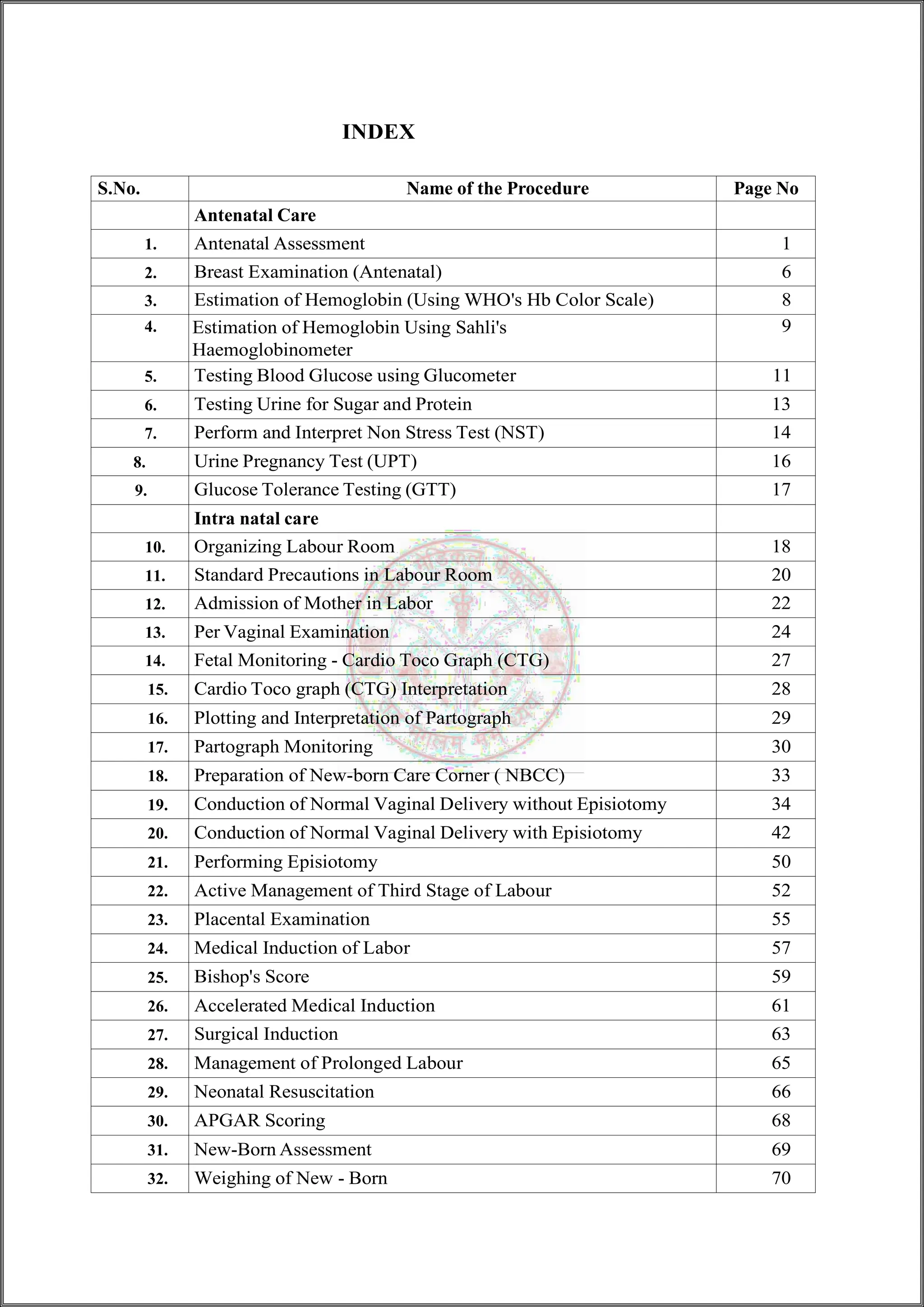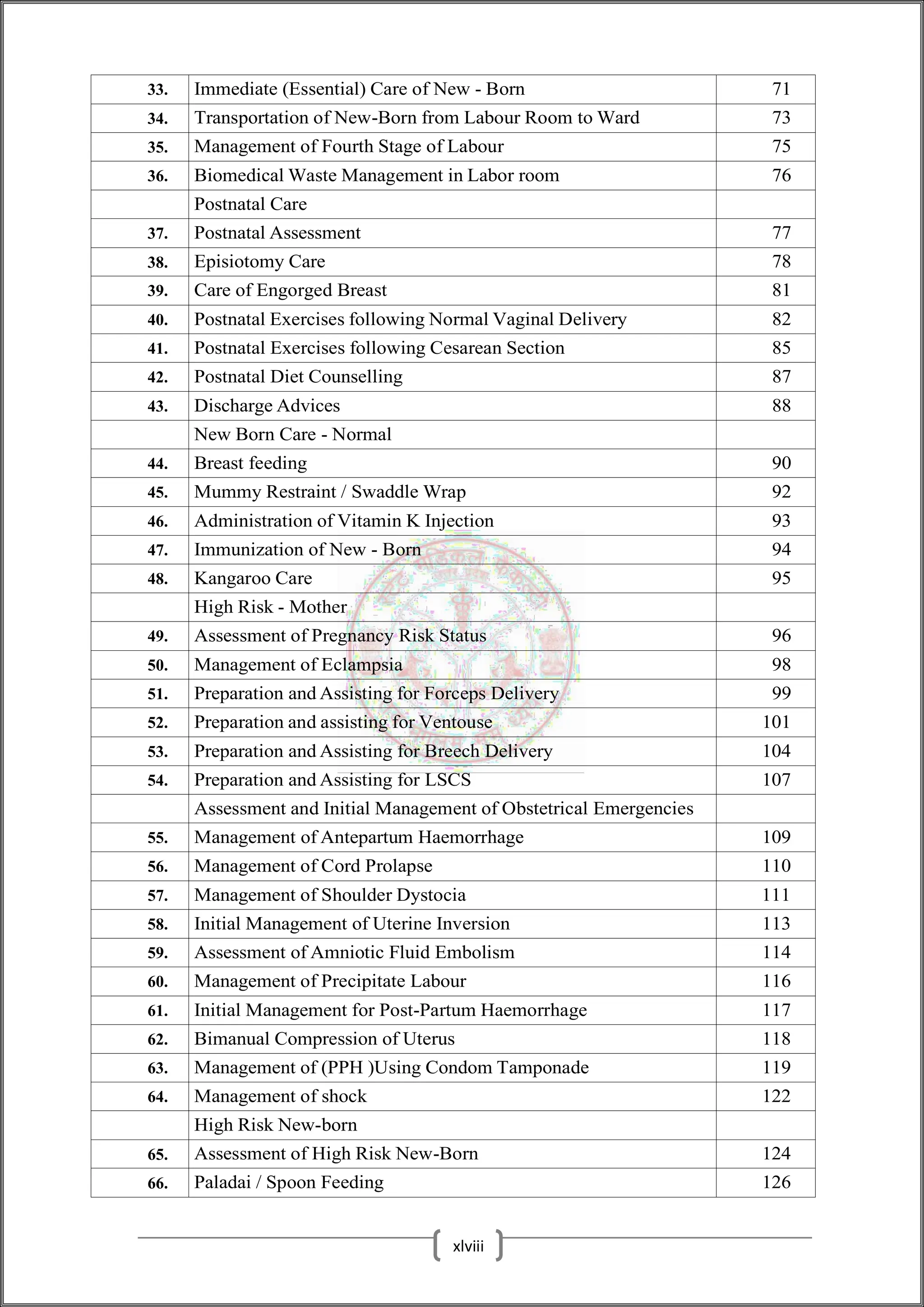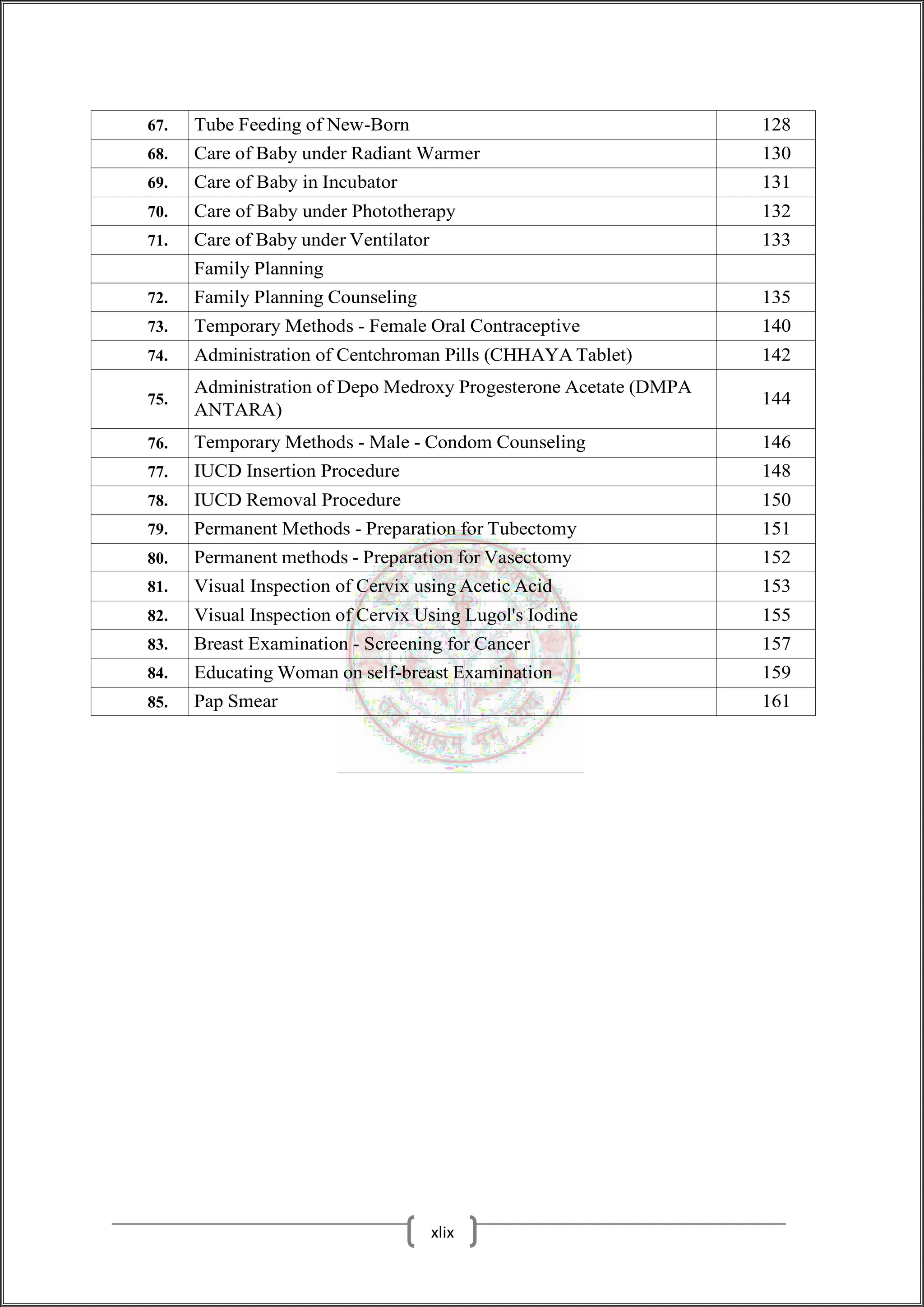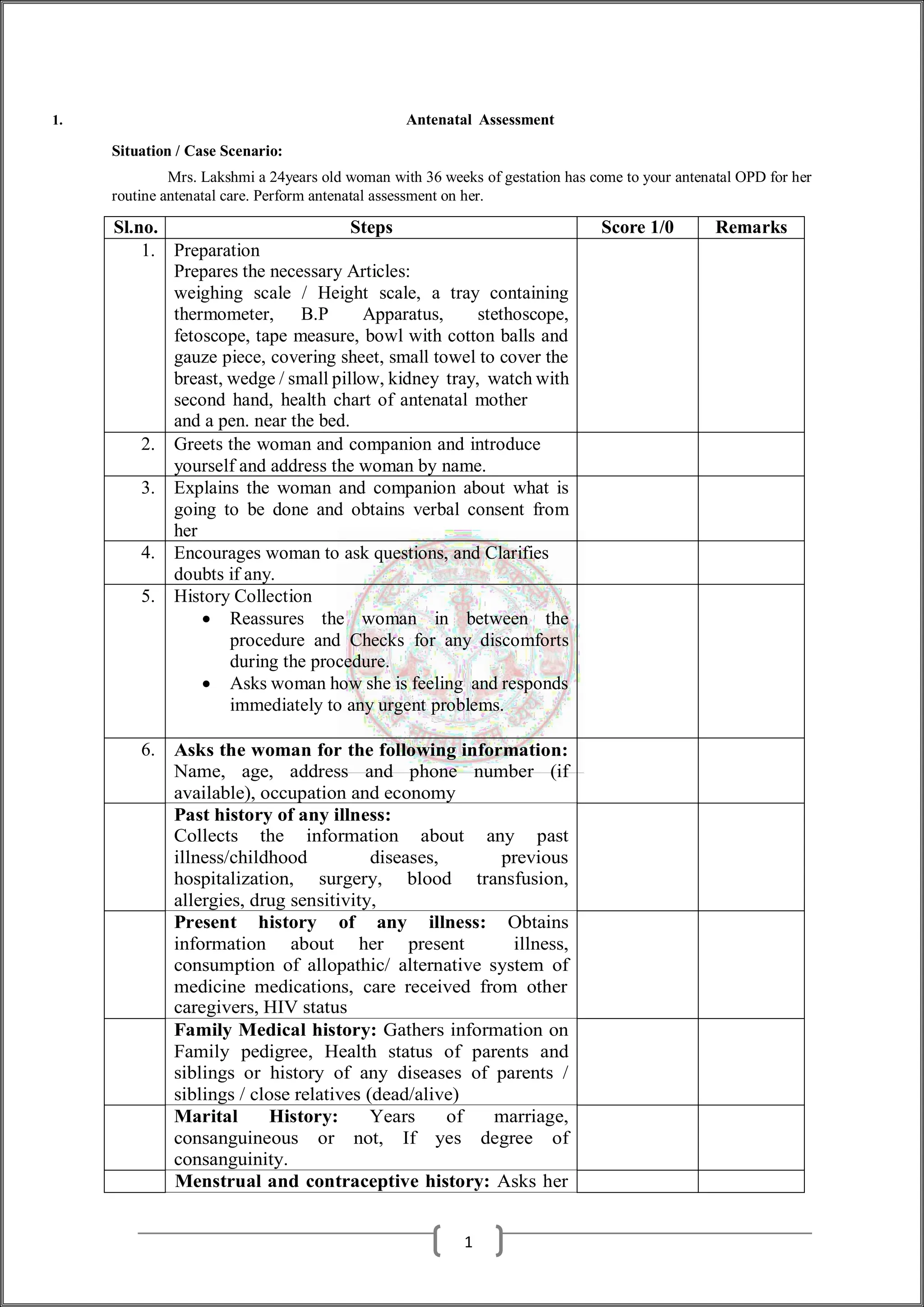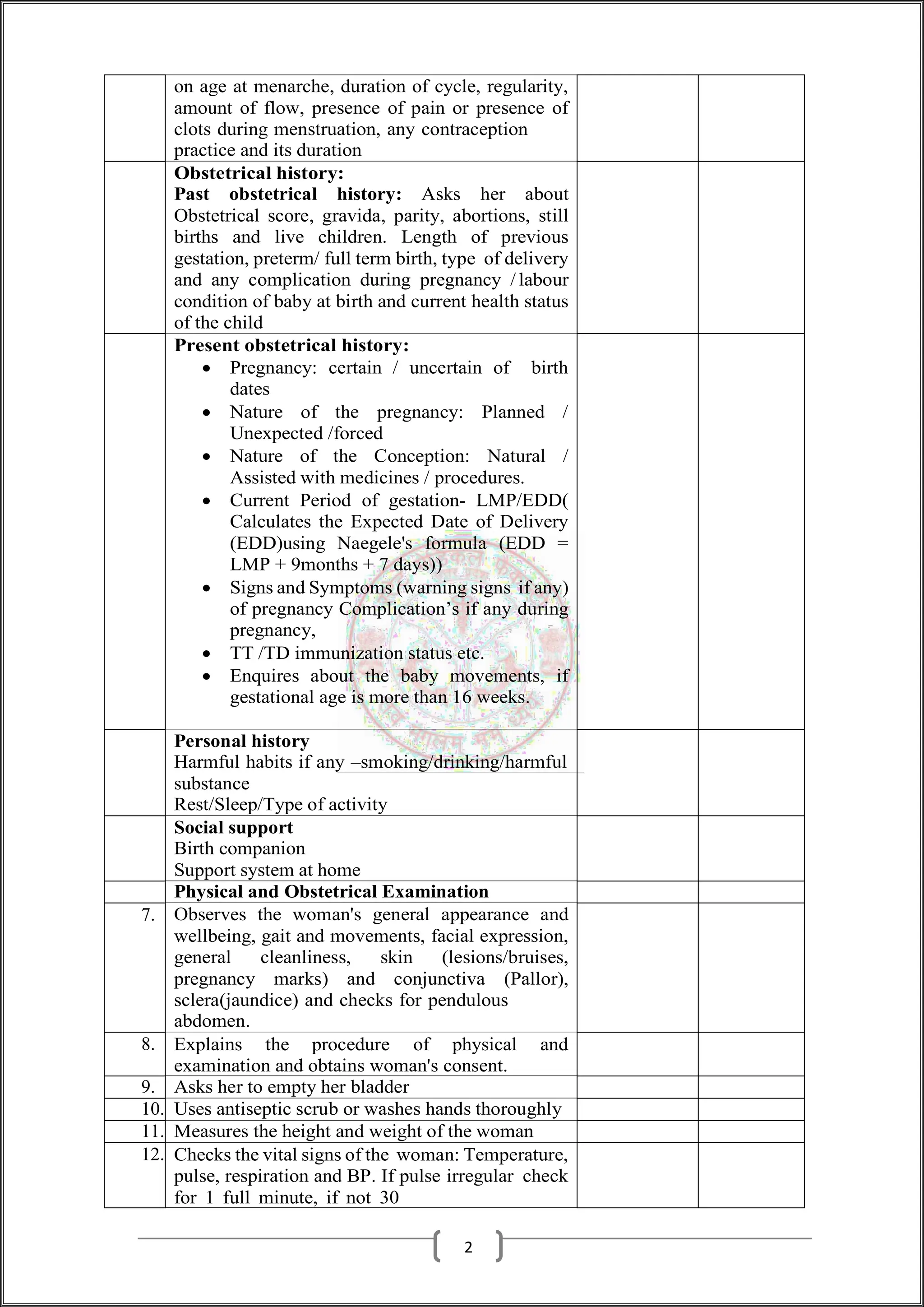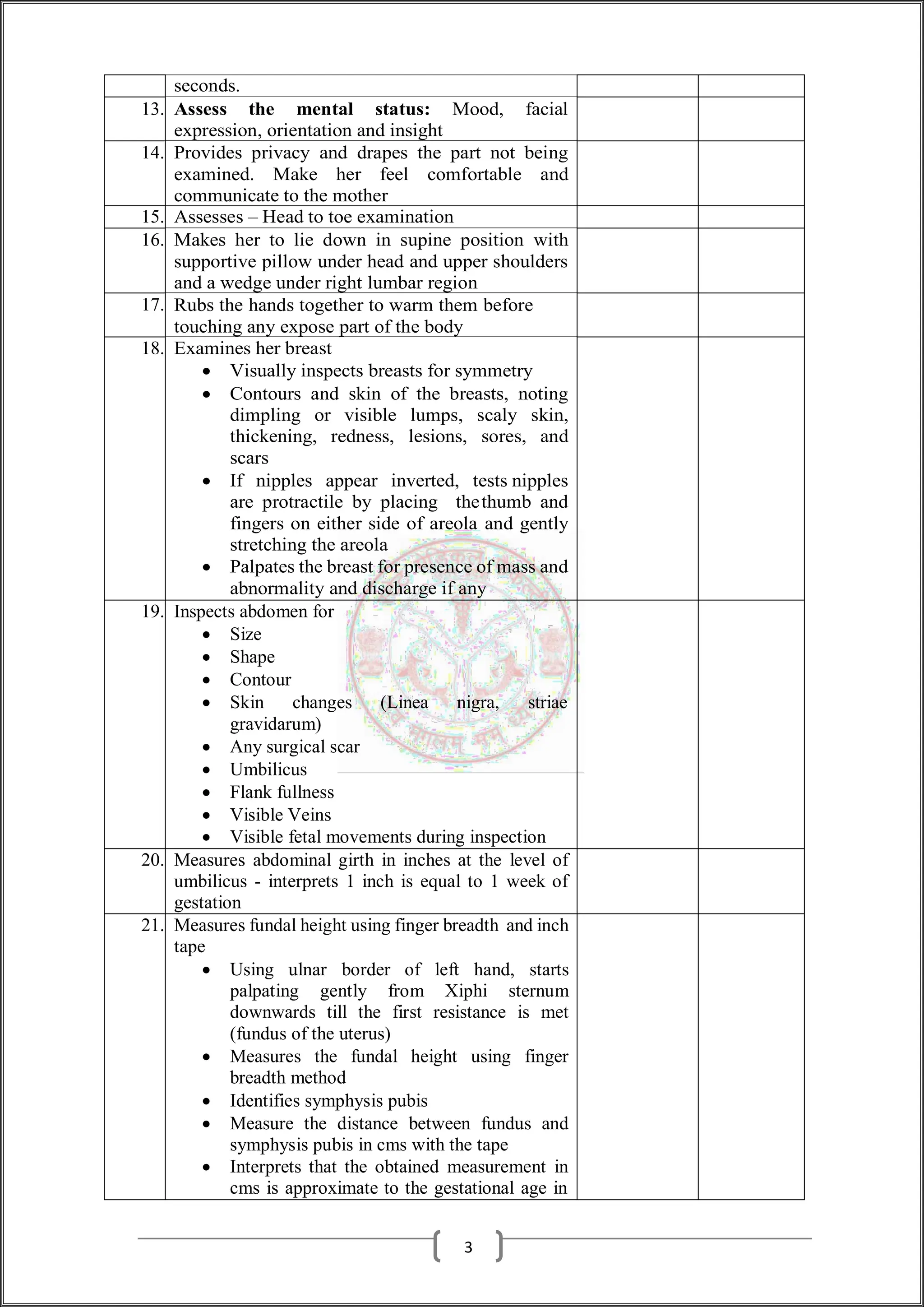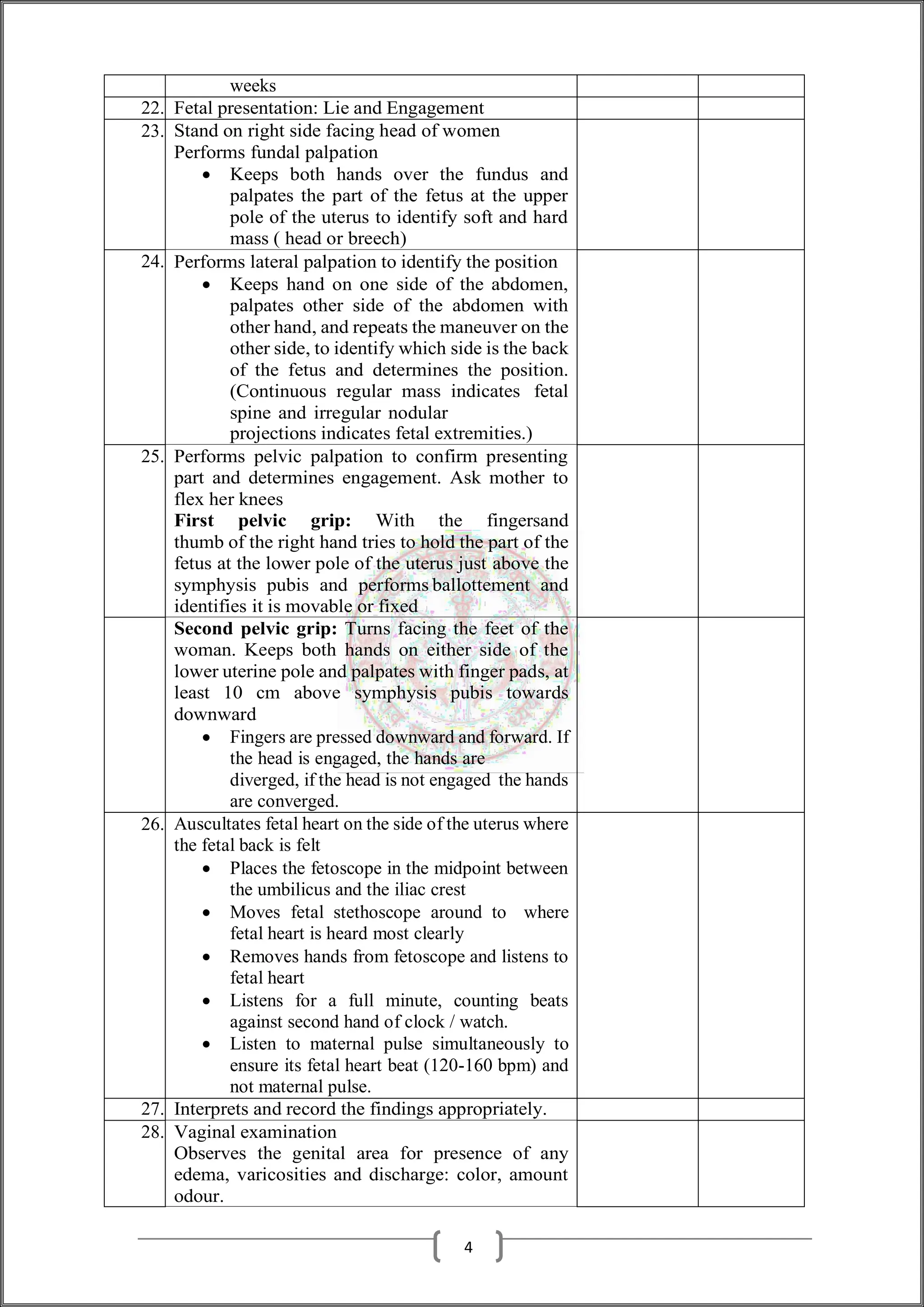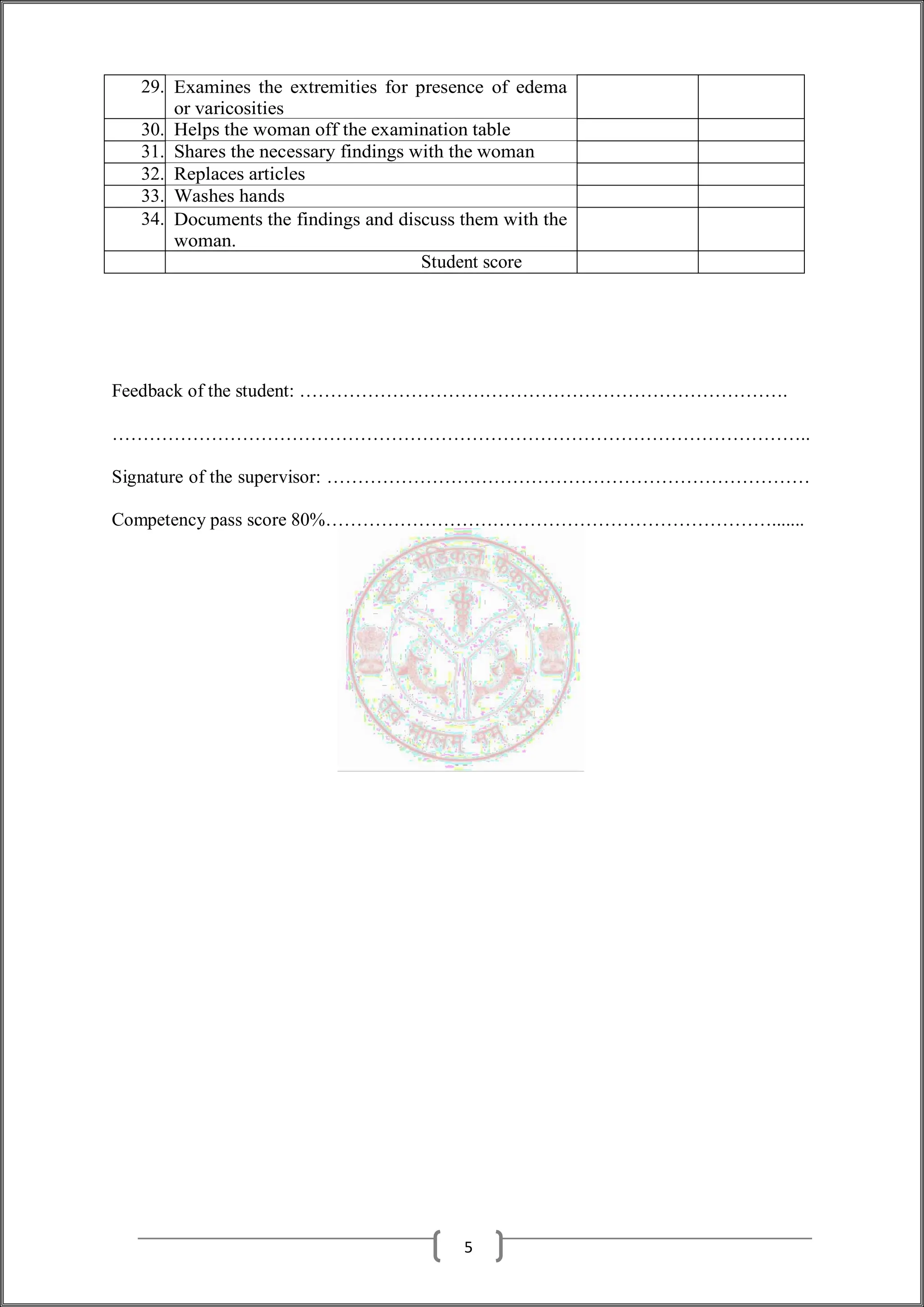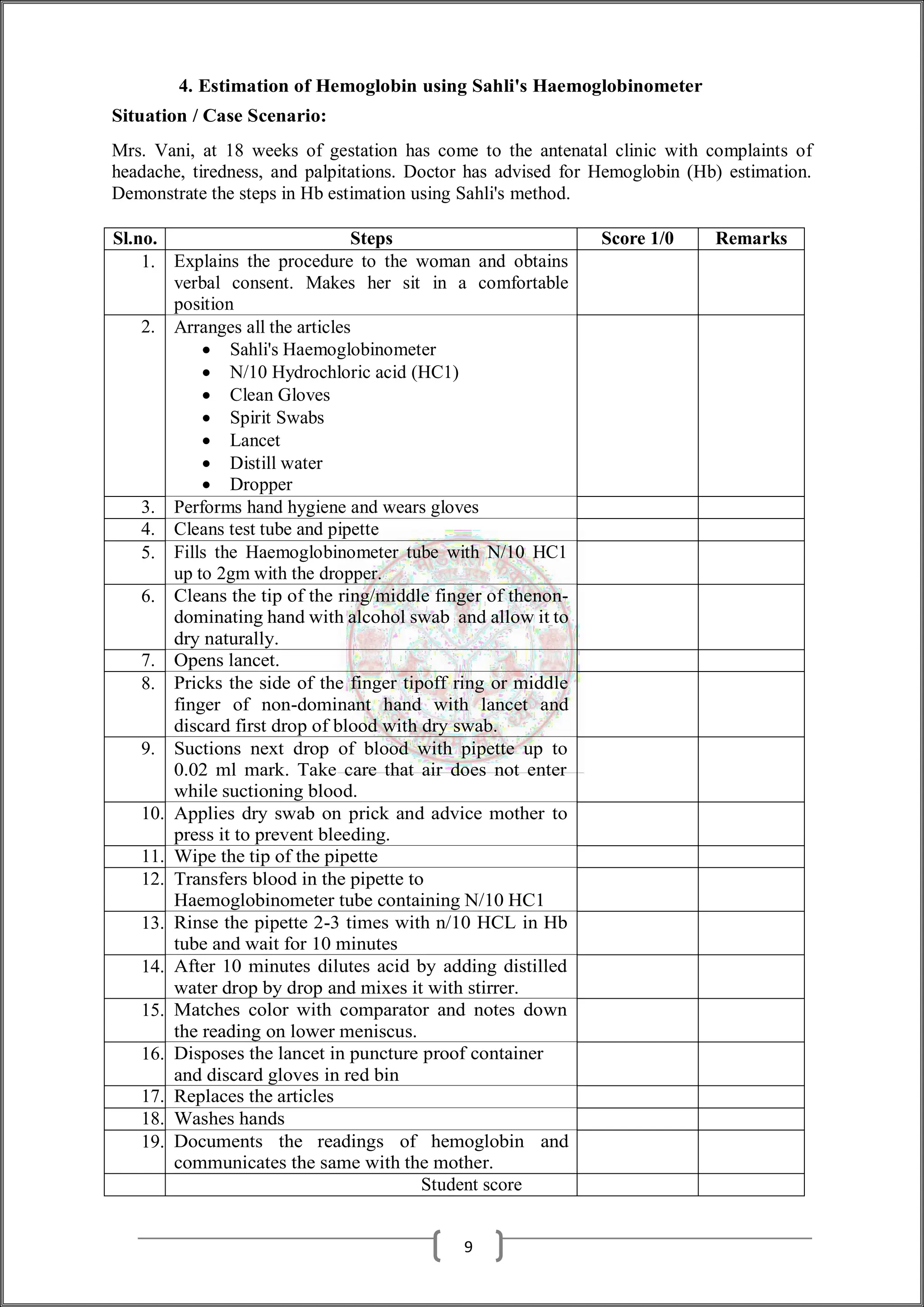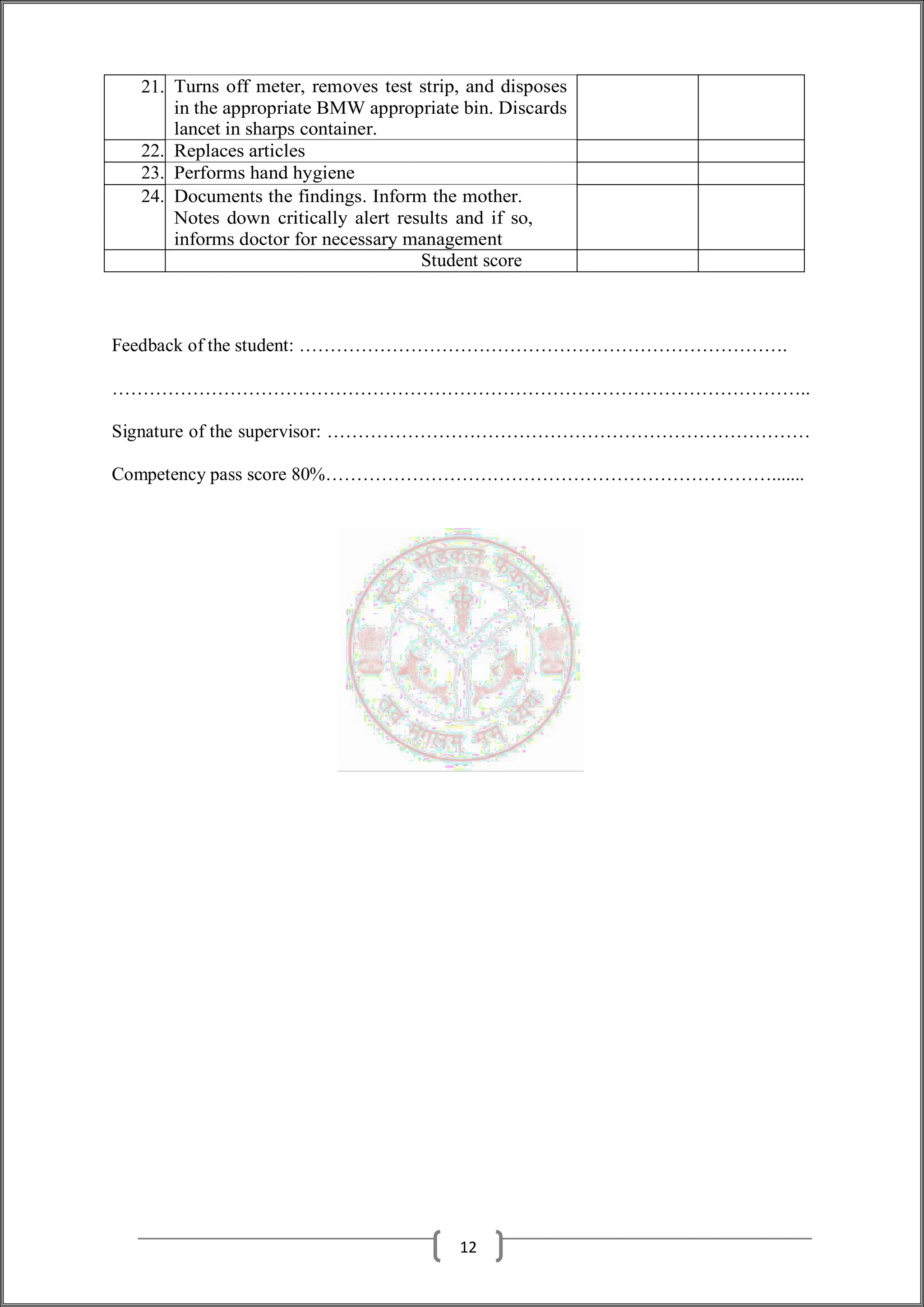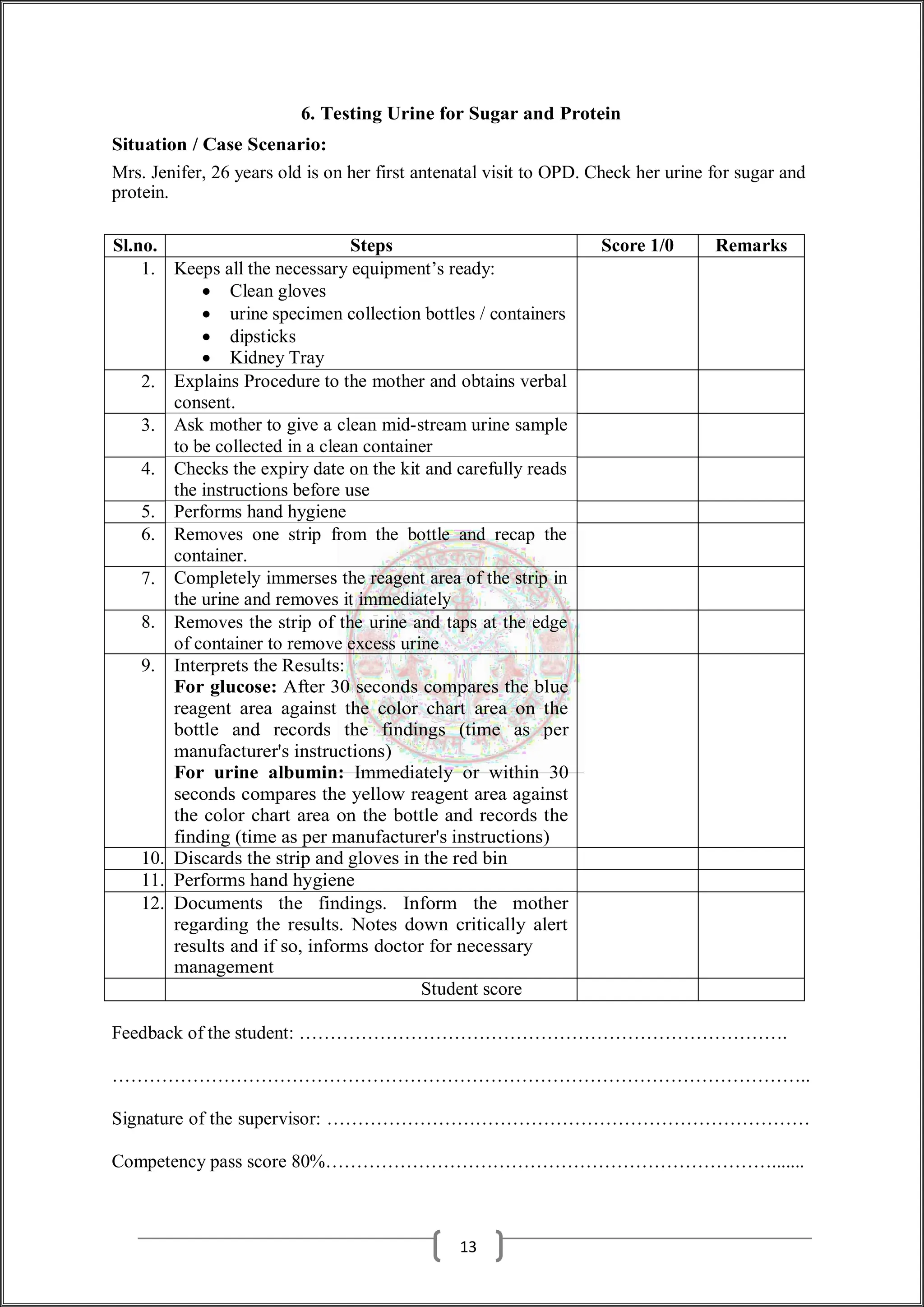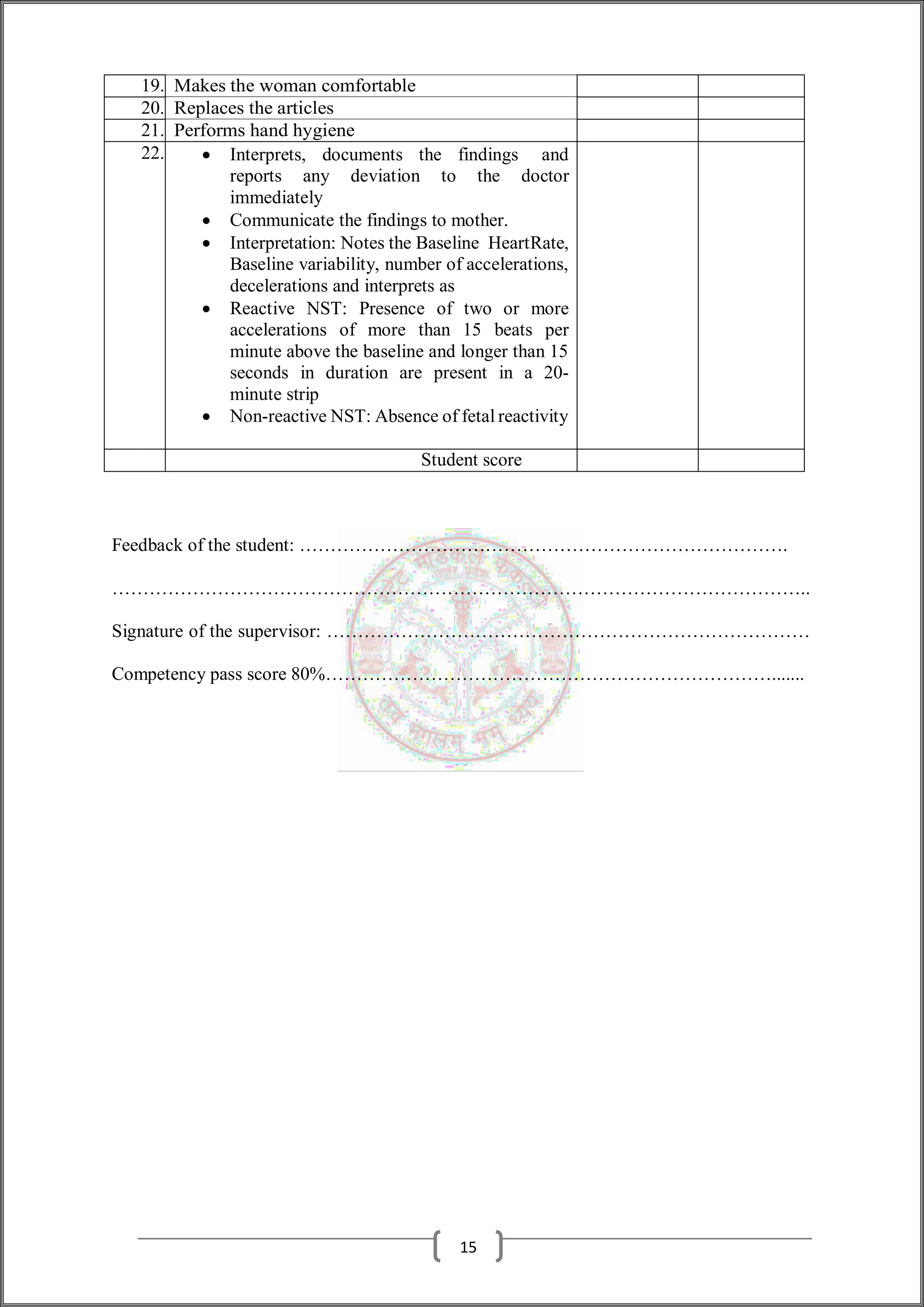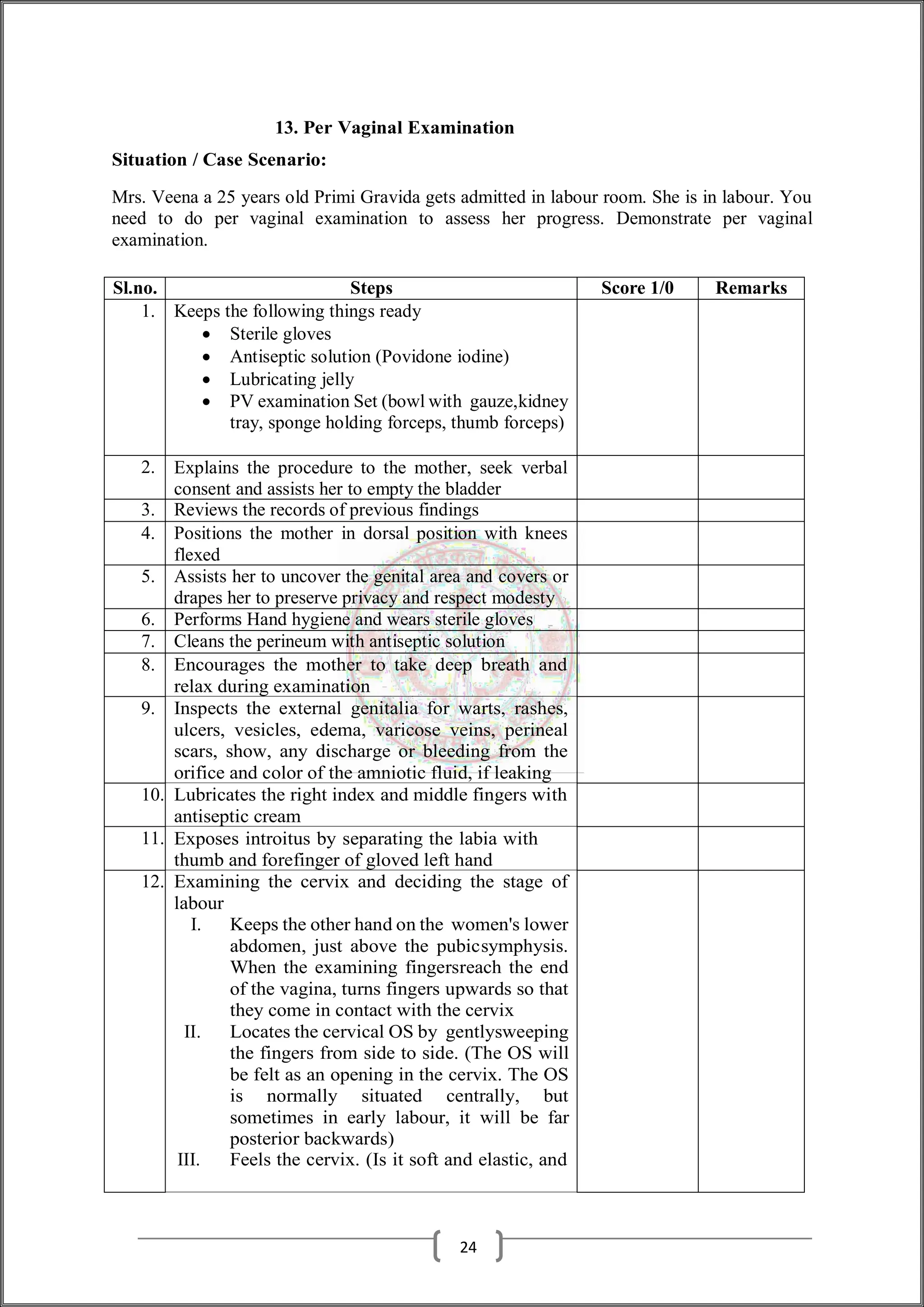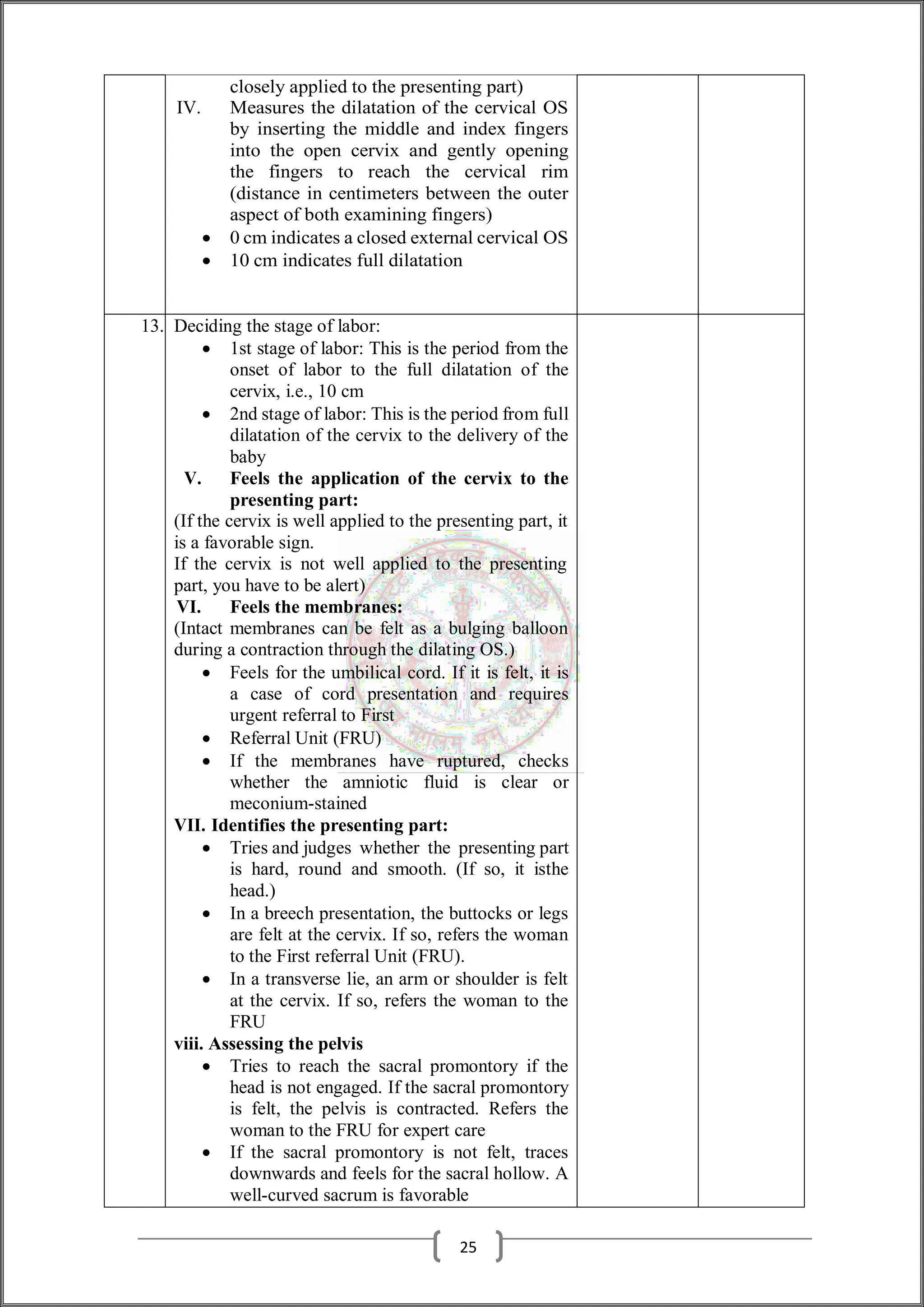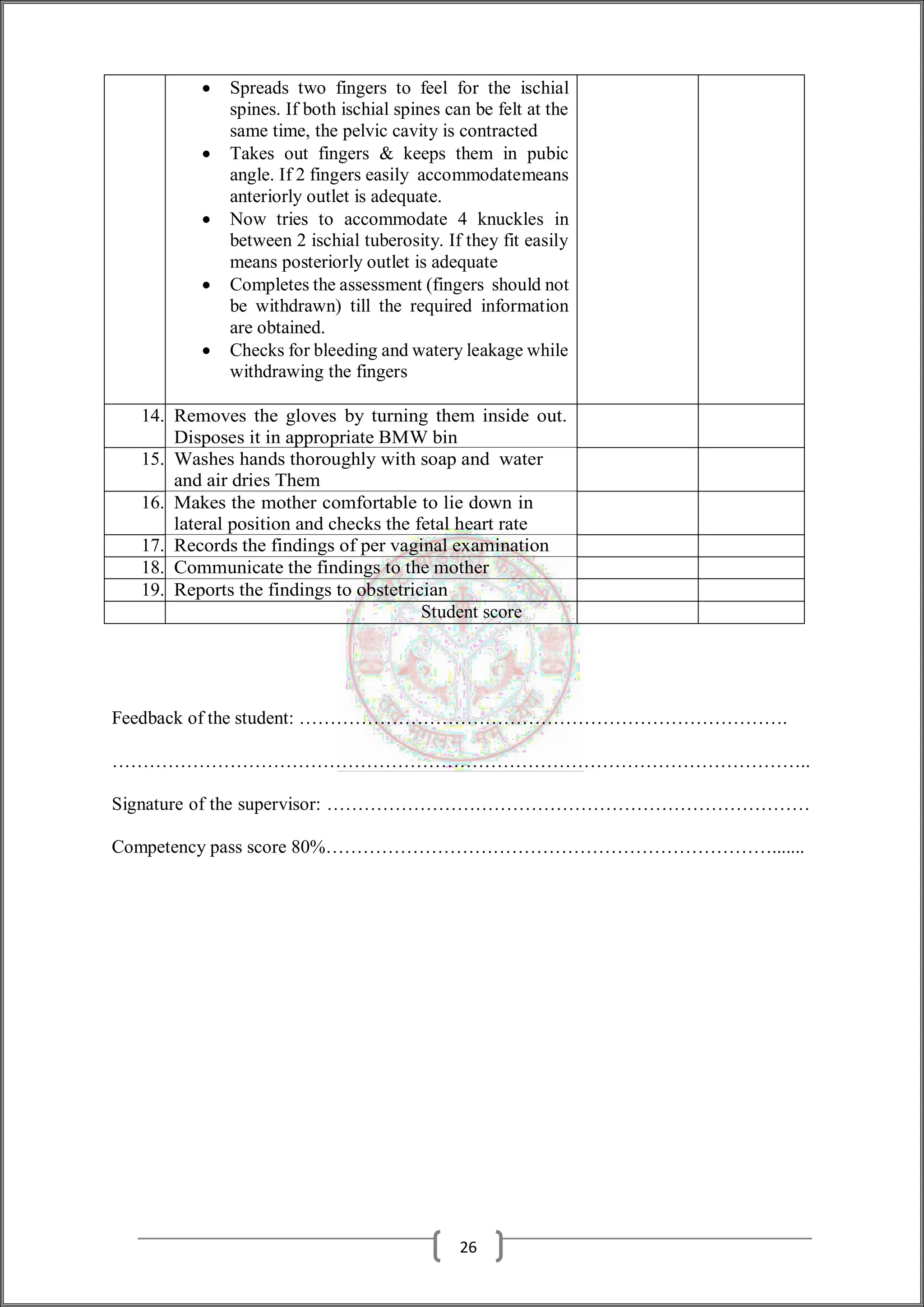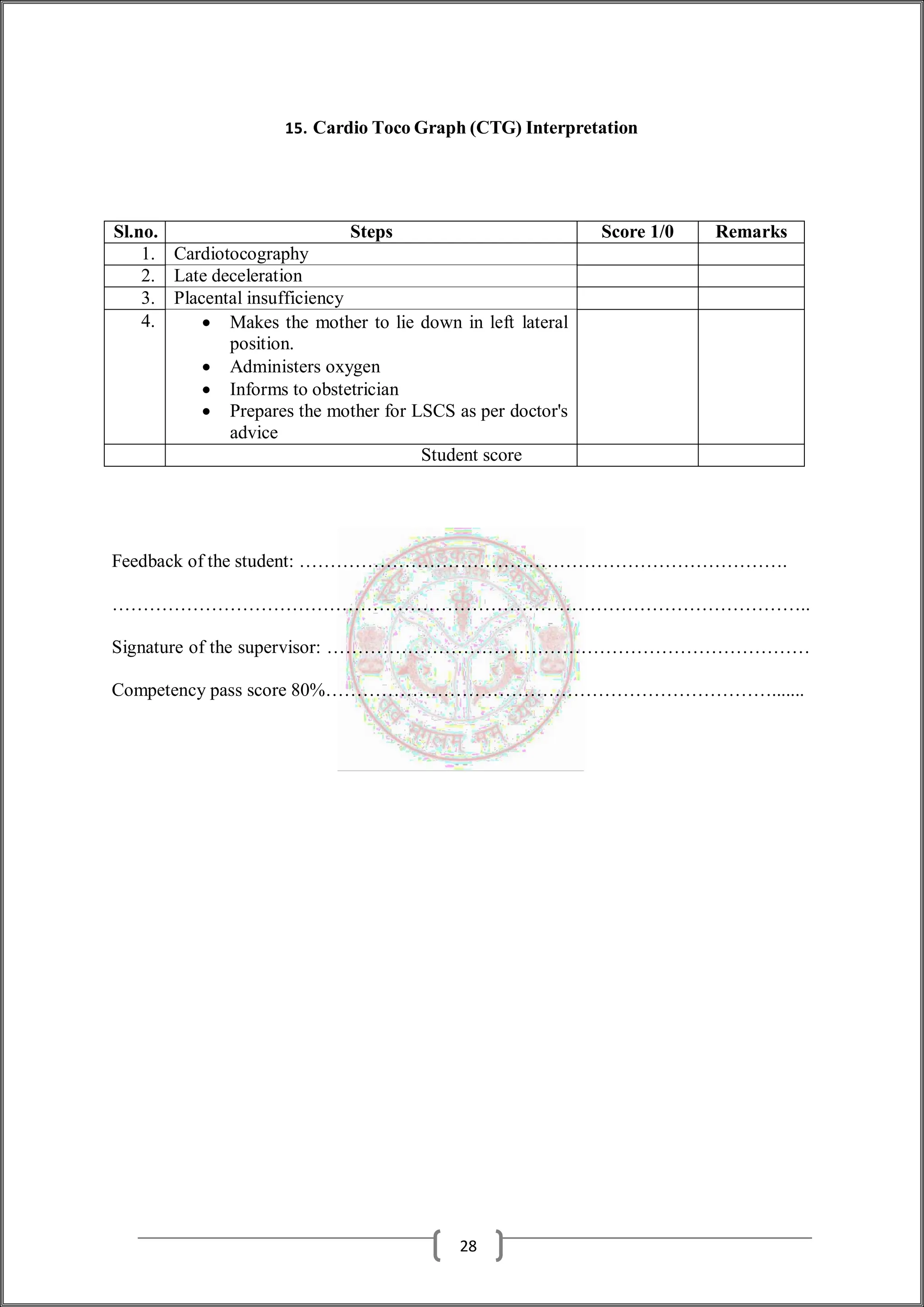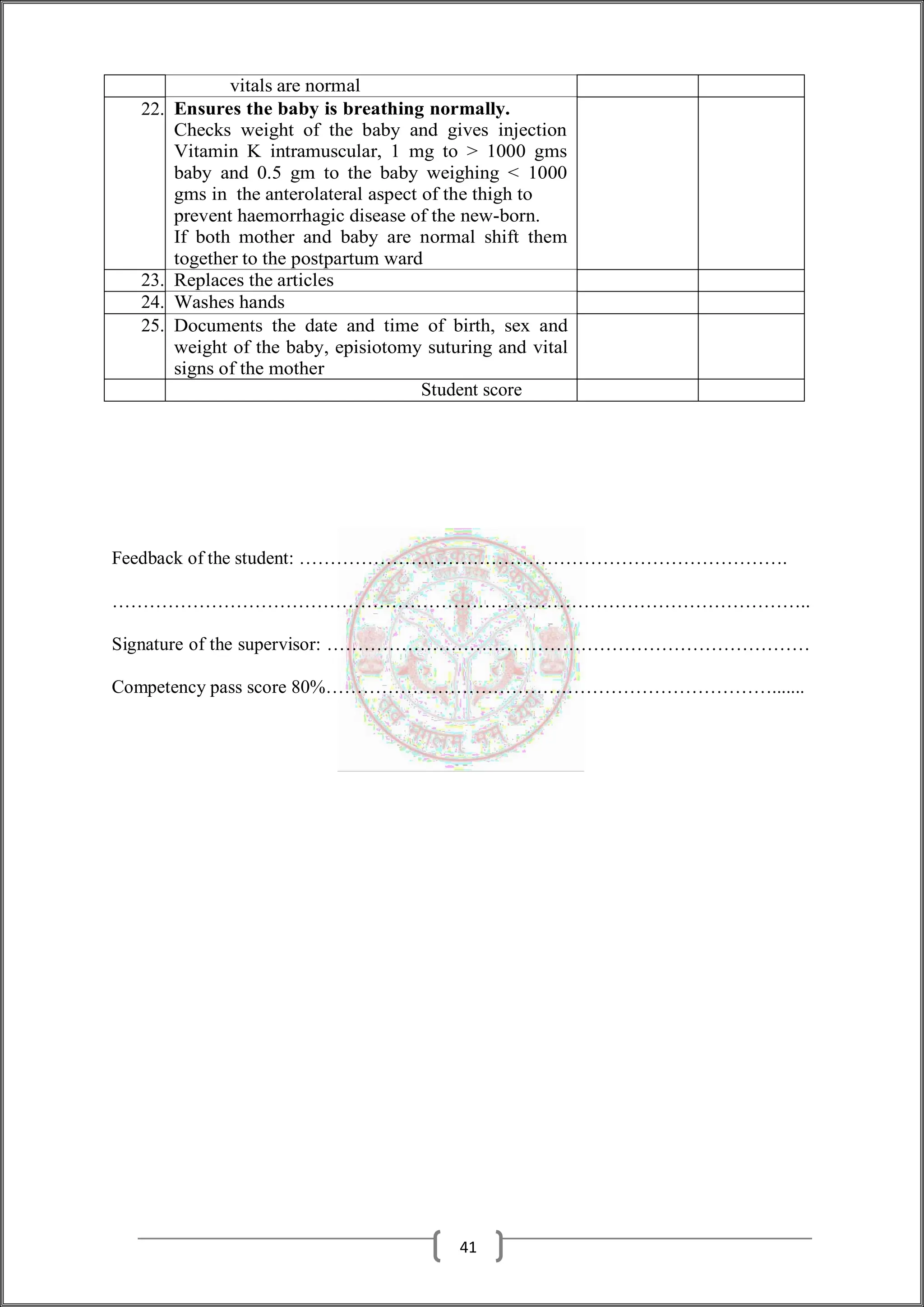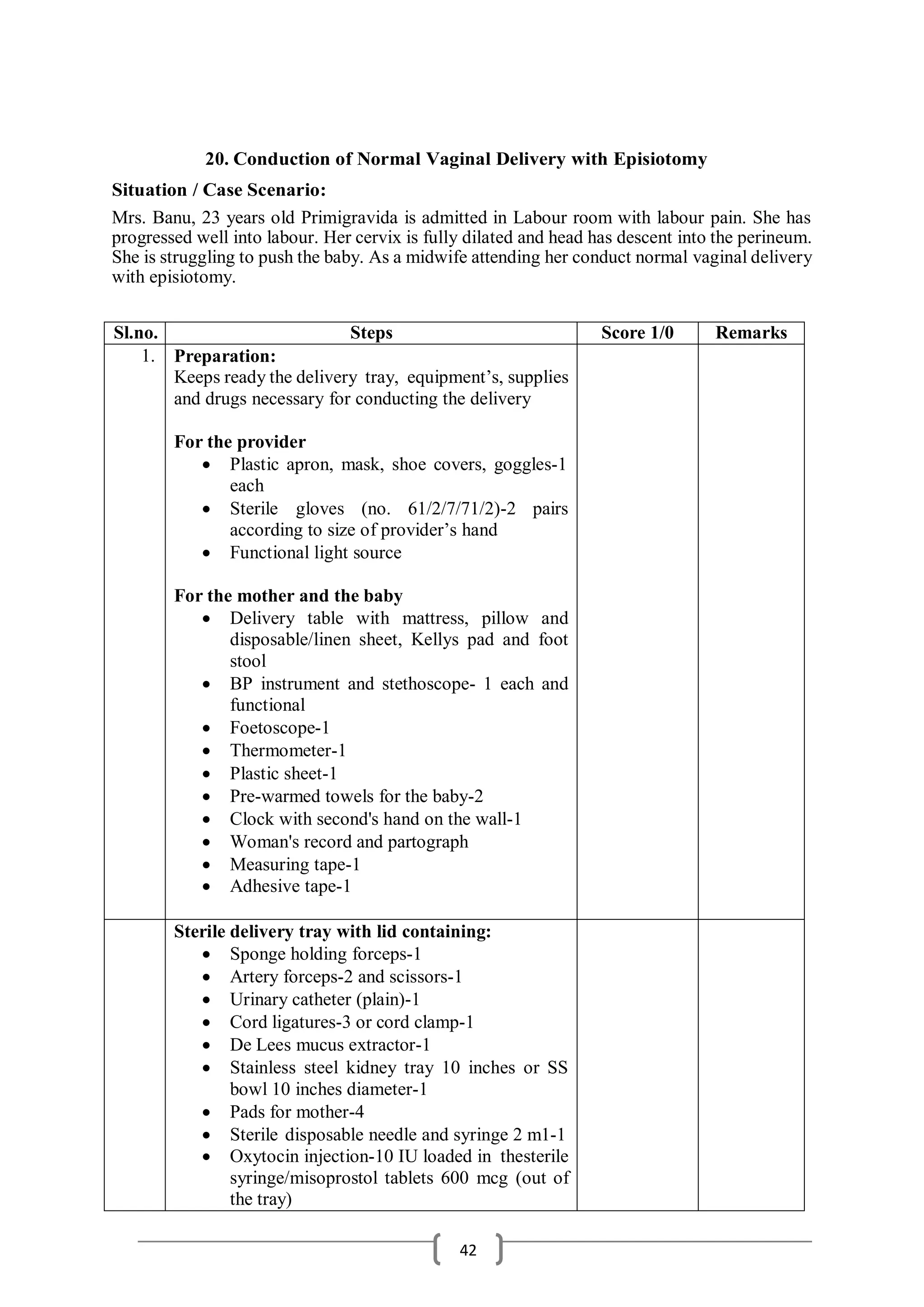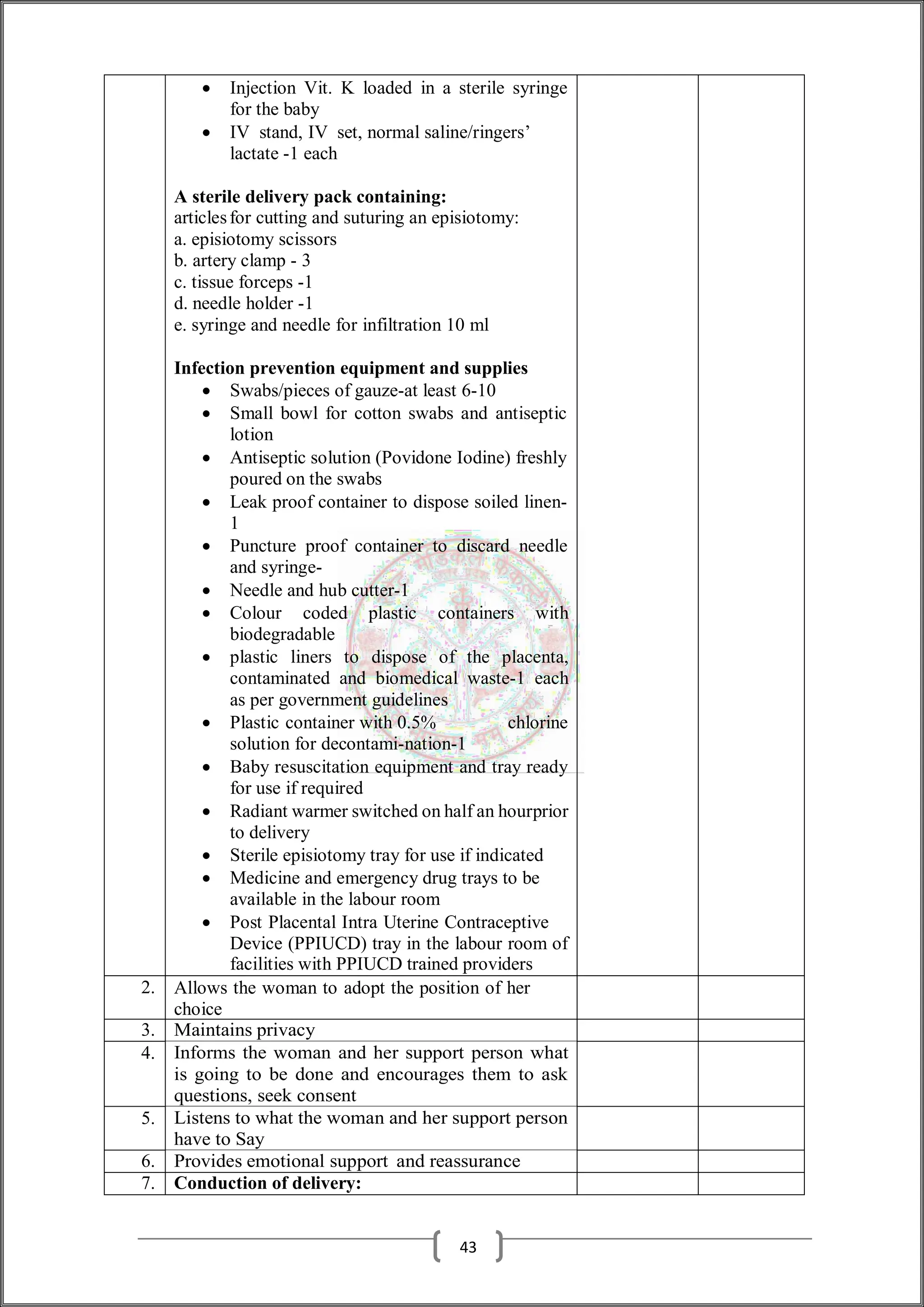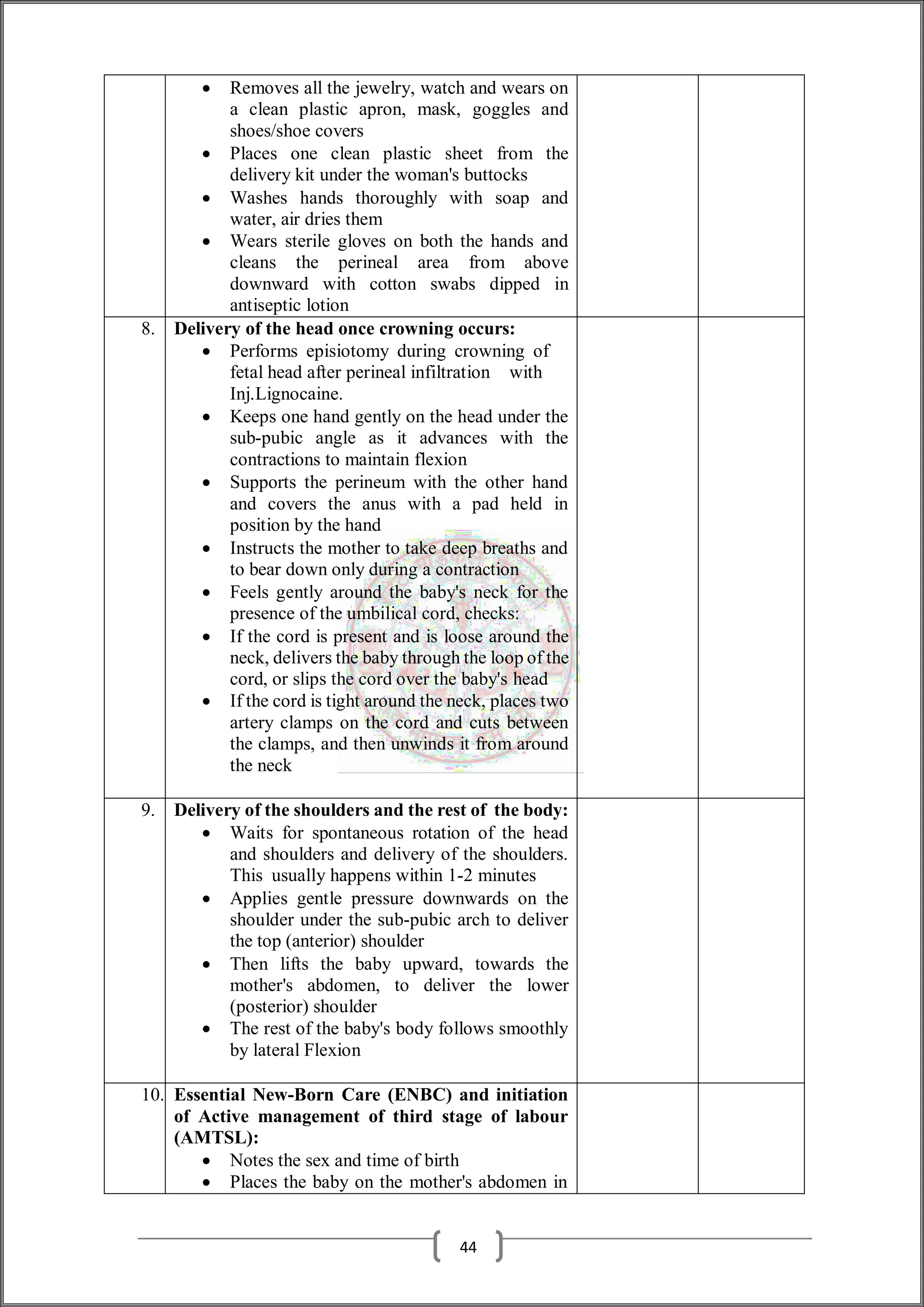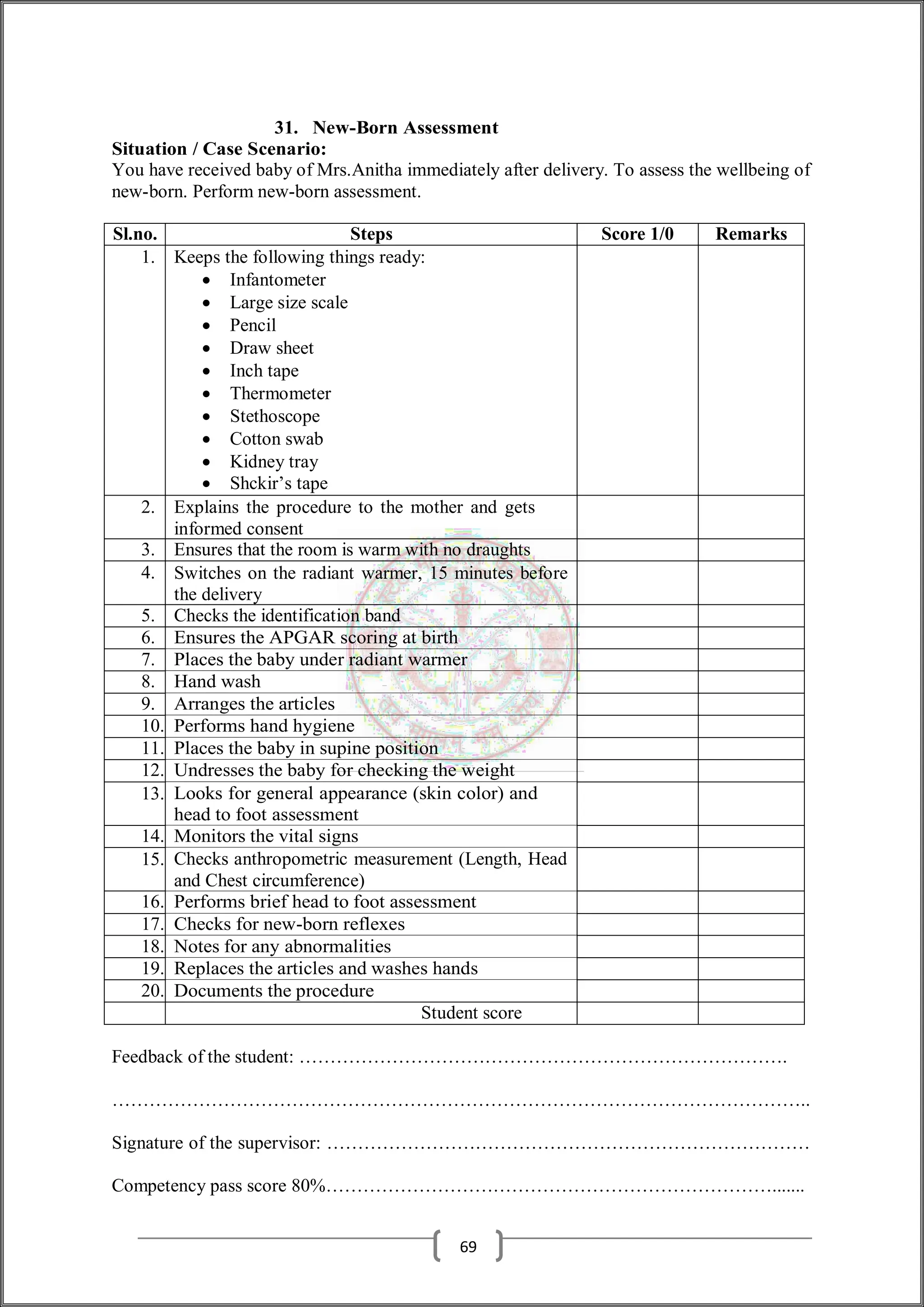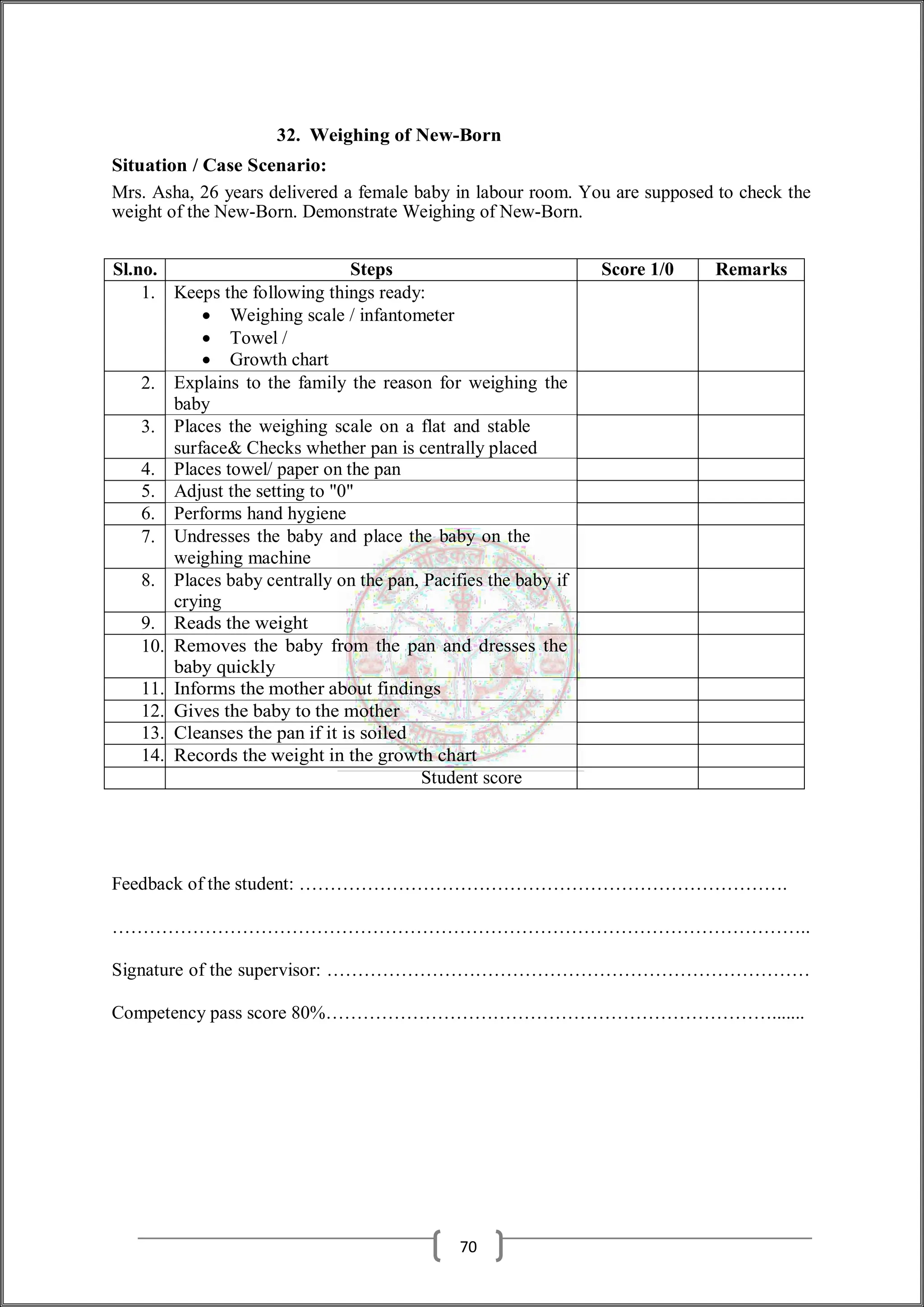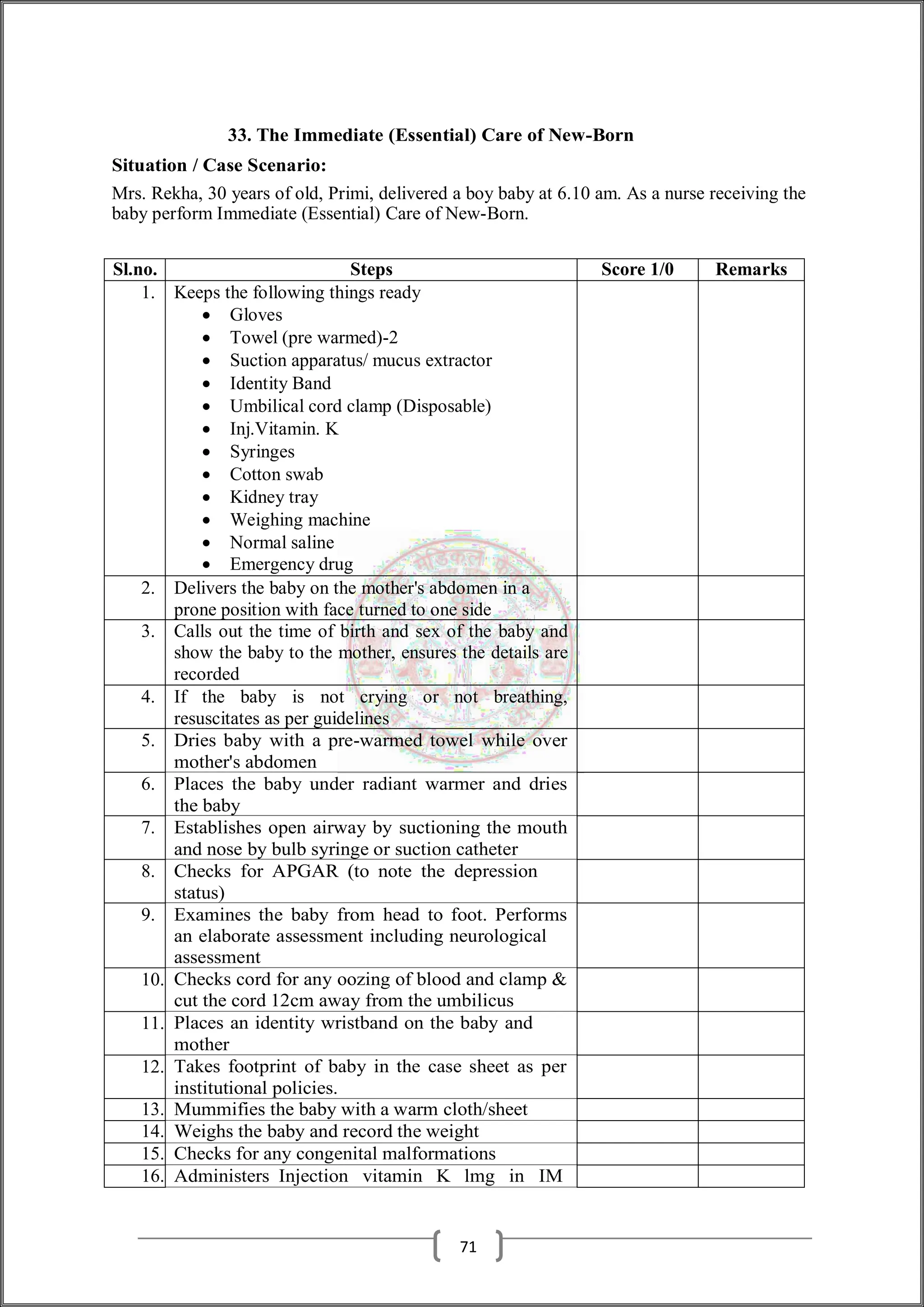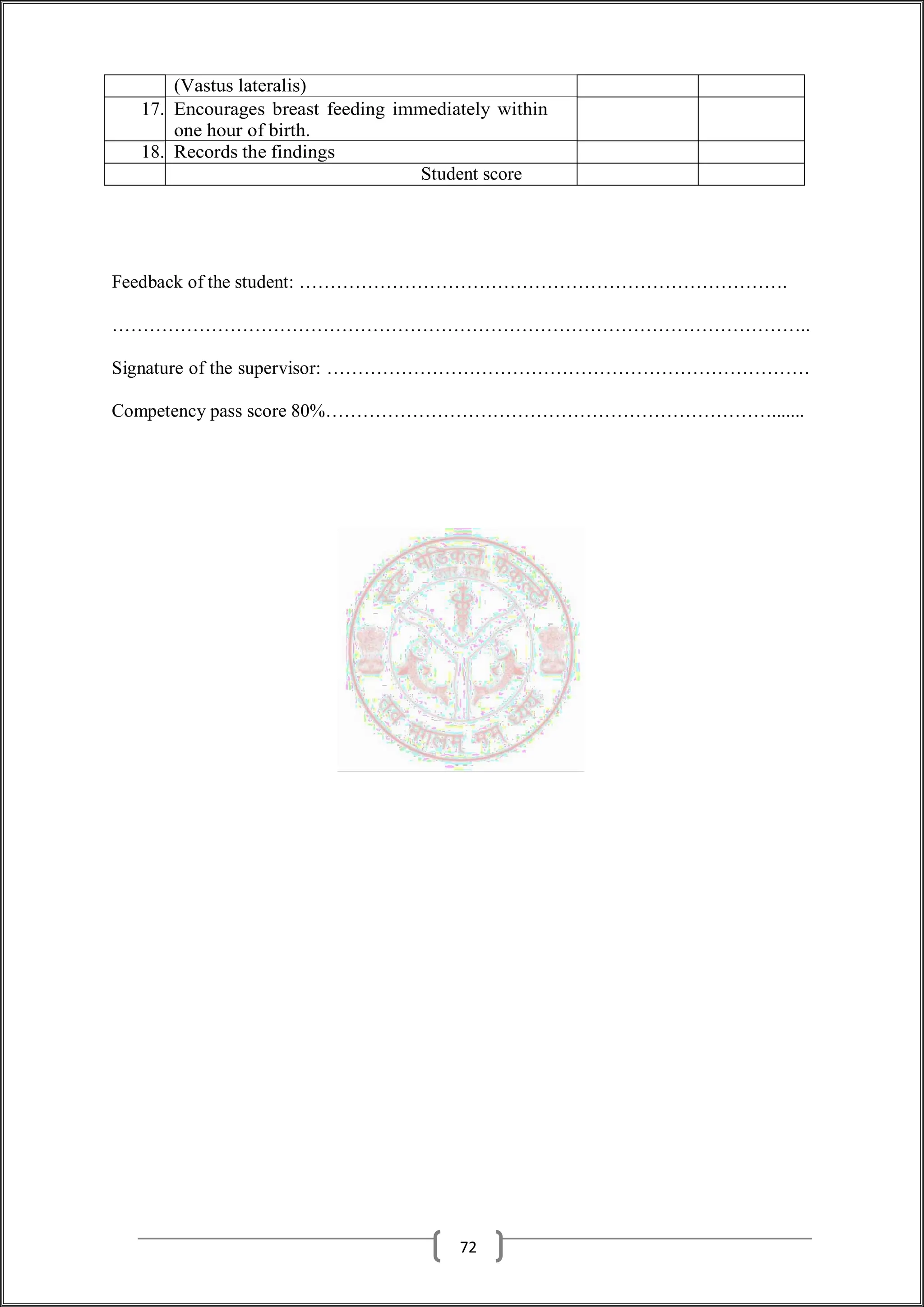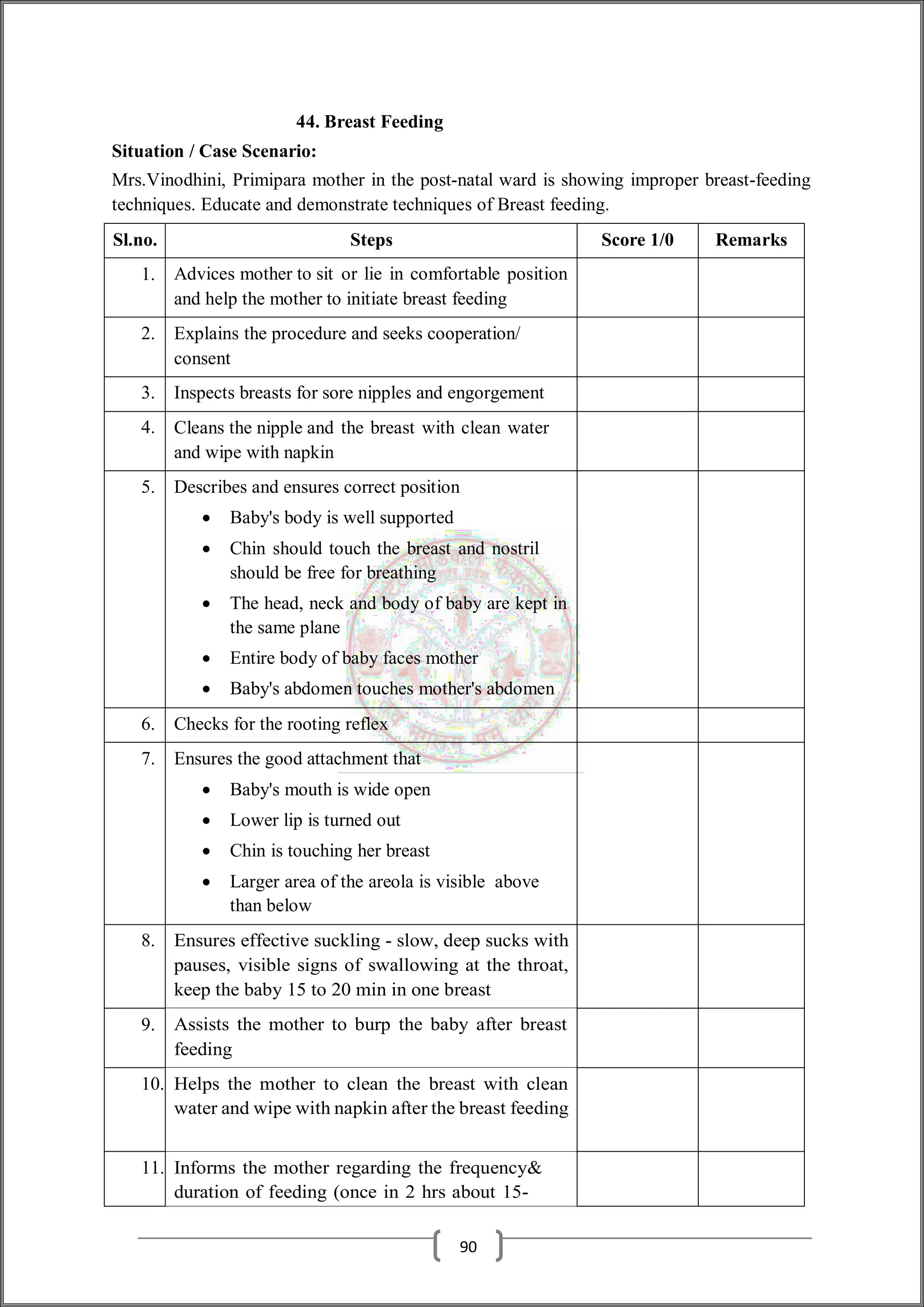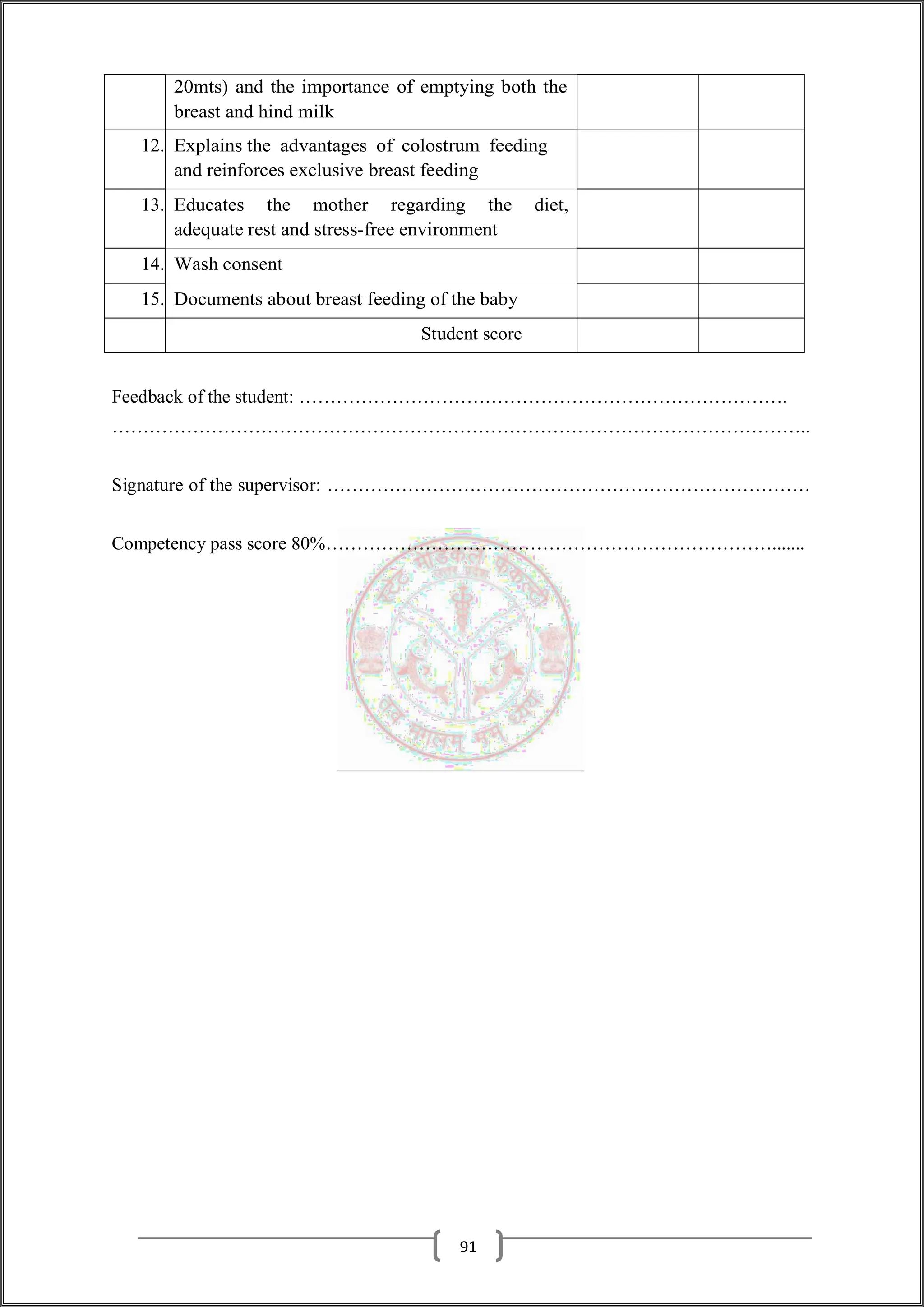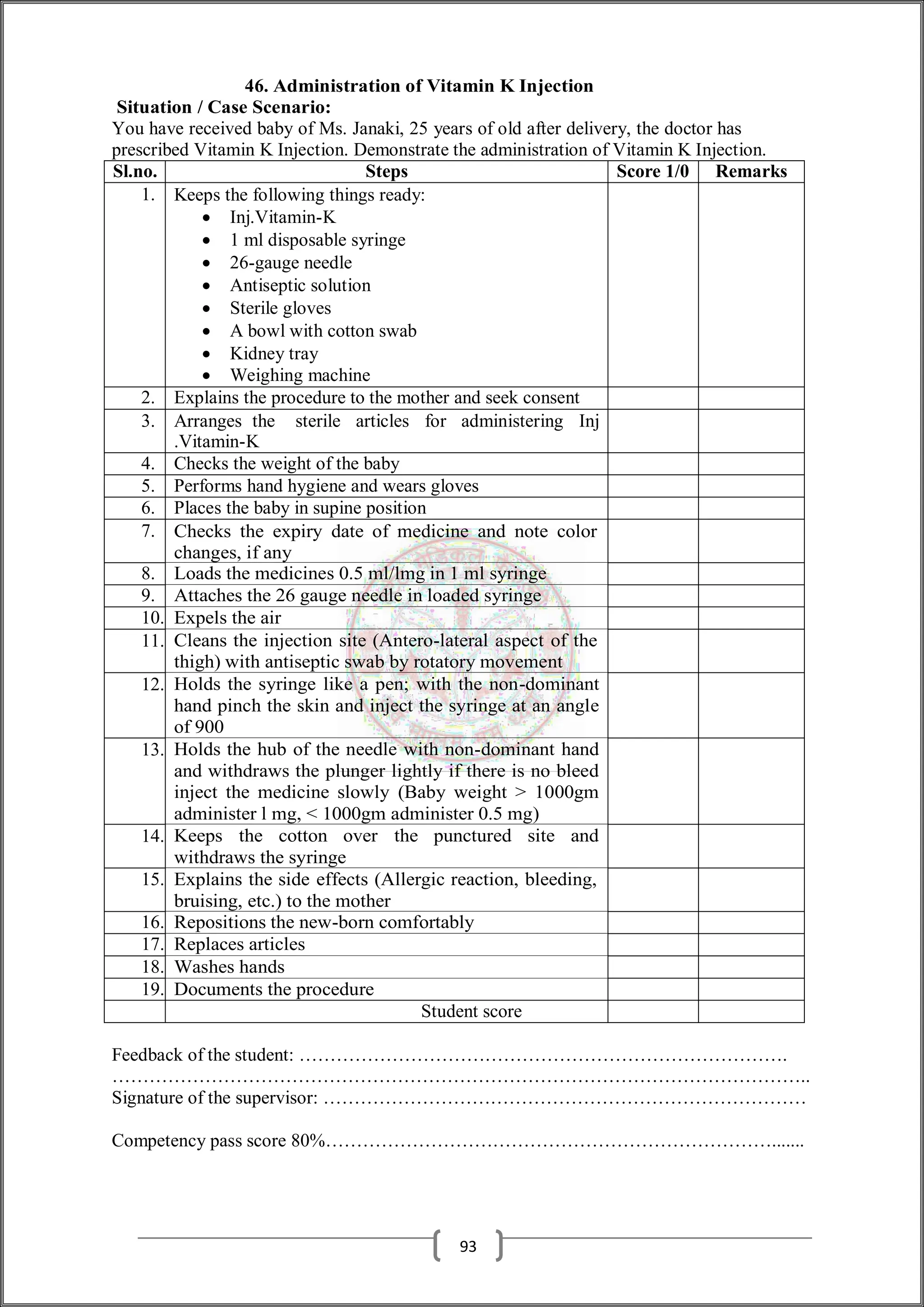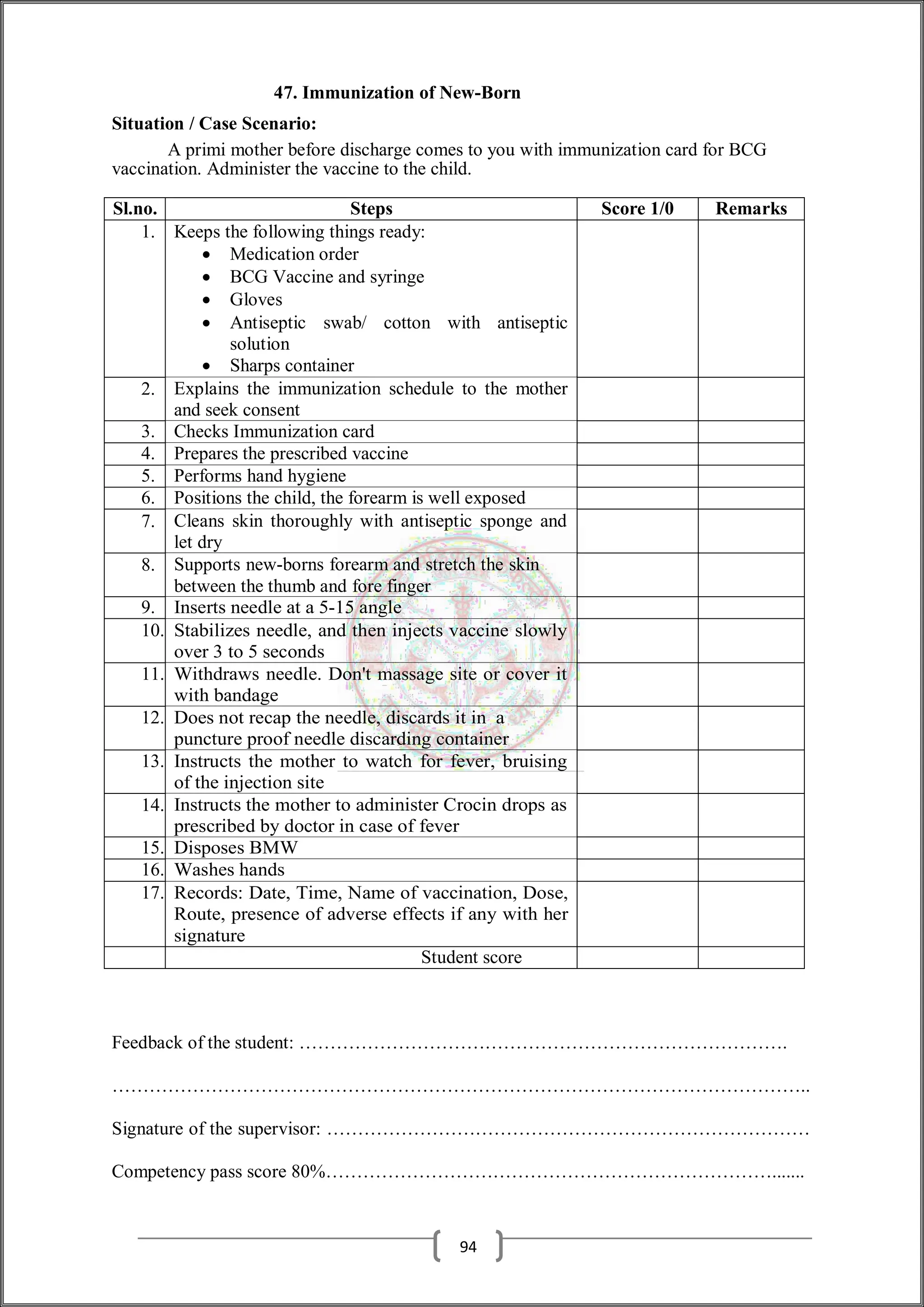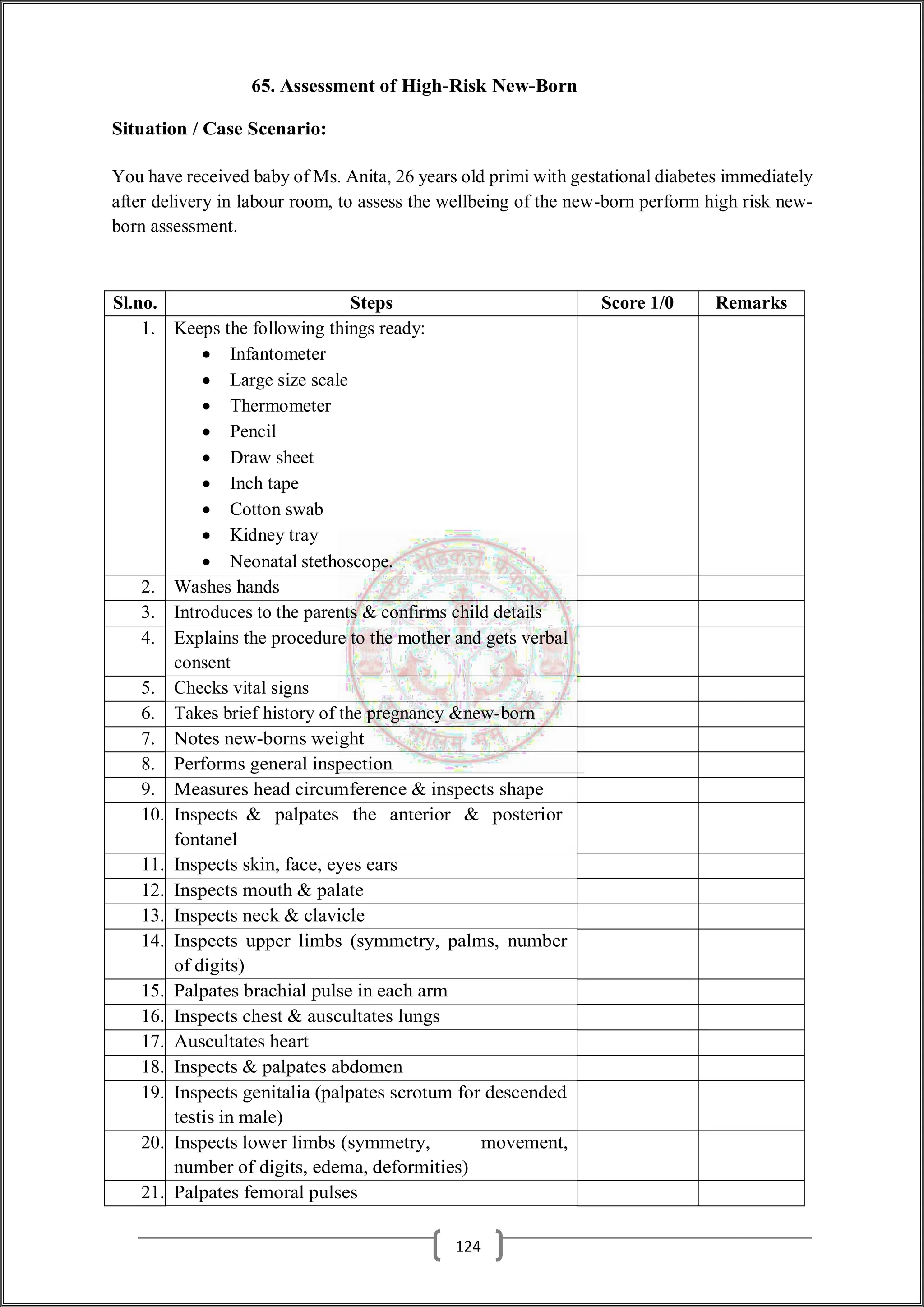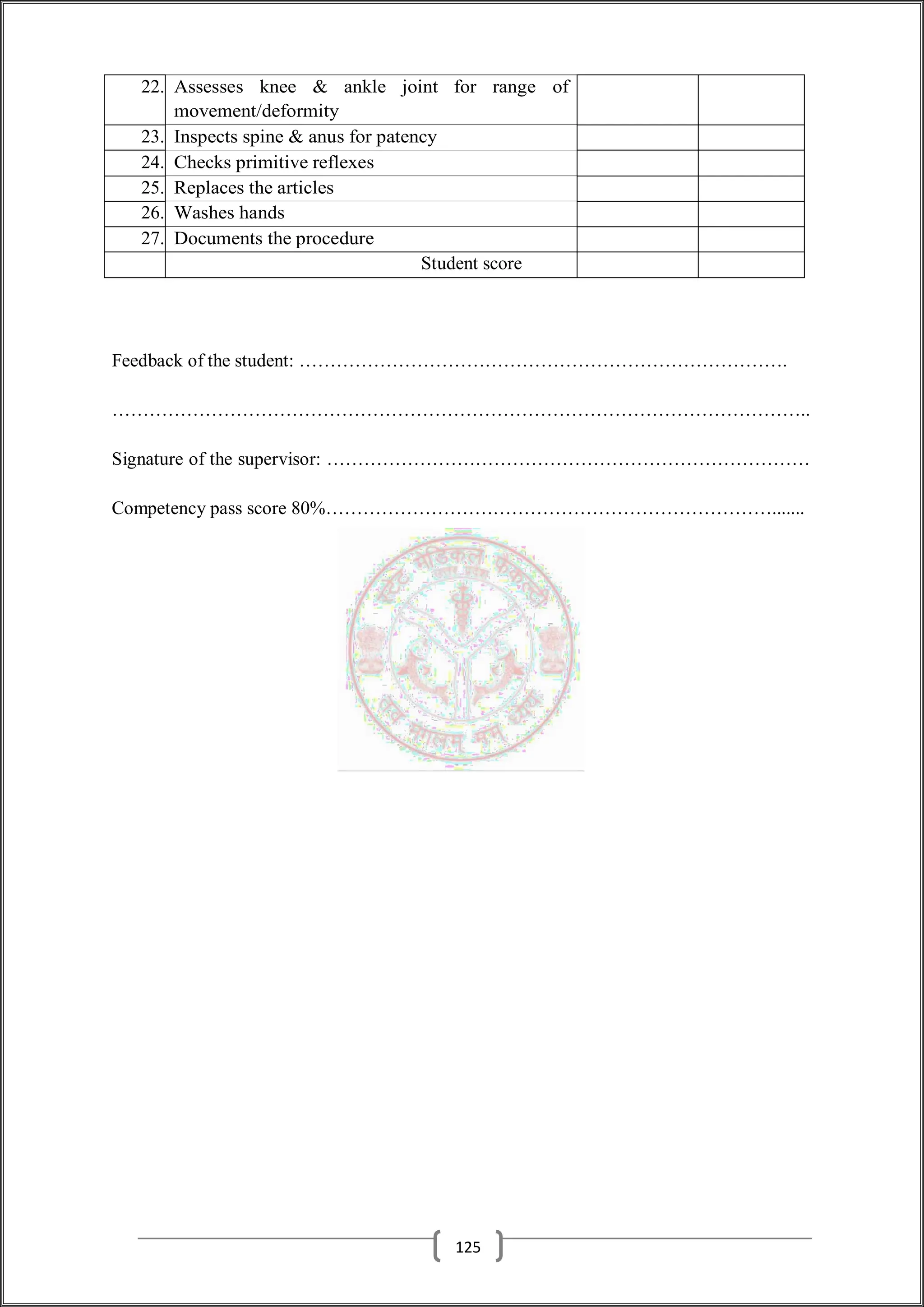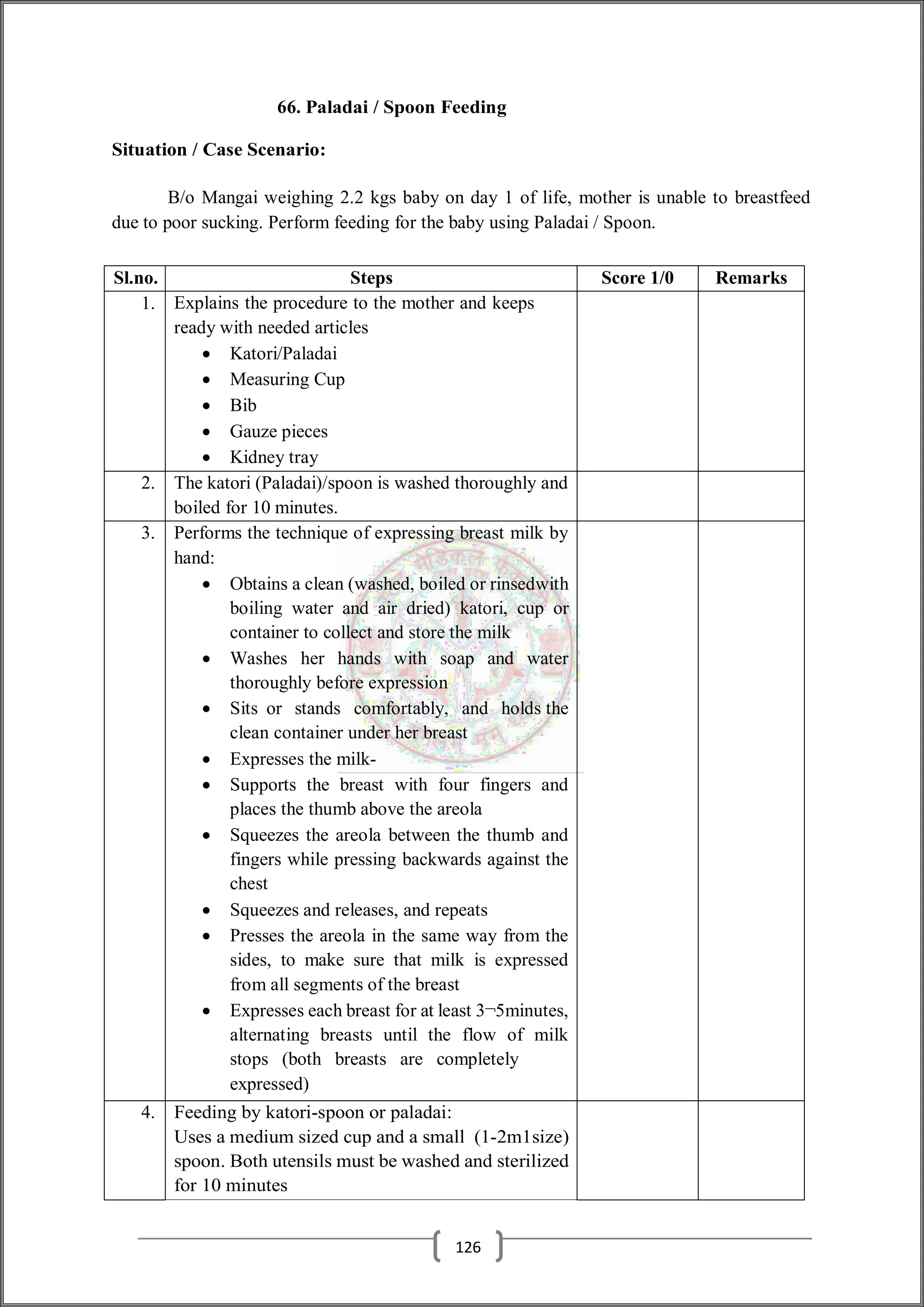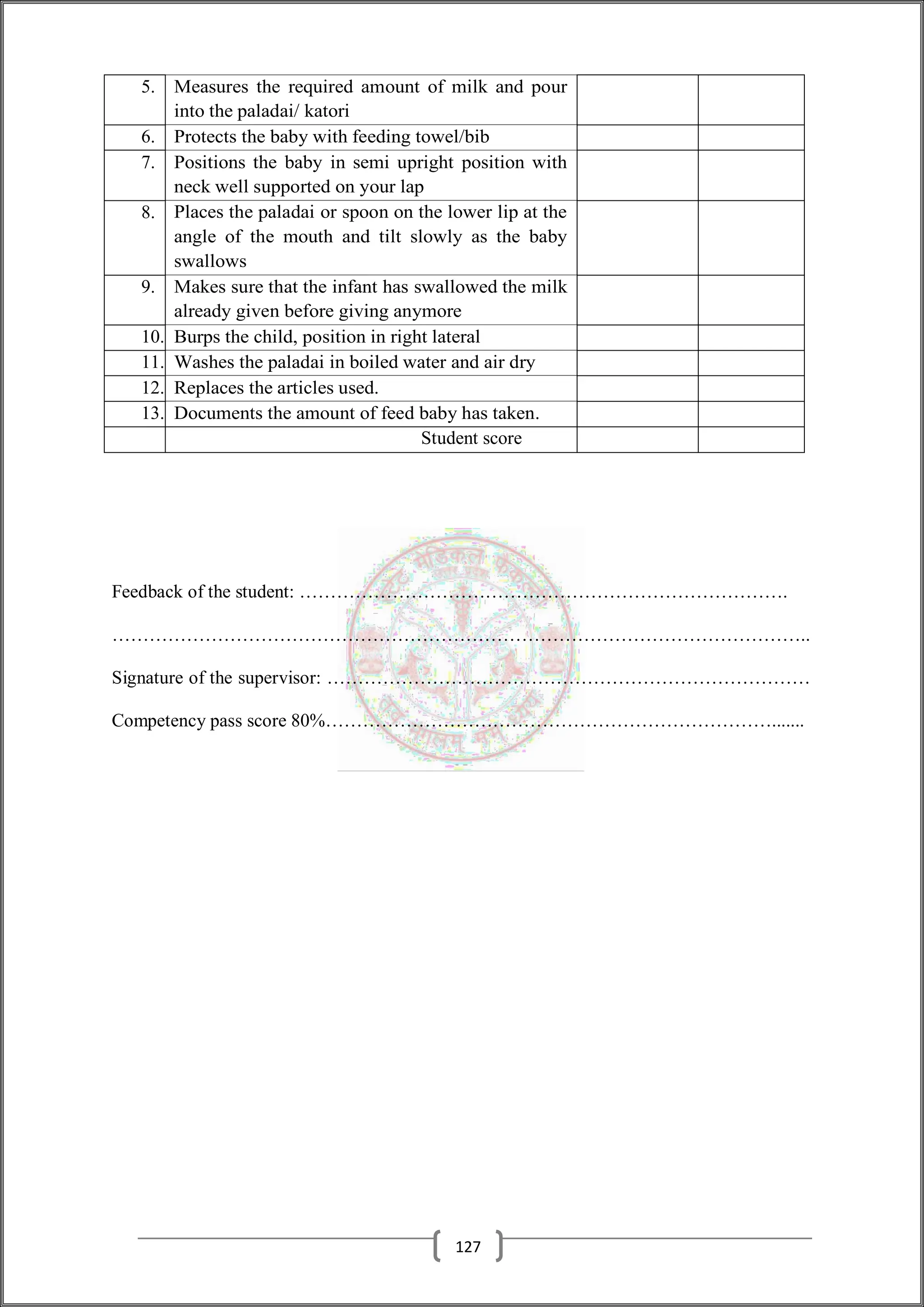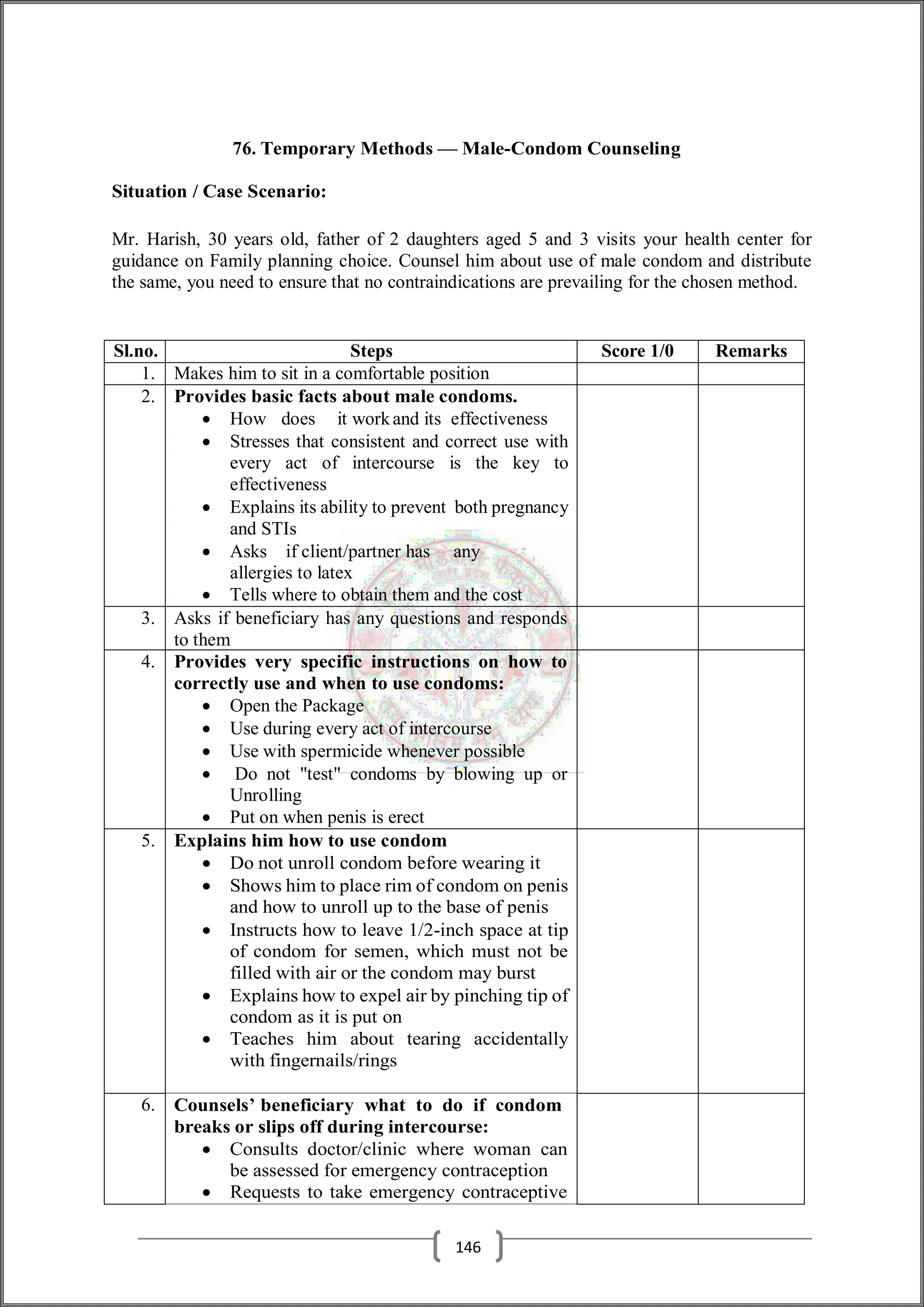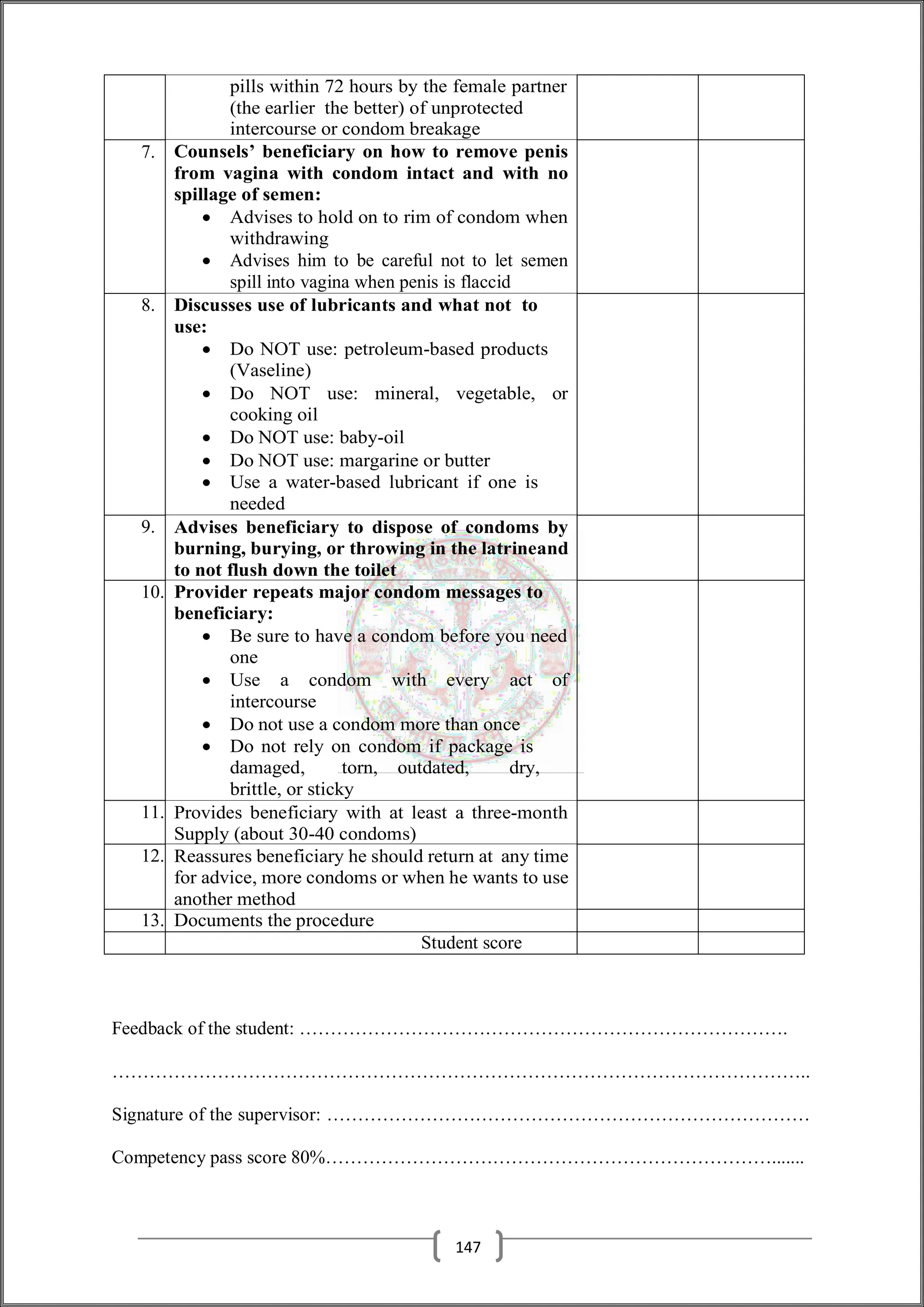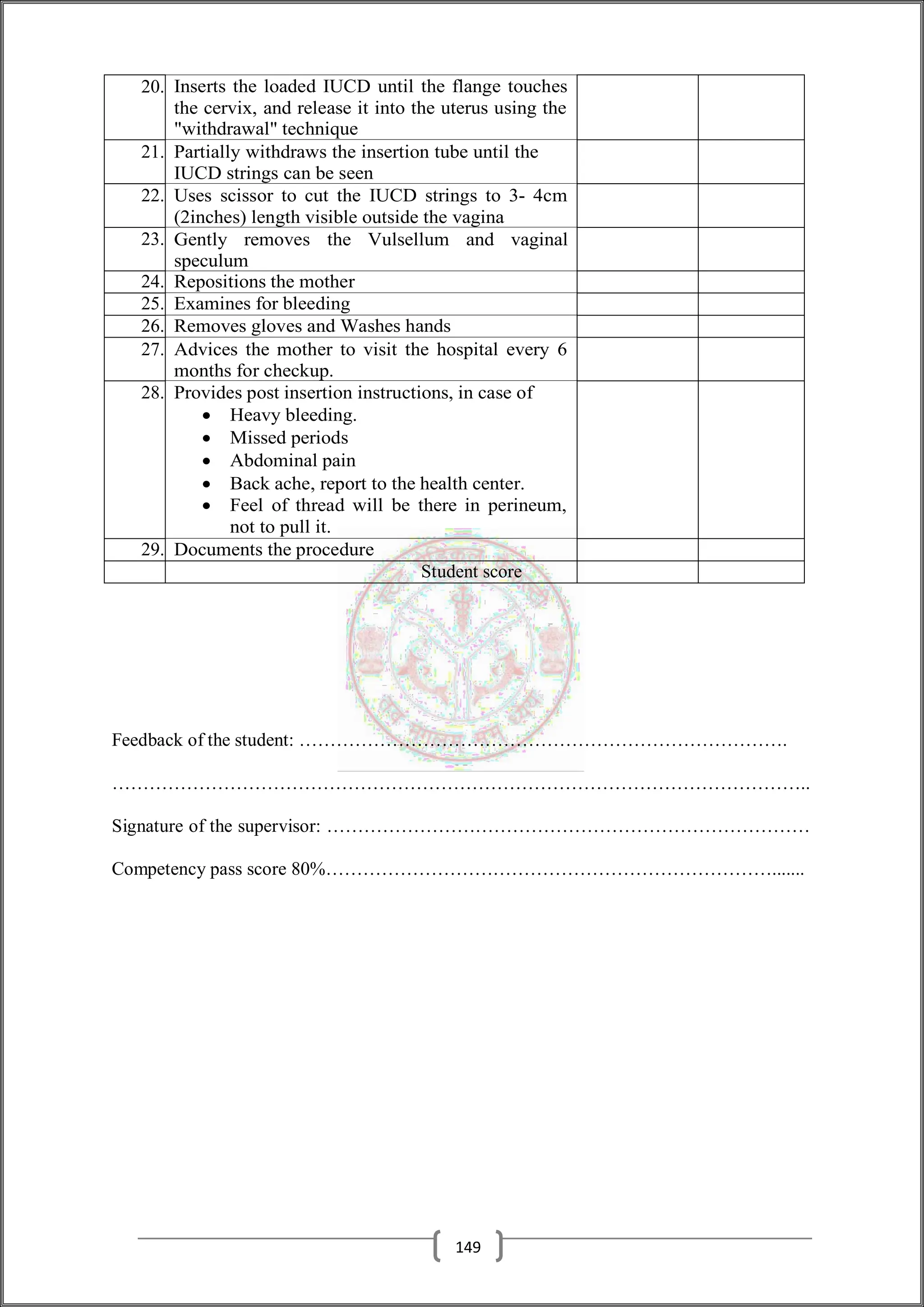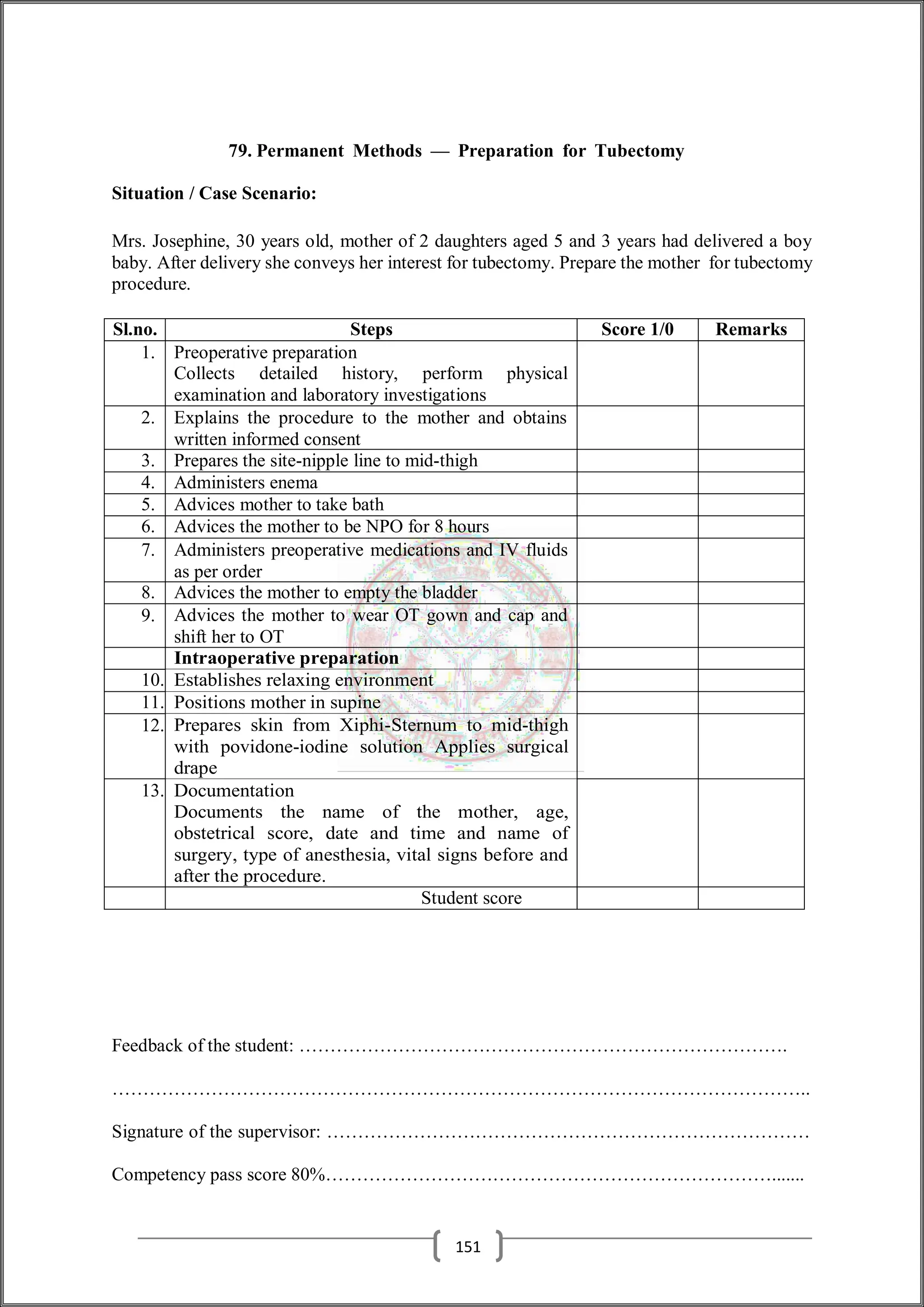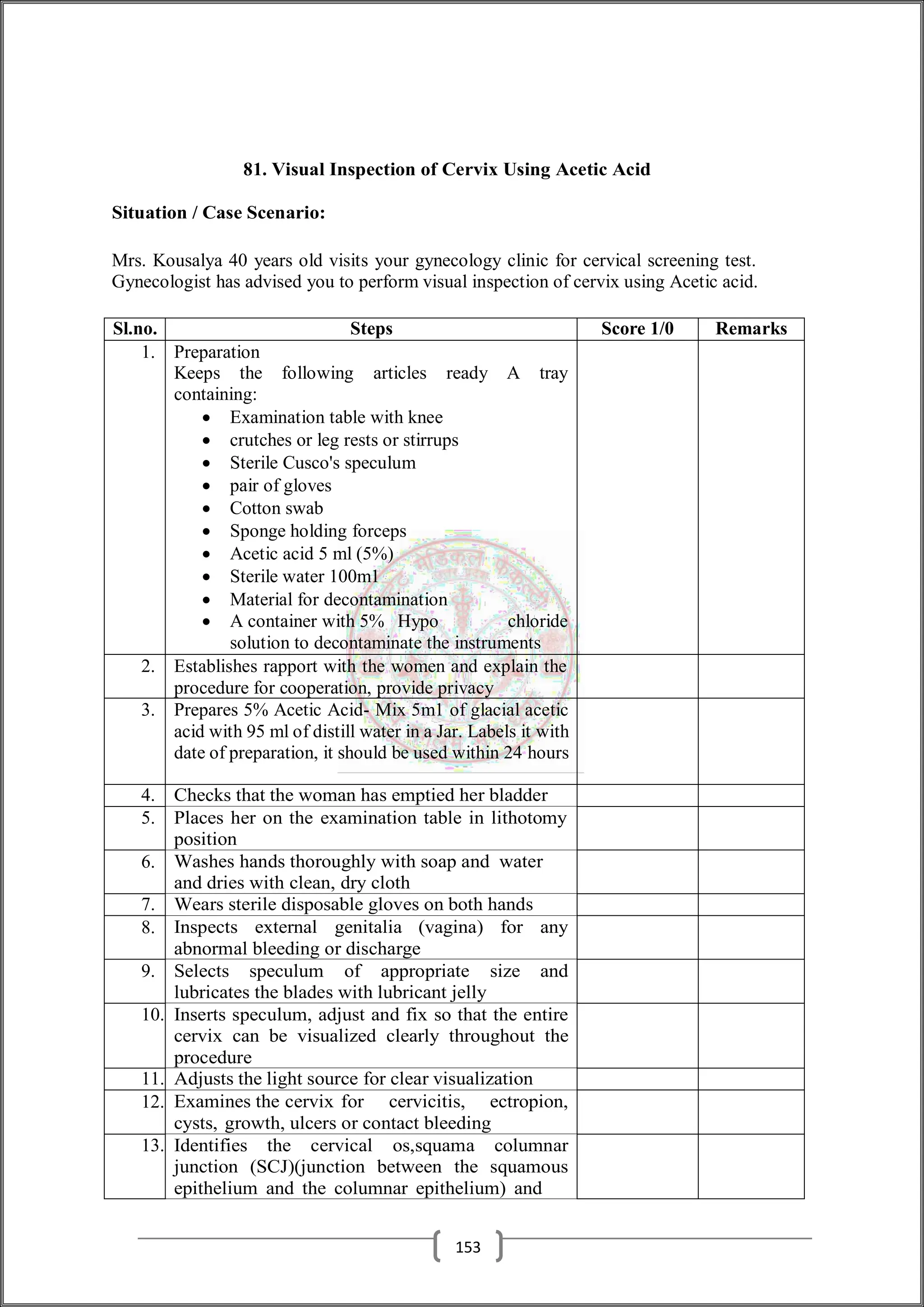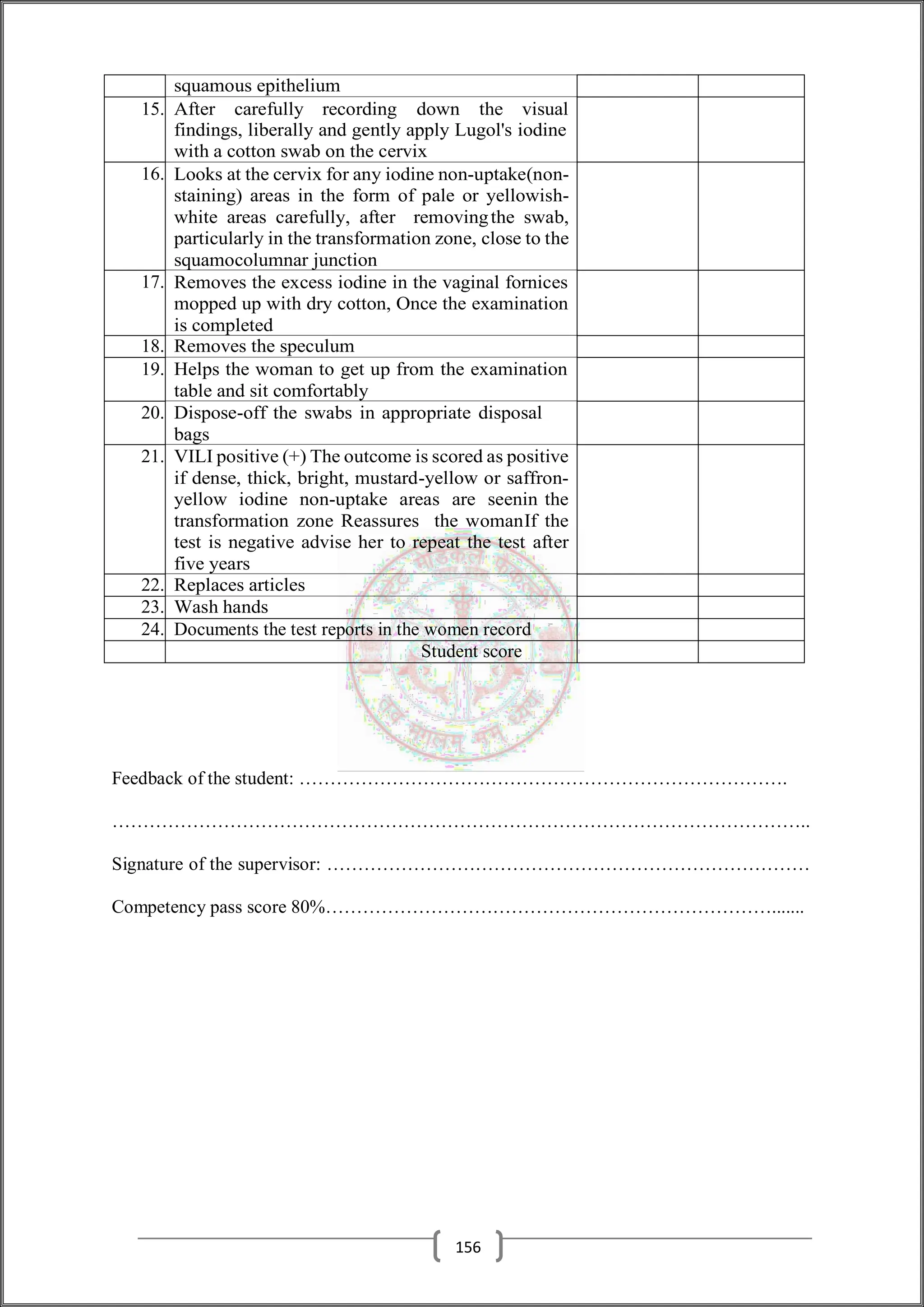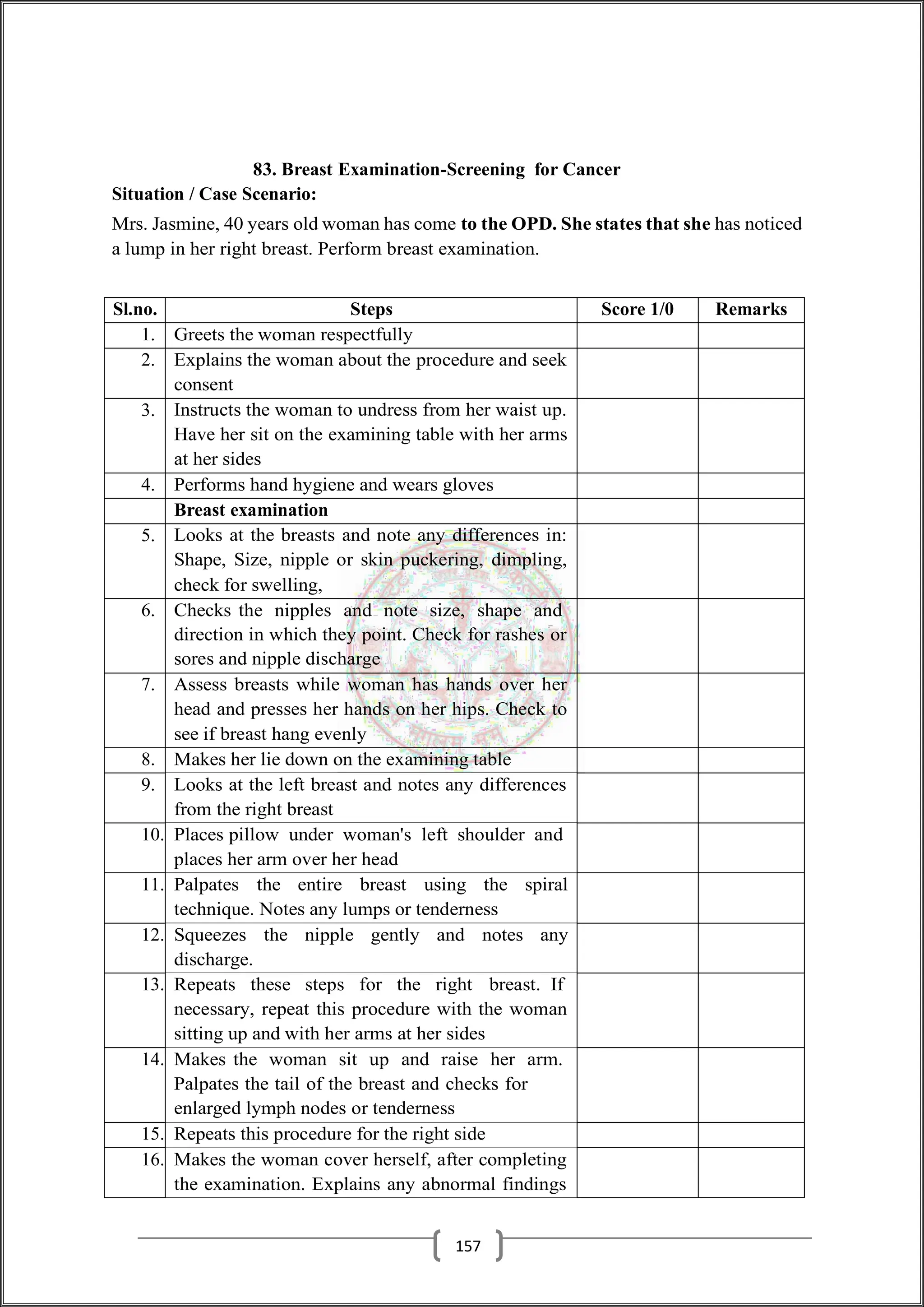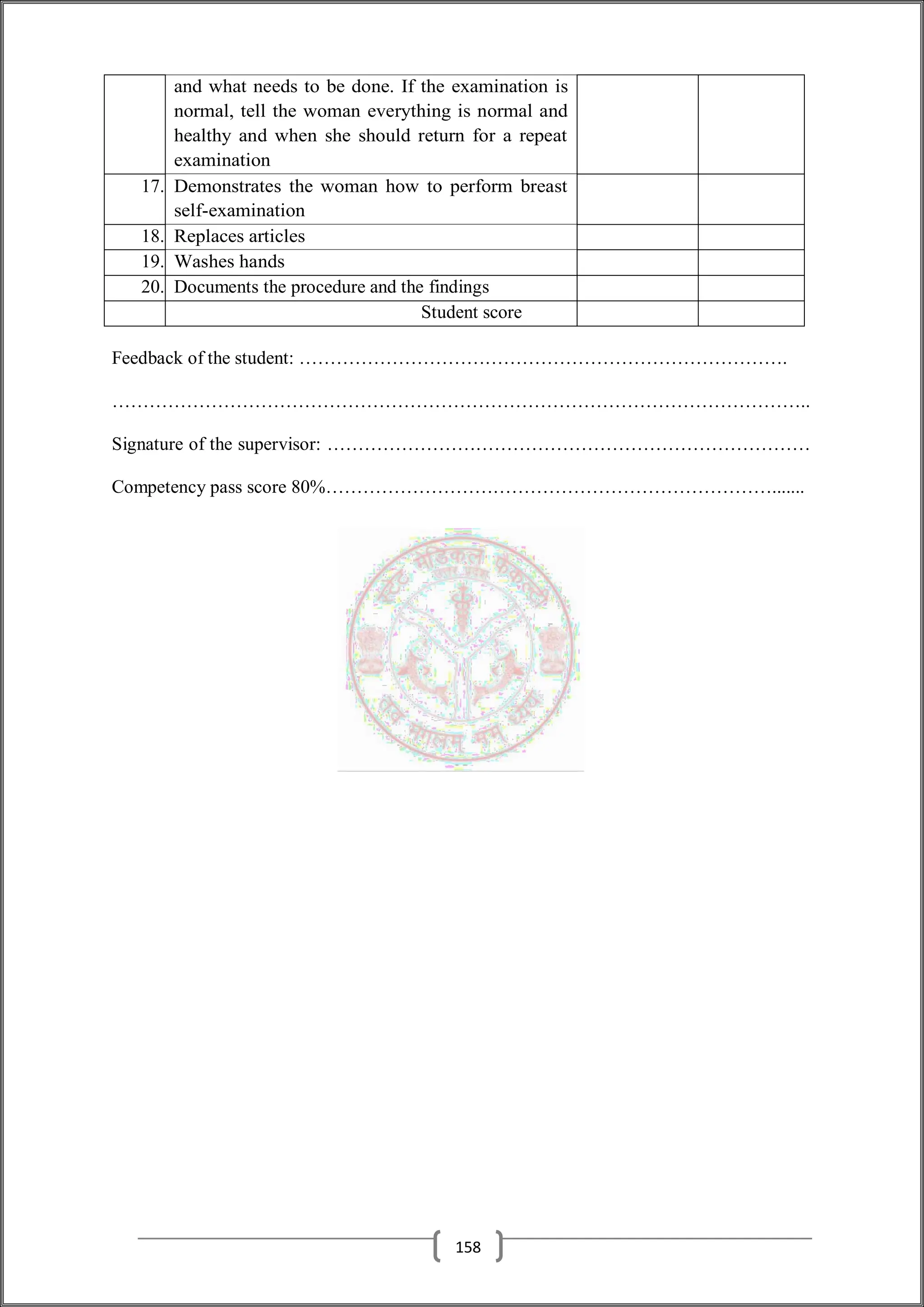

OSCE CHECKLISTS
OBSTETRICS AND GYNAECOLOGICAL NURSING
ACKNOWLEDGEMENT
I am writing to express my sincere gratitude and appreciation to all those who
contributed to the creation of the OSCE Booklet. Your dedication, expertise,
and support have been invaluable in making this project a success.
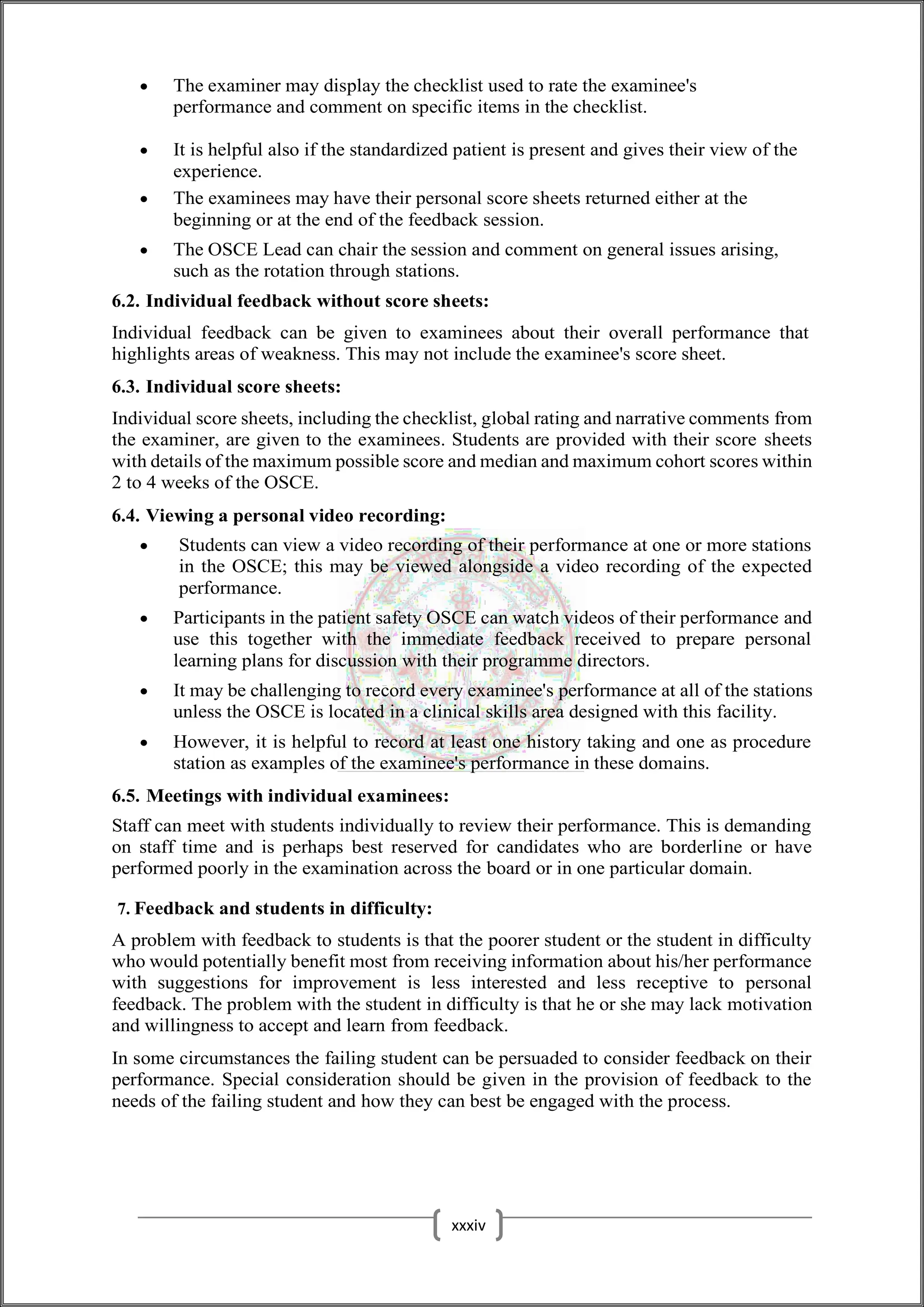
First and foremost, I would like to acknowledge the Principal Secretary and
Director General of Medical Education, Uttar Pradesh for their unwavering
commitment and guidance throughout this endeavor. Your initiative,
leadership and support has been instrumental in shaping this booklet into a
valuable resource.
I also extend my heartfelt thanks to the Nursing Consultant at UPSMF for her
invaluable insights and contributions. Your expertise has greatly enriched the
content and ensured its relevance to our audience.
A special note of appreciation goes to the Tamil Nadu Nurses and Midwives
Council for generously granting us copyright permission for the content. Your
cooperation has allowed us to provide essential information to a wider
audience.
I would like to extend my gratitude to the nursing expert groups from within
and outside the state of Uttar Pradesh who dedicated their time and effort to
meticulously vet the documents. Your attention to detail and commitment to
excellence have been indispensable.
Last but not least, I would like to thank Jhpiego for their invaluable technical
support in strengthening this document. Your partnership has played a pivotal
role in enhancing the quality and effectiveness of the OSCEBooklet.
This project would not have been possible without the collective efforts of
each of you. Your contributions have made a significant impact, and I am
truly grateful for your support.
With Best Wishes,
Secretary
Uttar Pradesh State Medical Faculty
i
UTTAR PRADESH NURSES AND MIDWIVES
COUNCIL OSCE GUIDELINES - HANDBOOK
1 INTRODUCTION
The curriculum tells the staff what to teach.....The OSCEs tells the students what to
learn!
An Objective Structured Clinical Examination (OSCE) is an assessment instrument used
to examine a candidate's clinical skills and knowledge competencies. An OSCE involves
a set of timed activity stations where a nurse candidate must perform simulated
professional tasks with a Standardized Patient in the presence of an Examiner, which
allows for the standardized assessment of clinical skills.
Competence
Competence is the possession of the requisite or adequate ability, having acquired
knowledge and skills necessary to perform those tasks that reflect the scope of professional
nursing practice.
Nursing Clinical competence is the process of performing body of relevant knowledge
and of a range of relevant and related nursing skills which includes personal, interpersonal,
clinical and technical components. These skills as of now are evaluated based on the
clinical practice at different levels in different institutions. The TOGguidelines compiled
and prepared by the nursing council offers a standardized approach across the state towards
evaluation of the clinical practice through skill stations and evaluation format of critical
nursing practice.
Hence the competence itself is best seen as a prerequisite for performance in the real
clinical setting where it would be expected a nurse performs at a higher level in many areas
and demonstrates mastery in some.
During an OSCE, the nurses are expected to perform a variety of clinical tasks in a
simulated setting while being assessed by examiners using standardized ratinginstruments
prepared and described in the LOG Book. It becomes ethical to use mannequins and
simulation models in OSCEs without affecting the patient care.
OSCE - BACKGROUND
The OSCE is an approach to the assessment of clinical competence in which the
components of competence are assessed in a planned or structured way with attention
being paid to the objectivity of the examination - Harden, 1988. An Objective Structured
Clinical Examination (OSCE) is a performance-based test which allows for the
standardized assessment of clinical skills.
OSCE is a form of multi-station examination for clinical subjects first described by Harden
et al from Dundee (1975). It was first reported by Dundee and Glasgow (Harden and
Gleeson, 1979). It was firstly adopted in North America in a widespread manner. Then
widely adopted in the UK in the 90's. The principle method for clinical skills assessment
in medical schools and licensure bodies across USA, Canada, UK, Australia, New Zealand
and other countries, is now the OSCE.
ii
2. MEANING
OSCE is a performance-based examination in which students are observed and scored as
they rotate around a series of stations according to a set plan. Each station focuses on an
element of clinical, after patient competence and the learner’s performance with a real
patient, simulated patients, a mannequin or patient investigations is assessed by an
examiner.
3. OSCE ELEMENTS: ACRONYM
O OBJECTIVE  A number of stations
 Examinees assessed on the same stations
 Clear specification of what is assessed
 A number of examiners
S STRUCTURED OSCE Blueprint
C CLINICAL Students are watched performing a clinical task on real
E EXAMINATION Evaluation of performance /skill based on checklist
3.1 0 - OBJECTIVE
 Traditional clinical exam had the problems like:
o only small sample of skills may be assessed,
o examiner bias and Subjectivity
 OSCE was introduced to replace this traditional clinical examination which was
unreliable
 It has attracted attention as a " GOLD STANDARD" because of its Objectivity
 It is objective because in any clinical examination there are 3 variables
o THE PATIENT
o THE EXAMINER
o THE CANDIDATE, In OSCE, bias related to the patients seen and the examiner
is reduced making it a truer assessment of the examinee's clinical competence.
 The number of stations: One of the first key features is that the examinees are
assessed over a number of stations, there by being named as "MULTISTATION
CLINICAL EXAMINATION”.
o The number can vary from 15-20. The reliability of the examination increases
as the number of stations increase.
o Time allowed is uniform for each station and may vary from 5 - 15-20 mts.
o Each examinee starts at a different station.
o After the time signal, they rotate to next station.
o In a double station the examinee will spend double the time in that station.
o Stations can also be linked, couplets etc.
iii
 Uniform examination:
o All examinees are assessed on the same set of stations.
o In one circuit - 20 stations - 20 students can be assessed, if 40 students then 2
circuits can be done parallel or using the 1st circuit the other candidates can be
assessed.
o Number of examiners depending on the number of manned stations.
o One overall examiner is required
 Specification of what is assessed:
o Performance to be assessed is agreed upon in advance of the examination.
o E.g.: Measurement of BP for a patient: Should the examiner assess the attitude
and communication with the patient or the actual BP interpretation/ or the BP
measurement procedure
o Based on what is to be assessed, the same will be reflected in the checklist or
the rating scale used by the examiner.
 A number of Examiners:
o An examinee sees a number of examiners
o E.g.: for a 20 OSCE station, there may be 10 examiners
o All the examiners have to be briefed
o Training on what has to be expected and how to interpret the checklist and
rating scale.
 Specification of standards required:
o Standard setting for the examinee is a mandate.
o For e.g.: 80% pass in a station or compulsory pass in a station.
3.2 S - STRUCTURED
What is to be assessed during the examination is meticulously planned and agreed upon
by the examination coordinating committee before it is implemented.
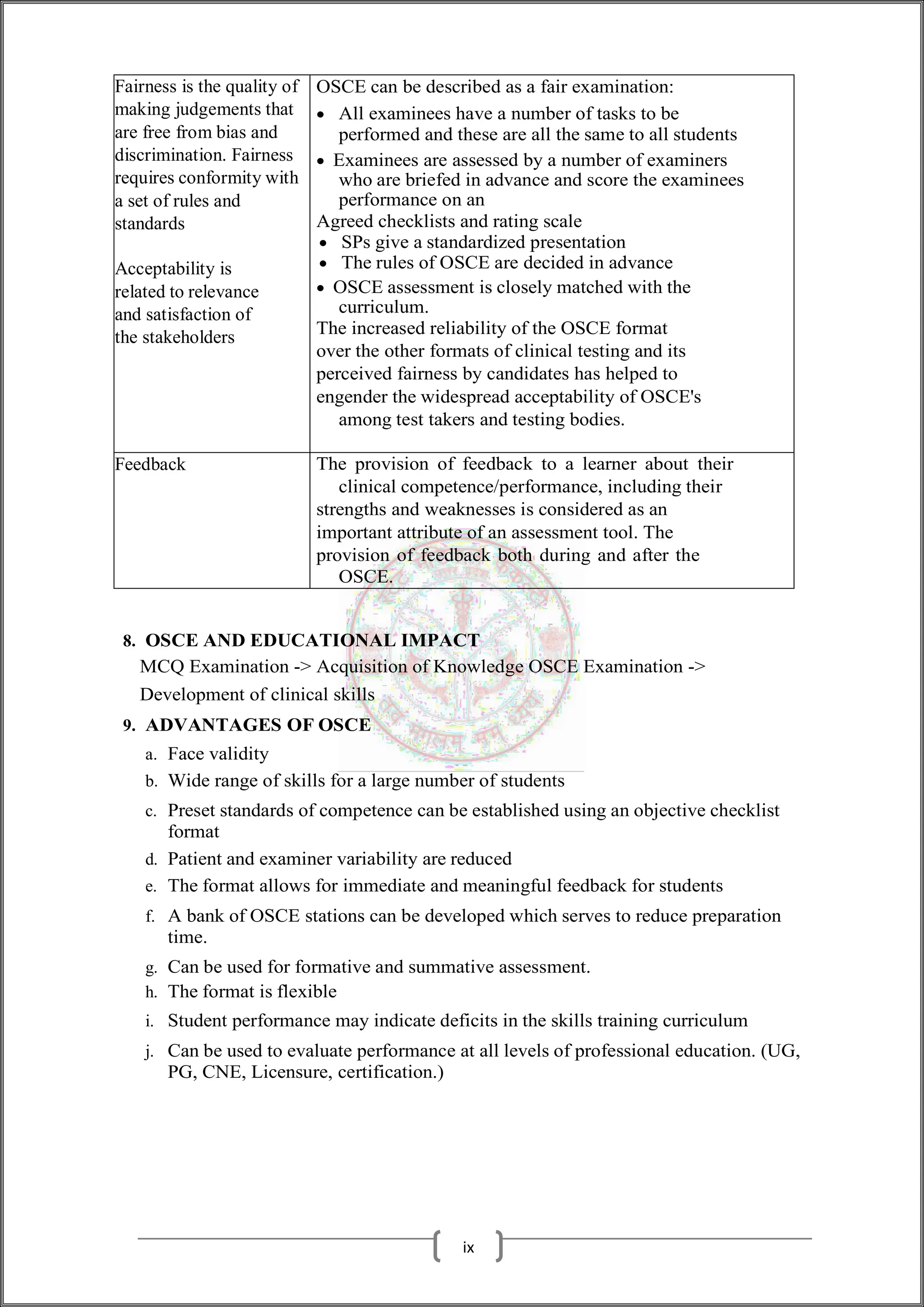
OSCE blue print
 Prepared in advance
 Outlines the learning outcomes and core tasks to be assessed in each station in the
OSCE.
 Eg: Communication skills, Physical examination, practical procedures and
analysis and reflection.
 What is assessed in the OSCE should reflect the content covered in the teaching
and learning programme.
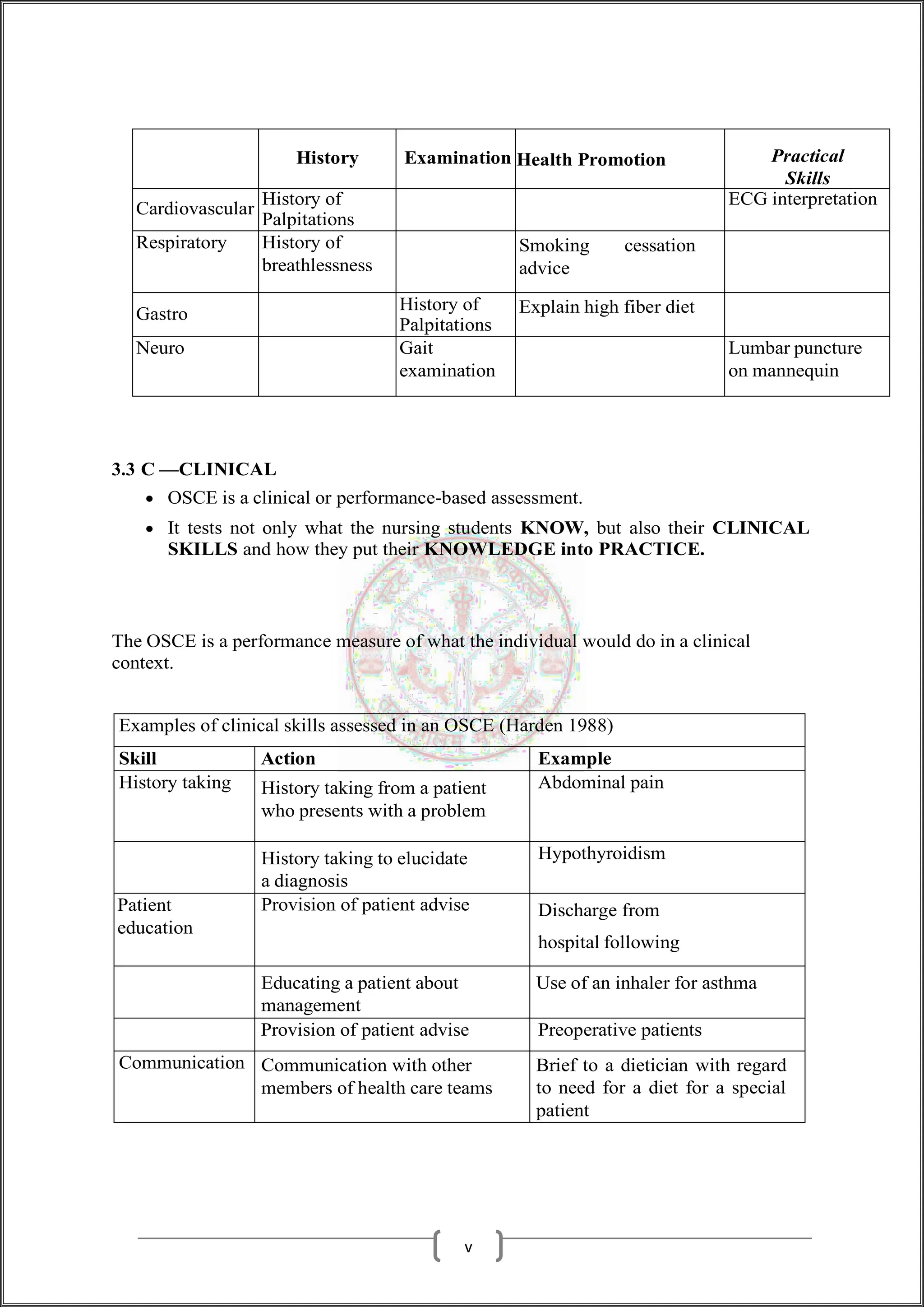
 A grid is drawn:
o First axis: Key learning outcomes
o Second axis: Elements of the course
o For eg:
 Patient education skills may be assessed in the endocrine system with a
diabetic patient
 History taking in the cardio vascular system for a patient with chest pain
 Physical examination in the respiratory system for a patient with asthma
iv
History Examination Health Promotion Practical
Skills
Cardiovascular
History of
Palpitations
ECG interpretation
Respiratory History of
breathlessness
Smoking cessation
advice
Gastro
History of
Palpitations
Explain high fiber diet
Neuro Gait
examination
Lumbar puncture
on mannequin
3.3 C —CLINICAL
 OSCE is a clinical or performance-based assessment.
 It tests not only what the nursing students KNOW, but also their CLINICAL
SKILLS and how they put their KNOWLEDGE into PRACTICE.
The OSCE is a performance measure of what the individual would do in a clinical
context.
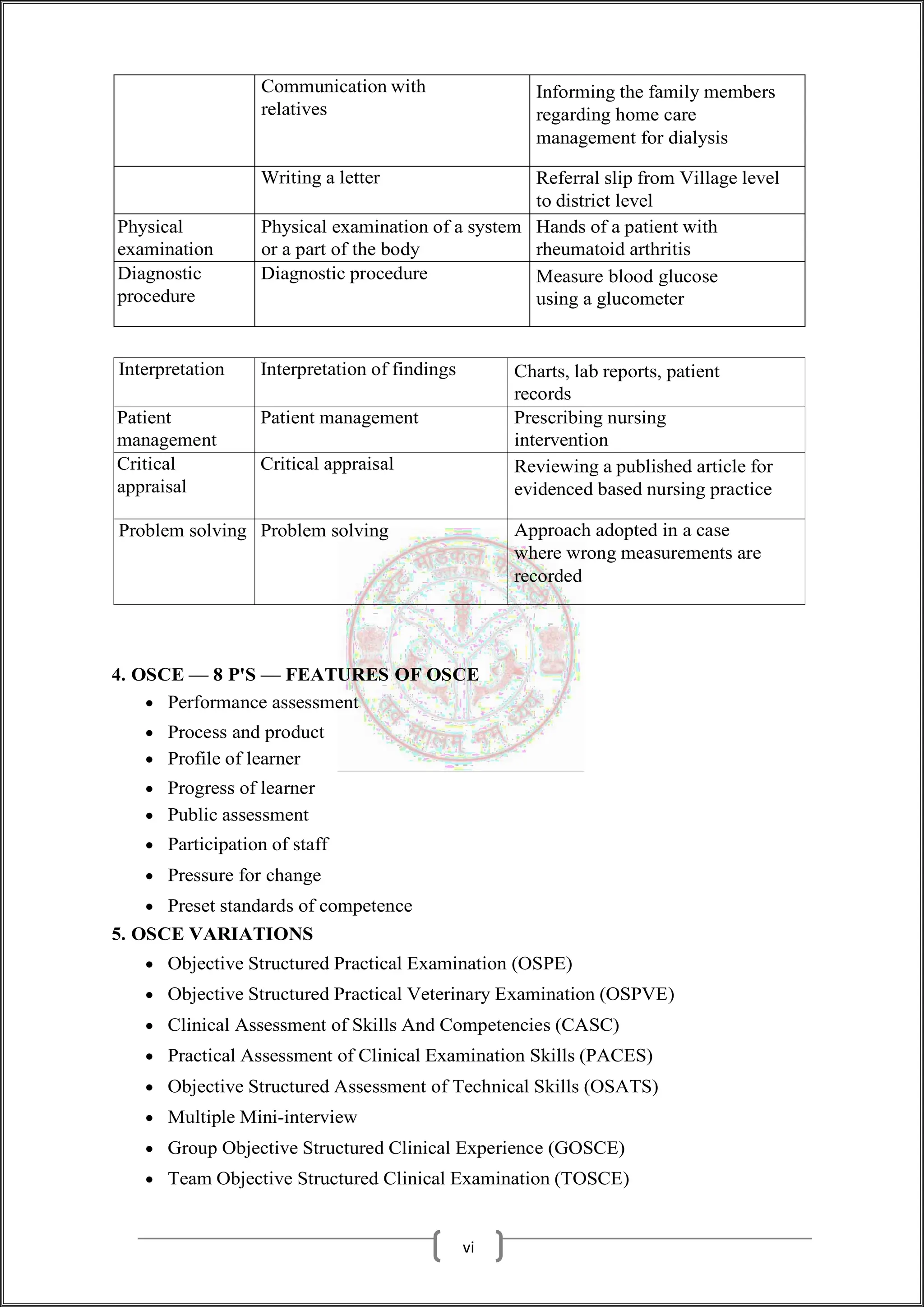
Examples of clinical skills assessed in an OSCE (Harden 1988)
Skill Action Example
History taking History taking from a patient
who presents with a problem
Abdominal pain
History taking to elucidate
a diagnosis
Hypothyroidism
Patient
education
Provision of patient advise Discharge from
hospital following
Educating a patient about
management
Use of an inhaler for asthma
Provision of patient advise Preoperative patients
Communication Communication with other
members of health care teams
Brief to a dietician with regard
to need for a diet for a special
patient
v
Communication with
relatives
Informing the family members
regarding home care
management for dialysis
Writing a letter Referral slip from Village level
to district level
Physical
examination
Physical examination of a system
or a part of the body
Hands of a patient with
rheumatoid arthritis
Diagnostic
procedure
Diagnostic procedure Measure blood glucose
using a glucometer
Interpretation Interpretation of findings Charts, lab reports, patient
records
Patient
management
Patient management Prescribing nursing
intervention
Critical
appraisal
Critical appraisal Reviewing a published article for
evidenced based nursing practice
Problem solving Problem solving Approach adopted in a case
where wrong measurements are
recorded
4. OSCE — 8 P'S — FEATURES OF OSCE
 Performance assessment
 Process and product
 Profile of learner
 Progress of learner
 Public assessment
 Participation of staff
 Pressure for change
 Preset standards of competence
5. OSCE VARIATIONS
 Objective Structured Practical Examination (OSPE)
 Objective Structured Practical Veterinary Examination (OSPVE)
 Clinical Assessment of Skills And Competencies (CASC)
 Practical Assessment of Clinical Examination Skills (PACES)
 Objective Structured Assessment of Technical Skills (OSATS)
 Multiple Mini-interview
 Group Objective Structured Clinical Experience (GOSCE)
 Team Objective Structured Clinical Examination (TOSCE)
vi
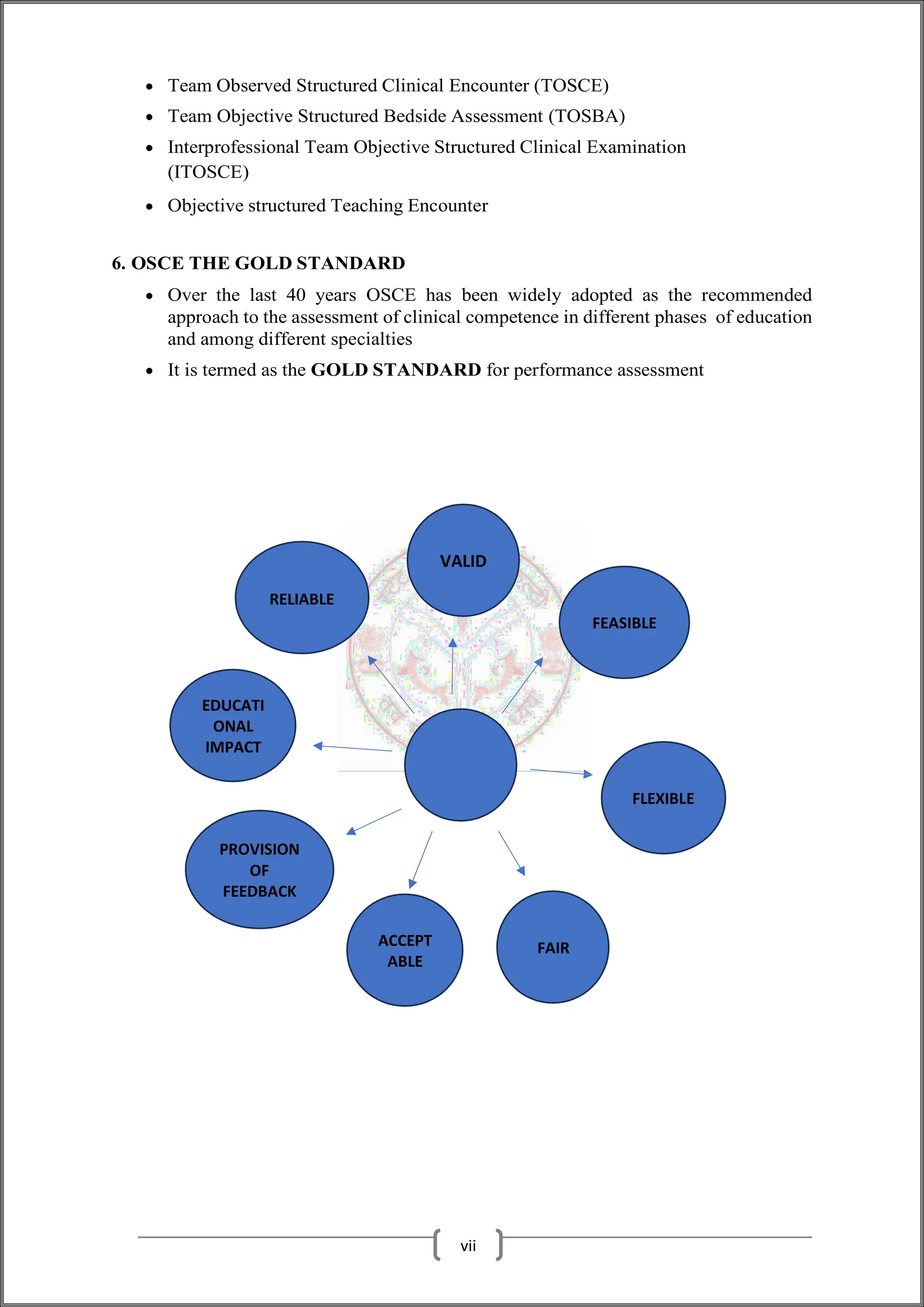
EDUCATI
ONAL
IMPACT
PROVISION
OF
FEEDBACK
FEASIBLE
VALID
 Team Observed Structured Clinical Encounter (TOSCE)
 Team Objective Structured Bedside Assessment (TOSBA)
 Interprofessional Team Objective Structured Clinical Examination
(ITOSCE)
 Objective structured Teaching Encounter
6. OSCE THE GOLD STANDARD
 Over the last 40 years OSCE has been widely adopted as the recommended
approach to the assessment of clinical competence in different phases of education
and among different specialties
 It is termed as the GOLD STANDARD for performance assessment
ACCEPT
ABLE
FAIR
RELIABLE
FLEXIBLE
vii
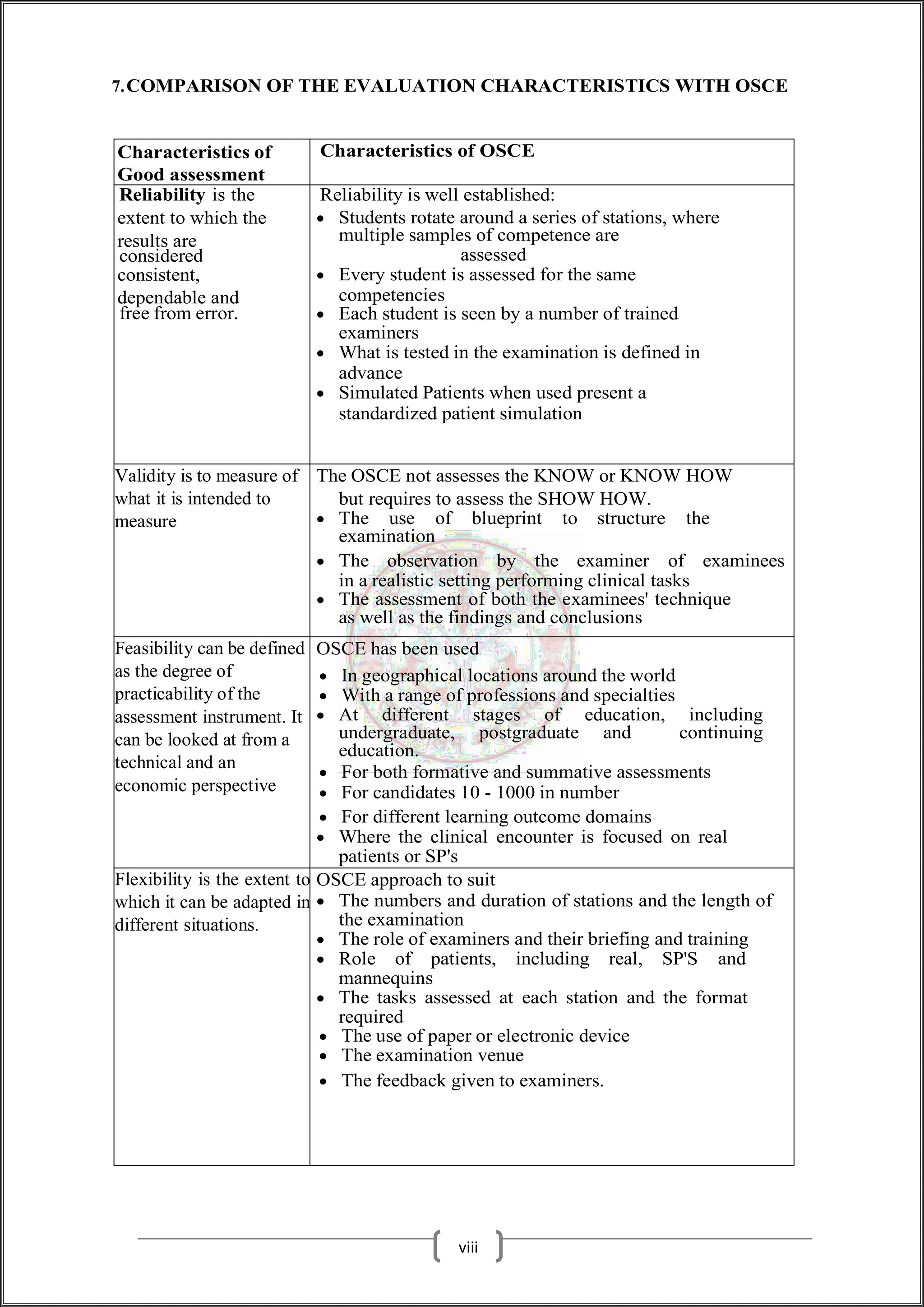
7.COMPARISON OF THE EVALUATION CHARACTERISTICS WITH OSCE
Characteristics of
Good assessment
Characteristics of OSCE
Reliability is the
extent to which the
results are
considered
consistent,
dependable and
free from error.
Reliability is well established:
 Students rotate around a series of stations, where
multiple samples of competence are
assessed
 Every student is assessed for the same
competencies
 Each student is seen by a number of trained
examiners
 What is tested in the examination is defined in
advance
 Simulated Patients when used present a
standardized patient simulation
Validity is to measure of
what it is intended to
measure
The OSCE not assesses the KNOW or KNOW HOW
but requires to assess the SHOW HOW.
 The use of blueprint to structure the
examination
 The observation by the examiner of examinees
in a realistic setting performing clinical tasks
 The assessment of both the examinees' technique
as well as the findings and conclusions
Feasibility can be defined
as the degree of
practicability of the
assessment instrument. It
can be looked at from a
technical and an
economic perspective
OSCE has been used
 In geographical locations around the world
 With a range of professions and specialties
 At different stages of education, including
undergraduate, postgraduate and continuing
education.
 For both formative and summative assessments
 For candidates 10 - 1000 in number
 For different learning outcome domains
 Where the clinical encounter is focused on real
patients or SP's
Flexibility is the extent to
which it can be adapted in
different situations.
OSCE approach to suit
 The numbers and duration of stations and the length of
the examination
 The role of examiners and their briefing and training
 Role of patients, including real, SP'S and
mannequins
 The tasks assessed at each station and the format
required
 The use of paper or electronic device
 The examination venue
 The feedback given to examiners.
viii
Fairness is the quality of
making judgements that
are free from bias and
discrimination. Fairness
requires conformity with
a set of rules and
standards
Acceptability is
related to relevance
and satisfaction of
the stakeholders
OSCE can be described as a fair examination:
 All examinees have a number of tasks to be
performed and these are all the same to all students
 Examinees are assessed by a number of examiners
who are briefed in advance and score the examinees
performance on an
Agreed checklists and rating scale
 SPs give a standardized presentation
 The rules of OSCE are decided in advance
 OSCE assessment is closely matched with the
curriculum.
The increased reliability of the OSCE format
over the other formats of clinical testing and its
perceived fairness by candidates has helped to
engender the widespread acceptability of OSCE's
among test takers and testing bodies.
Feedback The provision of feedback to a learner about their
clinical competence/performance, including their
strengths and weaknesses is considered as an
important attribute of an assessment tool. The
provision of feedback both during and after the
OSCE.
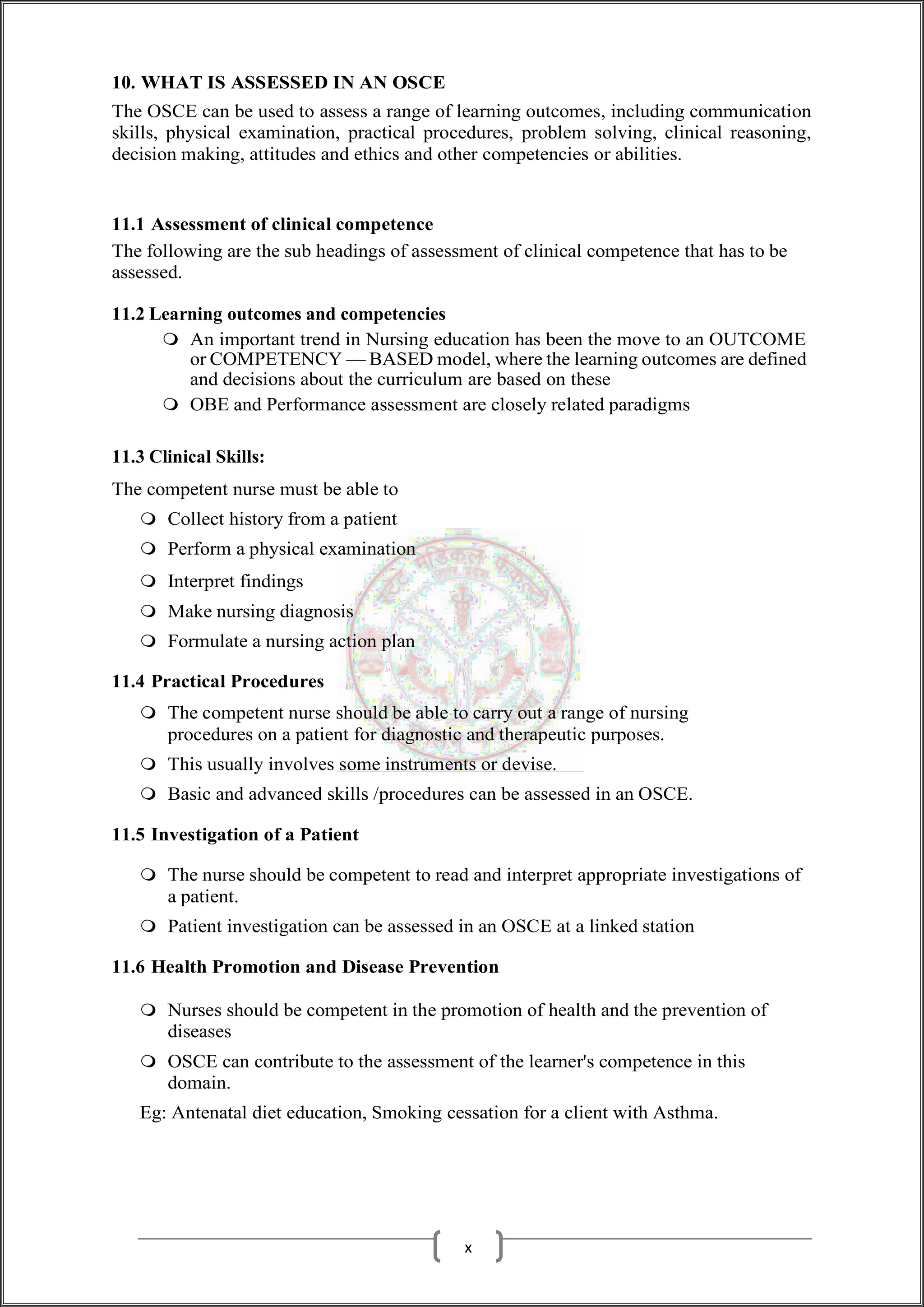
8. OSCE AND EDUCATIONAL IMPACT
MCQ Examination -> Acquisition of Knowledge OSCE Examination ->
Development of clinical skills
9. ADVANTAGES OF OSCE
a. Face validity
b. Wide range of skills for a large number of students
c. Preset standards of competence can be established using an objective checklist
format
d. Patient and examiner variability are reduced
e. The format allows for immediate and meaningful feedback for students
f. A bank of OSCE stations can be developed which serves to reduce preparation
time.
g. Can be used for formative and summative assessment.
h. The format is flexible
i. Student performance may indicate deficits in the skills training curriculum
j. Can be used to evaluate performance at all levels of professional education. (UG,
PG, CNE, Licensure, certification.)
ix
10. WHAT IS ASSESSED IN AN OSCE
The OSCE can be used to assess a range of learning outcomes, including communication
skills, physical examination, practical procedures, problem solving, clinical reasoning,
decision making, attitudes and ethics and other competencies or abilities.
11.1 Assessment of clinical competence
The following are the sub headings of assessment of clinical competence that has to be
assessed.
11.2 Learning outcomes and competencies
 An important trend in Nursing education has been the move to an OUTCOME
or COMPETENCY — BASED model, where the learning outcomes are defined
and decisions about the curriculum are based on these
 OBE and Performance assessment are closely related paradigms
11.3 Clinical Skills:
The competent nurse must be able to
 Collect history from a patient
 Perform a physical examination
 Interpret findings
 Make nursing diagnosis
 Formulate a nursing action plan
11.4 Practical Procedures
 The competent nurse should be able to carry out a range of nursing
procedures on a patient for diagnostic and therapeutic purposes.
 This usually involves some instruments or devise.
 Basic and advanced skills /procedures can be assessed in an OSCE.
11.5 Investigation of a Patient
 The nurse should be competent to read and interpret appropriate investigations of
a patient.
 Patient investigation can be assessed in an OSCE at a linked station
11.6 Health Promotion and Disease Prevention
 Nurses should be competent in the promotion of health and the prevention of
diseases
 OSCE can contribute to the assessment of the learner's competence in this
domain.
Eg: Antenatal diet education, Smoking cessation for a client with Asthma.
x
11.7 Communication Skills
 A professional nurse is competent in a range of communication skills in both oral
and written.
 The delivery of nursing care is dependent on the nurse's ability to communicate
clearly with patients, their families and with the fellow health care professionals.
 Communication skills that can be assessed in an OSCE include:
 History taking from a patient with a specific problem
 Communication with other members of the health care team either orally or in
writing
 Communication with patients’ family
 Acting as a patients advocate to defend patients’ interest
 Appearance in court of law as an expert witness
 Public interviews, such as at local meetings or on television or radio, and
 Teaching students or colleagues
11.8 Handling and Retrieving Information
 The nurse should be competent in retrieving, recording and analyzing information
using a range of methods.
 In addition to know how to access information, professionals should also know
how to use this relevantly in the area of patient care.
 Information handling skills can be assessed in OSCE Eg: recommending a
website for accessing the best health insurance scheme by the government.
 Evidence based nursing skills can be assessed using OSCE
11.9 Creative Problem Solving and Decision Making:
 These skills are considered as important for health care professionals
Eg: 1st station: Complaint letter received regarding wrong weight recording —
Examinee is the administrator — how to take decision and solve problem.
11.10 Attitudes and Professionalism
People don't know how much you know, until they know how much you care, An
inappropriate attitude is common criticism for nurses
11.11 Competence as a Member of a Team
 Group OSCE's
 Interprofessional OSCE's
12. COMPONENTS OF OSCE/ OSPE PROCESS - CHOOSING A FORMAT
FORAN OSCE
12.1 Variables in designing an OSCE
The variables to be considered in designing of the OSCE format include:
 Number of stations.
 Length of time allocated for each station.
 Number of circuits.
 Use of "procedure" and "question" stations.
xi
 Use of "double" and "linked" stations.
 Organization of the stations in a circuit and
 Provision of feedback to the examinee
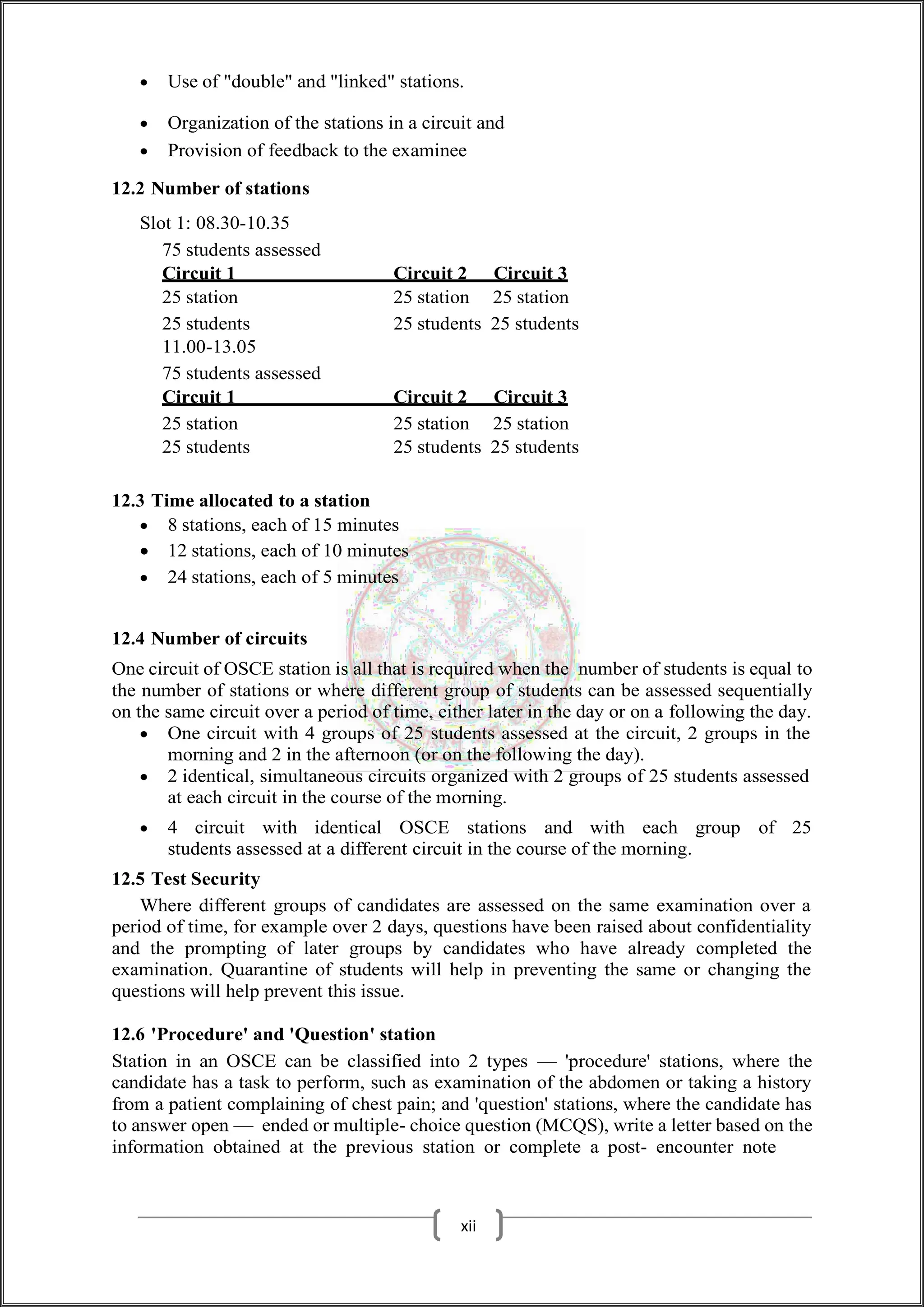
12.2 Number of stations
Slot 1: 08.30-10.35
75 students assessed
Circuit 1 Circuit 2 Circuit 3
25 station 25 station 25 station
25 students 25 students 25 students
11.00-13.05
75 students assessed
Circuit 1 Circuit 2 Circuit 3
25 station 25 station 25 station
25 students 25 students 25 students
12.3 Time allocated to a station
 8 stations, each of 15 minutes
 12 stations, each of 10 minutes
 24 stations, each of 5 minutes
12.4 Number of circuits
One circuit of OSCE station is all that is required when the number of students is equal to
the number of stations or where different group of students can be assessed sequentially
on the same circuit over a period of time, either later in the day or on a following the day.
 One circuit with 4 groups of 25 students assessed at the circuit, 2 groups in the
morning and 2 in the afternoon (or on the following the day).
 2 identical, simultaneous circuits organized with 2 groups of 25 students assessed
at each circuit in the course of the morning.
 4 circuit with identical OSCE stations and with each group of 25
students assessed at a different circuit in the course of the morning.
12.5 Test Security
Where different groups of candidates are assessed on the same examination over a
period of time, for example over 2 days, questions have been raised about confidentiality
and the prompting of later groups by candidates who have already completed the
examination. Quarantine of students will help in preventing the same or changing the
questions will help prevent this issue.
12.6 'Procedure' and 'Question' station
Station in an OSCE can be classified into 2 types — 'procedure' stations, where the
candidate has a task to perform, such as examination of the abdomen or taking a history
from a patient complaining of chest pain; and 'question' stations, where the candidate has
to answer open — ended or multiple- choice question (MCQS), write a letter based on the
information obtained at the previous station or complete a post- encounter note
xii
describing their finding at the previous station and possibly their interpretation of the
findings and a management plan for the patient.
Stations in the OSCE are of 2 types
Procedure station
Eg: Examine abdomen or take history of patient with chest pain.
Question station
Relating to the findings elicited at the previous station, answer the multiple — choice
or constructed — response questions, write a letter, or repair a post — encounter note.
12.7 Double stations
In the OSCE, a standard time has to be set for all stations, and the task with which the
examinee is faced should be achievable within this time. Particularly when the time allotted
to the station is 5 minutes, a longer period of time is required to assess one aspect of
competence, such as history taking in a particular area. In this case a double station may
be arranged. The station is duplicated with the 'a' and 'b' versions each having their own
examiner and the patients are carefully matched. Candidates are assessed alternately.
12.8 Linked stations
 Each station in the OSCE can stand on its own, or two stations can be linked in one
of a number of ways. The most frequent use of linked stations is where a process,
such as a physical examination of patient, is tested at one station (described above
as 'procedure' stations) and at the second of the two linked stations (the 'question'
station), the examinee answers questions or prepares a report on what was found at
the previous station. Linked stations may also be known as 'couplet' station.
 A second type of linked station is where an examinee is asked to undertake part of
a procedure, for example preparing slide a for microscope at the first station, and
has to complete the procedure,
for a slide already prepared for examination under the microscope at secondstation.
 Another use of linked stations is to present the examinee with information at the
first station about the patient to be seen at the next station and the task to be
completed at the station.
 A fourth type of linked stations is one where the examinee undertakes some activity
or observes an activity, for example a recorded interview with a psychiatric patient
at first station, and discusses this with the examiner at the second station.
12.9 Feedback during the examination
The OSCE is widely recognized for its value in providing examinees with feedback on
their performance.
12.10 The organization of stations in a circuit
 Examinees rotate in an OSCE around a circuit with a series of stations.
 In some circumstances where the number of candidates is few and examiners are
limited, examinees can complete 3 different circuits with a short break between
the circuits.
xiii
 The OSCE may be organized such that the learner is assessed at the OSCE
stations in no set order and the time allocated for each station may vary.
12.11 Group OSCE (GOSCE)
The standard practice in an OSCE is for examinees to rotate individually around the
stations. Examinees can also participate as a member of a group, there are 2 circumstances
where this may be appropriate:
> The McMaster- Ottawa Team Observed Structured Clinical Encounter (TOSCE).
This is used to assess team skills and inter professional practice.
> As a team experience where learner learn from each other. Biran (1991) described
a group objective structured clinical examination (GOSCE), where doctors as part
of a refresher course for general practitioners, rotated around the OSCE stations in
groups, were assessed and reflected on their competence.
13. When using real patients in an OSCE, it is important to ensure that:
 What is required is carefully explained to the patient and the patient has given
his/her consent.
 The patient is not subjected to pain or discomfort, and his/her
condition is not exacerbated in any way by repeated examinations.
 The patient's condition is appropriate for him/her to be asked to take part in the
examination.
 Any physical findings are checked, as they may have changed with time.
 Patients who may be interrupted during the examination are not selected (e.g.
patients on diuretics).
 Tea and refreshments are available for the patient.
 If the patient is an outpatient, travel arrangements have been made.
 The patient is thanked at the end of the examination.
If a real patient is used as a history taking station, the patient may be instructed to:
 Respond to questions asked according to their own experience.
 Modify his/her story in some rehearsed way in order to standardize the history
provided.
14. Simulated Patients
A simulated or standardized patient - SPs, first established by Howard Barrows in 1963,
has been defined patient - SPs as 'a person who is carefully trained to accurately,repeatedly
and realistically re-create the history physical findings, and psychological and emotional
responses of the actual patient on whom the case is based so that anyone encountering that
patient experiences the same challenge from the SR
14.1 Use of simulated patients
SPs can be used to test a broad range of skills, including history taking, physical
examination, demonstration of practical procedures and counseling. Most commonly,
SPs are used to assess communication skills or physical examinations where no
abnormality is found.
14.2 Reliability of simulated patients
In an early study, Tamblyn et al (1991) reported on variability in the accuracy of patient
representation by SPs trained at different institutions. It has been demonstrated since
xiv
then, however, that an appropriately trained SP can present a consistent portrayal of a
patient's history over multiple
encounters in an OSCE and that there is also a high level of consistency where different
SPs in parallel circuits portray the same encounters. Portrayal of physical findings may
be less accurate, but this may be corrected with additional training.
14.3 Realism and the simulated patient
It is important to make the SPs portrayal of the patient as realistic as possible in order to
trigger more authentic conscious responses from examiners.
There are a number of measures that can be taken to facilitate a realistic portrayal of a
patient in an OSCE, as discussed below.
14.3.1 The patient narrative
In preparing for an OSCE, Nested et al.(2008) interviewed real patients in the emergency
department shortly after a procedure. In the training of SPs, their use of 'verbatim
statements from patients provided authentic language for actors, offering a richness and
consistency of character sometimes lacking in roles crafted by our team.
14.3.2 Patient characteristics
Realism and credibility is important in terms of SP portrayal. ASP selected to play the role
of a young person with anorexia would be more believable if she were a teenage and
underweight. Conversely, an obese SP might be used to portray a patient with
cardiovascular disease or diabetes or a patient being counseled on the need to lose weight
at a health promotion station.
Prosthetics and make up may be used, for example, to add realism to SPs who do not have
physical manifestations of the condition they are portraying, such as wounds and other
skin conditions.
14.3.3 Faculty and students as simulated patients
Members of staff may act both as SP and as examiners in an OSCE and it has been claimed
that students are able to think of the staff SP as a real patient. However, if thereis a
possibility that the student may identify the SP as the member of staff, this is not to be
recommended as it does make it more difficult for the student to relate to the patientas
they would relate to a real patient. Faculty SPs were found by Mavis et al. [2006] tobe
more intimidating than actors or student peers acting as SPs.
Students can successfully serve as SPs, and this offers a number of advantages. Students
usually require less training than actors in portraying a patient case, and they are a low-
cost option. Probably most importantly,
students regard acting as an SP as a valuable learning experience and gain significant
benefit from acting out the role and from watching their peers perform at an OSCE station.
Students usually serve as SPs in the context of a formative OSCE, but they may also act
as SPs in summative examination.
14.3.4 Simulated patient as examiner
In adding to simulating the role of a patient, the SP can also be used in an OSCE to
assess the examinee's performance. Research suggests that they can assess the examinee
more reliably in respect of well-defined technical skills such as history taking andphysical
examination rather than on social skills, such as empathy and teamwork (Berg et
xv
al. 2011). The combination of acting as SP whilst at the same time assessing the examinee,
however, can be extremely challenging.
14.4 Level of interaction with simulated patients
The level of interaction between the examinee and the SP should be specified, as it can
vary widely.
 No response is expected from the SP and no rehearsal or training is necessary in
stations where, for example, the student simply has to measure the blood pressure
or auscultate the heart.
 The SP is rehearsed on the basic key elements of a history and left to respond to
other questions from their own perspective. The SP is expected to replicate his/her
portrayal as consistently as possible for each candidate.
 The SP is rehearsed not only in the key points in the patient's history but also in
more detail about the patient they are simulating and, in the word, to be used in
response to specific questions.
 SPs are trained to respond both verbally and non-verbally with gestures, facial
expressions and eye contact to convey emotion. They may be asked to behave in a
particular way towards the doctor, for example respectful and polite' and 'soft-
spoken', to nod when the candidates speaks or to look down rather than making eye
contacts.
 The scenario is rehearsed to evolve according to a strict schedule, with the SP asked
to change his/her behavior at a previously agreed time in the consultation.
 In addition to responding to questions from the examiner, the SP is instructed to
ask questions at various stages in the interview.
 The simulation may involve more than one person, relatives of the patient may be
involved, including a husband, wife, or the parent of a child. Other members of the
healthcare team may also be involved.
14.5 The advantages of using a simulated patient
As can be deducted from the above descriptions of the role of a SP can play in an OSCE,
SPs offer many advantages and opportunities to enrich an OSCE station in terms of what
is assessed. The use of SPs in an OSCE offers many advantages.
 SPs contribute to the reliability of the OSCE through their training to respond to
the examinee consistently and with the response replicated by other SPs at the same
station or in other parallel circuits.
 The complexity or difficulty of the presentation can be controlled and modified to
the stage of training of the examinee.
 Problems associated with the use of a real patient are avoided, and SPs can be used
in a situation where the use of a real patient would be inappropriate.
 An SP may tolerate more examinee encounters in an OSCE than a real patient
would.
 SPs can be trained to assess the examinee's performance and to provide feedback
to the learner.
 If there is a bank of SPs an SP may be readily available and can be preordered to
meet specific assessment needs.
14.6 Simulated patients as a valuable resource
SPs have become widely accepted as a valuable assessment tool in an OSCE.
xvi
al. 2011). The combination of acting as SP whilst at the same time assessing the examinee,
however, can be extremely challenging.
14.7 Level of interaction with simulated patients
The level of interaction between the examinee and the SP should be specified, as it can
vary widely.
 No response is expected from the SP and no rehearsal or training is necessary in
stations where, for example, the student simply has to measure the blood pressure
or auscultate the heart.
 The SP is rehearsed on the basic key elements of a history and left to respond to
other questions from their own perspective. The SP is expected to replicate his/her
portrayal as consistently as possible for each candidate.
 The SP is rehearsed not only in the key points in the patient's history but also in
more detail about the patient they are simulating and, in the word, to be used in
response to specific questions.
 SPs are trained to respond both verbally and non-verbally with gestures, facial
expressions and eye contact to convey emotion. They may be asked to behave in a
particular way towards the doctor, for example respectful and polite' and 'soft-
spoken', to nod when the candidates speaks or to look down rather than making eye
contacts.
 The scenario is rehearsed to evolve according to a strict schedule, with the SP asked
to change his/her behavior at a previously agreed time in the consultation.
 In addition to responding to questions from the examiner, the SP is instructed to
ask questions at various stages in the interview.
 The simulation may involve more than one person, relatives of the patient may be
involved, including a husband, wife, or the parent of a child. Other members of the
healthcare team may also be involved.
14.8 The advantages of using a simulated patient
As can be deducted from the above descriptions of the role of a SP can play in an OSCE,
SPs offer many advantages and opportunities to enrich an OSCE station in terms of what
is assessed. The use of SPs in an OSCE offers many advantages.
 SPs contribute to the reliability of the OSCE through their training to respond to
the examinee consistently and with the response replicated by other SPs at the same
station or in other parallel circuits.
 The complexity or difficulty of the presentation can be controlled and modified to
the stage of training of the examinee.
 Problems associated with the use of a real patient are avoided, and SPs can be used
in a situation where the use of a real patient would be inappropriate.
 An SP may tolerate more examinee encounters in an OSCE than a real patient
would.
 SPs can be trained to assess the examinee's performance and to provide feedback
to the learner.
 If there is a bank of SPs an SP may be readily available and can be preordered to
meet specific assessment needs.
14.9 Simulated patients as a valuable resource
SPs have become widely accepted as a valuable assessment tool in an OSCE.
xvi
The role of the SP can be extremely challenging, and good SPs are a valuable resource to
an institution. They need to be looked after and appreciated for the valuable work they
do. SPs frequently, as described above, perform three roles — portraying a patient,
assessing the examinee and providing feedback on performance — and have become much
respected and valued members of the team.
14.10 Simulators
Simulator technology is a powerful education tool in medicine. Althoughits
use has typically been in formative assessment, simulators are now established in
summative high-stakes assessment as well. Simulators play an important role in an OSCE
when either a real patient or an SP is not appropriate at a station designed to assess a
practical procedure, such as cystoscopy or cardiopulmonary resuscitation, or when a real
patient with the necessary physical findings is not available. Part-task trainers (PTTs) can
be used to assess a range of specific competencies in an OSCE, including the insertion of
intravenous lines.
14.12 Hybrid simulation
A simulator can be used alongside an SP to provide greater realism or authenticity to the
experience [Kneebone et.al]. The SP may present, for example, with a simulated wound
on the abdomen which requires suturing or may be lying on a bed attached to a simulated
pelvis for catheterization. Such hybrid simulators can be presented to appear authentic and
multiple and more complex competencies can be tested.
Stations with hybrid simulators allow an assessment to be made not only for the examinee's
competence in the practical procedure but also their rapport with the patient and their
communication skills. An examinee may be asked to perform an initiate examination
whilst at the same time engaging in conversation with an SP trained to be very talkative
and friendly, with the aim of simulating what may be perceived as a 'normal' nurse-patient
relationship.
14.13 Video recordings
Video recordings of patients can be incorporated into an OSCE in a number of ways. In a
pediatric postgraduate examination, for example, they were used to assess the candidates'
decision-making abilities with regard to the management of acutely unwell children and
vulnerable infants.
In a variation of the OSCE-Objectives Structured Video Exam [OSVE] students watch a
series of videos of doctor-nurse communications and then answer a set of written questions
to assess their ability to identify and understand the communications skills.
Patient medical records and investigation:
The patient’s records and their investigations may feature in an OSCE, and several of the
case studies include stations where examinees are asked to discuss and interpret the results
of an investigation, such as an ECG and abnormal blood results.
Health professionals, simulated patients and students can serve as examiners in anOSCE.
Their roles and responsibilities should be defined and training provided.
Examiners and the OSCE
The OSCE was designed to address these problems, and the examiners have a key role to
play. This may include:
 Identifying in advance of the examination an overall blueprint for the examination
with details of what is to be assessed at each station and an agreed scoring sheet
to rate the candidate's performance.
xvii
 On the day of the examination, observing and scoring the examinee's performance
at the station for which they are responsible. The responsibilities of some examiners
may be limited to this role.
 Establishing the required standard or pass grade for the OSCE and deciding which
students have achieved this, and
 Providing feedback to the learner on their performance at the time of the
examination or later.
15 Who is the examiner?
In the OSCE, the situations is are very different very different. What is assessed at each
station, the design of the station, and making checklist or global rating scale to be
completed at each station are all agreed in advance and a standard setting procedure is in
place. On the basis of this it is decided the examiners who are considered to have passed
and those who have not passed. Three things follow from this:
 Advance preparation for the OSCE is essential, with agreement as to what is
assessed and how it is to be assessed.
 Briefing and training of the examiner is also essential in advance of the OSCE.
 A wider range of examiners can be used in the OSCE. Examiners can include senior
and junior nurses, other healthcare professionals, simulated and real patients and
students. The examiners may come from different backgrounds, and this has
advantages both from a logistical perspective and from the impact that it has on the
examinees.
Student
Consistent with the move to greater student engagement in the curriculum is a role for
the students as examiners in an OSCE.
Students are not good at assessing their own competence in examinations and should be
encouraged to assess their own performance in an OSCE. Self-assessment should be
encouraged, as it is an important competence for the practicing nurses and represents one
aspect of professionalism.
Familiarity of examiner and examinee
Familiarity of the examiner with a candidate may be a source of bias in an OSCE (Stroud
et al.2011), but training can help to reduce this.
The distant examiner
Distributed nursing education is now in a common place with students taught away from
a main teaching center. Examinations including the OSCE are usually organized centrally
because of resource and security issues.
Number of examiners
A feature of the OSCE is that examinees are assessed by a number of examiners. Usually
one examiner is allocated to each station where the examinee's performance has to be
observed and scored.
Role of the examiner
The examiner has a number of possible roles in an OSCE, but not all examiners are
required to fill all of the roles.
Before the OSCE
The examiner's role before the OSCE may include:
xviii
 Preparing the OSCE blueprint and deciding what learning
outcomes, core tasks and subjects should be assessed in the OSCE
 Designing individual stations in the OSCE, including the preparation of the
checklist and rating scale, instructions for candidates, and briefing for SPs, if
required.
 Determining the standard setting procedures to be adopted, and
 Briefing the candidates in advance and, if necessary, familiarizing them with the
approach through a mock OSCE.
During the OSCE
The examiner's role during the OSCE may include:
 Checking resources at the station for which the examiner is responsible including
the patient or SR
 Greeting the examinee and checking his/her name or number
 Observing the examinee and completing the checklist and / or global rating scale.
 Providing comments on the scoring sheet with regard to the examinee's
performance which will serve later as feedback to the examinee.
 Confirming that a SP at a station portrays the clinical condition appropriately
throughout the examination and responds to the examinee according to the brief
provided.
 Ensuring the station keeps to time, particularly when there are several timed
elements, and ensuring that examinees move to the next station on the time signal
and
 Keeping a record of any problems that arises in the examination.
After the examination:
Following the OSCE, the examiner's role may include:
 Marking written question stations.
 Deciding the outcome for each examinee on the basis of the agreed standard
setting procedures.
 Providing feedback to examinees individually or in a group.
 Evaluating the stations and the examination process with a view to determining
whether any changes are required on a future occasion, and
 Reviewing the curriculum or training programme in the light of the examinee's
performance in the OSCE.
Instructions for examiners:
 Any verbal instructions to be given to the candidate in addition to the written
instructions provided at the stations.
 The instructions for the SP and/or others involved in the station, if applicable.
 Directions as to the record to be kept of the candidate's performance, including
the completion of any checklist or global rating scale, work together with the
provision of narrative feedback.
 When and under what circumstances, if at all, an examiner should intervene or
comment during an examination: and
xix
 What, if any, timekeeping is required relating to the different tasks faced by the
examinee at the station.
Training of the examiner
It is essential that examiners are briefed in advance of their participation on the day of
the OSCE about:
 The philosophy underpinning the OSCE
 The interpretation and format of the OSCE in the local context
 The timing and arrangements on the day of the examination
 Their role at a station in the OSCE, including the use of checklists and global
rating scales: and
 Any other role that they may have relating to the OSCE, such as briefing or
providing feedback to examinees.
As each examination and the station within it will change from one examination to the
next, even an experienced examiner needs to be briefed.
 The need for the training programme should be emphasized, with participation of
examiners required.
 Separate three- hour workshops focusing on different types of stations, for example
history taking, physical examination and procedure stations should be provided one
week before the OSCE.
 During the workshop the common examiner errors should be discussed based on
what is already known in the literature, for example the problem of 'hawks' and
'doves'.
 During the workshop, examiners should mark, using a checklist and global rating
scale, a video recording of examinees performing at a previous OSCE station or a
live station mock-up with a student.
 Prepare the examiner for situations where something may go wrong in the
examination or at the station.
 Prior to the examination the examiners should be engaged, where possible, with the
construction of stations and in the standard setting process by asking them to think
about what would be expected at the station of a minimally competent examinee.
 As part of the training, the implication of passing or failing a candidate should be
fully explored with examiners.
CONDUCTION OF OSCE
1 INTRODUCTION
OSCE is a practical test of medical or surgical, obstetric nursing and so on practice. The
OSCE is considered to measure clinical competence. The OSCE is very resource intensive
and should not be undertaken by those without experience. The success or failure of an
OSCE depends on the advance preparation and how well it is executed on the day. Bad
OSCE are the results of poor preparation.
Implementation phase of OSCE includes
1. Advance planning of OSCE
2. Execution of OSCE
xx
Advance planning of OSCE:
The following list of decision and required action in advance of the OSCE are to be
followed. It includes
1. Identify and agree the individuals and committee members responsible for the
OSCE. It is important that the organizing committee includes the key stakeholders.
For example, if an integrated examination is to be delivered covering a range of
disciplines, the major disciplines should be represented. The overall manager and
coordinator are responsible for the advance planning and for the implementation of
the examination on the day.
The specific responsibility of the coordinator is
 Developing and testing a station once the station brief has been specified.
 Serving as a circuit organizer when there is more than one simultaneous
circuit.
 Identifying and briefing patients and simulated patients
 Organizing the venue and the resources required
 Serving as an examiner at the stations
 Making any written response
 Briefing candidates on the day of the examination
 Timekeeping on the day of the examination
 Shepherding the candidates around the stations
 Looking after patients and stimulated patients on the day of the examination
 Briefing and training the examiners.
2. Confirm the purpose of the examination, the areas to be assessed.
The OSCE examination may be intended to assess the communication skills and
other competencies acquired in a 3 month introduction to clinical skills course and
to be used for the formative and summative purposes. The aim and purposeof the
examination will determine the stations to be included and skills to be assessed at
each station.
3. Agree a timeline for the work to be undertaken in preparing and delivering the
OSCE. OSCE may be prepared in days or weeks for the steps to be undertaken
as described below, including necessary consultation, several months are usually
necessary. Decide the number and the duration of stations to be included in the
examination and the number of circuits required. It will be influenced by the
number of examinees, learning outcomes or subjects to be assessed. Arrange the
suitable venue or venues to conduct the examination.
4. Prepare an examination grid or blue print.
5. Prepare a list of stations
6. Develop the individual stations
7. Proposals for each station, including the supporting documentation should be
reviewed and agreed by the OSCE committee which includes full station brief,
content of the station map to the curriculum and education programme,
instructions to the candidate, examiner and SPs and all required resources stated
and available.
8. Agree in marking systems for each station and for the examination overall.
xxi
9. Appoint examiners for each station where an examiner is required and ascertain
the availability and commitment to the examination.
10. Arrange SPs and fully brief them as discussed.
11. Organize the resources as specified on the list of stations including
14. Bed, chairs and other furniture, equipment including ophthalmoscope IV infusion
sets and inhalers with spare equipment in case of malfunction and spare batteries,
patient simulators and timing device and signal that is audible through throughout
the venue.
15. Organize catering for the examiners and patients and provide water for the
examinees at rest stations.
16. Prepare packets for each station including the examination time table, set of
examinee instructions, an examiner scoring sheet for examinee, information about
the patient or SP and a list of equipment available
17. Finalize the master list of stations when the initial preparatory work has been
completed.
18. Prepare a map of the OSCE circuit identifying the position of each station at the
venue.
19. Prepare direction arrows and station identification cards
20. Prepare a smaller set of cards with stations numbers for distribution to candidates
at the pre OSCE briefing. Each candidate will be given one card which will
indicate the station at which they should start. Colored cards should be used for
the second stations in a linked stations sequence.
21. Prepare a list of candidates in advance, including their allocation to a circuit
where the OSCE has more than one circuit.
22. Inform the candidate in advance with regard to the format of the examination and
when and where they are expected to attend.
23. Set up stations the day before the examination is scheduled to allow time for
trouble shooting.
IMPLEMENTING THE OSCE ON THE DAY OF EXAMINATION The
following actions are required on the day of the examination.
1. The OSCE lead should be present at the examination venue at least 1 hour prior to
the scheduled start time to check,
 The position and numbering of each station.
 The direction signs are clear, with arrows on the walls or preferably
prominently placed on the floor.
 Each station is laid out appropriately with chair, bed, etc., and any equipment
or mannequins required are available at the station.
2. Simulated and real patients should be present at the station 30 minutes prior to
the examination start.
3. The examiner should arrive at least 30 minutes prior to the examination for a
final briefing. They should be handed their station packet with instructions and
examinees scoring sheets, directed to their station and introduced to the patient
at the station.
xxii
4. Where an examiner fails to arrive, the reserve examiner must be briefed about
the station and his or her role.
5. Examinees should be instructed to assemble 30minutes prior to start of the
examination. They should have final briefing by the member of staff to whom this
responsibility is delegated.
 Examinees should be given a map showing the circuit for the stations.
 Where there are linked or double stations, they should be given specific
instructions.
 They should be instructed to wear a name badge.
 They should be briefed on fire alarm arrangements.
 Examinees should be given a card with the number of the station assigned to
them from the start of the examination. A colored card indicate that the
candidate will proceed to the station corresponding to the number on the card
at the start of the examination but will rest for the first period and not start the
examination until the second signal they will move to the next station.
Alternatively, candidates in a linked station may start the OSCE ahead of the
other candidates.
6. When all the candidate and examiners are present at their stations, a bell or other
sound should signal the start examination.
7. The timekeeper should repeat the signal at the prescribed time intervals, ensuring
it is audible in all the stations. A 1-minute warning signal may be given, but this
is usually thought not to be necessary.
8. Instructions and information presented at the second of each pair of linked
stations should be covered at the start of the examination for the first time.
9. Where candidates are expected to give a written response at a station, they
can be asked to complete their either on a master answer sheet which they carry
around with them during the examination or preferably on a station response sheet
which is placed through a slot in a box at the station.
10. Refreshments should be made available for the patients and examiners after the
examination or during a 30-minute break between two circuits of the examination.
11. If there is a second group of examinees, they should assemble before the end
of the first circuit of the examination in order to safeguard the integrity of the
examination. The group should be briefed during the break between the first and
second circuits whilst the patient and examiners are having refreshments.
12. At the end of the examination, thank all concerned. You may be dependent on
them for their help on a further occasion.
13. Ensure that simulated or real patients receive their expenses and any additional
remuneration agreed and that their return journey following the examination is
facilitated.
14. Where a paper response system is used, collect score sheets from the examiners
and written response from the examinees at the end of the examination. These can
be collected during the examination and marking to be commenced immediately.
xxiii
15. A debriefing may be arranged immediately following the examination when the
examiners meet with the learners to discuss the examination and learner's overall
performance at each station. Feed back to the examinees should be given at the
end.
16. The OSCE lead should keep a record of the examination, noting at the time of
the examination any problems as they arise. This can be useful for planning future
OSCEs and also in dealing with any subsequent complaints from candidates.
PROBLEMS DURING THE EXAMINATION
Candidate is unable to complete a station either because he or she lost their way in the
circuit or because the patient at the station becomes unavailable for a short period. This
can be addressed by asking the candidate to return to the station at the end of the
examination and informing the examiner and the patient at the station.
PLANNING FOR AN OSCE
Advance planning for an OSCE
 Set up Organizing committee, designate responsibilities and appointOSCELead
 Review aim of examinationand whatis to be assessed
 Agreea timeline for development of the examination
 Decideonthe number andduration of stations
 Arrange venue(s) for the examination
 Prepare examination grid or blue print
 Prepare list of stations and update with details of patients and examiners
 Develop individual stations, confirm appropriateness/ feasibility of each stations and
pilot new stations
 Agree standard setting procedure and pass/fail decision process
 Appointexaminers
 ArrangeSPsor realpatients
 Organize resources required for each station including mannequins.
 Prepare documentation for each station
 Preparemap of circuit
 Prepare station identification cards and numbered candidate allocation cards
 Prepare list of candidates
 Briefcandidatesinadvance
 Arrange catering
Ontheday
 Check venuewellbefore start ofthe examination
 Checkexaminers and patients are at stations where required
 Assemble and briefcandidates
 Signal start of examination and keep to time withtime signals
 Uncover second part of linked station(s) afterfirst time
 Collect examiner score sheets and candidates response sheets
 Organize examinee feedback
 Arrange refreshments
 Thank all concerned and arrange expenses for patients
 Document any real problemsthat have occurred.
xxiv
EVALUATING THE EXAMINEE'S
PERFORMANCE
The extensive work undertaken in preparing for and implementing an OSCE, including the
development of the stations and the participation of the examiners and patients, will be
wasted unless careful attention is paid to:
 The collection of evidence during the OSCE which truly reflects the performance
of an examinee.
 the use of evidence to inform decisions as to whether the examinee has achieved
the required standard; and
 The provision of meaningful feedback to the examinee and curriculum
developers.
The information needed and the decision-making process may be different depending on
the purpose of the assessment:
 For pass/fail decisions where standard setting and decisions particularly around
the borderline candidate are important.
 for feedback to students and curriculum developers where a detailed evaluation
of the student's performance in specific areas is required; and
 To select a specific number of students, for example those most suited to enter
postgraduate training programme.
Whatever the purpose, it is important to recognize that the overall aim is to increase the
validity, fairness and accountability of the assessment.
1. COLLECTING THE EVIDENCE
 The OSCE is a performance test. A major advantage of the OSCE is that relevant
information is obtained during the examination about the practical and clinical
competence of the individual regardless of whether the examinee is a student, a
trainee or a practicing nurse.
 Information is collected during the examination by the: examiner
 simulated patient or real patient
 Examinees' paper or electronic responses with regard to their findings, their
interpretation and the further management of the patient.
 Some stations may be captured on video for further analysis later.
 The marking scheme or scoring rubric is the means by which the examinee's
performance is measured during the OSCE. It can include:
 Checklist, which record individual elements of the examinee's
performance—this is sometimes termed an 'analytic approach'.
 Rating scales that provide a more overall judgment of the examinee's
performance — a 'holistic approach'.
 red or yellow flags indicating a serious problem with the examinee or bonus
points indicating an exceptionally good performance; and
 Narrative comments from the examiner.
xxv
1.1. Checklist:
Checklists are widely used in the assessment of the examinee's performance in the OSCE.
A checklist is a list of what is expected of the student at the station. It is basically a set of
instructions to the examiner relating to the evaluation of an examinee's performance. The
number of items in a checklist usually ranges from 10 to 30. Stationsof longer duration
assessing a wide range of competencies tend to have more items; shorter stations have
fewer items. Each element in the checklist may require the examiner simply to tick the
box if the item is undertaken.
 Yes/no
 Yes/partially completed/no
 Performance competent/performance not fully competent/not performed or
incompetent
 Yes/yes, with reservation/no
 Clear pass/borderline/fail/clear fail; and
 Did not perform/needs improvement/below average/above average/excellent
Advantages:
 The checklist spells out the performance expected at the station & makes the
examination more transparent.
 The checklist appears straightforward and easily and objectively scored.
 The checklist encourages the examiner to concentrate on the student's performance
and to score the student systematically & objectively over the duration of the
station.
 Less training & judgement from the examiner is required compared to the
completion of rating scales.
 The record of the examinee's specific actions at stations provides useful feedback
to students & curriculum developers.
Disadvantages:
 It may be perceived as putting examiners into a strait jacket and removing their
freedom to assess a student's performance.
 Overall aspect of the student's performance may not be captured in the checklist.
 The checklist is station dependent & has to be developed for each station.
 The same checklist may not capture well the different levels of mastery from
novice to master.
1.2. Rating Scale:
A rating scale is a device where the examiner is asked to make a judgement about a
student's performance based on an observation of the student's behavior & performance
at the station. It captures an overall judgement by an examiner of the student's competence.
A numerical scale may be adopted often accompanied by a verbal description. The rating
scales represent a continuum of performance (e.g. from 'poor' to 'excellent').
Advantages:
 They capture general areas of competence, such as organization, rapport &
similar constructs, which may well not be captured in a binary checklist.
xxvi
 Rating scales are simpler to construct than checklist & are not station specific.
 Different levels of mastery from novice to master can more easily be identified in
a global rating scale.
Disadvantages:
 The criteria to evaluate the examinee's performance may not be completely
explicated or clarified.
 The rating scales are more subjective and are influenced by the personal
preferences of the examiner — 'I know a good student when I see one'.
 Some examiners are more severe & others less so.
 The score is more easily influenced by previously informed opinions of the
examinee —the 'halo' or the 'horn' effect.
 Ratings may be affected if the examiner sees several either bad or good students
immediately beforehand.
 There may be a tendency towards the average where the examiner plays safe and
scores in the middle range.
 The score awarded is less transparent and more difficult to communicate as
feedback to a student.
 Because the criteria are less specific, examiners are less accountable for their
decisions.
1.3. Narrative comments:
Narrative comments by the examiner may also be encouraged but are not essential. They
may have something useful to communicate that is not covered in the checklist or rating
scales. Kaucher et al described how examiners in the OSCE were encouraged to add
written comments to the traditional scoring forms. This may be valuable in a number of
ways:
 The comments can fill gaps where items are missing in the checklist or rating
scales. Hopefully, such items would have been picked up in advance when the
station was being planned.
 The comments can provide an explanation or further information about the
examiner's ratings and can provide feedback to the examinee.
 The examiner can comment on problems or on unexpected issues that arise at the
station, for example with regard to the simulated patient's behavior.
 The comments can provide feedback to the OSCE designers about the construction
of the station.
1.4. Assessment by the simulated patient:
At station where there is a simulated patient (SP), the SP may also contribute
to the assessment of the examinee's performance at the station.As with the
examiner, the SP may use a checklist and/or a global rating scale. The SP is requested to
rate their general satisfaction with the student's performance on a ratingscale and also an
assessment of the cultural skills demonstrated by the examinee on a rating scale.
1.5. Red flags:
Considerations should be given as to whether particular attention should be paid to aspects
of the examinee's performance which are considered inappropriate but may not be covered
by the checklist or rating scales. The examiner is asked to note whether the
xxvii
candidate is demonstrated any lapse in professional behavior during the examination and
if so the reason, for example being disrespectful to the patient or nurse, over- investigation
or over-management of the patient or acting in a way that was of ethical and/or legal
concern Medical Council of Canada, 2013.
1.6. Linked product or 'post-encounter' stations:
Students may be asked at a second linked product or 'post-encounter' station to record
electronically or on paper their findings at the previous station, their interpretation of the
findings and further action required. They may be in the form of a:
 short constructed response questions
 multiple choice question
 note to be inserted in the patient's records; and
 discharge or referral letter.
2. DECIDING ABOUT THE STUDENT'S PERFORMANCE:
On the basis of the evidence collected about the student's performance at the stations
during the OSCE, a decision has to be taken about the student's overall performance. There
is considerable variation in how a decision can be reached, and there is no one bestmethod
that the examiners can be advised to adopt. Different approaches to arriving at pass/fail
decisions have been described along with variations of each approach. One challenge is to
consider the different sources and types of evidence and scoring collected during the
OSCE:
 What weight should be attached to the scores in the marking sheets compared to
the global ratings?
 What account should be taken of the evaluation of the examinee by the SP ?
 How are an assessment of the examinee's performance and technique and an
assessment of the findings and their interpretations reconciled when these
assessment differ?
 How are red flags or penalty points assigned during the OSCE recognized in the
final assessment?
 How should the performance of the examinee at each station contribute to the
overall score?
Such judgments need to be discussed and agreed prior to the examination, and the
decisions taken should reflect the consensus of the responsible educators.
Pass / fail decisions can be arrived at based on:
 A cumulative score for all of the stations, including process and product stations
(compensatory).
 Achievement of a pass score at an agreed number of stations.
 Assessment of the required standard in the key domains assessed in the OSCE, for
example history taking, physical examination, practical procedures and data
interpretation (examinee profile).
 The penalty points or red flags awarded to the student during the OSCE (danger
signals); and
 A hybrid methodology combining a number of approaches.
2.1. Cumulative Score:
xxviii
The OSCE score for the examinee is arrived at by the addition of the marks awarded at
each station in the OSCE. These can be adjusted so that each station contributes in the
same measure to the final score. In a 20-station OSCE, each station contributes 5% of the
final score. Alternatively, the stations can be weighted so that some stations contribute
more than others.
An arbitrary mark can be selected as the pass mark. At the National University of
Ireland, Galway, the traditional standard is a 50% pass mark.
Alternatively, the mark required for a pass may be determined by a standard-setting
procedure. In this case the pass mark or cut-off score is likely to vary from examination
to examination.
Another approach is to equate the performance of the examinee to the performance
of other examinees. A test scored in this way is referred to as a norm-referenced test
because the norm of acceptable performance is set by
the group of examinees. A decision is taken as to the number of students who pass or fail
the examination. In most instances this approach is unacceptable. However, this approach
may be appropriate in special circumstances, such as in the use of an OSCE forselection
purposes where places are available only for a limited number of students.
2.2. A pass is required in a specified number of stations:
A non-compensatory or conjunctive marking scheme based the student's performance at
individual stations has been widely adopted. Here a pass mark is set for each station, and
the examinee is required to achieve a pass grade on a set number of stations. This is usually
a significant proportion of the stations, for example 80%. The counterintuitive result is that
the more stations included in an OSCE, the less reliable the examination becomes.
2.3. Penalty Points:
Pass/fail decisions are made on the basis of penalty points accumulated during the
examination. These are awarded to grades below C+:
 C = 1 penalty points
 D = 2 penalty points
 E = 3 penalty points
The penalty points are summed over all the stations, and candidates who acquire too many
penalty points are at risk of failing the examination. In this way, candidates are allowed to
make some errors in the OSCE, but not too many.
2.4. A Competence Profile:
Examinees can be assessed in an OSCE based on their performance relating to the key
learning outcome domains. Each domain is assessed at a number of stations. A minimum
standard is set for each of the domains, and students are expected to achieve this standard
for each domain.
Student's performance was recorded in relation to history taking, physical examination,
laboratory investigation and interpretation. The mark for each competence contributed an
agreed percentage to the cumulative score for the examination. With the move to outcome-
based education, however, the scores for each learning outcome domain are more properly
considered separately as part of an examinee's profile. A key feature of outcome - or
competency - based education is that the individual is assessed and has to achieve a
required standard in each of the domains.
xxix
2.5. Hybrid Approaches:
Variations on the above approaches are frequently adopted and a hybrid approach
implemented. Evidence obtained about a student's performance in an OSCE can be
combined in different ways. Candidates are required to achieve a specified overall pass
score, a minimum number of stations passed, and a minimum number of acceptable SP
ratings.
A minimum requirement for SP comments may be required as a proxy for patient
satisfaction. In this case, attention needs to be paid to rigorous training of the SPs.
Typically, the SP rating should contribute 10-20% of the total station score.
2.6. Process and Product:
In an OSCE, evidence can be collected as to the examinee's technique, whether it is in
history taking, physical examination or undertaking a procedure — their nursing skills.
Evidence can also be collected as to the candidate's understanding and interpretation of the
findings and any further actions necessary. This may be carried out at the second of two
linked stations (a product station) or in the final few minutes of the process station.
Example:
The candidate may be asked to undertake a cardiovascular examination at the process
station and at the product station to record the findings and any further action necessary in
relation to the patient examined.
Problems with the examinee's technique may relate to an inappropriate attitude towards
the patient. This can be scored as a separate learning outcome. Clinical reasoning may be
assessed as a learning outcome at the second linked station and may also be reported and
scored as a distinct learning outcome and presented as such in the candidate's profile in the
overall assessment.
2.7. Standard Setting:
The traditional approach in defining such a cut-off point, for example 50%, does not
provide robust and valid evidence for pass/fail decisions. To address this problem, the
standard setting process was designed to translate a conceptual definition of competence
to an operational version called the passing score. A range of standard setting methods
have been employed for written and performance tests. The different methods are based
on the judgement of a group of subject matter experts following their examination of:
 The examination material — test-centered models: The judges set standards
by viewing test items and provide judgments as to the 'just adequate' level of
performance on these items. The An off procedure is the most commonly used test-
centered model in the OSCE.
 The examinee's performance — examinee-centered models: Here to set the
standard the examiners make decisions based on the performance of examinees in
the test. An example is the borderline group and borderline regression method.
3. DATA PROCESSING:
When the OSCE was first introduced in the 1970s, the students’ performance wasrecorded
on paper checklists and rating scales. Following the examination, the score for each station
and for the overall examination was calculated using a programmable calculator. The raw
score sheets were photocopied and copies given to the students following the examination.
Handling the data in this way can be time consuming and
xxx
may introduce errors. With technical developments other more effective and efficient
approaches are available. Consideration needs to be given to:
 The method of data collection during the examination.
 The processing of the data and calculation of scores for stations specified
learning domains and the overall examination.
 the preparation of reports for the examination and curriculum committee on the
student's performance; and
 The provision of feedback to students.
The advances in technology resulted in the widespread use of optical-marked reader sheets
on which the examiner recorded the examinee's performance. This remains the method
adopted in many OSCEs.
Electronic tools are now widely used to support the administration of an OSCE, and
significant progress has been made since the earlier experience of using personal digital
assistants to record data during an OSCE. With the advent of the tablet computer and Wi-
Fi, a number of systems have been developed to mark OSCEs electronically. This
eliminates the need for printing and scanning the scoring sheets used in the OSCE.
The National University of Ireland described an OSCE Management Information
System (OMIS) used to streamline the OSCE process and improve quality
assurance. OSCE data were captured in real time using a
Web-based platform. The examiners logged into the system on a computer desktop, laptop
or iPad, and opened the dedicated assessment forms for their station. Marking criteria and
discriminators were visible whilst hovering over the markers with a mouse offingertip. The
OMIS software included assessment and data analysis tools.
Examples of capture and processing systems used for OSCEs:
 Clinquest -- www. clinquest.com
 eOSCE -- www.e-osce.ch
 The moscee — www.moscee.com
 OSCEonline — www.osceonline.com
 Qpercom —www. qpercom.com
 OSCE Manager —www.osce-manager.com
 MyKnowledgeMap —www.MyKnowledgeMap.com
A range of approaches to data handling in an OSCE is now in current use, including manual
machine-readable forms and electronic capture on tablets. Data capture andprocessing
become increasingly important with demands for more detailed analysis of anexaminee's
performance in relation to content areas, tasks and learning outcomes across different
domains. The need for more detailed feedback to the learner and to the education developer
is also recognized.
xxxi
PROVIDING FEEDBACK TO THE LEARNER
1. Definition:
Feedback is defined as specific information about the comparison between a trainee's
observed performance and a standard, given with the intent to improve the trainee's
performance'. (Van de Ridder et al, 2008)
2. Principles:
The provision of feedback about performance to the learner has been described as one
of the four key principles (FAIR) in making learning effective. (Harden & Laidlaw, 2012)
 F — Feedback
 A — together with Activity
 I — individualization
 R — Relevance
3. The importance of feedback:
 Providing students with feedback has been demonstrated unequivocally to
enhance student's learning.
 The most valuable thing a teacher can do in facilitating learning.
 Feedback addresses both cognitive and motivational factors at the same time.
 If the feedback is done well, students and trainees receive information that helps
them understand what they have learned or mastered and what they have yet to
learn or master — the cognitive factor.
 Providing the learner with information in a suitable form helps them recognise
their achievements and at the same time understand what they need to do to
improve their performance. In this way they can develop a feeling of control over
their own learning —the motivational factor.
 Student self-regulation where students learn to control their own thought
processes is receiving more attention in nursing education. Feedback is an
important part of self-regulation.
4. Feedback and the OSCE:
Feedback has an important role to play in the OSCE. Through feedback to the student or
trainee, the OSCE can promote learning and not just measure it. Feedback is basic to
formative assessment and should be integrated into the assessment system. The OSCE
offers the teacher or trainer special opportunities to provide powerful feedback to the
learner.
The feedback to the learner in an OSCE should relate to their performance in individual
stations and to their overall performance in relation to outcome domains, such as
communication skills, physical examination and practical procedures. A student might be
competent in physical examination and practical procedures, but not competent in their
communication skills.
Relevant to feedback and the OSCE are:
 The timing —when feedback is given, either during the OSCE or subsequently.
 The mode — individual or group feedback; and
xxxii
 The amount, nature and specificity of feedback.
5. Feedback during the OSCE:
An important factor in the provision of effective feedback is that it should be timely. The
OSCE can be designed with feedback built into the examination. During the examination,
feedback may be given at a station or immediately following a station.
5.1. Feedback at a procedure station:
Time may be scheduled towards the end of a procedure station for the examiner to provide
feedback to the examinee. In an OSCE to assess physical examination skills, for example,
students were provided with 2 minutes of feedback from the examiner before they
proceeded to the next station.
5.2. Feedback immediately following a procedure station:
Rather than the incorporation of feedback into a station, the examinee can be provided
with feedback at the following station. A number of strategies can be adopted:
 The examinee uses the time to study their score sheet for the previous station,
including the checklist, global ratings and narrative comments from the examiner.
 In addition to looking at their score sheet, the examinee is given the opportunity to
watch a video illustrating the performance expected at the previous station.
 Examinees are given their score sheets and remain at the station to observe the
next candidate's performance.
 The examinee remains at the station and adopts the role of the SP for the next
student.
Providing feedback during an OSCE can lead to improved competency of the student. A
limitation of providing feedback during the examination, however, is that
 Time is short and examinees may find it difficult to absorb all the information
provided within the time available.
 Moreover, allocation of time for feedback lengthens the duration of the
examination.
 From the examiner's point of view, providing detailed feedback is challenging in
an examination where there is a series of short OSCE stations with little time
available between candidates.
 Negative feedback may be stressful and may interfere with the examinee's
performance at subsequent stations. The reason may be that each station is seen by
the student as a mini-examination with the feedback associated at the end of it.
6. Feedback after the OSCE:
Feedback may be given to examinees following an OSCE and a number of approaches
can be used.
6.1. Feedback given as part of a group exercise:
 This is best conducted immediately following the OSCE, and ideally the examiner
responsible for each station should be present.
 The examiner can comment on the examinee's performance overall, highlighting
what was seen as good practice at the station while at the same time identifying
the common mistakes or omissions encountered at the station.
xxxiii
 The examiner may display the checklist used to rate the examinee's
performance and comment on specific items in the checklist.
 It is helpful also if the standardized patient is present and gives their view of the
experience.
 The examinees may have their personal score sheets returned either at the
beginning or at the end of the feedback session.
 The OSCE Lead can chair the session and comment on general issues arising,
such as the rotation through stations.
6.2. Individual feedback without score sheets:
Individual feedback can be given to examinees about their overall performance that
highlights areas of weakness. This may not include the examinee's score sheet.
6.3. Individual score sheets:
Individual score sheets, including the checklist, global rating and narrative comments from
the examiner, are given to the examinees. Students are provided with their score sheets
with details of the maximum possible score and median and maximum cohort scores within
2 to 4 weeks of the OSCE.
6.4. Viewing a personal video recording:
 Students can view a video recording of their performance at one or more stations
in the OSCE; this may be viewed alongside a video recording of the expected
performance.
 Participants in the patient safety OSCE can watch videos of their performance and
use this together with the immediate feedback received to prepare personal
learning plans for discussion with their programme directors.
 It may be challenging to record every examinee's performance at all of the stations
unless the OSCE is located in a clinical skills area designed with this facility.
 However, it is helpful to record at least one history taking and one as procedure
station as examples of the examinee's performance in these domains.
6.5. Meetings with individual examinees:
Staff can meet with students individually to review their performance. This is demanding
on staff time and is perhaps best reserved for candidates who are borderline or have
performed poorly in the examination across the board or in one particular domain.
7. Feedback and students in difficulty:
A problem with feedback to students is that the poorer student or the student in difficulty
who would potentially benefit most from receiving information about his/her performance
with suggestions for improvement is less interested and less receptive to personal
feedback. The problem with the student in difficulty is that he or she may lack motivation
and willingness to accept and learn from feedback.
In some circumstances the failing student can be persuaded to consider feedback on their
performance. Special consideration should be given in the provision of feedback to the
needs of the failing student and how they can best be engaged with the process.
xxxiv
8. Feedback and a variety of approaches:
Feedback is best given to students using a variety of approaches. An audio recording made
by the examiner at the time of OSCE can be used to provide later personalized feedback
to the student. Students receiving feedback from both the examiners and the SPs following
the OSCE as a group exercise, when both common mistakes and things that will be
generally performed well where highlighted, and later individually in the form of annotated
examiner's score sheet.
9. The amount, nature and specificity of feedback:
Feedback should relate the examinee's performance to the expected learning outcomes as
assessed at the individual stations in the OSCE. The feedback should be specific, positive
and clear. Examinees should be provided not only with their overall grade or mark for the
OSCE but also with feedback about their performance at each station, in relation to the
learning domains assessed in the OSCE, including history taking, communication skills,
physical examination, practical procedures, problem solving, and so on.
The score sheet for a station where the examinee has performed poorly should include a
narrative comment from the examiner about the performance and how it might have been
improved. Examinees should be given a copy of their score sheet, which includes their
performance recorded on the checklist, their global rating scales and the examiner's
narrative comments about their performance.
The main aim is to provide feedback to students following as OSCE on their performance
at each individual station and core tasks at the station as well as on their achievements
relating to the broader learning outcome domains.
10. Feedback and the educational climate:
 The use of feedback in an OSCE, as with feedback more generally, should be
viewed as part of the bigger picture in an educational programme where the
educational climate relating to the provision of feedback matters.
 A positive learning climate and attitude of feedback is to be maximally effective.
 Consideration needs to be given as to whether the educational climate and culture
sufficiently recognize and support the concept of feedback as a key element in
the educational programme.
11. Feedback and summative OSCE:
The provision of feedback to students in a summative OSCE, an assessment at the end of
a course to decide who should pass and who should fail.
However, should not be ignored. The standard practice is that students or trainees who
are judged from their performance in an examination to have satisfactorily completed a
course of study and are competent to pass on to the next phase of the undergraduate
curriculum or to graduate and commence their postgraduate training do so without
comment on their performance.
Greater consideration needs to be given to feedback not only in formative assessment but
also in summative assessment.
xxxv
TIPS AND TRICKS
HARDEN'S 12 TIPS FOR ORGANISING AN
OSCE
 What is to be assessed
 Duration of station
 Number of stations
 Use of examiners
 Range of approaches
 New stations
 Organization of the examination
 Assigning priority
 Resource requirements
 Plan of the examination
 Change signal
 Record
POINTS FOR INTERNALIZATION
 The assessment team would need to adopt new roles and responsibilities when
setting up a new OSCE programme.
 A nominated OSCE lead needs to have an oversight of all aspects of the OSCE
programme.
 An OSCE question bank needs to be developed and maintained in order to have a
pool of quality assured and peer reviewed stations for use in various examination
sittings.
 Examiner and standardized patient training are important elements of quality
assurance and standardization process.
 Post-hoc psychometrics provide valuable data for further quality assuring the
OSCE questions and the programme
TIPS TO EXAMINEES
 Be psychologically prepared
 Be familiar with how equipment works
 Know which procedures/guidelines are to be used in the OSCE
 Be familiar with checklist/marking criteria
 Rehearse skills
 Know the timing of the OSCE
 Develop skills on clinical placement
 Revise the underpinning theory of skills
 Use feedback from mock/formative OSCEs
 Use available resources such as guided study, quizzes and videos
 Check whether they should wear uniforms
 Confirm the date, time, venue and allow enough time to get there
 Practice answering questions verbally.
xxxvi
TRICKS IN EXECUTION OF OSCE –
COORDINATOR Preparation and planning
Organizational structure
Developing the larger team.
Examination scheduling, rules and regulation Setting the
examination schedule.
Setting an examination blueprint and examination length Examination
length (number of stations)
Developing a bank of OSCE Station Choice of topics
for new stations Choice of station writers
Choice of station types.
The choice of OSCE station writing template.
Station writing
Marking guidance
Peer review workshops.
Piloting.
Psychometric analysis.
Choosing a scoring rubric and standard setting Analytical scoring
(checklist scale). Holistic scoring (global rating scale)
Standard setting.
Developing a pool of trained exam Identification of
potential examiners Examiner training workshops
Developing a pool of trained standardized patients
Recruitment of standardized patients Standardized
patient training
Common administrative tasks —
For the OSCE allocation of students to examination centres
 If examinations are to be held at multiple sites, planning is required to ensure
that wherever possible examiners do not know the candidates and any
candidates with disabilities are sent to centres with appropriate facilities.
Transport and reporting instructions
 candidates must be provided with comprehensive instructions about where to
report at the examination centre.
 In some circumstances transport may need to be arranged for large groups of
candidates.
Distribution of paperwork
 Station information, candidates' lists and mark sheets need to be
printed, collated and distributed to all examination sites.
 Mark sheets should be pre-populated with candidates' details to minimize time
required during the examination.
Selection of standardized patients
 Once equipped with the station information it is necessary to identify
appropriate SPs from the trained pool for all stations.
 Commonly, more than one SP for each station is identified, as fatigue may occur
if the station is to be run several times in the day.
xxxvii
 In addition, it is also advisable to invite a number of reserves.
 They should receive their scripts and reporting instructions in advance.
Selection of examiners
 Once the station information is known appropriate examiners must be selected
from the trained pool, taking into consideration the decisions made regarding
expert versus non-expert examiners.
 Reserve examiners should always be invited
COMMON PROBLEMS AND TROUBLESHOOTING TIPS
PROBLEM POTENTIAL SOLUTION
Variable
performances by
SPs affecting station
standardization
Occasionally SPs may change their behavior between
candidates or provide unsolicited information. Robust selection
and training procedures should minimize these issues.
Examiners should also be aware of this potential problem and
be willing to intervene between candidates if necessary.
Equipment failure There should always be spare equipment readily available at
hand. If candidates lose a lot of time waiting for spare
equipment it may be possible for them to retake the station at
the end of the examination
Unpredicta
ble
behavior
of candidates
Nervous candidates under stress can often act inunpredictable
ways. In particular, getting lost in the venue or on the OSCE
circuit. Adequate support staff should be available to help
direct candidates and answer any queries. Examiners may
have to prompt candidates to move on at the correct time if
bells or voice commands are missed.
Removal of
instructions or
equipment from
stations by
candidates
Instructions can be firmly secured to a table. Examiners and
support staff should be vigilant for candidates leaving stations
with equipment
Removal of mark
sheets or station
information by
examiners
This may preclude the station form being used in subsequent
sittings and examiners should be warned that no documentation
must leave the station. Support staff collecting documentation
prior to examiners leaving the station can reduce the chance of
this occurring.
xxxviii
SNIPPET ON OBJECTIVE STRUCTURED
CLINICAL EXAMINATION
Objective Structured clinical evaluation is a modern type of clinical/ performancebased
examination often used in health sciences. It is executed in a planned & structured way with
much attention on maintaining the objectivity of the examination.
1) FEATURES OF OSCE
 Stations are short
 Highly focused
 Present structured mark scheme
 Reduced examiner discretion
 Emphasizes on clinical competence than knowledge
 Test the application of knowledge than recalling the features
 Performance Assessment
 Process and product
 Profile of Learner
 Progress of Leaner
 Public Assessment
 Participation of staff
 Pressure for change
 Preset standard of competence
 Clinical decision making
 Pressure for chance to perform
 Scoring is objective
2) OSCE THE GOLD STANDARD FOR PERFORMANCE:
 Valid
 Reliable
 Feasible
 Flexible
 Fair
 Acceptable
 Provision of feed back
 Educational impact
 Cost effective
3) SIGNIFICANCE OF OSCE IN NURSING EDUCATION
PRIMARY SIGNIFICANCE
 Summative Assessment —Certifying compliance
 Formative Assessment —Provision of feed back
 Assessment of a Learners progress
 Prediction of a Learners future performance
 Selection of students for admission to health care profession
SECONDARY SIGNIFICANCE
 Evaluating curriculum content
 Evaluating course delivery
 Evaluating approaches to teaching & learning
 Reinforcing specific learning out comes
 Evaluating the teacher
xxxix
 Job placement
4) WHAT IS ASSESSED IN AN OSCE?
Learning outcomes and competencies
 Clinical Skills (history taking, physical examination, technical procedures,
communication and interpretation skills)
 Practical procedures
 Patient Management
 Health promotion
 Disease prevention
 Professionalism
 System based practice
 Personal development
 Communication skills
 Information Handling
 Understanding of Basic & clinical sciences
 Attitude & Ethics
 Decision making
 Clinical reasoning
 Critical thinking
 Problem solving
 Professionalism
 Data interpretation
5) THE MAJOR COMPONENTS ARE:
1.The (examination) coordinating committee
2.The examination coordinator
3.Lists of skills, behaviors and attitudes to be assessed
4.Criteria for scoring the assessment (marking scheme of checklist)
5.The examinees
6.The examiners
7.Examination site
8.Examination stations
8.1 Time and time allocation between stations
8.2 Anatomic models for repetitive examinations (Breast, Pelvic/Rectum)
8.3 Couplet Station
8.4 Examination Questions (scenario based)
8.5 Environment of Exam Station
8.6 Examination Station Circuit
9.Patients Standardized or Simulated
9.1 Instruction to Patients, Timekeeper, time clock and time signal
10.Contingency Plans
11.Assessment of Performance of the OSCE
12.Scope for immediate feedback
13.To assess broad range of clinical competencies.
6) FACTORS INFLUENCING OSCE:
 Number of examiners
 Purpose of examination
 The breath of focus of the examination
 The learning out comes to be Assessed (Physical Examination/ interpersonal skills)
xl
 The resources available (Examiners, real patients/simulated patients/ simulators.
 The options with regard to the venue
 The stage in training or seniority of the examinee
 Number of stations
 Length of time allotted for each station
 Number of circuits
 Use of procedure and question station
 Use of double and linked stations
 Organization of the station in a circuit and Provision of feed back to the examinee
7) SETTING FOR AN OSCE:
Choosing a Location
 Reasonable Proximal
 Linear Arrangements
Multi-site OSCE
 Selecting multi teaching hospitals/colleges simultaneously
8) PATIENT:
Real patients
 Simulated or standardized patients
 Models/ Manikins
 Real patients
 Hybrid representation incorporating a simulated patient and a model
 Video recording of a patient
 Result of an investigations
 'X' ray's Artifacts
 ECG
 Patient medical Records
 Text Description of a patient
9) EXAMINER
Number of Examiners
Single examiner/station
Who are the Examiners
 Tutor/clinical instructor/Lectures
 Asst professor/clinical perception
 Associate Professor/Professor
 Clinical experts/nursing supervisors
After the Examination:
1.Marking written question stations.
2.Deciding the outcome for each examinee.
3.Providing feedback to examinees individually or in a group.
4.Evaluation the stations and the examination process.
Role of examiner
 Before the OSCE
1.Prepare OSCE blueprint
2.Design individual stations
3.Adapting standard procedures
4.Briefing candidates (regarding station and rules), examiners and simulated points
 During OSCE:
xli
1.Check resources at the stations
2.Greeting the examinee / check the roll number/ examinee’s register No.
3.Observe the Examinee, observe and complete the checklist / rating scale.
4.Provide comments on the scoring sheet regarding the performance.
5.Confirmation that a SP at the station portrays the clinical condition approximately.
6.Ensures that the station keeps to time and examinees moves to the next station on a time
signal.
7.Keeps a record of any problems that arise in the examination
 After the OSCE
1.As a part of group exercise
2.Feedback without scoring sheets
3.Feedback with individual score sheet
4.Viewing a personal video recording
5.Meeting with individual examinee
Feedback to the Students in difficulty: Approaches of OSCE feedback
1.Audio feedback
2.Personalized feedback
3.Group feedback
4.Video feedback
5.Using annotated examiners score sheet
6.Formative and summative feedback
9.1 INSTRUCTIONS FOR EXAMINERS:
1.Any verbal instructions to be given to the candidate in addition.
2.Instruction to the SP
3.Directions as to the record to be kept of the candidate's Performance.
9.2 TRAINING OF THE EXAMINER:
Brief the Examiner about the philosophical underpinning the OSCE
1.The interpretation and OSCE format
2.The timing and arrangements
3.Examiner role for conducting & feedback
10) PLANNING AN OSCE
Includes the
10.1 Advance planning for an OSCE
10.2 Implementing the OSCE
10.1 ADVANCE PLANNING:
1. Identify and agree the individuals and committee members responsible for OSCE
2. Confirm the purpose of the examination the areas to be assessed.
3. Agree a timeline
4. Decide the number and duration of stations to be included.
5. Arrange a suitable venue / venue
6. Prepare on examination grid / blue print.
7. Prepare a list of stations
8. Develop individual stations
9. Proposal for each station.
10. Agree the marking scheme
11. Appoint examiners.
xlii
12. Arrange simulated patients.
13. Organize resources
 Equipment’s / Furniture
 Patient simulation
 timing device
14. Organize catering
15. Prepare packets for each station
16. Finalize the master list of stations
17. Prepare a map of OSCE circuit
18. Prepare direction arrows and station identification cards.
19. Prepare a smaller set of cards with station numbers.
20. Prepare list of candidates
21. Inform candidate in advance
22. Set up stations.
10.2. IMPLEMENTING OSCE:
On the day of examination.
1.The OSCE lead to be present 1 hour before scheduled time.
2.Simulated / real patients -30 minutes before start time.
3.Examiner - 30 Minutes before start time.
4.Presence of reserve examiner
5.Examinee - 30 minutes prior to start
6.Bell signals the start.
7.Time keeper regulates the time
8.Candidates to give written response where required.
9.Refreshments - patients and examiners during 30 minutes break time between circuits.
10.Second group of examinees - maintain integrity by assembling them before the end of first
circuit.
11.Thank all concerned and arrange expenses for pts.
12.Document pts and problems that had occurred.
13.If OSCE is conducted for multiple groups of students of the same batch, on the same day
with the same stations, make sure that the next group should not meet the previous group
students, in order to maintain confidential information.
14. Time for each station to be fixed by the examiners based on the complexity of the
procedure (simple and complex procedures to be grouped separately and time to be allotted
accordingly)
11) EVALUATION OF OSCE:
Importance of OSCE evaluation
 Validation should be an ongoing responsibility
 Provides guidelines for quality improvement
Questions to be addressed was the OSCE
 Valid
 Reliable
 Cost effective
 Examiners properly trained
 Instruction to examinees clear
 Appropriate feedback given
 Appropriate standard setting process implemented
 Impact of OSCE on examinees, teachers and curriculum planning
Contributors to Evaluation
xliii
 Examiners
 Examinees
 Simulated Patients
 Committee
 External Evaluation
 Administrative and supportive staff
 Clinicians.
Validity
 Content validity
 Criterion Validity
 Predictive Validity
Reliability:
 Stability reliability
 Alternate form Reliability
 Internal Consistency reliability
 Approaches to test Reliability
 Classical test theory _CTT
 Generalizability theory — GT
 Item response theory — IRT Points to be considered
 If higher failure roles appraise if
 An in appropriate station standard
 Technical problem in the station
 Not a part of expected learning outcome
 Deficient teaching and learning programme
12) FEEDBACK TO EXAMINEE:
1. Importance of feedback
 OSCE feedback promotes learning
 Used as a formative assessment tool
 Provides strength and weaknesses
 OSCE feedback is focused on the domain wise skills than overall scoring, timing,
mode, specificity, amount, and nature of feedback to……
13) OSCE FEEDBACK TYPES:
OSCE feedback promotes
A. During OSCE
 At the procedure station
 Immediately after procedure station
B. After the OSCE
 As a part of group exercise
 Feedback without scoring sheets
 Feedback with individual score sheet
 Viewing a personal video recording
 Meeting with individual examiners
C. Feedback to the Students in difficulty
D. Approaches of OSCE feedback
 Audio feedback
 Personalized feedback
 Group feedback
xliv
 Video feedback
 Using annotated examiners score sheet
 Formative and summative feedback
14) EXAMINEES PERSPECTIVE — OSCE:
 Full briefing in advance, will promote positive attitude.
 Students are informed that OSCE is powerful learning experience.
 Students should be engaged in planning implementation and evaluation of OSCE.
16) EVALUATION OF OSCE:
1. Importance of OSCE evaluation
Validation should be an ongoing responsibility
 Provides guidelines for quality improvement
2. Questions to be addressed was the OSCE
 Valid
 Reliable
 Cost effective
 Examiners properly trained
 Instruction to examinees clear
 Appropriate feedback given
 Appropriate standard setting process implemented
 Impact of OSCE on examinees, teachers and curriculum planning
3. Contributors to Evaluation
 Examiners
 Examinees
 Simulated Patients
 Committee
 External Evaluation
 Administrative and supportive staff
 Clinicians.
4. Validity
 Content validity
 Criterion Validity
 Predictive Validity
5. Reliability:
 Stability reliability
 Alternate form Reliability
 Internal Consistency reliability
17) LIMITATION OF OSCE
Perceived limitations of an OSCE and possible responses
Limitations Response
The OSCE does not assess a holistic
approach to a patient
Use the OSCE alongside other tools, such as
portfolios and work — based assessment
instruments.
The OSCE assesses only a limited sample
of competencies
Use a blueprint to sample across the
outcome domains, the body systems and the
core tasks.
The OSCE is resource intensive With organization, the resources required
can be contained. The cost — benefit ratio
is favorable.
xlv
The role of the examiner is prescribed. Within the set framework, the examiner
can also use his/her judgment
Only minimum competence is tested in the
OSCE
The scoring system can also reflect
excellence. More advanced stations can be
included.
Some learning outcomes are difficult to
assess in the OSCE.
Performance in an OSCE can be
triangulated with ratings from Other
assessments.
Students’ behaviors are influenced by the
context.
Design the OSCE to be as close to real
practice as possible.
The OSCE is stressful. Students should be briefed and prepared.
Chance of revealing the topic of OSCE
station to the next group by the previous
group of students.
Make sure that the previous student group
will not meet the subsequent groups
physically or electronically. (Keeping them
in separate rooms / collecting mobile
phones and gadgets before exam )
18) VISION FOR THE OSCE:
A Vision for the OSCE over the next decade
 The OSCE being an integral part of the curriculum
 Assessment for learning and assessment as learning
 Assessment of different competencies
 The OSCE as a progress test
 Adaptive and sequential testing with the OSCE
 Student engagement and the OSCE
 Appropriate use of technology in the OSCE
 Greater collaboration
 Students are informed that OSCE is powerful learning experience.
 Students should be engaged in planning implementation and evaluation of OSCE.
Instructions to the Supervisor:
 Observe the student performing the steps of each procedure in the correct sequence
and technique.
 Each step performed correctly can be given a score of '1' and if the steps are, not done
/ incorrectly / incompletely done will be scored as '0
xlvi
xlvii
INDEX
S.No. Name of the Procedure Page No
Antenatal Care
1. Antenatal Assessment 1
2. Breast Examination (Antenatal) 6
3. Estimation of Hemoglobin (Using WHO's Hb Color Scale) 8
4. Estimation of Hemoglobin Using Sahli's
Haemoglobinometer
9
5. Testing Blood Glucose using Glucometer 11
6. Testing Urine for Sugar and Protein 13
7. Perform and Interpret Non Stress Test (NST) 14
8. Urine Pregnancy Test (UPT) 16
9. Glucose Tolerance Testing (GTT) 17
Intra natal care
10. Organizing Labour Room 18
11. Standard Precautions in Labour Room 20
12. Admission of Mother in Labor 22
13. Per Vaginal Examination 24
14. Fetal Monitoring - Cardio Toco Graph (CTG) 27
15. Cardio Toco graph (CTG) Interpretation 28
16. Plotting and Interpretation of Partograph 29
17. Partograph Monitoring 30
18. Preparation of New-born Care Corner ( NBCC) 33
19. Conduction of Normal Vaginal Delivery without Episiotomy 34
20. Conduction of Normal Vaginal Delivery with Episiotomy 42
21. Performing Episiotomy 50
22. Active Management of Third Stage of Labour 52
23. Placental Examination 55
24. Medical Induction of Labor 57
25. Bishop's Score 59
26. Accelerated Medical Induction 61
27. Surgical Induction 63
28. Management of Prolonged Labour 65
29. Neonatal Resuscitation 66
30. APGAR Scoring 68
31. New-Born Assessment 69
32. Weighing of New - Born 70
33. Immediate (Essential) Care of New - Born 71
34. Transportation of New-Born from Labour Room to Ward 73
35. Management of Fourth Stage of Labour 75
36. Biomedical Waste Management in Labor room 76
Postnatal Care
37. Postnatal Assessment 77
38. Episiotomy Care 78
39. Care of Engorged Breast 81
40. Postnatal Exercises following Normal Vaginal Delivery 82
41. Postnatal Exercises following Cesarean Section 85
42. Postnatal Diet Counselling 87
43. Discharge Advices 88
New Born Care - Normal
44. Breast feeding 90
45. Mummy Restraint / Swaddle Wrap 92
46. Administration of Vitamin K Injection 93
47. Immunization of New - Born 94
48. Kangaroo Care 95
High Risk - Mother
49. Assessment of Pregnancy Risk Status 96
50. Management of Eclampsia 98
51. Preparation and Assisting for Forceps Delivery 99
52. Preparation and assisting for Ventouse 101
53. Preparation and Assisting for Breech Delivery 104
54. Preparation and Assisting for LSCS 107
Assessment and Initial Management of Obstetrical Emergencies
55. Management of Antepartum Haemorrhage 109
56. Management of Cord Prolapse 110
57. Management of Shoulder Dystocia 111
58. Initial Management of Uterine Inversion 113
59. Assessment of Amniotic Fluid Embolism 114
60. Management of Precipitate Labour 116
61. Initial Management for Post-Partum Haemorrhage 117
62. Bimanual Compression of Uterus 118
63. Management of (PPH )Using Condom Tamponade 119
64. Management of shock 122
High Risk New-born
65. Assessment of High Risk New-Born 124
66. Paladai / Spoon Feeding 126
xlviii
67. Tube Feeding of New-Born 128
68. Care of Baby under Radiant Warmer 130
69. Care of Baby in Incubator 131
70. Care of Baby under Phototherapy 132
71. Care of Baby under Ventilator 133
Family Planning
72. Family Planning Counseling 135
73. Temporary Methods - Female Oral Contraceptive 140
74. Administration of Centchroman Pills (CHHAYA Tablet) 142
75.
Administration of Depo Medroxy Progesterone Acetate (DMPA
ANTARA)
144
76. Temporary Methods - Male - Condom Counseling 146
77. IUCD Insertion Procedure 148
78. IUCD Removal Procedure 150
79. Permanent Methods - Preparation for Tubectomy 151
80. Permanent methods - Preparation for Vasectomy 152
81. Visual Inspection of Cervix using Acetic Acid 153
82. Visual Inspection of Cervix Using Lugol's Iodine 155
83. Breast Examination - Screening for Cancer 157
84. Educating Woman on self-breast Examination 159
85. Pap Smear 161
xlix
1. Antenatal Assessment
Situation / Case Scenario:
Mrs. Lakshmi a 24years old woman with 36 weeks of gestation has come to your antenatal OPD for her
routine antenatal care. Perform antenatal assessment on her.
Sl.no. Steps Score 1/0 Remarks
1. Preparation
Prepares the necessary Articles:
weighing scale / Height scale, a tray containing
thermometer, B.P Apparatus, stethoscope,
fetoscope, tape measure, bowl with cotton balls and
gauze piece, covering sheet, small towel to cover the
breast, wedge / small pillow, kidney tray, watch with
second hand, health chart of antenatal mother
and a pen. near the bed.
2. Greets the woman and companion and introduce
yourself and address the woman by name.
3. Explains the woman and companion about what is
going to be done and obtains verbal consent from
her
4. Encourages woman to ask questions, and Clarifies
doubts if any.
5. History Collection
 Reassures the woman in between the
procedure and Checks for any discomforts
during the procedure.
 Asks woman how she is feeling and responds
immediately to any urgent problems.
6. Asks the woman for the following information:
Name, age, address and phone number (if
available), occupation and economy
Past history of any illness:
Collects the information about any past
illness/childhood diseases, previous
hospitalization, surgery, blood transfusion,
allergies, drug sensitivity,
Present history of any illness: Obtains
information about her present illness,
consumption of allopathic/ alternative system of
medicine medications, care received from other
caregivers, HIV status
Family Medical history: Gathers information on
Family pedigree, Health status of parents and
siblings or history of any diseases of parents /
siblings / close relatives (dead/alive)
Marital History: Years of marriage,
consanguineous or not, If yes degree of
consanguinity.
Menstrual and contraceptive history: Asks her
1
on age at menarche, duration of cycle, regularity,
amount of flow, presence of pain or presence of
clots during menstruation, any contraception
practice and its duration
Obstetrical history:
Past obstetrical history: Asks her about
Obstetrical score, gravida, parity, abortions, still
births and live children. Length of previous
gestation, preterm/ full term birth, type of delivery
and any complication during pregnancy / labour
condition of baby at birth and current health status
of the child
Present obstetrical history:
 Pregnancy: certain / uncertain of birth
dates
 Nature of the pregnancy: Planned /
Unexpected /forced
 Nature of the Conception: Natural /
Assisted with medicines / procedures.
 Current Period of gestation- LMP/EDD(
Calculates the Expected Date of Delivery
(EDD)using Naegele's formula (EDD =
LMP + 9months + 7 days))
 Signs and Symptoms (warning signs if any)
of pregnancy Complication’s if any during
pregnancy,
 TT /TD immunization status etc.
 Enquires about the baby movements, if
gestational age is more than 16 weeks.
Personal history
Harmful habits if any –smoking/drinking/harmful
substance
Rest/Sleep/Type of activity
Social support
Birth companion
Support system at home
Physical and Obstetrical Examination
7. Observes the woman's general appearance and
wellbeing, gait and movements, facial expression,
general cleanliness, skin (lesions/bruises,
pregnancy marks) and conjunctiva (Pallor),
sclera(jaundice) and checks for pendulous
abdomen.
8. Explains the procedure of physical and
examination and obtains woman's consent.
9. Asks her to empty her bladder
10. Uses antiseptic scrub or washes hands thoroughly
11. Measures the height and weight of the woman
12. Checks the vital signs of the woman: Temperature,
pulse, respiration and BP. If pulse irregular check
for 1 full minute, if not 30
2
seconds.
13. Assess the mental status: Mood, facial
expression, orientation and insight
14. Provides privacy and drapes the part not being
examined. Make her feel comfortable and
communicate to the mother
15. Assesses – Head to toe examination
16. Makes her to lie down in supine position with
supportive pillow under head and upper shoulders
and a wedge under right lumbar region
17. Rubs the hands together to warm them before
touching any expose part of the body
18. Examines her breast
 Visually inspects breasts for symmetry
 Contours and skin of the breasts, noting
dimpling or visible lumps, scaly skin,
thickening, redness, lesions, sores, and
scars
 If nipples appear inverted, tests nipples
are protractile by placing thethumb and
fingers on either side of areola and gently
stretching the areola
 Palpates the breast for presence of mass and
abnormality and discharge if any
19. Inspects abdomen for
 Size
 Shape
 Contour
 Skin changes (Linea nigra, striae
gravidarum)
 Any surgical scar
 Umbilicus
 Flank fullness
 Visible Veins
 Visible fetal movements during inspection
20. Measures abdominal girth in inches at the level of
umbilicus - interprets 1 inch is equal to 1 week of
gestation
21. Measures fundal height using finger breadth and inch
tape
 Using ulnar border of left hand, starts
palpating gently from Xiphi sternum
downwards till the first resistance is met
(fundus of the uterus)
 Measures the fundal height using finger
breadth method
 Identifies symphysis pubis
 Measure the distance between fundus and
symphysis pubis in cms with the tape
 Interprets that the obtained measurement in
cms is approximate to the gestational age in
3
weeks
22. Fetal presentation: Lie and Engagement
23. Stand on right side facing head of women
Performs fundal palpation
 Keeps both hands over the fundus and
palpates the part of the fetus at the upper
pole of the uterus to identify soft and hard
mass ( head or breech)
24. Performs lateral palpation to identify the position
 Keeps hand on one side of the abdomen,
palpates other side of the abdomen with
other hand, and repeats the maneuver on the
other side, to identify which side is the back
of the fetus and determines the position.
(Continuous regular mass indicates fetal
spine and irregular nodular
projections indicates fetal extremities.)
25. Performs pelvic palpation to confirm presenting
part and determines engagement. Ask mother to
flex her knees
First pelvic grip: With the fingersand
thumb of the right hand tries to hold the part of the
fetus at the lower pole of the uterus just above the
symphysis pubis and performs ballottement and
identifies it is movable or fixed
Second pelvic grip: Turns facing the feet of the
woman. Keeps both hands on either side of the
lower uterine pole and palpates with finger pads, at
least 10 cm above symphysis pubis towards
downward
 Fingers are pressed downward and forward. If
the head is engaged, the hands are
diverged, if the head is not engaged the hands
are converged.
26. Auscultates fetal heart on the side of the uterus where
the fetal back is felt
 Places the fetoscope in the midpoint between
the umbilicus and the iliac crest
 Moves fetal stethoscope around to where
fetal heart is heard most clearly
 Removes hands from fetoscope and listens to
fetal heart
 Listens for a full minute, counting beats
against second hand of clock / watch.
 Listen to maternal pulse simultaneously to
ensure its fetal heart beat (120-160 bpm) and
not maternal pulse.
27. Interprets and record the findings appropriately.
28. Vaginal examination
Observes the genital area for presence of any
edema, varicosities and discharge: color, amount
odour.
4
29. Examines the extremities for presence of edema
or varicosities
30. Helps the woman off the examination table
31. Shares the necessary findings with the woman
32. Replaces articles
33. Washes hands
34. Documents the findings and discuss them with the
woman.
Student score
Feedback of the student: …………………………………………………………………….
…………………………………………………………………………………………………..
Signature of the supervisor: ……………………………………………………………………
Competency pass score 80%……………………………………………………………….......
5
2.Breast Examination (Antenatal)
Situation / Case Scenario:
Mrs. Leena, 30 years old Primi Gravida has come to OPD with complaints of hardness of
breast. Perform breast examinations part of assessment.
Sl.no. Steps Score 1/0 Remarks
1. Keeps the following articles ready
 A tray containing
 Small bowl with gauze pieces
 Small towel for covering the breasts
 Light source for better visualization
 Screen for privacy
 Kidney tray
2. Explains the procedure to the mother and gets
consent
3. Provides privacy
4. Asks the woman to undress from her waist up
5. Makes her to lie down or sit on the examining table
that has access from both sides
6. Inspection:
 Instructs the mother to place her hands behind
the head.
 Observes both the breast for symmetry insize,
shape, nipple size, shape, texture, and color
 Inspects primary areola, secondary areola,
Montgomery tubercle for hyper pigmentation
and nipples are erect
 Uses focus light if necessary and observe the
areas of skin thickening, dimpling, or
fixation relative to the underlying breast
tissue and any other variations
7. Palpation:
 Supports the left breast with non-dominant
hand and palpates the breast tissuesusing
finger pads in anticlockwise direction till
the axilla to check for axillary lymph node
 Repeats the procedure for the right breast
and palpates in clockwise direction till
axilla
 Performs pinch test by Stretching the
areola to check for inverted nipple
 During palpation if colostrum is
expressed, cleans it with gauze piece
8. Replace articles
9. Wash hands
10. Documents the findings of the procedure like
 Size &shape-symmetrical/ asymmetrical
6
 Primary areola, secondary areola and
Montgomery tubercles are present /
absent,superficial veins over the breast,
presence of palpable lump or mass
 Nipples are erect/ inverted/flat
Student score
Feedback of the student: …………………………………………………………………….
…………………………………………………………………………………………………..
Signature of the supervisor: ……………………………………………………………………
Competency pass score 80%……………………………………………………………….......
7
3.Estimation of Hemoglobin (Using WHO's HB Color Scale)
Situation / Case Scenario:
Mrs. Beena 27 years old multi gravida with 24 weeks of gestation has come to the antenatal
clinic with complaints of light headedness, tiredness, and palpitations. Doctor has advised for
Hb estimation. Demonstrate estimation of Hemoglobin using WHO's Hb Color Scale.
Sl.no. Steps Score 1/0 Remarks
1. Explains the procedure to the woman and obtains
consent.
Makes her to sit in a comfortable position
2. Arranges all the articles.
 Hb color scale
 Blotting Paper
 Clean Gloves
 Alcohol Swabs
 Lancet
3. Performs hand hygiene and wears gloves
4. Cleans the tip of the ring/middle finger of the non-
dominating hand with alcohol swab and allow it to
dry naturally
5. Opens lancet.
6. Pricks tip of finger with lancet and discard first drop
of blood with dry swab
7. Takes next drop of blood in the inner corner of
the folded blotting paper
8. Applies dry swab on prick and advice the woman
to press it to prevent bleeding
9. Matches drop of blood taken on blotting paper with
Hb color scale in good light and estimate
hemoglobin
10. Informs the result to the woman
11. Replaces articles
12. Wash hands
13. Documents findings
Student score
Feedback of the student: …………………………………………………………………….
…………………………………………………………………………………………………..
Signature of the supervisor: ……………………………………………………………………
Competency pass score 80%……………………………………………………………….......
8
4. Estimation of Hemoglobin using Sahli's Haemoglobinometer
Situation / Case Scenario:
Mrs. Vani, at 18 weeks of gestation has come to the antenatal clinic with complaints of
headache, tiredness, and palpitations. Doctor has advised for Hemoglobin (Hb) estimation.
Demonstrate the steps in Hb estimation using Sahli's method.
Sl.no. Steps Score 1/0 Remarks
1. Explains the procedure to the woman and obtains
verbal consent. Makes her sit in a comfortable
position
2. Arranges all the articles
 Sahli's Haemoglobinometer
 N/10 Hydrochloric acid (HC1)
 Clean Gloves
 Spirit Swabs
 Lancet
 Distill water
 Dropper
3. Performs hand hygiene and wears gloves
4. Cleans test tube and pipette
5. Fills the Haemoglobinometer tube with N/10 HC1
up to 2gm with the dropper.
6. Cleans the tip of the ring/middle finger of thenon-
dominating hand with alcohol swab and allow it to
dry naturally.
7. Opens lancet.
8. Pricks the side of the finger tipoff ring or middle
finger of non-dominant hand with lancet and
discard first drop of blood with dry swab.
9. Suctions next drop of blood with pipette up to
0.02 ml mark. Take care that air does not enter
while suctioning blood.
10. Applies dry swab on prick and advice mother to
press it to prevent bleeding.
11. Wipe the tip of the pipette
12. Transfers blood in the pipette to
Haemoglobinometer tube containing N/10 HC1
13. Rinse the pipette 2-3 times with n/10 HCL in Hb
tube and wait for 10 minutes
14. After 10 minutes dilutes acid by adding distilled
water drop by drop and mixes it with stirrer.
15. Matches color with comparator and notes down
the reading on lower meniscus.
16. Disposes the lancet in puncture proof container
and discard gloves in red bin
17. Replaces the articles
18. Washes hands
19. Documents the readings of hemoglobin and
communicates the same with the mother.
Student score
9
Feedback of the student: …………………………………………………………………….
…………………………………………………………………………………………………..
Signature of the supervisor: ……………………………………………………………………
Competency pass score 80%……………………………………………………………….......
10
5. Testing Blood Glucose using Glucometer
Situation / Case Scenario:
Ms. Rajee, 22 years old primigravida newly diagnosed with Gestational diabetes mellitus and
admitted in your facility for continuous glucose monitoring. As an assigned nurse, check her
blood glucose using glucometer.
Sl.no. Steps Score 1/0 Remarks
1. Keeps all the necessary equipment’s ready:
 Glucometer
 clean gloves
 alcohol swabs
 lancet
 test strip
 gauze piece or cotton ball in a bowl
2. Explains the procedure to the mother and obtains
consent
3. Read manufacturer’s instructions carefully and
check expiry date of strips.
4. Performs hand hygiene
5. Turns on the glucometer
6. Wears clean gloves
7. Prepares lancet using aseptic technique
8. Removes test strip from the container. Recaps the
container immediately
9. Inserts the strip into the meter according to
directions for that specific device
10. Choose the middle or ring finger of the non-
dominant hand
11. Cleanses the skin with an alcohol swab. Allows
skin to dry completely
12. Holds lancet perpendicular to the side of the
fingertip and pierces the site with lancet
13. Wipes away first drop of blood with gauze piece or
cotton ball if recommended by manufacturer of
monitor
14. Encourages bleeding by lowering the hand,
making use of gravity
15. Allows sufficient amount of blood to be formed,
to cover the sample area on the strip, based on
monitor requirements
16. Takes care not to squeeze the finger, not to squeeze
at puncture site, or not to touch puncture site or
blood
17. Gently touches a drop of blood on the pad of the
test strip without smearing it
18. Presses time button if directed by manufacturer
19. Applies pressure to puncture site with a cotton
ball or dry gauze. Avoids using alcohol swab
20. Reads blood glucose results and informs mother
about test result
11
21. Turns off meter, removes test strip, and disposes
in the appropriate BMW appropriate bin. Discards
lancet in sharps container.
22. Replaces articles
23. Performs hand hygiene
24. Documents the findings. Inform the mother.
Notes down critically alert results and if so,
informs doctor for necessary management
Student score
Feedback of the student: …………………………………………………………………….
…………………………………………………………………………………………………..
Signature of the supervisor: ……………………………………………………………………
Competency pass score 80%……………………………………………………………….......
12
6. Testing Urine for Sugar and Protein
Situation / Case Scenario:
Mrs. Jenifer, 26 years old is on her first antenatal visit to OPD. Check her urine for sugar and
protein.
Sl.no. Steps Score 1/0 Remarks
1. Keeps all the necessary equipment’s ready:
 Clean gloves
 urine specimen collection bottles / containers
 dipsticks
 Kidney Tray
2. Explains Procedure to the mother and obtains verbal
consent.
3. Ask mother to give a clean mid-stream urine sample
to be collected in a clean container
4. Checks the expiry date on the kit and carefully reads
the instructions before use
5. Performs hand hygiene
6. Removes one strip from the bottle and recap the
container.
7. Completely immerses the reagent area of the strip in
the urine and removes it immediately
8. Removes the strip of the urine and taps at the edge
of container to remove excess urine
9. Interprets the Results:
For glucose: After 30 seconds compares the blue
reagent area against the color chart area on the
bottle and records the findings (time as per
manufacturer's instructions)
For urine albumin: Immediately or within 30
seconds compares the yellow reagent area against
the color chart area on the bottle and records the
finding (time as per manufacturer's instructions)
10. Discards the strip and gloves in the red bin
11. Performs hand hygiene
12. Documents the findings. Inform the mother
regarding the results. Notes down critically alert
results and if so, informs doctor for necessary
management
Student score
Feedback of the student: …………………………………………………………………….
…………………………………………………………………………………………………..
Signature of the supervisor: ……………………………………………………………………
Competency pass score 80%……………………………………………………………….......
13
7.Perform and interpret Non-Stress Test (NST)
Situation / Case Scenario:
Mrs. Preethi, 23 years old with 38 weeks of gestation, is attending her routine antenatal
checkup. The obstetrician orders for a Non-Stress Test (NST). Perform and interpret NST.
Sl.no. Steps Score 1/0 Remarks
1. Keeps all the necessary equipment’s ready: Tissue
paper, ultrasound gel, NST machine
2. Explains the procedure to the pregnant woman and
obtains her consent
3. Ensures she had food / drink within last 1-2 hours or
else insists her to take food / drink at least
3Ominutes prior to the procedure
4. Makes sure that the woman has emptied her bladder
5. Turns on the monitor, and presses test button to see
the working status and adjusts the paper speed (set 3
cm per minute)
6. Performs hand hygiene
7. Position mother in a semi fowler’s position
8. Performs abdominal palpation to confirm fetal
position
9. Confirms the location of fetal heart rate, with
fetoscope or stethoscope and notes the area of
maximum intensity
10. The woman can be in lateral position.
11. Places the gel smeared ultrasound transducer at the
location of the fetal back, moves the transducer
until clear, audible fetal heart tones areheard and
signal light is flashing steadily and thensecures the
transducer in place with straps
12. Runs the NST machine and evaluates the
quality of tracing to determine if it is
adequate for interpretations, if not
repositions the transducer until
interpretable data is obtained
13. Gives the hand button to the woman and asks her
to press the button whenever, she feels the fetal
movement
14. Runs the monitor and obtains the tracing for at
least 20 minutes
15. Repeats the procedure if no fetal reactivity for 20
minutes.
16. Switches off the monitor and takes out the strip of
recorded paper after completion of procedure
17. Documents the name, age, ID number, date and
time of performing NST
18. Removes the abdominal straps and wipes off the
gel from the abdomen and transducer
14
19. Makes the woman comfortable
20. Replaces the articles
21. Performs hand hygiene
22.  Interprets, documents the findings and
reports any deviation to the doctor
immediately
 Communicate the findings to mother.
 Interpretation: Notes the Baseline HeartRate,
Baseline variability, number of accelerations,
decelerations and interprets as
 Reactive NST: Presence of two or more
accelerations of more than 15 beats per
minute above the baseline and longer than 15
seconds in duration are present in a 20-
minute strip
 Non-reactive NST: Absence of fetal reactivity
Student score
Feedback of the student: …………………………………………………………………….
…………………………………………………………………………………………………..
Signature of the supervisor: ……………………………………………………………………
Competency pass score 80%……………………………………………………………….......
15
8. Urine Pregnancy Test (UPT)
Situation / Case Scenario:
Mrs. Geetha, 26 years old, has missed her periods for 5 days. She has come to the maternity clinic for
the first time to confirm her pregnancy. Demonstrate Pregnancy Testing Using UPT Kit.
Sl.no. Steps Score 1/0 Remarks
1. Explains the procedure to the mother and gets oral
consent
2. Keeps the necessary articles ready:
 Pregnancy test kit
 Clean gloves
 Disposable dropper
 Clean container to collect urine sample
 Kidney tray
3. Checks expiry date of the pregnancy kit and reads
the instructions
4. Performs hand hygiene and wears clean gloves
5. Instructs the mother to collect the mid-stream
sample
6. Removes the pregnancy test card and places it on a
flat surface
7. Uses the dropper to extract urine from the container
8. Pours 2-3 drops in the well, marked as 'S' and
waits for 5 minutes
9. Interprets the results of the Pregnancy Test
Positive - 2 parallel red bands appear in result
Window (Control and Test bands)
Negative-one red band appears in result window
(Control Only)
10. Discard waste
11. Hand hygiene
12. Informs the mother about the results and replaces
the articles
13. Documents the findings
Student score
Feedback of the student: …………………………………………………………………….
…………………………………………………………………………………………………..
Signature of the supervisor: ……………………………………………………………………
Competency pass score 80%……………………………………………………………….......
16
9. Glucose Tolerance Testing (GTT)
Situation / Case Scenario:
Mrs. Monika, 3Oyears old has come for her 2nd
trimester antenatal visit. Her random blood
sugar checked during first trimester was 150mg/d1. Educate and explain to the mother how to
prepare herself for GTT.
Sl.no. Steps Score 1/0 Remarks
1. Preparation:
 Arranges necessary articles:
 Glucose powder-75gms
 200m1 of water in a cup
 Syringes
 Alcohol swab
 Sample containers- blood, urine
2. Explains the procedure to the mother and seek
verbal consent
3. Instructs the mother to fast for at least 8 hours
before the test
4. Instructs the mother to avoid tea or coffee as these
may interfere with the results
5. Collects fasting blood sample and urine sample from
the mother
6. After withdrawing the fasting sample of blood,
provides 75gm of oral glucose mixed
with 200m1 of water to the mother
7. Collects the blood sample and urine sample from
the mother after one hour, two hour and three hours
of taking the oral glucose
8. Replaces the articles
9. Washes hands
10. Interpretation of GTT results with normal values:
Fasting-< 95mg/d1
One hour <180mg/d1
Two hours < 155mg//d1
Three hours <140mg/d1
If two or more results are higher than the normal.
Diagnosed to be GDM.
11. Informs the results to the concerned doctor
12. Documents the procedure
Student score
Feedback of the student: …………………………………………………………………….
…………………………………………………………………………………………………..
Signature of the supervisor: ……………………………………………………………………
Competency pass score 80%……………………………………………………………….......
17
10. Organizing Labor Room
Situation / Case Scenario:
You are posted as a Labor Room nurse. How will you organize / set up a Labor Room.
Sl.no. Steps Score 1/0 Remarks
1. Preparation
 Arranges needed equipment in labour room
 Instruments for Labor &Episiotomy
(scissors, forceps, needle, holders.etc)
 Labour table
 Cardio Toco Graph
 Shadow less Lamp
 Drugs used for labour
 Suction Machine (neonatal)
 Oxygen cylinder & Mask
 Radiant Warner
 Weighing Machine (Pediatric)
 Vacuum extractor
 Obstetric Forceps
 Chromic catgut
 Macintosh rubber shit
 cotton swabs
 antiseptic lotion
 Plain &hole towels
 sterile gloves
 Resuscitation Kit
2. Ensures that the equipment needed in the Labour
Room is available and functional
3. Maintains appropriate environment in the Labour
Room with adequate lighting, cleanliness and
water facilities.
4. Ensures that all the instrument trays are sterilized
and available for each case
5. Maintains separate hand washing area.
6. Keeps the drugs and other trays always be ready
7. Maintains the temperature of Labour Room
between 26°C and 28°C.
8. Ensures autoclave exclusively for theLabour
Room is available and functional, Wraps the
delivery instruments in a sheet and autoclaved
in enough numbers (one set per delivery),
9. Puts the soiled items first into 0.5% chlorine
solution before processing
10. Maintains privacy (use plastic curtains between
tables) and ensures dignity of the woman.
11. Uses sterilized instruments for every delivery
12. Keeps the Injectable oxytocin in the fridge (not
18
freezer)
13. Ensures all members of staff - doctors, nurses,
cleaning staff - practice and adhere to infection
prevention protocols
14. Empties the color-coded bins at least once a day
or as and when they are three quarters filled up.
15. Maintains Records - partograph, case sheets,
labour registers, refer-in/refer-out registers are
available and completed for each case
16. Washes hands
Student score
Feedback of the student: …………………………………………………………………….
…………………………………………………………………………………………………..
Signature of the supervisor: ……………………………………………………………………
Competency pass score 80%……………………………………………………………….......
19
11. Standard Precautions in Labour Room
(Hand Washing, Use of Personal Protective Equipment’s
and Bio Medical Waste Management)
Situation / Case Scenario:
Mrs.Mythili, a 26years old woman in bed number 2 of labor room is in second stage of
labor. Demonstrate the standard precautions to be followed during conduction of delivery.
Sl.no. Steps Score 1/0 Remarks
1. Removes rings, bracelets and watch
2. Wet hands in clean running water then apply soap
3. Vigorously rubs hands on both sides in the
following manner:
Palms, fingers and web spaces
Back of hands
Fingers and knuckles
Thumbs
Fingertips and creases
Wrist
4. Thoroughly rinses hands in clean running water
5. Dries hands using a clean towel or a paper towel,
or allow them to air-dry, keeping the hands above
waist level
Personal Protective Equipment
6. Wears footwear before entering the Labour Room
7. Puts on PPE in the following sequence:
 Shoe covers
 Waterproof apron
 Eye cover
 Cap
 Mask
 Gown
 Gloves
8.  Washes hands thoroughly with soap and
water and air-dry them
 Wears sterile gloves as per the following
steps:
 Asks assistant to open the outer package
of the gloves
 Opens the inner wrapper exposing the
cuffed gloves with the palm facing
upwards
 Picks up the first glove by the cuff,
touching only the inside portion of the cuff
 Holds the cuff in one hand and slip the other
hand into the glove ensuring that the
20
fingers enter the corresponding finger of
the glove
 Picks up the second glove by sliding the
fingers of the gloved hand under the cuff
of the second glove
9.  Puts the second glove on the ungloved hand
by maintaining a steady pull through the
cuff until the fingers reach the end of the
corresponding finger of the glove
 Adjusts the cuff until the gloves fit
comfortably and cover both the wrists
 Avoids interlacing fingers to pull and adjust
gloves
Removes soiled gloves as per the following steps:
 Dips the soiled fingers of the gloved hands
in 0.5% solution to remove the blood/fluid
stains
 Grasps one of the gloves with one hand near
the cuff and pull it inside out andleave it in
the 0.5% chlorine solution
 Places the fingers of the ungloved hand
inside the cuff of the glove on the other
hand and pull the glove inside out and dip it
in the 0.5% chlorine solution
 Leaves the gloves in the chlorine solution
for 10 minutes for decontamination
Biomedical Waste Management
10. Disposes the contaminated gauze, human tissues,
placenta and other contaminated waste in yellow
bin
11. Disposes the sharps in puncture proof container
12. Disposes the gloves and used disposable personal
protective equipment’s in red bag
Student score
Feedback of the student: …………………………………………………………………….
…………………………………………………………………………………………………..
Signature of the supervisor: ……………………………………………………………………
Competency pass score 80%……………………………………………………………….......
21
12. Admission of Mother in Labor Room
Situation / Case Scenario:
Mrs.Gaja, 26 years old, Primi at 39 weeks of gestation has arrived with intolerable abdominal
pain and back pain with watery discharge and gets admitted in labour room. Perform admission
procedure for the mother in labour.
Sl.no. Steps Score 1/0 Remarks
1. Preparation:
Keeps the necessary articles ready for examination
and assessment of the woman. They are:
Examination table and stepping stool
2. BP apparatus and stethoscope
3. Thermometer
4. Fetoscope
5. Measuring tape
6. Mother and Child Protection Card and Partograph
7. PPE (Personal Protective Equipment’s)
8. Perineal care pack
9. Greets the mother and her family members
respectfully and introduces herself
10. Helps the mother to change to hospital cloths as
per institutional policy
11. Makes the women to remove the jewels and hand
it over to her relatives and endorse it in the
Nurse's record.
12. Assists her to empty her bladder and collects the
urine of the mother for glucose /albumin checking
13. Makes the mother comfortable and help her to lie
down on the examination table
14. Explains use of call bell, wash room, care of
valuables, facilities available in labour room and
hospital, visiting time and diet
15. Informs the accompanying person about the
condition of the mother and where they can wait
16. Listens to what the woman and her support person
have to say (problems / complaints)
17. Collects the following information from themother
/ checks the records such as: Obstetrical Score
 Weeks of pregnancy
 Problems during pregnancy/any high-risk
factors
 Show (i.e., a brownish or blood-tinged
mucus discharge)
 Any leakage from the perineum if so,
Color of leakage
 Baby movements
22
 Uterine contractions Status and its duration
and frequency
18. Checks Vital Signs (Temperature, Pulse,
Respiration and Blood pressure) Urine
Sugar/Albumin
19. Checks Fetal heart rate
20. Explains to the woman the need to examine her
privately in order to evaluate her condition and the
condition of her fetus
21. Explains to the woman and clarifies her doubts
about labor
22. Makes an immediate assessment,
whether the delivery is imminent (pushing, bulging
or thin perineum, anal pouting or vulval gaping
and head visible). If so, prepare her for
birth
23. Wears an identification tag to mother and her
female relative
24. Permits one female relative to be with mother in
labour, as per institutional policies. Explain the
responsibilities of the support person
25. Provides spiritual and psychological support to
the mother
26. Documents the time of admission, reason for
admission and assessment findings in Partograph
27. Informs the obstetrician about the admission
Student score
Feedback of the student: …………………………………………………………………….
…………………………………………………………………………………………………..
Signature of the supervisor: ……………………………………………………………………
Competency pass score 80%……………………………………………………………….......
23
13. Per Vaginal Examination
Situation / Case Scenario:
Mrs. Veena a 25 years old Primi Gravida gets admitted in labour room. She is in labour. You
need to do per vaginal examination to assess her progress. Demonstrate per vaginal
examination.
Sl.no. Steps Score 1/0 Remarks
1. Keeps the following things ready
 Sterile gloves
 Antiseptic solution (Povidone iodine)
 Lubricating jelly
 PV examination Set (bowl with gauze,kidney
tray, sponge holding forceps, thumb forceps)
2. Explains the procedure to the mother, seek verbal
consent and assists her to empty the bladder
3. Reviews the records of previous findings
4. Positions the mother in dorsal position with knees
flexed
5. Assists her to uncover the genital area and covers or
drapes her to preserve privacy and respect modesty
6. Performs Hand hygiene and wears sterile gloves
7. Cleans the perineum with antiseptic solution
8. Encourages the mother to take deep breath and
relax during examination
9. Inspects the external genitalia for warts, rashes,
ulcers, vesicles, edema, varicose veins, perineal
scars, show, any discharge or bleeding from the
orifice and color of the amniotic fluid, if leaking
10. Lubricates the right index and middle fingers with
antiseptic cream
11. Exposes introitus by separating the labia with
thumb and forefinger of gloved left hand
12. Examining the cervix and deciding the stage of
labour
I. Keeps the other hand on the women's lower
abdomen, just above the pubicsymphysis.
When the examining fingersreach the end
of the vagina, turns fingers upwards so that
they come in contact with the cervix
II. Locates the cervical OS by gentlysweeping
the fingers from side to side. (The OS will
be felt as an opening in the cervix. The OS
is normally situated centrally, but
sometimes in early labour, it will be far
posterior backwards)
III. Feels the cervix. (Is it soft and elastic, and
24
closely applied to the presenting part)
IV. Measures the dilatation of the cervical OS
by inserting the middle and index fingers
into the open cervix and gently opening
the fingers to reach the cervical rim
(distance in centimeters between the outer
aspect of both examining fingers)
 0 cm indicates a closed external cervical OS
 10 cm indicates full dilatation
13. Deciding the stage of labor:
 1st stage of labor: This is the period from the
onset of labor to the full dilatation of the
cervix, i.e., 10 cm
 2nd stage of labor: This is the period from full
dilatation of the cervix to the delivery of the
baby
V. Feels the application of the cervix to the
presenting part:
(If the cervix is well applied to the presenting part, it
is a favorable sign.
If the cervix is not well applied to the presenting
part, you have to be alert)
VI. Feels the membranes:
(Intact membranes can be felt as a bulging balloon
during a contraction through the dilating OS.)
 Feels for the umbilical cord. If it is felt, it is
a case of cord presentation and requires
urgent referral to First
 Referral Unit (FRU)
 If the membranes have ruptured, checks
whether the amniotic fluid is clear or
meconium-stained
VII. Identifies the presenting part:
 Tries and judges whether the presenting part
is hard, round and smooth. (If so, it isthe
head.)
 In a breech presentation, the buttocks or legs
are felt at the cervix. If so, refers the woman
to the First referral Unit (FRU).
 In a transverse lie, an arm or shoulder is felt
at the cervix. If so, refers the woman to the
FRU
viii. Assessing the pelvis
 Tries to reach the sacral promontory if the
head is not engaged. If the sacral promontory
is felt, the pelvis is contracted. Refers the
woman to the FRU for expert care
 If the sacral promontory is not felt, traces
downwards and feels for the sacral hollow. A
well-curved sacrum is favorable
25
 Spreads two fingers to feel for the ischial
spines. If both ischial spines can be felt at the
same time, the pelvic cavity is contracted
 Takes out fingers & keeps them in pubic
angle. If 2 fingers easily accommodatemeans
anteriorly outlet is adequate.
 Now tries to accommodate 4 knuckles in
between 2 ischial tuberosity. If they fit easily
means posteriorly outlet is adequate
 Completes the assessment (fingers should not
be withdrawn) till the required information
are obtained.
 Checks for bleeding and watery leakage while
withdrawing the fingers
14. Removes the gloves by turning them inside out.
Disposes it in appropriate BMW bin
15. Washes hands thoroughly with soap and water
and air dries Them
16. Makes the mother comfortable to lie down in
lateral position and checks the fetal heart rate
17. Records the findings of per vaginal examination
18. Communicate the findings to the mother
19. Reports the findings to obstetrician
Student score
Feedback of the student: …………………………………………………………………….
…………………………………………………………………………………………………..
Signature of the supervisor: ……………………………………………………………………
Competency pass score 80%……………………………………………………………….......
26
14. Fetal Monitoring - Cardio Toco Graph (CTG)
Situation / Case Scenario:
Mrs. Radha, a 30-year-old high risk mother is admitted with labour pain. After history
collection and abdominal examination, Obstetrician has advised to connect her to CTG and
report the findings. Perform the procedure.
Sl.no. Steps Score 1/0 Remarks
1. Explains the woman about the procedure, obtains
consent and ask her to empty the bladder
2. Provides privacy, uncover her abdomen
3. Prepares all the articles near by
(Toco transducer and fetal transducer)
lubricant gel
tissue wipes
4. Switches on the CTG machine and checks the date
and time
5. Inspects and palpate the abdomen, confirm the
location of FHR.
6. Applies gel and attaches the fetal heart rate
transducer
7. Palpates the fundus and attaches Toco transducer at
the fundus
8. Covers the mother and makes her comfortable
9. Observes CTG for 20 minutes and documents the
CTG findings
Baseline FHR
Variability
Acceleration
Deceleration
Uterine contractions
10. Removes the transducer and makes the mother
comfortable
11. Communicates the findings with mother
12. Washes hands
13. Documents the findings.
Reports abnormal findings to the doctor like fetal
Brady / tachycardia, early / late deceleration.
Administers oxygen and as per advice of
obstetrician, prepares the mother for LSCS in late
deceleration
Student score
Feedback of the student: …………………………………………………………………….
…………………………………………………………………………………………………..
Signature of the supervisor: ……………………………………………………………………
Competency pass score 80%……………………………………………………………….......
27
15. Cardio Toco Graph (CTG) Interpretation
Sl.no. Steps Score 1/0 Remarks
1. Cardiotocography
2. Late deceleration
3. Placental insufficiency
4.  Makes the mother to lie down in left lateral
position.
 Administers oxygen
 Informs to obstetrician
 Prepares the mother for LSCS as per doctor's
advice
Student score
Feedback of the student: …………………………………………………………………….
…………………………………………………………………………………………………..
Signature of the supervisor: ……………………………………………………………………
Competency pass score 80%……………………………………………………………….......
28
16. Plotting and Interpretation of Partograph
Situation / Case Scenario:
Mrs. Janu 24 years G2PiL1A0 gets admitted in labour room with labour pain. On abdominal
examination a single fetus with a longitudinal lie is found. On vaginal examination the cervix
is 4 cm dilated. The fetal head is in the left Occipito- anterior position. Observe the following
findings and plot it on the partograph.
Time Station
Membranes/
Liquor Lie Presentation
FHR
(/Min.)
Contractions
(/10 min.)
4 p.m.
4 cm 0 Intact Longitudinal Cephalic 144
3 (35 sec
each)
8 p.m.
8 cm +1 Clear Longitudinal Cephalic 145
4 (45 sec
each)
Vital Signs
Time
Tempera
ture
Blood
Pressure
(mmHg)

4 p.m. 37°
C 88 120/80
8 p.m. 37°
C 90 120/70
Questions:
1. Enter the given observations in your sheet.
2. Where do you plot cervical dilatation and other observations at 8 pm?
3. What do these observations tell you?
4. Do you think she will proceed to normal delivery?
Answers:
1. Observer to check all Partograph on an individual basis and ensure they are filled
in correctly.
2. At 8 cm on the alert line, which is the line representing cervical dilatation of 1
cm/hr. (Note: Observe and record)
 Every half an hour - FHR, uterine contractions, pulse rate
 Every 4 hours - BP
 Every 4 hours-cervical dilatation, condition of membrane and colour of amniotic
fluid.
3.Cervical dilatation and strength and frequency of contractions indicate good
progress in labour. The observations on fetus and mother do not show any signs of
distress.
4. Yes, the head descends and labour progresses.
Feedback of the student: …………………………………………………………………….
…………………………………………………………………………………………………..
Signature of the supervisor: ……………………………………………………………………
Competency pass score 80%……………………………………………………………….......
29
17. Partograph Monitoring
Situation / Case Scenario:
Mrs.Geetha, 23 years old Primigravida got admitted at 14:00 hrs in PHC, she is in labour.
On examination it was noted that she has experienced 2 contractions in the past10
minutes, each lasting for 20 seconds. The head is 5/5 above the brim and the fetal heartrate
is 130/min. On vaginal examination the cervix is 2 cms dilated, membranes intact, and no
moulding felt.
Her blood pressure is 110/70 mmHg; pulse 78/min; temperature 36.6°C. Her output is 100
ml of urine in which protein and acetone were negative.
1. Abdominal and vaginal examinations was carried out for Mrs. Geetha at 18:00 Hrs.
Record and plot the following:
a) Time of examination
b) Fetal heart rate of 140/min
c) Membranes ruptured; liquor clear
d) No moulding
e) Cervix 5 cm dilated
f) Descent of the fetal head 3/5 above the brim
g) Uterine contractions 3 in 10 minutes, each lasting 50 seconds
h) Blood pressure of 105/70 mmHg; pulse 80/min, temperature 37°C.
2. What is the expected time for Mrs. Geetha to reach 10 cm dilatation?
3. If vaginal examination is performed at 22:00 Hrs and the cervix is 7 cm dilated,
what would be the management in:
a) A health centres?
b) A hospital?
30
Figure no 01
31
Sl.no. Steps Score 1/0 Remarks
1. Completed Partograph (see Fig. 1)
2. 23:00
3. Immediate transfer to hospital
because of delay - moving to the right of the alert
line
4. Careful reassessment of cause of delay and
cephalopelvic disproportion
Student score
Feedback of the student: …………………………………………………………………….
…………………………………………………………………………………………………..
Signature of the supervisor: ……………………………………………………………………
Competency pass score 80%……………………………………………………………….......
32
18. Preparation of New-Born Care Corner (NBCC)
Situation / Case Scenario:
You are assigned as a Labour Room nurse. How will you prepare a Newborn Care Corner?
Sl.no. Steps Score 1/0 Remarks
1. Preparation
 Arranges needed equipment for Newborn
care
 Suction Machine(neonatal)
 Oxygen cylinder & Mask
 Radiant Warner
 Weighing Machine (Pediatric)
 Resuscitation bag and mask
2. Ensures that the equipment needed in the New-
born care corner is available and functional
3. switches on the Radiant warmer at least half an
hour before the time of delivery
4. Checks whether the probe is attached to the
machine.
5. Keeps hands below the heater and checks whether
there is flow of warmth
6. Keeps Pre-tested, disinfected and functional new-
born resuscitation bag and mask ready on the shelf
just below the radiant warmer
7. Connects disposable suction catheter to suction
tubing for suctioning
8. Keeps a clock with a second hand placed in a
prominent place
9. Checks that oxygen is available in the new-born
corner
10. Uses a new disposable tube every time oxygen is
administered
11. Keeps the resuscitation bag and mask ready and
checks for its functioning
12. Washes hands and documents the procedure
Student score
Feedback of the student: …………………………………………………………………….
…………………………………………………………………………………………………..
Signature of the supervisor: ……………………………………………………………………
Competency pass score 80%……………………………………………………………….......
33
19. Conduction of Normal Vaginal Delivery without Episiotomy
Situation / Case Scenario:
Mrs. Banu at 39 weeks of gestation is in labor pain for the past 8 hours. It is an uncomplicated
pregnancy and she has progressed well into labor. Her cervix is fully dilated and head has
descent to the perineum. She is pushing well and the birth is imminent. As a midwife attending
her, conduct normal vaginal delivery without episiotomy.
Sl.no. Steps Score 1/0 Remarks
1. Preparation:
Keeps ready the delivery tray, equipment, supplies
and drugs necessary for conducting the delivery
2. Explain procedure and seeks verbal consent
a. For the provider
 Plastic apron, mask, shoe covers,
goggles-1 each
 Sterile gloves (no. 61
/2/7/71
/2)-2 pairs
according to size of provider's hand
 Functional light source
b. For the mother and the baby
 Delivery table with mattress, pillow and
disposable/linen sheet, Kelly's pad and foot
stool
 BP instrument and stethoscope-1 each and
functional
 Foetoscope-1
 Thermometer-1
 Plastic sheet-1
 Pre-warmed towels for the baby-2
 Clock with second's hand on the wall-1
 Woman's record and partograph• Measuring
tape-1
 Adhesive tape-1
Sterile delivery tray with lid containing:
 Sponge holding forceps-1
 Artery forceps-2 and scissors-1
 Urinary catheter (plain)-1
 Cord ligatures-3 or cord clamp-1
 De Lees mucus extractor-1
 Stainless steel kidney tray 10 inches or
SS bowl 10 inches diameter-1
 Pads for mother-4
 Sterile disposable needle and syringe 2 m1-1
 Oxytocin injection-10 IU loaded in thesterile
syringe/misoprostol tablets 600 mcg (out of
the tray)
 Injection Vit. K loaded in a sterile syringe
for the baby
34
 IV stand, IV set, normal saline/ringers
lactate-1 each
c. Infection prevention equipment and supplies
 Swabs/pieces of gauze-at least 6-10
 Small bowl for cotton swabs and antiseptic
lotion
 Antiseptic solution (Povidone Iodine) freshly
poured on the swabs
 Leak proof container to dispose soiled linen-
1
 Puncture proof container to discard needle a
Colour coded plastic containers with
biodegradable plastic liners to dispose of the
placenta, contaminated and biomedical
waste-1 each as per Government guidelines
 Plastic container with 0.5% chlorine solution
for decontamination-1nd syringe-1/needle
and hub cutter-1
d.Baby resuscitation equipment and tray ready for
use if required
Radiant warmer is switched on half an hour prior
to delivery
sterile episiotomy tray for use if indicated
f. Medicine and emergency drug trays to be
available in the labour room
g. Post-partum Intrauterine Contraceptive
Device (PPIUCD) tray in the labour room with
PPIUCD trained providers
3. Allows the woman to adopt the position of her
choice
4. Maintains privacy
5. Informs the woman and her support person what
is going to be done.
6. Listens to what the woman and her support person
say
7. Provides emotional support and Reassurance
8. Conduction of delivery:
 Removes all the jewelry, watch and wears
on a clean plastic apron, mask, gogglesand
shoes/shoe covers
 Places one clean plastic sheet from the
delivery kit under the woman's buttocks
 Washes hands thoroughly with soap and
water, air dries them
 Wears sterile gloves on both the hands and
cleans the perineal area from above
downward with cotton swabs dipped in
antiseptic lotion
35
9. Delivery of the head once crowning occurs:
 Keeps one hand gently on the head under
the sub-pubic angle as it advances with the
contractions to maintain flexion
 Supports the perineum with the other hand
and covers the anus with a pad held in
position by the hand
 Instructs the mother to take deep breaths
and to bear down only during a contraction
 Feels gently around the baby's neck for the
presence of the umbilical cord, checks:
 If the cord is present and is loose around the
neck, delivers the baby through the loop of
the cord, or slips the cord over the baby's
head
 If the cord is tight around the neck, places two
artery clamps on the cord and cuts between
the clamps, and then unwinds it from around
the neck.
10. Delivery of the shoulders and the rest of the
body:
 Waits for spontaneous rotation of the head
and shoulders and delivery of the shoulders.
This usually happens within 1-2minutes
 Applies gentle pressure downwards on the
shoulder under the sub-pubic arch todeliver
the top (anterior)
shoulder
 Then lifts the baby upward, towards the
mother's abdomen, to deliver the lower
(posterior) shoulder
 The rest of the baby's body follows
smoothly by lateral flexion
11. Essential new born care (ENBC) and initiation of
Active management of third stage of labour
(AMTSL):
Notes the sex and time of birth
10.1 Places the baby on the mother's abdomen in
a prone position with face to one side
10.2 Looks for breathing or crying of the baby. If
the baby is breathing or crying*, proceeds
immediately to dry the baby with a pre-warmed
towel or piece of clean cloth. (Does not wipe off
the white greasy substance-vernix, covering the
baby's body)
10.3 After drying, discards the wet towel or cloth
after wiping the mother's abdomen also
Wraps the baby loosely in another clean, dry and
warm towel.
If the baby remains wet, it leads to heat loss
12. Initiates Active Management of Third Stage of
36
Labour (AMTSL):
 Palpates the mother's abdomen to feel for
foetal parts to exclude the presence of
another baby to initiate the active
management of third stage of labour
Uterotonic drug:
 Gives 10 units Oxytocin IM in the
anterolateral aspect of the woman's thigh if
she is at the health facility (preferred) or
gives misoprostol tablets (600 mcg that is
3 tablets of 200 mcg each or a single tablet
of 600 mcg) if it is a home delivery and
oxytocin is not available
 Completes drying and wrapping of the
crying baby and gives injection Oxytocin
10 Units within the first minute after birth
of the baby
13. Continues ENBC: Checks for cord pulsation
 Clamps the cord with artery clamps at two
places when cord pulsations stop. Puts one
clamp on the cord at least 3 cms awayfrom
the baby's umbilicus and the other clamp 5
cms from the baby's umbilicus.
 Cuts the cord between the artery clamps
with a sterile scissors by placing a sterile
gauze over the cord and scissors to prevent
splashing of blood
 Applies the disposable sterile plastic cord
clamp tightly on the cord 2 cms away from the
umbilicus just before the artery clamp
(instrument) and removes the artery clamp
on the side of the baby's abdomen; gently
places and directs the other clamped cordend
towards the contaminated waste bin under the
labour table to avoid spillage
 (In the absence of sterile disposable cord
clamp, ties, clean thread ties tightly around
the cord at approximately 2-3 cm and
5 cms from the baby's abdomen and cuts
between the ties with a sterile, clean blade. If
there is oozing, places a second tie between
the baby's skin and the first tie)
 Places the baby between the mother's breasts
for warmth and skin to skin care. Tells the
mother or the attendant to hold the baby in
place to prevent falling
 Puts the identification tag on the baby. Covers
the baby's head with a cloth. Covers the
mother and the baby with a warm cloth.
14. Continues active management of third stage of
labour (AMTSL):
B. Controlled cord traction (CCT): (attempts only
37
when the uterus is contracted)
 Watches for the signs of placental separation
 Clamps the maternal end of the umbilicalcord
close to the perineum with an arteryclamp
 Holds the clamped end with one hand and
places the other hand just above the
symphysis pubis, for counter traction
on the uterus to prevent inversion
 Holds the cord with the help of the clamp
and waits for a contraction
 Only during contractions, gently pulls the
cord downwards and then downwards and
forwards to deliver the placenta
 With the other hand pushes the uterus
upwards by applying counter traction. (If
the placenta does not descend within 30-40
seconds of CCT, does not continue to pull
on the cord. Waits for about 5 more minutes
for the uterus to contract
strongly, then
repeats CCT with counter traction)
 As the placenta appears at the vaginal
introitus, holds it with both hands and twists
it clock wise in a rotatory manner to deliver
it completely and prevents tearing of the
membranes
 Delivers and places the placenta in a tray
15. C. Uterine massage:
 Places the cupped palm on the uterine
fundus and feels for the state ofcontraction
 If the uterus is soft and not-
contracted massages the uterine fundus in
a circular motion with the cupped palmuntil
the uterus is well contracted. A well
contracted uterus feels like a cricket ball or
the forehead
 When the uterus is well contracted, places
her fingers behind the fundus and pushes
down in one swift action to expel clots
 Estimates and records the amount of blood
loss approximately
 Encourages the attendant to help the woman
to breast feed
16. Examination of the vagina and perineum.
 Ensures that adequate light is falling on the
perineum
 With gloved hands, gently separates the
labia and inspects the perineum and vagina
for bleeding, laceration/tears
38
 If lacerations/tears are present, manages
them as per the protocols (will bedealt with
in detail during PPH)
 Cleans the vulva and perineum gently with
warm water or an antiseptic solution and
dries with a clean soft cloth
 Places a pad or clean, sun-dried cloth on the
woman's perineum
 Removes soiled linen to make the woman
comfortable and shifts her up to lie
comfortably on the delivery table
17. Examination of the placenta, membranes and
the umbilical cord:
Maternal surface of the placenta:
 Holds the placenta in the palms of the
hands, keeping the palms flat. Makes sure
the maternal surface is facing up
 Checks if all the lobules are present and fit
together
 If any of the lobes is missing or the lobules do
not fit together, suspects that someplacental
fragments may have been leftbehind in the
uterus
Foetal surface:
 Holds the umbilical cord in one hand and lets
the placenta and membranes hang down like
an inverted umbrella
 Looks for holes which may indicate that a part
of the lobe has been left behind in the uterus
 Looks for the point of insertion of the cord,
the point where it is inserted into the
membranes and from where it travels to the
placenta
Membranes:
 Puts one hand inside the membranes to open
them and see for any holes or irregular edges
other than the one from where themembranes
ruptured and the baby came out
 Places the membranes together and makes
sure that they are complete
Umbilical cord:
 Inspects the umbilical cord for two arteries
and one vein.
 If only one artery is found, looks for
congenital malformations in the baby
18. Decontamination and disposal of waste:
 Disposes the placenta in the yellow-colored
contaminated waste bin after removing the
artery clamp
 Places the instruments used in 0.5% chlorine
39
solution for 10 minutes for decontamination
 Decontaminates or disposes of the syringes
and needles
 Immerses both the gloved hands in 0.5%
chlorine solution
 Removes the gloves by turning them inside
out
 For disposing of the gloves, places them in a
leak proof container or red plastic bin.
 If the surgical gloves are to be re-used,
submerges them in 0.5% chlorine solution
for10 minutes to decontaminate them
19.  Washes hands thoroughly with soap and
water and air dries
 Documents the procedure
20. Prepares for New-Born Resuscitation (NBR) if
required:
Immediately after birth-
 Prepares for new-born resuscitation (NBR) if
required:
 Immediately after birth - If the baby is not
crying or not breathing, irrespective if the
meconium is present or not, quicklyapplies
suction to the mouth and then the nose to clear the
airways while the baby is on the mother's abdomen
and quickly dries the baby with the warm towel
Assesses the baby's breathing:
 If the baby starts breathing well and the chest
is rising regularly, between 30-60 times a
minute, provides routine care
 If the baby is still not breathing or is gasping,
calls for help. Clamps the cord immediately,
even before 1 minute and asks the co-
provider to take the baby to the radiant
warmer at the NBCC in the LR for further
suction and resuscitation with bag and mask
while she manages the third stage of labour
 The steps of resuscitation (as described in
the checklist for NBR) need to be carried out
immediately
21. Immediate care of mother after delivery (within
2 hours of delivery- in or near the labour room):
 Checks the uterus and vaginal bleeding
at least every 15 minutes for the first 2
hours, massaging as and when necessary to
keep it hard. Makes sure the uterus does not
become soft (relaxed) after massage is
discontinued.
 Ensures, the mother is comfortable and her
40
vitals are normal
22. Ensures the baby is breathing normally.
Checks weight of the baby and gives injection
Vitamin K intramuscular, 1 mg to > 1000 gms
baby and 0.5 gm to the baby weighing < 1000
gms in the anterolateral aspect of the thigh to
prevent haemorrhagic disease of the new-born.
If both mother and baby are normal shift them
together to the postpartum ward
23. Replaces the articles
24. Washes hands
25. Documents the date and time of birth, sex and
weight of the baby, episiotomy suturing and vital
signs of the mother
Student score
Feedback of the student: …………………………………………………………………….
…………………………………………………………………………………………………..
Signature of the supervisor: ……………………………………………………………………
Competency pass score 80%……………………………………………………………….......
41
20. Conduction of Normal Vaginal Delivery with Episiotomy
Situation / Case Scenario:
Mrs. Banu, 23 years old Primigravida is admitted in Labour room with labour pain. She has
progressed well into labour. Her cervix is fully dilated and head has descent into the perineum.
She is struggling to push the baby. As a midwife attending her conduct normal vaginal delivery
with episiotomy.
Sl.no. Steps Score 1/0 Remarks
1. Preparation:
Keeps ready the delivery tray, equipment’s, supplies
and drugs necessary for conducting the delivery
For the provider
 Plastic apron, mask, shoe covers, goggles-1
each
 Sterile gloves (no. 61/2/7/71/2)-2 pairs
according to size of provider’s hand
 Functional light source
For the mother and the baby
 Delivery table with mattress, pillow and
disposable/linen sheet, Kellys pad and foot
stool
 BP instrument and stethoscope- 1 each and
functional
 Foetoscope-1
 Thermometer-1
 Plastic sheet-1
 Pre-warmed towels for the baby-2
 Clock with second's hand on the wall-1
 Woman's record and partograph
 Measuring tape-1
 Adhesive tape-1
Sterile delivery tray with lid containing:
 Sponge holding forceps-1
 Artery forceps-2 and scissors-1
 Urinary catheter (plain)-1
 Cord ligatures-3 or cord clamp-1
 De Lees mucus extractor-1
 Stainless steel kidney tray 10 inches or SS
bowl 10 inches diameter-1
 Pads for mother-4
 Sterile disposable needle and syringe 2 m1-1
 Oxytocin injection-10 IU loaded in thesterile
syringe/misoprostol tablets 600 mcg (out of
the tray)
42
 Injection Vit. K loaded in a sterile syringe
for the baby
 IV stand, IV set, normal saline/ringers’
lactate -1 each
A sterile delivery pack containing:
articlesfor cutting and suturing an episiotomy:
a. episiotomy scissors
b. artery clamp - 3
c. tissue forceps -1
d. needle holder -1
e. syringe and needle for infiltration 10 ml
Infection prevention equipment and supplies
 Swabs/pieces of gauze-at least 6-10
 Small bowl for cotton swabs and antiseptic
lotion
 Antiseptic solution (Povidone Iodine) freshly
poured on the swabs
 Leak proof container to dispose soiled linen-
1
 Puncture proof container to discard needle
and syringe-
 Needle and hub cutter-1
 Colour coded plastic containers with
biodegradable
 plastic liners to dispose of the placenta,
contaminated and biomedical waste-1 each
as per government guidelines
 Plastic container with 0.5% chlorine
solution for decontami-nation-1
 Baby resuscitation equipment and tray ready
for use if required
 Radiant warmer switched on half an hourprior
to delivery
 Sterile episiotomy tray for use if indicated
 Medicine and emergency drug trays to be
available in the labour room
 Post Placental Intra Uterine Contraceptive
Device (PPIUCD) tray in the labour room of
facilities with PPIUCD trained providers
2. Allows the woman to adopt the position of her
choice
3. Maintains privacy
4. Informs the woman and her support person what
is going to be done and encourages them to ask
questions, seek consent
5. Listens to what the woman and her support person
have to Say
6. Provides emotional support and reassurance
7. Conduction of delivery:
43
 Removes all the jewelry, watch and wears on
a clean plastic apron, mask, goggles and
shoes/shoe covers
 Places one clean plastic sheet from the
delivery kit under the woman's buttocks
 Washes hands thoroughly with soap and
water, air dries them
 Wears sterile gloves on both the hands and
cleans the perineal area from above
downward with cotton swabs dipped in
antiseptic lotion
8. Delivery of the head once crowning occurs:
 Performs episiotomy during crowning of
fetal head after perineal infiltration with
Inj.Lignocaine.
 Keeps one hand gently on the head under the
sub-pubic angle as it advances with the
contractions to maintain flexion
 Supports the perineum with the other hand
and covers the anus with a pad held in
position by the hand
 Instructs the mother to take deep breaths and
to bear down only during a contraction
 Feels gently around the baby's neck for the
presence of the umbilical cord, checks:
 If the cord is present and is loose around the
neck, delivers the baby through the loop of the
cord, or slips the cord over the baby's head
 If the cord is tight around the neck, places two
artery clamps on the cord and cuts between
the clamps, and then unwinds it from around
the neck
9. Delivery of the shoulders and the rest of the body:
 Waits for spontaneous rotation of the head
and shoulders and delivery of the shoulders.
This usually happens within 1-2 minutes
 Applies gentle pressure downwards on the
shoulder under the sub-pubic arch to deliver
the top (anterior) shoulder
 Then lifts the baby upward, towards the
mother's abdomen, to deliver the lower
(posterior) shoulder
 The rest of the baby's body follows smoothly
by lateral Flexion
10. Essential New-Born Care (ENBC) and initiation
of Active management of third stage of labour
(AMTSL):
 Notes the sex and time of birth
 Places the baby on the mother's abdomen in
44
a prone position with face to one side
 Looks for breathing or crying of the baby
 If the baby is breathing or crying, proceeds
immediately to dry the baby with a pre-
warmed towel or piece of clean cloth. (Does
not wipe off the white greasy substance
vernix, covering the baby's body)
 After drying, discards the wet towel or cloth
after wiping the mother's abdomen also
 Wraps the baby loosely in another clean, dry
and warm towel. If the baby remains wet, it
leads to heat loss
11. Initiates Active Management of Third stage of
Labour (AMTSL):
 Palpates the mother's abdomen to feel for
foetal parts to exclude the presence ofanother
baby to initiate the active management of
third stage of labour
Uterotonic drug:
 Gives 10 units Oxytocin IM in the
anterolateral aspect of the woman's thigh if
she is at the health facility (preferred) or gives
misoprostol tablets (600 mcg that is 3 tablets
of 200 mcg each or a single tablet of 600 mcg)
if it is a home delivery and oxytocin is not
available
 Completes drying and wrapping of the crying
baby and giving injection Oxytocin10 Units
within the first minute after birth of
the baby
12. Continues ENBC: Checks for cord pulsations
 Clamps the cord with artery clamps at two
places when cord pulsations stop. Puts one
clamp on the cord at least 3 cms away from
the baby's umbilicus and the other clamp 5
cms from the baby's umbilicus.
 Cuts the cord between the artery clamps with
a sterile scissors by placing a sterile gauze
over the cord and scissors to prevent
splashing of blood
 Applies the disposable sterile plastic cord
clamp tightly on the cord 2 cms away from the
umbilicus just before the artery
clamp (instrument) and removes the artery
clamp on the side of the baby's abdomen;
gently places and directs the other clamped
cord end towards the contaminated waste bin
under the labour table to avoid spillage
 (In the absence of sterile disposable cord
clamp, ties, clean thread ties tightly around
the cord at approximately 2-3 cm and 5 ems
from the baby's abdomen and cuts between
45
the ties with a sterile, clean blade. If there is
oozing, places a second tie between the baby's
skin and the first tie)
 Places the baby between the mother's breasts
for warmth and skin to skin care. Tells the
mother or the attendant to hold the baby in
place to prevent falling
 Ties the identification tag on the baby. Covers
the baby's head with a cloth. Covers the
mother and the baby with a warm cloth.
13. Continues active management of third stage of
labour (AMTSL):
B. Controlled cord traction (CCT): (attempts only
when the uterus is contracted)
 Watches for the signs of placental separation
 Clamps the maternal end of the umbilicalcord
close to the perineum with an arteryclamp
14. Holds the clamped end with one hand and places the
other hand just above the symphysis pubis, for
counter traction on the uterus to prevent inversion
 Holds the cord with the help of the clamp
and waits for a contraction
 Only during contractions, gently pulls the
cord downwards and then downwards and
forwards to deliver the placenta
 With the other hand pushes the uterusupwards
by applying counter traction. (If the placenta
does not descend within 30-40 seconds of
CCT, does not continue to pull onthe cord.
Waits for about 5 more minutes for the uterus
to contract strongly, then repeats CCT with
counter traction)
 As the placenta appears at the vaginal
introitus, holds it with both hands and twists
it clock wise in a rotatory manner to deliver
it completely and prevents tearing of the
membranes
 Delivers and places the placenta in a tray
15. C. Uterine massage:
 Places the cupped palm on the uterine fundus
and feels for the state of contraction
 If the uterus is soft and not- contracted
massages the uterine fundus in a circular
motion with the cupped palm until the uterus
is well contracted. A well contracted uterus
feels like a cricket ball or the forehead
 When the uterus is well contracted, places her
fingers behind the fundus and pushes down in
one swift action to expel clots
 Estimates and records the amount of blood
46
loss approximately
 Encourages the attendant to help the woman
to breast feed
16. Examination of the lower vagina and perineum.
 Ensures that adequate light is falling on the
perineum
 With gloved hands, gently separates the labia
and inspects the perineum and vagina for
bleeding, laceration / tears
 If lacerations/tears arepresent, manages them
as per the protocols (will be dealt with in
detail during PPH)
 Cleans the vulva and perineum gently with
warm water or an antiseptic solution and dries
with a clean soft cloth
 Places a pad or clean, sun-dried cloth on the
woman's perineum
 Removes soiled linen to make the woman
comfortable and shifts her up to lie
comfortably on the delivery table
17. Examination of the placenta, membranes and the
umbilical cord:
Maternal surface of the placenta:
 Holds the placenta in the palms of
the hands, keeping the palms flat. Makes sure the
maternal surface is facing up
 Checks if all the lobules are present
and fit together
 If any of the lobes is missing or the lobules do
not fit together, suspects that someplacental
fragments may have been leftbehind in the
uterus
Foetal surface:
 Holds the umbilical cord in one hand and lets
the placenta and membranes hang down like
an inverted umbrella
 Looks for holes which may indicate that a part
of the lobe has been left behind in the uterus
 Looks for the point of insertion of the cord,
the point where it is inserted into the
membranes and from where it travels to the
placenta
Membranes:
 Puts one hand inside the membranes to open
them and see for any holes or irregular edges
other than the one from where the membranes
ruptured and the baby came out
47
 Places the membranes together and makes
sure that they are complete
Umbilical cord:
 Inspects the umbilical cord for two arteries
and one vein. If only one artery is found,
looks for congenital malformations in the
baby
18. Decontamination and disposal of waste:
 Disposes the placenta in the yellow-
coloured contaminated waste bin after
removing the artery clamp
 Places the instruments used in 0.5%
chlorine solution for 10 minutes for
decontamination Decontaminates or
disposes of the syringes and needles
 Immerses both the gloved hands in 0.5%
chlorine solution
 Removes the gloves by turning theminside
out
 For disposing of the gloves, places them in
a leak proof container or red plastic bin
 If the surgical gloves are to be re-used,
submerges them in 0.5% chlorine solution
for 10 minutes to decontaminate them
19.  Washes hands thoroughly with soap and
water and air dries
 Documents the procedure
20. Prepare for new-born resuscitation (NBR) if
required:
Immediately after birth-
 Prepare for new-born resuscitation (NBR)
if required:
Immediately after birth-
 If the baby is not crying or not breathing,
irrespective if the meconium is present ornot,
quickly applies suction to the mouth and then
the nose to clear the airways while the baby is
on the mother's abdomen andquickly dries the
baby with the warm towel
Assesses the baby's breathing:
 If the baby starts breathing well and the chest
is rising regularly, between 30-60 times a
minute, provides routine care
 If the baby is still not breathing or is gasping,
calls for help. Clamps the cord immediately,
even before 1 minute and asks the co-
provider to take the baby to the radiant
warmer at the NBCC in the LR for further
48
suction and resuscitation with bag and mask
while she manages the third stage of labour
 The steps of resuscitation (as described in
the checklist for NBR) need to be carried out
immediately
21. Immediate care of mother after delivery (within 2
hours of delivery- in or near the labour room):
 Checks the uterus and vaginal bleeding atleast
every 15 minutes for the first 2 hours,
massaging as and when necessary to keep it
hard. Makes sure the uterus does not become
soft (relaxed) after massage is discontinued
 Ensures, the mother is comfortable and her
vitals are normal
22.  Ensures the baby is breathing normally.
 Checks weight of the baby and gives injection
Vitamin K intramuscular, 1 mg to >1000 gms
baby and 0.5 gm to the baby weighing < 1000
gms in the anterolateral thigh to prevent
hemorrhagic disease of the newborn
 If both mother and baby are normal shiftthem
together to the postpartum ward
23. Replaces the articles
24. Washes hands
25. Documents the date and time of birth, sex and
weight of the baby, episiotomy suturing and vital
signs of the mother.
Student score
Feedback of the student: …………………………………………………………………….
…………………………………………………………………………………………………..
Signature of the supervisor: ……………………………………………………………………
Competency pass score 80%……………………………………………………………….......
49
21. Performing Episiotomy
Situation / Case Scenario:
Mrs.Raji while in second stage of labour, finds it difficult to bear down in spite of strong
contractions and it is suggested to give episiotomy. How will you perform an episiotomy?
Sl.no. Steps Score 1/0 Remarks
1. Explains the procedure to the mother in Labour,
seek consent and position her.
Arrange all the articles near the delivery
table.
 Inj. Xylocaine 2%
 10 ml syringe with needle
 Episiotomy scissors
 Artery forceps
 Allis forceps
 Sponge holing forceps
 Toothed forceps
 Needle holder
 Needle- round body and cutting
 Chromic catgut
 Gauze piece
 Cotton swabs
 Antiseptic lotion
 Thumb forceps
 Sterile gloves
 K-basin
2. Position woman in lithotomy position and explain to
the mother what is happening
3. Cleans the perineum with antiseptic solution and
drapes the perineum
4. Look for signs of crowning
5. Prefer the site of infiltration; insert and direct the
needle at an angle of approximately 45 degrees for
about 4-5 cm in the same line of medio lateral
episiotomy.
6. Withdraw the piston of the syringe prior to
injection. Infilterate the perineum continuously as
the needle is withdrawn.
7. Places index and middle finger in the vagina with
palmer side down. Places the blades ofepisiotomy
scissors in a straight up and downposition.
8. Give an episiotomy when there is a bulged thinned
perineum during the peak of contraction and just
prior to crowning
9. Encourage the mother to bear down when there is
a good uterine contraction.
10. Give perineal support with right hand and
uretheral support with left hand and exert pressure
50
over occiput.
11. Applies pressure with sponges/gauzes to control
any bleeding
12. After delivery of baby and placenta, clean the
perineum and inspect for perineal and cervical
lacerations and tears
13. Infiltrate with Inj Xylocaine 2%
14. Sutures the episiotomy incision After completion of
delivery
Place the needle with cat gut in the tip of the needle
holder and hold the needle holder by placing the
thumb and 4th finger into the loops and placing the
index finger on the fulcrum of the needle holder.
Identify the apex. Place the apical suture just above
(5-10mm) the apex and suture the vaginal
epithelium from the apex with continuous closed
catgut sutures.
Suturing the perineal muscle layer: Check the depth
of the perineal muscle trauma; hold the tissues with
thumb forceps. Inset a needle and take a bite and the
similar steps are followed for the opposite directions
and ligate using an interrupted suturing technique.
Suturing the skin layer:
Close the perineal skin by inserting a fairly deep
sutures in the subcutaneous layer, not pulled to tight.
Complete the repair by using a loop.
Match each stitch on either side of the wound for
depth as well as width.
15. Inspects the suture site for its approximation
16. Check perineum and rectum
17. Washes hands
18. Replaces articles
19. Documents the findings
Student score
Feedback of the student: …………………………………………………………………….
…………………………………………………………………………………………………..
Signature of the supervisor: ……………………………………………………………………
Competency pass score 80%………………………………………………………………......
51
22. Active Management of Third Stage of Labour
Situation / Case Scenario:
Mrs. Meena completed her second stage of labour and is waiting for spontaneous expulsion
of placenta. All the signs of placental separation are evident. Demonstrate the active
management of third stage of labour.
Sl.no. Steps Score 1/0 Remarks
1. Keeps the following articles ready for the provider
 Plastic aprons, mask, shoe covers, goggles-1
each
 Sterile gloves (no. 61/2/7/71/2)-2 pairs
according to size of provider's hand
 Functional light source
For the mother
A sterile delivery pack containing:
 Articles for cutting and suturing an
episiotomy:
 Episiotomy scissors -1
 Artery clamps - 3 - Tissue forceps -1 -
Needle holder- 1
 Syringe and needle for infiltration -10 ml
size
 scissors for cutting the cord - bowl for
cleaning solution - basin to receive placenta
 cotton balls
 4*4 gauze pieces
 Perineal pad to support the perineum
 Leggings for the mother
 Oxytocin injection-10 IU loaded in thesterile
syringe/misoprostol tablets 600 mcg (out of
the tray)
2. Palpates the uterus and ensure that no other baby
is present
3. Administers oxytocin 10 IU JIM within 1 minute
of delivery as per the order
4. Checks for the signs of placental separation
 Firm & contracted uterus
 Fresh bleeding
 Lengthening of cord.
 Supra pubic bulge
5. Ensures that the placenta is separated
6. Applies Controlled Cord Traction (CCT)
7.  Holds the clamped end with one hand and
places the other hand just above the
symphysis pubis, for counter traction
on the uterus to prevent inversion
 Holds the cord with the help of the clamp
52
and waits for a contraction
 Only during contractions, gently pulls the
cord downwards and then downwards and
forwards to deliver the placenta
 With the other hand, pushes the uterus
upwards by applying counter traction. (If
the placenta does not descend within 30-40
seconds of CCT, does not continue to pull
on the cord. Waits for about 5 more minutes
for the uterus to contract strongly, then
repeats CCT with counter traction)
 As the placenta appears at the vaginal
introitus, holds it with both hands and twists
it clock wise in a rotatory manner to deliver
it completely and prevents tearing of the
membranes
 Delivers and places the placenta in a tray
8. C. Uterine massage:
 Places the cupped palm on the uterine fundus
and feels for the state of contraction
 If the uterus is soft and not- contracted,
massages the uterine fundus in a circular
motion with the cupped palm until the uterus
is well contracted.
 A well contracted uterus feels like a cricket
ball or the forehead
 When the uterus is well contracted, places
her fingers behind the fundus and pushes
down in one swift action to expel clots
 Estimates and records the amount of blood
loss approximately
 Encourages the attendant to help the woman
to breastfeed.
9. Examination of the lower vagina and perineum.
 Ensures that adequate light is falling on the
perineum
 With gloved hands, gently separates the labia
and inspects the perineum and vagina for
bleeding, laceration / tears
 If lacerations/tears arepresent, manages them
as per the protocols (will be dealt with in
detail during PPH)
 Cleans the vulva and perineum gently with
warm water or an antiseptic solution and dries
with a clean soft cloth
 Places a pad or clean, sun-dried cloth on the
woman's perineum
 Removes soiled linen to make the woman
comfortable and shifts her up to lie
comfortably on the delivery table
10. Fixes clean pad on the mother's perineum
53
11. Examines the placenta for completeness of
maternal surface, fetal surface, membranes and
cotyledons.
12. Replaces the articles
13. Washes hands
14. Documents the procedure
Student score
Feedback of the student: …………………………………………………………………….
…………………………………………………………………………………………………..
Signature of the supervisor: ……………………………………………………………………
Competency pass score 80%……………………………………………………………….......
54
23. Placental Examination
Situation / Case Scenario:
You have conducted the normal delivery of Mrs. Deepa. You are expected to perform
placental examination. How will you perform?
Sl.no. Steps Score 1/0 Remarks
1. Assembles the necessary articles:
 Placenta in a basin
 gloves and gauze piece
 mask
 weighing machine
 kidney tray
 yellow cover for disposal
 plastic apron
 inch tape
2. Performs hand hygiene and wears gloves and apron
3. Weighs the placenta
4. Examination of the placenta, membranes and the
umbilical cord:
Maternal surface of the placenta:
Holds the placenta in the palms of the hands, keeping
he palms flat. Makes sure the maternal surface is
facing up, check the lobes colour,calcifications.
Foetal surface:
 Holds the umbilical cord in one hand and lets
the placenta and membranes hang down like
an inverted umbrella
 Looks for holes
 Looks for the point of insertion of the cord,
Membranes:
 Puts one hand inside the membranes to open
them and see for any holes or irregular edges
Umbilical cord:
 Inspects the umbilical cord for two arteries
and one vein.
5. Weighs the placenta
6. Discards the placenta appropriately in yellow
colour bin / cover
7. Disinfect the area used for examination of the
placenta and membranes, the weighing scale and
the bowl
8. Discards gloves and washes hands.
9. Records in the woman's chart, the findings of
placental examination: weight of the placenta,
55
length of the cord and any special observations
made
10. Communicates finding with mother
11. Inform the doctor
Student score
Feedback of the student: …………………………………………………………………….
…………………………………………………………………………………………………..
Signature of the supervisor: ……………………………………………………………………
Competency pass score 80%……………………………………………………………….......
56
24. Medical induction of Labour
Situation / Case Scenario:
Mrs. Reeta, 24 years old Primigravida with 40 weeks of gestation arrives the hospital on her
EDD. She shows no signs of labour pain. On PV Examination, the cervix is dilated 2cm.
Obstetrician suggests to induce labour with 5 units of Inj. Oxytocin. Demonstrate the procedure
of induction of labour.
Sl.no. Steps Score 1/0 Remarks
1. Arranges all the articles
 Oxytocin 5 units
 Syringe 2 ml-2
 Ringer lactate Solution-500m1
 IV set
 Venflon-18G/20G
 Alcohol Swab
 Adhesive tape
 Iv stand
 Fetoscope
2. Admits the mother to labour room and collects
history and check the indication
3. Explains the procedure to the mother and relatives
4. Obtains the informed consent
5. Advices the mother to empty the bladder
6. provides privacy and prepares the perineal area
7. Hand washing
8. Performs abdominal and vaginal examination to
rule out contra indications
9. Checks the Physician order carefully
10. Performs hand hygiene
11. Sets up IV infusion tubing with RL and add
oxytocin 5units in the IV solution as per order
12. Establishes and maintains IV line by priming the
prepared IV infusion
13. Sets up the drip rate at 15-30 drops/mt
14. Monitors uterine Contractions
15. Checks the FHR
16. Gradually increases the drops after ensuring
everything is normal, perform PV
17. Monitors the labour progress and records it in
partograph
18. Replaces the articles
19. Washes hands
20. Documents the time when oxytocin was
started with drops/mt, vitals of the
mother, uterine contractions, FHR,
intake and output.
Student score
57
Feedback of the student: …………………………………………………………………….
…………………………………………………………………………………………………..
Signature of the supervisor: ……………………………………………………………………
Competency pass score 80%……………………………………………………………….......
58
25. Bishop's Score
Situation / Case Scenario:
Mrs. Jasmine, with a gestational age of 38 weeks is admitted in labor room for Induction of
labor. Perform Bishop Score method as part of pre induction assessment.
Sl.no. Steps Score 1/0 Remarks
1. Arranges the articles needed Sterile tray
 Bowl with betadine
 Sponge holding forceps/ artery forceps
 Thumb forceps
 Gauze pieces
 Sterile gloves
 Lubricating gel
 Kidney tray
2. Explains the procedure to the mother and relatives,
seeks consent
3. Positions the mother in dorsal position with knees
flexed
4. Arranges all the articles near to the bed
5. Provides privacy
6. Drapes the mother
7. Performs hand hygiene and wears sterile gloves
8. Cleans the perineum with normal saline
9. Inspects the external genitalia for edema
varicosities any leakages
10. Lubricates the index and middle fingers with
antiseptic cream.
11. Gently introduces the fingers and note the
following
 Cervical dilatation ( 2 fingers loose 2 -3
cm, ful110 cm)
 Cervical consistency
 Effacement
 Position of cervix
 Station
12. Never withdraws the fingers until the required
information has been obtained
13. Scores the interpretation in Bishops chart.
 Each scoring 0, 1, 2
 Total scoring of 13
 8-13 score is favorable for induction of
labour
14. Checks the FHR
15. Replaces all the articles
16. Washes hands
17. Documents the procedure
Student score
59
Feedback of the student: …………………………………………………………………….
…………………………………………………………………………………………………..
Signature of the supervisor: ……………………………………………………………………
Competency pass score 80%……………………………………………………………….......
60
26. Accelerated Medical Induction
Situation / Case Scenario:
Mrs. Rani is admitted for labour with strong contractions without any cervical dilatation.
Obstetrician suggests for Medical Induction of labour. Demonstrate the steps for Medical
Induction.
Sl.no. Steps Score 1/0 Remarks
1. Arranges the articles needed Sterile tray
 Bowl with betadine
 Sponge holding forceps/ artery forceps
 Thumb forceps
 Gauze pieces in bowel
 Sterile gloves
 Lubricating gel
 Dinoprostone Gel/cerviprime gel
 Oxytocin - 5 IU
 Syringes
 Ringer Lactate-500m1
 IV set
 Kidney tray
2. Admits the mother to labour room and collects
history
3. Explains the admission procedure to the mother and
relatives
4. Obtains the informed consent
5. Advices the mother to empty the bladder
6. provides privacy and prepares the perineal area
7. Performs abdominal and vaginal examination to
rule out contra indications
8. Checks the Physician order carefully
9. Arranges all the articles
10. Performs hand hygiene and wears gloves
11. Set up IV infusion tubing and starts IV line with
RL and oxytocin 5 IU in the IV solution as per
order
12. In case of prostaglandin administration insert
prostaglandin gel (Dinoprostone / Cerviprime) at
the level of posterior vaginal fornix
13. Encourages the mother to stay in left lateral
position at least 1 hour after administration
14. Monitors uterine Contractions
15. Monitors the FHR
16. Gradually increases the drops after
ensuring everything is normal
17. Monitors the labour progress and records it
18. Replaces the articles
19. Washes hands
20. Documents the procedure
Student score
61
Feedback of the student: …………………………………………………………………….
…………………………………………………………………………………………………..
Signature of the supervisor: ……………………………………………………………………
Competency pass score 80%……………………………………………………………….......
62
27. Surgical Induction
Situation / Case Scenario:
Mrs. Renu is admitted in first stage of labour with strong contractions without any effect of
cervical dilatation she showed no response to medical induction. Obstetrician suggests
surgical induction. Demonstrate the steps of surgical induction.
Sl.no. Steps Score 1/0 Remarks
1. Arranges the articles needed Sterile tray
 Bowl with betadine
 Sponge holding forceps/ artery forceps
 Gauze pieces
 Sterile gloves
 Lubricating gel
 Kocher's forceps/ Amnicot/ Amnihook or
sterile needle
 Kidney tray
 Fetoscope
 Slit towel
 Mackintosh and draw sheet
 Spot light
2. Explains the procedure to the mother and relatives
and seek consent
3. Positions the mother in lithotomy position
4. Arranges all the articles near to the bed side
5. Provides privacy place the slit towel on the
perineal area
6. Cleans the perineum
7. Performs hand hygiene and wears sterile gloves
perform PV
8. Introduces 2 fingers of the hand inside the vagina
reach up to the cervical canal and beyond the
internal OS
9. Monitors the FHR and maternal vital signs
10. Introduces long Kocher's forceps with blades
closed up to the membranes along the palmer
aspect
11. Opens the blades to seize the membranes that are
torn by twisting movement.
12. Based on institutional policies can use Disposable
Amnihook / Amnicot for artificial rupture of
membranes
13. Assesses the Colour, amount of the amniotic
fluid, odour and the status of the cervix
14. Cleans the perineum, fix pad and keep women
comfortable
15. Monitors for contraction and FHR
16. If needed administers prophylactic antibiotic as
per physician order
17. Monitors and records the vital signs
18. Replaces all the articles
63
19. Washes hands
20. Documents the Time of ARM and Characteristics
of liquor- Color, Odour, amount, Contractions
and FHR
Student score
Feedback of the student: …………………………………………………………………….
…………………………………………………………………………………………………..
Signature of the supervisor: ……………………………………………………………………
Competency pass score 80%……………………………………………………………….......
64
28. Management of Prolonged Labour
Situation / Case Scenario:
Mrs. Grace a 26-year-old G, Po at 40 weeks of gestation gets admitted to the Labor and
Delivery Unit with contractions. She is in labour pain for 10 hours. After several hours
there is no progress in cervical dilatation. The record of cervical dilatation reaches the
Alert line on the partograph, and before it approaches the Action line, demonstrate the
management of prolonged labour.
Sl.no. Steps Score 1/0 Remarks
1. Preparation
 Arranges needed equipment in labour
room
Instruments for Labor & Episiotomy (scissors,
forceps, needle, holders. etc)
 Instruments for Medical and surgical
induction
 New-born Resuscitation tray
2. Explains the condition to the mother
3. Maintains and monitors Partograph
 Uterine contractions
 Cervical Dilatation
 Station of the fetal head
 Rupture of the membranes
 Fetal Heart Rate
 Vital signs of the mother
4. Checks FHR and uterine contractions for every
half an hour
5. Monitors cervical dilatation and effacement every
4th hourly
6. Checks for Meconium-stained liquor
7. Augments labour with Inj. Oxytocin as per
doctor's order to progress the labour
8. Refers the mother to tertiary care center where
surgical facilities available for furthermanagement
9. At tertiary level hospital
 Assistsfor assisted vaginal delivery
(forceps, vacuum extraction)
 Transfers the mother to OT for Cesarean
sectionas per doctor’s instructions.
10. Replaces the articles
11. Washes hands
12. Documents the procedure
Student score
Feedback of the student: …………………………………………………………………….
Signature of the supervisor: ……………………………………………………………………
Competency pass score 80%……………………………………………………………….......
65
29. Neonatal Resuscitation
Situation / Case Scenario:
As an NICU nurse, you are called to attend the delivery of Ms. Pushpa, a 35 years multigravida
mother; there was a need to perform neonatal resuscitation within 1 minute afterdelivery. Please
demonstrate the Same.
Sl.no. Steps Score 1/0 Remarks
1. Getting ready with:
 Bag and masks (Sizes '0' and '1')
 Suction equipment
 Radiant warmer or other heat source
 Warm towels-2
 Clock with second’s hand
 Bulb sucker
 Oxygen source
 Gloves
 Shoulder roll
 Cord tie
 Scissors
 Drug (Vitamin K)
2. Looks for breathing, if not crying / liquor is
meconium-stained sucks mouth and nose with bulb
sucker.
3. Cuts the cord immediately, reassures the mother and
apply cord clamp
4. Dries the baby with pre warmed sheets, removes wet
towel
5. Places the baby under the pre-warmed warmer.
6. Performs the initial steps of resuscitation
 Positions the baby in slight neck extension
using a shoulder roll
 Suction of mouth and nose (Suctions the
mouth 3 to 5cm and then nose 1 to2 cms
 Stimulates the baby (by gently
flicking the sole /rubbing the back)
 Reposition and reassess breathing
7. If still spontaneous breathing is not established
start bag and mask ventilation.
 Selects the appropriate size of mask
 Fixes the round mask with EC Clamp
 Ventilates for 30 seconds (40 to 60 breaths
per minute)
 Looks for chest rise during ventilation
 Count as "Breathe - Two - Three, Breathe -
Two - Three". Squeeze the bag on
66
"Breathe" and release when you say "Two,
Three"- which will give proper rate of
ventilation.
8. If no chest rise takes corrective action
M - Reapply the mask
R - Repositions the baby
S - Suctions the mouth & nose
0 - Opens the mouth
P - Pressure (Increases the pressure of delivering
ventilation)
9. Re assesses if still not breathing continue
ventilation connect to oxygen
10. Calls the doctor
11. Identifies need to start chest compressions (Heart
rate <100 bpm despite 30 seconds of effective
positive pressure ventilation)
12. Starts chest compression at 1: 3 (breath:
compression) by 2-thumb method, compression
depth 1/3 anterior-posterior diameter with
complete recoiling of chest.
13. If baby still needs support continue with advanced
resuscitation (ET intubation, emergency drugs)
14. Places the baby in comfortable position under the
radiant warmer.
15. Replaces the articles
16. Washes hands
17. Documents the procedure
Student score
Feedback of the student: …………………………………………………………………….
…………………………………………………………………………………………………..
Signature of the supervisor: ……………………………………………………………………
Competency pass score 80%……………………………………………………………….......
67
30. APGAR Scoring
Situation / Case Scenario:
Mrs. Beulah, Primi gravida mother delivered a girl baby at 32 weeks of gestation. During the
initial assessment of the baby, APGAR was 6/10, after initial resuscitation measures perform
the 5-minute APGAR score assessment.
Sl.no. Steps Score 1/0 Remarks
1. Assesses the condition of the baby
2. Places the baby on warmer
3. Checks the color of the baby
4. Checks the heart rate
5. Assesses the reflex irritability
6. Checks the muscle tone
7. Observes the respiration and
8. Documents the APGAR
Student score
Feedback of the student: …………………………………………………………………….
…………………………………………………………………………………………………..
Signature of the supervisor: ……………………………………………………………………
Competency pass score 80%……………………………………………………………….......
68
31. New-Born Assessment
Situation / Case Scenario:
You have received baby of Mrs.Anitha immediately after delivery. To assess the wellbeing of
new-born. Perform new-born assessment.
Sl.no. Steps Score 1/0 Remarks
1. Keeps the following things ready:
 Infantometer
 Large size scale
 Pencil
 Draw sheet
 Inch tape
 Thermometer
 Stethoscope
 Cotton swab
 Kidney tray
 Shckir’s tape
2. Explains the procedure to the mother and gets
informed consent
3. Ensures that the room is warm with no draughts
4. Switches on the radiant warmer, 15 minutes before
the delivery
5. Checks the identification band
6. Ensures the APGAR scoring at birth
7. Places the baby under radiant warmer
8. Hand wash
9. Arranges the articles
10. Performs hand hygiene
11. Places the baby in supine position
12. Undresses the baby for checking the weight
13. Looks for general appearance (skin color) and
head to foot assessment
14. Monitors the vital signs
15. Checks anthropometric measurement (Length, Head
and Chest circumference)
16. Performs brief head to foot assessment
17. Checks for new-born reflexes
18. Notes for any abnormalities
19. Replaces the articles and washes hands
20. Documents the procedure
Student score
Feedback of the student: …………………………………………………………………….
…………………………………………………………………………………………………..
Signature of the supervisor: ……………………………………………………………………
Competency pass score 80%……………………………………………………………….......
69
32. Weighing of New-Born
Situation / Case Scenario:
Mrs. Asha, 26 years delivered a female baby in labour room. You are supposed to check the
weight of the New-Born. Demonstrate Weighing of New-Born.
Sl.no. Steps Score 1/0 Remarks
1. Keeps the following things ready:
 Weighing scale / infantometer
 Towel /
 Growth chart
2. Explains to the family the reason for weighing the
baby
3. Places the weighing scale on a flat and stable
surface& Checks whether pan is centrally placed
4. Places towel/ paper on the pan
5. Adjust the setting to "0"
6. Performs hand hygiene
7. Undresses the baby and place the baby on the
weighing machine
8. Places baby centrally on the pan, Pacifies the baby if
crying
9. Reads the weight
10. Removes the baby from the pan and dresses the
baby quickly
11. Informs the mother about findings
12. Gives the baby to the mother
13. Cleanses the pan if it is soiled
14. Records the weight in the growth chart
Student score
Feedback of the student: …………………………………………………………………….
…………………………………………………………………………………………………..
Signature of the supervisor: ……………………………………………………………………
Competency pass score 80%……………………………………………………………….......
70
33. The Immediate (Essential) Care of New-Born
Situation / Case Scenario:
Mrs. Rekha, 30 years of old, Primi, delivered a boy baby at 6.10 am. As a nurse receiving the
baby perform Immediate (Essential) Care of New-Born.
Sl.no. Steps Score 1/0 Remarks
1. Keeps the following things ready
 Gloves
 Towel (pre warmed)-2
 Suction apparatus/ mucus extractor
 Identity Band
 Umbilical cord clamp (Disposable)
 Inj.Vitamin. K
 Syringes
 Cotton swab
 Kidney tray
 Weighing machine
 Normal saline
 Emergency drug
2. Delivers the baby on the mother's abdomen in a
prone position with face turned to one side
3. Calls out the time of birth and sex of the baby and
show the baby to the mother, ensures the details are
recorded
4. If the baby is not crying or not breathing,
resuscitates as per guidelines
5. Dries baby with a pre-warmed towel while over
mother's abdomen
6. Places the baby under radiant warmer and dries
the baby
7. Establishes open airway by suctioning the mouth
and nose by bulb syringe or suction catheter
8. Checks for APGAR (to note the depression
status)
9. Examines the baby from head to foot. Performs
an elaborate assessment including neurological
assessment
10. Checks cord for any oozing of blood and clamp &
cut the cord 12cm away from the umbilicus
11. Places an identity wristband on the baby and
mother
12. Takes footprint of baby in the case sheet as per
institutional policies.
13. Mummifies the baby with a warm cloth/sheet
14. Weighs the baby and record the weight
15. Checks for any congenital malformations
16. Administers Injection vitamin K lmg in IM
71
(Vastus lateralis)
17. Encourages breast feeding immediately within
one hour of birth.
18. Records the findings
Student score
Feedback of the student: …………………………………………………………………….
…………………………………………………………………………………………………..
Signature of the supervisor: ……………………………………………………………………
Competency pass score 80%……………………………………………………………….......
72
34. Transportation of New-Born from Labour Room to Ward Situation / Case Scenario:
Mrs. Kanaka, 30 years old delivered a male baby in the morning, after one hour of observation baby is asked
to be transported from labour room to ward. Demonstrate the procedure of transportation of New- Born from
labour room to ward.
Sl.no. Steps Score 1/0 Remarks
1. Performs hand hygiene
2. Checks transport is within the hospital or other
hospital
3. Informs the mother about the procedure and seek
consent
4. Calls the ward on the day of transfer to reconfirm
the bed/ room.
5. Assesses clinical well-being of New-Born prior to
transfer and New-Born identification band are in
place.
6. Stabilizes prior to transport
 Warms the New-Born till hands and feet
are warm to touch
 Suctions the airway if essential
 Oxygenate if needed
 Give/arrange medication as per
 Physicians order (normal saline, dextrose.
Vitamin K, antibiotics)
7. Wraps New-Born tightly, helps the New-Born feel
warm and secure.
 Blanket or sheet opened on bed with one
corner folded towards the center
 Places the infant on his back on the sheet at
the infant’s shoulder line and the bottom of
the sheet extending approximately 10-12
inches beyond his feet
 Places infants’ arm at his side in an
anatomical position
 Folds one side of the sheet over the body and
tucks the excess securely under the opposite
side of the infant
 Takes the lower fold and tuck it below the
first folding on the chest level of the infant
 Folds the other side of the sheet over the
body and tucks the excess securely under the
second folding
8. Ensures 'Quick' transport
9. Face to face handover from labour ward to the
postnatal ward, should be carried out and
documented in the mother's maternity health care
record
10. Documents the procedure
Student score
73
Feedback of the student: …………………………………………………………………….
…………………………………………………………………………………………………..
Signature of the supervisor: ……………………………………………………………………
Competency pass score 80%……………………………………………………………….......
74
35. Management of Fourth Stage of Labour
Situation / Case Scenario:
Mrs.Meena delivered a female baby. The birth weight was 2.5 kg with stable vitals.
Demonstrate the management protocol of fourth stage of labour.
Sl.no. Steps Score 1/0 Remarks
1. Explains the procedure to the mother and seeks
consent
2. Arranges all the articles near to the bed side
 BP apparatus
 Stethoscope
 Sterile gloves
 Intake & Output chart
 Kidney tray
 Emergency drug – methergin
3. Provides privacy
4. Performs hand hygiene
5. Checks the vital signs
6. Palpates the fundus of the uterus, check for the
firmness
7. Checks the fundus of the uterus, at the level of the
umbilicus
8. Perform PV
9. Counts the number of pads soaked with bleeding
10. Checks the mother for bladder distension
11. catheterization
12. Maintains intake and output chart
13. Encourages the mother to feed the baby
14. Informs to the physician about the condition of
the mother (bleeding, fundus of the uterus)
15. Replaces all the articles
16. Washes hands
17. Documents the procedure
Student score
Feedback of the student: …………………………………………………………………….
…………………………………………………………………………………………………..
Signature of the supervisor: ……………………………………………………………………
Competency pass score 80%……………………………………………………………….......
75
36. Biomedical Waste Management in Labour Room
Situation / Case Scenario:
Mrs.Uma, delivered a baby through normal vaginal delivery at 39 weeks of gestation in your
maternity unit. Segregate and dispose the biomedical waste generated/used during labour,
appropriately as per BMW guidelines.
Sl.no. Steps Score 1/0 Remarks
1. After completing the procedure, segregates waste
material for disposal in different coloured bins/bags
as given below:
2. Disposes anatomical waste e.g., placenta,
blood/body fluid-soaked swabs / gauze / bandage,
blood bag in yellow bin / bag
3. Discards plastics, e.g., plastic syringes and bottles,
gloves, IV tubing, Fluids bottles, urine bag, etc in the
red bin/ bag
4. Disposes sharps, e.g., needles, blades in the
puncture-proof container
5. Throws the cut glass, e.g., ampules, slides in the
blue bin
6. Discards the general waste such as paper and glove
cover, etc. in the black bin/bag
Student score
Feedback of the student: …………………………………………………………………….
…………………………………………………………………………………………………..
Signature of the supervisor: ……………………………………………………………………
Competency pass score 80%……………………………………………………………….......
76
37. Postnatal Assessment
Situation / Case Scenario:
You have received Mrs.Leena 24 years old, Primi who delivered a male baby of weight 3.75kg.
She has been transferred from labour room to postnatal ward. Demonstrate postnatal
assessment.
Sl.no. Steps Score 1/0 Remarks
1. Keeps the following things ready:
 Vital signs tray
 Gauze pieces in a bowl
 Gloves
 Inch tape/ Small Size Scale
 Kidney tray
 Towel
 Stethoscope
2. Explains the procedure to the mother and seeks
verbal consent
3. Informs the mother to empty the bladder and wash
the perineum
4. Instructs the mother to change her
sanitary pad at least one hour before examination
5. Provides privacy and ensures adequate ventilation
and lighting.
6. Assists the mother to loosen her clothing's & lie on
the right side of the bed comfortably
7. Assembles all necessary equipment’s in a tray for
examination on the right side of the mother
8. Positions the mother-supine position with thigh
flexed
9. Performs hand hygiene
10. Checks vitals and performs the head to foot
examination
11. Care of the eyes
Breast:
Inspection:
 Assesses for breast size, symmetry,
consistency, areola (primary &
secondary), nipples are erect, Montgomery's
tubercle and visible vein.
Palpation:
 Palpates the farthest breast by using pad of
fingers in a circular motion followed by
nearest breast (from the nipple and towards
the axilla) to note any tenderness and lump
 By using a gauze piece, squeeze the nipple for
milk secretion.
77
12. Abdomen Uterus:
 Palpates the fundus below the umbilicus to
symphysis pubis to note the fundal height
 Checksthe consistency and position of the
uterus, size
 Check for sub involution
Bowel and Bladder:
 Checks the presence of bowel sound and asks
the mother to cough, note for any dribbling of
urine
13. Perineum Lochia:
 Checks for the presence of lochia (color,
Amount, Odor and consistency)
Episiotomy
 Checks the type of episiotomy, number of
sutures, tenderness and REEDA Scale
14. Extremities Homan's sign:
 Places the palm under the calf muscles and
asks the mother to dorsiflex her foot
(presence of pain indicate positive
Homan's sign)
 Checks for ankle and pedal edema
15. Repositions the mother
16. Replaces articles
17. Washes hands
18. Records all the findings with date and time.
Student score
Feedback of the student: …………………………………………………………………….
…………………………………………………………………………………………………..
Signature of the supervisor: ……………………………………………………………………
Competency pass score 80%……………………………………………………………….......
78
38. Episiotomy Care
Situation / Case Scenario:
Mrs.Bhuvana had undergone episiotomy during delivery of her baby. Today is her second
postnatal day. Perform episiotomy care.
Sl.no. Steps Score 1/0 Remarks
1. Explains procedure to mother and seek oral consent.
2. Arranges all articles near bedside. A sterile tray
with-
bowl
 artery forceps
 dissecting forceps
 cotton swabs
 gauze pieces
 dressing/sanitary pad
 sterile gloves clean tray with-mask
 antiseptic lotion(betadine)
 normal saline
 Spot light
 drape sheet)
 Infra-red lamp
3. Instructs the woman to empty her bowel and
bladder.
4. Asks the woman to remove the sanitary napkin and
wash the perineal area before the perineal care
5. Provides privacy and drape the patient
6. Positions mother in dorsal recumbent position with
knees flexed Spread mackintosh cover underhip
7. Drapes the area using diamond draping method
and exposes the necessary area
8. Adjusts the position of the light so that it shines
on the perineum
9. Opens sterile tray and tell the assistant to pours
normal saline or povidone iodine in separate bowl
10. Performs hand hygiene. Wears sterile gloves
11. With the help of one sterile gauze inspects
episiotomy wound using
REEDA SCALE (Redness, Edema, Ecchymosis,
Discharge, Approximation of the wound) and
ascertains the colour and odour of lochia
12. Picks cotton ball and wet in normal saline or
povidone iodine solution. Clean perineum with
normal saline by following steps:
 Cleans the Mons pubis in zigzag motion
from top to bottom using all sides of the
cotton ball
79
 Cleans vestibule by single central stroke
downward from clitoris tofourchette
 Separates the labia majora using a gauze
piece and cleans left and right side of the
labia minora using both sides of the two
cotton ball
 Cleans left and right side of the labia majora,
clean the both thigh using both sides of the
cottonof one cottonball
 Cleans the episiotomy wound using a sterile
cotton swab
• Clean from fourchette to anus
• Cleans the area between perineum and anus
with a downward stroke using a cotton ball
 Applies a circular stroke to cleanse the anus
and leaves the forceps in the kidney tray
13. Applies betadine ointment using sterile gauze
piece over episiotomy
14. Fixes sanitary napkin from front to back over the
perineum and drapes the woman
15. Discards usedarticles and cleans instruments and
replaces articles
16. Washes hands.
17. Documents the procedure and findings.
Student score
Feedback of the student: …………………………………………………………………….
…………………………………………………………………………………………………..
Signature of the supervisor: ……………………………………………………………………
Competency pass score 80%……………………………………………………………….......
80
39. Care of Engorged Breast
Situation / Case Scenario:
Mrs.Pavithra, a postnatal mother is complaining of heaviness in her right breast for the past 2
days. The obstetrician has advised you to give either hot or cold application over the engorged
breast. Demonstrate either one of the applications.
Sl.no. Steps Score 1/0 Remarks
1. Preparation:
Keeps the following articles ready
 Screen
 Tray containing
 Basin
 Sponge clothes5
 Kettle with warm water
 Small bowl containing cotton / gauze piece
 Kidney tray
 Long towel
 Mackintosh and draw sheet
2. Explains the procedure to the mother and seeks
verbal consent
3. Provides privacy to the mother
4. Provides comfortable position with adequate support
to back, place the mackintosh and drape sheet under
the back
5. Performs hand hygiene
6. Place the long towel on the chest
7. Expose one the breast to assess for Inspection
 Size (enlarged)
 Shape (symmetrical)
 Colour (any discoloration)
 Nipple abnormalities (Cracked, Sore,
Inverted, Dimpled, retracted)
8. Applies either hot application with warm water or
cold application with cold water in right engorged
breast in the following sequence.
 Covers the proximal breast with the bath
towel by spreading it across the chest and
under the distal breast.
 Makes a mitten with the clean cloth. Soaks the
cloth in water (either hot or cold) and clean
the breast tissue using circular motion from
the areola towards the axilla including
axillary tail of the engorged breast
9. Encourages her for manual expression of breast
milk. If the breast is not emptied fully, express the
milk using electronic breast pump
81
10. Instructs the mother to feed the baby at regular
interval
11. Advices her to wear appropriate size of brassier
12. Provides the medications as per doctor's order
13. Replaces the articles
14. Washes hands
15. Documents the procedure
Student score
Feedback of the student: …………………………………………………………………….
…………………………………………………………………………………………………..
Signature of the supervisor: ……………………………………………………………………
Competency pass score 80%……………………………………………………………….......
82
40. Postnatal Exercises following Normal Vaginal Delivery
Situation / Case Scenario:
Mrs. Vani, a Primi para mother on her 2nd
postnatal day she asks the nurse about the
exercises after delivery. Demonstrate postnatal exercises to her.
Sl.no. Steps Score 1/0 Remarks
1. Inform the procedure and seek s oral consent
2. Preparation:
 Keeps the yoga mat ready
 Establishes rapport with the mother
 Explains the importance of postnatal
exercise
 Instructs the mother to empty the bladder
 Advices the mother to stop the exercise if
she feels any warning signs like
abdominal pain, increased amount of
bleeding, giddiness.
3. Pelvic Tilt
 Lies on her back, knee bents up and feet flat
on the floor
 Places hands on her stomach so that she can
feel the tightening muscles
 Gently tightens her stomach muscles and
push the arch of your back towards the floor
 Squeezes her bottom tight
 Holds the position till the count of 6, and
then relax.
4. Kegel Exercises
 Tightens the pelvic floor muscles and hold
for 10 seconds
 Relaxes the muscles completely for 10
seconds
 Performs 10 exercises at least three times
daily
5. Head Lifts
 Lies on a flat surface with knees flexed
and feet flat on the surface
 Lifts the head off the flat surface, tuck it
into your chest, and hold for 3 to 5 seconds
 Relaxes her head and return to the starting
position
 Repeats several times
6. Modified Sit ups
 Lies on a flat surface and raise her head and
shoulders 6 to 8 inches so that she
outstretched hands reach her knees.
83
 Keeps her waist on the flat surface Slowly
returnsto the starting position
 Repeats, increasing in frequency as your
comfort level allows.
7. Double Knee Roll
 Lies on her back with your knees bent, pull
in your stomach and tighten your pelvic
floor muscles
 While keeping your shoulders flat, slowly
rolls her knees to her right side to touch the
flat surface
 Rolls her knees back over your body to the left
side until they touch the opposite side of the
flat surface
 Returns to the starting position on your back
and rest
 Repeats the exercise several times
8. Documents the exercise and its effect on the mother
Student score
Feedback of the student: …………………………………………………………………….
…………………………………………………………………………………………………..
Signature of the supervisor: ……………………………………………………………………
Competency pass score 80%……………………………………………………………….......
84
41. Postnatal Exercises following Caesarean Section
Situation / Case Scenario:
Mrs. Padmini, 28 yrs old multipara mother underwent Lower Segment Caesarean Section. On
her 3rd
post OP Day, she asks you about postnatal exercises and also, she wants to know if
she can do them. Demonstrate postnatal exercises following caesarean section to her.
Sl.no. Steps Score 1/0 Remarks
1. Preparation:
 Keeps the yoga mat ready
 Establishes rapport with the mother
 Seeks consent
 Explains the importance of postnatal
exercise
 Instructs the mother to empty the bladder
 Advices the mother to stop the exercise if
she feels any warning signs like
abdominal pain, increased amount of
bleeding, giddiness.
2. Abdominal Breathing exercise
 Makes the mother to lie on a flat surface.
 Coughing with a pillow held over the wound.
 Demonstrates her to take a deep breath
through nose and expand your abdominal
muscles
 Asks her to slowly exhale and tighten your
abdominal muscles for 3 to 5 seconds
3. Chest Exercises
 Lies flat with arms extended
straight out to the side
 Brings the hands together above the
chest while keeping arms straight.
 Holds for few seconds and returns to
starting position
 Foot and leg exercises are performed to
assist circulation.
 Teaches mother how to move about and to
roll onto the side for getting in and out of
bed
4. Second day postnatal exercises:
Pelvic floor exercises
 Tightens the pelvic floor muscles and hold
for 10 seconds
 Relaxes the muscles completely for 10
seconds
 Performs 10 exercises at least three times
daily
 Straight abdominal exercises.
5. Pelvic tilting.
85
 Lies on her back, knee bents up and feet flat
on the floor
 Places hands on her stomach so that she
can feel the tightening muscles
 Gently tightens her stomach muscles and
push the arch of your back towards thefloor
 Squeezes her bottom tight
 Holds the position till the count of 6, and
then relax
6. Continues deep Breathing exercises
7. Standing, stretch, tighten buttocks
8. Walks straight to prevent backache
9. Documents the Exercises
Student score
Feedback of the student: …………………………………………………………………….
…………………………………………………………………………………………………..
Signature of the supervisor: ……………………………………………………………………
Competency pass score 80%……………………………………………………………….......
86
42. Post Natal Diet Counselling
Situation / Case Scenario:
Mrs.Pradeepa is admitted in postnatal ward. She wants to know about her diet specifications
to be followed during the postnatal period. Educate her about postnatal diet.
Sl.no. Steps Score 1/0 Remarks
1. Assess the Nutritional status of the postnatal mother
by checking the height and weight of the mother
2. Provides comfortable position and explain about the
importance of postnatal diet and its influence on the
quality and quantity of breast milk
3. Instructs the postnatal mother to follow the dietary
guidelines.
4. Instructs the mother to focus on eating whole grains,
cereals, fresh fruits and vegetables and green leafy
vegetables etc.)
5. Advises to take good quality protein foods like eggs,
fish, soya nuggets, paneer and low-fat cheese, whole
grams or beans like channa, rajma, peas, moong at
least one serving a day
6. Advices to take toned milk (up to 500m1) for
calcium requirement
7. Instructs to use oil (groundnut /rice bran/soya bean
oil) in moderation
8. Instructs to use nuts, oil seeds and dry fruits,
almonds etc. in limited quantities every day
9. Ensures optimal fluid Intake through safe drinking
water, fresh soups, and butter milk, coconut water
every day
10. Advices to avoid replacing meals with snacks
food, limit beverages like tea, coffee and avoid
pickles, heavily salted foods like chips, papads as
they inhibit iron and calcium absorption
11. Advices the mother to take normal dietwith
extra 550 (0-6 months) kilo calories/extra 400(6-
12 months) kilo calories to breast feed her baby
properly
12. Encourages the family members to ensure that the
postnatal mother eats enough
13. Documents the procedure
Student score
Feedback of the student: …………………………………………………………………….
…………………………………………………………………………………………………..
Signature of the supervisor: ……………………………………………………………………
Competency pass score 80%……………………………………………………………….......
87
43. Discharge Advices
Situation / Case Scenario:
You have received Mrs. Reena, 23 years of old, Primi who delivered a male baby of 3.75kg by
normal vaginal delivery. She is discharged today. Educate and demonstrate the home care of
mother & baby.
Sl.no. Steps Score 1/0 Remarks
1. Explains the importance of postnatal advices
2. Breast:
 Cleans the breast with warm water before and after
each feeding
 Feeds the baby every 2 hours/ on demand once and
burp the baby after feeding
 exclusive breast feeding up to 6 months
 Avoids formula feeding
 Technique and position
 If there is any nipple abnormality consult with
obstetrician
Abdomen in Case of LSCS
 Advises her to keep the suture area open, clean and dry
 Takes bath daily, after bathing dry the wound with
clean Cloth
3. Uterine changes:
 After-pains, or cramping are normal due to uterine
involution
 The uterus takes five to six weeks to return to its non-
pregnant size
4. Vaginal discharge:
Lochia: Usually lasts about 10 to 14 days.
The color will change from bright red to brownish to
tan and will become less in amount and finally
disappear
Menstruation: Period will resume in
approximately six to eight weeks, unless
breastfeeding
5. Vaginal discharge:
Lochia: Usually lasts about 10 to 14 days.
6. The color will change from bright red to brownish to tan
and will become less in amount and finally disappear
Menstruation: Period will resume in
7. approximately six to eight weeks, unless breastfeeding
8. Immunization
9. Newborn care
10. Postpartum Visit
88
Instructs her to visit the hospital after 5 days from the date
of discharge
11. When to contact Obstetrician
• Fever greater than 101oF, with or without
chills
• Foul-smelling or irritating vaginal discharge
• Excessive vaginal bleeding
• Recurrence of bright red vaginal bleeding
after it has changed to a rust color
• Swollen area, painful area on the leg that is
red or hot to the touch
• Burning sensation during urination or an
inability to urinate
• Pain in the vaginal or rectal area
• Crying and periods of sadness beyond the
two weeks
• Caesarean incision that is
red,
draining or painful
Student score
Feedback of the student: …………………………………………………………………….
…………………………………………………………………………………………………..
Signature of the supervisor: ……………………………………………………………………
Competency pass score 80%……………………………………………………………….......
89
44. Breast Feeding
Situation / Case Scenario:
Mrs.Vinodhini, Primipara mother in the post-natal ward is showing improper breast-feeding
techniques. Educate and demonstrate techniques of Breast feeding.
Sl.no. Steps Score 1/0 Remarks
1. Advices mother to sit or lie in comfortable position
and help the mother to initiate breast feeding
2. Explains the procedure and seeks cooperation/
consent
3. Inspects breasts for sore nipples and engorgement
4. Cleans the nipple and the breast with clean water
and wipe with napkin
5. Describes and ensures correct position
 Baby's body is well supported
 Chin should touch the breast and nostril
should be free for breathing
 The head, neck and body of baby are kept in
the same plane
 Entire body of baby faces mother
 Baby's abdomen touches mother's abdomen
6. Checks for the rooting reflex
7. Ensures the good attachment that
 Baby's mouth is wide open
 Lower lip is turned out
 Chin is touching her breast
 Larger area of the areola is visible above
than below
8. Ensures effective suckling - slow, deep sucks with
pauses, visible signs of swallowing at the throat,
keep the baby 15 to 20 min in one breast
9. Assists the mother to burp the baby after breast
feeding
10. Helps the mother to clean the breast with clean
water and wipe with napkin after the breast feeding
11. Informs the mother regarding the frequency&
duration of feeding (once in 2 hrs about 15-
90
20mts) and the importance of emptying both the
breast and hind milk
12. Explains the advantages of colostrum feeding
and reinforces exclusive breast feeding
13. Educates the mother regarding the diet,
adequate rest and stress-free environment
14. Wash consent
15. Documents about breast feeding of the baby
Student score
Feedback of the student: …………………………………………………………………….
…………………………………………………………………………………………………..
Signature of the supervisor: ……………………………………………………………………
Competency pass score 80%……………………………………………………………….......
91
45. Mummy Restraint / Swaddle Wrap
Situation / Case Scenario:
Mrs. Veena verbalizes her need to learn mummifying her baby. Educate and demonstrate
Mummy Restraint / swaddle wrap.
Sl.no. Steps Score 1/0 Remarks
1. Explains the procedure to the mother and gets
consent
2. Arranges the needed articles -blanket / sheet
napkin
3. Washes hands
4. Keeps the blanket or sheet opened on bed with one
corner folded towards the center
5. Places the infant on his back on the blanket with
shoulders at blanket fold and feet towards opposite
corner
6. Places infants’ right arm straight against side of the
body
7. Pulls the side of the blanket firmly across right
shoulder and chest
8. Secures beneath the left side of the body
9. Places the left arm straight against the side
10. Brings remaining side of blanket across left
shoulder and chest
11. Secures beneath body
12. Places lower corner and brings up to shoulders
and secure end beneath
13. Replaces articles
14. Washes hands
15. Documents the procedure
Student score
Feedback of the student: …………………………………………………………………….
…………………………………………………………………………………………………..
Signature of the supervisor: ……………………………………………………………………
Competency pass score 80%……………………………………………………………….......
92
46. Administration of Vitamin K Injection
Situation / Case Scenario:
You have received baby of Ms. Janaki, 25 years of old after delivery, the doctor has
prescribed Vitamin K Injection. Demonstrate the administration of Vitamin K Injection.
Sl.no. Steps Score 1/0 Remarks
1. Keeps the following things ready:
 Inj.Vitamin-K
 1 ml disposable syringe
 26-gauge needle
 Antiseptic solution
 Sterile gloves
 A bowl with cotton swab
 Kidney tray
 Weighing machine
2. Explains the procedure to the mother and seek consent
3. Arranges the
.Vitamin-K
sterile articles for administering Inj
4. Checks the weight of the baby
5. Performs hand hygiene and wears gloves
6. Places the baby in supine position
7. Checks the expiry date of medicine and note color
changes, if any
8. Loads the medicines 0.5 ml/lmg in 1 ml syringe
9. Attaches the 26 gauge needle in loaded syringe
10. Expels the air
11. Cleans the injection site (Antero-lateral aspect of the
thigh) with antiseptic swab by rotatory movement
12. Holds the syringe like a pen; with the non-dominant
hand pinch the skin and inject the syringe at an angle
of 900
13. Holds the hub of the needle with non-dominant hand
and withdraws the plunger lightly if there is no bleed
inject the medicine slowly (Baby weight > 1000gm
administer l mg, < 1000gm administer 0.5 mg)
14. Keeps the cotton over the punctured site and
withdraws the syringe
15. Explains the side effects (Allergic reaction, bleeding,
bruising, etc.) to the mother
16. Repositions the new-born comfortably
17. Replaces articles
18. Washes hands
19. Documents the procedure
Student score
Feedback of the student: …………………………………………………………………….
…………………………………………………………………………………………………..
Signature of the supervisor: ……………………………………………………………………
Competency pass score 80%……………………………………………………………….......
93
47. Immunization of New-Born
Situation / Case Scenario:
A primi mother before discharge comes to you with immunization card for BCG
vaccination. Administer the vaccine to the child.
Sl.no. Steps Score 1/0 Remarks
1. Keeps the following things ready:
 Medication order
 BCG Vaccine and syringe
 Gloves
 Antiseptic swab/ cotton with antiseptic
solution
 Sharps container
2. Explains the immunization schedule to the mother
and seek consent
3. Checks Immunization card
4. Prepares the prescribed vaccine
5. Performs hand hygiene
6. Positions the child, the forearm is well exposed
7. Cleans skin thoroughly with antiseptic sponge and
let dry
8. Supports new-borns forearm and stretch the skin
between the thumb and fore finger
9. Inserts needle at a 5-15 angle
10. Stabilizes needle, and then injects vaccine slowly
over 3 to 5 seconds
11. Withdraws needle. Don't massage site or cover it
with bandage
12. Does not recap the needle, discards it in a
puncture proof needle discarding container
13. Instructs the mother to watch for fever, bruising
of the injection site
14. Instructs the mother to administer Crocin drops as
prescribed by doctor in case of fever
15. Disposes BMW
16. Washes hands
17. Records: Date, Time, Name of vaccination, Dose,
Route, presence of adverse effects if any with her
signature
Student score
Feedback of the student: …………………………………………………………………….
…………………………………………………………………………………………………..
Signature of the supervisor: ……………………………………………………………………
Competency pass score 80%……………………………………………………………….......
94
48. Kangaroo Care
Situation / Case Scenario:
Mrs. Kansal, primipara mother has delivered a girl baby weighing 1.5 kgs at 32 weeks
of gestation. Baby is pink, active, stable and breathing normally. Teach and demonstrate
kangaroo care to the mother.
Sl.no. Steps Score 1/0 Remarks
1. Provides privacy to the mother. Requests the mother
to sit or recline comfortably and seeks consent
2. Orients the mother on the benefits of KMC
3. Performs hand hygiene and undresses the baby
gently, except for cap, nappy and socks
4. Uses kangaroo blouse which helps to hold the baby.
If it is not available places the baby prone on mother's
chest in an upright position with the head slightly
extended, between her breasts in skin-to-skin contact
in a frog like position.
5. Turns baby's head to one side to keep airway clear.
6. Supports the baby's bottom with a sling/binder
7. Covers the baby with mother's gown; wraps the baby-
mother duo with an added blanket or shawl,
depending upon the room temperature
8. Advises mother to breastfeed the baby when in
KMC position
9. Ensures warm room with room temperature
maintained between 26 -28°C
10. Advises the mother to provide KMC for at least 1
hour per session.
11. Instructs that the length of skin-to-skin contacts
should be gradually increased in a day,interrupted
only for changing diapers
12. Wash hands
13. Documents the procedure
Student score
Feedback of the student: …………………………………………………………………….
…………………………………………………………………………………………………..
Signature of the supervisor: ……………………………………………………………………
Competency pass score 80%……………………………………………………………….......
95
49. Assessment of Pregnancy Risk Status
Situation / Case Scenario:
Mrs. Ruth, 22 years old, is attending a routine health checkup at 32 weeks of gestation. Assess the
pregnancy risk status of this woman.
Reproductive
History
Score
Past
Obstetrical
Score
Present
Pregnancy
Score
Associated
Disease
Score
Age Abortion 1 Bleeding < 20
weeks
1 Diabetes 3
<16 1 Postpartum
haemorrhage/
Manual removal
of Placenta
1 Bleeding > 20
weeks
3 Cardiac
disease
2
16<35 0 Anaemia
(Hb<10gms)
1 Previous
gynaecolo
gical
1
>35 2 Baby wt > 4
Kg
1 Hypertension 2 Chronic
renal
2
Parity Baby wt
> 2.5 Kg
1 Hypertension
with
3 Infective
hepatitis
1
0 0 Pregnancy
induced
1 Multiple
Pregnancy
3 Pulmonary
tuberculosis
2
1-4 0 Infertility 1 Breech 3 Other diseases
according to
severity
1-3
5 and above 2 Previous
Caesarian
2 Rh Iso
immunisation
3 Under—
nutrition
2
Still birth /
Neonatal death
Prolonged /
Difficult labour
1 Oligohydra
rrmios / Poly
2
Premature
rupture of
2
Small for
dates
1
Classification of risk scores: Low Risk 0 — 2
Moderate Risk 3 — 5
High Risk > 6
96
Sl.no. Steps Score 1/0 Remarks
1. Collects the necessary data using the risk scoring
tool
2. Gives appropriate scoring as per prenatal risk
scoring system
3. Interprets the scoring and classifies the pregnant
woman in the appropriate risk group
4. Documents the findings
Student score
Feedback of the student: …………………………………………………………………….
…………………………………………………………………………………………………..
Signature of the supervisor: ……………………………………………………………………
Competency pass score 80%……………………………………………………………….......
97
50. Management of Eclampsia
Situation / Case Scenario:
Mrs. Vani S, 30 years old woman at 38 weeks of gestation is a known case of preeclampsia.
She is brought to the emergency with one episode of seizures, headache and vomiting.
Perform the steps in management of Eclampsia.
Sl.no. Steps Score 1/0 Remarks
1. Wash hands, check vital and FHR
2. If convulsion present use mouth care
3. Keeps her in quiet room in bed with padded rails on
sides
4. Positions her on left side, Oropharyngeal airway to
be kept patent.
5. Administers oxygen by mask at 6-81/min
6. Starts IV fluids NS/RL at 60 drops/min ml/hr.
7. Catheterizes with indwelling catheter
8. Anti-Convulsant
 Loading dose of Magnesium Sulfate
 50% of 4 gm diluted to 20% (8 ml drug with
12 ml NS) to be given slowly IV in 5
minutes
 5 gm IM (50%) each buttock with 1 ml of
2% Xylocaine (Total 10 gm)
 If recurrent, after 30 minutes of loading dose
–single dose 2 gm 20% (4 ml drug with 6 ml
NS) slow IV in 5 minutes
Maintenance dose:
 5 gm IM (50%) alternate buttocks after
monitoring every 4 hourly
 Continues till 24 hours after last fit / delivery
whichever is later
 If Patellar jerk absent or urine output<=30
ml/hr. in last 4hr withhold MgSO4 and
monitor hourly. Restart maintenance dose if
criteria fulfill
 If RR<=16/min, withhold MgSO4, give
antidote - Calcium Gluconate 1 gm IV 10 ml
of 10% solution in 10 minutes
9. Prepare the woman for delivery
10. Records the drug administration and findings on
the woman's record
Student score
Feedback of the student: …………………………………………………………………….
…………………………………………………………………………………………………..
Signature of the supervisor: ……………………………………………………………………
Competency pass score 80%……………………………………………………………….......
98
51. Preparation and Assisting for Forceps Delivery
Situation / Case Scenario:
Mrs.Prema, got admitted with labour pains in Labour room. Obstetrician finds that her
second stage of labour is getting prolonged due to Occipito posterior position. She decides
to deliver the baby by low forceps. As the assigned nurse prepare and assist in forceps
application.
Sl.no. Steps Score 1/0 Remarks
1. Preparation
Keeps the following articles ready
For the provider
 Plastic apron, mask, shoe covers, goggles-1
each
 Sterile gloves (no. 61/2/7/71/2)-2 pairs
according to size of provider's hand
 Functional light source
For the mother
A sterile delivery pack containing:
 Articles for cutting and suturing an
episiotomy:
2. Before Application (Prerequisites)
 Confirms the following prerequisites for
assisting forceps delivery with obstetrician
- F-fetus alive
- 0-s fully dilated
- Ruptured membrane
- Cervix taken up
-Engagement of head
- Presentation suitable
- Sagittal suture in AP diameter of inlet
 Informs to the pediatrician.
3. Explains the procedure to the mother
4. Makes the mother to lie down in lithotomy
position
5. Wears personal protective equipment’s - Cap
- Mask
- Apron
6. Places the plastic sheet under the woman's
buttocks
7. Performs hand hygiene and puts on sterile gloves.
8. Performs catheterization if the mother's bladder is
not emptied
9. Assists in Perineal infiltration of 1% lignocaine
with obstetrician
10. Assists with obstetrician in episiotomy procedure
11. Encourages her to bear down while applying
forceps
12. During Application
(Assists the Obstetrician in following steps)
99
Step-I
Identification of the blades
- Introduces left blade first - Introduces the right
blade
13. Step-II
Locking of the blades
14. Step-III
Traction
- Corrects application of blade before traction
- Traction is given during the next uterine
contraction
- Once the head is crowned, direction of Pull is
gradually changed to upwards and forwards,
towards mother's abdomen
15. Delivers the head by extension
16. Removes the right blade first then left blade
17. Delivers the baby and the placenta as in normal
delivery
18. Assesses the head of the new-born for any injury-
laceration, facial bruising, cephal hematoma,
intracranial hemorrhage
19. Replaces the articles and makes the mother
comfortable for repairing the perineum
20. Documents the findings
Student score
Feedback of the student: …………………………………………………………………….
…………………………………………………………………………………………………..
Signature of the supervisor: ……………………………………………………………………
Competency pass score 80%……………………………………………………………….......
100
52. Preparation and Assisting for Ventouse
Situation / Case Scenario:
Mrs.Revathy, 30 yrsold woman is admitted in labour room with the following PVfindings
(Dilatation= 8cm, head is in +1 station, FHR =100beats/min, ruptured membrane). She
does not have the power to push the baby. Obstetrician asks you to prepare and assist for
ventouse application to deliver the fetus safely. As a midwife how will you prepare and
assist in ventouse application.
Sl.no. Steps Score 1/0 Remarks
1. Preparation:
Keeps the following articles ready for the provider
 Plastic apron, mask, shoe covers, goggles-1
each
 Sterile gloves (no. 61/2/7/71/2)-2 pairs
according to size
 Of provider's hand
 Functional light source
For the mother
A sterile delivery pack containing:
Articles for cutting and suturing an episiotomy:
 episiotomy scissors
 artery clamp 3
 tissue forceps 1
 needle holder 1
 syringe and needle for infiltration 10 ml
 scissors for cutting the cord
 bowl for cleaning solution
 basin to receive placenta
 cotton balls
 4*4 gauze pieces
 perineal pad to support the perineum
 Leggings for the mother
For the new-born
 Baby blanket or flannel cloth
 Baby resuscitation equipment and tray ready
for use if required
 Radiant warmer switched on half an hour
prior to delivery
 Oxygen source with tubing
 Suction apparatus and mucus extractor
 Cord clamp
 Bulb syringe for nasaland oropharyngeal
suctioning of the baby
Other Articles
 Kiwi Vacuum
 Other types of vacuum- Suction cups of
101
varying sizes (30, 40, 50, and 60 mm)
 A Vacuum generator
 Traction tubing and handle
 Antiseptic lotions
 Suture material
 Perineal pad for the mother
 Oxytocic drugs
 Methergine
 10. Lignocaine 2%
2. Ensures the consent for ventouse is obtained
3. Establishes rapport with the women and explains
the procedure for cooperation
4. Assembles all the necessary articles.
5. Maintains the hydration of the mother with IV
fluids
6. Checks the system before use, and keeps a
serviceable set sterile and available
7. Checks for empty bladder or catheterize the
mother
8. Positions the mother in lithotomy
position
9. Performs Hand hygiene and Wears Sterile gloves
10. Cleans the perineum with antiseptic solution
11. Drapes the mother with sterile drape
12. Assess the progress of labour. Ensures head is
engaged and cervix is dilated to a minimum of 7cm
Prepares and assists for vaginal examination to
assess
 Dilatation of cervix
 Position of the fetus
 Station of the head
 Adequacy of pelvis
 Rupture of membranes
13. Assesses the foetal heart rate if rate below 100 bpm
should be reported before the ventouse as well as
during the procedure
14. Reviews the list of indications and contra-
indications before applying the vacuum cup
15. Infiltrates the perineum with 1% lignocaine
16. Performs episiotomy, if necessary, when the head
crowns.
17. Assists in Positioning the vacuum cup anterior to
posterior fontanelle by 3 cm
18. Ensures that there are no cervical or vaginal tissues
nor the umbilical cord or a limb in complex
presentation is included in the cup
19. Select appropriate cup of venthouse
20. Holding the cup in place, assists in creating the
negative pressure and gradually increase by 0.2
kg/cm2 every one minute until 0.8kg/cm2 is
102
attained (Suction should not go outside the green
zone on the suction indicator)
21. Assists in application of Vacuum during
contraction
22. Assists in applying Traction along the pelvic axis
during contractions Descent must occur with
traction
23. Assists in Releasing the vacuum when jaw is seen
on the introitus
24. Delivers the head of the baby either completely or
partially with no more than 3 pulls
25. Makes sure that Application of the cup must not
exceed 20 minutes
26. Delivery of the baby and the placenta as in
normal delivery
27. Replaces the articles and make the mother
comfortable for repairing the perineum
28. After birth assesses the mother and newborn for
trauma
29. Documents the details of the mother and New-
Born
Student score
Feedback of the student: …………………………………………………………………….
…………………………………………………………………………………………………..
Signature of the supervisor: ……………………………………………………………………
Competency pass score 80%……………………………………………………………….......
103
53. Preparation and Assisting for Breech Delivery
Situation / Case Scenario:
A 30-year-old multigravida at 39 weeks is admitted to the labor room. On examination,
the fetus is in a breech presentation with the buttocks visible at the introitus. She refuses
for cesarean section and her prenatal period was uncomplicated. Assist for vaginalbreech
delivery.
Sl.no. Steps Score 1/0 Remarks
1. Preparation:
Keeps the following articles ready
For the provider
 Plastic apron, mask, shoe covers, goggles-1
each
 Sterile gloves (no. 61/2/7/71/2)-2 pairs
according to size of provider’s hand
 Functional light source
For the mother
A sterile delivery pack containing:
❖ Articles for cutting and suturing an episiotomy:
 episiotomy scissors
 artery clamp 3
 tissue forceps 1
 needle holder 1
 syringe and needle for infiltration 10 ml
 scissors for cutting the cord
 bowl for cleaning solution
 basin to receive placenta
 cotton balls
 4*4 gauze pieces perineal padto support the
perineum
 Leggings for the mother
For the new-born
 Baby blanket or flannel cloth
 Baby resuscitation equipment and tray ready
for use if required
 Radiant warmer switched on half an hour
prior to delivery
 Oxygen source with tubing
 Suction apparatus and mucus extractor
 Cord clamp
 Bulb syringe for nasal and oro - pharyngeal
suctioning of the baby
Other Articles
 Antiseptic lotions
 Suture material
 Perineal pad for the mother
 Oxytocic drugs
 Methergine
104
 Lignocaine 2%
 7. Piper forceps
2. Explains the condition to the mother and relatives.
3. Wears Personal Protective Equipment’s.
 Wear Mask
 Cap
 Apron
4. Places the plastic sheet / disposable under pad
under the woman's buttocks
5. Call for assistance
6. Performs hand hygiene and puts on sterile gloves.
7. Ensures that the woman's bladder is empty -
encourage her to pass urine if needed or catheterize
the mother
8. Cleans the woman's perineum (9 strokes) &
places sterile drape on the perineum
9. Explains the necessity of effective Pushing in the
second stage of labor.
10. Prepares and Assists with Obstetrician in
Performing Episiotomy once the anterior buttock
and anus are "crowning."
11. Assist in performing Pinard's maneuver, if the legs do
not deliver spontaneously.
 The Pinard's manoeuvre is accomplished by
inserting two fingers along one extremity to
the knee, which is then pushed away from
the midline (abducted) at the same time as
flexing the leg at the hip. This causes
spontaneous flexion of the knee and fetal
foot is then grasped at the ankle and breech
extraction is accomplished.
12. Assist in performing Loveset manoeuvre Rotates
the body to facilitate delivery of the arms over the
chest.
 The baby is grasped, using both hands by
femoropelvic grip
 Step 1: The trunk is then rotated through
180 degrees keeping the back anterior and
maintaining downward traction
 Step 2: The trunk is rotated in the reverse
direction to deliver the anterior shoulder
under the symphysis pubis
13. Supports the baby to maintain the head in a flexed
position.
14. Supports the body in a horizontal position or
allows to hang until the nape of the neck appears at
the introitus (vaginal opening.)
15. Delivers the head.
Assists in performing MauriceauSmellie-Veit
manoeuvre: Maintains the head in flexion by
placing the fingers over the chin and malar
105
eminences. An assistant may help the delivery by
providing suprapubic pressure, as primary health
care provider applies traction.
16. Assists in delivering the after coming head by
Piper forceps
Technique
 Elevates the fetal body using warm towel
 Applies the left blade of the forceps to the
after coming head
 Applies the right blade with the body still
elevated
17. Notes the time of birth and sex
18. Place baby on mother’s abdomen in prone
position with head to one side. (If crying)
19. If the baby is crying, wipe the baby with a pre
warmed towel and cut the cord and send for
resuscitation.
20. Clamps and cuts the cord
21. Thoroughly dries the baby and covers with a
clean, dry cloth, and assesses breathing
22. Show the sex of the baby to mother
23. Assesses for signs of placental separation
24. Delivers the placenta
25. Examines for maternal and neonatal trauma.
26. Examines and disposes the placenta
27. Sutures the episiotomy or perineal tear with 1-0
chromic catgut
28. Replaces the articles
29. Documents the findings
Student score
Feedback of the student: …………………………………………………………………….
…………………………………………………………………………………………………..
Signature of the supervisor: ……………………………………………………………………
Competency pass score 80%……………………………………………………………….......
106
54. Preparation and Assisting for LSCS
Situation / Case Scenario:
You have admitted Mrs.Megha, 25 years of old, Primi for elective LSCS. Prepare her for the
surgery.
Sl.no. Steps Score 1/0 Remarks
1. Keeps the following things ready: Pre preparation
for LSCS:
 Razor set
 Enema set
 Pre -Medications
 Catheterization set & Foley's catheter
 Antibiotics
 Syringes
 IV set
 Gown, Cap, Socks (Mother)
Tray set up for LSCS:
 Mayo Scissors Straight- 01
 Mayo Scissors Curved -01
 Mayo Hager Needle Holder – 01
 Heany Needle Holder 01
 Scalpel Handle -01
 Blades for Scalpel Handle -1
 Dissection Forceps – 02
 Tissue Forceps 1:2 – 01
 Kelly Forceps Straight- 06
 Kelly Forceps Curved- 06
 Crile Forceps 1:2 – 02
 Allis Tissue Forceps 4:5 – 01
 Backhaus Towel Forceps – 04
 Doyen Retractor 50x85mm -01
 Kelly Retractor 65x5Omm – 01
 Sponge Forceps – 02
 Instruments Box with Lid -01
 Gauze pad, piece
 Kidney tray
 Bowl
 Antiseptic solution
 Sterile sheet
 PPE
2. Explains the procedure to the mother and gets
informed written consent
3. Explains the mother to be on nil per mouth from
night 10 pm (for 8-12 hrs.)
4. Collects the history about allergies and other
comorbid medical conditions.
5. Reviews the Blood reports for Hb, Thyroid,
107
Blood group, RBS, USG
6. Reserves the blood for LSCS in case of placenta
Previa, Multiple pregnancy, and anemia.
7. Prepares the skin from Xiphi sternum to mid-
thigh
8. Removes prosthetic devices and jewelry
9. Prepares the mother with hospital gown, cap and
leggings
10. Performs hand hygiene
11. Starts IV line for Ringer lactate infusion, 30 drops
per minute (2pints)
12. Cleans the perineum and catheterizes the mother
13. Administers test dose (Xylocaine,
Antibiotic)
14. Administers pre medications as ordered -
Inj.Ranitidine .50mg. IM
Inj.Metaclopromide (Perinorm)10mg.IV
15. Checks FHR before shifting the mother to OT
16. Arranges the tray set up for LSCS procedure
17. Positions the mother in C-shape (thighs well
flexed and chin touching the chest)
18. Performs hand hygiene and wears sterile gloves
19. Paints the spinal region and drapes
20. Assistsfor administering spinal anesthesia
21. Repositions the mother in supine position with
arms extended
22. Paints the area with antiseptic solution from
xiphisternum to symphysis pubis
23. Drapes the abdomen with sterile towel
24. Assists the obstetrician to make an incision,
delivering the baby & placenta and suturing.
25. Documents the procedure (baby details,
complications if any)
26. Replaces all the instruments and sends for
sterilization
Student score
Feedback of the student: …………………………………………………………………….
…………………………………………………………………………………………………..
Signature of the supervisor: ……………………………………………………………………
Competency pass score 80%……………………………………………………………….......
108
55. Management of Antepartum Hemorrhage
Situation / Case Scenario:
Mrs. Neema, 30 years multigravida with 38 weeks of gestation arrives to the emergency unit
with the complaints of bleeding per vagina. Demonstrate the initial assessment and
management of Antepartum Hemorrhage.
Sl.no. Steps Score 1/0 Remarks
1. Greets the woman and collects the following history
 Colour of blood (dark red or bright red)
 Fresh blood or mix with mucus
 Presence of abdominal pain
 Rupture of membranes
 Presence of fetal movements
2. Examines the woman for the following
 Pallor, capillary refill
 Uterine contractions
 Abdominal Girth
3. Assesses the bleeding by looking at the vulva and the
sanitary pad
4. Checks the vital signs of the mother (BP, Pulse)
5. Assesses for fetal wellbeing (FHR, NST)
6. Avoids Per Vaginal Examination
7. Informs the physician about the condition
8. Provides complete bed rest
9. Establishes large bore IV cannula and administers
IV fluids
10. Administers oxygen through mask
11. Administers tocolytics (Inj. MgSo4 4gm IV loading
dose over 30 minutes followed by 1 g/ hour
maintenance infusion until birth or for 24 hours)
12. Administers Inj. Betamethasone 12 mg IM for the
fetal lung maturity
13. Keeps the cross matched blood ready for transfusion
14. Prepares the woman for Normal Vaginal Delivery if
there is a satisfactory progress of labor and adequate
facilities available in the hospitals
15. Prepares the woman for Cesarean section if it is
grade III or IV Antepartum Haemorrhage
16. Transfer /refers the woman to the tertiary care
hospital if there is no adequate facilities available
17. Washes hands
18. Documents the procedure
Student score
Feedback of the student: …………………………………………………………………….
…………………………………………………………………………………………………..
Signature of the supervisor: ……………………………………………………………………
Competency pass score 80%……………………………………………………………….......
109
56. Management of Cord Prolapse
Situation / Case Scenario:
Mrs. Rosy, a 22-year-old G2P 1 with 40 weeks of gestation, arrives to the emergency
department with labor pain. On examination the midwife identifies a segment of umbilical cord
protrudes from the cervix. Demonstrate the immediate management of cord prolapse.
Sl.no. Steps Score 1/0 Remarks
1. Condition of the mother in labor
2. Calls for additional help
3. Avoids handling
vasospasm
the umbilical cord to reduce
4. Assesses the Fetal Heart Rate continuous for fetal
bradycardia
5. Provides left lateral position with head down and
pillow placed under left hip or knee-chest position.
6. Administers oxygen through mask if needed
7. Assists the doctor to elevate the presenting part
by lifting the presenting part off the cord by vaginal
digital examination.
8. Inserts a Foley catheter and assists the doctor to fill
the bladder with 400 to 700 ml of normal saline, and
clamp the catheter (A full bladder displaces the
presenting part and alleviates the cord compression)
9. Administer IV fluid if needed
10. Administers tocolytics e.g. terbutaline 0.25 mg
subcutaneous to prevent cord compression(Inj.
MgSo4 4gm IV loading dose over 30 minutes
followed by 1 g/ hour maintenance infusion until
birth or for 24 hours) to stop contractions and
relieving pressure off the cord.
11. Transfer/ refers the mother to the tertiary care
hospital if there is no facility available to manage
the condition
12. Covers the exposed cord with sterile gauze
soaked with glycerin while transportation.
13. Facilitates informed consent taken by the doctor
for emergency cesarean section
14. Prepares the mother for emergency cesarean
section, if facilities available
Abdominal preparation
Administers pre-operative drugs
15. Washes hands
16. Documents the procedure
Student score
Feedback of the student: …………………………………………………………………….
…………………………………………………………………………………………………..
Signature of the supervisor: ……………………………………………………………………
Competency pass score 80%……………………………………………………………….......
110
57. Management of Shoulder Dystocia
Situation / Case Scenario:
Mrs.Reena 29 years, primigravida is in second stage of labor. The head becomes visible at the
perineum and the head is delivered; however, the midwife finds difficult to deliver the
shoulders in spite of strong contractions. How do you manage the situation/ demonstrate the
management of shoulder dystocia.
Sl.no. Steps Score 1/0 Remarks
1. Explains the condition to the mother.
2. Assesses for turtle sign (retraction of the baby's head
back into the vagina)
3. Asks for additional help
4. Assists the doctor to perform McRoberts’s
Maneuver (hyper flexion of mother's legs tightly to
her abdomen)
5. Assists the doctor to apply Moderate suprapubic
pressure to rotate the anterior shoulder.
6. Assists in performing Rubin II maneuver (inserting
the fingers of one hand vaginally to rotate the anterior
fetal shoulder to decrease shoulderdiameter)
7. Assists in performing Woods corkscrew maneuver
(anterior shoulder pushed towards the baby's chest,
and the posterior shoulder pushed towards the baby's
back) if McRoberts’s and supra pubic pressure fails
8. Assists to perform all-fours or Gaskin maneuver
(supports the mother herself on her hands and
knees)
9. Assistsin performing zavanelli maneuver, if all the
above methods fails (pushing back the delivered
fetal head into the birth canal and move the mother
for emergency cesarean section)
10. Assesses for any complications
Perineal laceration
Cervical tear
Postpartum hemorrhage
11. Examines the baby for any injury and assess the
APGAR score
12. Washes hands
13. Documents the findings
Student score
Feedback of the student: …………………………………………………………………….
…………………………………………………………………………………………………..
Signature of the supervisor: ……………………………………………………………………
Competency pass score 80%……………………………………………………………….......
111
58. Initial Management of Uterine Inversion
Situation / Case Scenario:
Mrs. Gajalakshmi 30 years old (G3P3) just delivered a baby boy weighing 3.2 Kg by normal
vaginal delivery. During the delivery of the placenta, uterus got inverted. She remains stable,
but continues to bleed slowly, and her placenta has not delivered.
Sl.no. Steps Score 1/0 Remarks
1. Call for additional help including anesthetic
immediately
2. Administer dextrose saline or RL
3. Calls for additional help
4. Sends the sample for grouping and cross matching
5. Establishes two wide bore IV cannula and rapidly
rushes 1-2litres of crystalloids to prevent shock due
to Haemorrhage.
6. Tries immediate manual replacement even without
anesthesia if not easily available.
7. Replaces the uterus - the part of the uterus which has
come down last, should go back first.
8. Wears sterile gloves and lubricates with antiseptic
cream
9. Holds the uterine fundus with or without the
attached placenta, in the palm of the hand. The
fingers and thumb of the hand are extended to
identify margins of the cervix.
10. Applies additional pressure with the fingertips
systematically and sequentially to push the uterine
wall back through the cervix
11. Sustains the pressure for 3-5 minutes to achieve
complete replacement
12. Applies counter support by the other hand placed
on the abdomen
13. Administers rapid infusion of Inj.Oxytocin 20
IU, once the fundus of the uterus is replaced.
14. Maintains bimanual compression aids in control
of further haemorrhage until uterine tone is
recovered.
15. Withdraws the hand slowly when the uterus is
contracted
16. Delivers the placenta once the uterus is
contracted.
If there is delay in noticing the mother more than
2 hours/ If Manual replacement fails
17. Assistsdoctor in performing 0'
Sullivan's Hydrostatic Replacement Technique as
follows:
112
Ensures that the uterus and the vagina have no
lacerations, if found sutures it Instills largevolume
of saline at body temperature 3 -5 litres in
the upper vagina to replace the uterine fundus.
18. Drapes the inverted uterine fundus with the saline
soaked towel to reduce edema.
19. If the above methods fail, Prepares the mother for
Surgical replacement in OT.
20. Performs hand hygiene
21. Documents the procedure.
Student score
Feedback of the student: …………………………………………………………………….
…………………………………………………………………………………………………..
Signature of the supervisor: ……………………………………………………………………
Competency pass score 80%……………………………………………………………….......
113
59. Assessment of Amniotic Fluid Embolism
Situation / Case Scenario:
Mrs. Kalaivani, a 30-year-old G2P2L2with 40 weeks of gestation, delivered a female baby at
primary health center and she is in fourth stage of labor. Mother complains of shortness of
breath, chest pain and Blood Pressure is 80/60mmHg. Demonstrate the immediate assessment
of amniotic fluid embolism.
Sl.no. Steps Score 1/0 Remarks
1. Assess the mother for
 Dyspnea
 Hypotension
 Cough
 Headache
 Chest pain
 Cyanosis
 Seizures
 Uterine atony
2. Monitors the Vital signs of the mother
 Temperature
 Pulse
 Respiration
 Blood Pressure
3. Assesses the vaginal bleeding for color, amount and
odor
4. Positions the mother in left lateral tilt for manual
uterine replacement.
5. Administers 100% Oxygen via face mask to
maintain oxygenation
6. Establishes two large bore IV cannula, sends blood
for coagulation profile, CBC and Cross matching.
7. Catheterizes the bladder and checks the urine
output
8. Administers Crystalloids/ volume expanders and
inotropes (vasopressin) to maintain hemodynamic
stability
9. Administers inj. Oxytocin to maintain the uterine
tone.
10. Calls for help and CPR if the mother is not
responding.
11. Shakes the mother to check for response.
12. Checks the mother responds to pain (ear lobe/ nail
bed)
13. Tilts the head back
14. Looks for any material in the mouth and clears it
if possible, with gloved finger
15. Looks,listen and feelfor mother's breathing for 10
seconds
16. Places the mother in recovery position (left lateral
114
position), in case if she breaths. Reassess for
breathing and seeks assistance
17. Begins 30 chest compressions over the midpoint of
xiphi sternum for 1/3 depth at the rate of 100 to120
per minute
18. Gives two breaths looking for rising and falling of
chest
19. Repeats 30 compressions: 2 breaths in 2 cycles
20. Continues the process until the mother regains
conscious or referral system arrives.
21. Refers the mother to the territory level center for
further management as Amniotic fluid embolism
needs continuous monitoring and support for
airway, breathing and circulation.
22. Documents the procedure and fills the referral forms
Student score
Feedback of the student: …………………………………………………………………….
…………………………………………………………………………………………………..
Signature of the supervisor: ……………………………………………………………………
Competency pass score 80%……………………………………………………………….......
115
60. Management of Precipitate Labour
Situation / Case Scenario:
Mrs. Kansal, 33-year-old G2P1 with 40 weeks of gestation, initiated with labour pain half an
hour before admission. On admission, vaginal examination reveals that cervix is 8cm dilated,
75% effaced, head is in 0 station. Demonstrate the immediate management of Precipitate
labour.
Sl.no. Steps Score 1/0 Remarks
1. Explains the condition to the mother
2. Hospitalizes the mothers when the due date is
nearing with previous history of precipitate labour
3. Assesses the Fetal Heart Rate through CTG
4. Administers oxygen through face mask
5. Calls for additional help
6. Ensures the neonatologist available for new-born
resuscitation
7. Administers tocolytics (Inj. MgSo4 4gm IV loading
dose over 30 minutes followed by 1 g/ hour
maintenance infusion until birth or for 24 hours)
8. Induces the labour by low rupture of membranes
using Kocher's forceps
9. Avoids Oxytocin augmentation before labour
10. Provides liberal episiotomy.
11. Controls the delivery of the head by providing
perineal support
12. Delivers the rest of the body through normal
vaginal delivery
13. Administers Inj.Oxytocin 10 IU IM & 10 IU in
RL IV Infusion.
14. Assesses the new-born for birth injuries.
15. Delivers the placenta with membranes
16. Sutures the episiotomy wound with 1-0 Chromic
catgut.
17. Performs hand hygiene
18. Documents the procedure
Student score
Feedback of the student: …………………………………………………………………….
Signature of the supervisor: ……………………………………………………………………
Competency pass score 80%……………………………………………………………….......
116
61. Initial Management of Post-Partum Hemorrhage
Situation / Case Scenario:
Mrs. Reena is 30 years old (G313
3) has just delivered a baby boy weighing 3.2 Kgs by normal
vaginal delivery with episiotomy. You are alone in a rural health facility. Placenta is delivered
through Controlled Cord Traction. While suturing the episiotomy mother bleeds profusely.
How will you manage the situation?
Sl.no. Steps Score 1/0 Remarks
1. Explains the condition to the mother and asks her
not to be panic
2. Calls for extra help, mobilize all health provider
3. Check the vitals of the women – T PR,BP.
4. Check placenta and membrane for completeness.
5. Assist the bleeding and shock
6. Insert two large bore cannula and start IV line
7. Take blood for Hb and cross matching
8. Check whether oxytocin has been given in
AMTSL if not, give 10 IU IM.
9. Start Oxytocin in 10 IU in 500 ML RL at 40 to 60
drops/min
10. Catharize the bladder
11. Provide oxygen by mask 6 to 8 liter/min
12. Wash hand and wear gloves
13. Palpate and massage uterus to ensure uterus is well
contracted, identify the exact cause of PPH
14. If atonic, continue uterine massage and give tab
misoprostol 800 Mu per rectum in single dose
,(discard the used gloves and wear fresh pair of
sterile gloves)
15. Re assesses the bleeding
16. Informs the condition of the mother to her
relatives
17. Arranges 2 units of blood after grouping and cross
matching
18. Administers Inj. Carboprost (prostaglandin) 250
mcg IV as per doctor's advise
19. Assiststo perform Bimanual compression if
bleeding does not stop
Student score
Feedback of the student: …………………………………………………………………….
…………………………………………………………………………………………………..
Signature of the supervisor: ……………………………………………………………………
Competency pass score 80%……………………………………………………………….......
117
62. Bimanual Compression of Uterus
Situation / Case Scenario:
Mrs. Rose, 35 years multigravida delivered a baby girl an hour back. Now she is bleeding
profusely. On examination, the findings reveal complete expulsion of placenta, no trauma or
laceration in vagina. She is diagnosed to have PPH and bleeding is getting controlled with
initial management. The obstetrician has planned for Bimanual Compression. Demonstrate
how to do Bimanual Compression.
Sl.no. Steps Score 1/0 Remarks
1. Preparation:
Informs the woman (and her support person) what is
going to be done, listen to her and respondattentively
to her questions and concerns
2. Provides continual emotional support and
reassurance.
3. Wears personal protective barriers
4. Bimanual Compression
Washes hands thoroughly and wears on high-level
disinfected or sterile surgical gloves
5. Cleans vulva and perineum with antiseptic solution
6. Inserts fist into anterior vaginal fornix and apply
pressure against the anterior wall of the uterus
7. Places other hand on abdomen behind uterus,
presses the hand deeply into the abdomen and
applies pressure against the posterior wall of the
uterus
8. Maintains compression until bleeding iscontrolled
and the uterus contracts, after uterus contract
remove the hand slowly
9. Removes gloves and discard them in leak proof
container
10. Washes hands thoroughly
11. Monitors vaginal bleeding, vital signs and make
sure that the uterus is firm and contracted
12. Documents the procedure
Student score
Feedback of the student: …………………………………………………………………….
…………………………………………………………………………………………………..
Signature of the supervisor: ……………………………………………………………………
Competency pass score 80%……………………………………………………………….......
118
63. Management of PPH Using Condom Tamponade
Situation / Case Scenario:
Mrs. Meenakshi, 30-year-old Multigravida mother delivered a female baby through normal
vaginal delivery but started to have profuse bleeding (PPH) after placental delivery. Manage
the PPH using condom tamponade.
Sl.no. Steps Score 1/0 Remarks
1. Preparation
Prepares all necessary equipment. All instruments
and materials should be sterile. Connects infusion bag
that will be used to inflate the condom, to IV catheter
 Elbow length sterile gloves
 Infusion Bag/ IV Fluids
 IV catheter
 Foley's catheter
 Condom
 Sterile string/ suture
 Sim’s speculum
 Vulsellum/Sponge holding forceps
 Bowl with gauge piece
 Pair of sterile gloves and mask
 Artery forceps
 Antiseptic
 xylocaine gel
2. Informs the woman (and her support person) what is
going to be done, listens to her and responds
attentively to her questions
3. Provides emotional support and reassurance
4. Ensures the bladder is empty. Catheterizes if
necessary
5. Administers prophylactic antibiotics
6. Wears on all personal protective barriers
Insertion and Inflation
7. Washes hands and forearms thoroughly and wears
on sterile (use elbow-length gloves, if available)
8. Places condom over the Foley's catheter leaving a
small portion of the condom beyond the tip of the
catheter
119
9. Using sterile suture or string, ties the lower end of
condom snugly on the Foley's catheter
Tie should be tight enough to prevent leakage of
saline solution but should not strangulate catheter
and prevent inflow of water
10. Places a Sims speculum in the posterior vaginal
wall.
Holds the cervix with the sponge or ring forceps
Using an aseptic technique, places the condom's
end high into uterine cavity, past the cervical canal
and internal os with aid of a forceps
11. Connects outlet of Foley's catheter to IV set which
has been already connected to infusion bag.Inflates
condom with saline to about 300-500 ml (or to
amount at which no further bleeding is observed)
12. Folds over the end of the catheter and ties when
desired volume is achieved and bleeding is
controlled
13. Maintains it in-situ for 12-24 hours if bleeding is
controlled and client is stable
14. Continues uterotonic infusion: 20 IU Oxytocin in
1000 ml saline solution, 60 drops/minute
15. Continues to monitor the client closely for first 2
hours (vital signs, urinary output, uterine tone,
vaginal bleeding), every 30 minutes for 3-4 hours,
and then every hour for next 5-6 hours
- Resuscitates and/or treats shock, if necessary
16. Places a pen mark on the abdomen at the level of
uterine fundus.
 Any increase in uterine size above this
mark, along with changes in vital signs,
suggests that blood is accumulating within
the uterine cavity above the tamponade
 If bleeding is not controlled within 15
minutes of initial insertion of condom
tamponade, abandons the procedure and
seeks surgical intervention immediately
 The inflated uterine tamponade should
remain in place until surgical interventions
are available
 Mobilizes to higher center if surgical
facilities not available
Deflation
17. When no further bleeding has occurred and the
client has been stable for at least 12 hours, slowly
120
deflates the condom by letting out 200 ml of
saline every hour
18. Re-inflates it to the previous level if bleeding
reoccurs whilst deflating, and considers surgical
intervention
Post-procedure tasks
19. Removes gloves and discards them in appropriate
bag
20. Washes hands and forearms thoroughly
21. Monitors vaginal bleeding regularly.
Checks the woman's vital signs and makes sure
that the uterus is firmly contracted
22. Documents the procedure and all the parameters
in woman's case record
Student score
Feedback of the student: …………………………………………………………………….
…………………………………………………………………………………………………..
Signature of the supervisor: ……………………………………………………………………
Competency pass score 80%……………………………………………………………….......
121
64. Management of Shock
Situation / Case Scenario:
Mrs. Durga, 29years old woman who is admitted in the postnatal ward has become
unresponsive, exhibiting signs of hypovolemic shock due to severe postpartum
hemorrhage, i.e., BP 70/50mm od Hg, pulse rate of 100 beats/minute. Demonstrate the
steps for emergency management of shock.
Sl.no. Steps Score 1/0 Remarks
1. Rapid Initial Assessment Shouts for help
2. Prepare the necessary equipment for starting IV line.
check the IV solution
3. Hand wash
4. Start 2s IV lines
 Collects blood sample for grouping and
cross-matching
 Connects NS/RL
5. Massage the uterus
6. Administer crystalloid solution at fast drip 1l/hr
7. Assesses rapidly the woman’s circulation by
monitoring pulse, blood pressure, skin color and
mental state, and record
8. Checks airway patency by looking at chest
movements, listening by stethoscope and/or
feelingthe air through nostrils
9. If the airway is not patent, performs ‘head tilt-
chin lift’ and jaw thrust
10. Observes breathing
11. If the woman is not breathing:
 Shout for help
 Suction only if vomit or blood present
 Positioning
 Mouth gag
 Give 30 chest compressions followed by 2
breaths using bag and mask @ 100
compressions/min
 Press sternum vertically to depress it by 4-
5 cm
 Each breath should be provided for
1 second and should raise the chest
12. If the woman is breathing:
 Rapidly evaluate her vital signs
(pulse, blood pressure, breathing)
 Ensure airway is clear, all the time
 Once stabilized – manage accordingly
Prop on left side
Give oxygen at 6-8 L/min
122
13. Turns patient on her side to minimize risk of
aspiration
14. Gives oxygen @ 6-8 L/min by mask
15. Keeps the woman warm
16. Elevates her legs to increase venous return
17. Loosens tight clothing
18. Catheterizes the bladder
19. Monitors vitalsigns (pulse, blood pressure,
breathing) and skin temperature every 15 mins
IV Fluid replacement in Hypovolemic shock
20. Fluid replacement is the first line of treatment for
hypovolemia
21. Provides time for control of bleeding and obtains
blood for transfusion
22. Intravenous replacement therapy
23. Crystalloid fluids - normal saline, Ringer’s
lactate, dextrose or dextrose in normal saline
24. Volume required is 3 times the volume lost NS/RL
is rapidly infused at the rate of 1 L in the first 15
mins followed by 1 L in the next 30-45 mins
25. In caseof heavy bleeding, blood
transfusion will be required
26. Reassure mother
27. Wash hands
28. Document the findings
Student score
Feedback of the student: …………………………………………………………………….
…………………………………………………………………………………………………..
Signature of the supervisor: ……………………………………………………………………
Competency pass score 80%……………………………………………………………….......
123
65. Assessment of High-Risk New-Born
Situation / Case Scenario:
You have received baby of Ms. Anita, 26 years old primi with gestational diabetes immediately
after delivery in labour room, to assess the wellbeing of the new-born perform high risk new-
born assessment.
Sl.no. Steps Score 1/0 Remarks
1. Keeps the following things ready:
 Infantometer
 Large size scale
 Thermometer
 Pencil
 Draw sheet
 Inch tape
 Cotton swab
 Kidney tray
 Neonatal stethoscope.
2. Washes hands
3. Introduces to the parents & confirms child details
4. Explains the procedure to the mother and gets verbal
consent
5. Checks vital signs
6. Takes brief history of the pregnancy &new-born
7. Notes new-borns weight
8. Performs general inspection
9. Measures head circumference & inspects shape
10. Inspects & palpates the anterior & posterior
fontanel
11. Inspects skin, face, eyes ears
12. Inspects mouth & palate
13. Inspects neck & clavicle
14. Inspects upper limbs (symmetry, palms, number
of digits)
15. Palpates brachial pulse in each arm
16. Inspects chest & auscultates lungs
17. Auscultates heart
18. Inspects & palpates abdomen
19. Inspects genitalia (palpates scrotum for descended
testis in male)
20. Inspects lower limbs (symmetry, movement,
number of digits, edema, deformities)
21. Palpates femoral pulses
124
22. Assesses knee & ankle joint for range of
movement/deformity
23. Inspects spine & anus for patency
24. Checks primitive reflexes
25. Replaces the articles
26. Washes hands
27. Documents the procedure
Student score
Feedback of the student: …………………………………………………………………….
…………………………………………………………………………………………………..
Signature of the supervisor: ……………………………………………………………………
Competency pass score 80%……………………………………………………………….......
125
66. Paladai / Spoon Feeding
Situation / Case Scenario:
B/o Mangai weighing 2.2 kgs baby on day 1 of life, mother is unable to breastfeed
due to poor sucking. Perform feeding for the baby using Paladai / Spoon.
Sl.no. Steps Score 1/0 Remarks
1. Explains the procedure to the mother and keeps
ready with needed articles
 Katori/Paladai
 Measuring Cup
 Bib
 Gauze pieces
 Kidney tray
2. The katori (Paladai)/spoon is washed thoroughly and
boiled for 10 minutes.
3. Performs the technique of expressing breast milk by
hand:
 Obtains a clean (washed, boiled or rinsedwith
boiling water and air dried) katori, cup or
container to collect and store the milk
 Washes her hands with soap and water
thoroughly before expression
 Sits or stands comfortably, and holds the
clean container under her breast
 Expresses the milk-
 Supports the breast with four fingers and
places the thumb above the areola
 Squeezes the areola between the thumb and
fingers while pressing backwards against the
chest
 Squeezes and releases, and repeats
 Presses the areola in the same way from the
sides, to make sure that milk is expressed
from all segments of the breast
 Expresses each breast for at least 3¬5minutes,
alternating breasts until the flow of milk
stops (both breasts are completely
expressed)
4. Feeding by katori-spoon or paladai:
Uses a medium sized cup and a small (1-2m1size)
spoon. Both utensils must be washed and sterilized
for 10 minutes
126
5. Measures the required amount of milk and pour
into the paladai/ katori
6. Protects the baby with feeding towel/bib
7. Positions the baby in semi upright position with
neck well supported on your lap
8. Places the paladai or spoon on the lower lip at the
angle of the mouth and tilt slowly as the baby
swallows
9. Makes sure that the infant has swallowed the milk
already given before giving anymore
10. Burps the child, position in right lateral
11. Washes the paladai in boiled water and air dry
12. Replaces the articles used.
13. Documents the amount of feed baby has taken.
Student score
Feedback of the student: …………………………………………………………………….
…………………………………………………………………………………………………..
Signature of the supervisor: ……………………………………………………………………
Competency pass score 80%……………………………………………………………….......
127
67. Tube Feeding of New-Born
Situation / Case Scenario:
B/o Viji 33 weeks preterm baby is receiving 20 ml of expressed breast milk every 2
hourly. Perform the tube feeding procedure on the new-born.
Sl.no. Steps Score 1/0 Remarks
1. Preparation:/supplies:
 Hand care
 Clean orogastric (OG) / Nasogastric Tube
(6F or 8F)
 1/2 ml syringe (for aspiration)
 Sterile 10 ml syringe (for feeding)
 Kidney dish or bowl
 Neonatal stethoscope
 Adhesive tape
 Scissors
2. Procedure for insertion:
Washes both hands, air dries and wears sterile/clean
examination gloves on both hands
3. Measures required length of tube
 Notes the point of graduated marking from the
angle of mouth or the tip of nostril to the
lower tip of the ear lobe and then to the
midpoint between the xiphi sternum and
umbilicus (this corresponds to the point just
below the rib margin).
 Notes this length and marks the tube at this
point with a pen
4. Elevates the baby's head to flex the baby's neck
slightly, holds the tube at least 5-6 cms from the tip
with the remaining tube in the package for no-
touch technique of insertion
5. Moistens the tip of the tube with normal saline and
gently inserts it through the mouth or throughone
nostril pointing towards the back of throat to the
required distance
6. Confirms correct positioning of the tube
7.  Aspirates some fluid or if no aspirate, then
places a stethoscope just below
xiphisternum slightly to the left side of the
upper abdomen.
 Attaches a syringe with 0.5 to 1 ml of air,
auscultates with a stethoscope for
whooshing sound when all the air is pushed.
 If no sound is heard, withdraws the tube
immediately by kinking it and reinserts it
once again
128
 Removes the syringe and closes the NG
tube hub with the stopper (for next feed) or
leaves it open (if it is for gastric
distension)
8. Secures tube in place gently with tape on the cheek
and records point of its insertion in cms at the angle
of mouth/nostril before each feed
9. Feeding with NG tube:
10. Washes hands properly
11. Takes the required amount of feed (breast milk) in
a clean bowl
12. Ensures the tube is in the stomach by noting its
point of measurement at the angle of mouth and
cross-checks it with the records
13. Attaches the appropriate size syringe for feeding
(5m1 or 10 ml) without its plunger to the NG tube
14. Keeps the syringe vertical, pours the required
amount of milk in the syringe and allows the feed
to go down slowly with gravity
15. Pinches the tube when the syringe is empty to
prevent the passage of air, removes the syringe and
closes the hub of the tube
16. Holds, cuddles& burps the child
17. Disposes the syringe in the red bin orprocesses
it for next use by decontamination for 10
minutes, washing and sterilization
18. Removal of the NG tube:
Removes the tube by kinking it if it is not
required or replace it after 3 days with a new tube
or if it gets pulled out by mistake or becomes
blocked
19. Gently removes adhesive tape after wetting it
20. Pinches and gently pulls out the tube to prevent
spilling or aspiration of contents in the trachea
21. Replaces the equipment’s
22. Washes hands
23. Documents the type, amount of feed
Student score
Feedback of the student: …………………………………………………………………….
…………………………………………………………………………………………………..
Signature of the supervisor: ……………………………………………………………………
Competency pass score 80%……………………………………………………………….......
129
68. Care of Baby Under Radiant Warmer
Situation / Case Scenario:
A baby born at 36 weeks of gestation weighing 2500 gms is unable to maintain the
body temperature. Hence the doctor has ordered to place the baby under the radiant warmer.
Perform the steps of procedure.
Sl.no. Steps Score 1/0 Remarks
1. Gathers necessary supplies to assess child's
temperature.
2. Performs hand hygiene
3. Assesses the baby's temperature and compare with
normal temperature and observe child's clinical
manifestation.
4. Pre warms the warmer for 15 mts in manual mode
5. Places the baby under a pre warmed in supine/prone
position and turn on the servo-controlled mode
6. Ensures that the baby's head is covered with cap,
clothes and feet with socks.
7. Places in servo-controlled mode if the baby's
temperature is between 36.5 to 37.5 degree Celsius
8. Places the skin probe with megaderm (to prevent skin
injury) and then fixes with adhesive on the right
hypochondrium / loin area
9. Verifies probe temperature with electronic
thermometer every 2-4 hours.
10. Ensures that the warmer is placed away from
window
11. Changes the diaper frequently.
12. Turns the position every hourly.
13. Permits mother to see and bond with baby
according to hospital policy.
14. Documents the condition of baby with warmer.
Student score
Feedback of the student: …………………………………………………………………….
…………………………………………………………………………………………………..
Signature of the supervisor: ……………………………………………………………………
Competency pass score 80%……………………………………………………………….......
130
69. Care of Baby in Incubator
Situation / Case Scenario:
A baby is delivered at 32 weeks of gestation and is requested by the attending
neonatologist to be shifted to a higher centre. How will you place the baby in a transport
incubator and shift the baby.
Sl.no. Steps Score 1/0 Remarks
1. Explains the procedure to the mother
2. Gathers necessary supplies and performs hand
hygiene.
3. Checks the child's temperature, heart rate, oxygen
saturation, renal and glucose test
4. Cleans the basinet with disinfectant and switches on
the incubator and adjusts the temperature to 36° C on
servo control mode
5. Pre warms the incubator for 15 minutes
6. Transfers the baby to the prepared isolette
7. Undress the baby except for diaper
8. Checks temperature, heart rate and oxygen
saturation of new-born and the incubator every hour
9. Checks glucose level every sixth hour until the baby
is stabilized.
10. Changes humidifier water every day and adjust
the level of oxygen in the flow meter as per
prescription
11. Gives care for baby by introducing hand through
arm ports
12. Permits mother to see and bond with the baby
according to the hospital policy
13. Feeds the baby adequately through the port hole
14. Reports the doctor if baby is not
maintaining the temperature, generally after two
abnormal findings
15. Do not bring the neonate out without justifiable
cause
16. Documents condition of the neonate
Student score
Feedback of the student: …………………………………………………………………….
…………………………………………………………………………………………………..
Signature of the supervisor: ……………………………………………………………………
Competency pass score 80%……………………………………………………………….......
131
70. Care of Baby under Phototherapy
Situation / Case Scenario:
B/o Kamala weighing 3 kg has Serum Bilirubin > 15mg/d1, neonatologist has advised
to keep the new-born under phototherapy. You are assigned to take care of this baby under
phototherapy.
Sl.no. Steps Score 1/0 Remarks
1. Preparation:
 Keeps the articles needed
 Fluorescent lamps
 Eye pads or eye shields
 Napkin to cover the genitalia
 Baby blanket / sheet
 Two rolled sheets to put on either side of the
baby
2. Explains the procedure to the parents.
3. Performs hand hygiene
4. The bassinet should be dressed white linen
5. Checks whether all bulbs are burning in the
phototherapy
6. Adjusts the height between baby and lamp to 45 cms
7. Removes all clothing except diaper
8. Covers the baby's eyes
9. Checks the vital signs of the baby
10. Switches on the bili lights
11. Monitors vital signs every 2 hours
12. Repositions baby every 2 hrs to deliver light
equally
13. Encourages mother to feed baby frequently during
phototherapy sessions.
14. Monitors intake output chart.
15. Monitors weight daily.
16. Checks serum bilirubin level after 12 to 24 hours
17. Documents baby details, date and time of
phototherapy, serum bilirubin levels before and
after phototherapy and any minor effects
Student score
Feedback of the student: …………………………………………………………………….
…………………………………………………………………………………………………..
Signature of the supervisor: ……………………………………………………………………
Competency pass score 80%……………………………………………………………….......
132
71. Neonate on Ventilator
Situation / Case Scenario:
You are assigned to baby of Ms. Priya; a 2 hours old new-born is not maintaining
saturation and is in severe distress. Neonatologists have decided to put the child on
ventilator. Perform the steps of assisting for intubation and ventilator care.
Sl.no. Steps Score 1/0 Remarks
1. Preparation
Keeps the Equipment’s ready
 Suction
 Oxygen with pressure limiting device and T
piece or 500m1 and appropriate size mask
 Endotracheal tube 3 sizes (2. 5, 3.5)
 Places a hat for baby to help securing ET
tube, ETT fixing device, forceps and scissors
Weight of theETT
baby(gms) 2.5
< 1000- 1250 3.0
1250 - 3000
> 3000 3.5
 Laryngoscopes (Straight blade- 0,1)
 Neonatal stethoscope
 Oropharyngeal airway (small)
 Drugs (muscle relaxants, analgesics)
 Ventilator (Servo 300 Infant Ventilator
Oscillator Nasal CPAP)
INTUBATION
2. Washes hands
3. Gives 100% oxygen 2 minutes before intubation
4. Assists in ETT insertion Depth of insertion:
Weight + 6
Size of ETT: 1/10 GA in wks (Ex-GA 35 wks, so
size of ETT 35/10 = 3.5
5. Auscultates chest for bilateral air entry
6. Sedates the baby as per hospital policy
NURSING CARE- Core Measures
7. Tilts the mattress
8. Places a shoulder pad under the shoulders
9. Elevates head end 15 to 30 degree
10. Checks for bilateral air entry
11. Checks for chest movements
12. Gives chest physiotherapy
13. Drains ventilator circuit
14. Repositions baby every two hours
15. Uses separate tubing for oral suctioning
133
16. Uses separate tubing for ETT suctioning
17. Gives oral care with sterile water or saline at 2hrs
time interval jelly
18. Moistens lips with petroleum /sterile water
19. Gives sedation vacation
Equipment Related Measures
20. Monitors ventilatory settings every hours
21. Manages ventilator alarms Checks for
Displacement of the tube
Obstruction/tube blocked
Pneumonia
Equipment failure
22. Changes when ventilator circuit is visibly soiled
23. Drains condensation from ventilator circuit
24. Stores oral suction devices in non- sealed plastic
bag when not in use/ Changes tubes daily
25. After use rinses suction devices with normal
saline
General Measures
26. Maintains hand hygiene
27. Wears a gown, mask & eye protection
28. Uses sterile gloves
29. Elevates head end 15 to 30 degree
30. Gives oral care
31. Checks suction pressure (100mm Hg) & performs
suctioning for 10-12 sec
32. Maintains appropriate ventilatory settings
33. Replaces the articles
34. Documents the procedure
Student score
Feedback of the student: …………………………………………………………………….
…………………………………………………………………………………………………..
Signature of the supervisor: ……………………………………………………………………
Competency pass score 80%……………………………………………………………….......
134
72. Family Planning Counseling
Situation / Case Scenario:
Mrs. Malli, 29 years old mother of 2 daughters aged 5 and 3 has come to consult
you regarding family planning methods. Counsel her on the same.
Sl.no. Steps Score 1/0 Remarks
1. Preparation For Counselling
Ensures room/counseling corner is well lit,
ventilated and there is availability of chairs and
table
2. Ensures availability of writing materials (e.g.,
client file, daily activity Registration, follow-up
cards, FP job-aids such as counselling kit,
checklists, posters, samples of contraceptives,
client education material, flip book)
3. Ensures privacy
4. General Counseling Skills - (Pre-Choice Stage)
5. GREET-Establishes a good rapport and initiates
counseling for FP
6. Greets the woman with respect and kindness.
Introduces self: offers the woman a place to sit
and ensures her comfort.
7. Uses body language to show interest in and
concern for the woman. Confirms woman's name,
address and only other required information
8. Asks the woman the purpose of her visit. Reassures
the woman that the information in the counseling
session will be confidential
9. Tells the woman that this session is going to help
her to take decision on her own as per her needs
and or ensuring good health for herself and her
children (if any). Encourages the woman to ask
questions and responds to the woman's questions /
concerns
10. Includes client's husband/family member with her
consent
11. Uses language that the woman can understand.
Asks questions that elicit more than 'Yes' or 'No'
answers
12. ASK-Determines reproductive goals and use of
other contraception
Asks to explore client's knowledge about return of
fertility and benefits of spacing pregnancies
13. Rules out pregnancy by asking the 6 questions to
be reasonably sure that the woman is not pregnant
 Have you had a baby in last 4 weeks
 Did you have a baby less than 6 months
135
ago? If so, are you fully or nearly fully
breastfeeding? Have you had no monthly
menstrual bleeding since giving birth?
 Have you abstained from sexual intercourse
since your last menstrual period or
delivery?
 Did your last menstrual period start within
past 7 days (or 12 days if you plan to use
IUCD)?
 Have you had a miscarriage or abortion in the
last 7 days?
 Have you been using a reliable contraceptive
method consistently and correctly?
 (If client's response to any of the above
question is "Yes" and she is free of signs and
symptoms of pregnancy, pregnancy is
unlikely.)
14. Displays the counselling kit/flip book page/ tray with
contraceptives showing all the FP methods, andasks
if client is interested to use any particular method
 If client has a method in mind, provides
methodspecific counselling on that method
 If client does not have any specific method
in mind, asks the following 4 questions and
eliminates methods according to client's
response:
I. Do you want more children in the future? (If yes,
does not discuss male and female sterilization)
ii.Are you breastfeeding an infant of less than 6
months old or will you breastfeed your baby upto 6
months? (If yes, does not discussoral
contraceptive pills)
iii.Will your partner use condoms? (If yes, discusses
about condoms. Also, irrespective of client's
response, assesses woman's risk for STIs and HIV
and explains that condom is the only method that
can protect from STI and HIV)
iv. Is there an FP method you could not tolerate in the
past? (If yes, asks which method. Does not discuss
the method if the problem experienced was really
related to the method)
15. TELL-Provides the client with information about
the postpartum/ interval family planning methods
16. Provides general information about benefits of
spacing births (if client wants more children in
future or has not yet decided whether she wants
more children or not)
 Informs that to ensure her health and the
136
health of her baby (and family) she should
wait at least two years after this birth before
trying to get pregnant again
 Informs about the return of fertility
postpartum and the risk of pregnancy
 Informs how LAM and breastfeeding are
different Provides information about the
health, social and economic benefits of
spacing births
17. Briefly provides general information about those
contraceptive methods that are appropriate for
woman based on her facts
 How to use the method Effectiveness
 Possible common side effects
 Need for protection against STIs including
HIV/AIDS
 Informs COCs will not be appropriate in the
postpartum period and may be taken later
18. Clarifies any misinformation or misconceptionthe
woman may have about family planning methods
HELP-Assists the client to arrive at a choice or
gives her additional information that she needs
to make a decision
19. Shows the methods (using samples of
contraceptives or flip book) and allows the client
to feel the items. Asks which method interests the
woman. Helps her choose a method
20. Supports the client's choice and tells her the next
steps for providing her choice
Method-Specific Counselling - once the woman
has chosen a method (Method Choice Stage)
21. Evaluate And Explain -Determines if she can
safely use the method and provides key
information about how to use the method
22. Screen's the woman's medical condition using
MEC wheel for appropriateness of the chosen
method. Performs or sends the client to the
provider for physical assessment that is
appropriate for the method chosen, if indicated,
refers the woman for evaluation. (BP for
hormonal methods, pelvic examination for IUCD
and female sterilization)
23. Ensures there are no medical conditions that are
category 3 or 4 which limit the use of the chosen
method.
If the chosen method is not appropriate for her,
helps the woman to find a more suitable method
24. Explains the woman about key information of the
chosen family planning method:
 Type
137
 How to take/use it, and what to do if she is
late/forgets taking her method
 How does it work
 Effectiveness
 Immediate return of fertility on
discontinuation
 Effect on breastfeeding
 Advantages and non-contraceptive benefits
 Limitations
 Common side effects
 Warning signs and where to go if she
experiences any
25. Asks the woman to repeat the instructions about
her chosen method of contraception:
 How to use the method of contraception
 Possible side effects and what to do if they
occur
 When to return to the health facility
26. Provides the method of choice if available or refers
the woman to nearest health facility whereit is
available
27. Asks if the woman has any questions or concerns.
Listens attentively, addresses her questions and
concerns
RETURN-Plans for next steps
28. Plans for next steps:
 If client arrive at a conclusion on this visit,
asks her to plan for a discussion with her
family and a follow-up discussion on her
next visit
 Schedules when the client should come for
the follow-up visit. Encourages the woman
to return to the health facility at any time if
necessary and where to go for moresupplies
29. Records the relevant information in the woman's
chart
Information for Other Services
30. Educates the woman about prevention of STIsand
HIV/AIDS. Provides her with condoms if sheis at
risk and counsels her to take treatment with her
partner.
 Using information collected in earlier
steps, determines client's needs for
postpartum, new-born, and infant care
services.
 If client reported giving birth recently,
discusses or refers for postpartum care,
new-born care, postpartum family planning
(PPFP) counselling
 For clients with children less than 5 years
138
of age, discuss and arrange or refer for
immunizations and growth monitoring
services
31. Thanks, the woman politely,says goodbye and
encourages her to return to the clinic if she has
any questions or concerns
FOLLOW-UP COUNSELLING
32. Greets the woman with respect and kindness.
Introduces self
33. Confirms the woman's name, addresses and
obtains other required information
34. Asks the woman the purpose of her visit
35. Reviews her record/chart
36. Checks whether the woman is satisfied with her
family planning method and is still using it. Asks
if she has any questions, concerns, or problems
with the method
37. Explores changes in the woman's health status
or lifestyle that may mean she needs a
different family planning method
38. Performs any necessary physical assessment (eg.
Blood pressure check for the pill use; pelvic
examination for IUCD)
39. Reassures the woman about side effects she is
having and refers them for treatment if necessary
40. Asks the woman if she has any questions. Listens
to her attentively and responds to her questions or
concerns
41. Refers to the doctor for any physical examination
if necessary
42. Provides the woman with more supply of her
contraceptive method (e.g., the pill, condoms, etc.)
43. Schedules return visit as necessary and tells her.
Thanks, her politely and says goodbye. Records
information in her chart
Student score
Feedback of the student: …………………………………………………………………….
…………………………………………………………………………………………………..
Signature of the supervisor: ……………………………………………………………………
Competency pass score 80%……………………………………………………………….......
139
73. Temporary Methods — Female Oral Contraceptive
Situation / Case Scenario:
Mrs.Maheswari, 30 years old, mother of 2 daughters aged 4 and 2, was counseled by you during
earlier visits on Family planning choice, after consulting with her husband she come today to
get combined oral contraceptives (OCP). Teach her about the Oral contraceptive pills.
Sl.no. Steps Score 1/0 Remarks
1. Informs the woman about the family planning
method she has chosen:
Type-combined oral contraceptive
2. Explains when to take the pills.
Start within 5 days after the start of menstrual
bleeding, and take one pill only everyday
3. Informs her about the action of the Oral
contraceptive pills
4. Teaches the Effectiveness of the pills, depending on
the user less than 1 pregnancy per 100 women using
OCPs without missing any pills taken
5. Educates her about disadvantages: the women must
remember and take one pill every day.
6. Informs her about common side effects: Irregular
menstrual bleeding, headaches, dizziness, nausea,
breast tenderness
7. Instructs her to come for follow up to clinic if any side
effects bother her much and at least one week before
the pills finishes.
8. Explains her what she should do if she misses the
pills
 If she misses one or two pills, take the
missed pill(s) as soon as she remembers and
keep taking one pill per day
 If she misses 3 or more pills in the first or
second week she should resume taking one
pill each day but use a back-up method
(condoms, abstinence, withdrawal) for 7
days.
 Missed 3 or more pills in the first or second
week if she had intercourse in the past 5
days, she should take ECPs
 Missed 3 or more pills in the third week-
Take a hormonal pill as soon as possible.
Finish all hormonal pills in the pack. Throw
away the 7 non hormonal pills in a 28-pill
pack. Start a new pack the nextday. Use a
backup method for the next 7 days. Also,
if she had intercourse in the
140
past 5 days, can consider ECpills
 Missed any non-hormonal pills: Discardthe
missed non-hormonal pill(s). Keep taking
OCPs, one each day. Start the new
pack as usual
9. Provides the method of choice for 3 months
10. Explains that when one pack finishes, the first pill
from the next pack to be started from the very next
day, to visit the clinic before the pills gets over
11. Requests the woman to repeat the instructions
about her chosen method of contraception:
 How to use the method of contraception
 Side effects
 When to return to the clinic
12. Educates the woman about prevention of STIs
and HIV/AIDS. Provides her with condoms if she
is at risk/as backup
13. Encourages the mother to clarify her doubts.
Listens attentively, addresses her questions and
concerns
14. Schedules the follow-up visit.
Encourages the woman to return to the clinic any
time if necessary
15. Records the relevant information in the woman's
chart and thanks the woman
Student score
Feedback of the student: …………………………………………………………………….
…………………………………………………………………………………………………..
Signature of the supervisor: ……………………………………………………………………
Competency pass score 80%……………………………………………………………….......
141
74. Administration of Centchroman Pills (Chhaya Tablet)
Situation / Case Scenario:
Mrs. Devi 23 years old Primipara mother attends your family planning clinic after 3
months of delivery. Educate her regarding temporary methods of planning (Tablet Chhaya)
Sl.no. Steps Score 1/0 Remarks
1. Informs the women about the family planning
method she has chosen: Type chhaya tablet (non
hormonal /non-steroidal)
2. Explains how to take the pills.
 Take one pill twice a week for the first 3
months
 The first pill can be taken on the first day of
the menstrual cycle and the second pill can
be taken 3 days after the first pill.
 From 4th month take pill once a week on the
first pill day
 After finishing one pack, take the first pill
from next pack on scheduled day
 If she misses one or two pills, take the missed
pill(s) as soon as she remembers and keep
taking one pill every week
 when one pack finishes, the first pill fromthe
next pack to be started from the very next
week, to visit the clinic before the pills gets
over
3. Informs her about the action of the Oralcontraceptive
pills- prevents implantation of fertilized egg in the
uterus
4. Teaches the Effectiveness of the pills, depending
on the user- (effective upto 99.9% effective if
followed absolutely)
5. Educates her about advantages:
 effective reversible method ofcontraception
safe for women of all age groups.
 safe for breastfeeding women, even
immediately after childbirth prompt return
to fertility on stopping the pills
6. Educates her about disadvantages: the women
must remember and take one pill every week
7. Informs her absence of side effects
8. Requests the woman to repeat the instructions
about her chosen method of contraception:
 How to use the method of contraception
 Side effects
142
 When to return to the clinic
9. Educates the woman about prevention of STIs
and HIV/AIDS. Provides her with condoms if she
is at risk/as back up
10. Encourages the mother to clarify her doubts.
Listens attentively, addresses her questions and
concerns
11. Schedules the follow-up visit. Encourages the
woman to return to the clinic at any time if
necessary
12. Records the relevant information in the woman's
chart and thanks the woman
Student score
Feedback of the student: …………………………………………………………………….
…………………………………………………………………………………………………..
Signature of the supervisor: ……………………………………………………………………
Competency pass score 80%……………………………………………………………….......
143
75. Administration of Depo Medroxy Progesterone acetate
(DMPA-Antara)
Situation / Case Scenario:
Mrs. Ramya 24 years old Primipara mother attends your family planning clinic after 3
months of delivery. Educate her regarding temporary methods of planning (Inj. Antara).
Sl.no. Steps Score 1/0 Remarks
1. Informs the woman about the family planning
method Type-Inj. Antara (hormonal contraceptive
method for women that prevents pregnancy for three
months)
2. Explains how to take the injection
 Visit the clinic and get a 150 mg ofinjection
Antara every 3 months
 Can be started at any time of menstrual cycle
 It can easily be administered in the arms,
thighs or buttocks
 The date of subsequent dose may be
remembered from MPA card provided
 If she misses her dose as per due date, it can
be taken upto 2 weeks prior to assigned date
of dose or upto 4 weeks post the assigned date
3. Informs her about the action
 Prevents monthly ovulation, thickens
cervical mucus thus blocking sperms from
meeting eggs
 Makes implantation of fertilized egg difficult
4. Teaches the Effectiveness of the pills, depending
on the user - (effective upto 99.9% effective if
followed absolutely)
5. Educates her about advantages:
 long-term effective, reversible method of
contraception
 Suitable for breastfeeding women (after 6
weeks of childbirth)
 Does not require daily attention
 Ensures user privacy
6. Educates her about disadvantages:
 Menstrual irregularities
 Slight weight gain
 No protection against RTI
 Slight loss in bone marrow density during
first 2 years of use
 requires injection every 3 months
7. Informs her about side effects and report to clinic
immediately in case of side effects
8. Informs about misconceptions of Antara -
144
Infertility in women
 It cannot be used by adolescent women
 May cause abortion/side effects
 Leads to changes in by
 Causes breast cancer
 Leads to fracture
9. Requests the woman to repeat the instructions
about her chosen method of contraception:
 How to use the method of contraception
 Side effects
 When to return to the clinic
10. Educates the woman about prevention of STIsand
HIV/AIDS. Provides her with condoms if sheis at
risk/as backup
11. Encourages the mother to clarify her doubts.
Listens attentively, addresses her questions and
concerns
12. Schedules the follow-up visit.
Encourages the woman to return to the clinic at
any time if necessary
13. Teaches the mother, when the mother desires to
have child, she can stop injection
14. Records the relevant information in the woman's
chart and thanks the woman
Student score
Feedback of the student: …………………………………………………………………….
…………………………………………………………………………………………………..
Signature of the supervisor: ……………………………………………………………………
Competency pass score 80%……………………………………………………………….......
145
76. Temporary Methods — Male-Condom Counseling
Situation / Case Scenario:
Mr. Harish, 30 years old, father of 2 daughters aged 5 and 3 visits your health center for
guidance on Family planning choice. Counsel him about use of male condom and distribute
the same, you need to ensure that no contraindications are prevailing for the chosen method.
Sl.no. Steps Score 1/0 Remarks
1. Makes him to sit in a comfortable position
2. Provides basic facts about male condoms.
 How does it workand its effectiveness
 Stresses that consistent and correct use with
every act of intercourse is the key to
effectiveness
 Explains its ability to prevent both pregnancy
and STIs
 Asks if client/partner has any
allergies to latex
 Tells where to obtain them and the cost
3. Asks if beneficiary has any questions and responds
to them
4. Provides very specific instructions on how to
correctly use and when to use condoms:
 Open the Package
 Use during every act of intercourse
 Use with spermicide whenever possible
 Do not "test" condoms by blowing up or
Unrolling
 Put on when penis is erect
5. Explains him how to use condom
 Do not unroll condom before wearing it
 Shows him to place rim of condom on penis
and how to unroll up to the base of penis
 Instructs how to leave 1/2-inch space at tip
of condom for semen, which must not be
filled with air or the condom may burst
 Explains how to expel air by pinching tip of
condom as it is put on
 Teaches him about tearing accidentally
with fingernails/rings
6. Counsels’ beneficiary what to do if condom
breaks or slips off during intercourse:
 Consults doctor/clinic where woman can
be assessed for emergency contraception
 Requests to take emergency contraceptive
146
pills within 72 hours by the female partner
(the earlier the better) of unprotected
intercourse or condom breakage
7. Counsels’ beneficiary on how to remove penis
from vagina with condom intact and with no
spillage of semen:
 Advises to hold on to rim of condom when
withdrawing
 Advises him to be careful not to let semen
spill into vagina when penis is flaccid
8. Discusses use of lubricants and what not to
use:
 Do NOT use: petroleum-based products
(Vaseline)
 Do NOT use: mineral, vegetable, or
cooking oil
 Do NOT use: baby-oil
 Do NOT use: margarine or butter
 Use a water-based lubricant if one is
needed
9. Advises beneficiary to dispose of condoms by
burning, burying, or throwing in the latrineand
to not flush down the toilet
10. Provider repeats major condom messages to
beneficiary:
 Be sure to have a condom before you need
one
 Use a condom with every act of
intercourse
 Do not use a condom more than once
 Do not rely on condom if package is
damaged, torn, outdated, dry,
brittle, or sticky
11. Provides beneficiary with at least a three-month
Supply (about 30-40 condoms)
12. Reassures beneficiary he should return at any time
for advice, more condoms or when he wants to use
another method
13. Documents the procedure
Student score
Feedback of the student: …………………………………………………………………….
…………………………………………………………………………………………………..
Signature of the supervisor: ……………………………………………………………………
Competency pass score 80%……………………………………………………………….......
147
77. IUCD Insertion Procedure
Situation / Case Scenario:
Mrs. Shoba 26 years old Primi had delivered a female baby and she comes to the OG OPD
for IUCD insertion. Perform IUCD Insertion Procedure.
Sl.no. Steps Score 1/0 Remarks
1. Preparation
Keeps the following things ready:
 IUCD Pack
 Sterile gloves
 Antiseptic swabs
 Vaginal speculum
 Vulsellum
 Uterine sound
 Kelly's forceps
 Scissors
2. Notes the date of last menstrual period
3. Obtain written consent
4. Checks the IUCD pack and necessary instruments.
Checks for expiry dates.
5. Provide privacy
6. Provides an overview of the insertion procedure.
Reminds her to let you know if she feels any pain
7. Instructs the mother to empty her bladder
8. Ensures adequate lighting
9. Wear PPE
10. Performs hand hygiene and wears sterile gloves
11. Clean the perineal area with 9 strokes
12. Inserts vaginal speculum gently to visualize the
cervix
13. Cleans the cervical os and vaginal wall with
antiseptic solution
14. Gently grasps the lip of the cervix with a
Vulsellum at 11 or 1 o clock position and applies
gentle traction
15. Inserts the uterine sound into the cervical canal by
upward and downward direction to assess the
length and position of uterus.
16. Removes the uterine sound and assess the level of
mucus and blood on the uterine sound (length of
uterine cavity)
17. Open the 1/3rd
of the IUD pack
18. Loads the IUCD in its sterile package using the
"no touch" technique
19. Sets the blue depth-gauge to the measurement
of the uterus
148
20. Inserts the loaded IUCD until the flange touches
the cervix, and release it into the uterus using the
"withdrawal" technique
21. Partially withdraws the insertion tube until the
IUCD strings can be seen
22. Uses scissor to cut the IUCD strings to 3- 4cm
(2inches) length visible outside the vagina
23. Gently removes the Vulsellum and vaginal
speculum
24. Repositions the mother
25. Examines for bleeding
26. Removes gloves and Washes hands
27. Advices the mother to visit the hospital every 6
months for checkup.
28. Provides post insertion instructions, in case of
 Heavy bleeding.
 Missed periods
 Abdominal pain
 Back ache, report to the health center.
 Feel of thread will be there in perineum,
not to pull it.
29. Documents the procedure
Student score
Feedback of the student: …………………………………………………………………….
…………………………………………………………………………………………………..
Signature of the supervisor: ……………………………………………………………………
Competency pass score 80%……………………………………………………………….......
149
78. IUCD Removal Procedure
Situation / Case Scenario:
Mrs. Shoba a 27 years old mother comes two years after IUCD insertion for its removal.
Perform IUCD removal Procedure.
Sl.no. Steps Score 1/0 Remarks
1. Keeps the following things ready:
 Sterile gloves
 IUD removing Hook
 A sterile tray containing Artery forceps,
thumb forceps small bowl -2, gauze pieces,
Vulsellum, speculum
 Kidney tray
 Betadine solution
2. Provides an overview of the removal procedure. Ask
her to empty the bladder
3. Obtains informed consent
4. Arranges the articles
5. Places the mother in lithotomy position
6. Performs hand hygiene and wears sterile gloves
7. Cleans the perineum with antiseptic solution
8. Inspects the external genitalia for any changes
9. Looks for visible thread. If thread is not visible
confirmed by ultrasonography
10. Lubricates the vaginal speculum and gently
introduced
11. Grasps the IUCD strings with the forceps and
apply steady gentle outward traction
12. Examines for bleeding
13. Makes the mother with comfortable position
14. Removes gloves and Washes hands
15. Documents the procedure
Student score
Feedback of the student: …………………………………………………………………….
…………………………………………………………………………………………………..
Signature of the supervisor: ……………………………………………………………………
Competency pass score 80%……………………………………………………………….......
150
79. Permanent Methods — Preparation for Tubectomy
Situation / Case Scenario:
Mrs. Josephine, 30 years old, mother of 2 daughters aged 5 and 3 years had delivered a boy
baby. After delivery she conveys her interest for tubectomy. Prepare the mother for tubectomy
procedure.
Sl.no. Steps Score 1/0 Remarks
1. Preoperative preparation
Collects detailed history, perform physical
examination and laboratory investigations
2. Explains the procedure to the mother and obtains
written informed consent
3. Prepares the site-nipple line to mid-thigh
4. Administers enema
5. Advices mother to take bath
6. Advices the mother to be NPO for 8 hours
7. Administers preoperative medications and IV fluids
as per order
8. Advices the mother to empty the bladder
9. Advices the mother to wear OT gown and cap and
shift her to OT
Intraoperative preparation
10. Establishes relaxing environment
11. Positions mother in supine
12. Prepares skin from Xiphi-Sternum to mid-thigh
with povidone-iodine solution Applies surgical
drape
13. Documentation
Documents the name of the mother, age,
obstetrical score, date and time and name of
surgery, type of anesthesia, vital signs before and
after the procedure.
Student score
Feedback of the student: …………………………………………………………………….
…………………………………………………………………………………………………..
Signature of the supervisor: ……………………………………………………………………
Competency pass score 80%……………………………………………………………….......
151
80. Permanent Methods — Preparation for Vasectomy
Situation / Case Scenario:
Mr. Kevin, 30 years old, father of 2 daughters with the consent of his wife has come for
vasectomy procedure. Prepare him for the procedure.
Sl.no. Steps Score 1/0 Remarks
1. Preoperative preparation
Collects detailed history, perform physical
examination and laboratory investigations
2. Explains the procedure to the client and obtain
written informed consent
3. Locates Site (scrotum) preparation to be done
4. Advices the client to take bath
5. Advices the client to take light meal
6. Administers preoperative medications and IV fluids
as per order
7. Advices the client to wear OT gown and cap and
shift him to OT
8. Intraoperative preparation
9. Establishes relaxing environment
10. Positions mother in supine or dorso lithotomy
position
11. Retracts penis
 Tapes glans penis to abdomen
 Rubber band method
 Loops two rubber bands together
 Loops one end around the head of penis
 Loop other end through handle of hemostat
 Checks for complete haemostasis
12. Prepares skin with povidone-iodine solution Applies
surgical drape
13. Documentation
Documents the name of the client, age, date and
time and name of surgery and vital signs
Student score
Feedback of the student: …………………………………………………………………….
…………………………………………………………………………………………………..
Signature of the supervisor: ……………………………………………………………………
Competency pass score 80%……………………………………………………………….......
152
81. Visual Inspection of Cervix Using Acetic Acid
Situation / Case Scenario:
Mrs. Kousalya 40 years old visits your gynecology clinic for cervical screening test.
Gynecologist has advised you to perform visual inspection of cervix using Acetic acid.
Sl.no. Steps Score 1/0 Remarks
1. Preparation
Keeps the following articles ready A tray
containing:
 Examination table with knee
 crutches or leg rests or stirrups
 Sterile Cusco's speculum
 pair of gloves
 Cotton swab
 Sponge holding forceps
 Acetic acid 5 ml (5%)
 Sterile water 100m1
 Material for decontamination
 A container with 5% Hypo chloride
solution to decontaminate the instruments
2. Establishes rapport with the women and explain the
procedure for cooperation, provide privacy
3. Prepares 5% Acetic Acid- Mix 5m1 of glacial acetic
acid with 95 ml of distill water in a Jar. Labels it with
date of preparation, it should be used within 24 hours
4. Checks that the woman has emptied her bladder
5. Places her on the examination table in lithotomy
position
6. Washes hands thoroughly with soap and water
and dries with clean, dry cloth
7. Wears sterile disposable gloves on both hands
8. Inspects external genitalia (vagina) for any
abnormal bleeding or discharge
9. Selects speculum of appropriate size and
lubricates the blades with lubricant jelly
10. Inserts speculum, adjust and fix so that the entire
cervix can be visualized clearly throughout the
procedure
11. Adjusts the light source for clear visualization
12. Examines the cervix for cervicitis, ectropion,
cysts, growth, ulcers or contact bleeding
13. Identifies the cervical os,squama columnar
junction (SCJ)(junction between the squamous
epithelium and the columnar epithelium) and
153
transformation zone (TZ)(area of the cervix
replaced and/or being replaced by the metaplastic
squamous epithelium
14. Soaks a clean swab in 5% acetic acid and apply it
to the cervix
15. Waits for 1 minute for the acetic acid to be
absorbed and any acetowhite change to appear in
the SC Junction
16. Looks for any new white patch (acetowhite area)
appearing on the cervix
17. If there is an aceto white area, look for the
following features
 Intensity of acetowhite patch
 Border of the patch
 Location in relation to SCJ or external os
 Size of the patch
 Number of quadrants involved
18. When visual inspection has been completed, use a
fresh swab to remove any remaining acetic acid
from the cervix and vagina and dispose-off the
swab
19. Removes the speculum
20. Helps the woman to get up from the examination
table and sit comfortably
21. Disposes the waste in appropriate disposal bags
22. Records the VIA test results and other findings in
the woman's case record form
 If aceto white change is present, draw a map
of the cervix and the diseased area on the
record
23. No aceto white area. Advices VIA negative
women to come for repeat test done after 3 years
24. If VIA is positive the distinct, opaque acetowhite
area. Margins should be well-defined and the
women should undergo further investigations such
as colposcopy, biopsy and cryotherapy
25. Documents the test reports in the women record
Student score
Feedback of the student: …………………………………………………………………….
…………………………………………………………………………………………………..
Signature of the supervisor: ……………………………………………………………………
Competency pass score 80%………………………………………………………………......
154
82. Visual Inspection of Cervix Using Lugol's Iodine
Situation / Case Scenario:
Mrs. Kousalya 40 years old visits your gynecology clinic for cervical screening test.
Gynecologist has advised you to perform visual inspection of cervix using Lugol's iodine.
Sl.no. Steps Score 1/0 Remarks
1. Preparation
Keeps the following articles ready Examination
table with knee crutches or
leg rests or stirrups
A tray containing:
 Sterile Cusco's speculum
 pair of gloves
 Cotton swab
 Sponge holding forceps
 Lugol's iodine
 Sterile water 100m1
 Material for decontamination
 A container with 5% Hypo chloride
solution to decontaminate the instruments
2. Establishes rapport with the woman and explains the
procedure for cooperation, provides privacy
3. Seeks consent
4. Prepares Lugol's Iodine- Dissolves 10 g of
potassium iodide in 100 ml distilled water
5. Adds 5 g of iodine after the potassium iodide is fully
dissolved. Stirs well until all the iodine flakes have
fully dissolved
6. Checks that the woman has emptied her bladder
7. Places her on the examination table in lithotomy
position
8. Performs hand hygiene and wears sterile gloves
9. Inspects external genitalia (vagina) for any
abnormal bleeding or discharge
10. Selects speculum of appropriate size and lubricate
the blades with lubricant jelly
11. Inserts speculum, adjust and fix so that the entire
cervix can be visualized clearly throughout the
procedure
12. Adjusts the light source for clear visualization
13. Examines the cervix for cervicitis, ectropion,
cysts, growth, ulcers or contact bleeding
14. Identifies the cervical os, squamous columnar
junction (SCJ) (junction between the squamous
epithelium and the columnar epithelium) and
transformation zone (TZ) (area of the cervix
replaced and/or being replaced by the metaplastic
155
squamous epithelium
15. After carefully recording down the visual
findings, liberally and gently apply Lugol's iodine
with a cotton swab on the cervix
16. Looks at the cervix for any iodine non-uptake(non-
staining) areas in the form of pale or yellowish-
white areas carefully, after removingthe swab,
particularly in the transformation zone, close to the
squamocolumnar junction
17. Removes the excess iodine in the vaginal fornices
mopped up with dry cotton, Once the examination
is completed
18. Removes the speculum
19. Helps the woman to get up from the examination
table and sit comfortably
20. Dispose-off the swabs in appropriate disposal
bags
21. VILI positive (+) The outcome is scored as positive
if dense, thick, bright, mustard-yellow or saffron-
yellow iodine non-uptake areas are seenin the
transformation zone Reassures the womanIf the
test is negative advise her to repeat the test after
five years
22. Replaces articles
23. Wash hands
24. Documents the test reports in the women record
Student score
Feedback of the student: …………………………………………………………………….
…………………………………………………………………………………………………..
Signature of the supervisor: ……………………………………………………………………
Competency pass score 80%……………………………………………………………….......
156
83. Breast Examination-Screening for Cancer
Situation / Case Scenario:
Mrs. Jasmine, 40 years old woman has come to the OPD. She states that she has noticed
a lump in her right breast. Perform breast examination.
Sl.no. Steps Score 1/0 Remarks
1. Greets the woman respectfully
2. Explains the woman about the procedure and seek
consent
3. Instructs the woman to undress from her waist up.
Have her sit on the examining table with her arms
at her sides
4. Performs hand hygiene and wears gloves
Breast examination
5. Looks at the breasts and note any differences in:
Shape, Size, nipple or skin puckering, dimpling,
check for swelling,
6. Checks the nipples and note size, shape and
direction in which they point. Check for rashes or
sores and nipple discharge
7. Assess breasts while woman has hands over her
head and presses her hands on her hips. Check to
see if breast hang evenly
8. Makes her lie down on the examining table
9. Looks at the left breast and notes any differences
from the right breast
10. Places pillow under woman's left shoulder and
places her arm over her head
11. Palpates the entire breast using the spiral
technique. Notes any lumps or tenderness
12. Squeezes the nipple gently and notes any
discharge.
13. Repeats these steps for the right breast. If
necessary, repeat this procedure with the woman
sitting up and with her arms at her sides
14. Makes the woman sit up and raise her arm.
Palpates the tail of the breast and checks for
enlarged lymph nodes or tenderness
15. Repeats this procedure for the right side
16. Makes the woman cover herself, after completing
the examination. Explains any abnormal findings
157
and what needs to be done. If the examination is
normal, tell the woman everything is normal and
healthy and when she should return for a repeat
examination
17. Demonstrates the woman how to perform breast
self-examination
18. Replaces articles
19. Washes hands
20. Documents the procedure and the findings
Student score
Feedback of the student: …………………………………………………………………….
…………………………………………………………………………………………………..
Signature of the supervisor: ……………………………………………………………………
Competency pass score 80%……………………………………………………………….......
158
84. Educating Woman on Self Breast Examination
Situation / Case Scenario:
Mrs. Rajalaxmi, 35 years female is in the gynecology outpatient department for a health
checkup. You are asked to educate her on self- breast examination.
Sl.no. Steps Score 1/0 Remarks
1. Introduces self and orients the woman on the
benefits of BSE
2. Obtains co-operation to perform and teach BSE on
the woman
3. Provides privacy
4. Instructs her to do monthly BSE at the end of
menstrual cycle in front of mirror in sitting, standing
with arms at the sides, and in laying down position
5. Asks the woman to undress from her waist up
6. Performs hand hygiene and dries hands
7. Instructs to look at both the breasts and note any
differences in:
shape o size of skin puckering
dimpling
nipples: size, soreness, discharge shape and
direction
8. Asks her to watch her breasts in the mirror as the
woman raises her arms over her head to check if both
the breast hangs evenly without any change in
shape
9. Teaches to palpate gently each breast with flat
fingers in small circular motions, clockwise
10. Asks her to palpate the axilla and
supraclavicular part of the breast and checks for
enlarged lymph nodes or tenderness
11. Makes her to use right hand to examine left
breast, left hand for right breast and note for any
lump, hard knot or thickening and tenderness
12. Makes her to squeeze the nipple of each breast
gently and note for any discharge
13. After completing the examination, helps the
woman to cover herself
14. Informs her that the current examination findings
are normal
15. In case she exhibits any characteristics that are
159
abnormal during subsequent BSE, asks her to visit
her physician for a clinical breast examination
and other tests
16. Encourages her to clarify any further queries
17. Assists the woman to get down from examination
table and redress her clothes and then wash hands
18. Replaces articles
19. Washes hands
20. Documents the findings
Student score
Feedback of the student: …………………………………………………………………….
…………………………………………………………………………………………………..
Signature of the supervisor: ……………………………………………………………………
Competency pass score 80%……………………………………………………………….......
160
85. Pap Smear
Situation / Case Scenario:
Mrs. Rajalaxmi, 45 yrs old female comes to your health Centre with complaints of
increased / unusual vaginal discharge & itching. She looks worried; you have counseled
her to undergo screening of the cervix. Perform Pap Smear procedure.
Sl.no. Steps Score 1/0 Remarks
1. Preparation
Ensures that the necessary equipment’s are ready:
 sterile gloves,
 a tray with sterile Sims/ Cusco's speculum
lubricant
 Cytology spray fixative,
 Extended-tip spatula, cytobrush
 light source
 Glass microscope slide with frosted end
and requisition form
 Slide
2. Explains the procedure and seeks cooperation and
consent
3. Asks the woman to empty her bladder
4. Provides privacy and asks the woman to lie down
on the examination table with legs bent at the hip
and her knees spread apart as much as possible
5. Drapes her appropriately exposing her genitalia.
6. Turns on light source and directs it toward genital
area
7. Performs hand hygiene and wears sterile gloves.
8. Inspects the labia, clitoris, and perineum and
palpates the labia minora, noting any
abnormalities
9. Checks with the woman if she has any pain and
alerts her about the beginning of speculum
insertion and that woman can tell her to stop at
any time
10. Lubricates side of speculum but not tip and
advances speculum correctly, appropriately
warning the woman
11. Inserts the speculum slowly parting the lips of the
labia with the non-dominant hand. Inserts it
horizontally and then turns vertically as she
161
progresses.
12. Then when it is as far in as possible, gently opens
the blades gently and brings the cervix into view.
Locks the speculum in this position by tightening
the screw
13. Inspects the cervix for abnormal discharge,
erosions, ulcerations, growths, inflammation,
bleeding, polyps and ectropion
14. Inserts the spatula/cytobrush and rotates it 360°
once to obtain a single sample.
15. Smears the sample onto the labeled slide
16. Fixes the sample immediately (before it is air-
dried) using a cytology spray fixative.
17. Holds the fixative 15-20 cm (6 to 8 inches) away
from the slide and evenly sprays the slide by
depressing the plunger 2 or 3 times
18. Releases the screw on the speculum and carefully
removes the speculum from the vagina,
completing the examination
19. Offers the woman some tissue and covers her.
20. Appropriately disposes equipment and gloves and
washes hand thoroughly
21. Informs the woman that it is normal to
occasionally have a little spotting for a day or two
following a smear but to report any heavy or
painful discharge
22. Instructs the woman to collect the smear result as
per hospital policy
23. Thanks, the woman and allows her to get dressed
in private
24. Labels the slides appropriately and sends it to the
pathology lab with a duly filled request form
25. Replace articles
26. Wash hands
27. Documents the findings and the
Procedure
Student score
Feedback of the student: …………………………………………………………………….
…………………………………………………………………………………………………..
Signature of the supervisor: ……………………………………………………………………
Competency pass score 80%……………………………………………………………….......
162
REFERENCES:
Augustine, A., &Augustine, J. (2004). Clinical Nursing Procedure
Manual. Chennai: BI Publishers.
Biancuzzo, M. (2003). Breast Feeding the New Born: Clinical Strategies for
Nurses. (2
nd
e d) . United States of America: Mosby Elsevier Publication. 337-344.
Christian Medical College. (2015). Clinical Nursing Procedures
Manual. (3rd
ed). Chennai: Ecumenical book service. 513-516.
Dutta, D.C. (2015). Textbook of obstetrics: Including Perinatology
and Contraception (8th
Ed). New Delhi: Jaypee the Health Sciences
Publisher. 158-161.
Dutta, S &Das, K.S. (1990). Identification of High-Risk Pregnancy by a Simple
Scoring
System.JObstet Gynecol India. 37:639-642.
Gupta, S. (2011). A Comprehensive Textbook of Obstetrics and Gynecology.
(1st
ed).
New Delhi: Jaypee Brothers Medical Publishers. 509-510.
Gupta, S. (2011). A Comprehensive Textbook of Obstetrics and
Gynecology (Vt
ed). New Delhi: Jaypee Brothers Medical Publishers.
327-328.
Jacob, A. (2007). Clinical Nursing Procedures: The art of Nursing
Practice. New Delhi: Jaypee Brothers Publishers.549-553.
Lowdermilk, D., Perry, S., Cashion, M.C., & Alden, K. (2012).
Maternity and Women's Health Care (10th
ed). St. Louis, United States
of America: Elsevier Mosby. 553-565.
Lynn, P. & Lebon, M. (2011). Skill Checklists for Taylor's Clinical
Nursing Skills: A Nursing Process Approach. (Ped). Philadelphia:
Wolters Kluwer/ Lippincott Williams &Wilkins.
163
UPSMF OSCE CHECKLISTS - OBG nursing students (1).pdf

UPSMF OSCE CHECKLISTS - OBG nursing students (1).pdf

  • 1.
    OSCE CHECKLISTS OBSTETRICS ANDGYNAECOLOGICAL NURSING
  • 2.
    ACKNOWLEDGEMENT I am writingto express my sincere gratitude and appreciation to all those who contributed to the creation of the OSCE Booklet. Your dedication, expertise, and support have been invaluable in making this project a success. First and foremost, I would like to acknowledge the Principal Secretary and Director General of Medical Education, Uttar Pradesh for their unwavering commitment and guidance throughout this endeavor. Your initiative, leadership and support has been instrumental in shaping this booklet into a valuable resource. I also extend my heartfelt thanks to the Nursing Consultant at UPSMF for her invaluable insights and contributions. Your expertise has greatly enriched the content and ensured its relevance to our audience. A special note of appreciation goes to the Tamil Nadu Nurses and Midwives Council for generously granting us copyright permission for the content. Your cooperation has allowed us to provide essential information to a wider audience. I would like to extend my gratitude to the nursing expert groups from within and outside the state of Uttar Pradesh who dedicated their time and effort to meticulously vet the documents. Your attention to detail and commitment to excellence have been indispensable. Last but not least, I would like to thank Jhpiego for their invaluable technical support in strengthening this document. Your partnership has played a pivotal role in enhancing the quality and effectiveness of the OSCEBooklet. This project would not have been possible without the collective efforts of each of you. Your contributions have made a significant impact, and I am truly grateful for your support. With Best Wishes, Secretary Uttar Pradesh State Medical Faculty i
  • 3.
    UTTAR PRADESH NURSESAND MIDWIVES COUNCIL OSCE GUIDELINES - HANDBOOK 1 INTRODUCTION The curriculum tells the staff what to teach.....The OSCEs tells the students what to learn! An Objective Structured Clinical Examination (OSCE) is an assessment instrument used to examine a candidate's clinical skills and knowledge competencies. An OSCE involves a set of timed activity stations where a nurse candidate must perform simulated professional tasks with a Standardized Patient in the presence of an Examiner, which allows for the standardized assessment of clinical skills. Competence Competence is the possession of the requisite or adequate ability, having acquired knowledge and skills necessary to perform those tasks that reflect the scope of professional nursing practice. Nursing Clinical competence is the process of performing body of relevant knowledge and of a range of relevant and related nursing skills which includes personal, interpersonal, clinical and technical components. These skills as of now are evaluated based on the clinical practice at different levels in different institutions. The TOGguidelines compiled and prepared by the nursing council offers a standardized approach across the state towards evaluation of the clinical practice through skill stations and evaluation format of critical nursing practice. Hence the competence itself is best seen as a prerequisite for performance in the real clinical setting where it would be expected a nurse performs at a higher level in many areas and demonstrates mastery in some. During an OSCE, the nurses are expected to perform a variety of clinical tasks in a simulated setting while being assessed by examiners using standardized ratinginstruments prepared and described in the LOG Book. It becomes ethical to use mannequins and simulation models in OSCEs without affecting the patient care. OSCE - BACKGROUND The OSCE is an approach to the assessment of clinical competence in which the components of competence are assessed in a planned or structured way with attention being paid to the objectivity of the examination - Harden, 1988. An Objective Structured Clinical Examination (OSCE) is a performance-based test which allows for the standardized assessment of clinical skills. OSCE is a form of multi-station examination for clinical subjects first described by Harden et al from Dundee (1975). It was first reported by Dundee and Glasgow (Harden and Gleeson, 1979). It was firstly adopted in North America in a widespread manner. Then widely adopted in the UK in the 90's. The principle method for clinical skills assessment in medical schools and licensure bodies across USA, Canada, UK, Australia, New Zealand and other countries, is now the OSCE. ii
  • 4.
    2. MEANING OSCE isa performance-based examination in which students are observed and scored as they rotate around a series of stations according to a set plan. Each station focuses on an element of clinical, after patient competence and the learner’s performance with a real patient, simulated patients, a mannequin or patient investigations is assessed by an examiner. 3. OSCE ELEMENTS: ACRONYM O OBJECTIVE  A number of stations  Examinees assessed on the same stations  Clear specification of what is assessed  A number of examiners S STRUCTURED OSCE Blueprint C CLINICAL Students are watched performing a clinical task on real E EXAMINATION Evaluation of performance /skill based on checklist 3.1 0 - OBJECTIVE  Traditional clinical exam had the problems like: o only small sample of skills may be assessed, o examiner bias and Subjectivity  OSCE was introduced to replace this traditional clinical examination which was unreliable  It has attracted attention as a " GOLD STANDARD" because of its Objectivity  It is objective because in any clinical examination there are 3 variables o THE PATIENT o THE EXAMINER o THE CANDIDATE, In OSCE, bias related to the patients seen and the examiner is reduced making it a truer assessment of the examinee's clinical competence.  The number of stations: One of the first key features is that the examinees are assessed over a number of stations, there by being named as "MULTISTATION CLINICAL EXAMINATION”. o The number can vary from 15-20. The reliability of the examination increases as the number of stations increase. o Time allowed is uniform for each station and may vary from 5 - 15-20 mts. o Each examinee starts at a different station. o After the time signal, they rotate to next station. o In a double station the examinee will spend double the time in that station. o Stations can also be linked, couplets etc. iii
  • 5.
     Uniform examination: oAll examinees are assessed on the same set of stations. o In one circuit - 20 stations - 20 students can be assessed, if 40 students then 2 circuits can be done parallel or using the 1st circuit the other candidates can be assessed. o Number of examiners depending on the number of manned stations. o One overall examiner is required  Specification of what is assessed: o Performance to be assessed is agreed upon in advance of the examination. o E.g.: Measurement of BP for a patient: Should the examiner assess the attitude and communication with the patient or the actual BP interpretation/ or the BP measurement procedure o Based on what is to be assessed, the same will be reflected in the checklist or the rating scale used by the examiner.  A number of Examiners: o An examinee sees a number of examiners o E.g.: for a 20 OSCE station, there may be 10 examiners o All the examiners have to be briefed o Training on what has to be expected and how to interpret the checklist and rating scale.  Specification of standards required: o Standard setting for the examinee is a mandate. o For e.g.: 80% pass in a station or compulsory pass in a station. 3.2 S - STRUCTURED What is to be assessed during the examination is meticulously planned and agreed upon by the examination coordinating committee before it is implemented. OSCE blue print  Prepared in advance  Outlines the learning outcomes and core tasks to be assessed in each station in the OSCE.  Eg: Communication skills, Physical examination, practical procedures and analysis and reflection.  What is assessed in the OSCE should reflect the content covered in the teaching and learning programme.  A grid is drawn: o First axis: Key learning outcomes o Second axis: Elements of the course o For eg:  Patient education skills may be assessed in the endocrine system with a diabetic patient  History taking in the cardio vascular system for a patient with chest pain  Physical examination in the respiratory system for a patient with asthma iv
  • 6.
    History Examination HealthPromotion Practical Skills Cardiovascular History of Palpitations ECG interpretation Respiratory History of breathlessness Smoking cessation advice Gastro History of Palpitations Explain high fiber diet Neuro Gait examination Lumbar puncture on mannequin 3.3 C —CLINICAL  OSCE is a clinical or performance-based assessment.  It tests not only what the nursing students KNOW, but also their CLINICAL SKILLS and how they put their KNOWLEDGE into PRACTICE. The OSCE is a performance measure of what the individual would do in a clinical context. Examples of clinical skills assessed in an OSCE (Harden 1988) Skill Action Example History taking History taking from a patient who presents with a problem Abdominal pain History taking to elucidate a diagnosis Hypothyroidism Patient education Provision of patient advise Discharge from hospital following Educating a patient about management Use of an inhaler for asthma Provision of patient advise Preoperative patients Communication Communication with other members of health care teams Brief to a dietician with regard to need for a diet for a special patient v
  • 7.
    Communication with relatives Informing thefamily members regarding home care management for dialysis Writing a letter Referral slip from Village level to district level Physical examination Physical examination of a system or a part of the body Hands of a patient with rheumatoid arthritis Diagnostic procedure Diagnostic procedure Measure blood glucose using a glucometer Interpretation Interpretation of findings Charts, lab reports, patient records Patient management Patient management Prescribing nursing intervention Critical appraisal Critical appraisal Reviewing a published article for evidenced based nursing practice Problem solving Problem solving Approach adopted in a case where wrong measurements are recorded 4. OSCE — 8 P'S — FEATURES OF OSCE  Performance assessment  Process and product  Profile of learner  Progress of learner  Public assessment  Participation of staff  Pressure for change  Preset standards of competence 5. OSCE VARIATIONS  Objective Structured Practical Examination (OSPE)  Objective Structured Practical Veterinary Examination (OSPVE)  Clinical Assessment of Skills And Competencies (CASC)  Practical Assessment of Clinical Examination Skills (PACES)  Objective Structured Assessment of Technical Skills (OSATS)  Multiple Mini-interview  Group Objective Structured Clinical Experience (GOSCE)  Team Objective Structured Clinical Examination (TOSCE) vi
  • 8.
    EDUCATI ONAL IMPACT PROVISION OF FEEDBACK FEASIBLE VALID  Team ObservedStructured Clinical Encounter (TOSCE)  Team Objective Structured Bedside Assessment (TOSBA)  Interprofessional Team Objective Structured Clinical Examination (ITOSCE)  Objective structured Teaching Encounter 6. OSCE THE GOLD STANDARD  Over the last 40 years OSCE has been widely adopted as the recommended approach to the assessment of clinical competence in different phases of education and among different specialties  It is termed as the GOLD STANDARD for performance assessment ACCEPT ABLE FAIR RELIABLE FLEXIBLE vii
  • 9.
    7.COMPARISON OF THEEVALUATION CHARACTERISTICS WITH OSCE Characteristics of Good assessment Characteristics of OSCE Reliability is the extent to which the results are considered consistent, dependable and free from error. Reliability is well established:  Students rotate around a series of stations, where multiple samples of competence are assessed  Every student is assessed for the same competencies  Each student is seen by a number of trained examiners  What is tested in the examination is defined in advance  Simulated Patients when used present a standardized patient simulation Validity is to measure of what it is intended to measure The OSCE not assesses the KNOW or KNOW HOW but requires to assess the SHOW HOW.  The use of blueprint to structure the examination  The observation by the examiner of examinees in a realistic setting performing clinical tasks  The assessment of both the examinees' technique as well as the findings and conclusions Feasibility can be defined as the degree of practicability of the assessment instrument. It can be looked at from a technical and an economic perspective OSCE has been used  In geographical locations around the world  With a range of professions and specialties  At different stages of education, including undergraduate, postgraduate and continuing education.  For both formative and summative assessments  For candidates 10 - 1000 in number  For different learning outcome domains  Where the clinical encounter is focused on real patients or SP's Flexibility is the extent to which it can be adapted in different situations. OSCE approach to suit  The numbers and duration of stations and the length of the examination  The role of examiners and their briefing and training  Role of patients, including real, SP'S and mannequins  The tasks assessed at each station and the format required  The use of paper or electronic device  The examination venue  The feedback given to examiners. viii
  • 10.
    Fairness is thequality of making judgements that are free from bias and discrimination. Fairness requires conformity with a set of rules and standards Acceptability is related to relevance and satisfaction of the stakeholders OSCE can be described as a fair examination:  All examinees have a number of tasks to be performed and these are all the same to all students  Examinees are assessed by a number of examiners who are briefed in advance and score the examinees performance on an Agreed checklists and rating scale  SPs give a standardized presentation  The rules of OSCE are decided in advance  OSCE assessment is closely matched with the curriculum. The increased reliability of the OSCE format over the other formats of clinical testing and its perceived fairness by candidates has helped to engender the widespread acceptability of OSCE's among test takers and testing bodies. Feedback The provision of feedback to a learner about their clinical competence/performance, including their strengths and weaknesses is considered as an important attribute of an assessment tool. The provision of feedback both during and after the OSCE. 8. OSCE AND EDUCATIONAL IMPACT MCQ Examination -> Acquisition of Knowledge OSCE Examination -> Development of clinical skills 9. ADVANTAGES OF OSCE a. Face validity b. Wide range of skills for a large number of students c. Preset standards of competence can be established using an objective checklist format d. Patient and examiner variability are reduced e. The format allows for immediate and meaningful feedback for students f. A bank of OSCE stations can be developed which serves to reduce preparation time. g. Can be used for formative and summative assessment. h. The format is flexible i. Student performance may indicate deficits in the skills training curriculum j. Can be used to evaluate performance at all levels of professional education. (UG, PG, CNE, Licensure, certification.) ix
  • 11.
    10. WHAT ISASSESSED IN AN OSCE The OSCE can be used to assess a range of learning outcomes, including communication skills, physical examination, practical procedures, problem solving, clinical reasoning, decision making, attitudes and ethics and other competencies or abilities. 11.1 Assessment of clinical competence The following are the sub headings of assessment of clinical competence that has to be assessed. 11.2 Learning outcomes and competencies  An important trend in Nursing education has been the move to an OUTCOME or COMPETENCY — BASED model, where the learning outcomes are defined and decisions about the curriculum are based on these  OBE and Performance assessment are closely related paradigms 11.3 Clinical Skills: The competent nurse must be able to  Collect history from a patient  Perform a physical examination  Interpret findings  Make nursing diagnosis  Formulate a nursing action plan 11.4 Practical Procedures  The competent nurse should be able to carry out a range of nursing procedures on a patient for diagnostic and therapeutic purposes.  This usually involves some instruments or devise.  Basic and advanced skills /procedures can be assessed in an OSCE. 11.5 Investigation of a Patient  The nurse should be competent to read and interpret appropriate investigations of a patient.  Patient investigation can be assessed in an OSCE at a linked station 11.6 Health Promotion and Disease Prevention  Nurses should be competent in the promotion of health and the prevention of diseases  OSCE can contribute to the assessment of the learner's competence in this domain. Eg: Antenatal diet education, Smoking cessation for a client with Asthma. x
  • 12.
    11.7 Communication Skills A professional nurse is competent in a range of communication skills in both oral and written.  The delivery of nursing care is dependent on the nurse's ability to communicate clearly with patients, their families and with the fellow health care professionals.  Communication skills that can be assessed in an OSCE include:  History taking from a patient with a specific problem  Communication with other members of the health care team either orally or in writing  Communication with patients’ family  Acting as a patients advocate to defend patients’ interest  Appearance in court of law as an expert witness  Public interviews, such as at local meetings or on television or radio, and  Teaching students or colleagues 11.8 Handling and Retrieving Information  The nurse should be competent in retrieving, recording and analyzing information using a range of methods.  In addition to know how to access information, professionals should also know how to use this relevantly in the area of patient care.  Information handling skills can be assessed in OSCE Eg: recommending a website for accessing the best health insurance scheme by the government.  Evidence based nursing skills can be assessed using OSCE 11.9 Creative Problem Solving and Decision Making:  These skills are considered as important for health care professionals Eg: 1st station: Complaint letter received regarding wrong weight recording — Examinee is the administrator — how to take decision and solve problem. 11.10 Attitudes and Professionalism People don't know how much you know, until they know how much you care, An inappropriate attitude is common criticism for nurses 11.11 Competence as a Member of a Team  Group OSCE's  Interprofessional OSCE's 12. COMPONENTS OF OSCE/ OSPE PROCESS - CHOOSING A FORMAT FORAN OSCE 12.1 Variables in designing an OSCE The variables to be considered in designing of the OSCE format include:  Number of stations.  Length of time allocated for each station.  Number of circuits.  Use of "procedure" and "question" stations. xi
  • 13.
     Use of"double" and "linked" stations.  Organization of the stations in a circuit and  Provision of feedback to the examinee 12.2 Number of stations Slot 1: 08.30-10.35 75 students assessed Circuit 1 Circuit 2 Circuit 3 25 station 25 station 25 station 25 students 25 students 25 students 11.00-13.05 75 students assessed Circuit 1 Circuit 2 Circuit 3 25 station 25 station 25 station 25 students 25 students 25 students 12.3 Time allocated to a station  8 stations, each of 15 minutes  12 stations, each of 10 minutes  24 stations, each of 5 minutes 12.4 Number of circuits One circuit of OSCE station is all that is required when the number of students is equal to the number of stations or where different group of students can be assessed sequentially on the same circuit over a period of time, either later in the day or on a following the day.  One circuit with 4 groups of 25 students assessed at the circuit, 2 groups in the morning and 2 in the afternoon (or on the following the day).  2 identical, simultaneous circuits organized with 2 groups of 25 students assessed at each circuit in the course of the morning.  4 circuit with identical OSCE stations and with each group of 25 students assessed at a different circuit in the course of the morning. 12.5 Test Security Where different groups of candidates are assessed on the same examination over a period of time, for example over 2 days, questions have been raised about confidentiality and the prompting of later groups by candidates who have already completed the examination. Quarantine of students will help in preventing the same or changing the questions will help prevent this issue. 12.6 'Procedure' and 'Question' station Station in an OSCE can be classified into 2 types — 'procedure' stations, where the candidate has a task to perform, such as examination of the abdomen or taking a history from a patient complaining of chest pain; and 'question' stations, where the candidate has to answer open — ended or multiple- choice question (MCQS), write a letter based on the information obtained at the previous station or complete a post- encounter note xii
  • 14.
    describing their findingat the previous station and possibly their interpretation of the findings and a management plan for the patient. Stations in the OSCE are of 2 types Procedure station Eg: Examine abdomen or take history of patient with chest pain. Question station Relating to the findings elicited at the previous station, answer the multiple — choice or constructed — response questions, write a letter, or repair a post — encounter note. 12.7 Double stations In the OSCE, a standard time has to be set for all stations, and the task with which the examinee is faced should be achievable within this time. Particularly when the time allotted to the station is 5 minutes, a longer period of time is required to assess one aspect of competence, such as history taking in a particular area. In this case a double station may be arranged. The station is duplicated with the 'a' and 'b' versions each having their own examiner and the patients are carefully matched. Candidates are assessed alternately. 12.8 Linked stations  Each station in the OSCE can stand on its own, or two stations can be linked in one of a number of ways. The most frequent use of linked stations is where a process, such as a physical examination of patient, is tested at one station (described above as 'procedure' stations) and at the second of the two linked stations (the 'question' station), the examinee answers questions or prepares a report on what was found at the previous station. Linked stations may also be known as 'couplet' station.  A second type of linked station is where an examinee is asked to undertake part of a procedure, for example preparing slide a for microscope at the first station, and has to complete the procedure, for a slide already prepared for examination under the microscope at secondstation.  Another use of linked stations is to present the examinee with information at the first station about the patient to be seen at the next station and the task to be completed at the station.  A fourth type of linked stations is one where the examinee undertakes some activity or observes an activity, for example a recorded interview with a psychiatric patient at first station, and discusses this with the examiner at the second station. 12.9 Feedback during the examination The OSCE is widely recognized for its value in providing examinees with feedback on their performance. 12.10 The organization of stations in a circuit  Examinees rotate in an OSCE around a circuit with a series of stations.  In some circumstances where the number of candidates is few and examiners are limited, examinees can complete 3 different circuits with a short break between the circuits. xiii
  • 15.
     The OSCEmay be organized such that the learner is assessed at the OSCE stations in no set order and the time allocated for each station may vary. 12.11 Group OSCE (GOSCE) The standard practice in an OSCE is for examinees to rotate individually around the stations. Examinees can also participate as a member of a group, there are 2 circumstances where this may be appropriate: > The McMaster- Ottawa Team Observed Structured Clinical Encounter (TOSCE). This is used to assess team skills and inter professional practice. > As a team experience where learner learn from each other. Biran (1991) described a group objective structured clinical examination (GOSCE), where doctors as part of a refresher course for general practitioners, rotated around the OSCE stations in groups, were assessed and reflected on their competence. 13. When using real patients in an OSCE, it is important to ensure that:  What is required is carefully explained to the patient and the patient has given his/her consent.  The patient is not subjected to pain or discomfort, and his/her condition is not exacerbated in any way by repeated examinations.  The patient's condition is appropriate for him/her to be asked to take part in the examination.  Any physical findings are checked, as they may have changed with time.  Patients who may be interrupted during the examination are not selected (e.g. patients on diuretics).  Tea and refreshments are available for the patient.  If the patient is an outpatient, travel arrangements have been made.  The patient is thanked at the end of the examination. If a real patient is used as a history taking station, the patient may be instructed to:  Respond to questions asked according to their own experience.  Modify his/her story in some rehearsed way in order to standardize the history provided. 14. Simulated Patients A simulated or standardized patient - SPs, first established by Howard Barrows in 1963, has been defined patient - SPs as 'a person who is carefully trained to accurately,repeatedly and realistically re-create the history physical findings, and psychological and emotional responses of the actual patient on whom the case is based so that anyone encountering that patient experiences the same challenge from the SR 14.1 Use of simulated patients SPs can be used to test a broad range of skills, including history taking, physical examination, demonstration of practical procedures and counseling. Most commonly, SPs are used to assess communication skills or physical examinations where no abnormality is found. 14.2 Reliability of simulated patients In an early study, Tamblyn et al (1991) reported on variability in the accuracy of patient representation by SPs trained at different institutions. It has been demonstrated since xiv
  • 16.
    then, however, thatan appropriately trained SP can present a consistent portrayal of a patient's history over multiple encounters in an OSCE and that there is also a high level of consistency where different SPs in parallel circuits portray the same encounters. Portrayal of physical findings may be less accurate, but this may be corrected with additional training. 14.3 Realism and the simulated patient It is important to make the SPs portrayal of the patient as realistic as possible in order to trigger more authentic conscious responses from examiners. There are a number of measures that can be taken to facilitate a realistic portrayal of a patient in an OSCE, as discussed below. 14.3.1 The patient narrative In preparing for an OSCE, Nested et al.(2008) interviewed real patients in the emergency department shortly after a procedure. In the training of SPs, their use of 'verbatim statements from patients provided authentic language for actors, offering a richness and consistency of character sometimes lacking in roles crafted by our team. 14.3.2 Patient characteristics Realism and credibility is important in terms of SP portrayal. ASP selected to play the role of a young person with anorexia would be more believable if she were a teenage and underweight. Conversely, an obese SP might be used to portray a patient with cardiovascular disease or diabetes or a patient being counseled on the need to lose weight at a health promotion station. Prosthetics and make up may be used, for example, to add realism to SPs who do not have physical manifestations of the condition they are portraying, such as wounds and other skin conditions. 14.3.3 Faculty and students as simulated patients Members of staff may act both as SP and as examiners in an OSCE and it has been claimed that students are able to think of the staff SP as a real patient. However, if thereis a possibility that the student may identify the SP as the member of staff, this is not to be recommended as it does make it more difficult for the student to relate to the patientas they would relate to a real patient. Faculty SPs were found by Mavis et al. [2006] tobe more intimidating than actors or student peers acting as SPs. Students can successfully serve as SPs, and this offers a number of advantages. Students usually require less training than actors in portraying a patient case, and they are a low- cost option. Probably most importantly, students regard acting as an SP as a valuable learning experience and gain significant benefit from acting out the role and from watching their peers perform at an OSCE station. Students usually serve as SPs in the context of a formative OSCE, but they may also act as SPs in summative examination. 14.3.4 Simulated patient as examiner In adding to simulating the role of a patient, the SP can also be used in an OSCE to assess the examinee's performance. Research suggests that they can assess the examinee more reliably in respect of well-defined technical skills such as history taking andphysical examination rather than on social skills, such as empathy and teamwork (Berg et xv
  • 17.
    al. 2011). Thecombination of acting as SP whilst at the same time assessing the examinee, however, can be extremely challenging. 14.4 Level of interaction with simulated patients The level of interaction between the examinee and the SP should be specified, as it can vary widely.  No response is expected from the SP and no rehearsal or training is necessary in stations where, for example, the student simply has to measure the blood pressure or auscultate the heart.  The SP is rehearsed on the basic key elements of a history and left to respond to other questions from their own perspective. The SP is expected to replicate his/her portrayal as consistently as possible for each candidate.  The SP is rehearsed not only in the key points in the patient's history but also in more detail about the patient they are simulating and, in the word, to be used in response to specific questions.  SPs are trained to respond both verbally and non-verbally with gestures, facial expressions and eye contact to convey emotion. They may be asked to behave in a particular way towards the doctor, for example respectful and polite' and 'soft- spoken', to nod when the candidates speaks or to look down rather than making eye contacts.  The scenario is rehearsed to evolve according to a strict schedule, with the SP asked to change his/her behavior at a previously agreed time in the consultation.  In addition to responding to questions from the examiner, the SP is instructed to ask questions at various stages in the interview.  The simulation may involve more than one person, relatives of the patient may be involved, including a husband, wife, or the parent of a child. Other members of the healthcare team may also be involved. 14.5 The advantages of using a simulated patient As can be deducted from the above descriptions of the role of a SP can play in an OSCE, SPs offer many advantages and opportunities to enrich an OSCE station in terms of what is assessed. The use of SPs in an OSCE offers many advantages.  SPs contribute to the reliability of the OSCE through their training to respond to the examinee consistently and with the response replicated by other SPs at the same station or in other parallel circuits.  The complexity or difficulty of the presentation can be controlled and modified to the stage of training of the examinee.  Problems associated with the use of a real patient are avoided, and SPs can be used in a situation where the use of a real patient would be inappropriate.  An SP may tolerate more examinee encounters in an OSCE than a real patient would.  SPs can be trained to assess the examinee's performance and to provide feedback to the learner.  If there is a bank of SPs an SP may be readily available and can be preordered to meet specific assessment needs. 14.6 Simulated patients as a valuable resource SPs have become widely accepted as a valuable assessment tool in an OSCE. xvi
  • 18.
    al. 2011). Thecombination of acting as SP whilst at the same time assessing the examinee, however, can be extremely challenging. 14.7 Level of interaction with simulated patients The level of interaction between the examinee and the SP should be specified, as it can vary widely.  No response is expected from the SP and no rehearsal or training is necessary in stations where, for example, the student simply has to measure the blood pressure or auscultate the heart.  The SP is rehearsed on the basic key elements of a history and left to respond to other questions from their own perspective. The SP is expected to replicate his/her portrayal as consistently as possible for each candidate.  The SP is rehearsed not only in the key points in the patient's history but also in more detail about the patient they are simulating and, in the word, to be used in response to specific questions.  SPs are trained to respond both verbally and non-verbally with gestures, facial expressions and eye contact to convey emotion. They may be asked to behave in a particular way towards the doctor, for example respectful and polite' and 'soft- spoken', to nod when the candidates speaks or to look down rather than making eye contacts.  The scenario is rehearsed to evolve according to a strict schedule, with the SP asked to change his/her behavior at a previously agreed time in the consultation.  In addition to responding to questions from the examiner, the SP is instructed to ask questions at various stages in the interview.  The simulation may involve more than one person, relatives of the patient may be involved, including a husband, wife, or the parent of a child. Other members of the healthcare team may also be involved. 14.8 The advantages of using a simulated patient As can be deducted from the above descriptions of the role of a SP can play in an OSCE, SPs offer many advantages and opportunities to enrich an OSCE station in terms of what is assessed. The use of SPs in an OSCE offers many advantages.  SPs contribute to the reliability of the OSCE through their training to respond to the examinee consistently and with the response replicated by other SPs at the same station or in other parallel circuits.  The complexity or difficulty of the presentation can be controlled and modified to the stage of training of the examinee.  Problems associated with the use of a real patient are avoided, and SPs can be used in a situation where the use of a real patient would be inappropriate.  An SP may tolerate more examinee encounters in an OSCE than a real patient would.  SPs can be trained to assess the examinee's performance and to provide feedback to the learner.  If there is a bank of SPs an SP may be readily available and can be preordered to meet specific assessment needs. 14.9 Simulated patients as a valuable resource SPs have become widely accepted as a valuable assessment tool in an OSCE. xvi
  • 19.
    The role ofthe SP can be extremely challenging, and good SPs are a valuable resource to an institution. They need to be looked after and appreciated for the valuable work they do. SPs frequently, as described above, perform three roles — portraying a patient, assessing the examinee and providing feedback on performance — and have become much respected and valued members of the team. 14.10 Simulators Simulator technology is a powerful education tool in medicine. Althoughits use has typically been in formative assessment, simulators are now established in summative high-stakes assessment as well. Simulators play an important role in an OSCE when either a real patient or an SP is not appropriate at a station designed to assess a practical procedure, such as cystoscopy or cardiopulmonary resuscitation, or when a real patient with the necessary physical findings is not available. Part-task trainers (PTTs) can be used to assess a range of specific competencies in an OSCE, including the insertion of intravenous lines. 14.12 Hybrid simulation A simulator can be used alongside an SP to provide greater realism or authenticity to the experience [Kneebone et.al]. The SP may present, for example, with a simulated wound on the abdomen which requires suturing or may be lying on a bed attached to a simulated pelvis for catheterization. Such hybrid simulators can be presented to appear authentic and multiple and more complex competencies can be tested. Stations with hybrid simulators allow an assessment to be made not only for the examinee's competence in the practical procedure but also their rapport with the patient and their communication skills. An examinee may be asked to perform an initiate examination whilst at the same time engaging in conversation with an SP trained to be very talkative and friendly, with the aim of simulating what may be perceived as a 'normal' nurse-patient relationship. 14.13 Video recordings Video recordings of patients can be incorporated into an OSCE in a number of ways. In a pediatric postgraduate examination, for example, they were used to assess the candidates' decision-making abilities with regard to the management of acutely unwell children and vulnerable infants. In a variation of the OSCE-Objectives Structured Video Exam [OSVE] students watch a series of videos of doctor-nurse communications and then answer a set of written questions to assess their ability to identify and understand the communications skills. Patient medical records and investigation: The patient’s records and their investigations may feature in an OSCE, and several of the case studies include stations where examinees are asked to discuss and interpret the results of an investigation, such as an ECG and abnormal blood results. Health professionals, simulated patients and students can serve as examiners in anOSCE. Their roles and responsibilities should be defined and training provided. Examiners and the OSCE The OSCE was designed to address these problems, and the examiners have a key role to play. This may include:  Identifying in advance of the examination an overall blueprint for the examination with details of what is to be assessed at each station and an agreed scoring sheet to rate the candidate's performance. xvii
  • 20.
     On theday of the examination, observing and scoring the examinee's performance at the station for which they are responsible. The responsibilities of some examiners may be limited to this role.  Establishing the required standard or pass grade for the OSCE and deciding which students have achieved this, and  Providing feedback to the learner on their performance at the time of the examination or later. 15 Who is the examiner? In the OSCE, the situations is are very different very different. What is assessed at each station, the design of the station, and making checklist or global rating scale to be completed at each station are all agreed in advance and a standard setting procedure is in place. On the basis of this it is decided the examiners who are considered to have passed and those who have not passed. Three things follow from this:  Advance preparation for the OSCE is essential, with agreement as to what is assessed and how it is to be assessed.  Briefing and training of the examiner is also essential in advance of the OSCE.  A wider range of examiners can be used in the OSCE. Examiners can include senior and junior nurses, other healthcare professionals, simulated and real patients and students. The examiners may come from different backgrounds, and this has advantages both from a logistical perspective and from the impact that it has on the examinees. Student Consistent with the move to greater student engagement in the curriculum is a role for the students as examiners in an OSCE. Students are not good at assessing their own competence in examinations and should be encouraged to assess their own performance in an OSCE. Self-assessment should be encouraged, as it is an important competence for the practicing nurses and represents one aspect of professionalism. Familiarity of examiner and examinee Familiarity of the examiner with a candidate may be a source of bias in an OSCE (Stroud et al.2011), but training can help to reduce this. The distant examiner Distributed nursing education is now in a common place with students taught away from a main teaching center. Examinations including the OSCE are usually organized centrally because of resource and security issues. Number of examiners A feature of the OSCE is that examinees are assessed by a number of examiners. Usually one examiner is allocated to each station where the examinee's performance has to be observed and scored. Role of the examiner The examiner has a number of possible roles in an OSCE, but not all examiners are required to fill all of the roles. Before the OSCE The examiner's role before the OSCE may include: xviii
  • 21.
     Preparing theOSCE blueprint and deciding what learning outcomes, core tasks and subjects should be assessed in the OSCE  Designing individual stations in the OSCE, including the preparation of the checklist and rating scale, instructions for candidates, and briefing for SPs, if required.  Determining the standard setting procedures to be adopted, and  Briefing the candidates in advance and, if necessary, familiarizing them with the approach through a mock OSCE. During the OSCE The examiner's role during the OSCE may include:  Checking resources at the station for which the examiner is responsible including the patient or SR  Greeting the examinee and checking his/her name or number  Observing the examinee and completing the checklist and / or global rating scale.  Providing comments on the scoring sheet with regard to the examinee's performance which will serve later as feedback to the examinee.  Confirming that a SP at a station portrays the clinical condition appropriately throughout the examination and responds to the examinee according to the brief provided.  Ensuring the station keeps to time, particularly when there are several timed elements, and ensuring that examinees move to the next station on the time signal and  Keeping a record of any problems that arises in the examination. After the examination: Following the OSCE, the examiner's role may include:  Marking written question stations.  Deciding the outcome for each examinee on the basis of the agreed standard setting procedures.  Providing feedback to examinees individually or in a group.  Evaluating the stations and the examination process with a view to determining whether any changes are required on a future occasion, and  Reviewing the curriculum or training programme in the light of the examinee's performance in the OSCE. Instructions for examiners:  Any verbal instructions to be given to the candidate in addition to the written instructions provided at the stations.  The instructions for the SP and/or others involved in the station, if applicable.  Directions as to the record to be kept of the candidate's performance, including the completion of any checklist or global rating scale, work together with the provision of narrative feedback.  When and under what circumstances, if at all, an examiner should intervene or comment during an examination: and xix
  • 22.
     What, ifany, timekeeping is required relating to the different tasks faced by the examinee at the station. Training of the examiner It is essential that examiners are briefed in advance of their participation on the day of the OSCE about:  The philosophy underpinning the OSCE  The interpretation and format of the OSCE in the local context  The timing and arrangements on the day of the examination  Their role at a station in the OSCE, including the use of checklists and global rating scales: and  Any other role that they may have relating to the OSCE, such as briefing or providing feedback to examinees. As each examination and the station within it will change from one examination to the next, even an experienced examiner needs to be briefed.  The need for the training programme should be emphasized, with participation of examiners required.  Separate three- hour workshops focusing on different types of stations, for example history taking, physical examination and procedure stations should be provided one week before the OSCE.  During the workshop the common examiner errors should be discussed based on what is already known in the literature, for example the problem of 'hawks' and 'doves'.  During the workshop, examiners should mark, using a checklist and global rating scale, a video recording of examinees performing at a previous OSCE station or a live station mock-up with a student.  Prepare the examiner for situations where something may go wrong in the examination or at the station.  Prior to the examination the examiners should be engaged, where possible, with the construction of stations and in the standard setting process by asking them to think about what would be expected at the station of a minimally competent examinee.  As part of the training, the implication of passing or failing a candidate should be fully explored with examiners. CONDUCTION OF OSCE 1 INTRODUCTION OSCE is a practical test of medical or surgical, obstetric nursing and so on practice. The OSCE is considered to measure clinical competence. The OSCE is very resource intensive and should not be undertaken by those without experience. The success or failure of an OSCE depends on the advance preparation and how well it is executed on the day. Bad OSCE are the results of poor preparation. Implementation phase of OSCE includes 1. Advance planning of OSCE 2. Execution of OSCE xx
  • 23.
    Advance planning ofOSCE: The following list of decision and required action in advance of the OSCE are to be followed. It includes 1. Identify and agree the individuals and committee members responsible for the OSCE. It is important that the organizing committee includes the key stakeholders. For example, if an integrated examination is to be delivered covering a range of disciplines, the major disciplines should be represented. The overall manager and coordinator are responsible for the advance planning and for the implementation of the examination on the day. The specific responsibility of the coordinator is  Developing and testing a station once the station brief has been specified.  Serving as a circuit organizer when there is more than one simultaneous circuit.  Identifying and briefing patients and simulated patients  Organizing the venue and the resources required  Serving as an examiner at the stations  Making any written response  Briefing candidates on the day of the examination  Timekeeping on the day of the examination  Shepherding the candidates around the stations  Looking after patients and stimulated patients on the day of the examination  Briefing and training the examiners. 2. Confirm the purpose of the examination, the areas to be assessed. The OSCE examination may be intended to assess the communication skills and other competencies acquired in a 3 month introduction to clinical skills course and to be used for the formative and summative purposes. The aim and purposeof the examination will determine the stations to be included and skills to be assessed at each station. 3. Agree a timeline for the work to be undertaken in preparing and delivering the OSCE. OSCE may be prepared in days or weeks for the steps to be undertaken as described below, including necessary consultation, several months are usually necessary. Decide the number and the duration of stations to be included in the examination and the number of circuits required. It will be influenced by the number of examinees, learning outcomes or subjects to be assessed. Arrange the suitable venue or venues to conduct the examination. 4. Prepare an examination grid or blue print. 5. Prepare a list of stations 6. Develop the individual stations 7. Proposals for each station, including the supporting documentation should be reviewed and agreed by the OSCE committee which includes full station brief, content of the station map to the curriculum and education programme, instructions to the candidate, examiner and SPs and all required resources stated and available. 8. Agree in marking systems for each station and for the examination overall. xxi
  • 24.
    9. Appoint examinersfor each station where an examiner is required and ascertain the availability and commitment to the examination. 10. Arrange SPs and fully brief them as discussed. 11. Organize the resources as specified on the list of stations including 14. Bed, chairs and other furniture, equipment including ophthalmoscope IV infusion sets and inhalers with spare equipment in case of malfunction and spare batteries, patient simulators and timing device and signal that is audible through throughout the venue. 15. Organize catering for the examiners and patients and provide water for the examinees at rest stations. 16. Prepare packets for each station including the examination time table, set of examinee instructions, an examiner scoring sheet for examinee, information about the patient or SP and a list of equipment available 17. Finalize the master list of stations when the initial preparatory work has been completed. 18. Prepare a map of the OSCE circuit identifying the position of each station at the venue. 19. Prepare direction arrows and station identification cards 20. Prepare a smaller set of cards with stations numbers for distribution to candidates at the pre OSCE briefing. Each candidate will be given one card which will indicate the station at which they should start. Colored cards should be used for the second stations in a linked stations sequence. 21. Prepare a list of candidates in advance, including their allocation to a circuit where the OSCE has more than one circuit. 22. Inform the candidate in advance with regard to the format of the examination and when and where they are expected to attend. 23. Set up stations the day before the examination is scheduled to allow time for trouble shooting. IMPLEMENTING THE OSCE ON THE DAY OF EXAMINATION The following actions are required on the day of the examination. 1. The OSCE lead should be present at the examination venue at least 1 hour prior to the scheduled start time to check,  The position and numbering of each station.  The direction signs are clear, with arrows on the walls or preferably prominently placed on the floor.  Each station is laid out appropriately with chair, bed, etc., and any equipment or mannequins required are available at the station. 2. Simulated and real patients should be present at the station 30 minutes prior to the examination start. 3. The examiner should arrive at least 30 minutes prior to the examination for a final briefing. They should be handed their station packet with instructions and examinees scoring sheets, directed to their station and introduced to the patient at the station. xxii
  • 25.
    4. Where anexaminer fails to arrive, the reserve examiner must be briefed about the station and his or her role. 5. Examinees should be instructed to assemble 30minutes prior to start of the examination. They should have final briefing by the member of staff to whom this responsibility is delegated.  Examinees should be given a map showing the circuit for the stations.  Where there are linked or double stations, they should be given specific instructions.  They should be instructed to wear a name badge.  They should be briefed on fire alarm arrangements.  Examinees should be given a card with the number of the station assigned to them from the start of the examination. A colored card indicate that the candidate will proceed to the station corresponding to the number on the card at the start of the examination but will rest for the first period and not start the examination until the second signal they will move to the next station. Alternatively, candidates in a linked station may start the OSCE ahead of the other candidates. 6. When all the candidate and examiners are present at their stations, a bell or other sound should signal the start examination. 7. The timekeeper should repeat the signal at the prescribed time intervals, ensuring it is audible in all the stations. A 1-minute warning signal may be given, but this is usually thought not to be necessary. 8. Instructions and information presented at the second of each pair of linked stations should be covered at the start of the examination for the first time. 9. Where candidates are expected to give a written response at a station, they can be asked to complete their either on a master answer sheet which they carry around with them during the examination or preferably on a station response sheet which is placed through a slot in a box at the station. 10. Refreshments should be made available for the patients and examiners after the examination or during a 30-minute break between two circuits of the examination. 11. If there is a second group of examinees, they should assemble before the end of the first circuit of the examination in order to safeguard the integrity of the examination. The group should be briefed during the break between the first and second circuits whilst the patient and examiners are having refreshments. 12. At the end of the examination, thank all concerned. You may be dependent on them for their help on a further occasion. 13. Ensure that simulated or real patients receive their expenses and any additional remuneration agreed and that their return journey following the examination is facilitated. 14. Where a paper response system is used, collect score sheets from the examiners and written response from the examinees at the end of the examination. These can be collected during the examination and marking to be commenced immediately. xxiii
  • 26.
    15. A debriefingmay be arranged immediately following the examination when the examiners meet with the learners to discuss the examination and learner's overall performance at each station. Feed back to the examinees should be given at the end. 16. The OSCE lead should keep a record of the examination, noting at the time of the examination any problems as they arise. This can be useful for planning future OSCEs and also in dealing with any subsequent complaints from candidates. PROBLEMS DURING THE EXAMINATION Candidate is unable to complete a station either because he or she lost their way in the circuit or because the patient at the station becomes unavailable for a short period. This can be addressed by asking the candidate to return to the station at the end of the examination and informing the examiner and the patient at the station. PLANNING FOR AN OSCE Advance planning for an OSCE  Set up Organizing committee, designate responsibilities and appointOSCELead  Review aim of examinationand whatis to be assessed  Agreea timeline for development of the examination  Decideonthe number andduration of stations  Arrange venue(s) for the examination  Prepare examination grid or blue print  Prepare list of stations and update with details of patients and examiners  Develop individual stations, confirm appropriateness/ feasibility of each stations and pilot new stations  Agree standard setting procedure and pass/fail decision process  Appointexaminers  ArrangeSPsor realpatients  Organize resources required for each station including mannequins.  Prepare documentation for each station  Preparemap of circuit  Prepare station identification cards and numbered candidate allocation cards  Prepare list of candidates  Briefcandidatesinadvance  Arrange catering Ontheday  Check venuewellbefore start ofthe examination  Checkexaminers and patients are at stations where required  Assemble and briefcandidates  Signal start of examination and keep to time withtime signals  Uncover second part of linked station(s) afterfirst time  Collect examiner score sheets and candidates response sheets  Organize examinee feedback  Arrange refreshments  Thank all concerned and arrange expenses for patients  Document any real problemsthat have occurred. xxiv
  • 27.
    EVALUATING THE EXAMINEE'S PERFORMANCE Theextensive work undertaken in preparing for and implementing an OSCE, including the development of the stations and the participation of the examiners and patients, will be wasted unless careful attention is paid to:  The collection of evidence during the OSCE which truly reflects the performance of an examinee.  the use of evidence to inform decisions as to whether the examinee has achieved the required standard; and  The provision of meaningful feedback to the examinee and curriculum developers. The information needed and the decision-making process may be different depending on the purpose of the assessment:  For pass/fail decisions where standard setting and decisions particularly around the borderline candidate are important.  for feedback to students and curriculum developers where a detailed evaluation of the student's performance in specific areas is required; and  To select a specific number of students, for example those most suited to enter postgraduate training programme. Whatever the purpose, it is important to recognize that the overall aim is to increase the validity, fairness and accountability of the assessment. 1. COLLECTING THE EVIDENCE  The OSCE is a performance test. A major advantage of the OSCE is that relevant information is obtained during the examination about the practical and clinical competence of the individual regardless of whether the examinee is a student, a trainee or a practicing nurse.  Information is collected during the examination by the: examiner  simulated patient or real patient  Examinees' paper or electronic responses with regard to their findings, their interpretation and the further management of the patient.  Some stations may be captured on video for further analysis later.  The marking scheme or scoring rubric is the means by which the examinee's performance is measured during the OSCE. It can include:  Checklist, which record individual elements of the examinee's performance—this is sometimes termed an 'analytic approach'.  Rating scales that provide a more overall judgment of the examinee's performance — a 'holistic approach'.  red or yellow flags indicating a serious problem with the examinee or bonus points indicating an exceptionally good performance; and  Narrative comments from the examiner. xxv
  • 28.
    1.1. Checklist: Checklists arewidely used in the assessment of the examinee's performance in the OSCE. A checklist is a list of what is expected of the student at the station. It is basically a set of instructions to the examiner relating to the evaluation of an examinee's performance. The number of items in a checklist usually ranges from 10 to 30. Stationsof longer duration assessing a wide range of competencies tend to have more items; shorter stations have fewer items. Each element in the checklist may require the examiner simply to tick the box if the item is undertaken.  Yes/no  Yes/partially completed/no  Performance competent/performance not fully competent/not performed or incompetent  Yes/yes, with reservation/no  Clear pass/borderline/fail/clear fail; and  Did not perform/needs improvement/below average/above average/excellent Advantages:  The checklist spells out the performance expected at the station & makes the examination more transparent.  The checklist appears straightforward and easily and objectively scored.  The checklist encourages the examiner to concentrate on the student's performance and to score the student systematically & objectively over the duration of the station.  Less training & judgement from the examiner is required compared to the completion of rating scales.  The record of the examinee's specific actions at stations provides useful feedback to students & curriculum developers. Disadvantages:  It may be perceived as putting examiners into a strait jacket and removing their freedom to assess a student's performance.  Overall aspect of the student's performance may not be captured in the checklist.  The checklist is station dependent & has to be developed for each station.  The same checklist may not capture well the different levels of mastery from novice to master. 1.2. Rating Scale: A rating scale is a device where the examiner is asked to make a judgement about a student's performance based on an observation of the student's behavior & performance at the station. It captures an overall judgement by an examiner of the student's competence. A numerical scale may be adopted often accompanied by a verbal description. The rating scales represent a continuum of performance (e.g. from 'poor' to 'excellent'). Advantages:  They capture general areas of competence, such as organization, rapport & similar constructs, which may well not be captured in a binary checklist. xxvi
  • 29.
     Rating scalesare simpler to construct than checklist & are not station specific.  Different levels of mastery from novice to master can more easily be identified in a global rating scale. Disadvantages:  The criteria to evaluate the examinee's performance may not be completely explicated or clarified.  The rating scales are more subjective and are influenced by the personal preferences of the examiner — 'I know a good student when I see one'.  Some examiners are more severe & others less so.  The score is more easily influenced by previously informed opinions of the examinee —the 'halo' or the 'horn' effect.  Ratings may be affected if the examiner sees several either bad or good students immediately beforehand.  There may be a tendency towards the average where the examiner plays safe and scores in the middle range.  The score awarded is less transparent and more difficult to communicate as feedback to a student.  Because the criteria are less specific, examiners are less accountable for their decisions. 1.3. Narrative comments: Narrative comments by the examiner may also be encouraged but are not essential. They may have something useful to communicate that is not covered in the checklist or rating scales. Kaucher et al described how examiners in the OSCE were encouraged to add written comments to the traditional scoring forms. This may be valuable in a number of ways:  The comments can fill gaps where items are missing in the checklist or rating scales. Hopefully, such items would have been picked up in advance when the station was being planned.  The comments can provide an explanation or further information about the examiner's ratings and can provide feedback to the examinee.  The examiner can comment on problems or on unexpected issues that arise at the station, for example with regard to the simulated patient's behavior.  The comments can provide feedback to the OSCE designers about the construction of the station. 1.4. Assessment by the simulated patient: At station where there is a simulated patient (SP), the SP may also contribute to the assessment of the examinee's performance at the station.As with the examiner, the SP may use a checklist and/or a global rating scale. The SP is requested to rate their general satisfaction with the student's performance on a ratingscale and also an assessment of the cultural skills demonstrated by the examinee on a rating scale. 1.5. Red flags: Considerations should be given as to whether particular attention should be paid to aspects of the examinee's performance which are considered inappropriate but may not be covered by the checklist or rating scales. The examiner is asked to note whether the xxvii
  • 30.
    candidate is demonstratedany lapse in professional behavior during the examination and if so the reason, for example being disrespectful to the patient or nurse, over- investigation or over-management of the patient or acting in a way that was of ethical and/or legal concern Medical Council of Canada, 2013. 1.6. Linked product or 'post-encounter' stations: Students may be asked at a second linked product or 'post-encounter' station to record electronically or on paper their findings at the previous station, their interpretation of the findings and further action required. They may be in the form of a:  short constructed response questions  multiple choice question  note to be inserted in the patient's records; and  discharge or referral letter. 2. DECIDING ABOUT THE STUDENT'S PERFORMANCE: On the basis of the evidence collected about the student's performance at the stations during the OSCE, a decision has to be taken about the student's overall performance. There is considerable variation in how a decision can be reached, and there is no one bestmethod that the examiners can be advised to adopt. Different approaches to arriving at pass/fail decisions have been described along with variations of each approach. One challenge is to consider the different sources and types of evidence and scoring collected during the OSCE:  What weight should be attached to the scores in the marking sheets compared to the global ratings?  What account should be taken of the evaluation of the examinee by the SP ?  How are an assessment of the examinee's performance and technique and an assessment of the findings and their interpretations reconciled when these assessment differ?  How are red flags or penalty points assigned during the OSCE recognized in the final assessment?  How should the performance of the examinee at each station contribute to the overall score? Such judgments need to be discussed and agreed prior to the examination, and the decisions taken should reflect the consensus of the responsible educators. Pass / fail decisions can be arrived at based on:  A cumulative score for all of the stations, including process and product stations (compensatory).  Achievement of a pass score at an agreed number of stations.  Assessment of the required standard in the key domains assessed in the OSCE, for example history taking, physical examination, practical procedures and data interpretation (examinee profile).  The penalty points or red flags awarded to the student during the OSCE (danger signals); and  A hybrid methodology combining a number of approaches. 2.1. Cumulative Score: xxviii
  • 31.
    The OSCE scorefor the examinee is arrived at by the addition of the marks awarded at each station in the OSCE. These can be adjusted so that each station contributes in the same measure to the final score. In a 20-station OSCE, each station contributes 5% of the final score. Alternatively, the stations can be weighted so that some stations contribute more than others. An arbitrary mark can be selected as the pass mark. At the National University of Ireland, Galway, the traditional standard is a 50% pass mark. Alternatively, the mark required for a pass may be determined by a standard-setting procedure. In this case the pass mark or cut-off score is likely to vary from examination to examination. Another approach is to equate the performance of the examinee to the performance of other examinees. A test scored in this way is referred to as a norm-referenced test because the norm of acceptable performance is set by the group of examinees. A decision is taken as to the number of students who pass or fail the examination. In most instances this approach is unacceptable. However, this approach may be appropriate in special circumstances, such as in the use of an OSCE forselection purposes where places are available only for a limited number of students. 2.2. A pass is required in a specified number of stations: A non-compensatory or conjunctive marking scheme based the student's performance at individual stations has been widely adopted. Here a pass mark is set for each station, and the examinee is required to achieve a pass grade on a set number of stations. This is usually a significant proportion of the stations, for example 80%. The counterintuitive result is that the more stations included in an OSCE, the less reliable the examination becomes. 2.3. Penalty Points: Pass/fail decisions are made on the basis of penalty points accumulated during the examination. These are awarded to grades below C+:  C = 1 penalty points  D = 2 penalty points  E = 3 penalty points The penalty points are summed over all the stations, and candidates who acquire too many penalty points are at risk of failing the examination. In this way, candidates are allowed to make some errors in the OSCE, but not too many. 2.4. A Competence Profile: Examinees can be assessed in an OSCE based on their performance relating to the key learning outcome domains. Each domain is assessed at a number of stations. A minimum standard is set for each of the domains, and students are expected to achieve this standard for each domain. Student's performance was recorded in relation to history taking, physical examination, laboratory investigation and interpretation. The mark for each competence contributed an agreed percentage to the cumulative score for the examination. With the move to outcome- based education, however, the scores for each learning outcome domain are more properly considered separately as part of an examinee's profile. A key feature of outcome - or competency - based education is that the individual is assessed and has to achieve a required standard in each of the domains. xxix
  • 32.
    2.5. Hybrid Approaches: Variationson the above approaches are frequently adopted and a hybrid approach implemented. Evidence obtained about a student's performance in an OSCE can be combined in different ways. Candidates are required to achieve a specified overall pass score, a minimum number of stations passed, and a minimum number of acceptable SP ratings. A minimum requirement for SP comments may be required as a proxy for patient satisfaction. In this case, attention needs to be paid to rigorous training of the SPs. Typically, the SP rating should contribute 10-20% of the total station score. 2.6. Process and Product: In an OSCE, evidence can be collected as to the examinee's technique, whether it is in history taking, physical examination or undertaking a procedure — their nursing skills. Evidence can also be collected as to the candidate's understanding and interpretation of the findings and any further actions necessary. This may be carried out at the second of two linked stations (a product station) or in the final few minutes of the process station. Example: The candidate may be asked to undertake a cardiovascular examination at the process station and at the product station to record the findings and any further action necessary in relation to the patient examined. Problems with the examinee's technique may relate to an inappropriate attitude towards the patient. This can be scored as a separate learning outcome. Clinical reasoning may be assessed as a learning outcome at the second linked station and may also be reported and scored as a distinct learning outcome and presented as such in the candidate's profile in the overall assessment. 2.7. Standard Setting: The traditional approach in defining such a cut-off point, for example 50%, does not provide robust and valid evidence for pass/fail decisions. To address this problem, the standard setting process was designed to translate a conceptual definition of competence to an operational version called the passing score. A range of standard setting methods have been employed for written and performance tests. The different methods are based on the judgement of a group of subject matter experts following their examination of:  The examination material — test-centered models: The judges set standards by viewing test items and provide judgments as to the 'just adequate' level of performance on these items. The An off procedure is the most commonly used test- centered model in the OSCE.  The examinee's performance — examinee-centered models: Here to set the standard the examiners make decisions based on the performance of examinees in the test. An example is the borderline group and borderline regression method. 3. DATA PROCESSING: When the OSCE was first introduced in the 1970s, the students’ performance wasrecorded on paper checklists and rating scales. Following the examination, the score for each station and for the overall examination was calculated using a programmable calculator. The raw score sheets were photocopied and copies given to the students following the examination. Handling the data in this way can be time consuming and xxx
  • 33.
    may introduce errors.With technical developments other more effective and efficient approaches are available. Consideration needs to be given to:  The method of data collection during the examination.  The processing of the data and calculation of scores for stations specified learning domains and the overall examination.  the preparation of reports for the examination and curriculum committee on the student's performance; and  The provision of feedback to students. The advances in technology resulted in the widespread use of optical-marked reader sheets on which the examiner recorded the examinee's performance. This remains the method adopted in many OSCEs. Electronic tools are now widely used to support the administration of an OSCE, and significant progress has been made since the earlier experience of using personal digital assistants to record data during an OSCE. With the advent of the tablet computer and Wi- Fi, a number of systems have been developed to mark OSCEs electronically. This eliminates the need for printing and scanning the scoring sheets used in the OSCE. The National University of Ireland described an OSCE Management Information System (OMIS) used to streamline the OSCE process and improve quality assurance. OSCE data were captured in real time using a Web-based platform. The examiners logged into the system on a computer desktop, laptop or iPad, and opened the dedicated assessment forms for their station. Marking criteria and discriminators were visible whilst hovering over the markers with a mouse offingertip. The OMIS software included assessment and data analysis tools. Examples of capture and processing systems used for OSCEs:  Clinquest -- www. clinquest.com  eOSCE -- www.e-osce.ch  The moscee — www.moscee.com  OSCEonline — www.osceonline.com  Qpercom —www. qpercom.com  OSCE Manager —www.osce-manager.com  MyKnowledgeMap —www.MyKnowledgeMap.com A range of approaches to data handling in an OSCE is now in current use, including manual machine-readable forms and electronic capture on tablets. Data capture andprocessing become increasingly important with demands for more detailed analysis of anexaminee's performance in relation to content areas, tasks and learning outcomes across different domains. The need for more detailed feedback to the learner and to the education developer is also recognized. xxxi
  • 34.
    PROVIDING FEEDBACK TOTHE LEARNER 1. Definition: Feedback is defined as specific information about the comparison between a trainee's observed performance and a standard, given with the intent to improve the trainee's performance'. (Van de Ridder et al, 2008) 2. Principles: The provision of feedback about performance to the learner has been described as one of the four key principles (FAIR) in making learning effective. (Harden & Laidlaw, 2012)  F — Feedback  A — together with Activity  I — individualization  R — Relevance 3. The importance of feedback:  Providing students with feedback has been demonstrated unequivocally to enhance student's learning.  The most valuable thing a teacher can do in facilitating learning.  Feedback addresses both cognitive and motivational factors at the same time.  If the feedback is done well, students and trainees receive information that helps them understand what they have learned or mastered and what they have yet to learn or master — the cognitive factor.  Providing the learner with information in a suitable form helps them recognise their achievements and at the same time understand what they need to do to improve their performance. In this way they can develop a feeling of control over their own learning —the motivational factor.  Student self-regulation where students learn to control their own thought processes is receiving more attention in nursing education. Feedback is an important part of self-regulation. 4. Feedback and the OSCE: Feedback has an important role to play in the OSCE. Through feedback to the student or trainee, the OSCE can promote learning and not just measure it. Feedback is basic to formative assessment and should be integrated into the assessment system. The OSCE offers the teacher or trainer special opportunities to provide powerful feedback to the learner. The feedback to the learner in an OSCE should relate to their performance in individual stations and to their overall performance in relation to outcome domains, such as communication skills, physical examination and practical procedures. A student might be competent in physical examination and practical procedures, but not competent in their communication skills. Relevant to feedback and the OSCE are:  The timing —when feedback is given, either during the OSCE or subsequently.  The mode — individual or group feedback; and xxxii
  • 35.
     The amount,nature and specificity of feedback. 5. Feedback during the OSCE: An important factor in the provision of effective feedback is that it should be timely. The OSCE can be designed with feedback built into the examination. During the examination, feedback may be given at a station or immediately following a station. 5.1. Feedback at a procedure station: Time may be scheduled towards the end of a procedure station for the examiner to provide feedback to the examinee. In an OSCE to assess physical examination skills, for example, students were provided with 2 minutes of feedback from the examiner before they proceeded to the next station. 5.2. Feedback immediately following a procedure station: Rather than the incorporation of feedback into a station, the examinee can be provided with feedback at the following station. A number of strategies can be adopted:  The examinee uses the time to study their score sheet for the previous station, including the checklist, global ratings and narrative comments from the examiner.  In addition to looking at their score sheet, the examinee is given the opportunity to watch a video illustrating the performance expected at the previous station.  Examinees are given their score sheets and remain at the station to observe the next candidate's performance.  The examinee remains at the station and adopts the role of the SP for the next student. Providing feedback during an OSCE can lead to improved competency of the student. A limitation of providing feedback during the examination, however, is that  Time is short and examinees may find it difficult to absorb all the information provided within the time available.  Moreover, allocation of time for feedback lengthens the duration of the examination.  From the examiner's point of view, providing detailed feedback is challenging in an examination where there is a series of short OSCE stations with little time available between candidates.  Negative feedback may be stressful and may interfere with the examinee's performance at subsequent stations. The reason may be that each station is seen by the student as a mini-examination with the feedback associated at the end of it. 6. Feedback after the OSCE: Feedback may be given to examinees following an OSCE and a number of approaches can be used. 6.1. Feedback given as part of a group exercise:  This is best conducted immediately following the OSCE, and ideally the examiner responsible for each station should be present.  The examiner can comment on the examinee's performance overall, highlighting what was seen as good practice at the station while at the same time identifying the common mistakes or omissions encountered at the station. xxxiii
  • 36.
     The examinermay display the checklist used to rate the examinee's performance and comment on specific items in the checklist.  It is helpful also if the standardized patient is present and gives their view of the experience.  The examinees may have their personal score sheets returned either at the beginning or at the end of the feedback session.  The OSCE Lead can chair the session and comment on general issues arising, such as the rotation through stations. 6.2. Individual feedback without score sheets: Individual feedback can be given to examinees about their overall performance that highlights areas of weakness. This may not include the examinee's score sheet. 6.3. Individual score sheets: Individual score sheets, including the checklist, global rating and narrative comments from the examiner, are given to the examinees. Students are provided with their score sheets with details of the maximum possible score and median and maximum cohort scores within 2 to 4 weeks of the OSCE. 6.4. Viewing a personal video recording:  Students can view a video recording of their performance at one or more stations in the OSCE; this may be viewed alongside a video recording of the expected performance.  Participants in the patient safety OSCE can watch videos of their performance and use this together with the immediate feedback received to prepare personal learning plans for discussion with their programme directors.  It may be challenging to record every examinee's performance at all of the stations unless the OSCE is located in a clinical skills area designed with this facility.  However, it is helpful to record at least one history taking and one as procedure station as examples of the examinee's performance in these domains. 6.5. Meetings with individual examinees: Staff can meet with students individually to review their performance. This is demanding on staff time and is perhaps best reserved for candidates who are borderline or have performed poorly in the examination across the board or in one particular domain. 7. Feedback and students in difficulty: A problem with feedback to students is that the poorer student or the student in difficulty who would potentially benefit most from receiving information about his/her performance with suggestions for improvement is less interested and less receptive to personal feedback. The problem with the student in difficulty is that he or she may lack motivation and willingness to accept and learn from feedback. In some circumstances the failing student can be persuaded to consider feedback on their performance. Special consideration should be given in the provision of feedback to the needs of the failing student and how they can best be engaged with the process. xxxiv
  • 37.
    8. Feedback anda variety of approaches: Feedback is best given to students using a variety of approaches. An audio recording made by the examiner at the time of OSCE can be used to provide later personalized feedback to the student. Students receiving feedback from both the examiners and the SPs following the OSCE as a group exercise, when both common mistakes and things that will be generally performed well where highlighted, and later individually in the form of annotated examiner's score sheet. 9. The amount, nature and specificity of feedback: Feedback should relate the examinee's performance to the expected learning outcomes as assessed at the individual stations in the OSCE. The feedback should be specific, positive and clear. Examinees should be provided not only with their overall grade or mark for the OSCE but also with feedback about their performance at each station, in relation to the learning domains assessed in the OSCE, including history taking, communication skills, physical examination, practical procedures, problem solving, and so on. The score sheet for a station where the examinee has performed poorly should include a narrative comment from the examiner about the performance and how it might have been improved. Examinees should be given a copy of their score sheet, which includes their performance recorded on the checklist, their global rating scales and the examiner's narrative comments about their performance. The main aim is to provide feedback to students following as OSCE on their performance at each individual station and core tasks at the station as well as on their achievements relating to the broader learning outcome domains. 10. Feedback and the educational climate:  The use of feedback in an OSCE, as with feedback more generally, should be viewed as part of the bigger picture in an educational programme where the educational climate relating to the provision of feedback matters.  A positive learning climate and attitude of feedback is to be maximally effective.  Consideration needs to be given as to whether the educational climate and culture sufficiently recognize and support the concept of feedback as a key element in the educational programme. 11. Feedback and summative OSCE: The provision of feedback to students in a summative OSCE, an assessment at the end of a course to decide who should pass and who should fail. However, should not be ignored. The standard practice is that students or trainees who are judged from their performance in an examination to have satisfactorily completed a course of study and are competent to pass on to the next phase of the undergraduate curriculum or to graduate and commence their postgraduate training do so without comment on their performance. Greater consideration needs to be given to feedback not only in formative assessment but also in summative assessment. xxxv
  • 38.
    TIPS AND TRICKS HARDEN'S12 TIPS FOR ORGANISING AN OSCE  What is to be assessed  Duration of station  Number of stations  Use of examiners  Range of approaches  New stations  Organization of the examination  Assigning priority  Resource requirements  Plan of the examination  Change signal  Record POINTS FOR INTERNALIZATION  The assessment team would need to adopt new roles and responsibilities when setting up a new OSCE programme.  A nominated OSCE lead needs to have an oversight of all aspects of the OSCE programme.  An OSCE question bank needs to be developed and maintained in order to have a pool of quality assured and peer reviewed stations for use in various examination sittings.  Examiner and standardized patient training are important elements of quality assurance and standardization process.  Post-hoc psychometrics provide valuable data for further quality assuring the OSCE questions and the programme TIPS TO EXAMINEES  Be psychologically prepared  Be familiar with how equipment works  Know which procedures/guidelines are to be used in the OSCE  Be familiar with checklist/marking criteria  Rehearse skills  Know the timing of the OSCE  Develop skills on clinical placement  Revise the underpinning theory of skills  Use feedback from mock/formative OSCEs  Use available resources such as guided study, quizzes and videos  Check whether they should wear uniforms  Confirm the date, time, venue and allow enough time to get there  Practice answering questions verbally. xxxvi
  • 39.
    TRICKS IN EXECUTIONOF OSCE – COORDINATOR Preparation and planning Organizational structure Developing the larger team. Examination scheduling, rules and regulation Setting the examination schedule. Setting an examination blueprint and examination length Examination length (number of stations) Developing a bank of OSCE Station Choice of topics for new stations Choice of station writers Choice of station types. The choice of OSCE station writing template. Station writing Marking guidance Peer review workshops. Piloting. Psychometric analysis. Choosing a scoring rubric and standard setting Analytical scoring (checklist scale). Holistic scoring (global rating scale) Standard setting. Developing a pool of trained exam Identification of potential examiners Examiner training workshops Developing a pool of trained standardized patients Recruitment of standardized patients Standardized patient training Common administrative tasks — For the OSCE allocation of students to examination centres  If examinations are to be held at multiple sites, planning is required to ensure that wherever possible examiners do not know the candidates and any candidates with disabilities are sent to centres with appropriate facilities. Transport and reporting instructions  candidates must be provided with comprehensive instructions about where to report at the examination centre.  In some circumstances transport may need to be arranged for large groups of candidates. Distribution of paperwork  Station information, candidates' lists and mark sheets need to be printed, collated and distributed to all examination sites.  Mark sheets should be pre-populated with candidates' details to minimize time required during the examination. Selection of standardized patients  Once equipped with the station information it is necessary to identify appropriate SPs from the trained pool for all stations.  Commonly, more than one SP for each station is identified, as fatigue may occur if the station is to be run several times in the day. xxxvii
  • 40.
     In addition,it is also advisable to invite a number of reserves.  They should receive their scripts and reporting instructions in advance. Selection of examiners  Once the station information is known appropriate examiners must be selected from the trained pool, taking into consideration the decisions made regarding expert versus non-expert examiners.  Reserve examiners should always be invited COMMON PROBLEMS AND TROUBLESHOOTING TIPS PROBLEM POTENTIAL SOLUTION Variable performances by SPs affecting station standardization Occasionally SPs may change their behavior between candidates or provide unsolicited information. Robust selection and training procedures should minimize these issues. Examiners should also be aware of this potential problem and be willing to intervene between candidates if necessary. Equipment failure There should always be spare equipment readily available at hand. If candidates lose a lot of time waiting for spare equipment it may be possible for them to retake the station at the end of the examination Unpredicta ble behavior of candidates Nervous candidates under stress can often act inunpredictable ways. In particular, getting lost in the venue or on the OSCE circuit. Adequate support staff should be available to help direct candidates and answer any queries. Examiners may have to prompt candidates to move on at the correct time if bells or voice commands are missed. Removal of instructions or equipment from stations by candidates Instructions can be firmly secured to a table. Examiners and support staff should be vigilant for candidates leaving stations with equipment Removal of mark sheets or station information by examiners This may preclude the station form being used in subsequent sittings and examiners should be warned that no documentation must leave the station. Support staff collecting documentation prior to examiners leaving the station can reduce the chance of this occurring. xxxviii
  • 41.
    SNIPPET ON OBJECTIVESTRUCTURED CLINICAL EXAMINATION Objective Structured clinical evaluation is a modern type of clinical/ performancebased examination often used in health sciences. It is executed in a planned & structured way with much attention on maintaining the objectivity of the examination. 1) FEATURES OF OSCE  Stations are short  Highly focused  Present structured mark scheme  Reduced examiner discretion  Emphasizes on clinical competence than knowledge  Test the application of knowledge than recalling the features  Performance Assessment  Process and product  Profile of Learner  Progress of Leaner  Public Assessment  Participation of staff  Pressure for change  Preset standard of competence  Clinical decision making  Pressure for chance to perform  Scoring is objective 2) OSCE THE GOLD STANDARD FOR PERFORMANCE:  Valid  Reliable  Feasible  Flexible  Fair  Acceptable  Provision of feed back  Educational impact  Cost effective 3) SIGNIFICANCE OF OSCE IN NURSING EDUCATION PRIMARY SIGNIFICANCE  Summative Assessment —Certifying compliance  Formative Assessment —Provision of feed back  Assessment of a Learners progress  Prediction of a Learners future performance  Selection of students for admission to health care profession SECONDARY SIGNIFICANCE  Evaluating curriculum content  Evaluating course delivery  Evaluating approaches to teaching & learning  Reinforcing specific learning out comes  Evaluating the teacher xxxix
  • 42.
     Job placement 4)WHAT IS ASSESSED IN AN OSCE? Learning outcomes and competencies  Clinical Skills (history taking, physical examination, technical procedures, communication and interpretation skills)  Practical procedures  Patient Management  Health promotion  Disease prevention  Professionalism  System based practice  Personal development  Communication skills  Information Handling  Understanding of Basic & clinical sciences  Attitude & Ethics  Decision making  Clinical reasoning  Critical thinking  Problem solving  Professionalism  Data interpretation 5) THE MAJOR COMPONENTS ARE: 1.The (examination) coordinating committee 2.The examination coordinator 3.Lists of skills, behaviors and attitudes to be assessed 4.Criteria for scoring the assessment (marking scheme of checklist) 5.The examinees 6.The examiners 7.Examination site 8.Examination stations 8.1 Time and time allocation between stations 8.2 Anatomic models for repetitive examinations (Breast, Pelvic/Rectum) 8.3 Couplet Station 8.4 Examination Questions (scenario based) 8.5 Environment of Exam Station 8.6 Examination Station Circuit 9.Patients Standardized or Simulated 9.1 Instruction to Patients, Timekeeper, time clock and time signal 10.Contingency Plans 11.Assessment of Performance of the OSCE 12.Scope for immediate feedback 13.To assess broad range of clinical competencies. 6) FACTORS INFLUENCING OSCE:  Number of examiners  Purpose of examination  The breath of focus of the examination  The learning out comes to be Assessed (Physical Examination/ interpersonal skills) xl
  • 43.
     The resourcesavailable (Examiners, real patients/simulated patients/ simulators.  The options with regard to the venue  The stage in training or seniority of the examinee  Number of stations  Length of time allotted for each station  Number of circuits  Use of procedure and question station  Use of double and linked stations  Organization of the station in a circuit and Provision of feed back to the examinee 7) SETTING FOR AN OSCE: Choosing a Location  Reasonable Proximal  Linear Arrangements Multi-site OSCE  Selecting multi teaching hospitals/colleges simultaneously 8) PATIENT: Real patients  Simulated or standardized patients  Models/ Manikins  Real patients  Hybrid representation incorporating a simulated patient and a model  Video recording of a patient  Result of an investigations  'X' ray's Artifacts  ECG  Patient medical Records  Text Description of a patient 9) EXAMINER Number of Examiners Single examiner/station Who are the Examiners  Tutor/clinical instructor/Lectures  Asst professor/clinical perception  Associate Professor/Professor  Clinical experts/nursing supervisors After the Examination: 1.Marking written question stations. 2.Deciding the outcome for each examinee. 3.Providing feedback to examinees individually or in a group. 4.Evaluation the stations and the examination process. Role of examiner  Before the OSCE 1.Prepare OSCE blueprint 2.Design individual stations 3.Adapting standard procedures 4.Briefing candidates (regarding station and rules), examiners and simulated points  During OSCE: xli
  • 44.
    1.Check resources atthe stations 2.Greeting the examinee / check the roll number/ examinee’s register No. 3.Observe the Examinee, observe and complete the checklist / rating scale. 4.Provide comments on the scoring sheet regarding the performance. 5.Confirmation that a SP at the station portrays the clinical condition approximately. 6.Ensures that the station keeps to time and examinees moves to the next station on a time signal. 7.Keeps a record of any problems that arise in the examination  After the OSCE 1.As a part of group exercise 2.Feedback without scoring sheets 3.Feedback with individual score sheet 4.Viewing a personal video recording 5.Meeting with individual examinee Feedback to the Students in difficulty: Approaches of OSCE feedback 1.Audio feedback 2.Personalized feedback 3.Group feedback 4.Video feedback 5.Using annotated examiners score sheet 6.Formative and summative feedback 9.1 INSTRUCTIONS FOR EXAMINERS: 1.Any verbal instructions to be given to the candidate in addition. 2.Instruction to the SP 3.Directions as to the record to be kept of the candidate's Performance. 9.2 TRAINING OF THE EXAMINER: Brief the Examiner about the philosophical underpinning the OSCE 1.The interpretation and OSCE format 2.The timing and arrangements 3.Examiner role for conducting & feedback 10) PLANNING AN OSCE Includes the 10.1 Advance planning for an OSCE 10.2 Implementing the OSCE 10.1 ADVANCE PLANNING: 1. Identify and agree the individuals and committee members responsible for OSCE 2. Confirm the purpose of the examination the areas to be assessed. 3. Agree a timeline 4. Decide the number and duration of stations to be included. 5. Arrange a suitable venue / venue 6. Prepare on examination grid / blue print. 7. Prepare a list of stations 8. Develop individual stations 9. Proposal for each station. 10. Agree the marking scheme 11. Appoint examiners. xlii
  • 45.
    12. Arrange simulatedpatients. 13. Organize resources  Equipment’s / Furniture  Patient simulation  timing device 14. Organize catering 15. Prepare packets for each station 16. Finalize the master list of stations 17. Prepare a map of OSCE circuit 18. Prepare direction arrows and station identification cards. 19. Prepare a smaller set of cards with station numbers. 20. Prepare list of candidates 21. Inform candidate in advance 22. Set up stations. 10.2. IMPLEMENTING OSCE: On the day of examination. 1.The OSCE lead to be present 1 hour before scheduled time. 2.Simulated / real patients -30 minutes before start time. 3.Examiner - 30 Minutes before start time. 4.Presence of reserve examiner 5.Examinee - 30 minutes prior to start 6.Bell signals the start. 7.Time keeper regulates the time 8.Candidates to give written response where required. 9.Refreshments - patients and examiners during 30 minutes break time between circuits. 10.Second group of examinees - maintain integrity by assembling them before the end of first circuit. 11.Thank all concerned and arrange expenses for pts. 12.Document pts and problems that had occurred. 13.If OSCE is conducted for multiple groups of students of the same batch, on the same day with the same stations, make sure that the next group should not meet the previous group students, in order to maintain confidential information. 14. Time for each station to be fixed by the examiners based on the complexity of the procedure (simple and complex procedures to be grouped separately and time to be allotted accordingly) 11) EVALUATION OF OSCE: Importance of OSCE evaluation  Validation should be an ongoing responsibility  Provides guidelines for quality improvement Questions to be addressed was the OSCE  Valid  Reliable  Cost effective  Examiners properly trained  Instruction to examinees clear  Appropriate feedback given  Appropriate standard setting process implemented  Impact of OSCE on examinees, teachers and curriculum planning Contributors to Evaluation xliii
  • 46.
     Examiners  Examinees Simulated Patients  Committee  External Evaluation  Administrative and supportive staff  Clinicians. Validity  Content validity  Criterion Validity  Predictive Validity Reliability:  Stability reliability  Alternate form Reliability  Internal Consistency reliability  Approaches to test Reliability  Classical test theory _CTT  Generalizability theory — GT  Item response theory — IRT Points to be considered  If higher failure roles appraise if  An in appropriate station standard  Technical problem in the station  Not a part of expected learning outcome  Deficient teaching and learning programme 12) FEEDBACK TO EXAMINEE: 1. Importance of feedback  OSCE feedback promotes learning  Used as a formative assessment tool  Provides strength and weaknesses  OSCE feedback is focused on the domain wise skills than overall scoring, timing, mode, specificity, amount, and nature of feedback to…… 13) OSCE FEEDBACK TYPES: OSCE feedback promotes A. During OSCE  At the procedure station  Immediately after procedure station B. After the OSCE  As a part of group exercise  Feedback without scoring sheets  Feedback with individual score sheet  Viewing a personal video recording  Meeting with individual examiners C. Feedback to the Students in difficulty D. Approaches of OSCE feedback  Audio feedback  Personalized feedback  Group feedback xliv
  • 47.
     Video feedback Using annotated examiners score sheet  Formative and summative feedback 14) EXAMINEES PERSPECTIVE — OSCE:  Full briefing in advance, will promote positive attitude.  Students are informed that OSCE is powerful learning experience.  Students should be engaged in planning implementation and evaluation of OSCE. 16) EVALUATION OF OSCE: 1. Importance of OSCE evaluation Validation should be an ongoing responsibility  Provides guidelines for quality improvement 2. Questions to be addressed was the OSCE  Valid  Reliable  Cost effective  Examiners properly trained  Instruction to examinees clear  Appropriate feedback given  Appropriate standard setting process implemented  Impact of OSCE on examinees, teachers and curriculum planning 3. Contributors to Evaluation  Examiners  Examinees  Simulated Patients  Committee  External Evaluation  Administrative and supportive staff  Clinicians. 4. Validity  Content validity  Criterion Validity  Predictive Validity 5. Reliability:  Stability reliability  Alternate form Reliability  Internal Consistency reliability 17) LIMITATION OF OSCE Perceived limitations of an OSCE and possible responses Limitations Response The OSCE does not assess a holistic approach to a patient Use the OSCE alongside other tools, such as portfolios and work — based assessment instruments. The OSCE assesses only a limited sample of competencies Use a blueprint to sample across the outcome domains, the body systems and the core tasks. The OSCE is resource intensive With organization, the resources required can be contained. The cost — benefit ratio is favorable. xlv
  • 48.
    The role ofthe examiner is prescribed. Within the set framework, the examiner can also use his/her judgment Only minimum competence is tested in the OSCE The scoring system can also reflect excellence. More advanced stations can be included. Some learning outcomes are difficult to assess in the OSCE. Performance in an OSCE can be triangulated with ratings from Other assessments. Students’ behaviors are influenced by the context. Design the OSCE to be as close to real practice as possible. The OSCE is stressful. Students should be briefed and prepared. Chance of revealing the topic of OSCE station to the next group by the previous group of students. Make sure that the previous student group will not meet the subsequent groups physically or electronically. (Keeping them in separate rooms / collecting mobile phones and gadgets before exam ) 18) VISION FOR THE OSCE: A Vision for the OSCE over the next decade  The OSCE being an integral part of the curriculum  Assessment for learning and assessment as learning  Assessment of different competencies  The OSCE as a progress test  Adaptive and sequential testing with the OSCE  Student engagement and the OSCE  Appropriate use of technology in the OSCE  Greater collaboration  Students are informed that OSCE is powerful learning experience.  Students should be engaged in planning implementation and evaluation of OSCE. Instructions to the Supervisor:  Observe the student performing the steps of each procedure in the correct sequence and technique.  Each step performed correctly can be given a score of '1' and if the steps are, not done / incorrectly / incompletely done will be scored as '0 xlvi
  • 49.
    xlvii INDEX S.No. Name ofthe Procedure Page No Antenatal Care 1. Antenatal Assessment 1 2. Breast Examination (Antenatal) 6 3. Estimation of Hemoglobin (Using WHO's Hb Color Scale) 8 4. Estimation of Hemoglobin Using Sahli's Haemoglobinometer 9 5. Testing Blood Glucose using Glucometer 11 6. Testing Urine for Sugar and Protein 13 7. Perform and Interpret Non Stress Test (NST) 14 8. Urine Pregnancy Test (UPT) 16 9. Glucose Tolerance Testing (GTT) 17 Intra natal care 10. Organizing Labour Room 18 11. Standard Precautions in Labour Room 20 12. Admission of Mother in Labor 22 13. Per Vaginal Examination 24 14. Fetal Monitoring - Cardio Toco Graph (CTG) 27 15. Cardio Toco graph (CTG) Interpretation 28 16. Plotting and Interpretation of Partograph 29 17. Partograph Monitoring 30 18. Preparation of New-born Care Corner ( NBCC) 33 19. Conduction of Normal Vaginal Delivery without Episiotomy 34 20. Conduction of Normal Vaginal Delivery with Episiotomy 42 21. Performing Episiotomy 50 22. Active Management of Third Stage of Labour 52 23. Placental Examination 55 24. Medical Induction of Labor 57 25. Bishop's Score 59 26. Accelerated Medical Induction 61 27. Surgical Induction 63 28. Management of Prolonged Labour 65 29. Neonatal Resuscitation 66 30. APGAR Scoring 68 31. New-Born Assessment 69 32. Weighing of New - Born 70
  • 50.
    33. Immediate (Essential)Care of New - Born 71 34. Transportation of New-Born from Labour Room to Ward 73 35. Management of Fourth Stage of Labour 75 36. Biomedical Waste Management in Labor room 76 Postnatal Care 37. Postnatal Assessment 77 38. Episiotomy Care 78 39. Care of Engorged Breast 81 40. Postnatal Exercises following Normal Vaginal Delivery 82 41. Postnatal Exercises following Cesarean Section 85 42. Postnatal Diet Counselling 87 43. Discharge Advices 88 New Born Care - Normal 44. Breast feeding 90 45. Mummy Restraint / Swaddle Wrap 92 46. Administration of Vitamin K Injection 93 47. Immunization of New - Born 94 48. Kangaroo Care 95 High Risk - Mother 49. Assessment of Pregnancy Risk Status 96 50. Management of Eclampsia 98 51. Preparation and Assisting for Forceps Delivery 99 52. Preparation and assisting for Ventouse 101 53. Preparation and Assisting for Breech Delivery 104 54. Preparation and Assisting for LSCS 107 Assessment and Initial Management of Obstetrical Emergencies 55. Management of Antepartum Haemorrhage 109 56. Management of Cord Prolapse 110 57. Management of Shoulder Dystocia 111 58. Initial Management of Uterine Inversion 113 59. Assessment of Amniotic Fluid Embolism 114 60. Management of Precipitate Labour 116 61. Initial Management for Post-Partum Haemorrhage 117 62. Bimanual Compression of Uterus 118 63. Management of (PPH )Using Condom Tamponade 119 64. Management of shock 122 High Risk New-born 65. Assessment of High Risk New-Born 124 66. Paladai / Spoon Feeding 126 xlviii
  • 51.
    67. Tube Feedingof New-Born 128 68. Care of Baby under Radiant Warmer 130 69. Care of Baby in Incubator 131 70. Care of Baby under Phototherapy 132 71. Care of Baby under Ventilator 133 Family Planning 72. Family Planning Counseling 135 73. Temporary Methods - Female Oral Contraceptive 140 74. Administration of Centchroman Pills (CHHAYA Tablet) 142 75. Administration of Depo Medroxy Progesterone Acetate (DMPA ANTARA) 144 76. Temporary Methods - Male - Condom Counseling 146 77. IUCD Insertion Procedure 148 78. IUCD Removal Procedure 150 79. Permanent Methods - Preparation for Tubectomy 151 80. Permanent methods - Preparation for Vasectomy 152 81. Visual Inspection of Cervix using Acetic Acid 153 82. Visual Inspection of Cervix Using Lugol's Iodine 155 83. Breast Examination - Screening for Cancer 157 84. Educating Woman on self-breast Examination 159 85. Pap Smear 161 xlix
  • 52.
    1. Antenatal Assessment Situation/ Case Scenario: Mrs. Lakshmi a 24years old woman with 36 weeks of gestation has come to your antenatal OPD for her routine antenatal care. Perform antenatal assessment on her. Sl.no. Steps Score 1/0 Remarks 1. Preparation Prepares the necessary Articles: weighing scale / Height scale, a tray containing thermometer, B.P Apparatus, stethoscope, fetoscope, tape measure, bowl with cotton balls and gauze piece, covering sheet, small towel to cover the breast, wedge / small pillow, kidney tray, watch with second hand, health chart of antenatal mother and a pen. near the bed. 2. Greets the woman and companion and introduce yourself and address the woman by name. 3. Explains the woman and companion about what is going to be done and obtains verbal consent from her 4. Encourages woman to ask questions, and Clarifies doubts if any. 5. History Collection  Reassures the woman in between the procedure and Checks for any discomforts during the procedure.  Asks woman how she is feeling and responds immediately to any urgent problems. 6. Asks the woman for the following information: Name, age, address and phone number (if available), occupation and economy Past history of any illness: Collects the information about any past illness/childhood diseases, previous hospitalization, surgery, blood transfusion, allergies, drug sensitivity, Present history of any illness: Obtains information about her present illness, consumption of allopathic/ alternative system of medicine medications, care received from other caregivers, HIV status Family Medical history: Gathers information on Family pedigree, Health status of parents and siblings or history of any diseases of parents / siblings / close relatives (dead/alive) Marital History: Years of marriage, consanguineous or not, If yes degree of consanguinity. Menstrual and contraceptive history: Asks her 1
  • 53.
    on age atmenarche, duration of cycle, regularity, amount of flow, presence of pain or presence of clots during menstruation, any contraception practice and its duration Obstetrical history: Past obstetrical history: Asks her about Obstetrical score, gravida, parity, abortions, still births and live children. Length of previous gestation, preterm/ full term birth, type of delivery and any complication during pregnancy / labour condition of baby at birth and current health status of the child Present obstetrical history:  Pregnancy: certain / uncertain of birth dates  Nature of the pregnancy: Planned / Unexpected /forced  Nature of the Conception: Natural / Assisted with medicines / procedures.  Current Period of gestation- LMP/EDD( Calculates the Expected Date of Delivery (EDD)using Naegele's formula (EDD = LMP + 9months + 7 days))  Signs and Symptoms (warning signs if any) of pregnancy Complication’s if any during pregnancy,  TT /TD immunization status etc.  Enquires about the baby movements, if gestational age is more than 16 weeks. Personal history Harmful habits if any –smoking/drinking/harmful substance Rest/Sleep/Type of activity Social support Birth companion Support system at home Physical and Obstetrical Examination 7. Observes the woman's general appearance and wellbeing, gait and movements, facial expression, general cleanliness, skin (lesions/bruises, pregnancy marks) and conjunctiva (Pallor), sclera(jaundice) and checks for pendulous abdomen. 8. Explains the procedure of physical and examination and obtains woman's consent. 9. Asks her to empty her bladder 10. Uses antiseptic scrub or washes hands thoroughly 11. Measures the height and weight of the woman 12. Checks the vital signs of the woman: Temperature, pulse, respiration and BP. If pulse irregular check for 1 full minute, if not 30 2
  • 54.
    seconds. 13. Assess themental status: Mood, facial expression, orientation and insight 14. Provides privacy and drapes the part not being examined. Make her feel comfortable and communicate to the mother 15. Assesses – Head to toe examination 16. Makes her to lie down in supine position with supportive pillow under head and upper shoulders and a wedge under right lumbar region 17. Rubs the hands together to warm them before touching any expose part of the body 18. Examines her breast  Visually inspects breasts for symmetry  Contours and skin of the breasts, noting dimpling or visible lumps, scaly skin, thickening, redness, lesions, sores, and scars  If nipples appear inverted, tests nipples are protractile by placing thethumb and fingers on either side of areola and gently stretching the areola  Palpates the breast for presence of mass and abnormality and discharge if any 19. Inspects abdomen for  Size  Shape  Contour  Skin changes (Linea nigra, striae gravidarum)  Any surgical scar  Umbilicus  Flank fullness  Visible Veins  Visible fetal movements during inspection 20. Measures abdominal girth in inches at the level of umbilicus - interprets 1 inch is equal to 1 week of gestation 21. Measures fundal height using finger breadth and inch tape  Using ulnar border of left hand, starts palpating gently from Xiphi sternum downwards till the first resistance is met (fundus of the uterus)  Measures the fundal height using finger breadth method  Identifies symphysis pubis  Measure the distance between fundus and symphysis pubis in cms with the tape  Interprets that the obtained measurement in cms is approximate to the gestational age in 3
  • 55.
    weeks 22. Fetal presentation:Lie and Engagement 23. Stand on right side facing head of women Performs fundal palpation  Keeps both hands over the fundus and palpates the part of the fetus at the upper pole of the uterus to identify soft and hard mass ( head or breech) 24. Performs lateral palpation to identify the position  Keeps hand on one side of the abdomen, palpates other side of the abdomen with other hand, and repeats the maneuver on the other side, to identify which side is the back of the fetus and determines the position. (Continuous regular mass indicates fetal spine and irregular nodular projections indicates fetal extremities.) 25. Performs pelvic palpation to confirm presenting part and determines engagement. Ask mother to flex her knees First pelvic grip: With the fingersand thumb of the right hand tries to hold the part of the fetus at the lower pole of the uterus just above the symphysis pubis and performs ballottement and identifies it is movable or fixed Second pelvic grip: Turns facing the feet of the woman. Keeps both hands on either side of the lower uterine pole and palpates with finger pads, at least 10 cm above symphysis pubis towards downward  Fingers are pressed downward and forward. If the head is engaged, the hands are diverged, if the head is not engaged the hands are converged. 26. Auscultates fetal heart on the side of the uterus where the fetal back is felt  Places the fetoscope in the midpoint between the umbilicus and the iliac crest  Moves fetal stethoscope around to where fetal heart is heard most clearly  Removes hands from fetoscope and listens to fetal heart  Listens for a full minute, counting beats against second hand of clock / watch.  Listen to maternal pulse simultaneously to ensure its fetal heart beat (120-160 bpm) and not maternal pulse. 27. Interprets and record the findings appropriately. 28. Vaginal examination Observes the genital area for presence of any edema, varicosities and discharge: color, amount odour. 4
  • 56.
    29. Examines theextremities for presence of edema or varicosities 30. Helps the woman off the examination table 31. Shares the necessary findings with the woman 32. Replaces articles 33. Washes hands 34. Documents the findings and discuss them with the woman. Student score Feedback of the student: ……………………………………………………………………. ………………………………………………………………………………………………….. Signature of the supervisor: …………………………………………………………………… Competency pass score 80%………………………………………………………………....... 5
  • 57.
    2.Breast Examination (Antenatal) Situation/ Case Scenario: Mrs. Leena, 30 years old Primi Gravida has come to OPD with complaints of hardness of breast. Perform breast examinations part of assessment. Sl.no. Steps Score 1/0 Remarks 1. Keeps the following articles ready  A tray containing  Small bowl with gauze pieces  Small towel for covering the breasts  Light source for better visualization  Screen for privacy  Kidney tray 2. Explains the procedure to the mother and gets consent 3. Provides privacy 4. Asks the woman to undress from her waist up 5. Makes her to lie down or sit on the examining table that has access from both sides 6. Inspection:  Instructs the mother to place her hands behind the head.  Observes both the breast for symmetry insize, shape, nipple size, shape, texture, and color  Inspects primary areola, secondary areola, Montgomery tubercle for hyper pigmentation and nipples are erect  Uses focus light if necessary and observe the areas of skin thickening, dimpling, or fixation relative to the underlying breast tissue and any other variations 7. Palpation:  Supports the left breast with non-dominant hand and palpates the breast tissuesusing finger pads in anticlockwise direction till the axilla to check for axillary lymph node  Repeats the procedure for the right breast and palpates in clockwise direction till axilla  Performs pinch test by Stretching the areola to check for inverted nipple  During palpation if colostrum is expressed, cleans it with gauze piece 8. Replace articles 9. Wash hands 10. Documents the findings of the procedure like  Size &shape-symmetrical/ asymmetrical 6
  • 58.
     Primary areola,secondary areola and Montgomery tubercles are present / absent,superficial veins over the breast, presence of palpable lump or mass  Nipples are erect/ inverted/flat Student score Feedback of the student: ……………………………………………………………………. ………………………………………………………………………………………………….. Signature of the supervisor: …………………………………………………………………… Competency pass score 80%………………………………………………………………....... 7
  • 59.
    3.Estimation of Hemoglobin(Using WHO's HB Color Scale) Situation / Case Scenario: Mrs. Beena 27 years old multi gravida with 24 weeks of gestation has come to the antenatal clinic with complaints of light headedness, tiredness, and palpitations. Doctor has advised for Hb estimation. Demonstrate estimation of Hemoglobin using WHO's Hb Color Scale. Sl.no. Steps Score 1/0 Remarks 1. Explains the procedure to the woman and obtains consent. Makes her to sit in a comfortable position 2. Arranges all the articles.  Hb color scale  Blotting Paper  Clean Gloves  Alcohol Swabs  Lancet 3. Performs hand hygiene and wears gloves 4. Cleans the tip of the ring/middle finger of the non- dominating hand with alcohol swab and allow it to dry naturally 5. Opens lancet. 6. Pricks tip of finger with lancet and discard first drop of blood with dry swab 7. Takes next drop of blood in the inner corner of the folded blotting paper 8. Applies dry swab on prick and advice the woman to press it to prevent bleeding 9. Matches drop of blood taken on blotting paper with Hb color scale in good light and estimate hemoglobin 10. Informs the result to the woman 11. Replaces articles 12. Wash hands 13. Documents findings Student score Feedback of the student: ……………………………………………………………………. ………………………………………………………………………………………………….. Signature of the supervisor: …………………………………………………………………… Competency pass score 80%………………………………………………………………....... 8
  • 60.
    4. Estimation ofHemoglobin using Sahli's Haemoglobinometer Situation / Case Scenario: Mrs. Vani, at 18 weeks of gestation has come to the antenatal clinic with complaints of headache, tiredness, and palpitations. Doctor has advised for Hemoglobin (Hb) estimation. Demonstrate the steps in Hb estimation using Sahli's method. Sl.no. Steps Score 1/0 Remarks 1. Explains the procedure to the woman and obtains verbal consent. Makes her sit in a comfortable position 2. Arranges all the articles  Sahli's Haemoglobinometer  N/10 Hydrochloric acid (HC1)  Clean Gloves  Spirit Swabs  Lancet  Distill water  Dropper 3. Performs hand hygiene and wears gloves 4. Cleans test tube and pipette 5. Fills the Haemoglobinometer tube with N/10 HC1 up to 2gm with the dropper. 6. Cleans the tip of the ring/middle finger of thenon- dominating hand with alcohol swab and allow it to dry naturally. 7. Opens lancet. 8. Pricks the side of the finger tipoff ring or middle finger of non-dominant hand with lancet and discard first drop of blood with dry swab. 9. Suctions next drop of blood with pipette up to 0.02 ml mark. Take care that air does not enter while suctioning blood. 10. Applies dry swab on prick and advice mother to press it to prevent bleeding. 11. Wipe the tip of the pipette 12. Transfers blood in the pipette to Haemoglobinometer tube containing N/10 HC1 13. Rinse the pipette 2-3 times with n/10 HCL in Hb tube and wait for 10 minutes 14. After 10 minutes dilutes acid by adding distilled water drop by drop and mixes it with stirrer. 15. Matches color with comparator and notes down the reading on lower meniscus. 16. Disposes the lancet in puncture proof container and discard gloves in red bin 17. Replaces the articles 18. Washes hands 19. Documents the readings of hemoglobin and communicates the same with the mother. Student score 9
  • 61.
    Feedback of thestudent: ……………………………………………………………………. ………………………………………………………………………………………………….. Signature of the supervisor: …………………………………………………………………… Competency pass score 80%………………………………………………………………....... 10
  • 62.
    5. Testing BloodGlucose using Glucometer Situation / Case Scenario: Ms. Rajee, 22 years old primigravida newly diagnosed with Gestational diabetes mellitus and admitted in your facility for continuous glucose monitoring. As an assigned nurse, check her blood glucose using glucometer. Sl.no. Steps Score 1/0 Remarks 1. Keeps all the necessary equipment’s ready:  Glucometer  clean gloves  alcohol swabs  lancet  test strip  gauze piece or cotton ball in a bowl 2. Explains the procedure to the mother and obtains consent 3. Read manufacturer’s instructions carefully and check expiry date of strips. 4. Performs hand hygiene 5. Turns on the glucometer 6. Wears clean gloves 7. Prepares lancet using aseptic technique 8. Removes test strip from the container. Recaps the container immediately 9. Inserts the strip into the meter according to directions for that specific device 10. Choose the middle or ring finger of the non- dominant hand 11. Cleanses the skin with an alcohol swab. Allows skin to dry completely 12. Holds lancet perpendicular to the side of the fingertip and pierces the site with lancet 13. Wipes away first drop of blood with gauze piece or cotton ball if recommended by manufacturer of monitor 14. Encourages bleeding by lowering the hand, making use of gravity 15. Allows sufficient amount of blood to be formed, to cover the sample area on the strip, based on monitor requirements 16. Takes care not to squeeze the finger, not to squeeze at puncture site, or not to touch puncture site or blood 17. Gently touches a drop of blood on the pad of the test strip without smearing it 18. Presses time button if directed by manufacturer 19. Applies pressure to puncture site with a cotton ball or dry gauze. Avoids using alcohol swab 20. Reads blood glucose results and informs mother about test result 11
  • 63.
    21. Turns offmeter, removes test strip, and disposes in the appropriate BMW appropriate bin. Discards lancet in sharps container. 22. Replaces articles 23. Performs hand hygiene 24. Documents the findings. Inform the mother. Notes down critically alert results and if so, informs doctor for necessary management Student score Feedback of the student: ……………………………………………………………………. ………………………………………………………………………………………………….. Signature of the supervisor: …………………………………………………………………… Competency pass score 80%………………………………………………………………....... 12
  • 64.
    6. Testing Urinefor Sugar and Protein Situation / Case Scenario: Mrs. Jenifer, 26 years old is on her first antenatal visit to OPD. Check her urine for sugar and protein. Sl.no. Steps Score 1/0 Remarks 1. Keeps all the necessary equipment’s ready:  Clean gloves  urine specimen collection bottles / containers  dipsticks  Kidney Tray 2. Explains Procedure to the mother and obtains verbal consent. 3. Ask mother to give a clean mid-stream urine sample to be collected in a clean container 4. Checks the expiry date on the kit and carefully reads the instructions before use 5. Performs hand hygiene 6. Removes one strip from the bottle and recap the container. 7. Completely immerses the reagent area of the strip in the urine and removes it immediately 8. Removes the strip of the urine and taps at the edge of container to remove excess urine 9. Interprets the Results: For glucose: After 30 seconds compares the blue reagent area against the color chart area on the bottle and records the findings (time as per manufacturer's instructions) For urine albumin: Immediately or within 30 seconds compares the yellow reagent area against the color chart area on the bottle and records the finding (time as per manufacturer's instructions) 10. Discards the strip and gloves in the red bin 11. Performs hand hygiene 12. Documents the findings. Inform the mother regarding the results. Notes down critically alert results and if so, informs doctor for necessary management Student score Feedback of the student: ……………………………………………………………………. ………………………………………………………………………………………………….. Signature of the supervisor: …………………………………………………………………… Competency pass score 80%………………………………………………………………....... 13
  • 65.
    7.Perform and interpretNon-Stress Test (NST) Situation / Case Scenario: Mrs. Preethi, 23 years old with 38 weeks of gestation, is attending her routine antenatal checkup. The obstetrician orders for a Non-Stress Test (NST). Perform and interpret NST. Sl.no. Steps Score 1/0 Remarks 1. Keeps all the necessary equipment’s ready: Tissue paper, ultrasound gel, NST machine 2. Explains the procedure to the pregnant woman and obtains her consent 3. Ensures she had food / drink within last 1-2 hours or else insists her to take food / drink at least 3Ominutes prior to the procedure 4. Makes sure that the woman has emptied her bladder 5. Turns on the monitor, and presses test button to see the working status and adjusts the paper speed (set 3 cm per minute) 6. Performs hand hygiene 7. Position mother in a semi fowler’s position 8. Performs abdominal palpation to confirm fetal position 9. Confirms the location of fetal heart rate, with fetoscope or stethoscope and notes the area of maximum intensity 10. The woman can be in lateral position. 11. Places the gel smeared ultrasound transducer at the location of the fetal back, moves the transducer until clear, audible fetal heart tones areheard and signal light is flashing steadily and thensecures the transducer in place with straps 12. Runs the NST machine and evaluates the quality of tracing to determine if it is adequate for interpretations, if not repositions the transducer until interpretable data is obtained 13. Gives the hand button to the woman and asks her to press the button whenever, she feels the fetal movement 14. Runs the monitor and obtains the tracing for at least 20 minutes 15. Repeats the procedure if no fetal reactivity for 20 minutes. 16. Switches off the monitor and takes out the strip of recorded paper after completion of procedure 17. Documents the name, age, ID number, date and time of performing NST 18. Removes the abdominal straps and wipes off the gel from the abdomen and transducer 14
  • 66.
    19. Makes thewoman comfortable 20. Replaces the articles 21. Performs hand hygiene 22.  Interprets, documents the findings and reports any deviation to the doctor immediately  Communicate the findings to mother.  Interpretation: Notes the Baseline HeartRate, Baseline variability, number of accelerations, decelerations and interprets as  Reactive NST: Presence of two or more accelerations of more than 15 beats per minute above the baseline and longer than 15 seconds in duration are present in a 20- minute strip  Non-reactive NST: Absence of fetal reactivity Student score Feedback of the student: ……………………………………………………………………. ………………………………………………………………………………………………….. Signature of the supervisor: …………………………………………………………………… Competency pass score 80%………………………………………………………………....... 15
  • 67.
    8. Urine PregnancyTest (UPT) Situation / Case Scenario: Mrs. Geetha, 26 years old, has missed her periods for 5 days. She has come to the maternity clinic for the first time to confirm her pregnancy. Demonstrate Pregnancy Testing Using UPT Kit. Sl.no. Steps Score 1/0 Remarks 1. Explains the procedure to the mother and gets oral consent 2. Keeps the necessary articles ready:  Pregnancy test kit  Clean gloves  Disposable dropper  Clean container to collect urine sample  Kidney tray 3. Checks expiry date of the pregnancy kit and reads the instructions 4. Performs hand hygiene and wears clean gloves 5. Instructs the mother to collect the mid-stream sample 6. Removes the pregnancy test card and places it on a flat surface 7. Uses the dropper to extract urine from the container 8. Pours 2-3 drops in the well, marked as 'S' and waits for 5 minutes 9. Interprets the results of the Pregnancy Test Positive - 2 parallel red bands appear in result Window (Control and Test bands) Negative-one red band appears in result window (Control Only) 10. Discard waste 11. Hand hygiene 12. Informs the mother about the results and replaces the articles 13. Documents the findings Student score Feedback of the student: ……………………………………………………………………. ………………………………………………………………………………………………….. Signature of the supervisor: …………………………………………………………………… Competency pass score 80%………………………………………………………………....... 16
  • 68.
    9. Glucose ToleranceTesting (GTT) Situation / Case Scenario: Mrs. Monika, 3Oyears old has come for her 2nd trimester antenatal visit. Her random blood sugar checked during first trimester was 150mg/d1. Educate and explain to the mother how to prepare herself for GTT. Sl.no. Steps Score 1/0 Remarks 1. Preparation:  Arranges necessary articles:  Glucose powder-75gms  200m1 of water in a cup  Syringes  Alcohol swab  Sample containers- blood, urine 2. Explains the procedure to the mother and seek verbal consent 3. Instructs the mother to fast for at least 8 hours before the test 4. Instructs the mother to avoid tea or coffee as these may interfere with the results 5. Collects fasting blood sample and urine sample from the mother 6. After withdrawing the fasting sample of blood, provides 75gm of oral glucose mixed with 200m1 of water to the mother 7. Collects the blood sample and urine sample from the mother after one hour, two hour and three hours of taking the oral glucose 8. Replaces the articles 9. Washes hands 10. Interpretation of GTT results with normal values: Fasting-< 95mg/d1 One hour <180mg/d1 Two hours < 155mg//d1 Three hours <140mg/d1 If two or more results are higher than the normal. Diagnosed to be GDM. 11. Informs the results to the concerned doctor 12. Documents the procedure Student score Feedback of the student: ……………………………………………………………………. ………………………………………………………………………………………………….. Signature of the supervisor: …………………………………………………………………… Competency pass score 80%………………………………………………………………....... 17
  • 69.
    10. Organizing LaborRoom Situation / Case Scenario: You are posted as a Labor Room nurse. How will you organize / set up a Labor Room. Sl.no. Steps Score 1/0 Remarks 1. Preparation  Arranges needed equipment in labour room  Instruments for Labor &Episiotomy (scissors, forceps, needle, holders.etc)  Labour table  Cardio Toco Graph  Shadow less Lamp  Drugs used for labour  Suction Machine (neonatal)  Oxygen cylinder & Mask  Radiant Warner  Weighing Machine (Pediatric)  Vacuum extractor  Obstetric Forceps  Chromic catgut  Macintosh rubber shit  cotton swabs  antiseptic lotion  Plain &hole towels  sterile gloves  Resuscitation Kit 2. Ensures that the equipment needed in the Labour Room is available and functional 3. Maintains appropriate environment in the Labour Room with adequate lighting, cleanliness and water facilities. 4. Ensures that all the instrument trays are sterilized and available for each case 5. Maintains separate hand washing area. 6. Keeps the drugs and other trays always be ready 7. Maintains the temperature of Labour Room between 26°C and 28°C. 8. Ensures autoclave exclusively for theLabour Room is available and functional, Wraps the delivery instruments in a sheet and autoclaved in enough numbers (one set per delivery), 9. Puts the soiled items first into 0.5% chlorine solution before processing 10. Maintains privacy (use plastic curtains between tables) and ensures dignity of the woman. 11. Uses sterilized instruments for every delivery 12. Keeps the Injectable oxytocin in the fridge (not 18
  • 70.
    freezer) 13. Ensures allmembers of staff - doctors, nurses, cleaning staff - practice and adhere to infection prevention protocols 14. Empties the color-coded bins at least once a day or as and when they are three quarters filled up. 15. Maintains Records - partograph, case sheets, labour registers, refer-in/refer-out registers are available and completed for each case 16. Washes hands Student score Feedback of the student: ……………………………………………………………………. ………………………………………………………………………………………………….. Signature of the supervisor: …………………………………………………………………… Competency pass score 80%………………………………………………………………....... 19
  • 71.
    11. Standard Precautionsin Labour Room (Hand Washing, Use of Personal Protective Equipment’s and Bio Medical Waste Management) Situation / Case Scenario: Mrs.Mythili, a 26years old woman in bed number 2 of labor room is in second stage of labor. Demonstrate the standard precautions to be followed during conduction of delivery. Sl.no. Steps Score 1/0 Remarks 1. Removes rings, bracelets and watch 2. Wet hands in clean running water then apply soap 3. Vigorously rubs hands on both sides in the following manner: Palms, fingers and web spaces Back of hands Fingers and knuckles Thumbs Fingertips and creases Wrist 4. Thoroughly rinses hands in clean running water 5. Dries hands using a clean towel or a paper towel, or allow them to air-dry, keeping the hands above waist level Personal Protective Equipment 6. Wears footwear before entering the Labour Room 7. Puts on PPE in the following sequence:  Shoe covers  Waterproof apron  Eye cover  Cap  Mask  Gown  Gloves 8.  Washes hands thoroughly with soap and water and air-dry them  Wears sterile gloves as per the following steps:  Asks assistant to open the outer package of the gloves  Opens the inner wrapper exposing the cuffed gloves with the palm facing upwards  Picks up the first glove by the cuff, touching only the inside portion of the cuff  Holds the cuff in one hand and slip the other hand into the glove ensuring that the 20
  • 72.
    fingers enter thecorresponding finger of the glove  Picks up the second glove by sliding the fingers of the gloved hand under the cuff of the second glove 9.  Puts the second glove on the ungloved hand by maintaining a steady pull through the cuff until the fingers reach the end of the corresponding finger of the glove  Adjusts the cuff until the gloves fit comfortably and cover both the wrists  Avoids interlacing fingers to pull and adjust gloves Removes soiled gloves as per the following steps:  Dips the soiled fingers of the gloved hands in 0.5% solution to remove the blood/fluid stains  Grasps one of the gloves with one hand near the cuff and pull it inside out andleave it in the 0.5% chlorine solution  Places the fingers of the ungloved hand inside the cuff of the glove on the other hand and pull the glove inside out and dip it in the 0.5% chlorine solution  Leaves the gloves in the chlorine solution for 10 minutes for decontamination Biomedical Waste Management 10. Disposes the contaminated gauze, human tissues, placenta and other contaminated waste in yellow bin 11. Disposes the sharps in puncture proof container 12. Disposes the gloves and used disposable personal protective equipment’s in red bag Student score Feedback of the student: ……………………………………………………………………. ………………………………………………………………………………………………….. Signature of the supervisor: …………………………………………………………………… Competency pass score 80%………………………………………………………………....... 21
  • 73.
    12. Admission ofMother in Labor Room Situation / Case Scenario: Mrs.Gaja, 26 years old, Primi at 39 weeks of gestation has arrived with intolerable abdominal pain and back pain with watery discharge and gets admitted in labour room. Perform admission procedure for the mother in labour. Sl.no. Steps Score 1/0 Remarks 1. Preparation: Keeps the necessary articles ready for examination and assessment of the woman. They are: Examination table and stepping stool 2. BP apparatus and stethoscope 3. Thermometer 4. Fetoscope 5. Measuring tape 6. Mother and Child Protection Card and Partograph 7. PPE (Personal Protective Equipment’s) 8. Perineal care pack 9. Greets the mother and her family members respectfully and introduces herself 10. Helps the mother to change to hospital cloths as per institutional policy 11. Makes the women to remove the jewels and hand it over to her relatives and endorse it in the Nurse's record. 12. Assists her to empty her bladder and collects the urine of the mother for glucose /albumin checking 13. Makes the mother comfortable and help her to lie down on the examination table 14. Explains use of call bell, wash room, care of valuables, facilities available in labour room and hospital, visiting time and diet 15. Informs the accompanying person about the condition of the mother and where they can wait 16. Listens to what the woman and her support person have to say (problems / complaints) 17. Collects the following information from themother / checks the records such as: Obstetrical Score  Weeks of pregnancy  Problems during pregnancy/any high-risk factors  Show (i.e., a brownish or blood-tinged mucus discharge)  Any leakage from the perineum if so, Color of leakage  Baby movements 22
  • 74.
     Uterine contractionsStatus and its duration and frequency 18. Checks Vital Signs (Temperature, Pulse, Respiration and Blood pressure) Urine Sugar/Albumin 19. Checks Fetal heart rate 20. Explains to the woman the need to examine her privately in order to evaluate her condition and the condition of her fetus 21. Explains to the woman and clarifies her doubts about labor 22. Makes an immediate assessment, whether the delivery is imminent (pushing, bulging or thin perineum, anal pouting or vulval gaping and head visible). If so, prepare her for birth 23. Wears an identification tag to mother and her female relative 24. Permits one female relative to be with mother in labour, as per institutional policies. Explain the responsibilities of the support person 25. Provides spiritual and psychological support to the mother 26. Documents the time of admission, reason for admission and assessment findings in Partograph 27. Informs the obstetrician about the admission Student score Feedback of the student: ……………………………………………………………………. ………………………………………………………………………………………………….. Signature of the supervisor: …………………………………………………………………… Competency pass score 80%………………………………………………………………....... 23
  • 75.
    13. Per VaginalExamination Situation / Case Scenario: Mrs. Veena a 25 years old Primi Gravida gets admitted in labour room. She is in labour. You need to do per vaginal examination to assess her progress. Demonstrate per vaginal examination. Sl.no. Steps Score 1/0 Remarks 1. Keeps the following things ready  Sterile gloves  Antiseptic solution (Povidone iodine)  Lubricating jelly  PV examination Set (bowl with gauze,kidney tray, sponge holding forceps, thumb forceps) 2. Explains the procedure to the mother, seek verbal consent and assists her to empty the bladder 3. Reviews the records of previous findings 4. Positions the mother in dorsal position with knees flexed 5. Assists her to uncover the genital area and covers or drapes her to preserve privacy and respect modesty 6. Performs Hand hygiene and wears sterile gloves 7. Cleans the perineum with antiseptic solution 8. Encourages the mother to take deep breath and relax during examination 9. Inspects the external genitalia for warts, rashes, ulcers, vesicles, edema, varicose veins, perineal scars, show, any discharge or bleeding from the orifice and color of the amniotic fluid, if leaking 10. Lubricates the right index and middle fingers with antiseptic cream 11. Exposes introitus by separating the labia with thumb and forefinger of gloved left hand 12. Examining the cervix and deciding the stage of labour I. Keeps the other hand on the women's lower abdomen, just above the pubicsymphysis. When the examining fingersreach the end of the vagina, turns fingers upwards so that they come in contact with the cervix II. Locates the cervical OS by gentlysweeping the fingers from side to side. (The OS will be felt as an opening in the cervix. The OS is normally situated centrally, but sometimes in early labour, it will be far posterior backwards) III. Feels the cervix. (Is it soft and elastic, and 24
  • 76.
    closely applied tothe presenting part) IV. Measures the dilatation of the cervical OS by inserting the middle and index fingers into the open cervix and gently opening the fingers to reach the cervical rim (distance in centimeters between the outer aspect of both examining fingers)  0 cm indicates a closed external cervical OS  10 cm indicates full dilatation 13. Deciding the stage of labor:  1st stage of labor: This is the period from the onset of labor to the full dilatation of the cervix, i.e., 10 cm  2nd stage of labor: This is the period from full dilatation of the cervix to the delivery of the baby V. Feels the application of the cervix to the presenting part: (If the cervix is well applied to the presenting part, it is a favorable sign. If the cervix is not well applied to the presenting part, you have to be alert) VI. Feels the membranes: (Intact membranes can be felt as a bulging balloon during a contraction through the dilating OS.)  Feels for the umbilical cord. If it is felt, it is a case of cord presentation and requires urgent referral to First  Referral Unit (FRU)  If the membranes have ruptured, checks whether the amniotic fluid is clear or meconium-stained VII. Identifies the presenting part:  Tries and judges whether the presenting part is hard, round and smooth. (If so, it isthe head.)  In a breech presentation, the buttocks or legs are felt at the cervix. If so, refers the woman to the First referral Unit (FRU).  In a transverse lie, an arm or shoulder is felt at the cervix. If so, refers the woman to the FRU viii. Assessing the pelvis  Tries to reach the sacral promontory if the head is not engaged. If the sacral promontory is felt, the pelvis is contracted. Refers the woman to the FRU for expert care  If the sacral promontory is not felt, traces downwards and feels for the sacral hollow. A well-curved sacrum is favorable 25
  • 77.
     Spreads twofingers to feel for the ischial spines. If both ischial spines can be felt at the same time, the pelvic cavity is contracted  Takes out fingers & keeps them in pubic angle. If 2 fingers easily accommodatemeans anteriorly outlet is adequate.  Now tries to accommodate 4 knuckles in between 2 ischial tuberosity. If they fit easily means posteriorly outlet is adequate  Completes the assessment (fingers should not be withdrawn) till the required information are obtained.  Checks for bleeding and watery leakage while withdrawing the fingers 14. Removes the gloves by turning them inside out. Disposes it in appropriate BMW bin 15. Washes hands thoroughly with soap and water and air dries Them 16. Makes the mother comfortable to lie down in lateral position and checks the fetal heart rate 17. Records the findings of per vaginal examination 18. Communicate the findings to the mother 19. Reports the findings to obstetrician Student score Feedback of the student: ……………………………………………………………………. ………………………………………………………………………………………………….. Signature of the supervisor: …………………………………………………………………… Competency pass score 80%………………………………………………………………....... 26
  • 78.
    14. Fetal Monitoring- Cardio Toco Graph (CTG) Situation / Case Scenario: Mrs. Radha, a 30-year-old high risk mother is admitted with labour pain. After history collection and abdominal examination, Obstetrician has advised to connect her to CTG and report the findings. Perform the procedure. Sl.no. Steps Score 1/0 Remarks 1. Explains the woman about the procedure, obtains consent and ask her to empty the bladder 2. Provides privacy, uncover her abdomen 3. Prepares all the articles near by (Toco transducer and fetal transducer) lubricant gel tissue wipes 4. Switches on the CTG machine and checks the date and time 5. Inspects and palpate the abdomen, confirm the location of FHR. 6. Applies gel and attaches the fetal heart rate transducer 7. Palpates the fundus and attaches Toco transducer at the fundus 8. Covers the mother and makes her comfortable 9. Observes CTG for 20 minutes and documents the CTG findings Baseline FHR Variability Acceleration Deceleration Uterine contractions 10. Removes the transducer and makes the mother comfortable 11. Communicates the findings with mother 12. Washes hands 13. Documents the findings. Reports abnormal findings to the doctor like fetal Brady / tachycardia, early / late deceleration. Administers oxygen and as per advice of obstetrician, prepares the mother for LSCS in late deceleration Student score Feedback of the student: ……………………………………………………………………. ………………………………………………………………………………………………….. Signature of the supervisor: …………………………………………………………………… Competency pass score 80%………………………………………………………………....... 27
  • 79.
    15. Cardio TocoGraph (CTG) Interpretation Sl.no. Steps Score 1/0 Remarks 1. Cardiotocography 2. Late deceleration 3. Placental insufficiency 4.  Makes the mother to lie down in left lateral position.  Administers oxygen  Informs to obstetrician  Prepares the mother for LSCS as per doctor's advice Student score Feedback of the student: ……………………………………………………………………. ………………………………………………………………………………………………….. Signature of the supervisor: …………………………………………………………………… Competency pass score 80%………………………………………………………………....... 28
  • 80.
    16. Plotting andInterpretation of Partograph Situation / Case Scenario: Mrs. Janu 24 years G2PiL1A0 gets admitted in labour room with labour pain. On abdominal examination a single fetus with a longitudinal lie is found. On vaginal examination the cervix is 4 cm dilated. The fetal head is in the left Occipito- anterior position. Observe the following findings and plot it on the partograph. Time Station Membranes/ Liquor Lie Presentation FHR (/Min.) Contractions (/10 min.) 4 p.m. 4 cm 0 Intact Longitudinal Cephalic 144 3 (35 sec each) 8 p.m. 8 cm +1 Clear Longitudinal Cephalic 145 4 (45 sec each) Vital Signs Time Tempera ture Blood Pressure (mmHg) 4 p.m. 37° C 88 120/80 8 p.m. 37° C 90 120/70 Questions: 1. Enter the given observations in your sheet. 2. Where do you plot cervical dilatation and other observations at 8 pm? 3. What do these observations tell you? 4. Do you think she will proceed to normal delivery? Answers: 1. Observer to check all Partograph on an individual basis and ensure they are filled in correctly. 2. At 8 cm on the alert line, which is the line representing cervical dilatation of 1 cm/hr. (Note: Observe and record)  Every half an hour - FHR, uterine contractions, pulse rate  Every 4 hours - BP  Every 4 hours-cervical dilatation, condition of membrane and colour of amniotic fluid. 3.Cervical dilatation and strength and frequency of contractions indicate good progress in labour. The observations on fetus and mother do not show any signs of distress. 4. Yes, the head descends and labour progresses. Feedback of the student: ……………………………………………………………………. ………………………………………………………………………………………………….. Signature of the supervisor: …………………………………………………………………… Competency pass score 80%………………………………………………………………....... 29
  • 81.
    17. Partograph Monitoring Situation/ Case Scenario: Mrs.Geetha, 23 years old Primigravida got admitted at 14:00 hrs in PHC, she is in labour. On examination it was noted that she has experienced 2 contractions in the past10 minutes, each lasting for 20 seconds. The head is 5/5 above the brim and the fetal heartrate is 130/min. On vaginal examination the cervix is 2 cms dilated, membranes intact, and no moulding felt. Her blood pressure is 110/70 mmHg; pulse 78/min; temperature 36.6°C. Her output is 100 ml of urine in which protein and acetone were negative. 1. Abdominal and vaginal examinations was carried out for Mrs. Geetha at 18:00 Hrs. Record and plot the following: a) Time of examination b) Fetal heart rate of 140/min c) Membranes ruptured; liquor clear d) No moulding e) Cervix 5 cm dilated f) Descent of the fetal head 3/5 above the brim g) Uterine contractions 3 in 10 minutes, each lasting 50 seconds h) Blood pressure of 105/70 mmHg; pulse 80/min, temperature 37°C. 2. What is the expected time for Mrs. Geetha to reach 10 cm dilatation? 3. If vaginal examination is performed at 22:00 Hrs and the cervix is 7 cm dilated, what would be the management in: a) A health centres? b) A hospital? 30
  • 82.
  • 83.
    Sl.no. Steps Score1/0 Remarks 1. Completed Partograph (see Fig. 1) 2. 23:00 3. Immediate transfer to hospital because of delay - moving to the right of the alert line 4. Careful reassessment of cause of delay and cephalopelvic disproportion Student score Feedback of the student: ……………………………………………………………………. ………………………………………………………………………………………………….. Signature of the supervisor: …………………………………………………………………… Competency pass score 80%………………………………………………………………....... 32
  • 84.
    18. Preparation ofNew-Born Care Corner (NBCC) Situation / Case Scenario: You are assigned as a Labour Room nurse. How will you prepare a Newborn Care Corner? Sl.no. Steps Score 1/0 Remarks 1. Preparation  Arranges needed equipment for Newborn care  Suction Machine(neonatal)  Oxygen cylinder & Mask  Radiant Warner  Weighing Machine (Pediatric)  Resuscitation bag and mask 2. Ensures that the equipment needed in the New- born care corner is available and functional 3. switches on the Radiant warmer at least half an hour before the time of delivery 4. Checks whether the probe is attached to the machine. 5. Keeps hands below the heater and checks whether there is flow of warmth 6. Keeps Pre-tested, disinfected and functional new- born resuscitation bag and mask ready on the shelf just below the radiant warmer 7. Connects disposable suction catheter to suction tubing for suctioning 8. Keeps a clock with a second hand placed in a prominent place 9. Checks that oxygen is available in the new-born corner 10. Uses a new disposable tube every time oxygen is administered 11. Keeps the resuscitation bag and mask ready and checks for its functioning 12. Washes hands and documents the procedure Student score Feedback of the student: ……………………………………………………………………. ………………………………………………………………………………………………….. Signature of the supervisor: …………………………………………………………………… Competency pass score 80%………………………………………………………………....... 33
  • 85.
    19. Conduction ofNormal Vaginal Delivery without Episiotomy Situation / Case Scenario: Mrs. Banu at 39 weeks of gestation is in labor pain for the past 8 hours. It is an uncomplicated pregnancy and she has progressed well into labor. Her cervix is fully dilated and head has descent to the perineum. She is pushing well and the birth is imminent. As a midwife attending her, conduct normal vaginal delivery without episiotomy. Sl.no. Steps Score 1/0 Remarks 1. Preparation: Keeps ready the delivery tray, equipment, supplies and drugs necessary for conducting the delivery 2. Explain procedure and seeks verbal consent a. For the provider  Plastic apron, mask, shoe covers, goggles-1 each  Sterile gloves (no. 61 /2/7/71 /2)-2 pairs according to size of provider's hand  Functional light source b. For the mother and the baby  Delivery table with mattress, pillow and disposable/linen sheet, Kelly's pad and foot stool  BP instrument and stethoscope-1 each and functional  Foetoscope-1  Thermometer-1  Plastic sheet-1  Pre-warmed towels for the baby-2  Clock with second's hand on the wall-1  Woman's record and partograph• Measuring tape-1  Adhesive tape-1 Sterile delivery tray with lid containing:  Sponge holding forceps-1  Artery forceps-2 and scissors-1  Urinary catheter (plain)-1  Cord ligatures-3 or cord clamp-1  De Lees mucus extractor-1  Stainless steel kidney tray 10 inches or SS bowl 10 inches diameter-1  Pads for mother-4  Sterile disposable needle and syringe 2 m1-1  Oxytocin injection-10 IU loaded in thesterile syringe/misoprostol tablets 600 mcg (out of the tray)  Injection Vit. K loaded in a sterile syringe for the baby 34
  • 86.
     IV stand,IV set, normal saline/ringers lactate-1 each c. Infection prevention equipment and supplies  Swabs/pieces of gauze-at least 6-10  Small bowl for cotton swabs and antiseptic lotion  Antiseptic solution (Povidone Iodine) freshly poured on the swabs  Leak proof container to dispose soiled linen- 1  Puncture proof container to discard needle a Colour coded plastic containers with biodegradable plastic liners to dispose of the placenta, contaminated and biomedical waste-1 each as per Government guidelines  Plastic container with 0.5% chlorine solution for decontamination-1nd syringe-1/needle and hub cutter-1 d.Baby resuscitation equipment and tray ready for use if required Radiant warmer is switched on half an hour prior to delivery sterile episiotomy tray for use if indicated f. Medicine and emergency drug trays to be available in the labour room g. Post-partum Intrauterine Contraceptive Device (PPIUCD) tray in the labour room with PPIUCD trained providers 3. Allows the woman to adopt the position of her choice 4. Maintains privacy 5. Informs the woman and her support person what is going to be done. 6. Listens to what the woman and her support person say 7. Provides emotional support and Reassurance 8. Conduction of delivery:  Removes all the jewelry, watch and wears on a clean plastic apron, mask, gogglesand shoes/shoe covers  Places one clean plastic sheet from the delivery kit under the woman's buttocks  Washes hands thoroughly with soap and water, air dries them  Wears sterile gloves on both the hands and cleans the perineal area from above downward with cotton swabs dipped in antiseptic lotion 35
  • 87.
    9. Delivery ofthe head once crowning occurs:  Keeps one hand gently on the head under the sub-pubic angle as it advances with the contractions to maintain flexion  Supports the perineum with the other hand and covers the anus with a pad held in position by the hand  Instructs the mother to take deep breaths and to bear down only during a contraction  Feels gently around the baby's neck for the presence of the umbilical cord, checks:  If the cord is present and is loose around the neck, delivers the baby through the loop of the cord, or slips the cord over the baby's head  If the cord is tight around the neck, places two artery clamps on the cord and cuts between the clamps, and then unwinds it from around the neck. 10. Delivery of the shoulders and the rest of the body:  Waits for spontaneous rotation of the head and shoulders and delivery of the shoulders. This usually happens within 1-2minutes  Applies gentle pressure downwards on the shoulder under the sub-pubic arch todeliver the top (anterior) shoulder  Then lifts the baby upward, towards the mother's abdomen, to deliver the lower (posterior) shoulder  The rest of the baby's body follows smoothly by lateral flexion 11. Essential new born care (ENBC) and initiation of Active management of third stage of labour (AMTSL): Notes the sex and time of birth 10.1 Places the baby on the mother's abdomen in a prone position with face to one side 10.2 Looks for breathing or crying of the baby. If the baby is breathing or crying*, proceeds immediately to dry the baby with a pre-warmed towel or piece of clean cloth. (Does not wipe off the white greasy substance-vernix, covering the baby's body) 10.3 After drying, discards the wet towel or cloth after wiping the mother's abdomen also Wraps the baby loosely in another clean, dry and warm towel. If the baby remains wet, it leads to heat loss 12. Initiates Active Management of Third Stage of 36
  • 88.
    Labour (AMTSL):  Palpatesthe mother's abdomen to feel for foetal parts to exclude the presence of another baby to initiate the active management of third stage of labour Uterotonic drug:  Gives 10 units Oxytocin IM in the anterolateral aspect of the woman's thigh if she is at the health facility (preferred) or gives misoprostol tablets (600 mcg that is 3 tablets of 200 mcg each or a single tablet of 600 mcg) if it is a home delivery and oxytocin is not available  Completes drying and wrapping of the crying baby and gives injection Oxytocin 10 Units within the first minute after birth of the baby 13. Continues ENBC: Checks for cord pulsation  Clamps the cord with artery clamps at two places when cord pulsations stop. Puts one clamp on the cord at least 3 cms awayfrom the baby's umbilicus and the other clamp 5 cms from the baby's umbilicus.  Cuts the cord between the artery clamps with a sterile scissors by placing a sterile gauze over the cord and scissors to prevent splashing of blood  Applies the disposable sterile plastic cord clamp tightly on the cord 2 cms away from the umbilicus just before the artery clamp (instrument) and removes the artery clamp on the side of the baby's abdomen; gently places and directs the other clamped cordend towards the contaminated waste bin under the labour table to avoid spillage  (In the absence of sterile disposable cord clamp, ties, clean thread ties tightly around the cord at approximately 2-3 cm and 5 cms from the baby's abdomen and cuts between the ties with a sterile, clean blade. If there is oozing, places a second tie between the baby's skin and the first tie)  Places the baby between the mother's breasts for warmth and skin to skin care. Tells the mother or the attendant to hold the baby in place to prevent falling  Puts the identification tag on the baby. Covers the baby's head with a cloth. Covers the mother and the baby with a warm cloth. 14. Continues active management of third stage of labour (AMTSL): B. Controlled cord traction (CCT): (attempts only 37
  • 89.
    when the uterusis contracted)  Watches for the signs of placental separation  Clamps the maternal end of the umbilicalcord close to the perineum with an arteryclamp  Holds the clamped end with one hand and places the other hand just above the symphysis pubis, for counter traction on the uterus to prevent inversion  Holds the cord with the help of the clamp and waits for a contraction  Only during contractions, gently pulls the cord downwards and then downwards and forwards to deliver the placenta  With the other hand pushes the uterus upwards by applying counter traction. (If the placenta does not descend within 30-40 seconds of CCT, does not continue to pull on the cord. Waits for about 5 more minutes for the uterus to contract strongly, then repeats CCT with counter traction)  As the placenta appears at the vaginal introitus, holds it with both hands and twists it clock wise in a rotatory manner to deliver it completely and prevents tearing of the membranes  Delivers and places the placenta in a tray 15. C. Uterine massage:  Places the cupped palm on the uterine fundus and feels for the state ofcontraction  If the uterus is soft and not- contracted massages the uterine fundus in a circular motion with the cupped palmuntil the uterus is well contracted. A well contracted uterus feels like a cricket ball or the forehead  When the uterus is well contracted, places her fingers behind the fundus and pushes down in one swift action to expel clots  Estimates and records the amount of blood loss approximately  Encourages the attendant to help the woman to breast feed 16. Examination of the vagina and perineum.  Ensures that adequate light is falling on the perineum  With gloved hands, gently separates the labia and inspects the perineum and vagina for bleeding, laceration/tears 38
  • 90.
     If lacerations/tearsare present, manages them as per the protocols (will bedealt with in detail during PPH)  Cleans the vulva and perineum gently with warm water or an antiseptic solution and dries with a clean soft cloth  Places a pad or clean, sun-dried cloth on the woman's perineum  Removes soiled linen to make the woman comfortable and shifts her up to lie comfortably on the delivery table 17. Examination of the placenta, membranes and the umbilical cord: Maternal surface of the placenta:  Holds the placenta in the palms of the hands, keeping the palms flat. Makes sure the maternal surface is facing up  Checks if all the lobules are present and fit together  If any of the lobes is missing or the lobules do not fit together, suspects that someplacental fragments may have been leftbehind in the uterus Foetal surface:  Holds the umbilical cord in one hand and lets the placenta and membranes hang down like an inverted umbrella  Looks for holes which may indicate that a part of the lobe has been left behind in the uterus  Looks for the point of insertion of the cord, the point where it is inserted into the membranes and from where it travels to the placenta Membranes:  Puts one hand inside the membranes to open them and see for any holes or irregular edges other than the one from where themembranes ruptured and the baby came out  Places the membranes together and makes sure that they are complete Umbilical cord:  Inspects the umbilical cord for two arteries and one vein.  If only one artery is found, looks for congenital malformations in the baby 18. Decontamination and disposal of waste:  Disposes the placenta in the yellow-colored contaminated waste bin after removing the artery clamp  Places the instruments used in 0.5% chlorine 39
  • 91.
    solution for 10minutes for decontamination  Decontaminates or disposes of the syringes and needles  Immerses both the gloved hands in 0.5% chlorine solution  Removes the gloves by turning them inside out  For disposing of the gloves, places them in a leak proof container or red plastic bin.  If the surgical gloves are to be re-used, submerges them in 0.5% chlorine solution for10 minutes to decontaminate them 19.  Washes hands thoroughly with soap and water and air dries  Documents the procedure 20. Prepares for New-Born Resuscitation (NBR) if required: Immediately after birth-  Prepares for new-born resuscitation (NBR) if required:  Immediately after birth - If the baby is not crying or not breathing, irrespective if the meconium is present or not, quicklyapplies suction to the mouth and then the nose to clear the airways while the baby is on the mother's abdomen and quickly dries the baby with the warm towel Assesses the baby's breathing:  If the baby starts breathing well and the chest is rising regularly, between 30-60 times a minute, provides routine care  If the baby is still not breathing or is gasping, calls for help. Clamps the cord immediately, even before 1 minute and asks the co- provider to take the baby to the radiant warmer at the NBCC in the LR for further suction and resuscitation with bag and mask while she manages the third stage of labour  The steps of resuscitation (as described in the checklist for NBR) need to be carried out immediately 21. Immediate care of mother after delivery (within 2 hours of delivery- in or near the labour room):  Checks the uterus and vaginal bleeding at least every 15 minutes for the first 2 hours, massaging as and when necessary to keep it hard. Makes sure the uterus does not become soft (relaxed) after massage is discontinued.  Ensures, the mother is comfortable and her 40
  • 92.
    vitals are normal 22.Ensures the baby is breathing normally. Checks weight of the baby and gives injection Vitamin K intramuscular, 1 mg to > 1000 gms baby and 0.5 gm to the baby weighing < 1000 gms in the anterolateral aspect of the thigh to prevent haemorrhagic disease of the new-born. If both mother and baby are normal shift them together to the postpartum ward 23. Replaces the articles 24. Washes hands 25. Documents the date and time of birth, sex and weight of the baby, episiotomy suturing and vital signs of the mother Student score Feedback of the student: ……………………………………………………………………. ………………………………………………………………………………………………….. Signature of the supervisor: …………………………………………………………………… Competency pass score 80%………………………………………………………………....... 41
  • 93.
    20. Conduction ofNormal Vaginal Delivery with Episiotomy Situation / Case Scenario: Mrs. Banu, 23 years old Primigravida is admitted in Labour room with labour pain. She has progressed well into labour. Her cervix is fully dilated and head has descent into the perineum. She is struggling to push the baby. As a midwife attending her conduct normal vaginal delivery with episiotomy. Sl.no. Steps Score 1/0 Remarks 1. Preparation: Keeps ready the delivery tray, equipment’s, supplies and drugs necessary for conducting the delivery For the provider  Plastic apron, mask, shoe covers, goggles-1 each  Sterile gloves (no. 61/2/7/71/2)-2 pairs according to size of provider’s hand  Functional light source For the mother and the baby  Delivery table with mattress, pillow and disposable/linen sheet, Kellys pad and foot stool  BP instrument and stethoscope- 1 each and functional  Foetoscope-1  Thermometer-1  Plastic sheet-1  Pre-warmed towels for the baby-2  Clock with second's hand on the wall-1  Woman's record and partograph  Measuring tape-1  Adhesive tape-1 Sterile delivery tray with lid containing:  Sponge holding forceps-1  Artery forceps-2 and scissors-1  Urinary catheter (plain)-1  Cord ligatures-3 or cord clamp-1  De Lees mucus extractor-1  Stainless steel kidney tray 10 inches or SS bowl 10 inches diameter-1  Pads for mother-4  Sterile disposable needle and syringe 2 m1-1  Oxytocin injection-10 IU loaded in thesterile syringe/misoprostol tablets 600 mcg (out of the tray) 42
  • 94.
     Injection Vit.K loaded in a sterile syringe for the baby  IV stand, IV set, normal saline/ringers’ lactate -1 each A sterile delivery pack containing: articlesfor cutting and suturing an episiotomy: a. episiotomy scissors b. artery clamp - 3 c. tissue forceps -1 d. needle holder -1 e. syringe and needle for infiltration 10 ml Infection prevention equipment and supplies  Swabs/pieces of gauze-at least 6-10  Small bowl for cotton swabs and antiseptic lotion  Antiseptic solution (Povidone Iodine) freshly poured on the swabs  Leak proof container to dispose soiled linen- 1  Puncture proof container to discard needle and syringe-  Needle and hub cutter-1  Colour coded plastic containers with biodegradable  plastic liners to dispose of the placenta, contaminated and biomedical waste-1 each as per government guidelines  Plastic container with 0.5% chlorine solution for decontami-nation-1  Baby resuscitation equipment and tray ready for use if required  Radiant warmer switched on half an hourprior to delivery  Sterile episiotomy tray for use if indicated  Medicine and emergency drug trays to be available in the labour room  Post Placental Intra Uterine Contraceptive Device (PPIUCD) tray in the labour room of facilities with PPIUCD trained providers 2. Allows the woman to adopt the position of her choice 3. Maintains privacy 4. Informs the woman and her support person what is going to be done and encourages them to ask questions, seek consent 5. Listens to what the woman and her support person have to Say 6. Provides emotional support and reassurance 7. Conduction of delivery: 43
  • 95.
     Removes allthe jewelry, watch and wears on a clean plastic apron, mask, goggles and shoes/shoe covers  Places one clean plastic sheet from the delivery kit under the woman's buttocks  Washes hands thoroughly with soap and water, air dries them  Wears sterile gloves on both the hands and cleans the perineal area from above downward with cotton swabs dipped in antiseptic lotion 8. Delivery of the head once crowning occurs:  Performs episiotomy during crowning of fetal head after perineal infiltration with Inj.Lignocaine.  Keeps one hand gently on the head under the sub-pubic angle as it advances with the contractions to maintain flexion  Supports the perineum with the other hand and covers the anus with a pad held in position by the hand  Instructs the mother to take deep breaths and to bear down only during a contraction  Feels gently around the baby's neck for the presence of the umbilical cord, checks:  If the cord is present and is loose around the neck, delivers the baby through the loop of the cord, or slips the cord over the baby's head  If the cord is tight around the neck, places two artery clamps on the cord and cuts between the clamps, and then unwinds it from around the neck 9. Delivery of the shoulders and the rest of the body:  Waits for spontaneous rotation of the head and shoulders and delivery of the shoulders. This usually happens within 1-2 minutes  Applies gentle pressure downwards on the shoulder under the sub-pubic arch to deliver the top (anterior) shoulder  Then lifts the baby upward, towards the mother's abdomen, to deliver the lower (posterior) shoulder  The rest of the baby's body follows smoothly by lateral Flexion 10. Essential New-Born Care (ENBC) and initiation of Active management of third stage of labour (AMTSL):  Notes the sex and time of birth  Places the baby on the mother's abdomen in 44
  • 96.
    a prone positionwith face to one side  Looks for breathing or crying of the baby  If the baby is breathing or crying, proceeds immediately to dry the baby with a pre- warmed towel or piece of clean cloth. (Does not wipe off the white greasy substance vernix, covering the baby's body)  After drying, discards the wet towel or cloth after wiping the mother's abdomen also  Wraps the baby loosely in another clean, dry and warm towel. If the baby remains wet, it leads to heat loss 11. Initiates Active Management of Third stage of Labour (AMTSL):  Palpates the mother's abdomen to feel for foetal parts to exclude the presence ofanother baby to initiate the active management of third stage of labour Uterotonic drug:  Gives 10 units Oxytocin IM in the anterolateral aspect of the woman's thigh if she is at the health facility (preferred) or gives misoprostol tablets (600 mcg that is 3 tablets of 200 mcg each or a single tablet of 600 mcg) if it is a home delivery and oxytocin is not available  Completes drying and wrapping of the crying baby and giving injection Oxytocin10 Units within the first minute after birth of the baby 12. Continues ENBC: Checks for cord pulsations  Clamps the cord with artery clamps at two places when cord pulsations stop. Puts one clamp on the cord at least 3 cms away from the baby's umbilicus and the other clamp 5 cms from the baby's umbilicus.  Cuts the cord between the artery clamps with a sterile scissors by placing a sterile gauze over the cord and scissors to prevent splashing of blood  Applies the disposable sterile plastic cord clamp tightly on the cord 2 cms away from the umbilicus just before the artery clamp (instrument) and removes the artery clamp on the side of the baby's abdomen; gently places and directs the other clamped cord end towards the contaminated waste bin under the labour table to avoid spillage  (In the absence of sterile disposable cord clamp, ties, clean thread ties tightly around the cord at approximately 2-3 cm and 5 ems from the baby's abdomen and cuts between 45
  • 97.
    the ties witha sterile, clean blade. If there is oozing, places a second tie between the baby's skin and the first tie)  Places the baby between the mother's breasts for warmth and skin to skin care. Tells the mother or the attendant to hold the baby in place to prevent falling  Ties the identification tag on the baby. Covers the baby's head with a cloth. Covers the mother and the baby with a warm cloth. 13. Continues active management of third stage of labour (AMTSL): B. Controlled cord traction (CCT): (attempts only when the uterus is contracted)  Watches for the signs of placental separation  Clamps the maternal end of the umbilicalcord close to the perineum with an arteryclamp 14. Holds the clamped end with one hand and places the other hand just above the symphysis pubis, for counter traction on the uterus to prevent inversion  Holds the cord with the help of the clamp and waits for a contraction  Only during contractions, gently pulls the cord downwards and then downwards and forwards to deliver the placenta  With the other hand pushes the uterusupwards by applying counter traction. (If the placenta does not descend within 30-40 seconds of CCT, does not continue to pull onthe cord. Waits for about 5 more minutes for the uterus to contract strongly, then repeats CCT with counter traction)  As the placenta appears at the vaginal introitus, holds it with both hands and twists it clock wise in a rotatory manner to deliver it completely and prevents tearing of the membranes  Delivers and places the placenta in a tray 15. C. Uterine massage:  Places the cupped palm on the uterine fundus and feels for the state of contraction  If the uterus is soft and not- contracted massages the uterine fundus in a circular motion with the cupped palm until the uterus is well contracted. A well contracted uterus feels like a cricket ball or the forehead  When the uterus is well contracted, places her fingers behind the fundus and pushes down in one swift action to expel clots  Estimates and records the amount of blood 46
  • 98.
    loss approximately  Encouragesthe attendant to help the woman to breast feed 16. Examination of the lower vagina and perineum.  Ensures that adequate light is falling on the perineum  With gloved hands, gently separates the labia and inspects the perineum and vagina for bleeding, laceration / tears  If lacerations/tears arepresent, manages them as per the protocols (will be dealt with in detail during PPH)  Cleans the vulva and perineum gently with warm water or an antiseptic solution and dries with a clean soft cloth  Places a pad or clean, sun-dried cloth on the woman's perineum  Removes soiled linen to make the woman comfortable and shifts her up to lie comfortably on the delivery table 17. Examination of the placenta, membranes and the umbilical cord: Maternal surface of the placenta:  Holds the placenta in the palms of the hands, keeping the palms flat. Makes sure the maternal surface is facing up  Checks if all the lobules are present and fit together  If any of the lobes is missing or the lobules do not fit together, suspects that someplacental fragments may have been leftbehind in the uterus Foetal surface:  Holds the umbilical cord in one hand and lets the placenta and membranes hang down like an inverted umbrella  Looks for holes which may indicate that a part of the lobe has been left behind in the uterus  Looks for the point of insertion of the cord, the point where it is inserted into the membranes and from where it travels to the placenta Membranes:  Puts one hand inside the membranes to open them and see for any holes or irregular edges other than the one from where the membranes ruptured and the baby came out 47
  • 99.
     Places themembranes together and makes sure that they are complete Umbilical cord:  Inspects the umbilical cord for two arteries and one vein. If only one artery is found, looks for congenital malformations in the baby 18. Decontamination and disposal of waste:  Disposes the placenta in the yellow- coloured contaminated waste bin after removing the artery clamp  Places the instruments used in 0.5% chlorine solution for 10 minutes for decontamination Decontaminates or disposes of the syringes and needles  Immerses both the gloved hands in 0.5% chlorine solution  Removes the gloves by turning theminside out  For disposing of the gloves, places them in a leak proof container or red plastic bin  If the surgical gloves are to be re-used, submerges them in 0.5% chlorine solution for 10 minutes to decontaminate them 19.  Washes hands thoroughly with soap and water and air dries  Documents the procedure 20. Prepare for new-born resuscitation (NBR) if required: Immediately after birth-  Prepare for new-born resuscitation (NBR) if required: Immediately after birth-  If the baby is not crying or not breathing, irrespective if the meconium is present ornot, quickly applies suction to the mouth and then the nose to clear the airways while the baby is on the mother's abdomen andquickly dries the baby with the warm towel Assesses the baby's breathing:  If the baby starts breathing well and the chest is rising regularly, between 30-60 times a minute, provides routine care  If the baby is still not breathing or is gasping, calls for help. Clamps the cord immediately, even before 1 minute and asks the co- provider to take the baby to the radiant warmer at the NBCC in the LR for further 48
  • 100.
    suction and resuscitationwith bag and mask while she manages the third stage of labour  The steps of resuscitation (as described in the checklist for NBR) need to be carried out immediately 21. Immediate care of mother after delivery (within 2 hours of delivery- in or near the labour room):  Checks the uterus and vaginal bleeding atleast every 15 minutes for the first 2 hours, massaging as and when necessary to keep it hard. Makes sure the uterus does not become soft (relaxed) after massage is discontinued  Ensures, the mother is comfortable and her vitals are normal 22.  Ensures the baby is breathing normally.  Checks weight of the baby and gives injection Vitamin K intramuscular, 1 mg to >1000 gms baby and 0.5 gm to the baby weighing < 1000 gms in the anterolateral thigh to prevent hemorrhagic disease of the newborn  If both mother and baby are normal shiftthem together to the postpartum ward 23. Replaces the articles 24. Washes hands 25. Documents the date and time of birth, sex and weight of the baby, episiotomy suturing and vital signs of the mother. Student score Feedback of the student: ……………………………………………………………………. ………………………………………………………………………………………………….. Signature of the supervisor: …………………………………………………………………… Competency pass score 80%………………………………………………………………....... 49
  • 101.
    21. Performing Episiotomy Situation/ Case Scenario: Mrs.Raji while in second stage of labour, finds it difficult to bear down in spite of strong contractions and it is suggested to give episiotomy. How will you perform an episiotomy? Sl.no. Steps Score 1/0 Remarks 1. Explains the procedure to the mother in Labour, seek consent and position her. Arrange all the articles near the delivery table.  Inj. Xylocaine 2%  10 ml syringe with needle  Episiotomy scissors  Artery forceps  Allis forceps  Sponge holing forceps  Toothed forceps  Needle holder  Needle- round body and cutting  Chromic catgut  Gauze piece  Cotton swabs  Antiseptic lotion  Thumb forceps  Sterile gloves  K-basin 2. Position woman in lithotomy position and explain to the mother what is happening 3. Cleans the perineum with antiseptic solution and drapes the perineum 4. Look for signs of crowning 5. Prefer the site of infiltration; insert and direct the needle at an angle of approximately 45 degrees for about 4-5 cm in the same line of medio lateral episiotomy. 6. Withdraw the piston of the syringe prior to injection. Infilterate the perineum continuously as the needle is withdrawn. 7. Places index and middle finger in the vagina with palmer side down. Places the blades ofepisiotomy scissors in a straight up and downposition. 8. Give an episiotomy when there is a bulged thinned perineum during the peak of contraction and just prior to crowning 9. Encourage the mother to bear down when there is a good uterine contraction. 10. Give perineal support with right hand and uretheral support with left hand and exert pressure 50
  • 102.
    over occiput. 11. Appliespressure with sponges/gauzes to control any bleeding 12. After delivery of baby and placenta, clean the perineum and inspect for perineal and cervical lacerations and tears 13. Infiltrate with Inj Xylocaine 2% 14. Sutures the episiotomy incision After completion of delivery Place the needle with cat gut in the tip of the needle holder and hold the needle holder by placing the thumb and 4th finger into the loops and placing the index finger on the fulcrum of the needle holder. Identify the apex. Place the apical suture just above (5-10mm) the apex and suture the vaginal epithelium from the apex with continuous closed catgut sutures. Suturing the perineal muscle layer: Check the depth of the perineal muscle trauma; hold the tissues with thumb forceps. Inset a needle and take a bite and the similar steps are followed for the opposite directions and ligate using an interrupted suturing technique. Suturing the skin layer: Close the perineal skin by inserting a fairly deep sutures in the subcutaneous layer, not pulled to tight. Complete the repair by using a loop. Match each stitch on either side of the wound for depth as well as width. 15. Inspects the suture site for its approximation 16. Check perineum and rectum 17. Washes hands 18. Replaces articles 19. Documents the findings Student score Feedback of the student: ……………………………………………………………………. ………………………………………………………………………………………………….. Signature of the supervisor: …………………………………………………………………… Competency pass score 80%………………………………………………………………...... 51
  • 103.
    22. Active Managementof Third Stage of Labour Situation / Case Scenario: Mrs. Meena completed her second stage of labour and is waiting for spontaneous expulsion of placenta. All the signs of placental separation are evident. Demonstrate the active management of third stage of labour. Sl.no. Steps Score 1/0 Remarks 1. Keeps the following articles ready for the provider  Plastic aprons, mask, shoe covers, goggles-1 each  Sterile gloves (no. 61/2/7/71/2)-2 pairs according to size of provider's hand  Functional light source For the mother A sterile delivery pack containing:  Articles for cutting and suturing an episiotomy:  Episiotomy scissors -1  Artery clamps - 3 - Tissue forceps -1 - Needle holder- 1  Syringe and needle for infiltration -10 ml size  scissors for cutting the cord - bowl for cleaning solution - basin to receive placenta  cotton balls  4*4 gauze pieces  Perineal pad to support the perineum  Leggings for the mother  Oxytocin injection-10 IU loaded in thesterile syringe/misoprostol tablets 600 mcg (out of the tray) 2. Palpates the uterus and ensure that no other baby is present 3. Administers oxytocin 10 IU JIM within 1 minute of delivery as per the order 4. Checks for the signs of placental separation  Firm & contracted uterus  Fresh bleeding  Lengthening of cord.  Supra pubic bulge 5. Ensures that the placenta is separated 6. Applies Controlled Cord Traction (CCT) 7.  Holds the clamped end with one hand and places the other hand just above the symphysis pubis, for counter traction on the uterus to prevent inversion  Holds the cord with the help of the clamp 52
  • 104.
    and waits fora contraction  Only during contractions, gently pulls the cord downwards and then downwards and forwards to deliver the placenta  With the other hand, pushes the uterus upwards by applying counter traction. (If the placenta does not descend within 30-40 seconds of CCT, does not continue to pull on the cord. Waits for about 5 more minutes for the uterus to contract strongly, then repeats CCT with counter traction)  As the placenta appears at the vaginal introitus, holds it with both hands and twists it clock wise in a rotatory manner to deliver it completely and prevents tearing of the membranes  Delivers and places the placenta in a tray 8. C. Uterine massage:  Places the cupped palm on the uterine fundus and feels for the state of contraction  If the uterus is soft and not- contracted, massages the uterine fundus in a circular motion with the cupped palm until the uterus is well contracted.  A well contracted uterus feels like a cricket ball or the forehead  When the uterus is well contracted, places her fingers behind the fundus and pushes down in one swift action to expel clots  Estimates and records the amount of blood loss approximately  Encourages the attendant to help the woman to breastfeed. 9. Examination of the lower vagina and perineum.  Ensures that adequate light is falling on the perineum  With gloved hands, gently separates the labia and inspects the perineum and vagina for bleeding, laceration / tears  If lacerations/tears arepresent, manages them as per the protocols (will be dealt with in detail during PPH)  Cleans the vulva and perineum gently with warm water or an antiseptic solution and dries with a clean soft cloth  Places a pad or clean, sun-dried cloth on the woman's perineum  Removes soiled linen to make the woman comfortable and shifts her up to lie comfortably on the delivery table 10. Fixes clean pad on the mother's perineum 53
  • 105.
    11. Examines theplacenta for completeness of maternal surface, fetal surface, membranes and cotyledons. 12. Replaces the articles 13. Washes hands 14. Documents the procedure Student score Feedback of the student: ……………………………………………………………………. ………………………………………………………………………………………………….. Signature of the supervisor: …………………………………………………………………… Competency pass score 80%………………………………………………………………....... 54
  • 106.
    23. Placental Examination Situation/ Case Scenario: You have conducted the normal delivery of Mrs. Deepa. You are expected to perform placental examination. How will you perform? Sl.no. Steps Score 1/0 Remarks 1. Assembles the necessary articles:  Placenta in a basin  gloves and gauze piece  mask  weighing machine  kidney tray  yellow cover for disposal  plastic apron  inch tape 2. Performs hand hygiene and wears gloves and apron 3. Weighs the placenta 4. Examination of the placenta, membranes and the umbilical cord: Maternal surface of the placenta: Holds the placenta in the palms of the hands, keeping he palms flat. Makes sure the maternal surface is facing up, check the lobes colour,calcifications. Foetal surface:  Holds the umbilical cord in one hand and lets the placenta and membranes hang down like an inverted umbrella  Looks for holes  Looks for the point of insertion of the cord, Membranes:  Puts one hand inside the membranes to open them and see for any holes or irregular edges Umbilical cord:  Inspects the umbilical cord for two arteries and one vein. 5. Weighs the placenta 6. Discards the placenta appropriately in yellow colour bin / cover 7. Disinfect the area used for examination of the placenta and membranes, the weighing scale and the bowl 8. Discards gloves and washes hands. 9. Records in the woman's chart, the findings of placental examination: weight of the placenta, 55
  • 107.
    length of thecord and any special observations made 10. Communicates finding with mother 11. Inform the doctor Student score Feedback of the student: ……………………………………………………………………. ………………………………………………………………………………………………….. Signature of the supervisor: …………………………………………………………………… Competency pass score 80%………………………………………………………………....... 56
  • 108.
    24. Medical inductionof Labour Situation / Case Scenario: Mrs. Reeta, 24 years old Primigravida with 40 weeks of gestation arrives the hospital on her EDD. She shows no signs of labour pain. On PV Examination, the cervix is dilated 2cm. Obstetrician suggests to induce labour with 5 units of Inj. Oxytocin. Demonstrate the procedure of induction of labour. Sl.no. Steps Score 1/0 Remarks 1. Arranges all the articles  Oxytocin 5 units  Syringe 2 ml-2  Ringer lactate Solution-500m1  IV set  Venflon-18G/20G  Alcohol Swab  Adhesive tape  Iv stand  Fetoscope 2. Admits the mother to labour room and collects history and check the indication 3. Explains the procedure to the mother and relatives 4. Obtains the informed consent 5. Advices the mother to empty the bladder 6. provides privacy and prepares the perineal area 7. Hand washing 8. Performs abdominal and vaginal examination to rule out contra indications 9. Checks the Physician order carefully 10. Performs hand hygiene 11. Sets up IV infusion tubing with RL and add oxytocin 5units in the IV solution as per order 12. Establishes and maintains IV line by priming the prepared IV infusion 13. Sets up the drip rate at 15-30 drops/mt 14. Monitors uterine Contractions 15. Checks the FHR 16. Gradually increases the drops after ensuring everything is normal, perform PV 17. Monitors the labour progress and records it in partograph 18. Replaces the articles 19. Washes hands 20. Documents the time when oxytocin was started with drops/mt, vitals of the mother, uterine contractions, FHR, intake and output. Student score 57
  • 109.
    Feedback of thestudent: ……………………………………………………………………. ………………………………………………………………………………………………….. Signature of the supervisor: …………………………………………………………………… Competency pass score 80%………………………………………………………………....... 58
  • 110.
    25. Bishop's Score Situation/ Case Scenario: Mrs. Jasmine, with a gestational age of 38 weeks is admitted in labor room for Induction of labor. Perform Bishop Score method as part of pre induction assessment. Sl.no. Steps Score 1/0 Remarks 1. Arranges the articles needed Sterile tray  Bowl with betadine  Sponge holding forceps/ artery forceps  Thumb forceps  Gauze pieces  Sterile gloves  Lubricating gel  Kidney tray 2. Explains the procedure to the mother and relatives, seeks consent 3. Positions the mother in dorsal position with knees flexed 4. Arranges all the articles near to the bed 5. Provides privacy 6. Drapes the mother 7. Performs hand hygiene and wears sterile gloves 8. Cleans the perineum with normal saline 9. Inspects the external genitalia for edema varicosities any leakages 10. Lubricates the index and middle fingers with antiseptic cream. 11. Gently introduces the fingers and note the following  Cervical dilatation ( 2 fingers loose 2 -3 cm, ful110 cm)  Cervical consistency  Effacement  Position of cervix  Station 12. Never withdraws the fingers until the required information has been obtained 13. Scores the interpretation in Bishops chart.  Each scoring 0, 1, 2  Total scoring of 13  8-13 score is favorable for induction of labour 14. Checks the FHR 15. Replaces all the articles 16. Washes hands 17. Documents the procedure Student score 59
  • 111.
    Feedback of thestudent: ……………………………………………………………………. ………………………………………………………………………………………………….. Signature of the supervisor: …………………………………………………………………… Competency pass score 80%………………………………………………………………....... 60
  • 112.
    26. Accelerated MedicalInduction Situation / Case Scenario: Mrs. Rani is admitted for labour with strong contractions without any cervical dilatation. Obstetrician suggests for Medical Induction of labour. Demonstrate the steps for Medical Induction. Sl.no. Steps Score 1/0 Remarks 1. Arranges the articles needed Sterile tray  Bowl with betadine  Sponge holding forceps/ artery forceps  Thumb forceps  Gauze pieces in bowel  Sterile gloves  Lubricating gel  Dinoprostone Gel/cerviprime gel  Oxytocin - 5 IU  Syringes  Ringer Lactate-500m1  IV set  Kidney tray 2. Admits the mother to labour room and collects history 3. Explains the admission procedure to the mother and relatives 4. Obtains the informed consent 5. Advices the mother to empty the bladder 6. provides privacy and prepares the perineal area 7. Performs abdominal and vaginal examination to rule out contra indications 8. Checks the Physician order carefully 9. Arranges all the articles 10. Performs hand hygiene and wears gloves 11. Set up IV infusion tubing and starts IV line with RL and oxytocin 5 IU in the IV solution as per order 12. In case of prostaglandin administration insert prostaglandin gel (Dinoprostone / Cerviprime) at the level of posterior vaginal fornix 13. Encourages the mother to stay in left lateral position at least 1 hour after administration 14. Monitors uterine Contractions 15. Monitors the FHR 16. Gradually increases the drops after ensuring everything is normal 17. Monitors the labour progress and records it 18. Replaces the articles 19. Washes hands 20. Documents the procedure Student score 61
  • 113.
    Feedback of thestudent: ……………………………………………………………………. ………………………………………………………………………………………………….. Signature of the supervisor: …………………………………………………………………… Competency pass score 80%………………………………………………………………....... 62
  • 114.
    27. Surgical Induction Situation/ Case Scenario: Mrs. Renu is admitted in first stage of labour with strong contractions without any effect of cervical dilatation she showed no response to medical induction. Obstetrician suggests surgical induction. Demonstrate the steps of surgical induction. Sl.no. Steps Score 1/0 Remarks 1. Arranges the articles needed Sterile tray  Bowl with betadine  Sponge holding forceps/ artery forceps  Gauze pieces  Sterile gloves  Lubricating gel  Kocher's forceps/ Amnicot/ Amnihook or sterile needle  Kidney tray  Fetoscope  Slit towel  Mackintosh and draw sheet  Spot light 2. Explains the procedure to the mother and relatives and seek consent 3. Positions the mother in lithotomy position 4. Arranges all the articles near to the bed side 5. Provides privacy place the slit towel on the perineal area 6. Cleans the perineum 7. Performs hand hygiene and wears sterile gloves perform PV 8. Introduces 2 fingers of the hand inside the vagina reach up to the cervical canal and beyond the internal OS 9. Monitors the FHR and maternal vital signs 10. Introduces long Kocher's forceps with blades closed up to the membranes along the palmer aspect 11. Opens the blades to seize the membranes that are torn by twisting movement. 12. Based on institutional policies can use Disposable Amnihook / Amnicot for artificial rupture of membranes 13. Assesses the Colour, amount of the amniotic fluid, odour and the status of the cervix 14. Cleans the perineum, fix pad and keep women comfortable 15. Monitors for contraction and FHR 16. If needed administers prophylactic antibiotic as per physician order 17. Monitors and records the vital signs 18. Replaces all the articles 63
  • 115.
    19. Washes hands 20.Documents the Time of ARM and Characteristics of liquor- Color, Odour, amount, Contractions and FHR Student score Feedback of the student: ……………………………………………………………………. ………………………………………………………………………………………………….. Signature of the supervisor: …………………………………………………………………… Competency pass score 80%………………………………………………………………....... 64
  • 116.
    28. Management ofProlonged Labour Situation / Case Scenario: Mrs. Grace a 26-year-old G, Po at 40 weeks of gestation gets admitted to the Labor and Delivery Unit with contractions. She is in labour pain for 10 hours. After several hours there is no progress in cervical dilatation. The record of cervical dilatation reaches the Alert line on the partograph, and before it approaches the Action line, demonstrate the management of prolonged labour. Sl.no. Steps Score 1/0 Remarks 1. Preparation  Arranges needed equipment in labour room Instruments for Labor & Episiotomy (scissors, forceps, needle, holders. etc)  Instruments for Medical and surgical induction  New-born Resuscitation tray 2. Explains the condition to the mother 3. Maintains and monitors Partograph  Uterine contractions  Cervical Dilatation  Station of the fetal head  Rupture of the membranes  Fetal Heart Rate  Vital signs of the mother 4. Checks FHR and uterine contractions for every half an hour 5. Monitors cervical dilatation and effacement every 4th hourly 6. Checks for Meconium-stained liquor 7. Augments labour with Inj. Oxytocin as per doctor's order to progress the labour 8. Refers the mother to tertiary care center where surgical facilities available for furthermanagement 9. At tertiary level hospital  Assistsfor assisted vaginal delivery (forceps, vacuum extraction)  Transfers the mother to OT for Cesarean sectionas per doctor’s instructions. 10. Replaces the articles 11. Washes hands 12. Documents the procedure Student score Feedback of the student: ……………………………………………………………………. Signature of the supervisor: …………………………………………………………………… Competency pass score 80%………………………………………………………………....... 65
  • 117.
    29. Neonatal Resuscitation Situation/ Case Scenario: As an NICU nurse, you are called to attend the delivery of Ms. Pushpa, a 35 years multigravida mother; there was a need to perform neonatal resuscitation within 1 minute afterdelivery. Please demonstrate the Same. Sl.no. Steps Score 1/0 Remarks 1. Getting ready with:  Bag and masks (Sizes '0' and '1')  Suction equipment  Radiant warmer or other heat source  Warm towels-2  Clock with second’s hand  Bulb sucker  Oxygen source  Gloves  Shoulder roll  Cord tie  Scissors  Drug (Vitamin K) 2. Looks for breathing, if not crying / liquor is meconium-stained sucks mouth and nose with bulb sucker. 3. Cuts the cord immediately, reassures the mother and apply cord clamp 4. Dries the baby with pre warmed sheets, removes wet towel 5. Places the baby under the pre-warmed warmer. 6. Performs the initial steps of resuscitation  Positions the baby in slight neck extension using a shoulder roll  Suction of mouth and nose (Suctions the mouth 3 to 5cm and then nose 1 to2 cms  Stimulates the baby (by gently flicking the sole /rubbing the back)  Reposition and reassess breathing 7. If still spontaneous breathing is not established start bag and mask ventilation.  Selects the appropriate size of mask  Fixes the round mask with EC Clamp  Ventilates for 30 seconds (40 to 60 breaths per minute)  Looks for chest rise during ventilation  Count as "Breathe - Two - Three, Breathe - Two - Three". Squeeze the bag on 66
  • 118.
    "Breathe" and releasewhen you say "Two, Three"- which will give proper rate of ventilation. 8. If no chest rise takes corrective action M - Reapply the mask R - Repositions the baby S - Suctions the mouth & nose 0 - Opens the mouth P - Pressure (Increases the pressure of delivering ventilation) 9. Re assesses if still not breathing continue ventilation connect to oxygen 10. Calls the doctor 11. Identifies need to start chest compressions (Heart rate <100 bpm despite 30 seconds of effective positive pressure ventilation) 12. Starts chest compression at 1: 3 (breath: compression) by 2-thumb method, compression depth 1/3 anterior-posterior diameter with complete recoiling of chest. 13. If baby still needs support continue with advanced resuscitation (ET intubation, emergency drugs) 14. Places the baby in comfortable position under the radiant warmer. 15. Replaces the articles 16. Washes hands 17. Documents the procedure Student score Feedback of the student: ……………………………………………………………………. ………………………………………………………………………………………………….. Signature of the supervisor: …………………………………………………………………… Competency pass score 80%………………………………………………………………....... 67
  • 119.
    30. APGAR Scoring Situation/ Case Scenario: Mrs. Beulah, Primi gravida mother delivered a girl baby at 32 weeks of gestation. During the initial assessment of the baby, APGAR was 6/10, after initial resuscitation measures perform the 5-minute APGAR score assessment. Sl.no. Steps Score 1/0 Remarks 1. Assesses the condition of the baby 2. Places the baby on warmer 3. Checks the color of the baby 4. Checks the heart rate 5. Assesses the reflex irritability 6. Checks the muscle tone 7. Observes the respiration and 8. Documents the APGAR Student score Feedback of the student: ……………………………………………………………………. ………………………………………………………………………………………………….. Signature of the supervisor: …………………………………………………………………… Competency pass score 80%………………………………………………………………....... 68
  • 120.
    31. New-Born Assessment Situation/ Case Scenario: You have received baby of Mrs.Anitha immediately after delivery. To assess the wellbeing of new-born. Perform new-born assessment. Sl.no. Steps Score 1/0 Remarks 1. Keeps the following things ready:  Infantometer  Large size scale  Pencil  Draw sheet  Inch tape  Thermometer  Stethoscope  Cotton swab  Kidney tray  Shckir’s tape 2. Explains the procedure to the mother and gets informed consent 3. Ensures that the room is warm with no draughts 4. Switches on the radiant warmer, 15 minutes before the delivery 5. Checks the identification band 6. Ensures the APGAR scoring at birth 7. Places the baby under radiant warmer 8. Hand wash 9. Arranges the articles 10. Performs hand hygiene 11. Places the baby in supine position 12. Undresses the baby for checking the weight 13. Looks for general appearance (skin color) and head to foot assessment 14. Monitors the vital signs 15. Checks anthropometric measurement (Length, Head and Chest circumference) 16. Performs brief head to foot assessment 17. Checks for new-born reflexes 18. Notes for any abnormalities 19. Replaces the articles and washes hands 20. Documents the procedure Student score Feedback of the student: ……………………………………………………………………. ………………………………………………………………………………………………….. Signature of the supervisor: …………………………………………………………………… Competency pass score 80%………………………………………………………………....... 69
  • 121.
    32. Weighing ofNew-Born Situation / Case Scenario: Mrs. Asha, 26 years delivered a female baby in labour room. You are supposed to check the weight of the New-Born. Demonstrate Weighing of New-Born. Sl.no. Steps Score 1/0 Remarks 1. Keeps the following things ready:  Weighing scale / infantometer  Towel /  Growth chart 2. Explains to the family the reason for weighing the baby 3. Places the weighing scale on a flat and stable surface& Checks whether pan is centrally placed 4. Places towel/ paper on the pan 5. Adjust the setting to "0" 6. Performs hand hygiene 7. Undresses the baby and place the baby on the weighing machine 8. Places baby centrally on the pan, Pacifies the baby if crying 9. Reads the weight 10. Removes the baby from the pan and dresses the baby quickly 11. Informs the mother about findings 12. Gives the baby to the mother 13. Cleanses the pan if it is soiled 14. Records the weight in the growth chart Student score Feedback of the student: ……………………………………………………………………. ………………………………………………………………………………………………….. Signature of the supervisor: …………………………………………………………………… Competency pass score 80%………………………………………………………………....... 70
  • 122.
    33. The Immediate(Essential) Care of New-Born Situation / Case Scenario: Mrs. Rekha, 30 years of old, Primi, delivered a boy baby at 6.10 am. As a nurse receiving the baby perform Immediate (Essential) Care of New-Born. Sl.no. Steps Score 1/0 Remarks 1. Keeps the following things ready  Gloves  Towel (pre warmed)-2  Suction apparatus/ mucus extractor  Identity Band  Umbilical cord clamp (Disposable)  Inj.Vitamin. K  Syringes  Cotton swab  Kidney tray  Weighing machine  Normal saline  Emergency drug 2. Delivers the baby on the mother's abdomen in a prone position with face turned to one side 3. Calls out the time of birth and sex of the baby and show the baby to the mother, ensures the details are recorded 4. If the baby is not crying or not breathing, resuscitates as per guidelines 5. Dries baby with a pre-warmed towel while over mother's abdomen 6. Places the baby under radiant warmer and dries the baby 7. Establishes open airway by suctioning the mouth and nose by bulb syringe or suction catheter 8. Checks for APGAR (to note the depression status) 9. Examines the baby from head to foot. Performs an elaborate assessment including neurological assessment 10. Checks cord for any oozing of blood and clamp & cut the cord 12cm away from the umbilicus 11. Places an identity wristband on the baby and mother 12. Takes footprint of baby in the case sheet as per institutional policies. 13. Mummifies the baby with a warm cloth/sheet 14. Weighs the baby and record the weight 15. Checks for any congenital malformations 16. Administers Injection vitamin K lmg in IM 71
  • 123.
    (Vastus lateralis) 17. Encouragesbreast feeding immediately within one hour of birth. 18. Records the findings Student score Feedback of the student: ……………………………………………………………………. ………………………………………………………………………………………………….. Signature of the supervisor: …………………………………………………………………… Competency pass score 80%………………………………………………………………....... 72
  • 124.
    34. Transportation ofNew-Born from Labour Room to Ward Situation / Case Scenario: Mrs. Kanaka, 30 years old delivered a male baby in the morning, after one hour of observation baby is asked to be transported from labour room to ward. Demonstrate the procedure of transportation of New- Born from labour room to ward. Sl.no. Steps Score 1/0 Remarks 1. Performs hand hygiene 2. Checks transport is within the hospital or other hospital 3. Informs the mother about the procedure and seek consent 4. Calls the ward on the day of transfer to reconfirm the bed/ room. 5. Assesses clinical well-being of New-Born prior to transfer and New-Born identification band are in place. 6. Stabilizes prior to transport  Warms the New-Born till hands and feet are warm to touch  Suctions the airway if essential  Oxygenate if needed  Give/arrange medication as per  Physicians order (normal saline, dextrose. Vitamin K, antibiotics) 7. Wraps New-Born tightly, helps the New-Born feel warm and secure.  Blanket or sheet opened on bed with one corner folded towards the center  Places the infant on his back on the sheet at the infant’s shoulder line and the bottom of the sheet extending approximately 10-12 inches beyond his feet  Places infants’ arm at his side in an anatomical position  Folds one side of the sheet over the body and tucks the excess securely under the opposite side of the infant  Takes the lower fold and tuck it below the first folding on the chest level of the infant  Folds the other side of the sheet over the body and tucks the excess securely under the second folding 8. Ensures 'Quick' transport 9. Face to face handover from labour ward to the postnatal ward, should be carried out and documented in the mother's maternity health care record 10. Documents the procedure Student score 73
  • 125.
    Feedback of thestudent: ……………………………………………………………………. ………………………………………………………………………………………………….. Signature of the supervisor: …………………………………………………………………… Competency pass score 80%………………………………………………………………....... 74
  • 126.
    35. Management ofFourth Stage of Labour Situation / Case Scenario: Mrs.Meena delivered a female baby. The birth weight was 2.5 kg with stable vitals. Demonstrate the management protocol of fourth stage of labour. Sl.no. Steps Score 1/0 Remarks 1. Explains the procedure to the mother and seeks consent 2. Arranges all the articles near to the bed side  BP apparatus  Stethoscope  Sterile gloves  Intake & Output chart  Kidney tray  Emergency drug – methergin 3. Provides privacy 4. Performs hand hygiene 5. Checks the vital signs 6. Palpates the fundus of the uterus, check for the firmness 7. Checks the fundus of the uterus, at the level of the umbilicus 8. Perform PV 9. Counts the number of pads soaked with bleeding 10. Checks the mother for bladder distension 11. catheterization 12. Maintains intake and output chart 13. Encourages the mother to feed the baby 14. Informs to the physician about the condition of the mother (bleeding, fundus of the uterus) 15. Replaces all the articles 16. Washes hands 17. Documents the procedure Student score Feedback of the student: ……………………………………………………………………. ………………………………………………………………………………………………….. Signature of the supervisor: …………………………………………………………………… Competency pass score 80%………………………………………………………………....... 75
  • 127.
    36. Biomedical WasteManagement in Labour Room Situation / Case Scenario: Mrs.Uma, delivered a baby through normal vaginal delivery at 39 weeks of gestation in your maternity unit. Segregate and dispose the biomedical waste generated/used during labour, appropriately as per BMW guidelines. Sl.no. Steps Score 1/0 Remarks 1. After completing the procedure, segregates waste material for disposal in different coloured bins/bags as given below: 2. Disposes anatomical waste e.g., placenta, blood/body fluid-soaked swabs / gauze / bandage, blood bag in yellow bin / bag 3. Discards plastics, e.g., plastic syringes and bottles, gloves, IV tubing, Fluids bottles, urine bag, etc in the red bin/ bag 4. Disposes sharps, e.g., needles, blades in the puncture-proof container 5. Throws the cut glass, e.g., ampules, slides in the blue bin 6. Discards the general waste such as paper and glove cover, etc. in the black bin/bag Student score Feedback of the student: ……………………………………………………………………. ………………………………………………………………………………………………….. Signature of the supervisor: …………………………………………………………………… Competency pass score 80%………………………………………………………………....... 76
  • 128.
    37. Postnatal Assessment Situation/ Case Scenario: You have received Mrs.Leena 24 years old, Primi who delivered a male baby of weight 3.75kg. She has been transferred from labour room to postnatal ward. Demonstrate postnatal assessment. Sl.no. Steps Score 1/0 Remarks 1. Keeps the following things ready:  Vital signs tray  Gauze pieces in a bowl  Gloves  Inch tape/ Small Size Scale  Kidney tray  Towel  Stethoscope 2. Explains the procedure to the mother and seeks verbal consent 3. Informs the mother to empty the bladder and wash the perineum 4. Instructs the mother to change her sanitary pad at least one hour before examination 5. Provides privacy and ensures adequate ventilation and lighting. 6. Assists the mother to loosen her clothing's & lie on the right side of the bed comfortably 7. Assembles all necessary equipment’s in a tray for examination on the right side of the mother 8. Positions the mother-supine position with thigh flexed 9. Performs hand hygiene 10. Checks vitals and performs the head to foot examination 11. Care of the eyes Breast: Inspection:  Assesses for breast size, symmetry, consistency, areola (primary & secondary), nipples are erect, Montgomery's tubercle and visible vein. Palpation:  Palpates the farthest breast by using pad of fingers in a circular motion followed by nearest breast (from the nipple and towards the axilla) to note any tenderness and lump  By using a gauze piece, squeeze the nipple for milk secretion. 77
  • 129.
    12. Abdomen Uterus: Palpates the fundus below the umbilicus to symphysis pubis to note the fundal height  Checksthe consistency and position of the uterus, size  Check for sub involution Bowel and Bladder:  Checks the presence of bowel sound and asks the mother to cough, note for any dribbling of urine 13. Perineum Lochia:  Checks for the presence of lochia (color, Amount, Odor and consistency) Episiotomy  Checks the type of episiotomy, number of sutures, tenderness and REEDA Scale 14. Extremities Homan's sign:  Places the palm under the calf muscles and asks the mother to dorsiflex her foot (presence of pain indicate positive Homan's sign)  Checks for ankle and pedal edema 15. Repositions the mother 16. Replaces articles 17. Washes hands 18. Records all the findings with date and time. Student score Feedback of the student: ……………………………………………………………………. ………………………………………………………………………………………………….. Signature of the supervisor: …………………………………………………………………… Competency pass score 80%………………………………………………………………....... 78
  • 130.
    38. Episiotomy Care Situation/ Case Scenario: Mrs.Bhuvana had undergone episiotomy during delivery of her baby. Today is her second postnatal day. Perform episiotomy care. Sl.no. Steps Score 1/0 Remarks 1. Explains procedure to mother and seek oral consent. 2. Arranges all articles near bedside. A sterile tray with- bowl  artery forceps  dissecting forceps  cotton swabs  gauze pieces  dressing/sanitary pad  sterile gloves clean tray with-mask  antiseptic lotion(betadine)  normal saline  Spot light  drape sheet)  Infra-red lamp 3. Instructs the woman to empty her bowel and bladder. 4. Asks the woman to remove the sanitary napkin and wash the perineal area before the perineal care 5. Provides privacy and drape the patient 6. Positions mother in dorsal recumbent position with knees flexed Spread mackintosh cover underhip 7. Drapes the area using diamond draping method and exposes the necessary area 8. Adjusts the position of the light so that it shines on the perineum 9. Opens sterile tray and tell the assistant to pours normal saline or povidone iodine in separate bowl 10. Performs hand hygiene. Wears sterile gloves 11. With the help of one sterile gauze inspects episiotomy wound using REEDA SCALE (Redness, Edema, Ecchymosis, Discharge, Approximation of the wound) and ascertains the colour and odour of lochia 12. Picks cotton ball and wet in normal saline or povidone iodine solution. Clean perineum with normal saline by following steps:  Cleans the Mons pubis in zigzag motion from top to bottom using all sides of the cotton ball 79
  • 131.
     Cleans vestibuleby single central stroke downward from clitoris tofourchette  Separates the labia majora using a gauze piece and cleans left and right side of the labia minora using both sides of the two cotton ball  Cleans left and right side of the labia majora, clean the both thigh using both sides of the cottonof one cottonball  Cleans the episiotomy wound using a sterile cotton swab • Clean from fourchette to anus • Cleans the area between perineum and anus with a downward stroke using a cotton ball  Applies a circular stroke to cleanse the anus and leaves the forceps in the kidney tray 13. Applies betadine ointment using sterile gauze piece over episiotomy 14. Fixes sanitary napkin from front to back over the perineum and drapes the woman 15. Discards usedarticles and cleans instruments and replaces articles 16. Washes hands. 17. Documents the procedure and findings. Student score Feedback of the student: ……………………………………………………………………. ………………………………………………………………………………………………….. Signature of the supervisor: …………………………………………………………………… Competency pass score 80%………………………………………………………………....... 80
  • 132.
    39. Care ofEngorged Breast Situation / Case Scenario: Mrs.Pavithra, a postnatal mother is complaining of heaviness in her right breast for the past 2 days. The obstetrician has advised you to give either hot or cold application over the engorged breast. Demonstrate either one of the applications. Sl.no. Steps Score 1/0 Remarks 1. Preparation: Keeps the following articles ready  Screen  Tray containing  Basin  Sponge clothes5  Kettle with warm water  Small bowl containing cotton / gauze piece  Kidney tray  Long towel  Mackintosh and draw sheet 2. Explains the procedure to the mother and seeks verbal consent 3. Provides privacy to the mother 4. Provides comfortable position with adequate support to back, place the mackintosh and drape sheet under the back 5. Performs hand hygiene 6. Place the long towel on the chest 7. Expose one the breast to assess for Inspection  Size (enlarged)  Shape (symmetrical)  Colour (any discoloration)  Nipple abnormalities (Cracked, Sore, Inverted, Dimpled, retracted) 8. Applies either hot application with warm water or cold application with cold water in right engorged breast in the following sequence.  Covers the proximal breast with the bath towel by spreading it across the chest and under the distal breast.  Makes a mitten with the clean cloth. Soaks the cloth in water (either hot or cold) and clean the breast tissue using circular motion from the areola towards the axilla including axillary tail of the engorged breast 9. Encourages her for manual expression of breast milk. If the breast is not emptied fully, express the milk using electronic breast pump 81
  • 133.
    10. Instructs themother to feed the baby at regular interval 11. Advices her to wear appropriate size of brassier 12. Provides the medications as per doctor's order 13. Replaces the articles 14. Washes hands 15. Documents the procedure Student score Feedback of the student: ……………………………………………………………………. ………………………………………………………………………………………………….. Signature of the supervisor: …………………………………………………………………… Competency pass score 80%………………………………………………………………....... 82
  • 134.
    40. Postnatal Exercisesfollowing Normal Vaginal Delivery Situation / Case Scenario: Mrs. Vani, a Primi para mother on her 2nd postnatal day she asks the nurse about the exercises after delivery. Demonstrate postnatal exercises to her. Sl.no. Steps Score 1/0 Remarks 1. Inform the procedure and seek s oral consent 2. Preparation:  Keeps the yoga mat ready  Establishes rapport with the mother  Explains the importance of postnatal exercise  Instructs the mother to empty the bladder  Advices the mother to stop the exercise if she feels any warning signs like abdominal pain, increased amount of bleeding, giddiness. 3. Pelvic Tilt  Lies on her back, knee bents up and feet flat on the floor  Places hands on her stomach so that she can feel the tightening muscles  Gently tightens her stomach muscles and push the arch of your back towards the floor  Squeezes her bottom tight  Holds the position till the count of 6, and then relax. 4. Kegel Exercises  Tightens the pelvic floor muscles and hold for 10 seconds  Relaxes the muscles completely for 10 seconds  Performs 10 exercises at least three times daily 5. Head Lifts  Lies on a flat surface with knees flexed and feet flat on the surface  Lifts the head off the flat surface, tuck it into your chest, and hold for 3 to 5 seconds  Relaxes her head and return to the starting position  Repeats several times 6. Modified Sit ups  Lies on a flat surface and raise her head and shoulders 6 to 8 inches so that she outstretched hands reach her knees. 83
  • 135.
     Keeps herwaist on the flat surface Slowly returnsto the starting position  Repeats, increasing in frequency as your comfort level allows. 7. Double Knee Roll  Lies on her back with your knees bent, pull in your stomach and tighten your pelvic floor muscles  While keeping your shoulders flat, slowly rolls her knees to her right side to touch the flat surface  Rolls her knees back over your body to the left side until they touch the opposite side of the flat surface  Returns to the starting position on your back and rest  Repeats the exercise several times 8. Documents the exercise and its effect on the mother Student score Feedback of the student: ……………………………………………………………………. ………………………………………………………………………………………………….. Signature of the supervisor: …………………………………………………………………… Competency pass score 80%………………………………………………………………....... 84
  • 136.
    41. Postnatal Exercisesfollowing Caesarean Section Situation / Case Scenario: Mrs. Padmini, 28 yrs old multipara mother underwent Lower Segment Caesarean Section. On her 3rd post OP Day, she asks you about postnatal exercises and also, she wants to know if she can do them. Demonstrate postnatal exercises following caesarean section to her. Sl.no. Steps Score 1/0 Remarks 1. Preparation:  Keeps the yoga mat ready  Establishes rapport with the mother  Seeks consent  Explains the importance of postnatal exercise  Instructs the mother to empty the bladder  Advices the mother to stop the exercise if she feels any warning signs like abdominal pain, increased amount of bleeding, giddiness. 2. Abdominal Breathing exercise  Makes the mother to lie on a flat surface.  Coughing with a pillow held over the wound.  Demonstrates her to take a deep breath through nose and expand your abdominal muscles  Asks her to slowly exhale and tighten your abdominal muscles for 3 to 5 seconds 3. Chest Exercises  Lies flat with arms extended straight out to the side  Brings the hands together above the chest while keeping arms straight.  Holds for few seconds and returns to starting position  Foot and leg exercises are performed to assist circulation.  Teaches mother how to move about and to roll onto the side for getting in and out of bed 4. Second day postnatal exercises: Pelvic floor exercises  Tightens the pelvic floor muscles and hold for 10 seconds  Relaxes the muscles completely for 10 seconds  Performs 10 exercises at least three times daily  Straight abdominal exercises. 5. Pelvic tilting. 85
  • 137.
     Lies onher back, knee bents up and feet flat on the floor  Places hands on her stomach so that she can feel the tightening muscles  Gently tightens her stomach muscles and push the arch of your back towards thefloor  Squeezes her bottom tight  Holds the position till the count of 6, and then relax 6. Continues deep Breathing exercises 7. Standing, stretch, tighten buttocks 8. Walks straight to prevent backache 9. Documents the Exercises Student score Feedback of the student: ……………………………………………………………………. ………………………………………………………………………………………………….. Signature of the supervisor: …………………………………………………………………… Competency pass score 80%………………………………………………………………....... 86
  • 138.
    42. Post NatalDiet Counselling Situation / Case Scenario: Mrs.Pradeepa is admitted in postnatal ward. She wants to know about her diet specifications to be followed during the postnatal period. Educate her about postnatal diet. Sl.no. Steps Score 1/0 Remarks 1. Assess the Nutritional status of the postnatal mother by checking the height and weight of the mother 2. Provides comfortable position and explain about the importance of postnatal diet and its influence on the quality and quantity of breast milk 3. Instructs the postnatal mother to follow the dietary guidelines. 4. Instructs the mother to focus on eating whole grains, cereals, fresh fruits and vegetables and green leafy vegetables etc.) 5. Advises to take good quality protein foods like eggs, fish, soya nuggets, paneer and low-fat cheese, whole grams or beans like channa, rajma, peas, moong at least one serving a day 6. Advices to take toned milk (up to 500m1) for calcium requirement 7. Instructs to use oil (groundnut /rice bran/soya bean oil) in moderation 8. Instructs to use nuts, oil seeds and dry fruits, almonds etc. in limited quantities every day 9. Ensures optimal fluid Intake through safe drinking water, fresh soups, and butter milk, coconut water every day 10. Advices to avoid replacing meals with snacks food, limit beverages like tea, coffee and avoid pickles, heavily salted foods like chips, papads as they inhibit iron and calcium absorption 11. Advices the mother to take normal dietwith extra 550 (0-6 months) kilo calories/extra 400(6- 12 months) kilo calories to breast feed her baby properly 12. Encourages the family members to ensure that the postnatal mother eats enough 13. Documents the procedure Student score Feedback of the student: ……………………………………………………………………. ………………………………………………………………………………………………….. Signature of the supervisor: …………………………………………………………………… Competency pass score 80%………………………………………………………………....... 87
  • 139.
    43. Discharge Advices Situation/ Case Scenario: You have received Mrs. Reena, 23 years of old, Primi who delivered a male baby of 3.75kg by normal vaginal delivery. She is discharged today. Educate and demonstrate the home care of mother & baby. Sl.no. Steps Score 1/0 Remarks 1. Explains the importance of postnatal advices 2. Breast:  Cleans the breast with warm water before and after each feeding  Feeds the baby every 2 hours/ on demand once and burp the baby after feeding  exclusive breast feeding up to 6 months  Avoids formula feeding  Technique and position  If there is any nipple abnormality consult with obstetrician Abdomen in Case of LSCS  Advises her to keep the suture area open, clean and dry  Takes bath daily, after bathing dry the wound with clean Cloth 3. Uterine changes:  After-pains, or cramping are normal due to uterine involution  The uterus takes five to six weeks to return to its non- pregnant size 4. Vaginal discharge: Lochia: Usually lasts about 10 to 14 days. The color will change from bright red to brownish to tan and will become less in amount and finally disappear Menstruation: Period will resume in approximately six to eight weeks, unless breastfeeding 5. Vaginal discharge: Lochia: Usually lasts about 10 to 14 days. 6. The color will change from bright red to brownish to tan and will become less in amount and finally disappear Menstruation: Period will resume in 7. approximately six to eight weeks, unless breastfeeding 8. Immunization 9. Newborn care 10. Postpartum Visit 88
  • 140.
    Instructs her tovisit the hospital after 5 days from the date of discharge 11. When to contact Obstetrician • Fever greater than 101oF, with or without chills • Foul-smelling or irritating vaginal discharge • Excessive vaginal bleeding • Recurrence of bright red vaginal bleeding after it has changed to a rust color • Swollen area, painful area on the leg that is red or hot to the touch • Burning sensation during urination or an inability to urinate • Pain in the vaginal or rectal area • Crying and periods of sadness beyond the two weeks • Caesarean incision that is red, draining or painful Student score Feedback of the student: ……………………………………………………………………. ………………………………………………………………………………………………….. Signature of the supervisor: …………………………………………………………………… Competency pass score 80%………………………………………………………………....... 89
  • 141.
    44. Breast Feeding Situation/ Case Scenario: Mrs.Vinodhini, Primipara mother in the post-natal ward is showing improper breast-feeding techniques. Educate and demonstrate techniques of Breast feeding. Sl.no. Steps Score 1/0 Remarks 1. Advices mother to sit or lie in comfortable position and help the mother to initiate breast feeding 2. Explains the procedure and seeks cooperation/ consent 3. Inspects breasts for sore nipples and engorgement 4. Cleans the nipple and the breast with clean water and wipe with napkin 5. Describes and ensures correct position  Baby's body is well supported  Chin should touch the breast and nostril should be free for breathing  The head, neck and body of baby are kept in the same plane  Entire body of baby faces mother  Baby's abdomen touches mother's abdomen 6. Checks for the rooting reflex 7. Ensures the good attachment that  Baby's mouth is wide open  Lower lip is turned out  Chin is touching her breast  Larger area of the areola is visible above than below 8. Ensures effective suckling - slow, deep sucks with pauses, visible signs of swallowing at the throat, keep the baby 15 to 20 min in one breast 9. Assists the mother to burp the baby after breast feeding 10. Helps the mother to clean the breast with clean water and wipe with napkin after the breast feeding 11. Informs the mother regarding the frequency& duration of feeding (once in 2 hrs about 15- 90
  • 142.
    20mts) and theimportance of emptying both the breast and hind milk 12. Explains the advantages of colostrum feeding and reinforces exclusive breast feeding 13. Educates the mother regarding the diet, adequate rest and stress-free environment 14. Wash consent 15. Documents about breast feeding of the baby Student score Feedback of the student: ……………………………………………………………………. ………………………………………………………………………………………………….. Signature of the supervisor: …………………………………………………………………… Competency pass score 80%………………………………………………………………....... 91
  • 143.
    45. Mummy Restraint/ Swaddle Wrap Situation / Case Scenario: Mrs. Veena verbalizes her need to learn mummifying her baby. Educate and demonstrate Mummy Restraint / swaddle wrap. Sl.no. Steps Score 1/0 Remarks 1. Explains the procedure to the mother and gets consent 2. Arranges the needed articles -blanket / sheet napkin 3. Washes hands 4. Keeps the blanket or sheet opened on bed with one corner folded towards the center 5. Places the infant on his back on the blanket with shoulders at blanket fold and feet towards opposite corner 6. Places infants’ right arm straight against side of the body 7. Pulls the side of the blanket firmly across right shoulder and chest 8. Secures beneath the left side of the body 9. Places the left arm straight against the side 10. Brings remaining side of blanket across left shoulder and chest 11. Secures beneath body 12. Places lower corner and brings up to shoulders and secure end beneath 13. Replaces articles 14. Washes hands 15. Documents the procedure Student score Feedback of the student: ……………………………………………………………………. ………………………………………………………………………………………………….. Signature of the supervisor: …………………………………………………………………… Competency pass score 80%………………………………………………………………....... 92
  • 144.
    46. Administration ofVitamin K Injection Situation / Case Scenario: You have received baby of Ms. Janaki, 25 years of old after delivery, the doctor has prescribed Vitamin K Injection. Demonstrate the administration of Vitamin K Injection. Sl.no. Steps Score 1/0 Remarks 1. Keeps the following things ready:  Inj.Vitamin-K  1 ml disposable syringe  26-gauge needle  Antiseptic solution  Sterile gloves  A bowl with cotton swab  Kidney tray  Weighing machine 2. Explains the procedure to the mother and seek consent 3. Arranges the .Vitamin-K sterile articles for administering Inj 4. Checks the weight of the baby 5. Performs hand hygiene and wears gloves 6. Places the baby in supine position 7. Checks the expiry date of medicine and note color changes, if any 8. Loads the medicines 0.5 ml/lmg in 1 ml syringe 9. Attaches the 26 gauge needle in loaded syringe 10. Expels the air 11. Cleans the injection site (Antero-lateral aspect of the thigh) with antiseptic swab by rotatory movement 12. Holds the syringe like a pen; with the non-dominant hand pinch the skin and inject the syringe at an angle of 900 13. Holds the hub of the needle with non-dominant hand and withdraws the plunger lightly if there is no bleed inject the medicine slowly (Baby weight > 1000gm administer l mg, < 1000gm administer 0.5 mg) 14. Keeps the cotton over the punctured site and withdraws the syringe 15. Explains the side effects (Allergic reaction, bleeding, bruising, etc.) to the mother 16. Repositions the new-born comfortably 17. Replaces articles 18. Washes hands 19. Documents the procedure Student score Feedback of the student: ……………………………………………………………………. ………………………………………………………………………………………………….. Signature of the supervisor: …………………………………………………………………… Competency pass score 80%………………………………………………………………....... 93
  • 145.
    47. Immunization ofNew-Born Situation / Case Scenario: A primi mother before discharge comes to you with immunization card for BCG vaccination. Administer the vaccine to the child. Sl.no. Steps Score 1/0 Remarks 1. Keeps the following things ready:  Medication order  BCG Vaccine and syringe  Gloves  Antiseptic swab/ cotton with antiseptic solution  Sharps container 2. Explains the immunization schedule to the mother and seek consent 3. Checks Immunization card 4. Prepares the prescribed vaccine 5. Performs hand hygiene 6. Positions the child, the forearm is well exposed 7. Cleans skin thoroughly with antiseptic sponge and let dry 8. Supports new-borns forearm and stretch the skin between the thumb and fore finger 9. Inserts needle at a 5-15 angle 10. Stabilizes needle, and then injects vaccine slowly over 3 to 5 seconds 11. Withdraws needle. Don't massage site or cover it with bandage 12. Does not recap the needle, discards it in a puncture proof needle discarding container 13. Instructs the mother to watch for fever, bruising of the injection site 14. Instructs the mother to administer Crocin drops as prescribed by doctor in case of fever 15. Disposes BMW 16. Washes hands 17. Records: Date, Time, Name of vaccination, Dose, Route, presence of adverse effects if any with her signature Student score Feedback of the student: ……………………………………………………………………. ………………………………………………………………………………………………….. Signature of the supervisor: …………………………………………………………………… Competency pass score 80%………………………………………………………………....... 94
  • 146.
    48. Kangaroo Care Situation/ Case Scenario: Mrs. Kansal, primipara mother has delivered a girl baby weighing 1.5 kgs at 32 weeks of gestation. Baby is pink, active, stable and breathing normally. Teach and demonstrate kangaroo care to the mother. Sl.no. Steps Score 1/0 Remarks 1. Provides privacy to the mother. Requests the mother to sit or recline comfortably and seeks consent 2. Orients the mother on the benefits of KMC 3. Performs hand hygiene and undresses the baby gently, except for cap, nappy and socks 4. Uses kangaroo blouse which helps to hold the baby. If it is not available places the baby prone on mother's chest in an upright position with the head slightly extended, between her breasts in skin-to-skin contact in a frog like position. 5. Turns baby's head to one side to keep airway clear. 6. Supports the baby's bottom with a sling/binder 7. Covers the baby with mother's gown; wraps the baby- mother duo with an added blanket or shawl, depending upon the room temperature 8. Advises mother to breastfeed the baby when in KMC position 9. Ensures warm room with room temperature maintained between 26 -28°C 10. Advises the mother to provide KMC for at least 1 hour per session. 11. Instructs that the length of skin-to-skin contacts should be gradually increased in a day,interrupted only for changing diapers 12. Wash hands 13. Documents the procedure Student score Feedback of the student: ……………………………………………………………………. ………………………………………………………………………………………………….. Signature of the supervisor: …………………………………………………………………… Competency pass score 80%………………………………………………………………....... 95
  • 147.
    49. Assessment ofPregnancy Risk Status Situation / Case Scenario: Mrs. Ruth, 22 years old, is attending a routine health checkup at 32 weeks of gestation. Assess the pregnancy risk status of this woman. Reproductive History Score Past Obstetrical Score Present Pregnancy Score Associated Disease Score Age Abortion 1 Bleeding < 20 weeks 1 Diabetes 3 <16 1 Postpartum haemorrhage/ Manual removal of Placenta 1 Bleeding > 20 weeks 3 Cardiac disease 2 16<35 0 Anaemia (Hb<10gms) 1 Previous gynaecolo gical 1 >35 2 Baby wt > 4 Kg 1 Hypertension 2 Chronic renal 2 Parity Baby wt > 2.5 Kg 1 Hypertension with 3 Infective hepatitis 1 0 0 Pregnancy induced 1 Multiple Pregnancy 3 Pulmonary tuberculosis 2 1-4 0 Infertility 1 Breech 3 Other diseases according to severity 1-3 5 and above 2 Previous Caesarian 2 Rh Iso immunisation 3 Under— nutrition 2 Still birth / Neonatal death Prolonged / Difficult labour 1 Oligohydra rrmios / Poly 2 Premature rupture of 2 Small for dates 1 Classification of risk scores: Low Risk 0 — 2 Moderate Risk 3 — 5 High Risk > 6 96
  • 148.
    Sl.no. Steps Score1/0 Remarks 1. Collects the necessary data using the risk scoring tool 2. Gives appropriate scoring as per prenatal risk scoring system 3. Interprets the scoring and classifies the pregnant woman in the appropriate risk group 4. Documents the findings Student score Feedback of the student: ……………………………………………………………………. ………………………………………………………………………………………………….. Signature of the supervisor: …………………………………………………………………… Competency pass score 80%………………………………………………………………....... 97
  • 149.
    50. Management ofEclampsia Situation / Case Scenario: Mrs. Vani S, 30 years old woman at 38 weeks of gestation is a known case of preeclampsia. She is brought to the emergency with one episode of seizures, headache and vomiting. Perform the steps in management of Eclampsia. Sl.no. Steps Score 1/0 Remarks 1. Wash hands, check vital and FHR 2. If convulsion present use mouth care 3. Keeps her in quiet room in bed with padded rails on sides 4. Positions her on left side, Oropharyngeal airway to be kept patent. 5. Administers oxygen by mask at 6-81/min 6. Starts IV fluids NS/RL at 60 drops/min ml/hr. 7. Catheterizes with indwelling catheter 8. Anti-Convulsant  Loading dose of Magnesium Sulfate  50% of 4 gm diluted to 20% (8 ml drug with 12 ml NS) to be given slowly IV in 5 minutes  5 gm IM (50%) each buttock with 1 ml of 2% Xylocaine (Total 10 gm)  If recurrent, after 30 minutes of loading dose –single dose 2 gm 20% (4 ml drug with 6 ml NS) slow IV in 5 minutes Maintenance dose:  5 gm IM (50%) alternate buttocks after monitoring every 4 hourly  Continues till 24 hours after last fit / delivery whichever is later  If Patellar jerk absent or urine output<=30 ml/hr. in last 4hr withhold MgSO4 and monitor hourly. Restart maintenance dose if criteria fulfill  If RR<=16/min, withhold MgSO4, give antidote - Calcium Gluconate 1 gm IV 10 ml of 10% solution in 10 minutes 9. Prepare the woman for delivery 10. Records the drug administration and findings on the woman's record Student score Feedback of the student: ……………………………………………………………………. ………………………………………………………………………………………………….. Signature of the supervisor: …………………………………………………………………… Competency pass score 80%………………………………………………………………....... 98
  • 150.
    51. Preparation andAssisting for Forceps Delivery Situation / Case Scenario: Mrs.Prema, got admitted with labour pains in Labour room. Obstetrician finds that her second stage of labour is getting prolonged due to Occipito posterior position. She decides to deliver the baby by low forceps. As the assigned nurse prepare and assist in forceps application. Sl.no. Steps Score 1/0 Remarks 1. Preparation Keeps the following articles ready For the provider  Plastic apron, mask, shoe covers, goggles-1 each  Sterile gloves (no. 61/2/7/71/2)-2 pairs according to size of provider's hand  Functional light source For the mother A sterile delivery pack containing:  Articles for cutting and suturing an episiotomy: 2. Before Application (Prerequisites)  Confirms the following prerequisites for assisting forceps delivery with obstetrician - F-fetus alive - 0-s fully dilated - Ruptured membrane - Cervix taken up -Engagement of head - Presentation suitable - Sagittal suture in AP diameter of inlet  Informs to the pediatrician. 3. Explains the procedure to the mother 4. Makes the mother to lie down in lithotomy position 5. Wears personal protective equipment’s - Cap - Mask - Apron 6. Places the plastic sheet under the woman's buttocks 7. Performs hand hygiene and puts on sterile gloves. 8. Performs catheterization if the mother's bladder is not emptied 9. Assists in Perineal infiltration of 1% lignocaine with obstetrician 10. Assists with obstetrician in episiotomy procedure 11. Encourages her to bear down while applying forceps 12. During Application (Assists the Obstetrician in following steps) 99
  • 151.
    Step-I Identification of theblades - Introduces left blade first - Introduces the right blade 13. Step-II Locking of the blades 14. Step-III Traction - Corrects application of blade before traction - Traction is given during the next uterine contraction - Once the head is crowned, direction of Pull is gradually changed to upwards and forwards, towards mother's abdomen 15. Delivers the head by extension 16. Removes the right blade first then left blade 17. Delivers the baby and the placenta as in normal delivery 18. Assesses the head of the new-born for any injury- laceration, facial bruising, cephal hematoma, intracranial hemorrhage 19. Replaces the articles and makes the mother comfortable for repairing the perineum 20. Documents the findings Student score Feedback of the student: ……………………………………………………………………. ………………………………………………………………………………………………….. Signature of the supervisor: …………………………………………………………………… Competency pass score 80%………………………………………………………………....... 100
  • 152.
    52. Preparation andAssisting for Ventouse Situation / Case Scenario: Mrs.Revathy, 30 yrsold woman is admitted in labour room with the following PVfindings (Dilatation= 8cm, head is in +1 station, FHR =100beats/min, ruptured membrane). She does not have the power to push the baby. Obstetrician asks you to prepare and assist for ventouse application to deliver the fetus safely. As a midwife how will you prepare and assist in ventouse application. Sl.no. Steps Score 1/0 Remarks 1. Preparation: Keeps the following articles ready for the provider  Plastic apron, mask, shoe covers, goggles-1 each  Sterile gloves (no. 61/2/7/71/2)-2 pairs according to size  Of provider's hand  Functional light source For the mother A sterile delivery pack containing: Articles for cutting and suturing an episiotomy:  episiotomy scissors  artery clamp 3  tissue forceps 1  needle holder 1  syringe and needle for infiltration 10 ml  scissors for cutting the cord  bowl for cleaning solution  basin to receive placenta  cotton balls  4*4 gauze pieces  perineal pad to support the perineum  Leggings for the mother For the new-born  Baby blanket or flannel cloth  Baby resuscitation equipment and tray ready for use if required  Radiant warmer switched on half an hour prior to delivery  Oxygen source with tubing  Suction apparatus and mucus extractor  Cord clamp  Bulb syringe for nasaland oropharyngeal suctioning of the baby Other Articles  Kiwi Vacuum  Other types of vacuum- Suction cups of 101
  • 153.
    varying sizes (30,40, 50, and 60 mm)  A Vacuum generator  Traction tubing and handle  Antiseptic lotions  Suture material  Perineal pad for the mother  Oxytocic drugs  Methergine  10. Lignocaine 2% 2. Ensures the consent for ventouse is obtained 3. Establishes rapport with the women and explains the procedure for cooperation 4. Assembles all the necessary articles. 5. Maintains the hydration of the mother with IV fluids 6. Checks the system before use, and keeps a serviceable set sterile and available 7. Checks for empty bladder or catheterize the mother 8. Positions the mother in lithotomy position 9. Performs Hand hygiene and Wears Sterile gloves 10. Cleans the perineum with antiseptic solution 11. Drapes the mother with sterile drape 12. Assess the progress of labour. Ensures head is engaged and cervix is dilated to a minimum of 7cm Prepares and assists for vaginal examination to assess  Dilatation of cervix  Position of the fetus  Station of the head  Adequacy of pelvis  Rupture of membranes 13. Assesses the foetal heart rate if rate below 100 bpm should be reported before the ventouse as well as during the procedure 14. Reviews the list of indications and contra- indications before applying the vacuum cup 15. Infiltrates the perineum with 1% lignocaine 16. Performs episiotomy, if necessary, when the head crowns. 17. Assists in Positioning the vacuum cup anterior to posterior fontanelle by 3 cm 18. Ensures that there are no cervical or vaginal tissues nor the umbilical cord or a limb in complex presentation is included in the cup 19. Select appropriate cup of venthouse 20. Holding the cup in place, assists in creating the negative pressure and gradually increase by 0.2 kg/cm2 every one minute until 0.8kg/cm2 is 102
  • 154.
    attained (Suction shouldnot go outside the green zone on the suction indicator) 21. Assists in application of Vacuum during contraction 22. Assists in applying Traction along the pelvic axis during contractions Descent must occur with traction 23. Assists in Releasing the vacuum when jaw is seen on the introitus 24. Delivers the head of the baby either completely or partially with no more than 3 pulls 25. Makes sure that Application of the cup must not exceed 20 minutes 26. Delivery of the baby and the placenta as in normal delivery 27. Replaces the articles and make the mother comfortable for repairing the perineum 28. After birth assesses the mother and newborn for trauma 29. Documents the details of the mother and New- Born Student score Feedback of the student: ……………………………………………………………………. ………………………………………………………………………………………………….. Signature of the supervisor: …………………………………………………………………… Competency pass score 80%………………………………………………………………....... 103
  • 155.
    53. Preparation andAssisting for Breech Delivery Situation / Case Scenario: A 30-year-old multigravida at 39 weeks is admitted to the labor room. On examination, the fetus is in a breech presentation with the buttocks visible at the introitus. She refuses for cesarean section and her prenatal period was uncomplicated. Assist for vaginalbreech delivery. Sl.no. Steps Score 1/0 Remarks 1. Preparation: Keeps the following articles ready For the provider  Plastic apron, mask, shoe covers, goggles-1 each  Sterile gloves (no. 61/2/7/71/2)-2 pairs according to size of provider’s hand  Functional light source For the mother A sterile delivery pack containing: ❖ Articles for cutting and suturing an episiotomy:  episiotomy scissors  artery clamp 3  tissue forceps 1  needle holder 1  syringe and needle for infiltration 10 ml  scissors for cutting the cord  bowl for cleaning solution  basin to receive placenta  cotton balls  4*4 gauze pieces perineal padto support the perineum  Leggings for the mother For the new-born  Baby blanket or flannel cloth  Baby resuscitation equipment and tray ready for use if required  Radiant warmer switched on half an hour prior to delivery  Oxygen source with tubing  Suction apparatus and mucus extractor  Cord clamp  Bulb syringe for nasal and oro - pharyngeal suctioning of the baby Other Articles  Antiseptic lotions  Suture material  Perineal pad for the mother  Oxytocic drugs  Methergine 104
  • 156.
     Lignocaine 2% 7. Piper forceps 2. Explains the condition to the mother and relatives. 3. Wears Personal Protective Equipment’s.  Wear Mask  Cap  Apron 4. Places the plastic sheet / disposable under pad under the woman's buttocks 5. Call for assistance 6. Performs hand hygiene and puts on sterile gloves. 7. Ensures that the woman's bladder is empty - encourage her to pass urine if needed or catheterize the mother 8. Cleans the woman's perineum (9 strokes) & places sterile drape on the perineum 9. Explains the necessity of effective Pushing in the second stage of labor. 10. Prepares and Assists with Obstetrician in Performing Episiotomy once the anterior buttock and anus are "crowning." 11. Assist in performing Pinard's maneuver, if the legs do not deliver spontaneously.  The Pinard's manoeuvre is accomplished by inserting two fingers along one extremity to the knee, which is then pushed away from the midline (abducted) at the same time as flexing the leg at the hip. This causes spontaneous flexion of the knee and fetal foot is then grasped at the ankle and breech extraction is accomplished. 12. Assist in performing Loveset manoeuvre Rotates the body to facilitate delivery of the arms over the chest.  The baby is grasped, using both hands by femoropelvic grip  Step 1: The trunk is then rotated through 180 degrees keeping the back anterior and maintaining downward traction  Step 2: The trunk is rotated in the reverse direction to deliver the anterior shoulder under the symphysis pubis 13. Supports the baby to maintain the head in a flexed position. 14. Supports the body in a horizontal position or allows to hang until the nape of the neck appears at the introitus (vaginal opening.) 15. Delivers the head. Assists in performing MauriceauSmellie-Veit manoeuvre: Maintains the head in flexion by placing the fingers over the chin and malar 105
  • 157.
    eminences. An assistantmay help the delivery by providing suprapubic pressure, as primary health care provider applies traction. 16. Assists in delivering the after coming head by Piper forceps Technique  Elevates the fetal body using warm towel  Applies the left blade of the forceps to the after coming head  Applies the right blade with the body still elevated 17. Notes the time of birth and sex 18. Place baby on mother’s abdomen in prone position with head to one side. (If crying) 19. If the baby is crying, wipe the baby with a pre warmed towel and cut the cord and send for resuscitation. 20. Clamps and cuts the cord 21. Thoroughly dries the baby and covers with a clean, dry cloth, and assesses breathing 22. Show the sex of the baby to mother 23. Assesses for signs of placental separation 24. Delivers the placenta 25. Examines for maternal and neonatal trauma. 26. Examines and disposes the placenta 27. Sutures the episiotomy or perineal tear with 1-0 chromic catgut 28. Replaces the articles 29. Documents the findings Student score Feedback of the student: ……………………………………………………………………. ………………………………………………………………………………………………….. Signature of the supervisor: …………………………………………………………………… Competency pass score 80%………………………………………………………………....... 106
  • 158.
    54. Preparation andAssisting for LSCS Situation / Case Scenario: You have admitted Mrs.Megha, 25 years of old, Primi for elective LSCS. Prepare her for the surgery. Sl.no. Steps Score 1/0 Remarks 1. Keeps the following things ready: Pre preparation for LSCS:  Razor set  Enema set  Pre -Medications  Catheterization set & Foley's catheter  Antibiotics  Syringes  IV set  Gown, Cap, Socks (Mother) Tray set up for LSCS:  Mayo Scissors Straight- 01  Mayo Scissors Curved -01  Mayo Hager Needle Holder – 01  Heany Needle Holder 01  Scalpel Handle -01  Blades for Scalpel Handle -1  Dissection Forceps – 02  Tissue Forceps 1:2 – 01  Kelly Forceps Straight- 06  Kelly Forceps Curved- 06  Crile Forceps 1:2 – 02  Allis Tissue Forceps 4:5 – 01  Backhaus Towel Forceps – 04  Doyen Retractor 50x85mm -01  Kelly Retractor 65x5Omm – 01  Sponge Forceps – 02  Instruments Box with Lid -01  Gauze pad, piece  Kidney tray  Bowl  Antiseptic solution  Sterile sheet  PPE 2. Explains the procedure to the mother and gets informed written consent 3. Explains the mother to be on nil per mouth from night 10 pm (for 8-12 hrs.) 4. Collects the history about allergies and other comorbid medical conditions. 5. Reviews the Blood reports for Hb, Thyroid, 107
  • 159.
    Blood group, RBS,USG 6. Reserves the blood for LSCS in case of placenta Previa, Multiple pregnancy, and anemia. 7. Prepares the skin from Xiphi sternum to mid- thigh 8. Removes prosthetic devices and jewelry 9. Prepares the mother with hospital gown, cap and leggings 10. Performs hand hygiene 11. Starts IV line for Ringer lactate infusion, 30 drops per minute (2pints) 12. Cleans the perineum and catheterizes the mother 13. Administers test dose (Xylocaine, Antibiotic) 14. Administers pre medications as ordered - Inj.Ranitidine .50mg. IM Inj.Metaclopromide (Perinorm)10mg.IV 15. Checks FHR before shifting the mother to OT 16. Arranges the tray set up for LSCS procedure 17. Positions the mother in C-shape (thighs well flexed and chin touching the chest) 18. Performs hand hygiene and wears sterile gloves 19. Paints the spinal region and drapes 20. Assistsfor administering spinal anesthesia 21. Repositions the mother in supine position with arms extended 22. Paints the area with antiseptic solution from xiphisternum to symphysis pubis 23. Drapes the abdomen with sterile towel 24. Assists the obstetrician to make an incision, delivering the baby & placenta and suturing. 25. Documents the procedure (baby details, complications if any) 26. Replaces all the instruments and sends for sterilization Student score Feedback of the student: ……………………………………………………………………. ………………………………………………………………………………………………….. Signature of the supervisor: …………………………………………………………………… Competency pass score 80%………………………………………………………………....... 108
  • 160.
    55. Management ofAntepartum Hemorrhage Situation / Case Scenario: Mrs. Neema, 30 years multigravida with 38 weeks of gestation arrives to the emergency unit with the complaints of bleeding per vagina. Demonstrate the initial assessment and management of Antepartum Hemorrhage. Sl.no. Steps Score 1/0 Remarks 1. Greets the woman and collects the following history  Colour of blood (dark red or bright red)  Fresh blood or mix with mucus  Presence of abdominal pain  Rupture of membranes  Presence of fetal movements 2. Examines the woman for the following  Pallor, capillary refill  Uterine contractions  Abdominal Girth 3. Assesses the bleeding by looking at the vulva and the sanitary pad 4. Checks the vital signs of the mother (BP, Pulse) 5. Assesses for fetal wellbeing (FHR, NST) 6. Avoids Per Vaginal Examination 7. Informs the physician about the condition 8. Provides complete bed rest 9. Establishes large bore IV cannula and administers IV fluids 10. Administers oxygen through mask 11. Administers tocolytics (Inj. MgSo4 4gm IV loading dose over 30 minutes followed by 1 g/ hour maintenance infusion until birth or for 24 hours) 12. Administers Inj. Betamethasone 12 mg IM for the fetal lung maturity 13. Keeps the cross matched blood ready for transfusion 14. Prepares the woman for Normal Vaginal Delivery if there is a satisfactory progress of labor and adequate facilities available in the hospitals 15. Prepares the woman for Cesarean section if it is grade III or IV Antepartum Haemorrhage 16. Transfer /refers the woman to the tertiary care hospital if there is no adequate facilities available 17. Washes hands 18. Documents the procedure Student score Feedback of the student: ……………………………………………………………………. ………………………………………………………………………………………………….. Signature of the supervisor: …………………………………………………………………… Competency pass score 80%………………………………………………………………....... 109
  • 161.
    56. Management ofCord Prolapse Situation / Case Scenario: Mrs. Rosy, a 22-year-old G2P 1 with 40 weeks of gestation, arrives to the emergency department with labor pain. On examination the midwife identifies a segment of umbilical cord protrudes from the cervix. Demonstrate the immediate management of cord prolapse. Sl.no. Steps Score 1/0 Remarks 1. Condition of the mother in labor 2. Calls for additional help 3. Avoids handling vasospasm the umbilical cord to reduce 4. Assesses the Fetal Heart Rate continuous for fetal bradycardia 5. Provides left lateral position with head down and pillow placed under left hip or knee-chest position. 6. Administers oxygen through mask if needed 7. Assists the doctor to elevate the presenting part by lifting the presenting part off the cord by vaginal digital examination. 8. Inserts a Foley catheter and assists the doctor to fill the bladder with 400 to 700 ml of normal saline, and clamp the catheter (A full bladder displaces the presenting part and alleviates the cord compression) 9. Administer IV fluid if needed 10. Administers tocolytics e.g. terbutaline 0.25 mg subcutaneous to prevent cord compression(Inj. MgSo4 4gm IV loading dose over 30 minutes followed by 1 g/ hour maintenance infusion until birth or for 24 hours) to stop contractions and relieving pressure off the cord. 11. Transfer/ refers the mother to the tertiary care hospital if there is no facility available to manage the condition 12. Covers the exposed cord with sterile gauze soaked with glycerin while transportation. 13. Facilitates informed consent taken by the doctor for emergency cesarean section 14. Prepares the mother for emergency cesarean section, if facilities available Abdominal preparation Administers pre-operative drugs 15. Washes hands 16. Documents the procedure Student score Feedback of the student: ……………………………………………………………………. ………………………………………………………………………………………………….. Signature of the supervisor: …………………………………………………………………… Competency pass score 80%………………………………………………………………....... 110
  • 162.
    57. Management ofShoulder Dystocia Situation / Case Scenario: Mrs.Reena 29 years, primigravida is in second stage of labor. The head becomes visible at the perineum and the head is delivered; however, the midwife finds difficult to deliver the shoulders in spite of strong contractions. How do you manage the situation/ demonstrate the management of shoulder dystocia. Sl.no. Steps Score 1/0 Remarks 1. Explains the condition to the mother. 2. Assesses for turtle sign (retraction of the baby's head back into the vagina) 3. Asks for additional help 4. Assists the doctor to perform McRoberts’s Maneuver (hyper flexion of mother's legs tightly to her abdomen) 5. Assists the doctor to apply Moderate suprapubic pressure to rotate the anterior shoulder. 6. Assists in performing Rubin II maneuver (inserting the fingers of one hand vaginally to rotate the anterior fetal shoulder to decrease shoulderdiameter) 7. Assists in performing Woods corkscrew maneuver (anterior shoulder pushed towards the baby's chest, and the posterior shoulder pushed towards the baby's back) if McRoberts’s and supra pubic pressure fails 8. Assists to perform all-fours or Gaskin maneuver (supports the mother herself on her hands and knees) 9. Assistsin performing zavanelli maneuver, if all the above methods fails (pushing back the delivered fetal head into the birth canal and move the mother for emergency cesarean section) 10. Assesses for any complications Perineal laceration Cervical tear Postpartum hemorrhage 11. Examines the baby for any injury and assess the APGAR score 12. Washes hands 13. Documents the findings Student score Feedback of the student: ……………………………………………………………………. ………………………………………………………………………………………………….. Signature of the supervisor: …………………………………………………………………… Competency pass score 80%………………………………………………………………....... 111
  • 163.
    58. Initial Managementof Uterine Inversion Situation / Case Scenario: Mrs. Gajalakshmi 30 years old (G3P3) just delivered a baby boy weighing 3.2 Kg by normal vaginal delivery. During the delivery of the placenta, uterus got inverted. She remains stable, but continues to bleed slowly, and her placenta has not delivered. Sl.no. Steps Score 1/0 Remarks 1. Call for additional help including anesthetic immediately 2. Administer dextrose saline or RL 3. Calls for additional help 4. Sends the sample for grouping and cross matching 5. Establishes two wide bore IV cannula and rapidly rushes 1-2litres of crystalloids to prevent shock due to Haemorrhage. 6. Tries immediate manual replacement even without anesthesia if not easily available. 7. Replaces the uterus - the part of the uterus which has come down last, should go back first. 8. Wears sterile gloves and lubricates with antiseptic cream 9. Holds the uterine fundus with or without the attached placenta, in the palm of the hand. The fingers and thumb of the hand are extended to identify margins of the cervix. 10. Applies additional pressure with the fingertips systematically and sequentially to push the uterine wall back through the cervix 11. Sustains the pressure for 3-5 minutes to achieve complete replacement 12. Applies counter support by the other hand placed on the abdomen 13. Administers rapid infusion of Inj.Oxytocin 20 IU, once the fundus of the uterus is replaced. 14. Maintains bimanual compression aids in control of further haemorrhage until uterine tone is recovered. 15. Withdraws the hand slowly when the uterus is contracted 16. Delivers the placenta once the uterus is contracted. If there is delay in noticing the mother more than 2 hours/ If Manual replacement fails 17. Assistsdoctor in performing 0' Sullivan's Hydrostatic Replacement Technique as follows: 112
  • 164.
    Ensures that theuterus and the vagina have no lacerations, if found sutures it Instills largevolume of saline at body temperature 3 -5 litres in the upper vagina to replace the uterine fundus. 18. Drapes the inverted uterine fundus with the saline soaked towel to reduce edema. 19. If the above methods fail, Prepares the mother for Surgical replacement in OT. 20. Performs hand hygiene 21. Documents the procedure. Student score Feedback of the student: ……………………………………………………………………. ………………………………………………………………………………………………….. Signature of the supervisor: …………………………………………………………………… Competency pass score 80%………………………………………………………………....... 113
  • 165.
    59. Assessment ofAmniotic Fluid Embolism Situation / Case Scenario: Mrs. Kalaivani, a 30-year-old G2P2L2with 40 weeks of gestation, delivered a female baby at primary health center and she is in fourth stage of labor. Mother complains of shortness of breath, chest pain and Blood Pressure is 80/60mmHg. Demonstrate the immediate assessment of amniotic fluid embolism. Sl.no. Steps Score 1/0 Remarks 1. Assess the mother for  Dyspnea  Hypotension  Cough  Headache  Chest pain  Cyanosis  Seizures  Uterine atony 2. Monitors the Vital signs of the mother  Temperature  Pulse  Respiration  Blood Pressure 3. Assesses the vaginal bleeding for color, amount and odor 4. Positions the mother in left lateral tilt for manual uterine replacement. 5. Administers 100% Oxygen via face mask to maintain oxygenation 6. Establishes two large bore IV cannula, sends blood for coagulation profile, CBC and Cross matching. 7. Catheterizes the bladder and checks the urine output 8. Administers Crystalloids/ volume expanders and inotropes (vasopressin) to maintain hemodynamic stability 9. Administers inj. Oxytocin to maintain the uterine tone. 10. Calls for help and CPR if the mother is not responding. 11. Shakes the mother to check for response. 12. Checks the mother responds to pain (ear lobe/ nail bed) 13. Tilts the head back 14. Looks for any material in the mouth and clears it if possible, with gloved finger 15. Looks,listen and feelfor mother's breathing for 10 seconds 16. Places the mother in recovery position (left lateral 114
  • 166.
    position), in caseif she breaths. Reassess for breathing and seeks assistance 17. Begins 30 chest compressions over the midpoint of xiphi sternum for 1/3 depth at the rate of 100 to120 per minute 18. Gives two breaths looking for rising and falling of chest 19. Repeats 30 compressions: 2 breaths in 2 cycles 20. Continues the process until the mother regains conscious or referral system arrives. 21. Refers the mother to the territory level center for further management as Amniotic fluid embolism needs continuous monitoring and support for airway, breathing and circulation. 22. Documents the procedure and fills the referral forms Student score Feedback of the student: ……………………………………………………………………. ………………………………………………………………………………………………….. Signature of the supervisor: …………………………………………………………………… Competency pass score 80%………………………………………………………………....... 115
  • 167.
    60. Management ofPrecipitate Labour Situation / Case Scenario: Mrs. Kansal, 33-year-old G2P1 with 40 weeks of gestation, initiated with labour pain half an hour before admission. On admission, vaginal examination reveals that cervix is 8cm dilated, 75% effaced, head is in 0 station. Demonstrate the immediate management of Precipitate labour. Sl.no. Steps Score 1/0 Remarks 1. Explains the condition to the mother 2. Hospitalizes the mothers when the due date is nearing with previous history of precipitate labour 3. Assesses the Fetal Heart Rate through CTG 4. Administers oxygen through face mask 5. Calls for additional help 6. Ensures the neonatologist available for new-born resuscitation 7. Administers tocolytics (Inj. MgSo4 4gm IV loading dose over 30 minutes followed by 1 g/ hour maintenance infusion until birth or for 24 hours) 8. Induces the labour by low rupture of membranes using Kocher's forceps 9. Avoids Oxytocin augmentation before labour 10. Provides liberal episiotomy. 11. Controls the delivery of the head by providing perineal support 12. Delivers the rest of the body through normal vaginal delivery 13. Administers Inj.Oxytocin 10 IU IM & 10 IU in RL IV Infusion. 14. Assesses the new-born for birth injuries. 15. Delivers the placenta with membranes 16. Sutures the episiotomy wound with 1-0 Chromic catgut. 17. Performs hand hygiene 18. Documents the procedure Student score Feedback of the student: ……………………………………………………………………. Signature of the supervisor: …………………………………………………………………… Competency pass score 80%………………………………………………………………....... 116
  • 168.
    61. Initial Managementof Post-Partum Hemorrhage Situation / Case Scenario: Mrs. Reena is 30 years old (G313 3) has just delivered a baby boy weighing 3.2 Kgs by normal vaginal delivery with episiotomy. You are alone in a rural health facility. Placenta is delivered through Controlled Cord Traction. While suturing the episiotomy mother bleeds profusely. How will you manage the situation? Sl.no. Steps Score 1/0 Remarks 1. Explains the condition to the mother and asks her not to be panic 2. Calls for extra help, mobilize all health provider 3. Check the vitals of the women – T PR,BP. 4. Check placenta and membrane for completeness. 5. Assist the bleeding and shock 6. Insert two large bore cannula and start IV line 7. Take blood for Hb and cross matching 8. Check whether oxytocin has been given in AMTSL if not, give 10 IU IM. 9. Start Oxytocin in 10 IU in 500 ML RL at 40 to 60 drops/min 10. Catharize the bladder 11. Provide oxygen by mask 6 to 8 liter/min 12. Wash hand and wear gloves 13. Palpate and massage uterus to ensure uterus is well contracted, identify the exact cause of PPH 14. If atonic, continue uterine massage and give tab misoprostol 800 Mu per rectum in single dose ,(discard the used gloves and wear fresh pair of sterile gloves) 15. Re assesses the bleeding 16. Informs the condition of the mother to her relatives 17. Arranges 2 units of blood after grouping and cross matching 18. Administers Inj. Carboprost (prostaglandin) 250 mcg IV as per doctor's advise 19. Assiststo perform Bimanual compression if bleeding does not stop Student score Feedback of the student: ……………………………………………………………………. ………………………………………………………………………………………………….. Signature of the supervisor: …………………………………………………………………… Competency pass score 80%………………………………………………………………....... 117
  • 169.
    62. Bimanual Compressionof Uterus Situation / Case Scenario: Mrs. Rose, 35 years multigravida delivered a baby girl an hour back. Now she is bleeding profusely. On examination, the findings reveal complete expulsion of placenta, no trauma or laceration in vagina. She is diagnosed to have PPH and bleeding is getting controlled with initial management. The obstetrician has planned for Bimanual Compression. Demonstrate how to do Bimanual Compression. Sl.no. Steps Score 1/0 Remarks 1. Preparation: Informs the woman (and her support person) what is going to be done, listen to her and respondattentively to her questions and concerns 2. Provides continual emotional support and reassurance. 3. Wears personal protective barriers 4. Bimanual Compression Washes hands thoroughly and wears on high-level disinfected or sterile surgical gloves 5. Cleans vulva and perineum with antiseptic solution 6. Inserts fist into anterior vaginal fornix and apply pressure against the anterior wall of the uterus 7. Places other hand on abdomen behind uterus, presses the hand deeply into the abdomen and applies pressure against the posterior wall of the uterus 8. Maintains compression until bleeding iscontrolled and the uterus contracts, after uterus contract remove the hand slowly 9. Removes gloves and discard them in leak proof container 10. Washes hands thoroughly 11. Monitors vaginal bleeding, vital signs and make sure that the uterus is firm and contracted 12. Documents the procedure Student score Feedback of the student: ……………………………………………………………………. ………………………………………………………………………………………………….. Signature of the supervisor: …………………………………………………………………… Competency pass score 80%………………………………………………………………....... 118
  • 170.
    63. Management ofPPH Using Condom Tamponade Situation / Case Scenario: Mrs. Meenakshi, 30-year-old Multigravida mother delivered a female baby through normal vaginal delivery but started to have profuse bleeding (PPH) after placental delivery. Manage the PPH using condom tamponade. Sl.no. Steps Score 1/0 Remarks 1. Preparation Prepares all necessary equipment. All instruments and materials should be sterile. Connects infusion bag that will be used to inflate the condom, to IV catheter  Elbow length sterile gloves  Infusion Bag/ IV Fluids  IV catheter  Foley's catheter  Condom  Sterile string/ suture  Sim’s speculum  Vulsellum/Sponge holding forceps  Bowl with gauge piece  Pair of sterile gloves and mask  Artery forceps  Antiseptic  xylocaine gel 2. Informs the woman (and her support person) what is going to be done, listens to her and responds attentively to her questions 3. Provides emotional support and reassurance 4. Ensures the bladder is empty. Catheterizes if necessary 5. Administers prophylactic antibiotics 6. Wears on all personal protective barriers Insertion and Inflation 7. Washes hands and forearms thoroughly and wears on sterile (use elbow-length gloves, if available) 8. Places condom over the Foley's catheter leaving a small portion of the condom beyond the tip of the catheter 119
  • 171.
    9. Using sterilesuture or string, ties the lower end of condom snugly on the Foley's catheter Tie should be tight enough to prevent leakage of saline solution but should not strangulate catheter and prevent inflow of water 10. Places a Sims speculum in the posterior vaginal wall. Holds the cervix with the sponge or ring forceps Using an aseptic technique, places the condom's end high into uterine cavity, past the cervical canal and internal os with aid of a forceps 11. Connects outlet of Foley's catheter to IV set which has been already connected to infusion bag.Inflates condom with saline to about 300-500 ml (or to amount at which no further bleeding is observed) 12. Folds over the end of the catheter and ties when desired volume is achieved and bleeding is controlled 13. Maintains it in-situ for 12-24 hours if bleeding is controlled and client is stable 14. Continues uterotonic infusion: 20 IU Oxytocin in 1000 ml saline solution, 60 drops/minute 15. Continues to monitor the client closely for first 2 hours (vital signs, urinary output, uterine tone, vaginal bleeding), every 30 minutes for 3-4 hours, and then every hour for next 5-6 hours - Resuscitates and/or treats shock, if necessary 16. Places a pen mark on the abdomen at the level of uterine fundus.  Any increase in uterine size above this mark, along with changes in vital signs, suggests that blood is accumulating within the uterine cavity above the tamponade  If bleeding is not controlled within 15 minutes of initial insertion of condom tamponade, abandons the procedure and seeks surgical intervention immediately  The inflated uterine tamponade should remain in place until surgical interventions are available  Mobilizes to higher center if surgical facilities not available Deflation 17. When no further bleeding has occurred and the client has been stable for at least 12 hours, slowly 120
  • 172.
    deflates the condomby letting out 200 ml of saline every hour 18. Re-inflates it to the previous level if bleeding reoccurs whilst deflating, and considers surgical intervention Post-procedure tasks 19. Removes gloves and discards them in appropriate bag 20. Washes hands and forearms thoroughly 21. Monitors vaginal bleeding regularly. Checks the woman's vital signs and makes sure that the uterus is firmly contracted 22. Documents the procedure and all the parameters in woman's case record Student score Feedback of the student: ……………………………………………………………………. ………………………………………………………………………………………………….. Signature of the supervisor: …………………………………………………………………… Competency pass score 80%………………………………………………………………....... 121
  • 173.
    64. Management ofShock Situation / Case Scenario: Mrs. Durga, 29years old woman who is admitted in the postnatal ward has become unresponsive, exhibiting signs of hypovolemic shock due to severe postpartum hemorrhage, i.e., BP 70/50mm od Hg, pulse rate of 100 beats/minute. Demonstrate the steps for emergency management of shock. Sl.no. Steps Score 1/0 Remarks 1. Rapid Initial Assessment Shouts for help 2. Prepare the necessary equipment for starting IV line. check the IV solution 3. Hand wash 4. Start 2s IV lines  Collects blood sample for grouping and cross-matching  Connects NS/RL 5. Massage the uterus 6. Administer crystalloid solution at fast drip 1l/hr 7. Assesses rapidly the woman’s circulation by monitoring pulse, blood pressure, skin color and mental state, and record 8. Checks airway patency by looking at chest movements, listening by stethoscope and/or feelingthe air through nostrils 9. If the airway is not patent, performs ‘head tilt- chin lift’ and jaw thrust 10. Observes breathing 11. If the woman is not breathing:  Shout for help  Suction only if vomit or blood present  Positioning  Mouth gag  Give 30 chest compressions followed by 2 breaths using bag and mask @ 100 compressions/min  Press sternum vertically to depress it by 4- 5 cm  Each breath should be provided for 1 second and should raise the chest 12. If the woman is breathing:  Rapidly evaluate her vital signs (pulse, blood pressure, breathing)  Ensure airway is clear, all the time  Once stabilized – manage accordingly Prop on left side Give oxygen at 6-8 L/min 122
  • 174.
    13. Turns patienton her side to minimize risk of aspiration 14. Gives oxygen @ 6-8 L/min by mask 15. Keeps the woman warm 16. Elevates her legs to increase venous return 17. Loosens tight clothing 18. Catheterizes the bladder 19. Monitors vitalsigns (pulse, blood pressure, breathing) and skin temperature every 15 mins IV Fluid replacement in Hypovolemic shock 20. Fluid replacement is the first line of treatment for hypovolemia 21. Provides time for control of bleeding and obtains blood for transfusion 22. Intravenous replacement therapy 23. Crystalloid fluids - normal saline, Ringer’s lactate, dextrose or dextrose in normal saline 24. Volume required is 3 times the volume lost NS/RL is rapidly infused at the rate of 1 L in the first 15 mins followed by 1 L in the next 30-45 mins 25. In caseof heavy bleeding, blood transfusion will be required 26. Reassure mother 27. Wash hands 28. Document the findings Student score Feedback of the student: ……………………………………………………………………. ………………………………………………………………………………………………….. Signature of the supervisor: …………………………………………………………………… Competency pass score 80%………………………………………………………………....... 123
  • 175.
    65. Assessment ofHigh-Risk New-Born Situation / Case Scenario: You have received baby of Ms. Anita, 26 years old primi with gestational diabetes immediately after delivery in labour room, to assess the wellbeing of the new-born perform high risk new- born assessment. Sl.no. Steps Score 1/0 Remarks 1. Keeps the following things ready:  Infantometer  Large size scale  Thermometer  Pencil  Draw sheet  Inch tape  Cotton swab  Kidney tray  Neonatal stethoscope. 2. Washes hands 3. Introduces to the parents & confirms child details 4. Explains the procedure to the mother and gets verbal consent 5. Checks vital signs 6. Takes brief history of the pregnancy &new-born 7. Notes new-borns weight 8. Performs general inspection 9. Measures head circumference & inspects shape 10. Inspects & palpates the anterior & posterior fontanel 11. Inspects skin, face, eyes ears 12. Inspects mouth & palate 13. Inspects neck & clavicle 14. Inspects upper limbs (symmetry, palms, number of digits) 15. Palpates brachial pulse in each arm 16. Inspects chest & auscultates lungs 17. Auscultates heart 18. Inspects & palpates abdomen 19. Inspects genitalia (palpates scrotum for descended testis in male) 20. Inspects lower limbs (symmetry, movement, number of digits, edema, deformities) 21. Palpates femoral pulses 124
  • 176.
    22. Assesses knee& ankle joint for range of movement/deformity 23. Inspects spine & anus for patency 24. Checks primitive reflexes 25. Replaces the articles 26. Washes hands 27. Documents the procedure Student score Feedback of the student: ……………………………………………………………………. ………………………………………………………………………………………………….. Signature of the supervisor: …………………………………………………………………… Competency pass score 80%………………………………………………………………....... 125
  • 177.
    66. Paladai /Spoon Feeding Situation / Case Scenario: B/o Mangai weighing 2.2 kgs baby on day 1 of life, mother is unable to breastfeed due to poor sucking. Perform feeding for the baby using Paladai / Spoon. Sl.no. Steps Score 1/0 Remarks 1. Explains the procedure to the mother and keeps ready with needed articles  Katori/Paladai  Measuring Cup  Bib  Gauze pieces  Kidney tray 2. The katori (Paladai)/spoon is washed thoroughly and boiled for 10 minutes. 3. Performs the technique of expressing breast milk by hand:  Obtains a clean (washed, boiled or rinsedwith boiling water and air dried) katori, cup or container to collect and store the milk  Washes her hands with soap and water thoroughly before expression  Sits or stands comfortably, and holds the clean container under her breast  Expresses the milk-  Supports the breast with four fingers and places the thumb above the areola  Squeezes the areola between the thumb and fingers while pressing backwards against the chest  Squeezes and releases, and repeats  Presses the areola in the same way from the sides, to make sure that milk is expressed from all segments of the breast  Expresses each breast for at least 3¬5minutes, alternating breasts until the flow of milk stops (both breasts are completely expressed) 4. Feeding by katori-spoon or paladai: Uses a medium sized cup and a small (1-2m1size) spoon. Both utensils must be washed and sterilized for 10 minutes 126
  • 178.
    5. Measures therequired amount of milk and pour into the paladai/ katori 6. Protects the baby with feeding towel/bib 7. Positions the baby in semi upright position with neck well supported on your lap 8. Places the paladai or spoon on the lower lip at the angle of the mouth and tilt slowly as the baby swallows 9. Makes sure that the infant has swallowed the milk already given before giving anymore 10. Burps the child, position in right lateral 11. Washes the paladai in boiled water and air dry 12. Replaces the articles used. 13. Documents the amount of feed baby has taken. Student score Feedback of the student: ……………………………………………………………………. ………………………………………………………………………………………………….. Signature of the supervisor: …………………………………………………………………… Competency pass score 80%………………………………………………………………....... 127
  • 179.
    67. Tube Feedingof New-Born Situation / Case Scenario: B/o Viji 33 weeks preterm baby is receiving 20 ml of expressed breast milk every 2 hourly. Perform the tube feeding procedure on the new-born. Sl.no. Steps Score 1/0 Remarks 1. Preparation:/supplies:  Hand care  Clean orogastric (OG) / Nasogastric Tube (6F or 8F)  1/2 ml syringe (for aspiration)  Sterile 10 ml syringe (for feeding)  Kidney dish or bowl  Neonatal stethoscope  Adhesive tape  Scissors 2. Procedure for insertion: Washes both hands, air dries and wears sterile/clean examination gloves on both hands 3. Measures required length of tube  Notes the point of graduated marking from the angle of mouth or the tip of nostril to the lower tip of the ear lobe and then to the midpoint between the xiphi sternum and umbilicus (this corresponds to the point just below the rib margin).  Notes this length and marks the tube at this point with a pen 4. Elevates the baby's head to flex the baby's neck slightly, holds the tube at least 5-6 cms from the tip with the remaining tube in the package for no- touch technique of insertion 5. Moistens the tip of the tube with normal saline and gently inserts it through the mouth or throughone nostril pointing towards the back of throat to the required distance 6. Confirms correct positioning of the tube 7.  Aspirates some fluid or if no aspirate, then places a stethoscope just below xiphisternum slightly to the left side of the upper abdomen.  Attaches a syringe with 0.5 to 1 ml of air, auscultates with a stethoscope for whooshing sound when all the air is pushed.  If no sound is heard, withdraws the tube immediately by kinking it and reinserts it once again 128
  • 180.
     Removes thesyringe and closes the NG tube hub with the stopper (for next feed) or leaves it open (if it is for gastric distension) 8. Secures tube in place gently with tape on the cheek and records point of its insertion in cms at the angle of mouth/nostril before each feed 9. Feeding with NG tube: 10. Washes hands properly 11. Takes the required amount of feed (breast milk) in a clean bowl 12. Ensures the tube is in the stomach by noting its point of measurement at the angle of mouth and cross-checks it with the records 13. Attaches the appropriate size syringe for feeding (5m1 or 10 ml) without its plunger to the NG tube 14. Keeps the syringe vertical, pours the required amount of milk in the syringe and allows the feed to go down slowly with gravity 15. Pinches the tube when the syringe is empty to prevent the passage of air, removes the syringe and closes the hub of the tube 16. Holds, cuddles& burps the child 17. Disposes the syringe in the red bin orprocesses it for next use by decontamination for 10 minutes, washing and sterilization 18. Removal of the NG tube: Removes the tube by kinking it if it is not required or replace it after 3 days with a new tube or if it gets pulled out by mistake or becomes blocked 19. Gently removes adhesive tape after wetting it 20. Pinches and gently pulls out the tube to prevent spilling or aspiration of contents in the trachea 21. Replaces the equipment’s 22. Washes hands 23. Documents the type, amount of feed Student score Feedback of the student: ……………………………………………………………………. ………………………………………………………………………………………………….. Signature of the supervisor: …………………………………………………………………… Competency pass score 80%………………………………………………………………....... 129
  • 181.
    68. Care ofBaby Under Radiant Warmer Situation / Case Scenario: A baby born at 36 weeks of gestation weighing 2500 gms is unable to maintain the body temperature. Hence the doctor has ordered to place the baby under the radiant warmer. Perform the steps of procedure. Sl.no. Steps Score 1/0 Remarks 1. Gathers necessary supplies to assess child's temperature. 2. Performs hand hygiene 3. Assesses the baby's temperature and compare with normal temperature and observe child's clinical manifestation. 4. Pre warms the warmer for 15 mts in manual mode 5. Places the baby under a pre warmed in supine/prone position and turn on the servo-controlled mode 6. Ensures that the baby's head is covered with cap, clothes and feet with socks. 7. Places in servo-controlled mode if the baby's temperature is between 36.5 to 37.5 degree Celsius 8. Places the skin probe with megaderm (to prevent skin injury) and then fixes with adhesive on the right hypochondrium / loin area 9. Verifies probe temperature with electronic thermometer every 2-4 hours. 10. Ensures that the warmer is placed away from window 11. Changes the diaper frequently. 12. Turns the position every hourly. 13. Permits mother to see and bond with baby according to hospital policy. 14. Documents the condition of baby with warmer. Student score Feedback of the student: ……………………………………………………………………. ………………………………………………………………………………………………….. Signature of the supervisor: …………………………………………………………………… Competency pass score 80%………………………………………………………………....... 130
  • 182.
    69. Care ofBaby in Incubator Situation / Case Scenario: A baby is delivered at 32 weeks of gestation and is requested by the attending neonatologist to be shifted to a higher centre. How will you place the baby in a transport incubator and shift the baby. Sl.no. Steps Score 1/0 Remarks 1. Explains the procedure to the mother 2. Gathers necessary supplies and performs hand hygiene. 3. Checks the child's temperature, heart rate, oxygen saturation, renal and glucose test 4. Cleans the basinet with disinfectant and switches on the incubator and adjusts the temperature to 36° C on servo control mode 5. Pre warms the incubator for 15 minutes 6. Transfers the baby to the prepared isolette 7. Undress the baby except for diaper 8. Checks temperature, heart rate and oxygen saturation of new-born and the incubator every hour 9. Checks glucose level every sixth hour until the baby is stabilized. 10. Changes humidifier water every day and adjust the level of oxygen in the flow meter as per prescription 11. Gives care for baby by introducing hand through arm ports 12. Permits mother to see and bond with the baby according to the hospital policy 13. Feeds the baby adequately through the port hole 14. Reports the doctor if baby is not maintaining the temperature, generally after two abnormal findings 15. Do not bring the neonate out without justifiable cause 16. Documents condition of the neonate Student score Feedback of the student: ……………………………………………………………………. ………………………………………………………………………………………………….. Signature of the supervisor: …………………………………………………………………… Competency pass score 80%………………………………………………………………....... 131
  • 183.
    70. Care ofBaby under Phototherapy Situation / Case Scenario: B/o Kamala weighing 3 kg has Serum Bilirubin > 15mg/d1, neonatologist has advised to keep the new-born under phototherapy. You are assigned to take care of this baby under phototherapy. Sl.no. Steps Score 1/0 Remarks 1. Preparation:  Keeps the articles needed  Fluorescent lamps  Eye pads or eye shields  Napkin to cover the genitalia  Baby blanket / sheet  Two rolled sheets to put on either side of the baby 2. Explains the procedure to the parents. 3. Performs hand hygiene 4. The bassinet should be dressed white linen 5. Checks whether all bulbs are burning in the phototherapy 6. Adjusts the height between baby and lamp to 45 cms 7. Removes all clothing except diaper 8. Covers the baby's eyes 9. Checks the vital signs of the baby 10. Switches on the bili lights 11. Monitors vital signs every 2 hours 12. Repositions baby every 2 hrs to deliver light equally 13. Encourages mother to feed baby frequently during phototherapy sessions. 14. Monitors intake output chart. 15. Monitors weight daily. 16. Checks serum bilirubin level after 12 to 24 hours 17. Documents baby details, date and time of phototherapy, serum bilirubin levels before and after phototherapy and any minor effects Student score Feedback of the student: ……………………………………………………………………. ………………………………………………………………………………………………….. Signature of the supervisor: …………………………………………………………………… Competency pass score 80%………………………………………………………………....... 132
  • 184.
    71. Neonate onVentilator Situation / Case Scenario: You are assigned to baby of Ms. Priya; a 2 hours old new-born is not maintaining saturation and is in severe distress. Neonatologists have decided to put the child on ventilator. Perform the steps of assisting for intubation and ventilator care. Sl.no. Steps Score 1/0 Remarks 1. Preparation Keeps the Equipment’s ready  Suction  Oxygen with pressure limiting device and T piece or 500m1 and appropriate size mask  Endotracheal tube 3 sizes (2. 5, 3.5)  Places a hat for baby to help securing ET tube, ETT fixing device, forceps and scissors Weight of theETT baby(gms) 2.5 < 1000- 1250 3.0 1250 - 3000 > 3000 3.5  Laryngoscopes (Straight blade- 0,1)  Neonatal stethoscope  Oropharyngeal airway (small)  Drugs (muscle relaxants, analgesics)  Ventilator (Servo 300 Infant Ventilator Oscillator Nasal CPAP) INTUBATION 2. Washes hands 3. Gives 100% oxygen 2 minutes before intubation 4. Assists in ETT insertion Depth of insertion: Weight + 6 Size of ETT: 1/10 GA in wks (Ex-GA 35 wks, so size of ETT 35/10 = 3.5 5. Auscultates chest for bilateral air entry 6. Sedates the baby as per hospital policy NURSING CARE- Core Measures 7. Tilts the mattress 8. Places a shoulder pad under the shoulders 9. Elevates head end 15 to 30 degree 10. Checks for bilateral air entry 11. Checks for chest movements 12. Gives chest physiotherapy 13. Drains ventilator circuit 14. Repositions baby every two hours 15. Uses separate tubing for oral suctioning 133
  • 185.
    16. Uses separatetubing for ETT suctioning 17. Gives oral care with sterile water or saline at 2hrs time interval jelly 18. Moistens lips with petroleum /sterile water 19. Gives sedation vacation Equipment Related Measures 20. Monitors ventilatory settings every hours 21. Manages ventilator alarms Checks for Displacement of the tube Obstruction/tube blocked Pneumonia Equipment failure 22. Changes when ventilator circuit is visibly soiled 23. Drains condensation from ventilator circuit 24. Stores oral suction devices in non- sealed plastic bag when not in use/ Changes tubes daily 25. After use rinses suction devices with normal saline General Measures 26. Maintains hand hygiene 27. Wears a gown, mask & eye protection 28. Uses sterile gloves 29. Elevates head end 15 to 30 degree 30. Gives oral care 31. Checks suction pressure (100mm Hg) & performs suctioning for 10-12 sec 32. Maintains appropriate ventilatory settings 33. Replaces the articles 34. Documents the procedure Student score Feedback of the student: ……………………………………………………………………. ………………………………………………………………………………………………….. Signature of the supervisor: …………………………………………………………………… Competency pass score 80%………………………………………………………………....... 134
  • 186.
    72. Family PlanningCounseling Situation / Case Scenario: Mrs. Malli, 29 years old mother of 2 daughters aged 5 and 3 has come to consult you regarding family planning methods. Counsel her on the same. Sl.no. Steps Score 1/0 Remarks 1. Preparation For Counselling Ensures room/counseling corner is well lit, ventilated and there is availability of chairs and table 2. Ensures availability of writing materials (e.g., client file, daily activity Registration, follow-up cards, FP job-aids such as counselling kit, checklists, posters, samples of contraceptives, client education material, flip book) 3. Ensures privacy 4. General Counseling Skills - (Pre-Choice Stage) 5. GREET-Establishes a good rapport and initiates counseling for FP 6. Greets the woman with respect and kindness. Introduces self: offers the woman a place to sit and ensures her comfort. 7. Uses body language to show interest in and concern for the woman. Confirms woman's name, address and only other required information 8. Asks the woman the purpose of her visit. Reassures the woman that the information in the counseling session will be confidential 9. Tells the woman that this session is going to help her to take decision on her own as per her needs and or ensuring good health for herself and her children (if any). Encourages the woman to ask questions and responds to the woman's questions / concerns 10. Includes client's husband/family member with her consent 11. Uses language that the woman can understand. Asks questions that elicit more than 'Yes' or 'No' answers 12. ASK-Determines reproductive goals and use of other contraception Asks to explore client's knowledge about return of fertility and benefits of spacing pregnancies 13. Rules out pregnancy by asking the 6 questions to be reasonably sure that the woman is not pregnant  Have you had a baby in last 4 weeks  Did you have a baby less than 6 months 135
  • 187.
    ago? If so,are you fully or nearly fully breastfeeding? Have you had no monthly menstrual bleeding since giving birth?  Have you abstained from sexual intercourse since your last menstrual period or delivery?  Did your last menstrual period start within past 7 days (or 12 days if you plan to use IUCD)?  Have you had a miscarriage or abortion in the last 7 days?  Have you been using a reliable contraceptive method consistently and correctly?  (If client's response to any of the above question is "Yes" and she is free of signs and symptoms of pregnancy, pregnancy is unlikely.) 14. Displays the counselling kit/flip book page/ tray with contraceptives showing all the FP methods, andasks if client is interested to use any particular method  If client has a method in mind, provides methodspecific counselling on that method  If client does not have any specific method in mind, asks the following 4 questions and eliminates methods according to client's response: I. Do you want more children in the future? (If yes, does not discuss male and female sterilization) ii.Are you breastfeeding an infant of less than 6 months old or will you breastfeed your baby upto 6 months? (If yes, does not discussoral contraceptive pills) iii.Will your partner use condoms? (If yes, discusses about condoms. Also, irrespective of client's response, assesses woman's risk for STIs and HIV and explains that condom is the only method that can protect from STI and HIV) iv. Is there an FP method you could not tolerate in the past? (If yes, asks which method. Does not discuss the method if the problem experienced was really related to the method) 15. TELL-Provides the client with information about the postpartum/ interval family planning methods 16. Provides general information about benefits of spacing births (if client wants more children in future or has not yet decided whether she wants more children or not)  Informs that to ensure her health and the 136
  • 188.
    health of herbaby (and family) she should wait at least two years after this birth before trying to get pregnant again  Informs about the return of fertility postpartum and the risk of pregnancy  Informs how LAM and breastfeeding are different Provides information about the health, social and economic benefits of spacing births 17. Briefly provides general information about those contraceptive methods that are appropriate for woman based on her facts  How to use the method Effectiveness  Possible common side effects  Need for protection against STIs including HIV/AIDS  Informs COCs will not be appropriate in the postpartum period and may be taken later 18. Clarifies any misinformation or misconceptionthe woman may have about family planning methods HELP-Assists the client to arrive at a choice or gives her additional information that she needs to make a decision 19. Shows the methods (using samples of contraceptives or flip book) and allows the client to feel the items. Asks which method interests the woman. Helps her choose a method 20. Supports the client's choice and tells her the next steps for providing her choice Method-Specific Counselling - once the woman has chosen a method (Method Choice Stage) 21. Evaluate And Explain -Determines if she can safely use the method and provides key information about how to use the method 22. Screen's the woman's medical condition using MEC wheel for appropriateness of the chosen method. Performs or sends the client to the provider for physical assessment that is appropriate for the method chosen, if indicated, refers the woman for evaluation. (BP for hormonal methods, pelvic examination for IUCD and female sterilization) 23. Ensures there are no medical conditions that are category 3 or 4 which limit the use of the chosen method. If the chosen method is not appropriate for her, helps the woman to find a more suitable method 24. Explains the woman about key information of the chosen family planning method:  Type 137
  • 189.
     How totake/use it, and what to do if she is late/forgets taking her method  How does it work  Effectiveness  Immediate return of fertility on discontinuation  Effect on breastfeeding  Advantages and non-contraceptive benefits  Limitations  Common side effects  Warning signs and where to go if she experiences any 25. Asks the woman to repeat the instructions about her chosen method of contraception:  How to use the method of contraception  Possible side effects and what to do if they occur  When to return to the health facility 26. Provides the method of choice if available or refers the woman to nearest health facility whereit is available 27. Asks if the woman has any questions or concerns. Listens attentively, addresses her questions and concerns RETURN-Plans for next steps 28. Plans for next steps:  If client arrive at a conclusion on this visit, asks her to plan for a discussion with her family and a follow-up discussion on her next visit  Schedules when the client should come for the follow-up visit. Encourages the woman to return to the health facility at any time if necessary and where to go for moresupplies 29. Records the relevant information in the woman's chart Information for Other Services 30. Educates the woman about prevention of STIsand HIV/AIDS. Provides her with condoms if sheis at risk and counsels her to take treatment with her partner.  Using information collected in earlier steps, determines client's needs for postpartum, new-born, and infant care services.  If client reported giving birth recently, discusses or refers for postpartum care, new-born care, postpartum family planning (PPFP) counselling  For clients with children less than 5 years 138
  • 190.
    of age, discussand arrange or refer for immunizations and growth monitoring services 31. Thanks, the woman politely,says goodbye and encourages her to return to the clinic if she has any questions or concerns FOLLOW-UP COUNSELLING 32. Greets the woman with respect and kindness. Introduces self 33. Confirms the woman's name, addresses and obtains other required information 34. Asks the woman the purpose of her visit 35. Reviews her record/chart 36. Checks whether the woman is satisfied with her family planning method and is still using it. Asks if she has any questions, concerns, or problems with the method 37. Explores changes in the woman's health status or lifestyle that may mean she needs a different family planning method 38. Performs any necessary physical assessment (eg. Blood pressure check for the pill use; pelvic examination for IUCD) 39. Reassures the woman about side effects she is having and refers them for treatment if necessary 40. Asks the woman if she has any questions. Listens to her attentively and responds to her questions or concerns 41. Refers to the doctor for any physical examination if necessary 42. Provides the woman with more supply of her contraceptive method (e.g., the pill, condoms, etc.) 43. Schedules return visit as necessary and tells her. Thanks, her politely and says goodbye. Records information in her chart Student score Feedback of the student: ……………………………………………………………………. ………………………………………………………………………………………………….. Signature of the supervisor: …………………………………………………………………… Competency pass score 80%………………………………………………………………....... 139
  • 191.
    73. Temporary Methods— Female Oral Contraceptive Situation / Case Scenario: Mrs.Maheswari, 30 years old, mother of 2 daughters aged 4 and 2, was counseled by you during earlier visits on Family planning choice, after consulting with her husband she come today to get combined oral contraceptives (OCP). Teach her about the Oral contraceptive pills. Sl.no. Steps Score 1/0 Remarks 1. Informs the woman about the family planning method she has chosen: Type-combined oral contraceptive 2. Explains when to take the pills. Start within 5 days after the start of menstrual bleeding, and take one pill only everyday 3. Informs her about the action of the Oral contraceptive pills 4. Teaches the Effectiveness of the pills, depending on the user less than 1 pregnancy per 100 women using OCPs without missing any pills taken 5. Educates her about disadvantages: the women must remember and take one pill every day. 6. Informs her about common side effects: Irregular menstrual bleeding, headaches, dizziness, nausea, breast tenderness 7. Instructs her to come for follow up to clinic if any side effects bother her much and at least one week before the pills finishes. 8. Explains her what she should do if she misses the pills  If she misses one or two pills, take the missed pill(s) as soon as she remembers and keep taking one pill per day  If she misses 3 or more pills in the first or second week she should resume taking one pill each day but use a back-up method (condoms, abstinence, withdrawal) for 7 days.  Missed 3 or more pills in the first or second week if she had intercourse in the past 5 days, she should take ECPs  Missed 3 or more pills in the third week- Take a hormonal pill as soon as possible. Finish all hormonal pills in the pack. Throw away the 7 non hormonal pills in a 28-pill pack. Start a new pack the nextday. Use a backup method for the next 7 days. Also, if she had intercourse in the 140
  • 192.
    past 5 days,can consider ECpills  Missed any non-hormonal pills: Discardthe missed non-hormonal pill(s). Keep taking OCPs, one each day. Start the new pack as usual 9. Provides the method of choice for 3 months 10. Explains that when one pack finishes, the first pill from the next pack to be started from the very next day, to visit the clinic before the pills gets over 11. Requests the woman to repeat the instructions about her chosen method of contraception:  How to use the method of contraception  Side effects  When to return to the clinic 12. Educates the woman about prevention of STIs and HIV/AIDS. Provides her with condoms if she is at risk/as backup 13. Encourages the mother to clarify her doubts. Listens attentively, addresses her questions and concerns 14. Schedules the follow-up visit. Encourages the woman to return to the clinic any time if necessary 15. Records the relevant information in the woman's chart and thanks the woman Student score Feedback of the student: ……………………………………………………………………. ………………………………………………………………………………………………….. Signature of the supervisor: …………………………………………………………………… Competency pass score 80%………………………………………………………………....... 141
  • 193.
    74. Administration ofCentchroman Pills (Chhaya Tablet) Situation / Case Scenario: Mrs. Devi 23 years old Primipara mother attends your family planning clinic after 3 months of delivery. Educate her regarding temporary methods of planning (Tablet Chhaya) Sl.no. Steps Score 1/0 Remarks 1. Informs the women about the family planning method she has chosen: Type chhaya tablet (non hormonal /non-steroidal) 2. Explains how to take the pills.  Take one pill twice a week for the first 3 months  The first pill can be taken on the first day of the menstrual cycle and the second pill can be taken 3 days after the first pill.  From 4th month take pill once a week on the first pill day  After finishing one pack, take the first pill from next pack on scheduled day  If she misses one or two pills, take the missed pill(s) as soon as she remembers and keep taking one pill every week  when one pack finishes, the first pill fromthe next pack to be started from the very next week, to visit the clinic before the pills gets over 3. Informs her about the action of the Oralcontraceptive pills- prevents implantation of fertilized egg in the uterus 4. Teaches the Effectiveness of the pills, depending on the user- (effective upto 99.9% effective if followed absolutely) 5. Educates her about advantages:  effective reversible method ofcontraception safe for women of all age groups.  safe for breastfeeding women, even immediately after childbirth prompt return to fertility on stopping the pills 6. Educates her about disadvantages: the women must remember and take one pill every week 7. Informs her absence of side effects 8. Requests the woman to repeat the instructions about her chosen method of contraception:  How to use the method of contraception  Side effects 142
  • 194.
     When toreturn to the clinic 9. Educates the woman about prevention of STIs and HIV/AIDS. Provides her with condoms if she is at risk/as back up 10. Encourages the mother to clarify her doubts. Listens attentively, addresses her questions and concerns 11. Schedules the follow-up visit. Encourages the woman to return to the clinic at any time if necessary 12. Records the relevant information in the woman's chart and thanks the woman Student score Feedback of the student: ……………………………………………………………………. ………………………………………………………………………………………………….. Signature of the supervisor: …………………………………………………………………… Competency pass score 80%………………………………………………………………....... 143
  • 195.
    75. Administration ofDepo Medroxy Progesterone acetate (DMPA-Antara) Situation / Case Scenario: Mrs. Ramya 24 years old Primipara mother attends your family planning clinic after 3 months of delivery. Educate her regarding temporary methods of planning (Inj. Antara). Sl.no. Steps Score 1/0 Remarks 1. Informs the woman about the family planning method Type-Inj. Antara (hormonal contraceptive method for women that prevents pregnancy for three months) 2. Explains how to take the injection  Visit the clinic and get a 150 mg ofinjection Antara every 3 months  Can be started at any time of menstrual cycle  It can easily be administered in the arms, thighs or buttocks  The date of subsequent dose may be remembered from MPA card provided  If she misses her dose as per due date, it can be taken upto 2 weeks prior to assigned date of dose or upto 4 weeks post the assigned date 3. Informs her about the action  Prevents monthly ovulation, thickens cervical mucus thus blocking sperms from meeting eggs  Makes implantation of fertilized egg difficult 4. Teaches the Effectiveness of the pills, depending on the user - (effective upto 99.9% effective if followed absolutely) 5. Educates her about advantages:  long-term effective, reversible method of contraception  Suitable for breastfeeding women (after 6 weeks of childbirth)  Does not require daily attention  Ensures user privacy 6. Educates her about disadvantages:  Menstrual irregularities  Slight weight gain  No protection against RTI  Slight loss in bone marrow density during first 2 years of use  requires injection every 3 months 7. Informs her about side effects and report to clinic immediately in case of side effects 8. Informs about misconceptions of Antara - 144
  • 196.
    Infertility in women It cannot be used by adolescent women  May cause abortion/side effects  Leads to changes in by  Causes breast cancer  Leads to fracture 9. Requests the woman to repeat the instructions about her chosen method of contraception:  How to use the method of contraception  Side effects  When to return to the clinic 10. Educates the woman about prevention of STIsand HIV/AIDS. Provides her with condoms if sheis at risk/as backup 11. Encourages the mother to clarify her doubts. Listens attentively, addresses her questions and concerns 12. Schedules the follow-up visit. Encourages the woman to return to the clinic at any time if necessary 13. Teaches the mother, when the mother desires to have child, she can stop injection 14. Records the relevant information in the woman's chart and thanks the woman Student score Feedback of the student: ……………………………………………………………………. ………………………………………………………………………………………………….. Signature of the supervisor: …………………………………………………………………… Competency pass score 80%………………………………………………………………....... 145
  • 197.
    76. Temporary Methods— Male-Condom Counseling Situation / Case Scenario: Mr. Harish, 30 years old, father of 2 daughters aged 5 and 3 visits your health center for guidance on Family planning choice. Counsel him about use of male condom and distribute the same, you need to ensure that no contraindications are prevailing for the chosen method. Sl.no. Steps Score 1/0 Remarks 1. Makes him to sit in a comfortable position 2. Provides basic facts about male condoms.  How does it workand its effectiveness  Stresses that consistent and correct use with every act of intercourse is the key to effectiveness  Explains its ability to prevent both pregnancy and STIs  Asks if client/partner has any allergies to latex  Tells where to obtain them and the cost 3. Asks if beneficiary has any questions and responds to them 4. Provides very specific instructions on how to correctly use and when to use condoms:  Open the Package  Use during every act of intercourse  Use with spermicide whenever possible  Do not "test" condoms by blowing up or Unrolling  Put on when penis is erect 5. Explains him how to use condom  Do not unroll condom before wearing it  Shows him to place rim of condom on penis and how to unroll up to the base of penis  Instructs how to leave 1/2-inch space at tip of condom for semen, which must not be filled with air or the condom may burst  Explains how to expel air by pinching tip of condom as it is put on  Teaches him about tearing accidentally with fingernails/rings 6. Counsels’ beneficiary what to do if condom breaks or slips off during intercourse:  Consults doctor/clinic where woman can be assessed for emergency contraception  Requests to take emergency contraceptive 146
  • 198.
    pills within 72hours by the female partner (the earlier the better) of unprotected intercourse or condom breakage 7. Counsels’ beneficiary on how to remove penis from vagina with condom intact and with no spillage of semen:  Advises to hold on to rim of condom when withdrawing  Advises him to be careful not to let semen spill into vagina when penis is flaccid 8. Discusses use of lubricants and what not to use:  Do NOT use: petroleum-based products (Vaseline)  Do NOT use: mineral, vegetable, or cooking oil  Do NOT use: baby-oil  Do NOT use: margarine or butter  Use a water-based lubricant if one is needed 9. Advises beneficiary to dispose of condoms by burning, burying, or throwing in the latrineand to not flush down the toilet 10. Provider repeats major condom messages to beneficiary:  Be sure to have a condom before you need one  Use a condom with every act of intercourse  Do not use a condom more than once  Do not rely on condom if package is damaged, torn, outdated, dry, brittle, or sticky 11. Provides beneficiary with at least a three-month Supply (about 30-40 condoms) 12. Reassures beneficiary he should return at any time for advice, more condoms or when he wants to use another method 13. Documents the procedure Student score Feedback of the student: ……………………………………………………………………. ………………………………………………………………………………………………….. Signature of the supervisor: …………………………………………………………………… Competency pass score 80%………………………………………………………………....... 147
  • 199.
    77. IUCD InsertionProcedure Situation / Case Scenario: Mrs. Shoba 26 years old Primi had delivered a female baby and she comes to the OG OPD for IUCD insertion. Perform IUCD Insertion Procedure. Sl.no. Steps Score 1/0 Remarks 1. Preparation Keeps the following things ready:  IUCD Pack  Sterile gloves  Antiseptic swabs  Vaginal speculum  Vulsellum  Uterine sound  Kelly's forceps  Scissors 2. Notes the date of last menstrual period 3. Obtain written consent 4. Checks the IUCD pack and necessary instruments. Checks for expiry dates. 5. Provide privacy 6. Provides an overview of the insertion procedure. Reminds her to let you know if she feels any pain 7. Instructs the mother to empty her bladder 8. Ensures adequate lighting 9. Wear PPE 10. Performs hand hygiene and wears sterile gloves 11. Clean the perineal area with 9 strokes 12. Inserts vaginal speculum gently to visualize the cervix 13. Cleans the cervical os and vaginal wall with antiseptic solution 14. Gently grasps the lip of the cervix with a Vulsellum at 11 or 1 o clock position and applies gentle traction 15. Inserts the uterine sound into the cervical canal by upward and downward direction to assess the length and position of uterus. 16. Removes the uterine sound and assess the level of mucus and blood on the uterine sound (length of uterine cavity) 17. Open the 1/3rd of the IUD pack 18. Loads the IUCD in its sterile package using the "no touch" technique 19. Sets the blue depth-gauge to the measurement of the uterus 148
  • 200.
    20. Inserts theloaded IUCD until the flange touches the cervix, and release it into the uterus using the "withdrawal" technique 21. Partially withdraws the insertion tube until the IUCD strings can be seen 22. Uses scissor to cut the IUCD strings to 3- 4cm (2inches) length visible outside the vagina 23. Gently removes the Vulsellum and vaginal speculum 24. Repositions the mother 25. Examines for bleeding 26. Removes gloves and Washes hands 27. Advices the mother to visit the hospital every 6 months for checkup. 28. Provides post insertion instructions, in case of  Heavy bleeding.  Missed periods  Abdominal pain  Back ache, report to the health center.  Feel of thread will be there in perineum, not to pull it. 29. Documents the procedure Student score Feedback of the student: ……………………………………………………………………. ………………………………………………………………………………………………….. Signature of the supervisor: …………………………………………………………………… Competency pass score 80%………………………………………………………………....... 149
  • 201.
    78. IUCD RemovalProcedure Situation / Case Scenario: Mrs. Shoba a 27 years old mother comes two years after IUCD insertion for its removal. Perform IUCD removal Procedure. Sl.no. Steps Score 1/0 Remarks 1. Keeps the following things ready:  Sterile gloves  IUD removing Hook  A sterile tray containing Artery forceps, thumb forceps small bowl -2, gauze pieces, Vulsellum, speculum  Kidney tray  Betadine solution 2. Provides an overview of the removal procedure. Ask her to empty the bladder 3. Obtains informed consent 4. Arranges the articles 5. Places the mother in lithotomy position 6. Performs hand hygiene and wears sterile gloves 7. Cleans the perineum with antiseptic solution 8. Inspects the external genitalia for any changes 9. Looks for visible thread. If thread is not visible confirmed by ultrasonography 10. Lubricates the vaginal speculum and gently introduced 11. Grasps the IUCD strings with the forceps and apply steady gentle outward traction 12. Examines for bleeding 13. Makes the mother with comfortable position 14. Removes gloves and Washes hands 15. Documents the procedure Student score Feedback of the student: ……………………………………………………………………. ………………………………………………………………………………………………….. Signature of the supervisor: …………………………………………………………………… Competency pass score 80%………………………………………………………………....... 150
  • 202.
    79. Permanent Methods— Preparation for Tubectomy Situation / Case Scenario: Mrs. Josephine, 30 years old, mother of 2 daughters aged 5 and 3 years had delivered a boy baby. After delivery she conveys her interest for tubectomy. Prepare the mother for tubectomy procedure. Sl.no. Steps Score 1/0 Remarks 1. Preoperative preparation Collects detailed history, perform physical examination and laboratory investigations 2. Explains the procedure to the mother and obtains written informed consent 3. Prepares the site-nipple line to mid-thigh 4. Administers enema 5. Advices mother to take bath 6. Advices the mother to be NPO for 8 hours 7. Administers preoperative medications and IV fluids as per order 8. Advices the mother to empty the bladder 9. Advices the mother to wear OT gown and cap and shift her to OT Intraoperative preparation 10. Establishes relaxing environment 11. Positions mother in supine 12. Prepares skin from Xiphi-Sternum to mid-thigh with povidone-iodine solution Applies surgical drape 13. Documentation Documents the name of the mother, age, obstetrical score, date and time and name of surgery, type of anesthesia, vital signs before and after the procedure. Student score Feedback of the student: ……………………………………………………………………. ………………………………………………………………………………………………….. Signature of the supervisor: …………………………………………………………………… Competency pass score 80%………………………………………………………………....... 151
  • 203.
    80. Permanent Methods— Preparation for Vasectomy Situation / Case Scenario: Mr. Kevin, 30 years old, father of 2 daughters with the consent of his wife has come for vasectomy procedure. Prepare him for the procedure. Sl.no. Steps Score 1/0 Remarks 1. Preoperative preparation Collects detailed history, perform physical examination and laboratory investigations 2. Explains the procedure to the client and obtain written informed consent 3. Locates Site (scrotum) preparation to be done 4. Advices the client to take bath 5. Advices the client to take light meal 6. Administers preoperative medications and IV fluids as per order 7. Advices the client to wear OT gown and cap and shift him to OT 8. Intraoperative preparation 9. Establishes relaxing environment 10. Positions mother in supine or dorso lithotomy position 11. Retracts penis  Tapes glans penis to abdomen  Rubber band method  Loops two rubber bands together  Loops one end around the head of penis  Loop other end through handle of hemostat  Checks for complete haemostasis 12. Prepares skin with povidone-iodine solution Applies surgical drape 13. Documentation Documents the name of the client, age, date and time and name of surgery and vital signs Student score Feedback of the student: ……………………………………………………………………. ………………………………………………………………………………………………….. Signature of the supervisor: …………………………………………………………………… Competency pass score 80%………………………………………………………………....... 152
  • 204.
    81. Visual Inspectionof Cervix Using Acetic Acid Situation / Case Scenario: Mrs. Kousalya 40 years old visits your gynecology clinic for cervical screening test. Gynecologist has advised you to perform visual inspection of cervix using Acetic acid. Sl.no. Steps Score 1/0 Remarks 1. Preparation Keeps the following articles ready A tray containing:  Examination table with knee  crutches or leg rests or stirrups  Sterile Cusco's speculum  pair of gloves  Cotton swab  Sponge holding forceps  Acetic acid 5 ml (5%)  Sterile water 100m1  Material for decontamination  A container with 5% Hypo chloride solution to decontaminate the instruments 2. Establishes rapport with the women and explain the procedure for cooperation, provide privacy 3. Prepares 5% Acetic Acid- Mix 5m1 of glacial acetic acid with 95 ml of distill water in a Jar. Labels it with date of preparation, it should be used within 24 hours 4. Checks that the woman has emptied her bladder 5. Places her on the examination table in lithotomy position 6. Washes hands thoroughly with soap and water and dries with clean, dry cloth 7. Wears sterile disposable gloves on both hands 8. Inspects external genitalia (vagina) for any abnormal bleeding or discharge 9. Selects speculum of appropriate size and lubricates the blades with lubricant jelly 10. Inserts speculum, adjust and fix so that the entire cervix can be visualized clearly throughout the procedure 11. Adjusts the light source for clear visualization 12. Examines the cervix for cervicitis, ectropion, cysts, growth, ulcers or contact bleeding 13. Identifies the cervical os,squama columnar junction (SCJ)(junction between the squamous epithelium and the columnar epithelium) and 153
  • 205.
    transformation zone (TZ)(areaof the cervix replaced and/or being replaced by the metaplastic squamous epithelium 14. Soaks a clean swab in 5% acetic acid and apply it to the cervix 15. Waits for 1 minute for the acetic acid to be absorbed and any acetowhite change to appear in the SC Junction 16. Looks for any new white patch (acetowhite area) appearing on the cervix 17. If there is an aceto white area, look for the following features  Intensity of acetowhite patch  Border of the patch  Location in relation to SCJ or external os  Size of the patch  Number of quadrants involved 18. When visual inspection has been completed, use a fresh swab to remove any remaining acetic acid from the cervix and vagina and dispose-off the swab 19. Removes the speculum 20. Helps the woman to get up from the examination table and sit comfortably 21. Disposes the waste in appropriate disposal bags 22. Records the VIA test results and other findings in the woman's case record form  If aceto white change is present, draw a map of the cervix and the diseased area on the record 23. No aceto white area. Advices VIA negative women to come for repeat test done after 3 years 24. If VIA is positive the distinct, opaque acetowhite area. Margins should be well-defined and the women should undergo further investigations such as colposcopy, biopsy and cryotherapy 25. Documents the test reports in the women record Student score Feedback of the student: ……………………………………………………………………. ………………………………………………………………………………………………….. Signature of the supervisor: …………………………………………………………………… Competency pass score 80%………………………………………………………………...... 154
  • 206.
    82. Visual Inspectionof Cervix Using Lugol's Iodine Situation / Case Scenario: Mrs. Kousalya 40 years old visits your gynecology clinic for cervical screening test. Gynecologist has advised you to perform visual inspection of cervix using Lugol's iodine. Sl.no. Steps Score 1/0 Remarks 1. Preparation Keeps the following articles ready Examination table with knee crutches or leg rests or stirrups A tray containing:  Sterile Cusco's speculum  pair of gloves  Cotton swab  Sponge holding forceps  Lugol's iodine  Sterile water 100m1  Material for decontamination  A container with 5% Hypo chloride solution to decontaminate the instruments 2. Establishes rapport with the woman and explains the procedure for cooperation, provides privacy 3. Seeks consent 4. Prepares Lugol's Iodine- Dissolves 10 g of potassium iodide in 100 ml distilled water 5. Adds 5 g of iodine after the potassium iodide is fully dissolved. Stirs well until all the iodine flakes have fully dissolved 6. Checks that the woman has emptied her bladder 7. Places her on the examination table in lithotomy position 8. Performs hand hygiene and wears sterile gloves 9. Inspects external genitalia (vagina) for any abnormal bleeding or discharge 10. Selects speculum of appropriate size and lubricate the blades with lubricant jelly 11. Inserts speculum, adjust and fix so that the entire cervix can be visualized clearly throughout the procedure 12. Adjusts the light source for clear visualization 13. Examines the cervix for cervicitis, ectropion, cysts, growth, ulcers or contact bleeding 14. Identifies the cervical os, squamous columnar junction (SCJ) (junction between the squamous epithelium and the columnar epithelium) and transformation zone (TZ) (area of the cervix replaced and/or being replaced by the metaplastic 155
  • 207.
    squamous epithelium 15. Aftercarefully recording down the visual findings, liberally and gently apply Lugol's iodine with a cotton swab on the cervix 16. Looks at the cervix for any iodine non-uptake(non- staining) areas in the form of pale or yellowish- white areas carefully, after removingthe swab, particularly in the transformation zone, close to the squamocolumnar junction 17. Removes the excess iodine in the vaginal fornices mopped up with dry cotton, Once the examination is completed 18. Removes the speculum 19. Helps the woman to get up from the examination table and sit comfortably 20. Dispose-off the swabs in appropriate disposal bags 21. VILI positive (+) The outcome is scored as positive if dense, thick, bright, mustard-yellow or saffron- yellow iodine non-uptake areas are seenin the transformation zone Reassures the womanIf the test is negative advise her to repeat the test after five years 22. Replaces articles 23. Wash hands 24. Documents the test reports in the women record Student score Feedback of the student: ……………………………………………………………………. ………………………………………………………………………………………………….. Signature of the supervisor: …………………………………………………………………… Competency pass score 80%………………………………………………………………....... 156
  • 208.
    83. Breast Examination-Screeningfor Cancer Situation / Case Scenario: Mrs. Jasmine, 40 years old woman has come to the OPD. She states that she has noticed a lump in her right breast. Perform breast examination. Sl.no. Steps Score 1/0 Remarks 1. Greets the woman respectfully 2. Explains the woman about the procedure and seek consent 3. Instructs the woman to undress from her waist up. Have her sit on the examining table with her arms at her sides 4. Performs hand hygiene and wears gloves Breast examination 5. Looks at the breasts and note any differences in: Shape, Size, nipple or skin puckering, dimpling, check for swelling, 6. Checks the nipples and note size, shape and direction in which they point. Check for rashes or sores and nipple discharge 7. Assess breasts while woman has hands over her head and presses her hands on her hips. Check to see if breast hang evenly 8. Makes her lie down on the examining table 9. Looks at the left breast and notes any differences from the right breast 10. Places pillow under woman's left shoulder and places her arm over her head 11. Palpates the entire breast using the spiral technique. Notes any lumps or tenderness 12. Squeezes the nipple gently and notes any discharge. 13. Repeats these steps for the right breast. If necessary, repeat this procedure with the woman sitting up and with her arms at her sides 14. Makes the woman sit up and raise her arm. Palpates the tail of the breast and checks for enlarged lymph nodes or tenderness 15. Repeats this procedure for the right side 16. Makes the woman cover herself, after completing the examination. Explains any abnormal findings 157
  • 209.
    and what needsto be done. If the examination is normal, tell the woman everything is normal and healthy and when she should return for a repeat examination 17. Demonstrates the woman how to perform breast self-examination 18. Replaces articles 19. Washes hands 20. Documents the procedure and the findings Student score Feedback of the student: ……………………………………………………………………. ………………………………………………………………………………………………….. Signature of the supervisor: …………………………………………………………………… Competency pass score 80%………………………………………………………………....... 158
  • 210.
    84. Educating Womanon Self Breast Examination Situation / Case Scenario: Mrs. Rajalaxmi, 35 years female is in the gynecology outpatient department for a health checkup. You are asked to educate her on self- breast examination. Sl.no. Steps Score 1/0 Remarks 1. Introduces self and orients the woman on the benefits of BSE 2. Obtains co-operation to perform and teach BSE on the woman 3. Provides privacy 4. Instructs her to do monthly BSE at the end of menstrual cycle in front of mirror in sitting, standing with arms at the sides, and in laying down position 5. Asks the woman to undress from her waist up 6. Performs hand hygiene and dries hands 7. Instructs to look at both the breasts and note any differences in: shape o size of skin puckering dimpling nipples: size, soreness, discharge shape and direction 8. Asks her to watch her breasts in the mirror as the woman raises her arms over her head to check if both the breast hangs evenly without any change in shape 9. Teaches to palpate gently each breast with flat fingers in small circular motions, clockwise 10. Asks her to palpate the axilla and supraclavicular part of the breast and checks for enlarged lymph nodes or tenderness 11. Makes her to use right hand to examine left breast, left hand for right breast and note for any lump, hard knot or thickening and tenderness 12. Makes her to squeeze the nipple of each breast gently and note for any discharge 13. After completing the examination, helps the woman to cover herself 14. Informs her that the current examination findings are normal 15. In case she exhibits any characteristics that are 159
  • 211.
    abnormal during subsequentBSE, asks her to visit her physician for a clinical breast examination and other tests 16. Encourages her to clarify any further queries 17. Assists the woman to get down from examination table and redress her clothes and then wash hands 18. Replaces articles 19. Washes hands 20. Documents the findings Student score Feedback of the student: ……………………………………………………………………. ………………………………………………………………………………………………….. Signature of the supervisor: …………………………………………………………………… Competency pass score 80%………………………………………………………………....... 160
  • 212.
    85. Pap Smear Situation/ Case Scenario: Mrs. Rajalaxmi, 45 yrs old female comes to your health Centre with complaints of increased / unusual vaginal discharge & itching. She looks worried; you have counseled her to undergo screening of the cervix. Perform Pap Smear procedure. Sl.no. Steps Score 1/0 Remarks 1. Preparation Ensures that the necessary equipment’s are ready:  sterile gloves,  a tray with sterile Sims/ Cusco's speculum lubricant  Cytology spray fixative,  Extended-tip spatula, cytobrush  light source  Glass microscope slide with frosted end and requisition form  Slide 2. Explains the procedure and seeks cooperation and consent 3. Asks the woman to empty her bladder 4. Provides privacy and asks the woman to lie down on the examination table with legs bent at the hip and her knees spread apart as much as possible 5. Drapes her appropriately exposing her genitalia. 6. Turns on light source and directs it toward genital area 7. Performs hand hygiene and wears sterile gloves. 8. Inspects the labia, clitoris, and perineum and palpates the labia minora, noting any abnormalities 9. Checks with the woman if she has any pain and alerts her about the beginning of speculum insertion and that woman can tell her to stop at any time 10. Lubricates side of speculum but not tip and advances speculum correctly, appropriately warning the woman 11. Inserts the speculum slowly parting the lips of the labia with the non-dominant hand. Inserts it horizontally and then turns vertically as she 161
  • 213.
    progresses. 12. Then whenit is as far in as possible, gently opens the blades gently and brings the cervix into view. Locks the speculum in this position by tightening the screw 13. Inspects the cervix for abnormal discharge, erosions, ulcerations, growths, inflammation, bleeding, polyps and ectropion 14. Inserts the spatula/cytobrush and rotates it 360° once to obtain a single sample. 15. Smears the sample onto the labeled slide 16. Fixes the sample immediately (before it is air- dried) using a cytology spray fixative. 17. Holds the fixative 15-20 cm (6 to 8 inches) away from the slide and evenly sprays the slide by depressing the plunger 2 or 3 times 18. Releases the screw on the speculum and carefully removes the speculum from the vagina, completing the examination 19. Offers the woman some tissue and covers her. 20. Appropriately disposes equipment and gloves and washes hand thoroughly 21. Informs the woman that it is normal to occasionally have a little spotting for a day or two following a smear but to report any heavy or painful discharge 22. Instructs the woman to collect the smear result as per hospital policy 23. Thanks, the woman and allows her to get dressed in private 24. Labels the slides appropriately and sends it to the pathology lab with a duly filled request form 25. Replace articles 26. Wash hands 27. Documents the findings and the Procedure Student score Feedback of the student: ……………………………………………………………………. ………………………………………………………………………………………………….. Signature of the supervisor: …………………………………………………………………… Competency pass score 80%………………………………………………………………....... 162
  • 214.
    REFERENCES: Augustine, A., &Augustine,J. (2004). Clinical Nursing Procedure Manual. Chennai: BI Publishers. Biancuzzo, M. (2003). Breast Feeding the New Born: Clinical Strategies for Nurses. (2 nd e d) . United States of America: Mosby Elsevier Publication. 337-344. Christian Medical College. (2015). Clinical Nursing Procedures Manual. (3rd ed). Chennai: Ecumenical book service. 513-516. Dutta, D.C. (2015). Textbook of obstetrics: Including Perinatology and Contraception (8th Ed). New Delhi: Jaypee the Health Sciences Publisher. 158-161. Dutta, S &Das, K.S. (1990). Identification of High-Risk Pregnancy by a Simple Scoring System.JObstet Gynecol India. 37:639-642. Gupta, S. (2011). A Comprehensive Textbook of Obstetrics and Gynecology. (1st ed). New Delhi: Jaypee Brothers Medical Publishers. 509-510. Gupta, S. (2011). A Comprehensive Textbook of Obstetrics and Gynecology (Vt ed). New Delhi: Jaypee Brothers Medical Publishers. 327-328. Jacob, A. (2007). Clinical Nursing Procedures: The art of Nursing Practice. New Delhi: Jaypee Brothers Publishers.549-553. Lowdermilk, D., Perry, S., Cashion, M.C., & Alden, K. (2012). Maternity and Women's Health Care (10th ed). St. Louis, United States of America: Elsevier Mosby. 553-565. Lynn, P. & Lebon, M. (2011). Skill Checklists for Taylor's Clinical Nursing Skills: A Nursing Process Approach. (Ped). Philadelphia: Wolters Kluwer/ Lippincott Williams &Wilkins. 163