PRINCIPLES AND CONCEPTS
OF
OF
MENTAL HEALTH NURSING
B.KAVITHA M.SC(N)
B.KAVITHA M.SC(N)
PROFESSOR
PROFESSOR
ASWINI COLLEGE OF NURSING
THRISSUR
THRISSUR
Principles and Concepts of Mental
Health Nursing
Health Nursing
 ● Definition: mental health nursing and terminology used
 ● Classification of mental disorders: ICD11, DSM5, Gero-psychiatry manual
classification
 ● Review of personality development, defense mechanisms
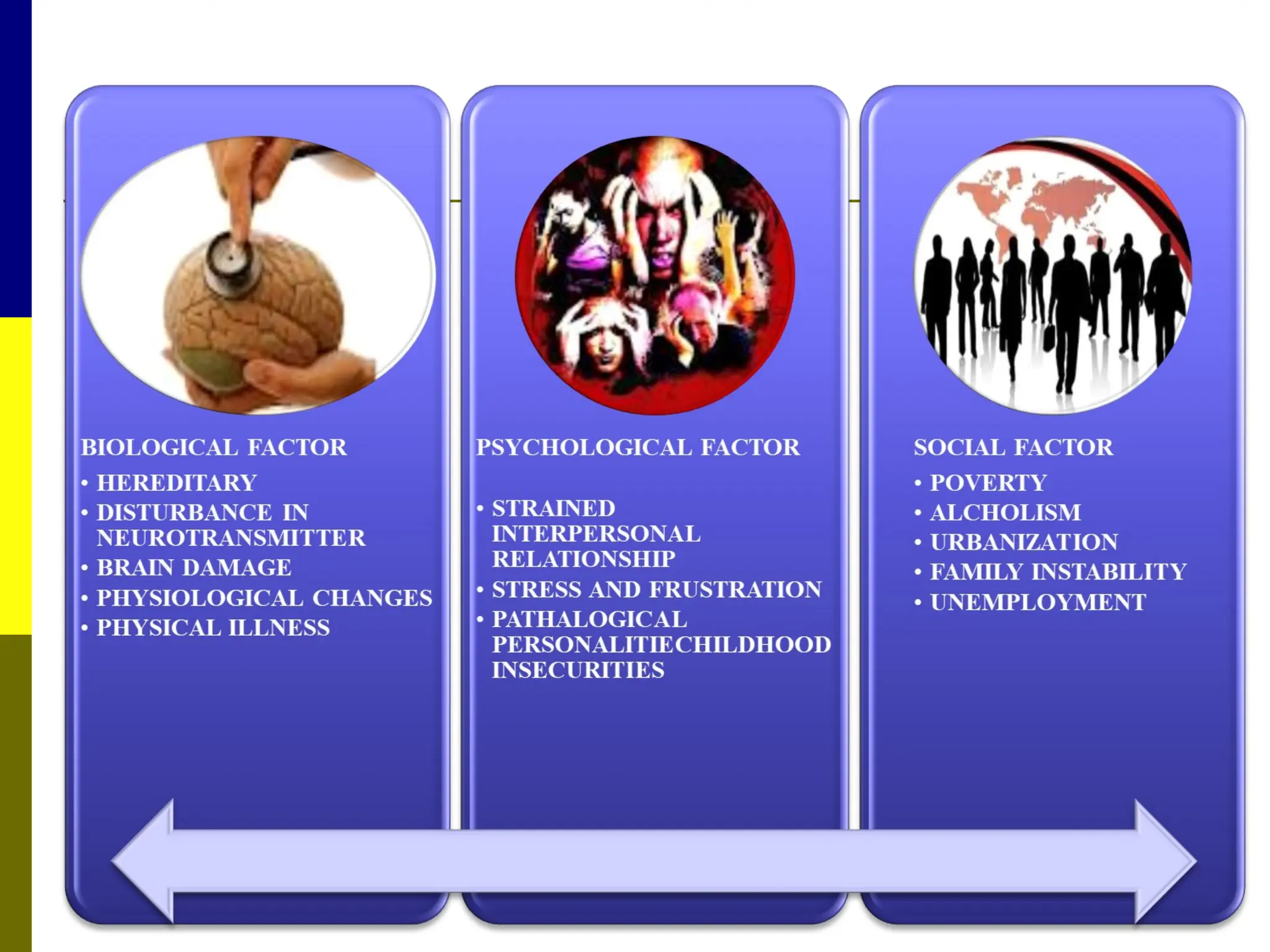
 ● Etiology bio-psycho-social factors
 ● Psychopathology of mental disorders: review of structure and function of brain,
limbic system and abnormal neurotransmission
 ● Principles of Mental health Nursing
 ● Ethics and responsibilities
 ● Practice Standards for Psychiatric Mental Health Nursing (INC practice
standards)
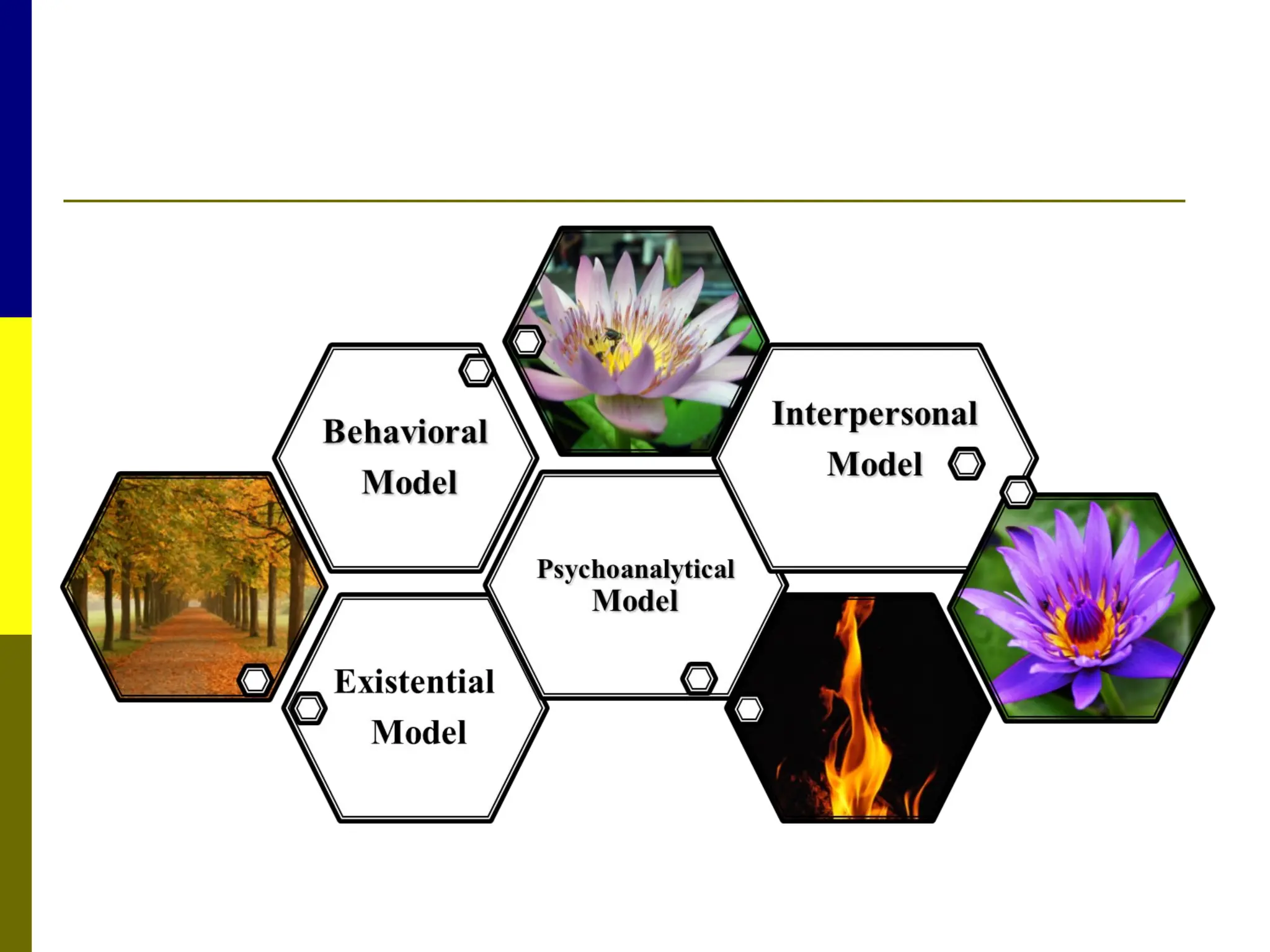
 ● Conceptual models and the role of nurse: o Existential model o Psychoanalytical
models o Behavioural model o Interpersonal model
 ● Preventive psychiatry and rehabilitation
Health
Health
WHO defines
“
“state of complete physical,
state of complete physical,
mental, and social wellness, not
merely absence of disease or
infirmity”
infirmity”
Mental Health
Mental Health
State of emotional, psychological, and social
wellness evidenced by
–Satisfying interpersonal relationships
–A positive self-concept
–Effective behaviour and coping
–Emotional stability (Or)
(Or)
lifelong process of successful adaptation to a
changing internal and external environments
Mentally Healthy Person
Accepts himself
Perceives reality
Mastery of self and environment
Autonomy
Unifying, integrated outlook in life
Psychiatry
Psychiatry
It is a branch of medicine that deals
with the diagnosis, treatment and
prevention of mental illness
Mental illness /Disorder
Mental disorder is “a clinically significant
behavioural or psychological syndrome or
pattern that occurs in an individual and that is
associated with distress or disability or with a
significantly increased risk of suffering death,
pain, disability, or an important loss of
freedom”
(American Psychological Association [APA])
Psychiatric nursing
Psychiatric nursing
Interpersonal process whereby the
professional nurse
practitioner ,through the therapeutic
use of self (art) and nursing theories
(science), assist clients to achieve
psychosocial well being.
Core : interpersonal process
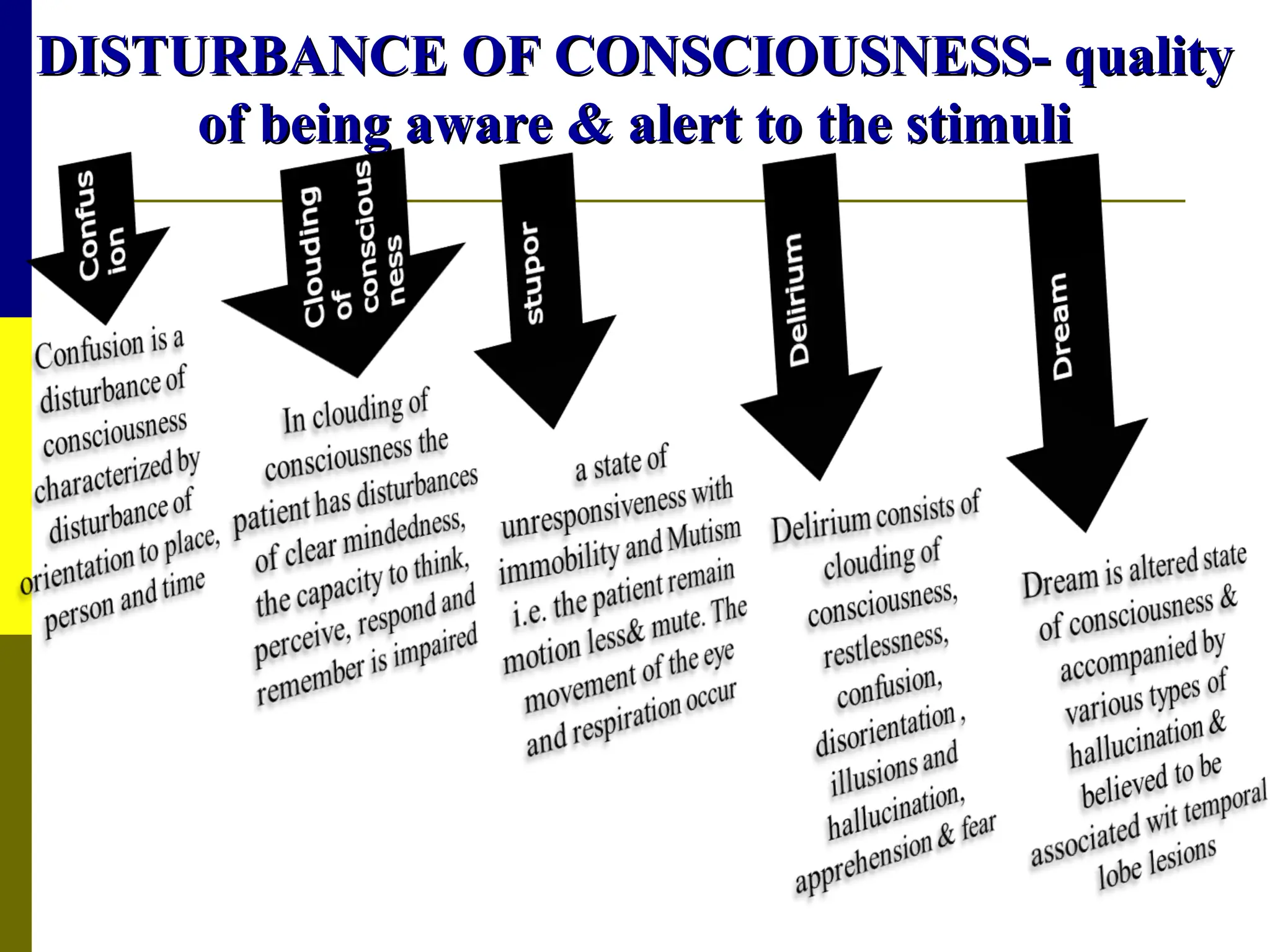
DISTURBANCE OF CONSCIOUSNESS- quality
of being aware & alert to the stimuli
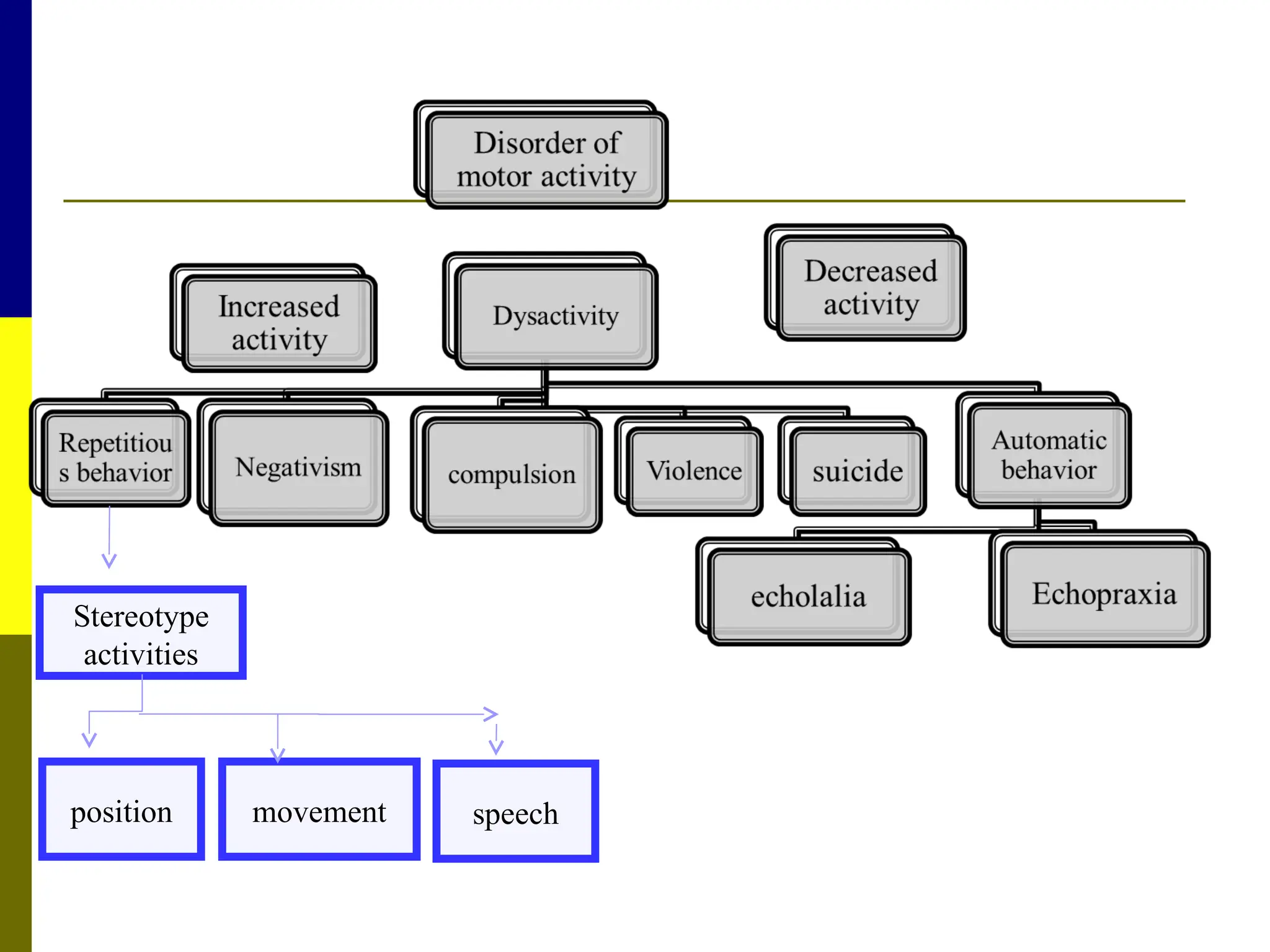
Stereotype
activities
speech
movement
position
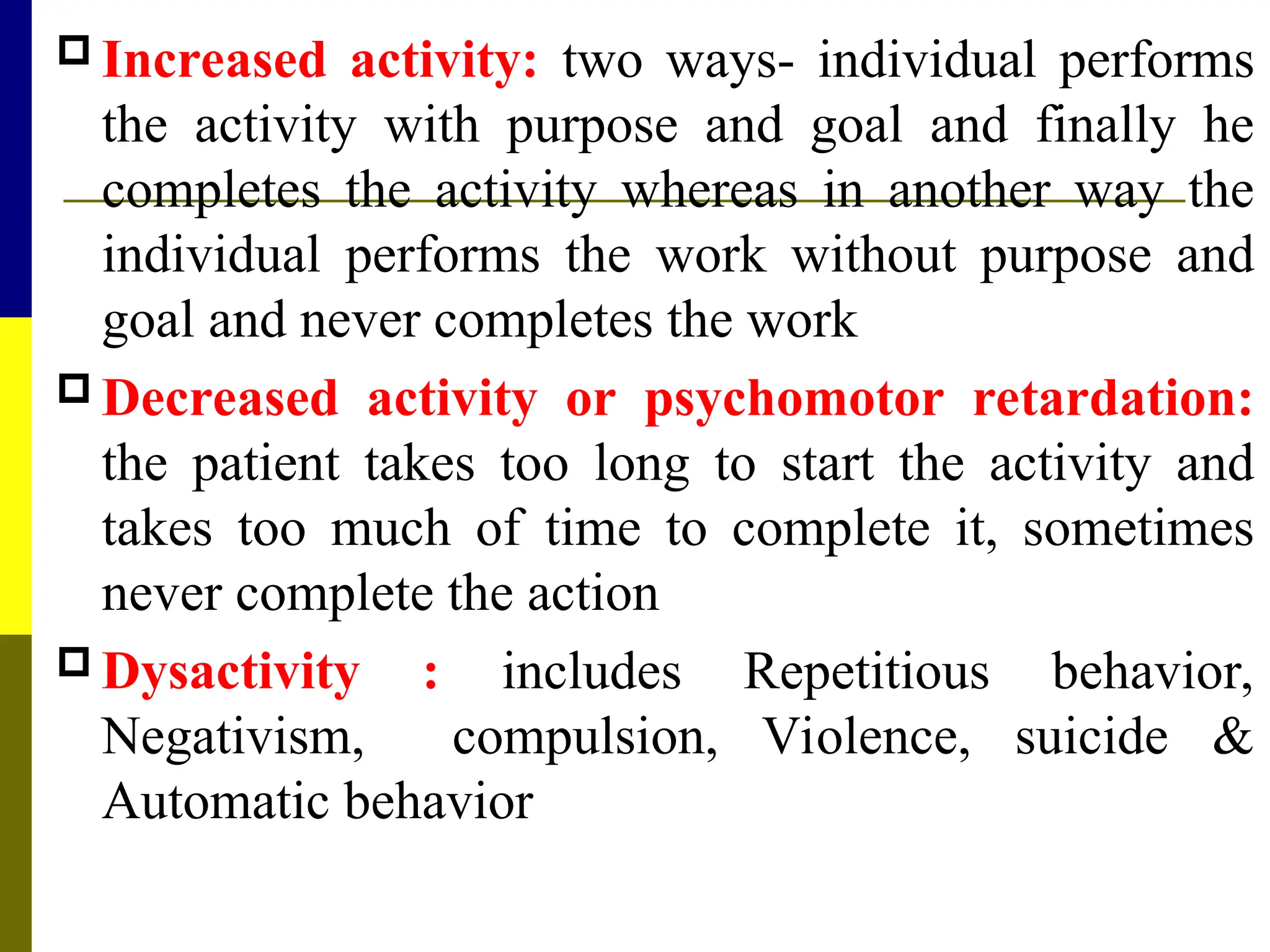
 Increased activity: two ways- individual performs
the activity with purpose and goal and finally he
completes the activity whereas in another way the
individual performs the work without purpose and
goal and never completes the work
 Decreased activity or psychomotor retardation:
the patient takes too long to start the activity and
takes too much of time to complete it, sometimes
never complete the action
 Dysactivity : includes Repetitious behavior,
Negativism, compulsion, Violence, suicide &
Automatic behavior
Repetitious activity: is characterized by
needless and purposeless activity. When
there is repetition in terms of action it is
called Stereotypy activity ( odd, repetitive,
and non goal oriented movements) .
 Stereotypy activity can be in position,
movement and speech
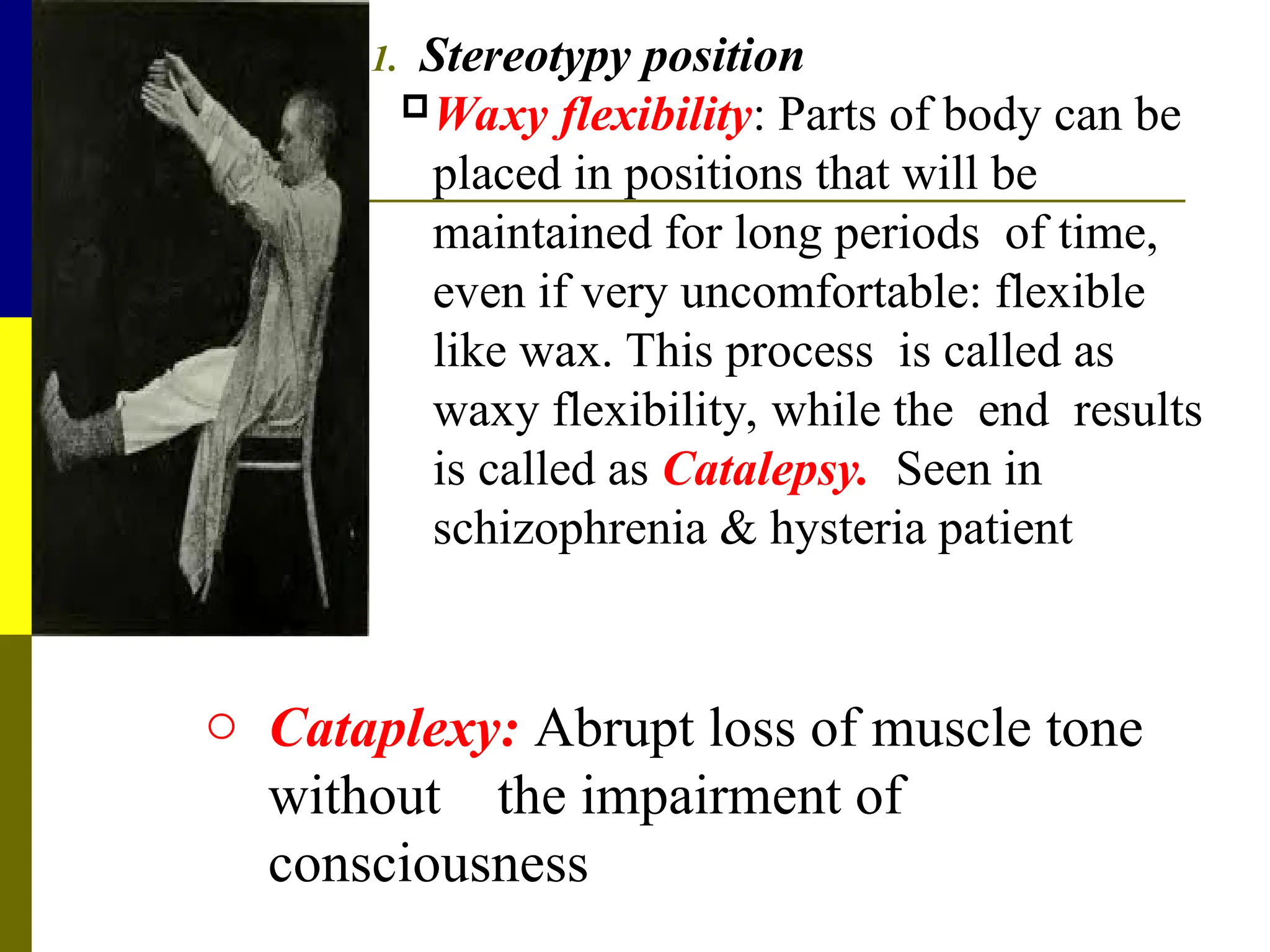
1. Stereotypy position
Waxy flexibility: Parts of body can be
placed in positions that will be
maintained for long periods of time,
even if very uncomfortable: flexible
like wax. This process is called as
waxy flexibility, while the end results
is called as Catalepsy. Seen in
schizophrenia & hysteria patient
o Cataplexy: Abrupt loss of muscle tone
without the impairment of
consciousness
2. Stereotypy movement : known as
Mannerism. When the movement is repeated it
is called mannerism. It is normal in general
patient. Usually schizophrenic patient exhibits
variety of mannerism
3. Stereotypy speech: Verbigeration or
stereotypy speech consists of repetition of
words, phrases or sentences. Eg: muscles,
muscles, muscles to all forms of questions
Negativism: the individual is aware of the
stimuli but he is trying to oppose these actively
or passively. Expressed in the forms of Mutism
e.g.: patients refusal of foods, and resistance to
effort to care for the patient
Automatism: a condition in which activity is
carried out without conscious knowledge on
the part of the patient. Automatic actions and
speech are seen in fugue states(Physical and
psychological flight (wandering) from one’s
usual place.) and sleep walking.
Automatism command
Automatic obedience: may also in the form of
repeating the in the patients presence, the
words or activities known as echolalia and
Echopraxia
Echolalia: the pathological, senseless
repetition (echoing) of a word or phrase just
spoken by another person. E.g what is your
name
Echopraxia: repetition by imitation of the
movements or action observed from other.
 Compulsion: repeatedly performing an act
which may look unreasonable to the viewers
and to the individual himself is called
compulsion
 Violence: is an aggressive behavior in which
physical force is exerted. E.g:- assassination,
murder, rape and even suicide
 Suicide: A human act of self-intentioned and
self inflicted session.
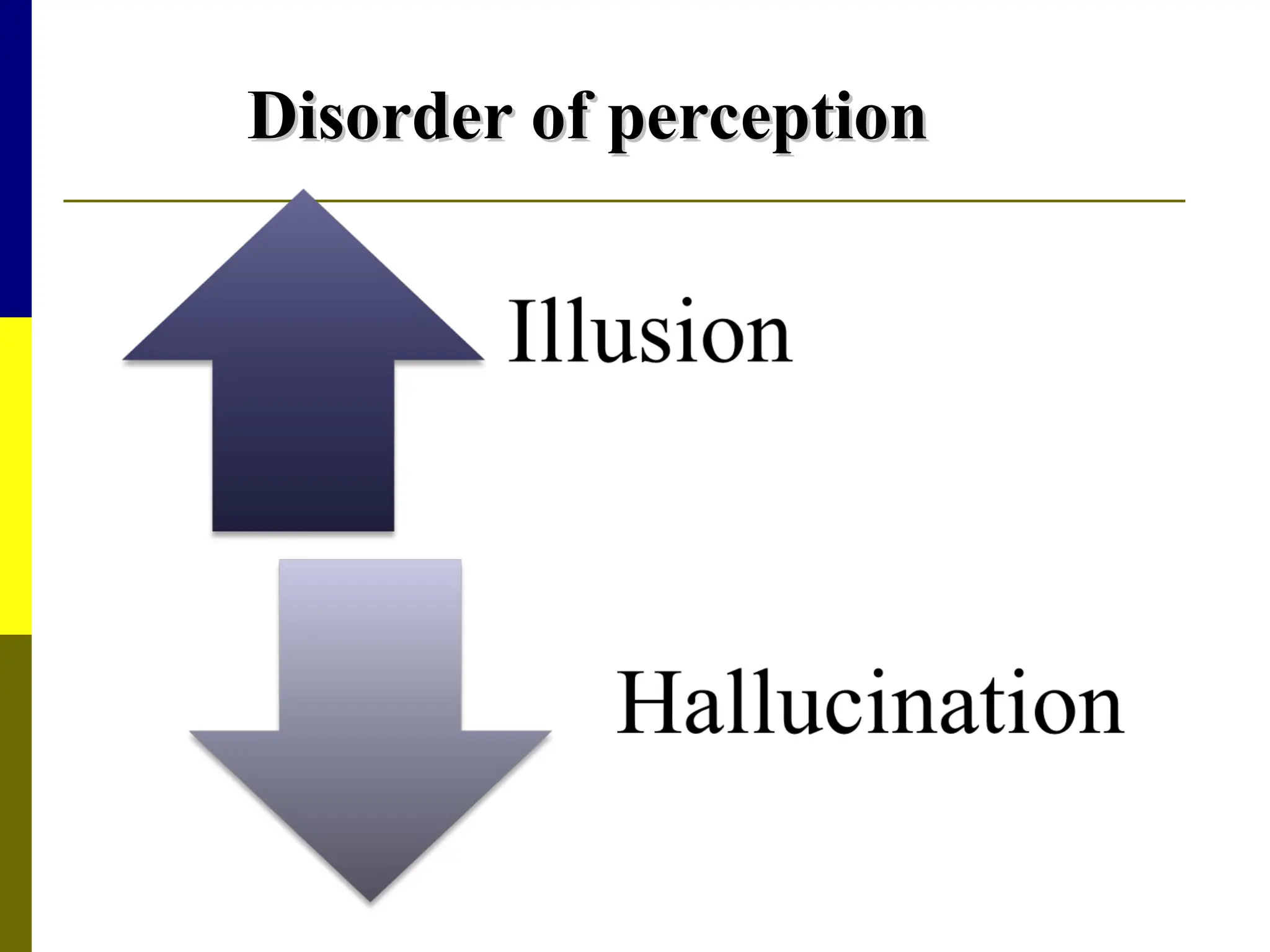
Disorder of perception
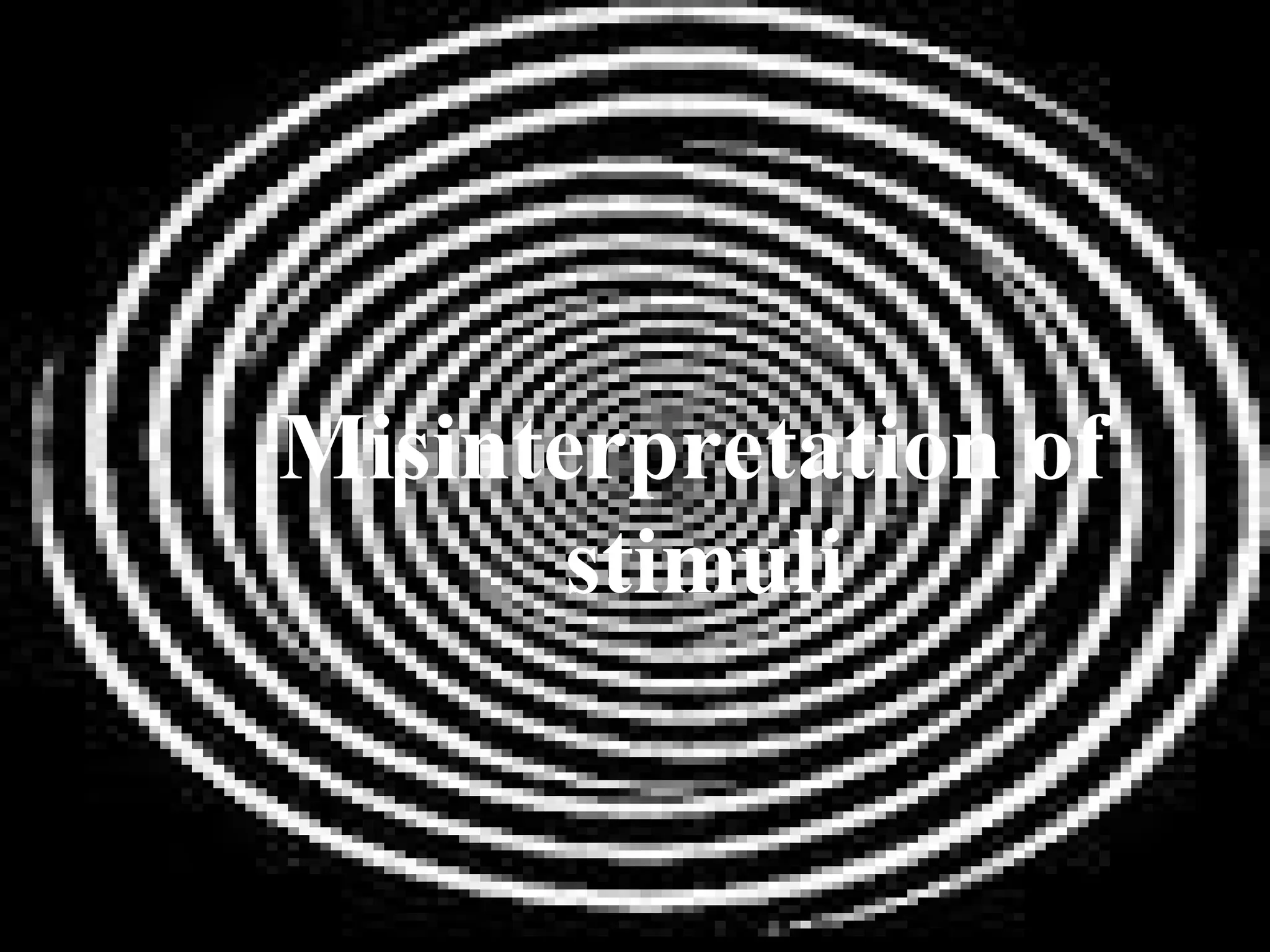
Misinterpretation of
stimuli
Illusion: a misperception or misinterpretation of a stimulus,
arising from the external objects.
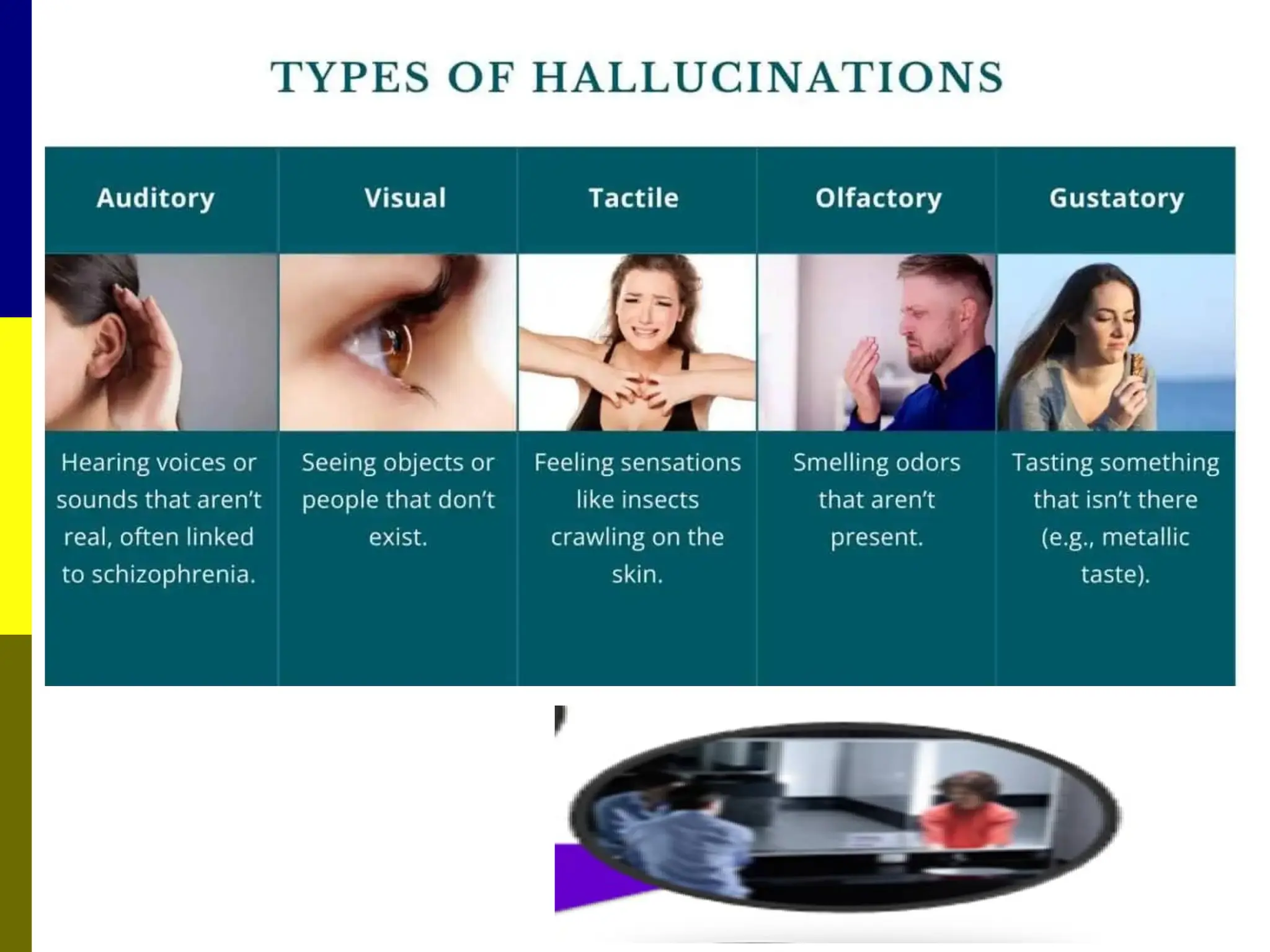
Hallucination a false sensory perception that occurs in the
absence of a stimulus
 Auditory hallucination : with voices
 Visual hallucination: with sight
 Olfactory hallucination: with smell associated with
organic syndromes
 Gustatory hallucination: with taste seen along with
olfactory hallucination
 Tactile hallucination or haptic hallucination: with touch
 Kinesthetic hallucination: phantom phenomenon that
some of his body parts are missing or distorted
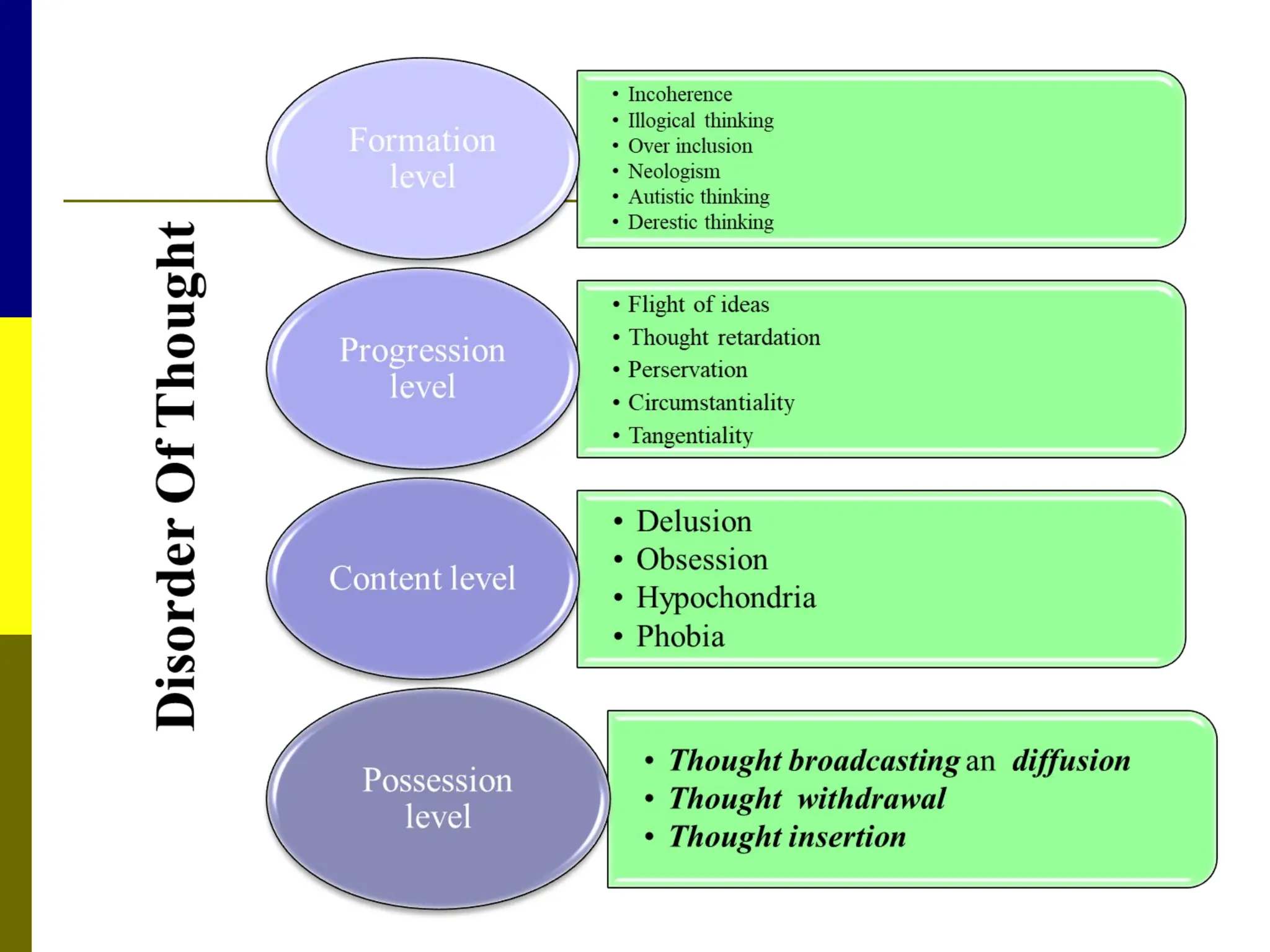
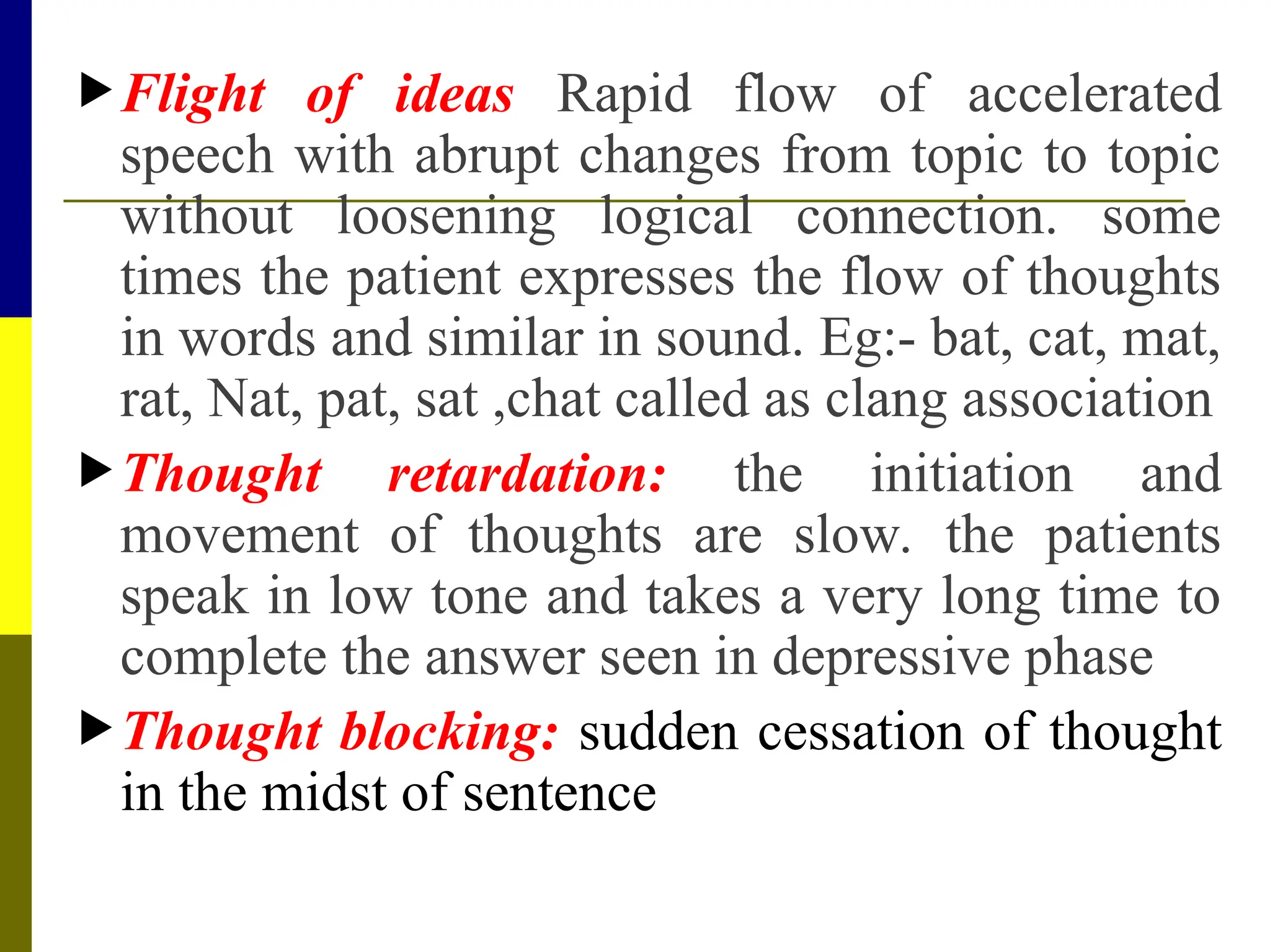
Flight of ideas Rapid flow of accelerated
speech with abrupt changes from topic to topic
without loosening logical connection. some
times the patient expresses the flow of thoughts
in words and similar in sound. Eg:- bat, cat, mat,
rat, Nat, pat, sat ,chat called as clang association
Thought retardation: the initiation and
movement of thoughts are slow. the patients
speak in low tone and takes a very long time to
complete the answer seen in depressive phase
Thought blocking: sudden cessation of thought
in the midst of sentence
 Perseveration: Persistent repetition of words or
themes beyond their point of relevance.e.g:- who
is the first prime minister of India – Nehru and
who is the present prime of India: - Nehru
 Tangentiality: sudden and oblique digression into
unnecessary details that completely distracts from
the central theme: however, the patient never
returns back to the original theme after digression.
 Incoherence: thought process that is
disorganized, disconnected or incomprehensible.
 Circumstantiality: Digression in to unnecessary
details that distract from the central theme, however
the patient returns back to the original theme after
digression
 Delusion: a false unshakable belief which is not
amenable to reasoning, and is not in keeping with the
patient’s socio cultural and educational background.
Delusions are subdivided according to their content.
Some of the more common types are: bizarre;
 Delusional jealousy:
 delusion of reference: false belief that behaviors of
others are refers to self
 Delusion of guilt: seen in depression. The
patient becomes self critical and believes he is
the sinner
 Delusion of persecution: false belief that
members of the family are trying to kill him
 Nihilistic delusion: known as delusion of
negation because the patient denies or does not
accepts the existence of his body , his loved
ones and the world around him
 Somatic delusion:
 Delusion of self accusation: holding self
responsible for everything seen in depression
 Ideas of control: the patient may complain that his thought are
controlled and read by others
 Hypochondria: patient has exaggerated concern over his bodily
health
 Thought broadcasting or diffusion: the delusion that one's thoughts
are being broadcast out loud so that they can be perceived by others.
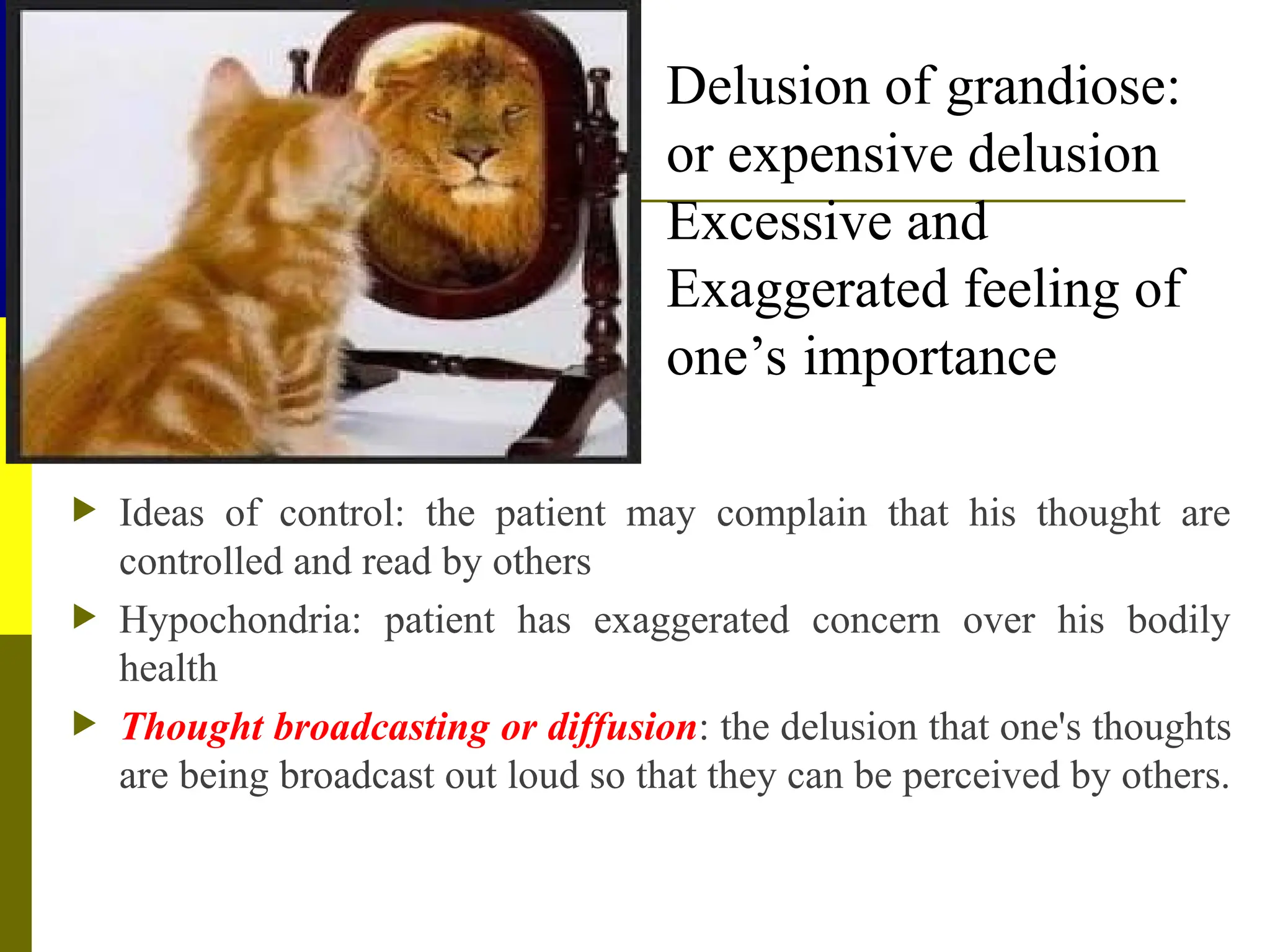
Delusion of grandiose:
or expensive delusion
Excessive and
Exaggerated feeling of
one’s importance
 Thought eco: Voice speaking out thoughts aloud: also called as echo
de la pense
 Thought insertion: the delusion that certain of one's thoughts are not
one's own, but rather are inserted into one's mind.
 Phobia: a persistent, irrational fear of a specific object, activity, or
situation (the phobic stimulus) that results in a compelling desire to
avoid it.
 Obsession: in this, ideas, thoughts or impulses that cannot be
eliminated from consciousness by logical efforts are called obsessive
rumination while uncontrollable impulses to perform an act
repeiptively are known as compulsion
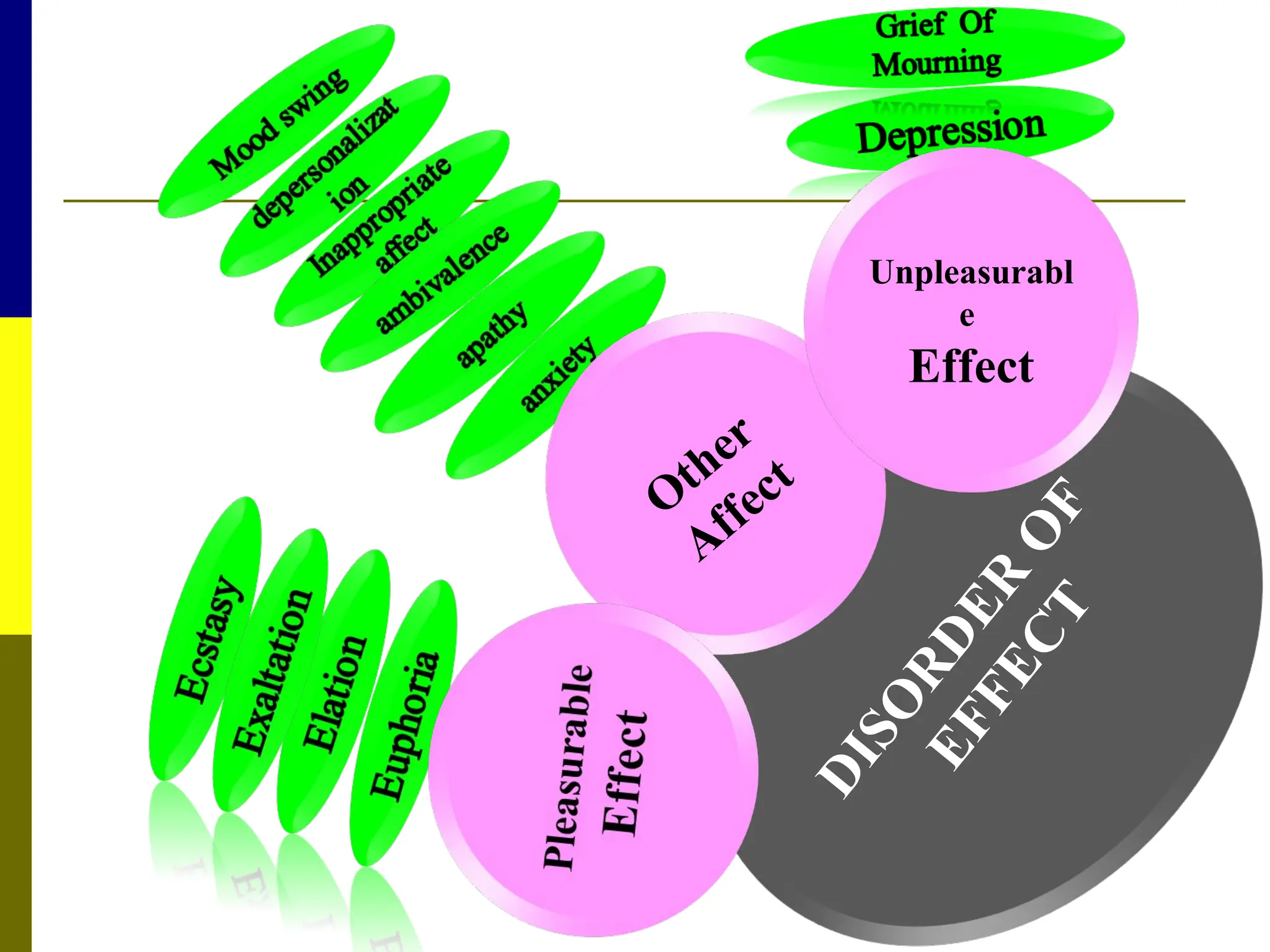
D
I
S
O
R
D
E
R
O
F
E
F
F
E
C
T
O
ther
Affect
Unpleasurabl
e
Effect
Euphoria: Mild elevation of mood
Elation: Moderate elevation of mood
Exaltation: severe elevation of mood.
Ecstasy: Very severe elevation of mood.
Intense sense of rupture.
Ambivalence: The coexistence of contradictory
emotions, attitudes, ideas, or desires with
respect to a particular person, object, or
situation. Ordinarily, the ambivalence is not
fully conscious and suggests psychopathology
only when present in an extreme form.
Anxiety: An unpleasurable emotional state,
associated with psycho-physiological changes
in response to an intra psychic conflict.
 panic: state of extreme, acute, intense anxiety
accompanied by disorganization of ego
functions
 Apathy:
Apathy: is the absence of affect.
Inappropriate affect: there is a disharmony in
feelings to a situation
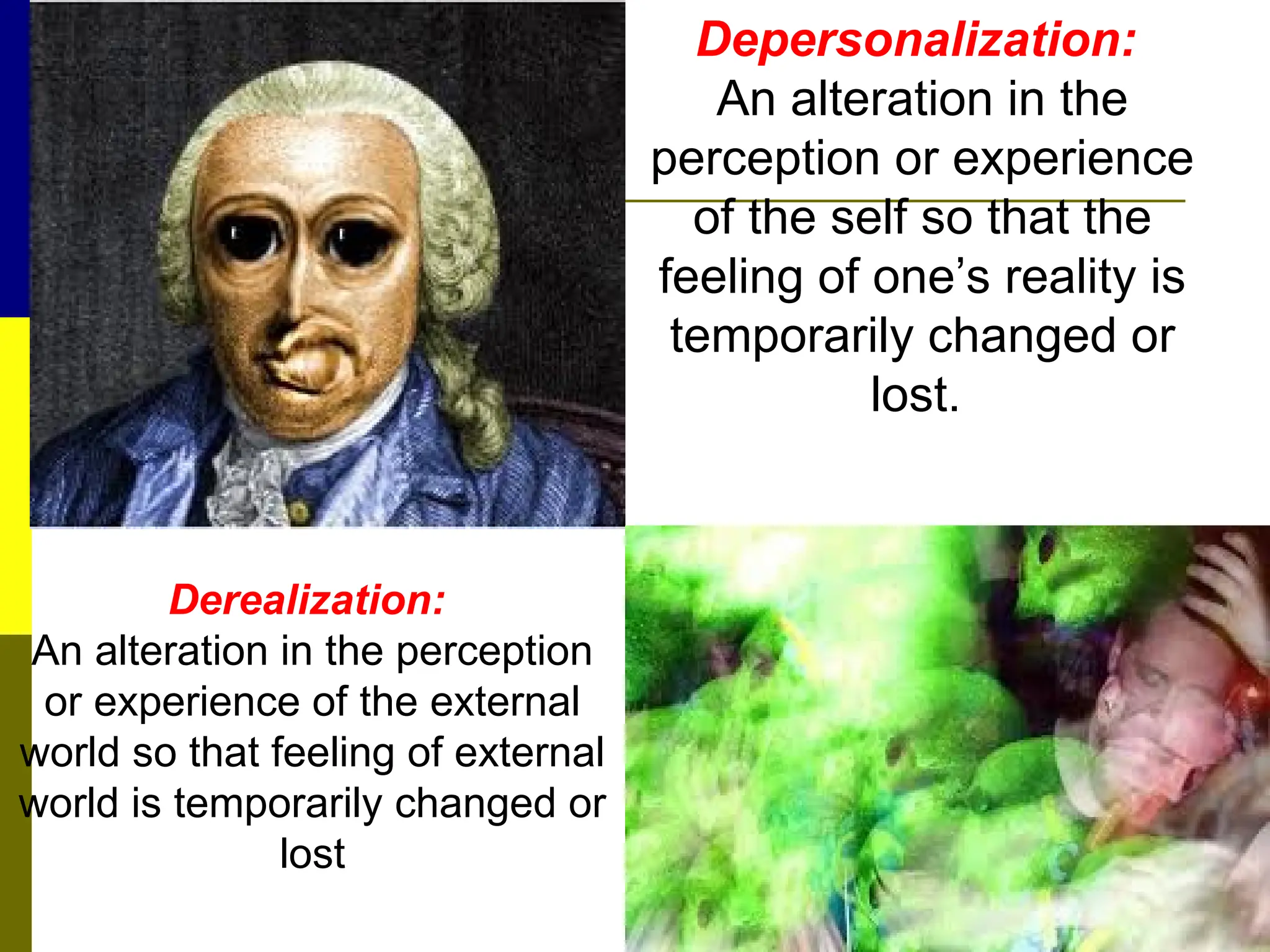
Derealization:
An alteration in the perception
or experience of the external
world so that feeling of external
world is temporarily changed or
lost
Depersonalization:
An alteration in the
perception or experience
of the self so that the
feeling of one’s reality is
temporarily changed or
lost.
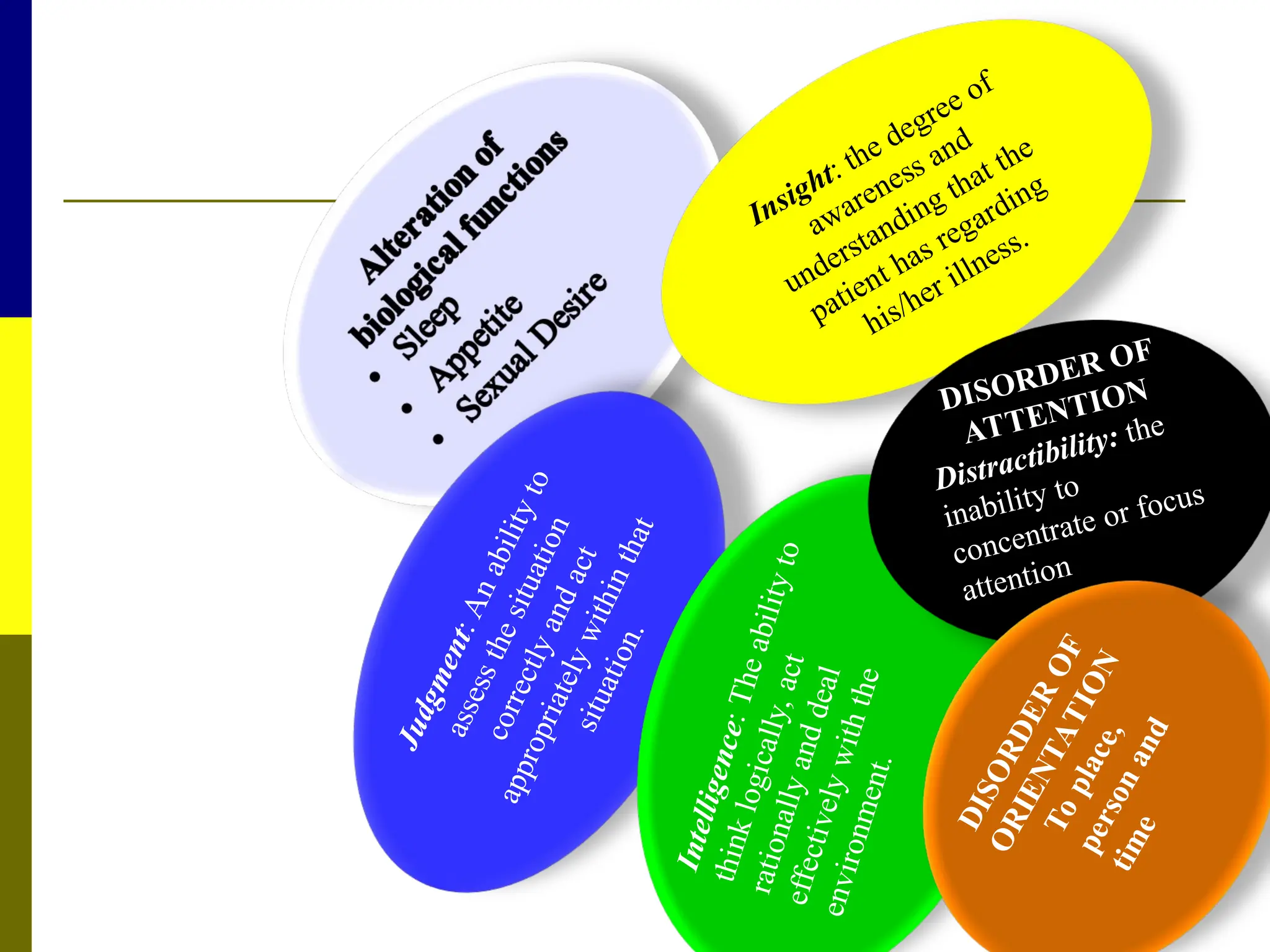
Insight: the degree of
awareness and
understanding that the
patient has regarding
his/her illness.
J
u
d
g
m
e
n
t
:
A
n
a
b
i
l
i
t
y
t
o
a
s
s
e
s
s
t
h
e
s
i
t
u
a
t
i
o
n
c
o
r
r
e
c
t
l
y
a
n
d
a
c
t
a
p
p
r
o
p
r
i
a
t
e
l
y
w
i
t
h
i
n
t
h
a
t
s
i
t
u
a
t
i
o
n
.
I
n
t
e
l
l
i
g
e
n
c
e
:
T
h
e
a
b
i
l
i
t
y
t
o
t
h
i
n
k
l
o
g
i
c
a
l
l
y
,
a
c
t
r
a
t
i
o
n
a
l
l
y
a
n
d
d
e
a
l
e
f
f
e
c
t
i
v
e
l
y
w
i
t
h
t
h
e
e
n
v
i
r
o
n
m
e
n
t
.
DISORDER OF
ATTENTION
Distractibility: the
inability to
concentrate or focus
attention
D
I
S
O
R
D
E
R
O
F
O
R
I
E
N
T
A
T
I
O
N
T
o
p
l
a
c
e
,
p
e
r
s
o
n
a
n
d
t
i
m
e
CLASSIFICATION
CLASSIFICATION
IN
IN
PSYCHIATRY
PSYCHIATRY
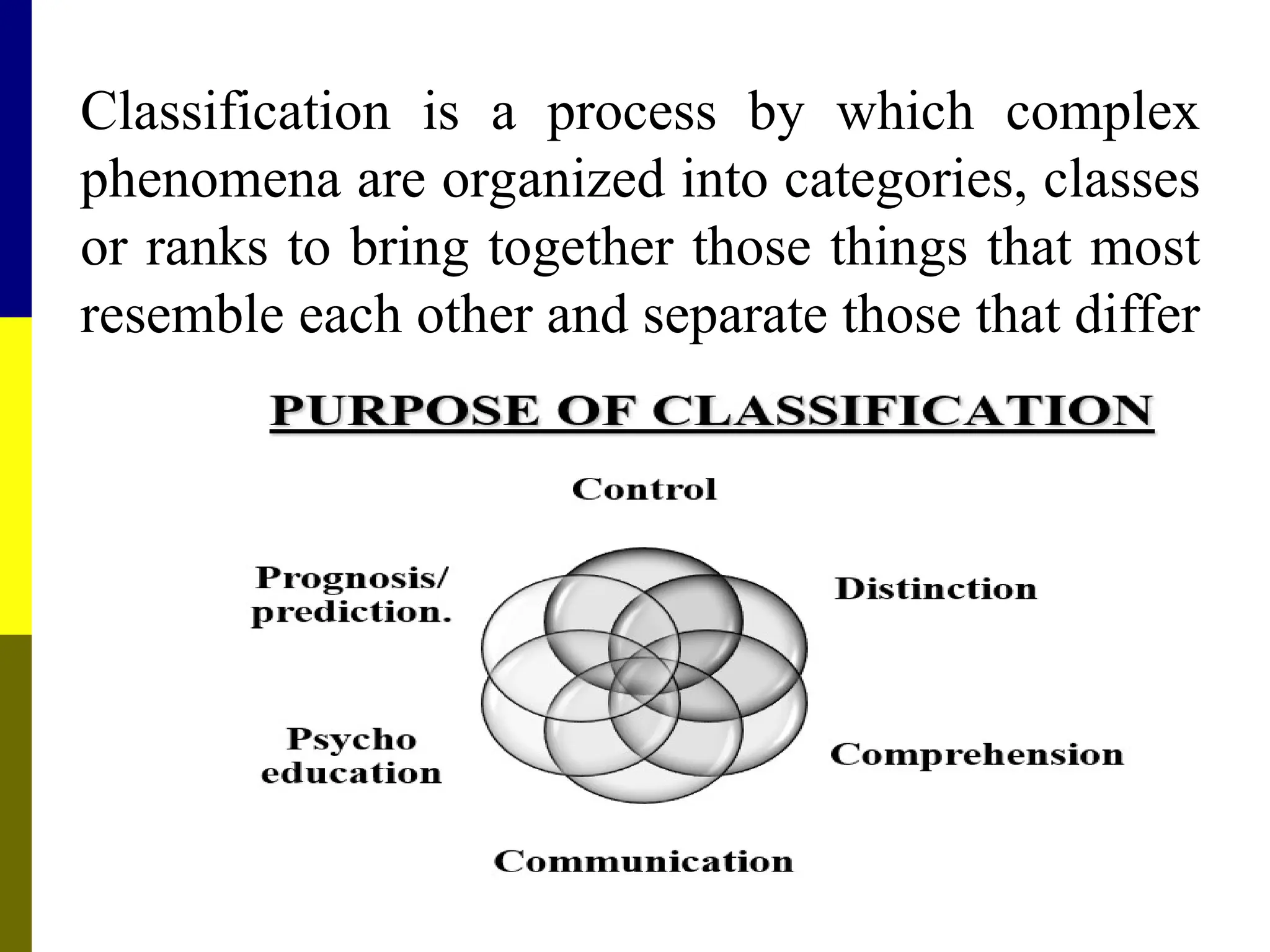
Classification is a process by which complex
phenomena are organized into categories, classes
or ranks to bring together those things that most
resemble each other and separate those that differ
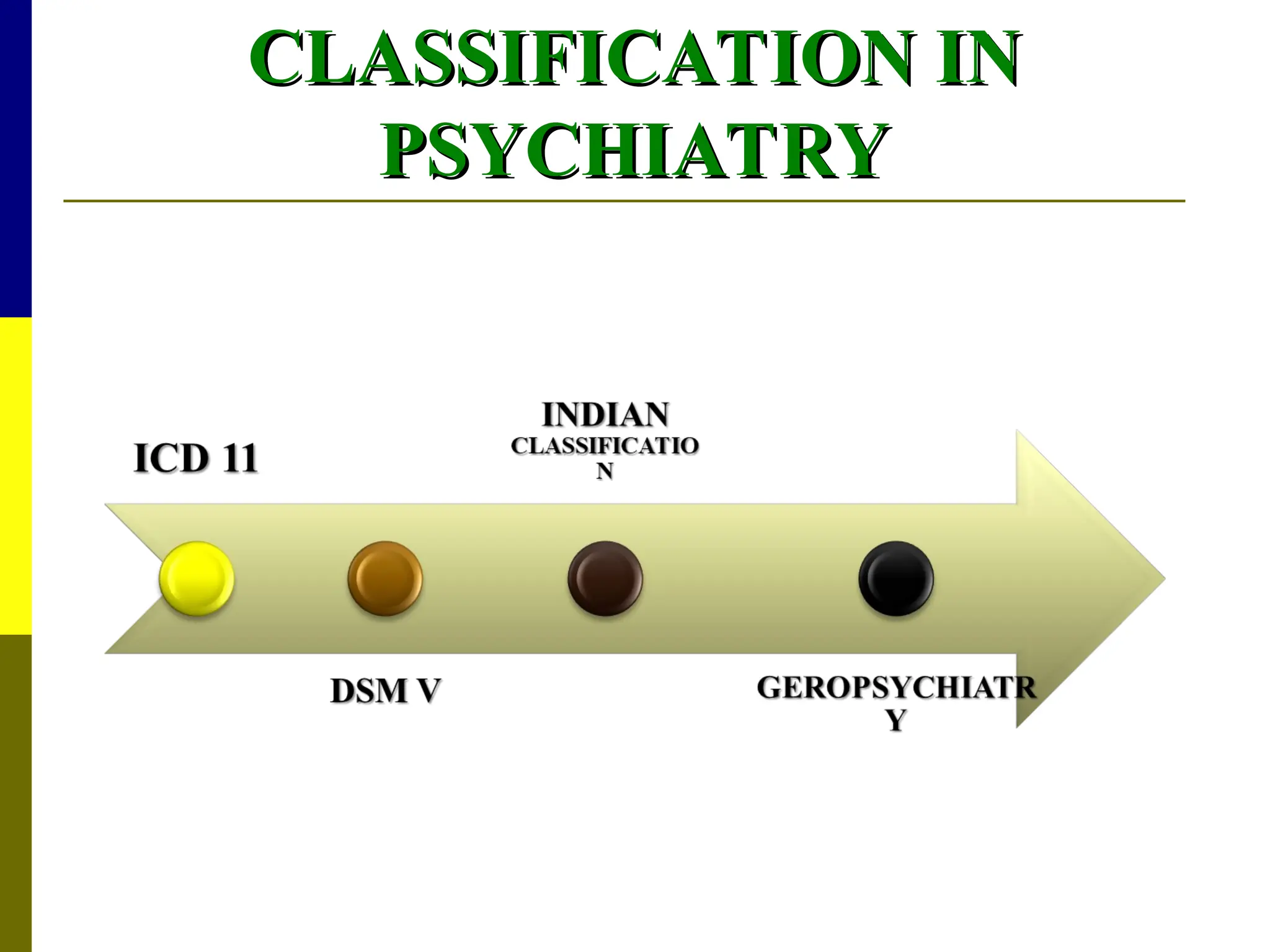
CLASSIFICATION IN
CLASSIFICATION IN
PSYCHIATRY
PSYCHIATRY
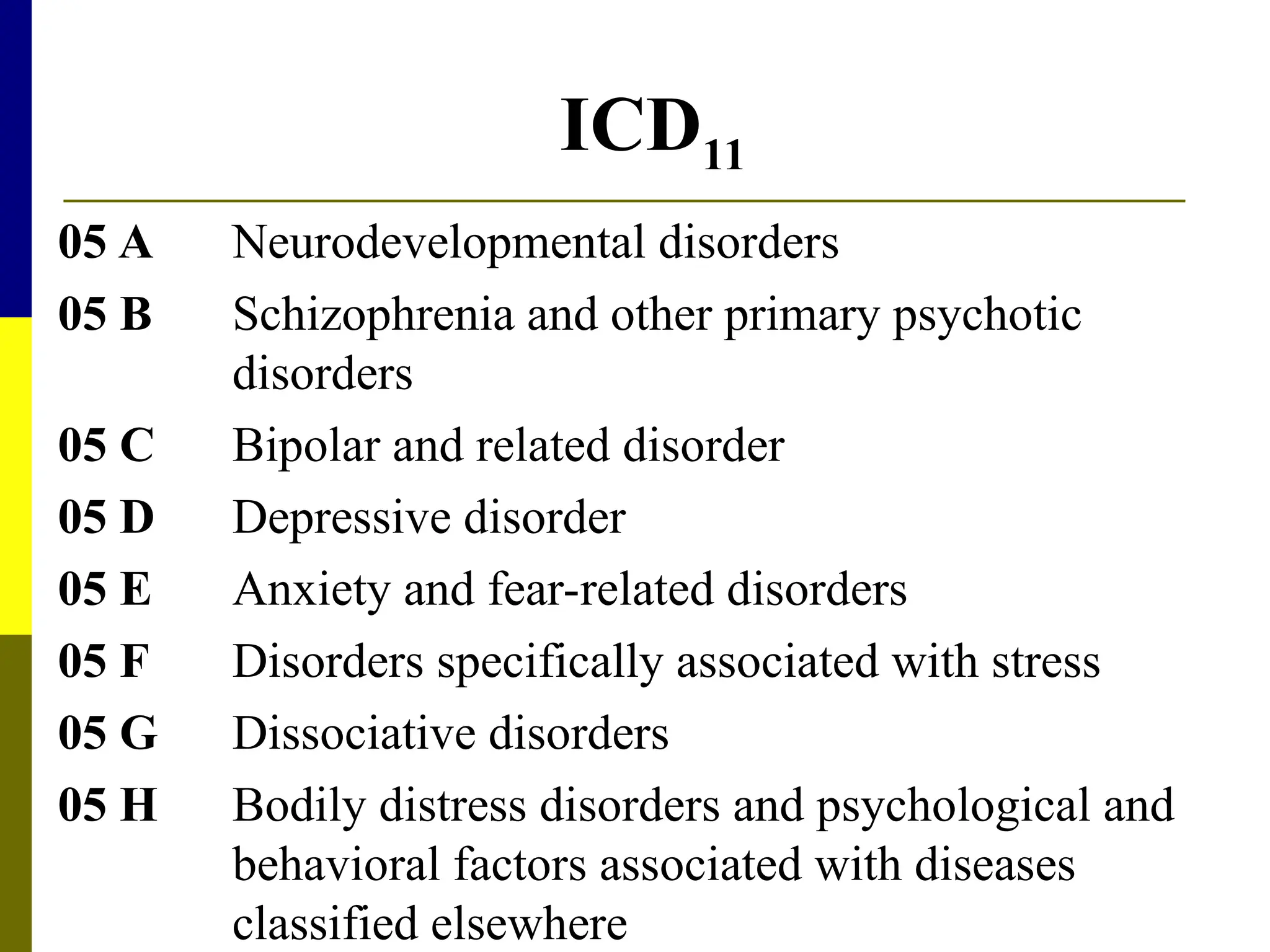
05 A Neurodevelopmental disorders
05 B Schizophrenia and other primary psychotic
disorders
05 C Bipolar and related disorder
05 D Depressive disorder
05 E Anxiety and fear-related disorders
05 F Disorders specifically associated with stress
05 G Dissociative disorders
05 H Bodily distress disorders and psychological and
behavioral factors associated with diseases
classified elsewhere
ICD11
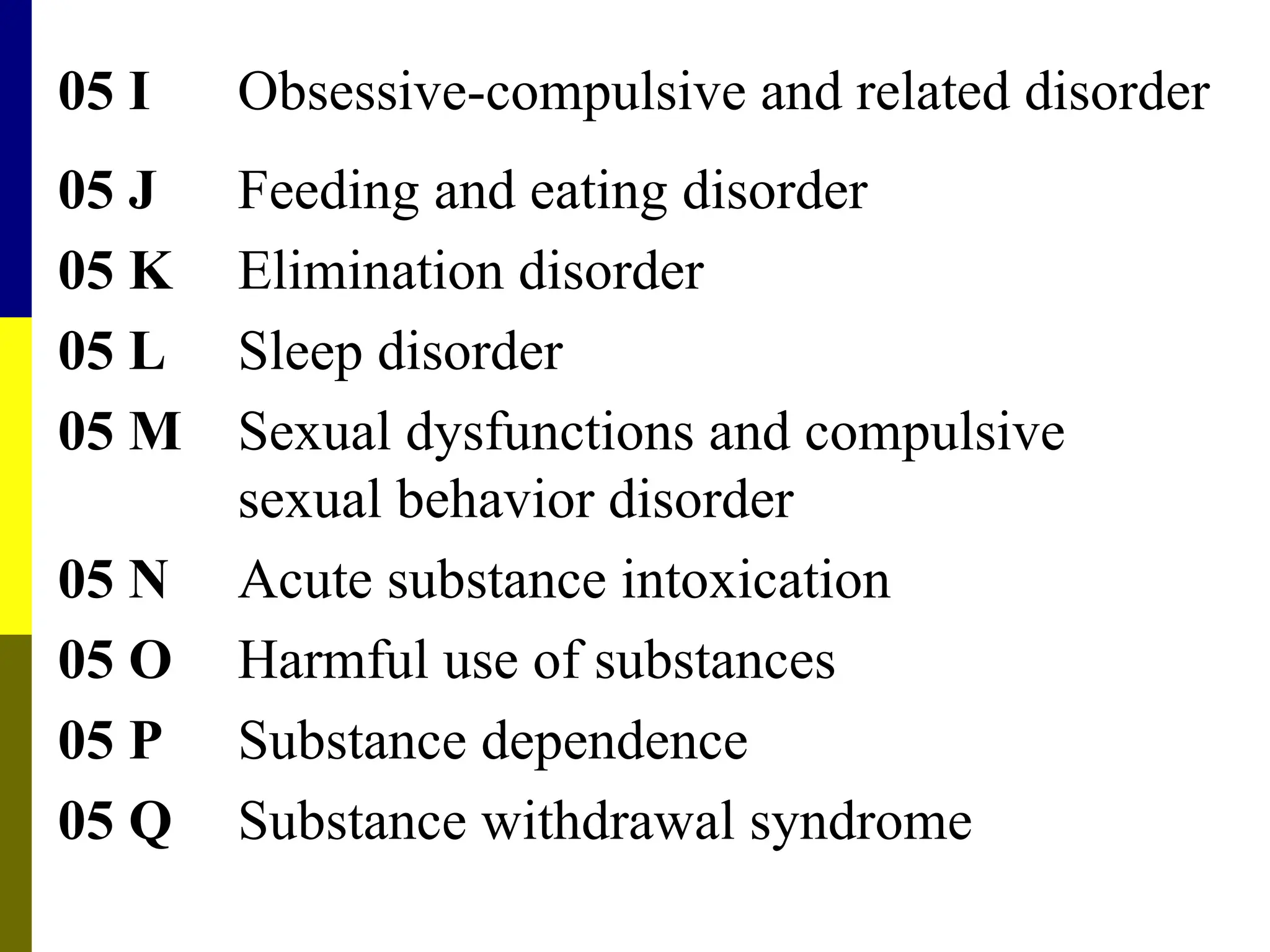
05 I Obsessive-compulsive and related disorder
05 J Feeding and eating disorder
05 K Elimination disorder
05 L Sleep disorder
05 M Sexual dysfunctions and compulsive
sexual behavior disorder
05 N Acute substance intoxication
05 O Harmful use of substances
05 P Substance dependence
05 Q Substance withdrawal syndrome
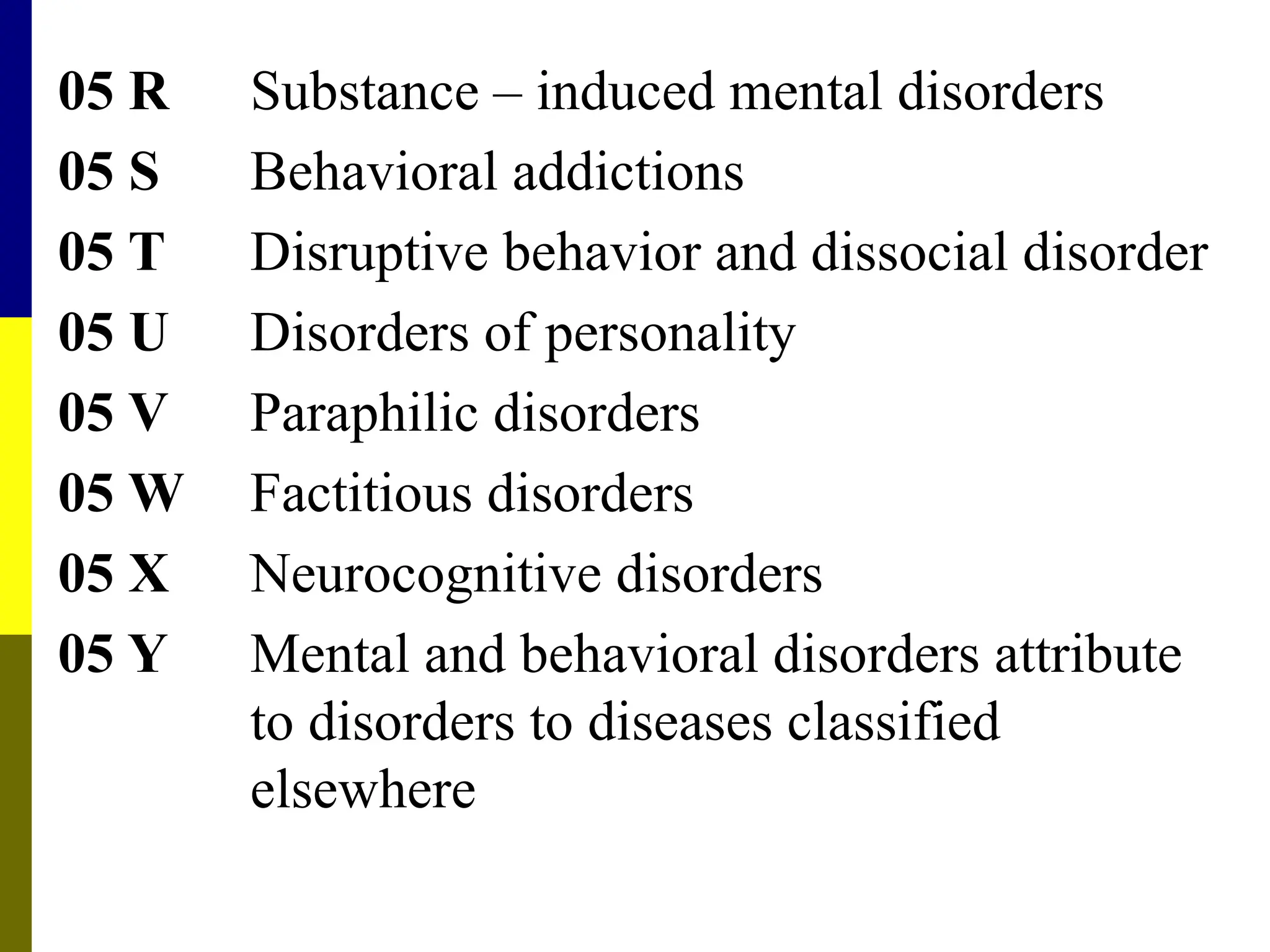
05 R Substance – induced mental disorders
05 S Behavioral addictions
05 T Disruptive behavior and dissocial disorder
05 U Disorders of personality
05 V Paraphilic disorders
05 W Factitious disorders
05 X Neurocognitive disorders
05 Y Mental and behavioral disorders attribute
to disorders to diseases classified
elsewhere
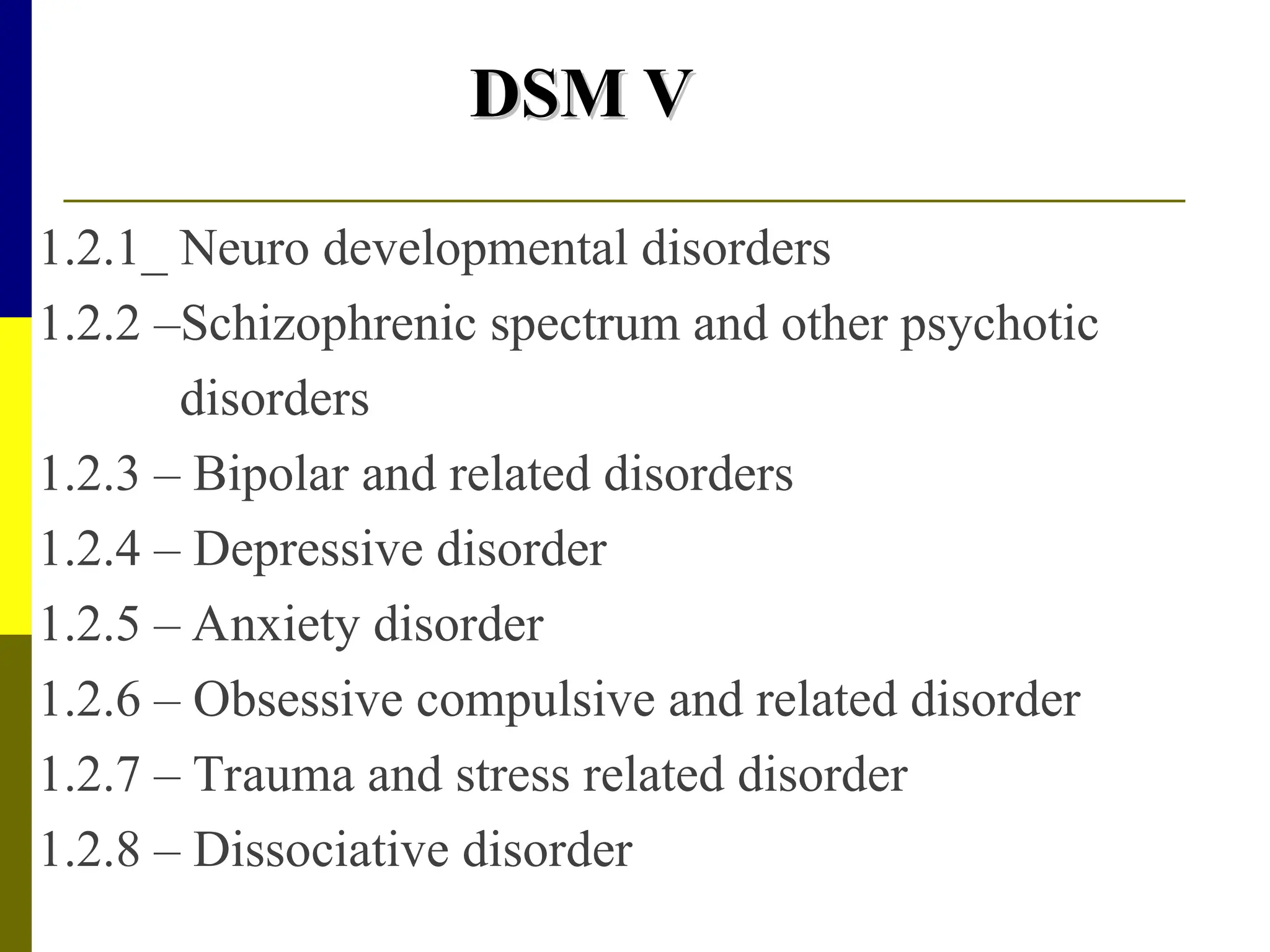
DSM V
DSM V
1.2.1_ Neuro developmental disorders
1.2.2 –Schizophrenic spectrum and other psychotic
disorders
1.2.3 – Bipolar and related disorders
1.2.4 – Depressive disorder
1.2.5 – Anxiety disorder
1.2.6 – Obsessive compulsive and related disorder
1.2.7 – Trauma and stress related disorder
1.2.8 – Dissociative disorder
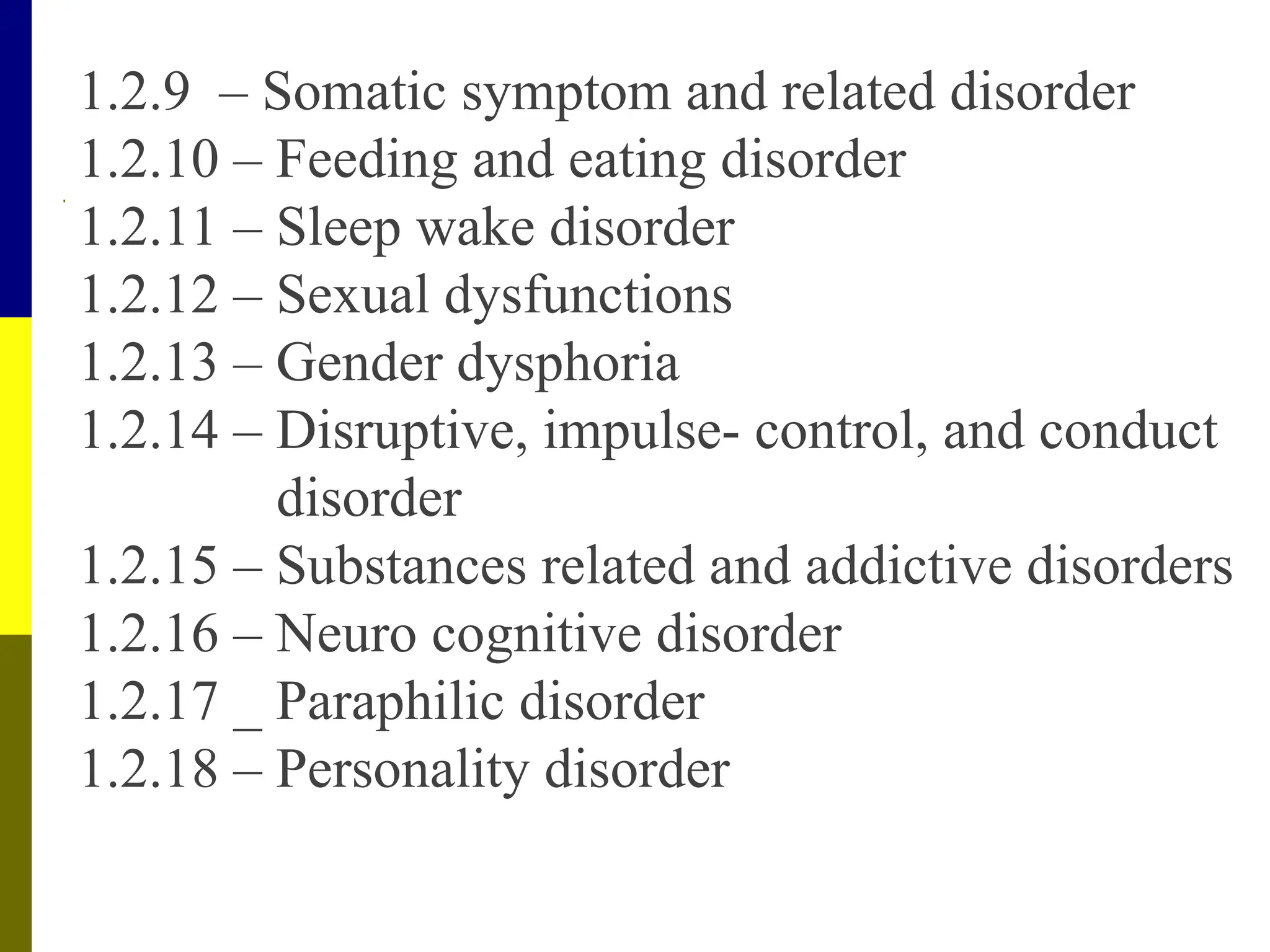
1.2.9 – Somatic symptom and related disorder
1.2.10 – Feeding and eating disorder
1.2.11 – Sleep wake disorder
1.2.12 – Sexual dysfunctions
1.2.13 – Gender dysphoria
1.2.14 – Disruptive, impulse- control, and conduct
disorder
1.2.15 – Substances related and addictive disorders
1.2.16 – Neuro cognitive disorder
1.2.17 _ Paraphilic disorder
1.2.18 – Personality disorder
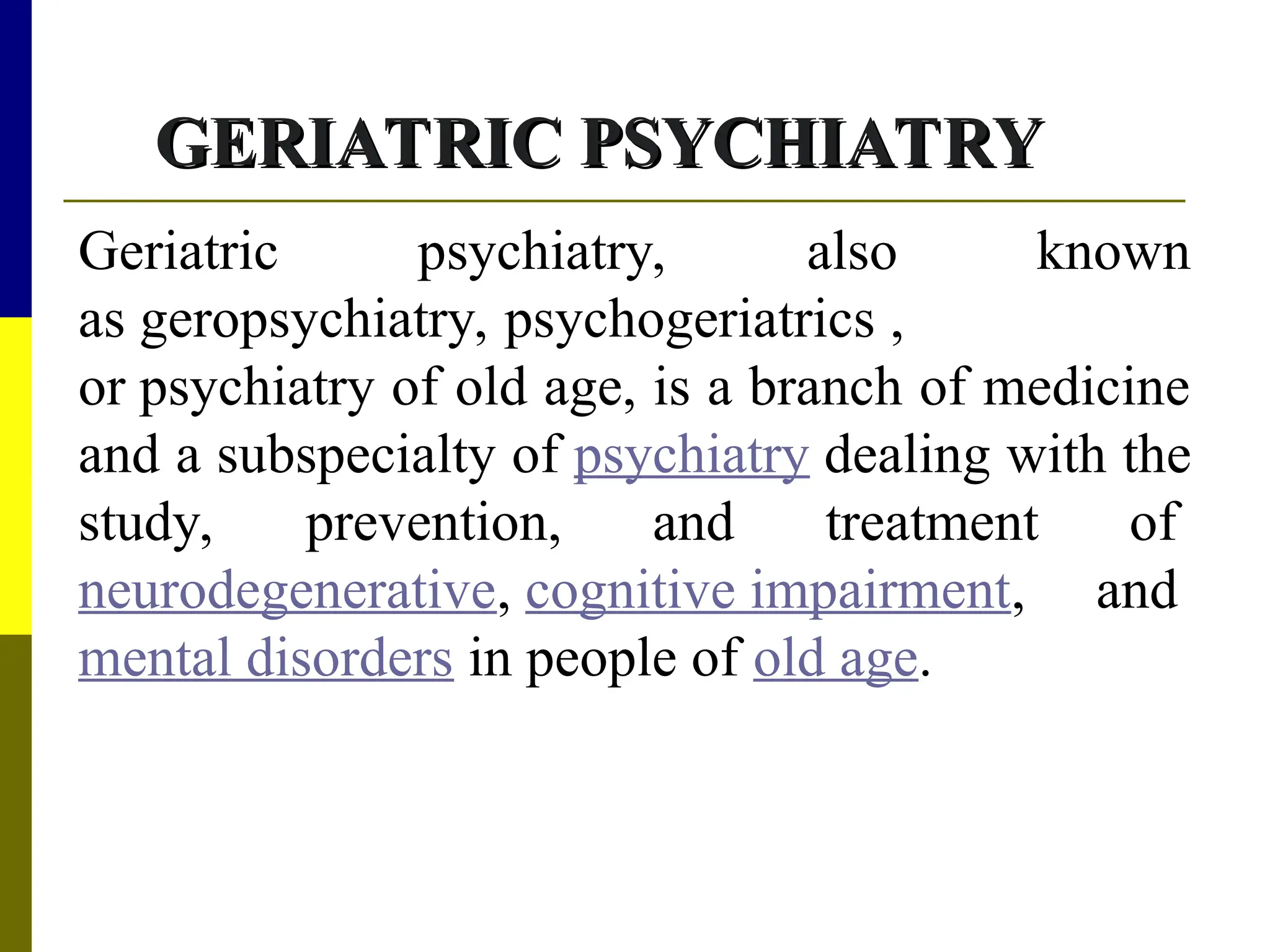
GERIATRIC PSYCHIATRY
Geriatric psychiatry, also known
as geropsychiatry, psychogeriatrics ,
or psychiatry of old age, is a branch of medicine
and a subspecialty of psychiatry dealing with the
study, prevention, and treatment of
neurodegenerative, cognitive impairment, and
mental disorders in people of old age.
Diseases
Diseases
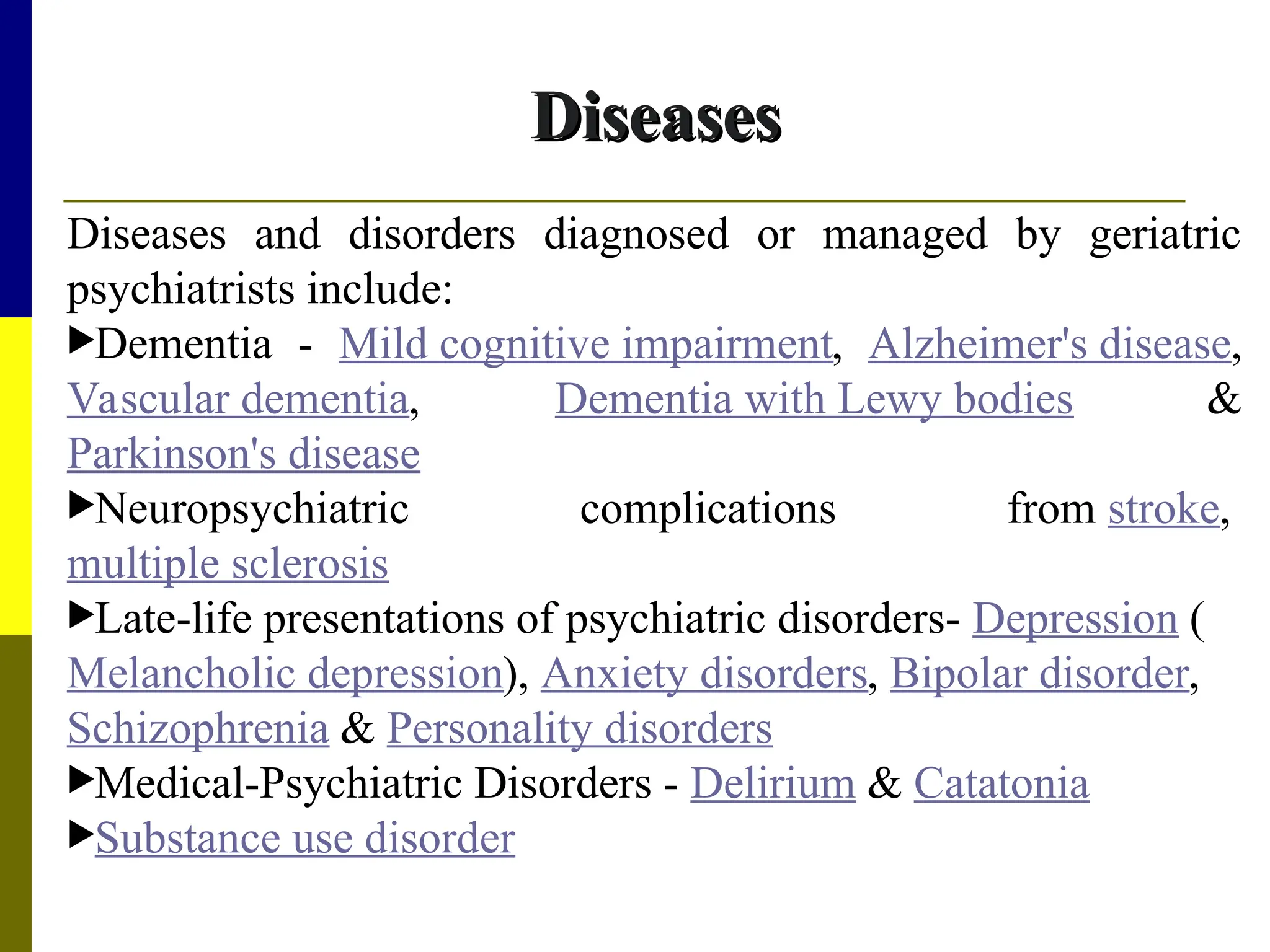
Diseases and disorders diagnosed or managed by geriatric
psychiatrists include:
Dementia - Mild cognitive impairment, Alzheimer's disease,
Vascular dementia, Dementia with Lewy bodies &
Parkinson's disease
Neuropsychiatric complications from stroke,
multiple sclerosis
Late-life presentations of psychiatric disorders- Depression (
Melancholic depression), Anxiety disorders, Bipolar disorder,
Schizophrenia & Personality disorders
Medical-Psychiatric Disorders - Delirium & Catatonia
Substance use disorder
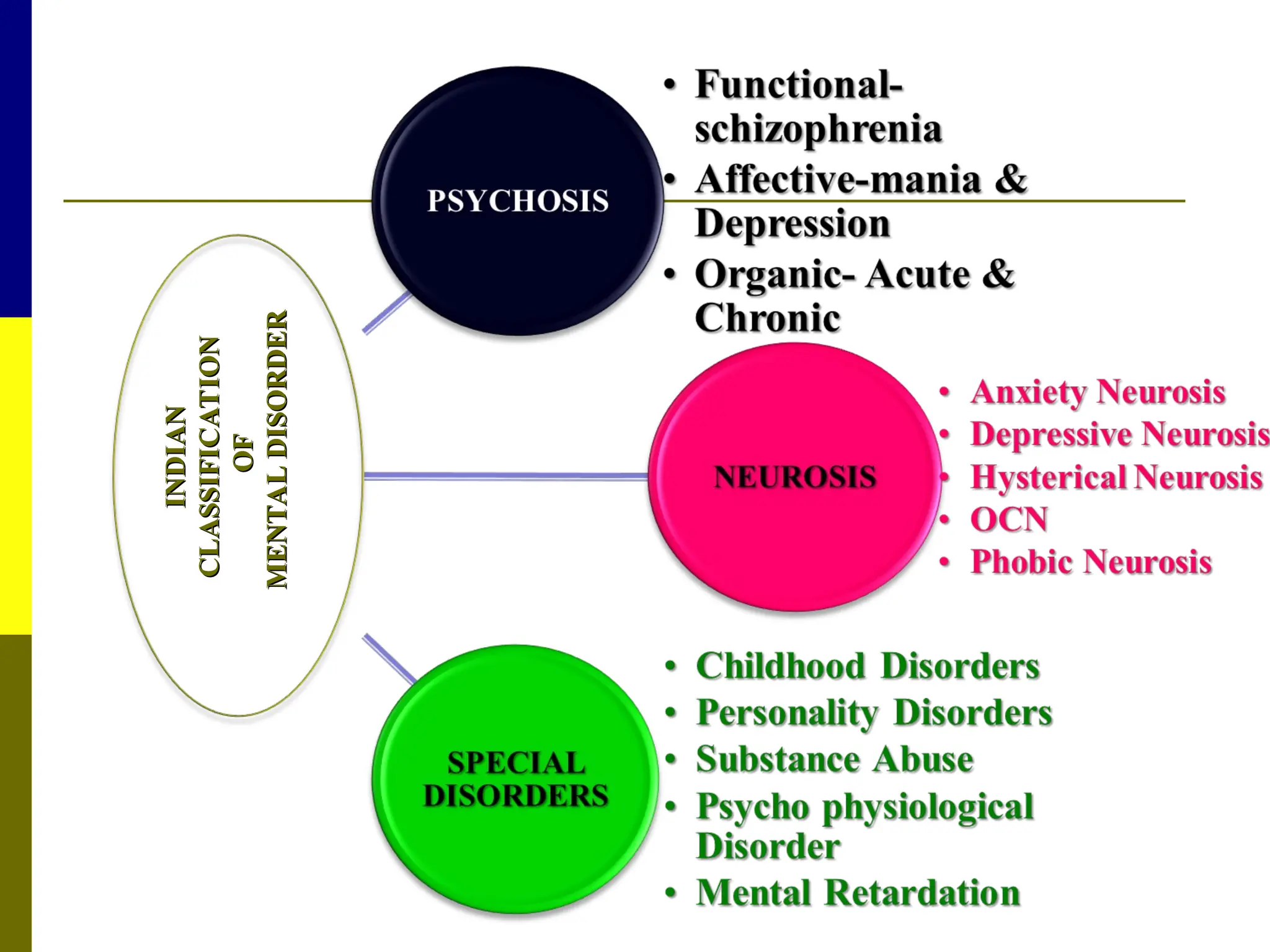
INDIAN
INDIAN
CLASSIFICATION
CLASSIFICATION
OF
OF
MENTAL
DISORDER
MENTAL
DISORDER
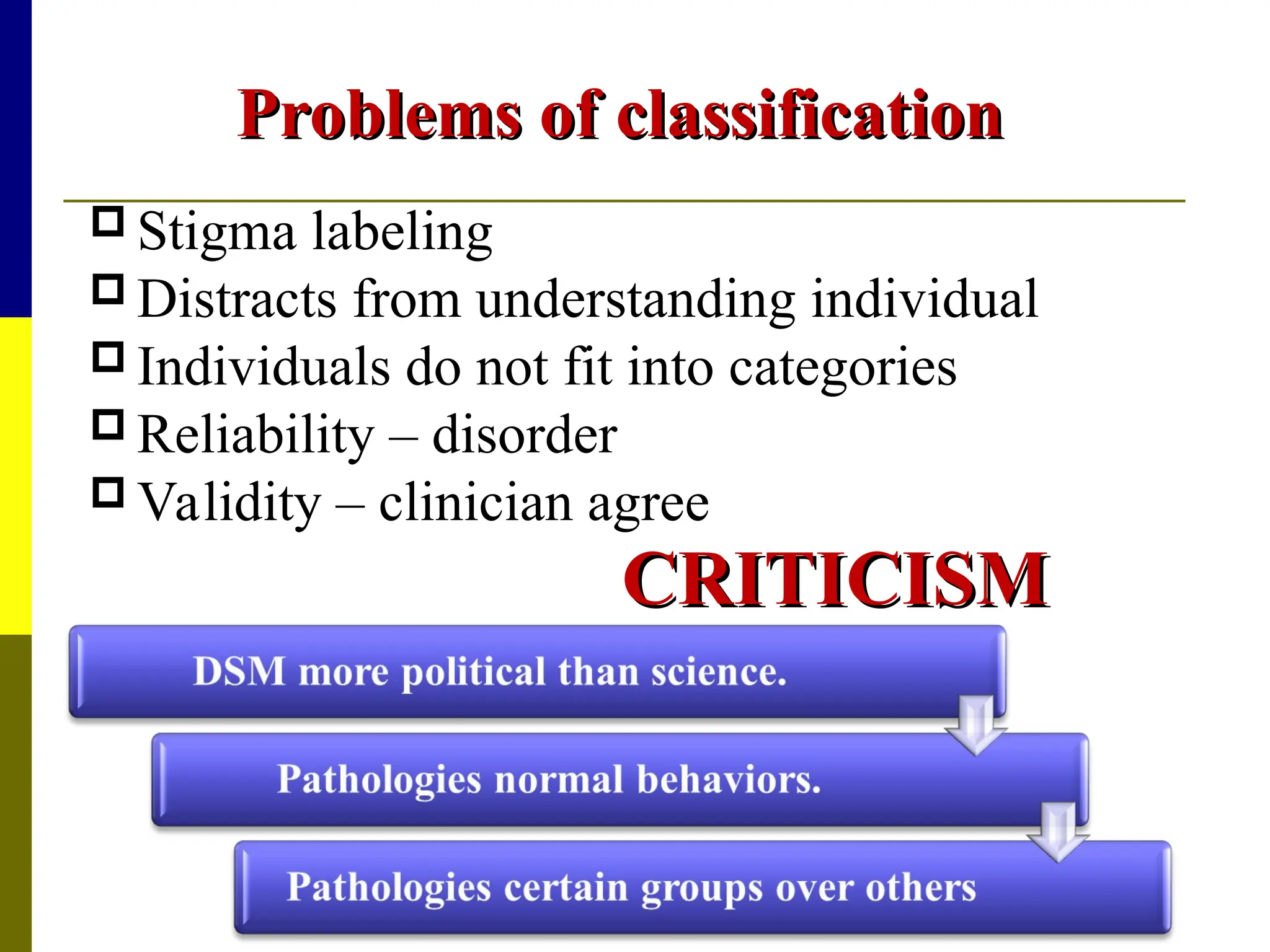
Problems of classification
 Stigma labeling
 Distracts from understanding individual
 Individuals do not fit into categories
 Reliability – disorder
 Validity – clinician agree
CRITICISM
CRITICISM
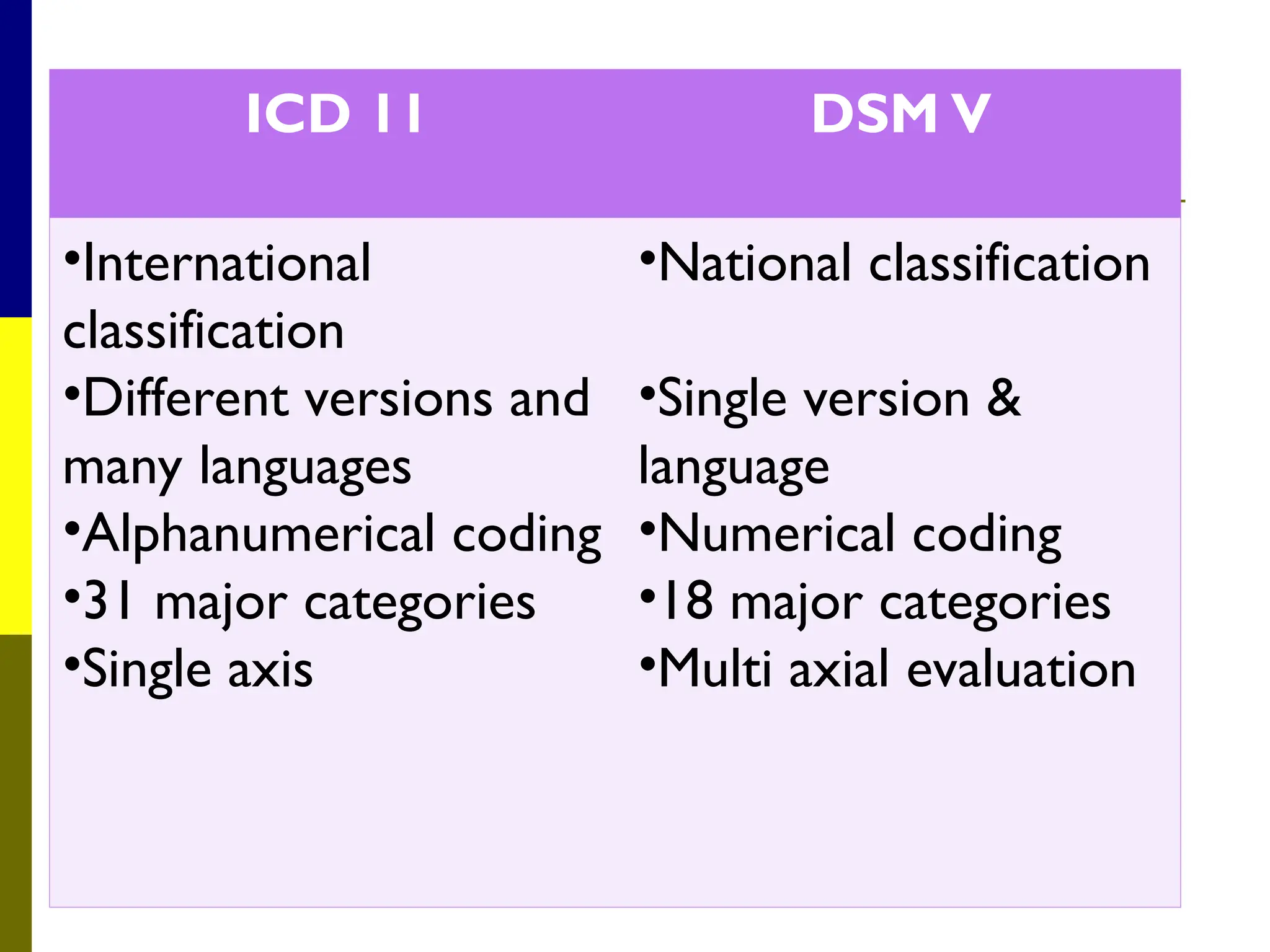
ICD 11 DSM V
•International
classification
•Different versions and
many languages
•Alphanumerical coding
•31 major categories
•Single axis
•National classification
•Single version &
language
•Numerical coding
•18 major categories
•Multi axial evaluation
REVIEW
REVIEW
OF
OF
PERSONALITY
PERSONALITY
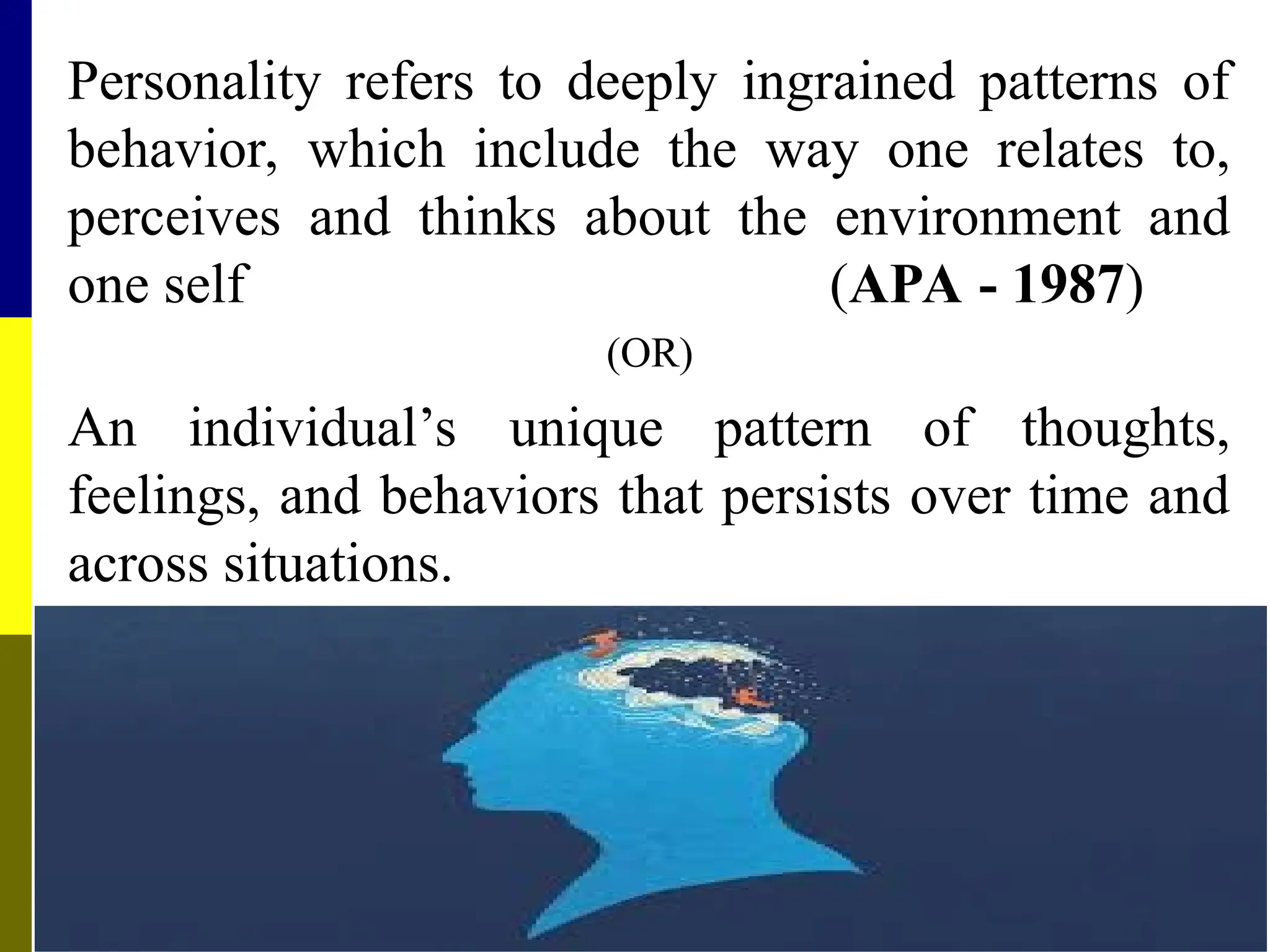
Personality refers to deeply ingrained patterns of
behavior, which include the way one relates to,
perceives and thinks about the environment and
one self (APA - 1987)
(OR)
An individual’s unique pattern of thoughts,
feelings, and behaviors that persists over time and
across situations.
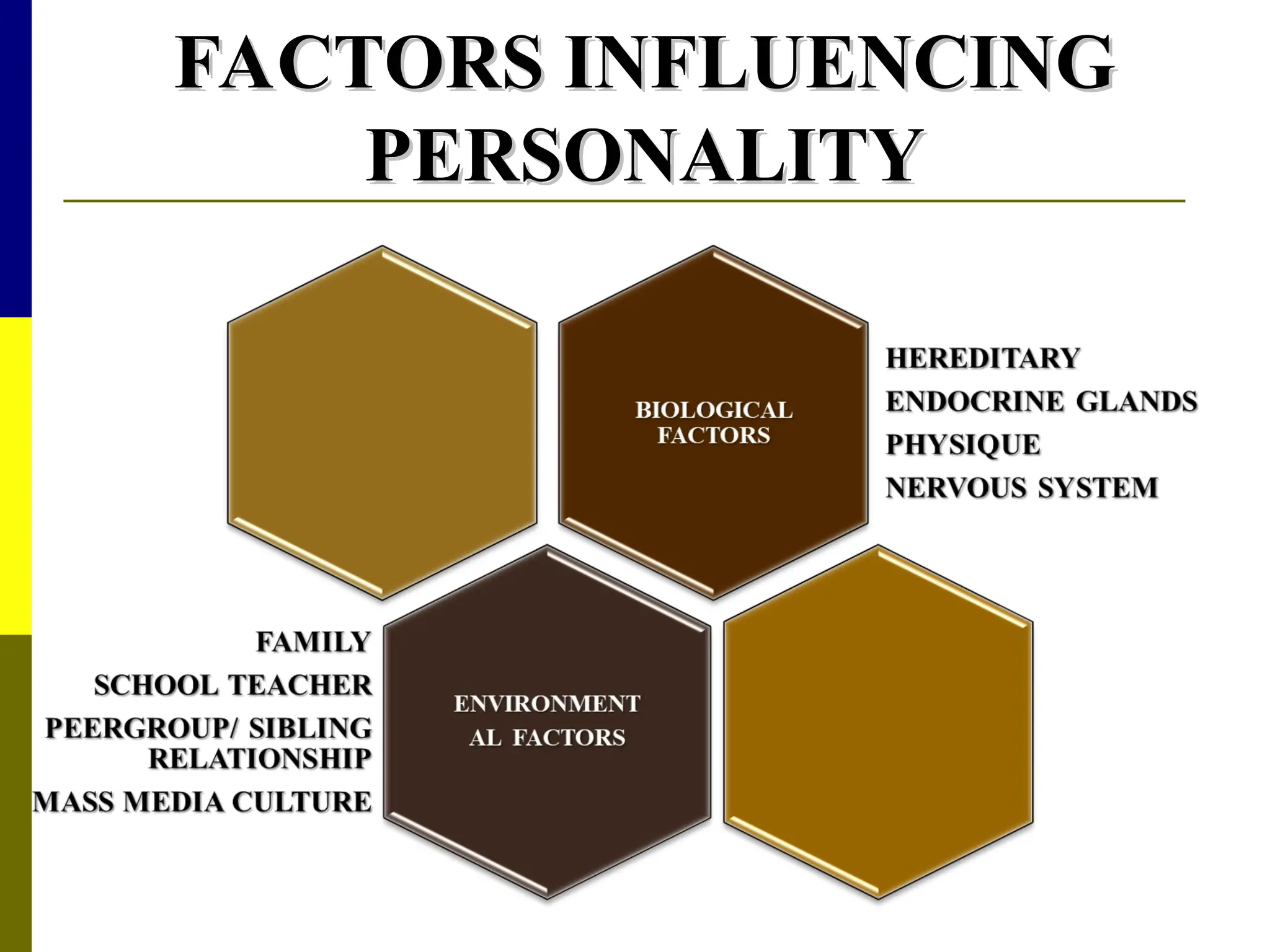
FACTORS INFLUENCING
FACTORS INFLUENCING
PERSONALITY
PERSONALITY
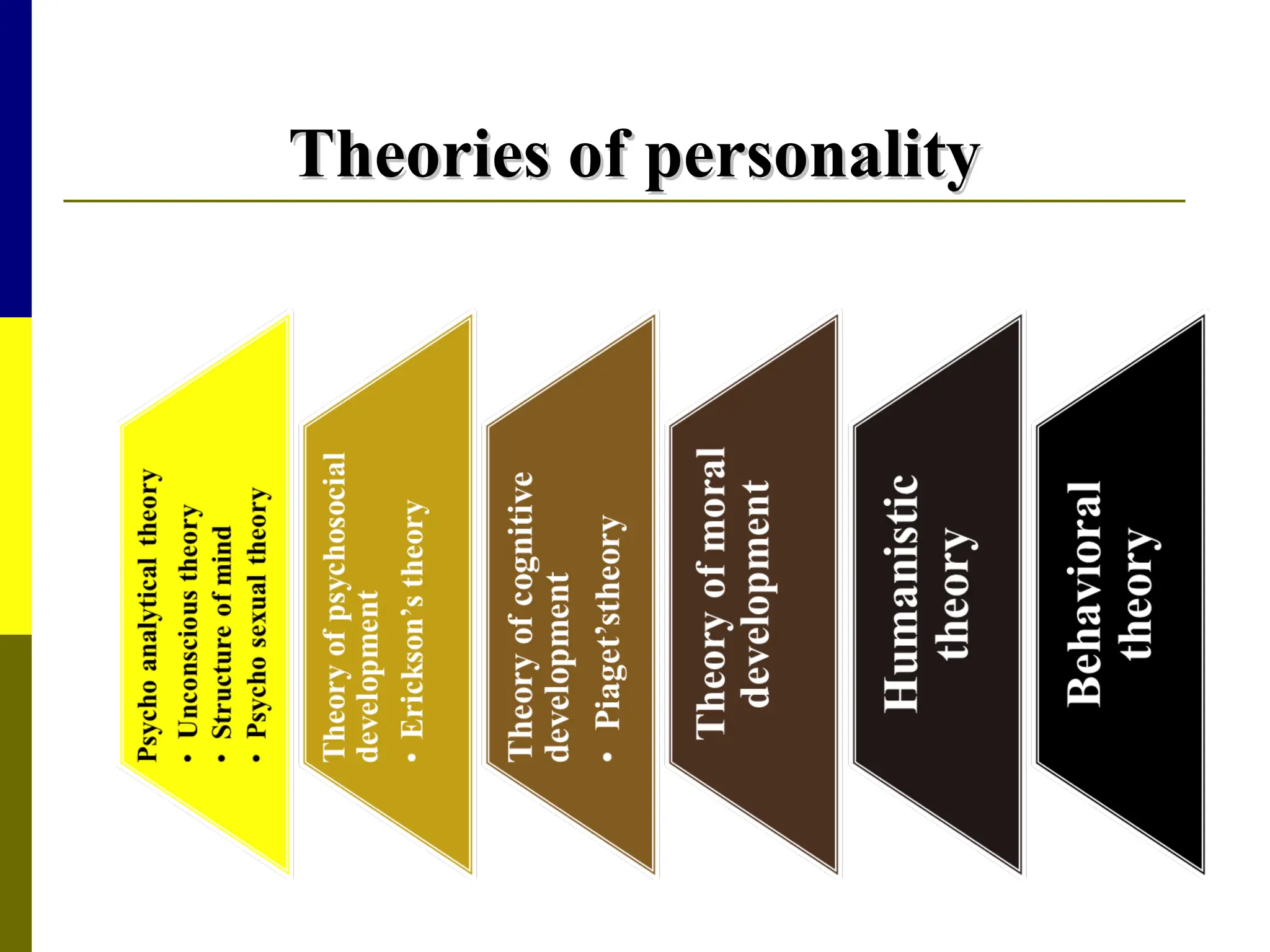
Theories of personality
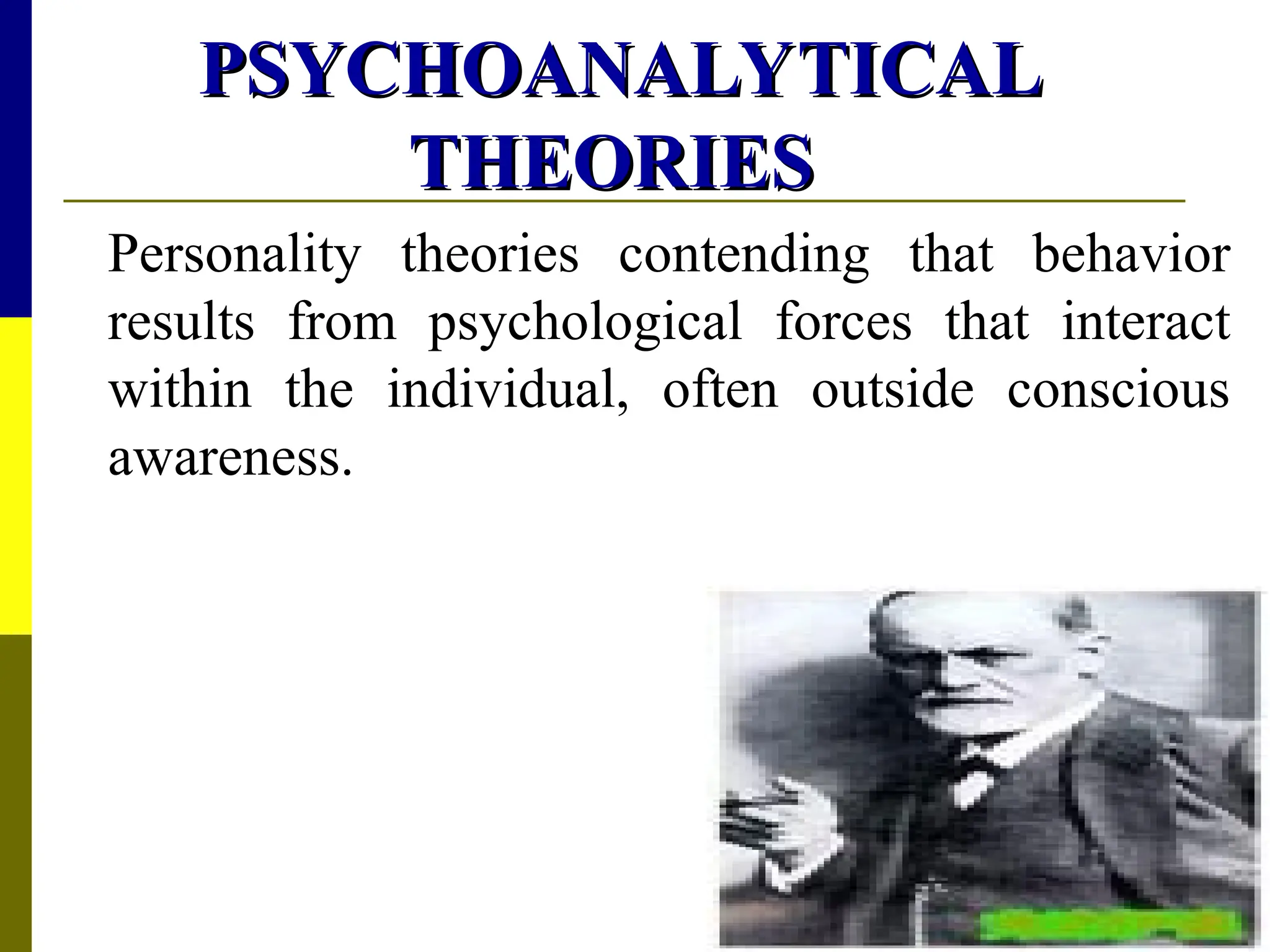
PSYCHOANALYTICAL
PSYCHOANALYTICAL
THEORIES
THEORIES
Personality theories contending that behavior
results from psychological forces that interact
within the individual, often outside conscious
awareness.
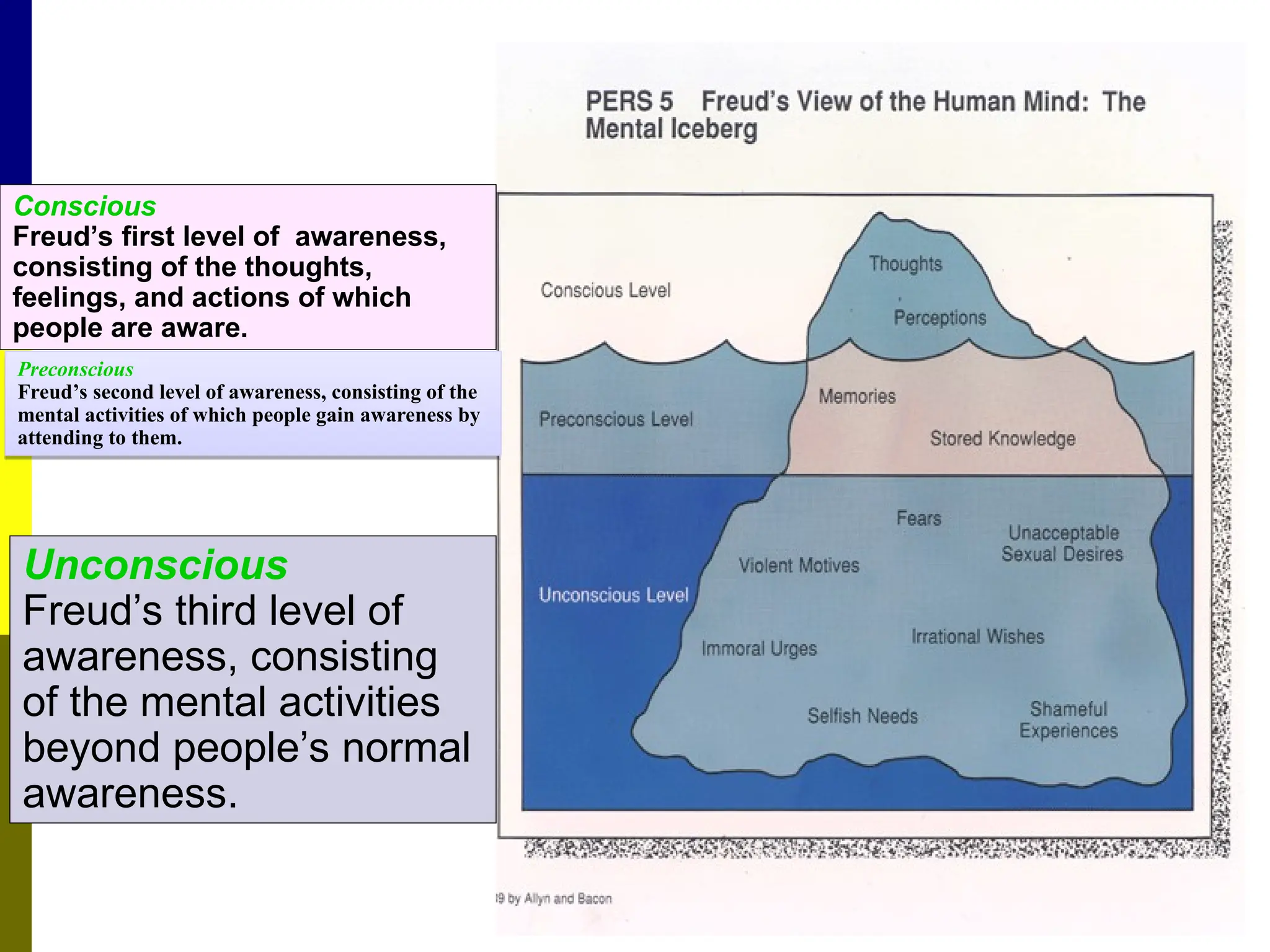
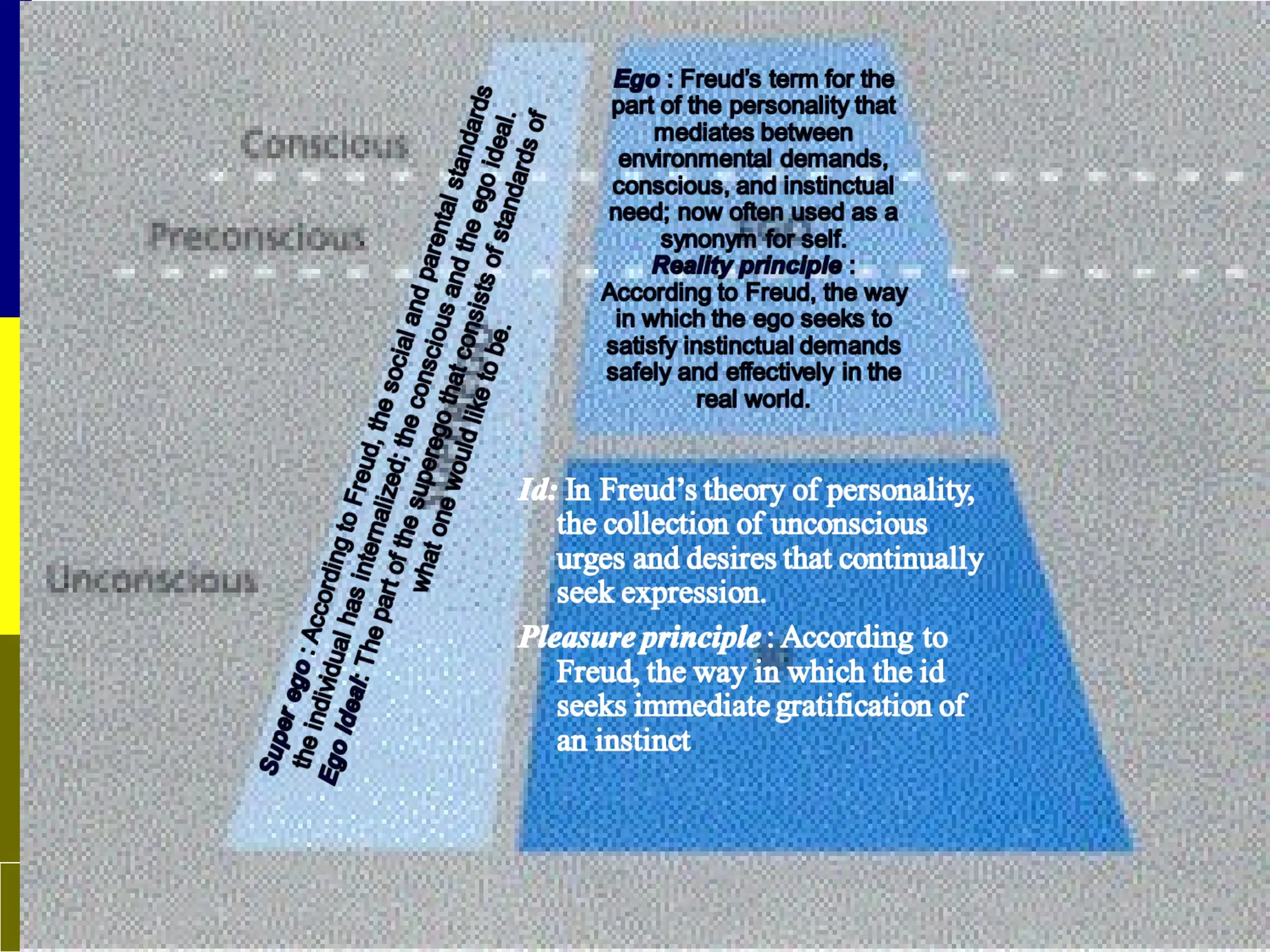
Conscious
Freud’s first level of awareness,
consisting of the thoughts,
feelings, and actions of which
people are aware.
Preconscious
Freud’s second level of awareness, consisting of the
mental activities of which people gain awareness by
attending to them.
Unconscious
Freud’s third level of
awareness, consisting
of the mental activities
beyond people’s normal
awareness.
Personality structure
THEORY OF PSYCHOSXUAL
DEVELOPMENT
DEVELOPMENT
HOW PERSONALITY DEVELOPS
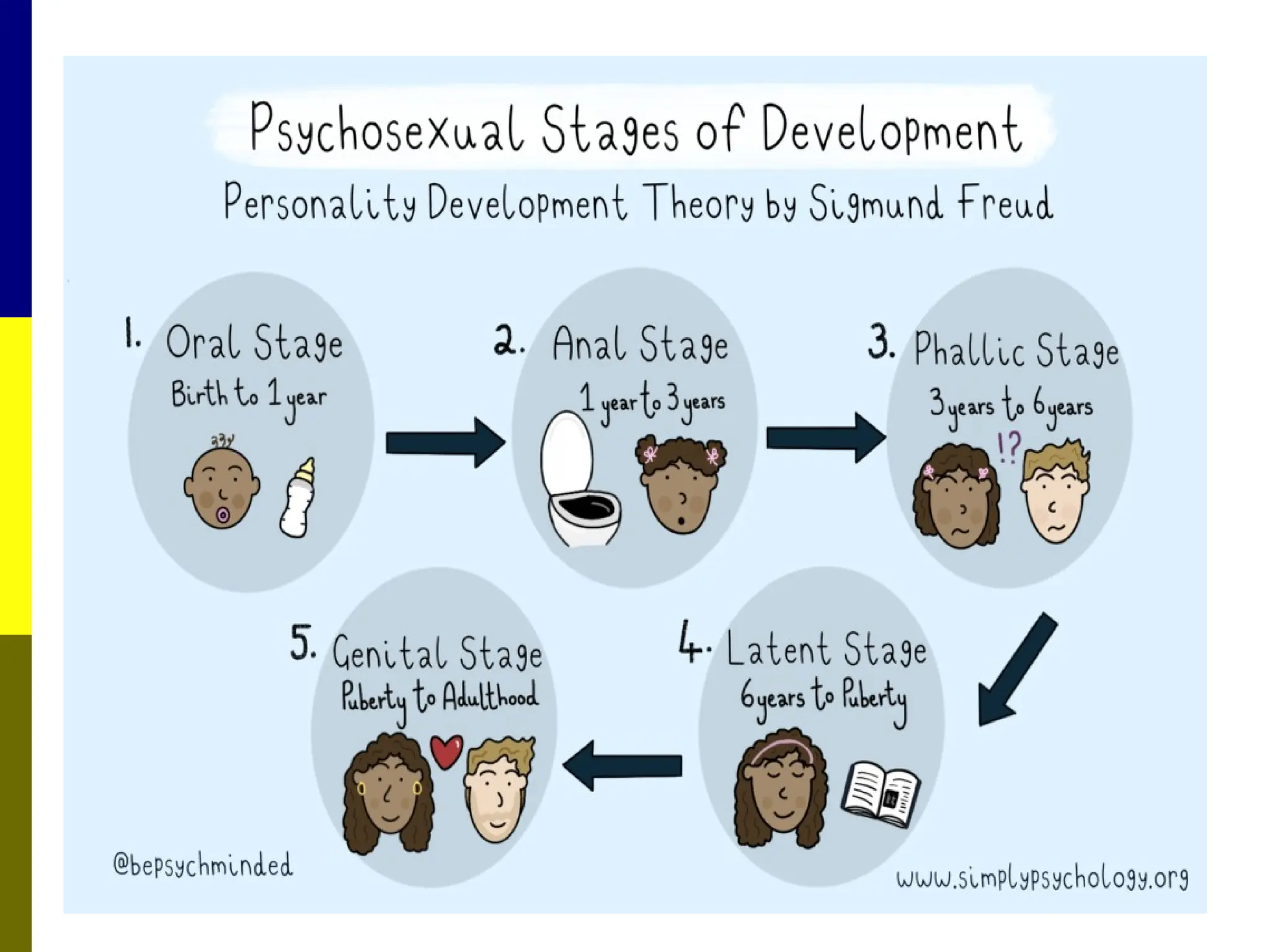
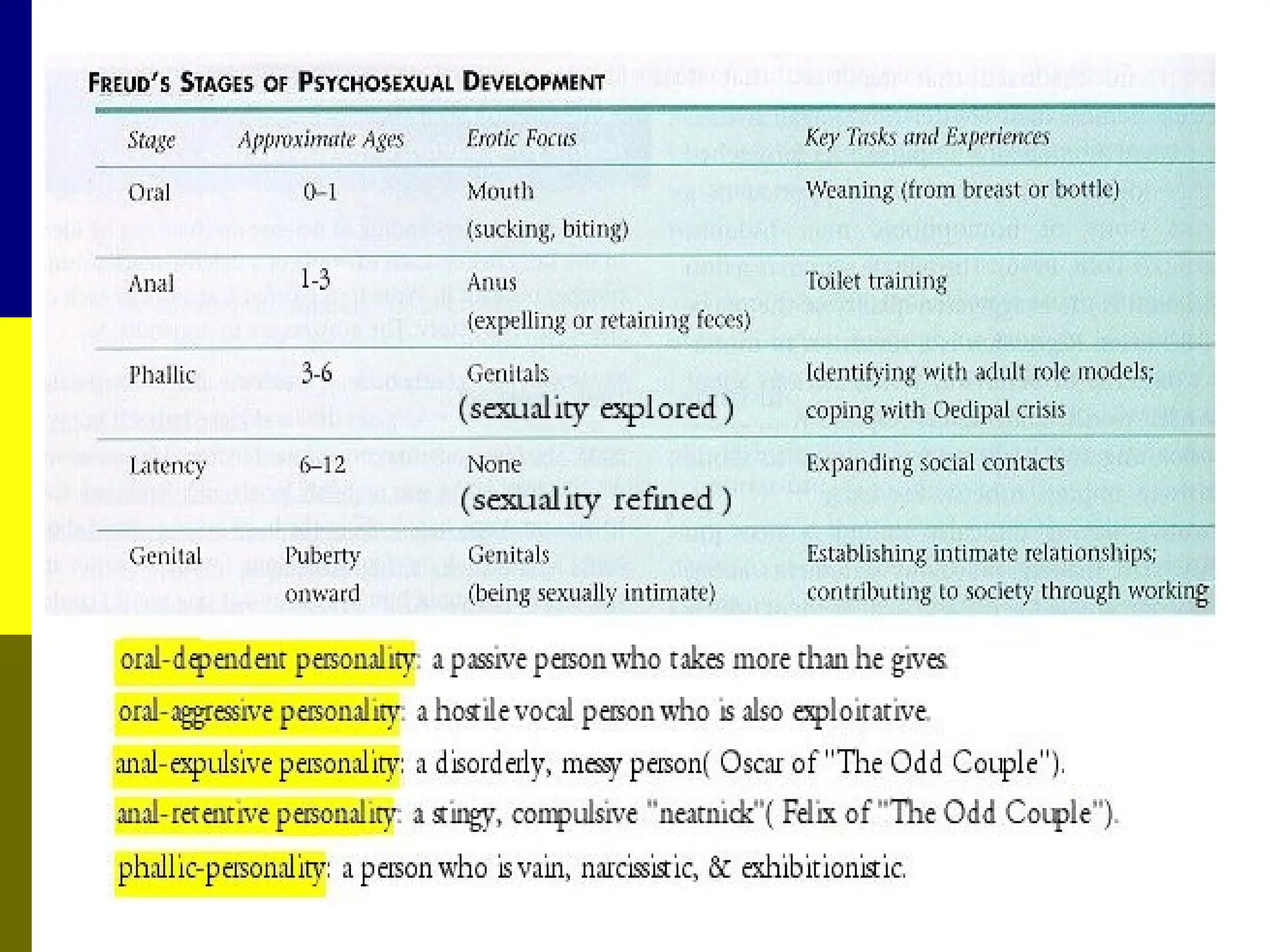
 Oral stage :
Oral stage : First stage in Freud’s theory of
personality development, in which the infant's
erotic feelings center on the mouth, lips, and
tongue.
 Anal stage :
Anal stage : Second stage in Freud’s theory of
personality development, in which a child’s
erotic feelings center on the anus and on
elimination.
o Phallic stage :
Phallic stage : Third stage in Freud’s theory of
personality development, in which erotic feelings
center on the genitals.
Oedipus complex and Electra complex:
Oedipus complex and Electra complex: According to
Freud, a child’s sexual attachment to the parent of
the opposite sex and jealousy toward the parent of
the same sex; generally occurs in the phallic stage.
 Latency period :
Latency period : In Freud’s theory of personality, a
period in which the child appears to have no interest
in the other sex.
 Genital stage :
Genital stage : In Freud’s theory of personality
development, the final stage of normal adult sexual
development, which is usually marked by mature
sexuality.
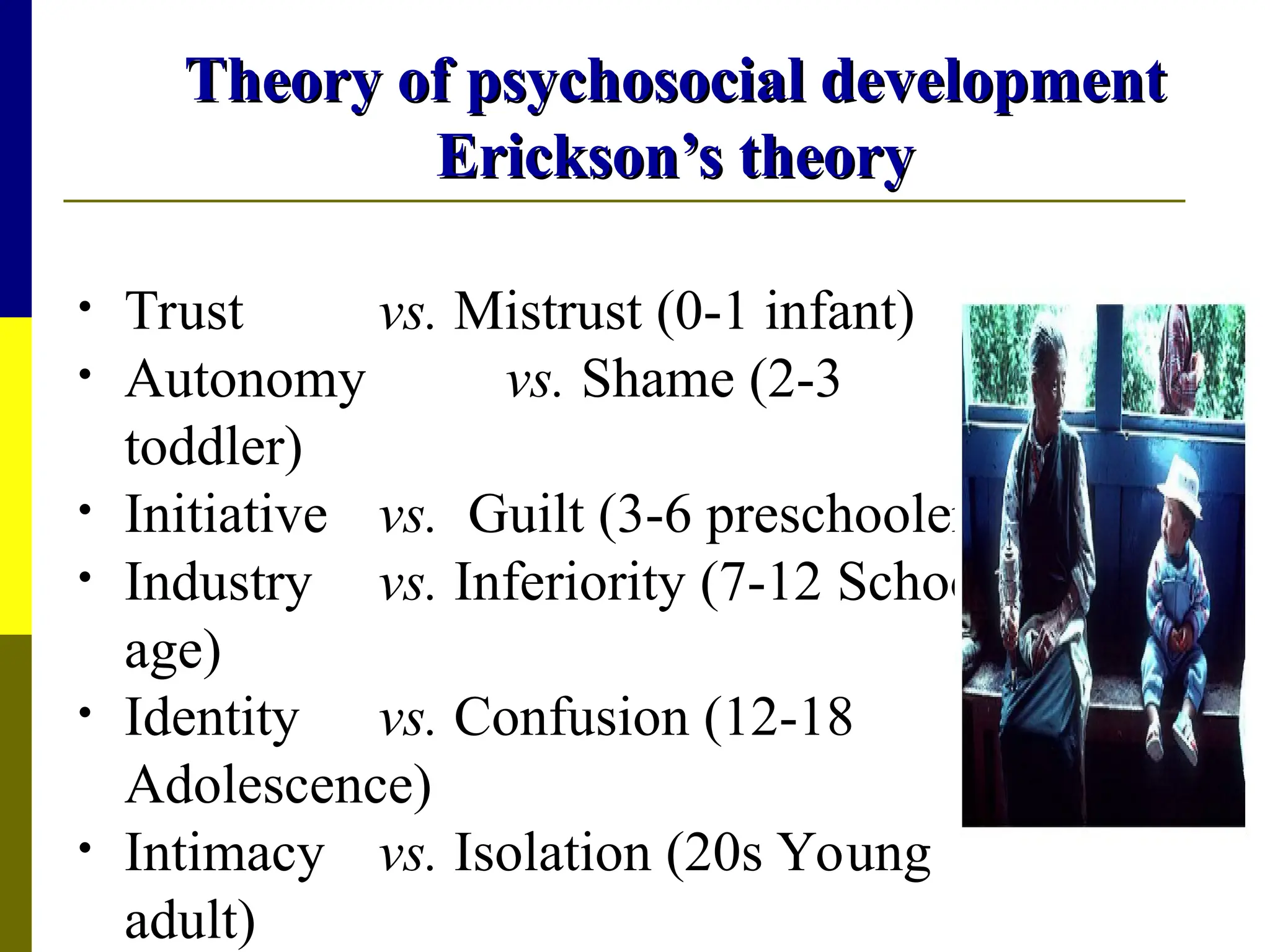
Theory of psychosocial development
Erickson’s theory
Erickson’s theory
• Trust vs. Mistrust (0-1 infant)
• Autonomy vs. Shame (2-3
toddler)
• Initiative vs. Guilt (3-6 preschooler)
• Industry vs. Inferiority (7-12 School
age)
• Identity vs. Confusion (12-18
Adolescence)
• Intimacy vs. Isolation (20s Young
adult)
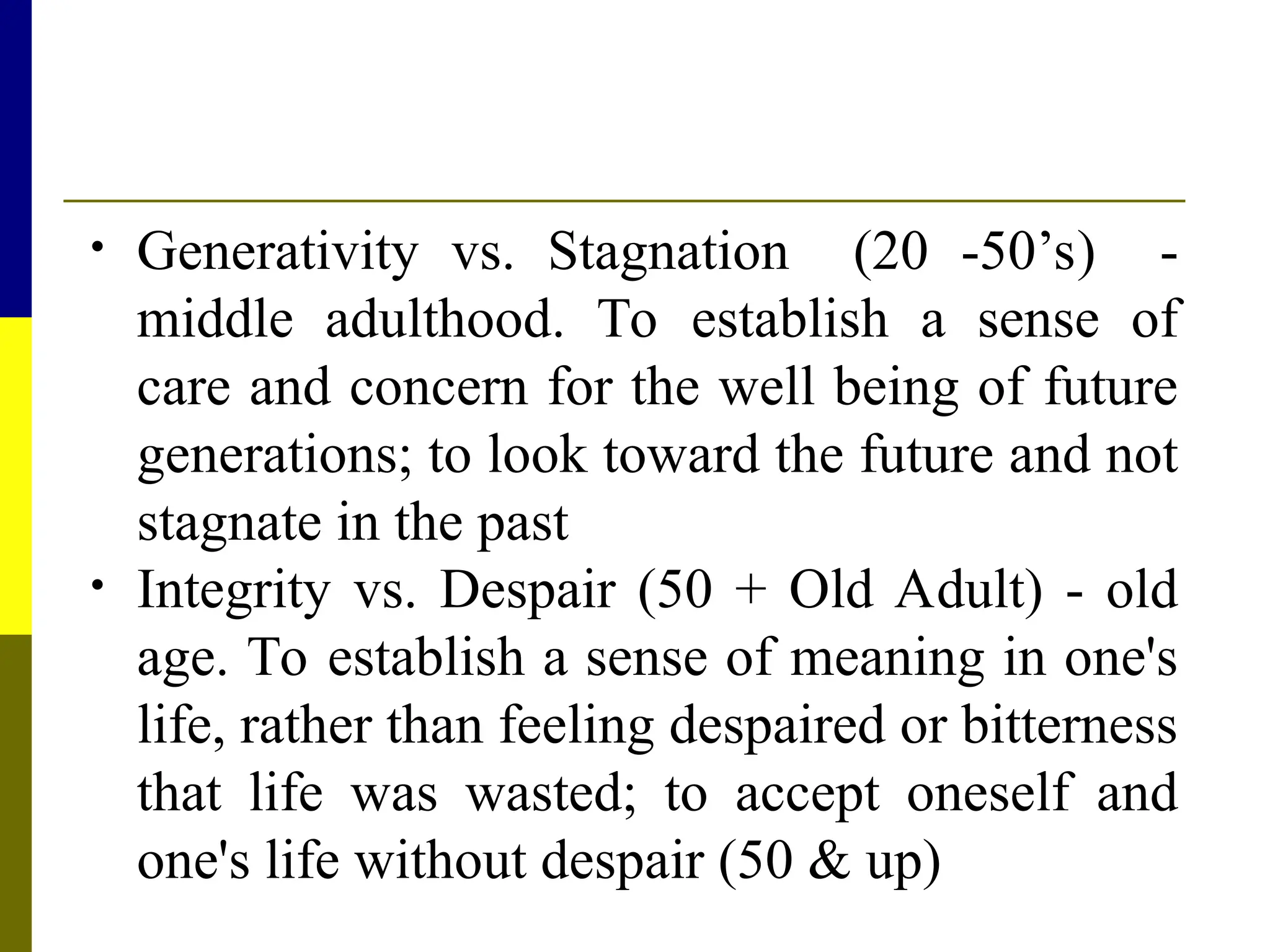
• Generativity vs. Stagnation (20 -50’s) -
middle adulthood. To establish a sense of
care and concern for the well being of future
generations; to look toward the future and not
stagnate in the past
• Integrity vs. Despair (50 + Old Adult) - old
age. To establish a sense of meaning in one's
life, rather than feeling despaired or bitterness
that life was wasted; to accept oneself and
one's life without despair (50 & up)
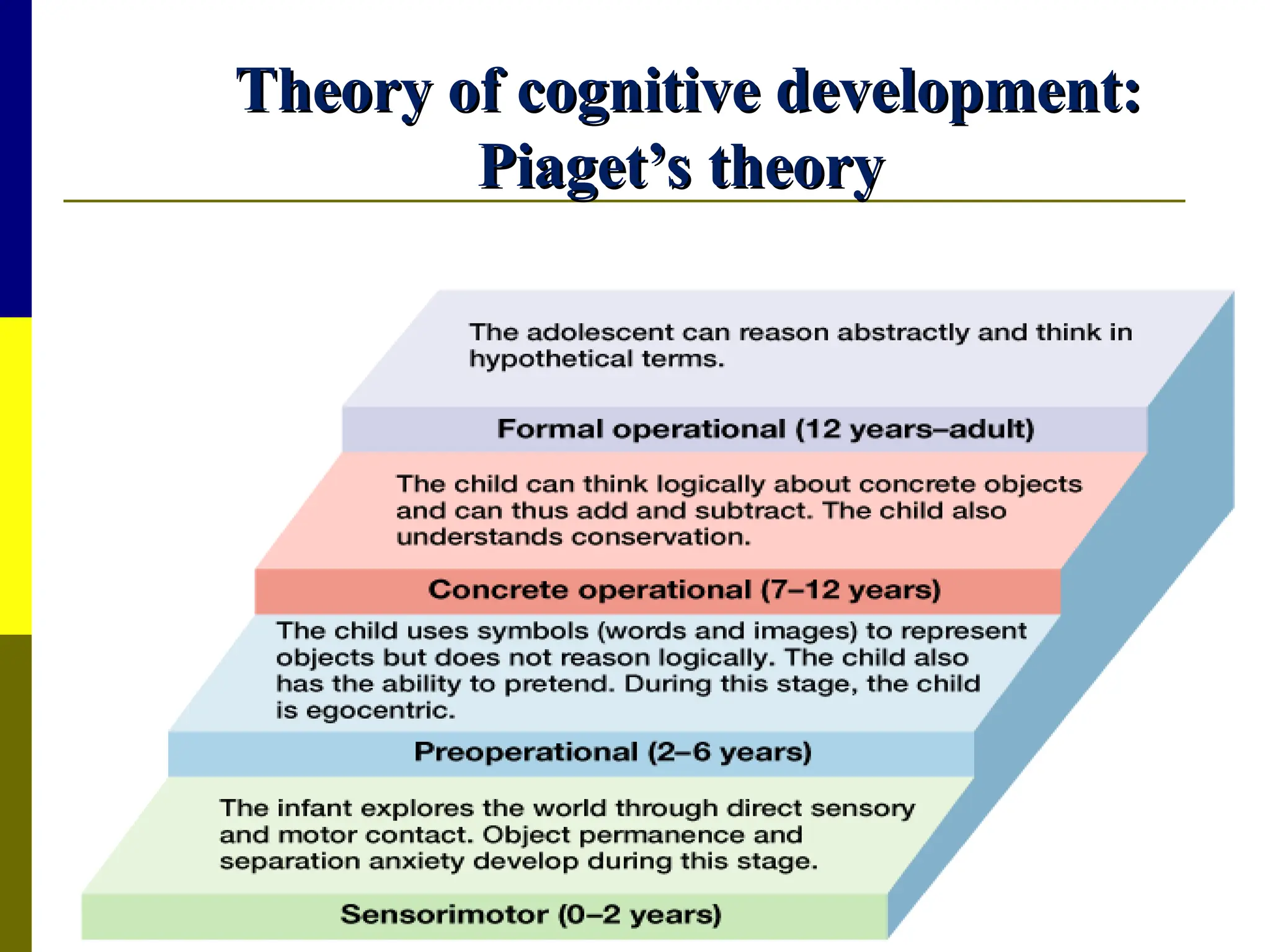
Theory of cognitive development:
Piaget’s theory
Piaget’s theory
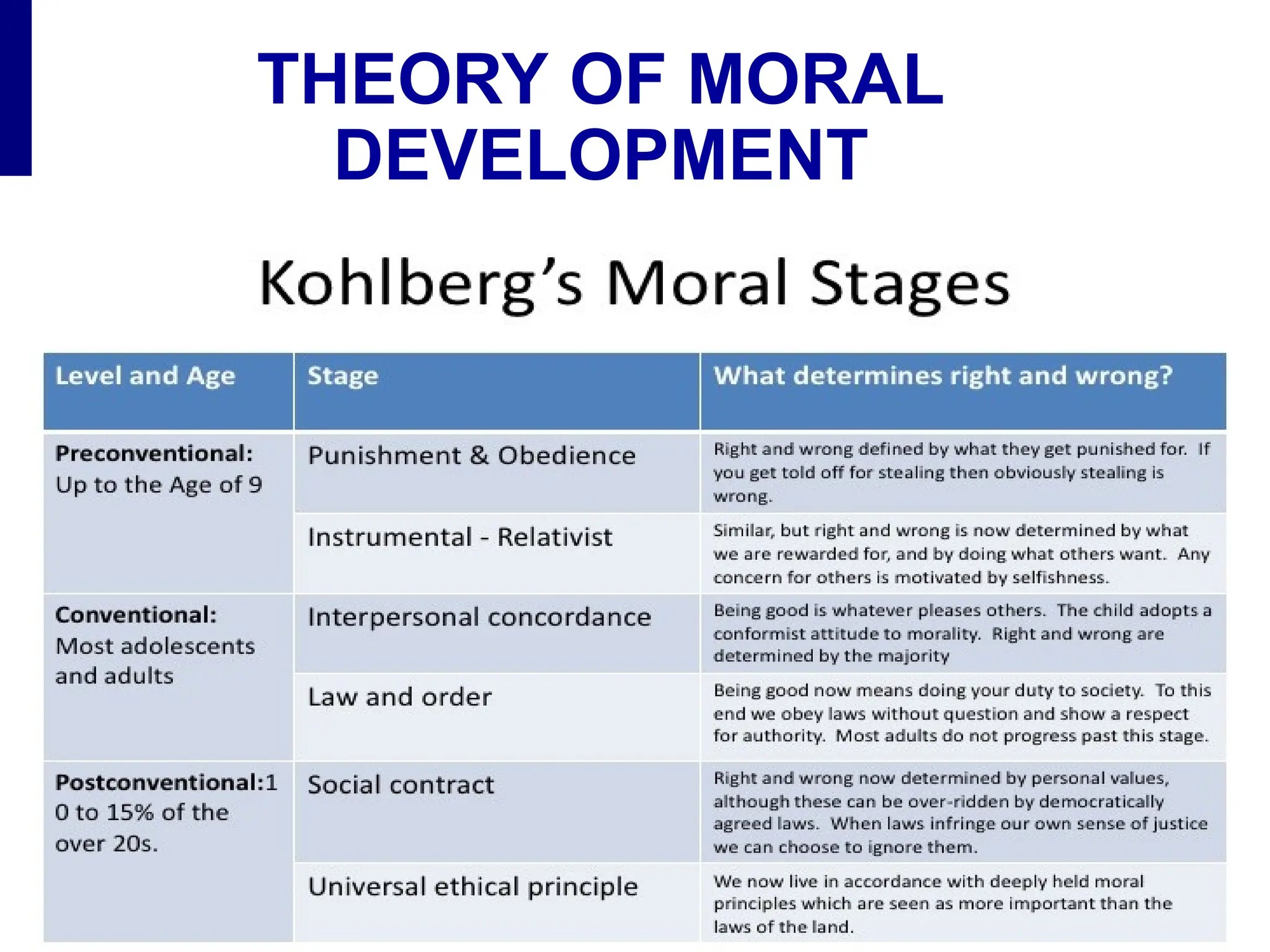
THEORY OF MORAL
DEVELOPMENT
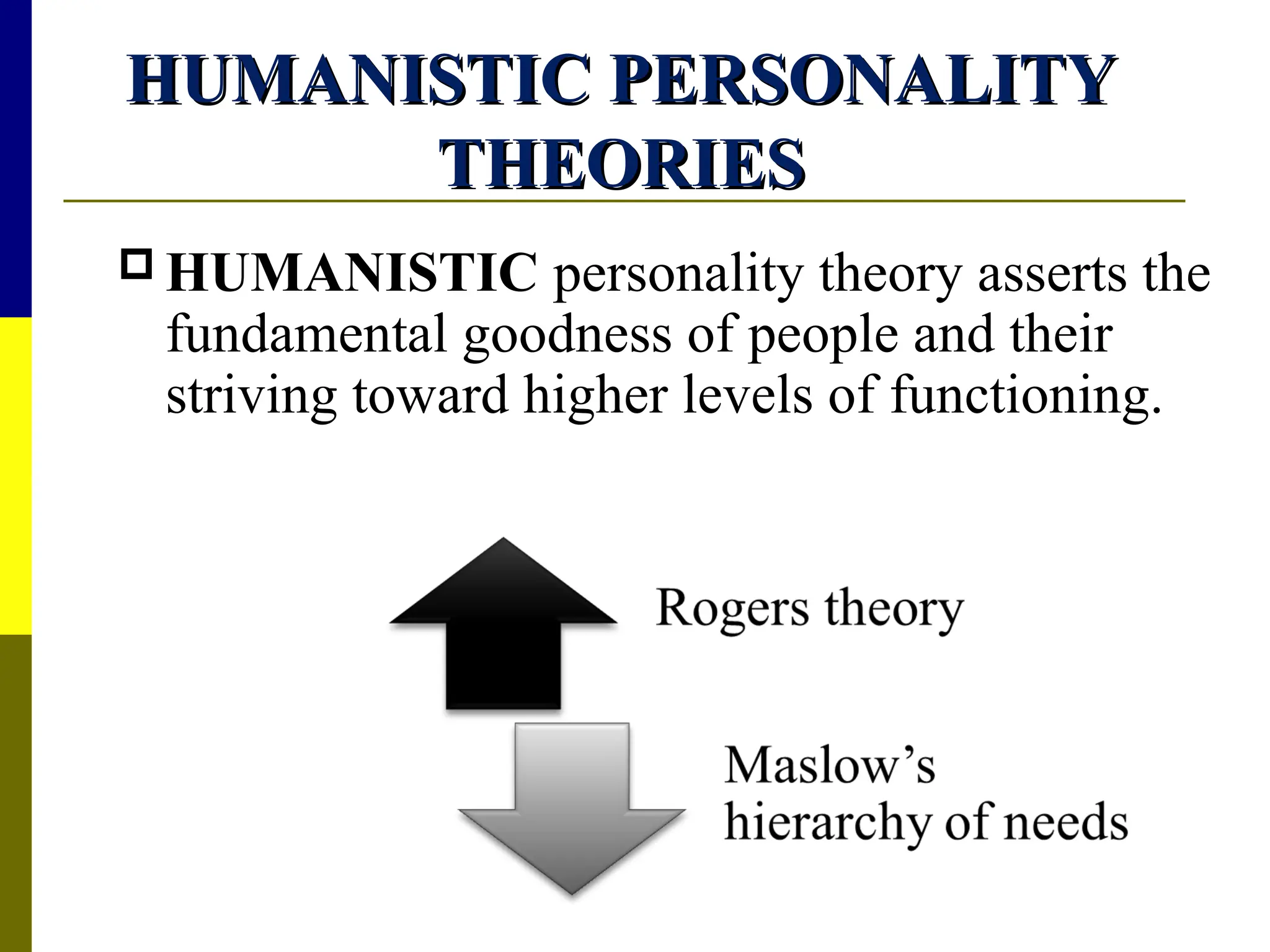
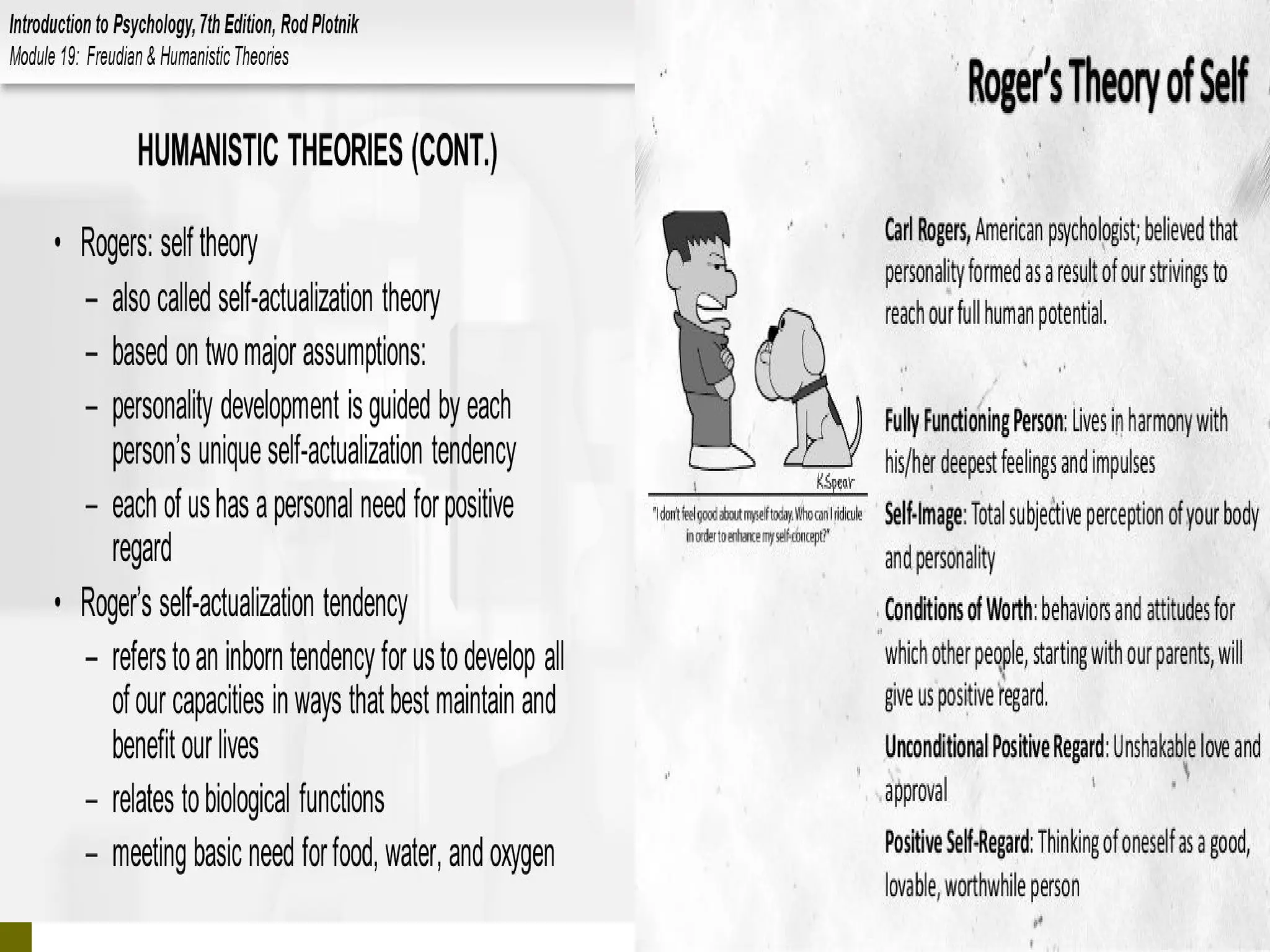
HUMANISTIC PERSONALITY
THEORIES
THEORIES
 HUMANISTIC personality theory asserts the
fundamental goodness of people and their
striving toward higher levels of functioning.
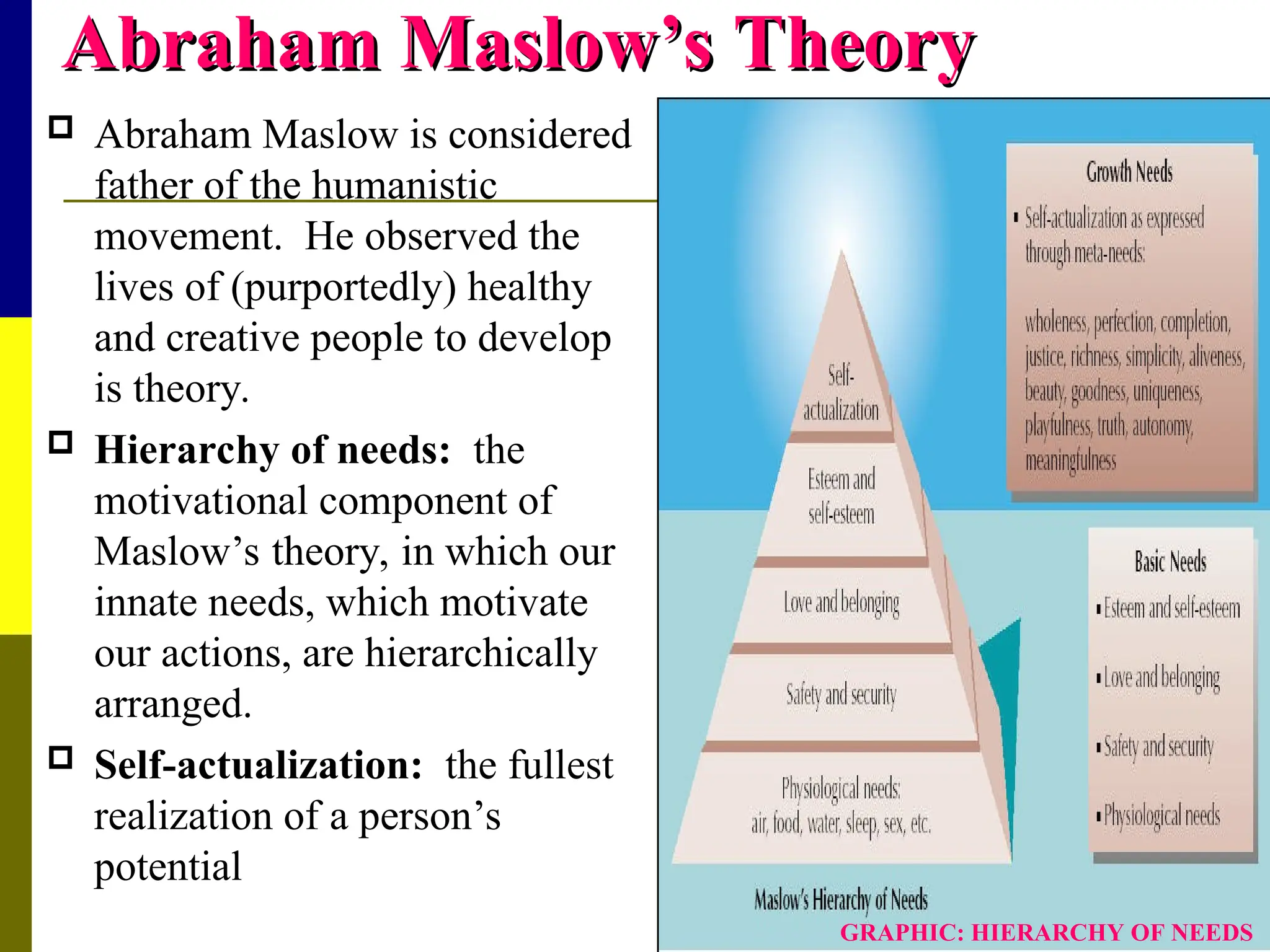
Abraham Maslow’s Theory
 Abraham Maslow is considered
father of the humanistic
movement. He observed the
lives of (purportedly) healthy
and creative people to develop
is theory.
 Hierarchy of needs: the
motivational component of
Maslow’s theory, in which our
innate needs, which motivate
our actions, are hierarchically
arranged.
 Self-actualization: the fullest
realization of a person’s
potential
GRAPHIC: HIERARCHY OF NEEDS
Carl Jung
Carl Jung
Personal unconscious : In Jung’s theory of
personality, one of the two levels of the
unconscious; it contains the individual’s repressed
thoughts, forgotten experiences, and undeveloped
ideas.
Collective unconscious : The level of the
unconscious that is inherited and common to all
members of a species.
Archetype : In Jung’s
theory of personality,
thought forms common
to all human beings,
stored in the collective
unconscious.
Persona : According to
Jung, our public self, the
mask we wear to
represent ourselves to
others.
Extrovert : According to
Jung, a person who
usually focuses on
social life and the
external world instead
of on his or her internal
experience.
Introvert : A person
who usually focuses on
his or her own thoughts
and feelings.
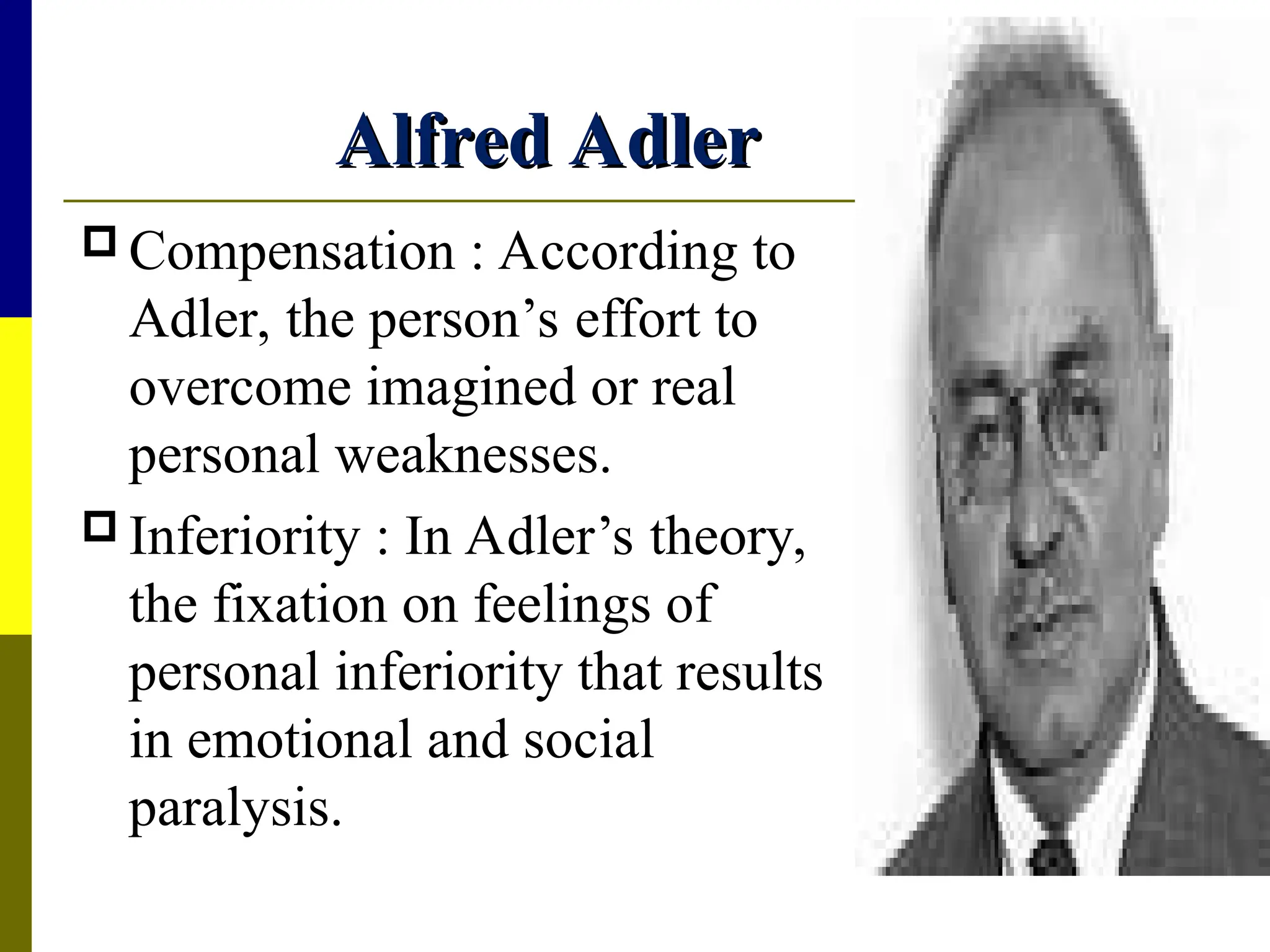
Alfred Adler
Alfred Adler
 Compensation : According to
Adler, the person’s effort to
overcome imagined or real
personal weaknesses.
 Inferiority : In Adler’s theory,
the fixation on feelings of
personal inferiority that results
in emotional and social
paralysis.
Behavioral theory
Behavioral theory
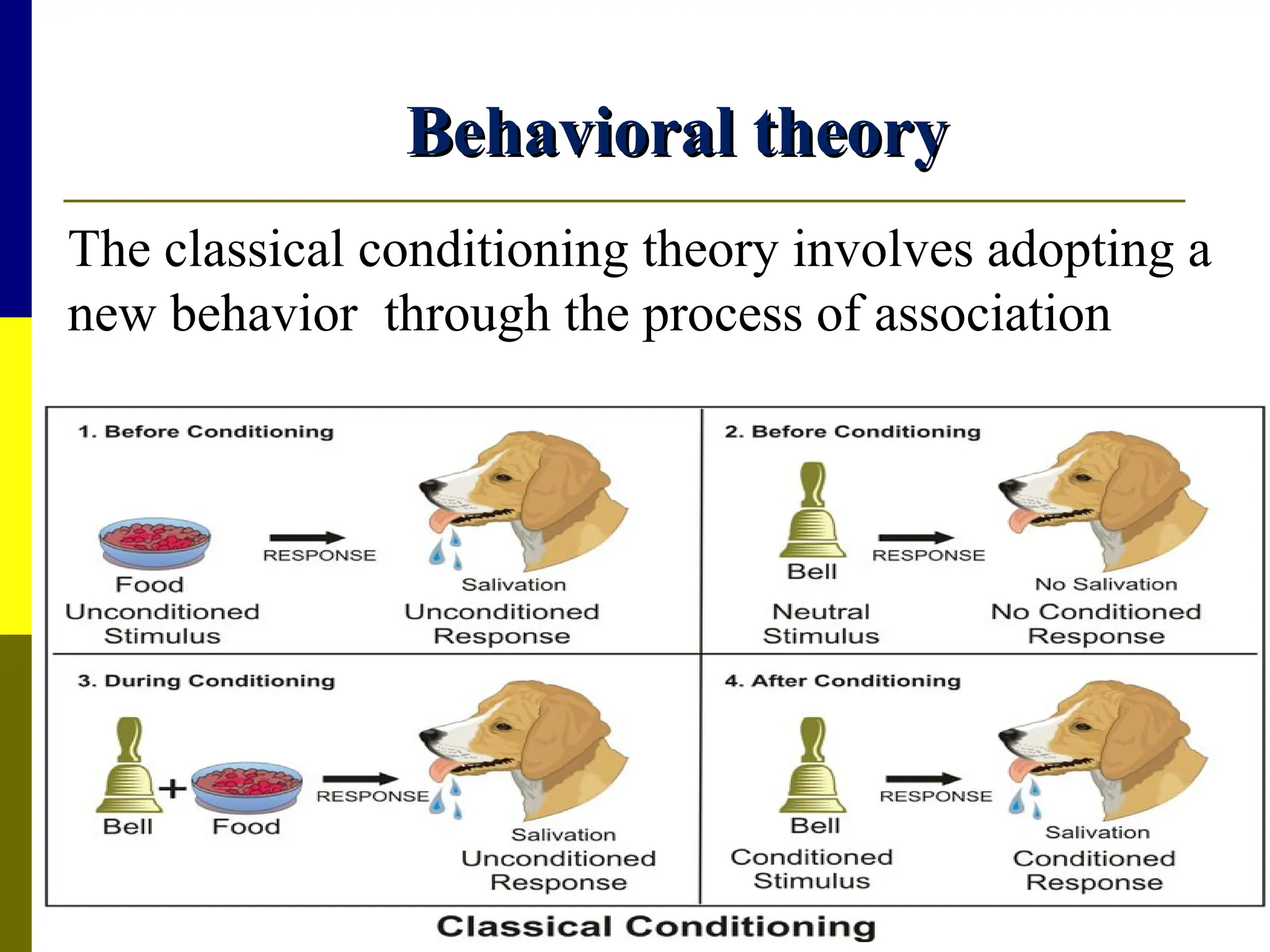
The classical conditioning theory involves adopting a
new behavior through the process of association
THE OPERANT CONDITIONING theory
involves the use of reinforcement or
punishment to maximize or minimize a certain
behavior
DEFENSE
DEFENSE
MECHANISM
MECHANISM
EGO DEFENSE MECHANISMS
Ego Defense Mechanisms are the patterns
of adjustment through which an individual
relieves or decreases anxieties caused by
an uncomfortable situations that threaten
the self esteem
(the terms “Mental Mechanisms” and
“Defense Mechanisms” are essentially
synonymous with this).
The primary functions of these mechanisms
are:
1.to minimize anxiety
2.to protect the ego
3.to maintain repression
Ego defense mechanism can be classified
as
 Primary
 Psychotic/Narcissistic
 Neurotic/Immature
 Mature
Primary
Primary
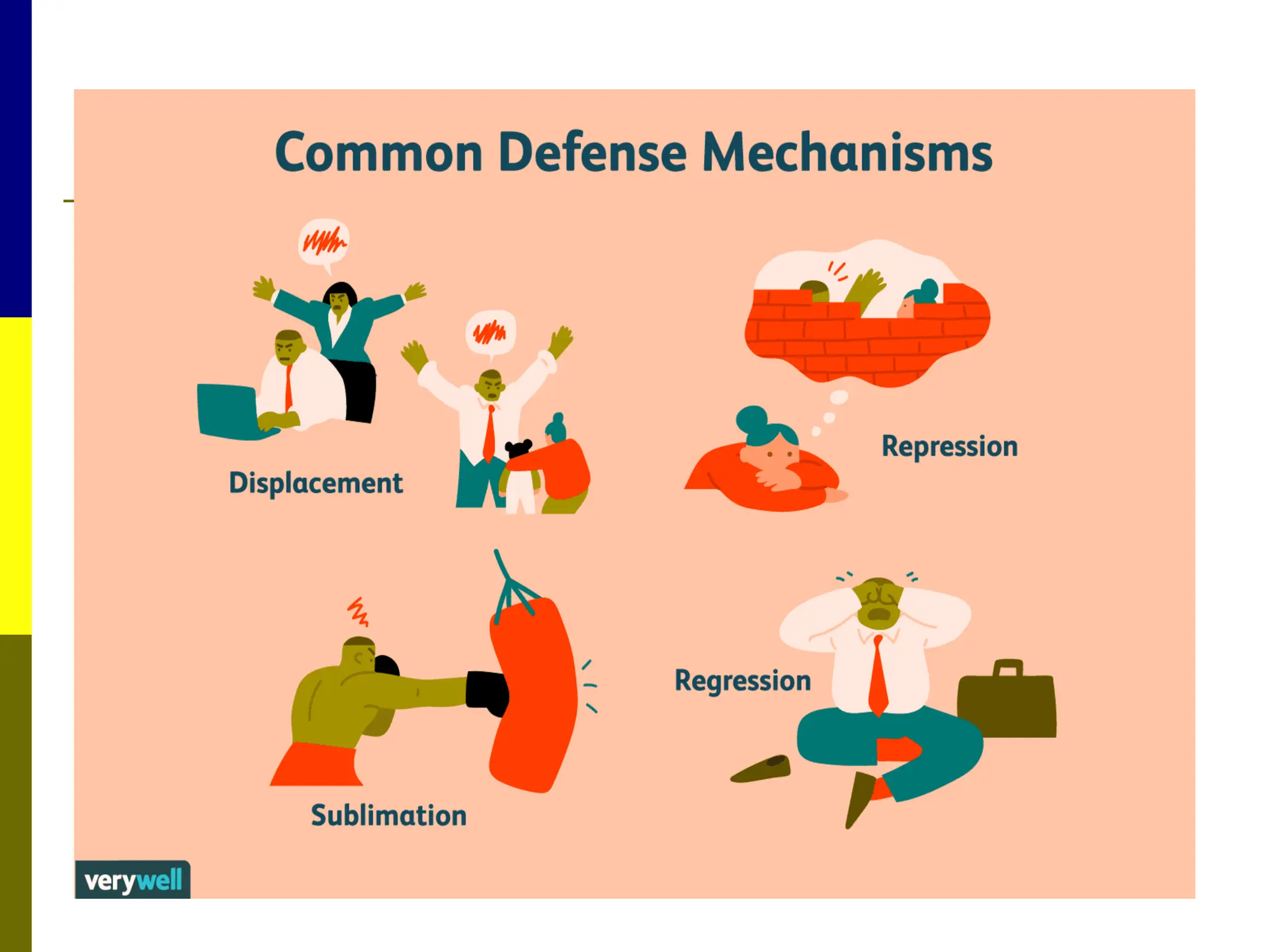
Repression:
Repression is the complete memory loss of a painful
event or anxiety provoking thoughts and feelings
from conscious awareness.
In this case, subconscious mind doesn't want to
remember what happened because it may negatively
affect the mood.
Repression is useful to the individual since:
1. It prevents discomfort
2. It leads to some economy of time
and effort
PSYCHOTIC/ NARCISSISTIC
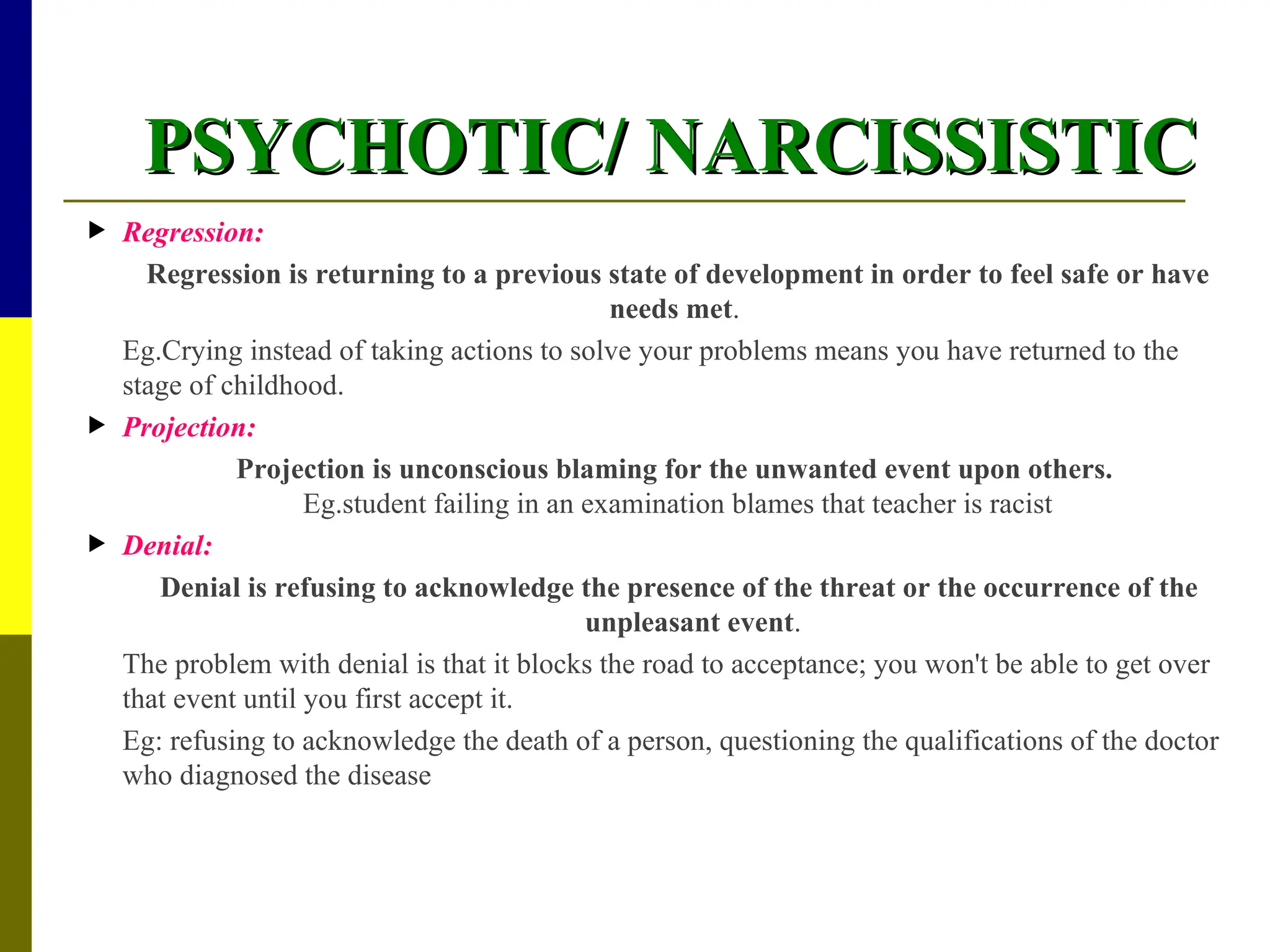
 Regression:
Regression is returning to a previous state of development in order to feel safe or have
needs met.
Eg.Crying instead of taking actions to solve your problems means you have returned to the
stage of childhood.
 Projection:
Projection is unconscious blaming for the unwanted event upon others.
Eg.student failing in an examination blames that teacher is racist
 Denial:
Denial is refusing to acknowledge the presence of the threat or the occurrence of the
unpleasant event.
The problem with denial is that it blocks the road to acceptance; you won't be able to get over
that event until you first accept it.
Eg: refusing to acknowledge the death of a person, questioning the qualifications of the doctor
who diagnosed the disease
NEUROTIC/IMMATURE
NEUROTIC/IMMATURE
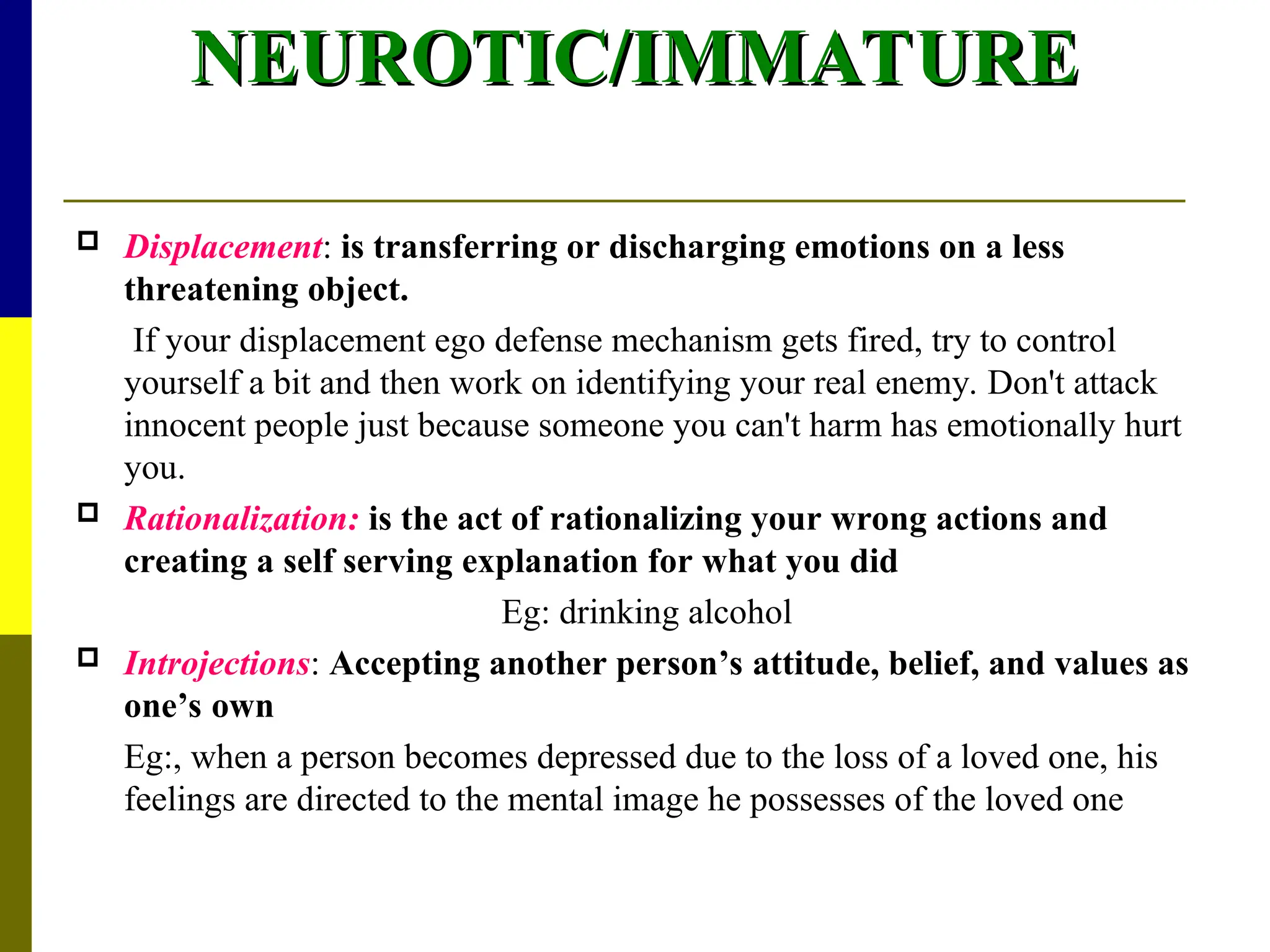
 Displacement: is transferring or discharging emotions on a less
threatening object.
If your displacement ego defense mechanism gets fired, try to control
yourself a bit and then work on identifying your real enemy. Don't attack
innocent people just because someone you can't harm has emotionally hurt
you.
 Rationalization: is the act of rationalizing your wrong actions and
creating a self serving explanation for what you did
Eg: drinking alcohol
 Introjections: Accepting another person’s attitude, belief, and values as
one’s own
Eg:, when a person becomes depressed due to the loss of a loved one, his
feelings are directed to the mental image he possesses of the loved one
NEUROTIC/IMMATURE
NEUROTIC/IMMATURE
 Compensation: Overachievement in one area to offset real or
perceived deficiencies in another area
Eg: napoleon complex
 Undoing: Exhibiting acceptable behavior to make up for
or negate unacceptable behavior.
Eg: (1) two close friends have a violent argument; when they next
meet, each act as if the disagreement had never occurred.
(2) when asked to recommend a friend for a job, a man makes
derogatory comments which prevent the friend's getting the
position; a few days later, the man drops in to see his friend and
brings him a small gift.
In a conscious analog of this, Napoleon made it a practice after
reprimanding any officer to find some words of praise to say at
their next meeting.
MATURE
MATURE
Sublimation: Substituting a socially acceptable activity for an
impulse that is unacceptable.
Eg, By becoming a boxer you are able to satisfy your hidden
need for violence
CONCLUSION
CONCLUSION
The use of defense mechanism relieves
anxiety but continuous and exclusive use
may lead to mental disorder and prevent
the individual from effective coping
ETIOLOGY-
ETIOLOGY-
BIO- PSYCHOSOCIAL
BIO- PSYCHOSOCIAL
FACTORS
FACTORS
ETIOLOGY- BIO-
ETIOLOGY- BIO-
PSYCHOSOCIAL FACTORS
Many factors are responsible for the causation of
mental illness. These factors may PREDISPOSE
PREDISPOSE
an individual to mental illness, PRECIPITATE
PRECIPITATE
OR PERPETUATE
OR PERPETUATE the mental illness
PREDISPOSING FACTOR :
PREDISPOSING FACTOR : These factors
determine the individual’s susceptibility to
mental illness. They interact with precipitating
factors resulting in mental illness, They are
Genetic makeup, Physical damage to CNS &
Adverse psychosocial influence
PRECIPITATING FACTOR:
PRECIPITATING FACTOR: These are
events occur shortly before the onset of a
disorder and appear to have induced it. They are
Physical Stress
Psychological Stress
PERPETUATING FACTOR
PERPETUATING FACTOR
These factors are responsible for aggravating or
prolonging the conditions already exist in an
individual
PSYCHOPATHOLOGY
PSYCHOPATHOLOGY
OF
OF
MENTAL DISORDERS
MENTAL DISORDERS
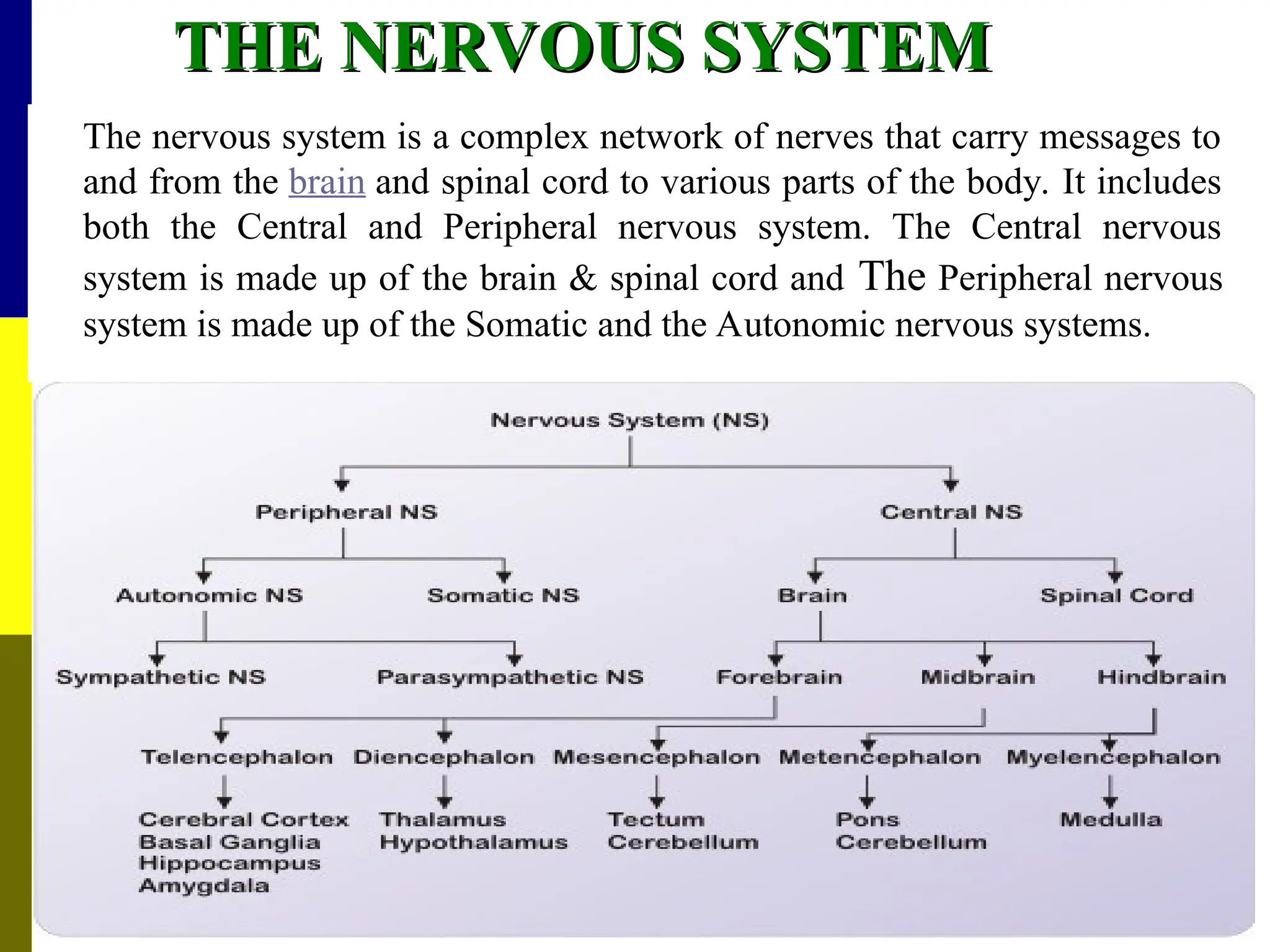
THE NERVOUS SYSTEM
THE NERVOUS SYSTEM
The nervous system is a complex network of nerves that carry messages to
and from the brain and spinal cord to various parts of the body. It includes
both the Central and Peripheral nervous system. The Central nervous
system is made up of the brain & spinal cord and The Peripheral nervous
system is made up of the Somatic and the Autonomic nervous systems.
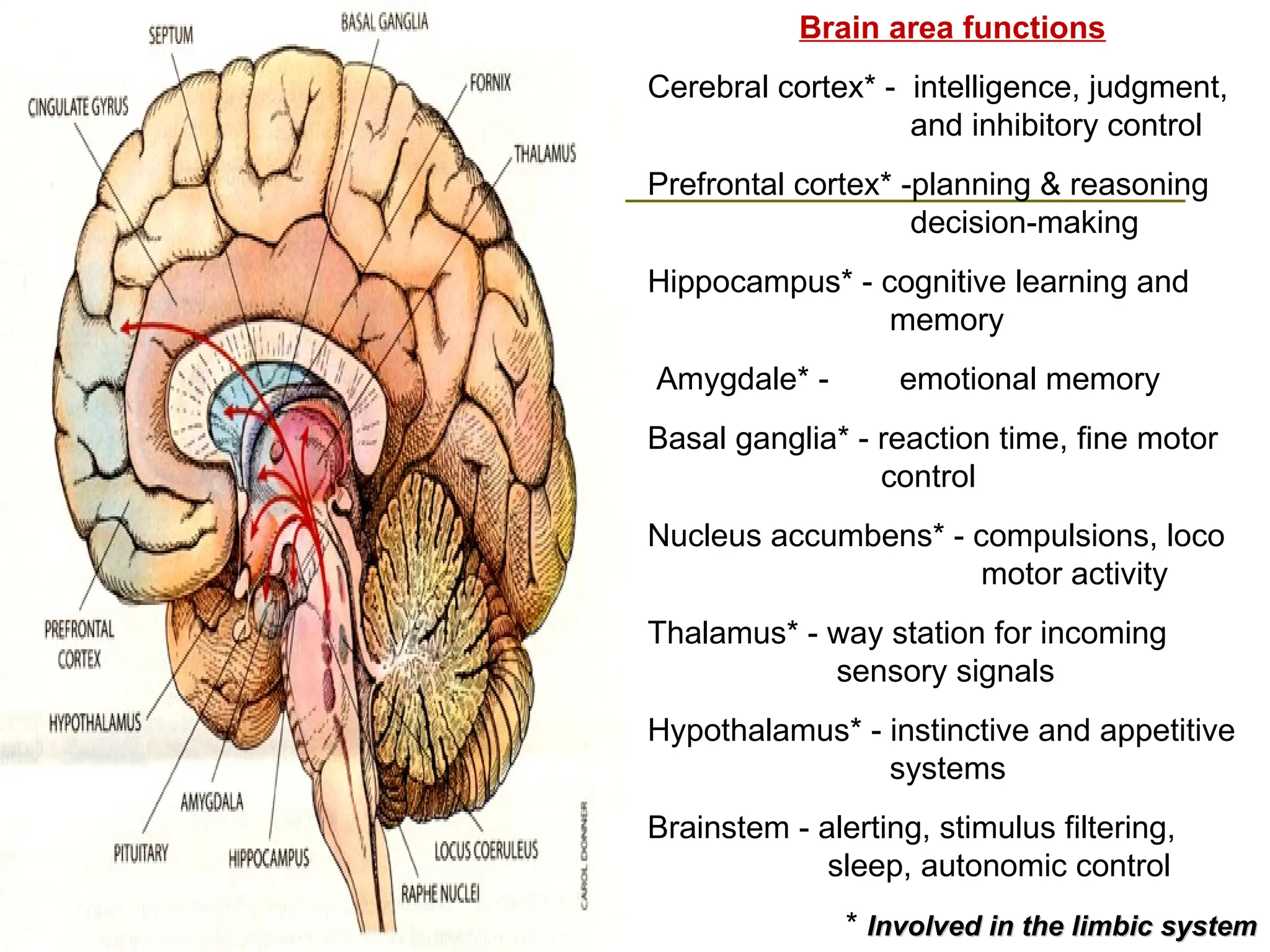
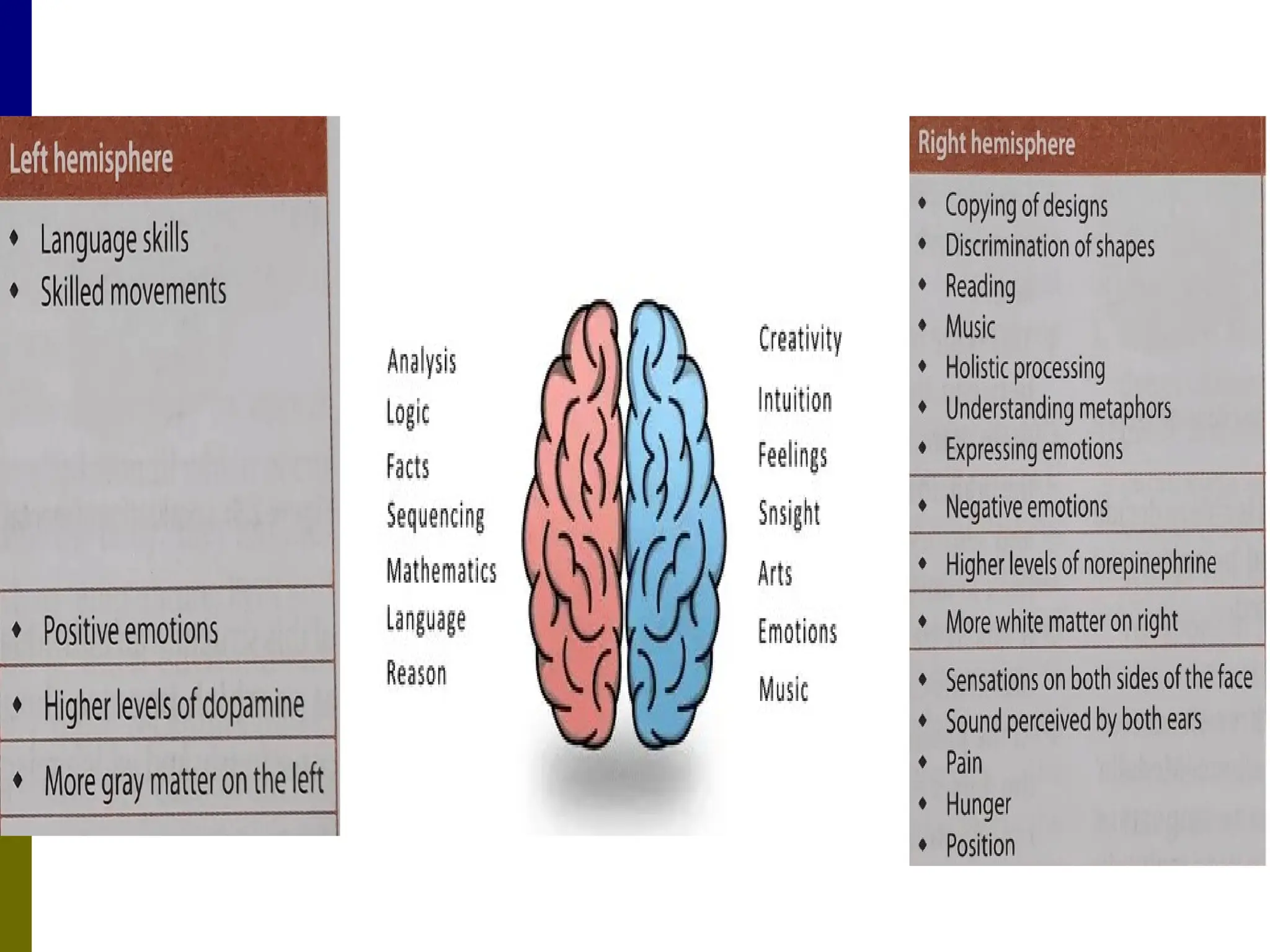
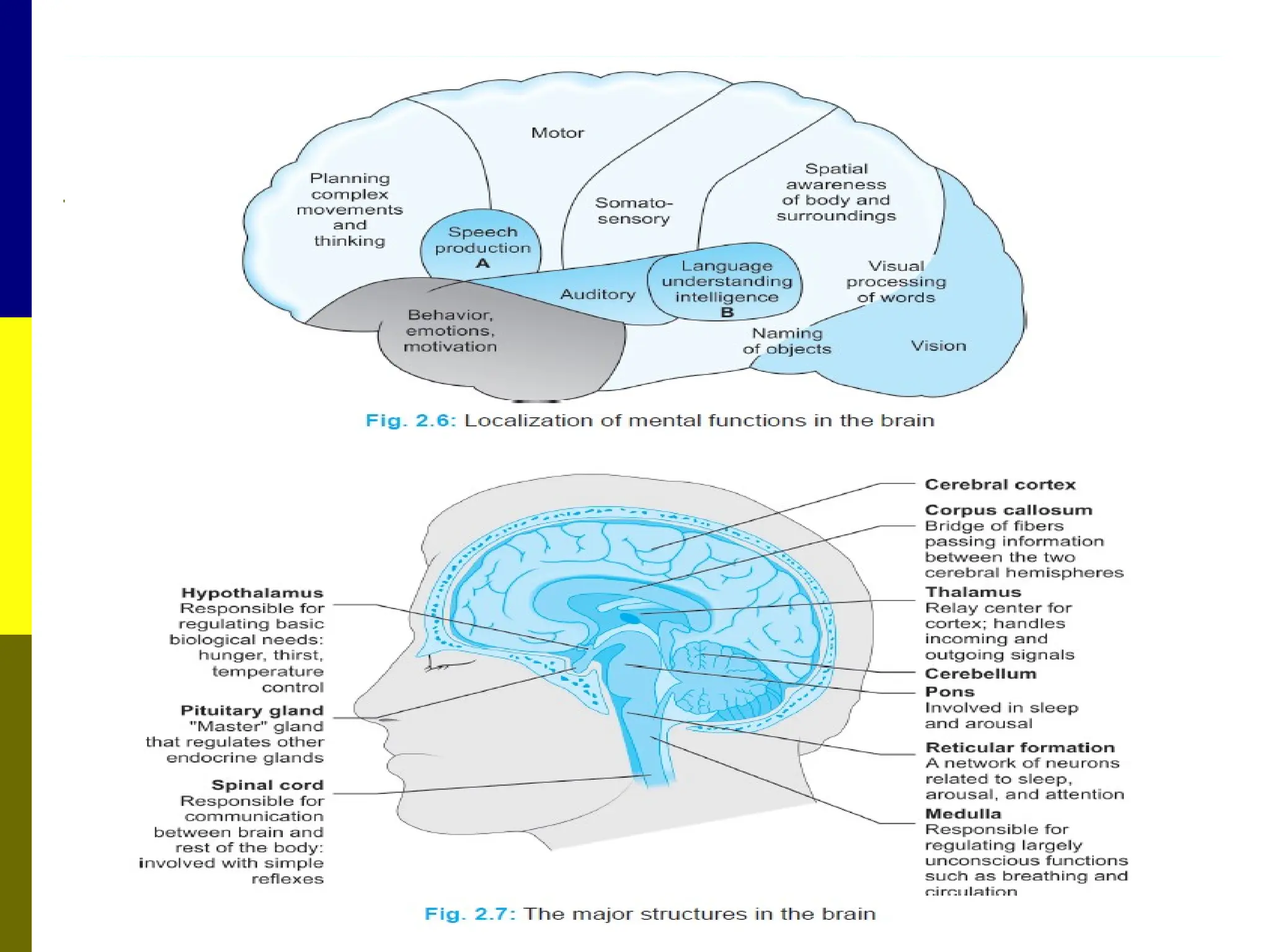
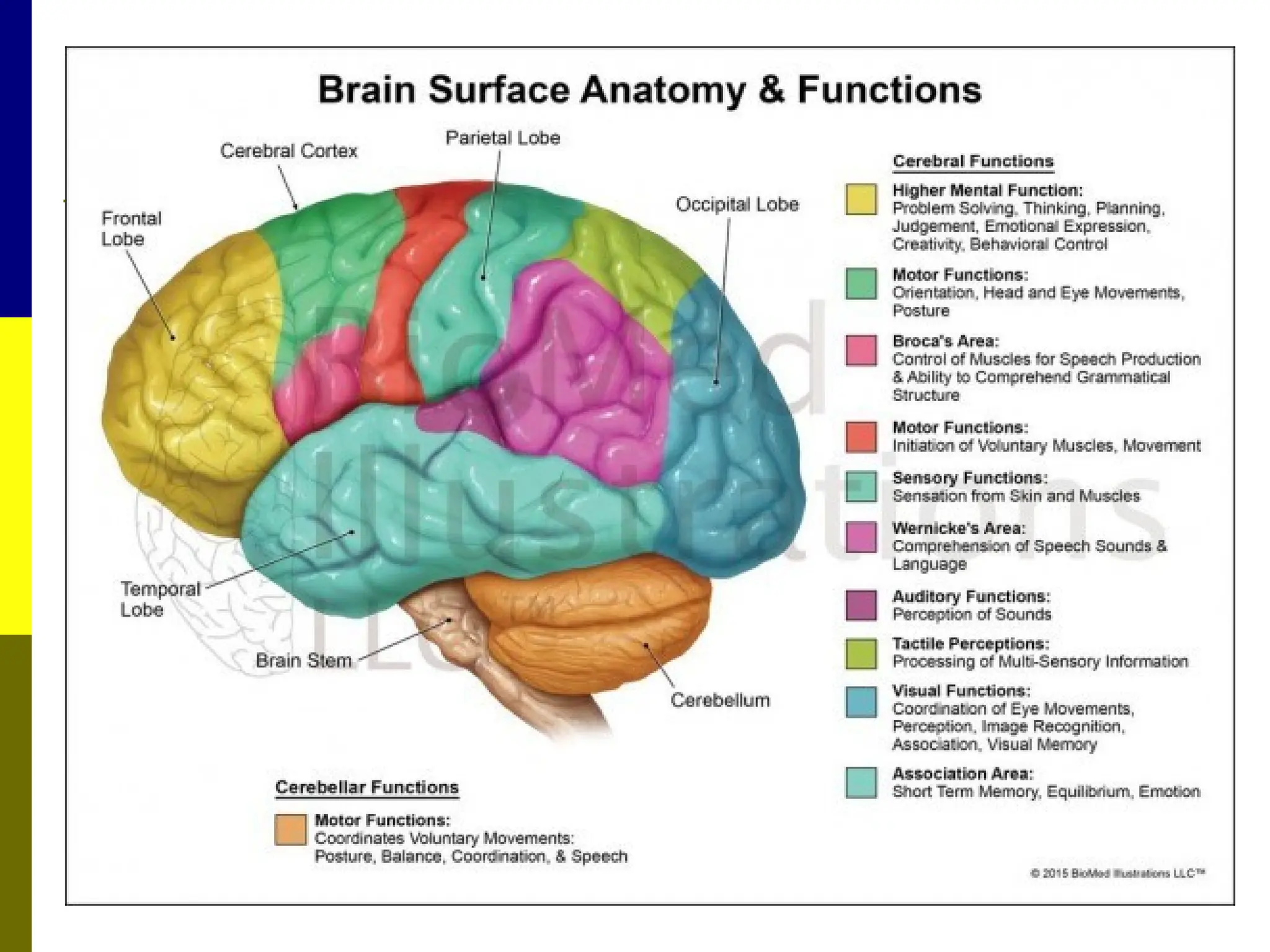
Brain area functions
Cerebral cortex* - intelligence, judgment,
and inhibitory control
Prefrontal cortex* -planning & reasoning
decision-making
Hippocampus* - cognitive learning and
memory
Amygdale* - emotional memory
Basal ganglia* - reaction time, fine motor
control
Nucleus accumbens* - compulsions, loco
motor activity
Thalamus* - way station for incoming
sensory signals
Hypothalamus* - instinctive and appetitive
systems
Brainstem - alerting, stimulus filtering,
sleep, autonomic control
* Involved in the limbic system
Involved in the limbic system
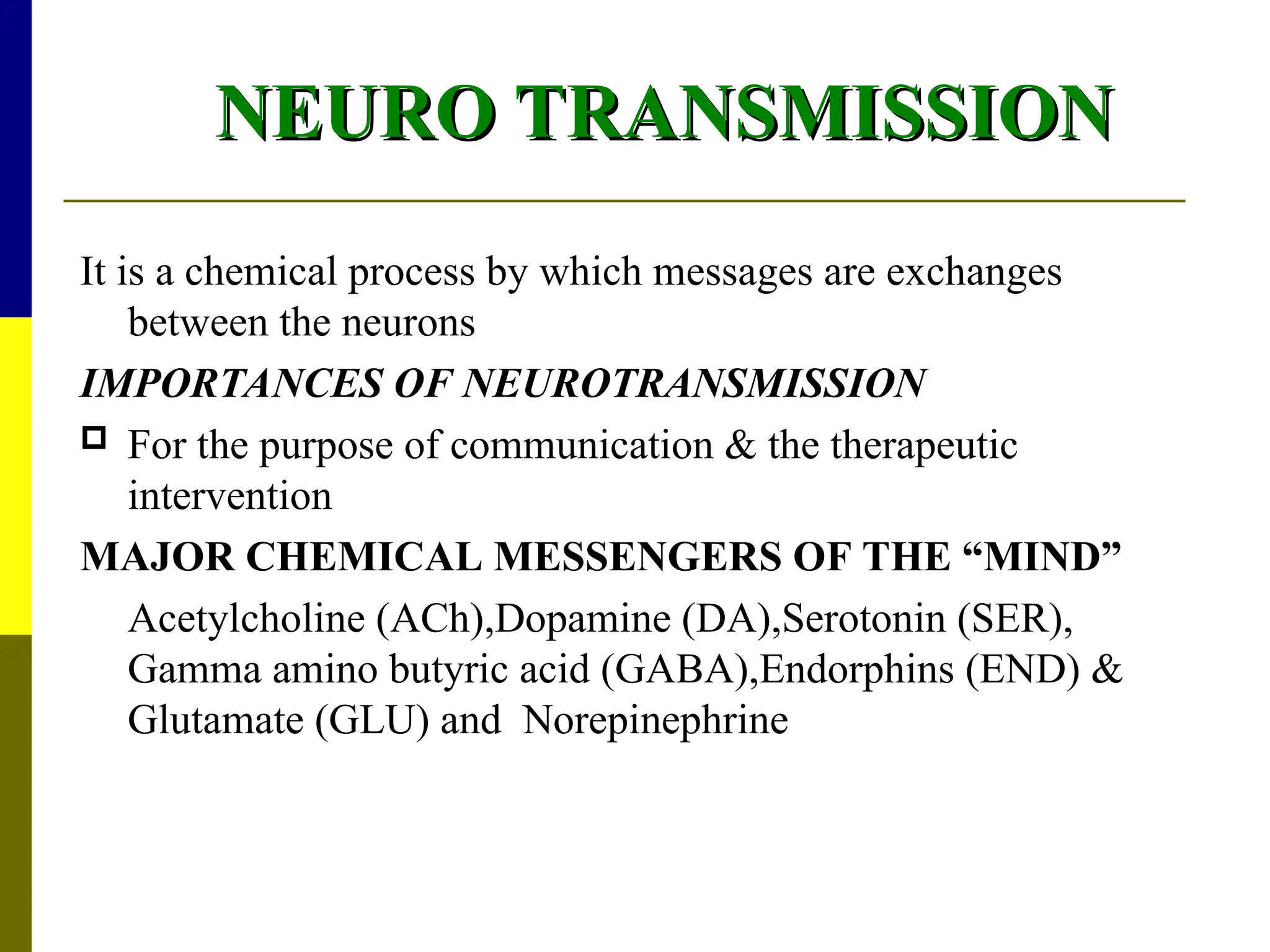
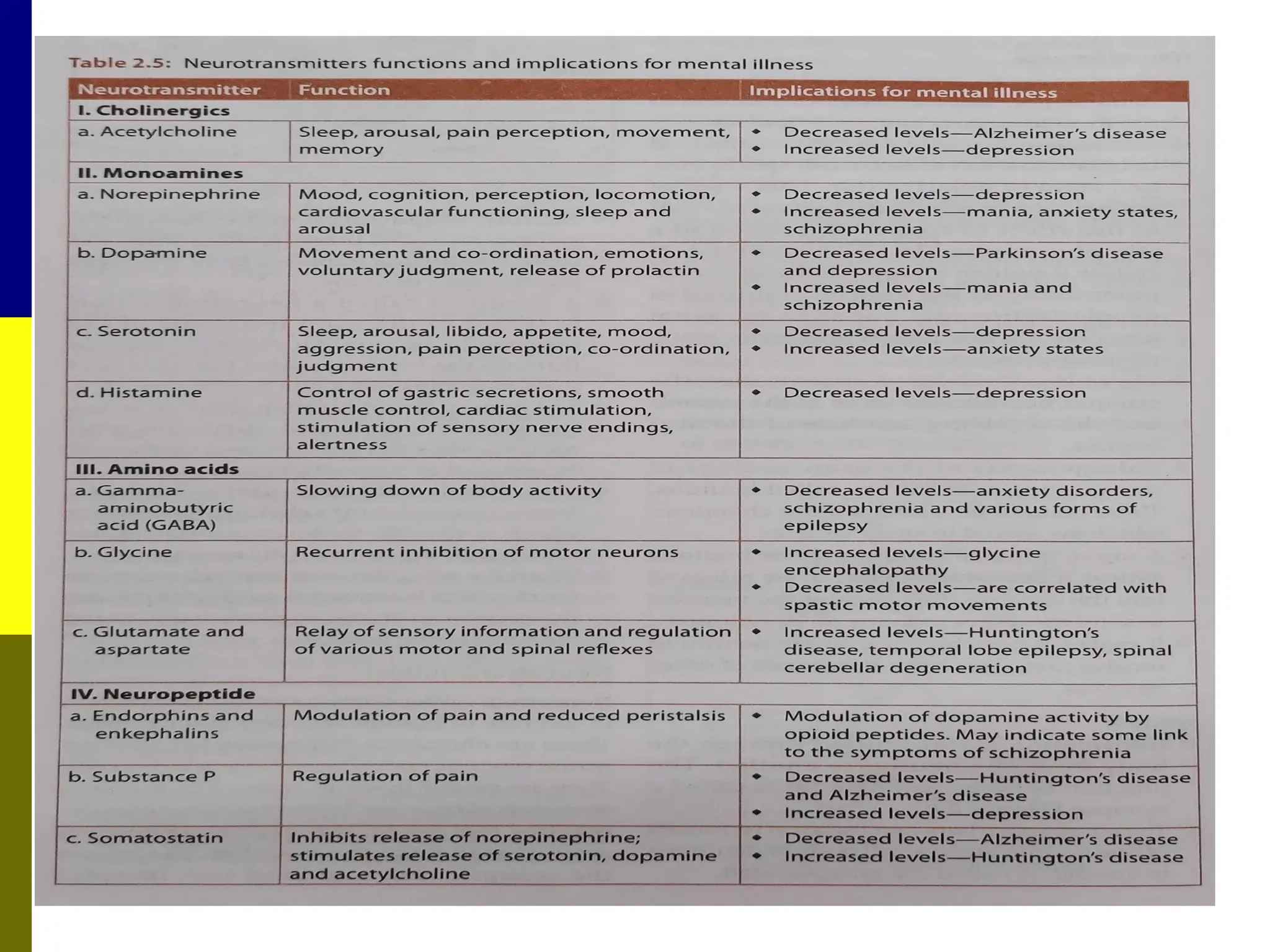
NEURO TRANSMISSION
NEURO TRANSMISSION
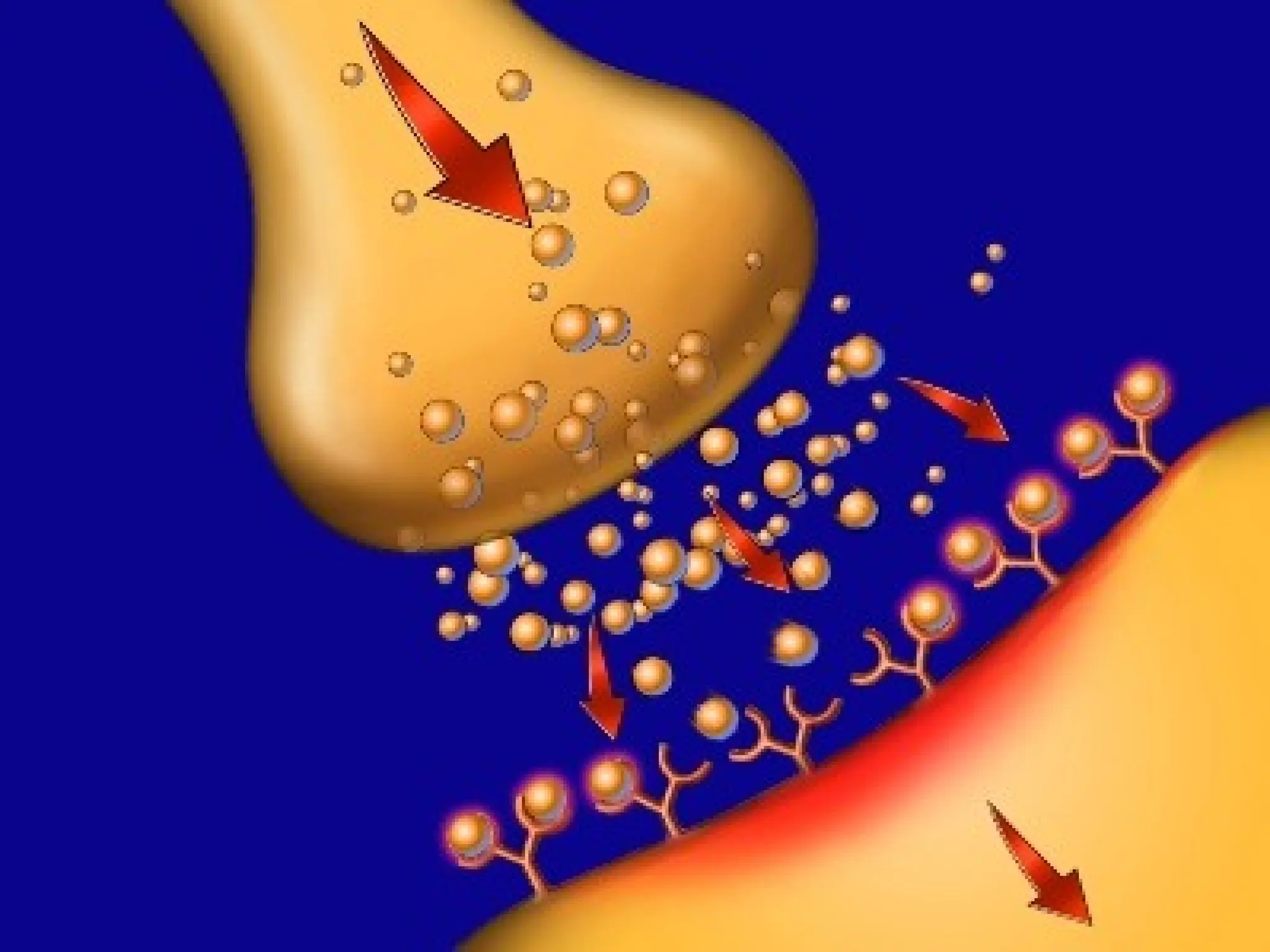
It is a chemical process by which messages are exchanges
between the neurons
IMPORTANCES OF NEUROTRANSMISSION
 For the purpose of communication & the therapeutic
intervention
MAJOR CHEMICAL MESSENGERS OF THE “MIND”
Acetylcholine (ACh),Dopamine (DA),Serotonin (SER),
Gamma amino butyric acid (GABA),Endorphins (END) &
Glutamate (GLU) and Norepinephrine
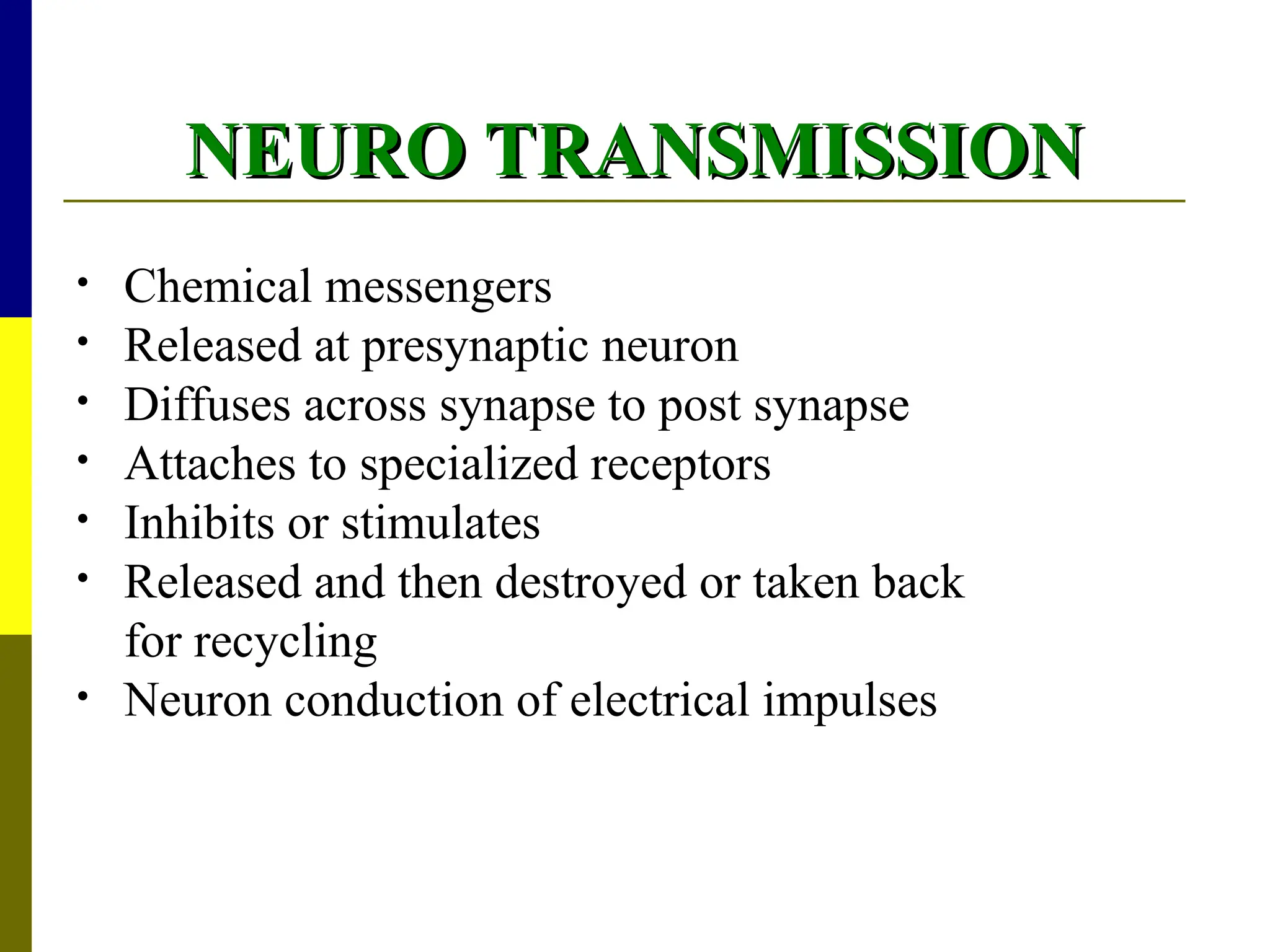
NEURO TRANSMISSION
NEURO TRANSMISSION
• Chemical messengers
• Released at presynaptic neuron
• Diffuses across synapse to post synapse
• Attaches to specialized receptors
• Inhibits or stimulates
• Released and then destroyed or taken back
for recycling
• Neuron conduction of electrical impulses
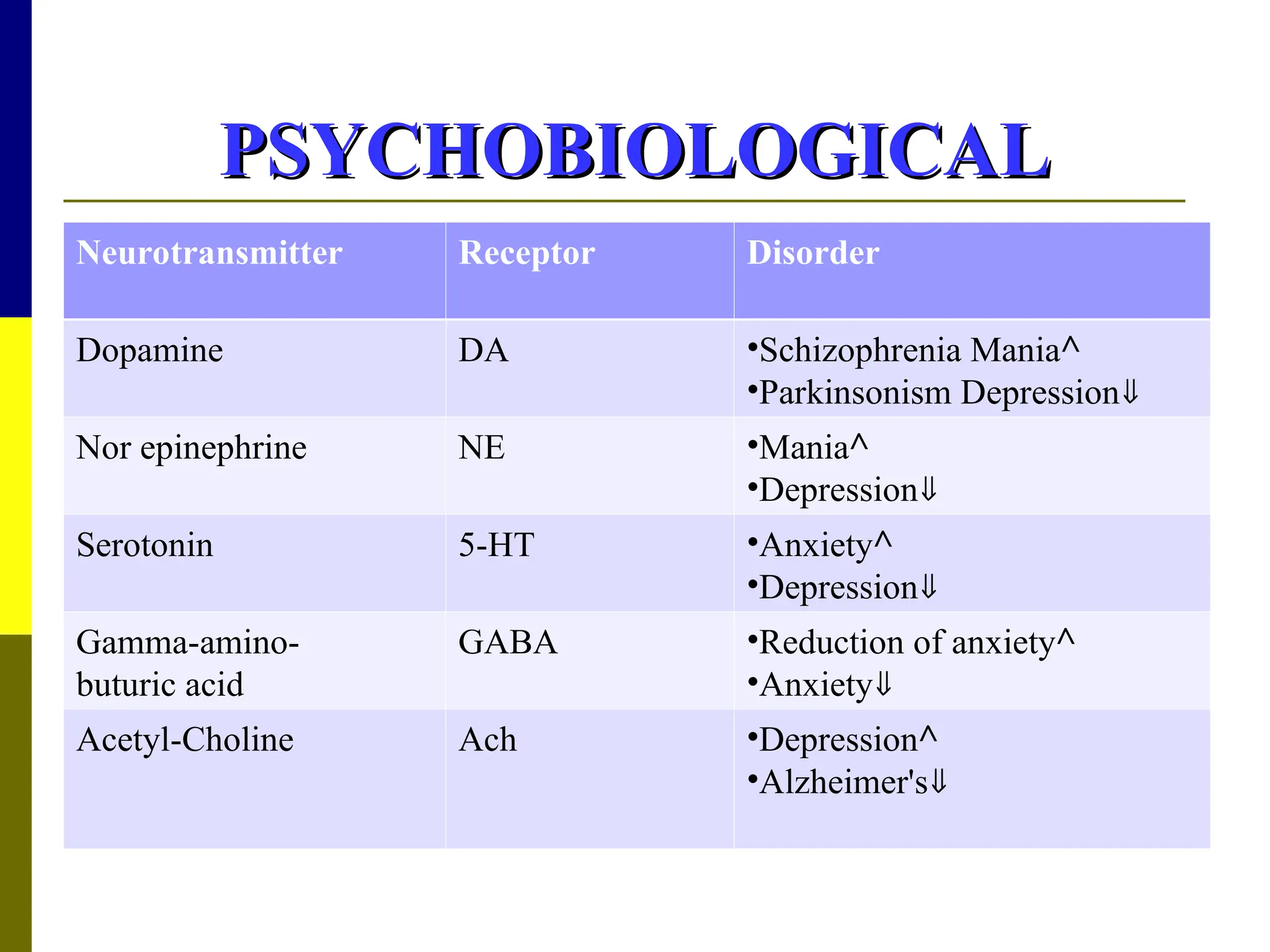
PSYCHOBIOLOGICAL
PSYCHOBIOLOGICAL
Neurotransmitter Receptor Disorder
Dopamine DA •Schizophrenia Mania^
•Parkinsonism Depression
Nor epinephrine NE •Mania^
•Depression
Serotonin 5-HT •Anxiety^
•Depression
Gamma-amino-
buturic acid
GABA •Reduction of anxiety^
•Anxiety
Acetyl-Choline Ach •Depression^
•Alzheimer's
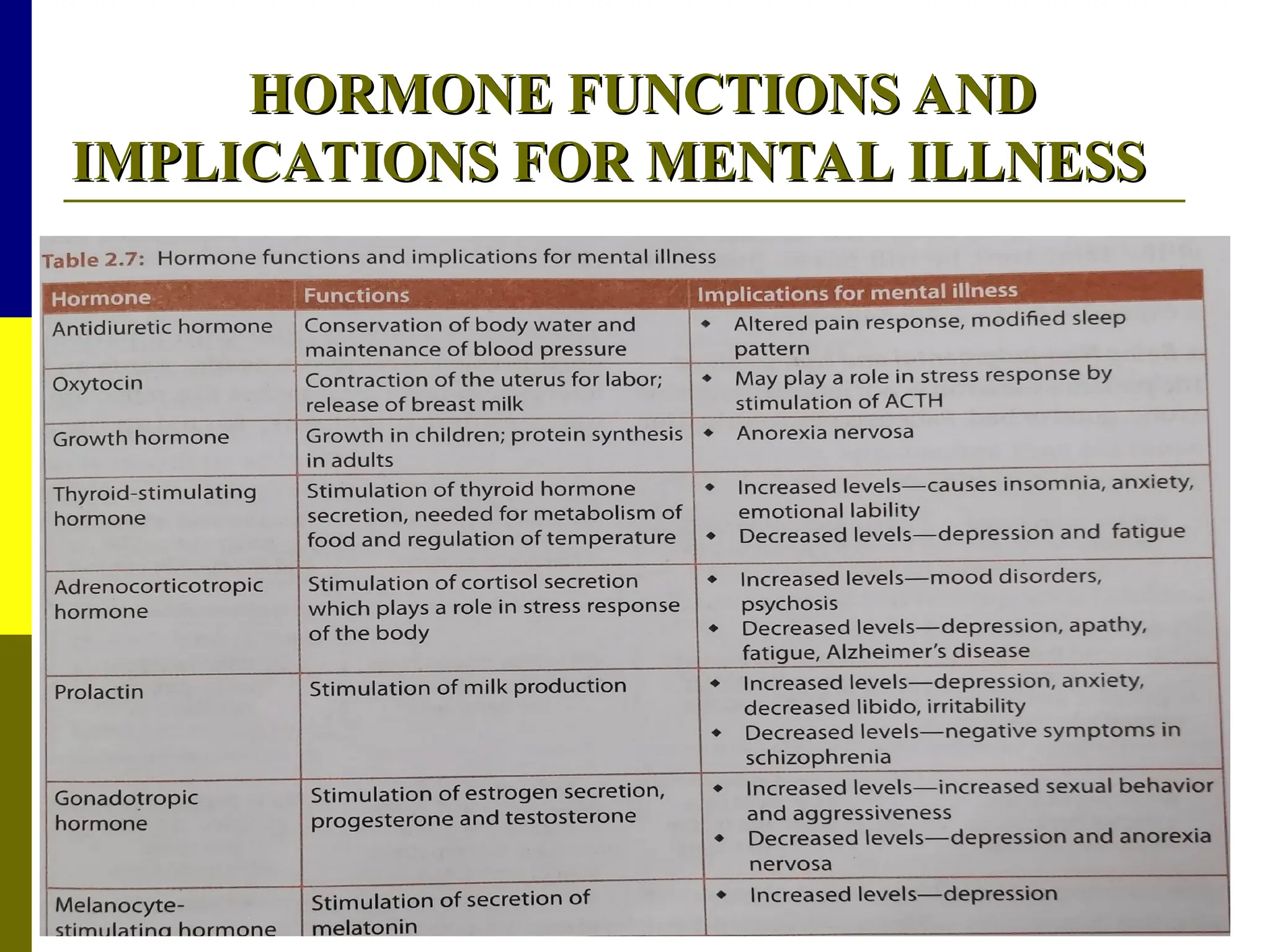
HORMONE FUNCTIONS AND
IMPLICATIONS FOR MENTAL ILLNESS
PRINCIPLES,
PRINCIPLES, ETHICS &
ETHICS &
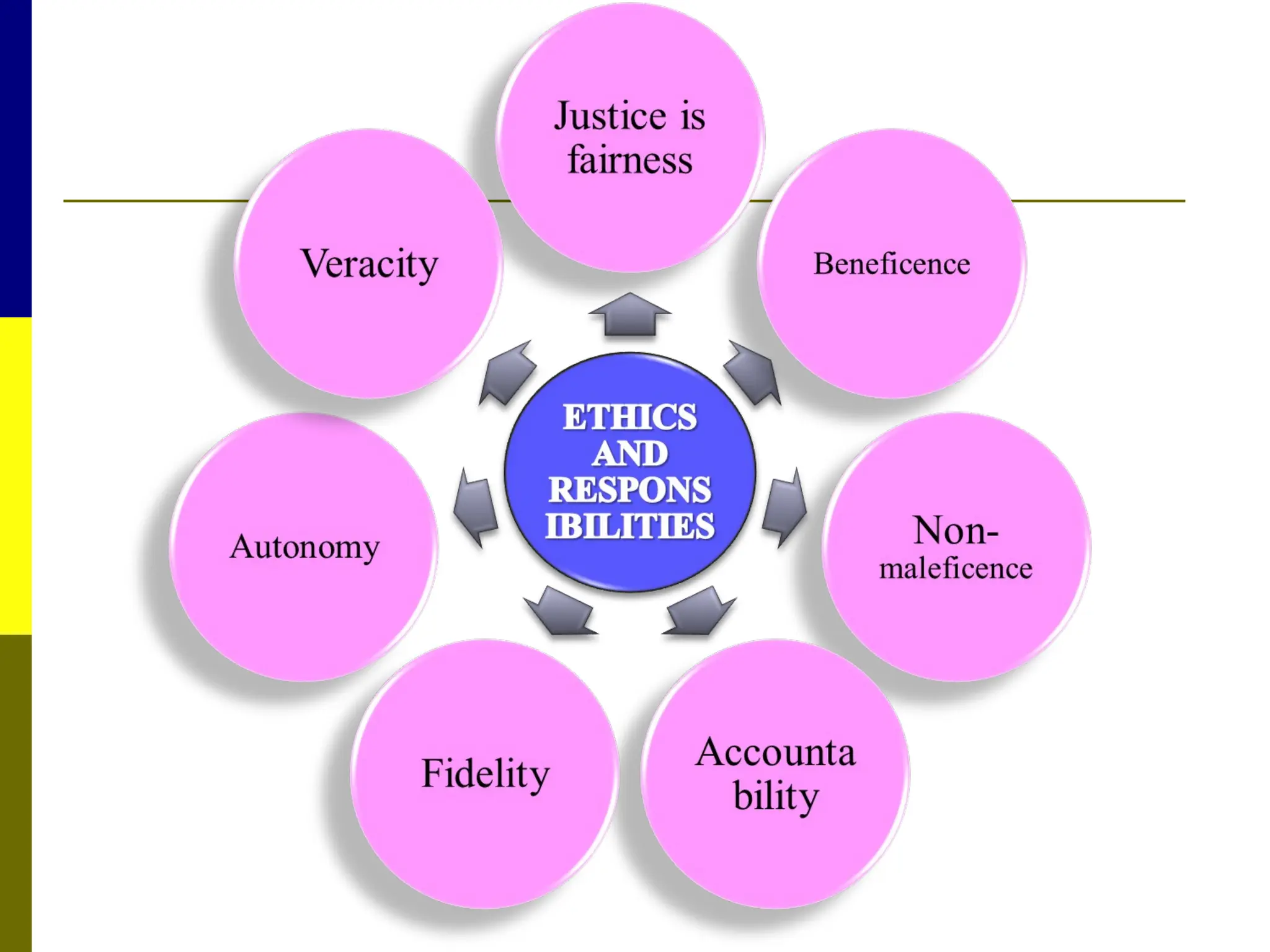
RESPONSIBILITIES
RESPONSIBILITIES AND
AND
STANDARD OF
STANDARD OF
PSYCHIATRIC NURSING
PSYCHIATRIC NURSING
Principles: Is rule that guides one's actions.
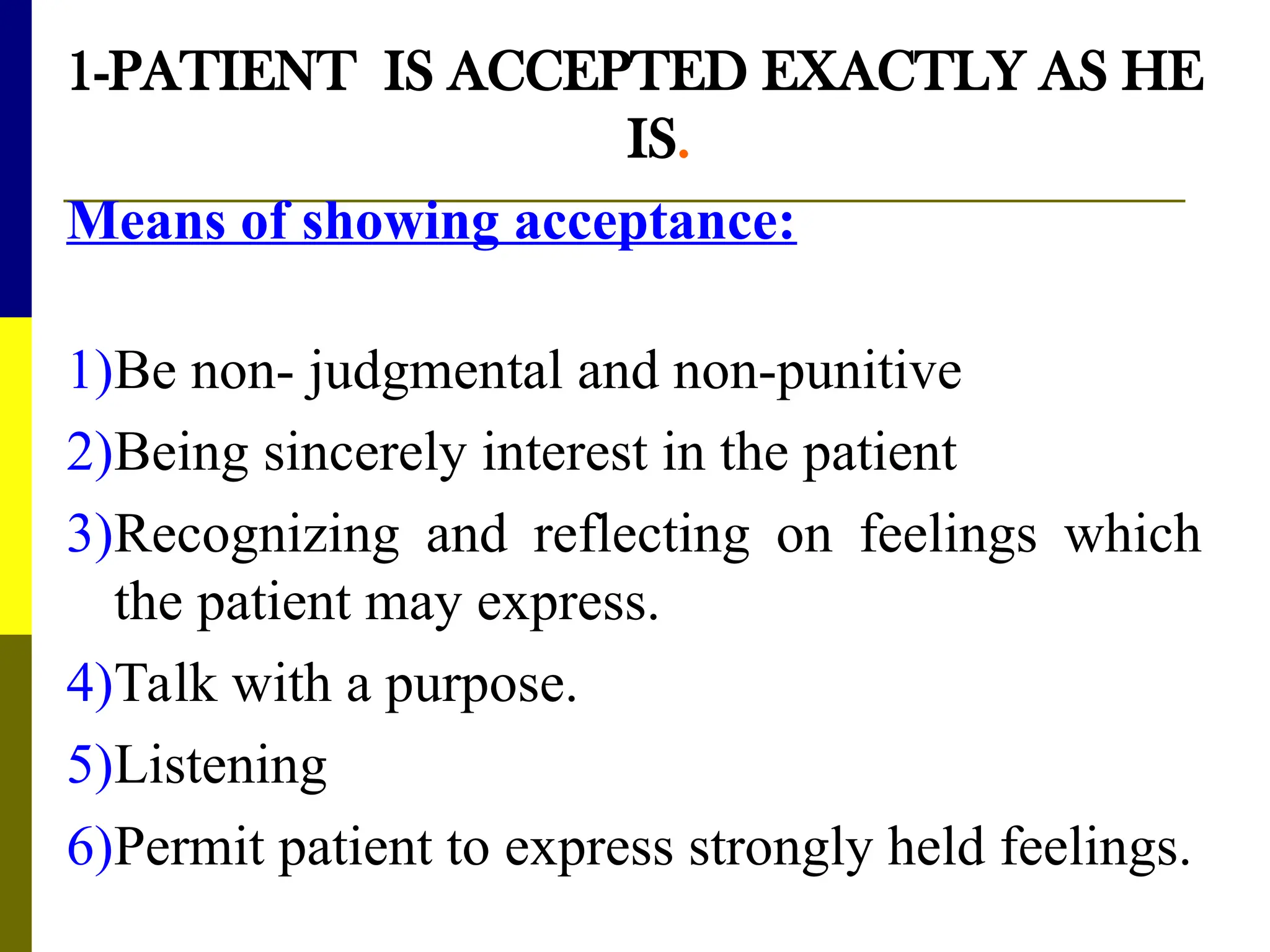
1-PATIENT IS ACCEPTED EXACTLY AS HE
IS.
Means of showing acceptance:
1)Be non- judgmental and non-punitive
2)Being sincerely interest in the patient
3)Recognizing and reflecting on feelings which
the patient may express.
4)Talk with a purpose.
5)Listening
6)Permit patient to express strongly held feelings.
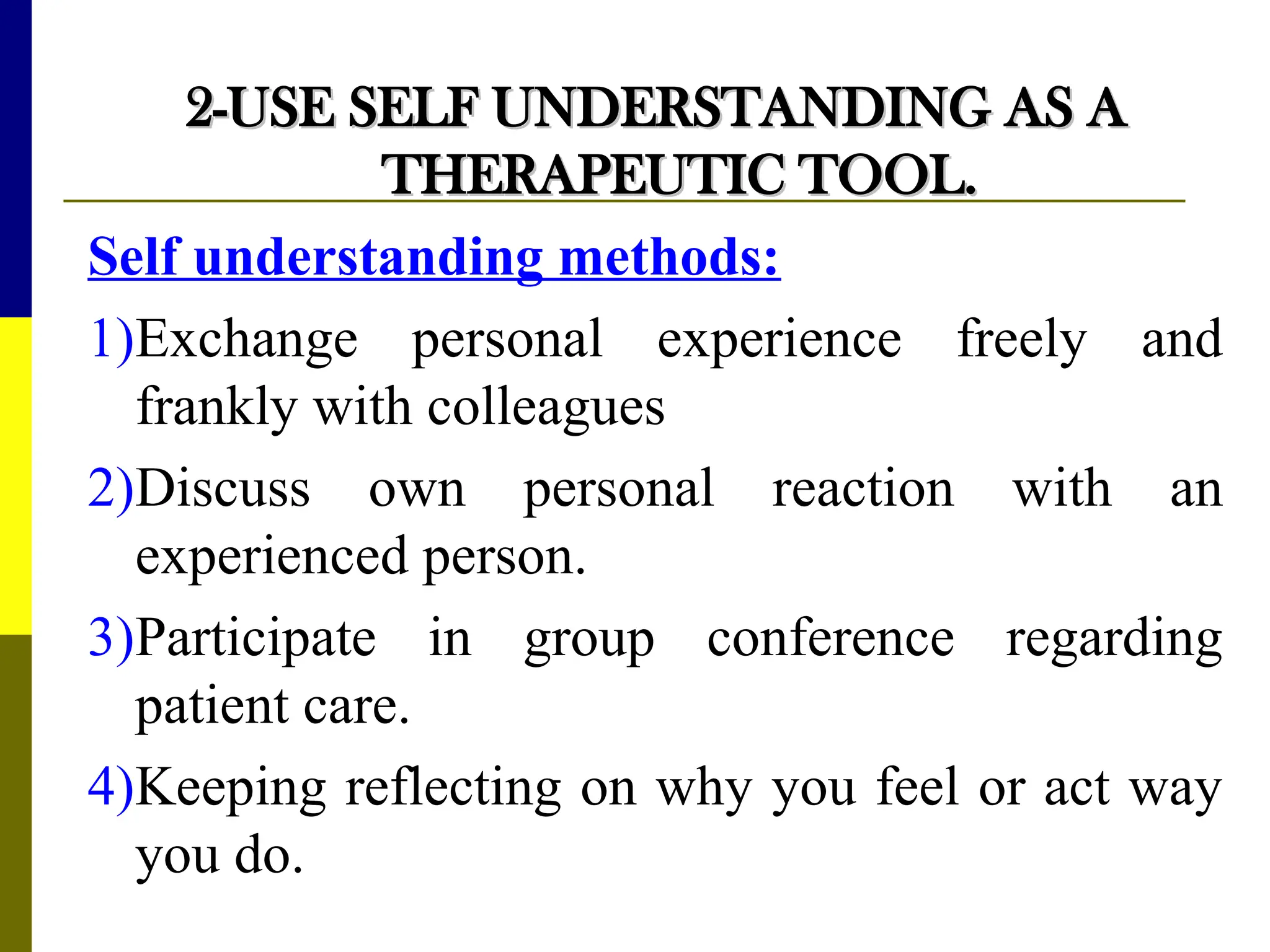
2-USE
2-USE SELF UNDERSTANDING AS A
SELF UNDERSTANDING AS A
THERAPEUTIC TOOL.
THERAPEUTIC TOOL.
Self understanding methods:
1)Exchange personal experience freely and
frankly with colleagues
2)Discuss own personal reaction with an
experienced person.
3)Participate in group conference regarding
patient care.
4)Keeping reflecting on why you feel or act way
you do.
3-CONSISTENCY IS USED TO
CONTRIBUTE TO PATIENT'S SECURITY.
Consistency means:
Having certain routine pattern that dose not
change from one day to the other ..
**fear of unknown produce anxiety, consistency
helps in knowing what to expect.
4)REASSURANCE MUST BE GIVEN IN A
SUITABLE AND ACCEPTABLE MANNER.
How to give reassurance:
1)Be truly interested in patient problems.
2)Pay attention to the matters that are important
to the patient.
3)Listen to personal problems.
4) Agree that the patient has a problem and think
along with him to solve it.
5) Provide patient with acceptable outlets of
anxiety.
5) Patient's Behavior Is Changed Through
Emotional Experience And Not By Rational
Interpretation.
6) Unnecessary Increase In Patient's Anxiety
Should Be Avoided.
7) Objective Observation Of Patient To
Understand His Behavior.-
*Objectivity Is An Essential Component Of Observation
What Do We Mean By Objectivity?Objectivity Is An Ability To
Evaluate Exactly The Patient's Behavior Without Mixing
One's Own Feelings ,Opinion Or Judgment.
Empathy Versus Sympathy
8) Maintain Realistic Nurse- Patient Relationship
9) Avoid Verbal And Physical Force As Must As
Possible.
10) Nursing Care Is Centered On The Patient As
Person And Not On The Control Of
Symptoms.
11) All Explanation Of Procedures And Other
Routines Are Given According To The
Patient’s Level Of Understanding
12) Many Procedures Are Modified But Basic
Principles Remain Unaltered
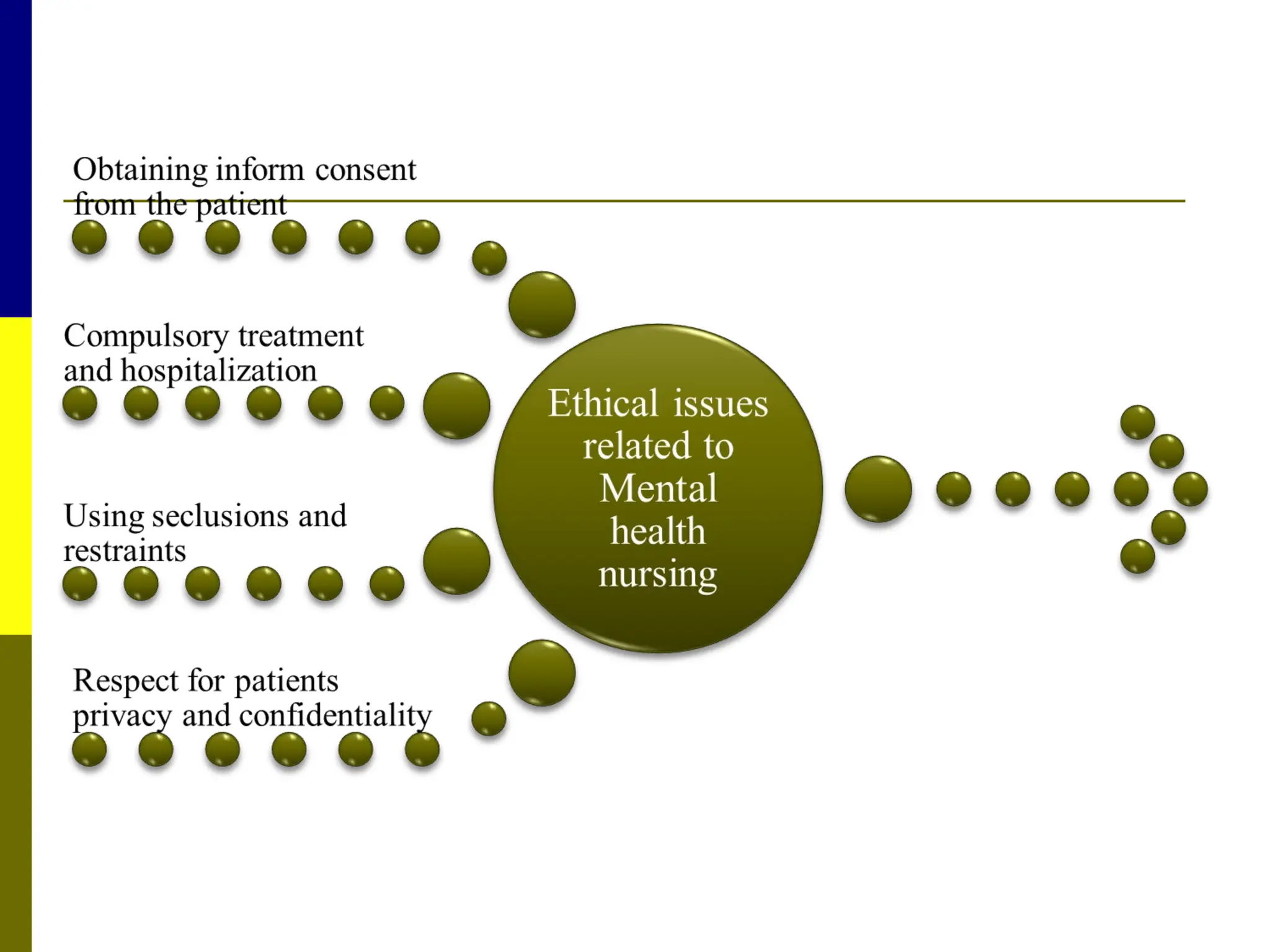
Ethical Responsibilities of a
Psychiatric Nurse
Psychiatric Nurse
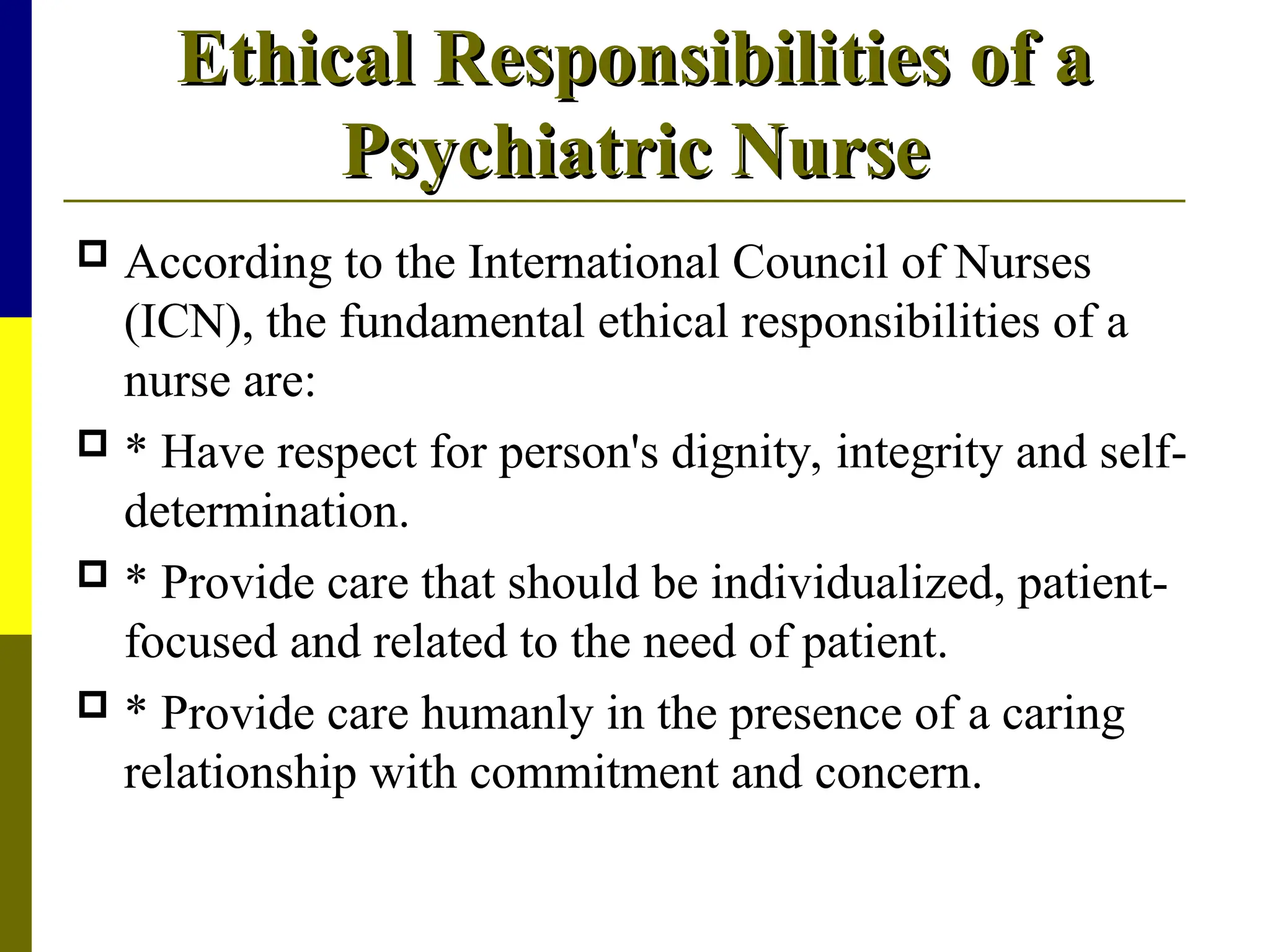
 According to the International Council of Nurses
(ICN), the fundamental ethical responsibilities of a
nurse are:
 * Have respect for person's dignity, integrity and self-
determination.
 * Provide care that should be individualized, patient-
focused and related to the need of patient.
 * Provide care humanly in the presence of a caring
relationship with commitment and concern.
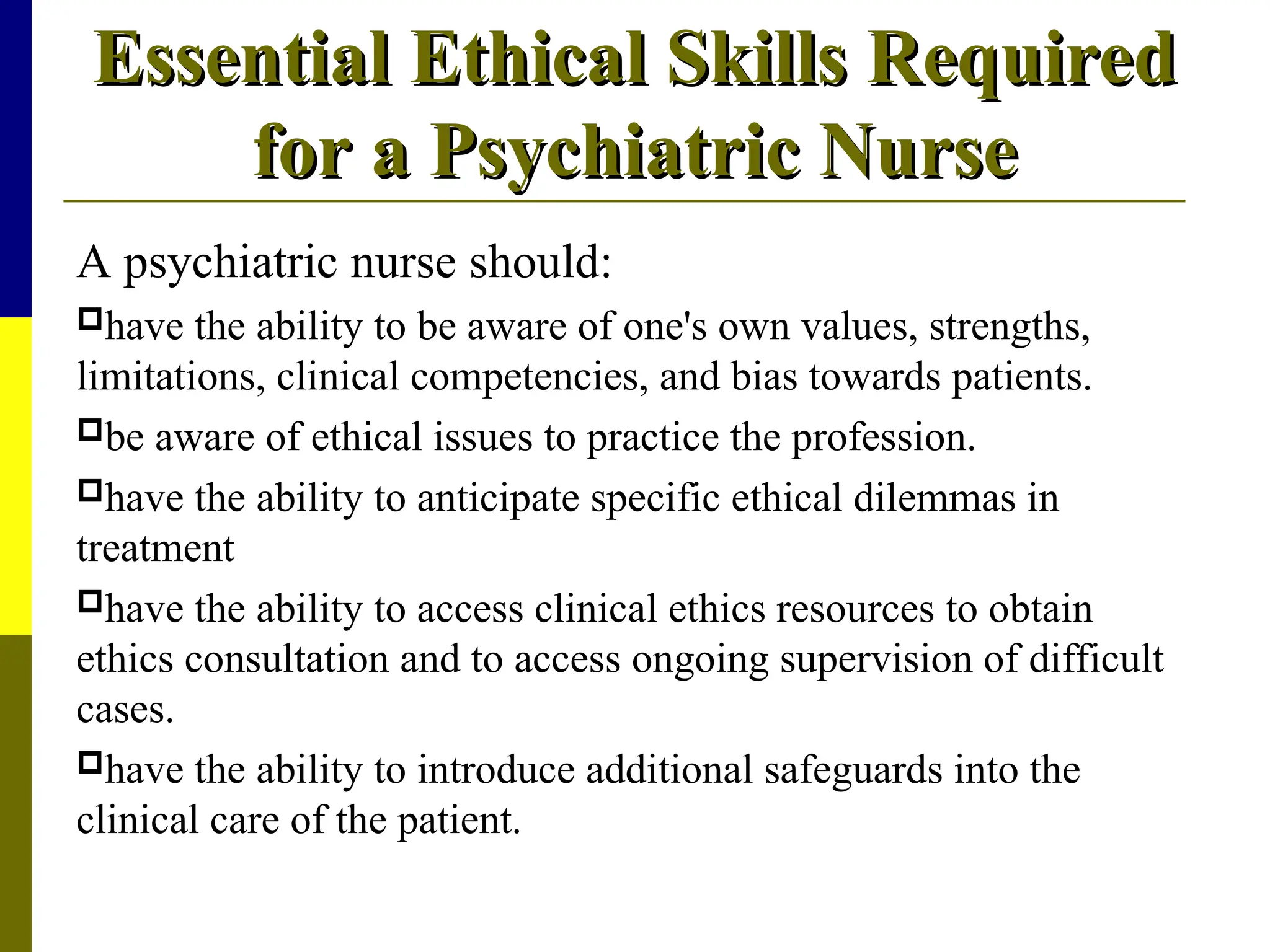
Essential Ethical Skills Required
for a Psychiatric Nurse
A psychiatric nurse should:
have the ability to be aware of one's own values, strengths,
limitations, clinical competencies, and bias towards patients.
be aware of ethical issues to practice the profession.
have the ability to anticipate specific ethical dilemmas in
treatment
have the ability to access clinical ethics resources to obtain
ethics consultation and to access ongoing supervision of difficult
cases.
have the ability to introduce additional safeguards into the
clinical care of the patient.
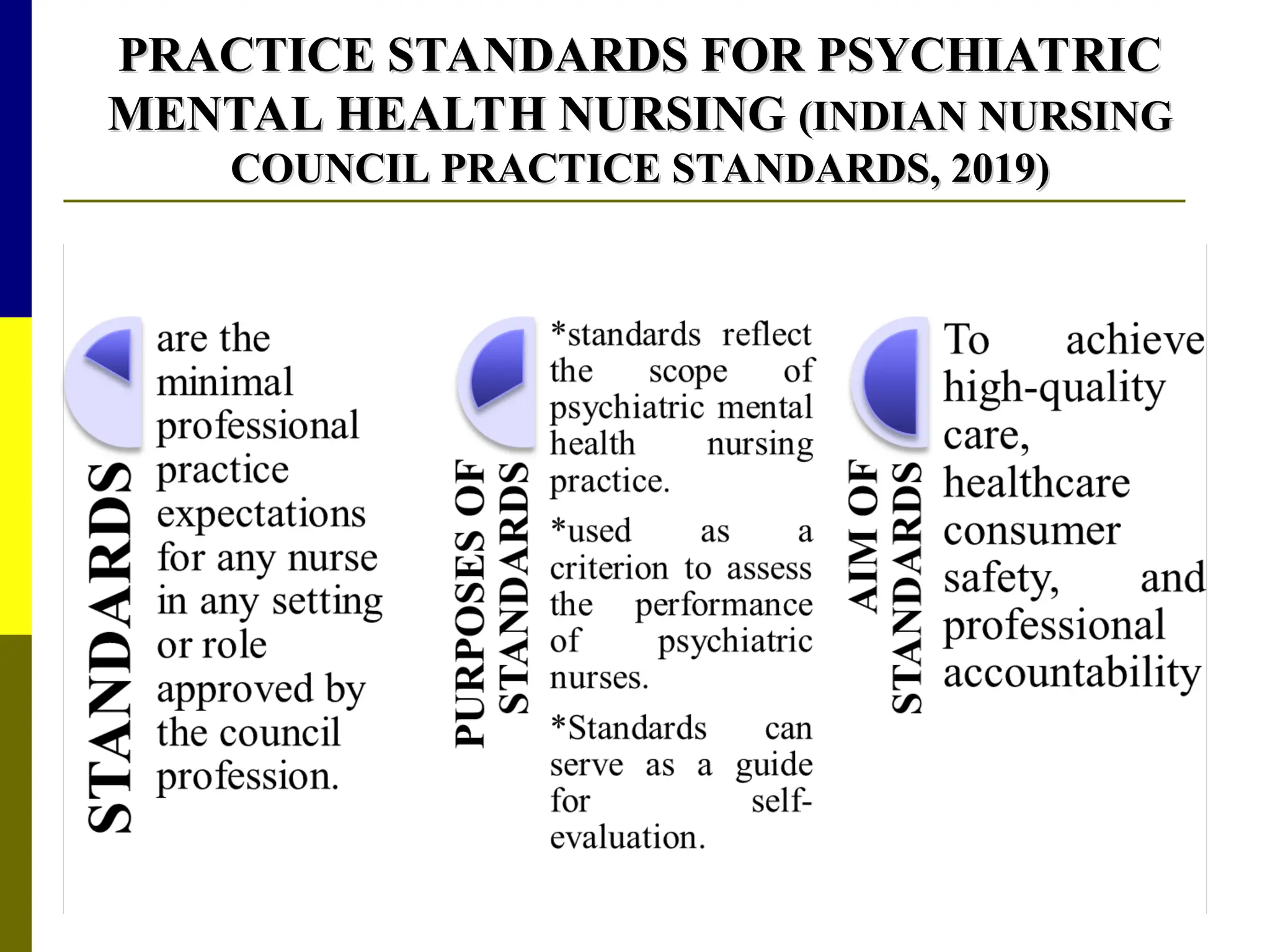
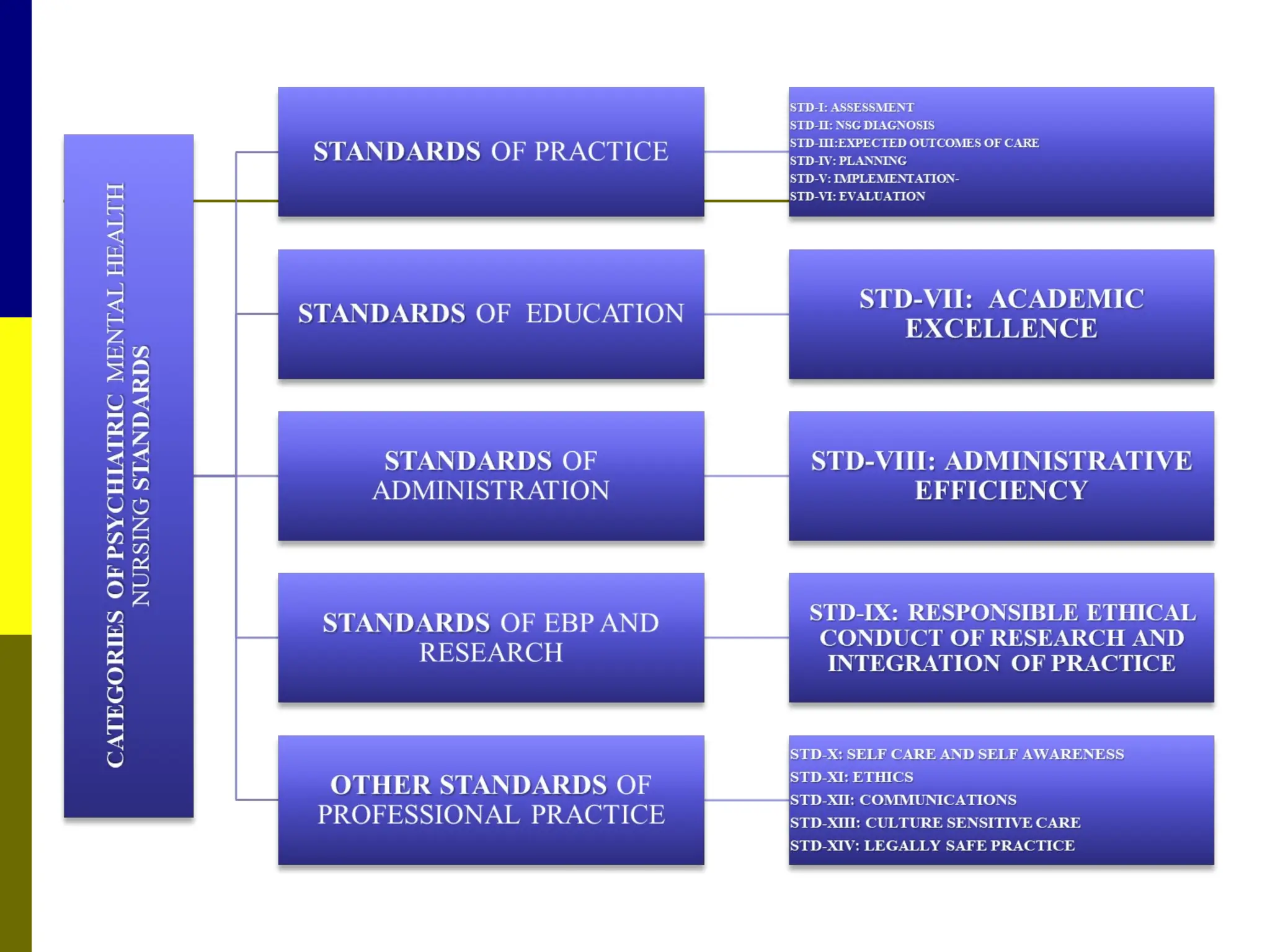
PRACTICE STANDARDS FOR PSYCHIATRIC
MENTAL HEALTH NURSING
MENTAL HEALTH NURSING (INDIAN NURSING
(INDIAN NURSING
COUNCIL PRACTICE STANDARDS, 2019)
CONCEPTUAL MODELS
CONCEPTUAL MODELS
IN PSYCHIATRY
IN PSYCHIATRY
CONCEPTUAL MODELS
CONCEPTUAL MODELS
Models is a means of organizing a complex body of
knowledge i.e the linkage between the various concepts
related to human behavior may be represented in the form
of a model, which can be referred as conceptual model
Many theories attempt to explain the human behavior,
health and mental illness and each of them suggests how
normal development occurs based on the theory beliefs,
assumptions and view of the world. These theory suggests
the strategies that the clinician can use to work with
patients
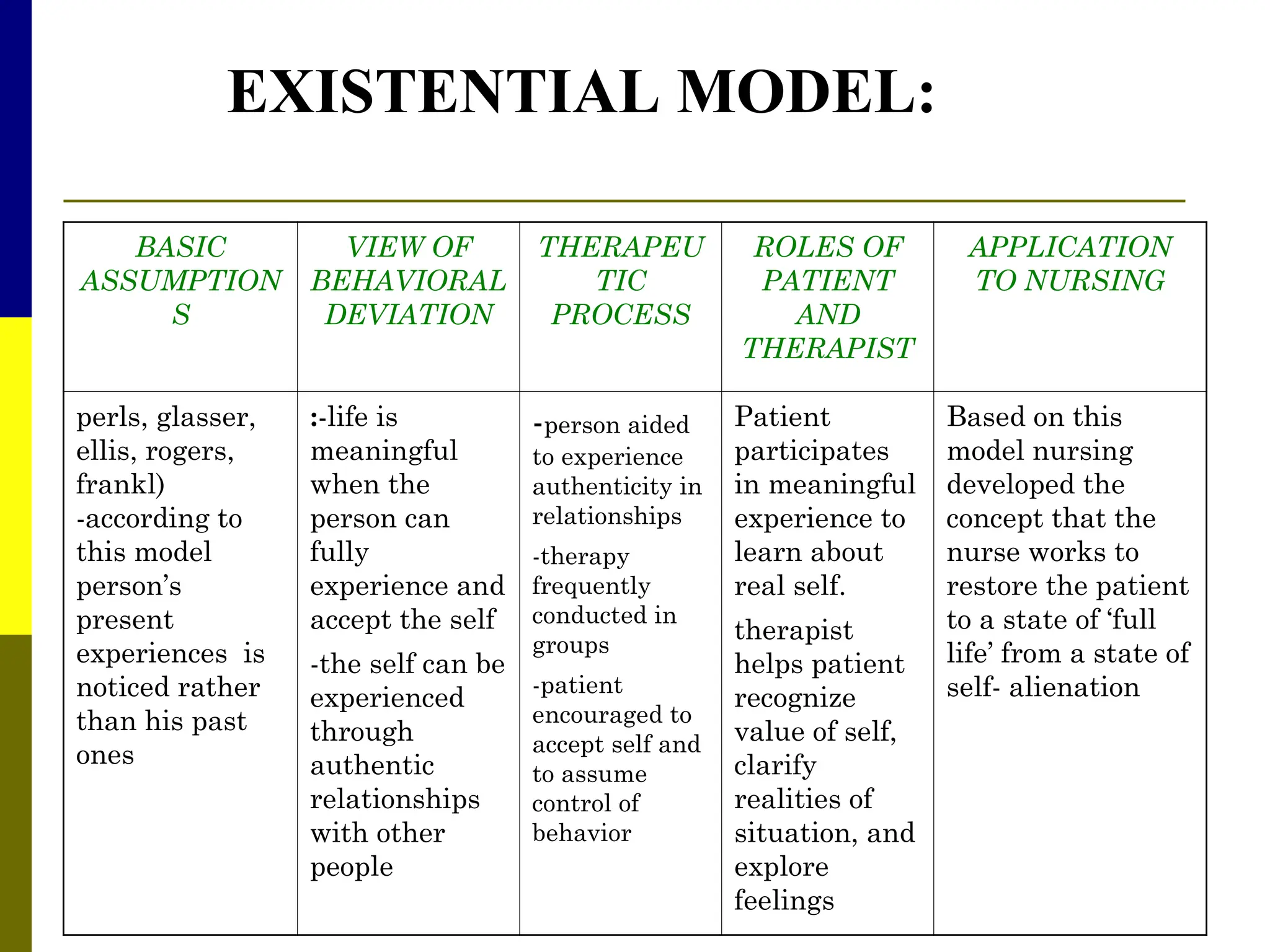
BASIC
ASSUMPTION
S
VIEW OF
BEHAVIORAL
DEVIATION
THERAPEU
TIC
PROCESS
ROLES OF
PATIENT
AND
THERAPIST
APPLICATION
TO NURSING
perls, glasser,
ellis, rogers,
frankl)
-according to
this model
person’s
present
experiences is
noticed rather
than his past
ones
:-life is
meaningful
when the
person can
fully
experience and
accept the self
-the self can be
experienced
through
authentic
relationships
with other
people
-person aided
to experience
authenticity in
relationships
-therapy
frequently
conducted in
groups
-patient
encouraged to
accept self and
to assume
control of
behavior
Patient
participates
in meaningful
experience to
learn about
real self.
therapist
helps patient
recognize
value of self,
clarify
realities of
situation, and
explore
feelings
Based on this
model nursing
developed the
concept that the
nurse works to
restore the patient
to a state of ‘full
life’ from a state of
self- alienation
EXISTENTIAL MODEL:
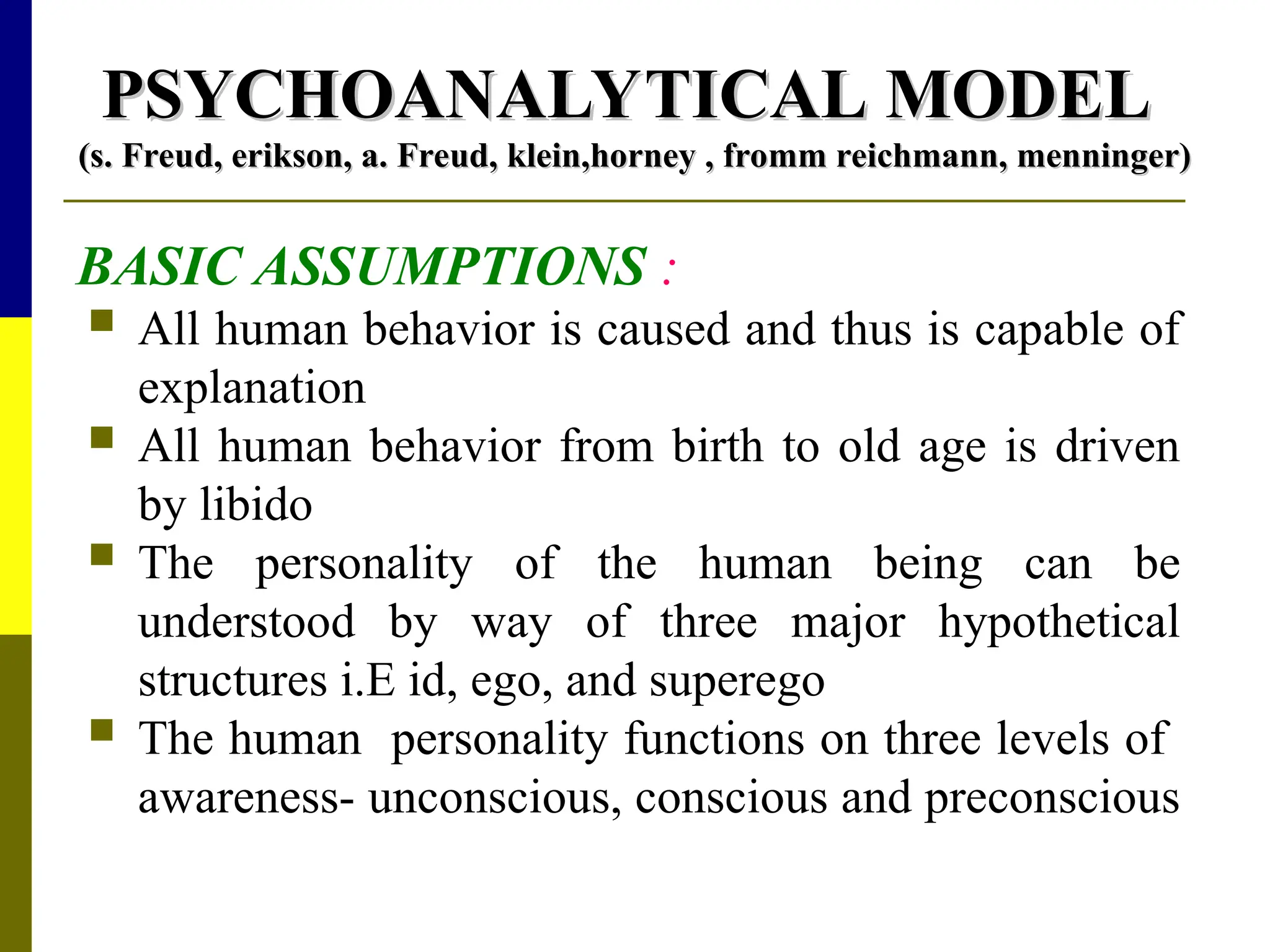
PSYCHOANALYTICAL MODEL
(s. Freud, erikson, a. Freud, klein,horney , fromm reichmann, menninger)
BASIC ASSUMPTIONS :
 All human behavior is caused and thus is capable of
explanation
 All human behavior from birth to old age is driven
by libido
 The personality of the human being can be
understood by way of three major hypothetical
structures i.E id, ego, and superego
 The human personality functions on three levels of
awareness- unconscious, conscious and preconscious
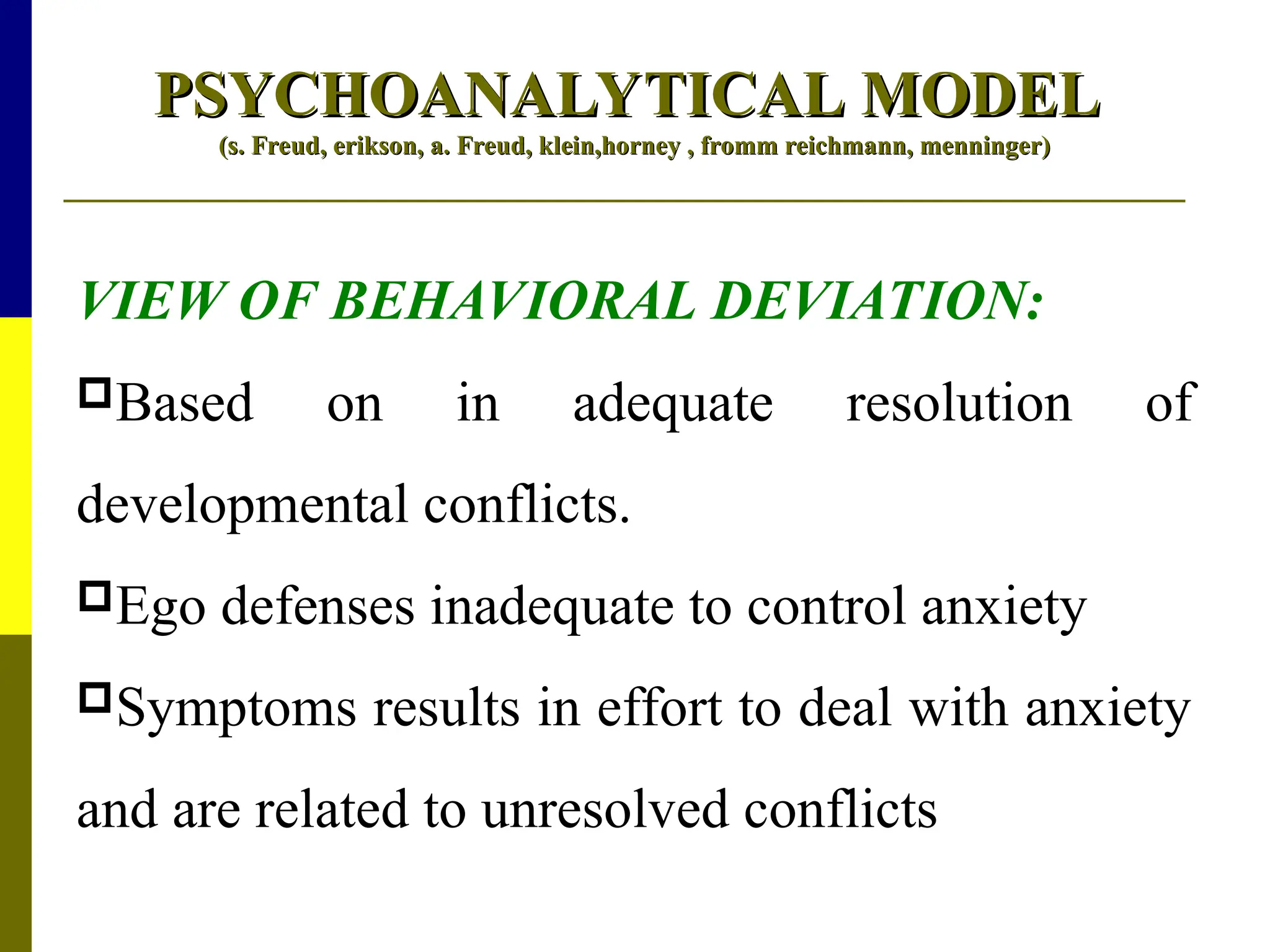
PSYCHOANALYTICAL MODEL
(s. Freud, erikson, a. Freud, klein,horney , fromm reichmann, menninger)
VIEW OF BEHAVIORAL DEVIATION:
Based on in adequate resolution of
developmental conflicts.
Ego defenses inadequate to control anxiety
Symptoms results in effort to deal with anxiety
and are related to unresolved conflicts
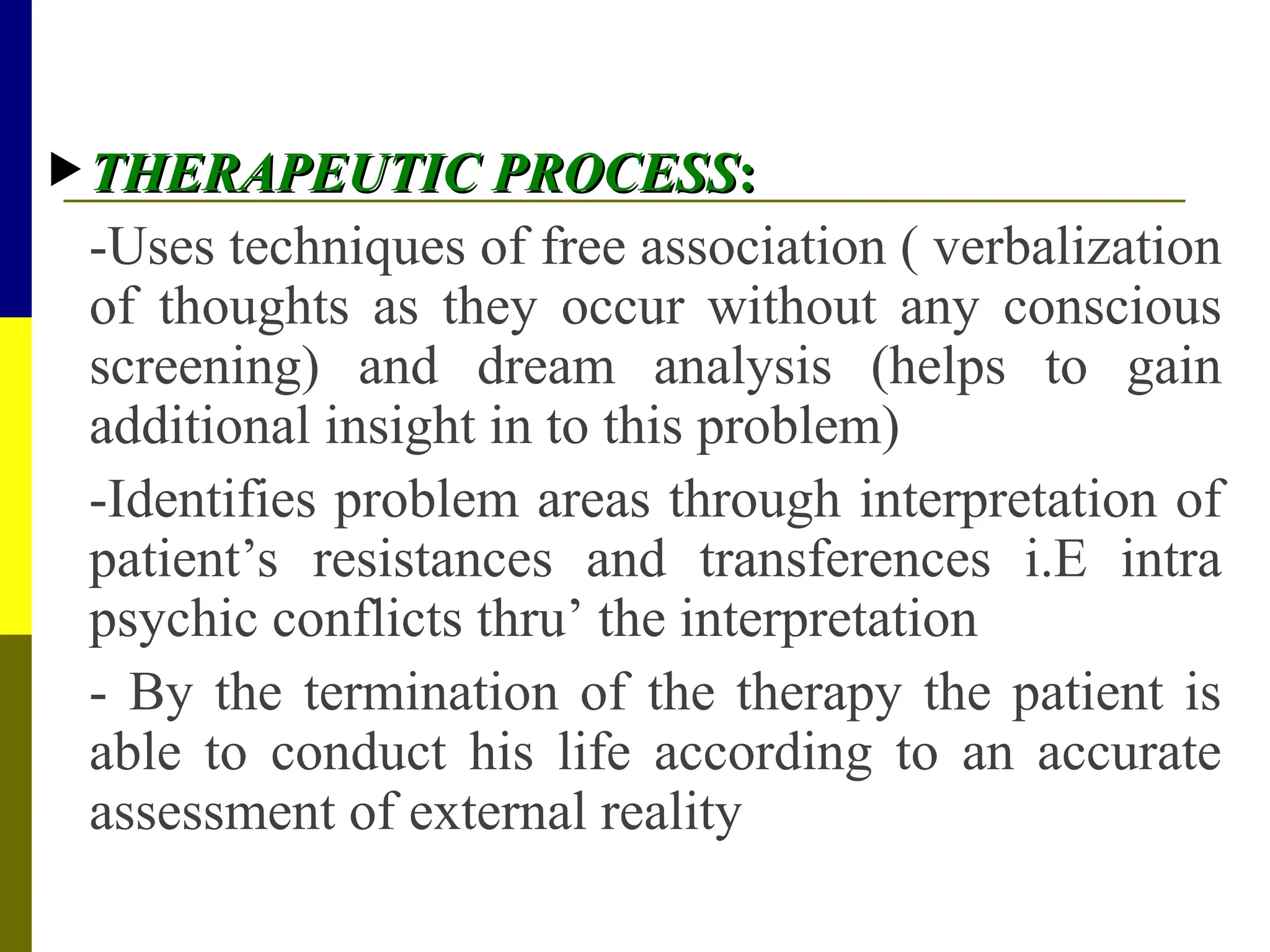
 THERAPEUTIC PROCESS
THERAPEUTIC PROCESS:
:
-Uses techniques of free association ( verbalization
of thoughts as they occur without any conscious
screening) and dream analysis (helps to gain
additional insight in to this problem)
-Identifies problem areas through interpretation of
patient’s resistances and transferences i.E intra
psychic conflicts thru’ the interpretation
- By the termination of the therapy the patient is
able to conduct his life according to an accurate
assessment of external reality
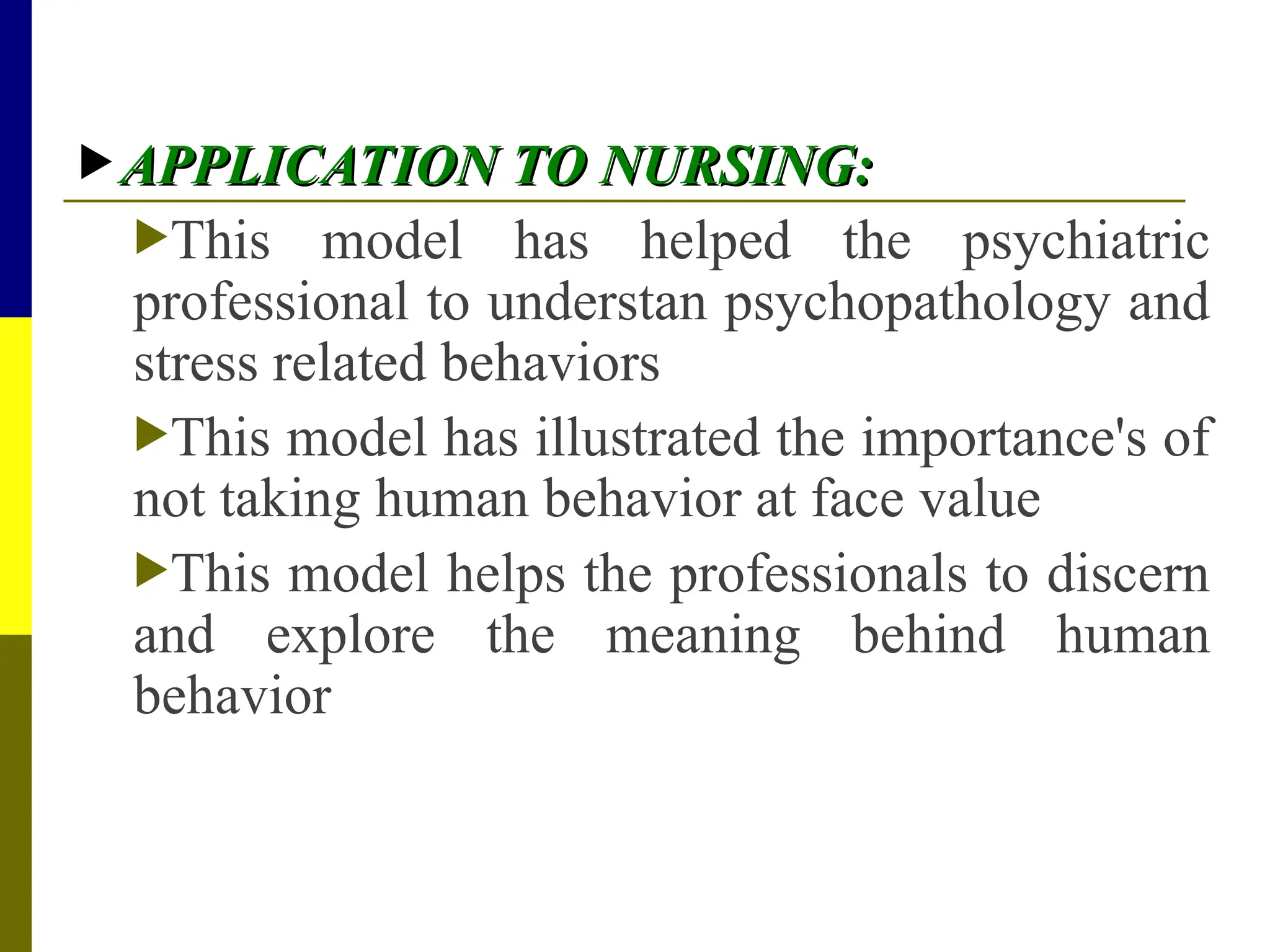
 APPLICATION TO NURSING:
APPLICATION TO NURSING:
This model has helped the psychiatric
professional to understan psychopathology and
stress related behaviors
This model has illustrated the importance's of
not taking human behavior at face value
This model helps the professionals to discern
and explore the meaning behind human
behavior
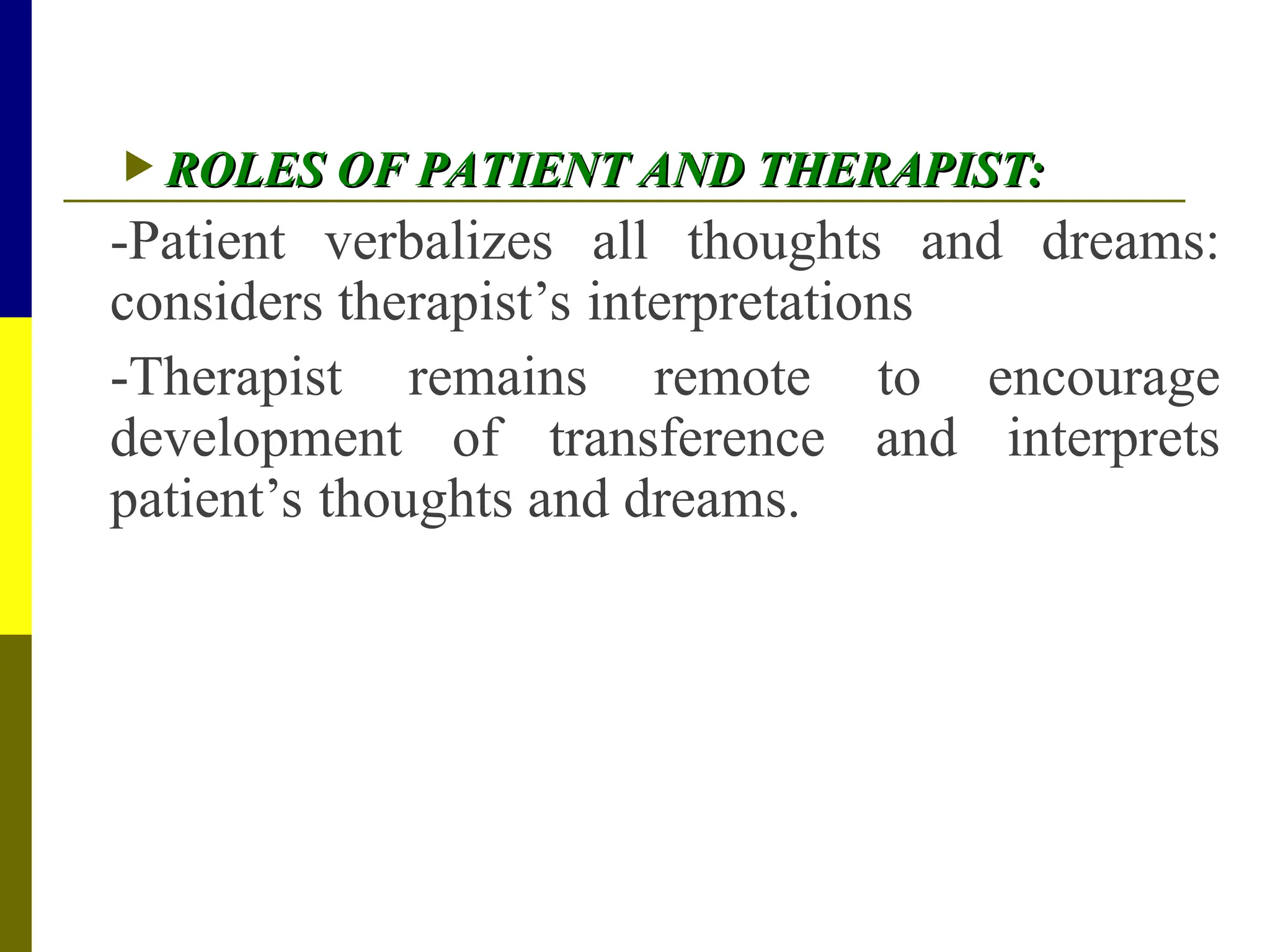
 ROLES OF PATIENT AND THERAPIST:
ROLES OF PATIENT AND THERAPIST:
-Patient verbalizes all thoughts and dreams:
considers therapist’s interpretations
-Therapist remains remote to encourage
development of transference and interprets
patient’s thoughts and dreams.
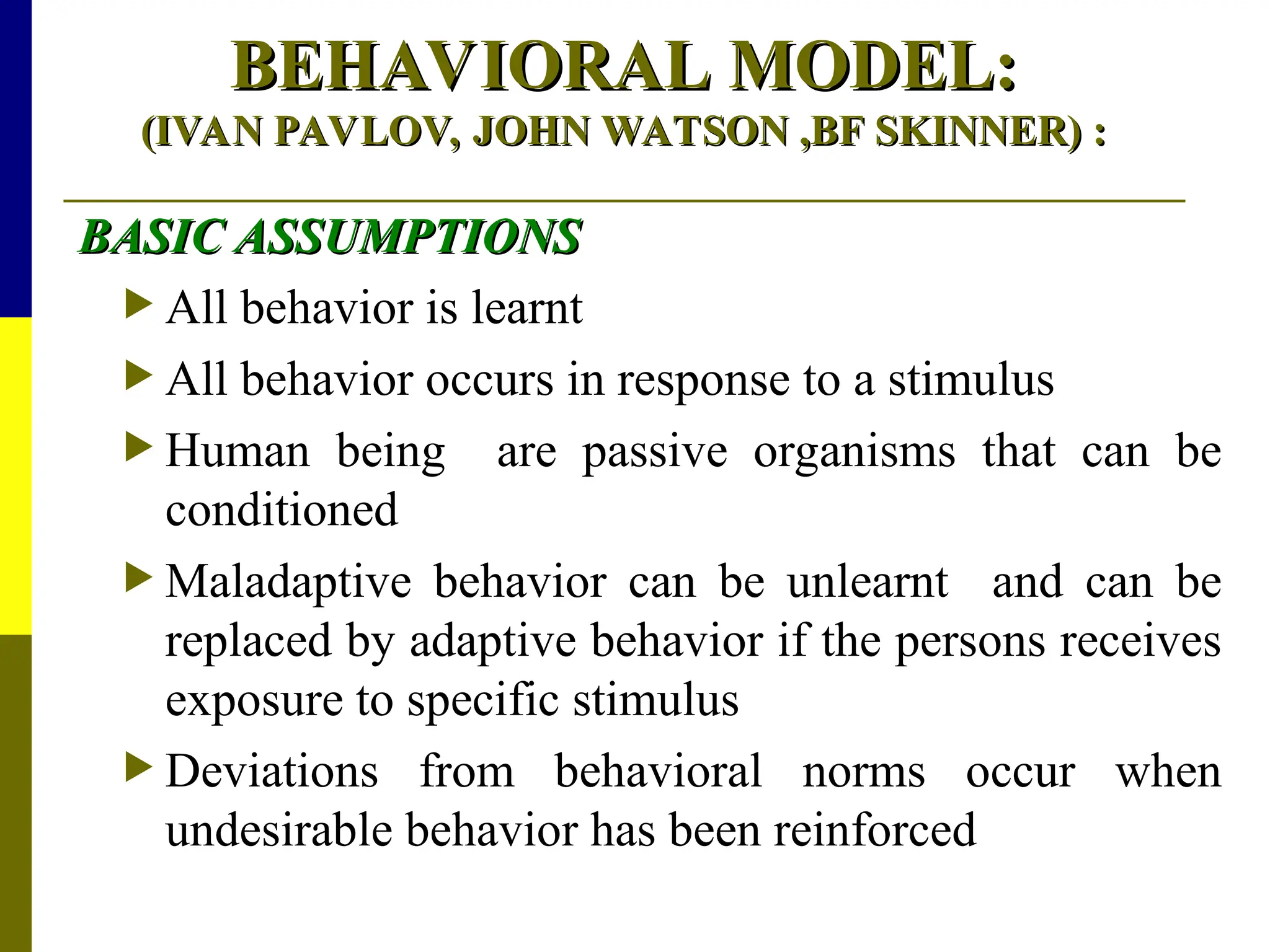
BEHAVIORAL MODEL:
BEHAVIORAL MODEL:
(IVAN PAVLOV, JOHN WATSON ,BF SKINNER)
(IVAN PAVLOV, JOHN WATSON ,BF SKINNER) :
:
BASIC ASSUMPTIONS
BASIC ASSUMPTIONS
 All behavior is learnt
 All behavior occurs in response to a stimulus
 Human being are passive organisms that can be
conditioned
 Maladaptive behavior can be unlearnt and can be
replaced by adaptive behavior if the persons receives
exposure to specific stimulus
 Deviations from behavioral norms occur when
undesirable behavior has been reinforced
BEHAVIORAL MODEL:
BEHAVIORAL MODEL:
(IVAN PAVLOV, JOHN WATSON ,BF SKINNER)
(IVAN PAVLOV, JOHN WATSON ,BF SKINNER) :
:
THERAPEUTIC PROCESS
THERAPEUTIC PROCESS
 Systematic desensitization
 Token reinforcement
 Shaping
 Chaining
 Prompting
 Flooding
 Aversion therapy
Assertive and social skill training
 ROLES OF PATIENT AND THERAPIST
ROLES OF PATIENT AND THERAPIST
 Therapist –an expert in behavior therapy who helps
the patient unlearn his symptoms and replace them
with more satisfying behavior
 Therapist uses the patient’s anxiety as a motivational
force towards learning
 Therapist teaches the patient about behavioral
approaches and develops behavioral hierarchy
 The therapist reinforces desired behaviors
 Patient-active participant as learner
 Patient practices behavioral techniques Does
homework and reinforcement exercises
APPLICATION TO NURSING
APPLICATION TO NURSING
 Nurses commonly use behavioral techniques in
a wide variety of mental health settings
Additionally nurses who work with patients
having physical disability, chronic pain,
chemical dependency and rehabilitation centers
also apply these techniques
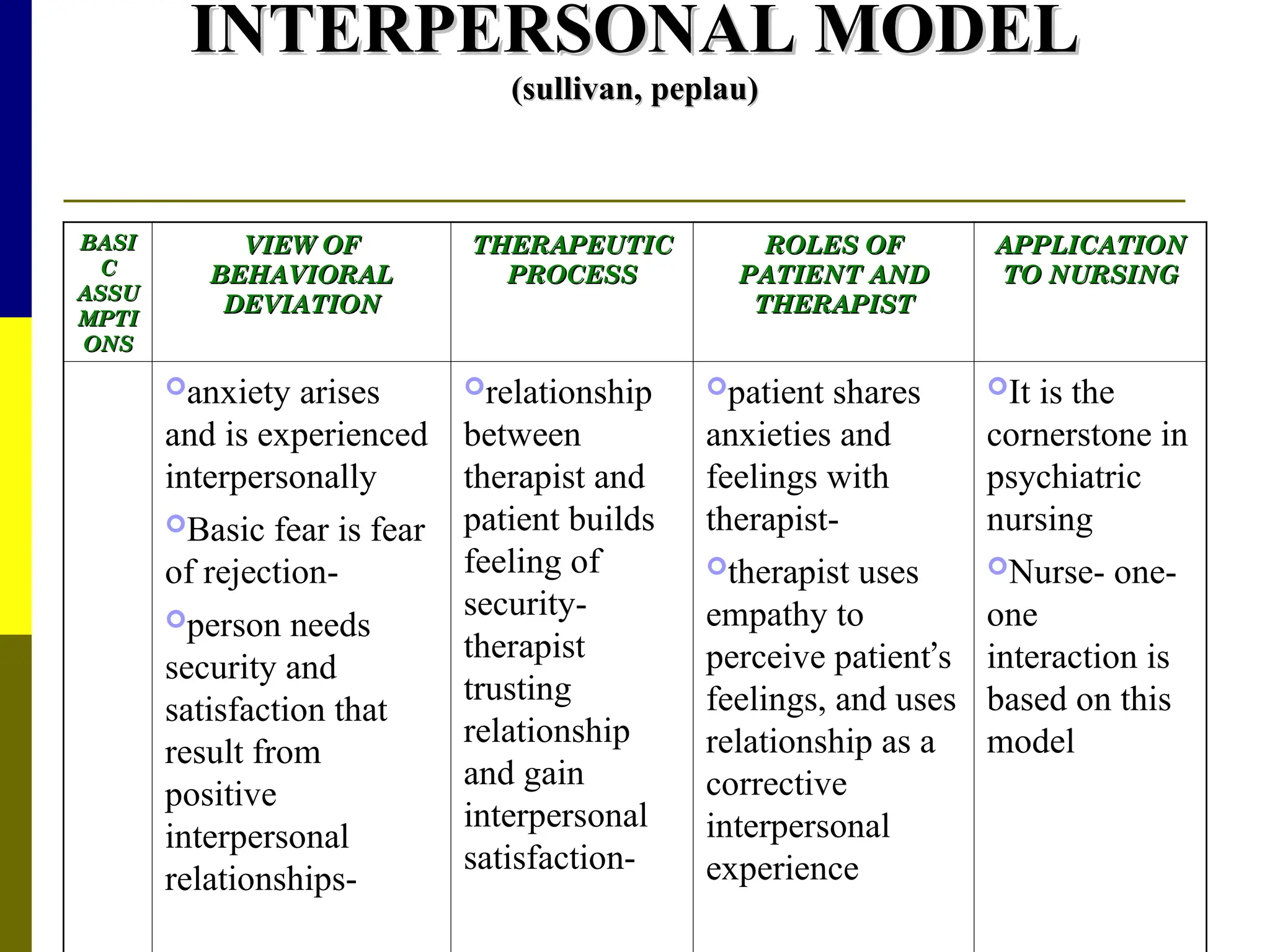
INTERPERSONAL MODEL
INTERPERSONAL MODEL
(sullivan, peplau)
(sullivan, peplau)
BASI
BASI
C
C
ASSU
ASSU
MPTI
MPTI
ONS
ONS
VIEW OF
VIEW OF
BEHAVIORAL
BEHAVIORAL
DEVIATION
DEVIATION
THERAPEUTIC
THERAPEUTIC
PROCESS
PROCESS
ROLES OF
ROLES OF
PATIENT AND
PATIENT AND
THERAPIST
THERAPIST
APPLICATION
APPLICATION
TO NURSING
TO NURSING
anxiety arises
and is experienced
interpersonally
Basic fear is fear
of rejection-
person needs
security and
satisfaction that
result from
positive
interpersonal
relationships-
relationship
between
therapist and
patient builds
feeling of
security-
therapist
trusting
relationship
and gain
interpersonal
satisfaction-
patient shares
anxieties and
feelings with
therapist-
therapist uses
empathy to
perceive patient’s
feelings, and uses
relationship as a
corrective
interpersonal
experience
It is the
cornerstone in
psychiatric
nursing
Nurse- one-
one
interaction is
based on this
model
PREVENTIVE PSYCHIATRIC
AND REHABILITATION
AND REHABILITATION
INTRODUCTION
Preventive psychiatry is a branch of psychiatry that aims at health
promotion, protection from specific mental illnesses, early diagnosis,
effective treatment, disability limitation and rehabilitation.
Mental disorder prevention aims at “reducing incidence,
prevalence, reoccurrence of mental disorders, the time spent with
symptoms, or the risk condition for a mental illness, preventing or
delaying recurrences and also decreasing the impact of illness in the
affected person, their families and the society”
DEFINITION :
Preventive psychiatry is the application of
knowledge of psychiatric nursing in
preventing, promoting and maintaining health
of the people, to help in early diagnosis and
care to rehabilitate the client after mental
illness.
AIM
AIM
The main aim of prevention is to keep people healthy and
enhancing individual's ability to achieve psychosocial well – being.
• Prevention focuses on cause or etiology of psychiatric illness to
avoid illness.
• Promotion and prevention are interrelated and overlapped. Eg.
Psychological support
• Parenting skills training
• Clinical mental health counselors support
• Health education
MODEL OF PREVENTION
MODEL OF PREVENTION
In the 1960s, Psychiatrist Gerald Caplan described levels
of prevention specific to psychiatry. He described

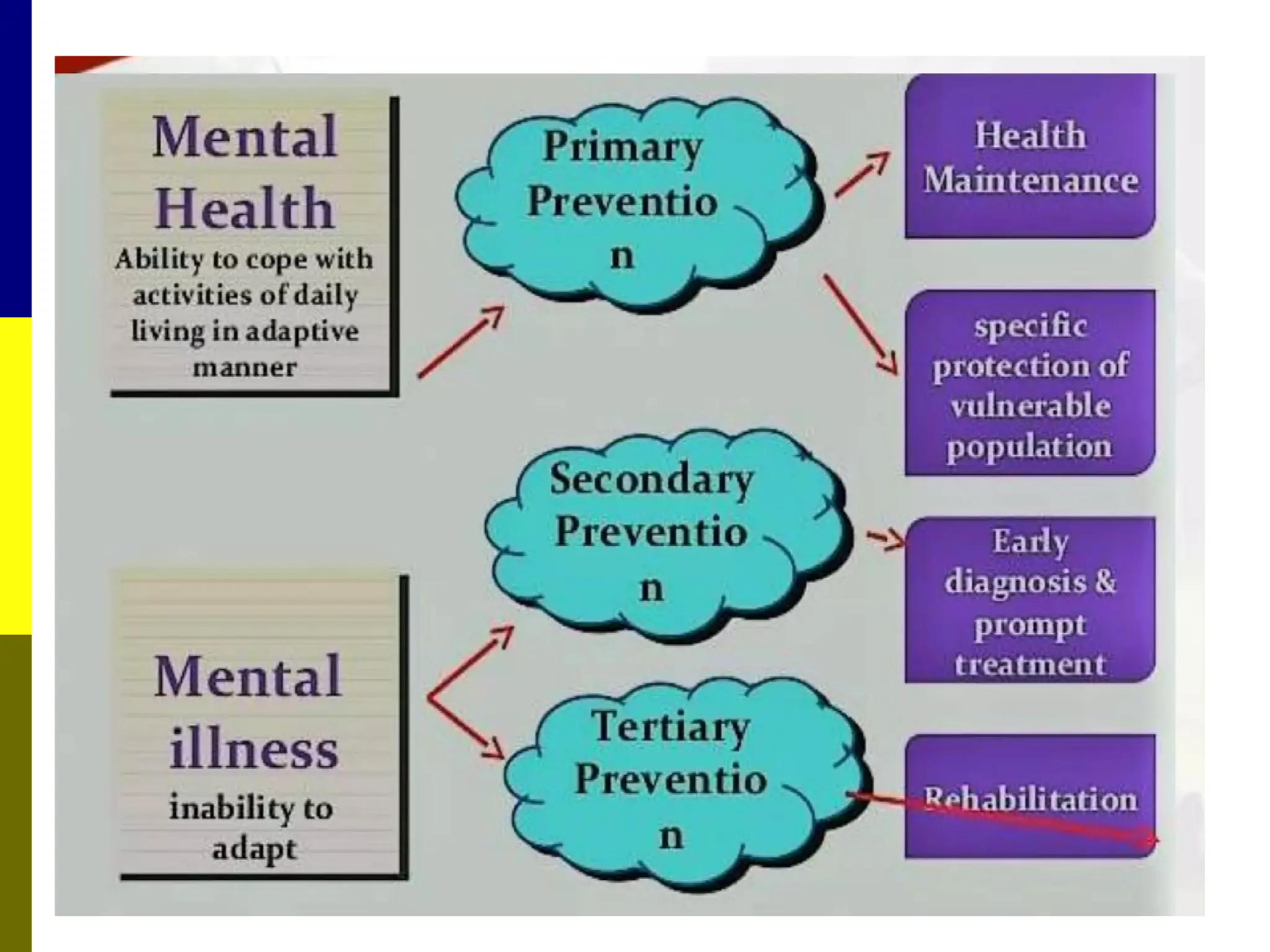
Primary prevention as an effort directed towards reducing the
incidence of mental disorders in a community.

Secondary prevention refers to decreasing the duration of disorder

tertiary prevention refers to reducing the level of impairments. It
was termed as Caplan’s Model
PRIMARY PREVENTION
PRIMARY PREVENTION
Primary Prevention Services aimed at reducing the
incidence of mental disorders within the population.
Primary prevention targets both individuals and the
environment. Emphasis is twofold:
1.Assisting individuals to increase their ability to cope
effectively with stress.
2.Targeting and diminishing harmful forces (stressors)
within the environment.
NURSING IN
NURSING IN
PRIMARY
PRIMARY PREVENTION
PREVENTION
focused on the targeting of groups at risk and
the provision of educational programs.
Examples include:
• Teaching parenting skills and child
development to prospective new parents.
• Teaching physical and psychosocial effects
of alcohol/drugs to elementary school students.
• Teaching techniques of stress management to
virtually anyone who desires to learn.
NURSING IN
NURSING IN
PRIMARY
PRIMARY PREVENTION
PREVENTION
• Teaching groups of individuals ways to cope with
the changes associated with various maturational
stages.
• Teaching concepts of mental health to various
groups within the community
• Providing education and support to unemployed or
homeless individuals.
• Providing education and support to other individuals
in various transitional periods (e.g., widows and
widowers, new retirees, and women entering the work
force in middle life).
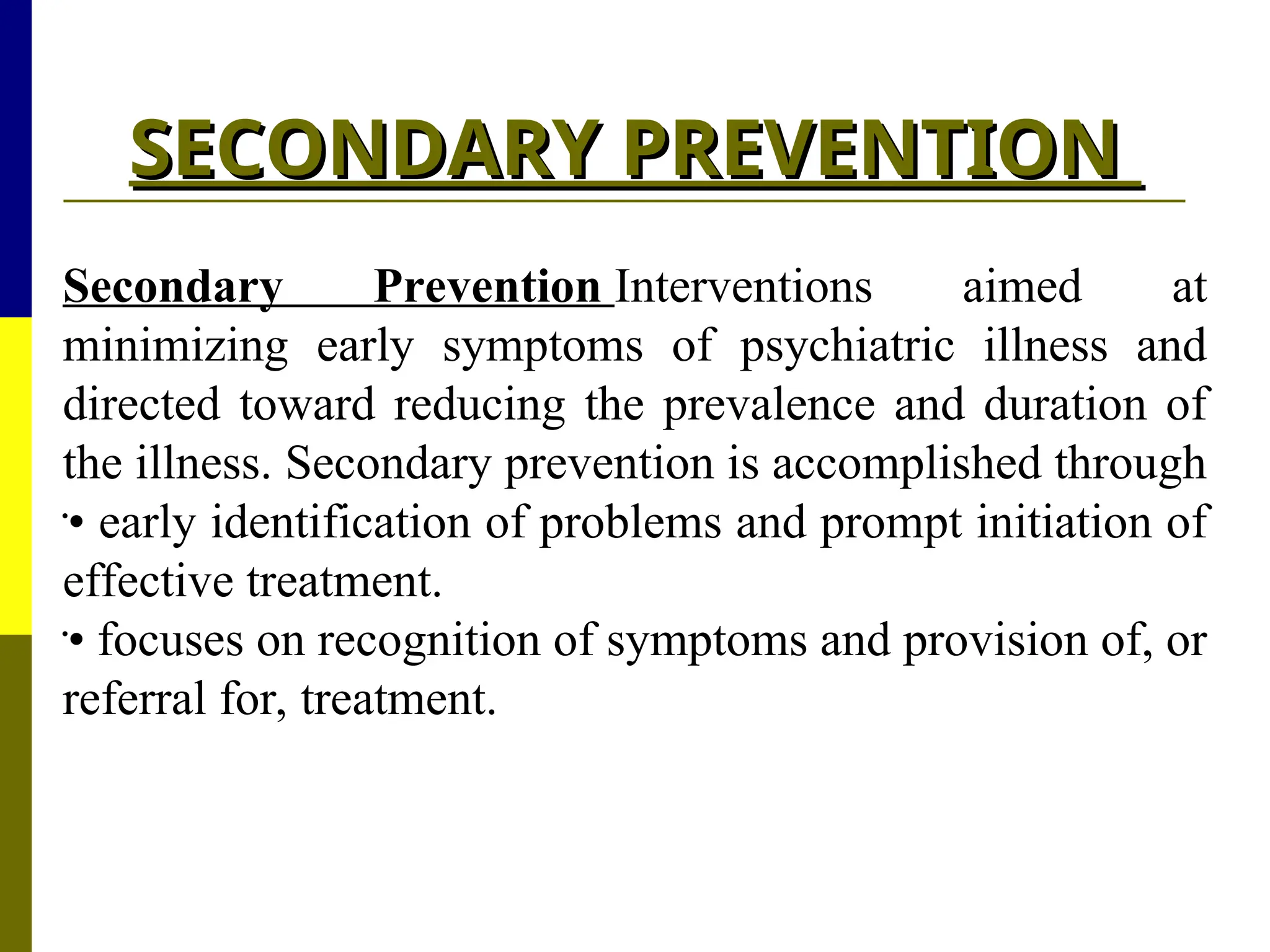
SECONDARY PREVENTION
Secondary Prevention Interventions aimed at
minimizing early symptoms of psychiatric illness and
directed toward reducing the prevalence and duration of
the illness. Secondary prevention is accomplished through

• early identification of problems and prompt initiation of
effective treatment.

• focuses on recognition of symptoms and provision of, or
referral for, treatment.
NURSING IN
NURSING IN
SECONDARY
SECONDARY PREVENTION
PREVENTION
• Ongoing assessment of individuals at high risk for illness
exacerbation (e.g., during home visits, at day care, in
community health centers, or in any setting where screening
of high-risk individuals might occur).
• Provision of care for individuals in whom illness symptoms
have been assessed (e.g., individual or group counseling,
medication administration, education and support during
period of increased stress [crisis intervention], staffing rape
crisis centers, suicide hotlines, homeless shelters, shelters for
abused women, or mobile mental health units).
NURSING IN
NURSING IN
SECONDARY
SECONDARY PREVENTION
PREVENTION
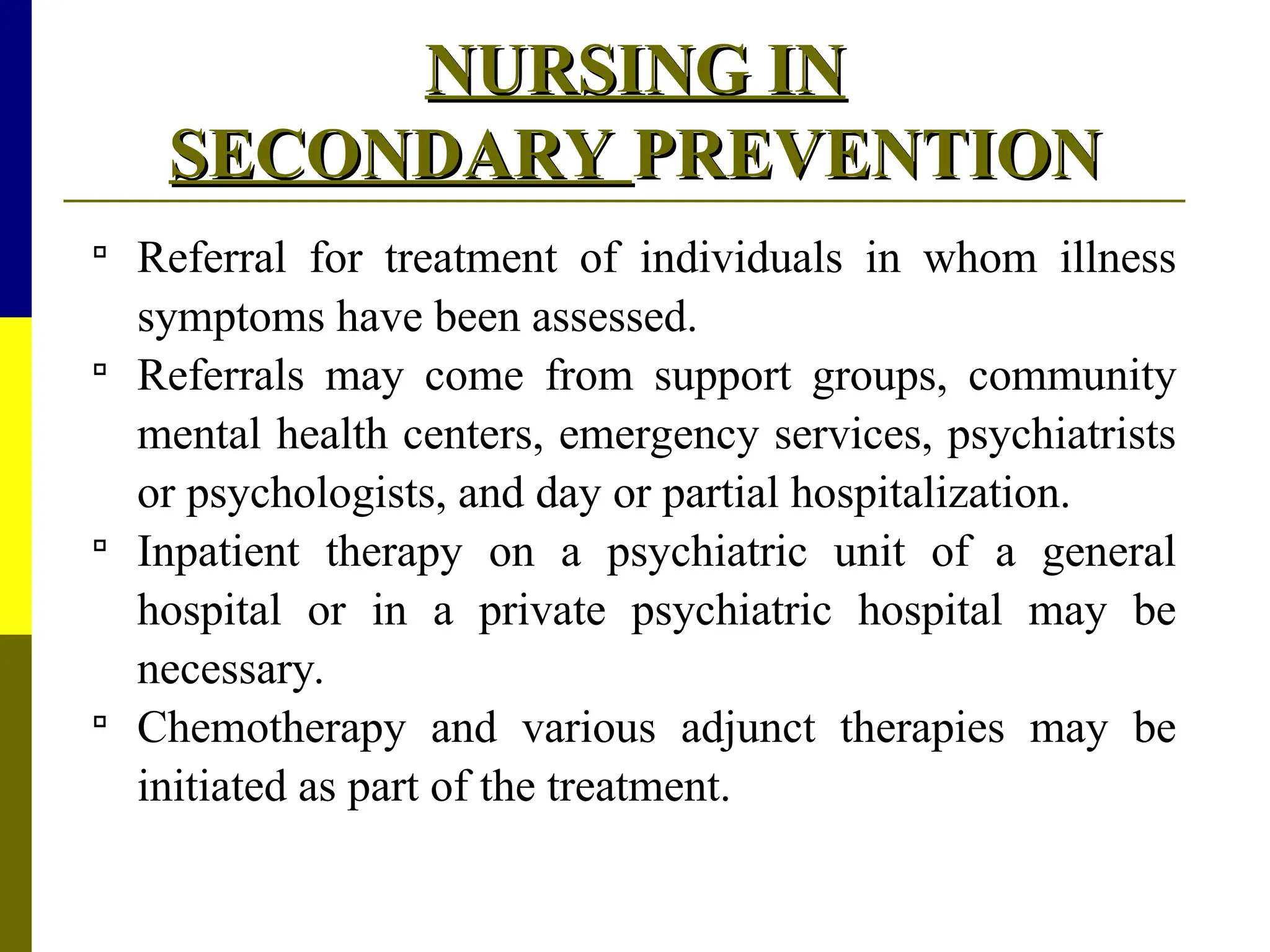

Referral for treatment of individuals in whom illness
symptoms have been assessed.

Referrals may come from support groups, community
mental health centers, emergency services, psychiatrists
or psychologists, and day or partial hospitalization.

Inpatient therapy on a psychiatric unit of a general
hospital or in a private psychiatric hospital may be
necessary.

Chemotherapy and various adjunct therapies may be
initiated as part of the treatment.
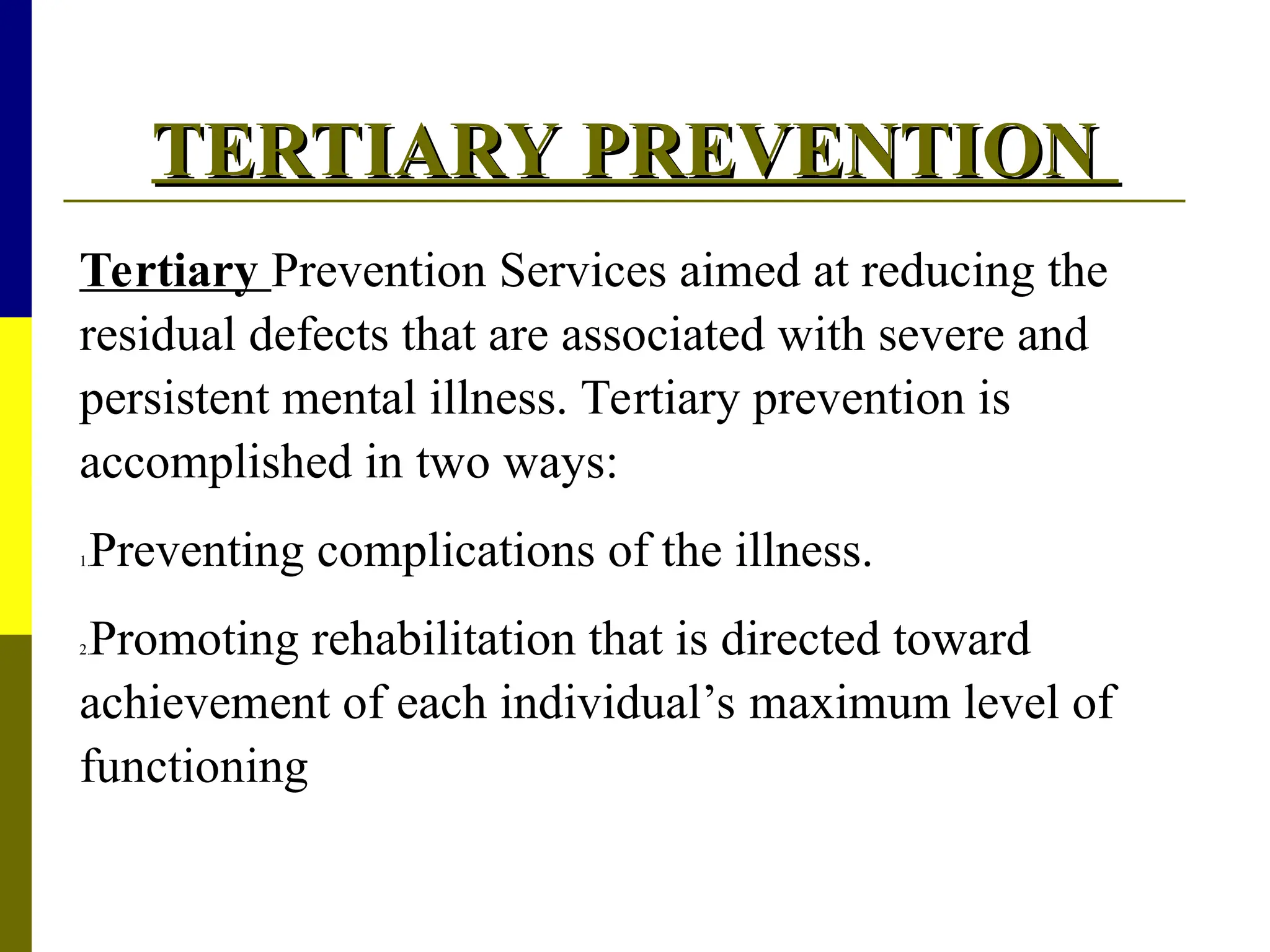
TERTIARY PREVENTION
TERTIARY PREVENTION
Tertiary Prevention Services aimed at reducing the
residual defects that are associated with severe and
persistent mental illness. Tertiary prevention is
accomplished in two ways:
1.Preventing complications of the illness.
2.Promoting rehabilitation that is directed toward
achievement of each individual’s maximum level of
functioning
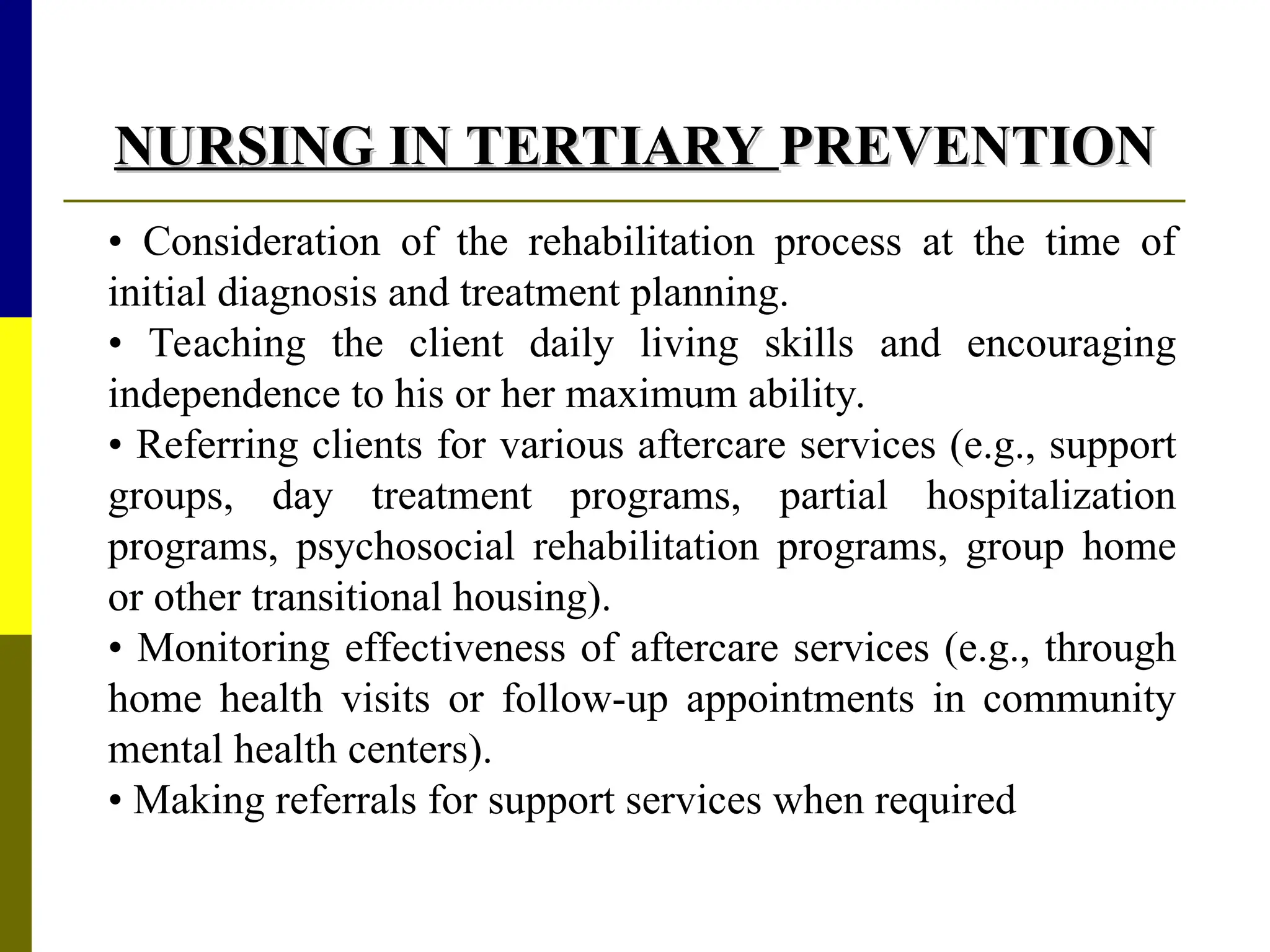
NURSING IN TERTIARY
NURSING IN TERTIARY PREVENTION
PREVENTION
• Consideration of the rehabilitation process at the time of
initial diagnosis and treatment planning.
• Teaching the client daily living skills and encouraging
independence to his or her maximum ability.
• Referring clients for various aftercare services (e.g., support
groups, day treatment programs, partial hospitalization
programs, psychosocial rehabilitation programs, group home
or other transitional housing).
• Monitoring effectiveness of aftercare services (e.g., through
home health visits or follow-up appointments in community
mental health centers).
• Making referrals for support services when required
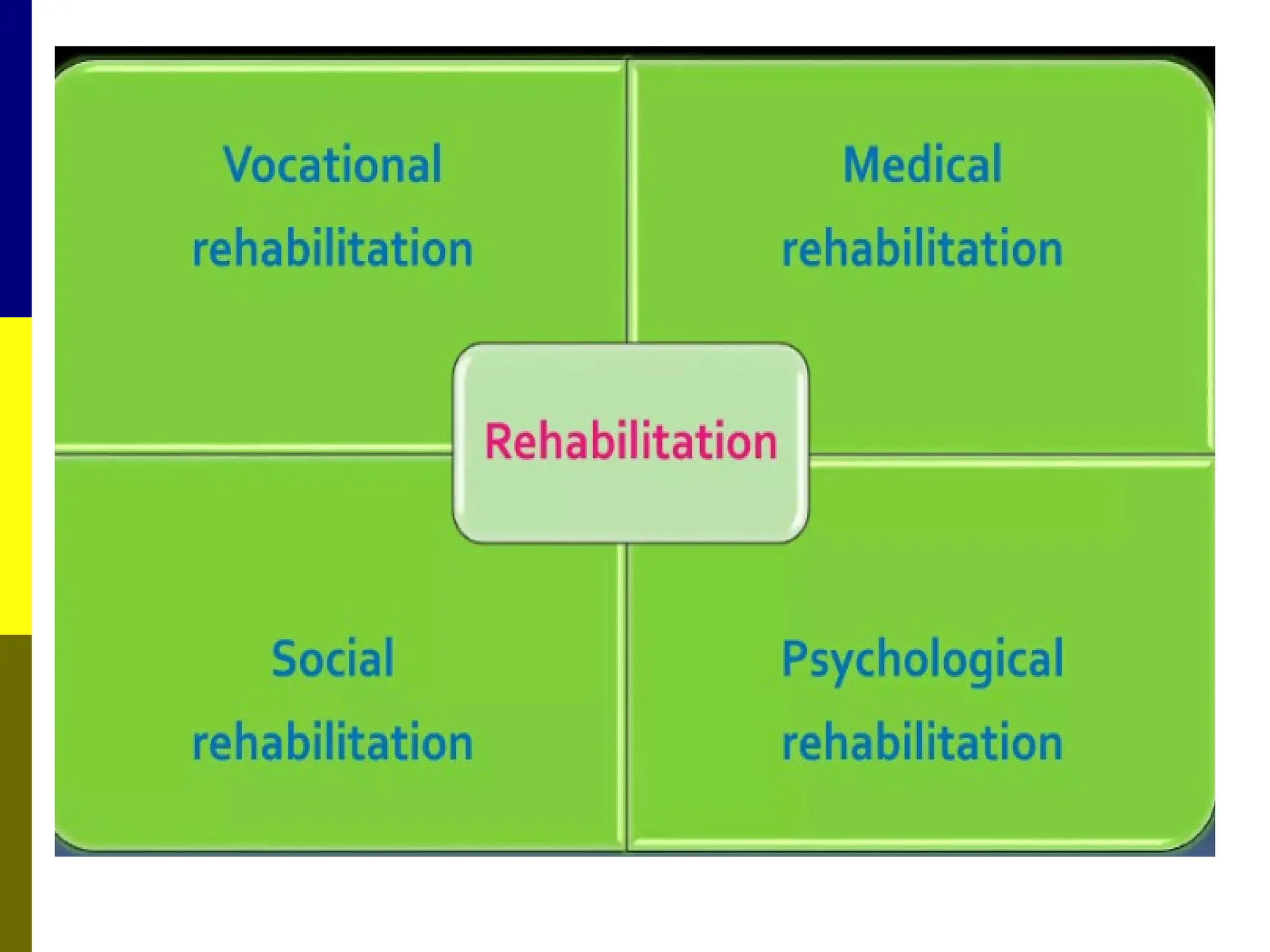
PSYCHIATRIC REHABILITATION

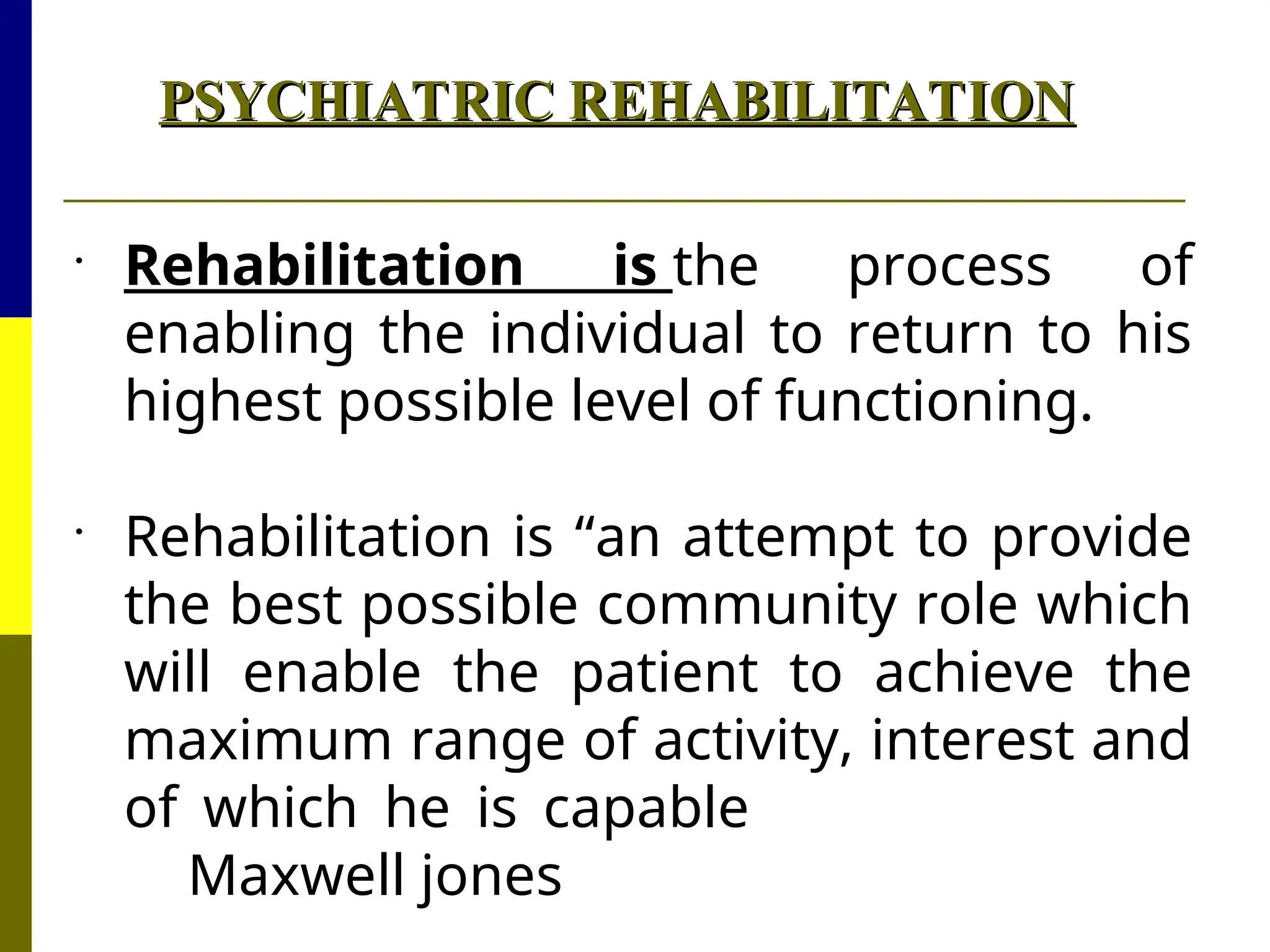
Rehabilitation is the process of
enabling the individual to return to his
highest possible level of functioning.

Rehabilitation is “an attempt to provide
the best possible community role which
will enable the patient to achieve the
maximum range of activity, interest and
of which he is capable
Maxwell jones
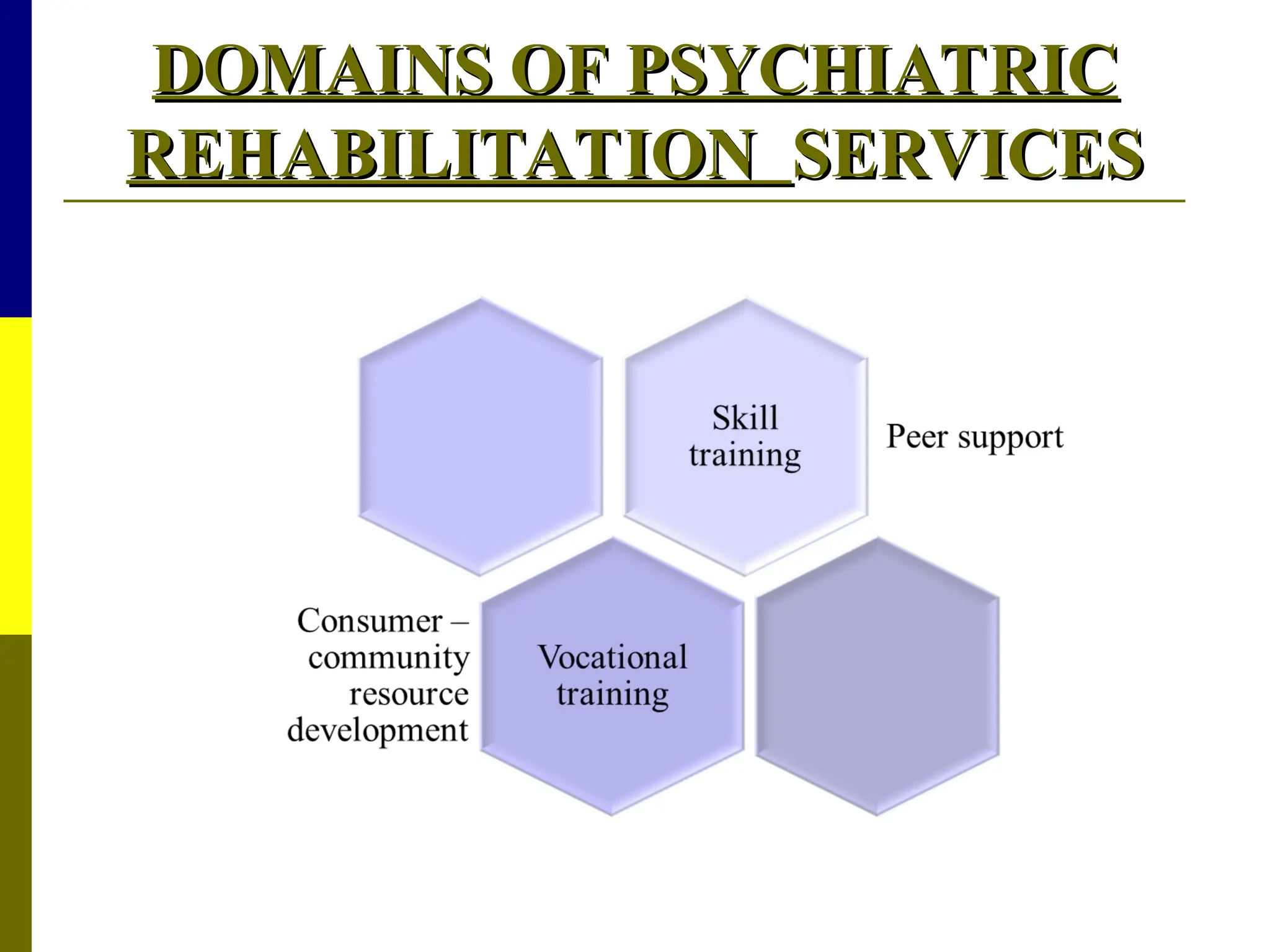
DOMAINS OF PSYCHIATRIC
REHABILITATION
REHABILITATION SERVICES
SERVICES
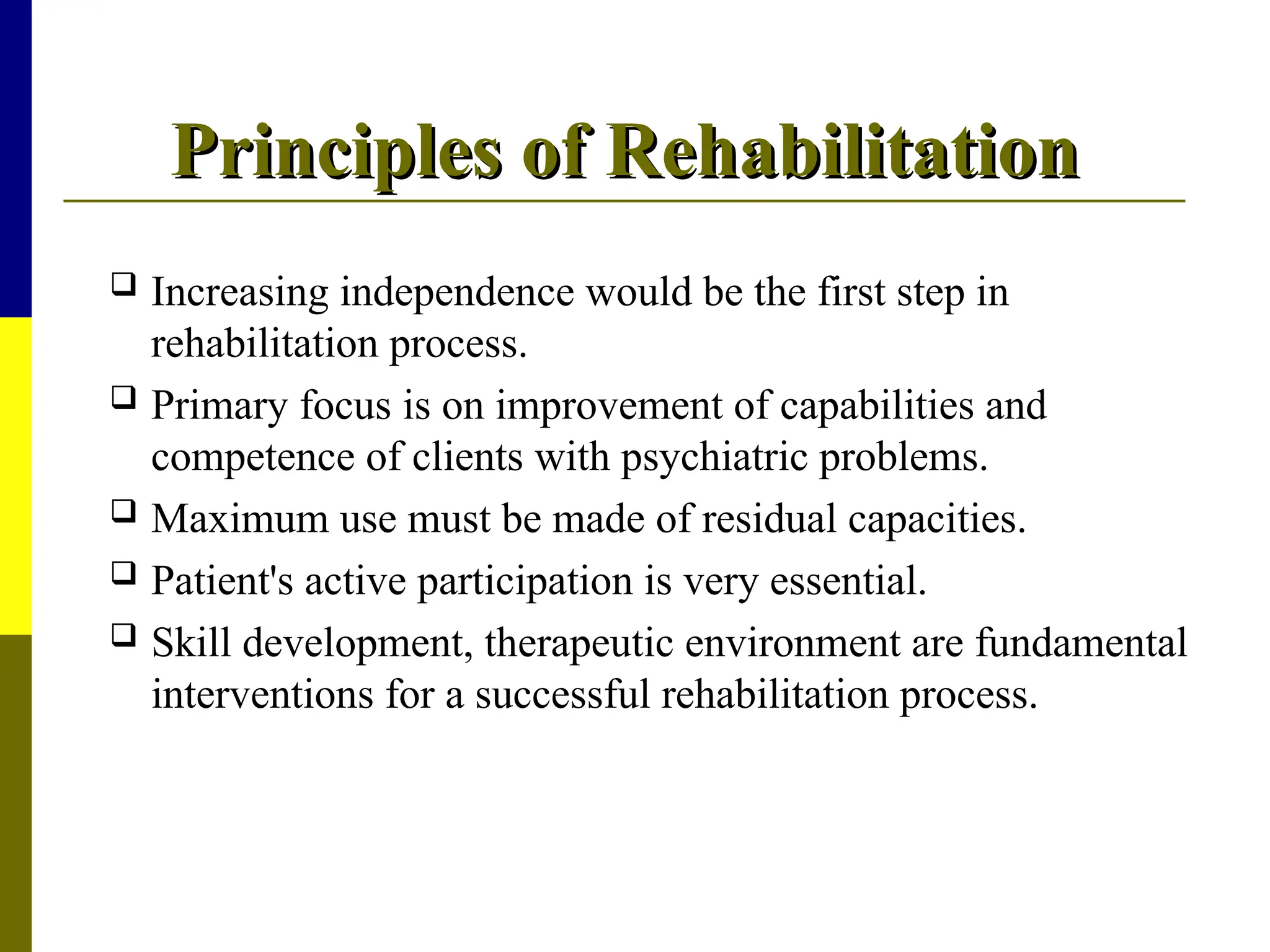
Principles of Rehabilitation
 Increasing independence would be the first step in
rehabilitation process.
 Primary focus is on improvement of capabilities and
competence of clients with psychiatric problems.
 Maximum use must be made of residual capacities.
 Patient's active participation is very essential.
 Skill development, therapeutic environment are fundamental
interventions for a successful rehabilitation process.
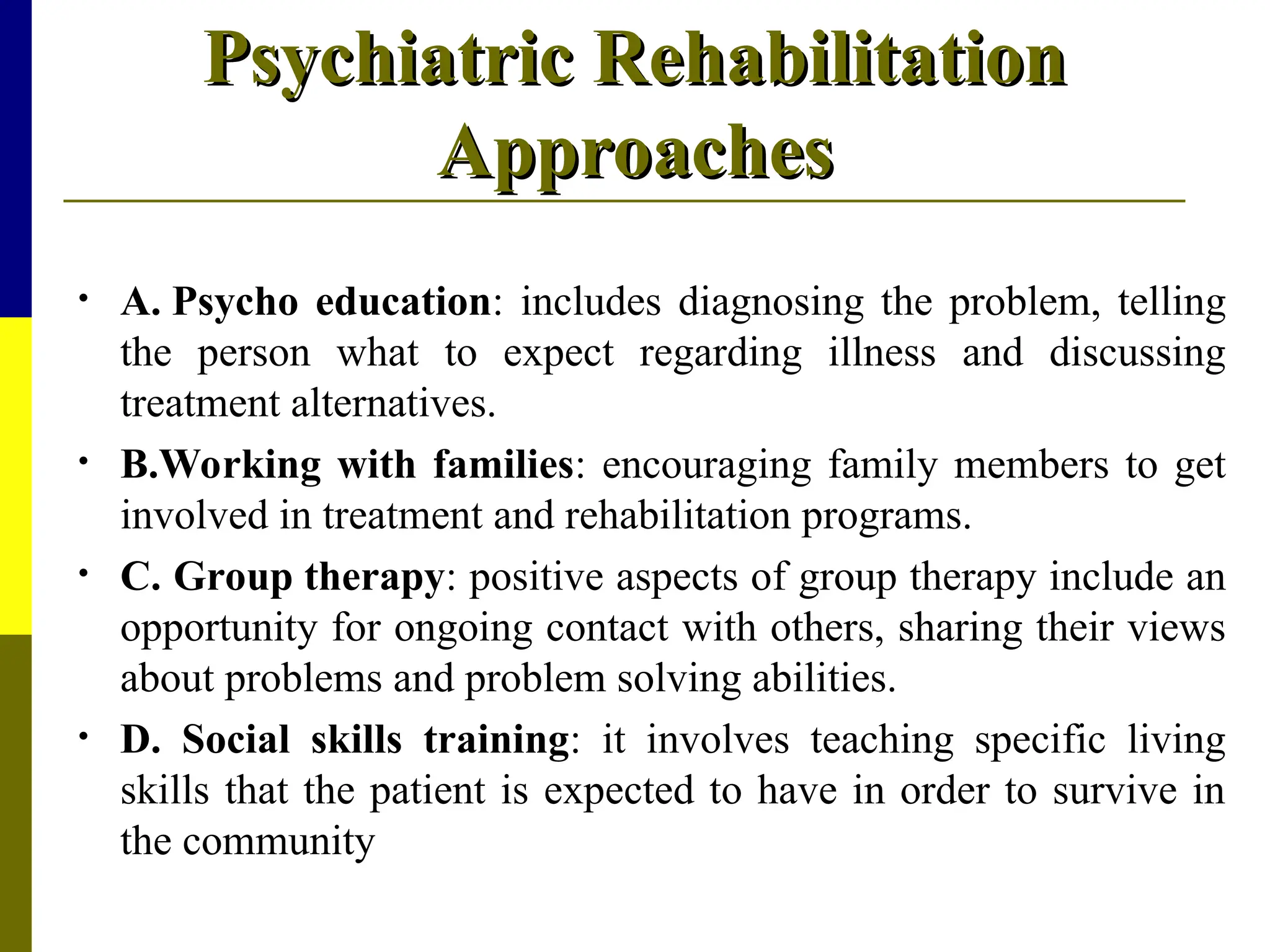
Psychiatric Rehabilitation
Approaches
Approaches
• A. Psycho education: includes diagnosing the problem, telling
the person what to expect regarding illness and discussing
treatment alternatives.
• B.Working with families: encouraging family members to get
involved in treatment and rehabilitation programs.
• C. Group therapy: positive aspects of group therapy include an
opportunity for ongoing contact with others, sharing their views
about problems and problem solving abilities.
• D. Social skills training: it involves teaching specific living
skills that the patient is expected to have in order to survive in
the community
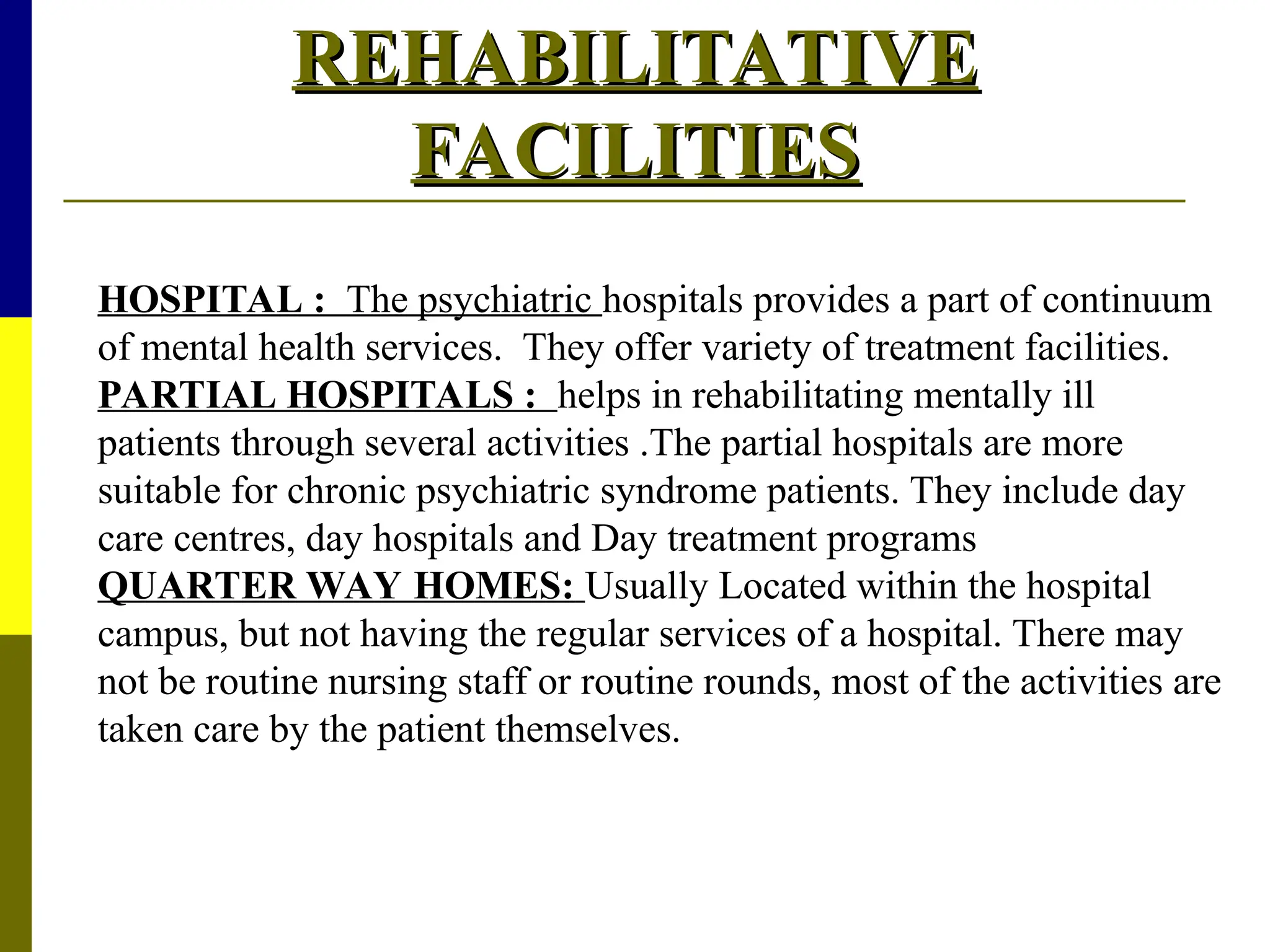
REHABILITATIVE
REHABILITATIVE
FACILITIES
FACILITIES
HOSPITAL : The psychiatric hospitals provides a part of continuum
of mental health services. They offer variety of treatment facilities.
PARTIAL HOSPITALS : helps in rehabilitating mentally ill
patients through several activities .The partial hospitals are more
suitable for chronic psychiatric syndrome patients. They include day
care centres, day hospitals and Day treatment programs
QUARTER WAY HOMES: Usually Located within the hospital
campus, but not having the regular services of a hospital. There may
not be routine nursing staff or routine rounds, most of the activities are
taken care by the patient themselves.
HALF WAY HOMES • It is a transitory residential center for mentally ill
patients who no longer need the full services of hospital, but are not yet
ready for a completely independent living. A halfway home is a place that
allows people with physical, mental and emotional disabilities to learn the
social and other skills necessary to integrate or re –integrate into society.
SELF HELP GROUPS • These are composed of people who are trying to
cope with a specific problem or life crisis and have improved the emotional
health and well being of many people • Members have homogeneity and they
work together using their strengths to gain control over their lives • They
educate and support each other in solving the problems.
CONCLUSION
CONCLUSION
To implement effective preventive mental
health interventions, it is imperative to develop
adequate resources and infrastructures at the
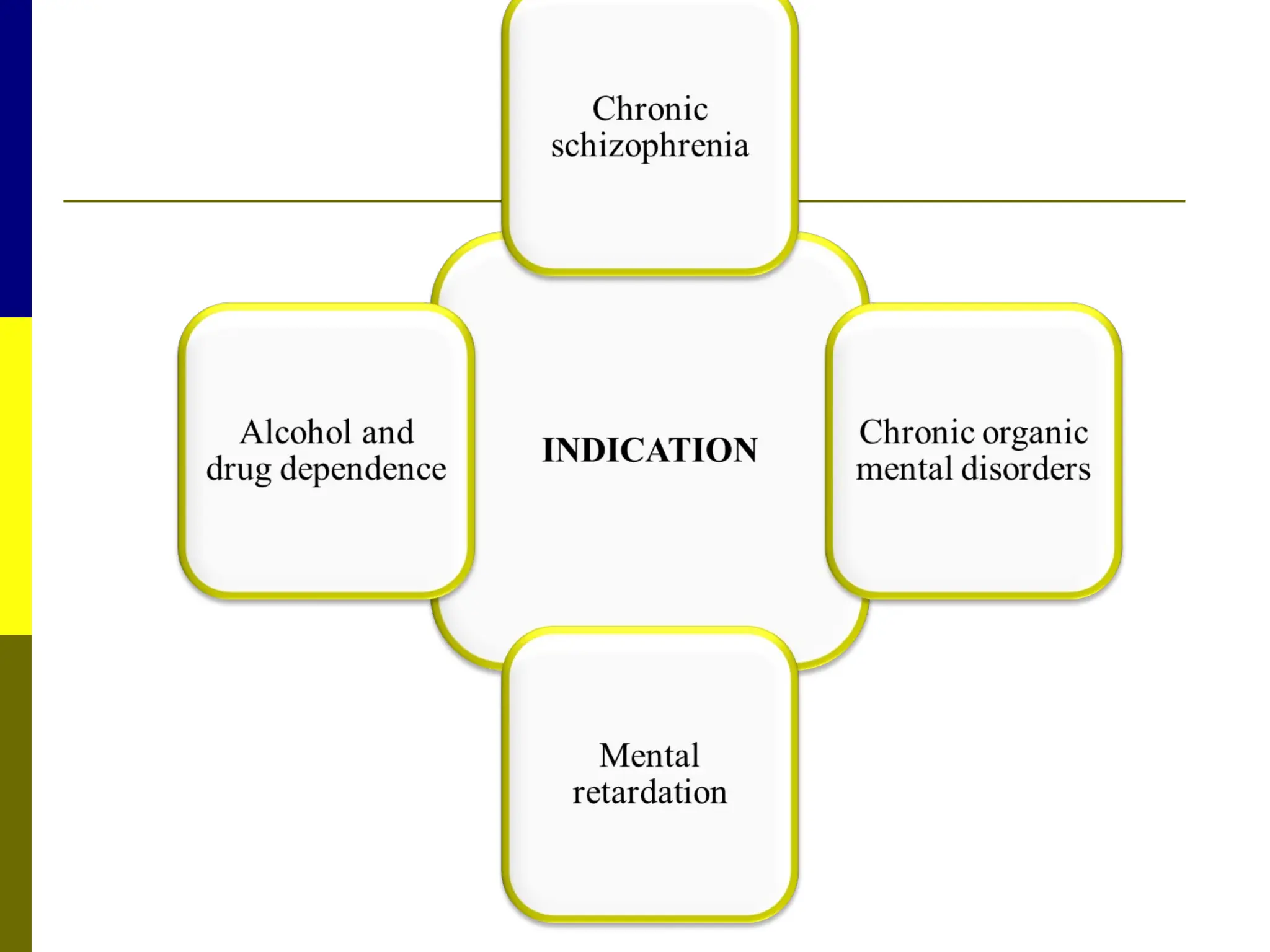
local, national and international level that make
efficient use of existing opportunities. There is
a need to devise and implement ways to
circumvent existing shortcomings and thus
effective care is provided.

principles and concepts in Mental health nursing.ppt

  • 1.
    PRINCIPLES AND CONCEPTS PRINCIPLESAND CONCEPTS OF OF MENTAL HEALTH NURSING MENTAL HEALTH NURSING B.KAVITHA M.SC(N) B.KAVITHA M.SC(N) PROFESSOR PROFESSOR ASWINI COLLEGE OF NURSING ASWINI COLLEGE OF NURSING THRISSUR THRISSUR
  • 2.
    Principles and Conceptsof Mental Principles and Concepts of Mental Health Nursing Health Nursing  ● Definition: mental health nursing and terminology used  ● Classification of mental disorders: ICD11, DSM5, Gero-psychiatry manual classification  ● Review of personality development, defense mechanisms  ● Etiology bio-psycho-social factors  ● Psychopathology of mental disorders: review of structure and function of brain, limbic system and abnormal neurotransmission  ● Principles of Mental health Nursing  ● Ethics and responsibilities  ● Practice Standards for Psychiatric Mental Health Nursing (INC practice standards)  ● Conceptual models and the role of nurse: o Existential model o Psychoanalytical models o Behavioural model o Interpersonal model  ● Preventive psychiatry and rehabilitation
  • 3.
    Health Health WHO defines “ “state ofcomplete physical, state of complete physical, mental, and social wellness, not mental, and social wellness, not merely absence of disease or merely absence of disease or infirmity” infirmity”
  • 4.
    Mental Health Mental Health Stateof emotional, psychological, and social wellness evidenced by –Satisfying interpersonal relationships –A positive self-concept –Effective behaviour and coping –Emotional stability (Or) (Or) lifelong process of successful adaptation to a changing internal and external environments
  • 5.
    Mentally Healthy Person MentallyHealthy Person Accepts himself Perceives reality Mastery of self and environment Autonomy Unifying, integrated outlook in life
  • 6.
    Psychiatry Psychiatry It is abranch of medicine that deals with the diagnosis, treatment and prevention of mental illness
  • 7.
    Mental illness /Disorder Mentalillness /Disorder Mental disorder is “a clinically significant behavioural or psychological syndrome or pattern that occurs in an individual and that is associated with distress or disability or with a significantly increased risk of suffering death, pain, disability, or an important loss of freedom” (American Psychological Association [APA])
  • 8.
    Psychiatric nursing Psychiatric nursing Interpersonalprocess whereby the professional nurse practitioner ,through the therapeutic use of self (art) and nursing theories (science), assist clients to achieve psychosocial well being. Core : interpersonal process
  • 10.
    DISTURBANCE OF CONSCIOUSNESS-quality DISTURBANCE OF CONSCIOUSNESS- quality of being aware & alert to the stimuli of being aware & alert to the stimuli
  • 11.
  • 12.
     Increased activity:two ways- individual performs the activity with purpose and goal and finally he completes the activity whereas in another way the individual performs the work without purpose and goal and never completes the work  Decreased activity or psychomotor retardation: the patient takes too long to start the activity and takes too much of time to complete it, sometimes never complete the action  Dysactivity : includes Repetitious behavior, Negativism, compulsion, Violence, suicide & Automatic behavior
  • 13.
    Repetitious activity: ischaracterized by needless and purposeless activity. When there is repetition in terms of action it is called Stereotypy activity ( odd, repetitive, and non goal oriented movements) .  Stereotypy activity can be in position, movement and speech
  • 14.
    1. Stereotypy position Waxyflexibility: Parts of body can be placed in positions that will be maintained for long periods of time, even if very uncomfortable: flexible like wax. This process is called as waxy flexibility, while the end results is called as Catalepsy. Seen in schizophrenia & hysteria patient o Cataplexy: Abrupt loss of muscle tone without the impairment of consciousness
  • 15.
    2. Stereotypy movement: known as Mannerism. When the movement is repeated it is called mannerism. It is normal in general patient. Usually schizophrenic patient exhibits variety of mannerism 3. Stereotypy speech: Verbigeration or stereotypy speech consists of repetition of words, phrases or sentences. Eg: muscles, muscles, muscles to all forms of questions
  • 16.
    Negativism: the individualis aware of the stimuli but he is trying to oppose these actively or passively. Expressed in the forms of Mutism e.g.: patients refusal of foods, and resistance to effort to care for the patient Automatism: a condition in which activity is carried out without conscious knowledge on the part of the patient. Automatic actions and speech are seen in fugue states(Physical and psychological flight (wandering) from one’s usual place.) and sleep walking.
  • 17.
    Automatism command Automatic obedience:may also in the form of repeating the in the patients presence, the words or activities known as echolalia and Echopraxia Echolalia: the pathological, senseless repetition (echoing) of a word or phrase just spoken by another person. E.g what is your name Echopraxia: repetition by imitation of the movements or action observed from other.
  • 18.
     Compulsion: repeatedlyperforming an act which may look unreasonable to the viewers and to the individual himself is called compulsion  Violence: is an aggressive behavior in which physical force is exerted. E.g:- assassination, murder, rape and even suicide  Suicide: A human act of self-intentioned and self inflicted session.
  • 19.
  • 20.
  • 21.
    Illusion: a misperceptionor misinterpretation of a stimulus, arising from the external objects. Hallucination a false sensory perception that occurs in the absence of a stimulus  Auditory hallucination : with voices  Visual hallucination: with sight  Olfactory hallucination: with smell associated with organic syndromes  Gustatory hallucination: with taste seen along with olfactory hallucination  Tactile hallucination or haptic hallucination: with touch  Kinesthetic hallucination: phantom phenomenon that some of his body parts are missing or distorted
  • 24.
    Flight of ideasRapid flow of accelerated speech with abrupt changes from topic to topic without loosening logical connection. some times the patient expresses the flow of thoughts in words and similar in sound. Eg:- bat, cat, mat, rat, Nat, pat, sat ,chat called as clang association Thought retardation: the initiation and movement of thoughts are slow. the patients speak in low tone and takes a very long time to complete the answer seen in depressive phase Thought blocking: sudden cessation of thought in the midst of sentence
  • 25.
     Perseveration: Persistentrepetition of words or themes beyond their point of relevance.e.g:- who is the first prime minister of India – Nehru and who is the present prime of India: - Nehru  Tangentiality: sudden and oblique digression into unnecessary details that completely distracts from the central theme: however, the patient never returns back to the original theme after digression.  Incoherence: thought process that is disorganized, disconnected or incomprehensible.
  • 26.
     Circumstantiality: Digressionin to unnecessary details that distract from the central theme, however the patient returns back to the original theme after digression  Delusion: a false unshakable belief which is not amenable to reasoning, and is not in keeping with the patient’s socio cultural and educational background. Delusions are subdivided according to their content. Some of the more common types are: bizarre;  Delusional jealousy:  delusion of reference: false belief that behaviors of others are refers to self
  • 27.
     Delusion ofguilt: seen in depression. The patient becomes self critical and believes he is the sinner  Delusion of persecution: false belief that members of the family are trying to kill him  Nihilistic delusion: known as delusion of negation because the patient denies or does not accepts the existence of his body , his loved ones and the world around him  Somatic delusion:  Delusion of self accusation: holding self responsible for everything seen in depression
  • 28.
     Ideas ofcontrol: the patient may complain that his thought are controlled and read by others  Hypochondria: patient has exaggerated concern over his bodily health  Thought broadcasting or diffusion: the delusion that one's thoughts are being broadcast out loud so that they can be perceived by others. Delusion of grandiose: or expensive delusion Excessive and Exaggerated feeling of one’s importance
  • 29.
     Thought eco:Voice speaking out thoughts aloud: also called as echo de la pense  Thought insertion: the delusion that certain of one's thoughts are not one's own, but rather are inserted into one's mind.  Phobia: a persistent, irrational fear of a specific object, activity, or situation (the phobic stimulus) that results in a compelling desire to avoid it.  Obsession: in this, ideas, thoughts or impulses that cannot be eliminated from consciousness by logical efforts are called obsessive rumination while uncontrollable impulses to perform an act repeiptively are known as compulsion
  • 30.
  • 31.
    Euphoria: Mild elevationof mood Elation: Moderate elevation of mood Exaltation: severe elevation of mood. Ecstasy: Very severe elevation of mood. Intense sense of rupture. Ambivalence: The coexistence of contradictory emotions, attitudes, ideas, or desires with respect to a particular person, object, or situation. Ordinarily, the ambivalence is not fully conscious and suggests psychopathology only when present in an extreme form.
  • 32.
    Anxiety: An unpleasurableemotional state, associated with psycho-physiological changes in response to an intra psychic conflict.  panic: state of extreme, acute, intense anxiety accompanied by disorganization of ego functions  Apathy: Apathy: is the absence of affect. Inappropriate affect: there is a disharmony in feelings to a situation
  • 33.
    Derealization: An alteration inthe perception or experience of the external world so that feeling of external world is temporarily changed or lost Depersonalization: An alteration in the perception or experience of the self so that the feeling of one’s reality is temporarily changed or lost.
  • 35.
    Insight: the degreeof awareness and understanding that the patient has regarding his/her illness. J u d g m e n t : A n a b i l i t y t o a s s e s s t h e s i t u a t i o n c o r r e c t l y a n d a c t a p p r o p r i a t e l y w i t h i n t h a t s i t u a t i o n . I n t e l l i g e n c e : T h e a b i l i t y t o t h i n k l o g i c a l l y , a c t r a t i o n a l l y a n d d e a l e f f e c t i v e l y w i t h t h e e n v i r o n m e n t . DISORDER OF ATTENTION Distractibility: the inability to concentrate or focus attention D I S O R D E R O F O R I E N T A T I O N T o p l a c e , p e r s o n a n d t i m e
  • 36.
  • 37.
    Classification is aprocess by which complex phenomena are organized into categories, classes or ranks to bring together those things that most resemble each other and separate those that differ
  • 38.
  • 39.
    05 A Neurodevelopmentaldisorders 05 B Schizophrenia and other primary psychotic disorders 05 C Bipolar and related disorder 05 D Depressive disorder 05 E Anxiety and fear-related disorders 05 F Disorders specifically associated with stress 05 G Dissociative disorders 05 H Bodily distress disorders and psychological and behavioral factors associated with diseases classified elsewhere ICD11
  • 40.
    05 I Obsessive-compulsiveand related disorder 05 J Feeding and eating disorder 05 K Elimination disorder 05 L Sleep disorder 05 M Sexual dysfunctions and compulsive sexual behavior disorder 05 N Acute substance intoxication 05 O Harmful use of substances 05 P Substance dependence 05 Q Substance withdrawal syndrome
  • 41.
    05 R Substance– induced mental disorders 05 S Behavioral addictions 05 T Disruptive behavior and dissocial disorder 05 U Disorders of personality 05 V Paraphilic disorders 05 W Factitious disorders 05 X Neurocognitive disorders 05 Y Mental and behavioral disorders attribute to disorders to diseases classified elsewhere
  • 42.
    DSM V DSM V 1.2.1_Neuro developmental disorders 1.2.2 –Schizophrenic spectrum and other psychotic disorders 1.2.3 – Bipolar and related disorders 1.2.4 – Depressive disorder 1.2.5 – Anxiety disorder 1.2.6 – Obsessive compulsive and related disorder 1.2.7 – Trauma and stress related disorder 1.2.8 – Dissociative disorder
  • 43.
    1.2.9 – Somaticsymptom and related disorder 1.2.10 – Feeding and eating disorder 1.2.11 – Sleep wake disorder 1.2.12 – Sexual dysfunctions 1.2.13 – Gender dysphoria 1.2.14 – Disruptive, impulse- control, and conduct disorder 1.2.15 – Substances related and addictive disorders 1.2.16 – Neuro cognitive disorder 1.2.17 _ Paraphilic disorder 1.2.18 – Personality disorder
  • 44.
    GERIATRIC PSYCHIATRY GERIATRIC PSYCHIATRY Geriatricpsychiatry, also known as geropsychiatry, psychogeriatrics , or psychiatry of old age, is a branch of medicine and a subspecialty of psychiatry dealing with the study, prevention, and treatment of neurodegenerative, cognitive impairment, and mental disorders in people of old age.
  • 45.
    Diseases Diseases Diseases and disordersdiagnosed or managed by geriatric psychiatrists include: Dementia - Mild cognitive impairment, Alzheimer's disease, Vascular dementia, Dementia with Lewy bodies & Parkinson's disease Neuropsychiatric complications from stroke, multiple sclerosis Late-life presentations of psychiatric disorders- Depression ( Melancholic depression), Anxiety disorders, Bipolar disorder, Schizophrenia & Personality disorders Medical-Psychiatric Disorders - Delirium & Catatonia Substance use disorder
  • 46.
  • 47.
    Problems of classification Problemsof classification  Stigma labeling  Distracts from understanding individual  Individuals do not fit into categories  Reliability – disorder  Validity – clinician agree CRITICISM CRITICISM
  • 48.
    ICD 11 DSMV •International classification •Different versions and many languages •Alphanumerical coding •31 major categories •Single axis •National classification •Single version & language •Numerical coding •18 major categories •Multi axial evaluation
  • 49.
  • 50.
    Personality refers todeeply ingrained patterns of behavior, which include the way one relates to, perceives and thinks about the environment and one self (APA - 1987) (OR) An individual’s unique pattern of thoughts, feelings, and behaviors that persists over time and across situations.
  • 51.
  • 52.
  • 53.
    PSYCHOANALYTICAL PSYCHOANALYTICAL THEORIES THEORIES Personality theories contendingthat behavior results from psychological forces that interact within the individual, often outside conscious awareness.
  • 54.
    Conscious Freud’s first levelof awareness, consisting of the thoughts, feelings, and actions of which people are aware. Preconscious Freud’s second level of awareness, consisting of the mental activities of which people gain awareness by attending to them. Unconscious Freud’s third level of awareness, consisting of the mental activities beyond people’s normal awareness.
  • 55.
  • 56.
    THEORY OF PSYCHOSXUAL THEORYOF PSYCHOSXUAL DEVELOPMENT DEVELOPMENT HOW PERSONALITY DEVELOPS  Oral stage : Oral stage : First stage in Freud’s theory of personality development, in which the infant's erotic feelings center on the mouth, lips, and tongue.  Anal stage : Anal stage : Second stage in Freud’s theory of personality development, in which a child’s erotic feelings center on the anus and on elimination.
  • 57.
    o Phallic stage: Phallic stage : Third stage in Freud’s theory of personality development, in which erotic feelings center on the genitals. Oedipus complex and Electra complex: Oedipus complex and Electra complex: According to Freud, a child’s sexual attachment to the parent of the opposite sex and jealousy toward the parent of the same sex; generally occurs in the phallic stage.  Latency period : Latency period : In Freud’s theory of personality, a period in which the child appears to have no interest in the other sex.  Genital stage : Genital stage : In Freud’s theory of personality development, the final stage of normal adult sexual development, which is usually marked by mature sexuality.
  • 60.
    Theory of psychosocialdevelopment Theory of psychosocial development Erickson’s theory Erickson’s theory • Trust vs. Mistrust (0-1 infant) • Autonomy vs. Shame (2-3 toddler) • Initiative vs. Guilt (3-6 preschooler) • Industry vs. Inferiority (7-12 School age) • Identity vs. Confusion (12-18 Adolescence) • Intimacy vs. Isolation (20s Young adult)
  • 61.
    • Generativity vs.Stagnation (20 -50’s) - middle adulthood. To establish a sense of care and concern for the well being of future generations; to look toward the future and not stagnate in the past • Integrity vs. Despair (50 + Old Adult) - old age. To establish a sense of meaning in one's life, rather than feeling despaired or bitterness that life was wasted; to accept oneself and one's life without despair (50 & up)
  • 62.
    Theory of cognitivedevelopment: Theory of cognitive development: Piaget’s theory Piaget’s theory
  • 63.
  • 64.
    HUMANISTIC PERSONALITY HUMANISTIC PERSONALITY THEORIES THEORIES HUMANISTIC personality theory asserts the fundamental goodness of people and their striving toward higher levels of functioning.
  • 66.
    Abraham Maslow’s Theory AbrahamMaslow’s Theory  Abraham Maslow is considered father of the humanistic movement. He observed the lives of (purportedly) healthy and creative people to develop is theory.  Hierarchy of needs: the motivational component of Maslow’s theory, in which our innate needs, which motivate our actions, are hierarchically arranged.  Self-actualization: the fullest realization of a person’s potential GRAPHIC: HIERARCHY OF NEEDS
  • 67.
    Carl Jung Carl Jung Personalunconscious : In Jung’s theory of personality, one of the two levels of the unconscious; it contains the individual’s repressed thoughts, forgotten experiences, and undeveloped ideas. Collective unconscious : The level of the unconscious that is inherited and common to all members of a species.
  • 68.
    Archetype : InJung’s theory of personality, thought forms common to all human beings, stored in the collective unconscious. Persona : According to Jung, our public self, the mask we wear to represent ourselves to others. Extrovert : According to Jung, a person who usually focuses on social life and the external world instead of on his or her internal experience. Introvert : A person who usually focuses on his or her own thoughts and feelings.
  • 69.
    Alfred Adler Alfred Adler Compensation : According to Adler, the person’s effort to overcome imagined or real personal weaknesses.  Inferiority : In Adler’s theory, the fixation on feelings of personal inferiority that results in emotional and social paralysis.
  • 70.
    Behavioral theory Behavioral theory Theclassical conditioning theory involves adopting a new behavior through the process of association
  • 71.
    THE OPERANT CONDITIONINGtheory involves the use of reinforcement or punishment to maximize or minimize a certain behavior
  • 72.
  • 73.
    EGO DEFENSE MECHANISMS EGODEFENSE MECHANISMS Ego Defense Mechanisms are the patterns of adjustment through which an individual relieves or decreases anxieties caused by an uncomfortable situations that threaten the self esteem (the terms “Mental Mechanisms” and “Defense Mechanisms” are essentially synonymous with this).
  • 74.
    The primary functionsof these mechanisms are: 1.to minimize anxiety 2.to protect the ego 3.to maintain repression Ego defense mechanism can be classified as  Primary  Psychotic/Narcissistic  Neurotic/Immature  Mature
  • 75.
    Primary Primary Repression: Repression is thecomplete memory loss of a painful Repression is the complete memory loss of a painful event or anxiety provoking thoughts and feelings event or anxiety provoking thoughts and feelings from conscious awareness. from conscious awareness. In this case, subconscious mind doesn't want to remember what happened because it may negatively affect the mood. Repression is useful to the individual since: 1. It prevents discomfort 2. It leads to some economy of time and effort
  • 77.
    PSYCHOTIC/ NARCISSISTIC PSYCHOTIC/ NARCISSISTIC Regression: Regression is returning to a previous state of development in order to feel safe or have needs met. Eg.Crying instead of taking actions to solve your problems means you have returned to the stage of childhood.  Projection: Projection is unconscious blaming for the unwanted event upon others. Eg.student failing in an examination blames that teacher is racist  Denial: Denial is refusing to acknowledge the presence of the threat or the occurrence of the unpleasant event. The problem with denial is that it blocks the road to acceptance; you won't be able to get over that event until you first accept it. Eg: refusing to acknowledge the death of a person, questioning the qualifications of the doctor who diagnosed the disease
  • 78.
    NEUROTIC/IMMATURE NEUROTIC/IMMATURE  Displacement: istransferring or discharging emotions on a less threatening object. If your displacement ego defense mechanism gets fired, try to control yourself a bit and then work on identifying your real enemy. Don't attack innocent people just because someone you can't harm has emotionally hurt you.  Rationalization: is the act of rationalizing your wrong actions and creating a self serving explanation for what you did Eg: drinking alcohol  Introjections: Accepting another person’s attitude, belief, and values as one’s own Eg:, when a person becomes depressed due to the loss of a loved one, his feelings are directed to the mental image he possesses of the loved one
  • 79.
    NEUROTIC/IMMATURE NEUROTIC/IMMATURE  Compensation: Overachievementin one area to offset real or perceived deficiencies in another area Eg: napoleon complex  Undoing: Exhibiting acceptable behavior to make up for or negate unacceptable behavior. Eg: (1) two close friends have a violent argument; when they next meet, each act as if the disagreement had never occurred. (2) when asked to recommend a friend for a job, a man makes derogatory comments which prevent the friend's getting the position; a few days later, the man drops in to see his friend and brings him a small gift. In a conscious analog of this, Napoleon made it a practice after reprimanding any officer to find some words of praise to say at their next meeting.
  • 80.
    MATURE MATURE Sublimation: Substituting asocially acceptable activity for an impulse that is unacceptable. Eg, By becoming a boxer you are able to satisfy your hidden need for violence CONCLUSION CONCLUSION The use of defense mechanism relieves anxiety but continuous and exclusive use may lead to mental disorder and prevent the individual from effective coping
  • 81.
  • 82.
    ETIOLOGY- BIO- ETIOLOGY- BIO- PSYCHOSOCIALFACTORS PSYCHOSOCIAL FACTORS Many factors are responsible for the causation of mental illness. These factors may PREDISPOSE PREDISPOSE an individual to mental illness, PRECIPITATE PRECIPITATE OR PERPETUATE OR PERPETUATE the mental illness PREDISPOSING FACTOR : PREDISPOSING FACTOR : These factors determine the individual’s susceptibility to mental illness. They interact with precipitating factors resulting in mental illness, They are Genetic makeup, Physical damage to CNS & Adverse psychosocial influence
  • 83.
    PRECIPITATING FACTOR: PRECIPITATING FACTOR:These are events occur shortly before the onset of a disorder and appear to have induced it. They are Physical Stress Psychological Stress PERPETUATING FACTOR PERPETUATING FACTOR These factors are responsible for aggravating or prolonging the conditions already exist in an individual
  • 85.
  • 86.
    THE NERVOUS SYSTEM THENERVOUS SYSTEM The nervous system is a complex network of nerves that carry messages to and from the brain and spinal cord to various parts of the body. It includes both the Central and Peripheral nervous system. The Central nervous system is made up of the brain & spinal cord and The Peripheral nervous system is made up of the Somatic and the Autonomic nervous systems.
  • 87.
    Brain area functions Cerebralcortex* - intelligence, judgment, and inhibitory control Prefrontal cortex* -planning & reasoning decision-making Hippocampus* - cognitive learning and memory Amygdale* - emotional memory Basal ganglia* - reaction time, fine motor control Nucleus accumbens* - compulsions, loco motor activity Thalamus* - way station for incoming sensory signals Hypothalamus* - instinctive and appetitive systems Brainstem - alerting, stimulus filtering, sleep, autonomic control * Involved in the limbic system Involved in the limbic system
  • 91.
    NEURO TRANSMISSION NEURO TRANSMISSION Itis a chemical process by which messages are exchanges between the neurons IMPORTANCES OF NEUROTRANSMISSION  For the purpose of communication & the therapeutic intervention MAJOR CHEMICAL MESSENGERS OF THE “MIND” Acetylcholine (ACh),Dopamine (DA),Serotonin (SER), Gamma amino butyric acid (GABA),Endorphins (END) & Glutamate (GLU) and Norepinephrine
  • 93.
    NEURO TRANSMISSION NEURO TRANSMISSION •Chemical messengers • Released at presynaptic neuron • Diffuses across synapse to post synapse • Attaches to specialized receptors • Inhibits or stimulates • Released and then destroyed or taken back for recycling • Neuron conduction of electrical impulses
  • 94.
    PSYCHOBIOLOGICAL PSYCHOBIOLOGICAL Neurotransmitter Receptor Disorder DopamineDA •Schizophrenia Mania^ •Parkinsonism Depression Nor epinephrine NE •Mania^ •Depression Serotonin 5-HT •Anxiety^ •Depression Gamma-amino- buturic acid GABA •Reduction of anxiety^ •Anxiety Acetyl-Choline Ach •Depression^ •Alzheimer's
  • 95.
    HORMONE FUNCTIONS AND HORMONEFUNCTIONS AND IMPLICATIONS FOR MENTAL ILLNESS IMPLICATIONS FOR MENTAL ILLNESS
  • 97.
    PRINCIPLES, PRINCIPLES, ETHICS & ETHICS& RESPONSIBILITIES RESPONSIBILITIES AND AND STANDARD OF STANDARD OF PSYCHIATRIC NURSING PSYCHIATRIC NURSING Principles: Is rule that guides one's actions.
  • 98.
    1-PATIENT IS ACCEPTEDEXACTLY AS HE IS. Means of showing acceptance: 1)Be non- judgmental and non-punitive 2)Being sincerely interest in the patient 3)Recognizing and reflecting on feelings which the patient may express. 4)Talk with a purpose. 5)Listening 6)Permit patient to express strongly held feelings.
  • 99.
    2-USE 2-USE SELF UNDERSTANDINGAS A SELF UNDERSTANDING AS A THERAPEUTIC TOOL. THERAPEUTIC TOOL. Self understanding methods: 1)Exchange personal experience freely and frankly with colleagues 2)Discuss own personal reaction with an experienced person. 3)Participate in group conference regarding patient care. 4)Keeping reflecting on why you feel or act way you do.
  • 100.
    3-CONSISTENCY IS USEDTO CONTRIBUTE TO PATIENT'S SECURITY. Consistency means: Having certain routine pattern that dose not change from one day to the other .. **fear of unknown produce anxiety, consistency helps in knowing what to expect.
  • 101.
    4)REASSURANCE MUST BEGIVEN IN A SUITABLE AND ACCEPTABLE MANNER. How to give reassurance: 1)Be truly interested in patient problems. 2)Pay attention to the matters that are important to the patient. 3)Listen to personal problems. 4) Agree that the patient has a problem and think along with him to solve it. 5) Provide patient with acceptable outlets of anxiety.
  • 102.
    5) Patient's BehaviorIs Changed Through Emotional Experience And Not By Rational Interpretation. 6) Unnecessary Increase In Patient's Anxiety Should Be Avoided. 7) Objective Observation Of Patient To Understand His Behavior.- *Objectivity Is An Essential Component Of Observation What Do We Mean By Objectivity?Objectivity Is An Ability To Evaluate Exactly The Patient's Behavior Without Mixing One's Own Feelings ,Opinion Or Judgment. Empathy Versus Sympathy
  • 103.
    8) Maintain RealisticNurse- Patient Relationship 9) Avoid Verbal And Physical Force As Must As Possible. 10) Nursing Care Is Centered On The Patient As Person And Not On The Control Of Symptoms. 11) All Explanation Of Procedures And Other Routines Are Given According To The Patient’s Level Of Understanding 12) Many Procedures Are Modified But Basic Principles Remain Unaltered
  • 106.
    Ethical Responsibilities ofa Ethical Responsibilities of a Psychiatric Nurse Psychiatric Nurse  According to the International Council of Nurses (ICN), the fundamental ethical responsibilities of a nurse are:  * Have respect for person's dignity, integrity and self- determination.  * Provide care that should be individualized, patient- focused and related to the need of patient.  * Provide care humanly in the presence of a caring relationship with commitment and concern.
  • 107.
    Essential Ethical SkillsRequired Essential Ethical Skills Required for a Psychiatric Nurse for a Psychiatric Nurse A psychiatric nurse should: have the ability to be aware of one's own values, strengths, limitations, clinical competencies, and bias towards patients. be aware of ethical issues to practice the profession. have the ability to anticipate specific ethical dilemmas in treatment have the ability to access clinical ethics resources to obtain ethics consultation and to access ongoing supervision of difficult cases. have the ability to introduce additional safeguards into the clinical care of the patient.
  • 108.
    PRACTICE STANDARDS FORPSYCHIATRIC PRACTICE STANDARDS FOR PSYCHIATRIC MENTAL HEALTH NURSING MENTAL HEALTH NURSING (INDIAN NURSING (INDIAN NURSING COUNCIL PRACTICE STANDARDS, 2019) COUNCIL PRACTICE STANDARDS, 2019)
  • 111.
  • 112.
    CONCEPTUAL MODELS CONCEPTUAL MODELS Modelsis a means of organizing a complex body of knowledge i.e the linkage between the various concepts related to human behavior may be represented in the form of a model, which can be referred as conceptual model Many theories attempt to explain the human behavior, health and mental illness and each of them suggests how normal development occurs based on the theory beliefs, assumptions and view of the world. These theory suggests the strategies that the clinician can use to work with patients
  • 114.
    BASIC ASSUMPTION S VIEW OF BEHAVIORAL DEVIATION THERAPEU TIC PROCESS ROLES OF PATIENT AND THERAPIST APPLICATION TONURSING perls, glasser, ellis, rogers, frankl) -according to this model person’s present experiences is noticed rather than his past ones :-life is meaningful when the person can fully experience and accept the self -the self can be experienced through authentic relationships with other people -person aided to experience authenticity in relationships -therapy frequently conducted in groups -patient encouraged to accept self and to assume control of behavior Patient participates in meaningful experience to learn about real self. therapist helps patient recognize value of self, clarify realities of situation, and explore feelings Based on this model nursing developed the concept that the nurse works to restore the patient to a state of ‘full life’ from a state of self- alienation EXISTENTIAL MODEL:
  • 116.
    PSYCHOANALYTICAL MODEL PSYCHOANALYTICAL MODEL (s.Freud, erikson, a. Freud, klein,horney , fromm reichmann, menninger) (s. Freud, erikson, a. Freud, klein,horney , fromm reichmann, menninger) BASIC ASSUMPTIONS :  All human behavior is caused and thus is capable of explanation  All human behavior from birth to old age is driven by libido  The personality of the human being can be understood by way of three major hypothetical structures i.E id, ego, and superego  The human personality functions on three levels of awareness- unconscious, conscious and preconscious
  • 117.
    PSYCHOANALYTICAL MODEL PSYCHOANALYTICAL MODEL (s.Freud, erikson, a. Freud, klein,horney , fromm reichmann, menninger) (s. Freud, erikson, a. Freud, klein,horney , fromm reichmann, menninger) VIEW OF BEHAVIORAL DEVIATION: Based on in adequate resolution of developmental conflicts. Ego defenses inadequate to control anxiety Symptoms results in effort to deal with anxiety and are related to unresolved conflicts
  • 118.
     THERAPEUTIC PROCESS THERAPEUTICPROCESS: : -Uses techniques of free association ( verbalization of thoughts as they occur without any conscious screening) and dream analysis (helps to gain additional insight in to this problem) -Identifies problem areas through interpretation of patient’s resistances and transferences i.E intra psychic conflicts thru’ the interpretation - By the termination of the therapy the patient is able to conduct his life according to an accurate assessment of external reality
  • 119.
     APPLICATION TONURSING: APPLICATION TO NURSING: This model has helped the psychiatric professional to understan psychopathology and stress related behaviors This model has illustrated the importance's of not taking human behavior at face value This model helps the professionals to discern and explore the meaning behind human behavior
  • 120.
     ROLES OFPATIENT AND THERAPIST: ROLES OF PATIENT AND THERAPIST: -Patient verbalizes all thoughts and dreams: considers therapist’s interpretations -Therapist remains remote to encourage development of transference and interprets patient’s thoughts and dreams.
  • 121.
    BEHAVIORAL MODEL: BEHAVIORAL MODEL: (IVANPAVLOV, JOHN WATSON ,BF SKINNER) (IVAN PAVLOV, JOHN WATSON ,BF SKINNER) : : BASIC ASSUMPTIONS BASIC ASSUMPTIONS  All behavior is learnt  All behavior occurs in response to a stimulus  Human being are passive organisms that can be conditioned  Maladaptive behavior can be unlearnt and can be replaced by adaptive behavior if the persons receives exposure to specific stimulus  Deviations from behavioral norms occur when undesirable behavior has been reinforced
  • 122.
    BEHAVIORAL MODEL: BEHAVIORAL MODEL: (IVANPAVLOV, JOHN WATSON ,BF SKINNER) (IVAN PAVLOV, JOHN WATSON ,BF SKINNER) : : THERAPEUTIC PROCESS THERAPEUTIC PROCESS  Systematic desensitization  Token reinforcement  Shaping  Chaining  Prompting  Flooding  Aversion therapy Assertive and social skill training
  • 123.
     ROLES OFPATIENT AND THERAPIST ROLES OF PATIENT AND THERAPIST  Therapist –an expert in behavior therapy who helps the patient unlearn his symptoms and replace them with more satisfying behavior  Therapist uses the patient’s anxiety as a motivational force towards learning  Therapist teaches the patient about behavioral approaches and develops behavioral hierarchy  The therapist reinforces desired behaviors  Patient-active participant as learner  Patient practices behavioral techniques Does homework and reinforcement exercises
  • 124.
    APPLICATION TO NURSING APPLICATIONTO NURSING  Nurses commonly use behavioral techniques in a wide variety of mental health settings Additionally nurses who work with patients having physical disability, chronic pain, chemical dependency and rehabilitation centers also apply these techniques
  • 125.
    INTERPERSONAL MODEL INTERPERSONAL MODEL (sullivan,peplau) (sullivan, peplau) BASI BASI C C ASSU ASSU MPTI MPTI ONS ONS VIEW OF VIEW OF BEHAVIORAL BEHAVIORAL DEVIATION DEVIATION THERAPEUTIC THERAPEUTIC PROCESS PROCESS ROLES OF ROLES OF PATIENT AND PATIENT AND THERAPIST THERAPIST APPLICATION APPLICATION TO NURSING TO NURSING anxiety arises and is experienced interpersonally Basic fear is fear of rejection- person needs security and satisfaction that result from positive interpersonal relationships- relationship between therapist and patient builds feeling of security- therapist trusting relationship and gain interpersonal satisfaction- patient shares anxieties and feelings with therapist- therapist uses empathy to perceive patient’s feelings, and uses relationship as a corrective interpersonal experience It is the cornerstone in psychiatric nursing Nurse- one- one interaction is based on this model
  • 126.
    PREVENTIVE PSYCHIATRIC PREVENTIVE PSYCHIATRIC ANDREHABILITATION AND REHABILITATION
  • 127.
    INTRODUCTION Preventive psychiatry isa branch of psychiatry that aims at health promotion, protection from specific mental illnesses, early diagnosis, effective treatment, disability limitation and rehabilitation. Mental disorder prevention aims at “reducing incidence, prevalence, reoccurrence of mental disorders, the time spent with symptoms, or the risk condition for a mental illness, preventing or delaying recurrences and also decreasing the impact of illness in the affected person, their families and the society”
  • 128.
    DEFINITION : Preventive psychiatryis the application of knowledge of psychiatric nursing in preventing, promoting and maintaining health of the people, to help in early diagnosis and care to rehabilitate the client after mental illness.
  • 129.
    AIM AIM The main aimof prevention is to keep people healthy and enhancing individual's ability to achieve psychosocial well – being. • Prevention focuses on cause or etiology of psychiatric illness to avoid illness. • Promotion and prevention are interrelated and overlapped. Eg. Psychological support • Parenting skills training • Clinical mental health counselors support • Health education
  • 130.
    MODEL OF PREVENTION MODELOF PREVENTION In the 1960s, Psychiatrist Gerald Caplan described levels of prevention specific to psychiatry. He described  Primary prevention as an effort directed towards reducing the incidence of mental disorders in a community.  Secondary prevention refers to decreasing the duration of disorder  tertiary prevention refers to reducing the level of impairments. It was termed as Caplan’s Model
  • 132.
    PRIMARY PREVENTION PRIMARY PREVENTION PrimaryPrevention Services aimed at reducing the incidence of mental disorders within the population. Primary prevention targets both individuals and the environment. Emphasis is twofold: 1.Assisting individuals to increase their ability to cope effectively with stress. 2.Targeting and diminishing harmful forces (stressors) within the environment.
  • 133.
    NURSING IN NURSING IN PRIMARY PRIMARYPREVENTION PREVENTION focused on the targeting of groups at risk and the provision of educational programs. Examples include: • Teaching parenting skills and child development to prospective new parents. • Teaching physical and psychosocial effects of alcohol/drugs to elementary school students. • Teaching techniques of stress management to virtually anyone who desires to learn.
  • 134.
    NURSING IN NURSING IN PRIMARY PRIMARYPREVENTION PREVENTION • Teaching groups of individuals ways to cope with the changes associated with various maturational stages. • Teaching concepts of mental health to various groups within the community • Providing education and support to unemployed or homeless individuals. • Providing education and support to other individuals in various transitional periods (e.g., widows and widowers, new retirees, and women entering the work force in middle life).
  • 135.
    SECONDARY PREVENTION SECONDARY PREVENTION SecondaryPrevention Interventions aimed at minimizing early symptoms of psychiatric illness and directed toward reducing the prevalence and duration of the illness. Secondary prevention is accomplished through  • early identification of problems and prompt initiation of effective treatment.  • focuses on recognition of symptoms and provision of, or referral for, treatment.
  • 136.
    NURSING IN NURSING IN SECONDARY SECONDARYPREVENTION PREVENTION • Ongoing assessment of individuals at high risk for illness exacerbation (e.g., during home visits, at day care, in community health centers, or in any setting where screening of high-risk individuals might occur). • Provision of care for individuals in whom illness symptoms have been assessed (e.g., individual or group counseling, medication administration, education and support during period of increased stress [crisis intervention], staffing rape crisis centers, suicide hotlines, homeless shelters, shelters for abused women, or mobile mental health units).
  • 137.
    NURSING IN NURSING IN SECONDARY SECONDARYPREVENTION PREVENTION  Referral for treatment of individuals in whom illness symptoms have been assessed.  Referrals may come from support groups, community mental health centers, emergency services, psychiatrists or psychologists, and day or partial hospitalization.  Inpatient therapy on a psychiatric unit of a general hospital or in a private psychiatric hospital may be necessary.  Chemotherapy and various adjunct therapies may be initiated as part of the treatment.
  • 138.
    TERTIARY PREVENTION TERTIARY PREVENTION TertiaryPrevention Services aimed at reducing the residual defects that are associated with severe and persistent mental illness. Tertiary prevention is accomplished in two ways: 1.Preventing complications of the illness. 2.Promoting rehabilitation that is directed toward achievement of each individual’s maximum level of functioning
  • 139.
    NURSING IN TERTIARY NURSINGIN TERTIARY PREVENTION PREVENTION • Consideration of the rehabilitation process at the time of initial diagnosis and treatment planning. • Teaching the client daily living skills and encouraging independence to his or her maximum ability. • Referring clients for various aftercare services (e.g., support groups, day treatment programs, partial hospitalization programs, psychosocial rehabilitation programs, group home or other transitional housing). • Monitoring effectiveness of aftercare services (e.g., through home health visits or follow-up appointments in community mental health centers). • Making referrals for support services when required
  • 140.
    PSYCHIATRIC REHABILITATION PSYCHIATRIC REHABILITATION  Rehabilitationis the process of enabling the individual to return to his highest possible level of functioning.  Rehabilitation is “an attempt to provide the best possible community role which will enable the patient to achieve the maximum range of activity, interest and of which he is capable Maxwell jones
  • 142.
    DOMAINS OF PSYCHIATRIC DOMAINSOF PSYCHIATRIC REHABILITATION REHABILITATION SERVICES SERVICES
  • 145.
    Principles of Rehabilitation Principlesof Rehabilitation  Increasing independence would be the first step in rehabilitation process.  Primary focus is on improvement of capabilities and competence of clients with psychiatric problems.  Maximum use must be made of residual capacities.  Patient's active participation is very essential.  Skill development, therapeutic environment are fundamental interventions for a successful rehabilitation process.
  • 146.
    Psychiatric Rehabilitation Psychiatric Rehabilitation Approaches Approaches •A. Psycho education: includes diagnosing the problem, telling the person what to expect regarding illness and discussing treatment alternatives. • B.Working with families: encouraging family members to get involved in treatment and rehabilitation programs. • C. Group therapy: positive aspects of group therapy include an opportunity for ongoing contact with others, sharing their views about problems and problem solving abilities. • D. Social skills training: it involves teaching specific living skills that the patient is expected to have in order to survive in the community
  • 147.
    REHABILITATIVE REHABILITATIVE FACILITIES FACILITIES HOSPITAL : Thepsychiatric hospitals provides a part of continuum of mental health services. They offer variety of treatment facilities. PARTIAL HOSPITALS : helps in rehabilitating mentally ill patients through several activities .The partial hospitals are more suitable for chronic psychiatric syndrome patients. They include day care centres, day hospitals and Day treatment programs QUARTER WAY HOMES: Usually Located within the hospital campus, but not having the regular services of a hospital. There may not be routine nursing staff or routine rounds, most of the activities are taken care by the patient themselves.
  • 148.
    HALF WAY HOMES• It is a transitory residential center for mentally ill patients who no longer need the full services of hospital, but are not yet ready for a completely independent living. A halfway home is a place that allows people with physical, mental and emotional disabilities to learn the social and other skills necessary to integrate or re –integrate into society. SELF HELP GROUPS • These are composed of people who are trying to cope with a specific problem or life crisis and have improved the emotional health and well being of many people • Members have homogeneity and they work together using their strengths to gain control over their lives • They educate and support each other in solving the problems.
  • 149.
    CONCLUSION CONCLUSION To implement effectivepreventive mental health interventions, it is imperative to develop adequate resources and infrastructures at the local, national and international level that make efficient use of existing opportunities. There is a need to devise and implement ways to circumvent existing shortcomings and thus effective care is provided.