CASE STUDY
OF
CONVENTION CENTERS
-
PRESENTED BY :
AAKRITI GIRI(078BAR001)
ADWETA AMATYA(078BAR007)
ARJUN TIMSINA(078BAR010)
ASHOK SHRESTHA(078BAR011)
MANOJ THAPA(078BAR015)
OSHIN DURA(078BAR024)
PRESENTED TO:
Assoc. Prof. Surya Gyawali
Asst. Prof. Pratikshya Shrestha
Literature Review
International Case Studies:
National Case Studies:
Comparative Analysis:
Site Analysis:
1
2
3
4
5
TABLE
OF
CONTENTS
Introduction
A convention center is a large facility
designed to host conferences, exhibitions,
and events, providing space and services for
gatherings of various sizes.
Convention – A large meeting of member of
profession, a political party, etc.
Center- A place or an area where a lot of
people live, a place where a lot of business
and cultural activity takes place
Oford Ada ed Lear er Di tio ar 7th edition, Oxford
University Press
LITERATURE REVIEW
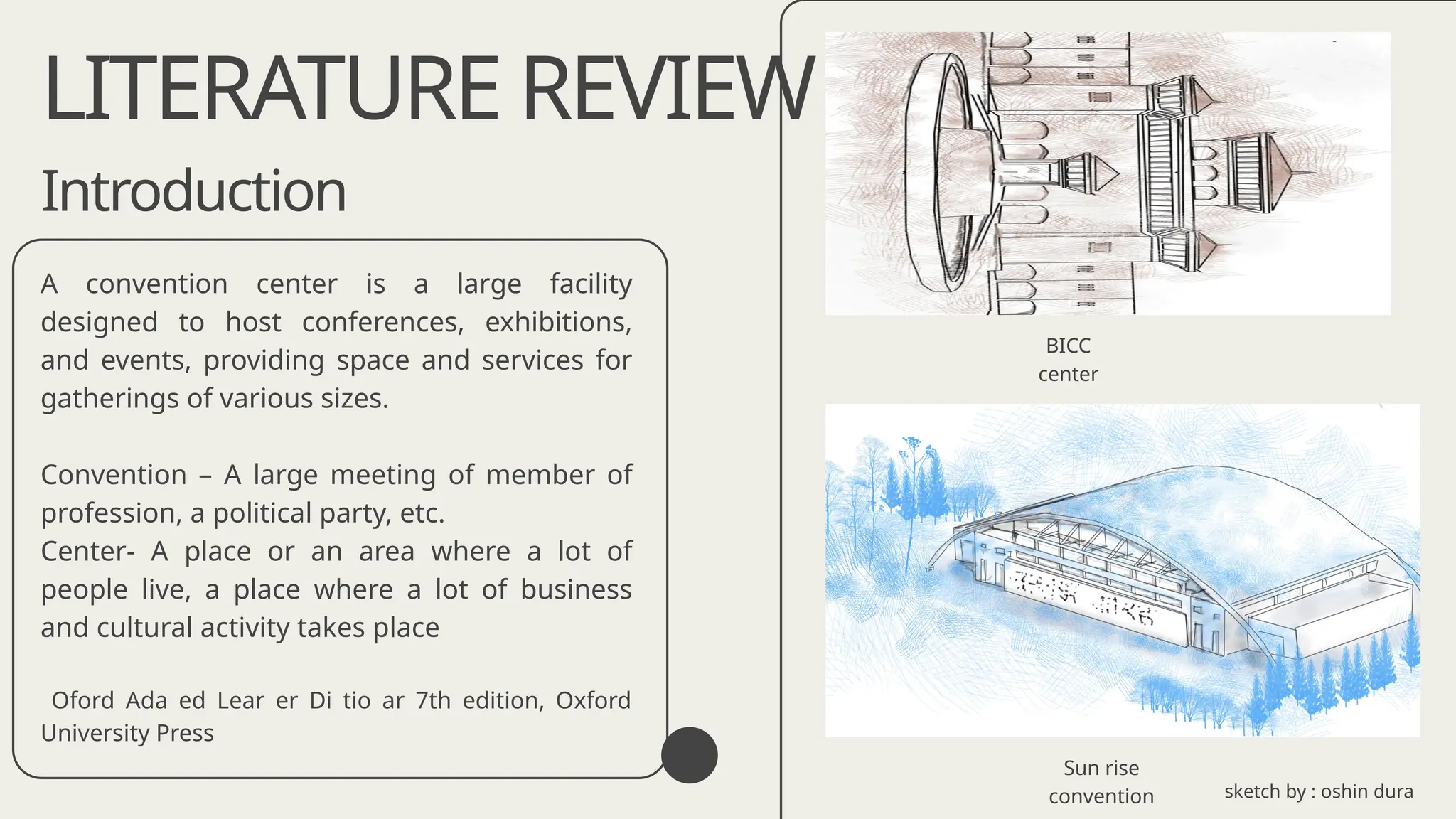
Sun rise
convention
BICC
center
sketch by : oshin dura
Home About Us
Contact
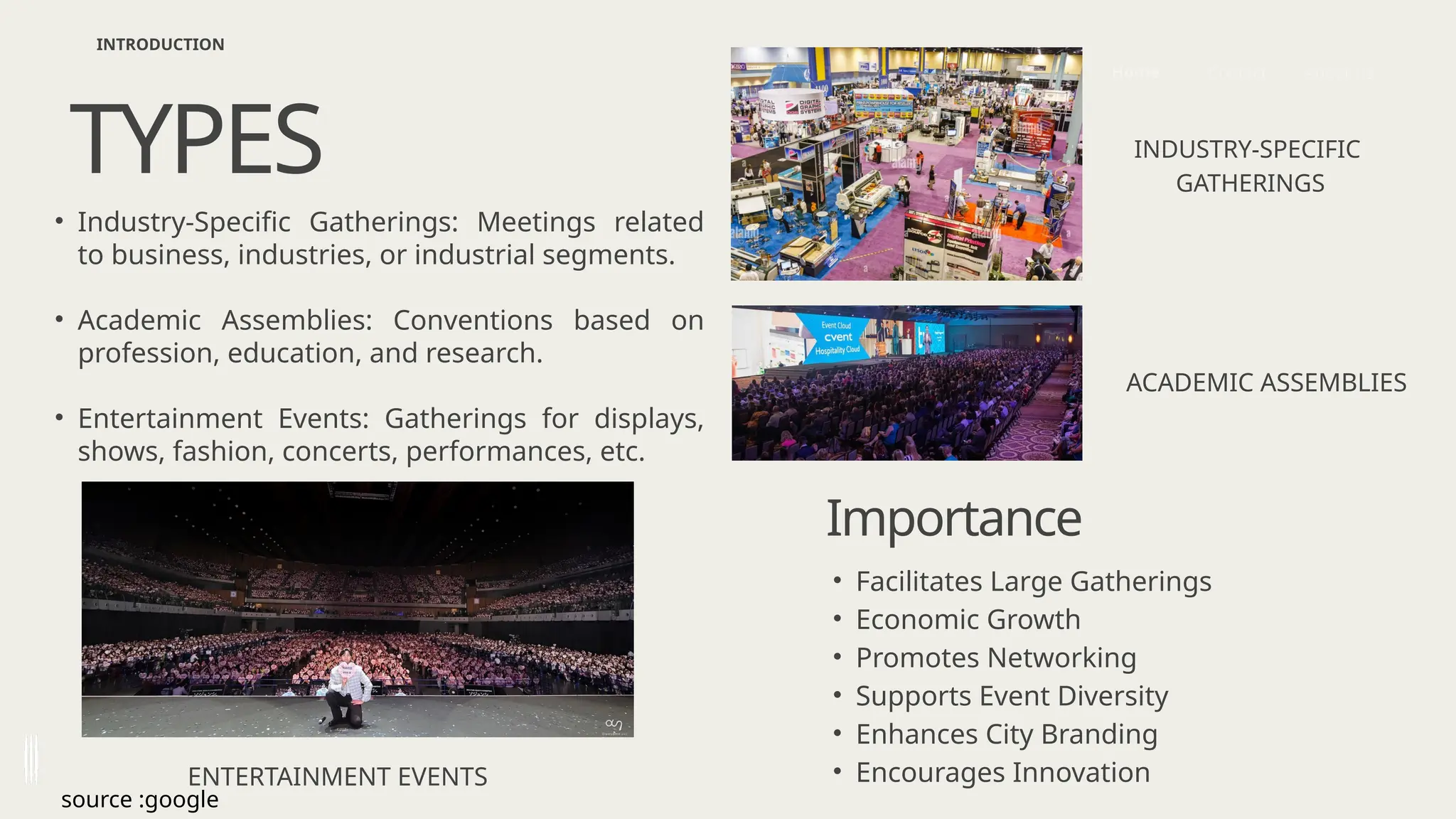
• Industry-Specific Gatherings: Meetings related
to business, industries, or industrial segments.
• Academic Assemblies: Conventions based on
profession, education, and research.
• Entertainment Events: Gatherings for displays,
shows, fashion, concerts, performances, etc.
ENTERTAINMENT EVENTS
INDUSTRY-SPECIFIC
GATHERINGS
ACADEMIC ASSEMBLIES
TYPES
INTRODUCTION
Importance
• Facilitates Large Gatherings
• Economic Growth
• Promotes Networking
• Supports Event Diversity
• Enhances City Branding
• Encourages Innovation
source :google
• Ancient Forums:
⚬ Example: Roman Forums served
as civic and commercial hubs.
• Amphitheaters:
⚬ Hosted entertainment and public
gatherings, e.g., the Colosseum.
• Town Halls:
⚬ Centers for governance and
community events in medieval
Europe.
HISTORY
INTRODUCTION
1.Early Public Assembly
Spaces
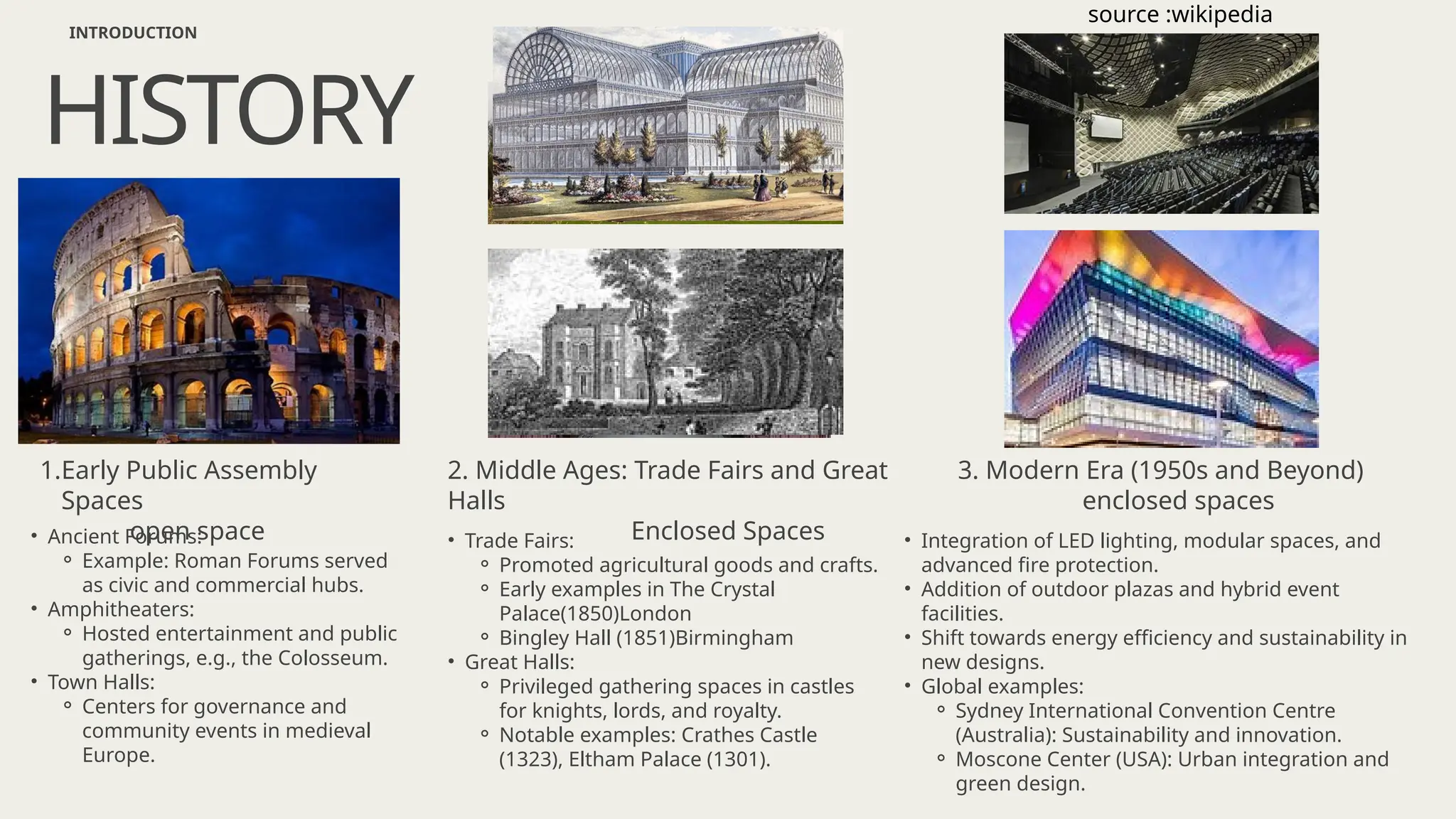
open space • Trade Fairs:
⚬ Promoted agricultural goods and crafts.
⚬ Early examples in The Crystal
Palace(1850)London
⚬ Bingley Hall (1851)Birmingham
• Great Halls:
⚬ Privileged gathering spaces in castles
for knights, lords, and royalty.
⚬ Notable examples: Crathes Castle
(1323), Eltham Palace (1301).
2. Middle Ages: Trade Fairs and Great
Halls
Enclosed Spaces • Integration of LED lighting, modular spaces, and
advanced fire protection.
• Addition of outdoor plazas and hybrid event
facilities.
• Shift towards energy efficiency and sustainability in
new designs.
• Global examples:
⚬ Sydney International Convention Centre
(Australia): Sustainability and innovation.
⚬ Moscone Center (USA): Urban integration and
green design.
3. Modern Era (1950s and Beyond)
enclosed spaces
source :wikipedia
HISTORY
INTRODUCTION
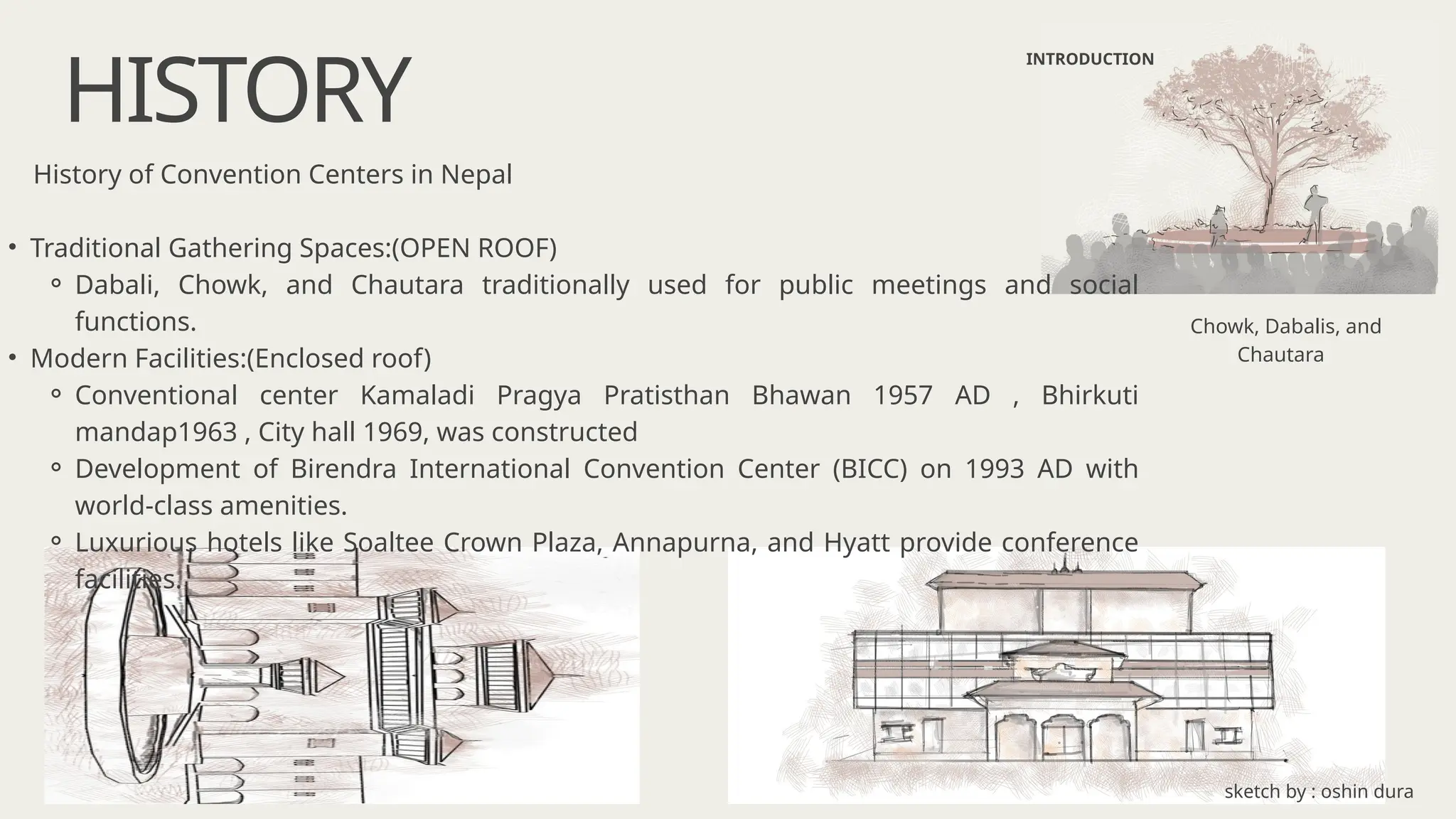
History of Convention Centers in Nepal
• Traditional Gathering Spaces:(OPEN ROOF)
⚬ Dabali, Chowk, and Chautara traditionally used for public meetings and social
functions.
• Modern Facilities:(Enclosed roof)
⚬ Conventional center Kamaladi Pragya Pratisthan Bhawan 1957 AD , Bhirkuti
mandap1963 , City hall 1969, was constructed
⚬ Development of Birendra International Convention Center (BICC) on 1993 AD with
world-class amenities.
⚬ Luxurious hotels like Soaltee Crown Plaza, Annapurna, and Hyatt provide conference
facilities.
Chowk, Dabalis, and
Chautara
sketch by : oshin dura
THEORETICAL
FRAMEWORK 1. Urban Design Theories with
Anthropological Insights
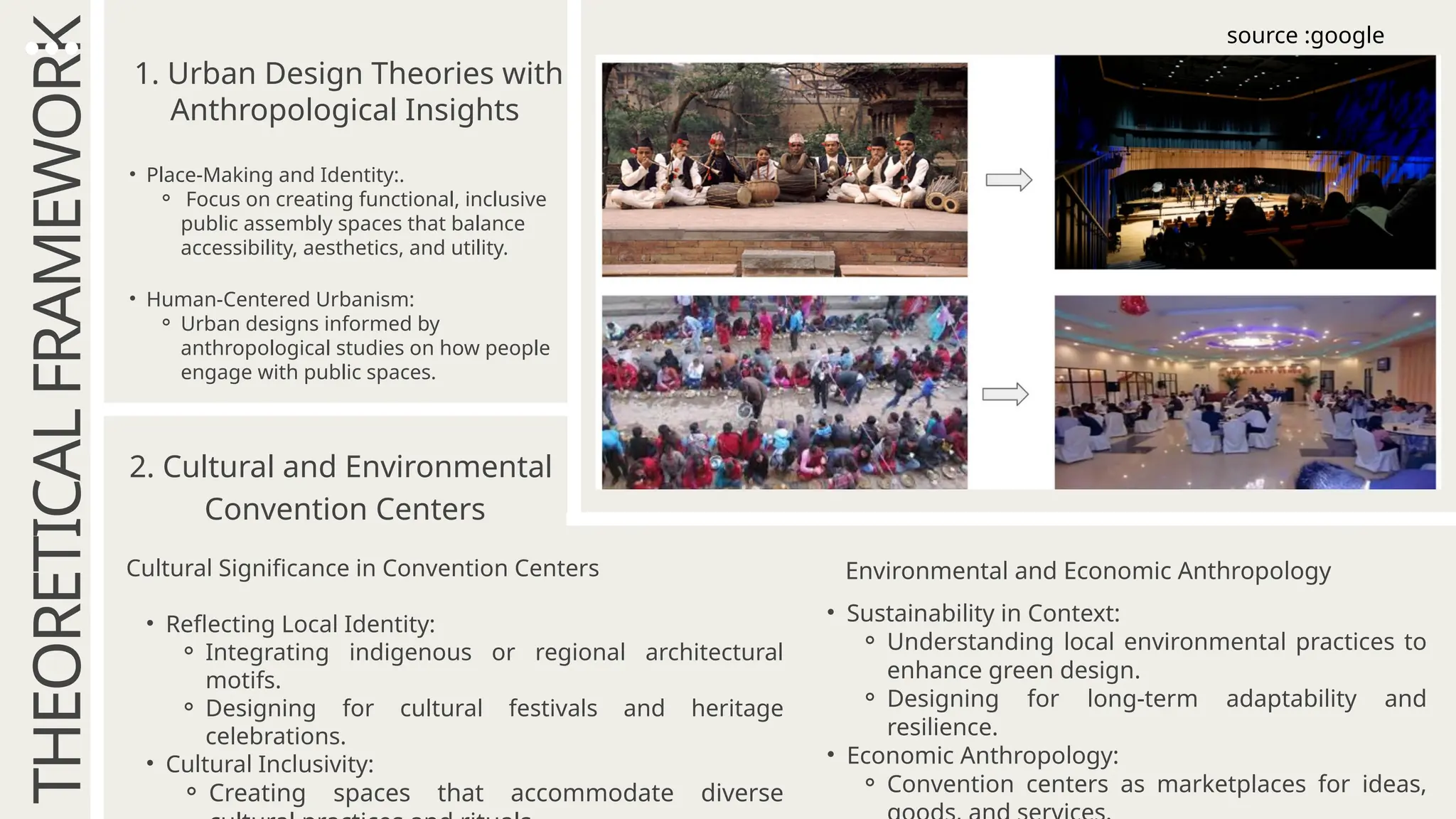
• Place-Making and Identity:.
⚬ Focus on creating functional, inclusive
public assembly spaces that balance
accessibility, aesthetics, and utility.
• Human-Centered Urbanism:
⚬ Urban designs informed by
anthropological studies on how people
engage with public spaces.
Cultural Significance in Convention Centers
• Reflecting Local Identity:
⚬ Integrating indigenous or regional architectural
motifs.
⚬ Designing for cultural festivals and heritage
celebrations.
• Cultural Inclusivity:
⚬ Creating spaces that accommodate diverse
Environmental and Economic Anthropology
• Sustainability in Context:
⚬ Understanding local environmental practices to
enhance green design.
⚬ Designing for long-term adaptability and
resilience.
• Economic Anthropology:
⚬ Convention centers as marketplaces for ideas,
2. Cultural and Environmental
Convention Centers
source :google
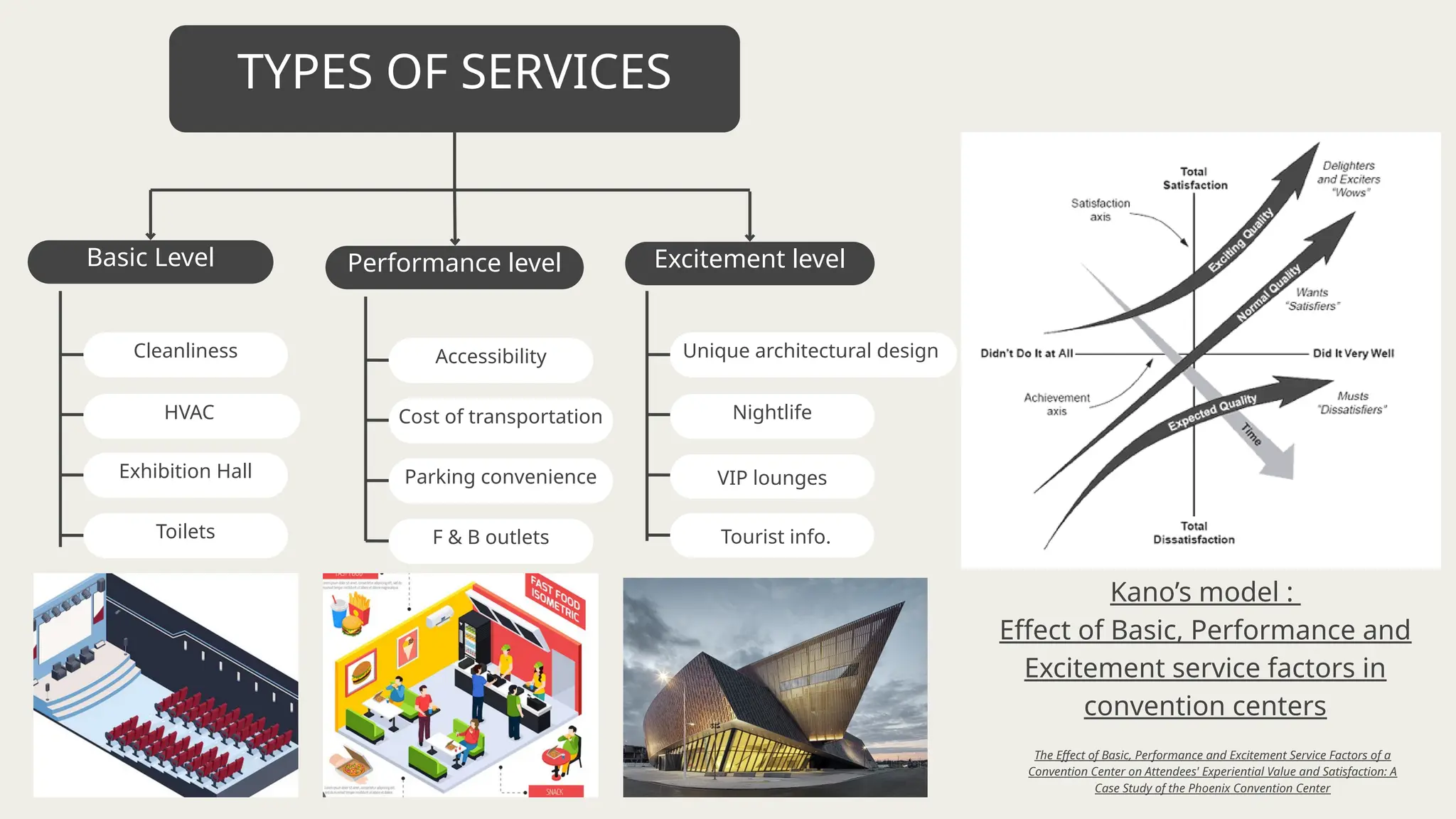
TYPES OF SERVICES
Basic Level Performance level Excitement level
Cleanliness
HVAC
Exhibition Hall
Toilets
Accessibility
Cost of transportation
Parking convenience
F & B outlets
Unique architectural design
Nightlife
VIP lounges
Tourist info.
Kano’s model :
Effect of Basic, Performance and
Excitement service factors in
convention centers
The Effect of Basic, Performance and Excitement Service Factors of a
Convention Center on Attendees' Experiential Value and Satisfaction: A
Case Study of the Phoenix Convention Center
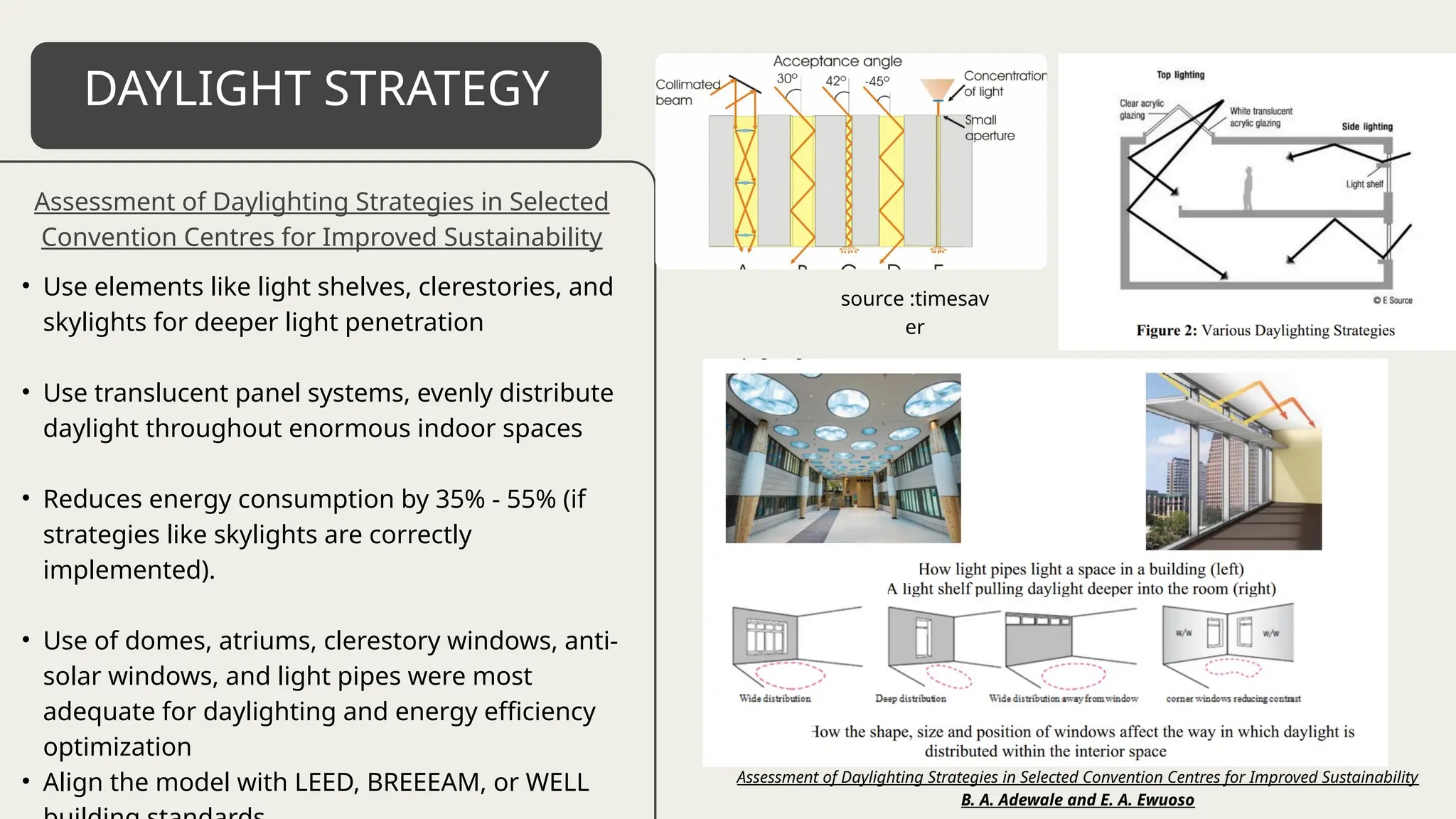
• Use elements like light shelves, clerestories, and
skylights for deeper light penetration
• Use translucent panel systems, evenly distribute
daylight throughout enormous indoor spaces
• Reduces energy consumption by 35% - 55% (if
strategies like skylights are correctly
implemented).
• Use of domes, atriums, clerestory windows, anti-
solar windows, and light pipes were most
adequate for daylighting and energy efficiency
optimization
• Align the model with LEED, BREEEAM, or WELL
DAYLIGHT STRATEGY
Assessment of Daylighting Strategies in Selected
Convention Centres for Improved Sustainability
source :timesav
er
Assessment of Daylighting Strategies in Selected Convention Centres for Improved Sustainability
B. A. Adewale and E. A. Ewuoso
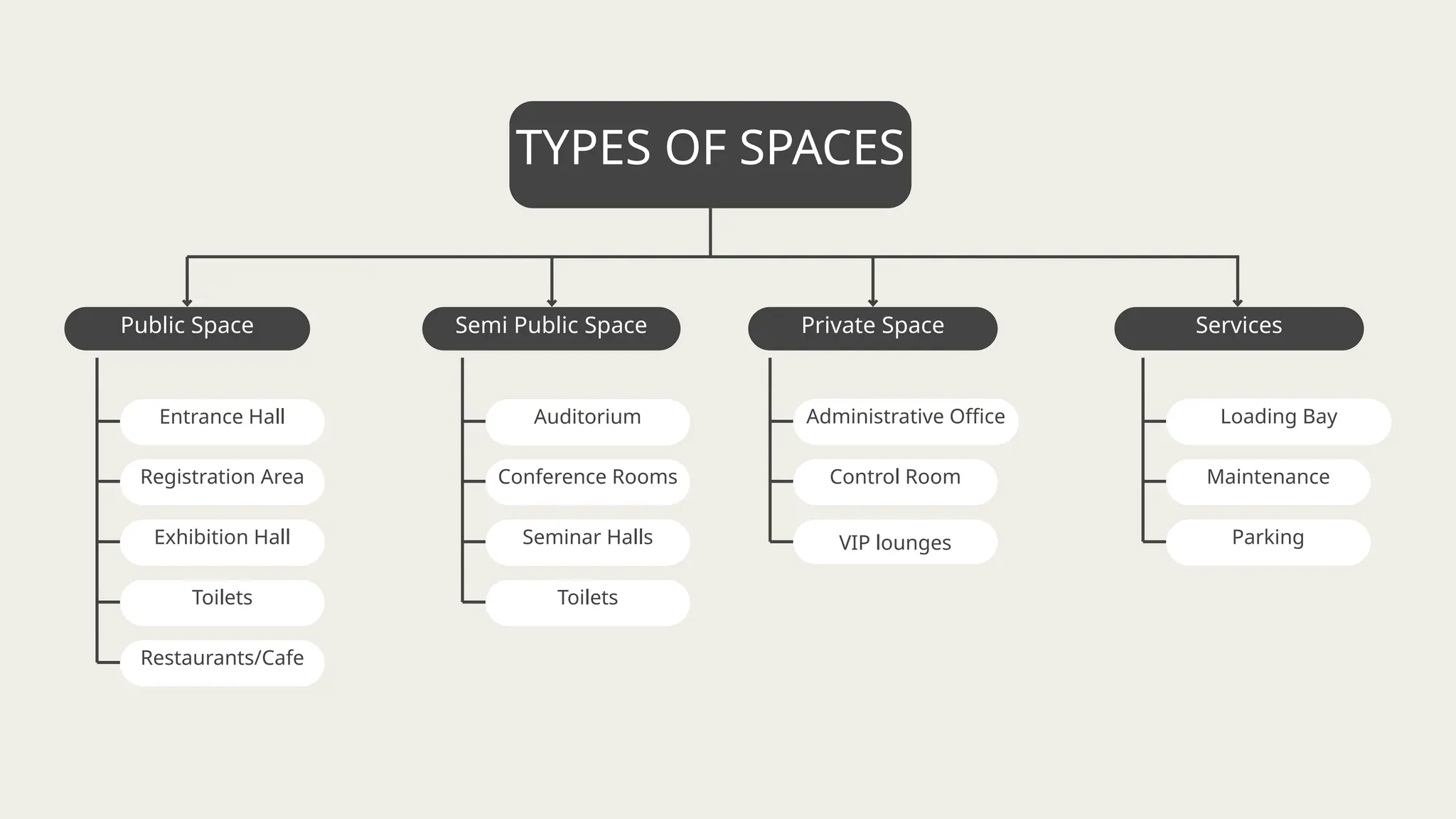
TYPES OF SPACES
Public Space Semi Public Space Private Space Services
Entrance Hall
Registration Area
Exhibition Hall
Toilets
Auditorium
Conference Rooms
Seminar Halls
Toilets
Restaurants/Cafe
Administrative Office
Control Room
Loading Bay
Maintenance
Parking
VIP lounges
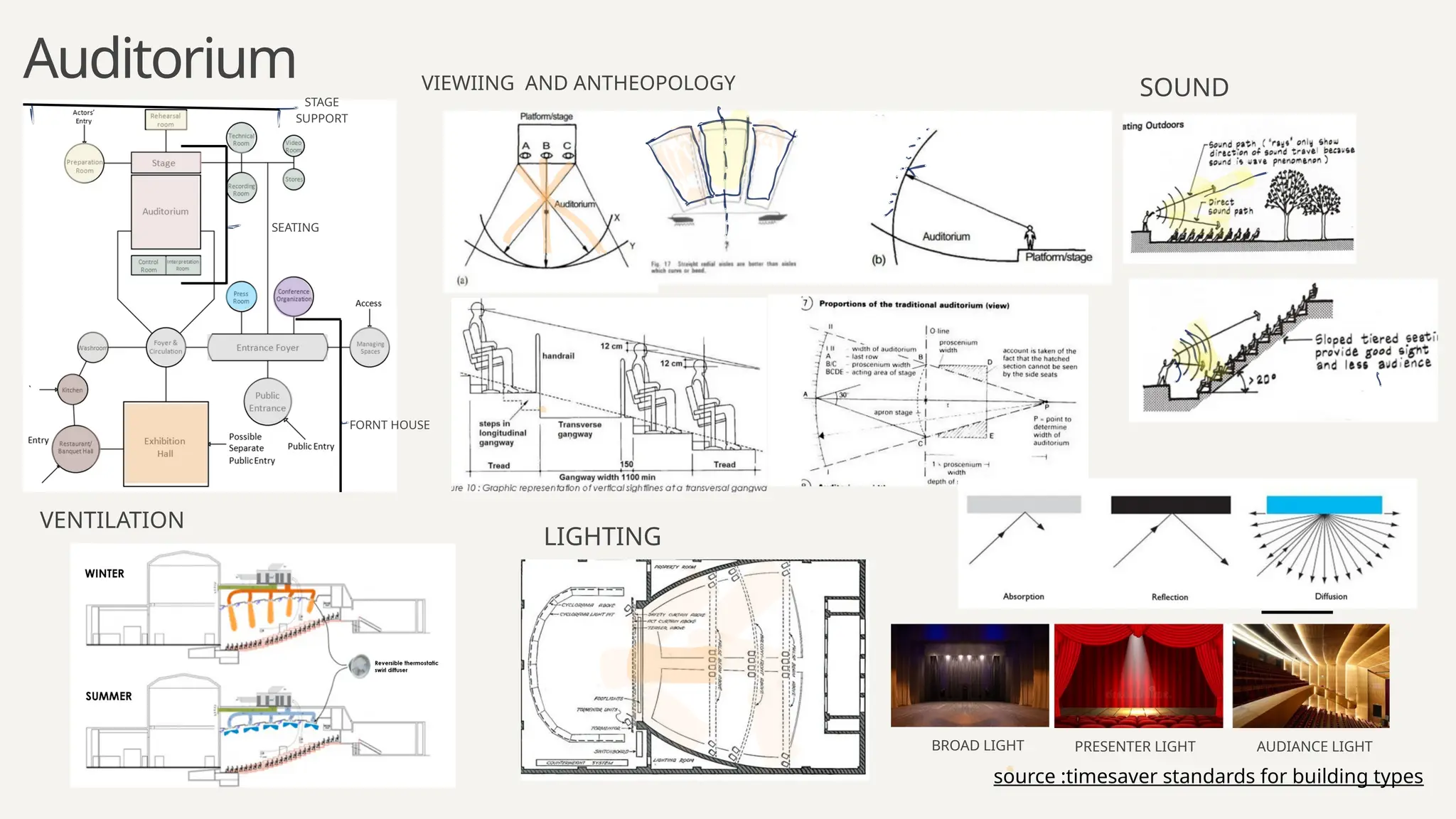
Auditorium
FORNT HOUSE
STAGE
SUPPORT
SEATING
VIEWIING AND ANTHEOPOLOGY
source :timesaver standards for building types
BROAD LIGHT PRESENTER LIGHT AUDIANCE LIGHT
VENTILATION
SOUND
LIGHTING
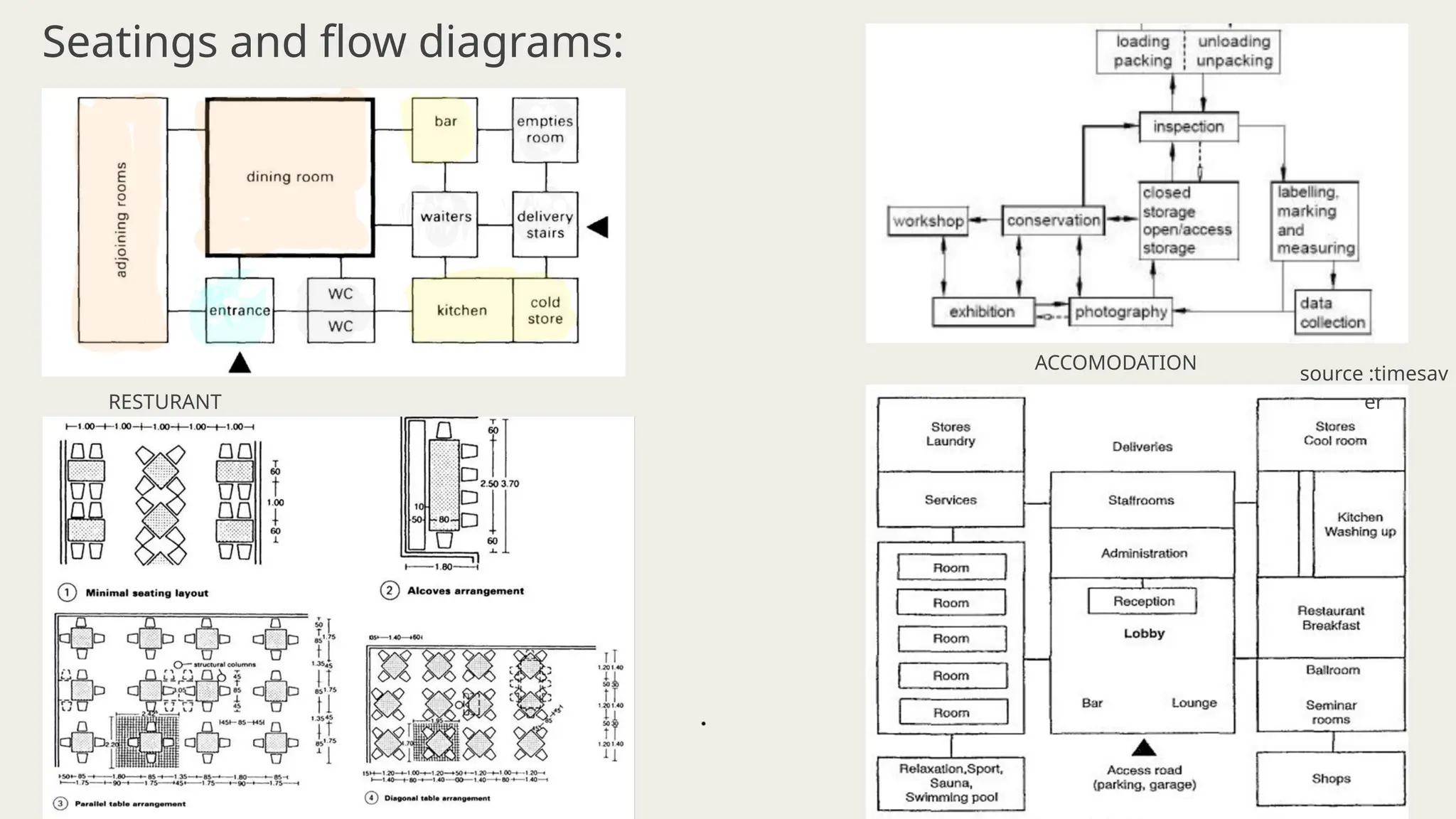
Seatings and flow diagrams:
RESTURANT
ACCOMODATION
source :timesav
er
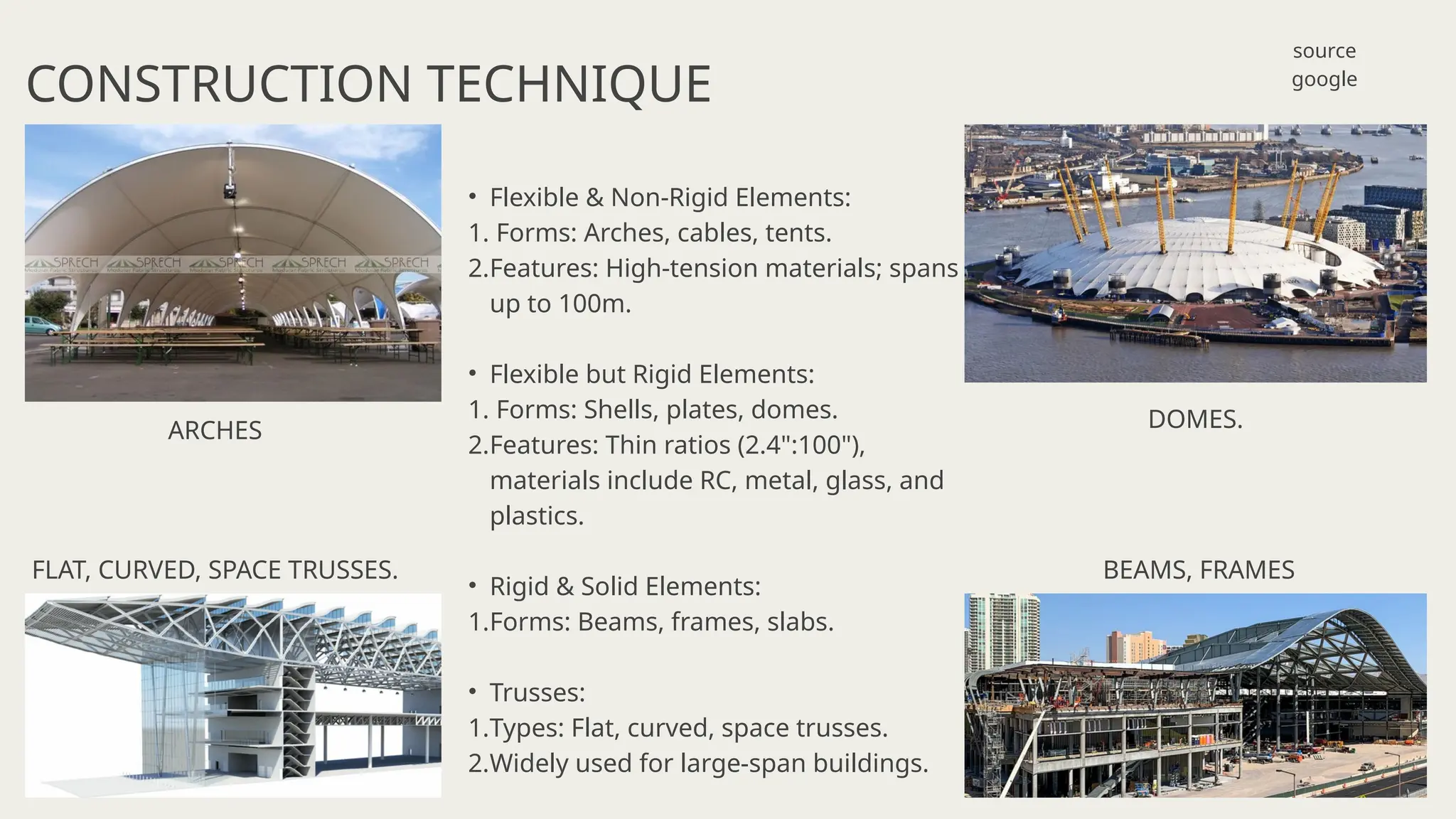
• Flexible & Non-Rigid Elements:
1. Forms: Arches, cables, tents.
2.Features: High-tension materials; spans
up to 100m.
• Flexible but Rigid Elements:
1. Forms: Shells, plates, domes.
2.Features: Thin ratios (2.4":100"),
materials include RC, metal, glass, and
plastics.
• Rigid & Solid Elements:
1.Forms: Beams, frames, slabs.
• Trusses:
1.Types: Flat, curved, space trusses.
2.Widely used for large-span buildings.
CONSTRUCTION TECHNIQUE
ARCHES DOMES.
BEAMS, FRAMES
FLAT, CURVED, SPACE TRUSSES.
source
google
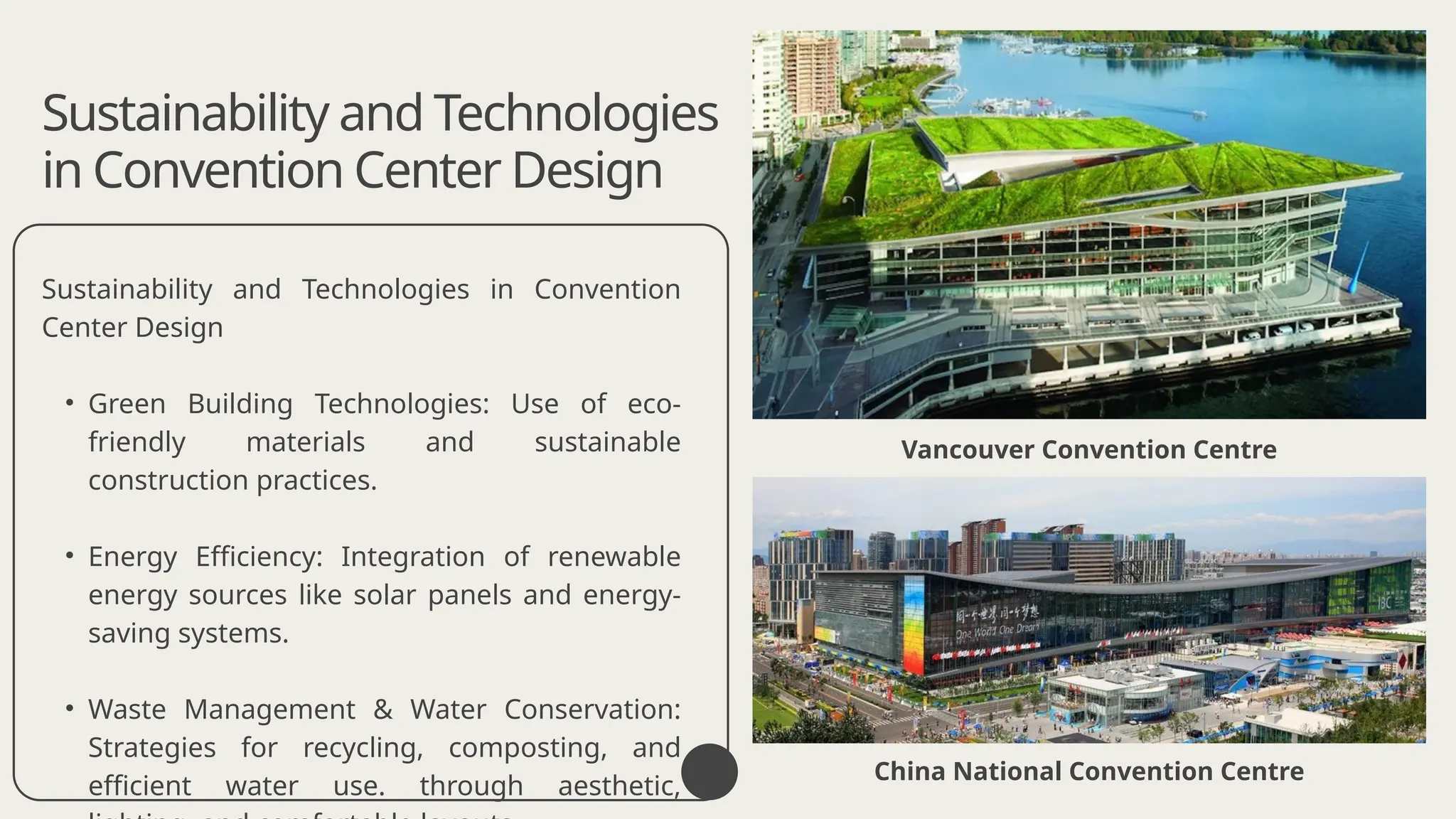
Sustainability and Technologies
in Convention Center Design
Sustainability and Technologies in Convention
Center Design
• Green Building Technologies: Use of eco-
friendly materials and sustainable
construction practices.
• Energy Efficiency: Integration of renewable
energy sources like solar panels and energy-
saving systems.
• Waste Management & Water Conservation:
Strategies for recycling, composting, and
efficient water use. through aesthetic,
Vancouver Convention Centre
China National Convention Centre
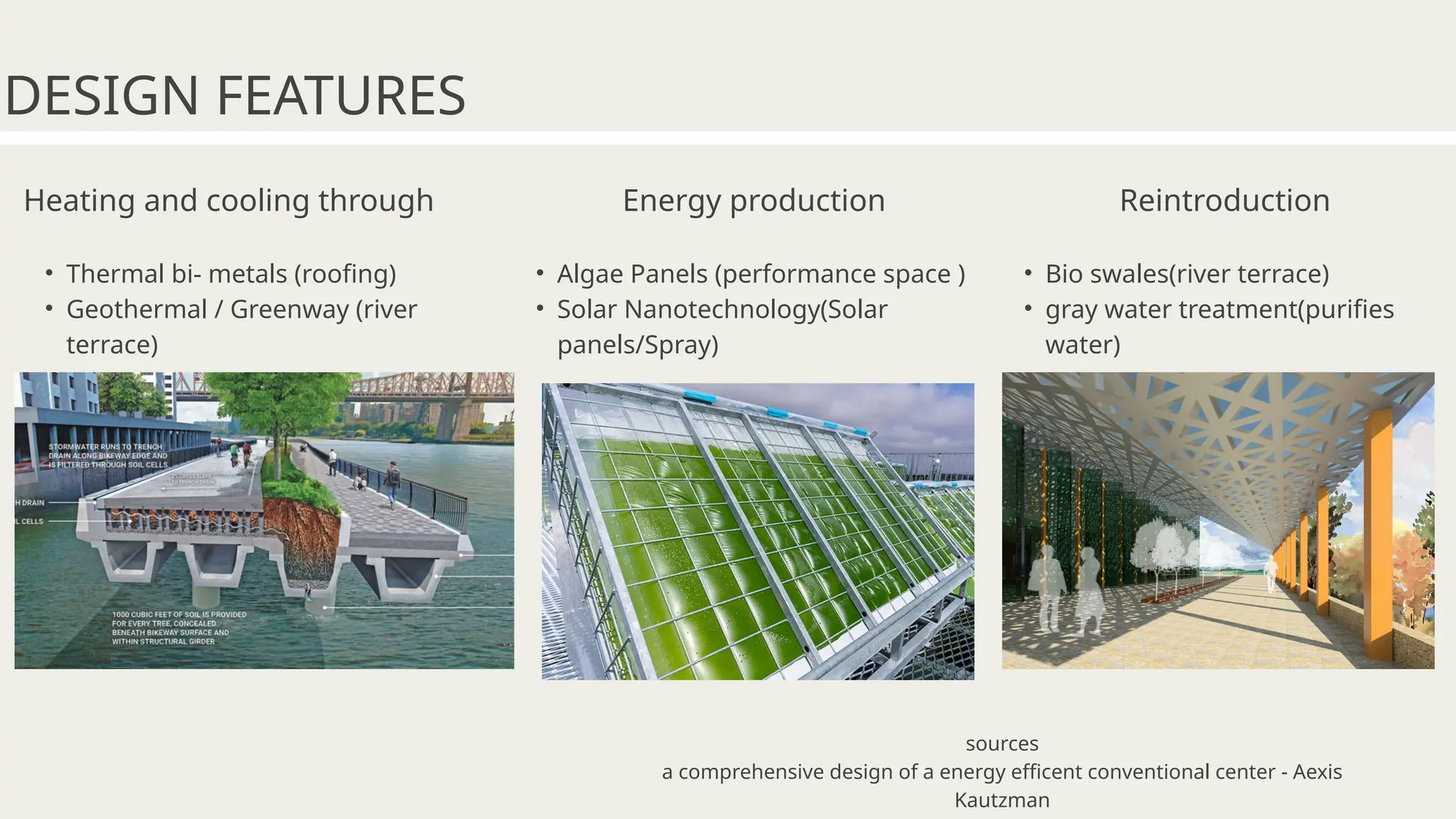
Heating and cooling through
• Thermal bi- metals (roofing)
• Geothermal / Greenway (river
terrace)
DESIGN FEATURES
Energy production
• Algae Panels (performance space )
• Solar Nanotechnology(Solar
panels/Spray)
Reintroduction
• Bio swales(river terrace)
• gray water treatment(purifies
water)
sources
a comprehensive design of a energy efficent conventional center - Aexis
Kautzman
Conclusion: Literature
Review
Convention centers have evolved from traditional
gathering spaces like Roman forums and medieval
trade fairs to modern hubs of innovation and
collaboration. Rooted in urban design theories, they
balance cultural significance, inclusivity, and human-
centered principles while addressing environmental
and economic needs.
1.Technological Integration: Hybrid spaces, AI, and
AR/VR for flexibility.
2.Adaptability: Supporting diverse in-person and
virtual events.
3.Global Insights: Learning from successful global
examples.
4.Future Focus: Creating user-centric, dynamic, and
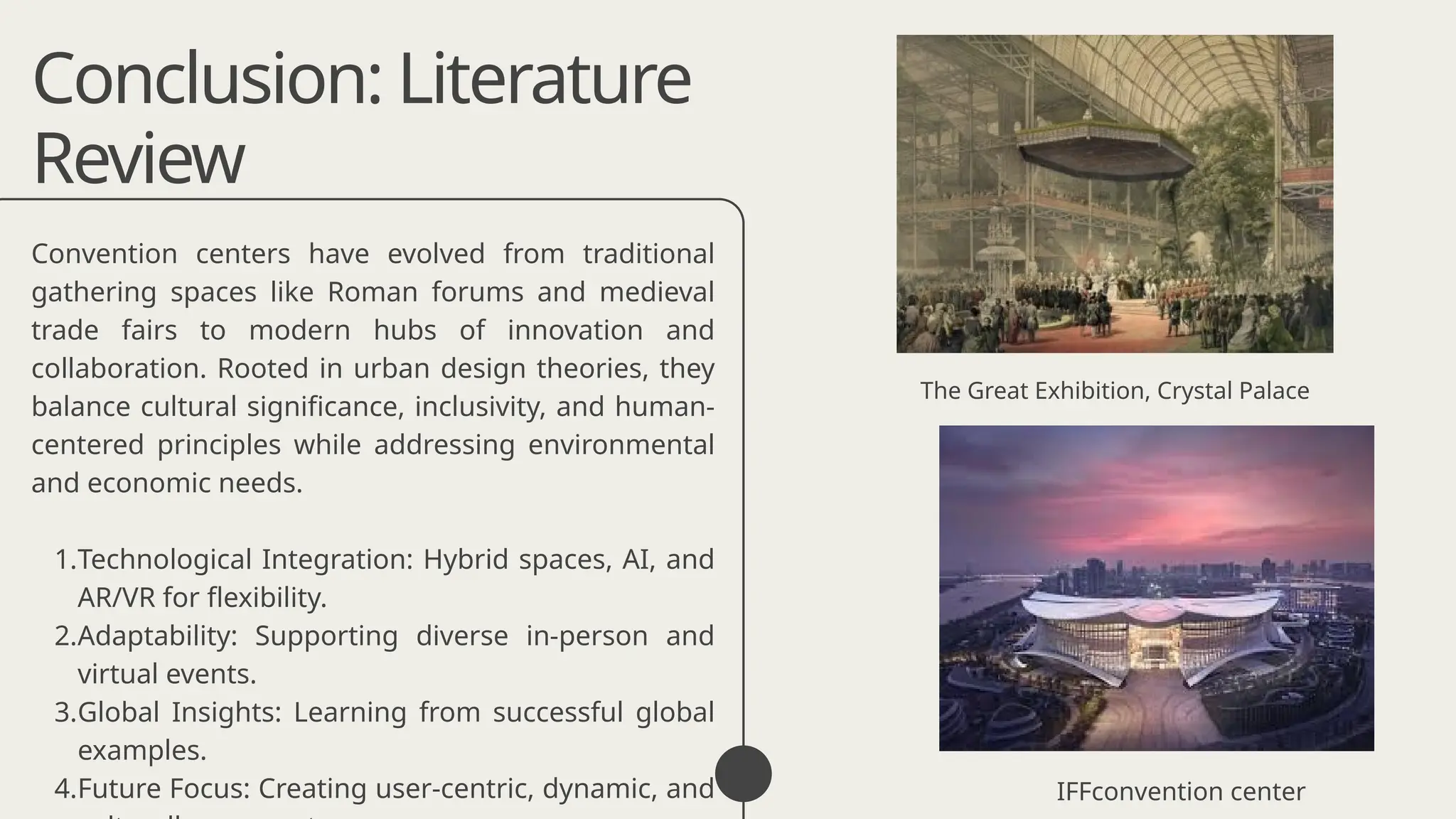
The Great Exhibition, Crystal Palace
IFFconvention center
International
Case Study
INTERNATIONAL CASE
STUDIES:
Dakar International Congress Center
Mons Convention Center
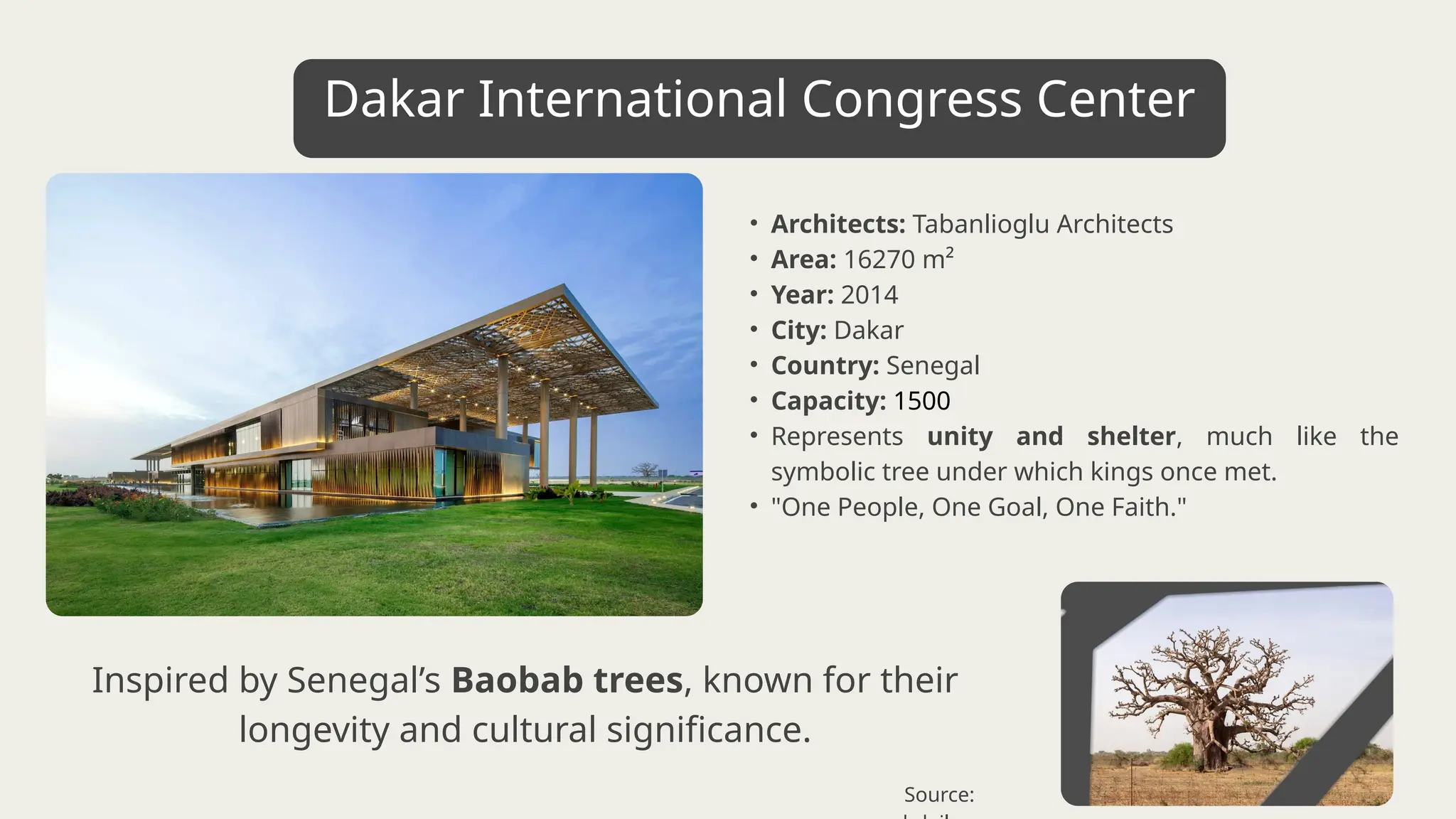
• Architects: Tabanlioglu Architects
• Area: 16270 m²
• Year: 2014
• City: Dakar
• Country: Senegal
• Capacity: 1500
• Represents unity and shelter, much like the
symbolic tree under which kings once met.
• "One People, One Goal, One Faith."
Inspired by Senegal’s Baobab trees, known for their
longevity and cultural significance.
Dakar International Congress Center
Source:
Design Philosophy
Dakar ICC
Design Philosophy
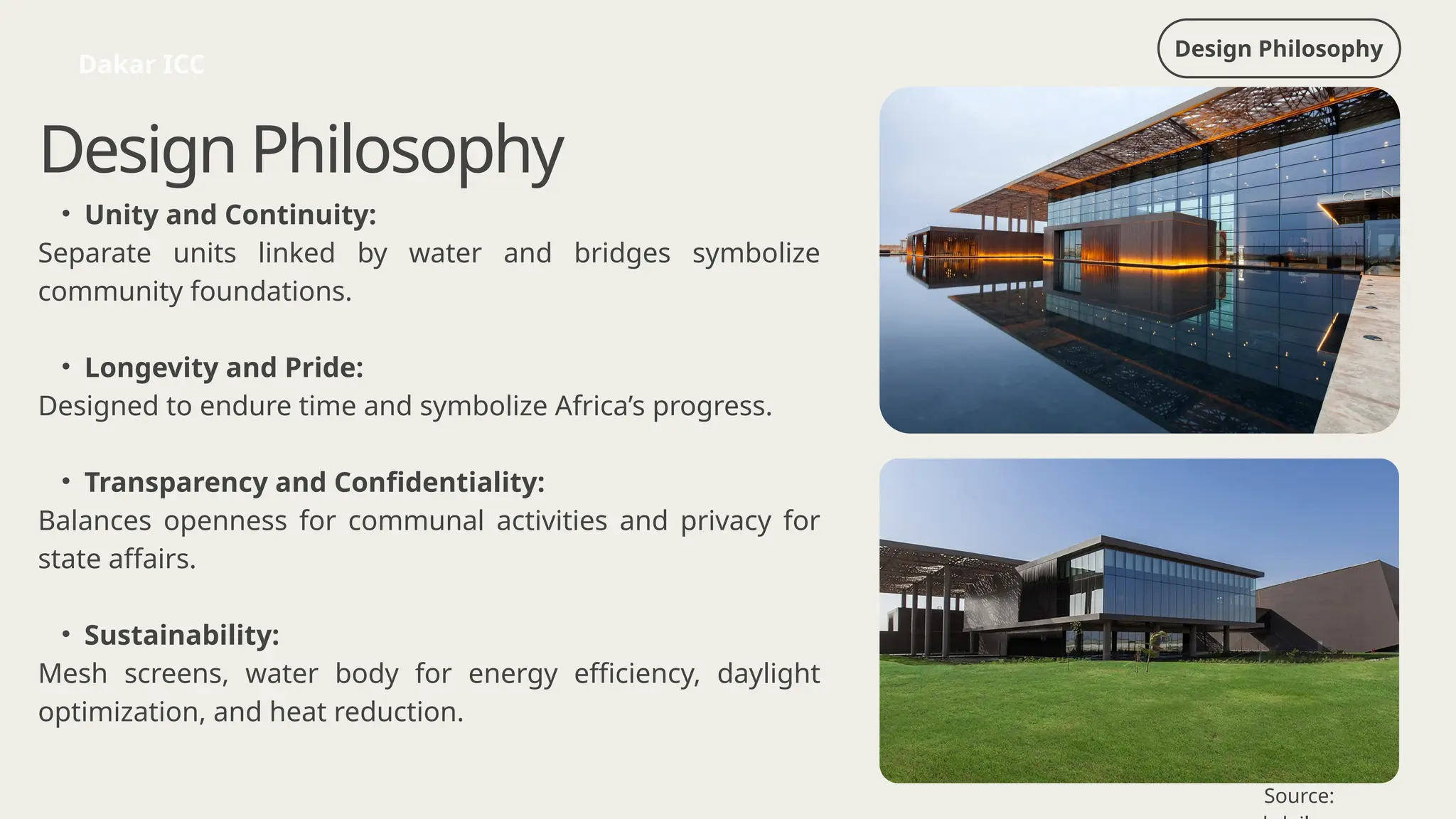
• Unity and Continuity:
Separate units linked by water and bridges symbolize
community foundations.
• Longevity and Pride:
Designed to endure time and symbolize Africa’s progress.
• Transparency and Confidentiality:
Balances openness for communal activities and privacy for
state affairs.
• Sustainability:
Mesh screens, water body for energy efficiency, daylight
optimization, and heat reduction.
Source:
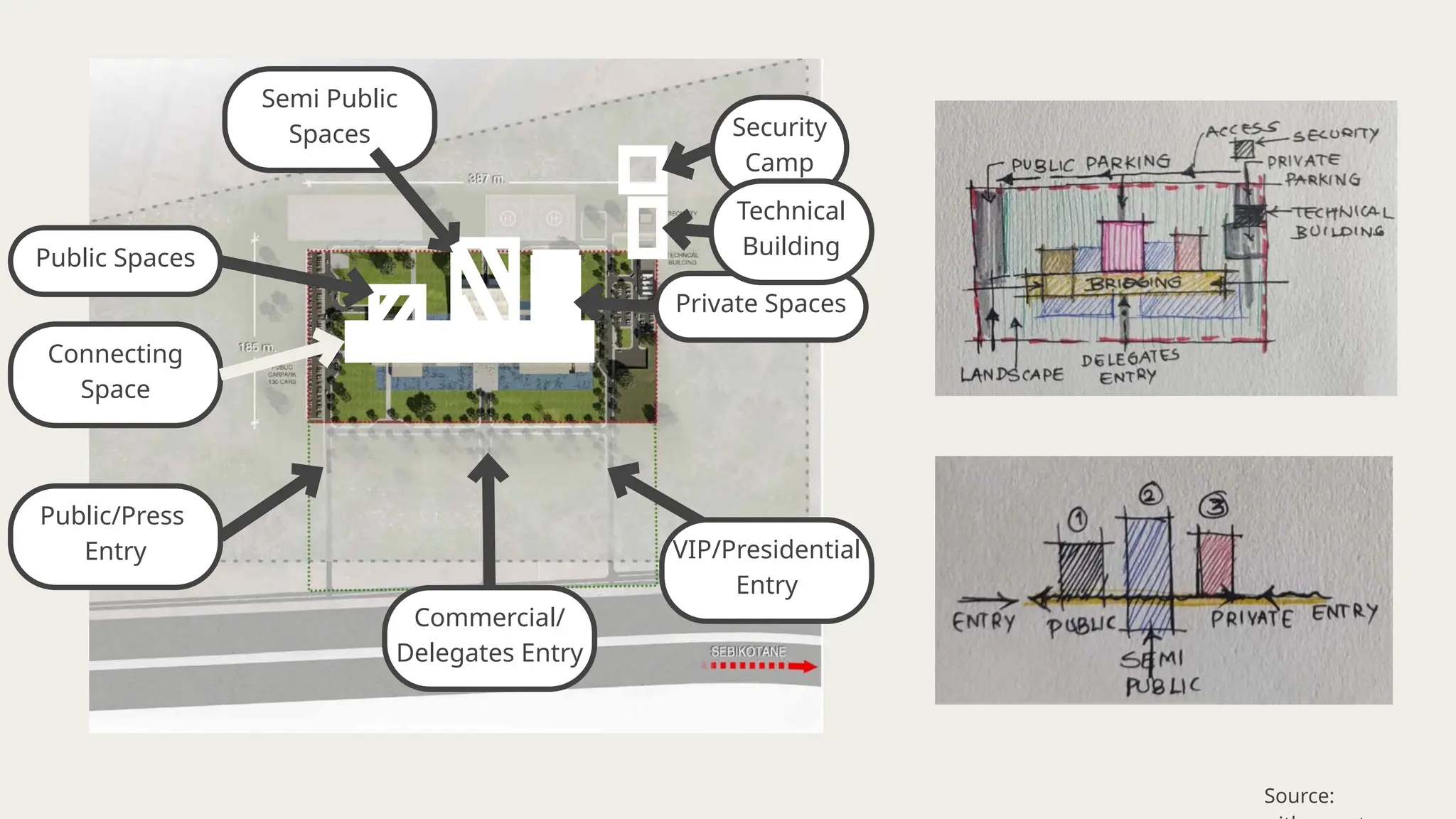
Public/Press
Entry
Commercial/
Delegates Entry
VIP/Presidential
Entry
Public Spaces
Semi Public
Spaces
Private Spaces
Security
Camp
Technical
Building
Connecting
Space
Source:
Dakar ICC
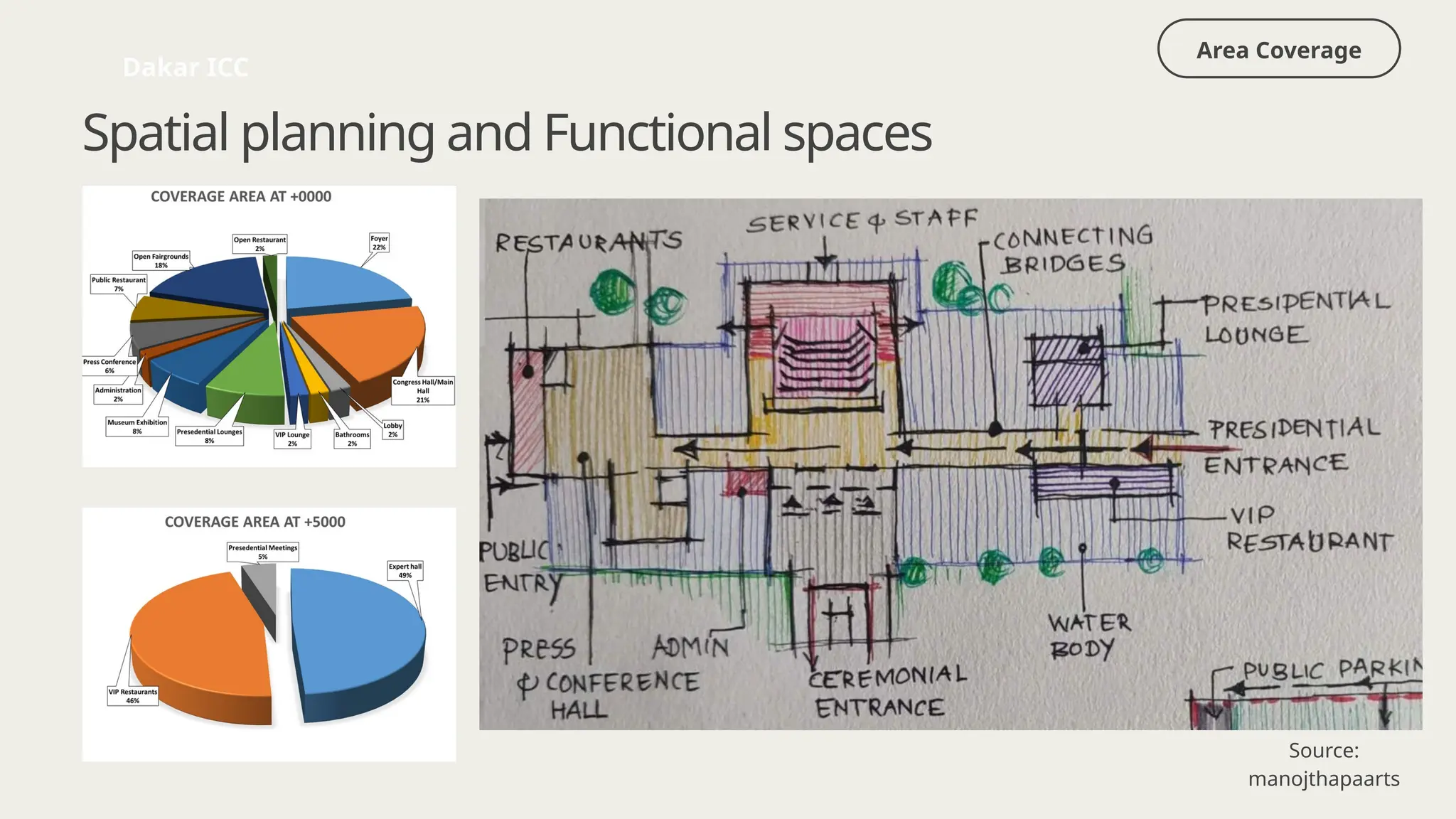
Spatial planning and Functional spaces
Area Coverage
Source:
manojthapaarts
Dakar ICC
Source:
Plans
Dakar ICC
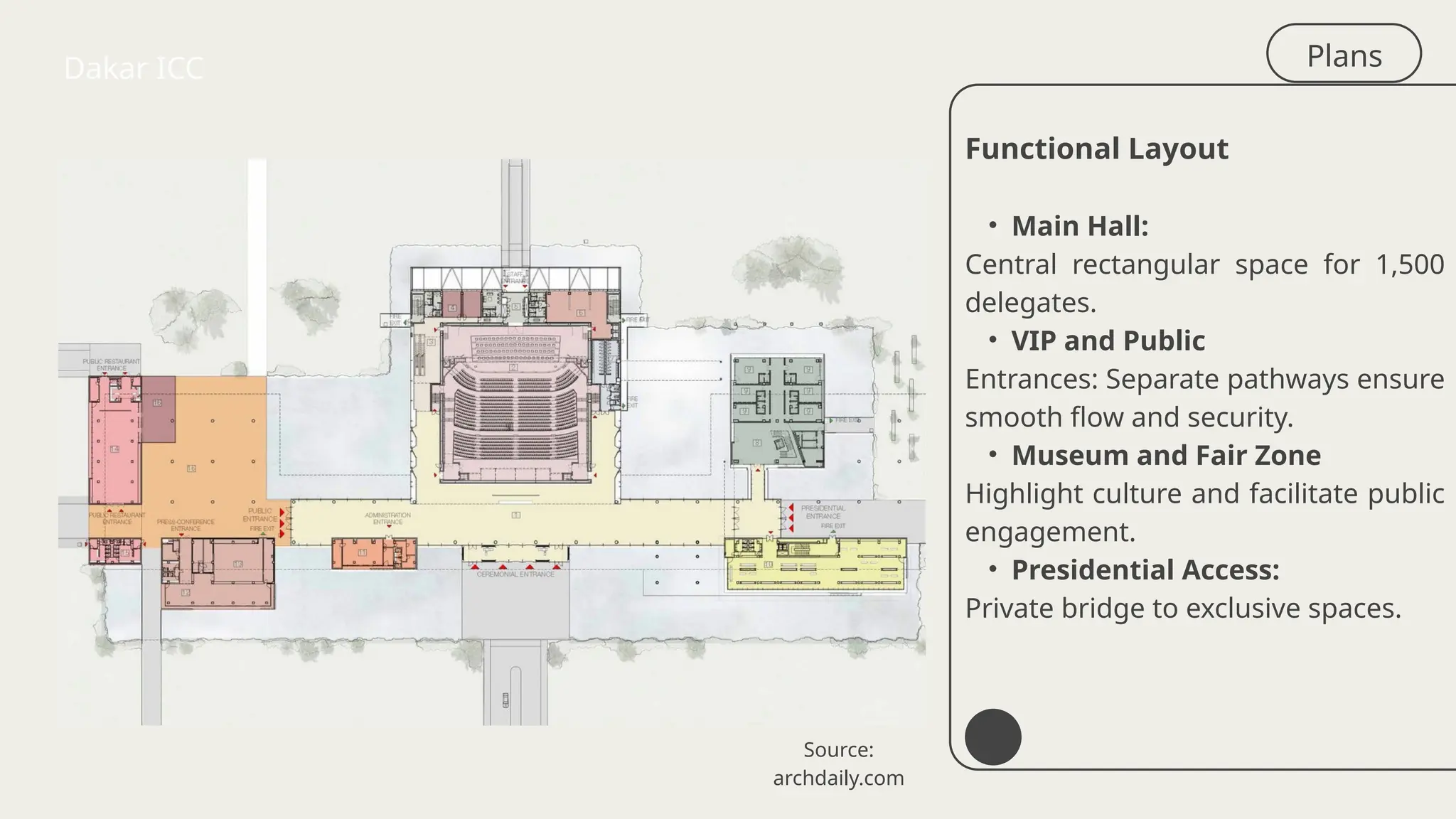
Functional Layout
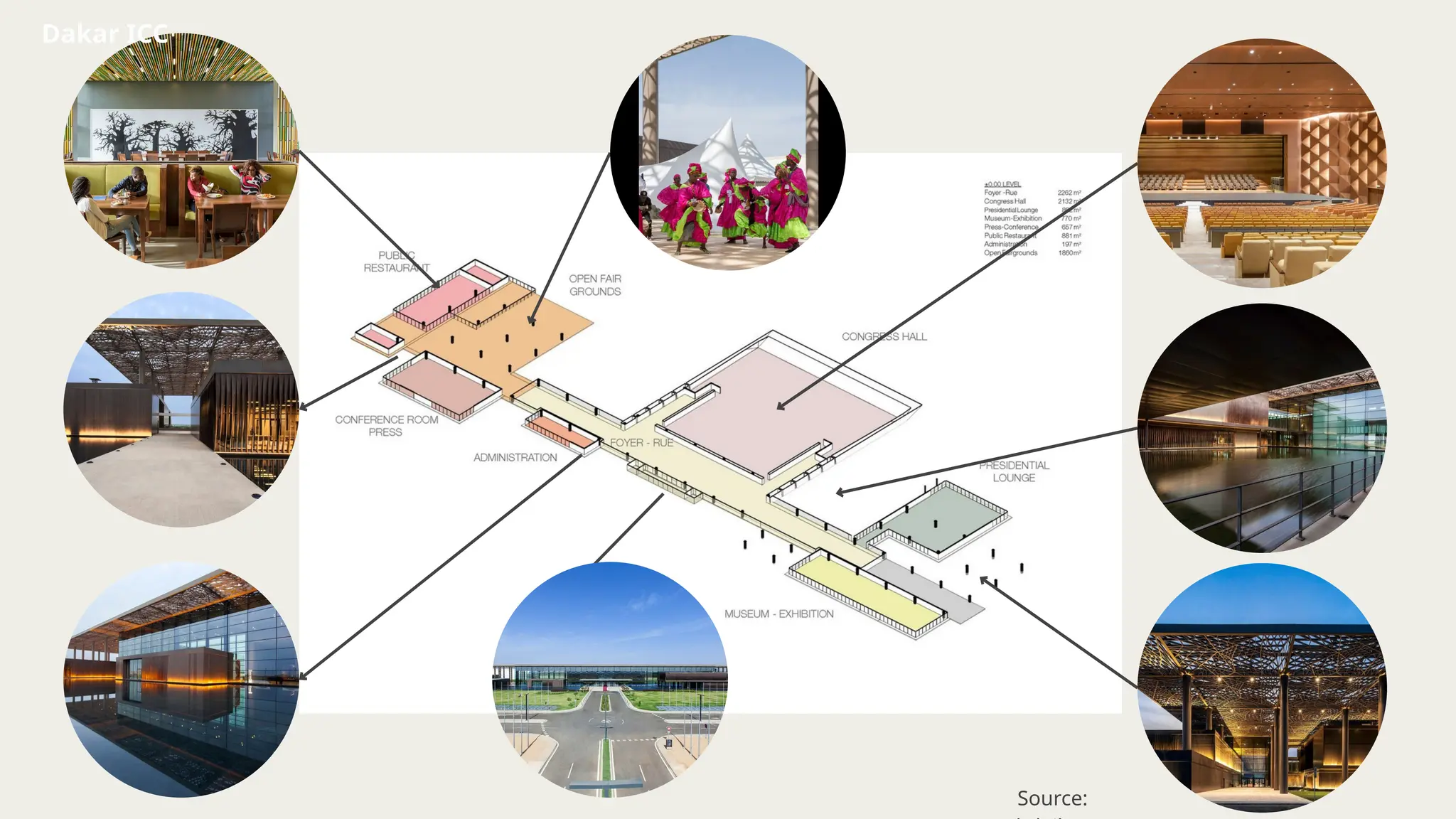
• Main Hall:
Central rectangular space for 1,500
delegates.
• VIP and Public
Entrances: Separate pathways ensure
smooth flow and security.
• Museum and Fair Zone
Highlight culture and facilitate public
engagement.
• Presidential Access:
Private bridge to exclusive spaces.
Source:
archdaily.com
Plans
Dakar ICC
Source:
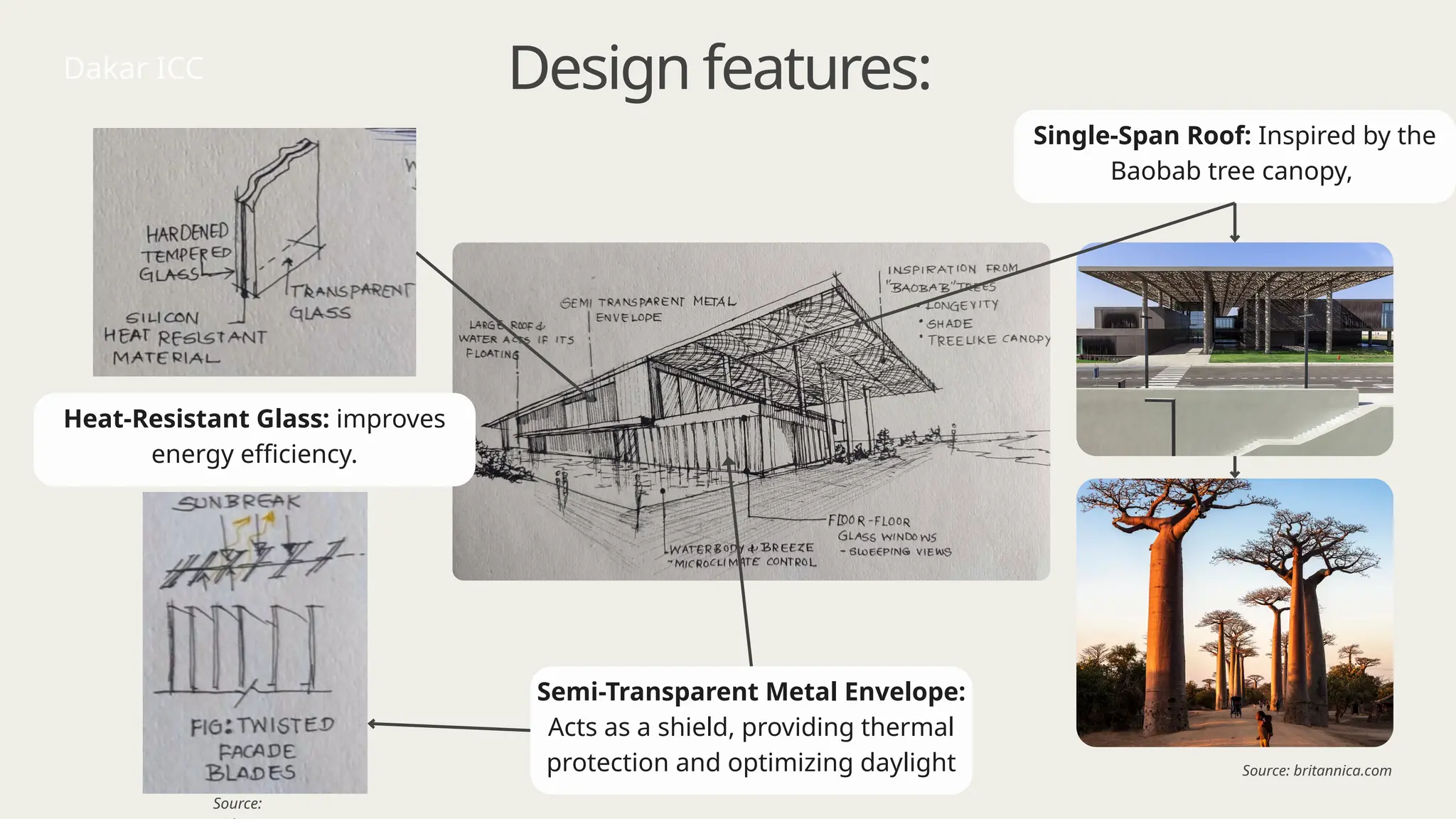
Single-Span Roof: Inspired by the
Baobab tree canopy,
Semi-Transparent Metal Envelope:
Acts as a shield, providing thermal
protection and optimizing daylight
Heat-Resistant Glass: improves
energy efficiency.
Source: britannica.com
Design features:
Dakar ICC
Source:
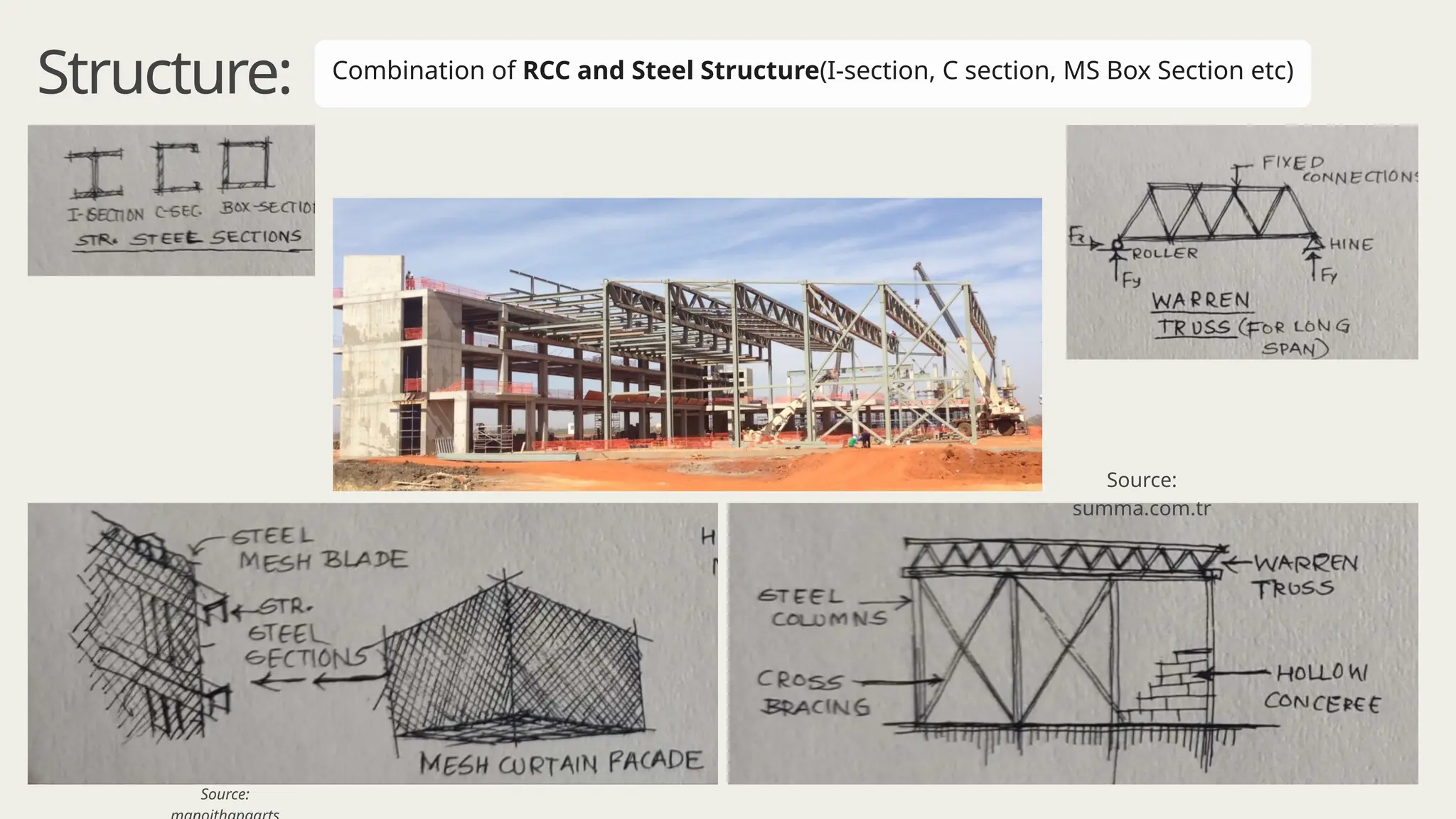
Combination of RCC and Steel Structure(I-section, C section, MS Box Section etc)
Source:
summa.com.tr
Source:
Structure:
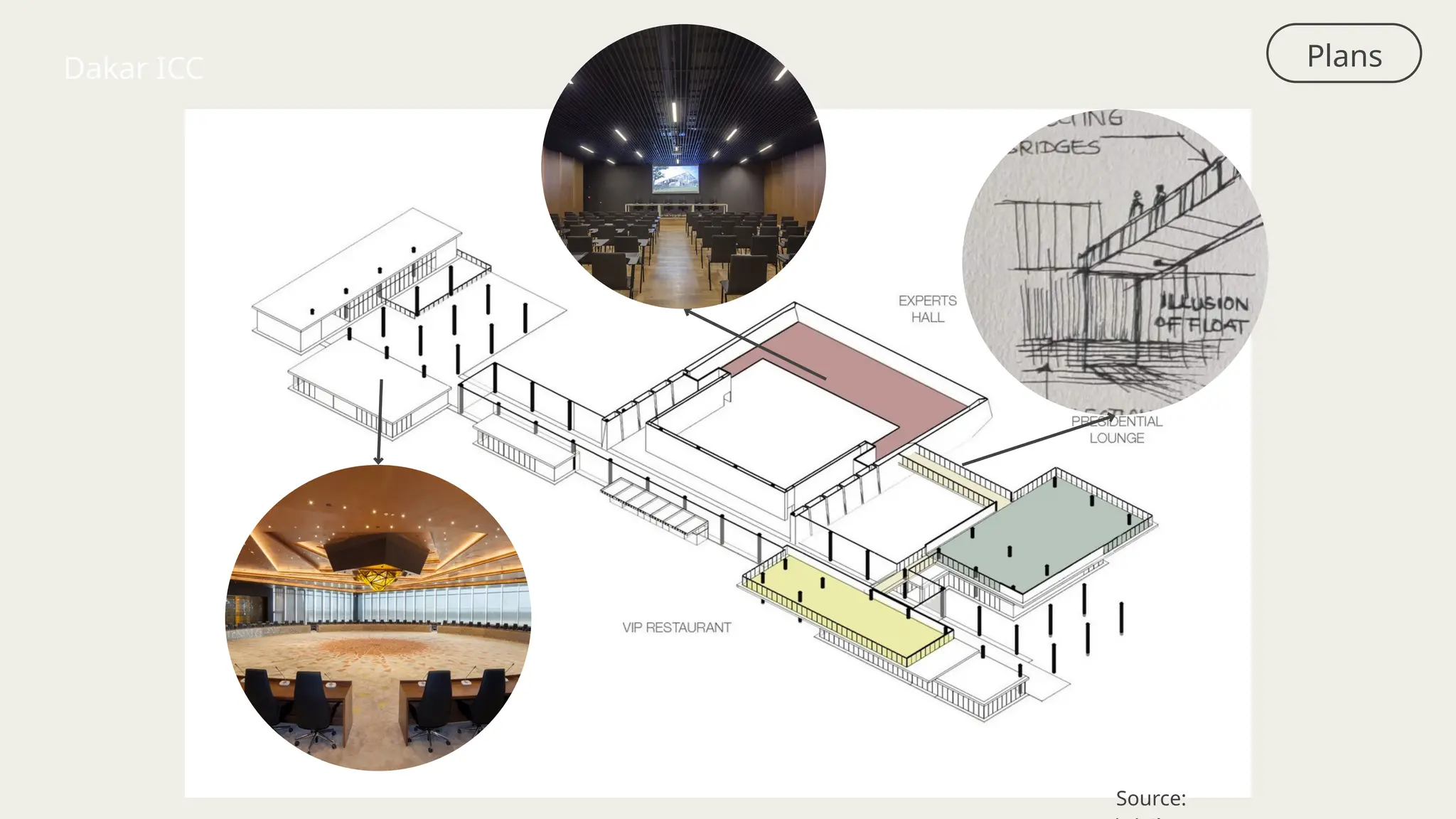
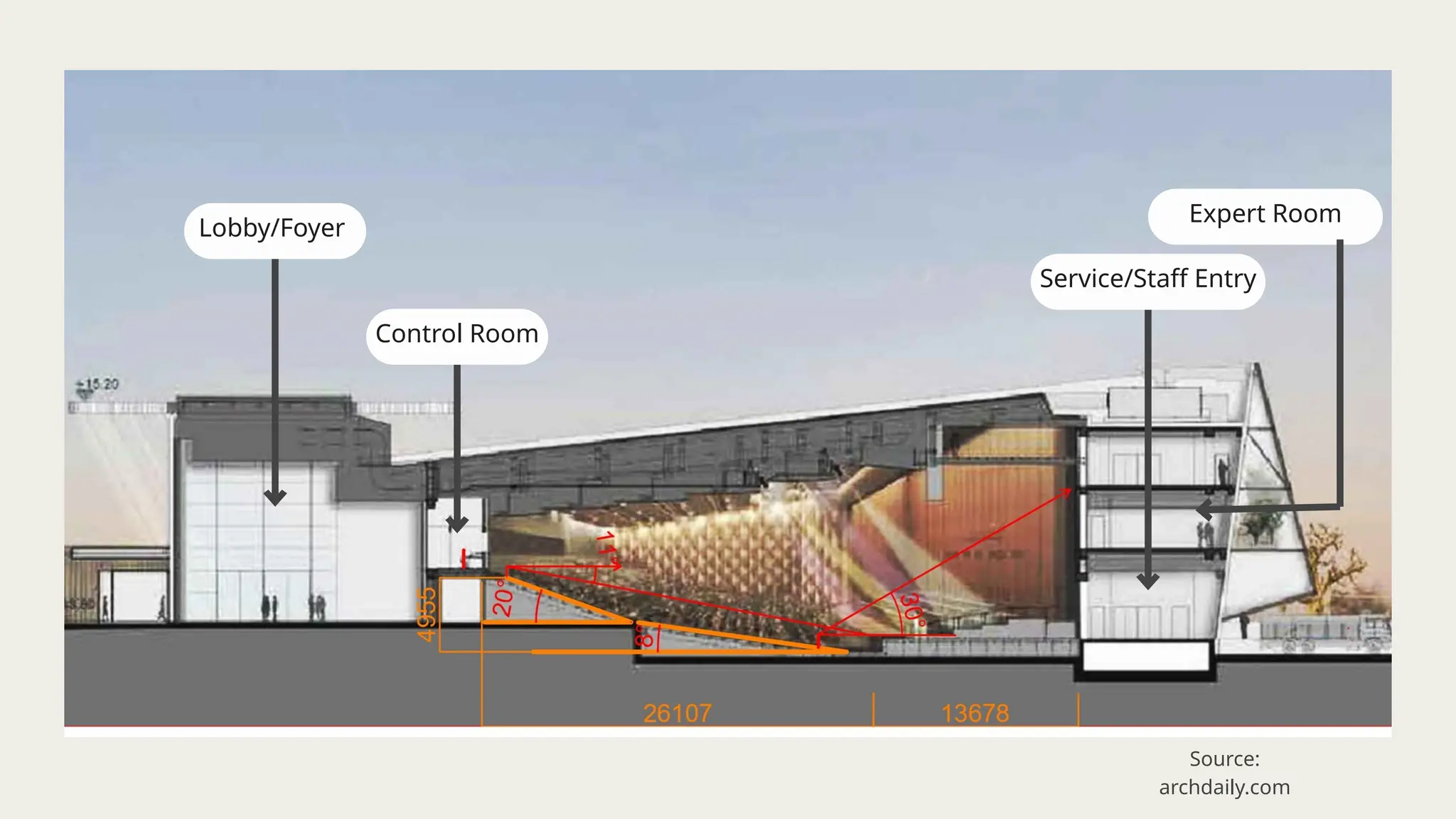
Control Room
Lobby/Foyer
Service/Staff Entry
Expert Room
Source:
archdaily.com
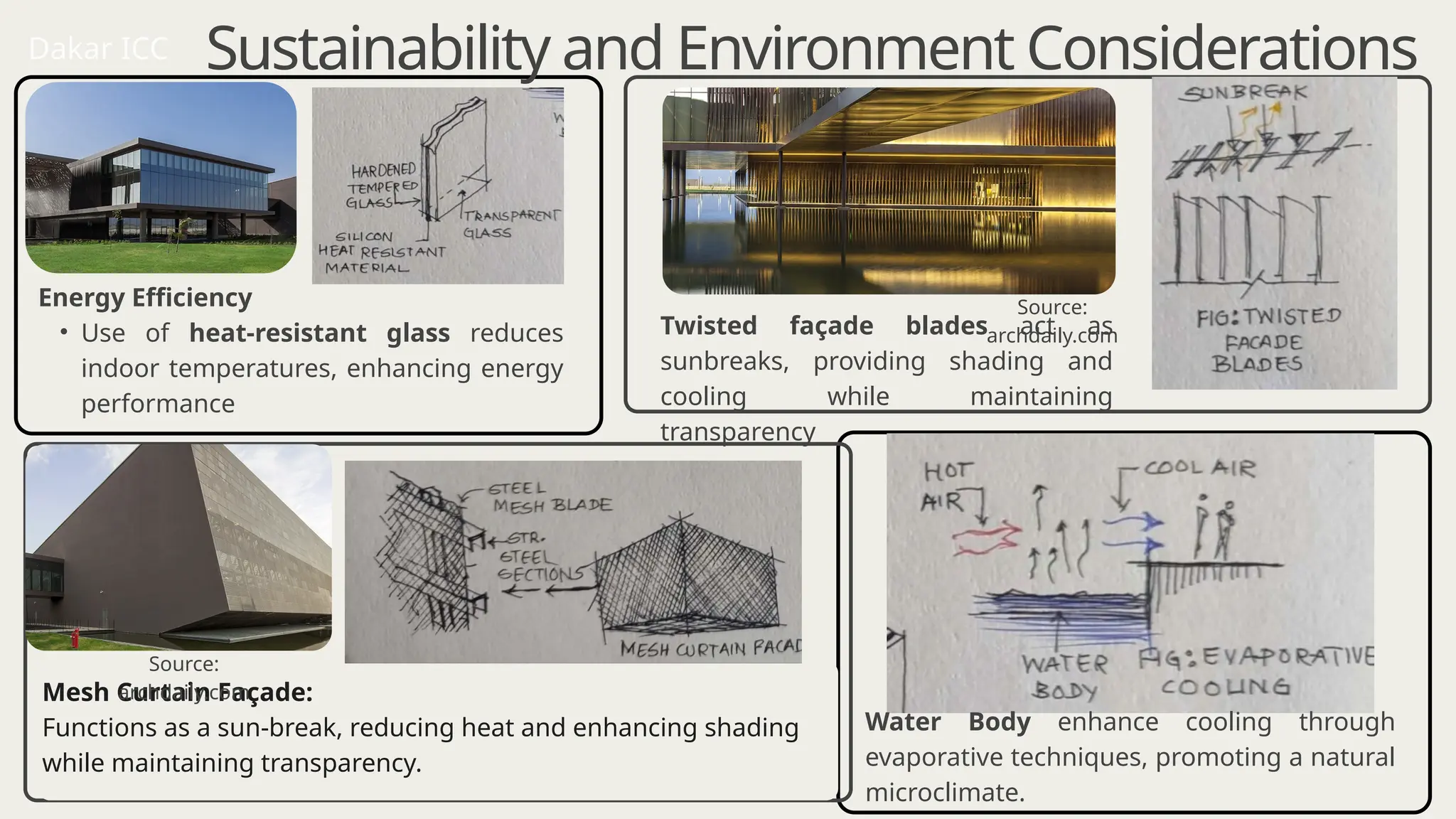
Energy Efficiency
• Use of heat-resistant glass reduces
indoor temperatures, enhancing energy
performance​
Mesh Curtain Façade:
Functions as a sun-break, reducing heat and enhancing shading
while maintaining transparency.
Sustainability and Environment Considerations
Twisted façade blades act as
sunbreaks, providing shading and
cooling while maintaining
transparency
Water Body enhance cooling through
evaporative techniques, promoting a natural
microclimate.
Dakar ICC
Source:
archdaily.com
Source:
archdaily.com
Conclusion
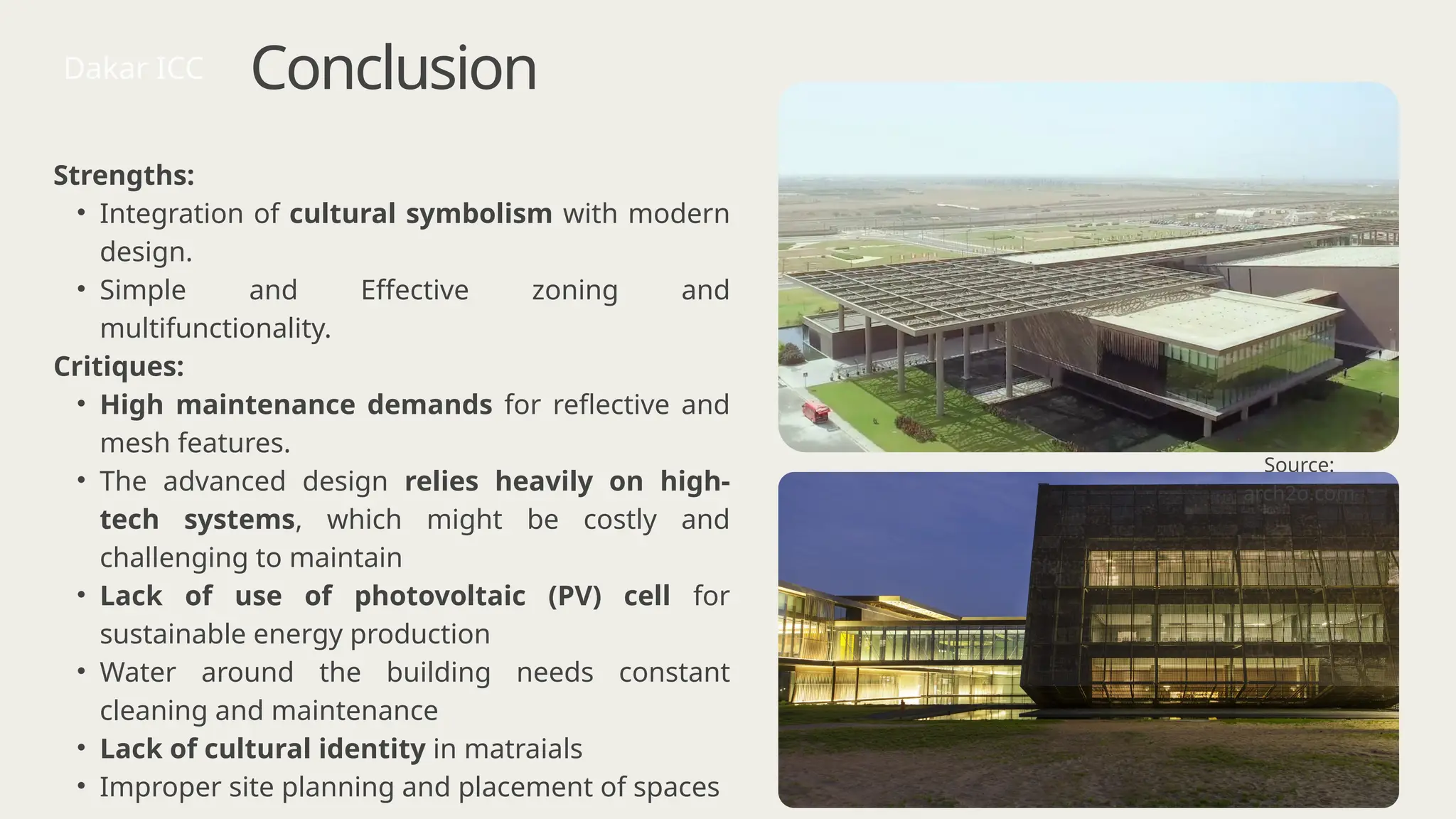
Strengths:
• Integration of cultural symbolism with modern
design.
• Simple and Effective zoning and
multifunctionality.
Critiques:
• High maintenance demands for reflective and
mesh features.
• The advanced design relies heavily on high-
tech systems, which might be costly and
challenging to maintain
• Lack of use of photovoltaic (PV) cell for
sustainable energy production
• Water around the building needs constant
cleaning and maintenance
• Lack of cultural identity in matraials
• Improper site planning and placement of spaces
Dakar ICC
Source:
arch2o.com
Introduction
Mons International Convention Centre
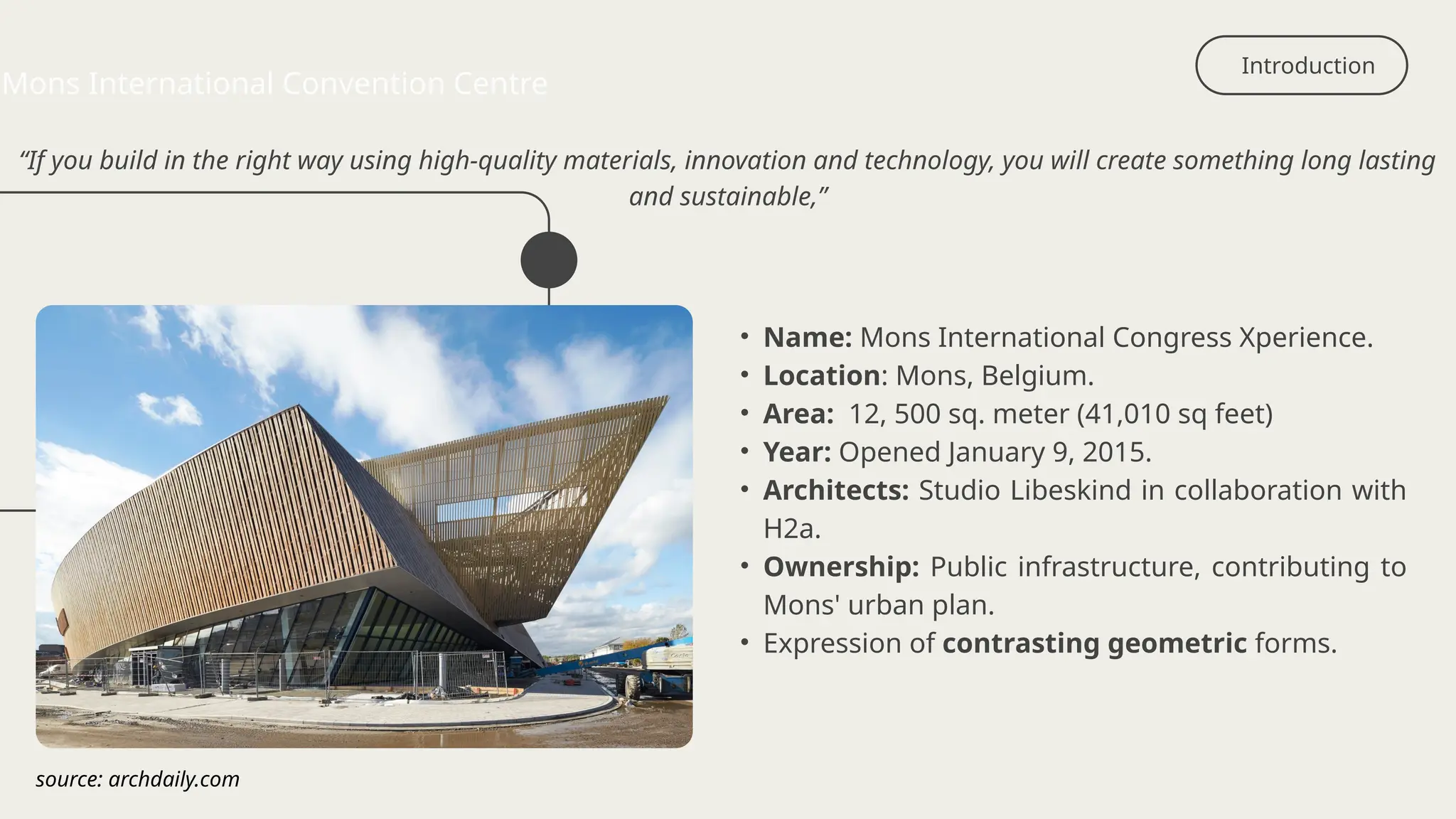
• Name: Mons International Congress Xperience.
• Location: Mons, Belgium.
• Area: 12, 500 sq. meter (41,010 sq feet)
• Year: Opened January 9, 2015.
• Architects: Studio Libeskind in collaboration with
H2a.
• Ownership: Public infrastructure, contributing to
Mons' urban plan.
• Expression of contrasting geometric forms.
“If you build in the right way using high-quality materials, innovation and technology, you will create something long lasting
and sustainable,”
source: archdaily.com
Design Philosophy
Design Inspiration
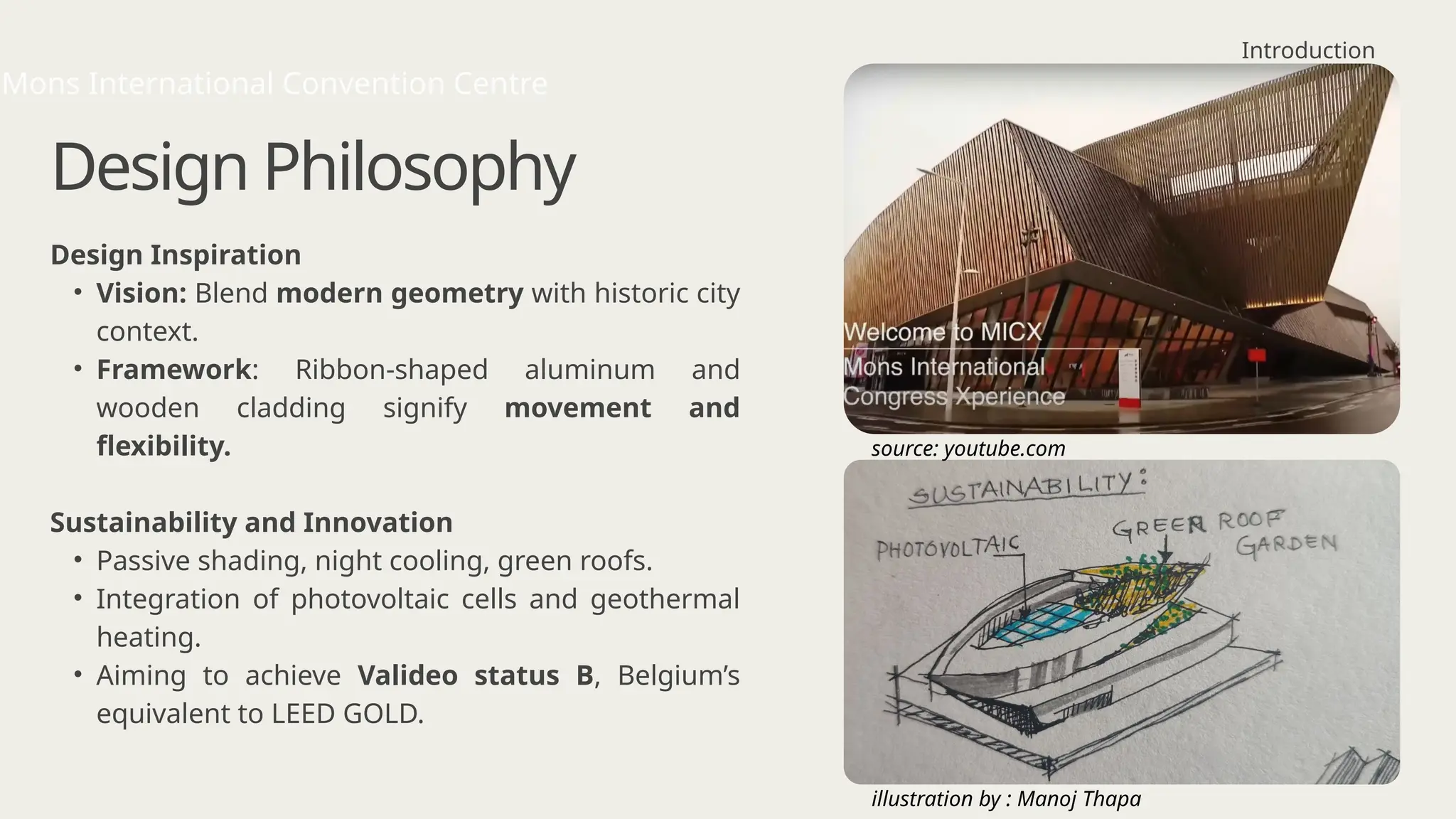
• Vision: Blend modern geometry with historic city
context.
• Framework: Ribbon-shaped aluminum and
wooden cladding signify movement and
flexibility.
Sustainability and Innovation
• Passive shading, night cooling, green roofs.
• Integration of photovoltaic cells and geothermal
heating.
• Aiming to achieve Valideo status B, Belgium’s
equivalent to LEED GOLD.
Introduction
Mons International Convention Centre
source: youtube.com
illustration by : Manoj Thapa
Design Philosophy
Design Philosophy
Design Inspiration
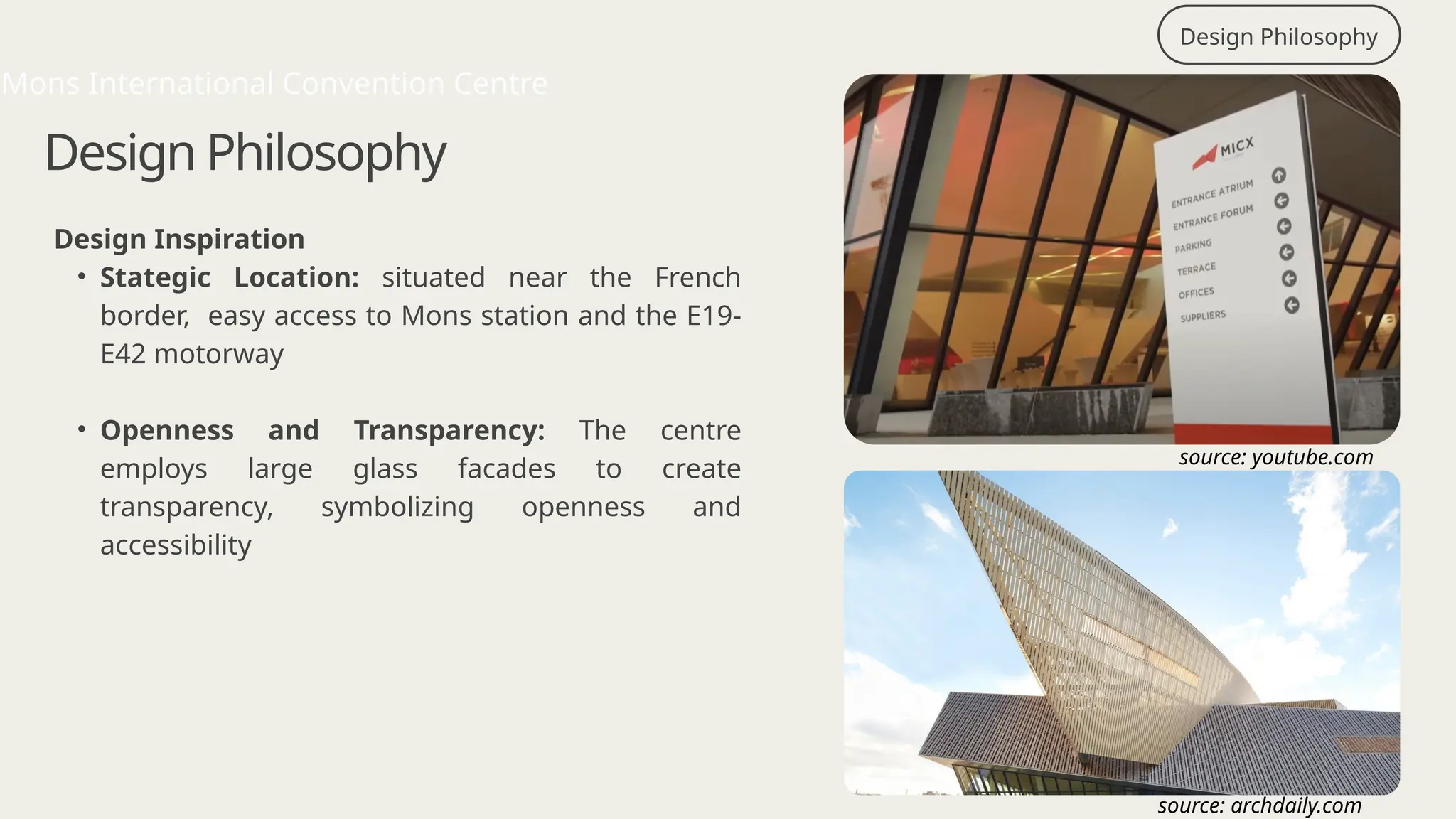
• Stategic Location: situated near the French
border, easy access to Mons station and the E19-
E42 motorway
• Openness and Transparency: The centre
employs large glass facades to create
transparency, symbolizing openness and
accessibility
Mons International Convention Centre
source: archdaily.com
source: youtube.com
Spatial Planning and Functional
Aspects
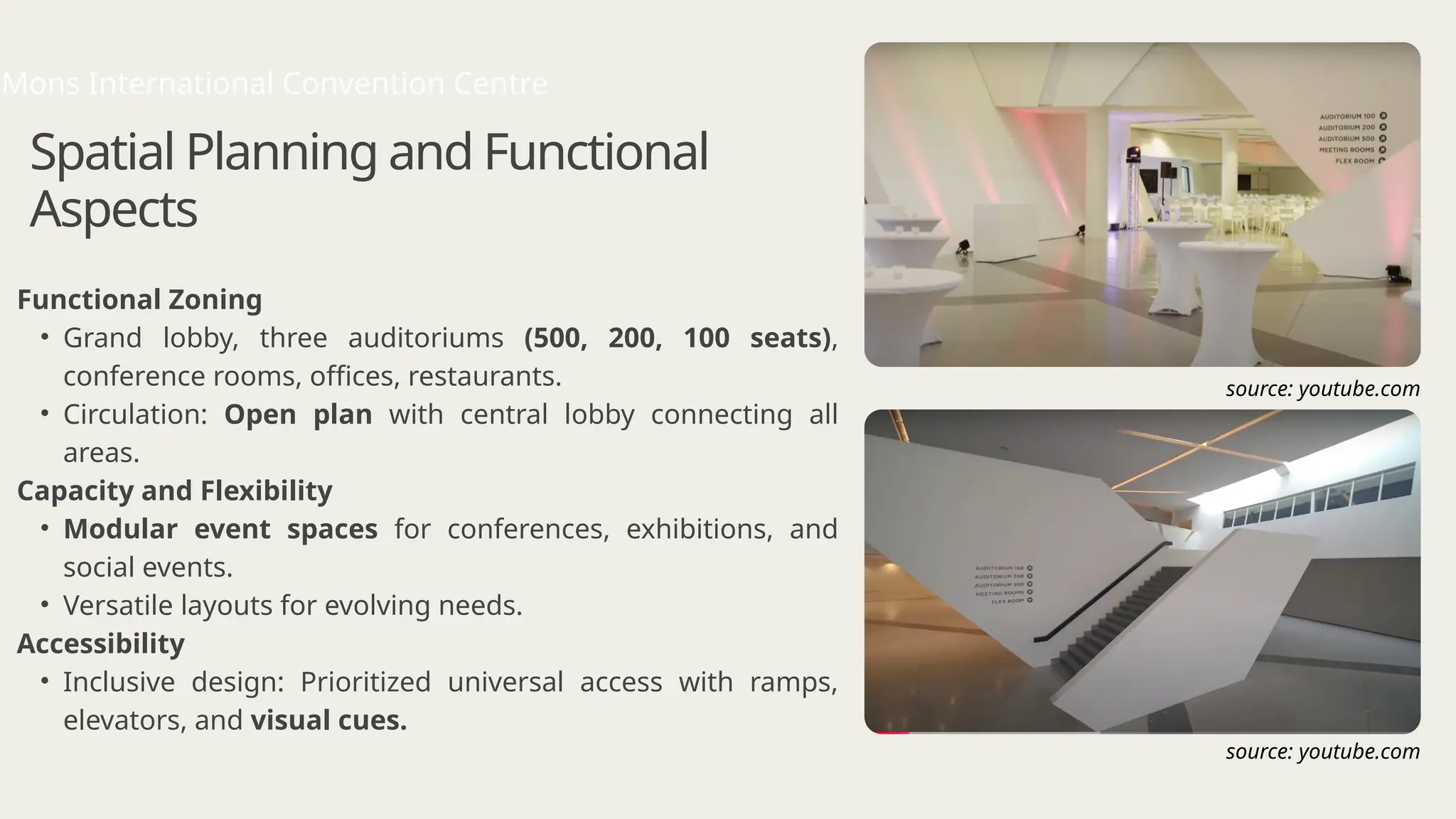
Functional Zoning
• Grand lobby, three auditoriums (500, 200, 100 seats),
conference rooms, offices, restaurants.
• Circulation: Open plan with central lobby connecting all
areas.
Capacity and Flexibility
• Modular event spaces for conferences, exhibitions, and
social events.
• Versatile layouts for evolving needs.
Accessibility
• Inclusive design: Prioritized universal access with ramps,
elevators, and visual cues.
Mons International Convention Centre
source: youtube.com
source: youtube.com
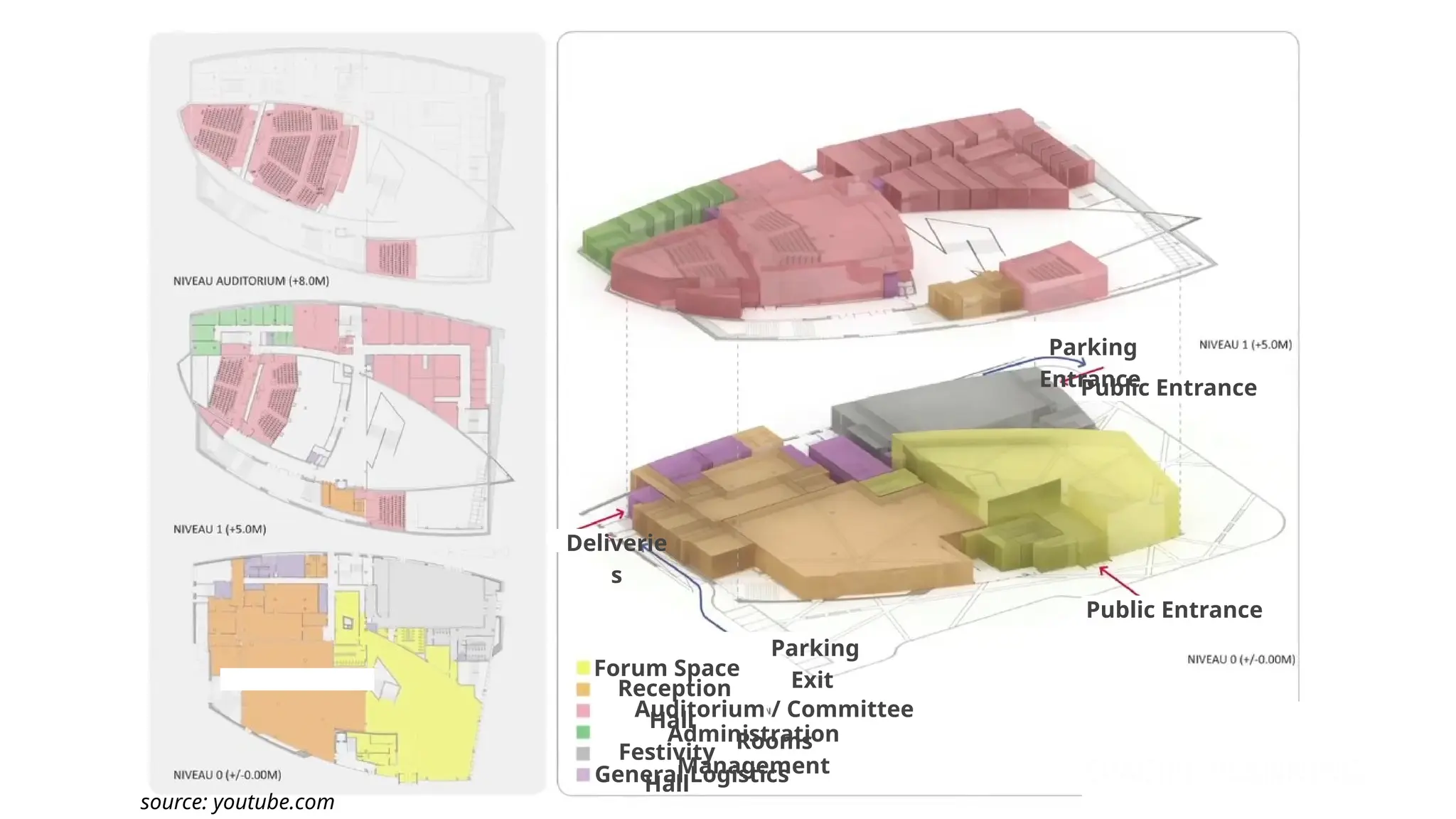
Forum Space
Reception
Hall
Auditorium / Committee
Rooms
Administration
Management
Festivity
Hall
General Logistics
Public Entrance
Public Entrance
Parking
Entrance
Parking
Exit
Deliverie
s
SPACIAL PLANNING
source: youtube.com
Architectural Elements
Exterior Features
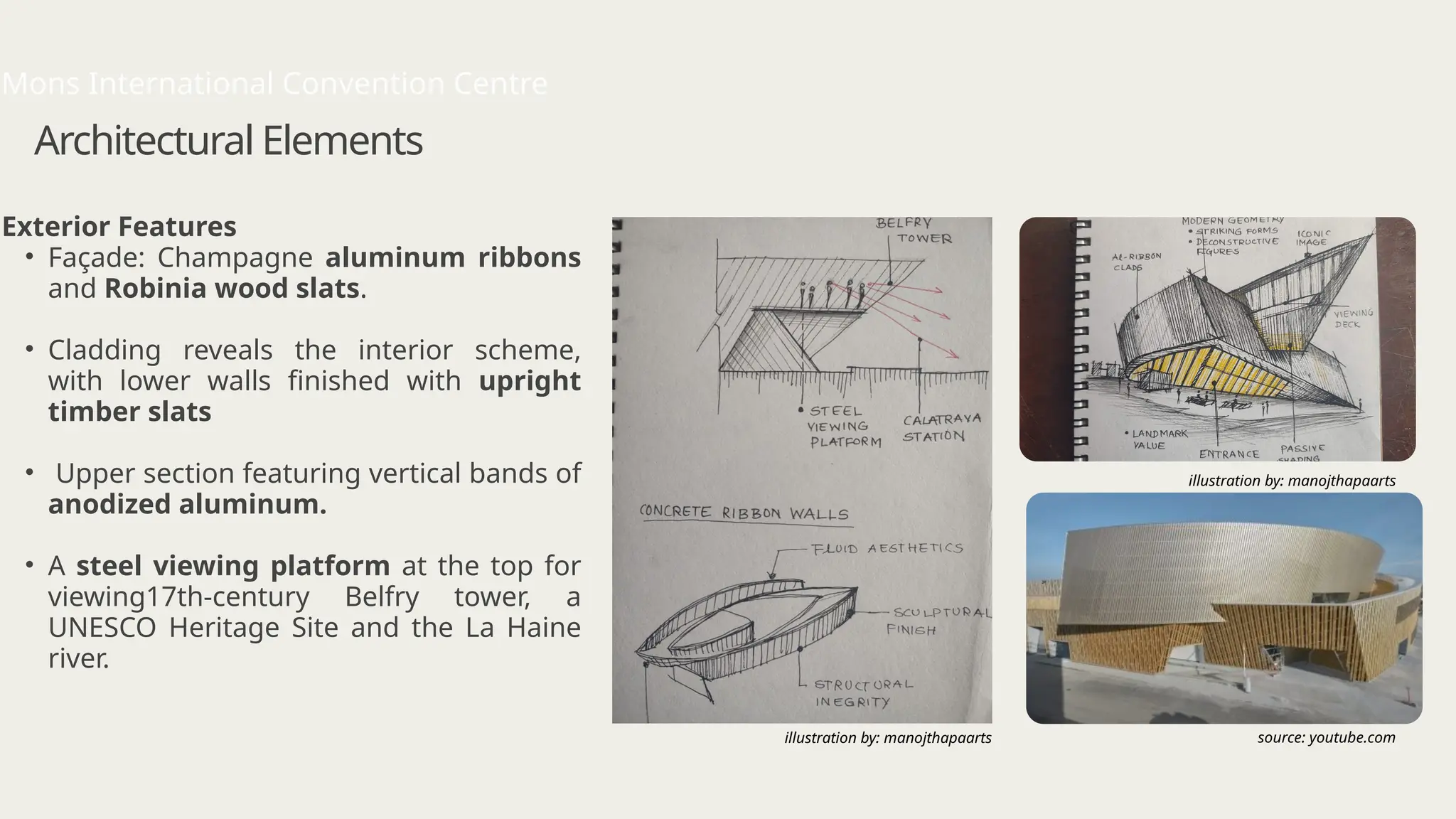
• Façade: Champagne aluminum ribbons
and Robinia wood slats.
• Cladding reveals the interior scheme,
with lower walls finished with upright
timber slats
• Upper section featuring vertical bands of
anodized aluminum.
• A steel viewing platform at the top for
viewing17th-century Belfry tower, a
UNESCO Heritage Site and the La Haine
river.
Mons International Convention Centre
illustration by: manojthapaarts
source: youtube.com
illustration by: manojthapaarts
Architectural Elements
Mons Convention Centre
1.Reinforced insulation of opaque walls refers to the use of insulation materials that provide
enhanced protection against electrical shock and improved thermal performance.
2. Performance glazing refers to advanced glass technologies designed to improve the energy
efficiency, comfort, and functionality of windows and facades in buildings
Interior Features
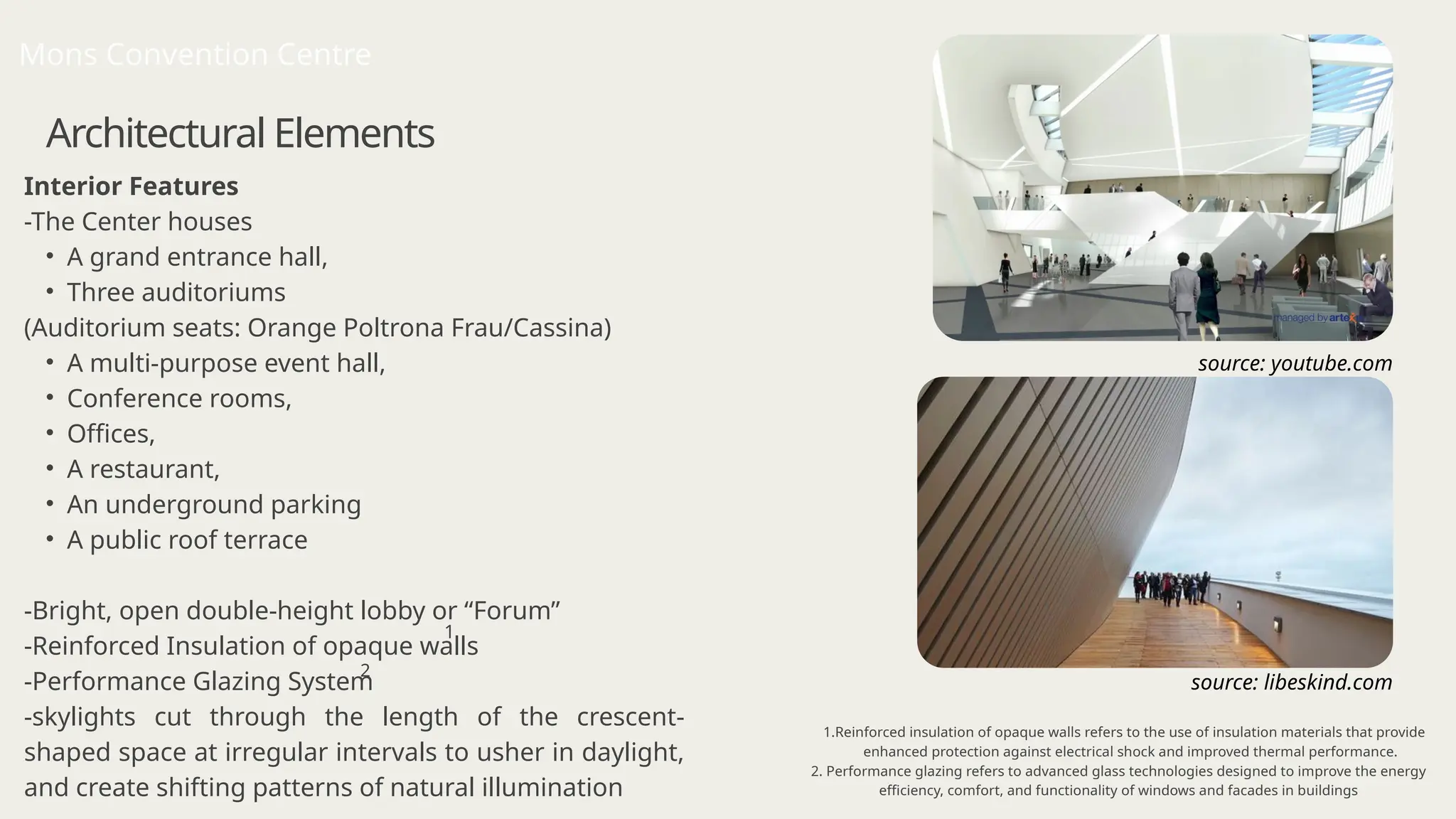
-The Center houses
• A grand entrance hall,
• Three auditoriums
(Auditorium seats: Orange Poltrona Frau/Cassina)
• A multi-purpose event hall,
• Conference rooms,
• Offices,
• A restaurant,
• An underground parking
• A public roof terrace
-Bright, open double-height lobby or “Forum”
-Reinforced Insulation of opaque walls
-Performance Glazing System
-skylights cut through the length of the crescent-
shaped space at irregular intervals to usher in daylight,
and create shifting patterns of natural illumination
1
2
source: youtube.com
source: libeskind.com
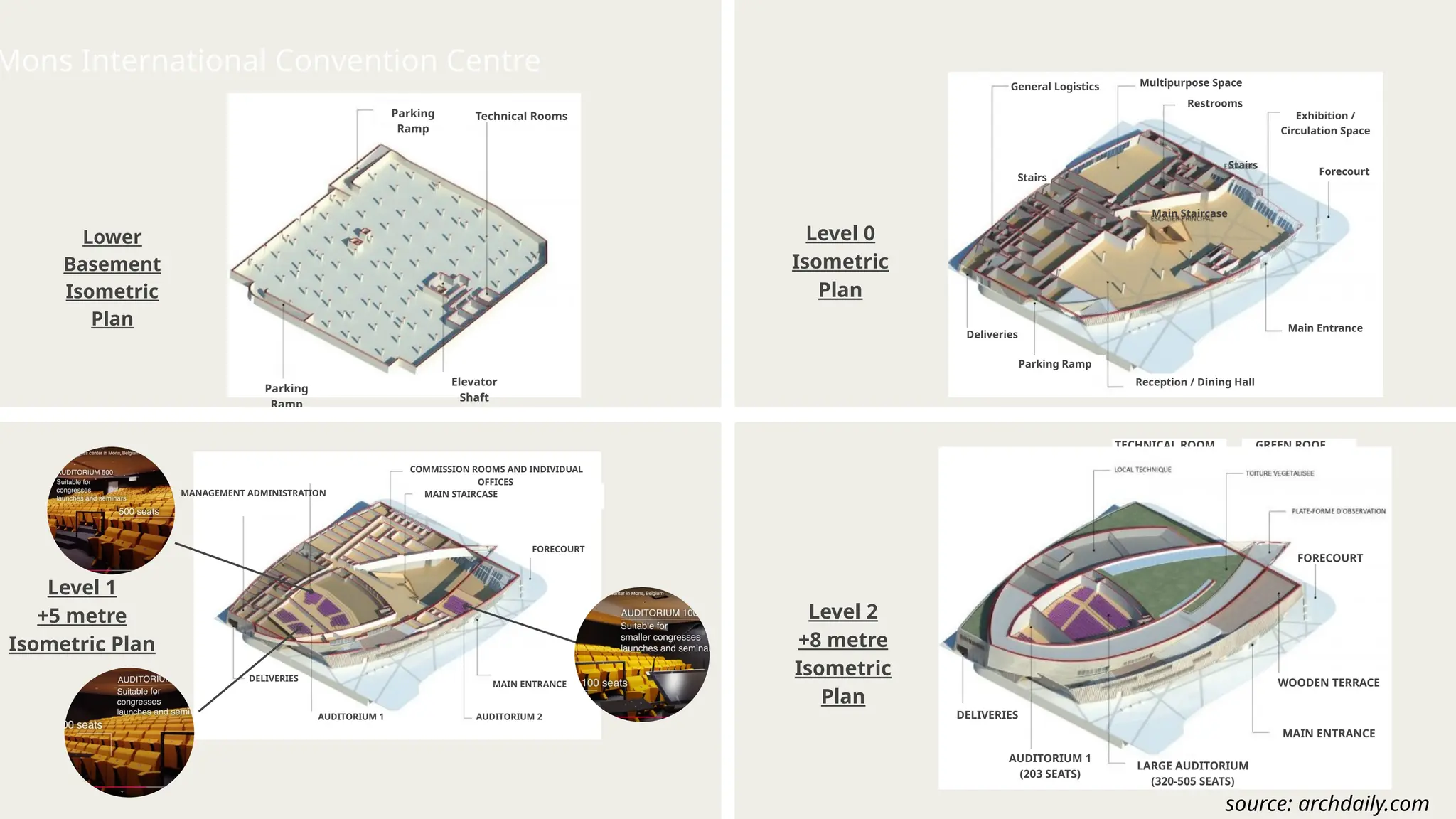
Parking
Ramp
Technical Rooms
Elevator
Shaft
Parking
Ramp
Lower
Basement
Isometric
Plan
Level 0
Isometric
Plan
Stairs
Main Staircase
Forecourt
General Logistics Multipurpose Space
Restrooms
Stairs
Exhibition /
Circulation Space
Main Entrance
Reception / Dining Hall
Parking Ramp
Deliveries
TECHNICAL ROOM GREEN ROOF
OBSERVATION PLATFORM
Level 2
+8 metre
Isometric
Plan
FORECOURT
WOODEN TERRACE
MAIN ENTRANCE
LARGE AUDITORIUM
(320-505 SEATS)
AUDITORIUM 1
(203 SEATS)
DELIVERIES
DELIVERIES
MANAGEMENT ADMINISTRATION
COMMISSION ROOMS AND INDIVIDUAL
OFFICES
FORECOURT
MAIN ENTRANCE
MAIN STAIRCASE
AUDITORIUM 1 AUDITORIUM 2
Level 1
+5 metre
Isometric Plan
Mons International Convention Centre
source: archdaily.com
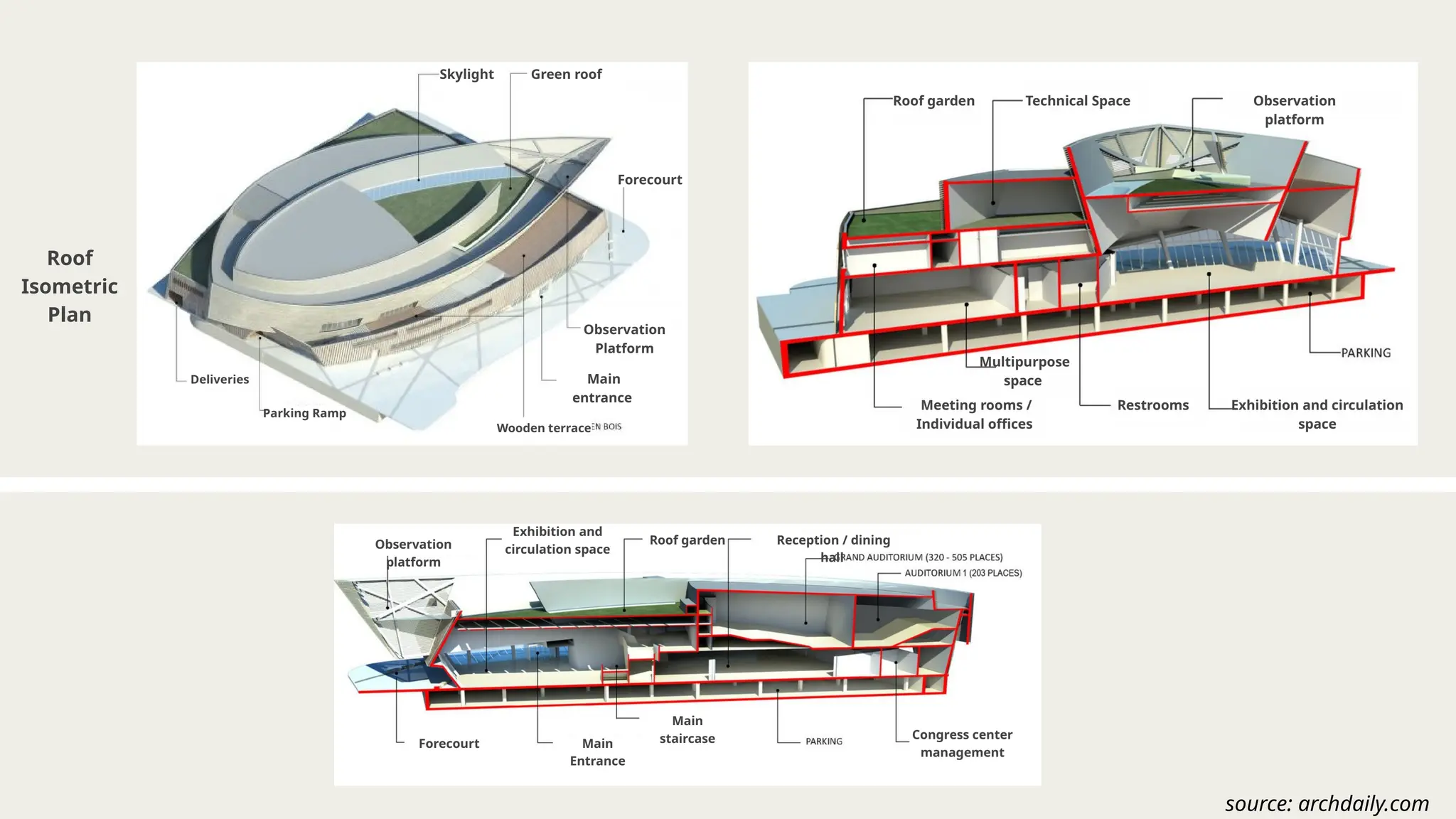
Roof
Isometric
Plan
Skylight Green roof
Forecourt
Observation
Platform
Main
entrance
Wooden terrace
Deliveries
Parking Ramp
Observation
platform
Exhibition and
circulation space
Roof garden Reception / dining
hall
Congress center
management
Main
staircase
Main
Entrance
Forecourt
Roof garden Technical Space Observation
platform
Exhibition and circulation
space
Restrooms
Multipurpose
space
Meeting rooms /
Individual offices
source: archdaily.com
Structural and Technical
Aspects
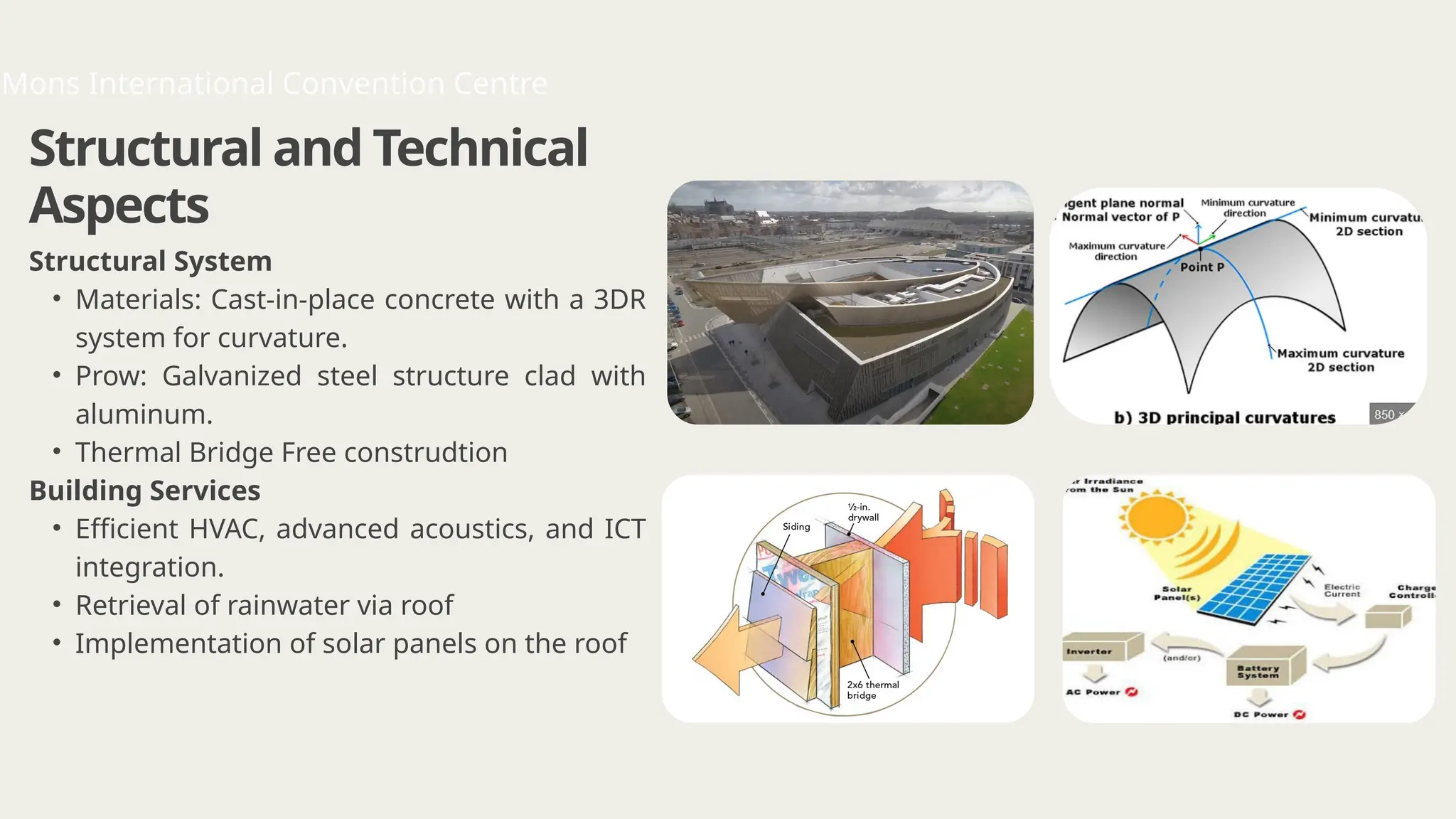
Structural System
• Materials: Cast-in-place concrete with a 3DR
system for curvature.
• Prow: Galvanized steel structure clad with
aluminum.
• Thermal Bridge Free construdtion
Building Services
• Efficient HVAC, advanced acoustics, and ICT
integration.
• Retrieval of rainwater via roof
• Implementation of solar panels on the roof
Mons International Convention Centre
Structural and Technical Aspects
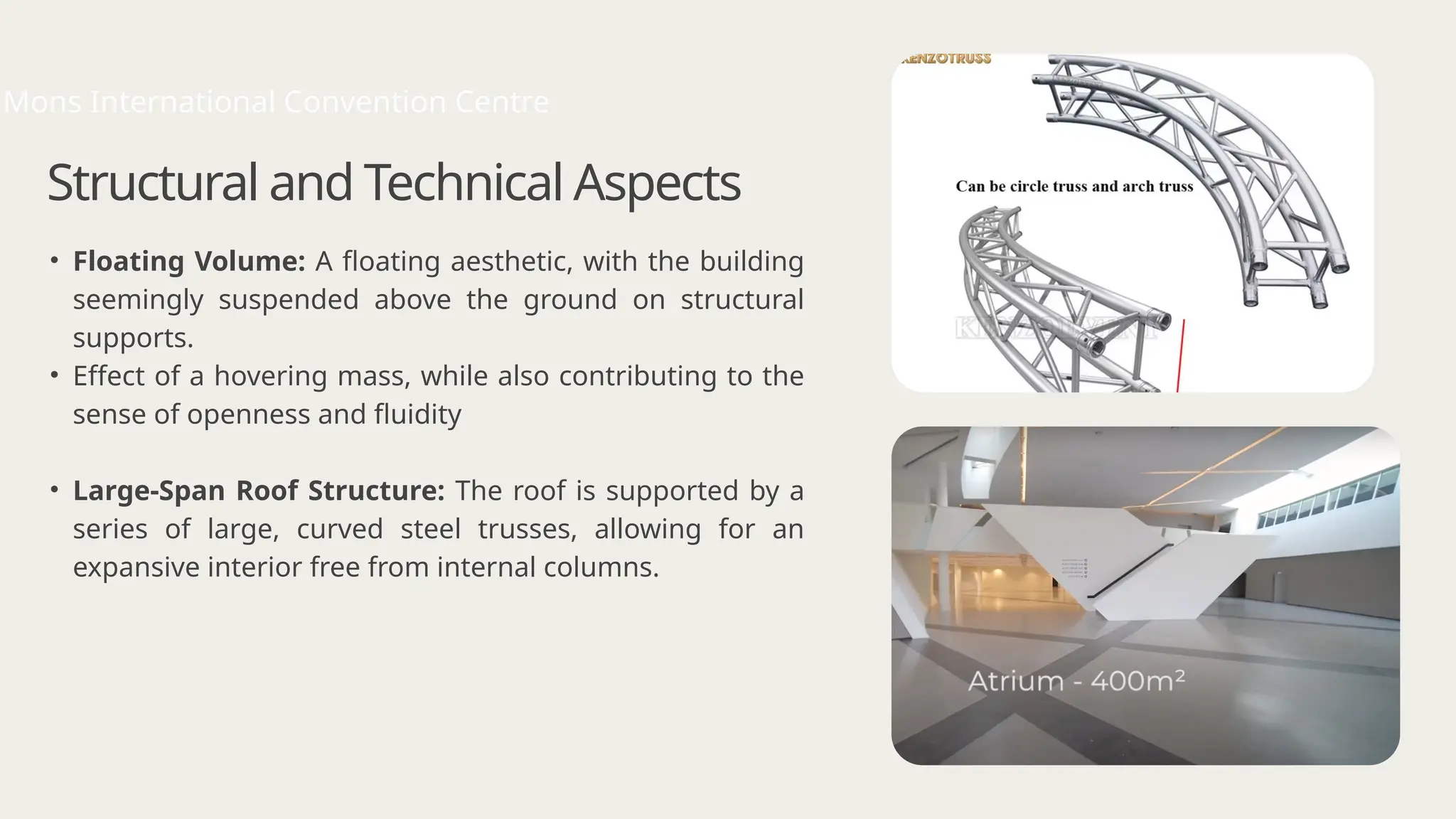
• Floating Volume: A floating aesthetic, with the building
seemingly suspended above the ground on structural
supports.
• Effect of a hovering mass, while also contributing to the
sense of openness and fluidity
• Large-Span Roof Structure: The roof is supported by a
series of large, curved steel trusses, allowing for an
expansive interior free from internal columns.
Mons International Convention Centre
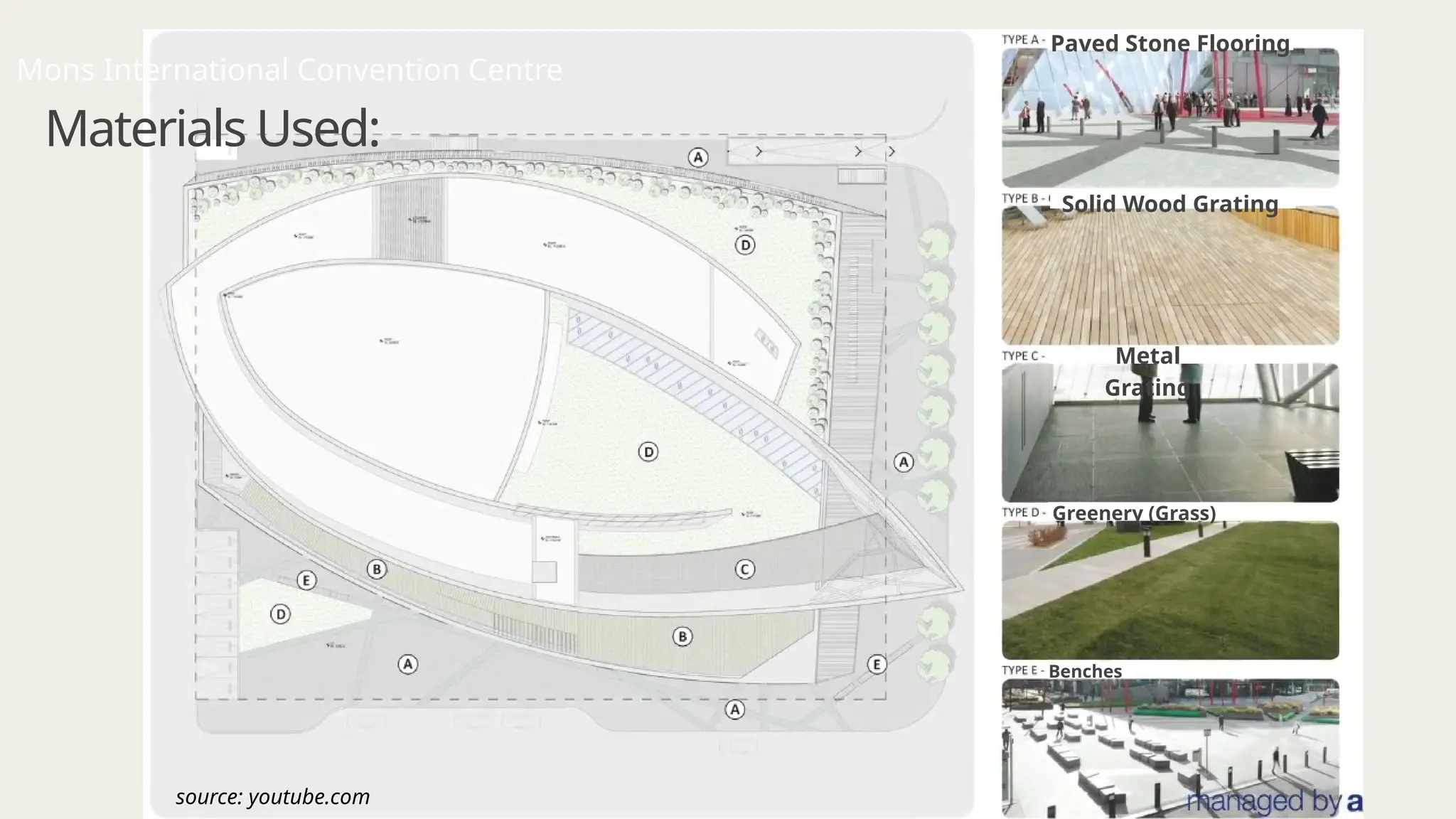
Materials Used:
Paved Stone Flooring
Solid Wood Grating
Metal
Grating
Greenery (Grass)
Benches
Mons International Convention Centre
source: youtube.com
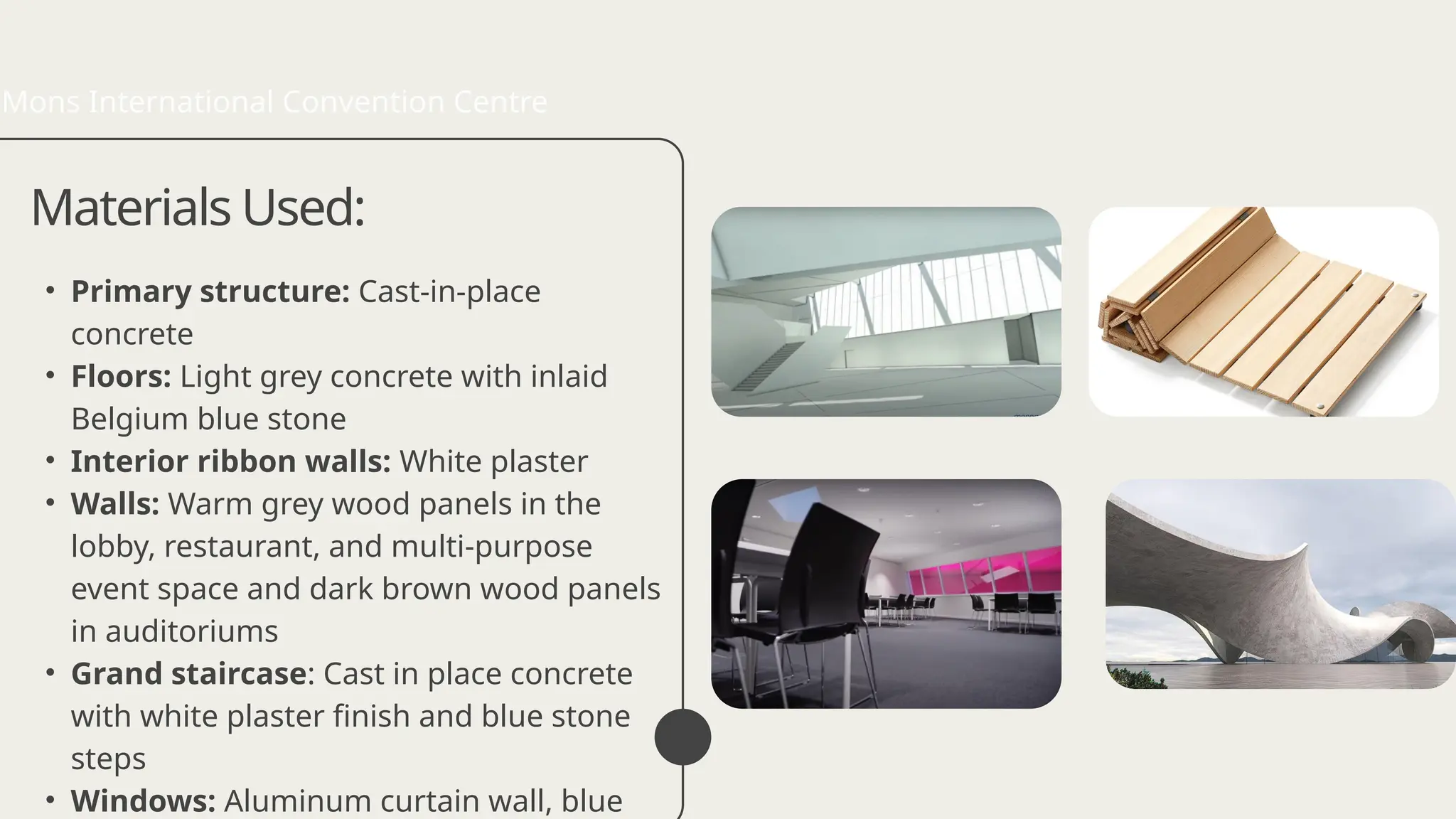
• Primary structure: Cast-in-place
concrete
• Floors: Light grey concrete with inlaid
Belgium blue stone
• Interior ribbon walls: White plaster
• Walls: Warm grey wood panels in the
lobby, restaurant, and multi-purpose
event space and dark brown wood panels
in auditoriums
• Grand staircase: Cast in place concrete
with white plaster finish and blue stone
steps
• Windows: Aluminum curtain wall, blue
Materials Used:
Mons International Convention Centre
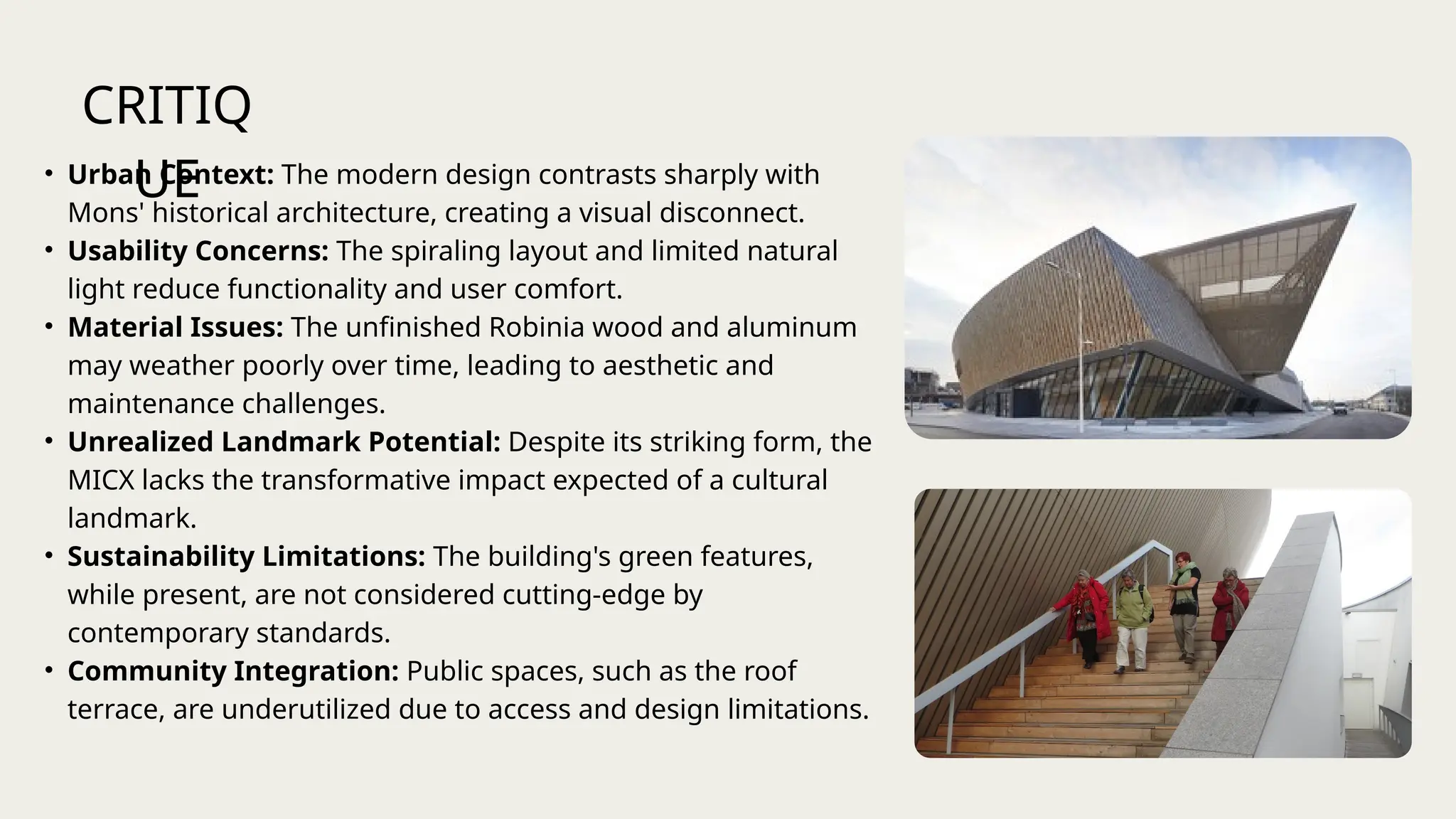
• Urban Context: The modern design contrasts sharply with
Mons' historical architecture, creating a visual disconnect.
• Usability Concerns: The spiraling layout and limited natural
light reduce functionality and user comfort.
• Material Issues: The unfinished Robinia wood and aluminum
may weather poorly over time, leading to aesthetic and
maintenance challenges.
• Unrealized Landmark Potential: Despite its striking form, the
MICX lacks the transformative impact expected of a cultural
landmark.
• Sustainability Limitations: The building's green features,
while present, are not considered cutting-edge by
contemporary standards.
• Community Integration: Public spaces, such as the roof
terrace, are underutilized due to access and design limitations.
CRITIQ
UE
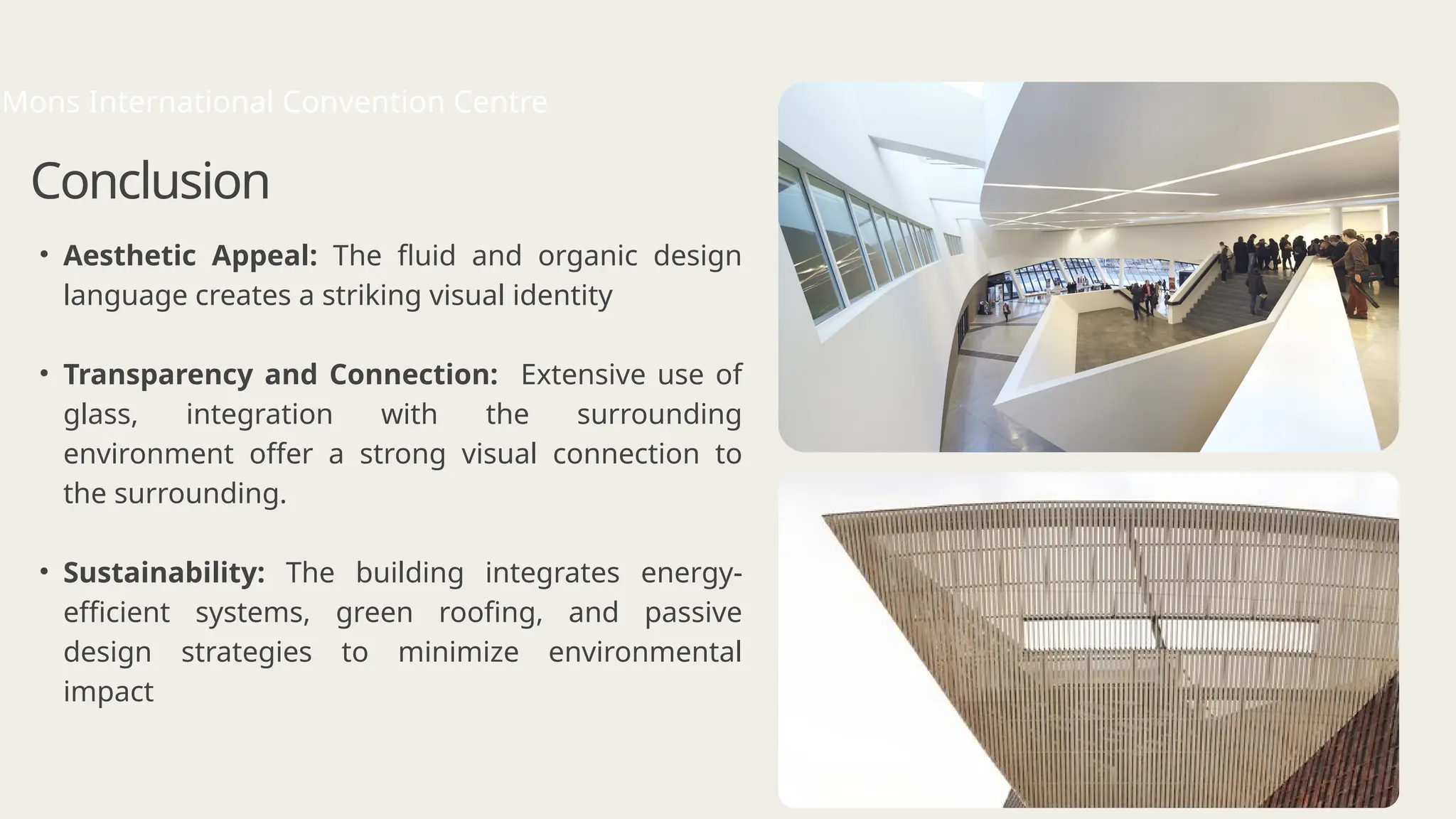
• Aesthetic Appeal: The fluid and organic design
language creates a striking visual identity
• Transparency and Connection: Extensive use of
glass, integration with the surrounding
environment offer a strong visual connection to
the surrounding.
• Sustainability: The building integrates energy-
efficient systems, green roofing, and passive
design strategies to minimize environmental
impact
Conclusion
Mons International Convention Centre
national
Case Study
NATIONAL CASE STUDIES:
Sunrise Convention Center
Nepal Academy Hall
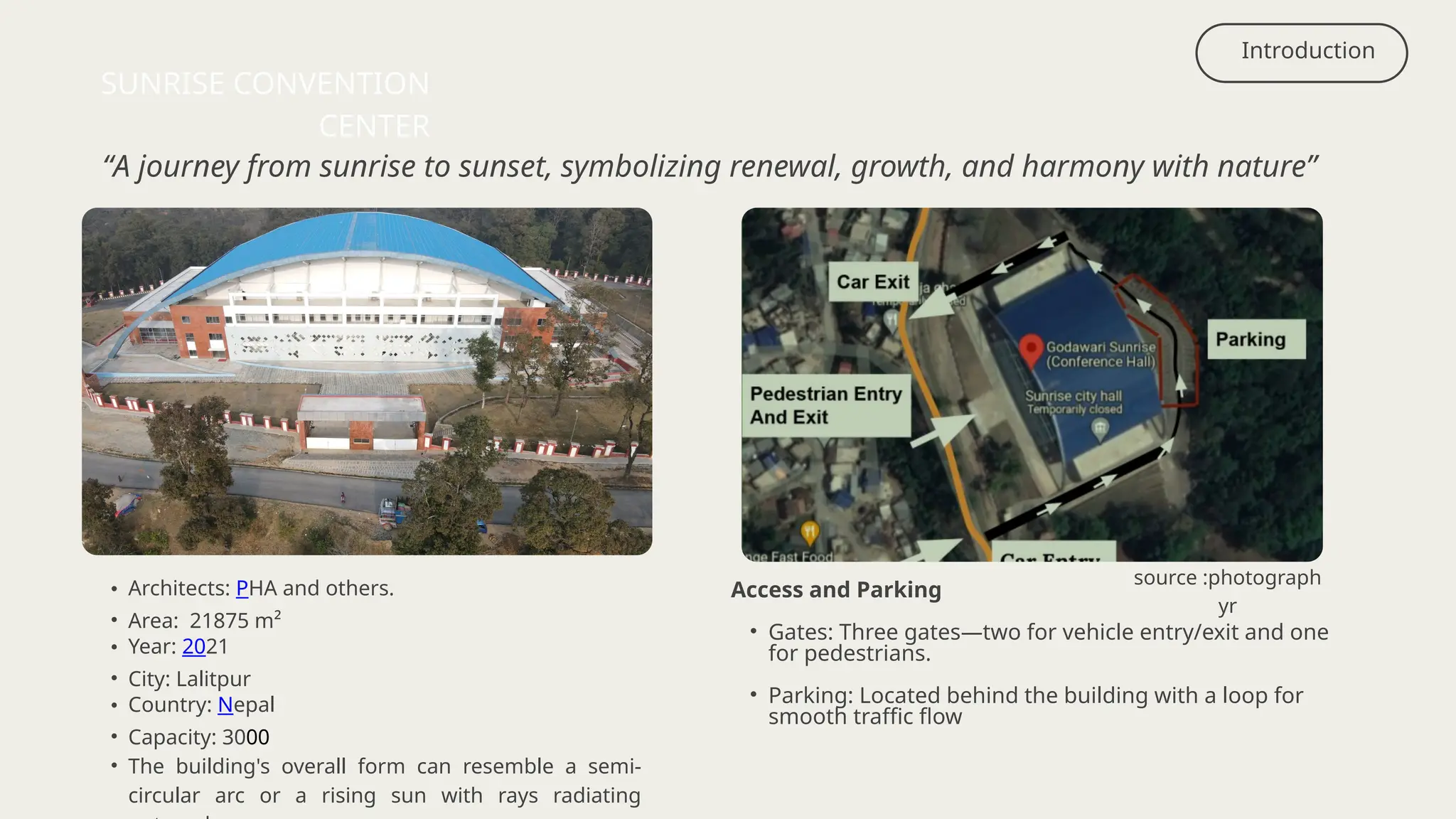
• Architects: PHA and others.
• Area: 21875 m²
• Year: 2021
• City: Lalitpur
• Country: Nepal
• Capacity: 3000
• The building's overall form can resemble a semi-
circular arc or a rising sun with rays radiating
Introduction
SUNRISE CONVENTION
CENTER
“A journey from sunrise to sunset, symbolizing renewal, growth, and harmony with nature”
source :photograph
yr
Access and Parking
• Gates: Three gates—two for vehicle entry/exit and one
for pedestrians.
• Parking: Located behind the building with a loop for
smooth traffic flow
Design Philosophy
Design Philosophy
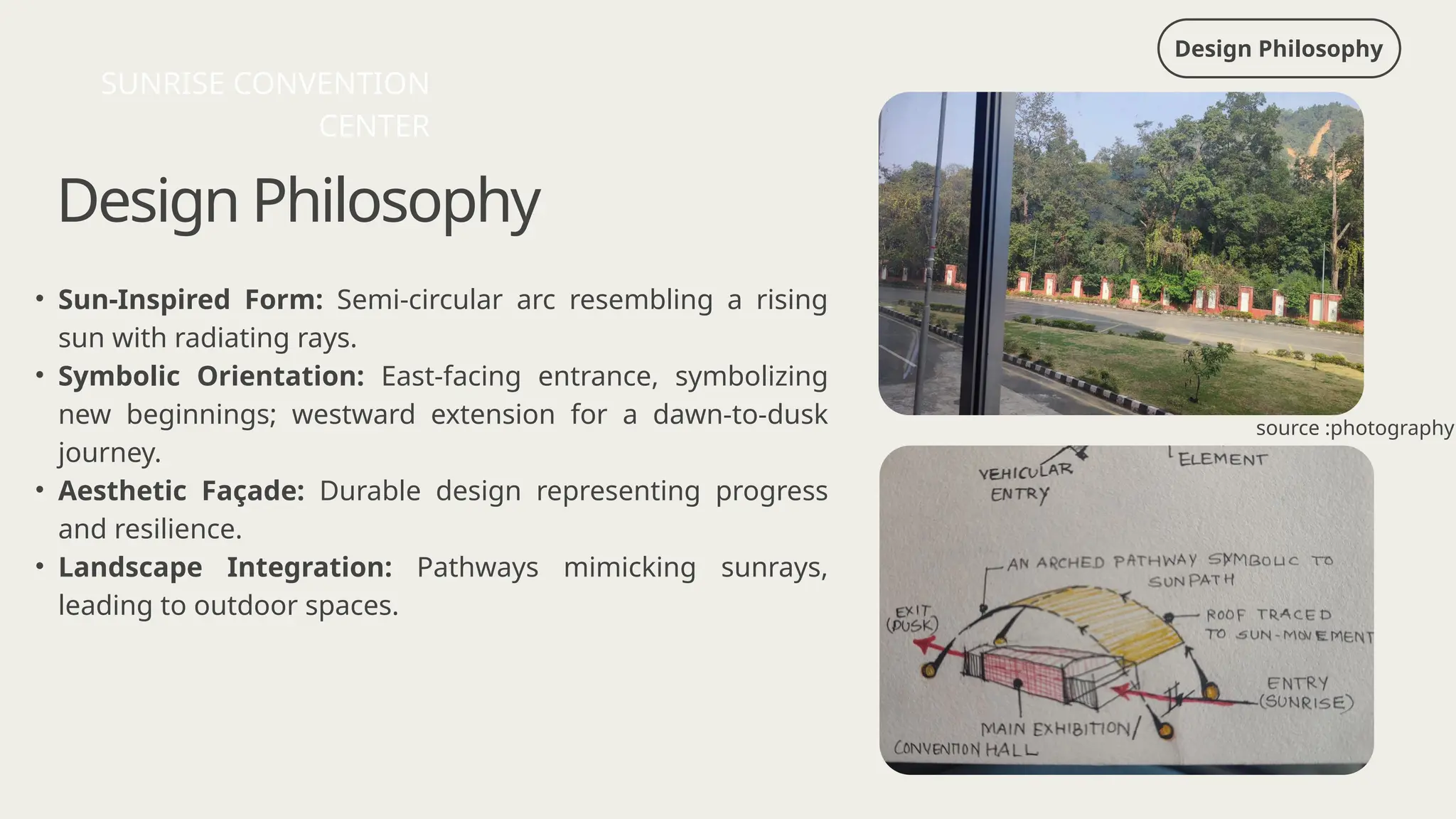
• Sun-Inspired Form: Semi-circular arc resembling a rising
sun with radiating rays.
• Symbolic Orientation: East-facing entrance, symbolizing
new beginnings; westward extension for a dawn-to-dusk
journey.
• Aesthetic Façade: Durable design representing progress
and resilience.
• Landscape Integration: Pathways mimicking sunrays,
leading to outdoor spaces.
SUNRISE CONVENTION
CENTER
source :photography
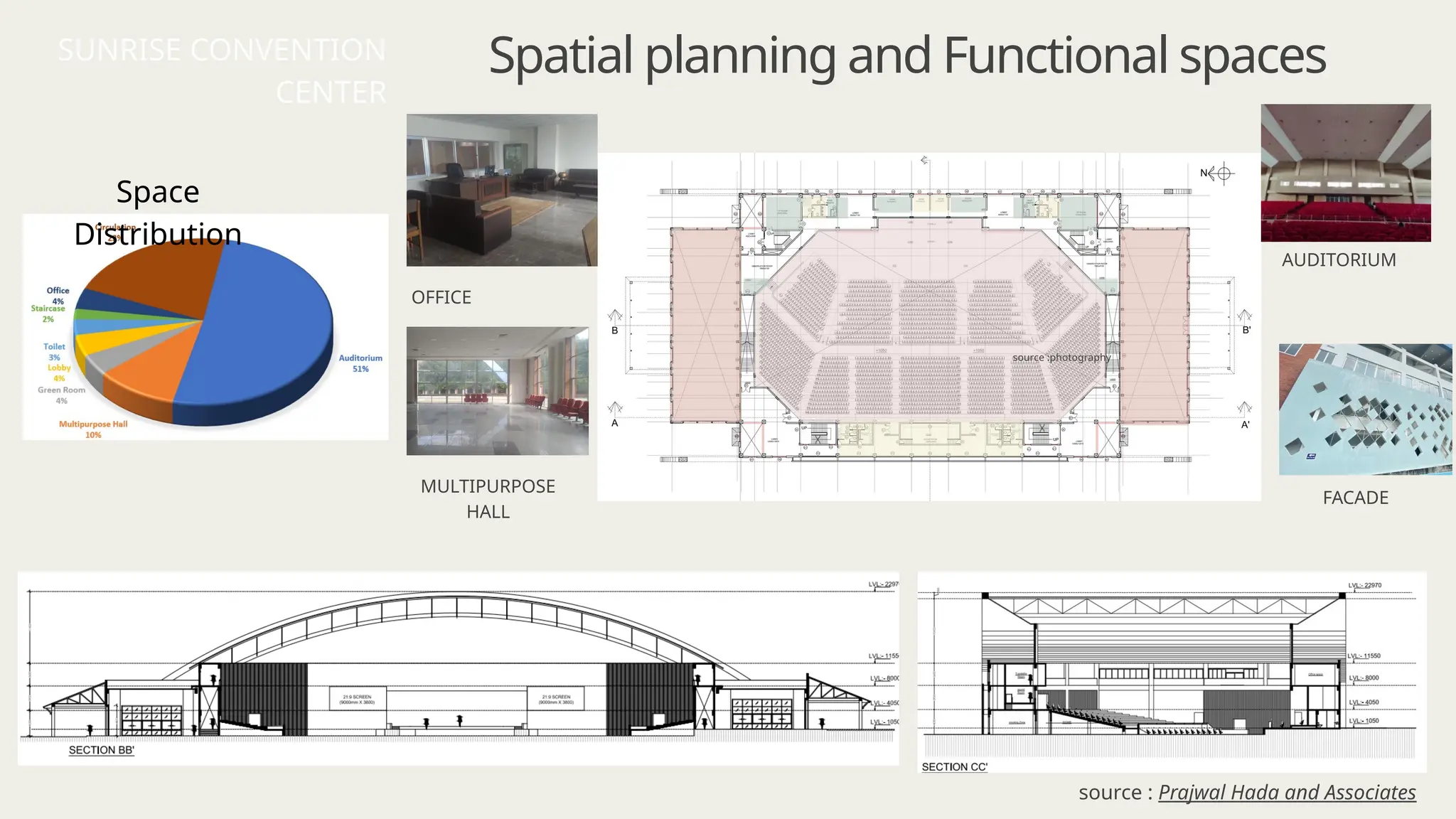
OFFICE
MULTIPURPOSE
HALL
FACADE
AUDITORIUM
source :photography
Spatial planning and Functional spaces
SUNRISE CONVENTION
CENTER
source : Prajwal Hada and Associates
Space
Distribution
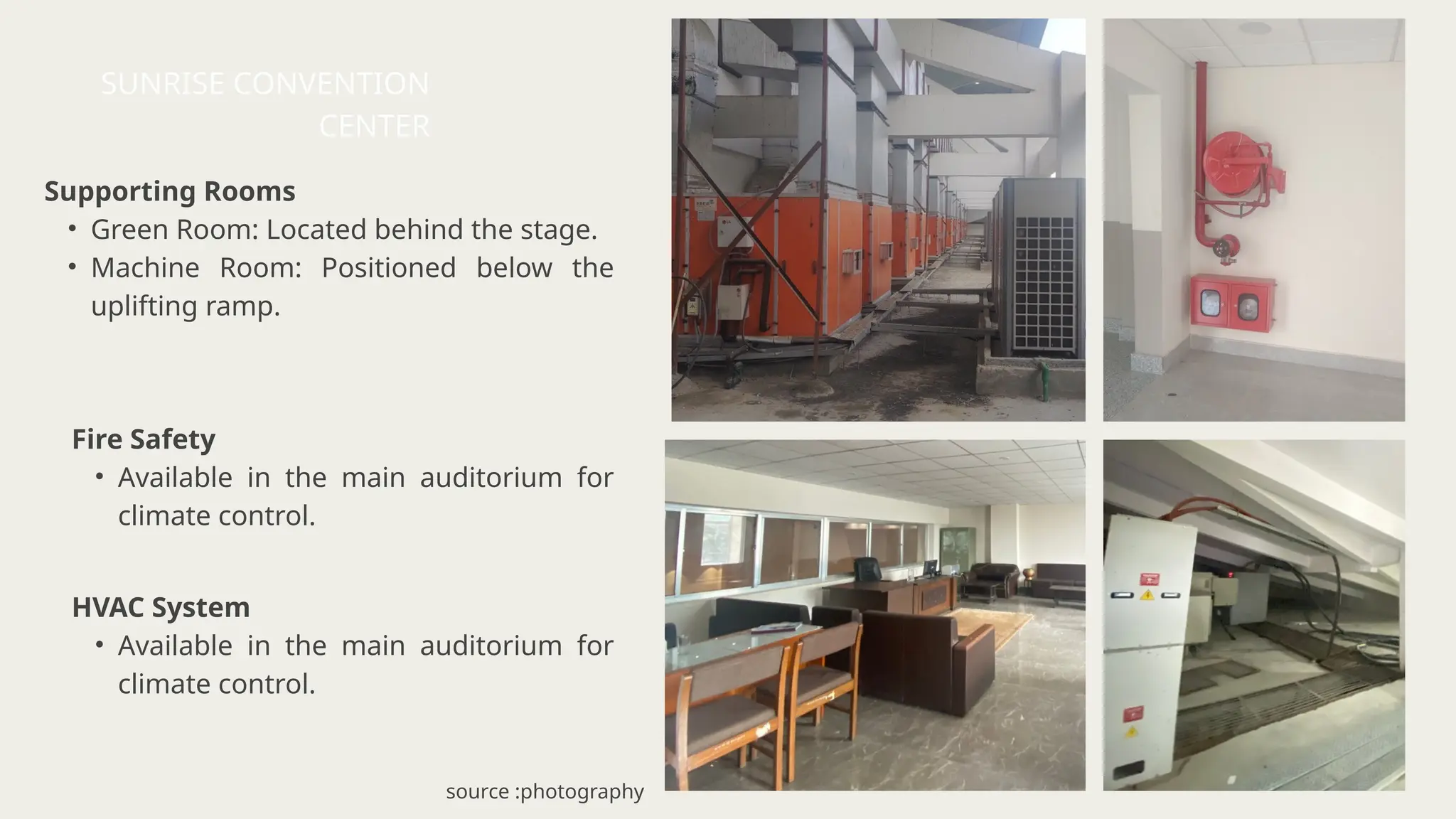
Supporting Rooms
• Green Room: Located behind the stage.
• Machine Room: Positioned below the
uplifting ramp.
HVAC System
• Available in the main auditorium for
climate control.
Fire Safety
• Available in the main auditorium for
climate control.
SUNRISE CONVENTION
CENTER
source :photography
Design Features/Architectural elements
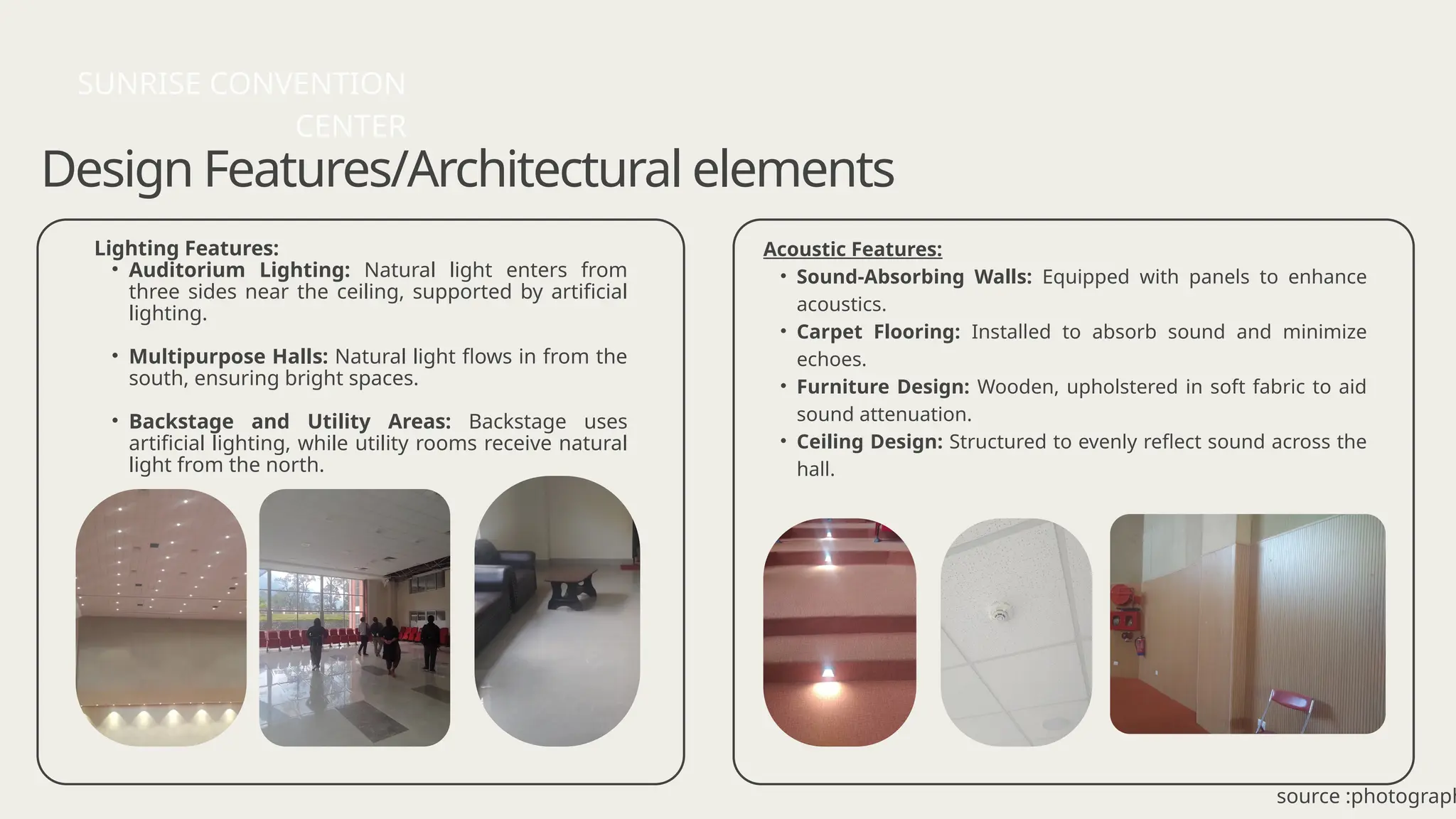
Lighting Features:
• Auditorium Lighting: Natural light enters from
three sides near the ceiling, supported by artificial
lighting.
• Multipurpose Halls: Natural light flows in from the
south, ensuring bright spaces.
• Backstage and Utility Areas: Backstage uses
artificial lighting, while utility rooms receive natural
light from the north.
SUNRISE CONVENTION
CENTER
source :photograph
Acoustic Features:
• Sound-Absorbing Walls: Equipped with panels to enhance
acoustics.
• Carpet Flooring: Installed to absorb sound and minimize
echoes.
• Furniture Design: Wooden, upholstered in soft fabric to aid
sound attenuation.
• Ceiling Design: Structured to evenly reflect sound across the
hall.
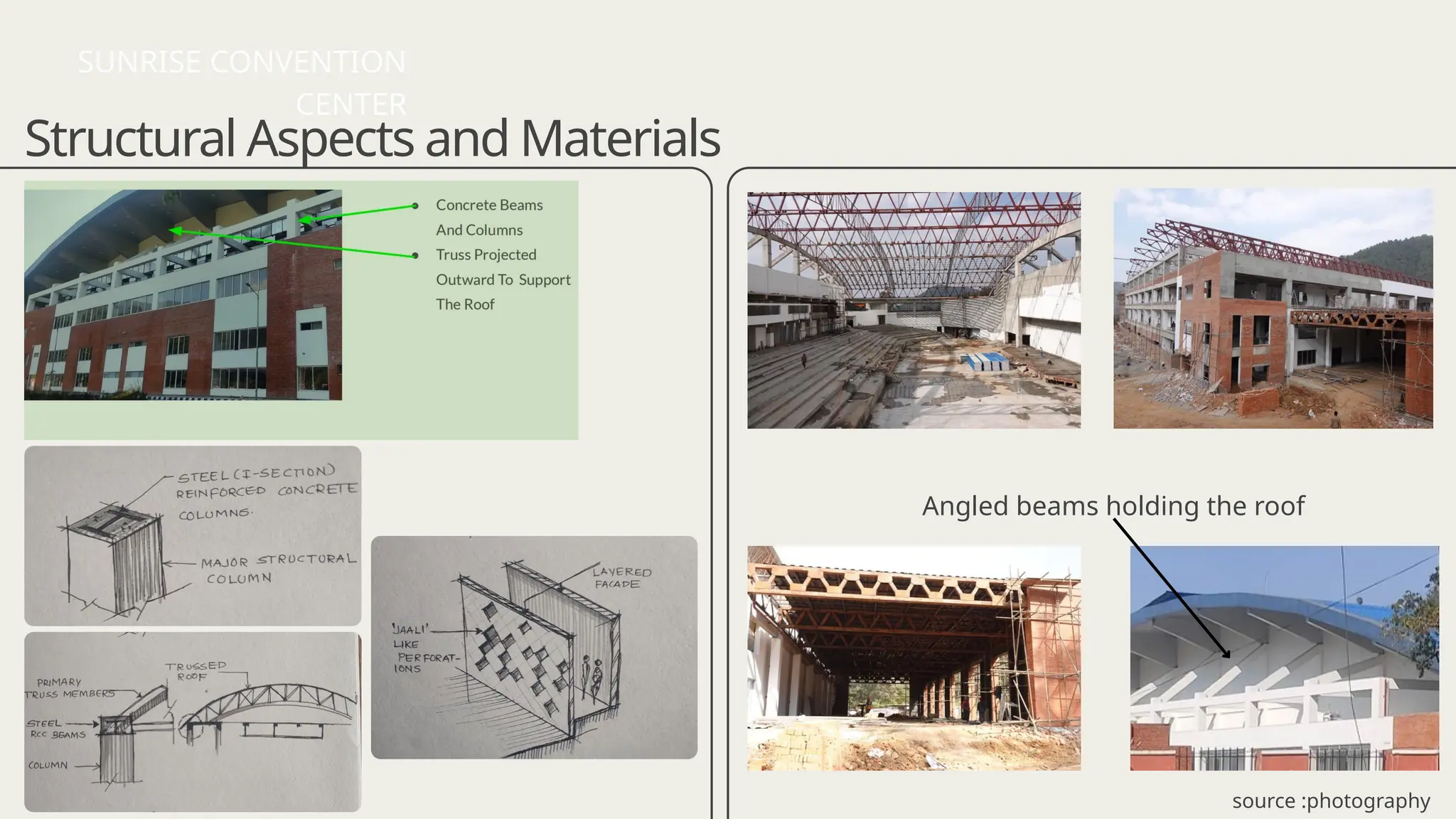
Structural Aspects and Materials
Angled beams holding the roof
SUNRISE CONVENTION
CENTER
source :photography
Sustainability and Environment
Considerations
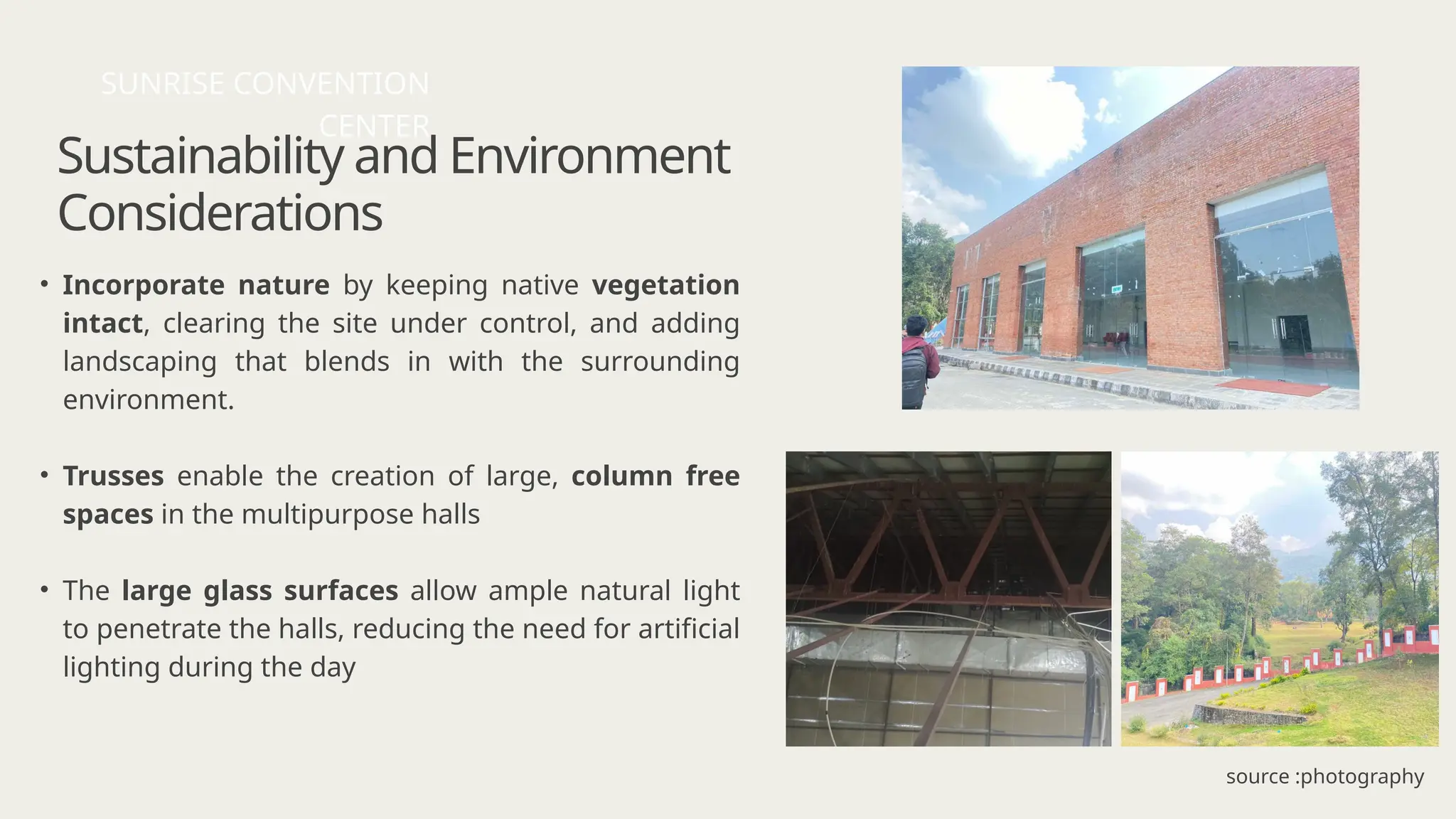
• Incorporate nature by keeping native vegetation
intact, clearing the site under control, and adding
landscaping that blends in with the surrounding
environment.
• Trusses enable the creation of large, column free
spaces in the multipurpose halls
• The large glass surfaces allow ample natural light
to penetrate the halls, reducing the need for artificial
lighting during the day
SUNRISE CONVENTION
CENTER
source :photography
Critiques
Features
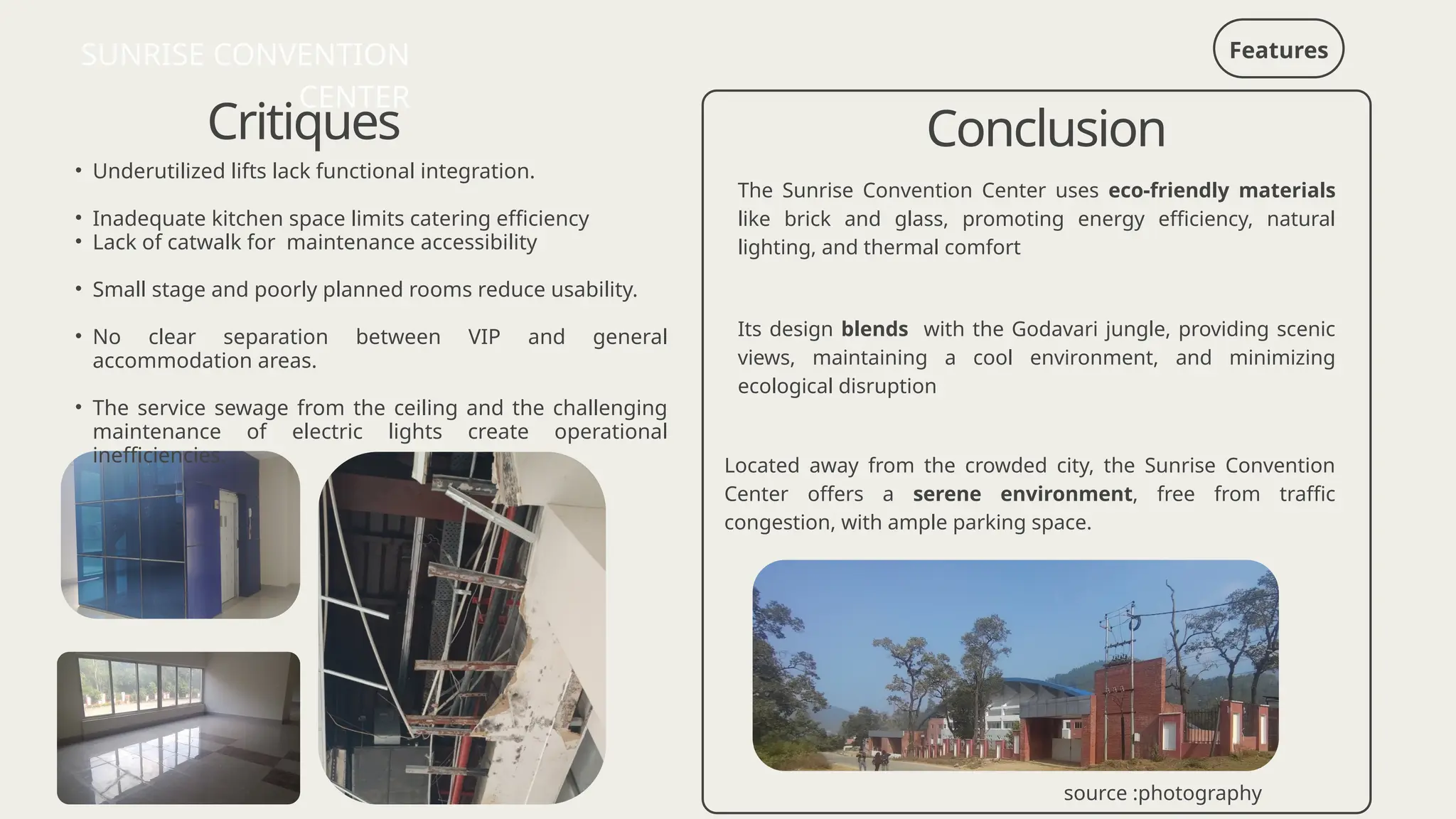
• Underutilized lifts lack functional integration.
• Inadequate kitchen space limits catering efficiency
• Lack of catwalk for maintenance accessibility
• Small stage and poorly planned rooms reduce usability.
• No clear separation between VIP and general
accommodation areas.
• The service sewage from the ceiling and the challenging
maintenance of electric lights create operational
inefficiencies.
SUNRISE CONVENTION
CENTER
source :photography
The Sunrise Convention Center uses eco-friendly materials
like brick and glass, promoting energy efficiency, natural
lighting, and thermal comfort
Its design blends with the Godavari jungle, providing scenic
views, maintaining a cool environment, and minimizing
ecological disruption
Located away from the crowded city, the Sunrise Convention
Center offers a serene environment, free from traffic
congestion, with ample parking space.
Conclusion
Introduction
NEPAL PRAGYA PRATISTHAN
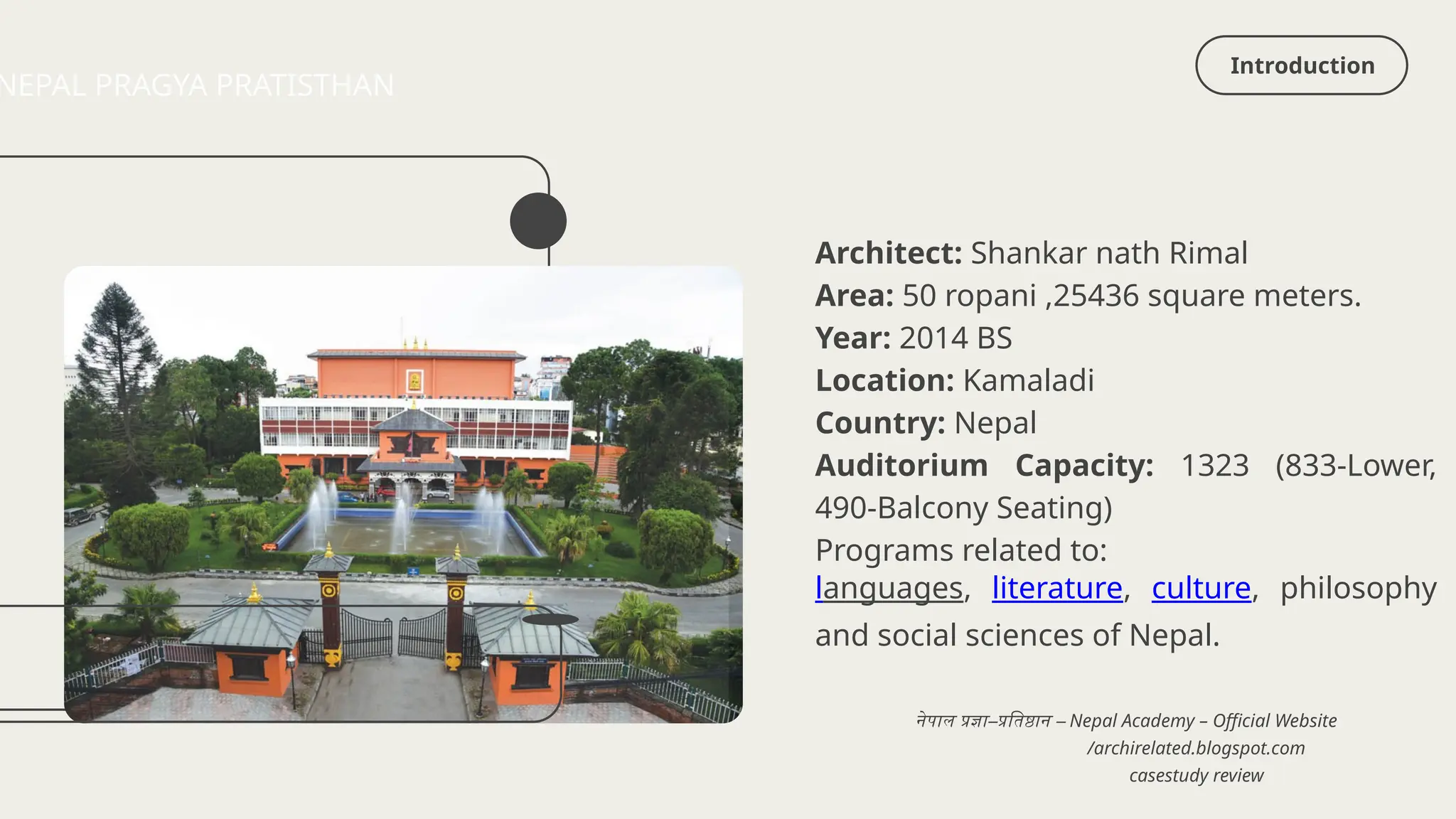
Architect: Shankar nath Rimal
Area: 50 ropani ,25436 square meters.
Year: 2014 BS
Location: Kamaladi
Country: Nepal
Auditorium Capacity: 1323 (833-Lower,
490-Balcony Seating)
Programs related to:
languages, literature, culture, philosophy
and social sciences of Nepal.
/archirelated.blogspot.com
नेपाल प्रज्ञा–प्रतिष्ठान – Nepal Academy – Official Website
casestudy review
Design features
नेपाल प्रज्ञा–प्रतिष्ठान – Nepal Academy – Official Website
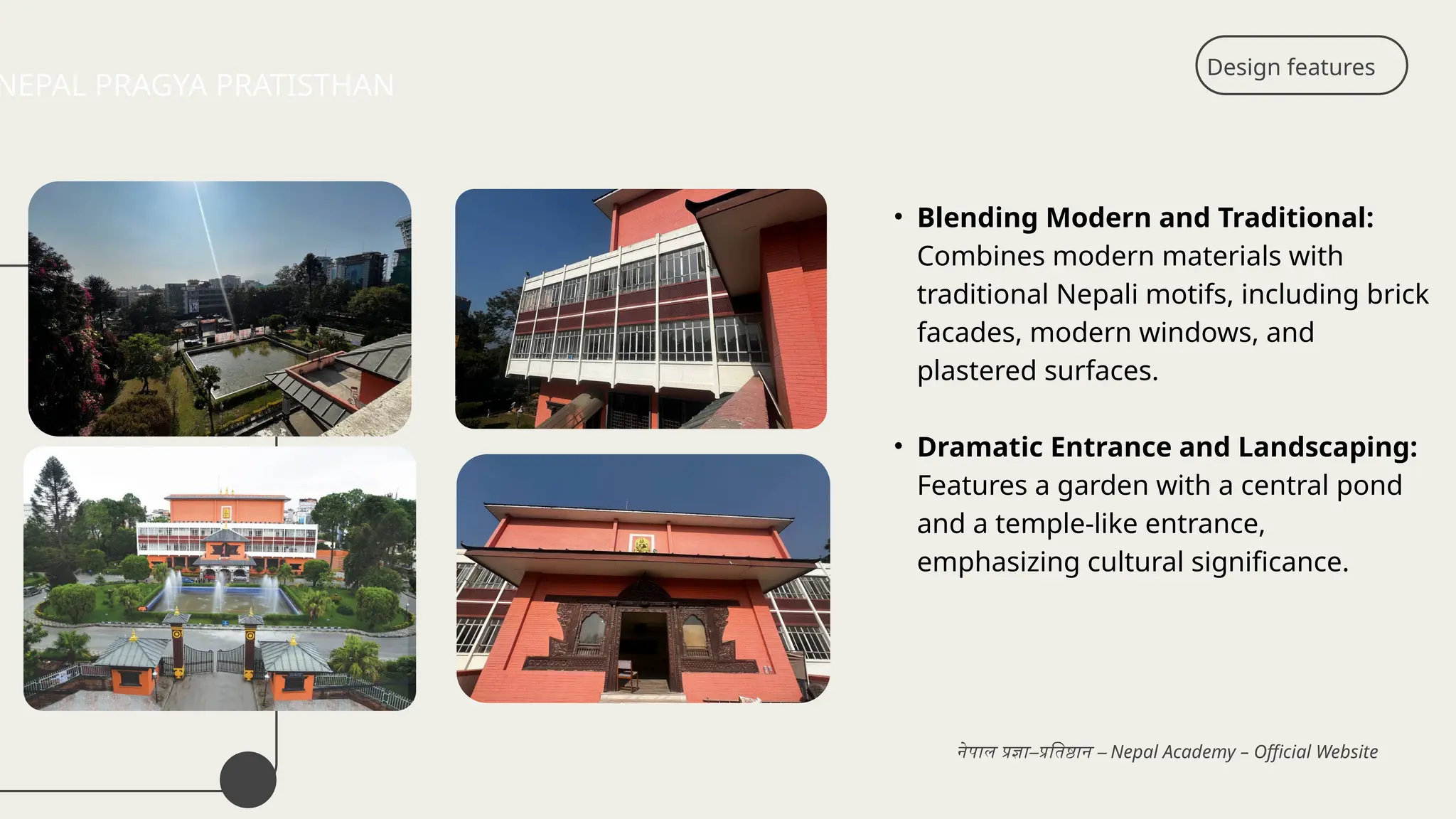
• Blending Modern and Traditional:
Combines modern materials with
traditional Nepali motifs, including brick
facades, modern windows, and
plastered surfaces.
• Dramatic Entrance and Landscaping:
Features a garden with a central pond
and a temple-like entrance,
emphasizing cultural significance.
NEPAL PRAGYA PRATISTHAN
Introduction
sketch
NEPAL PRAGYA PRATISTHAN
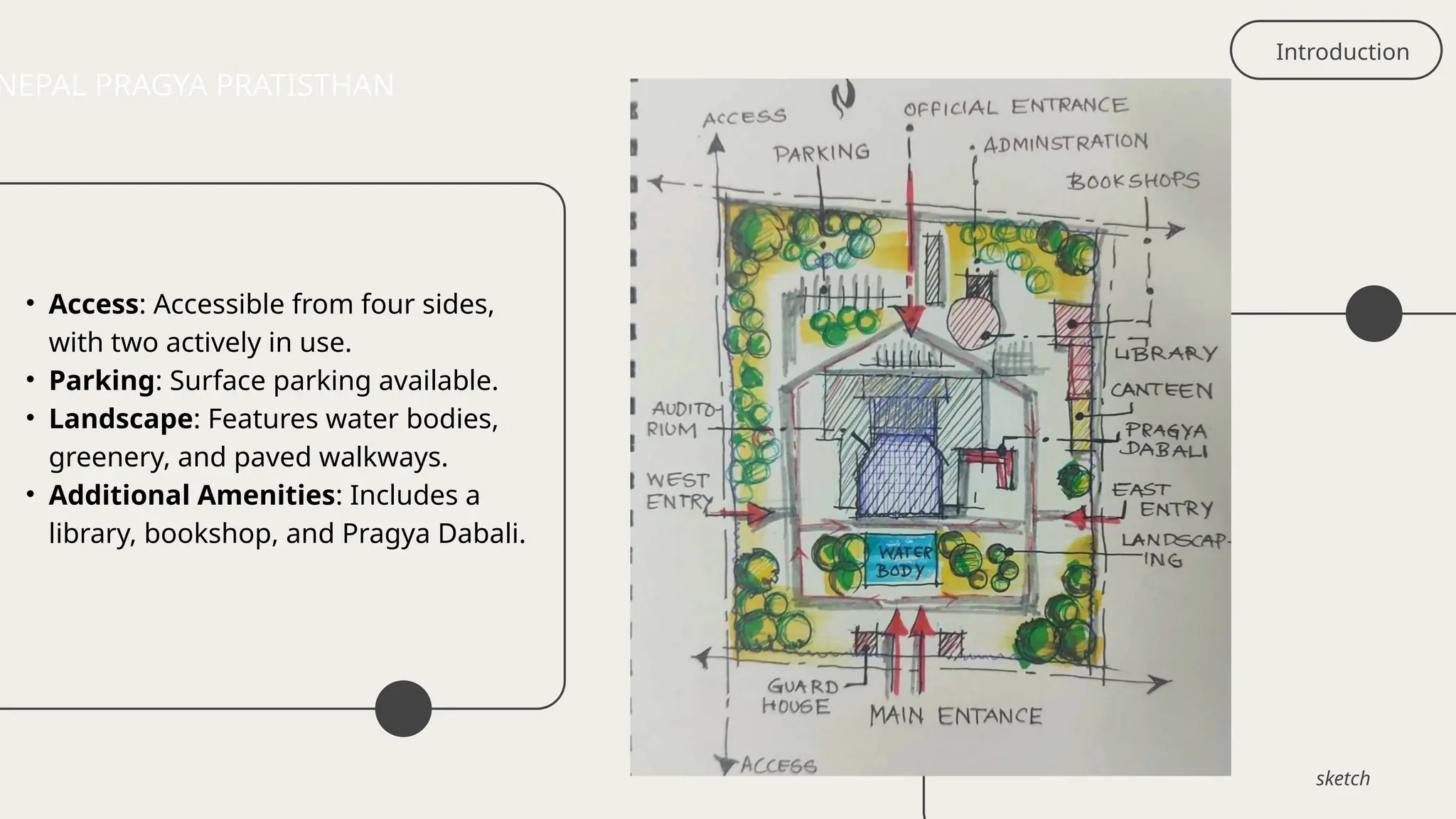
• Access: Accessible from four sides,
with two actively in use.
• Parking: Surface parking available.
• Landscape: Features water bodies,
greenery, and paved walkways.
• Additional Amenities: Includes a
library, bookshop, and Pragya Dabali.
Spatial planning and Functional spaces
SPACES
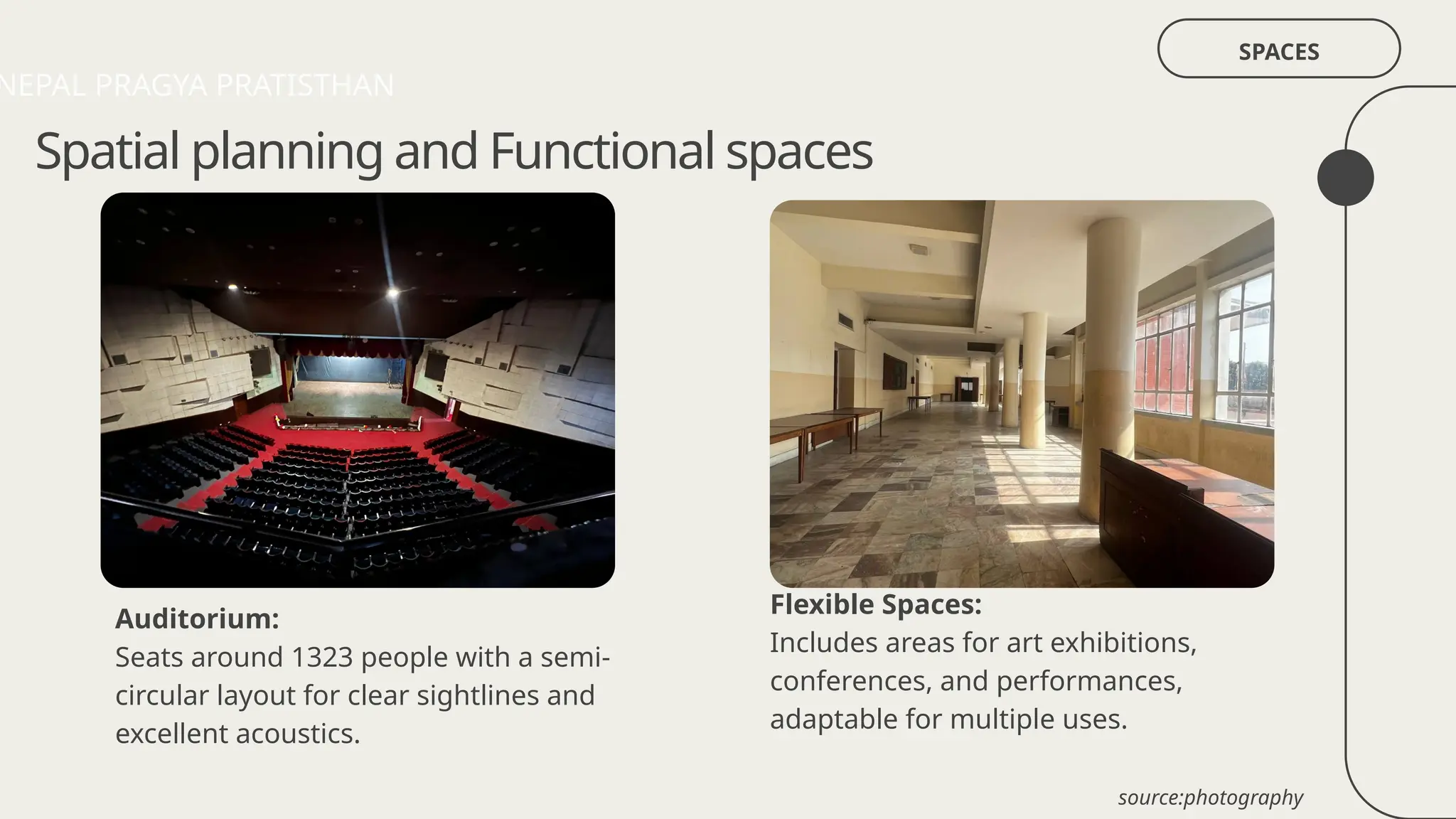
Auditorium:
Seats around 1323 people with a semi-
circular layout for clear sightlines and
excellent acoustics.
Flexible Spaces:
Includes areas for art exhibitions,
conferences, and performances,
adaptable for multiple uses.
NEPAL PRAGYA PRATISTHAN
source:photography
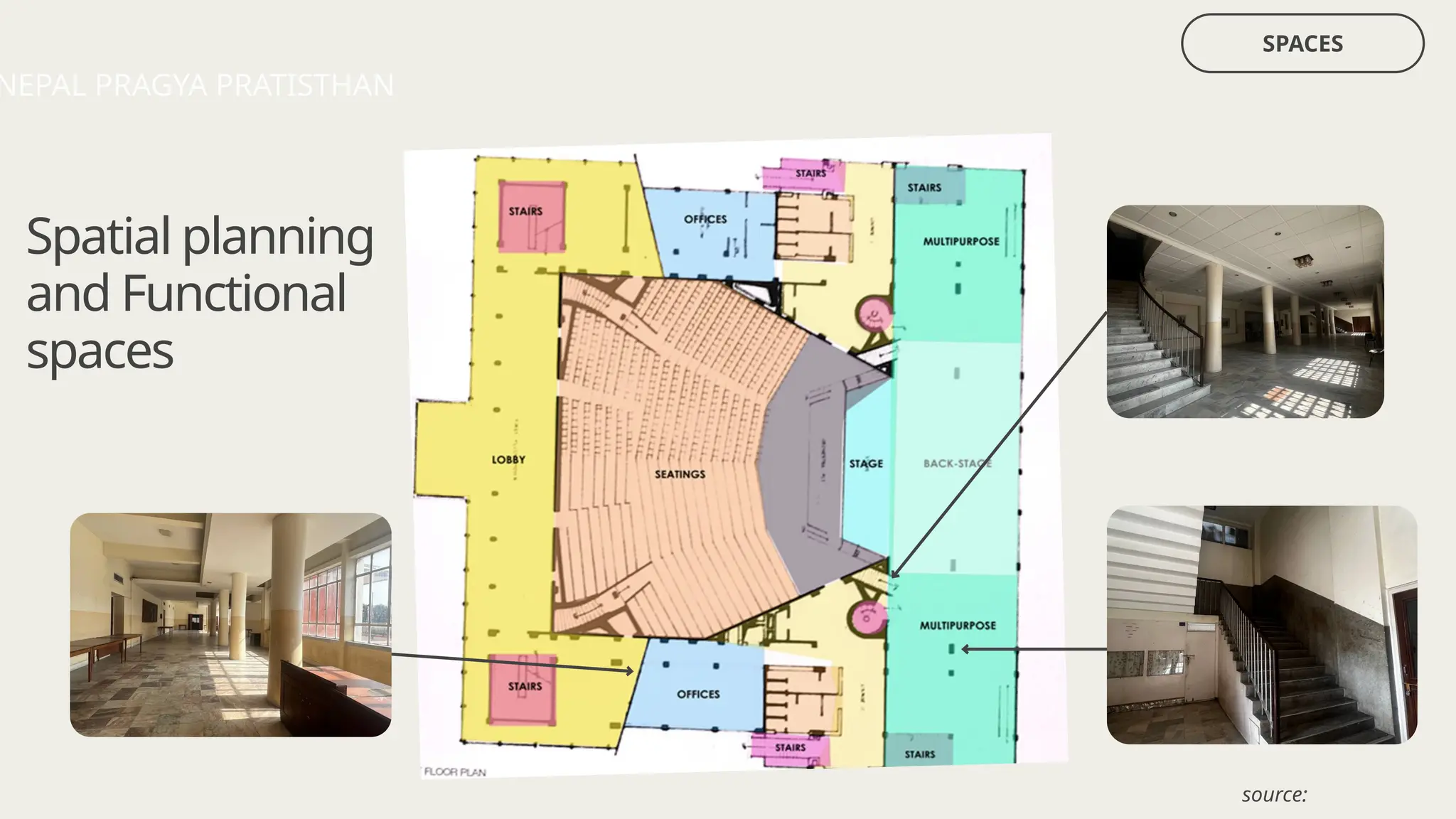
Spatial planning
and Functional
spaces
SPACES
NEPAL PRAGYA PRATISTHAN
source:
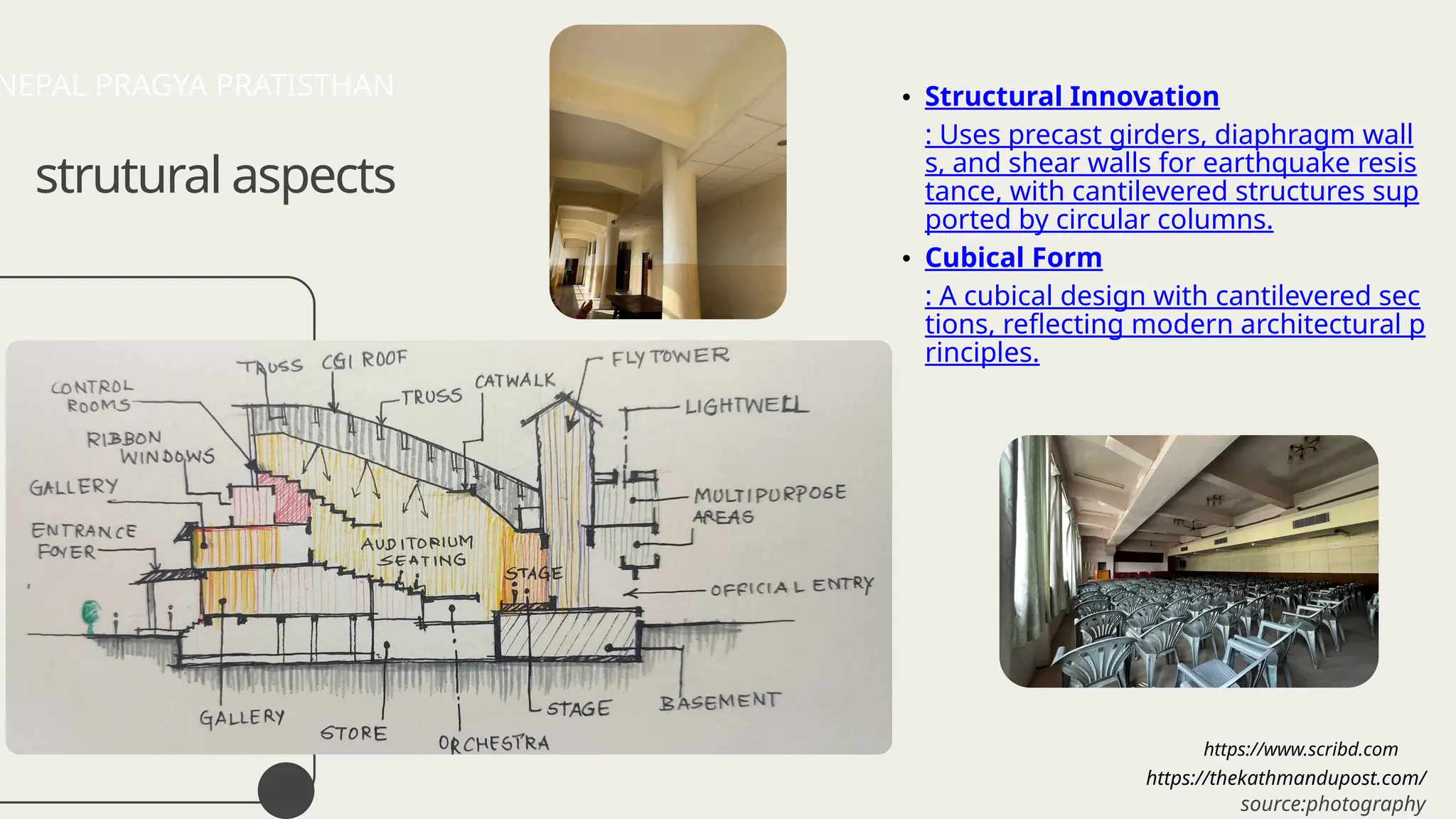
• Structural Innovation
: Uses precast girders, diaphragm wall
s, and shear walls for earthquake resis
tance, with cantilevered structures sup
ported by circular columns.
• Cubical Form
: A cubical design with cantilevered sec
tions, reflecting modern architectural p
rinciples.
https://thekathmandupost.com/
https://www.scribd.com
NEPAL PRAGYA PRATISTHAN
strutural aspects
source:photography
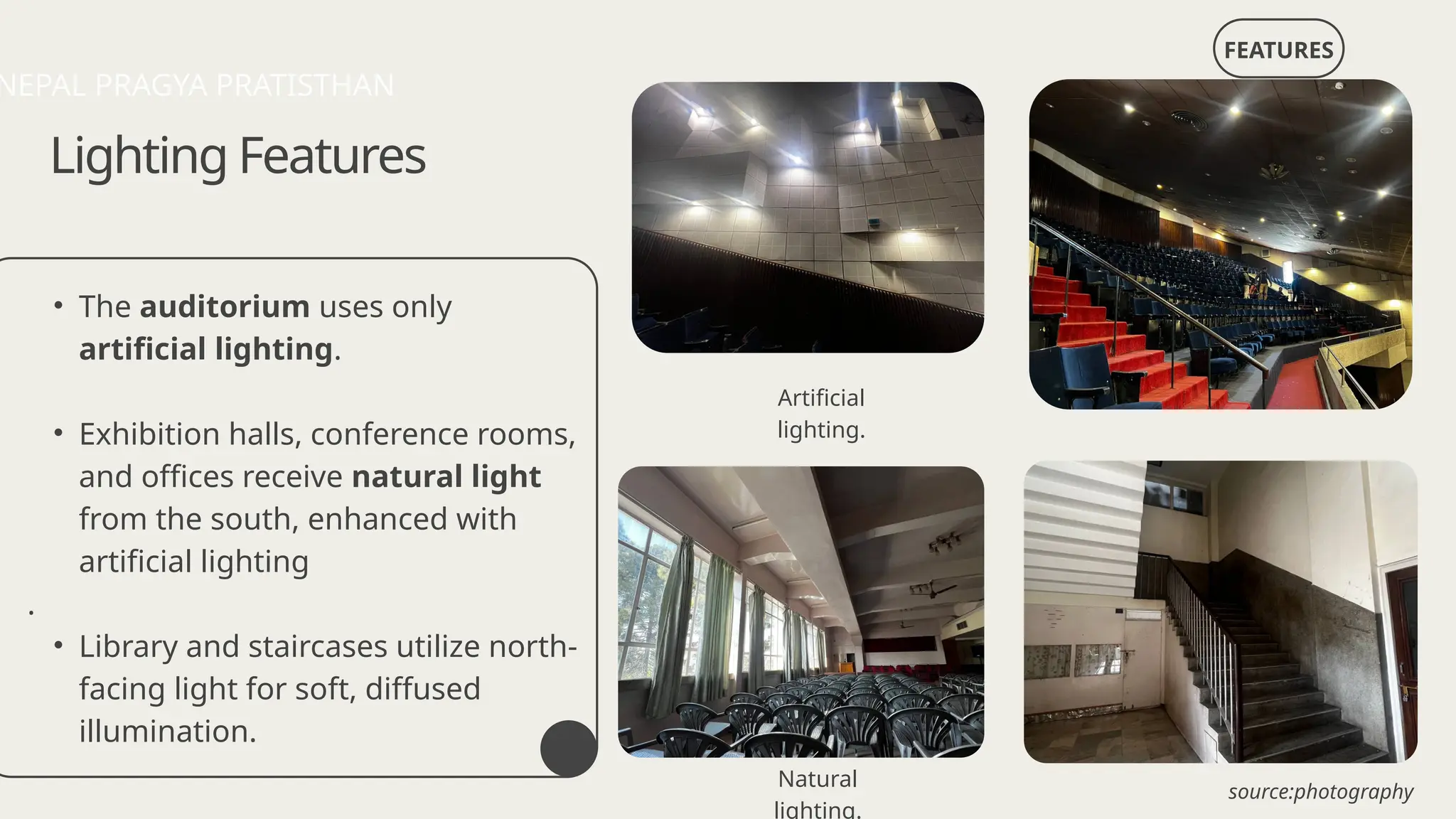
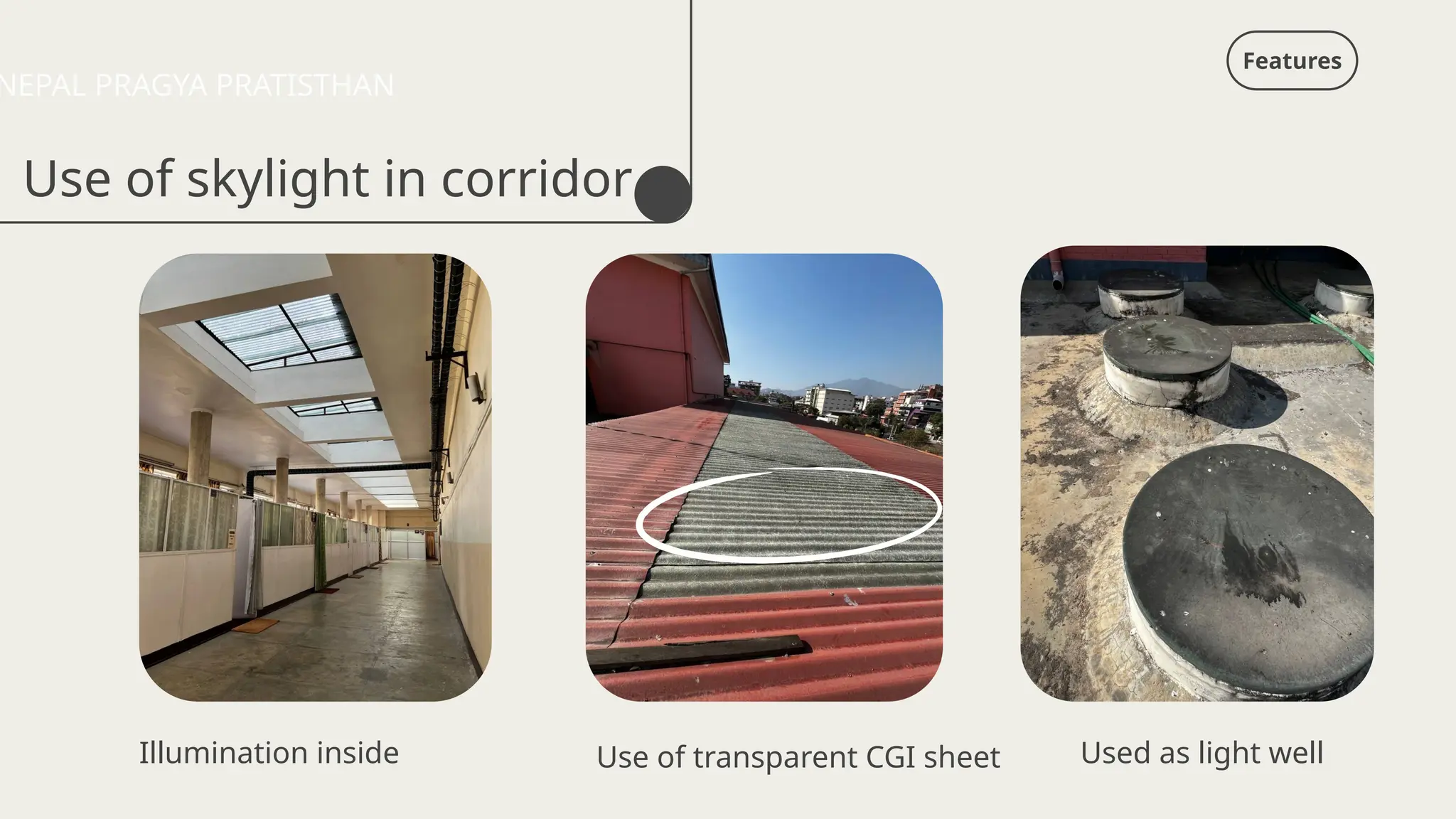
• The auditorium uses only
artificial lighting.
• Exhibition halls, conference rooms,
and offices receive natural light
from the south, enhanced with
artificial lighting
.
• Library and staircases utilize north-
facing light for soft, diffused
illumination.
FEATURES
Lighting Features
Artificial
lighting.
Natural
lighting.
NEPAL PRAGYA PRATISTHAN
source:photography
Use of skylight in corridor
Illumination inside Use of transparent CGI sheet Used as light well
Features
NEPAL PRAGYA PRATISTHAN
Architectural Acoustics
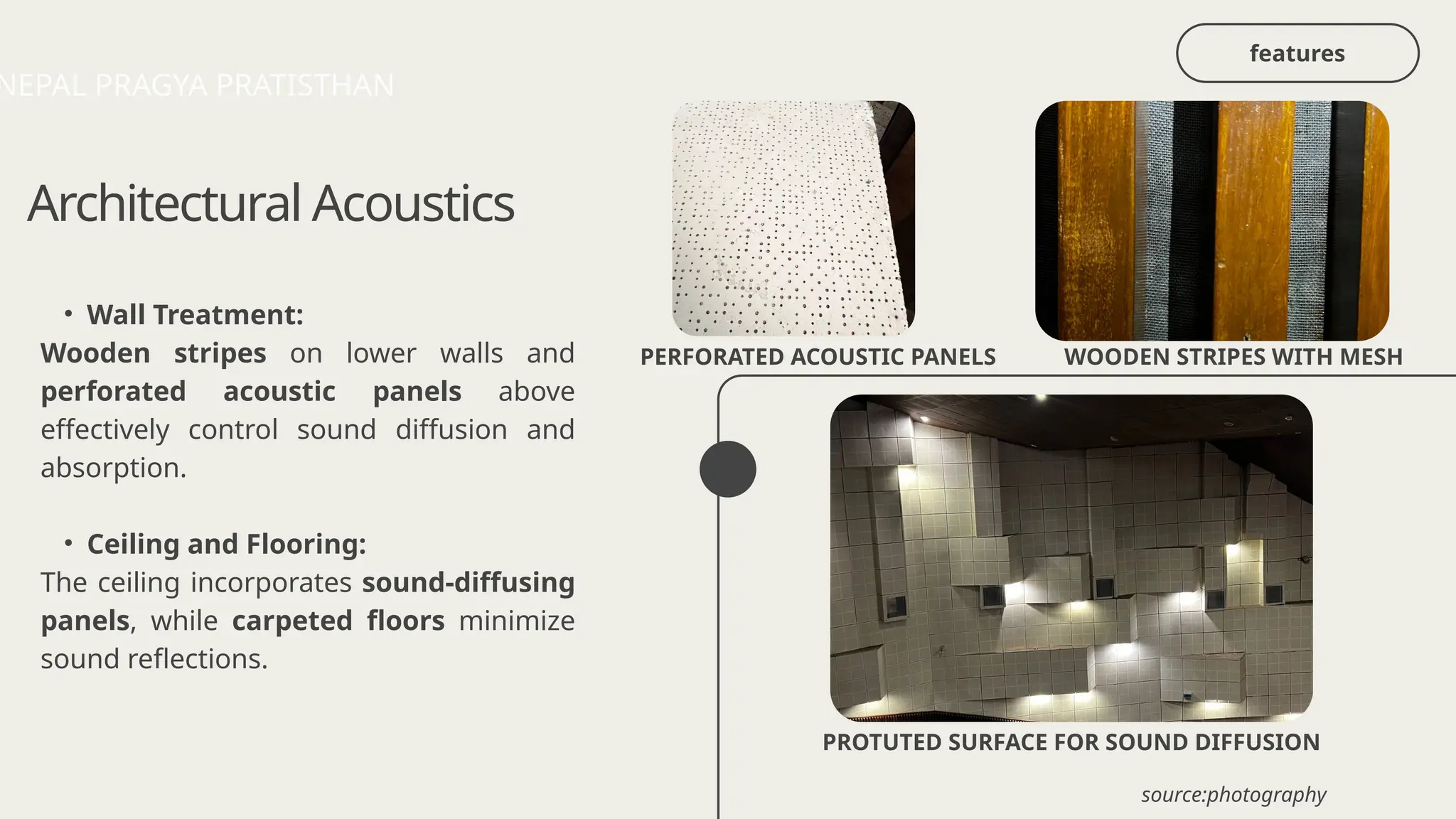
• Wall Treatment:
Wooden stripes on lower walls and
perforated acoustic panels above
effectively control sound diffusion and
absorption.
• Ceiling and Flooring:
The ceiling incorporates sound-diffusing
panels, while carpeted floors minimize
sound reflections.
PERFORATED ACOUSTIC PANELS WOODEN STRIPES WITH MESH
NEPAL PRAGYA PRATISTHAN
PROTUTED SURFACE FOR SOUND DIFFUSION
source:photography
features
features
NEPAL PRAGYA PRATISTHAN
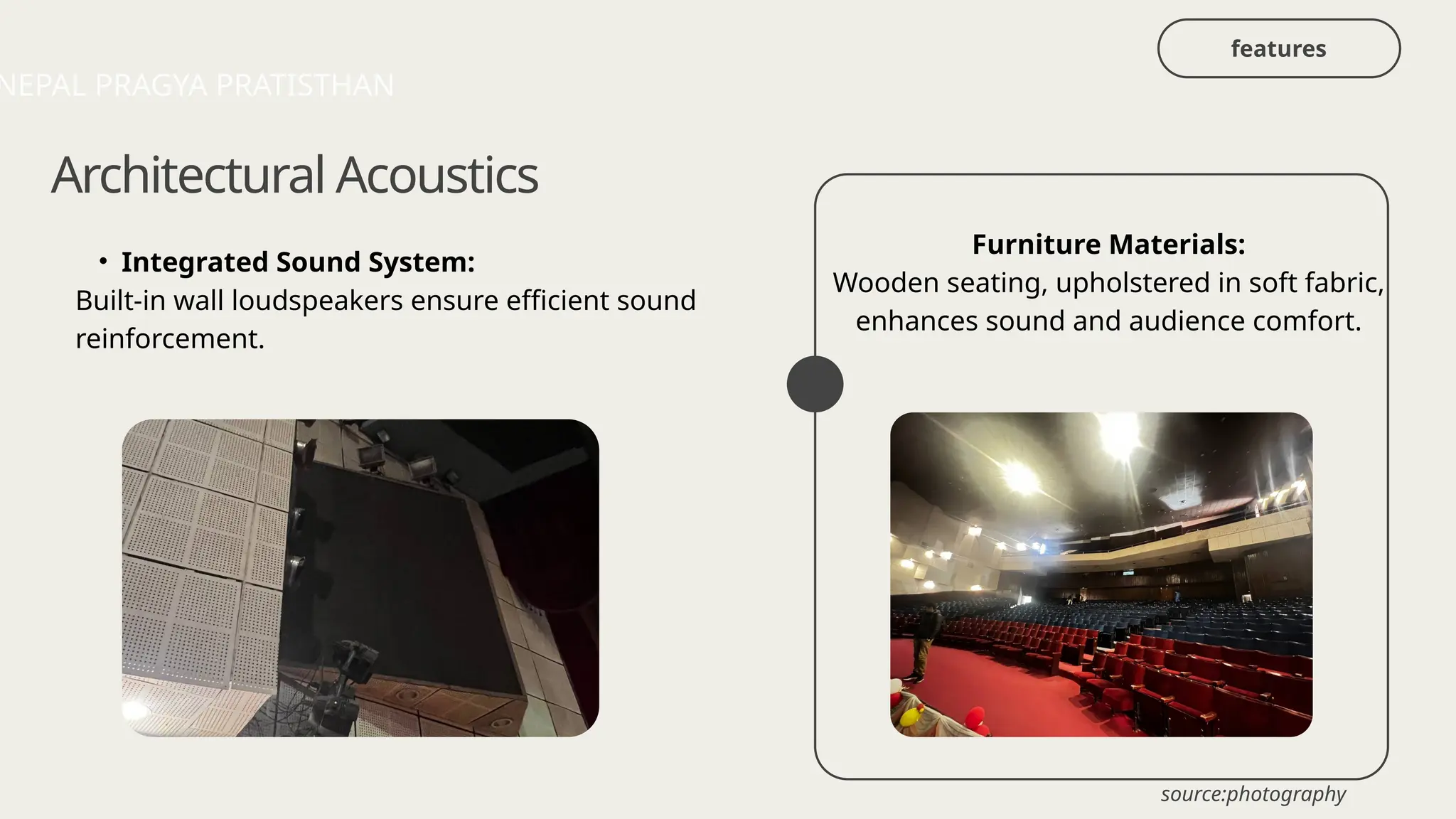
• Integrated Sound System:
Built-in wall loudspeakers ensure efficient sound
reinforcement.
Furniture Materials:
Wooden seating, upholstered in soft fabric,
enhances sound and audience comfort.
source:photography
Architectural Acoustics
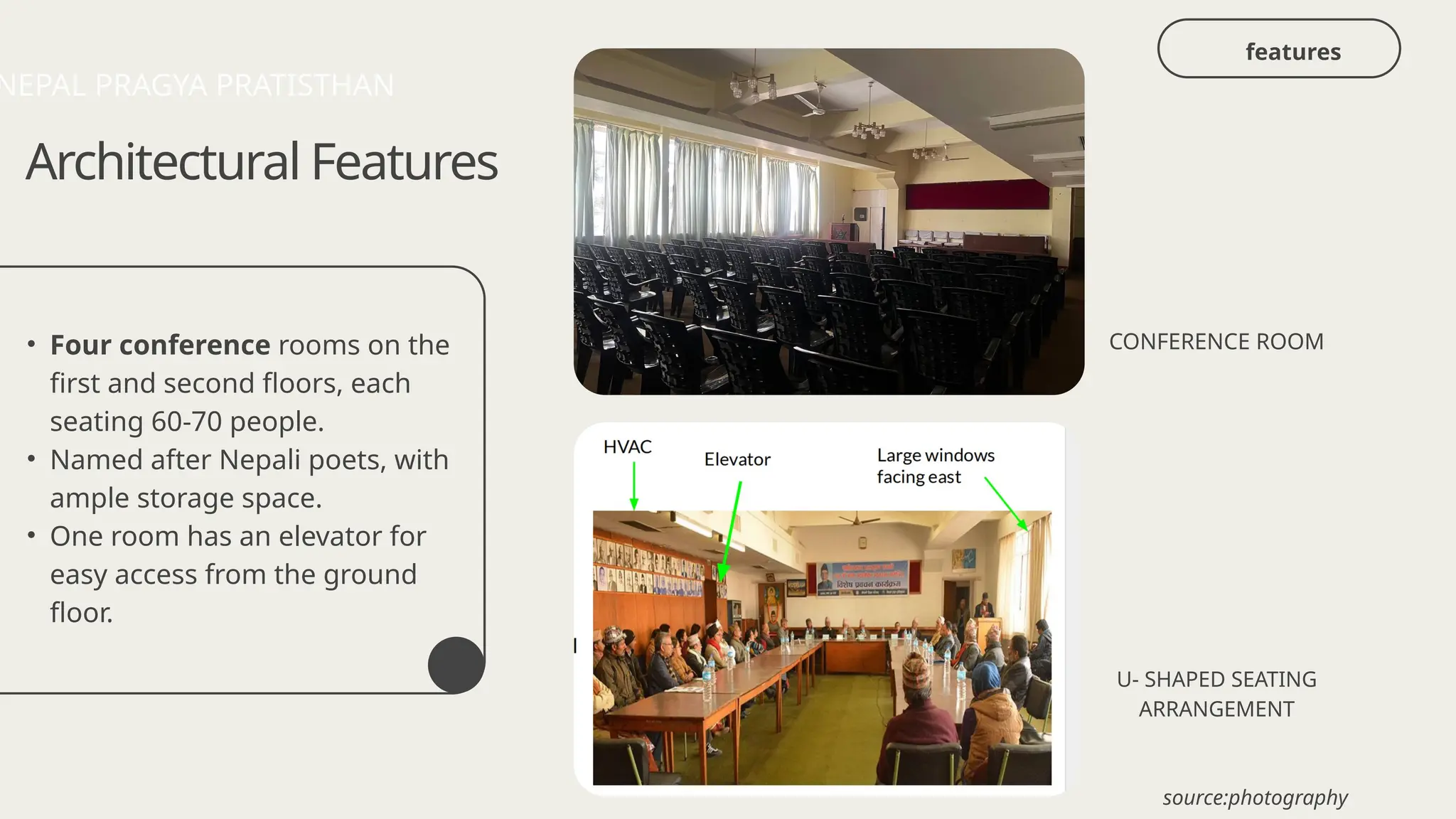
• Four conference rooms on the
first and second floors, each
seating 60-70 people.
• Named after Nepali poets, with
ample storage space.
• One room has an elevator for
easy access from the ground
floor.
Architectural Features
CONFERENCE ROOM
U- SHAPED SEATING
ARRANGEMENT
NEPAL PRAGYA PRATISTHAN
source:photography
features
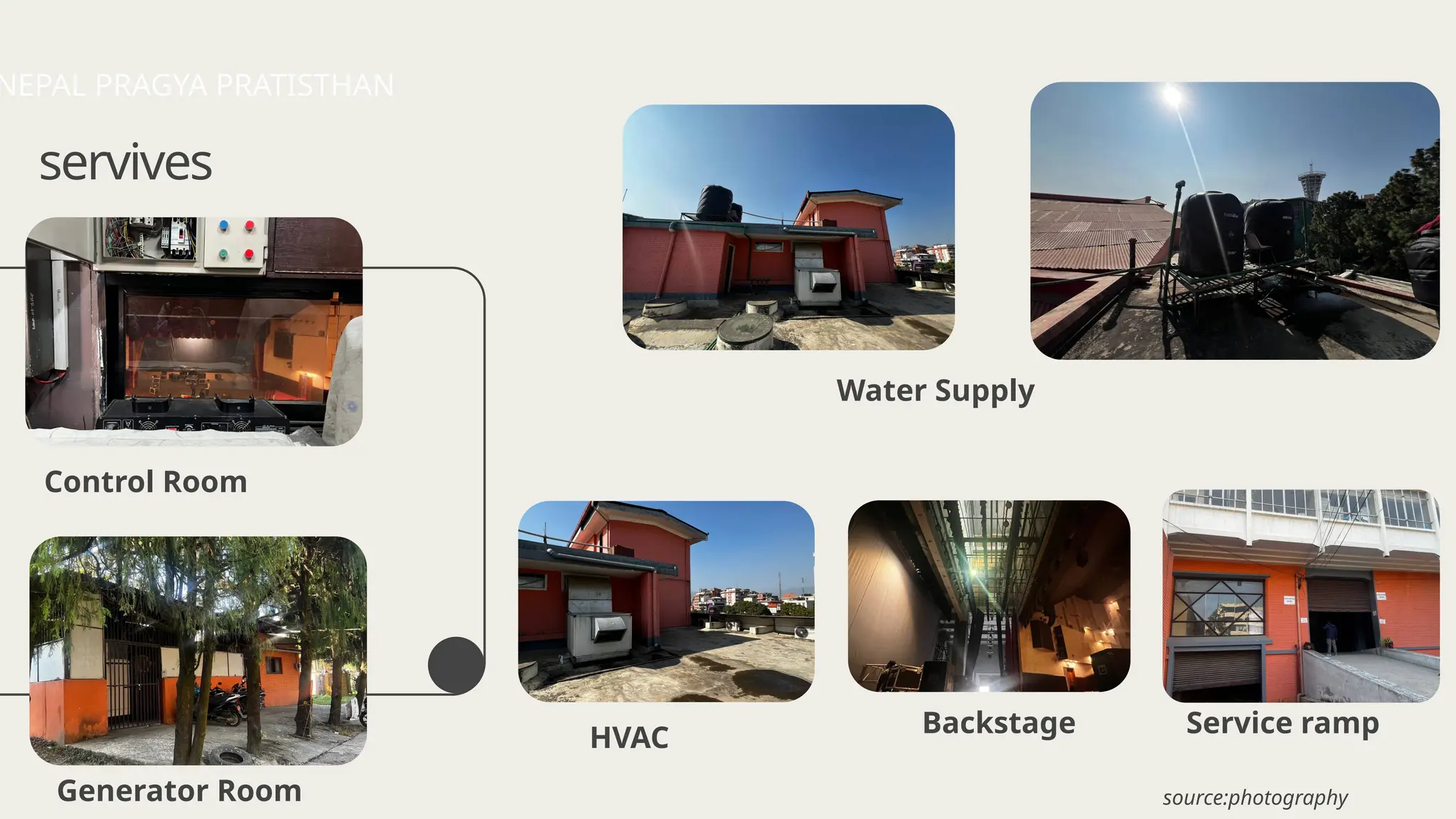
servives
NEPAL PRAGYA PRATISTHAN
source:photography
Control Room
HVAC
Water Supply
Backstage
Generator Room
Service ramp
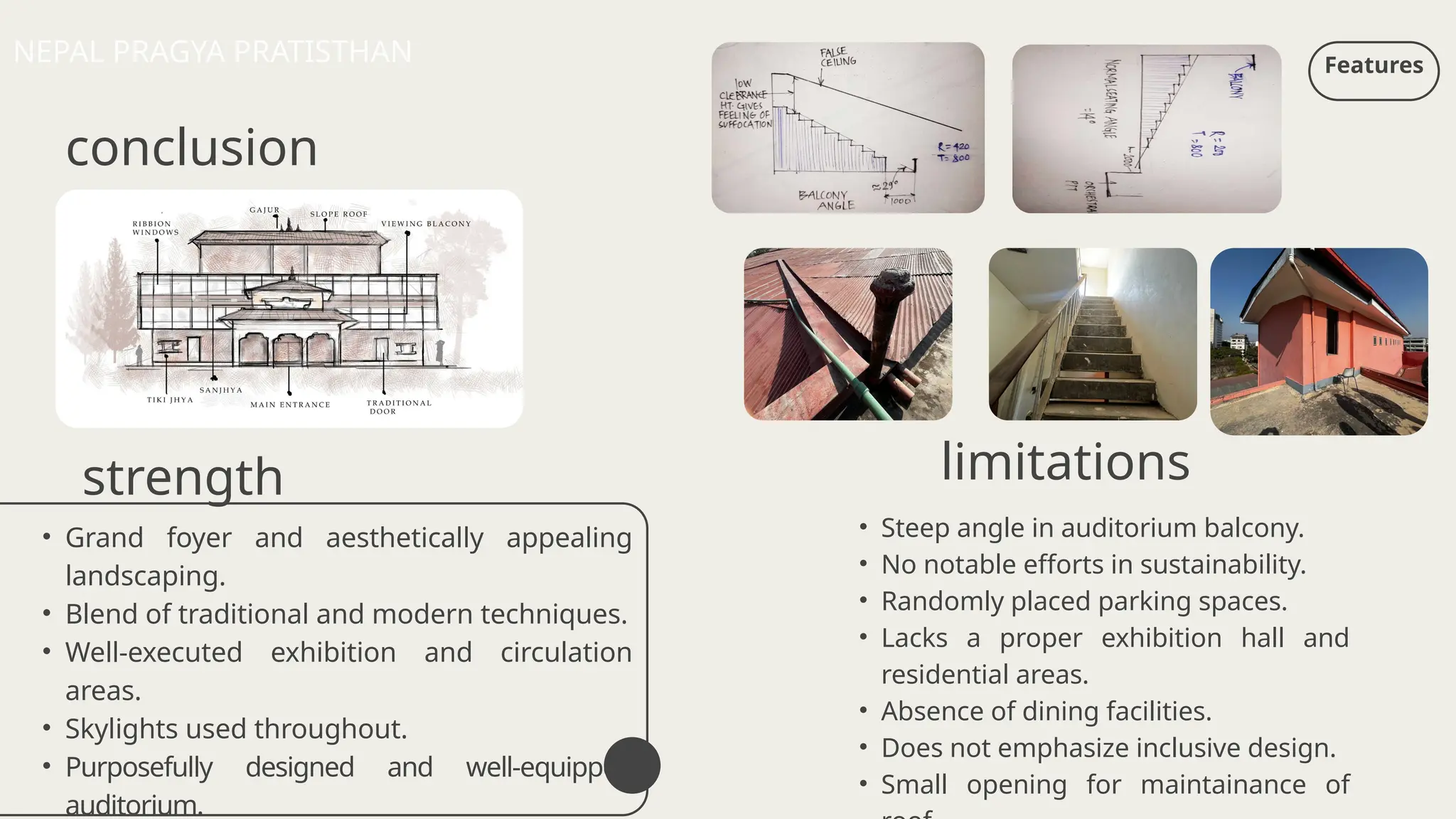
conclusion
strength
• Steep angle in auditorium balcony.
• No notable efforts in sustainability.
• Randomly placed parking spaces.
• Lacks a proper exhibition hall and
residential areas.
• Absence of dining facilities.
• Does not emphasize inclusive design.
• Small opening for maintainance of
Features
NEPAL PRAGYA PRATISTHAN
limitations
• Grand foyer and aesthetically appealing
landscaping.
• Blend of traditional and modern techniques.
• Well-executed exhibition and circulation
areas.
• Skylights used throughout.
• Purposefully designed and well-equipped
auditorium.
COMPARATIVE
ANALYSIS:
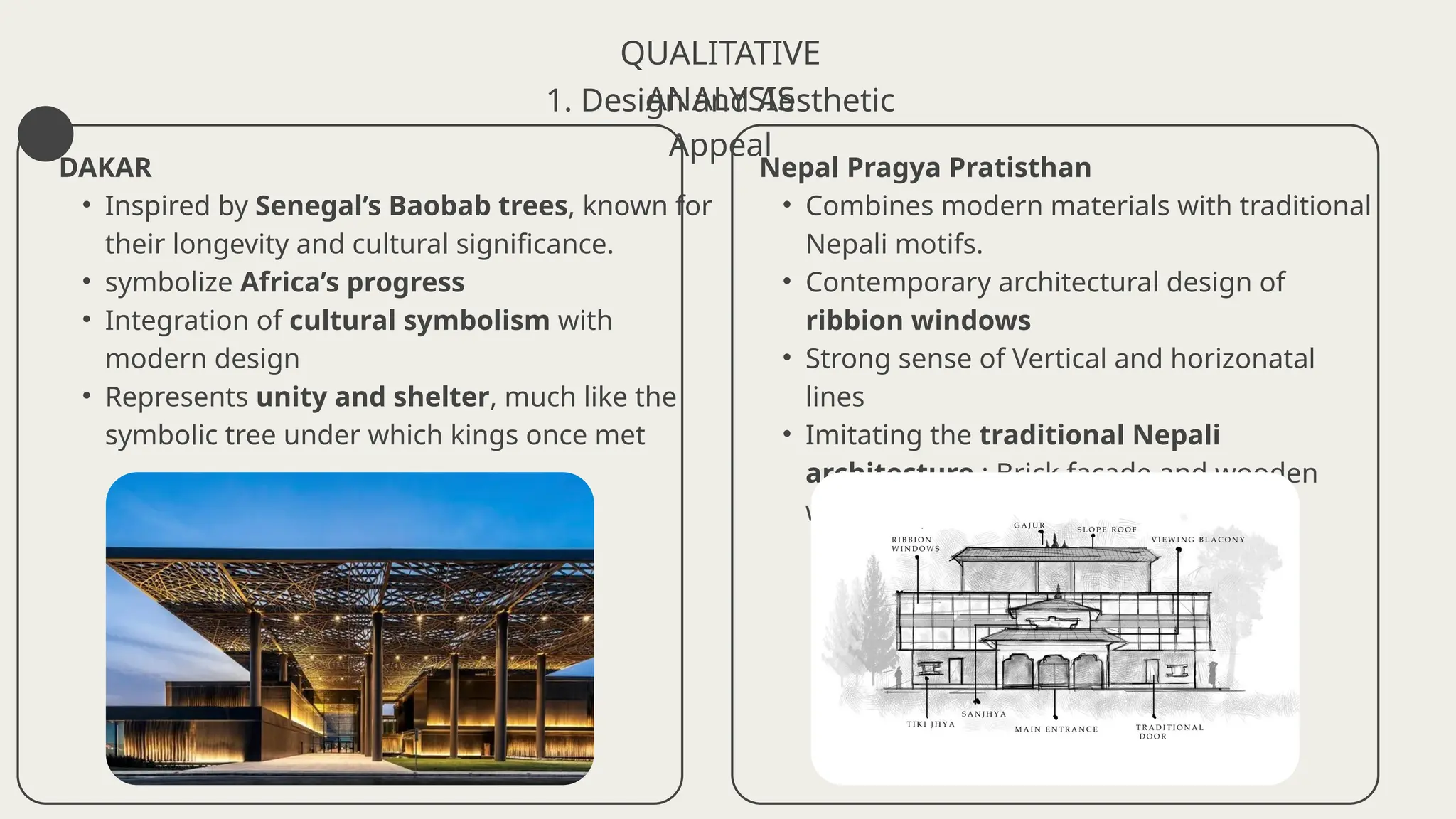
DAKAR
• Inspired by Senegal’s Baobab trees, known for
their longevity and cultural significance.
• symbolize Africa’s progress
• Integration of cultural symbolism with
modern design
• Represents unity and shelter, much like the
symbolic tree under which kings once met
QUALITATIVE
ANALYSIS
1. Design and Aesthetic
Appeal
Nepal Pragya Pratisthan
• Combines modern materials with traditional
Nepali motifs.
• Contemporary architectural design of
ribbion windows
• Strong sense of Vertical and horizonatal
lines
• Imitating the traditional Nepali
architecture : Brick facade and wooden
windows
QUALITATIVE
ANALYSIS
1. Design and Aesthetic
Appeal
MICX
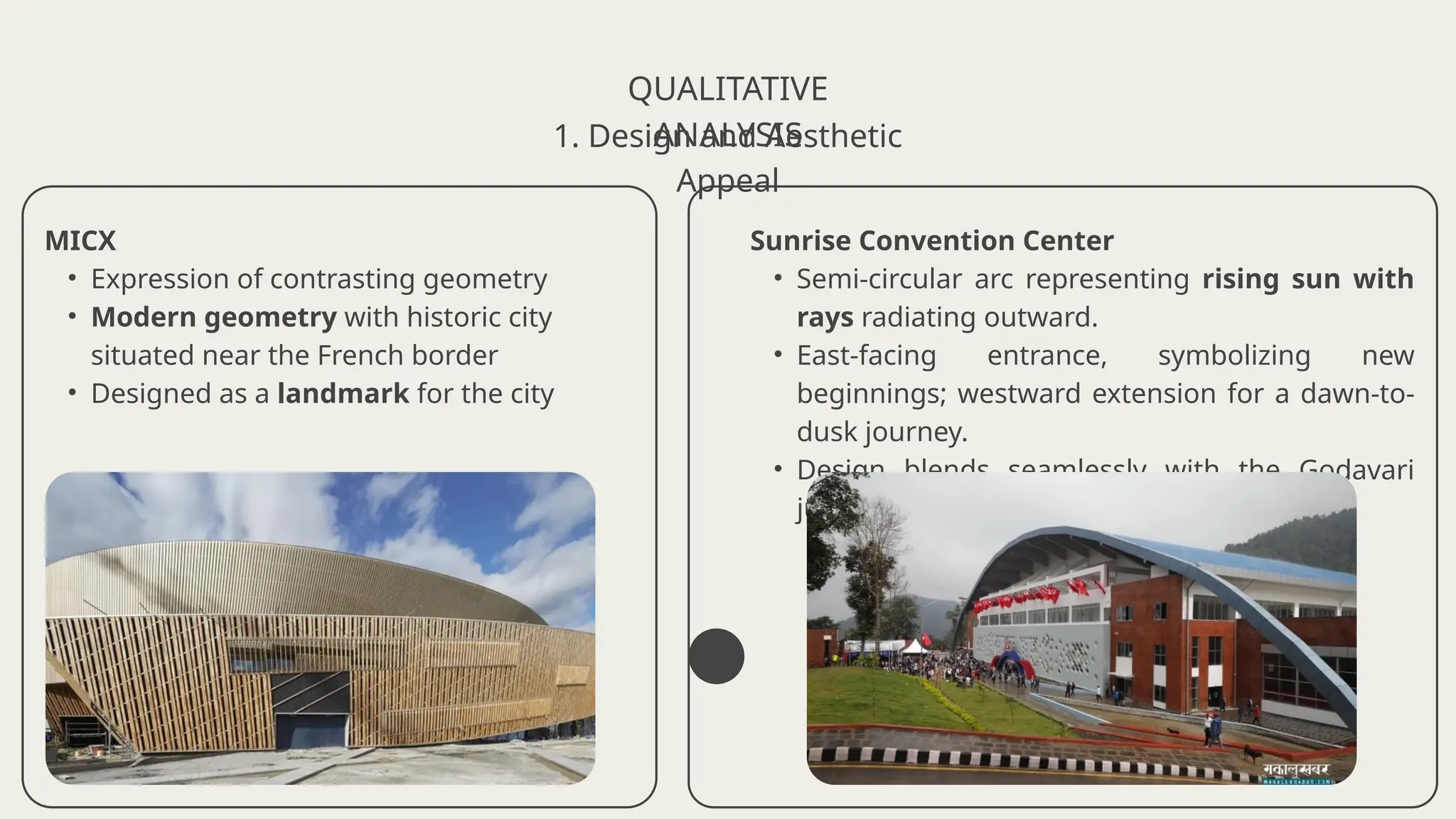
• Expression of contrasting geometry
• Modern geometry with historic city
situated near the French border
• Designed as a landmark for the city
Sunrise Convention Center
• Semi-circular arc representing rising sun with
rays radiating outward.
• East-facing entrance, symbolizing new
beginnings; westward extension for a dawn-to-
dusk journey.
• Design blends seamlessly with the Godavari
jungle
QUALITATIVE
ANALYSIS
2. Functional Design and Spatial
Planning
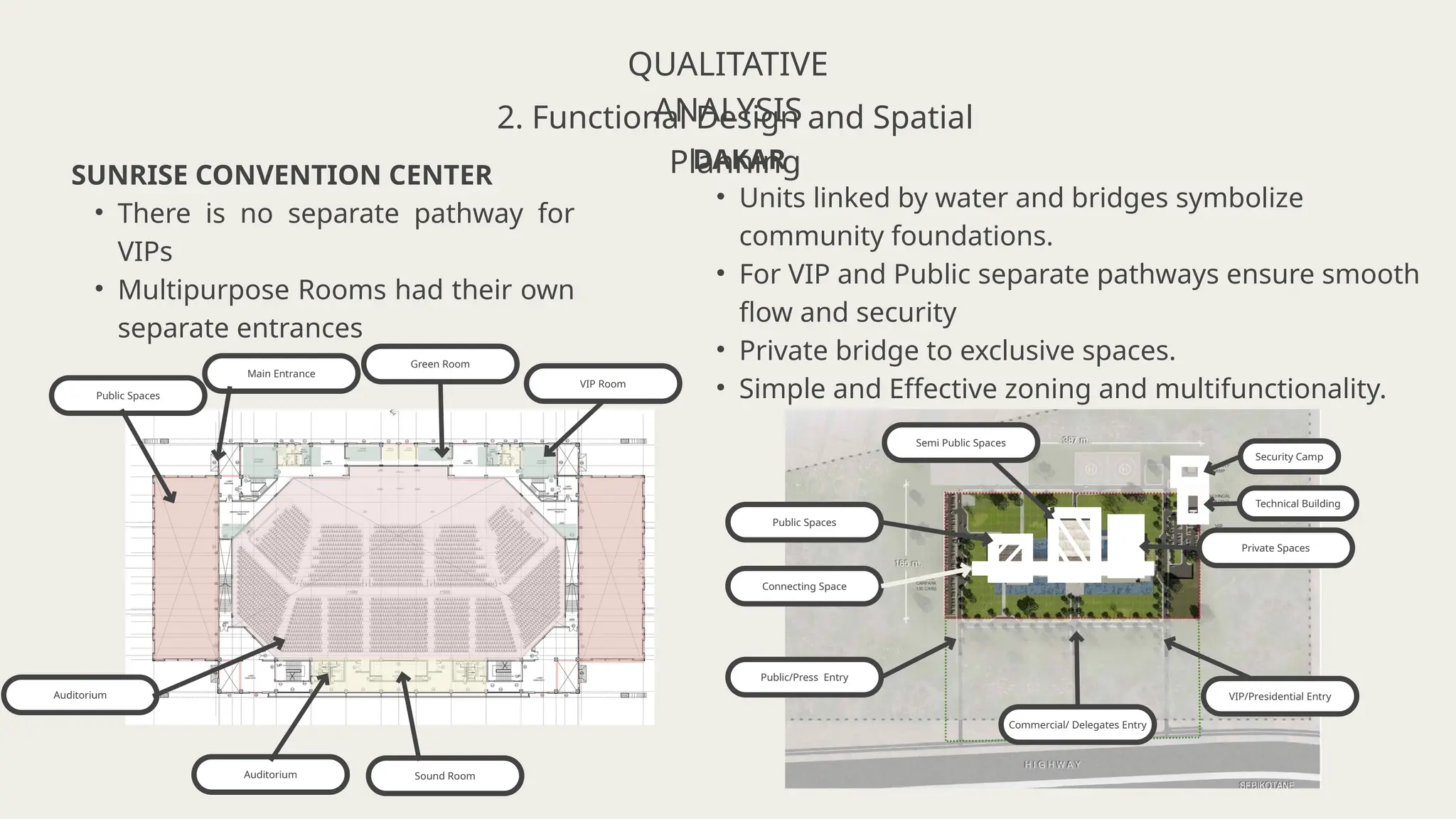
SUNRISE CONVENTION CENTER
• There is no separate pathway for
VIPs
• Multipurpose Rooms had their own
separate entrances
DAKAR
• Units linked by water and bridges symbolize
community foundations.
• For VIP and Public separate pathways ensure smooth
flow and security
• Private bridge to exclusive spaces.
• Simple and Effective zoning and multifunctionality.
Public/Press Entry
Commercial/ Delegates Entry
VIP/Presidential Entry
Public Spaces
Semi Public Spaces
Private Spaces
Security Camp
Technical Building
Connecting Space
Public Spaces
Auditorium
Green Room
VIP Room
Auditorium Sound Room
Main Entrance
QUALITATIVE
ANALYSIS
3.VISITOR’S
EXPERIENCE
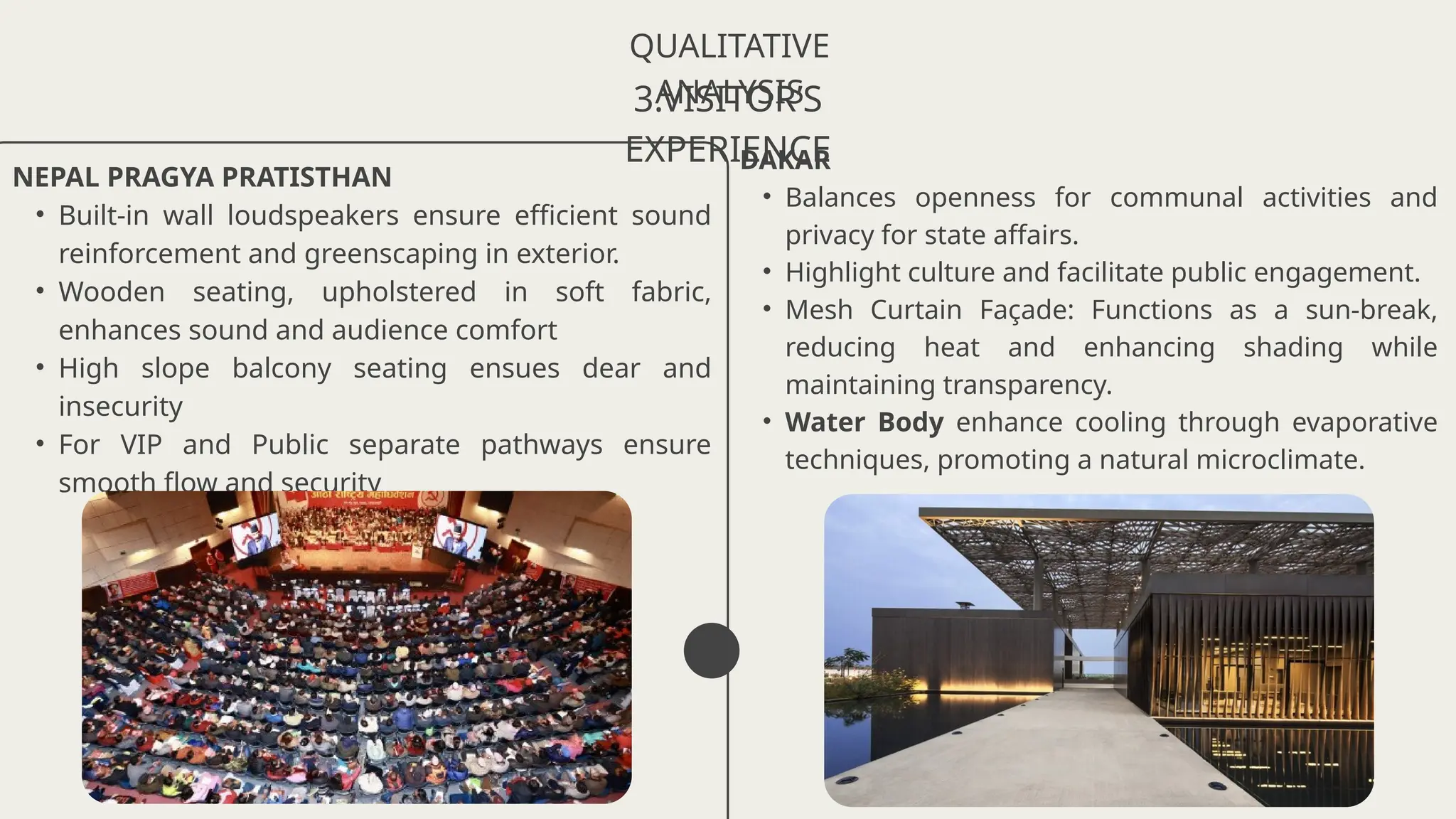
NEPAL PRAGYA PRATISTHAN
• Built-in wall loudspeakers ensure efficient sound
reinforcement and greenscaping in exterior.
• Wooden seating, upholstered in soft fabric,
enhances sound and audience comfort
• High slope balcony seating ensues dear and
insecurity
• For VIP and Public separate pathways ensure
smooth flow and security
DAKAR
• Balances openness for communal activities and
privacy for state affairs.
• Highlight culture and facilitate public engagement.
• Mesh Curtain Façade: Functions as a sun-break,
reducing heat and enhancing shading while
maintaining transparency.
• Water Body enhance cooling through evaporative
techniques, promoting a natural microclimate.
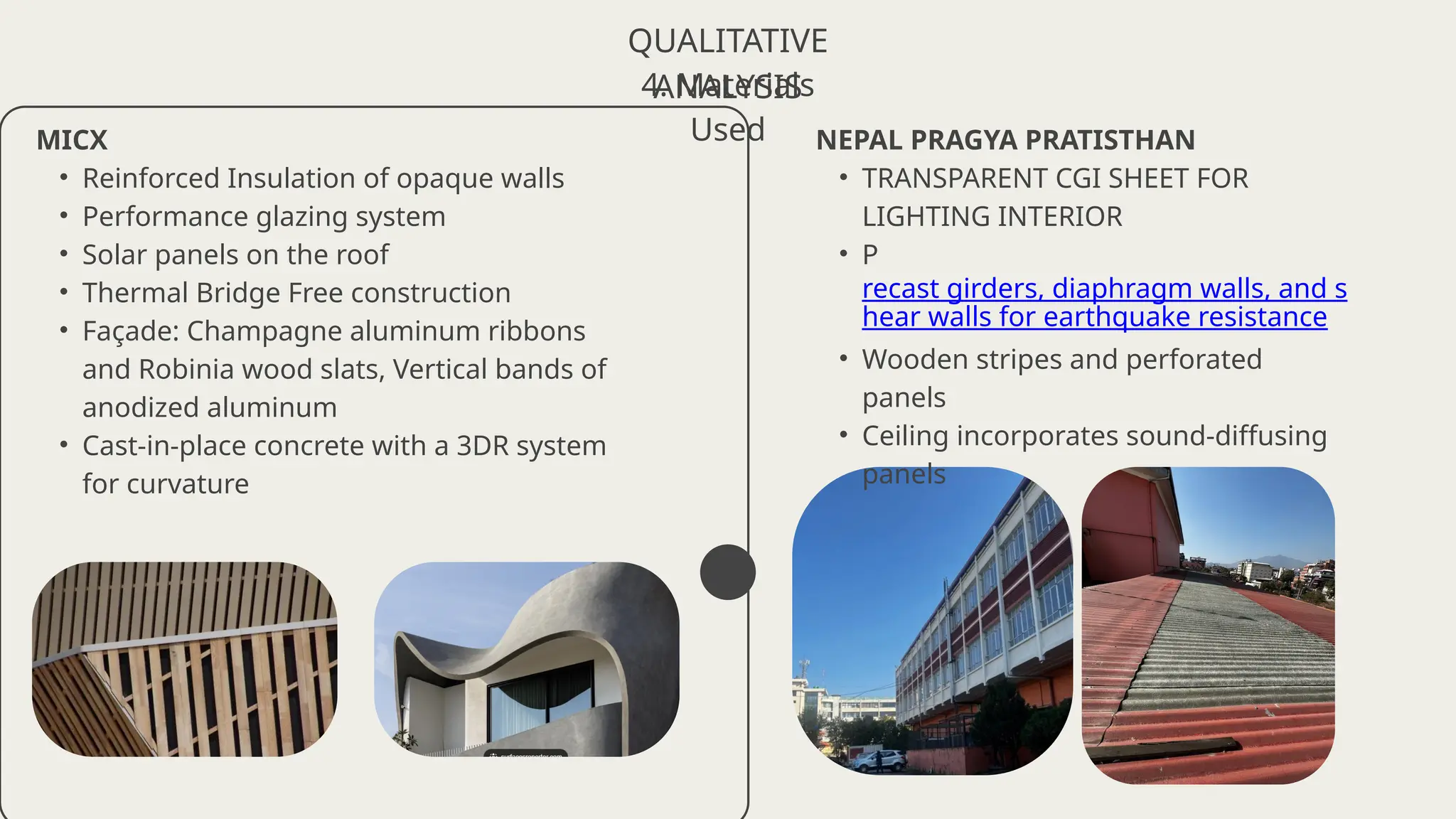
MICX
• Reinforced Insulation of opaque walls
• Performance glazing system
• Solar panels on the roof
• Thermal Bridge Free construction
• Façade: Champagne aluminum ribbons
and Robinia wood slats, Vertical bands of
anodized aluminum
• Cast-in-place concrete with a 3DR system
for curvature
QUALITATIVE
ANALYSIS
4. Materials
Used NEPAL PRAGYA PRATISTHAN
• TRANSPARENT CGI SHEET FOR
LIGHTING INTERIOR
• P
recast girders, diaphragm walls, and s
hear walls for earthquake resistance
• Wooden stripes and perforated
panels
• Ceiling incorporates sound-diffusing
panels
QUALITATIVE
ANALYSIS
5. TECHNOLOGY AND
ENVIRONMENTAL DESIGN
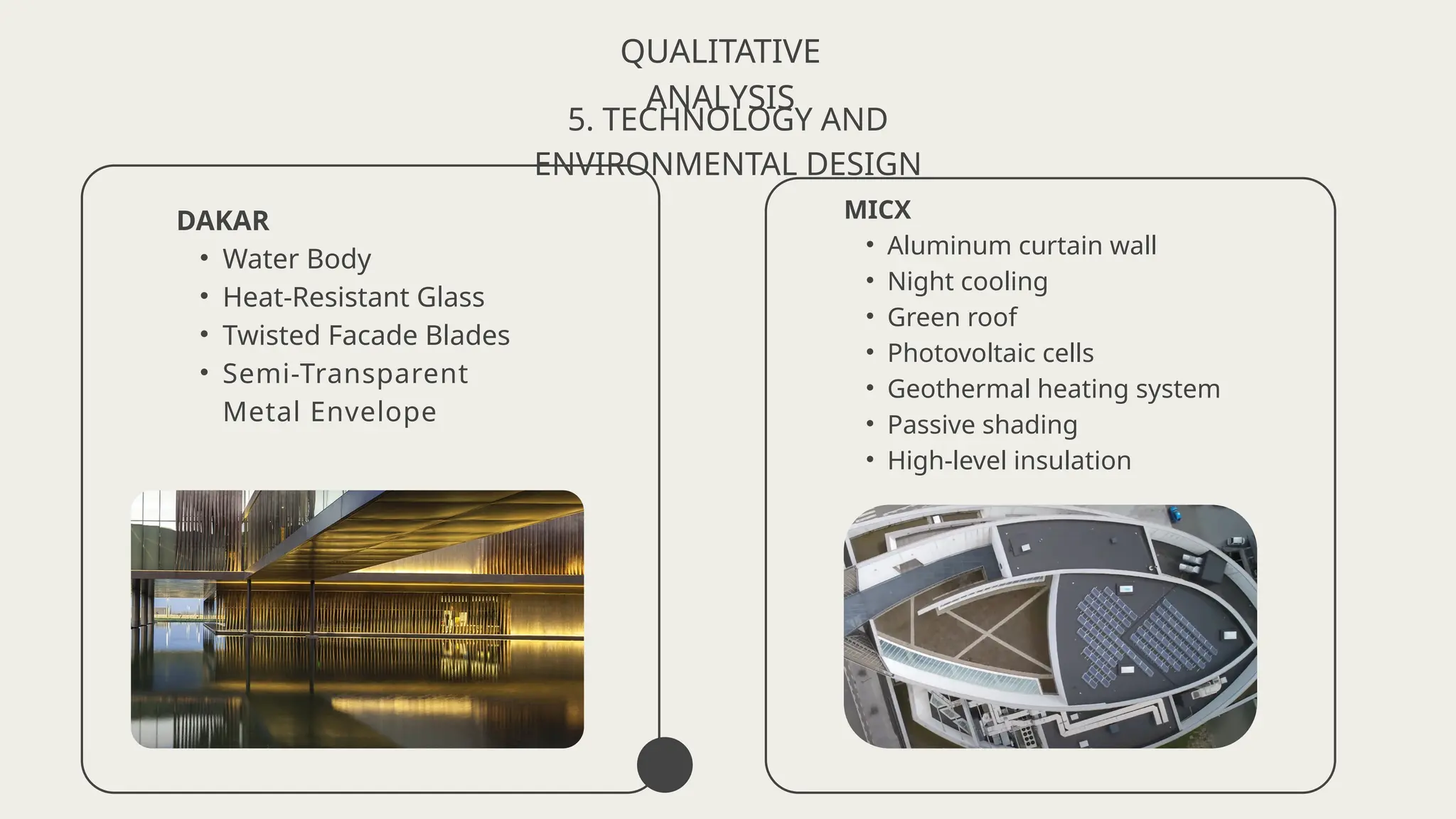
MICX
• Aluminum curtain wall
• Night cooling
• Green roof
• Photovoltaic cells
• Geothermal heating system
• Passive shading
• High-level insulation
DAKAR
• Water Body
• Heat-Resistant Glass
• Twisted Facade Blades
• Semi-Transparent
Metal Envelope
QUALITATIVE
ANALYSIS
6. URBAN IMPACT AND
COMMUNITY IMPACT
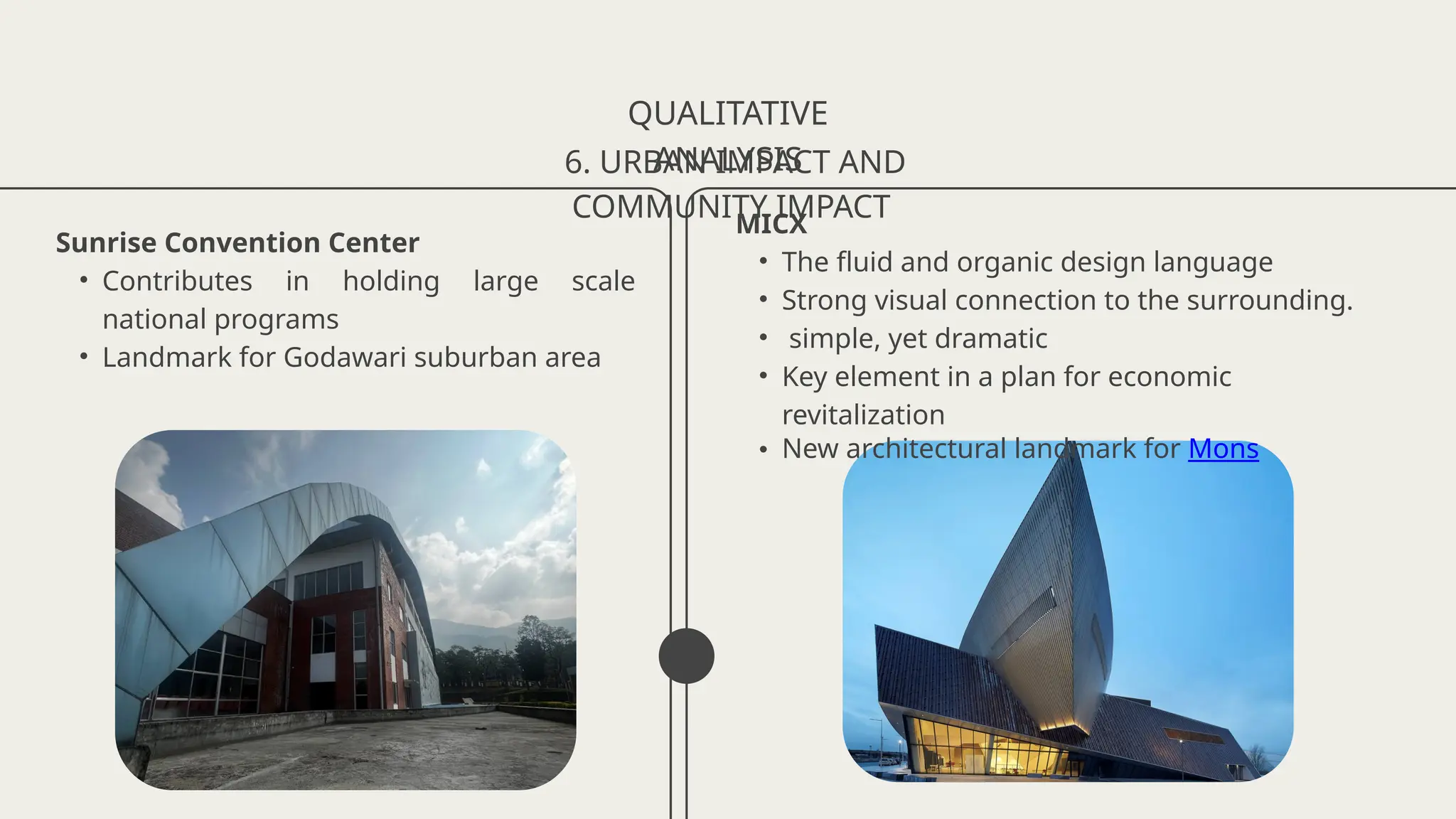
MICX
• The fluid and organic design language
• Strong visual connection to the surrounding.
• simple, yet dramatic
• Key element in a plan for economic
revitalization
• New architectural landmark for Mons
Sunrise Convention Center
• Contributes in holding large scale
national programs
• Landmark for Godawari suburban area
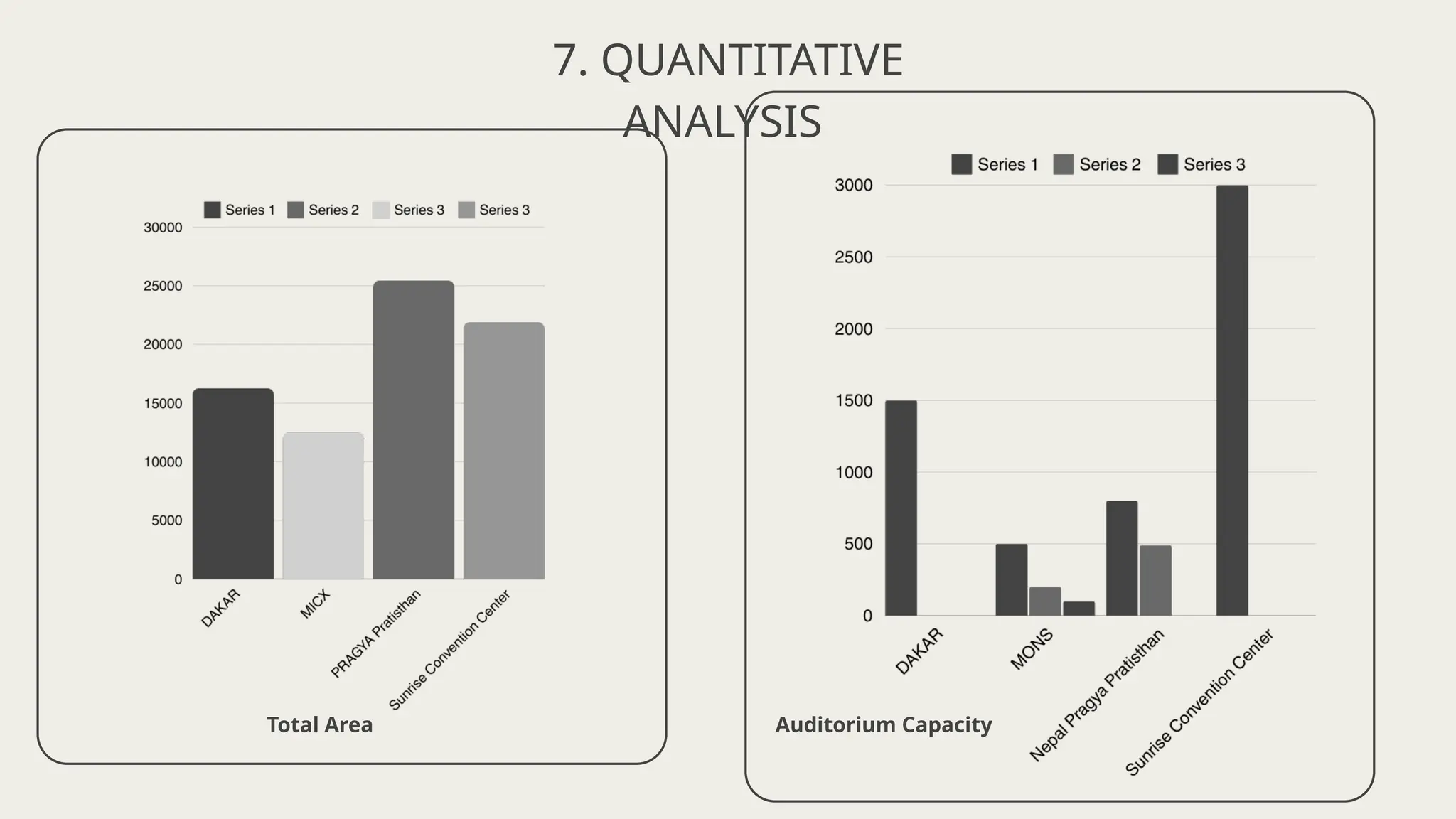
7. QUANTITATIVE
ANALYSIS
Auditorium Capacity
Total Area
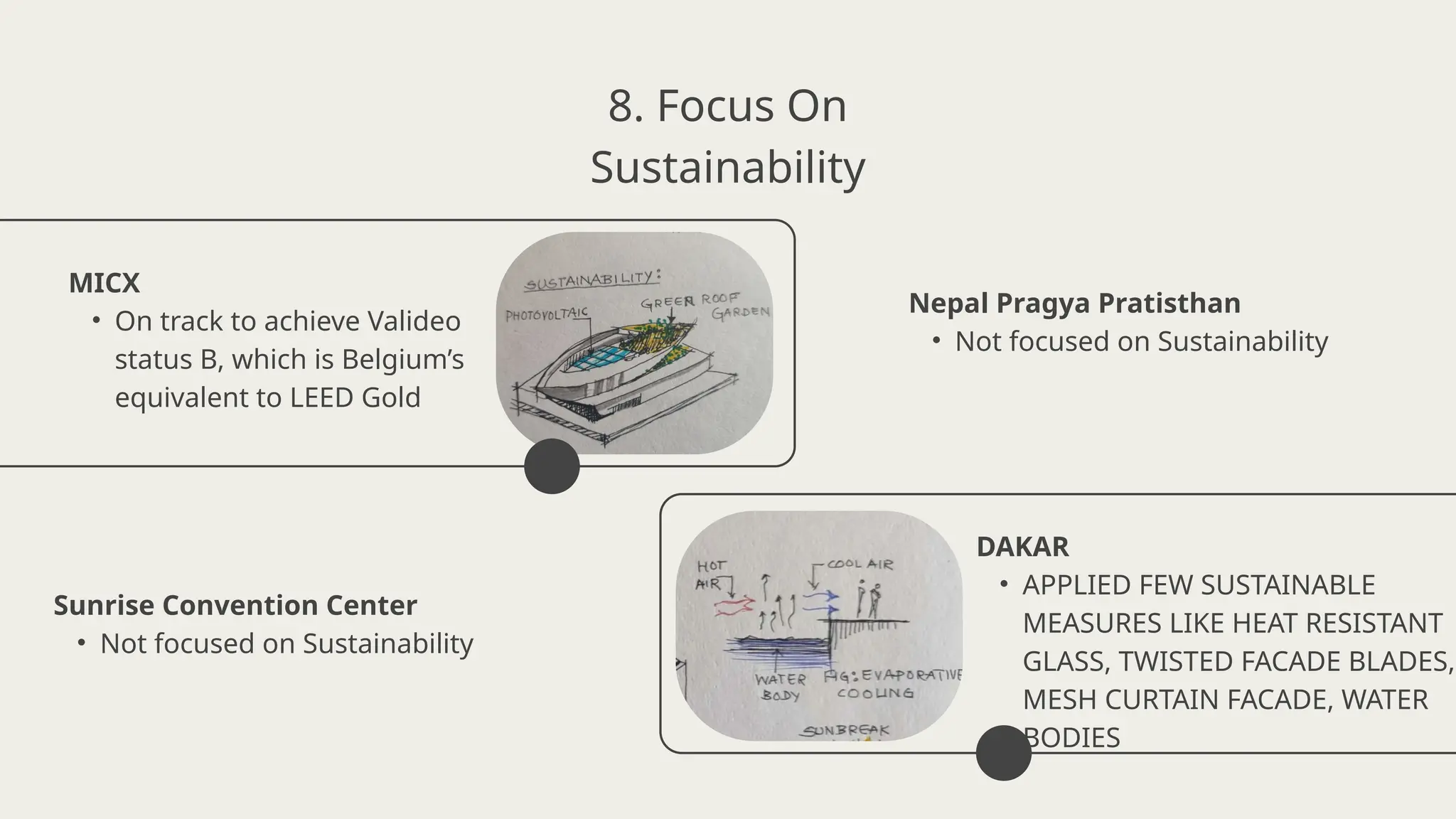
MICX
• On track to achieve Valideo
status B, which is Belgium’s
equivalent to LEED Gold
DAKAR
• APPLIED FEW SUSTAINABLE
MEASURES LIKE HEAT RESISTANT
GLASS, TWISTED FACADE BLADES,
MESH CURTAIN FACADE, WATER
BODIES
8. Focus On
Sustainability
Nepal Pragya Pratisthan
• Not focused on Sustainability
Sunrise Convention Center
• Not focused on Sustainability
QUANTITATIVE
ANALYSIS
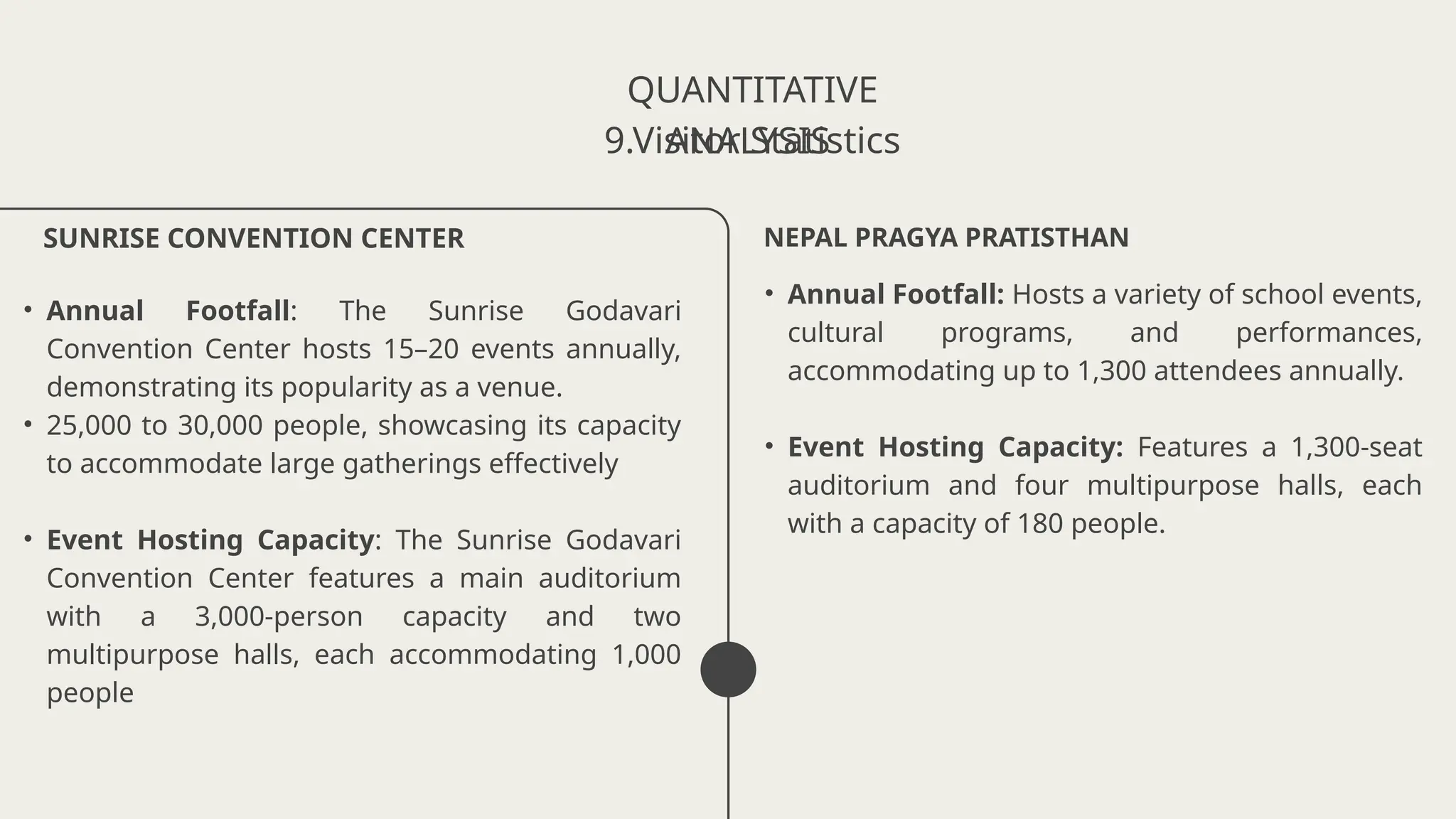
• Annual Footfall: The Sunrise Godavari
Convention Center hosts 15–20 events annually,
demonstrating its popularity as a venue.
• 25,000 to 30,000 people, showcasing its capacity
to accommodate large gatherings effectively
• Event Hosting Capacity: The Sunrise Godavari
Convention Center features a main auditorium
with a 3,000-person capacity and two
multipurpose halls, each accommodating 1,000
people
SUNRISE CONVENTION CENTER
9.Visitor Statistics
• Annual Footfall: Hosts a variety of school events,
cultural programs, and performances,
accommodating up to 1,300 attendees annually.
• Event Hosting Capacity: Features a 1,300-seat
auditorium and four multipurpose halls, each
with a capacity of 180 people.
NEPAL PRAGYA PRATISTHAN
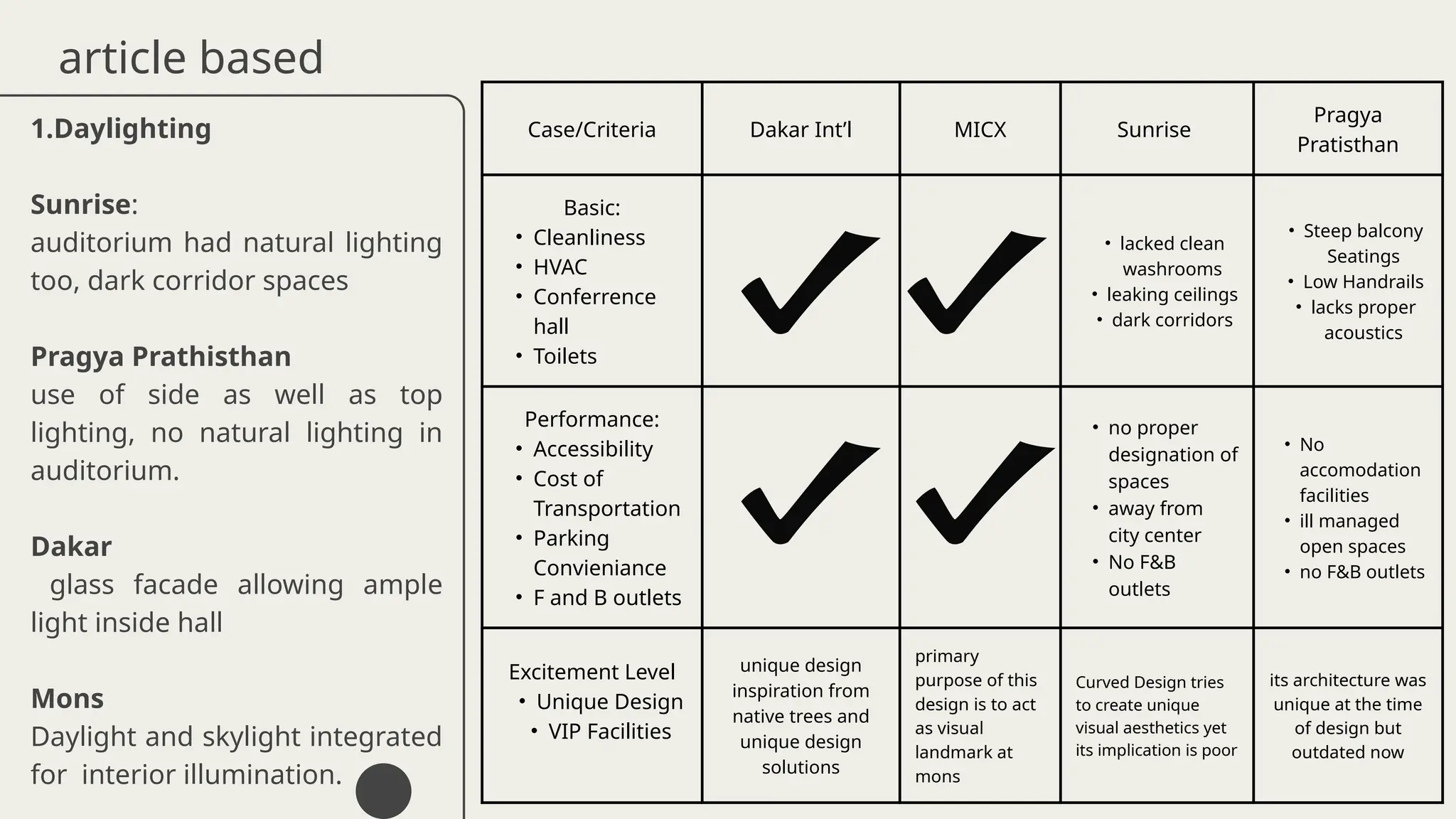
1.Daylighting
Sunrise:
auditorium had natural lighting
too, dark corridor spaces
Pragya Prathisthan
use of side as well as top
lighting, no natural lighting in
auditorium.
Dakar
glass facade allowing ample
light inside hall
Mons
Daylight and skylight integrated
for interior illumination.
Case/Criteria Dakar Int’l MICX Sunrise
Pragya
Pratisthan
Basic:
• Cleanliness
• HVAC
• Conferrence
hall
• Toilets
• lacked clean
washrooms
• leaking ceilings
• dark corridors
• Steep balcony
Seatings
• Low Handrails
• lacks proper
acoustics
Performance:
• Accessibility
• Cost of
Transportation
• Parking
Convieniance
• F and B outlets
• no proper
designation of
spaces
• away from
city center
• No F&B
outlets
• No
accomodation
facilities
• ill managed
open spaces
• no F&B outlets
Excitement Level
• Unique Design
• VIP Facilities
unique design
inspiration from
native trees and
unique design
solutions
primary
purpose of this
design is to act
as visual
landmark at
mons
Curved Design tries
to create unique
visual aesthetics yet
its implication is poor
its architecture was
unique at the time
of design but
outdated now
article based
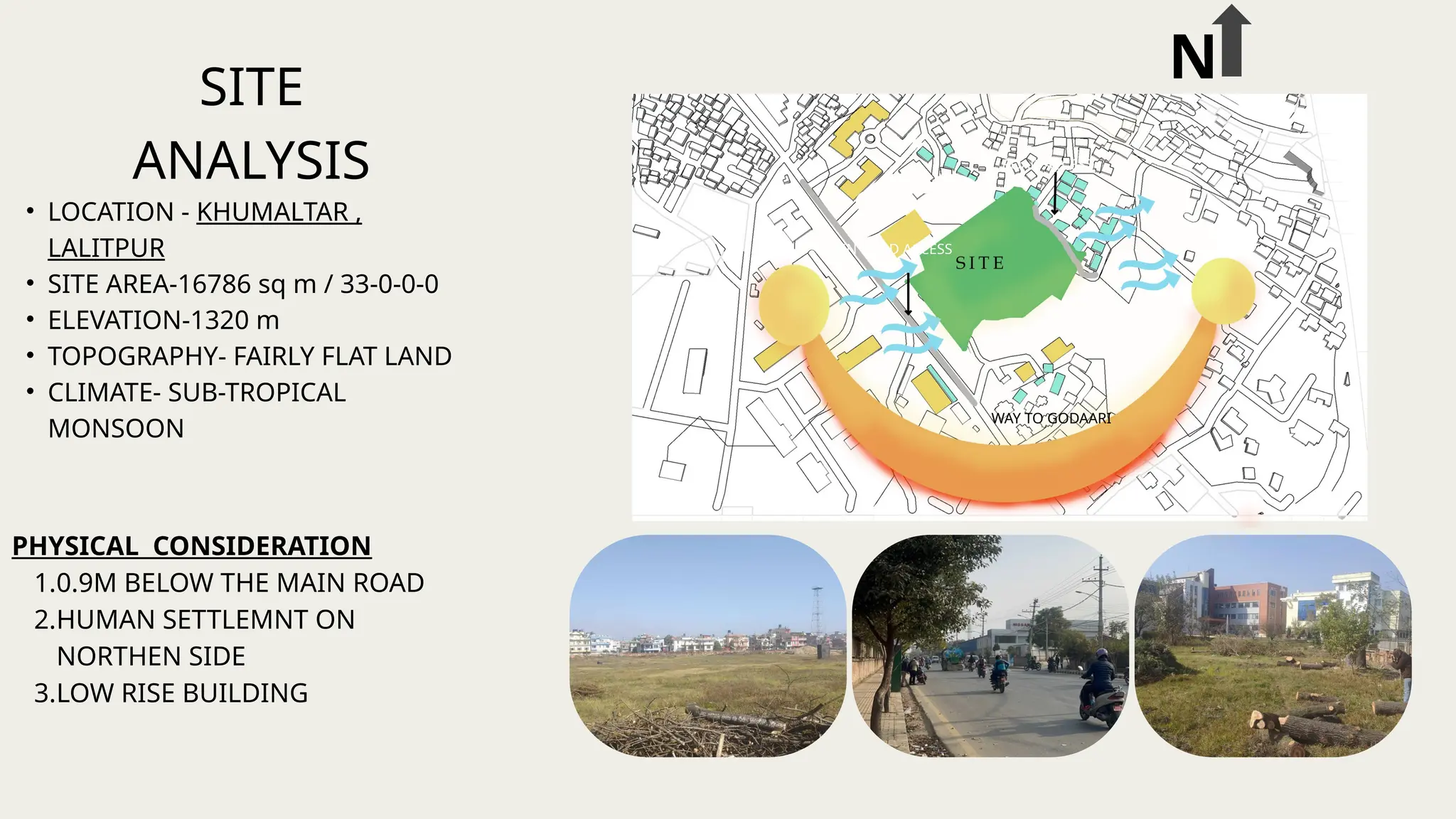
SITE
ANALYSIS
• LOCATION - KHUMALTAR ,
LALITPUR
• SITE AREA-16786 sq m / 33-0-0-0
• ELEVATION-1320 m
• TOPOGRAPHY- FAIRLY FLAT LAND
• CLIMATE- SUB-TROPICAL
MONSOON
MAIN ROAD ACCESS
ROAD ACCESS
WAY TO GODAARI
N
PHYSICAL CONSIDERATION
1.0.9M BELOW THE MAIN ROAD
2.HUMAN SETTLEMNT ON
NORTHEN SIDE
3.LOW RISE BUILDING
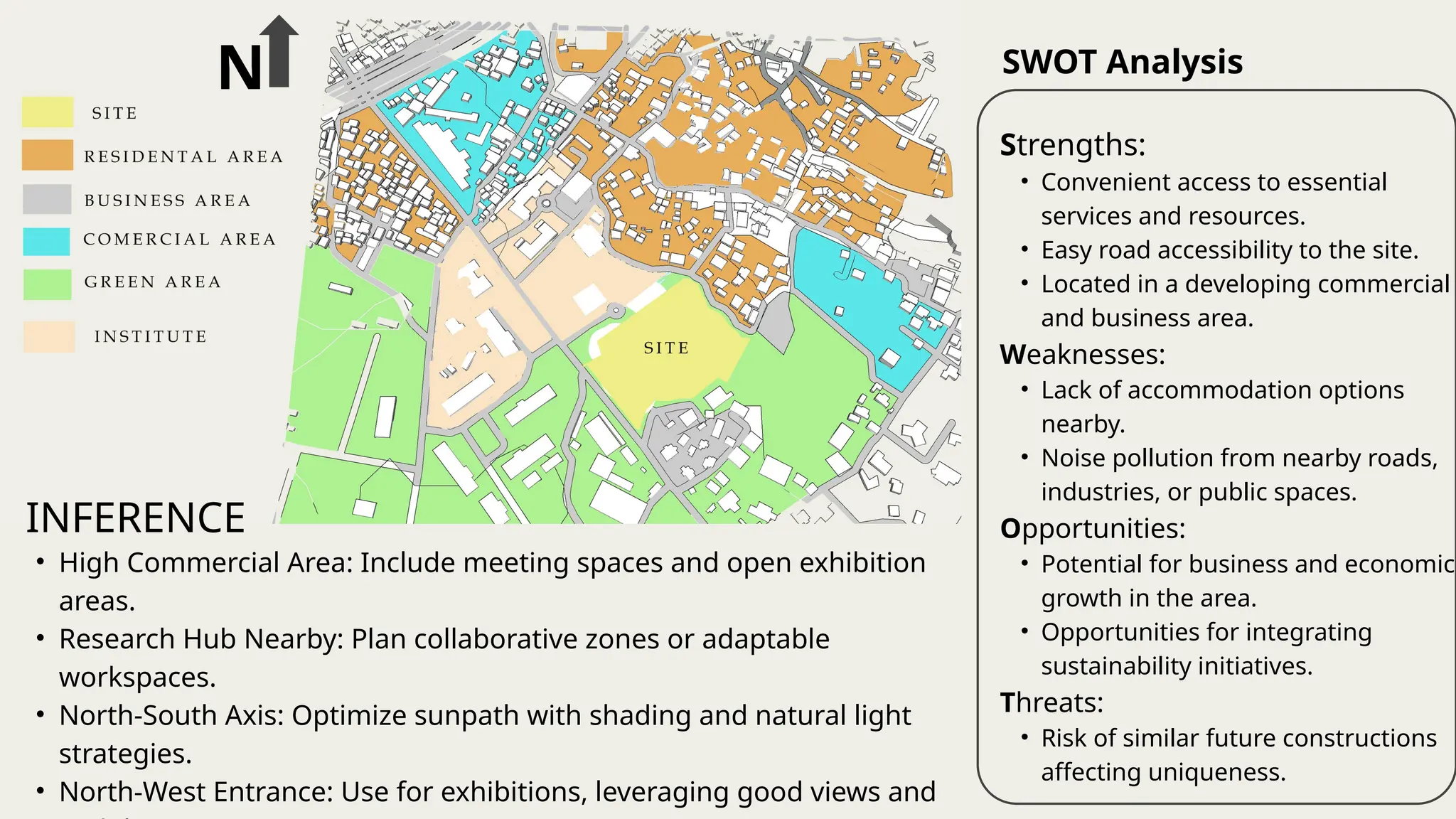
• High Commercial Area: Include meeting spaces and open exhibition
areas.
• Research Hub Nearby: Plan collaborative zones or adaptable
workspaces.
• North-South Axis: Optimize sunpath with shading and natural light
strategies.
• North-West Entrance: Use for exhibitions, leveraging good views and
INFERENCE
Strengths:
• Convenient access to essential
services and resources.
• Easy road accessibility to the site.
• Located in a developing commercial
and business area.
Weaknesses:
• Lack of accommodation options
nearby.
• Noise pollution from nearby roads,
industries, or public spaces.
Opportunities:
• Potential for business and economic
growth in the area.
• Opportunities for integrating
sustainability initiatives.
Threats:
• Risk of similar future constructions
affecting uniqueness.
SWOT Analysis
N
Case Studies: Convention Center Design.pptx

  • 1.
    CASE STUDY OF CONVENTION CENTERS - PRESENTEDBY : AAKRITI GIRI(078BAR001) ADWETA AMATYA(078BAR007) ARJUN TIMSINA(078BAR010) ASHOK SHRESTHA(078BAR011) MANOJ THAPA(078BAR015) OSHIN DURA(078BAR024) PRESENTED TO: Assoc. Prof. Surya Gyawali Asst. Prof. Pratikshya Shrestha
  • 2.
    Literature Review International CaseStudies: National Case Studies: Comparative Analysis: Site Analysis: 1 2 3 4 5 TABLE OF CONTENTS
  • 3.
    Introduction A convention centeris a large facility designed to host conferences, exhibitions, and events, providing space and services for gatherings of various sizes. Convention – A large meeting of member of profession, a political party, etc. Center- A place or an area where a lot of people live, a place where a lot of business and cultural activity takes place Oford Ada ed Lear er Di tio ar 7th edition, Oxford University Press LITERATURE REVIEW Sun rise convention BICC center sketch by : oshin dura
  • 4.
    Home About Us Contact •Industry-Specific Gatherings: Meetings related to business, industries, or industrial segments. • Academic Assemblies: Conventions based on profession, education, and research. • Entertainment Events: Gatherings for displays, shows, fashion, concerts, performances, etc. ENTERTAINMENT EVENTS INDUSTRY-SPECIFIC GATHERINGS ACADEMIC ASSEMBLIES TYPES INTRODUCTION Importance • Facilitates Large Gatherings • Economic Growth • Promotes Networking • Supports Event Diversity • Enhances City Branding • Encourages Innovation source :google
  • 5.
    • Ancient Forums: ⚬Example: Roman Forums served as civic and commercial hubs. • Amphitheaters: ⚬ Hosted entertainment and public gatherings, e.g., the Colosseum. • Town Halls: ⚬ Centers for governance and community events in medieval Europe. HISTORY INTRODUCTION 1.Early Public Assembly Spaces open space • Trade Fairs: ⚬ Promoted agricultural goods and crafts. ⚬ Early examples in The Crystal Palace(1850)London ⚬ Bingley Hall (1851)Birmingham • Great Halls: ⚬ Privileged gathering spaces in castles for knights, lords, and royalty. ⚬ Notable examples: Crathes Castle (1323), Eltham Palace (1301). 2. Middle Ages: Trade Fairs and Great Halls Enclosed Spaces • Integration of LED lighting, modular spaces, and advanced fire protection. • Addition of outdoor plazas and hybrid event facilities. • Shift towards energy efficiency and sustainability in new designs. • Global examples: ⚬ Sydney International Convention Centre (Australia): Sustainability and innovation. ⚬ Moscone Center (USA): Urban integration and green design. 3. Modern Era (1950s and Beyond) enclosed spaces source :wikipedia
  • 6.
    HISTORY INTRODUCTION History of ConventionCenters in Nepal • Traditional Gathering Spaces:(OPEN ROOF) ⚬ Dabali, Chowk, and Chautara traditionally used for public meetings and social functions. • Modern Facilities:(Enclosed roof) ⚬ Conventional center Kamaladi Pragya Pratisthan Bhawan 1957 AD , Bhirkuti mandap1963 , City hall 1969, was constructed ⚬ Development of Birendra International Convention Center (BICC) on 1993 AD with world-class amenities. ⚬ Luxurious hotels like Soaltee Crown Plaza, Annapurna, and Hyatt provide conference facilities. Chowk, Dabalis, and Chautara sketch by : oshin dura
  • 7.
    THEORETICAL FRAMEWORK 1. UrbanDesign Theories with Anthropological Insights • Place-Making and Identity:. ⚬ Focus on creating functional, inclusive public assembly spaces that balance accessibility, aesthetics, and utility. • Human-Centered Urbanism: ⚬ Urban designs informed by anthropological studies on how people engage with public spaces. Cultural Significance in Convention Centers • Reflecting Local Identity: ⚬ Integrating indigenous or regional architectural motifs. ⚬ Designing for cultural festivals and heritage celebrations. • Cultural Inclusivity: ⚬ Creating spaces that accommodate diverse Environmental and Economic Anthropology • Sustainability in Context: ⚬ Understanding local environmental practices to enhance green design. ⚬ Designing for long-term adaptability and resilience. • Economic Anthropology: ⚬ Convention centers as marketplaces for ideas, 2. Cultural and Environmental Convention Centers source :google
  • 8.
    TYPES OF SERVICES BasicLevel Performance level Excitement level Cleanliness HVAC Exhibition Hall Toilets Accessibility Cost of transportation Parking convenience F & B outlets Unique architectural design Nightlife VIP lounges Tourist info. Kano’s model : Effect of Basic, Performance and Excitement service factors in convention centers The Effect of Basic, Performance and Excitement Service Factors of a Convention Center on Attendees' Experiential Value and Satisfaction: A Case Study of the Phoenix Convention Center
  • 9.
    • Use elementslike light shelves, clerestories, and skylights for deeper light penetration • Use translucent panel systems, evenly distribute daylight throughout enormous indoor spaces • Reduces energy consumption by 35% - 55% (if strategies like skylights are correctly implemented). • Use of domes, atriums, clerestory windows, anti- solar windows, and light pipes were most adequate for daylighting and energy efficiency optimization • Align the model with LEED, BREEEAM, or WELL DAYLIGHT STRATEGY Assessment of Daylighting Strategies in Selected Convention Centres for Improved Sustainability source :timesav er Assessment of Daylighting Strategies in Selected Convention Centres for Improved Sustainability B. A. Adewale and E. A. Ewuoso
  • 10.
    TYPES OF SPACES PublicSpace Semi Public Space Private Space Services Entrance Hall Registration Area Exhibition Hall Toilets Auditorium Conference Rooms Seminar Halls Toilets Restaurants/Cafe Administrative Office Control Room Loading Bay Maintenance Parking VIP lounges
  • 11.
    Auditorium FORNT HOUSE STAGE SUPPORT SEATING VIEWIING ANDANTHEOPOLOGY source :timesaver standards for building types BROAD LIGHT PRESENTER LIGHT AUDIANCE LIGHT VENTILATION SOUND LIGHTING
  • 12.
    Seatings and flowdiagrams: RESTURANT ACCOMODATION source :timesav er
  • 13.
    • Flexible &Non-Rigid Elements: 1. Forms: Arches, cables, tents. 2.Features: High-tension materials; spans up to 100m. • Flexible but Rigid Elements: 1. Forms: Shells, plates, domes. 2.Features: Thin ratios (2.4":100"), materials include RC, metal, glass, and plastics. • Rigid & Solid Elements: 1.Forms: Beams, frames, slabs. • Trusses: 1.Types: Flat, curved, space trusses. 2.Widely used for large-span buildings. CONSTRUCTION TECHNIQUE ARCHES DOMES. BEAMS, FRAMES FLAT, CURVED, SPACE TRUSSES. source google
  • 14.
    Sustainability and Technologies inConvention Center Design Sustainability and Technologies in Convention Center Design • Green Building Technologies: Use of eco- friendly materials and sustainable construction practices. • Energy Efficiency: Integration of renewable energy sources like solar panels and energy- saving systems. • Waste Management & Water Conservation: Strategies for recycling, composting, and efficient water use. through aesthetic, Vancouver Convention Centre China National Convention Centre
  • 15.
    Heating and coolingthrough • Thermal bi- metals (roofing) • Geothermal / Greenway (river terrace) DESIGN FEATURES Energy production • Algae Panels (performance space ) • Solar Nanotechnology(Solar panels/Spray) Reintroduction • Bio swales(river terrace) • gray water treatment(purifies water) sources a comprehensive design of a energy efficent conventional center - Aexis Kautzman
  • 16.
    Conclusion: Literature Review Convention centershave evolved from traditional gathering spaces like Roman forums and medieval trade fairs to modern hubs of innovation and collaboration. Rooted in urban design theories, they balance cultural significance, inclusivity, and human- centered principles while addressing environmental and economic needs. 1.Technological Integration: Hybrid spaces, AI, and AR/VR for flexibility. 2.Adaptability: Supporting diverse in-person and virtual events. 3.Global Insights: Learning from successful global examples. 4.Future Focus: Creating user-centric, dynamic, and The Great Exhibition, Crystal Palace IFFconvention center
  • 17.
    International Case Study INTERNATIONAL CASE STUDIES: DakarInternational Congress Center Mons Convention Center
  • 18.
    • Architects: TabanliogluArchitects • Area: 16270 m² • Year: 2014 • City: Dakar • Country: Senegal • Capacity: 1500 • Represents unity and shelter, much like the symbolic tree under which kings once met. • "One People, One Goal, One Faith." Inspired by Senegal’s Baobab trees, known for their longevity and cultural significance. Dakar International Congress Center Source:
  • 19.
    Design Philosophy Dakar ICC DesignPhilosophy • Unity and Continuity: Separate units linked by water and bridges symbolize community foundations. • Longevity and Pride: Designed to endure time and symbolize Africa’s progress. • Transparency and Confidentiality: Balances openness for communal activities and privacy for state affairs. • Sustainability: Mesh screens, water body for energy efficiency, daylight optimization, and heat reduction. Source:
  • 20.
    Public/Press Entry Commercial/ Delegates Entry VIP/Presidential Entry Public Spaces SemiPublic Spaces Private Spaces Security Camp Technical Building Connecting Space Source:
  • 21.
    Dakar ICC Spatial planningand Functional spaces Area Coverage Source: manojthapaarts
  • 22.
  • 23.
    Plans Dakar ICC Functional Layout •Main Hall: Central rectangular space for 1,500 delegates. • VIP and Public Entrances: Separate pathways ensure smooth flow and security. • Museum and Fair Zone Highlight culture and facilitate public engagement. • Presidential Access: Private bridge to exclusive spaces. Source: archdaily.com
  • 24.
  • 25.
    Single-Span Roof: Inspiredby the Baobab tree canopy, Semi-Transparent Metal Envelope: Acts as a shield, providing thermal protection and optimizing daylight Heat-Resistant Glass: improves energy efficiency. Source: britannica.com Design features: Dakar ICC Source:
  • 26.
    Combination of RCCand Steel Structure(I-section, C section, MS Box Section etc) Source: summa.com.tr Source: Structure:
  • 27.
  • 28.
    Energy Efficiency • Useof heat-resistant glass reduces indoor temperatures, enhancing energy performance​ Mesh Curtain Façade: Functions as a sun-break, reducing heat and enhancing shading while maintaining transparency. Sustainability and Environment Considerations Twisted façade blades act as sunbreaks, providing shading and cooling while maintaining transparency Water Body enhance cooling through evaporative techniques, promoting a natural microclimate. Dakar ICC Source: archdaily.com Source: archdaily.com
  • 29.
    Conclusion Strengths: • Integration ofcultural symbolism with modern design. • Simple and Effective zoning and multifunctionality. Critiques: • High maintenance demands for reflective and mesh features. • The advanced design relies heavily on high- tech systems, which might be costly and challenging to maintain • Lack of use of photovoltaic (PV) cell for sustainable energy production • Water around the building needs constant cleaning and maintenance • Lack of cultural identity in matraials • Improper site planning and placement of spaces Dakar ICC Source: arch2o.com
  • 30.
    Introduction Mons International ConventionCentre • Name: Mons International Congress Xperience. • Location: Mons, Belgium. • Area: 12, 500 sq. meter (41,010 sq feet) • Year: Opened January 9, 2015. • Architects: Studio Libeskind in collaboration with H2a. • Ownership: Public infrastructure, contributing to Mons' urban plan. • Expression of contrasting geometric forms. “If you build in the right way using high-quality materials, innovation and technology, you will create something long lasting and sustainable,” source: archdaily.com
  • 31.
    Design Philosophy Design Inspiration •Vision: Blend modern geometry with historic city context. • Framework: Ribbon-shaped aluminum and wooden cladding signify movement and flexibility. Sustainability and Innovation • Passive shading, night cooling, green roofs. • Integration of photovoltaic cells and geothermal heating. • Aiming to achieve Valideo status B, Belgium’s equivalent to LEED GOLD. Introduction Mons International Convention Centre source: youtube.com illustration by : Manoj Thapa
  • 32.
    Design Philosophy Design Philosophy DesignInspiration • Stategic Location: situated near the French border, easy access to Mons station and the E19- E42 motorway • Openness and Transparency: The centre employs large glass facades to create transparency, symbolizing openness and accessibility Mons International Convention Centre source: archdaily.com source: youtube.com
  • 33.
    Spatial Planning andFunctional Aspects Functional Zoning • Grand lobby, three auditoriums (500, 200, 100 seats), conference rooms, offices, restaurants. • Circulation: Open plan with central lobby connecting all areas. Capacity and Flexibility • Modular event spaces for conferences, exhibitions, and social events. • Versatile layouts for evolving needs. Accessibility • Inclusive design: Prioritized universal access with ramps, elevators, and visual cues. Mons International Convention Centre source: youtube.com source: youtube.com
  • 34.
    Forum Space Reception Hall Auditorium /Committee Rooms Administration Management Festivity Hall General Logistics Public Entrance Public Entrance Parking Entrance Parking Exit Deliverie s SPACIAL PLANNING source: youtube.com
  • 35.
    Architectural Elements Exterior Features •Façade: Champagne aluminum ribbons and Robinia wood slats. • Cladding reveals the interior scheme, with lower walls finished with upright timber slats • Upper section featuring vertical bands of anodized aluminum. • A steel viewing platform at the top for viewing17th-century Belfry tower, a UNESCO Heritage Site and the La Haine river. Mons International Convention Centre illustration by: manojthapaarts source: youtube.com illustration by: manojthapaarts
  • 36.
    Architectural Elements Mons ConventionCentre 1.Reinforced insulation of opaque walls refers to the use of insulation materials that provide enhanced protection against electrical shock and improved thermal performance. 2. Performance glazing refers to advanced glass technologies designed to improve the energy efficiency, comfort, and functionality of windows and facades in buildings Interior Features -The Center houses • A grand entrance hall, • Three auditoriums (Auditorium seats: Orange Poltrona Frau/Cassina) • A multi-purpose event hall, • Conference rooms, • Offices, • A restaurant, • An underground parking • A public roof terrace -Bright, open double-height lobby or “Forum” -Reinforced Insulation of opaque walls -Performance Glazing System -skylights cut through the length of the crescent- shaped space at irregular intervals to usher in daylight, and create shifting patterns of natural illumination 1 2 source: youtube.com source: libeskind.com
  • 37.
    Parking Ramp Technical Rooms Elevator Shaft Parking Ramp Lower Basement Isometric Plan Level 0 Isometric Plan Stairs MainStaircase Forecourt General Logistics Multipurpose Space Restrooms Stairs Exhibition / Circulation Space Main Entrance Reception / Dining Hall Parking Ramp Deliveries TECHNICAL ROOM GREEN ROOF OBSERVATION PLATFORM Level 2 +8 metre Isometric Plan FORECOURT WOODEN TERRACE MAIN ENTRANCE LARGE AUDITORIUM (320-505 SEATS) AUDITORIUM 1 (203 SEATS) DELIVERIES DELIVERIES MANAGEMENT ADMINISTRATION COMMISSION ROOMS AND INDIVIDUAL OFFICES FORECOURT MAIN ENTRANCE MAIN STAIRCASE AUDITORIUM 1 AUDITORIUM 2 Level 1 +5 metre Isometric Plan Mons International Convention Centre source: archdaily.com
  • 38.
    Roof Isometric Plan Skylight Green roof Forecourt Observation Platform Main entrance Woodenterrace Deliveries Parking Ramp Observation platform Exhibition and circulation space Roof garden Reception / dining hall Congress center management Main staircase Main Entrance Forecourt Roof garden Technical Space Observation platform Exhibition and circulation space Restrooms Multipurpose space Meeting rooms / Individual offices source: archdaily.com
  • 39.
    Structural and Technical Aspects StructuralSystem • Materials: Cast-in-place concrete with a 3DR system for curvature. • Prow: Galvanized steel structure clad with aluminum. • Thermal Bridge Free construdtion Building Services • Efficient HVAC, advanced acoustics, and ICT integration. • Retrieval of rainwater via roof • Implementation of solar panels on the roof Mons International Convention Centre
  • 40.
    Structural and TechnicalAspects • Floating Volume: A floating aesthetic, with the building seemingly suspended above the ground on structural supports. • Effect of a hovering mass, while also contributing to the sense of openness and fluidity • Large-Span Roof Structure: The roof is supported by a series of large, curved steel trusses, allowing for an expansive interior free from internal columns. Mons International Convention Centre
  • 41.
    Materials Used: Paved StoneFlooring Solid Wood Grating Metal Grating Greenery (Grass) Benches Mons International Convention Centre source: youtube.com
  • 42.
    • Primary structure:Cast-in-place concrete • Floors: Light grey concrete with inlaid Belgium blue stone • Interior ribbon walls: White plaster • Walls: Warm grey wood panels in the lobby, restaurant, and multi-purpose event space and dark brown wood panels in auditoriums • Grand staircase: Cast in place concrete with white plaster finish and blue stone steps • Windows: Aluminum curtain wall, blue Materials Used: Mons International Convention Centre
  • 43.
    • Urban Context:The modern design contrasts sharply with Mons' historical architecture, creating a visual disconnect. • Usability Concerns: The spiraling layout and limited natural light reduce functionality and user comfort. • Material Issues: The unfinished Robinia wood and aluminum may weather poorly over time, leading to aesthetic and maintenance challenges. • Unrealized Landmark Potential: Despite its striking form, the MICX lacks the transformative impact expected of a cultural landmark. • Sustainability Limitations: The building's green features, while present, are not considered cutting-edge by contemporary standards. • Community Integration: Public spaces, such as the roof terrace, are underutilized due to access and design limitations. CRITIQ UE
  • 44.
    • Aesthetic Appeal:The fluid and organic design language creates a striking visual identity • Transparency and Connection: Extensive use of glass, integration with the surrounding environment offer a strong visual connection to the surrounding. • Sustainability: The building integrates energy- efficient systems, green roofing, and passive design strategies to minimize environmental impact Conclusion Mons International Convention Centre
  • 45.
    national Case Study NATIONAL CASESTUDIES: Sunrise Convention Center Nepal Academy Hall
  • 46.
    • Architects: PHAand others. • Area: 21875 m² • Year: 2021 • City: Lalitpur • Country: Nepal • Capacity: 3000 • The building's overall form can resemble a semi- circular arc or a rising sun with rays radiating Introduction SUNRISE CONVENTION CENTER “A journey from sunrise to sunset, symbolizing renewal, growth, and harmony with nature” source :photograph yr Access and Parking • Gates: Three gates—two for vehicle entry/exit and one for pedestrians. • Parking: Located behind the building with a loop for smooth traffic flow
  • 47.
    Design Philosophy Design Philosophy •Sun-Inspired Form: Semi-circular arc resembling a rising sun with radiating rays. • Symbolic Orientation: East-facing entrance, symbolizing new beginnings; westward extension for a dawn-to-dusk journey. • Aesthetic Façade: Durable design representing progress and resilience. • Landscape Integration: Pathways mimicking sunrays, leading to outdoor spaces. SUNRISE CONVENTION CENTER source :photography
  • 48.
    OFFICE MULTIPURPOSE HALL FACADE AUDITORIUM source :photography Spatial planningand Functional spaces SUNRISE CONVENTION CENTER source : Prajwal Hada and Associates Space Distribution
  • 49.
    Supporting Rooms • GreenRoom: Located behind the stage. • Machine Room: Positioned below the uplifting ramp. HVAC System • Available in the main auditorium for climate control. Fire Safety • Available in the main auditorium for climate control. SUNRISE CONVENTION CENTER source :photography
  • 50.
    Design Features/Architectural elements LightingFeatures: • Auditorium Lighting: Natural light enters from three sides near the ceiling, supported by artificial lighting. • Multipurpose Halls: Natural light flows in from the south, ensuring bright spaces. • Backstage and Utility Areas: Backstage uses artificial lighting, while utility rooms receive natural light from the north. SUNRISE CONVENTION CENTER source :photograph Acoustic Features: • Sound-Absorbing Walls: Equipped with panels to enhance acoustics. • Carpet Flooring: Installed to absorb sound and minimize echoes. • Furniture Design: Wooden, upholstered in soft fabric to aid sound attenuation. • Ceiling Design: Structured to evenly reflect sound across the hall.
  • 51.
    Structural Aspects andMaterials Angled beams holding the roof SUNRISE CONVENTION CENTER source :photography
  • 52.
    Sustainability and Environment Considerations •Incorporate nature by keeping native vegetation intact, clearing the site under control, and adding landscaping that blends in with the surrounding environment. • Trusses enable the creation of large, column free spaces in the multipurpose halls • The large glass surfaces allow ample natural light to penetrate the halls, reducing the need for artificial lighting during the day SUNRISE CONVENTION CENTER source :photography
  • 53.
    Critiques Features • Underutilized liftslack functional integration. • Inadequate kitchen space limits catering efficiency • Lack of catwalk for maintenance accessibility • Small stage and poorly planned rooms reduce usability. • No clear separation between VIP and general accommodation areas. • The service sewage from the ceiling and the challenging maintenance of electric lights create operational inefficiencies. SUNRISE CONVENTION CENTER source :photography The Sunrise Convention Center uses eco-friendly materials like brick and glass, promoting energy efficiency, natural lighting, and thermal comfort Its design blends with the Godavari jungle, providing scenic views, maintaining a cool environment, and minimizing ecological disruption Located away from the crowded city, the Sunrise Convention Center offers a serene environment, free from traffic congestion, with ample parking space. Conclusion
  • 54.
    Introduction NEPAL PRAGYA PRATISTHAN Architect:Shankar nath Rimal Area: 50 ropani ,25436 square meters. Year: 2014 BS Location: Kamaladi Country: Nepal Auditorium Capacity: 1323 (833-Lower, 490-Balcony Seating) Programs related to: languages, literature, culture, philosophy and social sciences of Nepal. /archirelated.blogspot.com नेपाल प्रज्ञा–प्रतिष्ठान – Nepal Academy – Official Website casestudy review
  • 55.
    Design features नेपाल प्रज्ञा–प्रतिष्ठान– Nepal Academy – Official Website • Blending Modern and Traditional: Combines modern materials with traditional Nepali motifs, including brick facades, modern windows, and plastered surfaces. • Dramatic Entrance and Landscaping: Features a garden with a central pond and a temple-like entrance, emphasizing cultural significance. NEPAL PRAGYA PRATISTHAN
  • 56.
    Introduction sketch NEPAL PRAGYA PRATISTHAN •Access: Accessible from four sides, with two actively in use. • Parking: Surface parking available. • Landscape: Features water bodies, greenery, and paved walkways. • Additional Amenities: Includes a library, bookshop, and Pragya Dabali.
  • 57.
    Spatial planning andFunctional spaces SPACES Auditorium: Seats around 1323 people with a semi- circular layout for clear sightlines and excellent acoustics. Flexible Spaces: Includes areas for art exhibitions, conferences, and performances, adaptable for multiple uses. NEPAL PRAGYA PRATISTHAN source:photography
  • 58.
  • 59.
    • Structural Innovation :Uses precast girders, diaphragm wall s, and shear walls for earthquake resis tance, with cantilevered structures sup ported by circular columns. • Cubical Form : A cubical design with cantilevered sec tions, reflecting modern architectural p rinciples. https://thekathmandupost.com/ https://www.scribd.com NEPAL PRAGYA PRATISTHAN strutural aspects source:photography
  • 60.
    • The auditoriumuses only artificial lighting. • Exhibition halls, conference rooms, and offices receive natural light from the south, enhanced with artificial lighting . • Library and staircases utilize north- facing light for soft, diffused illumination. FEATURES Lighting Features Artificial lighting. Natural lighting. NEPAL PRAGYA PRATISTHAN source:photography
  • 61.
    Use of skylightin corridor Illumination inside Use of transparent CGI sheet Used as light well Features NEPAL PRAGYA PRATISTHAN
  • 62.
    Architectural Acoustics • WallTreatment: Wooden stripes on lower walls and perforated acoustic panels above effectively control sound diffusion and absorption. • Ceiling and Flooring: The ceiling incorporates sound-diffusing panels, while carpeted floors minimize sound reflections. PERFORATED ACOUSTIC PANELS WOODEN STRIPES WITH MESH NEPAL PRAGYA PRATISTHAN PROTUTED SURFACE FOR SOUND DIFFUSION source:photography features
  • 63.
    features NEPAL PRAGYA PRATISTHAN •Integrated Sound System: Built-in wall loudspeakers ensure efficient sound reinforcement. Furniture Materials: Wooden seating, upholstered in soft fabric, enhances sound and audience comfort. source:photography Architectural Acoustics
  • 64.
    • Four conferencerooms on the first and second floors, each seating 60-70 people. • Named after Nepali poets, with ample storage space. • One room has an elevator for easy access from the ground floor. Architectural Features CONFERENCE ROOM U- SHAPED SEATING ARRANGEMENT NEPAL PRAGYA PRATISTHAN source:photography features
  • 65.
    servives NEPAL PRAGYA PRATISTHAN source:photography ControlRoom HVAC Water Supply Backstage Generator Room Service ramp
  • 66.
    conclusion strength • Steep anglein auditorium balcony. • No notable efforts in sustainability. • Randomly placed parking spaces. • Lacks a proper exhibition hall and residential areas. • Absence of dining facilities. • Does not emphasize inclusive design. • Small opening for maintainance of Features NEPAL PRAGYA PRATISTHAN limitations • Grand foyer and aesthetically appealing landscaping. • Blend of traditional and modern techniques. • Well-executed exhibition and circulation areas. • Skylights used throughout. • Purposefully designed and well-equipped auditorium.
  • 67.
  • 68.
    DAKAR • Inspired bySenegal’s Baobab trees, known for their longevity and cultural significance. • symbolize Africa’s progress • Integration of cultural symbolism with modern design • Represents unity and shelter, much like the symbolic tree under which kings once met QUALITATIVE ANALYSIS 1. Design and Aesthetic Appeal Nepal Pragya Pratisthan • Combines modern materials with traditional Nepali motifs. • Contemporary architectural design of ribbion windows • Strong sense of Vertical and horizonatal lines • Imitating the traditional Nepali architecture : Brick facade and wooden windows
  • 69.
    QUALITATIVE ANALYSIS 1. Design andAesthetic Appeal MICX • Expression of contrasting geometry • Modern geometry with historic city situated near the French border • Designed as a landmark for the city Sunrise Convention Center • Semi-circular arc representing rising sun with rays radiating outward. • East-facing entrance, symbolizing new beginnings; westward extension for a dawn-to- dusk journey. • Design blends seamlessly with the Godavari jungle
  • 70.
    QUALITATIVE ANALYSIS 2. Functional Designand Spatial Planning SUNRISE CONVENTION CENTER • There is no separate pathway for VIPs • Multipurpose Rooms had their own separate entrances DAKAR • Units linked by water and bridges symbolize community foundations. • For VIP and Public separate pathways ensure smooth flow and security • Private bridge to exclusive spaces. • Simple and Effective zoning and multifunctionality. Public/Press Entry Commercial/ Delegates Entry VIP/Presidential Entry Public Spaces Semi Public Spaces Private Spaces Security Camp Technical Building Connecting Space Public Spaces Auditorium Green Room VIP Room Auditorium Sound Room Main Entrance
  • 71.
    QUALITATIVE ANALYSIS 3.VISITOR’S EXPERIENCE NEPAL PRAGYA PRATISTHAN •Built-in wall loudspeakers ensure efficient sound reinforcement and greenscaping in exterior. • Wooden seating, upholstered in soft fabric, enhances sound and audience comfort • High slope balcony seating ensues dear and insecurity • For VIP and Public separate pathways ensure smooth flow and security DAKAR • Balances openness for communal activities and privacy for state affairs. • Highlight culture and facilitate public engagement. • Mesh Curtain Façade: Functions as a sun-break, reducing heat and enhancing shading while maintaining transparency. • Water Body enhance cooling through evaporative techniques, promoting a natural microclimate.
  • 72.
    MICX • Reinforced Insulationof opaque walls • Performance glazing system • Solar panels on the roof • Thermal Bridge Free construction • Façade: Champagne aluminum ribbons and Robinia wood slats, Vertical bands of anodized aluminum • Cast-in-place concrete with a 3DR system for curvature QUALITATIVE ANALYSIS 4. Materials Used NEPAL PRAGYA PRATISTHAN • TRANSPARENT CGI SHEET FOR LIGHTING INTERIOR • P recast girders, diaphragm walls, and s hear walls for earthquake resistance • Wooden stripes and perforated panels • Ceiling incorporates sound-diffusing panels
  • 73.
    QUALITATIVE ANALYSIS 5. TECHNOLOGY AND ENVIRONMENTALDESIGN MICX • Aluminum curtain wall • Night cooling • Green roof • Photovoltaic cells • Geothermal heating system • Passive shading • High-level insulation DAKAR • Water Body • Heat-Resistant Glass • Twisted Facade Blades • Semi-Transparent Metal Envelope
  • 74.
    QUALITATIVE ANALYSIS 6. URBAN IMPACTAND COMMUNITY IMPACT MICX • The fluid and organic design language • Strong visual connection to the surrounding. • simple, yet dramatic • Key element in a plan for economic revitalization • New architectural landmark for Mons Sunrise Convention Center • Contributes in holding large scale national programs • Landmark for Godawari suburban area
  • 75.
  • 76.
    MICX • On trackto achieve Valideo status B, which is Belgium’s equivalent to LEED Gold DAKAR • APPLIED FEW SUSTAINABLE MEASURES LIKE HEAT RESISTANT GLASS, TWISTED FACADE BLADES, MESH CURTAIN FACADE, WATER BODIES 8. Focus On Sustainability Nepal Pragya Pratisthan • Not focused on Sustainability Sunrise Convention Center • Not focused on Sustainability
  • 77.
    QUANTITATIVE ANALYSIS • Annual Footfall:The Sunrise Godavari Convention Center hosts 15–20 events annually, demonstrating its popularity as a venue. • 25,000 to 30,000 people, showcasing its capacity to accommodate large gatherings effectively • Event Hosting Capacity: The Sunrise Godavari Convention Center features a main auditorium with a 3,000-person capacity and two multipurpose halls, each accommodating 1,000 people SUNRISE CONVENTION CENTER 9.Visitor Statistics • Annual Footfall: Hosts a variety of school events, cultural programs, and performances, accommodating up to 1,300 attendees annually. • Event Hosting Capacity: Features a 1,300-seat auditorium and four multipurpose halls, each with a capacity of 180 people. NEPAL PRAGYA PRATISTHAN
  • 78.
    1.Daylighting Sunrise: auditorium had naturallighting too, dark corridor spaces Pragya Prathisthan use of side as well as top lighting, no natural lighting in auditorium. Dakar glass facade allowing ample light inside hall Mons Daylight and skylight integrated for interior illumination. Case/Criteria Dakar Int’l MICX Sunrise Pragya Pratisthan Basic: • Cleanliness • HVAC • Conferrence hall • Toilets • lacked clean washrooms • leaking ceilings • dark corridors • Steep balcony Seatings • Low Handrails • lacks proper acoustics Performance: • Accessibility • Cost of Transportation • Parking Convieniance • F and B outlets • no proper designation of spaces • away from city center • No F&B outlets • No accomodation facilities • ill managed open spaces • no F&B outlets Excitement Level • Unique Design • VIP Facilities unique design inspiration from native trees and unique design solutions primary purpose of this design is to act as visual landmark at mons Curved Design tries to create unique visual aesthetics yet its implication is poor its architecture was unique at the time of design but outdated now article based
  • 79.
    SITE ANALYSIS • LOCATION -KHUMALTAR , LALITPUR • SITE AREA-16786 sq m / 33-0-0-0 • ELEVATION-1320 m • TOPOGRAPHY- FAIRLY FLAT LAND • CLIMATE- SUB-TROPICAL MONSOON MAIN ROAD ACCESS ROAD ACCESS WAY TO GODAARI N PHYSICAL CONSIDERATION 1.0.9M BELOW THE MAIN ROAD 2.HUMAN SETTLEMNT ON NORTHEN SIDE 3.LOW RISE BUILDING
  • 80.
    • High CommercialArea: Include meeting spaces and open exhibition areas. • Research Hub Nearby: Plan collaborative zones or adaptable workspaces. • North-South Axis: Optimize sunpath with shading and natural light strategies. • North-West Entrance: Use for exhibitions, leveraging good views and INFERENCE Strengths: • Convenient access to essential services and resources. • Easy road accessibility to the site. • Located in a developing commercial and business area. Weaknesses: • Lack of accommodation options nearby. • Noise pollution from nearby roads, industries, or public spaces. Opportunities: • Potential for business and economic growth in the area. • Opportunities for integrating sustainability initiatives. Threats: • Risk of similar future constructions affecting uniqueness. SWOT Analysis N