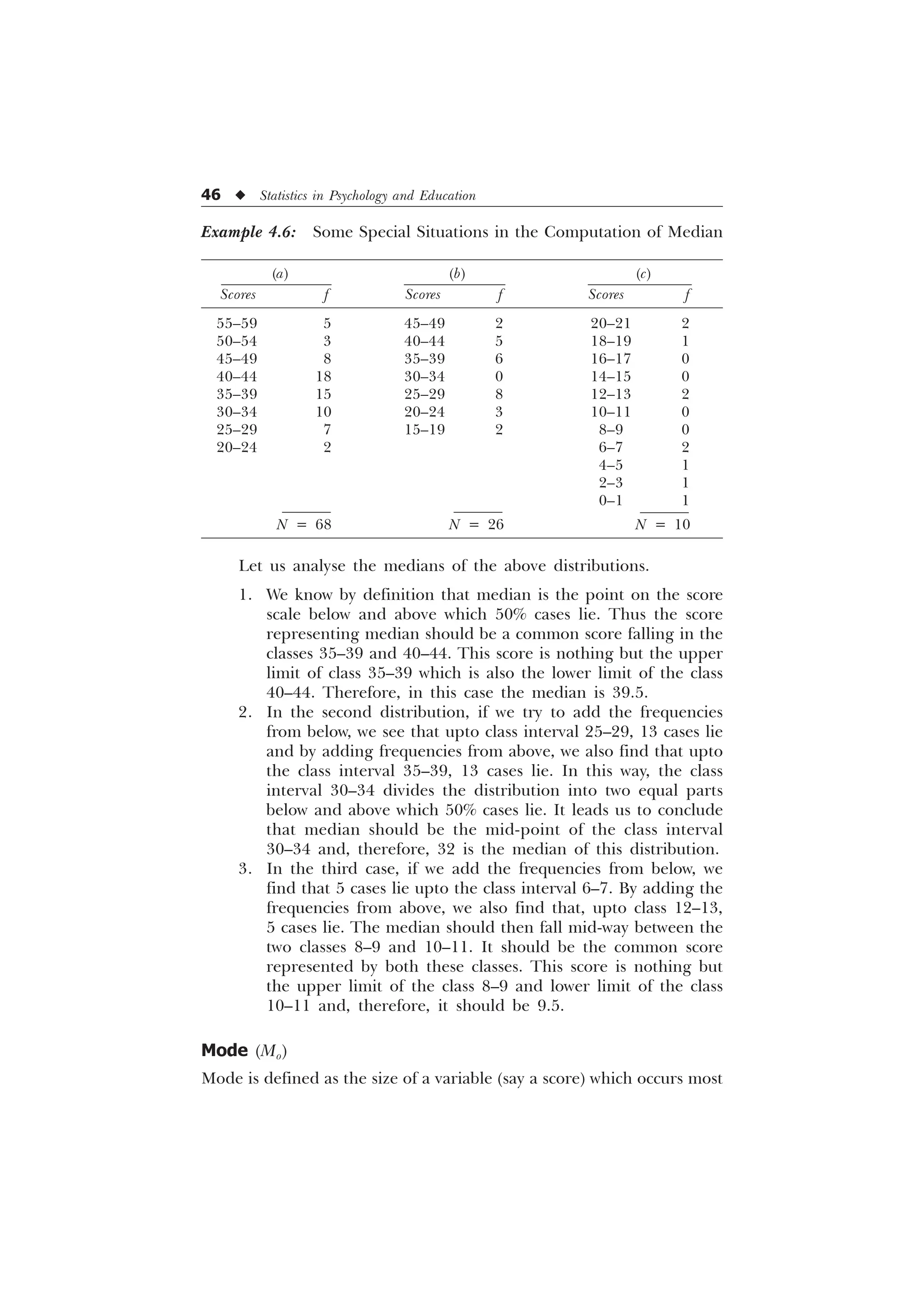
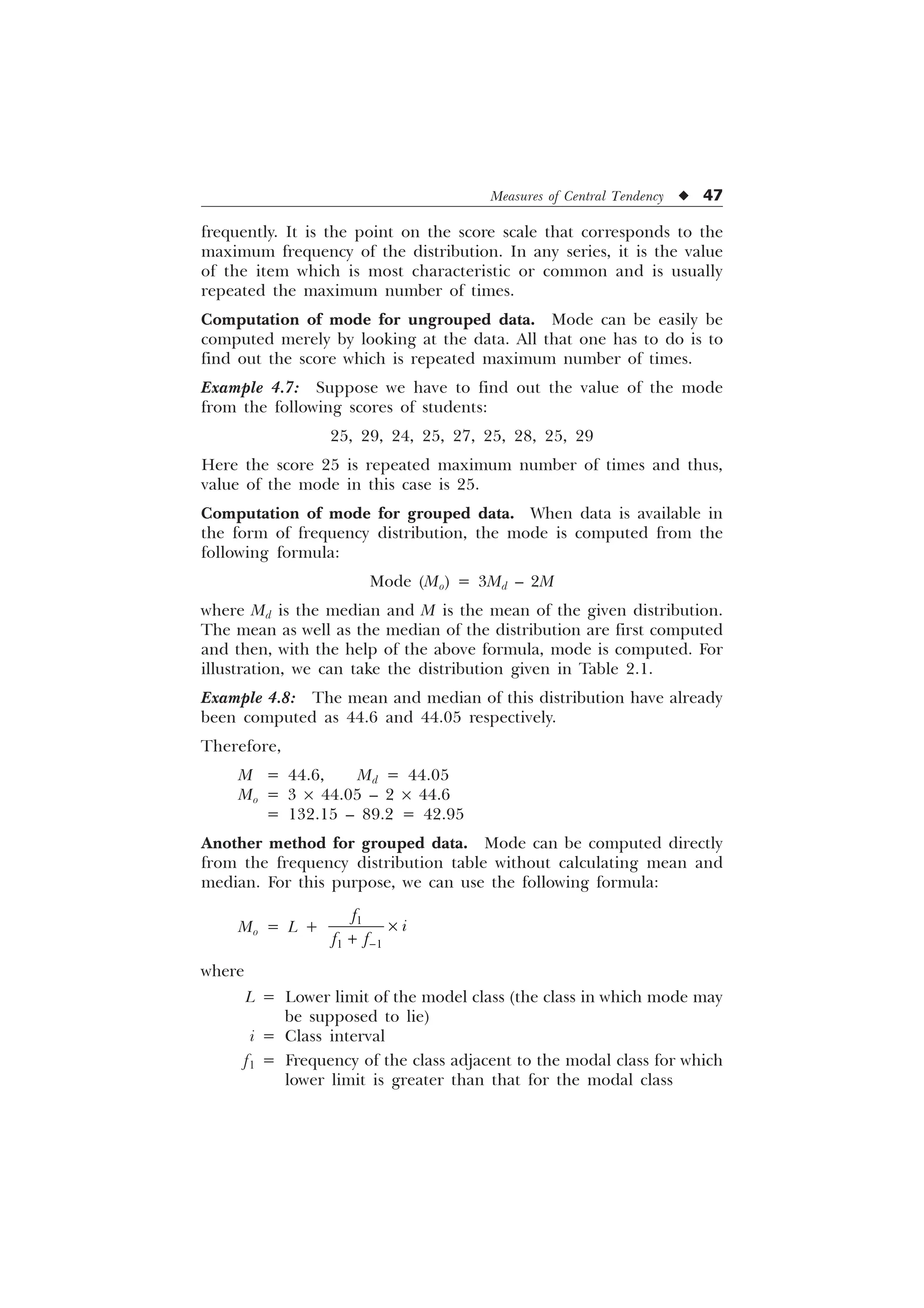
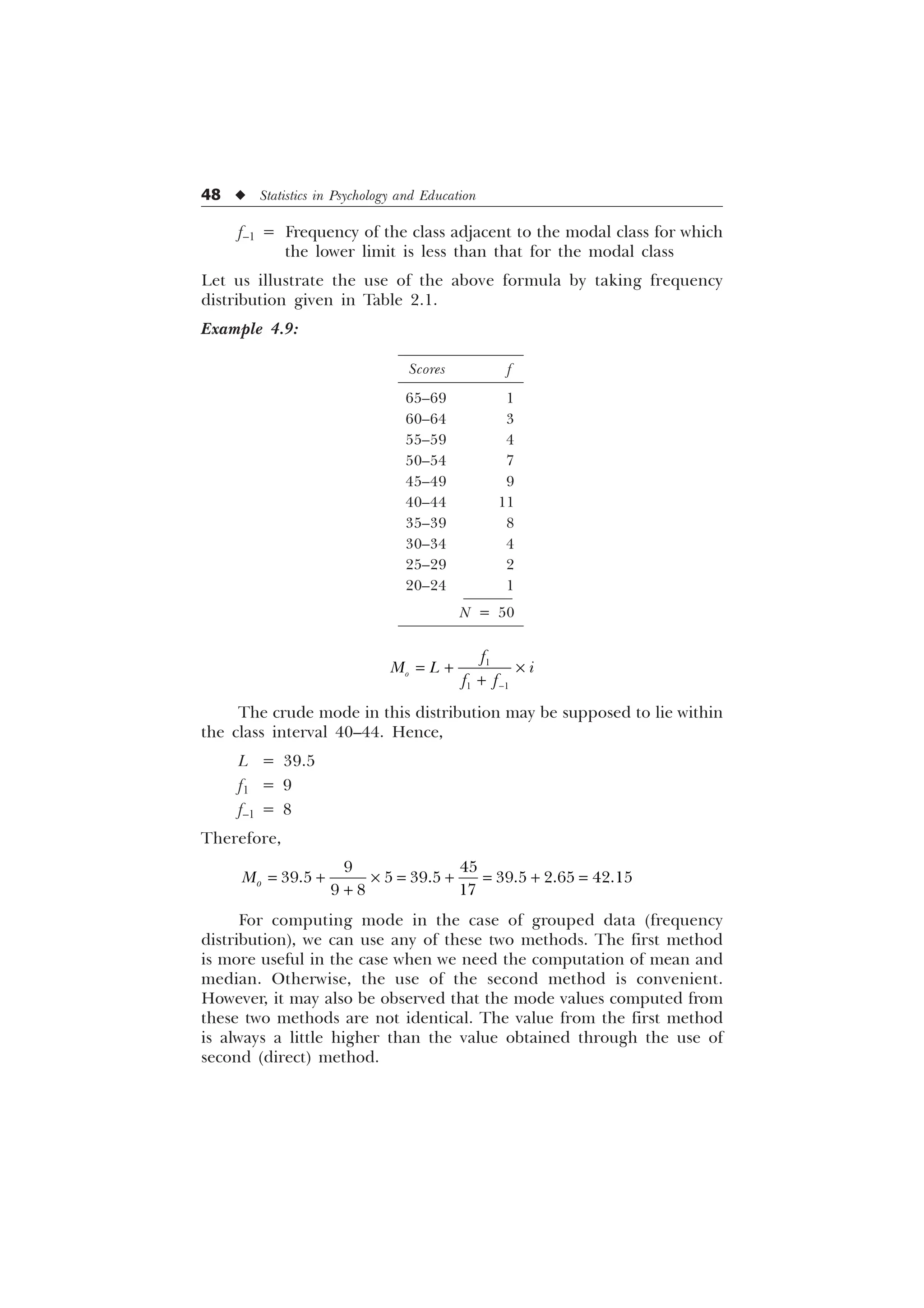
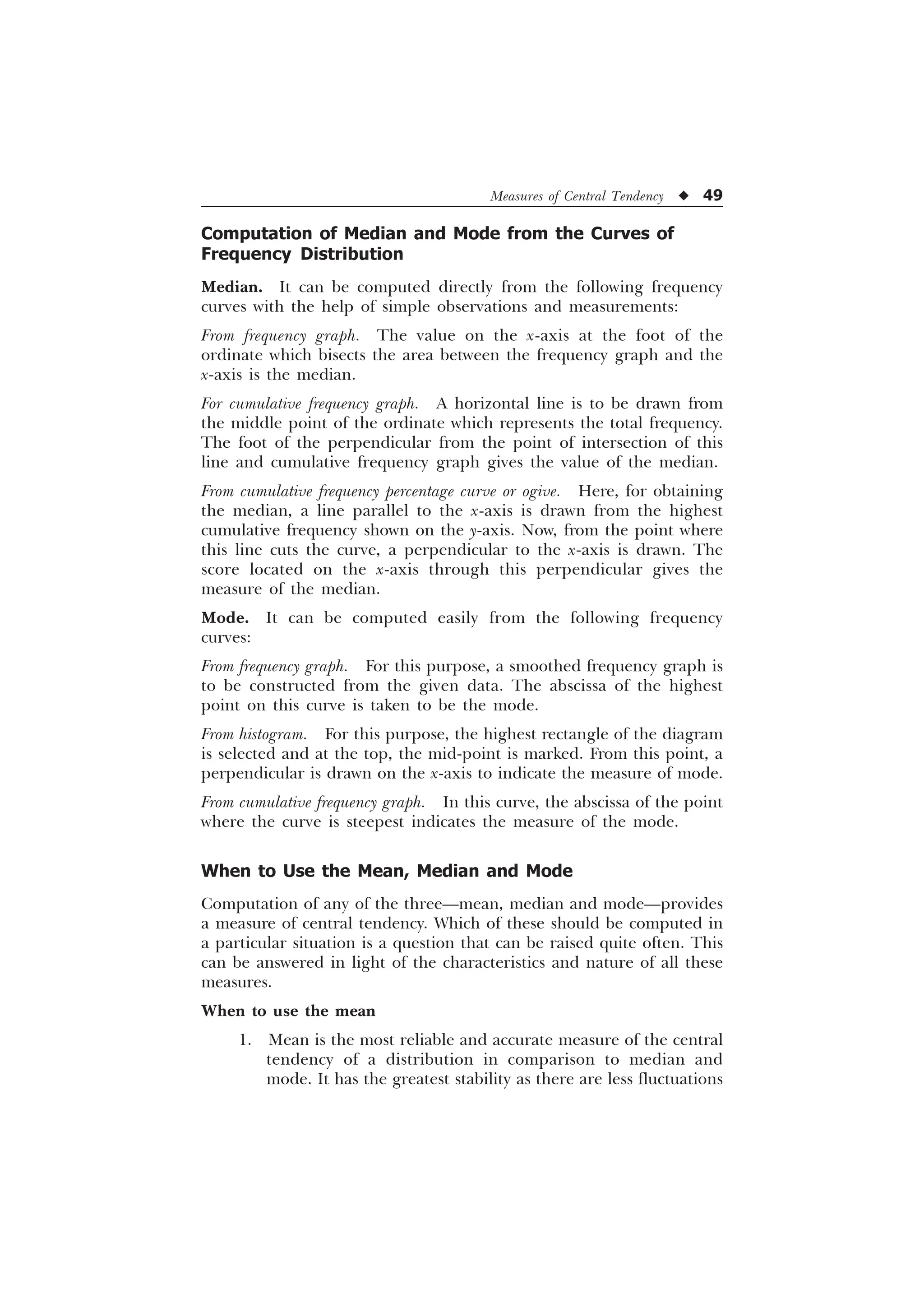
STATISTICS
IN
PSYCHOLOGY
AND
EDUCATION
S.K. MANGAL
S E C O N D E D I T I O N
Statistics in Psychology
and Education
SECOND EDITION
S.K. MANGAL
Professor and Head
Department of Postgraduate Studies
C.R. College of Education
Rohtak, Haryana
NEW DELHI - 110001
2010
STATISTICS IN PSYCHOLOGY AND EDUCATION, 2nd ed.
by S.K. Mangal
© 2002 by PHI Learning Private Limited, New Delhi. All rights reserved. No part of this book may
be reproduced in any form, by mimeograph or any other means, without permission in writing
from the publisher.
ISBN-978-81-203-2088-8
The export rights of this book are vested solely with the publisher.
Twelfth Printing (Second Edition) ... ... October, 2010
Published by Asoke K. Ghosh, PHI Learning Private Limited, M-97, Connaught Circus, New
Delhi-110001 and Printed by Meenakshi Printers, Delhi-110006.
iii
Contents
Preface ix
Preface to the First Edition xi
1. STATISTICS—MEANING AND USE 1–11
Meaning of Statistics 1
Need and Importance of Statistics in Education and Psychology 1
Evaluation and Measurement 2
Day-to-Day Tasks 2
Research 3
Understanding and Using the Products of Research 3
Prerequisites for Studying Statistics 4
Essential Mathematical Fundamentals 4
Types of Variables Employed in Statistical Measurement 4
Scales of Measurement 6
Type of Approximation or Exactness Required in Statistics 8
Various Statistical Symbols 8
Summary 10
Exercises 10
2. ORGANIZATION OF DATA 12–22
The Meaning of the Term “Data” 12
Methods of Organizing Data 12
Statistical Tables 12
Rank Order 14
Frequency Distribution 15
How to Construct a Frequency Distribution Table 15
Grouping Error 17
Cumulative Frequency and Cumulative Percentage Frequency
Distributions 18
Summary 19
Exercises 21
3. GRAPHICAL REPRESENTATION OF DATA 23–40
Meaning of Graphical Representation of Data 23
Advantages of Graphical Representation of Data 23
Modes of Graphical Representation of Data 24
Graphical Representation of Ungrouped Data 24
Graphical Representation of Grouped Data (Frequency
Distribution) 28
iv u Contents
Smoothing of Frequency Curves—Polygon and Ogive 35
Why Smooth? 35
How to Smooth 35
Explanation 35
Summary 38
Exercises 39
4. MEASURES OF CENTRAL TENDENCY 41–54
Meaning of the Measures of Central Tendency 41
Arithmetic Mean (M) 41
Median (Md) 43
Mode (Mo) 46
Computation of Median and Mode from the Curves of
Frequency Distribution 49
When to Use the Mean, Median and Mode 49
Summary 51
Exercises 52
5. PERCENTILES AND PERCENTILE RANK 55–67
Meaning of the Term Percentile 55
Definition 56
Defining Quartiles and Deciles 56
Computation of Percentiles, Quartiles and Deciles 57
Definition 60
Percentile Rank 60
Definition 60
Computation of Percentile Rank 60
Utility of Percentiles and Percentile Rank 65
Summary 65
Exercises 67
6. MEASURES OF VARIABILITY 68–78
Meaning and Importance of the Measures of Variability 68
Types or Measures of Variability 69
Range (R) 69
Quartile Deviation (Q) 69
Average Deviation (AD) 70
Standard Deviation (SD) 71
When and Where to Use the Various Measures of Variability 74
Range 74
Average Deviation 74
Quartile Deviation 75
Standard Deviation 75
Summary 76
Exercises 77
Contents u v
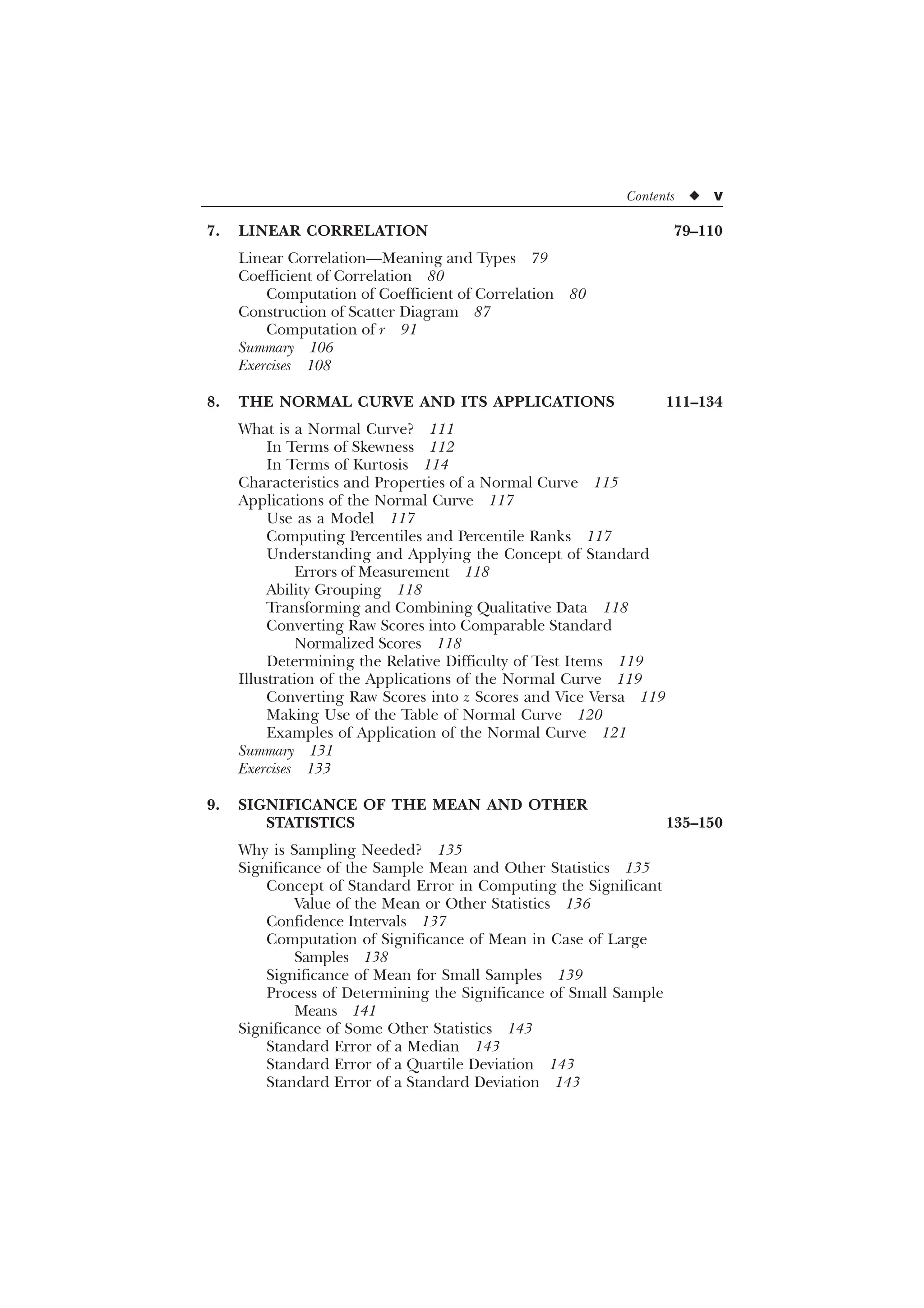
7. LINEAR CORRELATION 79–110
Linear Correlation—Meaning and Types 79
Coefficient of Correlation 80
Computation of Coefficient of Correlation 80
Construction of Scatter Diagram 87
Computation of r 91
Summary 106
Exercises 108
8. THE NORMAL CURVE AND ITS APPLICATIONS 111–134
What is a Normal Curve? 111
In Terms of Skewness 112
In Terms of Kurtosis 114
Characteristics and Properties of a Normal Curve 115
Applications of the Normal Curve 117
Use as a Model 117
Computing Percentiles and Percentile Ranks 117
Understanding and Applying the Concept of Standard
Errors of Measurement 118
Ability Grouping 118
Transforming and Combining Qualitative Data 118
Converting Raw Scores into Comparable Standard
Normalized Scores 118
Determining the Relative Difficulty of Test Items 119
Illustration of the Applications of the Normal Curve 119
Converting Raw Scores into z Scores and Vice Versa 119
Making Use of the Table of Normal Curve 120
Examples of Application of the Normal Curve 121
Summary 131
Exercises 133
9. SIGNIFICANCE OF THE MEAN AND OTHER
STATISTICS 135–150
Why is Sampling Needed? 135
Significance of the Sample Mean and Other Statistics 135
Concept of Standard Error in Computing the Significant
Value of the Mean or Other Statistics 136
Confidence Intervals 137
Computation of Significance of Mean in Case of Large
Samples 138
Significance of Mean for Small Samples 139
Process of Determining the Significance of Small Sample
Means 141
Significance of Some Other Statistics 143
Standard Error of a Median 143
Standard Error of a Quartile Deviation 143
Standard Error of a Standard Deviation 143
vi u Contents
Standard Error of the Coefficient of Correlation 143
Coefficient of Correlation r 144
Summary 147
Exercises 149
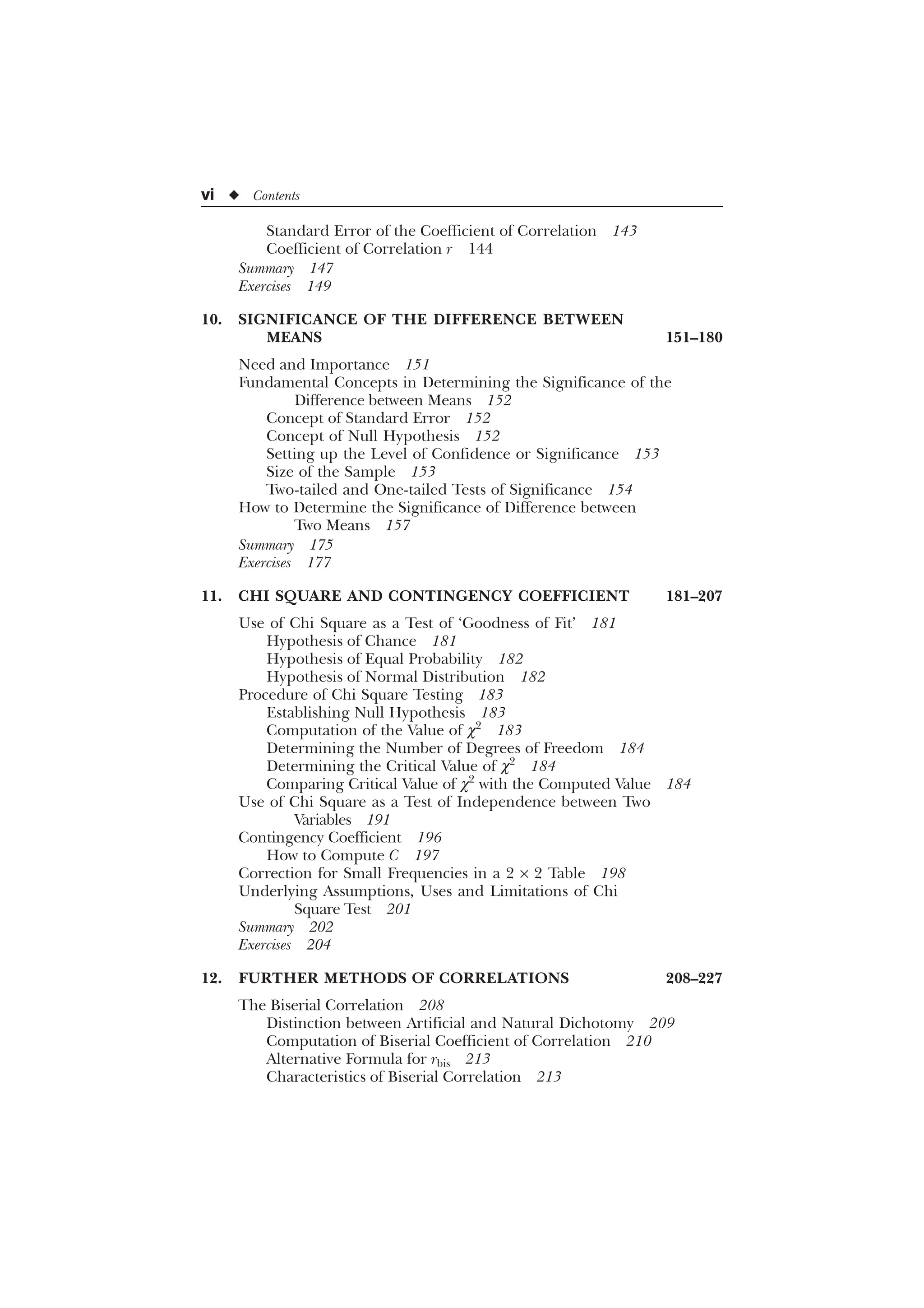
10. SIGNIFICANCE OF THE DIFFERENCE BETWEEN
MEANS 151–180
Need and Importance 151
Fundamental Concepts in Determining the Significance of the
Difference between Means 152
Concept of Standard Error 152
Concept of Null Hypothesis 152
Setting up the Level of Confidence or Significance 153
Size of the Sample 153
Two-tailed and One-tailed Tests of Significance 154
How to Determine the Significance of Difference between
Two Means 157
Summary 175
Exercises 177
11. CHI SQUARE AND CONTINGENCY COEFFICIENT 181–207
Use of Chi Square as a Test of ‘Goodness of Fit’ 181
Hypothesis of Chance 181
Hypothesis of Equal Probability 182
Hypothesis of Normal Distribution 182
Procedure of Chi Square Testing 183
Establishing Null Hypothesis 183
Computation of the Value of c2
183
Determining the Number of Degrees of Freedom 184
Determining the Critical Value of c2
184
Comparing Critical Value of c2
with the Computed Value 184
Use of Chi Square as a Test of Independence between Two
Variables 191
Contingency Coefficient 196
How to Compute C 197
Correction for Small Frequencies in a 2 ´ 2 Table 198
Underlying Assumptions, Uses and Limitations of Chi
Square Test 201
Summary 202
Exercises 204
12. FURTHER METHODS OF CORRELATIONS 208–227
The Biserial Correlation 208
Distinction between Artificial and Natural Dichotomy 209
Computation of Biserial Coefficient of Correlation 210
Alternative Formula for rbis 213
Characteristics of Biserial Correlation 213
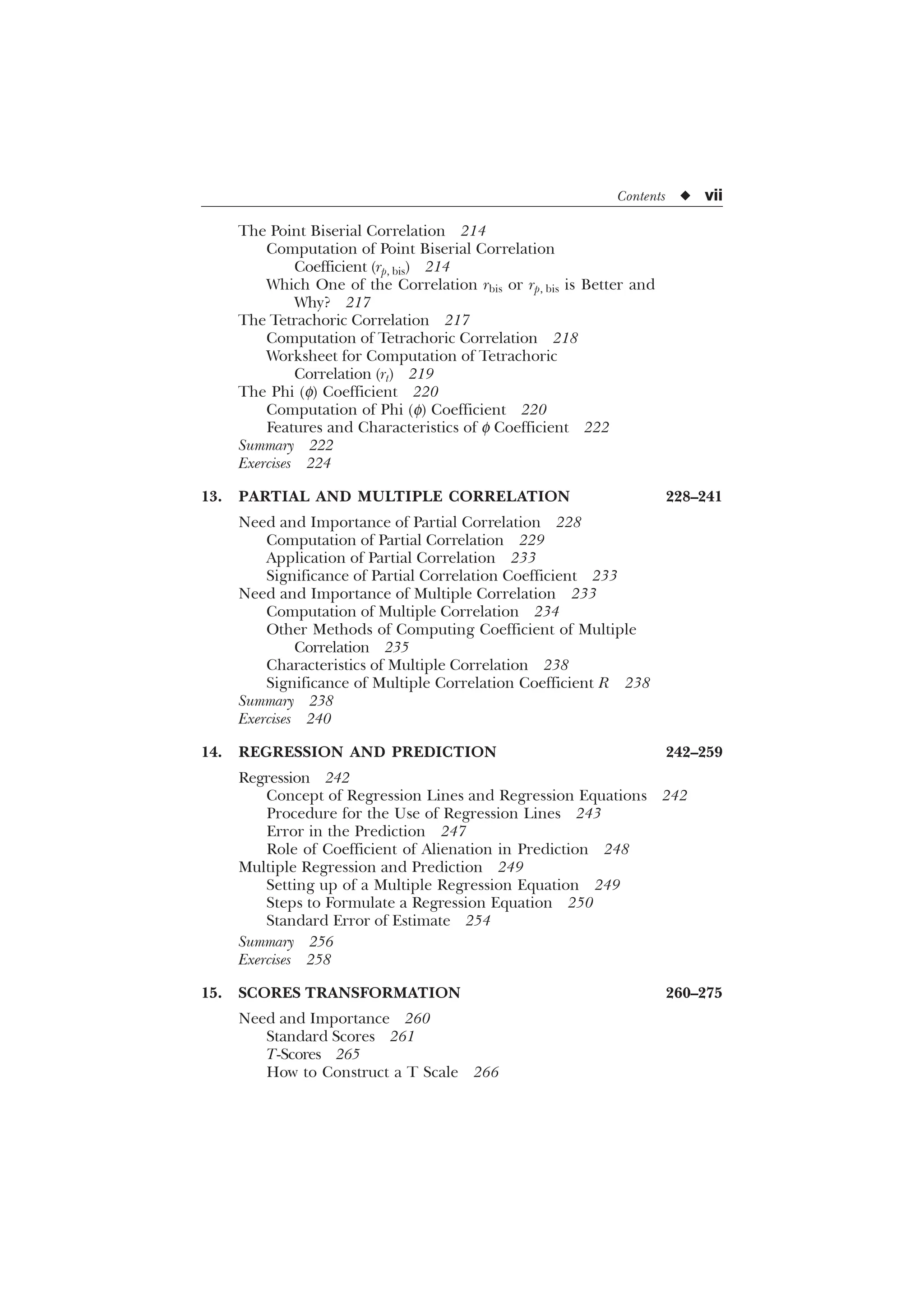
Contents u vii
The Point Biserial Correlation 214
Computation of Point Biserial Correlation
Coefficient (rp, bis) 214
Which One of the Correlation rbis or rp, bis is Better and
Why? 217
The Tetrachoric Correlation 217
Computation of Tetrachoric Correlation 218
Worksheet for Computation of Tetrachoric
Correlation (rt) 219
The Phi (f) Coefficient 220
Computation of Phi (f) Coefficient 220
Features and Characteristics of f Coefficient 222
Summary 222
Exercises 224
13. PARTIAL AND MULTIPLE CORRELATION 228–241
Need and Importance of Partial Correlation 228
Computation of Partial Correlation 229
Application of Partial Correlation 233
Significance of Partial Correlation Coefficient 233
Need and Importance of Multiple Correlation 233
Computation of Multiple Correlation 234
Other Methods of Computing Coefficient of Multiple
Correlation 235
Characteristics of Multiple Correlation 238
Significance of Multiple Correlation Coefficient R 238
Summary 238
Exercises 240
14. REGRESSION AND PREDICTION 242–259
Regression 242
Concept of Regression Lines and Regression Equations 242
Procedure for the Use of Regression Lines 243
Error in the Prediction 247
Role of Coefficient of Alienation in Prediction 248
Multiple Regression and Prediction 249
Setting up of a Multiple Regression Equation 249
Steps to Formulate a Regression Equation 250
Standard Error of Estimate 254
Summary 256
Exercises 258
15. SCORES TRANSFORMATION 260–275
Need and Importance 260
Standard Scores 261
T-Scores 265
How to Construct a T Scale 266
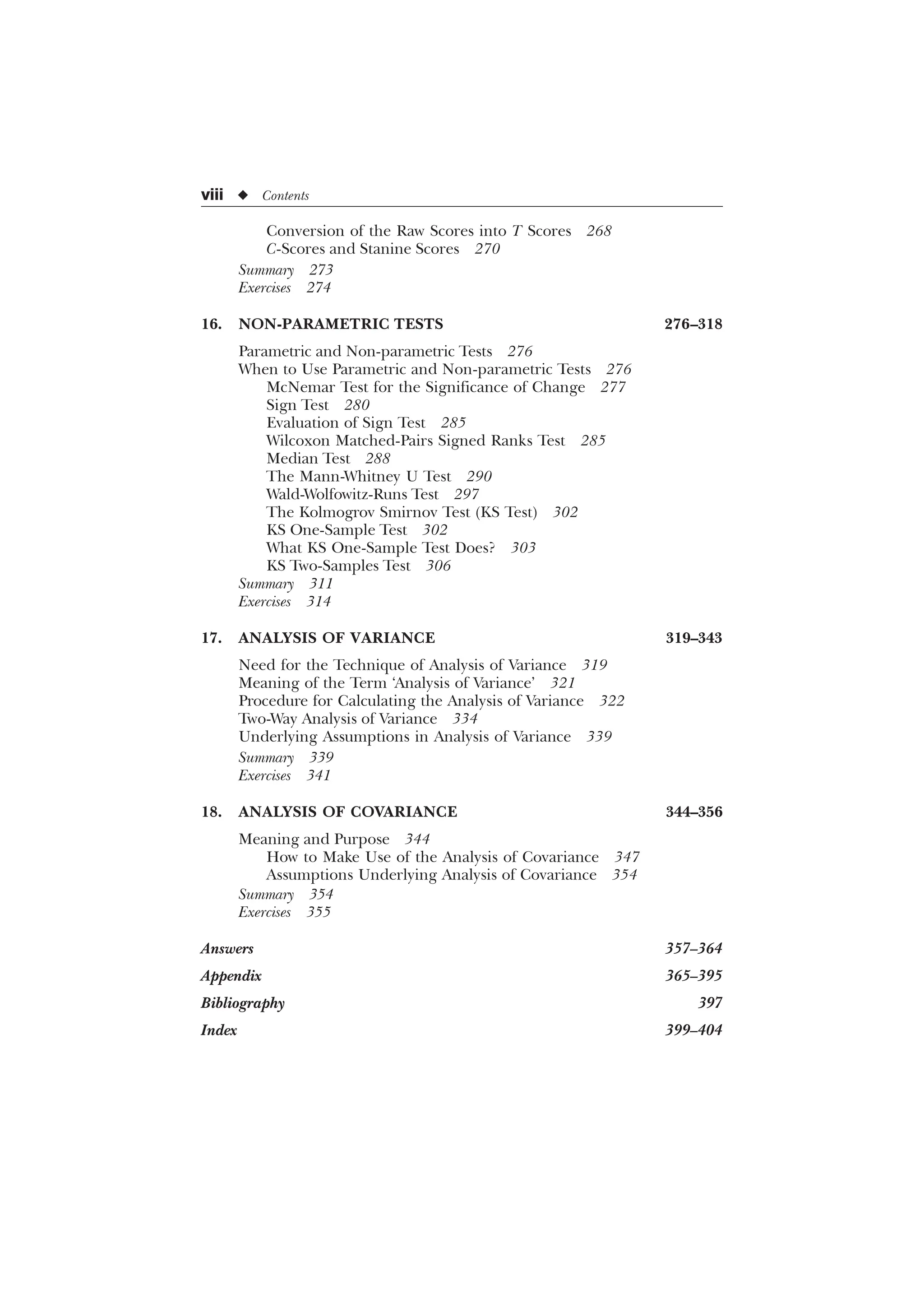
viii u Contents
Conversion of the Raw Scores into T Scores 268
C-Scores and Stanine Scores 270
Summary 273
Exercises 274
16. NON-PARAMETRIC TESTS 276–318
Parametric and Non-parametric Tests 276
When to Use Parametric and Non-parametric Tests 276
McNemar Test for the Significance of Change 277
Sign Test 280
Evaluation of Sign Test 285
Wilcoxon Matched-Pairs Signed Ranks Test 285
Median Test 288
The Mann-Whitney U Test 290
Wald-Wolfowitz-Runs Test 297
The Kolmogrov Smirnov Test (KS Test) 302
KS One-Sample Test 302
What KS One-Sample Test Does? 303
KS Two-Samples Test 306
Summary 311
Exercises 314
17. ANALYSIS OF VARIANCE 319–343
Need for the Technique of Analysis of Variance 319
Meaning of the Term ‘Analysis of Variance’ 321
Procedure for Calculating the Analysis of Variance 322
Two-Way Analysis of Variance 334
Underlying Assumptions in Analysis of Variance 339
Summary 339
Exercises 341
18. ANALYSIS OF COVARIANCE 344–356
Meaning and Purpose 344
How to Make Use of the Analysis of Covariance 347
Assumptions Underlying Analysis of Covariance 354
Summary 354
Exercises 355
Answers 357–364
Appendix 365–395
Bibliography 397
Index 399–404
The fundamental principles and techniques of statistics provide a firm
foundation to all those who are pursuing courses in education,
psychology and sociology, both at the undergraduate and postgraduate
levels. Its application and importance is further widened and enhanced
when they venture into specializing in their areas of research.
This second edition is a sequel to the first edition which was
enthusiastically received by the students and well appreciated by the
academics. As a number of years have elapsed after the first edition was
published, it was felt necessary to bring out a new and updated edition
to take into account the present syllabi of education in various
universities and institutes of education and emphasize new areas of
research.
This enlarged and improved edition incorporates several changes:
u The entire text has been thoroughly checked, corrected, and
necessary modifications made wherever required.
u Chapter 7 has been renamed as “Linear Correlation” dealing
only with the concept and computation of linear correlation,
using rank difference and product moment method. Topics
related to regression have been shifted to the newly added
Chapter 14 entitled as “Regression and Prediction”.
u Six new chapters have been added to the text, thereby
enabling us to discuss more advanced statistical concepts and
techniques such as the following:
– Biserial correlation, point biserial correlation, tetrachoric
correlation, phi coefficient, partial and multiple
correlation.
– Transfer of raw scores into standard scores, T, C and
Stanine scores.
– Non-parametric tests like the McNemar test, Sign test,
Wilcoxon test, Median test, U-test, Runs test, and KS test.
– Analysis of covariance.
Thus, attempts have been made to make the text more
Preface
ix
comprehensive and elaborate, keeping in view the knowledge and skills
required in understanding various statistical concepts and techniques
included in the syllabi of M.A. (Education), M.Ed., M.A. (Psychology
and Sociology) and M.Phil of Indian universities. Research students will
also find this text quite useful.
I fervently hope that the new, substantially revised edition will
prove quite beneficial to all the readers. Any constructive suggestions
for further improvement will be highly appreciated.
S.K. MANGAL
x u Preface
This book offers an introductory course in statistics and will be useful
for the students of education, psychology and sociology. It may also be
used as a handbook by researchers.
The subject matter of this text has been divided into twelve
chapters. The first eight chapters deal with descriptive statistics, and
the next four chapters with an introduction to statistical inference.
This book differs from other books on the subject in a number of
ways:
1. The various topics dealt with have been arranged sequentially
and into correlated units so as to make the book useful for
ready reference.
2. The contents have been presented in a simple, interesting and
fairly non-mathematical manner for the benefit of those who
have not studied mathematics beyond the elementary level
and for the beginners.
3. Attempts have been made to minimize the complexities of
statistical procedures and methods.
4. Numerous solved examples and assignment problems have
been provided for practice and to illustrate applications of
statistical concepts and methods used in research and field
work.
5. Each chapter has been summarized briefly for convenience.
I am greatly indebted to the many authors and researchers whose
works have provided an invaluable help in bringing out this book.
Besides, I would like to thank my colleagues and students who have
been a source of inspiration.
I sincerely hope that the book will prove beneficial to all for
whom it has been written. They should feel free to write to me with
their views for the improvement of the book.
S.K. MANGAL
Preface to the First Edition
xi
1
MEANING OF STATISTICS
The word, “Statistics”, in general connotes the following:
1. Statistics refers to numerical facts. The state as well as Central
Statistical departments and various other agencies are enga-
ged in collecting valuable statistics (numerical facts) concern-
ing birth and death, school attendance, employment market,
industrial and agricultural outputs, and various other aspects.
2. Statistics also signifies the method or methods of dealing with
numerical facts. In this sense, it is considered as a science of
collecting, summarizing, analyzing and interpreting numeri-
cal facts.
3. Further, statistics refers to the summarized figures of numeri-
cal facts such as percentages, averages, means, medians,
modes, and standard deviations. Each of these figures sepa-
rately is referred to as statistics.
Tate (1955) has beautifully summarized the different meanings of
statistics in the following witty comment:
It’s all perfectly clear; you compute statistics (mean, median,
mode, etc.) from statistics (numerical facts) by statistics (statistical
methods).
This comment sums up the different meanings that can be
attached to the word ‘statistics’. However, in the general sense, statistics
as a subject or branch of knowledge is defined as one of the subjects
of study that helps us in the scientific collection, presentation, analysis
and interpretation of numerical facts.
NEED AND IMPORTANCE OF STATISTICS IN EDUCATION
AND PSYCHOLOGY
Statistics renders valuable services in:
1. the collection of evidences or facts (numerical or otherwise);
1 Statistics—Meaning and
Use
2 u Statistics in Psychology and Education
2. the classification, organization and summarization of numeri-
cal facts; and
3. in drawing general conclusions and inferences or making
predictions on the basis of particulars, facts and evidences.
On account of the above mentioned services, statistics is now
regarded as an indispensable instrument in the fields of education and
psychology, especially where any sort of measurement or evaluation is
involved. Its need in these fields can be summarized now.
Evaluation and Measurement
In the fields of education and psychology various tests and measures
for carrying out the task of evaluation and measurement are to be
constructed and standardized. These may include intelligence tests,
achievement tests, interest inventories, attitude scales, aptitude tests,
social distance scales, personality inventories, and similar other
measures of educational, social or psychological interests. The
knowledge of statistical methods helps not only in carrying out the
construction and standardization of these tests and measures but also
in using them properly by presenting, comparing, analyzing and
interpreting the results of these tests and measures.
Day-to-Day Tasks
Statistics and its methods help the people belonging to the fields of
education and psychology in carrying out their day-to-day tasks and
activities. For example, a teacher may utilize it for:
1. knowing individual differences of his students;
2. rendering guidance to the students;
3. comparing the suitablity of one method or technique with
another;
4. comparing the results of one system of evaluation with
another;
5. comparing the function and working of one institution with
another;
6. making prediction regarding the future progress of the
students;
7. making selection, classification and promotion of the students;
and
8. maintaining various types of records.
Similarly, a psychologist or sociologist may also ask for the help
Statistics—Meaning and Use u 3
of statistics in carrying out various psychological experiments,
collecting important information through a sociological survey,
interpreting the result of his experiments, surveying and carrying out
the task of guidance and reporting, etc. In this way, for the desired
success in carrying out activities related to their professions, teachers,
educationists, psychologists and sociologists all need the help of
statistics.
Research
Research and innovations are essential in any walk of life or field of
knowledge for enrichment, progress and development. Education and
psychology are no exception to this fact. A lot of research work is
carried out in these disciplines and statistical methods help the
researchers in carrying out these researches successfully. Guilford
(1973) has summarized the advantages of statistical thinking and
operations in research. According to him, they:
1. permit the most exact kind of description;
2. force us to be definite and exact in our procedures and in our
thinking;
3. enable us to summarize our results in a meaningful and
convenient form;
4. enable us to draw general conclusions;
5. enable us to predict; and
6. enable us to analyze some of the causal factors underlying
complex and otherwise bewildering events.
Understanding and Using the Products of Research
Statistics and its methods help the practitioners—students, teachers,
educationists, psychologists, guidance personnel, social workers and
sociologists regardless of their fields—to keep abreast of the latest
developments and research. They are helped in reading and
understanding the reports of applied and theoretical research,
including various statistical terms. The interpretation and proper use
of the results of these researches also become possible with proper
knowledge of statistics.
From the above account, it can be easily concluded that statistics
carries wide application for the persons working in the fields of
education, psychology and sociology not only in discharging their roles
and duties effectively but also enriching and contributing significantly
to their respective fields by bringing useful research and innovations
for the welfare of the society and humanity at large.
4 u Statistics in Psychology and Education
PREREQUISITES FOR STUDYING STATISTICS
Statistics rests heavily on the use of numbers and formulae, requiring
the fundamentals of mathematical computations and reasoning. Many
students who have had little opportunity to study mathematics or have
developed a bitter and unpleasant taste for it may feel that statistics is
complicated and obscure. But if they proceed systematically in the
learning of this subject, it may be overcome. One need not be a genius
or a scholar in mathematics for learning the statistical methods
presented in this fundamental work of statistics. If one has some
arithmetical skill and has studied mathematics even upto 7th or 8th
class, he or she may study all the essential statistical procedures.
However, for beginners let us try to outline the essentials required for
initiating the learning in statistics under five major heads discussed
below:
Essential Mathematical Fundamentals
A student of statistics must try to build the necessary mathematical
base by learning and practising the knowledge and skills about the
following concepts:
1. Four fundamental rules—addition, subtraction, multipli-
cation and division.
2. Addition, subtraction, multiplication and division of fractions
(including decimal fractions).
3. Use of zero in addition, subtraction, multiplication and
division.
4. Positive and negative numbers and their addition, subtraction,
multiplication and division.
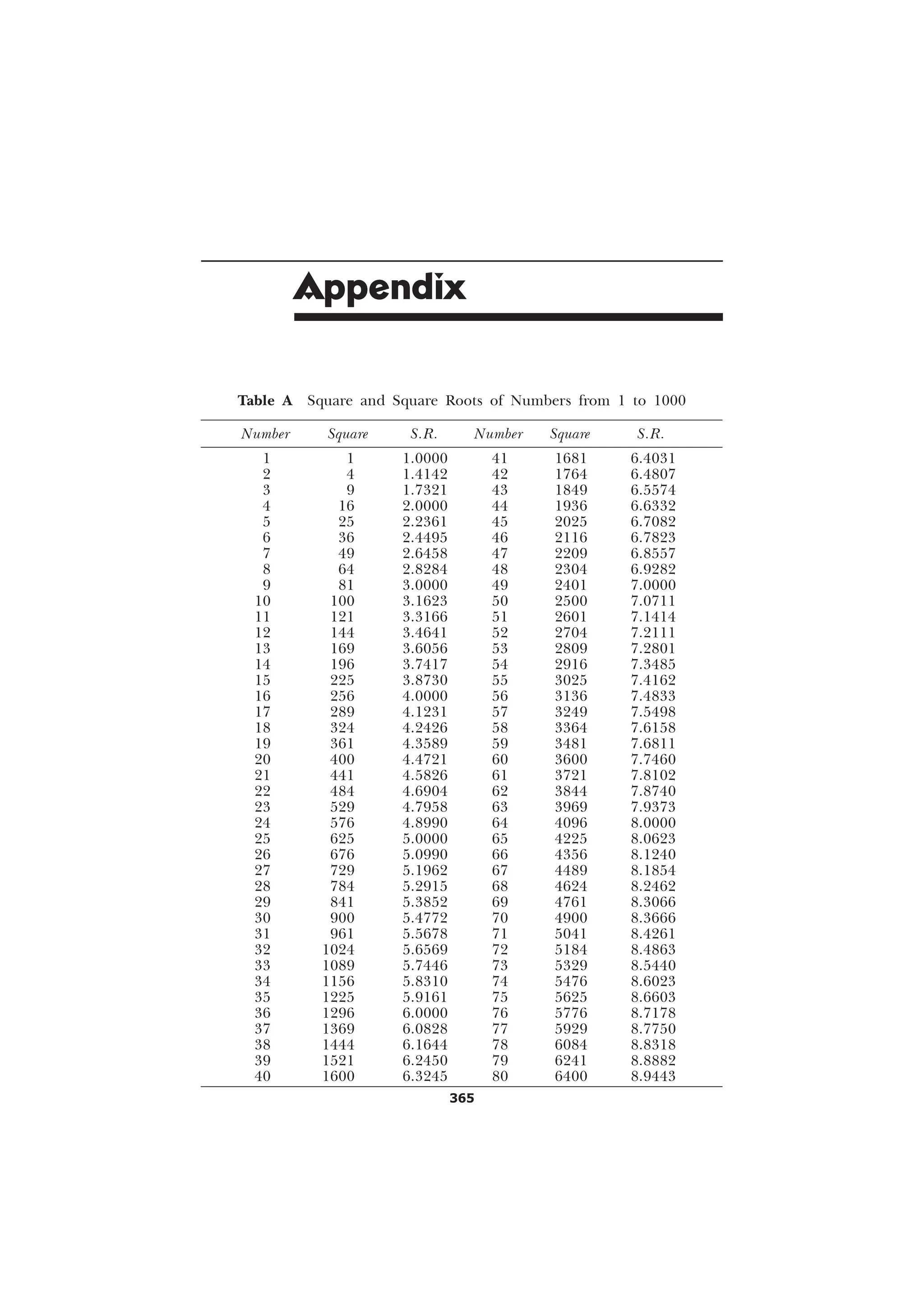
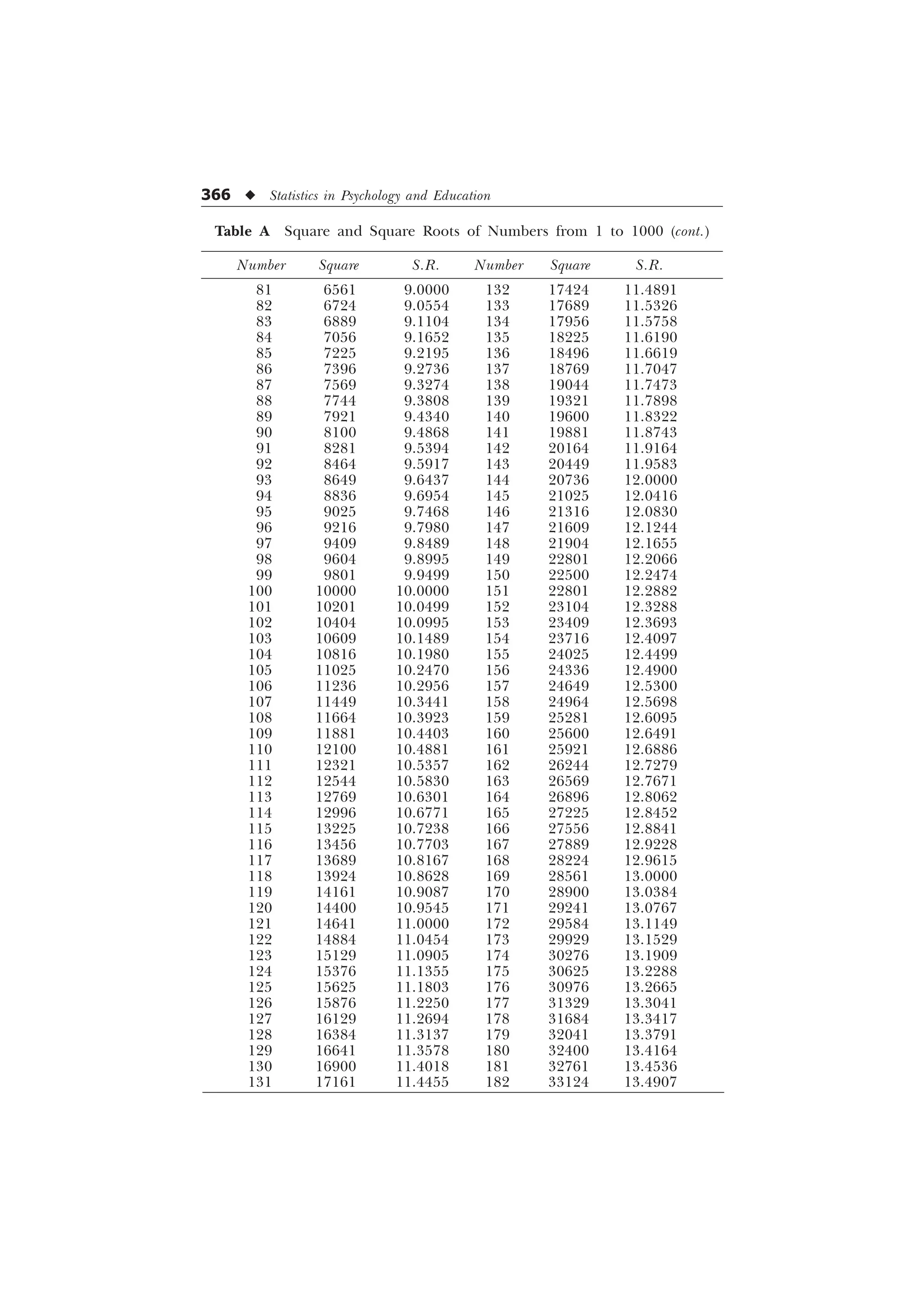
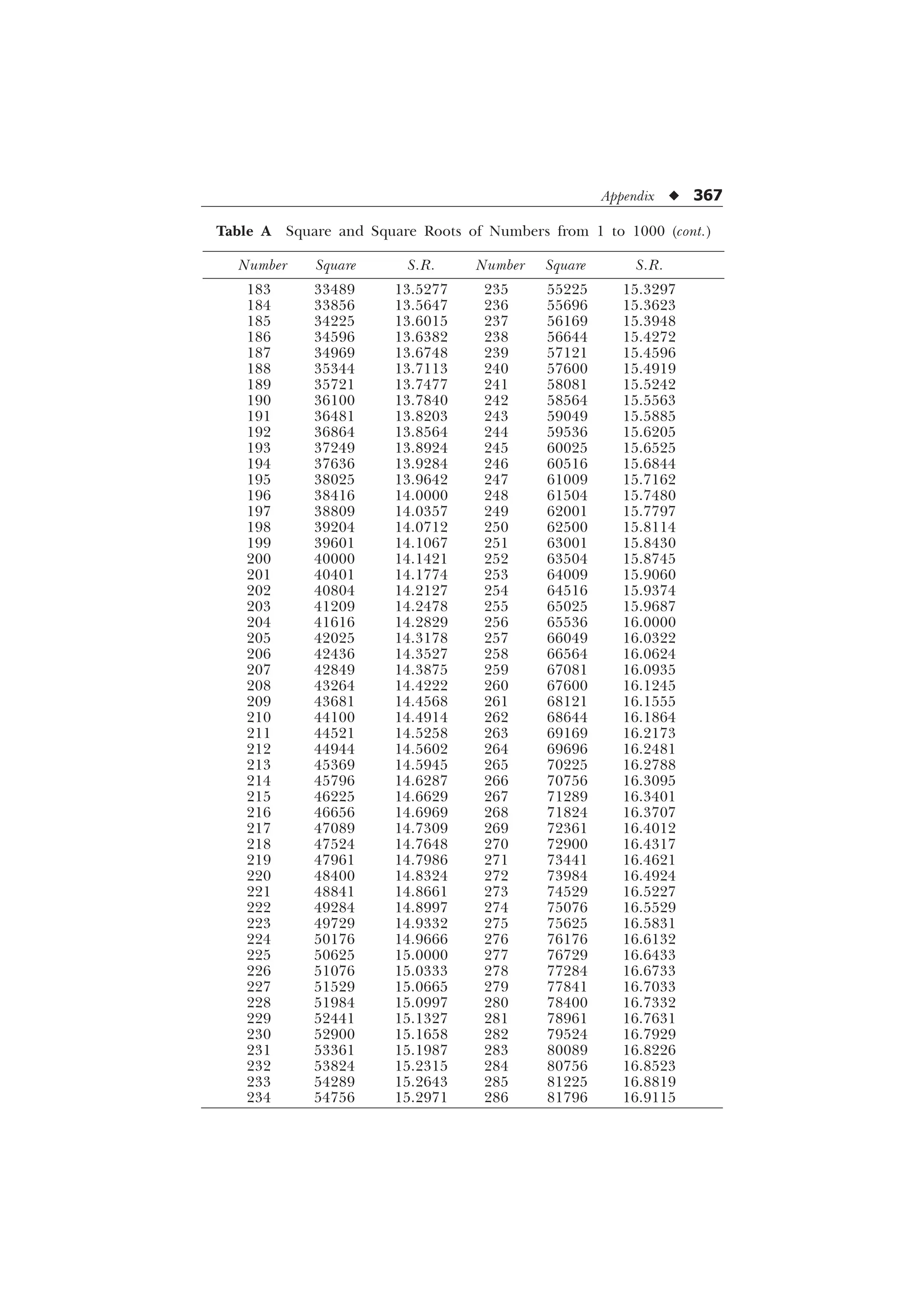
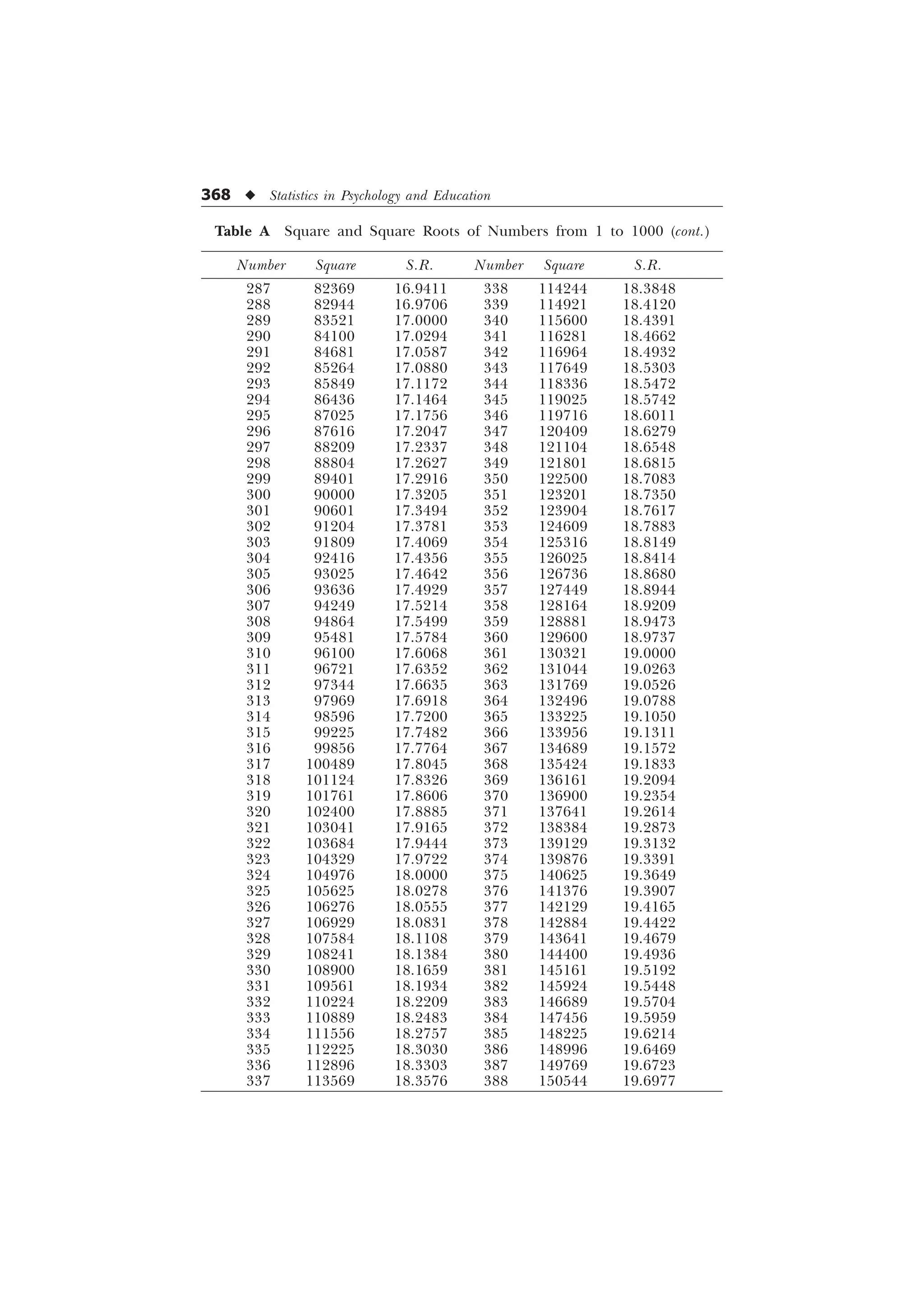
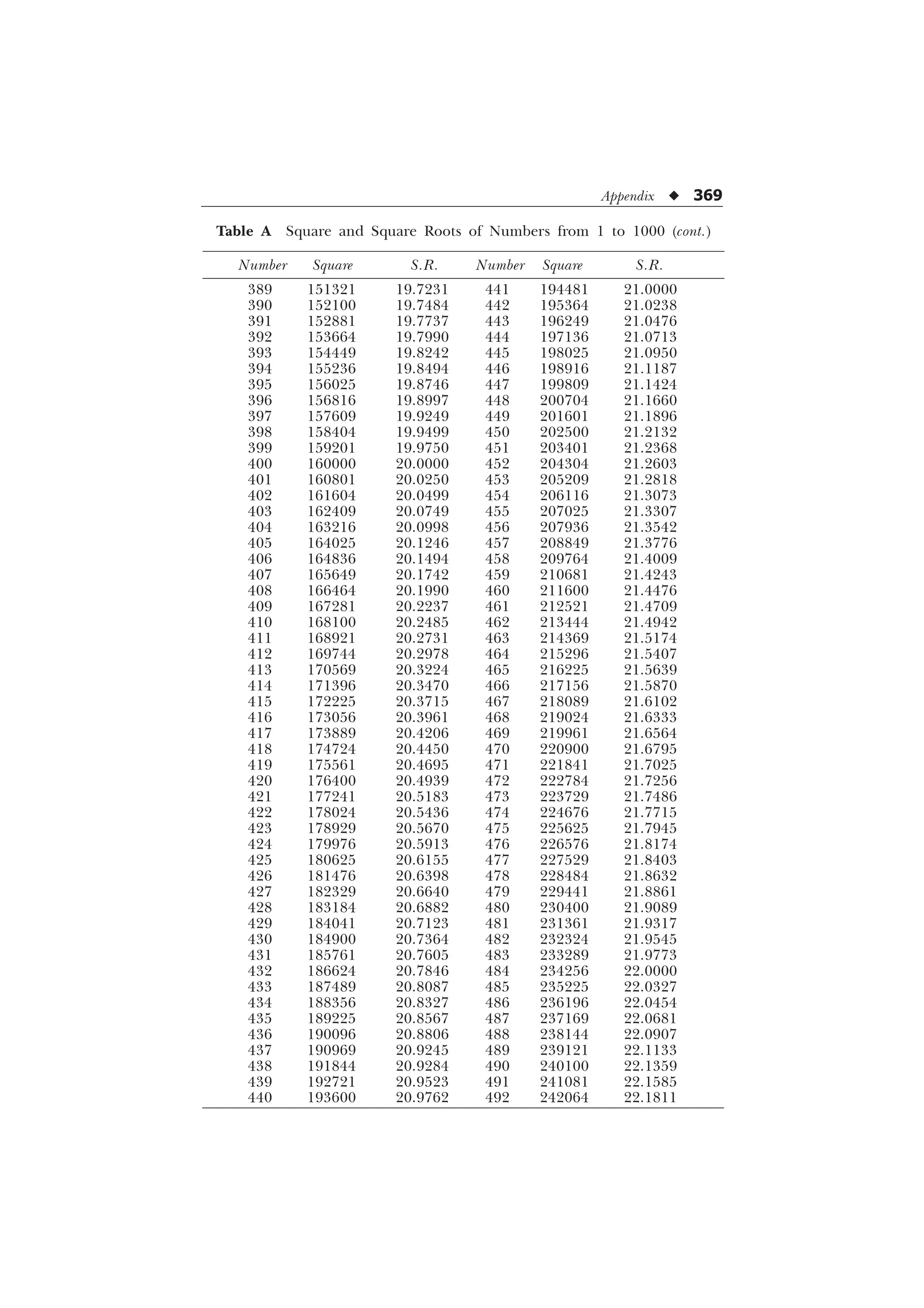
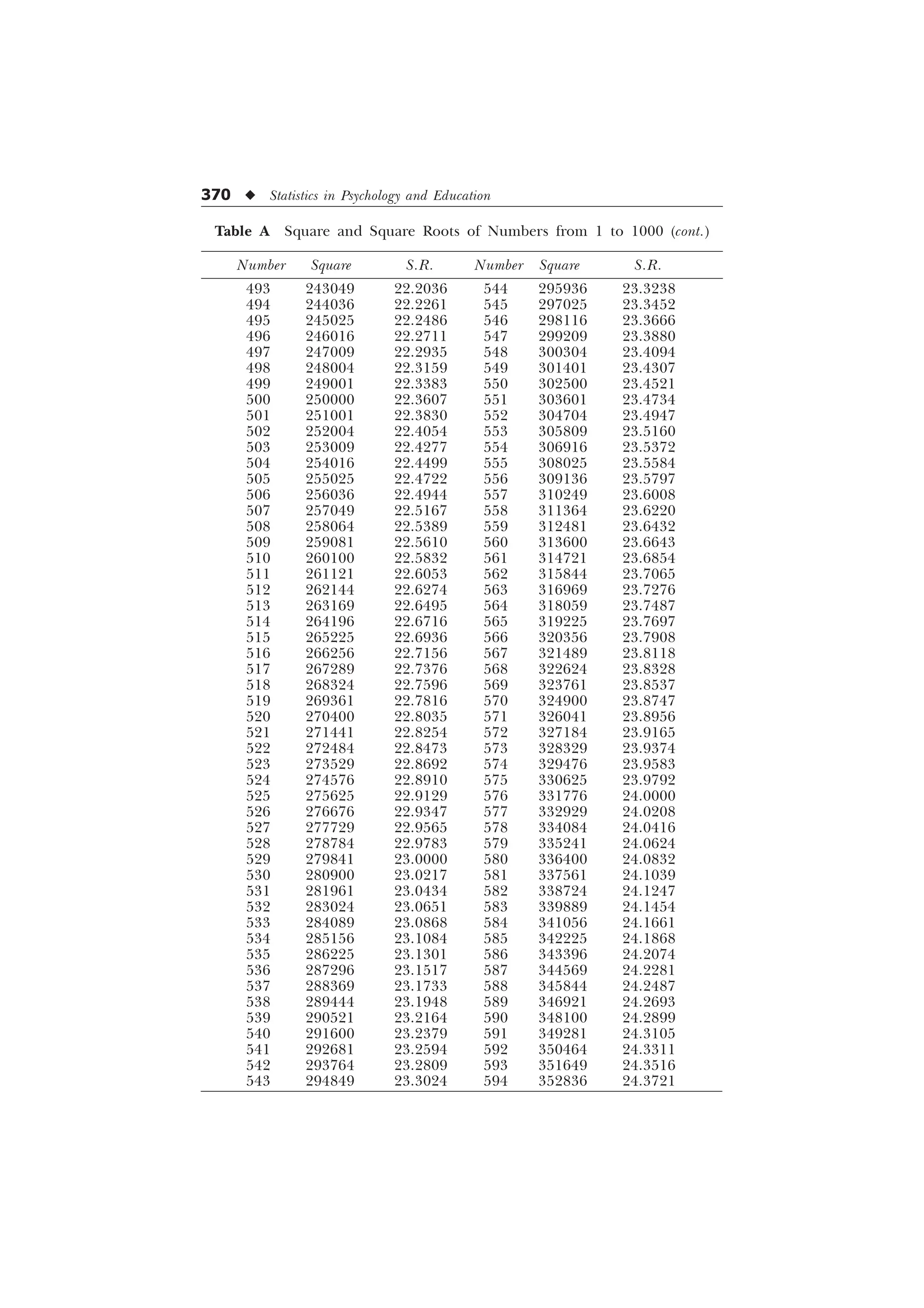
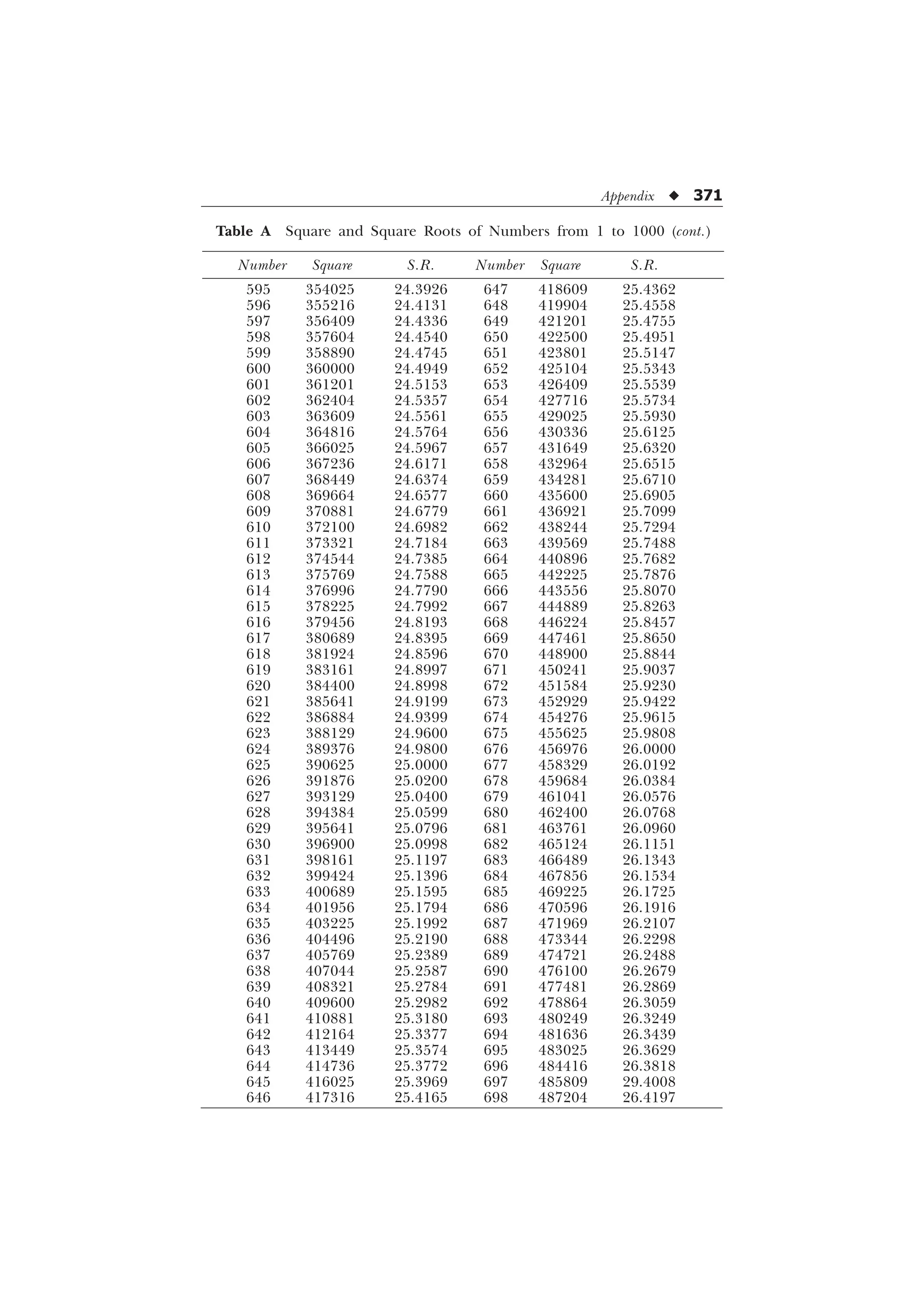
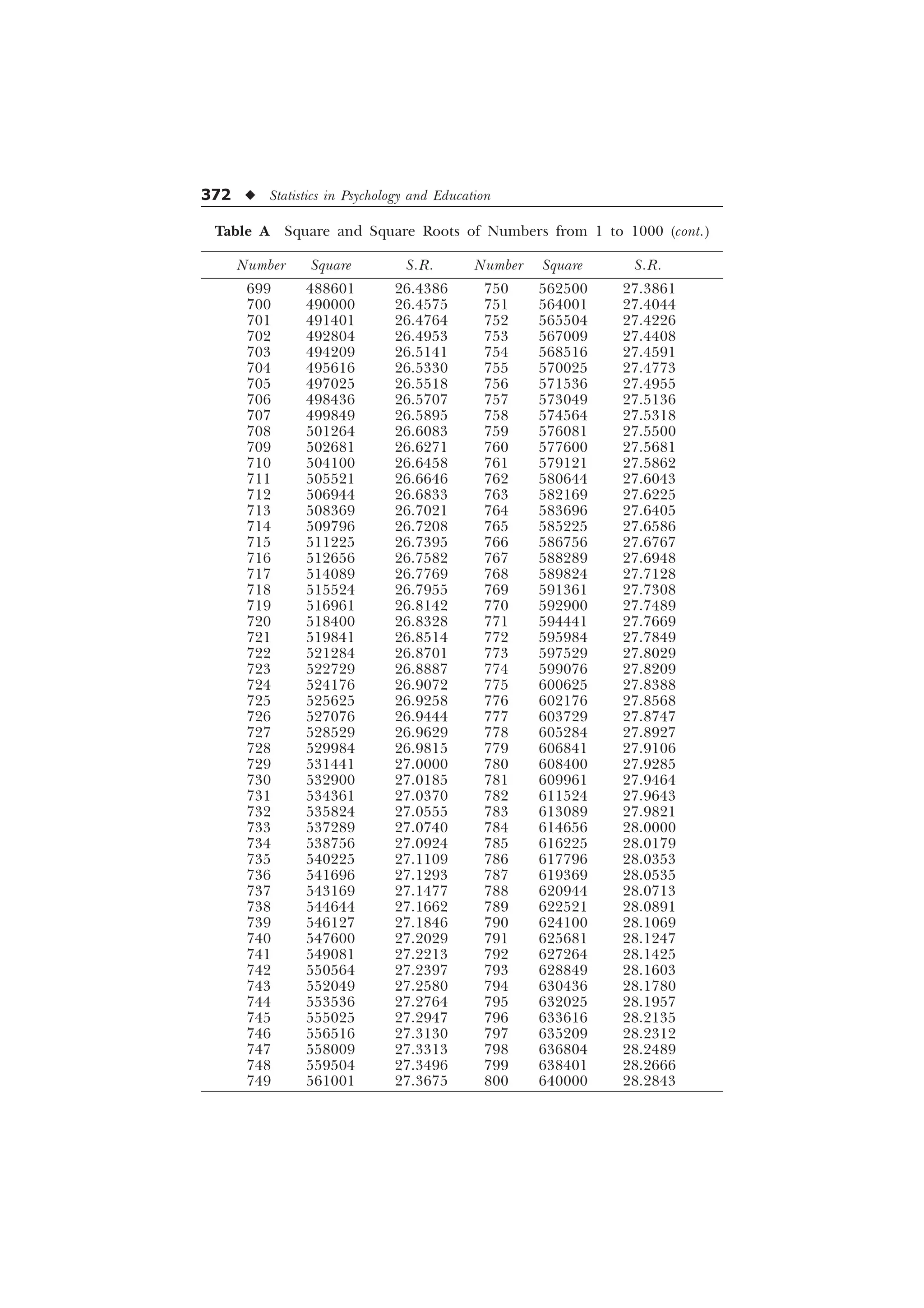
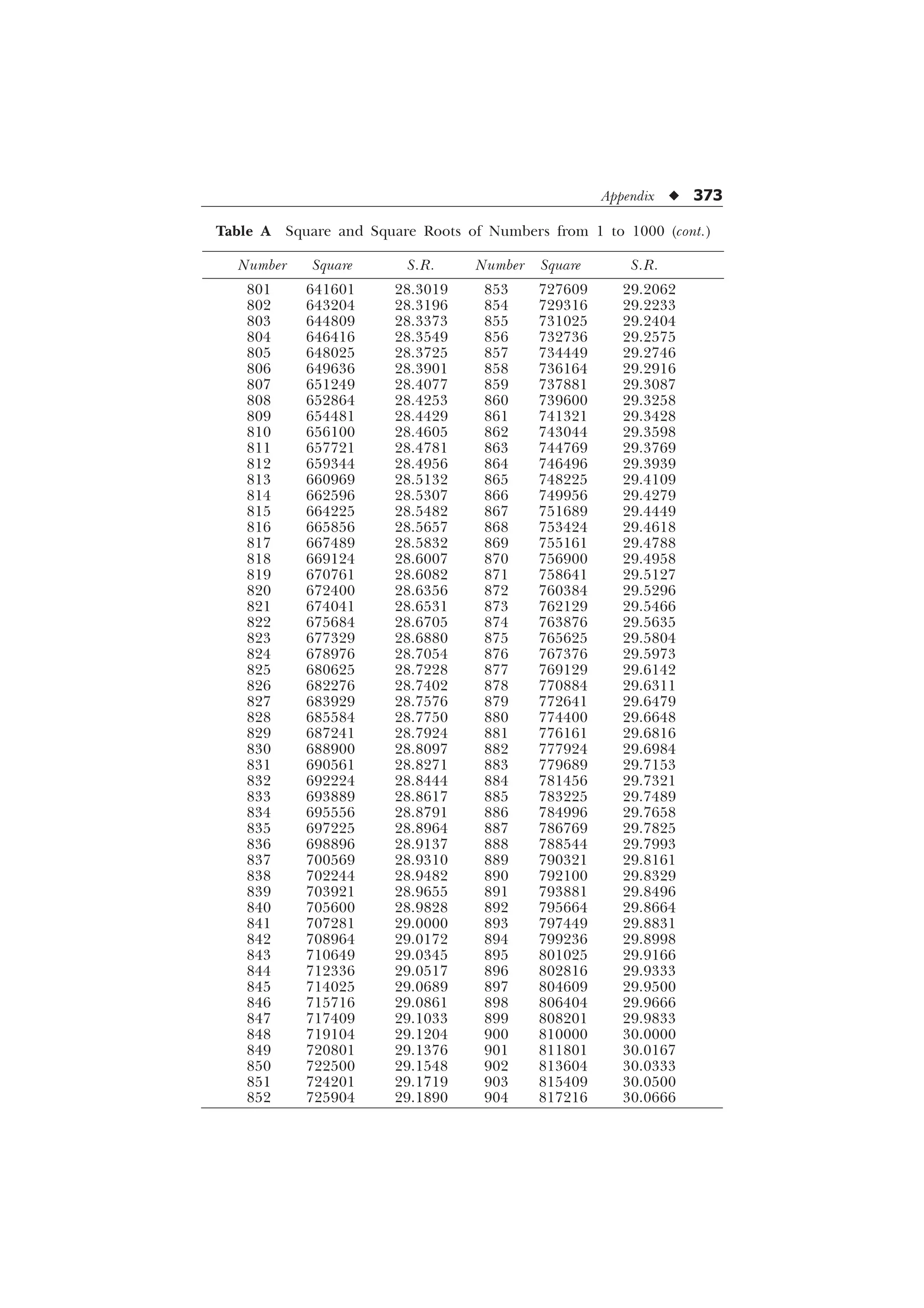
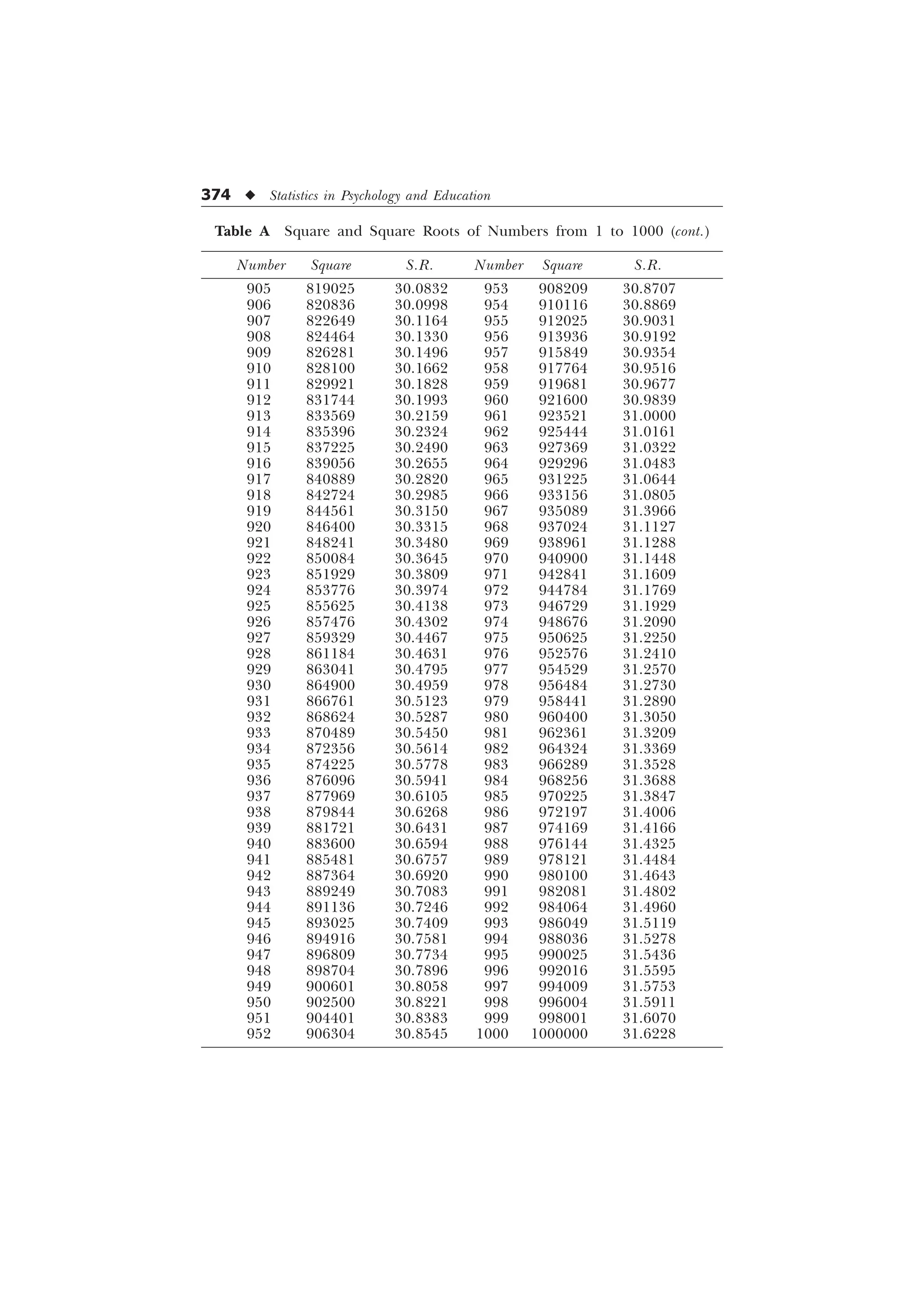
5. Computation of squares and square roots.
6. Proportions and percentages.
7. Removal of parentheses and simplifying the complex terms.
Types of Variables Employed in Statistical Measurement
In statistical measurement, the individuals may be found to differ in
sex, age, intelligence, height, weight, attitude towards women,
education and many other ways. Such qualities or properties exhibiting
differences are called variables. In the words of Garrett (1971):
The term ‘variables’ refers to attributes or qualities which exhibit
differences in magnitude and which vary along some dimensions.
In general, variables are classified as continuous and disconti-
nuous or discrete variables.
Statistics—Meaning and Use u 5
It clearly shows that a score of 46 in a continuous series means a
value ranging from its lower limit 45.5 to the upper limit 46.5. It is
therefore clearly understood by the students of statistics, while dealing
with continuous data or scores, that a score is never a point on the scale
but just occupies an interval from a .5 unit below to a .5 unit above its
face value. For calculating the lower limit of a given score, we must
subtract .5 from the given numerical value of that score and for upper
limit, add .5.
Discontinuous or discrete variables, on the other hand, fall into
discontinuous or discrete series. A series is said to be discontinuous or
discrete when it exhibits real gaps. Consequently a variable is said to
be discontinuous or discrete when there are real gaps between one
value and the next. The data regarding such variables can only be
expressed in whole units (numbers). Some examples are the number of
eggs laid by a hen, the number of children in a family, the number
of books in a library, number of words spelled correctly, the number of
cycles passing a crossing during a certain period of time and so on.
With the above description of continuous and discontinuous
variables or series, the students may now clearly visualize that most of
the variables dealt with in education, psychology and sociology are
Continuous variables form a continuous series. A series is said to
be continuous when it is capable of any degree of sub-division and in
practice shows no real gaps. Therefore, a variable is said to be
continuous when it passes from one value to the next by indefinitely
small changes. Height, weight, length, temperature and so on are
examples of such variables. In this way, the criterion for identification
of a continuous variable lies in the answer to the question: Is it possible
to measure it in the smallest degree of measurement? For example, in
measuring height we can get measurement in metres capable of being
broken down into centimetres, millimetres, etc. with a greater degree
of precision. Here, scores and measurements concerning height,
exhibit no real gaps. Within the given range, any ‘score’—integral or
fractional—may exist and have meaning. The same is true for weight
and other measures of physical as well as mental traits, i.e. scores on
an intelligence or achievement test. Such measurement data can be
represented as points on a line as given in Figure 1.1.
Figure 1.1 Representation, on a line, of continuous data showing
upper and lower limits.
Units 46 47 48 49 50
Limits of units 45.5 46.5 47.5 48.5 49.5 50.5
6 u Statistics in Psychology and Education
continuous or may be normally treated as continuous rather than
discontinuous or discrete.
Scales of Measurement
Various scales are employed in the field of measurement. Stevens
(1946) has recognized four types of scales—nominal, ordinal, interval
and ratio.
Nominal scale. Each vehicle—bicycle, scooter, car and so on—is
alloted a classification symbol by the State Transport Authorities. Every
student is assigned a roll number in his class. A player is identified as
a player of a particular team by the type of dress he wears and also by
the number on the back of his sports shirt. In this way, we see that
different numbers, identifying the different objects or individuals.
These numbers or symbols constitute a nominal scale. It is a primitive
type of measurement in which we adopt a general rule: Do not assign
the same numeral/symbol to different objects, individuals or classes
or different numerals/symbols to the same object, individual or class.
Thus in the nominal scale, numbering or classification is always
made according to similarity or difference observed with respect to
some characteristic or property. For example, if we take eye colour as
a variable, then we will be able to:
1. classify the individuals in categories like blue-eyed, brown-
eyed, green-eyed or black-eyed, and
2. further identify them as individuals by assigning them
numbers symbols within each category.
By all means, operations in a nominal scale only permit the
making of statements on the basis of equality or difference. Here,
numerals and symbols are assigned to represent classes or individuals,
but such statements are merely the mark of identification (levels) and
the only purpose they serve is to classify or identify objects or
individuals. This is why the numbers worn by the players only classify
them as a member of a team or identify one player of the team from
another but tell us nothing about the quality of the player.
Ordinal scale. Ordinal scales are somewhat more sophisticated than
nominal scales. Whereas nominal scale numbers serve as labels to
identify the individuals or objects belonging to a group or a class, in
ordinal scales, numbers reflect their rank order or merit position
within their own group or class with respect to some quality, property
or performance. An ordinary example of such a scale is ordering or
ranking the students of a class as I, II, III (or 1, 2, 3), and so on, based
on the marks obtained by them on an achievement test. Here, large
Statistics—Meaning and Use u 7
scores reflect more of the quality or characteristic on the basis of which
the individuals are ordered in higher rank or position.
The defect in such scales lies in the fact that the units along the
scale are unequal in size. The difference in the achievement scores
between the first and the second merit position holder is not
necessarily equal to the difference between the second and the third.
In this way, these scales tell us the order or serial position of an
individual within a group, in relation to a particular trait or attribute
but they do not provide an exact measurement on account of inequality
in distance between the points on the scale. However, we often come
across ordinal scales and measures in education, psychology and
sociology irrespective of their statistical limitation. Statistics like
median, percentiles, and rank order correlation coefficient can be
easily computed through such data.
Interval scale. This type of scale does not merely identify or classify
individuals in relation to some attribute or quality by a number (on the
basis of sameness or difference) or rank (in order of their merit
position) but advances much ahead by pointing out the relative
qualitative as well as quantitative differences. The major strength
of interval scales lies in the fact that they have equal units of
measurement. However, they do not possess a true zero. Examples
of this scale are the Fahrenheit and Centigrade thermometers, and
scores on intelligence tests.
In the above thermometers we have equal units of measurement
along the scale but zero on these thermometers does not indicate a
total absence of heat. In the interval scales, the zero point for
convenience sake, is more often arbitrarily defined. This is why it is not
proper to say that 40° (on Monday) is twice the temperature of 20° (on
Tuesday). Similarly nothing can be said about the interpretation of
scores related to an achievement and intelligence test. We cannot
conclude that an individual has zero intelligence, on the basis of the
standard scores on an intelligence test.
In psychology, education and sociology we usually come across
measurement data heavily dependent upon interval scales. That is why
we resort to approximation and estimates rather than true measure-
ment and exact computation as found in physical sciences.
Ratio scale. It constitutes the final and highest type of scale in terms
of measurement. Here measures are not only expressed in equal units
but are also taken from a true zero. The zero on such scales essentially
means an absence of quality or attribute being assessed. Examples of
such scales are measures of length, width, weight, capacity, loudness
and the line. In the measurement of all these attributes, all the
concerned measuring scales start from a true zero. These scales easily
8 u Statistics in Psychology and Education
permit statements regarding the comparative ratio in relation to some
quality or property existing among the different individuals or objects.
Consequently, one object may be safely declared twice as long or four
times as heavy than the other. In physical sciences, we usually come
across such types of measures and measurement scales but in
education, psychology and sociology the possibility of such measures is
quite uncommon.
Type of Approximation or Exactness Required in Statistics
Measurement concerning statistics in education, psychology and
sociology cannot be so absolute and exact as in the physical sciences.
Therefore, statistical computation is most often based on approxi-
mation instead of the sophisticated mathematical precision. For this
purpose the following general rules may be observed:
1. Carrying out computation to too many decimal places is not
so much needed. As a general rule, the computed answer may
have only one digit more than in the raw data. For example,
if the data contains test scores of two digits then ordinarily we
should not have more than three digits in the mean and with
this, the other statistics can be calculated from the data.
2. Rounding off numbers to the nearest whole number or to the
nearest decimal place is often carried out in the statistical
computation, depending upon the number of decimal places
required in a given solution. For this purpose, the following
rules may be employed:
(a) If the last digit is less than 5, it is dropped.
(b) If the last digit is more than 5, the preceding digit is
raised to the next higher digit.
(c) If the last digit ends in 5 and the digit preceding the 5
is an even number, the 5 is dropped, but if the digit
preceding the 5 is an odd number, this digit is raised to
the next higher one.
The following illustrations may help in understanding the rules:
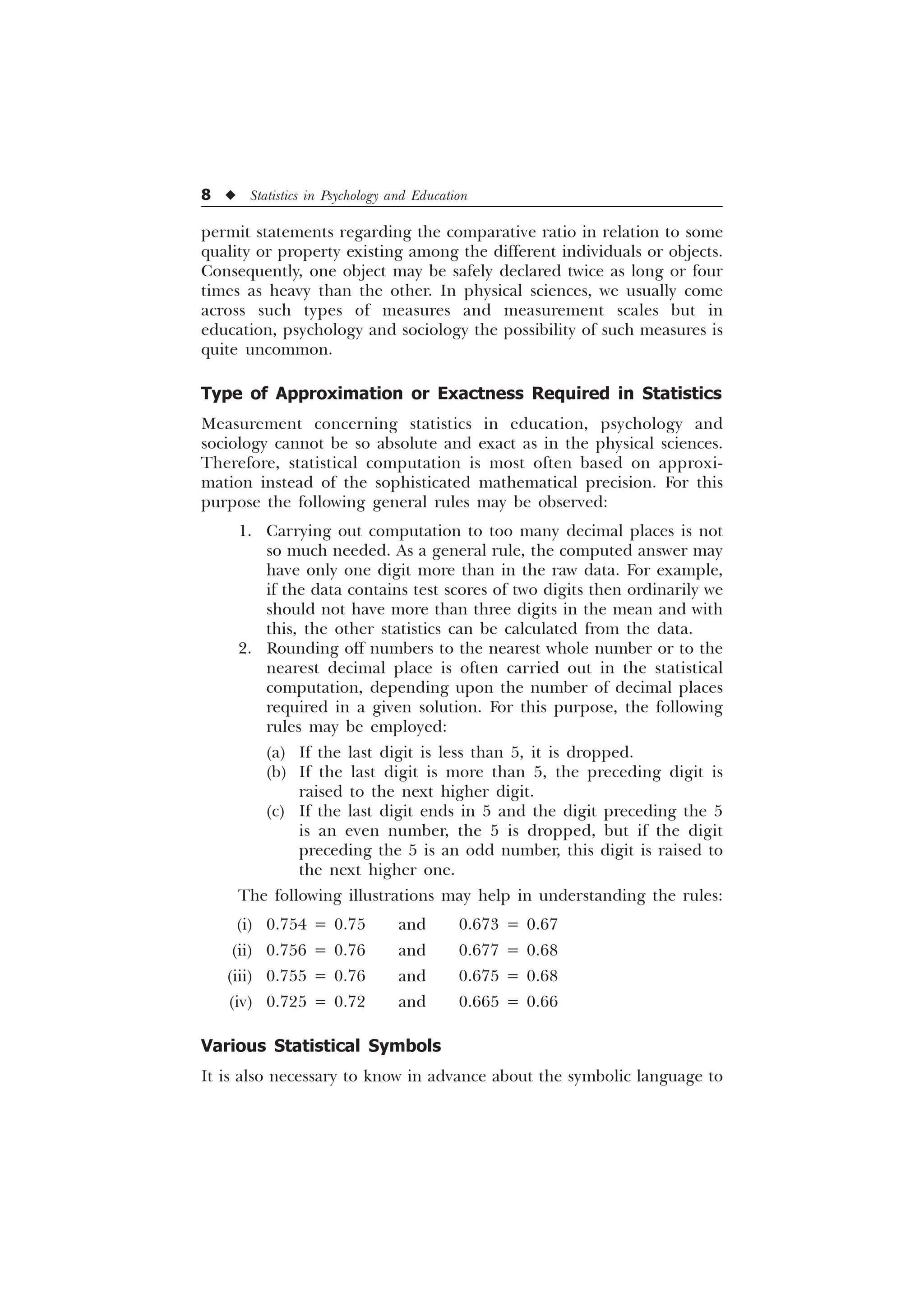
(i) 0.754 = 0.75 and 0.673 = 0.67
(ii) 0.756 = 0.76 and 0.677 = 0.68
(iii) 0.755 = 0.76 and 0.675 = 0.68
(iv) 0.725 = 0.72 and 0.665 = 0.66
Various Statistical Symbols
It is also necessary to know in advance about the symbolic language to
Statistics—Meaning and Use u 9
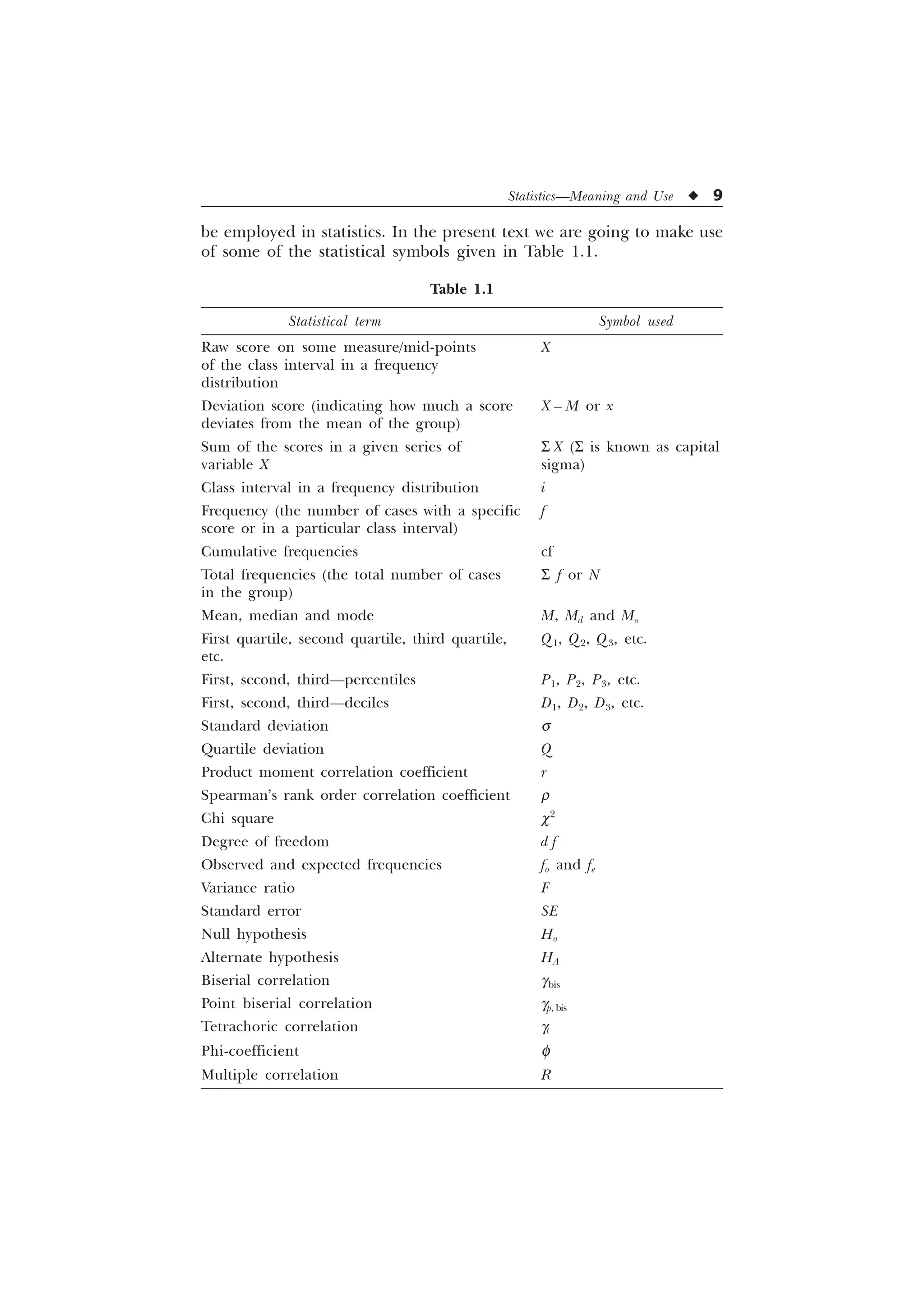
Table 1.1
Statistical term Symbol used
Raw score on some measure/mid-points X
of the class interval in a frequency
distribution
Deviation score (indicating how much a score X – M or x
deviates from the mean of the group)
Sum of the scores in a given series of S X (S is known as capital
variable X sigma)
Class interval in a frequency distribution i
Frequency (the number of cases with a specific f
score or in a particular class interval)
Cumulative frequencies cf
Total frequencies (the total number of cases S f or N
in the group)
Mean, median and mode M, Md and Mo
First quartile, second quartile, third quartile, Q1, Q2, Q3, etc.
etc.
First, second, third—percentiles P1, P2, P3, etc.
First, second, third—deciles D1, D2, D3, etc.
Standard deviation s
Quartile deviation Q
Product moment correlation coefficient r
Spearman’s rank order correlation coefficient r
Chi square c2
Degree of freedom d f
Observed and expected frequencies fo and fe
Variance ratio F
Standard error SE
Null hypothesis Ho
Alternate hypothesis HA
Biserial correlation gbis
Point biserial correlation gp, bis
Tetrachoric correlation gt
Phi-coefficient f
Multiple correlation R
be employed in statistics. In the present text we are going to make use
of some of the statistical symbols given in Table 1.1.
10 u Statistics in Psychology and Education
SUMMARY
The word “statistics” may refer to numerical facts, methodology of
dealing with numerical facts or summarized figures of numerical facts.
However, as a subject, statistics refers to that branch of knowledge
which helps in the scientific collection, presentation, analysis and
interpretation of numerical facts.
In the fields of education, psychology and sociology, statistics
helps in:
1. the task of evaluation and measurement;
2. in carrying out day to day professional activities;
3. keeping various types of records and furnishing statistics;
4. in carrying out research; and
5. in understanding and using the products of research.
The subject statistics for being employed in the above purposes,
requires a minimum basic knowledge of some fundamentals of
mathematical computation and statistical language from its users.
Therefore, a beginner in this subject must have knowledge about:
1. mathematical fundamentals like four fundamental rules,
square and square roots and so on;
2. the continuous and discrete variables employed in statistical
measurement;
3. the various scales of measurement like nominal, ordinal,
interval and ratio scales;
4. the nature of exactness or approximation required in
statistical measurement; and
5. the various statistical symbols.
EXERCISES
1. What do you mean by the term statistics? Enumerate its needs
and importance in the fields of education and psychology.
2. What do you mean by continuous and discrete variables?
Illustrate with examples.
3. Classify the following variables into continuous and discrete
series:
(a) Height (b) weight (c) distance travelled by train (d) scores
on an achievement test (e) number of electric poles in
a colony (f) number of individuals sitting in a bus
(g) intelligence test scores.
Statistics—Meaning and Use u 11
4. Point out the range (lower limit to upper limit) of the
following scores belonging to a continuous series:
14, 22, 46, 72 and 85.
5. Write in detail about the various scales of measurement. What
type of scales are frequently used for collecting data in
education, psychology and sociology and why?
6. What type of scale—nominal, ordinal, interval or ratio scale—
may be used in measuring each of the following variables:
(a) Sex (b) eye colour (c) temperature (d) height (e) weight
(f) rating of performance in a task (g) scores on an
achievement test (h) scores on an intelligence test (i) calendar
time ( j) length.
7. Round off the following numbers to two decimal places:
(a) 52.726 (b) 0.315 (c) 0.845 (d) 2.374 (e) 8.675 (f) 23.72558.
12
THE MEANING OF THE TERM ‘DATA’
The word “data” is plural, the singular being datum. Dictionary
meaning of the word datum is ‘fact’ and, therefore, in plural, the word
data signifies more than one fact. In a wider sense, the term data
denotes evidence or facts describing a group or a situation. In other
words, it may refer to any details regarding numerical records or
reports. However, in a practical sense, the statistical term is generally
used for numerical facts such as measures of height, weight and scores
on achievement and intelligence tests.
METHODS OF ORGANIZING DATA
Tests, experiments and survey studies in education and psychology
provide us valuable data, mostly in the shape of numerical scores.
These data in their original form, have little meaning for the
investigator or reader. For understanding the meaning and deriving
useful conclusion, the data have to be organized or arranged in some
systematic way. The organization and arrangement of original data or
computed statistics in a proper way for deriving useful interpretation
is termed organization of data. In general, this task can be carried out
in the following ways:
1. Organization in the form of statistical tables
2. Organization in the form of Rank order
3. Organization in the form of Frequency Distribution (distri-
bution into suitable groups).
Let us discuss these one by one.
Statistical Tables
In this form of arrangement, the data are tabulated or arranged into
rows and columns of different headings. Such tables can list original
raw scores as well as the percentages, means, standard deviations and
2 Organization of Data
Organization of Data u 13
so on. This organization of data into statistical tables may be
understood through the following examples.
Example 2.1: Literacy survey of the village Bohar made by the students of
B.Ed., C.R. College of Education, Rohtak for age group 15–35.
Literacy Upper caste Hindu Backward classes Scheduled caste/Tribe
status Male Female Total Male Female Total Male Female Total
Literate 2650 550 3200 1208 312 1520 453 52 505
Illiterate 2702 3498 6200 1625 1515 3140 404 606 1010
Total 5352 4048 9400 2833 1827 4660 857 658 1515
Source: Record of N.S.S. Activities, C.R. College of Education, Rohtak, 2000–2001.
Example 2.2: Pass percentage of the High Schools of Rohtak City in the
High School Public Examination.
Name of Pass Girls’ pass Boys’ pass
school percentage percentage percentage
A
B
C
D
E
.
.
.
N
Source: Result record collected by the District Education Officer’s Office, Rohtak.
Note: In place of actual figures, we have produced only a format for the desired
statistical table.
General rules for constructing tables. For the construction of tables
in general, the following rules prove quite useful:
1. Title of the table should be simple, concise and unambiguous.
As a rule, it should appear on the top of the table.
2. The table should be suitably divided into columns and rows
according to the nature of data and purpose. These columns
and rows should be arranged in a logical order to facilitate
comparisons.
3. The heading of each column or row should be as brief as
possible. Two or more columns or rows with similar headings
may be grouped under a common heading to avoid repetition
and we may have sub-headings or captions.
High
Schools
of
Rohtak
City
14 u Statistics in Psychology and Education
4. Sub-totals for each separate classification and a general total
for all combined classes are to be given. These totals should
be given at the bottom or at the right of the concerned items
(members).
5. The units (e.g. weight in kg, height in centimeters, percent-
age, etc.) in which the data are given must invariably be
mentioned, preferably, in the headings of columns or
rows.
6. Necessary footnotes for providing essential explanation of the
points to ambiguous interpretation of the tabulated data must
be given at the bottom of the table.
7. The source/sources from where the data have been received
should be given at the end of the table. In case the primary
source is not traceable, then the secondary source may be
mentioned.
8. In tabulating long columns of figures, space should be left
after every five or ten rows.
9. If the numbers tabulated have more than three significant
figures, the digits should be grouped in threes. For example,
we should write 5732981 as 5 732 981.
10. For all purposes and by all means, the table should be as
simple as possible so that it may be studied by the readers
with minimum possible strain and it should provide a clear
picture and interpretation of the statistical data in the quickest
possible time.
Rank Order
The original raw scores can be successfully arranged in an ascending
or a descending series exhibiting an order with respect to the rank or
merit position of the individual. For this purpose, we usually adopt a
descending series, arranging the highest score on the top and the
lowest at the bottom.
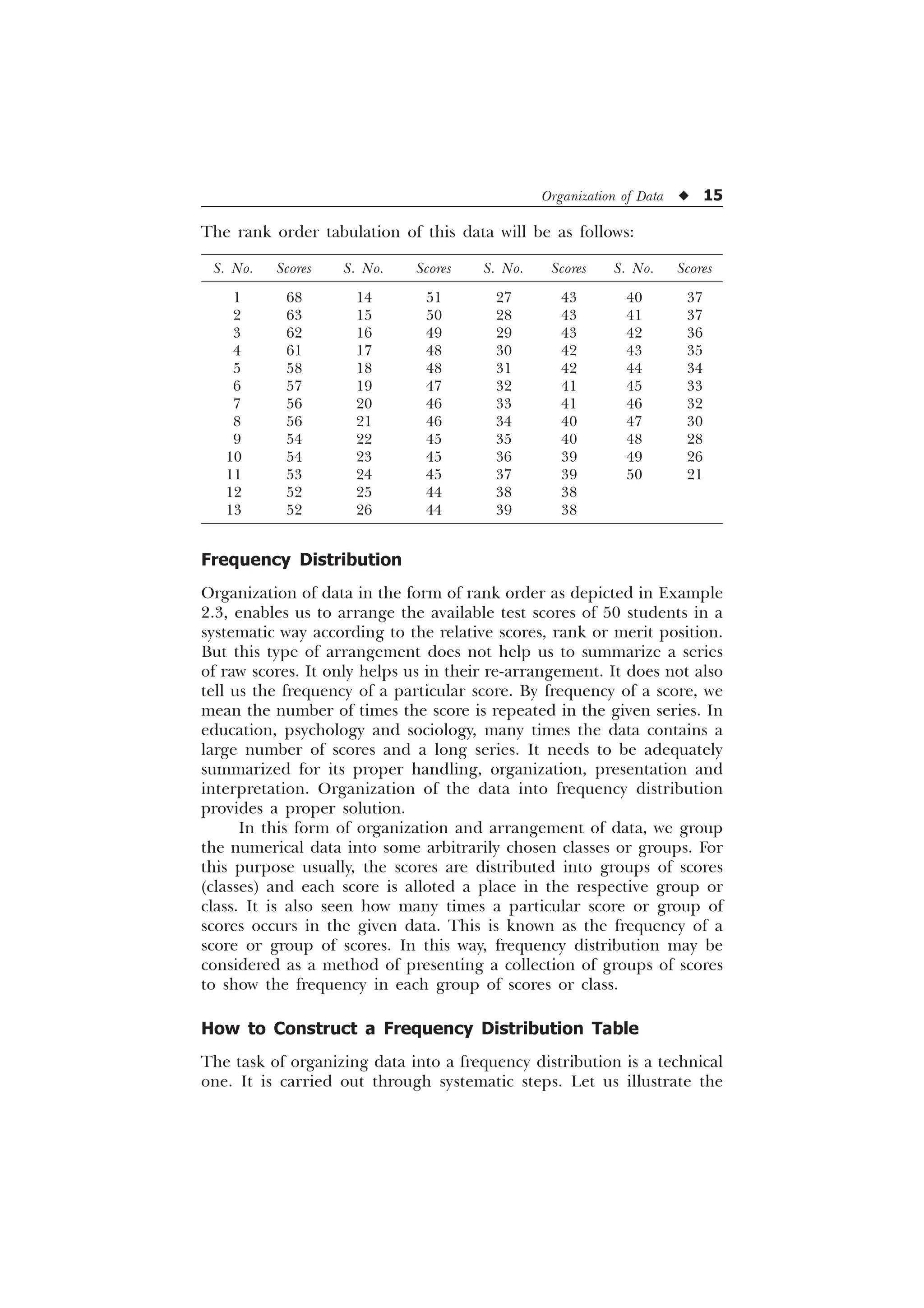
Example 2.3: Fifty students of the B.Ed. class obtained the following
scores (roll numberwise) on an achievement test. Tabulate this data in
the form of a rank order:
62, 21, 26, 32, 56, 36, 37, 39, 53, 40, 54, 42, 44, 61, 68, 28, 33, 56,
57, 37, 52, 39, 40, 54, 42, 43, 63, 30, 34, 58, 35, 38, 50, 38, 52, 41,
51, 44, 41, 42, 43, 45, 46, 45, 47, 48, 49, 45, 46, 48.
Organization of Data u 15
The rank order tabulation of this data will be as follows:
S. No. Scores S. No. Scores S. No. Scores S. No. Scores
1 68 14 51 27 43 40 37
2 63 15 50 28 43 41 37
3 62 16 49 29 43 42 36
4 61 17 48 30 42 43 35
5 58 18 48 31 42 44 34
6 57 19 47 32 41 45 33
7 56 20 46 33 41 46 32
8 56 21 46 34 40 47 30
9 54 22 45 35 40 48 28
10 54 23 45 36 39 49 26
11 53 24 45 37 39 50 21
12 52 25 44 38 38
13 52 26 44 39 38
Frequency Distribution
Organization of data in the form of rank order as depicted in Example
2.3, enables us to arrange the available test scores of 50 students in a
systematic way according to the relative scores, rank or merit position.
But this type of arrangement does not help us to summarize a series
of raw scores. It only helps us in their re-arrangement. It does not also
tell us the frequency of a particular score. By frequency of a score, we
mean the number of times the score is repeated in the given series. In
education, psychology and sociology, many times the data contains a
large number of scores and a long series. It needs to be adequately
summarized for its proper handling, organization, presentation and
interpretation. Organization of the data into frequency distribution
provides a proper solution.
In this form of organization and arrangement of data, we group
the numerical data into some arbitrarily chosen classes or groups. For
this purpose usually, the scores are distributed into groups of scores
(classes) and each score is alloted a place in the respective group or
class. It is also seen how many times a particular score or group of
scores occurs in the given data. This is known as the frequency of a
score or group of scores. In this way, frequency distribution may be
considered as a method of presenting a collection of groups of scores
to show the frequency in each group of scores or class.
How to Construct a Frequency Distribution Table
The task of organizing data into a frequency distribution is a technical
one. It is carried out through systematic steps. Let us illustrate the
16 u Statistics in Psychology and Education
process by taking the data of 50 B.Ed. students in an achievement test,
given in Example 2.3.
Finding the range. First of all, the range of the series to be grouped
is found out. It is done by subtracting the lowest score from the
highest. In the present problem the range of the distribution is 68 – 21,
i.e. 47.
Determining the class interval or grouping interval. After finding
out the range, the number and size of the classes or groups to be used
in grouping the data are decided.
There exist two different rules for this purpose:
(i) First rule: To get an idea of the size of the classes, i.e. class
interval, the range is divided by the number of classes desired.
Class interval is usually denoted by the symbol ‘i’ and is always
a whole number. Thus the formula for deciding the class
interval is:
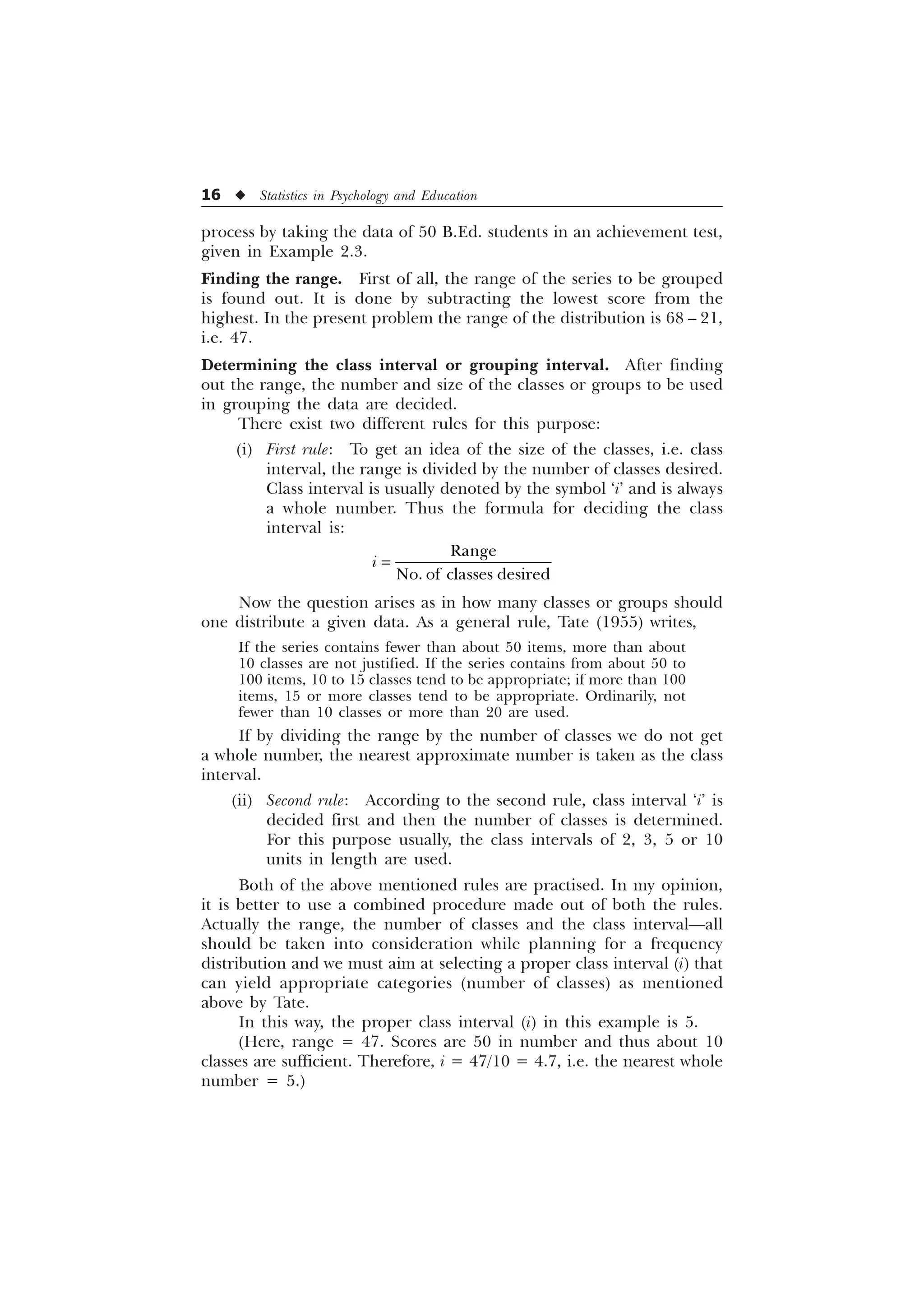
5DQJH
1R RI FODVVHV GHVLUHG
L
Now the question arises as in how many classes or groups should
one distribute a given data. As a general rule, Tate (1955) writes,
If the series contains fewer than about 50 items, more than about
10 classes are not justified. If the series contains from about 50 to
100 items, 10 to 15 classes tend to be appropriate; if more than 100
items, 15 or more classes tend to be appropriate. Ordinarily, not
fewer than 10 classes or more than 20 are used.
If by dividing the range by the number of classes we do not get
a whole number, the nearest approximate number is taken as the class
interval.
(ii) Second rule: According to the second rule, class interval ‘i’ is
decided first and then the number of classes is determined.
For this purpose usually, the class intervals of 2, 3, 5 or 10
units in length are used.
Both of the above mentioned rules are practised. In my opinion,
it is better to use a combined procedure made out of both the rules.
Actually the range, the number of classes and the class interval—all
should be taken into consideration while planning for a frequency
distribution and we must aim at selecting a proper class interval (i) that
can yield appropriate categories (number of classes) as mentioned
above by Tate.
In this way, the proper class interval (i) in this example is 5.
(Here, range = 47. Scores are 50 in number and thus about 10
classes are sufficient. Therefore, i = 47/10 = 4.7, i.e. the nearest whole
number = 5.)
Organization of Data u 17
Writing the contents of the frequency distribution. After deciding
the size and number of the class interval and locating the highest and
lowest scores of the given data, we proceed to write the contents of the
frequency distribution. For this purpose, three columns are drawn and
work is carried out as under:
(i) Writing the classes of the distribution. In the first column, we
write down all the classes of the distribution. For this purpose
first of all, the lowest class is settled and afterwards other
subsequent classes are written down. In the present problem,
20–24 can be taken as the lowest class and then we have
higher classes 25–29, 30–34, etc. up to 65–69.
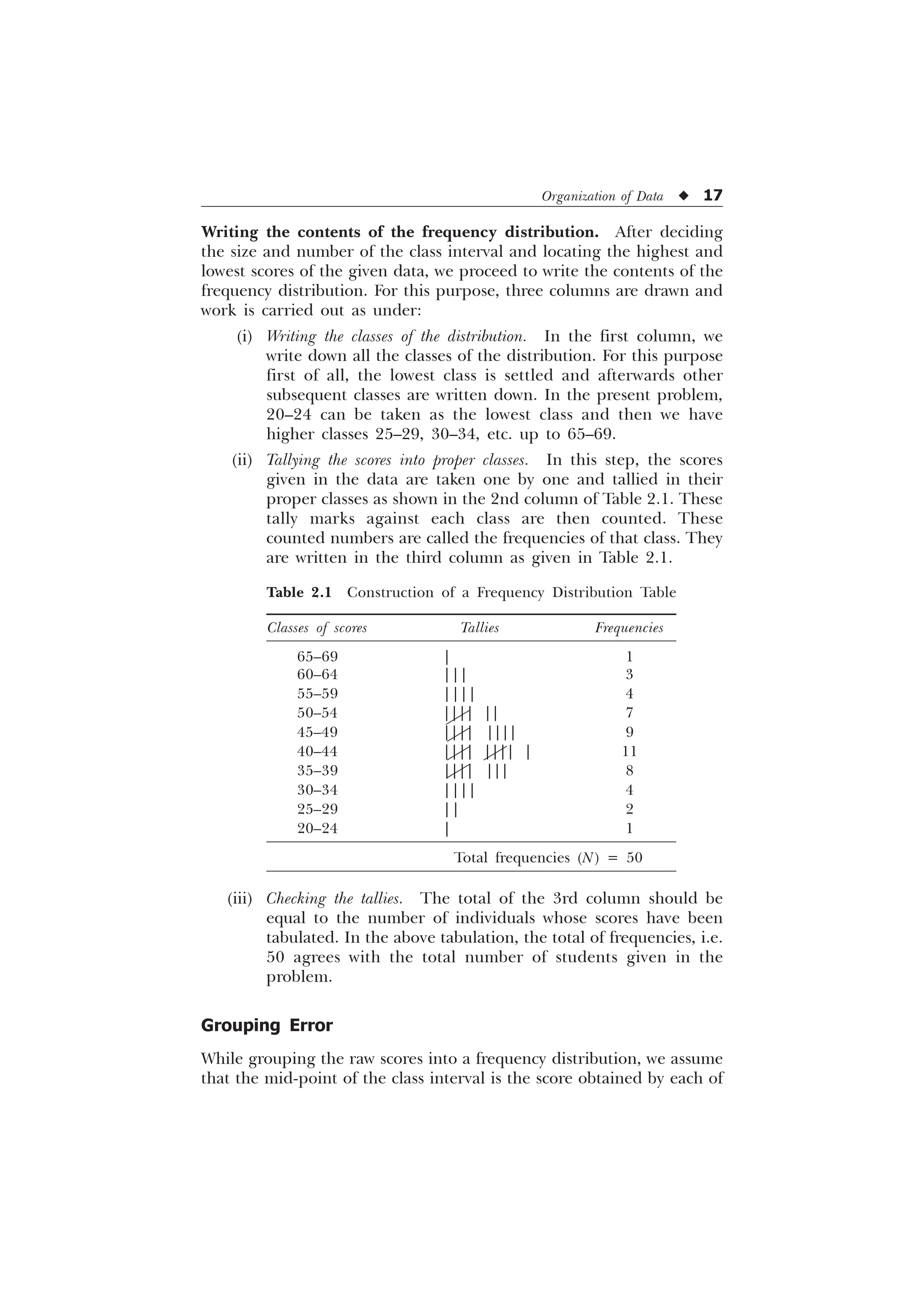
(ii) Tallying the scores into proper classes. In this step, the scores
given in the data are taken one by one and tallied in their
proper classes as shown in the 2nd column of Table 2.1. These
tally marks against each class are then counted. These
counted numbers are called the frequencies of that class. They
are written in the third column as given in Table 2.1.
Table 2.1 Construction of a Frequency Distribution Table
Classes of scores Tallies Frequencies
65–69 | 1
60–64 ||| 3
55–59 |||| 4
50–54 |||| || 7
45–49 |||| |||| 9
40–44 |||| |||| | 11
35–39 |||| ||| 8
30–34 |||| 4
25–29 || 2
20–24 | 1
Total frequencies (N) = 50
(iii) Checking the tallies. The total of the 3rd column should be
equal to the number of individuals whose scores have been
tabulated. In the above tabulation, the total of frequencies, i.e.
50 agrees with the total number of students given in the
problem.
Grouping Error
While grouping the raw scores into a frequency distribution, we assume
that the mid-point of the class interval is the score obtained by each of
18 u Statistics in Psychology and Education
the individuals represented by that interval. If we take the frequency
distribution given in Table 2.1, we may observe that four scores
tabulated in the class interval 55–59 had the original values 56, 56, 57
and 58 respectively. In grouping, we assume that these measures have
the values of the mid-point of their respective class or group, i.e. 57.
They are represented by a single score 57. In making such an
assumption, there is a possibility of an error known as the grouping
error. The grouping error is likely to be caused by grouping the scores
into a frequency distribution assuming that the measures have the
values of the mid-point of their respective classes. The extent to which
assumption is not satisfied is the extent to which errors of grouping are
present. There is no way to eliminate errors of grouping. They are
bound to occur and represent a unique characteristic of continuous
series. In a continuous series, the grouping error varies with the size
of the class interval, i.e. class interval µ grouping error. Therefore, its
effect may be lessened by adopting a proper choice of the grouping
scheme.
Cumulative Frequency and Cumulative Percentage
Frequency Distributions
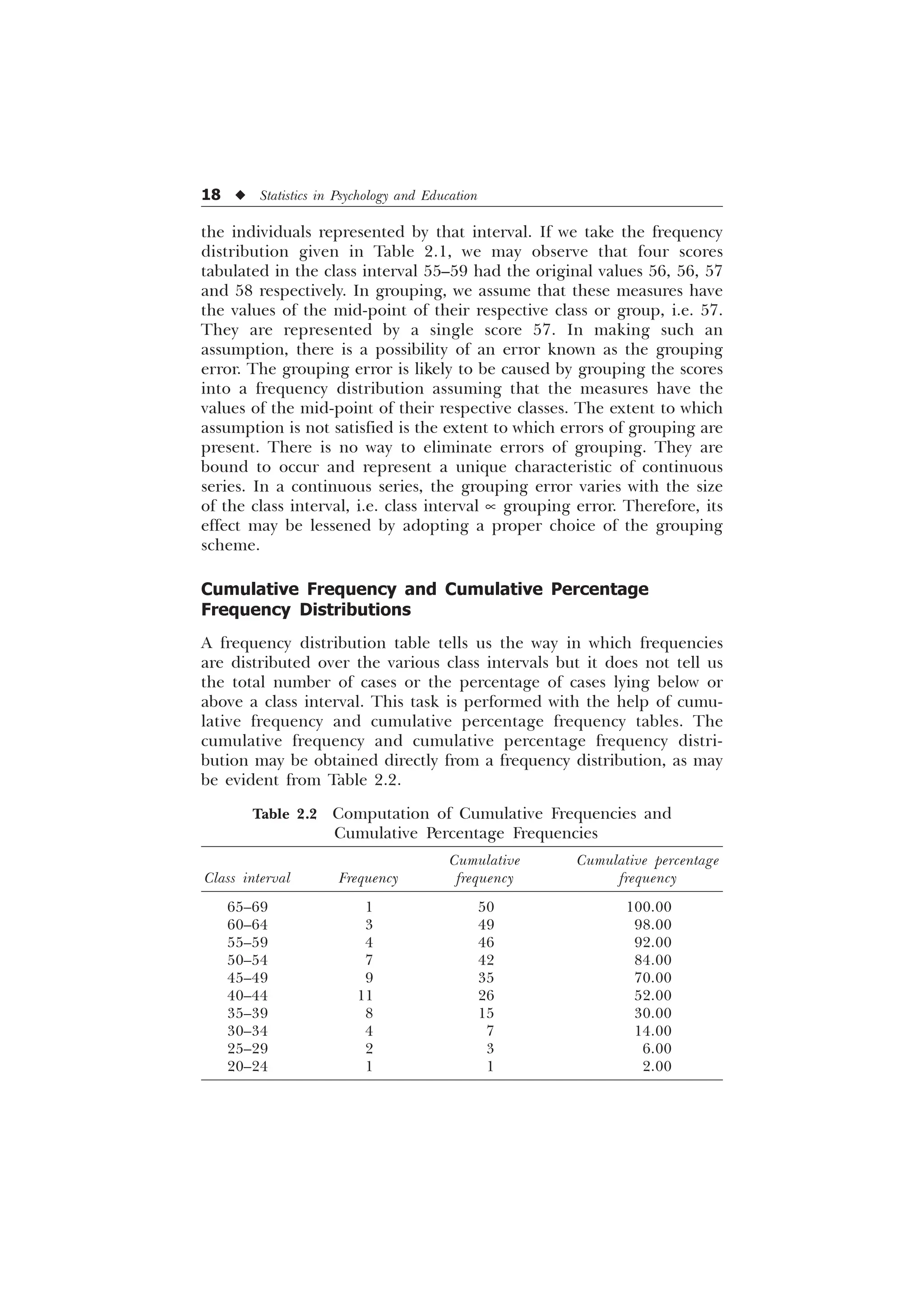
A frequency distribution table tells us the way in which frequencies
are distributed over the various class intervals but it does not tell us
the total number of cases or the percentage of cases lying below or
above a class interval. This task is performed with the help of cumu-
lative frequency and cumulative percentage frequency tables. The
cumulative frequency and cumulative percentage frequency distri-
bution may be obtained directly from a frequency distribution, as may
be evident from Table 2.2.
Table 2.2 Computation of Cumulative Frequencies and
Cumulative Percentage Frequencies
Cumulative Cumulative percentage
Class interval Frequency frequency frequency
65–69 1 50 100.00
60–64 3 49 98.00
55–59 4 46 92.00
50–54 7 42 84.00
45–49 9 35 70.00
40–44 11 26 52.00
35–39 8 15 30.00
30–34 4 7 14.00
25–29 2 3 6.00
20–24 1 1 2.00
Organization of Data u 19
Cumulative frequencies are thus obtained by adding successively,
starting from the bottom, the individual frequencies. In the given table,
when we start from the bottom the first cumulative frequency is to be
written as 1 against the lowest class interval, i.e. 20–24. Then we get
3 as another cumulative frequency by adding 1 and 2, then 7 by adding
1, 2 and 4. Similarly, by adding 1, 2, 4 and 8, we get 15 as a cumulative
frequency to be written against the interval 35–39. As the actual upper
limit of this class interval is 39.5, it may be safely claimed that there
are 15 students in the class of 50 students whose achievement scores lie
below 39.5.
For converting cumulative frequencies into cumulative percentage
frequencies, the particular cumulative frequency is multiplied by
100/N, where N is the total number of frequencies (total number of
students whose achievement scores have been included in the present
example). These frequencies tell us the percentage of cases lying below
a given score or class limit. For example, the cumulative frequency
of 15 can be converted into cumulative percentage frequency by
multiplying by 100/N, i.e. 100/50 ´ 2. Thus, we obtain 30 as the
cumulative percentage frequency against the class interval 35–39. This
cumulative percentage frequency may help us conclude that there are
30% of students in the class of fifty, whose achievement scores lie below
the score 39.5. Similarly, the cumulative percentage frequency of
70 may tell us that there are 70% of students whose scores lie below the
upper limit of the class interval 45–49, i.e. 49.5.
The cumulative frequencies and cumulative percentage fre-
quencies also help us to tell the relative position, rank or merit of an
individual with respect to the members of a group. For example, in the
present distribution, if a student secures 54 marks, then it can be
immediately concluded from the cumulative frequency distribution
that he is better than 42 students in his class of 50 students or in the
form of percentage he is better than 84 percent students of his class.
In this way, the cumulative frequency and cumulative percentage
frequency distribution tables render valuable help in proper
organization, presentation and interpretation of the collected data.
These tables also prove quite helpful in the construction of cumulative
frequency curves and cumulative percentage frequency curves as well
as in the computation of the statistics like median, quartiles,
percentiles, quartile deviation and percentile rank.
SUMMARY
The term ‘data’ refers to numerical facts such as measures of height,
weight and scores on intelligence and achievement tests and the
like.
20 u Statistics in Psychology and Education
Statistical data may be organized in three different ways—
statistical tables, rank order and frequency distribution tables.
In statistical tables, the data are tabulated or arranged in to rows
and columns of different headings. In these the classes of data are
shown according to the nature of data and purpose of the study. Proper
headings are given for the contents of these columns and rows.
Similarly, care is taken in writing proper footnotes, units of measure,
sub-totals and grand totals and source from where the data have been
received.
For arranging data in the form of a rank order we usually arrange
it in the descending series by taking highest score on the top and
lowest in the bottom.
In organizing data through frequency distribution table, we group
it into some arbitrarily chosen classes or groups and try to show the
frequency in each group of scores or class.
For the construction of a frequency distribution table, we first find
out the range (highest – lowest score) and then determine the number
of classes and class intervals by the formula
5DQJH
1R RI FODVVHV
L
Class intervals of 2, 3, 5 and 10 units are generally preferred. For
less than 50 items, 10 classes, and between 50 and 100 items, 10 to 15
classes and more than 100 items, 15 to 20 classes are preferred to be
chosen. The aim is to select a proper class interval (i) that can yield
appropriate categories.
After deciding the class interval and number of classes, and
locating the highest and the lowest scores of the given data, the
contents of the frequency distribution are written in three columns. In
the first column, we write down all the classes of the distribution, in the
second column, tallies of individual scores in their proper classes are
marked and in the third column the total of the tallies converted into
numerical figures is written down. In the end, the total of the 3rd
column is checked against the total number of individuals or scores.
Organization of data into a frequency distribution may involve
grouping error. This is because of the assumption that the measures
have the values of the mid-points of their respective classes. The extent
to which this assumption is not satisfied is the extent to which errors
of grouping are present. Grouping errors are bound to occur. However,
their effect may be minimized by adopting a proper choice of the
grouping scheme.
Cumulative frequencies are obtained by adding successively,
starting from the bottom of the given frequency distribution table, the
individual frequencies. For converting cumulative frequencies into
Organization of Data u 21
cumulative percentage frequencies, the respective cumulative
frequency is multiplied by 100/N where N is the total number of
frequencies. Cumulative frequencies and cumulative percentage
frequencies tell us the number of individuals and the percentage of the
number of individuals respectively lying below a given score or a class
limit. In this way, they may be used to tell the relative position or rank
of an individual with respect to the members of his group and to
compute statistics like median, quartiles, percentiles and percentile
rank.
EXERCISES
1. What do you understand by the term ‘data’ as used in
statistics? Why is it essential to organize data?
2. What do you understand by the term ‘organization’ of data?
Discuss in brief the various methods employed for the
organization of data.
3. Give the format for organizing the following data into some
appropriate statistical tables:
(a) Literacy figures of different districts of Haryana accord-
ing to religion and sex.
(b) The middle standard results of the board in the different
districts of Haryana in terms of rural/urban and Govt./
non-Govt. schools.
4. What is frequency distribution? How can you organize data in
the form of a frequency distribution? Illustrate with the help
of an example.
5. In each of the following distributions, indicate
(a) the size of the class interval,
(b) the mid-point of the intervals shown, and
(c) the actual class limits of the intervals.
(i) 5–8 (ii) 16–18 (iii) 30–39
9–12 19–21 40–49
13–16 22–24 50–59
17–20 25–27 60–69
21–24 28–30 70–79
6. Tabulate the following 25 scores into a frequency distribution
using an appropriate interval:
72 75 77 67 72 81 68 65 86 73 67 82 76
76 70 83 71 63 72 72 61 67 84 69 64
7. The following table represents raw scores on a teaching
aptitude test:
22 u Statistics in Psychology and Education
30 35 36 58 54 53 50 52 39 49
33 36 34 57 55 38 39 51 48 46
37 54 52 53 39 47 44 41 43 40
52 53 38 51 39 46 45 40 42 41
Make a frequency distribution with a class interval of 3.
8. What do you understand by the terms cumulative frequency
distribution and cumulative percentage frequency distri-
bution? Illustrate with the help of some hypothetical data.
9. The following scores were obtained by a group of 40 students
on an achievement test:
32 78 27 65 88 83 63 52
86 70 42 66 56 44 63 59
73 52 43 69 59 46 71 65
42 55 39 70 57 49 78 70
34 61 62 77 81 72 79 69
Prepare a frequency distribution table and extend it to a
cumulative frequency distribution and cumulative percentage
frequency distribution tables for the above data by using a
class interval of 5.
23
In Chapter 2, we have discussed the organization of data in the form
of statistical and frequency distribution tables. Such organization and
arrangement of the obtained raw scores on some tests, experiments
and surveys helps in the proper understanding and interpretation of
the collected data. Thus, valuable ideas can be derived about the
progress and development in respective fields. Graphical represen-
tation of data also serves the same purpose in more effective ways.
Here, the data collected through a practical experiment, test, study or
survey is represented or illustrated with the help of some graphic aids,
e.g. pictures and graphs.
MEANING OF GRAPHICAL REPRESENTATION OF DATA
A graphic representation is the geometrical image of a set of data. It
is a mathematical picture. It enables us to think about a statistical
problem in visual terms. A picture is said to be more effective than
words for describing a particular thing or phenomenon. Consequently,
the graphic representation of data proves quite an effective and an
economic device for the presentation, understanding and interpre-
tation of the collected statistical data.
ADVANTAGES OF GRAPHICAL REPRESENTATION OF DATA
The advantages of graphic representation may be summarized as
below:
1. The data can be presented in a more attractive and an
appealing form.
2. It provides a more lasting effect on the brain. It is possible to
have an immediate and a meaningful grasp of large amounts
of data through such presentation.
3 Graphical Representation
of Data
24 u Statistics in Psychology and Education
3. Comparative analysis and interpretation may be effectively
and easily made.
4. Various valuable statistics like median, mode, quartiles, may
be easily computed. Through such representation, we also get
an indication of correlation between two variables.
5. Such representation may help in the proper estimation,
evaluation and interpretation of the characteristics of items
and individuals.
6. The real value of graphical representation lies in its economy
and effectiveness. It carries a lot of communication power.
7. Graphical representation helps in forecasting, as it indicates
the trend of the data in the past.
MODES OF GRAPHICAL REPRESENTATION OF DATA
We know that the data in the form of raw scores is known as ungrouped
data and when it is organized into a frequency distribution, then it is
referred to as grouped data. Separate methods are used to represent
these two types of data—ungrouped and grouped. Let us discuss them
under separate heads.
Graphical Representation of Ungrouped Data
For the ungrouped data (data not grouped into a frequency distri-
bution) we usually make use of the following graphical representation:
1. Bar graph or bar diagrams
2. Circle graph or Pie diagrams
3. Pictograms
4. Line graphs
Bar graph or bar diagram. In bar graphs or diagrams the data is
represented by bars. Generally these diagrams or pictures are drawn
on graph paper. Therefore these bar diagrams are also referred to as
bar graphs.
These diagrams or graphs are usually available in two forms,
vertical and horizontal. In the construction of both these forms, the
lengths of the bars are in proportion to the amount of variables or
traits (height, intelligence, number of individuals, cost, and so on)
possessed. The width of bars is not governed by any set rules. It is an
arbitrary factor. Regarding the space between two bars, it is
conventional to have a space about one half of the width of a bar.
The data capable of representation through bar diagrams may be
in the form of raw scores, total scores or frequencies, computed
statistics and summarized figures like percentages and averages.
Graphical Representation of Data u 25
The task of drawing the bar graph may be further illustrated as in the
following example:
Let us now try to illustrate the task of drawing the bar graph.
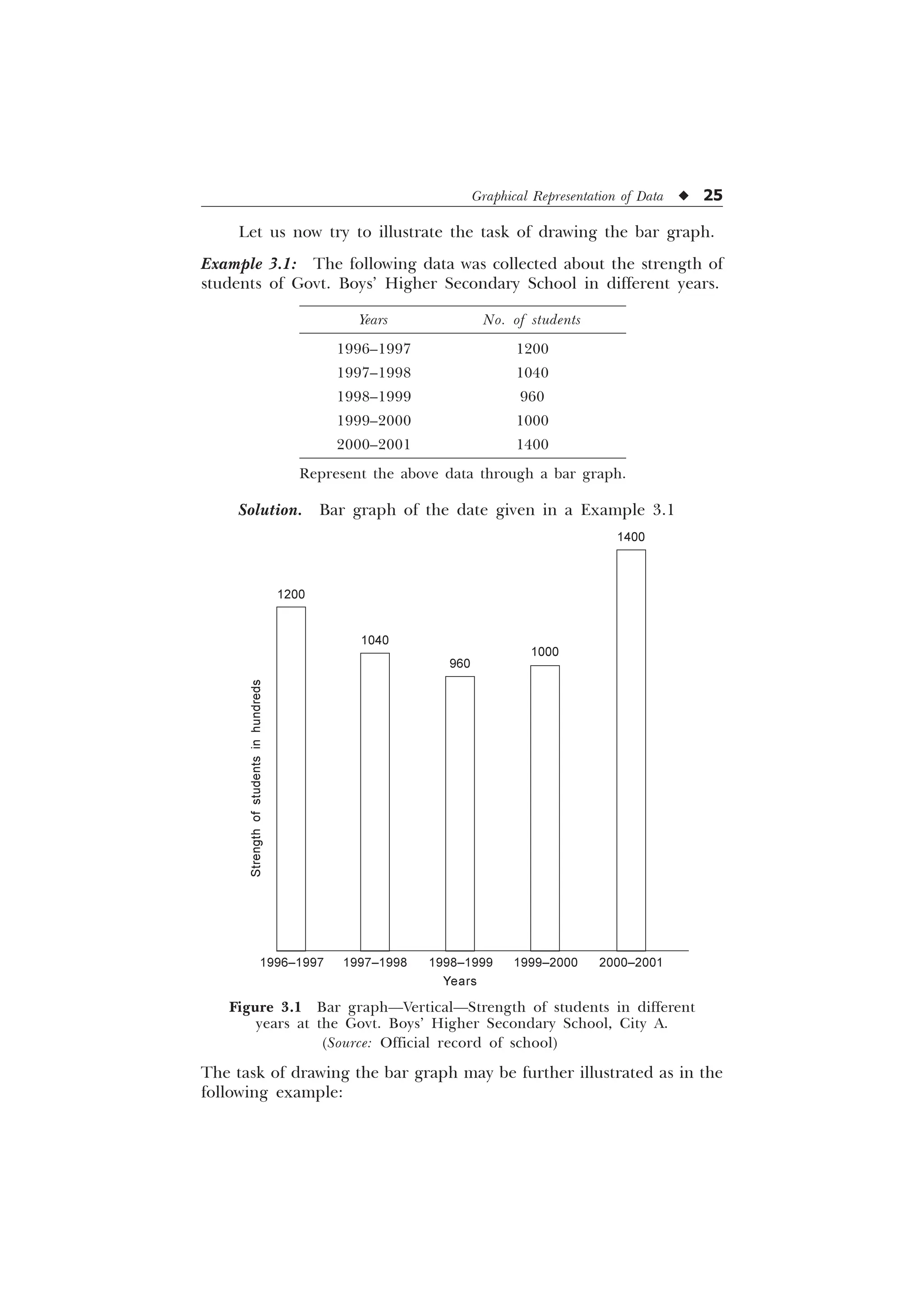
Example 3.1: The following data was collected about the strength of
students of Govt. Boys’ Higher Secondary School in different years.
Figure 3.1 Bar graph—Vertical—Strength of students in different
years at the Govt. Boys’ Higher Secondary School, City A.
(Source: Official record of school)
1200
1040
960
1000
1400
Strength
of
students
in
hundreds
1996–1997 1997–1998 1998–1999 1999–2000 2000–2001
Years
Years No. of students
1996–1997 1200
1997–1998 1040
1998–1999 960
1999–2000 1000
2000–2001 1400
Represent the above data through a bar graph.
Solution. Bar graph of the date given in a Example 3.1
26 u Statistics in Psychology and Education
Circle graph or pie diagram. In this form of graphical represen-
tation, the data is represented through the sections or portions of a
circle. The name pie diagram is given to a circle diagram because in
determining the circumference of a circle we have to take into
consideration a quantity known as ‘pie’ (written as p).
Figure 3.2 Bar graph—Horizontal—Percentage of students of class X
opting for different work experience. (Source: Record of work experience
activities of the school)
Photography
Clay
modelling
Kitchen
gardening
Dolls-making
Book-binding
Areas
of
work
experience
5%
25%
40%
10%
20%
Example 3.2: 120 class X students of a school were asked to opt for
different work experiences. The details of these options are given in
Table 3.1:
Solution. The bar graph of the data given in Example 3.2 can
be depicted as in Figure 3.2.
Table 3.1
Area of work experience No. of students Per cent
Photography 6 5
Clay modelling 30 25
Kitchen gardening 48 40
Doll-making 12 10
Book-binding 24 20
Represent the above data through a bar graph.
Graphical Representation of Data u 27
Area of work experience No. of students Angle of the circle
Photography 6


´ 360 = 18°
Clay modelling 30


´ 360 = 90°
Kitchen gardening 48


´ 360 = 144°
Doll-making 12


´ 360 = 36°
Book-binding 24


´ 360 = 72°
Total 120 360°
Figure 3.3 Representation of data through the Pie diagram—areas
of work experience opted for by students of class X.
Photography
C
l
a
y
m
o
d
e
l
l
i
n
g
Kitchen gardening
Dolls-making
Book-binding
Method of construction. The surface area of a circle is known to cover
2p or 360°. The data to be represented through a circle diagram may
therefore be presented through 360°, parts or sections of a circle. The
total frequencies or value is equated to 360° and then the angles
corresponding to component parts are calculated (or the component
parts are expressed as percentages of the total and then multiplied by
360/100 or 3.6). After determining these angles, the required sectors
in the circle are drawn.
For illustration let us take the data given in Example 3.2 (see
Table 3.2) concerning bar diagram.
Table 3.2
The numerical data may be converted into angles of a circle, as
given in Figure 3.3):
28 u Statistics in Psychology and Education
Line graph. Line graphs are simple mathematical graphs that are
drawn on the graph paper by plotting the data concerning one
variable on the horizontal x-axis and other variable of data on the
vertical y-axis. With the help of such graphs the effect of one variable
upon another variable during an experimental or a normative study,
may be clearly demonstrated. The construction of these graphs can be
understood through the following example:
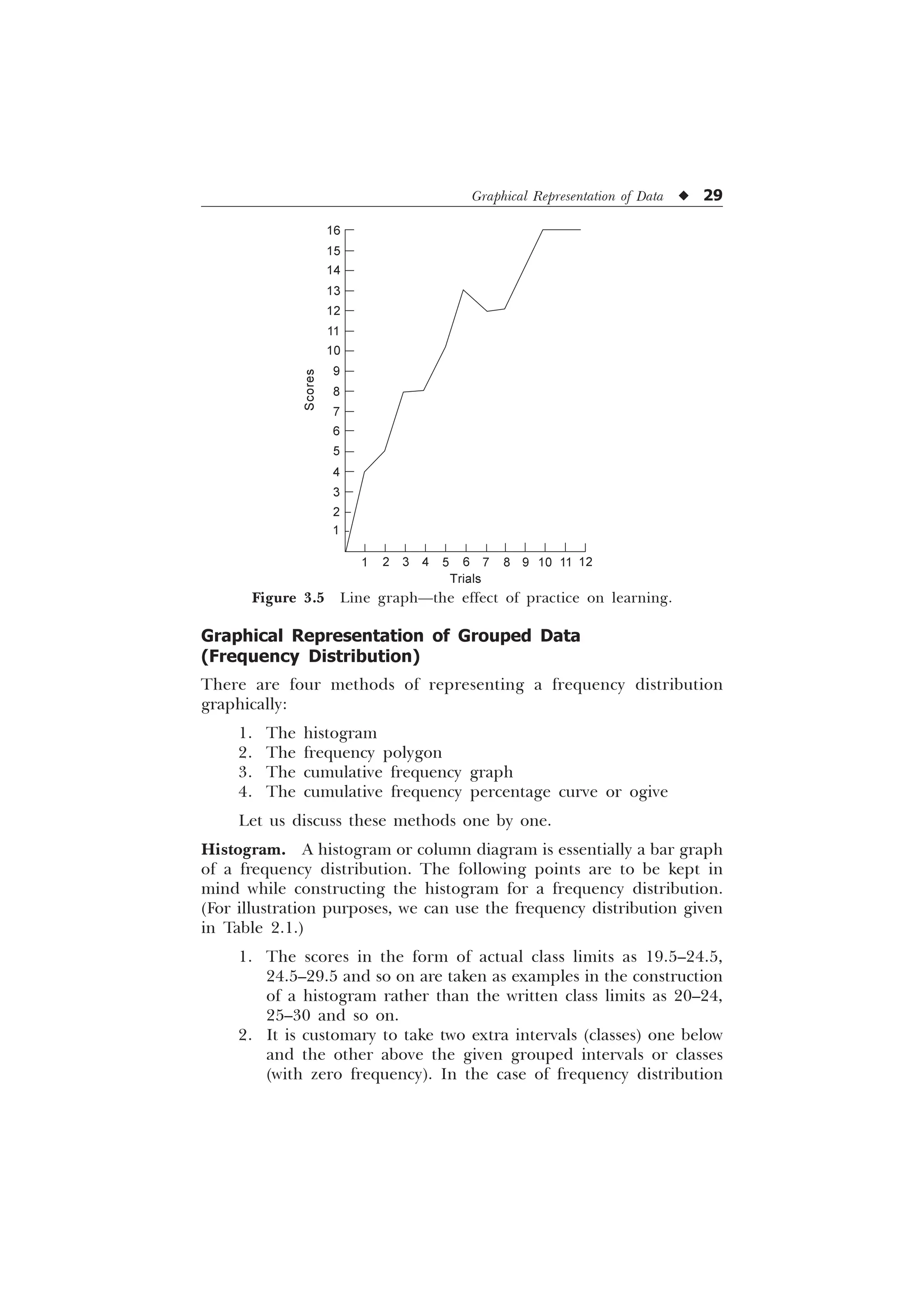
Example 3.3: A nonsense syllables association test was administered
on a student of class X to demonstrate the effect of practice on
learning. The data so obtained may be studied from the following
table:
Trial No. 1 2 3 4 5 6 7 8 9 10 11 12
Score 4 5 8 8 10 13 12 12 14 16 16 16
Draw a line graph for the representation and interpretation of
the above data.
The line graph for the data given in example 3.3 can be drawn
as per presentation in Figure 3.5
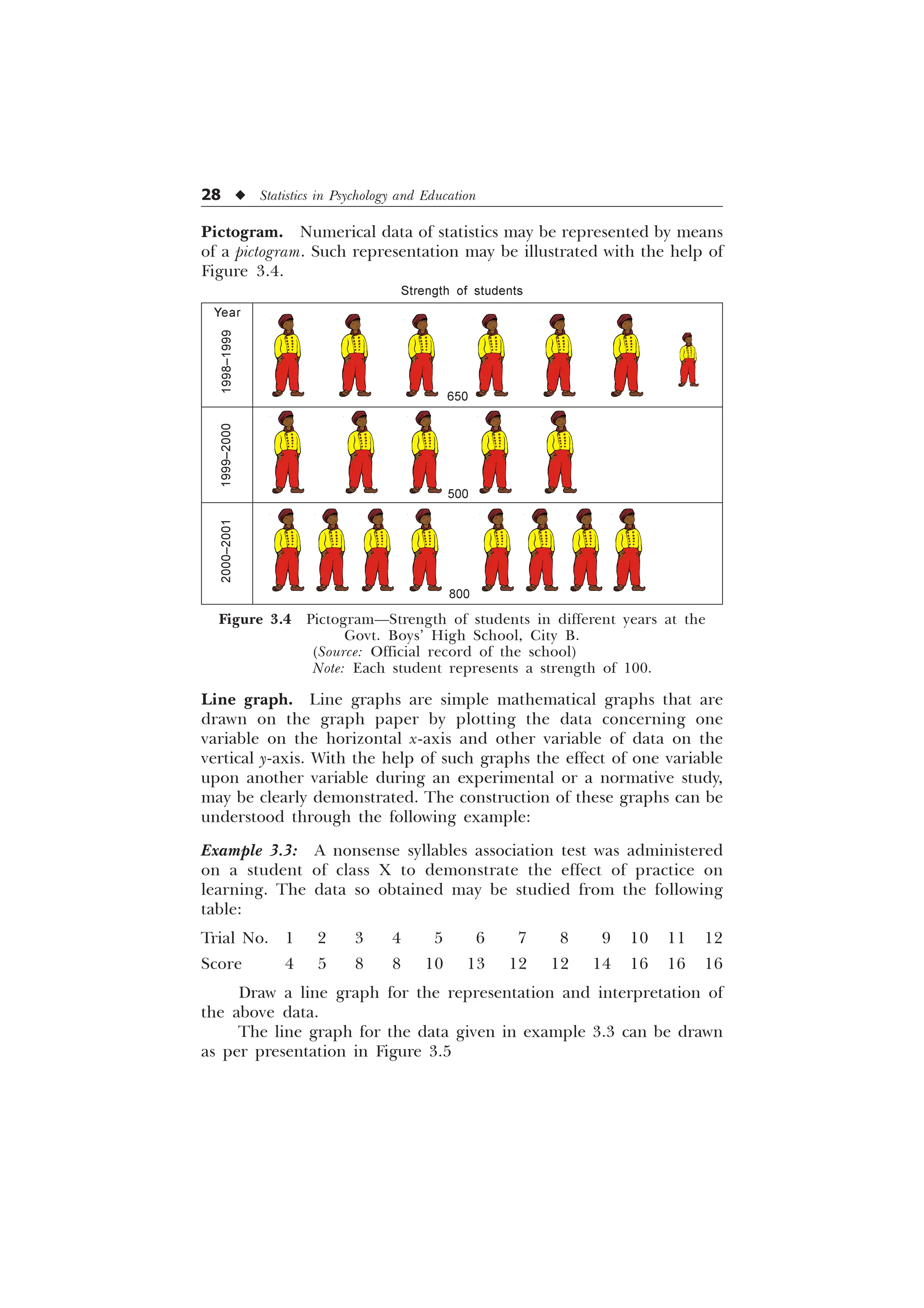
Pictogram. Numerical data of statistics may be represented by means
of a pictogram. Such representation may be illustrated with the help of
Figure 3.4.
Strength of students
650
500
800
Year
1998–1999
1999–2000
2000–2001
Figure 3.4 Pictogram—Strength of students in different years at the
Govt. Boys’ High School, City B.
(Source: Official record of the school)
Note: Each student represents a strength of 100.
Graphical Representation of Data u 29
Graphical Representation of Grouped Data
(Frequency Distribution)
There are four methods of representing a frequency distribution
graphically:
1. The histogram
2. The frequency polygon
3. The cumulative frequency graph
4. The cumulative frequency percentage curve or ogive
Let us discuss these methods one by one.
Histogram. A histogram or column diagram is essentially a bar graph
of a frequency distribution. The following points are to be kept in
mind while constructing the histogram for a frequency distribution.
(For illustration purposes, we can use the frequency distribution given
in Table 2.1.)
1. The scores in the form of actual class limits as 19.5–24.5,
24.5–29.5 and so on are taken as examples in the construction
of a histogram rather than the written class limits as 20–24,
25–30 and so on.
2. It is customary to take two extra intervals (classes) one below
and the other above the given grouped intervals or classes
(with zero frequency). In the case of frequency distribution
Figure 3.5 Line graph—the effect of practice on learning.
Trials
1 2 3 4 5 6 7 8 9 10 11 12
Scores
1
2
3
4
5
6
7
8
9
10
11
12
13
14
15
16
30 u Statistics in Psychology and Education
given in Table 2.1, we can take 14.5–19.5 and 69.5–74.5 as
the two required class intervals.
3. Now we take the actual lower limits of all the class intervals
(including the extra intervals) and try to plot them on the
x-axis. The lower limit of the lowest interval (one of the extra
intervals) is taken at the intersecting point of x-axis and y-axis.
4. Frequencies of distribution are plotted on the y-axis.
5. Each class or interval with its specific frequency is represented
by a separate rectangle. The base of each rectangle is the
width of the class interval (i) and the height is the respective
frequency of that class or interval.
6. It is not essential to project the sides of the rectangles down
to the base line.
7. Care should be taken to select the appropriate units of
representation along the x-axis and the y-axis. Both the x-axis
and the y-axis should not be too short or too long. A good
general rule for this purpose as suggested by Garrett (1971)
is:
To select x and y units which will make the height of the figure
approximately 75% of its width.
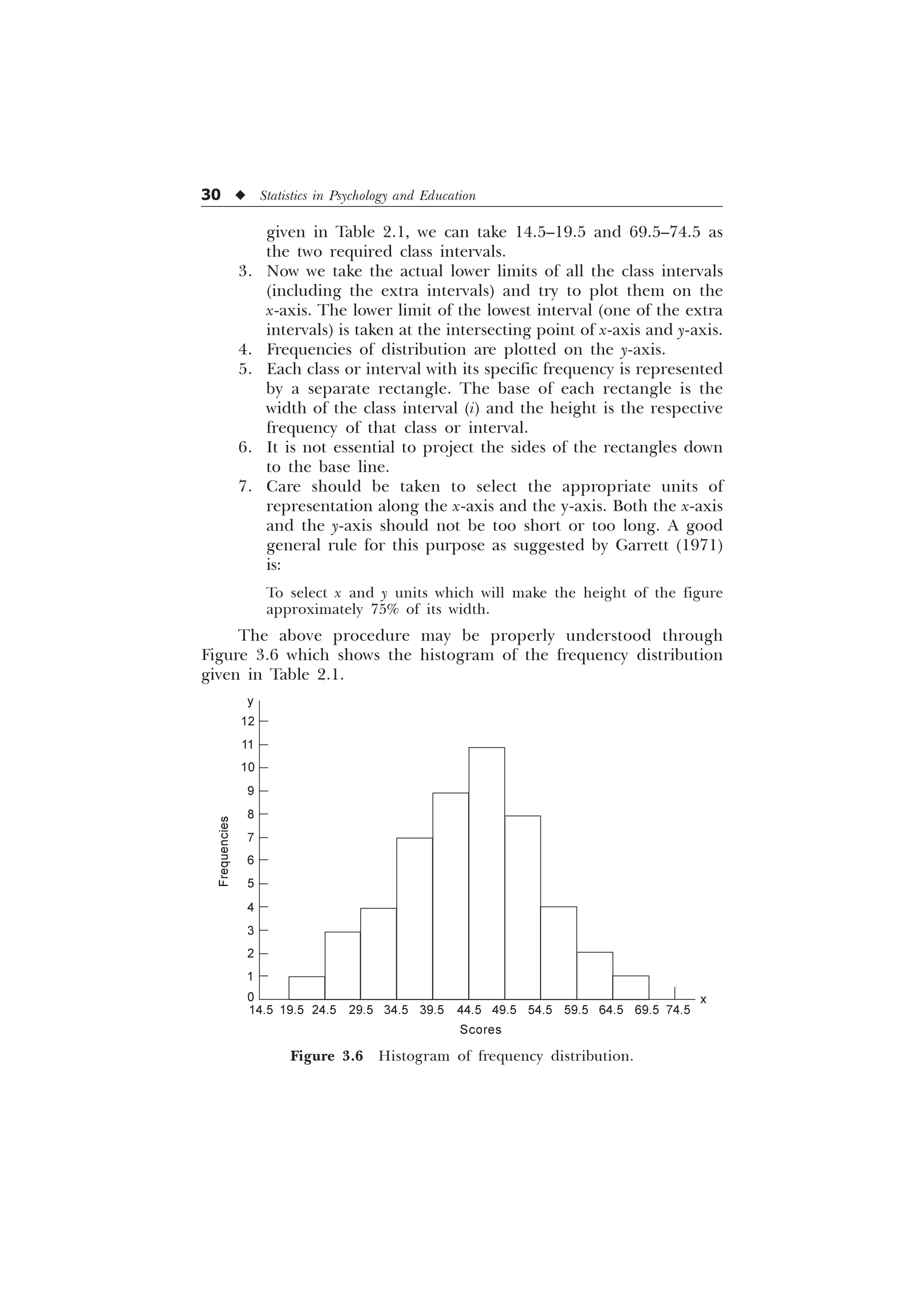
The above procedure may be properly understood through
Figure 3.6 which shows the histogram of the frequency distribution
given in Table 2.1.
Figure 3.6 Histogram of frequency distribution.
Scores
74.5
x
Frequencies
1
2
3
4
5
6
7
8
9
10
11
12
y
14.5 19.5 24.5 34.5 39.5 44.5 49.5 54.5 59.5 64.5 69.5
29.5
0
Graphical Representation of Data u 31
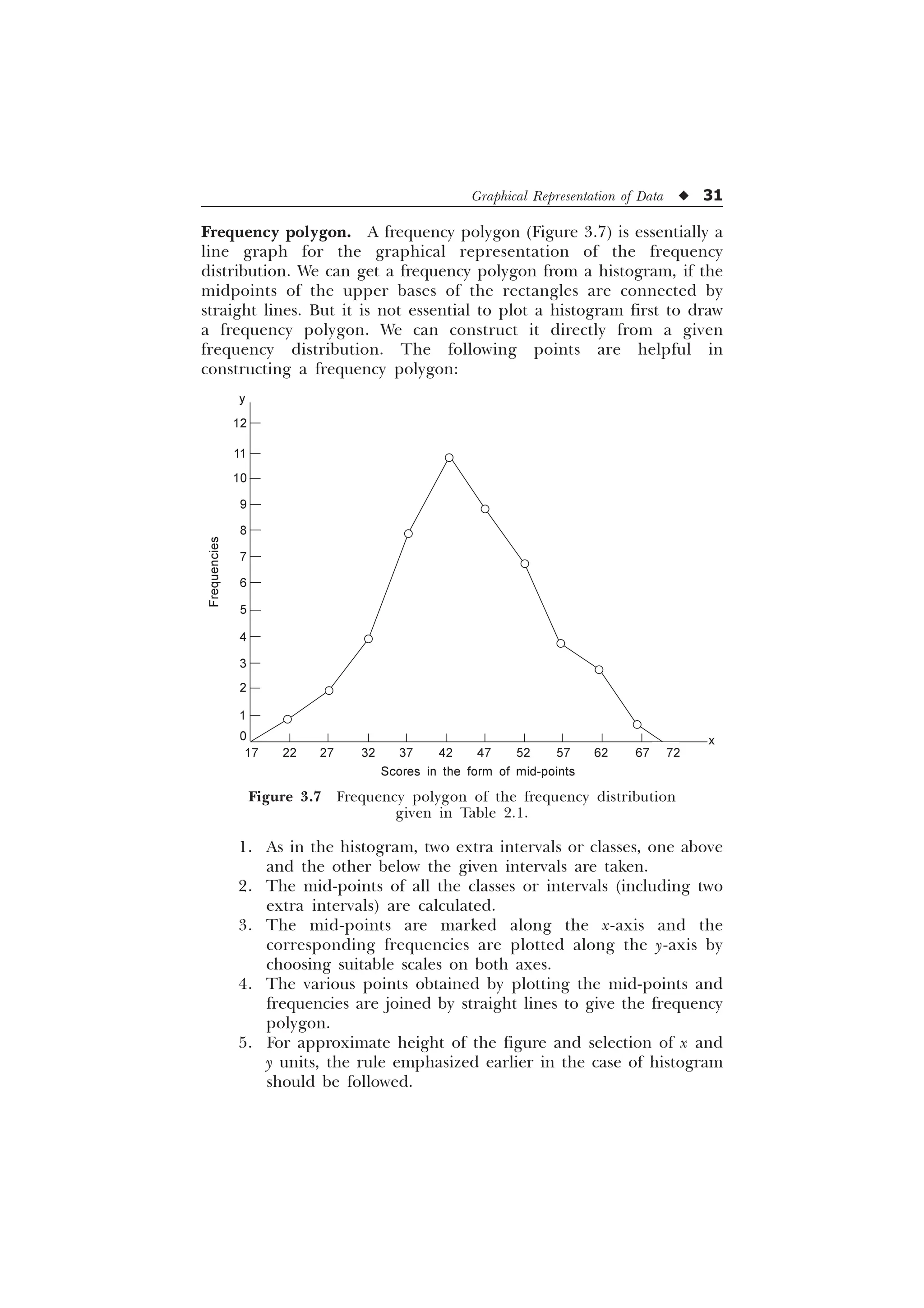
Frequency polygon. A frequency polygon (Figure 3.7) is essentially a
line graph for the graphical representation of the frequency
distribution. We can get a frequency polygon from a histogram, if the
midpoints of the upper bases of the rectangles are connected by
straight lines. But it is not essential to plot a histogram first to draw
a frequency polygon. We can construct it directly from a given
frequency distribution. The following points are helpful in
constructing a frequency polygon:
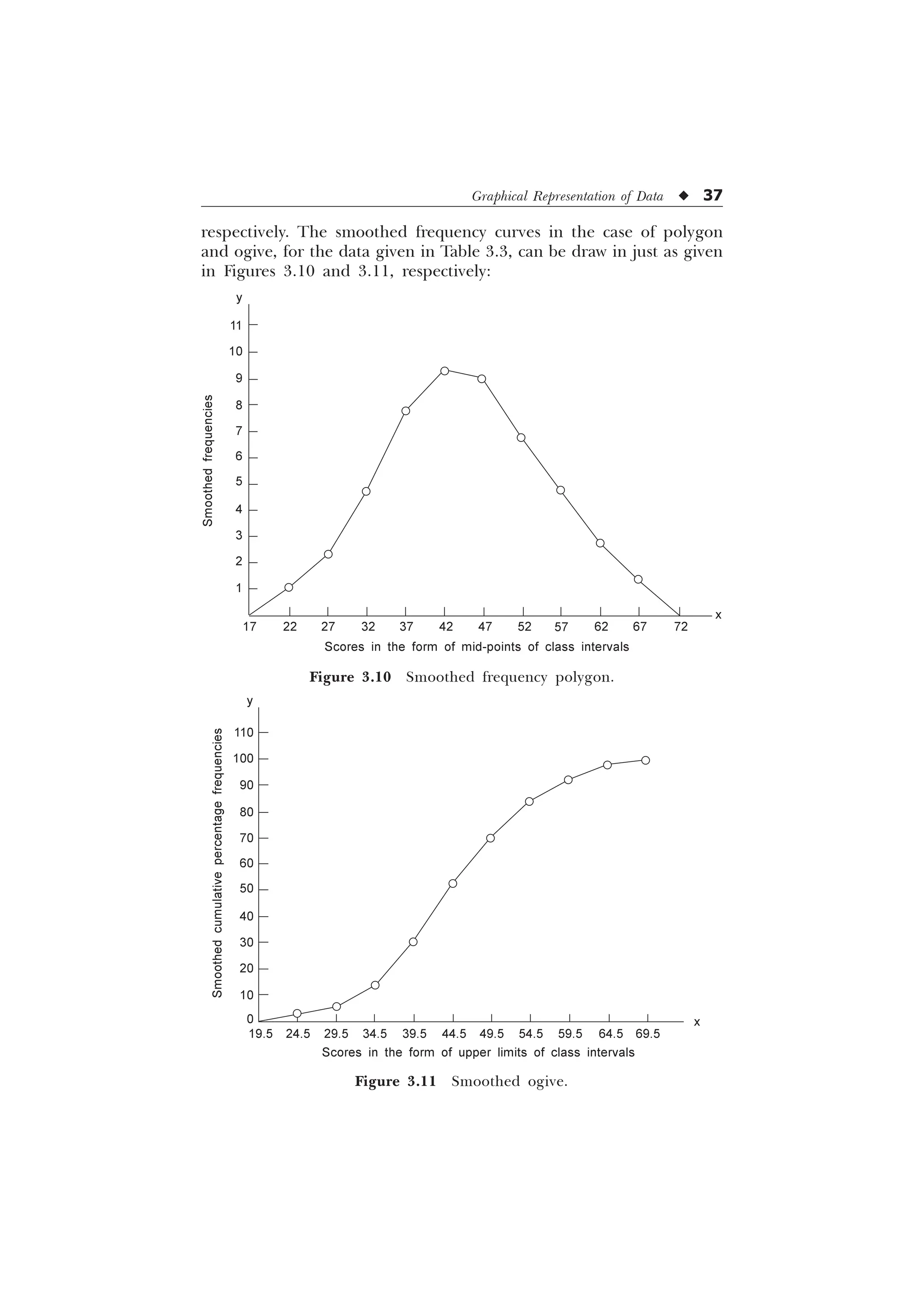
Figure 3.7 Frequency polygon of the frequency distribution
given in Table 2.1.
Scores in the form of mid-points
x
Frequencies
y
1
2
3
4
5
6
7
8
9
10
11
12
0
17 22 27 32 37 42 47 52 57 62 67 72
1. As in the histogram, two extra intervals or classes, one above
and the other below the given intervals are taken.
2. The mid-points of all the classes or intervals (including two
extra intervals) are calculated.
3. The mid-points are marked along the x-axis and the
corresponding frequencies are plotted along the y-axis by
choosing suitable scales on both axes.
4. The various points obtained by plotting the mid-points and
frequencies are joined by straight lines to give the frequency
polygon.
5. For approximate height of the figure and selection of x and
y units, the rule emphasized earlier in the case of histogram
should be followed.
32 u Statistics in Psychology and Education
Difference between a frequency polygon and a frequency curve. A
polygon is a many-sided figure. It is essentially a closed curve while a
frequency curve is not a closed curve. In a frequency curve we do not
take two extra intervals or classes. But in a frequency polygon, we take
these two extra classes in order to close the figure.
Comparison between the histogram and the frequency polygon.
Although both histogram and frequency polygon are used for the
graphic representation of frequency distribution and are alike in many
respects, they possess points of difference. Some of these differences
are cited below:
1. Where histogram is essentially the bar graph of the given
frequency distribution, the frequency polygon is a line graph
of this distribution.
2. In frequency polygon, we assume the frequencies to be
concentrated at the mid-points of the class intervals. It points
out merely the graphical relationship between mid-points and
frequencies and thus is unable to show the distribution of
frequencies within each class interval. But the histogram gives
a very clear as well as accurate picture of the relative
proportions of frequency from interval to interval. A mere
glimpse of the figure answers such questions as:
(a) Which group of class intervals has the largest or smallest
frequency?
(b) Which pair of groups or class intervals has the same
frequency?
(c) Which group has its frequency double that of another?
3. In comparing two or more distributions by plotting two or
more graphs on the same axis, frequency polygon is more
useful and practicable than the histogram.
4. In comparison to the histogram, frequency polygon gives a
much better conception of the contours of the distribution.
With a part of the polygon curve, it is easy to know the trend
of the distribution but a histogram is unable to tell such a
thing.
The cumulative frequency graph. The data organized in the form of
a cumulative frequency distribution (discussed in Chapter 2) may be
graphically represented through the cumulative frequency graph
(Figure 3.8). It is essentially a line graph drawn on graph paper by
plotting actual upper limits of the class intervals on the x-axis and the
respective cumulative frequencies of these class intervals on the y-axis.
Let us consider the data given in the cumulative frequency distribution
in Table 2.2 to explain the process of construction of a cumulative
Graphical Representation of Data u 33
frequency graph. Main points may be summarized in the following
manner:
Figure 3.8 Cumulative frequency curve of the frequency distribution
given in Table 2.1.
Scores in the form of actual upper limits of the class intervals
x
Cumulative
frequencies
y
5
10
15
20
25
30
35
40
45
50
0
19.5 24.5 29.5 34.5 39.5 44.5 49.5 54.5 59.5 64.5 69.5 74.5
1. First of all, we will calculate the actual upper limits of the class
intervals as 24.5, 29.5, 34.5, 39.5, 44.5, 49.5, 54.5, 59.5,
64.5, 69.5 and 74.5.
2. Then we will use the cumulative frequencies given next to the
class intervals. In the case of a simple frequency distribution
table like 2.1, the cumulative frequencies are first determined
and written at the proper place against the respective class
intervals.
3. Now, for plotting the actual upper limits of the class intervals
on the x-axis and respective cumulative frequencies on the
y-axis of the graph paper, we must select a suitable scale with
reference to the range of data to be plotted and the size of
graph paper to be used.
4. All the plotted points representing upper limits of the class
interval with their respective cumulative frequencies will then
be joined through a successive chain of straight lines resulting
in a line graph.
5. To plot the origin of the curve on the x-axis, it is customary
to take one extra class interval with zero cumulative frequency
and thus calculate the actual upper limit of this class interval.
In the present case the upper limit will be 19.5. It will be the
starting point of the curve.
34 u Statistics in Psychology and Education
The cumulative percentage frequency curve or ogive. The cumu-
lative percentage frequency curve or ogive (Figure 3.9) is the graphical
representation of a cumulative percentage frequency distribution such
as given in Table 2.2. It is essentially a line graph drawn on a piece of
graph paper by plotting actual upper limits of the class intervals on the
x-axis and their respective cumulative percentage frequencies on the
y-axis. Ogive differs from the cumulative frequency graph in the sense
that here we plot cumulative percentage frequencies on the y-axis in
place of cumulative frequencies.
Figure 3.9 Cumulative percentage frequency curve or ogive.
Scores in the form of upper limits of class intervals
x
19.5 24.5 29.5 34.5 39.5 44.5 49.5 54.5 59.5 64.5 69.5 74.5
120
110
100
90
80
70
60
50
40
30
20
10
0
y
Cumulative
percentage
frequencies
The task of construction of this curve may be understood through
the graphical representation in Figure 3.9 based on the data given in
Table 2.2.
Use of the cumulative percentage frequency curve or ogive. Cumu-
lative percentage frequency curve (ogive) helps in the following tasks:
1. The statistics like median, quartiles, quartile deviations,
deciles, percentiles and percentile ranks may be determined
quickly and fairly accurately.
2. Percentile norms (a type of norm representing the typical
performance of some designated group or groups) may be
easily and accurately determined.
Graphical Representation of Data u 35
3. We can have an overall comparison of two or more groups or
frequency distributions by plotting the ogives concerning
these distributions on the same coordinate axes. A frequency
curve may also be used for such comparison. The difference
lies in the fact that a frequency curve is used in the case when
the total frequencies (N) in the distributions are the same; but
when the total frequencies are different, we have to draw the
frequency percentage curve or ogive.
SMOOTHING OF FREQUENCY CURVES—POLYGON AND
OGIVE
Why Smooth?
Many times frequency curves obtained from some frequency distri-
butions are so irregular and disproportionate that it becomes quite
difficult to get some useful interpretation from them. It usually
happens in the situation when (a) the total number of frequencies (N)
is small, and (b) the frequency distribution is somewhat irregular.
These irregularities in frequency distribution might have been
minimized if the data collected were numerous. In other words, there
is a need for a fairly large sample to reduce the effect of sampling
fluctuations upon frequencies in the classes. Addition of cases or
increase in the sample size always results in eliminating sample
irregularities. But if we cannot increase the size of the sample (where
N is small), the kinks and irregularities in the frequency curves may
only be removed by the process of smoothing the curve.
Thus, to iron out chance irregularities and also to get a better
notion of how the curve might look if the data were more numerous
(what we might expect to get from larger groups or additional
sampling), the curve may be smoothed.
How to Smooth
One of the methods of smoothing a frequency distribution or curve is
the method of “moving” or “running” averages. The formula for this
is as under:
)UHTXHQF RI WKH JLYHQ FODVV

6PRRWKHG IUHTXHQF RI D FODVV LQWHUYDO LQWHUYDO  )UHTXHQFLHV RI WKH
 WZR DGMDFHQW FODVV LQWHUYDOV
Ë Û
Ì Ü
Ì Ü
Í Ý
Let us illustrate the computation of smoothed frequencies as
given in Table 3.3.
36 u Statistics in Psychology and Education
Explanation
It is clear from Table 3.3 that in the process of smoothing a frequency
polygon, we average actual frequencies, while in the case of an ogive,
the cumulative percentage frequencies are averaged. For illustration,
in the case of a frequency polygon, the smooth frequency related to
the class interval 55–59 is (4 + 3 + 7)/3 = 4.66 or 4.7 (approx.), while
in the case of ogive, the smooth cumulative percentage frequency
related to this class interval is (92 + 98 + 84)/3 = 91.33 or 91.3
(approx.).
Table 3.3 Data for the Computation of Smoothed Frequencies for
Polygon and Ogive
For polygon For ogive
Frequencies Smoothed Cumulative Cumulative Smoothed
Class ( f ) frequencies frequencies percentage frequencies
intervals (cf ) frequencies
65–69 1 1.3 50 100 99.3
60–64 3 2.7 49 98 96.7
55–59 4 4.7 46 92 91.3
50–54 7 6.7 42 84 82.0
45–49 9 9.0 35 70 68.7
40–44 11 9.3 26 52 50.7
35–39 8 7.7 15 30 32.0
30–34 4 4.7 7 14 16.7
25–29 2 2.3 3 6 7.3
20–24 1 1.0 1 2 2.7
A slightly different procedure is to be adopted for calculating
smooth frequencies for the class intervals at the extremes of the
distributions. For example, the smooth frequency in the case of
polygon for class intervals 20–24 and 65–69 will be calculated as
respectively.
   
     
  RU  DSSUR[
 
In the case of the ogive the smoothed cumulative percentage
frequencies for these intervals are


,
Graphical Representation of Data u 37
respectively. The smoothed frequency curves in the case of polygon
and ogive, for the data given in Table 3.3, can be draw in just as given
in Figures 3.10 and 3.11, respectively:
Figure 3.11 Smoothed ogive.
Scores in the form of upper limits of class intervals
x
19.5 24.5 29.5 34.5 39.5 44.5 49.5 54.5 59.5 64.5 69.5
110
100
90
80
70
60
50
40
30
20
10
0
y
Smoothed
cumulative
percentage
frequencies
Figure 3.10 Smoothed frequency polygon.
Scores in the form of mid-points of class intervals
x
17 22 27 32 37 42 47 52 57 62 67 72
11
10
9
8
7
6
5
4
3
2
1
y
Smoothed
frequencies
38 u Statistics in Psychology and Education
SUMMARY
The statistical data may be presented in a more attractive form
appealing to the eye with the help of some graphic aids, i.e. pictures
and graphs. Such presentation carries a lot of communication power.
A mere glimpse of these pictures and graphs may enable the viewer to
have an immediate and meaningful grasp of the large amount of data.
Ungrouped data may be represented through a bar graph, circle
graph (pie diagram), pictograph and line graph.
Bar graphs represent the data on the graph paper in the form of
vertical or horizontal bars.
In a pie diagram, data is represented by a circle of 360° divided
into parts, each representing the amount of data converted into
angles. The total frequency value is equated to 360 degrees and then
the angles corresponding to component parts are calculated.
In pictograms, the data is represented by means of picture figures
appropriately designed in proportion to the numerical data.
Line graphs represent the data concerning one variable on the
horizontal and other variable on the vertical axis of the graph paper.
Grouped data (frequency distribution) may be represented graph-
ically by histogram, frequency polygon, cumulative frequency graph
and cumulative frequency percentage curve or ogive.
A histogram is essentially a bar graph of a frequency distribution.
The actual class limits plotted on the x-axis represent the width of
various bars (rectangles) and respective frequencies of these class
intervals represent the height of these bars.
A frequency polygon is essentially a line graph for the graphical
representation of frequency distribution. To construct a frequency
polygon, the mid-points of all classes (including two extra intervals)
are plotted on the x-axis and the corresponding frequencies are
plotted along the y-axis by choosing suitable scales for both axes.
Frequency polygon is much better than histogram in the task of
comparing two or more distributions and revealing the contour and
forecasting the trend of the distribution. Histogram is more helpful in
giving a very clear as well as an accurate picture of the relative
proportions of frequency from interval to interval.
The cumulative frequency graph represents the cumulative frequency
distribution by plotting actual upper limits of the class intervals on the
x-axis and the respective cumulative frequencies of these class intervals
on the y-axis.
The cumulative percentage frequency curve or ogive represents the
cumulative percentage frequency distribution by plotting upper limits
of the class intervals on the x-axis and the respective cumulative
percentage frequencies of these class intervals on the y-axis. An ogive
proves quite useful in the computation of median, quartiles, deciles,
Graphical Representation of Data u 39
percentiles, percentile ranks and percentile norms as well as for the
overall comparison of two or more groups or frequency distributions.
In the case of some frequency distributions, their frequency
curves show many kinks and irregularities which may be safely removed
by the process of smoothing. The formula of the moving average, i.e.
smoothed frequency of a class interval = 1/3 (Frequency of the given
class interval + Frequencies of the two adjacent class intervals) is used
to compute the smoothed frequencies for the corresponding class
intervals. In drawing smoothed curves (polygon or ogive), we plot
these calculated smoothed frequencies on the y-axis in place of the
given frequencies (in case of polygon) and cumulative percentage
frequencies (in case of ogive). The task of understanding and
interpretation of data becomes simple, accurate and practicable with
the help of such smoothing of the frequency curves.
EXERCISES
1. What do you understand by the term ‘graphical represen-
tation of data’? Enumerate its advantages.
2. What are the various modes utilized for the graphical
representation of ungrouped data? Discuss in brief.
3. What are bar graphs or diagrams? How are they constructed?
Illustrate with some hypothetical examples.
4. What are circle graphs or pie diagrams? Illustrate their
construction through an example.
5. What are pictograms? How can statistical data be represented
through such diagrams? Illustrate with an example.
6. What are line graphs? Discuss their utility in the presentation
of statistical data. Illustrate their construction with the help of
some hypothetical data.
7. Point out the various methods utilized for the graphic
representation of grouped data (frequency distribution).
Discuss them in brief.
8. What is a histogram? How does it differ from a frequency
polygon and frequency curve?
9. What do you understand by the term cumulative frequency?
Discuss the process of construction of a cumulative frequency
curve.
10. What is a cumulative percentage frequency curve or ogive?
Illustrate, how it is constructed. Enumerate its different uses.
11. What do you understand by the term smoothing of a curve?
40 u Statistics in Psychology and Education
Why is it essential to smooth a frequency curve, polygon or
ogive? Discuss the process of smoothing a polygon and on
ogive with the help of suitable examples.
12. Show by suitable bar diagrams the absolute as well as relative
changes in the student population of colleges A and B in the
different faculties from 1999 to 2001.
College A College B
Faculties 1999 2001 1999 2001
Arts 300 350 100 200
Science 120 500 150 250
Commerce 200 650 130 150
Law 100 300 100 120
13. Draw a pie diagram to represent the following data detailing
the monthly expenses of an institution:
Salary of the staff 60,000.00
Electricity, water and telephone bills 15,000.00
Office stationery 10,000.00
Miscellaneous expenses 15,000.00
Total 1,00,000.00
14. Plot histograms, frequency polygons, cumulative frequency
curves and ogives separately on the different axes for the
following distributions:
(a) (b) (c)
Scores f Scores f Scores f
75–79 1 60–69 1 37–39 2
70–74 3 70–79 2 34–36 4
65–69 5 80–89 3 31–33 6
60–64 8 90–99 4 28–30 10
55–59 11 100–109 7 25–27 12
50–54 18 110–119 12 22–24 7
45–49 10 120–129 8 19–21 7
40–44 8 130–139 5 16–18 3
35–39 6 140–149 3 13–15 2
30–34 3 150–159 3 10–12 1
25–29 1 160–169 2
20–24 1
N = 75 N = 50 N = 54
15. Smooth the curves of the frequency polygon and ogive
constructed from the data given for the three distributions in
Problem 14.
41
MEANING OF THE MEASURES OF CENTRAL TENDENCY
If we take the achievement scores of the students of a class and arrange
them in a frequency distribution, we may sometimes find that there are
very few students who either score very high or very low. The marks
of most of the students lie somewhere between the highest and the
lowest scores of the whole class. This tendency of a group about
distribution is named as central tendency and the typical score lying
between the extremes and shared by most of the students is referred
to as a measure of central tendency. In this way a measure of central
tendency as Tate (1955) defines is:
a sort of average or typical value of the items in the series and its
function is to summarize the series in terms of this average value.
The most common measures of central tendency are:
1. Arithmetic mean or mean
2. Median
3. Mode
Each of them, in its own way, can be called a representative of the
characteristics of the whole group and thus the performance of the
group as a whole can be described by the single value which each of
these measures gives. The values of mean, median or mode also help
us in comparing two or more groups or frequency distributions in
terms of typical or characteristic performance.
Arithmetic Mean (M)
This is the simplest but most useful measure of central tendency. It is
nothing but the ‘average’ which we compute in our high school
arithmetic and, therefore, can be easily defined as the sum of all the
values of the items in a series divided by the number of items. It is
represented by the symbol M.
4 Measures of Central
Tendency
42 u Statistics in Psychology and Education
Calculation of mean in the case of ungrouped data. Let X1, X2, X3,
X4, X5, X6, X7, X8, X9 and X10 be the scores obtained by 10 students on
an achievement test. Then the arithmetic mean or mean score of the
group of these ten students can be calculated as:


; ; ; ; ; ;
0
     
The formula for calculating the mean of an ungrouped data is
;
0
1
6
where S X stands for the sum of scores or values of the items and N
for the total number of items in a series or group.
Calculation of mean in the case of grouped data (Data in the form
of frequency distribution)
General method. In a frequency distribution where all the frequencies
are greater than one, the mean is calculated by the formula:
I ;
0
1
6
where X represents the mid-point of the class interval, f its respective
frequency, and N the total of all frequencies.
We can illustrate the use of this formula by taking the frequency
distribution given in Table 2.1 of Chapter 2 as follows:
Example 4.1
Scores f Mid-point f X
(X)
65–69 1 67 67
60–64 3 62 186
55–59 4 57 228
50–54 7 52 364
45–49 9 47 423
40–44 11 42 462
35–39 8 37 296
30–34 4 32 128
25–29 2 27 54
20–24 1 22 22
N = 50 S f X = 2230


I ;
0
1
6
Measures of Central Tendency u 43
Short-cut method of computing the mean of grouped data. Mean
for the grouped data can be computed easily with the help of the
following formula:
M =
I [
$ L
1
6 „
 –
where
A = Assumed mean
i = Class interval
f = Respective frequency of the mid-values of the class intervals
N = Total frequency
x¢ =
; $
L

(The quotient obtained after division of the
difference between the mid-value of the class and
assumed mean by i, the class interval.)
The use of this formula can be easily understood through the
following illustration:
Example 4.2: Assumed mean (A) = 42.
Computation
M =
6 „
 –  –


I [
$ L
1
=


Median (Md)
If the items of a series are arranged in ascending or descending order
of magnitude, the measure or value of the central item in the series
Scores f X (Mid-point) x¢ = (X – A)/i f x¢
65–69 1 67 5 5
60–64 3 62 4 12
55–59 4 57 3 12
50–54 7 52 2 14
45–49 9 47 1 9
40–44 11 42 0 0
35–39 8 37 –1 –8
30–34 4 32 –2 –8
25–29 2 27 –3 –6
20–24 1 22 –4 –4
N = 50 S f x¢ = 26
44 u Statistics in Psychology and Education
is termed as median. We may thus say that the median of a distribution
is the point on the score scale below which half (or 50%) of the scores
fall. Thus, median is the score or the value of that central item which
divides the series into two equal parts. It should therefore be
understood that the central item itself is not the median. It is only the
measure or value of the central item that is known as the median. For
example, if we arrange in ascending or descending order the marks of
5 students, then the marks obtained by the 3rd student from either
side will be termed as the median of the scores of the group of students
under consideration.
Computation of median for ungrouped data. The following two
situations could arise:
1. When N (No. of items in a series) is odd. In this case where N,
is odd (not divisible by 2), the median can be computed by the
formula Md = the measure or value of the (N +1)/2-th item.
Example 4.3: Let the scores obtained by 7 students on an
achievement test be 17, 47, 15, 35, 25, 39, 44. Then, first of all, for
calculating median, we have to arrange the scores in ascending or
descending order: 15, 17, 25, 35, 39, 44, 47. Here N (= 7) is odd, and
therefore, the score of the (N + 1)/2-th item or 4th student, i.e. 35
will be the median of the given scores.
2. When N (No. of items in a series) is even. In the case where N
is even (divisible by 2), the median is determined by the
following formula:
WKH YDOXH RI  WK LWHP WKH YDOXH RI   @WK LWHP

G
1 1
0
Example 4.4: Let there be a group of 8 students whose scores in a test
are, 17, 47, 15, 35, 25, 39, 50, 44. For calculating mean of these scores
we proceed as follows:
Arrangement of scores in ascending series: 15, 17, 25, 35, 39,
44, 47, 50
The score of the (N/2)th, i.e. 4th student = 35
The score of the [(N/2) + 1]th, i.e. 5th student = 39
Then,
Median =


= 37
Computation of median for grouped data (in the form of frequency
distribution). If the data is available in the form of a frequency
distribution like below, then calculation of median first requires the
location of median class.
Measures of Central Tendency u 45
Example 4.5
Scores f
65–69 1
60–64 3
55–59 4
50–54 7
45–49 9
40–44 11
35–39 8
30–34 4
25–29 2
20–24 1
N = 50
Actually, as defined earlier, median is the measure or score of the
central item. Therefore, it is needed to locate the central item. It may
be done through the formulae given earlier in the case of ungrouped
data for the odd and even values of N (total frequencies). Here, in the
present distribution, N (= 50) is even. Therefore, median will fall som-
ewhere between the scores of 25th and 26th items in the given
distribution. In the given frequency distribution table, if we add
frequencies either from above or below we may see that the class
interval designated as 40–44 is to be labelled as the class where the
score representing median will fall.
After estimating the median class, the median of the distribution
may be interpolated with the help of following formula:
Md =
Ë Û

 –
Ì Ü
Í Ý

1 )
/ L
I
where
L = Exact lower limit of the median class
F = Total of all frequencies before in the median class
f = Frequency of the median class
i = Class interval
N = Total of all the frequencies
By applying the above formula, we can compute the median of
the given distribution in the following way:
Md = 39.5 +

–


= 39.5 +


–
= 39.5 +


= 39.5 + 4.55 = 44.05
46 u Statistics in Psychology and Education
Example 4.6: Some Special Situations in the Computation of Median
(a) (b) (c)
Scores f Scores f Scores f
55–59 5 45–49 2 20–21 2
50–54 3 40–44 5 18–19 1
45–49 8 35–39 6 16–17 0
40–44 18 30–34 0 14–15 0
35–39 15 25–29 8 12–13 2
30–34 10 20–24 3 10–11 0
25–29 7 15–19 2 8–9 0
20–24 2 6–7 2
4–5 1
2–3 1
0–1 1
N = 68 N = 26 N = 10
Let us analyse the medians of the above distributions.
1. We know by definition that median is the point on the score
scale below and above which 50% cases lie. Thus the score
representing median should be a common score falling in the
classes 35–39 and 40–44. This score is nothing but the upper
limit of class 35–39 which is also the lower limit of the class
40–44. Therefore, in this case the median is 39.5.
2. In the second distribution, if we try to add the frequencies
from below, we see that upto class interval 25–29, 13 cases lie
and by adding frequencies from above, we also find that upto
the class interval 35–39, 13 cases lie. In this way, the class
interval 30–34 divides the distribution into two equal parts
below and above which 50% cases lie. It leads us to conclude
that median should be the mid-point of the class interval
30–34 and, therefore, 32 is the median of this distribution.
3. In the third case, if we add the frequencies from below, we
find that 5 cases lie upto the class interval 6–7. By adding the
frequencies from above, we also find that, upto class 12–13,
5 cases lie. The median should then fall mid-way between the
two classes 8–9 and 10–11. It should be the common score
represented by both these classes. This score is nothing but
the upper limit of the class 8–9 and lower limit of the class
10–11 and, therefore, it should be 9.5.
Mode (Mo)
Mode is defined as the size of a variable (say a score) which occurs most
Measures of Central Tendency u 47
frequently. It is the point on the score scale that corresponds to the
maximum frequency of the distribution. In any series, it is the value
of the item which is most characteristic or common and is usually
repeated the maximum number of times.
Computation of mode for ungrouped data. Mode can be easily be
computed merely by looking at the data. All that one has to do is to
find out the score which is repeated maximum number of times.
Example 4.7: Suppose we have to find out the value of the mode
from the following scores of students:
25, 29, 24, 25, 27, 25, 28, 25, 29
Here the score 25 is repeated maximum number of times and thus,
value of the mode in this case is 25.
Computation of mode for grouped data. When data is available in
the form of frequency distribution, the mode is computed from the
following formula:
Mode (Mo) = 3Md – 2M
where Md is the median and M is the mean of the given distribution.
The mean as well as the median of the distribution are first computed
and then, with the help of the above formula, mode is computed. For
illustration, we can take the distribution given in Table 2.1.
Example 4.8: The mean and median of this distribution have already
been computed as 44.6 and 44.05 respectively.
Therefore,
M = 44.6, Md = 44.05
Mo = 3 ´ 44.05 – 2 ´ 44.6
= 132.15 – 89.2 = 42.95
Another method for grouped data. Mode can be computed directly
from the frequency distribution table without calculating mean and
median. For this purpose, we can use the following formula:
Mo = L + 
 
I
L
I I
–

where
L = Lower limit of the model class (the class in which mode may
be supposed to lie)
i = Class interval
f1 = Frequency of the class adjacent to the modal class for which
lower limit is greater than that for the modal class
48 u Statistics in Psychology and Education
f–1 = Frequency of the class adjacent to the modal class for which
the lower limit is less than that for the modal class
Let us illustrate the use of the above formula by taking frequency
distribution given in Table 2.1.
Example 4.9:

 
R
I
0 / L
I I
 –

The crude mode in this distribution may be supposed to lie within
the class interval 40–44. Hence,
L = 39.5
f1 = 9
f–1 = 8
Therefore,


R
0  –  

For computing mode in the case of grouped data (frequency
distribution), we can use any of these two methods. The first method
is more useful in the case when we need the computation of mean and
median. Otherwise, the use of the second method is convenient.
However, it may also be observed that the mode values computed from
these two methods are not identical. The value from the first method
is always a little higher than the value obtained through the use of
second (direct) method.
Scores f
65–69 1
60–64 3
55–59 4
50–54 7
45–49 9
40–44 11
35–39 8
30–34 4
25–29 2
20–24 1
N = 50
Measures of Central Tendency u 49
Computation of Median and Mode from the Curves of
Frequency Distribution
Median. It can be computed directly from the following frequency
curves with the help of simple observations and measurements:
From frequency graph. The value on the x-axis at the foot of the
ordinate which bisects the area between the frequency graph and the
x-axis is the median.
For cumulative frequency graph. A horizontal line is to be drawn from
the middle point of the ordinate which represents the total frequency.
The foot of the perpendicular from the point of intersection of this
line and cumulative frequency graph gives the value of the median.
From cumulative frequency percentage curve or ogive. Here, for obtaining
the median, a line parallel to the x-axis is drawn from the highest
cumulative frequency shown on the y-axis. Now, from the point where
this line cuts the curve, a perpendicular to the x-axis is drawn. The
score located on the x-axis through this perpendicular gives the
measure of the median.
Mode. It can be computed easily from the following frequency
curves:
From frequency graph. For this purpose, a smoothed frequency graph is
to be constructed from the given data. The abscissa of the highest
point on this curve is taken to be the mode.
From histogram. For this purpose, the highest rectangle of the diagram
is selected and at the top, the mid-point is marked. From this point, a
perpendicular is drawn on the x-axis to indicate the measure of mode.
From cumulative frequency graph. In this curve, the abscissa of the point
where the curve is steepest indicates the measure of the mode.
When to Use the Mean, Median and Mode
Computation of any of the three—mean, median and mode—provides
a measure of central tendency. Which of these should be computed in
a particular situation is a question that can be raised quite often. This
can be answered in light of the characteristics and nature of all these
measures.
When to use the mean
1. Mean is the most reliable and accurate measure of the central
tendency of a distribution in comparison to median and
mode. It has the greatest stability as there are less fluctuations
50 u Statistics in Psychology and Education
in the means of the samples drawn from the same population.
Therefore, when a reliable and accurate measure of central
tendency is needed, we compute the mean for the given
data.
2. Mean can be given an algebraic treatment and is better suited
to further arithmetical computation. Hence, it can be easily
employed for the computation of various statistics like
standard deviation, coefficient of correlation, etc. Therefore,
when we need to compute more statistics like these, mean is
computed for the given data.
3. In computation of the mean, we give equal weightage to every
item in the series. Therefore, it is affected by the value of
each item in that series. Sometimes there are extreme items
which seriously affect the position of the mean. Thus, it is not
proper to compute mean for the series that has extreme items
and each score carries equal weight in determining the central
tendency.
When to use the median
1. The median is the exact mid-point of a series, below and
above which 50% of the cases lie. Therefore, when the exact
mid-point of the distribution is desired, median is to be
computed.
2. The median is not affected by the extreme scores in the series.
Therefore, when a series contains extreme scores, the median
is perhaps the most representative central measure.
3. In the case of an open end distribution (incomplete distri-
bution “80 and above” or “20 and below”), it is impossible to
calculate the mean, and hence the median is the most reliable
measure that can be computed.
4. Mean cannot be calculated graphically. But in the case of
median, we can compute it graphically. Therefore, when we
have suitable graphs like frequency curve, polygon, ogive, and
so on, we should try to compute median.
5. Median is specifically useful for the data of the items which
cannot be precisely measured in quantities as for e.g. health,
culture, honesty, intelligence and so on.
When to use the mode
1. In many cases, the crude mode can be computed by just
having a look at the data. It gives the quickest, although
approximate measure of central tendency. Therefore, in the
cases where a quick and approximate measure of central
tendency is all that is desired, we compute mode.
Measures of Central Tendency u 51
2. Mode is that value of the item which occurs most frequently
or is repeated maximum number of times in a given series.
Therefore, when we need to know the most often recurring
score or value of the item in a series, we compute mode. On
account of this characteristic, mode has unique importance in
the large scale manufacturing of consumer goods. In finding
the sizes of shoes and readymade garments which fit most men
or women, the manufacturers make use of the average
indicated by mode.
3. Mode can be computed from the histogram and other
frequency curves. Therefore, when we already have a graph-
ical representation of the distribution in the form of such
figures, it is appropriate to compute mode instead of mean.
SUMMARY
The statistics, mean, median and mode, are known to be the most
common measures of central tendency. A measure of central tendency
is a sort of average or a typical value of the item in the series or some
characteristics of the members of a group. Each of these measures of
the central tendency provides a single value to represent the
characteristics of the whole group in its own way.
Mean represents the ‘average’ for an ungrouped data, the sum of
the scores divided by the total number of scores gives the value of the
mean. The mean, in the case of a grouped data is best computed with
the help of a short-cut method using the following formula:

I [
0 $ L
1
6 „
 –
where A is the assumed mean,
; $
[
L

„ ,
X is the mid-point of the class interval, i the class interval, and N the
total frequencies of the distribution. Median is the score or value of
that central item which divides the series into two equal parts. Hence
when N is odd (N + 1)/2-th measure, and when N is even, the average
of (N/2)-th and [(N/2) + 1]-th item’s measure provides the value of the
median. In the case of grouped data, it is computed by the formula

 –


G
1 )
0 / L
I
where L represents the lower limit of the median class, F, the total of
all frequencies before the median class, and f, the frequency of the
52 u Statistics in Psychology and Education
Mean Median Mode
median class. The median can also be computed directly from curves
like the frequency graph, cumulative frequency graph and ogive.
Mode is defined as the size of the variable which occurs most frequently.
Crude mode can be computed by just having a look at the data. In the
case of grouped data, it may be computed with the help of the
formula, Mo = 3Md – 2M. It can also be computed directly from the
histogram and other frequency curves as also with the help of the
following formula without first calculating mean and median:

 
R
I
0 / L
I I
 –

where f1 and f–1 are the frequencies of the classes adjacent to the modal
class for which lower limits are greater or less than those for the modal
class.
Preference for the use of mean, median or mode can be
understood from the following tabular matter:
If we have
(i) to get a reliable
and accurate
measure of
central tendency,
(ii) to compute
further statistics
like standard
deviation,
coefficient of
correlation,
(iii) been given a
series having no
extreme items.
If we have
(i) to get an exact
mid-point of the
distribution,
(ii) a series
containing
extreme scores,
(iii) a distribution
with the open
end,
(iv) appropriate
graphical
representation
of data.
If we have
(i) to get a quick
and approximate
measure of
central tendency,
(ii) to know the most
often recurring
score or value of
the item in a
series,
(iii) appropriate
graphical
representation of
the data.
EXERCISES
1. What do you understand by the term, ‘measures of central
tendency’? Point out the most common measures of central
tendency.
Measures of Central Tendency u 53
2. What is an arithmetic mean? How can it be computed in the
case of ungrouped as well as grouped data? Illustrate with the
help of hypothetical data.
3. Define median. How can it be computed in the case of
ungrouped as well as grouped data? Illustrate with examples.
4. What do you understand by the term mode of a data? Point
out the methods of its computation in the case of grouped as
well as ungrouped data. Explain the computation process
through examples.
5. Define mean, median and mode. Discuss when each one of
them should be computed and why.
6. In the situations described below, what measures of central
tendency would you like to compute?
(a) The average achievement of a group.
(b) The most popular fashion of the day.
(c) Determining the mid-point of the scores of a group in an
entrance examination.
7. Find the mean IQ for the eight students whose individual IQ
scores are:
80, 100, 105, 90, 112, 115, 110, 120.
8. Compute median for the following data:
(a) 8, 3, 10, 5, 2, 11, 14, 12.
(b) 72, 74, 77, 53, 58, 63, 66, 82, 89, 69, 71.
9. Find the crude mode:
(a) 15, 14, 8, 14, 14, 11, 9, 9, 11.
(b) 3, 3, 4, 4, 4, 5, 7, 7, 9, 12.
10. Compute mean and median from the achievement scores of
25 students as given in the following (taking 2 as class
interval):
72, 75, 77, 67, 72, 81, 78, 65, 86, 83, 67, 82, 76, 76, 69, 70,
83, 71, 62, 72, 72, 61, 67, 68, 64.
11. Find the mean, median and mode for the following sets of
scores:
(a) 24, 18, 19, 12, 23, 20, 21, 22.
(b) 20, 14, 12, 14, 19, 14, 18, 14.
(c) 24, 18, 19, 20, 22, 25, 23, 12.
(d) 9, 14, 8, 13, 10, 10, 11, 12, 10.
12. Compute the mean, median and mode for the following
frequency distributions:
54 u Statistics in Psychology and Education
(a) (b) (c) (d)
Scores f Scores f Scores f Scores f
70–71 2 120–122 2 45–49 2 135–144 1
68–69 2 117–119 2 40–44 3 124–134 2
66–67 3 114–116 2 35–39 2 115–124 8
64–65 4 111–113 4 30–34 17 105–114 22
62–63 6 108–110 5 25–29 30 95–104 33
60–61 7 105–107 9 20–24 25 85–94 22
58–59 5 102–104 6 15–19 15 75–84 9
56–57 1 99–101 3 10–14 3 65–74 2
54–55 2 96–98 4 5–9 2 55–64 1
52–53 3 93–95 2 0–4 1
50–51 1 90–92 1
N = 36 N = 40 N = 100 N = 100
(a) (b) (c) (d)
Scores f Scores f Scores f Scores f
100–104 1 57–59 1 58–60 1 90–94 1
95–99 2 54–56 1 55–57 1 85–89 4
90–94 1 51–53 5 52–54 1 80–84 2
85–89 6 48–50 9 49–51 2 75–79 8
80–84 7 45–47 5 46–48 2 70–74 9
75–79 3 42–44 8 43–45 3 65–69 14
70–74 2 39–41 10 40–42 3 60–64 6
65–69 1 36–38 6 37–39 7 55–59 6
60–64 2 33–35 4 34–36 8 50–54 4
55–59 4 30–32 7 31–33 7 45–49 3
50–54 0 27–29 0 28–30 5 40–44 3
45–49 1 24–26 1 25–27 4
22–24 3
19–21 3
16–18 2
N = 30 N = 57 N = 52 N = 60
13. Compute the mean, median and mode for the following
frequency distributions:
55
In the fields of education, psychology and sociology, the scales of
measurement used are not so absolute and exact as in physical
sciences. They do not possess a true zero. Therefore, a score of 60
attained by a child on an achievement test will never mean twice as
much as the score of 30 by another student on that test. In physical
sciences, when we say that the length of the rod is 2.5 metres, we are
certain about what we are saying. This measurement can be conveni-
ently understood and properly interpreted as there is a possibility of
absolute zero (the starting point of the measurement) in this scale of
measurement. Here, it can be safely said that a rod of 5 metres length
will be exactly double the rod of 2.5 metres length.
By the above discussion, we can conclude that in the cases of
measurements in the field of education, psychology and sociology, we
cannot derive any useful meaning directly from the raw data of such
measurement. A score of 60 on an achievement test has no significance
unless it is interpreted in terms of the performance of a reference
group. In a class of 50 students, if one has attained a score of 60 on
a certain test, then in order to gather same idea about his performance
we must have clear-cut information regarding his position in the class,
as follows:
Has the student got the highest score in his class? How many
students of his class have got more than his score? How many students
have secured less than him? All such questions concerned with the
relative position or performance of an individual in relation to a
reference group may be answered through the concept of percentiles
and percentile rank.
MEANING OF THE TERM PERCENTILE
Percentile (also named centile by some writers) is nothing but a sort of
measure used to indicate the relative position of a single item or an
individual with reference to the group to which the item or individual
5 Percentiles and Percentile
Rank
56 u Statistics in Psychology and Education
belongs. In other words, it is used to tell the relative position of a
given score among other scores. Some of such other measures are
median, quartiles and deciles. The concept of percentile may be well
understood with the help of the concept of median. Median is defined
as a point on the score scale below or above which 50% cases lie. Hence we
see that the median cuts the scores of the series into two equal parts.
It is a score below or above which 50% cases lie, i.e. 50% of the
individuals in a group score less or more than what has been described
as a median score.
Proceeding on the same lines, the series of obtained scores or
frequency distribution may be divided into more than two equal parts.
We may have quartiles, deciles and percentiles (centiles) by dividing it
into 4, 10 or 100 parts.
In this way, the measures like quartiles, deciles, percentiles all
indicate some fixed points like median on the score scale below which
a definite proportion of cases lie. In the case of percentiles, the scores
series is divided into 100 equal parts, and each point is referred to as
centile or percentile. Hence the number of percentiles for a given score
series or frequency distribution may range from 1 to 100 (i.e. 1st
percentile to 100th percentile).
DEFINITION
A percentile may be defined as a point on the score scale below which a
given percent of the cases lie. Defined in this way, the 1st percentile
(written as P1) will mean “a score point in the given series or
distribution below which one percent cases lie and above which 99%
cases lie”. Going further, the 15th percentile (P15) will indicate that
score point below which 15% of the cases lie. Similarly, the 70th
percentile (P70) will reveal a score point in a given series or distribution
below which the scores of 70% and above which 30% members of the
group fall.
DEFINING QUARTILES AND DECILES
Quartiles for a given score series or a distribution may be 4 in number.
They are named 1st, 2nd, 3rd and 4th quartiles. Deciles are similarly
ten in number and are described as 1st to 10th decile. These quartiles
and deciles may be defined, on the same lines as the median and
percentiles, in the following ways:
A quartile is the point on the score scale below which a given quarter of
the cases lie.
A decile is the point on the score scale below which a given decile of the
cases lie.
Percentiles and Percentile Rank u 57
COMPUTATION OF PERCENTILES, QUARTILES AND
DECILES
The formulae for the computation of quartiles, deciles and percentiles
closely resemble the formula for the computation of the median, i.e.

G
1 )
0 / L
I

 –
as may be seen below:
1st quartile Q1 = L +

1 ) L
I

–
2nd quartile Q2 = L +

1 ) L
I

–
3rd quartile Q3 = L +
 
1 ) L
I

–
1st decile D1 = L +

1 ) L
I

–
5th decile D5 = L +
 
1 ) L
I

–
= L +

1 ) L
I

–
1st percentile P1 = L +

1 ) L
I

–
10th percentile P10 = L +
 
1 ) L
I

–
= L +

1 ) L
I

–
25th percentile P25 = L +
 
1 ) L
I

–
= L +

1 ) L
I

–
50th percentile P50 = L +
 
1 ) L
I

–
= L +

1 ) L
I

–
75th percentile P75 = L +
 
1 ) L
I

–
= L +
 
1 ) L
I

–
58 u Statistics in Psychology and Education
The relationships existing among the median, quartiles, deciles and
percentiles may be easily concluded from the above formulae, as
follows:
(i) P10 = D1 (iii) P25 = Q1
(ii) P75 = Q3 (iv) P50 = D5 = Q2 = Md
It may also be generalized that the formula for the computation
of percentile may be written as
Percentile, P = L +

S1 )
L
I

–
where
L = Lower limit of the percentile class (the class in which the
given percentile may be supposed to lie)
N = Total of all the frequencies
F = Total of the frequencies before the percentile class
f = Frequency of the percentile class
i = Size of the class interval
p = No. of the percentile which has to be computed
Let us illustrate the computation of various quartiles, deciles and
percentiles by taking the following frequency distribution:
Example 5.1
1st Quartile (Q1):
Q1 = L +

1 ) L
I

–
Here,
N/4 =


Scores f
70–79 3
60–69 2
50–59 2
40–49 3
30–39 5
20–29 4
10–19 3
0–9 2
N = 24
Percentiles and Percentile Rank u 59
Adding frequencies from below, we see that up to the upper limit
of the class 10–19, 5 cases lie. Hence, 20–29 is the class where the
1st quartile falls. Therefore,
Q1 = 19.5 +


– = 19.5 + 2.5 = 22
3rd Quartile (Q3):
Q3 = L +
 
1 ) L
I

–
Here,
3N/4 =


–
Adding frequencies from below, we see that upto the upper limit
of the class 40–49 we have 17 frequencies. Therefore, the third quartile
of the series falls in the interval 50–59. Hence
Q3 = 49.5 +


–
1st Decile (D1):
D1 = L +

1 ) L
I

–
where
N/10 = 24/10 = 2.4
and D1 lies in the interval 10–19, Therefore
D1 = 9.5 +


–
= 9.5 +


= 9.5 + 1.33
= 10.83
25th Percentile (P25):
P25 = L +
 
1 ) L
I

–
= 19.5 +
– 
–


= 19.5 + 2.5 = 22
60 u Statistics in Psychology and Education
60th Percentile (P60):
P60 = L +


1 )
L
I

–
Here,
60th percentile of 24 =


–
Adding the frequencies from below we see that upto the upper
limit of the class 30–39, 14 cases lie. Therefore, 60th percentile of the
distribution should fall in the interval 40–49. Hence,
P60 = 39.5 +


–
= 39.5 + 4/3 = 39.5 + 1.33
= 40.83
PERCENTILE RANK
There is a class of 50 students. A student Ramesh of this class attains
a score of 60 on an achievement test. There are 40 other students
whose scores fall below the score 60. In other words, 40 out of 50
(40/50 ´ 100 = 80%) students lie below the score of 60. Therefore, 60
will be termed as the 80th percentile of the given data regarding
achievement scores.
Proceeding further, it can be seen that Ramesh enjoys a relatively
better position in his class in terms of the achievement score. The exact
position that he enjoys in relation to the other students of his class may
be ascertained by the fact that the scores of 40 out of the total 50 or
80% of the students fall below his score. He is better than 80% of the
students of his class.
This conclusion can be translated into statistical language by
saying that the achievement score of 60, attained by Ramesh has a
percentile rank of 80.
Definition
The term percentile rank may be defined as the number representing the
percentage of the total number of cases lying below the given score.
Computation of Percentile Rank
Computation of a particular percentile say p, gives us a point on the
scale of measurement, i.e. score below which p percent of the cases lie.
Percentiles and Percentile Rank u 61
Now in case, if we are provided with a specific score on the scale of
measurement and required to find out the percentage of the cases
lying below that score, we are supposed to compute the percentile rank
of that specific score.
The task of computation of percentile rank thus requires
computation of the rank or the position of an individual on a scale of
100 decided on the basis of his score. It may be carried out in some
of the following ways:
From ungrouped data. In the case of ungrouped data, the data is
first arranged in an order (descending order, preferably) and each
score is provided a rank or a relative position in order of merit. Then,
the following formula is employed for the computation of the
percentile rank from this ordered data:
Percentile rank PR = 100 –
 
5
1

where
N = Total number of individuals in the group
R = Rank position of the score of an individual
whose percentile rank is to be determined.
Let us illustrate the use of this formula with the help of examples.
Example 5.2: In an achievement test, 20 students of a class have
scored as below:
12, 20, 25, 15, 8, 32, 28, 35, 22, 44,
36, 17, 29, 13, 9, 37, 40, 21, 10, 42.
Find out the percentile rank of the score 17.
Solution. The scores are to be arranged in the descending form
of ordered data as follows:
Scores Rank order
44 1
42 2
40 3
37 4
36 5
35 6
32 7
29 8
28 9
25 10
Scores Rank order
22 11
21 12
20 13
17 14
15 15
13 16
12 17
10 18
9 19
8 20
62 u Statistics in Psychology and Education
Here, rank R of the desired score 17 is 14 and N is given as 20.
Putting these figures into the formula, we get
PR= 100 –
  

– 
= 100 –


= 100 – 67.5 =32.5 or 32
[Ans. The percentile rank of the score 17 is 32.]
Example 5.3: In an entrance examination, a candidate ranks 35 out
of 150 candidates; find out his percentile rank.
Solution. The percentile rank is given by the formula
PR = 100 –
 
5
1

In this case,
R = 35 and N = 150
Hence
PR = 100 –
  

– 
= 100 –


= 100 – 23 = 77
[Ans. Percentile rank is 77.]
From grouped data or frequency distribution
1st Method. (Direct method not needing any formula). For illus-
trating the working of this method, let us take the following
distribution (same as taken for the computation of quartiles, deciles
and percentiles) and calculate the percentile rank of the score 22.
Example 5.4
Scores f
70–79 3
60–69 2
50–59 2
40–49 3
30–39 5
20–29 4
10–19 3
0–9 2
N = 24
Percentiles and Percentile Rank u 63
Solution. By adding frequencies from below, we see that upto
the score 19.5, i.e. the upper limit of the class 10–19, 5 cases lie. Our
problem is to find out the number of cases that lie below the score 22.
The difference between the scores 19.5 and 22 is 22 – 19.5 = 2.5. Now,
by observing the frequency distribution, we see that in the class interval
20–29, 10 scores are shared by 4 individuals. This knowledge may help
us in our problem and we can proceed as under:
An interval of 10 is shared by 4 individuals. Therefore, an interval
of 2.5 is shared by


´ 2.5 = 1 individual
Therefore, upto the score 22, 5 + 1 = 6 cases lie.
For expressing these cases on the scale of 100, we have to multiply
them by 100/N. In the present problem, N = 24.
Thus,
Required percentile rank =
 

–
= 25
Note: By comparing these results with the value of the 1st quartile (Q1)
or 25th percentile (P25) of this distribution, it can be easily
concluded that percentile rank and percentiles are just opposite
to each other.
Second Method. (Involving the use of a generalized formula). The
percentile rank of a given score belonging to a grouped data, may be
easily computed by employing the following formula:

Ë Û
È Ø
 –
É Ù
Ì Ü
Ê Ú
Í Ý
 ; /
35 ) I
1 L
where
PR= Percentile rank for the desired score X
F = Cumulative frequency below the interval containing score X
X = Score for which we want the percentile rank
L = Actual lower limit of the interval containing X
i = Size of the class interval
f = Frequency of the interval containing X
N = Total number of cases in the given frequency distribution
Let us use this formula to calculate the percentile rank of the
score 22.
Percentile rank for the score 22:
PR =


Ë Û
 –
Ì Ü
Í Ý
64 u Statistics in Psychology and Education
=
–
È Ø

É Ù
Ê Ú


=


–
The answer 25 as percentile rank tallies with the answer computed
through the direct method.
Third Method. (Use of cumulative percentage frequency curve or
ogive). Percentile points and percentile ranks may both be read with a
high degree of accuracy from an ogive accurately constructed on a
graph sheet. A smoothed ogive (as given in Figure 5.1 which is a
modified form of Figure 3.11) may provide better results.
Figure 5.1 Computation of percentile points and percentile rank
from an ogive.
Scores in the form of upper limits of class intervals
x
19.5 24.5 29.5 34.5 39.5 44.5 49.5 54.5 59.5 64.5 69.5
100
90
80
70
60
50
40
30
20
10
0
y
Smoothed
cumulative
percentage
frequencies
Percentile Rank
of 80
Percentile
Rank of 30
Score
of 39.5
Score of 53
Procedure.
1. To read a percentile points, a ruler is placed on the
cumulative percentage column at the percentile point desired
and a straight line is drawn from the rank to the curve. From
this point on the curve, another line is drawn down to the
score to make a right angle with the x-axis. The point where
this vertical line meets the x-axis, indicates the desired
percentile point on the score scale. In the above figure, the
lines drawn show the values of P30 and P80.
Percentiles and Percentile Rank u 65
2. To read the percentile rank of a given score lying on the
x-axis, a perpendicular line is drawn extending to the ogive
curve. From this point where the perpendicular intersects the
ogive, a line is drawn on the y-axis showing cumulative
percentage frequencies. This point on the y-axis indicates the
corresponding percentile rank of a given score. In Figure 5.1,
a score of 39.5 has a percentile rank of 30 and a score of 53.00
has a percentile rank of 80.
Utility of Percentiles and Percentile Rank
Percentiles and percentile ranks may be used in the areas of education,
psychology and sociology for the following purposes:
1. To indicate the relative position of an individual with respect
to some attribute (achievement score, presence of some
personality trait, etc.) in his own group.
2. For comparison, i.e., to compare
(a) two or more individual students belonging to two or more
sections, classes or schools,
(b) the performance of two or more classes or schools, and
(c) the performance of an individual if tested under two or
more different testing conditions in terms of possession
of some attributes or traits.
Illustration. Two boys studying in two different schools get the scores
35 and 40 in a weekly test in English. In this case, it is very difficult
to compare their achievements. But if we say that the percentile rank
is 90 in both the cases, then we can safely say that both are equal in
terms of achievement in English in their respective schools.
3. To prepare the percentile norms for various standardized
tests, inventories and scales for useful interpretations and
classifications.
SUMMARY
Measurements in the field of education, psychology and sociology do
not have an absolute zero like those found in natural sciences. Here,
the useful interpretations can only be made if the performance of an
individual is stated in relation to a reference group. Computation of
percentiles and percentile ranks help in doing so.
Measures or statistics like quartiles, deciles, percentiles and the
like indicate some fixed points like median, on the score scale below
which a definite proportions of cases lie. While in the case of median,
the series is divided into two equal halves by the median score, it is
66 u Statistics in Psychology and Education
divided into 4, 10 and 100 equal parts respectively in the case of
quartiles, deciles and percentiles. The formulae for the computation of
quartiles, deciles and percentiles can be developed on the basis of the
formula used for computation of median, i.e.

G
1 )
0 / L
I

 –
For percentiles we use the formula

S1 )
3 / L
I

 –
Computation of a particular percentile, say p, gives us a point on
the scale of measurement, i.e. a score below which p percent of the
cases lie. Contrary to this, if we are provided with a specific score on
the scale of measurement and are required to find out the percentage
of cases lying below that score, then we are supposed to compute
percentile rank of that specific score. In this way, percentile rank
presents just the reverse picture of the percentile points.
Percentile rank, as the name suggests, is essentially a rank or the
position of an individual on a scale of 100 decided on the basis of the
individual’s own score. For ungrouped data, it is given by the formula


5
35
1
when R represents the rank position of the score whose percentile rank
is to be determined.
In the case of grouped data, the percentile rank may be computed
by (i) the direct method on the basis of interpolation without using a
formula and (ii) by a generalized formula, i.e.

Ë Û
 –
Ì Ü
Í Ý
 ; /
35 ) I
1 L
Both percentile points and percentile ranks may be easily read from
the cumulative percentage frequency curves (ogives) constructed
from the respective frequency distributions by drawing perpendiculars
on the curves.
The computation of percentiles and percentile ranks serves many
purposes in the fields of education, psychology and sociology. It helps
in indicating the clear-cut relative position of an individual with respect
to some attribute in his own group. This knowledge further helps in
drawing reliable comparison of the performance of two individuals
or groups. The norms for useful interpretation, classification and
comparison of various tests, scales and inventories can also be properly
formulated with the help of these statistics.
Percentiles and Percentile Rank u 67
EXERCISES
1. What do you understand by the term ‘percentile’ and
‘percentile rank’? Illustrate the difference between them with
the help of an example.
2. What is the need for the computation of percentiles and
percentile ranks in the fields of education, psychology and
sociology? Discuss in detail.
3. Define the terms percentile, quartile, decile and median.
Discuss their mutual relationship.
4. Point out the process of computation of various quartiles,
deciles and percentiles. Illustrate with the help of some
hypothetical data.
5. Find out the values of the following from the distributions
(c) and (d) given in problem 12 of Chapter 4.
(a) 1st and 3rd quartiles (Q1 and Q3), (b) 1st decile (D1),
(c) 90th percentile (P90)
6. Compute the values of the following:
(a) P30, P70, P85 and P90
(b) Percentile rank of the scores, 14, 20, 26 and 38, in the
distributions given below:
Scores f Scores f Scores f
37–39 2 27–29 1 70–74 3
34–36 10 24–26 3 65–69 4
31–33 15 21–23 6 60–64 7
28–30 19 18–20 10 55–59 12
25–27 16 15–17 9 50–54 14
22–24 8 12–14 11 45–49 21
19–21 9 9–11 10 40–44 17
16–18 7 6–8 3 35–39 15
13–15 3 3–5 3 30–34 10
10–12 1 0–2 1 25–29 2
N = 90 N = 57 N = 105
7. In a particular group of 5 individuals, A, B, C, D and E get
scores of 42, 60, 31, 50 and 71, respectively, on a certain test.
Find their percentile ranks.
68
MEANING AND IMPORTANCE OF THE MEASURES OF
VARIABILITY
Measures of central tendency—mean, median and mode—provide
central value or typical representative of a set of scores as a whole.
Through these measures we can represent the characteristic or the
quality of the whole group by a single number. By comparing such
typical representatives of different sets of scores, we can compare the
achievement of two groups. These representative numbers merely give
us an idea of the general achievement of the group as a whole. They
do not show how the individual scores are spread out. Therefore,
through measures of central tendency we are unable to know much
about the distribution of scores in a series or characteristics items in a
group. Therefore, measures of central tendency provide insufficient
base for the comparison of two or more frequency distributions or sets
of scores. This can be made clearer from the following example.
Let there be two small groups of boys and girls whose scores in an
achievement test are such as the following:
Test scores of group A (boys): 40, 38, 36, 17, 20, 19, 18, 3, 5, 4.
Test scores of group B (girls): 19, 20, 22, 18, 21, 23, 17, 20, 22, 18.
Now the value of the mean in both the cases is 20 and, thus, so
far as the mean goes, there is no difference in the performance of the
two groups. Now the question arises as to whether we can take both sets
of scores as identical. Definitely there is a lot of difference between the
performance of two groups. Whereas the test scores of group A are
found to range from 3 to 40, the scores in group B range from 18 to
23. The first group is composed of individuals who have wide
individual differences. It consists of individuals who are very much
capable or very poor in doing things. The second group, on the other
hand, is composed of average individuals. Individuals in this latter
group are less variable than those in the former. Thus there is a great
need to pay attention to the variability or dispersion of scores in the
sets of scores or series if we want to describe and compare them.
6 Measures of Variability
Measures of Variability u 69
The above discussion may lead us to conclude that there is a
tendency for data to be dispersed, scattered or to show variability
around the average, consequently, the variability or dispersion may be
defined in the following manner:
The tendency of the attributes of a group to deviate from the
average or central value is known as dispersion or variability.
When we talk about the measures of variability or dispersion, our
target is to find out simply the expected range of dispersion or
variation above and below the average or central value for the given
data.
TYPES OF MEASURES OF VARIABILITY
There are, chiefly, four measures for indicating variability or dispersion
within the set of scores:
1. Range (R)
2. Quartile Deviation (Q)
3. Average Deviation (AD)
4. Standard Deviation (SD)
Each of the above measures of variability gives us the degree of
variability or dispersion by the use of a single number and tells us how
the individual scores are scattered or spread throughout the
distribution or the given data. In what follows, we will discuss these
measures in brief.
Range (R)
Range is the simplest measure of variability or dispersion. It is
calculated by subtracting the lowest score in the series from the
highest. But it is a very rough measure of the variability of a series. It
takes only extreme scores into consideration and ignores the variation
of individual items.
Quartile Deviation (Q)
It is computed by the formula
 

4 4
4

where Q1 and Q3 represent the 1st and 3rd quartiles of the distribution
under consideration. The value Q3 – Q1 is the difference or range
between the 3rd and 1st quartiles. It is called the interquartile range.
70 u Statistics in Psychology and Education
For computing quartile deviation, this interquartile range is
divided by 2 and, therefore, quartile deviation is also named as semi-
interquartile range. In this way, for computing Q, the values of Q1 and
Q3 are first determined by the method explained earlier and then,
applying the above formula, we get the value of the quartile deviation.
Average Deviation (AD)
Garrett (1971) defines Average Deviation (AD) as the mean of
deviations of all the separate scores in the series taken from their mean
(occasionally from the median or mode). It is the simplest measure of
variability that takes into account the fluctuation or variation of all the
items in a series.
Computation of average deviation from ungrouped data. In the case
of ungrouped data, the average deviation is calculated by the formula
6_ _
[
$'
1
where x = X – M = deviation of the raw score from the mean of the
series and | x | signifies that in the deviation values we ignore the
algebraic signs +ve or –ve.
The use of this formula may be explained through the following
example.
Example 6.1: Find the average deviation of the scores 15, 10, 6, 8, 11
of a series.
Solution. The mean of the given series is


Scores Deviation from the | x |
X mean (X – M = x)
15 15 – 10 = 5 5
10 10 – 10 = 0 0
6 6 – 10 = – 4 4
8 8 – 10 = – 2 2
11 11 – 10 = 1 1
N = 5 | x | = 12
By applying the formula


$'
Measures of Variability u 71
Computation of average deviation from grouped data. From the
grouped data, AD can be computed by the formula
_ _
I[
$'
1
6
Use of this formula can be understood by the following example.
Example 6.2:
Computation of Mean (M)
M =
6 


I ;
1
AD =
6_ _ 


I [
1
Standard Deviation (SD)
Standard deviation of a set of scores is defined as the square root of
the average of the squares of the deviations of each score from the
mean. Symbolically, we can say that
6  6
 
; 0 [
6'
1 1
where
X = Individual score
M = Mean of the given set of scores
N = Total No. of the scores
x = Deviation of each score from the mean.
Standard deviation is regarded as the most stable and reliable
measure of variability as it employs the mean for its computation. It is
often called root mean square deviation and is denoted by the Greek letter
sigma (s).
Scores f Mid-point X fX x = (X – M) fx | fx |
110–114 4 112 448 11.94 44.76 44.76
105–109 4 107 428 6.94 27.76 27.76
100–104 3 102 306 1.94 5.82 5.82
95–99 0 97 0 –3.06 0 0
90–94 3 92 276 –8.06 –24.18 24.18
85–89 3 87 261 –13.06 –39.18 39.18
80–84 1 82 82 –18.06 –18.06 18.06
N = 18 S f X = 1801 S | fx | = 162.76
72 u Statistics in Psychology and Education
Computation of standard deviation (SD) from ungrouped data.
Standard deviation can be computed from the ungrouped scores by
the formula
T
6 
[
1
The use of this formula is illustrated in the following example:
Example 6.3: Calculate SD for the following set of scores:
52, 50, 56, 68, 65, 62, 57, 70.
Solution. Mean of the given scores
M =


N = 8
Scores Deviation from the
X mean (X – M) or x x2
52 – 8 64
50 – 10 100
56 – 4 16
68 8 64
65 5 25
62 2 4
57 – 3 9
70 10 100
S x2
= 382
Formula s =
6 


[
1
=  
[Ans. Standard Deviation = 6.91]
Computation of SD from grouped data. Standard deviation in case
of grouped data can be computed by the formula
s =

I[
1
6
The use of the formula can be illustrated with the help of the following
example.
Example 6.4: Compute SD for the frequency distribution given below.
The mean of this distribution is 115.
Measures of Variability u 73
IQ Scores f X M x x2
fx2
127–129 1 128 115 13 169 169
124–126 2 125 115 10 100 200
121–123 3 122 115 7 49 147
118–120 1 119 115 4 16 16
115–117 6 116 115 1 1 6
112–114 4 113 115 – 2 4 16
109–111 3 110 115 – 5 25 75
106–108 2 107 115 – 8 64 128
103–105 1 104 115 – 11 121 121
100–102 1 101 115 – 14 196 196
N = 24 S fx2
= 1074
Now,
T
6 


I[
1
Note: In the above example, if the value of the mean is not already
given, then it is to be computed first with the help of the formula of
mean, i.e.
6 I ;
0
1
Computation of SD from grouped data by short-cut method.
Standard deviation from grouped data can also be computed by the
following formula:
T
6 6
„ „
È Ø
 É Ù
Ê Ú


I[ I[
L
1 1
where the notations have the same meaning as described earlier.
Example 6.5:
IQ Scores f X x¢ = X – A/i fx¢ fx¢2
127–129 1 128 4 4 16
124–126 2 125 3 6 18
121–123 3 122 2 6 12
118–120 1 119 1 1 1
115–117 6 116 0 0 0
112–114 4 113 – 1 – 4 4
109–111 3 110 – 2 – 6 12
106–108 2 107 – 3 – 6 18
103–105 1 104 – 4 – 4 16
100–102 1 101 – 5 – 5 25
N = 24 S fx¢ = – 8 S fx¢2
= 122
74 u Statistics in Psychology and Education
Now putting the appropriate figures in the formula:
s =
6 6
„ „
È Ø
 É Ù
Ê Ú


I[ I[
L
1 1
=


È Ø
 É Ù
Ê Ú
=


–
=


– 
=


= 6.69
[Ans. Standard Deviation = 6.69.]
WHEN AND WHERE TO USE THE VARIOUS MEASURES OF
VARIABILITY
Range
The computation of this measure of variability is recommended when
1. we need to know simply the highest and lowest scores of the
total spread;
2. the group or distribution is too small;
3. we want to know about the variability within the group within
no time;
4. we require speed and ease in the computation of a measure of
variability; and
5. the distribution of the scores of the group is such that the
computation of other measures of variability is not much
useful.
Average Deviation
This measure is to be used when
1. distribution of the scores is normal or near to normal;
2. the standard deviation is unduly influenced by the presence of
extreme deviations;
Measures of Variability u 75
3. it is needed to weigh all deviations from the mean according
to their size; and
4. a less reliable measure of variability can be employed.
Quartile Deviation
The use of this measure is recommended when
1. the distribution is skewed, containing a few very extreme
scores;
2. the measure of central tendency is available in the form of
median;
3. the distribution is truncated (irregular) or has some indeter-
minate end values;
4. we have to determine the concentration around the middle 50
per cent of the cases; and
5. the various percentiles and quartiles have been already
computed.
Standard Deviation
The use of SD is recommended when
1. we need a most reliable measure of variability;
2. there is a need of computation of the correlation coefficients,
significance of difference between means and the like;
3. measure of central tendency is available in the form of mean;
and
4. the distribution is normal or near to normal.
In conclusion, it can be said that all the four measures of
variability have their own strengths and weaknesses. The relative order
of their applicability under different situations may be summarized as
in the following table.
Situations
Preferences
I II III IV
The need for a highly realiable variability SD AD Q R
measure
The need for speed and ease in computation R Q AD SD
Median as the measure of central tendency Q R — —
Mean as the measure of central tendency SD AD — —
The need to compute further statistics from SD — — —
the measure of dispersion
76 u Statistics in Psychology and Education
SUMMARY
There is a tendency for data to be dispersed, scattered or to show
variability around the average or the central value. This tendency is
known as dispersion or variability, which helps in knowing about the
nature of the distribution of individual scores in a given series or a set
of data. The overall comparison of two or more frequency distributions
or sets of data may be more effectively made through the measures of
variability.
Range is the simplest but a very rough measure of variability. It
is the difference between the highest and the lowest scores of the
series, and thus depends only on the position of two extreme scores
and, as such, is not very reliable.
Quartile deviation is designed as the semi-inter-quartile range
and is computed by the formula,
 

4 4
4

where Q1 and Q3 represent the 1st and 3rd quartiles of the distribution.
It is more stable than the range, but it also fails to take into account
the fluctuations or variations of all the items in a series.
Average deviation is the mean of the deviation of all the separate
scores in the series taken from the mean or some other measure of
central tendency. It takes into account the variation of all the items in
a series. It is calculated by the formula
AD =
_ _
[
1
6
in case of ungrouped data, and
AD =
_ _
I[
1
6
in case of grouped data.
Here, | x | signifies the deviation of the raw score (irrespective of +ve
or –ve sign) from the mean of the series. The ignoring of algebraic
signs constitutes a major weak point for this type of measure of
variability.
Standard deviation, designated by s, is the square root of the
arithmetic average of the squared deviations of scores from the mean
of the distribution. It is regarded as the most stable and reliable
measure of variability as it employs mean for its computation and does
not ignore algebraic signs. In case of ungrouped data, it is given by the
formula

[
1
T
6
and, in the case of grouped data, by the formula
Measures of Variability u 77

I[
1
T
6
Like mean, it also has a short-cut formula for its computation, i.e.
T
6 6
„ „
È Ø
É Ù
Ê Ú


²
I[ I[
L
1 1
In computation of further statistics from the measure of dispersion, we
always prefer to compute standard deviation to all other measures of
variability. But in case we need only a rough measure, range and
quartile deviations serve our purpose very well.
EXERCISES
1. What do you understand by the term variability or dispersion
of scores? Discuss the need of computation of the measure of
variability.
2. What are the different measures of variability? Discuss them
in brief.
3. Discuss the process of the computation of quartile and
average deviations with the help of hypothetical data.
4. Discuss the process of the computation of standard deviation
in the case of ungrouped and grouped data by taking some
hypothetical data.
5. Point out the situations where the use of range, quartile
deviation, average deviation and standard deviation is best
recommended.
6. Which measure of variability would you prefer in the
following situations?
(a) The measure of central tendency is available in the form
of median.
(b) The distribution is badly skewed.
(c) The coefficient of correlation is, subsequently, to be
computed.
(d) The variability is to be calculated easily within no time.
7. Calculate the quartile deviation and standard deviation for
the frequency distributions (a), (b), (c) and (d) given under
problems 12 and 13 in the exercises in Chapter 4.
8. Compute the average deviation and standard deviation from
the following ungrouped data:
30, 35, 36, 39, 42, 44, 46, 38, 34, 35.
78 u Statistics in Psychology and Education
9. Compute average deviation from the following distribution:
Scores f
80–84 4
85–89 4
90–94 3
95–99 0
100–104 3
105–109 3
110–114 1
N = 18
10. Given the following three frequency distributions, compute
the standard deviation in each case:
(a) (b) (c)
Scores f Scores f Scores f
125–129 1 21–22 1 90–94 1
120–124 5 19–20 0 85–89 2
115–119 7 17–18 2 80–84 3
110–114 6 15–16 2 75–79 5
105–109 9 13–14 5 70–74 11
100–104 9 11–12 9 65–69 12
95–99 6 9–10 4 60–64 10
90–94 4 7–8 3 55–59 14
85–89 1 5–6 2 50–54 11
80–84 1 3–4 1 45–49 11
1–2 1 40–44 16
35–39 8
30–34 5
25–29 2
20–24 1
N = 49 N = 30 N = 112
79
In education and psychology, there are times when one needs to know
whether there exists any relationship among the different attributes or
abilities of the individual or they are independent of each other.
Consequently, there are numerous questions like the following which
need to be answered:
1. Does scholastic achievement depend upon the general
intelligence of a child?
2. Is it true that the height of the children increases with the
increase in their ages?
3. Is there any relationship between the size of the skull and the
general intelligence of the individuals?
4. Is it true that dull children tend to be more neurotic than
bright children?
Problems like the above in which there is a need to find out the
relationship between two variables (age and height, intelligence and
achievement and so on) can be tackled properly by the technique of
correlation.
There are many types of correlation, like linear, curvilinear,
biserial, partial or multiple correlation, that are computed in
statistics. As we aim at providing an elementary knowledge of statistical
methods, we shall confine ourselves here, to the method of linear
correlation.
LINEAR CORRELATION—MEANING AND TYPES
This is the simplest kind of correlation to be found between two
sets of scores or variables. Actually when the relationship between
two sets of scores or variables can be represented graphically
by a straight line, it is known as linear correlation. Such a
correlation clearly reveals how the change in one variable is
accompanied by a change in the other or to what extent increase or
decrease in one is accompanied by the increase or decrease in the
other.
7 Linear Correlation
80 u Statistics in Psychology and Education
The correlation between two sets of measures or variables can
be positive or negative. It is said to be positive when an
increase (or decrease) in one corresponds to an increase (or decrease)
in the other. It is negative when an increase corresponds to a
decrease and a decrease to an increase. There is also a possibility
of a third type of correlation, i.e. zero correlation between the
two sets of measures or variables, if there exists no relationship
between them.
COEFFICIENT OF CORRELATION
For expressing the degree of relationship quantitatively between two
sets of measures or variables, we usually take the help of an index that
is known as coefficient of correlation. It is a kind of ratio which expresses
the extent to which changes in one variable are accompanied by
changes in the other variable. It involves no units and varies from –1
(indicating perfect negative correlation) to +1 (indicating perfect
positive correlation). In case the coefficient of correlation is zero, it
indicates zero correlation between two sets of measures.
Computation of Coefficient of Correlation
There are two different methods of computing coefficient of linear
correlation:
1. Rank Difference Method
2. Product Moment Method
We now discuss these in some what detail.
Rank difference method. For computing the coefficient of correlation
between two sets of scores achieved by individuals with the help of this
method, we require rank, i.e. positions of merit of these individuals in
possession of certain characteristics. The coefficient of correlation
computed by this method, is known as the rank correlation coefficient, as
it considers only the ranks of the individuals in the characteristics A
and B. It is designated by the Greek letter r (rho). Sometimes, it is also
known as Spearman’s coefficient of correlation after the name of its
inventor.
If we do not have scores and have to work with data in which
differences between the individuals can be expressed only by ranks,
rank correlation coefficient is the only correlation coefficient that can
be computed. But this does not mean that it cannot be computed from
the usual data given in raw scores. In case the data contains scores of
individuals, we can compute r by converting the individual scores into
ranks. For example, if the marks of a group of 5 students are given as
Linear Correlation u 81
17, 25, 9, 35, 18, we will rank them as 4, 2, 5, 1 and 3. We determine
the ranks or the positions of the individuals in both the given sets of
scores. These ranks are then subjected to further calculation for the
determination of the coefficient of correlation.
How is it done can be understood through the following
examples.
Example 7.1
Marks in Marks in Rank in Rank in Difference Difference
Individuals History Civics History Civics in ranks, squared
(X) (Y) (R1) (R2) irrespespective (d2
)
of
+ve or –ve signs
(R1 – R2 = |d|)
A 80 82 2 3 1 1
B 45 86 11 2 9 81
C 55 50 10 10 0 0
D 56 48 9 11 2 4
E 58 60 8 9 1 1
F 60 62 7 8 1 1
G 65 64 6 7 1 1
H 68 65 5 6 1 1
I 70 70 4 5 1 1
J 75 74 3 4 1 1
K 85 90 1 1 0 0
N = 11 S d2
= 92
r =


G
1 1
6


= 


– –
 
–

=  


= 0.58
[Ans. Rank correlation coefficient = 0.58.]
82 u Statistics in Psychology and Education
Example 7.2
Scores Scores Rank in X Rank in Y |R1 – R2|
Individuals in test in test (R1) (R2) = |d|
(X) (Y) d2
A 12 21 8 6 2 4
B 15 25 6.5 3.5 3 9
C 24 35 2 2 0 0
D 20 24 4 5 1 1
E 8 16 10 9 1 1
F 15 18 6.5 8 0.5 0.25
G 20 25 4 3.5 0.5 0.25
H 20 16 4 9 5 25
I 11 16 9 9 0 0
J 26 38 1 1 0 0
N = 10 S d2
= 40.5
r =
6


G
1 1
=
–


=
–

–


=  


= 0.755
[Ans. Rank correlation coefficient = 0.755.]
Steps for the calculation of r:
Step 1. First, a position or a rank is assigned to each individual on
both the tests. These ranks are put under column 3 (designated R1)
and column 4 (designated R2), respectively. The task of assigning ranks,
as in Example 1, is not difficult. But as in Example 2, where two or
more individuals are found to have achieved the same score, some
difficulty arises. In this example, in the first test, X, B and F are two
individuals who have the same score, i.e. 15. Therefore, score 15
occupies the 6th position in order of merit. But now the question arises
as to which one of the two individuals B and F should be ranked 6th
or 7th. In order to overcome this difficulty we share the 6th and 7th
rank equally between them and thus rank each one of them as 6.5.
Similarly, if there are three persons who have the same score and
share the same rank, we take the average of the ranks claimed by these
persons. For example, we can take score 20 in Example 2 which is
Linear Correlation u 83
shared by three individuals D, G and H. It is ranked third in the whole
series. It will be difficult to assign ranks to individuals D, G and H. This
can be overcome if ranks 3, 4 and 5 are shared equally by these
individuals, and hence we can attribute rank 4 to each of them.
Step 2. After writing down the allocated ranks for all the individuals
on both the tests, the differences in these ranks are calculated. In doing
so, we do not consider the algebraic signs +ve or –ve of the difference.
This difference is written under column 5 (designated |d|).
Step 3. In the next column (designated d2
), we square the rank
difference or the values of d written in column 5.
Step 4. Now we calculate the total of all the values of d2
and this sum
is designated S d2
.
Step 5. In the next step, the value of r is calculated by the formula
r =
6


G
1 1
where S d2
stands for the sum of the squares of differences between the
ranks of the scores on the two tests and N for the number of
individuals.
Product moment method. This method is also known as Pearson’s
product moment method in honour of the English statesman Karl
Pearson, who is said to be the inventor of this method. The coefficient
of correlation computed by this method is known as the product moment
coefficient of correlation or Pearson’s correlation coefficient and
symbolically represented by r. The standard formula used in the
computation of Pearson’s product moment correlation coefficient is as
follows:
rXY =
T T
6
[ 
[
1
where
rXY = Correlation between X and Y (two sets of
scores)
x = Deviation of any X-score from the mean in
test X
y = Deviation of the corresponding Y-score
from the mean in test Y
84 u Statistics in Psychology and Education
S xy = Sum of all the products of deviation
(each x deviation multiplied by its corre-
sponding y deviation)
sx = Standard deviation of the distribution of
scores in test X
s y = Standard deviation of the distribution of
scores in test Y
N = Total No. of scores of frequencies
In this formula, the basic quantity to determine the degree of
correlation or correspondence between the two sets of variables x and
y is S xy/N, i.e. the average of the sum of all the products of deviations.
The higher its value, the larger will be the degree of correlation. This
term S xy /N is known as the product moment and the corresponding
correlation is called the product moment correlation. According to
Garrett, the name product moment is given to the term S xy /N for the
following reason:
In statistics, the formula for computing moments about the mean
of a set of scores x is (1/N) S x. When corresponding deviations in
terms of x and y are multiplied together, summed and divided by N
to give S xy/N, the term product moment is used.
The value of the product moment S xy/N is relatively unstable on
account of its being dependent upon the units of measurement of two
variable x and y. To get rid of this problem, x and y deviations are
expressed as a ratio by converting them into s scores (by dividing each
x and y by its own standard deviation, sx and sy). Consequently, the
formula for the computation of r becomes
r =
T T
6
[ 
[
1
Computation of r from ungrouped data. For computation of r from
ungrouped data, the formula
r =
T T
6
[ 
[
1
may be simplified as follows:
r =
[ 
[
1T T
6
(i)
but sx =
6 

[
1
sy =
6 

1
Linear Correlation u 85
Substituting these values of sx and sy in (i) we get
r =
6 6
6 6 6 6
   
[ [
[  [ 
1
1 1
(ii)
The use of this formula may be illustrated through the following
example:
Example 7.3
Individuals Scores in test Scores in test
X Y x y xy x2
y2
A 15 60 –10 10 –100 100 100
B 25 70 0 20 0 0 400
C 20 40 –5 –10 50 25 100
D 30 50 5 0 0 25 0
E 35 30 10 –20 –200 100 400
S xy S x2
S y2
= – 250 = 250 = 1000
Mean of series X, MX = 25
Mean of series Y, MY = 50
r =
6 
–
6 6


[
[ 
=


=
1
0.5
2
 
[Ans. Product moment correlation coefficient = –0.5.]
Computation of r directly from raw scores when deviations are taken from zero
(without calculating deviation from the means). In this case, product
moment r is to be computed by the following formula:
6  6 6
Ë Û Ë Û
6  6 6  6
Í Ý Í Ý
 
 
1 ; ; 
U
1 ; ; 1
86 u Statistics in Psychology and Education
where
X and Y = Raw scores in the test X and Y.
XY = Sum of the products of each X score multiplied with
its corresponding Y score
N = Total No. of cases or scores
The use of this formula may be understood through the following
example:
Example 7.4
Scores in Scores in
Subject test X test Y XY X2
Y2
A 5 12 60 25 144
B 3 15 45 9 225
C 2 11 22 4 121
D 8 10 80 64 100
E 6 18 108 36 324
N = 5 S X = 24 S Y = 66 S XY = 315 S X2
= 138 S Y2
= 914
r =
6  6 6
Ë Û Ë Û
6  6 6  6
Í Ý Í Ý
 
 
1 ; ; 
1 ; ; 1  
Here,
r =
   
      
–  –
–  –  –
=


=
 
–
 
  
=


[Ans. Product moment correlation coefficient = –0.48.]
Computation of product moment r with the help of a scatter diagram or
correlation table. Product moment r may be computed through a scatter
diagram or correlation table. If this diagram or table is not given, then
the need of its construction arises. Let us illustrate the construction of
a scatter diagram or a correlation table with the help of some hypo-
thetical data.
Linear Correlation u 87
CONSTRUCTION OF SCATTER DIAGRAM
Example 7.5: Ten students have obtained the following scores on
tests in History and Hindi. Express these scores through a scatter
diagram.
Individuals A B C D E F G H I J
Scores in History (X) 13 12 10 8 7 6 6 4 3 1
Scores in Hindi (Y) 7 11 3 7 2 12 6 2 9 6
Procedure. To construct a scatter diagram from the given data, we
usually proceed in the following manner:
1. First of all, the given X and Y scores in the two subjects
are arranged into two frequency distributions by a suitable
choice of size and the number of class intervals. In the present
case, we can select these classes in the two distributions as
under:
Scores in History Scores in Hindi
X f Y f
13–14 1 11–12 2
11–12 1 9–10 1
9–10 1 7–8 2
7–8 2 5–6 2
5–6 2 3–4 1
3–4 2 1–2 2
1–2 1
N = 10 N = 10
2. A table is constructed with columns and rows. In the
first row of the table, the class intervals for the variable
X are to be written and along the left margin, the
class intervals for the variable Y are to be written. In the
present case, we begin the listing of class intervals belonging
to X on the top from 1–2 and end with 13–14
and Y on the left margin from class intervals 1–2 to 11–12.
Here, we have a correlation matrix of size equal to the
number of class intervals in the X distribution multiplied by
the number of class intervals in the Y distribution. We also add
one column and one row to the matrix for the purpose of
presenting the summation of the frequencies in the respective
rows and columns.
88 u Statistics in Psychology and Education
3. Now we come again to the individual scores in test X
and Y. We make one tally mark for each individual’s X and
Y scores. For example, for the individual C who scores 10
in test X and 3 in test Y, we place a tally mark in the cell at
the intersection of the column for interval 9–10 in X and the
row for interval 3–4 in Y. Similarly, for scores 1 and 6 of
individual J, a tally mark is put in the cell at the intersection
of the column for interval 1–2 and row for interval 5–6. All
other individuals may be similarly tallied in their cells.
4. After completion of the task of tallying, these tally marks are
translated into cell frequencies. These frequencies are written
in each of the cells.
5. The cell frequencies in each of the rows will be summed
up and sums will be written in the last column under the
heading fy. Similarly the cell frequencies in each of the
columns may also be summed up and the sums are recorded
in the bottom row under the heading fx.
6. The frequencies recorded in the last column under the
heading fy are then summed up. This sum represents the total
number of frequencies (N) for the distribution Y. Similarly, by
summing up the frequencies recorded in the bottom row
under the head fx, we may get the total of all the frequencies
(N) under the distribution X.
Y
Scores
in
Hindi
Table 7.1 Scatter Diagram for Data Given in Example 7.5
X Scores in History
Class intervals 1–2 3–4 5–6 7–8 9–10 11–12 13–14 fy
11–12 / 1 / 1 2
9–10 / 1 1
7–8 / 1 / 1 2
5–6 / 1 / 1 2
3–4 / 1 1
1–2 / 1 / 1 2
fx 1 2 2 2 1 1 1 10
Example 7.6: In an entrance examination, 90 students earned the
following scores on tests X and Y. Prepare a scatter diagram from this
data.
Linear Correlation u 89
Student’s Marks in Roll X Y Roll X Y
Roll No. X Y No. No.
1 80 45 31 53 26 61 58 46
2 52 30 32 51 30 62 56 48
3 56 36 33 64 35 63 52 45
4 45 26 34 63 37 64 50 40
5 67 30 35 62 28 65 66 42
6 70 48 36 66 25 66 65 44
7 64 46 37 68 30 67 46 43
8 55 36 38 75 32 68 55 35
9 53 32 39 72 36 69 54 30
10 63 31 40 43 46 70 53 28
11 64 34 41 56 32 71 78 46
12 76 54 42 58 30 72 76 50
13 74 46 43 55 42 73 65 52
14 58 37 44 45 22 74 55 35
15 57 32 45 44 28 75 54 30
16 53 30 46 33 16 76 53 32
17 46 34 47 76 56 77 70 45
18 48 26 48 66 36 78 69 46
19 47 20 49 65 46 79 68 47
20 72 46 50 68 40 80 57 36
21 46 22 51 67 48 81 56 35
22 71 50 52 71 58 82 55 34
23 46 28 53 72 57 83 45 26
24 44 30 54 80 59 84 46 28
25 42 22 55 79 54 85 41 24
26 60 50 56 78 56 86 52 34
27 62 42 57 66 46 87 58 36
28 65 38 58 64 52 88 62 40
29 55 36 59 63 53 89 66 46
30 52 42 60 60 50 90 60 42
90 u Statistics in Psychology and Education
Solution: Construction of Frequency Distribution Tables
Frequency distribution of Frequency distribution of
scores on test X scores on test Y
Class intervals f Class intervals f
80–84 2 55–59 5
75–79 7 50–54 9
70–74 8 45–49 17
65–69 15 40–44 10
60–64 13 35–39 14
55–59 16 30–34 18
50–54 13 25–29 10
45–49 10 20–24 7
40–44 6
N = 90 N = 90
Preparation of a Scatter Diagram
Table 7.2 Scatter Diagram for the Data Given in Example 7.6
® X scores ¬
Class 40–44 45–49 50–54 55–59 60–64 65–69 70–74 75–79 80–84 fy
intervals
55–59 // 2 // 2 / 1 5
50–54 //// / 1 / 1 /// 3 9
4
45–49 / 1 / 1 // 2 / 1 ///// //// / 1 / 1 17
6 4
40–44 / 1 // 2 / 1 /// 3 /// 3 10
35–39 //// // 2 // 2 / 1 14
////
9
30–34 / 1 //// //// // 2 // 2 / 1 18
/// 4
8
25–29 / 1 //// // 2 / 1 / 1 10
5
20–24 /// //// 7
3 4
fx 6 10 13 16 13 15 8 7 2 90
®
Y
scores
¬
Linear Correlation u 91
Computation of r
We know that the gereral formula for computing r is
T T
6
[ 
[
U
1
Here x and y denote the deviations of X and Y scores from their
respective means. When we take deviations from the assumed means of
the two distributions, this formula is likely to be changed to the one
below:
r =
6  6 6
„ „ „ „
Ë Û Ë Û
6  6 6  6
„ „ „ „
Í Ý Í Ý
   
1 [  I [ I 
1 I [ I [ 1 I  I 
It may be observed that in computing r by the above formula, we need
to know the values of S x¢ y¢, S fx¢, S fy¢, S fx¢2
and S fy¢2
. All these values
may be conveniently computed through a scatter diagram. The process
of determining these is illustrated through the extension of scatter
diagrams constructed in Tables 7.1 and 7.2.
Now just look into the Table 7.3, here we can get the values
S x¢ y¢ = 5, S fx¢ = –3, S fy¢ = 5
S fx¢2
= 33, S fy¢2
= 33
Putting these values in the formula for computing r, we get
r =
–  
–  – 
Ë ÛË Û
Í ÝÍ Ý
   
     
=

Ë Û
 
Ë Û
Í Ý
Í Ý
 
   
=
–

 
=


=


= 0.207
= 0.21 (approx.)
[Ans. Product moment coefficient of correlation = 0.21.]
92 u Statistics in Psychology and Education
Table
7.3
Extension
of
Scatter
Diagram
of
Table
7.1
¬
X
scores
®
Class
intervals
1–2
3–4
5–6
7–8
9–10
11–12
13–14
f
y
y¢
fy¢
fy¢
2
x¢
x¢y¢
11–12
–1
2
2
3
6
18
1
3
1
1
3
3
9–10
–2
1
1
2
2
4
–2
–4
2
7–8
0
3
1
1
2
1
2
2
3
3
1
1
5–6
–3
–1
1
1
2
0
0
0
–4
0
0
0
3–4
1
1
1
–1
–1
1
1
–1
–1
1–2
–4
0
1
1
–2
–2
2
–2
–4
8
–2
4
f
x
1
2
2
2
1
1
1
N
=
10
S
fy¢
Sfy¢
2
S
x¢
S
x¢y¢
=
5
=
33
=
–
3
=
5
x¢
–3
–2
–1
0
1
2
3
fx¢
–3
–4
–2
0
1
2
3
S
fx¢
=
–3
fx¢
2
9
8
2
0
1
4
9
Sfx¢
2
=
33
y¢
0
0
3
–1
–1
3
1
Sy¢
=
5
x¢y¢
0
0
–3
0
–1
6
3
Sx¢y¢
=
5
Check
Check
Check
¬
Y
scores
®
Linear Correlation u 93
Table
7.4
Extension
of
Scatter
Diagram
Given
in
Table
7.2
®
Scores
in
test
X
¬
Class
intervals
40–44
45–49
50–54
55-59
60–64
65–69
70–74
75–79
80–84
f
y
y¢
fy¢
fy¢
2
x¢
x¢y¢
55–59
4
6
4
2
2
1
5
4
20
80
14
56
8
8
4
50–54
0
1
2
9
4
1
1
3
9
3
27
81
12
36
12
3
3
9
45–49
–4
–2
–2
0
6
8
3
4
1
1
2
1
6
4
1
1
17
2
34
68
13
26
2
2
4
2
12
8
2
2
40–44
–3
–4
–1
0
3
10
1
10
10
–5
–5
1
2
1
3
3
1
2
1
3
3
35–39
–9
0
2
2
9
2
2
1
14
0
0
0
–5
0
0
0
0
0
30–34
–4
–16
–4
0
2
3
1
8
4
2
2
1
18
–1
–18
18
–19
19
–1
–8
–4
–2
–2
–1
25–29
–4
–15
–4
0
1
1
5
2
1
1
10
–2
–20
40
–22
44
–2
10
–4
–2
–2
20–24
–12
–12
3
4
7
–3
–21
63
–24
72
–9
–12
f
x
6
10
13
16
13
15
8
7
2
N
S
fy¢
Sfy¢
2
S
x¢
S
x¢y¢
=
90
=
32
=
360
–36
=248
x¢
–4
–3
–2
–1
0
1
2
3
4
fx¢
–24
–30
–26
–16
0
15
16
21
8
Sfx¢
=
–36
fx¢
2
96
90
52
16
0
15
32
63
32
S
fx¢
2
=
396
y¢
–10
–21
–8
1
13
14
19
18
6
Sy¢=
32
x¢y¢
40
63
16
–1
0
14
38
54
24
S
x¢y¢
=
248
Check
Check
Check
®
Scores
in
test
Y
¬
94 u Statistics in Psychology and Education
Now putting the relevant values in the formula, we get
r =
6  6 6
„ „ „ „
Ë Û Ë Û
6  6 6  6
„ „ „ „
Í Ý Í Ý
   
1 [  I [ I 
1 I [ I [ 1 I  I 
=
–   –
Ë ÛË Û
–   –  –  –
Í ÝÍ Ý
   
       
=


=
–

 
=


=


= 0.715 = 0.73 (approx).
[Ans. Pearson’s correlation coefficient = 0.73]
Explanation of the process of computation of r from scatter
diagrams. Let us consider the process of the computation of the
values of S fx, S fy, S fx¢2
, S fy¢2
and S x¢y¢ with the help of the scatter
diagram computed above in Tables 7.3 and 7.4 and then the
determination of r from the formula. The various steps involved are
as follows:
Step 1. (Completion of the scatter diagram). The scatter diagram in its
complete form must have one row and one column designated fx and
fy respectively for the total of the frequencies belonging to each class
interval of the scores in test X and Y. If the totals are not given (in the
assigned scatter diagram) then they are to be computed and written in
the row and column headed by fx and fy. The grand total of these rows
and columns should tally with each other. There grand totals were 10
and 90 respectively in our problem.
Step 2. (Extension of the scatter diagram). The scatter diagram is now
extended by 5 columns designated y¢, f y¢, fy¢2
, x¢ and x¢y¢ and 5 rows
designated x¢, fx¢, fx¢2
, y¢, and x¢y¢. At the end of each of these columns
and rows, the provision for the sum (S values) is also to be kept.
Linear Correlation u 95
Step 3. (Determining the values x¢, fx¢, fx¢2
and y¢, fy¢, fy¢2
). x¢ and y¢ for the
scores of tests X and Y represent the values.
$VVXPHG PHDQ IRU GLVWULEXWLRQ
ODVVLQWHUYDORIWKH GLVWULEXWLRQ
; ;
;

, i.e.
 ;
[
; $
L
 $VVXPHG PHDQ IRU GLVWULEXWLRQ
ODVVLQWHUYDORIWKH GLVWULEXWLRQ
 

, i.e.
 

 $
L
These assumed means are located and values of x¢, fx¢, fx¢2
and y¢, fy¢,
fy¢2
are computed in the same way as already done in Chapters 4 and
6 for computing the mean and standard deviation by short-cut
methods.
Step 4. (Determining the value of S x¢y¢). To obtain this value, we have to
compute the values for the columns under x¢ and rows under y¢. Let us
proceed by concentrating on the following main points:
1. Check that in each cell, the cell frequencies have been written
exactly in the centre of the cell.
2. Now begin with the values of x¢ (–4, –3, –2, –1, 0, 1, 2, 3 and
4) written in one of the bottom rows adjacent to fx. Take one
value, say –4, at a time and multiply it with all the cell
frequencies lying in the column headed by the interval 40–44
of the X scores and write the product on the top left of the
respective cell (above the frequency number written in the
cell), e.g. –4 ´ 1 = –1 is to be written on the top of the
column in front of the class interval 45–49 of the Y scores and
–4 ´ 1 = –4 on the top of the column in front of the class
interval 25–29 of the Y scores and –4 ´ 3 = –12 on the top
of the column in front of the class interval 20–24. Similarly,
we take the value –3 and write the products –3, –15, –12 on
the top of the cells lying in the IInd column headed by the
intervals 45–49 of the X scores in front of the class interval
40–44, 25–29, and 20–24 of the Y scores. The other product
values calculated from –2, –1 and the like are written on the
top of the cells column as shown in Table 7.4
3. The next task begins with the values of y¢ (4, 3, 2, 1, 0, –1,
–2, and –3) written in the column lying adjacent to f y. We take
each of these values one by one and multiply them with each
of the cell frequencies lying in each row. For example, if we
take the value 4 of y¢, we will have the products 4 ´ 2 = 8,
4 ´ 2 = 8, 4 ´ 1 = 4. These products are to be recoreded in
the bottom (towards right) of each of the cells lying in the 1st
row. Similarly, by taking the value 3 of y¢, we get the products
as 4 ´ 3 = 12, 3 ´ 1 = 3, 3 ´ 1 = 3 and 3 ´ 3 = 9. It is
96 u Statistics in Psychology and Education
recorded at the bottom of the respective cells of the IInd row.
Proceeding in the same way, the cross products of the
remaining values of x¢ with the cell frequencies lying in other
rows may be found and recorded in their due places as
illustrated in Table 7.4.
4. The cross products written on the top left of each row cells
will be summed up. This algebraic sum of each row cells
provides the desired values of x¢ (14, 12, 13, –5, –5, –19, –22
and –24). The sum of all these values is called S x¢. It tallies
with the value of S f x¢ (shown in Table 7.4 as –36).
5. The cross products written towards the right of the bottom of
each cell in the different columns are then summed up. This
algebraic sum of each column cell provides us the desired
values of y¢. Here these values are –10, –21, –8, 1, 13, 14, 19,
8 and 6 respectively. The sum of all these values are called
S y¢. It tallies with the values of S fy¢ (shown in Table 7.4
as 32).
6. In the last column, designated x¢y¢, we have products of the
respective values of columns y¢ and x¢ (e.g. 4 ´ 14 = 56,
3 ´ 12 = 36, ...) After summing up, the algebraic sum
provides the desired values of S x¢y¢ (248 in the table).
Similarly, in the last row, designated x¢y¢, the product values
are computed by multiplying the values of y¢ with the respective
values of x¢. The algebraic sum of these products provides us
the value of S x¢y¢. It tallies with the value of S x¢y¢ determined earlier.
Step 5. (Computation of r using formula). In the last step, the obtained
values of S xy, S fx¢, S fx¢2
, S fy¢ and S fy¢2
are put in the formula for
the computation of the desired product moment r. For further under-
standing of the above computation process of the product moment r,
we are giving two more solved examples.
Example 7.7:
Scores in the subject X
Class 12–13 14–15 16–17 18–19 20–21 22–23 24–25 Total
intervals
35–37 1 1 2
32–34 6 3 9
29–31 1 2 6 8 1 18
26–28 4 4 6 11 4 1 30
23–25 2 1 6 5 4 1 19
20–22 3 2 1 1 7
Total 5 8 13 18 30 9 2 85
Scores
in
the
subject
Y
Linear Correlation u 97
Solution: For solving the above given problem we will first work
for the extension of correlation table of the Example 7.7 and then
calculate the needed values of S x¢y¢, S fx¢, S fy¢, S fx¢2
, S fy¢2
etc. finally
for computing r. The extended table with the needed computation
work has been shown in Table 7.5.
Computation of r
r =
   
1 [  I [ I 
1 I [ I [ 1 I  I 
6  6 ¹ 6
„ „ „ „
Ë Û Ë Û
6  6 6  6
„ „ „ „
Í Ý Í Ý
=
–  –
–  – –  –
   
       
=


=
–

 
=


=


= 0.54 (approx.)
[Ans. Pearson’s correlation coefficient = 0.54.]
98 u Statistics in Psychology and Education
Table
7.5
Extension
of
Correlation
Table
of
Example
7.7
®
Scores
in
the
subject
X
¬
Class
interval
12–13
14–15
16–17
18–19
20–21
22–23
24–25
f
y
y¢
fy¢
fy¢
2
x¢
x¢y¢
35–37
1
3
2
3
6
18
4
12
1
1
3
3
32–34
6
6
9
2
18
36
12
24
6
3
12
6
29–31
–2
–2
0
8
2
18
1
18
18
6
6
1
2
6
8
1
1
2
6
8
1
26–28
–8
–4
0
11
8
3
30
0
0
0
10
0
4
4
6
11
4
1
0
0
0
0
0
0
23–25
–6
–2
–6
0
4
2
19
–1
–19
19
–8
8
2
1
6
5
4
1
–2
–1
–6
–5
–4
–1
20–22
–9
–4
–1
0
7
–2
–14
28
–14
28
3
2
1
1
–6
–4
–2
–2
f
x
5
8
13
18
30
9
2
N
Sfy¢
Sfy¢
2
Sx¢
Sx¢y¢
=
85
=
9
=
119
=
10
=
78
x¢
–3
–2
–1
0
1
2
3
fx¢
–15
–16
–13
0
30
18
6
Sfx¢
=
10
fx¢
2
45
32
13
0
30
36
18
S
fx¢
2
=
174
y¢
–8
–4
–6
–1
19
6
3
Sy¢
=
9
x¢
y¢
24
8
6
0
19
12
9
Sx¢y¢
=
78
Check
Check
Check
®
Scores
in
the
subject
Y
¬
Linear Correlation u 99
Example 7.8:
® Scores in the subject X ¬
Class 30–34 35–39 40–44 45–49 50–54 55–59 60–64 65–69 Total
intervals
130–139 1 1 1 3
120–129 1 1 2 1 5
110–119 1 2 5 6 11 6 3 2 36
100–109 3 7 9 17 13 5 1 1 56
90–99 4 10 16 12 5 1 48
80–89 4 9 8 2 2 25
Total 12 28 39 38 32 15 5 4 173
Solution: We will have extension of correlation table given in
Example 7.8 along with the computation of the needed values S x¢y¢,
S fx¢, S fy¢, S fx¢2
, S fy¢2
, as provided in Table 7.6.
Computation of r
r =
6  6 6
„ „ „ „
Ë Û Ë Û
6  6 6  6
„ „ „ „
Í Ý Í Ý
   
1 [  I [ I 
1 I [ I [ 1 I  I 
=
   
       
–   – 
Ë Û Ë Û
–   –  –   – 
Í Ý Í Ý
=


=

 
–
=


=


= 0.518
= 0.52 (approx.)
[Ans. Pearson’s correlation coefficient = 0.52.]
®
Scores
in
the
subject
Y
¬
100 u Statistics in Psychology and Education
Table
7.6
Extension
of
Scatter
Diagram
of
Example
7.8
®
Scores
in
the
subject
X
¬
Class
intervals
30–34
35–39
40–44
45–49
50–54
55–59
60–64
65–69
f
y
y¢
fy¢
fy¢
2
x¢
x¢y¢
130–139
0
2
4
3
3
9
27
6
18
1
1
1
3
3
3
120–129
–1
1
4
3
5
2
10
20
7
14
1
1
2
1
2
2
4
2
110–119
–3
–4
–5
0
11
12
9
8
36
1
36
36
28
28
1
2
5
6
11
6
3
2
1
2
5
6
11
6
3
2
100–109
–9
–14
–9
0
13
10
3
4
56
0
0
0
–2
0
3
7
9
17
13
5
1
1
0
0
0
0
0
0
0
0
90–99
–12
–20
–16
0
5
2
48
–1
–48
48
–41
41
4
10
16
12
5
1
–4
–10
–16
–12
–5
–1
80–89
–12
–18
–8
0
2
25
–2
–50
100
–36
72
4
9
8
2
2
–8
–18
–16
–4
–4
f
x
12
28
39
38
32
15
5
4
N
S
fy¢
Sfy¢
2
S
x¢
S
x¢y¢
=
173
=
–
43
=
231
=
–38
=
173
x¢
–3
–2
–1
0
1
2
3
4
fx¢
–36
–56
–39
0
32
30
15
16
S
fx¢
=
–38
fx¢
2
108
112
39
0
32
60
45
64
S
fx¢
2
=
460
y¢
–11
–26
–25
–7
4
12
5
5
S
y¢
=
–43
x¢y¢
33
52
25
0
4
24
15
20
S
x¢y¢
=
173
Check
Check
Check
®
Scores
in
the
subject
Y
¬
Linear Correlation u 101
An alternative method for the computation of r. The calculation of
the values of S x¢y¢ presents a serious problem to most beginners.
Therefore, an alternative method is hereby suggested by employing
the following formula:
r =
 

$ % '
$%
where
A = S f x¢2
–
6 „

I [
1
B = S f y¢2
–
6 „

I 
1
D = S fd2
–
6

I G
1
The values of S fx¢, S fx¢ 2
, S fy¢ and S fy ¢2
may be easily
computed through the extended scatter diagram as done in all the
previous examples concerning the computation of r. The only new
thing is the calculation of the values of S fd and S f d2
through the
distribution of diagonal frequencies. The diagonal frequencies are
located in different cells as is evident from the diagonal dotted lines
drawn in the following scatter diagram of Example 7.7.
Example 7.9:
Table 7.7 Extended Scatter Diagram of Example 7.7 Showing
Diagonal Frequencies
® Score in the subject X ¬
Class 12–13 14–15 16–17 18–19 20–21 22–23 24–25 fy y¢ fy¢ fy¢2
intervals
35–37 1 1 2 3 6 18
32–34 6 3 9 2 18 36
29–31 1 2 6 8 1 18 1 18 18
26–28 4 4 6 11 4 1 30 0 0 0
23–25 2 1 6 5 4 1 19 –1 –19 19
20–22 3 2 1 1 7 –2 –14 28
fx 5 8 13 18 30 9 2 N Sfy¢ Sfy¢2
= 85 = 9 =119
x¢ –3 –2 –1 0 1 2 3
fx¢ –15 –16 –13 0 30 18 6 S fx¢
= 10
fx¢2
45 32 13 0 30 36 18 Sfx2
=174
®
Score
in
the
subject
Y
¬
102 u Statistics in Psychology and Education
The frequencies in the respective diagonal cells may be easily
located along the dotted lines of the above scatter diagram and the
process of the computation of the values of S fd and S fd2
may be
carried out as follows:
Diagonal
frequency d fd fd2
f
1 3 3 9
9 2 18 36
20 1 20 20
16 0 0 0
18 –1 –18 18
9 –2 –18 36
2 –3 –6 18
N = 85 S fd = –1 S fd2
= 137
The values of A, B and D can now be calculated as follows
A =
6 „
6  
„


I [
I [
1
= 174 – 1.18 = 172.82
B =
6 „
6  
„


I 
I 
1
= 119 – 0.95 = 118.05
D =
6
6 

 IG
IG
1
= 137 –


= 137 – 0.01
= 136.99
r =
 

$ % '
$%
=
 
–
  
  
=
–

 
=


= 0.539 = 0.54 (approx.)
[Ans. Product moment correlation coefficient = 0.54.]
Linear Correlation u 103
¬
Score
in
subject
Y
®
Example 7.10
Table 7.8 Extended Scatter Diagram of Example 7.8 Showing Diagonal
Frequencies
¬ Score in subject X ®
Class 30–34 35–39 40–44 45–49 50–54 55–59 60–64 65–69 fy y¢ fy¢ fy¢2
intervals
130–139 1 1 1 3 3 9 27
120–129 1 1 2 1 5 2 10 20
110–119 1 2 5 6 11 6 3 2 36 1 36 36
100–109 3 7 9 17 13 5 1 1 56 0 0 0
90–99 4 10 16 12 5 1 48 –1 –48 48
80–89 4 9 8 2 2 25 –2 –50 100
fx 12 28 39 38 32 15 5 4 N S fy¢ S fy¢2
=173 =–43=231
x¢ –3 –2 –1 0 1 2 3 4
fx¢ –36 –56 –39 0 32 30 15 16 S fx¢
=–38
fx¢2
108 112 39 0 32 60 45 64 S fx¢2
=460
Computation of S fd and S f d2
Diagonal
frequency d fd fd2
f
1 4 4 16
7 3 21 63
16 2 32 64
31 1 31 31
55 0 0 0
41 –1 –41 41
15 –2 –30 60
6 –3 –18 54
1 –4 –4 16
S fd = –5 S fd2
= 345
104 u Statistics in Psychology and Education
Computation of the values A, B and D
A = S fx¢2
6 „ –


I [
1
= 460 – 


B =
6 „ –
6  
„


I 
I 
1
= 231 – 10.69 = 220.31
D = S fd2
–
6


IG
1
= 345 – 0.14 = 344.86
Now
r =
 

$ % '
$%
=
 
–
  
  
=
–


= 0.52 (approx.)
It can be seen that the value of r computed in the above two
examples tallies with the values of r computed through the use of the
general formula given earlier.
Assumptions underlying the use of Pearson’s product moment
method in the computation of the correlation coefficient. The use
of the product moment method for the computation of correlation
coefficient between two variables is based upon the following
assumptions:
Linearity of relationship. The relationship between the two variables
should be linear (described by a straight line). In other words, the best
fitting regression lines (to be discussed later in this chapter) joining the
means of columns or means of the rows of the scatter diagrams should
fall nearly in straight lines.
Linear Correlation u 105
Homoscedasticity. The standard deviation of the scores in the different
columns and rows should be equal and fairly homogeneous.
Continuity of the variables. The two variables for which correlation is to
be computed should be continuous variables in terms of measurement.
Normality of distributions. Distributions in two variables should be fairly
symmetrical and unimodal. In other words the distributions should be
fairly normal or at least not badly skewed.
Interpretation of the computed correlation coefficient. When we
have computed a correlation coefficient between two variables, the
next thing is to consider what it tells us. In fact it is computed to tell
us about the following important things:
First, it tells us whether there is any correlation between two
variables and if any such relationship exists, then to indicate the type
of relationship. Finally, it indicates the degree of closeness or
significance of this relationship. Now let us see what should be kept in
mind for interpreting computed correlation for the purposes given
above.
1. First of all the signs of correlation coefficient should be taken
into consideration. A positive sign tells about the existence of
positive correlation between two variables while the negative
sign indicates the negative correlation.
2. It should be clearly understood that the coefficient of
correlation is an index number, not a measurement, on a
linear scale of equal units. Therefore, it is not wise to
interpret a r of 0.60 as two times the relationship shown by
r of 0.30.
3. Computed correlation coefficient may be understood by
summarizing it as follows:
The range of computed Interpretation
correlation coefficient
0 (zero value) Zero relation, absolutely no relationship.
From 0.00 to ± 0.20 Slight, almost negligible relationship.
From ± 0.21 to ± 0.40 Low correlation, definite but small
relationship.
From ± 0.41 to ± 0.70 Moderate correlation, substantial but small
relationship.
From ± 0.71 to ± 0.90 High correlation, marked relationship.
From ± 0.91 to 0.99 Very high correlation, quite dependable
relationship.
± 1 Perfect correlation, almost identical or
opposite relationship.
106 u Statistics in Psychology and Education
4. The above verbal interpretation of the correlation coefficient
is arbitrary. The task of interpretation should not be
considered as simple. The question regarding significance of
the size of the coefficient of correlation cannot be fully
answered without referring to the particular purposes and
situtations under which the coefficient of correlation has been
computed. Consequently, we have to interpret coefficient of
correlation in the way we aim to use it for different purposes
like the following:
(a) in the form of a reliability coefficient for testing the
reliability of a test:
(b) in the form of a validity coefficient for studying the
predictive validity of a test:
(c) in the form of a purely descriptive device for describing
the nature of relationship between two variables.
For example, if an intelligence test is adminstered today
and again, after a month from today to the same individuals.
The correlation between these two set of scores will help in
determining the reliability of the intelligence test. In this
situation, we will require correlation coefficient as high as .90
and above. But in the case of using correlation coefficient for
predicting validity of a test we will not require the value of
correlation coefficient as much high.
5. Finally, the question arises as to how low a correlation
coefficient may be and still be of value. The answer to this
question requires the knoweldge of the techniques for testing
the significance of rank correlation coefficient or Pearson’s
product moment r. All these techniques will be discussed in
Chapter 9.
SUMMARY
Linear correlation represents the simplest kind of correlation to be
found between two sets of scores or variables. It reveals how the
change in one variable is accompanied by a change in the other in
terms of direction as well as magnitude. The relationship is generally
expressed by a ratio known as coefficient of correlation. It involves no
units and varies form –1 to +1 (perfect postive to perfect negative
correlation). A zero value indicates absolutely no relationship between
two variables.
In computing coefficient of correlation between two sets of scores
achieved by the individuals with the help of rank difference method,
Linear Correlation u 107
ranks, i.e. positions of merit of these individuals in possession of
certain characteristics, are employed. The coefficient of correlation in
this case is known as Rank correlation coefficient or Spearman’s
coefficient of correlation and is designated by the Greek letter r (rho).
The formula employed is
r =
6


G
1 1
where d is the difference between the rank of the scores on two
different tests and N is number of individuals whose scores are under
consideration for computing.
Product moment method, also known as Pearson’s product
moment method, is another good method for computing correlation
between any two sets of data. The product moment coefficient
computed by this method is symbolically represented by r. Its
standard formula is
rÿ=
T T
6 [
1 [ 
In the case of ungrouped data, this formula is changed to
r =
6
6 6
 
[
[ 
With grouped data (using scatter diagram or correlation table), it takes
the following form:
r =
6  6 6
„ „ „ „
Ë Û Ë Û
6  6 6  6
„ „ „ „
Í Ý Í Ý
   
1 [  I [ I 
1 I [ I [ 1 I  I 
While in the case of raw scores it is given as:
r =
6  6 6
Ë Û Ë Û
6  6 6  6
Í Ý Í Ý
   
1 ;  ; 
1 ; ; 1  
For computing r with grouped data, a scatter diagram or a
correlation table is usually used. However, if needed, they may be
constructed directly from the results of tests or experiments by
forming two frequency distributions of appropriate size. These scatter
diagrams are further extended to give the necessary values for the
computation of r.
An alternative method for computing r without involving the
computation of the value S x¢y¢ is given by the formula
108 u Statistics in Psychology and Education
r =
 

$ % '
$%
The use of Pearson’s product method rests with the assumptions
of linearity of relationship, homoscedasticity, continuity and normality
of the distributions of the two variables.
Both direction and magnitude are taken into account while
interpreting a coefficient of correlation in view of the situation or
purpose to be served by its computation.
EXERCISES
1. Enumerate the need and importance of computing correl-
ation in the fields of education and psychology.
2. What do you mean by linear correlation? Discuss the various
types of linear correlation.
3. What is coefficient of correlation? Discuss in brief the two
important methods of computing coefficient of linear
correlation.
4. What is Rank difference method of computing coefficient of
correlation? Why is this method given this name? Discuss the
process of its computation with the help of some hypothetical
data.
5. What is Pearson’s Product Moment Method of computing
correlation? Why has it been named so?
6. What do you understand by a scatter diagram? Discuss its
preparation with the help of some hypothetical data.
7. Point out the formulae and process employed in computing
product moment r in the following cases:
(a) From ungrouped data (by taking deviation from the
mean).
(b) Directly from raw scores.
(c) From scatter diagram data.
8. What do you understand by the term coefficient of corre-
lation? Discuss the ways and means for the interpretation of
a computed coefficient of correlation.
9. Discuss in brief the various assumptions underlying the use of
Pearson’s Product Moment Method for the computation of
correlation coefficient.
Linear Correlation u 109
10. Find rank correlation coefficient from the following data and
interpret the results.
(a) Individuals A B C D E F G H
Marks in Hindi 30 40 50 20 10 45 22 18
Marks in English 55 75 60 12 11 38 25 15
(b) Individuals A B C D E F G H I J
Marks in X 19 16 16 12 11 11 10 9 8 7
Marks in Y 16 17 14 13 12 12 9 9 6 7
(c) Individuals A B C D E F G H I J
Rating by one
observer 18 14 15 17 12 13 10 9 7 6
Rating by
another
observer 15 16 14 13 9 10 8 7 11 6
11. Find the correlation coefficient between the following two sets
of scores using the product moment method and also, inter-
pret these coefficients.
(a) Subjects a b c d e f g h
Test X 15 18 22 17 19 20 16 21
Test Y 40 42 50 45 43 46 41 41
(b) Subjects a b c d e f g h i j
Test X 13 12 10 10 8 6 6 5 3 2
Test Y 11 14 11 7 9 11 3 7 6 1
12. Find the correlation between the following two sets of raw
scores directly without computing deviations from the mean.
Interpret the results.
(a) Individuals A B C D E F G H I J
Test X 13 12 10 8 7 6 6 4 3 1
Test Y 7 11 3 7 2 12 6 2 9 6
(b) Individuals A B C D E F G H I J
Variable X 24 20 18 17 15 12 10 8 6 4
Variable Y 13 9 12 20 11 16 5 2 7 1
13. Find the Pearson’s product moment r from the following
scatter diagram (correlation table) and interpret the
results:
110 u Statistics in Psychology and Education
(a) Scores on Test X
Class 0–4 5–9 10–14 15–19 20–24 25–29 30–34 Total
intervals
15–17 1 1 2 4
12–14 1 1 3 1 2 1 9
9–11 1 4 5 5 1 16
6–8 2 3 5 4 5 2 21
3–5 2 5 1 1 1 10
0–2 2 1 1 4
Total 6 11 12 13 12 7 3 64
(b) Scores on Test X
Class 11–20 21–30 31–40 41–50 51–60 61–70 71–80
intervals
45–49 1 1
40–44 7 4
35–39 1 2 7 9 1
30–34 4 5 7 12 4 1
25–29 2 1 7 6 5 1
20–24 4 2 1 1
(c) Scores on Test X
Class 100–109 110–119 120–129 130–139 140–149 150–159 160–169 Total
intervals
70–71 1 3 3 4 2 13
68–69 4 11 6 3 2 26
66–67 2 9 11 8 2 1 33
64–65 1 5 7 10 3 26
62–63 1 2 6 1 2 12
Total 2 9 27 36 22 9 5 110
Scores
on
Test
Y
Scores
on
Test
Y
Scores
on
Test
Y
111
WHAT IS A NORMAL CURVE?
The literal meaning of the term normal is average. We make use of this
term while computing the average in data related to education,
psychology or sociology. In these areas, those who are able to reach a
particular fixed level in qualification or characteristics are termed as
normal, while there who are above or below this point are abnormal.
Nature has been kind enough to distribute quite equally most of the
things and attributes like wealth, beauty, intelligence, height, weight
and the like. As a result, a majority among us possess average beauty,
wealth, intelligence, height and weight. There are quite a few persons
who deviate noticeably from average, either be above or below it. This
is equally true for data in terms of achievement scores, intelligence
scores, rating scores, etc. collected through tests, surveys and
experiments performed in education, psychology and sociology on a
randomly selected sample or population.
If we plot such a distribution of data on graph paper (Figure 8.1),
8 The Normal Curve and its
Applications
®
Frequencies
¬
® Scores ¬
Figure 8.1 Normal curve.
y
x
0
112 u Statistics in Psychology and Education
we would get an interesting typical curve often resembling a vertical
cross-section of a bell. This bell-shaped curve is called a normal curve.
The data from a certain coin or a dice-throwing experiment
involving a chance success or probability, if plotted on a graph paper,
give a frequency curve which closely resembles the normal curve. It is
because of this reason and because of its origin from a game of chance
that the normal curve is often called the normal probability curve.
Laplace and Gauss (1777–1855) derived this curve independently.
They worked on experimental errors in Physics and Astronomy and
found the errors to be distributed normally. This is the reason why the
curve representing the normal characteristics is also named as normal
curve of error or simply the curve of error where ‘error’ is used in the
sense of a deviation from the true value. Because of its discovery by
Laplace and Gauss, the curve is also named as Gaussian curve in the
honour of Gauss.
The normal curve takes into account the law which states that the
greater a deviation from the mean or average value in a series, the less
frequently it occurs. This is satisfactorily used for describing many
distributions which arise in the fields of education, psychology and
sociology.
However, it is not at all essential for a normal distribution to be
described by an exactly perfect bell shaped curve as shown in
Figure 8.1. Such a perfect symmetrical curve rarely exists in our actual
dealings as we usually cannot measure an entire population. Instead,
we work on representative samples of the population. Therefore, in
actual practice, the slightly deviated or distorted bell-shaped curve is
also accepted as the normal curve on the assumption of normal
distribution of the characteristics measured in the entire population.
From the above account, it should not be assumed that the
distributions of the data in all cases will always lead to normal or
approximately normal curves. In cases where the scores of individuals
in the group seriously deviate from the average, the curves repre-
senting these distributions also deviate from the shape of a normal
curve. This deviation or divergence from normality tends to vary in
two ways:
In Terms of Skewness
Skewness refers to the lack of symmetry. A normal curve is a perfectly
symmetrical curve. In case the curve is folded along the vertical middle
line (perpendicular drawn from the highest point of the curve to its
base line) the two sides of the base line will overlap. Also, for this
curve, mean, median and mode are the same. In many distributions
which deviate from the normal, the values of mean, median and mode
The Normal Curve and its Applications u 113
are different and there is no symmetry between the right and the left
halves of the curve. Such distributions are said to be skewed, being
inclined more towards the left or the right to the centre of the curve
as shown in Figures 8.2 and 8.3. For comparison, a normal (symmetri-
cal) curve is also provided in Figure 8.4.
Mean Median Mode
Figure 8.2 Negative skewness (the curve inclines more to the left).
Mode Median Mean
Figure 8.3 Positive skewness (the curve inclines more to the right).
Mean Median Mode
Base line
Vertical middle line
Figure 8.4 Normal (symmetrical) curve.
As illustrated in the given figures, there are two types of skewed
distributions. The distributions are said to be skewed negatively when
there are many individuals in a group with their scores higher than the
average score of the group. Similarly, the distributions are said to be
skewed positively when there are more individuals in a group who score
less than the average score for their group.
Skewness in a given distribution may be computed by the
following formula:
Highest point of the curve
114 u Statistics in Psychology and Education
 0HDQ 0HGLDQ
6NHZQHVV
6WDQGDUG GHYLDWLRQ

or

6'
G
N
0 0
6

In case when the percentiles are known, the value of skewness may be
computed from the following formula:


N
3 3
6 3


In Terms of Kurtosis
When there are very few individuals whose scores are near to the
average score for their group (too few cases in the central area of the
curve) the curve representing such a distribution becomes ‘flattened’
in the middle. On the other hand, when there are too many cases in
the central area, the distribution curve becomes too ‘peaked’ in
comparison to normal. Both these characteristics of being flat or
peaked, are used to describe the term kurtosis.
Kurtosis is usually of three types:
Platykurtic. A frequency distribution is said to be platykurtic, when
it is flatter than the normal.
Figure 8.5 Platykurtic.
Leptokurtic. A frequency distribution is said to be laptokurtic, when
it is more peaked than the normal.
Figure 8.6 Leptokurtic.
The Normal Curve and its Applications u 115
The value of kurtosis for a given curve may be computed through
the following formula:

4XDUWLOH GHYLDWLRQ
.XUWRVLV
WK SHUFHQWLOH WK SHUFHQWLOH
or
 
X
4
.
3 3

In the case of a normal curve, this value is equal to 0.263. Conse-
quently, if the value of kurtosis is greater than 0.263, the distribution
is said to be platykurtic; if less than 0.263, the distribution is
leptokurtic.
CHARACTERISTICS AND PROPERTIES OF A NORMAL CURVE
1. For this curve, mean, median and mode are the same.
2. The curve is perfectly symmetrical. In other words, it is not
skewed. The value of the measure of skewness computed for
this curve is zero.
3. The normal curve serves as a model for describing the
peakedness or flatness of a curve through the measure of
kurtosis. For the normal curve, the value of kurtosis is 0.263.
If for a distribution the value of kurtosis is more than 0.263,
the distribution is said to be more flat at the top than the
normal curve. But in case the value of kurtosis is less than
0.263, the distribution is said to be more peaked than the
normal.
4. The curve is asymptotic. It approaches but never touches the
base line at the extremes because of the possibility of locating
in the population, a case which scores still higher than our
highest score or lower than our lowest score. Therefore,
theoretically, it extends from minus infinity to plus infinity.
Mesokurtic. A frequency distribution is said to be mesokurtic, when
it almost resembles the normal curve (neither too flattened nor too
peaked).
Figure 8.7 Mesokurtic.
116 u Statistics in Psychology and Education
5. As the curve does not touch the base line, the mean is used
as the starting point for working with the normal curve.
6. The curve has its maximum height or ordinate at the starting
point, i.e. the mean of the distribution. In a unit normal
curve, the value of this ordinate is equal to .3989.
7. To find the deviations from the point of departure (i.e. mean),
standard deviation of the distribution (s) is used as a unit of
measurement.
8. The curve extends on both sides –3s distance on the left to
+3s distance on the right.
9. The points of inflection of the curve occur at ±1 standard
deviation unit (±1s) above and below the mean. Thus the
curve changes from convex to concave in relation to the
horizontal axis at these points.
10. The total area under the curve extending from –3s to +3s is
taken arbitrarily to be 10,000 because of the greater ease in
the computation of the fractional parts of the total area found
for the mean and the ordinates erected at various distances
from the mean. The computation of such fractional parts of
the total area for travelling desired s distances from the mean
may be conveniently made with the help of Table B given in
the appendix of this textbook.
11. We may find that 3413 cases out of 10,000 or 34.13% of the
entire area of the curve lies between the mean and +1s on
the base line of the normal curve. Similarly, another 34.13%
cases lie between the mean and –1s on the base line.
Consequently, 68.26% of the area of the curve falls within
the limits ±1 Standard deviation (±1s) unit from the mean.
Going further it may be found out that 95.44% cases lie from
–2s to +2s and 99.74% cases lie from –3s to +3s.
Consequently only 26 cases in 10,000 (10,000 – 9974) should
be expected to lie beyond the range ±3s in a large sample as
shown in Figure 8.8.
Figure 8.8 Normal curve showing areas at different distances
from the mean.
.0013
.02145
.1359
.3413
.1359
.02145
.0013
0
y
–3s –2s –1s M +1s +2s +3s x
.3413
The Normal Curve and its Applications u 117
APPLICATIONS OF THE NORMAL CURVE
Normal curve has wide significance and applications in the field of
measurement concerning education, psychology and sociology. Some
of its main applications are discussed in the following sections:
Use as a Model
Normal curve represents a model distribution. It can be used as a
model to
1. compare various distributions with it i.e. to say, whether the
distribution is normal or not and if not, in what way it
diverges from the normal;
2. compare two or more distributions in terms of overlapping;
and
3. evaluate students’ performance from their scores.
Computing Percentiles and Percentile Ranks
Normal probability curve may be conveniently used for computing
percentiles and percentile ranks in a given normal distribution.
12. In this curve, the limits of the distances ±1.96s include 95%
and the limits ± 2.58s include 99% of the total area of the
curve, 5% and 1% of the area, respectively falling beyond
these limits as shown in Figure 8.9.
Figure 8.9 Normal curve showing 5% and 1% cases lying beyond the
limits ±1.96s and ±2.58s, respectively.
0 –3s –2s
–2.58s
–1s M +1s +2s +3s x
+2.58s
.025
.005
+1.96
.005
.025
y
–1.96s
118 u Statistics in Psychology and Education
Understanding and Applying the Concept of Standard
Errors of Measurement
The normal curve as we have pointed out earlier, is also known as
the normal curve of error or simply the curve of error on the grounds
that it helps in understanding the concept of standard errors of
measurement. For example, if we compute mean for the distributions
of various samples taken from a single population, then, these means
will be found to be distributed normally around the mean of the entire
population. The sigma distance of a particular sample mean may help
us determine the standard error of measurement for the mean of that
sample.
Ability Grouping
A group of individuals may be conveniently grouped into certain
categories as A, B, C, D, E (Very good, good, average, poor, very poor)
in terms of some trait (assumed to be normally distributed), with the
help of a normal curve.
Transforming and Combining Qualitative Data
Under the assumption of normality of the distributed variable, the sets
of qualitative data such as ratings, letter grades and categorical ranks
on a scale may be conveniently transformed and combined to provide
an average rating for each individual.
Converting Raw Scores into Comparable Standard
Normalized Scores
Sometimes, we have records of an individual’s performance on two or
more different kinds of assessment tests and we wish to compare his
score on one test with the score on the other. Unless the scales of these
two tests are the same, we cannot make a direct comparison. With the
help of a normal curve, we can convert the raw scores belonging to
different tests into standard normalized scores like sigma (or z scores)
and T-scores. For converting a given raw score into a z score, we
subtract the mean of the scores of the distribution from the respective
raw scores and divide it by the standard deviation of the distribution
LH
; 0
]
T

È Ø
É Ù
Ê Ú . In this way, a standard z score clearly indicates how
many standard deviation units a raw score is above or below the mean
and thus provides a standard scale for the purpose of valuable
The Normal Curve and its Applications u 119
comparison. Sinze z values may carry negative signs and decimals, they
are converted into T values by multiplying by some constant and
added to a second constant, i.e. using the formula T score = 10z + 50.
Determining the Relative Difficulty of Test Items
Normal curve provides the simplest rational method of scaling test
items for difficulty and therefore, may be conveniently employed for
determining the relative difficulty of test questions, problems and
other test items.
ILLUSTRATION OF THE APPLICATIONS OF THE
NORMAL CURVE
Now, let us study some of the applications of the normal curve
discussed so far, with the help of a few examples. Solutions to these
problems require:
1. a knowledge of the conversion of raw scores into z scores and
vice versa, and
2. the use of the normal curve Table B (Appendix) showing the
fractional parts of the total area of the curve in relation to
sigma distances.
Converting Raw Scores into z Scores and Vice Versa
The relationship between z scores and raw scores can be expressed by
the formula
z =
; 0
T

where
X = a given raw score
M = Mean of the distribution of X scores
s = SD of the distribution of X scores
Example 8.1: Given Mean = 49.5 and SD = 14.3 for a distribution,
change the score of 80 into z or sigma score.
Solution
z =
; 0
T

where
X = 80, M = 49.5, SD = 14.3
Putting these values in the formula, we get
120 u Statistics in Psychology and Education


]

Example 8.2: Given M = 48, s = 8, for a distribution, convert a z
score (s score) of the value 0.625 into a raw score.
Solution
; 0
]
T

Putting known values in the given formula, we get
0.625 =


; 
or
X = 0.625 ´ 8 + 48 = 5.0 + 48 = 53
Making Use of the Table of Normal Curve
Table B of the normal curve (given in the Appendix) provides the
fractional parts of the total area (taken as 10,000) under the curve in
relation to the respective sigma distances from the mean. This table
may therefore be used to find the fractional part of the total area when
z scores or sigma scores are given and also to find the sigma or z scores,
when the fractional parts of the total area are given. Let us illustrate
it with the help of examples.
Example 8.3: From the table of the normal distribution, read the
areas from mean to 2.73s.
Solution. We have to look for the figure of the total area given
in the table corresponding to 2.73s score. For this we have to first
locate 2.7 sigma distance in the first column headed by
; 0
]
T

(s scores) and then move horizontally in the row against 2.7 until we
reach the place below the sigma distance .03 (lying in column 4). The
figure 4968 gives the fractional parts of the total area (taken as 10000)
corresponding to the 2.73s distance (lying on the right side) from the
mean of the curve. Consequently, 4968/10000 or 49.68 percent of the
cases may be said to lie between the mean and 2.73s.
Example 8.4: From the table of the normal distribution read the value
of sigma score from the mean for the corresponding fractional area
3729.
The Normal Curve and its Applications u 121
Solution. The figure of the area 3729 located in the table lies
in front of the row of the s distance 1.1 and below the column headed
by the s distance .04. Consequently, the corresponding sigma distance
from the area 3729 may be computed as 1.14.
Examples of Application of the Normal Curve
Case I: Comparing scores on two different tests
Example 8.5: A student obtains 80 marks in Maths and 50 in English.
If the mean and SD for the scores in Maths are 70 and 20 and for the
scores in English are 30 and 10 find out in which subject, Maths or
English, he did better?
Solution. Here, from the given data, direct comparison of his
status in Maths and in English cannot be made because the marks
achieved do not belong to the same scale of measurement. For putting
them into a common scale, let us convert these two raw scores into z
scores. Here,
Raw scores in maths (X1) = 80, M1 = 70 and s1 = 20,
and
Raw score in English (X2) = 50, M2 = 30 and s2 = 10
Therefore,
z score in Maths =


; 0
T
 
and
z score in English =


; 0
T
 
We can thus conclude that he did better in English than in Maths.
Case II: To determine percentage of the individuals whose scores
lie between two given scores
Example 8.6: In a sample of 1000 cases, the mean of test scores is
14.5 and standard deviation is 2.5. Assuming normality of distribution
how many individuals scored between 12 and 16?
Solution. Both the raw scores 12 and 16 have to be converted
into z scores (sigma scores)
z score equivalent to raw score 12 =
; 0
T
122 u Statistics in Psychology and Education
From the normal curve table, we see that 2257 (out of 10000),
i.e. 22.57% cases lie between mean and 0.6s. Similarly, between –1s
and mean, 3413, i.e. 34.13% cases lie. In this way, it may be easily
concluded that 22.57 + 34.13 = 56.7% or 567 individuals out of 1000
score between 12 and 16.
Case III: To determine percentage of the individuals scoring above
a given score point
Example 8.7: In a sample of 500 cases, the mean of the distribution
is 40 and standard deviation 4. Assuming normality of distribution,
find how many individuals score above 47 score point.
Solution. z score equivalent to the raw score 47 is given by
T


; 0
= 1.75 s
From the normal curve table, it may be found that 4599 out of
10,000 or 45.99 percent cases lie between mean and 1.75s. It is also
known that a total of 50 percent cases lie on both sides of the mean.
=


= T


z score equivalent to raw score 16 =


= 0.6s
–3s –2s –1s
(12)
M
(14.5)
P
(16)
+1s
(17)
+2s +3s
34.13% 22.57%
Figure 8.10 Showing cases lying between scores 12 and 16.
.6s
The Normal Curve and its Applications u 123
Case IV: To determine percentile rank, i.e. percentages of cases
lying below a given score point
Example 8.8: Given a normal distribution N = 1000, Mean = 80,
SD = 16; find (i) the percentile rank of the individual scoring 90 and
(ii) the total number of individuals whose scores lie below the score
point 40.
Solution. (i) The percentile rank is essentially a rank or the
position of an individual (on a scale of 100) decided on the basis of the
individual’s score. In other words, here we have to determine the
percentage of cases lying below the score point 90. For this, let us first
transform the raw score into the standard z score with the help of the
formula
z =
; 0
T

=


= 0.625 sigma score = 0.625 s
Now, we have to determine the total percentage of cases lying below
0.625s (standard scores).
The sigma score 0.625 is halfway between 0.62 and 0.63.
Therefore, we have to interpolate the area lying between M and 0.625
from the given normal curve table as


   RU 
 
Therefore, it may be easily concluded that in all 50 – 45.99 = 4.01 or
4% individuals or 20 individuals out of 500 score above the score point
47 (shown as P in Figure 8.11).
Figure 8.11 Showing the cases above 47 score point.
(47)
+1s
(44)
P +2s
(48)
+3s
(52)
M
(40)
–1s
(36)
–2s
(32)
–3s
(28)
124 u Statistics in Psychology and Education
We can say that 23.41% cases lie between M and 0.625s distance. But
50% of cases lie up to the Mean. Therefore, it may be concluded that
there are 50 + 23.41 = 73.41% of the individuals whose scores lie
below the score point 90 (shown as point P in the figure) or we may
say that percentile rank of the individual scoring 90 is 73.
(ii) The z score equivalent to the raw score 40 is


; 0
T
T
  

From the normal curve table, we may find that 4938 out of
10,000 or 49.38 percent cases lie between M and – 2.5s. Therefore, it
may be easily concluded that, in all, 50 – 49.38 = 0.62 percent of the
cases lie below the given score point 40 (shown by Q in the figure), or


–
i.e. 6 individuals achieve below the score point 40.
Case V: To determine the limits of the scores between which a
certain percentage of the cases lie
Example 8.9: If a distribution is normal with M = 100 and SD = 20,
find out the two points between which the middle 60 percent of the
cases lie.
Solution. It may be seen from the figure that the middle
60% of the cases are distributed in such a way that 30% (or 3000
out of 10,000) of the cases lie to the left and 30% to the right of
the mean.
Figure 8.12 Showing percentile rank of 90 and cases lying below 40.
Score point 90
+1s
(96)
P +2s
(112)
+3s
(128)
M
(80)
–1s
(64)
–2s
(48)
–3s
(32)
Q
Score point 40
The Normal Curve and its Applications u 125
From the normal curve (Table B in the Appendix), we have to
find out the corresponding s distance for the 3000 fractional parts of
the total area under the normal curve. There is a figure of 2995 for
area in the table (very close to 3000) for which we may read sigma
value as 0.84s. It means that 30% of the cases lie on the right side of
the curve between M and 0.84s and similarly 30% of the cases lie on
the left side of the figure between M and –0.84s. The middle 60% of
the cases, therefore, fall between the mean and standard score +0.84s.
We have to convert the standard z scores to raw scores with the help
of the formulae
z =
T T


; 0
; 0
]
or
0.48 =


DQG 
 
;
;
or
X1 = 16.8 + 100 and X2 = 100 – 16.8
or
X1 = 116.8 and X2 = 83.2
After rounding the figures, we have the scores 117 and 83 that
include the middle 60 percent of the cases.
Case VI: To find out the limits in terms of scores which include
the highest given percentages of the cases
Example 8.10: Given a normal distribution with a mean of 120 and
SD of 25, what limits will include the highest 10% of the distribuution
(see Figure 8.14).
Figure 8.13 Showing the area covered by middle 60 percent.
+1s
(120)
+2s
(140)
+3s
(160)
M
(100)
–1s
(80)
–2s
(60)
–3s
(40)
30% 30%
Total
60%
126 u Statistics in Psychology and Education
Since 50% of the cases of a normally distributed group lie in the
right half of the distribution, the highest 10% of the cases will have
40% of the cases between its lower limits and the mean of the
distribution. From Table B, of the normal curve, we know that 3997
cases in 10,000 or 40% of the distribution are between the mean and
1.28s. Therefore, the lower limit of the highest 10% of the cases is
M + 1.28s or 120 + 1.28 ´ 25 (as here in the present example,
M = 120 and s = 25). Thus, the lower limit of the highest 10% of the
cases is 120 + 32 = 152 and the upper limit of the highest 10% of the
cases will be the highest score in this distribution.
Case VII: To determine the percentile points or the limits in terms
of scores which include the lowest given percentages of the cases
Example 8.11: Given a normal distribution, N = 1000, M = 80 and
s = 16, determine the percentile P30.
Solution. In determining percentile P30, we have to look for a
score point on the scale of measurement below which 30 percent of the
cases lie.
It may be clearly observed from Figure 8.15 that such a score
point on the scale of measurement will have 20% of the cases lying on
the left side of the mean. From the table of the normal curve, let us
try to find out the corresponding s distances from the mean for the
20% or 2000 out of 1000 cases. By interpolation, it may be taken as
0.525s and its sign will be negative since it lies on the left side of the
distribution. Therefore, the required score here will be:
M – 0.525s or 80 – 0.525 ´ 16 = 80 – 8.4 = 71.6 or 72
Solution.
+1s
(145)
+2s
(170)
+3s
(195)
M
(120)
–1s
(95)
–2s
(70)
–3s
(45)
Point cutting the
highest 10 percent
P
Figure 8.14 Showing the area covered by highest 10%.
The Normal Curve and its Applications u 127
Here, we can say about the limits in terms of scores which include the
lowest 30% of the cases. The upper limit of these cases may now be
given by the score point 71.6 and the lower limit will be the lowest
score of the distribution.
Case VIII: To determine the relative difficulty value of the test
items
Example 8.12: Four problems A, B, C, and D have been solved by
50%, 60%, 70%, and 80% respectively of a large group. Compare the
difference in difficulty between A and B with the difference between C
and D.
Solution.
+1s +2s +3s
M
(80)
–1s
–2s
–3s
30% 20%
P30
Figure 8.15 Showing the area covered by the lowest 30 percent.
Figure 8.16 Showing the problems solved by different percentages of the cases.
50%
D C B M A
60%
70%
80%
In the case of a large group, the assumption about normal
distribution of the ability of a group in terms of the achievement on
128 u Statistics in Psychology and Education
a test, holds good. The percentage of the students who are able
to solve a particular problem are counted from the extreme right.
Therefore, while starting on the base line of the curve from
the extreme right, up to the point M (mean of the group), we
may cover the 50% of the cases who can solve a particular problem.
For the rest 60, 70 or 80 percent (more than 50%) we have to proceed
on the left side of the baseline of the curve. Figure 8.16 represents
well, the percentage of cases who are able to solve a particular
problem.
For problem A, we see that it has been solved by 50% of the
group. It is also implied that 50% of the group has not been able to
solve it. Therefore, we may say that it was an average problem having
zero difficulty value.
In the case of problem B, we see that it has been solved by 60%
of the group. It has been a simple problem, in comparison to A as 10%
more individuals in the group are able to solve it. For determining the
difficulty value of this problem, we have to find the s distance from
the mean of these 10% of the individuals. From the normal curve table
we see that 10% (1000 out of 10,000) cases fall at a sigma distance of
0.253 from the mean. Here we have to interpolate as the given table
contains 0.25s = 0987 and 0.26s = 1026; therefore, 0.253s = 1000
(approx.). Therefore, the difficulty value of problem B will be taken as
– 0.253s.
Similarly, we may determine the difficulty value of problem C
passed by 70% of the group (20% more individuals of the group than
the average). From the table, we know that 20% (2000 out of 10,000)
cases fall at a sigma distance of 0.525 from the mean. Therefore, the
difficulty value of problem C will be taken as –0.525s and the difficulty
value of problem D passed by 80% (30% more individuals than the
average) will be –0.840s.
Let us represent all the determined difficulty values as under:
Problem Solved by Difficulty Relative difficulty value
(%) value (s differences)
A 50 – 0
B 60 – 0.253s – 0.253s
C 70 – 0.525s
D 80 – 0.840s – 0.315s
It may be seen that problem B is simpler than problem A by
having 0.253s less difficulty value and similarly problem D is simpler
than the problem C by having 0.315s less difficulty value.
Example 8.13: Three questions are solved by 20%, 30% and 40%
respectively of a large unrelated group. If we assume the ability
The Normal Curve and its Applications u 129
Questions A, B and C are solved by 20%, 30% and 40% of the
group. Therefore, from the point of view of difficulty, question A is the
most difficult one in comparison to questions B and C. Question A has
been solved by only 20% of the group. Our first task is to find for
question A, a point on the base line such that 20% of the entire group
(who has solved this question) lies below this point. The highest 20%
in a normal curve as shown in Figure 8.17 must have 30% of the cases
between its lower limit and the mean. From Table B of the normal
curve, we find that 30% or 3000 out of 10,000 cases must fall between
M and 0.844s. For finding out the s value for 3000, we have to
interpolate between the values 2985 and 3023 respectively for 0.84s
and 0.85s. In this way, the difficulty value for question A is 0.844s.
Similarly, the difficulty value for question B, solved by 30% of the
group may be determined by locating a point on the baseline above
and below which 30% and 70% cases lie. The highest 30% as shown in
Figure 8.17 must have 20% of the cases between its lower limit and
mean. From Table B, we find that 20% (2000 out of 10,000) cases must
fall between M and 0.525s. Therefore, the difficulty value of question
B will be 0.525s.
Question C has been solved by 40% and failed by 60% of the
entire group. The point on the base line separating the individuals who
have passed and failed may be located such that it has 10% (1000 out
of 10,000) cases lying between its lower limit and the mean. From
Table B, we find the corresponding s value for 10% or 1000 cases
which is 0.253s. Hence the difficulty value of question C is 0.253s.
measured by the test questions to be distributed normally, find out the
relative difficulty value of these questions.
Solution.
Figure 8.17 Showing problems passed by different percentages of
the students.
M C B A
20%
30%
40%
130 u Statistics in Psychology and Education
We may summarize the results as follows:
Question Solved by % Difficulty value
A 20 0.844s
B 30 0.525s
C 40 0.253s
Case IX: To divide a given group into categories according to an
ability or trait assumed to be distributed normally
Example 8.14: There is a group of 200 students that has to be
classified into five categories, A, B, C, D and E, according to ability, the
range of ability being equal in each category. If the trait counted under
ability is normally distributed; tell how many students should be placed
in each category A, B, C, D and E.
Solution.
As the trait under measurement is normally distributed, the whole
group divided into five equal categories may be represented
diagramatically as shown in Figure 8.18. It shows that the base line of
the curve, considered to extend from –3s to +3s, i.e. over a range of
6s, may be divided into five equal parts. It gives 1.2s as the portion
of the base line to be allotted to each category. This allotment may be
made in the manner as shown in Figure 8.18 with the various
categories demarcated by erecting perpendiculars. Here, group A
covers the upper 1.2s segment (falling between 1.8s and 3s), group B
the next 1.2s group C lies 0.6s to the right and 0.6s to the left of the
mean groups D and E covers the same relative positions on the left side
of the mean as covered by the groups B and A on the right side of the
mean.
After the area of the curve occupied by the respective categories
Figure 8.18 Division of the area into five equal categories.
+.6s +1.8s +3s
M
–.6s
–1.8s
–3s
A
B
C
D
E
The Normal Curve and its Applications u 131
is demarcated the next problem is to find out from the normal curve
table the percentage of cases lying within cach of these areas.
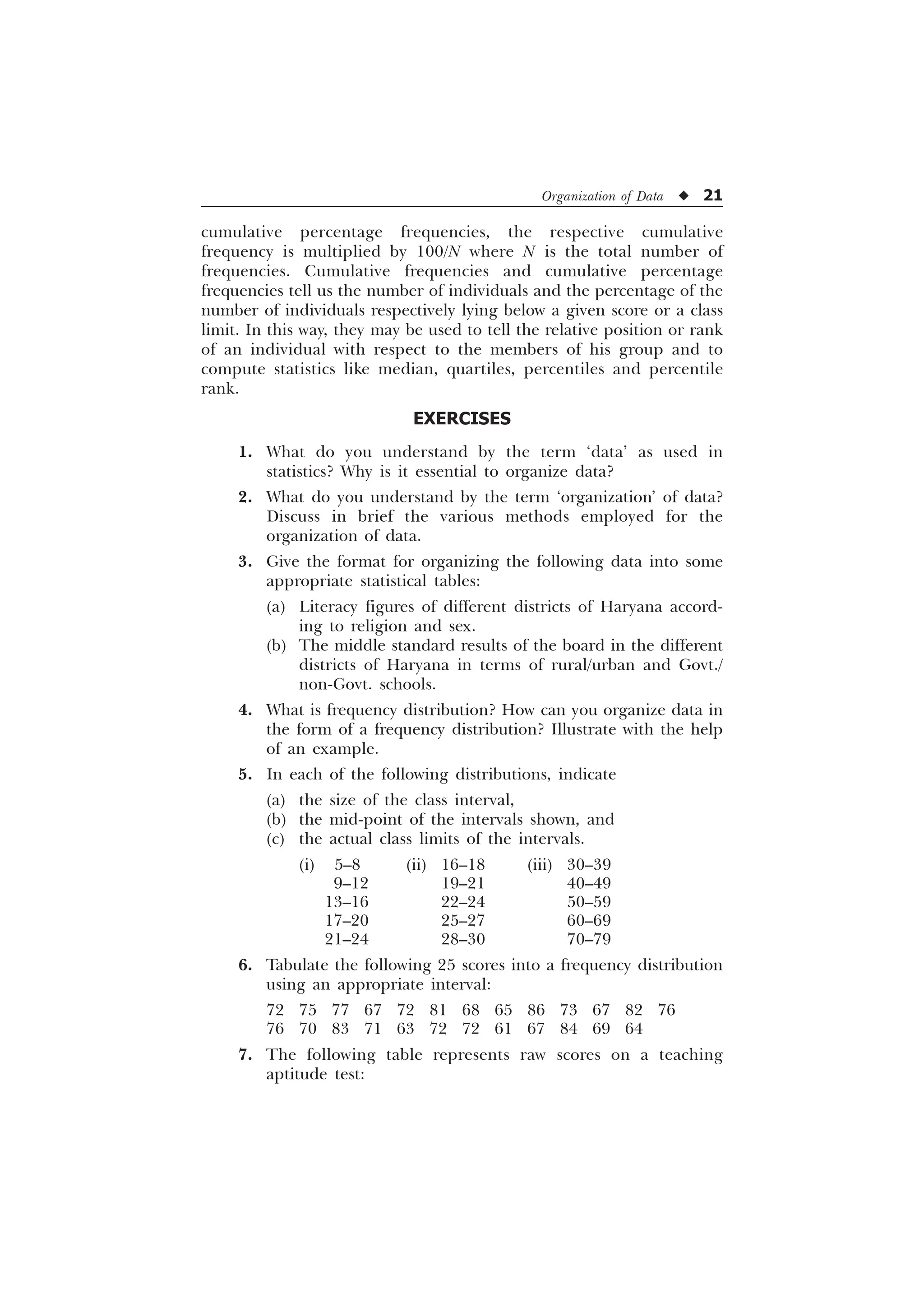
Let us begin the task with area A. It extends from 1.8s to 3s. To
know the percentage of cases falling within this area, we read from the
table the cases lying between mean and 3s (4986 or 49.86%) and then
between M and 1.8s (4641 or 4641%). The difference (49.86 – 46.41
= 3.45%) will yield the required percentage of the whole group
belonging to category A. Therefore, group A may be said to comprise
3.45% or 3.5% of the whole group.
Similarly, group B will cover the cases lying between 0.6s and
1.8s. We find from the table that the percentage of the whole group
lying between M and 1.8s is 46.41 and between M and 0.6s is 22.57.
Therefore, group B may be said to comprise 46.41 – 22.57 = 23.84%
of the entire group.
Group C extends from –0.6s to 0.6s on both sides of the mean.
The normal curve table tells us that 22.57% cases lie between M and
0.6s and a similar percentage of cases, i.e. 22.57, lies between M and
–0.6s. Therefore, group C may be said to comprise 22.57 ´ 2 = 45.14
or 45% of the entire group.
Groups D and E, as can be seen from Figure 8.18, are identical to
groups B and A and, therefore, may be found to consist of the same
percentage of cases as covered in groups B and A, respectively, i.e. 23.8
and 0.5 percent of the whole group.
We may summarize the percentage and number of students in
each category in the following manner:
A B C D E
Percentage of the whole group in each
category 3.5 23.8 45.0 23.8 3.5
Number of students in each category
out of the total 200 students 7.0 47.6 90.0 47.6 7.0
Number of students in whole number 7 48 90 48 7
SUMMARY
The literal meaning of the term normal is average. Most of the things
and attributes in nature are distributed in a normal way. There are
quite a few persons who deviate noticeably from average and a very few
who markedly differ from average. If the data in terms of the results
of tests, surveys and experiments performed on a randomly selected
sample or population are plotted on a graph paper, we are likely to get
a typical curve often resembling a vertical cross-section of a bell.
This bell-shaped curve is named as normal curve. It is a perfectly
132 u Statistics in Psychology and Education
symmetrical curve along the vertical middle line. Where the scores of
individuals in the group seriously deviate from the average, the curves
representing these distributions also deviate from the shape of a
normal curve. This deviation from the normality tends to vary either
in terms of skewness or in terms of kurtosis.
Skewness refers to the lack of symmetry. In a distribution showing
skewness, there is no symmetry between the right and left halves of the
curve. There are two types of skewed distributions—negative and
positive—indicating the inclination of the curve more towards left or
right. It is computed by the formulae
 G
N
0 0
6
T


N
3 3
6 3


Kurtosis refers to the flatness or peakedness of a frequency
distribution as compared with the normal. If it is more flat than the
normal, it is named as platy-kurtic and if more peaked, then it is called
as lepto-kurtic. Kurtosis is computed by the formula
 
X
4
.
3 3

A normal curve shows interesting properties and typical characteristics
like the following:
1. Mean, median and mode are the same.
2. The value of the measure of skewness is zero.
3. The value of the measure of kurtosis is 0.263.
4. It approaches but never touches the base line at the extremes.
5. The mean of the distribution is used as the starting point. The
curve has its maximum height at this point. The distance
travelled along the base line from this point is measured in
the unit of the Standard deviation of the distribution (s).
6. The curve extends from –3s to +3s covering a total area of
10,000 (taken arbitrarily). 68.26 percent of this area falls
within the limits ±1s, 95.44 percent within ±2s and 99.74
percent within ±3s, thus leaving 26 cases in 10,000 beyond
the range ±3s.
7. Limits of the distances ±1.96s include 95 percent and the
limits ±2.58s include 99 percent of the total cases.
Normal curve has a wide significance and applicability and may be
used
The Normal Curve and its Applications u 133
1. as a model for comparing various distributions and distri-
buting school marks and categorical ratings;
2. to compute percentiles and percentile ranks;
3. to understand and apply the concept of standard errors of
measurement;
4. for the purpose of ability grouping;
5. for transforming and combining qualitative data;
6. for converting raw scores into comparable standard norma-
lized scores; and
7. for determining the relative difficulty of test items.
EXERCISES
1. What is a normal curve? Why is it named as normal prob-
ability curve, normal curve of error or Gaussian curve?
2. What do you understand by the term divergence from
normality? Point out the main types of such divergent curves
and throw light on the concepts of skewness and kurtosis.
3. Define and explain the terms skewness and kurtosis along with
their main types.
4. Discuss the chief characteristics and properties of a normal
curve.
5. What do you understand by the terms normal distribution and
normal curve? Bring out the main applications of the concept
of normal curve in the fields of education, psychology and
sociology.
6. Given the following data regarding two distributions,
Mathematics Physics
M 60 33
SD 8 9
Achievement scores of a student 70 67
find out whether the student did better in Maths or Physics.
7. Given a normal distribution with a mean of 50 and standard
deviation of 15,
(a) What percent of the cases will lie between the scores of 47
and 60,
(b) What percent of the cases will lie between 40 and 47, and
(c) What percent of the group is expected to have scores
greater than 68?
134 u Statistics in Psychology and Education
8. In a normal distribution with a mean of 54 and SD of 5,
calculate the following:
(a) Q1 and Q3 (P25 and P75)
(b) Two scores between which lies the middle 50% cases.
(c) Number of persons out of 600 who score below 57.
9. Given N = 100, M = 28.52, SD = 4.66; assuming normality
of the given distribution find
(a) What percent of cases lie between 23–25 and
(b) What limits include the middle 60%?
10. On the assumption that IQ’s are normally distributed in the
population with mean of 100 and standard deviation of 15,
what percentage of the cases fall
(a) above 135 IQ (c) below 90 IQ
(b) above 120 IQ (d) between 75 and 125 IQ
11. Assuming a normal distribution of scores, a test has a mean
score of 100 and a standard deviation of 15. Compute the
following:
(a) Score that cuts off the top 10%,
(b) Score that cuts off the lower 40%,
(c) Percentage of cases above 90,
(d) Score that occupies the 68th percentile rank, and
(e) Score limits of the middle 68%.
12. Four tests are passed by 15%, 50%, 60% and 75% respectively
of a large unrelated group. Assuming normality, find the
relative difficulty value of each problem.
13. Given three test items. 1, 2 and 3 passed by 50%, 40% and
30% respectively of a large group. On the assumption of
normality of distribution, what percentage of this group must
pass test item 4 in order for it to be as much more difficult
than 3 as 2 is more difficult than 1?
14. There is a group of 1000 individuals to be divided into 10 sub-
groups, i.e. A, B, C, D, E, F, G, H, I and J respectively
according to a trait supposed to be distributed normally. What
number of individuals should be placed in each of these sub-
groups?
15. Scores on a particular psychological test are normally
distributed with a mean of 50 and SD of 10. The decision is
made to use a letter grade system, as follows: A 10%, B 20%,
C 40%, D 20% and E 10%. Find the score intervals for the five
letter grades.
135
WHY IS SAMPLING NEEDED?
In education and psychology, we have to compute mean and several
other representative values for studying the characteristics of a certain
population. But it is neither feasible nor practicable to approach each
and every element of the population. For example, if we wish to know
about the average height of the Indian male of 25 years of age, then,
we have to catch hold of all the young men of 25 years of age
(necessarily identified as citizens of India), measure their heights and
compute the average. This average will yield a true value of the
desired population mean. But to do so is not a simple task. It is quite
impracticable as well as inessential to approach every Indian male of 25
years of age. The convenient as well as practical solution lies in
estimating the population mean from the sample means. Here, we may
take a few representative samples of appropriate size from the
randomly selected districts and states in India. Suppose that we have
taken 100 such samples. Then, the means of these samples may yield
the desired average height of the whole population of the Indian male
of 25 years of age.
SIGNIFICANCE OF THE SAMPLE MEAN AND
OTHER STATISTICS
The representative values like mean, median, standard deviation, etc.
calculated from the samples are called statistics and those directly
computed from the population are named as parameters. The statistics
computed from the samples may be used to draw inferences and
estimates about the parameters. In an ideal situation, we expect any
sample statistic to give a true estimate of the population statistic. The
degree to which a sample mean (or other statistics) represents its
parameter, is an indication of the significance of the computed sample
mean.
9 Significance of the Mean
and Other Statistics
136 u Statistics in Psychology and Education
Therefore, in a situation in which we approach the element of a
representative sample rather than the element of the entire population
and compute the sample mean and other statistics for the estimation
of related parameters, we have to make sure of the significance or
trustworthiness of the computed sample statistics. In other words, we
have to say how far we can rely on the computed mean or some other
statistic, to predict or estimate the value of the related parameter (the
true mean).
Concept of Standard Error in Computing the Significant
Value of the Mean or Other Statistics
Assume that we have knowledge of the true mean (mean of the
population). Also suppose that we have taken 100 representative
samples from the population and computed their respective sample
means. If we analyze the distribution of these sample means, we will
come to know that a majority of these sample means are clustered
around the population mean and in the case of a large sample (number
of cases more than 30), the distribution will be found normal as shown
in Figure 9.1. The mean of the sample will be a fairly good or a
somewhat true estimate of the population mean. Some of these sample
means will deviate from the population mean either on the positive or
the negative side, while most of them will show negligibly small
deviations.
MS90 MS2 MS5 MS1 M MS3 MS7 MS80 MS100
Figure 9.1 Normal distribution of the means of the samples.
The measure of dispersion or deviation of these sample mean
scores, may also be calculated in the form of standard deviation. In an
ideal case, a sample mean must represent the population mean (or
true mean) but on application, a sample mean is likely to differ from
its parameter or true value. This difference is known as the possible
Population
Significance of the Mean and Other Statistics u 137
error that may occur in estimating the true mean from a given sample
mean. The curve representing the distribution of sample means
possessing lesser or greater error of estimation for the population
mean is called the curve of the error and the standard deviation of this
distribution of sample means is known as the standard error of the
mean.
In a large sample, the standard error of the mean may be
computed with the help of the following formula:
Standard Error of the Mean, SEM or sM =
1
T
where N stands for total No. of cases in the sample and s for standard
deviation of the distribution of the sample means.
In the true sense, s must represent the standard deviation of the
population. But as we seldom know this value, the SD of the given
sample, the significance of whose mean we have to estimate, may be
used in this formula.
Confidence Intervals
As said earlier, a sample mean is employed to estimate the population
mean. In the actual sense, it is very difficult to say categorically that a
sample mean is, or is not, a trustworthy estimate of the population
mean. All the sample means drawn from the same population deviate
in one way or the other from the population mean and the distribution
of these sample means (in the case of large samples, N  30) is a
normal distribution. The standard error of the mean (SEM or sM)
represents a measure by which the sample means deviate from the
overall population mean. Now the question arises as by how much
should a sample mean deviate from the population mean so that it may
be taken as a trustworthy estimate of the population mean. The answer
lies in the limits of confidence intervals fixed on the basis of degree of
confidence or trustworthiness required in a particular situation.
Usually, we make use of 0.95 (or 0.05) and 0.99 (or 0.01) per-
centage of probability as the two known degrees of confidence for
specifying the interval within which we may assert the existence of the
population mean.
In the case of normal distribution we know from the table of
normal curve that 95% cases lie within the limits M ± 1.96s and 99
percent cases lie within the limits M ± 2.58s (this fact has already been
emphasized in Chapter 8 (vide Figure 8.9). Hence, from the normal
distribution of the sample means, it may be safely concluded that there
are 95 chances out of 100 for a sample mean to deviate from the
population mean by ±1.96sM (±1.96 times the standard error of the
mean) and only 5 chances out of 100 that the population mean will lie
138 u Statistics in Psychology and Education
beyond the limits M ± 1.96sM. Similarly, it may be generalized that
there are 99 chances out of 100 for a sample mean to deviate from the
population mean by ±2.58sM and only 1 chance out of 100 that the
population mean will lie beyond the limits M ± 2.58sM.
The values in terms of scores of the limits M ± 1.96sM and M ±
2.58sM are called confidence limits and the interval they contain is
called the confidence interval for a known and a fixed degree or a level
of confidence.
In this text, we will be using the term 5% and 1% level of confi-
dence in defining the limits (M ± 1.96sM and M ± 2.58sM) beyond
which the population mean may be estimated to lie. At 5% level of
confidence, we will say that our population mean may lie within the
range of M ± 1.96sM and at 1% level of confidence, we will say that
the population mean may lie within the range of M ± 2.58sM.
The concept of confidence intervals does not help in locating the
population mean exactly, however, it does give some idea about where
the population mean is likely to be. This information is quite useful
and less expensive for an appropriate estimation of the population
mean on the basis of practically available and easily computed sample
means.
Computation of Significance of Mean in Case of
Large Samples
Example 9.1: In a psychological test, a sample of 500 pre-University
students of Rohtak city is found to possess the mean score of 95.00 and
SD of 25. Test the significance of this mean. In other words how far can
this mean be trusted to estimate the mean of the entire population of
the pre-University students studying in the colleges of Rohtak.
Solution. We have seen that means of large samples randomly
drawn from the same population produce a normal distribution. In the
present case a sample of 500 students is quite a large sample.
Therefore, the standard error of the mean may be computed by the
formula
SEM or sM =


1
T
– –
Significance of the given mean at 5% and 1% levels of confidence may
be given through the following confidence limits.
At 5% level of confidence
M ± 1.96sM = 95 ± 1.96 ´ 1.12
= 95 ± 2.2
= 92.8 to 97.2
Significance of the Mean and Other Statistics u 139
It means that there are only 5 chances out of 100 that the population
mean or true mean will lie beyond the limit 92.8–97.2.
At 1% level of confidence
M ± 2.58sM = 95 ± 2.58 ´ 1.12
= 95 ± 2.89
= 92.11 to 97.89
It means that there is only 1 chance out of 100 that the true mean will
lie beyond the limit 92.11–97.89.
Significance of Mean for Small Samples
Concept of t distribution. We usually (however, quite arbitrarily) take
a sample of 30 cases or more as a large sample and a sample of less
than 30 as small. We have seen that the means of large samples
randomly drawn from the same population produce a normal
distribution (Figure 9.1). However, when samples are less than 30 in
size, the distribution does not take the shape of a normal curve. It
is symmetrical but leptokurtic. In other words, it becomes more
peaked in the middle and has relatively more area in its tails. Such a
distribution is known as the t distribution. It was developed originally
in 1908 by W.S. Gosset, who wrote under the pen name “Student”.
t distribution is sometimes called “Student” distribution in honour of
its discoverer.
It should be clearly understood that t distribution is not a single
curve (as in the case of a perfect normal curve) but a whole family of
curves, the shape of each being a function of sample size. As the size
of the sample increases and includes about 30 cases, the t distribution
takes the shape of a normal curve.
The nature of the t distribution is also linked to the number of
degrees of freedom. A different t distribution exists for each number of
degrees of freedom. As the number of degrees of freedom increases,
the t distribution takes the shape of a normal curve. This fact may be
well illustrated through Table C of the t distribution given in the
Appendix. In this table, we find the values of t in relation to the given
degrees of freedom and level of confidence. We observe that, as the
number of degrees of freedom increases and approaches infinity, t
approaches the values 1.96 and 2.58, respectively, at 5% and 1% levels
of confidence (it is seen that these are the values of sigma scores at the
5% and 1% levels of confidence in the case of a normal distribution).
Concept of degrees of freedom. The number of independent
variables is usually called the number of degrees of freedom. This term
has been borrowed from Coordinate Geometry and Mechanics where
140 u Statistics in Psychology and Education
the position of a point or a body is specified by a number of indepen-
dent variables, i.e. the coordinates. Each coordinate corresponds to
one degree of freedom of movement. Constraints on the body reduces
the number of degrees of freedom.
The concept of degrees of freedom is widely used in dealing with
small sample statistics. The symbol df is frequently used to represent
the degrees of freedom. The ‘freedom’ in the term degrees of freedom
signifies ‘freedom to vary’. Therefore, the degrees of freedom associa-
ted with a given sample are determined by the number of observations
(the number of values of the variables) that are free to vary. The
degrees of freedom are reduced through the constraints or restrictions
imposed upon the observations or variables. As a general rule one
degree of freedom is lost for each constraint or restriction imposed.
The number of degrees of freedom in any case, is given by the formula
No. of degrees of freedom = No. of observations or
variables – No. of constraints or restrictions
Let us illustrate it with the help of some examples.
If we have five scores as 12, 10, 7, 6 and 5, the mean is 8 and the
deviations of these scores from their mean are 4, 2, –1, –2, and –3
respectively. The sum of these deviations is zero. In consequence, if any
four deviations are known, the remaining deviation may be auto-
matically determined. In this way, out of the five deviations, only four
(i.e. N – 1) are free to vary as the condition that “the sum equal to
zero” suddenly imposes restriction upon the independence of the 5th
deviant. Thus, we may observe that in a sample for the given set of
observations or scores (N), one degree of freedom is lost when we
employ the mean of the scores for computing the variance of standard
deviation (by calculating deviation of the scores from the mean).
Originally there were 5 (N = 5) degrees of freedom in computing the
mean because all the observations or scores were quite independent.
But as we made use of the mean for computing variance and standard
deviation, we lost one degree of freedom.
Let us now take the case of the sampling distribution of means
and decide about the degrees of freedom. For the purpose of illus-
tration, let us assume that there are only three samples in our sampling
distribution of means. The means of these samples are M1, M2 and M3.
The mean of these means, say M, will be our population mean. We
know that the sum of the deviations around the mean of any
distribution is zero. Therefore, in this case (M – M1) + (M – M2) + (M –
M3) will be equal to zero. We see that up to the point of computation
of M, we had M1, M2 and M3 as independent observations, but after
computing M, we lose one degree of freedom as the value of M1, M2
and M3 is automatically fixed in the light of the value of M. In this way,
Significance of the Mean and Other Statistics u 141
we may find that when we employ the sample mean as an estimate of
the parameter (population mean), one degree of freedom is lost and
we are left with N – 1 degrees of freedom for estimating the population
variance and standard deviation.
However, the degrees of freedom are not always N – 1 in all cases.
It varies with the nature of the problem and the restriction imposed.
For example, in the case of correlation between two variables where we
need to compute deviations from two means, the number of restric-
tions imposed goes up to two and consequently, the number of degrees
of freedom becomes N – 2. Similarly (as we would see in Chapters 11
and 12 of this text), in the case of contingency tables of Chi square test
and analysis of variance, we may have some other different formulae
for the computation of number of degrees of freedom. However, in all
cases, we will always have a common feature conveying that the number
of observations or values in a given data minus the number of restric-
tions imposed upon this data, constitute the number of degrees of
freedom for that data.
Process of Determining the Significance of Small
Sample Means
It may be summarized under the following steps:
Determining the standard error of the mean. In small samples
(N less than 30), the standard error of the mean is computed by the
formula:
SEM or sm =
V
1
where N is the size of the sample and s is the standard deviation.
Here the value of s is calculated using the formula
s =
6


[
1
(where x = deviation scores from the mean) instead of the formula
s =
6 
[
1
used for computing SD in large samples.
Use of t distribution in place of normal distribution. As we
discussed earlier, the distribution of sample means in the case of small
142 u Statistics in Psychology and Education
samples takes the shape of a t distribution instead of a normal
distribution. Therefore we try to make use of the t distribution.
Determining the degrees of freedom. As we know, the shape of a t
distribution depends upon the number of degrees of freedom. The
number of degrees of freedom thus have to be determined by using the
formula
df = N – 1
where N stands for the number of cases in the samples.
Using the t distribution table. Like the normal curve table, t distri-
bution table is also available. Table C given in the appendix represents
such a table. From this table, we can read the value of t for the given
degrees of freedom at the specific level of probability (5% or 1%)
decided at the beginning of the experiment or collection of data.
Determining the confidence interval. After locating the values of t at
the 5% and 1% levels of confidence with known degrees of freedom, we
may proceed to determine the range or confidence interval for the
population mean, indicated as follows:
1. From the first value of t, say t1 read from the table, we can say
that 95% of the sample means lie between the limits M ± t1 ´
Standard error of the mean and the remaining 5% fall beyond
these limits.
2. From the second value of t, say t2, read from the table, we can
say that 99% of the sample means lie between the limits
M ± t2 ´ Standard error of the mean and that only 1% fall
beyond these limits.
Let us illustrate the above process through an example.
Example 9.2: In a particular test there were 16 independent obser-
vations of a certain magnitude with a mean of 100 and SD of 24. Find
out (at both 0.05 and 0.01 levels of confidence) the limits of the
confidence interval for the population (or true) mean.
Solution. The sample consists of 16 observations and hence may
be regarded as a small sample. Therefore,
SEM or sm =


V
1
Number of degrees of freedom = N – 1 = 16 – 1 = 15. From Table C,
we read the value of t for 15 degrees of freedom at the points 0.05 and
0.01 (5% and 1% levels of confidence). These values are 2.13 and 2.95.
Therefore, the limits of confidence interval at the 0.05 level is
Significance of the Mean and Other Statistics u 143
M ± 2.13 ´ SEM = 100 ± 2.13 ´ 6 = 100 ± 12.78
or
from 87.22 to 112.78
The limits of confidence interval at .01 level are
M ± 2.95 ´ SEM = 100 ± 2.95 ´ 6 = 100 ± 17.70
or
from 82.30 to 117.70
SIGNIFICANCE OF SOME OTHER STATISTICS
Like mean, the significance of some other statistics like median,
standard deviation, quartile deviation, percentages, correlation
coefficient, etc. may also be determined by computing the standard
errors of these estimates. For large samples (N  30) the respective
formulae are given below:
Standard Error of a Median
sMd =

1
T
(in terms of s)
sMd =
4
1
(in terms of Q)
where s and Q represent the standard deviation and quartile deviation
respectively of the given sample.
Standard Error of a Quartile Deviation
SEQ or sQ =

1
T
(in terms of s )
ÿÿÿÿÿÿÿÿÿÿÿÿÿÿÿÿÿÿÿÿÿÿÿÿÿÿÿÿsQ =
4
1
(in terms of Q)
Standard Error of a Standard Deviation
SEs or ss =
1
T
Standard Error of the Coefficient of Correlation
SEr or sr =

 U
1
144 u Statistics in Psychology and Education
SEr or sr =

 
1
S

After determining the standard error of the required statistics
with the help of these formulae, we determine their significance at 5%
or 1% level of confidence by computing the limits of the respective
confidence intervals. Let us illustrate it through the following example.
Example 9.3: The performance on an intelligence test of 225 students
of grade X is as follows:
Median = 90.8 and SD = 3.5
Determine the confidence limits at the 0.05 and 0.01 levels for
estimation of the population median.
Solution. Standard error of the median
sMd =

1
T
Here,
s = 3.5, N = 225
Substituting the respective values in the formula, we obtain
sMd =
 

–
=


= 0.292
The confidence interval at 5% level of confidence is
Md ± 1.96sMd = 90.8 ± 1.96 ´ 0.292 = 90.8 ± 0.572
or
from 85.08 to 91.372
The confidence interval at 1% level of confidence is
Md ± 2.58sMd = 90.8 ± 2.58 ´ 0.292 = 90.8 ± 0.753
or
from 87.27 to 91.553
Coefficient of Correlation r
Case I: When the sample is large (preferably N = 100 or more)
and value of r close to ± .50. In all such cases the significance of r
may be tested through the computation of its standard error by the
following formula:
Standard error of r,
sr =

 U
1

Let us take Example 7.8 as an illustration.
Significance of the Mean and Other Statistics u 145
Example 9.4: Here, r = 0.52 and N = 173. Therefore,
ÿÿ sr =


=


= 0.055
By assuming the sampling distribution of r to be normal we have the
following confidence intervals at 5% and 1% level for delimiting our
population r.
Interval at 5% level of confidence is
r ± 1.96 ´ sr = 0.52 ± 1.96 ´ 0.055 = 0.52 ± 0.108
or
from 0.412 to 0.628
The interval at 1% level of confidence is
r ± 2.58 ´ sr = 0.52 ± 2.58 ´ 0.055 = 0.52 + 0.142
or
from 0.378 to 0.662
In this way, we may conclude that the estimated r is at least as large as
0.378 and no larger than 0.662.
Case II: When we have a large sample (N is 30 or greater) and any
value of r (whether too high or too low). In all the above cases, we
have converted this value into z function for testing the significance of
a given value r. (This conversion may be done with the help of
Table D given in the Appendix.) After this, using the following
formula, we find the standard error of z
sz =


1 
Subsequently, confidence interval at the 5% and 1% levels of confi-
dence may be found by using formulae z ± 1.96 ´ sz and z ± 2.58 ´
sz. These values are again converted into r function with the help of
the conversion Table D.
The whole process can be better understood through the
following illustration.
Example 9.5: Given r = 0.78 and N = 84, find the confidence
interval at 0.05 and 0.01 levels of confidence for estimating true r.
Solution. The z value for the given r (as read from Table D
given in the Appendix) is 1.05.
146 u Statistics in Psychology and Education
The standard error of z, i.e.
sz =
 
  
1  
=


=


= 0.11
The confidence interval at the 5% level for the true z is
z ± 1.96 ´ sz = 1.05 ± 1.96 ´ 0.11 = 1.05 ± 0.2156
= 1.05 ± 0.216 (up to three decimals)
from 0.834 to 1.266, i.e.
or
from 0.83 to 1.27 (rounded to two decimals)
These values of z are again converted into r values with the help of
Table D. Thus, the confidence interval at 5% level for the true r = from
0.68 to 0.85.
The confidence interval at 1% level for the true z is
z ± 2.58 ´ sz = 1.05 ± 2.58 ´ 0.11 = 1.05 ± 0.2838
= 1.05 ± 0.28 (rounded to two decimals)
or
from 0.77 to 1.33
Converting these z values back into r values from Table D. We get
confidence interval at the 1% level for the true r, as 0.645 to 0.87.
Case III: When we make use of the null hypothesis to test r. This
method of testing the significance of r developed by R.A. Fisher by
making use of the t distribution and testing the significance of an
obtained r against the null t hypothesis, shows that the population r is,
in fact, zero.
Fisher in his work demonstrated that when the population r is
zero, a parameter t can be estimated by the formula,
t =


U 1
U


The values of t for different samples are distributed as in a t
distribution. However, in actual practice, there is no need to compute
the value of (t ratio) from a given r. It can be done with the help of
Table E given in the Appendix. From this table, we can read directly,
given the degrees of freedom, the values of r that would be significant
at 0.05 and 0.01 levels of confidence and then take the appropriate
decision about the significance of the given r.
This method may be employed in the case of large as well as small
Significance of the Mean and Other Statistics u 147
samples with any obtained value of r. The procedure can be under-
stood through the following illustration.
Example 9.6: Given r = 0.52 and N = 72 test the significance of the
given r.
Solution. Let us set up a null hypothesis saying that the
population r is in fact zero and see whether it is accepted or rejected
in view of the given data.
Here, N = 72. Therefore, the number of degrees of freedom will
be N – 2 = 72 – 2 = 70. We read the values of r at 0.05 and 0.01 levels
of confidence from Table E (given in the Appendix) for df = 70. These
are 0.232 and 0.302 respectively. Therefore, the given value of r, i.e.
0.52 (being much higher than 0.232 or 0.302) is highly significant at
both 5% and 1% levels. The hypothesis that population r is in fact,
zero, is rejected and we may take the computed value of r as quite
trustworthy and significant.
SUMMARY
In studying the characteristics of a certain population, it is neither
feasible nor practical to approach each and every element of the
population. Therefore, we usually resort to sampling. A sample of the
appropriate size is drawn from the population and the desired
statistics, mean, median, SD, and the like are calculated. These sample
statistics are then used to draw an estimate about the parameters, i.e.
the mean, median, SD, correlation coefficient and so on of the whole
population. The degree to which a sample statistics represents its
parameter is an index of the significance of trustworthiness of the
computed sample statistic—mean, median and so on.
Testing the significance or trustworthiness of the computed
sample mean and of other statistics requires the computation of
standard error of the sample mean and other statistics. Suppose we
take a number of samples from the same population and compute
means for these samples. The distribution of these sample means in
case of large samples, i.e. N30, will be normal and may be shown by
a normal curve. Standard deviation of this distribution will be known
as the standard error of the mean.
In the case of a large sample, the standard error of mean may be
computed by the formula
sM =
1
T
of median by the formula
148 u Statistics in Psychology and Education
sMd =

1
T
of SD by ss =
1
T
of quartile deviation by ÿ ÿ sQ =

1
T
and of r by sr =

 U
1

In all these formulae, N represents the total number of cases in the
sample and s, the SD of the distribution of the given sample.
In the case of small samples (N30), standard error of mean may
be computed by the formula
SEM or sm =
V
1
where s is the SD of the sample which may be computed by using the
formula
s =


[
1
6

where x represents deviation scores from the mean.
After computing the standard error of the mean (or of other
statistics), testing of the significance of the mean (or of other statistic)
requires the computation of the limits of confidence intervals fixed on
the basis of levels of confidence or significance (degree of confidence
or trustworthiness required in a particular situation). 0.05 and 0.01 are
the two levels of confidence or significance that are usually employed.
The values in terms of the scores of the limits M ± 1.96sM and
M ± 2.58sM are called confidence limits and the interval they contain is
called confidence interval at the 0.05 and 0.01 levels of confidence
respectively.
The limits of the confidence intervals given by the values
M ± 1.96sM and M ± 2.58sM tell us how far a sample mean should miss
the population mean so that it may be taken as a trustworthy estimate
of the population mean. The same thing may also be said about the
trustworthiness or significance of other statistics, median, SD, etc. In
this way, we can point out the significance of the mean and of other
statistics, first by computing SE and then determining the limits of
confidence intervals at 0.05 or 0.01 levels of significance.
Significance of the Mean and Other Statistics u 149
In the case of small samples, the distribution of sample means
takes the shape of a t distribution, and not normal as in the case of
large samples. Here we have to read the values of t from a table of t
distribution, for given degrees of freedom (computed by the formula
df = N – 1 in the case of mean, median, SD, etc.) at the specific level
of confidence 0.05 or 0.01. To determine the limits of confidence
interval, we use the formula M ± t ´ Standard error of the mean.
Testing the significance of coefficient of correlation when the
sample is quite large (N = 100 or more) and value of r close to ±0.05
requires the use of the formula
sr =

 U
1

for computing SE of r. If we have a large sample (N = 30 or  30)
and any value of r, too high or too low, use of z function is appropriate.
Conversion of r into z or vice versa is made possible through a
conversion table, and standard error of z is computed by the formula
sz =


1 
Another suitable method for testing the significance of r is provided by
Fisher by making use of the t distribution and testing the significance
of an obtained r against the null hypothesis that the population is, in
fact, zero.
EXERCISES
1. What do you understand by the terms population and
sampling? Define the terms statistics and parameter. How do
we use statistics for estimating the parameters?
2. Explain the concept of standard error for determining the
significance of the mean and other statistics.
3. What do we mean by the term significance of sample mean?
Explain in detail.
4. Explain the concept of confidence interval and confidence
limits as used in determining the significance of mean and
other statistics.
5. How would you proceed to determine the significance of a
given sample mean in a large sample? Illustrate with the help
of a hypothetical example.
150 u Statistics in Psychology and Education
6. How does the procedure for determining the significance of
the mean of a small sample differ from the mean of a large
sample? Illustrate with the help of a hypothetical example the
process of determining the significance of a small sample
mean.
7. Discuss in brief the process of determining the significance of
the statistics like median, standard deviation and quartile
deviation.
8. Discuss the different methods used to determine the signi-
ficance of a correlation coefficient between two variables of a
given sample.
9. From the following data, compute the standard of mean and
establish the confidence intervals for the location of true
mean at .05 and .01 levels.
Sample Sample Sample Sample Sample Sample
A B C D E F
Mean 40 45 60 50 30 80
SD 4 6 2 8 3 12
N 125 400 16 900 25 626
10. Are the following values of r significantly different from zero?
(a) r = 0.30 for N = 25
(b) r = 0.60 for N = 15
11. Given r = 0.48 and N = 25
(a) find the standard error of r and determine the limits of
confidence intervals at 0.05 and 0.01 levels.
(b) convert the given r into a z function; sz and determine
the limits of the confidence intervals at 0.05 and 0.01
levels.
(c) by using the concept of null hypothesis, find whether the
given r is significant at 0.05 or 0.01 levels.
12. On an attitude scale, the performance of a group of 36
student teachers was recorded as below:
Md = 30.4, SD = 2.4
How well does this median represent the median of the
population from which this sample was drawn?
151
NEED AND IMPORTANCE
In the fields of education and psychology, there are many occasions when
we are more interested in knowing about the significance of the
difference between two sample means (independent or correlated),
drawn from the same or different populations rather than merely
knowing the significance of the computed sample means.
Let us illustrate a few such occasions:
1. A teacher wants to test the relative effectiveness of two teaching
methods. For this he divides the IX class students into
two random groups. One group is taught by him with method
A and the other with method B. After a few months, he
administers an achievement test to both of these groups and
computes the means of the respective achievement scores of
the two groups, say M1 and M2. The difference between these
two means, i.e. M1 – M2 is then determined. Now the question
arises as to how significant this difference should be to help
decide whether method A or B is better.
2. A research worker wants to study the effect of anxiety on the
computational and reasoning ability in Mathematics. For this
purpose, he may test a group of students on some achievement
test in Mathematics and derive the mean value of their
achievement scores. Then he may induce a state of anxiety, re-
administer the achievement test to the same group and
compute the mean of the achievement scores. Now to decide
whether the anxiety factor has affected the achievement of the
group, he has to take a decision about the significance of the
difference between two means.
3. A person wants to study the effect of a certain medicine or a
yoga exercise in promoting intelligence. For this purpose, he
10Significance of the
Difference between
Means
152 u Statistics in Psychology and Education
divides the students of a class in two equal random groups.
One group called the experimental group, is treated with
medicine or yoga exercises while with the other called the
control group, nothing is done. The IQ scores of these two
groups may, then, be determined with the help of some group
mental ability test. The significance of the difference between
the mean scores of experimental and control group will, then,
help him decide whether the given medicine or yoga exercises
is contributing factor in the promotion of intelligence.
In all the above situations, the problem is the determination of
significance of the difference between two computed means. One is
bound to question whether the difference, if any, between the two
sample means is the result of sample fluctuations which have occurred
incidentally or indicates some really valid differences which will help in
drawing some useful interpretations.
FUNDAMENTAL CONCEPTS IN DETERMINING THE
SIGNIFICANCE OF THE DIFFERENCE BETWEEN MEANS
Concept of Standard Error
In Chapter 9, we have seen that in determining the significance of a
sample mean, if we successfully draw random samples from a given
population, compute their means, and arrange these means into a
frequency distribution, the result is a normal curve (t distribution curve
in the case of small sample means). Going further, the standard devi-
ation of the distribution of these sample means called the standard
error of the mean was taken as the yardstick for testing the significance
of a given sample mean.
Proceeding on the same lines, if we have data related to diffe-
rences between means of a number of samples, the sampling
distribution of these difference between means will also look like a
normal curve, in large samples (and t distribution curve in the case of
small samples). The standard deviation of this distribution called
standard error of the differences between means then, may be taken as
the yardstick against which we may safely test the obtained difference
between any two sample means.
The standard error of the difference between independent and
correlated means in the case of both large and small samples is
computed with the help of some particular formulae.
Concept of Null Hypothesis
Null hypothesis is the starting point of solving a problem related to the
Significance of the Difference between Means u 153
significance of difference between means. The first task of a research
worker of an experimenter is to establish this hypothesis. Such a
hypothesis always emphasizes that there exists no real difference bet-
ween two population means and that the difference found between
sample means is therefore, insignificant.
In the course of a study or an experiment, the null hypothesis
is stated, so that it can be tested for possible rejection under the
assumption that it is true. For example in the case of studying the
superiority of one method of teaching over the other, we divide the
students of a class into two equal random groups, teach them using
different methods, test them with the help of an achievement test and
compute the mean and SD of the scores of each of these groups. In this
experimental study, the null hypothesis may be stated thus:
There exists no significant difference between the achievements of
two groups taught by different methods. If this null hypothesis is
rejected, then it is possible to make statements with a certain probability
level regarding the superiority of one method over the other. In this
way, the central point in the course of an experiment or a study
regarding the testing of significance of difference between two sample
means is the testing of an established null hypothesis for its possible
rejection.
The task of rejection of a null hypothesis rests on some of the
following points:
Setting up the Level of Confidence or Significance
The experimenter has to take a decision about the level of confidence
or significance at which he is going to test, his hypothesis. At times he
may decide to use 0.05 or 5% level of significance for rejecting a null
hypothesis (when a hypothesis is rejected at the 5% level it is said that
the chances are 95 out of 100, that the hypothesis is not true and only
5 chances out of 100 that it is true). At other times, he may prefer to
make it more rigid and therefore, use the 0.01 or 1% level of
significance. If a hypothesis is rejected at this level, the chances are 99
out of 100, that the hypothesis is not true and that only 1 chance out of
100 is true. This level on which we reject the null hypothesis, is
established before doing the actual experiment (before collecting data).
Later we have to adhere to it.
Size of the Sample
The sampling distribution of the differences between means may look
like a normal curve or t distribution curve depending upon the size of
the samples drawn from the population. If the samples are large
154 u Statistics in Psychology and Education
(N = 30 or greater than 30), then the distribution of differences
between means will be a normal one. If it is small (N is less than 30),
then the distribution will take the form of a t distribution and the shape
of the t curve will vary with the number of degrees of freedom. In this
way, for large samples, statistics advocating normal distribution of the
characteristics in the given population will be employed, while for
small samples, the small sample statistics will be used.
Hence in the case of large samples possessing a normal
distribution of the differences of means, the value of standard error
used to determine the significance of the difference between means
will be in terms of standard sigma (z) scores. On the other hand, in the
case of small samples possessing a t distribution of differences between
means, we will make use of t values rather than z scores of the normal
curve. Accordingly, in the case of large samples, we make use of the
normal curve of Table B (Appendix) to decide the critical value of the
z scores of the standard error to reject a null hypothesis at the 0.05 or
0.01 level. From the normal curve table we see that 95% and 99% cases
lie at the distance of 1.96s and 2.58s. Therefore, the sigma or z scores
of 1.96 and 2.58 are taken as critical values for rejecting a null
hypothesis.
If a computed z value of the standard error of the differences
between means approaches or exceeds the values 1.96 and 2.58, then
we may safely reject a null hypothesis at the 0.05 and 0.01 levels.
To test the null hypothesis in the case of small sample means, we
first compute the t ratio in the same manner as z scores in case of large
samples. Then we enter the table of t distribution (Table C in the
Appendix) with N1 + N2 – 2 degrees of freedom and read the values
of t given aganist the row of N1 + N2 – 2 degrees of freedom and
columns headed by 0.05 and 0.01 levels of significance. If our
computed t ratio approaches or exceeds the values of t read from the
table, we will reject the established null hypothesis at the 0.05 and 0.01
levels of significance, respectively.
Two-Tailed and One-Tailed Tests of Significance
Two-tailed test. In making use of the two-tailed test for determining
the significance of the difference between two means, we should know
whether or not such a difference between two means really exists and
how trustworthy and dependable this difference is. In all such cases, we
merely try to find out if there is a significant difference between two
sample means; whether the first mean is larger or smaller than the
second, is of no concern. We do not care for the direction of such a
difference, whether positive or negative. All that we are interested in,
is a difference. Consequently, when an experimenter wishes to test the
Significance of the Difference between Means u 155
null hypothesis, H0: M1 – M2 = 0, against its possible rejection and
finds that it is rejected, then he may conclude that a difference really
exists between the two means. But he does not make any assertion
about the direction of the difference. Such a test is a non-directional
test. It is also named as two-tailed test, because it employs both sides,
positive and negative, of the distribution (normal or t distribution) in
the estimation of probabilities. Let us consider the probability at 5%
significance level in a two-tailed test with the help of Figure 10.1.
Therefore, while using both the tails of the distribution we
may say that 2.5% of the area of the normal curve falls to the right of
1.96 standard deviation units above the mean and 2.5% falls to the left
of 1.96 standard deviation units below the mean. The area outside
these limits is 5% of the total area under the curve. In this way, for
testing the significance at the 5% level, we may reject a null hypothesis
if the computed error of the difference between means reaches or
exceeds the yardstick 1.96. Similarly, we may find that a value of 2.58
is required to test the significance at the 1% level in the case of a
two-tailed test.
One-tailed test. As we have seen, a two-tailed or a non-directional
test is appropriate, if we are only concerned with the absolute
magnitude of the difference, that is, with the difference regardless
of sign.
However, in many experiments, our primary concern may be with
the direction of the difference rather than with its existence in absolute
terms. For example, if we plan an experiment to study the effect of
coaching work on computational skill in mathematics, we take two
groups—the experimental group, which is provided an extra one hour
coaching work in mathematics, and the control group, which is not
provided with such a drill. Here, we have reason to believe that the
experimental group will score higher on the mathematical computation
2.5%
–1.96s M
2.5%
+1.96s
Figure 10.1 Two-tailed test at the 5% level.
(Mean of the distribution of scores concerning the
differences between sample means)
156 u Statistics in Psychology and Education
ability test which is given at the end of the session. In our experiment we
are interested in finding out the gain in the acquisition of mathematical
computation skill (we are not interested in the loss, as it seldom happens
that coaching will decrease the level of computation skill).
In cases like these, we make use of the one-tailed or directional test,
rather than the two-tailed or non-directional test to test the significance
of difference between means. Consequently, the meaning of null
hypothesis, restricted to an hypothesis of on difference with two-tailed
test, will be somewhat extended in a one-tailed test to include the
direction—positive or negative—of the difference between means.
Let us illustrate the difference in the situations where we use the
two-tailed or one-tailed tests:
Null hypothesis. There is no difference between the mean IQ’s of
athletes and non-athletes. In this situation, we use a two-tailed test.
If we change the Null Hypothesis as
Athletes do not have higher IQ’s than non-athletes. or
Athletes do not have lower IQ’s than non-athletes.
Each of these hypothesis indicates a direction of difference rather than
the mere existence of difference, and hence, we have to use a
one-tailed test. In other words, in a one-tailed test we have to set up the
hypothesis that M1 is greater than M2 or M1 is less than M2
(M1  M2 or M1  M2) instead of M1 = M2 as in the case of a two-tailed
test. In such a situation, we are concerned only with one tail (left or
right) of the distribution (normal or t distribution) as shown in
Figure 10.2.
M
5%
+1.64s
(Mean of the distribution of the scores concerning
the differences between sample means)
Figure 10.2 One-tailed test at the 5% level.
Thus at the 5% level of significance we will have 5% of the area,
all in one tail (at the 1.64 standard deviation unit above the mean rather
than having it equally divided into two tails as shown in Figure 10.1, for
a two-tailed test. Consequently, in a one-tailed test for testing the
difference between large sample means, z score of 1.64 will be taken as
Significance of the Difference between Means u 157
a yardstick at the 5% level of significance for the rejection of the null
hypothesis instead of 1.96 in the case of a two-tailed test. Similarly, a z
score of 2.33 will be taken as a yardstick to test the significance of the
difference between means of large samples at 1% level of significance.
In the case of a t distribution of small sample means, in making
use of the one-tailed test we have to look for the critical t values,
written in Table C of the Appendix, against the row (N1 + N2 – 2)
degrees of freedom under the columns labelled 0.10 and 0.02 (instead
of 0.05 and 0.01 as in the case of two-tailed test) to test the significance
at 0.05 and 0.01% levels of significance, respectively.
HOW TO DETERMINE THE SIGNIFICANCE OF DIFFERENCE
BETWEEN TWO MEANS
The process of determining the significance of difference between two
given sample means varies with respect to the largeness or smallness of
the samples as well as the relatedness or unrelatedness (independence)
of the samples. Consequently, we should deal with the following types of
situations for discussing the process of determining the significance of
difference between two means. (Here, by a large sample we mean the
samples having 30 or more cases and by a small sample, the sample
consisting less than 30 cases. We call the samples independent when
they are drawn at random from the totally different and unrelated
groups or when we administer non-correlated tests on the same sample
to collect relevant data.)
Case I: Large but independent samples.
Case II: Small but independent samples.
Case III: Large but correlated samples.
Case IV: Small but correlated samples.
In all these cases, the experimenter has to set up a null hypothesis
and take a decision about the level of significance at which he wishes to
test his null hypothesis. Then, he has to determine the SE of the
difference between the two means and compute the z score or t ratio,
take a decision about the significance of these standard scores at a given
level of significance and finally reject or retain the null hypothesis.
The procedure listed so far, however is followed with somewhat
different formulae and steps in each of the four cases as may be
evident from the following.
Case I: Significance of difference between two means for large but
independent samples
158 u Statistics in Psychology and Education
Step 1. To determine the SE of the difference between the means of two samples.
The formula for determining standard error of the difference between
means of two large but independent (non-correlated) samples is:
SED or sD =  
 
0 0
T T

where
sM1
= SE of the means of the first sample
sM2
= SE of the means of the second sample
As we already know, sM1
and sM2
may be calculated by the formula
sM1
= 

1
T
where s1 is the SD of the first sample and N1 is the size of the first
sample.
sM2
= 

1
T
where s2 is the SD of the second sample and N2 is the size of the
second sample. In this way, the formula becomes
sD =


1 1
T
T

Step 2. To compute the z value for the difference in sample means. The
sampling distribution of difference between means in the case of large
samples is a normal distribution. This difference represented on the
base line of the normal curve may be converted into standard sigma
scores (z values) with the help of the following formula:
z =
T

  'LIIHUHQFHEHWZHHQPHDQV
6WDQGDUGHUURURIGLIIHUHQFHEHWZHHQPHDQV
'
0 0
In this way, z represents the ratio of difference between the means to
the standard error of the difference between the means.
Step 3. Testing the null hypothesis at some pre-established level of significance.
At this stage, the null hypothesis, i.e. there exists no real difference
between the two sample means, is tested against its possible rejection at
5% or 1% level of significance in the following manner.
1. If the computed z value [i.e. z = (M1 – M2)/sD] is equal to 19.6
or greater than 1.96 (equal to or greater than 1.65 in the case
of a one-tailed test), we declare it significant for the rejection
of the null hypothesis at 5% level of significance.
Significance of the Difference between Means u 159
2. In case the computed z value is equal to 2.58 or greater than
2.58 (equal to or greater than 2.33 in a one-tailed test), we
declare it significant for the rejection of null hypothesis at 1%
level of significance.
3. If the computed z value is greater than 1.96 but less than 2.58
(greater than 1.65 and less than 2.33 in the case of a
one-tailed test) we say that the null hypothesis is rejected at 5%
level of significance but not rejected at 1% level of significance.
The rejection of a null hypothesis then, helps in concluding that the
difference found between the two sample means is real and trustworthy
and not merely on account of some chance factors or due to sampling
fluctuations.
Let us illustrate the entire process through some examples.
Example 10.1: (Two-tailed test). A science teacher wanted to know
the relative effectiveness of lecture-cum-demonstration method over
the traditional lecture method. He divided his class into equal random
groups A and B and taught group A by the lecture-cum-demonstration
method and group B by the lecture method. After teaching for
three months, he administered an achievement test to both groups.
The data collected were as under:
Group A Group B
Mean 43 30
SD 8 7
No. of students 65 65
From this data, what do you conclude about the effectiveness or
supremacy of one method of teaching over the other?
Solution. Here, the teacher has first, to establish a null
hypothesis, i.e. there exists no real difference between the means of
two samples. This hypothesis, then, will be tested in the following way.
The difference between means,
M1 – M2 = 43 – 30 = 13
The standard error of the difference between means,
SED or sD =  
 
0 0
T T
 =


1 1
T
T – –
 
=


= 1.32
160 u Statistics in Psychology and Education
Converting the obtained difference between means into standard
sigma (z) scores:
z =   

'
0 0
T

= 9.85
Our computed z value is much greater than 1.96 as well as 2.58, the
critical values required to reach 5% and 1% levels of significance,
respectively. Thus, we may safely conclude that the difference between
the means of two samples cannot be attributed to a chance factor. This
difference is quite trustworthy and dependable to say that the
lecture-cum-demonstration method is more effective as a method of
teaching than the traditional-lecture method.
Example 10.2: (One-tailed test). A mathematics teacher divides his
class into two random groups. He provides special coaching in
computation skill for an hour daily to the experimental group hoping
that such a drill will promote the computation skill of the students of
this group. The control group is not provided any such drill. At the
end of the session, he administers an achievement test and collects
data as under.
Experimental group Control group
Mean 35 30
SD 4 3
N 48 45
Is the gain (difference between means) significant enough to indicate
that a drill in mathematics promotes computation skill?
Solution. In this test, the teacher is interested to know the
significance of difference between means in terms of a particular
direction, i.e. gain from the special coaching. Therefore, to determine
the significance of difference between means, a one-tailed test (in place
of the two-tailed test) will be used.
In this case, the process of testing the null hypothesis will be
the same as in the case of two-tailed test, illustrated in example
10.1, except that the critical value of z will be taken as 1.65 and
2.33 (in place of 1.98 and 2.68) at the 5% and 1% levels of significance,
respectively. The computation work will be as follows:
Difference between means = M1 – M2 = 35 – 30 = 5
Standard error of the difference between means:
Significance of the Difference between Means u 161
sD =


1 1
T
T
 =
     
   
– –
 
=


= 0.73
Converting the difference between means into standard sigma scores
(z), we get the corresponding z values.
z =   

'
0 0
T

= 6.85
We may say that our computed value of z exceeds the critical value of
1.65 and 2.33. Therefore, it may be taken as significant at both 5% and
1% levels. Hence the null hypothesis is rejected at the 5% and 1%
levels and we may say that (99 times out of 100) the gain is significant
and drill work may be taken as a significant factor for the promotion
of computation skill.
Case II: Significance of the difference between two means for small
but independent samples
Step 1. Computation of the standard error of the difference between two
means. In the case of large sample means, we used the formula
sD =


1 1
T
T

for the computation of the standard error of difference means.
We made use of two separate standard deviations s1 and s2 from each
of the samples. But in the case of small samples, we may make
use of a single standard deviation s called pooled SD for the
computation of the standard error of difference as shown in the
following formula:
SED or sD = s
 
 
1 1
 (i)
where s = pooled SD of the samples. Let us see how this pooled SD
(s ) can be computed from the data of two sample means.
For testing the significance of the mean in the case of small
samples, we have seen in Chapter 9 that SD of sample is computed by
the formula 6 

 
[ 1 instead of the usual formula 6 

[ 1 . If we
have two small samples, then their SD’s will be expressed as follows:
162 u Statistics in Psychology and Education
s1 =


[
1
6

, s2 =


[
1
6

(ii)
It has also been established that when two samples are small, we can
get a better estimate of the true SD (s in the population) by pooling
the sum of squares of deviations taken around the means of the two
groups and compute a rough or pooled SD by using the following
formula:
Pooled SD or s =
Ë Û
6  6
Ì Ü
  
Ì Ü
Í Ý


[ [
1 1
(iii)
where
x1 = X1 – M1 (deviation of scores of first samples from its mean).
x2 = X2 – M2 (deviation of scores of second sample from its mean).
When we are given the values of s1 and s2 instead of raw scores or the
mid-points of the intervals X1, and X2, then we have to compute the
values of 

[
6 and 

[
6 with the help of the following formula (derived
from formula (ii) given above):
6 

[ = 

T (N1 – 1)
6 

[ = 

T (N2 – 1)
Hence, for the computation of the standard error of difference
between the means of two small samples, we must first, try to compute
a value of the pooled SD (s) by formula (iii) and then compute sD with
the help of formula (i), i.e.
sD =
 
 
1 1

Step 2. To compute the t value for the difference in sample means. The
sampling distribution of the difference between means in small samples
is t distribution. Therefore, here we make use of t values instead of z
values to convert the difference between means into a standard score.
The formula used to determine the standard t values is:
t =
T

  'LIIHUHQFHEHWZHHQPHDQV
6WDQGDUGHUURURIGLIIHUHQFHEHWZHHQPHDQV
'
0 0
Step 3. Testing the null hypothesis at some pre-established level of signi-
ficance. Here, we proceed as follows:
Significance of the Difference between Means u 163
1. Number of degrees of freedom is calculated by using the
formula
df = N1 + N2 – 2
2. We then refer to Table C of t distribution (Appendix) with the
calculated degrees of freedom, df, and read the t values given
under columns 0.05 and 0.01 (0.10 and 0.02 for one-tailed
test) for the critical t values used to test the null hypothesis at
5% and 1% levels of significance.
3. If our t value (computed in Step 2) is equal to or greater than
the critical t value read from table C for 5% and 1% levels of
significance, then we take the computed value of t as signi-
ficant and consequently reject the null hypothesis at 5% or 1%
levels of significance.
Let us illustrate the whole process now with the help of a few
examples.
Example 10.3: Two groups of 10 students each got the following
scores on an attitude scales:
Group I : 10, 9, 8, 7, 7, 8, 6, 5, 6, 4
Group II : 9, 8, 6, 7, 8, 8, 11, 12, 6, 5
Compute the means for both groups and test the significance of the
difference between these two means.
Solution
First sample Second sample
X1 M1 x1 x1
2
X2 M2 x2 x2
2
10 7 3 9 7 8 1 1
9 7 2 4 8 8 0 0
8 7 1 1 6 8 –2 4
7 7 0 0 7 8 –1 1
7 7 0 0 8 8 0 0
8 7 1 1 8 8 0 0
6 7 –1 1 11 8 3 9
5 7 –2 4 12 8 4 16
6 7 –1 1 6 8 –2 4
4 7 –3 9 5 8 –3 9
Total 70 6 

[ = 30 Total 80 6 

[ = 44
M1 = 70/10 = 7 M2 = 80/10 = 8
164 u Statistics in Psychology and Education
Pooled SD or s =
6  6


[ [
1 1
=


=


= 2.03
SED or sD = s
 
 
1 1
 = 2.03
 
 
 = 2.03


=


= 0.908
t =
   

'
0 0
T
 
=


= –1.1
df = N1 + N2 – 2 = 10 + 10 – 2 = 18
We find from Table C that the critical value of t with 18 degrees
of freedom at 5% level of significance is 2.10. Our computed value of
t, i.e. 1.1 is quite smaller than the critical table value 2.10 and hence
is not significant. Therefore, the null hypothesis cannot be rejected
and as a result, the given difference in sample means being
insignificant, can only be attributed to some chance factors or
sampling fluctuations.
Example 10.4: It is generally known that the habit of reading news-
papers and magazines is helpful in bringing about an increase in
language vocabulary. A language teacher divides his class into two
groups—experimental and control. Under the assumption that news-
paper reading will increase the vocabulary, the experimental group was
given two hours daily to read English newspapers and magazines, while
no such facility was provided to the control group. After six months,
both the groups were given a vocabulary test. The scores obtained are
detailed below.
Experimental group 115, 112, 109, 112, 137
Control group 110, 112, 95, 105, 111, 97, 112, 102
Interpet the data and say whether the gain in vocabulary is significant.
Significance of the Difference between Means u 165
Solution.
Experimental group Control group
X1 M1 x1 x1
2
X2 M2 x2 x2
2
115 113 2 4 110 105.5 4.5 20.25
112 113 –1 1 112 105.5 6.5 42.25
109 113 –4 16 95 105.5 –10.5 110.25
112 113 –1 1 105 105.5 –0.5 .25
117 113 4 16 111 105.5 5.5 30.25
97 105.5 –8.5 72.25
112 105.5 6.5 42.25
102 105.5 –3.5 12.25
Total 565 6 

[ = 38 Total 844 6 

[ = 330
N1 = 5 N2 = 8
M1 =


= 113 M2 =


= 105.5
Pooled SD or s =
6  6


[ [
1 1
=


=


=


= 5.79
SED or sD = s


1 1
 
= 5.79  
 = 5.79 ´ 0.57
= 3.30
t =
T


'
0 0
= 2.27
Here, the teacher has to use a one-tailed test because he has every
reason to believe that his treatment (the practice of reading
newspapers and magazines daily) will produce an effect in the positive
direction only (it will increase the vocabulary). Therefore, we will refer
the t table with N1 + N2 – 2, i.e. 11 degrees of freedom and locate the
166 u Statistics in Psychology and Education
t value under the column .10 for determining the critical value of t at
the 0.05 level. Consequently at 5% level of significance the critical
value of t = 1.80. Our computed value of t, i.e. 2.28, crosses 1.80.
Hence it is to be taken as significant at the 5% level. As as result, with
5% level of confidence, we can reject the null hypothesis and say the
reading drill through newspapers and magazines increases the
vocabulary.
Cases III and IV: Significance of the difference between two means
for correlated samples—large and small. The procedure followed
for testing the significance of the difference between two means for
correlated samples (when the data in one sample are correlated with
the data in the other) is almost the same except for the difference in
the process of computation of the standard error. Here, we make use
of some particular formulae depending upon the design of experiment
that an experimenter selects for his study. These designs, along with
the respective formulae for the computation of standard error are
summarized in the following sections.
The single group method. It consists of repetition of a test to a group.
In actual process, a test of any type is administered to a group
of subjects. It is called the initial test. Then the desired experimental
treatment is given, followed by the re-administration of the same
test to the same individuals of the group. The initial and final
tests data thus constitute a correlated data because the same indiv-
iduals are responding to the items both times, i.e. before and after the
treatment.
In order to determine the significance of the difference between
the means obtained from the initial and the final testing, we use the
formula:
SED or sD = T T T T


0 0 0 0
U
where
sM1
= Standard error of the initial test
sM2
= Standard error of the final test
r = Coefficient of correlation between scores on initial
and final testing
Equivalent groups method. In experiments, when we have to compare the
relative effect of one method or treatment over the other, we often
make use of two groups (experimental and control). Then we give the
desired treatment separately to the individuals of these groups and
compute the pre-treatment and post-treatment scores by administering
a test or a measure. Hence in such experimental design, instead of a
single group, two separate groups are taken for the experimental
Significance of the Difference between Means u 167
study. For the desired results, these two groups need to be made
equivalent. Let us explain this with the help of an example.
Suppose that a teacher wants to conduct a study in which the
demonstration method is to be compared with the lecture method. For
this purpose, he decides to divide the students of the class in two
groups A and B, consisting of equal number of students. He plans to
teach group A by demonstration method and group B by lecture
method. While planning, he may quickly visualize that if the students
in one group are more intelligent or have a better background of the
subject than the other, the results of the research study will be
distorted. In this case, it will be very difficult to distinguish whether the
higher means of the scores of a group are the results of the teaching
through an effective method or are due to the initial difference with
respect to ability or intelligence. Such initial differences need to be
overcome before administering the actual treatment to the groups.
This can be done in the following ways.
Matching pair technique. In this technique, matching is done
initially by pairs so that each individual in the first group has his
equivalent or match in the second group in terms of some variables who
are going to affect the results of the study like age, socio-economic
status, intelligence, interest, aptitude, previous knowledge of the subject
and so on.
Matching group technique. Here, instead of one to one corres-
pondence or matching carried out in pairs on an individual level, the
group as a whole is matched with the other group in terms of mean and
standard deviation of some other variable/variables than the one under
study.
Let us now consider the computation of standard error in both
the cases (matching pair and matching group) of equivalent group
samples.
In the case of a matching pair, the formula for calculating
standard error of the difference between means is the same as used in
the single group method, i.e.
SED = sD =    
 

0 0 0 0
U
T T T T
 
In the group matched for mean and SD, this formula takes the
following shape:
SED = sD =  
  

0 0 U
T T
 
where sM1
and sM2
are the standard errors of the means of the scores
of X variable under study for the two groups which are matched or
168 u Statistics in Psychology and Education
equated to mean and SD in terms of some other variable, Y. Here, r
is the measure of coefficient of correlation between X and Y.
Let us illustrate the procedure of testing the significance of the
difference between means of the correlated samples through some
examples.
Example 10.5: A teacher of mathematics gave a test in multiplication
to the 30 students of his class. Then he induced a state of anxiety
among them and the achievement test was re-administered. The data
obtained were as follows:
Initial test data Final test data
Mean 70 Mean 67
SD 6 SD 5.8
r between the initial and final test scores = 0.82. Find out the following
on the basis of given data:
1. Is there a significant difference between the two sets of scores?
2. Test the hypothesis that the population mean on the final test
is significantly lower than the population mean on the initial
test.
3. Did the introduction of the state of anxiety affect the
multiplication ability of the students adversely?
Solution. Here in the case of the correlated data of the two
samples we may use the following formula for the computation of the
standard error of the difference between means
SED = sD =    
 

0 0 0 0
U
T T T T
 
where
sM1
= SE of the mean of the initial test
= 


1
T = 1.09
sM2
= SE of the mean of the final test
= 


1
T
= 1.06
sD =
 
     
  – – –
=    
  = 0.648
Significance of the Difference between Means u 169
z =     
 
'
0 0
T
 
= 4.629
The computed value of z exceeds both 1.96 and 2.58, the critical
values of z at 5% and 1% levels, respectively. Hence, it is to be taken
as significant, resulting in the rejection of the null hypothesis.
Consequently, it can be said that there exists a significant difference
between the two sets of scores; population mean on the final test is
significantly lower than the population mean on the initial test and
introduction of the state of anxiety has affected adversely, the
multiplication ability of the students.
Example 10.6: In the first trial of a practice period, 25 twelve-year
olds have a mean score of 80 and an SD of 8 on a digit symbol
learning test. On the tenth trial, the mean is 84 and the SD is 10. The
r between scores on the first and 10th trails is 0.40. Our hypothesis is
that practice leads to gain.
(a) Is the gain in score significant at the 0.05 level or the 0.01
level?
(b) What gain would be significant at the 0.01 level, other
conditions remaining the same?
Solution. The given data in the present problem may be summarized
as follows
Trials Mean SD N
First trial 80 8 25
Tenth trial 84 10 25
r between the first and tenth trial = 0.40.
Our hypothesis is that, practice leads to gain. It shows a particular
direction and therefore, we have to make use of a one-tailed test for
the significance of the difference between correlated means. Then,
SED or sD =    
 

0 0 0 0
U
T T T T
 
where
sM1
= SE of the first trial mean
= 


1
T = 1.6
sM2
= SE of the tenth trail mean
= 


1
T
= 2
170 u Statistics in Psychology and Education
Here,
sD =
 
     
  – – –
=      
  – 
=  = 2
t ratio =
'LIIHUHQFHEHWZHHQPHDQV
6(RIWKHGLIIHUHQFHEHWZHHQPHDQV '
'
T
=


= 2
In the case of correlated data,
No. of degrees of freedom = No. of pairs – 1
= N – 1 = 25 – 1 = 24
For the one-tailed test, for the critical t values at the 0.05 level,
we will read Table C under column P = 0.10, and at the 0.01 level,
under column P = 0.02. Therefore,
Critical t value at 0.05 level = 1.71
Critical t value at 0.01 level = 2.49
1. Our computed t ratio 2.00 crosses the value 1.71. It shows
that differences are significant at the 0.05 level, but does not
reach 2.50. Hence it is not significant at the 0.01 level.
2. Let us find the gain, significant at the 0.01 level, critical t
value read from the table at P = 0.02 for one-tailed test is
2.49.
This means for the gain significant at the 0.01 level the t value
should be 2.49. Converting this t value into test score, we get
D/sD = t, or
Gain in terms of scores = t ´ sD (Here, sD = 2)
Hence,
Gain = 2.49 ´ 2 = 4.98
may be considered significant at the 0.01 level.
Example 10.7: Two groups, each consisting of 20 students of a class
were matched in pairs on the basis of IQ’s. The use of film strip was
the method used to teach the experimental group. The control group
was exposed to a conventional “read and discuss” method. The
researcher wanted to test the null hypothesis that there was no
Significance of the Difference between Means u 171
difference between the mean achievements of the two groups at the
0.05 level. The data obtained are as under:
Experimental group Control group
N1 = 20 N2 = 20
M1 = 53.20 M2 = 49.80
s1 = 7.4 s2 = 6.5
Therefore, r = 0.60.
Solution. Here we have correlated data collected on two small
samples. The researcher has established a null hypothesis HO : M1 – M2
= 0. Therefore, he has to use a two-tailed test for the significance of
the difference between means.
M1 – M2 = 53.20 – 49.80 = 3.40
SED or sD =    
 

0 0 0 0
U
T T T T
 
where
sM1
= 


1
T
= 1.65
sM2
=


1
T
= 1.45
Therefore,
sD = –  –  – – –
       
=    
  = 1.396
t ratio =   

' '
0 0
'
T T

= 2.43
Number of degrees of freedom = No. of pairs – 1
= 20 – 1 = 19
For a two-tailed test, with 19 degrees of freedom we can read the
critical t value at the 0.05 level, i.e. 2.09.
Our t value of 2.43 exceeds the critical t value of 2.09. Hence it
is right to reject the null hypothesis.
Example 10.8: Two groups of high-school students are matched for M
and SD on a group intelligence test. There are 58 subjects in group A
and 72 in group B. The records of these two groups upon a battery of
learning tests are as follows:
172 u Statistics in Psychology and Education
Group A Group B
M 48.52 53.61
s 10.60 15.35
N 58 72
The correlation of the group intelligence test and the learning battery
in the entire group from which A and B were drawn is 0.50. Test the
significance of the difference between groups A and B at the 0.05 and
0.01 levels.
Solution. Here the groups are large (N  30). These are
matched in terms of M and s. The data is, therefore, correlated. The
difference between the two sample means is 53.61 – 48.52 = 5.09
To determine the SE of the difference between means, the
formula to be used is:
sD = T T


0 0 U
where
sM1
=
T


1
sM2
=
T


1
Therefore,
sD =


Ë Û
 
Ë Û
Ì ÜÍ Ý
Ì Ü
Í Ý
=
Ë Û

Ì Ü
Í Ý


=   
– = 1.97
The samples are large. Thus, the sampling distribution of the difference
between means may be taken as normal.
Therefore,
z =
'LIIHUHQFHEHWZHHQPHDQV
6WDQGDUGHUURURIWKHGLIIHUHQFHEHWZHHQPHDQV
=


= 2.58
Significance of the Difference between Means u 173
For the significance at the 5% and 1% levels, the critical z values
are 1.96 and 2.58, respectively. Our computed value of z is 2.58; hence
it may be taken to be quite significant at the 0.05 level and almost
significant at the 0.01 level.
An alternative method for small samples. In the case of small sam-
ples (N  30), a method known as the “difference method”, has been
recommended by Ferguson in place of the one discussed earlier.
In this method, the value of t may be directly computed from the
following formula without making use of the value of r between the
scores made on the initial and the final testing:
t =
6
6  6


'
1 ' '
1
where
D = Difference in score between initial and final testing (in the
case of single group) or between pairs of matched subjects
(in the case of equivalent groups)
Let us illustrate the use of this method with the help of example.
Example 10.9: Ten subjects were tested on an attitude scale. Then,
they were made to read some literature in order to bring a change in
their attitudes. The attitude scale was re-administered. The results of
the initial and final testing are as under:
Initial 10, 9, 9, 8, 8, 7, 7, 5, 4, 4
Final 11, 7, 8, 9, 6, 6, 8, 4, 3, 4
Test the null hypothesis at the 5% level of significance.
Solution.
Initial Final D D2
10 11 –1 1
9 7 2 4
9 8 1 1
8 9 –1 1
8 6 2 4
7 6 1 1
7 8 –1 1
5 4 1 1
4 3 1 1
4 4 0 0
N = 10 N = 10 S D = 5 SD2
= 15
174 u Statistics in Psychology and Education
t =
 

'
1 ' '
1
6
6  6

=


–  –
=
–
  
 
=


= 1.34
The No. of degrees of freedom is
df = N – 1 = 10 – 1 = 9
At the 5% level of significance, the critical value of t with 9 degrees of
freedom = 2.26.
Our computed value of t i.e. 1.34, does not reach the critical table
t value 2.26. Hence it is to be taken as insignificant and, consequently,
the null hypothesis is not be rejected at the 5% level of significance.
Example 10.10: A researcher wanted to test the effect of drug in
reducing anxiety. For this purpose he used two groups of individuals,
experimental and control, matched in pairs. He made use of an
anxiety scale for the assessment of anxiety among the subjects of the
group. (The experimental group was given the drug while no such
thing was given to the control group.) The results were pooled as
under:
Experimental group scores 115, 114, 114, 110, 108, 107,
105, 100, 97, 95
Control group scores 120, 117, 112, 118, 102, 95,
107, 106, 93, 99
Test the null hypothesis at 0.05 level.
Solution.
Experimental Control
group group D D2
115 120 –5 25
114 117 –3 9
114 112 2 4
110 118 –8 64
108 102 6 36
107 95 12 144
105 107 –2 4
100 106 –6 36
97 93 4 16
95 99 –4 16
N = 10 N = 10 S D = – 4 S D2
= 354
Significance of the Difference between Means u 175
t =
6
6  6


'
1 ' '
1
=

–  –


=
 – 


= 0.202
At the 5% level, for 10 – 1 = 9 degrees of freedom, our computed
value of t does not reach the critical value 2.26, hence it is not
significant. Consequently we cannot reject the null hypothesis at 5%
level of significance.
SUMMARY
In carrying out various studies and experiments in the fields of
education, psychology and sociology, we often need to test the
significance of the difference between two sample means (independent
or correlated) drawn from same or different populations.
The process of determining the significance of difference between
two given sample means varies with respect to the largeness or
smallness of the sample as well as the relatedness or unrelatedness
(independence) of the samples. A sample having 30 or more cases is
usually treated as a large sample while a sample containing less than
30 cases is considered a small sample. The samples are called
uncorrelated or independent when they are drawn at random from
totally different and unrelated groups or when uncorrelated tests are
administered to the same sample. However, on a broader outlook, it
may be summarized as follows:
1. Establishment of a null hypothesis.
2. Choosing a suitable level of significance, 5% or 1%.
3. Determining the standard error of the difference between
means of two samples.
4. Determining standard score values in terms of z (for large
samples) and in terms of t (for small samples).
5. Determining the critical value of z (for large samples) from
the normal curve table and critical value of t (for small
samples) from the t table for the computed value of degrees
of freedom.
6. If the computed value of z or t in the given problem reaches
the critical table value of z or t, then it is to be taken as
significant, and consequently the null hypothesis stands
176 u Statistics in Psychology and Education
rejected. If this falls short of the critical value, the null
hypothesis is not rejected.
7. The critical values of z or t are different in the case of
two-tailed and one-tailed tests.
When we are interested only in knowing the magnitude of the
difference between means, a two-tailed test is employed but in
case the direction is also needed, then a one-tailed test is used.
The critical values to be taken are summarized in the
following:
Level of Two-tailed test One-tailed test
significance z-values t-values z-values t-values
5% level 1.96 Read under the 1.64 Read under the
column P = .05 column P = .10
1% level 2.58 Read under the 2.33 Read under the
column P = 0.1 column P = .02
8. If the null hypothesis is rejected, we say that the difference
found in the sample means is trustworthy and real but it is not
rejected, we have to conclude that the difference between the
means is not real; it may occur by chance or due to sampling
fluctuations.
The process of computing standard error of the difference
between the means shows in essence the difference on account of the
size or nature of the samples. Different formula used in the various
situations are as follows:
Case I: Large but independent (uncorrelated) samples
SED =
T
T
T T


0 0 1 1
Case II: Small but independent (uncorrelated) samples
SED = s
 
 
1 1

where s or pooled SD is given by the formula
s =


[ [
1 1
6  6
  
Here, x1 and x2 are given by X1 – M1 and X2 – M2 , respectively.
Significance of the Difference between Means u 177
Case III: Correlated samples—large and small
1. For the two groups matched in pairs as well as in case if a
single group is tested twice (before starting the experiment
and after), here we use the formula
sD =    
 

0 0 0 0
U
T T T T
 
2. For the two groups matched in terms of the group as a whole
(i.e. Mean and SD), the formula is
sD =  
  

0 0 U
T T
 
A special method may be employed for small samples giving
original raw scores, to determine t values directly without computing
the standard error of the difference between means, as
6
6  6


'
W
1 ' '
1
where D stands for the difference in scores for the two samples.
EXERCISES
1. What do you understand by the term significance of the
difference between means?
Discuss its necessity in the fields of education and psychology.
2. Write short notes on the following:
(a) Concept of standard error.
(b) Null hypothesis.
(c) Level of significance.
(d) Two-tailed test and one-tailed test.
3. The critical values necessary for the rejection of a null
hypothesis (at a given level of significance and for a given
number of degrees of freedom) is higher for a one-tailed test
than it is for a two-tailed test. Do you agree? Why?
4. Give the formulae (with full explanation) used in determining
the Standard Error of the difference between the means in the
following cases:
(a) Two large but independent (uncorrelated) samples.
(b) Two small but independent samples.
(c) Two samples having correlated data on a single group.
178 u Statistics in Psychology and Education
(d) Samples having correlated data on two groups with
matched pair.
(e) Samples having correlated data on two groups equated in
terms of mean and SD.
5. Two group of pre-medical students belonging to two different
colleges took a standardized medical aptitude test. The data
collected are as follows:
Group A Group B
Mean 32 36
SD 6.2 7.4
N 145 82
Is there a significant difference between the two means?
6. One group of rats was given a vitamin supplement while the
other group received a conventional diet. The rats were
randomly divided into two groups. The experiment was
performed under the assumption that vitamin supplement
results in the increase in weight. The results obtained are:
Experimental Group Control Group
N1 = 12 N2 = 16
s1 = 15.5 s2 = 1.22
M1 = 140 M2 = 120
Can you tell from the results whether the gain received in
terms of weight is significant at 0.05 level.
7. The following data were collected from two separate groups
of 144 men and 175 women, on an attitude scale.
Mean SD
Men 19.7 6.08
Women 21.0 4.89
(a) Test the significance of the difference between the mean
of two groups at the .05 level of significance.
(b) In your own words, what does the result of the
experiment say?
8. In a course of a psychological experiment on two large
samples, the following data were collected:
Difference between means = 4.20
Standard error of the difference between means = 2.80
Significance of the Difference between Means u 179
(a) Is the obtained difference between means is significant at
the 0.05 level?
(b) What difference is necessary for being significant at the
0.01 level?
9. A vocabulary test was administered to a random sample of 8
students of section A and 7 students of section B of class IX
of a school. The scores are:
Scores of Section A 16, 14, 12, 12, 10, 8, 6, 4
Scores of Section B 14, 8, 7, 6, 4, 4, 12
Is the difference between the means of two groups significant
at 0.05 level?
10. A group of subjects were given an attitude test on a
controversial subject. Then they were shown a film favourable
to the subject and the attitude test was then re-conducted.
The scores were tabulated as under:
X1 16, 18, 20, 24, 24, 22, 20, 18, 10, 8, 20
X2 24, 20, 24, 28, 30, 20, 24, 22, 18, 18, 24
Test the null hypothesis at .05 and 0.1 levels.
11. The following data were obtained in the course of an
experiment performed for testing the effect of a treatment on
two groups of 50 subject each:
Experimental group Control group
Initial Final Initial Final
M 74 97 73.8 82
s 10.2 13.6 10.0 12.8
r = 0.75
Interpret the greater gain in the case of the experimental
group.
12. The achievements of two groups (matched for mean and SD
on an intelligence test) of 10 + 2 students, one from the
academic and the other from the vocational channel were
compared on a mechanical aptitude test. The data collected
are:
Academic group Vocational group
No. of students 125 137
M 51.42 51.38
s 6.24 7.14
180 u Statistics in Psychology and Education
Correlation between IQ scores and mechanical aptitude test
scores = 0.30
Test the null hypothesis at 0.05 level.
13. Two groups A and B of class VII children, 72 in each group
were paired child for child in terms of age and score on Form
A of a group intelligence test. Three weeks later, both groups
were given Form B of the same test. Before the second test,
group A in the experimental group was praised for its
performance on the first test and urged to try improve its
score. Group B–the control group–was given the second test
without any comment. The data were:
Experimental Control
group group
Mean Score Form B 88.63 83.24
SD on Form B 23.36 21.62
r between scores of the experiment and control group = 0.65
Find out if the incentive (praise) causes the final scores of
groups A and B to differ significantly.
14. A group of 20 students were given an achievement test under
two conditions: (i) when tense (ii) when relaxed. Test the
significance of the difference between means at 0.05 level on
the basis of the following data.
Score Score Score Score
Roll when when Roll when when
No. tense relaxed No. tense relaxed
1 18 20 11 10 10
2 16 22 12 8 12
3 18 24 13 20 22
4 12 10 14 12 14
5 20 25 15 16 12
6 17 19 16 16 20
7 18 20 17 18 22
8 20 21 18 20 24
9 22 23 19 18 23
10 20 20 20 21 17
181
In Chapters 9 and 10, we discussed the use of z and t tests for testing
the significance of the mean and other statistics. The next two chapters
suggest some other tests of significance with the help of chi square (c2
)
and F values.
In this chapter, to test the significance we will make use of a
distribution known as the distribution of chi square (c2
) which is quite
different from the distribution—normal or t—already described. This
distribution was first discovered by Helmert in 1875 and then
rediscovered independently by Karl Pearson in 1900, who applied it as
a test of ‘goodness of fit’.
USE OF CHI SQUARE AS A TEST OF ‘GOODNESS OF FIT’
As a test of ‘goodness of fit’, Karl Pearson tried to make use of the c2
distribution for devising a test for determining how well the
experimentally obtained results fit in the results expected theoretically
on some hypothesis. Let us make it clearer through some examples.
Hypothesis of Chance
In an experiment, we toss a number of coins (supposed to be unbiased)
a certain number of times and record the results of the toss. Suppose
we get 40 heads and 60 tails out of the 100 throws. These observed
results, in terms of 40 and 60 observed frequencies, will be termed as
experimental results. We also know that, theoretically, in the case of an
unbiased coin, chances of getting a head or a tail are almost 50:50.
Therefore, the expected results out of 100 throws, in terms of
expected frequencies, must be as 50 heads and 50 tails. In such a
situation, a null hypothesis will be established to know whether
experimental results differ significantly from what the theoretical
assumption calls as chance.
11Chi Square and
Contingency Coefficient
182 u Statistics in Psychology and Education
In all such experiments, the expected results are the outcome of
chance factors. In the case of dice-throwing experiment, the chances
will be 1 out of 6 for the values from 1 to 6 to appear at the top in
the total throws of the experiment. Similarly, in a multiple choice test
providing four possible responses to each item (having one correct
response), the chance or probability of a right answer for a student,
only on account of mere guessing, is 1/4 and of wrong answer is 3/4.
Hypothesis of Equal Probability
Many a time, the chance factor or the probability of the expected
results is counted on the hypothesis of equal chances. Suppose we wish
to get an opinion from a group of individuals concerning some new
idea, e.g. should we go ahead with the newly planned educational
policy or not? The data are collected on the categories, yes, no and
indifferent. Then, the expected frequencies are determined on the basis
of equal probability. If there are 60 individuals in our study, then the
chances of getting yes, no and indifferent answers will be equal, i.e. 20
in each category.
Hypothesis of Normal Distribution
Here the expected results or frequencies are determined on the basis
of the normal distribution of observed frequencies in the entire
population. Suppose a researcher, through the administration of a
Personality Adjustment Inventory, classifies a group of 200 individuals
as very good, good, average, poor and very poor in terms of the scores
made on the inventory. In these five categories, he records the
observed frequencies as follows:
Very good Good Average Poor Very poor
55 45 35 35 30
If he hypothesizes that the adjustment in the large population is
distributed in a normal way, then the expected number of individuals
falling in each category must be determined on the basis of the
population of the normal curve or distribution, as illustrates in
Figure 11.1.
It is clear from the curve that the distribution in the categories,
very poor, poor, average, good and very good is 3.5%, 23.84%,
45.14%, 23.84% and 3.5%, respectively. Further, it can be concluded
that the expected frequencies in each of the above mentioned five
categories out of the total of 200 would be 7, 48, 90, 48 and 7.
Chi Square and Contingency Coefficient u 183
In all such experiments relating to the hypothesis of chance, equal
probability and normal distribution, the c2
test, based on c2
distri-
bution, may be used as a test of significance much the same way as we
make use of z and t tests based on normal and t distributions.
PROCEDURE OF CHI SQUARE TESTING
The procedure of utilizing c2
as a test of goodness of fit or signi-
ficance, in general, may be summarized as follows.
Establishing Null Hypothesis
First, a null hypothesis is set up. In other words, it may be stated that
there exists no actual difference between the observed frequencies
(derived from experimental results) and expected frequencies (derived
on the basis of some hypothesis of equal probability or chance factor
or hypothesis of normal distribution).
In the case of testing goodness of fit, the hypothesis may be that
the distribution of the given variable conforms to some widely known
distribution such as the binomial or normal distribution.
Computation of the Value of c2
In the second step, the value of c2
is calculated through a formula
meant for this purpose. The usual formula is as follows:
c2
=

R H
H
I I
I
Ë Û

Ì Ü
6
Ì Ü
Í Ý
where
fo = Observed frequency on some experiment
fe = Expected frequency on some hypothesis
Figure 11.1 Normal distribution of adjustment scores into five categories.
–3s
Very poor
3.5% Good
23.84%
Very good
3.5%
–1.8s –.6s M +.6s +1.8s +3s
Average 45.14%
Poor
23.84%
184 u Statistics in Psychology and Education
Application of this formula requires the following computation:
1. Computation of expected frequencies based on some hypo-
thesis.
2. Finding the square of the differences between observed and
expected frequencies and dividing it by the expected frequency
in each case to determine the sum of these quotients.
Determining the Number of Degrees of Freedom
The data in chi square problems are usually available or may be
arranged in the form of a contingency table showing observed and
expected frequencies in some specific rows and columns. The formula
for the computation of the number of degrees of freedom in a chi
square problem usually runs as follows:
where df = (r – 1) (c – 1)
r = No. of rows in the contingency table
c = No. of columns in the contingency table
Determining the Critical Value of c2
As for the z and t tests of significance, there exists a table for the critical
value of c2
required for significance at a predetermined significance
level (5% or 1%) for the computed degrees of freedom. The desired
critical value of c2
, thus, may be read from Table F given in the
Appendix of this text.
Comparing Critical Value of c2
with the Computed Value
In this step, the value of c2
computed in step 2 is compared to the
critical value of c2
read from the table (as suggested in step 4) for the
degrees of freedom (computed in step 3) at the pre-determined level
of significance—0.05 or 0.01. If our computed value of c2
is greater
than or equal to the critical value of c2
, then we take it as significant
and consequently, the null hypothesis is rejected. In other words, we
may state that the difference between the observed and expected
frequencies is significant and cannot be explained away as a matter of
chance or by sampling fluctuation. But in case our computed value of
c2
is less than the critical value of c2
then it is called non-significant
and consequently, the null hypothesis is not rejected, i.e. we may agree
that the difference between observed and expected frequencies is not
real. It may occur by chance or due to sampling fluctuation. When a
null hypothesis is not rejected, the theoretical distribution based on
some hypothesis (equal probability or normal distribution) may be
Chi Square and Contingency Coefficient u 185
considered to be a good fit or substitute for the distribution based on
experimentally obtained frequencies.
Let us illustrate the above process of using c2
as a test of goodness
of fit or significance through some examples.
Case I: Expected frequencies based on the hypothesis of equal
probability or chance
Example 11.1: A one rupee coin is tossed in the air 100 times and the
recorded results of these 100 throws indicate 40 heads and 60 tails.
Using the c2
test, find out whether this result is better than mere
“chance”.
Solution. Here the observed frequencies are 40 and 60 where the
expected frequencies based on the hypothesis of 50:50 chance are 50
and 50. We state the null hypothesis thus:
There exists no real difference between the observed and expected frequencies.
The data along with computation work of c2
may be organized as in
Table 11.1.
Table 11.1 Computation of c2
with the Data Given in Example 11.1
fo fe fo – fe ( fo – fe)2
(fo – fe)2
/fe
Heads 40 50 –10 100 2
Tails 60 50 10 100 2
Total 100 100 c2
=


R H
H
I I
I
Ë Û

Ì Ü
6
Ì Ü
Í Ý
Degrees of freedom (df ) = (r – 1) (c – 1) = (2 – 1)(2 – 1) = 1
Let us refer Table F of the c2
distribution (given in the Appendix)
with df = 1. We find that at the 5% level, the critical value of c2
is
3.841. Our computed value of c2
is 4 which is larger than 3.841, but
less than 6.635, i.e. the critical value of c2
at the 1% level of
significance. Hence, it may be taken as significant at 5% level but not
at 1%. However, we may safely reject the null hypothesis at 5% level
of significance and be fairly confident that our experimental results
are different from those produced merely by chance alone.
Example 11.2: In an experiment a dice is tossed 180 times. It is
observed that a five-spot face appears on the top 50 times. Are these
results different from a mere “chance” appearance?
186 u Statistics in Psychology and Education
Solution. Here the observed frequencies are 50 for the
appearance of five spots and 180–50 = 130 for non-five spots. The
expected frequencies will be based upon the hypothesis of chance.
Since the probability of tossing a five spot is 1 out of 6 (1/6), our
expected frequencies will be 180/6 = 30 and 150 respectively for five
spots and non-five spots, respectively.
The frequencies and computation work of c2
may be tabulated
now as in Table 11.2.
Table 11.2 Computation of c2
with the Data Given in Example 11.2
fo fe fo – fe ( fo – fe )2
(fo – fe)2
/fe
Five spots 50 30 20 400 400/30 = 13.333
Non-five spots 130 150 –20 400 400/150 = 2.666
Total 180 180 c2
= 15.999
or 16 (approx.)
Degrees of freedom = (r – 1) (c – 1) = (2 – 1)(2 – 1) = 1
The computed value of c2
, 16 is quite significant both at the 5%
and 1% levels as the critical values of c2
at these levels are 3.841 and
6.635, respectively, for 1 degree of freedom. Hence the null hypothesis
is rejected. We can say quite confidently that the experimental results
are not based on a mere chance factor.
Example 11.3: In 180 throws of the dice, the observed frequencies of
the one, two, three, four, five and six-spot faces appearing on the top
are 34, 27, 41, 25, 18 and 35. Test the hypothesis that the dice is not
erratic.
Solution. The data for calculation of c2
may be arranged as in
Table 11.3.
Table 11.3 Computation of c2
with the Data Given in Example 11.3
fo fe fo – fe ( fo – fe )2
(fo – fe)2
/fe
One-spot face 34 30 4 16 16 /30
Two-spot face 27 30 –3 9 9/30
Three-spot face 41 30 11 121 121/30
Four-spot face 25 30 –5 25 25 /30
Five-spot face 18 30 –12 144 144 /30
Six-spot face 35 30 5 25 25/30
Total 180 180 c2
= 340/30 = 11.333
Chi Square and Contingency Coefficient u 187
Degrees of freedom = (r – 1)(c – 1) = (6 – 1)(2 – 1) = 5
For 5 degrees of freedom,
Critical value of c2
at 0.05 level = 11.07
Critical value of c2
at 0.01 level = 15.086
The computed value of c2
, i.e. 11.333, is significant at the 0.05
level, but not significant at the 0.01 level. Consequently, we can reject
the null hypothesis at the 0.05. Thus in this problem, we may assert
with 5% level of confidence that the dice cannot be said to be unbiased
and the difference between the observed and expected frequencies
cannot be attributed to chance alone.
Example 11.4: A multiple choice test of 50 items provides five
possible answers to each item. A student gets a score of 20 for his 20
correct answers. Find out whether or not his performance is better than
mere guessing.
Solution. Null hypothesis may be stated as follows:
There exists no real difference between the scores actually obta-
ined by the student and those expected on account of mere guessing.
Since there are five answers to each item, one of which is correct,
the probability of a right answer by guessing is 1/5 ´ 50 = 10, and of
a wrong answer is 4/5 ´ 50 = 40. The computation is given in
Table 11.4.
Table 11.4 Computation of c2
with the Data Given in Example 11.4
fo fe fo – fe ( fo – fe )2
(fo – fe)2
/fe
Right answer 20 10 10 100 100/10 = 10
Wrong answer 30 40 –10 100 100/40 = 2.5
Total 50 50 c2
= 12.5
Degrees of freedom (df ) = (r – 1) (c – 1 ) = (2 – 1) (2 – 1) = 1
For df = 1
Critical value of c2
= 3.841 at 0.05 level of significance
Critical value of c2
= 6.635 at 0.01 level of significance
The computed value of c2
is much higher than both the critical
values of c2
at .05 and .01 levels. Hence it is taken to be quite
significant. Consequently, null hypothesis is rejected and we may
conclude that the student could not have secured 20 marks by mere
guessing.
188 u Statistics in Psychology and Education
Example 11.5: Sixty college principals, in a study, were asked to
express their opinion in terms of yes, no or indifferent for the
implementation of the new education policy from the current year. The
obtained frequencies in each of these categories were 13, 27 and 20,
respectively. Do these results indicate a significant trend of opinion?
Solution: Null hypothesis. There exists no real difference between
the observed frequencies (opinion expressed by the principals) and the
expected frequencies based on the hypothesis of equal probability or
chance, i.e. in case all of them might have been asked to mark yes, no
or indifferent without knowing what had been asked of them.
The data for computation of c2
may be dealt with as in
Table 11.5:
Table 11.5 Computation of c2
with the Data Given in Example 11.5
Category of response fo fe fo – fe ( fo – fe )2
(fo – fe)2
/fe
Yes 13 20 –7 49 49/20 = 2.45
No 27 20 7 49 49 /20 = 2.45
Indifferent 20 20 0 0 0
Total 60 60 c2
= 4.90
Degrees of fredom (df ) = (r – 1)(c – 1) = (3 – 1) (2 – 1) = 2
For df = 2,
Critical value of c2
= 5.991 at 5% level of significance
The computed value of c2
, i.e. 4.90, is less than the critical value,
hence it cannot be taken as significant, and consequently, the null
hypothesis cannot be rejected. We may, therefore, say that the opinion
expressed by the principals cannot be said to differ significantly from
those obtained by chance, i.e. random casual marking.
Example 11.6: A group of 100 young people was asked to comment on
their attitude towards the success of love marriage by making quite
successful, successful, cannot say anything, unsuccessful, quite unsucc-
essful. The number of responses falling under each of these categories
were recorded as 12, 8, 25, 25 and 30 respectively. Do these results
diverge significantly from the results expected merely by chance?
Solution. The expected frequencies in this case based on the
hypothesis of equal probability or chance will be 20 in each category of
response. The data for computing c2
is given in Table 11.6.
Chi Square and Contingency Coefficient u 189
Table 11.6 Computation of c2
with the Data Given in Example 11.6
Category of response fo fe fo – fe ( fo – fe )2
(fo – fe)2
/fe
Quite successful 12 20 –8 64 64/20 = 3.20
Successful 8 20 –12 144 144/20 = 7.20
Cannot say anything 25 20 5 25 25/20 = 1.25
Unsuccessful 25 20 5 25 25/20 = 1.25
Quite unsuccessful 30 20 10 100 100/20 = 5.00
Total 100 100 c2
= 17.9
Degrees of fredom (df ) = (r – 1)(c – 1) = (5 – 1) (2 – 1) = 4 ´ 1 = 4
For df = 4,
Critical value of c2
= 9.488 at 0.05 level of significance
Critical value of c2
= 13.277 at 0.01 level of significance
The computed value of c2
is much greater than the critical values
of c2
at both the 0.05 and 0.01 levels. Hence, it is taken as quite signi-
ficant. Therefore, the null hypothesis can be rejected with greater confi-
dence, and we conclude that the obtained results diverge significantly
from the results expected merely by chance.
Case II: Expected frequencies based on the hypothesis of normal
distribution
Example 11.7: 384 school teachers were classified into six categories
of adjustment ranging from a high level of adjustment to a low level
of adjustment as under:
Categories I II III IV V VI Total
No. of school teachers 48 61 82 91 57 45 384
Does this classification differ significantly from the one expected if
adjustment is supposed to be distributed normally in our population of
school teachers?
Solution. Here, the expected frequencies showing the number
of teachers falling into the given six categories are to be determined on
the basis of the normal distribution hypothesis. For this purpose, let us
represent the position of the six sub-groups or categories diagram-
matically on a normal curve as shown in Figure 11.2 by dividing the base
line of the curve (taken to be 6s) into six equal segments of s each.
The proportion of the normal distribution from Table B of the
normal curve and consequently, the expected frequencies to be found
in each of these categories may be shown as in Table 11.7.
190 u Statistics in Psychology and Education
Table 11.7 Computation of Expected Frequencies Based on Normal
Distribution
Percentage of cases No. of cases
Category Area of normal curve falling between or frequencies
the area (%) out of 384
I +3.00s to +2.00s 2.28 9
II +2.00s to +1.00s 13.59 52
III +1.00s to M 34.13 131
IV M to –1.00 s 34.13 131
V –1.00s to –2.00s 13.59 52
VI –2.00s to – 3.00s 2.28 9
We will now test the null hypothesis of no difference existing
between the observed and expected frequencies by computing the
value of c2
as in Table 11.8.
Table 11.8 Computation of c2
with the Data Given in Example 11.7
Categories fo fe fo – fe ( fo – fe )2
(fo – fe)2
/fe
I 48 9 39 1521 169.00
II 61 52 9 81 1.56
III 82 131 –49 2401 18.32
IV 91 131 –40 1600 12.21
V 57 52 5 25 0.48
VI 45 9 36 1296 144.00
Total 384 384 c2
= 345.57
Figure 11.2 Normal curve showing normal distribution of
adjustment into six categories.
–3s –2s –1s M 2s
1s 3s
VI
V
IV III
II
I
Chi Square and Contingency Coefficient u 191
Degrees of freedom = (r – 1)(c – 1) = (6 – 1)(2 – 1) = 5
For df = 5,
The critical value of c2
= 11.070 at 0.05 level of significance
The critical value of c2
= 15.086 at 0.01 level of significance
The computed value of c2
is much greater than the critical values
at both 5% and 1% levels of significance. Hence it may be regarded as
quite significant at both the levels of significance. Consequently, the
null hypothesis is rejected meaning, thereby, that the observed
frequencies differ quite significantly from those expected if adjustment
is supposed to be distributed normally in our population of school
teachers.
USE OF CHI SQUARE AS A TEST OF INDEPENDENCE
BETWEEN TWO VARIABLES
In addition to testing the agreement between observed frequencies
and those expected from some hypothesis, e.g. equal probability or
normal distribution, the c2
test may be usefully applied for testing the
relationship between two variables (traits or attributes). It is done in
the following two ways:
1. Testing a null hypothesis, stating that the two given variables
are independent of each other.
2. Computing the value of the contingency coefficient, a measure
of relationship existing between the two variables, i.e. sets of
attributes can be computed.
Let us discuss these ways one by one, with the help of some examples.
Case I: Testing null hypothesis of independence ( in any contingency
table)
Example 11.8: 100 boys and 60 girls were asked to select one of the
five elective subjects. The choices of the two sexes were tabulated
separately.
Sex Subjects
A B C D E Total
Boys 25 30 10 25 10 100
Girls 10 15 5 15 15 60
Do you think that the choice of the subjects is dependent upon
the sex of the students?
192 u Statistics in Psychology and Education
Solution.
Step 1. Establishing a null hypothesis—Null hypothesis. The choice of the
subject is independent of sex, i.e. there exists no significant difference
between the choices of the two sexes.
Step 2. Computation of the expected frequencies. For this purpose, we first
present the given data in the contingency table form. The expected
frequencies after being computed, are written within brackets just
below the respective observed frequencies. The contingency table
and the process of computation of expected frequencies is given in
Table 11.9.
Table 11.9 Contingency Table with fe for the Data Given in
Example 11.8
Categories
Sex A B C D E Total
Boys 25 30 10 25 10 100
(21.9) (28.1) (9.4) (25) (15.6)
Girls 10 15 5 15 15 60
(13.1) (16.9) (5.6) (15) (9.4)
Total 35 45 15 40 25 160
Computation of expected frequencies
 

–
= 21.9
 

–
= 13.1
 

–
= 28.1
 

–
= 16.9
 

–
= 9.4
 

–
= 5.6
 

–
= 25
 

–
= 15
 

–
= 15.6
 

–
= 9.4
Step 3. Computation of the value of c2
. The value of c2
may be
computed with the help of the usual formula,
c2
=

R H
H
I I
I
Ë Û

Ì Ü
6
Ì Ü
Í Ý
Chi Square and Contingency Coefficient u 193
Table 11.10 Computation of c2
from Contingency Table 11.9
fo fe fo – fe (fo – fe ) 2
( fo – fe )2
/fe
25 21.9 3.1 9.61 0.439
30 28.1 1.9 3.61 0.128
10 9.4 0.6 0.36 0.038
25 25.00 0 0 0.000
10 15.6 –5.6 31.36 2.010
10 13.1 –3.1 9.61 0.733
15 16.9 –1.9 3.61 0.214
5 5.6 –0.6 0.36 0.064
15 15.0 0 0 0.000
15 9.4 5.6 31.36 3.336
Total 160 160 c2
= 6.962
Step 4. Testing the null hypothesis
No. of degrees of freedom = (r – 1) (c – 1) = (2 – 1)(5 – 1) = 4
For 4 degrees of freedom, from Table F of the c2
distribution,
Critical value of c2
= 9.488 at 5% level of significance
Critical value of c2
= 13.277 at 1% level of significance
The computed value of c2
is much less than the critical values of
c2
at 5% and 1% levels of significance. Hence it is to be taken as
non-significant. Consequently, the null hypothesis cannot be rejected
and we say that the choice of the subject is quite independent of sex.
Example 11.9: The opinions of 90 unmarried persons and 100 married
persons were secured on an attitude scale. The data were collected as
shown in the tabulated matter:
Agree Disagree No opinion Total
Unmarried 14 66 10 90
Married 27 66 7 100
Total 41 132 17 190
Do the data indicate a significant difference in opinion in terms
of marital status of the individuals?
Solution. 1. Null hypothesis of independence. The opinions on
an attitude scale are independent of the marital status. A look of
Table 11.11 illustrates this.
194 u Statistics in Psychology and Education
Table 11.11 Contingency Table with fe for the Data Given in
Example 11.9
Agree Disagree No opinion Total
Unmarried 14 66 10 90
(19.4) (16.5) (8)
Married 27 66 7 100
(21.6) (69.5) (9)
Total 41 132 17 190
2. Computation of expected frequencies for the respective observed
frequencies
 

–
= 19.4
 

–
= 21.6
 

–
= 62.5
 

–
= 69.5
 

–
= 8.05
 

–
= 9
df = (3 – 1) (2 – 1) = 2
3. Computation of c2
(Table 11.12)
Table 11.12 Computation of c2
from Contingency Table 11.11
fo fe fo – fe (fo – fe ) 2
( fo – fe )2
/fe
14 19.4 –5.4 29.16 1.50
66 62.5 3.5 12.25 0.19
10 8 2.0 4.00 0.50
27 21.6 5.4 29.16 1.35
66 69.5 –3.5 12.25 0.18
7 9 –2.0 4.00 0.44
Total 190 190 c2
= 4.16
4. Testing the null hypothesis. For df = 2, from Table F,
Critical value of c2
= 5.991 at 0.05 level of significance
Critical value of c2
= 9.210 at 0.01 level of significance
The computed value of c2
, i.e. 4.16, is much lower than both the
critical values, 5.991 and 9.210, and therefore, it is not significant.
Chi Square and Contingency Coefficient u 195
Consequently, the null hypothesis cannot be rejected. Therefore, the
given data do not provide an indication of significant difference in
opinion in terms of the marital status of the individuals.
Case II: Testing null hypothesis of independence (in 2 ´ 2 contin-
gency tables)
The data are arranged in a 2 ´ 2 contingency table as shown in Table
11.13.
Table 11.13 2 ´ 2 Contingency Table
A B (A + B)
C D (C + D)
(A + C) (B + D) (A + B + C + D)
= N
Now, the value of c2
may be directly computed without calcu-
lating the expected frequencies by using the following formula:
c2
=


1 $' %
$ %  ' $  % '
Let us illustrate the use of the given formula with the help of an
example.
Example 11.10: The mothers of two hundred adolescents (some of
them were graduates, and others, non-graduates) were asked whether
they agreed or disagreed on a certain aspect of adolescent behaviour.
The data collected are as follows:
Agree Disagree Total
Graduate mothers 38 12 50
Non-graduate mothers 84 66 150
Total 122 78 200
Is the attitude of these mothers related to their being graduates or
non-graduates?
Solution. 1. Null hypothesis of independence. Attitude of mothers is
independent of the fact that they are graduates or non-graduates.
The data is arranged in the 2 ´ 2 fold contingency table, for the
computation of expected frequencies as shown in Table 11.14
196 u Statistics in Psychology and Education
Table 11.14 Contingency Table for the Data Given in Example 11.10
Agree Disagree Total
Graduate mothers (A) (B) (A + B)
38 12 50
Non-graduate mothers (C) (D) (C + D)
84 66 150
Total (A + C) (B + D) N
122 78 200
Now, c2
may be computed using the following formula:
c2
=


1 $' %
$ %  ' $  % '
Substituting the values from the contingency table, we get
c2
=


–  –
– – –
=


– – –
= 6.305
No. of degrees of freedom = (r – 1) (c – 1) = (2 – 1) (2 – 1 ) = 1
For df = 1, from Table F,
Critical value of c2
= 3.841 at 0.05 level of significance
Critical value of c2
= 6.635 at 0.01 level of significance
The computed value of c2
, 6.305, is quite larger than 3.841, but
it does not reach 6.635. Hence, it is taken as quite significant at the
0.05 level but not significant at the 0.01 level of significance. However,
we can conclude that 95 times out of 100, the attitude of the mothers
is quite independent of the fact that they are graduates or non-
graduates.
CONTINGENCY COEFFICIENT
The contingency coefficient, denoted by C, provides a measure of
correlation between two variables (attributes or traits), with each of
these variables being classified into two or more categories. After
computing the value of c2
from the given data, the value of contingency
may be computed directly by the use of the following formula:
C =


1
F
 F
Chi Square and Contingency Coefficient u 197
Like r, r and other coefficients of correlation, C does not have limits
(±1). Its upper limit is dependent upon the number of categories. Like
c2
, it does not have negative values.
For a table made up of an equal number of columns and rows,
K ´ K, the upper limit of the contingency coefficient is given by the
formula,  
. .
 . Thus, for a 2 ´ 2 table, it is 0.5, for a 3 ´ 3
table  = 0.82 and for a 4 ´ 4 table  = 0.87,. . . . However,
when the number of columns and rows differ in a table, like 2 ´ 3 or
3 ´ 4, to calculate the upper limit, the smaller number is taken as K.
How to Compute C
Let us illustrate the process of computing C with an example.
Example 11.11: Students belonging to three religious groups were
asked to respond to a particular question related to their attitude by
providing three alternatives: yes, no and undecided. The data collected
are given below:
Religious groups Yes No Undecided Total
Hindu 10 25 15 50
Muslim 20 20 5 45
Christian 30 15 10 55
Total 60 60 30 150
Compute a contingency coefficient to test if there is a relationship
between religious group membership and attitude.
Solution. (a) Contingency table and computation of expected
frequencies (Table 11.15).
Table 11.15 Contingency Table with fe for Data Given in Example 11.11
Religious groups Yes No Undecided Total
Hindu 10 25 15 50
(20) (20) (10)
Muslim 20 20 5 45
(18) (18) (9)
Christian 30 15 10 55
(22) (22) (11)
Total 60 60 30 150
198 u Statistics in Psychology and Education
 

–
= 20
 

–
= 18
 

–
= 22
 

–
= 20
 

–
= 18
 

–
= 22
 

–
= 10
 

–
= 9
–
 

= 11
(b) Computation of c2
(Table 11.16)
Table 11.16 Computation of c2
from Contingency Table 11.15
fo fe fo – fe (fo – fe ) 2
( fo – fe )2
/fe
10 20 –10 100 5.00
25 20 5 25 1.25
15 10 5 25 2.50
20 18 2 4 0.22
20 18 2 4 0.22
5 9 –4 16 1.78
30 22 8 64 2.91
15 22 –7 49 2.23
10 11 –1 1 0.09
c2
=

R H
H
I I
I
Ë Û

Ì Ü
6
Ì Ü
Í Ý
= 16.20
(c) Computation of C
C =


1
F
 F 
= 0.312
CORRECTION FOR SMALL FREQUENCIES IN A 2 ´ 2 TABLE
When we have a small sample of cases such that the least expected
frequency in any cell of the 2 ´ 2 contingency table (with df = 1) is
less than 5, computation in the usual way of c2
gives us an overestimate
of the true value. As a result, we may reject some hypothesis which
in fact, should not be rejected. This problem arising particularly in
2 ´ 2 tables with 1 degree of freedom can be avoided by using a
correction called Yates’ correction.
The procedure of applying Yates’ correction is quite simple. The rule
is to subtract 0.5 from the absolute value of the difference between
Chi Square and Contingency Coefficient u 199
observed and expected frequency, |( fo – fe)|. In other words, each
observed frequency ( fo) which is larger than its expected frequency ( fe)
is decreased by 0.5 and each observed frequency which is smaller than
its expected frequency is increased by 0.5.
As a result, the following formulae for computing c2
changes are
obtained:
Usual formula Corrected formula
c2
=

R H
H
I I
I
Ë Û

Ì Ü
6
Ì Ü
Í Ý
, c2
=


R H
H
I I
I
Ë Û
 
Ì Ü
6
Ì Ü
Í Ý
c2
=

1 $' %
$ %  ' $  % '

   
, c2
=


1 $' % 1
$ %  ' $  % '
 
   
Let us illustrate the use of Yates’ correction in computing c2
, with
the help of a few examples.
Example 11.12: A student is asked to respond to 8 objective-type
questions requiring responses in the yes or no form. He responds six
times as ‘Yes’ and only two times as ‘no’. Is this results different from
what would have been obtained by merely guessing?
Solution. Null hypothesis. There is no significant difference
between the observed frequencies of the response and the expected
frequencies obtained on account of guessing or chance factor.
The data for the computation of c2
may be arranged as shown now:
Yes No Total
Observed frequencies 6 2 8
Expected frequencies (calculated on the
basis of equal probability) 4 4 8
The computation of c2
by applying Yates’ correction is shown in
Table 11.17.
Table 11.17 Computation of c2
with Yates’ Correction
fo fe |fo – fe| |fo – fe| – 0.5 (|fo – fe| – 0.5)2


R H
H
I I
I
 
6 4 2 1.5 2.25 2.25/4
2 4 2 1.5 2.25 2.25/4
Total = 4.50/4
200 u Statistics in Psychology and Education
c2
=


R H
H
I I
I
Ë Û
 
Ì Ü
6
Ì Ü
Í Ý
= 1.125
Degrees of freedom = (2 – 1) (2 – 1) = 1
For df = 1, from Table F,
Critical value of c2
= 3.841 at .05 level of significance
Critical value of c2
= 6.635 at .01 level of significance
The computed value of c2
, 1.125, is much less than these critical
values of c2
. Hence it cannot be taken as significant. Consequently, the
null hypothesis cannot be rejected, and it is presumed that the students
might have used the guessing technique in making responses.
Example 11.13: 30 students (18 from public schools and 12 from
government schools) participated in the debate “Love marriages are
injurious to the well-being of the society”. Some of them spoke in
favour and some aganist the topic. The data are tabulated as follows:
Favour Against Total
Public schools 12 6 18
Government schools 2 10 12
Total 14 16 30
Is the choice of speakers, for or against the topic independent of
their belonging to a public or government school?
Solution. Null hypothesis. The choice of the speakers for or
against the topic is independent of their belonging to a public or
government school. Table 11.8 is the contingency table for the data.
Table 11.18 Contingency Table for the Data Given Example 11.13
Favour Against Total
Public School 12 (A) 6 (B) 18 (A + B)
Govt. School 2 (C) 10 (D) 12 (C + D)
Total 14 (A + C) 16 (B + D) 30 (N)
Since the frequencies are small, we have to apply Yates’ correction.
Therefore, we make use of the following corrected formula for the
computation of c2
.
c2
=


1 $' % 1
$ %  ' $  % '
Chi Square and Contingency Coefficient u 201
=


– – –
=
  
   
– –
– – –
= 5.36
For one degree of freedom, from the Table 11.18,
Critical value of c2
= 3.841 at .05 level of significance
Critical value of c2
= 6.635 at .01 level of significance
The computed value of c2
, 5.36 is quite significant at 5% level.
Hence it may be taken as significant at this level of significance.
Consequently, the null hypothesis is rejected at 5% level of confidence.
As a result, we can say confidently that 95 times out of 100, the choice
of the speaker, for or against the proposal cannot be said to be
independent of the fact that they belong to a particular type of school.
UNDERLYING ASSUMPTIONS, USES AND LIMITATIONS
OF CHI SQUARE TEST
1. Chi square is used as a test of significance when we have data
that are expressed in frequencies or in terms of percentages
or proportions that can be reduced to frequencies.
2. Usually the test is used with discrete data. In case when any
continuous data is reduced to categories, then also we can
apply the chi square test.
3. Where tests of significance like z and t are based upon the
assumption of normal distribution in the population studied
and are referred to as parametric tests, c2
is altogether free
from such assumption. We can use it with any type of
distribution. That is why, it is usually called distribution free or
a non-parametric test of significance.
4. In terms of its various uses, as we have already seen in this
chapter, chi square is first used as a test of goodness of fit, to
determine if the observed results on some experiment or study
differ from the theoretically obtained results based on some
hypothesis like equal probability or normal distribution and
secondly, as a test of independence.
5. The c2
test demands that individual observations be indep-
endent of each other. The response that one individual gives to
an item should have no influence on the response of any other
individual in the study.
6. The sum of the expected frequencies must always be equal to
the sum of the observed frequencies in a c2
test.
202 u Statistics in Psychology and Education
7. In the case of a 2 ´ 2 table (df = 1) with small cell frequencies
(less than five), it needs the use of Yates’ correction. But for
more than 1 degree of freedom, the small cell frequencies
may distort the results markedly. Therefore, we are left with
no other alternative than combining the categories. This may
cause approximation and decrease the required experimental
sophistication.
SUMMARY
The Chi square test is used as a test of significance when we have data
that are given or can be expressed in frequencies/categories. It does not
require the assumption of a normal distribution like z or other
parametric tests. It is a completely distribution free and non-parametric
test.
The c2
test is used for two broad purposes. Firstly, it is used as a
test of ‘goodness of fit’ and secondly, as a test of independence.
As a test of goodness of fit, c2
tries to determine how well the
observed results on some experiment or study fit in the results
expected theoretically on some hypothesis like hypothesis of chance,
hypothesis of equal probability and hypothesis of normal distribution.
In the case of a coin throwing experiment, the expected frequencies
are 50 heads and 50 tails out of 100 throws. In the case of a dice
throwing experiment, the chances are 1 out of 6 for the values from
1 to 6 to appear at the top, out of the total throws. In a multiple
choice test having 4 possible responses, the chance for a correct
response is 1/4 and for a wrong response, it is 3/4.
Hypothesis of equal probability demands the equal distribution of
the total number of frequencies into the categories of responses.
In a normal distribution hypothesis, the expected results or
frequencies are determined on the basis of the normal distribution of
observed frequencies in the entire population.
After determining the expected frequencies on the basis of some
given hypothesis, the task of using c2
as a test of goodness of fit or
significance is usually carried out in the following steps:
1. Establishing null hypothesis (hypothesis of no difference).
2. Computation of the value of c2
. The general formula used is
c2
=

R H
H
I I
I
Ë Û

Ì Ü
6
Ì Ü
Í Ý
3. Determining the number of degrees of freedom by the
formula:
Chi Square and Contingency Coefficient u 203
df = (r – 1) (c – 1)
4. Determining the critical value of c2
at a pre-determined level
of significance –0.05 or 0.01 for the computed degrees of
freedom from the c2
distribution table (Table F of the
Appendix).
5. Comparing critical value of c2
with its computed value. If
computed c2
is equal to or greater than the critical value,
then it is taken to be significant enough for the rejection of
the null hypothesis.
As a test of independence, c2
is usually applied for testing the
relationship between two variables in two ways. First, by testing the null
hypothesis of independence, saying that the two given variables are
independent of each other and second, by computing the value of
contingency coefficient, a measurement of relationship existing between
the two variables.
The method of testing the null hypothesis of independence is
almost the same as employed in the case of the null hypothesis for
testing the goodness of fit except with a slight difference in the
computation of the values of expected frequencies. For this purpose,
the given data are first presented in the form of a contingency table
consisting of rows and columns. Then the cell frequencies are
computed on the basis of proportion of the products of the totals
written against the respective columns and rows with respect to the
grand total of all the frequencies.
In the case of a 2 ´ 2 contingency table having A, B, C and D as
cell frequencies, value of c2
may be computed directly without
calculating expected frequencies with the help of the formula
c2
=

1 $' %
$ %  ' $  % '

   
However, in the case of small samples where the least expected
frequency in any cell of the 2 ´ 2 contingency table is less than five,
a correction by the name of Yates’ cerrection is applied for giving more
reliable value of c2
. For this, we subtract 0.5 from the absolute value
of the difference between observed and expected frequency,
|(fo – fe)|.
After determining the value of c2
, the contingency coefficient (C)
may be computed by the use of the formula
C =


1
F
 F
204 u Statistics in Psychology and Education
EXERCISES
1. What is a chi square test? Discuss its application as a test of
singnificance.
2. Discuss in brief the underlying assumptions, limitations and
uses of chi square test.
3. What do you understand by the term “goodness of fit”?
Discuss how chi square test can be applied to test the goodness
of fit with a suitable example.
4. Discuss the use of c2
test as a test of independence with the
help of an example.
5. What is contingency coefficient? How is it helpful in analyzing
and interpreting statistical data? Discuss its application with
the help of an example.
6. Out of 100 people who enter a cinema hall, 60 turn to the
right and 40 to the left. Test the hypothesis that the people
turn right or left, randomly.
7. A dice is tossed 144 times and the five-spot face appears on
the top 36 times. Test the hypothesis that the dice is unbiased.
8. A student responds to a 70-item true-false test by guessing the
responses to every item. He obtains a score of 45. Does this
differ significantly from what would be expected by chance?
9. In a study of colour preference, 48 girl students of a college
were asked to select the colour they liked best, out of the
three basic colours—red, blue and yellow. The data collected
is as follows:
Red Blue Yellow
24 12 12
On the basis of the above data, test the hypothesis that the
observed choices do not differ from a random selection.
10. A group of 30 college students were asked to respond on a
five point scale to the statement “Seeing Hindi films is a waste
of time”. The distribution of responses is shown below.
Agree Agree Disagree Disagree
strongly slightly Indifferent slightly strongly
5 8 8 6 3
Do these responses diverge significantly from the distribution
to be expected by chance or in the case of casual responses
made without thinking about the statement.
Chi Square and Contingency Coefficient u 205
11. 42 lecturers were rated into three groups, very effective;
satisfactory and poor, in terms of their professional competency
by their principal as shown below:
Very effective Satisfactory Poor
16 20 6
Does the distribution of ratings differ significantly from that
to be expected if professional competency is normally
distributed in our population of lecturers?
12. To the question “should women have competition with men in
getting jobs”, the replies received from a sample of two
hundred subjects of both sexes were as follows:
Yes No Total
Males 34 46 80
Females 72 48 120
Were these responses independent or belong to a particular
sex?
13. The responses of these groups of students on an item of
Likert’s attitude scale were recorded and are as follows:
Strongly Strongly Total
disagree Disagree Undecided Agree agree
Medical College 12 18 4 8 12 54
Engineering College 48 22 10 8 10 98
Law College 10 4 12 10 12 48
Total 70 44 26 26 34 200
At the 1 per cent level of significance do the data indicate that
opinions expressed are independent of the kind of college
attended by the respondents.
14. Below are given the responses of three groups on an interest
inventory. Compute C, the contingency coefficient, to find out
if there is a relationship between marital status and interest
held. Test the significance of the responses at 1 percent level
of confidence.
Yes Undecided No Total
Single 20 10 10 40
Married 60 10 30 100
Divorced 10 20 30 60
Total 90 40 70 200
206 u Statistics in Psychology and Education
15. In a study, a few office clerks belonging to two different
socio-economic groups were asked to express their opinion in
three categories—yes, no, cannot say anything on the subject
“do you prefer radio news to reading a newspaper?” Obtained
responses were as follows.
Can’t say
Yes No anything Total
Middle class 25 12 5 42
Lower class 20 10 8 38
Total 45 22 13 80
Are socio-economic classes and the opinion expressed
independent of each other at the 1 per cent level?
16. In a test of true-false nature, a student made a correct
response 3 times and an incorrect 9 times. Can it be said that
he was merely guessing?
17. In a study, an equal number of teacher-educators were asked
to express their preference for lecture method and discussion
method. The data recorded were as follows:
Teacher Lecture method Discussion method Total
educators preferred preferred
Male 10 5 15
Female 12 3 15
Total 22 8 30
Is preference for a certain type of method independent of the
sex of a teacher educator at the 1 per cent level of significance?
18. A physician wanted to study the effect of the two types of
vitamin ingredients in terms of the increase in the weight of
small children. He took 15 children of 5 years of age and
divided them into two homogenous groups and then admi-
nistered the treatments. The results were as below:
Weight
increase No increase Total
Treatment A 5 2 7
Treatment B 3 5 8
Total 8 7 15
Test the hypothesis “increase in weight is independent of the
treatment applied” at 5% level.
Chi Square and Contingency Coefficient u 207
19. In a survey to determine the preference of the employees of
an establishment for a particular type of soft drink, the results
were recorded as below:
Coca-cola Pepsi Fanta
Officers (Class I and II employees) 25 30 52
Other staff (Class III and IV) 46 22 28
Was there any relationship between the preference for a
particular type of soft drink and the class or status of the
employee?
208
In Chapter 7, we tried to compute Pearson ‘r’. When both the variables
involved in the data were continuous, the relationship between them
was linear and the distributions pertaining to these variables were
fairly symmetrical within themselves.
However, in case, if the above conditions are not fulfilled, we have
to resort to other special measures or methods for computing
correlation between the variables. In this chapter, we will throw light
on some of these special measures or methods such as biserial correlation,
point biserial correlation, tetrachoric biserial correlation, and phi correlation.
We now discuss these one by one.
THE BISERIAL CORRELATION
In educational or psychological studies, we often come across situations
where both the variables correlated are continuously measurable, while
one of them is artificially reduced to dichotomy. In such a situation,
when we try to compute correlation between a continuous variable and
a variable reduced to artificial dichotomy, we always compute the
coefficient of biserial correlation. At this point, the question may arise
as to what do we mean by a dichotomy as also by an artificial and a
natural dichotomy?
The term dichotomous means cut into two parts or divided into two
categories. This reduction into two categories may be the consequence
of the nature of the data obtained. For example, in a study to find out
whether or not a student passes or fails a certain standard, we place the
crucial point dividing pass and fail students anywhere we please.
Hence, measurement in the variable is reduced to two categories
(pass and fail). This reduction into two categories, however, is not
natural as we can have the crucial or dividing point according to our
convenience.
12Further Methods of
Correlations
Further Methods of Correlations u 209
Such a reduction of the variable into two artificial categories
(artificial dichotomy) may be seen in the following classifications:
1. Socially adjusted and socially maladjusted
2. Athletic and non-athletic
3. Radical and conservative
4. Poor and not poor
5. Social minded and mechanical minded
6. Drop-outs and stay-ins
7. Successful and unsuccessful
8. Moral and immoral.
If we try to analyze the nature of distributions involving these
dichotomized variables (i.e. adjustment in the topmost classification),
we can come to the conclusion that artificial dichotomy is based on a
clear assumption that the variable underlying the dichotomy should be
continuous and normal.
In the two-fold division of socially adjusted and socially mala-
djusted, the division is quite artificial. If sufficient data were available,
we could have found the trait ‘adjustment’, normally distributed
among the studied population and it could have been distributed
equally, instead of being discrete or limited (restricted to two-fold
division).
In conclusion, we may term a dichotomy (division of a variable
into two categories) an artificial dichotomy, when we do not have any
clear-cut crucial point or criteria for such a division. We fix the
dividing point according to our own convenience. In case sufficient
data were available, the continuity as well as the normality of the
distribution involving this variable can be easily established. Hence
the basic assumption in using biserial correlation as an estimate of the
relationship between a continuous variable and a dichotomous variable
is that the variable underlying the dichotomy is continuous and
normal. This implies that it should be an artificial dichotomous
variable rather than a natural dichotomous variable.
Distinction between Artificial and Natural Dichotomy
In contrast to artificial dichotomy, the variable can be reduced to two
categories—natural or genuine dichotomy. Here we do not apply an
artificial crucial point for the division as we do in artificial dichotomy.
The examples of such a division of the related variables into natural or
genuine categories are:
1. Scored as 1 and scored as 0
2. Right and wrong
3. Male and female
210 u Statistics in Psychology and Education
4. Owning a home and not owning a home
5. Living in Delhi and not living in Delhi
6. Being alcoholic and non-alcolohic
7. Living and dead
8. Delinquent and non-delinquent
9. Colour blind and having normal vision
10. Being a farmer and not being a farmer
11. Having likes and dislikes
12. Being a Ph.D. and not being a Ph.D.
In these categories, the division of the relevant variable into two
categories is quite clear. In such cases, even if sufficient data were
available, we could not have more than two categories. The answers or
responses scored as one and zero or right and wrong, cannot have
more than two categories. Similarly, we cannot have more than two
divisions in the case of being a Ph.D. and not being a Ph.D.
Thus, before deciding the type of measure of correlation between
a continuous variable and a variable reduced to dichotomy, we must
try to find out what type of dichotomy-artificial or natural is involved
in the categorization of the second variable. If it is artificial, then we
should try to compute the coefficient of biserial correlation (rbis). But
if there is a genuine or a natural dichotomy, then we should try to
compute coefficient of point biserial (rp,bis) instead of rbis.
Computation of Biserial Coefficient of Correlation
FORMULA. The general formula for biserial coefficient of correlation
(rbis) is
rbis =
S T
W
0 0 ST

T

–
where
p = Proportion of cases in one of the categories (group) of
dichotomous variable
q = Proportion of cases in the lower group = 1 – p
Mp = Mean (M) of the values of higher group
Mq = Mean (M) of the values of the lower group
st = Standard deviation (SD) of the entire group
y = Height of the ordinate of the normal curve separating
the portion p and q
Let us illustrate the use of this formula with an example.
Example 12.1: The following table shows the distribution of scores on
an achievement test earned by two groups of students those who passed
Further Methods of Correlations u 211
and those who failed in a test of Arithmetic. Compute the coefficient of
biserial correlation.
Scores on a
test of Result in Arithmetic test
achievement Passed Failed
185–194 7 0
175–184 16 0
165–174 10 6
155–164 35 15
145–154 24 40
135–144 15 26
125–134 10 13
115–124 3 5
105–114 0 5
120 110
Solution. The formula for calculating rbis is
rbis =
S T
W
0 0 ST

T

–
Based on this, we can assign values to the above variables by using the
following steps:
Step 1. Here,
p = Proportion of cases in the higher group
=  7KRVHZKRSDVVHG 
7RWDO1RRIVWXGHQWV  
Q
1 
=


= .52
Step 2. q = 1– p = 1 – .52 = .48
Step 3. y = Height of the normal curve ordinate separating the
portions p and q
= .3984 (as read from the Table G given in th Appendix)
Step 4. For the calculation of Mp (Mean of the scores of the passed
group), Mq (Mean of the scores of the failed group), and st (Standard
deviation of scores of total group), we shall now compute as in
Table 12.1.
212 u Statistics in Psychology and Education
Table 12.1 Worksheet for Calculating Mp, Mq and st
Arithmetic Test
Pass Failures
Achievement students (lower Total Higher Lower Entire group
test scores (higher group) group group
group) x¢ fx¢ y¢ fy¢ z¢ fz¢ fz¢2
185–194 7 0 7 4 28 4 0 4 28 112
175–184 16 0 16 3 48 3 0 3 48 144
165–174 10 6 16 2 20 2 12 2 32 64
155–164 35 15 50 1 35 1 15 1 50 50
145–154 24 40 64 0 0 0 0 0 0 0
135–144 15 26 41 –1 –15 –1 –26 –1 –41 41
125–134 10 13 23 –2 –20 –2 –26 –2 –46 92
115–124 3 5 8 –3 –9 –3 –15 –3 –24 72
105–114 0 5 5 –4 0 –4 –20 –4 –20 80
n1 =120 n2 =110 N=230 S fx¢=87 S fy¢=–60 S fz¢= 27 S fz¢2
=655
Mp = A +
6 „
I[
1
´ i
where
A = Assumed mean =


= 149.5
x¢ =
 0LGYDOXH R
 I VFRUHV ² $VVXPHG PHDQ
ODVVLQWHUYDO
; $ ;
L
Here,
N= Total No. of passed students = 120
i = Class interval = 10
Hence
Mp = 149.5 +


´ 10
= 149.5 +


= 149.5 + 7.25 = 156.75
Mq = A +
6 „
I
1
´ i
= 149.5 +


´ 10 = 149.5 –


= 149.5 – 5.45 = 144.05
Further Methods of Correlations u 213
Mp – Mq = 156.75 – 144.05 = 12.70
st = i
„ „
È Ø
 É Ù
Ê Ú


I] I]
1 1
= 10


È Ø
 É Ù
Ê Ú
= 10


–

–
=


–  –
=


= 16.83
Step 5. Substitute the value of p, q, y, Mp, Mq and st in the following
formula:
rbis =
S T
W
0 0 ST

T

–
=
  
 
– –
–
=
  
 
– –
–
= 0.47
[Ans. Coefficient of biserial correlation, rbis = 0.47.]
Alternative Formula for rbis
The coefficient of biserial correlation, rbis, can also be computed with
the help of the following formula:
rbis =
S W
W
0 0 S

T

–
In this formula, we have to compute Mt (mean of the entire group) in
place of Mq.
Characteristics of Biserial Correlation
The biserial correlation coefficient, rbis, is computed when one variable
214 u Statistics in Psychology and Education
is continuous and the other variable is artificially reduced to two
categories (dichotomy).
Assumptions. The biserial correlation coefficient, rbis gives an
estimate of the product moment r for the given data when the
following assumptions are fulfilled:
1. Continuity in the dichotomized trait
2. Normality of the distribution underlying the dichotomy
3. A large N
4. A split near the median
Limitations
1. The biserial r cannot be used in a regression equation.
2. Does not have any standard error of estimate.
3. Is not limited unlike r to a range of ±1.00.
4. Creates problems in matching comparison with other
coefficients of correlation.
THE POINT BISERIAL CORRELATION
As already discussed, we resort to the computation of point biserial
correlation coefficient (rp,bis) for estimating the relationship between
two variables when one variable is in a continuous state and the other
is in the state of a natural or genuine dichotomy.
We have already thrown light on the nature of genuine or natural
dichotomy, by distinguishing it clearly from the artificial dichotomy.
Hence, if we are sure that the dichotomized variable does not belong
to the category of artificial dichotomy, then we should try to compute
point biserial correlation coefficient (rp , bis).
Computation of Point Biserial Correlation Coefficient (rp, bis)
FORMULA. The general formula for rp,bis is
rp,bis =
S T
W
0 0
ST
T

and an alternative for this is
rp,bis = 
S W
W
0 0
S T
T

where
p = Proportion of cases in one of the categories (higher
group) of dichotomous variable
Further Methods of Correlations u 215
q = Proportion of cases in the lower group = 1 – p
Mp = Mean of the higher group, the first category of the
dichotomous variable
Mq = Mean of the values of lower group
Mt = Mean of the entire group
st = Standard deviation (SD) of the entire group
Example 12.2: The data given in the following table shows the
distribution of scores of 100 students on a certain test (X) and on
another test (Y) which was simply scored as right or wrong, 1 and 0.
Compute the necessary coefficient of correlation.
Scores on Those who Those who
Test X responded rightly responded wrongly
70–74 3 0
65–69 6 1
60–64 6 2
55–59 5 4
50–54 6 2
45–49 7 6
40–44 6 8
35–39 3 6
30–34 3 9
25–29 1 4
20–24 0 12
46 54
Solution. Here we have to compute the correlation between two
sets of variables, one of which is in a continuous measure and the other
in a genuine dichotomy. Hence it needs the computation of coefficient
of point biserial correlation (rp,bis). Therefore, the formula for rp,bis is
rp, bis = 
S W
W
0 0
S T
T

For finding the related values of the formula, let us proceed as follows:
Step 1.
p = Proportion of cases in the first group
=


= 0.46
216 u Statistics in Psychology and Education
Step 2. q = 1 – p = 1 – 0.46 = 0.54
Step 3. Calculation of Mp, Mt and st
The computation process is illustrated in Table 12.2
Table 12.2 Worksheet for Computation of Mp and st
Those who Those who
Scores responded responded Total x¢ fx¢ z¢ fz¢ fz¢2
on X rightly wrongly
70–74 3 0 3 5 15 5 15 75
65–69 6 1 7 4 24 4 28 112
60–64 6 2 8 3 18 3 24 72
55–59 5 4 9 2 10 2 18 36
50–54 6 2 8 1 6 1 8 8
45–49 7 6 13 0 0 0 0 0
40–44 6 8 14 –1 –6 –1 –14 14
35–39 3 6 9 –2 –6 –2 –18 36
30–34 3 9 12 –3 –9 –3 –36 108
25–29 1 4 5 –4 –4 –4 –20 80
20–24 0 12 12 –5 0 –5 –60 300
n1=46 n2 = 54 N=100 S fx¢=48 S fz¢=–55 S fz¢2
=841
Mp = A +

I[
Q
6 „
´ i = 47 +


´ 5 = 47 + 5.2 = 52.2
(Here, A = Assumed mean =


= 47, i = 5 and n1 = 46)
Mt = A +
I]
1
6 „
´ i= 47 +


´ 5 = 47 – 2.75 = 44.2
st = i


I] I]
1 1
6 6
„ „
È Ø
 É Ù
Ê Ú
= 5


È Ø
 É Ù
Ê Ú
= 5


–

–
=


 =


=


= 14.236
rp,bis = 
S W
W
0 0
S T
T

=


=


=   = 0.52
[Ans. Point biserial correlation coefficient rp,bis = 0.52.]
Further Methods of Correlations u 217
Which One of the Correlation rbis or rp, bis is Better and Why?
The biserial correlation coefficient, rbis has an advantage over rp,bis in
that tables are available from which we can quickly read the values of
rbis (with sufficient accuracy). All we need to know are the values of p
and q (percentages of passing a given item in relation to the higher
and the lower groups). However, as a whole rp,bis is always regarded as a
better and a much more dependable statistics than rbis on account of
the following features:
· The point biserial correlation makes no assumptions regarding
the form of distribution in the dichotomized variable where
biserial correlation makes too many assumptions such as cont-
inuity, normality, and large N split near the median .
· It may be used in regression equation.
· In comparison to rbis, it can be easily and conveniently
computed.
· The point biserial r is a product moment r and can be checked
against r. This is usually not possible with rbis.
· Like Pearson r, the range of rp,bis is equal to ±1, but this is not
true for rbis. Due to its range, rp,bis can be easily compared
with other measures of correlation.
· The standard error of rp,bis can be exactly determined and its
significance can be easily tested against the null hypothesis.
· Although rp,bis and rbis both are useful in item analysis yet rbis is
generally not as valid or a defensible measure as rp,bis.
· It is always safe to compute rp,bis when we are not sure whether
the dichotomy is natural or artificial. However, the use of rbis
is always restricted to the artificial dichotomy of the dichoto-
mized variable.
THE TETRACHORIC CORRELATION
Sometimes we find situations where both, the variables are dichotomous
(reduced to two categories) and none of them can be expressed in scores.
In such situations, we cannot use biserial or point biserial as a measure
of correlation between these variables. We can only use Tetrachoric
correlation or compute the f (phi) coefficient.
We make use of tetrachoric correlation when these variables have
artificial dichotomy. However, the basic assumption of these variables
can be stated as follows: Both variables are continuous, normally distributed
and linearly related to each other, if it were possible to obtain scores or exact
measures for them.
In practice, these variables are not expressed in scores, though
they are artificially separated into the following categories:
218 u Statistics in Psychology and Education
1. To study the relationship between intelligence and emotional
maturity, the first variable, “intelligence,” may be dichot-
omized as above average and below average and the other variable
“emotional maturity”, as emotionally mature and emotionally
immature.
2. If we want to study the relationship between “adjustment” and
“success” in a job, we can dichotomize the variables as
adjusted–maladjusted and success–failure.
3. If we want to seek correlation between “poverty” and
“delinquency”, we can dichotomize the variables as poor–not
poor, and delinquent–non-delinquent.
Computation of Tetrachoric Correlation
Let us illustrate the computation of tetrachoric correlation with the
help of an example.
Example 12.3: In order to seek correlation between adjustment and
job success, the data were obtained in a 2 ´ 2 table as shown in the
following representation: Compute the tetrachoric correlation.
X-variable
Success Failure
Adjusted 25 35 60
Maladjusted 20 40 60
45 75 120
In such problems, the contents of entries in a 2 ´ 2 table are
denoted by A, B, C and D, and the formula for computation of
tetrachoric correlation (rt) is as follows:
(i) When AD  BC,
rt = cos
 %
$' %
È Ø
’ –
É Ù

Ê Ú
Where A, B, C, and D are frequencies in 2 ´ 2 table. Here the
value of rt is always positive.
(ii) When BC  AD,
rt = cos
 $'
$' %
È Ø
’ –
É Ù

Ê Ú
Here, the value of rt is always negative.
Further Methods of Correlations u 219
(iii) When BC = AD,
rt = cos


$'
$'
’ –
= cos 90° = 0
Here, the value of rt is always 0.
Worksheet for Computation of Tetrachoric Correlation (rt)
X-variable
Success Failure Total
Adjusted 25 35 60
(A) (B) (A + B)
Maladjusted 20 40 60
(C) (D) (C + D)
Total 45 75 120
(A + C) (B + D) (A + B + C + D)
Step 1. Compute AD and BC:
AD = A ´ D = 25 ´ 40 = 1000
BC = B ´ C = 35 ´ 20 = 700
Here AD  BC. Thus we use the following formula:
Step 2. rt = cos
 %
$' %
È Ø
’ –
É Ù

Ê Ú
Substituting the respective values of AD and BC in the given formula,
we get
rt = cos
 
 
È Ø
’ –
É Ù

Ê Ú
rt = cos
 
 
È Ø
’ –
É Ù

Ê Ú
= cos
 

’ –
È Ø
É Ù
Ê Ú
= cos


È Ø
É Ù
Ê Ú
= cos 82°
Y-variable
220 u Statistics in Psychology and Education
Step 3. Convert cos 82° into rt. (It can be done directly with the help
of Table H given in the Appendix.) Then,
rt = 0.139
[Ans. Tetrachoric correlation = 0.139.]
Limitations of the general formula rt = cos
 %
$' %
È Ø
’ –
É Ù

Ê Ú
= cos

 
$' %
’

The foregoing formula shows good results in computation of rt
only when (i) N is large and (ii) the splits into dichotomized variables
are not far removed from the median.
THE PHI (f) COEFFICIENT
In studies where we have to compute correlation between two such
variables which are genuinely dichotomous, it is the f coefficient that is
computed. Generally, its computation may involve the following
situations:
1. When the classification of the variables into two categories is
entirely and truly discrete, we are not allowed to have more
than two categories, i.e. living vs. dead, employed vs. not
employed, blue vs. brown eyes and so on.
2. When we have test items which are scored as Pass-Fail,
True-False, or opinion and attitude responses, which are
available in the form of yes-no, like-dislike, agree-disagree
etc., no other intermediate type of responses is allowed.
3. With such dichotomized variables which may be continuous
and may even be normally distributed, but are treated in
practical operations as if they were genuine dichotomies, e.g.
test items that are scored as either right or wrong, 1 and 0
and the like.
Computation of Phi (f) Coefficient
FORMULA. The formula for computation of f coefficient is
f =
%
$' %
$  ' % ' $
Further Methods of Correlations u 221
where A, B, C, D represent the frequencies in the cells of the following
2 ´ 2 table:
X-variable
Yes No Total
Yes A B A + B
No C D C + D
Total A + C B + D A + B + C + D
Let us illustrate the use of forgoing formula with the help of an
example.
Example 12.4: There were two items X and Y in a test which were
responded by a sample of 200, given in the 2 ´ 2 table. Compute the
phi coefficient of correlation between these two items.
Solution.
Item X
Yes No Total
Yes 55 45 100
(A) (B) (A + B)
No 35 65 100
(C) (D) (C + D)
Total 90 110 200
(A + C) (B + D) (A + B + C + D)
FORMULA.
f coefficient =
%
$' %
$  ' % ' $ 

   
Substituting the respective values in the formula, we obtain
f =
   
   
–  –
– – –
=


f =


= .201
[Ans. f coefficient = 0.201.]
Y-variable
Item
Y
222 u Statistics in Psychology and Education
Features and Characteristics of f Coefficient
· The phi coefficient is used for measuring the correlation
between two variables when both are expressed in the form of
genuine or natural dichotomies.
· The phi coefficient has the same relation with tetrachoric
correlation (rt) as point biserial (rp, bis) has with the biserial
coefficient (rbis).
· It can be checked against pearson ‘r’ obtained from the same
table.
· It is most useful in item analysis when we want to know the
item to item correlation.
· It bears a relationship with c2
to be expressed as c2
= Nf 2
.
· The values of phi coefficient range between –1 and +1, but
these are influenced by marginal totals.
· It makes no assumptions regarding the form of distribution in
dichotomized variables like rt which needs the assumptions of
large N and continuity and normality of the distributions.
· For providing a better measure like rt, it does not require a
split near median and large N rather, it proves to be a better
measure when the split is away from the median.
· Standard error of f can be easily computed and f can be
easily tested against the null hypothesis by means of its
relationship to c2
.
· When there is any doubt regarding the exact nature of the
dichotomized variables, it is always safe to compute f. Also, its
computation is much easier and regarded as a better and a
more dependable statistics than rt.
SUMMARY
1. Biserial correlation is computed between two variables when
one of them is in continuous measure and the other is reduced
to artificial dichotomy (forced division into two categories),
e.g. pass-fail, adjusted-maladjusted, and poor-rich. The
formulae for computing biserial correlation are
(i) rbis =
S T
W
0 0 ST

T

– , (ii) rbis =
S W
W
0 0 S

T

–
2. Point biserial correlation is used as a measure of relationship
between two variables when one variable falls in a continuous
scale and the other is in the state of natural or genuine
dichotomy, e.g. right-wrong, living-dead, and scored, for
instance, as 1 and 0. The formulae for computing point
biserial correlation coefficient are
Further Methods of Correlations u 223
(i) rp,bis =
T

S T
W
0 0
ST , (ii) rp,bis =
T


S W
W
0 0
S T
3. In comparison to biserial correlation, point biserial correlation
is regarded as a better and a more dependable statistics due to
its easy computation, no-requirement of special assumption
regarding distributions of variables, exact determination of its
standard error, and testing of significance against null
hypothesis, usefulness in regression equation, and its
verifiability against Pearson ‘r’, including the range limits of ±1.
4. Tetrachoric correlation is used as a measure of relationship
between two variables when both are reduced to artificial
dichotomy (two forced categories) as neither of them is
available in terms of continuous measure like scores. For
example, when we have data for the adjustment variable as
adjusted-maladjusted and job success as success-failure, then, to
find the correlation between “adjustment” and “job success”,
we have to compute tetrachoric correlation coefficient (rt).
The formula for tetrachoric correlation is
rt = cos
 %
$' %
È Ø
’ –
É Ù

Ê Ú
or cos

 
$' %
È Ø
’
É Ù

Ê Ú
where in the 2 ´ 2 table A, B, C, D represent the cells
frequencies.
5. The phi coefficient is that system of correlation which is
computed between two variables, where neither of them is
available in a continuous measure and both of them are
expressed in the form of natural or genuine dichotomies, i.e.
items scored as 1–0, right-wrong, yes-no, and so on. The
formula for computation of phi coefficient is
f =
%
$' %
$  ' % ' $ 

   
where A, B, C, D represent the cell frequencies of the 2 ´ 2
table.
6. The f coefficient is a proper and a dependable statistics in
comparison to rt. This is because of its ease in computation,
less dependence on special assumptions on the nature of
distribution of variables, and non-dependence on the use of
any table for finding the value of cos measurement, its
resemblance with pearson ‘r’, determination of SE, and its
224 u Statistics in Psychology and Education
testing against null hypothesis by using its relationship with
c2
, reliable use in item analysis and so on.
In fact, it bears the same ratio to rt as rp, bis bears to rbis.
EXERCISES
1. What is biserial correlation? How is it computed?
2. What is point biserial correlation? How is it different from
biserial correlation? How is it computed?
3. Discuss, with the help of examples, the various situations when
you have to compute rbis, rp, bis, rt and f as a measure of
relationship between two variables.
4. What is tetrachoric correlation? When is it computed? Discuss
its computation process.
5. What is phi coefficient? Why is it regarded as a better and
more dependable statistics than tetrachoric correlation?
Discuss its computational process.
6. Compute the coefficient of biserial correlation from the given
data to know the extent to which success on job is related to
adjustment.
Scores on
adjustment scale Success on job Failure on job
95–99 1 0
90–94 6 0
85–89 18 1
80–84 22 1
75–79 31 3
70–74 20 5
65–69 18 9
60–64 12 13
55–59 6 10
50–54 4 8
45–49 1 5
40–44 0 3
35–39 1 0
30–34 0 1
25–29 0 1
140 60
Further Methods of Correlations u 225
7. (a) Find the coefficient of biserial correlation from the
following data:
Performance Normal and Below normal
scores above intelligence intelligence
130–139 5 0
120–129 7 0
110–119 21 3
100–109 26 7
90–99 30 16
80–89 27 21
70–79 10 11
60–69 3 4
50–59 1 6
40–49 0 2
130 70
(b) A group of students, with and without training, obtained
the following scores on a performance test. Find out the
biserial correlation between training and performance:
Performance
test scores Trained Untrained
90–99 6 0
80–89 19 3
70–79 31 5
60–69 58 17
50–59 40 30
40–49 18 14
30–39 9 7
20–29 5 4
186 80
8. (a) Compute the point biserial correlation coefficient from
the data given in Problem 6.
(b) A group of individuals were asked to answer ‘yes’ or ‘no’ for
a particular item. Compute the point biserial correlation
coefficient between the item and total score from the
following data:
226 u Statistics in Psychology and Education
Total scores on
the opinion scale Yes No
95–99 0 1
90–94 1 1
85–89 0 6
80–84 2 11
75–79 4 6
70–74 6 9
65–69 8 3
60–64 3 2
55–59 2 1
50–54 6 0
45–49 2 0
40–44 3 0
35–39 1 0
30–34 1 0
39 40
9. (a) Compute tetrachoric correlation from the given data to
find the relationship between emotional maturity and the
state of married life.
Happy Unhappy
married life married life
Emotionally 65 35
mature
Emotionally 25 75
immature
90 110
(b) 125 students were first tested on a test of achievement
motivation and then on a test of anxiety, and the results
were tabulated as follows: Find the tetrachoric correlation
between the level of achievement motivation and anxiety.
High Low
anxiety level anxiety level
High achievement 30 40
motivation
Low achievement 35 20
motivation
65 60
Further Methods of Correlations u 227
10. (a) 100 individuals in a survey sample responded to items
Nos. 15 and 20 of an interest invertary (in “yes” or “no”)
as given in the following table. Compute the f coefficient
with the help of cell frequencies.
Item No. 15
No Yes
Yes 27 20
No 24 29
51 49
(b) The number of candidates passing and failing in two
items of a test are given in the following tabular
representation.
Item No. 1
Pass Fail
Pass 80 55
Fail 20 70
100 125
Compute phi coefficient between these two items.
Item
No.
20
Item
No.
2
228
NEED AND IMPORTANCE OF PARTIAL CORRELATION
While conducting studies in the field of education and psychology, we
often find that the relationship between two variables is greatly
influenced by a third variable or an additional variable. In such a
situation, it becomes quite difficult to have a reliable and an
independent estimate of correlation between these two variables unless
there is some possibility of nullifying the effects of a third variable
(or a number of other variables) on the variables in question. It is
the partial correlation which helps in such a situation for nullifying
the undesired influence of a third or any additional variable on the
relationship of the two variables.
Let us illustrate such a possibility with the help of an example.
Suppose in a study, we want to know the effect of participation in
co-curricular activities upon the academic achievement. For this, we take
the sample of students studying in various schools. We collect two types
of scores regarding their performance in co-curricular activities and
academic achievement and then try to find a measure of correlation
between these two variables. A close analysis of the factors affecting the
academic achievement or participation in co-curricular activities may
reveal that both these variables are certainly influenced by so many
other factors or variables like intelligence, socio-economic status,
environmental differences, age, health and physique and other similar
factors.
However, in our study, we are only concerned with the evaluation
of the correlation between participation in co-curricular activities and
academic achievement. Our aim is to have an independent and a reliable
measure of correlation between these two variables. It can only happen
when we first adopt some measures to nullify the effect of the
intervening variables like intelligence, socio-economic status, age, and
health, on both the variables being correlated. In other words, there is
an urgent need for exercising control over all other variables and factors
except the two whose relationship we have to measure.
13Partial and Multiple
Correlation
Partial and Multiple Correlation u 229
There are two ways of controlling or ruling out the influence of
undesirable or intervening variables on the two variables being
correlated. One calls for experimental technique in which we can select
students of the same intelligence, socio-economic status, age, health and
physique, and thus apply the matching pair technique. However, to
select and make use of such a sample is quite impracticable. Here we may
have to reduce drastically the size of our sample. Otherwise, matching
them for so many factors will be a cumbersome task; also, it will neither
be feasible nor appropriate.
Another, and the most practicable and convenient way, is to
exercise statistical control. In this, we hold the undesirable or the
intervening variables constant through the partial correlation method.
Here, we can make use of the whole data without sacrificing any
information as needed in the experimental method, for making equal
and matching pairs.
Partial correlation can thus be described as a special correlation
technique, which is helpful in estimating independent and reliable
relationship between any two variables by eliminating and ruling out any
undesirable influence or interference of a third or an additional variable
on the variables being correlated.
Assumption. The partial correlation technique is based on the following
important assumption:
Control the main variables (two or three) and they will automatically
control so many other variables since other variables are related to these
controlled variables.
Working on this assumption in the following example, we can
attempt at eliminating a few intervening variables like intelligence and
socio-economic status to study the correlation between academic
achievement and participation in co-curricular activities. The other
intervening variables such as age, health and physique, environmental
condition, education and health of the parents, living habits and
temperament will be automatically controlled.
Computation of Partial Correlation
We now give some formulae for the computation of partial correlation.
1. Formulae for the Computation of First Order Partial
Correlation:
r12.3 =   


U U U
U U
230 u Statistics in Psychology and Education
r13.2 =   


U U U
U U

 
r23.1 =   


U U U
U U

 
First order partial correlations are those in which the relationship
between two variables is estimated while making the third variable
constant or partialled out.
2. Formula for the Computation of Second Order Partial
Correlation:
r12.34 =   


U U U
U U

 
3. Formula for the Computation of Third Order Partial
Correlation:
r12.345 =   


U U U
U U

 
The second or the third order partial correlations are those
correlations in which the relationship between two variables is estimated
while making two or three other variables constant or partialled out.
Let us now clarify the concept and working of these formulae with
the help of an example. Let
1 = Achievement scores
2 = Participation in co-curricular activities scores
3 = IQ scores
4 = Socio-economic status scores
5 = Age score
Hence in the first order partial correlation, r12.3 means the correlation
between 1 and 2 (achievement and participation in co-curricular
activities) while making the third variable “intelligence” as constant or
partialled out.
In the second order partial correlation, r12.34 means correlation
between 1 and 2 (achievement and participation) while making the third
and fourth (“intelligence” and “socio-economic status”) as constant or
partialled out.
In the third order partial correlation, r12.345 means the correlation
between 1 and 2 while making the third, fourth and fifth variables (i.e.
“intelligence”, “socio-economic status” and “age”) constant or partialled
out.
In this way, the number to the right of the decimal point (here in
first order 3, second order 34, third order 345) represents variables
Partial and Multiple Correlation u 231
whose influence is ruled out and the number to the left (here 12)
represents those two variables whose relationship needs to be estimated.
It is also clear from the given formulae that, for computation of
second order correlations, all the necessary first order correlations have
to be computed, and for the third order correlations, the second order
correlations must be known.
Let us now illustrate the process of computation of partial
correlation with the help of examples.
Example 13.1: From a certain number of schools in Delhi, a sample of
500 students studying in classes IX and X was taken. These students were
evaluated in terms of their academic achievement and participation in
co-curricular activities. Their IQ’s were also tested. The correlation
among these three variables was obtained and recorded as follows:
r12 = 0.18, r23 = 0.70, r13 = 0.60
Find out the independent correlation between the main (first two)
variables—academic achievement and participation—in co-curricular
activities.
Solution. The independent and reliable correlation between
academic achievement and participation in co-curricular activities—the
main two variables—can be found by computing partial correlation
between these two variables, i.e. by computing r12.3 (keeping constant the
third variable)
r12.3 =   


U U U
U U

 
Substituting the given value of correlation in the foregoing formula, we
obtain
r12.3 =
 –
 –  –
  
     
=


=
–


=
  
  
= 0.67
[Ans. Partial correlation = 0.67.]
232 u Statistics in Psychology and Education
Example 13.2: While pursuing further with the experiment in the
sample cited in Example 13.1, the researcher also collected data
regarding socio-economic status (fourth variable) of all the 500 students
and then recorded the computed correlations as follows:
r12 = .80, r23 = .70, r13 = .60, r14 = .50
r24 = .40 and r34 = .30
Compute the independent correlation between academic achievement
and participation in co-curricular activities of the main variables.
Solution. Here, the researcher has to exercise control or partial
out the two intervening variables, viz. variable 3 (i.e. intelligence), and
variable 4 (i.e. socio-economic status). Hence the problem requires the
computation of second order partial correlation.
The formula required for such a correlation is
r12.34 =


U U U
U U
Since we have already computed the value of r12.3 in Example 13.1
as r12.3 = 0.67, now we have to compute only the values of r14.3 and r24.3.
Thus,
r14.3 =


U U U
U U
=
 –
 –  –
  
     
=

  –
  
     
= 
–


= 0.42
r24.3 =


U U U
U U
=
 –
 –  –
  
     
=


=
– –
 
   
= 0.28
Partial and Multiple Correlation u 233
r12.34 =
 –
 –  –
  
     
=


=
–


=
 
 
= .64
[Ans. Partial correlation = 0.64.]
Application of Partial Correlation
Partial correlation can be used as a special statistical technique for
eliminating the effects of one or more variables on the two main
variables, for which we want to compute an independent and a reliable
measure of correlation. Besides its major advantage lies in the fact that
it enables us to set up a multiple regression equation (see Chapter 14)
of two or more variables, by means of which we can predict another
variable or criterion.
Significance of Partial Correlation Coefficient
The significance of the first and the second order partial correlation ‘r’
can be tested easily by using the ‘t’ distribution
t = r


1 .
U
where
K = Order of partial r
r = Value of partial correlation
N = Total frequencies in the sample study
Therefore,
Degree of freedom = N – 2 – K
NEED AND IMPORTANCE OF MULTIPLE CORRELATION
In many studies related to education and psychology, we find that a
variable is dependent on a number of other variables called independent
variables. For example, if we take the case of one’s academic achievement,
234 u Statistics in Psychology and Education
it may be found associated with or dependent on variables like intelli-
gence, socio-economic status, education of the parents, the methods of
teaching, the quality of teachers, aptitude, interest, environmental set-
up, number of hours spent on studies and so on. All these independent
variables affect the achievement scores obtained by the students. If we
want to study the combined effect or influence of these variables on a
single dependent variable, then we have to compute a special statistic
called coefficient of multiple correlation.
The coefficient of multiple correlation signifies a statistic used for
denoting the strength of relationship between one variable, called
dependent variable, and two or more variables, called independent variables.
In simple terms, therefore, by multiple correlation, we mean the
relationship between one variable and a combination of two or more
variables.
Let us make the meaning of the term clearer by taking the simple
case of one dependent variable and two independent variables, known
for exercising their influence on the dependent variable. Once again, let
this dependent variable be “academic success” (to be obtained from
achievement scores in an examination). We can have two independent
variables which are well known for their impact on academic success,
namely, general intelligence (to be known through a battery of
intelligence tests) and socio-economic status (known through a scale). We
can name the dependent variable as X1, and the two independent
variables as X2 and X3. In order to compute multiple correlation here,
we try to find out the measure of correlation between X1 and the
combined effects of X2 and X3. In such a case, we designate the required
multiple correlation coefficient as R1.23, meaning thereby that we are
computing a correlation between the dependent variable 1, and the
combination of the two independent variables 2 and 3.
Computation of Multiple Correlation
Formula for Computation of Multiple Correlation Coefficient:
R1.23 =


U U U U U
U
where, R1.23 denotes the coefficient of multiple correlation between the
dependent variable X1 and the combination of two independent
variables X2 and X3, in
r12 = Correlation between X1 and X2
r13 = Correlation between X1 and X3
r23 = Correlation between X2 and X3
Let us now illustrate the use of this formula.
Partial and Multiple Correlation u 235
Example 13.3: In a study, a researcher wanted to know the impact of
a person’s intelligence and his socio-economic status on his academic
success. For computing the coefficient of multiple correlation, he
collected the required data and computed the following inter-
correlations:
r12 = 0.60, r13 = 0.40, r23 = 0.50
where 1, 2, 3 represent the variables “academic success”, “intelligence”
and “socio-economic status”, respectively. In this case, find out the
required multiple correlation coefficient.
Solution. The multiple correlation coefficient
R1.23 =
  ¹ ¹


U U U U U
U
Substituting the respective values of r12, r13 and r23 in the above formula,
we get
R1.23 =
  – – –


=


[Ans. Multiple correlation coefficient = 0.61.]
Other Methods of Computing Coefficient of Multiple
Correlation
Multiple correlation coefficient can also be computed by other means
like below.
First, it can be done with the help of partial correlation. Thus,
R1.23 =   


U U
In this formula, to understand the relationship between variable 1 and
the combined effect of variables 2 and 3, we compute the multiple
correlation coefficient. The formula requires the values of r12
(correlation between 1 and 2) and the partial correlation r13.2, which can
be computed by using the formula
r13.2 =


U U U
U U
However, in case if there are four variables instead of three, then
we can compute the multiple correlation coefficient as
236 u Statistics in Psychology and Education
R1.234 =    


U U U
where
r12 = Correlation between 1 and 2
r13.2 = First order partial correlation
r14.23 = Second order partial correlation
The value of r14.23 can be computed by the following formula:
r14.23 =


U U U
U U
Secondly, multiple correlation coefficient can also be computed
with the help of standard partial regression coefficient called betas,
which are used in multiple regression equation (see Chapter 14). Now,
R1.23 = C C

   
U U
where
b12.3 =


U U U
U
b13.2 =


U U U
U
Note: These two methods are used only when we have the required
partial correlations or the values of b1, b2, .... In most of the cases, it
is quite economical to make use of the general formula
R12.3 =
  ¹ ¹


U U U U U
U
Let us make use of this formula to find solutions to some more problems.
Example 13.4: A researcher was interested in studying the relationship
between success in a job and the training received. He collected data
regarding these and treated them as the two main variables and added
a third variable, “interest” (measured by interest inventory). The
correlations among these three variables were
r12 = .41, r13 = .50, r23 = .16.
This data enabled him to compute the multiple correlation coefficient
and thus to find out the relationship between success in the job and the
combined effect of the two independent variables—“training” and
“interest”. Find the value of the correlation coefficient in his study.
Solution. The multiple correlation coefficient is given by
Partial and Multiple Correlation u 237
R1.23 =


U U U U U
U
=
  – – –


=


=


= 0.601
[Ans. Multiple correlation coefficient = 0.601.]
Example 13.5: One thousand candidates appeared for an entrance test.
The test had some sub-tests, namely, general intelligence test,
professional awareness test, general knowledge test and aptitude test. A
researcher got interested in knowing the impact or the strength of the
association of any two sub-tests on the total entrance test scores (X1).
Initially, he took two sub-tests scores—intelligence test scores (X2) and
professional awareness scores (X3)—and derived the necessary
correlations. Compute the multiple correlation coefficient for
measuring the strength of relationship between X1 and (X2 + X3), if
r12 = .80, r13 = .70 and r23 = .60.
Solution. The multiple correlation coefficient
R1.23 =


U U U U U
U
=
  – – –


=


=


= 0.845
[Ans. Multiple correlation coefficient = 0.845.]
238 u Statistics in Psychology and Education
Characteristics of Multiple Correlation
· Multiple correlation is the correlation that helps one to
measure the strength of association of a dependent variable
with two or more independent variables.
· It is related to the correlations of independent variables as well
as to the correlations of these variables with the dependent
variable.
· It helps us estimate the combined effect or influence of the
independent variables on the dependent variable.
· It helps in the selection and rejection of the sub-tests for a
particular test or tests.
· For proper computation of multiple correlation it is desirable
that the number of cases and, especially, the number of
variables, be large.
· The multiple correlation coefficient R is always positive, less
than 1.00, and is greater than the zero order correlation
coefficients r12, r13, .. . .
Significance of Multiple Correlation Coefficient R
The significance of multiple correlation R can be easily tested with the
help of its standard error. The standard error of multiple R can be
computed by using the following formula:
SER =


 5
1 P
where
m = Number of variables being correlated
N = Size of the sample
N – m = Degree of freedom
SUMMARY
1. Partial correlation, as a special type of correlation technique, is
used to exercise statistical control for partialling out, or
holding constant, undesirable or intervening variables in order
to make possible the measurement of association between any
two variables under study.
2. The formulae used for the computation of partial correlation
coefficients are as follows:
For first order partial correlation,
r12.3 =


U U U
U U
Partial and Multiple Correlation u 239
where r12.3 means that the partial correlation coefficient which
helps in estimating the correlation between variables 1 and 2 by
partialling out variable 3 and r12, r13 and r23 are correlations
between the variables 1 and 2, 1 and 3, and 2 and 3, respe-
ctively.
For second order partial correlation,
r12.34 =


U U U
U U
where r12.34 represents the partial correlation coefficient which
helps in estimating the correlation between variables 1 and 2 by
partialling out variables 3 and 4, while r12.3, r14.3 and r24.3 are the
first order partial correlation coefficients.
3. Partial correlation helps us in setting up a multiple regression
equation of two or more variables to be employed for
prediction purposes. The significance of partial correlation can
be tested by using ‘t’ distribution. The values of ‘t’ can be
computed by the formula
t = r


1 .
U
where
N – 2 – K = Degree of freedom
K = Order of partial ‘r’
4. Multiple correlation, as a special correlational technique, is
used to measure the strength of relationship between a
dependent variable and a combination of two or more
independent variables. For dependent variable 1 and
independent variables 2 and 3, it is denoted by the R1.23 and
computed by the formula
R1.23 =


U U U U U
U
where r12, r13, r23 are the correlations between variables 1 and
2, 1 and 3, and 2 and 3.
5. Multiple correlation coefficient can also be computed by using
the formula
R1.23 =   


U U
Here, r12 represents the correlation between variables 1 and 2
and r13.2 the first order partial correlation between variables 1
and 3 (while keeping variable 2 as constant).
240 u Statistics in Psychology and Education
6. The multiple correlation coefficient R is always positive and less
than 1.0. It helps estimate the combined effect of two or more
independent variables on a single dependent variable. Because
of this contribution, it has its wide utility in the selection and
rejection of the tests used in a battery.
7. The significance of multiple R can be tested by making use of
its standard Error (SE) that can be computed by the use of the
formula
SER =

 5
1 P


where
N – m = Degree of freedom
N = Size of the sample, and
m = Number of variables being correlated
EXERCISES
1. What do you mean by partial correlation? Describe its
characteristics and applications. Discuss the situations where it
is used in educational and psychological studies by citing
specific examples.
2. What is multiple correlation? Describe its characteristics and
applications. Discuss where you would like to use it in the
educational and psychological investigations by citing specific
examples.
3. An investigator, during one of his studies, collected some data
and arrived at the following conclusions:
(a) The correlation between height and weight = 0.80
(b) The correlation between weight and age = 0.50
(c) The correlation between height and age = 0.60
Compute the net correlation between height and weight by
partialling out the third variable, viz age.
4. (a) Compute the partial correlation coefficients (r23.1) from
the data given in Example 3 for computing correlation
between weight and age by partialling out the third
variable, viz. height.
(b) Compute r13.2 the net correlation between height and age,
by partialling out the third variable, namely, weight.
5. During test construction, an investigator obtained the
following results:
(a) Correlation between total test score and a sub-test = 0.72
Partial and Multiple Correlation u 241
(b) Correlation between total test score and another sub-
test = 0.36
(c) Correlation between both the sub-tests = 0.54
Compute the multiple correlation between the total test (X1)
and the combination of the sub-tests X2 and X3.
6. In an experimental study, a researcher obtained the following
results:
(a) The correlation between learning (X) and motivation
(Y) = .67
(b) The correlation between learning (X) and hours per week
devoted to study (Z) = 0.75
(c) The correlation between motivation (Y) and hours per
week devoted to study (Z) = 0.63
Find out the multiple correlation between X (the dependent
variable) and the combination of Y and Z (the independent
variables).
242
REGRESSION
Concept of Regression Lines and Regression Equations
The coefficient of correlation tells us the way in which two variables
are related to each other. How the change in one is influenced by a
change in the other may be explained in terms of direction and
magnitude of these measures. However, a coefficient of correlation
between two variables cannot prove to be a good estimate for
predicting the change in one variable in some systematic way, with the
change in the other variable. For example, we cannot predict the IQ
scores of a student with the help of academic achievement scores unless
this correlation is perfect. In most of the data related to education and
psychology, the correlations are hardly found to be perfect. Therefore,
for reliable prediction, we generally use the concept of regression lines
and regression equations. Let us see what it means and how it can help
in this task.
In a scatter diagram of the scores of two variables, if we try to
compute the means for each of the columns, we may find that they all
lie on a straight line. Similarly, the means for each of the rows may
also be found to fall nearly in a straight line. Each of these straight
lines is known as the line of regression. One of these regression lines
is linked with the regression of Y variable on X variable and is
represented by the equation
Y – My =

[
[
U ; 0
T
T

This equation helps predict the score value of Y variable in corresp-
ondence with any value of the X variable.
The other regression line is linked with the regression of X
variable on Y variable and is represented by the equation
X – Mx =
T
T

[


U  0
14Regression and Prediction
Regression and Prediction u 243
This equation helps to predict the score value of the X variable in
correspondence with any value of the Y variable.
In these equations, X and Y alternately represent a given score
and a score to be predicted. Mx and My represent means for the X and
Y variables, sx and sy represent the values of standard deviations for
the distributions of X and Y scores, and r represents Pearson’s r for the
variables X and Y.
In this way, there are two regression equations, one for the
prediction of scores on Y variable and the other for the prediction of
scores on X variable.
Procedure for the Use of Regression Lines
Let us now understand the use of regression lines with the help of some
examples.
Case I: Computation of regression equations when all the desired
statistics are given
Example 14.1: Given the following data
Marks in History (X) Marks in English (Y)
Mx = 75.00 My = 70.00
sx = 6.00 sy = 8.00
r = 0.72
determine the regression equations and predict
1. the marks in English of a student whose marks in History
are 65, and
2. the marks in History of a student whose marks in English
are 50.
Solution. The equation for the prediction of Y is:
Y – My =

[
[
U ; 0
T
T

Substituting all the known values
Y – 70 = 0.72 ´


(X – 75)
= 0.96X – 72
Y = 0.96X – 2
when
X = 65, Y = 0.96 ´ 65 – 2 = 62.4 – 2 = 60.4
The equation for the prediction of X is
244 u Statistics in Psychology and Education
X – Mx = r [

T
T
(Y – My)
Substituting the values in this equation, we get
X – 75 = 0.72 ´


(Y – 70)
X = 75 + 0.54(Y – 70)
X = 75 + 0.54Y – 37.8
X = 0.54Y + 37.2
When Y = 50, we have
X = 0.54 ´ 50 + 37.2 = 27.00 + 37.2 = 64.2
Case II: Computation of regression equations from the scatter
diagram data
Example 14.2: Compute the two regression equations for the pred-
iction of both the variables of the scatter diagram data given in
Table 7.5.
Solution. The equation for the prediction of Y is
Y – My =

[
[
U ; 0
T
T

and the equation for the prediction of X is
X – Mx =
T
T

[


U  0
The value of r, as computed earlier from the given scatter diagram,
is 0.54. Now we have to compute the values of Mx, My, sx and sy.
1. Mx = Mean for the distribution of X Scores
= A + [
I[
L
1
6 „
–
where
ix = Class interval for X distribution
= 18.50 +


´ 2
= 18.50 + 0.24 = 18.74
2. My = Mean for the distribution of Y scores
= A +
I
1
6 „
´ iy
(where iy = class interval for Y distribution)
Regression and Prediction u 245
= 27 +


´ 3 = 27 +


= 27 + .32 = 27.32
3. sx = ix
6 6
„ „
È Ø
 É Ù
Ê Ú


I[ I[
1 1
= 2 
–
 
  
=


–  =


=


– = 2.85
4. sy = iy


I I
1 1
6 6
„ „
È Ø
 É Ù
Ê Ú
=


–
=


 =


=
 

–
= 3.53
r

[
T
T
= –


= 0.66
r [

T
T
= –


= 0.44
Therefore, the regression equations is
Y – 27.32 = 0.66(X – 18.74)
or Y – 27.32 = 0.66X – 12.37
or Y = 0.66X + 27.32 – 12.37
or Y = 0.66X + 14.95
and X – 18.74 = 0.44(Y – 27.32)
or X = 18.74 + 0.44Y – 12.02
or X = 0.44Y + 6.72
Case III: Computation of regression equations directly from raw
data
Example 14.3: Given the following data, find the two regression
equations.
246 u Statistics in Psychology and Education
X = 2, 3, 6, 4, 5, 4
Y = 1, 3, 4, 2, 5, 3
Solution. The regression equations are:
Y – My = r

[
T
T
(X – Mx)
X – Mx = r [

T
T
(Y – My)
In these equations, r T T

 [ and r T T

[  (called regression co-
efficients) are calculated by using the following formulae:
r

[
T
T
=
6  6 ¹ 6
6  6


1 ; ; 
1 ; ;
[

U
T
T
=
6  6 ¹ 6
6  6


1 ; ; 
1  
Individuals X Y XY X 2
Y2
A 2 1 2 4 1
B 3 3 9 9 9
C 6 4 24 36 16
D 4 2 8 16 4
E 5 5 25 25 25
F 4 3 12 16 9
N = 6 S X = 24 S Y = 18 S XY = 80 S X2
= 106 S Y2
= 64
Here,
Mx =
6 

;
1
= 4
My =
6 


1
= 3

[
U
T
T
=
     
     
–  – 
–  – 
=
 
 
= 0.8
[

U
T
T
=
     
     
–  – 
–  –
Regression and Prediction u 247
=
 
 
= 0.8
Now, the equation for the prediction of Y is
Y – 3 = 0.8(X – 4)
or Y = 3 + 0.8X – 3.2
or Y = 0.8X – 0.2
The equation for the prediction of X is
X – 4 = 0.8 (Y – 3)
or X = 4 + 0.8Y – 2.4
or X = 0.8Y + 1.6
Error in the Prediction
The regression equations, as already discussed, help in the task of
prediction. If we have scores on the variables X and Y (the dependent
and independent), then we can set two regression equations, one for
predicting the values of Y variable for the given values of X variable,
and the other for predicting the values of X variable for the given
values of Y variable.
We cannot predict things to happen exactly in the same way as
they happen in practice. There remains always some gap between what
is predicted and what actually happens. This variation or difference
between the predicted values or scores and the observed values or
scores is termed as the error in prediction.
This error in prediction (when we use regression equations for
predictive purpose) can be computed in the form of SE of the
estimate by using the following formulae:
(i) The SE of the estimate for predicting Y from X is
syx = sy

 [ 
U

where
sy = Standard deviation of the scores for y distribution
rxy = Coefficient of correlation between the variables X and Y
(ii) The SE of the estimate for predicting X from Y is
sx y = sx

 [ 
U

Here,
sx = Standard deviation of the scores for X-distribution
248 u Statistics in Psychology and Education
To interpret the SE of the estimate, we can set the confidence
intervals at 95% or 99% level. Here, at 95% we have
(i) Y¢ (predicted scores on the basis of regression equation)
±1.96syx
(ii) X¢ (predicted scores) ±1.96sx y
and at 99% we have
(i) Y¢ ± 2.58s yx
(ii) X¢ ± 2.58sxy
Role of Coefficient of Alienation in Prediction
We have used two formulae to compute the standard error of estimate
for predicting Y from X and X from Y (while making use of two
regression equations).
These formulae are
(i) syx = sy

 [ 
U

(ii) sxy = sx

 [ 
U

The first formula enables us to tell how the regression equation
is able to predict the scores in Y variable when we know the scores in
X, and the second variable enables us to predict X scores with the help
of the knowledge of Y scores. Here,

 [ 
U
 or, simply, 
 U
 is called the coefficient of alienation. It
is usually denoted by the letter K 

. U
 .
The coefficient of alienation, K actually measures the absence of
relationship between two variables X and Y in the same way as ‘r’
measures the presence of this relationship. if we take
K = 1, i.e 
 U
 = 1
or 1 – r2
= 1,
then r becomes zero, if we take K = 0, then r becomes ±1.
Thus, we can easily conclude that the lesser the value of K, the
larger the extent of relationship between X and Y. Also, more reliable
prediction of the Y variable from the respective value of X is then
possible.
Regression and Prediction u 249
MULTIPLE REGRESSION AND PREDICTION
So far, in this chapter we have only discussed regression prediction
based on two variables—dependent and independent. In fact, here we
have made use of linear correlation for deriving two regression equa-
tions, one for predicting Y from X scores, and the other for predicting
X from Y scores. However, in practical situations in the studies made in
education and psychology, quite often we find that the dependent
variable is jointly influenced by more than two variables, e.g. academic
performance is jointly influenced by variables like intelligence, hours
devoted per week for studies, quality of teachers, and facilities
available in the school, parental education and socio-economic status.
In such a situation, we have to compute a multiple correlation
coefficient (R) rather than a mere linear correlation coefficient (r).
Accordingly, the line of regression is also to be set up in accordance
with the concept of multiple R. Here, the resulting regression equation
is called the multiple regression equation.
Let us now discuss the setting up of multiple regression equation
and its use in predicting the values of the dependent variable on the
basis of the values of two or more independent variables.
Setting up of a Multiple Regression Equation
Suppose there is a dependent variable X1 (say academic achievement)
which is controlled by or dependent upon two variables designated as
X2 and X3 (say, intelligence and number of hours studied per week).
The multiple regression equation helps us predict the values of X1 (i.e.,
it gives X1 as the predicted value) by knowing the values of X2 and X3.
The equation used for this is as follows:

; = b12.3 X2 + b13.2 X3 (in deviation form)
where

; =  
; 0
 , X2 = (X2 – M2), X3 = (X3 – M3)
Hence the equation becomes
( 
; – M1) = b12.3 (X2 – M2) + b13.2(X3 – M3)
or

; = b12.3 X2 + b13.2 X3 + M1 – b12.3M2 – b13.2M3
= b12.3 X2 + b13.2 X3 + K (in the score form)
when K is a constant and is equal to M1 – b12.3 M2 – b13.2 M3. In this
equation,
250 u Statistics in Psychology and Education

; = Predicted value of dependent variable
b12.3 = Multiplying constant or weight for the X2
b13.2 = Multiplying constant or weight for the X3 value.
Both b12.3 and b13.2 are generally named as partial regression coeff-
icients. The partial regression coefficient:
b12.3 tells us how many units 
; increases for every unit increase
in X2 while X3 is held constant; and b13.2 tells us how many units 
;
increases for every unit increase in X3 while X2 is held constant.
Computation of b coefficients or partial regression coefficients
(b12.3 and b13.2)
b12.3 = 

T
T
È Ø
É Ù
Ê Ú
b12.3
b13.2 = 

T
T
È Ø
É Ù
Ê Ú
b13.2
Here, s1, s2 and s3 are the standard deviations for the distributions
related to variable X1, X2 and X3 and b12.3 and b13.2 are called
b coefficients (beta coefficients). These b coefficients are also called
standard partial regression coefficients and are computed by using the
following formulae:
b12.3 =


U U U
U
b13.2 =


U U U
U
Steps to Formulate a Regression Equation
The steps for framing a multiple regression equation for predicting
the dependent variable value X1 with the help of the given values of
independent variables X2 and X3 can be summarized as follows:
Step1. Write the multiple regression equation as

; = b12.3 X2 + b13.2 X3 + K
where
K = M1 – b12.3 M2 – b13.2 M2 – b13.2 M3
Step 2. Write the formula for the calculation of partial regression
coefficients
Regression and Prediction u 251
b12.3 = 

T
T
È Ø
É Ù
Ê Ú
b12.3
b13.2 = 

T
T
È Ø
É Ù
Ê Ú
b13.2
Step 3. Compute the values of standard partial regression coefficients
b12.3 and b13.2 :
b12.3 =


U U U
U
b13.2 =


U U U
U
Step 4. Put the values of b12.3 and b13.2 in the formulae for computing
the values of b12.3 and b13.2, along with the values of s1, s2 and s3.
Step 5. Compute the value of K by putting the values of M1, M2, M3
(means of distribution X1, X2 and X3) and the computed values of b12.3
and b13.2 in the equation
K = M1 – b12.3 M2 – b13.2 M3
Step 6. Put the values of b12.3, X2 (the given value of independent
variable X2), b13.2, X3 (the given value of independent variable X3) and
the value of constant K in multiple regression equation as given in
step1.
Now, the task of formulating regression equations can be illust-
rated with the help of a few examples.
Example 14.4: Given the following data for a group of students:
X1 = Scores on achievement test
X2 = Scores on intelligence test
X3 = Scores calculated showing study hours per week
M1 = 101.71, M2 = 10.06, M3 = 3.35
s1 = 13.65, s2 = 3.06, s3 = 2.02
r12 = 0.41, r13 = 0.50, r23 = 0.16
(a) Make out a multiple regression equation involving the
dependent variable X1, and independent variables X2 and X3.
(b) If a student scores 12 in the intelligence test X2, and 4 in X3
(study hours per week), what will be his estimated score in X1
(achievement test)?
252 u Statistics in Psychology and Education
Solution.
Step 1. Write the multiple regression equation

; = b12.3 X2 + b13.2 X3 + K
where K = M1 – b12.3 M2 – b13.2 M3
Step 2. Obtain the partial regression coefficients
(i) b12.3 = 

T
T
b12.3 =


b12.3
(ii) b13.2 = 

T
T
b13.2 =


b1 3 . 2
Step 3. Find the values of the standard partial regression coefficients:
b12.3 =


U U U
U
=
 – 


=


= 0.338
b13.2 =


U U U
U


=
– – 


=


= 0.446
Step 4. Substituting the values of b12.3 and b13.2 in the relations in step
2, we obtain
b12.3 =


b12.3 =


´ 0.338 = 1.507
b13.2 =


´ 0.446 = 3.014
Step 5. Compute the values of constant K:
K = M1 – b12.3 M2 – b13.2 M3
= 101.71 – 1.507(10.06) – 3.014(3.35)
= 101.710 – 15.160 – 10.097
= 101.710 – 25.257 = 76.453
Step 6. The multiple regression equation, as laid down in step 1, is

; = b12.3 X2 + b13.2 X3+ K
Putting the values of b12.3, b13.2 and K in the above equation, we get
Regression and Prediction u 253

; = 1.507(X2) + 3.014(X3) + K
= 1.507(X2) + 3.014(X3) + 76.453
The required multiple regression equation is

; = 1.507X2 + 3.014X3 + 76.453
Here,
X2 = 12, X3 = 4
Hence the predicted value of X1 variable is

; = 1.507 (12) + 3.014 (4) + 76.453
= 18.084 + 12.056 + 76.453
= 106.593 = 107 (nearest whole number)
Example 14.5: Given the following data for a group of students:
X1 = Scores on an intelligence test
X2 = Scores on a memory sub-test
X3 = Scores on a reasoning sub-test
M1 = 78.00, M2 = 87.20, M3 = 32.80
s1 = 10.21, s2 = 6.02, s3 = 10.35
r12 = 0.67, r13 = 0.75, r23 = 0.63
(a) Establish a multiple regression equation involving the depe-
ndent variable X1 and two independent variables X2 and X3.
(b) If a student obtains a score of 80 on memory sub-test and a
score of 40 on reasoning sub-test, what can be his expected
score in total intelligence test?
Solution.
Step 1. Write the multiple regression equation

; = b12.3 X2 + b13.2 X3 + K
where
K = M1 – b12.3 M2 – b13.2 M3
Step 2. Compute partial regression coefficients:
(i) b12.3 = 

T
T
b12.3 =


b12.3
(ii) b13.2 = 

T
T
b13.2 =


b13.2
254 u Statistics in Psychology and Education
Step 3. Calculate the standard partial regression coefficients:
b12.3 =
 –


U U U
U
=


= 0.327
b13.2 =
 –


U U U
U
=


= 0.543
Step 4. Put the values of b12.3 and b13.2 in the relations given in
Step 2 and obtain
b12.3 =


´ 0.327
= 1.7 ´ 0.327 = 0.5559 = 0.556 approximately
b13.2 =


´ 0.543
= 0.986 ´ 0.543 = 0.5353 = 0.535 approximately
Step 5. Compute the values of constant K
K = M1 – b12.3M2 – b13.2M3
= 78.00 – (0.556 ´ 87.2) – (0.535 ´ 32.8)
= 78.00 – 48.483 – 17.548
= 78.00 – 66.031 = 11.969 = 12 approximately
Step 6. The multiple regression equation, as laid down in Step 1, is

; = b12.3 X2 + b13.2 X3 + K
= .556X2 + .535X3 + 12
Step 7. The predicted value of X1 variable is

; = .556 ´ 80 + .535 ´ 40 + 12
= 44.480 + 21.40 + 12
= 77.88 = 78 (approximate)
Standard Error of Estimate
With the help of multiple regression equation, we try to predict or esti-
mate the value of X1 (the dependent variable), when the values of the
Regression and Prediction u 255
independent variables X2 and X3 ¼ are given. The difference between
the actual value of X1 and the predicted or estimated value 
; is known
by the Standard error (SE) of the estimate and can be computed by the
following formula:
s (estimated X1) or s1.23 = s1


 5

Here, s1 is the standard deviation of X1, which is the dependent
variable, and R1.23 is multiple correlation coefficient (correlation
between X1 and X2 + X3 ). This can be computed by using formula
R1.23 =


U U U U U
U
As discussed in Chapter 13, it can also be computed with the help of
b’s (Beta coefficients) which are computed during the course of
establishment of multiple regression equation.
The formula for computing multiple regression coefficient with
the help of beta is
R1.23 =    
U U
C C

or


5 =    
U U
C C

The SE of the estimate can be computed by using the following
formula:
s (estimated X1) or s1.23 = s1


 5

The above formula can be illustrated with the help of examples.
Example 14.6: In the Example 14.4, X1 represents the scores on
achievement test (dependent variable) and X2 and X3 indicates scores
on intelligence and study hours (independent variables). The other
related values needed are:
(i) s1, SD of the scores X1 = 13.65
(ii) r12 = 0.41, r13 = 0.50
(iii) b12.3 = 0.338, b13.2 = 0.446
Let us now compute the value of 

5 :


5 = b12.3 r12 + b13.2 r13
= .338 ´ .41 + .446 ´ .50
= .13858 + .22300 = .36158
256 u Statistics in Psychology and Education
Then,
s (estimated X1), or
s1.23 = s1


 5

= 13.65  

= 13.65 
= 13.65 ´ .799 = 10.9
Example 14.7: The related given and computed data in Example
14.5 are as follows:
(i) s1 = 10.21
(ii) r12 = 0.67, r13 = 0.75
(iii) b12.3 = 0.327, b13.2 = 0.543
Let us first compute the value of R2
1.23:


5 = b12.3 r12 + b13.2 r13 = (0.327 ´ 0.67) + (0.543 ´ 0.75)
= 0.219 + 0.407 = 0.626
Then, s (estimated X1), or
s1.23 = s 1


 5

= 10.21  

= 10.21  = 10.21 ´ .606
= 6.187
SUMMARY
1. The coefficient of correlation helps us in finding the degree
and direction of association between two variables. However,
the concepts of regression lines and regression equations help
us predict the value of one variable when the values of a
correlated variable or variables are known to us.
2. In simple regression based on r, there are two regression
equations:
(i) Y – My =

[
U
T
T
(X – Mx)
(This equation helps us predict the score value of Y variable
corresponding to any value of the X variable.)
Regression and Prediction u 257
(ii) X – Mx = r [

T
T
(Y – My)
In the above equations, Mx and My represent the means of X
and Y distribution and sx and sy are the standard deviations
of these distributions.
3. Multiple regression is based on multiple correlation R. It is
used to predict the values of the dependent variable when the
values of two or more independent variables (being associated
with dependent variable) are known to us. A general multiple
regression equation has the following formula:

; = b12.3 X2 + b13.2 X3 + K
where
K = M1 – b12.3 M2 – b13.2 M3
Here, b12.3 and b13.2 are partial regression coefficients. These
values are computed as
b12.3 = 

T
T
b12.3
b13.2 = 

T
T
b13.2
where
b12.3 =   


U U U
U


b13.2 =   


U U U
U


and M1, M2, M3, s1, s2, s3 are the means and standard
deviation of the distribution X1, X2 and X3. Now, from this
equation, we can predict the value of X1, the dependent
variable, when we are given the values of X2 and X3 (the
independent variables).
4. There remain gaps and differences between the predicted
values or scores and the observed values or scores. This
deviation of 
; (the predicted score) from X1 (the actual
score) is called error in prediction. This error can be computed
in the form of SE of the estimate by using the following
formulae:
(i) The SE of the estimate for predicting Y from X is
sy x = sy

 [ 
U
258 u Statistics in Psychology and Education
(ii) The SE of the estimate for predicting X and Y is
sxy = sx

 [ 
U

(iii) The SE of the estimate for predicting dependent variable
X1 from the given values of independent variables X2 and
X3 is
s (estimated X1) or s1.23 = s1


 5

where s1 is the SD of the X1 and R1.23 is the multiple
correlation coefficient.
EXERCISES
1. What are the regression lines in a scatter diagram? How would
you use them for the prediction of variables? Explain with the
help of an example.
2. Given the following data for two tests:
History (X) Civics (Y)
Mean = 25 Mean = 30
SD =1.7 SD = 1.6
Coefficient of correlation rxy = 0.95
(a) Determine both the regression equations.
(b) Predict the probable score in Civics of a student whose
score in History is 40.
(c) Predict the probable score in History of a student whose
score in Civics is 50.
3. From the scatter diagram in Figure 7.8,
(a) Calculate both the regression equations.
(b) Predict the probable score on X when Y = 100.
4. A group of five students obtained the following scores on two
achievement tests X and Y:
Students A B C D E
Scores in 10 11 12 9 8
X test
Scores in 12 18 20 10 10
Y test
(a) Determine both the regression equations.
Regression and Prediction u 259
(b) If a student scores 15 in test X, predict his probable score
in test Y.
(c) If a student scores 5 in test Y, predict his probable score
in test X.
5. What is a multiple regression equation? How is it used for
predicting the value of a dependent variable? Illustrate with
the help of an example.
6. A researcher collected the following data during the course of
his study.
Dependent Independent Independent
variable X1 variable X2 variable X3
M1 = 78 M2 = 73 M3 = 55
s1 = 16 s2 = 12 s3 = 10
r12 = .70 r13 = .80 r23 = .50
(a) Set up the multiple regression equation for predicting
the value of dependent variable for the given values of
both the independent variables.
(b) If X2 = 60 and X3 = 40, predict the value of X1
7. A researcher on psychology wanted to study the relationship
of physical efficiency and hours per week devoted to practice
with the performance in athletics. He obtained the following
results during the course of his study:
Performance Physical Hours practised
in athletics (X1) efficiency test (X2) per week (X3)
M1 = 73.8 M2 = 19.7 M3 = 49.5
s1 = 9.1 s2 = 5.2 s3 = 17.0
r12 = .465 r13 = .583 r23 = .562
(a) Set up the multiple regression equation for predicting
performance in athletics on the basis of scores on physical
efficiency test and hours per week practice.
(b) If X2 = 20 and X3 = 42, predict the value of X1.
260
NEED AND IMPORTANCE
From educational and psychological tests, quite often we obtain
numerical scores for assessing the ability and capacity of students.
These scores are termed as raw scores. The mere knowledge of these
raw scores obtained from different tests is quite insufficient to make
comparisons—inter-individual (comparing a person’s score with these
scores of others) or intraindividual (within the individual). Let us
illustrate this with an example.
For a vocational course entrance test, a group of students were
given some intelligence subtests and aptitude tests. The findings for
two students were as given in Table 15.1
Table 15.1 Raw Scores Obtained by Two Students in Entrance Test
Name of Verbal Numerical Perceptual Mechanical Artistic
student ability ability ability aptitude aptitude
Ramesh 28 26 30 17 35
Rakesh 17 32 16 30 40
1. Let us analyze first the intraindividual comparison. From the
raw scores given above, it is not possible to have intra-
individual comparisons. Ramesh who obtained 35 in artistic
aptitude and 17 in mechanical cannot be called better in
artistic aptitude unless we have some way of finding at the
comparative scores. The mechanical aptitude test scores can
be compared with the scores in artistic aptitude test only if we
transfer these raw scores into some standard scores having a
relative meaning. Similar is the case with the raw scores
obtained in different sub-tests of mental ability. We cannot
say Ramesh is better in verbal ability than in numerical
ability. The scales of measurement must be comparable. Here,
the scores on these two aptitude tests make different sets of
distribution. Unless we convert these distributions into a
common distribution (in most cases it may be normal
15Scores Transformation
Scores Transformation u 261
distribution), we cannot have a common or a comparable scale
for making relative comparisons.
2. Similarly, we cannot have inter-individual comparisons with
the help of the data given in raw scores. For instance, let us
take the case of mental abilities. Who is better between
Ramesh and Rakesh, with regard to the performance in
various sub-tests? Can we add the scores obtained in various
sub-tests and then make comparison on the basis of the total
obtained? Obviously, the answer is No, unless we convert the
raw scores into some common or standard scores. The units of
a common scale can only be added. Here, raw scores obtained
in various sub-tests can only be added in case these are first
converted into scores of relative value, i.e. measures on some
common scale. Similarly, we cannot say Ramesh is better in
perceptual ability than in mechanical or numerical unless we
have a common scale for the measurement of these abilities.
In this way, scores obtained by an individual in different tests and
sub-tests or by individuals for assessing a particular trait or an ability
with the help of different types of tests or sub-tests can only be
compared, if these raw scores are transformed into scores of relative
meanings or a scale of common measure.
Thus, for making inter-individual or intraindividual comparisons,
the raw scores obtained in some educational and psychological tests are
to be transformed into some standard scores or scores of relative
meanings. The most general and frequently used derived or
transformed scores in education and psychology are the following:
1. Standard scores
2. T scores
3. C Scores and Stanine scores.
These are now discussed in detail.
Standard Scores
In a distribution, deviations of the scores from its mean expressed in
s (Sigma, i.e. standard deviation of the distribution) units are called
standard scores. These are also referred to as s scores or z scores. A
standard score or z score of any raw score tells us where and how far
above or below the mean that particular score lies in the distribution.
Since most of the distributions of the scores obtained from educational
and psychological tests are normal or near normal, it is quite
customary to assume normality for any set of raw scores that we need
to transform into standard or z scores.
We have already discussed the properties of normal curve and
262 u Statistics in Psychology and Education
normal distribution in Chapter 8. In order to explain the concept of
standard scores, let us recall them.
If we plot the raw scores of a test on the X-axis and their
frequencies on the Y-axis, we will get a bell-shaped curve, i.e. normal
curve. This curve has two identical divisions, with the Mean of the
distribution as its centre or starting point. The distances from the
mean, the starting point for both the directions (negative or positive),
are measured in s (the standard deviation of the distribution) units.
Then the distances from the mean can be equally subdivided, ranging
from –3s (or more) to +3s (or more), as shown in the Figure 15.1.
Since standard scores are deviations of the scores from the mean
and are expressed in SD units, it is imperative that the mean of the
standard scores essentially be zero and their SD be equal to one. This
is the reason why the mean (zero) serves as the starting point (the
origin) and SD with its value 1 becomes the unit of measurement.
Here, any score is interpreted in terms of its negative or positive
distances (in s units) from the mean. Such a position where the
standard scores in s units are above or below the mean provides an
accurate picture of the relative position of the scores in a given
distribution. Further, it can help us make their true comparison for
which the raw scores need to be converted into standard scores.
Procedure for converting raw scores into standard or z scores. For
converting raw scores belonging to a distribution into a z score, the
steps to be taken are as follows:
1. First, compute the mean (M) and standard deviation (s ) of
the distribution.
2. Then substitute the value of M and s in the following formula
for computing z (the standard score)
z =
; 0
T

Here, X stands for raw score.
Figure 15.1 Standard scores expressed in s units with their
mean as zero.
–3s –2s –1s +3s
0 +1s +2s
z scores
Scores Transformation u 263
Note: The process of conversion of raw scores into z scores has already
been explained in Chapter 8. Application of this conversion for
comparing the scores on different tests has also been explained
through examples. To recall these, we can take up two examples,
illustrating the role of standard scores in the task of inter-individual
and intra-individual comparisons.
Example 15.1: There are two sections, A and B in class IX of a school.
To test their achievement in Maths, two different question papers are
prepared. Ramesh, a student of section A got 80 marks, while Suresh,
a student of section B, got 60. Can you say which of these two students
stands better in terms of achievement in Maths? Mean and SD of the
distribution of scores for sections A and B are as follows:
Section A Section B
Mean = 70 Mean = 50
SD = 20 SD = 10
Solution. Here, we cannot conclude that Ramesh with 80 marks
is a better student in Maths, as compared to Suresh who has earned
only 60 marks. The paper set for section A might have been quite easy;
or, it could have contained objective type questions or so many other
variations in contrast to those in section B. As a result, the marks
obtained by these two students do not belong to the same scale of
measurement. Their raw scores, then, need to be transformed into
standard scores or z scores for comparison.
The formula for transformation is as follows:
z =
; 0
T

where
X = Raw score obtained in a test
M = Mean of the distribution of raw score in the test meant for
section A
s = SD of the distribution of scores for this test
Therefore, z score of Ramesh =


= 0.5
Similarly,
z score of Suresh =


= 1.0
Thus we can conclude that Suresh is placed better (with 1s score)
in terms of his achievement compared to Ramesh (with 0.5s score).
Example 15.2: In the sub-tests of an entrance test, Naresh scored 56
in spelling test, 72 in reasoning test, and 38 in arithmetic test. The
264 u Statistics in Psychology and Education
mean and the SD of these sub-tests were as follows:
Spelling test Reasoning test Arithmetic test
M 50 66 30
s 8 12 10
Assuming the distribution of these sub-tests as normal, find out in
which sub-test Naresh performed better than the other two.
Solution. We cannot take original scores for comparing Naresh’s
scores on the three sub-tests. Apparently, it can mislead us to conclude
that Naresh scored better in reasoning test than in spelling and
arithmetic tests. The comparison can only be made by converting these
raw scores into standard scores (the same scale of measurement).
The formula for transforming raw scores into standard scores
(z score) is:
z =
; 0
T

where
X = Raw scores
M = Mean of distribution
s = SD of distribution
Therefore, the z scores of Naresh in three tests are:
(i) Spelling test:
; 0
T

=


= 0.75s
(ii) Reasoning test:
; 0
T

=


= 0.50s
(iii) Arithmetic test:
; 0
T

=


= 0.80s
The comparison of z scores may safely lead us to conclude that
Naresh performed better (with 0.8s) in arithmetic test than the other
two sub-tests (with 0.50s and 0.75s ).
Merits and limitations of standard scores
Merits: 1. Standard scores have essentially the same meaning for all
tests.
2. Transformation of raw scores into z scores does not change
the shape or characteristics of the distribution.
Scores Transformation u 265
3. Standard scores can be safely used for inter-individual and
intraindividual comparisons.
Limitations. Standard scores are said to suffer from the following
limitations:
1. In these scores, plus and minus signs are used. These can be
overlooked or misunderstood.
2. Decimal points used may create difficulty.
T Scores
In the scale of measurement involving standard (s or z) scores, the
starting point is the mean of the distribution, i.e. zero, and the unit of
measurement is 1s (standard deviation of the distribution). Travelling
from zero on this scale to both sides may involve minus and plus signs,
and the use of unit of measurement, 1s, may carry decimal points. To
overcome such limitations of s scores, a more useful scale named
T scale may be used. This scale was derived and first used by William
A. McCall and named as T scale in honour of Thorndike and Terman.
In this scale, McCall made use of another type of score, slightly
different from the standard or z scores. These T scores may be defined
as normalized standard scores converted into a distribution with a
mean of 50 and s of 10.
Thus, in sharp contrast to the scale of measurement used for
standard or z scores, in the scale of measurement for T scores, the
starting point (0) is placed 5 SD below the mean, and the finishing
point (100), 5 SD above the mean. The scale is thus divided into 100
units. In other words, T scale ranges from 0 to 100, with a mean of
50. Its unit of measurement is T which is 0.1 of s, and s here has a
value of 10.
Figure 15.2 T scale (with T points and standard deviation).
–5s –2s –1s 4s
0 1s 3s
s scale ® Zero point at mean
Mean
–4s –3s 2s 5s
0 30 40 90
50 60 80
T scale ® Zero point at –5s
10 20 70 100
®s scores
®T scores
266 u Statistics in Psychology and Education
How to Construct a T Scale
We can construct a T scale having T scores from the set of raw scores
obtained by a large number of examines in a particular examination.
Let us illustrate the construction process with the help of an example.
Example 15.3: In a university entrance test, a group of 200 students
got the following scores distributed from a total score of 70 marks:
65–69 60–64 55–59 50–54 45–49 40–44 35–39 30–34 25–29 20–24 15–19
7 4 8 20 42 57 38 19 6 3 2
N = 200
Solution. The conversion of raw scores into T scale scores can be
done as follows:
Table 15.2 Conversion of Raw Scores into T Scale
Cumula- Cumula- % Normal T score T score from
Test Mid- Cumula tive f to tive f to SD (z ´ 10 Appendix
scores point f -tive f mid-point mid-point unit z + 50) Table G
(1) (2) (3) (4) (5) (6) (7) (8) (9)
65–69 67 1 200 199.5 99.75 2.81 78.1 78.1
60–64 62 4 199 197.0 98.50 2.17 71.7 71.7
55–59 57 8 195 191.0 95.50 1.70 67.0 67.0
50–54 52 20 187 177.0 88.50 1.20 62.0 62.0
45–49 47 42 167 146.0 73.00 0.61 56.1 56.1
40–44 42 57 125 96.5 48.25 –0.04 49.6 49.6
35–39 37 38 68 49.0 24.50 –0.69 43.1 43.1
30–34 32 19 30 20.5 10.25 –1.27 37.3 37.3
25–29 27 6 11 8.0 4.0 –1.75 32.5 32.5
20–24 22 3 5 3.5 1.75 –2.11 28.9 28.9
15–19 17 2 2 1.0 0.50 –2.57 24.3 24.3
Necessary explanation for the computation steps
Step 1. Enter the given class intervals (test scores) and frequencies in
columns 1 and 3, and mid-points of the class intervals in column 2.
Step 2. Compute cumulative frequencies and enter these in column 4.
Step 3. In column 5, cumulative frequencies to the mid-points are
entered. These are the cumulative frequencies at the bottom of a
particular class interval plus, half the frequencies within that class
interval. Let us make it a little more clear in the following manner:
(a) The class interval (65–69) has 199 as the cumulative freq-
uency at the bottom. Its own frequency is 1. Half of its own
Scores Transformation u 267
frequency 1 is 0.5. By adding 0.5 to 199, we arrive at 199.5
as cumulative frequency to the mid-point corresponding to
the class interval (65–69).
(b) Similarly, for the mid-point of class interval (60–64), we can
compute its cumulative frequency as 195 + 4/2 = 197, and
for the mid-point of the class interval (55–59) as
187 + 8/2 = 191.
(c) In the same way, we can compute cumulative frequencies of
the mid-points of other class intervals. For computing cumul-
ative frequency of the mid-point related to the lowest class
interval (15–19), we can proceed as follows: In the bottom of
the class interval, we have zero cumulative frequencies.
Hence, cumulative frequency of the mid-point of the class
interval will be 0 + 1/2 of the frequency of the class interval
(15–19) = 0 + 1/2 ´ 2 = 1.
Step 4. In column 6, cumulative percentage frequencies to the
mid-points of each class interval are entered. These are, in fact, the
percentile ranks corresponding to the mid-points of the class intervals.
These are computed as follows:
(a) For the mid-point 67 of the class interval (65–69), cumulative
percent frequency =
 

–
= 99.75
(b) For the mid-point 62 of the class interval (60–64), cumulative
percent frequency =
 

–
= 98.50
(c) For the mid-point 57 of the class interval (55–59), cumulative
percent frequency =
 

–
= 95.50
In a similar way, the cumulative percentage frequencies for the
other mid-points can be computed.
Step 5. Column 7 carries the values of the s or z scores corresponding
to the mid-points of the original score intervals. These can be
computed with the help of Table B given in the Appendix (titled Area
of the Normal Curve and Critical Value of z) and the cumulative values
of cumulative percentage frequencies already entered in column 6. Let
us illustrate this computing process.
(a) The top entry in column 6 is 99.75. Subtracting 50 from
99.75, we get 49.75. Multiply it by 10,000 and we get 4975.
The corresponding value of z for this area, 4975 can then be
read as 2.81 from Table B of the Appendix.
268 u Statistics in Psychology and Education
(b) Similarly, for the cumulative percent frequency of 98.50, first
we have to subtract 50 from it and then multiply the result by
10,000. We get 4850 which gives z value as 2.17.
(c) For the cumulative percent of frequency of the mid-points like
48.25, 24.50 and 10.25, we can have negative values like
48.25 – 50 = –1.75. Multiplying this by 10,000 we get 0175
as area of the normal curve, which again gives the z value as
–0.04.
Step 6. In column 8, we have T scores. These can be computed by the
formula T = z ´ 10 + 50. For example, we can multiply the top value
2.81 of z by 10 and add 50 to it (2.81 ´ 10 + 50) to give us 78.1 as
the value of T scores.
Step 7. Column 9 shows the values of T scores that can be directly
worked out from the values of the cumulative percentage frequencies
of the mid-points given in column 6. The T values read directly from
Table G given in the Appendix. They are almost identical to the values
of T scores computed from z scores, and hence, there is no need for
computing z scores for the cumulative percentage frequencies of the
mid-points of the class interval. These can be directly worked out from
Table G.
Conversion of the Raw Scores into T Scores
There is no need to construct T scale for the conversion of raw scores
into T scores for any given frequency distribution. Simply we must
compute the mean and the SD of that distribution. This will help us
compute the value of s or z and once we know the value of z, we can
compute its equivalent T score with the help of the formula
T = 10z + 50. Let us illustrate the process with the help of an
example.
Example 15.4: In an examination, two students, Sunita and Preeti,
obtained the following scores (Table 15.3) in three different papers.
Find out which one of them performed better.
Table 15.3 Recorded Scores of the Two Students in Three Papers along
with their Mean and Standard Deviation
Scores of Scores of
Sunita Preeti M SD
Physics 70 62 65 10
Mathematics 80 75 70 5
Chemistry 42 55 45 6
Scores Transformation u 269
Solution. A look at the above examination record may reveal
that Sunita and Preeti did equally well by scoring a total of 192 marks.
However, it is quite erroneous conclusion since we cannot add the
scores obtained in three different subjects in this way. The frequency
distribution of the marks obtained by the examinees are different.
(The mean and the SD of these distribution are different.) The total
scores indicating the overall performance can only be obtained if these
are first transformed into some similar scales of measurement or
standard scores and then, added to their total scores.
The process may thus be carried out in two steps:
Step 1. Computation of T scores obtained by Sunita and Preeti in
different subjects.
(a) Physics
T scores of Sunita = 10z + 50 = 10
; 0
T

+ 50
= 10


+ 50 = 55
T scores of Preeti = 10z + 50 = 10
; 0
T

+ 50
= 10


+ 50 = 47
(b) Mathematics
T scores of Sunita = 10z + 50 = 10
; 0
T

+ 50
= 10


+ 50 = 70
T scores of Preeti = 10z + 50 =
; 0
T

+ 50
= 10


+ 50 = 60
(c) Chemistry
T scores of Suntia = 10z + 50 = 10
; 0
T

+ 50
= 10


+ 50 = –5 + 50 = 45
T scores of Preeti = 10z + 50 = 10
; 0
T

+ 50
= 10


+ 50 =
 

–
+ 50
= 16.66 + 50 = 66.66
270 u Statistics in Psychology and Education
Step 2. Add the T scores of the three subjects of both the students.
Total T scores of Sunita = 55 + 70 + 45 = 170
Total T scores of Preeti = 47 + 60 + 66.66 = 173.66
Conclusion. The overall performance of Preeti is better than that of
Sunita.
C-Scores and Stanine Scores
C-Scores and C-Scale. For tansforming raw scores into C-scores, the
C-scale is so arranged as to have its mean as 5.0 (exactly at the middle)
with 0 and 10 as the lowest and the highest point on the scale. This
scale ranges from 0 to 10 having 11 units. In this scale, we have 11
score categories or groups for a given distribution of original raw
scores. Each of these categories or groups is assigned an integer value
ranging from 1 to 10.
For this purpose, the normality of distribution is strictly assumed
for the given distribution having raw scores, whose transformation has
to be in terms of C-scores.
For constructing a C-scale, the base line of the normal curve is
divided into 11 equal parts in terms of SD units and thus as a result,
the percentages of area under the normal curve is obtained as in
Table 15.4.
Table 15.4 The C-Scale System
Percentage of Percentage
Standard scores the area falling of the area Cumulative
C-Scale or s scores limits in this limit (rounded) percentage
10 2.25 to 3s 0.9 1 100
9 1.75s to 2.25s 2.8 3 99
8 1.25s to 1.75s 6.6 7 96
7 0.75s to 1.25s 12.1 12 89
6 0.25s to 0.75s 17.4 17 77
5 –0.25s to 0.25s 19.8 20 60
4 –0.75s to –0.25s 17.4 17 40
3 –1.25s to –0.75s 12.1 12 23
2 –1.75s to –1.25s 6.6 7 11
1 –2.25s to –1.75s 2.8 3 4
0 –2.25s to –3s 0.9 1 1
The diagrammatic representation of C-scale having 11 equal
sub-divisions is given in Figure 15.3.
Scores Transformation u 271
Based on the division of the entire distribution into 11 categ-
ories, we can transform the raw scores data into C-scores by adopting
the following procedure:
Step 1. Arrange the set of scores in an ascending order, i.e. from the
lowest to the highest.
Step 2. For the lowest 1%, assign a score of 0 and for the next lowest
3%, assign a score of 1 and, similarly, for the next lowest 7%, assign
a score of 2. Continue this process till the top 1% get a score of 10,
as shown in the Figure.
These transformed scores ranging from 0 to 10 are the C-score
values of the related raw scores in a given distribution. These
transformed scores are normal and form a C-scale.
Merits and demerits of C-scale. The C-scaling and transformation
of raw scores into 11 specific categories or groups may prove quite
valuable in terms of grading or classifying the individuals, scores in a
test. It may prove quite beneficial in ability grouping. However, the
use of 0 as a C-scores may prove quite unwise and unpracticable.
Grading someone as 0 or telling him that he has obtained ‘0’ score will
be quite demoralising to him and hence, the 0 unit needs to be
dropped from the scale. This would leave us with 10 units. If we want
to have 5 as a mean, then we should have 11 units (ranging from 1
to 11) or if we want to have 9, then we should have a condensed scale
(ranging from 1 to 9).
Stanine scale. The need to bring in reforms in C-scale gave birth to
this new scale, and was named Stanine scale. In this condensed scale, we
have 9 categories instead of 11, used in C-scale. For such
condensation, the ten categories on both the upper and the lower ends
of the C-scale are combined and thus we have 4% of the distribution
in categories 1 and 10. The categories 0 and 10 of C-scale are thus
replaced with 9 divisions, numbered from 1 to 9. This 9 point scale is
Figure 15.3 C-scale having 11 equal sub-divisions.
sÿ ®ÿ –3 –1.25 –0.75 2.25
–0.25 0.75 1.75
–2.25 –1.75 1.25 3s
0 3 4 9
5 6 8
1 2 7 10
1% 12% 20% 1%
17% 12% 3%
3% 7% 7%
17%
2.75
272 u Statistics in Psychology and Education
named as Stanine (contraction of standard nine) scale. The mean of a
Stanine scale is 5 and its SD, 1.46. Stanine scale was first used during
Word War II by the United States Army Air Force Aviation Psychology
Program for converting their test scores into standard nine categories.
In such a procedure, they tried a coarse grouping of obtained scores
into nine categories by assigning the integers 1 to 9 from the lowest
to the highest.
As a general rule, for grouping, the normality of the distribution
may be assumed, and the baseline of the normal curve may be divided
into 9 equal divisions in terms of SD units. The percentage of the area
covered by each category ranging from 1 to 9 on the Stanine scale can
now be seen in Table 15.5.
Table 15.5 The Stanine Scale System
Stanine Standard scores Percentage of the Percentage Cumulative
scale or s scores area falling in of the area percentage
limits this limit (rounded)
9 1.75s to 3s 3.88 4 100
8 1.25s to 1.75s 6.6 7 96
7 0.75s to 1.25s 12.1 12 89
6 0.25s to 0.75s 17.4 17 77
5 –0.25s to 0.25s 19.8 20 60
4 –0.75s to –0.25s 17.4 17 40
3 –1.25s to –0.75s 12.1 12 23
2 –1.75s to –1.25s 6.6 7 11
1 –3s to –1.75s 3.88 4 4
The diagrammatic presentation of Stanine scale, showing percen-
tages of cases belonging to each unit of 9-point scale and corres-
ponding s scores limits on the base line of the curve, may be illustrated
as in Figure 15.4.
Figure 15.4 Illustration of relationship of Stanines with the s scores
and area percent.
–3sÿ ÿ® –1.25s –0.75s 1.75s
0.25s 0.25s 1.25s
–1.75s 0.75s 3s
3 4 9
5 6 8
1 2 7
12% 20%
17% 12% 4%
4% 7% 7%
17%
Scores Transformation u 273
The procedure for converting raw scores into Stanine scores can
be summarized as follows:
Step 1. Arrange the set of raw scores in the ascending order, i.e. from
the lowest to the highest.
Step 2. For the lowest 4%, assign a score of 1 and for the next lowest
7% , assign a score of 2. Similarly, for the next in the ascending order.
Continue this process until you assign a Stanine score of 9 for the top
4%.
SUMMARY
1. It becomes essential in many cases to transform raw scores
obtained in some educational or psychological tests into some
standard scores or scores of relative meanings for carrying out
inter-individual or intraindividual comparisons. Standard
scores, T scores, C-scores and Stanine scores are the names of
some such commonly tranformed or derived scores used in
Education and Psychology.
2. Standard scores are also named s scores or z scores. A
standard s or z score of any raw score tells us where
and how far above or below the mean this particular score lies
in the distribution. Actually, the deviations of the scores from
the mean expressed in s or SD units, are referred to as
standard (s or z) scores. The following formula is used to
convert raw scores into z scores:
z =
; 0
T

Here, X stands for raw scores; M and s for the mean and SD
of the distribution.
In a scale consisting of s scores, the starting point is zero
(mean) and the unit is one s unit.
3. To overcome the limitations of z scores involving minus
sign and decimal points, T score transformation carries
a valuable significance. T scores may be simply defined
as normalized standard scores converted into a distribution
with a mean of 50 and s of 10. For converting a raw
score into a T score, the following formula is used:
T = 10z + 50 or 10
; 0
T

+ 50
where X, M and s have their usual meanings.
274 u Statistics in Psychology and Education
4. In C-scale transformation of raw scores, the distribution
is grouped into 11 equal categories and each category
is assigned the integer 0 to 10, from the lowest to the
highest. For this categorization, the distribution is taken
as normal, and the base line of the normal curve divided
into 11 equal units. The percentages of the cases falling
in the interval units thus form the basis of categorization.
These cases are 1, 3, 7, 12, 17, 20, 17, 12, 7, 3, 1
from both the ends. In this way, the top or bottom 1%
cases of the distribution scores may be assigned the
C-score of 10 and 0 on a C-scale and the middle 20%, C-score
of 5. Similarly, the C-score values may be assigned to other
categories.
5. The Stanine scale represents a simple and a condensed form
of C-scale transformation of raw scores. Here we have 9
categories instead of 11, ranging from 1 to 9. The base line
of the normal curve is here divided into 9 units and the % of
cases falling under these subdivisions are assigned the integer
value of 1 to 9 from the lowest to the highest. The mean of
this scale is 5 and the Standard deviation is 1.96.
EXERCISES
1. Why does it become essential to convert raw scores of the
tests into some standard scores for inter-individual or intra-
individual comparison? Illustrate with examples.
2. What are s and z scores? How can you transform raw scores
into such standard scores? Illustrate with example.
3. What are T scores? Where and when are they used? How
can you transform raw scores belonging to a distribution to
T scores? Explain and illustrate with a hypothetical example.
4. What is a T scale? Explain the process of T scale construction
by a hypothetical frequency distribution.
5. What are C and Stanine scores? How can you construct C and
Stanine scales? What is their importance?
6. Rani, Anita and Sweeti obtained the following scores in the
sub-tests of an achievement test. (The mean and the SD of
these sub-tests are also given.)
Scores Transformation u 275
Students Scores on different sub-tests
Spelling Vocabulary Grammar
Rani 50 120 40
Anita 72 90 37
Sweeti 48 110 46
Mean 60 100 22
SD 10 20 6
On the basis of above data find out (i) which one of them
demonstrated on the whole, better performance and also (ii)
compare their own individual performances in three sub-tests.
7. Compute T scores for the data given in problem 6 and find
out which of the three students performed better.
8. Convert the raw scores of the following distribution into
T scores
Scores
45–49 40–44 35–39 30–34 25–29 20–24 15–19 10–14 5–9
f 1 4 7 8 10 8 6 4 2
9. Prepare a Stanine scores transformation for the frequency
distribution given in problem 8.
10. In an examination two students Ajay and Vijay obtained the
following scores in three papers. Find out which one of them
has an overall better performance.
Students Maths English Physics
Ajay 70 31 60
Vijay 65 43 53
Mean 60 55 50
SD 10 12 5
276
PARAMETRIC AND NON-PARAMETRIC TESTS
We have already learned that representative values such as mean,
median, and standard deviation, when calculated directly from the
population, are termed parameters. However, it is quite a tedious task to
approach each and every element or attribute of the entire population
and compute the required parameters. The best way is to select an
appropriate sample, compute statistics such as mean and median for
the elements of this sample and then use these computed statistics for
drawing inferences and estimation about the parameters. How far
these inferences and estimation are trustworthy or significant can then
be tested with the help of some appropriate tests, called tests of
significance.
In Chapters 9 and 10, we studied about such tests of significance,
for example, z and t tests. Another such test, called F test, will be
discussed in Chapter 17. All these tests, namely t, z and F, are termed
parametric tests. We also studied and used another type of test, viz., c2
,
and contingency coefficient in Chapter 11, and techniques like rank
order correlation r in Chapter 7. Many such tests, e.g. Sign test,
Median test, the Mann-Whitney U test, Run test and KS test fall under
another category, called non-parametric tests. In this way, we make use of
two different types of tests, namely parametric and non-parametric
tests, for drawing inferences and estimation about the trustworthiness
or significance of sample statistics.
WHEN TO USE PARAMETRIC AND NON-PARAMETRIC TESTS
Parametric tests like ‘t and F’ tests may be used for analysing the data
which satisfy the following conditions (Seigel 1956):
1. The population from which the samples have been drawn
should be normally distributed. This is known by the term
assumption of normality.
16Non-Parametric Tests
Non-Parametric Tests u 277
2. The variables involved must have been measured in interval
or ratio scale.
3. The observations must be independent. The inclusion or
exclusion of any case in the sample should not unduly affect
the results of the study.
4. These populations must have the same variance or, in special
cases, must have a known ratio of variance. This we call
homosedasticity.
However, in many cases where these conditions are not met, it is
always advisable to make use of the non-parametric tests for comparing
samples and to make inferences or to test the significance or trust-
worthiness of the computed statistics. In other words, the use of non-
parametric tests is recommended in the following situations:
1. Where N is quite small. If the size of the sample is as small as
N = 5 or N = 6, the only alternative is to make use of non-
parametric tests.
2. When assumptions like normality of the distribution of scores in the
population are doubtful. In other words, where the distribution
is free, i.e. the variates under question need not be distributed
in a certain specific way in the population. It is the charac-
teristic of the non-parametric tests which enables them to be
called distribution-free tests.
3. When the measurement of the data is available either in the form of
ordinal or nominal scales. That is, when it can be expressed in
the form of ranks or in the shape of + signs or – signs and
classifications like “good-bad”.
In practice, although non-parametric tests are typically simpler
and easier to be carried out, their use should be restricted to those
situations in which the required conditions for using parametric tests
are not met. It is simply for the reason that non-parametric tests are
less powerful (less able to detect a true difference when it exists) than
parametric tests in the same situations.
However, the use of non-parametric tests in the task of statistical
inferences cannot be underestimated. It will be made clear now as we
analyze the nature and use of some of the important non-parametric
tests.
McNemar Test for the Significance of Change
The McNemar test represents a very simple non-parametric test which
is applied in the following situations:
278 u Statistics in Psychology and Education
1. When we are interested in knowing the effects of a particular
treatment on a selected group of subjects by organizing the
collected data into a ‘before’ and ‘after’ method in which each
subject has its own control.
2. When the subjects in the study are randomnly drawn from a
population.
3. When data are available either in nominal or ordinal levels of
measurement.
4. When assumptions such as normality, continuity, equality, and
of variances required in parametric tests regarding the
distribution are not met.
Let us try to illustrate the procedure with the help of an example.
Example 16.1: A randomnly selected group of 60 parents were asked
to give their opinion on whether they like their children’s participation
in co-curricular activities or not. Their responses were recorded. Then
they were shown a movie highlighting the role of co-curricular
activities in personality development. They were again asked to give
their responses in the form “like/dislike”, and these responses were also
recorded. The data so collected were recorded in the form of a 2 ´ 2
contingency table (Table 16.1). Can you conclude from this data,
whether or not a significant change took place in the attitude of
parents towards co-curricular activities, after seeing the movie.
Table 16.1 Data Arranged in 2 ´ 2 Table
After seeing movie
Like Dislike
Dislike 20 24
Like 14 2
Solution.
Step 1. Setting up of the Hypothesis (H0) and the level of significance
H0: There is no significant change in the attitudes of parents
about co-curricular activities after their exposure to the
movie.
Level of significance: 0.05
Step 2. Taking decision about the use of statistical test. The use of
McNemar test will be suitable for the testing of H0 at the set level of
significance since the sample has been randomnly drawn, the method
is ‘before’ and ‘after’, the subjects serve as their own controls, and the
Before
seeing
movie
Non-Parametric Tests u 279
data is available in the form of nominal measurement. The procedure
of its use may be explained through further steps.
Step 3. Arrangement of the data into 2 ´ 2 table and explanation about cell
frequencies
After seeing movie
Like Dislike
Dislike 20 (A) 24 (B)
Like 14 (C) 2 (D)
(a) Cell A of this 2 ´ 2 table shows the number of parents who
disliked the participation of their children in co-curricular
activities before seeing the movie, but began to like it after
seeing the movie (change in attitude).
(b) Cell B depicts the number of parents who dislike the particip-
ation before and after seeing the movie, demonstrating no
change in their attitude (no change in attitude).
(c) Cell C shows the number of parents who liked the
participation before seeing the movie and liked it even after
seeing the movie (no change in attitude).
(d) Cell D illustrates the number of parents who liked the
participation before seeing the movie, but disliked it after
seeing the movie (change in attitude).
Step 4. Deciding the test to be used. If the expected frequencies in cells
A and D are small, i.e. less than 5, then the use of Binomial test is
recommended in place of McNemar test. But if it is equal to or more
than 5, then the McNemar test can be safely employed. For
determining the expected frequencies in cells A and D, use of the
following formula is recommended:


( $ '
In our present example A = 20 and D = 2
Hence
E =


(20 + 2) = 11
It is quite greater than 5, hence use of McNemar test is absolutely
recommended.
Note. In case the value of E would have been less than 5, we had to make
use of Binomial test and for this we have to consult the table J of the appendix
with N = A + D (the sum of the two cell frequencies, the significances of the
Before
seeing
movie
280 u Statistics in Psychology and Education
difference of which we want to measure) and x = the cell frequency smaller
than A and D to give the value of p for deciding the rejection or acceptance
of H0.
Step 5. Computation or the value of c2
. From the above analysis, it
becomes clear that the cells A and D show change in their attitudes.
Since in the use of McNemar test we are only interested in determining
the significance of change in attitude, we would only consider the
frequencies in the cells A and D to compute the value of c2
, by using
the following formula (with consideration of necessary correction for
continuity)
c2
=

  
$ '
$ '
 

Here we have A = 20, and D = 2
Hence
c2
=


= 13.14
Step 6. Interpretation While consulting the table F of the appendix,
with df = 1 we find that a value of 3.84 of c2
is taken as significant at
0.05 level of significance. Our computed value of c2
is 13.14. It is
much larger than the value required for being significant. Hence it is
to be taken as quite significant for rejecting H0 at 0.05 level, leading
us to conclude that there is a significant change in the attitude of the
parents towards co-curricular activities as a consequence of seeing
movie.
Sign Test
Among the non-parametric tests, the Sign test is known for its
simplicity. It is used for comparing two correlated samples namely, two
parallel sets of measurements which are paired off in some way. For
comparison, the difference between each pair of observations is
obtained, and then the significance of such differences is tested by the
application of the Sign test. The word “Sign” is attached to this test
since it uses plus and minus signs instead of quantitative measures as
its data. This test makes useful contribution in situations where:
1. we need not consider any assumption regarding the form of
distributions such as normality, homosedasticity and the like
except when the variable under consideration has a
continuous distribution;
2. we need not assume that all the subjects are drawn from the
same population;
Non-Parametric Tests u 281
3. we are assigned the task of comparing two correlated samples,
with the aim of testing the null hypothesis which states that
the median difference between the pairs is zero;
4. in the correlated samples to be compared we must have two
parallel sets of measurement that are paired off in some way
(matched with respect to the relevant extraneous variables);
and
5. the measurement in two parallel sets is neither on an interval
nor on a ratio scale; but is available either in the form of
ranking or simply showing the direction of differences in the
form of positive or negative signs.
Illustration of the use of Sign test (small samples N £ 25). A resea-
rcher selected 20 students for a study. He divided them into two
groups in terms of their intelligence and socio-economic status. These
two groups were given training in table manners and cleanliness in two
different settings and were then rated for their behavioural
performance by a panel of judges. Although the pooled rating scores
were not so objective, they were quite enough to provide direction of
differences between each pair. For this data, he wanted to know which
one of the training set-ups was better. The pooled rating scores of the
10 matched pairs are given in Table 16.2.
Table 16.2 Pooled Rating Scores in Two Groups
Matched pair Group 1 Group 2 Sign of difference
(a) (b) (c) (d)
1 25 24 +
2 15 16 –
3 12 12 0
4 22 24 –
5 20 15 +
6 19 18 +
7 8 10 –
8 18 15 +
9 24 22 +
10 17 14 +
Method
Step 1. Determine the signs of differences and enter these as
+ and – signs in column (d). For zero differences, enter 0.
282 u Statistics in Psychology and Education
Step 2. Now, count the number of positive, negative and zero
differences. Since the zero differences have neither plus nor minus
signs, they can be eliminated from N (total number of pairs). As a
result, in the present example we have 9 pairs (N = 9), out of which
6 are positive and 3 are negative. Use this formula for determining N
(N = No. of matched pairs showing + and – signs).
Step 3. Establish a null hypothesis (H0), i.e. the hypothesis of no
difference:
H0 = Median of differences between the pairs is zero
In a one-tailed test we can have
H1 = Median of difference is positive or negative
In a two-tailed test we have
H2 = Median of difference is significant (positive or negative)
In this case, we must know which one of the training set-ups is
better since there are more positive signs. Thus we can establish H1,
that the first training set-up, is better than the second.
Step 4. Determine whether the sample of study is small or large. If N
is smaller than 25, it should be taken as a small sample, but if it is
larger than 25, it should be regarded as a large sample.
Step 5. The Sign test is based on the idea that under the null
hypothesis, we expect the differences between the paired observations
to be half-positive and half-negative. Hence the probability associated
with the occurrence of a particular number +(p) and –(q) signs can be
determined with reference to binomial distribution (the distribution
with equal chances, i.e., p = q = 1/2, and N = p + q. For this purpose
we have constructed binomial probabilities distribution table like
Table J of the Appendix which gives the probabilities associated with
the occurrence under the H0 of values as small as x for N = 25.
Let us illustrate the use of Table J:
x = No. of fewer signs (whether +ve or –ve). In the present
example
x = No. of fewer signs = No. of negative signs = 3
From Table J,
N = 9, x = 3
The one-tailed probabilities of occurrence under H0 are
p = 0.254.
Step 6. Examine the value of p. If it is equal to or lesser than (the
given levels of significance, 0.01 at 1% level or 0.05 at 5% level), then
Non-Parametric Tests u 283
reject H0. In this example, p is 0.254. This value of p is greater than
0.05 at 5% level of significance. Hence, it does not lie in the area of
rejection. It leads us to accept H0 in favour of H1, and we can safely
conclude that the first training method was no better than the second.
Note. In the case of a two-tailed test, the values of p read from the
table for the given N and x are doubled.
The procedure explained above for the Sign test is valid only for
small samples, i.e. N = 25. If N is larger than 25 (total of + and – signs
are more than 25), then we have to adopt a different procedure as
explained now.
Sign test with large samples (N  25)
If N (the total of the plus and minus signs) is larger than 25, the
normal approximation to the binominal distribution or c2
may be
used, preferably with Yates’ correlation.
How to use normal approximation for bionomial distribution
Step 1. Compute the value of z by using the formula
z =


[ 1
1

(z is approximately normally distributed with
This approximation becomes excellent when correction for conti-
nuity (Yates’ correction) is employed and the formula is modified as
z =
“  


[ 1
1

Here x corresponds to a total of + or – signs.
x + 0.5 is used when x  1/2 N
x – 0.5 is used when x  1/2 N
Step 2. After computing the value of z, Table K in the Appendix can
be referred to. This table provides one-tailed probabilities (value of p)
under H0 of various values of z. If this value of p £ 0.05 (at 5% level
of significance) or 0.01 (at 1% level of significance), H0 may be
rejected at that level of significance. For a two-tailed test, the value of
p read from the table is doubled for the required analysis. Let us
illustrate this with an example.
zero mean and unit variance)
284 u Statistics in Psychology and Education
Example 16.2: Instead of 10 pairs taken for study, as in Example
16.1, the researcher now has taken 50 pairs and analyzed the obtained
data in terms of signs as follows:
No. of positive signs = 37
No. of negative signs = 12
No. of zero signs = 1
Can you conclude from this data that the first training method was
better than the second or vice versa.
Solution. The null hypothesis in this case is that there exists no
difference between the medians of the two treatments. Here, the value
of N (the total No. of positive and negative signs) is:
N = 37 + 12 = 49
which is large and hence we have to consider the Sign tests meant for
large samples.
Step 1. Calculation of the value of z as
z =
“ 


[ 1
1

=


=


Note. Here we have taken x = 37 (No. of positive signs). If we had
taken x = 12 (No. of fewer signs), the calculation would have been
z =


+ − −
=
=


− × −
= = −
In both the cases, the numerical value of z will be 3.43.
Step 2. After consulting Table K of the Appendix, we can read the
one-tailed value of p associated with our computed z value of 3.43 as
0.0003.
Non-Parametric Tests u 285
Conclusion
This value of p = 0.0003 is much smaller than the value of a at 5%
level, i.e. 0.05 or at 1% level or 0.01. Thus we can reject H0 in favour
of H1 and can say that the first training method was better than the
second.
Evaluation of Sign Test
The sign test proves to be a quite simple and a practicable test in
situations where it is difficult to use parametric tests like ‘t’ test for
testing the difference between two related samples. It is a distribution-
free test, does not require too many assumptions and can be used with
small as well as large samples. The limitations of Sign test include the
following:
1. It makes merely the use of signs—the positive or the
negative—and, in this way, is unable to make use of all the
available information regarding the quantitative values of the
data. It takes into account only the direction and not the
magnitude.
2. It is considered a less powerful test in comparison to ‘t’ test
for the same data and therefore its use is recommended in
cases where it is not safe or practicable to use ‘t’ or other
parametric tests.
Wilcoxon Matched-Pairs Signed Ranks Test
In comparison to the Sign test discussed so far, the Wilcoxon’s test is
considered a more efficient and a powerful non-parametric test for
finding the difference between two related samples that is pairs
matched on some ground, or two sets of observations being made,
either on the same or on the related subjects. It is on account of this
fact that it uses more information than the Sign test. Whereas in the
Sign test we make use only of the direction of differences between
pairs, in the Wilcoxon test, the direction as well as magnitude of the
differences are taken into account. Let us illustrate the use of this test
with an example (first for small samples, i.e. not more than 25 pairs).
Use of Wilcoxon test for small samples
Example 16.3: To illustrate this test, eight children selected at
random from an elementary school were rated on a seven-point scale
with regard to some of their personality traits. The rating work was
first done by their family members (three members including parents
or guardians) and then by three teachers (class and subject teachers).
286 u Statistics in Psychology and Education
The pooled rating scores of both the sets of judges are given in the
following tabular data. Can you conclude that no significant difference
exists between these two different sets of ratings
Children
Pooled ratings of scores Pooled rating
of family members of teachers
A 6 3
B 18 15
C 14 16
D 10 12
E 20 13
F 17 11
G 12 8
H 8 9
Solution. In this example, each child pairs with its own identical
pair to give two sets of observations measured on an ordinal scale.
Step 1. Setting up H0 and the level of significance
H0: There exists no significant difference between the
ratings done by family members and teachers.
The level of significance is 0.05
Step 2. Computation of the observed T statistic. The observed T statistic
can be obtained as in Table 16.3.
Table 16.3 Computation of Observed T Statistic
Family School Absolute rank
Children
ratings ratings
Difference
of difference
R(+) R(–)
(1) (2) (3) (4) (5) (6) (7)
A 6 3 3 4.5 4.5
B 18 15 3 4.5 4.5
C 14 16 –2 2.5 2.5
D 10 12 –2 2.5 2.5
E 20 13 7 8 8
F 17 11 6 7 7
G 12 8 4 6 6
H 8 9 –1 1 1
N = 8 R(+) = 30 R(–) = 6 = T
Explanation. In the first three columns, the given data have been
repeated. In column 4, the differences between the two sets of
Non-Parametric Tests u 287
observations are recorded in both aspects—magnitude and direction.
In column 5, the ranks of these differences have been shown,
irrespective of their directions (positive or negative). Since these are
tallies in the magnitude of differences, they are given ranks according
to the set rule. The difference of –1 is given rank 1, whereas for –2,
since it occurs in two places, the ranks are distributed equally, i.e.
(2 + 3)/2 = 2.5. Similar is the case with the tallies of 3 which are given
the ranks (4 + 5)/2 = 4.5 each. In column 6, all the ranks of
differences which actually emerge from +ve differences are repeated
and, in column 7, all the ranks of differences belonging to negative
sign have been repeated. Both R(+) and R(–) have been summed up
to give R(+) and R(–). The smaller of the R(+) and R(–) is then taken
as T, Here it is 6. Thus our observed T statistic is 6.
Note. If there is a tie between the observations of a pair resulting in
their difference (in column 4) as zero, such pairs are dropped,
resulting in a decrease in the number of N.
Step 3: Interpretation or Decision. To decide whether to accept or reject
the set hypothesis, we have to compare the computed and observed T
statistic with the value of critical T read from Table L of the Appendix,
the following rule is taken into account:
If the observed value of T is equal to or less than that read from the table
for a particular significance level and a particular value of N, then we
may reject H0 at that level of significance. But in case it is larger than
the table value, Then H0 is to be retained.
Now, in the present case if we take the row N = 8 in the table with the
level of significance at 0.05, the critical value of T is 4. However, our
observed value of T is 6, which is larger than the critical value of T. As
a result, we have to accept the H0 with the conclusion that there is no
significant difference between the rating done by family members and
teachers.
Use of Wilcoxon test in the case of large samples. In case the
number of matched pairs is larger than 25, then the procedure differs
some what from that adopted for small samples. Up to the comp-
utation of observed T statistics, the same steps as demonstrated in the
previous example of small samples are followed. As the size of the
sample that is, the number of matched pairs (N) increases beyond 25,
the T distribution takes the form of a normal distribution. In this case,
the T values need to be transformed into z function by using the
following formula:
288 u Statistics in Psychology and Education
z =


7 1 1
1 1 1
− +
+ +
The significance of z can then be tested by using Table K of the
Appendix. This table gives the value of p under H0 of z for one-tailed
test. For a two-tailed test, this value of p is doubled. If the p thus read
from the table is equal to or less than 0.05 (at 0.05 level of significance)
or 0.01 (at 0.01 level of significance), we reject H0 or, if greater than
these, we accept H0 at that level of significance.
Median Test
The Median test is that non-parametric test which is employed for
knowing whether or not the two independent samples (not necessarily
of the same size) have been drawn from the populations with the same
median. In this way, it provides a technique for comparing the basic
tendencies of two independent samples (much like the parametric t
test). When we are unable to satisfy the assumptions and conditions
necessary for employing a parametric t test, we can use the Median test
and compare the basic tendencies of the two independent samples.
However, this test demands that the observations or scores for these
two samples be at least in an ordinal scale.
Procedure. We can apply the median test in the following manner:
Step 1. Setting the hypothesis. In the beginning, we can set the hypo-
thesis as:
Null hypothesis H0: There is no difference between the median of the
populations from which the samples are drawn or an alternative
hypothesis like median of one population is different from that of the
other (two-tailed test) or the median of one population is higher (or
lower) than that of the other (one-tailed test).
Step 2. Determining the median score for the combination of the samples
scores. The scores from both the samples are combined to determine
the common median of these samples.
Step 3. Dichotomizing both sets of scores at the common median. Both sets
of scores at the common median are then dichotomized and put in the
contingency table.
These two steps can be well explained through a hypothetical
example as follows:
Non-Parametric Tests u 289
Group I Group II
scores scores
6 7
6 2
14 12
13 13
15 8
6 6
8 4
7 2
10 2
14 12
10
14
N1 = 12 N2 = 10
The data given here belong to two independent samples of
N1 = 12 and N2 = 10 observations. We have to combine these
observations as 12 + 10 = 22 for computing the common median. In
this case, the computed common median for all the 22 scores is 9.
Hence we can dichotomize the combined group as scoring below 9 and
scoring above 9 (as there is no score as 9 in both the groups). There
are 5 scores below 9 in Group I and 7 in Group II. Similarly, there are
7 scores above 9 in Group I and 3 in Group II. We can then have the
2 ´ 2 contingency Table 16.4:
Table 16.4 Contingency Table for Computing c2
Group I Group II Total
No. of scores 7(A) 3(B) 10(A + B)
above median
No. of scores 5(C) 7(D) 12(C + D)
below median
Total
12 10
(A + C) (B + D) N = (A) + (B) + (C) + (D) = 22
Step 4. Computing c2
, a test of significance. From the contingency table,
we can compute the value of c2
by using the formula (with Yates’
correction)
c2
=


1 $' % 1
$ %  ' $  % '
− −
+ + + +
290 u Statistics in Psychology and Education
=


− −
× × ×
=
−
× × ×


=
× ×
× × ×
  
   
= 0.808
Step 5. Interpretation of c2
with reference to the set hypothesis. Now, we have
to refer to Table F of the Appendix for a proper interpretation. Here,
for the contingency 2 ´ 2 Table, df is 1, N is 22. The critical value of
c2
at 0.05 level of significance is 33.924 and at 0.01 level of
significance is 40.289. The computed value of c2
is 0.808. It is quite
small for being significant at both the levels of significance. Hence H0
is not to be rejected, and we can safely conclude that the two groups
have been drawn from the populations with the same median.
Note. Sometimes there are scores in the samples or groups which fall
at the common median. These are to be dealt with as follows:
1. If N1 + N2 is large and there are only a few cases that fall on
the common median, these cases may be dropped from the
analysis.
2. In other situations, we may dichotomize the scores as above
the median and not above the median.
The use of c2
for testing the set hypothesis is quite safe in case
the number of considered scores in the samples, i.e. N1 + N2 is larger.
However, when this number is less than 20, the Fisher test is
recommended.
Use of the Median test for more than two independent samples.
The Median test can also be used for comparing more than two
independent samples drawn from the respective populations. The
procedure of employing the test remains the same. First, the scores of
all the samples/groups are combined to find out a common median
and then, these are dichotomized as below the median and above the
median, and the data obtained are arranged into a contingency table
of 3 ´ 2 if there are three samples, or 4 ´ 2 if there are four samples.
From the contingency table, the value of c2
is computed and it is then
interpreted in the light of degree of freedom (df), N, and the set level
of significance for rejecting or accepting the null hypothesis.
The Mann-Whitney U Test
The Mann-Whitney U test is considered to be a more useful and a
powerful non-parametric test than the Median test. Also, it is a very
Non-Parametric Tests u 291
useful non-parametric alternative to the t test for assessing the
difference between two independent samples having uncorrelated data,
especially in the circumstances when the assumptions and conditions
for applying the t test are not met.
Like the Median test, this test too is used to find out whether or
not the two independent samples have been drawn from the same
population. In this way, it is employed for comparing the population
distributions from which samples under study have been drawn. Let us
make it more clear through an example.
Let A be the population of class XII boys of some schools in Delhi
and B be the population of class XII girls of some schools in Delhi. We
have to compare them for their variable intelligence. We cannot
approach each and every individual student. Hence, we have to draw
appropriate samples from these two populations and then compare
these two samples in relation to the variable under study to find out
the difference in these two populations.
For the required comparison of the two populations A and B with
regard to the variable intelligence, we can set the following types of
hypothesis:
Null hypothesis (H0) = A and B have the same distribution (two-
tailed test)
Hypothesis H1 = A is superior to B with regard to the
distribution of intelligence, or A is inf-
erior to B with regard to the distribution
of intelligence (one-tailed test)
Thus, we try to find out the difference between population
distributions, and not the difference between population means. This
is why the Mann-Whitney U test is capable of providing significant
difference between groups even when their means are the same.
Procedure for the U test. The U test can be used at three different
levels according to the size of the samples, i.e. small samples, moderate
samples, and large samples.
Procedure for small samples. When neither N1 nor N2, the number of
cases in the two independent samples A and B are greater than 8, we
can use the following steps of this test.
Step 1. Set the hypothesis, H0 or H1, as desired, and fix the level of
significance for rejecting or accepting the hypothesis.
Step 2. All the scores of N1 from A and N2 from B are combined and
arranged in the ascending order from lower to higher scores along
with the identity of the group to which they belong.
292 u Statistics in Psychology and Education
Step 3. Find out U by counting how many scores from A precede (all
lower than) each score of B.
Step 4. Find out U by counting how many scores from B precede (are
lower than) each scores of A.
Step 5. Refer to Table M of the Appendix to determine the
significance of computed U (with smaller value) at p = .05 of NL (the
group with larger number of cases) and NS (the group with smaller
number of cases), and read the value of U (critical value).
This table provides the critical value of U for testing H0 (two-
tailed test). If our computed U is equal to or smaller than the critical
value of U read from the table, we reject H0, but in case it is large, we
accept the H0.
Let us illustrate all these steps with the help of an example.
Example 16.4: Suppose there are two independent samples A and B
with 4 and 5 cases. We have to establish that both samples have been
drawn from the same population.
Scores of sample A and B
Sample A Sample B
8 9
6 7
10 11
5 8
12
N1 = 4 N2 = 5
Solution.
Step 1. (a) H0: There is no difference between the distribution of the
scores of sample A and sample B
(b) Level of significance 0.05 (5% level of significance).
Step 2. The process of combining the scores of the two samples and
ranking them in ascending order (from the lowest to the highest) while
maintaining their identity as scores of A and scores of B will provide
the following arrangement:
Scores 5 6 7 8 8 9 10 11 12
Sample A A B A B B A B B
Non-Parametric Tests u 293
Step 3. Determine U by counting how many scores from sample A
precede (are lower than) each score of sample B. For this purpose, we
shall consider each score of sample B.
(i) For B score 7, No. of A scores preceding it = 2
(ii) For B score 8, No. of A scores preceding it = 2 (one is equal)
(iii) For B score 9, No. of A scores preceding it = 3
(iv) For B score 11, No. of A scores preceding it = 4
(v) For B score 12, No. of A scores preceding it = 4
Therefore,
U = 2 + 2 + 3 + 4 + 4 = 15
Step 4. Determination of U by counting how many scores from
sample B precede (are lower than) each score of sample A. For this
purpose we have to consider each score of sample A:
(i) For A score 5, No. of B scores preceding it = 0
(ii) For A score 6, No. of B scores preceding it = 0
(iii) For A score 8, No. of B scores preceding it = 1
(iv) For A score 10, No. of B scores preceding it = 3
Here U = 0 + 0 + 1 + 3 = 4.
Step 5. We have to make use of the lower value of U, i.e. 4 for testing
H0.
From Table M(c) of the Appendix, the critical value of U for NL
(the large group of 5 Scores) and NS (the small group of 4 scores) is
0.008, i.e. less than 1.
The computed value of U is 4. It is larger than the critical value
obtained from the table. Thus H0 is accepted and we conclude that
both the samples are drawn from the same population.
Procedure for moderately large samples (where any one of the two
samples has frequencies between 9 and 20)
Example 16.5: A researcher wanted to know the effect of
environmental conditions on the growth of intelligence of children.
For this purpose, he selected two groups—one from a Public School,
and the other from a Corporation School. The IQ scores of these two
groups are given in the Table 16.5.
294 u Statistics in Psychology and Education
Table 16.5 IQ Scores of Two Groups
Public School Corporation School
(Group A) (Group B)
IQ scores IQ scores
120 115
118 94
116 90
106 110
117 97
110 118
125 112
121 99
108 110
98 116
105
104
108
116
112
100
N1 = 16 N2 = 10
Solution.
Step 1. Setting up of null hypothesis H0
H0: There is no difference between the distribution of
intelligence in both the groups, in other word, the groups
do not differ in terms of distribution of intelligence.
Level of significance = 0.05
Step 2. Combine the scores belonging to both the groups and rank
them into a single group, giving rank one to the lowest. For the tied
score, give the average of the tied ranks (as we do in the case of
computation of rank correlation or r).
Step 3. The ranks for each group are then summed up. In the present
example, we can rank and sum them up as in the Table 16.6.
Non-Parametric Tests u 295
Table 16.6 Worksheet for the Computation of Table of Ranks R1 and R2
Public School Corporation School
(Group A) (Group B)
Score Rank Score Rank
120 24 119 23
118 21.5 94 2
117 19.5 90 1
106 9 110 13.5
117 19.5 97 3
109 12 118 21.5
125 26 112 15.5
121 25 99 5
108 10.5 110 13.5
98 4 116 17.5
105 8
104 7
108 10.5
116 17.5
112 15.5
100 6
R1 = 235.5 R2 = 115.5
You can check the total of rank R1 + R2 = 235.5 + 115.5 = 351
by using the formula


1 1 +
Here,
N = N1 + N2 = 16 + 10 = 26
Therefore,
Total =
 

×
= 351.
Step 4. Then the values of U are computed from formula I and
formula II as follows:
U = N1N2 +  


1 1
5
+
− (Formula I)
U¢ = N1N2 +  


1 1
5
+
− (Formula II)
Let us use these formulae as follows:
296 u Statistics in Psychology and Education
U = 16 ´ 10 +


+
−
= 160 + 136 – 235.5
= 296 – 235.5 = 60.5
U¢ = 16 ´ 10 +


+
−
= 160 + 55 – 115.5 = 215 – 115.5 = 99.5
Actually, there is no need to compute both U and U¢ separately. We can
find out the other if we have determined either of the two by using the
formula
U + U¢ = N1N2 or U¢ = N1N2 – U
Let us apply the formula here.
Then,
60.5 = 16 ´ 10 – U¢
or
U¢ = 160 – 60.5 = 99.5
Step 5. Now we have to use Table N of the Appendix for the critical
values of U to reject or accept H0. In the table find NL (larger group),
i.e. NL = 16 and NS (smaller group), i.e. NS = 10 at the 0.05 level.
The critical value of U from the Table is 48. (at the intersection of NL
= 16 and NS = 10 from the top) The computed smaller value of U
(here we have to see which one, U or U¢, is smaller) is 60.5. It is larger
than the critical value of U, i.e. 48 read from the Table for the
significance at 0.05 level. Hence H0 is to be accepted. Thus we may
conclude that both the groups do not differ in terms of the
distribution of intelligence on account of the environment influences.
For large samples. When one or both the independent samples drawn
from the population are larger than 20, the tables used for finding the
critical value of U (described for small and moderately large samples)
are not much useful. With the increase in size, the sampling
distribution of U takes the shape of a normal distribution. With normal
distribution, we can safely use the z values (used very often in the case
of parametric test).
The z values of sampling distribution of U can be computed with
the use of the formula
z =


8 1 1
1 1 1 1
−
+ +
Non-Parametric Tests u 297
The procedure is as follows:
Step 1. Compute the value of U or U¢ with the help of any formula
described, in the case of moderately large samples by combining and
ranking the scores of both the groups.
Step 2. Use the computed value of U now in the given formula for
determining z. (The only difference with the use of U or U¢ remains
that for one of the values of U, z will be positive, while for the other,
it will be negative. In both cases, the absolute value of z will remain the
same.)
Step 3. Use the value of z for rejecting or accepting H0 at a given
level of significance.
(i) If the computed value of z ³ 1.96, U is considered significant
at 0.05 level of significance (for two-tailed test) and hence H0
stands rejected.
(ii) If the computed value of z ³ 2.58, U is considered significant
at .01 level of significance (for two-tailed test), and hence H0
stands rejected.
(iii) For one-tailed test, we have z ³ 1.64 and z ³ 2.33 at 0.05 and
0.01 levels of significance for rejecting H1.
Wald-Wolfowitz-Runs Test
This is a general parametric test that can be used to test any sort of
difference, and not some particular type of difference existing in a
single sample or two independent samples. While non-parametric tests
like Sign test and Median test are meant to find out a particular kind
of difference between two independent samples or set of observations,
the Runs test may be used to find any difference existing in a single
sample (with regard to occurrence of events) or between two
independent samples drawn from the population. The hypothesis to be
tested through the Runs test in the single and in two independent
samples may be stated in follows:
1. Sequence of events in a single sample occurs in a random
order, i.e.
(a) with the tossing of a coin a number of times, the
occurrence of heads and tails will be in a random order or
unpredictable in terms of showing head or tail.
(b) In a co-ed class, the achievement scores of male and
female students are in a random order.
298 u Statistics in Psychology and Education
2. Two independent samples are drawn from identical popu-
lations, i.e. there exists no difference in the two samples in
their central tendencies, variability and skewness.
The Runs test owes its name on account of the term ‘run’ which
it uses in its application. The term ‘run’ may be defined as a succession
of identical symbols or events which are followed and preceded by different
symbols/events or by no symbols/events at all.
Let us explain it with some examples.
1. In a series, the plus and minus signs occur as:
+ + + – – + – + + – – – +
For counting the runs, we can group these into runs by
underlining and numbering the consecutive identical symbols,
as
      
+ + + − − + + − − −
+ − +
Here, we have a total of 7 runs. So N = No. of runs = 7
2. A coin shows the heads and tails sequence as follows:
H H T H H T T T H T H H H H T T H T T T
For counting, we proceed as follows:
+ + + + 7 7 7 + + + + 7 7 7 7 7
7 + 7 +
         
Here, n = number of runs = 10. The total number of runs in a
sample of any size gives indication of whether or not the sample is
random, and the quality of run may be used for testing the
randomness of a sample or identical nature of the two independent
samples. The procedure adopted in the application of Runs test can be
illustrated as follows:
Procedure using the Runs test.
Case I: A single and small sample A coin was tossed 20 times and
the results obtained were:
H T H H T H H H T T H T T T H T H T H H
Test the hypothesis that the coin was not erratic.
Solution.
Step 1. H0: Heads and tails occur randomly or the coin is not erratic
Level of significance = 0.05
Non-Parametric Tests u 299
Step 2. For counting the runs, the sequence of events H and T are
marked and numbered as:
+ + + + + 7 7 7 7 7 + +
+ 7 7 + + 7 + 7
            
Total No. of runs = 13
Step 3. It is a small sample (A sample is termed ‘small’ when the
number of observations are equal to or less than 20).
Hence, we shall follow the procedure set for small samples.
Here,
N1 = No. of first event
= No. of heads = 11
N2 = No. of second event
= No. of tails = 9
N = 11 + 9 = 20
Consult the Tables O1 and O2 given in the Appendix to find out the
lower and higher values of critical r being significant at 0.05 level.
Then,
with N1= 11 and N2 = 9 from Table O1, we get r = 6 ( the lower
value)
with N1= 11 and N2 = 9 from Table O2, we get r = 16 (the higher
value)
Decision. The rejection or acceptance of H0 based on the rule that if
the obtained or computed value of r falls between the critical values
(lower and higher) read from the tables, it cannot be regarded as
significant. So we accept the H0. But if it is equal to or more than one
of these critical values, then we reject the hypothesis H0 at 0.05 level.
Here, r = 13, which lies well within the critical values of 6 and 16 read
from the tables. It cannot be regarded as significant at 0.05 level, and
hence H0 cannot be rejected. We accept H0 and conclude that the coin
was not erratic and the heads and tails occur in a random fashion.
Note. In case of one-tailed test where the direction of the randomness
is predicted, only one of the two tables given in the Appendix need to
be referred. If the prediction is that too few runs will be observed, then
refer the Table O1 which says that r is equal to or smaller than read
from table, reject H0 at 0.025 level. If the prediction is that too many
runs will be observed, then consult Table O2.
Similarly, when we have observations recorded from two
independent samples drawn from the populations, we make use of one
table for finding out the critical value of r at 0.05 level.
300 u Statistics in Psychology and Education
Case II: Two independent small samples.
Example 16.5: 10 boys and 10 girls of class XI selected from a Boys’
Higher Secondary School and a Grils’ Higher Secondary School
respectively, were examined in terms of their attitude towards
population eduction. Their scores on the attitude scale are shown in
the Table 16.7. Test the hypothesis that boys and girls do not differ in
terms of their attitude towards population education.
Table 16.7 Attitude Scores of Boys and Girls
Boys Girls
15 17
6 9
7 16
19 15
12 13
4 3
20 8
5 14
18 11
10 2
N1 = 10 N2 = 10
Step 1. H0: There is no difference between boys and girls in respect
of their attitude towards population education.
Level of significance = 0.05
Step 2. The two set of scores are combined and arranged in an
ascending series from the lowest to the highest and their identities (to
which group they belong), are maintained in the following way:


% % % * *
* * % * * % * % * * % * % % %
         
Total No. of runs = 10
Step 3. Referring to Table O1 of the Appendix for N1 = 10 and
N2 = 10, we find the critical value of r as 6 for being significant at 0.05
level. The computed value of r is 10. It is much larger than the critical
value. Since it is not significant, H0 cannot be rejected. Hence we
accept the hypothesis H0 that boys and girls do not differ in terms of
their attitude towards population education.
Non-Parametric Tests u 301
Case III: Large sample
Example 16.6: On a Railway reservation window, there was a long
queue of Men (M) and Women (W) standing in the order in which they
have come, as depicted in the following displayed matter. Confirm,
whether or not they were standing in a random order.
M W M W M M M W W M W M W
M W M M M M W M W M W M M
W W W M W M W M W M M W
M M W M M M M W M W M M
Step 1. H0. The arrangement of standing was in random order.
Level of significance 0.01
Step 2. Total No. of runs = 35 N1 = 30 (No. of Men)
N2 = 20 (No. of Women)
Step 3. When the sample is large. A sample is considered large when
either of N1 or N2 (No. of observations in any independent sample) is
larger than 20. Here, N1 (No. of Men) is equal to 30 and N2 (No. of
Women) is 20, and hence it is a case of large sample. Here, the tables
employed in the case of small samples for the critical values of r are
not applicable. As the size increases, the sampling distribution of r
almost takes the form of a normal distribution and, therefore, the
value of r (No. of total runs) needs to be converted into value of z for
rejecting or accepting the set hypothesis. We can make use of following
formula for converting r into z function
z = U
U
U N
T
−
Where mr = Mean of the distribution =  


1 1
1 1
+
+
and
sr = SD of the distribution =      


1 1 1 1 1 1
1 1 1 1
− −
+ + −
r = Computed No. of runs.
Now let us use the formulae for converting r into z
Here
mr =  


1 1
1 1
+
+
=


× ×
+
+
=


+ 1 = 24 + 1 = 25
302 u Statistics in Psychology and Education
sr =      


1 1 1 1 1 1
1 1 1 1
− −
+ + −
= 
       
    
× × × × − −
+ + −
=
    
      
− ×
=
× × × × ×
=


=
Hence
z =


U
U
U N
T
− −
= =
Step 4. Interpretation of the value of z for H0 at 0.01 level
Rules: 1. If the computed value of z ³ 1.96, r is considered significant
at 0.05 level (for two-tailed test), H0 stands rejected.
2. If z ³ 2.58, r is considered significant at 0.01 level (for two-
tailed test), H0 stands rejected.
3. For one-tailed test, we have z ³ 1.64, and z ³ 2.33, being
significant at 0.05 and 0.01 levels of significance.
Here, our test is two-tailed, we have fixed the level of significance at
0.01 level. The computed value of z is 2.98. It is greater than the
critical value of z, i.e. 2.58 at 0.01 level of significance. Therefore, it
is regarded as significant for rejecting H0 and we can conclude that the
order of Men and Women in the queue was not random.
The Kolmogrov Smirnov Test (KS Test)
The Kolmogrov Smirnov test, described in short as KS test, is a
popular parametric test that can be used to test both the nature of
distribution in a single sample and the difference in the distribution of
a particular trait in two independent samples. Let us discuss its uses
with one sample as well as two independent samples.
KS One-Sample Test
The one-sample KS test is, in fact, a test of goodness of fit. Its
counterpart in non-parametric tests is the c2
test. However, it does not
require many assumption as in the case of the c2
test. The only
assumptions required in KS test are: (i) the underlying dimension or
Non-Parametric Tests u 303
variable should be continuous, and (ii) the data should be available at
the nominal level of measurement.
The merits of KS test over the c2
test as a test of goodness of fit
can be summarized as follows:
1. The c2
test assumes that cell frequencies should not be less
than 5. Hence it tries to combine the categories to give more
than 5 frequencies. Much information is lost in doing so.
However, it is not required in the KS test, as it treats all the
observations separately.
2. The c2
test, unlike the KS test, is not applicable to very small
samples.
3. The KS test is more powerful and sensitive than the c2
test in
its purpose as it gives good results with smallest samples and
smallest frequencies.
What KS One-Sample Test Does?
As a test of goodness of fit, the KS test is concerned with the
measurement of degree of agreement between the distribution of the
scores or values in a given sample (observed scores) with some specified
theoretical distribution (theoretical scores) based on the hypothesis of
chance, equal probability and normal distribution.
Let us illustrate its use with some appropriate examples.
Example 16.7: (Small sample with N not larger than 20). Each child
in a group of 20 was asked to give its preference for a particular type
of dress out of four choices, differing only in terms of colour. The
results can be listed as follows. Find out whether or not their choices
are related to the colour of dress.
Children Choice of Dress
Red dress Blue dress Yellow dress White dress
No. of Children 4 8 2 6
Solution.
Step 1. Setting up the hypothesis and level of significance
H0: The choices are not related to the colour of the dresses (It
is a two-tailed test)
Level of significance = 0.05
Step 2. We have been given observed frequencies of choices of 20
children for four types of dresses. Theoretically, if we use the
hypothesis of equal probability for the choice of four colours, then we
must have 20/4, i.e. 5 frequencies for each type of dress. In this way,
304 u Statistics in Psychology and Education
in the second step, we try to compute the expected frequencies based
on some theoretical distribution and then arrange them as under in
the name of fo and fe.
fo fe
4 5
8 5
2 5
6 5
Step 3. Converting both types of frequencies into their respective
cumulative frequencies and then dividing these by N to obtain
cumulative proportions and naming them as Cpo
and Cpe
, i.e. cumu-
lative proportions for observed frequencies and cumulative
proportions for expected frequencies.
Step 4. The observed cumulative proportion Cpo
is then compared
with the theoretically expected cumulative proportion Cpe
to get the
value |Cpo
– Cpe
|.
Step 5. Out of the values of |Cpo
– Cpe
|, the maximum value is then
taken for giving |Cpo
– Cpe
|, i.e. the greatest divergence between the
observed and the theoretical proportions. It is denoted by D. Let us see
how this value of D can be computed in the given example.
Table 16.8 Worksheet for the Computation of D
fo fe Cfo
Cfe
Cpo
Cpe
|Cpo
– Cpe
| D
4 5 20 20 20/20 20/20 0
8 5 16 15 16/20 15/20 1/20
2 5 8 10 8/20 10/20 2/20 2/20
6 5 6 5 6/20 5/20 1/20
D = 2/20 = 1/10 = 0.1
Step 6. The computed value of D is then compared with the critical
value of D. The critical value of D is read from Table P of the
Appendix for the given N.
Here, N = 20. Hence from the table, the critical value of D at the
required level 0.05 of significance is 0.294.
Step 7. Decision about the rejection or acceptance of H0 (two-tailed
test) can be made by applying the following rule:
If the computed value of D is equal to or greater than the critical
value of D at a particular level of significance, then it is taken as
significant for rejecting H0 at that level of significance, but if it is less,
then H0 is retained.
Non-Parametric Tests u 305
In the given example where the computed value of D = 0.1, it is
much less than 0.294, the critical D at 0.05 level of significance. Thus,
the hypothesis H0 that the choice of dress is not related to the colour
of dress is to be accepted.
Example 16.8: With large sample (N  20). Apply the KS test to the
following distribution to test the H0 that the given distribution fits well
in the normal distribution.
Scores 20 and above 15–19 10–14 5–9 4 and 4
f 6 14 55 20 5
N = 100
Solution.
Step 1. Setting up of H0 and level of significance
H0: There is no difference between the observed and theoretical
distributions.
Level of significance = 0.05
Step 2. Computation of expected frequencies for the normal distribution fitted
to the given distribution
Scores Expected frequencies
20 and above 6.68
15–19 24.17
10–14 38.30
5–9 24.17
4 and  4 6.68
Explanation. The baseline of the normal curve extended from –3s to
+3s (Total 6s) is divided into 5 equal parts of 1.2s and then we divide
the total area of the curve into 5 parts and obtain the above
frequencies.
Step 3. Computation of the value of D
Table 16.9 Worksheet for the Computation of D
fo fe Cfo
Cfe
Cpo
Cpe
|Cpo
– Cpe
| D
6 6.68 100 100.00 1.00 1.00 0.00
14 24.17 94 93.32 0.94 0.93 0.01
55 38.30 80 69.15 0.80 0.69 0.11 0.11
20 24.17 25 30.85 0.25 0.31 0.06
5 6.68 5 6.68 0.05 0.067 0.017
306 u Statistics in Psychology and Education
Step 4. From Table P of the Appendix, the critical value of D for the
value N  35 at 0.05 level of significance can be obtained by using the
formula
Critical D =

1
Here,
N = 100
Hence,
Critical D =


= 0.136
Step 5. Interpretation and Conclusion. The computed value of D is 0.11.
It is less than the critical value 0.136 of D. It is not significant and,
therefore, H0 is not to be rejected. We thus accept the hypothesis H0
that the given distribution fits well into normal distribution.
KS Two-Samples Test
Another useful non-parametric test for testing whether or not the two
independent samples have been drawn from the same population or
populations with the same distribution is the KS two-samples test. Like
the one-sample KS test, it is also a test of goodness of fit as it is
concerned with the measurement of degree of agreement between the
distribution of scores or values of two independent samples. It has the
same merits as outlined earlier in the one-sample test. It can be used
with nominal data, grouped in continuous categories or arranged in a
rank order. Like the one-sample KS test, it tries to compare two
cumulative distributions of both the samples for drawing a conclusion
about the populations of these two samples, the only difference lies in
the fact that where as in the one-sample KS test, one distribution is
observed, and the other, being theoretical, is expected. In the KS two-
sample test, however, both these distributions are observed.
The procedure for the application of the KS test in two samples
have variations with regard to the size of the samples (small or large)
and the nature of the hypothesis to be tested (one-tailed or two-tailed
test). This can be illustrated in the following manners.
Case I: KS test with small samples (when N  40). Two groups of
people from urban and rural populations were given an attitude scale
for testing their attitude towards sex. Their scores are presented into
two distributions (Table 16.10) to test the hypothesis that (i) both the
groups do not differ significantly with regard to their attitude towards
sex, or (ii) belonging to urban or rural society has no effect on a
person’s attitude towards sex.
Non-Parametric Tests u 307
Table 16.10 Distribution of Scores Showing Attitude Towards Sex
Scores 0–4 5–9 10–14 15–19 20–24 25–29 30–34
Group A 0 3 5 2 0 4 1
(Urban)
Group B 1 2 4 6 2 0 0
(Rural)
N1 = 15 and N2 = 15
Solution.
Step 1. Setting up the hypothesis and the level of significance
H0: There is no difference between the urban and rural society
with regard to the attitude towards sex or there is no
significant difference between the two distributions (it is a
two-tailed test).
Level of significance: 0.05
Step 2. Computation of the value of K for accepting or rejecting the set
hypothesis. The procedure for the computation of K may be well
understood through Table 16.11.
Table 16.11 Computation of K
Scores on Frequencies (f) Cumulative frequencies
attitude Urban Rural Urban Rural |KD| K
scale population population population population
(1) (2) (3) (4) (5) (6) (7)
30–34 1 0 15 15 0
25–29 4 0 14 15 1
20–24 0 2 10 15 5 5
15–19 2 6 10 13 3
10–14 5 4 8 7 1
5–9 3 2 3 3 0
0–4 0 1 0 1 1
Here, we have first calculated C¢f for the two groups of urban and
rural subjects in columns 4 and 5. In column 6, we have computed the
value of KD, i.e. the numerical difference (irrespective of direction – or
+) between the cumulative frequencies of both the groups. In the last
column, we have entered the value of K, i.e. the largest value among
the values of KD already listed in the previous column.
Step 3. Interpretation. We can now refer to Table Q of the Appendix
with N1 = N2 = 15, and find (for a two-tailed test as in the present
308 u Statistics in Psychology and Education
situation) that K = 8, which is significant at 0.05 level. The computed
value is 5 which is quite less than the critical value of 8. Hence it is not
significant and therefore, H0 cannot be rejected. We accept the
hypothesis H0 that both the distributions do not differ and there is no
difference between urban and rural populations with regard to their
attitude towards sex.
Note. The set hypothesis H0 presented here a two-tailed situation. In
case our hypothesis had been that urban population shows more
positive attitude towards sex, then it could have presented a one-tailed
situation for testing. In such a case, we have to consult the given table
for given N (N = 15) at 0.05 level under the column meant for one-
tailed test. We could have found here the value of K as K = 7 which
is significant at 0.05 level. Since our observed value K = 5 is much less,
it should be taken as not significant by not rejecting H0, the null
hypothesis, in favour of H1.
Case II: KS Test with large samples (when N1 and N2 are larger
than 40)
Example 16.9: Two groups of students were rated on a nine-point
scale for their habit of cleanliness. The data so obtained is given in the
Table 16.12. Do the two groups differ significantly in terms of their
habit of cleanliness?
Table 16.12 Rating Scores for the Habit of Cleanliness
Scores on Group A Group B
scale ( f ) ( f )
9 2 4
8 6 11
7 5 8
6 4 5
5 6 7
4 8 10
3 7 6
2 9 4
1 3 5
N1 = 50 N2 = 60
Solution.
Step 1. Setting up of the hypothesis and the level of significance
H0: There is no significant difference between two groups
regarding their habits of cleanliness.
Level of significance = both 0.05 and 0.01
Non-Parametric Tests u 309
Step 2. Computation of the value of D (Observed D). Here the value of
D, |CpA
– CpB
|is maximum, i.e. the greatest absolute divergence
between the cumulative proportion of both the groups is computed.
This computation process may become quite clear from Table 16.13.
Table 16.13 Worksheet for Computation of D
Group A Group B
CfA
CfB
CpA
CpB
|CpA
– CpB
| D
( f) ( f)
2 4 50 60 1.000 1.000 0.000
6 11 48 56 0.960 0.933 0.027
5 8 42 45 0.840 0.750 0.090
4 5 37 37 0.740 0.617 0.123
6 7 33 32 0.660 0.533 0.127
8 10 27 25 0.540 0.417 0.123
7 6 19 15 0.380 0.250 0.130 0.130
9 4 12 9 0.240 0.150 0.090
3 5 3 5 0.060 0.083 0.023
N1 = 50 N2 = 60
Step 3. Obtaining critical value of D (Significant for rejecting the set
hypothesis at a given level). In a two-tailed test, these values can be
obtained for the given N1 and N2 from the formulae
Critical value of D =  
 

1 1
1 1
+
(at 0.05 level)
Critical value of D =  
 

1 1
1 1
+
(at 0.01 level)
We can compute now the critical value of D at both the levels
0.05 and 0.01.
At 0.05 level, Critical D =


+
×
=
 
 
= × = × =
    
At 0.01 level, Critical D =


+
×
= 0.163 ´ 1.91 = 0.310
310 u Statistics in Psychology and Education
Step 4. Interpretation. The computed value of D is 0.130. It is much less
than the critical values of D which is 0.259 at 0.05 level and 0.310 at
0.01 level. Hence, it cannot be regarded as significant at both
the levels. Therefore, we cannot reject H0. As a result, H0 is accepted
with the conclusion that both the groups do not differ with regard to
their habits of cleanliness. With this analysis, it can also be concluded
that both the groups or samples have been drawn from the same
population.
Case III: KS two-sample test in one-tailed situation. As in
Example 16.8, we set the hypothesis H1 since Group A is superior to
or better than Group B in terms of habits of cleanliness. Then
certainly, we will require a one-tailed test for testing the set hypothesis.
In such a situation, instead of obtaining the critical value of D for the
required interpretation of the observed D, we make use of the c2
statistic. It is calculated from the use of the formula
c2
=   
 

1 1
'
1 1
⎛ ⎞
⎜ ⎟
+
⎝ ⎠
Here N1 and N2 are the number of cases in the two samples or
groups and D is the greatest absolute divergence between the
cumulative proposition of both the groups, viz. |CpA
– CpB
|. Let us
make use of this formula in our given example.
Here,
D = 13, N1 = 50 and N2 = 60
Therefore,
c2
= 4 ´ .13 ´ .13 ´
 
 
⎛ ⎞
×
⎜ ⎟
+
⎝ ⎠
= 4 ´ 0.0169 ´


= 1.84
As recommended by Goodman (1954) and referred to by Seigel
(1956), we may determine the significance of an observed value of D
with the above computed value of c2
with df = 2 by referring to Table
F of the Appendix. We can see that our computed value c2
= 1.84 is
less than the critical value of c2
at 0.05 and 0.01 levels. Hence it is to
be taken as “non-significant” for rejecting the null hypothesis. Thus,
the null hypothesis H0 is to be accepted and the H1 hypothesis that
Group A is superior to Group B in following cleanliness, stands
rejected.
Non-Parametric Tests u 311
SUMMARY
1. Non-parametric tests are employed in those situations where
parametric tests like t, z and F cannot be used to test the set
hypothesis of a particular study at a given level of significance.
These are called distribution-free tests as they may be used
with the data, the distributions of which are not bound by
specific requirements like normality, equality or known ratio
of variance, large N and recording of observations only on
ratio or on an interval scale. Their applicability even with very
small samples, even on ordinal, nominal or even on + – signs
and without needing any assumption make them quite
popular and essential statistical tests to find the significance of
statistics and differences. Some of the most common and
popular non-parametric tests, e.g. McNemar test, Sign test,
Wilcoxon test, Median test, U test, Runs test, and KS test
have been discussed in this chapter.
2. The McNemar test is used for testing the significance of
change, i.e. the change brought out in a randomly selected
group of subjects on giving a particular treatment and on
organizing the data into a “before” and “after” categories. It
calls for the recording of observed frequencies into the cells
of the 2 ´ 2 table, computation of c2
with the help of the
formula c2
=

_ ² _² 
$ '
$ '
+
(where A and D are the entries in
cells A and D of the 2 ´ 2 table) and then testing the
significance of c2
with df = 1 at the set level of significance.
This test works well with nominal as well as ordinal data.
3. The Sign test may be used for testing the significance of
differences between two correlated samples in which the data
is available either in ordinal measurement or simply
expressed in terms of positive and negative signs, showing the
direction of differences existing between the observed scores
of matched pairs. The null hypothesis test here is that the
median change is zero, i.e. there are equal number of positive
and negative signs. If the number of matched pairs are equal
to or less than 10, a test of significance is applied using the
binomninal probabilities distribution table. If the number is
more than 10, then distribution is assumed as normal and the
z values are used for rejecting or accepting H0.
4. Wilcoxon test is considered more powerful than the Sign test
as it takes into consideration the magnitude alongwith the
direction of the differences existing between matched pairs.
312 u Statistics in Psychology and Education
Here we compute the statistic T and compare it with the
critical value of T read from a given table for a particular
significance level and particular value of N for drawing
inferences about rejecting or accepting H0. In case the
number of matched pairs are more than 25, then we first
convert the computed T into the z function and then, as usual,
use this z for testing the significance.
5. Median test is used to test the difference between two
unrelated samples more particularly, to test whether two
independent samples have been drawn from populations with
the same median. It may work well even with an ordinal scale.
The available data for two sets of scales here can be
dichotomized at the common median and arranged into a
2 ´ 2 contingency table and a value of c2
can be computed by
using the formula,
c2
=

_ ² _² 
1 $' % 1
$ %  ' $  % '
+ + + +
This value of c2
may then be compared to the critical value
of c2
read from the given table with df = 1 and N = N1 ´ N2
(the total number of observations in both the samples) for
accepting or rejecting the H0.
6. The Mann-Whitney U test is considered more powerful than
Median test for comparing data of two unrelated samples.
Where Median test helps only in comparing central
tendencies of the populations from which these samples have
been drawn, the U test is capable of testing the differences
between population distributions in so many aspects other
than the central tendencies. The null hypothesis to be tested
in this is that there lies no difference between the distribution
of two samples. The procedure requires first to determine the
value of U by counting how many scores from sample A
precede each score of sample B and then comparing it with
the critical value of U read from a given table for a required
level of significance for the given NL and NS. The procedure
for computing U slightly differs with moderately large
samples (having N1 or N2 between 9 and 20). For large
samples, we first convert U into z function and then use the z
value for accepting or rejecting H0.
7. Wald-Wolfowitz Runs test is a general parametric test that
can be used to test the general and not the particular
differences existing in a single sample (with regard to
occurrence of events) or between two unrelated samples where
Non-Parametric Tests u 313
the data may be recorded on an ordinal scale. H0 is stated as
the “sequence of events occurs in a random order” or “two
independent samples are drawn from identical populations”
while using this test for a single sample or two unrelated
samples. The procedure requires first to convert the number
of runs (r), the total frequencies of the succession of identical
symbols or events in a given data and then compare this
observed value of r with the critical values of r read from the
table at the given level of significance for the given N1 and N2
to reject or accept H0. In the case of large samples (N1 or
N2  20), we first convert r into z function and then utilize the
z value for testing the set hypothesis of the required level of
significance.
8. The Kolmogrov-Smirnov test (KS test) is a test of goodness
of fit like the c2
test. It is more powerful and sensitive than
the c2
test as it may provide good results with smallest samples
and smallest cell frequencies. It can be applied in a single
sample to test the nature of distribution as well the
differences in distribution of a particular trait in two
independent samples. In one sample test, we try to compare
two cumulative distributions, the one which is observed, and
the other which is expected and derived on some theoretical
basis. However, in the case of two independent samples, both
the cumulative distributions are observed, i.e. available in the
given data. The procedure lies in computing the value of D,
i.e. the greatest absolute divergence between the cumulative
proportions of two distributions and then compare it with the
critical value of D for accepting or rejecting the set
hypothesis.
To summarize, we can make use of the following table to know
where and when it is appropriate to use one of the seven non-
parametric tests (described in this chapter) including the c2
test
(explained in Chapter 11).
Level of Used with Used with two Used with two
measurement one sample related samples unrelated samples
Nominal as c2
, one McNemar c2
, two unrelated
well as ordinal sample test test samples test
Ordinal KS one Sign test; Median test;
sample test; Wilcoxon U test; KS
one sample test two samples
Runs test test; two samples
Runs test.
314 u Statistics in Psychology and Education
EXERCISES
1. What are non-parametric tests? How are they different from
parametric tests? Discuss their merits and limitations.
2. When and where should we try to use parametric or non-
parametric tests? Discuss.
3. What is the McNemar test for the significance of change?
Discuss its application procedure with the help of a hypo-
thetical example.
4. What is a Sign test? In which situations one tries to prefer it?
Discuss its application procedure with the help of an example.
5. What is Wilcoxon test for matched pairs? How is it considered
more powerful than the Sign test? Discuss its use with the help
of an example.
6. What is Median test? For what purpose is it to be used and
how? Discuss.
7. Analyze the process and use the Mann-Whitney U test for
testing the difference between population distributions.
8. What is Runs test? How are runs counted in a given data?
How is the computation of runs used for testing the signi-
ficance by comparing it with the critical r? Illustrate with an
example.
9. What is KS test? How is it used for testing H0 in one-sample
or two-sample cases? Illustrate with an example.
10. A random sample of 50 individuals were asked to give their
opinion, whether they would like to donate their blood. Their
responses were recorded. Afterwards, a lecture was given to
them as a part of motivation and then they were asked the
same question. Their responses were again noted down. The
data thus obtained are shown in the following table:
After lecture
Like Dislike
Before lecture Dislike 15 18
Like 13 4
Can you conclude from the above data that there is a
significant change in the attitude towards blood donation
after the motivation lecture?
11. Fourteen students were rated by two different panels of judges
for being selected as captain for a hockey team. Their pooled
rating scores on the two occasions are given in the following
Non-Parametric Tests u 315
table. Can you conclude from the data by using the Sign test
that the opinions of two panels differ significantly?
Students
Rating scores Rating scores
of Panel 1 of Panel 2
1 15 13
2 10 12
3 9 8
4 11 13
5 8 6
6 12 14
7 13 13
8 6 5
9 9 8
10 14 11
11 18 16
12 16 14
13 4 3
14 17 12
12. There were nine pairs of matched individuals. In the
beginning of the experiment, these individuals were matched
and assigned to one of the two groups at random. One group
was named as control group and the other, experimental.
While the control group was taught through a traditional
lecture method, the experimental group was taught by
lecture-cum-demonstration method. The scores in both the
situations were recorded through a common essay-cum-
objective type test. These are given in the following table.
Can you conclude from this data that there is a significant
difference between the scores of both the groups by using
Wilcoxon’s test?
Pairs
Control group Experimental group
scores scores
1 45 39
2 40 48
3 21 30
4 32 33
5 25 31
6 12 23
7 16 25
8 9 15
9 26 30
316 u Statistics in Psychology and Education
13. Two groups of married men selected at random were given a
self-evaluation marital adjustment rating scale and their
scores were recorded as follows. Do you find any significant
difference between the marital adjustment of these two groups
by applying the Median test?
Group A 9 9 9 12 15 17 17 19 20 22 24 27
Group B 4 5 7 7 12 16 19 19 22
14. An English teacher was interested in knowing the merits of
structured approach over the traditional translation method.
For this purpose, he randomly selected 20 students out of 150
students of Class IX and then divided them into two groups
of equal size. The control group was taught by traditional
method and the other experimental groups, by adopting
structured approach. After a month, he tested both the
groups on an achievement test and recorded the following
scores. Test the hypothesis that the two groups do not differ
significantly in terms of their scores by applying Median test:
Control group Experimental group
15 22
21 21
18 19
14 23
16 19
21 22
15 17
18 19
20 17
17 16
15. A research student was interested to know whether children
living in a rural environment were more physically fit than
children living in an urban environment. He took two random
samples, one from each environment and measured them on
a test of physical fitness. The scores obtained are now
tabulated. Can you conclude from the data by using the
Mann-Whitney U test that rural and urban children do not
differ in terms of physical fitness?
Scores on fitness test
Rural children 65 62 59 62 67 51 56 68 69 45 66 64 55 60 70 N1 = 15
Urban children 60 62 47 54 60 48 64 50 54 49 N2 = 10
Non-Parametric Tests u 317
16. Twenty post graduate (M.Ed) students were given the choice
of selecting their thesis from four given areas. The in charge
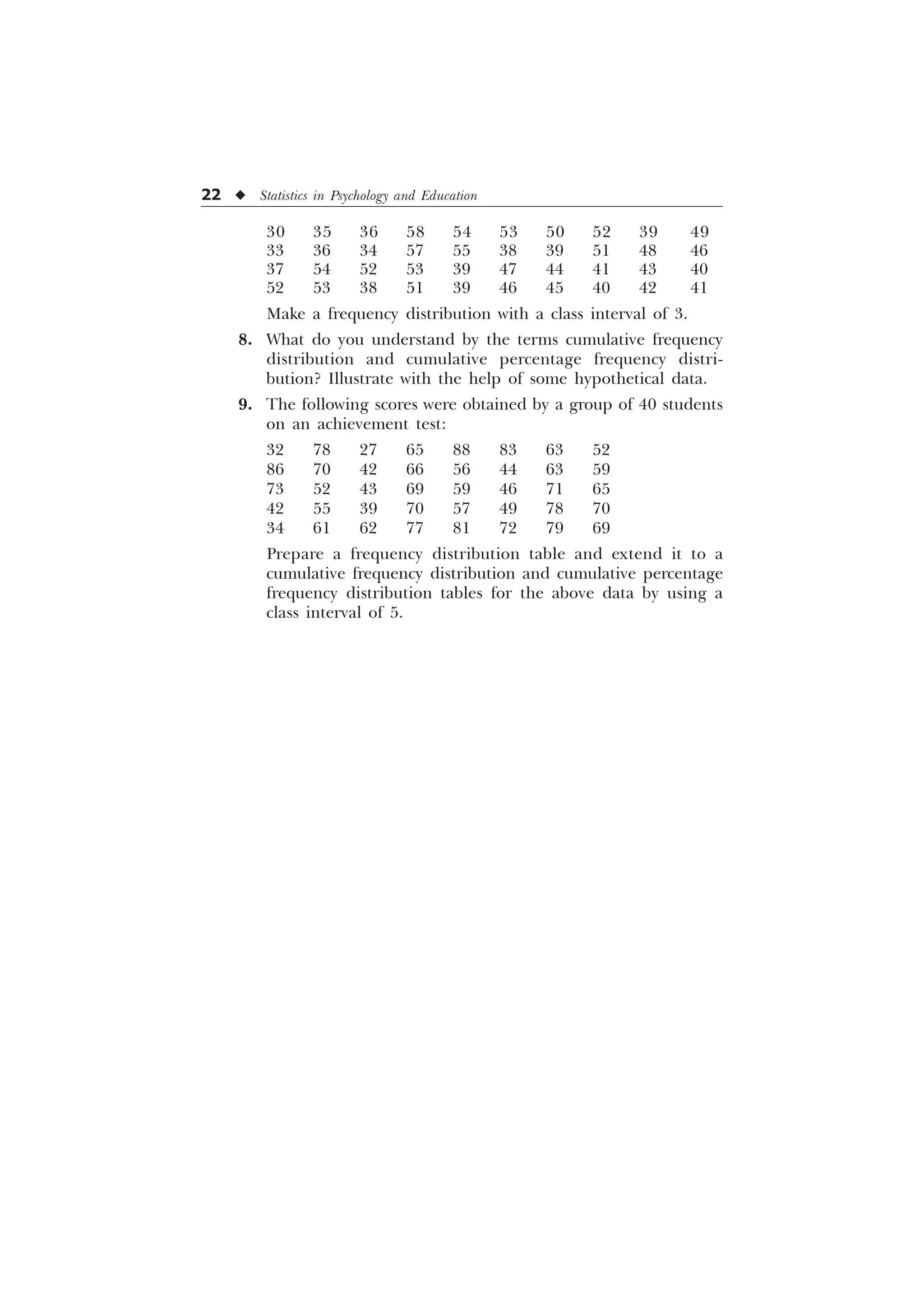
and guide for these four areas were four teachers of the
Education department. Their choices are shown as follows:
Area 1 Area 2 Area 3 Area 4
No. of students 0 3 8 9
Can you conclude by using the KS test, that the students,
choice of a particular area is not related to the teacher
incharge of that area?
17. Another research scholar tried to verify the results obtained by
his colleague in Problem 15 by taking some other samples.
The scores obtained on the physical fitness test for the rural
and urban children were listed as follows:
Scores obtained by : 57, 60, 62, 56, 58, 54, 56, 64
urban children 52, 54, 56, 57, 53, 55, 52, 51,
63, 64, 61, 60, 59 (N1 = 21)
Scores obtained by rural children : 68, 64, 65, 66, 62, 60, 58,
63, 63, 53 (N2 = 10)
Test the hypothesis of no difference between the groups by
using the Mann-Whitney U test.
18. A teacher Adjustment Inventory was administered to two
different samples of a secondary school—male and female
teachers, selected randomnly from the schools of a city. The
scores so obtained are shown now in the following table. Can
you conclude from this data by using the KS test that two
groups do not differ in terms of their adjustment?
Scores on Adjustment
60–64 55–59 50–54 45–49 40–44 35–39 30–34 25–29 20–24
Male 6 10 12 20 16 6 4 2 4
Teachers ( f)
Female 0 0 0 10 8 16 20 26 20
Teachers ( f)
19. A group of 30 teachers consisting of 21 male teachers and 9
female teachers were rated in terms of their teacher-
effectiveness. Their scores were then ranked up in the strength
of their effectiveness from least effective to most effective, as
shown now.
F MM FF MMMMMMMMMMMM F MMMMM FF MM FFF
318 u Statistics in Psychology and Education
Apply the Runs test to test the hypothesis that the male and
female teachers do not differ in teacher effectiveness.
20. Twelve adolescent girls and boys randomly selected from a
coeducational Senior Secondary School were tested through
a Personality Inventory. The scores so collected are given now.
Can you conclude, using the Runs test that boys and girls
differ significantly in terms of their personality make-up?
Scores on personality inventory
Girls 156, 139, 142, 135, 183, 135, 178, 115, 211, 174, 111, 120
Boys 125, 110, 92, 128, 86, 77, 79, 86, 96, 106, 90, 85
319
NEED FOR THE TECHNIQUE OF ANALYSIS OF VARIANCE
In Chapter 10, we discussed the use of z and t tests for testing the
significance of the difference between the means of two samples or
groups. In practice, however, we often come across situations where we
have several samples of the same general character drawn from a given
population and wish to know whether there are any significant
differences between the means of these samples. In such situations,
instead of determining a single difference between two means, several
differences between several means are determined. Let us illustrate
such a situation with an example.
In a research study, localities are divided into four classes ranging
from ‘best’ to ‘worst’, according to their social environment. A group
test of general mental ability is administered to four random samples
of 10 boys (studying in class VIII) each from four schools of the
locality. We thus have four means for these samples drawn from the
four localities. Now, if we wish to test the significance of the differences
between these four means (by formulating a null hypothesis that no
difference exists between the means) and apply the z or t test, it will
be difficult, cumbersome and unwise on the following grounds:
1. The z or t test can be used for testing the significance of the
difference between means by taking two means at a time.
Here we have to test the significance of the difference
between four means and so we have to take
( )


Q Q −
, i.e.
( )
  

−
= 6
pairs for comparison. The work will be done in six rounds and
thus may involve too much a labour and complication. The
degree of complication and the amount of labour will
gradually increase with an increase in the number of groups
or samples, e.g. for 8 samples we will have 28, for 10 samples
45, and for 15 samples 105 separate z or t tests.
17Analysis of Variance
320 u Statistics in Psychology and Education
2. However, after we decide to do so much labour, there is no
guarantee that we would get the desired results. There is a
possibility that none of the differences between pairs could
prove to be significant and in such a case, the cumbersome
exercise of computing a number of z or t values for testing the
significance between several pairs of means will be complete
waste.
3. In the above situation, while testing the significance of the
difference between 6 pairs of sample means we may find that
one of them is significant at the 0.01 level, the other at the
0.05 level, and the remaining four differences significant
neither at 0.05 level nor at the 0.01 level. Thus, we may
conclude that none of these six differences is significant. This
conclusion is erroneous. Unless we have a single composite
test for testing the differences within the given means at a
time, we cannot conclude that the whole distribution of
obtained sampling statistics has occurred by chance.
4. There could be a serious limitation in this case regarding the
omission of the element of interaction existing between the
different samples or groups included in the study. The various
differences between means are not independent of each other.
If we know the difference between sample means A and B, and
A and C, we can automatically tell the difference between B
and C because the difference between B and C is related to the
difference between A and B, and A and C. In other words, if
we have to test the difference between three sample means,
one difference is not independent of the other two
differences. Similarly, if we have to test the difference
between four sample means, at least two differences in the six
pairs are not independent of the other four differences. Thus,
there is a need to take into account the dependence of the
differences while deciding about their significance. However,
as know, both t and z tests are tied to a distribution of the
differences between pairs of means of independent random
samples. As a result, the use of z or t test cannot provide us
any satisfactory result.
Thus we may conclude that, the usual procedure of testing the
significance between two means by the t or z test definitely needs a
substitute in the form of a single composite test for simultaneously
testing the differences between the means of several samples of groups.
The solution to the problem lies in a statistical technique known by the
name analysis of variance in which all the data are treated together and
a general null hypothesis of no difference among the means of the
various samples or groups is tested.
Analysis of Variance u 321
MEANING OF THE TERM ‘ANALYSIS OF VARIANCE’
A composite procedure for testing simultaneously the difference
between several sample means is known as the analysis of variance. It
helps us to know whether any of the differences between the means of
the given samples are significant. If the answer is ‘yes’, we examine
pairs (with the help of the t test) to see just where the significant
differences lie. If the answer is ‘no’, we do not proceed further.
In such a test, as the name implies, we usually deal with the
analysis of the variances. Variance is simply the arithmetic average of
the squared deviation from their means. In other words, it is the
square of the standard deviation (variance = s2
). Variance has a quality
which makes it specially useful. It has an additive property, which the
standard deviation with its square root does not possess. Variance on
this account can be added up and broken down into components.
Hence, the term ‘analysis of variance’ deals with the task of analyzing
of breaking up the total variance of a large sample or a population
consisting of a number of equal groups or sub-samples into two
components (two kinds of variances), given as follows:
1. “Within-groups” variance. This is the average variance of the
members of each group around their respective group means,
i.e. the mean value of the scores in a sample (as members of
each group may vary among themselves).
2. “Between-groups” variance. This represents the variance of
group means around the total or grand mean of all groups,
i.e. the best estimate of the population mean (as the group
means may vary considerably from each other).
Let us make this clearer with the help of the example cited in the
beginning of this chapter.
In this study, there were 40 boys in all, belonging to four
different localities. If we add the IQ scores of these 40 boys and divide
the sum by 40, we get the value of the grand or general mean, i.e. the
best estimate of the population mean. There are 4 groups (samples) of
10 boys each. The mean of the IQ scores of 10 boys in each group is
called the group mean and in this way, there will be 4 group means,
which will vary considerably from each other.
Now the question arises, as to how far does an IQ score of a
particular boy belonging to a particular sample or group deviate from
the grand mean for 40 boys. We may observe that the deviation has
two parts, i.e. deviation of the score from the mean of that particular
group and the deviation of the mean of the group from the grand
mean.
322 u Statistics in Psychology and Education
For deriving more useful results, we can use variance as a measure
of dispersion (deviation from the mean) in place of some useful
measures like standard deviation. Consequently, the variance of an
individual’s score from the grand mean may be broken into two parts
(as pointed out earlier), viz. within-groups variance and between-
groups variance. Commenting on the above aspects regarding the
meaning and nature of analysis of variance and the subsequent
procedure adopted in the analysis of variance technique, Lindquist
(1970) writes:
The basic proposition is that from any set of r groups of n cases
each, we may, on the hypothesis that all groups are random
samples from the same population, derive two independent
estimates of the population variance, one of which is based on
the variance of group means, the other on the average variance
of within groups. The test of this hypothesis then consists of
determining whether or not the ratio (F) between these estimates
lies below the value in the table for F that corresponds to the
selected level of significance.
In this way, the technique of analysis of variance as a single
composite test of significance, for the difference between several group
means demands the derivation of two independent estimates of the
population variance, one based on variance of group means (between
groups variance) and the other on the average variance within the
groups (within groups variance.) Ultimately, the comparison of the size
of between groups variance and within-groups variance called F-ratio
denoted by
EHWZHHQJURXSVYDULDQFH
ZLWKLQJURXSVYDULDQFH
is used as a critical ratio for determining the significance of the
difference between group means at a given level of significance.
PROCEDURE FOR CALCULATING THE ANALYSIS OF
VARIANCE
As already pointed out, the deviation of an individual’s score belonging
to a sample or a group of population from the grand mean can be
divided into two parts: (i) deviation of the individual’s score from his
group mean; and (ii) deviation of the group mean from the grand
mean. Consequently, the total variance of the scores of all individuals
included in the study may be partitioned into within-group variance
and between-groups variance. The formula used for the computation
of variance (s2
) is S x2
/N, i.e. sum of the squared deviation from the
mean value divided by total frequencies. Hence, by taking N as the
Analysis of Variance u 323
common denominator, the total sum of the squared deviation of scores
around the grand or general mean for all groups combined can be
made equal to the sum of the two partitioned, between-groups and
within-groups sum of squares. Mathematically,
Total sum of squares (around the general mean)
= between-groups sum of squares
+ within-groups sum of squares
or
St
2
= Sb
2
+ Sw
2
Hence the procedure for the analysis of variance involves the following
main tasks:
(i) Computation of total sum of squares (St
2
)
(ii) Computation of between-groups sum of squares (Sb
2
)
(iii) Computation of within-groups sum of squares (Sw
2
)
(iv) Computation of F-ratio
(v) Use of t test (if the need for further testing arises).
All these tasks may be carried out in a series of systematic steps.
Let us try to understand these steps by adopting the following
terminology:
X = Raw score of any individual included in the study
(any score entry in the given table)
S X = Grand Sum
;
1
6
= Grand or general mean
X1, X2, ¼ denote scores within first group, second group, ¼
n1, n2, n3 = No. of individuals in first, second and third groups


;
;
1 1
6
6
¼ denote means of the first group, second group, ¼
N = total No. of scores or frequencies
= n1 + n2 + n3 + ¼
Let us now outline the steps.
Step 1. Arrangement of the given table and computation of some initial
values. In this step, the following values needed in computation are
calculated from the experimental data arranged in proper tabular
form:
324 u Statistics in Psychology and Education
(i) Sum of squares, S X1, S X2, ¼ and the grand sum, S X
(ii) Group means, 

 
;
;
1 1
6
6
¼, and the grand mean
;
1
6
(iii) Correction term C computed by the formula
C =

6TXDUHRIWKHJUDQGVXP
7RWDO1RRIFDVHV
;
1
6
Step 2. Arrangement of the given table into squared-form table and
calculation of some other values. The given table is transformed into a
squared-form table by squaring the values of each score given in the
original table and then the following values are computed:
(i) S X1
2
, S X2
2
, S X3
2
, ¼
(ii) S X2
Step 3. Calculation of total sum of squares. The total sum of squares
around the general mean is calculated with the help of the following
formula:
St
2
= S X2
– Correction value (C)
= S X2
–

;
1
6
Step 4. Calculation of between-group sum of squares. The value of the
between-groups sum of squares may be computed with the help of the
following formula:
Sb
2
=


Q
Q
;
; ; ;

Q Q Q Q
6
6 6 6
    

=

VXPRIVFRUHVLQJURXS,
1RRIVFRUHVLQJURXS,
+

VXPRIVFRUHVLQJURXS,,
1RRIVFRUHVLQJURXS,,
+  – C (correction value)
Step 5. Calculation of within-groups sum of squares. Between-groups and
within-groups sum of squares constitute the total sum of squares.
Therefore, after steps 3 and 4, the value of within-groups sum of
squares (sum of squares of deviation within each group about their
respective group means) may be calculated by subtracting the value of
between-groups sum of squares from the total sum of squares. Its
formula, therefore, goes thus:
Analysis of Variance u 325
Within-groups sum of squares,
Sw
2
= St
2
– Sb
2
Step 6. Calculation of the number of degrees of freedom. All these sums of
squares calculated in steps 3–5 possess different degrees of freedom
given by
Total sum of squares, (St
2
) = N – 1
Between-groups sum of squares, (Sb
2
) = K – 1
Within-groups sum of squares, (Sw
2
) = (N – 1) – (K – 1) = N – K
where N represents the total number of observations, scores or
frequencies and K, the number of groups in the research study.
Step 7. Calculation of F-ratio. The value of F-ratio furnishes a
comprehensive or overall test of significance of the difference between
means. For its computation, we have to arrange the data and
computation work in the following manner:
Source of variance Sum of squares df Mean square variance
Between-groups Sb
2
(computed in step 4) K – 1


E
6
. 
Within-groups Sw
2
(computed in step 5) N – K

Z
6
1 .

F =
0HDQVTXDUHYDULDQFHEHWZHHQJURXSV
0HDQVTXDUHYDULDQFHZLWKLQJURXSV
Step 8. Interpretation of F-ratio. F-ratios are interpreted by the use of
the critical value of F-ratios given in Table R of the Appendix. This
table has the number of degrees of freedom for the greater mean
square variance across the top and the number of degrees of freedom
in the smaller mean square variance on the left-hand side. If our
computed value of F is equal to or greater than the critical tabled
value of F at a given level of significance 0.05 or 0.01, it is assumed
to be significant and consequently, we reject the null hypothesis of no
difference among these means at that level of significance. However, a
significant F does not tell us which of the group means differ
significantly; it merely tells us that at least one mean is relatively
different from some other. Consequently, there arises a need for
further testing to determine which of the differences between means
are significant.
In case our computed value of F is less than the critical tabled
value of F at a given level of significance, it is taken as non-significant
326 u Statistics in Psychology and Education
and consequently, the null hypothesis cannot be rejected. Then there
is no reason for further testing (as none of the differences between
means will be significant). In a summarized form, the above analysis
may be represented as follows:-
F ® Significant ® Null hypothesis ® Need for further
rejected testing
F ® Non-significant ® Null hypothesis ® No need for further
not rejected testing
Generally, as and when we get the value of F as less than 1, we
straightaway interpret it as non-significant resulting in the non-
rejection of the null hypothesis.
Step 9. Testing differences between means with the t test. When F is found
significant, the need for further testing arises. We take pairs of the
group means one by one for testing the significance of differences.
The t test provides an adequate procedure for testing the significance
when we have means of only two samples or groups at a time for
consideration. Therefore, we make use of the t test to test the
differences between pairs of means.
As we have seen in Chapter 10, the usual formula for comp-
utation of t values is
t =
T
'LIIHUHQFHEHWZHHQWZRPHDQV
6WDQGDUGHUURURIWKHGLIIHUHQFHEHWZHHQWKHPHDQV
'
'
and sD is computed by the formula
sD =
 
 
Q Q
T
È Ø

É Ù
Ê Ú
where
s = Pooled SD of the samples drawn from the same
population
n1, n2 = Total No. of cases in samples I and II, respectively
In the analysis of variance technique, within-groups means square
variance provides us the value of s2
, the square root of which can give
us the required pooled SD of the samples or groups included in our
study.
The degrees of freedom for within-groups sum of squares are
given by the formula N – K. With these degrees of freedom we can
read the t values from Table C given in the Appendix, at the 0.05 and
0.01 levels of significance. If the computed value of t is found to be
equal to or greater than the critical tabled value of t at 0.05 or 0.01
levels, we can reject the null hypothesis at that level of significance.
Analysis of Variance u 327
Proceeding similarly, we take other pairs for testing the difference
between means and arrive at conclusions.
Let us illustrate now the whole process of using the analysis of
variance technique with the help of an example.
Example 17.1: The aim of an experimental study was to determine
the effect of three different techniques of training on the learning of
a particular skill. Three groups, each consisting of seven students of
class IX, assigned randomly, were given training through these
different techniques. The scores obtained on a performance test were
recorded as follows:
Group I Group II Group III
3 4 5
5 5 5
3 3 5
1 4 1
7 9 7
3 5 3
6 5 7
Test the difference between groups by adopting the analysis of
variance technique.
Solution.
Step 1. Original table computation
Table 17.1 Organization of Data Given in Example 17.1
Rating of the coaching experts
Group I (X1) Group II (X2) Group III (X3)
Total
3 4 5 12
5 5 5 15
3 3 5 11
1 4 1 6
7 9 7 23
3 5 3 11
6 5 7 18
S X1 = 28 S X2 = 35 S X3 = 33 S X = 96
Grand Total
328 u Statistics in Psychology and Education
Here,
n1 = n2 = n3 = 7, N = n1 + n2 + n3 = 21
Group means = 

;
Q
6
=


= 4


;
Q
6
=


= 5


;
Q
6
=


= 4.71
Correction term C =

;
1
6
=
  
 
–
= 438.85
Step 2. Squared-table computation
Table 17.2 Squared Values of the Original Data
X 1
2
X2
2
X3
2
Total
9 16 25 50
25 25 25 75
9 9 25 43
1 16 1 18
49 81 49 179
9 25 9 43
36 25 49 110
S X1
2
= 138 S X2
2
= 197 S X3
2
= 183 S X2
= 518
Step 3. Total sum of squares (St
2
):
St
2
=

 ;
;
1
6
6  = S X2
– C = 518 – 438.85 = 79.15
Step 4. Between-groups sum of squares (Sb
2
):
Sb
2
=


;
; ;

Q Q Q
6
6 6
  
=


– – –
  
=


= 442.57 – 438.85 = 3.72
Analysis of Variance u 329
Step 5. Within-groups sum of squares (Sw
2
). This is obtained as
Sw
2
= St
2
– Sb
2
= 79.15 – 3.72 = 75.43
Step 6. Number of degrees of freedom
For total sum of squares,
(St
2
) = N – 1 = 21 – 1 = 20
For between-groups sum of squares,
(Sb
2
) = K – 1 = 3 – 1 = 2
For within-groups sum of squares,
(Sw
2
) = N – K = 21 – 3 = 18
Step 7. Calculation of F-ratio
Table 17.3 Computation of Values of Mean Square Variance
Source of variation Sum of squares df Mean square variance
Between-groups Sb
2
= 3.72 2 3.72/2 = 1.86
Within-groups Sw
2
= 75.43 18 75.43/18 = 4.19
F =
0HDQVTXDUHYDULDQFHEHWZHHQJURXSV 

0HDQVTXDUHYDULDQFHZLWKLQJURXSV 
Step 8. Interpretation of F-ratio. The F-ratio table (Table R given in the
Appendix) is referred to for 2 degrees of freedom for smaller mean
square variance on the left-hand side, and for 18 degrees of freedom
for greater mean square variance across the top. The critical values of
F obtained by interpolation are as follows:
Critical value of F = 19.43 at 0.05 level of significance
Critical value of F = 99.44 at 0.01 level of significance
Our computed value of F (.444) is not significant at both the
levels of significance and hence, the null hypothesis cannot be rejected
and we may confidently say that the differences between means are not
significant and therefore, there is no need for further testing with the
help of t test.
Example 17.2: In a study, the effectiveness of the methods of
memorization was to be determined. For this purpose, three groups of
10 students, each randomly selected from class VII of a school were
taken and each group was made to adopt a particular method of
memorization. In the end, the performance was tested. The number of
330 u Statistics in Psychology and Education
nonsense syllables correctly recalled by the students of these groups is
presented below:
Group I : 12, 10, 11, 11, 8, 10, 7, 9, 10, 6
Group II : 14, 8, 19, 15, 10, 11, 13, 12, 9, 12
Group III : 8, 11, 13, 9, 7, 5, 6, 8, 7, 10
Apply the analysis of variance technique for testing the
significance of the difference between group means.
Solution.
Step 1. Arrangement of the data into a proper table and initial computation
(Table 17.4).
Table 17.4 Organization of Data Given in Example 17.2
Group I Group II Group III
Total
(X1) (X2) (X3)
12 14 8 34
10 8 11 29
11 19 13 43
11 15 9 35
8 10 7 25
10 11 5 26
7 13 6 26
9 12 8 29
10 9 7 26
6 12 10 28
S X1 = 94 S X2 = 123 S X3 = 84 S X = 301
Here,
n1 = n2 = n3 = 10
N = n1 + n2 + n3 = 30
Group means = 


;
Q
6 


;
Q
6 


;
Q
6
Correction term C =


;
1
6 –
Step 2. Squared table computation. This can be obtained as in
Table 17.5.
Analysis of Variance u 331
Table 17.5 Squared Values of the Original Data
X1
2
X2
2
X3
2
Total
144 196 64 404
100 64 121 285
121 361 169 651
121 225 81 427
64 100 49 213
100 121 25 246
49 169 36 254
81 144 64 289
100 81 49 230
36 144 100 280
S X1
2
= 916 S X2
2
= 1605 S X3
2
= 758 S X2
= 3279
Step 3. Total sum of squares (St
2
). This is given by
St
2
=

 ;
;
1
6
6  = X2
– C
= 3279 – 3020 = 259
Step 4. Between-groups sum of squares (Sb
2
). This is obtained as
Sb
2
=


;
; ;

Q Q Q
6
6 6
  
=      

  
– – –
  
= 883.6 + 1512.9 + 705.6 – 3020
= 3102.1 – 3020 = 82.1
Step 5. Within-groups sum of squares (Sw
2
). This is given by
Sw
2
= St
2
– Sb
2
= 259 – 82.1 = 176.9
Step 6. Number of degrees of freedom
df for St
2
= N – 1 = 30 – 1 = 29
df for S2
b = K – 1 = 3 – 1 = 2
df for Sw
2
= N – K = 30 – 3 = 27
332 u Statistics in Psychology and Education
Step 7. Calculation of F-ratio
Table 17.6 Computation of the Values of Mean Square Variance
Source of variance Sum of squares df Mean square variance
Between-groups Sb
2
= 82.1 2


= 41.05
Within-groups Sw
2
= 176.9 27


= 6.55
F =
0HDQVTXDUHYDULDQFHEHWZHHQJURXSV 

0HDQVTXDUHYDULDQFHZLWKLQJURXSV 
Step 8. Interpretation of F-ratio. The F-ratio table (Table R in the
Appendix) is now referred for 2 degrees of freedom for greater mean
square variance and 27 degrees of freedom for smaller mean square
variance.
Critical values of F = 3.35 at 0.05 level of significance
Critical values of F = 5.49 at 0.01 level of significance
The computed value of F, i.e. 6.27, is much higher than both the
critical values of F at 0.05 and 0.01 levels of significance. Hence, it
should be taken as quite significant. Consequently, we have to reject
the null hypothesis. Thus, a significant difference definitely exists
between the group means. Let us further test to find out where these
differences exist.
Step 9. Application of t test. The group means in our study are as
follows:
M1 = 9.4, M2 = 12.3, M3 = 8.4
Let us first test the difference between M1 and M2, i.e.
12.3 – 9.4 = 2.9
t =

' '
'
T T
sD =
 
 
Q Q
T
È Ø

É Ù
Ê Ú
where s, the square root of the value of within-groups mean square
variance, is
 = 2.559
and n1 = n2 = 10
Analysis of Variance u 333
Hence,
sD = 2.559
 
 
È Ø

É Ù
Ê Ú
= 2.559 ´ .2 = 0.5118
= 0.52 (approx.)
Therefore,
t =


= 5.57
and df for within-groups sum of squares is
N – K = 27
From the t-distribution table (Table C of the Appendix):
Critical values of t = 2.05 at 0.05 level of significance
Critical values of t = 2.77 at 0.01 level of significance
The computed value of t, i.e. 5.57, is much higher than the
critical values of t at both these levels. Hence it is to be regarded as
quite significant and thereby null hypothesis stands rejected, the result
being that the difference between M1 and M2 is quite significant and
real.
Now, take M2 and M3. Here,
D = M2 – M3 = 12.3 – 8.4 = 3.9
t =
T


'
'
This computed t value is quite significant at both levels of
significance, the result being given by that the difference between M2
and M3 is also quite significant and real.
Finally, we take M1 and M3
D = M1 – M3 = 9.4 – 8.4 = 1
t =


'
'
T
It can be seen that the computed value of t, i.e. 1.92, is much
lesser than the critical values 2.05 and 2.77 at 0.05 and 0.01 levels of
significance. Hence it is not significant and, consequently, the null
hypothesis cannot be rejected. Thus, it can be said that the difference
between M1 and M3 is not significant and real. It may occur by chance
or due to sampling fluctuation.
334 u Statistics in Psychology and Education
In conclusion, it can be said that of the total three, only two of
the difference, M1 – M2 and M2 – M3 are significant and trustworthy.
TWO-WAY ANALYSIS OF VARIANCE
So far, we have dealt with one-way analysis of variance involving one
experimental variable. However, experiments may be conducted in the
fields of education and psychology for the simultaneous study of two
experimental variables. Such experiments involve two-way classification
based on two experimental variables. Let us make some distinction
between the need for carrying out one-way and two-way analyses of
variance through some illustrations.
Suppose that we want to study the effect of four different
methods of teaching. Here, the method of teaching is the exper-
imental variable (independent variable which is to be applied
at four levels). We take four groups of students randomly selected
from a class. These four groups are taught by the same teacher in
the same school but by different methods. At the end of the session,
all the groups are tested through an achievement test by the teacher.
The mean scores of these four groups are computed. If we
are interested in knowing the significance of the differences between
the means of these groups, the best technique is the analysis of
variance. Since only one experimental variable (effect of the method
of teaching) is to be studied, we have to carry out one-way analysis of
variance.
Let us assume, that there is one more experimental or indepen-
dent variable in the study, in addition to the method of teaching. Let
it be the school system at three levels which means that three school
systems are chosen for the experiment. These systems can be:
government school, government-aided school and public school. Now
the experiment will involve the study of 4 ´ 3 groups. We have 4
groups each in the three types of schools (all randomly selected). The
achievement scores of these groups can then be compared by the
method of analysis of variance by establishing a null hypothesis that
neither the school system nor the methods have anything to do with
the achievement of pupils. In this way, we have to simultaneously study
the impact of two experimental variables, each having two or more
levels, characteristics or classifications and hence we have to carry out
the two-way analysis of variance.
In the two-way classification situation, an estimate of population
variance, i.e. total variance is supposed to be broken into: (i) variance
due to methods alone, (ii) variance due to school alone, and (iii) the
residual variance in the groups called interaction variance (M ´ S;
Analysis of Variance u 335
M = methods, S = schools) which may exist on account of the follow-
ing factors:
1. Chance
2. Uncontrolled variables like lack of uniformity in teachers
3. Relative merits of the methods (which may differ from one
school to another).
In other words, there may be interaction between methods and schools
which means that although no method may be regarded as good or
bad in general, yet it may be more suitable (or unsuitable) for a
particular school system. Hence, the presence of interaction variance is
a unique feature with all the experimental studies involving two or
more experimental variables. In such problems, requiring two or more
ways of analysis of variance, we will have to take care of the residual
or interaction variance in estimating their population variance. If the
null hypothesis is true, variance in terms of the method should not be
significantly different from the interaction variance. Similarly, the
variance due to schools may also be compared with the interaction
variance. For all such purposes of comparison, the F-ratio test is used,
as explained later in this chapter.
The design of the above two-way classification experiment can
be further elaborated by having more experimental or independent
variables, each considered at several levels. As the number of variables
increases, the order of interaction also increases. For example, if
school (S), teacher (T), and methods (M) are taken as three indep-
endent variables, there will be 3 first-order interactions: S ´ T,
T ´ M, and S ´ M, and the second-order interaction S ´ T ´ M. We
will have 4 ´ 3 ´ 4 (if there are 4 levels of teacher variable), i.e. 48
randomized groups in this study and the problem of testing the
difference between means will require three-way analysis of variance
technique.
According to the needs and requirements of the experiment,
a research worker has to select a particular experimental design
involving two or more independent or experimental variables.
A discussion of these designs in terms of their construction, adminis-
tration and analysis is beyond the scope of the book. Hence,
the readers are advised to consult some of the books given in the
reference section like Edwards (1961), Hicks (1964), Lindquist (1968)
and Guilford (1973). However, let us briefly study the method of
carrying out two-way analysis of variance for testing the difference
between group means. As an illustration, let us take the case of an
experimental design where a single group is being assessed more than
once.
336 u Statistics in Psychology and Education
Example 17.3: In a research study, there were two experimental or
independent variables: a seven-member group of player and three
coaches who were asked to rate the players in terms of a particular trait
on a ten-point scale. The data were recorded as under:
Rating by three coaches
Players
1 2 3 4 5 6 7
A 3 5 3 1 7 3 6
B 4 5 3 4 9 5 5
C 5 5 5 1 7 3 7
Apply the technique of analysis of variance for analyzing these
data.
Step 1. Arrangement of the data in a proper table and computation of
essential initial values (Table 17.7).
Table 17.7 Organization of Data Given in Example 17.3
Rating of coaches
Total of Square of
Players By A By B By C rows the total
(X1) (X2) (X3) of rows
1 3 4 5 12 144
2 5 5 5 15 225
3 3 3 5 11 121
4 1 4 1 6 36
5 7 9 7 23 529
6 3 5 3 11 121
7 6 5 7 18 324
Total of
columns S X1 = 28 S X2 = 35 S X3 = 33 S X = 96(Grand total)
Square of
the totals
of the
column (S X1)2
= 784, (S X2)2
= 1225, (S X3)2
= 1089, (S X)2
= 9216
Here,
N = n1 + n2 + n3 = 7 + 7 + 7 = 21
C =


;
1
6
= 438.85
Analysis of Variance u 337
Step 2. Arrangement of the table in square form and computation of some
essential values (Table 17.8).
Table 17.8 Squared Values of Original Data
X1
2
X2
2
X3
2
Total
9 16 25 50
25 25 25 75
9 9 25 43
1 16 1 18
49 81 49 179
9 25 9 43
36 25 49 110
Total S X1
2
= 138 S X2
2
= 197 S X3
2
= 183 S X2
= 518
Step 3. Calculation of the total sum of squares (St
2
) (around grand mean).
St
2
=

 ;
;
1
6
6  = S X2
– C
= 518 – 438.85 = 79.15
Step 4. Calculation of the sum of squares for rows (Sr
2
) (between the means
of players to be rated by three coaches).
Sr
2
=       


=


– 438.85 = 61.15
Step 5. Calculation of the sum of squares for columns (Sc
2
) between the means
of coaches rating 7 players).
Sc
2
=


– –

= 442.57 – 438 × 85 = 3.72
Step 6. Calculation of the interaction or residual sum of squares (St
2
). The
interaction sum of squares is given by
(St
2
) = St
2
– (Sr
2
+ Sc
2
)
= 79.15 – (61.15 + 3.72) = 14.28
Step 7. Computation of F-ratios. Table 17.9 illustrates the computation
of mean square variance value.
338 u Statistics in Psychology and Education
Table 17.9 Computation of the Values of Mean Square Variance
Source of Sum of Mean square
variation
df
squares variance
Rows (players) (r – 1) = 6 61.15


= 10.19
Columns (coaches) (c – 1) = 2 3.72


= 1.86
Interaction or (r – 1) (c – 1)
residual = 12 14.28


= 1.19
F (for rows) =
0HDQVTXDUHYDULDQFHEHWZHHQURZV SODHUV
0HDQVTXDUHYDULDQFHLQWHUPVRILQWHUDFWLRQ
=


= 8.56
F (for columns) =
0HDQVTXDUHYDULDQFHEHWZHHQFROXPQV FRDFKHV
0HDQVTXDUHYDULDQFHLQWHUPVRILQWHUDFWLRQ
=


= 1.56
Step 8. Interpretation of F-ratios. Table 17.10 gives the critical values
of F.
Table 17.10 Critical Values of F and Significance of Computed F
df for greater df for Critical values of F Judgement
mean square smaller at 0.05 at 0.01 about the
Kind of F
variance mean square level level significance of
Conclusion
variance computed F
F (for rows) 2 12 3.88 6.93 Significant Null hypothesis
at both rejected
levels
F (for 6 12 3.00 4.82 Not signi- Null hy-
columns) ficant at pothesis
both levels not rejected
Here, F (for rows) is highly significant and hence null hypothesis
is rejected. It indicates that the coaches did discriminate among the
players. The second F (for columns) is insignificant and hence, the null
hypothesis cannot be rejected. It indicates that the coaches did not
differ significantly among themselves in their ratings of the players. In
other words, their ratings may be taken as trustworthy and reliable.
Analysis of Variance u 339
UNDERLYING ASSUMPTIONS IN ANALYSIS OF VARIANCE
The following are the fundamental assumptions for the use of analysis
of variance technique:
1. The dependent variable which is measured should be normally
distributed in the population.
2. The individuals being observed should be distributed
randomly in the groups.
3. Within-groups variances must be approximately equal.
4. The contributions to variance in the total sample must be
additive.
SUMMARY
In performing experiments and carrying out studies in the fields of
education and psychology, we often come across situations where we
are required to test the significance of the differences among the
means of several samples instead of only two sample means, capable
of testing with the help of z or t tests. In such situations, a technique
known as analysis of variance proves quite useful. It provides a
composite test to find out, simultaneously, the difference between
several sample means and thus helps us tell, whether any of the
differences between means of the given samples are significant. If the
answer is ‘yes’ we examine pairs of sample means (with the help of the
usual t test) to see just where the significant differences lie. If the
answer is ‘no’, we do not require further testing.
The technique of analysis of variance demands the analysis or
breaking apart of the total squared deviation scores or variance of the
scores of all individuals (s2
) included in the study around the grand
mean (mean of the total scores) into two parts—(i) within-groups
variance, i.e. the squared deviation scores of the individuals from their
group means and, (ii) between-groups variance, i.e. the squared
deviation scores of the group mean from the grand mean. In actual
computation work:
1. The total variance St
2
is first calculated and then the Sb
2
, the
difference between the two automatically gives Sw
2
. The
formulae run as follows:
St
2
=


;
;
1
6
6 
Sb
2
=


Q
Q
;
; ; ;

Q Q Q Q
6
6 6 6
    

Sw
2
= St
2
– Sb
2
340 u Statistics in Psychology and Education
2. The degrees of freedom for Sb
2
and Sw
2
are K – 1 and
N – K, where K represents the number of groups and N, total
observations.
3. Then, the F-ratios desired for testing the significance is
calculated by the formula
F =


0HDQVTXDUHYDULDQFHEHWZHHQJURXSV  
0HDQVTXDUHYDULDQFHZLWKLQJURXSV 
E
Z
6 .
6 1 .


4. The computed F-ratios are then interpreted by the use of
critical F values read from the table with the degrees of
freedom at the given level of significance. In case our
computed F is found non-significant, then there is no need for
further testing but if it is found significant then the use of t
test is made for testing further the difference between sample
means taken two at a time.
In the experiments involving two experimental or independent
variables instead of one, the significance of the difference between
several means is tested with the help of two-way analysis of variance
instead of one-way analysis of variance. In the two-way analysis total
variance is supposed to be broken into three parts instead of two as
done in the one-way analysis. These are: (i) variance due to one
variable, (ii) variance due to other variable, and (iii) interaction or
residual variance on account of the supposed interaction between
variables. Here, instead of one, two F-ratios are computed with the
help of the formulae:
F (for one variable) =
0HDQVTXDUHYDULDQFHEHWZHHQRQHYDULDEOH
0HDQVTXDUHYDULDQFHLQWHUPVRILQWHUDFWLRQ
F (for the other variable) =
0HDQVTXDUHYDULDQFHEHWZHHQRWKHUYDULDEOH
0HDQVTXDUHYDULDQFHLQWHUPVRILQWHUDFWLRQ
and then the interpretation is made by comparing these F-ratios with
the critical F values read from the table for computed degrees of
freedom at a given level of significance.
For its successful application, the analysis of variance needs the
fulfilment of assumptions like the normal distribution of the dependent
variable, random distribution in the groups of individuals under study,
homogeneity of the within-groups variances and the analysis of total
variances into component variances.
Analysis of Variance u 341
EXERCISES
1. What do you understand by the technique, analysis of variance,
used for the analysis of statistical data?
2. In which circumstances is the technique of analysis of variance
preferred to the usual z or t tests for testing the significance
of the difference between means? Discuss with the help of
examples.
3. Discuss the various steps involved in the application of
analysis of variance for testing the difference between groups.
Illustrate with the help of a hypothetical example.
4. What is analysis of variance? Point out the underlying assump-
tions in its application.
5. The following are error scores on a psychomotor test for four
groups of equal subjects tested under four experimental
conditions:
Group I Group II Group III Group IV
4 9 2 7
5 10 2 7
1 9 6 4
0 6 5 2
2 6 2 7
Apply the analysis of variance to test the null hypothesis.
6. The following data represent the scores of six students
(selected randomly) in each of the five sections of class VIII of
a school on a vocabulary test:
Section A Section B Section C Section D Section E
32 19 17 12 12
17 26 26 15 15
28 30 30 10 36
24 17 35 20 17
21 34 20 18 20
38 15 15 30 25
Test the null hypothesis for vocabulary ability of the different
sections of class VIII.
342 u Statistics in Psychology and Education
7. In a research study, a Marital Adjustment Inventory was
administered on four random samples of the individual. Test
the hypothesis that they are from the same population.
Sample I Sample II Sample III Sample IV
16 24 16 25
7 6 15 19
19 15 18 16
24 25 19 17
31 32 6 42
24 13 45
29 18
8. The following data were collected from the students of three
groups in terms of correctly recalled nonsense syllables under
three methods of memorization:
Method I Method II Method III
18 20 7
29 17 15
28 21 9
26 19 13
24 29 5
31 26 11
30 25
27
Compute the means for separate groups and apply the
analysis of variance technique to test the significance of the
difference between groups.
9. In a learning experiment, three subjects made the following
number of correct responses in a series of 7 trials.
Trials
Subjects
1 2 3 4 5 6 7
A 5 9 3 7 9 3 7
B 6 8 4 5 2 4 3
C 5 7 3 5 9 3 7
Apply the technique of two-way analysis to test the difference
between means.
Analysis of Variance u 343
10. The following data represent the marks of eight students by
three teachers in terms of their performances on a particular
skill:
Marks given by the teachers
Students
A B C
1 8 4 2
2 6 3 6
3 8 4 8
4 10 8 8
5 12 6 8
6 14 10 9
7 16 8 10
8 20 11 8
Apply the technique of analysis of variance to answer the
following questions:
(a) Did the teachers discriminate among the students in their
markings?
(b) Did the teachers differ among themselves in their
markings?
344
MEANING AND PURPOSE
Analysis of covariance may be looked upon as a special provision or
procedure for exercising necessary statistical control over the variable
or variables that have been left uncontrolled at the start of the
experiment or study on account of the practical limitations and
difficulties associated with the conducting such experiments or studies.
In one sense, it may be regarded as a remedy or a solution for what
has been left undone or what was quite impossible or difficult in doing
experimentally at the start of the study.
In its procedure or methodology, the work of analysis of
covariance may be equated with that of partial correlation, where we
seek a measure of correlation between two sets of variables—
independent and dependent—by partialling out the effects of the
intervening variables. Here, we try to exercise statistical control
instead of experimental control, over the intervening variables, after
having conducted the actual study or experiment. Similar is the case
with the analysis of covariance. By using this technique, we try to
partial out the side effects if any, on our study, due to lack of
exercising proper experimental control over the intervening variables
or covariates (covariables). Let us make the idea clearer with the help
of some concrete examples.
1. A researcher wants to study the effectiveness of praise
or blame as a technique for behaviour modification. As a
part of the experimental study, he should try to have three
equivalent groups: one controlled, and two experimental.
The equivalence of these groups may either be achieved
through randomness or matched pairs or groups techniques.
If a researcher does not try to equate these groups or
is unable to do so on account of serious limitations
or difficulties faced by him, he can take them for his study
as natural groups or sections or classes, existing in the
school environment or social set-up. Even if he divides them
18Analysis of Covariance
Analysis of Covariance u 345
into three groups by selecting them randomly from a single
population, it does not guarantee their equivalence in terms
of so many other variates or variables. In this way, the basic
differences among these three groups are bound to remain
there from the very start of the experiment. Now, if the
experimentor selects the first group as control group (neither
praises nor blames), the second group as experimental
group 1 (praises), and the third group as experimental
group 2 (blames), then the differences measured at the end of
the experiment cannot be treated as valid for drawing
inferences regarding the comparative role of praise or blame
on behaviour modification. It may be possible that these
differences have been generated due to the initial differences
in their behaviour. The experimentor must have ensured the
equivalence of these three groups before starting the
experiment, i.e. providing treatments. The solution lies now
in exercising some genuine statistical control over the
uncontrolled variates through the technique of analysis of
covariance. This technique helps in the task of making
necessary adjustments or corrections in the final measures or
scores of behaviour for eliminating the uncontrolled
differences existing in the initial behaviour scores. As a result,
we can now partial out or root out the effect of initial
differences that exist in the behaviour of these three groups,
and thus we will be able to draw valid inferences regarding the
comparison of two entirely different treatments—praise or
blame—in behaviour modification.
2. In another study, a research worker wanted to compare
the relative effectiveness of three different methods, say
lecture, leture-cum-demonstration, and laboratory experi-
ments, for teaching science. He took three sections of Class IX
of a school for this purpose. These classes were used to be
taught by a single science teacher. At the start of the
experiment, he conducted an achievement test and recorded
the initial scores. There were significant differences in terms
of mean and SD. He might have tried to equate these three
groups in terms of mean and SD by including or excluding
some students in one group or the other. But it would have
been a difficult task and practically quite impossible to do so.
Hence, he accepted those initial differences with regard to
academic potential in science. In addition to such academic
potential differences, these students might have differed in
intelligence, a powerful covariate of academic potential. For
346 u Statistics in Psychology and Education
exercising proper control, these three groups might have
been equated also in terms of this powerful covariate. Since
such equivalence was neither feasible nor practicable, the
sections A, B and C of the school were taken as three different
groups, and each taught by a different method. At the end of
one month, they were again tested in terms of their
achievement, and their final scores were recorded. The means
of these scores were then computed and analysed by the
technique of analysis of variance for testing the significant
differences existing among them. The differences were quite
significant. However, the researcher was in a fix whether or
not to draw valid inferences on the comparative effectiveness
of the three methods. He was not certain whether these
differences exist due to the comparative effectiveness of
teaching methods or due to the initial differences existing
among these groups for one or the other reasons (differences
in initial achievement potential or intelligence, and so on.
There was a need to have necessary correction or adjustment
in the final scores for eliminating the differences in initial
scores, and the researcher, for this purpose, used the
technique of analysis of covariance. He then became successful
in finding out the significant differences existing among the
three means of final scores, by partialling out or rooting out
the effect of the initial differences that existed on account of
some intervening or uncontrolled covariates or covariables.
Thus, the role of analysis of covariance as a statistical technique
or procedure, adopted in a particular research study, may be summed
up as follows:
1. Analysis of covariance represents an extension of the method
of analysis of variance, to allow a correlation between initial
and final scores.
2. After the study or experiment has been performed, it helps
the researcher in exercising proper statistical control over the
uncontrolled covariates or covarying variables that have been
left uncontrolled at the start of the experiment or study.
3. It enables the researcher to get rid of the difficulties and
limitations he may face in adopting randomization or
matching of groups techniques for studying the relative
effectiveness of one or the other treatments and secure the
same increase in precise evaluation.
4. It may serve other purposes like testing the homogeneity of a
set of regression coefficients and related hypotheses.
Analysis of Covariance u 347
How to Make Use of the Analysis of Covariance
Let us illustrate the use of the technique of Analysis of covariance with
the help of some hypothetical data given in the following example.
Example 18.1: Three groups of five students each (randomly selected
from a Class VIII of a school) were initially rated for their leadership
qualities, and their scorse were recorded. Then they were subjected to
different treatments (three different approaches or training techniques
for leadership), and after 15 days of such training, they were again
evaluated for their leadership qualities, and these final scores were also
recorded. The data so collected are given in the following table.
Group A Group B Group C
Initial Final Initial Final Initial Final
scores scores scores scores scores scores
X1 Y1 X2 Y2 X3 Y3
4 6 8 8 7 9
3 5 6 5 9 8
5 6 7 9 10 11
2 4 4 7 12 12
1 4 5 6 12 15
Use this data to compare the relative effectiveness of the
treatments given to the groups.
Solution. There were many observable differences among the
initial scores of the three groups, but no attempt was made to make
these groups as equivalent groups at the start of the study, i.e. before
subjecting these to different treatments. In the absence of such an
experimental control, the researcher was forced to exercise statistical
control by applying the technique of analysis of covariance. The
procedure may be understood through computation. Let us begin with
arranging the given data as in Table 18.1.
Table 18.1 Computational Work for Covariance Analysis
Group A Group B Group C
X1 Y1 X1Y1 X1
2
Y1
2
X2 Y2 X2Y2 X2
2 Y2
2 X3 Y3 X3Y3 X3
2
Y3
2
4 6 24 16 36 8 8 64 64 64 7 9 63 49 81
3 5 15 9 25 6 5 30 36 25 9 8 72 81 64
5 6 30 25 36 7 9 63 49 81 10 11 110 100 121
2 4 8 4 16 4 7 28 16 49 12 12 144 144 144
1 4 4 1 16 5 6 30 25 36 12 15 180 144 225
Sums 15 25 81 55 129 30 35 215 190 255 50 55 569 518 635
M’s 3 5 6 7 10 11
348 u Statistics in Psychology and Education
For all the three groups,
S X = S X1 + S X2 + S X3 = 15 + 30 + 50 = 95
S Y = S Y1 + S Y2 + S Y3 = 25 + 35 + 55 = 115
S X2
= S X1
2
+ S X2
2
+ SX3
2
= 55 + 190 + 518 = 763
S Y2
= S Y1
2
+ S Y2
2
+ S Y3
2
= 129 + 255 + 635 = 1019
S XY = S X1Y1 + S X2Y2 + S X3Y3 = 81 + 215 + 569 = 865
After computing various sums and means thus, the following steps
can be adopted:
Step 1. Computation of correction terms (C’s). Different corrections are
applied to different sums of squares as in the case of analysis of vari-
ance. These can be computed by using the following formulae:
(i) CX =


;
1
6 –
(ii) CY =


1
6 –
(iii) CXY =


; 
1
6 6 –
Step 2. Computation of total sum of squares (total SS).
(i) SSX = S X2
– CX = 763 – 601.67 = 161.33
(ii) SSY = S Y2
– CY = 1019 – 881.67 = 137.33
(iii) SSXY = S XY – CXY = 865 – 728.33 = 136.67
Step 3. Computation of sum of squares (SS) among the means of the groups.
(i) SS among-means for X =


  ;
;
; ;

1 1 1
6
6 6

=


= 123.33
(ii) SS among-means for Y =


1 1 1
6
6 6
Analysis of Covariance u 349
=


= 93.33
(iii) SS among-means for
XY =  
   
  
;
; 
;  ; 

1 1 1
6
6 6
  
=
– – –


= 106.67
Step 4. Computation of sum of squares (SS) within-group
(i) Within-groups SS for X = SSX – SS among-means for X
= 161.33 – 123.33 = 38
(ii) Within-groups SS for Y = SSY – SS among-means for Y
= 137.33 – 93.33 = 44
(iii) Within-groups SS for XY = SSXY – SS among-means for XY
= 136.67 – 106.67 = 30
Step 5. Calculation of the number of degrees of freedom.
(i) Among-means (df ) = K – 1 = No. of groups = 3 – 1 = 2
(ii) Within-groups (df ) = N – K = 15 – 3 = 12
Step 6. Analysis of variance of X and Y scores taken separately
(Table 18.2).
Table 18.2 Worksheet for Analysis of Variance (ANOVA)
Source of SSX SSY MSX MSY
variation df (Sum of (Sum of (Mean square (Mean square
squares squares variance for variance for
for X) for Y) X or ÖX Y or ÖY
Among-means 2 123.33 93.33


= 61.66


= 46.66
Within-groups 12 38 44


= 3.17


= 3.67
Total 14 161.33 137.33
FX =
0HDQVTXDUHYDULDQFHRIDPRQJJURXSV IRU
0HDQVTXDUHYDULDQFHRIZLWKLQJURXSV
;
350 u Statistics in Psychology and Education
=


FY =
0HDQVTXDUHYDULDQFHRIDPRQJJURXSV IRU
0HDQVTXDUHVYDULDQFHRIZLWKLQJURXSV

=


where
FX = F ratio for X scores
FY = F ratio for Y scores
From Table R of the Appendix for df (2, 12), we can have the
critical value of F at 0.05 level = 3.88 and at 0.01 level = 6.93
Rule: If FX is significant the H0 is to be rejected showing that initially
groups were different. Hence covariance is needed. If not significant,
we can have only analysis of variance.
The computed value of F for X scores is significant at both levels,
and similar is the case with the computed F for Y scores. Hence H0 for
X scores as well as Y scores are rejected, leading to the conclusion that
(i) there are significant differences in initial (X) scores, and (ii) there
are significant differences in final (Y) scores.
Step 7. Computation of adjusted sum of squares (SS for Y, i.e. SSYX). The
initial differences in the groups X scores may cause variability in their
final scores measured after giving treatment. It needs to be checked
and controlled. For this purpose, necessary adjustments are made in
various Sum of Squares (SS) for Y by using the following general
formula:

66
66  66  
66
;
; 
;

(Here, SSYX stands for the sum of squares of Y adjusted for X
differences). The specific adjusted SS for Y may be computed as
follows:
(a) Adjusted sum of squares for total, i.e.,
SSYX (total) = Total SSY –

7RWDO 66
7RWDO66
;
;
= 137.33 –


= 137.33 – 115.77 = 21.56
Analysis of Covariance u 351
(b) Adjusted sum of squares for within-groups means, i.e.
SSYX (within-mean) = within SSY –

ZLWKLQ 66
ZLWKLQ66
;
;
= 44 –


= 44 – 23.68 = 20.32
(c) Adjusted sum of squares for among-group means, i.e.
SSYX (among-mean) = SSYX (Total) – SSYX (within)
= 21.56 – 20.32 = 1.24
Step 8. Computation of Analysis of Covariance: It is carried out as shown
in Table 18.3
Table 18.3 Worksheet for the Computation of Analysis of Covariance
(ANCOVA)
Source of df SSX SSY SXY SSYX MSYX or SDYX
variation VYX
Among- 2 123.33 93.33 106.67 0.44 0.22
groups means
Within- 11* 38 44 30 20.32 1.76  = 1.32
groups means
Total 13 161.33 137.33 136.67 20.76
(*
1 df is lost because of regression of Y on X)
DPRQJ 
     
ZLWKLQ 
;
;
;
9
)
9
From Table R of the Appendix for df (2, 11).
Critical F at 0.05 level = 3.98
and
Critical F at 0.01 level = 7.20
The computed value of F (FYX) is not significant at both the levels.
Hence, H0 is to be accepted with the conclusion that groups do not
differ significantly after giving treatments. Hence, out of the three
treatments (techniques of training for leadership) one treatment
cannot be termed better than another.
As far as this example is concerned, the matter ends with drawing
inferences from the collected data. However, if H0 is rejected,
concluding that there are significant differences among the means of
the final scores, then our objective will be analyse these differences and
conclude which of the treatment is better than others.
352 u Statistics in Psychology and Education
In such a case, further steps taken can be outlined in the following
manner: For the sake of illustration, let us take the data from the
present example.
Step 9. Computation of regression coefficient for within-groups. An unbiased
estimate of the regression of Y on X can be computed by the use of
the formula:
b = 
ZLWKLQJURXSV66IRU

ZLWKLQJURXSV66IRU
;
;
;
;
6
6


Step 10. Computation of adjusted Y means. The work is carried out as
shown in Table 18.4.
Table 18.4 Worksheet for the Computation of Adjusted Y Means
Groups N MX (means for X) MY (unadjusted) MYX (Adjusted)
A 5 3 5 7.63
B 5 6 7 7.26
C 5 10 11 8.08
In the last column, we have MYX (Means of final Y scores after ruling
out the initial differences in X scores). MYX for groups A, B and C have
been computed as follows by using the general formula:
MYX = MY – b(MX – GMX)
where
MY = Unadjusted means for Y scores
MX = Mean for X scores
b = Regression coefficient for within-groups (computed in
step 9)
GMX = General mean for X
= (3 + 6 + 10)/3 = 19/3 = 6.33
Hence
For group A, MYX = 5 – 0.79(3 – 6.33)
= 5 – 0.79(–3.33) = 7.63
For group B, MYX = 7 – 0.79(6 – 6.33)
= 7 – 0.79(–.33) = 7.26
For group C, MYX = 11 – 0.79 (10 – 6.33)
= 11 – 0.79 ´ 3.67 = 8.08
Analysis of Covariance u 353
Step 11. Significance of differences among adjusted Y means. Apparently,
there is no significant differences among the Y mean of group A, B and
C, especially between A and B. Let us further examine it by applying
the ‘t’ test as we did in the analysis of variance (Chapter 17) for testing
the separate differences between group means. As we know,
'LIIHUHQFHVEHWZHHQPHDQV
   
6( 6WDQGDUG(UURURIWKHGLIIHUHQFHEHWZHHQPHDQV
'
'
W
Here, SE of the difference between any two adjusted means can be
computed by using the formula
 
 
6(  6'   
' ;
1 1

where, SDYX is the standard deviation of the adjusted Y scores. It can
be computed by the formula
SDYX = ZLWKLQJURXSYDULDQFH  ZLWKLQJURXS ;
9
   (already computed in Table 18.3)
Hence,
SED = 1.32


= 1.32  = 1.32 ´ 0.63 = 0.83
For df = 11, from Table C of the Appendix, we have
Critical value of t at 0.05 level = 2.20
Critical value of t at 0.01 level = 3.11
The computed value of t is
(i)     

 
'
0 0
6(
 
for M1 – M2
(Difference between adjusted means of group A and group B)
(ii)


for M3 – M2
(iii)


for M3 – M1
The computed values of t for all the differences in means are not
significant at both the levels (0.05 and 0.01) of significance. Hence H0
cannot be rejected. We accept H0 here too since that the groups, after
having different leadership training programmes, do not differ in final
scores.
354 u Statistics in Psychology and Education
Assumptions Underlying Analysis of Covariance
The method of analysis of covariance requires some basic assumptions
for its application, which are now enumerated:
1. The dependent variable which is under measurement should
be normally distributed in the population.
2. The treatment groups should be selected at random from the
same population.
3. Within-groups variances must be approximately equal.
4. The contributions of variance in the total sample must be
additive.
5. The regression of the final scores (Y) on initial scores (X)
should be basically the same in all groups.
6. There should exist a linear relationship between X and Y.
SUMMARY
1. Analysis of covariance is a statistical procedure or a method
for exercising post-experiment or post-study control over the
intervening variables or covariates that have been left
uncontrolled at the start of the experiment or study due to
administrative difficulties or through ignorance of their
relationship with criterion measures. Its use may enable us to
dispense with the inconvenient procedure of matching of
individuals and groups to have controlled and experimental
subjects or groups for study and to secure the same increase
in precision by exercising statistical control.
2. In its application procedure, it is just an extension devised by
R.A. Fisher for his method of analysis of variance. In brief, it
involves the following steps:
(a) Arranging the data into a suitable tabular form for
computing various sums like S X, S Y, S XY, S X2
, S Y2
and
group means for the variate Y and covariate X.
(b) Computation of correction terms CX, CY and CXY.
(c) Computation of total sum of square and squares among-
means of the groups and within-groups for X, Y and the
product XY by using correction terms.
(d) Carrying out analysis of variance with the help of usual
formulae and procedure (partitioning of total sum of
squares in two sources—among groups and within-
groups)—and determining the need for adjusting the
means of the final scores Y in view of the significant
differences in initial scores X.
Analysis of Covariance u 355
(e) Computation of adjusted sum of squares (SS) for Y, i.e.
SSYX separately for both within-group and among-group
means.
(f) If H0 is rejected, then computing the regression coefficient
for within-groups, i.e. b, to help calculate the values of
adjusted means for both X and Y scores of every group.
(g) Carrying out analysis of covariance and obtain the
variance estimates, i.e. the values of VYX (among) and VYX
(within) for computing FYX and then comparing it with the
critical table value of F for accepting or rejecting H0.
(h) Using the t test for determining the significance of
differences among adjusted means. We can then conclude
about the differences generated through varying
treatments after partialling out the initial difference, if
any.
EXERCISES
1. What is analysis of covariance? Why and where is it to be
used? Illustrate with examples.
2. What assumptions are required for the use of analysis of
covariance?
3. Discuss the process of using analysis of covariance by taking a
hypothetical example involving simple calculations.
4. A researcher wanted to know the relative effectiveness of
grammar, translation and structural methods of teaching
English. He performed the experiment with the help of 12
students by dividing them at random into three groups. The
initial scores (before starting the experiment and final scores
(after teaching each group by different methods) were
recorded as follows. Find the relative effectiveness of these
three methods.
Group A Group B Group C
X1 Y1 X2 Y2 X3 Y3
(Initial) (Final) (Initial) (Final) (Initial) (Final)
33 18 34 31 34 15
42 34 55 45 4 8
40 22 9 1 12 18
31 24 50 33 16 15
356 u Statistics in Psychology and Education
5. A researcher wanted to study the relative effectiveness of
three methods of behaviour modification for the treatment of
problem children. He selected 15 students for this study. He
administered an Adjustment Inventory and recorded the
scores as X. He then divided them randomly into three
groups. Three different treatments were given to these three
groups and after two months, he again administered the same
Adjustment Inventory and recorded their scores as Y. What
can you conclude about the relative effectiveness of the three
treatments from the following data.
Group A Group B Group C
X1 Y1 X2 Y2 X3 Y3
6 8 8 10 3 2
3 7 6 15 6 2
8 5 3 14 2 3
2 3 8 8 2 1
1 2 5 3 2 2
6. An experiment was conducted to know the relative
effectiveness of three methods of teaching science at the
elementary level. The nursery children were taken as available
in the different three sections. Their achievement scores (X)
were recorded and then they were taught by different
methods by the same teacher. Their final achievement scores
(Y) were recorded after three months. Find out the relative
effectiveness of the three methods of teaching science from
the given data:
Section A Section B Section C
X1 Y1 X2 Y2 X3 Y3
5 5 5 6 7 4
6 11 7 6 8 5
9 12 12 7 3 7
12 26 10 12 4 9
15 28 8 14 10 10
16 24 4 9 5 6
18 11 15 8
20 27 9 12
4 12
12 20
N1 = 10 N2 = 8 N3 = 6
Analysis of Covariance u 357
ANSWERS
Chapter 1
3. (a) to (d) continuous, (e) and (f) discrete, (g) continuous
4. 13.5–14.5, 21.5–22.5, 45.5–46.5, 71.5–72.5, 84.5–85.5
6. (a) and (b) nominal, (c) interval, (d) and (e) ratio, (f) ordinal,
(g) and (h) interval, (i) and (j) ratio
7. (a) 52.73 (b) 0.32 (c) 0.84
(d) 2.37 (e) 8.68 (f) 23.73
Chapter 2
5. (a) (i) Class interval = 4
(ii) 6.5, 10.5, 14.5, 18.5, 22.5
(iii) 4.5–8.5, 8.5–12.5, 12.5–16.5, 16.5–20.5 and 20.5–
24.5
(b) (i) 3
(ii) 17, 20, 23, 26, 29
(iii) 15.5–18.5, 18.5–21.5, 21.5–24.5, 24.5–27.5,
27.5–30.5
(c) (i) 10
(ii) 34.5, 44.5, 54.5, 64.5 and 74.5
(iii) 29.5–39.5, 39.5–49.5, 49.5–59.5, 59.5–69.5,
69.5–79.5
6. Class interval = 3
Frequency distribution table
Class interval Frequencies (f)
85–87 1
82–84 3
79–81 1
76–78 3
73–75 2
70–72 6
67–69 5
64–66 2
61–63 2
N = 25
Answers u 357
358 u Statistics in Psychology and Education
7. Class interval f
57–59 2
54–56 3
51–53 8
48–50 3
45–47 4
42–44 3
39–41 8
36–38 5
33–35 3
30–32 1
N = 40
9. Class Cumulative percentage
interval f cf frequencies
85–89 2 40 100.00
80–84 2 38 95.00
75–79 4 36 90.00
70–74 6 32 80.00
65–69 5 26 65.00
60–64 4 21 52.50
55–59 5 17 42.50
50–54 2 12 30.00
45–49 2 10 25.00
40–44 4 8 20.00
35–39 1 4 10.00
30–34 2 3 7.50
25–29 1 1 2.50
N = 40
Chapter 4
6. (a) Mean (b) Mode (c) Median
7. 104
8. (a) 9 (b) 71
9. (a) 14 (b) 4
10. M = 72.66 and Md = 72.25
11. (a) (b) (c) (d)
M 19.9 15.6 20.4 10.8
Md 20.5 14.2 21.0 10.3
Mo — 14.0 — 10.0
12. (a) (b) (c) (d)
M 61.11 106.00 25.05 99.3
Md 61.21 105.83 25.17 99.3
Mo 61.41 105.49 25.41 99.3
13. (a) (b) (c) (d)
M 77.5 41.9 34.6 66.58
Md 80.9 41.7 34.25 67.36
Mo 87.7 41.3 33.55 68.92
Chapter 5
5. (c) (d)
Q1 20.3 90.40
Q3 29.3 108.14
D1 15.8 82.29
P90 33.6 115.75
6. (i) (ii) (iii)
(a) P30 24.13 11.53 40.82
P70 30.5 18.37 52.54
P85 33.2 21.22 58.77
P90 34.4 24.80 62.00
(b) PR of 14 3 45 —
PR of 20 17 79 —
PR of 26 40 97 1
PR of 38 99 — 19
7. Scores: 42 60 31 50 71
PR: 30 70 10 50 90
Chapter 6
7. Problem 12 of Chapter 4
(a) (b) (c) (d)
SD 5.02 7.23 7.7 13.4
Q 3.1 4.5 4.51 8.86
Problem 13 of Chapter 4
(a) (b) (c) (d)
SD 13.55 7.3 9.61 11.84
Q 9.79 5.72 5.7 7.92
Answers u 359
360 u Statistics in Psychology and Education
8. AD = 3.9, SD = 4.68
9. AD = 2.04
10. (a) 10.22 (b) 4.16 (c) 14.9
Chapter 7
10. (a) 0.86 (b) 0.96 (c) 0.79
11. (a) 0.65 (b) 0.76
12. (a) 0.14 (b) 0.65
13. (a) 0.524 (b) 0.56 (c) 0.508
Chapter 8
6. 1.25s and 3.78s; he did better in Physics
7. (a) 32.79 percent (b) 16.9 percent (c) 11.51 percent
8. (a) 50.65 and 57.35
(b) 50.65 and 57.35
(c) 435
9. (a) 10.46 percent (b) 24.6 and 32.4
10. (a) 0.99 percent (b) 9.18 percent
(c) 25.14 percent (d) 90.50 percent
11. (a) 119 (b) 96 (c) 75 percent
(d) 107 (e) 85 to 115
12. 1.036s, 0, –0.253s, –0.675s
13. 22 percent
14. 7, 28, 79, 160, 226, 226, 160, 79, 28, 7
15. Grade Score interval Grade Score interval
A 62.8 D 37.2–44.8
B 55.2–62.8 E –37.2
C 44.8–55.2
Chapter 9
9. Sample A Sample B Sample C
At 0.05 18.087–61.913 44.412–45.588 58.935–61.065
At 0.01 11.156–68.844 44.226–45.774 58.525–61.475
Sample D Sample E Sample F
At 0.05 49.479–50.521 28.764–31.236 79.06–80.94
At 0.01 49.314–50.686 28.320–31.680 78.76–81.24
10. (a) Not significantly different from zero at both 0.05 and 0.01
levels.
(b) Significantly different from zero at 0.05 level but not at
0.01 level.
11. (a) SEr = 0.107 Interval at 0.05 = 0.270–0.690
at 0.01 = 0.204–0.756
(b) At 0.05 = 0.24–0.665, at 0.01 = 0.15–0.71
(c) 0.273 and 0.354, significant at both 0.05 and 0.01 levels.
12. At 0.05 level 29.418–31.382
At 0.01 level 29.107–31.693
Chapter 10
5. z = 4.12; significant at both 5 percent and 1 percent levels.
6. t = 3.70; null hypothesis rejected; the weight gain is
significant.
7. z = 1.91; not significant, null hypothesis is not rejected; we
have insufficient evidence of any sex difference in the
attitudes as assessed by the given attitude scale.
8. (a) z = 1.5, not significant.
(b) Difference should be 7.22 for being significant at 0.01
level.
9. t = 0.80, not significant at 0.05 level; null hypothesis not
rejected.
10. t = 4.81, not significant at both the levels.
11. z = 2.86, significant at both 0.05 and 0.01 levels.
12. t = 3.75, significant, null hypothesis rejected.
13. z = 2.34, significant at 0.05 level. Praise has a significant
effect in increasing the scores.
14. t = 3.04, significant at both levels, null hypothesis rejected.
Chapter 11
6. c2
= 4, significant at 5% level; hypothesis rejected.
7. c2
= 7.20, significant, hypothesis rejected.
Answers u 361
362 u Statistics in Psychology and Education
8. c2
= 5.71, significant.
9. c2
= 6, significant, hypothesis rejected.
10. c2
= 3, not significant.
11. c2
= 15.56, significant, hypothesis rejected.
12. c2
= 5.90, not significant, hypothesis not rejected.
13. c2
= 34.209, significant, opinions are not independent.
14. c2
= 32.473, C = 0.37, significant.
15. c2
= 1.24, non-significant, preference independent of class.
16. c2
= 2.08, (after making Yates’ correction), not significant,
hypothesis not rejected.
17. c2
= 0.17, not significant, preference of a method indepen-
dent of the sex of the teacher educator.
18. c2
= 0.633, not significant, independent of the treatment
applied.
19. c2
= 14.10, significant, hypothesis of no difference rejected
implying that preference for a drink depends upon the
status of the employee.
Chapter 12
6. rbis = 0.71
7. (a) rbis = 0.508 (b) rbis = 0.34
8. (a) rp,bis = 0.54 (b) rp,bis = 0.56
9. (a) rt = 0.59 (b) rt = 0.326
10. (a) f = –0.12 (b) f = 0.36
Chapter 13
3. 0.72
4. (i) 0.04 (ii) 0.38
5. 0.67
6. 0.79
Chapter 14
2. (a) Y = 0.9X + 7.5 (b) 43.5 (c) 45
X = Y – 5
3. (a) Y = 0.72X + 68.95, (b) 45.16
X = 0.37Y + 8.16
4. (a) Y = 2.8X – 14 (b) 28 (c) 7
X = 0.318Y – 5.548
6. (a) 
; = 0.533X2 + 0.96X3 + 16.2 (b) 
; = 86.58
7. (a) 
; = 0.35X2 + 0.25X3 + 54.5 (b) 
; = 72
Chapter 15
6. (i) Sweeti (ii) Rani, Anita, and Sweeti performed better in
grammar.
7. Sweeti (She scored 183 while Rani and Anita scored 180 and
182, respcetively).
10. Ajay performed better than Vijay with a total scores of 160 in
comparison to Vijay who earned scores of 151.
Chapter 16
10. There is a significant change in attitude after the motivation
lecture at 0.05 level.
11. There is a significant difference between the ratings of the
two panels at 0.05 level.
12. There is a significant difference between the scores of two
groups at 0.05 level.
13. There is no significant difference between the medians of the
adjustment scores of the two groups at 0.05 level.
14. There is no significant difference between the scores of two
groups at 0.05 level.
15. Rural and urban children differ significantly in terms of
physical fitness at the 0.05 level.
16. Null hypothesis is rejected. The student’s choice of a
particular area is significantly related to the in-charge of that
area.
17. Rural and urban children differ significantly in terms of
physical fitness at the 0.05 as well as 0.01 levels
18. Male and female teachers differ significantly in terms of their
adjustment at 0.05 level.
Answers u 363
364 u Statistics in Psychology and Education
19. Male and female teachers differ significantly with regard to
teacher effectiveness at 0.05 level.
20. Boys and girls differ significantly in terms of their personality
make-up at 0.05 level.
Chapter 17
5. F = 6.38, significant; null hypothesis rejected.
6. F = 1.18, not significant; null hypothesis not rejected.
7. F = 2.06, significant; null hypothesis rejected.
8. F = 29.47, significant; null hypothesis rejected.
9. F = 2.48 and 1.29, not significant; null hypothesis not
rejected in both cases.
10. F = 4.63 and 10.65, significant; null hypothesis rejected in
both cases.
Chapter 18
4. Methods differences are not significant.
5. Treatment differences are significant. Treatment two is better
than others.
6. Methods differences are not significant.
365
Appendix
Table A Square and Square Roots of Numbers from 1 to 1000
Number Square S.R. Number Square S.R.
1 1 1.0000 41 1681 6.4031
2 4 1.4142 42 1764 6.4807
3 9 1.7321 43 1849 6.5574
4 16 2.0000 44 1936 6.6332
5 25 2.2361 45 2025 6.7082
6 36 2.4495 46 2116 6.7823
7 49 2.6458 47 2209 6.8557
8 64 2.8284 48 2304 6.9282
9 81 3.0000 49 2401 7.0000
10 100 3.1623 50 2500 7.0711
11 121 3.3166 51 2601 7.1414
12 144 3.4641 52 2704 7.2111
13 169 3.6056 53 2809 7.2801
14 196 3.7417 54 2916 7.3485
15 225 3.8730 55 3025 7.4162
16 256 4.0000 56 3136 7.4833
17 289 4.1231 57 3249 7.5498
18 324 4.2426 58 3364 7.6158
19 361 4.3589 59 3481 7.6811
20 400 4.4721 60 3600 7.7460
21 441 4.5826 61 3721 7.8102
22 484 4.6904 62 3844 7.8740
23 529 4.7958 63 3969 7.9373
24 576 4.8990 64 4096 8.0000
25 625 5.0000 65 4225 8.0623
26 676 5.0990 66 4356 8.1240
27 729 5.1962 67 4489 8.1854
28 784 5.2915 68 4624 8.2462
29 841 5.3852 69 4761 8.3066
30 900 5.4772 70 4900 8.3666
31 961 5.5678 71 5041 8.4261
32 1024 5.6569 72 5184 8.4863
33 1089 5.7446 73 5329 8.5440
34 1156 5.8310 74 5476 8.6023
35 1225 5.9161 75 5625 8.6603
36 1296 6.0000 76 5776 8.7178
37 1369 6.0828 77 5929 8.7750
38 1444 6.1644 78 6084 8.8318
39 1521 6.2450 79 6241 8.8882
40 1600 6.3245 80 6400 8.9443
366 u Statistics in Psychology and Education
Table A Square and Square Roots of Numbers from 1 to 1000 (cont.)
Number Square S.R. Number Square S.R.
81 6561 9.0000 132 17424 11.4891
82 6724 9.0554 133 17689 11.5326
83 6889 9.1104 134 17956 11.5758
84 7056 9.1652 135 18225 11.6190
85 7225 9.2195 136 18496 11.6619
86 7396 9.2736 137 18769 11.7047
87 7569 9.3274 138 19044 11.7473
88 7744 9.3808 139 19321 11.7898
89 7921 9.4340 140 19600 11.8322
90 8100 9.4868 141 19881 11.8743
91 8281 9.5394 142 20164 11.9164
92 8464 9.5917 143 20449 11.9583
93 8649 9.6437 144 20736 12.0000
94 8836 9.6954 145 21025 12.0416
95 9025 9.7468 146 21316 12.0830
96 9216 9.7980 147 21609 12.1244
97 9409 9.8489 148 21904 12.1655
98 9604 9.8995 149 22801 12.2066
99 9801 9.9499 150 22500 12.2474
100 10000 10.0000 151 22801 12.2882
101 10201 10.0499 152 23104 12.3288
102 10404 10.0995 153 23409 12.3693
103 10609 10.1489 154 23716 12.4097
104 10816 10.1980 155 24025 12.4499
105 11025 10.2470 156 24336 12.4900
106 11236 10.2956 157 24649 12.5300
107 11449 10.3441 158 24964 12.5698
108 11664 10.3923 159 25281 12.6095
109 11881 10.4403 160 25600 12.6491
110 12100 10.4881 161 25921 12.6886
111 12321 10.5357 162 26244 12.7279
112 12544 10.5830 163 26569 12.7671
113 12769 10.6301 164 26896 12.8062
114 12996 10.6771 165 27225 12.8452
115 13225 10.7238 166 27556 12.8841
116 13456 10.7703 167 27889 12.9228
117 13689 10.8167 168 28224 12.9615
118 13924 10.8628 169 28561 13.0000
119 14161 10.9087 170 28900 13.0384
120 14400 10.9545 171 29241 13.0767
121 14641 11.0000 172 29584 13.1149
122 14884 11.0454 173 29929 13.1529
123 15129 11.0905 174 30276 13.1909
124 15376 11.1355 175 30625 13.2288
125 15625 11.1803 176 30976 13.2665
126 15876 11.2250 177 31329 13.3041
127 16129 11.2694 178 31684 13.3417
128 16384 11.3137 179 32041 13.3791
129 16641 11.3578 180 32400 13.4164
130 16900 11.4018 181 32761 13.4536
131 17161 11.4455 182 33124 13.4907
Appendix u 367
Table A Square and Square Roots of Numbers from 1 to 1000 (cont.)
Number Square S.R. Number Square S.R.
183 33489 13.5277 235 55225 15.3297
184 33856 13.5647 236 55696 15.3623
185 34225 13.6015 237 56169 15.3948
186 34596 13.6382 238 56644 15.4272
187 34969 13.6748 239 57121 15.4596
188 35344 13.7113 240 57600 15.4919
189 35721 13.7477 241 58081 15.5242
190 36100 13.7840 242 58564 15.5563
191 36481 13.8203 243 59049 15.5885
192 36864 13.8564 244 59536 15.6205
193 37249 13.8924 245 60025 15.6525
194 37636 13.9284 246 60516 15.6844
195 38025 13.9642 247 61009 15.7162
196 38416 14.0000 248 61504 15.7480
197 38809 14.0357 249 62001 15.7797
198 39204 14.0712 250 62500 15.8114
199 39601 14.1067 251 63001 15.8430
200 40000 14.1421 252 63504 15.8745
201 40401 14.1774 253 64009 15.9060
202 40804 14.2127 254 64516 15.9374
203 41209 14.2478 255 65025 15.9687
204 41616 14.2829 256 65536 16.0000
205 42025 14.3178 257 66049 16.0322
206 42436 14.3527 258 66564 16.0624
207 42849 14.3875 259 67081 16.0935
208 43264 14.4222 260 67600 16.1245
209 43681 14.4568 261 68121 16.1555
210 44100 14.4914 262 68644 16.1864
211 44521 14.5258 263 69169 16.2173
212 44944 14.5602 264 69696 16.2481
213 45369 14.5945 265 70225 16.2788
214 45796 14.6287 266 70756 16.3095
215 46225 14.6629 267 71289 16.3401
216 46656 14.6969 268 71824 16.3707
217 47089 14.7309 269 72361 16.4012
218 47524 14.7648 270 72900 16.4317
219 47961 14.7986 271 73441 16.4621
220 48400 14.8324 272 73984 16.4924
221 48841 14.8661 273 74529 16.5227
222 49284 14.8997 274 75076 16.5529
223 49729 14.9332 275 75625 16.5831
224 50176 14.9666 276 76176 16.6132
225 50625 15.0000 277 76729 16.6433
226 51076 15.0333 278 77284 16.6733
227 51529 15.0665 279 77841 16.7033
228 51984 15.0997 280 78400 16.7332
229 52441 15.1327 281 78961 16.7631
230 52900 15.1658 282 79524 16.7929
231 53361 15.1987 283 80089 16.8226
232 53824 15.2315 284 80756 16.8523
233 54289 15.2643 285 81225 16.8819
234 54756 15.2971 286 81796 16.9115
368 u Statistics in Psychology and Education
Table A Square and Square Roots of Numbers from 1 to 1000 (cont.)
Number Square S.R. Number Square S.R.
287 82369 16.9411 338 114244 18.3848
288 82944 16.9706 339 114921 18.4120
289 83521 17.0000 340 115600 18.4391
290 84100 17.0294 341 116281 18.4662
291 84681 17.0587 342 116964 18.4932
292 85264 17.0880 343 117649 18.5303
293 85849 17.1172 344 118336 18.5472
294 86436 17.1464 345 119025 18.5742
295 87025 17.1756 346 119716 18.6011
296 87616 17.2047 347 120409 18.6279
297 88209 17.2337 348 121104 18.6548
298 88804 17.2627 349 121801 18.6815
299 89401 17.2916 350 122500 18.7083
300 90000 17.3205 351 123201 18.7350
301 90601 17.3494 352 123904 18.7617
302 91204 17.3781 353 124609 18.7883
303 91809 17.4069 354 125316 18.8149
304 92416 17.4356 355 126025 18.8414
305 93025 17.4642 356 126736 18.8680
306 93636 17.4929 357 127449 18.8944
307 94249 17.5214 358 128164 18.9209
308 94864 17.5499 359 128881 18.9473
309 95481 17.5784 360 129600 18.9737
310 96100 17.6068 361 130321 19.0000
311 96721 17.6352 362 131044 19.0263
312 97344 17.6635 363 131769 19.0526
313 97969 17.6918 364 132496 19.0788
314 98596 17.7200 365 133225 19.1050
315 99225 17.7482 366 133956 19.1311
316 99856 17.7764 367 134689 19.1572
317 100489 17.8045 368 135424 19.1833
318 101124 17.8326 369 136161 19.2094
319 101761 17.8606 370 136900 19.2354
320 102400 17.8885 371 137641 19.2614
321 103041 17.9165 372 138384 19.2873
322 103684 17.9444 373 139129 19.3132
323 104329 17.9722 374 139876 19.3391
324 104976 18.0000 375 140625 19.3649
325 105625 18.0278 376 141376 19.3907
326 106276 18.0555 377 142129 19.4165
327 106929 18.0831 378 142884 19.4422
328 107584 18.1108 379 143641 19.4679
329 108241 18.1384 380 144400 19.4936
330 108900 18.1659 381 145161 19.5192
331 109561 18.1934 382 145924 19.5448
332 110224 18.2209 383 146689 19.5704
333 110889 18.2483 384 147456 19.5959
334 111556 18.2757 385 148225 19.6214
335 112225 18.3030 386 148996 19.6469
336 112896 18.3303 387 149769 19.6723
337 113569 18.3576 388 150544 19.6977
Appendix u 369
Table A Square and Square Roots of Numbers from 1 to 1000 (cont.)
Number Square S.R. Number Square S.R.
389 151321 19.7231 441 194481 21.0000
390 152100 19.7484 442 195364 21.0238
391 152881 19.7737 443 196249 21.0476
392 153664 19.7990 444 197136 21.0713
393 154449 19.8242 445 198025 21.0950
394 155236 19.8494 446 198916 21.1187
395 156025 19.8746 447 199809 21.1424
396 156816 19.8997 448 200704 21.1660
397 157609 19.9249 449 201601 21.1896
398 158404 19.9499 450 202500 21.2132
399 159201 19.9750 451 203401 21.2368
400 160000 20.0000 452 204304 21.2603
401 160801 20.0250 453 205209 21.2818
402 161604 20.0499 454 206116 21.3073
403 162409 20.0749 455 207025 21.3307
404 163216 20.0998 456 207936 21.3542
405 164025 20.1246 457 208849 21.3776
406 164836 20.1494 458 209764 21.4009
407 165649 20.1742 459 210681 21.4243
408 166464 20.1990 460 211600 21.4476
409 167281 20.2237 461 212521 21.4709
410 168100 20.2485 462 213444 21.4942
411 168921 20.2731 463 214369 21.5174
412 169744 20.2978 464 215296 21.5407
413 170569 20.3224 465 216225 21.5639
414 171396 20.3470 466 217156 21.5870
415 172225 20.3715 467 218089 21.6102
416 173056 20.3961 468 219024 21.6333
417 173889 20.4206 469 219961 21.6564
418 174724 20.4450 470 220900 21.6795
419 175561 20.4695 471 221841 21.7025
420 176400 20.4939 472 222784 21.7256
421 177241 20.5183 473 223729 21.7486
422 178024 20.5436 474 224676 21.7715
423 178929 20.5670 475 225625 21.7945
424 179976 20.5913 476 226576 21.8174
425 180625 20.6155 477 227529 21.8403
426 181476 20.6398 478 228484 21.8632
427 182329 20.6640 479 229441 21.8861
428 183184 20.6882 480 230400 21.9089
429 184041 20.7123 481 231361 21.9317
430 184900 20.7364 482 232324 21.9545
431 185761 20.7605 483 233289 21.9773
432 186624 20.7846 484 234256 22.0000
433 187489 20.8087 485 235225 22.0327
434 188356 20.8327 486 236196 22.0454
435 189225 20.8567 487 237169 22.0681
436 190096 20.8806 488 238144 22.0907
437 190969 20.9245 489 239121 22.1133
438 191844 20.9284 490 240100 22.1359
439 192721 20.9523 491 241081 22.1585
440 193600 20.9762 492 242064 22.1811
370 u Statistics in Psychology and Education
Table A Square and Square Roots of Numbers from 1 to 1000 (cont.)
Number Square S.R. Number Square S.R.
493 243049 22.2036 544 295936 23.3238
494 244036 22.2261 545 297025 23.3452
495 245025 22.2486 546 298116 23.3666
496 246016 22.2711 547 299209 23.3880
497 247009 22.2935 548 300304 23.4094
498 248004 22.3159 549 301401 23.4307
499 249001 22.3383 550 302500 23.4521
500 250000 22.3607 551 303601 23.4734
501 251001 22.3830 552 304704 23.4947
502 252004 22.4054 553 305809 23.5160
503 253009 22.4277 554 306916 23.5372
504 254016 22.4499 555 308025 23.5584
505 255025 22.4722 556 309136 23.5797
506 256036 22.4944 557 310249 23.6008
507 257049 22.5167 558 311364 23.6220
508 258064 22.5389 559 312481 23.6432
509 259081 22.5610 560 313600 23.6643
510 260100 22.5832 561 314721 23.6854
511 261121 22.6053 562 315844 23.7065
512 262144 22.6274 563 316969 23.7276
513 263169 22.6495 564 318059 23.7487
514 264196 22.6716 565 319225 23.7697
515 265225 22.6936 566 320356 23.7908
516 266256 22.7156 567 321489 23.8118
517 267289 22.7376 568 322624 23.8328
518 268324 22.7596 569 323761 23.8537
519 269361 22.7816 570 324900 23.8747
520 270400 22.8035 571 326041 23.8956
521 271441 22.8254 572 327184 23.9165
522 272484 22.8473 573 328329 23.9374
523 273529 22.8692 574 329476 23.9583
524 274576 22.8910 575 330625 23.9792
525 275625 22.9129 576 331776 24.0000
526 276676 22.9347 577 332929 24.0208
527 277729 22.9565 578 334084 24.0416
528 278784 22.9783 579 335241 24.0624
529 279841 23.0000 580 336400 24.0832
530 280900 23.0217 581 337561 24.1039
531 281961 23.0434 582 338724 24.1247
532 283024 23.0651 583 339889 24.1454
533 284089 23.0868 584 341056 24.1661
534 285156 23.1084 585 342225 24.1868
535 286225 23.1301 586 343396 24.2074
536 287296 23.1517 587 344569 24.2281
537 288369 23.1733 588 345844 24.2487
538 289444 23.1948 589 346921 24.2693
539 290521 23.2164 590 348100 24.2899
540 291600 23.2379 591 349281 24.3105
541 292681 23.2594 592 350464 24.3311
542 293764 23.2809 593 351649 24.3516
543 294849 23.3024 594 352836 24.3721
Appendix u 371
Table A Square and Square Roots of Numbers from 1 to 1000 (cont.)
Number Square S.R. Number Square S.R.
595 354025 24.3926 647 418609 25.4362
596 355216 24.4131 648 419904 25.4558
597 356409 24.4336 649 421201 25.4755
598 357604 24.4540 650 422500 25.4951
599 358890 24.4745 651 423801 25.5147
600 360000 24.4949 652 425104 25.5343
601 361201 24.5153 653 426409 25.5539
602 362404 24.5357 654 427716 25.5734
603 363609 24.5561 655 429025 25.5930
604 364816 24.5764 656 430336 25.6125
605 366025 24.5967 657 431649 25.6320
606 367236 24.6171 658 432964 25.6515
607 368449 24.6374 659 434281 25.6710
608 369664 24.6577 660 435600 25.6905
609 370881 24.6779 661 436921 25.7099
610 372100 24.6982 662 438244 25.7294
611 373321 24.7184 663 439569 25.7488
612 374544 24.7385 664 440896 25.7682
613 375769 24.7588 665 442225 25.7876
614 376996 24.7790 666 443556 25.8070
615 378225 24.7992 667 444889 25.8263
616 379456 24.8193 668 446224 25.8457
617 380689 24.8395 669 447461 25.8650
618 381924 24.8596 670 448900 25.8844
619 383161 24.8997 671 450241 25.9037
620 384400 24.8998 672 451584 25.9230
621 385641 24.9199 673 452929 25.9422
622 386884 24.9399 674 454276 25.9615
623 388129 24.9600 675 455625 25.9808
624 389376 24.9800 676 456976 26.0000
625 390625 25.0000 677 458329 26.0192
626 391876 25.0200 678 459684 26.0384
627 393129 25.0400 679 461041 26.0576
628 394384 25.0599 680 462400 26.0768
629 395641 25.0796 681 463761 26.0960
630 396900 25.0998 682 465124 26.1151
631 398161 25.1197 683 466489 26.1343
632 399424 25.1396 684 467856 26.1534
633 400689 25.1595 685 469225 26.1725
634 401956 25.1794 686 470596 26.1916
635 403225 25.1992 687 471969 26.2107
636 404496 25.2190 688 473344 26.2298
637 405769 25.2389 689 474721 26.2488
638 407044 25.2587 690 476100 26.2679
639 408321 25.2784 691 477481 26.2869
640 409600 25.2982 692 478864 26.3059
641 410881 25.3180 693 480249 26.3249
642 412164 25.3377 694 481636 26.3439
643 413449 25.3574 695 483025 26.3629
644 414736 25.3772 696 484416 26.3818
645 416025 25.3969 697 485809 29.4008
646 417316 25.4165 698 487204 26.4197
372 u Statistics in Psychology and Education
Table A Square and Square Roots of Numbers from 1 to 1000 (cont.)
Number Square S.R. Number Square S.R.
699 488601 26.4386 750 562500 27.3861
700 490000 26.4575 751 564001 27.4044
701 491401 26.4764 752 565504 27.4226
702 492804 26.4953 753 567009 27.4408
703 494209 26.5141 754 568516 27.4591
704 495616 26.5330 755 570025 27.4773
705 497025 26.5518 756 571536 27.4955
706 498436 26.5707 757 573049 27.5136
707 499849 26.5895 758 574564 27.5318
708 501264 26.6083 759 576081 27.5500
709 502681 26.6271 760 577600 27.5681
710 504100 26.6458 761 579121 27.5862
711 505521 26.6646 762 580644 27.6043
712 506944 26.6833 763 582169 27.6225
713 508369 26.7021 764 583696 27.6405
714 509796 26.7208 765 585225 27.6586
715 511225 26.7395 766 586756 27.6767
716 512656 26.7582 767 588289 27.6948
717 514089 26.7769 768 589824 27.7128
718 515524 26.7955 769 591361 27.7308
719 516961 26.8142 770 592900 27.7489
720 518400 26.8328 771 594441 27.7669
721 519841 26.8514 772 595984 27.7849
722 521284 26.8701 773 597529 27.8029
723 522729 26.8887 774 599076 27.8209
724 524176 26.9072 775 600625 27.8388
725 525625 26.9258 776 602176 27.8568
726 527076 26.9444 777 603729 27.8747
727 528529 26.9629 778 605284 27.8927
728 529984 26.9815 779 606841 27.9106
729 531441 27.0000 780 608400 27.9285
730 532900 27.0185 781 609961 27.9464
731 534361 27.0370 782 611524 27.9643
732 535824 27.0555 783 613089 27.9821
733 537289 27.0740 784 614656 28.0000
734 538756 27.0924 785 616225 28.0179
735 540225 27.1109 786 617796 28.0353
736 541696 27.1293 787 619369 28.0535
737 543169 27.1477 788 620944 28.0713
738 544644 27.1662 789 622521 28.0891
739 546127 27.1846 790 624100 28.1069
740 547600 27.2029 791 625681 28.1247
741 549081 27.2213 792 627264 28.1425
742 550564 27.2397 793 628849 28.1603
743 552049 27.2580 794 630436 28.1780
744 553536 27.2764 795 632025 28.1957
745 555025 27.2947 796 633616 28.2135
746 556516 27.3130 797 635209 28.2312
747 558009 27.3313 798 636804 28.2489
748 559504 27.3496 799 638401 28.2666
749 561001 27.3675 800 640000 28.2843
Appendix u 373
Table A Square and Square Roots of Numbers from 1 to 1000 (cont.)
Number Square S.R. Number Square S.R.
801 641601 28.3019 853 727609 29.2062
802 643204 28.3196 854 729316 29.2233
803 644809 28.3373 855 731025 29.2404
804 646416 28.3549 856 732736 29.2575
805 648025 28.3725 857 734449 29.2746
806 649636 28.3901 858 736164 29.2916
807 651249 28.4077 859 737881 29.3087
808 652864 28.4253 860 739600 29.3258
809 654481 28.4429 861 741321 29.3428
810 656100 28.4605 862 743044 29.3598
811 657721 28.4781 863 744769 29.3769
812 659344 28.4956 864 746496 29.3939
813 660969 28.5132 865 748225 29.4109
814 662596 28.5307 866 749956 29.4279
815 664225 28.5482 867 751689 29.4449
816 665856 28.5657 868 753424 29.4618
817 667489 28.5832 869 755161 29.4788
818 669124 28.6007 870 756900 29.4958
819 670761 28.6082 871 758641 29.5127
820 672400 28.6356 872 760384 29.5296
821 674041 28.6531 873 762129 29.5466
822 675684 28.6705 874 763876 29.5635
823 677329 28.6880 875 765625 29.5804
824 678976 28.7054 876 767376 29.5973
825 680625 28.7228 877 769129 29.6142
826 682276 28.7402 878 770884 29.6311
827 683929 28.7576 879 772641 29.6479
828 685584 28.7750 880 774400 29.6648
829 687241 28.7924 881 776161 29.6816
830 688900 28.8097 882 777924 29.6984
831 690561 28.8271 883 779689 29.7153
832 692224 28.8444 884 781456 29.7321
833 693889 28.8617 885 783225 29.7489
834 695556 28.8791 886 784996 29.7658
835 697225 28.8964 887 786769 29.7825
836 698896 28.9137 888 788544 29.7993
837 700569 28.9310 889 790321 29.8161
838 702244 28.9482 890 792100 29.8329
839 703921 28.9655 891 793881 29.8496
840 705600 28.9828 892 795664 29.8664
841 707281 29.0000 893 797449 29.8831
842 708964 29.0172 894 799236 29.8998
843 710649 29.0345 895 801025 29.9166
844 712336 29.0517 896 802816 29.9333
845 714025 29.0689 897 804609 29.9500
846 715716 29.0861 898 806404 29.9666
847 717409 29.1033 899 808201 29.9833
848 719104 29.1204 900 810000 30.0000
849 720801 29.1376 901 811801 30.0167
850 722500 29.1548 902 813604 30.0333
851 724201 29.1719 903 815409 30.0500
852 725904 29.1890 904 817216 30.0666
374 u Statistics in Psychology and Education
Table A Square and Square Roots of Numbers from 1 to 1000 (cont.)
Number Square S.R. Number Square S.R.
905 819025 30.0832 953 908209 30.8707
906 820836 30.0998 954 910116 30.8869
907 822649 30.1164 955 912025 30.9031
908 824464 30.1330 956 913936 30.9192
909 826281 30.1496 957 915849 30.9354
910 828100 30.1662 958 917764 30.9516
911 829921 30.1828 959 919681 30.9677
912 831744 30.1993 960 921600 30.9839
913 833569 30.2159 961 923521 31.0000
914 835396 30.2324 962 925444 31.0161
915 837225 30.2490 963 927369 31.0322
916 839056 30.2655 964 929296 31.0483
917 840889 30.2820 965 931225 31.0644
918 842724 30.2985 966 933156 31.0805
919 844561 30.3150 967 935089 31.3966
920 846400 30.3315 968 937024 31.1127
921 848241 30.3480 969 938961 31.1288
922 850084 30.3645 970 940900 31.1448
923 851929 30.3809 971 942841 31.1609
924 853776 30.3974 972 944784 31.1769
925 855625 30.4138 973 946729 31.1929
926 857476 30.4302 974 948676 31.2090
927 859329 30.4467 975 950625 31.2250
928 861184 30.4631 976 952576 31.2410
929 863041 30.4795 977 954529 31.2570
930 864900 30.4959 978 956484 31.2730
931 866761 30.5123 979 958441 31.2890
932 868624 30.5287 980 960400 31.3050
933 870489 30.5450 981 962361 31.3209
934 872356 30.5614 982 964324 31.3369
935 874225 30.5778 983 966289 31.3528
936 876096 30.5941 984 968256 31.3688
937 877969 30.6105 985 970225 31.3847
938 879844 30.6268 986 972197 31.4006
939 881721 30.6431 987 974169 31.4166
940 883600 30.6594 988 976144 31.4325
941 885481 30.6757 989 978121 31.4484
942 887364 30.6920 990 980100 31.4643
943 889249 30.7083 991 982081 31.4802
944 891136 30.7246 992 984064 31.4960
945 893025 30.7409 993 986049 31.5119
946 894916 30.7581 994 988036 31.5278
947 896809 30.7734 995 990025 31.5436
948 898704 30.7896 996 992016 31.5595
949 900601 30.8058 997 994009 31.5753
950 902500 30.8221 998 996004 31.5911
951 904401 30.8383 999 998001 31.6070
952 906304 30.8545 1000 1000000 31.6228
Appendix u 375
Table B Areas of the Normal Curve (proportions out of 10,000)
and Critical Values of z (i.e. x/s)
x/s .00 .01 .02 .03 .04 .05 .06 .07 .08 .09
0.0 0000 0040 0080 0120 0160 0199 0239 0279 0319 0359
0.1 0398 0438 0478 0517 0557 0596 0636 0675 0714 0753
0.2 0793 0832 0871 0910 0948 0987 1026 1064 1103 1141
0.3 1179 1217 1255 1293 1331 1368 1406 1443 1480 1517
0.4 1554 1591 1628 1664 1700 1736 1772 1808 1844 1879
0.5 1915 1950 1985 2019 2054 2088 2123 2157 2190 2224
0.6 2257 2291 2324 2357 2389 2422 2454 2486 2517 2549
0.7 2580 2611 2642 2673 2704 2734 2764 2794 2823 2852
0.8 2881 2910 2939 2967 2995 3023 3051 3078 3106 3133
0.9 3159 3186 3212 3238 3264 3290 3315 3340 3365 3389
1.0 3413 3438 3461 3485 3508 3531 3554 3577 3599 3621
1.1 3643 3665 3686 3708 3729 3749 3770 3790 3810 3830
1.2 3849 3869 3888 3907 3925 3944 3962 3980 3997 4015
1.3 4032 4049 4066 4082 4099 4115 4131 4147 4162 4177
1.4 4192 4207 4222 4236 4251 4265 4279 4292 4306 4319
1.5 4332 4345 4357 4370 4383 4394 4406 4418 4429 4441
1.6 4452 4463 4474 4484 4495 4505 4515 4525 4535 4545
1.7 4554 4564 4573 4582 4591 4599 4608 4616 4625 4633
1.8 4641 4649 4656 4664 4671 4678 4686 4693 4699 4706
1.9 4713 4719 4726 4732 4738 4744 4750 4756 4761 4767
2.0 4772 4778 4783 4788 4793 4798 4803 4808 4812 4817
2.1 4821 4826 4838 4834 4838 4842 4846 4850 4854 4857
2.2 4861 4864 4868 4871 4875 4878 4881 4884 4887 4890
2.3 4893 4896 4898 4901 4904 4906 4909 4911 4913 4916
2.4 4918 4920 4922 4925 4927 4929 4931 4932 4934 4936
2.5 4938 4940 4941 4943 4945 4946 4948 4949 4951 4952
2.6 4953 4955 4956 4957 4959 4960 4961 4962 4963 4964
2.7 4965 4966 4967 4968 4969 4970 4971 4972 4973 4974
2.8 4974 4975 4976 4977 4977 4978 4979 4979 4980 4981
2.9 4981 4982 4982 4983 4984 4984 4985 4985 4986 4986
3.0 4986.5 4986.9 4987.4 4987.8 4988.2 4988.6 4988.9 4989.3 4989.7 4990.0
3.1 4990.3 4990.0 4991.0 4991.3 4991.6 4991.8 4992.1 4992.4 4992.6 4992.9
3.2 4993.129
3.3 4995.166
3.4 4996.631
3.5 4997.674
3.6 4998.409
3.7 4998.922
3.8 4999.277
3.9 4999.519
4.0 4999.683
4.5 4999.966
5.0 4999.997133
376 u Statistics in Psychology and Education
Table C Critical Values of t
Degrees of Probability P
freedom 0.10 0.05 0.02 0.01
1 t = 6.34 t = 12.71 t = 31.82 t = 63.66
2 2.92 4.30 6.96 9.92
3 2.35 3.18 4.54 5.84
4 2.13 2.78 3.75 4.60
5 2.02 2.57 3.36 4.03
6 1.94 2.45 3.14 3.71
7 1.90 2.36 3.00 3.50
8 1.86 2.31 2.90 3.36
9 1.83 2.26 2.82 3.25
10 1.81 2.23 2.76 3.17
11 1.80 2.20 2.72 3.11
12 1.78 2.18 2.68 3.06
13 1.77 2.16 2.65 3.01
14 1.76 2.14 2.62 2.98
15 1.75 2.13 2.60 2.95
16 1.75 2.12 2.58 2.92
17 1.74 2.11 2.57 2.90
18 1.73 2.10 2.55 2.88
19 1.73 2.09 2.54 2.86
20 1.72 2.09 2.53 2.84
21 1.72 2.08 2.52 2.83
22 1.72 2.07 2.51 2.82
23 1.71 2.07 2.50 2.81
24 1.71 2.06 2.49 2.80
25 1.71 2.06 2.48 2.79
26 1.71 2.06 2.48 2.78
27 1.70 2.05 2.47 2.77
28 1.70 2.05 2.47 2.76
29 1.70 2.04 2.46 2.76
30 1.70 2.04 2.46 2.75
35 1.69 2.03 2.44 2.72
40 1.68 2.02 2.42 2.71
45 1.68 2.02 2.41 2.69
50 1.68 2.01 2.40 2.68
60 1.67 2.00 2.39 2.66
70 1.67 2.00 2.38 2.65
80 1.66 1.99 2.38 2.64
90 1.66 1.99 2.37 2.63
100 1.66 1.98 2.36 2.63
125 1.66 1.98 2.36 2.62
150 1.66 1.98 2.35 2.61
200 1.65 1.97 2.35 2.60
300 1.65 1.97 2.34 2.59
400 1.65 1.97 2.34 2.59
500 1.65 1.96 2.33 2.59
1000 1.65 1.96 2.33 2.58
¥ 1.65 1.96 2.33 2.58
Appendix u 377
Table D Conversion of the Value r into Fisher’s z Coefficient
r z r z r z r z r z r z
.25 .26 .40 .42 .55 .62 .70 .87 .85 1.26 .950 1.83
.26 .27 .41 .44 .56 .63 .71 .89 .86 1.29 .955 1.89
.27 .28 .42 .45 .57 .65 .72 .91 .87 1.33 .960 1.95
.28 .29 .43 .46 .58 .66 .73 .93 .88 1.38 .965 2.01
.29 .30 .44 .47 .59 .68 .74 .95 .89 1.42 .970 2.09
.30 .31 .45 .48 .60 .69 .75 .97 .90 1.47 .975 2.18
.31 .32 .46 .50 .61 .71 .76 1.00 .905 1.50 .980 2.30
.32 .33 .47 .51 .62 .73 .77 1.02 .910 1.53 .985 2.44
.33 .34 .48 .52 .63 .74 .78 1.05 .915 1.56 .990 2.65
.34 .35 .49 .54 .64 .76 .79 1.07 .920 1.59 .995 2.99
.35 .37 .50 .55 .65 .78 .80 1.10 .925 1.62
.36 .38 .51 .56 .66 .79 .81 1.13 .930 1.66
.37 .39 .52 .58 .67 .81 .82 1.16 .935 1.70
.38 .40 .53 .59 .68 .83 .83 1.19 .940 1.74
.39 .41 .54 .60 .69 .85 .84 1.22 .945 1.78
Note: r’s under .25 may be taken as equivalent to z’s.
Table E Critical Values of r
Example: Where N is 72 and df is 70, an r must be 0.232 to be significant
at 0.05 level, and 0.302 to be significant at 0.01 level
Degrees of Degrees of
freedom (N – 2) 0.05 0.01 freedom (N – 2) 0.05 0.01
1 0.997 1.000 24 0.388 0.496
2 0.950 0.990 25 0.381 0.487
3 0.878 0.959 26 0.374 0.478
4 0.811 0.917 27 0.367 0.470
5 0.754 0.874 28 0.361 0.463
6 0.707 0.834 29 0.355 0.456
7 0.666 0.798 30 0.349 0.449
8 0.632 0.765 35 0.325 0.418
9 0.602 0.735 40 0.304 0.393
10 0.576 0.708 45 0.288 0.372
11 0.553 0.684 50 0.273 0.354
12 0.532 0.661 60 0.250 0.325
13 0.514 0.641 70 0.232 0.302
14 0.497 0.623 80 0.217 0.283
15 0.482 0.606 90 0.205 0.267
16 0.468 0.590 100 0.195 0.254
17 0.456 0.575 125 0.174 0.228
18 0.444 0.561 150 0.159 0.208
19 0.433 0.549 200 0.138 0.181
20 0.423 0.537 300 0.113 0.148
21 0.413 0.526 400 0.098 0.128
22 0.404 0.515 500 0.088 0.115
23 0.396 0.505 1000 0.062 0.081
Adapted from: H.E. Garrett, Statistics in Pyschology and Education, Vakils,
Feffer and Simon, Bombay, 1971, p. 201.
378 u Statistics in Psychology and Education
Table F Critical Values of c2
Levels of significance
df 0.10 0.05 0.02 0.01
1 2.706 3.841 5.412 6.635
2 4.605 5.991 7.824 9.210
3 6.251 7.815 9.837 11.345
4 7.779 9.488 11.668 13.277
5 9.236 11.070 13.388 15.086
6 10.645 12.592 15.033 16.812
7 12.017 14.067 16.622 18.475
8 13.362 15.507 18.168 20.090
9 14.684 16.919 19.679 21.666
10 15.987 18.307 21.161 23.209
11 17.275 19.675 22.618 24.725
12 18.549 21.026 24.054 26.217
13 19.812 22.362 25.472 27.688
14 21.064 23.685 26.873 29.141
15 22.307 24.996 28.259 30.578
16 23.542 26.296 29.633 32.000
17 24.569 27.587 30.995 33.409
18 25.989 28.869 32.346 34.805
19 27.204 30.144 33.687 36.191
20 28.412 31.410 35.020 37.566
21 29.615 32.671 36.343 38.932
22 30.813 33.924 37.659 40.289
23 32.007 35.172 38.968 41.638
24 33.196 36.415 40.270 42.980
25 34.382 37.652 41.566 44.314
26 35.563 38.885 42.856 45.642
27 36.741 40.113 44.140 46.963
28 37.916 41.337 45.419 48.278
29 39.087 42.557 46.693 49.588
30 40.256 43.773 47.962 50.892
Table G Standard Scores (or Deviates) and Ordinates Corresponding
to Divisions of the Area under the Normal Curve into a
Larger Proportion (p) and a Smaller Proportion (q) alongwith
the Value pq
The larger Standard Ordinate The smaller
area p score z y area q pq
.500 .0000 .3989 .500 .5000
.505 .0125 .3989 .195 .5000
.510 .0251 .3988 .190 .4999
.515 .0376 .3987 .485 .4998
.520 .0502 .3984 .480 .4996
.525 .0627 .3982 .475 .4994
.530 .0753 .3978 .470 .4951
.535 .0878 .3974 .465 .4988
.540 .1004 .3969 .460 .4984
.545 .1130 .3964 .455 .4980
Appendix u 379
Table G Standard Scores (or Deviates) and Ordinates Corresponding
to Divisions of the Area under the Normal Curve into a
Larger Proportion (p) and a Smaller Proportion (q) alongwith
the Value pq (cont.)
The larger Standard Ordinate The smaller
area p score z y area q pq
.550 .1257 .3958 .450 .4975
.555 .1383 .3951 .445 .4970
.560 .1510 .3944 .440 .4964
.565 .1637 .3936 .435 .4958
.570 .1764 .3928 .430 .4951
.575 .1891 .3919 .425 .4943
.580 .2019 .3909 .420 .4936
.585 .2147 .3899 .415 .4927
.590 .2275 .3887 .410 .4918
.595 .2404 .3876 .405 .4909
.600 .2533 .3863 .400 .4899
.605 .2663 .3850 .395 .4889
.610 .2793 .3837 .390 .4877
.615 .2924 .3822 .385 .4867
.620 .3055 .3808 .380 .4854
.625 .3186 .3792 .375 .4841
.630 .3319 .3776 .370 .4828
.635 .3451 .3759 .365 .4814
.640 .3585 .3741 .360 .4800
.645 .3719 .3723 .355 .4785
.650 .3853 .3704 .350 .4770
.655 .3989 .3684 .345 .4754
.660 .4125 .3664 .340 .4737
.665 .4261 .3643 .335 .4720
.670 .4399 .3621 .330 .4702
.675 .4538 .3599 .325 .4684
.680 .4677 .3576 .320 .4665
.685 .4817 .3552 .315 .4645
.690 .4959 .3528 .310 .4625
.695 .5101 .3503 .305 .4604
.700 .5244 .3477 .300 .4583
.705 .5388 .3450 .295 .4560
.710 .5534 .3423 .290 .4538
.715 .5681 .3395 .285 .4514
.720 .5828 .3366 .280 .4490
.725 .5978 .3337 .275 .4465
.730 .6128 .3306 .270 .4440
.735 .6280 .3275 .265 .4413
.740 .6433 .3244 .260 .4386
.745 .6588 .3211 .255 .4359
.750 .6745 .3178 .250 .4330
.755 .6903 .3144 .245 .4301
.760 .7063 .3109 .240 .4271
.765 .7225 .3073 .235 .4240
.770 .7388 .3036 .230 .4208
.775 .7554 .2999 .225 .4176
.780 .7722 .2961 .220 .4142
380 u Statistics in Psychology and Education
.785 .7892 .2922 .215 .4108
.790 .8064 .2882 .210 .4073
.795 .8239 .2841 .205 .4037
.800 .8416 .2800 .200 .4000
.805 .8596 .2757 .195 .3962
.810 .8779 .2714 .190 .3923
.815 .8965 .2669 .185 .3883
.820 .9154 .2624 .180 .3842
.825 .9346 .2578 .175 .3800
.830 .9542 .2531 .170 .3756
.835 .9741 .2482 .165 .3712
.840 .9945 .2433 .160 .3666
.845 1.0152 .2383 .155 .3619
.850 1.0364 .2332 .150 .3571
.855 1.0581 .2279 .145 .3521
.860 1.0803 .2226 .140 .3470
.865 1.1031 .2171 .135 .3417
.870 1.1264 .2115 .130 .3363
.875 1.1503 .2059 .125 .3307
.880 1.1750 .2000 .120 .3250
.885 1.2004 .1941 .115 .3190
.890 1.2265 .1880 .110 .3129
.895 1.2536 .1818 .105 .3066
.900 1.2816 .1755 .100 .3000
.905 1.3106 .1690 .095 .2932
.910 1.3408 .1624 .090 .2862
.915 1.3722 .1556 .085 .2789
.920 1.4051 .1487 .080 .2713
.925 1.4395 .1416 .075 .2634
.930 1.4757 .1343 .070 .2551
.935 1.5141 .1268 .065 .2465
.940 1.5548 .1191 .060 .2375
.945 1.5982 .1112 .055 .2280
.950 1.6449 .1031 .050 .2179
.955 1.6954 .0948 .045 .2073
.960 1.7507 .0862 .040 .1960
.965 1.8119 .0773 .035 .1838
.970 1.8808 .0680 .030 .1706
.975 1.9600 .0584 .025 .1561
.980 2.0537 .0484 .020 .1400
.985 2.1701 .0379 .015 .1226
.990 2.3263 .0267 .010 .0995
.995 2.5758 .0145 .005 .0705
.996 2.6521 .0118 .004 .0631
.997 2.7478 .0091 .003 .0547
.998 2.8782 .0063 .002 .0447
.999 3.0902 .0034 .001 .0316
.9995 3.2905 .0018 .0005 .0224
Table G Standard Scores (or Deviates) and Ordinates Corresponding
to Divisions of the Area under the Normal Curve into a
Larger Proportion (p) and a Smaller Proportion (q) alongwith
the Value pq (cont.)
The larger Standard Ordinate The smaller
area p score z y area q pq
Appendix u 381
Table H Values of rt Taken as the Cosine of an Angle
Example: Suppose that rt = cos 45°. Then cos 45° = 0.707, and rt = 0.71
(to two decimals)
Angle Cosine Angle Cosine Angle Cosine
0° 1.000 41° .755 73° .292
42 .743 74 .276
5 .996 43 .731 75 .259
44 .719 76 .242
10 .985 45 .707 77 .225
46 .695 78 .208
47 .682 79 .191
15 .966 48 .669 80 .174
16 .961 49 .656
17 .956 50 .643 81 .156
18 .951 82 .139
19 .946 51 .629 83 .122
20 .940 52 .616 84 .105
53 .602 85 .087
21 .934 54 .588
22 .927 55 .574
23 .921 56 .559 90 .000
24 .914 57 .545
25 .906 58 .530
26 .899 59 .515
27 .891 60 .500
28 .883
29 .875 61 .485
30 .866 62 .469
63 .454
31 .857 64 .438
32 .848 65 .423
33 .839 66 .407
34 .829 67 .391
35 .819 68 .375
36 .809 69 .358
37 .799 70 .342
38 .788
39 .777 71 .326
40 .766 72 .309
382 u Statistics in Psychology and Education
Table I Direct Calculation of T Scores
(The percents refer to the percentage of the total frequency below a given score
+1/2 of the frequency on that scores. T scores are read directly from the given
percentages.*)
Percent T score Percent T score
.0032 10 53.98 51
.0048 11 57.93 52
.007 12 61.79 53
.011 13 65.54 54
.016 14 69.15 55
.023 15 72.57 56
.034 16 75.80 57
.048 17 78.81 58
.069 18 81.59 59
.097 19 84.13 60
.13 20 86.43 61
.19 21 88.49 62
.26 22 90.32 63
.35 23 91.92 64
.47 24 93.32 65
.62 25 94.52 66
.82 26 95.54 67
1.07 27 96.41 68
1.39 28 97.13 69
1.79 29 97.72 70
2.28 30 98.21 71
2.87 31 98.61 72
3.59 32 98.93 73
4.46 33 99.18 74
5.48 34 99.38 75
6.68 35 99.53 76
8.08 36 99.65 77
9.68 37 99.74 78
11.51 38 99.81 79
13.57 39 99.865 80
15.87 40 99.903 81
18.41 41 99.931 82
21.19 42 99.952 83
24.20 43 99.966 84
27.43 44 99.997 85
30.85 45 99.984 86
34.46 46 99.9890 87
38.21 47 99.9928 88
42.07 48 99.9952 89
46.02 49 99.9968 90
50.00 50
*T scores under 10 or above 90 differ so slightly that they cannot be read
as different two-place numbers.
Appendix u 383
Table J Table of Probabilities Associated with Values as Small as
Observed Values of x in the Binomial Test*
(Given in the body of this table are one-tailed probabilities under H0 for
the binomial test when P = Q = 1/2. To save space, decimal points are omitted in
the p’s.)
N
x 0 1 2 3 4 5 6 7 8 9 10 11 12 13 14 15
5 031 188 500 812 969 †
6 016 109 344 656 891 984 †
7 008 062 227 500 773 938 992 †
8 004 035 145 363 637 855 965 996 †
9 002 020 090 254 500 746 910 980 998 †
10 001 011 055 172 377 623 828 945 989 999 †
11 006 033 113 274 500 726 887 967 994 † †
12 003 019 073 194 387 613 806 927 981 997 † †
13 002 011 046 133 291 500 709 867 954 989 998 † †
14 001 006 029 090 212 395 605 788 910 971 994 999 † †
15 004 018 059 151 304 500 696 849 941 982 996 † † †
16 002 011 038 105 227 402 598 773 895 962 989 998 † †
17 001 006 025 072 166 315 500 685 834 928 975 994 999 †
18 001 004 015 048 119 240 407 593 760 881 952 985 996 999
19 002 010 032 084 180 324 500 676 820 916 968 990 998
20 001 006 021 058 132 252 412 588 748 868 942 979 994
21 001 004 013 039 095 192 332 500 668 808 905 961 987
22 002 008 026 067 143 262 416 584 738 857 933 974
23 001 005 017 047 105 202 339 500 661 798 895 953
24 001 003 011 032 076 154 271 419 581 729 846 924
25 002 007 002 054 115 212 345 500 655 788 885
*Adapted from Table IV, B, of Walker Helen, and Lev, J. 1953. Statistical
Inference. New York: Holt, p. 458,
†1.0 or approximately 1.0.
384 u Statistics in Psychology and Education
Table K One-tailed Probabilities of z (Values of p) in the
Normal Distribution
(The body of the table gives one-tailed probabilities under H0 of z. The left-hand
marginal column gives various values of z to one decimal place. The top row gives
various values to the second decimal place. Thus, for example, the one-tailed p of
z ³ .11 or z £ –.11 is p = .4562.)
z .00 .01 .02 .03 .04 .05 .06 .07 .08 .09
.0 .5000 .4960 .4920 .4880 .4840 .4801 .4761 .4721 .4681 .4641
.1 .4602 .4562 .4522 .4483 .4443 .4404 .4364 .4325 .4286 .4247
.2 .4207 .4168 .4129 .4090 .4052 .4013 .3974 .3936 .3897 .3859
.3 .3821 .3783 .3745 .3707 .3669 .3632 .3594 .3557 .3520 .3483
.4 .3446 .3409 .3372 .3336 .3300 .3264 .3228 .3192 .3156 .3121
.5 .3085 .3050 .3015 .2981 .2946 .2912 .2877 .2843 .2810 .2776
.6 .2743 .2709 .2676 .2643 .2611 .2578 .2546 .2514 .2483 .2451
.7 .2420 .2389 .2358 .2327 .2296 .2266 .2236 .2206 .2177 .2148
.8 .2119 .2090 .2061 .2033 .2005 .1977 .1949 .1922 .1894 .1867
.9 .1841 .1814 .1788 .1762 .1736 .1711 .1685 .1660 .1635 .1611
1.0 .1587 .1562 .1539 .1515 .1492 .1469 .1446 .1423 .1401 .1379
1.1 .1357 .1335 .1314 .1292 .1271 .1251 .1230 .1210 .1190 .1170
1.2 .1151 .1131 .1112 .1093 .1075 .1056 .1038 .1020 .1003 .0985
1.3 .0968 .0951 .0934 .0918 .0901 .0885 .0869 .0853 .0838 .0823
1.4 .0808 .0793 .0778 .0764 .0749 .0735 .0721 .0708 .0694 .0681
1.5 .0668 .0655 .0643 .0630 .0618 .0606 .0594 .0582 .0571 .0559
1.6 .0548 .0537 .0526 .0516 .0505 .0495 .0485 .0475 .0465 .0455
1.7 .0446 .0436 .0427 .0418 .0409 .0401 .0392 .0384 .0375 .0367
1.8 .0359 .0351 .0344 .0336 .0329 .0322 .0314 .0307 .0301 .0294
1.9 .0287 .0281 .0274 .0268 .0262 .0256 .0250 .0244 .0239 .0233
2.0 .0228 .0222 .0217 .0212 .0207 .0202 .0917 .0192 .0188 .0183
2.1 .0179 .0174 .0170 .0166 .0162 .0158 .0154 .0150 .0146 .0143
2.2 .0139 .0136 .0132 .0129 .0125 .0122 .0119 .0116 .0113 .0110
2.3 .0107 .0104 .0102 .0099 .0096 .0094 .0091 .0089 .0087 .0084
2.4 .0082 .0080 .0078 .0075 .0073 .0071 .0069 .0068 .0069 .0064
2.5 .0062 .0060 .0059 .0057 .0055 .0054 .0052 .0051 .0049 .0048
2.6 .0047 .0045 .0044 .0043 .0041 .0040 .0039 .0038 .0037 .0036
2.7 .0035 .0034 .0033 .0032 .0031 .0030 .0029 .0028 .0027 .0026
2.8 .0026 .0025 .0024 .0023 .0023 .0022 .0021 .0021 .0020 .0019
2.9 .0019 .0018 .0018 .0017 .0016 .0016 .0015 .0015 .0014 .0014
3.0 .0013 .0013 .0013 .0012 .0012 .0011 .0011 .0011 .0010 .0010
3.1 .0010 .0009 .0009 .0009 .0008 .0008 .0008 .0008 .0007 .0007
3.2 .0007
3.3 .0005
3.4 .0003
3.5 .00023
3.6 .00016
3.7 .00011
3.8 .00007
3.9 .00005
4.0 .00003
Appendix u 385
Table L Critical Values of T in the Wilcoxon Matched-Pairs
Signed-Ranks Test*
Level of significance for one-tailed test
N .025 .01 .005
Level of significance for two-tailed test
.05 .02 .01
6 0 — —
7 2 0 —
8 4 2 0
9 6 3 2
10 8 5 3
11 11 7 5
12 14 10 7
13 17 13 10
14 21 16 13
15 25 20 16
16 30 24 20
17 35 28 23
18 40 33 28
19 46 38 32
20 52 43 38
21 59 49 43
22 66 56 49
23 73 62 55
24 81 69 61
25 89 77 68
*Adapted from Table I of Wilcoxon, F. 1949. Some rapid approximate statistical
procedures. New York: American Cyanamid Company, p. 13.
Table M Probabilities Associated with Values as Small as Observed
Values of U in the Mann-Whitney Test
(a) NL = 3 (b) NL = 4
U
NS 1 2 3
U
NS 1 2 3 4
0 .250 .100 .050 0 .200 .067 .028 .014
1 .500 .200 .100 1 .400 .133 .057 .029
2 .750 .400 .200 2 .600 .267 .114 .057
3 .600 .350 3 .400 .200 .100
4 .500 4 .600 .314 .171
5 .650 5 .429 .243
6 .571 .343
7 .443
8 .557
386 u Statistics in Psychology and Education
Table M Probabilities Associated with Values as Small as Observed
Values of U in the Mann-Whitney Test (cont.)
(c) NL = 5 (d) NL = 6
U
NS 1 2 3 4 5
U
NS 1 2 3 4 5 6
0 .167 .047 .018 .008 .004 0 .143 .036 .012 .005 .002 .001
1 .333 .095 .036 .016 .008 1 .286 .071 .024 .010 .004 .002
2 .500 .190 .071 .032 .016 2 .428 .143 .048 .019 .009 .004
3 .667 .286 .125 .056 .028 3 .571 .214 .083 .033 .015 .008
4 .429 .196 .095 .048 4 .321 .131 .057 .026 .013
5 .571 .286 .143 .075 5 .429 .190 .086 .041 .021
6 .393 .206 .111 6 .571 .274 .129 .063 .032
7 .500 .278 .155 7 .357 .176 .089 .047
8 .607 .365 .210 8 .452 .238 .123 .066
9 .452 .274 9 .548 .305 .165 .090
10 .548 .345 10 .381 .214 .120
11 .421 11 .457 .268 .155
12 .500 12 .545 .331 .197
13 .579 13 .396 .242
14 .465 .294
15 .535 .350
16 .409
17 .469
18 .531
(e) NL = 7
U
NS 1 2 3 4 5 6 7
0 .125 .028 .008 .003 .001 .001 .000
1 .250 .056 .017 .006 .003 .001 .001
2 .375 .111 .033 .012 .005 .002 .001
3 .500 .167 .058 .021 .009 .004 .002
4 .625 .250 .092 .036 .015 .007 .003
5 .333 .133 .055 .024 .011 .006
6 .444 .192 .082 .037 .017 .009
7 .556 .258 .115 .053 .026 .013
8 .333 .158 .074 .037 .019
9 .417 .206 .101 .051 .027
10 .500 .264 .134 .069 .036
11 .583 .324 .172 .090 .049
12 .394 .216 .117 .064
13 .464 .265 .147 .082
14 .538 .319 .183 .104
15 .378 .223 .130
16 .438 .267 .159
17 .500 .314 .191
18 .562 .365 .228
19 .418 .267
20 .473 .310
21 .527 .355
22 .402
23 .451
24 .500
25 .549
Appendix u 387
Table M Probabilities Associated with Values as Small as Observed
Values of U in the Mann-Whitney Test* (cont.)
(f) NL = 8
U
NS 1 2 3 4 5 6 7 8 t Normal
0 .111 .022 .006 .002 .001 .000 .000 .000 3.308 .001
1 .222 .044 .012 .004 .002 .001 .000 .000 3.203 .001
2 .333 .089 .024 .008 .003 .001 .001 .000 3.098 .001
3 .444 .133 .042 .014 .005 .002 .001 .001 2.993 .001
4 .556 .200 .067 .024 .009 .004 .002 .001 2.888 .002
5 .267 .097 .036 .015 .006 .003 .001 2.783 .003
6 .356 .139 .055 .023 .010 .005 .002 2.678 .004
7 .444 .188 .077 .033 .015 .007 .003 2.573 .005
8 .556 .248 .107 .047 .021 .010 .005 2.468 .007
9 .315 .141 .064 .030 .014 .007 2.363 .009
10 .387 .184 .085 .041 .020 .010 2.258 .012
11 .461 .230 .111 .054 .027 .014 2.153 .016
12 .539 .285 .142 .071 .036 .019 2.048 .020
13 .341 .177 .091 .047 .025 1.943 .026
14 .404 .217 .114 .060 .032 1.838 .033
15 .467 .262 .141 .076 .041 1.733 .041
16 .533 .311 .172 .095 .052 1.628 .052
17 .362 .207 .116 .065 1.523 .064
18 .416 .245 .140 .080 1.418 .078
19 .472 .286 .168 .097 1.313 .094
20 .528 .331 .198 .117 1.208 .113
21 .377 .232 .139 1.102 .135
22 .426 .268 .164 .998 .159
23 .475 .306 .191 .893 .185
24 .525 .347 .221 .788 .215
25 .389 .253 .683 .247
26 .433 .287 .578 .282
27 .478 .323 .473 .318
28 .522 .360 .368 .356
29 .399 .263 .396
30 .439 .158 .437
31 .480 .052 .481
32 .520
*Adapted from Mann, H.B., and Whitney, D.R. 1947. On a test of whether
one of two random variables is stochastically larger than the other. Ann. Math.
Statist., 18, 52–54.
388 u Statistics in Psychology and Education
Table N Critical Values of the Mann-Whitney U for Significance
at a = .05 in a One-tail Test and a = .10 in a Two-Tail test.
NS
NL 9 10 11 12 13 14 15 16 17 18 19 20
1 0 0
2 1 1 1 2 2 2 3 3 3 4 4 4
3 3 4 5 5 6 7 7 8 9 9 10 11
4 6 7 8 9 10 11 12 14 15 16 17 18
5 9 11 12 13 15 16 18 19 20 22 23 25
6 12 14 16 17 19 21 23 25 26 28 30 32
7 15 17 19 21 24 26 28 30 33 35 37 39
8 18 20 23 26 28 31 33 36 39 41 44 47
9 21 24 27 30 33 36 39 42 45 48 51 54
10 24 27 31 34 37 41 44 48 51 55 58 62
11 27 31 34 38 42 46 50 54 57 61 65 69
12 30 34 38 42 47 51 55 60 64 68 72 77
13 33 37 42 47 51 56 61 65 70 75 80 84
14 36 41 46 51 56 61 66 71 77 82 87 92
15 39 44 50 55 61 66 72 77 83 88 94 100
16 42 48 54 60 65 71 77 83 89 95 101 107
17 45 51 57 64 70 77 83 89 96 102 109 115
18 48 55 61 68 75 82 88 95 102 109 116 123
19 51 58 65 72 80 87 94 101 109 116 123 130
Critical Values of U for Significance at a = .01 in a One-tail Test and a = .02 in
a Two-tail Test.
NS
NL 9 10 11 12 13 14 15 16 17 18 19 20
2 0 0 0 0 0 0 1 1
3 1 1 1 2 2 2 3 3 4 4 4 5
4 3 3 4 5 5 6 7 7 8 9 9 10
5 5 6 7 8 9 10 11 12 13 14 15 16
6 7 8 9 11 12 13 15 16 18 19 20 22
7 9 11 12 14 16 17 19 21 23 24 26 28
8 11 13 15 17 20 22 24 26 28 30 32 34
9 14 16 18 21 23 26 28 31 33 36 38 40
10 16 19 22 24 27 30 33 36 38 41 44 47
11 18 22 25 28 31 34 37 41 44 47 50 53
12 21 24 28 31 35 38 42 46 49 53 56 60
13 23 27 31 35 39 43 47 51 55 59 63 67
14 26 30 34 38 43 47 51 56 60 65 69 73
15 28 33 37 42 47 51 56 61 66 70 75 80
16 31 36 41 46 51 56 61 66 71 76 82 87
17 33 38 44 49 55 60 66 71 77 82 88 93
18 36 41 47 53 59 65 70 76 82 88 94 100
19 38 44 50 56 63 69 75 82 88 94 101 107
*Adapted and abridged from Tables 1, 3, 5 and 7 of Auble, D. Extended
tables for the Mann-Whitney statistic. Bulletin of the Institute of Educational Research
at Indiana University, 1, No. 2, 1953.
Appendix u 389
Table O1 Table of Critical Values of r in the Runs Test*
(Given in the bodies of Table O1 and Table O2 are various critical values of r for
various values of N1 and N2. For the one-sample runs test, any value of r which is
equal to or smaller than that shown in Table O1 or equal to or larger than that
shown in Table O2 is significant at the .05 level. For the Wald-Wolfowitz two-sample
runs test, any value of r which is equal to or smaller than that shown in Table O1
is significant at the .05 level.
N1
N2 2 3 4 5 6 7 8 9 10 11 12 13 14 15 16 17 18 19 20
2 2 2 2 2 2 2 2 2 2
3 2 2 2 2 2 2 2 2 2 3 3 3 3 3 3
4 2 2 2 3 3 3 3 3 3 3 3 4 4 4 4 4
5 2 2 3 3 3 3 3 4 4 4 4 4 4 4 5 5 5
6 2 2 3 3 3 3 4 4 4 4 5 5 5 5 5 5 6 6
7 2 2 3 3 3 4 4 5 5 5 5 5 6 6 6 6 6 6
8 2 3 3 3 4 4 5 5 5 6 6 6 6 6 7 7 7 7
9 2 3 3 4 4 5 5 5 6 6 6 7 7 7 7 8 8 8
10 2 3 3 4 5 5 5 6 6 7 7 7 7 8 8 8 8 9
11 2 3 4 4 5 5 6 6 7 7 7 8 8 8 9 9 9 9
12 2 2 3 4 4 5 6 6 7 7 7 8 8 8 9 9 9 10 10
13 2 2 3 4 5 5 6 6 7 7 8 8 9 9 9 10 10 10 10
14 2 2 3 4 5 5 6 7 7 8 8 9 9 9 10 10 10 11 11
15 2 3 3 4 5 6 6 7 7 8 8 9 9 10 10 11 11 11 12
16 2 3 4 4 5 6 6 7 8 8 9 9 10 10 11 11 11 12 12
17 2 3 4 4 5 6 7 7 8 9 9 10 10 11 11 11 12 12 13
18 2 3 4 5 5 6 7 8 8 9 9 10 10 11 11 12 12 13 13
19 2 3 4 5 6 6 7 8 8 9 10 10 11 11 12 12 13 13 13
20 2 3 4 5 6 6 7 8 9 9 10 10 11 12 12 13 13 13 14
Table O2 Table of Critical Values of r in the Runs Test*
N1
N2 2 3 4 5 6 7 8 9 10 11 12 13 14 15 16 17 18 19 20
2
3
4 9 9
5 9 10 10 11 11
6 9 10 11 12 12 13 13 13 13
7 11 12 13 13 14 14 14 14 15 15 15
8 11 12 13 14 14 15 15 16 16 16 16 17 17 17 17 17
9 13 14 14 15 16 16 16 17 17 18 18 18 18 18 18
10 13 14 15 16 16 17 17 18 18 18 19 19 19 20 20
11 13 14 15 16 17 17 18 19 19 19 20 20 20 21 21
12 13 14 16 16 17 18 19 19 20 20 21 21 21 22 22
13 15 16 17 18 19 19 20 20 21 21 22 22 23 23
14 15 16 17 18 19 20 20 21 22 22 23 23 23 24
15 15 16 18 18 19 20 21 22 22 23 23 24 24 25
16 17 18 19 20 21 21 22 23 23 24 25 25 25
17 17 18 19 20 21 22 23 23 24 25 25 26 26
18 17 18 19 20 21 22 23 24 25 25 26 26 27
19 17 18 20 21 22 23 23 24 25 26 26 27 27
20 17 18 20 21 22 23 24 25 25 26 27 27 28
*Adapted from Swed, Frieda S., and Eisenhart, C. 1943. Tables for testing
randomness of grouping in a sequence of alternatives. Ann. Math. Statist., 14,
83–86
390 u Statistics in Psychology and Education
Table P Critical Values of D in the Kolmogorov-Smirnov
One-sample Test*
Sample Level of significance for D = max. |F0(X) – SN(X)|
size
(N) .20 .15 .10 .05 .01
1 .900 .925 .950 .975 .995
2 .684 .726 .776 .842 .929
3 .565 .597 .642 .708 .828
4 .494 .525 .564 .624 .733
5 .446 .474 .510 .565 .669
6 .410 .436 .470 .521 .618
7 .381 .405 .438 .486 .577
8 .358 .381 .411 .457 .543
9 .339 .360 .388 .432 .514
10 .322 .342 .368 .410 .490
11 .307 .326 .352 .391 .468
12 .295 .313 .338 .375 .450
13 .284 .302 .325 .361 .433
14 .274 .292 .314 .349 .418
15 .266 .283 .304 .338 .404
16 .258 .274 .295 .328 .392
17 .250 .266 .286 .318 .381
18 .244 .259 .278 .309 .371
19 .237 .252 .272 .301 .363
20 .231 .246 .264 .294 .356
25 .21 .22 .24 .27 .32
30 .19 .20 .22 .24 .29
35 .18 .19 .21 .23 .27
Over 35

1

1

1

1

1
*Adapted from Massey, F. J., Jr. 1951. The Kolmogorov-Smirnov test for
goodness of fit. J. Amer. Statist. Ass., 46,70.
Appendix u 391
Table Q Critical Values of K in the Kolmogorov-Smirnov
Two-sample Test (Small samples)
One-tailed test Two-tailed test
N
a = .05 a = .01 a = .05 a = .01
3 3 — — —
4 4 — 4 —
5 4 5 5 5
6 5 6 5 6
7 5 6 6 6
8 5 6 6 7
9 6 7 6 7
10 6 7 7 8
11 6 8 7 8
12 6 8 7 8
13 7 8 7 9
14 7 8 8 9
15 7 9 8 9
16 7 9 8 10
17 8 9 8 10
18 8 10 9 10
19 8 10 9 10
20 8 10 9 11
21 8 10 9 11
22 9 11 9 11
23 9 11 10 11
24 9 11 10 12
25 9 11 10 12
26 9 11 10 12
27 9 12 10 12
28 10 12 11 13
29 10 12 11 13
30 10 12 11 13
35 11 13 12
40 11 14 13
Abridged from Goodman, L.A. 1954. Kolmogorov-Smirnov tests for
psychological reserach. Psychol. Bull., 51, L67.
392 u Statistics in Psychology and Education
Degrees
of
freedom
for
smaller
mean
square
Table
R
Critical
Values
of
F
at
5%
(Values
Written
above)
and
1%
(Lower
Values)
Levels
of
Significance
Degrees
of
freedom
for
greater
mean
square
1
2
3
4
5
6
¼
8
¼
12
¼
24
¼
¥
1
161.45
199.50
215.72
224.57
230.17
233.97
238.89
243.91
249.04
254.32
4052.10
4999.03
5403.49
5625.14
5764.08
5859.39
5981.39
6105.83
6234.16
6366.48
2
18.51
19.00
19.16
19.25
19.30
19.33
19.37
19.41
19.45
19.50
98.49
99.01
99.17
99.25
99.30
99.33
99.36
99.42
99.46
99.50
3
10.13
9.55
9.28
9.12
9.01
8.94
8.84
8.74
8.64
8.53
34.12
30.81
29.46
28.71
28.24
27.91
27.49
27.05
26.60
26.12
4
7.71
6.94
6.59
6.39
6.26
6.16
6.04
5.91
5.77
5.63
21.20
18.00
16.69
15.98
15.52
15.21
14.80
14.37
13.93
13.46
5
6.61
5.79
5.41
5.19
5.05
5.95
4.82
4.68
4.53
4.36
16.26
13.27
12.06
11.39
10.97
10.67
10.27
9.89
9.47
9.02
6
5.99
5.14
4.76
4.53
4.39
4.28
4.15
4.00
3.84
3.67
13.74
10.92
9.78
9.15
8.75
8.47
8.10
7.72
7.31
6.88
7
5.59
4.74
4.35
4.12
3.97
3.87
3.73
3.57
3.41
3.23
12.25
9.55
8.45
7.85
7.46
7.19
6.84
6.47
6.07
5.65
8
5.32
4.46
4.07
3.84
3.69
3.58
3.44
3.28
3.12
2.93
11.26
8.65
7.59
7.01
6.63
6.37
6.03
5.67
5.28
4.86
9
5.12
4.26
3.86
3.63
3.48
3.37
3.23
3.07
2.90
2.71
10.56
8.02
6.99
6.42
6.06
5.80
5.47
5.11
4.73
4.31
10
4.96
4.10
3.71
3.48
3.33
3.22
3.07
2.91
2.74
2.54
10.04
7.56
6.45
5.99
5.64
5.39
5.06
4.71
4.33
3.91
11
4.84
3.98
3.59
3.36
3.20
3.09
2.95
2.79
2.61
2.40
9.65
7.20
6.22
5.67
5.32
5.07
4.74
4.40
4.02
3.60
(cont.)
Appendix u 393
Table
R
Critical
Values
of
F
at
5%
(Values
Written
above)
and
1%
(Lower
Values)
Levels
of
Significance
(cont.)
Degrees
of
freedom
for
greater
mean
square
1
2
3
4
5
6
¼
8
¼
12
¼
24
¼
¥
12
4.75
3.88
3.49
3.26
3.11
3.00
2.85
2.69
2.50
2.30
9.33
6.93
5.95
5.41
5.06
4.82
4.50
4.16
3.78
3.36
13
4.67
3.80
3.41
3.18
3.02
2.92
2.77
2.60
2.42
2.21
9.07
6.70
5.74
5.20
4.86
4.62
4.30
3.96
3.59
3.16
14
4.60
3.74
3.34
3.11
2.96
2.85
2.70
2.53
2.35
2.13
8.86
6.51
5.56
5.03
4.69
4.46
4.14
3.80
3.43
3.00
15
4.54
3.68
3.29
3.06
2.90
2.79
2.64
2.48
2.29
2.07
8.68
6.36
5.42
4.89
4.56
4.32
4.00
3.67
3.29
2.87
16
4.49
3.63
3.24
3.01
2.85
2.74
2.59
2.42
2.24
2.01
8.53
6.23
5.29
4.77
4.44
4.20
3.89
3.55
3.18
2.75
17
4.45
3.59
3.20
2.96
2.81
2.70
2.55
2.38
2.19
1.96
8.40
6.11
5.18
4.67
4.34
4.10
3.79
3.45
3.08
2.65
18
4.41
3.55
3.16
2.93
2.77
2.66
2.51
2.34
2.15
1.92
8.28
6.01
5.09
4.58
4.25
4.01
3.71
3.37
3.01
2.57
19
4.38
3.52
3.13
2.90
2.74
2.63
2.48
2.31
2.11
1.88
8.18
5.93
5.01
4.50
4.17
3.94
3.63
3.30
2.92
2.49
20
4.35
3.49
3.10
2.87
2.71
2.60
2.45
2.28
2.08
1.84
8.10
5.85
4.94
4.43
4.10
3.87
3.56
3.23
2.86
2.42
21
4.32
3.47
3.07
2.84
2.68
2.57
2.42
2.25
2.05
1.81
8.02
5.78
4.87
4.37
4.04
3.81
3.51
3.17
2.80
2.36
22
4.30
3.44
3.05
2.82
2.66
2.55
2.40
2.23
2.03
1.78
7.94
5.72
4.82
4.31
3.99
3.75
3.45
3.12
2.75
2.30
23
4.28
3.42
3.03
2.80
2.64
2.53
2.38
2.20
2.00
1.76
7.88
5.66
4.76
4.26
3.94
3.71
3.41
3.07
2.70
2.26
Degrees
of
freedom
for
smaller
mean
square
(cont.)
394 u Statistics in Psychology and Education
Degrees
of
freedom
for
smaller
mean
square
24
4.26
3.40
3.01
2.78
2.62
2.51
2.36
2.18
1.98
1.73
7.82
5.61
4.72
4.22
3.90
3.67
3.36
3.03
2.66
2.21
25
4.24
3.38
2.99
2.76
2.60
2.49
2.34
2.16
1.96
1.71
7.77
5.57
4.68
4.18
3.86
3.63
3.32
2.99
2.62
2.17
26
4.22
3.37
2.98
2.74
2.59
2.47
2.32
2.15
1.95
1.69
7.72
5.53
4.64
4.14
3.82
3.59
3.29
2.96
2.58
2.13
27
4.21
3.35
2.96
2.73
2.57
2.46
2.30
2.13
1.93
1.67
7.68
5.49
4.60
4.11
3.78
3.56
3.26
2.93
2.55
2.10
28
4.20
3.34
2.95
2.71
2.56
2.44
2.29
2.12
1.91
1.65
7.64
5.45
4.57
4.07
3.75
3.53
3.23
2.90
2.52
2.06
29
4.18
3.33
2.93
2.70
2.54
2.43
2.28
2.10
1.90
1.64
7.60
5.42
4.54
4.04
3.73
3.50
3.20
2.87
2.49
2.03
30
4.17
3.32
2.92
2.69
2.53
2.42
2.27
2.09
1.89
1.62
7.56
5.39
4.51
4.02
3.70
3.47
3.17
2.84
2.47
2.01
35
4.12
3.26
2.87
2.64
2.48
2.37
2.22
2.04
1.83
1.57
7.42
5.27
4.40
3.91
3.59
3.37
3.07
2.74
2.37
1.90
40
4.08
3.23
2.84
2.61
2.45
2.34
2.18
2.00
1.79
1.52
7.31
5.18
4.31
3.83
3.51
3.29
2.99
2.66
2.29
1.82
45
4.06
3.21
2.81
2.58
2.42
2.31
2.15
1.97
1.76
1.48
7.23
5.11
4.25
3.77
3.45
3.23
2.94
2.61
2.23
1.75
50
4.03
3.18
2.79
2.56
2.40
2.29
2.13
1.95
1.74
1.44
7.17
5.06
4.20
3.72
3.41
3.19
2.89
2.56
2.18
1.68
60
4.00
3.15
2.76
2.52
2.37
2.25
2.10
1.92
1.70
1.39
7.08
4.98
4.13
3.65
3.34
3.12
2.82
2.50
2.12
1.60
Table
R
Critical
Values
of
F
at
5%
(Values
Written
above)
and
1%
(Lower
Values)
Levels
of
Significance
(cont.)
Degrees
of
freedom
for
greater
mean
square
1
2
3
4
5
6
¼
8
¼
12
¼
24
¼
¥
(cont.)
Appendix u 395
Degrees
of
freedom
for
smaller
mean
square
70
3.98
3.13
2.74
2.50
2.35
2.23
2.07
1.89
1.67
1.35
7.01
4.92
4.07
3.60
3.29
3.07
2.78
2.45
2.07
1.53
80
3.96
3.11
2.72
2.49
2.33
2.21
2.06
1.88
1.65
1.31
6.96
4.88
4.04
3.56
3.26
3.04
2.74
2.42
2.03
1.47
90
3.95
3.10
2.71
2.47
2.32
2.20
2.04
1.86
1.64
1.28
6.92
4.85
4.01
3.53
3.23
3.01
2.72
2.39
2.00
1.43
100
3.94
3.09
2.70
2.46
2.30
2.19
2.03
1.85
1.63
1.26
6.90
4.82
3.98
3.51
3.21
2.99
2.69
2.37
1.98
1.39
125
3.92
3.07
2.68
2.44
2.29
2.17
2.01
1.83
1.60
1.21
6.84
4.78
3.94
3.47
3.17
2.95
2.66
2.33
1.94
1.32
150
3.90
3.06
2.66
2.43
2.27
2.16
2.00
1.82
1.59
1.18
6.81
4.75
3.91
3.45
3.14
2.92
2.63
2.31
1.92
1.27
200
3.89
3.04
2.65
2.42
2.26
2.14
1.98
1.80
1.57
1.14
6.76
4.71
3.88
3.41
3.11
2.89
2.60
2.28
1.88
1.21
300
3.87
3.03
2.64
2.41
2.25
2.13
1.97
1.79
1.55
1.10
6.72
4.68
3.85
3.38
3.08
2.86
2.57
2.24
1.85
1.14
400
3.86
3.02
2.63
2.40
2.24
2.12
1.96
1.78
1.54
1.07
6.70
4.66
3.83
3.37
3.06
2.85
2.56
2.23
1.84
1.11
500
3.86
3.01
2.62
2.39
2.23
2.11
1.96
1.77
1.54
1.06
6.69
4.65
3.82
3.36
3.05
2.84
2.55
2.22
1.83
1.08
1000
3.85
3.00
2.61
2.38
2.22
2.10
1.95
1.76
1.53
1.03
6.66
4.63
3.80
3.34
3.04
2.82
2.53
2.20
1.81
1.04
¥
3.84
2.99
2.60
2.37
2.21
2.09
1.94
1.75
1.52
6.64
4.60
3.78
3.32
3.02
2.80
2.51
2.18
1.79
Table
R
Critical
Values
of
F
at
5%
(Values
Written
above)
and
1%
(Lower
Values)
Levels
of
Significance
(cont.)
Degrees
of
freedom
for
greater
mean
square
1
2
3
4
5
6
¼
8
¼
12
¼
24
¼
¥
Bibliography
397
Chase, Clinton I., Elementary Statistical Procedures, International Student
Edition, McGraw-Hill, Tokyo, 1976.
Cochran, W.G. and G.M. Cox, Experimental Designs, 2nd ed., Wiley,
New York, 1957.
Edwards, A.L., Experimental Design in Psychological Research, rev. ed.,
Rinehart, New York, 1960.
_______, Statistical Methods for the Behavioral Sciences, 2nd ed., Holt,
Rinehart and Winston, New York, 1967.
Ferguson, George A., Statistical Analysis in Psychology and Education, 3rd
ed., McGraw-Hill, Kogakusha, Tokyo, 1971.
Garrett, H.E., Statistics in Psychology and Education, 6th Indian ed.,
Vakils, Feffer and Simon, Bombay, 1971.
Guilford, J.P., Psychometric Methods, 2nd ed., Tata McGraw-Hill, New
Delhi, 1954.
_______, Fundamental Statistics in Psychology and Education, 5th Inter-
national Student ed., McGraw-Hill, New York, 1973.
Heath, R.W. and N.M. Downie, Basic Statistical Methods, 3rd ed.,
Harper International, New York, 1970.
Hicks, C.R., Fundamental Concepts in the Design of Experiments, Holt,
Rinehart and Winston, New York, 1964.
Lindquist, E.C., Educational Measurement, The American Council on
Education, Washington DC., 1951.
Lindquist, E.F., Statistical Analysis in Educational Research, Indian ed.,
Oxford and IBH, New Delhi, 1970.
McNemar, Q., Psychological Statistics, 3rd ed., Wiley, New York, 1962.
Nunnally, J., Psychometric Theory, McGraw-Hill, New York, 1967.
Siegel, Sidney, Non-Parametric Statistics for the Behavioural Sciences,
International student edition, McGraw-Hill, New York, 1956.
Tate, M.W., Statistics in Education, McGraw-Hill, New York, 1948.
Walker, H.M. and J. Lev, Statistical Inference, Henry Holt, New York,
1953.
399
Index
Analysis of covariance, 343–55
assumptions underlying, 353
computational work, 346–52
meaning and purpose, 343–45
Analysis of variance, 318–42
assumptions underlying, 338
between groups variance,
320–21, 323
computation
one-way analysis, 321–33
two-way analysis, 333–37
meaning of, 320–21
needs, 318–19
partitioning variance in, 320–21
Approximation and exactness
required in statistics, 8
Areas under normal curve, 116–17
Arithmetic mean, 41–43
Assumptions underlying in
analysis of covariance, 353
analysis of variance, 338
biserial r, 214
c2
test, 201
partial correlation, 229
Pearson’s r, 104
Average deviation, 70–71
computation of, 70–71
definition of, 70
Bar graph, 24–26
Bell-shaped curve, 112
Biserial correlation, 208–22
C scale, 270–71
C scores, 270–71
Central tendency, 41–51
meaning of, 41
measures of, 41–49
use of a particular measure of,
49–51
Chi square (c2
), 181–96
assumptions, 201–02
computation of, 183–96
as test of goodness of fit,
183–91
as test for independence,
191–96
in 2 ´ 2 contingency tables,
195–96
correction for small f,
198–201
degrees of freedom, 184
test of goodness of fit,
181–83
hypothesis of chance,
181, 185
of equal probability,
182, 185
of normal distribution,
182, 189
test of independence, 191–96
uses and limitations of, 201–02
Circle graph, 26–27
Confidence intervals
meaning and concept, 137–38
for correlation coefficient, 145
for means of large samples, 138
for means of small samples, 142
for median, 143
for quartile deviation, 143
for standard deviation, 143
Contingency coefficient, 196–97
meaning of, 196
computation of, 197
Continuous series, meaning of, 5
Correlation biserial, 208–22
assumptions of, 214
computation of rbis, 210–13
features of, 213–14
limitation of, 214
meaning of, 208–10
400 u Index
Correlation linear, 79–106
assumptions, 104–05
coefficient of, 80
computation of r, 83–104
computations of r (rank
difference method, 80–83
from scatter diagram, 86–104
from ungrouped data, 84
meaning of, 79–80
product moment method,
83–104
testing of significance, 144–47
verbal interpretation, 105
Correlation partial, 228–33
application of, 233
assumptions, 229
computation of first order,
229–31
computation of second order,
230–32
meaning of, 228–29
significance of, 233
Correlation phi, 220–22
computation of, 220–21
features of, 222
meaning of, 220
Correlation point biserial, 214–16
comparison with rbis, 217
computation of rp, bis, 214–16
meaning of, 214
Correlation multiple, 233–38
characteristics of, 238
computation of R, 234–37
meaning of, 233
need and importance of,
233–34
significance of R, 238
Correlation tetrachoric, 217–20
computation of rt, 218–20
meaning of, 217–18
Cumulative frequency curve, 33
Cumulative percentage
frequency curve, 33–35
construction of, 34
smoothing of, 36–37
use of, 34–35
Data, statistical, 12
meaning of, 12
methods of organizing, 12
graphical representation of,
23–37
Deciles, 56–59
computation of, 57–59
defining, 56
Degrees of freedom
concept of, 139–41
in analysis of variance, 324
for c2
, 184
for F-test, 324, 348
for t-test, 325
for correlated data sample
means, 170–71
for independent sample
means, 163
in small sample means, 163
Deviations, 69–75
average, 70–71
quartile, 69–70
standard, 71–74
Discrete series, 5
Dispersion, 69–75
Distribution
frequency, 15–18
normalized, 111–112
of t ratio, 139
of z ratio, 116–17
sampling, 137
skewed, 112
Directional tests, 154–57
one-tailed, 155–56
two-tailed, 154–55
when and why to choose, 156–57
Equivalent groups, 166–67
Errors of grouping of sampling,
137–38
F-test, 321, 324–25, 328, 331, 337,
349
Fisher, R.A., 146
Frequency distribution, 15–18
construction of table for, 15–17
cumulative, 18–19
cumulative percentage, 18–19
graphic representation of, 28–34
meaning of, 15
Frequency polygon, 30–31
comparison with histogram, 32
construction of, 31
distinguishing from frequency
curve, 31
meaning of, 30
smoothing of, 36–37
Index u 401
Gaussian curve, 112
Goodness of fit, 181–91
Graphical representation of data,
23–37
advantages of, 23
bar diagram, 24
circle graph, 26
cumulative frequency graph, 32
cumulative percentage frequency
curve, 33
frequency curve, 31
frequency polygon, 30
histogram, 29
line graph, 28
pictogram, 28
meaning of, 23
Grouping errors, 17–18
Histogram, 29–30
Homoscedasticity, 105
Hypothesis, null concept of, 152–57
Independence test, 191–96
Interval scale, 7
Kolmogrov-Smirnov (KS) test,
302–10
Kurtosis, 114–15
formula of, 115
meaning of, 114
types of, 114–15
Linear correlation, 79–106
Levels of confidence, 153
Line graphs, 28–29
Mann-Whitney U test, 290–96
McNemar test, for the significance of
change, 277–80
Mean (M)-arithmetic, 41–43
computation in grouped data, 42
general method, 42
in ungrouped data, 42
short-cut method, 43
meaning of, 41
significance of, 138–43
standard error of, 136–37
when to use, 49
Mean deviation, 70–71
Measures of variability, 68–75
meaning and importance of,
68
selection of, 74
types of, 69
average deviation, 70
quartile deviation, 69
range, 69
standard deviation, 71
Measurement scales, 6
interval scale, 7
nominal scale, 6
ordinal scale, 6
ratio scale, 7
Median (Md)
computation of, 43–46
from curves of frequency
distribution, 49
in grouped data, 44–46
in ungrouped data, 44
meaning of, 43–44
standard error of, 143
significance of, 143
when to use, 49
Median test, 287–90
Method, 167
equivalent groups, 166–67,
170–73
matched group, 167
matched pair, 167
single-group, 166, 168–70
Mode, 46–49
computation of, 47–49
from curves of frequency
distribution, 49
in grouped data, 47–48
in ungrouped data, 47
defining, 46
when to use, 50–51
Multiple correlation, 233–38
Multiple regression equations,
249–56
setting up of, 249–54
standard error of estimate in,
254–56
Nominal scale, 6
Non-directional test, 155
Normal distribution curve, 111–31
application of, 117–19
characteristics of, 115–17
402 u Index
Normal distribution curve (cont.)
divergence from normality,
112–15
for determining percentile rank,
123
for limits including highest per
cent of cases
for limits including lowest per
cent, 126
for limits of the scores for certain
per cent of cases, 124
for percentage of cases between
given scores, 121
for percentage of cases scoring
above a given score, 122
in ability grouping, 118
in comparing scores on tests,
121
meaning of, 111–12
Normal probability curve, 112
Non-parametric test, 276–318
meaning of, 276
types of, 277–310
Kolmogrov-Smirnov (KS)
test, 302–10
Mann-Whitney U test,
290–96
McNemar test, 277–80
Median test, 287–90
Sign test, 280–84
Wald Wolfowitz Runs test,
297–301
Wilcoxon test, 285–87
use of, 276–77
Null hypothesis, 152–57
concept of, 152
rejection of, 153–57
Ogive, 33–37
construction of, 34
defining, 33
smoothing of, 36–37
use of, 34
One-tailed vs. two-tailed tests,
154–57
Ordinal scale, 6
Parameter vs. statistics, 135
Partial correlation, 228–33
Pearson, Karl, 83
Percentiles, 55–60
computation of, 57–60, 126–27
defining, 56
meaning of, 55
use of, 65
Percentile ranks (PR), 60–65
computation, 61–65, 123–24
defining, 60
from grouped data, 62–63
from ogive, 64
from ungrouped data, 61–62
uses of, 65
Phi correlation, 220–22
Pictogram, 28
Pie-diagram, 26–27
Point biserial correlation, 214–16
Polygon frequency, 30–31
Prediction, 247–56
error in, 247–48
multiple regression and, 249
role of coefficient of alienation,
248
standard error of estimate in,
254–56
Quartile deviation (Q), 69–70
defining, 69
formula for, 69
when to use, 75
Quartiles, 56–59
computation of, 57–59
defining, 56
Range (R), 69
meaning and computation of, 69
when to use, 74
Rank order-organization of data, 14
Rank order-correlation, 80–83
Ratio scale, 7
Rectilinearity, 104
Regression, 242–56
concept of, 242
lines, 242–43
Regression equations, 242–54
concept of, 242–43
computation of, 243–47
from general data, 243–44
from scatter diagram data,
244–45
from raw data, 245–47
multipe regression equation,
249–56
Index u 403
Rho (r), Spearman’s, 80–83
Root mean square deviation, 71
Rounding of numbers, 8
Sampling, need and meaning, 135
Sampling distribution of means,
136–37
Scales of measurement, 6–7
interval, 7
nominal, 6
ordinal, 6
ratio, 7
Scatter diagram, 87–104
construction of, 87–90
for computing r, 91–104
Scores, upper and lower limits, 5
Scores transformation, 260–73
Scores transformation from raw
need and importance of, 260–61
to C scores, 270–71
to standard scores, 261–64
to Stanine scores, 271–72
to T scores, 265–70
Semi-interquartile range, 70
Sigma scores (see z scores), 118–19
Significance of means, 135–43
computation for small samples,
141–43
concept and meaning, 135–36
for large samples, 138–39
Significance of other statistics
of correlation, 144–47
of median, 143
of quartile deviation, 143
of standard deviation, 143
Significance of difference between
concept of, 151–52
means, 151–75
need of, 151–52
ways of determining, 157–75
alternative method, 75
for large independent
samples, 157–61
for small independent
samples, 161–66
for correlated samples,
166–73
in equivalent group, 166,
170–73
in single group, 166,
168–70
small samples, 173–75
Sign test, 280–84
Skewness, 112–14
formula for, 113–14
meaning of, 112
types of, positive and negative,
113
Smoothing of frequency curves,
35–37
need for, 35
process for, 35–37
Spearman’s rank coefficient, 80
Standard deviation, 71–74
computation, 72
defining, 71
for grouped data, 72–74
for ungrouped data, 72–74
when to use, 75
Standard scores, 261–64
merits and limitations of, 264
procedure for converting raw
scores, 262–64
Standard error
concept of, 136, 152
formula for correlation,
144–46
for mean, 141
for median, 143
for quartile deviation, 143
for standard deviation, 143
Stanine scale, 271–72
Stanine score, 271–72
Statistics
meaning of, 1
need and importance of, 1
prerequisite for studying
statistics, 4–9
symbols used, 9
‘t’ distribution, concept of,
139
t test in small samples, 154
t values determination of,
162
type of approximation and
exactness, 8
T scale, construction of, 266–68
T scores, 265–70
Tetrachoric correlation, 217–20
Two-tailed vs. one-tailed tests,
154–57
True zero, 7
404 u Index
Variables, 4–5
continuous, 5
defining, 4
discrete, 5
Variability, measures of, 68–75
meaning and importance,
68–69
types of, 69
Variance, analysis of, 318–42
Wald Wolfowitz Runs test, 297–301
Wilcoxon test, 285–87
Yates’ correction, 198–99
Z function, Fisher’s
indetermining significance of,
146
Z scores (see sigma scores), 118–19

Stats- S.K. Mangal statistics textook in pdf

  • 1.
  • 2.
    Statistics in Psychology andEducation SECOND EDITION S.K. MANGAL Professor and Head Department of Postgraduate Studies C.R. College of Education Rohtak, Haryana NEW DELHI - 110001 2010
  • 3.
    STATISTICS IN PSYCHOLOGYAND EDUCATION, 2nd ed. by S.K. Mangal © 2002 by PHI Learning Private Limited, New Delhi. All rights reserved. No part of this book may be reproduced in any form, by mimeograph or any other means, without permission in writing from the publisher. ISBN-978-81-203-2088-8 The export rights of this book are vested solely with the publisher. Twelfth Printing (Second Edition) ... ... October, 2010 Published by Asoke K. Ghosh, PHI Learning Private Limited, M-97, Connaught Circus, New Delhi-110001 and Printed by Meenakshi Printers, Delhi-110006.
  • 4.
    iii Contents Preface ix Preface tothe First Edition xi 1. STATISTICS—MEANING AND USE 1–11 Meaning of Statistics 1 Need and Importance of Statistics in Education and Psychology 1 Evaluation and Measurement 2 Day-to-Day Tasks 2 Research 3 Understanding and Using the Products of Research 3 Prerequisites for Studying Statistics 4 Essential Mathematical Fundamentals 4 Types of Variables Employed in Statistical Measurement 4 Scales of Measurement 6 Type of Approximation or Exactness Required in Statistics 8 Various Statistical Symbols 8 Summary 10 Exercises 10 2. ORGANIZATION OF DATA 12–22 The Meaning of the Term “Data” 12 Methods of Organizing Data 12 Statistical Tables 12 Rank Order 14 Frequency Distribution 15 How to Construct a Frequency Distribution Table 15 Grouping Error 17 Cumulative Frequency and Cumulative Percentage Frequency Distributions 18 Summary 19 Exercises 21 3. GRAPHICAL REPRESENTATION OF DATA 23–40 Meaning of Graphical Representation of Data 23 Advantages of Graphical Representation of Data 23 Modes of Graphical Representation of Data 24 Graphical Representation of Ungrouped Data 24 Graphical Representation of Grouped Data (Frequency Distribution) 28
  • 5.
    iv u Contents Smoothingof Frequency Curves—Polygon and Ogive 35 Why Smooth? 35 How to Smooth 35 Explanation 35 Summary 38 Exercises 39 4. MEASURES OF CENTRAL TENDENCY 41–54 Meaning of the Measures of Central Tendency 41 Arithmetic Mean (M) 41 Median (Md) 43 Mode (Mo) 46 Computation of Median and Mode from the Curves of Frequency Distribution 49 When to Use the Mean, Median and Mode 49 Summary 51 Exercises 52 5. PERCENTILES AND PERCENTILE RANK 55–67 Meaning of the Term Percentile 55 Definition 56 Defining Quartiles and Deciles 56 Computation of Percentiles, Quartiles and Deciles 57 Definition 60 Percentile Rank 60 Definition 60 Computation of Percentile Rank 60 Utility of Percentiles and Percentile Rank 65 Summary 65 Exercises 67 6. MEASURES OF VARIABILITY 68–78 Meaning and Importance of the Measures of Variability 68 Types or Measures of Variability 69 Range (R) 69 Quartile Deviation (Q) 69 Average Deviation (AD) 70 Standard Deviation (SD) 71 When and Where to Use the Various Measures of Variability 74 Range 74 Average Deviation 74 Quartile Deviation 75 Standard Deviation 75 Summary 76 Exercises 77
  • 6.
    Contents u v 7.LINEAR CORRELATION 79–110 Linear Correlation—Meaning and Types 79 Coefficient of Correlation 80 Computation of Coefficient of Correlation 80 Construction of Scatter Diagram 87 Computation of r 91 Summary 106 Exercises 108 8. THE NORMAL CURVE AND ITS APPLICATIONS 111–134 What is a Normal Curve? 111 In Terms of Skewness 112 In Terms of Kurtosis 114 Characteristics and Properties of a Normal Curve 115 Applications of the Normal Curve 117 Use as a Model 117 Computing Percentiles and Percentile Ranks 117 Understanding and Applying the Concept of Standard Errors of Measurement 118 Ability Grouping 118 Transforming and Combining Qualitative Data 118 Converting Raw Scores into Comparable Standard Normalized Scores 118 Determining the Relative Difficulty of Test Items 119 Illustration of the Applications of the Normal Curve 119 Converting Raw Scores into z Scores and Vice Versa 119 Making Use of the Table of Normal Curve 120 Examples of Application of the Normal Curve 121 Summary 131 Exercises 133 9. SIGNIFICANCE OF THE MEAN AND OTHER STATISTICS 135–150 Why is Sampling Needed? 135 Significance of the Sample Mean and Other Statistics 135 Concept of Standard Error in Computing the Significant Value of the Mean or Other Statistics 136 Confidence Intervals 137 Computation of Significance of Mean in Case of Large Samples 138 Significance of Mean for Small Samples 139 Process of Determining the Significance of Small Sample Means 141 Significance of Some Other Statistics 143 Standard Error of a Median 143 Standard Error of a Quartile Deviation 143 Standard Error of a Standard Deviation 143
  • 7.
    vi u Contents StandardError of the Coefficient of Correlation 143 Coefficient of Correlation r 144 Summary 147 Exercises 149 10. SIGNIFICANCE OF THE DIFFERENCE BETWEEN MEANS 151–180 Need and Importance 151 Fundamental Concepts in Determining the Significance of the Difference between Means 152 Concept of Standard Error 152 Concept of Null Hypothesis 152 Setting up the Level of Confidence or Significance 153 Size of the Sample 153 Two-tailed and One-tailed Tests of Significance 154 How to Determine the Significance of Difference between Two Means 157 Summary 175 Exercises 177 11. CHI SQUARE AND CONTINGENCY COEFFICIENT 181–207 Use of Chi Square as a Test of ‘Goodness of Fit’ 181 Hypothesis of Chance 181 Hypothesis of Equal Probability 182 Hypothesis of Normal Distribution 182 Procedure of Chi Square Testing 183 Establishing Null Hypothesis 183 Computation of the Value of c2 183 Determining the Number of Degrees of Freedom 184 Determining the Critical Value of c2 184 Comparing Critical Value of c2 with the Computed Value 184 Use of Chi Square as a Test of Independence between Two Variables 191 Contingency Coefficient 196 How to Compute C 197 Correction for Small Frequencies in a 2 ´ 2 Table 198 Underlying Assumptions, Uses and Limitations of Chi Square Test 201 Summary 202 Exercises 204 12. FURTHER METHODS OF CORRELATIONS 208–227 The Biserial Correlation 208 Distinction between Artificial and Natural Dichotomy 209 Computation of Biserial Coefficient of Correlation 210 Alternative Formula for rbis 213 Characteristics of Biserial Correlation 213
  • 8.
    Contents u vii ThePoint Biserial Correlation 214 Computation of Point Biserial Correlation Coefficient (rp, bis) 214 Which One of the Correlation rbis or rp, bis is Better and Why? 217 The Tetrachoric Correlation 217 Computation of Tetrachoric Correlation 218 Worksheet for Computation of Tetrachoric Correlation (rt) 219 The Phi (f) Coefficient 220 Computation of Phi (f) Coefficient 220 Features and Characteristics of f Coefficient 222 Summary 222 Exercises 224 13. PARTIAL AND MULTIPLE CORRELATION 228–241 Need and Importance of Partial Correlation 228 Computation of Partial Correlation 229 Application of Partial Correlation 233 Significance of Partial Correlation Coefficient 233 Need and Importance of Multiple Correlation 233 Computation of Multiple Correlation 234 Other Methods of Computing Coefficient of Multiple Correlation 235 Characteristics of Multiple Correlation 238 Significance of Multiple Correlation Coefficient R 238 Summary 238 Exercises 240 14. REGRESSION AND PREDICTION 242–259 Regression 242 Concept of Regression Lines and Regression Equations 242 Procedure for the Use of Regression Lines 243 Error in the Prediction 247 Role of Coefficient of Alienation in Prediction 248 Multiple Regression and Prediction 249 Setting up of a Multiple Regression Equation 249 Steps to Formulate a Regression Equation 250 Standard Error of Estimate 254 Summary 256 Exercises 258 15. SCORES TRANSFORMATION 260–275 Need and Importance 260 Standard Scores 261 T-Scores 265 How to Construct a T Scale 266
  • 9.
    viii u Contents Conversionof the Raw Scores into T Scores 268 C-Scores and Stanine Scores 270 Summary 273 Exercises 274 16. NON-PARAMETRIC TESTS 276–318 Parametric and Non-parametric Tests 276 When to Use Parametric and Non-parametric Tests 276 McNemar Test for the Significance of Change 277 Sign Test 280 Evaluation of Sign Test 285 Wilcoxon Matched-Pairs Signed Ranks Test 285 Median Test 288 The Mann-Whitney U Test 290 Wald-Wolfowitz-Runs Test 297 The Kolmogrov Smirnov Test (KS Test) 302 KS One-Sample Test 302 What KS One-Sample Test Does? 303 KS Two-Samples Test 306 Summary 311 Exercises 314 17. ANALYSIS OF VARIANCE 319–343 Need for the Technique of Analysis of Variance 319 Meaning of the Term ‘Analysis of Variance’ 321 Procedure for Calculating the Analysis of Variance 322 Two-Way Analysis of Variance 334 Underlying Assumptions in Analysis of Variance 339 Summary 339 Exercises 341 18. ANALYSIS OF COVARIANCE 344–356 Meaning and Purpose 344 How to Make Use of the Analysis of Covariance 347 Assumptions Underlying Analysis of Covariance 354 Summary 354 Exercises 355 Answers 357–364 Appendix 365–395 Bibliography 397 Index 399–404
  • 10.
    The fundamental principlesand techniques of statistics provide a firm foundation to all those who are pursuing courses in education, psychology and sociology, both at the undergraduate and postgraduate levels. Its application and importance is further widened and enhanced when they venture into specializing in their areas of research. This second edition is a sequel to the first edition which was enthusiastically received by the students and well appreciated by the academics. As a number of years have elapsed after the first edition was published, it was felt necessary to bring out a new and updated edition to take into account the present syllabi of education in various universities and institutes of education and emphasize new areas of research. This enlarged and improved edition incorporates several changes: u The entire text has been thoroughly checked, corrected, and necessary modifications made wherever required. u Chapter 7 has been renamed as “Linear Correlation” dealing only with the concept and computation of linear correlation, using rank difference and product moment method. Topics related to regression have been shifted to the newly added Chapter 14 entitled as “Regression and Prediction”. u Six new chapters have been added to the text, thereby enabling us to discuss more advanced statistical concepts and techniques such as the following: – Biserial correlation, point biserial correlation, tetrachoric correlation, phi coefficient, partial and multiple correlation. – Transfer of raw scores into standard scores, T, C and Stanine scores. – Non-parametric tests like the McNemar test, Sign test, Wilcoxon test, Median test, U-test, Runs test, and KS test. – Analysis of covariance. Thus, attempts have been made to make the text more Preface ix
  • 11.
    comprehensive and elaborate,keeping in view the knowledge and skills required in understanding various statistical concepts and techniques included in the syllabi of M.A. (Education), M.Ed., M.A. (Psychology and Sociology) and M.Phil of Indian universities. Research students will also find this text quite useful. I fervently hope that the new, substantially revised edition will prove quite beneficial to all the readers. Any constructive suggestions for further improvement will be highly appreciated. S.K. MANGAL x u Preface
  • 12.
    This book offersan introductory course in statistics and will be useful for the students of education, psychology and sociology. It may also be used as a handbook by researchers. The subject matter of this text has been divided into twelve chapters. The first eight chapters deal with descriptive statistics, and the next four chapters with an introduction to statistical inference. This book differs from other books on the subject in a number of ways: 1. The various topics dealt with have been arranged sequentially and into correlated units so as to make the book useful for ready reference. 2. The contents have been presented in a simple, interesting and fairly non-mathematical manner for the benefit of those who have not studied mathematics beyond the elementary level and for the beginners. 3. Attempts have been made to minimize the complexities of statistical procedures and methods. 4. Numerous solved examples and assignment problems have been provided for practice and to illustrate applications of statistical concepts and methods used in research and field work. 5. Each chapter has been summarized briefly for convenience. I am greatly indebted to the many authors and researchers whose works have provided an invaluable help in bringing out this book. Besides, I would like to thank my colleagues and students who have been a source of inspiration. I sincerely hope that the book will prove beneficial to all for whom it has been written. They should feel free to write to me with their views for the improvement of the book. S.K. MANGAL Preface to the First Edition xi
  • 13.
    1 MEANING OF STATISTICS Theword, “Statistics”, in general connotes the following: 1. Statistics refers to numerical facts. The state as well as Central Statistical departments and various other agencies are enga- ged in collecting valuable statistics (numerical facts) concern- ing birth and death, school attendance, employment market, industrial and agricultural outputs, and various other aspects. 2. Statistics also signifies the method or methods of dealing with numerical facts. In this sense, it is considered as a science of collecting, summarizing, analyzing and interpreting numeri- cal facts. 3. Further, statistics refers to the summarized figures of numeri- cal facts such as percentages, averages, means, medians, modes, and standard deviations. Each of these figures sepa- rately is referred to as statistics. Tate (1955) has beautifully summarized the different meanings of statistics in the following witty comment: It’s all perfectly clear; you compute statistics (mean, median, mode, etc.) from statistics (numerical facts) by statistics (statistical methods). This comment sums up the different meanings that can be attached to the word ‘statistics’. However, in the general sense, statistics as a subject or branch of knowledge is defined as one of the subjects of study that helps us in the scientific collection, presentation, analysis and interpretation of numerical facts. NEED AND IMPORTANCE OF STATISTICS IN EDUCATION AND PSYCHOLOGY Statistics renders valuable services in: 1. the collection of evidences or facts (numerical or otherwise); 1 Statistics—Meaning and Use
  • 14.
    2 u Statisticsin Psychology and Education 2. the classification, organization and summarization of numeri- cal facts; and 3. in drawing general conclusions and inferences or making predictions on the basis of particulars, facts and evidences. On account of the above mentioned services, statistics is now regarded as an indispensable instrument in the fields of education and psychology, especially where any sort of measurement or evaluation is involved. Its need in these fields can be summarized now. Evaluation and Measurement In the fields of education and psychology various tests and measures for carrying out the task of evaluation and measurement are to be constructed and standardized. These may include intelligence tests, achievement tests, interest inventories, attitude scales, aptitude tests, social distance scales, personality inventories, and similar other measures of educational, social or psychological interests. The knowledge of statistical methods helps not only in carrying out the construction and standardization of these tests and measures but also in using them properly by presenting, comparing, analyzing and interpreting the results of these tests and measures. Day-to-Day Tasks Statistics and its methods help the people belonging to the fields of education and psychology in carrying out their day-to-day tasks and activities. For example, a teacher may utilize it for: 1. knowing individual differences of his students; 2. rendering guidance to the students; 3. comparing the suitablity of one method or technique with another; 4. comparing the results of one system of evaluation with another; 5. comparing the function and working of one institution with another; 6. making prediction regarding the future progress of the students; 7. making selection, classification and promotion of the students; and 8. maintaining various types of records. Similarly, a psychologist or sociologist may also ask for the help
  • 15.
    Statistics—Meaning and Useu 3 of statistics in carrying out various psychological experiments, collecting important information through a sociological survey, interpreting the result of his experiments, surveying and carrying out the task of guidance and reporting, etc. In this way, for the desired success in carrying out activities related to their professions, teachers, educationists, psychologists and sociologists all need the help of statistics. Research Research and innovations are essential in any walk of life or field of knowledge for enrichment, progress and development. Education and psychology are no exception to this fact. A lot of research work is carried out in these disciplines and statistical methods help the researchers in carrying out these researches successfully. Guilford (1973) has summarized the advantages of statistical thinking and operations in research. According to him, they: 1. permit the most exact kind of description; 2. force us to be definite and exact in our procedures and in our thinking; 3. enable us to summarize our results in a meaningful and convenient form; 4. enable us to draw general conclusions; 5. enable us to predict; and 6. enable us to analyze some of the causal factors underlying complex and otherwise bewildering events. Understanding and Using the Products of Research Statistics and its methods help the practitioners—students, teachers, educationists, psychologists, guidance personnel, social workers and sociologists regardless of their fields—to keep abreast of the latest developments and research. They are helped in reading and understanding the reports of applied and theoretical research, including various statistical terms. The interpretation and proper use of the results of these researches also become possible with proper knowledge of statistics. From the above account, it can be easily concluded that statistics carries wide application for the persons working in the fields of education, psychology and sociology not only in discharging their roles and duties effectively but also enriching and contributing significantly to their respective fields by bringing useful research and innovations for the welfare of the society and humanity at large.
  • 16.
    4 u Statisticsin Psychology and Education PREREQUISITES FOR STUDYING STATISTICS Statistics rests heavily on the use of numbers and formulae, requiring the fundamentals of mathematical computations and reasoning. Many students who have had little opportunity to study mathematics or have developed a bitter and unpleasant taste for it may feel that statistics is complicated and obscure. But if they proceed systematically in the learning of this subject, it may be overcome. One need not be a genius or a scholar in mathematics for learning the statistical methods presented in this fundamental work of statistics. If one has some arithmetical skill and has studied mathematics even upto 7th or 8th class, he or she may study all the essential statistical procedures. However, for beginners let us try to outline the essentials required for initiating the learning in statistics under five major heads discussed below: Essential Mathematical Fundamentals A student of statistics must try to build the necessary mathematical base by learning and practising the knowledge and skills about the following concepts: 1. Four fundamental rules—addition, subtraction, multipli- cation and division. 2. Addition, subtraction, multiplication and division of fractions (including decimal fractions). 3. Use of zero in addition, subtraction, multiplication and division. 4. Positive and negative numbers and their addition, subtraction, multiplication and division. 5. Computation of squares and square roots. 6. Proportions and percentages. 7. Removal of parentheses and simplifying the complex terms. Types of Variables Employed in Statistical Measurement In statistical measurement, the individuals may be found to differ in sex, age, intelligence, height, weight, attitude towards women, education and many other ways. Such qualities or properties exhibiting differences are called variables. In the words of Garrett (1971): The term ‘variables’ refers to attributes or qualities which exhibit differences in magnitude and which vary along some dimensions. In general, variables are classified as continuous and disconti- nuous or discrete variables.
  • 17.
    Statistics—Meaning and Useu 5 It clearly shows that a score of 46 in a continuous series means a value ranging from its lower limit 45.5 to the upper limit 46.5. It is therefore clearly understood by the students of statistics, while dealing with continuous data or scores, that a score is never a point on the scale but just occupies an interval from a .5 unit below to a .5 unit above its face value. For calculating the lower limit of a given score, we must subtract .5 from the given numerical value of that score and for upper limit, add .5. Discontinuous or discrete variables, on the other hand, fall into discontinuous or discrete series. A series is said to be discontinuous or discrete when it exhibits real gaps. Consequently a variable is said to be discontinuous or discrete when there are real gaps between one value and the next. The data regarding such variables can only be expressed in whole units (numbers). Some examples are the number of eggs laid by a hen, the number of children in a family, the number of books in a library, number of words spelled correctly, the number of cycles passing a crossing during a certain period of time and so on. With the above description of continuous and discontinuous variables or series, the students may now clearly visualize that most of the variables dealt with in education, psychology and sociology are Continuous variables form a continuous series. A series is said to be continuous when it is capable of any degree of sub-division and in practice shows no real gaps. Therefore, a variable is said to be continuous when it passes from one value to the next by indefinitely small changes. Height, weight, length, temperature and so on are examples of such variables. In this way, the criterion for identification of a continuous variable lies in the answer to the question: Is it possible to measure it in the smallest degree of measurement? For example, in measuring height we can get measurement in metres capable of being broken down into centimetres, millimetres, etc. with a greater degree of precision. Here, scores and measurements concerning height, exhibit no real gaps. Within the given range, any ‘score’—integral or fractional—may exist and have meaning. The same is true for weight and other measures of physical as well as mental traits, i.e. scores on an intelligence or achievement test. Such measurement data can be represented as points on a line as given in Figure 1.1. Figure 1.1 Representation, on a line, of continuous data showing upper and lower limits. Units 46 47 48 49 50 Limits of units 45.5 46.5 47.5 48.5 49.5 50.5
  • 18.
    6 u Statisticsin Psychology and Education continuous or may be normally treated as continuous rather than discontinuous or discrete. Scales of Measurement Various scales are employed in the field of measurement. Stevens (1946) has recognized four types of scales—nominal, ordinal, interval and ratio. Nominal scale. Each vehicle—bicycle, scooter, car and so on—is alloted a classification symbol by the State Transport Authorities. Every student is assigned a roll number in his class. A player is identified as a player of a particular team by the type of dress he wears and also by the number on the back of his sports shirt. In this way, we see that different numbers, identifying the different objects or individuals. These numbers or symbols constitute a nominal scale. It is a primitive type of measurement in which we adopt a general rule: Do not assign the same numeral/symbol to different objects, individuals or classes or different numerals/symbols to the same object, individual or class. Thus in the nominal scale, numbering or classification is always made according to similarity or difference observed with respect to some characteristic or property. For example, if we take eye colour as a variable, then we will be able to: 1. classify the individuals in categories like blue-eyed, brown- eyed, green-eyed or black-eyed, and 2. further identify them as individuals by assigning them numbers symbols within each category. By all means, operations in a nominal scale only permit the making of statements on the basis of equality or difference. Here, numerals and symbols are assigned to represent classes or individuals, but such statements are merely the mark of identification (levels) and the only purpose they serve is to classify or identify objects or individuals. This is why the numbers worn by the players only classify them as a member of a team or identify one player of the team from another but tell us nothing about the quality of the player. Ordinal scale. Ordinal scales are somewhat more sophisticated than nominal scales. Whereas nominal scale numbers serve as labels to identify the individuals or objects belonging to a group or a class, in ordinal scales, numbers reflect their rank order or merit position within their own group or class with respect to some quality, property or performance. An ordinary example of such a scale is ordering or ranking the students of a class as I, II, III (or 1, 2, 3), and so on, based on the marks obtained by them on an achievement test. Here, large
  • 19.
    Statistics—Meaning and Useu 7 scores reflect more of the quality or characteristic on the basis of which the individuals are ordered in higher rank or position. The defect in such scales lies in the fact that the units along the scale are unequal in size. The difference in the achievement scores between the first and the second merit position holder is not necessarily equal to the difference between the second and the third. In this way, these scales tell us the order or serial position of an individual within a group, in relation to a particular trait or attribute but they do not provide an exact measurement on account of inequality in distance between the points on the scale. However, we often come across ordinal scales and measures in education, psychology and sociology irrespective of their statistical limitation. Statistics like median, percentiles, and rank order correlation coefficient can be easily computed through such data. Interval scale. This type of scale does not merely identify or classify individuals in relation to some attribute or quality by a number (on the basis of sameness or difference) or rank (in order of their merit position) but advances much ahead by pointing out the relative qualitative as well as quantitative differences. The major strength of interval scales lies in the fact that they have equal units of measurement. However, they do not possess a true zero. Examples of this scale are the Fahrenheit and Centigrade thermometers, and scores on intelligence tests. In the above thermometers we have equal units of measurement along the scale but zero on these thermometers does not indicate a total absence of heat. In the interval scales, the zero point for convenience sake, is more often arbitrarily defined. This is why it is not proper to say that 40° (on Monday) is twice the temperature of 20° (on Tuesday). Similarly nothing can be said about the interpretation of scores related to an achievement and intelligence test. We cannot conclude that an individual has zero intelligence, on the basis of the standard scores on an intelligence test. In psychology, education and sociology we usually come across measurement data heavily dependent upon interval scales. That is why we resort to approximation and estimates rather than true measure- ment and exact computation as found in physical sciences. Ratio scale. It constitutes the final and highest type of scale in terms of measurement. Here measures are not only expressed in equal units but are also taken from a true zero. The zero on such scales essentially means an absence of quality or attribute being assessed. Examples of such scales are measures of length, width, weight, capacity, loudness and the line. In the measurement of all these attributes, all the concerned measuring scales start from a true zero. These scales easily
  • 20.
    8 u Statisticsin Psychology and Education permit statements regarding the comparative ratio in relation to some quality or property existing among the different individuals or objects. Consequently, one object may be safely declared twice as long or four times as heavy than the other. In physical sciences, we usually come across such types of measures and measurement scales but in education, psychology and sociology the possibility of such measures is quite uncommon. Type of Approximation or Exactness Required in Statistics Measurement concerning statistics in education, psychology and sociology cannot be so absolute and exact as in the physical sciences. Therefore, statistical computation is most often based on approxi- mation instead of the sophisticated mathematical precision. For this purpose the following general rules may be observed: 1. Carrying out computation to too many decimal places is not so much needed. As a general rule, the computed answer may have only one digit more than in the raw data. For example, if the data contains test scores of two digits then ordinarily we should not have more than three digits in the mean and with this, the other statistics can be calculated from the data. 2. Rounding off numbers to the nearest whole number or to the nearest decimal place is often carried out in the statistical computation, depending upon the number of decimal places required in a given solution. For this purpose, the following rules may be employed: (a) If the last digit is less than 5, it is dropped. (b) If the last digit is more than 5, the preceding digit is raised to the next higher digit. (c) If the last digit ends in 5 and the digit preceding the 5 is an even number, the 5 is dropped, but if the digit preceding the 5 is an odd number, this digit is raised to the next higher one. The following illustrations may help in understanding the rules: (i) 0.754 = 0.75 and 0.673 = 0.67 (ii) 0.756 = 0.76 and 0.677 = 0.68 (iii) 0.755 = 0.76 and 0.675 = 0.68 (iv) 0.725 = 0.72 and 0.665 = 0.66 Various Statistical Symbols It is also necessary to know in advance about the symbolic language to
  • 21.
    Statistics—Meaning and Useu 9 Table 1.1 Statistical term Symbol used Raw score on some measure/mid-points X of the class interval in a frequency distribution Deviation score (indicating how much a score X – M or x deviates from the mean of the group) Sum of the scores in a given series of S X (S is known as capital variable X sigma) Class interval in a frequency distribution i Frequency (the number of cases with a specific f score or in a particular class interval) Cumulative frequencies cf Total frequencies (the total number of cases S f or N in the group) Mean, median and mode M, Md and Mo First quartile, second quartile, third quartile, Q1, Q2, Q3, etc. etc. First, second, third—percentiles P1, P2, P3, etc. First, second, third—deciles D1, D2, D3, etc. Standard deviation s Quartile deviation Q Product moment correlation coefficient r Spearman’s rank order correlation coefficient r Chi square c2 Degree of freedom d f Observed and expected frequencies fo and fe Variance ratio F Standard error SE Null hypothesis Ho Alternate hypothesis HA Biserial correlation gbis Point biserial correlation gp, bis Tetrachoric correlation gt Phi-coefficient f Multiple correlation R be employed in statistics. In the present text we are going to make use of some of the statistical symbols given in Table 1.1.
  • 22.
    10 u Statisticsin Psychology and Education SUMMARY The word “statistics” may refer to numerical facts, methodology of dealing with numerical facts or summarized figures of numerical facts. However, as a subject, statistics refers to that branch of knowledge which helps in the scientific collection, presentation, analysis and interpretation of numerical facts. In the fields of education, psychology and sociology, statistics helps in: 1. the task of evaluation and measurement; 2. in carrying out day to day professional activities; 3. keeping various types of records and furnishing statistics; 4. in carrying out research; and 5. in understanding and using the products of research. The subject statistics for being employed in the above purposes, requires a minimum basic knowledge of some fundamentals of mathematical computation and statistical language from its users. Therefore, a beginner in this subject must have knowledge about: 1. mathematical fundamentals like four fundamental rules, square and square roots and so on; 2. the continuous and discrete variables employed in statistical measurement; 3. the various scales of measurement like nominal, ordinal, interval and ratio scales; 4. the nature of exactness or approximation required in statistical measurement; and 5. the various statistical symbols. EXERCISES 1. What do you mean by the term statistics? Enumerate its needs and importance in the fields of education and psychology. 2. What do you mean by continuous and discrete variables? Illustrate with examples. 3. Classify the following variables into continuous and discrete series: (a) Height (b) weight (c) distance travelled by train (d) scores on an achievement test (e) number of electric poles in a colony (f) number of individuals sitting in a bus (g) intelligence test scores.
  • 23.
    Statistics—Meaning and Useu 11 4. Point out the range (lower limit to upper limit) of the following scores belonging to a continuous series: 14, 22, 46, 72 and 85. 5. Write in detail about the various scales of measurement. What type of scales are frequently used for collecting data in education, psychology and sociology and why? 6. What type of scale—nominal, ordinal, interval or ratio scale— may be used in measuring each of the following variables: (a) Sex (b) eye colour (c) temperature (d) height (e) weight (f) rating of performance in a task (g) scores on an achievement test (h) scores on an intelligence test (i) calendar time ( j) length. 7. Round off the following numbers to two decimal places: (a) 52.726 (b) 0.315 (c) 0.845 (d) 2.374 (e) 8.675 (f) 23.72558.
  • 24.
    12 THE MEANING OFTHE TERM ‘DATA’ The word “data” is plural, the singular being datum. Dictionary meaning of the word datum is ‘fact’ and, therefore, in plural, the word data signifies more than one fact. In a wider sense, the term data denotes evidence or facts describing a group or a situation. In other words, it may refer to any details regarding numerical records or reports. However, in a practical sense, the statistical term is generally used for numerical facts such as measures of height, weight and scores on achievement and intelligence tests. METHODS OF ORGANIZING DATA Tests, experiments and survey studies in education and psychology provide us valuable data, mostly in the shape of numerical scores. These data in their original form, have little meaning for the investigator or reader. For understanding the meaning and deriving useful conclusion, the data have to be organized or arranged in some systematic way. The organization and arrangement of original data or computed statistics in a proper way for deriving useful interpretation is termed organization of data. In general, this task can be carried out in the following ways: 1. Organization in the form of statistical tables 2. Organization in the form of Rank order 3. Organization in the form of Frequency Distribution (distri- bution into suitable groups). Let us discuss these one by one. Statistical Tables In this form of arrangement, the data are tabulated or arranged into rows and columns of different headings. Such tables can list original raw scores as well as the percentages, means, standard deviations and 2 Organization of Data
  • 25.
    Organization of Datau 13 so on. This organization of data into statistical tables may be understood through the following examples. Example 2.1: Literacy survey of the village Bohar made by the students of B.Ed., C.R. College of Education, Rohtak for age group 15–35. Literacy Upper caste Hindu Backward classes Scheduled caste/Tribe status Male Female Total Male Female Total Male Female Total Literate 2650 550 3200 1208 312 1520 453 52 505 Illiterate 2702 3498 6200 1625 1515 3140 404 606 1010 Total 5352 4048 9400 2833 1827 4660 857 658 1515 Source: Record of N.S.S. Activities, C.R. College of Education, Rohtak, 2000–2001. Example 2.2: Pass percentage of the High Schools of Rohtak City in the High School Public Examination. Name of Pass Girls’ pass Boys’ pass school percentage percentage percentage A B C D E . . . N Source: Result record collected by the District Education Officer’s Office, Rohtak. Note: In place of actual figures, we have produced only a format for the desired statistical table. General rules for constructing tables. For the construction of tables in general, the following rules prove quite useful: 1. Title of the table should be simple, concise and unambiguous. As a rule, it should appear on the top of the table. 2. The table should be suitably divided into columns and rows according to the nature of data and purpose. These columns and rows should be arranged in a logical order to facilitate comparisons. 3. The heading of each column or row should be as brief as possible. Two or more columns or rows with similar headings may be grouped under a common heading to avoid repetition and we may have sub-headings or captions. High Schools of Rohtak City
  • 26.
    14 u Statisticsin Psychology and Education 4. Sub-totals for each separate classification and a general total for all combined classes are to be given. These totals should be given at the bottom or at the right of the concerned items (members). 5. The units (e.g. weight in kg, height in centimeters, percent- age, etc.) in which the data are given must invariably be mentioned, preferably, in the headings of columns or rows. 6. Necessary footnotes for providing essential explanation of the points to ambiguous interpretation of the tabulated data must be given at the bottom of the table. 7. The source/sources from where the data have been received should be given at the end of the table. In case the primary source is not traceable, then the secondary source may be mentioned. 8. In tabulating long columns of figures, space should be left after every five or ten rows. 9. If the numbers tabulated have more than three significant figures, the digits should be grouped in threes. For example, we should write 5732981 as 5 732 981. 10. For all purposes and by all means, the table should be as simple as possible so that it may be studied by the readers with minimum possible strain and it should provide a clear picture and interpretation of the statistical data in the quickest possible time. Rank Order The original raw scores can be successfully arranged in an ascending or a descending series exhibiting an order with respect to the rank or merit position of the individual. For this purpose, we usually adopt a descending series, arranging the highest score on the top and the lowest at the bottom. Example 2.3: Fifty students of the B.Ed. class obtained the following scores (roll numberwise) on an achievement test. Tabulate this data in the form of a rank order: 62, 21, 26, 32, 56, 36, 37, 39, 53, 40, 54, 42, 44, 61, 68, 28, 33, 56, 57, 37, 52, 39, 40, 54, 42, 43, 63, 30, 34, 58, 35, 38, 50, 38, 52, 41, 51, 44, 41, 42, 43, 45, 46, 45, 47, 48, 49, 45, 46, 48.
  • 27.
    Organization of Datau 15 The rank order tabulation of this data will be as follows: S. No. Scores S. No. Scores S. No. Scores S. No. Scores 1 68 14 51 27 43 40 37 2 63 15 50 28 43 41 37 3 62 16 49 29 43 42 36 4 61 17 48 30 42 43 35 5 58 18 48 31 42 44 34 6 57 19 47 32 41 45 33 7 56 20 46 33 41 46 32 8 56 21 46 34 40 47 30 9 54 22 45 35 40 48 28 10 54 23 45 36 39 49 26 11 53 24 45 37 39 50 21 12 52 25 44 38 38 13 52 26 44 39 38 Frequency Distribution Organization of data in the form of rank order as depicted in Example 2.3, enables us to arrange the available test scores of 50 students in a systematic way according to the relative scores, rank or merit position. But this type of arrangement does not help us to summarize a series of raw scores. It only helps us in their re-arrangement. It does not also tell us the frequency of a particular score. By frequency of a score, we mean the number of times the score is repeated in the given series. In education, psychology and sociology, many times the data contains a large number of scores and a long series. It needs to be adequately summarized for its proper handling, organization, presentation and interpretation. Organization of the data into frequency distribution provides a proper solution. In this form of organization and arrangement of data, we group the numerical data into some arbitrarily chosen classes or groups. For this purpose usually, the scores are distributed into groups of scores (classes) and each score is alloted a place in the respective group or class. It is also seen how many times a particular score or group of scores occurs in the given data. This is known as the frequency of a score or group of scores. In this way, frequency distribution may be considered as a method of presenting a collection of groups of scores to show the frequency in each group of scores or class. How to Construct a Frequency Distribution Table The task of organizing data into a frequency distribution is a technical one. It is carried out through systematic steps. Let us illustrate the
  • 28.
    16 u Statisticsin Psychology and Education process by taking the data of 50 B.Ed. students in an achievement test, given in Example 2.3. Finding the range. First of all, the range of the series to be grouped is found out. It is done by subtracting the lowest score from the highest. In the present problem the range of the distribution is 68 – 21, i.e. 47. Determining the class interval or grouping interval. After finding out the range, the number and size of the classes or groups to be used in grouping the data are decided. There exist two different rules for this purpose: (i) First rule: To get an idea of the size of the classes, i.e. class interval, the range is divided by the number of classes desired. Class interval is usually denoted by the symbol ‘i’ and is always a whole number. Thus the formula for deciding the class interval is: 5DQJH 1R RI FODVVHV GHVLUHG L Now the question arises as in how many classes or groups should one distribute a given data. As a general rule, Tate (1955) writes, If the series contains fewer than about 50 items, more than about 10 classes are not justified. If the series contains from about 50 to 100 items, 10 to 15 classes tend to be appropriate; if more than 100 items, 15 or more classes tend to be appropriate. Ordinarily, not fewer than 10 classes or more than 20 are used. If by dividing the range by the number of classes we do not get a whole number, the nearest approximate number is taken as the class interval. (ii) Second rule: According to the second rule, class interval ‘i’ is decided first and then the number of classes is determined. For this purpose usually, the class intervals of 2, 3, 5 or 10 units in length are used. Both of the above mentioned rules are practised. In my opinion, it is better to use a combined procedure made out of both the rules. Actually the range, the number of classes and the class interval—all should be taken into consideration while planning for a frequency distribution and we must aim at selecting a proper class interval (i) that can yield appropriate categories (number of classes) as mentioned above by Tate. In this way, the proper class interval (i) in this example is 5. (Here, range = 47. Scores are 50 in number and thus about 10 classes are sufficient. Therefore, i = 47/10 = 4.7, i.e. the nearest whole number = 5.)
  • 29.
    Organization of Datau 17 Writing the contents of the frequency distribution. After deciding the size and number of the class interval and locating the highest and lowest scores of the given data, we proceed to write the contents of the frequency distribution. For this purpose, three columns are drawn and work is carried out as under: (i) Writing the classes of the distribution. In the first column, we write down all the classes of the distribution. For this purpose first of all, the lowest class is settled and afterwards other subsequent classes are written down. In the present problem, 20–24 can be taken as the lowest class and then we have higher classes 25–29, 30–34, etc. up to 65–69. (ii) Tallying the scores into proper classes. In this step, the scores given in the data are taken one by one and tallied in their proper classes as shown in the 2nd column of Table 2.1. These tally marks against each class are then counted. These counted numbers are called the frequencies of that class. They are written in the third column as given in Table 2.1. Table 2.1 Construction of a Frequency Distribution Table Classes of scores Tallies Frequencies 65–69 | 1 60–64 ||| 3 55–59 |||| 4 50–54 |||| || 7 45–49 |||| |||| 9 40–44 |||| |||| | 11 35–39 |||| ||| 8 30–34 |||| 4 25–29 || 2 20–24 | 1 Total frequencies (N) = 50 (iii) Checking the tallies. The total of the 3rd column should be equal to the number of individuals whose scores have been tabulated. In the above tabulation, the total of frequencies, i.e. 50 agrees with the total number of students given in the problem. Grouping Error While grouping the raw scores into a frequency distribution, we assume that the mid-point of the class interval is the score obtained by each of
  • 30.
    18 u Statisticsin Psychology and Education the individuals represented by that interval. If we take the frequency distribution given in Table 2.1, we may observe that four scores tabulated in the class interval 55–59 had the original values 56, 56, 57 and 58 respectively. In grouping, we assume that these measures have the values of the mid-point of their respective class or group, i.e. 57. They are represented by a single score 57. In making such an assumption, there is a possibility of an error known as the grouping error. The grouping error is likely to be caused by grouping the scores into a frequency distribution assuming that the measures have the values of the mid-point of their respective classes. The extent to which assumption is not satisfied is the extent to which errors of grouping are present. There is no way to eliminate errors of grouping. They are bound to occur and represent a unique characteristic of continuous series. In a continuous series, the grouping error varies with the size of the class interval, i.e. class interval µ grouping error. Therefore, its effect may be lessened by adopting a proper choice of the grouping scheme. Cumulative Frequency and Cumulative Percentage Frequency Distributions A frequency distribution table tells us the way in which frequencies are distributed over the various class intervals but it does not tell us the total number of cases or the percentage of cases lying below or above a class interval. This task is performed with the help of cumu- lative frequency and cumulative percentage frequency tables. The cumulative frequency and cumulative percentage frequency distri- bution may be obtained directly from a frequency distribution, as may be evident from Table 2.2. Table 2.2 Computation of Cumulative Frequencies and Cumulative Percentage Frequencies Cumulative Cumulative percentage Class interval Frequency frequency frequency 65–69 1 50 100.00 60–64 3 49 98.00 55–59 4 46 92.00 50–54 7 42 84.00 45–49 9 35 70.00 40–44 11 26 52.00 35–39 8 15 30.00 30–34 4 7 14.00 25–29 2 3 6.00 20–24 1 1 2.00
  • 31.
    Organization of Datau 19 Cumulative frequencies are thus obtained by adding successively, starting from the bottom, the individual frequencies. In the given table, when we start from the bottom the first cumulative frequency is to be written as 1 against the lowest class interval, i.e. 20–24. Then we get 3 as another cumulative frequency by adding 1 and 2, then 7 by adding 1, 2 and 4. Similarly, by adding 1, 2, 4 and 8, we get 15 as a cumulative frequency to be written against the interval 35–39. As the actual upper limit of this class interval is 39.5, it may be safely claimed that there are 15 students in the class of 50 students whose achievement scores lie below 39.5. For converting cumulative frequencies into cumulative percentage frequencies, the particular cumulative frequency is multiplied by 100/N, where N is the total number of frequencies (total number of students whose achievement scores have been included in the present example). These frequencies tell us the percentage of cases lying below a given score or class limit. For example, the cumulative frequency of 15 can be converted into cumulative percentage frequency by multiplying by 100/N, i.e. 100/50 ´ 2. Thus, we obtain 30 as the cumulative percentage frequency against the class interval 35–39. This cumulative percentage frequency may help us conclude that there are 30% of students in the class of fifty, whose achievement scores lie below the score 39.5. Similarly, the cumulative percentage frequency of 70 may tell us that there are 70% of students whose scores lie below the upper limit of the class interval 45–49, i.e. 49.5. The cumulative frequencies and cumulative percentage fre- quencies also help us to tell the relative position, rank or merit of an individual with respect to the members of a group. For example, in the present distribution, if a student secures 54 marks, then it can be immediately concluded from the cumulative frequency distribution that he is better than 42 students in his class of 50 students or in the form of percentage he is better than 84 percent students of his class. In this way, the cumulative frequency and cumulative percentage frequency distribution tables render valuable help in proper organization, presentation and interpretation of the collected data. These tables also prove quite helpful in the construction of cumulative frequency curves and cumulative percentage frequency curves as well as in the computation of the statistics like median, quartiles, percentiles, quartile deviation and percentile rank. SUMMARY The term ‘data’ refers to numerical facts such as measures of height, weight and scores on intelligence and achievement tests and the like.
  • 32.
    20 u Statisticsin Psychology and Education Statistical data may be organized in three different ways— statistical tables, rank order and frequency distribution tables. In statistical tables, the data are tabulated or arranged in to rows and columns of different headings. In these the classes of data are shown according to the nature of data and purpose of the study. Proper headings are given for the contents of these columns and rows. Similarly, care is taken in writing proper footnotes, units of measure, sub-totals and grand totals and source from where the data have been received. For arranging data in the form of a rank order we usually arrange it in the descending series by taking highest score on the top and lowest in the bottom. In organizing data through frequency distribution table, we group it into some arbitrarily chosen classes or groups and try to show the frequency in each group of scores or class. For the construction of a frequency distribution table, we first find out the range (highest – lowest score) and then determine the number of classes and class intervals by the formula 5DQJH 1R RI FODVVHV L Class intervals of 2, 3, 5 and 10 units are generally preferred. For less than 50 items, 10 classes, and between 50 and 100 items, 10 to 15 classes and more than 100 items, 15 to 20 classes are preferred to be chosen. The aim is to select a proper class interval (i) that can yield appropriate categories. After deciding the class interval and number of classes, and locating the highest and the lowest scores of the given data, the contents of the frequency distribution are written in three columns. In the first column, we write down all the classes of the distribution, in the second column, tallies of individual scores in their proper classes are marked and in the third column the total of the tallies converted into numerical figures is written down. In the end, the total of the 3rd column is checked against the total number of individuals or scores. Organization of data into a frequency distribution may involve grouping error. This is because of the assumption that the measures have the values of the mid-points of their respective classes. The extent to which this assumption is not satisfied is the extent to which errors of grouping are present. Grouping errors are bound to occur. However, their effect may be minimized by adopting a proper choice of the grouping scheme. Cumulative frequencies are obtained by adding successively, starting from the bottom of the given frequency distribution table, the individual frequencies. For converting cumulative frequencies into
  • 33.
    Organization of Datau 21 cumulative percentage frequencies, the respective cumulative frequency is multiplied by 100/N where N is the total number of frequencies. Cumulative frequencies and cumulative percentage frequencies tell us the number of individuals and the percentage of the number of individuals respectively lying below a given score or a class limit. In this way, they may be used to tell the relative position or rank of an individual with respect to the members of his group and to compute statistics like median, quartiles, percentiles and percentile rank. EXERCISES 1. What do you understand by the term ‘data’ as used in statistics? Why is it essential to organize data? 2. What do you understand by the term ‘organization’ of data? Discuss in brief the various methods employed for the organization of data. 3. Give the format for organizing the following data into some appropriate statistical tables: (a) Literacy figures of different districts of Haryana accord- ing to religion and sex. (b) The middle standard results of the board in the different districts of Haryana in terms of rural/urban and Govt./ non-Govt. schools. 4. What is frequency distribution? How can you organize data in the form of a frequency distribution? Illustrate with the help of an example. 5. In each of the following distributions, indicate (a) the size of the class interval, (b) the mid-point of the intervals shown, and (c) the actual class limits of the intervals. (i) 5–8 (ii) 16–18 (iii) 30–39 9–12 19–21 40–49 13–16 22–24 50–59 17–20 25–27 60–69 21–24 28–30 70–79 6. Tabulate the following 25 scores into a frequency distribution using an appropriate interval: 72 75 77 67 72 81 68 65 86 73 67 82 76 76 70 83 71 63 72 72 61 67 84 69 64 7. The following table represents raw scores on a teaching aptitude test:
  • 34.
    22 u Statisticsin Psychology and Education 30 35 36 58 54 53 50 52 39 49 33 36 34 57 55 38 39 51 48 46 37 54 52 53 39 47 44 41 43 40 52 53 38 51 39 46 45 40 42 41 Make a frequency distribution with a class interval of 3. 8. What do you understand by the terms cumulative frequency distribution and cumulative percentage frequency distri- bution? Illustrate with the help of some hypothetical data. 9. The following scores were obtained by a group of 40 students on an achievement test: 32 78 27 65 88 83 63 52 86 70 42 66 56 44 63 59 73 52 43 69 59 46 71 65 42 55 39 70 57 49 78 70 34 61 62 77 81 72 79 69 Prepare a frequency distribution table and extend it to a cumulative frequency distribution and cumulative percentage frequency distribution tables for the above data by using a class interval of 5.
  • 35.
    23 In Chapter 2,we have discussed the organization of data in the form of statistical and frequency distribution tables. Such organization and arrangement of the obtained raw scores on some tests, experiments and surveys helps in the proper understanding and interpretation of the collected data. Thus, valuable ideas can be derived about the progress and development in respective fields. Graphical represen- tation of data also serves the same purpose in more effective ways. Here, the data collected through a practical experiment, test, study or survey is represented or illustrated with the help of some graphic aids, e.g. pictures and graphs. MEANING OF GRAPHICAL REPRESENTATION OF DATA A graphic representation is the geometrical image of a set of data. It is a mathematical picture. It enables us to think about a statistical problem in visual terms. A picture is said to be more effective than words for describing a particular thing or phenomenon. Consequently, the graphic representation of data proves quite an effective and an economic device for the presentation, understanding and interpre- tation of the collected statistical data. ADVANTAGES OF GRAPHICAL REPRESENTATION OF DATA The advantages of graphic representation may be summarized as below: 1. The data can be presented in a more attractive and an appealing form. 2. It provides a more lasting effect on the brain. It is possible to have an immediate and a meaningful grasp of large amounts of data through such presentation. 3 Graphical Representation of Data
  • 36.
    24 u Statisticsin Psychology and Education 3. Comparative analysis and interpretation may be effectively and easily made. 4. Various valuable statistics like median, mode, quartiles, may be easily computed. Through such representation, we also get an indication of correlation between two variables. 5. Such representation may help in the proper estimation, evaluation and interpretation of the characteristics of items and individuals. 6. The real value of graphical representation lies in its economy and effectiveness. It carries a lot of communication power. 7. Graphical representation helps in forecasting, as it indicates the trend of the data in the past. MODES OF GRAPHICAL REPRESENTATION OF DATA We know that the data in the form of raw scores is known as ungrouped data and when it is organized into a frequency distribution, then it is referred to as grouped data. Separate methods are used to represent these two types of data—ungrouped and grouped. Let us discuss them under separate heads. Graphical Representation of Ungrouped Data For the ungrouped data (data not grouped into a frequency distri- bution) we usually make use of the following graphical representation: 1. Bar graph or bar diagrams 2. Circle graph or Pie diagrams 3. Pictograms 4. Line graphs Bar graph or bar diagram. In bar graphs or diagrams the data is represented by bars. Generally these diagrams or pictures are drawn on graph paper. Therefore these bar diagrams are also referred to as bar graphs. These diagrams or graphs are usually available in two forms, vertical and horizontal. In the construction of both these forms, the lengths of the bars are in proportion to the amount of variables or traits (height, intelligence, number of individuals, cost, and so on) possessed. The width of bars is not governed by any set rules. It is an arbitrary factor. Regarding the space between two bars, it is conventional to have a space about one half of the width of a bar. The data capable of representation through bar diagrams may be in the form of raw scores, total scores or frequencies, computed statistics and summarized figures like percentages and averages.
  • 37.
    Graphical Representation ofData u 25 The task of drawing the bar graph may be further illustrated as in the following example: Let us now try to illustrate the task of drawing the bar graph. Example 3.1: The following data was collected about the strength of students of Govt. Boys’ Higher Secondary School in different years. Figure 3.1 Bar graph—Vertical—Strength of students in different years at the Govt. Boys’ Higher Secondary School, City A. (Source: Official record of school) 1200 1040 960 1000 1400 Strength of students in hundreds 1996–1997 1997–1998 1998–1999 1999–2000 2000–2001 Years Years No. of students 1996–1997 1200 1997–1998 1040 1998–1999 960 1999–2000 1000 2000–2001 1400 Represent the above data through a bar graph. Solution. Bar graph of the date given in a Example 3.1
  • 38.
    26 u Statisticsin Psychology and Education Circle graph or pie diagram. In this form of graphical represen- tation, the data is represented through the sections or portions of a circle. The name pie diagram is given to a circle diagram because in determining the circumference of a circle we have to take into consideration a quantity known as ‘pie’ (written as p). Figure 3.2 Bar graph—Horizontal—Percentage of students of class X opting for different work experience. (Source: Record of work experience activities of the school) Photography Clay modelling Kitchen gardening Dolls-making Book-binding Areas of work experience 5% 25% 40% 10% 20% Example 3.2: 120 class X students of a school were asked to opt for different work experiences. The details of these options are given in Table 3.1: Solution. The bar graph of the data given in Example 3.2 can be depicted as in Figure 3.2. Table 3.1 Area of work experience No. of students Per cent Photography 6 5 Clay modelling 30 25 Kitchen gardening 48 40 Doll-making 12 10 Book-binding 24 20 Represent the above data through a bar graph.
  • 39.
    Graphical Representation ofData u 27 Area of work experience No. of students Angle of the circle Photography 6 ´ 360 = 18° Clay modelling 30 ´ 360 = 90° Kitchen gardening 48 ´ 360 = 144° Doll-making 12 ´ 360 = 36° Book-binding 24 ´ 360 = 72° Total 120 360° Figure 3.3 Representation of data through the Pie diagram—areas of work experience opted for by students of class X. Photography C l a y m o d e l l i n g Kitchen gardening Dolls-making Book-binding Method of construction. The surface area of a circle is known to cover 2p or 360°. The data to be represented through a circle diagram may therefore be presented through 360°, parts or sections of a circle. The total frequencies or value is equated to 360° and then the angles corresponding to component parts are calculated (or the component parts are expressed as percentages of the total and then multiplied by 360/100 or 3.6). After determining these angles, the required sectors in the circle are drawn. For illustration let us take the data given in Example 3.2 (see Table 3.2) concerning bar diagram. Table 3.2 The numerical data may be converted into angles of a circle, as given in Figure 3.3):
  • 40.
    28 u Statisticsin Psychology and Education Line graph. Line graphs are simple mathematical graphs that are drawn on the graph paper by plotting the data concerning one variable on the horizontal x-axis and other variable of data on the vertical y-axis. With the help of such graphs the effect of one variable upon another variable during an experimental or a normative study, may be clearly demonstrated. The construction of these graphs can be understood through the following example: Example 3.3: A nonsense syllables association test was administered on a student of class X to demonstrate the effect of practice on learning. The data so obtained may be studied from the following table: Trial No. 1 2 3 4 5 6 7 8 9 10 11 12 Score 4 5 8 8 10 13 12 12 14 16 16 16 Draw a line graph for the representation and interpretation of the above data. The line graph for the data given in example 3.3 can be drawn as per presentation in Figure 3.5 Pictogram. Numerical data of statistics may be represented by means of a pictogram. Such representation may be illustrated with the help of Figure 3.4. Strength of students 650 500 800 Year 1998–1999 1999–2000 2000–2001 Figure 3.4 Pictogram—Strength of students in different years at the Govt. Boys’ High School, City B. (Source: Official record of the school) Note: Each student represents a strength of 100.
  • 41.
    Graphical Representation ofData u 29 Graphical Representation of Grouped Data (Frequency Distribution) There are four methods of representing a frequency distribution graphically: 1. The histogram 2. The frequency polygon 3. The cumulative frequency graph 4. The cumulative frequency percentage curve or ogive Let us discuss these methods one by one. Histogram. A histogram or column diagram is essentially a bar graph of a frequency distribution. The following points are to be kept in mind while constructing the histogram for a frequency distribution. (For illustration purposes, we can use the frequency distribution given in Table 2.1.) 1. The scores in the form of actual class limits as 19.5–24.5, 24.5–29.5 and so on are taken as examples in the construction of a histogram rather than the written class limits as 20–24, 25–30 and so on. 2. It is customary to take two extra intervals (classes) one below and the other above the given grouped intervals or classes (with zero frequency). In the case of frequency distribution Figure 3.5 Line graph—the effect of practice on learning. Trials 1 2 3 4 5 6 7 8 9 10 11 12 Scores 1 2 3 4 5 6 7 8 9 10 11 12 13 14 15 16
  • 42.
    30 u Statisticsin Psychology and Education given in Table 2.1, we can take 14.5–19.5 and 69.5–74.5 as the two required class intervals. 3. Now we take the actual lower limits of all the class intervals (including the extra intervals) and try to plot them on the x-axis. The lower limit of the lowest interval (one of the extra intervals) is taken at the intersecting point of x-axis and y-axis. 4. Frequencies of distribution are plotted on the y-axis. 5. Each class or interval with its specific frequency is represented by a separate rectangle. The base of each rectangle is the width of the class interval (i) and the height is the respective frequency of that class or interval. 6. It is not essential to project the sides of the rectangles down to the base line. 7. Care should be taken to select the appropriate units of representation along the x-axis and the y-axis. Both the x-axis and the y-axis should not be too short or too long. A good general rule for this purpose as suggested by Garrett (1971) is: To select x and y units which will make the height of the figure approximately 75% of its width. The above procedure may be properly understood through Figure 3.6 which shows the histogram of the frequency distribution given in Table 2.1. Figure 3.6 Histogram of frequency distribution. Scores 74.5 x Frequencies 1 2 3 4 5 6 7 8 9 10 11 12 y 14.5 19.5 24.5 34.5 39.5 44.5 49.5 54.5 59.5 64.5 69.5 29.5 0
  • 43.
    Graphical Representation ofData u 31 Frequency polygon. A frequency polygon (Figure 3.7) is essentially a line graph for the graphical representation of the frequency distribution. We can get a frequency polygon from a histogram, if the midpoints of the upper bases of the rectangles are connected by straight lines. But it is not essential to plot a histogram first to draw a frequency polygon. We can construct it directly from a given frequency distribution. The following points are helpful in constructing a frequency polygon: Figure 3.7 Frequency polygon of the frequency distribution given in Table 2.1. Scores in the form of mid-points x Frequencies y 1 2 3 4 5 6 7 8 9 10 11 12 0 17 22 27 32 37 42 47 52 57 62 67 72 1. As in the histogram, two extra intervals or classes, one above and the other below the given intervals are taken. 2. The mid-points of all the classes or intervals (including two extra intervals) are calculated. 3. The mid-points are marked along the x-axis and the corresponding frequencies are plotted along the y-axis by choosing suitable scales on both axes. 4. The various points obtained by plotting the mid-points and frequencies are joined by straight lines to give the frequency polygon. 5. For approximate height of the figure and selection of x and y units, the rule emphasized earlier in the case of histogram should be followed.
  • 44.
    32 u Statisticsin Psychology and Education Difference between a frequency polygon and a frequency curve. A polygon is a many-sided figure. It is essentially a closed curve while a frequency curve is not a closed curve. In a frequency curve we do not take two extra intervals or classes. But in a frequency polygon, we take these two extra classes in order to close the figure. Comparison between the histogram and the frequency polygon. Although both histogram and frequency polygon are used for the graphic representation of frequency distribution and are alike in many respects, they possess points of difference. Some of these differences are cited below: 1. Where histogram is essentially the bar graph of the given frequency distribution, the frequency polygon is a line graph of this distribution. 2. In frequency polygon, we assume the frequencies to be concentrated at the mid-points of the class intervals. It points out merely the graphical relationship between mid-points and frequencies and thus is unable to show the distribution of frequencies within each class interval. But the histogram gives a very clear as well as accurate picture of the relative proportions of frequency from interval to interval. A mere glimpse of the figure answers such questions as: (a) Which group of class intervals has the largest or smallest frequency? (b) Which pair of groups or class intervals has the same frequency? (c) Which group has its frequency double that of another? 3. In comparing two or more distributions by plotting two or more graphs on the same axis, frequency polygon is more useful and practicable than the histogram. 4. In comparison to the histogram, frequency polygon gives a much better conception of the contours of the distribution. With a part of the polygon curve, it is easy to know the trend of the distribution but a histogram is unable to tell such a thing. The cumulative frequency graph. The data organized in the form of a cumulative frequency distribution (discussed in Chapter 2) may be graphically represented through the cumulative frequency graph (Figure 3.8). It is essentially a line graph drawn on graph paper by plotting actual upper limits of the class intervals on the x-axis and the respective cumulative frequencies of these class intervals on the y-axis. Let us consider the data given in the cumulative frequency distribution in Table 2.2 to explain the process of construction of a cumulative
  • 45.
    Graphical Representation ofData u 33 frequency graph. Main points may be summarized in the following manner: Figure 3.8 Cumulative frequency curve of the frequency distribution given in Table 2.1. Scores in the form of actual upper limits of the class intervals x Cumulative frequencies y 5 10 15 20 25 30 35 40 45 50 0 19.5 24.5 29.5 34.5 39.5 44.5 49.5 54.5 59.5 64.5 69.5 74.5 1. First of all, we will calculate the actual upper limits of the class intervals as 24.5, 29.5, 34.5, 39.5, 44.5, 49.5, 54.5, 59.5, 64.5, 69.5 and 74.5. 2. Then we will use the cumulative frequencies given next to the class intervals. In the case of a simple frequency distribution table like 2.1, the cumulative frequencies are first determined and written at the proper place against the respective class intervals. 3. Now, for plotting the actual upper limits of the class intervals on the x-axis and respective cumulative frequencies on the y-axis of the graph paper, we must select a suitable scale with reference to the range of data to be plotted and the size of graph paper to be used. 4. All the plotted points representing upper limits of the class interval with their respective cumulative frequencies will then be joined through a successive chain of straight lines resulting in a line graph. 5. To plot the origin of the curve on the x-axis, it is customary to take one extra class interval with zero cumulative frequency and thus calculate the actual upper limit of this class interval. In the present case the upper limit will be 19.5. It will be the starting point of the curve.
  • 46.
    34 u Statisticsin Psychology and Education The cumulative percentage frequency curve or ogive. The cumu- lative percentage frequency curve or ogive (Figure 3.9) is the graphical representation of a cumulative percentage frequency distribution such as given in Table 2.2. It is essentially a line graph drawn on a piece of graph paper by plotting actual upper limits of the class intervals on the x-axis and their respective cumulative percentage frequencies on the y-axis. Ogive differs from the cumulative frequency graph in the sense that here we plot cumulative percentage frequencies on the y-axis in place of cumulative frequencies. Figure 3.9 Cumulative percentage frequency curve or ogive. Scores in the form of upper limits of class intervals x 19.5 24.5 29.5 34.5 39.5 44.5 49.5 54.5 59.5 64.5 69.5 74.5 120 110 100 90 80 70 60 50 40 30 20 10 0 y Cumulative percentage frequencies The task of construction of this curve may be understood through the graphical representation in Figure 3.9 based on the data given in Table 2.2. Use of the cumulative percentage frequency curve or ogive. Cumu- lative percentage frequency curve (ogive) helps in the following tasks: 1. The statistics like median, quartiles, quartile deviations, deciles, percentiles and percentile ranks may be determined quickly and fairly accurately. 2. Percentile norms (a type of norm representing the typical performance of some designated group or groups) may be easily and accurately determined.
  • 47.
    Graphical Representation ofData u 35 3. We can have an overall comparison of two or more groups or frequency distributions by plotting the ogives concerning these distributions on the same coordinate axes. A frequency curve may also be used for such comparison. The difference lies in the fact that a frequency curve is used in the case when the total frequencies (N) in the distributions are the same; but when the total frequencies are different, we have to draw the frequency percentage curve or ogive. SMOOTHING OF FREQUENCY CURVES—POLYGON AND OGIVE Why Smooth? Many times frequency curves obtained from some frequency distri- butions are so irregular and disproportionate that it becomes quite difficult to get some useful interpretation from them. It usually happens in the situation when (a) the total number of frequencies (N) is small, and (b) the frequency distribution is somewhat irregular. These irregularities in frequency distribution might have been minimized if the data collected were numerous. In other words, there is a need for a fairly large sample to reduce the effect of sampling fluctuations upon frequencies in the classes. Addition of cases or increase in the sample size always results in eliminating sample irregularities. But if we cannot increase the size of the sample (where N is small), the kinks and irregularities in the frequency curves may only be removed by the process of smoothing the curve. Thus, to iron out chance irregularities and also to get a better notion of how the curve might look if the data were more numerous (what we might expect to get from larger groups or additional sampling), the curve may be smoothed. How to Smooth One of the methods of smoothing a frequency distribution or curve is the method of “moving” or “running” averages. The formula for this is as under: )UHTXHQF RI WKH JLYHQ FODVV 6PRRWKHG IUHTXHQF RI D FODVV LQWHUYDO LQWHUYDO )UHTXHQFLHV RI WKH WZR DGMDFHQW FODVV LQWHUYDOV Ë Û Ì Ü Ì Ü Í Ý Let us illustrate the computation of smoothed frequencies as given in Table 3.3.
  • 48.
    36 u Statisticsin Psychology and Education Explanation It is clear from Table 3.3 that in the process of smoothing a frequency polygon, we average actual frequencies, while in the case of an ogive, the cumulative percentage frequencies are averaged. For illustration, in the case of a frequency polygon, the smooth frequency related to the class interval 55–59 is (4 + 3 + 7)/3 = 4.66 or 4.7 (approx.), while in the case of ogive, the smooth cumulative percentage frequency related to this class interval is (92 + 98 + 84)/3 = 91.33 or 91.3 (approx.). Table 3.3 Data for the Computation of Smoothed Frequencies for Polygon and Ogive For polygon For ogive Frequencies Smoothed Cumulative Cumulative Smoothed Class ( f ) frequencies frequencies percentage frequencies intervals (cf ) frequencies 65–69 1 1.3 50 100 99.3 60–64 3 2.7 49 98 96.7 55–59 4 4.7 46 92 91.3 50–54 7 6.7 42 84 82.0 45–49 9 9.0 35 70 68.7 40–44 11 9.3 26 52 50.7 35–39 8 7.7 15 30 32.0 30–34 4 4.7 7 14 16.7 25–29 2 2.3 3 6 7.3 20–24 1 1.0 1 2 2.7 A slightly different procedure is to be adopted for calculating smooth frequencies for the class intervals at the extremes of the distributions. For example, the smooth frequency in the case of polygon for class intervals 20–24 and 65–69 will be calculated as respectively. RU DSSUR[ In the case of the ogive the smoothed cumulative percentage frequencies for these intervals are ,
  • 49.
    Graphical Representation ofData u 37 respectively. The smoothed frequency curves in the case of polygon and ogive, for the data given in Table 3.3, can be draw in just as given in Figures 3.10 and 3.11, respectively: Figure 3.11 Smoothed ogive. Scores in the form of upper limits of class intervals x 19.5 24.5 29.5 34.5 39.5 44.5 49.5 54.5 59.5 64.5 69.5 110 100 90 80 70 60 50 40 30 20 10 0 y Smoothed cumulative percentage frequencies Figure 3.10 Smoothed frequency polygon. Scores in the form of mid-points of class intervals x 17 22 27 32 37 42 47 52 57 62 67 72 11 10 9 8 7 6 5 4 3 2 1 y Smoothed frequencies
  • 50.
    38 u Statisticsin Psychology and Education SUMMARY The statistical data may be presented in a more attractive form appealing to the eye with the help of some graphic aids, i.e. pictures and graphs. Such presentation carries a lot of communication power. A mere glimpse of these pictures and graphs may enable the viewer to have an immediate and meaningful grasp of the large amount of data. Ungrouped data may be represented through a bar graph, circle graph (pie diagram), pictograph and line graph. Bar graphs represent the data on the graph paper in the form of vertical or horizontal bars. In a pie diagram, data is represented by a circle of 360° divided into parts, each representing the amount of data converted into angles. The total frequency value is equated to 360 degrees and then the angles corresponding to component parts are calculated. In pictograms, the data is represented by means of picture figures appropriately designed in proportion to the numerical data. Line graphs represent the data concerning one variable on the horizontal and other variable on the vertical axis of the graph paper. Grouped data (frequency distribution) may be represented graph- ically by histogram, frequency polygon, cumulative frequency graph and cumulative frequency percentage curve or ogive. A histogram is essentially a bar graph of a frequency distribution. The actual class limits plotted on the x-axis represent the width of various bars (rectangles) and respective frequencies of these class intervals represent the height of these bars. A frequency polygon is essentially a line graph for the graphical representation of frequency distribution. To construct a frequency polygon, the mid-points of all classes (including two extra intervals) are plotted on the x-axis and the corresponding frequencies are plotted along the y-axis by choosing suitable scales for both axes. Frequency polygon is much better than histogram in the task of comparing two or more distributions and revealing the contour and forecasting the trend of the distribution. Histogram is more helpful in giving a very clear as well as an accurate picture of the relative proportions of frequency from interval to interval. The cumulative frequency graph represents the cumulative frequency distribution by plotting actual upper limits of the class intervals on the x-axis and the respective cumulative frequencies of these class intervals on the y-axis. The cumulative percentage frequency curve or ogive represents the cumulative percentage frequency distribution by plotting upper limits of the class intervals on the x-axis and the respective cumulative percentage frequencies of these class intervals on the y-axis. An ogive proves quite useful in the computation of median, quartiles, deciles,
  • 51.
    Graphical Representation ofData u 39 percentiles, percentile ranks and percentile norms as well as for the overall comparison of two or more groups or frequency distributions. In the case of some frequency distributions, their frequency curves show many kinks and irregularities which may be safely removed by the process of smoothing. The formula of the moving average, i.e. smoothed frequency of a class interval = 1/3 (Frequency of the given class interval + Frequencies of the two adjacent class intervals) is used to compute the smoothed frequencies for the corresponding class intervals. In drawing smoothed curves (polygon or ogive), we plot these calculated smoothed frequencies on the y-axis in place of the given frequencies (in case of polygon) and cumulative percentage frequencies (in case of ogive). The task of understanding and interpretation of data becomes simple, accurate and practicable with the help of such smoothing of the frequency curves. EXERCISES 1. What do you understand by the term ‘graphical represen- tation of data’? Enumerate its advantages. 2. What are the various modes utilized for the graphical representation of ungrouped data? Discuss in brief. 3. What are bar graphs or diagrams? How are they constructed? Illustrate with some hypothetical examples. 4. What are circle graphs or pie diagrams? Illustrate their construction through an example. 5. What are pictograms? How can statistical data be represented through such diagrams? Illustrate with an example. 6. What are line graphs? Discuss their utility in the presentation of statistical data. Illustrate their construction with the help of some hypothetical data. 7. Point out the various methods utilized for the graphic representation of grouped data (frequency distribution). Discuss them in brief. 8. What is a histogram? How does it differ from a frequency polygon and frequency curve? 9. What do you understand by the term cumulative frequency? Discuss the process of construction of a cumulative frequency curve. 10. What is a cumulative percentage frequency curve or ogive? Illustrate, how it is constructed. Enumerate its different uses. 11. What do you understand by the term smoothing of a curve?
  • 52.
    40 u Statisticsin Psychology and Education Why is it essential to smooth a frequency curve, polygon or ogive? Discuss the process of smoothing a polygon and on ogive with the help of suitable examples. 12. Show by suitable bar diagrams the absolute as well as relative changes in the student population of colleges A and B in the different faculties from 1999 to 2001. College A College B Faculties 1999 2001 1999 2001 Arts 300 350 100 200 Science 120 500 150 250 Commerce 200 650 130 150 Law 100 300 100 120 13. Draw a pie diagram to represent the following data detailing the monthly expenses of an institution: Salary of the staff 60,000.00 Electricity, water and telephone bills 15,000.00 Office stationery 10,000.00 Miscellaneous expenses 15,000.00 Total 1,00,000.00 14. Plot histograms, frequency polygons, cumulative frequency curves and ogives separately on the different axes for the following distributions: (a) (b) (c) Scores f Scores f Scores f 75–79 1 60–69 1 37–39 2 70–74 3 70–79 2 34–36 4 65–69 5 80–89 3 31–33 6 60–64 8 90–99 4 28–30 10 55–59 11 100–109 7 25–27 12 50–54 18 110–119 12 22–24 7 45–49 10 120–129 8 19–21 7 40–44 8 130–139 5 16–18 3 35–39 6 140–149 3 13–15 2 30–34 3 150–159 3 10–12 1 25–29 1 160–169 2 20–24 1 N = 75 N = 50 N = 54 15. Smooth the curves of the frequency polygon and ogive constructed from the data given for the three distributions in Problem 14.
  • 53.
    41 MEANING OF THEMEASURES OF CENTRAL TENDENCY If we take the achievement scores of the students of a class and arrange them in a frequency distribution, we may sometimes find that there are very few students who either score very high or very low. The marks of most of the students lie somewhere between the highest and the lowest scores of the whole class. This tendency of a group about distribution is named as central tendency and the typical score lying between the extremes and shared by most of the students is referred to as a measure of central tendency. In this way a measure of central tendency as Tate (1955) defines is: a sort of average or typical value of the items in the series and its function is to summarize the series in terms of this average value. The most common measures of central tendency are: 1. Arithmetic mean or mean 2. Median 3. Mode Each of them, in its own way, can be called a representative of the characteristics of the whole group and thus the performance of the group as a whole can be described by the single value which each of these measures gives. The values of mean, median or mode also help us in comparing two or more groups or frequency distributions in terms of typical or characteristic performance. Arithmetic Mean (M) This is the simplest but most useful measure of central tendency. It is nothing but the ‘average’ which we compute in our high school arithmetic and, therefore, can be easily defined as the sum of all the values of the items in a series divided by the number of items. It is represented by the symbol M. 4 Measures of Central Tendency
  • 54.
    42 u Statisticsin Psychology and Education Calculation of mean in the case of ungrouped data. Let X1, X2, X3, X4, X5, X6, X7, X8, X9 and X10 be the scores obtained by 10 students on an achievement test. Then the arithmetic mean or mean score of the group of these ten students can be calculated as: ; ; ; ; ; ; 0 The formula for calculating the mean of an ungrouped data is ; 0 1 6 where S X stands for the sum of scores or values of the items and N for the total number of items in a series or group. Calculation of mean in the case of grouped data (Data in the form of frequency distribution) General method. In a frequency distribution where all the frequencies are greater than one, the mean is calculated by the formula: I ; 0 1 6 where X represents the mid-point of the class interval, f its respective frequency, and N the total of all frequencies. We can illustrate the use of this formula by taking the frequency distribution given in Table 2.1 of Chapter 2 as follows: Example 4.1 Scores f Mid-point f X (X) 65–69 1 67 67 60–64 3 62 186 55–59 4 57 228 50–54 7 52 364 45–49 9 47 423 40–44 11 42 462 35–39 8 37 296 30–34 4 32 128 25–29 2 27 54 20–24 1 22 22 N = 50 S f X = 2230 I ; 0 1 6
  • 55.
    Measures of CentralTendency u 43 Short-cut method of computing the mean of grouped data. Mean for the grouped data can be computed easily with the help of the following formula: M = I [ $ L 1 6 „ – where A = Assumed mean i = Class interval f = Respective frequency of the mid-values of the class intervals N = Total frequency x¢ = ; $ L (The quotient obtained after division of the difference between the mid-value of the class and assumed mean by i, the class interval.) The use of this formula can be easily understood through the following illustration: Example 4.2: Assumed mean (A) = 42. Computation M = 6 „ – – I [ $ L 1 = Median (Md) If the items of a series are arranged in ascending or descending order of magnitude, the measure or value of the central item in the series Scores f X (Mid-point) x¢ = (X – A)/i f x¢ 65–69 1 67 5 5 60–64 3 62 4 12 55–59 4 57 3 12 50–54 7 52 2 14 45–49 9 47 1 9 40–44 11 42 0 0 35–39 8 37 –1 –8 30–34 4 32 –2 –8 25–29 2 27 –3 –6 20–24 1 22 –4 –4 N = 50 S f x¢ = 26
  • 56.
    44 u Statisticsin Psychology and Education is termed as median. We may thus say that the median of a distribution is the point on the score scale below which half (or 50%) of the scores fall. Thus, median is the score or the value of that central item which divides the series into two equal parts. It should therefore be understood that the central item itself is not the median. It is only the measure or value of the central item that is known as the median. For example, if we arrange in ascending or descending order the marks of 5 students, then the marks obtained by the 3rd student from either side will be termed as the median of the scores of the group of students under consideration. Computation of median for ungrouped data. The following two situations could arise: 1. When N (No. of items in a series) is odd. In this case where N, is odd (not divisible by 2), the median can be computed by the formula Md = the measure or value of the (N +1)/2-th item. Example 4.3: Let the scores obtained by 7 students on an achievement test be 17, 47, 15, 35, 25, 39, 44. Then, first of all, for calculating median, we have to arrange the scores in ascending or descending order: 15, 17, 25, 35, 39, 44, 47. Here N (= 7) is odd, and therefore, the score of the (N + 1)/2-th item or 4th student, i.e. 35 will be the median of the given scores. 2. When N (No. of items in a series) is even. In the case where N is even (divisible by 2), the median is determined by the following formula: WKH YDOXH RI WK LWHP WKH YDOXH RI @WK LWHP G 1 1 0 Example 4.4: Let there be a group of 8 students whose scores in a test are, 17, 47, 15, 35, 25, 39, 50, 44. For calculating mean of these scores we proceed as follows: Arrangement of scores in ascending series: 15, 17, 25, 35, 39, 44, 47, 50 The score of the (N/2)th, i.e. 4th student = 35 The score of the [(N/2) + 1]th, i.e. 5th student = 39 Then, Median = = 37 Computation of median for grouped data (in the form of frequency distribution). If the data is available in the form of a frequency distribution like below, then calculation of median first requires the location of median class.
  • 57.
    Measures of CentralTendency u 45 Example 4.5 Scores f 65–69 1 60–64 3 55–59 4 50–54 7 45–49 9 40–44 11 35–39 8 30–34 4 25–29 2 20–24 1 N = 50 Actually, as defined earlier, median is the measure or score of the central item. Therefore, it is needed to locate the central item. It may be done through the formulae given earlier in the case of ungrouped data for the odd and even values of N (total frequencies). Here, in the present distribution, N (= 50) is even. Therefore, median will fall som- ewhere between the scores of 25th and 26th items in the given distribution. In the given frequency distribution table, if we add frequencies either from above or below we may see that the class interval designated as 40–44 is to be labelled as the class where the score representing median will fall. After estimating the median class, the median of the distribution may be interpolated with the help of following formula: Md = Ë Û – Ì Ü Í Ý 1 ) / L I where L = Exact lower limit of the median class F = Total of all frequencies before in the median class f = Frequency of the median class i = Class interval N = Total of all the frequencies By applying the above formula, we can compute the median of the given distribution in the following way: Md = 39.5 + – = 39.5 + – = 39.5 + = 39.5 + 4.55 = 44.05
  • 58.
    46 u Statisticsin Psychology and Education Example 4.6: Some Special Situations in the Computation of Median (a) (b) (c) Scores f Scores f Scores f 55–59 5 45–49 2 20–21 2 50–54 3 40–44 5 18–19 1 45–49 8 35–39 6 16–17 0 40–44 18 30–34 0 14–15 0 35–39 15 25–29 8 12–13 2 30–34 10 20–24 3 10–11 0 25–29 7 15–19 2 8–9 0 20–24 2 6–7 2 4–5 1 2–3 1 0–1 1 N = 68 N = 26 N = 10 Let us analyse the medians of the above distributions. 1. We know by definition that median is the point on the score scale below and above which 50% cases lie. Thus the score representing median should be a common score falling in the classes 35–39 and 40–44. This score is nothing but the upper limit of class 35–39 which is also the lower limit of the class 40–44. Therefore, in this case the median is 39.5. 2. In the second distribution, if we try to add the frequencies from below, we see that upto class interval 25–29, 13 cases lie and by adding frequencies from above, we also find that upto the class interval 35–39, 13 cases lie. In this way, the class interval 30–34 divides the distribution into two equal parts below and above which 50% cases lie. It leads us to conclude that median should be the mid-point of the class interval 30–34 and, therefore, 32 is the median of this distribution. 3. In the third case, if we add the frequencies from below, we find that 5 cases lie upto the class interval 6–7. By adding the frequencies from above, we also find that, upto class 12–13, 5 cases lie. The median should then fall mid-way between the two classes 8–9 and 10–11. It should be the common score represented by both these classes. This score is nothing but the upper limit of the class 8–9 and lower limit of the class 10–11 and, therefore, it should be 9.5. Mode (Mo) Mode is defined as the size of a variable (say a score) which occurs most
  • 59.
    Measures of CentralTendency u 47 frequently. It is the point on the score scale that corresponds to the maximum frequency of the distribution. In any series, it is the value of the item which is most characteristic or common and is usually repeated the maximum number of times. Computation of mode for ungrouped data. Mode can be easily be computed merely by looking at the data. All that one has to do is to find out the score which is repeated maximum number of times. Example 4.7: Suppose we have to find out the value of the mode from the following scores of students: 25, 29, 24, 25, 27, 25, 28, 25, 29 Here the score 25 is repeated maximum number of times and thus, value of the mode in this case is 25. Computation of mode for grouped data. When data is available in the form of frequency distribution, the mode is computed from the following formula: Mode (Mo) = 3Md – 2M where Md is the median and M is the mean of the given distribution. The mean as well as the median of the distribution are first computed and then, with the help of the above formula, mode is computed. For illustration, we can take the distribution given in Table 2.1. Example 4.8: The mean and median of this distribution have already been computed as 44.6 and 44.05 respectively. Therefore, M = 44.6, Md = 44.05 Mo = 3 ´ 44.05 – 2 ´ 44.6 = 132.15 – 89.2 = 42.95 Another method for grouped data. Mode can be computed directly from the frequency distribution table without calculating mean and median. For this purpose, we can use the following formula: Mo = L + I L I I – where L = Lower limit of the model class (the class in which mode may be supposed to lie) i = Class interval f1 = Frequency of the class adjacent to the modal class for which lower limit is greater than that for the modal class
  • 60.
    48 u Statisticsin Psychology and Education f–1 = Frequency of the class adjacent to the modal class for which the lower limit is less than that for the modal class Let us illustrate the use of the above formula by taking frequency distribution given in Table 2.1. Example 4.9: R I 0 / L I I – The crude mode in this distribution may be supposed to lie within the class interval 40–44. Hence, L = 39.5 f1 = 9 f–1 = 8 Therefore, R 0 – For computing mode in the case of grouped data (frequency distribution), we can use any of these two methods. The first method is more useful in the case when we need the computation of mean and median. Otherwise, the use of the second method is convenient. However, it may also be observed that the mode values computed from these two methods are not identical. The value from the first method is always a little higher than the value obtained through the use of second (direct) method. Scores f 65–69 1 60–64 3 55–59 4 50–54 7 45–49 9 40–44 11 35–39 8 30–34 4 25–29 2 20–24 1 N = 50
  • 61.
    Measures of CentralTendency u 49 Computation of Median and Mode from the Curves of Frequency Distribution Median. It can be computed directly from the following frequency curves with the help of simple observations and measurements: From frequency graph. The value on the x-axis at the foot of the ordinate which bisects the area between the frequency graph and the x-axis is the median. For cumulative frequency graph. A horizontal line is to be drawn from the middle point of the ordinate which represents the total frequency. The foot of the perpendicular from the point of intersection of this line and cumulative frequency graph gives the value of the median. From cumulative frequency percentage curve or ogive. Here, for obtaining the median, a line parallel to the x-axis is drawn from the highest cumulative frequency shown on the y-axis. Now, from the point where this line cuts the curve, a perpendicular to the x-axis is drawn. The score located on the x-axis through this perpendicular gives the measure of the median. Mode. It can be computed easily from the following frequency curves: From frequency graph. For this purpose, a smoothed frequency graph is to be constructed from the given data. The abscissa of the highest point on this curve is taken to be the mode. From histogram. For this purpose, the highest rectangle of the diagram is selected and at the top, the mid-point is marked. From this point, a perpendicular is drawn on the x-axis to indicate the measure of mode. From cumulative frequency graph. In this curve, the abscissa of the point where the curve is steepest indicates the measure of the mode. When to Use the Mean, Median and Mode Computation of any of the three—mean, median and mode—provides a measure of central tendency. Which of these should be computed in a particular situation is a question that can be raised quite often. This can be answered in light of the characteristics and nature of all these measures. When to use the mean 1. Mean is the most reliable and accurate measure of the central tendency of a distribution in comparison to median and mode. It has the greatest stability as there are less fluctuations
  • 62.
    50 u Statisticsin Psychology and Education in the means of the samples drawn from the same population. Therefore, when a reliable and accurate measure of central tendency is needed, we compute the mean for the given data. 2. Mean can be given an algebraic treatment and is better suited to further arithmetical computation. Hence, it can be easily employed for the computation of various statistics like standard deviation, coefficient of correlation, etc. Therefore, when we need to compute more statistics like these, mean is computed for the given data. 3. In computation of the mean, we give equal weightage to every item in the series. Therefore, it is affected by the value of each item in that series. Sometimes there are extreme items which seriously affect the position of the mean. Thus, it is not proper to compute mean for the series that has extreme items and each score carries equal weight in determining the central tendency. When to use the median 1. The median is the exact mid-point of a series, below and above which 50% of the cases lie. Therefore, when the exact mid-point of the distribution is desired, median is to be computed. 2. The median is not affected by the extreme scores in the series. Therefore, when a series contains extreme scores, the median is perhaps the most representative central measure. 3. In the case of an open end distribution (incomplete distri- bution “80 and above” or “20 and below”), it is impossible to calculate the mean, and hence the median is the most reliable measure that can be computed. 4. Mean cannot be calculated graphically. But in the case of median, we can compute it graphically. Therefore, when we have suitable graphs like frequency curve, polygon, ogive, and so on, we should try to compute median. 5. Median is specifically useful for the data of the items which cannot be precisely measured in quantities as for e.g. health, culture, honesty, intelligence and so on. When to use the mode 1. In many cases, the crude mode can be computed by just having a look at the data. It gives the quickest, although approximate measure of central tendency. Therefore, in the cases where a quick and approximate measure of central tendency is all that is desired, we compute mode.
  • 63.
    Measures of CentralTendency u 51 2. Mode is that value of the item which occurs most frequently or is repeated maximum number of times in a given series. Therefore, when we need to know the most often recurring score or value of the item in a series, we compute mode. On account of this characteristic, mode has unique importance in the large scale manufacturing of consumer goods. In finding the sizes of shoes and readymade garments which fit most men or women, the manufacturers make use of the average indicated by mode. 3. Mode can be computed from the histogram and other frequency curves. Therefore, when we already have a graph- ical representation of the distribution in the form of such figures, it is appropriate to compute mode instead of mean. SUMMARY The statistics, mean, median and mode, are known to be the most common measures of central tendency. A measure of central tendency is a sort of average or a typical value of the item in the series or some characteristics of the members of a group. Each of these measures of the central tendency provides a single value to represent the characteristics of the whole group in its own way. Mean represents the ‘average’ for an ungrouped data, the sum of the scores divided by the total number of scores gives the value of the mean. The mean, in the case of a grouped data is best computed with the help of a short-cut method using the following formula: I [ 0 $ L 1 6 „ – where A is the assumed mean, ; $ [ L „ , X is the mid-point of the class interval, i the class interval, and N the total frequencies of the distribution. Median is the score or value of that central item which divides the series into two equal parts. Hence when N is odd (N + 1)/2-th measure, and when N is even, the average of (N/2)-th and [(N/2) + 1]-th item’s measure provides the value of the median. In the case of grouped data, it is computed by the formula – G 1 ) 0 / L I where L represents the lower limit of the median class, F, the total of all frequencies before the median class, and f, the frequency of the
  • 64.
    52 u Statisticsin Psychology and Education Mean Median Mode median class. The median can also be computed directly from curves like the frequency graph, cumulative frequency graph and ogive. Mode is defined as the size of the variable which occurs most frequently. Crude mode can be computed by just having a look at the data. In the case of grouped data, it may be computed with the help of the formula, Mo = 3Md – 2M. It can also be computed directly from the histogram and other frequency curves as also with the help of the following formula without first calculating mean and median: R I 0 / L I I – where f1 and f–1 are the frequencies of the classes adjacent to the modal class for which lower limits are greater or less than those for the modal class. Preference for the use of mean, median or mode can be understood from the following tabular matter: If we have (i) to get a reliable and accurate measure of central tendency, (ii) to compute further statistics like standard deviation, coefficient of correlation, (iii) been given a series having no extreme items. If we have (i) to get an exact mid-point of the distribution, (ii) a series containing extreme scores, (iii) a distribution with the open end, (iv) appropriate graphical representation of data. If we have (i) to get a quick and approximate measure of central tendency, (ii) to know the most often recurring score or value of the item in a series, (iii) appropriate graphical representation of the data. EXERCISES 1. What do you understand by the term, ‘measures of central tendency’? Point out the most common measures of central tendency.
  • 65.
    Measures of CentralTendency u 53 2. What is an arithmetic mean? How can it be computed in the case of ungrouped as well as grouped data? Illustrate with the help of hypothetical data. 3. Define median. How can it be computed in the case of ungrouped as well as grouped data? Illustrate with examples. 4. What do you understand by the term mode of a data? Point out the methods of its computation in the case of grouped as well as ungrouped data. Explain the computation process through examples. 5. Define mean, median and mode. Discuss when each one of them should be computed and why. 6. In the situations described below, what measures of central tendency would you like to compute? (a) The average achievement of a group. (b) The most popular fashion of the day. (c) Determining the mid-point of the scores of a group in an entrance examination. 7. Find the mean IQ for the eight students whose individual IQ scores are: 80, 100, 105, 90, 112, 115, 110, 120. 8. Compute median for the following data: (a) 8, 3, 10, 5, 2, 11, 14, 12. (b) 72, 74, 77, 53, 58, 63, 66, 82, 89, 69, 71. 9. Find the crude mode: (a) 15, 14, 8, 14, 14, 11, 9, 9, 11. (b) 3, 3, 4, 4, 4, 5, 7, 7, 9, 12. 10. Compute mean and median from the achievement scores of 25 students as given in the following (taking 2 as class interval): 72, 75, 77, 67, 72, 81, 78, 65, 86, 83, 67, 82, 76, 76, 69, 70, 83, 71, 62, 72, 72, 61, 67, 68, 64. 11. Find the mean, median and mode for the following sets of scores: (a) 24, 18, 19, 12, 23, 20, 21, 22. (b) 20, 14, 12, 14, 19, 14, 18, 14. (c) 24, 18, 19, 20, 22, 25, 23, 12. (d) 9, 14, 8, 13, 10, 10, 11, 12, 10. 12. Compute the mean, median and mode for the following frequency distributions:
  • 66.
    54 u Statisticsin Psychology and Education (a) (b) (c) (d) Scores f Scores f Scores f Scores f 70–71 2 120–122 2 45–49 2 135–144 1 68–69 2 117–119 2 40–44 3 124–134 2 66–67 3 114–116 2 35–39 2 115–124 8 64–65 4 111–113 4 30–34 17 105–114 22 62–63 6 108–110 5 25–29 30 95–104 33 60–61 7 105–107 9 20–24 25 85–94 22 58–59 5 102–104 6 15–19 15 75–84 9 56–57 1 99–101 3 10–14 3 65–74 2 54–55 2 96–98 4 5–9 2 55–64 1 52–53 3 93–95 2 0–4 1 50–51 1 90–92 1 N = 36 N = 40 N = 100 N = 100 (a) (b) (c) (d) Scores f Scores f Scores f Scores f 100–104 1 57–59 1 58–60 1 90–94 1 95–99 2 54–56 1 55–57 1 85–89 4 90–94 1 51–53 5 52–54 1 80–84 2 85–89 6 48–50 9 49–51 2 75–79 8 80–84 7 45–47 5 46–48 2 70–74 9 75–79 3 42–44 8 43–45 3 65–69 14 70–74 2 39–41 10 40–42 3 60–64 6 65–69 1 36–38 6 37–39 7 55–59 6 60–64 2 33–35 4 34–36 8 50–54 4 55–59 4 30–32 7 31–33 7 45–49 3 50–54 0 27–29 0 28–30 5 40–44 3 45–49 1 24–26 1 25–27 4 22–24 3 19–21 3 16–18 2 N = 30 N = 57 N = 52 N = 60 13. Compute the mean, median and mode for the following frequency distributions:
  • 67.
    55 In the fieldsof education, psychology and sociology, the scales of measurement used are not so absolute and exact as in physical sciences. They do not possess a true zero. Therefore, a score of 60 attained by a child on an achievement test will never mean twice as much as the score of 30 by another student on that test. In physical sciences, when we say that the length of the rod is 2.5 metres, we are certain about what we are saying. This measurement can be conveni- ently understood and properly interpreted as there is a possibility of absolute zero (the starting point of the measurement) in this scale of measurement. Here, it can be safely said that a rod of 5 metres length will be exactly double the rod of 2.5 metres length. By the above discussion, we can conclude that in the cases of measurements in the field of education, psychology and sociology, we cannot derive any useful meaning directly from the raw data of such measurement. A score of 60 on an achievement test has no significance unless it is interpreted in terms of the performance of a reference group. In a class of 50 students, if one has attained a score of 60 on a certain test, then in order to gather same idea about his performance we must have clear-cut information regarding his position in the class, as follows: Has the student got the highest score in his class? How many students of his class have got more than his score? How many students have secured less than him? All such questions concerned with the relative position or performance of an individual in relation to a reference group may be answered through the concept of percentiles and percentile rank. MEANING OF THE TERM PERCENTILE Percentile (also named centile by some writers) is nothing but a sort of measure used to indicate the relative position of a single item or an individual with reference to the group to which the item or individual 5 Percentiles and Percentile Rank
  • 68.
    56 u Statisticsin Psychology and Education belongs. In other words, it is used to tell the relative position of a given score among other scores. Some of such other measures are median, quartiles and deciles. The concept of percentile may be well understood with the help of the concept of median. Median is defined as a point on the score scale below or above which 50% cases lie. Hence we see that the median cuts the scores of the series into two equal parts. It is a score below or above which 50% cases lie, i.e. 50% of the individuals in a group score less or more than what has been described as a median score. Proceeding on the same lines, the series of obtained scores or frequency distribution may be divided into more than two equal parts. We may have quartiles, deciles and percentiles (centiles) by dividing it into 4, 10 or 100 parts. In this way, the measures like quartiles, deciles, percentiles all indicate some fixed points like median on the score scale below which a definite proportion of cases lie. In the case of percentiles, the scores series is divided into 100 equal parts, and each point is referred to as centile or percentile. Hence the number of percentiles for a given score series or frequency distribution may range from 1 to 100 (i.e. 1st percentile to 100th percentile). DEFINITION A percentile may be defined as a point on the score scale below which a given percent of the cases lie. Defined in this way, the 1st percentile (written as P1) will mean “a score point in the given series or distribution below which one percent cases lie and above which 99% cases lie”. Going further, the 15th percentile (P15) will indicate that score point below which 15% of the cases lie. Similarly, the 70th percentile (P70) will reveal a score point in a given series or distribution below which the scores of 70% and above which 30% members of the group fall. DEFINING QUARTILES AND DECILES Quartiles for a given score series or a distribution may be 4 in number. They are named 1st, 2nd, 3rd and 4th quartiles. Deciles are similarly ten in number and are described as 1st to 10th decile. These quartiles and deciles may be defined, on the same lines as the median and percentiles, in the following ways: A quartile is the point on the score scale below which a given quarter of the cases lie. A decile is the point on the score scale below which a given decile of the cases lie.
  • 69.
    Percentiles and PercentileRank u 57 COMPUTATION OF PERCENTILES, QUARTILES AND DECILES The formulae for the computation of quartiles, deciles and percentiles closely resemble the formula for the computation of the median, i.e. G 1 ) 0 / L I – as may be seen below: 1st quartile Q1 = L + 1 ) L I – 2nd quartile Q2 = L + 1 ) L I – 3rd quartile Q3 = L + 1 ) L I – 1st decile D1 = L + 1 ) L I – 5th decile D5 = L + 1 ) L I – = L + 1 ) L I – 1st percentile P1 = L + 1 ) L I – 10th percentile P10 = L + 1 ) L I – = L + 1 ) L I – 25th percentile P25 = L + 1 ) L I – = L + 1 ) L I – 50th percentile P50 = L + 1 ) L I – = L + 1 ) L I – 75th percentile P75 = L + 1 ) L I – = L + 1 ) L I –
  • 70.
    58 u Statisticsin Psychology and Education The relationships existing among the median, quartiles, deciles and percentiles may be easily concluded from the above formulae, as follows: (i) P10 = D1 (iii) P25 = Q1 (ii) P75 = Q3 (iv) P50 = D5 = Q2 = Md It may also be generalized that the formula for the computation of percentile may be written as Percentile, P = L + S1 ) L I – where L = Lower limit of the percentile class (the class in which the given percentile may be supposed to lie) N = Total of all the frequencies F = Total of the frequencies before the percentile class f = Frequency of the percentile class i = Size of the class interval p = No. of the percentile which has to be computed Let us illustrate the computation of various quartiles, deciles and percentiles by taking the following frequency distribution: Example 5.1 1st Quartile (Q1): Q1 = L + 1 ) L I – Here, N/4 = Scores f 70–79 3 60–69 2 50–59 2 40–49 3 30–39 5 20–29 4 10–19 3 0–9 2 N = 24
  • 71.
    Percentiles and PercentileRank u 59 Adding frequencies from below, we see that up to the upper limit of the class 10–19, 5 cases lie. Hence, 20–29 is the class where the 1st quartile falls. Therefore, Q1 = 19.5 + – = 19.5 + 2.5 = 22 3rd Quartile (Q3): Q3 = L + 1 ) L I – Here, 3N/4 = – Adding frequencies from below, we see that upto the upper limit of the class 40–49 we have 17 frequencies. Therefore, the third quartile of the series falls in the interval 50–59. Hence Q3 = 49.5 + – 1st Decile (D1): D1 = L + 1 ) L I – where N/10 = 24/10 = 2.4 and D1 lies in the interval 10–19, Therefore D1 = 9.5 + – = 9.5 + = 9.5 + 1.33 = 10.83 25th Percentile (P25): P25 = L + 1 ) L I – = 19.5 + – – = 19.5 + 2.5 = 22
  • 72.
    60 u Statisticsin Psychology and Education 60th Percentile (P60): P60 = L + 1 ) L I – Here, 60th percentile of 24 = – Adding the frequencies from below we see that upto the upper limit of the class 30–39, 14 cases lie. Therefore, 60th percentile of the distribution should fall in the interval 40–49. Hence, P60 = 39.5 + – = 39.5 + 4/3 = 39.5 + 1.33 = 40.83 PERCENTILE RANK There is a class of 50 students. A student Ramesh of this class attains a score of 60 on an achievement test. There are 40 other students whose scores fall below the score 60. In other words, 40 out of 50 (40/50 ´ 100 = 80%) students lie below the score of 60. Therefore, 60 will be termed as the 80th percentile of the given data regarding achievement scores. Proceeding further, it can be seen that Ramesh enjoys a relatively better position in his class in terms of the achievement score. The exact position that he enjoys in relation to the other students of his class may be ascertained by the fact that the scores of 40 out of the total 50 or 80% of the students fall below his score. He is better than 80% of the students of his class. This conclusion can be translated into statistical language by saying that the achievement score of 60, attained by Ramesh has a percentile rank of 80. Definition The term percentile rank may be defined as the number representing the percentage of the total number of cases lying below the given score. Computation of Percentile Rank Computation of a particular percentile say p, gives us a point on the scale of measurement, i.e. score below which p percent of the cases lie.
  • 73.
    Percentiles and PercentileRank u 61 Now in case, if we are provided with a specific score on the scale of measurement and required to find out the percentage of the cases lying below that score, we are supposed to compute the percentile rank of that specific score. The task of computation of percentile rank thus requires computation of the rank or the position of an individual on a scale of 100 decided on the basis of his score. It may be carried out in some of the following ways: From ungrouped data. In the case of ungrouped data, the data is first arranged in an order (descending order, preferably) and each score is provided a rank or a relative position in order of merit. Then, the following formula is employed for the computation of the percentile rank from this ordered data: Percentile rank PR = 100 – 5 1 where N = Total number of individuals in the group R = Rank position of the score of an individual whose percentile rank is to be determined. Let us illustrate the use of this formula with the help of examples. Example 5.2: In an achievement test, 20 students of a class have scored as below: 12, 20, 25, 15, 8, 32, 28, 35, 22, 44, 36, 17, 29, 13, 9, 37, 40, 21, 10, 42. Find out the percentile rank of the score 17. Solution. The scores are to be arranged in the descending form of ordered data as follows: Scores Rank order 44 1 42 2 40 3 37 4 36 5 35 6 32 7 29 8 28 9 25 10 Scores Rank order 22 11 21 12 20 13 17 14 15 15 13 16 12 17 10 18 9 19 8 20
  • 74.
    62 u Statisticsin Psychology and Education Here, rank R of the desired score 17 is 14 and N is given as 20. Putting these figures into the formula, we get PR= 100 – – = 100 – = 100 – 67.5 =32.5 or 32 [Ans. The percentile rank of the score 17 is 32.] Example 5.3: In an entrance examination, a candidate ranks 35 out of 150 candidates; find out his percentile rank. Solution. The percentile rank is given by the formula PR = 100 – 5 1 In this case, R = 35 and N = 150 Hence PR = 100 – – = 100 – = 100 – 23 = 77 [Ans. Percentile rank is 77.] From grouped data or frequency distribution 1st Method. (Direct method not needing any formula). For illus- trating the working of this method, let us take the following distribution (same as taken for the computation of quartiles, deciles and percentiles) and calculate the percentile rank of the score 22. Example 5.4 Scores f 70–79 3 60–69 2 50–59 2 40–49 3 30–39 5 20–29 4 10–19 3 0–9 2 N = 24
  • 75.
    Percentiles and PercentileRank u 63 Solution. By adding frequencies from below, we see that upto the score 19.5, i.e. the upper limit of the class 10–19, 5 cases lie. Our problem is to find out the number of cases that lie below the score 22. The difference between the scores 19.5 and 22 is 22 – 19.5 = 2.5. Now, by observing the frequency distribution, we see that in the class interval 20–29, 10 scores are shared by 4 individuals. This knowledge may help us in our problem and we can proceed as under: An interval of 10 is shared by 4 individuals. Therefore, an interval of 2.5 is shared by ´ 2.5 = 1 individual Therefore, upto the score 22, 5 + 1 = 6 cases lie. For expressing these cases on the scale of 100, we have to multiply them by 100/N. In the present problem, N = 24. Thus, Required percentile rank = – = 25 Note: By comparing these results with the value of the 1st quartile (Q1) or 25th percentile (P25) of this distribution, it can be easily concluded that percentile rank and percentiles are just opposite to each other. Second Method. (Involving the use of a generalized formula). The percentile rank of a given score belonging to a grouped data, may be easily computed by employing the following formula: Ë Û È Ø – É Ù Ì Ü Ê Ú Í Ý ; / 35 ) I 1 L where PR= Percentile rank for the desired score X F = Cumulative frequency below the interval containing score X X = Score for which we want the percentile rank L = Actual lower limit of the interval containing X i = Size of the class interval f = Frequency of the interval containing X N = Total number of cases in the given frequency distribution Let us use this formula to calculate the percentile rank of the score 22. Percentile rank for the score 22: PR = Ë Û – Ì Ü Í Ý
  • 76.
    64 u Statisticsin Psychology and Education = – È Ø É Ù Ê Ú = – The answer 25 as percentile rank tallies with the answer computed through the direct method. Third Method. (Use of cumulative percentage frequency curve or ogive). Percentile points and percentile ranks may both be read with a high degree of accuracy from an ogive accurately constructed on a graph sheet. A smoothed ogive (as given in Figure 5.1 which is a modified form of Figure 3.11) may provide better results. Figure 5.1 Computation of percentile points and percentile rank from an ogive. Scores in the form of upper limits of class intervals x 19.5 24.5 29.5 34.5 39.5 44.5 49.5 54.5 59.5 64.5 69.5 100 90 80 70 60 50 40 30 20 10 0 y Smoothed cumulative percentage frequencies Percentile Rank of 80 Percentile Rank of 30 Score of 39.5 Score of 53 Procedure. 1. To read a percentile points, a ruler is placed on the cumulative percentage column at the percentile point desired and a straight line is drawn from the rank to the curve. From this point on the curve, another line is drawn down to the score to make a right angle with the x-axis. The point where this vertical line meets the x-axis, indicates the desired percentile point on the score scale. In the above figure, the lines drawn show the values of P30 and P80.
  • 77.
    Percentiles and PercentileRank u 65 2. To read the percentile rank of a given score lying on the x-axis, a perpendicular line is drawn extending to the ogive curve. From this point where the perpendicular intersects the ogive, a line is drawn on the y-axis showing cumulative percentage frequencies. This point on the y-axis indicates the corresponding percentile rank of a given score. In Figure 5.1, a score of 39.5 has a percentile rank of 30 and a score of 53.00 has a percentile rank of 80. Utility of Percentiles and Percentile Rank Percentiles and percentile ranks may be used in the areas of education, psychology and sociology for the following purposes: 1. To indicate the relative position of an individual with respect to some attribute (achievement score, presence of some personality trait, etc.) in his own group. 2. For comparison, i.e., to compare (a) two or more individual students belonging to two or more sections, classes or schools, (b) the performance of two or more classes or schools, and (c) the performance of an individual if tested under two or more different testing conditions in terms of possession of some attributes or traits. Illustration. Two boys studying in two different schools get the scores 35 and 40 in a weekly test in English. In this case, it is very difficult to compare their achievements. But if we say that the percentile rank is 90 in both the cases, then we can safely say that both are equal in terms of achievement in English in their respective schools. 3. To prepare the percentile norms for various standardized tests, inventories and scales for useful interpretations and classifications. SUMMARY Measurements in the field of education, psychology and sociology do not have an absolute zero like those found in natural sciences. Here, the useful interpretations can only be made if the performance of an individual is stated in relation to a reference group. Computation of percentiles and percentile ranks help in doing so. Measures or statistics like quartiles, deciles, percentiles and the like indicate some fixed points like median, on the score scale below which a definite proportions of cases lie. While in the case of median, the series is divided into two equal halves by the median score, it is
  • 78.
    66 u Statisticsin Psychology and Education divided into 4, 10 and 100 equal parts respectively in the case of quartiles, deciles and percentiles. The formulae for the computation of quartiles, deciles and percentiles can be developed on the basis of the formula used for computation of median, i.e. G 1 ) 0 / L I – For percentiles we use the formula S1 ) 3 / L I – Computation of a particular percentile, say p, gives us a point on the scale of measurement, i.e. a score below which p percent of the cases lie. Contrary to this, if we are provided with a specific score on the scale of measurement and are required to find out the percentage of cases lying below that score, then we are supposed to compute percentile rank of that specific score. In this way, percentile rank presents just the reverse picture of the percentile points. Percentile rank, as the name suggests, is essentially a rank or the position of an individual on a scale of 100 decided on the basis of the individual’s own score. For ungrouped data, it is given by the formula 5 35 1 when R represents the rank position of the score whose percentile rank is to be determined. In the case of grouped data, the percentile rank may be computed by (i) the direct method on the basis of interpolation without using a formula and (ii) by a generalized formula, i.e. Ë Û – Ì Ü Í Ý ; / 35 ) I 1 L Both percentile points and percentile ranks may be easily read from the cumulative percentage frequency curves (ogives) constructed from the respective frequency distributions by drawing perpendiculars on the curves. The computation of percentiles and percentile ranks serves many purposes in the fields of education, psychology and sociology. It helps in indicating the clear-cut relative position of an individual with respect to some attribute in his own group. This knowledge further helps in drawing reliable comparison of the performance of two individuals or groups. The norms for useful interpretation, classification and comparison of various tests, scales and inventories can also be properly formulated with the help of these statistics.
  • 79.
    Percentiles and PercentileRank u 67 EXERCISES 1. What do you understand by the term ‘percentile’ and ‘percentile rank’? Illustrate the difference between them with the help of an example. 2. What is the need for the computation of percentiles and percentile ranks in the fields of education, psychology and sociology? Discuss in detail. 3. Define the terms percentile, quartile, decile and median. Discuss their mutual relationship. 4. Point out the process of computation of various quartiles, deciles and percentiles. Illustrate with the help of some hypothetical data. 5. Find out the values of the following from the distributions (c) and (d) given in problem 12 of Chapter 4. (a) 1st and 3rd quartiles (Q1 and Q3), (b) 1st decile (D1), (c) 90th percentile (P90) 6. Compute the values of the following: (a) P30, P70, P85 and P90 (b) Percentile rank of the scores, 14, 20, 26 and 38, in the distributions given below: Scores f Scores f Scores f 37–39 2 27–29 1 70–74 3 34–36 10 24–26 3 65–69 4 31–33 15 21–23 6 60–64 7 28–30 19 18–20 10 55–59 12 25–27 16 15–17 9 50–54 14 22–24 8 12–14 11 45–49 21 19–21 9 9–11 10 40–44 17 16–18 7 6–8 3 35–39 15 13–15 3 3–5 3 30–34 10 10–12 1 0–2 1 25–29 2 N = 90 N = 57 N = 105 7. In a particular group of 5 individuals, A, B, C, D and E get scores of 42, 60, 31, 50 and 71, respectively, on a certain test. Find their percentile ranks.
  • 80.
    68 MEANING AND IMPORTANCEOF THE MEASURES OF VARIABILITY Measures of central tendency—mean, median and mode—provide central value or typical representative of a set of scores as a whole. Through these measures we can represent the characteristic or the quality of the whole group by a single number. By comparing such typical representatives of different sets of scores, we can compare the achievement of two groups. These representative numbers merely give us an idea of the general achievement of the group as a whole. They do not show how the individual scores are spread out. Therefore, through measures of central tendency we are unable to know much about the distribution of scores in a series or characteristics items in a group. Therefore, measures of central tendency provide insufficient base for the comparison of two or more frequency distributions or sets of scores. This can be made clearer from the following example. Let there be two small groups of boys and girls whose scores in an achievement test are such as the following: Test scores of group A (boys): 40, 38, 36, 17, 20, 19, 18, 3, 5, 4. Test scores of group B (girls): 19, 20, 22, 18, 21, 23, 17, 20, 22, 18. Now the value of the mean in both the cases is 20 and, thus, so far as the mean goes, there is no difference in the performance of the two groups. Now the question arises as to whether we can take both sets of scores as identical. Definitely there is a lot of difference between the performance of two groups. Whereas the test scores of group A are found to range from 3 to 40, the scores in group B range from 18 to 23. The first group is composed of individuals who have wide individual differences. It consists of individuals who are very much capable or very poor in doing things. The second group, on the other hand, is composed of average individuals. Individuals in this latter group are less variable than those in the former. Thus there is a great need to pay attention to the variability or dispersion of scores in the sets of scores or series if we want to describe and compare them. 6 Measures of Variability
  • 81.
    Measures of Variabilityu 69 The above discussion may lead us to conclude that there is a tendency for data to be dispersed, scattered or to show variability around the average, consequently, the variability or dispersion may be defined in the following manner: The tendency of the attributes of a group to deviate from the average or central value is known as dispersion or variability. When we talk about the measures of variability or dispersion, our target is to find out simply the expected range of dispersion or variation above and below the average or central value for the given data. TYPES OF MEASURES OF VARIABILITY There are, chiefly, four measures for indicating variability or dispersion within the set of scores: 1. Range (R) 2. Quartile Deviation (Q) 3. Average Deviation (AD) 4. Standard Deviation (SD) Each of the above measures of variability gives us the degree of variability or dispersion by the use of a single number and tells us how the individual scores are scattered or spread throughout the distribution or the given data. In what follows, we will discuss these measures in brief. Range (R) Range is the simplest measure of variability or dispersion. It is calculated by subtracting the lowest score in the series from the highest. But it is a very rough measure of the variability of a series. It takes only extreme scores into consideration and ignores the variation of individual items. Quartile Deviation (Q) It is computed by the formula 4 4 4 where Q1 and Q3 represent the 1st and 3rd quartiles of the distribution under consideration. The value Q3 – Q1 is the difference or range between the 3rd and 1st quartiles. It is called the interquartile range.
  • 82.
    70 u Statisticsin Psychology and Education For computing quartile deviation, this interquartile range is divided by 2 and, therefore, quartile deviation is also named as semi- interquartile range. In this way, for computing Q, the values of Q1 and Q3 are first determined by the method explained earlier and then, applying the above formula, we get the value of the quartile deviation. Average Deviation (AD) Garrett (1971) defines Average Deviation (AD) as the mean of deviations of all the separate scores in the series taken from their mean (occasionally from the median or mode). It is the simplest measure of variability that takes into account the fluctuation or variation of all the items in a series. Computation of average deviation from ungrouped data. In the case of ungrouped data, the average deviation is calculated by the formula 6_ _ [ $' 1 where x = X – M = deviation of the raw score from the mean of the series and | x | signifies that in the deviation values we ignore the algebraic signs +ve or –ve. The use of this formula may be explained through the following example. Example 6.1: Find the average deviation of the scores 15, 10, 6, 8, 11 of a series. Solution. The mean of the given series is Scores Deviation from the | x | X mean (X – M = x) 15 15 – 10 = 5 5 10 10 – 10 = 0 0 6 6 – 10 = – 4 4 8 8 – 10 = – 2 2 11 11 – 10 = 1 1 N = 5 | x | = 12 By applying the formula $'
  • 83.
    Measures of Variabilityu 71 Computation of average deviation from grouped data. From the grouped data, AD can be computed by the formula _ _ I[ $' 1 6 Use of this formula can be understood by the following example. Example 6.2: Computation of Mean (M) M = 6 I ; 1 AD = 6_ _ I [ 1 Standard Deviation (SD) Standard deviation of a set of scores is defined as the square root of the average of the squares of the deviations of each score from the mean. Symbolically, we can say that 6 6 ; 0 [ 6' 1 1 where X = Individual score M = Mean of the given set of scores N = Total No. of the scores x = Deviation of each score from the mean. Standard deviation is regarded as the most stable and reliable measure of variability as it employs the mean for its computation. It is often called root mean square deviation and is denoted by the Greek letter sigma (s). Scores f Mid-point X fX x = (X – M) fx | fx | 110–114 4 112 448 11.94 44.76 44.76 105–109 4 107 428 6.94 27.76 27.76 100–104 3 102 306 1.94 5.82 5.82 95–99 0 97 0 –3.06 0 0 90–94 3 92 276 –8.06 –24.18 24.18 85–89 3 87 261 –13.06 –39.18 39.18 80–84 1 82 82 –18.06 –18.06 18.06 N = 18 S f X = 1801 S | fx | = 162.76
  • 84.
    72 u Statisticsin Psychology and Education Computation of standard deviation (SD) from ungrouped data. Standard deviation can be computed from the ungrouped scores by the formula T 6 [ 1 The use of this formula is illustrated in the following example: Example 6.3: Calculate SD for the following set of scores: 52, 50, 56, 68, 65, 62, 57, 70. Solution. Mean of the given scores M = N = 8 Scores Deviation from the X mean (X – M) or x x2 52 – 8 64 50 – 10 100 56 – 4 16 68 8 64 65 5 25 62 2 4 57 – 3 9 70 10 100 S x2 = 382 Formula s = 6 [ 1 = [Ans. Standard Deviation = 6.91] Computation of SD from grouped data. Standard deviation in case of grouped data can be computed by the formula s = I[ 1 6 The use of the formula can be illustrated with the help of the following example. Example 6.4: Compute SD for the frequency distribution given below. The mean of this distribution is 115.
  • 85.
    Measures of Variabilityu 73 IQ Scores f X M x x2 fx2 127–129 1 128 115 13 169 169 124–126 2 125 115 10 100 200 121–123 3 122 115 7 49 147 118–120 1 119 115 4 16 16 115–117 6 116 115 1 1 6 112–114 4 113 115 – 2 4 16 109–111 3 110 115 – 5 25 75 106–108 2 107 115 – 8 64 128 103–105 1 104 115 – 11 121 121 100–102 1 101 115 – 14 196 196 N = 24 S fx2 = 1074 Now, T 6 I[ 1 Note: In the above example, if the value of the mean is not already given, then it is to be computed first with the help of the formula of mean, i.e. 6 I ; 0 1 Computation of SD from grouped data by short-cut method. Standard deviation from grouped data can also be computed by the following formula: T 6 6 „ „ È Ø É Ù Ê Ú I[ I[ L 1 1 where the notations have the same meaning as described earlier. Example 6.5: IQ Scores f X x¢ = X – A/i fx¢ fx¢2 127–129 1 128 4 4 16 124–126 2 125 3 6 18 121–123 3 122 2 6 12 118–120 1 119 1 1 1 115–117 6 116 0 0 0 112–114 4 113 – 1 – 4 4 109–111 3 110 – 2 – 6 12 106–108 2 107 – 3 – 6 18 103–105 1 104 – 4 – 4 16 100–102 1 101 – 5 – 5 25 N = 24 S fx¢ = – 8 S fx¢2 = 122
  • 86.
    74 u Statisticsin Psychology and Education Now putting the appropriate figures in the formula: s = 6 6 „ „ È Ø É Ù Ê Ú I[ I[ L 1 1 = È Ø É Ù Ê Ú = – = – = = 6.69 [Ans. Standard Deviation = 6.69.] WHEN AND WHERE TO USE THE VARIOUS MEASURES OF VARIABILITY Range The computation of this measure of variability is recommended when 1. we need to know simply the highest and lowest scores of the total spread; 2. the group or distribution is too small; 3. we want to know about the variability within the group within no time; 4. we require speed and ease in the computation of a measure of variability; and 5. the distribution of the scores of the group is such that the computation of other measures of variability is not much useful. Average Deviation This measure is to be used when 1. distribution of the scores is normal or near to normal; 2. the standard deviation is unduly influenced by the presence of extreme deviations;
  • 87.
    Measures of Variabilityu 75 3. it is needed to weigh all deviations from the mean according to their size; and 4. a less reliable measure of variability can be employed. Quartile Deviation The use of this measure is recommended when 1. the distribution is skewed, containing a few very extreme scores; 2. the measure of central tendency is available in the form of median; 3. the distribution is truncated (irregular) or has some indeter- minate end values; 4. we have to determine the concentration around the middle 50 per cent of the cases; and 5. the various percentiles and quartiles have been already computed. Standard Deviation The use of SD is recommended when 1. we need a most reliable measure of variability; 2. there is a need of computation of the correlation coefficients, significance of difference between means and the like; 3. measure of central tendency is available in the form of mean; and 4. the distribution is normal or near to normal. In conclusion, it can be said that all the four measures of variability have their own strengths and weaknesses. The relative order of their applicability under different situations may be summarized as in the following table. Situations Preferences I II III IV The need for a highly realiable variability SD AD Q R measure The need for speed and ease in computation R Q AD SD Median as the measure of central tendency Q R — — Mean as the measure of central tendency SD AD — — The need to compute further statistics from SD — — — the measure of dispersion
  • 88.
    76 u Statisticsin Psychology and Education SUMMARY There is a tendency for data to be dispersed, scattered or to show variability around the average or the central value. This tendency is known as dispersion or variability, which helps in knowing about the nature of the distribution of individual scores in a given series or a set of data. The overall comparison of two or more frequency distributions or sets of data may be more effectively made through the measures of variability. Range is the simplest but a very rough measure of variability. It is the difference between the highest and the lowest scores of the series, and thus depends only on the position of two extreme scores and, as such, is not very reliable. Quartile deviation is designed as the semi-inter-quartile range and is computed by the formula, 4 4 4 where Q1 and Q3 represent the 1st and 3rd quartiles of the distribution. It is more stable than the range, but it also fails to take into account the fluctuations or variations of all the items in a series. Average deviation is the mean of the deviation of all the separate scores in the series taken from the mean or some other measure of central tendency. It takes into account the variation of all the items in a series. It is calculated by the formula AD = _ _ [ 1 6 in case of ungrouped data, and AD = _ _ I[ 1 6 in case of grouped data. Here, | x | signifies the deviation of the raw score (irrespective of +ve or –ve sign) from the mean of the series. The ignoring of algebraic signs constitutes a major weak point for this type of measure of variability. Standard deviation, designated by s, is the square root of the arithmetic average of the squared deviations of scores from the mean of the distribution. It is regarded as the most stable and reliable measure of variability as it employs mean for its computation and does not ignore algebraic signs. In case of ungrouped data, it is given by the formula [ 1 T 6 and, in the case of grouped data, by the formula
  • 89.
    Measures of Variabilityu 77 I[ 1 T 6 Like mean, it also has a short-cut formula for its computation, i.e. T 6 6 „ „ È Ø É Ù Ê Ú ² I[ I[ L 1 1 In computation of further statistics from the measure of dispersion, we always prefer to compute standard deviation to all other measures of variability. But in case we need only a rough measure, range and quartile deviations serve our purpose very well. EXERCISES 1. What do you understand by the term variability or dispersion of scores? Discuss the need of computation of the measure of variability. 2. What are the different measures of variability? Discuss them in brief. 3. Discuss the process of the computation of quartile and average deviations with the help of hypothetical data. 4. Discuss the process of the computation of standard deviation in the case of ungrouped and grouped data by taking some hypothetical data. 5. Point out the situations where the use of range, quartile deviation, average deviation and standard deviation is best recommended. 6. Which measure of variability would you prefer in the following situations? (a) The measure of central tendency is available in the form of median. (b) The distribution is badly skewed. (c) The coefficient of correlation is, subsequently, to be computed. (d) The variability is to be calculated easily within no time. 7. Calculate the quartile deviation and standard deviation for the frequency distributions (a), (b), (c) and (d) given under problems 12 and 13 in the exercises in Chapter 4. 8. Compute the average deviation and standard deviation from the following ungrouped data: 30, 35, 36, 39, 42, 44, 46, 38, 34, 35.
  • 90.
    78 u Statisticsin Psychology and Education 9. Compute average deviation from the following distribution: Scores f 80–84 4 85–89 4 90–94 3 95–99 0 100–104 3 105–109 3 110–114 1 N = 18 10. Given the following three frequency distributions, compute the standard deviation in each case: (a) (b) (c) Scores f Scores f Scores f 125–129 1 21–22 1 90–94 1 120–124 5 19–20 0 85–89 2 115–119 7 17–18 2 80–84 3 110–114 6 15–16 2 75–79 5 105–109 9 13–14 5 70–74 11 100–104 9 11–12 9 65–69 12 95–99 6 9–10 4 60–64 10 90–94 4 7–8 3 55–59 14 85–89 1 5–6 2 50–54 11 80–84 1 3–4 1 45–49 11 1–2 1 40–44 16 35–39 8 30–34 5 25–29 2 20–24 1 N = 49 N = 30 N = 112
  • 91.
    79 In education andpsychology, there are times when one needs to know whether there exists any relationship among the different attributes or abilities of the individual or they are independent of each other. Consequently, there are numerous questions like the following which need to be answered: 1. Does scholastic achievement depend upon the general intelligence of a child? 2. Is it true that the height of the children increases with the increase in their ages? 3. Is there any relationship between the size of the skull and the general intelligence of the individuals? 4. Is it true that dull children tend to be more neurotic than bright children? Problems like the above in which there is a need to find out the relationship between two variables (age and height, intelligence and achievement and so on) can be tackled properly by the technique of correlation. There are many types of correlation, like linear, curvilinear, biserial, partial or multiple correlation, that are computed in statistics. As we aim at providing an elementary knowledge of statistical methods, we shall confine ourselves here, to the method of linear correlation. LINEAR CORRELATION—MEANING AND TYPES This is the simplest kind of correlation to be found between two sets of scores or variables. Actually when the relationship between two sets of scores or variables can be represented graphically by a straight line, it is known as linear correlation. Such a correlation clearly reveals how the change in one variable is accompanied by a change in the other or to what extent increase or decrease in one is accompanied by the increase or decrease in the other. 7 Linear Correlation
  • 92.
    80 u Statisticsin Psychology and Education The correlation between two sets of measures or variables can be positive or negative. It is said to be positive when an increase (or decrease) in one corresponds to an increase (or decrease) in the other. It is negative when an increase corresponds to a decrease and a decrease to an increase. There is also a possibility of a third type of correlation, i.e. zero correlation between the two sets of measures or variables, if there exists no relationship between them. COEFFICIENT OF CORRELATION For expressing the degree of relationship quantitatively between two sets of measures or variables, we usually take the help of an index that is known as coefficient of correlation. It is a kind of ratio which expresses the extent to which changes in one variable are accompanied by changes in the other variable. It involves no units and varies from –1 (indicating perfect negative correlation) to +1 (indicating perfect positive correlation). In case the coefficient of correlation is zero, it indicates zero correlation between two sets of measures. Computation of Coefficient of Correlation There are two different methods of computing coefficient of linear correlation: 1. Rank Difference Method 2. Product Moment Method We now discuss these in some what detail. Rank difference method. For computing the coefficient of correlation between two sets of scores achieved by individuals with the help of this method, we require rank, i.e. positions of merit of these individuals in possession of certain characteristics. The coefficient of correlation computed by this method, is known as the rank correlation coefficient, as it considers only the ranks of the individuals in the characteristics A and B. It is designated by the Greek letter r (rho). Sometimes, it is also known as Spearman’s coefficient of correlation after the name of its inventor. If we do not have scores and have to work with data in which differences between the individuals can be expressed only by ranks, rank correlation coefficient is the only correlation coefficient that can be computed. But this does not mean that it cannot be computed from the usual data given in raw scores. In case the data contains scores of individuals, we can compute r by converting the individual scores into ranks. For example, if the marks of a group of 5 students are given as
  • 93.
    Linear Correlation u81 17, 25, 9, 35, 18, we will rank them as 4, 2, 5, 1 and 3. We determine the ranks or the positions of the individuals in both the given sets of scores. These ranks are then subjected to further calculation for the determination of the coefficient of correlation. How is it done can be understood through the following examples. Example 7.1 Marks in Marks in Rank in Rank in Difference Difference Individuals History Civics History Civics in ranks, squared (X) (Y) (R1) (R2) irrespespective (d2 ) of +ve or –ve signs (R1 – R2 = |d|) A 80 82 2 3 1 1 B 45 86 11 2 9 81 C 55 50 10 10 0 0 D 56 48 9 11 2 4 E 58 60 8 9 1 1 F 60 62 7 8 1 1 G 65 64 6 7 1 1 H 68 65 5 6 1 1 I 70 70 4 5 1 1 J 75 74 3 4 1 1 K 85 90 1 1 0 0 N = 11 S d2 = 92 r = G 1 1 6 = – – – = = 0.58 [Ans. Rank correlation coefficient = 0.58.]
  • 94.
    82 u Statisticsin Psychology and Education Example 7.2 Scores Scores Rank in X Rank in Y |R1 – R2| Individuals in test in test (R1) (R2) = |d| (X) (Y) d2 A 12 21 8 6 2 4 B 15 25 6.5 3.5 3 9 C 24 35 2 2 0 0 D 20 24 4 5 1 1 E 8 16 10 9 1 1 F 15 18 6.5 8 0.5 0.25 G 20 25 4 3.5 0.5 0.25 H 20 16 4 9 5 25 I 11 16 9 9 0 0 J 26 38 1 1 0 0 N = 10 S d2 = 40.5 r = 6 G 1 1 = – = – – = = 0.755 [Ans. Rank correlation coefficient = 0.755.] Steps for the calculation of r: Step 1. First, a position or a rank is assigned to each individual on both the tests. These ranks are put under column 3 (designated R1) and column 4 (designated R2), respectively. The task of assigning ranks, as in Example 1, is not difficult. But as in Example 2, where two or more individuals are found to have achieved the same score, some difficulty arises. In this example, in the first test, X, B and F are two individuals who have the same score, i.e. 15. Therefore, score 15 occupies the 6th position in order of merit. But now the question arises as to which one of the two individuals B and F should be ranked 6th or 7th. In order to overcome this difficulty we share the 6th and 7th rank equally between them and thus rank each one of them as 6.5. Similarly, if there are three persons who have the same score and share the same rank, we take the average of the ranks claimed by these persons. For example, we can take score 20 in Example 2 which is
  • 95.
    Linear Correlation u83 shared by three individuals D, G and H. It is ranked third in the whole series. It will be difficult to assign ranks to individuals D, G and H. This can be overcome if ranks 3, 4 and 5 are shared equally by these individuals, and hence we can attribute rank 4 to each of them. Step 2. After writing down the allocated ranks for all the individuals on both the tests, the differences in these ranks are calculated. In doing so, we do not consider the algebraic signs +ve or –ve of the difference. This difference is written under column 5 (designated |d|). Step 3. In the next column (designated d2 ), we square the rank difference or the values of d written in column 5. Step 4. Now we calculate the total of all the values of d2 and this sum is designated S d2 . Step 5. In the next step, the value of r is calculated by the formula r = 6 G 1 1 where S d2 stands for the sum of the squares of differences between the ranks of the scores on the two tests and N for the number of individuals. Product moment method. This method is also known as Pearson’s product moment method in honour of the English statesman Karl Pearson, who is said to be the inventor of this method. The coefficient of correlation computed by this method is known as the product moment coefficient of correlation or Pearson’s correlation coefficient and symbolically represented by r. The standard formula used in the computation of Pearson’s product moment correlation coefficient is as follows: rXY = T T 6 [ [ 1 where rXY = Correlation between X and Y (two sets of scores) x = Deviation of any X-score from the mean in test X y = Deviation of the corresponding Y-score from the mean in test Y
  • 96.
    84 u Statisticsin Psychology and Education S xy = Sum of all the products of deviation (each x deviation multiplied by its corre- sponding y deviation) sx = Standard deviation of the distribution of scores in test X s y = Standard deviation of the distribution of scores in test Y N = Total No. of scores of frequencies In this formula, the basic quantity to determine the degree of correlation or correspondence between the two sets of variables x and y is S xy/N, i.e. the average of the sum of all the products of deviations. The higher its value, the larger will be the degree of correlation. This term S xy /N is known as the product moment and the corresponding correlation is called the product moment correlation. According to Garrett, the name product moment is given to the term S xy /N for the following reason: In statistics, the formula for computing moments about the mean of a set of scores x is (1/N) S x. When corresponding deviations in terms of x and y are multiplied together, summed and divided by N to give S xy/N, the term product moment is used. The value of the product moment S xy/N is relatively unstable on account of its being dependent upon the units of measurement of two variable x and y. To get rid of this problem, x and y deviations are expressed as a ratio by converting them into s scores (by dividing each x and y by its own standard deviation, sx and sy). Consequently, the formula for the computation of r becomes r = T T 6 [ [ 1 Computation of r from ungrouped data. For computation of r from ungrouped data, the formula r = T T 6 [ [ 1 may be simplified as follows: r = [ [ 1T T 6 (i) but sx = 6 [ 1 sy = 6 1
  • 97.
    Linear Correlation u85 Substituting these values of sx and sy in (i) we get r = 6 6 6 6 6 6 [ [ [ [ 1 1 1 (ii) The use of this formula may be illustrated through the following example: Example 7.3 Individuals Scores in test Scores in test X Y x y xy x2 y2 A 15 60 –10 10 –100 100 100 B 25 70 0 20 0 0 400 C 20 40 –5 –10 50 25 100 D 30 50 5 0 0 25 0 E 35 30 10 –20 –200 100 400 S xy S x2 S y2 = – 250 = 250 = 1000 Mean of series X, MX = 25 Mean of series Y, MY = 50 r = 6 – 6 6 [ [ = = 1 0.5 2 [Ans. Product moment correlation coefficient = –0.5.] Computation of r directly from raw scores when deviations are taken from zero (without calculating deviation from the means). In this case, product moment r is to be computed by the following formula: 6 6 6 Ë Û Ë Û 6 6 6 6 Í Ý Í Ý 1 ; ; U 1 ; ; 1
  • 98.
    86 u Statisticsin Psychology and Education where X and Y = Raw scores in the test X and Y. XY = Sum of the products of each X score multiplied with its corresponding Y score N = Total No. of cases or scores The use of this formula may be understood through the following example: Example 7.4 Scores in Scores in Subject test X test Y XY X2 Y2 A 5 12 60 25 144 B 3 15 45 9 225 C 2 11 22 4 121 D 8 10 80 64 100 E 6 18 108 36 324 N = 5 S X = 24 S Y = 66 S XY = 315 S X2 = 138 S Y2 = 914 r = 6 6 6 Ë Û Ë Û 6 6 6 6 Í Ý Í Ý 1 ; ; 1 ; ; 1 Here, r = – – – – – = = – = [Ans. Product moment correlation coefficient = –0.48.] Computation of product moment r with the help of a scatter diagram or correlation table. Product moment r may be computed through a scatter diagram or correlation table. If this diagram or table is not given, then the need of its construction arises. Let us illustrate the construction of a scatter diagram or a correlation table with the help of some hypo- thetical data.
  • 99.
    Linear Correlation u87 CONSTRUCTION OF SCATTER DIAGRAM Example 7.5: Ten students have obtained the following scores on tests in History and Hindi. Express these scores through a scatter diagram. Individuals A B C D E F G H I J Scores in History (X) 13 12 10 8 7 6 6 4 3 1 Scores in Hindi (Y) 7 11 3 7 2 12 6 2 9 6 Procedure. To construct a scatter diagram from the given data, we usually proceed in the following manner: 1. First of all, the given X and Y scores in the two subjects are arranged into two frequency distributions by a suitable choice of size and the number of class intervals. In the present case, we can select these classes in the two distributions as under: Scores in History Scores in Hindi X f Y f 13–14 1 11–12 2 11–12 1 9–10 1 9–10 1 7–8 2 7–8 2 5–6 2 5–6 2 3–4 1 3–4 2 1–2 2 1–2 1 N = 10 N = 10 2. A table is constructed with columns and rows. In the first row of the table, the class intervals for the variable X are to be written and along the left margin, the class intervals for the variable Y are to be written. In the present case, we begin the listing of class intervals belonging to X on the top from 1–2 and end with 13–14 and Y on the left margin from class intervals 1–2 to 11–12. Here, we have a correlation matrix of size equal to the number of class intervals in the X distribution multiplied by the number of class intervals in the Y distribution. We also add one column and one row to the matrix for the purpose of presenting the summation of the frequencies in the respective rows and columns.
  • 100.
    88 u Statisticsin Psychology and Education 3. Now we come again to the individual scores in test X and Y. We make one tally mark for each individual’s X and Y scores. For example, for the individual C who scores 10 in test X and 3 in test Y, we place a tally mark in the cell at the intersection of the column for interval 9–10 in X and the row for interval 3–4 in Y. Similarly, for scores 1 and 6 of individual J, a tally mark is put in the cell at the intersection of the column for interval 1–2 and row for interval 5–6. All other individuals may be similarly tallied in their cells. 4. After completion of the task of tallying, these tally marks are translated into cell frequencies. These frequencies are written in each of the cells. 5. The cell frequencies in each of the rows will be summed up and sums will be written in the last column under the heading fy. Similarly the cell frequencies in each of the columns may also be summed up and the sums are recorded in the bottom row under the heading fx. 6. The frequencies recorded in the last column under the heading fy are then summed up. This sum represents the total number of frequencies (N) for the distribution Y. Similarly, by summing up the frequencies recorded in the bottom row under the head fx, we may get the total of all the frequencies (N) under the distribution X. Y Scores in Hindi Table 7.1 Scatter Diagram for Data Given in Example 7.5 X Scores in History Class intervals 1–2 3–4 5–6 7–8 9–10 11–12 13–14 fy 11–12 / 1 / 1 2 9–10 / 1 1 7–8 / 1 / 1 2 5–6 / 1 / 1 2 3–4 / 1 1 1–2 / 1 / 1 2 fx 1 2 2 2 1 1 1 10 Example 7.6: In an entrance examination, 90 students earned the following scores on tests X and Y. Prepare a scatter diagram from this data.
  • 101.
    Linear Correlation u89 Student’s Marks in Roll X Y Roll X Y Roll No. X Y No. No. 1 80 45 31 53 26 61 58 46 2 52 30 32 51 30 62 56 48 3 56 36 33 64 35 63 52 45 4 45 26 34 63 37 64 50 40 5 67 30 35 62 28 65 66 42 6 70 48 36 66 25 66 65 44 7 64 46 37 68 30 67 46 43 8 55 36 38 75 32 68 55 35 9 53 32 39 72 36 69 54 30 10 63 31 40 43 46 70 53 28 11 64 34 41 56 32 71 78 46 12 76 54 42 58 30 72 76 50 13 74 46 43 55 42 73 65 52 14 58 37 44 45 22 74 55 35 15 57 32 45 44 28 75 54 30 16 53 30 46 33 16 76 53 32 17 46 34 47 76 56 77 70 45 18 48 26 48 66 36 78 69 46 19 47 20 49 65 46 79 68 47 20 72 46 50 68 40 80 57 36 21 46 22 51 67 48 81 56 35 22 71 50 52 71 58 82 55 34 23 46 28 53 72 57 83 45 26 24 44 30 54 80 59 84 46 28 25 42 22 55 79 54 85 41 24 26 60 50 56 78 56 86 52 34 27 62 42 57 66 46 87 58 36 28 65 38 58 64 52 88 62 40 29 55 36 59 63 53 89 66 46 30 52 42 60 60 50 90 60 42
  • 102.
    90 u Statisticsin Psychology and Education Solution: Construction of Frequency Distribution Tables Frequency distribution of Frequency distribution of scores on test X scores on test Y Class intervals f Class intervals f 80–84 2 55–59 5 75–79 7 50–54 9 70–74 8 45–49 17 65–69 15 40–44 10 60–64 13 35–39 14 55–59 16 30–34 18 50–54 13 25–29 10 45–49 10 20–24 7 40–44 6 N = 90 N = 90 Preparation of a Scatter Diagram Table 7.2 Scatter Diagram for the Data Given in Example 7.6 ® X scores ¬ Class 40–44 45–49 50–54 55–59 60–64 65–69 70–74 75–79 80–84 fy intervals 55–59 // 2 // 2 / 1 5 50–54 //// / 1 / 1 /// 3 9 4 45–49 / 1 / 1 // 2 / 1 ///// //// / 1 / 1 17 6 4 40–44 / 1 // 2 / 1 /// 3 /// 3 10 35–39 //// // 2 // 2 / 1 14 //// 9 30–34 / 1 //// //// // 2 // 2 / 1 18 /// 4 8 25–29 / 1 //// // 2 / 1 / 1 10 5 20–24 /// //// 7 3 4 fx 6 10 13 16 13 15 8 7 2 90 ® Y scores ¬
  • 103.
    Linear Correlation u91 Computation of r We know that the gereral formula for computing r is T T 6 [ [ U 1 Here x and y denote the deviations of X and Y scores from their respective means. When we take deviations from the assumed means of the two distributions, this formula is likely to be changed to the one below: r = 6 6 6 „ „ „ „ Ë Û Ë Û 6 6 6 6 „ „ „ „ Í Ý Í Ý 1 [ I [ I 1 I [ I [ 1 I I It may be observed that in computing r by the above formula, we need to know the values of S x¢ y¢, S fx¢, S fy¢, S fx¢2 and S fy¢2 . All these values may be conveniently computed through a scatter diagram. The process of determining these is illustrated through the extension of scatter diagrams constructed in Tables 7.1 and 7.2. Now just look into the Table 7.3, here we can get the values S x¢ y¢ = 5, S fx¢ = –3, S fy¢ = 5 S fx¢2 = 33, S fy¢2 = 33 Putting these values in the formula for computing r, we get r = – – – Ë ÛË Û Í ÝÍ Ý = Ë Û Ë Û Í Ý Í Ý = – = = = 0.207 = 0.21 (approx.) [Ans. Product moment coefficient of correlation = 0.21.]
  • 104.
    92 u Statisticsin Psychology and Education Table 7.3 Extension of Scatter Diagram of Table 7.1 ¬ X scores ® Class intervals 1–2 3–4 5–6 7–8 9–10 11–12 13–14 f y y¢ fy¢ fy¢ 2 x¢ x¢y¢ 11–12 –1 2 2 3 6 18 1 3 1 1 3 3 9–10 –2 1 1 2 2 4 –2 –4 2 7–8 0 3 1 1 2 1 2 2 3 3 1 1 5–6 –3 –1 1 1 2 0 0 0 –4 0 0 0 3–4 1 1 1 –1 –1 1 1 –1 –1 1–2 –4 0 1 1 –2 –2 2 –2 –4 8 –2 4 f x 1 2 2 2 1 1 1 N = 10 S fy¢ Sfy¢ 2 S x¢ S x¢y¢ = 5 = 33 = – 3 = 5 x¢ –3 –2 –1 0 1 2 3 fx¢ –3 –4 –2 0 1 2 3 S fx¢ = –3 fx¢ 2 9 8 2 0 1 4 9 Sfx¢ 2 = 33 y¢ 0 0 3 –1 –1 3 1 Sy¢ = 5 x¢y¢ 0 0 –3 0 –1 6 3 Sx¢y¢ = 5 Check Check Check ¬ Y scores ®
  • 105.
    Linear Correlation u93 Table 7.4 Extension of Scatter Diagram Given in Table 7.2 ® Scores in test X ¬ Class intervals 40–44 45–49 50–54 55-59 60–64 65–69 70–74 75–79 80–84 f y y¢ fy¢ fy¢ 2 x¢ x¢y¢ 55–59 4 6 4 2 2 1 5 4 20 80 14 56 8 8 4 50–54 0 1 2 9 4 1 1 3 9 3 27 81 12 36 12 3 3 9 45–49 –4 –2 –2 0 6 8 3 4 1 1 2 1 6 4 1 1 17 2 34 68 13 26 2 2 4 2 12 8 2 2 40–44 –3 –4 –1 0 3 10 1 10 10 –5 –5 1 2 1 3 3 1 2 1 3 3 35–39 –9 0 2 2 9 2 2 1 14 0 0 0 –5 0 0 0 0 0 30–34 –4 –16 –4 0 2 3 1 8 4 2 2 1 18 –1 –18 18 –19 19 –1 –8 –4 –2 –2 –1 25–29 –4 –15 –4 0 1 1 5 2 1 1 10 –2 –20 40 –22 44 –2 10 –4 –2 –2 20–24 –12 –12 3 4 7 –3 –21 63 –24 72 –9 –12 f x 6 10 13 16 13 15 8 7 2 N S fy¢ Sfy¢ 2 S x¢ S x¢y¢ = 90 = 32 = 360 –36 =248 x¢ –4 –3 –2 –1 0 1 2 3 4 fx¢ –24 –30 –26 –16 0 15 16 21 8 Sfx¢ = –36 fx¢ 2 96 90 52 16 0 15 32 63 32 S fx¢ 2 = 396 y¢ –10 –21 –8 1 13 14 19 18 6 Sy¢= 32 x¢y¢ 40 63 16 –1 0 14 38 54 24 S x¢y¢ = 248 Check Check Check ® Scores in test Y ¬
  • 106.
    94 u Statisticsin Psychology and Education Now putting the relevant values in the formula, we get r = 6 6 6 „ „ „ „ Ë Û Ë Û 6 6 6 6 „ „ „ „ Í Ý Í Ý 1 [ I [ I 1 I [ I [ 1 I I = – – Ë ÛË Û – – – – Í ÝÍ Ý = = – = = = 0.715 = 0.73 (approx). [Ans. Pearson’s correlation coefficient = 0.73] Explanation of the process of computation of r from scatter diagrams. Let us consider the process of the computation of the values of S fx, S fy, S fx¢2 , S fy¢2 and S x¢y¢ with the help of the scatter diagram computed above in Tables 7.3 and 7.4 and then the determination of r from the formula. The various steps involved are as follows: Step 1. (Completion of the scatter diagram). The scatter diagram in its complete form must have one row and one column designated fx and fy respectively for the total of the frequencies belonging to each class interval of the scores in test X and Y. If the totals are not given (in the assigned scatter diagram) then they are to be computed and written in the row and column headed by fx and fy. The grand total of these rows and columns should tally with each other. There grand totals were 10 and 90 respectively in our problem. Step 2. (Extension of the scatter diagram). The scatter diagram is now extended by 5 columns designated y¢, f y¢, fy¢2 , x¢ and x¢y¢ and 5 rows designated x¢, fx¢, fx¢2 , y¢, and x¢y¢. At the end of each of these columns and rows, the provision for the sum (S values) is also to be kept.
  • 107.
    Linear Correlation u95 Step 3. (Determining the values x¢, fx¢, fx¢2 and y¢, fy¢, fy¢2 ). x¢ and y¢ for the scores of tests X and Y represent the values. $VVXPHG PHDQ IRU GLVWULEXWLRQ ODVVLQWHUYDORIWKH GLVWULEXWLRQ ; ; ; , i.e. ; [ ; $ L $VVXPHG PHDQ IRU GLVWULEXWLRQ ODVVLQWHUYDORIWKH GLVWULEXWLRQ , i.e. $ L These assumed means are located and values of x¢, fx¢, fx¢2 and y¢, fy¢, fy¢2 are computed in the same way as already done in Chapters 4 and 6 for computing the mean and standard deviation by short-cut methods. Step 4. (Determining the value of S x¢y¢). To obtain this value, we have to compute the values for the columns under x¢ and rows under y¢. Let us proceed by concentrating on the following main points: 1. Check that in each cell, the cell frequencies have been written exactly in the centre of the cell. 2. Now begin with the values of x¢ (–4, –3, –2, –1, 0, 1, 2, 3 and 4) written in one of the bottom rows adjacent to fx. Take one value, say –4, at a time and multiply it with all the cell frequencies lying in the column headed by the interval 40–44 of the X scores and write the product on the top left of the respective cell (above the frequency number written in the cell), e.g. –4 ´ 1 = –1 is to be written on the top of the column in front of the class interval 45–49 of the Y scores and –4 ´ 1 = –4 on the top of the column in front of the class interval 25–29 of the Y scores and –4 ´ 3 = –12 on the top of the column in front of the class interval 20–24. Similarly, we take the value –3 and write the products –3, –15, –12 on the top of the cells lying in the IInd column headed by the intervals 45–49 of the X scores in front of the class interval 40–44, 25–29, and 20–24 of the Y scores. The other product values calculated from –2, –1 and the like are written on the top of the cells column as shown in Table 7.4 3. The next task begins with the values of y¢ (4, 3, 2, 1, 0, –1, –2, and –3) written in the column lying adjacent to f y. We take each of these values one by one and multiply them with each of the cell frequencies lying in each row. For example, if we take the value 4 of y¢, we will have the products 4 ´ 2 = 8, 4 ´ 2 = 8, 4 ´ 1 = 4. These products are to be recoreded in the bottom (towards right) of each of the cells lying in the 1st row. Similarly, by taking the value 3 of y¢, we get the products as 4 ´ 3 = 12, 3 ´ 1 = 3, 3 ´ 1 = 3 and 3 ´ 3 = 9. It is
  • 108.
    96 u Statisticsin Psychology and Education recorded at the bottom of the respective cells of the IInd row. Proceeding in the same way, the cross products of the remaining values of x¢ with the cell frequencies lying in other rows may be found and recorded in their due places as illustrated in Table 7.4. 4. The cross products written on the top left of each row cells will be summed up. This algebraic sum of each row cells provides the desired values of x¢ (14, 12, 13, –5, –5, –19, –22 and –24). The sum of all these values is called S x¢. It tallies with the value of S f x¢ (shown in Table 7.4 as –36). 5. The cross products written towards the right of the bottom of each cell in the different columns are then summed up. This algebraic sum of each column cell provides us the desired values of y¢. Here these values are –10, –21, –8, 1, 13, 14, 19, 8 and 6 respectively. The sum of all these values are called S y¢. It tallies with the values of S fy¢ (shown in Table 7.4 as 32). 6. In the last column, designated x¢y¢, we have products of the respective values of columns y¢ and x¢ (e.g. 4 ´ 14 = 56, 3 ´ 12 = 36, ...) After summing up, the algebraic sum provides the desired values of S x¢y¢ (248 in the table). Similarly, in the last row, designated x¢y¢, the product values are computed by multiplying the values of y¢ with the respective values of x¢. The algebraic sum of these products provides us the value of S x¢y¢. It tallies with the value of S x¢y¢ determined earlier. Step 5. (Computation of r using formula). In the last step, the obtained values of S xy, S fx¢, S fx¢2 , S fy¢ and S fy¢2 are put in the formula for the computation of the desired product moment r. For further under- standing of the above computation process of the product moment r, we are giving two more solved examples. Example 7.7: Scores in the subject X Class 12–13 14–15 16–17 18–19 20–21 22–23 24–25 Total intervals 35–37 1 1 2 32–34 6 3 9 29–31 1 2 6 8 1 18 26–28 4 4 6 11 4 1 30 23–25 2 1 6 5 4 1 19 20–22 3 2 1 1 7 Total 5 8 13 18 30 9 2 85 Scores in the subject Y
  • 109.
    Linear Correlation u97 Solution: For solving the above given problem we will first work for the extension of correlation table of the Example 7.7 and then calculate the needed values of S x¢y¢, S fx¢, S fy¢, S fx¢2 , S fy¢2 etc. finally for computing r. The extended table with the needed computation work has been shown in Table 7.5. Computation of r r = 1 [ I [ I 1 I [ I [ 1 I I 6 6 ¹ 6 „ „ „ „ Ë Û Ë Û 6 6 6 6 „ „ „ „ Í Ý Í Ý = – – – – – – = = – = = = 0.54 (approx.) [Ans. Pearson’s correlation coefficient = 0.54.]
  • 110.
    98 u Statisticsin Psychology and Education Table 7.5 Extension of Correlation Table of Example 7.7 ® Scores in the subject X ¬ Class interval 12–13 14–15 16–17 18–19 20–21 22–23 24–25 f y y¢ fy¢ fy¢ 2 x¢ x¢y¢ 35–37 1 3 2 3 6 18 4 12 1 1 3 3 32–34 6 6 9 2 18 36 12 24 6 3 12 6 29–31 –2 –2 0 8 2 18 1 18 18 6 6 1 2 6 8 1 1 2 6 8 1 26–28 –8 –4 0 11 8 3 30 0 0 0 10 0 4 4 6 11 4 1 0 0 0 0 0 0 23–25 –6 –2 –6 0 4 2 19 –1 –19 19 –8 8 2 1 6 5 4 1 –2 –1 –6 –5 –4 –1 20–22 –9 –4 –1 0 7 –2 –14 28 –14 28 3 2 1 1 –6 –4 –2 –2 f x 5 8 13 18 30 9 2 N Sfy¢ Sfy¢ 2 Sx¢ Sx¢y¢ = 85 = 9 = 119 = 10 = 78 x¢ –3 –2 –1 0 1 2 3 fx¢ –15 –16 –13 0 30 18 6 Sfx¢ = 10 fx¢ 2 45 32 13 0 30 36 18 S fx¢ 2 = 174 y¢ –8 –4 –6 –1 19 6 3 Sy¢ = 9 x¢ y¢ 24 8 6 0 19 12 9 Sx¢y¢ = 78 Check Check Check ® Scores in the subject Y ¬
  • 111.
    Linear Correlation u99 Example 7.8: ® Scores in the subject X ¬ Class 30–34 35–39 40–44 45–49 50–54 55–59 60–64 65–69 Total intervals 130–139 1 1 1 3 120–129 1 1 2 1 5 110–119 1 2 5 6 11 6 3 2 36 100–109 3 7 9 17 13 5 1 1 56 90–99 4 10 16 12 5 1 48 80–89 4 9 8 2 2 25 Total 12 28 39 38 32 15 5 4 173 Solution: We will have extension of correlation table given in Example 7.8 along with the computation of the needed values S x¢y¢, S fx¢, S fy¢, S fx¢2 , S fy¢2 , as provided in Table 7.6. Computation of r r = 6 6 6 „ „ „ „ Ë Û Ë Û 6 6 6 6 „ „ „ „ Í Ý Í Ý 1 [ I [ I 1 I [ I [ 1 I I = – – Ë Û Ë Û – – – – Í Ý Í Ý = = – = = = 0.518 = 0.52 (approx.) [Ans. Pearson’s correlation coefficient = 0.52.] ® Scores in the subject Y ¬
  • 112.
    100 u Statisticsin Psychology and Education Table 7.6 Extension of Scatter Diagram of Example 7.8 ® Scores in the subject X ¬ Class intervals 30–34 35–39 40–44 45–49 50–54 55–59 60–64 65–69 f y y¢ fy¢ fy¢ 2 x¢ x¢y¢ 130–139 0 2 4 3 3 9 27 6 18 1 1 1 3 3 3 120–129 –1 1 4 3 5 2 10 20 7 14 1 1 2 1 2 2 4 2 110–119 –3 –4 –5 0 11 12 9 8 36 1 36 36 28 28 1 2 5 6 11 6 3 2 1 2 5 6 11 6 3 2 100–109 –9 –14 –9 0 13 10 3 4 56 0 0 0 –2 0 3 7 9 17 13 5 1 1 0 0 0 0 0 0 0 0 90–99 –12 –20 –16 0 5 2 48 –1 –48 48 –41 41 4 10 16 12 5 1 –4 –10 –16 –12 –5 –1 80–89 –12 –18 –8 0 2 25 –2 –50 100 –36 72 4 9 8 2 2 –8 –18 –16 –4 –4 f x 12 28 39 38 32 15 5 4 N S fy¢ Sfy¢ 2 S x¢ S x¢y¢ = 173 = – 43 = 231 = –38 = 173 x¢ –3 –2 –1 0 1 2 3 4 fx¢ –36 –56 –39 0 32 30 15 16 S fx¢ = –38 fx¢ 2 108 112 39 0 32 60 45 64 S fx¢ 2 = 460 y¢ –11 –26 –25 –7 4 12 5 5 S y¢ = –43 x¢y¢ 33 52 25 0 4 24 15 20 S x¢y¢ = 173 Check Check Check ® Scores in the subject Y ¬
  • 113.
    Linear Correlation u101 An alternative method for the computation of r. The calculation of the values of S x¢y¢ presents a serious problem to most beginners. Therefore, an alternative method is hereby suggested by employing the following formula: r = $ % ' $% where A = S f x¢2 – 6 „ I [ 1 B = S f y¢2 – 6 „ I 1 D = S fd2 – 6 I G 1 The values of S fx¢, S fx¢ 2 , S fy¢ and S fy ¢2 may be easily computed through the extended scatter diagram as done in all the previous examples concerning the computation of r. The only new thing is the calculation of the values of S fd and S f d2 through the distribution of diagonal frequencies. The diagonal frequencies are located in different cells as is evident from the diagonal dotted lines drawn in the following scatter diagram of Example 7.7. Example 7.9: Table 7.7 Extended Scatter Diagram of Example 7.7 Showing Diagonal Frequencies ® Score in the subject X ¬ Class 12–13 14–15 16–17 18–19 20–21 22–23 24–25 fy y¢ fy¢ fy¢2 intervals 35–37 1 1 2 3 6 18 32–34 6 3 9 2 18 36 29–31 1 2 6 8 1 18 1 18 18 26–28 4 4 6 11 4 1 30 0 0 0 23–25 2 1 6 5 4 1 19 –1 –19 19 20–22 3 2 1 1 7 –2 –14 28 fx 5 8 13 18 30 9 2 N Sfy¢ Sfy¢2 = 85 = 9 =119 x¢ –3 –2 –1 0 1 2 3 fx¢ –15 –16 –13 0 30 18 6 S fx¢ = 10 fx¢2 45 32 13 0 30 36 18 Sfx2 =174 ® Score in the subject Y ¬
  • 114.
    102 u Statisticsin Psychology and Education The frequencies in the respective diagonal cells may be easily located along the dotted lines of the above scatter diagram and the process of the computation of the values of S fd and S fd2 may be carried out as follows: Diagonal frequency d fd fd2 f 1 3 3 9 9 2 18 36 20 1 20 20 16 0 0 0 18 –1 –18 18 9 –2 –18 36 2 –3 –6 18 N = 85 S fd = –1 S fd2 = 137 The values of A, B and D can now be calculated as follows A = 6 „ 6 „ I [ I [ 1 = 174 – 1.18 = 172.82 B = 6 „ 6 „ I I 1 = 119 – 0.95 = 118.05 D = 6 6 IG IG 1 = 137 – = 137 – 0.01 = 136.99 r = $ % ' $% = – = – = = 0.539 = 0.54 (approx.) [Ans. Product moment correlation coefficient = 0.54.]
  • 115.
    Linear Correlation u103 ¬ Score in subject Y ® Example 7.10 Table 7.8 Extended Scatter Diagram of Example 7.8 Showing Diagonal Frequencies ¬ Score in subject X ® Class 30–34 35–39 40–44 45–49 50–54 55–59 60–64 65–69 fy y¢ fy¢ fy¢2 intervals 130–139 1 1 1 3 3 9 27 120–129 1 1 2 1 5 2 10 20 110–119 1 2 5 6 11 6 3 2 36 1 36 36 100–109 3 7 9 17 13 5 1 1 56 0 0 0 90–99 4 10 16 12 5 1 48 –1 –48 48 80–89 4 9 8 2 2 25 –2 –50 100 fx 12 28 39 38 32 15 5 4 N S fy¢ S fy¢2 =173 =–43=231 x¢ –3 –2 –1 0 1 2 3 4 fx¢ –36 –56 –39 0 32 30 15 16 S fx¢ =–38 fx¢2 108 112 39 0 32 60 45 64 S fx¢2 =460 Computation of S fd and S f d2 Diagonal frequency d fd fd2 f 1 4 4 16 7 3 21 63 16 2 32 64 31 1 31 31 55 0 0 0 41 –1 –41 41 15 –2 –30 60 6 –3 –18 54 1 –4 –4 16 S fd = –5 S fd2 = 345
  • 116.
    104 u Statisticsin Psychology and Education Computation of the values A, B and D A = S fx¢2 6 „ – I [ 1 = 460 – B = 6 „ – 6 „ I I 1 = 231 – 10.69 = 220.31 D = S fd2 – 6 IG 1 = 345 – 0.14 = 344.86 Now r = $ % ' $% = – = – = 0.52 (approx.) It can be seen that the value of r computed in the above two examples tallies with the values of r computed through the use of the general formula given earlier. Assumptions underlying the use of Pearson’s product moment method in the computation of the correlation coefficient. The use of the product moment method for the computation of correlation coefficient between two variables is based upon the following assumptions: Linearity of relationship. The relationship between the two variables should be linear (described by a straight line). In other words, the best fitting regression lines (to be discussed later in this chapter) joining the means of columns or means of the rows of the scatter diagrams should fall nearly in straight lines.
  • 117.
    Linear Correlation u105 Homoscedasticity. The standard deviation of the scores in the different columns and rows should be equal and fairly homogeneous. Continuity of the variables. The two variables for which correlation is to be computed should be continuous variables in terms of measurement. Normality of distributions. Distributions in two variables should be fairly symmetrical and unimodal. In other words the distributions should be fairly normal or at least not badly skewed. Interpretation of the computed correlation coefficient. When we have computed a correlation coefficient between two variables, the next thing is to consider what it tells us. In fact it is computed to tell us about the following important things: First, it tells us whether there is any correlation between two variables and if any such relationship exists, then to indicate the type of relationship. Finally, it indicates the degree of closeness or significance of this relationship. Now let us see what should be kept in mind for interpreting computed correlation for the purposes given above. 1. First of all the signs of correlation coefficient should be taken into consideration. A positive sign tells about the existence of positive correlation between two variables while the negative sign indicates the negative correlation. 2. It should be clearly understood that the coefficient of correlation is an index number, not a measurement, on a linear scale of equal units. Therefore, it is not wise to interpret a r of 0.60 as two times the relationship shown by r of 0.30. 3. Computed correlation coefficient may be understood by summarizing it as follows: The range of computed Interpretation correlation coefficient 0 (zero value) Zero relation, absolutely no relationship. From 0.00 to ± 0.20 Slight, almost negligible relationship. From ± 0.21 to ± 0.40 Low correlation, definite but small relationship. From ± 0.41 to ± 0.70 Moderate correlation, substantial but small relationship. From ± 0.71 to ± 0.90 High correlation, marked relationship. From ± 0.91 to 0.99 Very high correlation, quite dependable relationship. ± 1 Perfect correlation, almost identical or opposite relationship.
  • 118.
    106 u Statisticsin Psychology and Education 4. The above verbal interpretation of the correlation coefficient is arbitrary. The task of interpretation should not be considered as simple. The question regarding significance of the size of the coefficient of correlation cannot be fully answered without referring to the particular purposes and situtations under which the coefficient of correlation has been computed. Consequently, we have to interpret coefficient of correlation in the way we aim to use it for different purposes like the following: (a) in the form of a reliability coefficient for testing the reliability of a test: (b) in the form of a validity coefficient for studying the predictive validity of a test: (c) in the form of a purely descriptive device for describing the nature of relationship between two variables. For example, if an intelligence test is adminstered today and again, after a month from today to the same individuals. The correlation between these two set of scores will help in determining the reliability of the intelligence test. In this situation, we will require correlation coefficient as high as .90 and above. But in the case of using correlation coefficient for predicting validity of a test we will not require the value of correlation coefficient as much high. 5. Finally, the question arises as to how low a correlation coefficient may be and still be of value. The answer to this question requires the knoweldge of the techniques for testing the significance of rank correlation coefficient or Pearson’s product moment r. All these techniques will be discussed in Chapter 9. SUMMARY Linear correlation represents the simplest kind of correlation to be found between two sets of scores or variables. It reveals how the change in one variable is accompanied by a change in the other in terms of direction as well as magnitude. The relationship is generally expressed by a ratio known as coefficient of correlation. It involves no units and varies form –1 to +1 (perfect postive to perfect negative correlation). A zero value indicates absolutely no relationship between two variables. In computing coefficient of correlation between two sets of scores achieved by the individuals with the help of rank difference method,
  • 119.
    Linear Correlation u107 ranks, i.e. positions of merit of these individuals in possession of certain characteristics, are employed. The coefficient of correlation in this case is known as Rank correlation coefficient or Spearman’s coefficient of correlation and is designated by the Greek letter r (rho). The formula employed is r = 6 G 1 1 where d is the difference between the rank of the scores on two different tests and N is number of individuals whose scores are under consideration for computing. Product moment method, also known as Pearson’s product moment method, is another good method for computing correlation between any two sets of data. The product moment coefficient computed by this method is symbolically represented by r. Its standard formula is rÿ= T T 6 [ 1 [ In the case of ungrouped data, this formula is changed to r = 6 6 6 [ [ With grouped data (using scatter diagram or correlation table), it takes the following form: r = 6 6 6 „ „ „ „ Ë Û Ë Û 6 6 6 6 „ „ „ „ Í Ý Í Ý 1 [ I [ I 1 I [ I [ 1 I I While in the case of raw scores it is given as: r = 6 6 6 Ë Û Ë Û 6 6 6 6 Í Ý Í Ý 1 ; ; 1 ; ; 1 For computing r with grouped data, a scatter diagram or a correlation table is usually used. However, if needed, they may be constructed directly from the results of tests or experiments by forming two frequency distributions of appropriate size. These scatter diagrams are further extended to give the necessary values for the computation of r. An alternative method for computing r without involving the computation of the value S x¢y¢ is given by the formula
  • 120.
    108 u Statisticsin Psychology and Education r = $ % ' $% The use of Pearson’s product method rests with the assumptions of linearity of relationship, homoscedasticity, continuity and normality of the distributions of the two variables. Both direction and magnitude are taken into account while interpreting a coefficient of correlation in view of the situation or purpose to be served by its computation. EXERCISES 1. Enumerate the need and importance of computing correl- ation in the fields of education and psychology. 2. What do you mean by linear correlation? Discuss the various types of linear correlation. 3. What is coefficient of correlation? Discuss in brief the two important methods of computing coefficient of linear correlation. 4. What is Rank difference method of computing coefficient of correlation? Why is this method given this name? Discuss the process of its computation with the help of some hypothetical data. 5. What is Pearson’s Product Moment Method of computing correlation? Why has it been named so? 6. What do you understand by a scatter diagram? Discuss its preparation with the help of some hypothetical data. 7. Point out the formulae and process employed in computing product moment r in the following cases: (a) From ungrouped data (by taking deviation from the mean). (b) Directly from raw scores. (c) From scatter diagram data. 8. What do you understand by the term coefficient of corre- lation? Discuss the ways and means for the interpretation of a computed coefficient of correlation. 9. Discuss in brief the various assumptions underlying the use of Pearson’s Product Moment Method for the computation of correlation coefficient.
  • 121.
    Linear Correlation u109 10. Find rank correlation coefficient from the following data and interpret the results. (a) Individuals A B C D E F G H Marks in Hindi 30 40 50 20 10 45 22 18 Marks in English 55 75 60 12 11 38 25 15 (b) Individuals A B C D E F G H I J Marks in X 19 16 16 12 11 11 10 9 8 7 Marks in Y 16 17 14 13 12 12 9 9 6 7 (c) Individuals A B C D E F G H I J Rating by one observer 18 14 15 17 12 13 10 9 7 6 Rating by another observer 15 16 14 13 9 10 8 7 11 6 11. Find the correlation coefficient between the following two sets of scores using the product moment method and also, inter- pret these coefficients. (a) Subjects a b c d e f g h Test X 15 18 22 17 19 20 16 21 Test Y 40 42 50 45 43 46 41 41 (b) Subjects a b c d e f g h i j Test X 13 12 10 10 8 6 6 5 3 2 Test Y 11 14 11 7 9 11 3 7 6 1 12. Find the correlation between the following two sets of raw scores directly without computing deviations from the mean. Interpret the results. (a) Individuals A B C D E F G H I J Test X 13 12 10 8 7 6 6 4 3 1 Test Y 7 11 3 7 2 12 6 2 9 6 (b) Individuals A B C D E F G H I J Variable X 24 20 18 17 15 12 10 8 6 4 Variable Y 13 9 12 20 11 16 5 2 7 1 13. Find the Pearson’s product moment r from the following scatter diagram (correlation table) and interpret the results:
  • 122.
    110 u Statisticsin Psychology and Education (a) Scores on Test X Class 0–4 5–9 10–14 15–19 20–24 25–29 30–34 Total intervals 15–17 1 1 2 4 12–14 1 1 3 1 2 1 9 9–11 1 4 5 5 1 16 6–8 2 3 5 4 5 2 21 3–5 2 5 1 1 1 10 0–2 2 1 1 4 Total 6 11 12 13 12 7 3 64 (b) Scores on Test X Class 11–20 21–30 31–40 41–50 51–60 61–70 71–80 intervals 45–49 1 1 40–44 7 4 35–39 1 2 7 9 1 30–34 4 5 7 12 4 1 25–29 2 1 7 6 5 1 20–24 4 2 1 1 (c) Scores on Test X Class 100–109 110–119 120–129 130–139 140–149 150–159 160–169 Total intervals 70–71 1 3 3 4 2 13 68–69 4 11 6 3 2 26 66–67 2 9 11 8 2 1 33 64–65 1 5 7 10 3 26 62–63 1 2 6 1 2 12 Total 2 9 27 36 22 9 5 110 Scores on Test Y Scores on Test Y Scores on Test Y
  • 123.
    111 WHAT IS ANORMAL CURVE? The literal meaning of the term normal is average. We make use of this term while computing the average in data related to education, psychology or sociology. In these areas, those who are able to reach a particular fixed level in qualification or characteristics are termed as normal, while there who are above or below this point are abnormal. Nature has been kind enough to distribute quite equally most of the things and attributes like wealth, beauty, intelligence, height, weight and the like. As a result, a majority among us possess average beauty, wealth, intelligence, height and weight. There are quite a few persons who deviate noticeably from average, either be above or below it. This is equally true for data in terms of achievement scores, intelligence scores, rating scores, etc. collected through tests, surveys and experiments performed in education, psychology and sociology on a randomly selected sample or population. If we plot such a distribution of data on graph paper (Figure 8.1), 8 The Normal Curve and its Applications ® Frequencies ¬ ® Scores ¬ Figure 8.1 Normal curve. y x 0
  • 124.
    112 u Statisticsin Psychology and Education we would get an interesting typical curve often resembling a vertical cross-section of a bell. This bell-shaped curve is called a normal curve. The data from a certain coin or a dice-throwing experiment involving a chance success or probability, if plotted on a graph paper, give a frequency curve which closely resembles the normal curve. It is because of this reason and because of its origin from a game of chance that the normal curve is often called the normal probability curve. Laplace and Gauss (1777–1855) derived this curve independently. They worked on experimental errors in Physics and Astronomy and found the errors to be distributed normally. This is the reason why the curve representing the normal characteristics is also named as normal curve of error or simply the curve of error where ‘error’ is used in the sense of a deviation from the true value. Because of its discovery by Laplace and Gauss, the curve is also named as Gaussian curve in the honour of Gauss. The normal curve takes into account the law which states that the greater a deviation from the mean or average value in a series, the less frequently it occurs. This is satisfactorily used for describing many distributions which arise in the fields of education, psychology and sociology. However, it is not at all essential for a normal distribution to be described by an exactly perfect bell shaped curve as shown in Figure 8.1. Such a perfect symmetrical curve rarely exists in our actual dealings as we usually cannot measure an entire population. Instead, we work on representative samples of the population. Therefore, in actual practice, the slightly deviated or distorted bell-shaped curve is also accepted as the normal curve on the assumption of normal distribution of the characteristics measured in the entire population. From the above account, it should not be assumed that the distributions of the data in all cases will always lead to normal or approximately normal curves. In cases where the scores of individuals in the group seriously deviate from the average, the curves repre- senting these distributions also deviate from the shape of a normal curve. This deviation or divergence from normality tends to vary in two ways: In Terms of Skewness Skewness refers to the lack of symmetry. A normal curve is a perfectly symmetrical curve. In case the curve is folded along the vertical middle line (perpendicular drawn from the highest point of the curve to its base line) the two sides of the base line will overlap. Also, for this curve, mean, median and mode are the same. In many distributions which deviate from the normal, the values of mean, median and mode
  • 125.
    The Normal Curveand its Applications u 113 are different and there is no symmetry between the right and the left halves of the curve. Such distributions are said to be skewed, being inclined more towards the left or the right to the centre of the curve as shown in Figures 8.2 and 8.3. For comparison, a normal (symmetri- cal) curve is also provided in Figure 8.4. Mean Median Mode Figure 8.2 Negative skewness (the curve inclines more to the left). Mode Median Mean Figure 8.3 Positive skewness (the curve inclines more to the right). Mean Median Mode Base line Vertical middle line Figure 8.4 Normal (symmetrical) curve. As illustrated in the given figures, there are two types of skewed distributions. The distributions are said to be skewed negatively when there are many individuals in a group with their scores higher than the average score of the group. Similarly, the distributions are said to be skewed positively when there are more individuals in a group who score less than the average score for their group. Skewness in a given distribution may be computed by the following formula: Highest point of the curve
  • 126.
    114 u Statisticsin Psychology and Education 0HDQ 0HGLDQ 6NHZQHVV 6WDQGDUG GHYLDWLRQ or 6' G N 0 0 6 In case when the percentiles are known, the value of skewness may be computed from the following formula: N 3 3 6 3 In Terms of Kurtosis When there are very few individuals whose scores are near to the average score for their group (too few cases in the central area of the curve) the curve representing such a distribution becomes ‘flattened’ in the middle. On the other hand, when there are too many cases in the central area, the distribution curve becomes too ‘peaked’ in comparison to normal. Both these characteristics of being flat or peaked, are used to describe the term kurtosis. Kurtosis is usually of three types: Platykurtic. A frequency distribution is said to be platykurtic, when it is flatter than the normal. Figure 8.5 Platykurtic. Leptokurtic. A frequency distribution is said to be laptokurtic, when it is more peaked than the normal. Figure 8.6 Leptokurtic.
  • 127.
    The Normal Curveand its Applications u 115 The value of kurtosis for a given curve may be computed through the following formula: 4XDUWLOH GHYLDWLRQ .XUWRVLV WK SHUFHQWLOH WK SHUFHQWLOH or X 4 . 3 3 In the case of a normal curve, this value is equal to 0.263. Conse- quently, if the value of kurtosis is greater than 0.263, the distribution is said to be platykurtic; if less than 0.263, the distribution is leptokurtic. CHARACTERISTICS AND PROPERTIES OF A NORMAL CURVE 1. For this curve, mean, median and mode are the same. 2. The curve is perfectly symmetrical. In other words, it is not skewed. The value of the measure of skewness computed for this curve is zero. 3. The normal curve serves as a model for describing the peakedness or flatness of a curve through the measure of kurtosis. For the normal curve, the value of kurtosis is 0.263. If for a distribution the value of kurtosis is more than 0.263, the distribution is said to be more flat at the top than the normal curve. But in case the value of kurtosis is less than 0.263, the distribution is said to be more peaked than the normal. 4. The curve is asymptotic. It approaches but never touches the base line at the extremes because of the possibility of locating in the population, a case which scores still higher than our highest score or lower than our lowest score. Therefore, theoretically, it extends from minus infinity to plus infinity. Mesokurtic. A frequency distribution is said to be mesokurtic, when it almost resembles the normal curve (neither too flattened nor too peaked). Figure 8.7 Mesokurtic.
  • 128.
    116 u Statisticsin Psychology and Education 5. As the curve does not touch the base line, the mean is used as the starting point for working with the normal curve. 6. The curve has its maximum height or ordinate at the starting point, i.e. the mean of the distribution. In a unit normal curve, the value of this ordinate is equal to .3989. 7. To find the deviations from the point of departure (i.e. mean), standard deviation of the distribution (s) is used as a unit of measurement. 8. The curve extends on both sides –3s distance on the left to +3s distance on the right. 9. The points of inflection of the curve occur at ±1 standard deviation unit (±1s) above and below the mean. Thus the curve changes from convex to concave in relation to the horizontal axis at these points. 10. The total area under the curve extending from –3s to +3s is taken arbitrarily to be 10,000 because of the greater ease in the computation of the fractional parts of the total area found for the mean and the ordinates erected at various distances from the mean. The computation of such fractional parts of the total area for travelling desired s distances from the mean may be conveniently made with the help of Table B given in the appendix of this textbook. 11. We may find that 3413 cases out of 10,000 or 34.13% of the entire area of the curve lies between the mean and +1s on the base line of the normal curve. Similarly, another 34.13% cases lie between the mean and –1s on the base line. Consequently, 68.26% of the area of the curve falls within the limits ±1 Standard deviation (±1s) unit from the mean. Going further it may be found out that 95.44% cases lie from –2s to +2s and 99.74% cases lie from –3s to +3s. Consequently only 26 cases in 10,000 (10,000 – 9974) should be expected to lie beyond the range ±3s in a large sample as shown in Figure 8.8. Figure 8.8 Normal curve showing areas at different distances from the mean. .0013 .02145 .1359 .3413 .1359 .02145 .0013 0 y –3s –2s –1s M +1s +2s +3s x .3413
  • 129.
    The Normal Curveand its Applications u 117 APPLICATIONS OF THE NORMAL CURVE Normal curve has wide significance and applications in the field of measurement concerning education, psychology and sociology. Some of its main applications are discussed in the following sections: Use as a Model Normal curve represents a model distribution. It can be used as a model to 1. compare various distributions with it i.e. to say, whether the distribution is normal or not and if not, in what way it diverges from the normal; 2. compare two or more distributions in terms of overlapping; and 3. evaluate students’ performance from their scores. Computing Percentiles and Percentile Ranks Normal probability curve may be conveniently used for computing percentiles and percentile ranks in a given normal distribution. 12. In this curve, the limits of the distances ±1.96s include 95% and the limits ± 2.58s include 99% of the total area of the curve, 5% and 1% of the area, respectively falling beyond these limits as shown in Figure 8.9. Figure 8.9 Normal curve showing 5% and 1% cases lying beyond the limits ±1.96s and ±2.58s, respectively. 0 –3s –2s –2.58s –1s M +1s +2s +3s x +2.58s .025 .005 +1.96 .005 .025 y –1.96s
  • 130.
    118 u Statisticsin Psychology and Education Understanding and Applying the Concept of Standard Errors of Measurement The normal curve as we have pointed out earlier, is also known as the normal curve of error or simply the curve of error on the grounds that it helps in understanding the concept of standard errors of measurement. For example, if we compute mean for the distributions of various samples taken from a single population, then, these means will be found to be distributed normally around the mean of the entire population. The sigma distance of a particular sample mean may help us determine the standard error of measurement for the mean of that sample. Ability Grouping A group of individuals may be conveniently grouped into certain categories as A, B, C, D, E (Very good, good, average, poor, very poor) in terms of some trait (assumed to be normally distributed), with the help of a normal curve. Transforming and Combining Qualitative Data Under the assumption of normality of the distributed variable, the sets of qualitative data such as ratings, letter grades and categorical ranks on a scale may be conveniently transformed and combined to provide an average rating for each individual. Converting Raw Scores into Comparable Standard Normalized Scores Sometimes, we have records of an individual’s performance on two or more different kinds of assessment tests and we wish to compare his score on one test with the score on the other. Unless the scales of these two tests are the same, we cannot make a direct comparison. With the help of a normal curve, we can convert the raw scores belonging to different tests into standard normalized scores like sigma (or z scores) and T-scores. For converting a given raw score into a z score, we subtract the mean of the scores of the distribution from the respective raw scores and divide it by the standard deviation of the distribution LH ; 0 ] T È Ø É Ù Ê Ú . In this way, a standard z score clearly indicates how many standard deviation units a raw score is above or below the mean and thus provides a standard scale for the purpose of valuable
  • 131.
    The Normal Curveand its Applications u 119 comparison. Sinze z values may carry negative signs and decimals, they are converted into T values by multiplying by some constant and added to a second constant, i.e. using the formula T score = 10z + 50. Determining the Relative Difficulty of Test Items Normal curve provides the simplest rational method of scaling test items for difficulty and therefore, may be conveniently employed for determining the relative difficulty of test questions, problems and other test items. ILLUSTRATION OF THE APPLICATIONS OF THE NORMAL CURVE Now, let us study some of the applications of the normal curve discussed so far, with the help of a few examples. Solutions to these problems require: 1. a knowledge of the conversion of raw scores into z scores and vice versa, and 2. the use of the normal curve Table B (Appendix) showing the fractional parts of the total area of the curve in relation to sigma distances. Converting Raw Scores into z Scores and Vice Versa The relationship between z scores and raw scores can be expressed by the formula z = ; 0 T where X = a given raw score M = Mean of the distribution of X scores s = SD of the distribution of X scores Example 8.1: Given Mean = 49.5 and SD = 14.3 for a distribution, change the score of 80 into z or sigma score. Solution z = ; 0 T where X = 80, M = 49.5, SD = 14.3 Putting these values in the formula, we get
  • 132.
    120 u Statisticsin Psychology and Education ] Example 8.2: Given M = 48, s = 8, for a distribution, convert a z score (s score) of the value 0.625 into a raw score. Solution ; 0 ] T Putting known values in the given formula, we get 0.625 = ; or X = 0.625 ´ 8 + 48 = 5.0 + 48 = 53 Making Use of the Table of Normal Curve Table B of the normal curve (given in the Appendix) provides the fractional parts of the total area (taken as 10,000) under the curve in relation to the respective sigma distances from the mean. This table may therefore be used to find the fractional part of the total area when z scores or sigma scores are given and also to find the sigma or z scores, when the fractional parts of the total area are given. Let us illustrate it with the help of examples. Example 8.3: From the table of the normal distribution, read the areas from mean to 2.73s. Solution. We have to look for the figure of the total area given in the table corresponding to 2.73s score. For this we have to first locate 2.7 sigma distance in the first column headed by ; 0 ] T (s scores) and then move horizontally in the row against 2.7 until we reach the place below the sigma distance .03 (lying in column 4). The figure 4968 gives the fractional parts of the total area (taken as 10000) corresponding to the 2.73s distance (lying on the right side) from the mean of the curve. Consequently, 4968/10000 or 49.68 percent of the cases may be said to lie between the mean and 2.73s. Example 8.4: From the table of the normal distribution read the value of sigma score from the mean for the corresponding fractional area 3729.
  • 133.
    The Normal Curveand its Applications u 121 Solution. The figure of the area 3729 located in the table lies in front of the row of the s distance 1.1 and below the column headed by the s distance .04. Consequently, the corresponding sigma distance from the area 3729 may be computed as 1.14. Examples of Application of the Normal Curve Case I: Comparing scores on two different tests Example 8.5: A student obtains 80 marks in Maths and 50 in English. If the mean and SD for the scores in Maths are 70 and 20 and for the scores in English are 30 and 10 find out in which subject, Maths or English, he did better? Solution. Here, from the given data, direct comparison of his status in Maths and in English cannot be made because the marks achieved do not belong to the same scale of measurement. For putting them into a common scale, let us convert these two raw scores into z scores. Here, Raw scores in maths (X1) = 80, M1 = 70 and s1 = 20, and Raw score in English (X2) = 50, M2 = 30 and s2 = 10 Therefore, z score in Maths = ; 0 T and z score in English = ; 0 T We can thus conclude that he did better in English than in Maths. Case II: To determine percentage of the individuals whose scores lie between two given scores Example 8.6: In a sample of 1000 cases, the mean of test scores is 14.5 and standard deviation is 2.5. Assuming normality of distribution how many individuals scored between 12 and 16? Solution. Both the raw scores 12 and 16 have to be converted into z scores (sigma scores) z score equivalent to raw score 12 = ; 0 T
  • 134.
    122 u Statisticsin Psychology and Education From the normal curve table, we see that 2257 (out of 10000), i.e. 22.57% cases lie between mean and 0.6s. Similarly, between –1s and mean, 3413, i.e. 34.13% cases lie. In this way, it may be easily concluded that 22.57 + 34.13 = 56.7% or 567 individuals out of 1000 score between 12 and 16. Case III: To determine percentage of the individuals scoring above a given score point Example 8.7: In a sample of 500 cases, the mean of the distribution is 40 and standard deviation 4. Assuming normality of distribution, find how many individuals score above 47 score point. Solution. z score equivalent to the raw score 47 is given by T ; 0 = 1.75 s From the normal curve table, it may be found that 4599 out of 10,000 or 45.99 percent cases lie between mean and 1.75s. It is also known that a total of 50 percent cases lie on both sides of the mean. = = T z score equivalent to raw score 16 = = 0.6s –3s –2s –1s (12) M (14.5) P (16) +1s (17) +2s +3s 34.13% 22.57% Figure 8.10 Showing cases lying between scores 12 and 16. .6s
  • 135.
    The Normal Curveand its Applications u 123 Case IV: To determine percentile rank, i.e. percentages of cases lying below a given score point Example 8.8: Given a normal distribution N = 1000, Mean = 80, SD = 16; find (i) the percentile rank of the individual scoring 90 and (ii) the total number of individuals whose scores lie below the score point 40. Solution. (i) The percentile rank is essentially a rank or the position of an individual (on a scale of 100) decided on the basis of the individual’s score. In other words, here we have to determine the percentage of cases lying below the score point 90. For this, let us first transform the raw score into the standard z score with the help of the formula z = ; 0 T = = 0.625 sigma score = 0.625 s Now, we have to determine the total percentage of cases lying below 0.625s (standard scores). The sigma score 0.625 is halfway between 0.62 and 0.63. Therefore, we have to interpolate the area lying between M and 0.625 from the given normal curve table as RU Therefore, it may be easily concluded that in all 50 – 45.99 = 4.01 or 4% individuals or 20 individuals out of 500 score above the score point 47 (shown as P in Figure 8.11). Figure 8.11 Showing the cases above 47 score point. (47) +1s (44) P +2s (48) +3s (52) M (40) –1s (36) –2s (32) –3s (28)
  • 136.
    124 u Statisticsin Psychology and Education We can say that 23.41% cases lie between M and 0.625s distance. But 50% of cases lie up to the Mean. Therefore, it may be concluded that there are 50 + 23.41 = 73.41% of the individuals whose scores lie below the score point 90 (shown as point P in the figure) or we may say that percentile rank of the individual scoring 90 is 73. (ii) The z score equivalent to the raw score 40 is ; 0 T T From the normal curve table, we may find that 4938 out of 10,000 or 49.38 percent cases lie between M and – 2.5s. Therefore, it may be easily concluded that, in all, 50 – 49.38 = 0.62 percent of the cases lie below the given score point 40 (shown by Q in the figure), or – i.e. 6 individuals achieve below the score point 40. Case V: To determine the limits of the scores between which a certain percentage of the cases lie Example 8.9: If a distribution is normal with M = 100 and SD = 20, find out the two points between which the middle 60 percent of the cases lie. Solution. It may be seen from the figure that the middle 60% of the cases are distributed in such a way that 30% (or 3000 out of 10,000) of the cases lie to the left and 30% to the right of the mean. Figure 8.12 Showing percentile rank of 90 and cases lying below 40. Score point 90 +1s (96) P +2s (112) +3s (128) M (80) –1s (64) –2s (48) –3s (32) Q Score point 40
  • 137.
    The Normal Curveand its Applications u 125 From the normal curve (Table B in the Appendix), we have to find out the corresponding s distance for the 3000 fractional parts of the total area under the normal curve. There is a figure of 2995 for area in the table (very close to 3000) for which we may read sigma value as 0.84s. It means that 30% of the cases lie on the right side of the curve between M and 0.84s and similarly 30% of the cases lie on the left side of the figure between M and –0.84s. The middle 60% of the cases, therefore, fall between the mean and standard score +0.84s. We have to convert the standard z scores to raw scores with the help of the formulae z = T T ; 0 ; 0 ] or 0.48 = DQG ; ; or X1 = 16.8 + 100 and X2 = 100 – 16.8 or X1 = 116.8 and X2 = 83.2 After rounding the figures, we have the scores 117 and 83 that include the middle 60 percent of the cases. Case VI: To find out the limits in terms of scores which include the highest given percentages of the cases Example 8.10: Given a normal distribution with a mean of 120 and SD of 25, what limits will include the highest 10% of the distribuution (see Figure 8.14). Figure 8.13 Showing the area covered by middle 60 percent. +1s (120) +2s (140) +3s (160) M (100) –1s (80) –2s (60) –3s (40) 30% 30% Total 60%
  • 138.
    126 u Statisticsin Psychology and Education Since 50% of the cases of a normally distributed group lie in the right half of the distribution, the highest 10% of the cases will have 40% of the cases between its lower limits and the mean of the distribution. From Table B, of the normal curve, we know that 3997 cases in 10,000 or 40% of the distribution are between the mean and 1.28s. Therefore, the lower limit of the highest 10% of the cases is M + 1.28s or 120 + 1.28 ´ 25 (as here in the present example, M = 120 and s = 25). Thus, the lower limit of the highest 10% of the cases is 120 + 32 = 152 and the upper limit of the highest 10% of the cases will be the highest score in this distribution. Case VII: To determine the percentile points or the limits in terms of scores which include the lowest given percentages of the cases Example 8.11: Given a normal distribution, N = 1000, M = 80 and s = 16, determine the percentile P30. Solution. In determining percentile P30, we have to look for a score point on the scale of measurement below which 30 percent of the cases lie. It may be clearly observed from Figure 8.15 that such a score point on the scale of measurement will have 20% of the cases lying on the left side of the mean. From the table of the normal curve, let us try to find out the corresponding s distances from the mean for the 20% or 2000 out of 1000 cases. By interpolation, it may be taken as 0.525s and its sign will be negative since it lies on the left side of the distribution. Therefore, the required score here will be: M – 0.525s or 80 – 0.525 ´ 16 = 80 – 8.4 = 71.6 or 72 Solution. +1s (145) +2s (170) +3s (195) M (120) –1s (95) –2s (70) –3s (45) Point cutting the highest 10 percent P Figure 8.14 Showing the area covered by highest 10%.
  • 139.
    The Normal Curveand its Applications u 127 Here, we can say about the limits in terms of scores which include the lowest 30% of the cases. The upper limit of these cases may now be given by the score point 71.6 and the lower limit will be the lowest score of the distribution. Case VIII: To determine the relative difficulty value of the test items Example 8.12: Four problems A, B, C, and D have been solved by 50%, 60%, 70%, and 80% respectively of a large group. Compare the difference in difficulty between A and B with the difference between C and D. Solution. +1s +2s +3s M (80) –1s –2s –3s 30% 20% P30 Figure 8.15 Showing the area covered by the lowest 30 percent. Figure 8.16 Showing the problems solved by different percentages of the cases. 50% D C B M A 60% 70% 80% In the case of a large group, the assumption about normal distribution of the ability of a group in terms of the achievement on
  • 140.
    128 u Statisticsin Psychology and Education a test, holds good. The percentage of the students who are able to solve a particular problem are counted from the extreme right. Therefore, while starting on the base line of the curve from the extreme right, up to the point M (mean of the group), we may cover the 50% of the cases who can solve a particular problem. For the rest 60, 70 or 80 percent (more than 50%) we have to proceed on the left side of the baseline of the curve. Figure 8.16 represents well, the percentage of cases who are able to solve a particular problem. For problem A, we see that it has been solved by 50% of the group. It is also implied that 50% of the group has not been able to solve it. Therefore, we may say that it was an average problem having zero difficulty value. In the case of problem B, we see that it has been solved by 60% of the group. It has been a simple problem, in comparison to A as 10% more individuals in the group are able to solve it. For determining the difficulty value of this problem, we have to find the s distance from the mean of these 10% of the individuals. From the normal curve table we see that 10% (1000 out of 10,000) cases fall at a sigma distance of 0.253 from the mean. Here we have to interpolate as the given table contains 0.25s = 0987 and 0.26s = 1026; therefore, 0.253s = 1000 (approx.). Therefore, the difficulty value of problem B will be taken as – 0.253s. Similarly, we may determine the difficulty value of problem C passed by 70% of the group (20% more individuals of the group than the average). From the table, we know that 20% (2000 out of 10,000) cases fall at a sigma distance of 0.525 from the mean. Therefore, the difficulty value of problem C will be taken as –0.525s and the difficulty value of problem D passed by 80% (30% more individuals than the average) will be –0.840s. Let us represent all the determined difficulty values as under: Problem Solved by Difficulty Relative difficulty value (%) value (s differences) A 50 – 0 B 60 – 0.253s – 0.253s C 70 – 0.525s D 80 – 0.840s – 0.315s It may be seen that problem B is simpler than problem A by having 0.253s less difficulty value and similarly problem D is simpler than the problem C by having 0.315s less difficulty value. Example 8.13: Three questions are solved by 20%, 30% and 40% respectively of a large unrelated group. If we assume the ability
  • 141.
    The Normal Curveand its Applications u 129 Questions A, B and C are solved by 20%, 30% and 40% of the group. Therefore, from the point of view of difficulty, question A is the most difficult one in comparison to questions B and C. Question A has been solved by only 20% of the group. Our first task is to find for question A, a point on the base line such that 20% of the entire group (who has solved this question) lies below this point. The highest 20% in a normal curve as shown in Figure 8.17 must have 30% of the cases between its lower limit and the mean. From Table B of the normal curve, we find that 30% or 3000 out of 10,000 cases must fall between M and 0.844s. For finding out the s value for 3000, we have to interpolate between the values 2985 and 3023 respectively for 0.84s and 0.85s. In this way, the difficulty value for question A is 0.844s. Similarly, the difficulty value for question B, solved by 30% of the group may be determined by locating a point on the baseline above and below which 30% and 70% cases lie. The highest 30% as shown in Figure 8.17 must have 20% of the cases between its lower limit and mean. From Table B, we find that 20% (2000 out of 10,000) cases must fall between M and 0.525s. Therefore, the difficulty value of question B will be 0.525s. Question C has been solved by 40% and failed by 60% of the entire group. The point on the base line separating the individuals who have passed and failed may be located such that it has 10% (1000 out of 10,000) cases lying between its lower limit and the mean. From Table B, we find the corresponding s value for 10% or 1000 cases which is 0.253s. Hence the difficulty value of question C is 0.253s. measured by the test questions to be distributed normally, find out the relative difficulty value of these questions. Solution. Figure 8.17 Showing problems passed by different percentages of the students. M C B A 20% 30% 40%
  • 142.
    130 u Statisticsin Psychology and Education We may summarize the results as follows: Question Solved by % Difficulty value A 20 0.844s B 30 0.525s C 40 0.253s Case IX: To divide a given group into categories according to an ability or trait assumed to be distributed normally Example 8.14: There is a group of 200 students that has to be classified into five categories, A, B, C, D and E, according to ability, the range of ability being equal in each category. If the trait counted under ability is normally distributed; tell how many students should be placed in each category A, B, C, D and E. Solution. As the trait under measurement is normally distributed, the whole group divided into five equal categories may be represented diagramatically as shown in Figure 8.18. It shows that the base line of the curve, considered to extend from –3s to +3s, i.e. over a range of 6s, may be divided into five equal parts. It gives 1.2s as the portion of the base line to be allotted to each category. This allotment may be made in the manner as shown in Figure 8.18 with the various categories demarcated by erecting perpendiculars. Here, group A covers the upper 1.2s segment (falling between 1.8s and 3s), group B the next 1.2s group C lies 0.6s to the right and 0.6s to the left of the mean groups D and E covers the same relative positions on the left side of the mean as covered by the groups B and A on the right side of the mean. After the area of the curve occupied by the respective categories Figure 8.18 Division of the area into five equal categories. +.6s +1.8s +3s M –.6s –1.8s –3s A B C D E
  • 143.
    The Normal Curveand its Applications u 131 is demarcated the next problem is to find out from the normal curve table the percentage of cases lying within cach of these areas. Let us begin the task with area A. It extends from 1.8s to 3s. To know the percentage of cases falling within this area, we read from the table the cases lying between mean and 3s (4986 or 49.86%) and then between M and 1.8s (4641 or 4641%). The difference (49.86 – 46.41 = 3.45%) will yield the required percentage of the whole group belonging to category A. Therefore, group A may be said to comprise 3.45% or 3.5% of the whole group. Similarly, group B will cover the cases lying between 0.6s and 1.8s. We find from the table that the percentage of the whole group lying between M and 1.8s is 46.41 and between M and 0.6s is 22.57. Therefore, group B may be said to comprise 46.41 – 22.57 = 23.84% of the entire group. Group C extends from –0.6s to 0.6s on both sides of the mean. The normal curve table tells us that 22.57% cases lie between M and 0.6s and a similar percentage of cases, i.e. 22.57, lies between M and –0.6s. Therefore, group C may be said to comprise 22.57 ´ 2 = 45.14 or 45% of the entire group. Groups D and E, as can be seen from Figure 8.18, are identical to groups B and A and, therefore, may be found to consist of the same percentage of cases as covered in groups B and A, respectively, i.e. 23.8 and 0.5 percent of the whole group. We may summarize the percentage and number of students in each category in the following manner: A B C D E Percentage of the whole group in each category 3.5 23.8 45.0 23.8 3.5 Number of students in each category out of the total 200 students 7.0 47.6 90.0 47.6 7.0 Number of students in whole number 7 48 90 48 7 SUMMARY The literal meaning of the term normal is average. Most of the things and attributes in nature are distributed in a normal way. There are quite a few persons who deviate noticeably from average and a very few who markedly differ from average. If the data in terms of the results of tests, surveys and experiments performed on a randomly selected sample or population are plotted on a graph paper, we are likely to get a typical curve often resembling a vertical cross-section of a bell. This bell-shaped curve is named as normal curve. It is a perfectly
  • 144.
    132 u Statisticsin Psychology and Education symmetrical curve along the vertical middle line. Where the scores of individuals in the group seriously deviate from the average, the curves representing these distributions also deviate from the shape of a normal curve. This deviation from the normality tends to vary either in terms of skewness or in terms of kurtosis. Skewness refers to the lack of symmetry. In a distribution showing skewness, there is no symmetry between the right and left halves of the curve. There are two types of skewed distributions—negative and positive—indicating the inclination of the curve more towards left or right. It is computed by the formulae G N 0 0 6 T N 3 3 6 3 Kurtosis refers to the flatness or peakedness of a frequency distribution as compared with the normal. If it is more flat than the normal, it is named as platy-kurtic and if more peaked, then it is called as lepto-kurtic. Kurtosis is computed by the formula X 4 . 3 3 A normal curve shows interesting properties and typical characteristics like the following: 1. Mean, median and mode are the same. 2. The value of the measure of skewness is zero. 3. The value of the measure of kurtosis is 0.263. 4. It approaches but never touches the base line at the extremes. 5. The mean of the distribution is used as the starting point. The curve has its maximum height at this point. The distance travelled along the base line from this point is measured in the unit of the Standard deviation of the distribution (s). 6. The curve extends from –3s to +3s covering a total area of 10,000 (taken arbitrarily). 68.26 percent of this area falls within the limits ±1s, 95.44 percent within ±2s and 99.74 percent within ±3s, thus leaving 26 cases in 10,000 beyond the range ±3s. 7. Limits of the distances ±1.96s include 95 percent and the limits ±2.58s include 99 percent of the total cases. Normal curve has a wide significance and applicability and may be used
  • 145.
    The Normal Curveand its Applications u 133 1. as a model for comparing various distributions and distri- buting school marks and categorical ratings; 2. to compute percentiles and percentile ranks; 3. to understand and apply the concept of standard errors of measurement; 4. for the purpose of ability grouping; 5. for transforming and combining qualitative data; 6. for converting raw scores into comparable standard norma- lized scores; and 7. for determining the relative difficulty of test items. EXERCISES 1. What is a normal curve? Why is it named as normal prob- ability curve, normal curve of error or Gaussian curve? 2. What do you understand by the term divergence from normality? Point out the main types of such divergent curves and throw light on the concepts of skewness and kurtosis. 3. Define and explain the terms skewness and kurtosis along with their main types. 4. Discuss the chief characteristics and properties of a normal curve. 5. What do you understand by the terms normal distribution and normal curve? Bring out the main applications of the concept of normal curve in the fields of education, psychology and sociology. 6. Given the following data regarding two distributions, Mathematics Physics M 60 33 SD 8 9 Achievement scores of a student 70 67 find out whether the student did better in Maths or Physics. 7. Given a normal distribution with a mean of 50 and standard deviation of 15, (a) What percent of the cases will lie between the scores of 47 and 60, (b) What percent of the cases will lie between 40 and 47, and (c) What percent of the group is expected to have scores greater than 68?
  • 146.
    134 u Statisticsin Psychology and Education 8. In a normal distribution with a mean of 54 and SD of 5, calculate the following: (a) Q1 and Q3 (P25 and P75) (b) Two scores between which lies the middle 50% cases. (c) Number of persons out of 600 who score below 57. 9. Given N = 100, M = 28.52, SD = 4.66; assuming normality of the given distribution find (a) What percent of cases lie between 23–25 and (b) What limits include the middle 60%? 10. On the assumption that IQ’s are normally distributed in the population with mean of 100 and standard deviation of 15, what percentage of the cases fall (a) above 135 IQ (c) below 90 IQ (b) above 120 IQ (d) between 75 and 125 IQ 11. Assuming a normal distribution of scores, a test has a mean score of 100 and a standard deviation of 15. Compute the following: (a) Score that cuts off the top 10%, (b) Score that cuts off the lower 40%, (c) Percentage of cases above 90, (d) Score that occupies the 68th percentile rank, and (e) Score limits of the middle 68%. 12. Four tests are passed by 15%, 50%, 60% and 75% respectively of a large unrelated group. Assuming normality, find the relative difficulty value of each problem. 13. Given three test items. 1, 2 and 3 passed by 50%, 40% and 30% respectively of a large group. On the assumption of normality of distribution, what percentage of this group must pass test item 4 in order for it to be as much more difficult than 3 as 2 is more difficult than 1? 14. There is a group of 1000 individuals to be divided into 10 sub- groups, i.e. A, B, C, D, E, F, G, H, I and J respectively according to a trait supposed to be distributed normally. What number of individuals should be placed in each of these sub- groups? 15. Scores on a particular psychological test are normally distributed with a mean of 50 and SD of 10. The decision is made to use a letter grade system, as follows: A 10%, B 20%, C 40%, D 20% and E 10%. Find the score intervals for the five letter grades.
  • 147.
    135 WHY IS SAMPLINGNEEDED? In education and psychology, we have to compute mean and several other representative values for studying the characteristics of a certain population. But it is neither feasible nor practicable to approach each and every element of the population. For example, if we wish to know about the average height of the Indian male of 25 years of age, then, we have to catch hold of all the young men of 25 years of age (necessarily identified as citizens of India), measure their heights and compute the average. This average will yield a true value of the desired population mean. But to do so is not a simple task. It is quite impracticable as well as inessential to approach every Indian male of 25 years of age. The convenient as well as practical solution lies in estimating the population mean from the sample means. Here, we may take a few representative samples of appropriate size from the randomly selected districts and states in India. Suppose that we have taken 100 such samples. Then, the means of these samples may yield the desired average height of the whole population of the Indian male of 25 years of age. SIGNIFICANCE OF THE SAMPLE MEAN AND OTHER STATISTICS The representative values like mean, median, standard deviation, etc. calculated from the samples are called statistics and those directly computed from the population are named as parameters. The statistics computed from the samples may be used to draw inferences and estimates about the parameters. In an ideal situation, we expect any sample statistic to give a true estimate of the population statistic. The degree to which a sample mean (or other statistics) represents its parameter, is an indication of the significance of the computed sample mean. 9 Significance of the Mean and Other Statistics
  • 148.
    136 u Statisticsin Psychology and Education Therefore, in a situation in which we approach the element of a representative sample rather than the element of the entire population and compute the sample mean and other statistics for the estimation of related parameters, we have to make sure of the significance or trustworthiness of the computed sample statistics. In other words, we have to say how far we can rely on the computed mean or some other statistic, to predict or estimate the value of the related parameter (the true mean). Concept of Standard Error in Computing the Significant Value of the Mean or Other Statistics Assume that we have knowledge of the true mean (mean of the population). Also suppose that we have taken 100 representative samples from the population and computed their respective sample means. If we analyze the distribution of these sample means, we will come to know that a majority of these sample means are clustered around the population mean and in the case of a large sample (number of cases more than 30), the distribution will be found normal as shown in Figure 9.1. The mean of the sample will be a fairly good or a somewhat true estimate of the population mean. Some of these sample means will deviate from the population mean either on the positive or the negative side, while most of them will show negligibly small deviations. MS90 MS2 MS5 MS1 M MS3 MS7 MS80 MS100 Figure 9.1 Normal distribution of the means of the samples. The measure of dispersion or deviation of these sample mean scores, may also be calculated in the form of standard deviation. In an ideal case, a sample mean must represent the population mean (or true mean) but on application, a sample mean is likely to differ from its parameter or true value. This difference is known as the possible Population
  • 149.
    Significance of theMean and Other Statistics u 137 error that may occur in estimating the true mean from a given sample mean. The curve representing the distribution of sample means possessing lesser or greater error of estimation for the population mean is called the curve of the error and the standard deviation of this distribution of sample means is known as the standard error of the mean. In a large sample, the standard error of the mean may be computed with the help of the following formula: Standard Error of the Mean, SEM or sM = 1 T where N stands for total No. of cases in the sample and s for standard deviation of the distribution of the sample means. In the true sense, s must represent the standard deviation of the population. But as we seldom know this value, the SD of the given sample, the significance of whose mean we have to estimate, may be used in this formula. Confidence Intervals As said earlier, a sample mean is employed to estimate the population mean. In the actual sense, it is very difficult to say categorically that a sample mean is, or is not, a trustworthy estimate of the population mean. All the sample means drawn from the same population deviate in one way or the other from the population mean and the distribution of these sample means (in the case of large samples, N 30) is a normal distribution. The standard error of the mean (SEM or sM) represents a measure by which the sample means deviate from the overall population mean. Now the question arises as by how much should a sample mean deviate from the population mean so that it may be taken as a trustworthy estimate of the population mean. The answer lies in the limits of confidence intervals fixed on the basis of degree of confidence or trustworthiness required in a particular situation. Usually, we make use of 0.95 (or 0.05) and 0.99 (or 0.01) per- centage of probability as the two known degrees of confidence for specifying the interval within which we may assert the existence of the population mean. In the case of normal distribution we know from the table of normal curve that 95% cases lie within the limits M ± 1.96s and 99 percent cases lie within the limits M ± 2.58s (this fact has already been emphasized in Chapter 8 (vide Figure 8.9). Hence, from the normal distribution of the sample means, it may be safely concluded that there are 95 chances out of 100 for a sample mean to deviate from the population mean by ±1.96sM (±1.96 times the standard error of the mean) and only 5 chances out of 100 that the population mean will lie
  • 150.
    138 u Statisticsin Psychology and Education beyond the limits M ± 1.96sM. Similarly, it may be generalized that there are 99 chances out of 100 for a sample mean to deviate from the population mean by ±2.58sM and only 1 chance out of 100 that the population mean will lie beyond the limits M ± 2.58sM. The values in terms of scores of the limits M ± 1.96sM and M ± 2.58sM are called confidence limits and the interval they contain is called the confidence interval for a known and a fixed degree or a level of confidence. In this text, we will be using the term 5% and 1% level of confi- dence in defining the limits (M ± 1.96sM and M ± 2.58sM) beyond which the population mean may be estimated to lie. At 5% level of confidence, we will say that our population mean may lie within the range of M ± 1.96sM and at 1% level of confidence, we will say that the population mean may lie within the range of M ± 2.58sM. The concept of confidence intervals does not help in locating the population mean exactly, however, it does give some idea about where the population mean is likely to be. This information is quite useful and less expensive for an appropriate estimation of the population mean on the basis of practically available and easily computed sample means. Computation of Significance of Mean in Case of Large Samples Example 9.1: In a psychological test, a sample of 500 pre-University students of Rohtak city is found to possess the mean score of 95.00 and SD of 25. Test the significance of this mean. In other words how far can this mean be trusted to estimate the mean of the entire population of the pre-University students studying in the colleges of Rohtak. Solution. We have seen that means of large samples randomly drawn from the same population produce a normal distribution. In the present case a sample of 500 students is quite a large sample. Therefore, the standard error of the mean may be computed by the formula SEM or sM = 1 T – – Significance of the given mean at 5% and 1% levels of confidence may be given through the following confidence limits. At 5% level of confidence M ± 1.96sM = 95 ± 1.96 ´ 1.12 = 95 ± 2.2 = 92.8 to 97.2
  • 151.
    Significance of theMean and Other Statistics u 139 It means that there are only 5 chances out of 100 that the population mean or true mean will lie beyond the limit 92.8–97.2. At 1% level of confidence M ± 2.58sM = 95 ± 2.58 ´ 1.12 = 95 ± 2.89 = 92.11 to 97.89 It means that there is only 1 chance out of 100 that the true mean will lie beyond the limit 92.11–97.89. Significance of Mean for Small Samples Concept of t distribution. We usually (however, quite arbitrarily) take a sample of 30 cases or more as a large sample and a sample of less than 30 as small. We have seen that the means of large samples randomly drawn from the same population produce a normal distribution (Figure 9.1). However, when samples are less than 30 in size, the distribution does not take the shape of a normal curve. It is symmetrical but leptokurtic. In other words, it becomes more peaked in the middle and has relatively more area in its tails. Such a distribution is known as the t distribution. It was developed originally in 1908 by W.S. Gosset, who wrote under the pen name “Student”. t distribution is sometimes called “Student” distribution in honour of its discoverer. It should be clearly understood that t distribution is not a single curve (as in the case of a perfect normal curve) but a whole family of curves, the shape of each being a function of sample size. As the size of the sample increases and includes about 30 cases, the t distribution takes the shape of a normal curve. The nature of the t distribution is also linked to the number of degrees of freedom. A different t distribution exists for each number of degrees of freedom. As the number of degrees of freedom increases, the t distribution takes the shape of a normal curve. This fact may be well illustrated through Table C of the t distribution given in the Appendix. In this table, we find the values of t in relation to the given degrees of freedom and level of confidence. We observe that, as the number of degrees of freedom increases and approaches infinity, t approaches the values 1.96 and 2.58, respectively, at 5% and 1% levels of confidence (it is seen that these are the values of sigma scores at the 5% and 1% levels of confidence in the case of a normal distribution). Concept of degrees of freedom. The number of independent variables is usually called the number of degrees of freedom. This term has been borrowed from Coordinate Geometry and Mechanics where
  • 152.
    140 u Statisticsin Psychology and Education the position of a point or a body is specified by a number of indepen- dent variables, i.e. the coordinates. Each coordinate corresponds to one degree of freedom of movement. Constraints on the body reduces the number of degrees of freedom. The concept of degrees of freedom is widely used in dealing with small sample statistics. The symbol df is frequently used to represent the degrees of freedom. The ‘freedom’ in the term degrees of freedom signifies ‘freedom to vary’. Therefore, the degrees of freedom associa- ted with a given sample are determined by the number of observations (the number of values of the variables) that are free to vary. The degrees of freedom are reduced through the constraints or restrictions imposed upon the observations or variables. As a general rule one degree of freedom is lost for each constraint or restriction imposed. The number of degrees of freedom in any case, is given by the formula No. of degrees of freedom = No. of observations or variables – No. of constraints or restrictions Let us illustrate it with the help of some examples. If we have five scores as 12, 10, 7, 6 and 5, the mean is 8 and the deviations of these scores from their mean are 4, 2, –1, –2, and –3 respectively. The sum of these deviations is zero. In consequence, if any four deviations are known, the remaining deviation may be auto- matically determined. In this way, out of the five deviations, only four (i.e. N – 1) are free to vary as the condition that “the sum equal to zero” suddenly imposes restriction upon the independence of the 5th deviant. Thus, we may observe that in a sample for the given set of observations or scores (N), one degree of freedom is lost when we employ the mean of the scores for computing the variance of standard deviation (by calculating deviation of the scores from the mean). Originally there were 5 (N = 5) degrees of freedom in computing the mean because all the observations or scores were quite independent. But as we made use of the mean for computing variance and standard deviation, we lost one degree of freedom. Let us now take the case of the sampling distribution of means and decide about the degrees of freedom. For the purpose of illus- tration, let us assume that there are only three samples in our sampling distribution of means. The means of these samples are M1, M2 and M3. The mean of these means, say M, will be our population mean. We know that the sum of the deviations around the mean of any distribution is zero. Therefore, in this case (M – M1) + (M – M2) + (M – M3) will be equal to zero. We see that up to the point of computation of M, we had M1, M2 and M3 as independent observations, but after computing M, we lose one degree of freedom as the value of M1, M2 and M3 is automatically fixed in the light of the value of M. In this way,
  • 153.
    Significance of theMean and Other Statistics u 141 we may find that when we employ the sample mean as an estimate of the parameter (population mean), one degree of freedom is lost and we are left with N – 1 degrees of freedom for estimating the population variance and standard deviation. However, the degrees of freedom are not always N – 1 in all cases. It varies with the nature of the problem and the restriction imposed. For example, in the case of correlation between two variables where we need to compute deviations from two means, the number of restric- tions imposed goes up to two and consequently, the number of degrees of freedom becomes N – 2. Similarly (as we would see in Chapters 11 and 12 of this text), in the case of contingency tables of Chi square test and analysis of variance, we may have some other different formulae for the computation of number of degrees of freedom. However, in all cases, we will always have a common feature conveying that the number of observations or values in a given data minus the number of restric- tions imposed upon this data, constitute the number of degrees of freedom for that data. Process of Determining the Significance of Small Sample Means It may be summarized under the following steps: Determining the standard error of the mean. In small samples (N less than 30), the standard error of the mean is computed by the formula: SEM or sm = V 1 where N is the size of the sample and s is the standard deviation. Here the value of s is calculated using the formula s = 6 [ 1 (where x = deviation scores from the mean) instead of the formula s = 6 [ 1 used for computing SD in large samples. Use of t distribution in place of normal distribution. As we discussed earlier, the distribution of sample means in the case of small
  • 154.
    142 u Statisticsin Psychology and Education samples takes the shape of a t distribution instead of a normal distribution. Therefore we try to make use of the t distribution. Determining the degrees of freedom. As we know, the shape of a t distribution depends upon the number of degrees of freedom. The number of degrees of freedom thus have to be determined by using the formula df = N – 1 where N stands for the number of cases in the samples. Using the t distribution table. Like the normal curve table, t distri- bution table is also available. Table C given in the appendix represents such a table. From this table, we can read the value of t for the given degrees of freedom at the specific level of probability (5% or 1%) decided at the beginning of the experiment or collection of data. Determining the confidence interval. After locating the values of t at the 5% and 1% levels of confidence with known degrees of freedom, we may proceed to determine the range or confidence interval for the population mean, indicated as follows: 1. From the first value of t, say t1 read from the table, we can say that 95% of the sample means lie between the limits M ± t1 ´ Standard error of the mean and the remaining 5% fall beyond these limits. 2. From the second value of t, say t2, read from the table, we can say that 99% of the sample means lie between the limits M ± t2 ´ Standard error of the mean and that only 1% fall beyond these limits. Let us illustrate the above process through an example. Example 9.2: In a particular test there were 16 independent obser- vations of a certain magnitude with a mean of 100 and SD of 24. Find out (at both 0.05 and 0.01 levels of confidence) the limits of the confidence interval for the population (or true) mean. Solution. The sample consists of 16 observations and hence may be regarded as a small sample. Therefore, SEM or sm = V 1 Number of degrees of freedom = N – 1 = 16 – 1 = 15. From Table C, we read the value of t for 15 degrees of freedom at the points 0.05 and 0.01 (5% and 1% levels of confidence). These values are 2.13 and 2.95. Therefore, the limits of confidence interval at the 0.05 level is
  • 155.
    Significance of theMean and Other Statistics u 143 M ± 2.13 ´ SEM = 100 ± 2.13 ´ 6 = 100 ± 12.78 or from 87.22 to 112.78 The limits of confidence interval at .01 level are M ± 2.95 ´ SEM = 100 ± 2.95 ´ 6 = 100 ± 17.70 or from 82.30 to 117.70 SIGNIFICANCE OF SOME OTHER STATISTICS Like mean, the significance of some other statistics like median, standard deviation, quartile deviation, percentages, correlation coefficient, etc. may also be determined by computing the standard errors of these estimates. For large samples (N 30) the respective formulae are given below: Standard Error of a Median sMd = 1 T (in terms of s) sMd = 4 1 (in terms of Q) where s and Q represent the standard deviation and quartile deviation respectively of the given sample. Standard Error of a Quartile Deviation SEQ or sQ = 1 T (in terms of s ) ÿÿÿÿÿÿÿÿÿÿÿÿÿÿÿÿÿÿÿÿÿÿÿÿÿÿÿÿsQ = 4 1 (in terms of Q) Standard Error of a Standard Deviation SEs or ss = 1 T Standard Error of the Coefficient of Correlation SEr or sr = U 1
  • 156.
    144 u Statisticsin Psychology and Education SEr or sr = 1 S After determining the standard error of the required statistics with the help of these formulae, we determine their significance at 5% or 1% level of confidence by computing the limits of the respective confidence intervals. Let us illustrate it through the following example. Example 9.3: The performance on an intelligence test of 225 students of grade X is as follows: Median = 90.8 and SD = 3.5 Determine the confidence limits at the 0.05 and 0.01 levels for estimation of the population median. Solution. Standard error of the median sMd = 1 T Here, s = 3.5, N = 225 Substituting the respective values in the formula, we obtain sMd = – = = 0.292 The confidence interval at 5% level of confidence is Md ± 1.96sMd = 90.8 ± 1.96 ´ 0.292 = 90.8 ± 0.572 or from 85.08 to 91.372 The confidence interval at 1% level of confidence is Md ± 2.58sMd = 90.8 ± 2.58 ´ 0.292 = 90.8 ± 0.753 or from 87.27 to 91.553 Coefficient of Correlation r Case I: When the sample is large (preferably N = 100 or more) and value of r close to ± .50. In all such cases the significance of r may be tested through the computation of its standard error by the following formula: Standard error of r, sr = U 1 Let us take Example 7.8 as an illustration.
  • 157.
    Significance of theMean and Other Statistics u 145 Example 9.4: Here, r = 0.52 and N = 173. Therefore, ÿÿ sr = = = 0.055 By assuming the sampling distribution of r to be normal we have the following confidence intervals at 5% and 1% level for delimiting our population r. Interval at 5% level of confidence is r ± 1.96 ´ sr = 0.52 ± 1.96 ´ 0.055 = 0.52 ± 0.108 or from 0.412 to 0.628 The interval at 1% level of confidence is r ± 2.58 ´ sr = 0.52 ± 2.58 ´ 0.055 = 0.52 + 0.142 or from 0.378 to 0.662 In this way, we may conclude that the estimated r is at least as large as 0.378 and no larger than 0.662. Case II: When we have a large sample (N is 30 or greater) and any value of r (whether too high or too low). In all the above cases, we have converted this value into z function for testing the significance of a given value r. (This conversion may be done with the help of Table D given in the Appendix.) After this, using the following formula, we find the standard error of z sz = 1 Subsequently, confidence interval at the 5% and 1% levels of confi- dence may be found by using formulae z ± 1.96 ´ sz and z ± 2.58 ´ sz. These values are again converted into r function with the help of the conversion Table D. The whole process can be better understood through the following illustration. Example 9.5: Given r = 0.78 and N = 84, find the confidence interval at 0.05 and 0.01 levels of confidence for estimating true r. Solution. The z value for the given r (as read from Table D given in the Appendix) is 1.05.
  • 158.
    146 u Statisticsin Psychology and Education The standard error of z, i.e. sz = 1 = = = 0.11 The confidence interval at the 5% level for the true z is z ± 1.96 ´ sz = 1.05 ± 1.96 ´ 0.11 = 1.05 ± 0.2156 = 1.05 ± 0.216 (up to three decimals) from 0.834 to 1.266, i.e. or from 0.83 to 1.27 (rounded to two decimals) These values of z are again converted into r values with the help of Table D. Thus, the confidence interval at 5% level for the true r = from 0.68 to 0.85. The confidence interval at 1% level for the true z is z ± 2.58 ´ sz = 1.05 ± 2.58 ´ 0.11 = 1.05 ± 0.2838 = 1.05 ± 0.28 (rounded to two decimals) or from 0.77 to 1.33 Converting these z values back into r values from Table D. We get confidence interval at the 1% level for the true r, as 0.645 to 0.87. Case III: When we make use of the null hypothesis to test r. This method of testing the significance of r developed by R.A. Fisher by making use of the t distribution and testing the significance of an obtained r against the null t hypothesis, shows that the population r is, in fact, zero. Fisher in his work demonstrated that when the population r is zero, a parameter t can be estimated by the formula, t = U 1 U The values of t for different samples are distributed as in a t distribution. However, in actual practice, there is no need to compute the value of (t ratio) from a given r. It can be done with the help of Table E given in the Appendix. From this table, we can read directly, given the degrees of freedom, the values of r that would be significant at 0.05 and 0.01 levels of confidence and then take the appropriate decision about the significance of the given r. This method may be employed in the case of large as well as small
  • 159.
    Significance of theMean and Other Statistics u 147 samples with any obtained value of r. The procedure can be under- stood through the following illustration. Example 9.6: Given r = 0.52 and N = 72 test the significance of the given r. Solution. Let us set up a null hypothesis saying that the population r is in fact zero and see whether it is accepted or rejected in view of the given data. Here, N = 72. Therefore, the number of degrees of freedom will be N – 2 = 72 – 2 = 70. We read the values of r at 0.05 and 0.01 levels of confidence from Table E (given in the Appendix) for df = 70. These are 0.232 and 0.302 respectively. Therefore, the given value of r, i.e. 0.52 (being much higher than 0.232 or 0.302) is highly significant at both 5% and 1% levels. The hypothesis that population r is in fact, zero, is rejected and we may take the computed value of r as quite trustworthy and significant. SUMMARY In studying the characteristics of a certain population, it is neither feasible nor practical to approach each and every element of the population. Therefore, we usually resort to sampling. A sample of the appropriate size is drawn from the population and the desired statistics, mean, median, SD, and the like are calculated. These sample statistics are then used to draw an estimate about the parameters, i.e. the mean, median, SD, correlation coefficient and so on of the whole population. The degree to which a sample statistics represents its parameter is an index of the significance of trustworthiness of the computed sample statistic—mean, median and so on. Testing the significance or trustworthiness of the computed sample mean and of other statistics requires the computation of standard error of the sample mean and other statistics. Suppose we take a number of samples from the same population and compute means for these samples. The distribution of these sample means in case of large samples, i.e. N30, will be normal and may be shown by a normal curve. Standard deviation of this distribution will be known as the standard error of the mean. In the case of a large sample, the standard error of mean may be computed by the formula sM = 1 T of median by the formula
  • 160.
    148 u Statisticsin Psychology and Education sMd = 1 T of SD by ss = 1 T of quartile deviation by ÿ ÿ sQ = 1 T and of r by sr = U 1 In all these formulae, N represents the total number of cases in the sample and s, the SD of the distribution of the given sample. In the case of small samples (N30), standard error of mean may be computed by the formula SEM or sm = V 1 where s is the SD of the sample which may be computed by using the formula s = [ 1 6 where x represents deviation scores from the mean. After computing the standard error of the mean (or of other statistics), testing of the significance of the mean (or of other statistic) requires the computation of the limits of confidence intervals fixed on the basis of levels of confidence or significance (degree of confidence or trustworthiness required in a particular situation). 0.05 and 0.01 are the two levels of confidence or significance that are usually employed. The values in terms of the scores of the limits M ± 1.96sM and M ± 2.58sM are called confidence limits and the interval they contain is called confidence interval at the 0.05 and 0.01 levels of confidence respectively. The limits of the confidence intervals given by the values M ± 1.96sM and M ± 2.58sM tell us how far a sample mean should miss the population mean so that it may be taken as a trustworthy estimate of the population mean. The same thing may also be said about the trustworthiness or significance of other statistics, median, SD, etc. In this way, we can point out the significance of the mean and of other statistics, first by computing SE and then determining the limits of confidence intervals at 0.05 or 0.01 levels of significance.
  • 161.
    Significance of theMean and Other Statistics u 149 In the case of small samples, the distribution of sample means takes the shape of a t distribution, and not normal as in the case of large samples. Here we have to read the values of t from a table of t distribution, for given degrees of freedom (computed by the formula df = N – 1 in the case of mean, median, SD, etc.) at the specific level of confidence 0.05 or 0.01. To determine the limits of confidence interval, we use the formula M ± t ´ Standard error of the mean. Testing the significance of coefficient of correlation when the sample is quite large (N = 100 or more) and value of r close to ±0.05 requires the use of the formula sr = U 1 for computing SE of r. If we have a large sample (N = 30 or 30) and any value of r, too high or too low, use of z function is appropriate. Conversion of r into z or vice versa is made possible through a conversion table, and standard error of z is computed by the formula sz = 1 Another suitable method for testing the significance of r is provided by Fisher by making use of the t distribution and testing the significance of an obtained r against the null hypothesis that the population is, in fact, zero. EXERCISES 1. What do you understand by the terms population and sampling? Define the terms statistics and parameter. How do we use statistics for estimating the parameters? 2. Explain the concept of standard error for determining the significance of the mean and other statistics. 3. What do we mean by the term significance of sample mean? Explain in detail. 4. Explain the concept of confidence interval and confidence limits as used in determining the significance of mean and other statistics. 5. How would you proceed to determine the significance of a given sample mean in a large sample? Illustrate with the help of a hypothetical example.
  • 162.
    150 u Statisticsin Psychology and Education 6. How does the procedure for determining the significance of the mean of a small sample differ from the mean of a large sample? Illustrate with the help of a hypothetical example the process of determining the significance of a small sample mean. 7. Discuss in brief the process of determining the significance of the statistics like median, standard deviation and quartile deviation. 8. Discuss the different methods used to determine the signi- ficance of a correlation coefficient between two variables of a given sample. 9. From the following data, compute the standard of mean and establish the confidence intervals for the location of true mean at .05 and .01 levels. Sample Sample Sample Sample Sample Sample A B C D E F Mean 40 45 60 50 30 80 SD 4 6 2 8 3 12 N 125 400 16 900 25 626 10. Are the following values of r significantly different from zero? (a) r = 0.30 for N = 25 (b) r = 0.60 for N = 15 11. Given r = 0.48 and N = 25 (a) find the standard error of r and determine the limits of confidence intervals at 0.05 and 0.01 levels. (b) convert the given r into a z function; sz and determine the limits of the confidence intervals at 0.05 and 0.01 levels. (c) by using the concept of null hypothesis, find whether the given r is significant at 0.05 or 0.01 levels. 12. On an attitude scale, the performance of a group of 36 student teachers was recorded as below: Md = 30.4, SD = 2.4 How well does this median represent the median of the population from which this sample was drawn?
  • 163.
    151 NEED AND IMPORTANCE Inthe fields of education and psychology, there are many occasions when we are more interested in knowing about the significance of the difference between two sample means (independent or correlated), drawn from the same or different populations rather than merely knowing the significance of the computed sample means. Let us illustrate a few such occasions: 1. A teacher wants to test the relative effectiveness of two teaching methods. For this he divides the IX class students into two random groups. One group is taught by him with method A and the other with method B. After a few months, he administers an achievement test to both of these groups and computes the means of the respective achievement scores of the two groups, say M1 and M2. The difference between these two means, i.e. M1 – M2 is then determined. Now the question arises as to how significant this difference should be to help decide whether method A or B is better. 2. A research worker wants to study the effect of anxiety on the computational and reasoning ability in Mathematics. For this purpose, he may test a group of students on some achievement test in Mathematics and derive the mean value of their achievement scores. Then he may induce a state of anxiety, re- administer the achievement test to the same group and compute the mean of the achievement scores. Now to decide whether the anxiety factor has affected the achievement of the group, he has to take a decision about the significance of the difference between two means. 3. A person wants to study the effect of a certain medicine or a yoga exercise in promoting intelligence. For this purpose, he 10Significance of the Difference between Means
  • 164.
    152 u Statisticsin Psychology and Education divides the students of a class in two equal random groups. One group called the experimental group, is treated with medicine or yoga exercises while with the other called the control group, nothing is done. The IQ scores of these two groups may, then, be determined with the help of some group mental ability test. The significance of the difference between the mean scores of experimental and control group will, then, help him decide whether the given medicine or yoga exercises is contributing factor in the promotion of intelligence. In all the above situations, the problem is the determination of significance of the difference between two computed means. One is bound to question whether the difference, if any, between the two sample means is the result of sample fluctuations which have occurred incidentally or indicates some really valid differences which will help in drawing some useful interpretations. FUNDAMENTAL CONCEPTS IN DETERMINING THE SIGNIFICANCE OF THE DIFFERENCE BETWEEN MEANS Concept of Standard Error In Chapter 9, we have seen that in determining the significance of a sample mean, if we successfully draw random samples from a given population, compute their means, and arrange these means into a frequency distribution, the result is a normal curve (t distribution curve in the case of small sample means). Going further, the standard devi- ation of the distribution of these sample means called the standard error of the mean was taken as the yardstick for testing the significance of a given sample mean. Proceeding on the same lines, if we have data related to diffe- rences between means of a number of samples, the sampling distribution of these difference between means will also look like a normal curve, in large samples (and t distribution curve in the case of small samples). The standard deviation of this distribution called standard error of the differences between means then, may be taken as the yardstick against which we may safely test the obtained difference between any two sample means. The standard error of the difference between independent and correlated means in the case of both large and small samples is computed with the help of some particular formulae. Concept of Null Hypothesis Null hypothesis is the starting point of solving a problem related to the
  • 165.
    Significance of theDifference between Means u 153 significance of difference between means. The first task of a research worker of an experimenter is to establish this hypothesis. Such a hypothesis always emphasizes that there exists no real difference bet- ween two population means and that the difference found between sample means is therefore, insignificant. In the course of a study or an experiment, the null hypothesis is stated, so that it can be tested for possible rejection under the assumption that it is true. For example in the case of studying the superiority of one method of teaching over the other, we divide the students of a class into two equal random groups, teach them using different methods, test them with the help of an achievement test and compute the mean and SD of the scores of each of these groups. In this experimental study, the null hypothesis may be stated thus: There exists no significant difference between the achievements of two groups taught by different methods. If this null hypothesis is rejected, then it is possible to make statements with a certain probability level regarding the superiority of one method over the other. In this way, the central point in the course of an experiment or a study regarding the testing of significance of difference between two sample means is the testing of an established null hypothesis for its possible rejection. The task of rejection of a null hypothesis rests on some of the following points: Setting up the Level of Confidence or Significance The experimenter has to take a decision about the level of confidence or significance at which he is going to test, his hypothesis. At times he may decide to use 0.05 or 5% level of significance for rejecting a null hypothesis (when a hypothesis is rejected at the 5% level it is said that the chances are 95 out of 100, that the hypothesis is not true and only 5 chances out of 100 that it is true). At other times, he may prefer to make it more rigid and therefore, use the 0.01 or 1% level of significance. If a hypothesis is rejected at this level, the chances are 99 out of 100, that the hypothesis is not true and that only 1 chance out of 100 is true. This level on which we reject the null hypothesis, is established before doing the actual experiment (before collecting data). Later we have to adhere to it. Size of the Sample The sampling distribution of the differences between means may look like a normal curve or t distribution curve depending upon the size of the samples drawn from the population. If the samples are large
  • 166.
    154 u Statisticsin Psychology and Education (N = 30 or greater than 30), then the distribution of differences between means will be a normal one. If it is small (N is less than 30), then the distribution will take the form of a t distribution and the shape of the t curve will vary with the number of degrees of freedom. In this way, for large samples, statistics advocating normal distribution of the characteristics in the given population will be employed, while for small samples, the small sample statistics will be used. Hence in the case of large samples possessing a normal distribution of the differences of means, the value of standard error used to determine the significance of the difference between means will be in terms of standard sigma (z) scores. On the other hand, in the case of small samples possessing a t distribution of differences between means, we will make use of t values rather than z scores of the normal curve. Accordingly, in the case of large samples, we make use of the normal curve of Table B (Appendix) to decide the critical value of the z scores of the standard error to reject a null hypothesis at the 0.05 or 0.01 level. From the normal curve table we see that 95% and 99% cases lie at the distance of 1.96s and 2.58s. Therefore, the sigma or z scores of 1.96 and 2.58 are taken as critical values for rejecting a null hypothesis. If a computed z value of the standard error of the differences between means approaches or exceeds the values 1.96 and 2.58, then we may safely reject a null hypothesis at the 0.05 and 0.01 levels. To test the null hypothesis in the case of small sample means, we first compute the t ratio in the same manner as z scores in case of large samples. Then we enter the table of t distribution (Table C in the Appendix) with N1 + N2 – 2 degrees of freedom and read the values of t given aganist the row of N1 + N2 – 2 degrees of freedom and columns headed by 0.05 and 0.01 levels of significance. If our computed t ratio approaches or exceeds the values of t read from the table, we will reject the established null hypothesis at the 0.05 and 0.01 levels of significance, respectively. Two-Tailed and One-Tailed Tests of Significance Two-tailed test. In making use of the two-tailed test for determining the significance of the difference between two means, we should know whether or not such a difference between two means really exists and how trustworthy and dependable this difference is. In all such cases, we merely try to find out if there is a significant difference between two sample means; whether the first mean is larger or smaller than the second, is of no concern. We do not care for the direction of such a difference, whether positive or negative. All that we are interested in, is a difference. Consequently, when an experimenter wishes to test the
  • 167.
    Significance of theDifference between Means u 155 null hypothesis, H0: M1 – M2 = 0, against its possible rejection and finds that it is rejected, then he may conclude that a difference really exists between the two means. But he does not make any assertion about the direction of the difference. Such a test is a non-directional test. It is also named as two-tailed test, because it employs both sides, positive and negative, of the distribution (normal or t distribution) in the estimation of probabilities. Let us consider the probability at 5% significance level in a two-tailed test with the help of Figure 10.1. Therefore, while using both the tails of the distribution we may say that 2.5% of the area of the normal curve falls to the right of 1.96 standard deviation units above the mean and 2.5% falls to the left of 1.96 standard deviation units below the mean. The area outside these limits is 5% of the total area under the curve. In this way, for testing the significance at the 5% level, we may reject a null hypothesis if the computed error of the difference between means reaches or exceeds the yardstick 1.96. Similarly, we may find that a value of 2.58 is required to test the significance at the 1% level in the case of a two-tailed test. One-tailed test. As we have seen, a two-tailed or a non-directional test is appropriate, if we are only concerned with the absolute magnitude of the difference, that is, with the difference regardless of sign. However, in many experiments, our primary concern may be with the direction of the difference rather than with its existence in absolute terms. For example, if we plan an experiment to study the effect of coaching work on computational skill in mathematics, we take two groups—the experimental group, which is provided an extra one hour coaching work in mathematics, and the control group, which is not provided with such a drill. Here, we have reason to believe that the experimental group will score higher on the mathematical computation 2.5% –1.96s M 2.5% +1.96s Figure 10.1 Two-tailed test at the 5% level. (Mean of the distribution of scores concerning the differences between sample means)
  • 168.
    156 u Statisticsin Psychology and Education ability test which is given at the end of the session. In our experiment we are interested in finding out the gain in the acquisition of mathematical computation skill (we are not interested in the loss, as it seldom happens that coaching will decrease the level of computation skill). In cases like these, we make use of the one-tailed or directional test, rather than the two-tailed or non-directional test to test the significance of difference between means. Consequently, the meaning of null hypothesis, restricted to an hypothesis of on difference with two-tailed test, will be somewhat extended in a one-tailed test to include the direction—positive or negative—of the difference between means. Let us illustrate the difference in the situations where we use the two-tailed or one-tailed tests: Null hypothesis. There is no difference between the mean IQ’s of athletes and non-athletes. In this situation, we use a two-tailed test. If we change the Null Hypothesis as Athletes do not have higher IQ’s than non-athletes. or Athletes do not have lower IQ’s than non-athletes. Each of these hypothesis indicates a direction of difference rather than the mere existence of difference, and hence, we have to use a one-tailed test. In other words, in a one-tailed test we have to set up the hypothesis that M1 is greater than M2 or M1 is less than M2 (M1 M2 or M1 M2) instead of M1 = M2 as in the case of a two-tailed test. In such a situation, we are concerned only with one tail (left or right) of the distribution (normal or t distribution) as shown in Figure 10.2. M 5% +1.64s (Mean of the distribution of the scores concerning the differences between sample means) Figure 10.2 One-tailed test at the 5% level. Thus at the 5% level of significance we will have 5% of the area, all in one tail (at the 1.64 standard deviation unit above the mean rather than having it equally divided into two tails as shown in Figure 10.1, for a two-tailed test. Consequently, in a one-tailed test for testing the difference between large sample means, z score of 1.64 will be taken as
  • 169.
    Significance of theDifference between Means u 157 a yardstick at the 5% level of significance for the rejection of the null hypothesis instead of 1.96 in the case of a two-tailed test. Similarly, a z score of 2.33 will be taken as a yardstick to test the significance of the difference between means of large samples at 1% level of significance. In the case of a t distribution of small sample means, in making use of the one-tailed test we have to look for the critical t values, written in Table C of the Appendix, against the row (N1 + N2 – 2) degrees of freedom under the columns labelled 0.10 and 0.02 (instead of 0.05 and 0.01 as in the case of two-tailed test) to test the significance at 0.05 and 0.01% levels of significance, respectively. HOW TO DETERMINE THE SIGNIFICANCE OF DIFFERENCE BETWEEN TWO MEANS The process of determining the significance of difference between two given sample means varies with respect to the largeness or smallness of the samples as well as the relatedness or unrelatedness (independence) of the samples. Consequently, we should deal with the following types of situations for discussing the process of determining the significance of difference between two means. (Here, by a large sample we mean the samples having 30 or more cases and by a small sample, the sample consisting less than 30 cases. We call the samples independent when they are drawn at random from the totally different and unrelated groups or when we administer non-correlated tests on the same sample to collect relevant data.) Case I: Large but independent samples. Case II: Small but independent samples. Case III: Large but correlated samples. Case IV: Small but correlated samples. In all these cases, the experimenter has to set up a null hypothesis and take a decision about the level of significance at which he wishes to test his null hypothesis. Then, he has to determine the SE of the difference between the two means and compute the z score or t ratio, take a decision about the significance of these standard scores at a given level of significance and finally reject or retain the null hypothesis. The procedure listed so far, however is followed with somewhat different formulae and steps in each of the four cases as may be evident from the following. Case I: Significance of difference between two means for large but independent samples
  • 170.
    158 u Statisticsin Psychology and Education Step 1. To determine the SE of the difference between the means of two samples. The formula for determining standard error of the difference between means of two large but independent (non-correlated) samples is: SED or sD = 0 0 T T where sM1 = SE of the means of the first sample sM2 = SE of the means of the second sample As we already know, sM1 and sM2 may be calculated by the formula sM1 = 1 T where s1 is the SD of the first sample and N1 is the size of the first sample. sM2 = 1 T where s2 is the SD of the second sample and N2 is the size of the second sample. In this way, the formula becomes sD = 1 1 T T Step 2. To compute the z value for the difference in sample means. The sampling distribution of difference between means in the case of large samples is a normal distribution. This difference represented on the base line of the normal curve may be converted into standard sigma scores (z values) with the help of the following formula: z = T 'LIIHUHQFHEHWZHHQPHDQV 6WDQGDUGHUURURIGLIIHUHQFHEHWZHHQPHDQV ' 0 0 In this way, z represents the ratio of difference between the means to the standard error of the difference between the means. Step 3. Testing the null hypothesis at some pre-established level of significance. At this stage, the null hypothesis, i.e. there exists no real difference between the two sample means, is tested against its possible rejection at 5% or 1% level of significance in the following manner. 1. If the computed z value [i.e. z = (M1 – M2)/sD] is equal to 19.6 or greater than 1.96 (equal to or greater than 1.65 in the case of a one-tailed test), we declare it significant for the rejection of the null hypothesis at 5% level of significance.
  • 171.
    Significance of theDifference between Means u 159 2. In case the computed z value is equal to 2.58 or greater than 2.58 (equal to or greater than 2.33 in a one-tailed test), we declare it significant for the rejection of null hypothesis at 1% level of significance. 3. If the computed z value is greater than 1.96 but less than 2.58 (greater than 1.65 and less than 2.33 in the case of a one-tailed test) we say that the null hypothesis is rejected at 5% level of significance but not rejected at 1% level of significance. The rejection of a null hypothesis then, helps in concluding that the difference found between the two sample means is real and trustworthy and not merely on account of some chance factors or due to sampling fluctuations. Let us illustrate the entire process through some examples. Example 10.1: (Two-tailed test). A science teacher wanted to know the relative effectiveness of lecture-cum-demonstration method over the traditional lecture method. He divided his class into equal random groups A and B and taught group A by the lecture-cum-demonstration method and group B by the lecture method. After teaching for three months, he administered an achievement test to both groups. The data collected were as under: Group A Group B Mean 43 30 SD 8 7 No. of students 65 65 From this data, what do you conclude about the effectiveness or supremacy of one method of teaching over the other? Solution. Here, the teacher has first, to establish a null hypothesis, i.e. there exists no real difference between the means of two samples. This hypothesis, then, will be tested in the following way. The difference between means, M1 – M2 = 43 – 30 = 13 The standard error of the difference between means, SED or sD = 0 0 T T = 1 1 T T – – = = 1.32
  • 172.
    160 u Statisticsin Psychology and Education Converting the obtained difference between means into standard sigma (z) scores: z = ' 0 0 T = 9.85 Our computed z value is much greater than 1.96 as well as 2.58, the critical values required to reach 5% and 1% levels of significance, respectively. Thus, we may safely conclude that the difference between the means of two samples cannot be attributed to a chance factor. This difference is quite trustworthy and dependable to say that the lecture-cum-demonstration method is more effective as a method of teaching than the traditional-lecture method. Example 10.2: (One-tailed test). A mathematics teacher divides his class into two random groups. He provides special coaching in computation skill for an hour daily to the experimental group hoping that such a drill will promote the computation skill of the students of this group. The control group is not provided any such drill. At the end of the session, he administers an achievement test and collects data as under. Experimental group Control group Mean 35 30 SD 4 3 N 48 45 Is the gain (difference between means) significant enough to indicate that a drill in mathematics promotes computation skill? Solution. In this test, the teacher is interested to know the significance of difference between means in terms of a particular direction, i.e. gain from the special coaching. Therefore, to determine the significance of difference between means, a one-tailed test (in place of the two-tailed test) will be used. In this case, the process of testing the null hypothesis will be the same as in the case of two-tailed test, illustrated in example 10.1, except that the critical value of z will be taken as 1.65 and 2.33 (in place of 1.98 and 2.68) at the 5% and 1% levels of significance, respectively. The computation work will be as follows: Difference between means = M1 – M2 = 35 – 30 = 5 Standard error of the difference between means:
  • 173.
    Significance of theDifference between Means u 161 sD = 1 1 T T = – – = = 0.73 Converting the difference between means into standard sigma scores (z), we get the corresponding z values. z = ' 0 0 T = 6.85 We may say that our computed value of z exceeds the critical value of 1.65 and 2.33. Therefore, it may be taken as significant at both 5% and 1% levels. Hence the null hypothesis is rejected at the 5% and 1% levels and we may say that (99 times out of 100) the gain is significant and drill work may be taken as a significant factor for the promotion of computation skill. Case II: Significance of the difference between two means for small but independent samples Step 1. Computation of the standard error of the difference between two means. In the case of large sample means, we used the formula sD = 1 1 T T for the computation of the standard error of difference means. We made use of two separate standard deviations s1 and s2 from each of the samples. But in the case of small samples, we may make use of a single standard deviation s called pooled SD for the computation of the standard error of difference as shown in the following formula: SED or sD = s 1 1 (i) where s = pooled SD of the samples. Let us see how this pooled SD (s ) can be computed from the data of two sample means. For testing the significance of the mean in the case of small samples, we have seen in Chapter 9 that SD of sample is computed by the formula 6 [ 1 instead of the usual formula 6 [ 1 . If we have two small samples, then their SD’s will be expressed as follows:
  • 174.
    162 u Statisticsin Psychology and Education s1 = [ 1 6 , s2 = [ 1 6 (ii) It has also been established that when two samples are small, we can get a better estimate of the true SD (s in the population) by pooling the sum of squares of deviations taken around the means of the two groups and compute a rough or pooled SD by using the following formula: Pooled SD or s = Ë Û 6 6 Ì Ü Ì Ü Í Ý [ [ 1 1 (iii) where x1 = X1 – M1 (deviation of scores of first samples from its mean). x2 = X2 – M2 (deviation of scores of second sample from its mean). When we are given the values of s1 and s2 instead of raw scores or the mid-points of the intervals X1, and X2, then we have to compute the values of [ 6 and [ 6 with the help of the following formula (derived from formula (ii) given above): 6 [ = T (N1 – 1) 6 [ = T (N2 – 1) Hence, for the computation of the standard error of difference between the means of two small samples, we must first, try to compute a value of the pooled SD (s) by formula (iii) and then compute sD with the help of formula (i), i.e. sD = 1 1 Step 2. To compute the t value for the difference in sample means. The sampling distribution of the difference between means in small samples is t distribution. Therefore, here we make use of t values instead of z values to convert the difference between means into a standard score. The formula used to determine the standard t values is: t = T 'LIIHUHQFHEHWZHHQPHDQV 6WDQGDUGHUURURIGLIIHUHQFHEHWZHHQPHDQV ' 0 0 Step 3. Testing the null hypothesis at some pre-established level of signi- ficance. Here, we proceed as follows:
  • 175.
    Significance of theDifference between Means u 163 1. Number of degrees of freedom is calculated by using the formula df = N1 + N2 – 2 2. We then refer to Table C of t distribution (Appendix) with the calculated degrees of freedom, df, and read the t values given under columns 0.05 and 0.01 (0.10 and 0.02 for one-tailed test) for the critical t values used to test the null hypothesis at 5% and 1% levels of significance. 3. If our t value (computed in Step 2) is equal to or greater than the critical t value read from table C for 5% and 1% levels of significance, then we take the computed value of t as signi- ficant and consequently reject the null hypothesis at 5% or 1% levels of significance. Let us illustrate the whole process now with the help of a few examples. Example 10.3: Two groups of 10 students each got the following scores on an attitude scales: Group I : 10, 9, 8, 7, 7, 8, 6, 5, 6, 4 Group II : 9, 8, 6, 7, 8, 8, 11, 12, 6, 5 Compute the means for both groups and test the significance of the difference between these two means. Solution First sample Second sample X1 M1 x1 x1 2 X2 M2 x2 x2 2 10 7 3 9 7 8 1 1 9 7 2 4 8 8 0 0 8 7 1 1 6 8 –2 4 7 7 0 0 7 8 –1 1 7 7 0 0 8 8 0 0 8 7 1 1 8 8 0 0 6 7 –1 1 11 8 3 9 5 7 –2 4 12 8 4 16 6 7 –1 1 6 8 –2 4 4 7 –3 9 5 8 –3 9 Total 70 6 [ = 30 Total 80 6 [ = 44 M1 = 70/10 = 7 M2 = 80/10 = 8
  • 176.
    164 u Statisticsin Psychology and Education Pooled SD or s = 6 6 [ [ 1 1 = = = 2.03 SED or sD = s 1 1 = 2.03 = 2.03 = = 0.908 t = ' 0 0 T = = –1.1 df = N1 + N2 – 2 = 10 + 10 – 2 = 18 We find from Table C that the critical value of t with 18 degrees of freedom at 5% level of significance is 2.10. Our computed value of t, i.e. 1.1 is quite smaller than the critical table value 2.10 and hence is not significant. Therefore, the null hypothesis cannot be rejected and as a result, the given difference in sample means being insignificant, can only be attributed to some chance factors or sampling fluctuations. Example 10.4: It is generally known that the habit of reading news- papers and magazines is helpful in bringing about an increase in language vocabulary. A language teacher divides his class into two groups—experimental and control. Under the assumption that news- paper reading will increase the vocabulary, the experimental group was given two hours daily to read English newspapers and magazines, while no such facility was provided to the control group. After six months, both the groups were given a vocabulary test. The scores obtained are detailed below. Experimental group 115, 112, 109, 112, 137 Control group 110, 112, 95, 105, 111, 97, 112, 102 Interpet the data and say whether the gain in vocabulary is significant.
  • 177.
    Significance of theDifference between Means u 165 Solution. Experimental group Control group X1 M1 x1 x1 2 X2 M2 x2 x2 2 115 113 2 4 110 105.5 4.5 20.25 112 113 –1 1 112 105.5 6.5 42.25 109 113 –4 16 95 105.5 –10.5 110.25 112 113 –1 1 105 105.5 –0.5 .25 117 113 4 16 111 105.5 5.5 30.25 97 105.5 –8.5 72.25 112 105.5 6.5 42.25 102 105.5 –3.5 12.25 Total 565 6 [ = 38 Total 844 6 [ = 330 N1 = 5 N2 = 8 M1 = = 113 M2 = = 105.5 Pooled SD or s = 6 6 [ [ 1 1 = = = = 5.79 SED or sD = s 1 1 = 5.79 = 5.79 ´ 0.57 = 3.30 t = T ' 0 0 = 2.27 Here, the teacher has to use a one-tailed test because he has every reason to believe that his treatment (the practice of reading newspapers and magazines daily) will produce an effect in the positive direction only (it will increase the vocabulary). Therefore, we will refer the t table with N1 + N2 – 2, i.e. 11 degrees of freedom and locate the
  • 178.
    166 u Statisticsin Psychology and Education t value under the column .10 for determining the critical value of t at the 0.05 level. Consequently at 5% level of significance the critical value of t = 1.80. Our computed value of t, i.e. 2.28, crosses 1.80. Hence it is to be taken as significant at the 5% level. As as result, with 5% level of confidence, we can reject the null hypothesis and say the reading drill through newspapers and magazines increases the vocabulary. Cases III and IV: Significance of the difference between two means for correlated samples—large and small. The procedure followed for testing the significance of the difference between two means for correlated samples (when the data in one sample are correlated with the data in the other) is almost the same except for the difference in the process of computation of the standard error. Here, we make use of some particular formulae depending upon the design of experiment that an experimenter selects for his study. These designs, along with the respective formulae for the computation of standard error are summarized in the following sections. The single group method. It consists of repetition of a test to a group. In actual process, a test of any type is administered to a group of subjects. It is called the initial test. Then the desired experimental treatment is given, followed by the re-administration of the same test to the same individuals of the group. The initial and final tests data thus constitute a correlated data because the same indiv- iduals are responding to the items both times, i.e. before and after the treatment. In order to determine the significance of the difference between the means obtained from the initial and the final testing, we use the formula: SED or sD = T T T T 0 0 0 0 U where sM1 = Standard error of the initial test sM2 = Standard error of the final test r = Coefficient of correlation between scores on initial and final testing Equivalent groups method. In experiments, when we have to compare the relative effect of one method or treatment over the other, we often make use of two groups (experimental and control). Then we give the desired treatment separately to the individuals of these groups and compute the pre-treatment and post-treatment scores by administering a test or a measure. Hence in such experimental design, instead of a single group, two separate groups are taken for the experimental
  • 179.
    Significance of theDifference between Means u 167 study. For the desired results, these two groups need to be made equivalent. Let us explain this with the help of an example. Suppose that a teacher wants to conduct a study in which the demonstration method is to be compared with the lecture method. For this purpose, he decides to divide the students of the class in two groups A and B, consisting of equal number of students. He plans to teach group A by demonstration method and group B by lecture method. While planning, he may quickly visualize that if the students in one group are more intelligent or have a better background of the subject than the other, the results of the research study will be distorted. In this case, it will be very difficult to distinguish whether the higher means of the scores of a group are the results of the teaching through an effective method or are due to the initial difference with respect to ability or intelligence. Such initial differences need to be overcome before administering the actual treatment to the groups. This can be done in the following ways. Matching pair technique. In this technique, matching is done initially by pairs so that each individual in the first group has his equivalent or match in the second group in terms of some variables who are going to affect the results of the study like age, socio-economic status, intelligence, interest, aptitude, previous knowledge of the subject and so on. Matching group technique. Here, instead of one to one corres- pondence or matching carried out in pairs on an individual level, the group as a whole is matched with the other group in terms of mean and standard deviation of some other variable/variables than the one under study. Let us now consider the computation of standard error in both the cases (matching pair and matching group) of equivalent group samples. In the case of a matching pair, the formula for calculating standard error of the difference between means is the same as used in the single group method, i.e. SED = sD = 0 0 0 0 U T T T T In the group matched for mean and SD, this formula takes the following shape: SED = sD = 0 0 U T T where sM1 and sM2 are the standard errors of the means of the scores of X variable under study for the two groups which are matched or
  • 180.
    168 u Statisticsin Psychology and Education equated to mean and SD in terms of some other variable, Y. Here, r is the measure of coefficient of correlation between X and Y. Let us illustrate the procedure of testing the significance of the difference between means of the correlated samples through some examples. Example 10.5: A teacher of mathematics gave a test in multiplication to the 30 students of his class. Then he induced a state of anxiety among them and the achievement test was re-administered. The data obtained were as follows: Initial test data Final test data Mean 70 Mean 67 SD 6 SD 5.8 r between the initial and final test scores = 0.82. Find out the following on the basis of given data: 1. Is there a significant difference between the two sets of scores? 2. Test the hypothesis that the population mean on the final test is significantly lower than the population mean on the initial test. 3. Did the introduction of the state of anxiety affect the multiplication ability of the students adversely? Solution. Here in the case of the correlated data of the two samples we may use the following formula for the computation of the standard error of the difference between means SED = sD = 0 0 0 0 U T T T T where sM1 = SE of the mean of the initial test = 1 T = 1.09 sM2 = SE of the mean of the final test = 1 T = 1.06 sD = – – – = = 0.648
  • 181.
    Significance of theDifference between Means u 169 z = ' 0 0 T = 4.629 The computed value of z exceeds both 1.96 and 2.58, the critical values of z at 5% and 1% levels, respectively. Hence, it is to be taken as significant, resulting in the rejection of the null hypothesis. Consequently, it can be said that there exists a significant difference between the two sets of scores; population mean on the final test is significantly lower than the population mean on the initial test and introduction of the state of anxiety has affected adversely, the multiplication ability of the students. Example 10.6: In the first trial of a practice period, 25 twelve-year olds have a mean score of 80 and an SD of 8 on a digit symbol learning test. On the tenth trial, the mean is 84 and the SD is 10. The r between scores on the first and 10th trails is 0.40. Our hypothesis is that practice leads to gain. (a) Is the gain in score significant at the 0.05 level or the 0.01 level? (b) What gain would be significant at the 0.01 level, other conditions remaining the same? Solution. The given data in the present problem may be summarized as follows Trials Mean SD N First trial 80 8 25 Tenth trial 84 10 25 r between the first and tenth trial = 0.40. Our hypothesis is that, practice leads to gain. It shows a particular direction and therefore, we have to make use of a one-tailed test for the significance of the difference between correlated means. Then, SED or sD = 0 0 0 0 U T T T T where sM1 = SE of the first trial mean = 1 T = 1.6 sM2 = SE of the tenth trail mean = 1 T = 2
  • 182.
    170 u Statisticsin Psychology and Education Here, sD = – – – = – = = 2 t ratio = 'LIIHUHQFHEHWZHHQPHDQV 6(RIWKHGLIIHUHQFHEHWZHHQPHDQV ' ' T = = 2 In the case of correlated data, No. of degrees of freedom = No. of pairs – 1 = N – 1 = 25 – 1 = 24 For the one-tailed test, for the critical t values at the 0.05 level, we will read Table C under column P = 0.10, and at the 0.01 level, under column P = 0.02. Therefore, Critical t value at 0.05 level = 1.71 Critical t value at 0.01 level = 2.49 1. Our computed t ratio 2.00 crosses the value 1.71. It shows that differences are significant at the 0.05 level, but does not reach 2.50. Hence it is not significant at the 0.01 level. 2. Let us find the gain, significant at the 0.01 level, critical t value read from the table at P = 0.02 for one-tailed test is 2.49. This means for the gain significant at the 0.01 level the t value should be 2.49. Converting this t value into test score, we get D/sD = t, or Gain in terms of scores = t ´ sD (Here, sD = 2) Hence, Gain = 2.49 ´ 2 = 4.98 may be considered significant at the 0.01 level. Example 10.7: Two groups, each consisting of 20 students of a class were matched in pairs on the basis of IQ’s. The use of film strip was the method used to teach the experimental group. The control group was exposed to a conventional “read and discuss” method. The researcher wanted to test the null hypothesis that there was no
  • 183.
    Significance of theDifference between Means u 171 difference between the mean achievements of the two groups at the 0.05 level. The data obtained are as under: Experimental group Control group N1 = 20 N2 = 20 M1 = 53.20 M2 = 49.80 s1 = 7.4 s2 = 6.5 Therefore, r = 0.60. Solution. Here we have correlated data collected on two small samples. The researcher has established a null hypothesis HO : M1 – M2 = 0. Therefore, he has to use a two-tailed test for the significance of the difference between means. M1 – M2 = 53.20 – 49.80 = 3.40 SED or sD = 0 0 0 0 U T T T T where sM1 = 1 T = 1.65 sM2 = 1 T = 1.45 Therefore, sD = – – – – – = = 1.396 t ratio = ' ' 0 0 ' T T = 2.43 Number of degrees of freedom = No. of pairs – 1 = 20 – 1 = 19 For a two-tailed test, with 19 degrees of freedom we can read the critical t value at the 0.05 level, i.e. 2.09. Our t value of 2.43 exceeds the critical t value of 2.09. Hence it is right to reject the null hypothesis. Example 10.8: Two groups of high-school students are matched for M and SD on a group intelligence test. There are 58 subjects in group A and 72 in group B. The records of these two groups upon a battery of learning tests are as follows:
  • 184.
    172 u Statisticsin Psychology and Education Group A Group B M 48.52 53.61 s 10.60 15.35 N 58 72 The correlation of the group intelligence test and the learning battery in the entire group from which A and B were drawn is 0.50. Test the significance of the difference between groups A and B at the 0.05 and 0.01 levels. Solution. Here the groups are large (N 30). These are matched in terms of M and s. The data is, therefore, correlated. The difference between the two sample means is 53.61 – 48.52 = 5.09 To determine the SE of the difference between means, the formula to be used is: sD = T T 0 0 U where sM1 = T 1 sM2 = T 1 Therefore, sD = Ë Û Ë Û Ì ÜÍ Ý Ì Ü Í Ý = Ë Û Ì Ü Í Ý = – = 1.97 The samples are large. Thus, the sampling distribution of the difference between means may be taken as normal. Therefore, z = 'LIIHUHQFHEHWZHHQPHDQV 6WDQGDUGHUURURIWKHGLIIHUHQFHEHWZHHQPHDQV = = 2.58
  • 185.
    Significance of theDifference between Means u 173 For the significance at the 5% and 1% levels, the critical z values are 1.96 and 2.58, respectively. Our computed value of z is 2.58; hence it may be taken to be quite significant at the 0.05 level and almost significant at the 0.01 level. An alternative method for small samples. In the case of small sam- ples (N 30), a method known as the “difference method”, has been recommended by Ferguson in place of the one discussed earlier. In this method, the value of t may be directly computed from the following formula without making use of the value of r between the scores made on the initial and the final testing: t = 6 6 6 ' 1 ' ' 1 where D = Difference in score between initial and final testing (in the case of single group) or between pairs of matched subjects (in the case of equivalent groups) Let us illustrate the use of this method with the help of example. Example 10.9: Ten subjects were tested on an attitude scale. Then, they were made to read some literature in order to bring a change in their attitudes. The attitude scale was re-administered. The results of the initial and final testing are as under: Initial 10, 9, 9, 8, 8, 7, 7, 5, 4, 4 Final 11, 7, 8, 9, 6, 6, 8, 4, 3, 4 Test the null hypothesis at the 5% level of significance. Solution. Initial Final D D2 10 11 –1 1 9 7 2 4 9 8 1 1 8 9 –1 1 8 6 2 4 7 6 1 1 7 8 –1 1 5 4 1 1 4 3 1 1 4 4 0 0 N = 10 N = 10 S D = 5 SD2 = 15
  • 186.
    174 u Statisticsin Psychology and Education t = ' 1 ' ' 1 6 6 6 = – – = – = = 1.34 The No. of degrees of freedom is df = N – 1 = 10 – 1 = 9 At the 5% level of significance, the critical value of t with 9 degrees of freedom = 2.26. Our computed value of t i.e. 1.34, does not reach the critical table t value 2.26. Hence it is to be taken as insignificant and, consequently, the null hypothesis is not be rejected at the 5% level of significance. Example 10.10: A researcher wanted to test the effect of drug in reducing anxiety. For this purpose he used two groups of individuals, experimental and control, matched in pairs. He made use of an anxiety scale for the assessment of anxiety among the subjects of the group. (The experimental group was given the drug while no such thing was given to the control group.) The results were pooled as under: Experimental group scores 115, 114, 114, 110, 108, 107, 105, 100, 97, 95 Control group scores 120, 117, 112, 118, 102, 95, 107, 106, 93, 99 Test the null hypothesis at 0.05 level. Solution. Experimental Control group group D D2 115 120 –5 25 114 117 –3 9 114 112 2 4 110 118 –8 64 108 102 6 36 107 95 12 144 105 107 –2 4 100 106 –6 36 97 93 4 16 95 99 –4 16 N = 10 N = 10 S D = – 4 S D2 = 354
  • 187.
    Significance of theDifference between Means u 175 t = 6 6 6 ' 1 ' ' 1 = – – = – = 0.202 At the 5% level, for 10 – 1 = 9 degrees of freedom, our computed value of t does not reach the critical value 2.26, hence it is not significant. Consequently we cannot reject the null hypothesis at 5% level of significance. SUMMARY In carrying out various studies and experiments in the fields of education, psychology and sociology, we often need to test the significance of the difference between two sample means (independent or correlated) drawn from same or different populations. The process of determining the significance of difference between two given sample means varies with respect to the largeness or smallness of the sample as well as the relatedness or unrelatedness (independence) of the samples. A sample having 30 or more cases is usually treated as a large sample while a sample containing less than 30 cases is considered a small sample. The samples are called uncorrelated or independent when they are drawn at random from totally different and unrelated groups or when uncorrelated tests are administered to the same sample. However, on a broader outlook, it may be summarized as follows: 1. Establishment of a null hypothesis. 2. Choosing a suitable level of significance, 5% or 1%. 3. Determining the standard error of the difference between means of two samples. 4. Determining standard score values in terms of z (for large samples) and in terms of t (for small samples). 5. Determining the critical value of z (for large samples) from the normal curve table and critical value of t (for small samples) from the t table for the computed value of degrees of freedom. 6. If the computed value of z or t in the given problem reaches the critical table value of z or t, then it is to be taken as significant, and consequently the null hypothesis stands
  • 188.
    176 u Statisticsin Psychology and Education rejected. If this falls short of the critical value, the null hypothesis is not rejected. 7. The critical values of z or t are different in the case of two-tailed and one-tailed tests. When we are interested only in knowing the magnitude of the difference between means, a two-tailed test is employed but in case the direction is also needed, then a one-tailed test is used. The critical values to be taken are summarized in the following: Level of Two-tailed test One-tailed test significance z-values t-values z-values t-values 5% level 1.96 Read under the 1.64 Read under the column P = .05 column P = .10 1% level 2.58 Read under the 2.33 Read under the column P = 0.1 column P = .02 8. If the null hypothesis is rejected, we say that the difference found in the sample means is trustworthy and real but it is not rejected, we have to conclude that the difference between the means is not real; it may occur by chance or due to sampling fluctuations. The process of computing standard error of the difference between the means shows in essence the difference on account of the size or nature of the samples. Different formula used in the various situations are as follows: Case I: Large but independent (uncorrelated) samples SED = T T T T 0 0 1 1 Case II: Small but independent (uncorrelated) samples SED = s 1 1 where s or pooled SD is given by the formula s = [ [ 1 1 6 6 Here, x1 and x2 are given by X1 – M1 and X2 – M2 , respectively.
  • 189.
    Significance of theDifference between Means u 177 Case III: Correlated samples—large and small 1. For the two groups matched in pairs as well as in case if a single group is tested twice (before starting the experiment and after), here we use the formula sD = 0 0 0 0 U T T T T 2. For the two groups matched in terms of the group as a whole (i.e. Mean and SD), the formula is sD = 0 0 U T T A special method may be employed for small samples giving original raw scores, to determine t values directly without computing the standard error of the difference between means, as 6 6 6 ' W 1 ' ' 1 where D stands for the difference in scores for the two samples. EXERCISES 1. What do you understand by the term significance of the difference between means? Discuss its necessity in the fields of education and psychology. 2. Write short notes on the following: (a) Concept of standard error. (b) Null hypothesis. (c) Level of significance. (d) Two-tailed test and one-tailed test. 3. The critical values necessary for the rejection of a null hypothesis (at a given level of significance and for a given number of degrees of freedom) is higher for a one-tailed test than it is for a two-tailed test. Do you agree? Why? 4. Give the formulae (with full explanation) used in determining the Standard Error of the difference between the means in the following cases: (a) Two large but independent (uncorrelated) samples. (b) Two small but independent samples. (c) Two samples having correlated data on a single group.
  • 190.
    178 u Statisticsin Psychology and Education (d) Samples having correlated data on two groups with matched pair. (e) Samples having correlated data on two groups equated in terms of mean and SD. 5. Two group of pre-medical students belonging to two different colleges took a standardized medical aptitude test. The data collected are as follows: Group A Group B Mean 32 36 SD 6.2 7.4 N 145 82 Is there a significant difference between the two means? 6. One group of rats was given a vitamin supplement while the other group received a conventional diet. The rats were randomly divided into two groups. The experiment was performed under the assumption that vitamin supplement results in the increase in weight. The results obtained are: Experimental Group Control Group N1 = 12 N2 = 16 s1 = 15.5 s2 = 1.22 M1 = 140 M2 = 120 Can you tell from the results whether the gain received in terms of weight is significant at 0.05 level. 7. The following data were collected from two separate groups of 144 men and 175 women, on an attitude scale. Mean SD Men 19.7 6.08 Women 21.0 4.89 (a) Test the significance of the difference between the mean of two groups at the .05 level of significance. (b) In your own words, what does the result of the experiment say? 8. In a course of a psychological experiment on two large samples, the following data were collected: Difference between means = 4.20 Standard error of the difference between means = 2.80
  • 191.
    Significance of theDifference between Means u 179 (a) Is the obtained difference between means is significant at the 0.05 level? (b) What difference is necessary for being significant at the 0.01 level? 9. A vocabulary test was administered to a random sample of 8 students of section A and 7 students of section B of class IX of a school. The scores are: Scores of Section A 16, 14, 12, 12, 10, 8, 6, 4 Scores of Section B 14, 8, 7, 6, 4, 4, 12 Is the difference between the means of two groups significant at 0.05 level? 10. A group of subjects were given an attitude test on a controversial subject. Then they were shown a film favourable to the subject and the attitude test was then re-conducted. The scores were tabulated as under: X1 16, 18, 20, 24, 24, 22, 20, 18, 10, 8, 20 X2 24, 20, 24, 28, 30, 20, 24, 22, 18, 18, 24 Test the null hypothesis at .05 and 0.1 levels. 11. The following data were obtained in the course of an experiment performed for testing the effect of a treatment on two groups of 50 subject each: Experimental group Control group Initial Final Initial Final M 74 97 73.8 82 s 10.2 13.6 10.0 12.8 r = 0.75 Interpret the greater gain in the case of the experimental group. 12. The achievements of two groups (matched for mean and SD on an intelligence test) of 10 + 2 students, one from the academic and the other from the vocational channel were compared on a mechanical aptitude test. The data collected are: Academic group Vocational group No. of students 125 137 M 51.42 51.38 s 6.24 7.14
  • 192.
    180 u Statisticsin Psychology and Education Correlation between IQ scores and mechanical aptitude test scores = 0.30 Test the null hypothesis at 0.05 level. 13. Two groups A and B of class VII children, 72 in each group were paired child for child in terms of age and score on Form A of a group intelligence test. Three weeks later, both groups were given Form B of the same test. Before the second test, group A in the experimental group was praised for its performance on the first test and urged to try improve its score. Group B–the control group–was given the second test without any comment. The data were: Experimental Control group group Mean Score Form B 88.63 83.24 SD on Form B 23.36 21.62 r between scores of the experiment and control group = 0.65 Find out if the incentive (praise) causes the final scores of groups A and B to differ significantly. 14. A group of 20 students were given an achievement test under two conditions: (i) when tense (ii) when relaxed. Test the significance of the difference between means at 0.05 level on the basis of the following data. Score Score Score Score Roll when when Roll when when No. tense relaxed No. tense relaxed 1 18 20 11 10 10 2 16 22 12 8 12 3 18 24 13 20 22 4 12 10 14 12 14 5 20 25 15 16 12 6 17 19 16 16 20 7 18 20 17 18 22 8 20 21 18 20 24 9 22 23 19 18 23 10 20 20 20 21 17
  • 193.
    181 In Chapters 9and 10, we discussed the use of z and t tests for testing the significance of the mean and other statistics. The next two chapters suggest some other tests of significance with the help of chi square (c2 ) and F values. In this chapter, to test the significance we will make use of a distribution known as the distribution of chi square (c2 ) which is quite different from the distribution—normal or t—already described. This distribution was first discovered by Helmert in 1875 and then rediscovered independently by Karl Pearson in 1900, who applied it as a test of ‘goodness of fit’. USE OF CHI SQUARE AS A TEST OF ‘GOODNESS OF FIT’ As a test of ‘goodness of fit’, Karl Pearson tried to make use of the c2 distribution for devising a test for determining how well the experimentally obtained results fit in the results expected theoretically on some hypothesis. Let us make it clearer through some examples. Hypothesis of Chance In an experiment, we toss a number of coins (supposed to be unbiased) a certain number of times and record the results of the toss. Suppose we get 40 heads and 60 tails out of the 100 throws. These observed results, in terms of 40 and 60 observed frequencies, will be termed as experimental results. We also know that, theoretically, in the case of an unbiased coin, chances of getting a head or a tail are almost 50:50. Therefore, the expected results out of 100 throws, in terms of expected frequencies, must be as 50 heads and 50 tails. In such a situation, a null hypothesis will be established to know whether experimental results differ significantly from what the theoretical assumption calls as chance. 11Chi Square and Contingency Coefficient
  • 194.
    182 u Statisticsin Psychology and Education In all such experiments, the expected results are the outcome of chance factors. In the case of dice-throwing experiment, the chances will be 1 out of 6 for the values from 1 to 6 to appear at the top in the total throws of the experiment. Similarly, in a multiple choice test providing four possible responses to each item (having one correct response), the chance or probability of a right answer for a student, only on account of mere guessing, is 1/4 and of wrong answer is 3/4. Hypothesis of Equal Probability Many a time, the chance factor or the probability of the expected results is counted on the hypothesis of equal chances. Suppose we wish to get an opinion from a group of individuals concerning some new idea, e.g. should we go ahead with the newly planned educational policy or not? The data are collected on the categories, yes, no and indifferent. Then, the expected frequencies are determined on the basis of equal probability. If there are 60 individuals in our study, then the chances of getting yes, no and indifferent answers will be equal, i.e. 20 in each category. Hypothesis of Normal Distribution Here the expected results or frequencies are determined on the basis of the normal distribution of observed frequencies in the entire population. Suppose a researcher, through the administration of a Personality Adjustment Inventory, classifies a group of 200 individuals as very good, good, average, poor and very poor in terms of the scores made on the inventory. In these five categories, he records the observed frequencies as follows: Very good Good Average Poor Very poor 55 45 35 35 30 If he hypothesizes that the adjustment in the large population is distributed in a normal way, then the expected number of individuals falling in each category must be determined on the basis of the population of the normal curve or distribution, as illustrates in Figure 11.1. It is clear from the curve that the distribution in the categories, very poor, poor, average, good and very good is 3.5%, 23.84%, 45.14%, 23.84% and 3.5%, respectively. Further, it can be concluded that the expected frequencies in each of the above mentioned five categories out of the total of 200 would be 7, 48, 90, 48 and 7.
  • 195.
    Chi Square andContingency Coefficient u 183 In all such experiments relating to the hypothesis of chance, equal probability and normal distribution, the c2 test, based on c2 distri- bution, may be used as a test of significance much the same way as we make use of z and t tests based on normal and t distributions. PROCEDURE OF CHI SQUARE TESTING The procedure of utilizing c2 as a test of goodness of fit or signi- ficance, in general, may be summarized as follows. Establishing Null Hypothesis First, a null hypothesis is set up. In other words, it may be stated that there exists no actual difference between the observed frequencies (derived from experimental results) and expected frequencies (derived on the basis of some hypothesis of equal probability or chance factor or hypothesis of normal distribution). In the case of testing goodness of fit, the hypothesis may be that the distribution of the given variable conforms to some widely known distribution such as the binomial or normal distribution. Computation of the Value of c2 In the second step, the value of c2 is calculated through a formula meant for this purpose. The usual formula is as follows: c2 = R H H I I I Ë Û Ì Ü 6 Ì Ü Í Ý where fo = Observed frequency on some experiment fe = Expected frequency on some hypothesis Figure 11.1 Normal distribution of adjustment scores into five categories. –3s Very poor 3.5% Good 23.84% Very good 3.5% –1.8s –.6s M +.6s +1.8s +3s Average 45.14% Poor 23.84%
  • 196.
    184 u Statisticsin Psychology and Education Application of this formula requires the following computation: 1. Computation of expected frequencies based on some hypo- thesis. 2. Finding the square of the differences between observed and expected frequencies and dividing it by the expected frequency in each case to determine the sum of these quotients. Determining the Number of Degrees of Freedom The data in chi square problems are usually available or may be arranged in the form of a contingency table showing observed and expected frequencies in some specific rows and columns. The formula for the computation of the number of degrees of freedom in a chi square problem usually runs as follows: where df = (r – 1) (c – 1) r = No. of rows in the contingency table c = No. of columns in the contingency table Determining the Critical Value of c2 As for the z and t tests of significance, there exists a table for the critical value of c2 required for significance at a predetermined significance level (5% or 1%) for the computed degrees of freedom. The desired critical value of c2 , thus, may be read from Table F given in the Appendix of this text. Comparing Critical Value of c2 with the Computed Value In this step, the value of c2 computed in step 2 is compared to the critical value of c2 read from the table (as suggested in step 4) for the degrees of freedom (computed in step 3) at the pre-determined level of significance—0.05 or 0.01. If our computed value of c2 is greater than or equal to the critical value of c2 , then we take it as significant and consequently, the null hypothesis is rejected. In other words, we may state that the difference between the observed and expected frequencies is significant and cannot be explained away as a matter of chance or by sampling fluctuation. But in case our computed value of c2 is less than the critical value of c2 then it is called non-significant and consequently, the null hypothesis is not rejected, i.e. we may agree that the difference between observed and expected frequencies is not real. It may occur by chance or due to sampling fluctuation. When a null hypothesis is not rejected, the theoretical distribution based on some hypothesis (equal probability or normal distribution) may be
  • 197.
    Chi Square andContingency Coefficient u 185 considered to be a good fit or substitute for the distribution based on experimentally obtained frequencies. Let us illustrate the above process of using c2 as a test of goodness of fit or significance through some examples. Case I: Expected frequencies based on the hypothesis of equal probability or chance Example 11.1: A one rupee coin is tossed in the air 100 times and the recorded results of these 100 throws indicate 40 heads and 60 tails. Using the c2 test, find out whether this result is better than mere “chance”. Solution. Here the observed frequencies are 40 and 60 where the expected frequencies based on the hypothesis of 50:50 chance are 50 and 50. We state the null hypothesis thus: There exists no real difference between the observed and expected frequencies. The data along with computation work of c2 may be organized as in Table 11.1. Table 11.1 Computation of c2 with the Data Given in Example 11.1 fo fe fo – fe ( fo – fe)2 (fo – fe)2 /fe Heads 40 50 –10 100 2 Tails 60 50 10 100 2 Total 100 100 c2 = R H H I I I Ë Û Ì Ü 6 Ì Ü Í Ý Degrees of freedom (df ) = (r – 1) (c – 1) = (2 – 1)(2 – 1) = 1 Let us refer Table F of the c2 distribution (given in the Appendix) with df = 1. We find that at the 5% level, the critical value of c2 is 3.841. Our computed value of c2 is 4 which is larger than 3.841, but less than 6.635, i.e. the critical value of c2 at the 1% level of significance. Hence, it may be taken as significant at 5% level but not at 1%. However, we may safely reject the null hypothesis at 5% level of significance and be fairly confident that our experimental results are different from those produced merely by chance alone. Example 11.2: In an experiment a dice is tossed 180 times. It is observed that a five-spot face appears on the top 50 times. Are these results different from a mere “chance” appearance?
  • 198.
    186 u Statisticsin Psychology and Education Solution. Here the observed frequencies are 50 for the appearance of five spots and 180–50 = 130 for non-five spots. The expected frequencies will be based upon the hypothesis of chance. Since the probability of tossing a five spot is 1 out of 6 (1/6), our expected frequencies will be 180/6 = 30 and 150 respectively for five spots and non-five spots, respectively. The frequencies and computation work of c2 may be tabulated now as in Table 11.2. Table 11.2 Computation of c2 with the Data Given in Example 11.2 fo fe fo – fe ( fo – fe )2 (fo – fe)2 /fe Five spots 50 30 20 400 400/30 = 13.333 Non-five spots 130 150 –20 400 400/150 = 2.666 Total 180 180 c2 = 15.999 or 16 (approx.) Degrees of freedom = (r – 1) (c – 1) = (2 – 1)(2 – 1) = 1 The computed value of c2 , 16 is quite significant both at the 5% and 1% levels as the critical values of c2 at these levels are 3.841 and 6.635, respectively, for 1 degree of freedom. Hence the null hypothesis is rejected. We can say quite confidently that the experimental results are not based on a mere chance factor. Example 11.3: In 180 throws of the dice, the observed frequencies of the one, two, three, four, five and six-spot faces appearing on the top are 34, 27, 41, 25, 18 and 35. Test the hypothesis that the dice is not erratic. Solution. The data for calculation of c2 may be arranged as in Table 11.3. Table 11.3 Computation of c2 with the Data Given in Example 11.3 fo fe fo – fe ( fo – fe )2 (fo – fe)2 /fe One-spot face 34 30 4 16 16 /30 Two-spot face 27 30 –3 9 9/30 Three-spot face 41 30 11 121 121/30 Four-spot face 25 30 –5 25 25 /30 Five-spot face 18 30 –12 144 144 /30 Six-spot face 35 30 5 25 25/30 Total 180 180 c2 = 340/30 = 11.333
  • 199.
    Chi Square andContingency Coefficient u 187 Degrees of freedom = (r – 1)(c – 1) = (6 – 1)(2 – 1) = 5 For 5 degrees of freedom, Critical value of c2 at 0.05 level = 11.07 Critical value of c2 at 0.01 level = 15.086 The computed value of c2 , i.e. 11.333, is significant at the 0.05 level, but not significant at the 0.01 level. Consequently, we can reject the null hypothesis at the 0.05. Thus in this problem, we may assert with 5% level of confidence that the dice cannot be said to be unbiased and the difference between the observed and expected frequencies cannot be attributed to chance alone. Example 11.4: A multiple choice test of 50 items provides five possible answers to each item. A student gets a score of 20 for his 20 correct answers. Find out whether or not his performance is better than mere guessing. Solution. Null hypothesis may be stated as follows: There exists no real difference between the scores actually obta- ined by the student and those expected on account of mere guessing. Since there are five answers to each item, one of which is correct, the probability of a right answer by guessing is 1/5 ´ 50 = 10, and of a wrong answer is 4/5 ´ 50 = 40. The computation is given in Table 11.4. Table 11.4 Computation of c2 with the Data Given in Example 11.4 fo fe fo – fe ( fo – fe )2 (fo – fe)2 /fe Right answer 20 10 10 100 100/10 = 10 Wrong answer 30 40 –10 100 100/40 = 2.5 Total 50 50 c2 = 12.5 Degrees of freedom (df ) = (r – 1) (c – 1 ) = (2 – 1) (2 – 1) = 1 For df = 1 Critical value of c2 = 3.841 at 0.05 level of significance Critical value of c2 = 6.635 at 0.01 level of significance The computed value of c2 is much higher than both the critical values of c2 at .05 and .01 levels. Hence it is taken to be quite significant. Consequently, null hypothesis is rejected and we may conclude that the student could not have secured 20 marks by mere guessing.
  • 200.
    188 u Statisticsin Psychology and Education Example 11.5: Sixty college principals, in a study, were asked to express their opinion in terms of yes, no or indifferent for the implementation of the new education policy from the current year. The obtained frequencies in each of these categories were 13, 27 and 20, respectively. Do these results indicate a significant trend of opinion? Solution: Null hypothesis. There exists no real difference between the observed frequencies (opinion expressed by the principals) and the expected frequencies based on the hypothesis of equal probability or chance, i.e. in case all of them might have been asked to mark yes, no or indifferent without knowing what had been asked of them. The data for computation of c2 may be dealt with as in Table 11.5: Table 11.5 Computation of c2 with the Data Given in Example 11.5 Category of response fo fe fo – fe ( fo – fe )2 (fo – fe)2 /fe Yes 13 20 –7 49 49/20 = 2.45 No 27 20 7 49 49 /20 = 2.45 Indifferent 20 20 0 0 0 Total 60 60 c2 = 4.90 Degrees of fredom (df ) = (r – 1)(c – 1) = (3 – 1) (2 – 1) = 2 For df = 2, Critical value of c2 = 5.991 at 5% level of significance The computed value of c2 , i.e. 4.90, is less than the critical value, hence it cannot be taken as significant, and consequently, the null hypothesis cannot be rejected. We may, therefore, say that the opinion expressed by the principals cannot be said to differ significantly from those obtained by chance, i.e. random casual marking. Example 11.6: A group of 100 young people was asked to comment on their attitude towards the success of love marriage by making quite successful, successful, cannot say anything, unsuccessful, quite unsucc- essful. The number of responses falling under each of these categories were recorded as 12, 8, 25, 25 and 30 respectively. Do these results diverge significantly from the results expected merely by chance? Solution. The expected frequencies in this case based on the hypothesis of equal probability or chance will be 20 in each category of response. The data for computing c2 is given in Table 11.6.
  • 201.
    Chi Square andContingency Coefficient u 189 Table 11.6 Computation of c2 with the Data Given in Example 11.6 Category of response fo fe fo – fe ( fo – fe )2 (fo – fe)2 /fe Quite successful 12 20 –8 64 64/20 = 3.20 Successful 8 20 –12 144 144/20 = 7.20 Cannot say anything 25 20 5 25 25/20 = 1.25 Unsuccessful 25 20 5 25 25/20 = 1.25 Quite unsuccessful 30 20 10 100 100/20 = 5.00 Total 100 100 c2 = 17.9 Degrees of fredom (df ) = (r – 1)(c – 1) = (5 – 1) (2 – 1) = 4 ´ 1 = 4 For df = 4, Critical value of c2 = 9.488 at 0.05 level of significance Critical value of c2 = 13.277 at 0.01 level of significance The computed value of c2 is much greater than the critical values of c2 at both the 0.05 and 0.01 levels. Hence, it is taken as quite signi- ficant. Therefore, the null hypothesis can be rejected with greater confi- dence, and we conclude that the obtained results diverge significantly from the results expected merely by chance. Case II: Expected frequencies based on the hypothesis of normal distribution Example 11.7: 384 school teachers were classified into six categories of adjustment ranging from a high level of adjustment to a low level of adjustment as under: Categories I II III IV V VI Total No. of school teachers 48 61 82 91 57 45 384 Does this classification differ significantly from the one expected if adjustment is supposed to be distributed normally in our population of school teachers? Solution. Here, the expected frequencies showing the number of teachers falling into the given six categories are to be determined on the basis of the normal distribution hypothesis. For this purpose, let us represent the position of the six sub-groups or categories diagram- matically on a normal curve as shown in Figure 11.2 by dividing the base line of the curve (taken to be 6s) into six equal segments of s each. The proportion of the normal distribution from Table B of the normal curve and consequently, the expected frequencies to be found in each of these categories may be shown as in Table 11.7.
  • 202.
    190 u Statisticsin Psychology and Education Table 11.7 Computation of Expected Frequencies Based on Normal Distribution Percentage of cases No. of cases Category Area of normal curve falling between or frequencies the area (%) out of 384 I +3.00s to +2.00s 2.28 9 II +2.00s to +1.00s 13.59 52 III +1.00s to M 34.13 131 IV M to –1.00 s 34.13 131 V –1.00s to –2.00s 13.59 52 VI –2.00s to – 3.00s 2.28 9 We will now test the null hypothesis of no difference existing between the observed and expected frequencies by computing the value of c2 as in Table 11.8. Table 11.8 Computation of c2 with the Data Given in Example 11.7 Categories fo fe fo – fe ( fo – fe )2 (fo – fe)2 /fe I 48 9 39 1521 169.00 II 61 52 9 81 1.56 III 82 131 –49 2401 18.32 IV 91 131 –40 1600 12.21 V 57 52 5 25 0.48 VI 45 9 36 1296 144.00 Total 384 384 c2 = 345.57 Figure 11.2 Normal curve showing normal distribution of adjustment into six categories. –3s –2s –1s M 2s 1s 3s VI V IV III II I
  • 203.
    Chi Square andContingency Coefficient u 191 Degrees of freedom = (r – 1)(c – 1) = (6 – 1)(2 – 1) = 5 For df = 5, The critical value of c2 = 11.070 at 0.05 level of significance The critical value of c2 = 15.086 at 0.01 level of significance The computed value of c2 is much greater than the critical values at both 5% and 1% levels of significance. Hence it may be regarded as quite significant at both the levels of significance. Consequently, the null hypothesis is rejected meaning, thereby, that the observed frequencies differ quite significantly from those expected if adjustment is supposed to be distributed normally in our population of school teachers. USE OF CHI SQUARE AS A TEST OF INDEPENDENCE BETWEEN TWO VARIABLES In addition to testing the agreement between observed frequencies and those expected from some hypothesis, e.g. equal probability or normal distribution, the c2 test may be usefully applied for testing the relationship between two variables (traits or attributes). It is done in the following two ways: 1. Testing a null hypothesis, stating that the two given variables are independent of each other. 2. Computing the value of the contingency coefficient, a measure of relationship existing between the two variables, i.e. sets of attributes can be computed. Let us discuss these ways one by one, with the help of some examples. Case I: Testing null hypothesis of independence ( in any contingency table) Example 11.8: 100 boys and 60 girls were asked to select one of the five elective subjects. The choices of the two sexes were tabulated separately. Sex Subjects A B C D E Total Boys 25 30 10 25 10 100 Girls 10 15 5 15 15 60 Do you think that the choice of the subjects is dependent upon the sex of the students?
  • 204.
    192 u Statisticsin Psychology and Education Solution. Step 1. Establishing a null hypothesis—Null hypothesis. The choice of the subject is independent of sex, i.e. there exists no significant difference between the choices of the two sexes. Step 2. Computation of the expected frequencies. For this purpose, we first present the given data in the contingency table form. The expected frequencies after being computed, are written within brackets just below the respective observed frequencies. The contingency table and the process of computation of expected frequencies is given in Table 11.9. Table 11.9 Contingency Table with fe for the Data Given in Example 11.8 Categories Sex A B C D E Total Boys 25 30 10 25 10 100 (21.9) (28.1) (9.4) (25) (15.6) Girls 10 15 5 15 15 60 (13.1) (16.9) (5.6) (15) (9.4) Total 35 45 15 40 25 160 Computation of expected frequencies – = 21.9 – = 13.1 – = 28.1 – = 16.9 – = 9.4 – = 5.6 – = 25 – = 15 – = 15.6 – = 9.4 Step 3. Computation of the value of c2 . The value of c2 may be computed with the help of the usual formula, c2 = R H H I I I Ë Û Ì Ü 6 Ì Ü Í Ý
  • 205.
    Chi Square andContingency Coefficient u 193 Table 11.10 Computation of c2 from Contingency Table 11.9 fo fe fo – fe (fo – fe ) 2 ( fo – fe )2 /fe 25 21.9 3.1 9.61 0.439 30 28.1 1.9 3.61 0.128 10 9.4 0.6 0.36 0.038 25 25.00 0 0 0.000 10 15.6 –5.6 31.36 2.010 10 13.1 –3.1 9.61 0.733 15 16.9 –1.9 3.61 0.214 5 5.6 –0.6 0.36 0.064 15 15.0 0 0 0.000 15 9.4 5.6 31.36 3.336 Total 160 160 c2 = 6.962 Step 4. Testing the null hypothesis No. of degrees of freedom = (r – 1) (c – 1) = (2 – 1)(5 – 1) = 4 For 4 degrees of freedom, from Table F of the c2 distribution, Critical value of c2 = 9.488 at 5% level of significance Critical value of c2 = 13.277 at 1% level of significance The computed value of c2 is much less than the critical values of c2 at 5% and 1% levels of significance. Hence it is to be taken as non-significant. Consequently, the null hypothesis cannot be rejected and we say that the choice of the subject is quite independent of sex. Example 11.9: The opinions of 90 unmarried persons and 100 married persons were secured on an attitude scale. The data were collected as shown in the tabulated matter: Agree Disagree No opinion Total Unmarried 14 66 10 90 Married 27 66 7 100 Total 41 132 17 190 Do the data indicate a significant difference in opinion in terms of marital status of the individuals? Solution. 1. Null hypothesis of independence. The opinions on an attitude scale are independent of the marital status. A look of Table 11.11 illustrates this.
  • 206.
    194 u Statisticsin Psychology and Education Table 11.11 Contingency Table with fe for the Data Given in Example 11.9 Agree Disagree No opinion Total Unmarried 14 66 10 90 (19.4) (16.5) (8) Married 27 66 7 100 (21.6) (69.5) (9) Total 41 132 17 190 2. Computation of expected frequencies for the respective observed frequencies – = 19.4 – = 21.6 – = 62.5 – = 69.5 – = 8.05 – = 9 df = (3 – 1) (2 – 1) = 2 3. Computation of c2 (Table 11.12) Table 11.12 Computation of c2 from Contingency Table 11.11 fo fe fo – fe (fo – fe ) 2 ( fo – fe )2 /fe 14 19.4 –5.4 29.16 1.50 66 62.5 3.5 12.25 0.19 10 8 2.0 4.00 0.50 27 21.6 5.4 29.16 1.35 66 69.5 –3.5 12.25 0.18 7 9 –2.0 4.00 0.44 Total 190 190 c2 = 4.16 4. Testing the null hypothesis. For df = 2, from Table F, Critical value of c2 = 5.991 at 0.05 level of significance Critical value of c2 = 9.210 at 0.01 level of significance The computed value of c2 , i.e. 4.16, is much lower than both the critical values, 5.991 and 9.210, and therefore, it is not significant.
  • 207.
    Chi Square andContingency Coefficient u 195 Consequently, the null hypothesis cannot be rejected. Therefore, the given data do not provide an indication of significant difference in opinion in terms of the marital status of the individuals. Case II: Testing null hypothesis of independence (in 2 ´ 2 contin- gency tables) The data are arranged in a 2 ´ 2 contingency table as shown in Table 11.13. Table 11.13 2 ´ 2 Contingency Table A B (A + B) C D (C + D) (A + C) (B + D) (A + B + C + D) = N Now, the value of c2 may be directly computed without calcu- lating the expected frequencies by using the following formula: c2 = 1 $' % $ % ' $ % ' Let us illustrate the use of the given formula with the help of an example. Example 11.10: The mothers of two hundred adolescents (some of them were graduates, and others, non-graduates) were asked whether they agreed or disagreed on a certain aspect of adolescent behaviour. The data collected are as follows: Agree Disagree Total Graduate mothers 38 12 50 Non-graduate mothers 84 66 150 Total 122 78 200 Is the attitude of these mothers related to their being graduates or non-graduates? Solution. 1. Null hypothesis of independence. Attitude of mothers is independent of the fact that they are graduates or non-graduates. The data is arranged in the 2 ´ 2 fold contingency table, for the computation of expected frequencies as shown in Table 11.14
  • 208.
    196 u Statisticsin Psychology and Education Table 11.14 Contingency Table for the Data Given in Example 11.10 Agree Disagree Total Graduate mothers (A) (B) (A + B) 38 12 50 Non-graduate mothers (C) (D) (C + D) 84 66 150 Total (A + C) (B + D) N 122 78 200 Now, c2 may be computed using the following formula: c2 = 1 $' % $ % ' $ % ' Substituting the values from the contingency table, we get c2 = – – – – – = – – – = 6.305 No. of degrees of freedom = (r – 1) (c – 1) = (2 – 1) (2 – 1 ) = 1 For df = 1, from Table F, Critical value of c2 = 3.841 at 0.05 level of significance Critical value of c2 = 6.635 at 0.01 level of significance The computed value of c2 , 6.305, is quite larger than 3.841, but it does not reach 6.635. Hence, it is taken as quite significant at the 0.05 level but not significant at the 0.01 level of significance. However, we can conclude that 95 times out of 100, the attitude of the mothers is quite independent of the fact that they are graduates or non- graduates. CONTINGENCY COEFFICIENT The contingency coefficient, denoted by C, provides a measure of correlation between two variables (attributes or traits), with each of these variables being classified into two or more categories. After computing the value of c2 from the given data, the value of contingency may be computed directly by the use of the following formula: C = 1 F F
  • 209.
    Chi Square andContingency Coefficient u 197 Like r, r and other coefficients of correlation, C does not have limits (±1). Its upper limit is dependent upon the number of categories. Like c2 , it does not have negative values. For a table made up of an equal number of columns and rows, K ´ K, the upper limit of the contingency coefficient is given by the formula, . . . Thus, for a 2 ´ 2 table, it is 0.5, for a 3 ´ 3 table = 0.82 and for a 4 ´ 4 table = 0.87,. . . . However, when the number of columns and rows differ in a table, like 2 ´ 3 or 3 ´ 4, to calculate the upper limit, the smaller number is taken as K. How to Compute C Let us illustrate the process of computing C with an example. Example 11.11: Students belonging to three religious groups were asked to respond to a particular question related to their attitude by providing three alternatives: yes, no and undecided. The data collected are given below: Religious groups Yes No Undecided Total Hindu 10 25 15 50 Muslim 20 20 5 45 Christian 30 15 10 55 Total 60 60 30 150 Compute a contingency coefficient to test if there is a relationship between religious group membership and attitude. Solution. (a) Contingency table and computation of expected frequencies (Table 11.15). Table 11.15 Contingency Table with fe for Data Given in Example 11.11 Religious groups Yes No Undecided Total Hindu 10 25 15 50 (20) (20) (10) Muslim 20 20 5 45 (18) (18) (9) Christian 30 15 10 55 (22) (22) (11) Total 60 60 30 150
  • 210.
    198 u Statisticsin Psychology and Education – = 20 – = 18 – = 22 – = 20 – = 18 – = 22 – = 10 – = 9 – = 11 (b) Computation of c2 (Table 11.16) Table 11.16 Computation of c2 from Contingency Table 11.15 fo fe fo – fe (fo – fe ) 2 ( fo – fe )2 /fe 10 20 –10 100 5.00 25 20 5 25 1.25 15 10 5 25 2.50 20 18 2 4 0.22 20 18 2 4 0.22 5 9 –4 16 1.78 30 22 8 64 2.91 15 22 –7 49 2.23 10 11 –1 1 0.09 c2 = R H H I I I Ë Û Ì Ü 6 Ì Ü Í Ý = 16.20 (c) Computation of C C = 1 F F = 0.312 CORRECTION FOR SMALL FREQUENCIES IN A 2 ´ 2 TABLE When we have a small sample of cases such that the least expected frequency in any cell of the 2 ´ 2 contingency table (with df = 1) is less than 5, computation in the usual way of c2 gives us an overestimate of the true value. As a result, we may reject some hypothesis which in fact, should not be rejected. This problem arising particularly in 2 ´ 2 tables with 1 degree of freedom can be avoided by using a correction called Yates’ correction. The procedure of applying Yates’ correction is quite simple. The rule is to subtract 0.5 from the absolute value of the difference between
  • 211.
    Chi Square andContingency Coefficient u 199 observed and expected frequency, |( fo – fe)|. In other words, each observed frequency ( fo) which is larger than its expected frequency ( fe) is decreased by 0.5 and each observed frequency which is smaller than its expected frequency is increased by 0.5. As a result, the following formulae for computing c2 changes are obtained: Usual formula Corrected formula c2 = R H H I I I Ë Û Ì Ü 6 Ì Ü Í Ý , c2 = R H H I I I Ë Û Ì Ü 6 Ì Ü Í Ý c2 = 1 $' % $ % ' $ % ' , c2 = 1 $' % 1 $ % ' $ % ' Let us illustrate the use of Yates’ correction in computing c2 , with the help of a few examples. Example 11.12: A student is asked to respond to 8 objective-type questions requiring responses in the yes or no form. He responds six times as ‘Yes’ and only two times as ‘no’. Is this results different from what would have been obtained by merely guessing? Solution. Null hypothesis. There is no significant difference between the observed frequencies of the response and the expected frequencies obtained on account of guessing or chance factor. The data for the computation of c2 may be arranged as shown now: Yes No Total Observed frequencies 6 2 8 Expected frequencies (calculated on the basis of equal probability) 4 4 8 The computation of c2 by applying Yates’ correction is shown in Table 11.17. Table 11.17 Computation of c2 with Yates’ Correction fo fe |fo – fe| |fo – fe| – 0.5 (|fo – fe| – 0.5)2 R H H I I I 6 4 2 1.5 2.25 2.25/4 2 4 2 1.5 2.25 2.25/4 Total = 4.50/4
  • 212.
    200 u Statisticsin Psychology and Education c2 = R H H I I I Ë Û Ì Ü 6 Ì Ü Í Ý = 1.125 Degrees of freedom = (2 – 1) (2 – 1) = 1 For df = 1, from Table F, Critical value of c2 = 3.841 at .05 level of significance Critical value of c2 = 6.635 at .01 level of significance The computed value of c2 , 1.125, is much less than these critical values of c2 . Hence it cannot be taken as significant. Consequently, the null hypothesis cannot be rejected, and it is presumed that the students might have used the guessing technique in making responses. Example 11.13: 30 students (18 from public schools and 12 from government schools) participated in the debate “Love marriages are injurious to the well-being of the society”. Some of them spoke in favour and some aganist the topic. The data are tabulated as follows: Favour Against Total Public schools 12 6 18 Government schools 2 10 12 Total 14 16 30 Is the choice of speakers, for or against the topic independent of their belonging to a public or government school? Solution. Null hypothesis. The choice of the speakers for or against the topic is independent of their belonging to a public or government school. Table 11.8 is the contingency table for the data. Table 11.18 Contingency Table for the Data Given Example 11.13 Favour Against Total Public School 12 (A) 6 (B) 18 (A + B) Govt. School 2 (C) 10 (D) 12 (C + D) Total 14 (A + C) 16 (B + D) 30 (N) Since the frequencies are small, we have to apply Yates’ correction. Therefore, we make use of the following corrected formula for the computation of c2 . c2 = 1 $' % 1 $ % ' $ % '
  • 213.
    Chi Square andContingency Coefficient u 201 = – – – = – – – – – = 5.36 For one degree of freedom, from the Table 11.18, Critical value of c2 = 3.841 at .05 level of significance Critical value of c2 = 6.635 at .01 level of significance The computed value of c2 , 5.36 is quite significant at 5% level. Hence it may be taken as significant at this level of significance. Consequently, the null hypothesis is rejected at 5% level of confidence. As a result, we can say confidently that 95 times out of 100, the choice of the speaker, for or against the proposal cannot be said to be independent of the fact that they belong to a particular type of school. UNDERLYING ASSUMPTIONS, USES AND LIMITATIONS OF CHI SQUARE TEST 1. Chi square is used as a test of significance when we have data that are expressed in frequencies or in terms of percentages or proportions that can be reduced to frequencies. 2. Usually the test is used with discrete data. In case when any continuous data is reduced to categories, then also we can apply the chi square test. 3. Where tests of significance like z and t are based upon the assumption of normal distribution in the population studied and are referred to as parametric tests, c2 is altogether free from such assumption. We can use it with any type of distribution. That is why, it is usually called distribution free or a non-parametric test of significance. 4. In terms of its various uses, as we have already seen in this chapter, chi square is first used as a test of goodness of fit, to determine if the observed results on some experiment or study differ from the theoretically obtained results based on some hypothesis like equal probability or normal distribution and secondly, as a test of independence. 5. The c2 test demands that individual observations be indep- endent of each other. The response that one individual gives to an item should have no influence on the response of any other individual in the study. 6. The sum of the expected frequencies must always be equal to the sum of the observed frequencies in a c2 test.
  • 214.
    202 u Statisticsin Psychology and Education 7. In the case of a 2 ´ 2 table (df = 1) with small cell frequencies (less than five), it needs the use of Yates’ correction. But for more than 1 degree of freedom, the small cell frequencies may distort the results markedly. Therefore, we are left with no other alternative than combining the categories. This may cause approximation and decrease the required experimental sophistication. SUMMARY The Chi square test is used as a test of significance when we have data that are given or can be expressed in frequencies/categories. It does not require the assumption of a normal distribution like z or other parametric tests. It is a completely distribution free and non-parametric test. The c2 test is used for two broad purposes. Firstly, it is used as a test of ‘goodness of fit’ and secondly, as a test of independence. As a test of goodness of fit, c2 tries to determine how well the observed results on some experiment or study fit in the results expected theoretically on some hypothesis like hypothesis of chance, hypothesis of equal probability and hypothesis of normal distribution. In the case of a coin throwing experiment, the expected frequencies are 50 heads and 50 tails out of 100 throws. In the case of a dice throwing experiment, the chances are 1 out of 6 for the values from 1 to 6 to appear at the top, out of the total throws. In a multiple choice test having 4 possible responses, the chance for a correct response is 1/4 and for a wrong response, it is 3/4. Hypothesis of equal probability demands the equal distribution of the total number of frequencies into the categories of responses. In a normal distribution hypothesis, the expected results or frequencies are determined on the basis of the normal distribution of observed frequencies in the entire population. After determining the expected frequencies on the basis of some given hypothesis, the task of using c2 as a test of goodness of fit or significance is usually carried out in the following steps: 1. Establishing null hypothesis (hypothesis of no difference). 2. Computation of the value of c2 . The general formula used is c2 = R H H I I I Ë Û Ì Ü 6 Ì Ü Í Ý 3. Determining the number of degrees of freedom by the formula:
  • 215.
    Chi Square andContingency Coefficient u 203 df = (r – 1) (c – 1) 4. Determining the critical value of c2 at a pre-determined level of significance –0.05 or 0.01 for the computed degrees of freedom from the c2 distribution table (Table F of the Appendix). 5. Comparing critical value of c2 with its computed value. If computed c2 is equal to or greater than the critical value, then it is taken to be significant enough for the rejection of the null hypothesis. As a test of independence, c2 is usually applied for testing the relationship between two variables in two ways. First, by testing the null hypothesis of independence, saying that the two given variables are independent of each other and second, by computing the value of contingency coefficient, a measurement of relationship existing between the two variables. The method of testing the null hypothesis of independence is almost the same as employed in the case of the null hypothesis for testing the goodness of fit except with a slight difference in the computation of the values of expected frequencies. For this purpose, the given data are first presented in the form of a contingency table consisting of rows and columns. Then the cell frequencies are computed on the basis of proportion of the products of the totals written against the respective columns and rows with respect to the grand total of all the frequencies. In the case of a 2 ´ 2 contingency table having A, B, C and D as cell frequencies, value of c2 may be computed directly without calculating expected frequencies with the help of the formula c2 = 1 $' % $ % ' $ % ' However, in the case of small samples where the least expected frequency in any cell of the 2 ´ 2 contingency table is less than five, a correction by the name of Yates’ cerrection is applied for giving more reliable value of c2 . For this, we subtract 0.5 from the absolute value of the difference between observed and expected frequency, |(fo – fe)|. After determining the value of c2 , the contingency coefficient (C) may be computed by the use of the formula C = 1 F F
  • 216.
    204 u Statisticsin Psychology and Education EXERCISES 1. What is a chi square test? Discuss its application as a test of singnificance. 2. Discuss in brief the underlying assumptions, limitations and uses of chi square test. 3. What do you understand by the term “goodness of fit”? Discuss how chi square test can be applied to test the goodness of fit with a suitable example. 4. Discuss the use of c2 test as a test of independence with the help of an example. 5. What is contingency coefficient? How is it helpful in analyzing and interpreting statistical data? Discuss its application with the help of an example. 6. Out of 100 people who enter a cinema hall, 60 turn to the right and 40 to the left. Test the hypothesis that the people turn right or left, randomly. 7. A dice is tossed 144 times and the five-spot face appears on the top 36 times. Test the hypothesis that the dice is unbiased. 8. A student responds to a 70-item true-false test by guessing the responses to every item. He obtains a score of 45. Does this differ significantly from what would be expected by chance? 9. In a study of colour preference, 48 girl students of a college were asked to select the colour they liked best, out of the three basic colours—red, blue and yellow. The data collected is as follows: Red Blue Yellow 24 12 12 On the basis of the above data, test the hypothesis that the observed choices do not differ from a random selection. 10. A group of 30 college students were asked to respond on a five point scale to the statement “Seeing Hindi films is a waste of time”. The distribution of responses is shown below. Agree Agree Disagree Disagree strongly slightly Indifferent slightly strongly 5 8 8 6 3 Do these responses diverge significantly from the distribution to be expected by chance or in the case of casual responses made without thinking about the statement.
  • 217.
    Chi Square andContingency Coefficient u 205 11. 42 lecturers were rated into three groups, very effective; satisfactory and poor, in terms of their professional competency by their principal as shown below: Very effective Satisfactory Poor 16 20 6 Does the distribution of ratings differ significantly from that to be expected if professional competency is normally distributed in our population of lecturers? 12. To the question “should women have competition with men in getting jobs”, the replies received from a sample of two hundred subjects of both sexes were as follows: Yes No Total Males 34 46 80 Females 72 48 120 Were these responses independent or belong to a particular sex? 13. The responses of these groups of students on an item of Likert’s attitude scale were recorded and are as follows: Strongly Strongly Total disagree Disagree Undecided Agree agree Medical College 12 18 4 8 12 54 Engineering College 48 22 10 8 10 98 Law College 10 4 12 10 12 48 Total 70 44 26 26 34 200 At the 1 per cent level of significance do the data indicate that opinions expressed are independent of the kind of college attended by the respondents. 14. Below are given the responses of three groups on an interest inventory. Compute C, the contingency coefficient, to find out if there is a relationship between marital status and interest held. Test the significance of the responses at 1 percent level of confidence. Yes Undecided No Total Single 20 10 10 40 Married 60 10 30 100 Divorced 10 20 30 60 Total 90 40 70 200
  • 218.
    206 u Statisticsin Psychology and Education 15. In a study, a few office clerks belonging to two different socio-economic groups were asked to express their opinion in three categories—yes, no, cannot say anything on the subject “do you prefer radio news to reading a newspaper?” Obtained responses were as follows. Can’t say Yes No anything Total Middle class 25 12 5 42 Lower class 20 10 8 38 Total 45 22 13 80 Are socio-economic classes and the opinion expressed independent of each other at the 1 per cent level? 16. In a test of true-false nature, a student made a correct response 3 times and an incorrect 9 times. Can it be said that he was merely guessing? 17. In a study, an equal number of teacher-educators were asked to express their preference for lecture method and discussion method. The data recorded were as follows: Teacher Lecture method Discussion method Total educators preferred preferred Male 10 5 15 Female 12 3 15 Total 22 8 30 Is preference for a certain type of method independent of the sex of a teacher educator at the 1 per cent level of significance? 18. A physician wanted to study the effect of the two types of vitamin ingredients in terms of the increase in the weight of small children. He took 15 children of 5 years of age and divided them into two homogenous groups and then admi- nistered the treatments. The results were as below: Weight increase No increase Total Treatment A 5 2 7 Treatment B 3 5 8 Total 8 7 15 Test the hypothesis “increase in weight is independent of the treatment applied” at 5% level.
  • 219.
    Chi Square andContingency Coefficient u 207 19. In a survey to determine the preference of the employees of an establishment for a particular type of soft drink, the results were recorded as below: Coca-cola Pepsi Fanta Officers (Class I and II employees) 25 30 52 Other staff (Class III and IV) 46 22 28 Was there any relationship between the preference for a particular type of soft drink and the class or status of the employee?
  • 220.
    208 In Chapter 7,we tried to compute Pearson ‘r’. When both the variables involved in the data were continuous, the relationship between them was linear and the distributions pertaining to these variables were fairly symmetrical within themselves. However, in case, if the above conditions are not fulfilled, we have to resort to other special measures or methods for computing correlation between the variables. In this chapter, we will throw light on some of these special measures or methods such as biserial correlation, point biserial correlation, tetrachoric biserial correlation, and phi correlation. We now discuss these one by one. THE BISERIAL CORRELATION In educational or psychological studies, we often come across situations where both the variables correlated are continuously measurable, while one of them is artificially reduced to dichotomy. In such a situation, when we try to compute correlation between a continuous variable and a variable reduced to artificial dichotomy, we always compute the coefficient of biserial correlation. At this point, the question may arise as to what do we mean by a dichotomy as also by an artificial and a natural dichotomy? The term dichotomous means cut into two parts or divided into two categories. This reduction into two categories may be the consequence of the nature of the data obtained. For example, in a study to find out whether or not a student passes or fails a certain standard, we place the crucial point dividing pass and fail students anywhere we please. Hence, measurement in the variable is reduced to two categories (pass and fail). This reduction into two categories, however, is not natural as we can have the crucial or dividing point according to our convenience. 12Further Methods of Correlations
  • 221.
    Further Methods ofCorrelations u 209 Such a reduction of the variable into two artificial categories (artificial dichotomy) may be seen in the following classifications: 1. Socially adjusted and socially maladjusted 2. Athletic and non-athletic 3. Radical and conservative 4. Poor and not poor 5. Social minded and mechanical minded 6. Drop-outs and stay-ins 7. Successful and unsuccessful 8. Moral and immoral. If we try to analyze the nature of distributions involving these dichotomized variables (i.e. adjustment in the topmost classification), we can come to the conclusion that artificial dichotomy is based on a clear assumption that the variable underlying the dichotomy should be continuous and normal. In the two-fold division of socially adjusted and socially mala- djusted, the division is quite artificial. If sufficient data were available, we could have found the trait ‘adjustment’, normally distributed among the studied population and it could have been distributed equally, instead of being discrete or limited (restricted to two-fold division). In conclusion, we may term a dichotomy (division of a variable into two categories) an artificial dichotomy, when we do not have any clear-cut crucial point or criteria for such a division. We fix the dividing point according to our own convenience. In case sufficient data were available, the continuity as well as the normality of the distribution involving this variable can be easily established. Hence the basic assumption in using biserial correlation as an estimate of the relationship between a continuous variable and a dichotomous variable is that the variable underlying the dichotomy is continuous and normal. This implies that it should be an artificial dichotomous variable rather than a natural dichotomous variable. Distinction between Artificial and Natural Dichotomy In contrast to artificial dichotomy, the variable can be reduced to two categories—natural or genuine dichotomy. Here we do not apply an artificial crucial point for the division as we do in artificial dichotomy. The examples of such a division of the related variables into natural or genuine categories are: 1. Scored as 1 and scored as 0 2. Right and wrong 3. Male and female
  • 222.
    210 u Statisticsin Psychology and Education 4. Owning a home and not owning a home 5. Living in Delhi and not living in Delhi 6. Being alcoholic and non-alcolohic 7. Living and dead 8. Delinquent and non-delinquent 9. Colour blind and having normal vision 10. Being a farmer and not being a farmer 11. Having likes and dislikes 12. Being a Ph.D. and not being a Ph.D. In these categories, the division of the relevant variable into two categories is quite clear. In such cases, even if sufficient data were available, we could not have more than two categories. The answers or responses scored as one and zero or right and wrong, cannot have more than two categories. Similarly, we cannot have more than two divisions in the case of being a Ph.D. and not being a Ph.D. Thus, before deciding the type of measure of correlation between a continuous variable and a variable reduced to dichotomy, we must try to find out what type of dichotomy-artificial or natural is involved in the categorization of the second variable. If it is artificial, then we should try to compute the coefficient of biserial correlation (rbis). But if there is a genuine or a natural dichotomy, then we should try to compute coefficient of point biserial (rp,bis) instead of rbis. Computation of Biserial Coefficient of Correlation FORMULA. The general formula for biserial coefficient of correlation (rbis) is rbis = S T W 0 0 ST T – where p = Proportion of cases in one of the categories (group) of dichotomous variable q = Proportion of cases in the lower group = 1 – p Mp = Mean (M) of the values of higher group Mq = Mean (M) of the values of the lower group st = Standard deviation (SD) of the entire group y = Height of the ordinate of the normal curve separating the portion p and q Let us illustrate the use of this formula with an example. Example 12.1: The following table shows the distribution of scores on an achievement test earned by two groups of students those who passed
  • 223.
    Further Methods ofCorrelations u 211 and those who failed in a test of Arithmetic. Compute the coefficient of biserial correlation. Scores on a test of Result in Arithmetic test achievement Passed Failed 185–194 7 0 175–184 16 0 165–174 10 6 155–164 35 15 145–154 24 40 135–144 15 26 125–134 10 13 115–124 3 5 105–114 0 5 120 110 Solution. The formula for calculating rbis is rbis = S T W 0 0 ST T – Based on this, we can assign values to the above variables by using the following steps: Step 1. Here, p = Proportion of cases in the higher group = 7KRVHZKRSDVVHG 7RWDO1RRIVWXGHQWV Q 1 = = .52 Step 2. q = 1– p = 1 – .52 = .48 Step 3. y = Height of the normal curve ordinate separating the portions p and q = .3984 (as read from the Table G given in th Appendix) Step 4. For the calculation of Mp (Mean of the scores of the passed group), Mq (Mean of the scores of the failed group), and st (Standard deviation of scores of total group), we shall now compute as in Table 12.1.
  • 224.
    212 u Statisticsin Psychology and Education Table 12.1 Worksheet for Calculating Mp, Mq and st Arithmetic Test Pass Failures Achievement students (lower Total Higher Lower Entire group test scores (higher group) group group group) x¢ fx¢ y¢ fy¢ z¢ fz¢ fz¢2 185–194 7 0 7 4 28 4 0 4 28 112 175–184 16 0 16 3 48 3 0 3 48 144 165–174 10 6 16 2 20 2 12 2 32 64 155–164 35 15 50 1 35 1 15 1 50 50 145–154 24 40 64 0 0 0 0 0 0 0 135–144 15 26 41 –1 –15 –1 –26 –1 –41 41 125–134 10 13 23 –2 –20 –2 –26 –2 –46 92 115–124 3 5 8 –3 –9 –3 –15 –3 –24 72 105–114 0 5 5 –4 0 –4 –20 –4 –20 80 n1 =120 n2 =110 N=230 S fx¢=87 S fy¢=–60 S fz¢= 27 S fz¢2 =655 Mp = A + 6 „ I[ 1 ´ i where A = Assumed mean = = 149.5 x¢ = 0LGYDOXH R I VFRUHV ² $VVXPHG PHDQ ODVVLQWHUYDO ; $ ; L Here, N= Total No. of passed students = 120 i = Class interval = 10 Hence Mp = 149.5 + ´ 10 = 149.5 + = 149.5 + 7.25 = 156.75 Mq = A + 6 „ I 1 ´ i = 149.5 + ´ 10 = 149.5 – = 149.5 – 5.45 = 144.05
  • 225.
    Further Methods ofCorrelations u 213 Mp – Mq = 156.75 – 144.05 = 12.70 st = i „ „ È Ø É Ù Ê Ú I] I] 1 1 = 10 È Ø É Ù Ê Ú = 10 – – = – – = = 16.83 Step 5. Substitute the value of p, q, y, Mp, Mq and st in the following formula: rbis = S T W 0 0 ST T – = – – – = – – – = 0.47 [Ans. Coefficient of biserial correlation, rbis = 0.47.] Alternative Formula for rbis The coefficient of biserial correlation, rbis, can also be computed with the help of the following formula: rbis = S W W 0 0 S T – In this formula, we have to compute Mt (mean of the entire group) in place of Mq. Characteristics of Biserial Correlation The biserial correlation coefficient, rbis, is computed when one variable
  • 226.
    214 u Statisticsin Psychology and Education is continuous and the other variable is artificially reduced to two categories (dichotomy). Assumptions. The biserial correlation coefficient, rbis gives an estimate of the product moment r for the given data when the following assumptions are fulfilled: 1. Continuity in the dichotomized trait 2. Normality of the distribution underlying the dichotomy 3. A large N 4. A split near the median Limitations 1. The biserial r cannot be used in a regression equation. 2. Does not have any standard error of estimate. 3. Is not limited unlike r to a range of ±1.00. 4. Creates problems in matching comparison with other coefficients of correlation. THE POINT BISERIAL CORRELATION As already discussed, we resort to the computation of point biserial correlation coefficient (rp,bis) for estimating the relationship between two variables when one variable is in a continuous state and the other is in the state of a natural or genuine dichotomy. We have already thrown light on the nature of genuine or natural dichotomy, by distinguishing it clearly from the artificial dichotomy. Hence, if we are sure that the dichotomized variable does not belong to the category of artificial dichotomy, then we should try to compute point biserial correlation coefficient (rp , bis). Computation of Point Biserial Correlation Coefficient (rp, bis) FORMULA. The general formula for rp,bis is rp,bis = S T W 0 0 ST T and an alternative for this is rp,bis = S W W 0 0 S T T where p = Proportion of cases in one of the categories (higher group) of dichotomous variable
  • 227.
    Further Methods ofCorrelations u 215 q = Proportion of cases in the lower group = 1 – p Mp = Mean of the higher group, the first category of the dichotomous variable Mq = Mean of the values of lower group Mt = Mean of the entire group st = Standard deviation (SD) of the entire group Example 12.2: The data given in the following table shows the distribution of scores of 100 students on a certain test (X) and on another test (Y) which was simply scored as right or wrong, 1 and 0. Compute the necessary coefficient of correlation. Scores on Those who Those who Test X responded rightly responded wrongly 70–74 3 0 65–69 6 1 60–64 6 2 55–59 5 4 50–54 6 2 45–49 7 6 40–44 6 8 35–39 3 6 30–34 3 9 25–29 1 4 20–24 0 12 46 54 Solution. Here we have to compute the correlation between two sets of variables, one of which is in a continuous measure and the other in a genuine dichotomy. Hence it needs the computation of coefficient of point biserial correlation (rp,bis). Therefore, the formula for rp,bis is rp, bis = S W W 0 0 S T T For finding the related values of the formula, let us proceed as follows: Step 1. p = Proportion of cases in the first group = = 0.46
  • 228.
    216 u Statisticsin Psychology and Education Step 2. q = 1 – p = 1 – 0.46 = 0.54 Step 3. Calculation of Mp, Mt and st The computation process is illustrated in Table 12.2 Table 12.2 Worksheet for Computation of Mp and st Those who Those who Scores responded responded Total x¢ fx¢ z¢ fz¢ fz¢2 on X rightly wrongly 70–74 3 0 3 5 15 5 15 75 65–69 6 1 7 4 24 4 28 112 60–64 6 2 8 3 18 3 24 72 55–59 5 4 9 2 10 2 18 36 50–54 6 2 8 1 6 1 8 8 45–49 7 6 13 0 0 0 0 0 40–44 6 8 14 –1 –6 –1 –14 14 35–39 3 6 9 –2 –6 –2 –18 36 30–34 3 9 12 –3 –9 –3 –36 108 25–29 1 4 5 –4 –4 –4 –20 80 20–24 0 12 12 –5 0 –5 –60 300 n1=46 n2 = 54 N=100 S fx¢=48 S fz¢=–55 S fz¢2 =841 Mp = A + I[ Q 6 „ ´ i = 47 + ´ 5 = 47 + 5.2 = 52.2 (Here, A = Assumed mean = = 47, i = 5 and n1 = 46) Mt = A + I] 1 6 „ ´ i= 47 + ´ 5 = 47 – 2.75 = 44.2 st = i I] I] 1 1 6 6 „ „ È Ø É Ù Ê Ú = 5 È Ø É Ù Ê Ú = 5 – – = = = = 14.236 rp,bis = S W W 0 0 S T T = = = = 0.52 [Ans. Point biserial correlation coefficient rp,bis = 0.52.]
  • 229.
    Further Methods ofCorrelations u 217 Which One of the Correlation rbis or rp, bis is Better and Why? The biserial correlation coefficient, rbis has an advantage over rp,bis in that tables are available from which we can quickly read the values of rbis (with sufficient accuracy). All we need to know are the values of p and q (percentages of passing a given item in relation to the higher and the lower groups). However, as a whole rp,bis is always regarded as a better and a much more dependable statistics than rbis on account of the following features: · The point biserial correlation makes no assumptions regarding the form of distribution in the dichotomized variable where biserial correlation makes too many assumptions such as cont- inuity, normality, and large N split near the median . · It may be used in regression equation. · In comparison to rbis, it can be easily and conveniently computed. · The point biserial r is a product moment r and can be checked against r. This is usually not possible with rbis. · Like Pearson r, the range of rp,bis is equal to ±1, but this is not true for rbis. Due to its range, rp,bis can be easily compared with other measures of correlation. · The standard error of rp,bis can be exactly determined and its significance can be easily tested against the null hypothesis. · Although rp,bis and rbis both are useful in item analysis yet rbis is generally not as valid or a defensible measure as rp,bis. · It is always safe to compute rp,bis when we are not sure whether the dichotomy is natural or artificial. However, the use of rbis is always restricted to the artificial dichotomy of the dichoto- mized variable. THE TETRACHORIC CORRELATION Sometimes we find situations where both, the variables are dichotomous (reduced to two categories) and none of them can be expressed in scores. In such situations, we cannot use biserial or point biserial as a measure of correlation between these variables. We can only use Tetrachoric correlation or compute the f (phi) coefficient. We make use of tetrachoric correlation when these variables have artificial dichotomy. However, the basic assumption of these variables can be stated as follows: Both variables are continuous, normally distributed and linearly related to each other, if it were possible to obtain scores or exact measures for them. In practice, these variables are not expressed in scores, though they are artificially separated into the following categories:
  • 230.
    218 u Statisticsin Psychology and Education 1. To study the relationship between intelligence and emotional maturity, the first variable, “intelligence,” may be dichot- omized as above average and below average and the other variable “emotional maturity”, as emotionally mature and emotionally immature. 2. If we want to study the relationship between “adjustment” and “success” in a job, we can dichotomize the variables as adjusted–maladjusted and success–failure. 3. If we want to seek correlation between “poverty” and “delinquency”, we can dichotomize the variables as poor–not poor, and delinquent–non-delinquent. Computation of Tetrachoric Correlation Let us illustrate the computation of tetrachoric correlation with the help of an example. Example 12.3: In order to seek correlation between adjustment and job success, the data were obtained in a 2 ´ 2 table as shown in the following representation: Compute the tetrachoric correlation. X-variable Success Failure Adjusted 25 35 60 Maladjusted 20 40 60 45 75 120 In such problems, the contents of entries in a 2 ´ 2 table are denoted by A, B, C and D, and the formula for computation of tetrachoric correlation (rt) is as follows: (i) When AD BC, rt = cos % $' % È Ø ’ – É Ù Ê Ú Where A, B, C, and D are frequencies in 2 ´ 2 table. Here the value of rt is always positive. (ii) When BC AD, rt = cos $' $' % È Ø ’ – É Ù Ê Ú Here, the value of rt is always negative.
  • 231.
    Further Methods ofCorrelations u 219 (iii) When BC = AD, rt = cos $' $' ’ – = cos 90° = 0 Here, the value of rt is always 0. Worksheet for Computation of Tetrachoric Correlation (rt) X-variable Success Failure Total Adjusted 25 35 60 (A) (B) (A + B) Maladjusted 20 40 60 (C) (D) (C + D) Total 45 75 120 (A + C) (B + D) (A + B + C + D) Step 1. Compute AD and BC: AD = A ´ D = 25 ´ 40 = 1000 BC = B ´ C = 35 ´ 20 = 700 Here AD BC. Thus we use the following formula: Step 2. rt = cos % $' % È Ø ’ – É Ù Ê Ú Substituting the respective values of AD and BC in the given formula, we get rt = cos È Ø ’ – É Ù Ê Ú rt = cos È Ø ’ – É Ù Ê Ú = cos ’ – È Ø É Ù Ê Ú = cos È Ø É Ù Ê Ú = cos 82° Y-variable
  • 232.
    220 u Statisticsin Psychology and Education Step 3. Convert cos 82° into rt. (It can be done directly with the help of Table H given in the Appendix.) Then, rt = 0.139 [Ans. Tetrachoric correlation = 0.139.] Limitations of the general formula rt = cos % $' % È Ø ’ – É Ù Ê Ú = cos $' % ’ The foregoing formula shows good results in computation of rt only when (i) N is large and (ii) the splits into dichotomized variables are not far removed from the median. THE PHI (f) COEFFICIENT In studies where we have to compute correlation between two such variables which are genuinely dichotomous, it is the f coefficient that is computed. Generally, its computation may involve the following situations: 1. When the classification of the variables into two categories is entirely and truly discrete, we are not allowed to have more than two categories, i.e. living vs. dead, employed vs. not employed, blue vs. brown eyes and so on. 2. When we have test items which are scored as Pass-Fail, True-False, or opinion and attitude responses, which are available in the form of yes-no, like-dislike, agree-disagree etc., no other intermediate type of responses is allowed. 3. With such dichotomized variables which may be continuous and may even be normally distributed, but are treated in practical operations as if they were genuine dichotomies, e.g. test items that are scored as either right or wrong, 1 and 0 and the like. Computation of Phi (f) Coefficient FORMULA. The formula for computation of f coefficient is f = % $' % $ ' % ' $
  • 233.
    Further Methods ofCorrelations u 221 where A, B, C, D represent the frequencies in the cells of the following 2 ´ 2 table: X-variable Yes No Total Yes A B A + B No C D C + D Total A + C B + D A + B + C + D Let us illustrate the use of forgoing formula with the help of an example. Example 12.4: There were two items X and Y in a test which were responded by a sample of 200, given in the 2 ´ 2 table. Compute the phi coefficient of correlation between these two items. Solution. Item X Yes No Total Yes 55 45 100 (A) (B) (A + B) No 35 65 100 (C) (D) (C + D) Total 90 110 200 (A + C) (B + D) (A + B + C + D) FORMULA. f coefficient = % $' % $ ' % ' $ Substituting the respective values in the formula, we obtain f = – – – – – = f = = .201 [Ans. f coefficient = 0.201.] Y-variable Item Y
  • 234.
    222 u Statisticsin Psychology and Education Features and Characteristics of f Coefficient · The phi coefficient is used for measuring the correlation between two variables when both are expressed in the form of genuine or natural dichotomies. · The phi coefficient has the same relation with tetrachoric correlation (rt) as point biserial (rp, bis) has with the biserial coefficient (rbis). · It can be checked against pearson ‘r’ obtained from the same table. · It is most useful in item analysis when we want to know the item to item correlation. · It bears a relationship with c2 to be expressed as c2 = Nf 2 . · The values of phi coefficient range between –1 and +1, but these are influenced by marginal totals. · It makes no assumptions regarding the form of distribution in dichotomized variables like rt which needs the assumptions of large N and continuity and normality of the distributions. · For providing a better measure like rt, it does not require a split near median and large N rather, it proves to be a better measure when the split is away from the median. · Standard error of f can be easily computed and f can be easily tested against the null hypothesis by means of its relationship to c2 . · When there is any doubt regarding the exact nature of the dichotomized variables, it is always safe to compute f. Also, its computation is much easier and regarded as a better and a more dependable statistics than rt. SUMMARY 1. Biserial correlation is computed between two variables when one of them is in continuous measure and the other is reduced to artificial dichotomy (forced division into two categories), e.g. pass-fail, adjusted-maladjusted, and poor-rich. The formulae for computing biserial correlation are (i) rbis = S T W 0 0 ST T – , (ii) rbis = S W W 0 0 S T – 2. Point biserial correlation is used as a measure of relationship between two variables when one variable falls in a continuous scale and the other is in the state of natural or genuine dichotomy, e.g. right-wrong, living-dead, and scored, for instance, as 1 and 0. The formulae for computing point biserial correlation coefficient are
  • 235.
    Further Methods ofCorrelations u 223 (i) rp,bis = T S T W 0 0 ST , (ii) rp,bis = T S W W 0 0 S T 3. In comparison to biserial correlation, point biserial correlation is regarded as a better and a more dependable statistics due to its easy computation, no-requirement of special assumption regarding distributions of variables, exact determination of its standard error, and testing of significance against null hypothesis, usefulness in regression equation, and its verifiability against Pearson ‘r’, including the range limits of ±1. 4. Tetrachoric correlation is used as a measure of relationship between two variables when both are reduced to artificial dichotomy (two forced categories) as neither of them is available in terms of continuous measure like scores. For example, when we have data for the adjustment variable as adjusted-maladjusted and job success as success-failure, then, to find the correlation between “adjustment” and “job success”, we have to compute tetrachoric correlation coefficient (rt). The formula for tetrachoric correlation is rt = cos % $' % È Ø ’ – É Ù Ê Ú or cos $' % È Ø ’ É Ù Ê Ú where in the 2 ´ 2 table A, B, C, D represent the cells frequencies. 5. The phi coefficient is that system of correlation which is computed between two variables, where neither of them is available in a continuous measure and both of them are expressed in the form of natural or genuine dichotomies, i.e. items scored as 1–0, right-wrong, yes-no, and so on. The formula for computation of phi coefficient is f = % $' % $ ' % ' $ where A, B, C, D represent the cell frequencies of the 2 ´ 2 table. 6. The f coefficient is a proper and a dependable statistics in comparison to rt. This is because of its ease in computation, less dependence on special assumptions on the nature of distribution of variables, and non-dependence on the use of any table for finding the value of cos measurement, its resemblance with pearson ‘r’, determination of SE, and its
  • 236.
    224 u Statisticsin Psychology and Education testing against null hypothesis by using its relationship with c2 , reliable use in item analysis and so on. In fact, it bears the same ratio to rt as rp, bis bears to rbis. EXERCISES 1. What is biserial correlation? How is it computed? 2. What is point biserial correlation? How is it different from biserial correlation? How is it computed? 3. Discuss, with the help of examples, the various situations when you have to compute rbis, rp, bis, rt and f as a measure of relationship between two variables. 4. What is tetrachoric correlation? When is it computed? Discuss its computation process. 5. What is phi coefficient? Why is it regarded as a better and more dependable statistics than tetrachoric correlation? Discuss its computational process. 6. Compute the coefficient of biserial correlation from the given data to know the extent to which success on job is related to adjustment. Scores on adjustment scale Success on job Failure on job 95–99 1 0 90–94 6 0 85–89 18 1 80–84 22 1 75–79 31 3 70–74 20 5 65–69 18 9 60–64 12 13 55–59 6 10 50–54 4 8 45–49 1 5 40–44 0 3 35–39 1 0 30–34 0 1 25–29 0 1 140 60
  • 237.
    Further Methods ofCorrelations u 225 7. (a) Find the coefficient of biserial correlation from the following data: Performance Normal and Below normal scores above intelligence intelligence 130–139 5 0 120–129 7 0 110–119 21 3 100–109 26 7 90–99 30 16 80–89 27 21 70–79 10 11 60–69 3 4 50–59 1 6 40–49 0 2 130 70 (b) A group of students, with and without training, obtained the following scores on a performance test. Find out the biserial correlation between training and performance: Performance test scores Trained Untrained 90–99 6 0 80–89 19 3 70–79 31 5 60–69 58 17 50–59 40 30 40–49 18 14 30–39 9 7 20–29 5 4 186 80 8. (a) Compute the point biserial correlation coefficient from the data given in Problem 6. (b) A group of individuals were asked to answer ‘yes’ or ‘no’ for a particular item. Compute the point biserial correlation coefficient between the item and total score from the following data:
  • 238.
    226 u Statisticsin Psychology and Education Total scores on the opinion scale Yes No 95–99 0 1 90–94 1 1 85–89 0 6 80–84 2 11 75–79 4 6 70–74 6 9 65–69 8 3 60–64 3 2 55–59 2 1 50–54 6 0 45–49 2 0 40–44 3 0 35–39 1 0 30–34 1 0 39 40 9. (a) Compute tetrachoric correlation from the given data to find the relationship between emotional maturity and the state of married life. Happy Unhappy married life married life Emotionally 65 35 mature Emotionally 25 75 immature 90 110 (b) 125 students were first tested on a test of achievement motivation and then on a test of anxiety, and the results were tabulated as follows: Find the tetrachoric correlation between the level of achievement motivation and anxiety. High Low anxiety level anxiety level High achievement 30 40 motivation Low achievement 35 20 motivation 65 60
  • 239.
    Further Methods ofCorrelations u 227 10. (a) 100 individuals in a survey sample responded to items Nos. 15 and 20 of an interest invertary (in “yes” or “no”) as given in the following table. Compute the f coefficient with the help of cell frequencies. Item No. 15 No Yes Yes 27 20 No 24 29 51 49 (b) The number of candidates passing and failing in two items of a test are given in the following tabular representation. Item No. 1 Pass Fail Pass 80 55 Fail 20 70 100 125 Compute phi coefficient between these two items. Item No. 20 Item No. 2
  • 240.
    228 NEED AND IMPORTANCEOF PARTIAL CORRELATION While conducting studies in the field of education and psychology, we often find that the relationship between two variables is greatly influenced by a third variable or an additional variable. In such a situation, it becomes quite difficult to have a reliable and an independent estimate of correlation between these two variables unless there is some possibility of nullifying the effects of a third variable (or a number of other variables) on the variables in question. It is the partial correlation which helps in such a situation for nullifying the undesired influence of a third or any additional variable on the relationship of the two variables. Let us illustrate such a possibility with the help of an example. Suppose in a study, we want to know the effect of participation in co-curricular activities upon the academic achievement. For this, we take the sample of students studying in various schools. We collect two types of scores regarding their performance in co-curricular activities and academic achievement and then try to find a measure of correlation between these two variables. A close analysis of the factors affecting the academic achievement or participation in co-curricular activities may reveal that both these variables are certainly influenced by so many other factors or variables like intelligence, socio-economic status, environmental differences, age, health and physique and other similar factors. However, in our study, we are only concerned with the evaluation of the correlation between participation in co-curricular activities and academic achievement. Our aim is to have an independent and a reliable measure of correlation between these two variables. It can only happen when we first adopt some measures to nullify the effect of the intervening variables like intelligence, socio-economic status, age, and health, on both the variables being correlated. In other words, there is an urgent need for exercising control over all other variables and factors except the two whose relationship we have to measure. 13Partial and Multiple Correlation
  • 241.
    Partial and MultipleCorrelation u 229 There are two ways of controlling or ruling out the influence of undesirable or intervening variables on the two variables being correlated. One calls for experimental technique in which we can select students of the same intelligence, socio-economic status, age, health and physique, and thus apply the matching pair technique. However, to select and make use of such a sample is quite impracticable. Here we may have to reduce drastically the size of our sample. Otherwise, matching them for so many factors will be a cumbersome task; also, it will neither be feasible nor appropriate. Another, and the most practicable and convenient way, is to exercise statistical control. In this, we hold the undesirable or the intervening variables constant through the partial correlation method. Here, we can make use of the whole data without sacrificing any information as needed in the experimental method, for making equal and matching pairs. Partial correlation can thus be described as a special correlation technique, which is helpful in estimating independent and reliable relationship between any two variables by eliminating and ruling out any undesirable influence or interference of a third or an additional variable on the variables being correlated. Assumption. The partial correlation technique is based on the following important assumption: Control the main variables (two or three) and they will automatically control so many other variables since other variables are related to these controlled variables. Working on this assumption in the following example, we can attempt at eliminating a few intervening variables like intelligence and socio-economic status to study the correlation between academic achievement and participation in co-curricular activities. The other intervening variables such as age, health and physique, environmental condition, education and health of the parents, living habits and temperament will be automatically controlled. Computation of Partial Correlation We now give some formulae for the computation of partial correlation. 1. Formulae for the Computation of First Order Partial Correlation: r12.3 = U U U U U
  • 242.
    230 u Statisticsin Psychology and Education r13.2 = U U U U U r23.1 = U U U U U First order partial correlations are those in which the relationship between two variables is estimated while making the third variable constant or partialled out. 2. Formula for the Computation of Second Order Partial Correlation: r12.34 = U U U U U 3. Formula for the Computation of Third Order Partial Correlation: r12.345 = U U U U U The second or the third order partial correlations are those correlations in which the relationship between two variables is estimated while making two or three other variables constant or partialled out. Let us now clarify the concept and working of these formulae with the help of an example. Let 1 = Achievement scores 2 = Participation in co-curricular activities scores 3 = IQ scores 4 = Socio-economic status scores 5 = Age score Hence in the first order partial correlation, r12.3 means the correlation between 1 and 2 (achievement and participation in co-curricular activities) while making the third variable “intelligence” as constant or partialled out. In the second order partial correlation, r12.34 means correlation between 1 and 2 (achievement and participation) while making the third and fourth (“intelligence” and “socio-economic status”) as constant or partialled out. In the third order partial correlation, r12.345 means the correlation between 1 and 2 while making the third, fourth and fifth variables (i.e. “intelligence”, “socio-economic status” and “age”) constant or partialled out. In this way, the number to the right of the decimal point (here in first order 3, second order 34, third order 345) represents variables
  • 243.
    Partial and MultipleCorrelation u 231 whose influence is ruled out and the number to the left (here 12) represents those two variables whose relationship needs to be estimated. It is also clear from the given formulae that, for computation of second order correlations, all the necessary first order correlations have to be computed, and for the third order correlations, the second order correlations must be known. Let us now illustrate the process of computation of partial correlation with the help of examples. Example 13.1: From a certain number of schools in Delhi, a sample of 500 students studying in classes IX and X was taken. These students were evaluated in terms of their academic achievement and participation in co-curricular activities. Their IQ’s were also tested. The correlation among these three variables was obtained and recorded as follows: r12 = 0.18, r23 = 0.70, r13 = 0.60 Find out the independent correlation between the main (first two) variables—academic achievement and participation—in co-curricular activities. Solution. The independent and reliable correlation between academic achievement and participation in co-curricular activities—the main two variables—can be found by computing partial correlation between these two variables, i.e. by computing r12.3 (keeping constant the third variable) r12.3 = U U U U U Substituting the given value of correlation in the foregoing formula, we obtain r12.3 = – – – = = – = = 0.67 [Ans. Partial correlation = 0.67.]
  • 244.
    232 u Statisticsin Psychology and Education Example 13.2: While pursuing further with the experiment in the sample cited in Example 13.1, the researcher also collected data regarding socio-economic status (fourth variable) of all the 500 students and then recorded the computed correlations as follows: r12 = .80, r23 = .70, r13 = .60, r14 = .50 r24 = .40 and r34 = .30 Compute the independent correlation between academic achievement and participation in co-curricular activities of the main variables. Solution. Here, the researcher has to exercise control or partial out the two intervening variables, viz. variable 3 (i.e. intelligence), and variable 4 (i.e. socio-economic status). Hence the problem requires the computation of second order partial correlation. The formula required for such a correlation is r12.34 = U U U U U Since we have already computed the value of r12.3 in Example 13.1 as r12.3 = 0.67, now we have to compute only the values of r14.3 and r24.3. Thus, r14.3 = U U U U U = – – – = – = – = 0.42 r24.3 = U U U U U = – – – = = – – = 0.28
  • 245.
    Partial and MultipleCorrelation u 233 r12.34 = – – – = = – = = .64 [Ans. Partial correlation = 0.64.] Application of Partial Correlation Partial correlation can be used as a special statistical technique for eliminating the effects of one or more variables on the two main variables, for which we want to compute an independent and a reliable measure of correlation. Besides its major advantage lies in the fact that it enables us to set up a multiple regression equation (see Chapter 14) of two or more variables, by means of which we can predict another variable or criterion. Significance of Partial Correlation Coefficient The significance of the first and the second order partial correlation ‘r’ can be tested easily by using the ‘t’ distribution t = r 1 . U where K = Order of partial r r = Value of partial correlation N = Total frequencies in the sample study Therefore, Degree of freedom = N – 2 – K NEED AND IMPORTANCE OF MULTIPLE CORRELATION In many studies related to education and psychology, we find that a variable is dependent on a number of other variables called independent variables. For example, if we take the case of one’s academic achievement,
  • 246.
    234 u Statisticsin Psychology and Education it may be found associated with or dependent on variables like intelli- gence, socio-economic status, education of the parents, the methods of teaching, the quality of teachers, aptitude, interest, environmental set- up, number of hours spent on studies and so on. All these independent variables affect the achievement scores obtained by the students. If we want to study the combined effect or influence of these variables on a single dependent variable, then we have to compute a special statistic called coefficient of multiple correlation. The coefficient of multiple correlation signifies a statistic used for denoting the strength of relationship between one variable, called dependent variable, and two or more variables, called independent variables. In simple terms, therefore, by multiple correlation, we mean the relationship between one variable and a combination of two or more variables. Let us make the meaning of the term clearer by taking the simple case of one dependent variable and two independent variables, known for exercising their influence on the dependent variable. Once again, let this dependent variable be “academic success” (to be obtained from achievement scores in an examination). We can have two independent variables which are well known for their impact on academic success, namely, general intelligence (to be known through a battery of intelligence tests) and socio-economic status (known through a scale). We can name the dependent variable as X1, and the two independent variables as X2 and X3. In order to compute multiple correlation here, we try to find out the measure of correlation between X1 and the combined effects of X2 and X3. In such a case, we designate the required multiple correlation coefficient as R1.23, meaning thereby that we are computing a correlation between the dependent variable 1, and the combination of the two independent variables 2 and 3. Computation of Multiple Correlation Formula for Computation of Multiple Correlation Coefficient: R1.23 = U U U U U U where, R1.23 denotes the coefficient of multiple correlation between the dependent variable X1 and the combination of two independent variables X2 and X3, in r12 = Correlation between X1 and X2 r13 = Correlation between X1 and X3 r23 = Correlation between X2 and X3 Let us now illustrate the use of this formula.
  • 247.
    Partial and MultipleCorrelation u 235 Example 13.3: In a study, a researcher wanted to know the impact of a person’s intelligence and his socio-economic status on his academic success. For computing the coefficient of multiple correlation, he collected the required data and computed the following inter- correlations: r12 = 0.60, r13 = 0.40, r23 = 0.50 where 1, 2, 3 represent the variables “academic success”, “intelligence” and “socio-economic status”, respectively. In this case, find out the required multiple correlation coefficient. Solution. The multiple correlation coefficient R1.23 = ¹ ¹ U U U U U U Substituting the respective values of r12, r13 and r23 in the above formula, we get R1.23 = – – – = [Ans. Multiple correlation coefficient = 0.61.] Other Methods of Computing Coefficient of Multiple Correlation Multiple correlation coefficient can also be computed by other means like below. First, it can be done with the help of partial correlation. Thus, R1.23 = U U In this formula, to understand the relationship between variable 1 and the combined effect of variables 2 and 3, we compute the multiple correlation coefficient. The formula requires the values of r12 (correlation between 1 and 2) and the partial correlation r13.2, which can be computed by using the formula r13.2 = U U U U U However, in case if there are four variables instead of three, then we can compute the multiple correlation coefficient as
  • 248.
    236 u Statisticsin Psychology and Education R1.234 = U U U where r12 = Correlation between 1 and 2 r13.2 = First order partial correlation r14.23 = Second order partial correlation The value of r14.23 can be computed by the following formula: r14.23 = U U U U U Secondly, multiple correlation coefficient can also be computed with the help of standard partial regression coefficient called betas, which are used in multiple regression equation (see Chapter 14). Now, R1.23 = C C U U where b12.3 = U U U U b13.2 = U U U U Note: These two methods are used only when we have the required partial correlations or the values of b1, b2, .... In most of the cases, it is quite economical to make use of the general formula R12.3 = ¹ ¹ U U U U U U Let us make use of this formula to find solutions to some more problems. Example 13.4: A researcher was interested in studying the relationship between success in a job and the training received. He collected data regarding these and treated them as the two main variables and added a third variable, “interest” (measured by interest inventory). The correlations among these three variables were r12 = .41, r13 = .50, r23 = .16. This data enabled him to compute the multiple correlation coefficient and thus to find out the relationship between success in the job and the combined effect of the two independent variables—“training” and “interest”. Find the value of the correlation coefficient in his study. Solution. The multiple correlation coefficient is given by
  • 249.
    Partial and MultipleCorrelation u 237 R1.23 = U U U U U U = – – – = = = 0.601 [Ans. Multiple correlation coefficient = 0.601.] Example 13.5: One thousand candidates appeared for an entrance test. The test had some sub-tests, namely, general intelligence test, professional awareness test, general knowledge test and aptitude test. A researcher got interested in knowing the impact or the strength of the association of any two sub-tests on the total entrance test scores (X1). Initially, he took two sub-tests scores—intelligence test scores (X2) and professional awareness scores (X3)—and derived the necessary correlations. Compute the multiple correlation coefficient for measuring the strength of relationship between X1 and (X2 + X3), if r12 = .80, r13 = .70 and r23 = .60. Solution. The multiple correlation coefficient R1.23 = U U U U U U = – – – = = = 0.845 [Ans. Multiple correlation coefficient = 0.845.]
  • 250.
    238 u Statisticsin Psychology and Education Characteristics of Multiple Correlation · Multiple correlation is the correlation that helps one to measure the strength of association of a dependent variable with two or more independent variables. · It is related to the correlations of independent variables as well as to the correlations of these variables with the dependent variable. · It helps us estimate the combined effect or influence of the independent variables on the dependent variable. · It helps in the selection and rejection of the sub-tests for a particular test or tests. · For proper computation of multiple correlation it is desirable that the number of cases and, especially, the number of variables, be large. · The multiple correlation coefficient R is always positive, less than 1.00, and is greater than the zero order correlation coefficients r12, r13, .. . . Significance of Multiple Correlation Coefficient R The significance of multiple correlation R can be easily tested with the help of its standard error. The standard error of multiple R can be computed by using the following formula: SER = 5 1 P where m = Number of variables being correlated N = Size of the sample N – m = Degree of freedom SUMMARY 1. Partial correlation, as a special type of correlation technique, is used to exercise statistical control for partialling out, or holding constant, undesirable or intervening variables in order to make possible the measurement of association between any two variables under study. 2. The formulae used for the computation of partial correlation coefficients are as follows: For first order partial correlation, r12.3 = U U U U U
  • 251.
    Partial and MultipleCorrelation u 239 where r12.3 means that the partial correlation coefficient which helps in estimating the correlation between variables 1 and 2 by partialling out variable 3 and r12, r13 and r23 are correlations between the variables 1 and 2, 1 and 3, and 2 and 3, respe- ctively. For second order partial correlation, r12.34 = U U U U U where r12.34 represents the partial correlation coefficient which helps in estimating the correlation between variables 1 and 2 by partialling out variables 3 and 4, while r12.3, r14.3 and r24.3 are the first order partial correlation coefficients. 3. Partial correlation helps us in setting up a multiple regression equation of two or more variables to be employed for prediction purposes. The significance of partial correlation can be tested by using ‘t’ distribution. The values of ‘t’ can be computed by the formula t = r 1 . U where N – 2 – K = Degree of freedom K = Order of partial ‘r’ 4. Multiple correlation, as a special correlational technique, is used to measure the strength of relationship between a dependent variable and a combination of two or more independent variables. For dependent variable 1 and independent variables 2 and 3, it is denoted by the R1.23 and computed by the formula R1.23 = U U U U U U where r12, r13, r23 are the correlations between variables 1 and 2, 1 and 3, and 2 and 3. 5. Multiple correlation coefficient can also be computed by using the formula R1.23 = U U Here, r12 represents the correlation between variables 1 and 2 and r13.2 the first order partial correlation between variables 1 and 3 (while keeping variable 2 as constant).
  • 252.
    240 u Statisticsin Psychology and Education 6. The multiple correlation coefficient R is always positive and less than 1.0. It helps estimate the combined effect of two or more independent variables on a single dependent variable. Because of this contribution, it has its wide utility in the selection and rejection of the tests used in a battery. 7. The significance of multiple R can be tested by making use of its standard Error (SE) that can be computed by the use of the formula SER = 5 1 P where N – m = Degree of freedom N = Size of the sample, and m = Number of variables being correlated EXERCISES 1. What do you mean by partial correlation? Describe its characteristics and applications. Discuss the situations where it is used in educational and psychological studies by citing specific examples. 2. What is multiple correlation? Describe its characteristics and applications. Discuss where you would like to use it in the educational and psychological investigations by citing specific examples. 3. An investigator, during one of his studies, collected some data and arrived at the following conclusions: (a) The correlation between height and weight = 0.80 (b) The correlation between weight and age = 0.50 (c) The correlation between height and age = 0.60 Compute the net correlation between height and weight by partialling out the third variable, viz age. 4. (a) Compute the partial correlation coefficients (r23.1) from the data given in Example 3 for computing correlation between weight and age by partialling out the third variable, viz. height. (b) Compute r13.2 the net correlation between height and age, by partialling out the third variable, namely, weight. 5. During test construction, an investigator obtained the following results: (a) Correlation between total test score and a sub-test = 0.72
  • 253.
    Partial and MultipleCorrelation u 241 (b) Correlation between total test score and another sub- test = 0.36 (c) Correlation between both the sub-tests = 0.54 Compute the multiple correlation between the total test (X1) and the combination of the sub-tests X2 and X3. 6. In an experimental study, a researcher obtained the following results: (a) The correlation between learning (X) and motivation (Y) = .67 (b) The correlation between learning (X) and hours per week devoted to study (Z) = 0.75 (c) The correlation between motivation (Y) and hours per week devoted to study (Z) = 0.63 Find out the multiple correlation between X (the dependent variable) and the combination of Y and Z (the independent variables).
  • 254.
    242 REGRESSION Concept of RegressionLines and Regression Equations The coefficient of correlation tells us the way in which two variables are related to each other. How the change in one is influenced by a change in the other may be explained in terms of direction and magnitude of these measures. However, a coefficient of correlation between two variables cannot prove to be a good estimate for predicting the change in one variable in some systematic way, with the change in the other variable. For example, we cannot predict the IQ scores of a student with the help of academic achievement scores unless this correlation is perfect. In most of the data related to education and psychology, the correlations are hardly found to be perfect. Therefore, for reliable prediction, we generally use the concept of regression lines and regression equations. Let us see what it means and how it can help in this task. In a scatter diagram of the scores of two variables, if we try to compute the means for each of the columns, we may find that they all lie on a straight line. Similarly, the means for each of the rows may also be found to fall nearly in a straight line. Each of these straight lines is known as the line of regression. One of these regression lines is linked with the regression of Y variable on X variable and is represented by the equation Y – My = [ [ U ; 0 T T This equation helps predict the score value of Y variable in corresp- ondence with any value of the X variable. The other regression line is linked with the regression of X variable on Y variable and is represented by the equation X – Mx = T T [ U 0 14Regression and Prediction
  • 255.
    Regression and Predictionu 243 This equation helps to predict the score value of the X variable in correspondence with any value of the Y variable. In these equations, X and Y alternately represent a given score and a score to be predicted. Mx and My represent means for the X and Y variables, sx and sy represent the values of standard deviations for the distributions of X and Y scores, and r represents Pearson’s r for the variables X and Y. In this way, there are two regression equations, one for the prediction of scores on Y variable and the other for the prediction of scores on X variable. Procedure for the Use of Regression Lines Let us now understand the use of regression lines with the help of some examples. Case I: Computation of regression equations when all the desired statistics are given Example 14.1: Given the following data Marks in History (X) Marks in English (Y) Mx = 75.00 My = 70.00 sx = 6.00 sy = 8.00 r = 0.72 determine the regression equations and predict 1. the marks in English of a student whose marks in History are 65, and 2. the marks in History of a student whose marks in English are 50. Solution. The equation for the prediction of Y is: Y – My = [ [ U ; 0 T T Substituting all the known values Y – 70 = 0.72 ´ (X – 75) = 0.96X – 72 Y = 0.96X – 2 when X = 65, Y = 0.96 ´ 65 – 2 = 62.4 – 2 = 60.4 The equation for the prediction of X is
  • 256.
    244 u Statisticsin Psychology and Education X – Mx = r [ T T (Y – My) Substituting the values in this equation, we get X – 75 = 0.72 ´ (Y – 70) X = 75 + 0.54(Y – 70) X = 75 + 0.54Y – 37.8 X = 0.54Y + 37.2 When Y = 50, we have X = 0.54 ´ 50 + 37.2 = 27.00 + 37.2 = 64.2 Case II: Computation of regression equations from the scatter diagram data Example 14.2: Compute the two regression equations for the pred- iction of both the variables of the scatter diagram data given in Table 7.5. Solution. The equation for the prediction of Y is Y – My = [ [ U ; 0 T T and the equation for the prediction of X is X – Mx = T T [ U 0 The value of r, as computed earlier from the given scatter diagram, is 0.54. Now we have to compute the values of Mx, My, sx and sy. 1. Mx = Mean for the distribution of X Scores = A + [ I[ L 1 6 „ – where ix = Class interval for X distribution = 18.50 + ´ 2 = 18.50 + 0.24 = 18.74 2. My = Mean for the distribution of Y scores = A + I 1 6 „ ´ iy (where iy = class interval for Y distribution)
  • 257.
    Regression and Predictionu 245 = 27 + ´ 3 = 27 + = 27 + .32 = 27.32 3. sx = ix 6 6 „ „ È Ø É Ù Ê Ú I[ I[ 1 1 = 2 – = – = = – = 2.85 4. sy = iy I I 1 1 6 6 „ „ È Ø É Ù Ê Ú = – = = = – = 3.53 r [ T T = – = 0.66 r [ T T = – = 0.44 Therefore, the regression equations is Y – 27.32 = 0.66(X – 18.74) or Y – 27.32 = 0.66X – 12.37 or Y = 0.66X + 27.32 – 12.37 or Y = 0.66X + 14.95 and X – 18.74 = 0.44(Y – 27.32) or X = 18.74 + 0.44Y – 12.02 or X = 0.44Y + 6.72 Case III: Computation of regression equations directly from raw data Example 14.3: Given the following data, find the two regression equations.
  • 258.
    246 u Statisticsin Psychology and Education X = 2, 3, 6, 4, 5, 4 Y = 1, 3, 4, 2, 5, 3 Solution. The regression equations are: Y – My = r [ T T (X – Mx) X – Mx = r [ T T (Y – My) In these equations, r T T [ and r T T [ (called regression co- efficients) are calculated by using the following formulae: r [ T T = 6 6 ¹ 6 6 6 1 ; ; 1 ; ; [ U T T = 6 6 ¹ 6 6 6 1 ; ; 1 Individuals X Y XY X 2 Y2 A 2 1 2 4 1 B 3 3 9 9 9 C 6 4 24 36 16 D 4 2 8 16 4 E 5 5 25 25 25 F 4 3 12 16 9 N = 6 S X = 24 S Y = 18 S XY = 80 S X2 = 106 S Y2 = 64 Here, Mx = 6 ; 1 = 4 My = 6 1 = 3 [ U T T = – – – – = = 0.8 [ U T T = – – – –
  • 259.
    Regression and Predictionu 247 = = 0.8 Now, the equation for the prediction of Y is Y – 3 = 0.8(X – 4) or Y = 3 + 0.8X – 3.2 or Y = 0.8X – 0.2 The equation for the prediction of X is X – 4 = 0.8 (Y – 3) or X = 4 + 0.8Y – 2.4 or X = 0.8Y + 1.6 Error in the Prediction The regression equations, as already discussed, help in the task of prediction. If we have scores on the variables X and Y (the dependent and independent), then we can set two regression equations, one for predicting the values of Y variable for the given values of X variable, and the other for predicting the values of X variable for the given values of Y variable. We cannot predict things to happen exactly in the same way as they happen in practice. There remains always some gap between what is predicted and what actually happens. This variation or difference between the predicted values or scores and the observed values or scores is termed as the error in prediction. This error in prediction (when we use regression equations for predictive purpose) can be computed in the form of SE of the estimate by using the following formulae: (i) The SE of the estimate for predicting Y from X is syx = sy [ U where sy = Standard deviation of the scores for y distribution rxy = Coefficient of correlation between the variables X and Y (ii) The SE of the estimate for predicting X from Y is sx y = sx [ U Here, sx = Standard deviation of the scores for X-distribution
  • 260.
    248 u Statisticsin Psychology and Education To interpret the SE of the estimate, we can set the confidence intervals at 95% or 99% level. Here, at 95% we have (i) Y¢ (predicted scores on the basis of regression equation) ±1.96syx (ii) X¢ (predicted scores) ±1.96sx y and at 99% we have (i) Y¢ ± 2.58s yx (ii) X¢ ± 2.58sxy Role of Coefficient of Alienation in Prediction We have used two formulae to compute the standard error of estimate for predicting Y from X and X from Y (while making use of two regression equations). These formulae are (i) syx = sy [ U (ii) sxy = sx [ U The first formula enables us to tell how the regression equation is able to predict the scores in Y variable when we know the scores in X, and the second variable enables us to predict X scores with the help of the knowledge of Y scores. Here, [ U or, simply, U is called the coefficient of alienation. It is usually denoted by the letter K . U . The coefficient of alienation, K actually measures the absence of relationship between two variables X and Y in the same way as ‘r’ measures the presence of this relationship. if we take K = 1, i.e U = 1 or 1 – r2 = 1, then r becomes zero, if we take K = 0, then r becomes ±1. Thus, we can easily conclude that the lesser the value of K, the larger the extent of relationship between X and Y. Also, more reliable prediction of the Y variable from the respective value of X is then possible.
  • 261.
    Regression and Predictionu 249 MULTIPLE REGRESSION AND PREDICTION So far, in this chapter we have only discussed regression prediction based on two variables—dependent and independent. In fact, here we have made use of linear correlation for deriving two regression equa- tions, one for predicting Y from X scores, and the other for predicting X from Y scores. However, in practical situations in the studies made in education and psychology, quite often we find that the dependent variable is jointly influenced by more than two variables, e.g. academic performance is jointly influenced by variables like intelligence, hours devoted per week for studies, quality of teachers, and facilities available in the school, parental education and socio-economic status. In such a situation, we have to compute a multiple correlation coefficient (R) rather than a mere linear correlation coefficient (r). Accordingly, the line of regression is also to be set up in accordance with the concept of multiple R. Here, the resulting regression equation is called the multiple regression equation. Let us now discuss the setting up of multiple regression equation and its use in predicting the values of the dependent variable on the basis of the values of two or more independent variables. Setting up of a Multiple Regression Equation Suppose there is a dependent variable X1 (say academic achievement) which is controlled by or dependent upon two variables designated as X2 and X3 (say, intelligence and number of hours studied per week). The multiple regression equation helps us predict the values of X1 (i.e., it gives X1 as the predicted value) by knowing the values of X2 and X3. The equation used for this is as follows: ; = b12.3 X2 + b13.2 X3 (in deviation form) where ; = ; 0 , X2 = (X2 – M2), X3 = (X3 – M3) Hence the equation becomes ( ; – M1) = b12.3 (X2 – M2) + b13.2(X3 – M3) or ; = b12.3 X2 + b13.2 X3 + M1 – b12.3M2 – b13.2M3 = b12.3 X2 + b13.2 X3 + K (in the score form) when K is a constant and is equal to M1 – b12.3 M2 – b13.2 M3. In this equation,
  • 262.
    250 u Statisticsin Psychology and Education ; = Predicted value of dependent variable b12.3 = Multiplying constant or weight for the X2 b13.2 = Multiplying constant or weight for the X3 value. Both b12.3 and b13.2 are generally named as partial regression coeff- icients. The partial regression coefficient: b12.3 tells us how many units ; increases for every unit increase in X2 while X3 is held constant; and b13.2 tells us how many units ; increases for every unit increase in X3 while X2 is held constant. Computation of b coefficients or partial regression coefficients (b12.3 and b13.2) b12.3 = T T È Ø É Ù Ê Ú b12.3 b13.2 = T T È Ø É Ù Ê Ú b13.2 Here, s1, s2 and s3 are the standard deviations for the distributions related to variable X1, X2 and X3 and b12.3 and b13.2 are called b coefficients (beta coefficients). These b coefficients are also called standard partial regression coefficients and are computed by using the following formulae: b12.3 = U U U U b13.2 = U U U U Steps to Formulate a Regression Equation The steps for framing a multiple regression equation for predicting the dependent variable value X1 with the help of the given values of independent variables X2 and X3 can be summarized as follows: Step1. Write the multiple regression equation as ; = b12.3 X2 + b13.2 X3 + K where K = M1 – b12.3 M2 – b13.2 M2 – b13.2 M3 Step 2. Write the formula for the calculation of partial regression coefficients
  • 263.
    Regression and Predictionu 251 b12.3 = T T È Ø É Ù Ê Ú b12.3 b13.2 = T T È Ø É Ù Ê Ú b13.2 Step 3. Compute the values of standard partial regression coefficients b12.3 and b13.2 : b12.3 = U U U U b13.2 = U U U U Step 4. Put the values of b12.3 and b13.2 in the formulae for computing the values of b12.3 and b13.2, along with the values of s1, s2 and s3. Step 5. Compute the value of K by putting the values of M1, M2, M3 (means of distribution X1, X2 and X3) and the computed values of b12.3 and b13.2 in the equation K = M1 – b12.3 M2 – b13.2 M3 Step 6. Put the values of b12.3, X2 (the given value of independent variable X2), b13.2, X3 (the given value of independent variable X3) and the value of constant K in multiple regression equation as given in step1. Now, the task of formulating regression equations can be illust- rated with the help of a few examples. Example 14.4: Given the following data for a group of students: X1 = Scores on achievement test X2 = Scores on intelligence test X3 = Scores calculated showing study hours per week M1 = 101.71, M2 = 10.06, M3 = 3.35 s1 = 13.65, s2 = 3.06, s3 = 2.02 r12 = 0.41, r13 = 0.50, r23 = 0.16 (a) Make out a multiple regression equation involving the dependent variable X1, and independent variables X2 and X3. (b) If a student scores 12 in the intelligence test X2, and 4 in X3 (study hours per week), what will be his estimated score in X1 (achievement test)?
  • 264.
    252 u Statisticsin Psychology and Education Solution. Step 1. Write the multiple regression equation ; = b12.3 X2 + b13.2 X3 + K where K = M1 – b12.3 M2 – b13.2 M3 Step 2. Obtain the partial regression coefficients (i) b12.3 = T T b12.3 = b12.3 (ii) b13.2 = T T b13.2 = b1 3 . 2 Step 3. Find the values of the standard partial regression coefficients: b12.3 = U U U U = – = = 0.338 b13.2 = U U U U = – – = = 0.446 Step 4. Substituting the values of b12.3 and b13.2 in the relations in step 2, we obtain b12.3 = b12.3 = ´ 0.338 = 1.507 b13.2 = ´ 0.446 = 3.014 Step 5. Compute the values of constant K: K = M1 – b12.3 M2 – b13.2 M3 = 101.71 – 1.507(10.06) – 3.014(3.35) = 101.710 – 15.160 – 10.097 = 101.710 – 25.257 = 76.453 Step 6. The multiple regression equation, as laid down in step 1, is ; = b12.3 X2 + b13.2 X3+ K Putting the values of b12.3, b13.2 and K in the above equation, we get
  • 265.
    Regression and Predictionu 253 ; = 1.507(X2) + 3.014(X3) + K = 1.507(X2) + 3.014(X3) + 76.453 The required multiple regression equation is ; = 1.507X2 + 3.014X3 + 76.453 Here, X2 = 12, X3 = 4 Hence the predicted value of X1 variable is ; = 1.507 (12) + 3.014 (4) + 76.453 = 18.084 + 12.056 + 76.453 = 106.593 = 107 (nearest whole number) Example 14.5: Given the following data for a group of students: X1 = Scores on an intelligence test X2 = Scores on a memory sub-test X3 = Scores on a reasoning sub-test M1 = 78.00, M2 = 87.20, M3 = 32.80 s1 = 10.21, s2 = 6.02, s3 = 10.35 r12 = 0.67, r13 = 0.75, r23 = 0.63 (a) Establish a multiple regression equation involving the depe- ndent variable X1 and two independent variables X2 and X3. (b) If a student obtains a score of 80 on memory sub-test and a score of 40 on reasoning sub-test, what can be his expected score in total intelligence test? Solution. Step 1. Write the multiple regression equation ; = b12.3 X2 + b13.2 X3 + K where K = M1 – b12.3 M2 – b13.2 M3 Step 2. Compute partial regression coefficients: (i) b12.3 = T T b12.3 = b12.3 (ii) b13.2 = T T b13.2 = b13.2
  • 266.
    254 u Statisticsin Psychology and Education Step 3. Calculate the standard partial regression coefficients: b12.3 = – U U U U = = 0.327 b13.2 = – U U U U = = 0.543 Step 4. Put the values of b12.3 and b13.2 in the relations given in Step 2 and obtain b12.3 = ´ 0.327 = 1.7 ´ 0.327 = 0.5559 = 0.556 approximately b13.2 = ´ 0.543 = 0.986 ´ 0.543 = 0.5353 = 0.535 approximately Step 5. Compute the values of constant K K = M1 – b12.3M2 – b13.2M3 = 78.00 – (0.556 ´ 87.2) – (0.535 ´ 32.8) = 78.00 – 48.483 – 17.548 = 78.00 – 66.031 = 11.969 = 12 approximately Step 6. The multiple regression equation, as laid down in Step 1, is ; = b12.3 X2 + b13.2 X3 + K = .556X2 + .535X3 + 12 Step 7. The predicted value of X1 variable is ; = .556 ´ 80 + .535 ´ 40 + 12 = 44.480 + 21.40 + 12 = 77.88 = 78 (approximate) Standard Error of Estimate With the help of multiple regression equation, we try to predict or esti- mate the value of X1 (the dependent variable), when the values of the
  • 267.
    Regression and Predictionu 255 independent variables X2 and X3 ¼ are given. The difference between the actual value of X1 and the predicted or estimated value ; is known by the Standard error (SE) of the estimate and can be computed by the following formula: s (estimated X1) or s1.23 = s1 5 Here, s1 is the standard deviation of X1, which is the dependent variable, and R1.23 is multiple correlation coefficient (correlation between X1 and X2 + X3 ). This can be computed by using formula R1.23 = U U U U U U As discussed in Chapter 13, it can also be computed with the help of b’s (Beta coefficients) which are computed during the course of establishment of multiple regression equation. The formula for computing multiple regression coefficient with the help of beta is R1.23 = U U C C or 5 = U U C C The SE of the estimate can be computed by using the following formula: s (estimated X1) or s1.23 = s1 5 The above formula can be illustrated with the help of examples. Example 14.6: In the Example 14.4, X1 represents the scores on achievement test (dependent variable) and X2 and X3 indicates scores on intelligence and study hours (independent variables). The other related values needed are: (i) s1, SD of the scores X1 = 13.65 (ii) r12 = 0.41, r13 = 0.50 (iii) b12.3 = 0.338, b13.2 = 0.446 Let us now compute the value of 5 : 5 = b12.3 r12 + b13.2 r13 = .338 ´ .41 + .446 ´ .50 = .13858 + .22300 = .36158
  • 268.
    256 u Statisticsin Psychology and Education Then, s (estimated X1), or s1.23 = s1 5 = 13.65 = 13.65 = 13.65 ´ .799 = 10.9 Example 14.7: The related given and computed data in Example 14.5 are as follows: (i) s1 = 10.21 (ii) r12 = 0.67, r13 = 0.75 (iii) b12.3 = 0.327, b13.2 = 0.543 Let us first compute the value of R2 1.23: 5 = b12.3 r12 + b13.2 r13 = (0.327 ´ 0.67) + (0.543 ´ 0.75) = 0.219 + 0.407 = 0.626 Then, s (estimated X1), or s1.23 = s 1 5 = 10.21 = 10.21 = 10.21 ´ .606 = 6.187 SUMMARY 1. The coefficient of correlation helps us in finding the degree and direction of association between two variables. However, the concepts of regression lines and regression equations help us predict the value of one variable when the values of a correlated variable or variables are known to us. 2. In simple regression based on r, there are two regression equations: (i) Y – My = [ U T T (X – Mx) (This equation helps us predict the score value of Y variable corresponding to any value of the X variable.)
  • 269.
    Regression and Predictionu 257 (ii) X – Mx = r [ T T (Y – My) In the above equations, Mx and My represent the means of X and Y distribution and sx and sy are the standard deviations of these distributions. 3. Multiple regression is based on multiple correlation R. It is used to predict the values of the dependent variable when the values of two or more independent variables (being associated with dependent variable) are known to us. A general multiple regression equation has the following formula: ; = b12.3 X2 + b13.2 X3 + K where K = M1 – b12.3 M2 – b13.2 M3 Here, b12.3 and b13.2 are partial regression coefficients. These values are computed as b12.3 = T T b12.3 b13.2 = T T b13.2 where b12.3 = U U U U b13.2 = U U U U and M1, M2, M3, s1, s2, s3 are the means and standard deviation of the distribution X1, X2 and X3. Now, from this equation, we can predict the value of X1, the dependent variable, when we are given the values of X2 and X3 (the independent variables). 4. There remain gaps and differences between the predicted values or scores and the observed values or scores. This deviation of ; (the predicted score) from X1 (the actual score) is called error in prediction. This error can be computed in the form of SE of the estimate by using the following formulae: (i) The SE of the estimate for predicting Y from X is sy x = sy [ U
  • 270.
    258 u Statisticsin Psychology and Education (ii) The SE of the estimate for predicting X and Y is sxy = sx [ U (iii) The SE of the estimate for predicting dependent variable X1 from the given values of independent variables X2 and X3 is s (estimated X1) or s1.23 = s1 5 where s1 is the SD of the X1 and R1.23 is the multiple correlation coefficient. EXERCISES 1. What are the regression lines in a scatter diagram? How would you use them for the prediction of variables? Explain with the help of an example. 2. Given the following data for two tests: History (X) Civics (Y) Mean = 25 Mean = 30 SD =1.7 SD = 1.6 Coefficient of correlation rxy = 0.95 (a) Determine both the regression equations. (b) Predict the probable score in Civics of a student whose score in History is 40. (c) Predict the probable score in History of a student whose score in Civics is 50. 3. From the scatter diagram in Figure 7.8, (a) Calculate both the regression equations. (b) Predict the probable score on X when Y = 100. 4. A group of five students obtained the following scores on two achievement tests X and Y: Students A B C D E Scores in 10 11 12 9 8 X test Scores in 12 18 20 10 10 Y test (a) Determine both the regression equations.
  • 271.
    Regression and Predictionu 259 (b) If a student scores 15 in test X, predict his probable score in test Y. (c) If a student scores 5 in test Y, predict his probable score in test X. 5. What is a multiple regression equation? How is it used for predicting the value of a dependent variable? Illustrate with the help of an example. 6. A researcher collected the following data during the course of his study. Dependent Independent Independent variable X1 variable X2 variable X3 M1 = 78 M2 = 73 M3 = 55 s1 = 16 s2 = 12 s3 = 10 r12 = .70 r13 = .80 r23 = .50 (a) Set up the multiple regression equation for predicting the value of dependent variable for the given values of both the independent variables. (b) If X2 = 60 and X3 = 40, predict the value of X1 7. A researcher on psychology wanted to study the relationship of physical efficiency and hours per week devoted to practice with the performance in athletics. He obtained the following results during the course of his study: Performance Physical Hours practised in athletics (X1) efficiency test (X2) per week (X3) M1 = 73.8 M2 = 19.7 M3 = 49.5 s1 = 9.1 s2 = 5.2 s3 = 17.0 r12 = .465 r13 = .583 r23 = .562 (a) Set up the multiple regression equation for predicting performance in athletics on the basis of scores on physical efficiency test and hours per week practice. (b) If X2 = 20 and X3 = 42, predict the value of X1.
  • 272.
    260 NEED AND IMPORTANCE Fromeducational and psychological tests, quite often we obtain numerical scores for assessing the ability and capacity of students. These scores are termed as raw scores. The mere knowledge of these raw scores obtained from different tests is quite insufficient to make comparisons—inter-individual (comparing a person’s score with these scores of others) or intraindividual (within the individual). Let us illustrate this with an example. For a vocational course entrance test, a group of students were given some intelligence subtests and aptitude tests. The findings for two students were as given in Table 15.1 Table 15.1 Raw Scores Obtained by Two Students in Entrance Test Name of Verbal Numerical Perceptual Mechanical Artistic student ability ability ability aptitude aptitude Ramesh 28 26 30 17 35 Rakesh 17 32 16 30 40 1. Let us analyze first the intraindividual comparison. From the raw scores given above, it is not possible to have intra- individual comparisons. Ramesh who obtained 35 in artistic aptitude and 17 in mechanical cannot be called better in artistic aptitude unless we have some way of finding at the comparative scores. The mechanical aptitude test scores can be compared with the scores in artistic aptitude test only if we transfer these raw scores into some standard scores having a relative meaning. Similar is the case with the raw scores obtained in different sub-tests of mental ability. We cannot say Ramesh is better in verbal ability than in numerical ability. The scales of measurement must be comparable. Here, the scores on these two aptitude tests make different sets of distribution. Unless we convert these distributions into a common distribution (in most cases it may be normal 15Scores Transformation
  • 273.
    Scores Transformation u261 distribution), we cannot have a common or a comparable scale for making relative comparisons. 2. Similarly, we cannot have inter-individual comparisons with the help of the data given in raw scores. For instance, let us take the case of mental abilities. Who is better between Ramesh and Rakesh, with regard to the performance in various sub-tests? Can we add the scores obtained in various sub-tests and then make comparison on the basis of the total obtained? Obviously, the answer is No, unless we convert the raw scores into some common or standard scores. The units of a common scale can only be added. Here, raw scores obtained in various sub-tests can only be added in case these are first converted into scores of relative value, i.e. measures on some common scale. Similarly, we cannot say Ramesh is better in perceptual ability than in mechanical or numerical unless we have a common scale for the measurement of these abilities. In this way, scores obtained by an individual in different tests and sub-tests or by individuals for assessing a particular trait or an ability with the help of different types of tests or sub-tests can only be compared, if these raw scores are transformed into scores of relative meanings or a scale of common measure. Thus, for making inter-individual or intraindividual comparisons, the raw scores obtained in some educational and psychological tests are to be transformed into some standard scores or scores of relative meanings. The most general and frequently used derived or transformed scores in education and psychology are the following: 1. Standard scores 2. T scores 3. C Scores and Stanine scores. These are now discussed in detail. Standard Scores In a distribution, deviations of the scores from its mean expressed in s (Sigma, i.e. standard deviation of the distribution) units are called standard scores. These are also referred to as s scores or z scores. A standard score or z score of any raw score tells us where and how far above or below the mean that particular score lies in the distribution. Since most of the distributions of the scores obtained from educational and psychological tests are normal or near normal, it is quite customary to assume normality for any set of raw scores that we need to transform into standard or z scores. We have already discussed the properties of normal curve and
  • 274.
    262 u Statisticsin Psychology and Education normal distribution in Chapter 8. In order to explain the concept of standard scores, let us recall them. If we plot the raw scores of a test on the X-axis and their frequencies on the Y-axis, we will get a bell-shaped curve, i.e. normal curve. This curve has two identical divisions, with the Mean of the distribution as its centre or starting point. The distances from the mean, the starting point for both the directions (negative or positive), are measured in s (the standard deviation of the distribution) units. Then the distances from the mean can be equally subdivided, ranging from –3s (or more) to +3s (or more), as shown in the Figure 15.1. Since standard scores are deviations of the scores from the mean and are expressed in SD units, it is imperative that the mean of the standard scores essentially be zero and their SD be equal to one. This is the reason why the mean (zero) serves as the starting point (the origin) and SD with its value 1 becomes the unit of measurement. Here, any score is interpreted in terms of its negative or positive distances (in s units) from the mean. Such a position where the standard scores in s units are above or below the mean provides an accurate picture of the relative position of the scores in a given distribution. Further, it can help us make their true comparison for which the raw scores need to be converted into standard scores. Procedure for converting raw scores into standard or z scores. For converting raw scores belonging to a distribution into a z score, the steps to be taken are as follows: 1. First, compute the mean (M) and standard deviation (s ) of the distribution. 2. Then substitute the value of M and s in the following formula for computing z (the standard score) z = ; 0 T Here, X stands for raw score. Figure 15.1 Standard scores expressed in s units with their mean as zero. –3s –2s –1s +3s 0 +1s +2s z scores
  • 275.
    Scores Transformation u263 Note: The process of conversion of raw scores into z scores has already been explained in Chapter 8. Application of this conversion for comparing the scores on different tests has also been explained through examples. To recall these, we can take up two examples, illustrating the role of standard scores in the task of inter-individual and intra-individual comparisons. Example 15.1: There are two sections, A and B in class IX of a school. To test their achievement in Maths, two different question papers are prepared. Ramesh, a student of section A got 80 marks, while Suresh, a student of section B, got 60. Can you say which of these two students stands better in terms of achievement in Maths? Mean and SD of the distribution of scores for sections A and B are as follows: Section A Section B Mean = 70 Mean = 50 SD = 20 SD = 10 Solution. Here, we cannot conclude that Ramesh with 80 marks is a better student in Maths, as compared to Suresh who has earned only 60 marks. The paper set for section A might have been quite easy; or, it could have contained objective type questions or so many other variations in contrast to those in section B. As a result, the marks obtained by these two students do not belong to the same scale of measurement. Their raw scores, then, need to be transformed into standard scores or z scores for comparison. The formula for transformation is as follows: z = ; 0 T where X = Raw score obtained in a test M = Mean of the distribution of raw score in the test meant for section A s = SD of the distribution of scores for this test Therefore, z score of Ramesh = = 0.5 Similarly, z score of Suresh = = 1.0 Thus we can conclude that Suresh is placed better (with 1s score) in terms of his achievement compared to Ramesh (with 0.5s score). Example 15.2: In the sub-tests of an entrance test, Naresh scored 56 in spelling test, 72 in reasoning test, and 38 in arithmetic test. The
  • 276.
    264 u Statisticsin Psychology and Education mean and the SD of these sub-tests were as follows: Spelling test Reasoning test Arithmetic test M 50 66 30 s 8 12 10 Assuming the distribution of these sub-tests as normal, find out in which sub-test Naresh performed better than the other two. Solution. We cannot take original scores for comparing Naresh’s scores on the three sub-tests. Apparently, it can mislead us to conclude that Naresh scored better in reasoning test than in spelling and arithmetic tests. The comparison can only be made by converting these raw scores into standard scores (the same scale of measurement). The formula for transforming raw scores into standard scores (z score) is: z = ; 0 T where X = Raw scores M = Mean of distribution s = SD of distribution Therefore, the z scores of Naresh in three tests are: (i) Spelling test: ; 0 T = = 0.75s (ii) Reasoning test: ; 0 T = = 0.50s (iii) Arithmetic test: ; 0 T = = 0.80s The comparison of z scores may safely lead us to conclude that Naresh performed better (with 0.8s) in arithmetic test than the other two sub-tests (with 0.50s and 0.75s ). Merits and limitations of standard scores Merits: 1. Standard scores have essentially the same meaning for all tests. 2. Transformation of raw scores into z scores does not change the shape or characteristics of the distribution.
  • 277.
    Scores Transformation u265 3. Standard scores can be safely used for inter-individual and intraindividual comparisons. Limitations. Standard scores are said to suffer from the following limitations: 1. In these scores, plus and minus signs are used. These can be overlooked or misunderstood. 2. Decimal points used may create difficulty. T Scores In the scale of measurement involving standard (s or z) scores, the starting point is the mean of the distribution, i.e. zero, and the unit of measurement is 1s (standard deviation of the distribution). Travelling from zero on this scale to both sides may involve minus and plus signs, and the use of unit of measurement, 1s, may carry decimal points. To overcome such limitations of s scores, a more useful scale named T scale may be used. This scale was derived and first used by William A. McCall and named as T scale in honour of Thorndike and Terman. In this scale, McCall made use of another type of score, slightly different from the standard or z scores. These T scores may be defined as normalized standard scores converted into a distribution with a mean of 50 and s of 10. Thus, in sharp contrast to the scale of measurement used for standard or z scores, in the scale of measurement for T scores, the starting point (0) is placed 5 SD below the mean, and the finishing point (100), 5 SD above the mean. The scale is thus divided into 100 units. In other words, T scale ranges from 0 to 100, with a mean of 50. Its unit of measurement is T which is 0.1 of s, and s here has a value of 10. Figure 15.2 T scale (with T points and standard deviation). –5s –2s –1s 4s 0 1s 3s s scale ® Zero point at mean Mean –4s –3s 2s 5s 0 30 40 90 50 60 80 T scale ® Zero point at –5s 10 20 70 100 ®s scores ®T scores
  • 278.
    266 u Statisticsin Psychology and Education How to Construct a T Scale We can construct a T scale having T scores from the set of raw scores obtained by a large number of examines in a particular examination. Let us illustrate the construction process with the help of an example. Example 15.3: In a university entrance test, a group of 200 students got the following scores distributed from a total score of 70 marks: 65–69 60–64 55–59 50–54 45–49 40–44 35–39 30–34 25–29 20–24 15–19 7 4 8 20 42 57 38 19 6 3 2 N = 200 Solution. The conversion of raw scores into T scale scores can be done as follows: Table 15.2 Conversion of Raw Scores into T Scale Cumula- Cumula- % Normal T score T score from Test Mid- Cumula tive f to tive f to SD (z ´ 10 Appendix scores point f -tive f mid-point mid-point unit z + 50) Table G (1) (2) (3) (4) (5) (6) (7) (8) (9) 65–69 67 1 200 199.5 99.75 2.81 78.1 78.1 60–64 62 4 199 197.0 98.50 2.17 71.7 71.7 55–59 57 8 195 191.0 95.50 1.70 67.0 67.0 50–54 52 20 187 177.0 88.50 1.20 62.0 62.0 45–49 47 42 167 146.0 73.00 0.61 56.1 56.1 40–44 42 57 125 96.5 48.25 –0.04 49.6 49.6 35–39 37 38 68 49.0 24.50 –0.69 43.1 43.1 30–34 32 19 30 20.5 10.25 –1.27 37.3 37.3 25–29 27 6 11 8.0 4.0 –1.75 32.5 32.5 20–24 22 3 5 3.5 1.75 –2.11 28.9 28.9 15–19 17 2 2 1.0 0.50 –2.57 24.3 24.3 Necessary explanation for the computation steps Step 1. Enter the given class intervals (test scores) and frequencies in columns 1 and 3, and mid-points of the class intervals in column 2. Step 2. Compute cumulative frequencies and enter these in column 4. Step 3. In column 5, cumulative frequencies to the mid-points are entered. These are the cumulative frequencies at the bottom of a particular class interval plus, half the frequencies within that class interval. Let us make it a little more clear in the following manner: (a) The class interval (65–69) has 199 as the cumulative freq- uency at the bottom. Its own frequency is 1. Half of its own
  • 279.
    Scores Transformation u267 frequency 1 is 0.5. By adding 0.5 to 199, we arrive at 199.5 as cumulative frequency to the mid-point corresponding to the class interval (65–69). (b) Similarly, for the mid-point of class interval (60–64), we can compute its cumulative frequency as 195 + 4/2 = 197, and for the mid-point of the class interval (55–59) as 187 + 8/2 = 191. (c) In the same way, we can compute cumulative frequencies of the mid-points of other class intervals. For computing cumul- ative frequency of the mid-point related to the lowest class interval (15–19), we can proceed as follows: In the bottom of the class interval, we have zero cumulative frequencies. Hence, cumulative frequency of the mid-point of the class interval will be 0 + 1/2 of the frequency of the class interval (15–19) = 0 + 1/2 ´ 2 = 1. Step 4. In column 6, cumulative percentage frequencies to the mid-points of each class interval are entered. These are, in fact, the percentile ranks corresponding to the mid-points of the class intervals. These are computed as follows: (a) For the mid-point 67 of the class interval (65–69), cumulative percent frequency = – = 99.75 (b) For the mid-point 62 of the class interval (60–64), cumulative percent frequency = – = 98.50 (c) For the mid-point 57 of the class interval (55–59), cumulative percent frequency = – = 95.50 In a similar way, the cumulative percentage frequencies for the other mid-points can be computed. Step 5. Column 7 carries the values of the s or z scores corresponding to the mid-points of the original score intervals. These can be computed with the help of Table B given in the Appendix (titled Area of the Normal Curve and Critical Value of z) and the cumulative values of cumulative percentage frequencies already entered in column 6. Let us illustrate this computing process. (a) The top entry in column 6 is 99.75. Subtracting 50 from 99.75, we get 49.75. Multiply it by 10,000 and we get 4975. The corresponding value of z for this area, 4975 can then be read as 2.81 from Table B of the Appendix.
  • 280.
    268 u Statisticsin Psychology and Education (b) Similarly, for the cumulative percent frequency of 98.50, first we have to subtract 50 from it and then multiply the result by 10,000. We get 4850 which gives z value as 2.17. (c) For the cumulative percent of frequency of the mid-points like 48.25, 24.50 and 10.25, we can have negative values like 48.25 – 50 = –1.75. Multiplying this by 10,000 we get 0175 as area of the normal curve, which again gives the z value as –0.04. Step 6. In column 8, we have T scores. These can be computed by the formula T = z ´ 10 + 50. For example, we can multiply the top value 2.81 of z by 10 and add 50 to it (2.81 ´ 10 + 50) to give us 78.1 as the value of T scores. Step 7. Column 9 shows the values of T scores that can be directly worked out from the values of the cumulative percentage frequencies of the mid-points given in column 6. The T values read directly from Table G given in the Appendix. They are almost identical to the values of T scores computed from z scores, and hence, there is no need for computing z scores for the cumulative percentage frequencies of the mid-points of the class interval. These can be directly worked out from Table G. Conversion of the Raw Scores into T Scores There is no need to construct T scale for the conversion of raw scores into T scores for any given frequency distribution. Simply we must compute the mean and the SD of that distribution. This will help us compute the value of s or z and once we know the value of z, we can compute its equivalent T score with the help of the formula T = 10z + 50. Let us illustrate the process with the help of an example. Example 15.4: In an examination, two students, Sunita and Preeti, obtained the following scores (Table 15.3) in three different papers. Find out which one of them performed better. Table 15.3 Recorded Scores of the Two Students in Three Papers along with their Mean and Standard Deviation Scores of Scores of Sunita Preeti M SD Physics 70 62 65 10 Mathematics 80 75 70 5 Chemistry 42 55 45 6
  • 281.
    Scores Transformation u269 Solution. A look at the above examination record may reveal that Sunita and Preeti did equally well by scoring a total of 192 marks. However, it is quite erroneous conclusion since we cannot add the scores obtained in three different subjects in this way. The frequency distribution of the marks obtained by the examinees are different. (The mean and the SD of these distribution are different.) The total scores indicating the overall performance can only be obtained if these are first transformed into some similar scales of measurement or standard scores and then, added to their total scores. The process may thus be carried out in two steps: Step 1. Computation of T scores obtained by Sunita and Preeti in different subjects. (a) Physics T scores of Sunita = 10z + 50 = 10 ; 0 T + 50 = 10 + 50 = 55 T scores of Preeti = 10z + 50 = 10 ; 0 T + 50 = 10 + 50 = 47 (b) Mathematics T scores of Sunita = 10z + 50 = 10 ; 0 T + 50 = 10 + 50 = 70 T scores of Preeti = 10z + 50 = ; 0 T + 50 = 10 + 50 = 60 (c) Chemistry T scores of Suntia = 10z + 50 = 10 ; 0 T + 50 = 10 + 50 = –5 + 50 = 45 T scores of Preeti = 10z + 50 = 10 ; 0 T + 50 = 10 + 50 = – + 50 = 16.66 + 50 = 66.66
  • 282.
    270 u Statisticsin Psychology and Education Step 2. Add the T scores of the three subjects of both the students. Total T scores of Sunita = 55 + 70 + 45 = 170 Total T scores of Preeti = 47 + 60 + 66.66 = 173.66 Conclusion. The overall performance of Preeti is better than that of Sunita. C-Scores and Stanine Scores C-Scores and C-Scale. For tansforming raw scores into C-scores, the C-scale is so arranged as to have its mean as 5.0 (exactly at the middle) with 0 and 10 as the lowest and the highest point on the scale. This scale ranges from 0 to 10 having 11 units. In this scale, we have 11 score categories or groups for a given distribution of original raw scores. Each of these categories or groups is assigned an integer value ranging from 1 to 10. For this purpose, the normality of distribution is strictly assumed for the given distribution having raw scores, whose transformation has to be in terms of C-scores. For constructing a C-scale, the base line of the normal curve is divided into 11 equal parts in terms of SD units and thus as a result, the percentages of area under the normal curve is obtained as in Table 15.4. Table 15.4 The C-Scale System Percentage of Percentage Standard scores the area falling of the area Cumulative C-Scale or s scores limits in this limit (rounded) percentage 10 2.25 to 3s 0.9 1 100 9 1.75s to 2.25s 2.8 3 99 8 1.25s to 1.75s 6.6 7 96 7 0.75s to 1.25s 12.1 12 89 6 0.25s to 0.75s 17.4 17 77 5 –0.25s to 0.25s 19.8 20 60 4 –0.75s to –0.25s 17.4 17 40 3 –1.25s to –0.75s 12.1 12 23 2 –1.75s to –1.25s 6.6 7 11 1 –2.25s to –1.75s 2.8 3 4 0 –2.25s to –3s 0.9 1 1 The diagrammatic representation of C-scale having 11 equal sub-divisions is given in Figure 15.3.
  • 283.
    Scores Transformation u271 Based on the division of the entire distribution into 11 categ- ories, we can transform the raw scores data into C-scores by adopting the following procedure: Step 1. Arrange the set of scores in an ascending order, i.e. from the lowest to the highest. Step 2. For the lowest 1%, assign a score of 0 and for the next lowest 3%, assign a score of 1 and, similarly, for the next lowest 7%, assign a score of 2. Continue this process till the top 1% get a score of 10, as shown in the Figure. These transformed scores ranging from 0 to 10 are the C-score values of the related raw scores in a given distribution. These transformed scores are normal and form a C-scale. Merits and demerits of C-scale. The C-scaling and transformation of raw scores into 11 specific categories or groups may prove quite valuable in terms of grading or classifying the individuals, scores in a test. It may prove quite beneficial in ability grouping. However, the use of 0 as a C-scores may prove quite unwise and unpracticable. Grading someone as 0 or telling him that he has obtained ‘0’ score will be quite demoralising to him and hence, the 0 unit needs to be dropped from the scale. This would leave us with 10 units. If we want to have 5 as a mean, then we should have 11 units (ranging from 1 to 11) or if we want to have 9, then we should have a condensed scale (ranging from 1 to 9). Stanine scale. The need to bring in reforms in C-scale gave birth to this new scale, and was named Stanine scale. In this condensed scale, we have 9 categories instead of 11, used in C-scale. For such condensation, the ten categories on both the upper and the lower ends of the C-scale are combined and thus we have 4% of the distribution in categories 1 and 10. The categories 0 and 10 of C-scale are thus replaced with 9 divisions, numbered from 1 to 9. This 9 point scale is Figure 15.3 C-scale having 11 equal sub-divisions. sÿ ®ÿ –3 –1.25 –0.75 2.25 –0.25 0.75 1.75 –2.25 –1.75 1.25 3s 0 3 4 9 5 6 8 1 2 7 10 1% 12% 20% 1% 17% 12% 3% 3% 7% 7% 17% 2.75
  • 284.
    272 u Statisticsin Psychology and Education named as Stanine (contraction of standard nine) scale. The mean of a Stanine scale is 5 and its SD, 1.46. Stanine scale was first used during Word War II by the United States Army Air Force Aviation Psychology Program for converting their test scores into standard nine categories. In such a procedure, they tried a coarse grouping of obtained scores into nine categories by assigning the integers 1 to 9 from the lowest to the highest. As a general rule, for grouping, the normality of the distribution may be assumed, and the baseline of the normal curve may be divided into 9 equal divisions in terms of SD units. The percentage of the area covered by each category ranging from 1 to 9 on the Stanine scale can now be seen in Table 15.5. Table 15.5 The Stanine Scale System Stanine Standard scores Percentage of the Percentage Cumulative scale or s scores area falling in of the area percentage limits this limit (rounded) 9 1.75s to 3s 3.88 4 100 8 1.25s to 1.75s 6.6 7 96 7 0.75s to 1.25s 12.1 12 89 6 0.25s to 0.75s 17.4 17 77 5 –0.25s to 0.25s 19.8 20 60 4 –0.75s to –0.25s 17.4 17 40 3 –1.25s to –0.75s 12.1 12 23 2 –1.75s to –1.25s 6.6 7 11 1 –3s to –1.75s 3.88 4 4 The diagrammatic presentation of Stanine scale, showing percen- tages of cases belonging to each unit of 9-point scale and corres- ponding s scores limits on the base line of the curve, may be illustrated as in Figure 15.4. Figure 15.4 Illustration of relationship of Stanines with the s scores and area percent. –3sÿ ÿ® –1.25s –0.75s 1.75s 0.25s 0.25s 1.25s –1.75s 0.75s 3s 3 4 9 5 6 8 1 2 7 12% 20% 17% 12% 4% 4% 7% 7% 17%
  • 285.
    Scores Transformation u273 The procedure for converting raw scores into Stanine scores can be summarized as follows: Step 1. Arrange the set of raw scores in the ascending order, i.e. from the lowest to the highest. Step 2. For the lowest 4%, assign a score of 1 and for the next lowest 7% , assign a score of 2. Similarly, for the next in the ascending order. Continue this process until you assign a Stanine score of 9 for the top 4%. SUMMARY 1. It becomes essential in many cases to transform raw scores obtained in some educational or psychological tests into some standard scores or scores of relative meanings for carrying out inter-individual or intraindividual comparisons. Standard scores, T scores, C-scores and Stanine scores are the names of some such commonly tranformed or derived scores used in Education and Psychology. 2. Standard scores are also named s scores or z scores. A standard s or z score of any raw score tells us where and how far above or below the mean this particular score lies in the distribution. Actually, the deviations of the scores from the mean expressed in s or SD units, are referred to as standard (s or z) scores. The following formula is used to convert raw scores into z scores: z = ; 0 T Here, X stands for raw scores; M and s for the mean and SD of the distribution. In a scale consisting of s scores, the starting point is zero (mean) and the unit is one s unit. 3. To overcome the limitations of z scores involving minus sign and decimal points, T score transformation carries a valuable significance. T scores may be simply defined as normalized standard scores converted into a distribution with a mean of 50 and s of 10. For converting a raw score into a T score, the following formula is used: T = 10z + 50 or 10 ; 0 T + 50 where X, M and s have their usual meanings.
  • 286.
    274 u Statisticsin Psychology and Education 4. In C-scale transformation of raw scores, the distribution is grouped into 11 equal categories and each category is assigned the integer 0 to 10, from the lowest to the highest. For this categorization, the distribution is taken as normal, and the base line of the normal curve divided into 11 equal units. The percentages of the cases falling in the interval units thus form the basis of categorization. These cases are 1, 3, 7, 12, 17, 20, 17, 12, 7, 3, 1 from both the ends. In this way, the top or bottom 1% cases of the distribution scores may be assigned the C-score of 10 and 0 on a C-scale and the middle 20%, C-score of 5. Similarly, the C-score values may be assigned to other categories. 5. The Stanine scale represents a simple and a condensed form of C-scale transformation of raw scores. Here we have 9 categories instead of 11, ranging from 1 to 9. The base line of the normal curve is here divided into 9 units and the % of cases falling under these subdivisions are assigned the integer value of 1 to 9 from the lowest to the highest. The mean of this scale is 5 and the Standard deviation is 1.96. EXERCISES 1. Why does it become essential to convert raw scores of the tests into some standard scores for inter-individual or intra- individual comparison? Illustrate with examples. 2. What are s and z scores? How can you transform raw scores into such standard scores? Illustrate with example. 3. What are T scores? Where and when are they used? How can you transform raw scores belonging to a distribution to T scores? Explain and illustrate with a hypothetical example. 4. What is a T scale? Explain the process of T scale construction by a hypothetical frequency distribution. 5. What are C and Stanine scores? How can you construct C and Stanine scales? What is their importance? 6. Rani, Anita and Sweeti obtained the following scores in the sub-tests of an achievement test. (The mean and the SD of these sub-tests are also given.)
  • 287.
    Scores Transformation u275 Students Scores on different sub-tests Spelling Vocabulary Grammar Rani 50 120 40 Anita 72 90 37 Sweeti 48 110 46 Mean 60 100 22 SD 10 20 6 On the basis of above data find out (i) which one of them demonstrated on the whole, better performance and also (ii) compare their own individual performances in three sub-tests. 7. Compute T scores for the data given in problem 6 and find out which of the three students performed better. 8. Convert the raw scores of the following distribution into T scores Scores 45–49 40–44 35–39 30–34 25–29 20–24 15–19 10–14 5–9 f 1 4 7 8 10 8 6 4 2 9. Prepare a Stanine scores transformation for the frequency distribution given in problem 8. 10. In an examination two students Ajay and Vijay obtained the following scores in three papers. Find out which one of them has an overall better performance. Students Maths English Physics Ajay 70 31 60 Vijay 65 43 53 Mean 60 55 50 SD 10 12 5
  • 288.
    276 PARAMETRIC AND NON-PARAMETRICTESTS We have already learned that representative values such as mean, median, and standard deviation, when calculated directly from the population, are termed parameters. However, it is quite a tedious task to approach each and every element or attribute of the entire population and compute the required parameters. The best way is to select an appropriate sample, compute statistics such as mean and median for the elements of this sample and then use these computed statistics for drawing inferences and estimation about the parameters. How far these inferences and estimation are trustworthy or significant can then be tested with the help of some appropriate tests, called tests of significance. In Chapters 9 and 10, we studied about such tests of significance, for example, z and t tests. Another such test, called F test, will be discussed in Chapter 17. All these tests, namely t, z and F, are termed parametric tests. We also studied and used another type of test, viz., c2 , and contingency coefficient in Chapter 11, and techniques like rank order correlation r in Chapter 7. Many such tests, e.g. Sign test, Median test, the Mann-Whitney U test, Run test and KS test fall under another category, called non-parametric tests. In this way, we make use of two different types of tests, namely parametric and non-parametric tests, for drawing inferences and estimation about the trustworthiness or significance of sample statistics. WHEN TO USE PARAMETRIC AND NON-PARAMETRIC TESTS Parametric tests like ‘t and F’ tests may be used for analysing the data which satisfy the following conditions (Seigel 1956): 1. The population from which the samples have been drawn should be normally distributed. This is known by the term assumption of normality. 16Non-Parametric Tests
  • 289.
    Non-Parametric Tests u277 2. The variables involved must have been measured in interval or ratio scale. 3. The observations must be independent. The inclusion or exclusion of any case in the sample should not unduly affect the results of the study. 4. These populations must have the same variance or, in special cases, must have a known ratio of variance. This we call homosedasticity. However, in many cases where these conditions are not met, it is always advisable to make use of the non-parametric tests for comparing samples and to make inferences or to test the significance or trust- worthiness of the computed statistics. In other words, the use of non- parametric tests is recommended in the following situations: 1. Where N is quite small. If the size of the sample is as small as N = 5 or N = 6, the only alternative is to make use of non- parametric tests. 2. When assumptions like normality of the distribution of scores in the population are doubtful. In other words, where the distribution is free, i.e. the variates under question need not be distributed in a certain specific way in the population. It is the charac- teristic of the non-parametric tests which enables them to be called distribution-free tests. 3. When the measurement of the data is available either in the form of ordinal or nominal scales. That is, when it can be expressed in the form of ranks or in the shape of + signs or – signs and classifications like “good-bad”. In practice, although non-parametric tests are typically simpler and easier to be carried out, their use should be restricted to those situations in which the required conditions for using parametric tests are not met. It is simply for the reason that non-parametric tests are less powerful (less able to detect a true difference when it exists) than parametric tests in the same situations. However, the use of non-parametric tests in the task of statistical inferences cannot be underestimated. It will be made clear now as we analyze the nature and use of some of the important non-parametric tests. McNemar Test for the Significance of Change The McNemar test represents a very simple non-parametric test which is applied in the following situations:
  • 290.
    278 u Statisticsin Psychology and Education 1. When we are interested in knowing the effects of a particular treatment on a selected group of subjects by organizing the collected data into a ‘before’ and ‘after’ method in which each subject has its own control. 2. When the subjects in the study are randomnly drawn from a population. 3. When data are available either in nominal or ordinal levels of measurement. 4. When assumptions such as normality, continuity, equality, and of variances required in parametric tests regarding the distribution are not met. Let us try to illustrate the procedure with the help of an example. Example 16.1: A randomnly selected group of 60 parents were asked to give their opinion on whether they like their children’s participation in co-curricular activities or not. Their responses were recorded. Then they were shown a movie highlighting the role of co-curricular activities in personality development. They were again asked to give their responses in the form “like/dislike”, and these responses were also recorded. The data so collected were recorded in the form of a 2 ´ 2 contingency table (Table 16.1). Can you conclude from this data, whether or not a significant change took place in the attitude of parents towards co-curricular activities, after seeing the movie. Table 16.1 Data Arranged in 2 ´ 2 Table After seeing movie Like Dislike Dislike 20 24 Like 14 2 Solution. Step 1. Setting up of the Hypothesis (H0) and the level of significance H0: There is no significant change in the attitudes of parents about co-curricular activities after their exposure to the movie. Level of significance: 0.05 Step 2. Taking decision about the use of statistical test. The use of McNemar test will be suitable for the testing of H0 at the set level of significance since the sample has been randomnly drawn, the method is ‘before’ and ‘after’, the subjects serve as their own controls, and the Before seeing movie
  • 291.
    Non-Parametric Tests u279 data is available in the form of nominal measurement. The procedure of its use may be explained through further steps. Step 3. Arrangement of the data into 2 ´ 2 table and explanation about cell frequencies After seeing movie Like Dislike Dislike 20 (A) 24 (B) Like 14 (C) 2 (D) (a) Cell A of this 2 ´ 2 table shows the number of parents who disliked the participation of their children in co-curricular activities before seeing the movie, but began to like it after seeing the movie (change in attitude). (b) Cell B depicts the number of parents who dislike the particip- ation before and after seeing the movie, demonstrating no change in their attitude (no change in attitude). (c) Cell C shows the number of parents who liked the participation before seeing the movie and liked it even after seeing the movie (no change in attitude). (d) Cell D illustrates the number of parents who liked the participation before seeing the movie, but disliked it after seeing the movie (change in attitude). Step 4. Deciding the test to be used. If the expected frequencies in cells A and D are small, i.e. less than 5, then the use of Binomial test is recommended in place of McNemar test. But if it is equal to or more than 5, then the McNemar test can be safely employed. For determining the expected frequencies in cells A and D, use of the following formula is recommended: ( $ ' In our present example A = 20 and D = 2 Hence E = (20 + 2) = 11 It is quite greater than 5, hence use of McNemar test is absolutely recommended. Note. In case the value of E would have been less than 5, we had to make use of Binomial test and for this we have to consult the table J of the appendix with N = A + D (the sum of the two cell frequencies, the significances of the Before seeing movie
  • 292.
    280 u Statisticsin Psychology and Education difference of which we want to measure) and x = the cell frequency smaller than A and D to give the value of p for deciding the rejection or acceptance of H0. Step 5. Computation or the value of c2 . From the above analysis, it becomes clear that the cells A and D show change in their attitudes. Since in the use of McNemar test we are only interested in determining the significance of change in attitude, we would only consider the frequencies in the cells A and D to compute the value of c2 , by using the following formula (with consideration of necessary correction for continuity) c2 = $ ' $ ' Here we have A = 20, and D = 2 Hence c2 = = 13.14 Step 6. Interpretation While consulting the table F of the appendix, with df = 1 we find that a value of 3.84 of c2 is taken as significant at 0.05 level of significance. Our computed value of c2 is 13.14. It is much larger than the value required for being significant. Hence it is to be taken as quite significant for rejecting H0 at 0.05 level, leading us to conclude that there is a significant change in the attitude of the parents towards co-curricular activities as a consequence of seeing movie. Sign Test Among the non-parametric tests, the Sign test is known for its simplicity. It is used for comparing two correlated samples namely, two parallel sets of measurements which are paired off in some way. For comparison, the difference between each pair of observations is obtained, and then the significance of such differences is tested by the application of the Sign test. The word “Sign” is attached to this test since it uses plus and minus signs instead of quantitative measures as its data. This test makes useful contribution in situations where: 1. we need not consider any assumption regarding the form of distributions such as normality, homosedasticity and the like except when the variable under consideration has a continuous distribution; 2. we need not assume that all the subjects are drawn from the same population;
  • 293.
    Non-Parametric Tests u281 3. we are assigned the task of comparing two correlated samples, with the aim of testing the null hypothesis which states that the median difference between the pairs is zero; 4. in the correlated samples to be compared we must have two parallel sets of measurement that are paired off in some way (matched with respect to the relevant extraneous variables); and 5. the measurement in two parallel sets is neither on an interval nor on a ratio scale; but is available either in the form of ranking or simply showing the direction of differences in the form of positive or negative signs. Illustration of the use of Sign test (small samples N £ 25). A resea- rcher selected 20 students for a study. He divided them into two groups in terms of their intelligence and socio-economic status. These two groups were given training in table manners and cleanliness in two different settings and were then rated for their behavioural performance by a panel of judges. Although the pooled rating scores were not so objective, they were quite enough to provide direction of differences between each pair. For this data, he wanted to know which one of the training set-ups was better. The pooled rating scores of the 10 matched pairs are given in Table 16.2. Table 16.2 Pooled Rating Scores in Two Groups Matched pair Group 1 Group 2 Sign of difference (a) (b) (c) (d) 1 25 24 + 2 15 16 – 3 12 12 0 4 22 24 – 5 20 15 + 6 19 18 + 7 8 10 – 8 18 15 + 9 24 22 + 10 17 14 + Method Step 1. Determine the signs of differences and enter these as + and – signs in column (d). For zero differences, enter 0.
  • 294.
    282 u Statisticsin Psychology and Education Step 2. Now, count the number of positive, negative and zero differences. Since the zero differences have neither plus nor minus signs, they can be eliminated from N (total number of pairs). As a result, in the present example we have 9 pairs (N = 9), out of which 6 are positive and 3 are negative. Use this formula for determining N (N = No. of matched pairs showing + and – signs). Step 3. Establish a null hypothesis (H0), i.e. the hypothesis of no difference: H0 = Median of differences between the pairs is zero In a one-tailed test we can have H1 = Median of difference is positive or negative In a two-tailed test we have H2 = Median of difference is significant (positive or negative) In this case, we must know which one of the training set-ups is better since there are more positive signs. Thus we can establish H1, that the first training set-up, is better than the second. Step 4. Determine whether the sample of study is small or large. If N is smaller than 25, it should be taken as a small sample, but if it is larger than 25, it should be regarded as a large sample. Step 5. The Sign test is based on the idea that under the null hypothesis, we expect the differences between the paired observations to be half-positive and half-negative. Hence the probability associated with the occurrence of a particular number +(p) and –(q) signs can be determined with reference to binomial distribution (the distribution with equal chances, i.e., p = q = 1/2, and N = p + q. For this purpose we have constructed binomial probabilities distribution table like Table J of the Appendix which gives the probabilities associated with the occurrence under the H0 of values as small as x for N = 25. Let us illustrate the use of Table J: x = No. of fewer signs (whether +ve or –ve). In the present example x = No. of fewer signs = No. of negative signs = 3 From Table J, N = 9, x = 3 The one-tailed probabilities of occurrence under H0 are p = 0.254. Step 6. Examine the value of p. If it is equal to or lesser than (the given levels of significance, 0.01 at 1% level or 0.05 at 5% level), then
  • 295.
    Non-Parametric Tests u283 reject H0. In this example, p is 0.254. This value of p is greater than 0.05 at 5% level of significance. Hence, it does not lie in the area of rejection. It leads us to accept H0 in favour of H1, and we can safely conclude that the first training method was no better than the second. Note. In the case of a two-tailed test, the values of p read from the table for the given N and x are doubled. The procedure explained above for the Sign test is valid only for small samples, i.e. N = 25. If N is larger than 25 (total of + and – signs are more than 25), then we have to adopt a different procedure as explained now. Sign test with large samples (N 25) If N (the total of the plus and minus signs) is larger than 25, the normal approximation to the binominal distribution or c2 may be used, preferably with Yates’ correlation. How to use normal approximation for bionomial distribution Step 1. Compute the value of z by using the formula z = [ 1 1 (z is approximately normally distributed with This approximation becomes excellent when correction for conti- nuity (Yates’ correction) is employed and the formula is modified as z = “ [ 1 1 Here x corresponds to a total of + or – signs. x + 0.5 is used when x 1/2 N x – 0.5 is used when x 1/2 N Step 2. After computing the value of z, Table K in the Appendix can be referred to. This table provides one-tailed probabilities (value of p) under H0 of various values of z. If this value of p £ 0.05 (at 5% level of significance) or 0.01 (at 1% level of significance), H0 may be rejected at that level of significance. For a two-tailed test, the value of p read from the table is doubled for the required analysis. Let us illustrate this with an example. zero mean and unit variance)
  • 296.
    284 u Statisticsin Psychology and Education Example 16.2: Instead of 10 pairs taken for study, as in Example 16.1, the researcher now has taken 50 pairs and analyzed the obtained data in terms of signs as follows: No. of positive signs = 37 No. of negative signs = 12 No. of zero signs = 1 Can you conclude from this data that the first training method was better than the second or vice versa. Solution. The null hypothesis in this case is that there exists no difference between the medians of the two treatments. Here, the value of N (the total No. of positive and negative signs) is: N = 37 + 12 = 49 which is large and hence we have to consider the Sign tests meant for large samples. Step 1. Calculation of the value of z as z = “ [ 1 1 = = Note. Here we have taken x = 37 (No. of positive signs). If we had taken x = 12 (No. of fewer signs), the calculation would have been z = + − − = = − × − = = − In both the cases, the numerical value of z will be 3.43. Step 2. After consulting Table K of the Appendix, we can read the one-tailed value of p associated with our computed z value of 3.43 as 0.0003.
  • 297.
    Non-Parametric Tests u285 Conclusion This value of p = 0.0003 is much smaller than the value of a at 5% level, i.e. 0.05 or at 1% level or 0.01. Thus we can reject H0 in favour of H1 and can say that the first training method was better than the second. Evaluation of Sign Test The sign test proves to be a quite simple and a practicable test in situations where it is difficult to use parametric tests like ‘t’ test for testing the difference between two related samples. It is a distribution- free test, does not require too many assumptions and can be used with small as well as large samples. The limitations of Sign test include the following: 1. It makes merely the use of signs—the positive or the negative—and, in this way, is unable to make use of all the available information regarding the quantitative values of the data. It takes into account only the direction and not the magnitude. 2. It is considered a less powerful test in comparison to ‘t’ test for the same data and therefore its use is recommended in cases where it is not safe or practicable to use ‘t’ or other parametric tests. Wilcoxon Matched-Pairs Signed Ranks Test In comparison to the Sign test discussed so far, the Wilcoxon’s test is considered a more efficient and a powerful non-parametric test for finding the difference between two related samples that is pairs matched on some ground, or two sets of observations being made, either on the same or on the related subjects. It is on account of this fact that it uses more information than the Sign test. Whereas in the Sign test we make use only of the direction of differences between pairs, in the Wilcoxon test, the direction as well as magnitude of the differences are taken into account. Let us illustrate the use of this test with an example (first for small samples, i.e. not more than 25 pairs). Use of Wilcoxon test for small samples Example 16.3: To illustrate this test, eight children selected at random from an elementary school were rated on a seven-point scale with regard to some of their personality traits. The rating work was first done by their family members (three members including parents or guardians) and then by three teachers (class and subject teachers).
  • 298.
    286 u Statisticsin Psychology and Education The pooled rating scores of both the sets of judges are given in the following tabular data. Can you conclude that no significant difference exists between these two different sets of ratings Children Pooled ratings of scores Pooled rating of family members of teachers A 6 3 B 18 15 C 14 16 D 10 12 E 20 13 F 17 11 G 12 8 H 8 9 Solution. In this example, each child pairs with its own identical pair to give two sets of observations measured on an ordinal scale. Step 1. Setting up H0 and the level of significance H0: There exists no significant difference between the ratings done by family members and teachers. The level of significance is 0.05 Step 2. Computation of the observed T statistic. The observed T statistic can be obtained as in Table 16.3. Table 16.3 Computation of Observed T Statistic Family School Absolute rank Children ratings ratings Difference of difference R(+) R(–) (1) (2) (3) (4) (5) (6) (7) A 6 3 3 4.5 4.5 B 18 15 3 4.5 4.5 C 14 16 –2 2.5 2.5 D 10 12 –2 2.5 2.5 E 20 13 7 8 8 F 17 11 6 7 7 G 12 8 4 6 6 H 8 9 –1 1 1 N = 8 R(+) = 30 R(–) = 6 = T Explanation. In the first three columns, the given data have been repeated. In column 4, the differences between the two sets of
  • 299.
    Non-Parametric Tests u287 observations are recorded in both aspects—magnitude and direction. In column 5, the ranks of these differences have been shown, irrespective of their directions (positive or negative). Since these are tallies in the magnitude of differences, they are given ranks according to the set rule. The difference of –1 is given rank 1, whereas for –2, since it occurs in two places, the ranks are distributed equally, i.e. (2 + 3)/2 = 2.5. Similar is the case with the tallies of 3 which are given the ranks (4 + 5)/2 = 4.5 each. In column 6, all the ranks of differences which actually emerge from +ve differences are repeated and, in column 7, all the ranks of differences belonging to negative sign have been repeated. Both R(+) and R(–) have been summed up to give R(+) and R(–). The smaller of the R(+) and R(–) is then taken as T, Here it is 6. Thus our observed T statistic is 6. Note. If there is a tie between the observations of a pair resulting in their difference (in column 4) as zero, such pairs are dropped, resulting in a decrease in the number of N. Step 3: Interpretation or Decision. To decide whether to accept or reject the set hypothesis, we have to compare the computed and observed T statistic with the value of critical T read from Table L of the Appendix, the following rule is taken into account: If the observed value of T is equal to or less than that read from the table for a particular significance level and a particular value of N, then we may reject H0 at that level of significance. But in case it is larger than the table value, Then H0 is to be retained. Now, in the present case if we take the row N = 8 in the table with the level of significance at 0.05, the critical value of T is 4. However, our observed value of T is 6, which is larger than the critical value of T. As a result, we have to accept the H0 with the conclusion that there is no significant difference between the rating done by family members and teachers. Use of Wilcoxon test in the case of large samples. In case the number of matched pairs is larger than 25, then the procedure differs some what from that adopted for small samples. Up to the comp- utation of observed T statistics, the same steps as demonstrated in the previous example of small samples are followed. As the size of the sample that is, the number of matched pairs (N) increases beyond 25, the T distribution takes the form of a normal distribution. In this case, the T values need to be transformed into z function by using the following formula:
  • 300.
    288 u Statisticsin Psychology and Education z = 7 1 1 1 1 1 − + + + The significance of z can then be tested by using Table K of the Appendix. This table gives the value of p under H0 of z for one-tailed test. For a two-tailed test, this value of p is doubled. If the p thus read from the table is equal to or less than 0.05 (at 0.05 level of significance) or 0.01 (at 0.01 level of significance), we reject H0 or, if greater than these, we accept H0 at that level of significance. Median Test The Median test is that non-parametric test which is employed for knowing whether or not the two independent samples (not necessarily of the same size) have been drawn from the populations with the same median. In this way, it provides a technique for comparing the basic tendencies of two independent samples (much like the parametric t test). When we are unable to satisfy the assumptions and conditions necessary for employing a parametric t test, we can use the Median test and compare the basic tendencies of the two independent samples. However, this test demands that the observations or scores for these two samples be at least in an ordinal scale. Procedure. We can apply the median test in the following manner: Step 1. Setting the hypothesis. In the beginning, we can set the hypo- thesis as: Null hypothesis H0: There is no difference between the median of the populations from which the samples are drawn or an alternative hypothesis like median of one population is different from that of the other (two-tailed test) or the median of one population is higher (or lower) than that of the other (one-tailed test). Step 2. Determining the median score for the combination of the samples scores. The scores from both the samples are combined to determine the common median of these samples. Step 3. Dichotomizing both sets of scores at the common median. Both sets of scores at the common median are then dichotomized and put in the contingency table. These two steps can be well explained through a hypothetical example as follows:
  • 301.
    Non-Parametric Tests u289 Group I Group II scores scores 6 7 6 2 14 12 13 13 15 8 6 6 8 4 7 2 10 2 14 12 10 14 N1 = 12 N2 = 10 The data given here belong to two independent samples of N1 = 12 and N2 = 10 observations. We have to combine these observations as 12 + 10 = 22 for computing the common median. In this case, the computed common median for all the 22 scores is 9. Hence we can dichotomize the combined group as scoring below 9 and scoring above 9 (as there is no score as 9 in both the groups). There are 5 scores below 9 in Group I and 7 in Group II. Similarly, there are 7 scores above 9 in Group I and 3 in Group II. We can then have the 2 ´ 2 contingency Table 16.4: Table 16.4 Contingency Table for Computing c2 Group I Group II Total No. of scores 7(A) 3(B) 10(A + B) above median No. of scores 5(C) 7(D) 12(C + D) below median Total 12 10 (A + C) (B + D) N = (A) + (B) + (C) + (D) = 22 Step 4. Computing c2 , a test of significance. From the contingency table, we can compute the value of c2 by using the formula (with Yates’ correction) c2 = 1 $' % 1 $ % ' $ % ' − − + + + +
  • 302.
    290 u Statisticsin Psychology and Education = − − × × × = − × × × = × × × × × = 0.808 Step 5. Interpretation of c2 with reference to the set hypothesis. Now, we have to refer to Table F of the Appendix for a proper interpretation. Here, for the contingency 2 ´ 2 Table, df is 1, N is 22. The critical value of c2 at 0.05 level of significance is 33.924 and at 0.01 level of significance is 40.289. The computed value of c2 is 0.808. It is quite small for being significant at both the levels of significance. Hence H0 is not to be rejected, and we can safely conclude that the two groups have been drawn from the populations with the same median. Note. Sometimes there are scores in the samples or groups which fall at the common median. These are to be dealt with as follows: 1. If N1 + N2 is large and there are only a few cases that fall on the common median, these cases may be dropped from the analysis. 2. In other situations, we may dichotomize the scores as above the median and not above the median. The use of c2 for testing the set hypothesis is quite safe in case the number of considered scores in the samples, i.e. N1 + N2 is larger. However, when this number is less than 20, the Fisher test is recommended. Use of the Median test for more than two independent samples. The Median test can also be used for comparing more than two independent samples drawn from the respective populations. The procedure of employing the test remains the same. First, the scores of all the samples/groups are combined to find out a common median and then, these are dichotomized as below the median and above the median, and the data obtained are arranged into a contingency table of 3 ´ 2 if there are three samples, or 4 ´ 2 if there are four samples. From the contingency table, the value of c2 is computed and it is then interpreted in the light of degree of freedom (df), N, and the set level of significance for rejecting or accepting the null hypothesis. The Mann-Whitney U Test The Mann-Whitney U test is considered to be a more useful and a powerful non-parametric test than the Median test. Also, it is a very
  • 303.
    Non-Parametric Tests u291 useful non-parametric alternative to the t test for assessing the difference between two independent samples having uncorrelated data, especially in the circumstances when the assumptions and conditions for applying the t test are not met. Like the Median test, this test too is used to find out whether or not the two independent samples have been drawn from the same population. In this way, it is employed for comparing the population distributions from which samples under study have been drawn. Let us make it more clear through an example. Let A be the population of class XII boys of some schools in Delhi and B be the population of class XII girls of some schools in Delhi. We have to compare them for their variable intelligence. We cannot approach each and every individual student. Hence, we have to draw appropriate samples from these two populations and then compare these two samples in relation to the variable under study to find out the difference in these two populations. For the required comparison of the two populations A and B with regard to the variable intelligence, we can set the following types of hypothesis: Null hypothesis (H0) = A and B have the same distribution (two- tailed test) Hypothesis H1 = A is superior to B with regard to the distribution of intelligence, or A is inf- erior to B with regard to the distribution of intelligence (one-tailed test) Thus, we try to find out the difference between population distributions, and not the difference between population means. This is why the Mann-Whitney U test is capable of providing significant difference between groups even when their means are the same. Procedure for the U test. The U test can be used at three different levels according to the size of the samples, i.e. small samples, moderate samples, and large samples. Procedure for small samples. When neither N1 nor N2, the number of cases in the two independent samples A and B are greater than 8, we can use the following steps of this test. Step 1. Set the hypothesis, H0 or H1, as desired, and fix the level of significance for rejecting or accepting the hypothesis. Step 2. All the scores of N1 from A and N2 from B are combined and arranged in the ascending order from lower to higher scores along with the identity of the group to which they belong.
  • 304.
    292 u Statisticsin Psychology and Education Step 3. Find out U by counting how many scores from A precede (all lower than) each score of B. Step 4. Find out U by counting how many scores from B precede (are lower than) each scores of A. Step 5. Refer to Table M of the Appendix to determine the significance of computed U (with smaller value) at p = .05 of NL (the group with larger number of cases) and NS (the group with smaller number of cases), and read the value of U (critical value). This table provides the critical value of U for testing H0 (two- tailed test). If our computed U is equal to or smaller than the critical value of U read from the table, we reject H0, but in case it is large, we accept the H0. Let us illustrate all these steps with the help of an example. Example 16.4: Suppose there are two independent samples A and B with 4 and 5 cases. We have to establish that both samples have been drawn from the same population. Scores of sample A and B Sample A Sample B 8 9 6 7 10 11 5 8 12 N1 = 4 N2 = 5 Solution. Step 1. (a) H0: There is no difference between the distribution of the scores of sample A and sample B (b) Level of significance 0.05 (5% level of significance). Step 2. The process of combining the scores of the two samples and ranking them in ascending order (from the lowest to the highest) while maintaining their identity as scores of A and scores of B will provide the following arrangement: Scores 5 6 7 8 8 9 10 11 12 Sample A A B A B B A B B
  • 305.
    Non-Parametric Tests u293 Step 3. Determine U by counting how many scores from sample A precede (are lower than) each score of sample B. For this purpose, we shall consider each score of sample B. (i) For B score 7, No. of A scores preceding it = 2 (ii) For B score 8, No. of A scores preceding it = 2 (one is equal) (iii) For B score 9, No. of A scores preceding it = 3 (iv) For B score 11, No. of A scores preceding it = 4 (v) For B score 12, No. of A scores preceding it = 4 Therefore, U = 2 + 2 + 3 + 4 + 4 = 15 Step 4. Determination of U by counting how many scores from sample B precede (are lower than) each score of sample A. For this purpose we have to consider each score of sample A: (i) For A score 5, No. of B scores preceding it = 0 (ii) For A score 6, No. of B scores preceding it = 0 (iii) For A score 8, No. of B scores preceding it = 1 (iv) For A score 10, No. of B scores preceding it = 3 Here U = 0 + 0 + 1 + 3 = 4. Step 5. We have to make use of the lower value of U, i.e. 4 for testing H0. From Table M(c) of the Appendix, the critical value of U for NL (the large group of 5 Scores) and NS (the small group of 4 scores) is 0.008, i.e. less than 1. The computed value of U is 4. It is larger than the critical value obtained from the table. Thus H0 is accepted and we conclude that both the samples are drawn from the same population. Procedure for moderately large samples (where any one of the two samples has frequencies between 9 and 20) Example 16.5: A researcher wanted to know the effect of environmental conditions on the growth of intelligence of children. For this purpose, he selected two groups—one from a Public School, and the other from a Corporation School. The IQ scores of these two groups are given in the Table 16.5.
  • 306.
    294 u Statisticsin Psychology and Education Table 16.5 IQ Scores of Two Groups Public School Corporation School (Group A) (Group B) IQ scores IQ scores 120 115 118 94 116 90 106 110 117 97 110 118 125 112 121 99 108 110 98 116 105 104 108 116 112 100 N1 = 16 N2 = 10 Solution. Step 1. Setting up of null hypothesis H0 H0: There is no difference between the distribution of intelligence in both the groups, in other word, the groups do not differ in terms of distribution of intelligence. Level of significance = 0.05 Step 2. Combine the scores belonging to both the groups and rank them into a single group, giving rank one to the lowest. For the tied score, give the average of the tied ranks (as we do in the case of computation of rank correlation or r). Step 3. The ranks for each group are then summed up. In the present example, we can rank and sum them up as in the Table 16.6.
  • 307.
    Non-Parametric Tests u295 Table 16.6 Worksheet for the Computation of Table of Ranks R1 and R2 Public School Corporation School (Group A) (Group B) Score Rank Score Rank 120 24 119 23 118 21.5 94 2 117 19.5 90 1 106 9 110 13.5 117 19.5 97 3 109 12 118 21.5 125 26 112 15.5 121 25 99 5 108 10.5 110 13.5 98 4 116 17.5 105 8 104 7 108 10.5 116 17.5 112 15.5 100 6 R1 = 235.5 R2 = 115.5 You can check the total of rank R1 + R2 = 235.5 + 115.5 = 351 by using the formula 1 1 + Here, N = N1 + N2 = 16 + 10 = 26 Therefore, Total = × = 351. Step 4. Then the values of U are computed from formula I and formula II as follows: U = N1N2 + 1 1 5 + − (Formula I) U¢ = N1N2 + 1 1 5 + − (Formula II) Let us use these formulae as follows:
  • 308.
    296 u Statisticsin Psychology and Education U = 16 ´ 10 + + − = 160 + 136 – 235.5 = 296 – 235.5 = 60.5 U¢ = 16 ´ 10 + + − = 160 + 55 – 115.5 = 215 – 115.5 = 99.5 Actually, there is no need to compute both U and U¢ separately. We can find out the other if we have determined either of the two by using the formula U + U¢ = N1N2 or U¢ = N1N2 – U Let us apply the formula here. Then, 60.5 = 16 ´ 10 – U¢ or U¢ = 160 – 60.5 = 99.5 Step 5. Now we have to use Table N of the Appendix for the critical values of U to reject or accept H0. In the table find NL (larger group), i.e. NL = 16 and NS (smaller group), i.e. NS = 10 at the 0.05 level. The critical value of U from the Table is 48. (at the intersection of NL = 16 and NS = 10 from the top) The computed smaller value of U (here we have to see which one, U or U¢, is smaller) is 60.5. It is larger than the critical value of U, i.e. 48 read from the Table for the significance at 0.05 level. Hence H0 is to be accepted. Thus we may conclude that both the groups do not differ in terms of the distribution of intelligence on account of the environment influences. For large samples. When one or both the independent samples drawn from the population are larger than 20, the tables used for finding the critical value of U (described for small and moderately large samples) are not much useful. With the increase in size, the sampling distribution of U takes the shape of a normal distribution. With normal distribution, we can safely use the z values (used very often in the case of parametric test). The z values of sampling distribution of U can be computed with the use of the formula z = 8 1 1 1 1 1 1 − + +
  • 309.
    Non-Parametric Tests u297 The procedure is as follows: Step 1. Compute the value of U or U¢ with the help of any formula described, in the case of moderately large samples by combining and ranking the scores of both the groups. Step 2. Use the computed value of U now in the given formula for determining z. (The only difference with the use of U or U¢ remains that for one of the values of U, z will be positive, while for the other, it will be negative. In both cases, the absolute value of z will remain the same.) Step 3. Use the value of z for rejecting or accepting H0 at a given level of significance. (i) If the computed value of z ³ 1.96, U is considered significant at 0.05 level of significance (for two-tailed test) and hence H0 stands rejected. (ii) If the computed value of z ³ 2.58, U is considered significant at .01 level of significance (for two-tailed test), and hence H0 stands rejected. (iii) For one-tailed test, we have z ³ 1.64 and z ³ 2.33 at 0.05 and 0.01 levels of significance for rejecting H1. Wald-Wolfowitz-Runs Test This is a general parametric test that can be used to test any sort of difference, and not some particular type of difference existing in a single sample or two independent samples. While non-parametric tests like Sign test and Median test are meant to find out a particular kind of difference between two independent samples or set of observations, the Runs test may be used to find any difference existing in a single sample (with regard to occurrence of events) or between two independent samples drawn from the population. The hypothesis to be tested through the Runs test in the single and in two independent samples may be stated in follows: 1. Sequence of events in a single sample occurs in a random order, i.e. (a) with the tossing of a coin a number of times, the occurrence of heads and tails will be in a random order or unpredictable in terms of showing head or tail. (b) In a co-ed class, the achievement scores of male and female students are in a random order.
  • 310.
    298 u Statisticsin Psychology and Education 2. Two independent samples are drawn from identical popu- lations, i.e. there exists no difference in the two samples in their central tendencies, variability and skewness. The Runs test owes its name on account of the term ‘run’ which it uses in its application. The term ‘run’ may be defined as a succession of identical symbols or events which are followed and preceded by different symbols/events or by no symbols/events at all. Let us explain it with some examples. 1. In a series, the plus and minus signs occur as: + + + – – + – + + – – – + For counting the runs, we can group these into runs by underlining and numbering the consecutive identical symbols, as + + + − − + + − − − + − + Here, we have a total of 7 runs. So N = No. of runs = 7 2. A coin shows the heads and tails sequence as follows: H H T H H T T T H T H H H H T T H T T T For counting, we proceed as follows: + + + + 7 7 7 + + + + 7 7 7 7 7 7 + 7 + Here, n = number of runs = 10. The total number of runs in a sample of any size gives indication of whether or not the sample is random, and the quality of run may be used for testing the randomness of a sample or identical nature of the two independent samples. The procedure adopted in the application of Runs test can be illustrated as follows: Procedure using the Runs test. Case I: A single and small sample A coin was tossed 20 times and the results obtained were: H T H H T H H H T T H T T T H T H T H H Test the hypothesis that the coin was not erratic. Solution. Step 1. H0: Heads and tails occur randomly or the coin is not erratic Level of significance = 0.05
  • 311.
    Non-Parametric Tests u299 Step 2. For counting the runs, the sequence of events H and T are marked and numbered as: + + + + + 7 7 7 7 7 + + + 7 7 + + 7 + 7 Total No. of runs = 13 Step 3. It is a small sample (A sample is termed ‘small’ when the number of observations are equal to or less than 20). Hence, we shall follow the procedure set for small samples. Here, N1 = No. of first event = No. of heads = 11 N2 = No. of second event = No. of tails = 9 N = 11 + 9 = 20 Consult the Tables O1 and O2 given in the Appendix to find out the lower and higher values of critical r being significant at 0.05 level. Then, with N1= 11 and N2 = 9 from Table O1, we get r = 6 ( the lower value) with N1= 11 and N2 = 9 from Table O2, we get r = 16 (the higher value) Decision. The rejection or acceptance of H0 based on the rule that if the obtained or computed value of r falls between the critical values (lower and higher) read from the tables, it cannot be regarded as significant. So we accept the H0. But if it is equal to or more than one of these critical values, then we reject the hypothesis H0 at 0.05 level. Here, r = 13, which lies well within the critical values of 6 and 16 read from the tables. It cannot be regarded as significant at 0.05 level, and hence H0 cannot be rejected. We accept H0 and conclude that the coin was not erratic and the heads and tails occur in a random fashion. Note. In case of one-tailed test where the direction of the randomness is predicted, only one of the two tables given in the Appendix need to be referred. If the prediction is that too few runs will be observed, then refer the Table O1 which says that r is equal to or smaller than read from table, reject H0 at 0.025 level. If the prediction is that too many runs will be observed, then consult Table O2. Similarly, when we have observations recorded from two independent samples drawn from the populations, we make use of one table for finding out the critical value of r at 0.05 level.
  • 312.
    300 u Statisticsin Psychology and Education Case II: Two independent small samples. Example 16.5: 10 boys and 10 girls of class XI selected from a Boys’ Higher Secondary School and a Grils’ Higher Secondary School respectively, were examined in terms of their attitude towards population eduction. Their scores on the attitude scale are shown in the Table 16.7. Test the hypothesis that boys and girls do not differ in terms of their attitude towards population education. Table 16.7 Attitude Scores of Boys and Girls Boys Girls 15 17 6 9 7 16 19 15 12 13 4 3 20 8 5 14 18 11 10 2 N1 = 10 N2 = 10 Step 1. H0: There is no difference between boys and girls in respect of their attitude towards population education. Level of significance = 0.05 Step 2. The two set of scores are combined and arranged in an ascending series from the lowest to the highest and their identities (to which group they belong), are maintained in the following way: % % % * * * * % * * % * % * * % * % % % Total No. of runs = 10 Step 3. Referring to Table O1 of the Appendix for N1 = 10 and N2 = 10, we find the critical value of r as 6 for being significant at 0.05 level. The computed value of r is 10. It is much larger than the critical value. Since it is not significant, H0 cannot be rejected. Hence we accept the hypothesis H0 that boys and girls do not differ in terms of their attitude towards population education.
  • 313.
    Non-Parametric Tests u301 Case III: Large sample Example 16.6: On a Railway reservation window, there was a long queue of Men (M) and Women (W) standing in the order in which they have come, as depicted in the following displayed matter. Confirm, whether or not they were standing in a random order. M W M W M M M W W M W M W M W M M M M W M W M W M M W W W M W M W M W M M W M M W M M M M W M W M M Step 1. H0. The arrangement of standing was in random order. Level of significance 0.01 Step 2. Total No. of runs = 35 N1 = 30 (No. of Men) N2 = 20 (No. of Women) Step 3. When the sample is large. A sample is considered large when either of N1 or N2 (No. of observations in any independent sample) is larger than 20. Here, N1 (No. of Men) is equal to 30 and N2 (No. of Women) is 20, and hence it is a case of large sample. Here, the tables employed in the case of small samples for the critical values of r are not applicable. As the size increases, the sampling distribution of r almost takes the form of a normal distribution and, therefore, the value of r (No. of total runs) needs to be converted into value of z for rejecting or accepting the set hypothesis. We can make use of following formula for converting r into z function z = U U U N T − Where mr = Mean of the distribution = 1 1 1 1 + + and sr = SD of the distribution = 1 1 1 1 1 1 1 1 1 1 − − + + − r = Computed No. of runs. Now let us use the formulae for converting r into z Here mr = 1 1 1 1 + + = × × + + = + 1 = 24 + 1 = 25
  • 314.
    302 u Statisticsin Psychology and Education sr = 1 1 1 1 1 1 1 1 1 1 − − + + − = × × × × − − + + − = − × = × × × × × = = Hence z = U U U N T − − = = Step 4. Interpretation of the value of z for H0 at 0.01 level Rules: 1. If the computed value of z ³ 1.96, r is considered significant at 0.05 level (for two-tailed test), H0 stands rejected. 2. If z ³ 2.58, r is considered significant at 0.01 level (for two- tailed test), H0 stands rejected. 3. For one-tailed test, we have z ³ 1.64, and z ³ 2.33, being significant at 0.05 and 0.01 levels of significance. Here, our test is two-tailed, we have fixed the level of significance at 0.01 level. The computed value of z is 2.98. It is greater than the critical value of z, i.e. 2.58 at 0.01 level of significance. Therefore, it is regarded as significant for rejecting H0 and we can conclude that the order of Men and Women in the queue was not random. The Kolmogrov Smirnov Test (KS Test) The Kolmogrov Smirnov test, described in short as KS test, is a popular parametric test that can be used to test both the nature of distribution in a single sample and the difference in the distribution of a particular trait in two independent samples. Let us discuss its uses with one sample as well as two independent samples. KS One-Sample Test The one-sample KS test is, in fact, a test of goodness of fit. Its counterpart in non-parametric tests is the c2 test. However, it does not require many assumption as in the case of the c2 test. The only assumptions required in KS test are: (i) the underlying dimension or
  • 315.
    Non-Parametric Tests u303 variable should be continuous, and (ii) the data should be available at the nominal level of measurement. The merits of KS test over the c2 test as a test of goodness of fit can be summarized as follows: 1. The c2 test assumes that cell frequencies should not be less than 5. Hence it tries to combine the categories to give more than 5 frequencies. Much information is lost in doing so. However, it is not required in the KS test, as it treats all the observations separately. 2. The c2 test, unlike the KS test, is not applicable to very small samples. 3. The KS test is more powerful and sensitive than the c2 test in its purpose as it gives good results with smallest samples and smallest frequencies. What KS One-Sample Test Does? As a test of goodness of fit, the KS test is concerned with the measurement of degree of agreement between the distribution of the scores or values in a given sample (observed scores) with some specified theoretical distribution (theoretical scores) based on the hypothesis of chance, equal probability and normal distribution. Let us illustrate its use with some appropriate examples. Example 16.7: (Small sample with N not larger than 20). Each child in a group of 20 was asked to give its preference for a particular type of dress out of four choices, differing only in terms of colour. The results can be listed as follows. Find out whether or not their choices are related to the colour of dress. Children Choice of Dress Red dress Blue dress Yellow dress White dress No. of Children 4 8 2 6 Solution. Step 1. Setting up the hypothesis and level of significance H0: The choices are not related to the colour of the dresses (It is a two-tailed test) Level of significance = 0.05 Step 2. We have been given observed frequencies of choices of 20 children for four types of dresses. Theoretically, if we use the hypothesis of equal probability for the choice of four colours, then we must have 20/4, i.e. 5 frequencies for each type of dress. In this way,
  • 316.
    304 u Statisticsin Psychology and Education in the second step, we try to compute the expected frequencies based on some theoretical distribution and then arrange them as under in the name of fo and fe. fo fe 4 5 8 5 2 5 6 5 Step 3. Converting both types of frequencies into their respective cumulative frequencies and then dividing these by N to obtain cumulative proportions and naming them as Cpo and Cpe , i.e. cumu- lative proportions for observed frequencies and cumulative proportions for expected frequencies. Step 4. The observed cumulative proportion Cpo is then compared with the theoretically expected cumulative proportion Cpe to get the value |Cpo – Cpe |. Step 5. Out of the values of |Cpo – Cpe |, the maximum value is then taken for giving |Cpo – Cpe |, i.e. the greatest divergence between the observed and the theoretical proportions. It is denoted by D. Let us see how this value of D can be computed in the given example. Table 16.8 Worksheet for the Computation of D fo fe Cfo Cfe Cpo Cpe |Cpo – Cpe | D 4 5 20 20 20/20 20/20 0 8 5 16 15 16/20 15/20 1/20 2 5 8 10 8/20 10/20 2/20 2/20 6 5 6 5 6/20 5/20 1/20 D = 2/20 = 1/10 = 0.1 Step 6. The computed value of D is then compared with the critical value of D. The critical value of D is read from Table P of the Appendix for the given N. Here, N = 20. Hence from the table, the critical value of D at the required level 0.05 of significance is 0.294. Step 7. Decision about the rejection or acceptance of H0 (two-tailed test) can be made by applying the following rule: If the computed value of D is equal to or greater than the critical value of D at a particular level of significance, then it is taken as significant for rejecting H0 at that level of significance, but if it is less, then H0 is retained.
  • 317.
    Non-Parametric Tests u305 In the given example where the computed value of D = 0.1, it is much less than 0.294, the critical D at 0.05 level of significance. Thus, the hypothesis H0 that the choice of dress is not related to the colour of dress is to be accepted. Example 16.8: With large sample (N 20). Apply the KS test to the following distribution to test the H0 that the given distribution fits well in the normal distribution. Scores 20 and above 15–19 10–14 5–9 4 and 4 f 6 14 55 20 5 N = 100 Solution. Step 1. Setting up of H0 and level of significance H0: There is no difference between the observed and theoretical distributions. Level of significance = 0.05 Step 2. Computation of expected frequencies for the normal distribution fitted to the given distribution Scores Expected frequencies 20 and above 6.68 15–19 24.17 10–14 38.30 5–9 24.17 4 and 4 6.68 Explanation. The baseline of the normal curve extended from –3s to +3s (Total 6s) is divided into 5 equal parts of 1.2s and then we divide the total area of the curve into 5 parts and obtain the above frequencies. Step 3. Computation of the value of D Table 16.9 Worksheet for the Computation of D fo fe Cfo Cfe Cpo Cpe |Cpo – Cpe | D 6 6.68 100 100.00 1.00 1.00 0.00 14 24.17 94 93.32 0.94 0.93 0.01 55 38.30 80 69.15 0.80 0.69 0.11 0.11 20 24.17 25 30.85 0.25 0.31 0.06 5 6.68 5 6.68 0.05 0.067 0.017
  • 318.
    306 u Statisticsin Psychology and Education Step 4. From Table P of the Appendix, the critical value of D for the value N 35 at 0.05 level of significance can be obtained by using the formula Critical D = 1 Here, N = 100 Hence, Critical D = = 0.136 Step 5. Interpretation and Conclusion. The computed value of D is 0.11. It is less than the critical value 0.136 of D. It is not significant and, therefore, H0 is not to be rejected. We thus accept the hypothesis H0 that the given distribution fits well into normal distribution. KS Two-Samples Test Another useful non-parametric test for testing whether or not the two independent samples have been drawn from the same population or populations with the same distribution is the KS two-samples test. Like the one-sample KS test, it is also a test of goodness of fit as it is concerned with the measurement of degree of agreement between the distribution of scores or values of two independent samples. It has the same merits as outlined earlier in the one-sample test. It can be used with nominal data, grouped in continuous categories or arranged in a rank order. Like the one-sample KS test, it tries to compare two cumulative distributions of both the samples for drawing a conclusion about the populations of these two samples, the only difference lies in the fact that where as in the one-sample KS test, one distribution is observed, and the other, being theoretical, is expected. In the KS two- sample test, however, both these distributions are observed. The procedure for the application of the KS test in two samples have variations with regard to the size of the samples (small or large) and the nature of the hypothesis to be tested (one-tailed or two-tailed test). This can be illustrated in the following manners. Case I: KS test with small samples (when N  40). Two groups of people from urban and rural populations were given an attitude scale for testing their attitude towards sex. Their scores are presented into two distributions (Table 16.10) to test the hypothesis that (i) both the groups do not differ significantly with regard to their attitude towards sex, or (ii) belonging to urban or rural society has no effect on a person’s attitude towards sex.
  • 319.
    Non-Parametric Tests u307 Table 16.10 Distribution of Scores Showing Attitude Towards Sex Scores 0–4 5–9 10–14 15–19 20–24 25–29 30–34 Group A 0 3 5 2 0 4 1 (Urban) Group B 1 2 4 6 2 0 0 (Rural) N1 = 15 and N2 = 15 Solution. Step 1. Setting up the hypothesis and the level of significance H0: There is no difference between the urban and rural society with regard to the attitude towards sex or there is no significant difference between the two distributions (it is a two-tailed test). Level of significance: 0.05 Step 2. Computation of the value of K for accepting or rejecting the set hypothesis. The procedure for the computation of K may be well understood through Table 16.11. Table 16.11 Computation of K Scores on Frequencies (f) Cumulative frequencies attitude Urban Rural Urban Rural |KD| K scale population population population population (1) (2) (3) (4) (5) (6) (7) 30–34 1 0 15 15 0 25–29 4 0 14 15 1 20–24 0 2 10 15 5 5 15–19 2 6 10 13 3 10–14 5 4 8 7 1 5–9 3 2 3 3 0 0–4 0 1 0 1 1 Here, we have first calculated C¢f for the two groups of urban and rural subjects in columns 4 and 5. In column 6, we have computed the value of KD, i.e. the numerical difference (irrespective of direction – or +) between the cumulative frequencies of both the groups. In the last column, we have entered the value of K, i.e. the largest value among the values of KD already listed in the previous column. Step 3. Interpretation. We can now refer to Table Q of the Appendix with N1 = N2 = 15, and find (for a two-tailed test as in the present
  • 320.
    308 u Statisticsin Psychology and Education situation) that K = 8, which is significant at 0.05 level. The computed value is 5 which is quite less than the critical value of 8. Hence it is not significant and therefore, H0 cannot be rejected. We accept the hypothesis H0 that both the distributions do not differ and there is no difference between urban and rural populations with regard to their attitude towards sex. Note. The set hypothesis H0 presented here a two-tailed situation. In case our hypothesis had been that urban population shows more positive attitude towards sex, then it could have presented a one-tailed situation for testing. In such a case, we have to consult the given table for given N (N = 15) at 0.05 level under the column meant for one- tailed test. We could have found here the value of K as K = 7 which is significant at 0.05 level. Since our observed value K = 5 is much less, it should be taken as not significant by not rejecting H0, the null hypothesis, in favour of H1. Case II: KS Test with large samples (when N1 and N2 are larger than 40) Example 16.9: Two groups of students were rated on a nine-point scale for their habit of cleanliness. The data so obtained is given in the Table 16.12. Do the two groups differ significantly in terms of their habit of cleanliness? Table 16.12 Rating Scores for the Habit of Cleanliness Scores on Group A Group B scale ( f ) ( f ) 9 2 4 8 6 11 7 5 8 6 4 5 5 6 7 4 8 10 3 7 6 2 9 4 1 3 5 N1 = 50 N2 = 60 Solution. Step 1. Setting up of the hypothesis and the level of significance H0: There is no significant difference between two groups regarding their habits of cleanliness. Level of significance = both 0.05 and 0.01
  • 321.
    Non-Parametric Tests u309 Step 2. Computation of the value of D (Observed D). Here the value of D, |CpA – CpB |is maximum, i.e. the greatest absolute divergence between the cumulative proportion of both the groups is computed. This computation process may become quite clear from Table 16.13. Table 16.13 Worksheet for Computation of D Group A Group B CfA CfB CpA CpB |CpA – CpB | D ( f) ( f) 2 4 50 60 1.000 1.000 0.000 6 11 48 56 0.960 0.933 0.027 5 8 42 45 0.840 0.750 0.090 4 5 37 37 0.740 0.617 0.123 6 7 33 32 0.660 0.533 0.127 8 10 27 25 0.540 0.417 0.123 7 6 19 15 0.380 0.250 0.130 0.130 9 4 12 9 0.240 0.150 0.090 3 5 3 5 0.060 0.083 0.023 N1 = 50 N2 = 60 Step 3. Obtaining critical value of D (Significant for rejecting the set hypothesis at a given level). In a two-tailed test, these values can be obtained for the given N1 and N2 from the formulae Critical value of D = 1 1 1 1 + (at 0.05 level) Critical value of D = 1 1 1 1 + (at 0.01 level) We can compute now the critical value of D at both the levels 0.05 and 0.01. At 0.05 level, Critical D = + × = = × = × = At 0.01 level, Critical D = + × = 0.163 ´ 1.91 = 0.310
  • 322.
    310 u Statisticsin Psychology and Education Step 4. Interpretation. The computed value of D is 0.130. It is much less than the critical values of D which is 0.259 at 0.05 level and 0.310 at 0.01 level. Hence, it cannot be regarded as significant at both the levels. Therefore, we cannot reject H0. As a result, H0 is accepted with the conclusion that both the groups do not differ with regard to their habits of cleanliness. With this analysis, it can also be concluded that both the groups or samples have been drawn from the same population. Case III: KS two-sample test in one-tailed situation. As in Example 16.8, we set the hypothesis H1 since Group A is superior to or better than Group B in terms of habits of cleanliness. Then certainly, we will require a one-tailed test for testing the set hypothesis. In such a situation, instead of obtaining the critical value of D for the required interpretation of the observed D, we make use of the c2 statistic. It is calculated from the use of the formula c2 = 1 1 ' 1 1 ⎛ ⎞ ⎜ ⎟ + ⎝ ⎠ Here N1 and N2 are the number of cases in the two samples or groups and D is the greatest absolute divergence between the cumulative proposition of both the groups, viz. |CpA – CpB |. Let us make use of this formula in our given example. Here, D = 13, N1 = 50 and N2 = 60 Therefore, c2 = 4 ´ .13 ´ .13 ´ ⎛ ⎞ × ⎜ ⎟ + ⎝ ⎠ = 4 ´ 0.0169 ´ = 1.84 As recommended by Goodman (1954) and referred to by Seigel (1956), we may determine the significance of an observed value of D with the above computed value of c2 with df = 2 by referring to Table F of the Appendix. We can see that our computed value c2 = 1.84 is less than the critical value of c2 at 0.05 and 0.01 levels. Hence it is to be taken as “non-significant” for rejecting the null hypothesis. Thus, the null hypothesis H0 is to be accepted and the H1 hypothesis that Group A is superior to Group B in following cleanliness, stands rejected.
  • 323.
    Non-Parametric Tests u311 SUMMARY 1. Non-parametric tests are employed in those situations where parametric tests like t, z and F cannot be used to test the set hypothesis of a particular study at a given level of significance. These are called distribution-free tests as they may be used with the data, the distributions of which are not bound by specific requirements like normality, equality or known ratio of variance, large N and recording of observations only on ratio or on an interval scale. Their applicability even with very small samples, even on ordinal, nominal or even on + – signs and without needing any assumption make them quite popular and essential statistical tests to find the significance of statistics and differences. Some of the most common and popular non-parametric tests, e.g. McNemar test, Sign test, Wilcoxon test, Median test, U test, Runs test, and KS test have been discussed in this chapter. 2. The McNemar test is used for testing the significance of change, i.e. the change brought out in a randomly selected group of subjects on giving a particular treatment and on organizing the data into a “before” and “after” categories. It calls for the recording of observed frequencies into the cells of the 2 ´ 2 table, computation of c2 with the help of the formula c2 = _ ² _² $ ' $ ' + (where A and D are the entries in cells A and D of the 2 ´ 2 table) and then testing the significance of c2 with df = 1 at the set level of significance. This test works well with nominal as well as ordinal data. 3. The Sign test may be used for testing the significance of differences between two correlated samples in which the data is available either in ordinal measurement or simply expressed in terms of positive and negative signs, showing the direction of differences existing between the observed scores of matched pairs. The null hypothesis test here is that the median change is zero, i.e. there are equal number of positive and negative signs. If the number of matched pairs are equal to or less than 10, a test of significance is applied using the binomninal probabilities distribution table. If the number is more than 10, then distribution is assumed as normal and the z values are used for rejecting or accepting H0. 4. Wilcoxon test is considered more powerful than the Sign test as it takes into consideration the magnitude alongwith the direction of the differences existing between matched pairs.
  • 324.
    312 u Statisticsin Psychology and Education Here we compute the statistic T and compare it with the critical value of T read from a given table for a particular significance level and particular value of N for drawing inferences about rejecting or accepting H0. In case the number of matched pairs are more than 25, then we first convert the computed T into the z function and then, as usual, use this z for testing the significance. 5. Median test is used to test the difference between two unrelated samples more particularly, to test whether two independent samples have been drawn from populations with the same median. It may work well even with an ordinal scale. The available data for two sets of scales here can be dichotomized at the common median and arranged into a 2 ´ 2 contingency table and a value of c2 can be computed by using the formula, c2 = _ ² _² 1 $' % 1 $ % ' $ % ' + + + + This value of c2 may then be compared to the critical value of c2 read from the given table with df = 1 and N = N1 ´ N2 (the total number of observations in both the samples) for accepting or rejecting the H0. 6. The Mann-Whitney U test is considered more powerful than Median test for comparing data of two unrelated samples. Where Median test helps only in comparing central tendencies of the populations from which these samples have been drawn, the U test is capable of testing the differences between population distributions in so many aspects other than the central tendencies. The null hypothesis to be tested in this is that there lies no difference between the distribution of two samples. The procedure requires first to determine the value of U by counting how many scores from sample A precede each score of sample B and then comparing it with the critical value of U read from a given table for a required level of significance for the given NL and NS. The procedure for computing U slightly differs with moderately large samples (having N1 or N2 between 9 and 20). For large samples, we first convert U into z function and then use the z value for accepting or rejecting H0. 7. Wald-Wolfowitz Runs test is a general parametric test that can be used to test the general and not the particular differences existing in a single sample (with regard to occurrence of events) or between two unrelated samples where
  • 325.
    Non-Parametric Tests u313 the data may be recorded on an ordinal scale. H0 is stated as the “sequence of events occurs in a random order” or “two independent samples are drawn from identical populations” while using this test for a single sample or two unrelated samples. The procedure requires first to convert the number of runs (r), the total frequencies of the succession of identical symbols or events in a given data and then compare this observed value of r with the critical values of r read from the table at the given level of significance for the given N1 and N2 to reject or accept H0. In the case of large samples (N1 or N2 20), we first convert r into z function and then utilize the z value for testing the set hypothesis of the required level of significance. 8. The Kolmogrov-Smirnov test (KS test) is a test of goodness of fit like the c2 test. It is more powerful and sensitive than the c2 test as it may provide good results with smallest samples and smallest cell frequencies. It can be applied in a single sample to test the nature of distribution as well the differences in distribution of a particular trait in two independent samples. In one sample test, we try to compare two cumulative distributions, the one which is observed, and the other which is expected and derived on some theoretical basis. However, in the case of two independent samples, both the cumulative distributions are observed, i.e. available in the given data. The procedure lies in computing the value of D, i.e. the greatest absolute divergence between the cumulative proportions of two distributions and then compare it with the critical value of D for accepting or rejecting the set hypothesis. To summarize, we can make use of the following table to know where and when it is appropriate to use one of the seven non- parametric tests (described in this chapter) including the c2 test (explained in Chapter 11). Level of Used with Used with two Used with two measurement one sample related samples unrelated samples Nominal as c2 , one McNemar c2 , two unrelated well as ordinal sample test test samples test Ordinal KS one Sign test; Median test; sample test; Wilcoxon U test; KS one sample test two samples Runs test test; two samples Runs test.
  • 326.
    314 u Statisticsin Psychology and Education EXERCISES 1. What are non-parametric tests? How are they different from parametric tests? Discuss their merits and limitations. 2. When and where should we try to use parametric or non- parametric tests? Discuss. 3. What is the McNemar test for the significance of change? Discuss its application procedure with the help of a hypo- thetical example. 4. What is a Sign test? In which situations one tries to prefer it? Discuss its application procedure with the help of an example. 5. What is Wilcoxon test for matched pairs? How is it considered more powerful than the Sign test? Discuss its use with the help of an example. 6. What is Median test? For what purpose is it to be used and how? Discuss. 7. Analyze the process and use the Mann-Whitney U test for testing the difference between population distributions. 8. What is Runs test? How are runs counted in a given data? How is the computation of runs used for testing the signi- ficance by comparing it with the critical r? Illustrate with an example. 9. What is KS test? How is it used for testing H0 in one-sample or two-sample cases? Illustrate with an example. 10. A random sample of 50 individuals were asked to give their opinion, whether they would like to donate their blood. Their responses were recorded. Afterwards, a lecture was given to them as a part of motivation and then they were asked the same question. Their responses were again noted down. The data thus obtained are shown in the following table: After lecture Like Dislike Before lecture Dislike 15 18 Like 13 4 Can you conclude from the above data that there is a significant change in the attitude towards blood donation after the motivation lecture? 11. Fourteen students were rated by two different panels of judges for being selected as captain for a hockey team. Their pooled rating scores on the two occasions are given in the following
  • 327.
    Non-Parametric Tests u315 table. Can you conclude from the data by using the Sign test that the opinions of two panels differ significantly? Students Rating scores Rating scores of Panel 1 of Panel 2 1 15 13 2 10 12 3 9 8 4 11 13 5 8 6 6 12 14 7 13 13 8 6 5 9 9 8 10 14 11 11 18 16 12 16 14 13 4 3 14 17 12 12. There were nine pairs of matched individuals. In the beginning of the experiment, these individuals were matched and assigned to one of the two groups at random. One group was named as control group and the other, experimental. While the control group was taught through a traditional lecture method, the experimental group was taught by lecture-cum-demonstration method. The scores in both the situations were recorded through a common essay-cum- objective type test. These are given in the following table. Can you conclude from this data that there is a significant difference between the scores of both the groups by using Wilcoxon’s test? Pairs Control group Experimental group scores scores 1 45 39 2 40 48 3 21 30 4 32 33 5 25 31 6 12 23 7 16 25 8 9 15 9 26 30
  • 328.
    316 u Statisticsin Psychology and Education 13. Two groups of married men selected at random were given a self-evaluation marital adjustment rating scale and their scores were recorded as follows. Do you find any significant difference between the marital adjustment of these two groups by applying the Median test? Group A 9 9 9 12 15 17 17 19 20 22 24 27 Group B 4 5 7 7 12 16 19 19 22 14. An English teacher was interested in knowing the merits of structured approach over the traditional translation method. For this purpose, he randomly selected 20 students out of 150 students of Class IX and then divided them into two groups of equal size. The control group was taught by traditional method and the other experimental groups, by adopting structured approach. After a month, he tested both the groups on an achievement test and recorded the following scores. Test the hypothesis that the two groups do not differ significantly in terms of their scores by applying Median test: Control group Experimental group 15 22 21 21 18 19 14 23 16 19 21 22 15 17 18 19 20 17 17 16 15. A research student was interested to know whether children living in a rural environment were more physically fit than children living in an urban environment. He took two random samples, one from each environment and measured them on a test of physical fitness. The scores obtained are now tabulated. Can you conclude from the data by using the Mann-Whitney U test that rural and urban children do not differ in terms of physical fitness? Scores on fitness test Rural children 65 62 59 62 67 51 56 68 69 45 66 64 55 60 70 N1 = 15 Urban children 60 62 47 54 60 48 64 50 54 49 N2 = 10
  • 329.
    Non-Parametric Tests u317 16. Twenty post graduate (M.Ed) students were given the choice of selecting their thesis from four given areas. The in charge and guide for these four areas were four teachers of the Education department. Their choices are shown as follows: Area 1 Area 2 Area 3 Area 4 No. of students 0 3 8 9 Can you conclude by using the KS test, that the students, choice of a particular area is not related to the teacher incharge of that area? 17. Another research scholar tried to verify the results obtained by his colleague in Problem 15 by taking some other samples. The scores obtained on the physical fitness test for the rural and urban children were listed as follows: Scores obtained by : 57, 60, 62, 56, 58, 54, 56, 64 urban children 52, 54, 56, 57, 53, 55, 52, 51, 63, 64, 61, 60, 59 (N1 = 21) Scores obtained by rural children : 68, 64, 65, 66, 62, 60, 58, 63, 63, 53 (N2 = 10) Test the hypothesis of no difference between the groups by using the Mann-Whitney U test. 18. A teacher Adjustment Inventory was administered to two different samples of a secondary school—male and female teachers, selected randomnly from the schools of a city. The scores so obtained are shown now in the following table. Can you conclude from this data by using the KS test that two groups do not differ in terms of their adjustment? Scores on Adjustment 60–64 55–59 50–54 45–49 40–44 35–39 30–34 25–29 20–24 Male 6 10 12 20 16 6 4 2 4 Teachers ( f) Female 0 0 0 10 8 16 20 26 20 Teachers ( f) 19. A group of 30 teachers consisting of 21 male teachers and 9 female teachers were rated in terms of their teacher- effectiveness. Their scores were then ranked up in the strength of their effectiveness from least effective to most effective, as shown now. F MM FF MMMMMMMMMMMM F MMMMM FF MM FFF
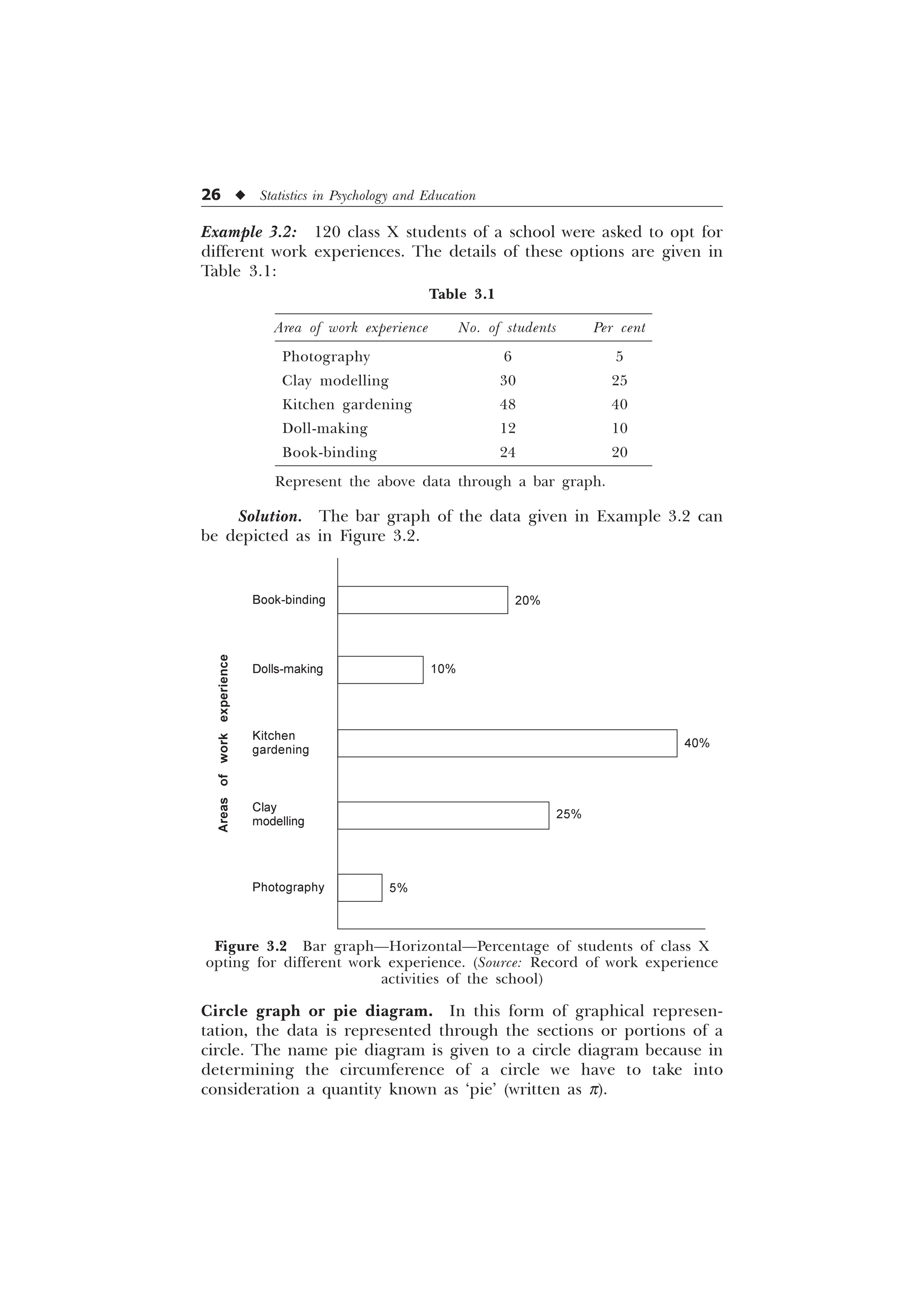
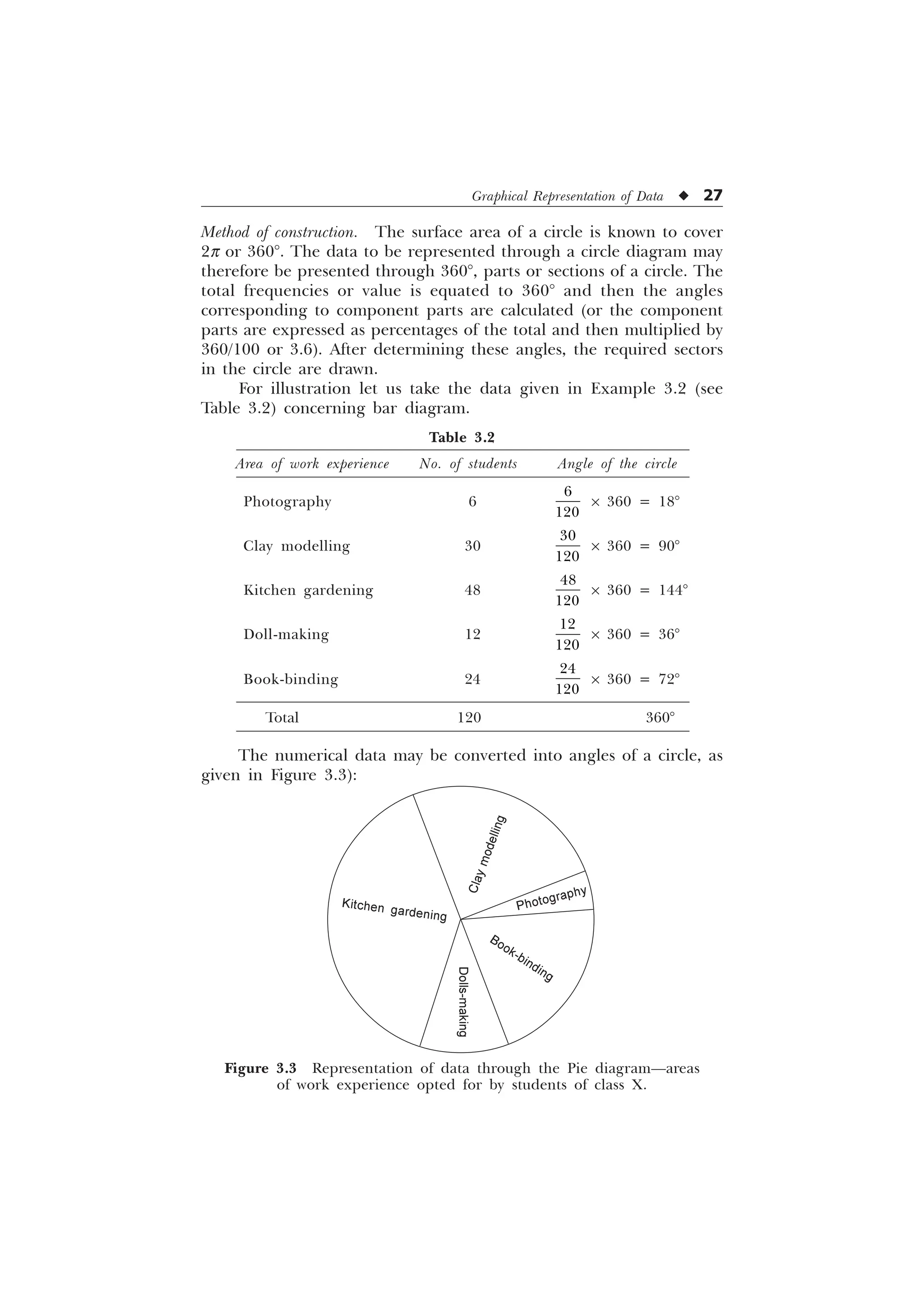
  • 330.
    318 u Statisticsin Psychology and Education Apply the Runs test to test the hypothesis that the male and female teachers do not differ in teacher effectiveness. 20. Twelve adolescent girls and boys randomly selected from a coeducational Senior Secondary School were tested through a Personality Inventory. The scores so collected are given now. Can you conclude, using the Runs test that boys and girls differ significantly in terms of their personality make-up? Scores on personality inventory Girls 156, 139, 142, 135, 183, 135, 178, 115, 211, 174, 111, 120 Boys 125, 110, 92, 128, 86, 77, 79, 86, 96, 106, 90, 85
  • 331.
    319 NEED FOR THETECHNIQUE OF ANALYSIS OF VARIANCE In Chapter 10, we discussed the use of z and t tests for testing the significance of the difference between the means of two samples or groups. In practice, however, we often come across situations where we have several samples of the same general character drawn from a given population and wish to know whether there are any significant differences between the means of these samples. In such situations, instead of determining a single difference between two means, several differences between several means are determined. Let us illustrate such a situation with an example. In a research study, localities are divided into four classes ranging from ‘best’ to ‘worst’, according to their social environment. A group test of general mental ability is administered to four random samples of 10 boys (studying in class VIII) each from four schools of the locality. We thus have four means for these samples drawn from the four localities. Now, if we wish to test the significance of the differences between these four means (by formulating a null hypothesis that no difference exists between the means) and apply the z or t test, it will be difficult, cumbersome and unwise on the following grounds: 1. The z or t test can be used for testing the significance of the difference between means by taking two means at a time. Here we have to test the significance of the difference between four means and so we have to take ( ) Q Q − , i.e. ( ) − = 6 pairs for comparison. The work will be done in six rounds and thus may involve too much a labour and complication. The degree of complication and the amount of labour will gradually increase with an increase in the number of groups or samples, e.g. for 8 samples we will have 28, for 10 samples 45, and for 15 samples 105 separate z or t tests. 17Analysis of Variance
  • 332.
    320 u Statisticsin Psychology and Education 2. However, after we decide to do so much labour, there is no guarantee that we would get the desired results. There is a possibility that none of the differences between pairs could prove to be significant and in such a case, the cumbersome exercise of computing a number of z or t values for testing the significance between several pairs of means will be complete waste. 3. In the above situation, while testing the significance of the difference between 6 pairs of sample means we may find that one of them is significant at the 0.01 level, the other at the 0.05 level, and the remaining four differences significant neither at 0.05 level nor at the 0.01 level. Thus, we may conclude that none of these six differences is significant. This conclusion is erroneous. Unless we have a single composite test for testing the differences within the given means at a time, we cannot conclude that the whole distribution of obtained sampling statistics has occurred by chance. 4. There could be a serious limitation in this case regarding the omission of the element of interaction existing between the different samples or groups included in the study. The various differences between means are not independent of each other. If we know the difference between sample means A and B, and A and C, we can automatically tell the difference between B and C because the difference between B and C is related to the difference between A and B, and A and C. In other words, if we have to test the difference between three sample means, one difference is not independent of the other two differences. Similarly, if we have to test the difference between four sample means, at least two differences in the six pairs are not independent of the other four differences. Thus, there is a need to take into account the dependence of the differences while deciding about their significance. However, as know, both t and z tests are tied to a distribution of the differences between pairs of means of independent random samples. As a result, the use of z or t test cannot provide us any satisfactory result. Thus we may conclude that, the usual procedure of testing the significance between two means by the t or z test definitely needs a substitute in the form of a single composite test for simultaneously testing the differences between the means of several samples of groups. The solution to the problem lies in a statistical technique known by the name analysis of variance in which all the data are treated together and a general null hypothesis of no difference among the means of the various samples or groups is tested.
  • 333.
    Analysis of Varianceu 321 MEANING OF THE TERM ‘ANALYSIS OF VARIANCE’ A composite procedure for testing simultaneously the difference between several sample means is known as the analysis of variance. It helps us to know whether any of the differences between the means of the given samples are significant. If the answer is ‘yes’, we examine pairs (with the help of the t test) to see just where the significant differences lie. If the answer is ‘no’, we do not proceed further. In such a test, as the name implies, we usually deal with the analysis of the variances. Variance is simply the arithmetic average of the squared deviation from their means. In other words, it is the square of the standard deviation (variance = s2 ). Variance has a quality which makes it specially useful. It has an additive property, which the standard deviation with its square root does not possess. Variance on this account can be added up and broken down into components. Hence, the term ‘analysis of variance’ deals with the task of analyzing of breaking up the total variance of a large sample or a population consisting of a number of equal groups or sub-samples into two components (two kinds of variances), given as follows: 1. “Within-groups” variance. This is the average variance of the members of each group around their respective group means, i.e. the mean value of the scores in a sample (as members of each group may vary among themselves). 2. “Between-groups” variance. This represents the variance of group means around the total or grand mean of all groups, i.e. the best estimate of the population mean (as the group means may vary considerably from each other). Let us make this clearer with the help of the example cited in the beginning of this chapter. In this study, there were 40 boys in all, belonging to four different localities. If we add the IQ scores of these 40 boys and divide the sum by 40, we get the value of the grand or general mean, i.e. the best estimate of the population mean. There are 4 groups (samples) of 10 boys each. The mean of the IQ scores of 10 boys in each group is called the group mean and in this way, there will be 4 group means, which will vary considerably from each other. Now the question arises, as to how far does an IQ score of a particular boy belonging to a particular sample or group deviate from the grand mean for 40 boys. We may observe that the deviation has two parts, i.e. deviation of the score from the mean of that particular group and the deviation of the mean of the group from the grand mean.
  • 334.
    322 u Statisticsin Psychology and Education For deriving more useful results, we can use variance as a measure of dispersion (deviation from the mean) in place of some useful measures like standard deviation. Consequently, the variance of an individual’s score from the grand mean may be broken into two parts (as pointed out earlier), viz. within-groups variance and between- groups variance. Commenting on the above aspects regarding the meaning and nature of analysis of variance and the subsequent procedure adopted in the analysis of variance technique, Lindquist (1970) writes: The basic proposition is that from any set of r groups of n cases each, we may, on the hypothesis that all groups are random samples from the same population, derive two independent estimates of the population variance, one of which is based on the variance of group means, the other on the average variance of within groups. The test of this hypothesis then consists of determining whether or not the ratio (F) between these estimates lies below the value in the table for F that corresponds to the selected level of significance. In this way, the technique of analysis of variance as a single composite test of significance, for the difference between several group means demands the derivation of two independent estimates of the population variance, one based on variance of group means (between groups variance) and the other on the average variance within the groups (within groups variance.) Ultimately, the comparison of the size of between groups variance and within-groups variance called F-ratio denoted by EHWZHHQJURXSVYDULDQFH ZLWKLQJURXSVYDULDQFH is used as a critical ratio for determining the significance of the difference between group means at a given level of significance. PROCEDURE FOR CALCULATING THE ANALYSIS OF VARIANCE As already pointed out, the deviation of an individual’s score belonging to a sample or a group of population from the grand mean can be divided into two parts: (i) deviation of the individual’s score from his group mean; and (ii) deviation of the group mean from the grand mean. Consequently, the total variance of the scores of all individuals included in the study may be partitioned into within-group variance and between-groups variance. The formula used for the computation of variance (s2 ) is S x2 /N, i.e. sum of the squared deviation from the mean value divided by total frequencies. Hence, by taking N as the
  • 335.
    Analysis of Varianceu 323 common denominator, the total sum of the squared deviation of scores around the grand or general mean for all groups combined can be made equal to the sum of the two partitioned, between-groups and within-groups sum of squares. Mathematically, Total sum of squares (around the general mean) = between-groups sum of squares + within-groups sum of squares or St 2 = Sb 2 + Sw 2 Hence the procedure for the analysis of variance involves the following main tasks: (i) Computation of total sum of squares (St 2 ) (ii) Computation of between-groups sum of squares (Sb 2 ) (iii) Computation of within-groups sum of squares (Sw 2 ) (iv) Computation of F-ratio (v) Use of t test (if the need for further testing arises). All these tasks may be carried out in a series of systematic steps. Let us try to understand these steps by adopting the following terminology: X = Raw score of any individual included in the study (any score entry in the given table) S X = Grand Sum ; 1 6 = Grand or general mean X1, X2, ¼ denote scores within first group, second group, ¼ n1, n2, n3 = No. of individuals in first, second and third groups ; ; 1 1 6 6 ¼ denote means of the first group, second group, ¼ N = total No. of scores or frequencies = n1 + n2 + n3 + ¼ Let us now outline the steps. Step 1. Arrangement of the given table and computation of some initial values. In this step, the following values needed in computation are calculated from the experimental data arranged in proper tabular form:
  • 336.
    324 u Statisticsin Psychology and Education (i) Sum of squares, S X1, S X2, ¼ and the grand sum, S X (ii) Group means, ; ; 1 1 6 6 ¼, and the grand mean ; 1 6 (iii) Correction term C computed by the formula C = 6TXDUHRIWKHJUDQGVXP 7RWDO1RRIFDVHV ; 1 6 Step 2. Arrangement of the given table into squared-form table and calculation of some other values. The given table is transformed into a squared-form table by squaring the values of each score given in the original table and then the following values are computed: (i) S X1 2 , S X2 2 , S X3 2 , ¼ (ii) S X2 Step 3. Calculation of total sum of squares. The total sum of squares around the general mean is calculated with the help of the following formula: St 2 = S X2 – Correction value (C) = S X2 – ; 1 6 Step 4. Calculation of between-group sum of squares. The value of the between-groups sum of squares may be computed with the help of the following formula: Sb 2 = Q Q ; ; ; ; Q Q Q Q 6 6 6 6 = VXPRIVFRUHVLQJURXS, 1RRIVFRUHVLQJURXS, + VXPRIVFRUHVLQJURXS,, 1RRIVFRUHVLQJURXS,, + – C (correction value) Step 5. Calculation of within-groups sum of squares. Between-groups and within-groups sum of squares constitute the total sum of squares. Therefore, after steps 3 and 4, the value of within-groups sum of squares (sum of squares of deviation within each group about their respective group means) may be calculated by subtracting the value of between-groups sum of squares from the total sum of squares. Its formula, therefore, goes thus:
  • 337.
    Analysis of Varianceu 325 Within-groups sum of squares, Sw 2 = St 2 – Sb 2 Step 6. Calculation of the number of degrees of freedom. All these sums of squares calculated in steps 3–5 possess different degrees of freedom given by Total sum of squares, (St 2 ) = N – 1 Between-groups sum of squares, (Sb 2 ) = K – 1 Within-groups sum of squares, (Sw 2 ) = (N – 1) – (K – 1) = N – K where N represents the total number of observations, scores or frequencies and K, the number of groups in the research study. Step 7. Calculation of F-ratio. The value of F-ratio furnishes a comprehensive or overall test of significance of the difference between means. For its computation, we have to arrange the data and computation work in the following manner: Source of variance Sum of squares df Mean square variance Between-groups Sb 2 (computed in step 4) K – 1 E 6 . Within-groups Sw 2 (computed in step 5) N – K Z 6 1 . F = 0HDQVTXDUHYDULDQFHEHWZHHQJURXSV 0HDQVTXDUHYDULDQFHZLWKLQJURXSV Step 8. Interpretation of F-ratio. F-ratios are interpreted by the use of the critical value of F-ratios given in Table R of the Appendix. This table has the number of degrees of freedom for the greater mean square variance across the top and the number of degrees of freedom in the smaller mean square variance on the left-hand side. If our computed value of F is equal to or greater than the critical tabled value of F at a given level of significance 0.05 or 0.01, it is assumed to be significant and consequently, we reject the null hypothesis of no difference among these means at that level of significance. However, a significant F does not tell us which of the group means differ significantly; it merely tells us that at least one mean is relatively different from some other. Consequently, there arises a need for further testing to determine which of the differences between means are significant. In case our computed value of F is less than the critical tabled value of F at a given level of significance, it is taken as non-significant
  • 338.
    326 u Statisticsin Psychology and Education and consequently, the null hypothesis cannot be rejected. Then there is no reason for further testing (as none of the differences between means will be significant). In a summarized form, the above analysis may be represented as follows:- F ® Significant ® Null hypothesis ® Need for further rejected testing F ® Non-significant ® Null hypothesis ® No need for further not rejected testing Generally, as and when we get the value of F as less than 1, we straightaway interpret it as non-significant resulting in the non- rejection of the null hypothesis. Step 9. Testing differences between means with the t test. When F is found significant, the need for further testing arises. We take pairs of the group means one by one for testing the significance of differences. The t test provides an adequate procedure for testing the significance when we have means of only two samples or groups at a time for consideration. Therefore, we make use of the t test to test the differences between pairs of means. As we have seen in Chapter 10, the usual formula for comp- utation of t values is t = T 'LIIHUHQFHEHWZHHQWZRPHDQV 6WDQGDUGHUURURIWKHGLIIHUHQFHEHWZHHQWKHPHDQV ' ' and sD is computed by the formula sD = Q Q T È Ø É Ù Ê Ú where s = Pooled SD of the samples drawn from the same population n1, n2 = Total No. of cases in samples I and II, respectively In the analysis of variance technique, within-groups means square variance provides us the value of s2 , the square root of which can give us the required pooled SD of the samples or groups included in our study. The degrees of freedom for within-groups sum of squares are given by the formula N – K. With these degrees of freedom we can read the t values from Table C given in the Appendix, at the 0.05 and 0.01 levels of significance. If the computed value of t is found to be equal to or greater than the critical tabled value of t at 0.05 or 0.01 levels, we can reject the null hypothesis at that level of significance.
  • 339.
    Analysis of Varianceu 327 Proceeding similarly, we take other pairs for testing the difference between means and arrive at conclusions. Let us illustrate now the whole process of using the analysis of variance technique with the help of an example. Example 17.1: The aim of an experimental study was to determine the effect of three different techniques of training on the learning of a particular skill. Three groups, each consisting of seven students of class IX, assigned randomly, were given training through these different techniques. The scores obtained on a performance test were recorded as follows: Group I Group II Group III 3 4 5 5 5 5 3 3 5 1 4 1 7 9 7 3 5 3 6 5 7 Test the difference between groups by adopting the analysis of variance technique. Solution. Step 1. Original table computation Table 17.1 Organization of Data Given in Example 17.1 Rating of the coaching experts Group I (X1) Group II (X2) Group III (X3) Total 3 4 5 12 5 5 5 15 3 3 5 11 1 4 1 6 7 9 7 23 3 5 3 11 6 5 7 18 S X1 = 28 S X2 = 35 S X3 = 33 S X = 96 Grand Total
  • 340.
    328 u Statisticsin Psychology and Education Here, n1 = n2 = n3 = 7, N = n1 + n2 + n3 = 21 Group means = ; Q 6 = = 4 ; Q 6 = = 5 ; Q 6 = = 4.71 Correction term C = ; 1 6 = – = 438.85 Step 2. Squared-table computation Table 17.2 Squared Values of the Original Data X 1 2 X2 2 X3 2 Total 9 16 25 50 25 25 25 75 9 9 25 43 1 16 1 18 49 81 49 179 9 25 9 43 36 25 49 110 S X1 2 = 138 S X2 2 = 197 S X3 2 = 183 S X2 = 518 Step 3. Total sum of squares (St 2 ): St 2 = ; ; 1 6 6 = S X2 – C = 518 – 438.85 = 79.15 Step 4. Between-groups sum of squares (Sb 2 ): Sb 2 = ; ; ; Q Q Q 6 6 6 = – – – = = 442.57 – 438.85 = 3.72
  • 341.
    Analysis of Varianceu 329 Step 5. Within-groups sum of squares (Sw 2 ). This is obtained as Sw 2 = St 2 – Sb 2 = 79.15 – 3.72 = 75.43 Step 6. Number of degrees of freedom For total sum of squares, (St 2 ) = N – 1 = 21 – 1 = 20 For between-groups sum of squares, (Sb 2 ) = K – 1 = 3 – 1 = 2 For within-groups sum of squares, (Sw 2 ) = N – K = 21 – 3 = 18 Step 7. Calculation of F-ratio Table 17.3 Computation of Values of Mean Square Variance Source of variation Sum of squares df Mean square variance Between-groups Sb 2 = 3.72 2 3.72/2 = 1.86 Within-groups Sw 2 = 75.43 18 75.43/18 = 4.19 F = 0HDQVTXDUHYDULDQFHEHWZHHQJURXSV 0HDQVTXDUHYDULDQFHZLWKLQJURXSV Step 8. Interpretation of F-ratio. The F-ratio table (Table R given in the Appendix) is referred to for 2 degrees of freedom for smaller mean square variance on the left-hand side, and for 18 degrees of freedom for greater mean square variance across the top. The critical values of F obtained by interpolation are as follows: Critical value of F = 19.43 at 0.05 level of significance Critical value of F = 99.44 at 0.01 level of significance Our computed value of F (.444) is not significant at both the levels of significance and hence, the null hypothesis cannot be rejected and we may confidently say that the differences between means are not significant and therefore, there is no need for further testing with the help of t test. Example 17.2: In a study, the effectiveness of the methods of memorization was to be determined. For this purpose, three groups of 10 students, each randomly selected from class VII of a school were taken and each group was made to adopt a particular method of memorization. In the end, the performance was tested. The number of
  • 342.
    330 u Statisticsin Psychology and Education nonsense syllables correctly recalled by the students of these groups is presented below: Group I : 12, 10, 11, 11, 8, 10, 7, 9, 10, 6 Group II : 14, 8, 19, 15, 10, 11, 13, 12, 9, 12 Group III : 8, 11, 13, 9, 7, 5, 6, 8, 7, 10 Apply the analysis of variance technique for testing the significance of the difference between group means. Solution. Step 1. Arrangement of the data into a proper table and initial computation (Table 17.4). Table 17.4 Organization of Data Given in Example 17.2 Group I Group II Group III Total (X1) (X2) (X3) 12 14 8 34 10 8 11 29 11 19 13 43 11 15 9 35 8 10 7 25 10 11 5 26 7 13 6 26 9 12 8 29 10 9 7 26 6 12 10 28 S X1 = 94 S X2 = 123 S X3 = 84 S X = 301 Here, n1 = n2 = n3 = 10 N = n1 + n2 + n3 = 30 Group means = ; Q 6 ; Q 6 ; Q 6 Correction term C = ; 1 6 – Step 2. Squared table computation. This can be obtained as in Table 17.5.
  • 343.
    Analysis of Varianceu 331 Table 17.5 Squared Values of the Original Data X1 2 X2 2 X3 2 Total 144 196 64 404 100 64 121 285 121 361 169 651 121 225 81 427 64 100 49 213 100 121 25 246 49 169 36 254 81 144 64 289 100 81 49 230 36 144 100 280 S X1 2 = 916 S X2 2 = 1605 S X3 2 = 758 S X2 = 3279 Step 3. Total sum of squares (St 2 ). This is given by St 2 = ; ; 1 6 6 = X2 – C = 3279 – 3020 = 259 Step 4. Between-groups sum of squares (Sb 2 ). This is obtained as Sb 2 = ; ; ; Q Q Q 6 6 6 = – – – = 883.6 + 1512.9 + 705.6 – 3020 = 3102.1 – 3020 = 82.1 Step 5. Within-groups sum of squares (Sw 2 ). This is given by Sw 2 = St 2 – Sb 2 = 259 – 82.1 = 176.9 Step 6. Number of degrees of freedom df for St 2 = N – 1 = 30 – 1 = 29 df for S2 b = K – 1 = 3 – 1 = 2 df for Sw 2 = N – K = 30 – 3 = 27
  • 344.
    332 u Statisticsin Psychology and Education Step 7. Calculation of F-ratio Table 17.6 Computation of the Values of Mean Square Variance Source of variance Sum of squares df Mean square variance Between-groups Sb 2 = 82.1 2 = 41.05 Within-groups Sw 2 = 176.9 27 = 6.55 F = 0HDQVTXDUHYDULDQFHEHWZHHQJURXSV 0HDQVTXDUHYDULDQFHZLWKLQJURXSV Step 8. Interpretation of F-ratio. The F-ratio table (Table R in the Appendix) is now referred for 2 degrees of freedom for greater mean square variance and 27 degrees of freedom for smaller mean square variance. Critical values of F = 3.35 at 0.05 level of significance Critical values of F = 5.49 at 0.01 level of significance The computed value of F, i.e. 6.27, is much higher than both the critical values of F at 0.05 and 0.01 levels of significance. Hence, it should be taken as quite significant. Consequently, we have to reject the null hypothesis. Thus, a significant difference definitely exists between the group means. Let us further test to find out where these differences exist. Step 9. Application of t test. The group means in our study are as follows: M1 = 9.4, M2 = 12.3, M3 = 8.4 Let us first test the difference between M1 and M2, i.e. 12.3 – 9.4 = 2.9 t = ' ' ' T T sD = Q Q T È Ø É Ù Ê Ú where s, the square root of the value of within-groups mean square variance, is = 2.559 and n1 = n2 = 10
  • 345.
    Analysis of Varianceu 333 Hence, sD = 2.559 È Ø É Ù Ê Ú = 2.559 ´ .2 = 0.5118 = 0.52 (approx.) Therefore, t = = 5.57 and df for within-groups sum of squares is N – K = 27 From the t-distribution table (Table C of the Appendix): Critical values of t = 2.05 at 0.05 level of significance Critical values of t = 2.77 at 0.01 level of significance The computed value of t, i.e. 5.57, is much higher than the critical values of t at both these levels. Hence it is to be regarded as quite significant and thereby null hypothesis stands rejected, the result being that the difference between M1 and M2 is quite significant and real. Now, take M2 and M3. Here, D = M2 – M3 = 12.3 – 8.4 = 3.9 t = T ' ' This computed t value is quite significant at both levels of significance, the result being given by that the difference between M2 and M3 is also quite significant and real. Finally, we take M1 and M3 D = M1 – M3 = 9.4 – 8.4 = 1 t = ' ' T It can be seen that the computed value of t, i.e. 1.92, is much lesser than the critical values 2.05 and 2.77 at 0.05 and 0.01 levels of significance. Hence it is not significant and, consequently, the null hypothesis cannot be rejected. Thus, it can be said that the difference between M1 and M3 is not significant and real. It may occur by chance or due to sampling fluctuation.
  • 346.
    334 u Statisticsin Psychology and Education In conclusion, it can be said that of the total three, only two of the difference, M1 – M2 and M2 – M3 are significant and trustworthy. TWO-WAY ANALYSIS OF VARIANCE So far, we have dealt with one-way analysis of variance involving one experimental variable. However, experiments may be conducted in the fields of education and psychology for the simultaneous study of two experimental variables. Such experiments involve two-way classification based on two experimental variables. Let us make some distinction between the need for carrying out one-way and two-way analyses of variance through some illustrations. Suppose that we want to study the effect of four different methods of teaching. Here, the method of teaching is the exper- imental variable (independent variable which is to be applied at four levels). We take four groups of students randomly selected from a class. These four groups are taught by the same teacher in the same school but by different methods. At the end of the session, all the groups are tested through an achievement test by the teacher. The mean scores of these four groups are computed. If we are interested in knowing the significance of the differences between the means of these groups, the best technique is the analysis of variance. Since only one experimental variable (effect of the method of teaching) is to be studied, we have to carry out one-way analysis of variance. Let us assume, that there is one more experimental or indepen- dent variable in the study, in addition to the method of teaching. Let it be the school system at three levels which means that three school systems are chosen for the experiment. These systems can be: government school, government-aided school and public school. Now the experiment will involve the study of 4 ´ 3 groups. We have 4 groups each in the three types of schools (all randomly selected). The achievement scores of these groups can then be compared by the method of analysis of variance by establishing a null hypothesis that neither the school system nor the methods have anything to do with the achievement of pupils. In this way, we have to simultaneously study the impact of two experimental variables, each having two or more levels, characteristics or classifications and hence we have to carry out the two-way analysis of variance. In the two-way classification situation, an estimate of population variance, i.e. total variance is supposed to be broken into: (i) variance due to methods alone, (ii) variance due to school alone, and (iii) the residual variance in the groups called interaction variance (M ´ S;
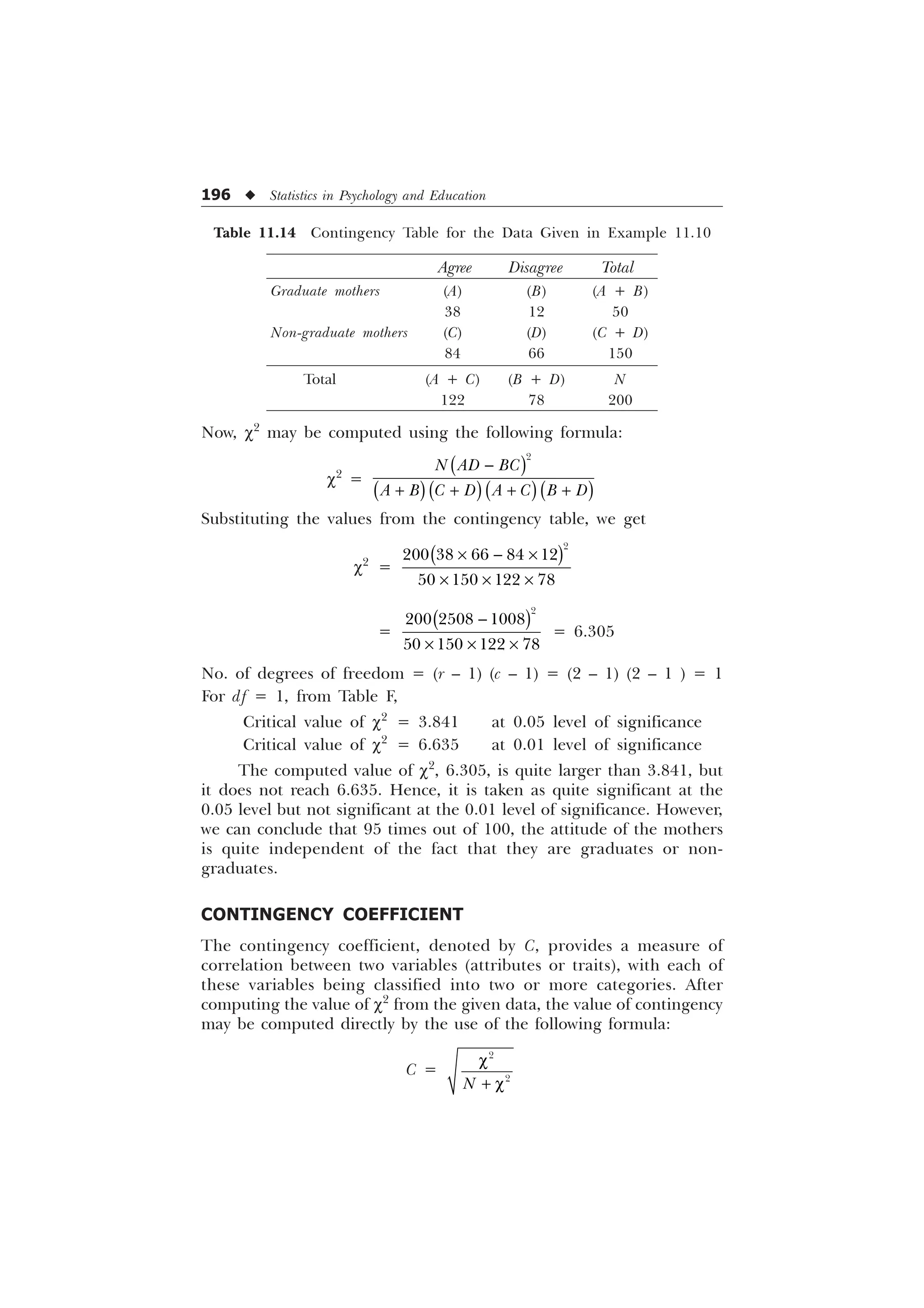
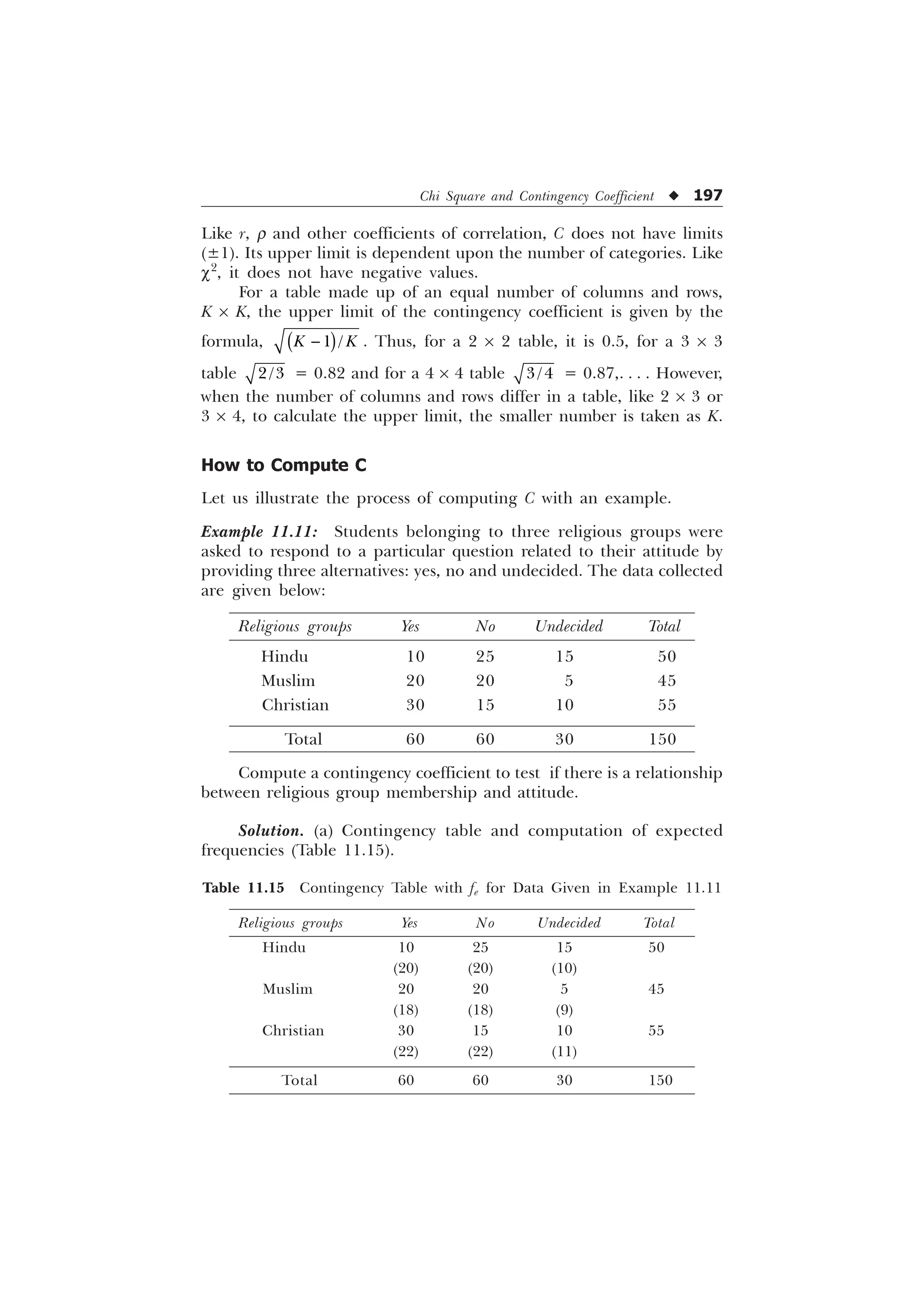
  • 347.
    Analysis of Varianceu 335 M = methods, S = schools) which may exist on account of the follow- ing factors: 1. Chance 2. Uncontrolled variables like lack of uniformity in teachers 3. Relative merits of the methods (which may differ from one school to another). In other words, there may be interaction between methods and schools which means that although no method may be regarded as good or bad in general, yet it may be more suitable (or unsuitable) for a particular school system. Hence, the presence of interaction variance is a unique feature with all the experimental studies involving two or more experimental variables. In such problems, requiring two or more ways of analysis of variance, we will have to take care of the residual or interaction variance in estimating their population variance. If the null hypothesis is true, variance in terms of the method should not be significantly different from the interaction variance. Similarly, the variance due to schools may also be compared with the interaction variance. For all such purposes of comparison, the F-ratio test is used, as explained later in this chapter. The design of the above two-way classification experiment can be further elaborated by having more experimental or independent variables, each considered at several levels. As the number of variables increases, the order of interaction also increases. For example, if school (S), teacher (T), and methods (M) are taken as three indep- endent variables, there will be 3 first-order interactions: S ´ T, T ´ M, and S ´ M, and the second-order interaction S ´ T ´ M. We will have 4 ´ 3 ´ 4 (if there are 4 levels of teacher variable), i.e. 48 randomized groups in this study and the problem of testing the difference between means will require three-way analysis of variance technique. According to the needs and requirements of the experiment, a research worker has to select a particular experimental design involving two or more independent or experimental variables. A discussion of these designs in terms of their construction, adminis- tration and analysis is beyond the scope of the book. Hence, the readers are advised to consult some of the books given in the reference section like Edwards (1961), Hicks (1964), Lindquist (1968) and Guilford (1973). However, let us briefly study the method of carrying out two-way analysis of variance for testing the difference between group means. As an illustration, let us take the case of an experimental design where a single group is being assessed more than once.
  • 348.
    336 u Statisticsin Psychology and Education Example 17.3: In a research study, there were two experimental or independent variables: a seven-member group of player and three coaches who were asked to rate the players in terms of a particular trait on a ten-point scale. The data were recorded as under: Rating by three coaches Players 1 2 3 4 5 6 7 A 3 5 3 1 7 3 6 B 4 5 3 4 9 5 5 C 5 5 5 1 7 3 7 Apply the technique of analysis of variance for analyzing these data. Step 1. Arrangement of the data in a proper table and computation of essential initial values (Table 17.7). Table 17.7 Organization of Data Given in Example 17.3 Rating of coaches Total of Square of Players By A By B By C rows the total (X1) (X2) (X3) of rows 1 3 4 5 12 144 2 5 5 5 15 225 3 3 3 5 11 121 4 1 4 1 6 36 5 7 9 7 23 529 6 3 5 3 11 121 7 6 5 7 18 324 Total of columns S X1 = 28 S X2 = 35 S X3 = 33 S X = 96(Grand total) Square of the totals of the column (S X1)2 = 784, (S X2)2 = 1225, (S X3)2 = 1089, (S X)2 = 9216 Here, N = n1 + n2 + n3 = 7 + 7 + 7 = 21 C = ; 1 6 = 438.85
  • 349.
    Analysis of Varianceu 337 Step 2. Arrangement of the table in square form and computation of some essential values (Table 17.8). Table 17.8 Squared Values of Original Data X1 2 X2 2 X3 2 Total 9 16 25 50 25 25 25 75 9 9 25 43 1 16 1 18 49 81 49 179 9 25 9 43 36 25 49 110 Total S X1 2 = 138 S X2 2 = 197 S X3 2 = 183 S X2 = 518 Step 3. Calculation of the total sum of squares (St 2 ) (around grand mean). St 2 = ; ; 1 6 6 = S X2 – C = 518 – 438.85 = 79.15 Step 4. Calculation of the sum of squares for rows (Sr 2 ) (between the means of players to be rated by three coaches). Sr 2 = = – 438.85 = 61.15 Step 5. Calculation of the sum of squares for columns (Sc 2 ) between the means of coaches rating 7 players). Sc 2 = – – = 442.57 – 438 × 85 = 3.72 Step 6. Calculation of the interaction or residual sum of squares (St 2 ). The interaction sum of squares is given by (St 2 ) = St 2 – (Sr 2 + Sc 2 ) = 79.15 – (61.15 + 3.72) = 14.28 Step 7. Computation of F-ratios. Table 17.9 illustrates the computation of mean square variance value.
  • 350.
    338 u Statisticsin Psychology and Education Table 17.9 Computation of the Values of Mean Square Variance Source of Sum of Mean square variation df squares variance Rows (players) (r – 1) = 6 61.15 = 10.19 Columns (coaches) (c – 1) = 2 3.72 = 1.86 Interaction or (r – 1) (c – 1) residual = 12 14.28 = 1.19 F (for rows) = 0HDQVTXDUHYDULDQFHEHWZHHQURZV SODHUV 0HDQVTXDUHYDULDQFHLQWHUPVRILQWHUDFWLRQ = = 8.56 F (for columns) = 0HDQVTXDUHYDULDQFHEHWZHHQFROXPQV FRDFKHV 0HDQVTXDUHYDULDQFHLQWHUPVRILQWHUDFWLRQ = = 1.56 Step 8. Interpretation of F-ratios. Table 17.10 gives the critical values of F. Table 17.10 Critical Values of F and Significance of Computed F df for greater df for Critical values of F Judgement mean square smaller at 0.05 at 0.01 about the Kind of F variance mean square level level significance of Conclusion variance computed F F (for rows) 2 12 3.88 6.93 Significant Null hypothesis at both rejected levels F (for 6 12 3.00 4.82 Not signi- Null hy- columns) ficant at pothesis both levels not rejected Here, F (for rows) is highly significant and hence null hypothesis is rejected. It indicates that the coaches did discriminate among the players. The second F (for columns) is insignificant and hence, the null hypothesis cannot be rejected. It indicates that the coaches did not differ significantly among themselves in their ratings of the players. In other words, their ratings may be taken as trustworthy and reliable.
  • 351.
    Analysis of Varianceu 339 UNDERLYING ASSUMPTIONS IN ANALYSIS OF VARIANCE The following are the fundamental assumptions for the use of analysis of variance technique: 1. The dependent variable which is measured should be normally distributed in the population. 2. The individuals being observed should be distributed randomly in the groups. 3. Within-groups variances must be approximately equal. 4. The contributions to variance in the total sample must be additive. SUMMARY In performing experiments and carrying out studies in the fields of education and psychology, we often come across situations where we are required to test the significance of the differences among the means of several samples instead of only two sample means, capable of testing with the help of z or t tests. In such situations, a technique known as analysis of variance proves quite useful. It provides a composite test to find out, simultaneously, the difference between several sample means and thus helps us tell, whether any of the differences between means of the given samples are significant. If the answer is ‘yes’ we examine pairs of sample means (with the help of the usual t test) to see just where the significant differences lie. If the answer is ‘no’, we do not require further testing. The technique of analysis of variance demands the analysis or breaking apart of the total squared deviation scores or variance of the scores of all individuals (s2 ) included in the study around the grand mean (mean of the total scores) into two parts—(i) within-groups variance, i.e. the squared deviation scores of the individuals from their group means and, (ii) between-groups variance, i.e. the squared deviation scores of the group mean from the grand mean. In actual computation work: 1. The total variance St 2 is first calculated and then the Sb 2 , the difference between the two automatically gives Sw 2 . The formulae run as follows: St 2 = ; ; 1 6 6 Sb 2 = Q Q ; ; ; ; Q Q Q Q 6 6 6 6 Sw 2 = St 2 – Sb 2
  • 352.
    340 u Statisticsin Psychology and Education 2. The degrees of freedom for Sb 2 and Sw 2 are K – 1 and N – K, where K represents the number of groups and N, total observations. 3. Then, the F-ratios desired for testing the significance is calculated by the formula F = 0HDQVTXDUHYDULDQFHEHWZHHQJURXSV 0HDQVTXDUHYDULDQFHZLWKLQJURXSV E Z 6 . 6 1 . 4. The computed F-ratios are then interpreted by the use of critical F values read from the table with the degrees of freedom at the given level of significance. In case our computed F is found non-significant, then there is no need for further testing but if it is found significant then the use of t test is made for testing further the difference between sample means taken two at a time. In the experiments involving two experimental or independent variables instead of one, the significance of the difference between several means is tested with the help of two-way analysis of variance instead of one-way analysis of variance. In the two-way analysis total variance is supposed to be broken into three parts instead of two as done in the one-way analysis. These are: (i) variance due to one variable, (ii) variance due to other variable, and (iii) interaction or residual variance on account of the supposed interaction between variables. Here, instead of one, two F-ratios are computed with the help of the formulae: F (for one variable) = 0HDQVTXDUHYDULDQFHEHWZHHQRQHYDULDEOH 0HDQVTXDUHYDULDQFHLQWHUPVRILQWHUDFWLRQ F (for the other variable) = 0HDQVTXDUHYDULDQFHEHWZHHQRWKHUYDULDEOH 0HDQVTXDUHYDULDQFHLQWHUPVRILQWHUDFWLRQ and then the interpretation is made by comparing these F-ratios with the critical F values read from the table for computed degrees of freedom at a given level of significance. For its successful application, the analysis of variance needs the fulfilment of assumptions like the normal distribution of the dependent variable, random distribution in the groups of individuals under study, homogeneity of the within-groups variances and the analysis of total variances into component variances.
  • 353.
    Analysis of Varianceu 341 EXERCISES 1. What do you understand by the technique, analysis of variance, used for the analysis of statistical data? 2. In which circumstances is the technique of analysis of variance preferred to the usual z or t tests for testing the significance of the difference between means? Discuss with the help of examples. 3. Discuss the various steps involved in the application of analysis of variance for testing the difference between groups. Illustrate with the help of a hypothetical example. 4. What is analysis of variance? Point out the underlying assump- tions in its application. 5. The following are error scores on a psychomotor test for four groups of equal subjects tested under four experimental conditions: Group I Group II Group III Group IV 4 9 2 7 5 10 2 7 1 9 6 4 0 6 5 2 2 6 2 7 Apply the analysis of variance to test the null hypothesis. 6. The following data represent the scores of six students (selected randomly) in each of the five sections of class VIII of a school on a vocabulary test: Section A Section B Section C Section D Section E 32 19 17 12 12 17 26 26 15 15 28 30 30 10 36 24 17 35 20 17 21 34 20 18 20 38 15 15 30 25 Test the null hypothesis for vocabulary ability of the different sections of class VIII.
  • 354.
    342 u Statisticsin Psychology and Education 7. In a research study, a Marital Adjustment Inventory was administered on four random samples of the individual. Test the hypothesis that they are from the same population. Sample I Sample II Sample III Sample IV 16 24 16 25 7 6 15 19 19 15 18 16 24 25 19 17 31 32 6 42 24 13 45 29 18 8. The following data were collected from the students of three groups in terms of correctly recalled nonsense syllables under three methods of memorization: Method I Method II Method III 18 20 7 29 17 15 28 21 9 26 19 13 24 29 5 31 26 11 30 25 27 Compute the means for separate groups and apply the analysis of variance technique to test the significance of the difference between groups. 9. In a learning experiment, three subjects made the following number of correct responses in a series of 7 trials. Trials Subjects 1 2 3 4 5 6 7 A 5 9 3 7 9 3 7 B 6 8 4 5 2 4 3 C 5 7 3 5 9 3 7 Apply the technique of two-way analysis to test the difference between means.
  • 355.
    Analysis of Varianceu 343 10. The following data represent the marks of eight students by three teachers in terms of their performances on a particular skill: Marks given by the teachers Students A B C 1 8 4 2 2 6 3 6 3 8 4 8 4 10 8 8 5 12 6 8 6 14 10 9 7 16 8 10 8 20 11 8 Apply the technique of analysis of variance to answer the following questions: (a) Did the teachers discriminate among the students in their markings? (b) Did the teachers differ among themselves in their markings?
  • 356.
    344 MEANING AND PURPOSE Analysisof covariance may be looked upon as a special provision or procedure for exercising necessary statistical control over the variable or variables that have been left uncontrolled at the start of the experiment or study on account of the practical limitations and difficulties associated with the conducting such experiments or studies. In one sense, it may be regarded as a remedy or a solution for what has been left undone or what was quite impossible or difficult in doing experimentally at the start of the study. In its procedure or methodology, the work of analysis of covariance may be equated with that of partial correlation, where we seek a measure of correlation between two sets of variables— independent and dependent—by partialling out the effects of the intervening variables. Here, we try to exercise statistical control instead of experimental control, over the intervening variables, after having conducted the actual study or experiment. Similar is the case with the analysis of covariance. By using this technique, we try to partial out the side effects if any, on our study, due to lack of exercising proper experimental control over the intervening variables or covariates (covariables). Let us make the idea clearer with the help of some concrete examples. 1. A researcher wants to study the effectiveness of praise or blame as a technique for behaviour modification. As a part of the experimental study, he should try to have three equivalent groups: one controlled, and two experimental. The equivalence of these groups may either be achieved through randomness or matched pairs or groups techniques. If a researcher does not try to equate these groups or is unable to do so on account of serious limitations or difficulties faced by him, he can take them for his study as natural groups or sections or classes, existing in the school environment or social set-up. Even if he divides them 18Analysis of Covariance
  • 357.
    Analysis of Covarianceu 345 into three groups by selecting them randomly from a single population, it does not guarantee their equivalence in terms of so many other variates or variables. In this way, the basic differences among these three groups are bound to remain there from the very start of the experiment. Now, if the experimentor selects the first group as control group (neither praises nor blames), the second group as experimental group 1 (praises), and the third group as experimental group 2 (blames), then the differences measured at the end of the experiment cannot be treated as valid for drawing inferences regarding the comparative role of praise or blame on behaviour modification. It may be possible that these differences have been generated due to the initial differences in their behaviour. The experimentor must have ensured the equivalence of these three groups before starting the experiment, i.e. providing treatments. The solution lies now in exercising some genuine statistical control over the uncontrolled variates through the technique of analysis of covariance. This technique helps in the task of making necessary adjustments or corrections in the final measures or scores of behaviour for eliminating the uncontrolled differences existing in the initial behaviour scores. As a result, we can now partial out or root out the effect of initial differences that exist in the behaviour of these three groups, and thus we will be able to draw valid inferences regarding the comparison of two entirely different treatments—praise or blame—in behaviour modification. 2. In another study, a research worker wanted to compare the relative effectiveness of three different methods, say lecture, leture-cum-demonstration, and laboratory experi- ments, for teaching science. He took three sections of Class IX of a school for this purpose. These classes were used to be taught by a single science teacher. At the start of the experiment, he conducted an achievement test and recorded the initial scores. There were significant differences in terms of mean and SD. He might have tried to equate these three groups in terms of mean and SD by including or excluding some students in one group or the other. But it would have been a difficult task and practically quite impossible to do so. Hence, he accepted those initial differences with regard to academic potential in science. In addition to such academic potential differences, these students might have differed in intelligence, a powerful covariate of academic potential. For
  • 358.
    346 u Statisticsin Psychology and Education exercising proper control, these three groups might have been equated also in terms of this powerful covariate. Since such equivalence was neither feasible nor practicable, the sections A, B and C of the school were taken as three different groups, and each taught by a different method. At the end of one month, they were again tested in terms of their achievement, and their final scores were recorded. The means of these scores were then computed and analysed by the technique of analysis of variance for testing the significant differences existing among them. The differences were quite significant. However, the researcher was in a fix whether or not to draw valid inferences on the comparative effectiveness of the three methods. He was not certain whether these differences exist due to the comparative effectiveness of teaching methods or due to the initial differences existing among these groups for one or the other reasons (differences in initial achievement potential or intelligence, and so on. There was a need to have necessary correction or adjustment in the final scores for eliminating the differences in initial scores, and the researcher, for this purpose, used the technique of analysis of covariance. He then became successful in finding out the significant differences existing among the three means of final scores, by partialling out or rooting out the effect of the initial differences that existed on account of some intervening or uncontrolled covariates or covariables. Thus, the role of analysis of covariance as a statistical technique or procedure, adopted in a particular research study, may be summed up as follows: 1. Analysis of covariance represents an extension of the method of analysis of variance, to allow a correlation between initial and final scores. 2. After the study or experiment has been performed, it helps the researcher in exercising proper statistical control over the uncontrolled covariates or covarying variables that have been left uncontrolled at the start of the experiment or study. 3. It enables the researcher to get rid of the difficulties and limitations he may face in adopting randomization or matching of groups techniques for studying the relative effectiveness of one or the other treatments and secure the same increase in precise evaluation. 4. It may serve other purposes like testing the homogeneity of a set of regression coefficients and related hypotheses.
  • 359.
    Analysis of Covarianceu 347 How to Make Use of the Analysis of Covariance Let us illustrate the use of the technique of Analysis of covariance with the help of some hypothetical data given in the following example. Example 18.1: Three groups of five students each (randomly selected from a Class VIII of a school) were initially rated for their leadership qualities, and their scorse were recorded. Then they were subjected to different treatments (three different approaches or training techniques for leadership), and after 15 days of such training, they were again evaluated for their leadership qualities, and these final scores were also recorded. The data so collected are given in the following table. Group A Group B Group C Initial Final Initial Final Initial Final scores scores scores scores scores scores X1 Y1 X2 Y2 X3 Y3 4 6 8 8 7 9 3 5 6 5 9 8 5 6 7 9 10 11 2 4 4 7 12 12 1 4 5 6 12 15 Use this data to compare the relative effectiveness of the treatments given to the groups. Solution. There were many observable differences among the initial scores of the three groups, but no attempt was made to make these groups as equivalent groups at the start of the study, i.e. before subjecting these to different treatments. In the absence of such an experimental control, the researcher was forced to exercise statistical control by applying the technique of analysis of covariance. The procedure may be understood through computation. Let us begin with arranging the given data as in Table 18.1. Table 18.1 Computational Work for Covariance Analysis Group A Group B Group C X1 Y1 X1Y1 X1 2 Y1 2 X2 Y2 X2Y2 X2 2 Y2 2 X3 Y3 X3Y3 X3 2 Y3 2 4 6 24 16 36 8 8 64 64 64 7 9 63 49 81 3 5 15 9 25 6 5 30 36 25 9 8 72 81 64 5 6 30 25 36 7 9 63 49 81 10 11 110 100 121 2 4 8 4 16 4 7 28 16 49 12 12 144 144 144 1 4 4 1 16 5 6 30 25 36 12 15 180 144 225 Sums 15 25 81 55 129 30 35 215 190 255 50 55 569 518 635 M’s 3 5 6 7 10 11
  • 360.
    348 u Statisticsin Psychology and Education For all the three groups, S X = S X1 + S X2 + S X3 = 15 + 30 + 50 = 95 S Y = S Y1 + S Y2 + S Y3 = 25 + 35 + 55 = 115 S X2 = S X1 2 + S X2 2 + SX3 2 = 55 + 190 + 518 = 763 S Y2 = S Y1 2 + S Y2 2 + S Y3 2 = 129 + 255 + 635 = 1019 S XY = S X1Y1 + S X2Y2 + S X3Y3 = 81 + 215 + 569 = 865 After computing various sums and means thus, the following steps can be adopted: Step 1. Computation of correction terms (C’s). Different corrections are applied to different sums of squares as in the case of analysis of vari- ance. These can be computed by using the following formulae: (i) CX = ; 1 6 – (ii) CY = 1 6 – (iii) CXY = ; 1 6 6 – Step 2. Computation of total sum of squares (total SS). (i) SSX = S X2 – CX = 763 – 601.67 = 161.33 (ii) SSY = S Y2 – CY = 1019 – 881.67 = 137.33 (iii) SSXY = S XY – CXY = 865 – 728.33 = 136.67 Step 3. Computation of sum of squares (SS) among the means of the groups. (i) SS among-means for X = ; ; ; ; 1 1 1 6 6 6 = = 123.33 (ii) SS among-means for Y = 1 1 1 6 6 6
  • 361.
    Analysis of Covarianceu 349 = = 93.33 (iii) SS among-means for XY = ; ; ; ; 1 1 1 6 6 6 = – – – = 106.67 Step 4. Computation of sum of squares (SS) within-group (i) Within-groups SS for X = SSX – SS among-means for X = 161.33 – 123.33 = 38 (ii) Within-groups SS for Y = SSY – SS among-means for Y = 137.33 – 93.33 = 44 (iii) Within-groups SS for XY = SSXY – SS among-means for XY = 136.67 – 106.67 = 30 Step 5. Calculation of the number of degrees of freedom. (i) Among-means (df ) = K – 1 = No. of groups = 3 – 1 = 2 (ii) Within-groups (df ) = N – K = 15 – 3 = 12 Step 6. Analysis of variance of X and Y scores taken separately (Table 18.2). Table 18.2 Worksheet for Analysis of Variance (ANOVA) Source of SSX SSY MSX MSY variation df (Sum of (Sum of (Mean square (Mean square squares squares variance for variance for for X) for Y) X or ÖX Y or ÖY Among-means 2 123.33 93.33 = 61.66 = 46.66 Within-groups 12 38 44 = 3.17 = 3.67 Total 14 161.33 137.33 FX = 0HDQVTXDUHYDULDQFHRIDPRQJJURXSV IRU 0HDQVTXDUHYDULDQFHRIZLWKLQJURXSV ;
  • 362.
    350 u Statisticsin Psychology and Education = FY = 0HDQVTXDUHYDULDQFHRIDPRQJJURXSV IRU 0HDQVTXDUHVYDULDQFHRIZLWKLQJURXSV = where FX = F ratio for X scores FY = F ratio for Y scores From Table R of the Appendix for df (2, 12), we can have the critical value of F at 0.05 level = 3.88 and at 0.01 level = 6.93 Rule: If FX is significant the H0 is to be rejected showing that initially groups were different. Hence covariance is needed. If not significant, we can have only analysis of variance. The computed value of F for X scores is significant at both levels, and similar is the case with the computed F for Y scores. Hence H0 for X scores as well as Y scores are rejected, leading to the conclusion that (i) there are significant differences in initial (X) scores, and (ii) there are significant differences in final (Y) scores. Step 7. Computation of adjusted sum of squares (SS for Y, i.e. SSYX). The initial differences in the groups X scores may cause variability in their final scores measured after giving treatment. It needs to be checked and controlled. For this purpose, necessary adjustments are made in various Sum of Squares (SS) for Y by using the following general formula: 66 66 66 66 ; ; ; (Here, SSYX stands for the sum of squares of Y adjusted for X differences). The specific adjusted SS for Y may be computed as follows: (a) Adjusted sum of squares for total, i.e., SSYX (total) = Total SSY – 7RWDO 66 7RWDO66 ; ; = 137.33 – = 137.33 – 115.77 = 21.56
  • 363.
    Analysis of Covarianceu 351 (b) Adjusted sum of squares for within-groups means, i.e. SSYX (within-mean) = within SSY – ZLWKLQ 66 ZLWKLQ66 ; ; = 44 – = 44 – 23.68 = 20.32 (c) Adjusted sum of squares for among-group means, i.e. SSYX (among-mean) = SSYX (Total) – SSYX (within) = 21.56 – 20.32 = 1.24 Step 8. Computation of Analysis of Covariance: It is carried out as shown in Table 18.3 Table 18.3 Worksheet for the Computation of Analysis of Covariance (ANCOVA) Source of df SSX SSY SXY SSYX MSYX or SDYX variation VYX Among- 2 123.33 93.33 106.67 0.44 0.22 groups means Within- 11* 38 44 30 20.32 1.76 = 1.32 groups means Total 13 161.33 137.33 136.67 20.76 (* 1 df is lost because of regression of Y on X) DPRQJ ZLWKLQ ; ; ; 9 ) 9 From Table R of the Appendix for df (2, 11). Critical F at 0.05 level = 3.98 and Critical F at 0.01 level = 7.20 The computed value of F (FYX) is not significant at both the levels. Hence, H0 is to be accepted with the conclusion that groups do not differ significantly after giving treatments. Hence, out of the three treatments (techniques of training for leadership) one treatment cannot be termed better than another. As far as this example is concerned, the matter ends with drawing inferences from the collected data. However, if H0 is rejected, concluding that there are significant differences among the means of the final scores, then our objective will be analyse these differences and conclude which of the treatment is better than others.
  • 364.
    352 u Statisticsin Psychology and Education In such a case, further steps taken can be outlined in the following manner: For the sake of illustration, let us take the data from the present example. Step 9. Computation of regression coefficient for within-groups. An unbiased estimate of the regression of Y on X can be computed by the use of the formula: b = ZLWKLQJURXSV66IRU ZLWKLQJURXSV66IRU ; ; ; ; 6 6 Step 10. Computation of adjusted Y means. The work is carried out as shown in Table 18.4. Table 18.4 Worksheet for the Computation of Adjusted Y Means Groups N MX (means for X) MY (unadjusted) MYX (Adjusted) A 5 3 5 7.63 B 5 6 7 7.26 C 5 10 11 8.08 In the last column, we have MYX (Means of final Y scores after ruling out the initial differences in X scores). MYX for groups A, B and C have been computed as follows by using the general formula: MYX = MY – b(MX – GMX) where MY = Unadjusted means for Y scores MX = Mean for X scores b = Regression coefficient for within-groups (computed in step 9) GMX = General mean for X = (3 + 6 + 10)/3 = 19/3 = 6.33 Hence For group A, MYX = 5 – 0.79(3 – 6.33) = 5 – 0.79(–3.33) = 7.63 For group B, MYX = 7 – 0.79(6 – 6.33) = 7 – 0.79(–.33) = 7.26 For group C, MYX = 11 – 0.79 (10 – 6.33) = 11 – 0.79 ´ 3.67 = 8.08
  • 365.
    Analysis of Covarianceu 353 Step 11. Significance of differences among adjusted Y means. Apparently, there is no significant differences among the Y mean of group A, B and C, especially between A and B. Let us further examine it by applying the ‘t’ test as we did in the analysis of variance (Chapter 17) for testing the separate differences between group means. As we know, 'LIIHUHQFHVEHWZHHQPHDQV 6( 6WDQGDUG(UURURIWKHGLIIHUHQFHEHWZHHQPHDQV ' ' W Here, SE of the difference between any two adjusted means can be computed by using the formula 6( 6' ' ; 1 1 where, SDYX is the standard deviation of the adjusted Y scores. It can be computed by the formula SDYX = ZLWKLQJURXSYDULDQFH ZLWKLQJURXS ; 9 (already computed in Table 18.3) Hence, SED = 1.32 = 1.32 = 1.32 ´ 0.63 = 0.83 For df = 11, from Table C of the Appendix, we have Critical value of t at 0.05 level = 2.20 Critical value of t at 0.01 level = 3.11 The computed value of t is (i) ' 0 0 6( for M1 – M2 (Difference between adjusted means of group A and group B) (ii) for M3 – M2 (iii) for M3 – M1 The computed values of t for all the differences in means are not significant at both the levels (0.05 and 0.01) of significance. Hence H0 cannot be rejected. We accept H0 here too since that the groups, after having different leadership training programmes, do not differ in final scores.
  • 366.
    354 u Statisticsin Psychology and Education Assumptions Underlying Analysis of Covariance The method of analysis of covariance requires some basic assumptions for its application, which are now enumerated: 1. The dependent variable which is under measurement should be normally distributed in the population. 2. The treatment groups should be selected at random from the same population. 3. Within-groups variances must be approximately equal. 4. The contributions of variance in the total sample must be additive. 5. The regression of the final scores (Y) on initial scores (X) should be basically the same in all groups. 6. There should exist a linear relationship between X and Y. SUMMARY 1. Analysis of covariance is a statistical procedure or a method for exercising post-experiment or post-study control over the intervening variables or covariates that have been left uncontrolled at the start of the experiment or study due to administrative difficulties or through ignorance of their relationship with criterion measures. Its use may enable us to dispense with the inconvenient procedure of matching of individuals and groups to have controlled and experimental subjects or groups for study and to secure the same increase in precision by exercising statistical control. 2. In its application procedure, it is just an extension devised by R.A. Fisher for his method of analysis of variance. In brief, it involves the following steps: (a) Arranging the data into a suitable tabular form for computing various sums like S X, S Y, S XY, S X2 , S Y2 and group means for the variate Y and covariate X. (b) Computation of correction terms CX, CY and CXY. (c) Computation of total sum of square and squares among- means of the groups and within-groups for X, Y and the product XY by using correction terms. (d) Carrying out analysis of variance with the help of usual formulae and procedure (partitioning of total sum of squares in two sources—among groups and within- groups)—and determining the need for adjusting the means of the final scores Y in view of the significant differences in initial scores X.
  • 367.
    Analysis of Covarianceu 355 (e) Computation of adjusted sum of squares (SS) for Y, i.e. SSYX separately for both within-group and among-group means. (f) If H0 is rejected, then computing the regression coefficient for within-groups, i.e. b, to help calculate the values of adjusted means for both X and Y scores of every group. (g) Carrying out analysis of covariance and obtain the variance estimates, i.e. the values of VYX (among) and VYX (within) for computing FYX and then comparing it with the critical table value of F for accepting or rejecting H0. (h) Using the t test for determining the significance of differences among adjusted means. We can then conclude about the differences generated through varying treatments after partialling out the initial difference, if any. EXERCISES 1. What is analysis of covariance? Why and where is it to be used? Illustrate with examples. 2. What assumptions are required for the use of analysis of covariance? 3. Discuss the process of using analysis of covariance by taking a hypothetical example involving simple calculations. 4. A researcher wanted to know the relative effectiveness of grammar, translation and structural methods of teaching English. He performed the experiment with the help of 12 students by dividing them at random into three groups. The initial scores (before starting the experiment and final scores (after teaching each group by different methods) were recorded as follows. Find the relative effectiveness of these three methods. Group A Group B Group C X1 Y1 X2 Y2 X3 Y3 (Initial) (Final) (Initial) (Final) (Initial) (Final) 33 18 34 31 34 15 42 34 55 45 4 8 40 22 9 1 12 18 31 24 50 33 16 15
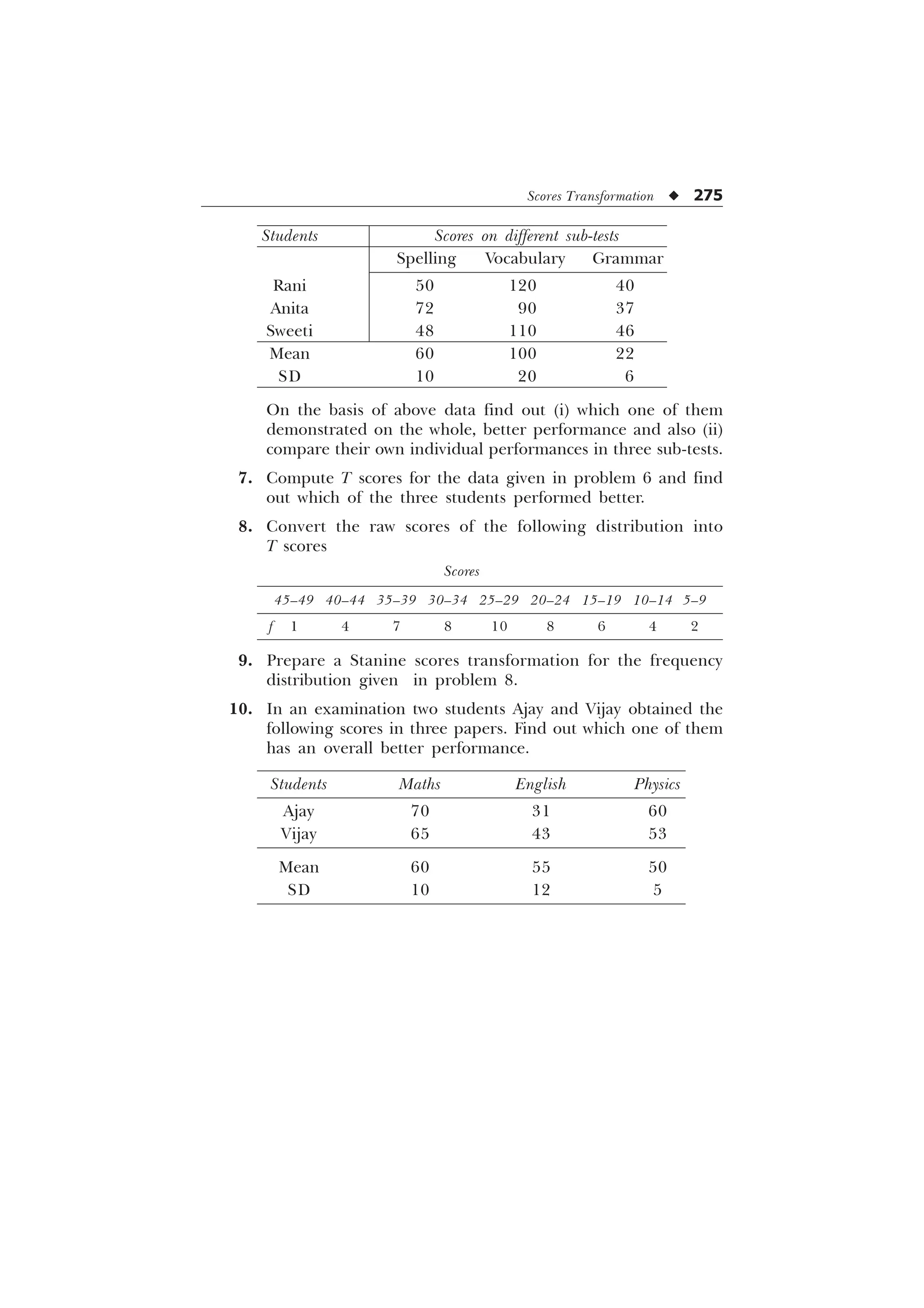
  • 368.
    356 u Statisticsin Psychology and Education 5. A researcher wanted to study the relative effectiveness of three methods of behaviour modification for the treatment of problem children. He selected 15 students for this study. He administered an Adjustment Inventory and recorded the scores as X. He then divided them randomly into three groups. Three different treatments were given to these three groups and after two months, he again administered the same Adjustment Inventory and recorded their scores as Y. What can you conclude about the relative effectiveness of the three treatments from the following data. Group A Group B Group C X1 Y1 X2 Y2 X3 Y3 6 8 8 10 3 2 3 7 6 15 6 2 8 5 3 14 2 3 2 3 8 8 2 1 1 2 5 3 2 2 6. An experiment was conducted to know the relative effectiveness of three methods of teaching science at the elementary level. The nursery children were taken as available in the different three sections. Their achievement scores (X) were recorded and then they were taught by different methods by the same teacher. Their final achievement scores (Y) were recorded after three months. Find out the relative effectiveness of the three methods of teaching science from the given data: Section A Section B Section C X1 Y1 X2 Y2 X3 Y3 5 5 5 6 7 4 6 11 7 6 8 5 9 12 12 7 3 7 12 26 10 12 4 9 15 28 8 14 10 10 16 24 4 9 5 6 18 11 15 8 20 27 9 12 4 12 12 20 N1 = 10 N2 = 8 N3 = 6
  • 369.
    Analysis of Covarianceu 357 ANSWERS Chapter 1 3. (a) to (d) continuous, (e) and (f) discrete, (g) continuous 4. 13.5–14.5, 21.5–22.5, 45.5–46.5, 71.5–72.5, 84.5–85.5 6. (a) and (b) nominal, (c) interval, (d) and (e) ratio, (f) ordinal, (g) and (h) interval, (i) and (j) ratio 7. (a) 52.73 (b) 0.32 (c) 0.84 (d) 2.37 (e) 8.68 (f) 23.73 Chapter 2 5. (a) (i) Class interval = 4 (ii) 6.5, 10.5, 14.5, 18.5, 22.5 (iii) 4.5–8.5, 8.5–12.5, 12.5–16.5, 16.5–20.5 and 20.5– 24.5 (b) (i) 3 (ii) 17, 20, 23, 26, 29 (iii) 15.5–18.5, 18.5–21.5, 21.5–24.5, 24.5–27.5, 27.5–30.5 (c) (i) 10 (ii) 34.5, 44.5, 54.5, 64.5 and 74.5 (iii) 29.5–39.5, 39.5–49.5, 49.5–59.5, 59.5–69.5, 69.5–79.5 6. Class interval = 3 Frequency distribution table Class interval Frequencies (f) 85–87 1 82–84 3 79–81 1 76–78 3 73–75 2 70–72 6 67–69 5 64–66 2 61–63 2 N = 25 Answers u 357
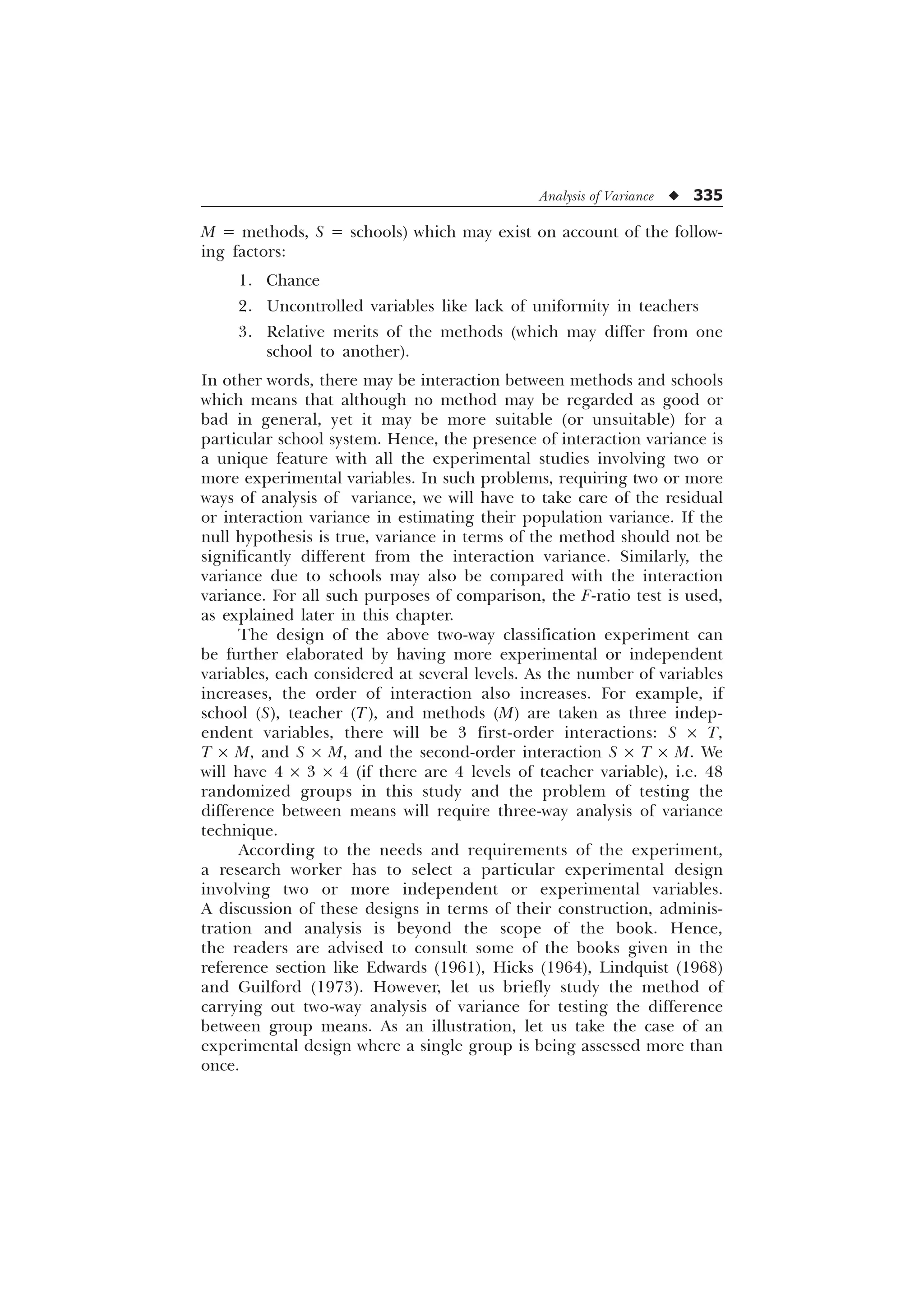
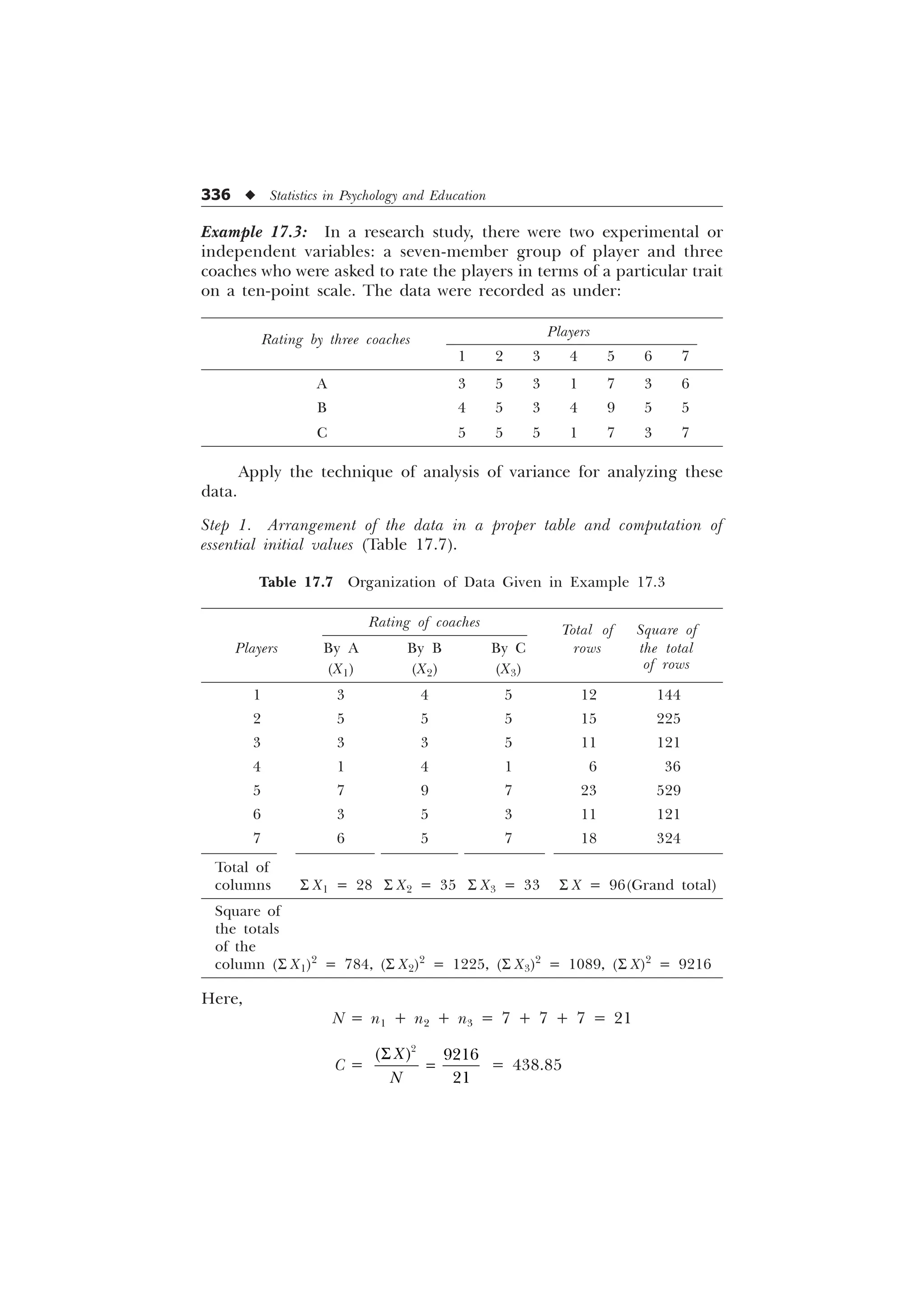
  • 370.
    358 u Statisticsin Psychology and Education 7. Class interval f 57–59 2 54–56 3 51–53 8 48–50 3 45–47 4 42–44 3 39–41 8 36–38 5 33–35 3 30–32 1 N = 40 9. Class Cumulative percentage interval f cf frequencies 85–89 2 40 100.00 80–84 2 38 95.00 75–79 4 36 90.00 70–74 6 32 80.00 65–69 5 26 65.00 60–64 4 21 52.50 55–59 5 17 42.50 50–54 2 12 30.00 45–49 2 10 25.00 40–44 4 8 20.00 35–39 1 4 10.00 30–34 2 3 7.50 25–29 1 1 2.50 N = 40 Chapter 4 6. (a) Mean (b) Mode (c) Median 7. 104 8. (a) 9 (b) 71 9. (a) 14 (b) 4 10. M = 72.66 and Md = 72.25 11. (a) (b) (c) (d) M 19.9 15.6 20.4 10.8 Md 20.5 14.2 21.0 10.3 Mo — 14.0 — 10.0
  • 371.
    12. (a) (b)(c) (d) M 61.11 106.00 25.05 99.3 Md 61.21 105.83 25.17 99.3 Mo 61.41 105.49 25.41 99.3 13. (a) (b) (c) (d) M 77.5 41.9 34.6 66.58 Md 80.9 41.7 34.25 67.36 Mo 87.7 41.3 33.55 68.92 Chapter 5 5. (c) (d) Q1 20.3 90.40 Q3 29.3 108.14 D1 15.8 82.29 P90 33.6 115.75 6. (i) (ii) (iii) (a) P30 24.13 11.53 40.82 P70 30.5 18.37 52.54 P85 33.2 21.22 58.77 P90 34.4 24.80 62.00 (b) PR of 14 3 45 — PR of 20 17 79 — PR of 26 40 97 1 PR of 38 99 — 19 7. Scores: 42 60 31 50 71 PR: 30 70 10 50 90 Chapter 6 7. Problem 12 of Chapter 4 (a) (b) (c) (d) SD 5.02 7.23 7.7 13.4 Q 3.1 4.5 4.51 8.86 Problem 13 of Chapter 4 (a) (b) (c) (d) SD 13.55 7.3 9.61 11.84 Q 9.79 5.72 5.7 7.92 Answers u 359
  • 372.
    360 u Statisticsin Psychology and Education 8. AD = 3.9, SD = 4.68 9. AD = 2.04 10. (a) 10.22 (b) 4.16 (c) 14.9 Chapter 7 10. (a) 0.86 (b) 0.96 (c) 0.79 11. (a) 0.65 (b) 0.76 12. (a) 0.14 (b) 0.65 13. (a) 0.524 (b) 0.56 (c) 0.508 Chapter 8 6. 1.25s and 3.78s; he did better in Physics 7. (a) 32.79 percent (b) 16.9 percent (c) 11.51 percent 8. (a) 50.65 and 57.35 (b) 50.65 and 57.35 (c) 435 9. (a) 10.46 percent (b) 24.6 and 32.4 10. (a) 0.99 percent (b) 9.18 percent (c) 25.14 percent (d) 90.50 percent 11. (a) 119 (b) 96 (c) 75 percent (d) 107 (e) 85 to 115 12. 1.036s, 0, –0.253s, –0.675s 13. 22 percent 14. 7, 28, 79, 160, 226, 226, 160, 79, 28, 7 15. Grade Score interval Grade Score interval A 62.8 D 37.2–44.8 B 55.2–62.8 E –37.2 C 44.8–55.2 Chapter 9 9. Sample A Sample B Sample C At 0.05 18.087–61.913 44.412–45.588 58.935–61.065 At 0.01 11.156–68.844 44.226–45.774 58.525–61.475
  • 373.
    Sample D SampleE Sample F At 0.05 49.479–50.521 28.764–31.236 79.06–80.94 At 0.01 49.314–50.686 28.320–31.680 78.76–81.24 10. (a) Not significantly different from zero at both 0.05 and 0.01 levels. (b) Significantly different from zero at 0.05 level but not at 0.01 level. 11. (a) SEr = 0.107 Interval at 0.05 = 0.270–0.690 at 0.01 = 0.204–0.756 (b) At 0.05 = 0.24–0.665, at 0.01 = 0.15–0.71 (c) 0.273 and 0.354, significant at both 0.05 and 0.01 levels. 12. At 0.05 level 29.418–31.382 At 0.01 level 29.107–31.693 Chapter 10 5. z = 4.12; significant at both 5 percent and 1 percent levels. 6. t = 3.70; null hypothesis rejected; the weight gain is significant. 7. z = 1.91; not significant, null hypothesis is not rejected; we have insufficient evidence of any sex difference in the attitudes as assessed by the given attitude scale. 8. (a) z = 1.5, not significant. (b) Difference should be 7.22 for being significant at 0.01 level. 9. t = 0.80, not significant at 0.05 level; null hypothesis not rejected. 10. t = 4.81, not significant at both the levels. 11. z = 2.86, significant at both 0.05 and 0.01 levels. 12. t = 3.75, significant, null hypothesis rejected. 13. z = 2.34, significant at 0.05 level. Praise has a significant effect in increasing the scores. 14. t = 3.04, significant at both levels, null hypothesis rejected. Chapter 11 6. c2 = 4, significant at 5% level; hypothesis rejected. 7. c2 = 7.20, significant, hypothesis rejected. Answers u 361
  • 374.
    362 u Statisticsin Psychology and Education 8. c2 = 5.71, significant. 9. c2 = 6, significant, hypothesis rejected. 10. c2 = 3, not significant. 11. c2 = 15.56, significant, hypothesis rejected. 12. c2 = 5.90, not significant, hypothesis not rejected. 13. c2 = 34.209, significant, opinions are not independent. 14. c2 = 32.473, C = 0.37, significant. 15. c2 = 1.24, non-significant, preference independent of class. 16. c2 = 2.08, (after making Yates’ correction), not significant, hypothesis not rejected. 17. c2 = 0.17, not significant, preference of a method indepen- dent of the sex of the teacher educator. 18. c2 = 0.633, not significant, independent of the treatment applied. 19. c2 = 14.10, significant, hypothesis of no difference rejected implying that preference for a drink depends upon the status of the employee. Chapter 12 6. rbis = 0.71 7. (a) rbis = 0.508 (b) rbis = 0.34 8. (a) rp,bis = 0.54 (b) rp,bis = 0.56 9. (a) rt = 0.59 (b) rt = 0.326 10. (a) f = –0.12 (b) f = 0.36 Chapter 13 3. 0.72 4. (i) 0.04 (ii) 0.38 5. 0.67 6. 0.79 Chapter 14 2. (a) Y = 0.9X + 7.5 (b) 43.5 (c) 45 X = Y – 5
  • 375.
    3. (a) Y= 0.72X + 68.95, (b) 45.16 X = 0.37Y + 8.16 4. (a) Y = 2.8X – 14 (b) 28 (c) 7 X = 0.318Y – 5.548 6. (a) ; = 0.533X2 + 0.96X3 + 16.2 (b) ; = 86.58 7. (a) ; = 0.35X2 + 0.25X3 + 54.5 (b) ; = 72 Chapter 15 6. (i) Sweeti (ii) Rani, Anita, and Sweeti performed better in grammar. 7. Sweeti (She scored 183 while Rani and Anita scored 180 and 182, respcetively). 10. Ajay performed better than Vijay with a total scores of 160 in comparison to Vijay who earned scores of 151. Chapter 16 10. There is a significant change in attitude after the motivation lecture at 0.05 level. 11. There is a significant difference between the ratings of the two panels at 0.05 level. 12. There is a significant difference between the scores of two groups at 0.05 level. 13. There is no significant difference between the medians of the adjustment scores of the two groups at 0.05 level. 14. There is no significant difference between the scores of two groups at 0.05 level. 15. Rural and urban children differ significantly in terms of physical fitness at the 0.05 level. 16. Null hypothesis is rejected. The student’s choice of a particular area is significantly related to the in-charge of that area. 17. Rural and urban children differ significantly in terms of physical fitness at the 0.05 as well as 0.01 levels 18. Male and female teachers differ significantly in terms of their adjustment at 0.05 level. Answers u 363
  • 376.
    364 u Statisticsin Psychology and Education 19. Male and female teachers differ significantly with regard to teacher effectiveness at 0.05 level. 20. Boys and girls differ significantly in terms of their personality make-up at 0.05 level. Chapter 17 5. F = 6.38, significant; null hypothesis rejected. 6. F = 1.18, not significant; null hypothesis not rejected. 7. F = 2.06, significant; null hypothesis rejected. 8. F = 29.47, significant; null hypothesis rejected. 9. F = 2.48 and 1.29, not significant; null hypothesis not rejected in both cases. 10. F = 4.63 and 10.65, significant; null hypothesis rejected in both cases. Chapter 18 4. Methods differences are not significant. 5. Treatment differences are significant. Treatment two is better than others. 6. Methods differences are not significant.
  • 377.
    365 Appendix Table A Squareand Square Roots of Numbers from 1 to 1000 Number Square S.R. Number Square S.R. 1 1 1.0000 41 1681 6.4031 2 4 1.4142 42 1764 6.4807 3 9 1.7321 43 1849 6.5574 4 16 2.0000 44 1936 6.6332 5 25 2.2361 45 2025 6.7082 6 36 2.4495 46 2116 6.7823 7 49 2.6458 47 2209 6.8557 8 64 2.8284 48 2304 6.9282 9 81 3.0000 49 2401 7.0000 10 100 3.1623 50 2500 7.0711 11 121 3.3166 51 2601 7.1414 12 144 3.4641 52 2704 7.2111 13 169 3.6056 53 2809 7.2801 14 196 3.7417 54 2916 7.3485 15 225 3.8730 55 3025 7.4162 16 256 4.0000 56 3136 7.4833 17 289 4.1231 57 3249 7.5498 18 324 4.2426 58 3364 7.6158 19 361 4.3589 59 3481 7.6811 20 400 4.4721 60 3600 7.7460 21 441 4.5826 61 3721 7.8102 22 484 4.6904 62 3844 7.8740 23 529 4.7958 63 3969 7.9373 24 576 4.8990 64 4096 8.0000 25 625 5.0000 65 4225 8.0623 26 676 5.0990 66 4356 8.1240 27 729 5.1962 67 4489 8.1854 28 784 5.2915 68 4624 8.2462 29 841 5.3852 69 4761 8.3066 30 900 5.4772 70 4900 8.3666 31 961 5.5678 71 5041 8.4261 32 1024 5.6569 72 5184 8.4863 33 1089 5.7446 73 5329 8.5440 34 1156 5.8310 74 5476 8.6023 35 1225 5.9161 75 5625 8.6603 36 1296 6.0000 76 5776 8.7178 37 1369 6.0828 77 5929 8.7750 38 1444 6.1644 78 6084 8.8318 39 1521 6.2450 79 6241 8.8882 40 1600 6.3245 80 6400 8.9443
  • 378.
    366 u Statisticsin Psychology and Education Table A Square and Square Roots of Numbers from 1 to 1000 (cont.) Number Square S.R. Number Square S.R. 81 6561 9.0000 132 17424 11.4891 82 6724 9.0554 133 17689 11.5326 83 6889 9.1104 134 17956 11.5758 84 7056 9.1652 135 18225 11.6190 85 7225 9.2195 136 18496 11.6619 86 7396 9.2736 137 18769 11.7047 87 7569 9.3274 138 19044 11.7473 88 7744 9.3808 139 19321 11.7898 89 7921 9.4340 140 19600 11.8322 90 8100 9.4868 141 19881 11.8743 91 8281 9.5394 142 20164 11.9164 92 8464 9.5917 143 20449 11.9583 93 8649 9.6437 144 20736 12.0000 94 8836 9.6954 145 21025 12.0416 95 9025 9.7468 146 21316 12.0830 96 9216 9.7980 147 21609 12.1244 97 9409 9.8489 148 21904 12.1655 98 9604 9.8995 149 22801 12.2066 99 9801 9.9499 150 22500 12.2474 100 10000 10.0000 151 22801 12.2882 101 10201 10.0499 152 23104 12.3288 102 10404 10.0995 153 23409 12.3693 103 10609 10.1489 154 23716 12.4097 104 10816 10.1980 155 24025 12.4499 105 11025 10.2470 156 24336 12.4900 106 11236 10.2956 157 24649 12.5300 107 11449 10.3441 158 24964 12.5698 108 11664 10.3923 159 25281 12.6095 109 11881 10.4403 160 25600 12.6491 110 12100 10.4881 161 25921 12.6886 111 12321 10.5357 162 26244 12.7279 112 12544 10.5830 163 26569 12.7671 113 12769 10.6301 164 26896 12.8062 114 12996 10.6771 165 27225 12.8452 115 13225 10.7238 166 27556 12.8841 116 13456 10.7703 167 27889 12.9228 117 13689 10.8167 168 28224 12.9615 118 13924 10.8628 169 28561 13.0000 119 14161 10.9087 170 28900 13.0384 120 14400 10.9545 171 29241 13.0767 121 14641 11.0000 172 29584 13.1149 122 14884 11.0454 173 29929 13.1529 123 15129 11.0905 174 30276 13.1909 124 15376 11.1355 175 30625 13.2288 125 15625 11.1803 176 30976 13.2665 126 15876 11.2250 177 31329 13.3041 127 16129 11.2694 178 31684 13.3417 128 16384 11.3137 179 32041 13.3791 129 16641 11.3578 180 32400 13.4164 130 16900 11.4018 181 32761 13.4536 131 17161 11.4455 182 33124 13.4907
  • 379.
    Appendix u 367 TableA Square and Square Roots of Numbers from 1 to 1000 (cont.) Number Square S.R. Number Square S.R. 183 33489 13.5277 235 55225 15.3297 184 33856 13.5647 236 55696 15.3623 185 34225 13.6015 237 56169 15.3948 186 34596 13.6382 238 56644 15.4272 187 34969 13.6748 239 57121 15.4596 188 35344 13.7113 240 57600 15.4919 189 35721 13.7477 241 58081 15.5242 190 36100 13.7840 242 58564 15.5563 191 36481 13.8203 243 59049 15.5885 192 36864 13.8564 244 59536 15.6205 193 37249 13.8924 245 60025 15.6525 194 37636 13.9284 246 60516 15.6844 195 38025 13.9642 247 61009 15.7162 196 38416 14.0000 248 61504 15.7480 197 38809 14.0357 249 62001 15.7797 198 39204 14.0712 250 62500 15.8114 199 39601 14.1067 251 63001 15.8430 200 40000 14.1421 252 63504 15.8745 201 40401 14.1774 253 64009 15.9060 202 40804 14.2127 254 64516 15.9374 203 41209 14.2478 255 65025 15.9687 204 41616 14.2829 256 65536 16.0000 205 42025 14.3178 257 66049 16.0322 206 42436 14.3527 258 66564 16.0624 207 42849 14.3875 259 67081 16.0935 208 43264 14.4222 260 67600 16.1245 209 43681 14.4568 261 68121 16.1555 210 44100 14.4914 262 68644 16.1864 211 44521 14.5258 263 69169 16.2173 212 44944 14.5602 264 69696 16.2481 213 45369 14.5945 265 70225 16.2788 214 45796 14.6287 266 70756 16.3095 215 46225 14.6629 267 71289 16.3401 216 46656 14.6969 268 71824 16.3707 217 47089 14.7309 269 72361 16.4012 218 47524 14.7648 270 72900 16.4317 219 47961 14.7986 271 73441 16.4621 220 48400 14.8324 272 73984 16.4924 221 48841 14.8661 273 74529 16.5227 222 49284 14.8997 274 75076 16.5529 223 49729 14.9332 275 75625 16.5831 224 50176 14.9666 276 76176 16.6132 225 50625 15.0000 277 76729 16.6433 226 51076 15.0333 278 77284 16.6733 227 51529 15.0665 279 77841 16.7033 228 51984 15.0997 280 78400 16.7332 229 52441 15.1327 281 78961 16.7631 230 52900 15.1658 282 79524 16.7929 231 53361 15.1987 283 80089 16.8226 232 53824 15.2315 284 80756 16.8523 233 54289 15.2643 285 81225 16.8819 234 54756 15.2971 286 81796 16.9115
  • 380.
    368 u Statisticsin Psychology and Education Table A Square and Square Roots of Numbers from 1 to 1000 (cont.) Number Square S.R. Number Square S.R. 287 82369 16.9411 338 114244 18.3848 288 82944 16.9706 339 114921 18.4120 289 83521 17.0000 340 115600 18.4391 290 84100 17.0294 341 116281 18.4662 291 84681 17.0587 342 116964 18.4932 292 85264 17.0880 343 117649 18.5303 293 85849 17.1172 344 118336 18.5472 294 86436 17.1464 345 119025 18.5742 295 87025 17.1756 346 119716 18.6011 296 87616 17.2047 347 120409 18.6279 297 88209 17.2337 348 121104 18.6548 298 88804 17.2627 349 121801 18.6815 299 89401 17.2916 350 122500 18.7083 300 90000 17.3205 351 123201 18.7350 301 90601 17.3494 352 123904 18.7617 302 91204 17.3781 353 124609 18.7883 303 91809 17.4069 354 125316 18.8149 304 92416 17.4356 355 126025 18.8414 305 93025 17.4642 356 126736 18.8680 306 93636 17.4929 357 127449 18.8944 307 94249 17.5214 358 128164 18.9209 308 94864 17.5499 359 128881 18.9473 309 95481 17.5784 360 129600 18.9737 310 96100 17.6068 361 130321 19.0000 311 96721 17.6352 362 131044 19.0263 312 97344 17.6635 363 131769 19.0526 313 97969 17.6918 364 132496 19.0788 314 98596 17.7200 365 133225 19.1050 315 99225 17.7482 366 133956 19.1311 316 99856 17.7764 367 134689 19.1572 317 100489 17.8045 368 135424 19.1833 318 101124 17.8326 369 136161 19.2094 319 101761 17.8606 370 136900 19.2354 320 102400 17.8885 371 137641 19.2614 321 103041 17.9165 372 138384 19.2873 322 103684 17.9444 373 139129 19.3132 323 104329 17.9722 374 139876 19.3391 324 104976 18.0000 375 140625 19.3649 325 105625 18.0278 376 141376 19.3907 326 106276 18.0555 377 142129 19.4165 327 106929 18.0831 378 142884 19.4422 328 107584 18.1108 379 143641 19.4679 329 108241 18.1384 380 144400 19.4936 330 108900 18.1659 381 145161 19.5192 331 109561 18.1934 382 145924 19.5448 332 110224 18.2209 383 146689 19.5704 333 110889 18.2483 384 147456 19.5959 334 111556 18.2757 385 148225 19.6214 335 112225 18.3030 386 148996 19.6469 336 112896 18.3303 387 149769 19.6723 337 113569 18.3576 388 150544 19.6977
  • 381.
    Appendix u 369 TableA Square and Square Roots of Numbers from 1 to 1000 (cont.) Number Square S.R. Number Square S.R. 389 151321 19.7231 441 194481 21.0000 390 152100 19.7484 442 195364 21.0238 391 152881 19.7737 443 196249 21.0476 392 153664 19.7990 444 197136 21.0713 393 154449 19.8242 445 198025 21.0950 394 155236 19.8494 446 198916 21.1187 395 156025 19.8746 447 199809 21.1424 396 156816 19.8997 448 200704 21.1660 397 157609 19.9249 449 201601 21.1896 398 158404 19.9499 450 202500 21.2132 399 159201 19.9750 451 203401 21.2368 400 160000 20.0000 452 204304 21.2603 401 160801 20.0250 453 205209 21.2818 402 161604 20.0499 454 206116 21.3073 403 162409 20.0749 455 207025 21.3307 404 163216 20.0998 456 207936 21.3542 405 164025 20.1246 457 208849 21.3776 406 164836 20.1494 458 209764 21.4009 407 165649 20.1742 459 210681 21.4243 408 166464 20.1990 460 211600 21.4476 409 167281 20.2237 461 212521 21.4709 410 168100 20.2485 462 213444 21.4942 411 168921 20.2731 463 214369 21.5174 412 169744 20.2978 464 215296 21.5407 413 170569 20.3224 465 216225 21.5639 414 171396 20.3470 466 217156 21.5870 415 172225 20.3715 467 218089 21.6102 416 173056 20.3961 468 219024 21.6333 417 173889 20.4206 469 219961 21.6564 418 174724 20.4450 470 220900 21.6795 419 175561 20.4695 471 221841 21.7025 420 176400 20.4939 472 222784 21.7256 421 177241 20.5183 473 223729 21.7486 422 178024 20.5436 474 224676 21.7715 423 178929 20.5670 475 225625 21.7945 424 179976 20.5913 476 226576 21.8174 425 180625 20.6155 477 227529 21.8403 426 181476 20.6398 478 228484 21.8632 427 182329 20.6640 479 229441 21.8861 428 183184 20.6882 480 230400 21.9089 429 184041 20.7123 481 231361 21.9317 430 184900 20.7364 482 232324 21.9545 431 185761 20.7605 483 233289 21.9773 432 186624 20.7846 484 234256 22.0000 433 187489 20.8087 485 235225 22.0327 434 188356 20.8327 486 236196 22.0454 435 189225 20.8567 487 237169 22.0681 436 190096 20.8806 488 238144 22.0907 437 190969 20.9245 489 239121 22.1133 438 191844 20.9284 490 240100 22.1359 439 192721 20.9523 491 241081 22.1585 440 193600 20.9762 492 242064 22.1811
  • 382.
    370 u Statisticsin Psychology and Education Table A Square and Square Roots of Numbers from 1 to 1000 (cont.) Number Square S.R. Number Square S.R. 493 243049 22.2036 544 295936 23.3238 494 244036 22.2261 545 297025 23.3452 495 245025 22.2486 546 298116 23.3666 496 246016 22.2711 547 299209 23.3880 497 247009 22.2935 548 300304 23.4094 498 248004 22.3159 549 301401 23.4307 499 249001 22.3383 550 302500 23.4521 500 250000 22.3607 551 303601 23.4734 501 251001 22.3830 552 304704 23.4947 502 252004 22.4054 553 305809 23.5160 503 253009 22.4277 554 306916 23.5372 504 254016 22.4499 555 308025 23.5584 505 255025 22.4722 556 309136 23.5797 506 256036 22.4944 557 310249 23.6008 507 257049 22.5167 558 311364 23.6220 508 258064 22.5389 559 312481 23.6432 509 259081 22.5610 560 313600 23.6643 510 260100 22.5832 561 314721 23.6854 511 261121 22.6053 562 315844 23.7065 512 262144 22.6274 563 316969 23.7276 513 263169 22.6495 564 318059 23.7487 514 264196 22.6716 565 319225 23.7697 515 265225 22.6936 566 320356 23.7908 516 266256 22.7156 567 321489 23.8118 517 267289 22.7376 568 322624 23.8328 518 268324 22.7596 569 323761 23.8537 519 269361 22.7816 570 324900 23.8747 520 270400 22.8035 571 326041 23.8956 521 271441 22.8254 572 327184 23.9165 522 272484 22.8473 573 328329 23.9374 523 273529 22.8692 574 329476 23.9583 524 274576 22.8910 575 330625 23.9792 525 275625 22.9129 576 331776 24.0000 526 276676 22.9347 577 332929 24.0208 527 277729 22.9565 578 334084 24.0416 528 278784 22.9783 579 335241 24.0624 529 279841 23.0000 580 336400 24.0832 530 280900 23.0217 581 337561 24.1039 531 281961 23.0434 582 338724 24.1247 532 283024 23.0651 583 339889 24.1454 533 284089 23.0868 584 341056 24.1661 534 285156 23.1084 585 342225 24.1868 535 286225 23.1301 586 343396 24.2074 536 287296 23.1517 587 344569 24.2281 537 288369 23.1733 588 345844 24.2487 538 289444 23.1948 589 346921 24.2693 539 290521 23.2164 590 348100 24.2899 540 291600 23.2379 591 349281 24.3105 541 292681 23.2594 592 350464 24.3311 542 293764 23.2809 593 351649 24.3516 543 294849 23.3024 594 352836 24.3721
  • 383.
    Appendix u 371 TableA Square and Square Roots of Numbers from 1 to 1000 (cont.) Number Square S.R. Number Square S.R. 595 354025 24.3926 647 418609 25.4362 596 355216 24.4131 648 419904 25.4558 597 356409 24.4336 649 421201 25.4755 598 357604 24.4540 650 422500 25.4951 599 358890 24.4745 651 423801 25.5147 600 360000 24.4949 652 425104 25.5343 601 361201 24.5153 653 426409 25.5539 602 362404 24.5357 654 427716 25.5734 603 363609 24.5561 655 429025 25.5930 604 364816 24.5764 656 430336 25.6125 605 366025 24.5967 657 431649 25.6320 606 367236 24.6171 658 432964 25.6515 607 368449 24.6374 659 434281 25.6710 608 369664 24.6577 660 435600 25.6905 609 370881 24.6779 661 436921 25.7099 610 372100 24.6982 662 438244 25.7294 611 373321 24.7184 663 439569 25.7488 612 374544 24.7385 664 440896 25.7682 613 375769 24.7588 665 442225 25.7876 614 376996 24.7790 666 443556 25.8070 615 378225 24.7992 667 444889 25.8263 616 379456 24.8193 668 446224 25.8457 617 380689 24.8395 669 447461 25.8650 618 381924 24.8596 670 448900 25.8844 619 383161 24.8997 671 450241 25.9037 620 384400 24.8998 672 451584 25.9230 621 385641 24.9199 673 452929 25.9422 622 386884 24.9399 674 454276 25.9615 623 388129 24.9600 675 455625 25.9808 624 389376 24.9800 676 456976 26.0000 625 390625 25.0000 677 458329 26.0192 626 391876 25.0200 678 459684 26.0384 627 393129 25.0400 679 461041 26.0576 628 394384 25.0599 680 462400 26.0768 629 395641 25.0796 681 463761 26.0960 630 396900 25.0998 682 465124 26.1151 631 398161 25.1197 683 466489 26.1343 632 399424 25.1396 684 467856 26.1534 633 400689 25.1595 685 469225 26.1725 634 401956 25.1794 686 470596 26.1916 635 403225 25.1992 687 471969 26.2107 636 404496 25.2190 688 473344 26.2298 637 405769 25.2389 689 474721 26.2488 638 407044 25.2587 690 476100 26.2679 639 408321 25.2784 691 477481 26.2869 640 409600 25.2982 692 478864 26.3059 641 410881 25.3180 693 480249 26.3249 642 412164 25.3377 694 481636 26.3439 643 413449 25.3574 695 483025 26.3629 644 414736 25.3772 696 484416 26.3818 645 416025 25.3969 697 485809 29.4008 646 417316 25.4165 698 487204 26.4197
  • 384.
    372 u Statisticsin Psychology and Education Table A Square and Square Roots of Numbers from 1 to 1000 (cont.) Number Square S.R. Number Square S.R. 699 488601 26.4386 750 562500 27.3861 700 490000 26.4575 751 564001 27.4044 701 491401 26.4764 752 565504 27.4226 702 492804 26.4953 753 567009 27.4408 703 494209 26.5141 754 568516 27.4591 704 495616 26.5330 755 570025 27.4773 705 497025 26.5518 756 571536 27.4955 706 498436 26.5707 757 573049 27.5136 707 499849 26.5895 758 574564 27.5318 708 501264 26.6083 759 576081 27.5500 709 502681 26.6271 760 577600 27.5681 710 504100 26.6458 761 579121 27.5862 711 505521 26.6646 762 580644 27.6043 712 506944 26.6833 763 582169 27.6225 713 508369 26.7021 764 583696 27.6405 714 509796 26.7208 765 585225 27.6586 715 511225 26.7395 766 586756 27.6767 716 512656 26.7582 767 588289 27.6948 717 514089 26.7769 768 589824 27.7128 718 515524 26.7955 769 591361 27.7308 719 516961 26.8142 770 592900 27.7489 720 518400 26.8328 771 594441 27.7669 721 519841 26.8514 772 595984 27.7849 722 521284 26.8701 773 597529 27.8029 723 522729 26.8887 774 599076 27.8209 724 524176 26.9072 775 600625 27.8388 725 525625 26.9258 776 602176 27.8568 726 527076 26.9444 777 603729 27.8747 727 528529 26.9629 778 605284 27.8927 728 529984 26.9815 779 606841 27.9106 729 531441 27.0000 780 608400 27.9285 730 532900 27.0185 781 609961 27.9464 731 534361 27.0370 782 611524 27.9643 732 535824 27.0555 783 613089 27.9821 733 537289 27.0740 784 614656 28.0000 734 538756 27.0924 785 616225 28.0179 735 540225 27.1109 786 617796 28.0353 736 541696 27.1293 787 619369 28.0535 737 543169 27.1477 788 620944 28.0713 738 544644 27.1662 789 622521 28.0891 739 546127 27.1846 790 624100 28.1069 740 547600 27.2029 791 625681 28.1247 741 549081 27.2213 792 627264 28.1425 742 550564 27.2397 793 628849 28.1603 743 552049 27.2580 794 630436 28.1780 744 553536 27.2764 795 632025 28.1957 745 555025 27.2947 796 633616 28.2135 746 556516 27.3130 797 635209 28.2312 747 558009 27.3313 798 636804 28.2489 748 559504 27.3496 799 638401 28.2666 749 561001 27.3675 800 640000 28.2843
  • 385.
    Appendix u 373 TableA Square and Square Roots of Numbers from 1 to 1000 (cont.) Number Square S.R. Number Square S.R. 801 641601 28.3019 853 727609 29.2062 802 643204 28.3196 854 729316 29.2233 803 644809 28.3373 855 731025 29.2404 804 646416 28.3549 856 732736 29.2575 805 648025 28.3725 857 734449 29.2746 806 649636 28.3901 858 736164 29.2916 807 651249 28.4077 859 737881 29.3087 808 652864 28.4253 860 739600 29.3258 809 654481 28.4429 861 741321 29.3428 810 656100 28.4605 862 743044 29.3598 811 657721 28.4781 863 744769 29.3769 812 659344 28.4956 864 746496 29.3939 813 660969 28.5132 865 748225 29.4109 814 662596 28.5307 866 749956 29.4279 815 664225 28.5482 867 751689 29.4449 816 665856 28.5657 868 753424 29.4618 817 667489 28.5832 869 755161 29.4788 818 669124 28.6007 870 756900 29.4958 819 670761 28.6082 871 758641 29.5127 820 672400 28.6356 872 760384 29.5296 821 674041 28.6531 873 762129 29.5466 822 675684 28.6705 874 763876 29.5635 823 677329 28.6880 875 765625 29.5804 824 678976 28.7054 876 767376 29.5973 825 680625 28.7228 877 769129 29.6142 826 682276 28.7402 878 770884 29.6311 827 683929 28.7576 879 772641 29.6479 828 685584 28.7750 880 774400 29.6648 829 687241 28.7924 881 776161 29.6816 830 688900 28.8097 882 777924 29.6984 831 690561 28.8271 883 779689 29.7153 832 692224 28.8444 884 781456 29.7321 833 693889 28.8617 885 783225 29.7489 834 695556 28.8791 886 784996 29.7658 835 697225 28.8964 887 786769 29.7825 836 698896 28.9137 888 788544 29.7993 837 700569 28.9310 889 790321 29.8161 838 702244 28.9482 890 792100 29.8329 839 703921 28.9655 891 793881 29.8496 840 705600 28.9828 892 795664 29.8664 841 707281 29.0000 893 797449 29.8831 842 708964 29.0172 894 799236 29.8998 843 710649 29.0345 895 801025 29.9166 844 712336 29.0517 896 802816 29.9333 845 714025 29.0689 897 804609 29.9500 846 715716 29.0861 898 806404 29.9666 847 717409 29.1033 899 808201 29.9833 848 719104 29.1204 900 810000 30.0000 849 720801 29.1376 901 811801 30.0167 850 722500 29.1548 902 813604 30.0333 851 724201 29.1719 903 815409 30.0500 852 725904 29.1890 904 817216 30.0666
  • 386.
    374 u Statisticsin Psychology and Education Table A Square and Square Roots of Numbers from 1 to 1000 (cont.) Number Square S.R. Number Square S.R. 905 819025 30.0832 953 908209 30.8707 906 820836 30.0998 954 910116 30.8869 907 822649 30.1164 955 912025 30.9031 908 824464 30.1330 956 913936 30.9192 909 826281 30.1496 957 915849 30.9354 910 828100 30.1662 958 917764 30.9516 911 829921 30.1828 959 919681 30.9677 912 831744 30.1993 960 921600 30.9839 913 833569 30.2159 961 923521 31.0000 914 835396 30.2324 962 925444 31.0161 915 837225 30.2490 963 927369 31.0322 916 839056 30.2655 964 929296 31.0483 917 840889 30.2820 965 931225 31.0644 918 842724 30.2985 966 933156 31.0805 919 844561 30.3150 967 935089 31.3966 920 846400 30.3315 968 937024 31.1127 921 848241 30.3480 969 938961 31.1288 922 850084 30.3645 970 940900 31.1448 923 851929 30.3809 971 942841 31.1609 924 853776 30.3974 972 944784 31.1769 925 855625 30.4138 973 946729 31.1929 926 857476 30.4302 974 948676 31.2090 927 859329 30.4467 975 950625 31.2250 928 861184 30.4631 976 952576 31.2410 929 863041 30.4795 977 954529 31.2570 930 864900 30.4959 978 956484 31.2730 931 866761 30.5123 979 958441 31.2890 932 868624 30.5287 980 960400 31.3050 933 870489 30.5450 981 962361 31.3209 934 872356 30.5614 982 964324 31.3369 935 874225 30.5778 983 966289 31.3528 936 876096 30.5941 984 968256 31.3688 937 877969 30.6105 985 970225 31.3847 938 879844 30.6268 986 972197 31.4006 939 881721 30.6431 987 974169 31.4166 940 883600 30.6594 988 976144 31.4325 941 885481 30.6757 989 978121 31.4484 942 887364 30.6920 990 980100 31.4643 943 889249 30.7083 991 982081 31.4802 944 891136 30.7246 992 984064 31.4960 945 893025 30.7409 993 986049 31.5119 946 894916 30.7581 994 988036 31.5278 947 896809 30.7734 995 990025 31.5436 948 898704 30.7896 996 992016 31.5595 949 900601 30.8058 997 994009 31.5753 950 902500 30.8221 998 996004 31.5911 951 904401 30.8383 999 998001 31.6070 952 906304 30.8545 1000 1000000 31.6228
  • 387.
    Appendix u 375 TableB Areas of the Normal Curve (proportions out of 10,000) and Critical Values of z (i.e. x/s) x/s .00 .01 .02 .03 .04 .05 .06 .07 .08 .09 0.0 0000 0040 0080 0120 0160 0199 0239 0279 0319 0359 0.1 0398 0438 0478 0517 0557 0596 0636 0675 0714 0753 0.2 0793 0832 0871 0910 0948 0987 1026 1064 1103 1141 0.3 1179 1217 1255 1293 1331 1368 1406 1443 1480 1517 0.4 1554 1591 1628 1664 1700 1736 1772 1808 1844 1879 0.5 1915 1950 1985 2019 2054 2088 2123 2157 2190 2224 0.6 2257 2291 2324 2357 2389 2422 2454 2486 2517 2549 0.7 2580 2611 2642 2673 2704 2734 2764 2794 2823 2852 0.8 2881 2910 2939 2967 2995 3023 3051 3078 3106 3133 0.9 3159 3186 3212 3238 3264 3290 3315 3340 3365 3389 1.0 3413 3438 3461 3485 3508 3531 3554 3577 3599 3621 1.1 3643 3665 3686 3708 3729 3749 3770 3790 3810 3830 1.2 3849 3869 3888 3907 3925 3944 3962 3980 3997 4015 1.3 4032 4049 4066 4082 4099 4115 4131 4147 4162 4177 1.4 4192 4207 4222 4236 4251 4265 4279 4292 4306 4319 1.5 4332 4345 4357 4370 4383 4394 4406 4418 4429 4441 1.6 4452 4463 4474 4484 4495 4505 4515 4525 4535 4545 1.7 4554 4564 4573 4582 4591 4599 4608 4616 4625 4633 1.8 4641 4649 4656 4664 4671 4678 4686 4693 4699 4706 1.9 4713 4719 4726 4732 4738 4744 4750 4756 4761 4767 2.0 4772 4778 4783 4788 4793 4798 4803 4808 4812 4817 2.1 4821 4826 4838 4834 4838 4842 4846 4850 4854 4857 2.2 4861 4864 4868 4871 4875 4878 4881 4884 4887 4890 2.3 4893 4896 4898 4901 4904 4906 4909 4911 4913 4916 2.4 4918 4920 4922 4925 4927 4929 4931 4932 4934 4936 2.5 4938 4940 4941 4943 4945 4946 4948 4949 4951 4952 2.6 4953 4955 4956 4957 4959 4960 4961 4962 4963 4964 2.7 4965 4966 4967 4968 4969 4970 4971 4972 4973 4974 2.8 4974 4975 4976 4977 4977 4978 4979 4979 4980 4981 2.9 4981 4982 4982 4983 4984 4984 4985 4985 4986 4986 3.0 4986.5 4986.9 4987.4 4987.8 4988.2 4988.6 4988.9 4989.3 4989.7 4990.0 3.1 4990.3 4990.0 4991.0 4991.3 4991.6 4991.8 4992.1 4992.4 4992.6 4992.9 3.2 4993.129 3.3 4995.166 3.4 4996.631 3.5 4997.674 3.6 4998.409 3.7 4998.922 3.8 4999.277 3.9 4999.519 4.0 4999.683 4.5 4999.966 5.0 4999.997133
  • 388.
    376 u Statisticsin Psychology and Education Table C Critical Values of t Degrees of Probability P freedom 0.10 0.05 0.02 0.01 1 t = 6.34 t = 12.71 t = 31.82 t = 63.66 2 2.92 4.30 6.96 9.92 3 2.35 3.18 4.54 5.84 4 2.13 2.78 3.75 4.60 5 2.02 2.57 3.36 4.03 6 1.94 2.45 3.14 3.71 7 1.90 2.36 3.00 3.50 8 1.86 2.31 2.90 3.36 9 1.83 2.26 2.82 3.25 10 1.81 2.23 2.76 3.17 11 1.80 2.20 2.72 3.11 12 1.78 2.18 2.68 3.06 13 1.77 2.16 2.65 3.01 14 1.76 2.14 2.62 2.98 15 1.75 2.13 2.60 2.95 16 1.75 2.12 2.58 2.92 17 1.74 2.11 2.57 2.90 18 1.73 2.10 2.55 2.88 19 1.73 2.09 2.54 2.86 20 1.72 2.09 2.53 2.84 21 1.72 2.08 2.52 2.83 22 1.72 2.07 2.51 2.82 23 1.71 2.07 2.50 2.81 24 1.71 2.06 2.49 2.80 25 1.71 2.06 2.48 2.79 26 1.71 2.06 2.48 2.78 27 1.70 2.05 2.47 2.77 28 1.70 2.05 2.47 2.76 29 1.70 2.04 2.46 2.76 30 1.70 2.04 2.46 2.75 35 1.69 2.03 2.44 2.72 40 1.68 2.02 2.42 2.71 45 1.68 2.02 2.41 2.69 50 1.68 2.01 2.40 2.68 60 1.67 2.00 2.39 2.66 70 1.67 2.00 2.38 2.65 80 1.66 1.99 2.38 2.64 90 1.66 1.99 2.37 2.63 100 1.66 1.98 2.36 2.63 125 1.66 1.98 2.36 2.62 150 1.66 1.98 2.35 2.61 200 1.65 1.97 2.35 2.60 300 1.65 1.97 2.34 2.59 400 1.65 1.97 2.34 2.59 500 1.65 1.96 2.33 2.59 1000 1.65 1.96 2.33 2.58 ¥ 1.65 1.96 2.33 2.58
  • 389.
    Appendix u 377 TableD Conversion of the Value r into Fisher’s z Coefficient r z r z r z r z r z r z .25 .26 .40 .42 .55 .62 .70 .87 .85 1.26 .950 1.83 .26 .27 .41 .44 .56 .63 .71 .89 .86 1.29 .955 1.89 .27 .28 .42 .45 .57 .65 .72 .91 .87 1.33 .960 1.95 .28 .29 .43 .46 .58 .66 .73 .93 .88 1.38 .965 2.01 .29 .30 .44 .47 .59 .68 .74 .95 .89 1.42 .970 2.09 .30 .31 .45 .48 .60 .69 .75 .97 .90 1.47 .975 2.18 .31 .32 .46 .50 .61 .71 .76 1.00 .905 1.50 .980 2.30 .32 .33 .47 .51 .62 .73 .77 1.02 .910 1.53 .985 2.44 .33 .34 .48 .52 .63 .74 .78 1.05 .915 1.56 .990 2.65 .34 .35 .49 .54 .64 .76 .79 1.07 .920 1.59 .995 2.99 .35 .37 .50 .55 .65 .78 .80 1.10 .925 1.62 .36 .38 .51 .56 .66 .79 .81 1.13 .930 1.66 .37 .39 .52 .58 .67 .81 .82 1.16 .935 1.70 .38 .40 .53 .59 .68 .83 .83 1.19 .940 1.74 .39 .41 .54 .60 .69 .85 .84 1.22 .945 1.78 Note: r’s under .25 may be taken as equivalent to z’s. Table E Critical Values of r Example: Where N is 72 and df is 70, an r must be 0.232 to be significant at 0.05 level, and 0.302 to be significant at 0.01 level Degrees of Degrees of freedom (N – 2) 0.05 0.01 freedom (N – 2) 0.05 0.01 1 0.997 1.000 24 0.388 0.496 2 0.950 0.990 25 0.381 0.487 3 0.878 0.959 26 0.374 0.478 4 0.811 0.917 27 0.367 0.470 5 0.754 0.874 28 0.361 0.463 6 0.707 0.834 29 0.355 0.456 7 0.666 0.798 30 0.349 0.449 8 0.632 0.765 35 0.325 0.418 9 0.602 0.735 40 0.304 0.393 10 0.576 0.708 45 0.288 0.372 11 0.553 0.684 50 0.273 0.354 12 0.532 0.661 60 0.250 0.325 13 0.514 0.641 70 0.232 0.302 14 0.497 0.623 80 0.217 0.283 15 0.482 0.606 90 0.205 0.267 16 0.468 0.590 100 0.195 0.254 17 0.456 0.575 125 0.174 0.228 18 0.444 0.561 150 0.159 0.208 19 0.433 0.549 200 0.138 0.181 20 0.423 0.537 300 0.113 0.148 21 0.413 0.526 400 0.098 0.128 22 0.404 0.515 500 0.088 0.115 23 0.396 0.505 1000 0.062 0.081 Adapted from: H.E. Garrett, Statistics in Pyschology and Education, Vakils, Feffer and Simon, Bombay, 1971, p. 201.
  • 390.
    378 u Statisticsin Psychology and Education Table F Critical Values of c2 Levels of significance df 0.10 0.05 0.02 0.01 1 2.706 3.841 5.412 6.635 2 4.605 5.991 7.824 9.210 3 6.251 7.815 9.837 11.345 4 7.779 9.488 11.668 13.277 5 9.236 11.070 13.388 15.086 6 10.645 12.592 15.033 16.812 7 12.017 14.067 16.622 18.475 8 13.362 15.507 18.168 20.090 9 14.684 16.919 19.679 21.666 10 15.987 18.307 21.161 23.209 11 17.275 19.675 22.618 24.725 12 18.549 21.026 24.054 26.217 13 19.812 22.362 25.472 27.688 14 21.064 23.685 26.873 29.141 15 22.307 24.996 28.259 30.578 16 23.542 26.296 29.633 32.000 17 24.569 27.587 30.995 33.409 18 25.989 28.869 32.346 34.805 19 27.204 30.144 33.687 36.191 20 28.412 31.410 35.020 37.566 21 29.615 32.671 36.343 38.932 22 30.813 33.924 37.659 40.289 23 32.007 35.172 38.968 41.638 24 33.196 36.415 40.270 42.980 25 34.382 37.652 41.566 44.314 26 35.563 38.885 42.856 45.642 27 36.741 40.113 44.140 46.963 28 37.916 41.337 45.419 48.278 29 39.087 42.557 46.693 49.588 30 40.256 43.773 47.962 50.892 Table G Standard Scores (or Deviates) and Ordinates Corresponding to Divisions of the Area under the Normal Curve into a Larger Proportion (p) and a Smaller Proportion (q) alongwith the Value pq The larger Standard Ordinate The smaller area p score z y area q pq .500 .0000 .3989 .500 .5000 .505 .0125 .3989 .195 .5000 .510 .0251 .3988 .190 .4999 .515 .0376 .3987 .485 .4998 .520 .0502 .3984 .480 .4996 .525 .0627 .3982 .475 .4994 .530 .0753 .3978 .470 .4951 .535 .0878 .3974 .465 .4988 .540 .1004 .3969 .460 .4984 .545 .1130 .3964 .455 .4980
  • 391.
    Appendix u 379 TableG Standard Scores (or Deviates) and Ordinates Corresponding to Divisions of the Area under the Normal Curve into a Larger Proportion (p) and a Smaller Proportion (q) alongwith the Value pq (cont.) The larger Standard Ordinate The smaller area p score z y area q pq .550 .1257 .3958 .450 .4975 .555 .1383 .3951 .445 .4970 .560 .1510 .3944 .440 .4964 .565 .1637 .3936 .435 .4958 .570 .1764 .3928 .430 .4951 .575 .1891 .3919 .425 .4943 .580 .2019 .3909 .420 .4936 .585 .2147 .3899 .415 .4927 .590 .2275 .3887 .410 .4918 .595 .2404 .3876 .405 .4909 .600 .2533 .3863 .400 .4899 .605 .2663 .3850 .395 .4889 .610 .2793 .3837 .390 .4877 .615 .2924 .3822 .385 .4867 .620 .3055 .3808 .380 .4854 .625 .3186 .3792 .375 .4841 .630 .3319 .3776 .370 .4828 .635 .3451 .3759 .365 .4814 .640 .3585 .3741 .360 .4800 .645 .3719 .3723 .355 .4785 .650 .3853 .3704 .350 .4770 .655 .3989 .3684 .345 .4754 .660 .4125 .3664 .340 .4737 .665 .4261 .3643 .335 .4720 .670 .4399 .3621 .330 .4702 .675 .4538 .3599 .325 .4684 .680 .4677 .3576 .320 .4665 .685 .4817 .3552 .315 .4645 .690 .4959 .3528 .310 .4625 .695 .5101 .3503 .305 .4604 .700 .5244 .3477 .300 .4583 .705 .5388 .3450 .295 .4560 .710 .5534 .3423 .290 .4538 .715 .5681 .3395 .285 .4514 .720 .5828 .3366 .280 .4490 .725 .5978 .3337 .275 .4465 .730 .6128 .3306 .270 .4440 .735 .6280 .3275 .265 .4413 .740 .6433 .3244 .260 .4386 .745 .6588 .3211 .255 .4359 .750 .6745 .3178 .250 .4330 .755 .6903 .3144 .245 .4301 .760 .7063 .3109 .240 .4271 .765 .7225 .3073 .235 .4240 .770 .7388 .3036 .230 .4208 .775 .7554 .2999 .225 .4176 .780 .7722 .2961 .220 .4142
  • 392.
    380 u Statisticsin Psychology and Education .785 .7892 .2922 .215 .4108 .790 .8064 .2882 .210 .4073 .795 .8239 .2841 .205 .4037 .800 .8416 .2800 .200 .4000 .805 .8596 .2757 .195 .3962 .810 .8779 .2714 .190 .3923 .815 .8965 .2669 .185 .3883 .820 .9154 .2624 .180 .3842 .825 .9346 .2578 .175 .3800 .830 .9542 .2531 .170 .3756 .835 .9741 .2482 .165 .3712 .840 .9945 .2433 .160 .3666 .845 1.0152 .2383 .155 .3619 .850 1.0364 .2332 .150 .3571 .855 1.0581 .2279 .145 .3521 .860 1.0803 .2226 .140 .3470 .865 1.1031 .2171 .135 .3417 .870 1.1264 .2115 .130 .3363 .875 1.1503 .2059 .125 .3307 .880 1.1750 .2000 .120 .3250 .885 1.2004 .1941 .115 .3190 .890 1.2265 .1880 .110 .3129 .895 1.2536 .1818 .105 .3066 .900 1.2816 .1755 .100 .3000 .905 1.3106 .1690 .095 .2932 .910 1.3408 .1624 .090 .2862 .915 1.3722 .1556 .085 .2789 .920 1.4051 .1487 .080 .2713 .925 1.4395 .1416 .075 .2634 .930 1.4757 .1343 .070 .2551 .935 1.5141 .1268 .065 .2465 .940 1.5548 .1191 .060 .2375 .945 1.5982 .1112 .055 .2280 .950 1.6449 .1031 .050 .2179 .955 1.6954 .0948 .045 .2073 .960 1.7507 .0862 .040 .1960 .965 1.8119 .0773 .035 .1838 .970 1.8808 .0680 .030 .1706 .975 1.9600 .0584 .025 .1561 .980 2.0537 .0484 .020 .1400 .985 2.1701 .0379 .015 .1226 .990 2.3263 .0267 .010 .0995 .995 2.5758 .0145 .005 .0705 .996 2.6521 .0118 .004 .0631 .997 2.7478 .0091 .003 .0547 .998 2.8782 .0063 .002 .0447 .999 3.0902 .0034 .001 .0316 .9995 3.2905 .0018 .0005 .0224 Table G Standard Scores (or Deviates) and Ordinates Corresponding to Divisions of the Area under the Normal Curve into a Larger Proportion (p) and a Smaller Proportion (q) alongwith the Value pq (cont.) The larger Standard Ordinate The smaller area p score z y area q pq
  • 393.
    Appendix u 381 TableH Values of rt Taken as the Cosine of an Angle Example: Suppose that rt = cos 45°. Then cos 45° = 0.707, and rt = 0.71 (to two decimals) Angle Cosine Angle Cosine Angle Cosine 0° 1.000 41° .755 73° .292 42 .743 74 .276 5 .996 43 .731 75 .259 44 .719 76 .242 10 .985 45 .707 77 .225 46 .695 78 .208 47 .682 79 .191 15 .966 48 .669 80 .174 16 .961 49 .656 17 .956 50 .643 81 .156 18 .951 82 .139 19 .946 51 .629 83 .122 20 .940 52 .616 84 .105 53 .602 85 .087 21 .934 54 .588 22 .927 55 .574 23 .921 56 .559 90 .000 24 .914 57 .545 25 .906 58 .530 26 .899 59 .515 27 .891 60 .500 28 .883 29 .875 61 .485 30 .866 62 .469 63 .454 31 .857 64 .438 32 .848 65 .423 33 .839 66 .407 34 .829 67 .391 35 .819 68 .375 36 .809 69 .358 37 .799 70 .342 38 .788 39 .777 71 .326 40 .766 72 .309
  • 394.
    382 u Statisticsin Psychology and Education Table I Direct Calculation of T Scores (The percents refer to the percentage of the total frequency below a given score +1/2 of the frequency on that scores. T scores are read directly from the given percentages.*) Percent T score Percent T score .0032 10 53.98 51 .0048 11 57.93 52 .007 12 61.79 53 .011 13 65.54 54 .016 14 69.15 55 .023 15 72.57 56 .034 16 75.80 57 .048 17 78.81 58 .069 18 81.59 59 .097 19 84.13 60 .13 20 86.43 61 .19 21 88.49 62 .26 22 90.32 63 .35 23 91.92 64 .47 24 93.32 65 .62 25 94.52 66 .82 26 95.54 67 1.07 27 96.41 68 1.39 28 97.13 69 1.79 29 97.72 70 2.28 30 98.21 71 2.87 31 98.61 72 3.59 32 98.93 73 4.46 33 99.18 74 5.48 34 99.38 75 6.68 35 99.53 76 8.08 36 99.65 77 9.68 37 99.74 78 11.51 38 99.81 79 13.57 39 99.865 80 15.87 40 99.903 81 18.41 41 99.931 82 21.19 42 99.952 83 24.20 43 99.966 84 27.43 44 99.997 85 30.85 45 99.984 86 34.46 46 99.9890 87 38.21 47 99.9928 88 42.07 48 99.9952 89 46.02 49 99.9968 90 50.00 50 *T scores under 10 or above 90 differ so slightly that they cannot be read as different two-place numbers.
  • 395.
    Appendix u 383 TableJ Table of Probabilities Associated with Values as Small as Observed Values of x in the Binomial Test* (Given in the body of this table are one-tailed probabilities under H0 for the binomial test when P = Q = 1/2. To save space, decimal points are omitted in the p’s.) N x 0 1 2 3 4 5 6 7 8 9 10 11 12 13 14 15 5 031 188 500 812 969 † 6 016 109 344 656 891 984 † 7 008 062 227 500 773 938 992 † 8 004 035 145 363 637 855 965 996 † 9 002 020 090 254 500 746 910 980 998 † 10 001 011 055 172 377 623 828 945 989 999 † 11 006 033 113 274 500 726 887 967 994 † † 12 003 019 073 194 387 613 806 927 981 997 † † 13 002 011 046 133 291 500 709 867 954 989 998 † † 14 001 006 029 090 212 395 605 788 910 971 994 999 † † 15 004 018 059 151 304 500 696 849 941 982 996 † † † 16 002 011 038 105 227 402 598 773 895 962 989 998 † † 17 001 006 025 072 166 315 500 685 834 928 975 994 999 † 18 001 004 015 048 119 240 407 593 760 881 952 985 996 999 19 002 010 032 084 180 324 500 676 820 916 968 990 998 20 001 006 021 058 132 252 412 588 748 868 942 979 994 21 001 004 013 039 095 192 332 500 668 808 905 961 987 22 002 008 026 067 143 262 416 584 738 857 933 974 23 001 005 017 047 105 202 339 500 661 798 895 953 24 001 003 011 032 076 154 271 419 581 729 846 924 25 002 007 002 054 115 212 345 500 655 788 885 *Adapted from Table IV, B, of Walker Helen, and Lev, J. 1953. Statistical Inference. New York: Holt, p. 458, †1.0 or approximately 1.0.
  • 396.
    384 u Statisticsin Psychology and Education Table K One-tailed Probabilities of z (Values of p) in the Normal Distribution (The body of the table gives one-tailed probabilities under H0 of z. The left-hand marginal column gives various values of z to one decimal place. The top row gives various values to the second decimal place. Thus, for example, the one-tailed p of z ³ .11 or z £ –.11 is p = .4562.) z .00 .01 .02 .03 .04 .05 .06 .07 .08 .09 .0 .5000 .4960 .4920 .4880 .4840 .4801 .4761 .4721 .4681 .4641 .1 .4602 .4562 .4522 .4483 .4443 .4404 .4364 .4325 .4286 .4247 .2 .4207 .4168 .4129 .4090 .4052 .4013 .3974 .3936 .3897 .3859 .3 .3821 .3783 .3745 .3707 .3669 .3632 .3594 .3557 .3520 .3483 .4 .3446 .3409 .3372 .3336 .3300 .3264 .3228 .3192 .3156 .3121 .5 .3085 .3050 .3015 .2981 .2946 .2912 .2877 .2843 .2810 .2776 .6 .2743 .2709 .2676 .2643 .2611 .2578 .2546 .2514 .2483 .2451 .7 .2420 .2389 .2358 .2327 .2296 .2266 .2236 .2206 .2177 .2148 .8 .2119 .2090 .2061 .2033 .2005 .1977 .1949 .1922 .1894 .1867 .9 .1841 .1814 .1788 .1762 .1736 .1711 .1685 .1660 .1635 .1611 1.0 .1587 .1562 .1539 .1515 .1492 .1469 .1446 .1423 .1401 .1379 1.1 .1357 .1335 .1314 .1292 .1271 .1251 .1230 .1210 .1190 .1170 1.2 .1151 .1131 .1112 .1093 .1075 .1056 .1038 .1020 .1003 .0985 1.3 .0968 .0951 .0934 .0918 .0901 .0885 .0869 .0853 .0838 .0823 1.4 .0808 .0793 .0778 .0764 .0749 .0735 .0721 .0708 .0694 .0681 1.5 .0668 .0655 .0643 .0630 .0618 .0606 .0594 .0582 .0571 .0559 1.6 .0548 .0537 .0526 .0516 .0505 .0495 .0485 .0475 .0465 .0455 1.7 .0446 .0436 .0427 .0418 .0409 .0401 .0392 .0384 .0375 .0367 1.8 .0359 .0351 .0344 .0336 .0329 .0322 .0314 .0307 .0301 .0294 1.9 .0287 .0281 .0274 .0268 .0262 .0256 .0250 .0244 .0239 .0233 2.0 .0228 .0222 .0217 .0212 .0207 .0202 .0917 .0192 .0188 .0183 2.1 .0179 .0174 .0170 .0166 .0162 .0158 .0154 .0150 .0146 .0143 2.2 .0139 .0136 .0132 .0129 .0125 .0122 .0119 .0116 .0113 .0110 2.3 .0107 .0104 .0102 .0099 .0096 .0094 .0091 .0089 .0087 .0084 2.4 .0082 .0080 .0078 .0075 .0073 .0071 .0069 .0068 .0069 .0064 2.5 .0062 .0060 .0059 .0057 .0055 .0054 .0052 .0051 .0049 .0048 2.6 .0047 .0045 .0044 .0043 .0041 .0040 .0039 .0038 .0037 .0036 2.7 .0035 .0034 .0033 .0032 .0031 .0030 .0029 .0028 .0027 .0026 2.8 .0026 .0025 .0024 .0023 .0023 .0022 .0021 .0021 .0020 .0019 2.9 .0019 .0018 .0018 .0017 .0016 .0016 .0015 .0015 .0014 .0014 3.0 .0013 .0013 .0013 .0012 .0012 .0011 .0011 .0011 .0010 .0010 3.1 .0010 .0009 .0009 .0009 .0008 .0008 .0008 .0008 .0007 .0007 3.2 .0007 3.3 .0005 3.4 .0003 3.5 .00023 3.6 .00016 3.7 .00011 3.8 .00007 3.9 .00005 4.0 .00003
  • 397.
    Appendix u 385 TableL Critical Values of T in the Wilcoxon Matched-Pairs Signed-Ranks Test* Level of significance for one-tailed test N .025 .01 .005 Level of significance for two-tailed test .05 .02 .01 6 0 — — 7 2 0 — 8 4 2 0 9 6 3 2 10 8 5 3 11 11 7 5 12 14 10 7 13 17 13 10 14 21 16 13 15 25 20 16 16 30 24 20 17 35 28 23 18 40 33 28 19 46 38 32 20 52 43 38 21 59 49 43 22 66 56 49 23 73 62 55 24 81 69 61 25 89 77 68 *Adapted from Table I of Wilcoxon, F. 1949. Some rapid approximate statistical procedures. New York: American Cyanamid Company, p. 13. Table M Probabilities Associated with Values as Small as Observed Values of U in the Mann-Whitney Test (a) NL = 3 (b) NL = 4 U NS 1 2 3 U NS 1 2 3 4 0 .250 .100 .050 0 .200 .067 .028 .014 1 .500 .200 .100 1 .400 .133 .057 .029 2 .750 .400 .200 2 .600 .267 .114 .057 3 .600 .350 3 .400 .200 .100 4 .500 4 .600 .314 .171 5 .650 5 .429 .243 6 .571 .343 7 .443 8 .557
  • 398.
    386 u Statisticsin Psychology and Education Table M Probabilities Associated with Values as Small as Observed Values of U in the Mann-Whitney Test (cont.) (c) NL = 5 (d) NL = 6 U NS 1 2 3 4 5 U NS 1 2 3 4 5 6 0 .167 .047 .018 .008 .004 0 .143 .036 .012 .005 .002 .001 1 .333 .095 .036 .016 .008 1 .286 .071 .024 .010 .004 .002 2 .500 .190 .071 .032 .016 2 .428 .143 .048 .019 .009 .004 3 .667 .286 .125 .056 .028 3 .571 .214 .083 .033 .015 .008 4 .429 .196 .095 .048 4 .321 .131 .057 .026 .013 5 .571 .286 .143 .075 5 .429 .190 .086 .041 .021 6 .393 .206 .111 6 .571 .274 .129 .063 .032 7 .500 .278 .155 7 .357 .176 .089 .047 8 .607 .365 .210 8 .452 .238 .123 .066 9 .452 .274 9 .548 .305 .165 .090 10 .548 .345 10 .381 .214 .120 11 .421 11 .457 .268 .155 12 .500 12 .545 .331 .197 13 .579 13 .396 .242 14 .465 .294 15 .535 .350 16 .409 17 .469 18 .531 (e) NL = 7 U NS 1 2 3 4 5 6 7 0 .125 .028 .008 .003 .001 .001 .000 1 .250 .056 .017 .006 .003 .001 .001 2 .375 .111 .033 .012 .005 .002 .001 3 .500 .167 .058 .021 .009 .004 .002 4 .625 .250 .092 .036 .015 .007 .003 5 .333 .133 .055 .024 .011 .006 6 .444 .192 .082 .037 .017 .009 7 .556 .258 .115 .053 .026 .013 8 .333 .158 .074 .037 .019 9 .417 .206 .101 .051 .027 10 .500 .264 .134 .069 .036 11 .583 .324 .172 .090 .049 12 .394 .216 .117 .064 13 .464 .265 .147 .082 14 .538 .319 .183 .104 15 .378 .223 .130 16 .438 .267 .159 17 .500 .314 .191 18 .562 .365 .228 19 .418 .267 20 .473 .310 21 .527 .355 22 .402 23 .451 24 .500 25 .549
  • 399.
    Appendix u 387 TableM Probabilities Associated with Values as Small as Observed Values of U in the Mann-Whitney Test* (cont.) (f) NL = 8 U NS 1 2 3 4 5 6 7 8 t Normal 0 .111 .022 .006 .002 .001 .000 .000 .000 3.308 .001 1 .222 .044 .012 .004 .002 .001 .000 .000 3.203 .001 2 .333 .089 .024 .008 .003 .001 .001 .000 3.098 .001 3 .444 .133 .042 .014 .005 .002 .001 .001 2.993 .001 4 .556 .200 .067 .024 .009 .004 .002 .001 2.888 .002 5 .267 .097 .036 .015 .006 .003 .001 2.783 .003 6 .356 .139 .055 .023 .010 .005 .002 2.678 .004 7 .444 .188 .077 .033 .015 .007 .003 2.573 .005 8 .556 .248 .107 .047 .021 .010 .005 2.468 .007 9 .315 .141 .064 .030 .014 .007 2.363 .009 10 .387 .184 .085 .041 .020 .010 2.258 .012 11 .461 .230 .111 .054 .027 .014 2.153 .016 12 .539 .285 .142 .071 .036 .019 2.048 .020 13 .341 .177 .091 .047 .025 1.943 .026 14 .404 .217 .114 .060 .032 1.838 .033 15 .467 .262 .141 .076 .041 1.733 .041 16 .533 .311 .172 .095 .052 1.628 .052 17 .362 .207 .116 .065 1.523 .064 18 .416 .245 .140 .080 1.418 .078 19 .472 .286 .168 .097 1.313 .094 20 .528 .331 .198 .117 1.208 .113 21 .377 .232 .139 1.102 .135 22 .426 .268 .164 .998 .159 23 .475 .306 .191 .893 .185 24 .525 .347 .221 .788 .215 25 .389 .253 .683 .247 26 .433 .287 .578 .282 27 .478 .323 .473 .318 28 .522 .360 .368 .356 29 .399 .263 .396 30 .439 .158 .437 31 .480 .052 .481 32 .520 *Adapted from Mann, H.B., and Whitney, D.R. 1947. On a test of whether one of two random variables is stochastically larger than the other. Ann. Math. Statist., 18, 52–54.
  • 400.
    388 u Statisticsin Psychology and Education Table N Critical Values of the Mann-Whitney U for Significance at a = .05 in a One-tail Test and a = .10 in a Two-Tail test. NS NL 9 10 11 12 13 14 15 16 17 18 19 20 1 0 0 2 1 1 1 2 2 2 3 3 3 4 4 4 3 3 4 5 5 6 7 7 8 9 9 10 11 4 6 7 8 9 10 11 12 14 15 16 17 18 5 9 11 12 13 15 16 18 19 20 22 23 25 6 12 14 16 17 19 21 23 25 26 28 30 32 7 15 17 19 21 24 26 28 30 33 35 37 39 8 18 20 23 26 28 31 33 36 39 41 44 47 9 21 24 27 30 33 36 39 42 45 48 51 54 10 24 27 31 34 37 41 44 48 51 55 58 62 11 27 31 34 38 42 46 50 54 57 61 65 69 12 30 34 38 42 47 51 55 60 64 68 72 77 13 33 37 42 47 51 56 61 65 70 75 80 84 14 36 41 46 51 56 61 66 71 77 82 87 92 15 39 44 50 55 61 66 72 77 83 88 94 100 16 42 48 54 60 65 71 77 83 89 95 101 107 17 45 51 57 64 70 77 83 89 96 102 109 115 18 48 55 61 68 75 82 88 95 102 109 116 123 19 51 58 65 72 80 87 94 101 109 116 123 130 Critical Values of U for Significance at a = .01 in a One-tail Test and a = .02 in a Two-tail Test. NS NL 9 10 11 12 13 14 15 16 17 18 19 20 2 0 0 0 0 0 0 1 1 3 1 1 1 2 2 2 3 3 4 4 4 5 4 3 3 4 5 5 6 7 7 8 9 9 10 5 5 6 7 8 9 10 11 12 13 14 15 16 6 7 8 9 11 12 13 15 16 18 19 20 22 7 9 11 12 14 16 17 19 21 23 24 26 28 8 11 13 15 17 20 22 24 26 28 30 32 34 9 14 16 18 21 23 26 28 31 33 36 38 40 10 16 19 22 24 27 30 33 36 38 41 44 47 11 18 22 25 28 31 34 37 41 44 47 50 53 12 21 24 28 31 35 38 42 46 49 53 56 60 13 23 27 31 35 39 43 47 51 55 59 63 67 14 26 30 34 38 43 47 51 56 60 65 69 73 15 28 33 37 42 47 51 56 61 66 70 75 80 16 31 36 41 46 51 56 61 66 71 76 82 87 17 33 38 44 49 55 60 66 71 77 82 88 93 18 36 41 47 53 59 65 70 76 82 88 94 100 19 38 44 50 56 63 69 75 82 88 94 101 107 *Adapted and abridged from Tables 1, 3, 5 and 7 of Auble, D. Extended tables for the Mann-Whitney statistic. Bulletin of the Institute of Educational Research at Indiana University, 1, No. 2, 1953.
  • 401.
    Appendix u 389 TableO1 Table of Critical Values of r in the Runs Test* (Given in the bodies of Table O1 and Table O2 are various critical values of r for various values of N1 and N2. For the one-sample runs test, any value of r which is equal to or smaller than that shown in Table O1 or equal to or larger than that shown in Table O2 is significant at the .05 level. For the Wald-Wolfowitz two-sample runs test, any value of r which is equal to or smaller than that shown in Table O1 is significant at the .05 level. N1 N2 2 3 4 5 6 7 8 9 10 11 12 13 14 15 16 17 18 19 20 2 2 2 2 2 2 2 2 2 2 3 2 2 2 2 2 2 2 2 2 3 3 3 3 3 3 4 2 2 2 3 3 3 3 3 3 3 3 4 4 4 4 4 5 2 2 3 3 3 3 3 4 4 4 4 4 4 4 5 5 5 6 2 2 3 3 3 3 4 4 4 4 5 5 5 5 5 5 6 6 7 2 2 3 3 3 4 4 5 5 5 5 5 6 6 6 6 6 6 8 2 3 3 3 4 4 5 5 5 6 6 6 6 6 7 7 7 7 9 2 3 3 4 4 5 5 5 6 6 6 7 7 7 7 8 8 8 10 2 3 3 4 5 5 5 6 6 7 7 7 7 8 8 8 8 9 11 2 3 4 4 5 5 6 6 7 7 7 8 8 8 9 9 9 9 12 2 2 3 4 4 5 6 6 7 7 7 8 8 8 9 9 9 10 10 13 2 2 3 4 5 5 6 6 7 7 8 8 9 9 9 10 10 10 10 14 2 2 3 4 5 5 6 7 7 8 8 9 9 9 10 10 10 11 11 15 2 3 3 4 5 6 6 7 7 8 8 9 9 10 10 11 11 11 12 16 2 3 4 4 5 6 6 7 8 8 9 9 10 10 11 11 11 12 12 17 2 3 4 4 5 6 7 7 8 9 9 10 10 11 11 11 12 12 13 18 2 3 4 5 5 6 7 8 8 9 9 10 10 11 11 12 12 13 13 19 2 3 4 5 6 6 7 8 8 9 10 10 11 11 12 12 13 13 13 20 2 3 4 5 6 6 7 8 9 9 10 10 11 12 12 13 13 13 14 Table O2 Table of Critical Values of r in the Runs Test* N1 N2 2 3 4 5 6 7 8 9 10 11 12 13 14 15 16 17 18 19 20 2 3 4 9 9 5 9 10 10 11 11 6 9 10 11 12 12 13 13 13 13 7 11 12 13 13 14 14 14 14 15 15 15 8 11 12 13 14 14 15 15 16 16 16 16 17 17 17 17 17 9 13 14 14 15 16 16 16 17 17 18 18 18 18 18 18 10 13 14 15 16 16 17 17 18 18 18 19 19 19 20 20 11 13 14 15 16 17 17 18 19 19 19 20 20 20 21 21 12 13 14 16 16 17 18 19 19 20 20 21 21 21 22 22 13 15 16 17 18 19 19 20 20 21 21 22 22 23 23 14 15 16 17 18 19 20 20 21 22 22 23 23 23 24 15 15 16 18 18 19 20 21 22 22 23 23 24 24 25 16 17 18 19 20 21 21 22 23 23 24 25 25 25 17 17 18 19 20 21 22 23 23 24 25 25 26 26 18 17 18 19 20 21 22 23 24 25 25 26 26 27 19 17 18 20 21 22 23 23 24 25 26 26 27 27 20 17 18 20 21 22 23 24 25 25 26 27 27 28 *Adapted from Swed, Frieda S., and Eisenhart, C. 1943. Tables for testing randomness of grouping in a sequence of alternatives. Ann. Math. Statist., 14, 83–86
  • 402.
    390 u Statisticsin Psychology and Education Table P Critical Values of D in the Kolmogorov-Smirnov One-sample Test* Sample Level of significance for D = max. |F0(X) – SN(X)| size (N) .20 .15 .10 .05 .01 1 .900 .925 .950 .975 .995 2 .684 .726 .776 .842 .929 3 .565 .597 .642 .708 .828 4 .494 .525 .564 .624 .733 5 .446 .474 .510 .565 .669 6 .410 .436 .470 .521 .618 7 .381 .405 .438 .486 .577 8 .358 .381 .411 .457 .543 9 .339 .360 .388 .432 .514 10 .322 .342 .368 .410 .490 11 .307 .326 .352 .391 .468 12 .295 .313 .338 .375 .450 13 .284 .302 .325 .361 .433 14 .274 .292 .314 .349 .418 15 .266 .283 .304 .338 .404 16 .258 .274 .295 .328 .392 17 .250 .266 .286 .318 .381 18 .244 .259 .278 .309 .371 19 .237 .252 .272 .301 .363 20 .231 .246 .264 .294 .356 25 .21 .22 .24 .27 .32 30 .19 .20 .22 .24 .29 35 .18 .19 .21 .23 .27 Over 35 1 1 1 1 1 *Adapted from Massey, F. J., Jr. 1951. The Kolmogorov-Smirnov test for goodness of fit. J. Amer. Statist. Ass., 46,70.
  • 403.
    Appendix u 391 TableQ Critical Values of K in the Kolmogorov-Smirnov Two-sample Test (Small samples) One-tailed test Two-tailed test N a = .05 a = .01 a = .05 a = .01 3 3 — — — 4 4 — 4 — 5 4 5 5 5 6 5 6 5 6 7 5 6 6 6 8 5 6 6 7 9 6 7 6 7 10 6 7 7 8 11 6 8 7 8 12 6 8 7 8 13 7 8 7 9 14 7 8 8 9 15 7 9 8 9 16 7 9 8 10 17 8 9 8 10 18 8 10 9 10 19 8 10 9 10 20 8 10 9 11 21 8 10 9 11 22 9 11 9 11 23 9 11 10 11 24 9 11 10 12 25 9 11 10 12 26 9 11 10 12 27 9 12 10 12 28 10 12 11 13 29 10 12 11 13 30 10 12 11 13 35 11 13 12 40 11 14 13 Abridged from Goodman, L.A. 1954. Kolmogorov-Smirnov tests for psychological reserach. Psychol. Bull., 51, L67.
  • 404.
    392 u Statisticsin Psychology and Education Degrees of freedom for smaller mean square Table R Critical Values of F at 5% (Values Written above) and 1% (Lower Values) Levels of Significance Degrees of freedom for greater mean square 1 2 3 4 5 6 ¼ 8 ¼ 12 ¼ 24 ¼ ¥ 1 161.45 199.50 215.72 224.57 230.17 233.97 238.89 243.91 249.04 254.32 4052.10 4999.03 5403.49 5625.14 5764.08 5859.39 5981.39 6105.83 6234.16 6366.48 2 18.51 19.00 19.16 19.25 19.30 19.33 19.37 19.41 19.45 19.50 98.49 99.01 99.17 99.25 99.30 99.33 99.36 99.42 99.46 99.50 3 10.13 9.55 9.28 9.12 9.01 8.94 8.84 8.74 8.64 8.53 34.12 30.81 29.46 28.71 28.24 27.91 27.49 27.05 26.60 26.12 4 7.71 6.94 6.59 6.39 6.26 6.16 6.04 5.91 5.77 5.63 21.20 18.00 16.69 15.98 15.52 15.21 14.80 14.37 13.93 13.46 5 6.61 5.79 5.41 5.19 5.05 5.95 4.82 4.68 4.53 4.36 16.26 13.27 12.06 11.39 10.97 10.67 10.27 9.89 9.47 9.02 6 5.99 5.14 4.76 4.53 4.39 4.28 4.15 4.00 3.84 3.67 13.74 10.92 9.78 9.15 8.75 8.47 8.10 7.72 7.31 6.88 7 5.59 4.74 4.35 4.12 3.97 3.87 3.73 3.57 3.41 3.23 12.25 9.55 8.45 7.85 7.46 7.19 6.84 6.47 6.07 5.65 8 5.32 4.46 4.07 3.84 3.69 3.58 3.44 3.28 3.12 2.93 11.26 8.65 7.59 7.01 6.63 6.37 6.03 5.67 5.28 4.86 9 5.12 4.26 3.86 3.63 3.48 3.37 3.23 3.07 2.90 2.71 10.56 8.02 6.99 6.42 6.06 5.80 5.47 5.11 4.73 4.31 10 4.96 4.10 3.71 3.48 3.33 3.22 3.07 2.91 2.74 2.54 10.04 7.56 6.45 5.99 5.64 5.39 5.06 4.71 4.33 3.91 11 4.84 3.98 3.59 3.36 3.20 3.09 2.95 2.79 2.61 2.40 9.65 7.20 6.22 5.67 5.32 5.07 4.74 4.40 4.02 3.60 (cont.)
  • 405.
    Appendix u 393 Table R Critical Values of F at 5% (Values Written above) and 1% (Lower Values) Levels of Significance (cont.) Degrees of freedom for greater mean square 1 2 3 4 5 6 ¼ 8 ¼ 12 ¼ 24 ¼ ¥ 12 4.75 3.88 3.49 3.26 3.11 3.00 2.85 2.69 2.50 2.30 9.33 6.93 5.95 5.41 5.06 4.82 4.50 4.16 3.78 3.36 13 4.67 3.80 3.41 3.18 3.02 2.92 2.77 2.60 2.42 2.21 9.07 6.70 5.74 5.20 4.86 4.62 4.30 3.96 3.59 3.16 14 4.60 3.74 3.34 3.11 2.96 2.85 2.70 2.53 2.35 2.13 8.86 6.51 5.56 5.03 4.69 4.46 4.14 3.80 3.43 3.00 15 4.54 3.68 3.29 3.06 2.90 2.79 2.64 2.48 2.29 2.07 8.68 6.36 5.42 4.89 4.56 4.32 4.00 3.67 3.29 2.87 16 4.49 3.63 3.24 3.01 2.85 2.74 2.59 2.42 2.24 2.01 8.53 6.23 5.29 4.77 4.44 4.20 3.89 3.55 3.18 2.75 17 4.45 3.59 3.20 2.96 2.81 2.70 2.55 2.38 2.19 1.96 8.40 6.11 5.18 4.67 4.34 4.10 3.79 3.45 3.08 2.65 18 4.41 3.55 3.16 2.93 2.77 2.66 2.51 2.34 2.15 1.92 8.28 6.01 5.09 4.58 4.25 4.01 3.71 3.37 3.01 2.57 19 4.38 3.52 3.13 2.90 2.74 2.63 2.48 2.31 2.11 1.88 8.18 5.93 5.01 4.50 4.17 3.94 3.63 3.30 2.92 2.49 20 4.35 3.49 3.10 2.87 2.71 2.60 2.45 2.28 2.08 1.84 8.10 5.85 4.94 4.43 4.10 3.87 3.56 3.23 2.86 2.42 21 4.32 3.47 3.07 2.84 2.68 2.57 2.42 2.25 2.05 1.81 8.02 5.78 4.87 4.37 4.04 3.81 3.51 3.17 2.80 2.36 22 4.30 3.44 3.05 2.82 2.66 2.55 2.40 2.23 2.03 1.78 7.94 5.72 4.82 4.31 3.99 3.75 3.45 3.12 2.75 2.30 23 4.28 3.42 3.03 2.80 2.64 2.53 2.38 2.20 2.00 1.76 7.88 5.66 4.76 4.26 3.94 3.71 3.41 3.07 2.70 2.26 Degrees of freedom for smaller mean square (cont.)
  • 406.
    394 u Statisticsin Psychology and Education Degrees of freedom for smaller mean square 24 4.26 3.40 3.01 2.78 2.62 2.51 2.36 2.18 1.98 1.73 7.82 5.61 4.72 4.22 3.90 3.67 3.36 3.03 2.66 2.21 25 4.24 3.38 2.99 2.76 2.60 2.49 2.34 2.16 1.96 1.71 7.77 5.57 4.68 4.18 3.86 3.63 3.32 2.99 2.62 2.17 26 4.22 3.37 2.98 2.74 2.59 2.47 2.32 2.15 1.95 1.69 7.72 5.53 4.64 4.14 3.82 3.59 3.29 2.96 2.58 2.13 27 4.21 3.35 2.96 2.73 2.57 2.46 2.30 2.13 1.93 1.67 7.68 5.49 4.60 4.11 3.78 3.56 3.26 2.93 2.55 2.10 28 4.20 3.34 2.95 2.71 2.56 2.44 2.29 2.12 1.91 1.65 7.64 5.45 4.57 4.07 3.75 3.53 3.23 2.90 2.52 2.06 29 4.18 3.33 2.93 2.70 2.54 2.43 2.28 2.10 1.90 1.64 7.60 5.42 4.54 4.04 3.73 3.50 3.20 2.87 2.49 2.03 30 4.17 3.32 2.92 2.69 2.53 2.42 2.27 2.09 1.89 1.62 7.56 5.39 4.51 4.02 3.70 3.47 3.17 2.84 2.47 2.01 35 4.12 3.26 2.87 2.64 2.48 2.37 2.22 2.04 1.83 1.57 7.42 5.27 4.40 3.91 3.59 3.37 3.07 2.74 2.37 1.90 40 4.08 3.23 2.84 2.61 2.45 2.34 2.18 2.00 1.79 1.52 7.31 5.18 4.31 3.83 3.51 3.29 2.99 2.66 2.29 1.82 45 4.06 3.21 2.81 2.58 2.42 2.31 2.15 1.97 1.76 1.48 7.23 5.11 4.25 3.77 3.45 3.23 2.94 2.61 2.23 1.75 50 4.03 3.18 2.79 2.56 2.40 2.29 2.13 1.95 1.74 1.44 7.17 5.06 4.20 3.72 3.41 3.19 2.89 2.56 2.18 1.68 60 4.00 3.15 2.76 2.52 2.37 2.25 2.10 1.92 1.70 1.39 7.08 4.98 4.13 3.65 3.34 3.12 2.82 2.50 2.12 1.60 Table R Critical Values of F at 5% (Values Written above) and 1% (Lower Values) Levels of Significance (cont.) Degrees of freedom for greater mean square 1 2 3 4 5 6 ¼ 8 ¼ 12 ¼ 24 ¼ ¥ (cont.)
  • 407.
    Appendix u 395 Degrees of freedom for smaller mean square 70 3.98 3.13 2.74 2.50 2.35 2.23 2.07 1.89 1.67 1.35 7.01 4.92 4.07 3.60 3.29 3.07 2.78 2.45 2.07 1.53 80 3.96 3.11 2.72 2.49 2.33 2.21 2.06 1.88 1.65 1.31 6.96 4.88 4.04 3.56 3.26 3.04 2.74 2.42 2.03 1.47 90 3.95 3.10 2.71 2.47 2.32 2.20 2.04 1.86 1.64 1.28 6.92 4.85 4.01 3.53 3.23 3.01 2.72 2.39 2.00 1.43 100 3.94 3.09 2.70 2.46 2.30 2.19 2.03 1.85 1.63 1.26 6.90 4.82 3.98 3.51 3.21 2.99 2.69 2.37 1.98 1.39 125 3.92 3.07 2.68 2.44 2.29 2.17 2.01 1.83 1.60 1.21 6.84 4.78 3.94 3.47 3.17 2.95 2.66 2.33 1.94 1.32 150 3.90 3.06 2.66 2.43 2.27 2.16 2.00 1.82 1.59 1.18 6.81 4.75 3.91 3.45 3.14 2.92 2.63 2.31 1.92 1.27 200 3.89 3.04 2.65 2.42 2.26 2.14 1.98 1.80 1.57 1.14 6.76 4.71 3.88 3.41 3.11 2.89 2.60 2.28 1.88 1.21 300 3.87 3.03 2.64 2.41 2.25 2.13 1.97 1.79 1.55 1.10 6.72 4.68 3.85 3.38 3.08 2.86 2.57 2.24 1.85 1.14 400 3.86 3.02 2.63 2.40 2.24 2.12 1.96 1.78 1.54 1.07 6.70 4.66 3.83 3.37 3.06 2.85 2.56 2.23 1.84 1.11 500 3.86 3.01 2.62 2.39 2.23 2.11 1.96 1.77 1.54 1.06 6.69 4.65 3.82 3.36 3.05 2.84 2.55 2.22 1.83 1.08 1000 3.85 3.00 2.61 2.38 2.22 2.10 1.95 1.76 1.53 1.03 6.66 4.63 3.80 3.34 3.04 2.82 2.53 2.20 1.81 1.04 ¥ 3.84 2.99 2.60 2.37 2.21 2.09 1.94 1.75 1.52 6.64 4.60 3.78 3.32 3.02 2.80 2.51 2.18 1.79 Table R Critical Values of F at 5% (Values Written above) and 1% (Lower Values) Levels of Significance (cont.) Degrees of freedom for greater mean square 1 2 3 4 5 6 ¼ 8 ¼ 12 ¼ 24 ¼ ¥
  • 408.
    Bibliography 397 Chase, Clinton I.,Elementary Statistical Procedures, International Student Edition, McGraw-Hill, Tokyo, 1976. Cochran, W.G. and G.M. Cox, Experimental Designs, 2nd ed., Wiley, New York, 1957. Edwards, A.L., Experimental Design in Psychological Research, rev. ed., Rinehart, New York, 1960. _______, Statistical Methods for the Behavioral Sciences, 2nd ed., Holt, Rinehart and Winston, New York, 1967. Ferguson, George A., Statistical Analysis in Psychology and Education, 3rd ed., McGraw-Hill, Kogakusha, Tokyo, 1971. Garrett, H.E., Statistics in Psychology and Education, 6th Indian ed., Vakils, Feffer and Simon, Bombay, 1971. Guilford, J.P., Psychometric Methods, 2nd ed., Tata McGraw-Hill, New Delhi, 1954. _______, Fundamental Statistics in Psychology and Education, 5th Inter- national Student ed., McGraw-Hill, New York, 1973. Heath, R.W. and N.M. Downie, Basic Statistical Methods, 3rd ed., Harper International, New York, 1970. Hicks, C.R., Fundamental Concepts in the Design of Experiments, Holt, Rinehart and Winston, New York, 1964. Lindquist, E.C., Educational Measurement, The American Council on Education, Washington DC., 1951. Lindquist, E.F., Statistical Analysis in Educational Research, Indian ed., Oxford and IBH, New Delhi, 1970. McNemar, Q., Psychological Statistics, 3rd ed., Wiley, New York, 1962. Nunnally, J., Psychometric Theory, McGraw-Hill, New York, 1967. Siegel, Sidney, Non-Parametric Statistics for the Behavioural Sciences, International student edition, McGraw-Hill, New York, 1956. Tate, M.W., Statistics in Education, McGraw-Hill, New York, 1948. Walker, H.M. and J. Lev, Statistical Inference, Henry Holt, New York, 1953.
  • 409.
    399 Index Analysis of covariance,343–55 assumptions underlying, 353 computational work, 346–52 meaning and purpose, 343–45 Analysis of variance, 318–42 assumptions underlying, 338 between groups variance, 320–21, 323 computation one-way analysis, 321–33 two-way analysis, 333–37 meaning of, 320–21 needs, 318–19 partitioning variance in, 320–21 Approximation and exactness required in statistics, 8 Areas under normal curve, 116–17 Arithmetic mean, 41–43 Assumptions underlying in analysis of covariance, 353 analysis of variance, 338 biserial r, 214 c2 test, 201 partial correlation, 229 Pearson’s r, 104 Average deviation, 70–71 computation of, 70–71 definition of, 70 Bar graph, 24–26 Bell-shaped curve, 112 Biserial correlation, 208–22 C scale, 270–71 C scores, 270–71 Central tendency, 41–51 meaning of, 41 measures of, 41–49 use of a particular measure of, 49–51 Chi square (c2 ), 181–96 assumptions, 201–02 computation of, 183–96 as test of goodness of fit, 183–91 as test for independence, 191–96 in 2 ´ 2 contingency tables, 195–96 correction for small f, 198–201 degrees of freedom, 184 test of goodness of fit, 181–83 hypothesis of chance, 181, 185 of equal probability, 182, 185 of normal distribution, 182, 189 test of independence, 191–96 uses and limitations of, 201–02 Circle graph, 26–27 Confidence intervals meaning and concept, 137–38 for correlation coefficient, 145 for means of large samples, 138 for means of small samples, 142 for median, 143 for quartile deviation, 143 for standard deviation, 143 Contingency coefficient, 196–97 meaning of, 196 computation of, 197 Continuous series, meaning of, 5 Correlation biserial, 208–22 assumptions of, 214 computation of rbis, 210–13 features of, 213–14 limitation of, 214 meaning of, 208–10
  • 410.
    400 u Index Correlationlinear, 79–106 assumptions, 104–05 coefficient of, 80 computation of r, 83–104 computations of r (rank difference method, 80–83 from scatter diagram, 86–104 from ungrouped data, 84 meaning of, 79–80 product moment method, 83–104 testing of significance, 144–47 verbal interpretation, 105 Correlation partial, 228–33 application of, 233 assumptions, 229 computation of first order, 229–31 computation of second order, 230–32 meaning of, 228–29 significance of, 233 Correlation phi, 220–22 computation of, 220–21 features of, 222 meaning of, 220 Correlation point biserial, 214–16 comparison with rbis, 217 computation of rp, bis, 214–16 meaning of, 214 Correlation multiple, 233–38 characteristics of, 238 computation of R, 234–37 meaning of, 233 need and importance of, 233–34 significance of R, 238 Correlation tetrachoric, 217–20 computation of rt, 218–20 meaning of, 217–18 Cumulative frequency curve, 33 Cumulative percentage frequency curve, 33–35 construction of, 34 smoothing of, 36–37 use of, 34–35 Data, statistical, 12 meaning of, 12 methods of organizing, 12 graphical representation of, 23–37 Deciles, 56–59 computation of, 57–59 defining, 56 Degrees of freedom concept of, 139–41 in analysis of variance, 324 for c2 , 184 for F-test, 324, 348 for t-test, 325 for correlated data sample means, 170–71 for independent sample means, 163 in small sample means, 163 Deviations, 69–75 average, 70–71 quartile, 69–70 standard, 71–74 Discrete series, 5 Dispersion, 69–75 Distribution frequency, 15–18 normalized, 111–112 of t ratio, 139 of z ratio, 116–17 sampling, 137 skewed, 112 Directional tests, 154–57 one-tailed, 155–56 two-tailed, 154–55 when and why to choose, 156–57 Equivalent groups, 166–67 Errors of grouping of sampling, 137–38 F-test, 321, 324–25, 328, 331, 337, 349 Fisher, R.A., 146 Frequency distribution, 15–18 construction of table for, 15–17 cumulative, 18–19 cumulative percentage, 18–19 graphic representation of, 28–34 meaning of, 15 Frequency polygon, 30–31 comparison with histogram, 32 construction of, 31 distinguishing from frequency curve, 31 meaning of, 30 smoothing of, 36–37
  • 411.
    Index u 401 Gaussiancurve, 112 Goodness of fit, 181–91 Graphical representation of data, 23–37 advantages of, 23 bar diagram, 24 circle graph, 26 cumulative frequency graph, 32 cumulative percentage frequency curve, 33 frequency curve, 31 frequency polygon, 30 histogram, 29 line graph, 28 pictogram, 28 meaning of, 23 Grouping errors, 17–18 Histogram, 29–30 Homoscedasticity, 105 Hypothesis, null concept of, 152–57 Independence test, 191–96 Interval scale, 7 Kolmogrov-Smirnov (KS) test, 302–10 Kurtosis, 114–15 formula of, 115 meaning of, 114 types of, 114–15 Linear correlation, 79–106 Levels of confidence, 153 Line graphs, 28–29 Mann-Whitney U test, 290–96 McNemar test, for the significance of change, 277–80 Mean (M)-arithmetic, 41–43 computation in grouped data, 42 general method, 42 in ungrouped data, 42 short-cut method, 43 meaning of, 41 significance of, 138–43 standard error of, 136–37 when to use, 49 Mean deviation, 70–71 Measures of variability, 68–75 meaning and importance of, 68 selection of, 74 types of, 69 average deviation, 70 quartile deviation, 69 range, 69 standard deviation, 71 Measurement scales, 6 interval scale, 7 nominal scale, 6 ordinal scale, 6 ratio scale, 7 Median (Md) computation of, 43–46 from curves of frequency distribution, 49 in grouped data, 44–46 in ungrouped data, 44 meaning of, 43–44 standard error of, 143 significance of, 143 when to use, 49 Median test, 287–90 Method, 167 equivalent groups, 166–67, 170–73 matched group, 167 matched pair, 167 single-group, 166, 168–70 Mode, 46–49 computation of, 47–49 from curves of frequency distribution, 49 in grouped data, 47–48 in ungrouped data, 47 defining, 46 when to use, 50–51 Multiple correlation, 233–38 Multiple regression equations, 249–56 setting up of, 249–54 standard error of estimate in, 254–56 Nominal scale, 6 Non-directional test, 155 Normal distribution curve, 111–31 application of, 117–19 characteristics of, 115–17
  • 412.
    402 u Index Normaldistribution curve (cont.) divergence from normality, 112–15 for determining percentile rank, 123 for limits including highest per cent of cases for limits including lowest per cent, 126 for limits of the scores for certain per cent of cases, 124 for percentage of cases between given scores, 121 for percentage of cases scoring above a given score, 122 in ability grouping, 118 in comparing scores on tests, 121 meaning of, 111–12 Normal probability curve, 112 Non-parametric test, 276–318 meaning of, 276 types of, 277–310 Kolmogrov-Smirnov (KS) test, 302–10 Mann-Whitney U test, 290–96 McNemar test, 277–80 Median test, 287–90 Sign test, 280–84 Wald Wolfowitz Runs test, 297–301 Wilcoxon test, 285–87 use of, 276–77 Null hypothesis, 152–57 concept of, 152 rejection of, 153–57 Ogive, 33–37 construction of, 34 defining, 33 smoothing of, 36–37 use of, 34 One-tailed vs. two-tailed tests, 154–57 Ordinal scale, 6 Parameter vs. statistics, 135 Partial correlation, 228–33 Pearson, Karl, 83 Percentiles, 55–60 computation of, 57–60, 126–27 defining, 56 meaning of, 55 use of, 65 Percentile ranks (PR), 60–65 computation, 61–65, 123–24 defining, 60 from grouped data, 62–63 from ogive, 64 from ungrouped data, 61–62 uses of, 65 Phi correlation, 220–22 Pictogram, 28 Pie-diagram, 26–27 Point biserial correlation, 214–16 Polygon frequency, 30–31 Prediction, 247–56 error in, 247–48 multiple regression and, 249 role of coefficient of alienation, 248 standard error of estimate in, 254–56 Quartile deviation (Q), 69–70 defining, 69 formula for, 69 when to use, 75 Quartiles, 56–59 computation of, 57–59 defining, 56 Range (R), 69 meaning and computation of, 69 when to use, 74 Rank order-organization of data, 14 Rank order-correlation, 80–83 Ratio scale, 7 Rectilinearity, 104 Regression, 242–56 concept of, 242 lines, 242–43 Regression equations, 242–54 concept of, 242–43 computation of, 243–47 from general data, 243–44 from scatter diagram data, 244–45 from raw data, 245–47 multipe regression equation, 249–56
  • 413.
    Index u 403 Rho(r), Spearman’s, 80–83 Root mean square deviation, 71 Rounding of numbers, 8 Sampling, need and meaning, 135 Sampling distribution of means, 136–37 Scales of measurement, 6–7 interval, 7 nominal, 6 ordinal, 6 ratio, 7 Scatter diagram, 87–104 construction of, 87–90 for computing r, 91–104 Scores, upper and lower limits, 5 Scores transformation, 260–73 Scores transformation from raw need and importance of, 260–61 to C scores, 270–71 to standard scores, 261–64 to Stanine scores, 271–72 to T scores, 265–70 Semi-interquartile range, 70 Sigma scores (see z scores), 118–19 Significance of means, 135–43 computation for small samples, 141–43 concept and meaning, 135–36 for large samples, 138–39 Significance of other statistics of correlation, 144–47 of median, 143 of quartile deviation, 143 of standard deviation, 143 Significance of difference between concept of, 151–52 means, 151–75 need of, 151–52 ways of determining, 157–75 alternative method, 75 for large independent samples, 157–61 for small independent samples, 161–66 for correlated samples, 166–73 in equivalent group, 166, 170–73 in single group, 166, 168–70 small samples, 173–75 Sign test, 280–84 Skewness, 112–14 formula for, 113–14 meaning of, 112 types of, positive and negative, 113 Smoothing of frequency curves, 35–37 need for, 35 process for, 35–37 Spearman’s rank coefficient, 80 Standard deviation, 71–74 computation, 72 defining, 71 for grouped data, 72–74 for ungrouped data, 72–74 when to use, 75 Standard scores, 261–64 merits and limitations of, 264 procedure for converting raw scores, 262–64 Standard error concept of, 136, 152 formula for correlation, 144–46 for mean, 141 for median, 143 for quartile deviation, 143 for standard deviation, 143 Stanine scale, 271–72 Stanine score, 271–72 Statistics meaning of, 1 need and importance of, 1 prerequisite for studying statistics, 4–9 symbols used, 9 ‘t’ distribution, concept of, 139 t test in small samples, 154 t values determination of, 162 type of approximation and exactness, 8 T scale, construction of, 266–68 T scores, 265–70 Tetrachoric correlation, 217–20 Two-tailed vs. one-tailed tests, 154–57 True zero, 7
  • 414.
    404 u Index Variables,4–5 continuous, 5 defining, 4 discrete, 5 Variability, measures of, 68–75 meaning and importance, 68–69 types of, 69 Variance, analysis of, 318–42 Wald Wolfowitz Runs test, 297–301 Wilcoxon test, 285–87 Yates’ correction, 198–99 Z function, Fisher’s indetermining significance of, 146 Z scores (see sigma scores), 118–19