

1156: Elevating Critical Thinking On Gestalt
Language Processing and Natural Language
Acquisition in Autism: Clinical Imperatives
Hemsley, B1
., Shane, H2
., Bryant, L1
., Bowen, C1
., Beals, K3
., Dixon, G4
., & Grove, R1
. (2024). Elevating critical thinking on Gestalt Language Processing
and Natural Language Acquisition in Autism: Clinical Imperatives.
American Speech-Language Hearing Association National Convention Dec 4-7 Seattle
Presenting authors: Hemsley and Beals – Contact Bronwyn.Hemsley@uts.edu.au and LinkedIn BlueSky
1 University of Technology Sydney, Sydney, Australia
2 Boston Children’s Hospital, Harvard Medical School, Boston, USA
3 Drexel University, Pennsylvania, USA
4 Queensland Department of Education, QLD, Australia
SHIELD:
Science
Highlights,
Information and
Evidence on
Language
Development
Acknowledgements & Declaration
• The authors have no funding to declare. This was an
unfunded study.
• The authors declare no financial or other interest in
the GLP/NLA materials and do not implement
GLP/NLA type interventions.
• The interdisciplinary authorship team includes 2
parents of 2 individuals diagnosed as autistic in
childhood, 5 speech pathologists, 1 clinical
psychologist, and 1 linguist.
• The authors have not received any ‘formal’ (ie a course
from Meaningful Speech or Communication
Development Center) training in GLP/NLA and have
declined offers of free training to avoid a conflict of
interest and reduce bias. This systematic review looks
at literature, rather than practice.
• The team included extensive review experience - Lucy
Bryant has published 13 and Bronwyn Hemsley has
published 40.
Feedback and Sharing
• Bronwyn.Hemsley@uts.edu.a
u
• University of Technology
Sydney
• Language, discourse, child
language therapy, GLP/NLA
• Ask for this talk – it’s free
(live)! You just have to email
me to have it organized.
• Slides are on Slideshare
Bronwyn Hemsley
Find it on Soundcloud,
Apple Podcast etc
https://
soundcloud.com/
speechpathologyaustrali
a/implications-of-a-
systematic-review-into-
glp-s6e44
Our review
episode coming
soon!
Our review
episode coming
soon!
Systematic review (in press) in Current
Developmental Disorders Reports
Systematic Review of Interventions
Based on “Gestalt Language
Processing” and “Natural Language
Acquisition” (GLP/NLA): Clinical
Implications of Absence of Evidence
and Cautions for Clinicians and
Parents
In press notice: around 11 Dec
Dr Lucy Bryant, Ph.D., Dr Caroline Bowen, Ph.D., a, Dr
Rachel Grove, Ph.D., Ms Gaenor Dixon, B SpPath,
Professor Katharine Beals, Ph.D., Professor Howard
Shane, Ph.D., & Professor Bronwyn Hemsley, Ph.D.
Part I. Background to
the Systematic Review
Rationale and Prior Literature
Gestalt Language Processing (GLP) and Natural
Language Acquisition (NLA)
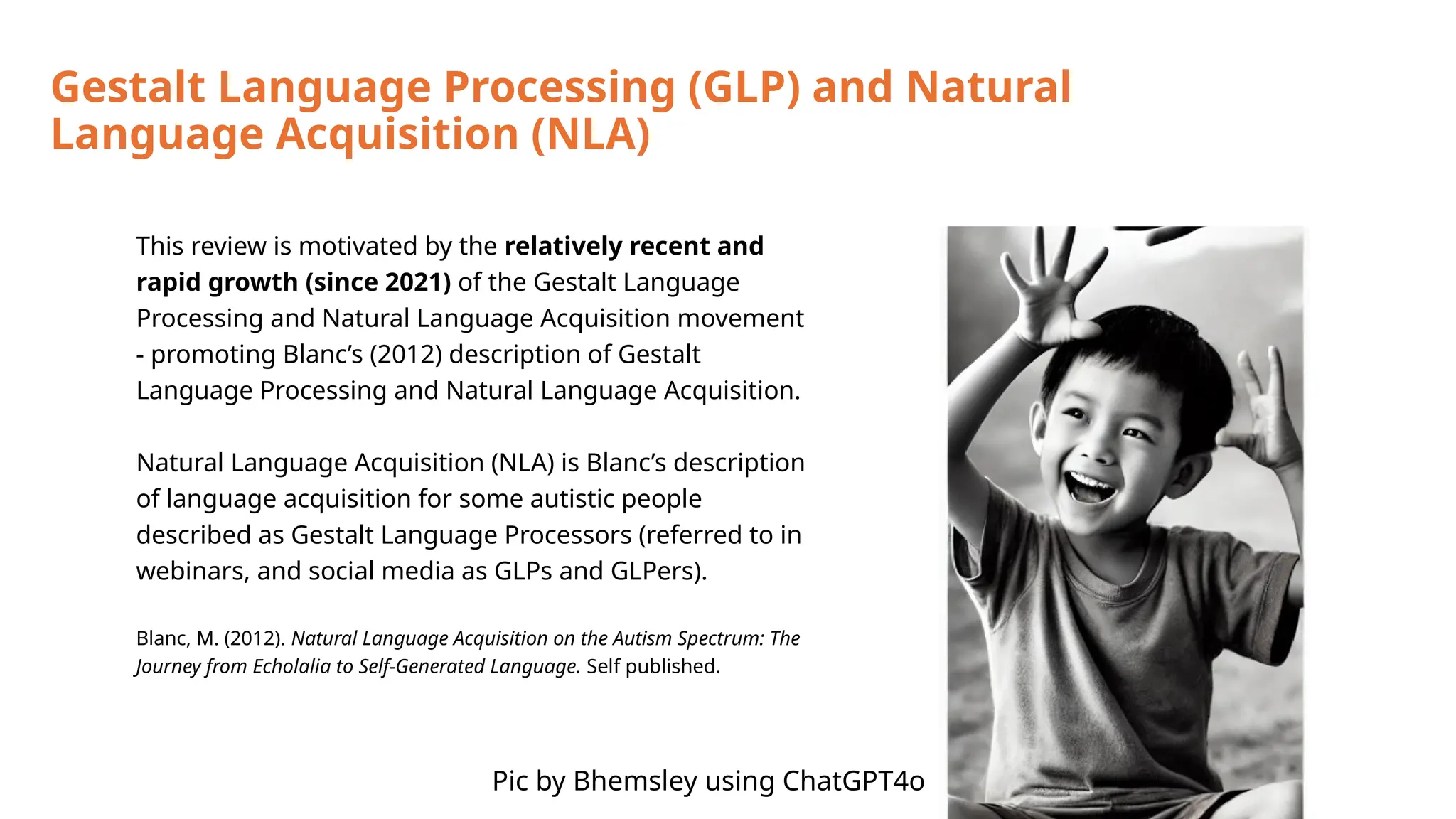
This review is motivated by the relatively recent and
rapid growth (since 2021) of the Gestalt Language
Processing and Natural Language Acquisition movement
- promoting Blanc’s (2012) description of Gestalt
Language Processing and Natural Language Acquisition.
Natural Language Acquisition (NLA) is Blanc’s description
of language acquisition for some autistic people
described as Gestalt Language Processors (referred to in
webinars, and social media as GLPs and GLPers).
Blanc, M. (2012). Natural Language Acquisition on the Autism Spectrum: The
Journey from Echolalia to Self-Generated Language. Self published.
Pic by Bhemsley using ChatGPT4o
GLP/NLA stages
• First published by Blanc (2012) as there being 6 stages of
natural language acquisition for children she identified as
Gestalt Language Processors (first appearance of noun
label, immutable state)
• Stage 1. Whole gestalts
• Stage 2. Mitigated phrases
• Stage 3. Isolated words
• Stage 4. Development of grammar (beginner)
• Stage 5. Development of grammar (advanced)
• Stage 6. Complex grammar in spontaneously generated
language
[1] Blanc M. Natural language acquisition on the autism spectrum: The journey from echolalia
to self-generated language. Madison, WI: Communication Development Center; 2012.
[2] Blanc M, Blackwell A, Elias P. Using the natural language acquisition protocol to support
gestalt language development. Perspectives of the ASHA Special Interest Groups.
2023;8(6):1279-86.
Prof Bronwyn Hemsley and AI
Listen to
our podcast
on GLP!
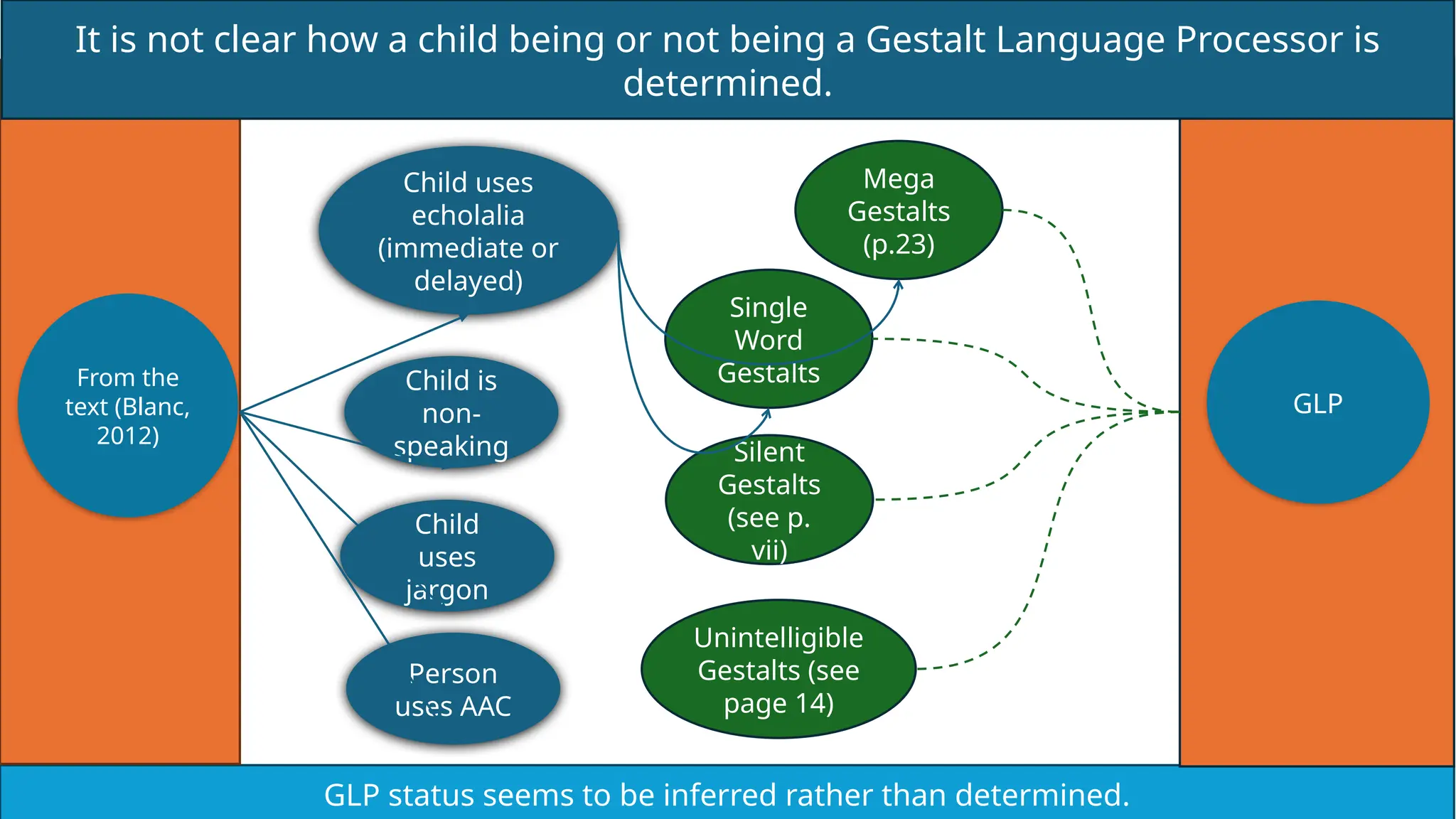
GLP status seems to be inferred rather than determined.
Child uses
echolalia
(immediate or
delayed)
Mega
Gestalts
(p.23)
Single
Word
Gestalts
Unintelligible
Gestalts (see
page 14)
Silent
Gestalts
(see p.
vii)
Child is
non-
speaking
Child
uses
jargon
It is not clear how a child being or not being a Gestalt Language Processor is
determined.
Person
uses AAC
GLP
From the
text (Blanc,
2012)
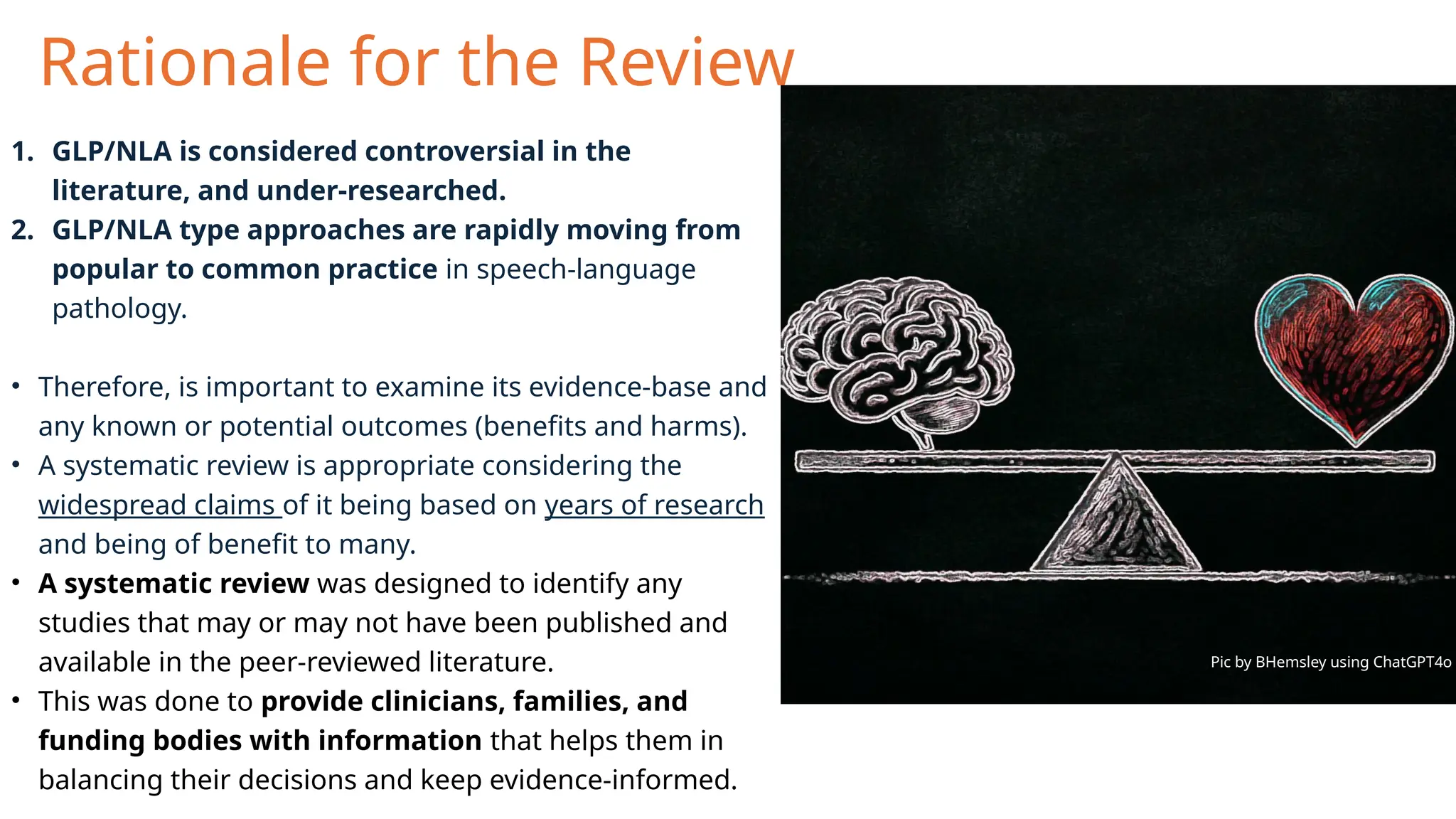
Rationale for the Review
1. GLP/NLA is considered controversial in the
literature, and under-researched.
2. GLP/NLA type approaches are rapidly moving from
popular to common practice in speech-language
pathology.
• Therefore, is important to examine its evidence-base and
any known or potential outcomes (benefits and harms).
• A systematic review is appropriate considering the
widespread claims of it being based on years of research
and being of benefit to many.
• A systematic review was designed to identify any
studies that may or may not have been published and
available in the peer-reviewed literature.
• This was done to provide clinicians, families, and
funding bodies with information that helps them in
balancing their decisions and keep evidence-informed.
Pic by BHemsley using ChatGPT4o
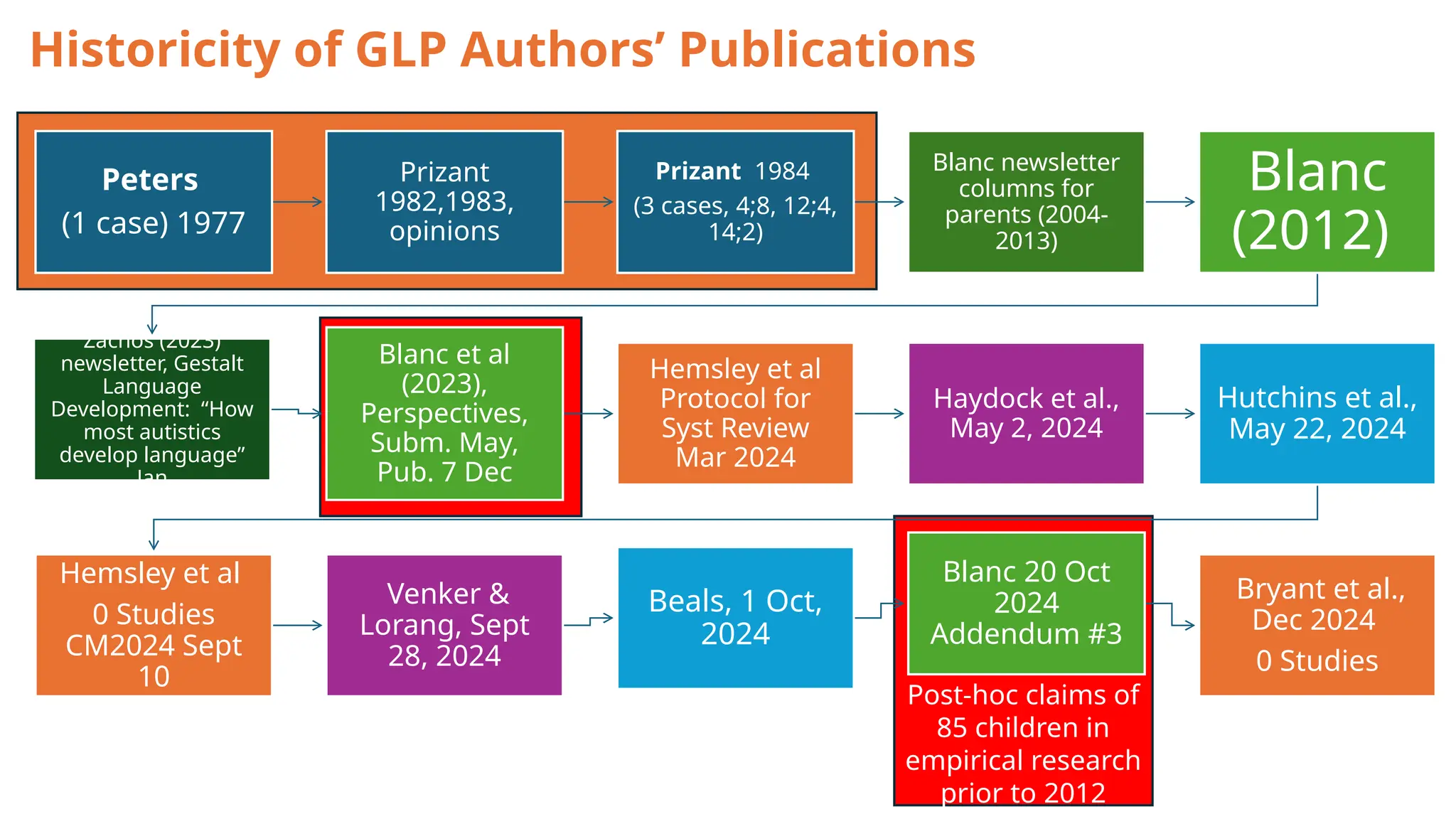
Post-hoc claims of
85 children in
empirical research
prior to 2012
Historicity of GLP Authors’ Publications
Peters
(1 case) 1977
Prizant
1982,1983,
opinions
Prizant 1984
(3 cases, 4;8, 12;4,
14;2)
Blanc newsletter
columns for
parents (2004-
2013)
Blanc
(2012)
Zachos (2023)
newsletter, Gestalt
Language
Development: “How
most autistics
develop language”
Jan
Blanc et al
(2023),
Perspectives,
Subm. May,
Pub. 7 Dec
Hemsley et al
Protocol for
Syst Review
Mar 2024
Haydock et al.,
May 2, 2024
Hutchins et al.,
May 22, 2024
Hemsley et al
0 Studies
CM2024 Sept
10
Venker &
Lorang, Sept
28, 2024
Beals, 1 Oct,
2024
Blanc 20 Oct
2024
Addendum #3
Bryant et al.,
Dec 2024
0 Studies
Where did it all begin?
• In 1977, Ann Peters referred to gestalt and analytic types of language
processing to describe the language of one child who reportedly used both
single words and longer units of language [1,2].
• Peters [2] acknowledged that evidence would be needed before any conclusions
or applications would be appropriate, stating:
“I have been able only to sketch the outlines of a theory of early
language acquisition, while leaving large patches of it
unexplored.
This being the case, it is inappropriate to offer any formal
"conclusion": We are only at the outset of a newly defined
course of exploration.”
[1] Peters AM. Language learning strategies: Does the whole equal the sum of the parts? .
Language. 1977;53(3):560-73.
[2] Peters AM. The units of language acquisition. Cambridge: Cambridge University Press; 1983.
Pic by Bhemsley using ChatGPT4o
• Prizant [1] discussed the production of multi-word
‘chunks’ of language in people with autism that were
“unanalyzed” (p.19) or produced without awareness of
the component characteristics and used the term
“gestalt processing” highlighting similarities with
echolalia, particularly delayed echolalia.
• Prizant [2] suggested that “delayed echolalia pattern
may be manifestations of gestalt processing at both
the situational and linguistic level” (p. 302) and that
autistic people may present with “an extreme style of
gestalt processing” (p. 303). He also proposed a theory of
gestalt language acquisition [3].
• Prizant (1982,1983) proposed four stages of gestalt
language acquisition, cautioning that, “the notion of
stages of language acquisition is presented for
convenience of presentation; no claims are made as to
their psychological reality” [2, p.303].
[1] Prizant BM. Gestalt language and gestalt processing in autism. Topics in language Disorders. 1982;3(1):16-
23.
[2] Prizant BM. Language acquisition and communicative behavior in autism: Toward an understanding of
the" whole" of it. Journal of Speech and Hearing Disorders. 1983;48(3):296-307.
[3] Baltaxe CAM, Simmons JQI. (1981) Disorders of language in childhood psychosis: Current concepts and
approaches. In: Darby JK, Editor. Speech evaluation in psychiatry. New Yowk, NY: Grune & Stratton; 1981. p. 285-
5 years later … Prizant 1982, 1983
(opinion)
“… to fully understand how
processing styles affect the
acquisition and use of language,
detailed longitudinal research
needs to be undertaken
following children from
prelinguistic stages through
the acquisition of complex and
spontaneous language”
[Prizant, 1983, p.305].
Marge Blanc (2012) and GLP/NLA
Three decades after Prizant, Marge Blanc published a book
‘Natural Language Acquisition on the Autism Spectrum: The Journey
from Echolalia to Self-Generated Language’ [1], with an Addendum
on Chapter 19 now available, presenting what she considered a
new description of natural language acquisition, and citing the
earlier work of Peters and Prizant among others.
Blanc [1] proposed, based first on her clinical experience at a
University student clinic, that autistic children who exhibited
delayed echolalia could be classified as GLPs, communicating in
one of six stages: from ‘gestalts’ or chunks of language (either
immediate echolalia or delayed echolalia), to ‘mitigated gestalts’
(i.e., split up into parts), and to new phrases and generative
language using a wide range of words and grammar.
Despite cautions from Peters that her assumptions were theoretical
in nature, early in development, and not seen as conclusive, Blanc
(2012) described the “enormous contribution” that Peters’ findings
had made to her conceptualization of GLP and NLA.
[1] Blanc M. Natural language acquisition on the autism spectrum: The journey from
echolalia to self-generated language. Madison, WI: Communication Development
Center; 2012.
Blanc proposed that six stages
represent a developmental process of
“Natural Language Acquisition” [1,2]
and included a protocol for clinicians and
parents to follow in therapy for autistic
children identified as GLPs focused on:
• whole gestalts (Stage 1)
• mitigated phrases (Stage 2)
• isolated words (Stage 3)
• development of grammar from
beginner (Stage 4)
• advanced (Stage 5)
• complex grammar in spontaneously
generated language (Stage 6)
[2] Blanc M, Blackwell A, Elias P. Using the natural language acquisition protocol to support
gestalt language development. Perspectives of the ASHA Special Interest Groups.
2023;8(6):1279-86.
Addendum 1 Chapter 19
Addendum #3 Foreword
Blanc (2024, 20th
October)
Natural Language Acquisition Protocol
Blanc M, Blackwell A, Elias P. Using the natural language
acquisition protocol to support gestalt language
development. Perspectives of the ASHA Special Interest
Groups. 2023;8(6):1279-86.
[2] Blanc M, Blackwell A, Elias P. Using the natural language acquisition protocol to support
gestalt language development. Perspectives of the ASHA Special Interest Groups.
2023;8(6):1279-86.
Haydock et al May 2nd
, 2024 (Editorial)
Haydock et al. [1] described GLP/NLA as being
neurodiversity-affirming.
“Presuming developmental competence, as an
ethos, advances the use of therapeutic
strategies that map onto how gestalt language
develops and promote that natural development
to occur.
For instance, informed approaches promote
exposure to gestalts that have inherent situational
and emotional salience as – unlike rote-learnt
utterances – these linguistic forms will likely stick,
be used contextually and have potential to
develop into more creative and complex forms”.
Haydock [1, p. 1057]
[1] Haydock A, Harrison L, Baldwin K, Leadbitter K. Embracing gestalt language
development as a fundamental neurodiversity-affirmative practice. Autism. 2024;28(5):1055-
9.
Read it for free – it’s Open Access
Response to Haydock et al “The field will benefit from in-depth discussions
about the relationship between neurodiversity-affirmative
practices and evidence-based practices.” (Letter to the Editor by Venker & Lorang, 2024)
Read it for free – it’s Open Access
[1] Letter to the Editor – Venker, C. E., & Lorang, E. (2024). Continuing the conversation about echolalia and gestalt
language development: A response to Haydock, Harrison, Baldwin, and Leadbitter. Autism, 1-4.
Critical appraisal of GLP/NLA Practices
Hutchins et al., 2024 (Research article - Critical analysis)
Hutchins et al. [1], in a critical appraisal of GLP/NLA
practices, argued that the theoretical foundations of
GLP/NLA remain weak, uncertain, and untested.
Hutchins et al. challenged GLP/NLA due to its
(a) unsubstantiated reliance on a binary classification of
autistic children being either ‘a GLP’ (processing
‘chunks’ or gestalts) or ‘an analytic language processor’
or ‘an ALP’ (i.e., processing language from its individual
word parts to build the whole);
(b) absence of a clear definition or criteria for classifying
people as being ‘a GLP’; and
(c) being based on questionable estimates of prevalence
of echolalia.
Subsequent literature describing GLP/NLA refers to and
inflates erroneous and unfounded prevalence estimates
and statistics on echolalia (e.g., “‘echoing’ is used by 85% of
ASD kids”, [1, p28]).
[1] Hutchins TL, Knox SE, Fletcher EC. Natural language acquisition and gestalt language processing: A critical analysis of
their application to autism and speech language therapy. Autism and Developmental Language Impairments.
2024;9:23969415241249944.
Read it for free – it’s Open Access
Where do those echolalia prevalence figures come from?
What is it? … it depends how it is defined and measured …
Review of
echolalia
definitions and
prevalence
Historically
tracks back on
% estimates
Read it for free –
it’s Open Access
[1] Sutherland, R., Bryant, L., Dray, J., & Roberts, J. (2024). Prevalence of Echolalia in Autism: A Rapid Review of Current
Findings and a Journey Back to Historical Data. Current Developmental Disorders Reports.
https://link.springer.com/article/10.1007/s40474-024-00311-0
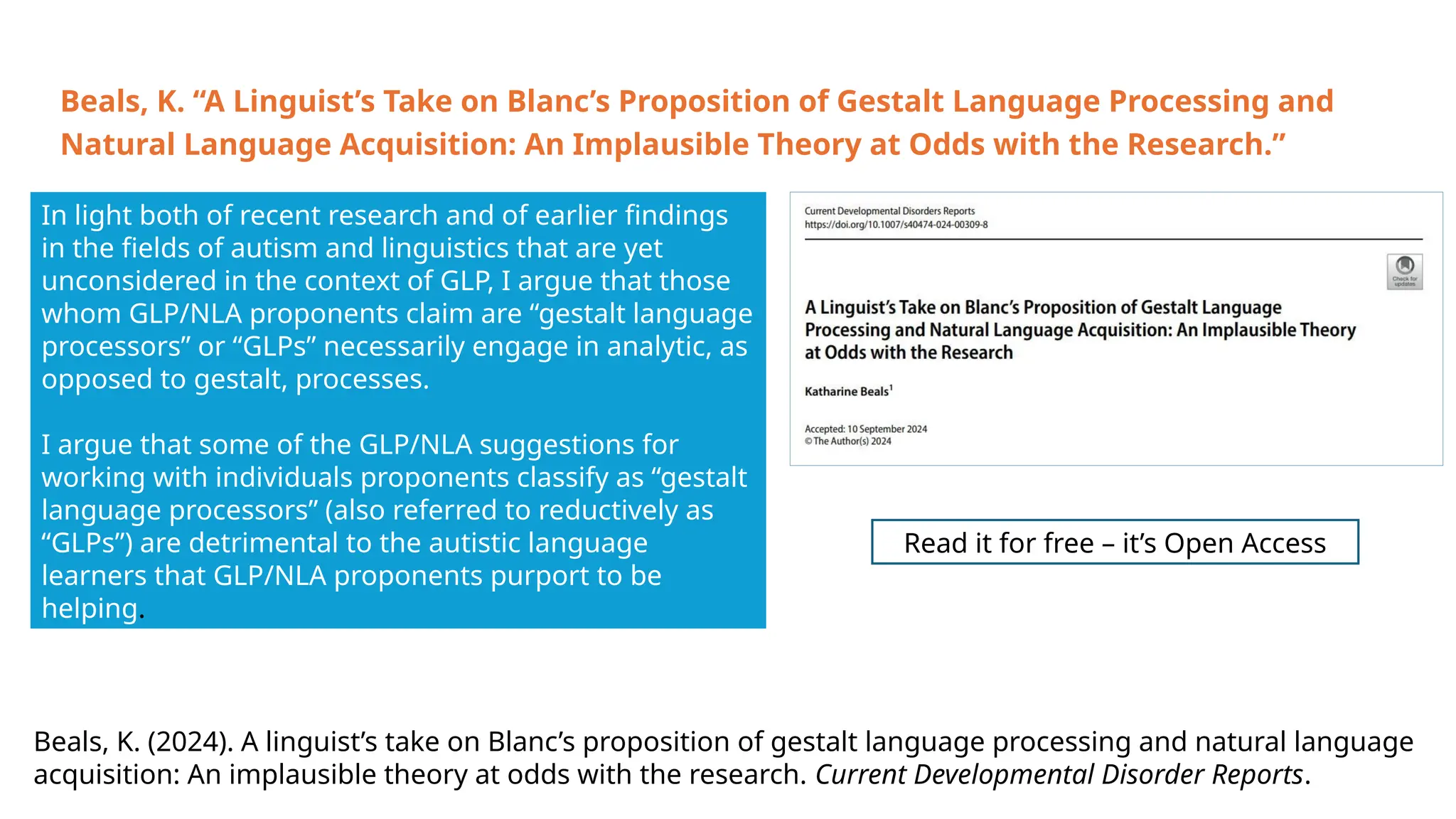
In light both of recent research and of earlier findings
in the fields of autism and linguistics that are yet
unconsidered in the context of GLP, I argue that those
whom GLP/NLA proponents claim are “gestalt language
processors” or “GLPs” necessarily engage in analytic, as
opposed to gestalt, processes.
I argue that some of the GLP/NLA suggestions for
working with individuals proponents classify as “gestalt
language processors” (also referred to reductively as
“GLPs”) are detrimental to the autistic language
learners that GLP/NLA proponents purport to be
helping.
Read it for free – it’s Open Access
Beals, K. (2024). A linguist’s take on Blanc’s proposition of gestalt language processing and natural language
acquisition: An implausible theory at odds with the research. Current Developmental Disorder Reports.
Beals, K. “A Linguist’s Take on Blanc’s Proposition of Gestalt Language Processing and
Natural Language Acquisition: An Implausible Theory at Odds with the Research.”
Beals, K. 2024 (A linguist’s take on GLP/NLA, cont.)
“… most of the advice from Blanc [1–6], falls into three categories: reasonable
but unoriginal, too unclear to act upon, or ill-conceived and
counterproductive.
In the first category, reasonable but unoriginal advice, are directives like
“narrate your day with your child”, “say things in kid-friendly sentences that
are animated and sound distinctive”, “think about [your child’s]
communicative intentions, substitute new words and phrases into echoed
phrases”, or “respond to grammatical errors by recasting, and gradually
increase in the complexity of what you model” [5].
Falling into the second category, advice that is too unclear to act upon, are
the guidelines for moving a child from one proposed stage of NLA to another.
…
In the third category, advice that is ill-conceived and counterproductive, is
the notion that, until children classified as “gestalt language processors” move
beyond NLA Stages 1 and 2, therapists and parents should avoid single words
and two-word combinations (at least at Stage 1). Another is that therapists
and parents should avoid using verbs until after “gestalt language processors”
get to NLA Stage 4 [3]. This means that the adult is using ‘telegraphic’ speech
in the linguistic sense rather than using grammatical language.
A third is the exhortation to (emphasis is as provided in the cited document):
Protect your child from well-intended, but misguided language practices
Read it for free – it’s Open
Access
Language vs. communication
• Many things are communicative without being
symbolic language
– Smiling; pointing; laughing
• Symbolic language is
– Public (no detective work for basic
meanings)
– Abstract (not situation-specific)
– Not medium-specific (can be whispered,
yelled, sung, handwritten, typed, finger-
spelled…)
– Generative (basic meaning units, or
morphemes, can combine and recombine
in multiple orders for multiple statements,
questions, commands, hypotheticals, etc.)
• Echolalia lacks all these core characteristics of
symbolic language
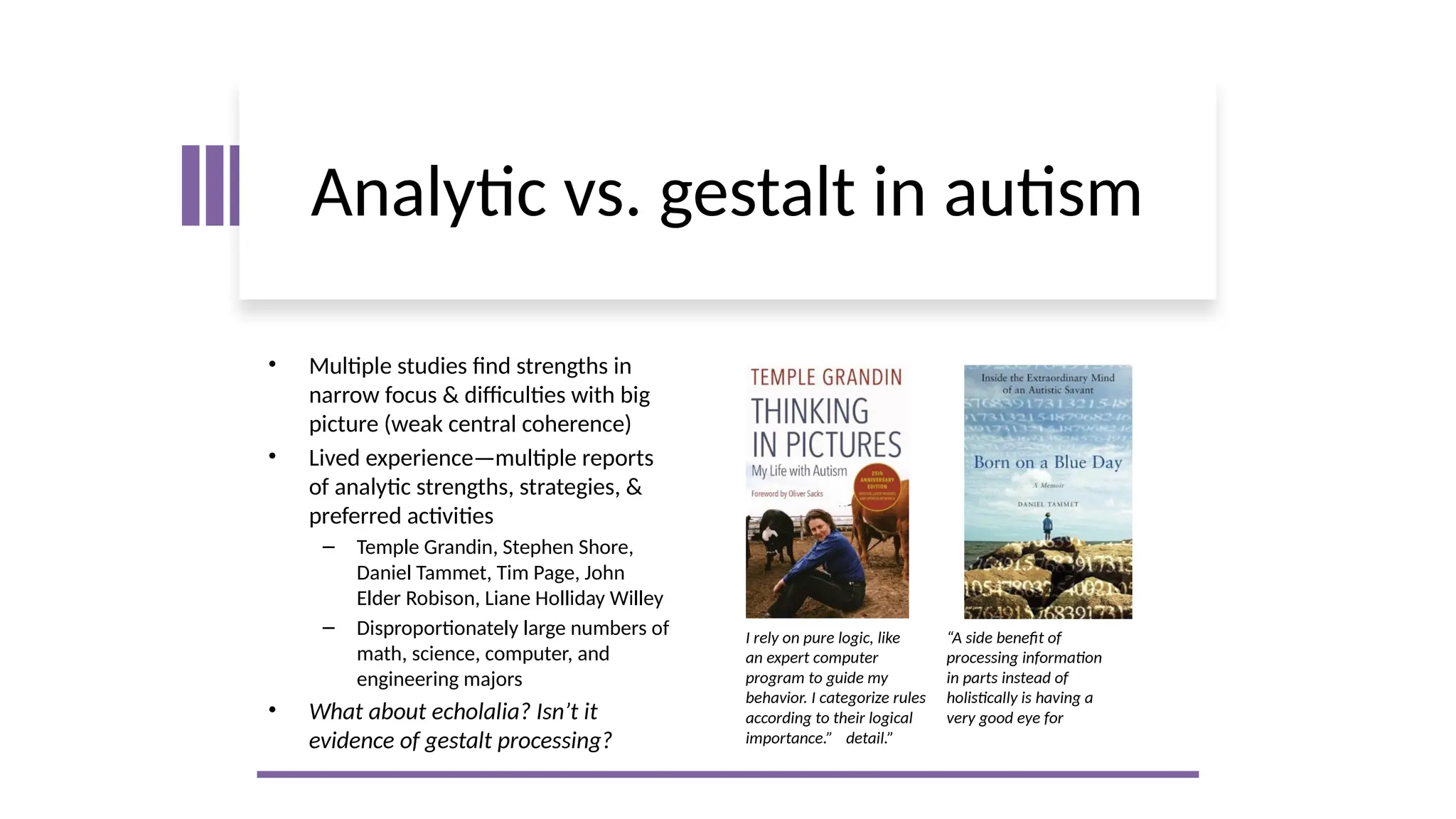
Analytic vs. gestalt in autism
• Multiple studies find strengths in
narrow focus & difficulties with big
picture (weak central coherence)
• Lived experience—multiple reports
of analytic strengths, strategies, &
preferred activities
– Temple Grandin, Stephen Shore,
Daniel Tammet, Tim Page, John
Elder Robison, Liane Holliday Willey
– Disproportionately large numbers of
math, science, computer, and
engineering majors
• What about echolalia? Isn’t it
evidence of gestalt processing?
I rely on pure logic, like “A side benefit of
an expert computer processing information
program to guide my in parts instead of
behavior. I categorize rules holistically is having a
according to their logical very good eye for
importance.” detail.”
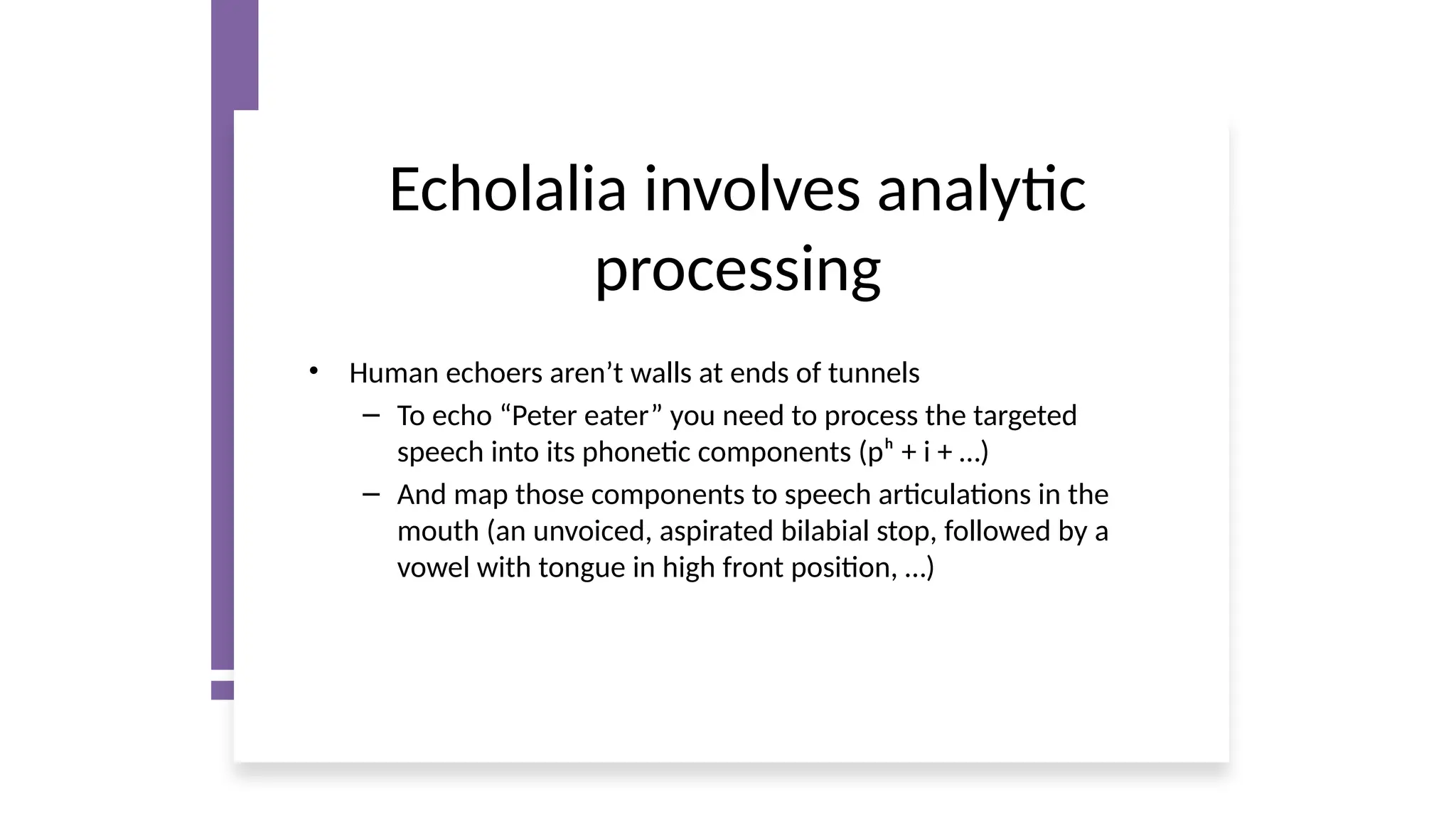
Echolalia involves analytic
processing
• Human echoers aren’t walls at ends of tunnels
– To echo “Peter eater” you need to process the targeted
speech into its phonetic components (pʰ + i + …)
– And map those components to speech articulations in the
mouth (an unvoiced, aspirated bilabial stop, followed by a
vowel with tongue in high front position, …)
Echolalia isn’t a language style
It’s a consequence of core autism symptoms.
• An autism diagnosis requires (among other things) diminished joint attention (JA).
(DSM-5, M-CHAT, ADOS)
• Multiple studies show diminished JA predicts delays in word/phrase learning
– more profound autism-->more reduced JA-->Fewer words
• Those who haven’t learned basic words/phrases can’t parse spoken utterances into
noun phrases & verb phrases (subjects & predicates, etc.)
• Instead they may memorize some of the utterances they hear as unanalyzed wholes
– especially those that are highly salient/used in highly salient situations
• Without understanding their linguistic meanings, they may associate highly salient
utterances with the highly salient situations in which they hear them used.
– “Peter eater” for saucepan (Kanner, 1946)
Echolalia is a (suboptimal) AAC
• Echolalia is alternative to true language as opposed to an instance of
language.
– might fulfill a communicative purpose (e.g., to gain attention, maintain
an interaction, express delight)
– just like other non-verbal communications (e.g., body language, facial
expressions, informal gestures), and as such, echolalia can
• Can (and should) be recognized as part of a person’s extant
communication tools without being considered linguistic.
• But a major downside: the need for “detective work” (Peter eater)
• Conventional AAC tools are more practical and less frustrating. (A picture
of a sauce pan)
All known routes to language
acquisition require analytic processing
• At initial stages, learners need to analyze the sounds in the speech stream that surround them
to parse out individual meaning units from phrases like “That’s a dog” and “Look at the cat.”
• To assign meaning to these units, they also need to analyze the communicative environment:
identify the speaker, attend to the speaker’s face, eyes, stance, or pointing gesture, and follow
the speaker’s eye gaze or pointing gesture or body orientation over to the object in question.
• They also need to properly generalize these meanings, which means analyzing their referents
into features and figuring out which features are the essential ones (e.g., for “dog,” aspects of
the shape and size, but not the color)
• After basic nouns, children learn verbs by analyzing verb phrases (e.g., “give the smallest doll
to the boy” or “get the smallest doll from the boy”) that contain nouns they already know
(e.g., “doll,” “boy”) and also analyzing the context in which these phrases are used.
• In general, there is an analytic feedback loop between inferring novel syntactic structures from
known words and inferring novel words from known syntactic structures.
Implications for speech-language
pathologists: Advice from Blanc
• “… most of the advice from
Blanc [1–6], falls into three
categories: reasonable but
unoriginal, too unclear to
act upon, or ill-conceived
and counterproductive.
What’s problematic about
Blanc’s advice?
• Learning basic nouns and verbs are key first steps in language
learning.
• This makes two elements of Blanc’s advice problematic:
1. That until children classified as “gestalt language
processors” move beyond NLA Stages 1 or 2, therapists
and parents should avoid single words and two-word
combinations.
2. That therapists and parents should avoid using verbs until
after “gestalt language processors” get to NLA Stage 4 [3].
What’s not problematic about Blanc’s
advice?
• Directives like
– “narrate your day with your child”
– “say things in kid-friendly sentences that are animated and
sound distinctive”
– “think about [your child’s] communicative intentions, substitute
new words and phrases into echoed phrases”
– “respond to grammatical errors by recasting, and gradually
increase in the complexity of what you model”
There are things that good SLPs (and parents) have been doing for
decades.
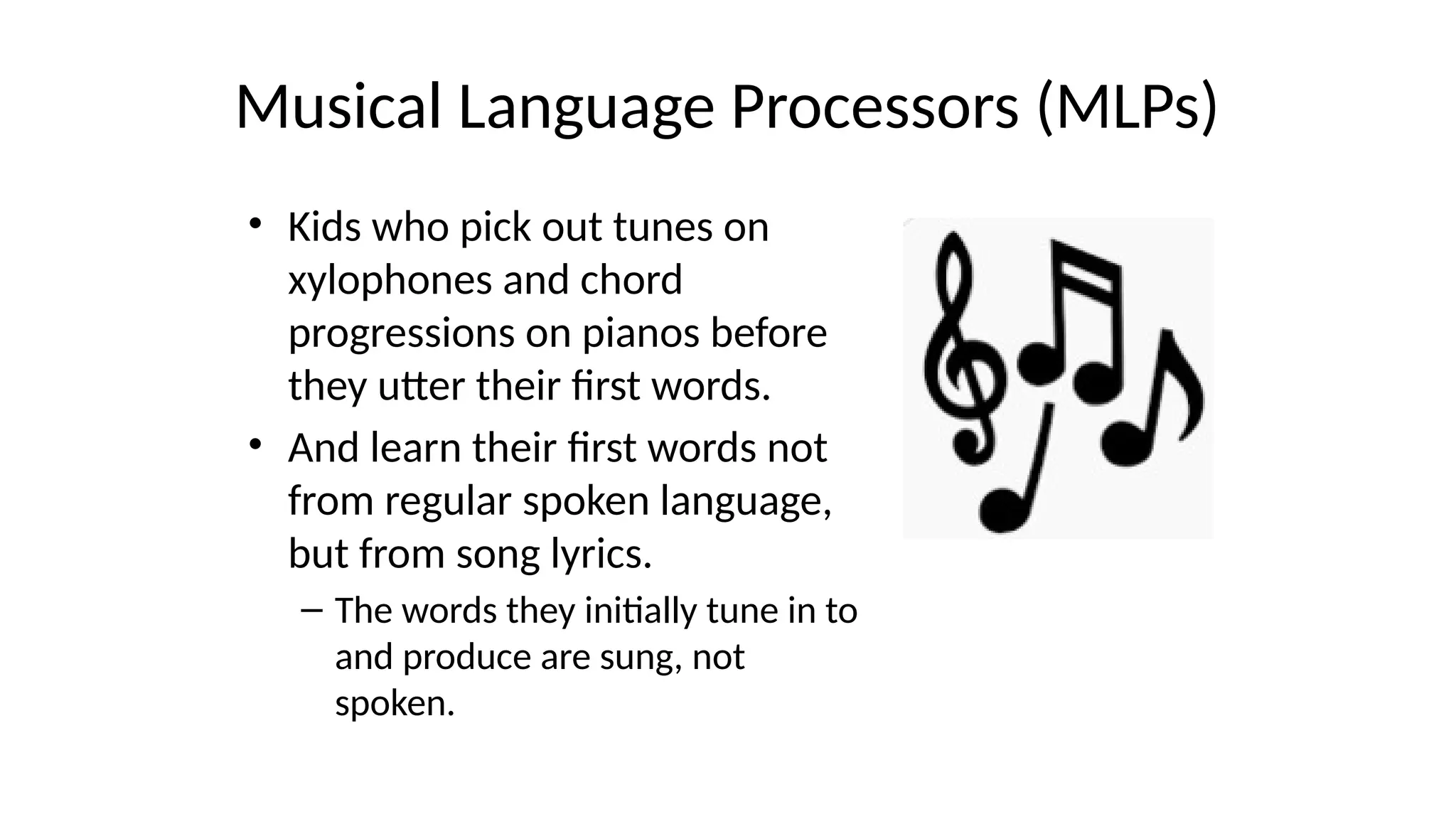
Musical Language Processors (MLPs)
• Kids who pick out tunes on
xylophones and chord
progressions on pianos before
they utter their first words.
• And learn their first words not
from regular spoken language,
but from song lyrics.
– The words they initially tune in to
and produce are sung, not
spoken.
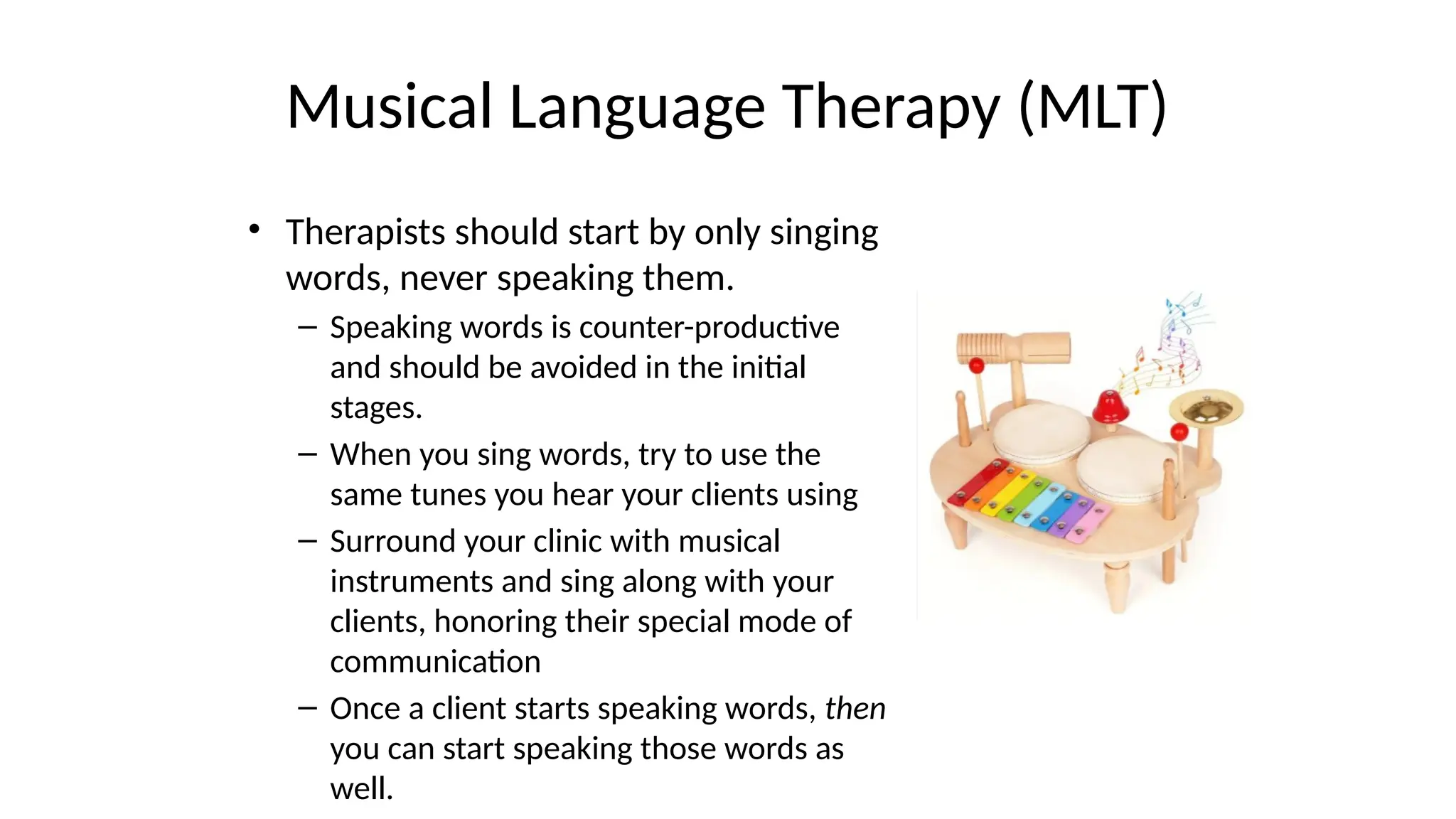
Musical Language Therapy (MLT)
• Therapists should start by only singing
words, never speaking them.
– Speaking words is counter-productive
and should be avoided in the initial
stages.
– When you sing words, try to use the
same tunes you hear your clients using
– Surround your clinic with musical
instruments and sing along with your
clients, honoring their special mode of
communication
– Once a client starts speaking words, then
you can start speaking those words as
well.
Evidence for MLT?
• Clinical evidence:
– What I’ve seen longitudinally in my clinic:
dozens of kids progressing from singing to
speech when they’re ready, and making
beautiful progress once they do.
• Parent reports:
– Parents report similar progress in language
development, and they also say their kids are
much happier with musical language therapy
than with conventional speech language
therapy.
• Lived experience:
– Now that we’ve identified MLPs, many adults
are coming forth and self-identifying as MLPs.
– They report that they learned language through
song and that they got nothing out of
conventional speech-language therapy.
Should you believe what I say about MLP/MLT? No you
should not!!!
• Psychology teaches us that first-person experiences, eye-witness
observations, self-reports, and memories (including childhood
memories) are all unreliable.
• But practitioners, like all of us, are potentially deceived by first-
person experience
– no matter how experienced we think we are, no matter how accurate we
think our intuitions are, no matter how objective we think our observations
are.
• Cf. the litany of interventions, including in autism, that practitioners
were convinced were successful but that turned out, under rigorous
scientific scrutiny, to be, at best, ineffective, and at worst, harmful:
– facilitated communication, auditory integration therapy, sensory integration
• To those who practiced them, they felt right, made sense, and looked
effective.
• But rigorous, randomized controlled experiments told us otherwise.
MLP /
MLT
Why has NLA/GLP caught on?
• It appears to resonate with other memes in the broader education
and parenting worlds
– Learning styles: “Everyone learns differently”
• “visual”, “auditory”, “kinesthetic,”…
• Endorsed by 93 percent of the US public and 76 percent of educators.
• Also popular in other parts of the world
– Whole language (now “balanced literacy” and “three-cueing”)
• Literacy through holistic print-rich environments, the holistic shapes of words,
and the broader holistic context of the stories in which they occur, including the
illustrations.
• Notion that there’s no need for “analytic” approaches like phonics.
• Until recently, the dominant approach in teacher training programs and
classrooms.
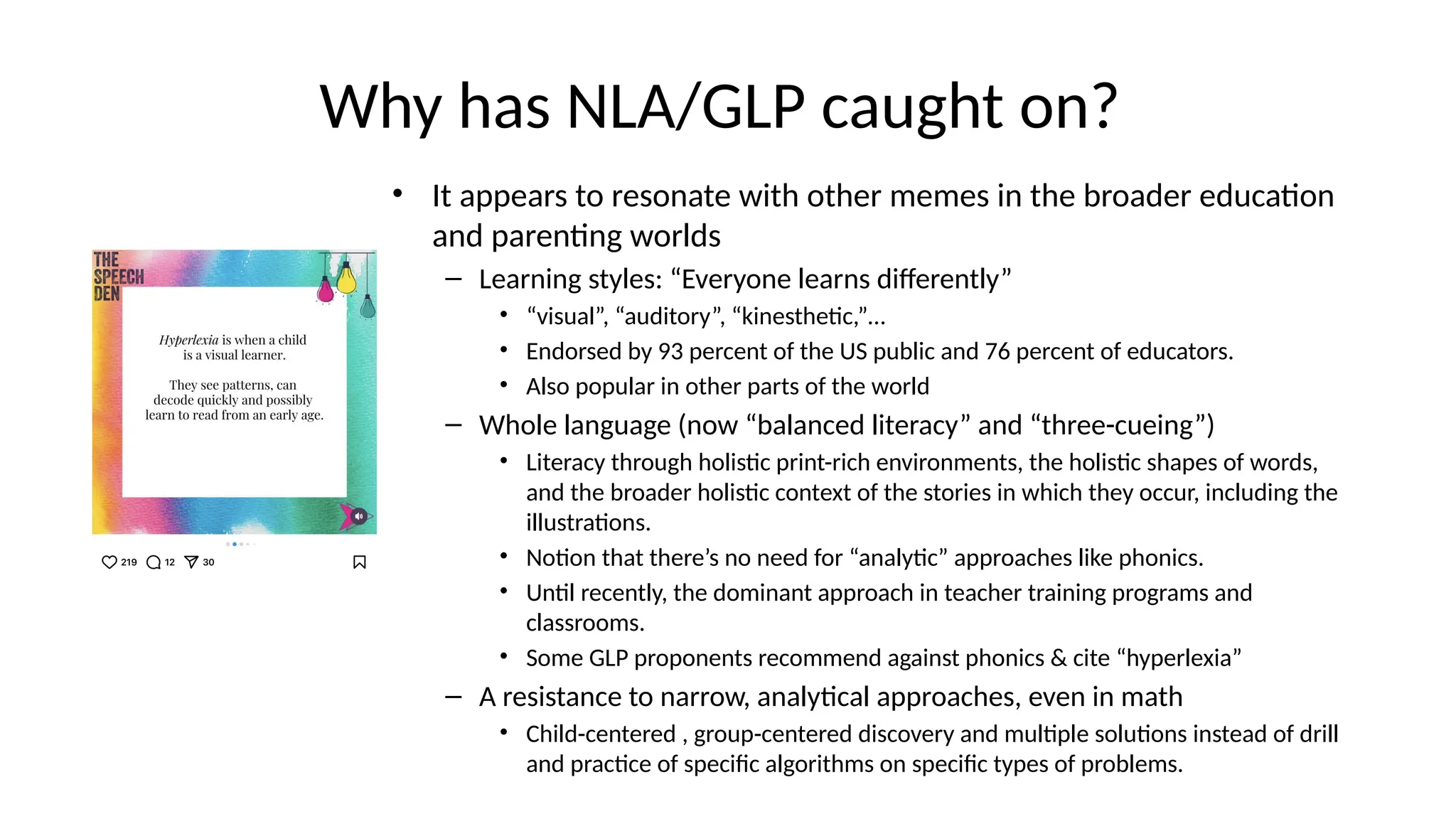
• Some GLP proponents recommend against phonics & cite “hyperlexia”
– A resistance to narrow, analytical approaches, even in math
• Child-centered , group-centered discovery and multiple solutions instead of drill
and practice of specific algorithms on specific types of problems.
Conventional wisdom/“makes sense”
≠ evidence-based
– Learning styles: “Everyone learns differently”
– Whole language, “balanced literacy,” “three-cueing”
– Resistance to narrow, analytical, step-by-step approaches,
even in math
• Though these “feels right” to many people, the actual
evidence is against them.
• The evidence against “balanced literacy” and “three
cueing” has been so clear, and so clearly broadcast to the
public, that school districts and teaching training
programs are starting to take notice.
• But the evidence against learning styles and “whole math”
is similarly strong.
• So is the evidence against autistic individuals as “gestalt
processors.”
Part 2. The Systematic
Review
Aim and Methods
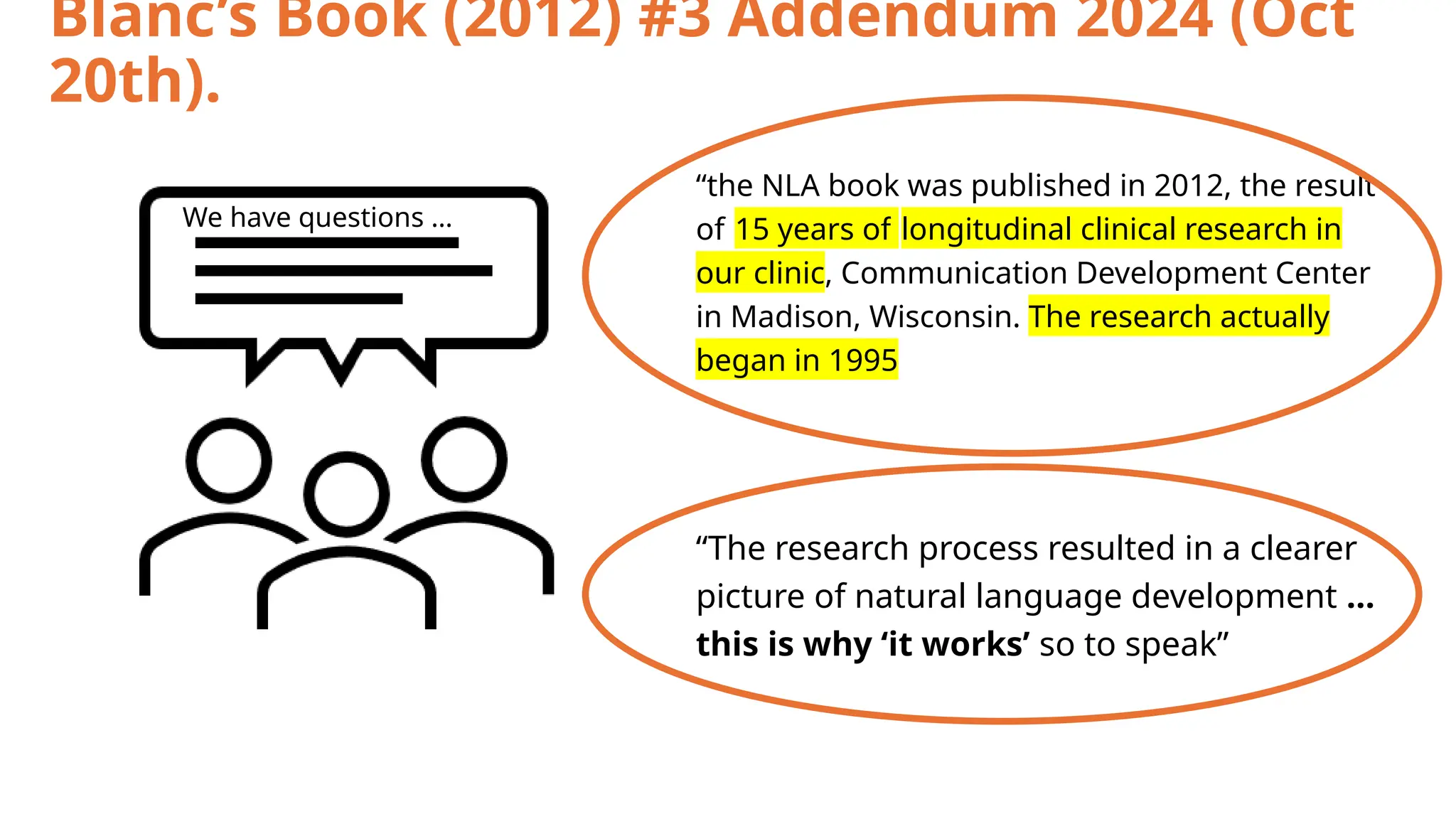
Blanc’s Book (2012) #3 Addendum 2024 (Oct
20th).
“the NLA book was published in 2012, the result
of 15 years of longitudinal clinical research in
our clinic, Communication Development Center
in Madison, Wisconsin. The research actually
began in 1995
“The research process resulted in a clearer
picture of natural language development …
this is why ‘it works’ so to speak”
We have questions …
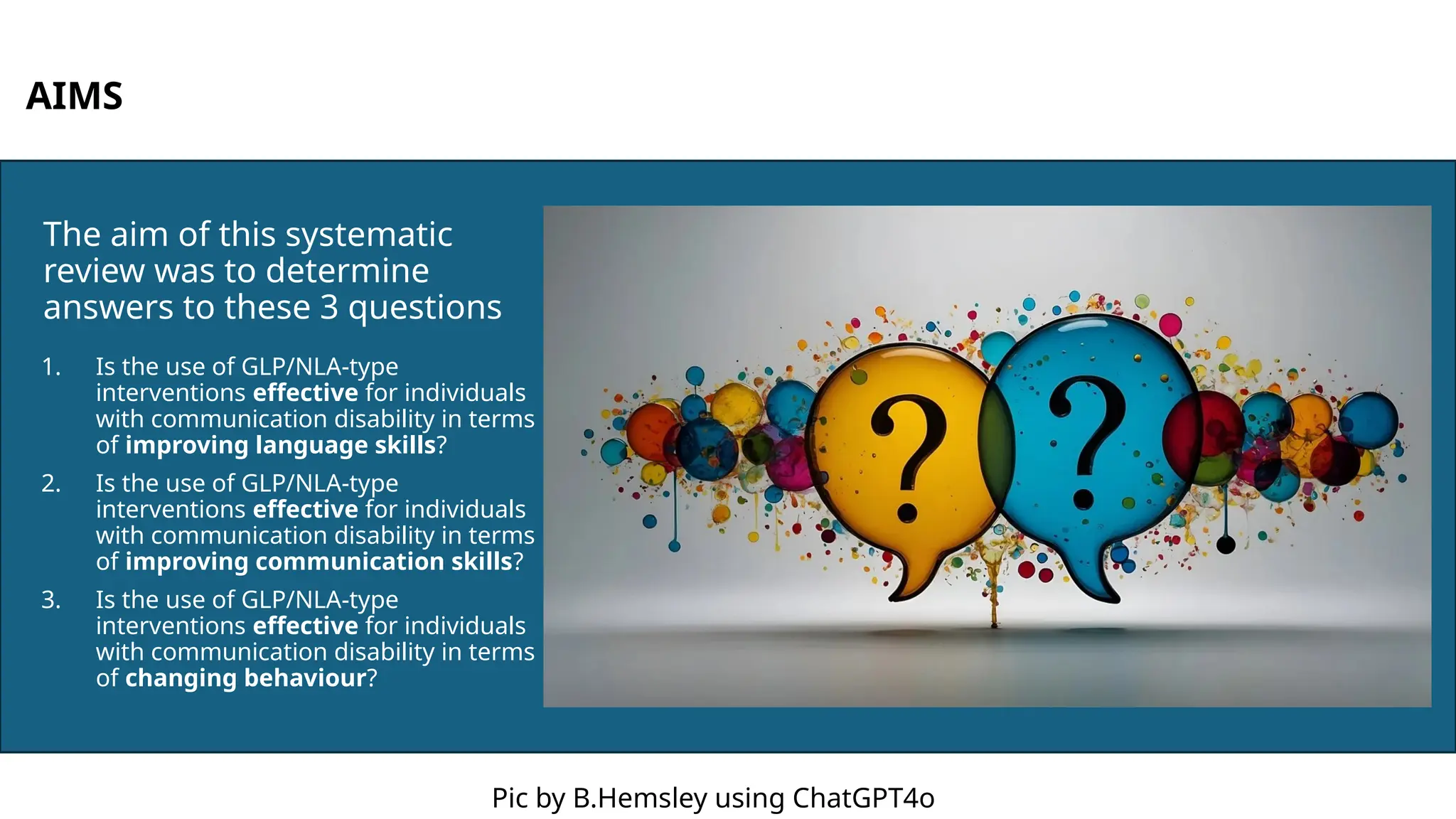
The aim of this systematic
review was to determine
answers to these 3 questions
1. Is the use of GLP/NLA-type
interventions effective for individuals
with communication disability in terms
of improving language skills?
2. Is the use of GLP/NLA-type
interventions effective for individuals
with communication disability in terms
of improving communication skills?
3. Is the use of GLP/NLA-type
interventions effective for individuals
with communication disability in terms
of changing behaviour?
AIMS
Pic by B.Hemsley using ChatGPT4o
Method: Protocol for the Systematic
Review
[1] Hemsley, B., Bryant, L., Bowen, C., Grove, R., Dixon, G., Beals, K., & Shane, H. (2024) Published review protocol: A systematic review of
gestalt language processing interventions in children or adults with communication disability. National Institute for Health and Care
Research, PROSPERO International prospective register of systematic reviews. PROSPERO 2024 CRD42024518468
https://www.crd.york.ac.uk/prospero/display_record.php?ID=CRD42024518468
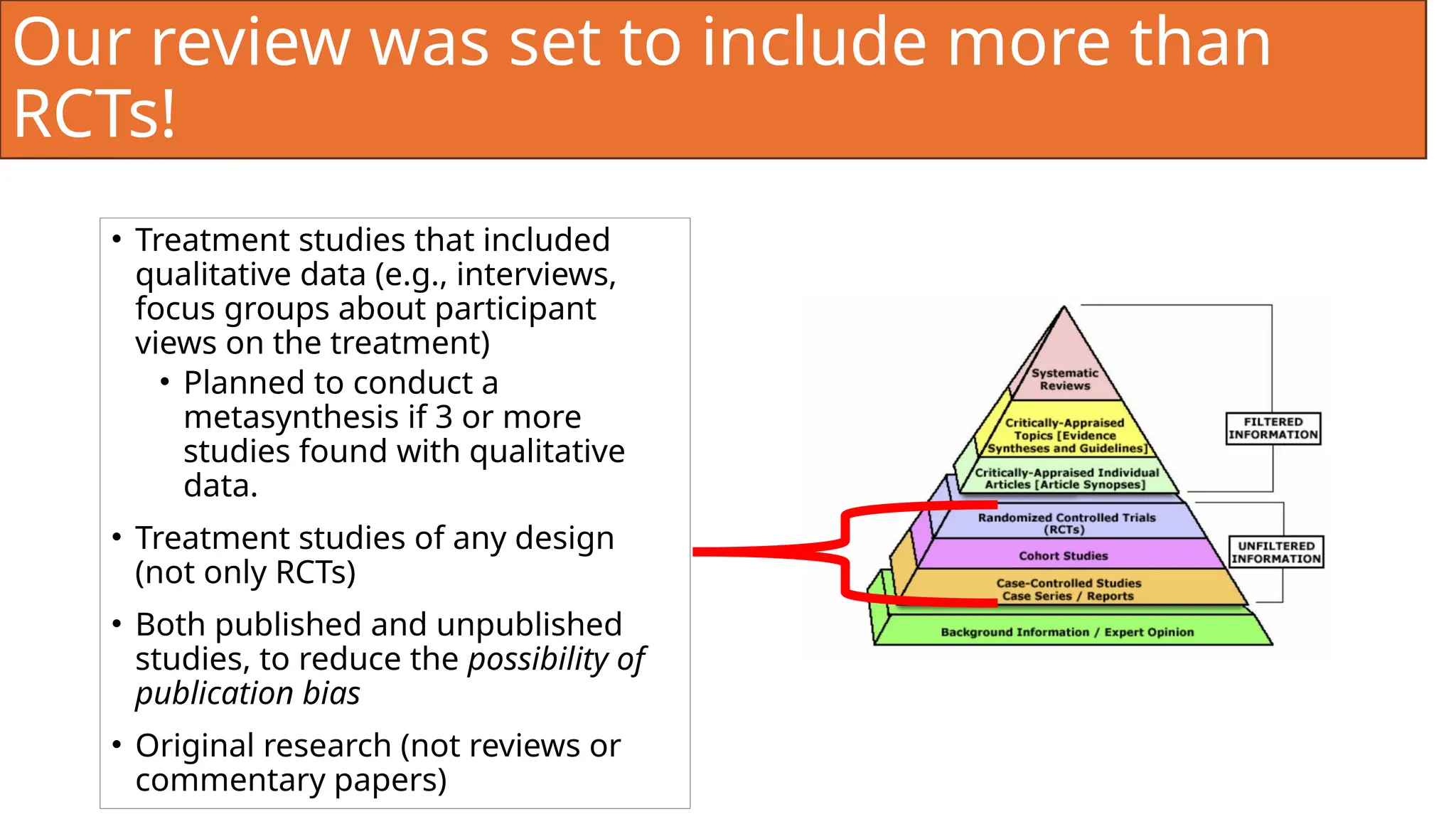
Our review was set to include more than
RCTs!
• Treatment studies that included
qualitative data (e.g., interviews,
focus groups about participant
views on the treatment)
• Planned to conduct a
metasynthesis if 3 or more
studies found with qualitative
data.
• Treatment studies of any design
(not only RCTs)
• Both published and unpublished
studies, to reduce the possibility of
publication bias
• Original research (not reviews or
commentary papers)
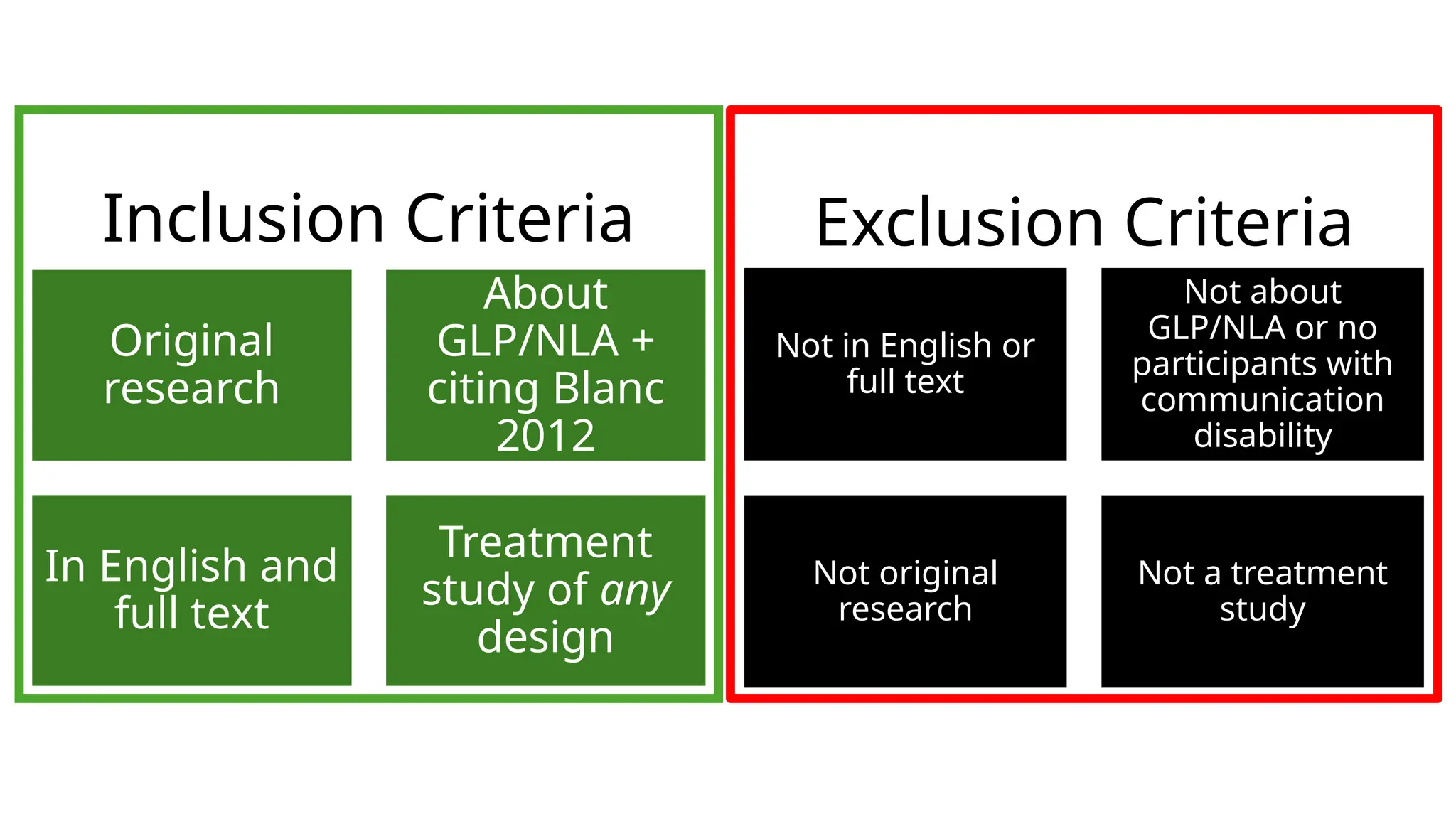
Inclusion Criteria
Original
research
About
GLP/NLA +
citing Blanc
2012
In English and
full text
Treatment
study of any
design
Not in English or
full text
Not about
GLP/NLA or no
participants with
communication
disability
Not original
research
Not a treatment
study
Exclusion Criteria
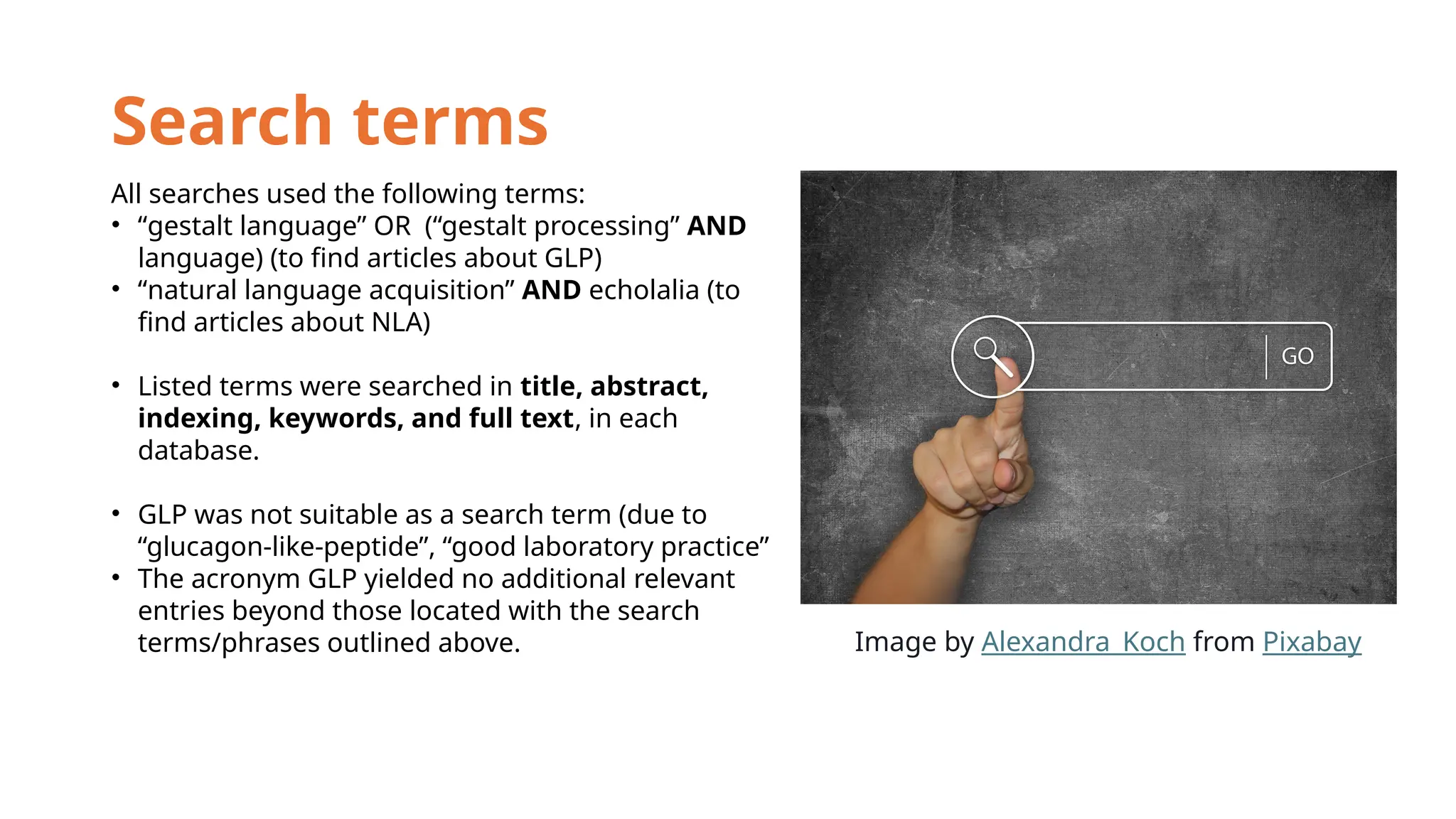
Search terms
All searches used the following terms:
• “gestalt language” OR (“gestalt processing” AND
language) (to find articles about GLP)
• “natural language acquisition” AND echolalia (to
find articles about NLA)
• Listed terms were searched in title, abstract,
indexing, keywords, and full text, in each
database.
• GLP was not suitable as a search term (due to
“glucagon-like-peptide”, “good laboratory practice”
• The acronym GLP yielded no additional relevant
entries beyond those located with the search
terms/phrases outlined above. Image by Alexandra_Koch from Pixabay
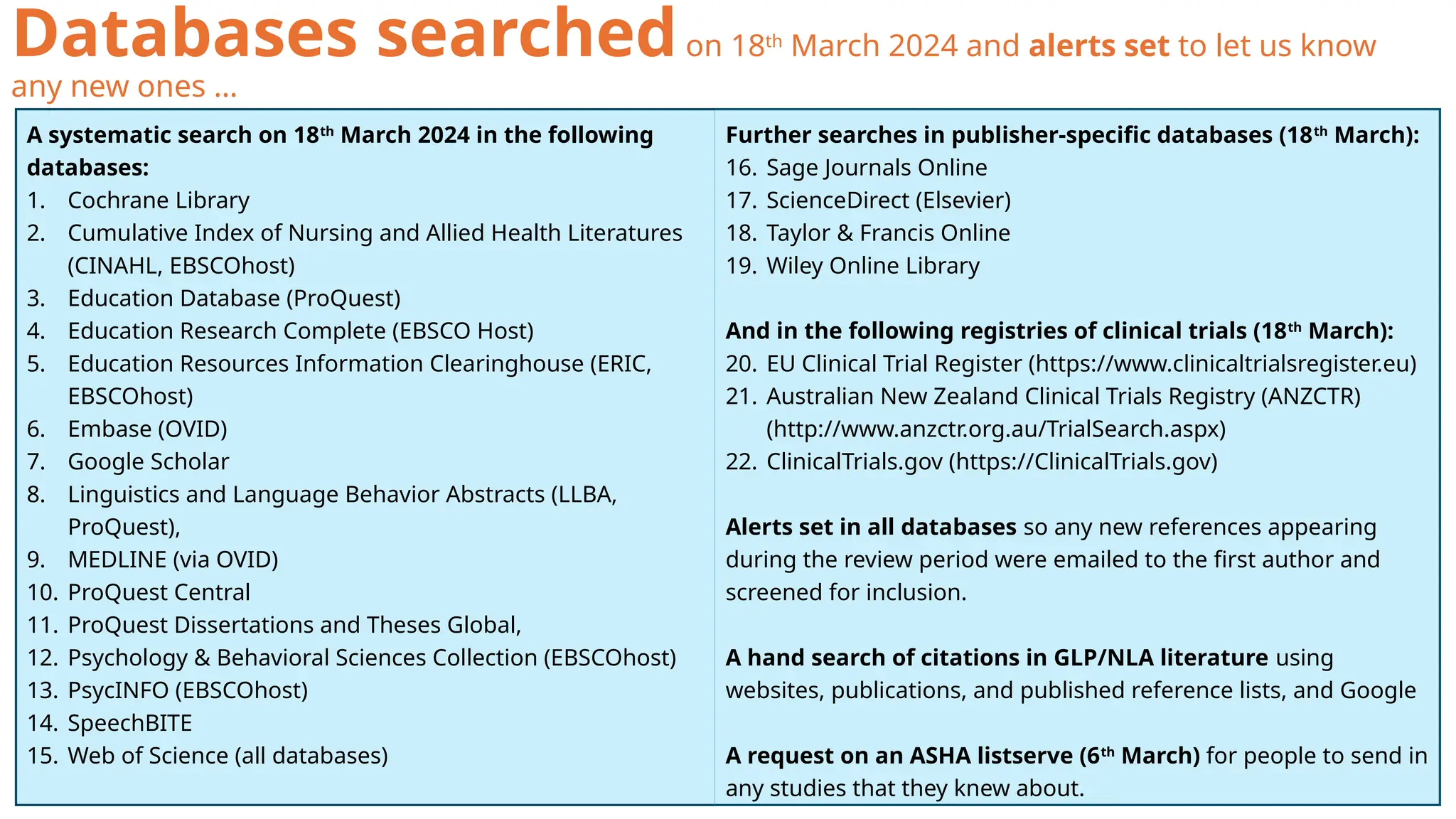
Databases searchedon 18th
March 2024 and alerts set to let us know
any new ones …
A systematic search on 18th
March 2024 in the following
databases:
1. Cochrane Library
2. Cumulative Index of Nursing and Allied Health Literatures
(CINAHL, EBSCOhost)
3. Education Database (ProQuest)
4. Education Research Complete (EBSCO Host)
5. Education Resources Information Clearinghouse (ERIC,
EBSCOhost)
6. Embase (OVID)
7. Google Scholar
8. Linguistics and Language Behavior Abstracts (LLBA,
ProQuest),
9. MEDLINE (via OVID)
10. ProQuest Central
11. ProQuest Dissertations and Theses Global,
12. Psychology & Behavioral Sciences Collection (EBSCOhost)
13. PsycINFO (EBSCOhost)
14. SpeechBITE
15. Web of Science (all databases)
Further searches in publisher-specific databases (18th
March):
16. Sage Journals Online
17. ScienceDirect (Elsevier)
18. Taylor & Francis Online
19. Wiley Online Library
And in the following registries of clinical trials (18th
March):
20. EU Clinical Trial Register (https://www.clinicaltrialsregister.eu)
21. Australian New Zealand Clinical Trials Registry (ANZCTR)
(http://www.anzctr.org.au/TrialSearch.aspx)
22. ClinicalTrials.gov (https://ClinicalTrials.gov)
Alerts set in all databases so any new references appearing
during the review period were emailed to the first author and
screened for inclusion.
A hand search of citations in GLP/NLA literature using
websites, publications, and published reference lists, and Google
A request on an ASHA listserve (6th
March) for people to send in
any studies that they knew about.
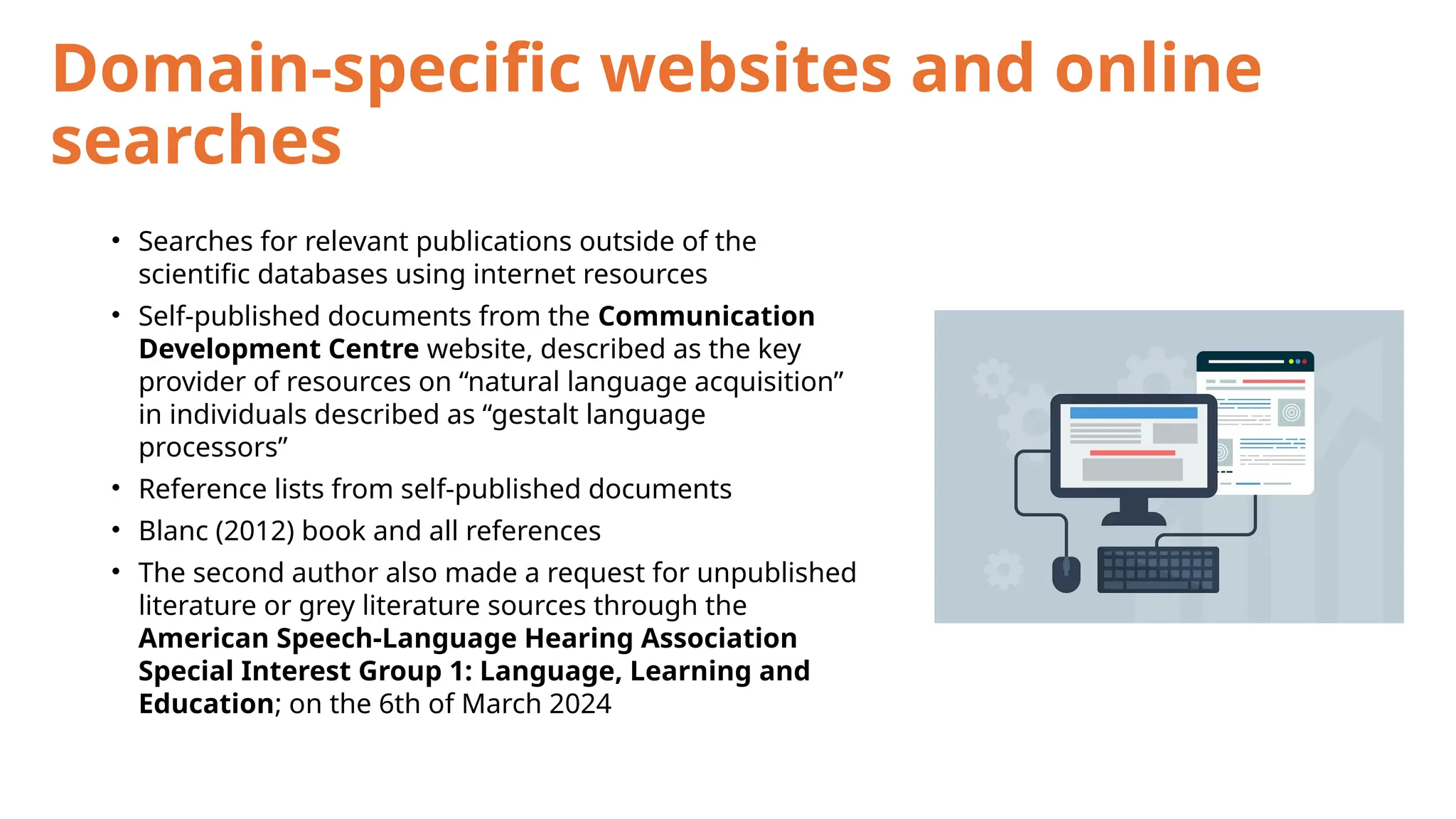
Domain-specific websites and online
searches
• Searches for relevant publications outside of the
scientific databases using internet resources
• Self-published documents from the Communication
Development Centre website, described as the key
provider of resources on “natural language acquisition”
in individuals described as “gestalt language
processors”
• Reference lists from self-published documents
• Blanc (2012) book and all references
• The second author also made a request for unpublished
literature or grey literature sources through the
American Speech-Language Hearing Association
Special Interest Group 1: Language, Learning and
Education; on the 6th of March 2024
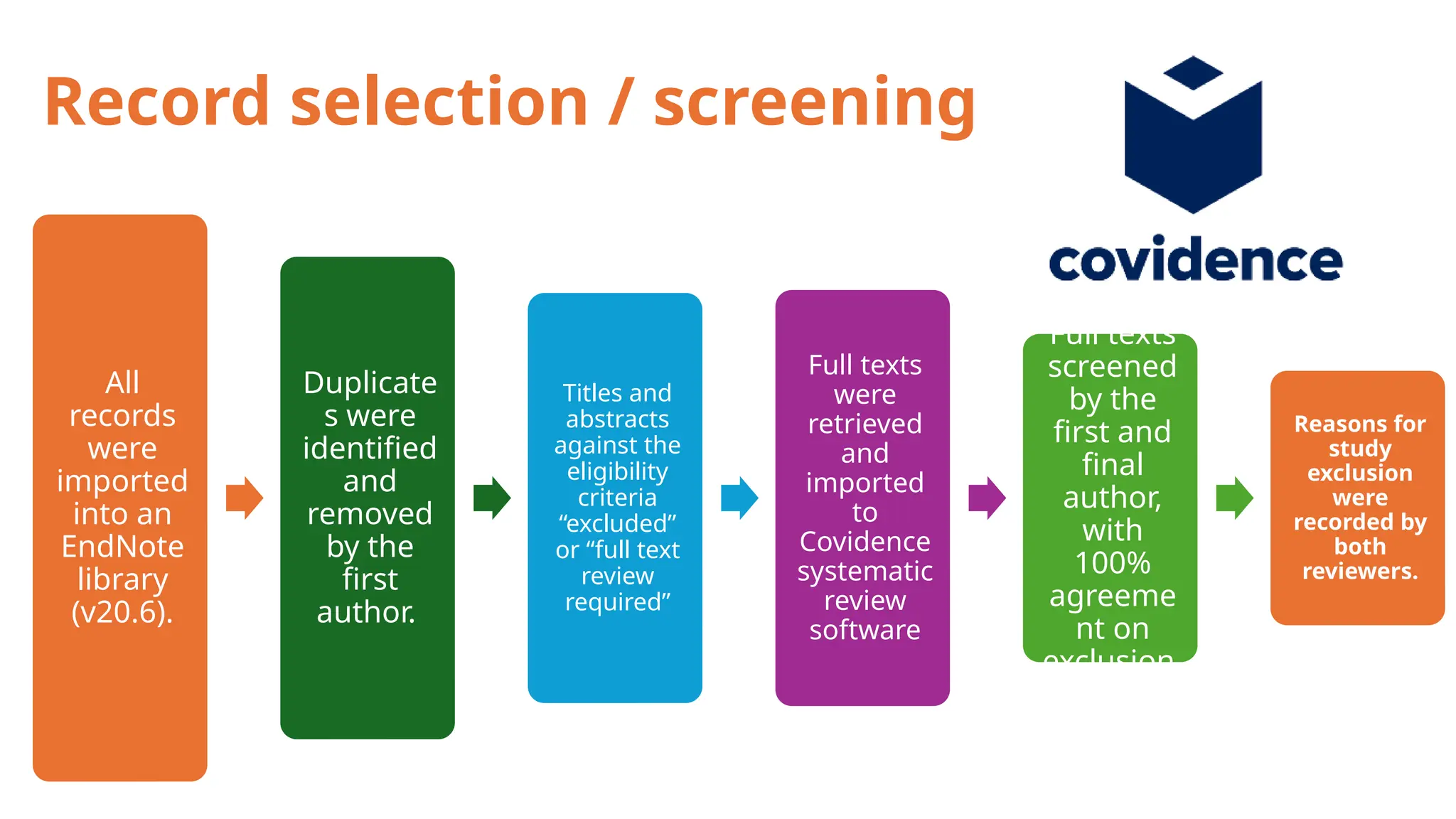
Record selection / screening
All
records
were
imported
into an
EndNote
library
(v20.6).
Duplicate
s were
identified
and
removed
by the
first
author.
Titles and
abstracts
against the
eligibility
criteria
“excluded”
or “full text
review
required”
Full texts
were
retrieved
and
imported
to
Covidence
systematic
review
software
Full texts
screened
by the
first and
final
author,
with
100%
agreeme
nt on
exclusion.
Reasons for
study
exclusion
were
recorded by
both
reviewers.
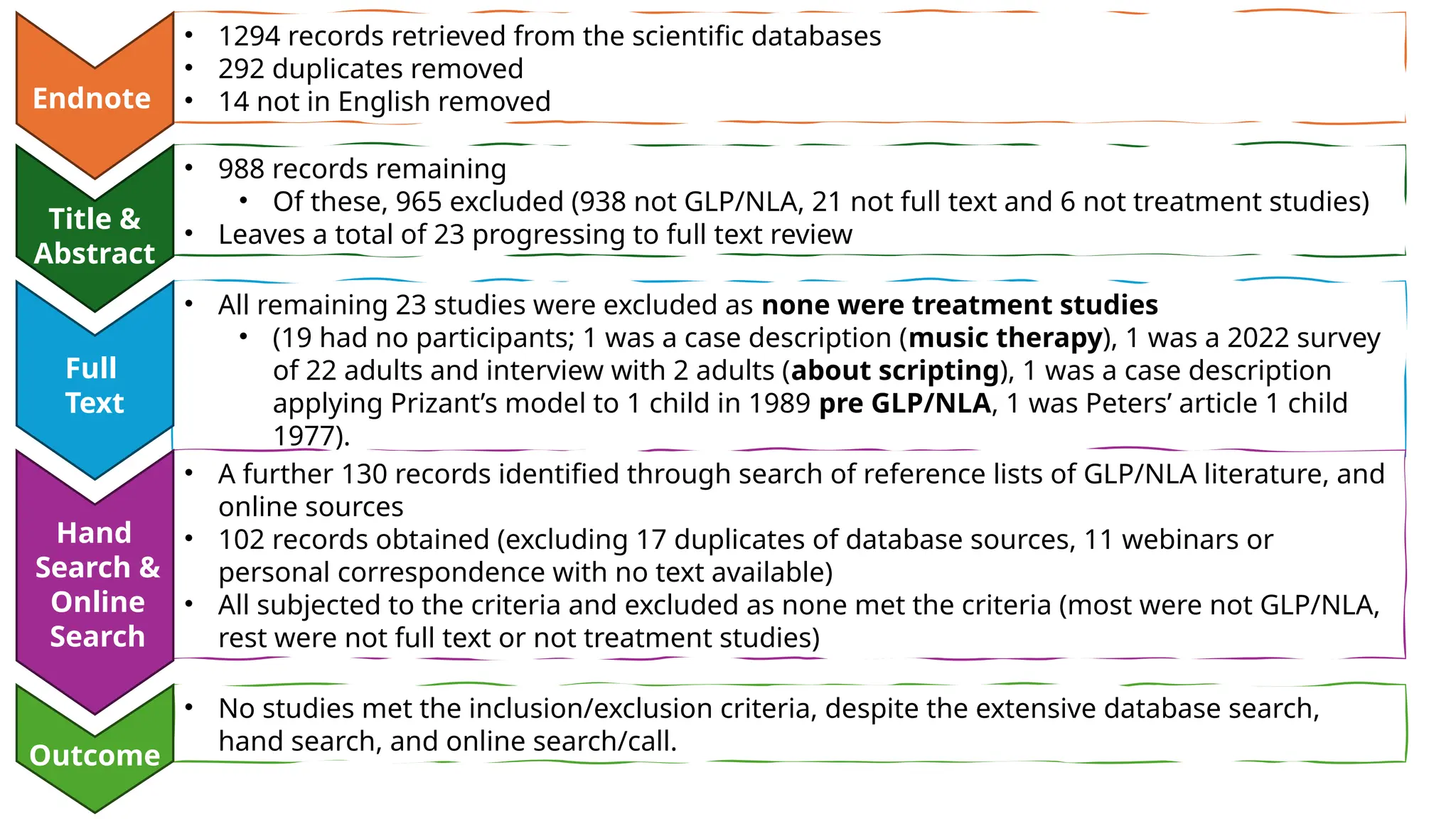
• 1294 records retrieved from the scientific databases
• 292 duplicates removed
• 14 not in English removed
• 988 records remaining
• Of these, 965 excluded (938 not GLP/NLA, 21 not full text and 6 not treatment studies)
• Leaves a total of 23 progressing to full text review
Endnote
Title &
Abstract
• All remaining 23 studies were excluded as none were treatment studies
• (19 had no participants; 1 was a case description (music therapy), 1 was a 2022 survey
of 22 adults and interview with 2 adults (about scripting), 1 was a case description
applying Prizant’s model to 1 child in 1989 pre GLP/NLA, 1 was Peters’ article 1 child
1977).
• A further 130 records identified through search of reference lists of GLP/NLA literature, and
online sources
• 102 records obtained (excluding 17 duplicates of database sources, 11 webinars or
personal correspondence with no text available)
• All subjected to the criteria and excluded as none met the criteria (most were not GLP/NLA,
rest were not full text or not treatment studies)
Full
Text
• No studies met the inclusion/exclusion criteria, despite the extensive database search,
hand search, and online search/call.
Hand
Search &
Online
Search
Outcome
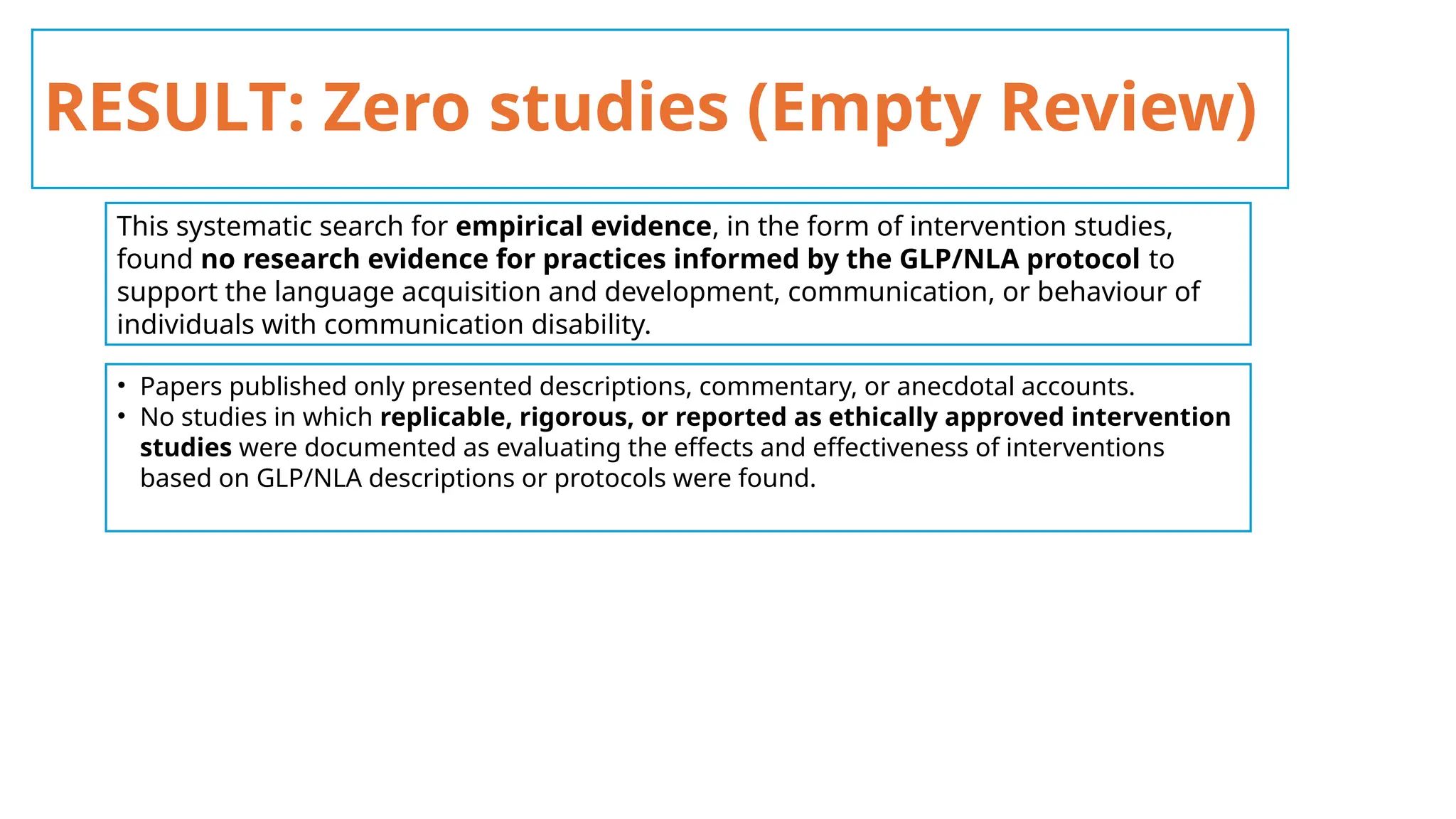
RESULT: Zero studies (Empty Review)
• Papers published only presented descriptions, commentary, or anecdotal accounts.
• No studies in which replicable, rigorous, or reported as ethically approved intervention
studies were documented as evaluating the effects and effectiveness of interventions
based on GLP/NLA descriptions or protocols were found.
This systematic search for empirical evidence, in the form of intervention studies,
found no research evidence for practices informed by the GLP/NLA protocol to
support the language acquisition and development, communication, or behaviour of
individuals with communication disability.
[1] Peters AM. The units of language acquisition. Cambridge: Cambridge University Press; 1983.
[2] Prizant BM. Language acquisition and communicative behavior in autism: Toward an understanding of the" whole" of it. Journal of Speech and
Hearing Disorders. 1983;48(3):296-307.
[3] Blanc M. Natural language acquisition on the autism spectrum: The journey from echolalia to self-generated language. Madison, WI:
Communication Development Center; 2012.
Absence of research & devaluing validation
research
“… detailed
longitudinal
research needs to
be undertaken
following children
from prelinguistic
stages through
the acquisition of
complex and
spontaneous
language”
[Prizant, 1983,
In 2022, CDC Public Instagram post:
“Do we need more research on
gestalt language development to
prove that it exists?”
“Nope! We have plenty of research to
show that gestalt language
development exists!”
Further info cites Peters, Prizant 1983 and
Blanc 2012.
https://www.instagram.com/p/
CsEKdsEOeVA/?
utm_source=ig_web_copy_link
30 years
“…it is inappropriate
to offer any formal
"conclusion": We are
only at the outset of
a newly defined
course of
exploration.”
(Peters, 1983)
Blanc [3]
(2012)
Book does
not outline
research or
provide
much detail
on clients or
therapy
1983 2003 2013 2023
Since 1983 … apparently no validation research, no treatment research on GLP/NLA
(41 yrs)
30 years
Explainable?
No.
• So many teaching modes –
workshops, reels, posts,
teaching and re-teaching
something that cannot be
clearly explained.
• Why is it so hard to make
sense of?
• While making ‘perfect sense’?
Part 3. Clinical &
Research Implications
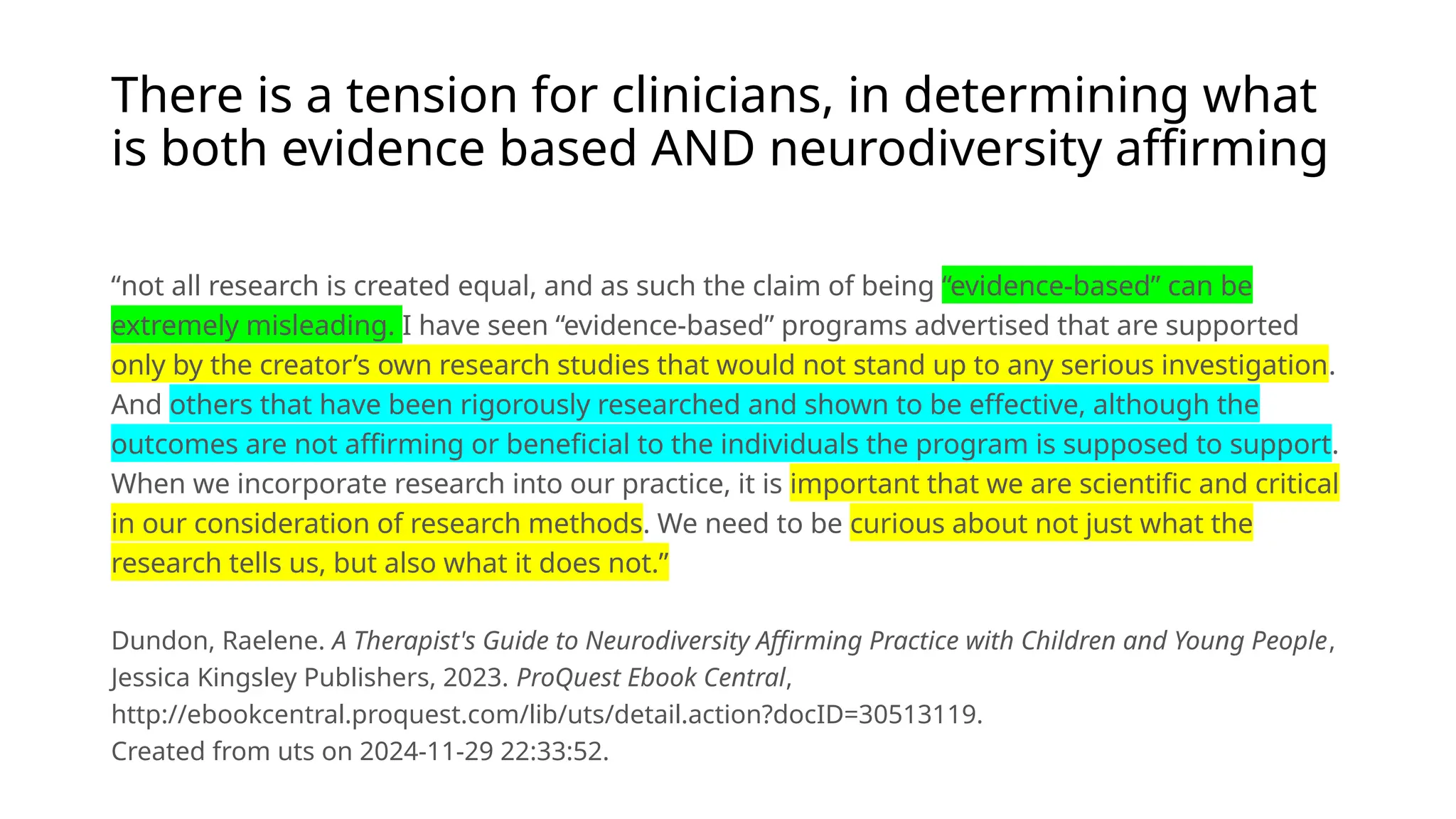
There is a tension for clinicians, in determining what
is both evidence based AND neurodiversity affirming
“not all research is created equal, and as such the claim of being “evidence-based” can be
extremely misleading. I have seen “evidence-based” programs advertised that are supported
only by the creator’s own research studies that would not stand up to any serious investigation.
And others that have been rigorously researched and shown to be effective, although the
outcomes are not affirming or beneficial to the individuals the program is supposed to support.
When we incorporate research into our practice, it is important that we are scientific and critical
in our consideration of research methods. We need to be curious about not just what the
research tells us, but also what it does not.”
Dundon, Raelene. A Therapist's Guide to Neurodiversity Affirming Practice with Children and Young People,
Jessica Kingsley Publishers, 2023. ProQuest Ebook Central,
http://ebookcentral.proquest.com/lib/uts/detail.action?docID=30513119.
Created from uts on 2024-11-29 22:33:52.
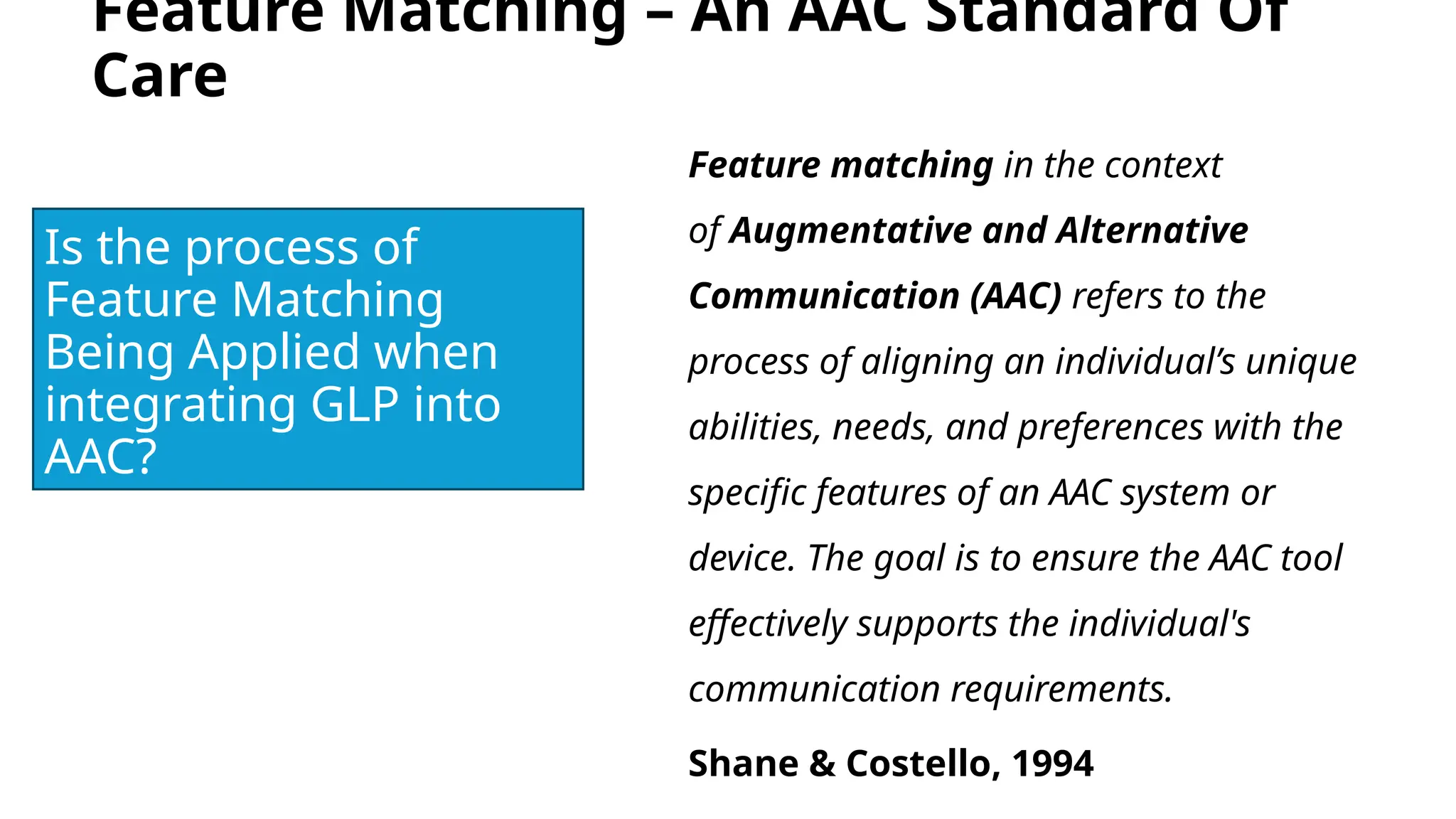
Feature Matching – An AAC Standard Of
Care
Feature matching in the context
of Augmentative and Alternative
Communication (AAC) refers to the
process of aligning an individual’s unique
abilities, needs, and preferences with the
specific features of an AAC system or
device. The goal is to ensure the AAC tool
effectively supports the individual's
communication requirements.
Shane & Costello, 1994
Is the process of
Feature Matching
Being Applied when
integrating GLP into
AAC?
To Date, There’s No Evidence That GLPAdvocates Consider Feature
Matching
Principles In Their Effort To Integrate GLP and AAC
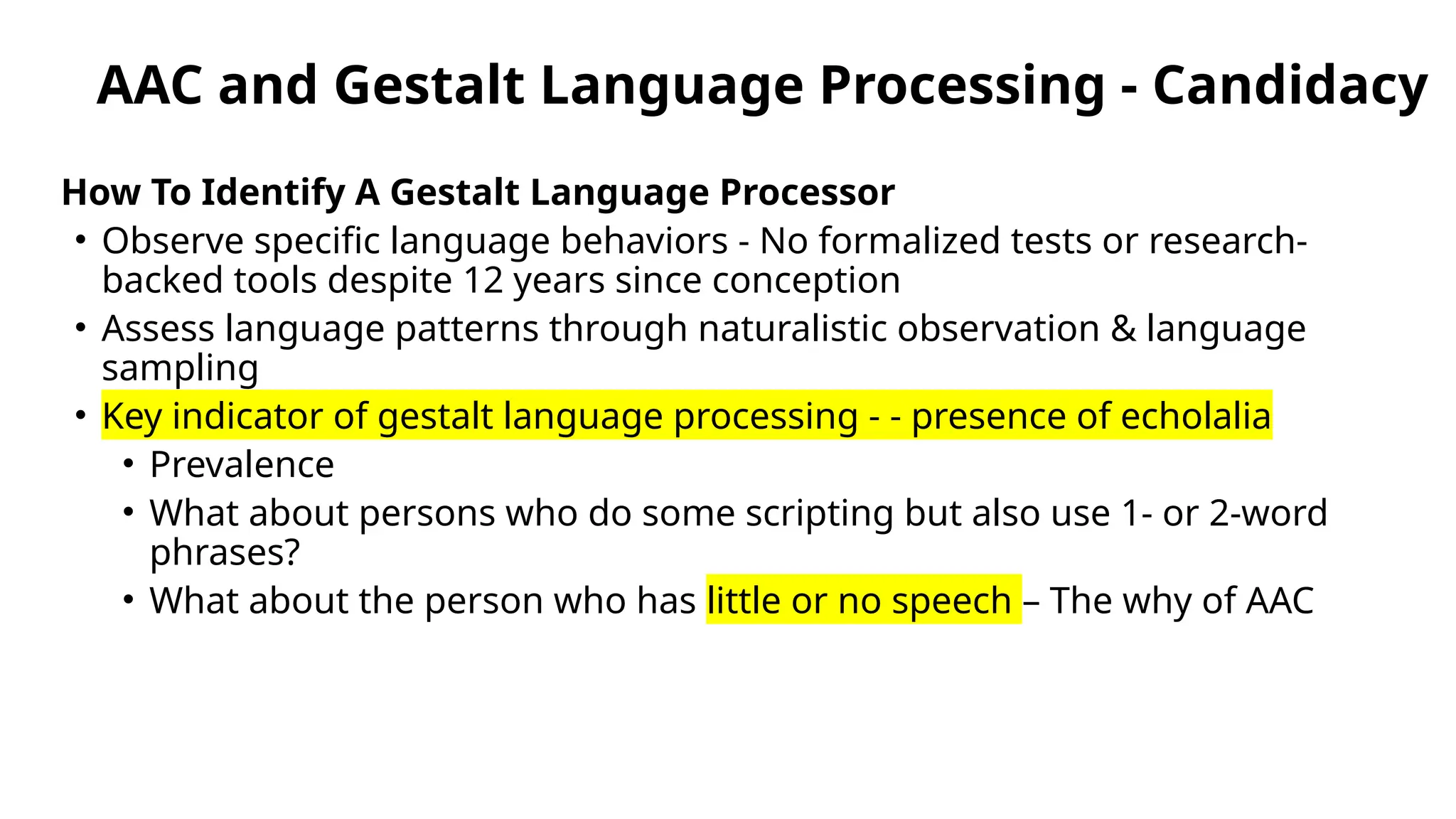
AAC and Gestalt Language Processing - Candidacy
How To Identify A Gestalt Language Processor
• Observe specific language behaviors - No formalized tests or research-
backed tools despite 12 years since conception
• Assess language patterns through naturalistic observation & language
sampling
• Key indicator of gestalt language processing - - presence of echolalia
• Prevalence
• What about persons who do some scripting but also use 1- or 2-word
phrases?
• What about the person who has little or no speech – The why of AAC
AAC And Gestalt Language Processing - Candidacy
How To Identify A Gestalt Language Processor
• “….. some unique communication patterns: (From [De-
identified]– A Pediatric Speech Therapy website)
• Delayed Speech:
• Echolalia:
• Difficulty with Grammar:
• Strong Memory:
AAC And Gestalt Language Processing - Candidacy
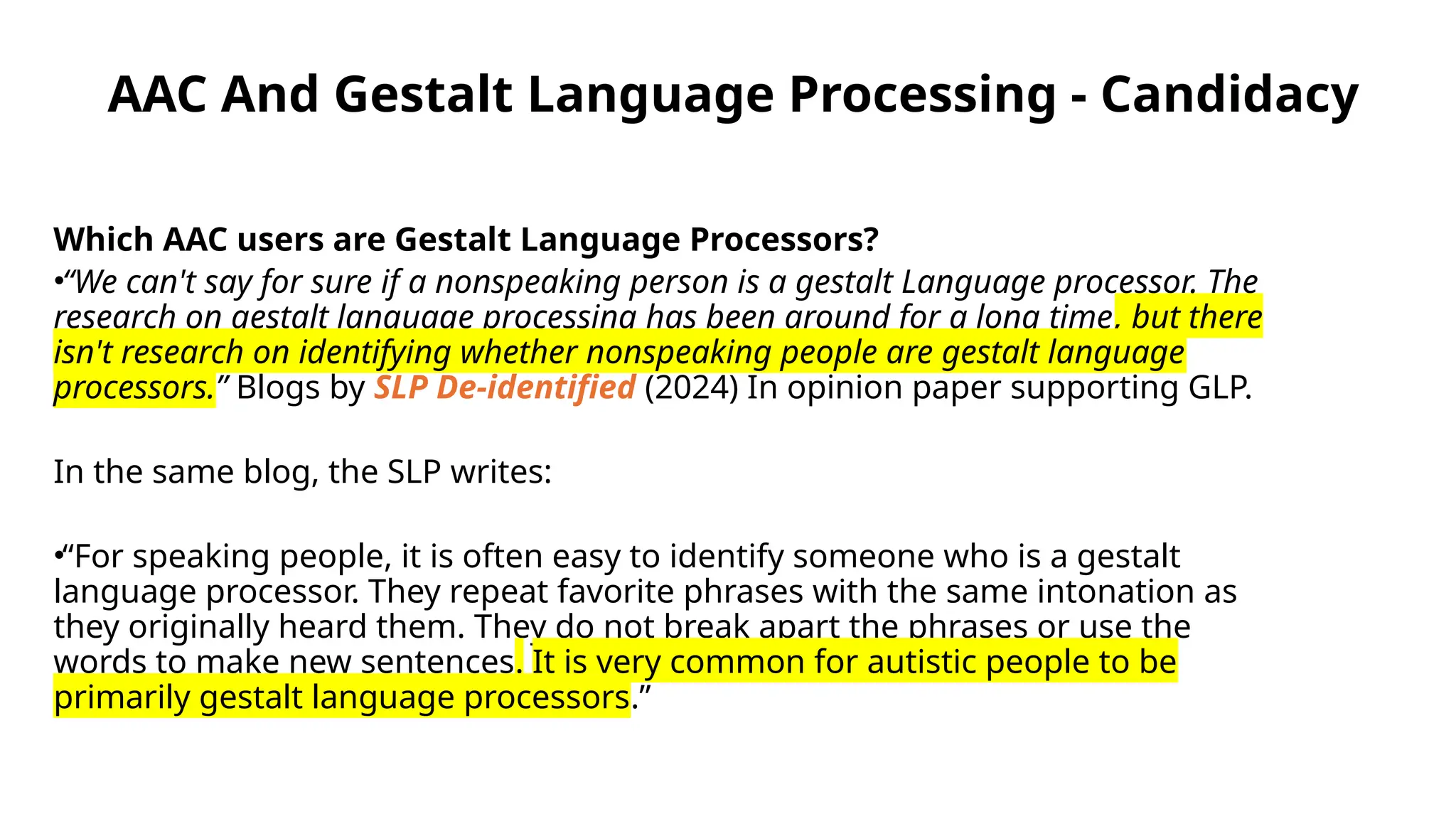
Which AAC users are Gestalt Language Processors?
•“We can't say for sure if a nonspeaking person is a gestalt Language processor. The
research on gestalt language processing has been around for a long time, but there
isn't research on identifying whether nonspeaking people are gestalt language
processors.” Blogs by SLP De-identified (2024) In opinion paper supporting GLP.
In the same blog, the SLP writes:
•“For speaking people, it is often easy to identify someone who is a gestalt
language processor. They repeat favorite phrases with the same intonation as
they originally heard them. They do not break apart the phrases or use the
words to make new sentences. It is very common for autistic people to be
primarily gestalt language processors.”
?
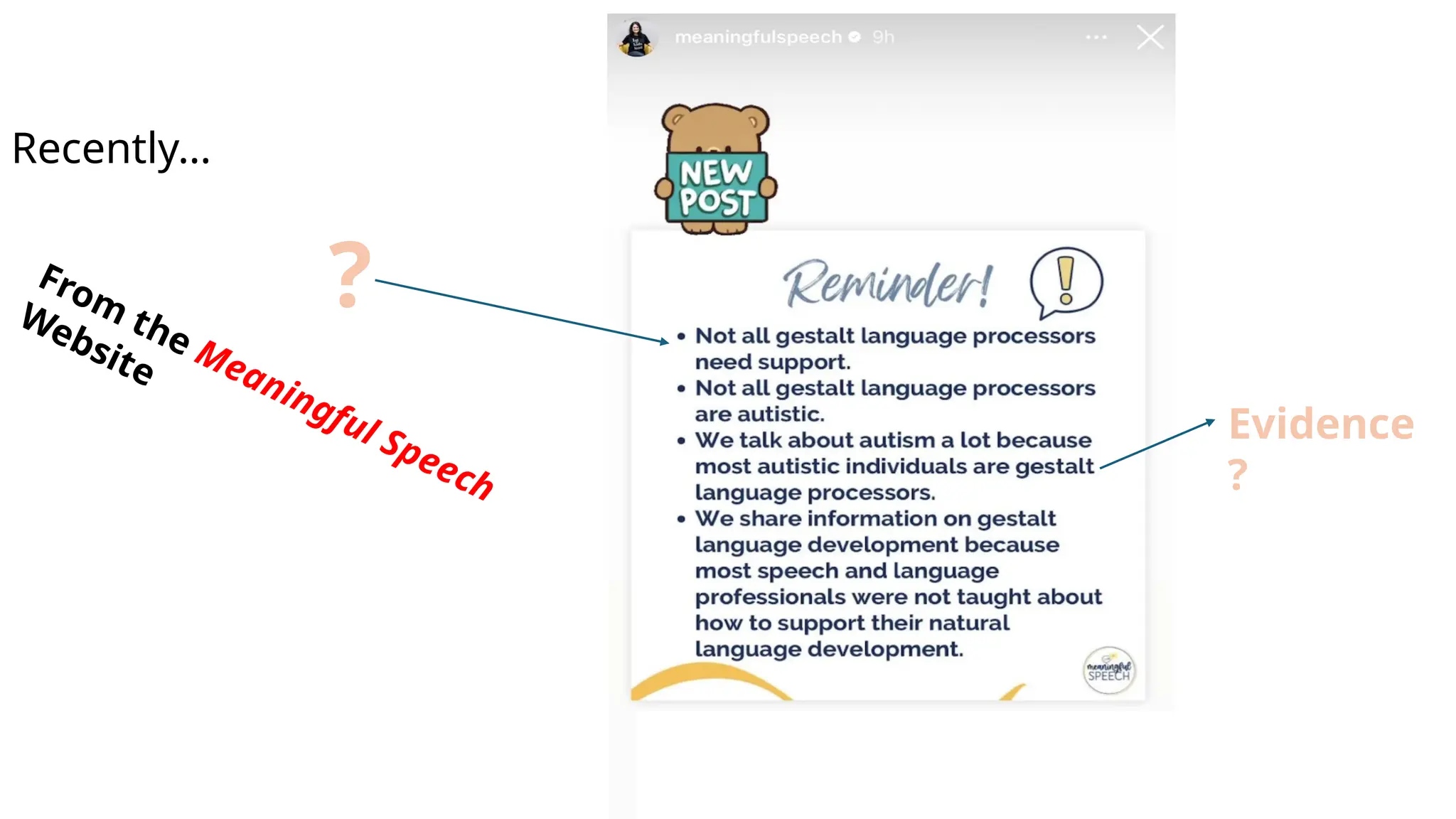
Recently…
From
the Meaningful Speech
Website
Evidence
?
AAC And Gestalt Language Processing - Design
Design of AAC Grid Displays to Accommodate GLP
How to set up Grid Displays for a GLP Processor
• “Understanding the intersection of AAC and gestalt language processing can
be challenging…” [Deidentified], SLP, AAC Specialist, on Website
• “We do not replace core vocabulary: Some may think that core vocabulary
should be minimized in AAC systems for gestalt language processors. In
reality, users will eventually need these foundational single words as they
progress in their language development (Stages 3+).” Meaningful Speech
Website – Resources site for GLP (2024)
AAC And Gestalt Language Processing - Design
Design of AAC Grid Displays to Accommodate GLP
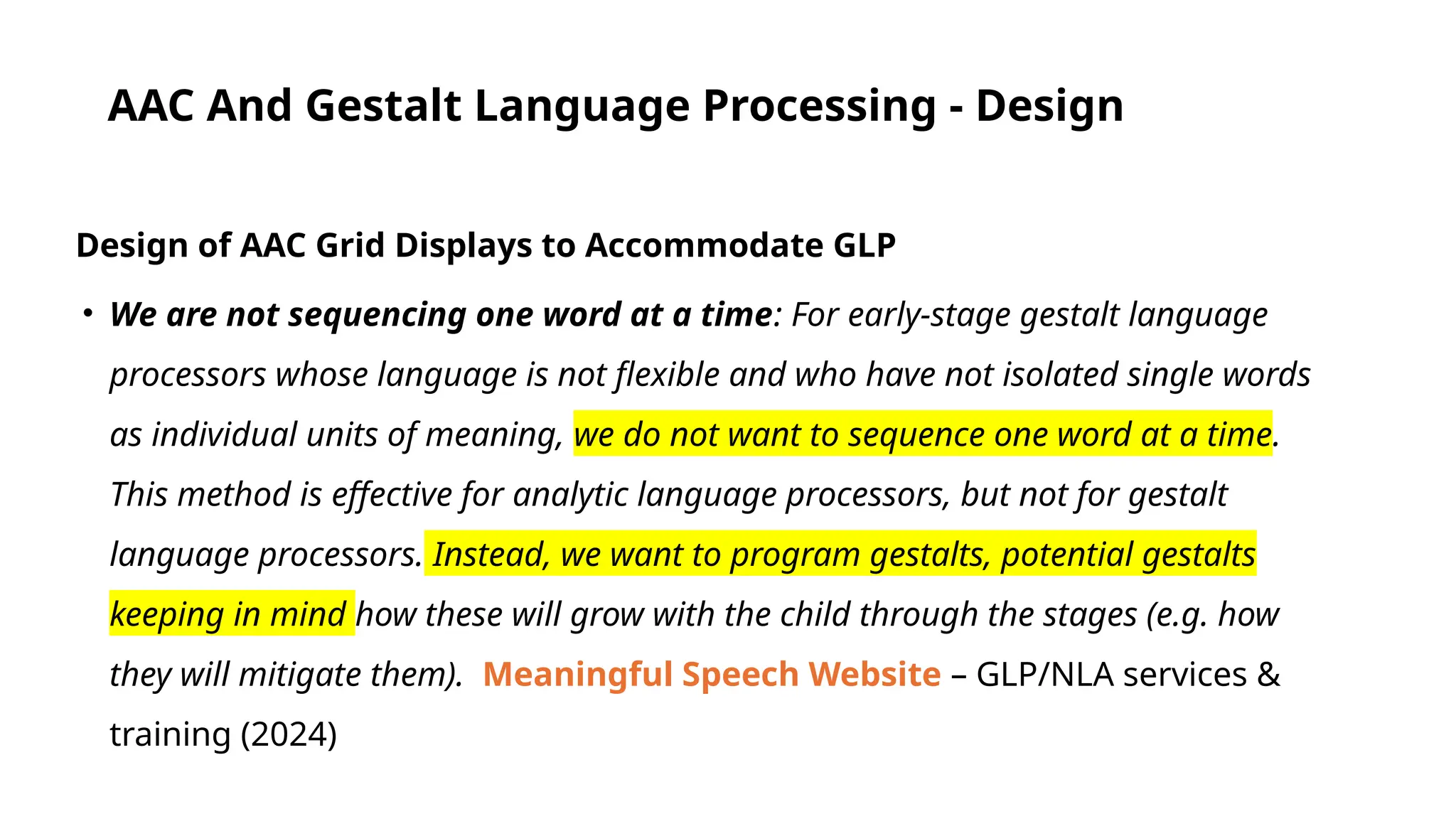
• We are not sequencing one word at a time: For early-stage gestalt language
processors whose language is not flexible and who have not isolated single words
as individual units of meaning, we do not want to sequence one word at a time.
This method is effective for analytic language processors, but not for gestalt
language processors. Instead, we want to program gestalts, potential gestalts
keeping in mind how these will grow with the child through the stages (e.g. how
they will mitigate them). Meaningful Speech Website – GLP/NLA services &
training (2024)
Is the process of Feature
Matching Being Applied
when integrating GLP into
AAC?
To Date, There’s No Evidence That GLPAdvocates Consider
Feature Matching Principles In Their Effort To Integrate GLP and AAC
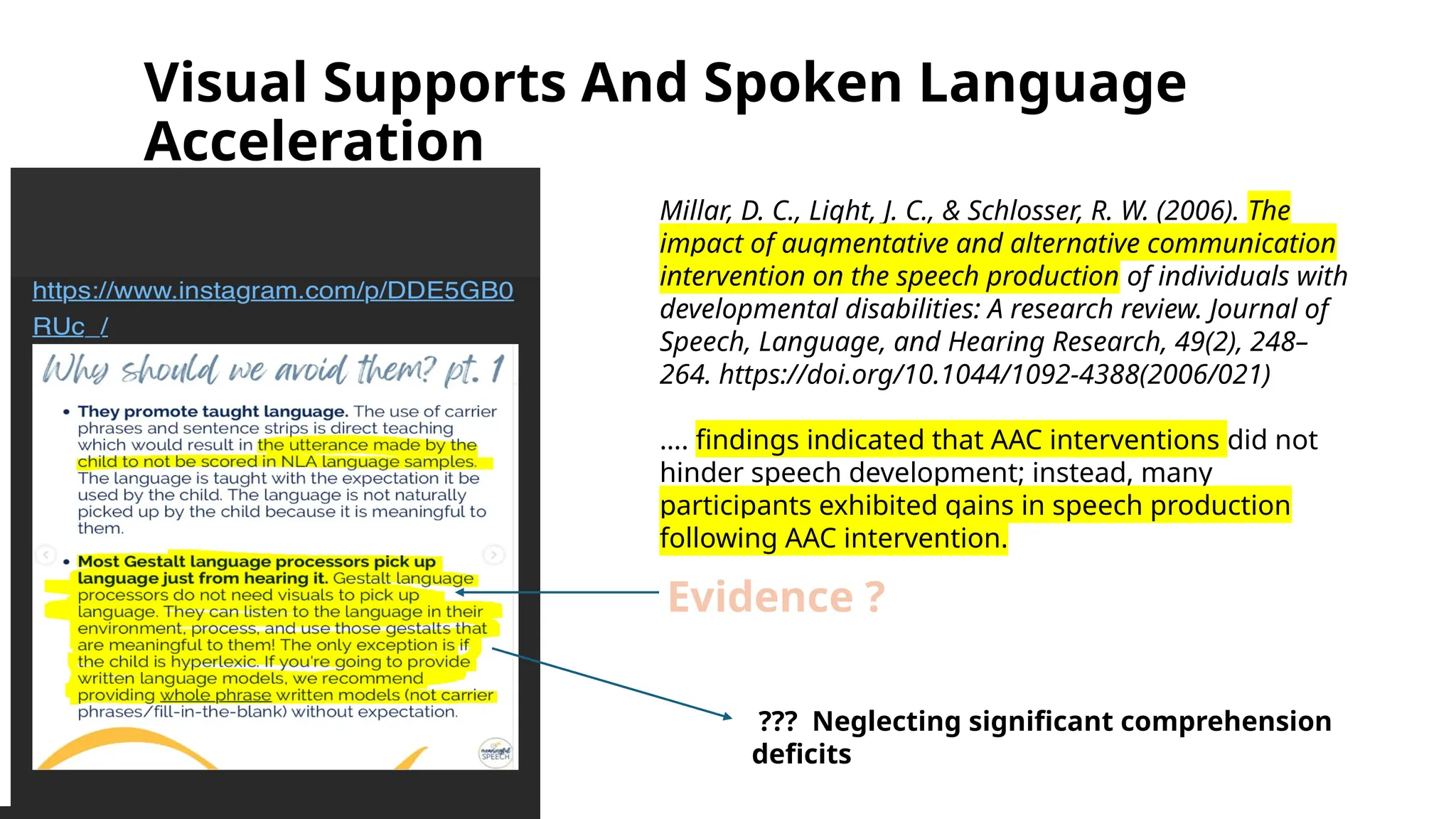
Visual Supports And Spoken Language
Acceleration
Evidence ?
Millar, D. C., Light, J. C., & Schlosser, R. W. (2006). The
impact of augmentative and alternative communication
intervention on the speech production of individuals with
developmental disabilities: A research review. Journal of
Speech, Language, and Hearing Research, 49(2), 248–
264. https://doi.org/10.1044/1092-4388(2006/021)
…. findings indicated that AAC interventions did not
hinder speech development; instead, many
participants exhibited gains in speech production
following AAC intervention.
??? Neglecting significant comprehension
deficits
AAC And Gestalt Language Processing
Literature Review – Research on AAC & GLP
Result
• Opinion pieces – mostly by speech language pathologists
• AAC manufacturers – offer views on screen design
• Most commentary from Meaningful Speech website
• While these publications provide insights into GLP and its
potential integration with AAC, there are no empirical
studies to establish evidence-based practices in this area.
What About Symbolic Understanding?
• Does the Person Comprehend The Meaning Of The Symbol That Represents
A Script / Gestalt?
• Is It More Difficult To Represent A Script Than A Single Word Symbol?
• Does The Child Understand That A Symbol Stands For The Phrase It’s Is
Supposed To Represent – Is That Part Of The GLP Practitioners Feature
Matching Process?
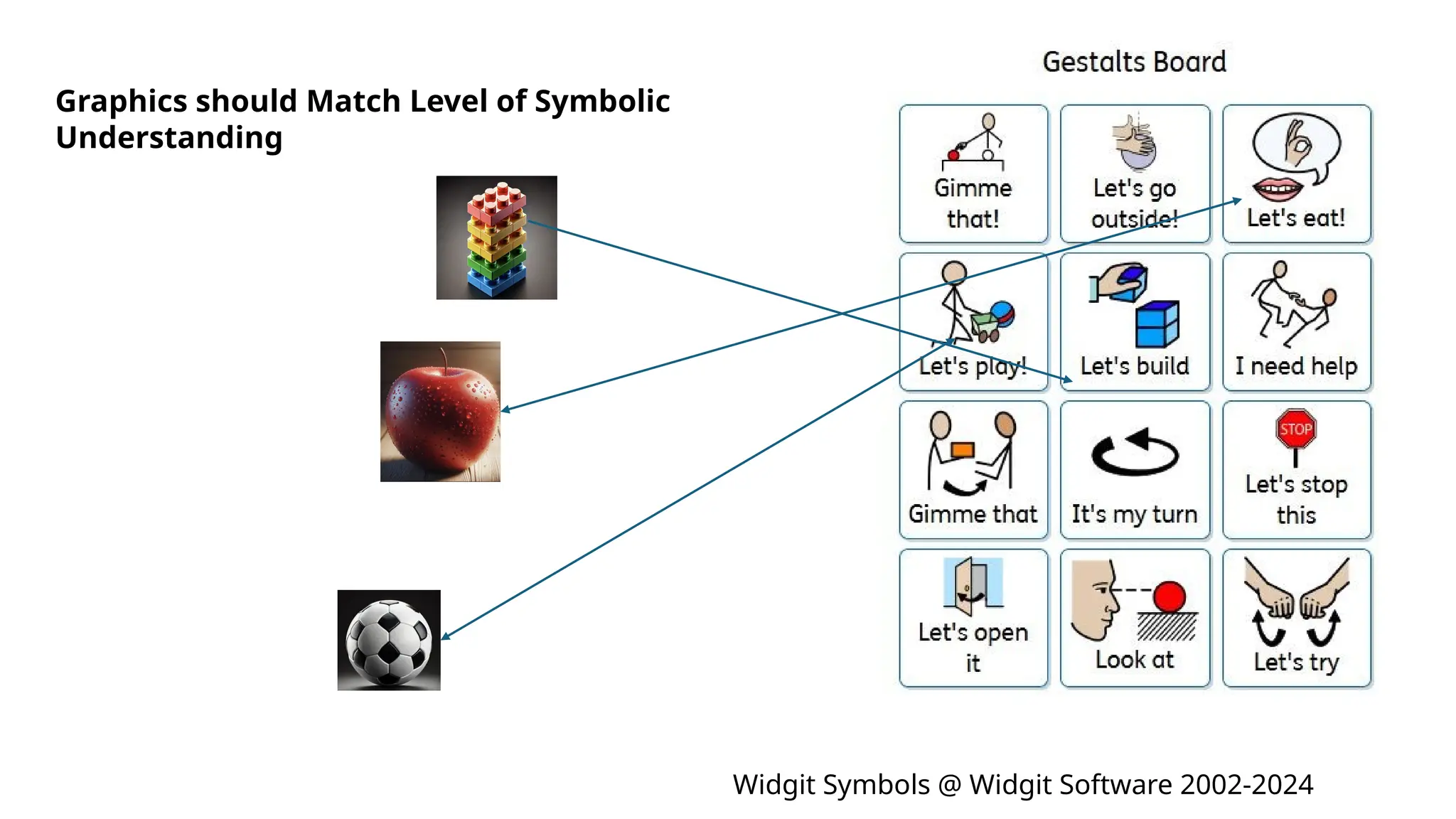
• If You’re Going To Adopt ‘Scripts’ ‘Chunks’ Or ‘Gestalts’ At Least Have
Representative Symbols That The Child Can Understand The Intended
Meaning Of The Symbols (Is It Photo, Graphic, Line Drawings, Text?)
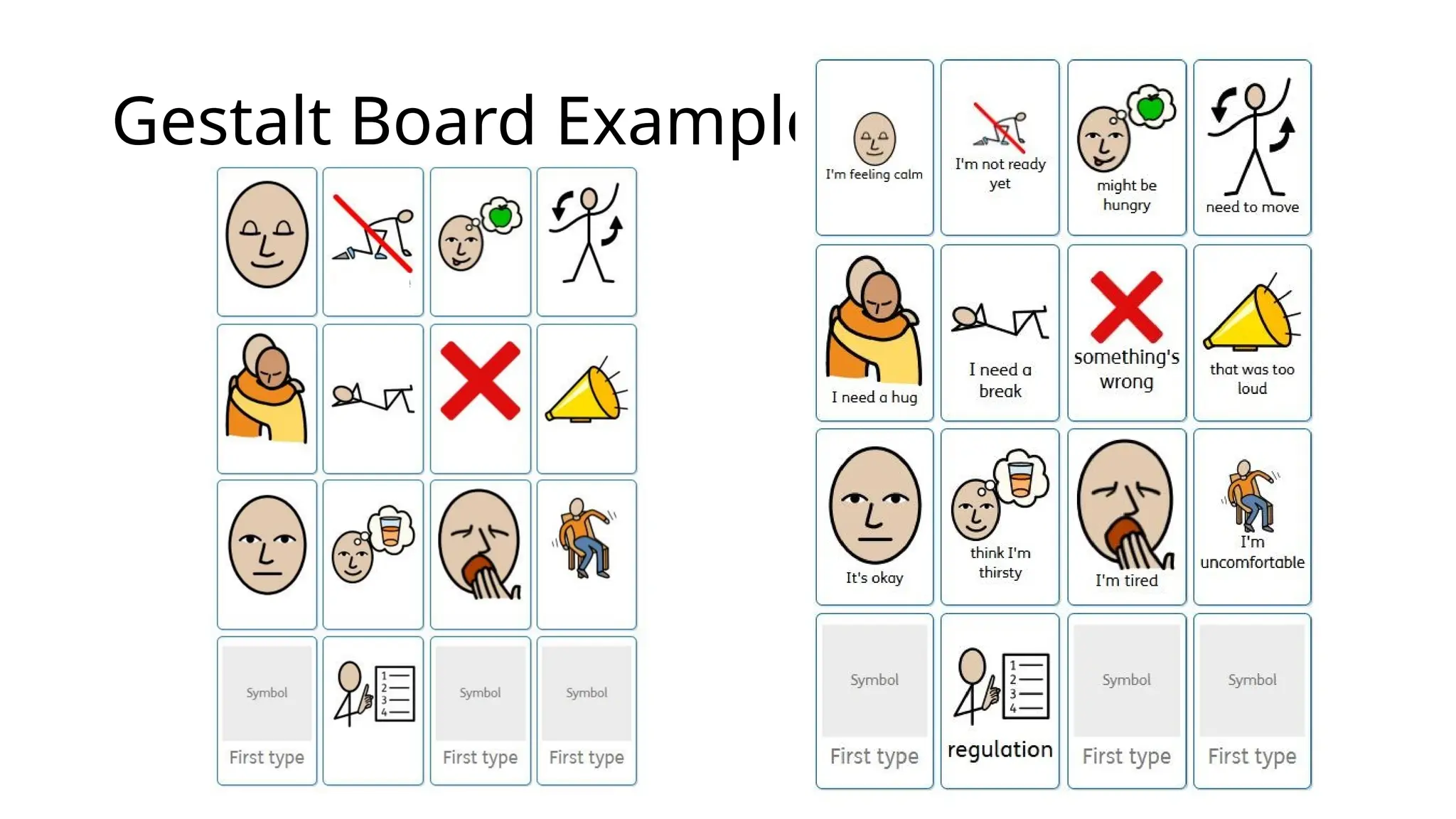
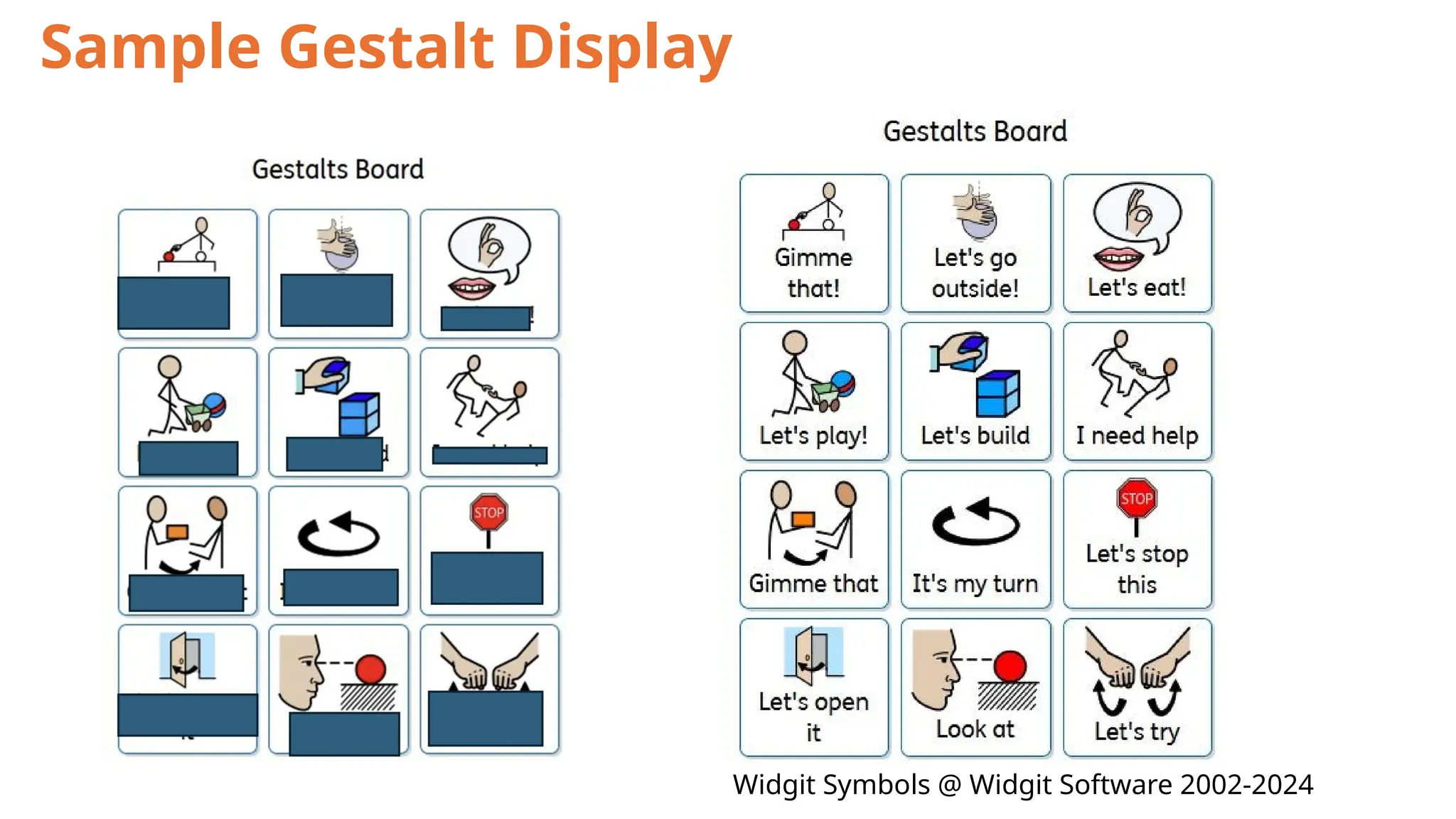
Gestalt Board Example
Widgit Symbols @ Widgit Software 2002-2024
Sample Gestalt Display
Many of the Gestalt Language Processing (GLP) individuals presumed
candidates for AAC intervention would probably be more accurately referred
to as non- or minimally speaking (NML). These individuals often have a
diagnosis of autism. Recognizing that best practices for individuals with
limited or no speech require the use of Augmentative and Alternative
Communication (AAC), GLP advocates have sought to integrate the gestalt—
or chunk-based—spoken language approach into the visually-oriented
framework of AAC. This integration involves representing whole phrases, or
"gestalts," as single graphic symbols within the AAC system. However,
representing a whole phrase with a single graphic symbol is inherently
challenging to design (as just demonstrated) which makes them difficult if
The Symbol to Gestalt Representation Problem
Graphics should Match Level of Symbolic
Understanding
Widgit Symbols @ Widgit Software 2002-2024
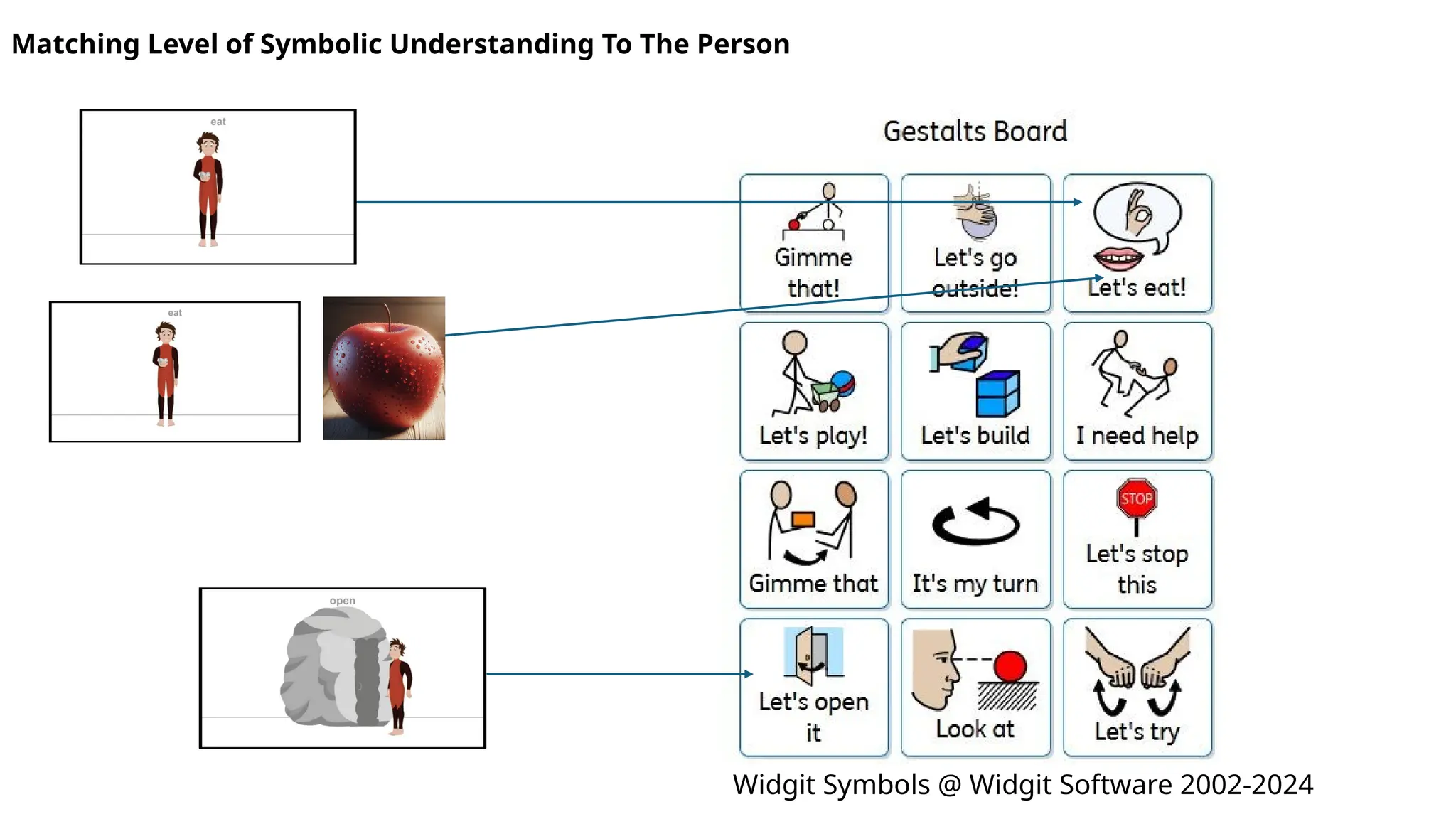
Matching Level of Symbolic Understanding To The Person
Widgit Symbols @ Widgit Software 2002-2024
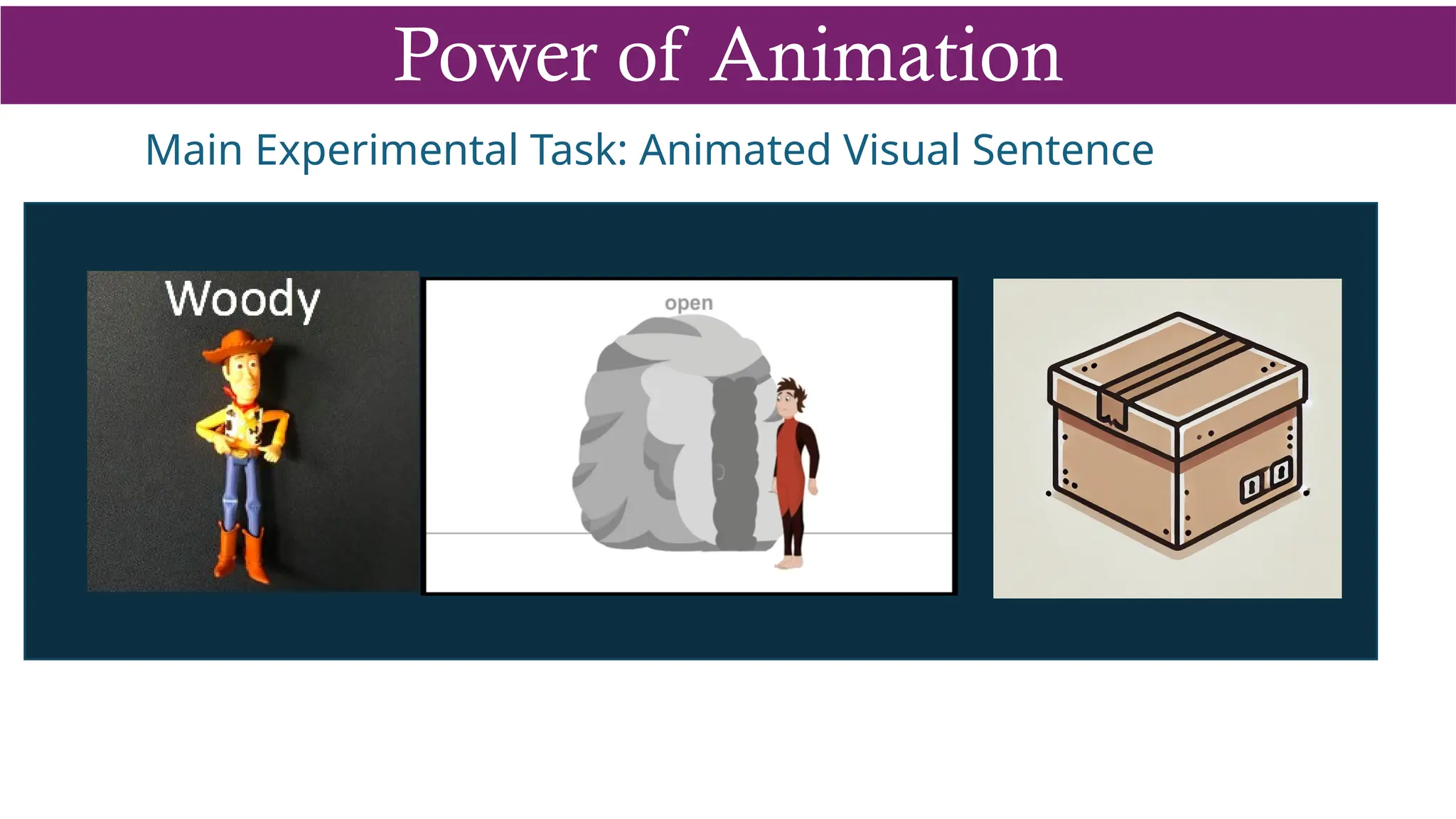
Main Experimental Task: Animated Visual Sentence
Power of Animation
Final thoughts on AAC & Gestalt Language
Processing
• Scripts / chunks / gestalts have been part of AAC grid display design for
decades – use them judiciously
• Use whole phrases but not at the expense of single words and building phrases
and sentences
• Design AAC through a Feature-Matching Process, based on a full dynamic
assessment of the child’s capabilities and limitations.
• Select Symbols that are understood – Assess for symbolic understanding
• Do not avoid single word / symbol instruction until “Stage 3” – no evidence to
support – Don’t risk a person's communication growth on an unproven method
… final
thoughts
(cont.,)
GLP and AAC Integration
• All I’ve read suggests the primary
effort of GLP/NLA is on expressive
language. Don’t focus exclusively
on expressive language at the
expense of or without knowledge
of spoken language
comprehension - or if the symbols
selected are in fact meaningful
ALERT  ANECTODAL OBSERVATIONS:
• A growing number of families are asking about
GLP or bringing GLP Displays. The displays and
the recommendations are inconsistent – no
uniformity.
• Or “Should my child’s AAC system just have
gestalts?”
Clinical Responsibilities
As evidence-based professionals, speech-language
pathologists, occupational therapists, psychologists,
educators, and other professionals providing services to
autistic children and adults have an ethical responsibility to:
• seek out all of the most rigorous external qual and quant
and lived experience evidence available on any given
intervention, and
• use this information in combination with clinical expertise and
family/individual preferences to determine the best course of
action, given that
• delivery of an ineffective intervention can cause harm by the
cost of time and money which could be invested into other
more effective interventions for that individual [1].
[1] Hernandez-Villafuerte K, Zamora B, Feng Y, Parkin D, Devlin N, Towse A. Estimating health system
opportunity costs: the role of non-linearities and inefficiency. Cost Eff Resour Alloc. 2022;20(1):56.
[2] Claxton K, Lomas J, Martin S. The impact of NHS expenditure on health outcomes in England:
Alternative approaches to identification in all-cause and disease specific models of mortality. Health Econ.
2018;27(6):1017-23.
Providing interventions that are not
known to be effective, or known to
be ineffective, without appropriately
determining any significant benefit, is
potentially harmful due to:
• financial, time, and opportunity
costs to the client/family;
• usage of time and expenditure of
funds for training of therapists;
• wasteful use of a scarce therapy
resources; and
• lost opportunity through the
passage of time in the
developmental trajectory of the
child [2].
It is incumbent upon professionals, whose
credentials invite confidence and indicate credibility,
to consider whether new interventions demonstrate
both a sound theoretical basis for having an effect,
and evidence of a treatment effect before
promoting these on social media.
• Due diligence should be done prior to making
claims about the actual or potential benefits of a
treatment.
• This requires critical appraisal of the intervention,
its theoretical foundations, and the supporting
and opposing evidence to ensure the selected
intervention is appropriate for each individual
client.
[1] Hutchins TL, Knox SE, Fletcher EC. Natural language acquisition and gestalt language processing: A critical analysis of
their application to autism and speech language therapy. Autism and Developmental Language Impairments.
2024;9:23969415241249944.
In the absence of either a
theoretical foundation or
empirical evidence and
considering the serious
questions regarding the
practice of GLP/NLA (see [1]),
this endeavor becomes
difficult.
In the absence of evidence,
clinicians have a duty to justify
their decision-making if
choosing an intervention for
which there is no empirical
evidence and hold due
responsibility / duty of care for
its outcomes.
Search Oct 7 2024
Clinical Responsibilities
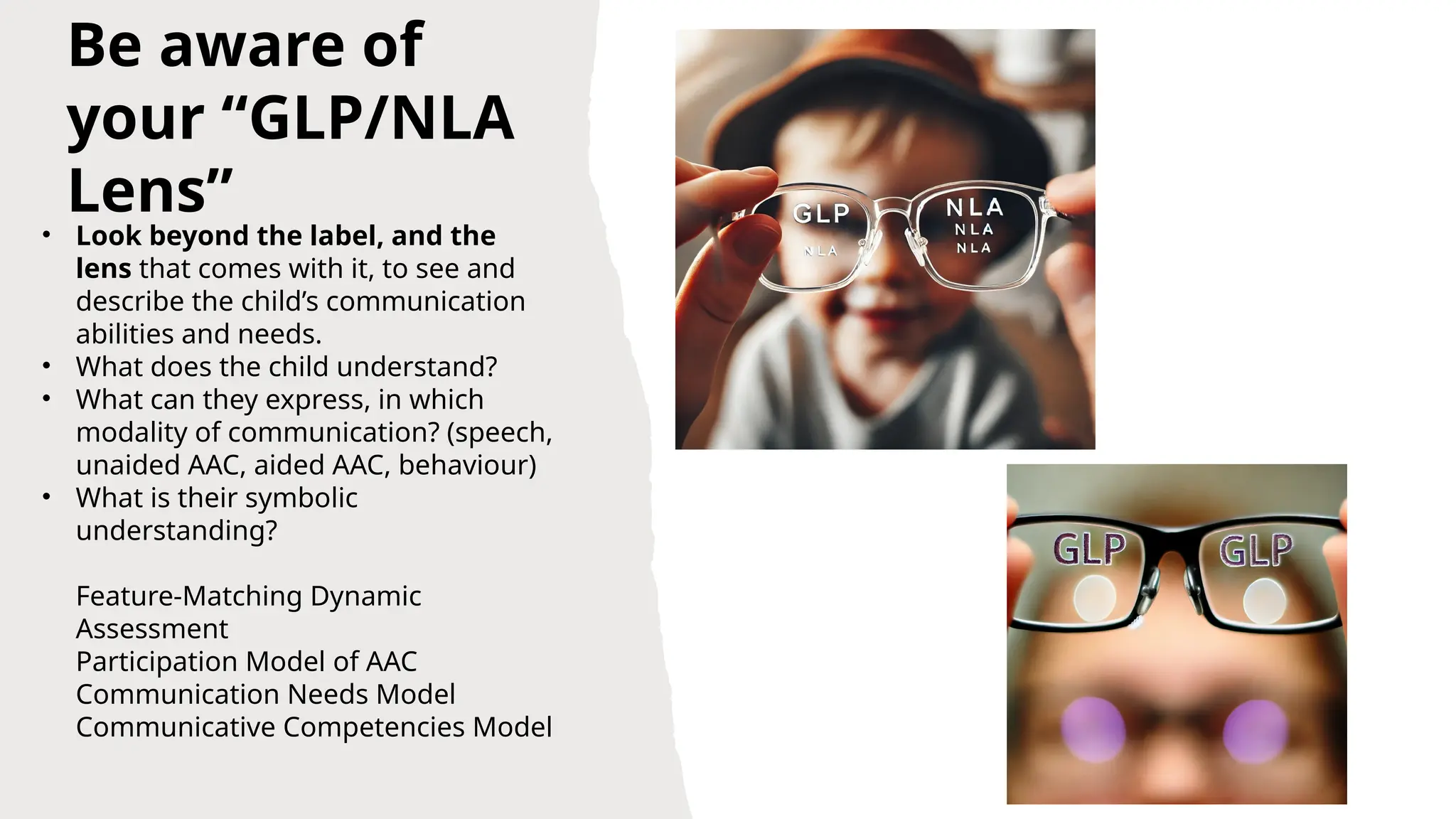
Be aware of
your “GLP/NLA
Lens”
• Look beyond the label, and the
lens that comes with it, to see and
describe the child’s communication
abilities and needs.
• What does the child understand?
• What can they express, in which
modality of communication? (speech,
unaided AAC, aided AAC, behaviour)
• What is their symbolic
understanding?
Feature-Matching Dynamic
Assessment
Participation Model of AAC
Communication Needs Model
Communicative Competencies Model
“People seem to be, all or nothing…”
[1] O’Keeffe C, McNally S. A systematic review of play-based interventions targeting the social communication skills of children with autism spectrum disorder in
educational contexts. Review Journal of Autism and Developmental Disorders. 2023;10(1):51-81. https://doi.org/10.1007/s40489-021-00286-3
[2] Biggs EE, Carter EW, Gilson CB. Systematic Review of Interventions Involving Aided AAC Modeling for Children With Complex Communication Needs. Am J
Intellect Dev Disabil. 2018;123(5):443-73.
[3] Pepper J, Weitzman E. It takes two to talk: A practical guide for parents of children with language delays. Toronto: The Hanen Centre; 2004.
Evidence-based
approaches can be
neurodiversity-
affirming.
Play-based interventions
[1], aided AAC modelling
[2] and evidence-based
interventions to support
language development in
general (e.g., those
grounded in child-directed
language stimulation [3]).
Evaluate GLP/NLA related
interventions,
Identify appropriate
outcome measures.
Determine who they are
expected to benefit,
and those for whom they
are not expected to be
helpful.
Dr Lucy Bryant
People seem to be
all or nothing
And I don’t think that that’s an appropriate way to educate anybody
We need to be looking at ‘okay what is - the actual –
underlying flaws?’
And we need to consider
both sides of the argument
Sure, there are benefits to components of Natural Language Acquisition
They’re drawn from other evidence-based approaches
But then there’s a whole bunch
of other non-evidence-based things thrown in
that corrupt that
And if we take those good parts
that also exist in other evidence-based approaches
and we use those -
That’s the way to go about practice.”
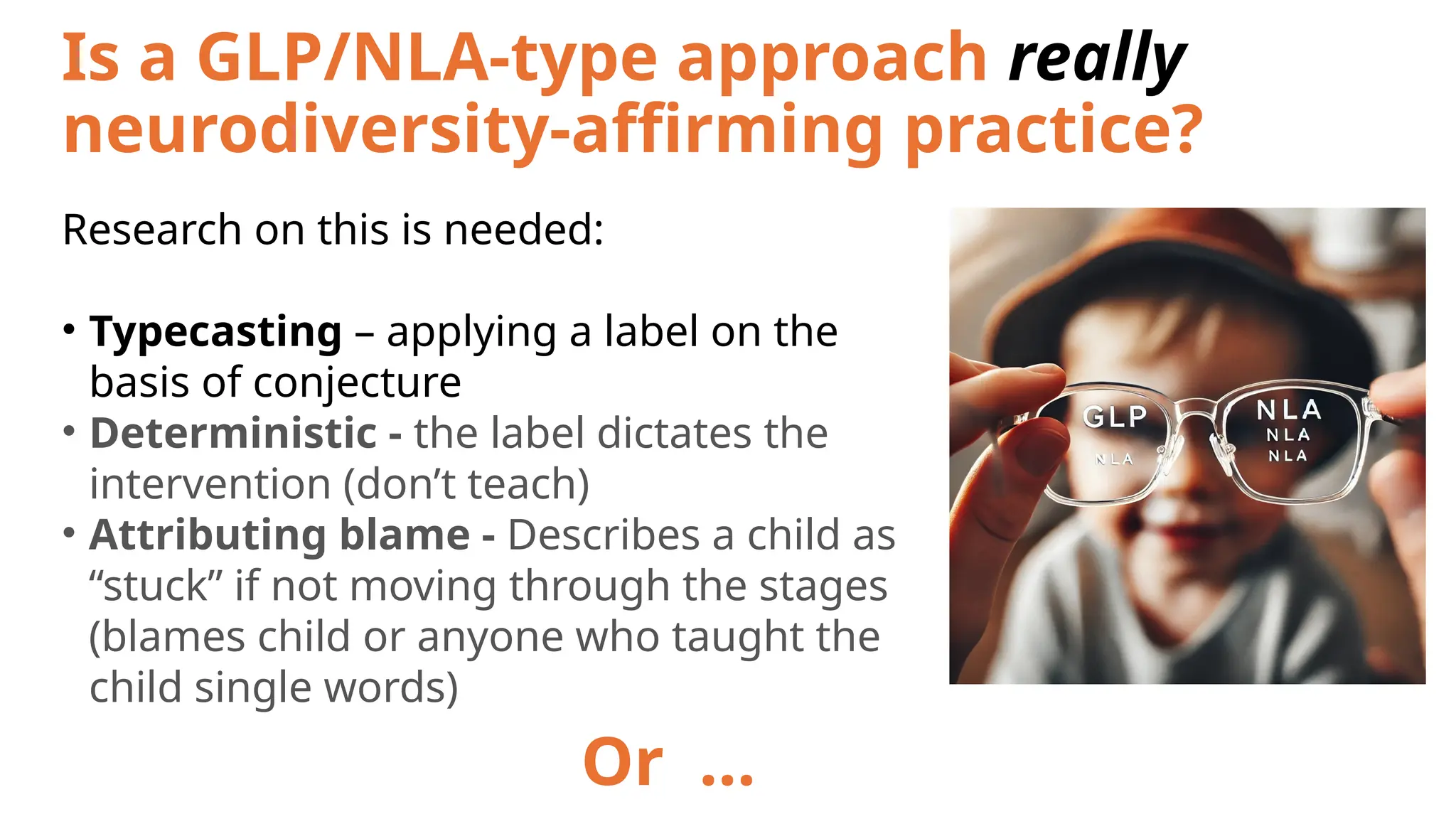
Is a GLP/NLA-type approach really
neurodiversity-affirming practice?
Research on this is needed:
• Typecasting – applying a label on the
basis of conjecture
• Deterministic - the label dictates the
intervention (don’t teach)
• Attributing blame - Describes a child as
“stuck” if not moving through the stages
(blames child or anyone who taught the
child single words)
Or …
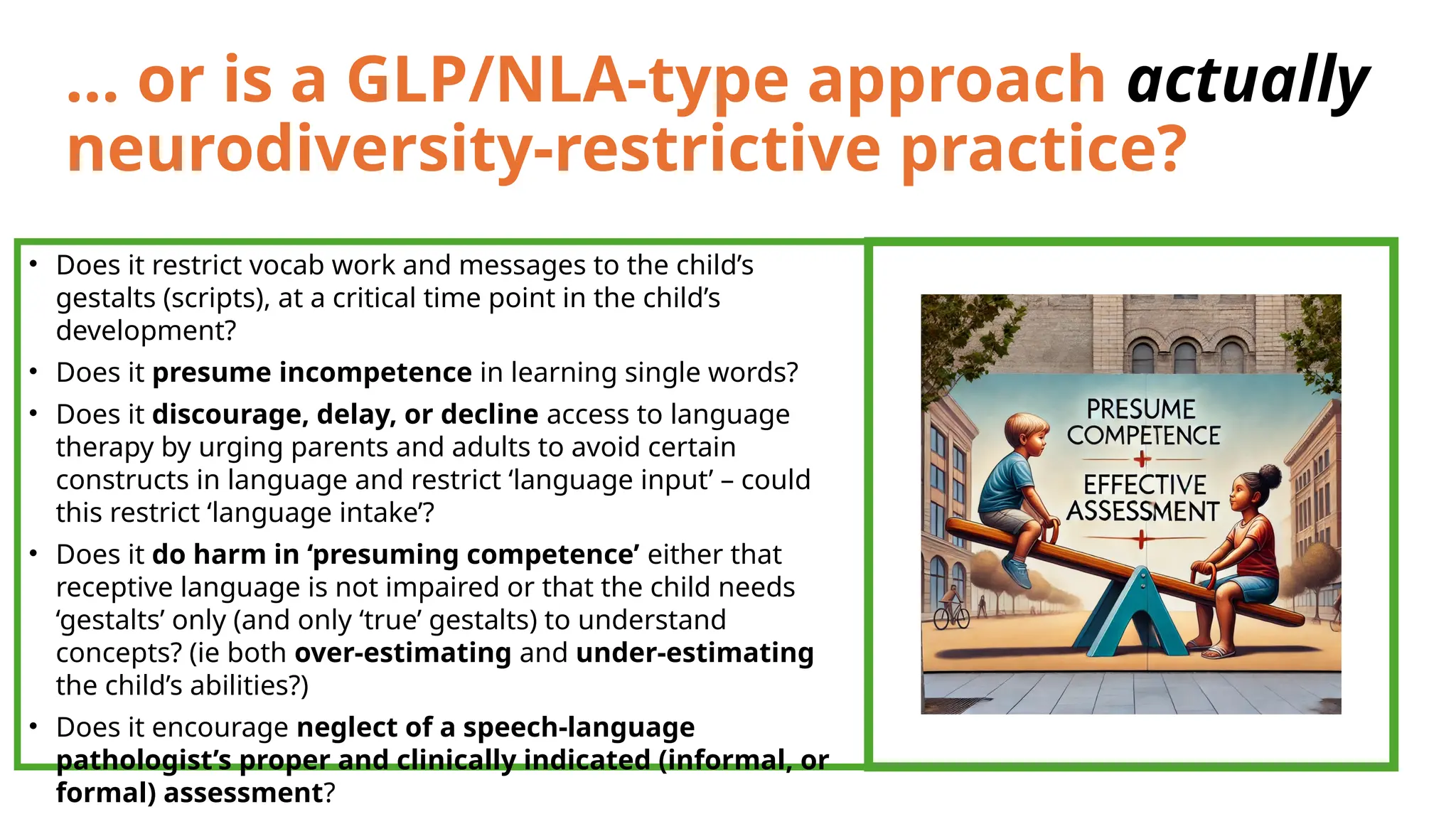
… or is a GLP/NLA-type approach actually
neurodiversity-restrictive practice?
• Does it restrict vocab work and messages to the child’s
gestalts (scripts), at a critical time point in the child’s
development?
• Does it presume incompetence in learning single words?
• Does it discourage, delay, or decline access to language
therapy by urging parents and adults to avoid certain
constructs in language and restrict ‘language input’ – could
this restrict ‘language intake’?
• Does it do harm in ‘presuming competence’ either that
receptive language is not impaired or that the child needs
‘gestalts’ only (and only ‘true’ gestalts) to understand
concepts? (ie both over-estimating and under-estimating
the child’s abilities?)
• Does it encourage neglect of a speech-language
pathologist’s proper and clinically indicated (informal, or
formal) assessment?
Is it a danger?
GLP/NLA and FC/RPM – Connected by text, presuming competence, and
‘unreliable speech’
In this respect, GLP/NLA requires a high degree of caution when it
comes to what Blanc (2012) refers to as “Augmenting language
output” (p. 259)
De-identified by me:
Re Soma Mukhopadhyay RPM case ‘[Name Z]’, Blanc writes “From the perspective of NLA, it would
seem that [Name Z] had retreated to saying his old (right –brained) gestalts as part of mentally
watching internal movies with these phrases as the sound track. Through the left-brained technique
of RPM, he was effectively pulled out of them and back into analytic processing.” (p.259).
Two names de-identified by me:
“[Name X] was a CDC client during his teenage years … At the age of eighteen, [Name X] was
introduced to RPM, and a year later he was composing his own stories by pointing to letters.
Effectively bypassing his oral language conundrum, RPM offered [Name X] direct access to his left-
brain generative language in a way that was not reliable with oral speech. … [Name X] seemed to
do it as he moved from processing linearly (with RPM) to processing holistically (when he created
multiple media montages). [Name Y] seemed to shift from his left hemisphere to his right as he
explored new language sources … he seemed to shift back to his left hemisphere as he
3 Reflection questions (stop/keep/start)
for teams
1. Are clinicians actually using GLP/NLA by the book,
or just using the bits that are familiar and
reasonable?
2. Which parts of Blanc’s/Zachos/Shilling’s advice are:
(see Beals, 2024):
• Reasonable but unoriginal – what are those reasonable
things that clinicians are adopting to good effect?
• Which things are too unclear to act upon?
• Which things might be ill conceived or counter-
productive?
3. Will knowing the findings of this systematic review
change (a) your advice to colleagues, (b) your
information to parents, and/or (c) your practice?
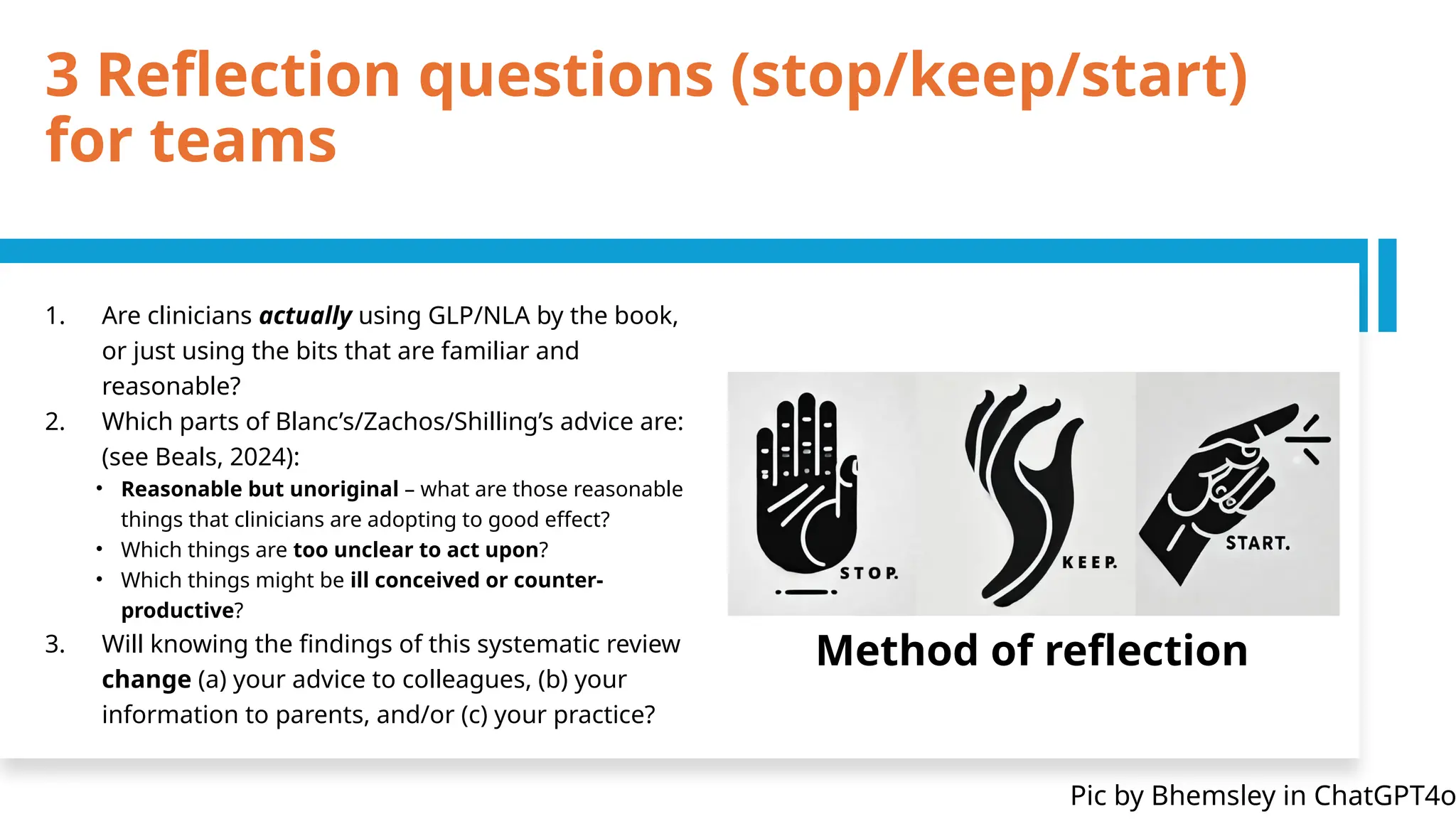
Method of reflection
Pic by Bhemsley in ChatGPT4o
Further Research
Priority - Foundations
Further research and critical inquiry at the theoretical level is required
to justify the claims made by proponents of GLP/NLA-related
interventions for autistic children or adults.
This foundational work should be completed prior to justifying any
studies implementing these approaches, given that the advice provided
in texts and social media posts on applying the NLA framework or
Blanc’s protocol [1, 2] is potentially harmful as it may reduce a child’s
access to evidence-based interventions that teach autistic children and
adults to understand and use language.
The developers of GLP/NLA resources have not adequately justified
any reason to cease working on modeling language, teaching
single words or phrases, or working on verbs or verb phrases, for
example, all of which are helpful in language teaching.
The resource developers have also failed to provide a sound rationale
for mitigating gestalts as a route to generative language.
[1] Blanc M. Natural language acquisition on the autism spectrum: The journey from echolalia to
self-generated language. Madison, WI: Communication Development Center; 2012.
[2] Blanc M, Blackwell A, Elias P. Using the natural language acquisition protocol to support
gestalt language development. Perspectives of the ASHA Special Interest Groups.
2023;8(6):1279-86.
Limited to English
(GLP/NLA
resources are
translated)
But records found
not in English
(excluded) were
not about
GLP/NLA
Future systematic
reviews should
search for studies
not in English to
determine if the
growth in
popularity and
use of GLP/NLA
in those
countries has any
accompanying
research.
The investigator
team did not
include a person
who identified
themselves to
the team as
being
neurodivergent.
The investigator
team had a
variety of lived
experiences in
supporting,
parenting,
working with,
and providing
services to
autistic
individuals.
Limitations
Theoretical
Foundations:
Research Testing
GLP/NLA
Propositions ???
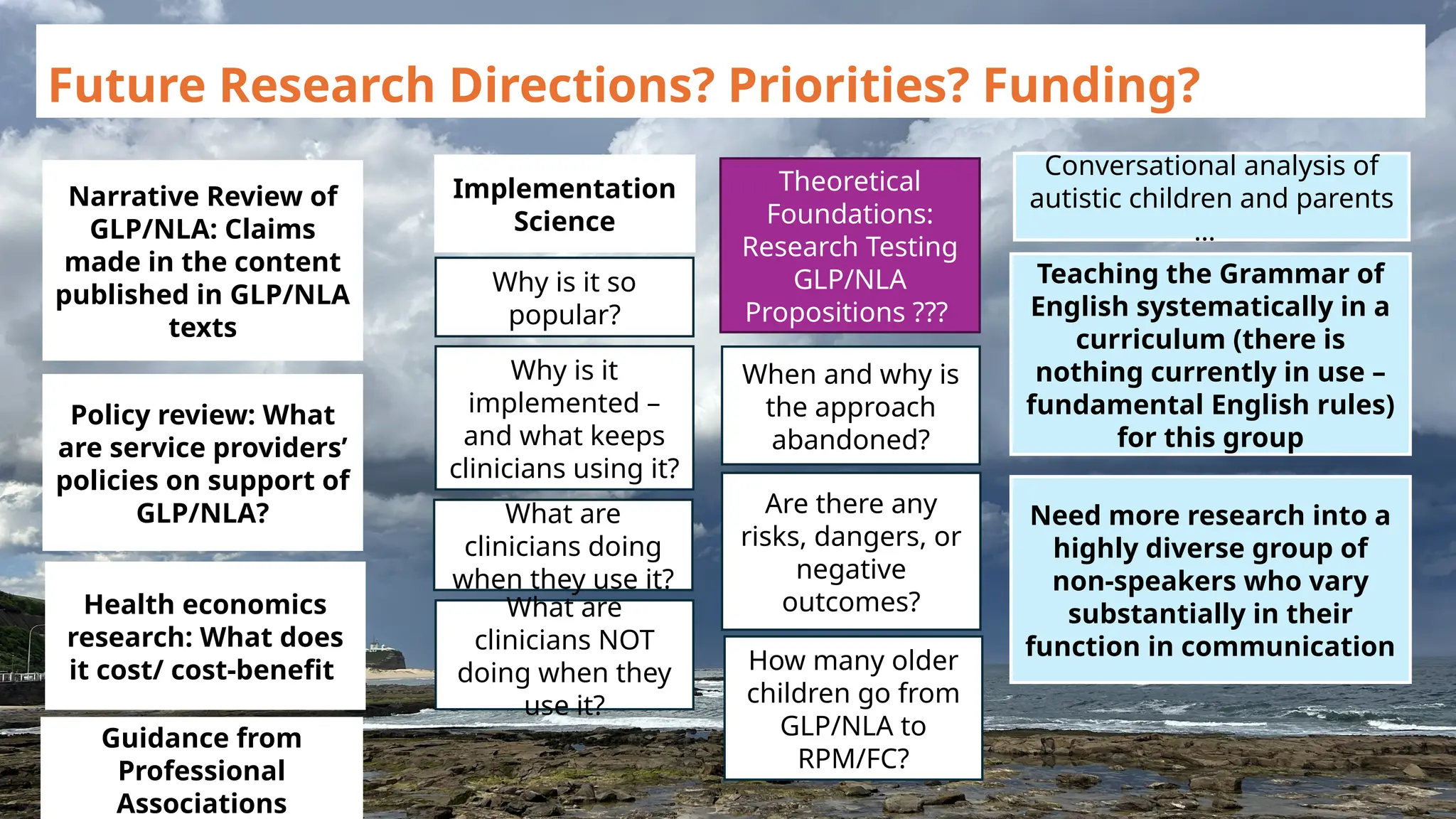
Conversational analysis of
autistic children and parents
…
Need more research into a
highly diverse group of
non-speakers who vary
substantially in their
function in communication
Teaching the Grammar of
English systematically in a
curriculum (there is
nothing currently in use –
fundamental English rules)
for this group
When and why is
the approach
abandoned?
Are there any
risks, dangers, or
negative
outcomes?
How many older
children go from
GLP/NLA to
RPM/FC?
Why is it
implemented –
and what keeps
clinicians using it?
Why is it so
popular?
What are
clinicians doing
when they use it?
What are
clinicians NOT
doing when they
use it?
Implementation
Science
Narrative Review of
GLP/NLA: Claims
made in the content
published in GLP/NLA
texts
Health economics
research: What does
it cost/ cost-benefit
Policy review: What
are service providers’
policies on support of
GLP/NLA?
Guidance from
Professional
Associations
Future Research Directions? Priorities? Funding?
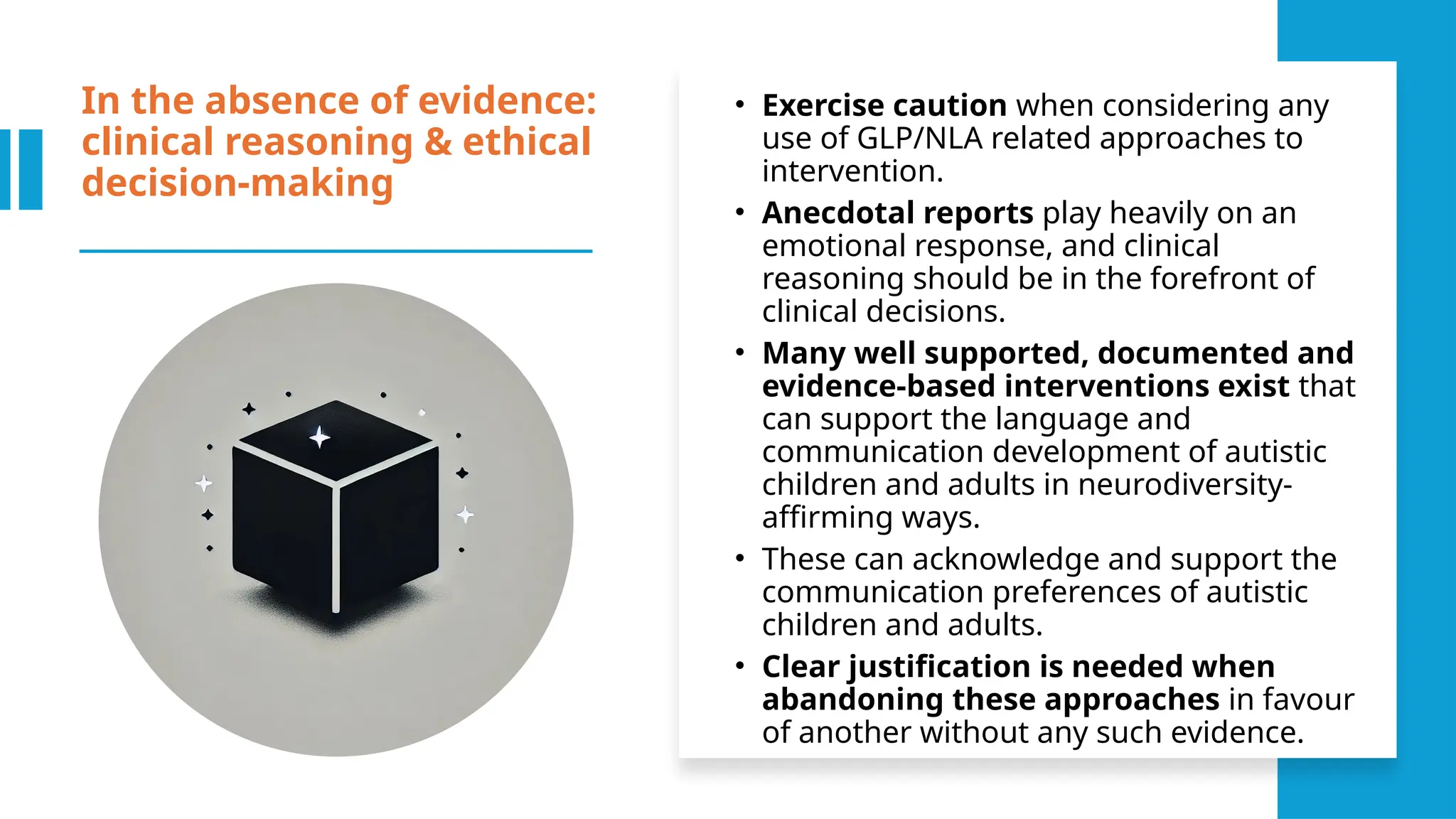
In the absence of evidence:
clinical reasoning & ethical
decision-making
• Exercise caution when considering any
use of GLP/NLA related approaches to
intervention.
• Anecdotal reports play heavily on an
emotional response, and clinical
reasoning should be in the forefront of
clinical decisions.
• Many well supported, documented and
evidence-based interventions exist that
can support the language and
communication development of autistic
children and adults in neurodiversity-
affirming ways.
• These can acknowledge and support the
communication preferences of autistic
children and adults.
• Clear justification is needed when
abandoning these approaches in favour
of another without any such evidence.
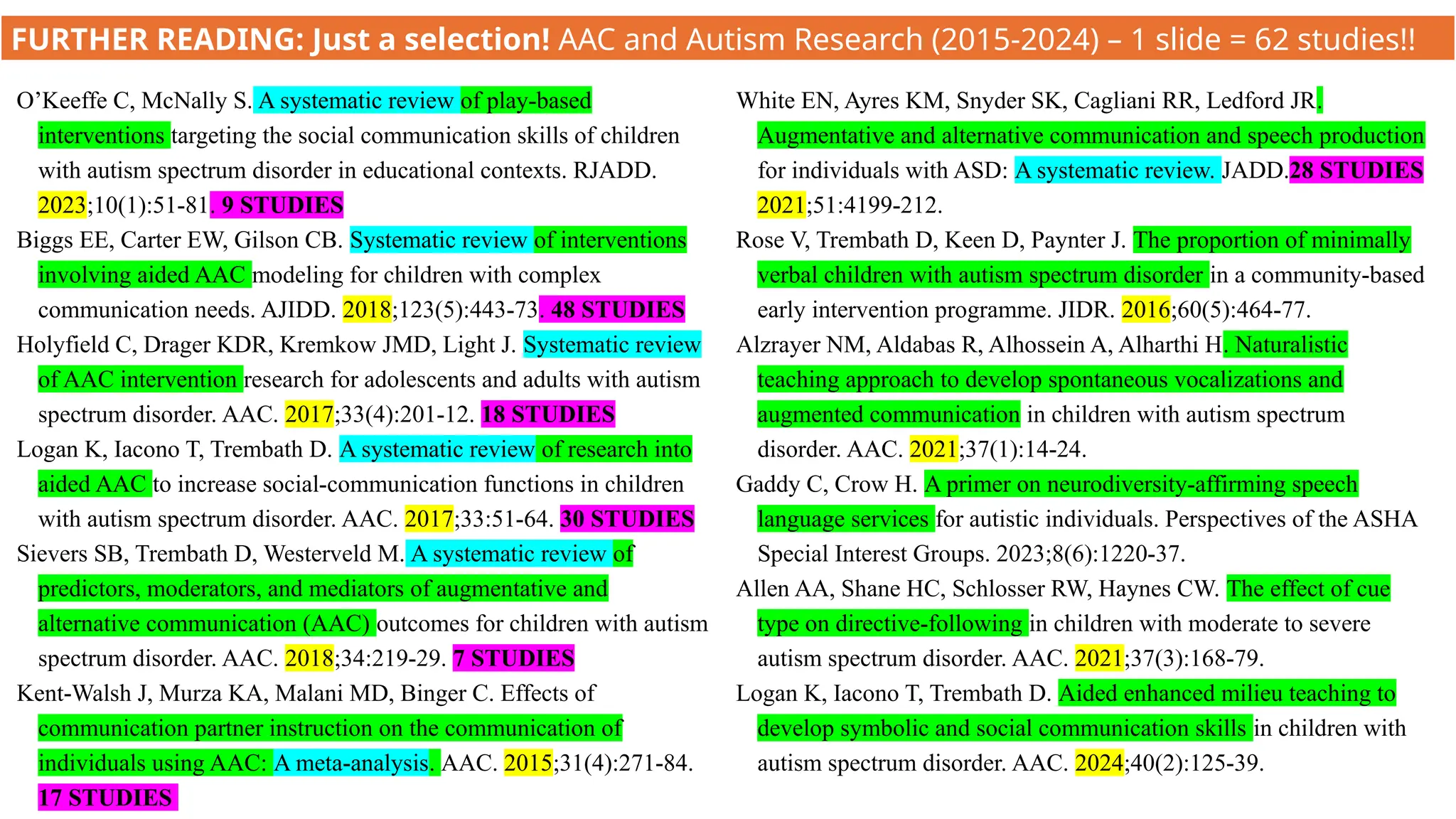
O’Keeffe C, McNally S. A systematic review of play-based
interventions targeting the social communication skills of children
with autism spectrum disorder in educational contexts. RJADD.
2023;10(1):51-81. 9 STUDIES
Biggs EE, Carter EW, Gilson CB. Systematic review of interventions
involving aided AAC modeling for children with complex
communication needs. AJIDD. 2018;123(5):443-73. 48 STUDIES
Holyfield C, Drager KDR, Kremkow JMD, Light J. Systematic review
of AAC intervention research for adolescents and adults with autism
spectrum disorder. AAC. 2017;33(4):201-12. 18 STUDIES
Logan K, Iacono T, Trembath D. A systematic review of research into
aided AAC to increase social-communication functions in children
with autism spectrum disorder. AAC. 2017;33:51-64. 30 STUDIES
Sievers SB, Trembath D, Westerveld M. A systematic review of
predictors, moderators, and mediators of augmentative and
alternative communication (AAC) outcomes for children with autism
spectrum disorder. AAC. 2018;34:219-29. 7 STUDIES
Kent-Walsh J, Murza KA, Malani MD, Binger C. Effects of
communication partner instruction on the communication of
individuals using AAC: A meta-analysis. AAC. 2015;31(4):271-84.
17 STUDIES
White EN, Ayres KM, Snyder SK, Cagliani RR, Ledford JR.
Augmentative and alternative communication and speech production
for individuals with ASD: A systematic review. JADD.28 STUDIES
2021;51:4199-212.
Rose V, Trembath D, Keen D, Paynter J. The proportion of minimally
verbal children with autism spectrum disorder in a community-based
early intervention programme. JIDR. 2016;60(5):464-77.
Alzrayer NM, Aldabas R, Alhossein A, Alharthi H. Naturalistic
teaching approach to develop spontaneous vocalizations and
augmented communication in children with autism spectrum
disorder. AAC. 2021;37(1):14-24.
Gaddy C, Crow H. A primer on neurodiversity-affirming speech
language services for autistic individuals. Perspectives of the ASHA
Special Interest Groups. 2023;8(6):1220-37.
Allen AA, Shane HC, Schlosser RW, Haynes CW. The effect of cue
type on directive-following in children with moderate to severe
autism spectrum disorder. AAC. 2021;37(3):168-79.
Logan K, Iacono T, Trembath D. Aided enhanced milieu teaching to
develop symbolic and social communication skills in children with
autism spectrum disorder. AAC. 2024;40(2):125-39.
FURTHER READING: Just a selection! AAC and Autism Research (2015-2024) – 1 slide = 62 studies!!
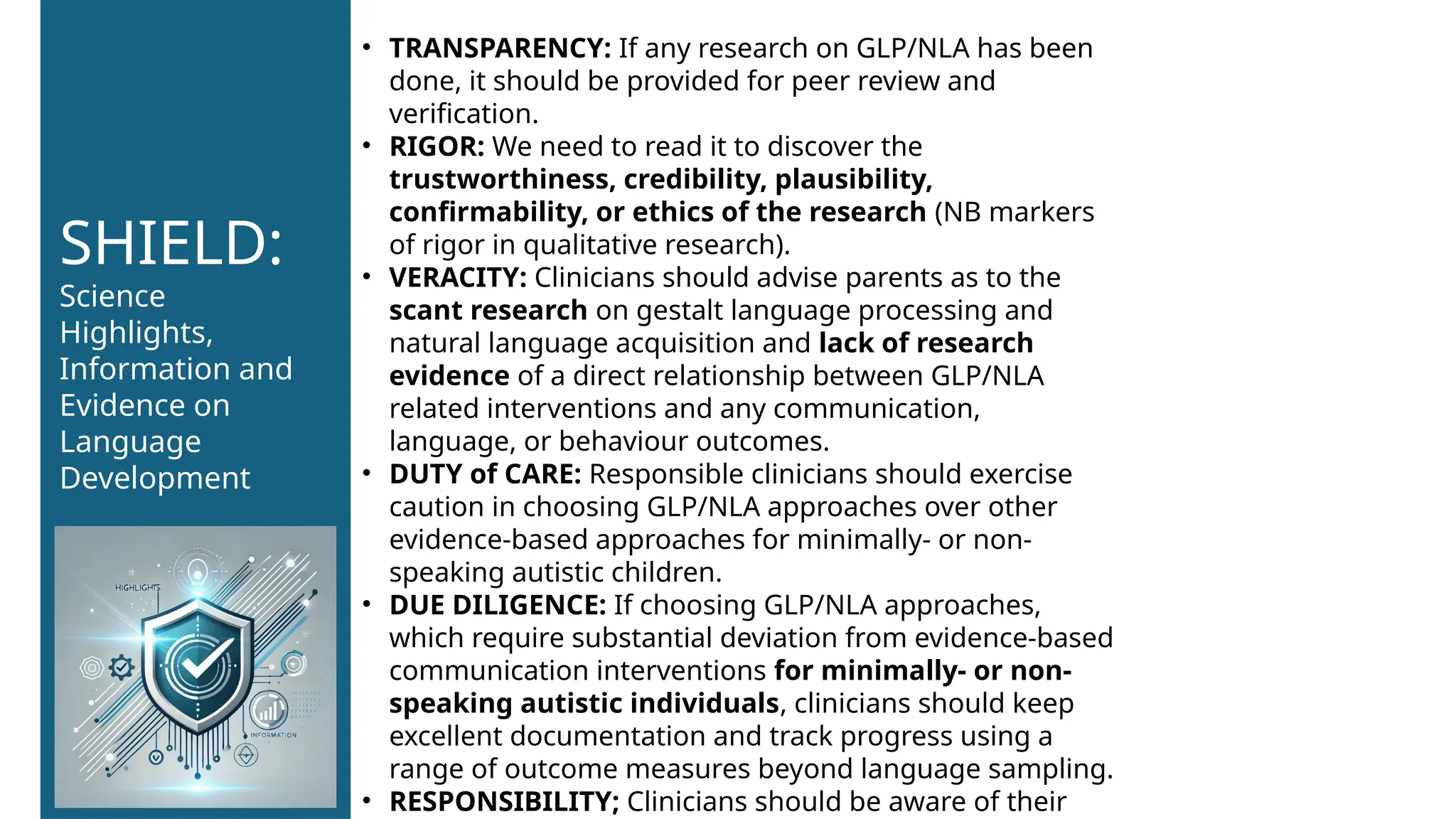
• TRANSPARENCY: If any research on GLP/NLA has been
done, it should be provided for peer review and
verification.
• RIGOR: We need to read it to discover the
trustworthiness, credibility, plausibility,
confirmability, or ethics of the research (NB markers
of rigor in qualitative research).
• VERACITY: Clinicians should advise parents as to the
scant research on gestalt language processing and
natural language acquisition and lack of research
evidence of a direct relationship between GLP/NLA
related interventions and any communication,
language, or behaviour outcomes.
• DUTY of CARE: Responsible clinicians should exercise
caution in choosing GLP/NLA approaches over other
evidence-based approaches for minimally- or non-
speaking autistic children.
• DUE DILIGENCE: If choosing GLP/NLA approaches,
which require substantial deviation from evidence-based
communication interventions for minimally- or non-
speaking autistic individuals, clinicians should keep
excellent documentation and track progress using a
range of outcome measures beyond language sampling.
• RESPONSIBILITY; Clinicians should be aware of their
SHIELD:
Science
Highlights,
Information and
Evidence on
Language
Development
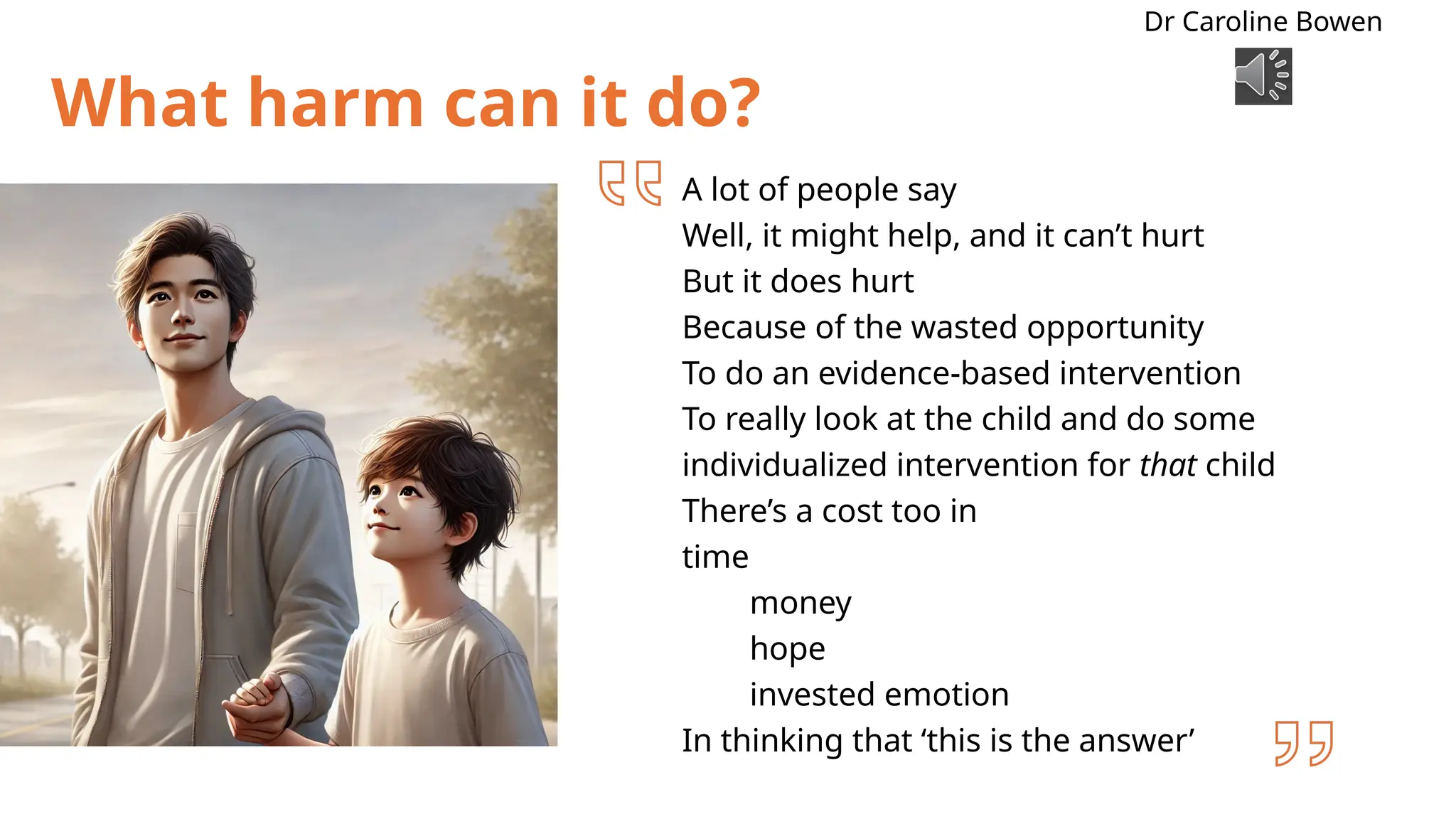
What harm can it do?
A lot of people say
Well, it might help, and it can’t hurt
But it does hurt
Because of the wasted opportunity
To do an evidence-based intervention
To really look at the child and do some
individualized intervention for that child
There’s a cost too in
time
money
hope
invested emotion
In thinking that ‘this is the answer’
Dr Caroline Bowen

Systematic Review of GLP and NLA at ASHA 2024 Hemsley Beals Shane and Colleagues

  • 1.
    1156: Elevating CriticalThinking On Gestalt Language Processing and Natural Language Acquisition in Autism: Clinical Imperatives Hemsley, B1 ., Shane, H2 ., Bryant, L1 ., Bowen, C1 ., Beals, K3 ., Dixon, G4 ., & Grove, R1 . (2024). Elevating critical thinking on Gestalt Language Processing and Natural Language Acquisition in Autism: Clinical Imperatives. American Speech-Language Hearing Association National Convention Dec 4-7 Seattle Presenting authors: Hemsley and Beals – Contact Bronwyn.Hemsley@uts.edu.au and LinkedIn BlueSky 1 University of Technology Sydney, Sydney, Australia 2 Boston Children’s Hospital, Harvard Medical School, Boston, USA 3 Drexel University, Pennsylvania, USA 4 Queensland Department of Education, QLD, Australia SHIELD: Science Highlights, Information and Evidence on Language Development
  • 2.
    Acknowledgements & Declaration •The authors have no funding to declare. This was an unfunded study. • The authors declare no financial or other interest in the GLP/NLA materials and do not implement GLP/NLA type interventions. • The interdisciplinary authorship team includes 2 parents of 2 individuals diagnosed as autistic in childhood, 5 speech pathologists, 1 clinical psychologist, and 1 linguist. • The authors have not received any ‘formal’ (ie a course from Meaningful Speech or Communication Development Center) training in GLP/NLA and have declined offers of free training to avoid a conflict of interest and reduce bias. This systematic review looks at literature, rather than practice. • The team included extensive review experience - Lucy Bryant has published 13 and Bronwyn Hemsley has published 40.
  • 3.
    Feedback and Sharing •Bronwyn.Hemsley@uts.edu.a u • University of Technology Sydney • Language, discourse, child language therapy, GLP/NLA • Ask for this talk – it’s free (live)! You just have to email me to have it organized. • Slides are on Slideshare Bronwyn Hemsley Find it on Soundcloud, Apple Podcast etc https:// soundcloud.com/ speechpathologyaustrali a/implications-of-a- systematic-review-into- glp-s6e44 Our review episode coming soon! Our review episode coming soon!
  • 4.
    Systematic review (inpress) in Current Developmental Disorders Reports Systematic Review of Interventions Based on “Gestalt Language Processing” and “Natural Language Acquisition” (GLP/NLA): Clinical Implications of Absence of Evidence and Cautions for Clinicians and Parents In press notice: around 11 Dec Dr Lucy Bryant, Ph.D., Dr Caroline Bowen, Ph.D., a, Dr Rachel Grove, Ph.D., Ms Gaenor Dixon, B SpPath, Professor Katharine Beals, Ph.D., Professor Howard Shane, Ph.D., & Professor Bronwyn Hemsley, Ph.D.
  • 5.
    Part I. Backgroundto the Systematic Review Rationale and Prior Literature
  • 6.
    Gestalt Language Processing(GLP) and Natural Language Acquisition (NLA) This review is motivated by the relatively recent and rapid growth (since 2021) of the Gestalt Language Processing and Natural Language Acquisition movement - promoting Blanc’s (2012) description of Gestalt Language Processing and Natural Language Acquisition. Natural Language Acquisition (NLA) is Blanc’s description of language acquisition for some autistic people described as Gestalt Language Processors (referred to in webinars, and social media as GLPs and GLPers). Blanc, M. (2012). Natural Language Acquisition on the Autism Spectrum: The Journey from Echolalia to Self-Generated Language. Self published. Pic by Bhemsley using ChatGPT4o
  • 7.
    GLP/NLA stages • Firstpublished by Blanc (2012) as there being 6 stages of natural language acquisition for children she identified as Gestalt Language Processors (first appearance of noun label, immutable state) • Stage 1. Whole gestalts • Stage 2. Mitigated phrases • Stage 3. Isolated words • Stage 4. Development of grammar (beginner) • Stage 5. Development of grammar (advanced) • Stage 6. Complex grammar in spontaneously generated language [1] Blanc M. Natural language acquisition on the autism spectrum: The journey from echolalia to self-generated language. Madison, WI: Communication Development Center; 2012. [2] Blanc M, Blackwell A, Elias P. Using the natural language acquisition protocol to support gestalt language development. Perspectives of the ASHA Special Interest Groups. 2023;8(6):1279-86. Prof Bronwyn Hemsley and AI Listen to our podcast on GLP!
  • 8.
    GLP status seemsto be inferred rather than determined. Child uses echolalia (immediate or delayed) Mega Gestalts (p.23) Single Word Gestalts Unintelligible Gestalts (see page 14) Silent Gestalts (see p. vii) Child is non- speaking Child uses jargon It is not clear how a child being or not being a Gestalt Language Processor is determined. Person uses AAC GLP From the text (Blanc, 2012)
  • 9.
    Rationale for theReview 1. GLP/NLA is considered controversial in the literature, and under-researched. 2. GLP/NLA type approaches are rapidly moving from popular to common practice in speech-language pathology. • Therefore, is important to examine its evidence-base and any known or potential outcomes (benefits and harms). • A systematic review is appropriate considering the widespread claims of it being based on years of research and being of benefit to many. • A systematic review was designed to identify any studies that may or may not have been published and available in the peer-reviewed literature. • This was done to provide clinicians, families, and funding bodies with information that helps them in balancing their decisions and keep evidence-informed. Pic by BHemsley using ChatGPT4o
  • 10.
    Post-hoc claims of 85children in empirical research prior to 2012 Historicity of GLP Authors’ Publications Peters (1 case) 1977 Prizant 1982,1983, opinions Prizant 1984 (3 cases, 4;8, 12;4, 14;2) Blanc newsletter columns for parents (2004- 2013) Blanc (2012) Zachos (2023) newsletter, Gestalt Language Development: “How most autistics develop language” Jan Blanc et al (2023), Perspectives, Subm. May, Pub. 7 Dec Hemsley et al Protocol for Syst Review Mar 2024 Haydock et al., May 2, 2024 Hutchins et al., May 22, 2024 Hemsley et al 0 Studies CM2024 Sept 10 Venker & Lorang, Sept 28, 2024 Beals, 1 Oct, 2024 Blanc 20 Oct 2024 Addendum #3 Bryant et al., Dec 2024 0 Studies
  • 11.
    Where did itall begin? • In 1977, Ann Peters referred to gestalt and analytic types of language processing to describe the language of one child who reportedly used both single words and longer units of language [1,2]. • Peters [2] acknowledged that evidence would be needed before any conclusions or applications would be appropriate, stating: “I have been able only to sketch the outlines of a theory of early language acquisition, while leaving large patches of it unexplored. This being the case, it is inappropriate to offer any formal "conclusion": We are only at the outset of a newly defined course of exploration.” [1] Peters AM. Language learning strategies: Does the whole equal the sum of the parts? . Language. 1977;53(3):560-73. [2] Peters AM. The units of language acquisition. Cambridge: Cambridge University Press; 1983. Pic by Bhemsley using ChatGPT4o
  • 12.
    • Prizant [1]discussed the production of multi-word ‘chunks’ of language in people with autism that were “unanalyzed” (p.19) or produced without awareness of the component characteristics and used the term “gestalt processing” highlighting similarities with echolalia, particularly delayed echolalia. • Prizant [2] suggested that “delayed echolalia pattern may be manifestations of gestalt processing at both the situational and linguistic level” (p. 302) and that autistic people may present with “an extreme style of gestalt processing” (p. 303). He also proposed a theory of gestalt language acquisition [3]. • Prizant (1982,1983) proposed four stages of gestalt language acquisition, cautioning that, “the notion of stages of language acquisition is presented for convenience of presentation; no claims are made as to their psychological reality” [2, p.303]. [1] Prizant BM. Gestalt language and gestalt processing in autism. Topics in language Disorders. 1982;3(1):16- 23. [2] Prizant BM. Language acquisition and communicative behavior in autism: Toward an understanding of the" whole" of it. Journal of Speech and Hearing Disorders. 1983;48(3):296-307. [3] Baltaxe CAM, Simmons JQI. (1981) Disorders of language in childhood psychosis: Current concepts and approaches. In: Darby JK, Editor. Speech evaluation in psychiatry. New Yowk, NY: Grune & Stratton; 1981. p. 285- 5 years later … Prizant 1982, 1983 (opinion) “… to fully understand how processing styles affect the acquisition and use of language, detailed longitudinal research needs to be undertaken following children from prelinguistic stages through the acquisition of complex and spontaneous language” [Prizant, 1983, p.305].
  • 13.
    Marge Blanc (2012)and GLP/NLA Three decades after Prizant, Marge Blanc published a book ‘Natural Language Acquisition on the Autism Spectrum: The Journey from Echolalia to Self-Generated Language’ [1], with an Addendum on Chapter 19 now available, presenting what she considered a new description of natural language acquisition, and citing the earlier work of Peters and Prizant among others. Blanc [1] proposed, based first on her clinical experience at a University student clinic, that autistic children who exhibited delayed echolalia could be classified as GLPs, communicating in one of six stages: from ‘gestalts’ or chunks of language (either immediate echolalia or delayed echolalia), to ‘mitigated gestalts’ (i.e., split up into parts), and to new phrases and generative language using a wide range of words and grammar. Despite cautions from Peters that her assumptions were theoretical in nature, early in development, and not seen as conclusive, Blanc (2012) described the “enormous contribution” that Peters’ findings had made to her conceptualization of GLP and NLA. [1] Blanc M. Natural language acquisition on the autism spectrum: The journey from echolalia to self-generated language. Madison, WI: Communication Development Center; 2012. Blanc proposed that six stages represent a developmental process of “Natural Language Acquisition” [1,2] and included a protocol for clinicians and parents to follow in therapy for autistic children identified as GLPs focused on: • whole gestalts (Stage 1) • mitigated phrases (Stage 2) • isolated words (Stage 3) • development of grammar from beginner (Stage 4) • advanced (Stage 5) • complex grammar in spontaneously generated language (Stage 6) [2] Blanc M, Blackwell A, Elias P. Using the natural language acquisition protocol to support gestalt language development. Perspectives of the ASHA Special Interest Groups. 2023;8(6):1279-86. Addendum 1 Chapter 19 Addendum #3 Foreword Blanc (2024, 20th October)
  • 14.
    Natural Language AcquisitionProtocol Blanc M, Blackwell A, Elias P. Using the natural language acquisition protocol to support gestalt language development. Perspectives of the ASHA Special Interest Groups. 2023;8(6):1279-86. [2] Blanc M, Blackwell A, Elias P. Using the natural language acquisition protocol to support gestalt language development. Perspectives of the ASHA Special Interest Groups. 2023;8(6):1279-86.
  • 15.
    Haydock et alMay 2nd , 2024 (Editorial) Haydock et al. [1] described GLP/NLA as being neurodiversity-affirming. “Presuming developmental competence, as an ethos, advances the use of therapeutic strategies that map onto how gestalt language develops and promote that natural development to occur. For instance, informed approaches promote exposure to gestalts that have inherent situational and emotional salience as – unlike rote-learnt utterances – these linguistic forms will likely stick, be used contextually and have potential to develop into more creative and complex forms”. Haydock [1, p. 1057] [1] Haydock A, Harrison L, Baldwin K, Leadbitter K. Embracing gestalt language development as a fundamental neurodiversity-affirmative practice. Autism. 2024;28(5):1055- 9. Read it for free – it’s Open Access
  • 16.
    Response to Haydocket al “The field will benefit from in-depth discussions about the relationship between neurodiversity-affirmative practices and evidence-based practices.” (Letter to the Editor by Venker & Lorang, 2024) Read it for free – it’s Open Access [1] Letter to the Editor – Venker, C. E., & Lorang, E. (2024). Continuing the conversation about echolalia and gestalt language development: A response to Haydock, Harrison, Baldwin, and Leadbitter. Autism, 1-4.
  • 17.
    Critical appraisal ofGLP/NLA Practices Hutchins et al., 2024 (Research article - Critical analysis) Hutchins et al. [1], in a critical appraisal of GLP/NLA practices, argued that the theoretical foundations of GLP/NLA remain weak, uncertain, and untested. Hutchins et al. challenged GLP/NLA due to its (a) unsubstantiated reliance on a binary classification of autistic children being either ‘a GLP’ (processing ‘chunks’ or gestalts) or ‘an analytic language processor’ or ‘an ALP’ (i.e., processing language from its individual word parts to build the whole); (b) absence of a clear definition or criteria for classifying people as being ‘a GLP’; and (c) being based on questionable estimates of prevalence of echolalia. Subsequent literature describing GLP/NLA refers to and inflates erroneous and unfounded prevalence estimates and statistics on echolalia (e.g., “‘echoing’ is used by 85% of ASD kids”, [1, p28]). [1] Hutchins TL, Knox SE, Fletcher EC. Natural language acquisition and gestalt language processing: A critical analysis of their application to autism and speech language therapy. Autism and Developmental Language Impairments. 2024;9:23969415241249944. Read it for free – it’s Open Access
  • 18.
    Where do thoseecholalia prevalence figures come from? What is it? … it depends how it is defined and measured … Review of echolalia definitions and prevalence Historically tracks back on % estimates Read it for free – it’s Open Access [1] Sutherland, R., Bryant, L., Dray, J., & Roberts, J. (2024). Prevalence of Echolalia in Autism: A Rapid Review of Current Findings and a Journey Back to Historical Data. Current Developmental Disorders Reports. https://link.springer.com/article/10.1007/s40474-024-00311-0
  • 19.
    In light bothof recent research and of earlier findings in the fields of autism and linguistics that are yet unconsidered in the context of GLP, I argue that those whom GLP/NLA proponents claim are “gestalt language processors” or “GLPs” necessarily engage in analytic, as opposed to gestalt, processes. I argue that some of the GLP/NLA suggestions for working with individuals proponents classify as “gestalt language processors” (also referred to reductively as “GLPs”) are detrimental to the autistic language learners that GLP/NLA proponents purport to be helping. Read it for free – it’s Open Access Beals, K. (2024). A linguist’s take on Blanc’s proposition of gestalt language processing and natural language acquisition: An implausible theory at odds with the research. Current Developmental Disorder Reports. Beals, K. “A Linguist’s Take on Blanc’s Proposition of Gestalt Language Processing and Natural Language Acquisition: An Implausible Theory at Odds with the Research.”
  • 20.
    Beals, K. 2024(A linguist’s take on GLP/NLA, cont.) “… most of the advice from Blanc [1–6], falls into three categories: reasonable but unoriginal, too unclear to act upon, or ill-conceived and counterproductive. In the first category, reasonable but unoriginal advice, are directives like “narrate your day with your child”, “say things in kid-friendly sentences that are animated and sound distinctive”, “think about [your child’s] communicative intentions, substitute new words and phrases into echoed phrases”, or “respond to grammatical errors by recasting, and gradually increase in the complexity of what you model” [5]. Falling into the second category, advice that is too unclear to act upon, are the guidelines for moving a child from one proposed stage of NLA to another. … In the third category, advice that is ill-conceived and counterproductive, is the notion that, until children classified as “gestalt language processors” move beyond NLA Stages 1 and 2, therapists and parents should avoid single words and two-word combinations (at least at Stage 1). Another is that therapists and parents should avoid using verbs until after “gestalt language processors” get to NLA Stage 4 [3]. This means that the adult is using ‘telegraphic’ speech in the linguistic sense rather than using grammatical language. A third is the exhortation to (emphasis is as provided in the cited document): Protect your child from well-intended, but misguided language practices Read it for free – it’s Open Access
  • 21.
    Language vs. communication •Many things are communicative without being symbolic language – Smiling; pointing; laughing • Symbolic language is – Public (no detective work for basic meanings) – Abstract (not situation-specific) – Not medium-specific (can be whispered, yelled, sung, handwritten, typed, finger- spelled…) – Generative (basic meaning units, or morphemes, can combine and recombine in multiple orders for multiple statements, questions, commands, hypotheticals, etc.) • Echolalia lacks all these core characteristics of symbolic language
  • 22.
    Analytic vs. gestaltin autism • Multiple studies find strengths in narrow focus & difficulties with big picture (weak central coherence) • Lived experience—multiple reports of analytic strengths, strategies, & preferred activities – Temple Grandin, Stephen Shore, Daniel Tammet, Tim Page, John Elder Robison, Liane Holliday Willey – Disproportionately large numbers of math, science, computer, and engineering majors • What about echolalia? Isn’t it evidence of gestalt processing? I rely on pure logic, like “A side benefit of an expert computer processing information program to guide my in parts instead of behavior. I categorize rules holistically is having a according to their logical very good eye for importance.” detail.”
  • 23.
    Echolalia involves analytic processing •Human echoers aren’t walls at ends of tunnels – To echo “Peter eater” you need to process the targeted speech into its phonetic components (pʰ + i + …) – And map those components to speech articulations in the mouth (an unvoiced, aspirated bilabial stop, followed by a vowel with tongue in high front position, …)
  • 24.
    Echolalia isn’t alanguage style It’s a consequence of core autism symptoms. • An autism diagnosis requires (among other things) diminished joint attention (JA). (DSM-5, M-CHAT, ADOS) • Multiple studies show diminished JA predicts delays in word/phrase learning – more profound autism-->more reduced JA-->Fewer words • Those who haven’t learned basic words/phrases can’t parse spoken utterances into noun phrases & verb phrases (subjects & predicates, etc.) • Instead they may memorize some of the utterances they hear as unanalyzed wholes – especially those that are highly salient/used in highly salient situations • Without understanding their linguistic meanings, they may associate highly salient utterances with the highly salient situations in which they hear them used. – “Peter eater” for saucepan (Kanner, 1946)
  • 25.
    Echolalia is a(suboptimal) AAC • Echolalia is alternative to true language as opposed to an instance of language. – might fulfill a communicative purpose (e.g., to gain attention, maintain an interaction, express delight) – just like other non-verbal communications (e.g., body language, facial expressions, informal gestures), and as such, echolalia can • Can (and should) be recognized as part of a person’s extant communication tools without being considered linguistic. • But a major downside: the need for “detective work” (Peter eater) • Conventional AAC tools are more practical and less frustrating. (A picture of a sauce pan)
  • 26.
    All known routesto language acquisition require analytic processing • At initial stages, learners need to analyze the sounds in the speech stream that surround them to parse out individual meaning units from phrases like “That’s a dog” and “Look at the cat.” • To assign meaning to these units, they also need to analyze the communicative environment: identify the speaker, attend to the speaker’s face, eyes, stance, or pointing gesture, and follow the speaker’s eye gaze or pointing gesture or body orientation over to the object in question. • They also need to properly generalize these meanings, which means analyzing their referents into features and figuring out which features are the essential ones (e.g., for “dog,” aspects of the shape and size, but not the color) • After basic nouns, children learn verbs by analyzing verb phrases (e.g., “give the smallest doll to the boy” or “get the smallest doll from the boy”) that contain nouns they already know (e.g., “doll,” “boy”) and also analyzing the context in which these phrases are used. • In general, there is an analytic feedback loop between inferring novel syntactic structures from known words and inferring novel words from known syntactic structures.
  • 27.
    Implications for speech-language pathologists:Advice from Blanc • “… most of the advice from Blanc [1–6], falls into three categories: reasonable but unoriginal, too unclear to act upon, or ill-conceived and counterproductive.
  • 28.
    What’s problematic about Blanc’sadvice? • Learning basic nouns and verbs are key first steps in language learning. • This makes two elements of Blanc’s advice problematic: 1. That until children classified as “gestalt language processors” move beyond NLA Stages 1 or 2, therapists and parents should avoid single words and two-word combinations. 2. That therapists and parents should avoid using verbs until after “gestalt language processors” get to NLA Stage 4 [3].
  • 29.
    What’s not problematicabout Blanc’s advice? • Directives like – “narrate your day with your child” – “say things in kid-friendly sentences that are animated and sound distinctive” – “think about [your child’s] communicative intentions, substitute new words and phrases into echoed phrases” – “respond to grammatical errors by recasting, and gradually increase in the complexity of what you model” There are things that good SLPs (and parents) have been doing for decades.
  • 30.
    Musical Language Processors(MLPs) • Kids who pick out tunes on xylophones and chord progressions on pianos before they utter their first words. • And learn their first words not from regular spoken language, but from song lyrics. – The words they initially tune in to and produce are sung, not spoken.
  • 31.
    Musical Language Therapy(MLT) • Therapists should start by only singing words, never speaking them. – Speaking words is counter-productive and should be avoided in the initial stages. – When you sing words, try to use the same tunes you hear your clients using – Surround your clinic with musical instruments and sing along with your clients, honoring their special mode of communication – Once a client starts speaking words, then you can start speaking those words as well.
  • 32.
    Evidence for MLT? •Clinical evidence: – What I’ve seen longitudinally in my clinic: dozens of kids progressing from singing to speech when they’re ready, and making beautiful progress once they do. • Parent reports: – Parents report similar progress in language development, and they also say their kids are much happier with musical language therapy than with conventional speech language therapy. • Lived experience: – Now that we’ve identified MLPs, many adults are coming forth and self-identifying as MLPs. – They report that they learned language through song and that they got nothing out of conventional speech-language therapy.
  • 33.
    Should you believewhat I say about MLP/MLT? No you should not!!! • Psychology teaches us that first-person experiences, eye-witness observations, self-reports, and memories (including childhood memories) are all unreliable. • But practitioners, like all of us, are potentially deceived by first- person experience – no matter how experienced we think we are, no matter how accurate we think our intuitions are, no matter how objective we think our observations are. • Cf. the litany of interventions, including in autism, that practitioners were convinced were successful but that turned out, under rigorous scientific scrutiny, to be, at best, ineffective, and at worst, harmful: – facilitated communication, auditory integration therapy, sensory integration • To those who practiced them, they felt right, made sense, and looked effective. • But rigorous, randomized controlled experiments told us otherwise. MLP / MLT
  • 34.
    Why has NLA/GLPcaught on? • It appears to resonate with other memes in the broader education and parenting worlds – Learning styles: “Everyone learns differently” • “visual”, “auditory”, “kinesthetic,”… • Endorsed by 93 percent of the US public and 76 percent of educators. • Also popular in other parts of the world – Whole language (now “balanced literacy” and “three-cueing”) • Literacy through holistic print-rich environments, the holistic shapes of words, and the broader holistic context of the stories in which they occur, including the illustrations. • Notion that there’s no need for “analytic” approaches like phonics. • Until recently, the dominant approach in teacher training programs and classrooms. • Some GLP proponents recommend against phonics & cite “hyperlexia” – A resistance to narrow, analytical approaches, even in math • Child-centered , group-centered discovery and multiple solutions instead of drill and practice of specific algorithms on specific types of problems.
  • 35.
    Conventional wisdom/“makes sense” ≠evidence-based – Learning styles: “Everyone learns differently” – Whole language, “balanced literacy,” “three-cueing” – Resistance to narrow, analytical, step-by-step approaches, even in math • Though these “feels right” to many people, the actual evidence is against them. • The evidence against “balanced literacy” and “three cueing” has been so clear, and so clearly broadcast to the public, that school districts and teaching training programs are starting to take notice. • But the evidence against learning styles and “whole math” is similarly strong. • So is the evidence against autistic individuals as “gestalt processors.”
  • 36.
    Part 2. TheSystematic Review Aim and Methods
  • 37.
    Blanc’s Book (2012)#3 Addendum 2024 (Oct 20th). “the NLA book was published in 2012, the result of 15 years of longitudinal clinical research in our clinic, Communication Development Center in Madison, Wisconsin. The research actually began in 1995 “The research process resulted in a clearer picture of natural language development … this is why ‘it works’ so to speak” We have questions …
  • 38.
    The aim ofthis systematic review was to determine answers to these 3 questions 1. Is the use of GLP/NLA-type interventions effective for individuals with communication disability in terms of improving language skills? 2. Is the use of GLP/NLA-type interventions effective for individuals with communication disability in terms of improving communication skills? 3. Is the use of GLP/NLA-type interventions effective for individuals with communication disability in terms of changing behaviour? AIMS Pic by B.Hemsley using ChatGPT4o
  • 39.
    Method: Protocol forthe Systematic Review [1] Hemsley, B., Bryant, L., Bowen, C., Grove, R., Dixon, G., Beals, K., & Shane, H. (2024) Published review protocol: A systematic review of gestalt language processing interventions in children or adults with communication disability. National Institute for Health and Care Research, PROSPERO International prospective register of systematic reviews. PROSPERO 2024 CRD42024518468 https://www.crd.york.ac.uk/prospero/display_record.php?ID=CRD42024518468
  • 40.
    Our review wasset to include more than RCTs! • Treatment studies that included qualitative data (e.g., interviews, focus groups about participant views on the treatment) • Planned to conduct a metasynthesis if 3 or more studies found with qualitative data. • Treatment studies of any design (not only RCTs) • Both published and unpublished studies, to reduce the possibility of publication bias • Original research (not reviews or commentary papers)
  • 41.
    Inclusion Criteria Original research About GLP/NLA + citingBlanc 2012 In English and full text Treatment study of any design Not in English or full text Not about GLP/NLA or no participants with communication disability Not original research Not a treatment study Exclusion Criteria
  • 42.
    Search terms All searchesused the following terms: • “gestalt language” OR (“gestalt processing” AND language) (to find articles about GLP) • “natural language acquisition” AND echolalia (to find articles about NLA) • Listed terms were searched in title, abstract, indexing, keywords, and full text, in each database. • GLP was not suitable as a search term (due to “glucagon-like-peptide”, “good laboratory practice” • The acronym GLP yielded no additional relevant entries beyond those located with the search terms/phrases outlined above. Image by Alexandra_Koch from Pixabay
  • 43.
    Databases searchedon 18th March2024 and alerts set to let us know any new ones … A systematic search on 18th March 2024 in the following databases: 1. Cochrane Library 2. Cumulative Index of Nursing and Allied Health Literatures (CINAHL, EBSCOhost) 3. Education Database (ProQuest) 4. Education Research Complete (EBSCO Host) 5. Education Resources Information Clearinghouse (ERIC, EBSCOhost) 6. Embase (OVID) 7. Google Scholar 8. Linguistics and Language Behavior Abstracts (LLBA, ProQuest), 9. MEDLINE (via OVID) 10. ProQuest Central 11. ProQuest Dissertations and Theses Global, 12. Psychology & Behavioral Sciences Collection (EBSCOhost) 13. PsycINFO (EBSCOhost) 14. SpeechBITE 15. Web of Science (all databases) Further searches in publisher-specific databases (18th March): 16. Sage Journals Online 17. ScienceDirect (Elsevier) 18. Taylor & Francis Online 19. Wiley Online Library And in the following registries of clinical trials (18th March): 20. EU Clinical Trial Register (https://www.clinicaltrialsregister.eu) 21. Australian New Zealand Clinical Trials Registry (ANZCTR) (http://www.anzctr.org.au/TrialSearch.aspx) 22. ClinicalTrials.gov (https://ClinicalTrials.gov) Alerts set in all databases so any new references appearing during the review period were emailed to the first author and screened for inclusion. A hand search of citations in GLP/NLA literature using websites, publications, and published reference lists, and Google A request on an ASHA listserve (6th March) for people to send in any studies that they knew about.
  • 44.
    Domain-specific websites andonline searches • Searches for relevant publications outside of the scientific databases using internet resources • Self-published documents from the Communication Development Centre website, described as the key provider of resources on “natural language acquisition” in individuals described as “gestalt language processors” • Reference lists from self-published documents • Blanc (2012) book and all references • The second author also made a request for unpublished literature or grey literature sources through the American Speech-Language Hearing Association Special Interest Group 1: Language, Learning and Education; on the 6th of March 2024
  • 45.
    Record selection /screening All records were imported into an EndNote library (v20.6). Duplicate s were identified and removed by the first author. Titles and abstracts against the eligibility criteria “excluded” or “full text review required” Full texts were retrieved and imported to Covidence systematic review software Full texts screened by the first and final author, with 100% agreeme nt on exclusion. Reasons for study exclusion were recorded by both reviewers.
  • 46.
    • 1294 recordsretrieved from the scientific databases • 292 duplicates removed • 14 not in English removed • 988 records remaining • Of these, 965 excluded (938 not GLP/NLA, 21 not full text and 6 not treatment studies) • Leaves a total of 23 progressing to full text review Endnote Title & Abstract • All remaining 23 studies were excluded as none were treatment studies • (19 had no participants; 1 was a case description (music therapy), 1 was a 2022 survey of 22 adults and interview with 2 adults (about scripting), 1 was a case description applying Prizant’s model to 1 child in 1989 pre GLP/NLA, 1 was Peters’ article 1 child 1977). • A further 130 records identified through search of reference lists of GLP/NLA literature, and online sources • 102 records obtained (excluding 17 duplicates of database sources, 11 webinars or personal correspondence with no text available) • All subjected to the criteria and excluded as none met the criteria (most were not GLP/NLA, rest were not full text or not treatment studies) Full Text • No studies met the inclusion/exclusion criteria, despite the extensive database search, hand search, and online search/call. Hand Search & Online Search Outcome
  • 47.
    RESULT: Zero studies(Empty Review) • Papers published only presented descriptions, commentary, or anecdotal accounts. • No studies in which replicable, rigorous, or reported as ethically approved intervention studies were documented as evaluating the effects and effectiveness of interventions based on GLP/NLA descriptions or protocols were found. This systematic search for empirical evidence, in the form of intervention studies, found no research evidence for practices informed by the GLP/NLA protocol to support the language acquisition and development, communication, or behaviour of individuals with communication disability.
  • 48.
    [1] Peters AM.The units of language acquisition. Cambridge: Cambridge University Press; 1983. [2] Prizant BM. Language acquisition and communicative behavior in autism: Toward an understanding of the" whole" of it. Journal of Speech and Hearing Disorders. 1983;48(3):296-307. [3] Blanc M. Natural language acquisition on the autism spectrum: The journey from echolalia to self-generated language. Madison, WI: Communication Development Center; 2012. Absence of research & devaluing validation research “… detailed longitudinal research needs to be undertaken following children from prelinguistic stages through the acquisition of complex and spontaneous language” [Prizant, 1983, In 2022, CDC Public Instagram post: “Do we need more research on gestalt language development to prove that it exists?” “Nope! We have plenty of research to show that gestalt language development exists!” Further info cites Peters, Prizant 1983 and Blanc 2012. https://www.instagram.com/p/ CsEKdsEOeVA/? utm_source=ig_web_copy_link 30 years “…it is inappropriate to offer any formal "conclusion": We are only at the outset of a newly defined course of exploration.” (Peters, 1983) Blanc [3] (2012) Book does not outline research or provide much detail on clients or therapy 1983 2003 2013 2023 Since 1983 … apparently no validation research, no treatment research on GLP/NLA (41 yrs) 30 years
  • 49.
    Explainable? No. • So manyteaching modes – workshops, reels, posts, teaching and re-teaching something that cannot be clearly explained. • Why is it so hard to make sense of? • While making ‘perfect sense’?
  • 50.
    Part 3. Clinical& Research Implications
  • 51.
    There is atension for clinicians, in determining what is both evidence based AND neurodiversity affirming “not all research is created equal, and as such the claim of being “evidence-based” can be extremely misleading. I have seen “evidence-based” programs advertised that are supported only by the creator’s own research studies that would not stand up to any serious investigation. And others that have been rigorously researched and shown to be effective, although the outcomes are not affirming or beneficial to the individuals the program is supposed to support. When we incorporate research into our practice, it is important that we are scientific and critical in our consideration of research methods. We need to be curious about not just what the research tells us, but also what it does not.” Dundon, Raelene. A Therapist's Guide to Neurodiversity Affirming Practice with Children and Young People, Jessica Kingsley Publishers, 2023. ProQuest Ebook Central, http://ebookcentral.proquest.com/lib/uts/detail.action?docID=30513119. Created from uts on 2024-11-29 22:33:52.
  • 52.
    Feature Matching –An AAC Standard Of Care Feature matching in the context of Augmentative and Alternative Communication (AAC) refers to the process of aligning an individual’s unique abilities, needs, and preferences with the specific features of an AAC system or device. The goal is to ensure the AAC tool effectively supports the individual's communication requirements. Shane & Costello, 1994 Is the process of Feature Matching Being Applied when integrating GLP into AAC?
  • 53.
    To Date, There’sNo Evidence That GLPAdvocates Consider Feature Matching Principles In Their Effort To Integrate GLP and AAC
  • 54.
    AAC and GestaltLanguage Processing - Candidacy How To Identify A Gestalt Language Processor • Observe specific language behaviors - No formalized tests or research- backed tools despite 12 years since conception • Assess language patterns through naturalistic observation & language sampling • Key indicator of gestalt language processing - - presence of echolalia • Prevalence • What about persons who do some scripting but also use 1- or 2-word phrases? • What about the person who has little or no speech – The why of AAC
  • 55.
    AAC And GestaltLanguage Processing - Candidacy How To Identify A Gestalt Language Processor • “….. some unique communication patterns: (From [De- identified]– A Pediatric Speech Therapy website) • Delayed Speech: • Echolalia: • Difficulty with Grammar: • Strong Memory:
  • 56.
    AAC And GestaltLanguage Processing - Candidacy Which AAC users are Gestalt Language Processors? •“We can't say for sure if a nonspeaking person is a gestalt Language processor. The research on gestalt language processing has been around for a long time, but there isn't research on identifying whether nonspeaking people are gestalt language processors.” Blogs by SLP De-identified (2024) In opinion paper supporting GLP. In the same blog, the SLP writes: •“For speaking people, it is often easy to identify someone who is a gestalt language processor. They repeat favorite phrases with the same intonation as they originally heard them. They do not break apart the phrases or use the words to make new sentences. It is very common for autistic people to be primarily gestalt language processors.”
  • 57.
  • 58.
    AAC And GestaltLanguage Processing - Design Design of AAC Grid Displays to Accommodate GLP How to set up Grid Displays for a GLP Processor • “Understanding the intersection of AAC and gestalt language processing can be challenging…” [Deidentified], SLP, AAC Specialist, on Website • “We do not replace core vocabulary: Some may think that core vocabulary should be minimized in AAC systems for gestalt language processors. In reality, users will eventually need these foundational single words as they progress in their language development (Stages 3+).” Meaningful Speech Website – Resources site for GLP (2024)
  • 59.
    AAC And GestaltLanguage Processing - Design Design of AAC Grid Displays to Accommodate GLP • We are not sequencing one word at a time: For early-stage gestalt language processors whose language is not flexible and who have not isolated single words as individual units of meaning, we do not want to sequence one word at a time. This method is effective for analytic language processors, but not for gestalt language processors. Instead, we want to program gestalts, potential gestalts keeping in mind how these will grow with the child through the stages (e.g. how they will mitigate them). Meaningful Speech Website – GLP/NLA services & training (2024)
  • 60.
    Is the processof Feature Matching Being Applied when integrating GLP into AAC? To Date, There’s No Evidence That GLPAdvocates Consider Feature Matching Principles In Their Effort To Integrate GLP and AAC
  • 61.
    Visual Supports AndSpoken Language Acceleration Evidence ? Millar, D. C., Light, J. C., & Schlosser, R. W. (2006). The impact of augmentative and alternative communication intervention on the speech production of individuals with developmental disabilities: A research review. Journal of Speech, Language, and Hearing Research, 49(2), 248– 264. https://doi.org/10.1044/1092-4388(2006/021) …. findings indicated that AAC interventions did not hinder speech development; instead, many participants exhibited gains in speech production following AAC intervention. ??? Neglecting significant comprehension deficits
  • 62.
    AAC And GestaltLanguage Processing Literature Review – Research on AAC & GLP Result • Opinion pieces – mostly by speech language pathologists • AAC manufacturers – offer views on screen design • Most commentary from Meaningful Speech website • While these publications provide insights into GLP and its potential integration with AAC, there are no empirical studies to establish evidence-based practices in this area.
  • 63.
    What About SymbolicUnderstanding? • Does the Person Comprehend The Meaning Of The Symbol That Represents A Script / Gestalt? • Is It More Difficult To Represent A Script Than A Single Word Symbol? • Does The Child Understand That A Symbol Stands For The Phrase It’s Is Supposed To Represent – Is That Part Of The GLP Practitioners Feature Matching Process? • If You’re Going To Adopt ‘Scripts’ ‘Chunks’ Or ‘Gestalts’ At Least Have Representative Symbols That The Child Can Understand The Intended Meaning Of The Symbols (Is It Photo, Graphic, Line Drawings, Text?)
  • 64.
  • 65.
    Widgit Symbols @Widgit Software 2002-2024 Sample Gestalt Display
  • 66.
    Many of theGestalt Language Processing (GLP) individuals presumed candidates for AAC intervention would probably be more accurately referred to as non- or minimally speaking (NML). These individuals often have a diagnosis of autism. Recognizing that best practices for individuals with limited or no speech require the use of Augmentative and Alternative Communication (AAC), GLP advocates have sought to integrate the gestalt— or chunk-based—spoken language approach into the visually-oriented framework of AAC. This integration involves representing whole phrases, or "gestalts," as single graphic symbols within the AAC system. However, representing a whole phrase with a single graphic symbol is inherently challenging to design (as just demonstrated) which makes them difficult if The Symbol to Gestalt Representation Problem
  • 67.
    Graphics should MatchLevel of Symbolic Understanding Widgit Symbols @ Widgit Software 2002-2024
  • 68.
    Matching Level ofSymbolic Understanding To The Person Widgit Symbols @ Widgit Software 2002-2024
  • 69.
    Main Experimental Task:Animated Visual Sentence Power of Animation
  • 70.
    Final thoughts onAAC & Gestalt Language Processing • Scripts / chunks / gestalts have been part of AAC grid display design for decades – use them judiciously • Use whole phrases but not at the expense of single words and building phrases and sentences • Design AAC through a Feature-Matching Process, based on a full dynamic assessment of the child’s capabilities and limitations. • Select Symbols that are understood – Assess for symbolic understanding • Do not avoid single word / symbol instruction until “Stage 3” – no evidence to support – Don’t risk a person's communication growth on an unproven method
  • 71.
    … final thoughts (cont.,) GLP andAAC Integration • All I’ve read suggests the primary effort of GLP/NLA is on expressive language. Don’t focus exclusively on expressive language at the expense of or without knowledge of spoken language comprehension - or if the symbols selected are in fact meaningful ALERT  ANECTODAL OBSERVATIONS: • A growing number of families are asking about GLP or bringing GLP Displays. The displays and the recommendations are inconsistent – no uniformity. • Or “Should my child’s AAC system just have gestalts?”
  • 72.
    Clinical Responsibilities As evidence-basedprofessionals, speech-language pathologists, occupational therapists, psychologists, educators, and other professionals providing services to autistic children and adults have an ethical responsibility to: • seek out all of the most rigorous external qual and quant and lived experience evidence available on any given intervention, and • use this information in combination with clinical expertise and family/individual preferences to determine the best course of action, given that • delivery of an ineffective intervention can cause harm by the cost of time and money which could be invested into other more effective interventions for that individual [1]. [1] Hernandez-Villafuerte K, Zamora B, Feng Y, Parkin D, Devlin N, Towse A. Estimating health system opportunity costs: the role of non-linearities and inefficiency. Cost Eff Resour Alloc. 2022;20(1):56. [2] Claxton K, Lomas J, Martin S. The impact of NHS expenditure on health outcomes in England: Alternative approaches to identification in all-cause and disease specific models of mortality. Health Econ. 2018;27(6):1017-23. Providing interventions that are not known to be effective, or known to be ineffective, without appropriately determining any significant benefit, is potentially harmful due to: • financial, time, and opportunity costs to the client/family; • usage of time and expenditure of funds for training of therapists; • wasteful use of a scarce therapy resources; and • lost opportunity through the passage of time in the developmental trajectory of the child [2].
  • 73.
    It is incumbentupon professionals, whose credentials invite confidence and indicate credibility, to consider whether new interventions demonstrate both a sound theoretical basis for having an effect, and evidence of a treatment effect before promoting these on social media. • Due diligence should be done prior to making claims about the actual or potential benefits of a treatment. • This requires critical appraisal of the intervention, its theoretical foundations, and the supporting and opposing evidence to ensure the selected intervention is appropriate for each individual client. [1] Hutchins TL, Knox SE, Fletcher EC. Natural language acquisition and gestalt language processing: A critical analysis of their application to autism and speech language therapy. Autism and Developmental Language Impairments. 2024;9:23969415241249944. In the absence of either a theoretical foundation or empirical evidence and considering the serious questions regarding the practice of GLP/NLA (see [1]), this endeavor becomes difficult. In the absence of evidence, clinicians have a duty to justify their decision-making if choosing an intervention for which there is no empirical evidence and hold due responsibility / duty of care for its outcomes. Search Oct 7 2024 Clinical Responsibilities
  • 74.
    Be aware of your“GLP/NLA Lens” • Look beyond the label, and the lens that comes with it, to see and describe the child’s communication abilities and needs. • What does the child understand? • What can they express, in which modality of communication? (speech, unaided AAC, aided AAC, behaviour) • What is their symbolic understanding? Feature-Matching Dynamic Assessment Participation Model of AAC Communication Needs Model Communicative Competencies Model
  • 75.
    “People seem tobe, all or nothing…” [1] O’Keeffe C, McNally S. A systematic review of play-based interventions targeting the social communication skills of children with autism spectrum disorder in educational contexts. Review Journal of Autism and Developmental Disorders. 2023;10(1):51-81. https://doi.org/10.1007/s40489-021-00286-3 [2] Biggs EE, Carter EW, Gilson CB. Systematic Review of Interventions Involving Aided AAC Modeling for Children With Complex Communication Needs. Am J Intellect Dev Disabil. 2018;123(5):443-73. [3] Pepper J, Weitzman E. It takes two to talk: A practical guide for parents of children with language delays. Toronto: The Hanen Centre; 2004. Evidence-based approaches can be neurodiversity- affirming. Play-based interventions [1], aided AAC modelling [2] and evidence-based interventions to support language development in general (e.g., those grounded in child-directed language stimulation [3]). Evaluate GLP/NLA related interventions, Identify appropriate outcome measures. Determine who they are expected to benefit, and those for whom they are not expected to be helpful. Dr Lucy Bryant People seem to be all or nothing And I don’t think that that’s an appropriate way to educate anybody We need to be looking at ‘okay what is - the actual – underlying flaws?’ And we need to consider both sides of the argument Sure, there are benefits to components of Natural Language Acquisition They’re drawn from other evidence-based approaches But then there’s a whole bunch of other non-evidence-based things thrown in that corrupt that And if we take those good parts that also exist in other evidence-based approaches and we use those - That’s the way to go about practice.”
  • 76.
    Is a GLP/NLA-typeapproach really neurodiversity-affirming practice? Research on this is needed: • Typecasting – applying a label on the basis of conjecture • Deterministic - the label dictates the intervention (don’t teach) • Attributing blame - Describes a child as “stuck” if not moving through the stages (blames child or anyone who taught the child single words) Or …
  • 77.
    … or isa GLP/NLA-type approach actually neurodiversity-restrictive practice? • Does it restrict vocab work and messages to the child’s gestalts (scripts), at a critical time point in the child’s development? • Does it presume incompetence in learning single words? • Does it discourage, delay, or decline access to language therapy by urging parents and adults to avoid certain constructs in language and restrict ‘language input’ – could this restrict ‘language intake’? • Does it do harm in ‘presuming competence’ either that receptive language is not impaired or that the child needs ‘gestalts’ only (and only ‘true’ gestalts) to understand concepts? (ie both over-estimating and under-estimating the child’s abilities?) • Does it encourage neglect of a speech-language pathologist’s proper and clinically indicated (informal, or formal) assessment?
  • 78.
    Is it adanger? GLP/NLA and FC/RPM – Connected by text, presuming competence, and ‘unreliable speech’ In this respect, GLP/NLA requires a high degree of caution when it comes to what Blanc (2012) refers to as “Augmenting language output” (p. 259) De-identified by me: Re Soma Mukhopadhyay RPM case ‘[Name Z]’, Blanc writes “From the perspective of NLA, it would seem that [Name Z] had retreated to saying his old (right –brained) gestalts as part of mentally watching internal movies with these phrases as the sound track. Through the left-brained technique of RPM, he was effectively pulled out of them and back into analytic processing.” (p.259). Two names de-identified by me: “[Name X] was a CDC client during his teenage years … At the age of eighteen, [Name X] was introduced to RPM, and a year later he was composing his own stories by pointing to letters. Effectively bypassing his oral language conundrum, RPM offered [Name X] direct access to his left- brain generative language in a way that was not reliable with oral speech. … [Name X] seemed to do it as he moved from processing linearly (with RPM) to processing holistically (when he created multiple media montages). [Name Y] seemed to shift from his left hemisphere to his right as he explored new language sources … he seemed to shift back to his left hemisphere as he
  • 79.
    3 Reflection questions(stop/keep/start) for teams 1. Are clinicians actually using GLP/NLA by the book, or just using the bits that are familiar and reasonable? 2. Which parts of Blanc’s/Zachos/Shilling’s advice are: (see Beals, 2024): • Reasonable but unoriginal – what are those reasonable things that clinicians are adopting to good effect? • Which things are too unclear to act upon? • Which things might be ill conceived or counter- productive? 3. Will knowing the findings of this systematic review change (a) your advice to colleagues, (b) your information to parents, and/or (c) your practice? Method of reflection Pic by Bhemsley in ChatGPT4o
  • 80.
    Further Research Priority -Foundations Further research and critical inquiry at the theoretical level is required to justify the claims made by proponents of GLP/NLA-related interventions for autistic children or adults. This foundational work should be completed prior to justifying any studies implementing these approaches, given that the advice provided in texts and social media posts on applying the NLA framework or Blanc’s protocol [1, 2] is potentially harmful as it may reduce a child’s access to evidence-based interventions that teach autistic children and adults to understand and use language. The developers of GLP/NLA resources have not adequately justified any reason to cease working on modeling language, teaching single words or phrases, or working on verbs or verb phrases, for example, all of which are helpful in language teaching. The resource developers have also failed to provide a sound rationale for mitigating gestalts as a route to generative language. [1] Blanc M. Natural language acquisition on the autism spectrum: The journey from echolalia to self-generated language. Madison, WI: Communication Development Center; 2012. [2] Blanc M, Blackwell A, Elias P. Using the natural language acquisition protocol to support gestalt language development. Perspectives of the ASHA Special Interest Groups. 2023;8(6):1279-86.
  • 81.
    Limited to English (GLP/NLA resourcesare translated) But records found not in English (excluded) were not about GLP/NLA Future systematic reviews should search for studies not in English to determine if the growth in popularity and use of GLP/NLA in those countries has any accompanying research. The investigator team did not include a person who identified themselves to the team as being neurodivergent. The investigator team had a variety of lived experiences in supporting, parenting, working with, and providing services to autistic individuals. Limitations
  • 82.
    Theoretical Foundations: Research Testing GLP/NLA Propositions ??? Conversationalanalysis of autistic children and parents … Need more research into a highly diverse group of non-speakers who vary substantially in their function in communication Teaching the Grammar of English systematically in a curriculum (there is nothing currently in use – fundamental English rules) for this group When and why is the approach abandoned? Are there any risks, dangers, or negative outcomes? How many older children go from GLP/NLA to RPM/FC? Why is it implemented – and what keeps clinicians using it? Why is it so popular? What are clinicians doing when they use it? What are clinicians NOT doing when they use it? Implementation Science Narrative Review of GLP/NLA: Claims made in the content published in GLP/NLA texts Health economics research: What does it cost/ cost-benefit Policy review: What are service providers’ policies on support of GLP/NLA? Guidance from Professional Associations Future Research Directions? Priorities? Funding?
  • 83.
    In the absenceof evidence: clinical reasoning & ethical decision-making • Exercise caution when considering any use of GLP/NLA related approaches to intervention. • Anecdotal reports play heavily on an emotional response, and clinical reasoning should be in the forefront of clinical decisions. • Many well supported, documented and evidence-based interventions exist that can support the language and communication development of autistic children and adults in neurodiversity- affirming ways. • These can acknowledge and support the communication preferences of autistic children and adults. • Clear justification is needed when abandoning these approaches in favour of another without any such evidence.
  • 84.
    O’Keeffe C, McNallyS. A systematic review of play-based interventions targeting the social communication skills of children with autism spectrum disorder in educational contexts. RJADD. 2023;10(1):51-81. 9 STUDIES Biggs EE, Carter EW, Gilson CB. Systematic review of interventions involving aided AAC modeling for children with complex communication needs. AJIDD. 2018;123(5):443-73. 48 STUDIES Holyfield C, Drager KDR, Kremkow JMD, Light J. Systematic review of AAC intervention research for adolescents and adults with autism spectrum disorder. AAC. 2017;33(4):201-12. 18 STUDIES Logan K, Iacono T, Trembath D. A systematic review of research into aided AAC to increase social-communication functions in children with autism spectrum disorder. AAC. 2017;33:51-64. 30 STUDIES Sievers SB, Trembath D, Westerveld M. A systematic review of predictors, moderators, and mediators of augmentative and alternative communication (AAC) outcomes for children with autism spectrum disorder. AAC. 2018;34:219-29. 7 STUDIES Kent-Walsh J, Murza KA, Malani MD, Binger C. Effects of communication partner instruction on the communication of individuals using AAC: A meta-analysis. AAC. 2015;31(4):271-84. 17 STUDIES White EN, Ayres KM, Snyder SK, Cagliani RR, Ledford JR. Augmentative and alternative communication and speech production for individuals with ASD: A systematic review. JADD.28 STUDIES 2021;51:4199-212. Rose V, Trembath D, Keen D, Paynter J. The proportion of minimally verbal children with autism spectrum disorder in a community-based early intervention programme. JIDR. 2016;60(5):464-77. Alzrayer NM, Aldabas R, Alhossein A, Alharthi H. Naturalistic teaching approach to develop spontaneous vocalizations and augmented communication in children with autism spectrum disorder. AAC. 2021;37(1):14-24. Gaddy C, Crow H. A primer on neurodiversity-affirming speech language services for autistic individuals. Perspectives of the ASHA Special Interest Groups. 2023;8(6):1220-37. Allen AA, Shane HC, Schlosser RW, Haynes CW. The effect of cue type on directive-following in children with moderate to severe autism spectrum disorder. AAC. 2021;37(3):168-79. Logan K, Iacono T, Trembath D. Aided enhanced milieu teaching to develop symbolic and social communication skills in children with autism spectrum disorder. AAC. 2024;40(2):125-39. FURTHER READING: Just a selection! AAC and Autism Research (2015-2024) – 1 slide = 62 studies!!
  • 85.
    • TRANSPARENCY: Ifany research on GLP/NLA has been done, it should be provided for peer review and verification. • RIGOR: We need to read it to discover the trustworthiness, credibility, plausibility, confirmability, or ethics of the research (NB markers of rigor in qualitative research). • VERACITY: Clinicians should advise parents as to the scant research on gestalt language processing and natural language acquisition and lack of research evidence of a direct relationship between GLP/NLA related interventions and any communication, language, or behaviour outcomes. • DUTY of CARE: Responsible clinicians should exercise caution in choosing GLP/NLA approaches over other evidence-based approaches for minimally- or non- speaking autistic children. • DUE DILIGENCE: If choosing GLP/NLA approaches, which require substantial deviation from evidence-based communication interventions for minimally- or non- speaking autistic individuals, clinicians should keep excellent documentation and track progress using a range of outcome measures beyond language sampling. • RESPONSIBILITY; Clinicians should be aware of their SHIELD: Science Highlights, Information and Evidence on Language Development
  • 86.
    What harm canit do? A lot of people say Well, it might help, and it can’t hurt But it does hurt Because of the wasted opportunity To do an evidence-based intervention To really look at the child and do some individualized intervention for that child There’s a cost too in time money hope invested emotion In thinking that ‘this is the answer’ Dr Caroline Bowen

Editor's Notes

  • #1 Thank you to our team and particularly Dr Lucy Bryant who with me has started a research collective around this topic called SHIELD. If you have an evidence frame of mind and are keen to join us, please email me.
  • #2 Now I am acknowledging that we have had no funding and have no conflicts of interest to declare. We are a team of 7 individuals from 4 disciplines, to interdisciplinary team, with 2 parents of autistic adults, and 5 clinicians. We have not received recognised training in GLP/NLA except from the influencers in terms of daily updates, all website pages, all PDF downloads, the Marge Blanc textbook, and all journal articles relating to GLP/NLA and about 45 podcasts – although they do for the most part repeat the basics.
  • #5 Here is the title of our systematic review.
  • #6 Here we are already in Part 1. A big background is coming, it’s a complex picture.
  • #7 Most of you are familiar with GLP/NLA type interventions, the description of it and the proposed 6 stages in the framework of Natural Language Acquisition.
  • #8 Go to this code if you wish to answer some reflective questions to see some insights about your colleagues here in the room (it’s all anonymous – and it’s not research)
  • #9 You’ve heard about the 6 stages. So now you’ll hear an example from Bluey.
  • #10 The textbook itself outlines that gestalts can be anything – can be single words, long gestalts, called mega-gestalts, for non-speaking individuals they can be silent gestalts, and for unintelligible children and for those using jargon (a technical term) they must be ‘unintelligible gestalts’ (although the term jargon is now seen as unacceptable to use). So any of these blue bubbles could indicate that the person can be labelled (determined, identified) as a ‘GLP’
  • #11 In 2023, presentations at ASHA provided conflicting viewpoints for and against GLP/NLA assertions. In 2024, journal articles presenting conflicting views have been published. This could leave clinicians unsure about the research on GLP/NLA type approaches. If delivered by SLPs, this is costing families and funding bodies money, and costing children and parents therapy time. It should be effective. Some of the advice from SLPs to teachers is also requesting teachers focus on a ‘whole language’ approach to reading, which is against the advice teachers receive from the Education Department in Australia.
  • #17 Pre-dating the neurodiversity movement, it is not clear if Blanc situated her work in the social-relational model of disability, linguistic theory, or other theories of autism.
  • #39 Popularity in workshops. Blanc (2024, Oct) notes that “There are now courses, webinars, and materials in over 30 languages and countries, and the stories we get to hear every day from parents, adult gestalt language processors, and professionals just like you continue to amplify the ones in our original research.” There are 13 children described in the book. Blanc (2012, Oct 20) notes “These nine stories were chosen to illustrate some of the variety among the 85 individuals we documented during the course of our research.” Blanc describes her research (“our research”) (2024, Oct 20) in “the NLA book was published in 2012, the result of 15 years of longitudinal clinical research in our clinic, Communication Development Center in Madison, Wisconsin. The research actually began in 1995, while I was an Associate Clinical Professor (called ‘Clinical Instructor’ at the time), teaching a Clinical Observation class, and supervising graduate students in our Speech and Hearing Clinic. Blanc (2024, Oct 20) “One of our first clients was an autistic boy who communicated with echolalia, and, I discovered, used a gestalt language processing style in developing language. In three years time, he moved through the NLA Stages to advanced self-generated grammar. His case study was the subject of my first article on gestalt language development, published in 2005 in the Autism Asperger’s Digest as “Finding the Words: to Tell the Whole Story." (Client named as ‘Dylan’).   “Barry Prizant and Ann Peters, the researchers who inspired me to undertake my longitudinal research” “Our research was qualitative and empirical in nature, meaning that it was all based on continuous observation, including regular language sampling.” “NLA research was empirical, qualitative, and clinical in nature, conducted to observe how children actually develop grammar systems when they begin their journey with language gestalts. Over the years, we followed and supported 85 clients who began with echolalia or mitigated echolalia, and used a gestalt language processing style to develop self-generated language. Most were autistic, some were not, but the pattern was the same for all of them.” “In summary, our 15 years of empirical research was based on my prior empirical research published in 2005, about the child, Dylan, whose language development was followed with rigorous language sampling as it naturally developed from Stage 1 to Stage 5/6 grammar over a three year period. Barry Prizant had first proposed gestalt language development as a ‘theory.’ With our three-year study, that theory was validated, and our new ’theory’ was that Dylan’s success would be repeated by a large group of children over time. As you now know, it was! So gestalt language development/NLA is no longer just a theory! It is empirically research-based!! The ‘practice' (or “evidence-based practice”) is research-based because it came from the research itself! It was not a theory to be tested in lab; there was no experimental design. Everything about NLA is from longitudinal, qualitative research!”   “This research process resulted in a clear picture of natural language development from echolalia to a self-generated full grammar system. This is why it ‘works,’ so-to-speak …” “Every day for the last 12 years, we have heard from parents and self-described adult gestalt language proces- sors who say versions of “I knew it! This perfectly describes my own language development!”    
  • #40 Systematic reviews are designed to answer questions about interventions and intervention outcomes. So this review specifically aimed to look at outcomes of interventions that were used to support individuals described as GLPs, and to support their movement through the described stages of NLA. We referred to these as GLP/NLA-type intervention. And in our review, we wanted to know if the use of GLP/NLA-type interventions were effective in improving language skills, communication skills more generally, and in terms of changing behaviour, specifically behaviours of concern.
  • #41 The protocol for our review was published before we commenced the review. We published this protocol as a step in ensuring the transparency and rigor of our review. The protocol outlined our aims and plan for search and analysis. Comparing that to the review, you can see that our approach and reasoning remained constant throughout the review process.
  • #42 From this protocol, we were very clear about the kinds of studies we were looking to include. We were looking for treatment studies – so any source that reported a treatment or support, and that reported some outcome from providing that treatment or support. Those outcomes didn’t need to be numbers. We were looking for any reported outcomes, whether that be some quantifiable change in language, communication or behaviour, or whether it be qualitstive data that reported on the views or experiences or perspectives of individuals, clinicians or family members. In our protocol, we outlined our plan to conduct a metasynthesis if we found 3 or more studies with qualitative data, or a narrative synthesis if we found fewer than three. The treatment studies could have been of any design – single case studies, cohort studies, clinical trials or RCTs – we were NOT only looking for RCTs. And we also looked for both published and unpublished studies so as to reduce the possibility of publication bias in our results. We were only looking for original research studies that reported the treatment, and not reviews or editorials that provided a secondary summary.
  • #43 Our protocol outlined our criteria for what was to be included in the review, and what we planned to exclude. As I noted, we were looking for original research and treatment studies of any design. We did need those treatment studies to be about GLP/NLA as described by Blanc in her 2012 book or prior publications. We also needed studies to be written in English and to have a full text version available for use to read to determine eligibility for inclusion. The English language criteria was a necessity based on the team’s ability to read resources in that language, and this is acknowledged as a limitation in our review. So, reflecting these inclusion criteria, we excluded any studies not in English, secondary sources like reviews and editorials that didn’t report original research, anything that wasn;t a treatment study, and any source that was not about GLP/NLA or that had no participants with a communication disability or need.
  • #44 We also set our our search terms in the protocol. When we did our search, we looked for sources about GLP using the terms “gestalt language” or “gestalt processing AND language”. The term GESTALT on its own identified lots of sources about psychology, and so the term “language” was necessary to find relevant sources. We also looked for sources about NLA using the term “NLA” coupled with the term “echolalia” – noting that these two terms typically appeared together. We didn’t used any terms specifically relating to autism as we were interested in any individuals described as GLPs. Our search didn’t use the common acronym GLP. We chose to exclude that as a search term as it was too generic, and an acronym often used for other purposes in business and science. So, if we DID use GLP, we found lots of sources about good laboratory practice and glucagon-like-peptides. When we examines the sources returned with the acronym GLP, we did identify that if found nothing relevant that hadn't already been located with our other terms.
  • #45 So taking those terms, we conducted our search. On 18th March, we applied and retrieved all the returned results from 19 scientific databases (including google scholar), and three clinical trial registries. In addition to the search, we set alerts in those databases, which means that if any new publications are added to those databases that match our search terms at any point following that initial search, and still ongoing now, they are emailed directly to me for dissemination to the team, and screening for inclusion in the review. We also conducted searches outside of the databases for other literature, and made a public call for anyone to send us any publications that they knew about.
  • #46 So elaborating a bit more on those searches outside of the scientific databases. We used internet sources – google and other websites – to locate any publications outside of scientific databases. So we did a google search We retrieved all of the self-published documents from the Communication Development Centre – described as the key provider of resources on NLA in individuals described as GLPs. We retrieved all of the sources from the reference lists of those resources We retrieved every source from the reference list of Blanc’s 2012 book that is a key text on NLA, and the book itself And our second author posted on the ASHS SIG 1 litserv asking any members to send her any resources that they knew about, published or unpublished, that were relevant to GLP and/or NLA.
  • #47 All of the records we retrieved through all of those searches were imported to Endnote software to create a library of everything we found. I then screened everything in that library to remove any duplicates. Because we searched in so many places, we retrieved multiple copies of a lot of sources, so we removed any copies leaving just one for further screening. Remaining records were screened by two team members, blind to the other’s decisions. First they were screened by reading titles and abstracts to remove anything that was obviously did not meet our inclusion criteria. Anything with any ambiguity was retrieved for screening of the full text. Full text reviews were done in Covidence systematic review software, which enables that blinded rating of studies by two authors. The software then collates included articles for extraction, and notes excluded articles with the recorded reason for exclusion. In this case, there was 100% agreement by the two raters on all decisions at the full-text screening.
  • #48 Looking more specifically at that process – we started with 1294 records from the scientific databases. After removing 292 duplicates and 14 records not in English, we were left with 988 records to screen. Of those,265 were excluded. Most had nothing to do with language. GLP or NLA. They largely related to gestalt psychology or vision. 21 did not have a full text – they were conference presentation abstracts. And 6 were clearly not treatment studies – identified as reviews or editorials in their title or abstract. That left use with 23 studies for full text screening. All of these were excluded as none were treatment studies. I’ll speak to these in greater detail in a moment. In addition to the scientific database search, we identified 130 unique records through our other search methods. We obtained 102 of those for screening after excluding duplicates of sources located in the database search, and webinars or personal correspondences with no available full text. All 102 were screened, and all were excluded as either not relating to GLP/NLA, or not being treatment studies. The final result was no studies meeting the inclusion criteria despite a VERY extensive search
  • #49 The final result was that This systematic search for empirical evidence, in the form of intervention studies, found no research evidence for practices informed by the GLP/NLA protocol to support the language acquisition and development, communication, or behaviour of individuals with communication disability. Papers published only presented descriptions, commentary, or anecdotal accounts. We found no studies in which replicable, rigorous, or ethically approved intervention studies were documented as evaluating the effects and effectiveness of interventions based on GLP/NLA descriptions or protocols.
  • #72 And an example of the animated visual sentence
  • #89 Older students: In a section entitled “augmenting language output” Blanc (2012) only refers to FC/RPM (p.259) Goes on to explain FC and RPM. Gives NLA perspective on a case in the RPM text. Older students are described as ‘switching back and forth’ left and right hemispheres as the move between right brain gestalt language and left brain ‘analytic’ (writing). Sets up the argument that speech is somehow unreliable (after years of urging people to interpret it as meaningful).