How the Expiring Individual Income Tax
Provisions in the 2017 Tax Act Affect
CBO’s Economic Forecast
December 2024
Congressional Budget Office, The Budget and Economic Outlook: 2024 to 2034 (February 2024), www.cbo.gov/publication/59710.
Note about this presentation: Unless otherwise indicated, all years referred to in describing budget projections are federal fiscal years, which run from October 1 to September 30 and
are designated by the calendar year in which they end.
The Congressional Budget Office’s economic forecast reflects current law,
including the expiration, at the end of 2025, of certain provisions of the 2017 tax
act that made significant changes to the individual income tax system. Outside
forecasters tend to incorporate different assumptions about policy. Namely, they
account for some probability of those provisions’ being extended.
To allow for more accurate comparisons of its forecast with the forecasts of other
organizations, CBO has analyzed how the expiration of those provisions affects
the economy and budget in the projections that it published in February 2024.
▪ Expiration modestly reduces the supply of labor by raising tax rates on
individual income.
▪ The increase in tax revenues stemming from expiration reduces federal deficits
and borrowing and, in turn, increases private investment.
▪ On net, those two effects largely offset each other, resulting in very small
changes to gross domestic product (GDP).
Summary
2
CBO’s Analysis of the Effects of
the 2017 Tax Act
3
Most of the provisions of the 2017 tax act that affect the individual income tax
system expire at the end of 2025. As required by the Balanced Budget and
Emergency Deficit Control Act of 1985, CBO’s baseline projections reflect the
assumption that current laws governing taxes and spending will generally remain
unchanged, so the expiration of those provisions is incorporated in the agency’s
projections. By contrast, other forecasters will most likely incorporate at least
some probability of the extension of those provisions into their projections,
complicating comparisons with CBO’s projections. CBO therefore sought to
understand the effects that expiration had on its projections.
This presentation focuses on the effects that the expiring individual income tax
provisions have on CBO’s economic forecast. The effects of other expiring
provisions fall outside the scope of this analysis.
Estimates of the economic and budgetary effects of legislation that would extend
the expiring individual income tax provisions would be produced by the staff of
the Joint Committee on Taxation (JCT) and would depend on the details of the
policy package.
Background
4
Congressional Budget Office, Budgetary Outcomes Under Alternative Assumptions About Spending and Revenues (May 2024), www.cbo.gov/publication/60114, and The Budget and
Economic Outlook: 2024 to 2034 (February 2024), www.cbo.gov/publication/59710.
The budgetary effects of expiration used in this analysis were JCT’s estimates of the
effects of permanently extending the 2017 tax act’s changes to the individual income
tax system. Those estimates, published by CBO in May 2024, are based on CBO’s
February 2024 baseline and are conventional estimates—that is, they do not
account for changes in the size of the economy.
▪ Primary deficits (which exclude net outlays for interest) over the 2025–2034 period
in CBO’s February 2024 baseline are a total of $3.3 trillion smaller, or 1 percent of
GDP less each year, because of the expiration of those provisions.
▪ Total deficits are $3.7 trillion smaller because of expiration.
CBO also analyzed how expiration affected marginal tax rates on labor income and
capital income in its baseline.
▪ Marginal tax rates on labor income and business income taxed as individual
income are higher than they would have been without expiration.
▪ Marginal tax rates on owner-occupied housing are lower because of expiration.
What Estimates Did CBO Use in This Analysis?
5
Congressional Budget Office, The Budget and Economic Outlook: 2018 to 2028 (April 2018), Appendix B, www.cbo.gov/publication/53651.
The full set of provisions in the 2017 tax act, which CBO analyzed in April 2018,
differs from the expiring provisions analyzed here in a few important ways.
▪ The 2017 tax act included a mix of temporary and permanent provisions.
– Permanent changes, including the 14 percentage-point reduction in the
corporate income tax rate, are excluded from this analysis.
– The mix of provisions resulted in the 2017 tax act’s reducing the deficit in
2027 and 2028 in CBO’s 2018 baseline.
▪ The full set of provisions included significant offsets that reduced the
legislation’s net cost. Some of those offsets, including the onetime tax on
previously untaxed foreign earnings and the elimination of the individual health
insurance mandate, had limited or even positive effects on incentives to work
and invest.
▪ This analysis considers the individual provisions in isolation; it does not
address the effects of recent changes to bonus depreciation or to the treatment
of research and experimentation costs.
How Does This Analysis Compare With CBO’s Full Analysis of the
2017 Tax Act?
6
How the Expiring Individual Income
Tax Provisions in the 2017 Tax Act Are
Reflected in CBO’s Economic Forecast
7
For more information about the models that CBO used for this analysis, see Congressional Budget Office, “CBO’s Policy Growth Model” (April 2021), www.cbo.gov/publication/57017;
and Nathaniel Frentz, Jaeger Nelson, Dan Ready, and John Seliski, A Simplified Model of How Macroeconomic Changes Affect the Federal Budget, Working Paper 2020-01
(Congressional Budget Office, January 2020), www.cbo.gov/publication/55884.
For this analysis, CBO compared its economic forecast with an alternative
benchmark that is based on a scenario in which the expiring individual income tax
provisions of the 2017 tax act are permanently extended. (CBO’s economic
forecast is consistent with its budget projections, which are required by the Deficit
Control Act to reflect the assumption that those provisions will expire as scheduled.)
CBO used its economic policy models to construct the economic scenario for the
alternative benchmark and its budgetary feedback model to assess the budgetary
implications of those changes in the economy.
The agency calculated the difference in outcomes under the two scenarios to
estimate the effects of the expiration of the provisions on various economic factors
that are shown in the following slides.
If any legislative changes were made, CBO would use its full suite of economic and
budget models to estimate the effects of those changes and incorporate them into
its future baseline projections.
How CBO Analyzed the Effects of the Expiring Provisions
8
The scheduled changes to tax law are projected to affect the economy through
three main channels:
▪ Incentive effects: Higher marginal tax rates on labor income reduce the
incentive to work. Lower marginal tax rates on owner-occupied housing
increase the incentive to invest, and higher marginal tax rates on business
income taxed as individual income reduce that incentive.
▪ Crowding in: The reduction in deficits increases the amount of funds available
for private investment.
▪ Economic activity: Reductions in aggregate demand and the supply of labor
reduce private investment.
Economic Effects of the Expiration of the Provisions
9
Congressional Budget Office, “CBO’s Model for Estimating the Effects on New Investment of Deductions to Recover the Cost of Capital” (December 2024),
www.cbo.gov/publication/60985.
The labor supply response to expiration in CBO’s economic forecast is gradual:
Changes in taxes in one year affect the supply of labor over three years.
▪ Some people choose to work less in 2026, as soon as expiration occurs.
▪ Other people do not understand the consequences of expiration or expect the
provisions to be extended retroactively and thus do not change how much they
work until 2027 or 2028.
In CBO’s forecast, expiration affects the user cost of capital. CBO estimates that for
every 1 percent decrease in that cost, private investment increases by 0.7 percent.
▪ In the agency’s capital tax model (called CapTax), investors and savers make
decisions assuming that the laws in place in a given year will hold for the full life of
their investment.
▪ Some types of investment (such as purchases of equipment) depend on the
current cost of capital, and other types (including investment in structures) depend
on the current cost of capital and its cost in the previous year.
How Workers’ and Investors’ Expectations Are Incorporated in
CBO’s Projections of the Labor Supply and Private Investment
10
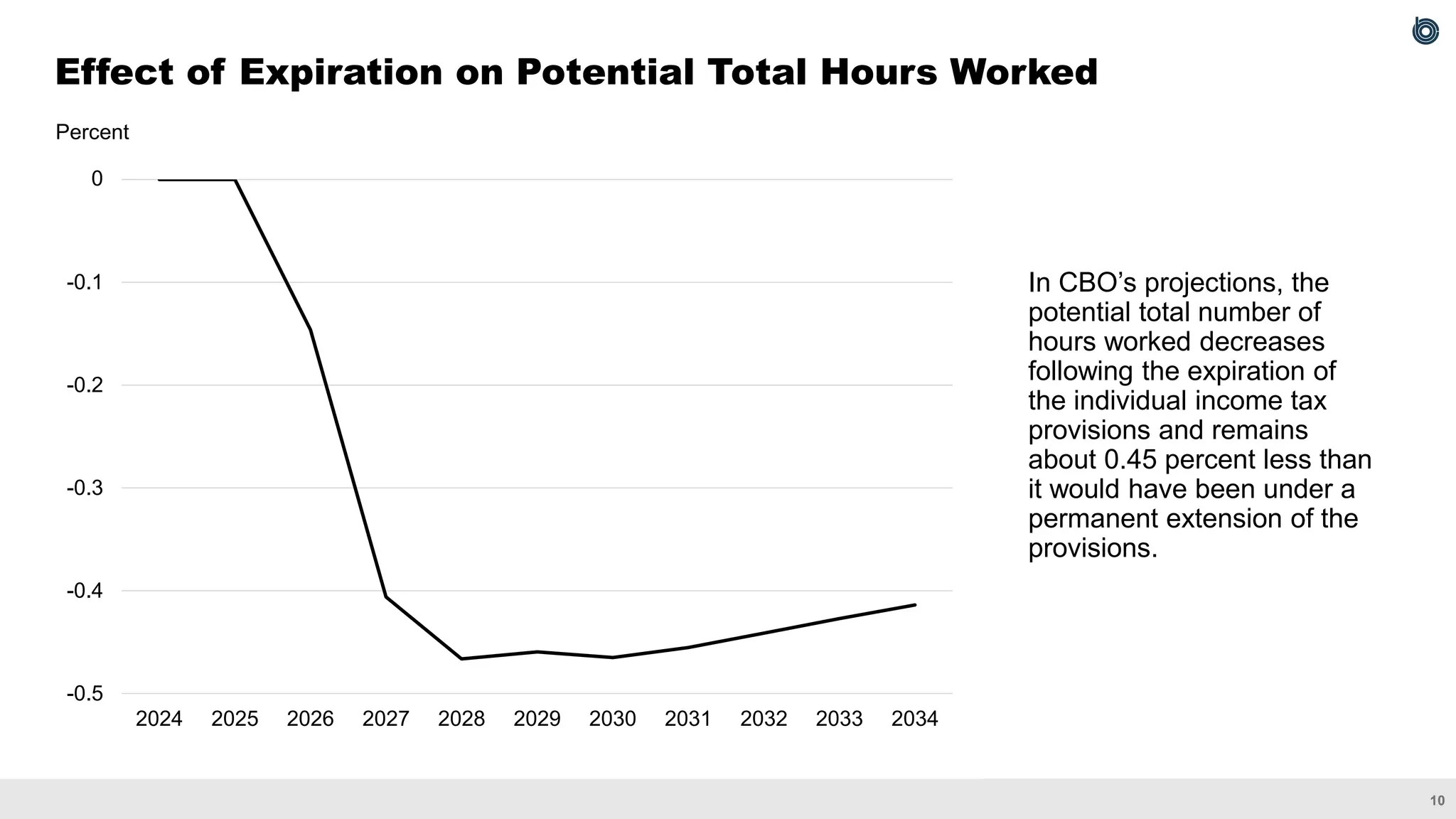
Effect of Expiration on Potential Total Hours Worked
In CBO’s projections, the
potential total number of
hours worked decreases
following the expiration of
the individual income tax
provisions and remains
about 0.45 percent less than
it would have been under a
permanent extension of the
provisions.
Percent
-0.5
-0.4
-0.3
-0.2
-0.1
0.0
2024 2025 2026 2027 2028 2029 2030 2031 2032 2033 2034
0
11
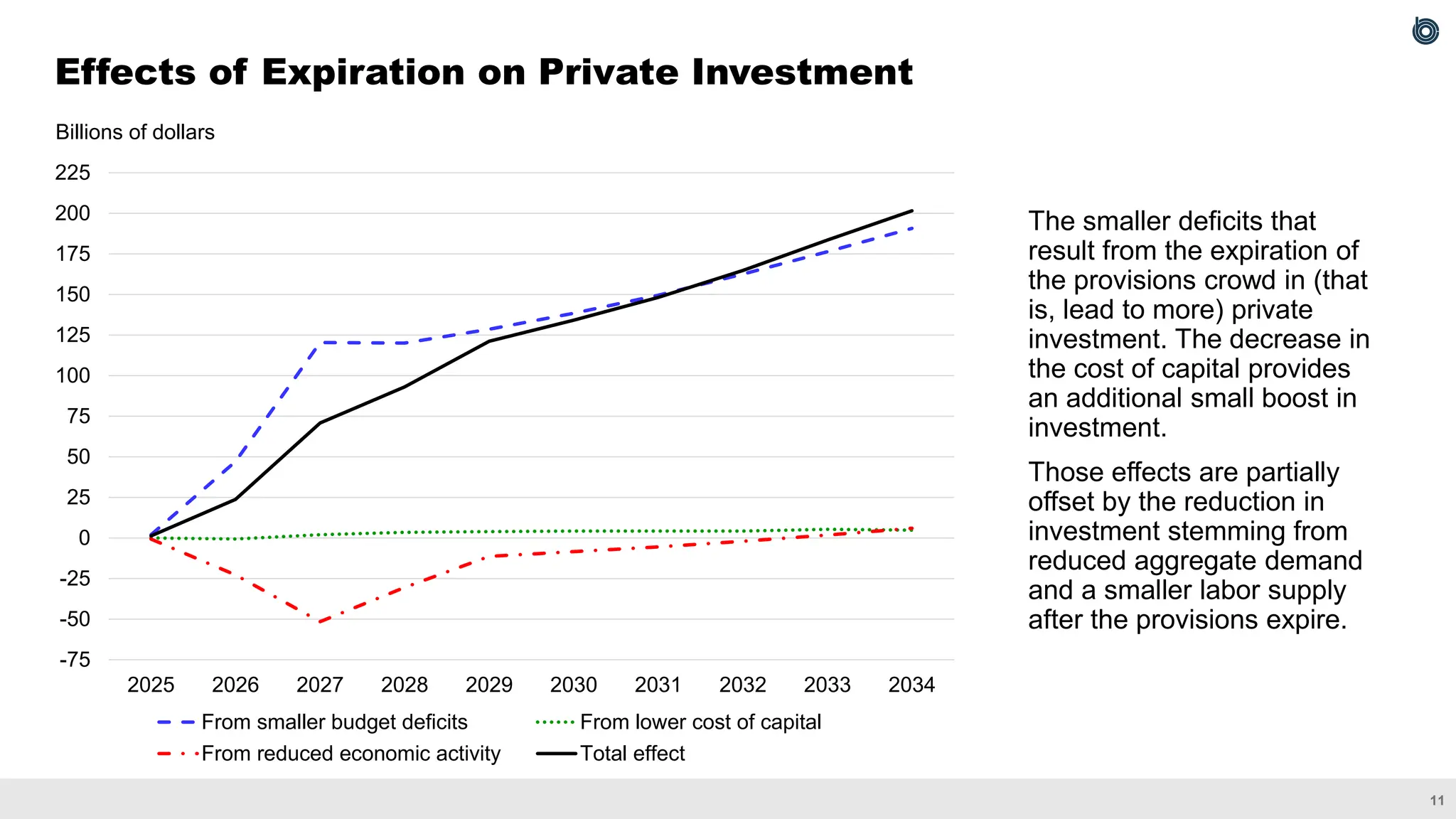
Effects of Expiration on Private Investment
The smaller deficits that
result from the expiration of
the provisions crowd in (that
is, lead to more) private
investment. The decrease in
the cost of capital provides
an additional small boost in
investment.
Those effects are partially
offset by the reduction in
investment stemming from
reduced aggregate demand
and a smaller labor supply
after the provisions expire.
Billions of dollars
-75
-50
-25
0
25
50
75
100
125
150
175
200
225
2025 2026 2027 2028 2029 2030 2031 2032 2033 2034
From smaller budget deficits From lower cost of capital
From reduced economic activity Total effect
12
Potential GDP is the maximum sustainable output of the economy, adjusted to remove the effects of inflation.
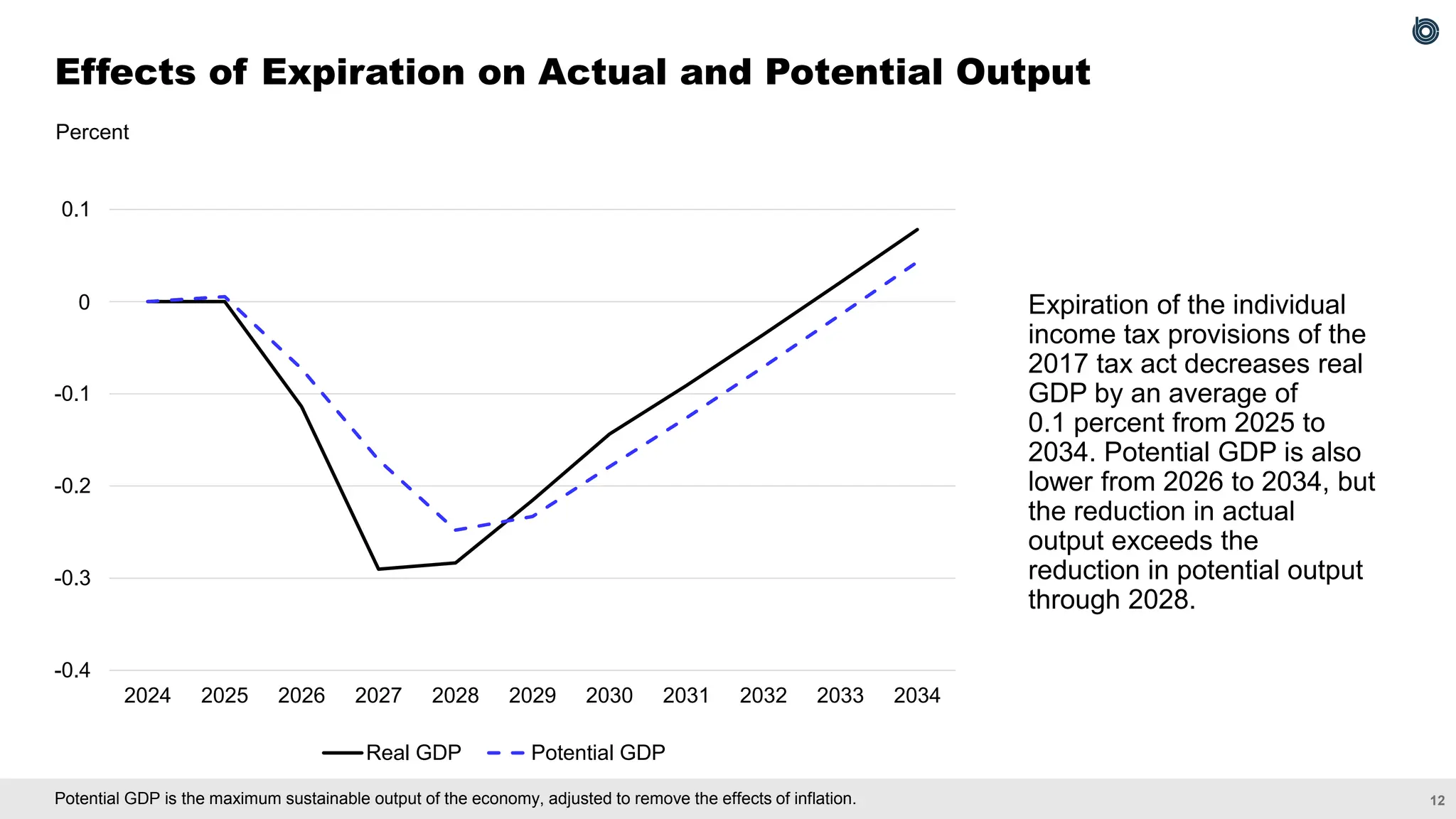
Effects of Expiration on Actual and Potential Output
Expiration of the individual
income tax provisions of the
2017 tax act decreases real
GDP by an average of
0.1 percent from 2025 to
2034. Potential GDP is also
lower from 2026 to 2034, but
the reduction in actual
output exceeds the
reduction in potential output
through 2028.
Percent
-0.4
-0.3
-0.2
-0.1
0.0
0.1
2024 2025 2026 2027 2028 2029 2030 2031 2032 2033 2034
Real GDP Potential GDP
0
13
A basis point is one one-hundredth of a percentage point.
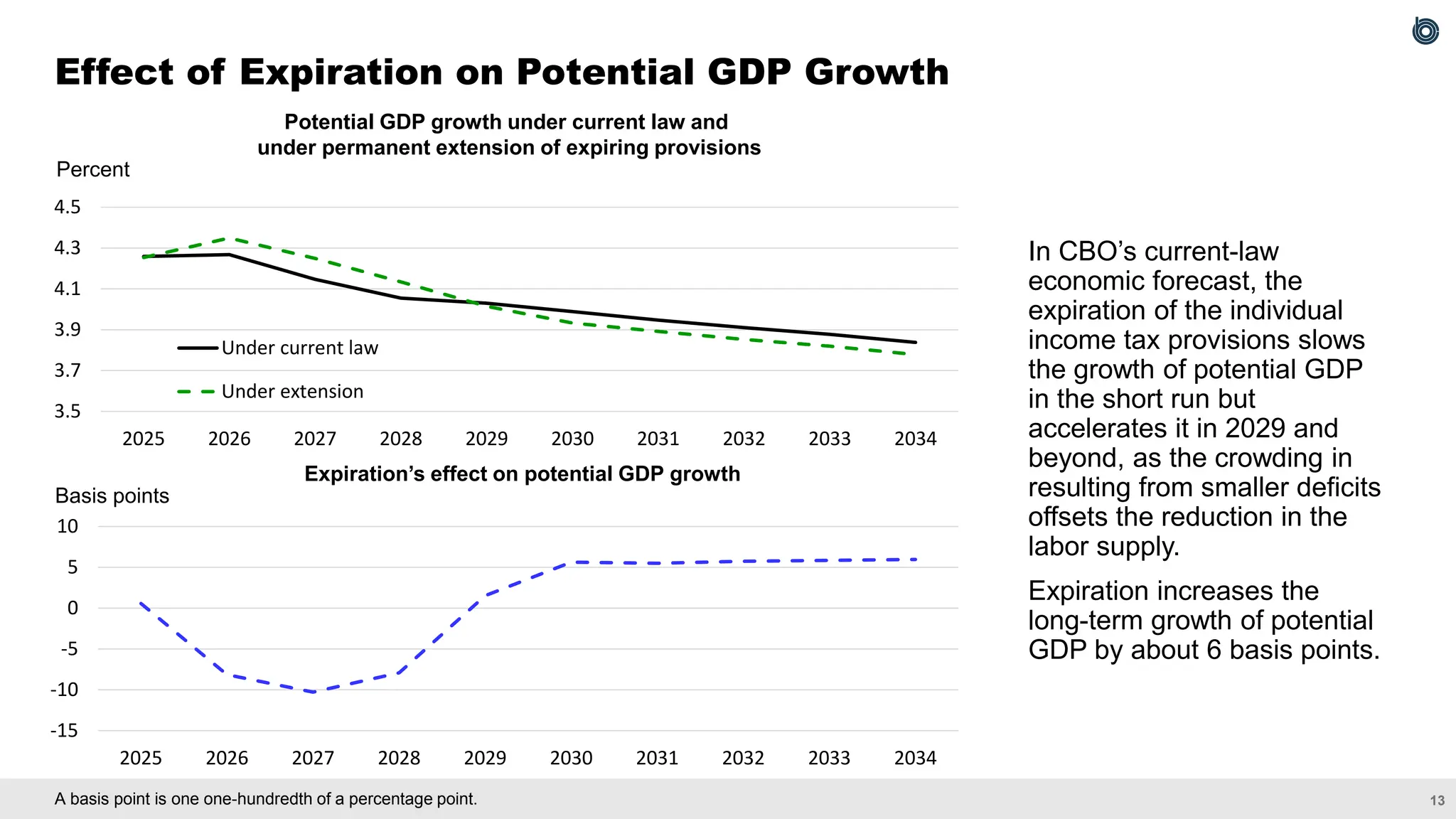
Effect of Expiration on Potential GDP Growth
In CBO’s current-law
economic forecast, the
expiration of the individual
income tax provisions slows
the growth of potential GDP
in the short run but
accelerates it in 2029 and
beyond, as the crowding in
resulting from smaller deficits
offsets the reduction in the
labor supply.
Expiration increases the
long-term growth of potential
GDP by about 6 basis points.
Potential GDP growth under current law and
under permanent extension of expiring provisions
Expiration’s effect on potential GDP growth
Percent
Basis points
3.5
3.7
3.9
4.1
4.3
4.5
2025 2026 2027 2028 2029 2030 2031 2032 2033 2034
Under current law
Under extension
-15
-10
-5
0
5
10
2025 2026 2027 2028 2029 2030 2031 2032 2033 2034
14
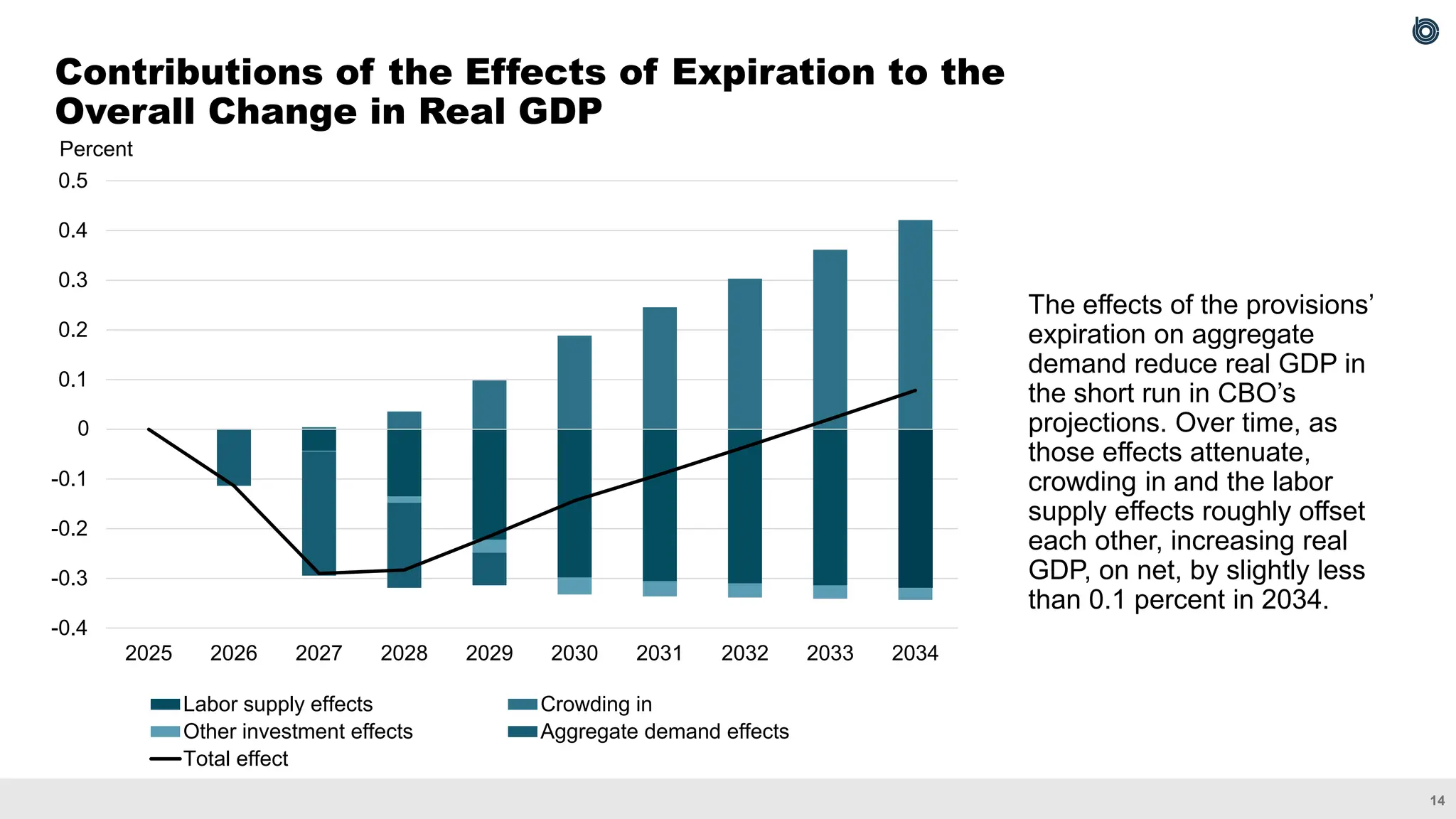
Contributions of the Effects of Expiration to the
Overall Change in Real GDP
The effects of the provisions’
expiration on aggregate
demand reduce real GDP in
the short run in CBO’s
projections. Over time, as
those effects attenuate,
crowding in and the labor
supply effects roughly offset
each other, increasing real
GDP, on net, by slightly less
than 0.1 percent in 2034.
Percent
-0.4
-0.3
-0.2
-0.1
0.0
0.1
0.2
0.3
0.4
0.5
2025 2026 2027 2028 2029 2030 2031 2032 2033 2034
Labor supply effects Crowding in
Other investment effects Aggregate demand effects
Total effect
0
15
CPI-U = consumer price index for all urban consumers.
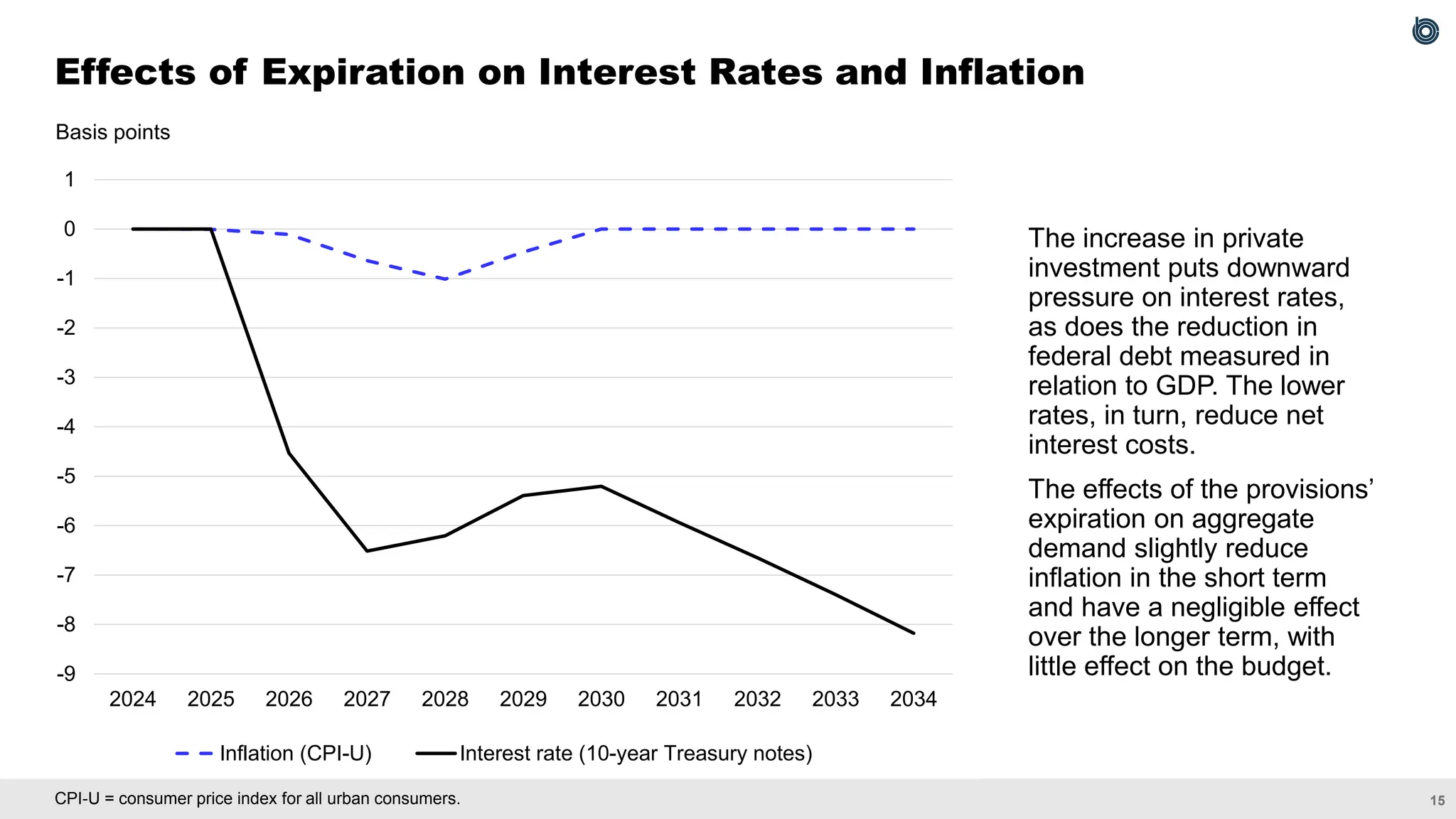
Effects of Expiration on Interest Rates and Inflation
The increase in private
investment puts downward
pressure on interest rates,
as does the reduction in
federal debt measured in
relation to GDP. The lower
rates, in turn, reduce net
interest costs.
The effects of the provisions’
expiration on aggregate
demand slightly reduce
inflation in the short term
and have a negligible effect
over the longer term, with
little effect on the budget.
Basis points
-9
-8
-7
-6
-5
-4
-3
-2
-1
0
1
2024 2025 2026 2027 2028 2029 2030 2031 2032 2033 2034
Inflation (CPI-U) Interest rate (10-year Treasury notes)
16
Because the expiration of the provisions does not significantly change CBO’s
economic projections, the dynamic budgetary effects of that expiration (that is, the
budgetary effects after accounting for changes in the size of the economy
stemming from expiration) would be very similar to the conventional estimate—a
$3.7 trillion reduction in the cumulative deficit over the 2025–2034 period.
CBO continues to evaluate the economic and budgetary effects of the expiring
provisions as it updates its baseline projections.
How the Economic Effects of Expiration Affect
CBO’s Baseline Budget Projections

How the Expiring Individual Income Tax Provisions in the 2017 Tax Act Affect CBO’s Economic Forecast

  • 1.
    How the ExpiringIndividual Income Tax Provisions in the 2017 Tax Act Affect CBO’s Economic Forecast December 2024
  • 2.
    Congressional Budget Office,The Budget and Economic Outlook: 2024 to 2034 (February 2024), www.cbo.gov/publication/59710. Note about this presentation: Unless otherwise indicated, all years referred to in describing budget projections are federal fiscal years, which run from October 1 to September 30 and are designated by the calendar year in which they end. The Congressional Budget Office’s economic forecast reflects current law, including the expiration, at the end of 2025, of certain provisions of the 2017 tax act that made significant changes to the individual income tax system. Outside forecasters tend to incorporate different assumptions about policy. Namely, they account for some probability of those provisions’ being extended. To allow for more accurate comparisons of its forecast with the forecasts of other organizations, CBO has analyzed how the expiration of those provisions affects the economy and budget in the projections that it published in February 2024. ▪ Expiration modestly reduces the supply of labor by raising tax rates on individual income. ▪ The increase in tax revenues stemming from expiration reduces federal deficits and borrowing and, in turn, increases private investment. ▪ On net, those two effects largely offset each other, resulting in very small changes to gross domestic product (GDP). Summary
  • 3.
    2 CBO’s Analysis ofthe Effects of the 2017 Tax Act
  • 4.
    3 Most of theprovisions of the 2017 tax act that affect the individual income tax system expire at the end of 2025. As required by the Balanced Budget and Emergency Deficit Control Act of 1985, CBO’s baseline projections reflect the assumption that current laws governing taxes and spending will generally remain unchanged, so the expiration of those provisions is incorporated in the agency’s projections. By contrast, other forecasters will most likely incorporate at least some probability of the extension of those provisions into their projections, complicating comparisons with CBO’s projections. CBO therefore sought to understand the effects that expiration had on its projections. This presentation focuses on the effects that the expiring individual income tax provisions have on CBO’s economic forecast. The effects of other expiring provisions fall outside the scope of this analysis. Estimates of the economic and budgetary effects of legislation that would extend the expiring individual income tax provisions would be produced by the staff of the Joint Committee on Taxation (JCT) and would depend on the details of the policy package. Background
  • 5.
    4 Congressional Budget Office,Budgetary Outcomes Under Alternative Assumptions About Spending and Revenues (May 2024), www.cbo.gov/publication/60114, and The Budget and Economic Outlook: 2024 to 2034 (February 2024), www.cbo.gov/publication/59710. The budgetary effects of expiration used in this analysis were JCT’s estimates of the effects of permanently extending the 2017 tax act’s changes to the individual income tax system. Those estimates, published by CBO in May 2024, are based on CBO’s February 2024 baseline and are conventional estimates—that is, they do not account for changes in the size of the economy. ▪ Primary deficits (which exclude net outlays for interest) over the 2025–2034 period in CBO’s February 2024 baseline are a total of $3.3 trillion smaller, or 1 percent of GDP less each year, because of the expiration of those provisions. ▪ Total deficits are $3.7 trillion smaller because of expiration. CBO also analyzed how expiration affected marginal tax rates on labor income and capital income in its baseline. ▪ Marginal tax rates on labor income and business income taxed as individual income are higher than they would have been without expiration. ▪ Marginal tax rates on owner-occupied housing are lower because of expiration. What Estimates Did CBO Use in This Analysis?
  • 6.
    5 Congressional Budget Office,The Budget and Economic Outlook: 2018 to 2028 (April 2018), Appendix B, www.cbo.gov/publication/53651. The full set of provisions in the 2017 tax act, which CBO analyzed in April 2018, differs from the expiring provisions analyzed here in a few important ways. ▪ The 2017 tax act included a mix of temporary and permanent provisions. – Permanent changes, including the 14 percentage-point reduction in the corporate income tax rate, are excluded from this analysis. – The mix of provisions resulted in the 2017 tax act’s reducing the deficit in 2027 and 2028 in CBO’s 2018 baseline. ▪ The full set of provisions included significant offsets that reduced the legislation’s net cost. Some of those offsets, including the onetime tax on previously untaxed foreign earnings and the elimination of the individual health insurance mandate, had limited or even positive effects on incentives to work and invest. ▪ This analysis considers the individual provisions in isolation; it does not address the effects of recent changes to bonus depreciation or to the treatment of research and experimentation costs. How Does This Analysis Compare With CBO’s Full Analysis of the 2017 Tax Act?
  • 7.
    6 How the ExpiringIndividual Income Tax Provisions in the 2017 Tax Act Are Reflected in CBO’s Economic Forecast
  • 8.
    7 For more informationabout the models that CBO used for this analysis, see Congressional Budget Office, “CBO’s Policy Growth Model” (April 2021), www.cbo.gov/publication/57017; and Nathaniel Frentz, Jaeger Nelson, Dan Ready, and John Seliski, A Simplified Model of How Macroeconomic Changes Affect the Federal Budget, Working Paper 2020-01 (Congressional Budget Office, January 2020), www.cbo.gov/publication/55884. For this analysis, CBO compared its economic forecast with an alternative benchmark that is based on a scenario in which the expiring individual income tax provisions of the 2017 tax act are permanently extended. (CBO’s economic forecast is consistent with its budget projections, which are required by the Deficit Control Act to reflect the assumption that those provisions will expire as scheduled.) CBO used its economic policy models to construct the economic scenario for the alternative benchmark and its budgetary feedback model to assess the budgetary implications of those changes in the economy. The agency calculated the difference in outcomes under the two scenarios to estimate the effects of the expiration of the provisions on various economic factors that are shown in the following slides. If any legislative changes were made, CBO would use its full suite of economic and budget models to estimate the effects of those changes and incorporate them into its future baseline projections. How CBO Analyzed the Effects of the Expiring Provisions
  • 9.
    8 The scheduled changesto tax law are projected to affect the economy through three main channels: ▪ Incentive effects: Higher marginal tax rates on labor income reduce the incentive to work. Lower marginal tax rates on owner-occupied housing increase the incentive to invest, and higher marginal tax rates on business income taxed as individual income reduce that incentive. ▪ Crowding in: The reduction in deficits increases the amount of funds available for private investment. ▪ Economic activity: Reductions in aggregate demand and the supply of labor reduce private investment. Economic Effects of the Expiration of the Provisions
  • 10.
    9 Congressional Budget Office,“CBO’s Model for Estimating the Effects on New Investment of Deductions to Recover the Cost of Capital” (December 2024), www.cbo.gov/publication/60985. The labor supply response to expiration in CBO’s economic forecast is gradual: Changes in taxes in one year affect the supply of labor over three years. ▪ Some people choose to work less in 2026, as soon as expiration occurs. ▪ Other people do not understand the consequences of expiration or expect the provisions to be extended retroactively and thus do not change how much they work until 2027 or 2028. In CBO’s forecast, expiration affects the user cost of capital. CBO estimates that for every 1 percent decrease in that cost, private investment increases by 0.7 percent. ▪ In the agency’s capital tax model (called CapTax), investors and savers make decisions assuming that the laws in place in a given year will hold for the full life of their investment. ▪ Some types of investment (such as purchases of equipment) depend on the current cost of capital, and other types (including investment in structures) depend on the current cost of capital and its cost in the previous year. How Workers’ and Investors’ Expectations Are Incorporated in CBO’s Projections of the Labor Supply and Private Investment
  • 11.
    10 Effect of Expirationon Potential Total Hours Worked In CBO’s projections, the potential total number of hours worked decreases following the expiration of the individual income tax provisions and remains about 0.45 percent less than it would have been under a permanent extension of the provisions. Percent -0.5 -0.4 -0.3 -0.2 -0.1 0.0 2024 2025 2026 2027 2028 2029 2030 2031 2032 2033 2034 0
  • 12.
    11 Effects of Expirationon Private Investment The smaller deficits that result from the expiration of the provisions crowd in (that is, lead to more) private investment. The decrease in the cost of capital provides an additional small boost in investment. Those effects are partially offset by the reduction in investment stemming from reduced aggregate demand and a smaller labor supply after the provisions expire. Billions of dollars -75 -50 -25 0 25 50 75 100 125 150 175 200 225 2025 2026 2027 2028 2029 2030 2031 2032 2033 2034 From smaller budget deficits From lower cost of capital From reduced economic activity Total effect
  • 13.
    12 Potential GDP isthe maximum sustainable output of the economy, adjusted to remove the effects of inflation. Effects of Expiration on Actual and Potential Output Expiration of the individual income tax provisions of the 2017 tax act decreases real GDP by an average of 0.1 percent from 2025 to 2034. Potential GDP is also lower from 2026 to 2034, but the reduction in actual output exceeds the reduction in potential output through 2028. Percent -0.4 -0.3 -0.2 -0.1 0.0 0.1 2024 2025 2026 2027 2028 2029 2030 2031 2032 2033 2034 Real GDP Potential GDP 0
  • 14.
    13 A basis pointis one one-hundredth of a percentage point. Effect of Expiration on Potential GDP Growth In CBO’s current-law economic forecast, the expiration of the individual income tax provisions slows the growth of potential GDP in the short run but accelerates it in 2029 and beyond, as the crowding in resulting from smaller deficits offsets the reduction in the labor supply. Expiration increases the long-term growth of potential GDP by about 6 basis points. Potential GDP growth under current law and under permanent extension of expiring provisions Expiration’s effect on potential GDP growth Percent Basis points 3.5 3.7 3.9 4.1 4.3 4.5 2025 2026 2027 2028 2029 2030 2031 2032 2033 2034 Under current law Under extension -15 -10 -5 0 5 10 2025 2026 2027 2028 2029 2030 2031 2032 2033 2034
  • 15.
    14 Contributions of theEffects of Expiration to the Overall Change in Real GDP The effects of the provisions’ expiration on aggregate demand reduce real GDP in the short run in CBO’s projections. Over time, as those effects attenuate, crowding in and the labor supply effects roughly offset each other, increasing real GDP, on net, by slightly less than 0.1 percent in 2034. Percent -0.4 -0.3 -0.2 -0.1 0.0 0.1 0.2 0.3 0.4 0.5 2025 2026 2027 2028 2029 2030 2031 2032 2033 2034 Labor supply effects Crowding in Other investment effects Aggregate demand effects Total effect 0
  • 16.
    15 CPI-U = consumerprice index for all urban consumers. Effects of Expiration on Interest Rates and Inflation The increase in private investment puts downward pressure on interest rates, as does the reduction in federal debt measured in relation to GDP. The lower rates, in turn, reduce net interest costs. The effects of the provisions’ expiration on aggregate demand slightly reduce inflation in the short term and have a negligible effect over the longer term, with little effect on the budget. Basis points -9 -8 -7 -6 -5 -4 -3 -2 -1 0 1 2024 2025 2026 2027 2028 2029 2030 2031 2032 2033 2034 Inflation (CPI-U) Interest rate (10-year Treasury notes)
  • 17.
    16 Because the expirationof the provisions does not significantly change CBO’s economic projections, the dynamic budgetary effects of that expiration (that is, the budgetary effects after accounting for changes in the size of the economy stemming from expiration) would be very similar to the conventional estimate—a $3.7 trillion reduction in the cumulative deficit over the 2025–2034 period. CBO continues to evaluate the economic and budgetary effects of the expiring provisions as it updates its baseline projections. How the Economic Effects of Expiration Affect CBO’s Baseline Budget Projections