| 2024-10-10 | Public | Page 1
NTN and 3GPP
Standards
from 5G to 6G
Gino Masini, MBA
Principal Researcher – Standardization
Ericsson AB – Standards and Technologies
Stockholm, Sweden
| 2024-10-10 | Public | Page 2
Summary
● 5G and standards
● 3GPP today
● The journey of satellites toward 3GPP
● Where we are today: Rel-19 in progress
● Some lessons we learned
● Towards 6G
| 2024-10-10 | Public | Page 3
5G and Standards
● 5G From scenarios and requirements to specifications
● NG-RAN architecture today
● 5G Advanced
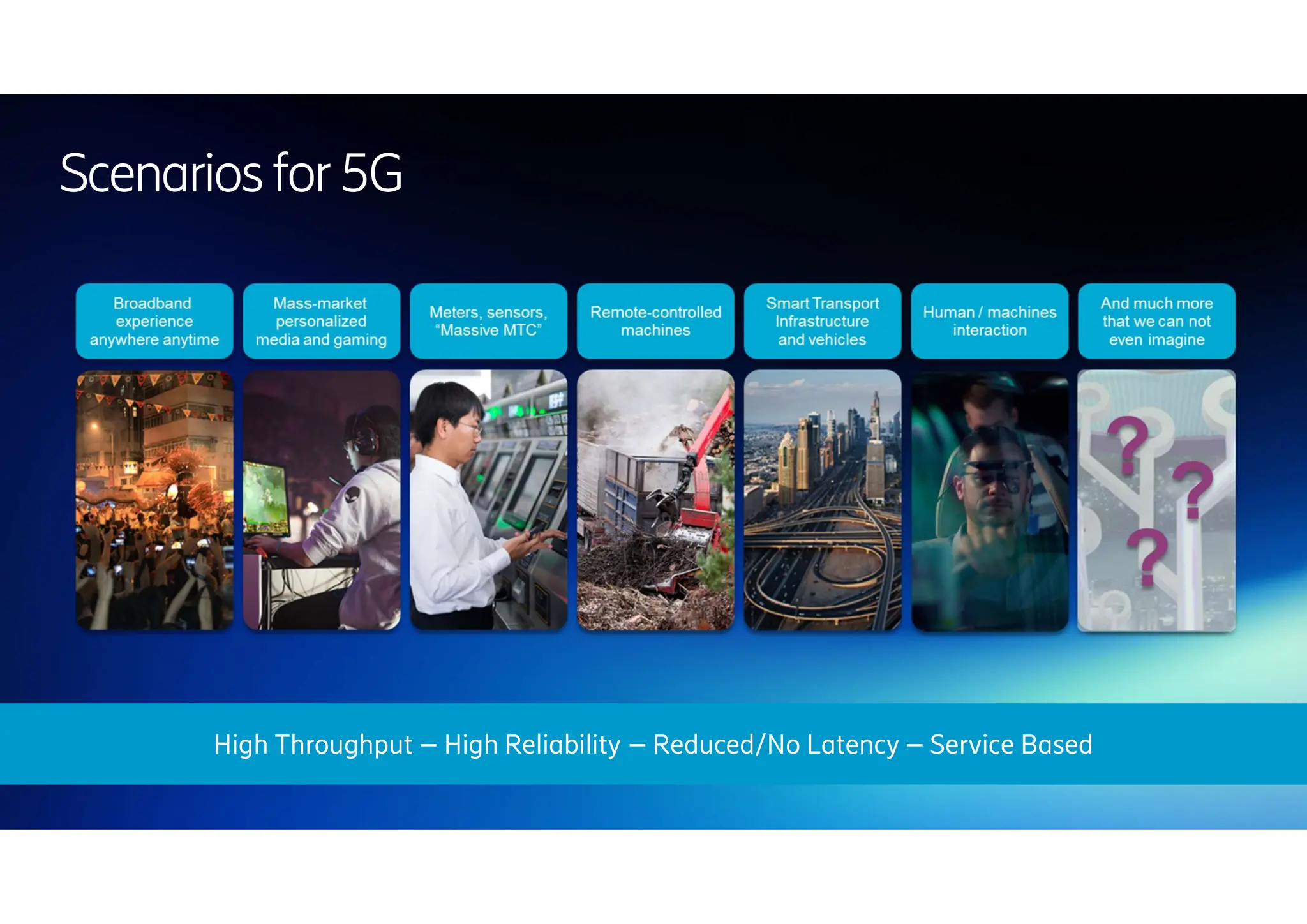
Scenariosfor5G
High Throughput – High Reliability – Reduced/No Latency – Service Based
Requirements fromITU(IMT-2020)
Requirement
Performance Measure
DL: 20 Gbps
UL: 10 Gbps
Peak data rate
DL: 30 bps/Hz
UL: 15 bps/Hz
Peak spectral efficiency
100 MHz
Bandwidth
20 ms (10 ms encouraged)
Control plane latency
URLLC: 1/0.5 ms, eMBB: 4 ms
User plane latency, 1-way
10s / 20byte packet
Infrequent small packets
0 ms
Mobility interruption time
Up to 500 km/h
Mobility
3x IMT-A requirement
TRP spectral efficiency
3x IMT-A requirement
User spectral efficiency at
5% percentile
10 Mbps/m2 [ITU]
Area traffic capacity
100/50 Mbps DL/UL [ITU]
User experienced datarate
140/143 dB loss MaxCL
Extreme coverage (3GPP)
Requirement
Performance Measure
1,000,000 devices/km2
Connection density
164 dB coupling loss
Coverage (3GPP)
10-15 yr
Battery life (3GPP)
1-10-5 in 1 ms
Reliability
Inspection (Qualitative)
NW energy efficiency
Inspection (Qualitative)
UE Energy efficiency
Yes
Inter-system mobility
Yes
Bandwidth scalability
Yes
Spectrum flexibility
Yes
Support of wide range of
services
Latency (4G → 5G): 20 → 1 ms
Source: ITU-R Rep. M.2410-0
| 2024-10-10 | Public | Page 7
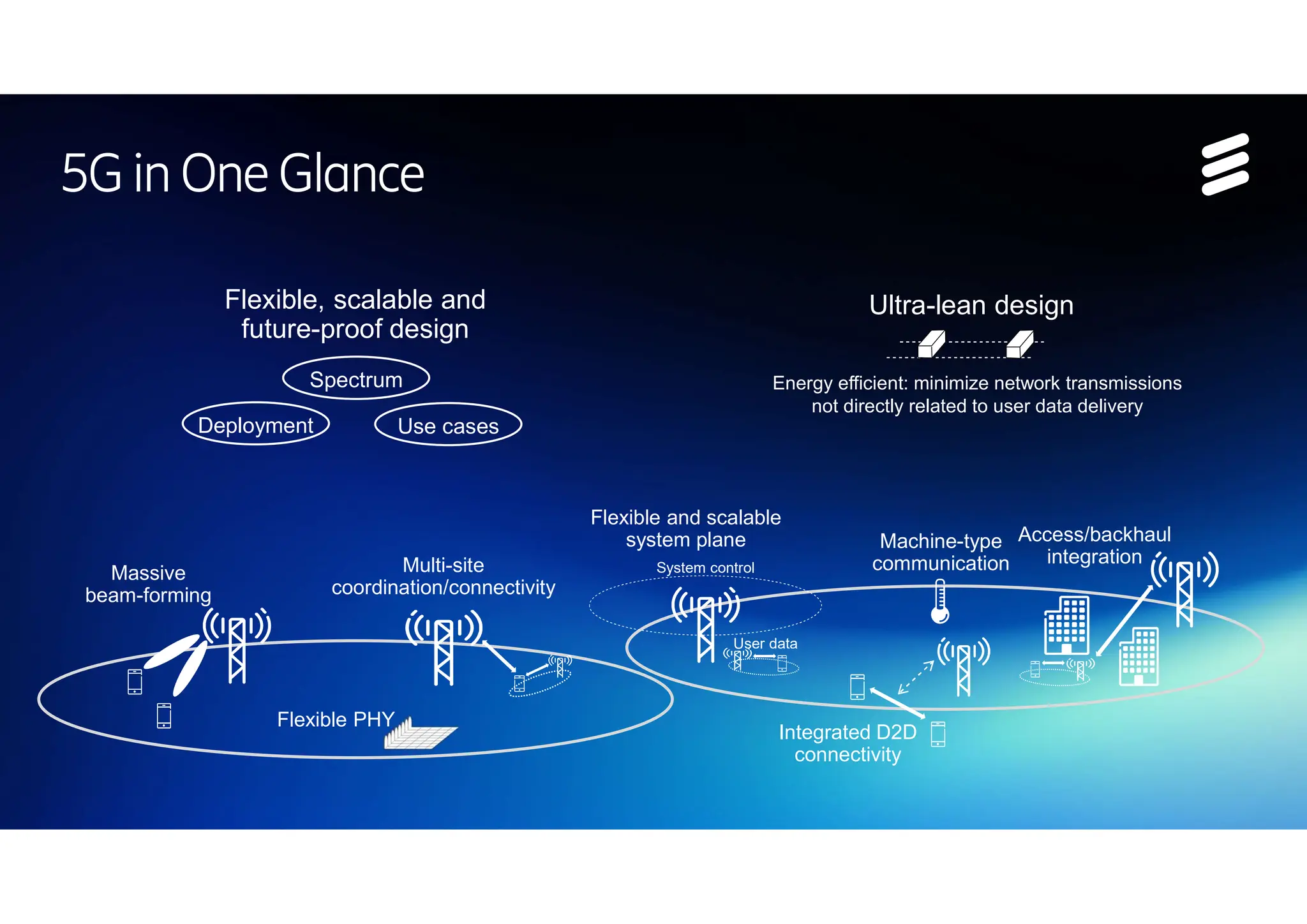
Access/backhaul
integration
Integrated D2D
connectivity
Massive
beam-forming
System control
Flexible and scalable
system plane
Ultra-lean design
User data
Flexible, scalable and
future-proof design
Deployment
Multi-site
coordination/connectivity
Flexible PHY
Use cases
Spectrum Energy efficient: minimize network transmissions
not directly related to user data delivery
Machine-type
communication
5GinOneGlance
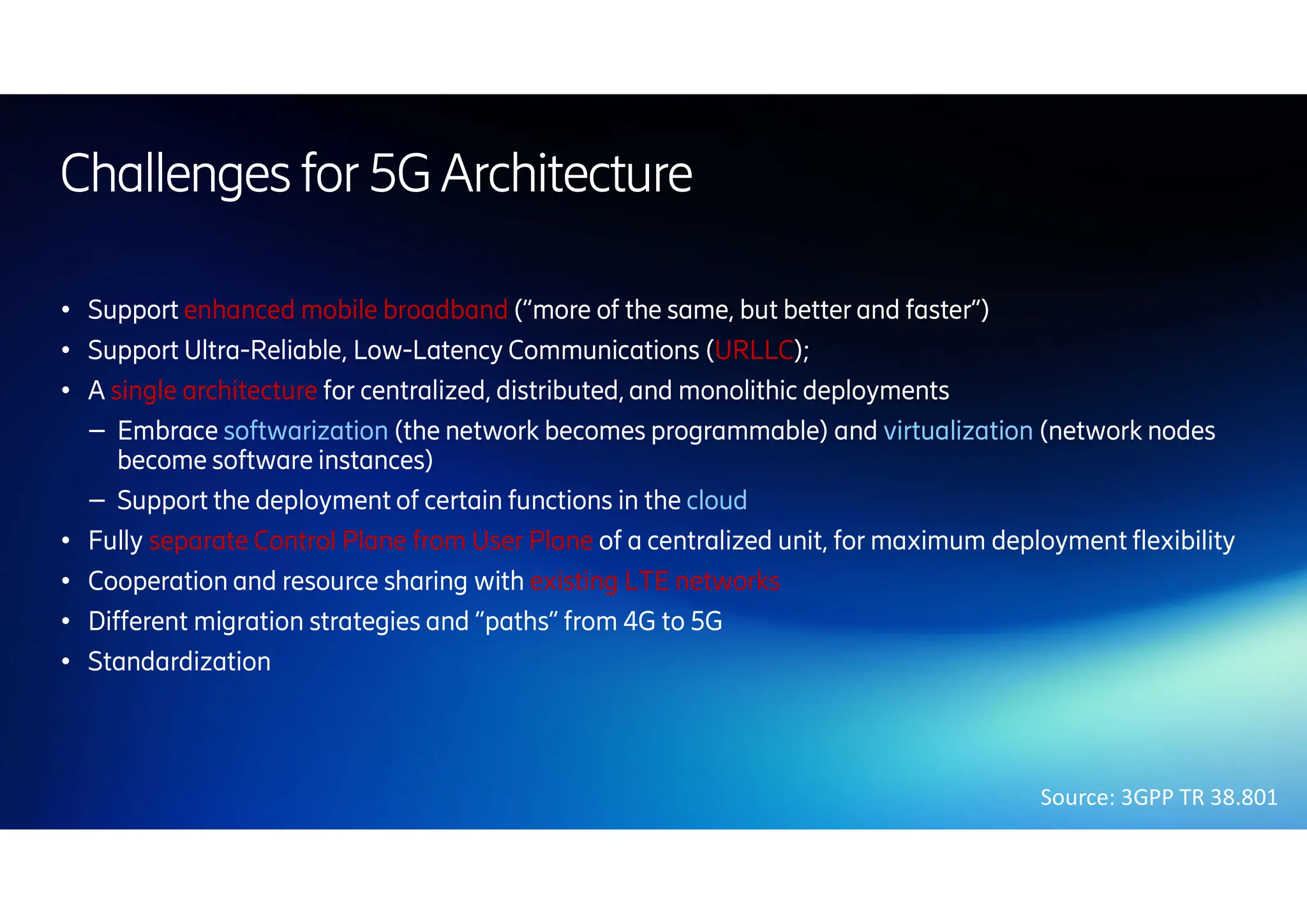
Challenges for5GArchitecture
● Support enhanced mobile broadband (“more of the same, but better and faster”)
● Support Ultra-Reliable, Low-Latency Communications (URLLC);
● A single architecture for centralized, distributed, and monolithic deployments
– Embrace softwarization (the network becomes programmable) and virtualization (network nodes
become software instances)
– Support the deployment of certain functions in the cloud
● Fully separate Control Plane from User Plane of a centralized unit, for maximum deployment flexibility
● Cooperation and resource sharing with existing LTE networks
● Different migration strategies and “paths” from 4G to 5G
● Standardization
Source: 3GPP TR 38.801
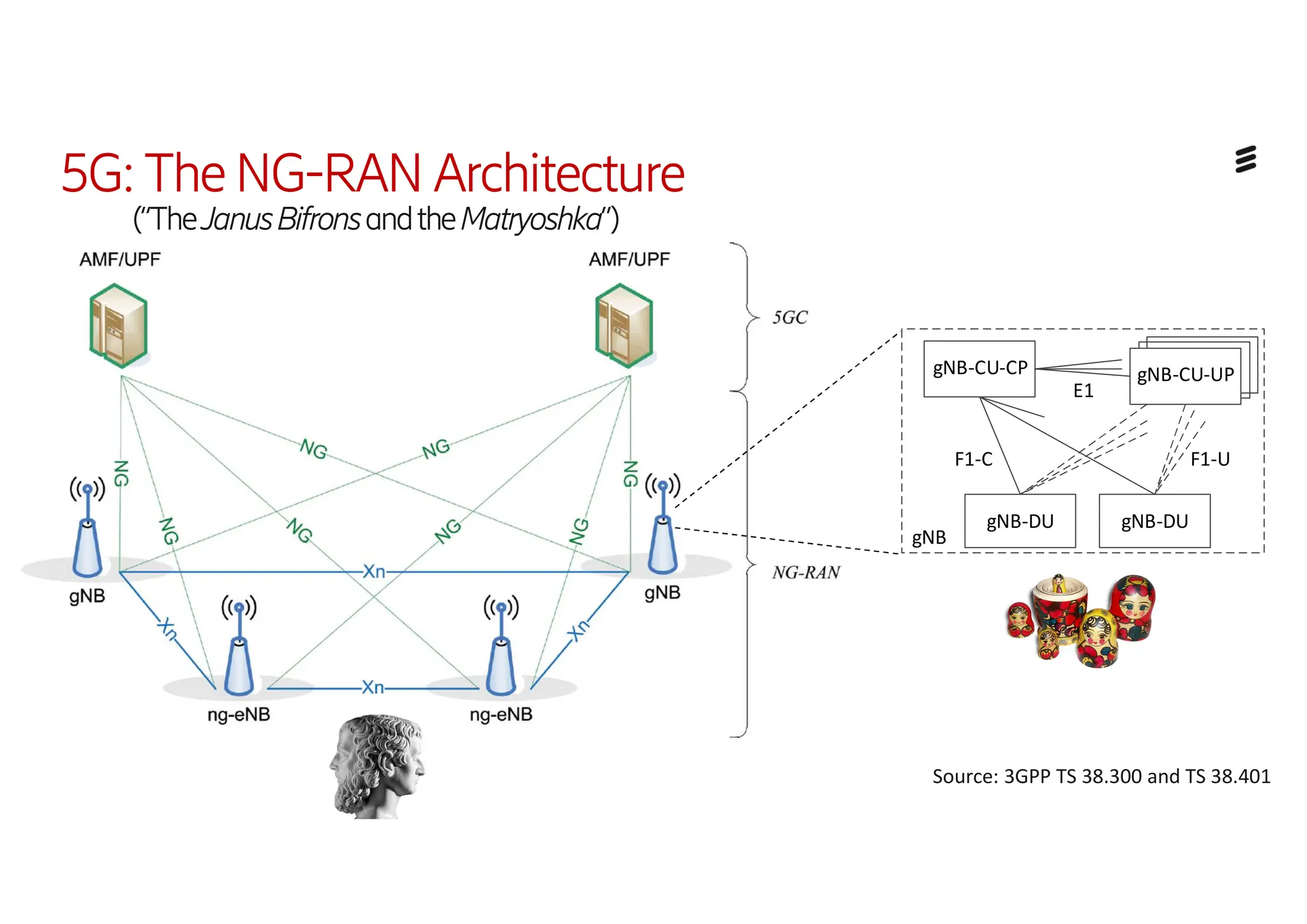
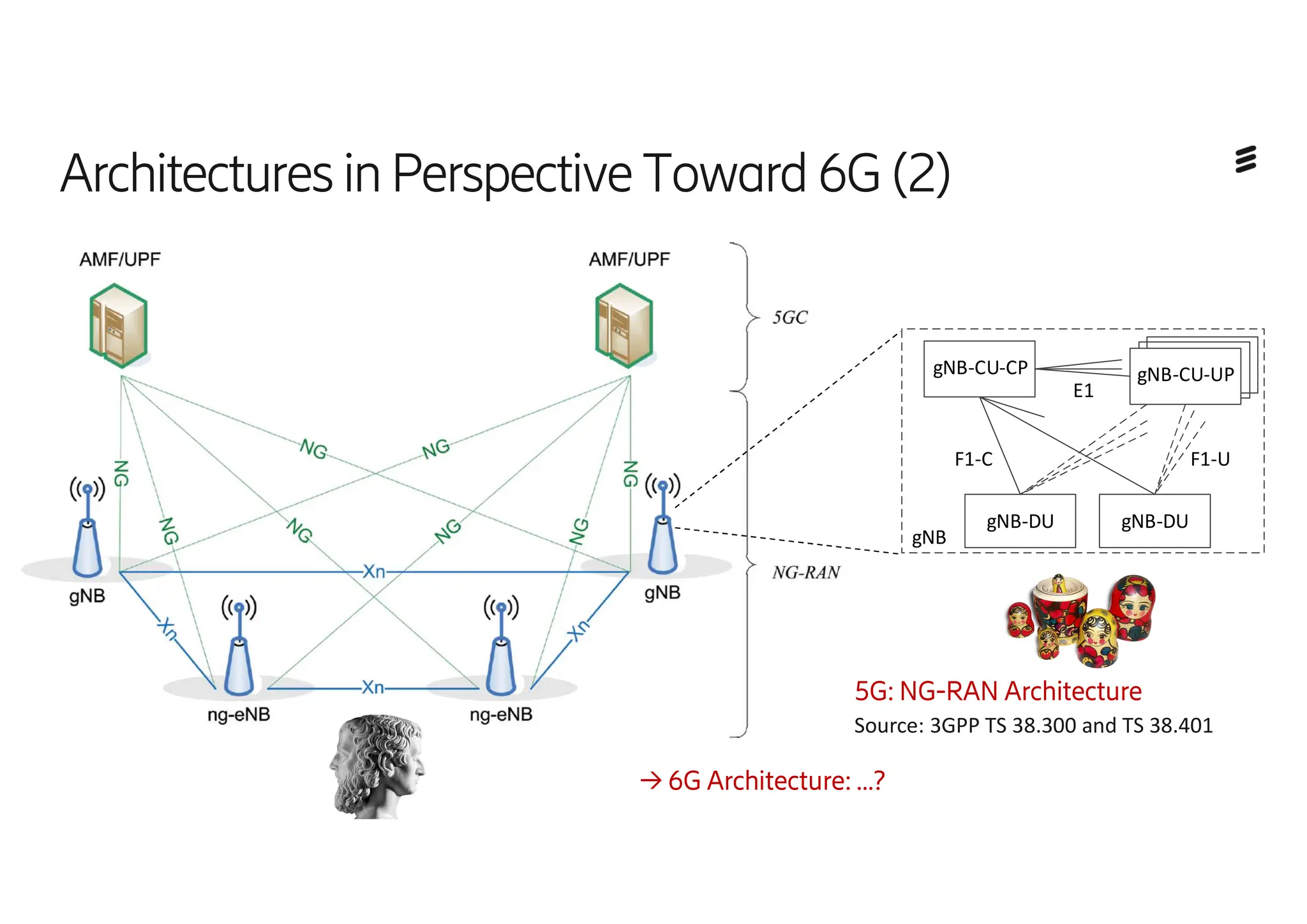
E1
gNB-DU
gNB-CU-CP
F1-C F1-U
gNB
gNB-CU-UP
gNB-DU
5G: TheNG-RAN Architecture
(“TheJanusBifronsandtheMatryoshka”)
Source: 3GPP TS 38.300 and TS 38.401
| 2024-10-10 | Public | Page 10
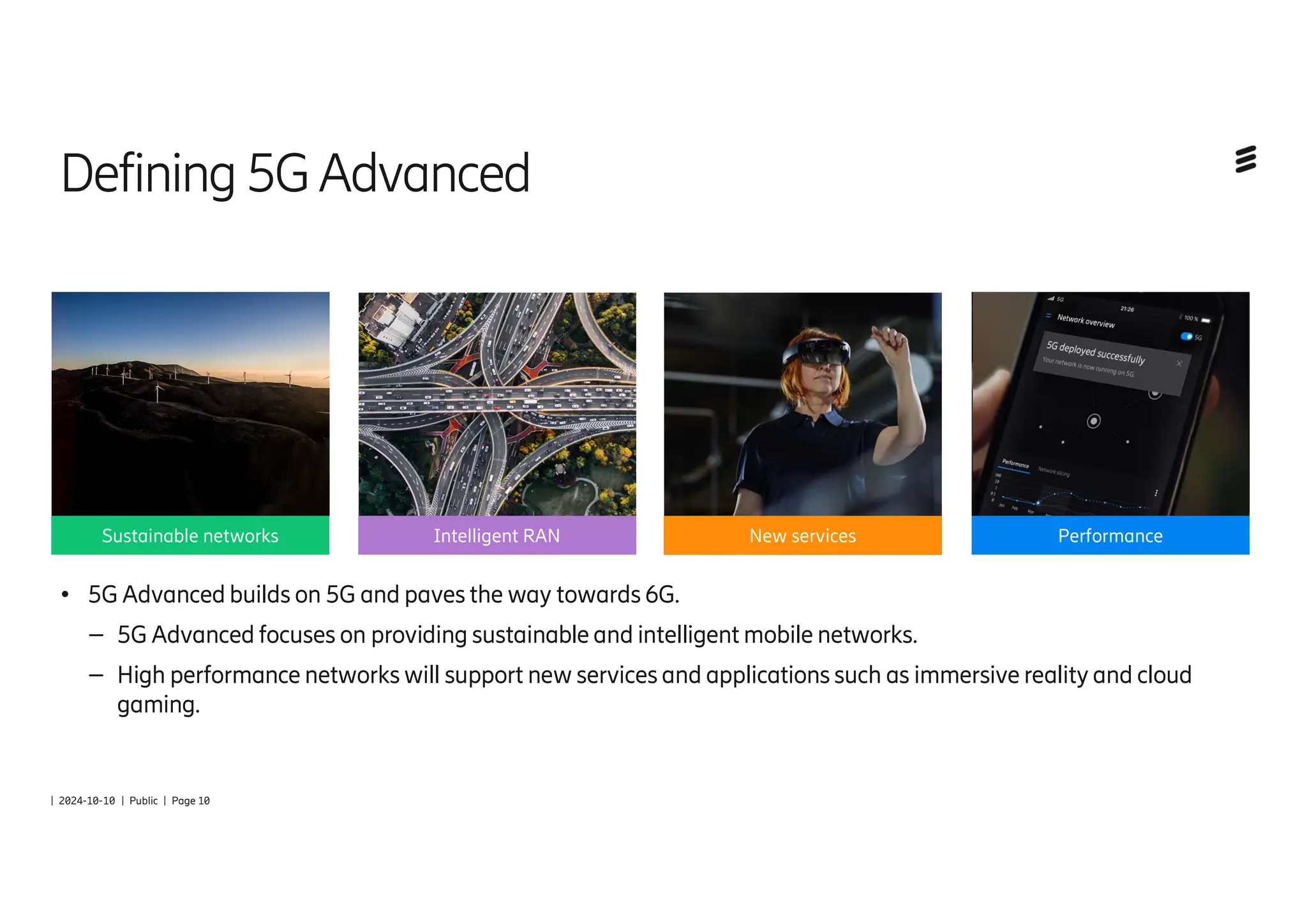
Defining 5GAdvanced
● 5G Advanced builds on 5G and paves the way towards 6G.
– 5G Advanced focuses on providing sustainable and intelligent mobile networks.
– High performance networks will support new services and applications such as immersive reality and cloud
gaming.
Sustainable networks Intelligent RAN New services Performance
| 2024-10-10 | Public | Page 11
3GPP Today
● Why Standards
● Structure, ways of working, recent timeline
● Backwards-compatible framework
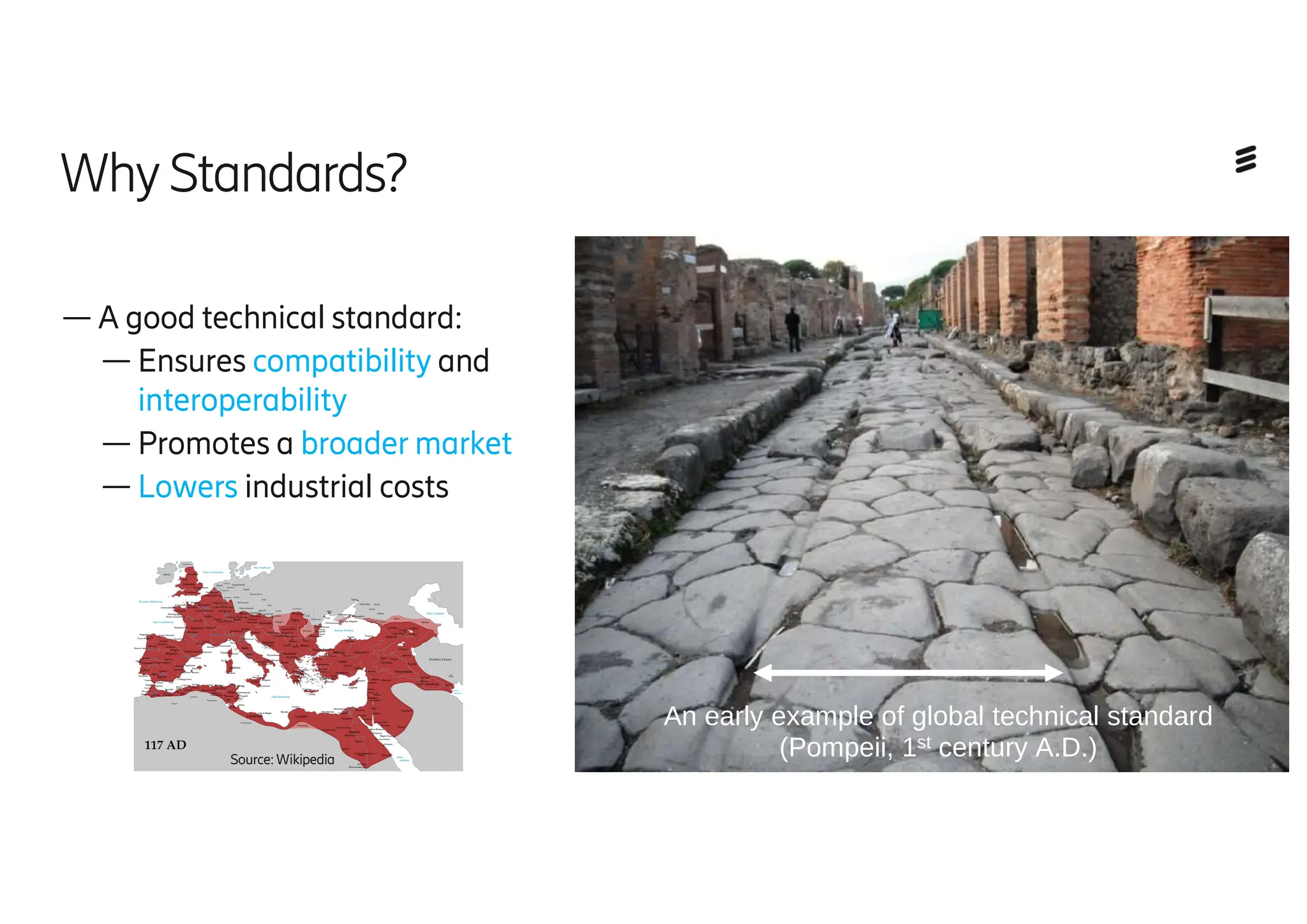
WhyStandards?
— A good technical standard:
— Ensures compatibility and
interoperability
— Promotes a broader market
— Lowers industrial costs
An early example of global technical standard
(Pompeii, 1st century A.D.)
Source:Wikipedia
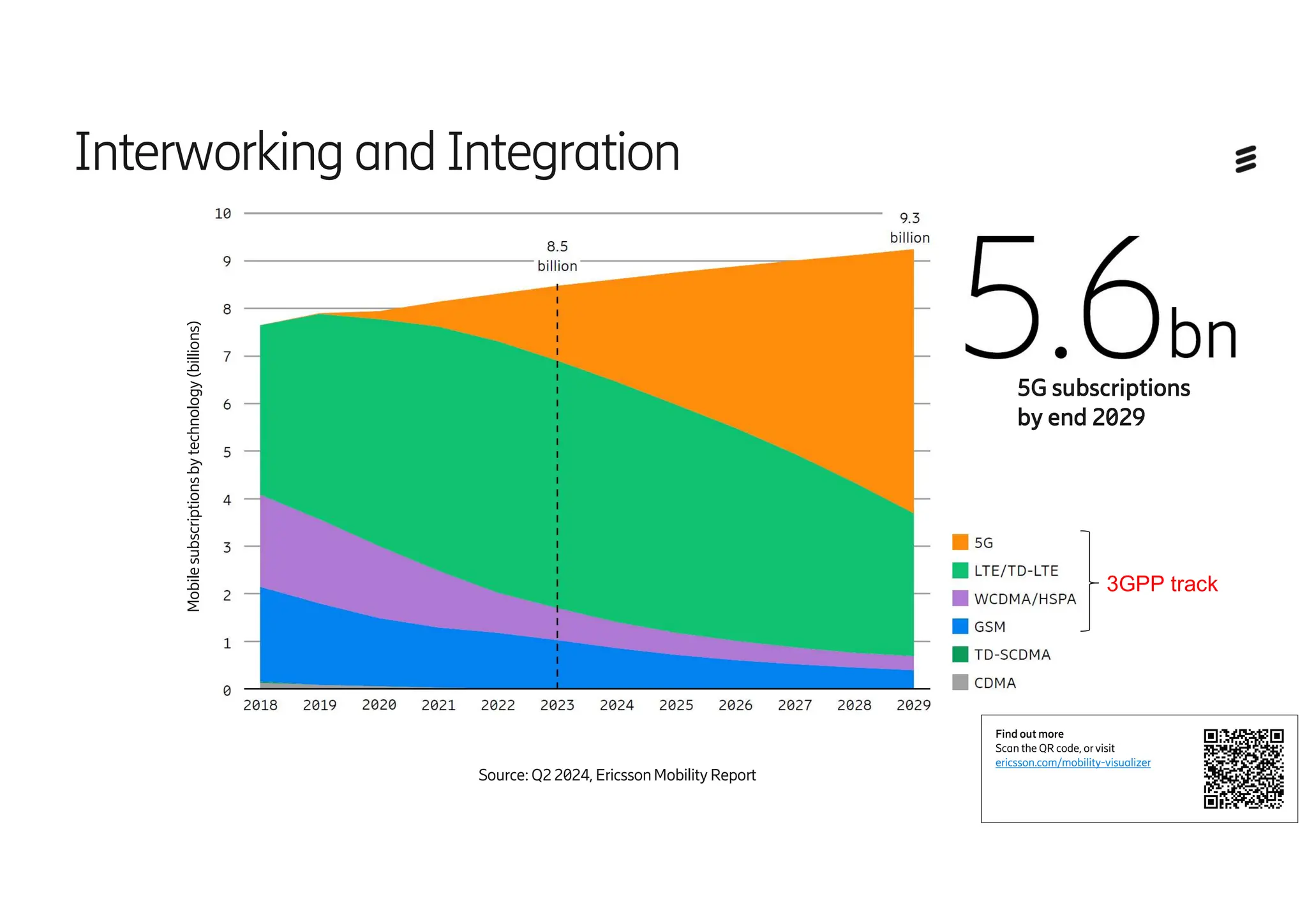
Source: Q22024, EricssonMobility Report
13
Interworking andIntegration
3GPP track
Mobile
subscriptions
by
technology
(billions)
5G subscriptions
by end 2029
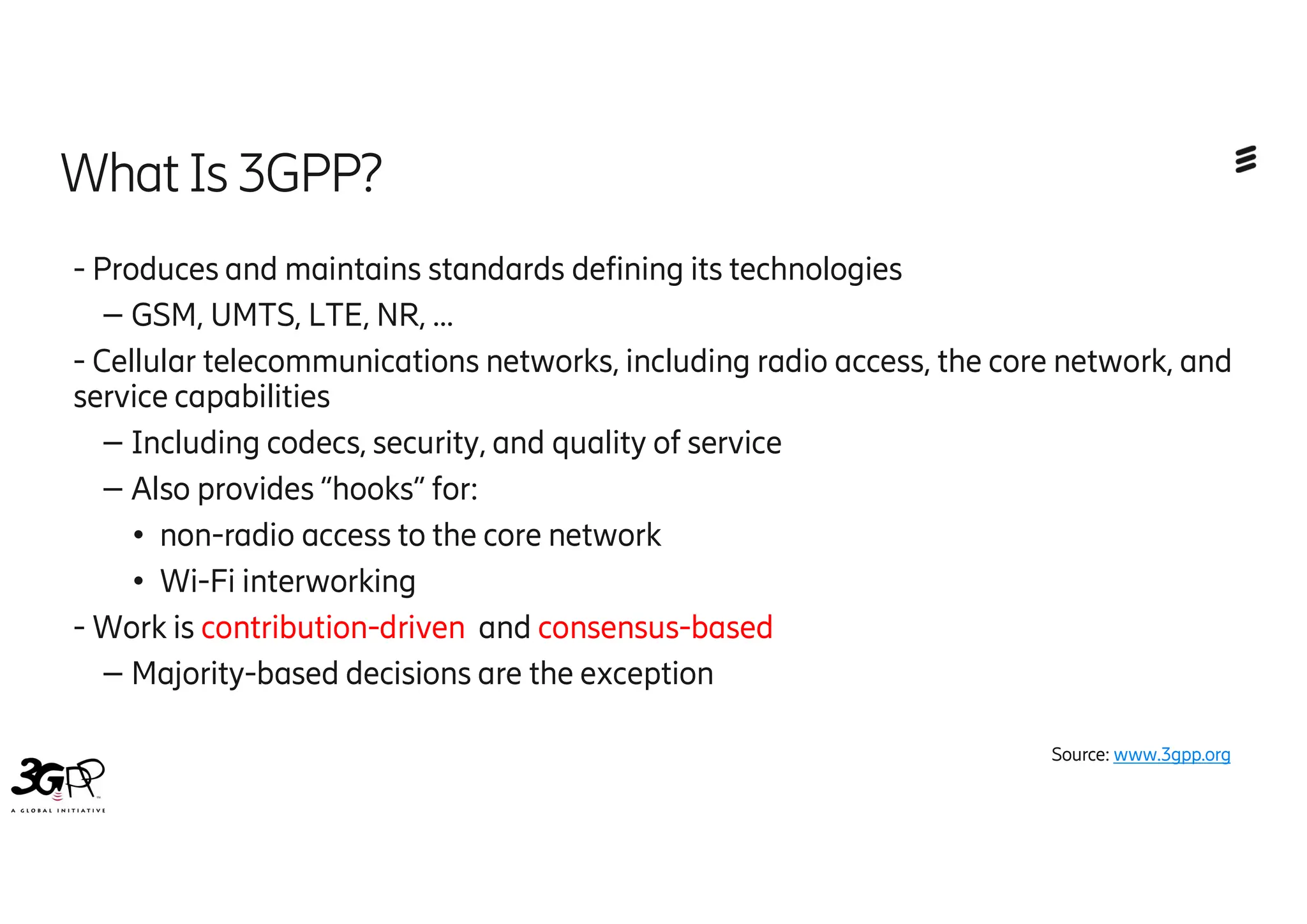
- Produces and maintains standards defining its technologies
– GSM, UMTS, LTE, NR, …
- Cellular telecommunications networks, including radio access, the core network, and
service capabilities
– Including codecs, security, and quality of service
– Also provides “hooks” for:
● non-radio access to the core network
● Wi-Fi interworking
- Work is contribution-driven and consensus-based
– Majority-based decisions are the exception
14
What Is3GPP?
Source: www.3gpp.org
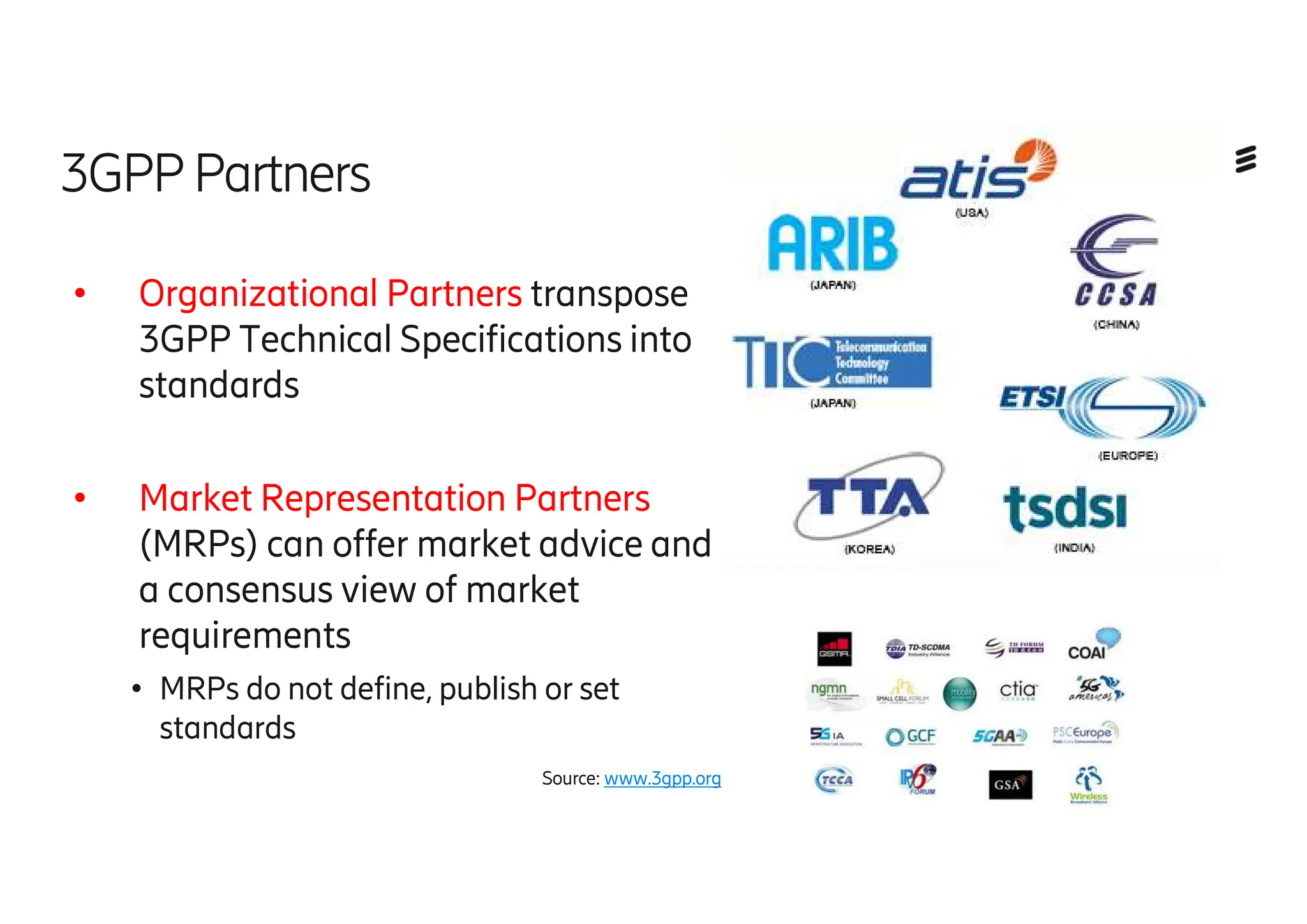
• Organizational Partners transpose
3GPP Technical Specifications into
standards
• Market Representation Partners
(MRPs) can offer market advice and
a consensus view of market
requirements
• MRPs do not define, publish or set
standards
15
3GPP Partners
Source: www.3gpp.org
| 2024-10-10 | Public | Page 16
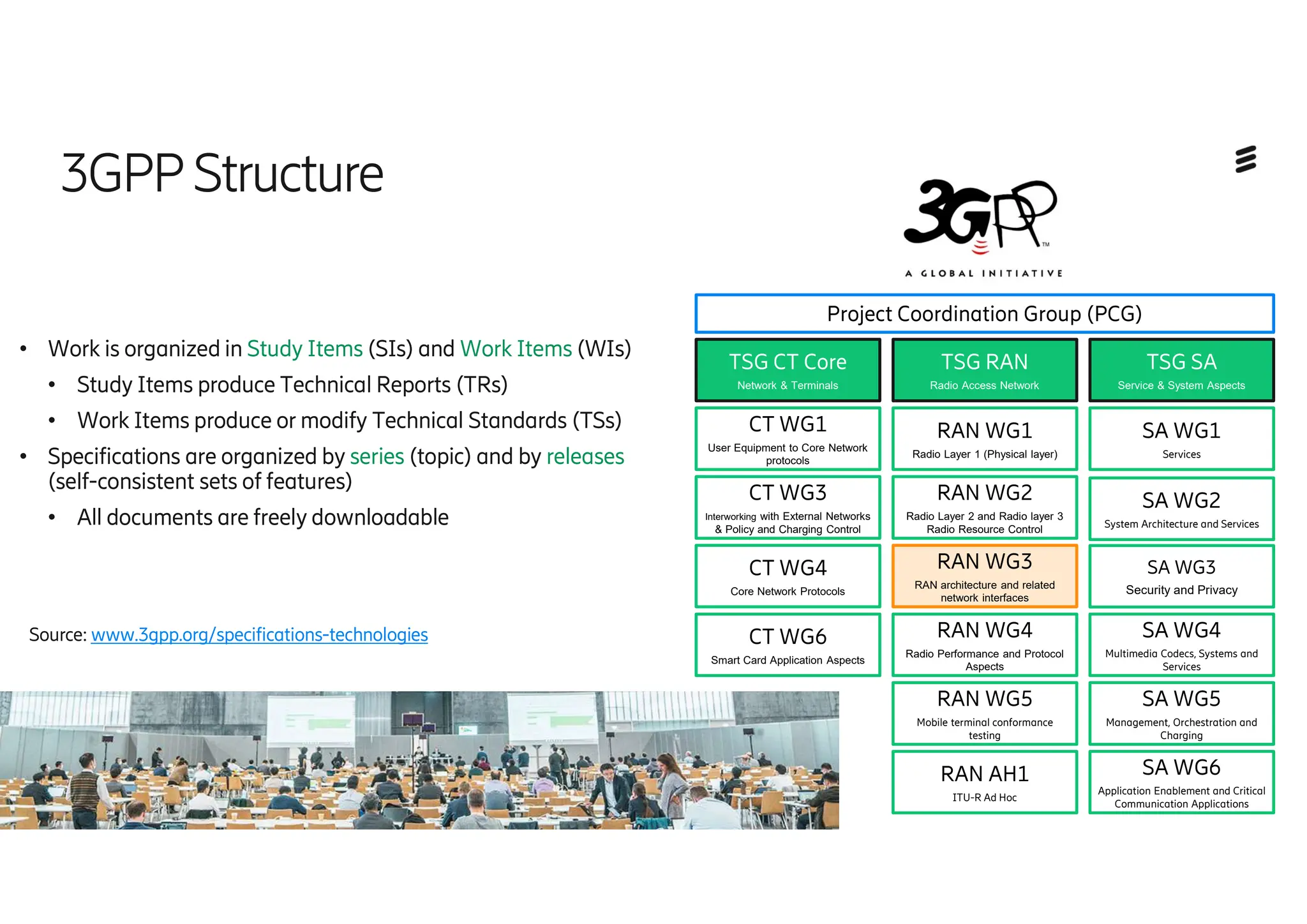
3GPP Structure
TSG CT Core
Network & Terminals
TSG RAN
Radio Access Network
TSG SA
Service & System Aspects
CT WG1
User Equipment to Core Network
protocols
CT WG3
Interworking with External Networks
& Policy and Charging Control
CT WG4
Core Network Protocols
CT WG6
Smart Card Application Aspects
RAN WG1
Radio Layer 1 (Physical layer)
RAN WG2
Radio Layer 2 and Radio layer 3
Radio Resource Control
RAN WG4
Radio Performance and Protocol
Aspects
RAN WG5
Mobile terminal conformance
testing
RAN AH1
ITU-R Ad Hoc
SA WG1
Services
SA WG2
System Architecture and Services
SA WG4
Multimedia Codecs, Systems and
Services
SA WG5
Management, Orchestration and
Charging
SA WG6
Application Enablement and Critical
Communication Applications
Project Coordination Group (PCG)
RAN WG3
RAN architecture and related
network interfaces
SA WG3
Security and Privacy
• Work is organized in Study Items (SIs) and Work Items (WIs)
• Study Items produce Technical Reports (TRs)
• Work Items produce or modify Technical Standards (TSs)
• Specifications are organized by series (topic) and by releases
(self-consistent sets of features)
• All documents are freely downloadable
Source: www.3gpp.org/specifications-technologies
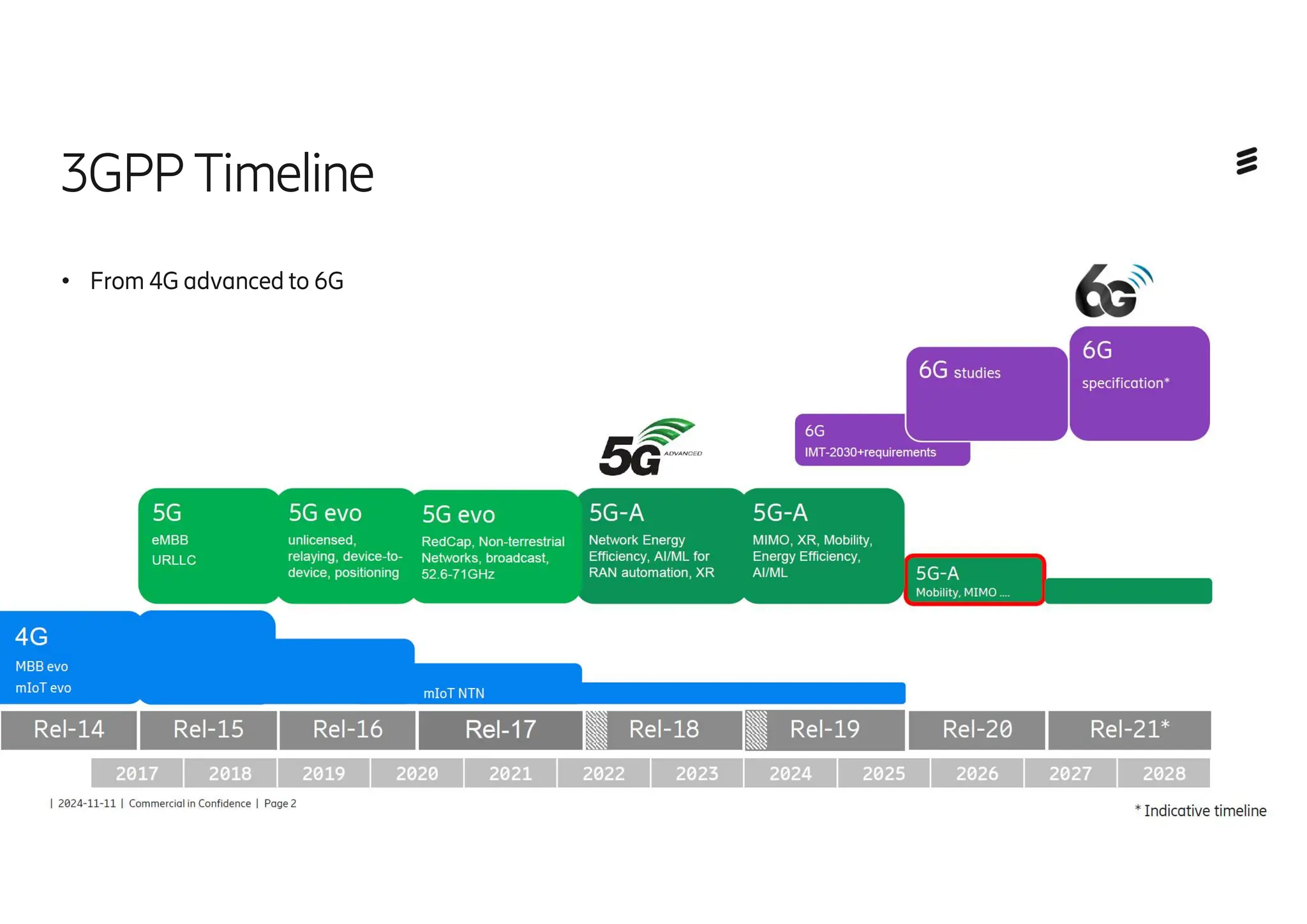
3GPP Timeline
• From 4G advanced to 6G
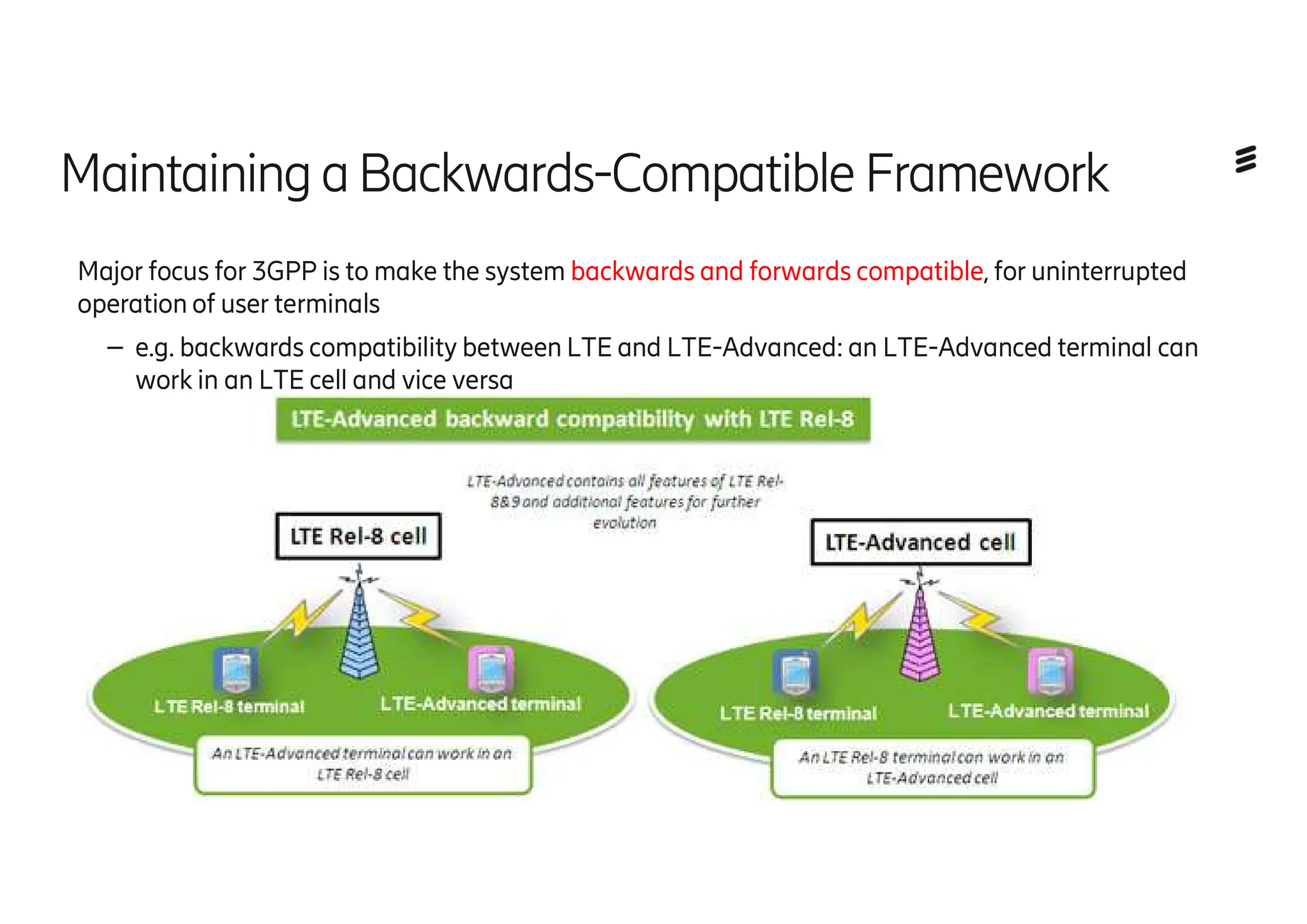
Maintaining aBackwards-Compatible Framework
Major focus for 3GPP is to make the system backwards and forwards compatible, for uninterrupted
operation of user terminals
– e.g. backwards compatibility between LTE and LTE-Advanced: an LTE-Advanced terminal can
work in an LTE cell and vice versa
| 2024-10-10 | Public | Page 19
The Journey of Satellites
toward 3GPP
● Global scenarios
● Why satellites? Why standardize? Why 3GPP? Why now?
● New challenges for architecture, mobility, procedures, …
● From studies to Rel-17/18
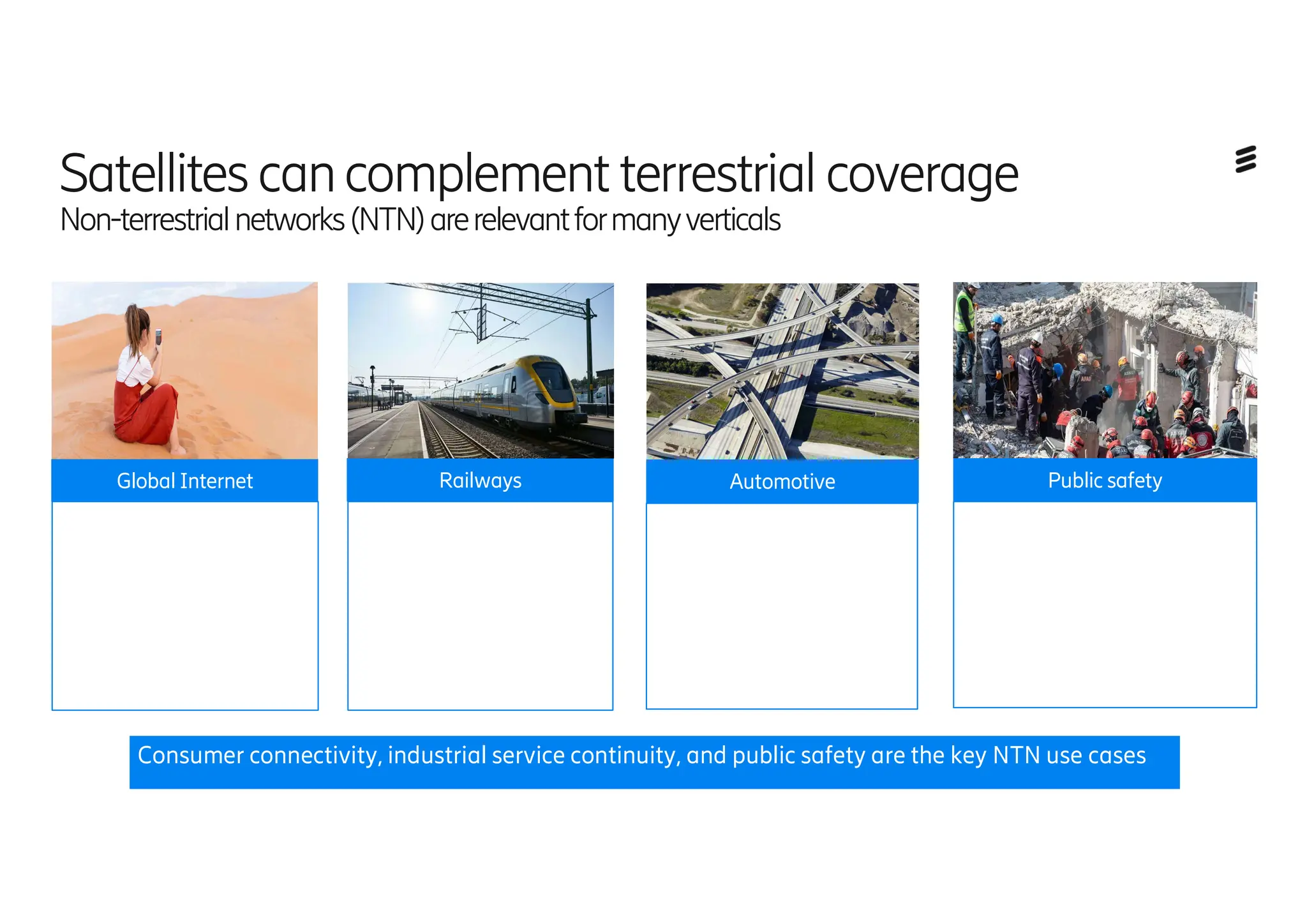
Satellites cancomplement terrestrial coverage
Non-terrestrialnetworks(NTN)arerelevantformanyverticals
• Connectivity in remote
regions
• Existing terrestrial users
traveling into uncovered
areas (adventurers,
mountaineers, sailing, …)
• Airborne, maritime, …
• Connecting low-traffic
railway lines in rural
areas
• Adding resilience to
failover from TN
• NTN can be integrated as
a transport path in
FRMCS
• Resilience for public safety
and national security in case
of natural or man-made
disasters impacting terrestrial
networks
Global Internet Railways Public safety
Automotive
• No new use NTN-specific
cases identified for
connected vehicles
(5GAA)
• Complementing terrestrial
coverage gaps
• Resilience when TN
unavailable
Consumer connectivity, industrial service continuity, and public safety are the key NTN use cases
| 2024-10-10 | Public | Page 21
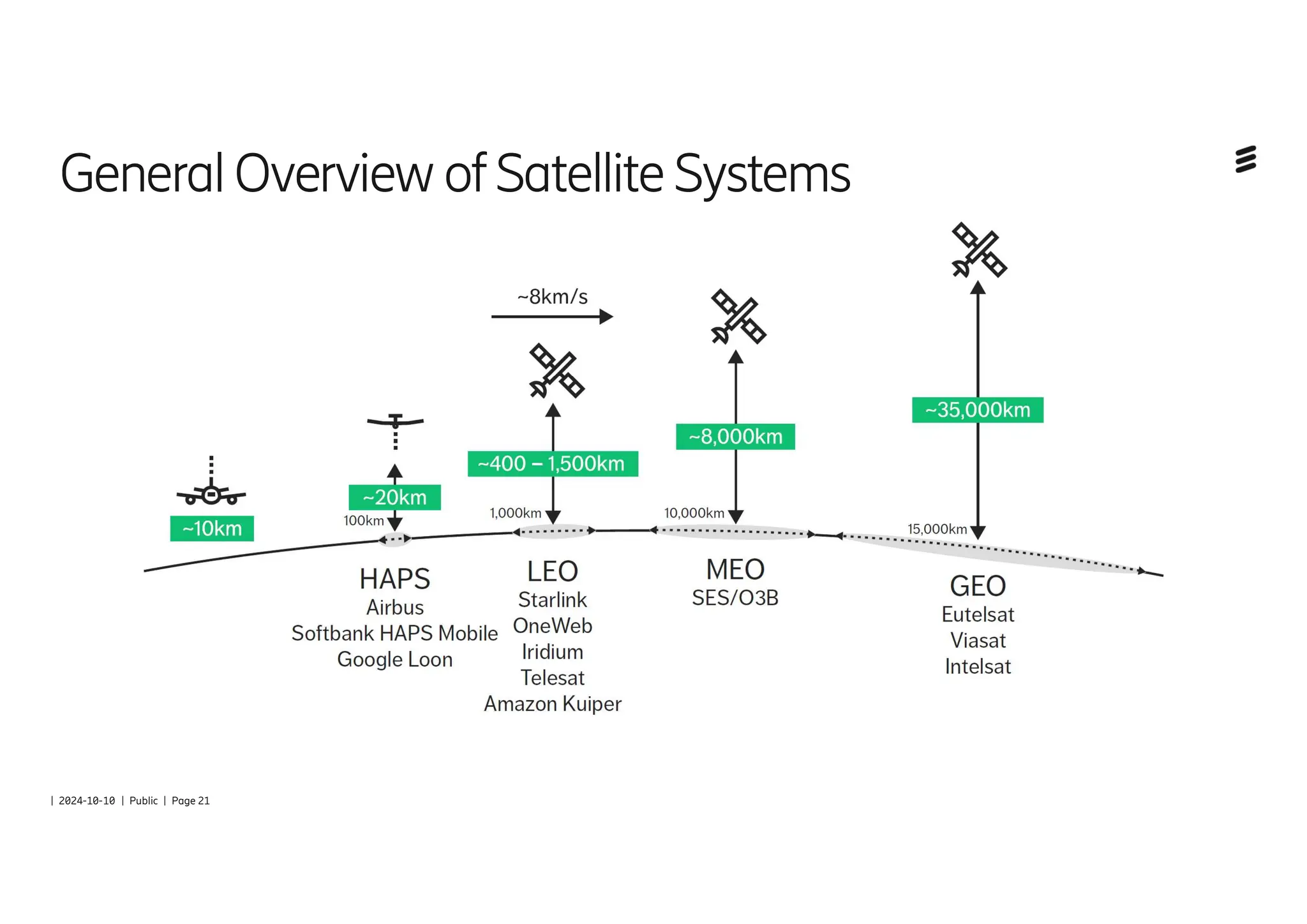
GeneralOverview ofSatellite Systems
| 2024-10-10 | Public | Page 22
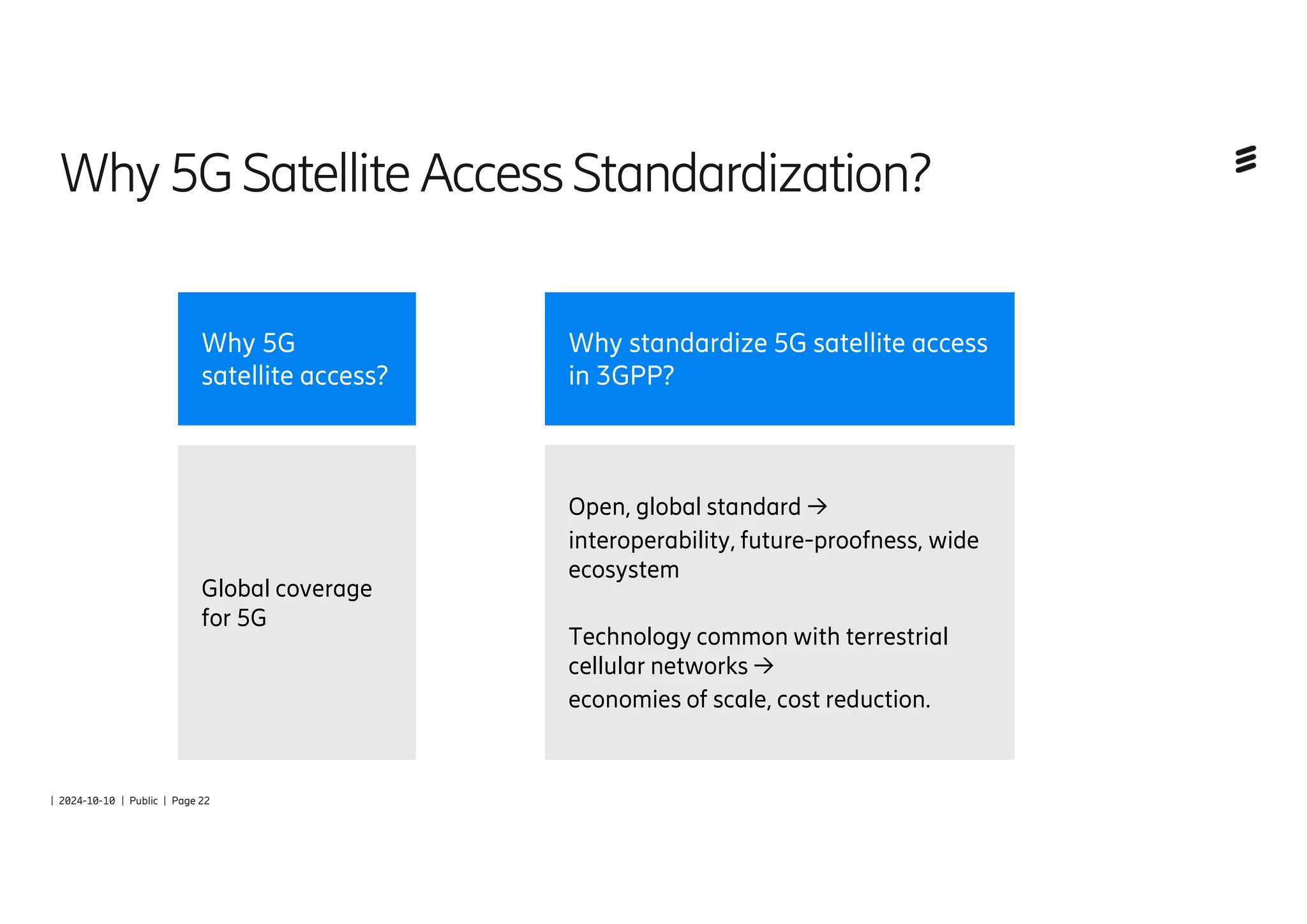
Why5GSatellite AccessStandardization?
Why 5G
satellite access?
Why standardize 5G satellite access
in 3GPP?
Global coverage
for 5G
Open, global standard →
interoperability, future-proofness, wide
ecosystem
Technology common with terrestrial
cellular networks →
economies of scale, cost reduction.
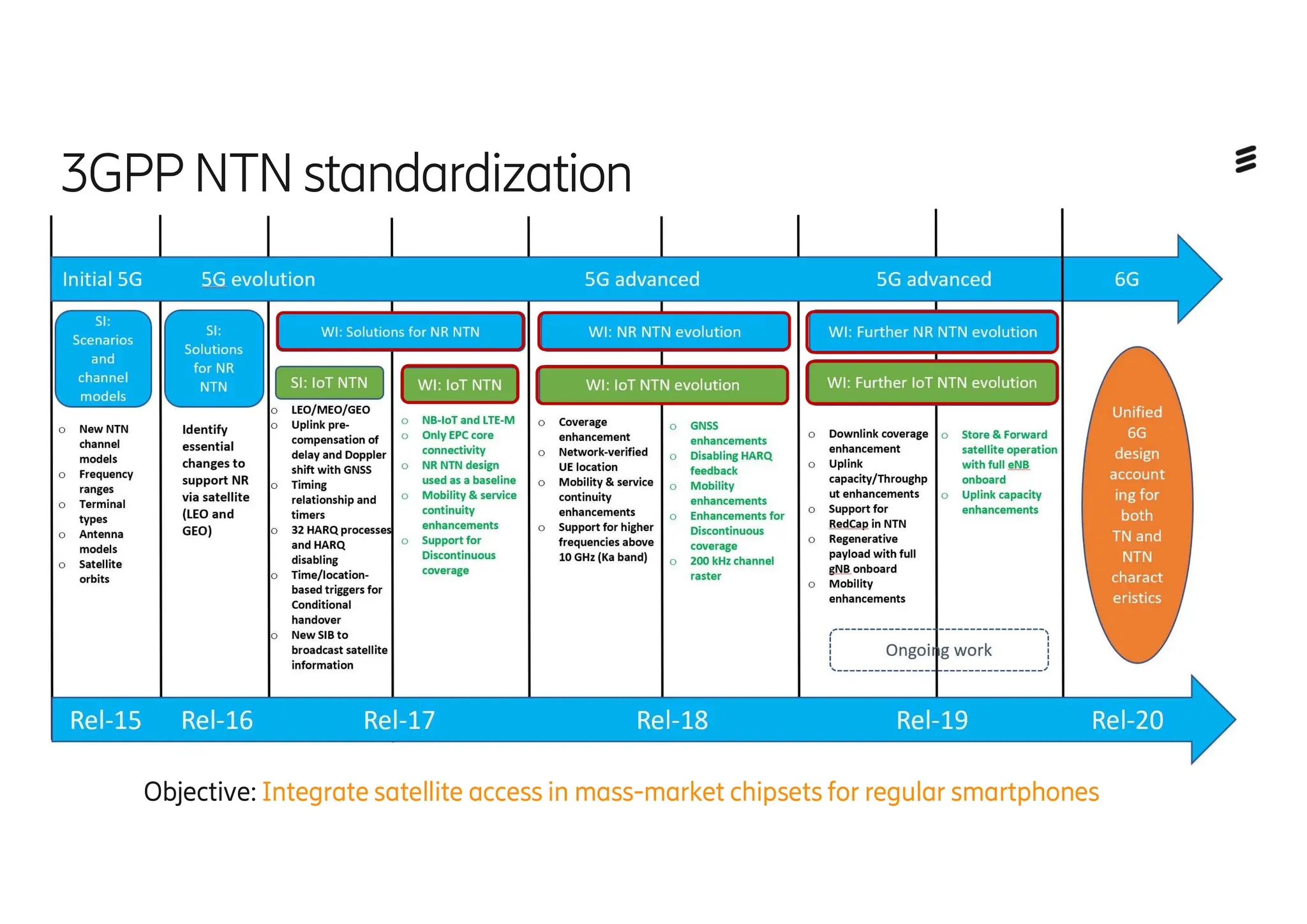
3GPP NTN standardization
Objective: Integrate satellite access in mass-market chipsets for regular smartphones
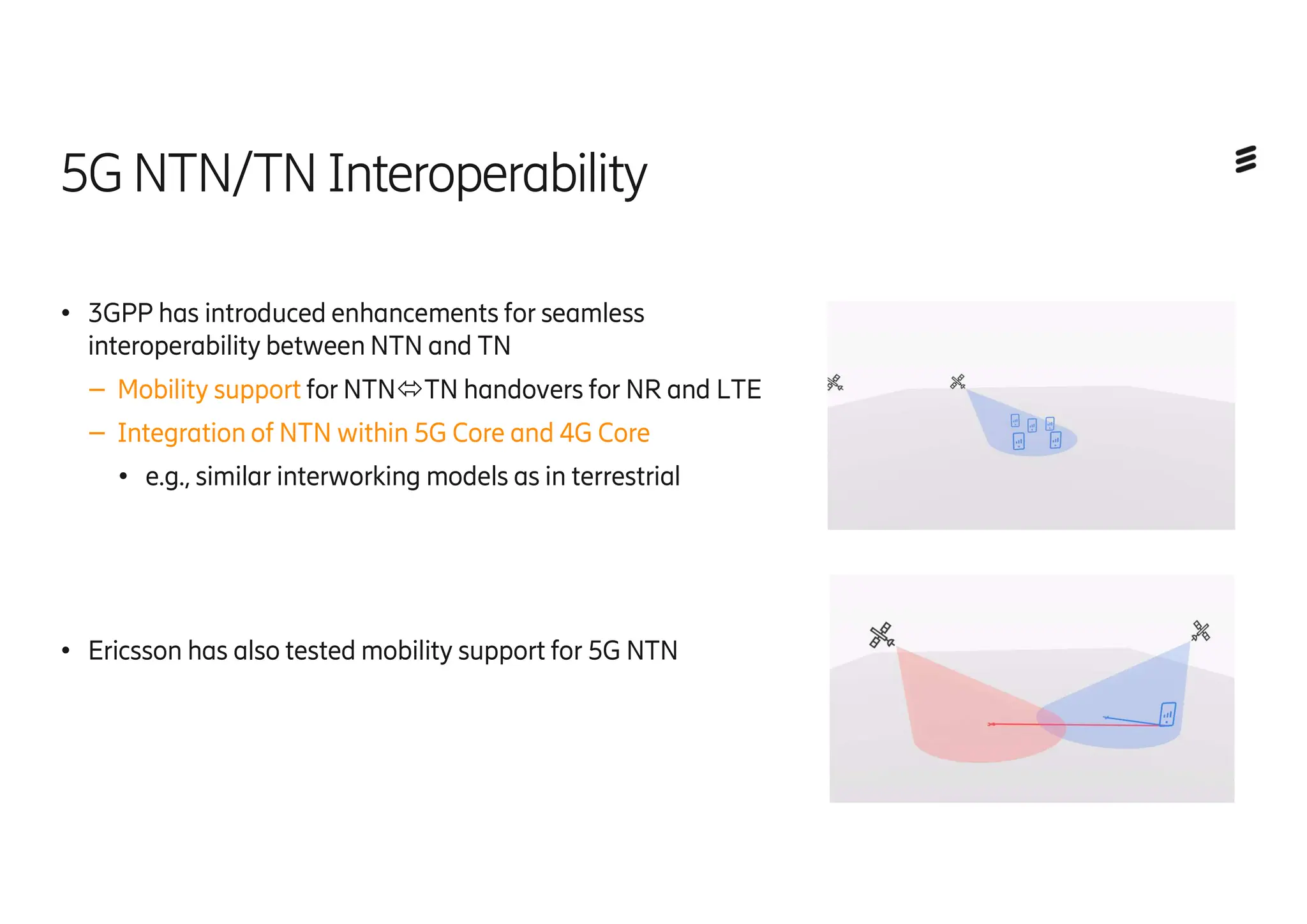
5GNTN/TN Interoperability
● 3GPP has introduced enhancements for seamless
interoperability between NTN and TN
– Mobility support for NTNTN handovers for NR and LTE
– Integration of NTN within 5G Core and 4G Core
● e.g., similar interworking models as in terrestrial
● Ericsson has also tested mobility support for 5G NTN
NewQuestions onArchitecture duetoNTN…
● How to apply the existing 3GPP framework to NTN? E.g.?
– How to manage 3GPP network identifiers and moving cells due to LEO?
– How to manage UE paging in NTN?
– Role of Xn interface when NTNs are involved?
– Is SON applicable in NTN? And between NTN and terrestrial networks?
…AndsomeChallenges toMobility…
● Mobility (including e.g. TN-NTN)
– Large propagation delays, especially for GEO: RTT =~550 ms
– Frequent HOs for LEO: satellite visibility time from a UE is in the order of minutes
● Propagation delay will interrupt data transmission by several RTTs before connections
are established to target cell
– Potentially large interruptions with existing HO mechanism
● Mobility enhancements have been introduced, e.g.:
– Conditional Handover
– …
Earth-Fixed Tracking Area forLEO
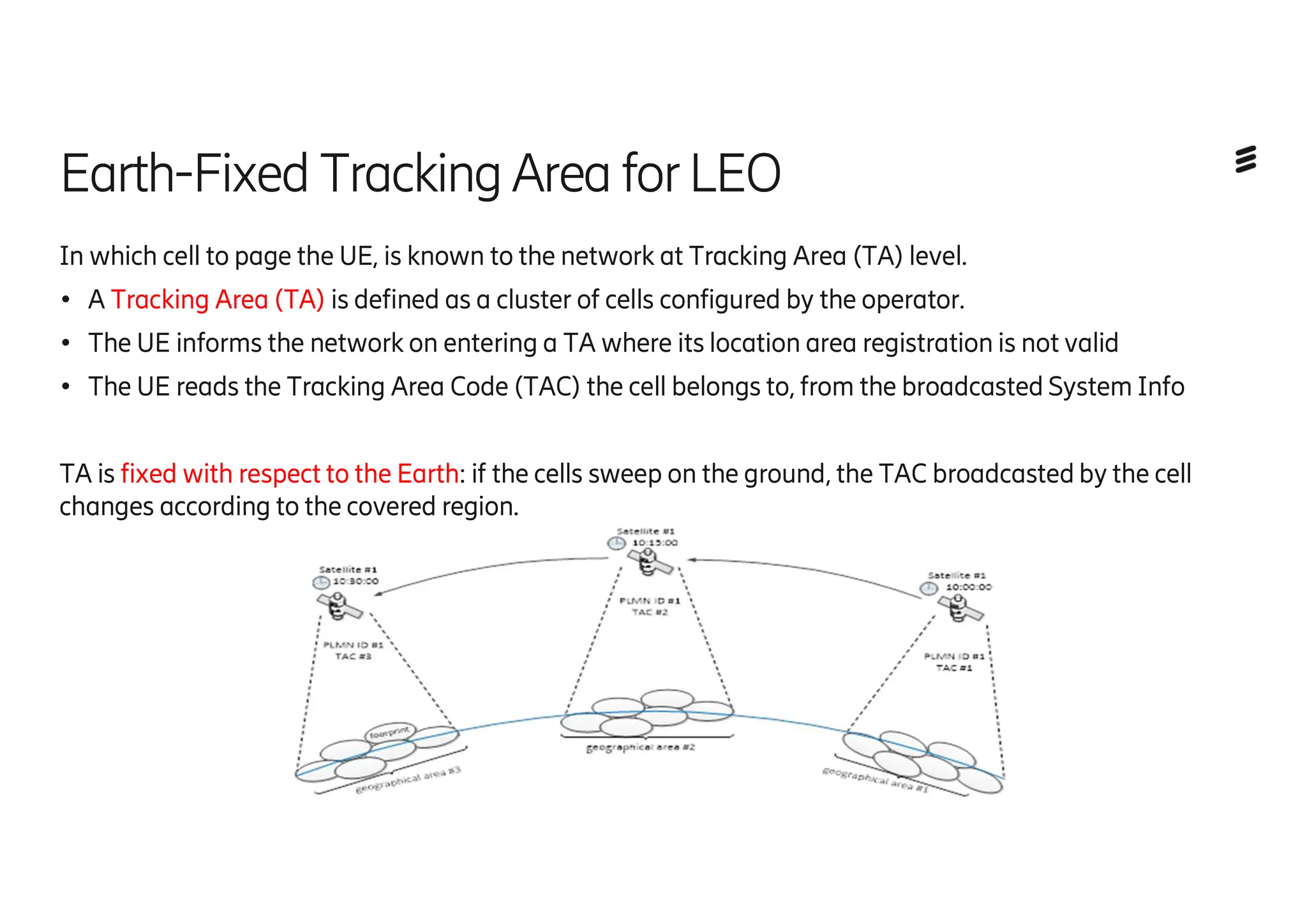
In which cell to page the UE, is known to the network at Tracking Area (TA) level.
● A Tracking Area (TA) is defined as a cluster of cells configured by the operator.
● The UE informs the network on entering a TA where its location area registration is not valid
● The UE reads the Tracking Area Code (TAC) the cell belongs to, from the broadcasted System Info
TA is fixed with respect to the Earth: if the cells sweep on the ground, the TAC broadcasted by the cell
changes according to the covered region.
FeederLinkSwitch
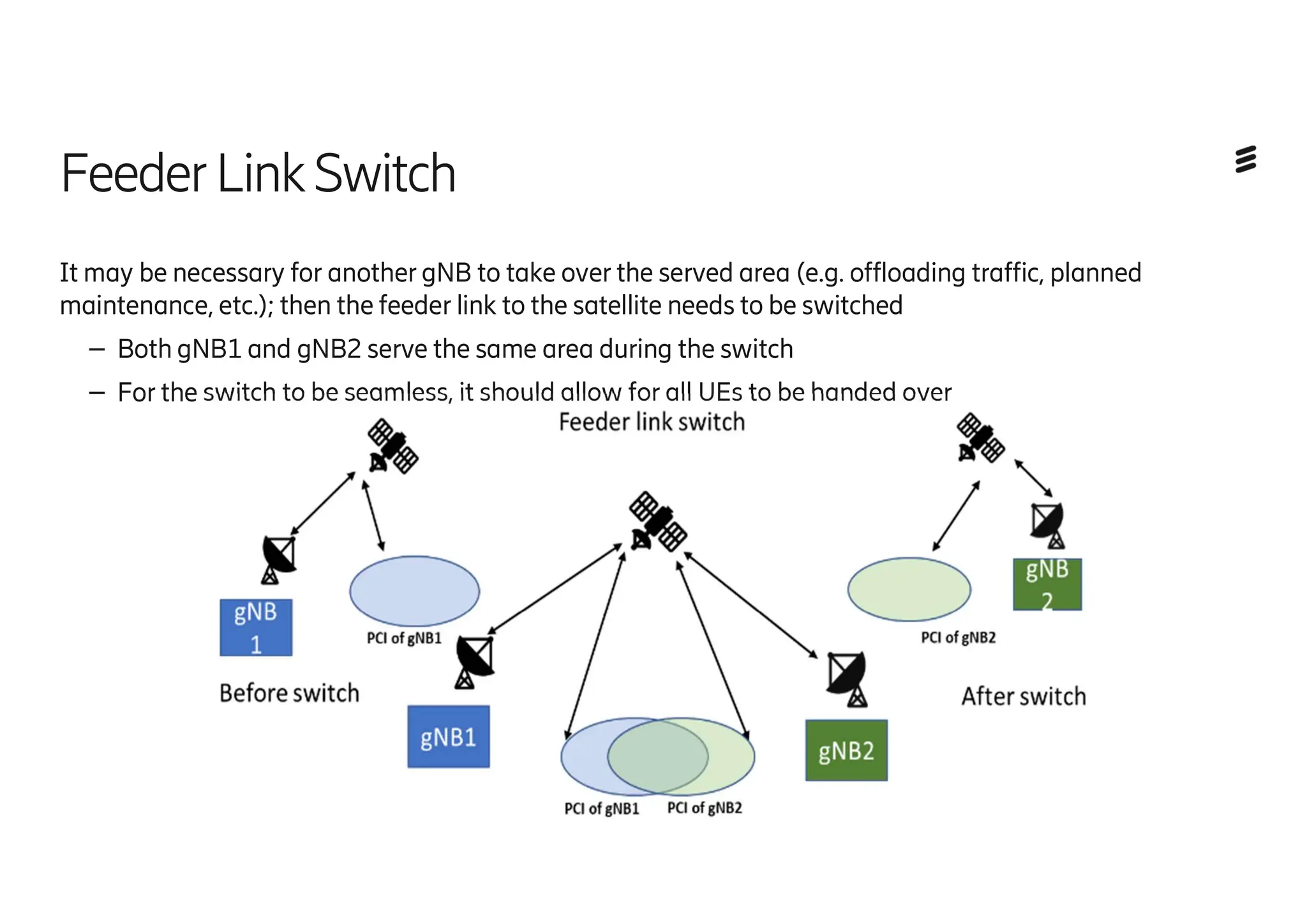
It may be necessary for another gNB to take over the served area (e.g. offloading traffic, planned
maintenance, etc.); then the feeder link to the satellite needs to be switched
– Both gNB1 and gNB2 serve the same area during the switch
– For the switch to be seamless, it should allow for all UEs to be handed over
NTN in3GPP Rel-17/18(MainFeatures)
●Both LEO and GEO
–HAPS and Air-To-Ground also supported
●Transparent payload architecture
●FDD is assumed but TDD not precluded for relevant scenarios (e.g.
HAPS, ATG)
●Earth-fixed Tracking Area is assumed
–Both Earth-fixed and Earth-moving cells
●Terminals with location capabilities are assumed
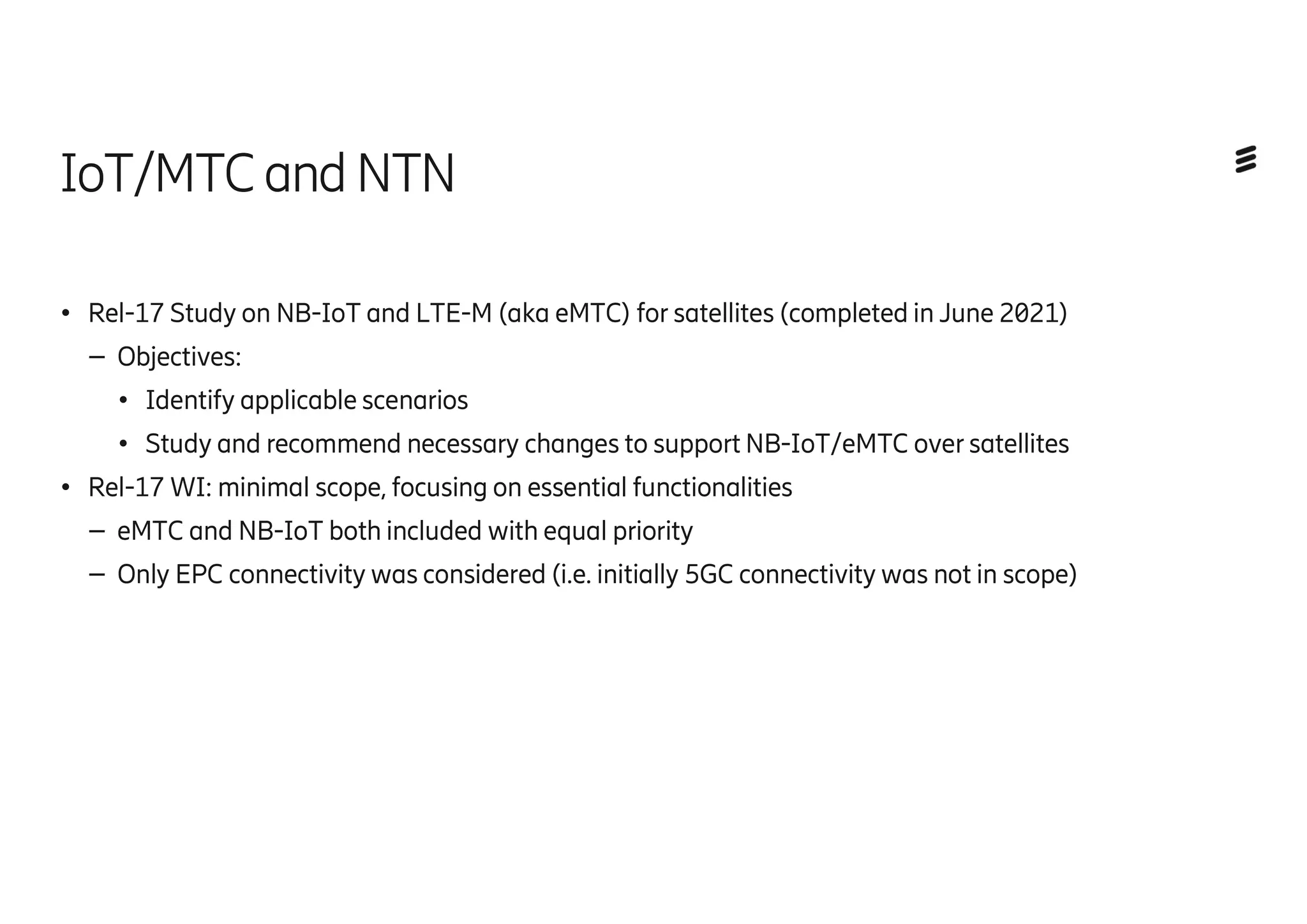
IoT/MTCandNTN
● Rel-17 Study on NB-IoT and LTE-M (aka eMTC) for satellites (completed in June 2021)
– Objectives:
● Identify applicable scenarios
● Study and recommend necessary changes to support NB-IoT/eMTC over satellites
● Rel-17 WI: minimal scope, focusing on essential functionalities
– eMTC and NB-IoT both included with equal priority
– Only EPC connectivity was considered (i.e. initially 5GC connectivity was not in scope)
| 2024-10-10 | Public | Page 31
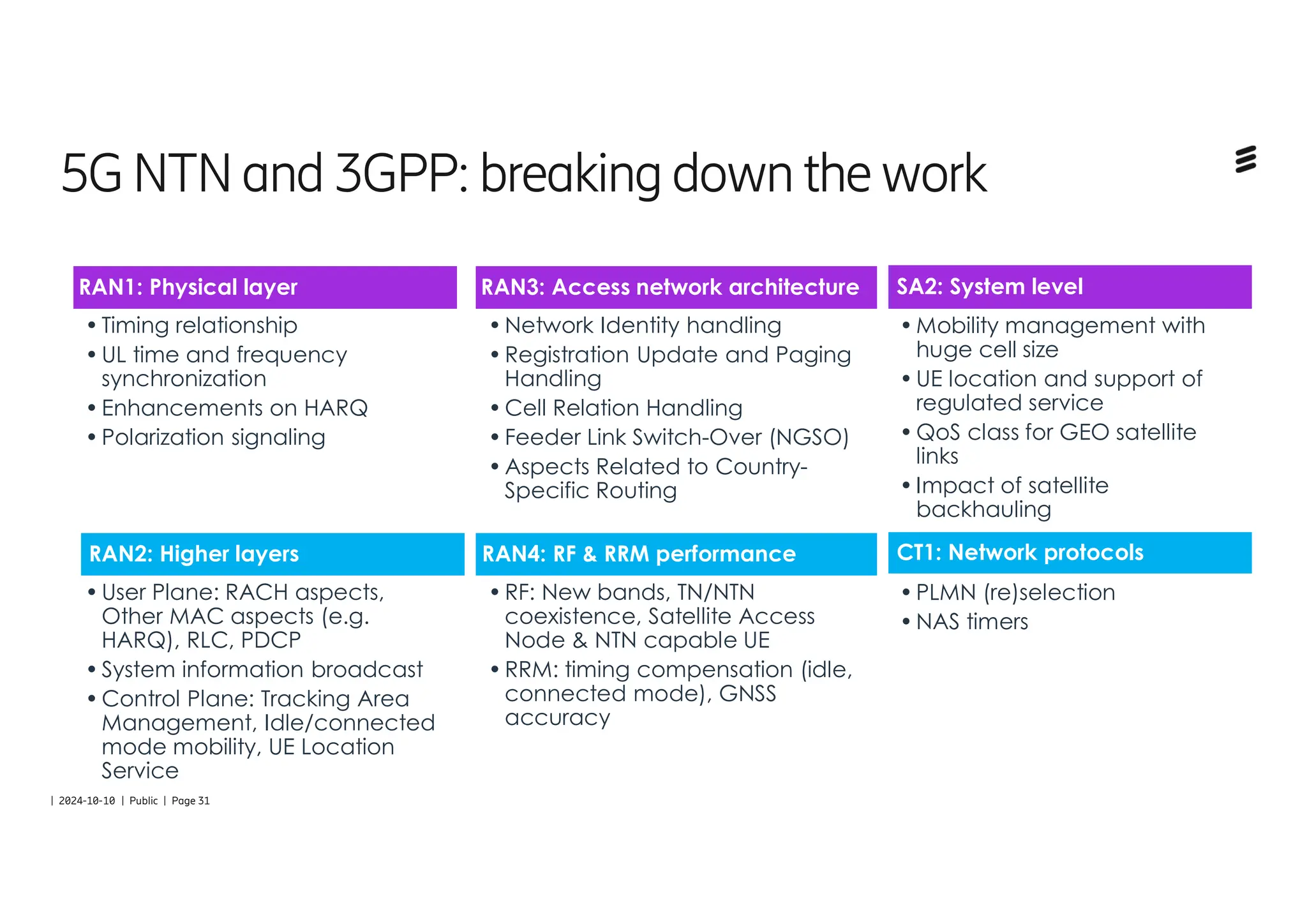
5GNTNand3GPP:breaking downthework
SA2: System level
•Mobility management with
huge cell size
•UE location and support of
regulated service
•QoS class for GEO satellite
links
•Impact of satellite
backhauling
CT1: Network protocols
•PLMN (re)selection
•NAS timers
RAN1: Physical layer
•Timing relationship
•UL time and frequency
synchronization
•Enhancements on HARQ
•Polarization signaling
RAN2: Higher layers
•User Plane: RACH aspects,
Other MAC aspects (e.g.
HARQ), RLC, PDCP
•System information broadcast
•Control Plane: Tracking Area
Management, Idle/connected
mode mobility, UE Location
Service
RAN3: Access network architecture
•Network Identity handling
•Registration Update and Paging
Handling
•Cell Relation Handling
•Feeder Link Switch-Over (NGSO)
•Aspects Related to Country-
Specific Routing
RAN4: RF & RRM performance
•RF: New bands, TN/NTN
coexistence, Satellite Access
Node & NTN capable UE
•RRM: timing compensation (idle,
connected mode), GNSS
accuracy
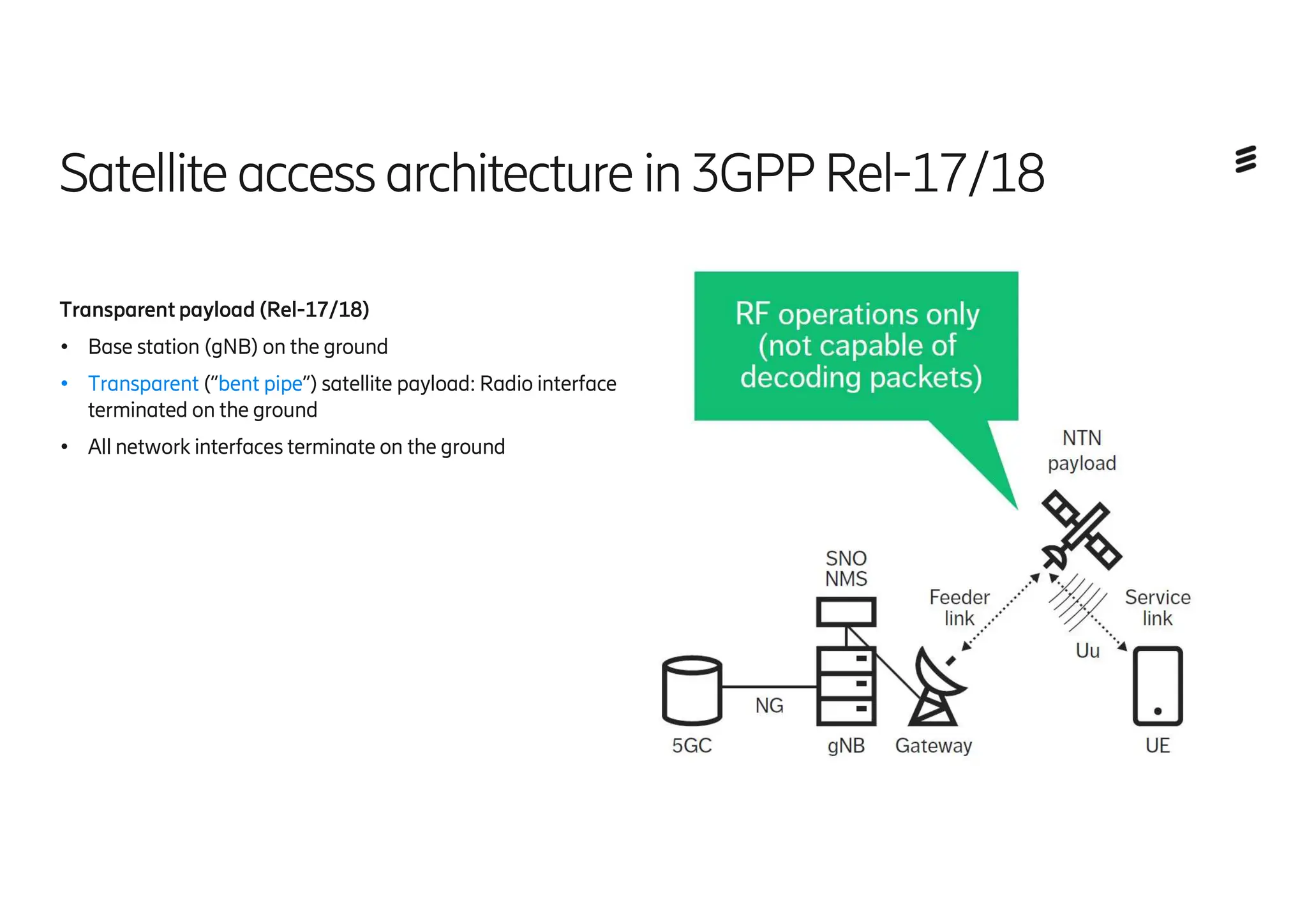
Satellite access architecture in3GPP Rel-17/18
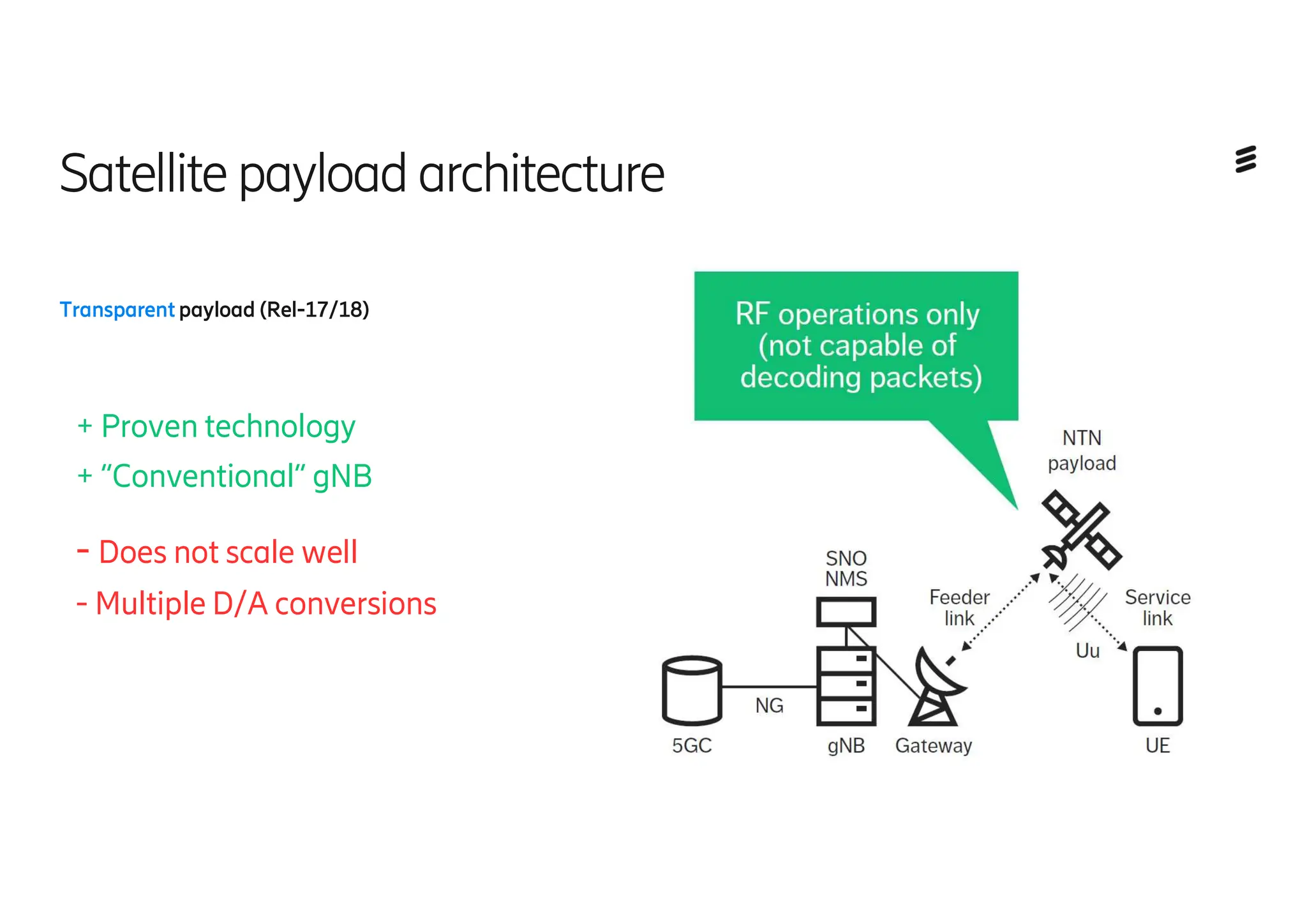
Transparentpayload (Rel-17/18)
● Base station (gNB) on the ground
● Transparent (“bent pipe”) satellite payload: Radio interface
terminated on the ground
● All network interfaces terminate on the ground
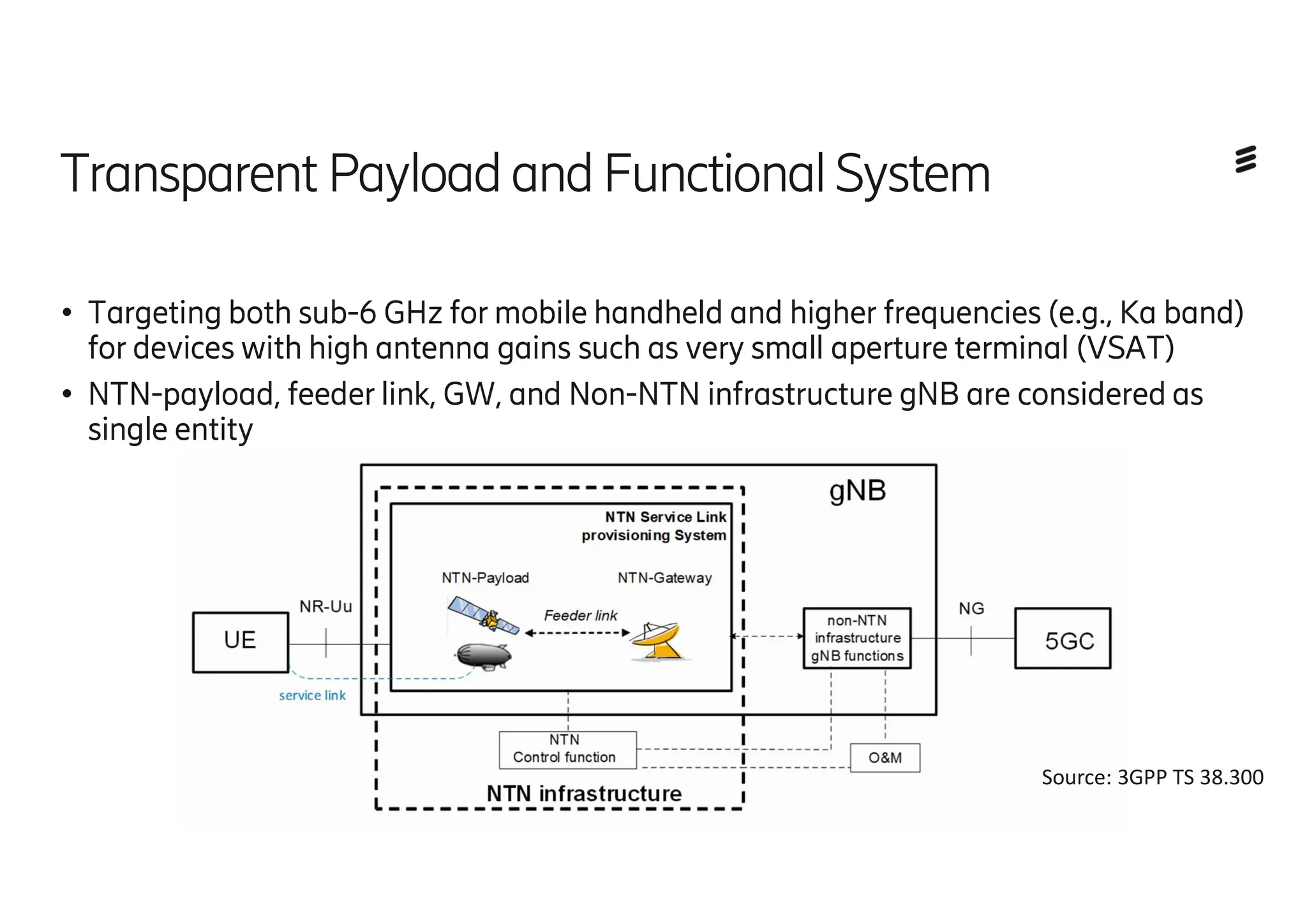
Transparent PayloadandFunctionalSystem
● Targeting both sub-6 GHz for mobile handheld and higher frequencies (e.g., Ka band)
for devices with high antenna gains such as very small aperture terminal (VSAT)
● NTN-payload, feeder link, GW, and Non-NTN infrastructure gNB are considered as
single entity
Source: 3GPP TS 38.300
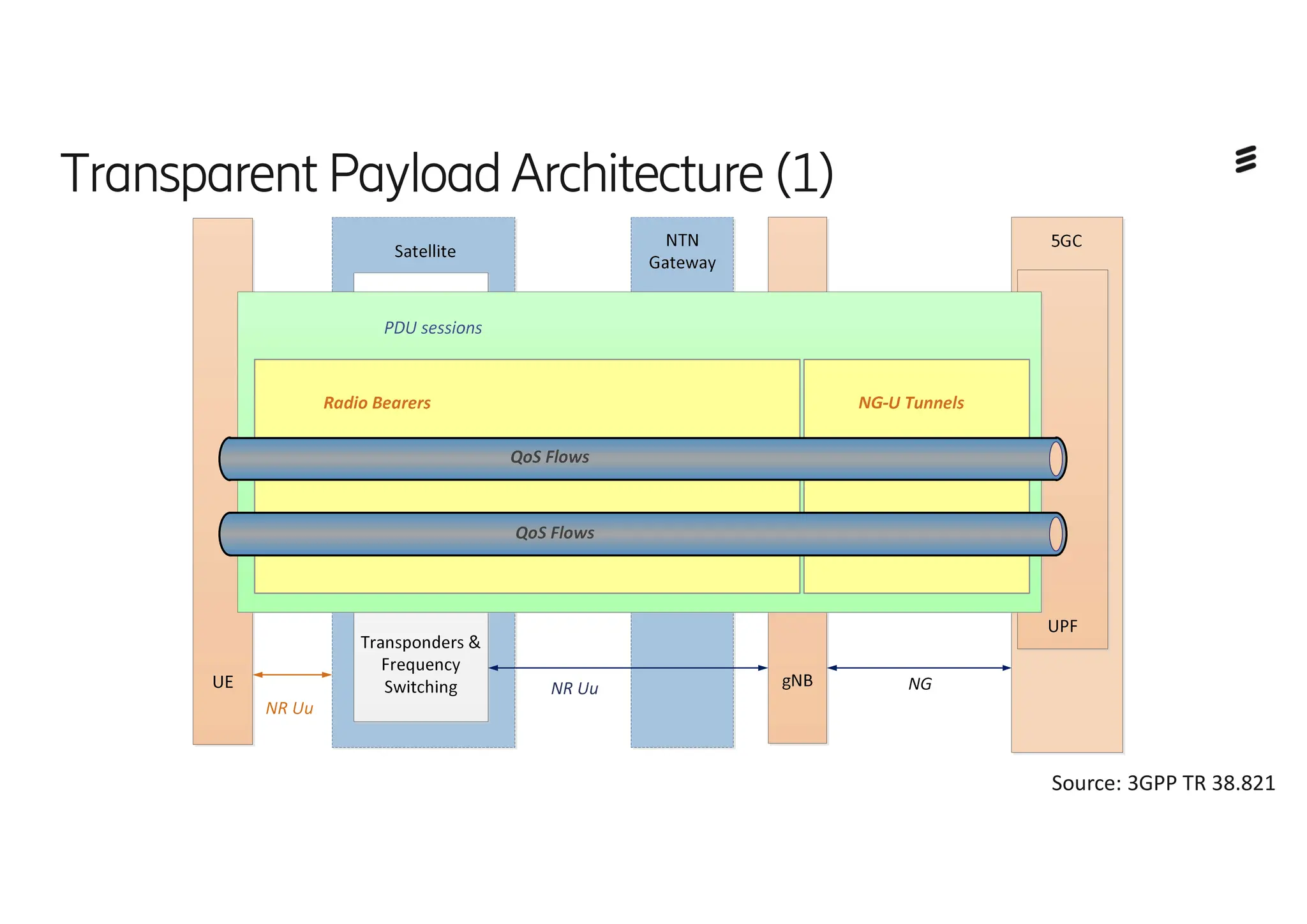
Transparent PayloadArchitecture (1)
Source: 3GPP TR 38.821
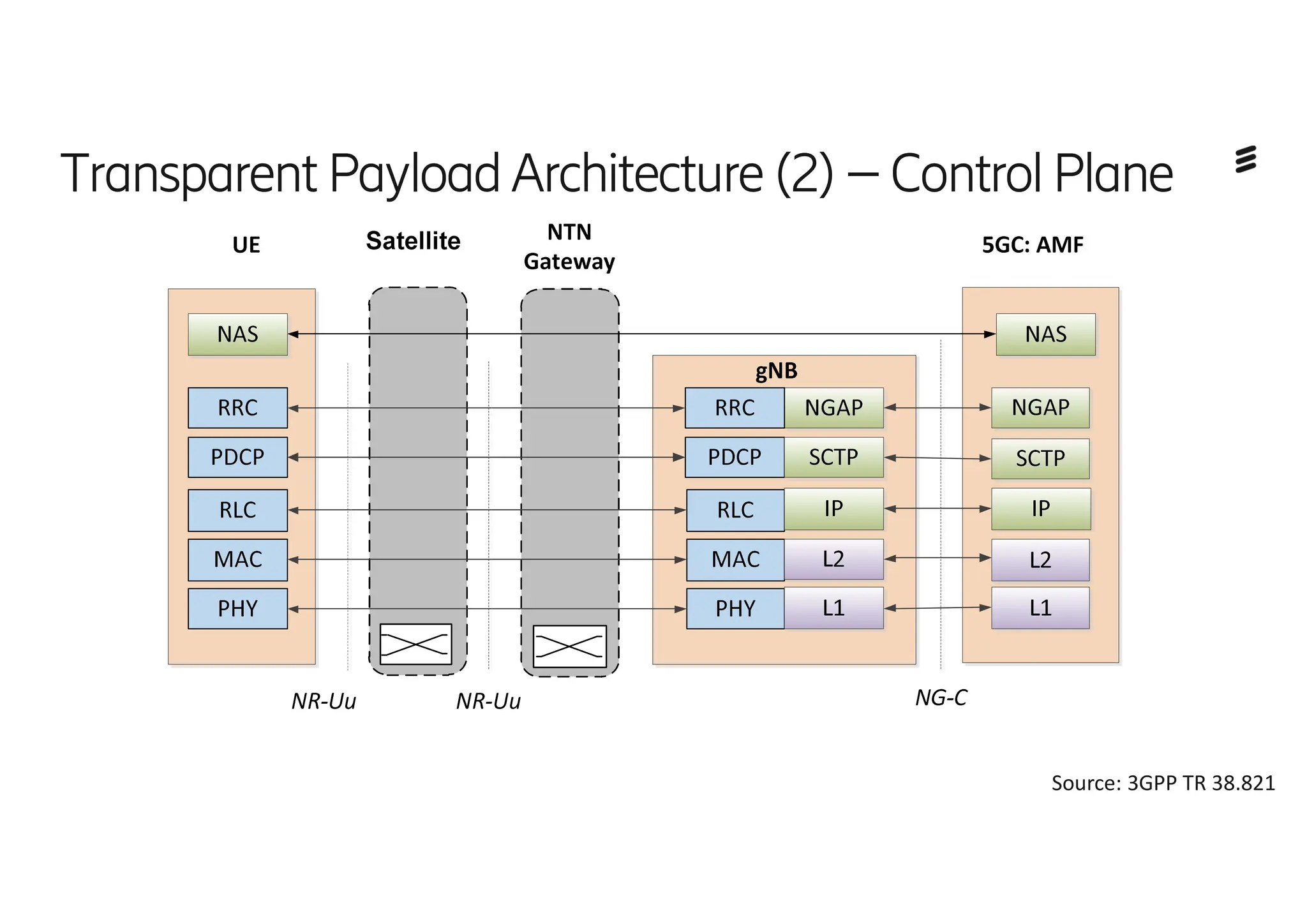
Transparent PayloadArchitecture (2)–Control Plane
Source: 3GPP TR 38.821
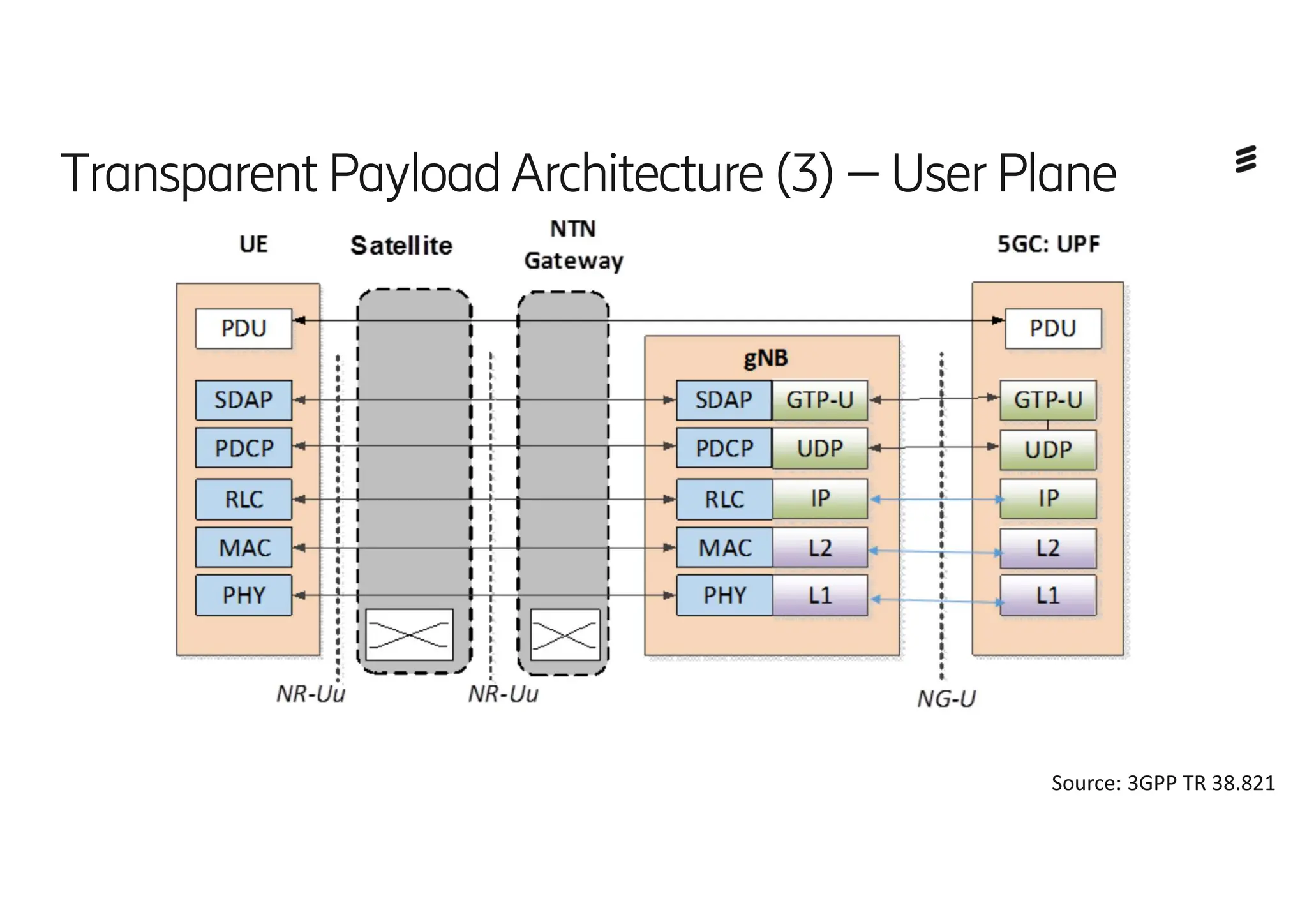
Transparent PayloadArchitecture (3)–User Plane
Source: 3GPP TR 38.821
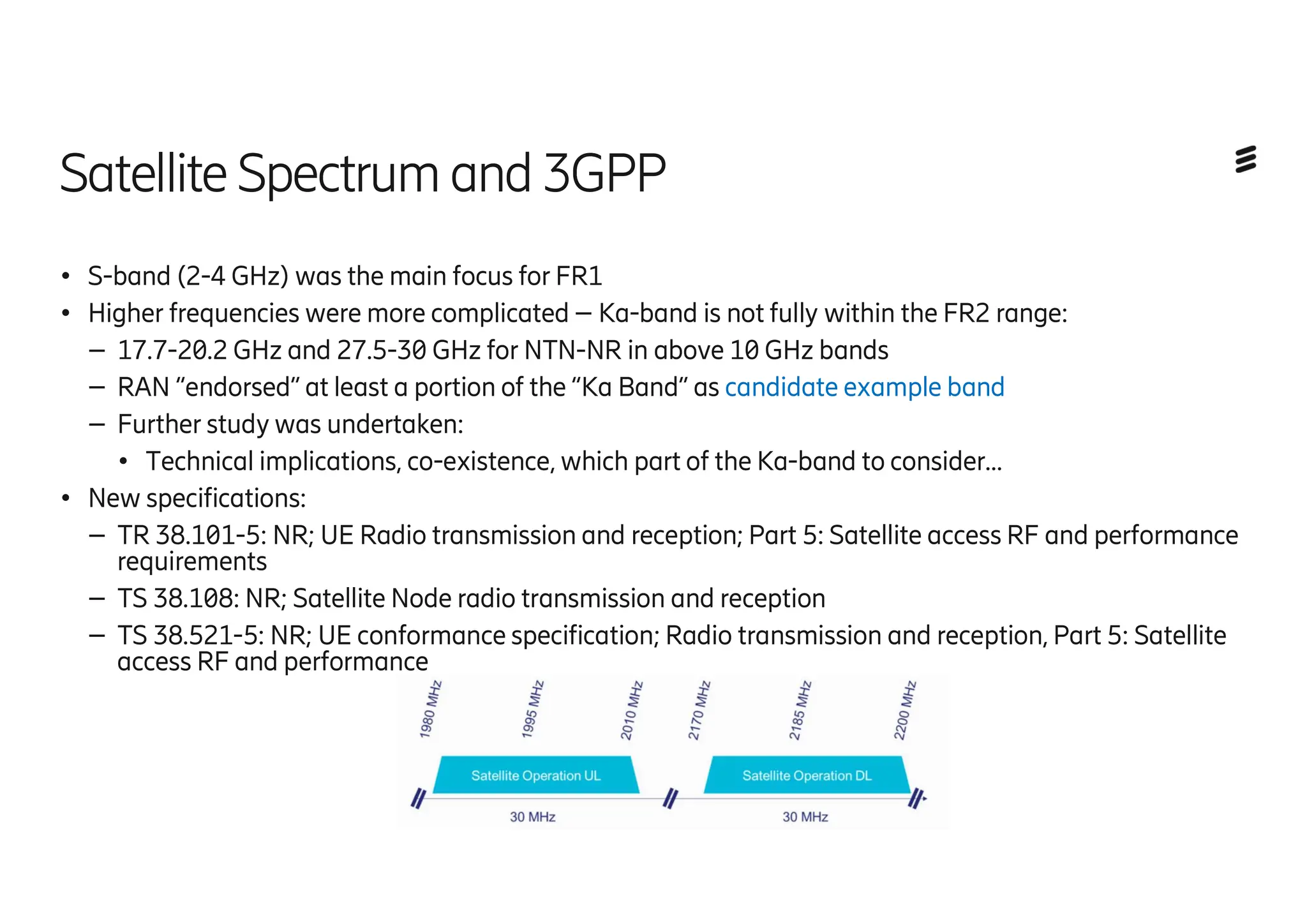
Satellite Spectrum and3GPP
● S-band (2-4 GHz) was the main focus for FR1
● Higher frequencies were more complicated – Ka-band is not fully within the FR2 range:
– 17.7-20.2 GHz and 27.5-30 GHz for NTN-NR in above 10 GHz bands
– RAN “endorsed” at least a portion of the “Ka Band” as candidate example band
– Further study was undertaken:
● Technical implications, co-existence, which part of the Ka-band to consider…
● New specifications:
– TR 38.101-5: NR; UE Radio transmission and reception; Part 5: Satellite access RF and performance
requirements
– TS 38.108: NR; Satellite Node radio transmission and reception
– TS 38.521-5: NR; UE conformance specification; Radio transmission and reception, Part 5: Satellite
access RF and performance
| 2024-10-10 | Public | Page 38
Where We Are Today: Rel-
19 in Progress
● Unlocking new possibilities
● UE-satellite-UE communication
● Store & Forward
| 2024-10-10 | Public | Page 39
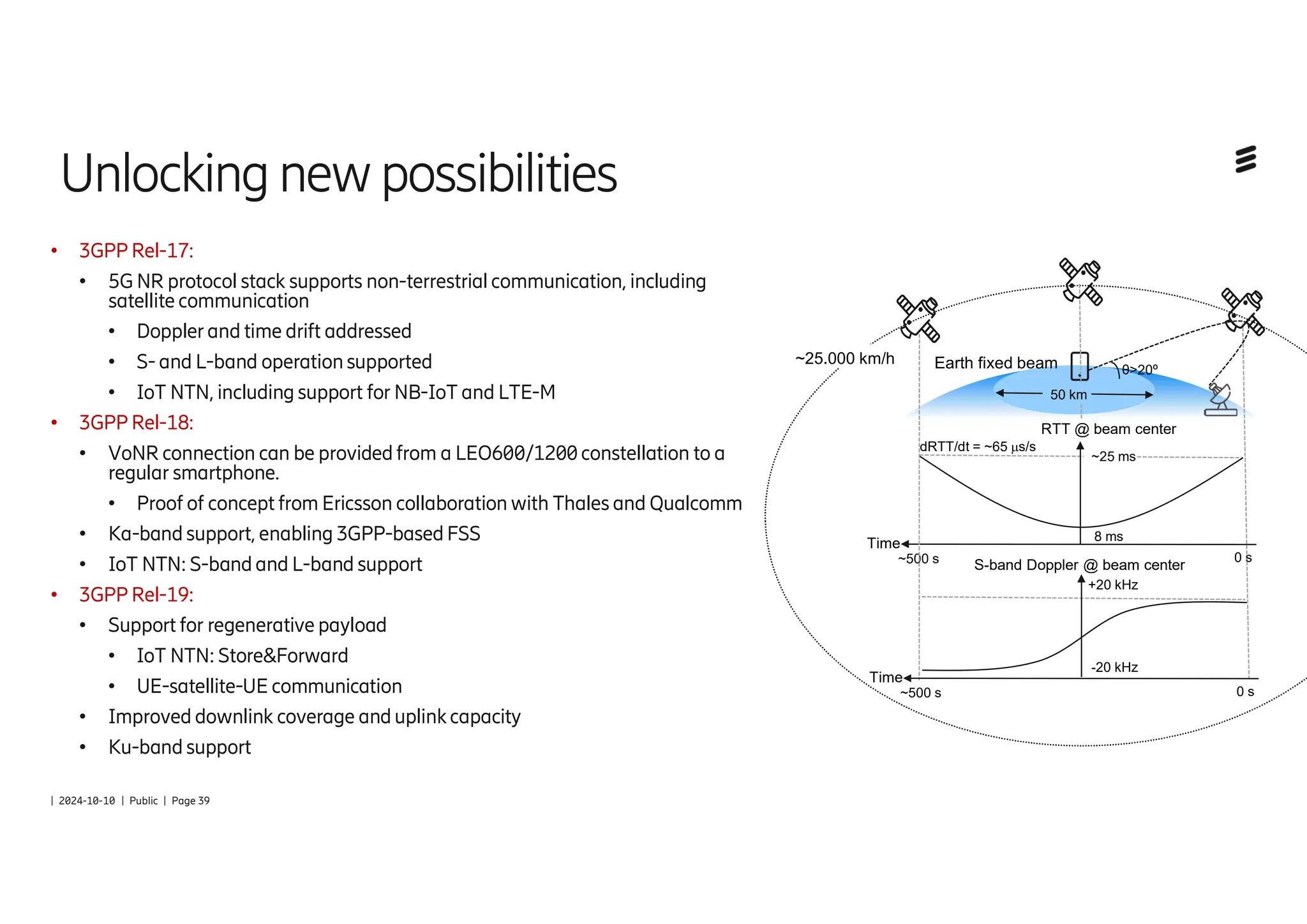
• 3GPP Rel-17:
• 5G NR protocol stack supports non-terrestrial communication, including
satellite communication
• Doppler and time drift addressed
• S- and L-band operationsupported
• IoT NTN, including support for NB-IoT and LTE-M
• 3GPP Rel-18:
• VoNR connection can be providedfrom a LEO600/1200constellation to a
regular smartphone.
• Proof of concept from Ericsson collaboration with Thales and Qualcomm
• Ka-bandsupport, enabling 3GPP-basedFSS
• IoT NTN: S-bandand L-band support
• 3GPP Rel-19:
• Support for regenerative payload
• IoT NTN: Store&Forward
• UE-satellite-UE communication
• Improved downlink coverage anduplinkcapacity
• Ku-bandsupport
Unlocking newpossibilities
RTT @ beam center
Time
0 s
~500 s
8 ms
~25 ms
~25.000 km/h
dRTT/dt = ~65 ms/s
θ>20º
Time
0 s
~500 s
-20 kHz
+20 kHz
S-band Doppler @ beam center
50 km
Earth fixed beam
Satellite access architecture in3GPP Rel-19
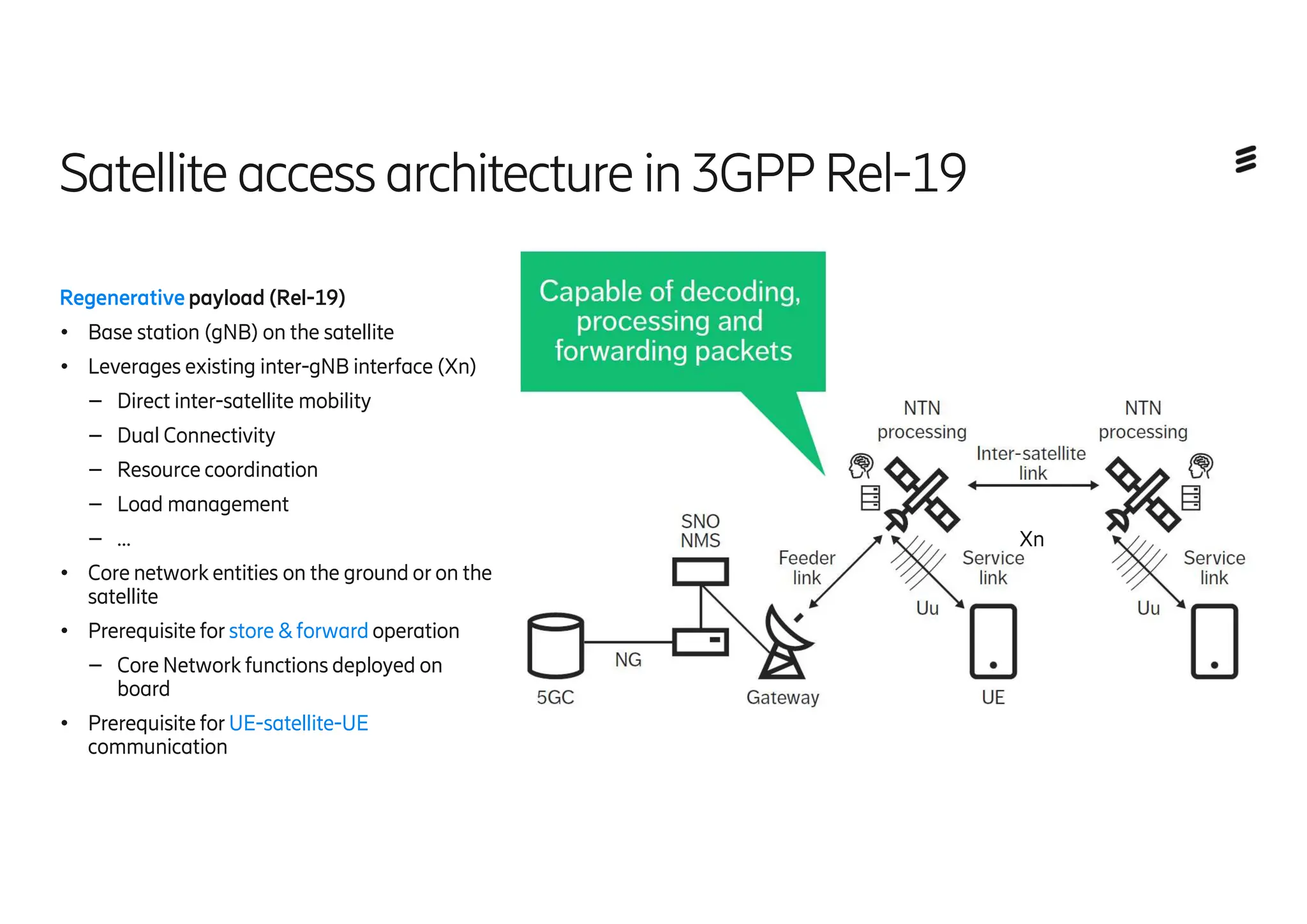
Regenerativepayload (Rel-19)
● Base station (gNB) on the satellite
● Leverages existing inter-gNB interface (Xn)
– Direct inter-satellite mobility
– Dual Connectivity
– Resource coordination
– Load management
– …
● Core network entities on the ground or on the
satellite
● Prerequisite for store & forward operation
– Core Network functions deployed on
board
● Prerequisite for UE-satellite-UE
communication
Xn
Support forUE-Satellite-UE Communication
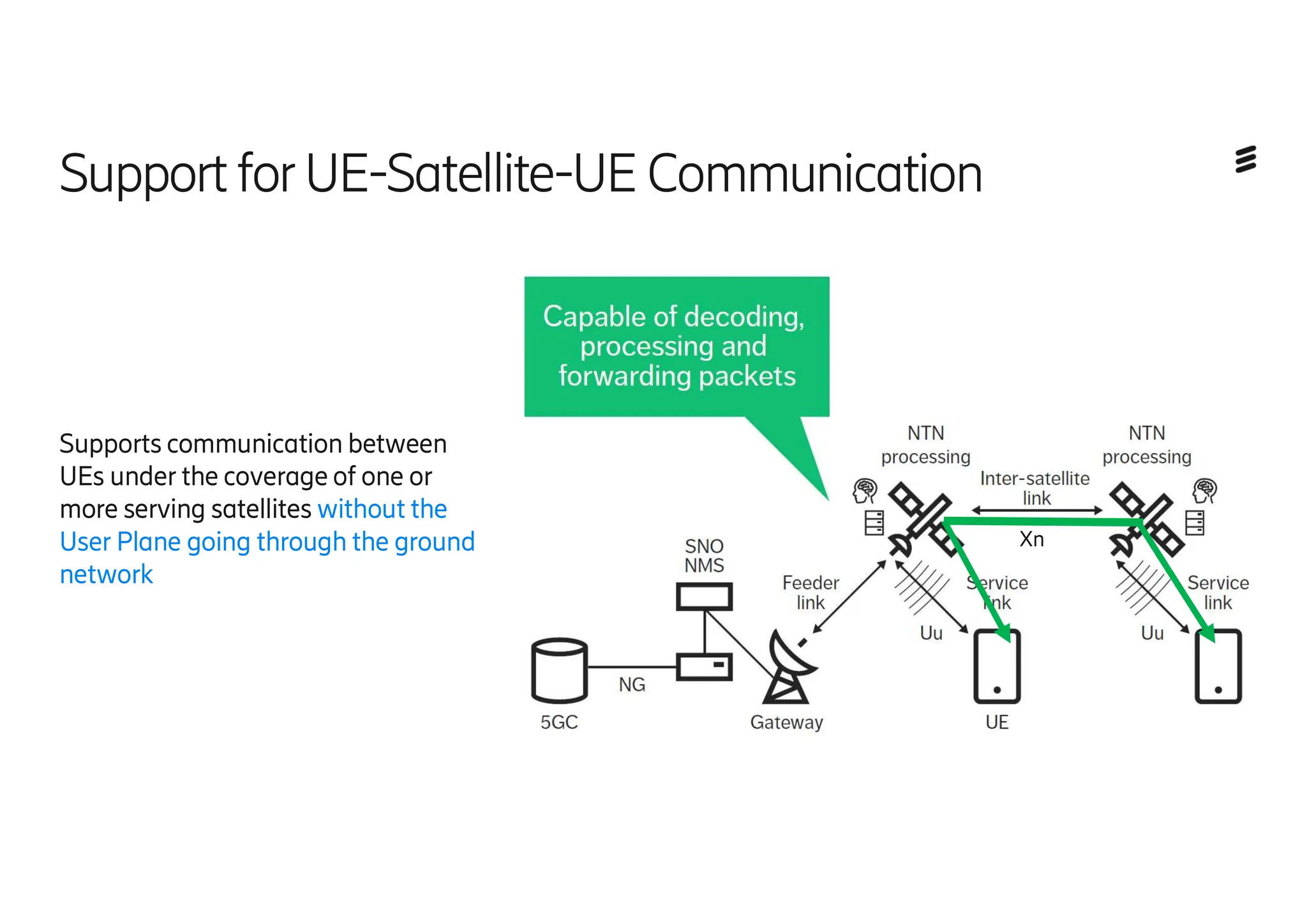
Supports communication between
UEs under the coverage of one or
more serving satellites without the
User Plane going through the ground
network
Xn
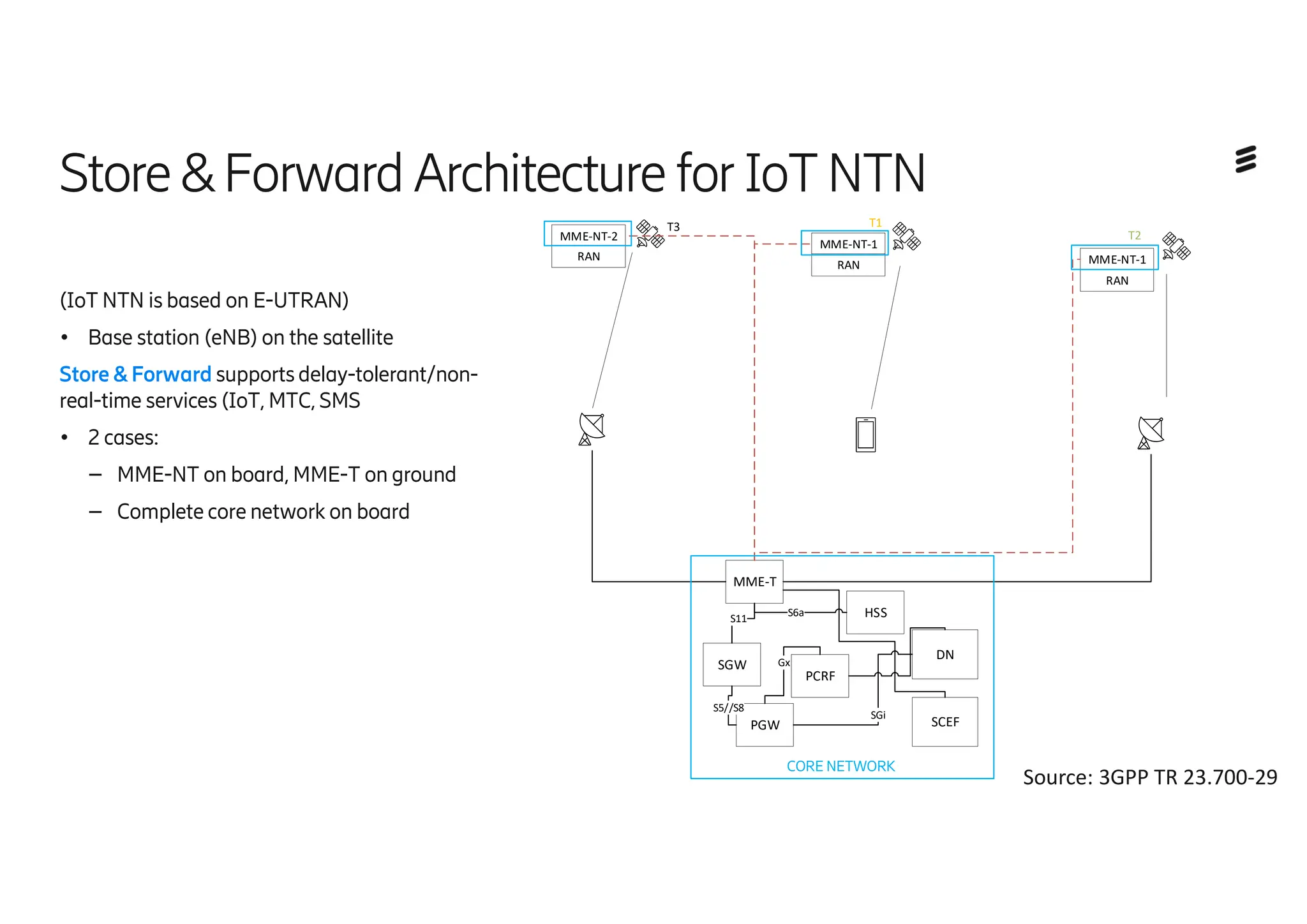
Store&Forward Architecture for IoTNTN
(IoT NTN is based on E-UTRAN)
● Base station (eNB) on the satellite
Store & Forward supports delay-tolerant/non-
real-time services (IoT, MTC, SMS
● 2 cases:
– MME-NT on board, MME-T on ground
– Complete core network on board
T3 T1
MME-T
SGW
HSS
PGW
PCRF
S11
S5//S8
S6a
DN
SCEF
SGi
Gx
MME-NT-2
MME-NT-1
RAN
RAN MME-NT-1
RAN
T2
CORE NETWORK
Source: 3GPP TR 23.700-29
| 2024-10-10 | Public | Page 43
Some Lessons We Learned
● Payload architecture
● Synchronization
● Coverage, capacity, latency performance
● Sustainability
Satellite payload architecture
Transparentpayload (Rel-17/18)
+ Proven technology
+ “Conventional” gNB
- Does not scale well
- Multiple D/A conversions
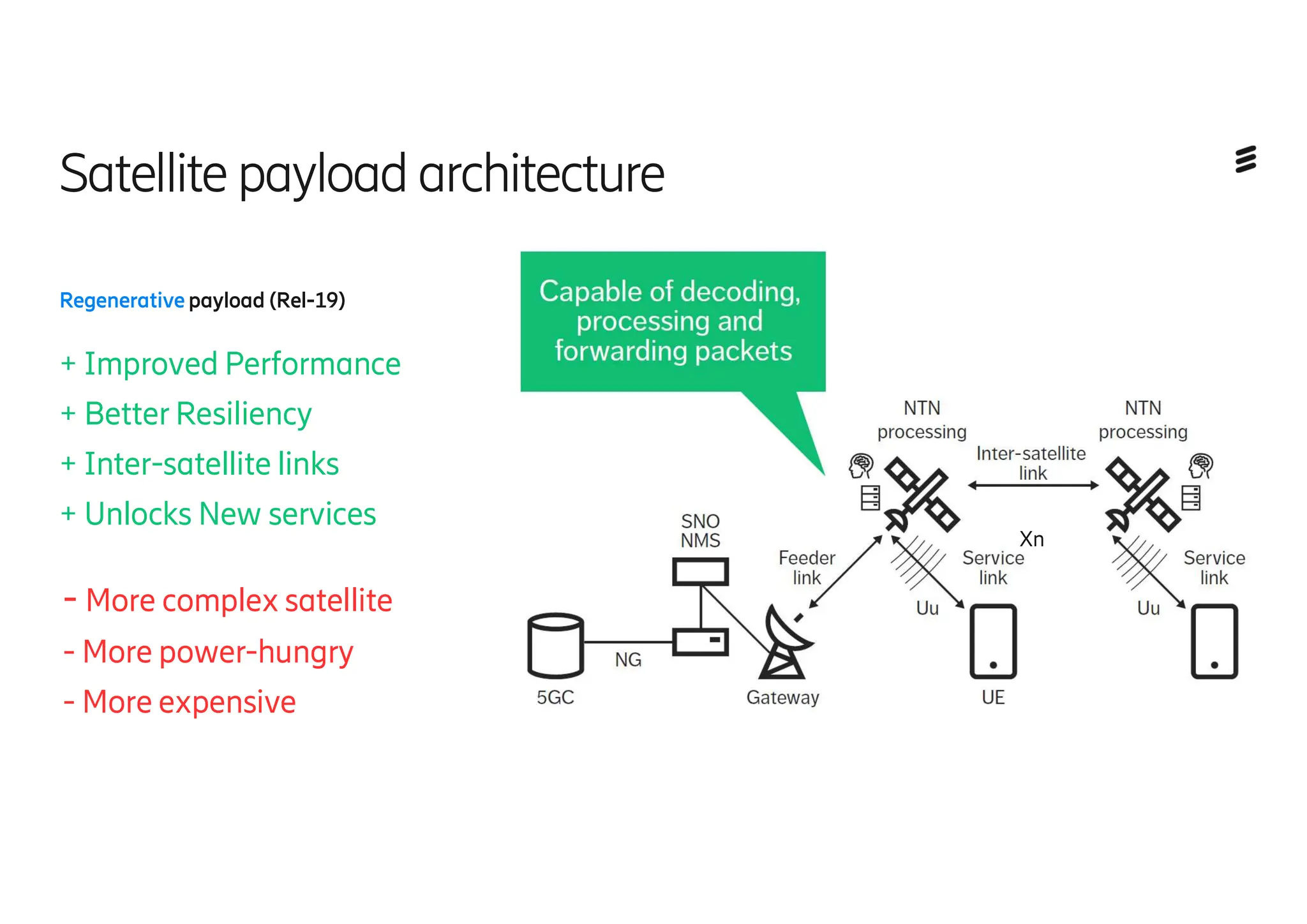
Satellite payload architecture
Regenerativepayload (Rel-19)
Xn
+ Improved Performance
+ Better Resiliency
+ Inter-satellite links
+ Unlocks New services
- More complex satellite
- More power-hungry
- More expensive
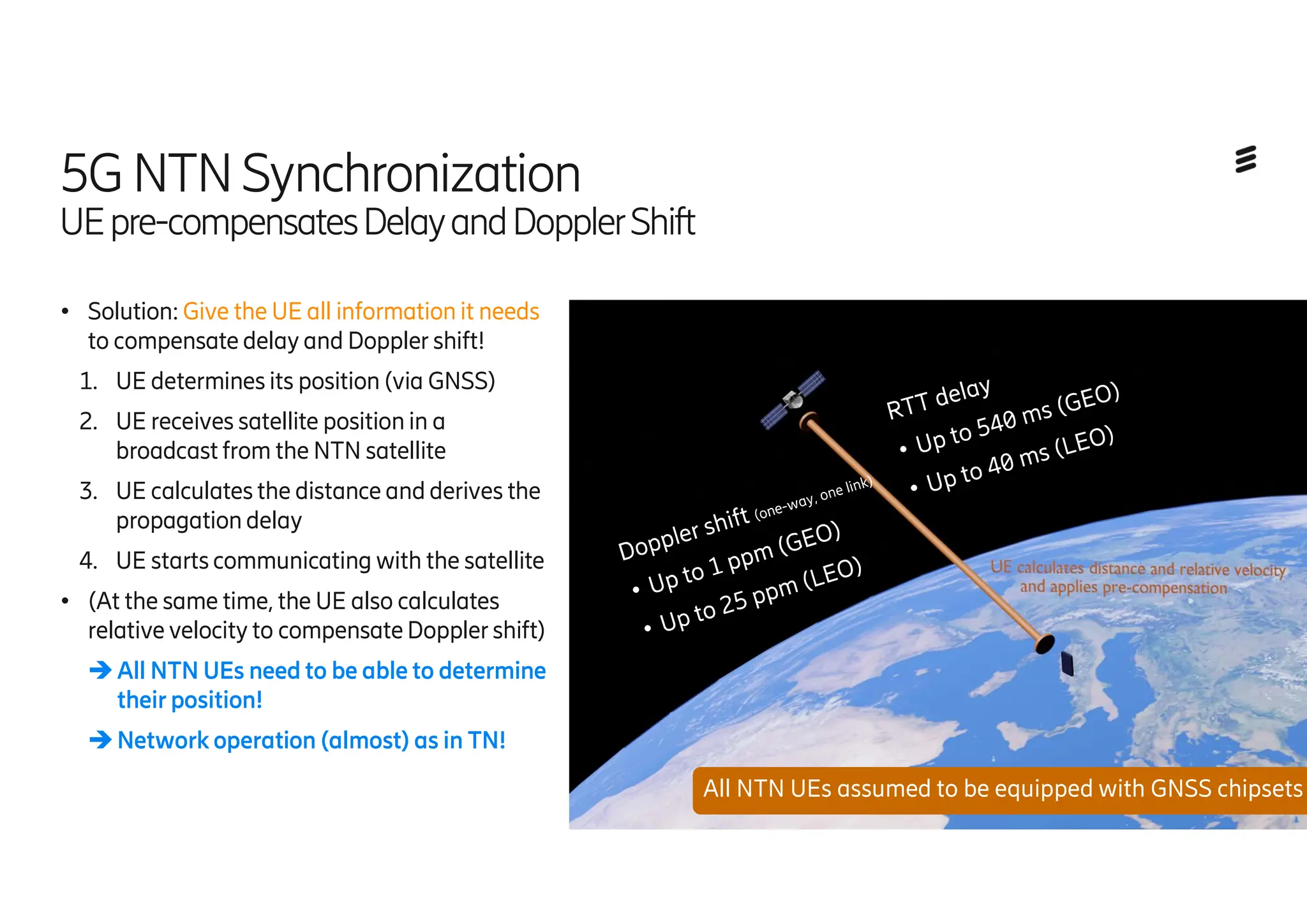
5GNTNSynchronization
UEpre-compensatesDelayandDopplerShift
● Solution: Give the UE all information it needs
to compensate delay and Doppler shift!
1. UE determines its position (via GNSS)
2. UE receives satellite position in a
broadcast from the NTN satellite
3. UE calculates the distance and derives the
propagation delay
4. UE starts communicating with the satellite
● (At the same time, the UE also calculates
relative velocity to compensate Doppler shift)
All NTN UEs need to be able to determine
their position!
Network operation (almost) as in TN!
All NTN UEs assumed to be equipped with GNSS chipsets
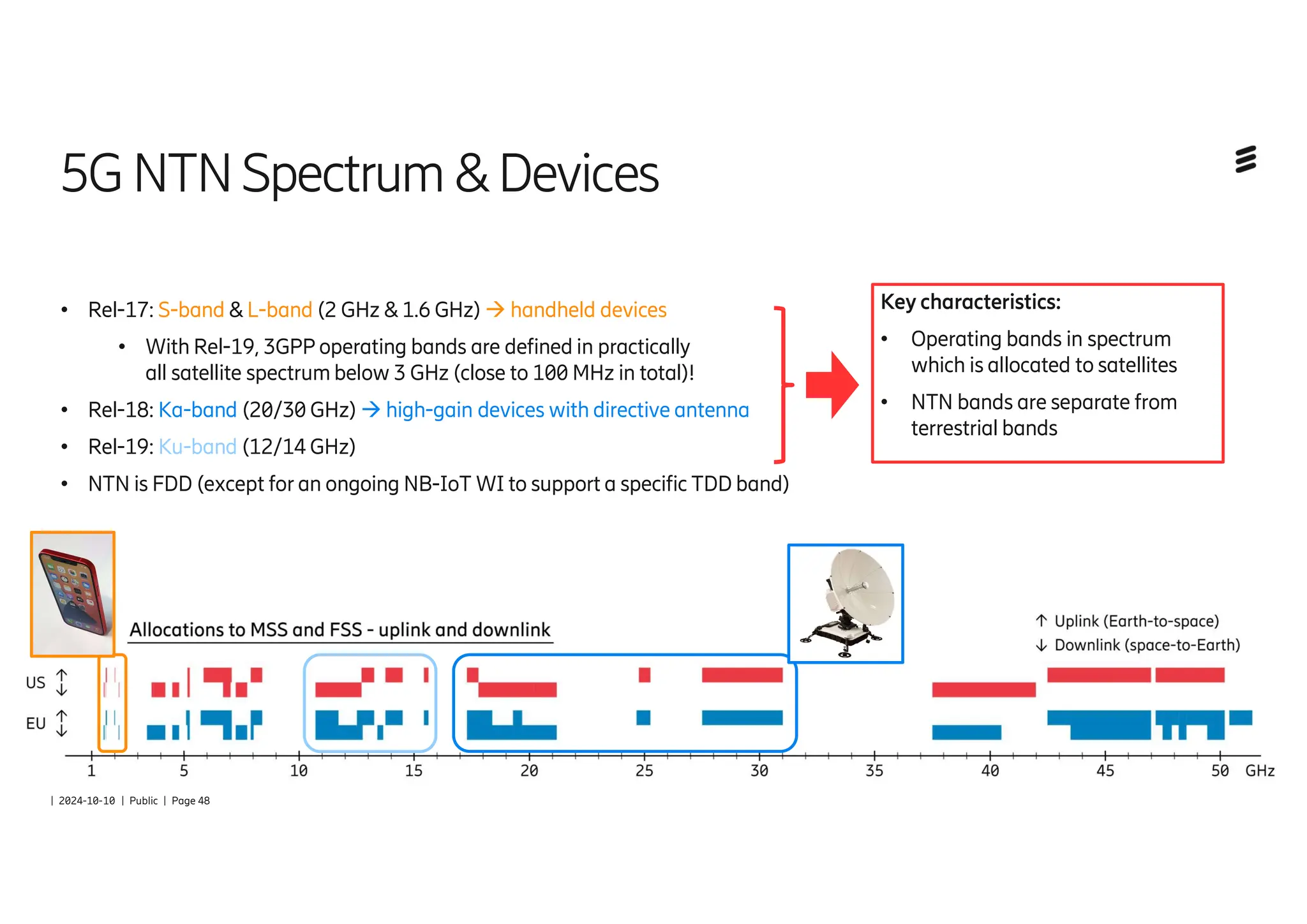
5GNTNSpectrum & Devices
● Rel-17: S-band & L-band (2 GHz & 1.6 GHz)  handheld devices
● With Rel-19, 3GPP operating bands are defined in practically
all satellite spectrum below 3 GHz (close to 100 MHz in total)!
● Rel-18: Ka-band (20/30 GHz)  high-gain devices with directive antenna
● Rel-19: Ku-band (12/14 GHz)
● NTN is FDD (except for an ongoing NB-IoT WI to support a specific TDD band)
Key characteristics:
• Operating bands in spectrum
which is allocated to satellites
• NTN bands are separate from
terrestrial bands
| 2024-10-10 | Public | Page 48
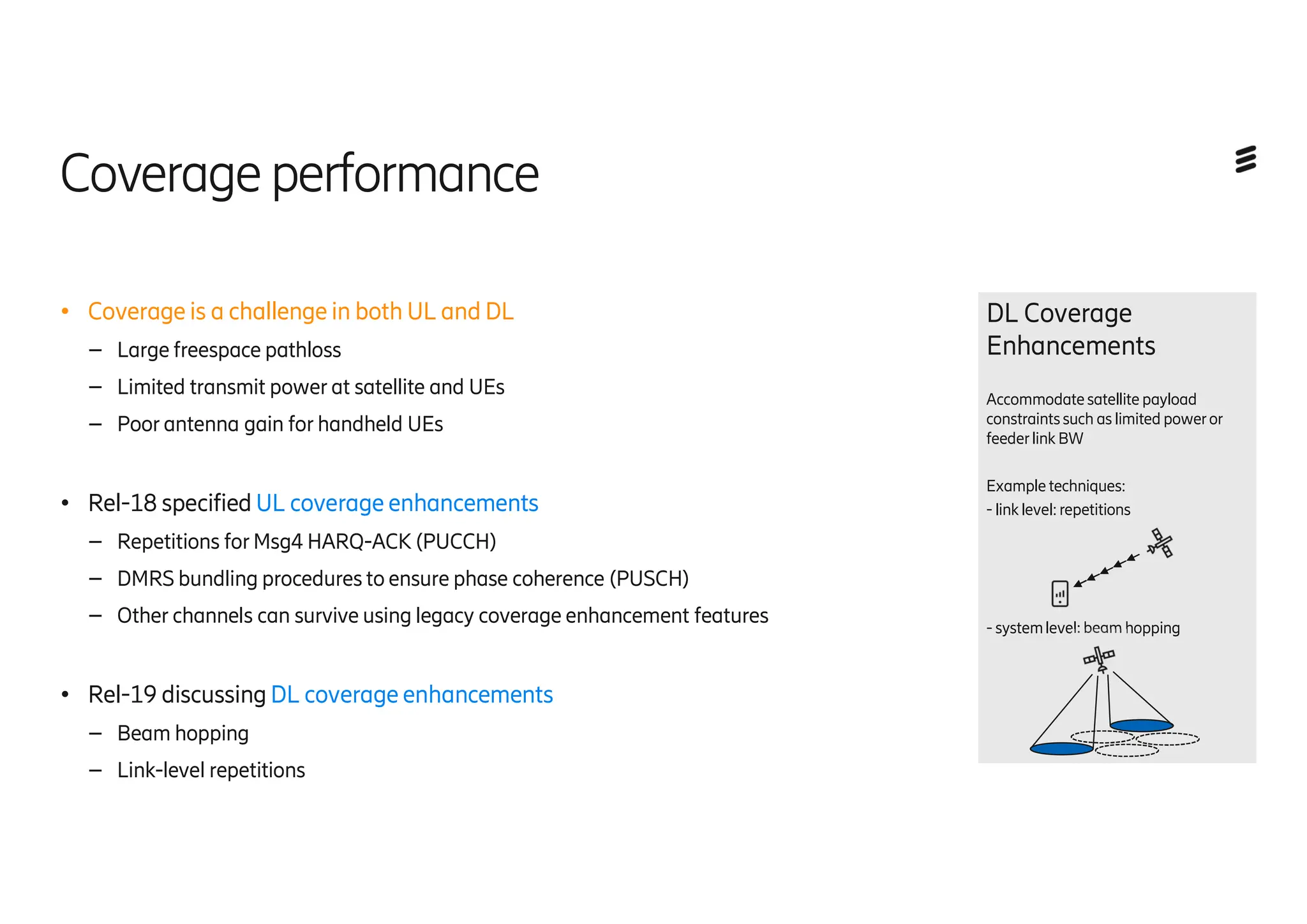
Coverageperformance
● Coverage is a challenge in both UL and DL
– Large freespace pathloss
– Limited transmit power at satellite and UEs
– Poor antenna gain for handheld UEs
● Rel-18 specified UL coverage enhancements
– Repetitions for Msg4 HARQ-ACK (PUCCH)
– DMRS bundling procedures to ensure phase coherence (PUSCH)
– Other channels can survive using legacy coverage enhancement features
● Rel-19 discussing DL coverage enhancements
– Beam hopping
– Link-level repetitions
DL Coverage
Enhancements
Accommodatesatellite payload
constraintssuch as limited poweror
feederlink BW
Example techniques:
- link level: repetitions
- systemlevel: beam hopping
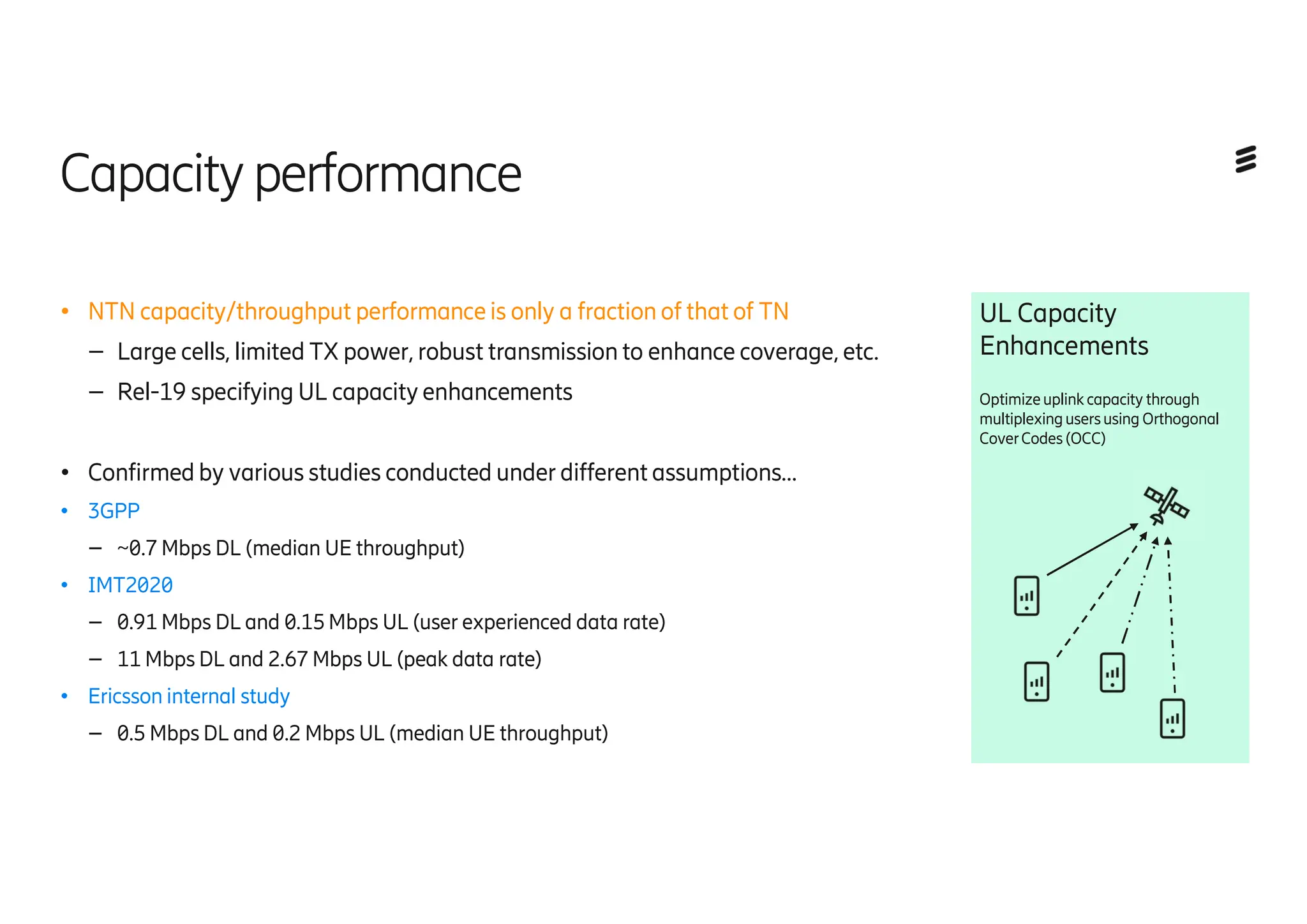
Capacityperformance
● NTN capacity/throughput performance is only a fraction of that of TN
– Large cells, limited TX power, robust transmission to enhance coverage, etc.
– Rel-19 specifying UL capacity enhancements
● Confirmed by various studies conducted under different assumptions…
● 3GPP
– ~0.7 Mbps DL (median UE throughput)
● IMT2020
– 0.91 Mbps DL and 0.15 Mbps UL (user experienced data rate)
– 11 Mbps DL and 2.67 Mbps UL (peak data rate)
● Ericsson internal study
– 0.5 Mbps DL and 0.2 Mbps UL (median UE throughput)
UL Capacity
Enhancements
Optimizeuplink capacity through
multiplexingusersusing Orthogonal
CoverCodes(OCC)
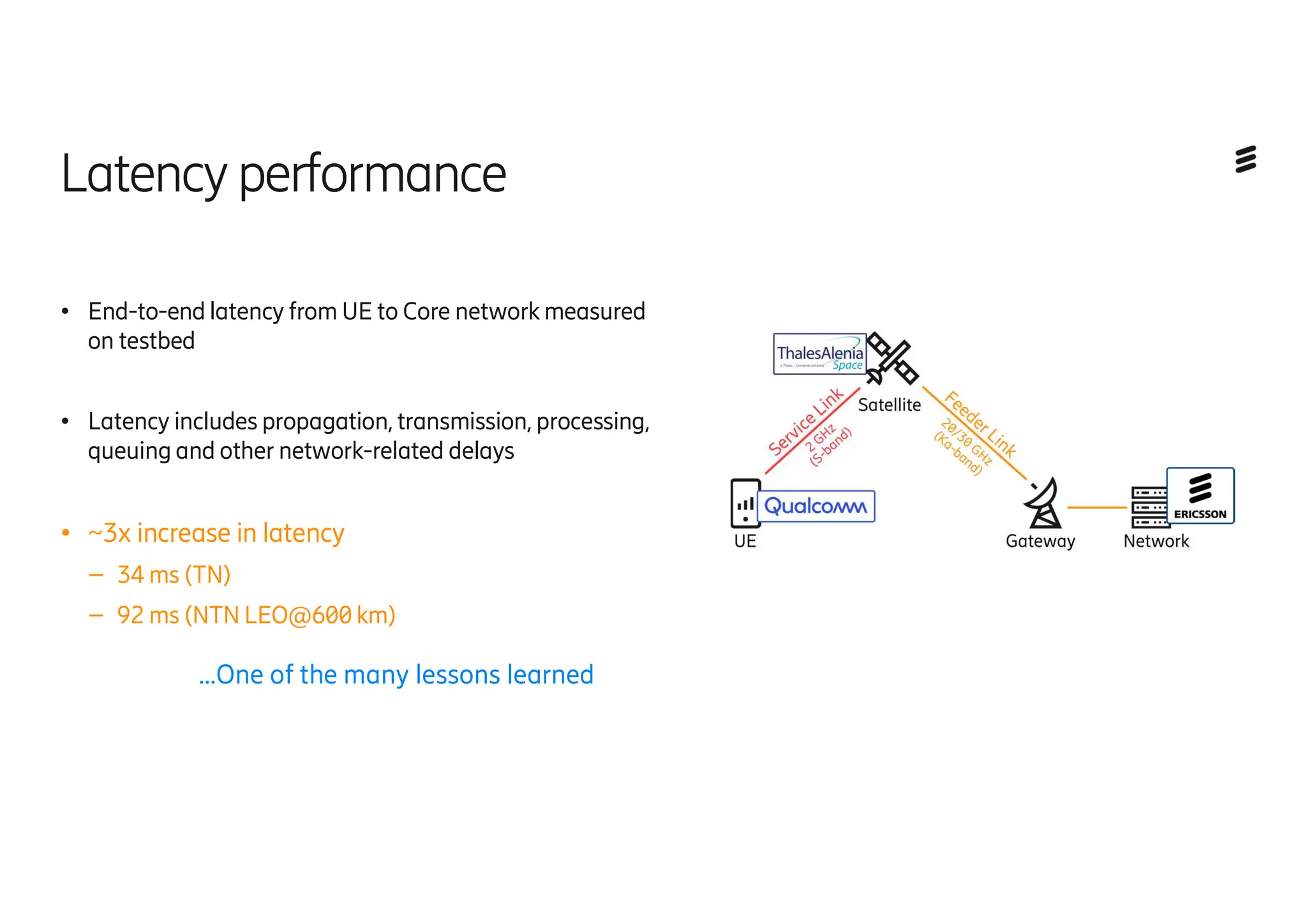
Latencyperformance
● End-to-end latency from UE to Core network measured
on testbed
● Latency includes propagation, transmission, processing,
queuing and other network-related delays
● ~3x increase in latency
– 34 ms (TN)
– 92 ms (NTN LEO@600 km)
…One of the many lessons learned
| 2024-10-10 | Public | Page 52
Towards 6G
● Focus areas, capabilities, trends and scenarios
● RAN architectures in perspective
● The role of satellite access in 6G
● Timeline
| 2024-10-10 | Public | Page 53
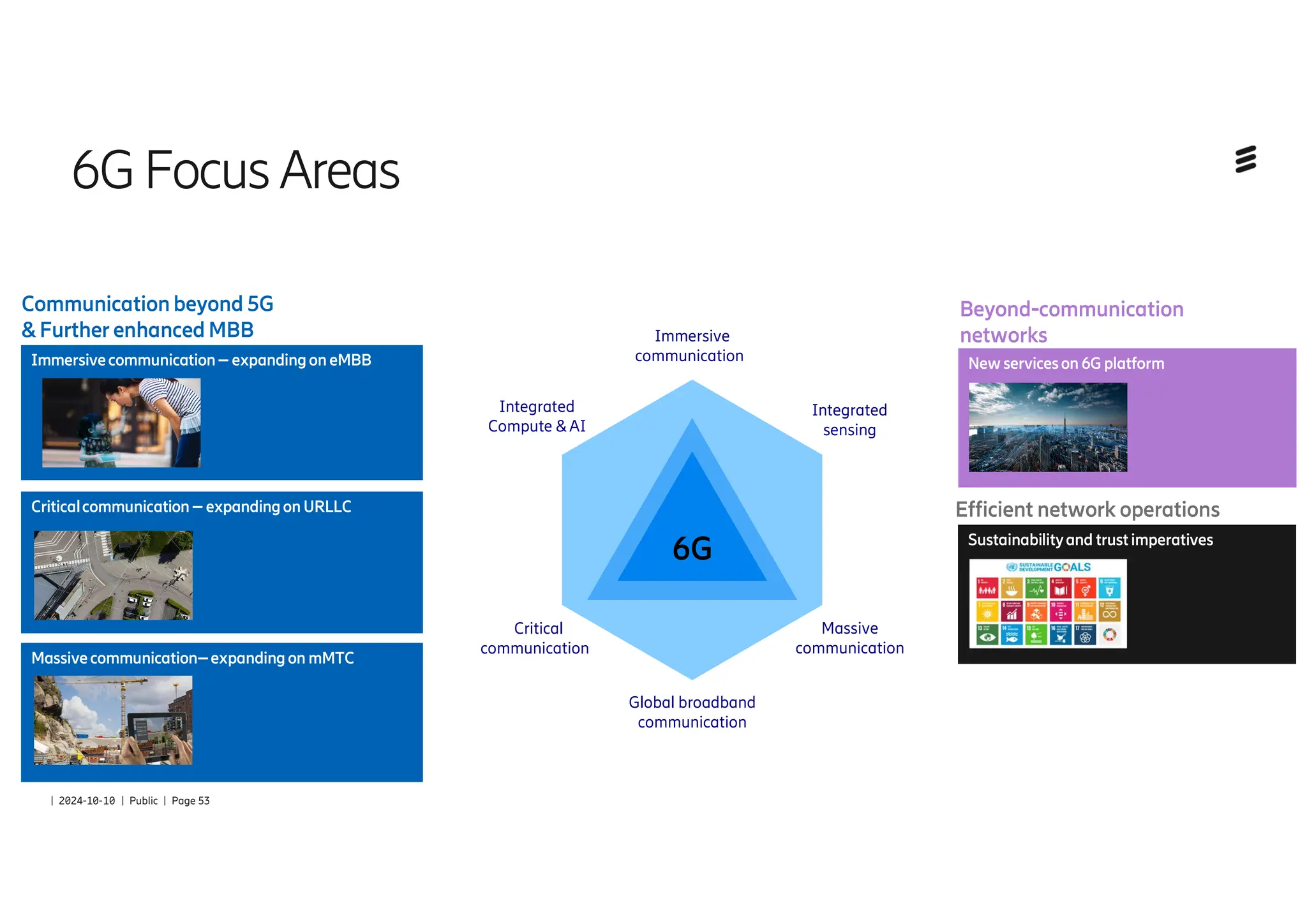
6GFocus Areas
Criticalcommunication– expandingonURLLC
Immersivecommunication– expandingoneMBB
Massivecommunication–expandingon mMTC
Newserviceson 6Gplatform
Communicationbeyond 5G
& Further enhancedMBB
Beyond-communication
networks
Sustainabilityand trustimperatives
Efficient network operations
Integrated
sensing
Immersive
communication
Integrated
Compute & AI
Critical
communication
Massive
communication
Global broadband
communication
6G
| 2024-10-10 | Public | Page 54
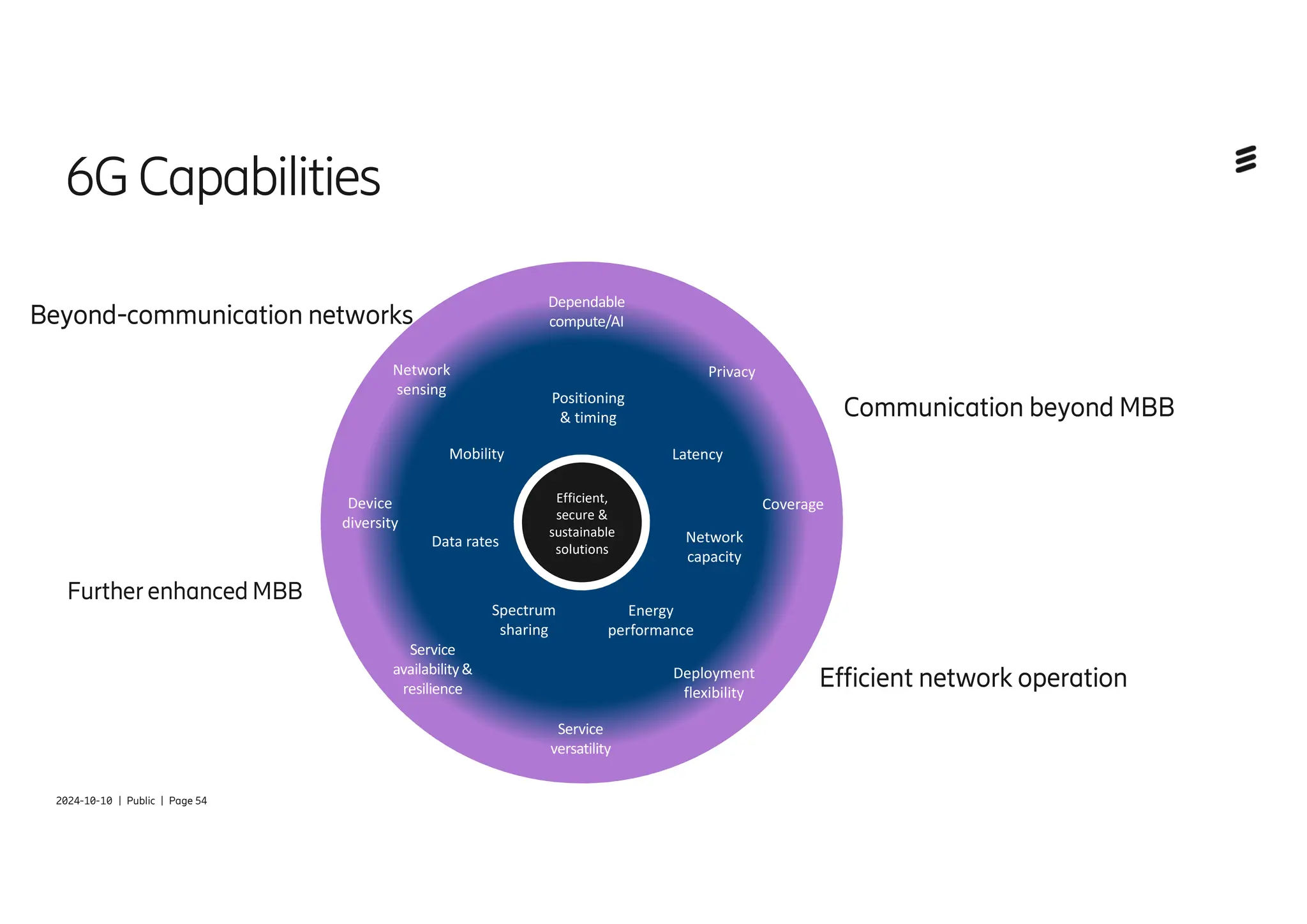
6GCapabilities
Network
capacity
Latency
Coverage
Energy
performance
Positioning
& timing
Data rates
Privacy
Service
availability&
resilience
Network
sensing
Deployment
flexibility
Dependable
compute/AI
Service
versatility
Efficient,
secure &
sustainable
solutions
Device
diversity
Mobility
Spectrum
sharing
Communication beyond MBB
Beyond-communication networks
Efficient network operation
Further enhanced MBB
| 2024-10-10 | Public | Page 55
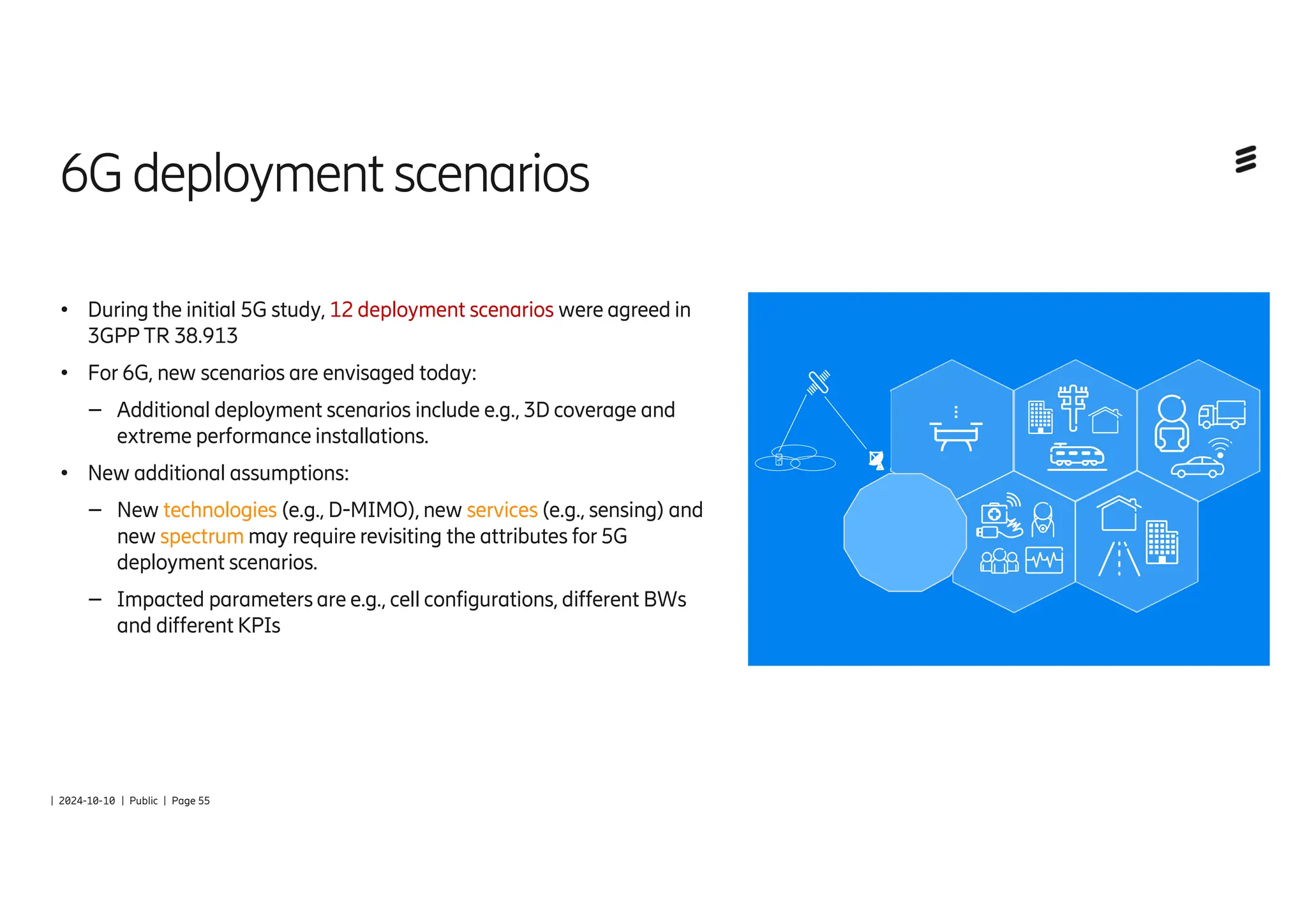
6Gdeployment scenarios
● During the initial 5G study, 12 deployment scenarios were agreed in
3GPP TR 38.913
● For 6G, new scenarios are envisaged today:
– Additional deployment scenarios include e.g., 3D coverage and
extreme performance installations.
● New additional assumptions:
– New technologies (e.g., D-MIMO), new services (e.g., sensing) and
new spectrum may require revisiting the attributes for 5G
deployment scenarios.
– Impacted parameters are e.g., cell configurations, different BWs
and different KPIs
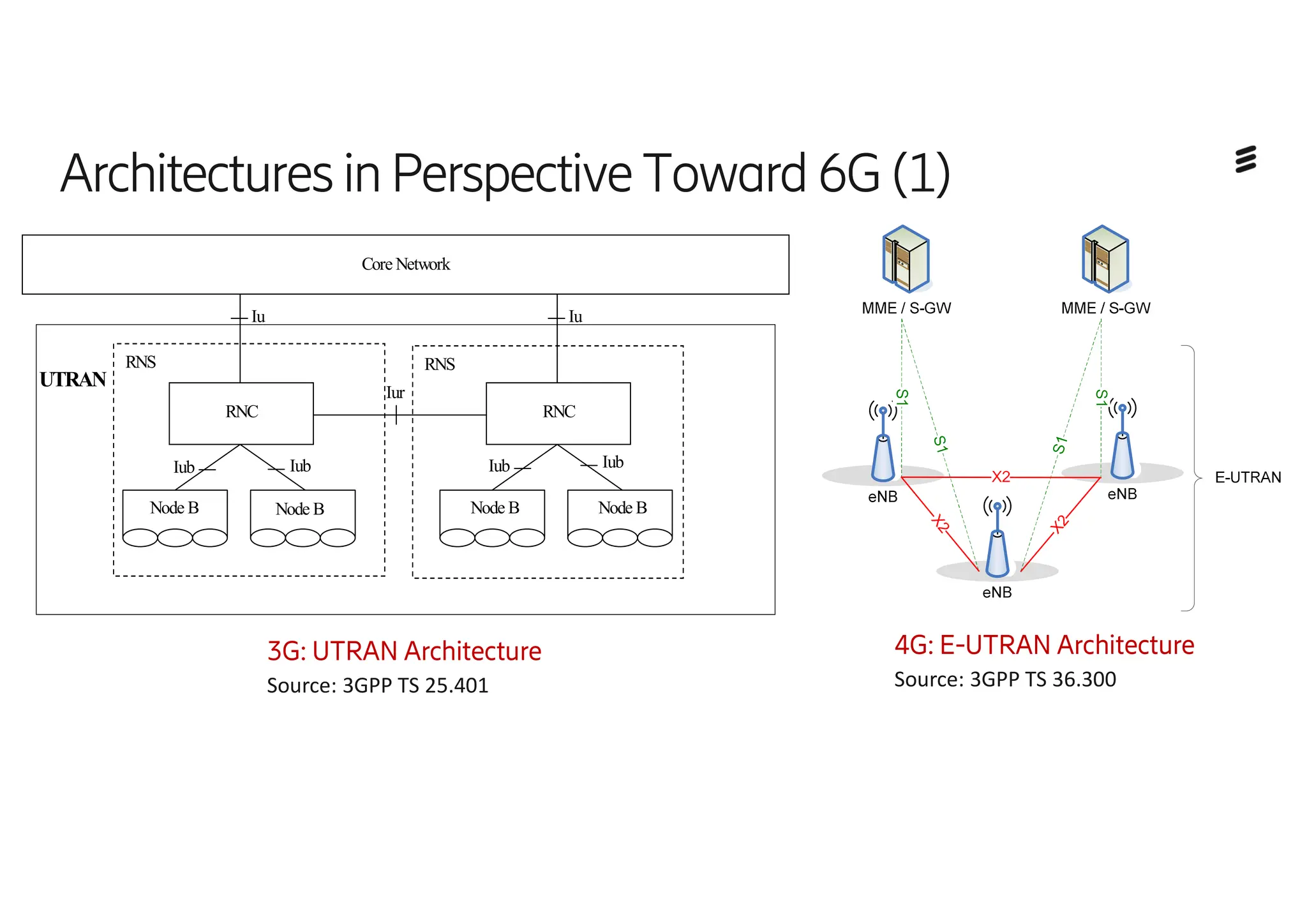
Architectures inPerspectiveToward 6G(1)
3G: UTRAN Architecture
Source: 3GPP TS 25.401
RNS
RNC
RNS
RNC
Core Network
Node B Node B Node B Node B
Iu Iu
Iur
Iub Iub
Iub Iub
UTRAN
X
2
X
2
4G: E-UTRAN Architecture
Source: 3GPP TS 36.300
E1
gNB-DU
gNB-CU-CP
F1-C F1-U
gNB
gNB-CU-UP
gNB-DU
5G: NG-RAN Architecture
Source: 3GPP TS 38.300 and TS 38.401
Architectures inPerspectiveToward 6G(2)
→ 6G Architecture: …?
| 2024-10-10 | Public | Page 58
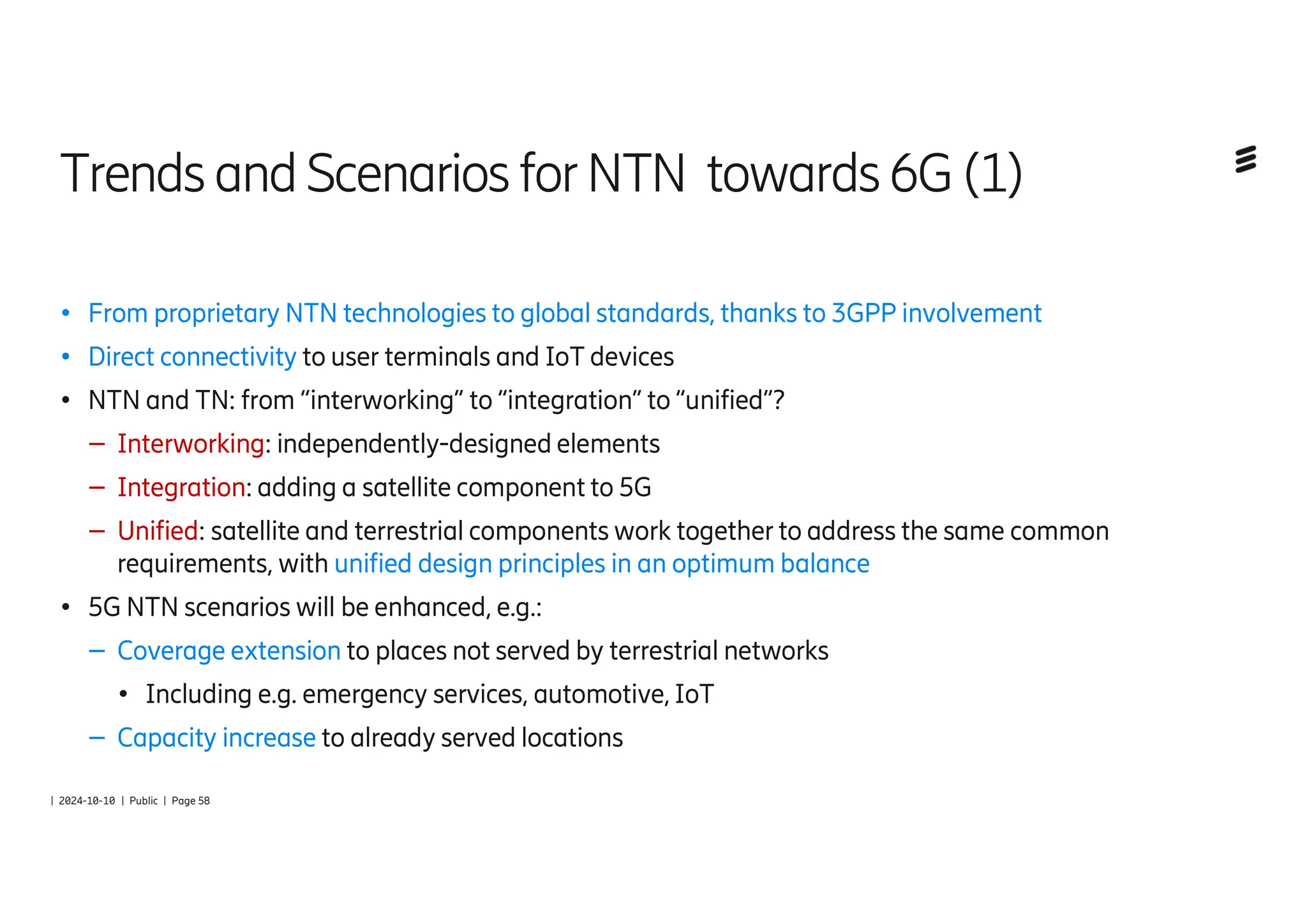
Trends andScenarios forNTN towards6G(1)
● From proprietary NTN technologies to global standards, thanks to 3GPP involvement
● Direct connectivity to user terminals and IoT devices
● NTN and TN: from “interworking” to “integration” to “unified”?
– Interworking: independently-designed elements
– Integration: adding a satellite component to 5G
– Unified: satellite and terrestrial components work together to address the same common
requirements, with unified design principles in an optimum balance
● 5G NTN scenarios will be enhanced, e.g.:
– Coverage extension to places not served by terrestrial networks
● Including e.g. emergency services, automotive, IoT
– Capacity increase to already served locations
| 2024-10-10 | Public | Page 59
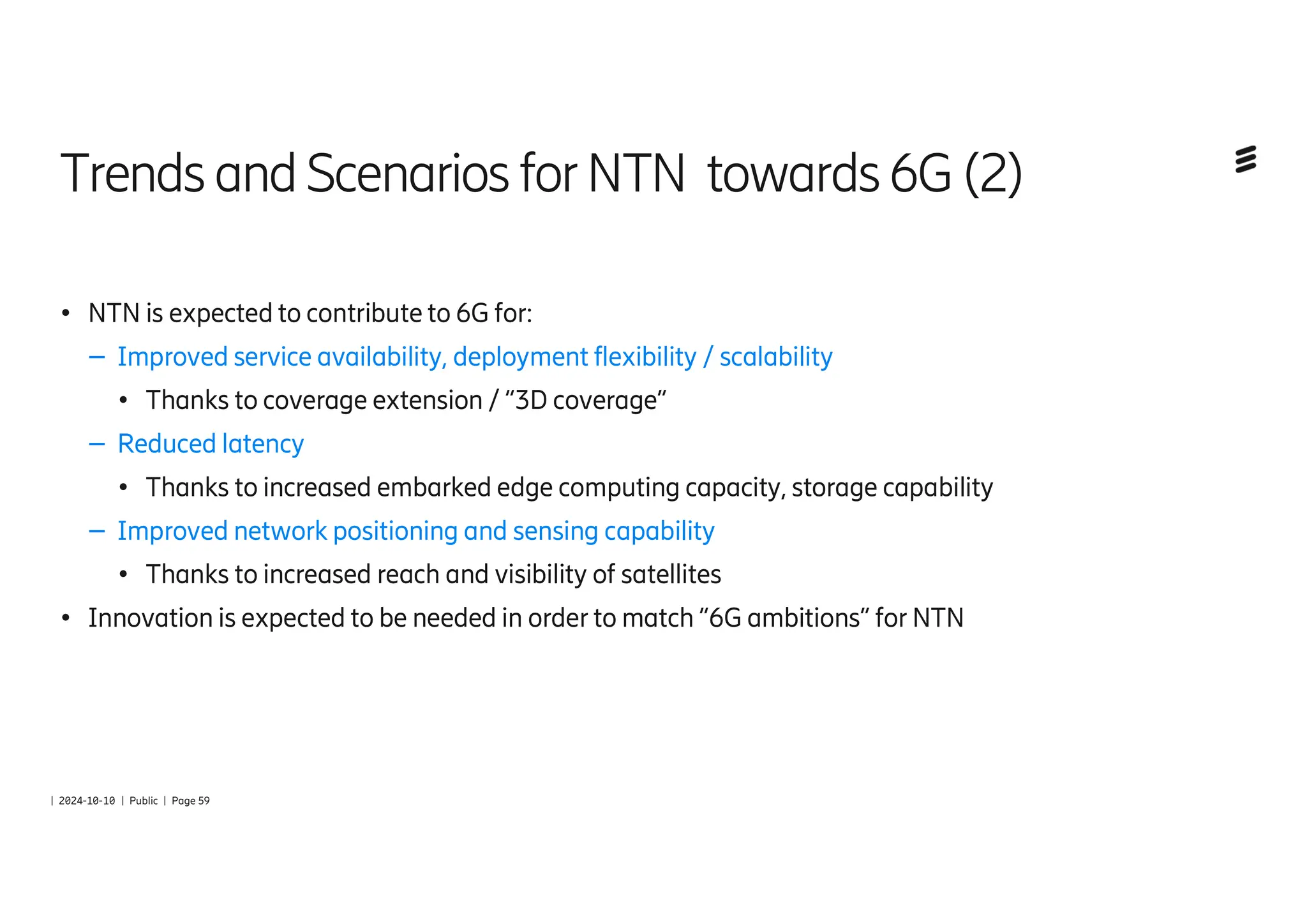
Trends andScenarios forNTN towards6G(2)
● NTN is expected to contribute to 6G for:
– Improved service availability, deployment flexibility / scalability
● Thanks to coverage extension / “3D coverage”
– Reduced latency
● Thanks to increased embarked edge computing capacity, storage capability
– Improved network positioning and sensing capability
● Thanks to increased reach and visibility of satellites
● Innovation is expected to be needed in order to match “6G ambitions” for NTN
| 2024-10-10 | Public | Page 60
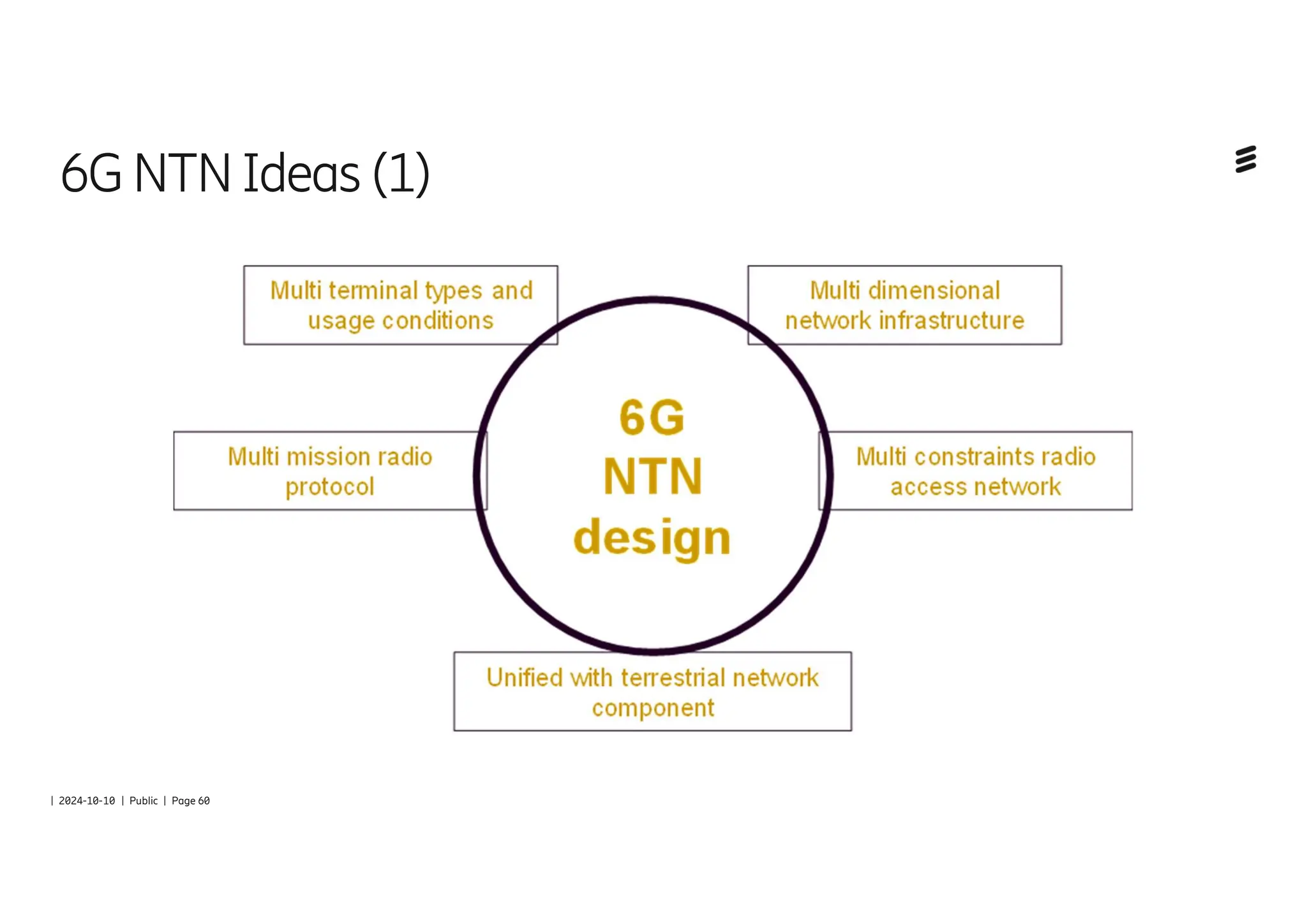
6GNTNIdeas (1)
| 2024-10-10 | Public | Page 61
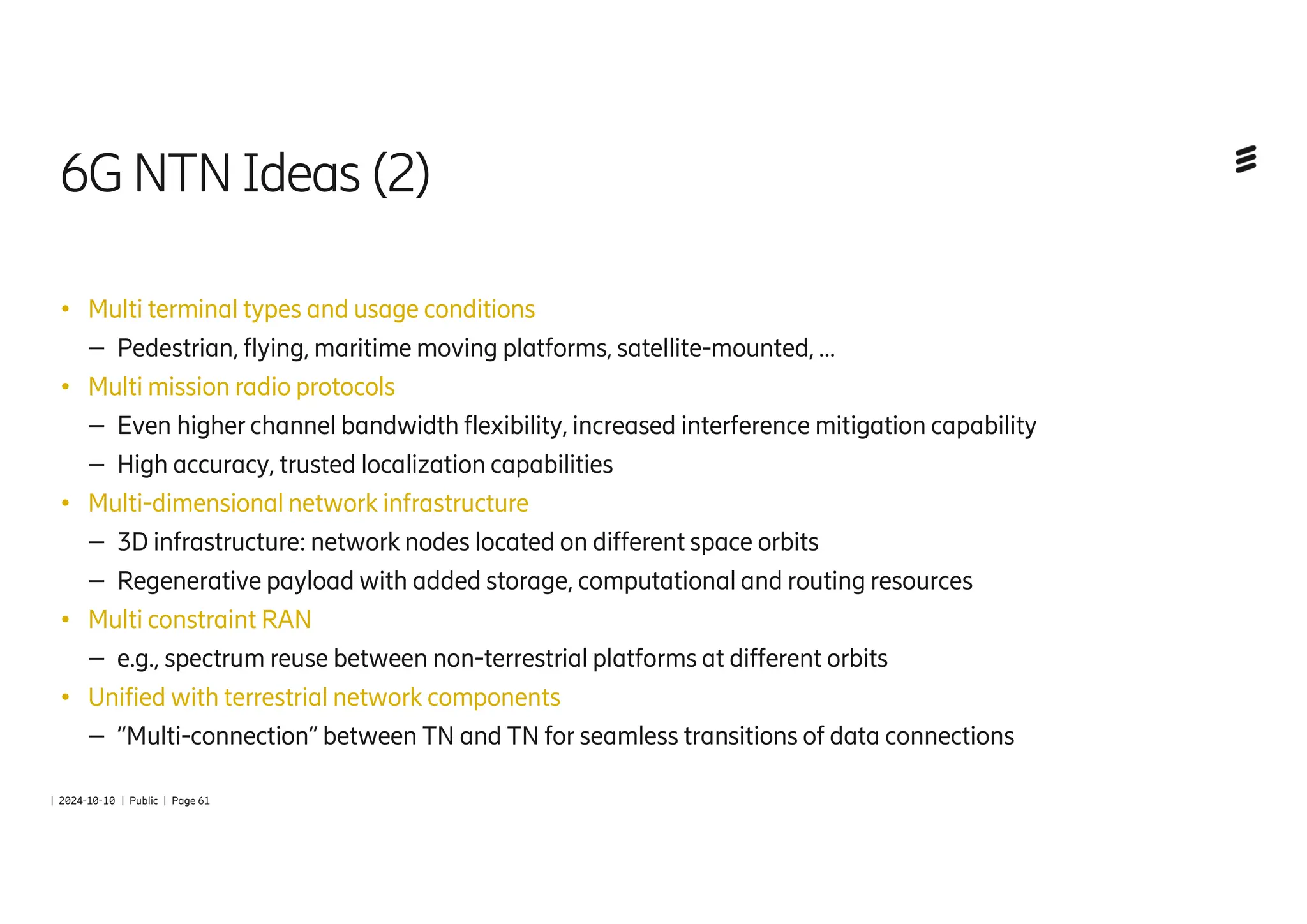
6GNTNIdeas (2)
● Multi terminal types and usage conditions
– Pedestrian, flying, maritime moving platforms, satellite-mounted, …
● Multi mission radio protocols
– Even higher channel bandwidth flexibility, increased interference mitigation capability
– High accuracy, trusted localization capabilities
● Multi-dimensional network infrastructure
– 3D infrastructure: network nodes located on different space orbits
– Regenerative payload with added storage, computational and routing resources
● Multi constraint RAN
– e.g., spectrum reuse between non-terrestrial platforms at different orbits
● Unified with terrestrial network components
– “Multi-connection” between TN and TN for seamless transitions of data connections
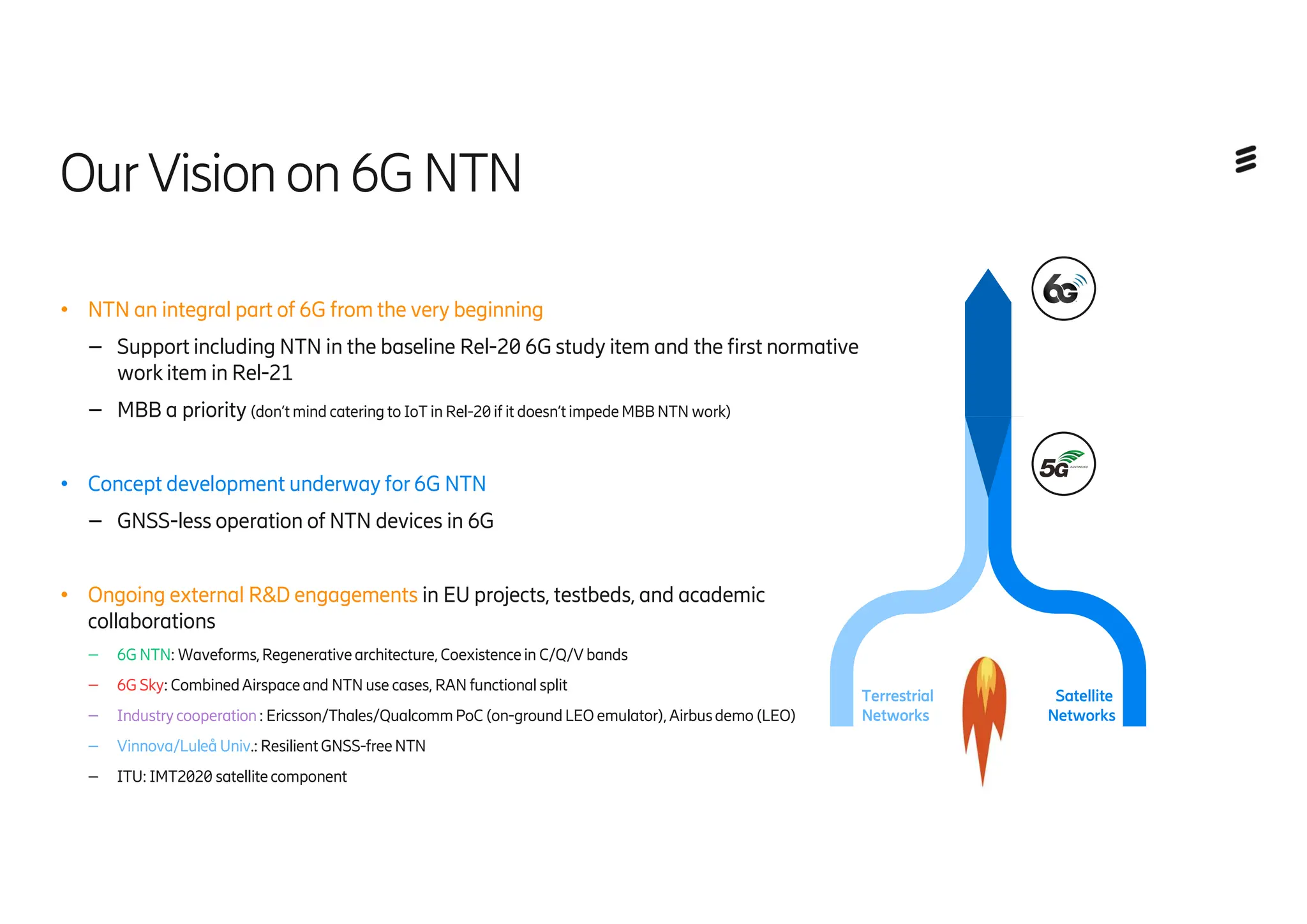
● NTN an integral part of 6G from the very beginning
– Support including NTN in the baseline Rel-20 6G study item and the first normative
work item in Rel-21
– MBB a priority (don’t mind catering to IoT in Rel-20if it doesn’timpedeMBBNTN work)
● Concept development underway for 6G NTN
– GNSS-less operation of NTN devices in 6G
● Ongoing external R&D engagements in EU projects, testbeds, and academic
collaborations
– 6G NTN: Waveforms,Regenerativearchitecture, Coexistencein C/Q/Vbands
– 6G Sky: CombinedAirspaceand NTN use cases, RAN functional split
– Industrycooperation: Ericsson/Thales/QualcommPoC (on-groundLEO emulator),Airbusdemo(LEO)
– Vinnova/Luleå Univ.: ResilientGNSS-freeNTN
– ITU: IMT2020 satellitecomponent
OurVisionon6GNTN
6G – True Unification
5G & 5G-Adv – Integration
Terrestrial
Networks
Satellite
Networks
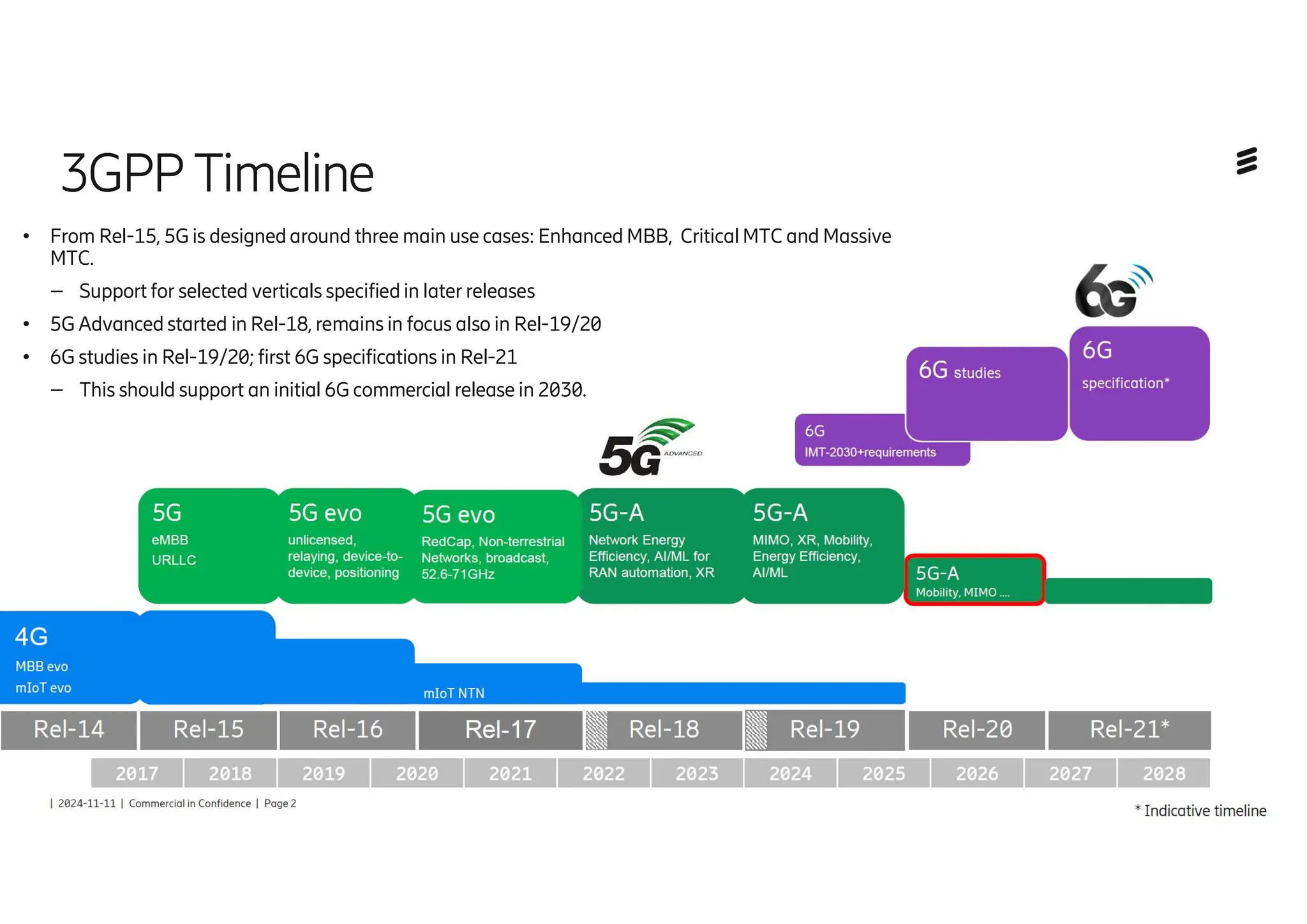
3GPP Timeline
● From Rel-15, 5G is designedaround three main use cases: EnhancedMBB, Critical MTC and Massive
MTC.
– Support for selected verticals specifiedin later releases
● 5G Advancedstarted in Rel-18, remains in focus also in Rel-19/20
● 6G studies in Rel-19/20; first 6G specifications in Rel-21
– This should support an initial 6G commercial release in 2030.
| 2024-10-10 | Public | Page 64
In Conclusion
InConclusion
● Current NTN use cases:
– Mobile broadband in underserved areas, public safety, maritime, airplane, service
continuity in case of crisis, …
● Interoperable interfaces to terminals and networks are in place
– Including support for IoT, Machine-Type Communication
● Integration of NTN in 3GPP is possible thanks to continued open discussion
– Different mindsets, different communities, lessons learned
● Work is ongoing on the path to 6G
● NTN is expected to be an integral part of the 6G ecosystem from the start
| 2024-10-10 | Public | Page 66
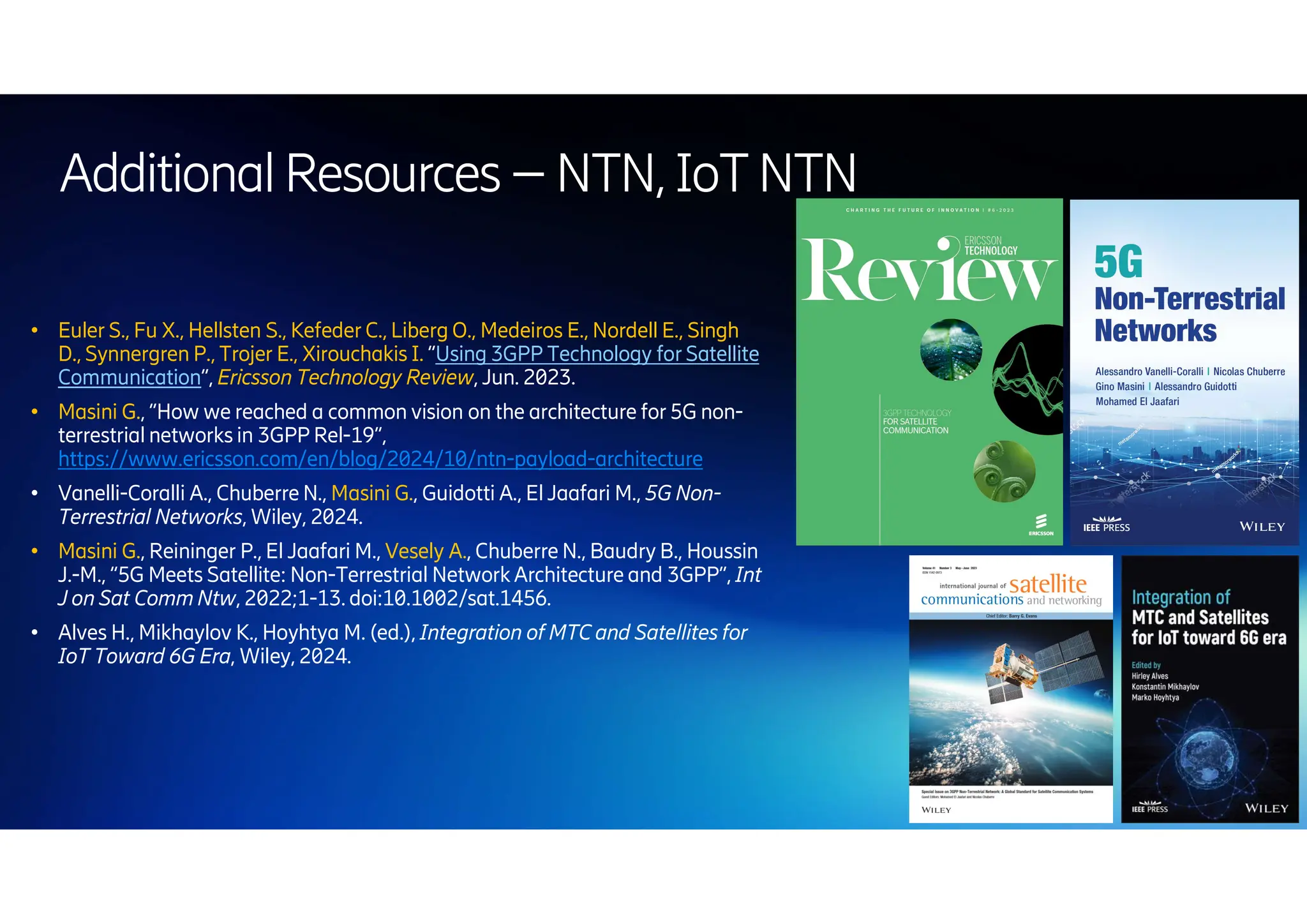
● Euler S., Fu X., Hellsten S., Kefeder C., Liberg O., Medeiros E., Nordell E., Singh
D., Synnergren P., Trojer E., Xirouchakis I. “Using 3GPP Technology for Satellite
Communication”, Ericsson Technology Review, Jun. 2023.
● Masini G., “How we reached a common vision on the architecture for 5G non-
terrestrial networks in 3GPP Rel-19”,
https://www.ericsson.com/en/blog/2024/10/ntn-payload-architecture
● Vanelli-Coralli A., Chuberre N., Masini G., Guidotti A., El Jaafari M., 5G Non-
Terrestrial Networks, Wiley, 2024.
● Masini G., Reininger P., El Jaafari M., Vesely A., Chuberre N., Baudry B., Houssin
J.-M., “5G Meets Satellite: Non-Terrestrial Network Architecture and 3GPP”, Int
J on Sat Comm Ntw, 2022;1-13. doi:10.1002/sat.1456.
● Alves H., Mikhaylov K., Hoyhtya M. (ed.), Integration of MTC and Satellites for
IoT Toward 6G Era, Wiley, 2024.
AdditionalResources –NTN,IoTNTN
| 2024-10-10 | Public | Page 67
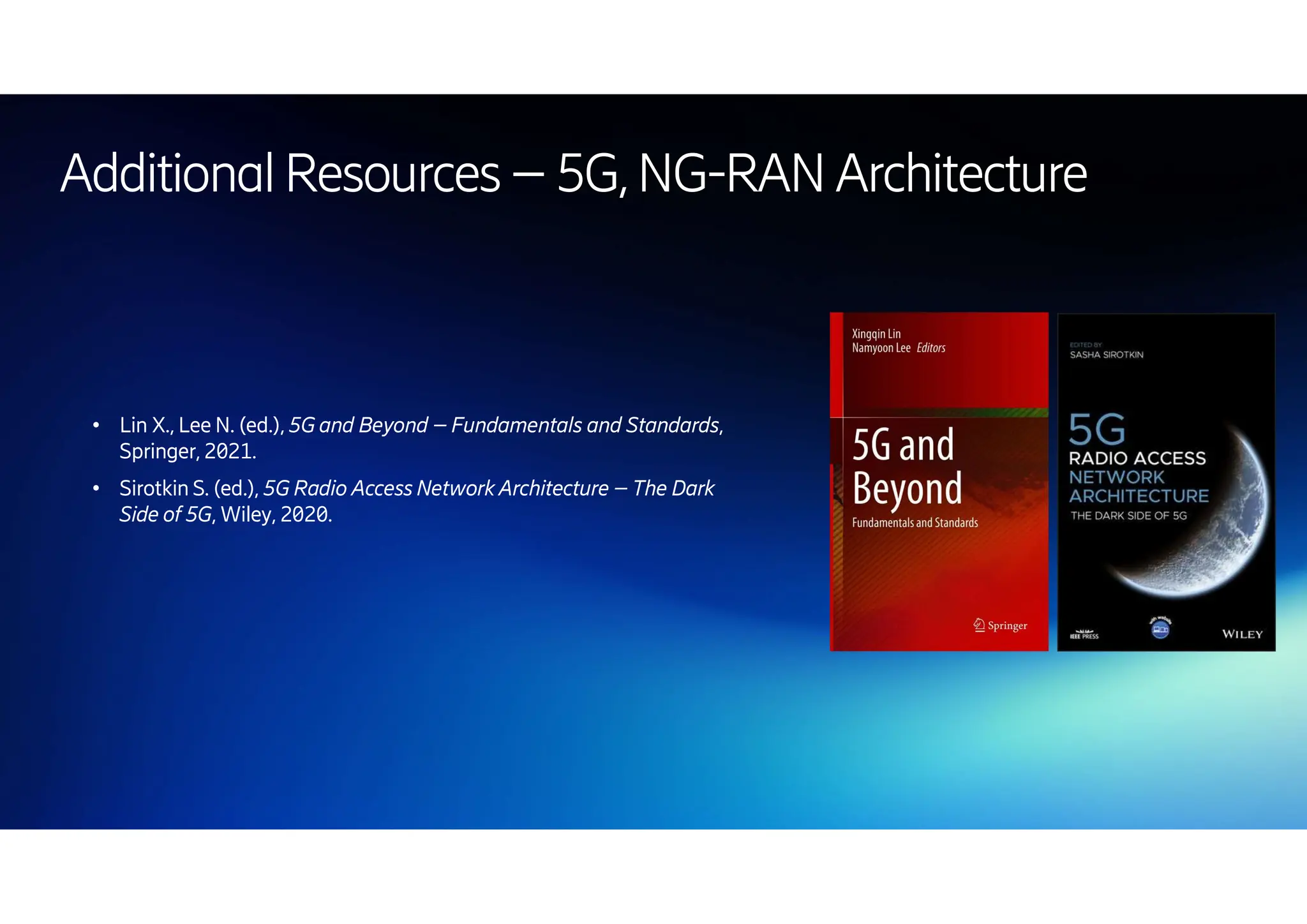
● Lin X., Lee N. (ed.), 5G and Beyond – Fundamentals and Standards,
Springer, 2021.
● Sirotkin S. (ed.), 5G Radio Access Network Architecture – The Dark
Side of 5G, Wiley, 2020.
AdditionalResources –5G,NG-RAN Architecture
| 2024-10-10 | Public | Page 68
● Joakim Bergström,AliCheema, Daniel Chen Larsson,Sebastian Euler,Jon Gamble,
AsbjörnGrövlen,Olof Liberg, NeivaLinder,CyrilMichel, MeralSherazipour,Nianshan Shi
● My colleaguesin the EricssonNTN, RAN3and RANteams
Acknowledgments
| 2024-10-10 | Public | Page 69
www.ericsson.com/6g

Non-Terrestrial Networks and 3GPP Standards from 5G to 6G

  • 1.
    | 2024-10-10 |Public | Page 1 NTN and 3GPP Standards from 5G to 6G Gino Masini, MBA Principal Researcher – Standardization Ericsson AB – Standards and Technologies Stockholm, Sweden
  • 2.
    | 2024-10-10 |Public | Page 2 Summary ● 5G and standards ● 3GPP today ● The journey of satellites toward 3GPP ● Where we are today: Rel-19 in progress ● Some lessons we learned ● Towards 6G
  • 3.
    | 2024-10-10 |Public | Page 3 5G and Standards ● 5G From scenarios and requirements to specifications ● NG-RAN architecture today ● 5G Advanced
  • 5.
    Scenariosfor5G High Throughput –High Reliability – Reduced/No Latency – Service Based
  • 6.
    Requirements fromITU(IMT-2020) Requirement Performance Measure DL:20 Gbps UL: 10 Gbps Peak data rate DL: 30 bps/Hz UL: 15 bps/Hz Peak spectral efficiency 100 MHz Bandwidth 20 ms (10 ms encouraged) Control plane latency URLLC: 1/0.5 ms, eMBB: 4 ms User plane latency, 1-way 10s / 20byte packet Infrequent small packets 0 ms Mobility interruption time Up to 500 km/h Mobility 3x IMT-A requirement TRP spectral efficiency 3x IMT-A requirement User spectral efficiency at 5% percentile 10 Mbps/m2 [ITU] Area traffic capacity 100/50 Mbps DL/UL [ITU] User experienced datarate 140/143 dB loss MaxCL Extreme coverage (3GPP) Requirement Performance Measure 1,000,000 devices/km2 Connection density 164 dB coupling loss Coverage (3GPP) 10-15 yr Battery life (3GPP) 1-10-5 in 1 ms Reliability Inspection (Qualitative) NW energy efficiency Inspection (Qualitative) UE Energy efficiency Yes Inter-system mobility Yes Bandwidth scalability Yes Spectrum flexibility Yes Support of wide range of services Latency (4G → 5G): 20 → 1 ms Source: ITU-R Rep. M.2410-0
  • 7.
    | 2024-10-10 |Public | Page 7 Access/backhaul integration Integrated D2D connectivity Massive beam-forming System control Flexible and scalable system plane Ultra-lean design User data Flexible, scalable and future-proof design Deployment Multi-site coordination/connectivity Flexible PHY Use cases Spectrum Energy efficient: minimize network transmissions not directly related to user data delivery Machine-type communication 5GinOneGlance
  • 8.
    Challenges for5GArchitecture ● Supportenhanced mobile broadband (“more of the same, but better and faster”) ● Support Ultra-Reliable, Low-Latency Communications (URLLC); ● A single architecture for centralized, distributed, and monolithic deployments – Embrace softwarization (the network becomes programmable) and virtualization (network nodes become software instances) – Support the deployment of certain functions in the cloud ● Fully separate Control Plane from User Plane of a centralized unit, for maximum deployment flexibility ● Cooperation and resource sharing with existing LTE networks ● Different migration strategies and “paths” from 4G to 5G ● Standardization Source: 3GPP TR 38.801
  • 9.
    E1 gNB-DU gNB-CU-CP F1-C F1-U gNB gNB-CU-UP gNB-DU 5G: TheNG-RANArchitecture (“TheJanusBifronsandtheMatryoshka”) Source: 3GPP TS 38.300 and TS 38.401
  • 10.
    | 2024-10-10 |Public | Page 10 Defining 5GAdvanced ● 5G Advanced builds on 5G and paves the way towards 6G. – 5G Advanced focuses on providing sustainable and intelligent mobile networks. – High performance networks will support new services and applications such as immersive reality and cloud gaming. Sustainable networks Intelligent RAN New services Performance
  • 11.
    | 2024-10-10 |Public | Page 11 3GPP Today ● Why Standards ● Structure, ways of working, recent timeline ● Backwards-compatible framework
  • 12.
    WhyStandards? — A goodtechnical standard: — Ensures compatibility and interoperability — Promotes a broader market — Lowers industrial costs An early example of global technical standard (Pompeii, 1st century A.D.) Source:Wikipedia
  • 13.
    Source: Q22024, EricssonMobilityReport 13 Interworking andIntegration 3GPP track Mobile subscriptions by technology (billions) 5G subscriptions by end 2029
  • 14.
    - Produces andmaintains standards defining its technologies – GSM, UMTS, LTE, NR, … - Cellular telecommunications networks, including radio access, the core network, and service capabilities – Including codecs, security, and quality of service – Also provides “hooks” for: ● non-radio access to the core network ● Wi-Fi interworking - Work is contribution-driven and consensus-based – Majority-based decisions are the exception 14 What Is3GPP? Source: www.3gpp.org
  • 15.
    • Organizational Partnerstranspose 3GPP Technical Specifications into standards • Market Representation Partners (MRPs) can offer market advice and a consensus view of market requirements • MRPs do not define, publish or set standards 15 3GPP Partners Source: www.3gpp.org
  • 16.
    | 2024-10-10 |Public | Page 16 3GPP Structure TSG CT Core Network & Terminals TSG RAN Radio Access Network TSG SA Service & System Aspects CT WG1 User Equipment to Core Network protocols CT WG3 Interworking with External Networks & Policy and Charging Control CT WG4 Core Network Protocols CT WG6 Smart Card Application Aspects RAN WG1 Radio Layer 1 (Physical layer) RAN WG2 Radio Layer 2 and Radio layer 3 Radio Resource Control RAN WG4 Radio Performance and Protocol Aspects RAN WG5 Mobile terminal conformance testing RAN AH1 ITU-R Ad Hoc SA WG1 Services SA WG2 System Architecture and Services SA WG4 Multimedia Codecs, Systems and Services SA WG5 Management, Orchestration and Charging SA WG6 Application Enablement and Critical Communication Applications Project Coordination Group (PCG) RAN WG3 RAN architecture and related network interfaces SA WG3 Security and Privacy • Work is organized in Study Items (SIs) and Work Items (WIs) • Study Items produce Technical Reports (TRs) • Work Items produce or modify Technical Standards (TSs) • Specifications are organized by series (topic) and by releases (self-consistent sets of features) • All documents are freely downloadable Source: www.3gpp.org/specifications-technologies
  • 17.
    3GPP Timeline • From4G advanced to 6G
  • 18.
    Maintaining aBackwards-Compatible Framework Majorfocus for 3GPP is to make the system backwards and forwards compatible, for uninterrupted operation of user terminals – e.g. backwards compatibility between LTE and LTE-Advanced: an LTE-Advanced terminal can work in an LTE cell and vice versa
  • 19.
    | 2024-10-10 |Public | Page 19 The Journey of Satellites toward 3GPP ● Global scenarios ● Why satellites? Why standardize? Why 3GPP? Why now? ● New challenges for architecture, mobility, procedures, … ● From studies to Rel-17/18
  • 20.
    Satellites cancomplement terrestrialcoverage Non-terrestrialnetworks(NTN)arerelevantformanyverticals • Connectivity in remote regions • Existing terrestrial users traveling into uncovered areas (adventurers, mountaineers, sailing, …) • Airborne, maritime, … • Connecting low-traffic railway lines in rural areas • Adding resilience to failover from TN • NTN can be integrated as a transport path in FRMCS • Resilience for public safety and national security in case of natural or man-made disasters impacting terrestrial networks Global Internet Railways Public safety Automotive • No new use NTN-specific cases identified for connected vehicles (5GAA) • Complementing terrestrial coverage gaps • Resilience when TN unavailable Consumer connectivity, industrial service continuity, and public safety are the key NTN use cases
  • 21.
    | 2024-10-10 |Public | Page 21 GeneralOverview ofSatellite Systems
  • 22.
    | 2024-10-10 |Public | Page 22 Why5GSatellite AccessStandardization? Why 5G satellite access? Why standardize 5G satellite access in 3GPP? Global coverage for 5G Open, global standard → interoperability, future-proofness, wide ecosystem Technology common with terrestrial cellular networks → economies of scale, cost reduction.
  • 23.
    3GPP NTN standardization Objective:Integrate satellite access in mass-market chipsets for regular smartphones
  • 24.
    5GNTN/TN Interoperability ● 3GPPhas introduced enhancements for seamless interoperability between NTN and TN – Mobility support for NTNTN handovers for NR and LTE – Integration of NTN within 5G Core and 4G Core ● e.g., similar interworking models as in terrestrial ● Ericsson has also tested mobility support for 5G NTN
  • 25.
    NewQuestions onArchitecture duetoNTN… ●How to apply the existing 3GPP framework to NTN? E.g.? – How to manage 3GPP network identifiers and moving cells due to LEO? – How to manage UE paging in NTN? – Role of Xn interface when NTNs are involved? – Is SON applicable in NTN? And between NTN and terrestrial networks?
  • 26.
    …AndsomeChallenges toMobility… ● Mobility(including e.g. TN-NTN) – Large propagation delays, especially for GEO: RTT =~550 ms – Frequent HOs for LEO: satellite visibility time from a UE is in the order of minutes ● Propagation delay will interrupt data transmission by several RTTs before connections are established to target cell – Potentially large interruptions with existing HO mechanism ● Mobility enhancements have been introduced, e.g.: – Conditional Handover – …
  • 27.
    Earth-Fixed Tracking AreaforLEO In which cell to page the UE, is known to the network at Tracking Area (TA) level. ● A Tracking Area (TA) is defined as a cluster of cells configured by the operator. ● The UE informs the network on entering a TA where its location area registration is not valid ● The UE reads the Tracking Area Code (TAC) the cell belongs to, from the broadcasted System Info TA is fixed with respect to the Earth: if the cells sweep on the ground, the TAC broadcasted by the cell changes according to the covered region.
  • 28.
    FeederLinkSwitch It may benecessary for another gNB to take over the served area (e.g. offloading traffic, planned maintenance, etc.); then the feeder link to the satellite needs to be switched – Both gNB1 and gNB2 serve the same area during the switch – For the switch to be seamless, it should allow for all UEs to be handed over
  • 29.
    NTN in3GPP Rel-17/18(MainFeatures) ●BothLEO and GEO –HAPS and Air-To-Ground also supported ●Transparent payload architecture ●FDD is assumed but TDD not precluded for relevant scenarios (e.g. HAPS, ATG) ●Earth-fixed Tracking Area is assumed –Both Earth-fixed and Earth-moving cells ●Terminals with location capabilities are assumed
  • 30.
    IoT/MTCandNTN ● Rel-17 Studyon NB-IoT and LTE-M (aka eMTC) for satellites (completed in June 2021) – Objectives: ● Identify applicable scenarios ● Study and recommend necessary changes to support NB-IoT/eMTC over satellites ● Rel-17 WI: minimal scope, focusing on essential functionalities – eMTC and NB-IoT both included with equal priority – Only EPC connectivity was considered (i.e. initially 5GC connectivity was not in scope)
  • 31.
    | 2024-10-10 |Public | Page 31 5GNTNand3GPP:breaking downthework SA2: System level •Mobility management with huge cell size •UE location and support of regulated service •QoS class for GEO satellite links •Impact of satellite backhauling CT1: Network protocols •PLMN (re)selection •NAS timers RAN1: Physical layer •Timing relationship •UL time and frequency synchronization •Enhancements on HARQ •Polarization signaling RAN2: Higher layers •User Plane: RACH aspects, Other MAC aspects (e.g. HARQ), RLC, PDCP •System information broadcast •Control Plane: Tracking Area Management, Idle/connected mode mobility, UE Location Service RAN3: Access network architecture •Network Identity handling •Registration Update and Paging Handling •Cell Relation Handling •Feeder Link Switch-Over (NGSO) •Aspects Related to Country- Specific Routing RAN4: RF & RRM performance •RF: New bands, TN/NTN coexistence, Satellite Access Node & NTN capable UE •RRM: timing compensation (idle, connected mode), GNSS accuracy
  • 32.
    Satellite access architecturein3GPP Rel-17/18 Transparentpayload (Rel-17/18) ● Base station (gNB) on the ground ● Transparent (“bent pipe”) satellite payload: Radio interface terminated on the ground ● All network interfaces terminate on the ground
  • 33.
    Transparent PayloadandFunctionalSystem ● Targetingboth sub-6 GHz for mobile handheld and higher frequencies (e.g., Ka band) for devices with high antenna gains such as very small aperture terminal (VSAT) ● NTN-payload, feeder link, GW, and Non-NTN infrastructure gNB are considered as single entity Source: 3GPP TS 38.300
  • 34.
  • 35.
  • 36.
    Transparent PayloadArchitecture (3)–UserPlane Source: 3GPP TR 38.821
  • 37.
    Satellite Spectrum and3GPP ●S-band (2-4 GHz) was the main focus for FR1 ● Higher frequencies were more complicated – Ka-band is not fully within the FR2 range: – 17.7-20.2 GHz and 27.5-30 GHz for NTN-NR in above 10 GHz bands – RAN “endorsed” at least a portion of the “Ka Band” as candidate example band – Further study was undertaken: ● Technical implications, co-existence, which part of the Ka-band to consider… ● New specifications: – TR 38.101-5: NR; UE Radio transmission and reception; Part 5: Satellite access RF and performance requirements – TS 38.108: NR; Satellite Node radio transmission and reception – TS 38.521-5: NR; UE conformance specification; Radio transmission and reception, Part 5: Satellite access RF and performance
  • 38.
    | 2024-10-10 |Public | Page 38 Where We Are Today: Rel- 19 in Progress ● Unlocking new possibilities ● UE-satellite-UE communication ● Store & Forward
  • 39.
    | 2024-10-10 |Public | Page 39 • 3GPP Rel-17: • 5G NR protocol stack supports non-terrestrial communication, including satellite communication • Doppler and time drift addressed • S- and L-band operationsupported • IoT NTN, including support for NB-IoT and LTE-M • 3GPP Rel-18: • VoNR connection can be providedfrom a LEO600/1200constellation to a regular smartphone. • Proof of concept from Ericsson collaboration with Thales and Qualcomm • Ka-bandsupport, enabling 3GPP-basedFSS • IoT NTN: S-bandand L-band support • 3GPP Rel-19: • Support for regenerative payload • IoT NTN: Store&Forward • UE-satellite-UE communication • Improved downlink coverage anduplinkcapacity • Ku-bandsupport Unlocking newpossibilities RTT @ beam center Time 0 s ~500 s 8 ms ~25 ms ~25.000 km/h dRTT/dt = ~65 ms/s θ>20º Time 0 s ~500 s -20 kHz +20 kHz S-band Doppler @ beam center 50 km Earth fixed beam
  • 40.
    Satellite access architecturein3GPP Rel-19 Regenerativepayload (Rel-19) ● Base station (gNB) on the satellite ● Leverages existing inter-gNB interface (Xn) – Direct inter-satellite mobility – Dual Connectivity – Resource coordination – Load management – … ● Core network entities on the ground or on the satellite ● Prerequisite for store & forward operation – Core Network functions deployed on board ● Prerequisite for UE-satellite-UE communication Xn
  • 41.
    Support forUE-Satellite-UE Communication Supportscommunication between UEs under the coverage of one or more serving satellites without the User Plane going through the ground network Xn
  • 42.
    Store&Forward Architecture forIoTNTN (IoT NTN is based on E-UTRAN) ● Base station (eNB) on the satellite Store & Forward supports delay-tolerant/non- real-time services (IoT, MTC, SMS ● 2 cases: – MME-NT on board, MME-T on ground – Complete core network on board T3 T1 MME-T SGW HSS PGW PCRF S11 S5//S8 S6a DN SCEF SGi Gx MME-NT-2 MME-NT-1 RAN RAN MME-NT-1 RAN T2 CORE NETWORK Source: 3GPP TR 23.700-29
  • 43.
    | 2024-10-10 |Public | Page 43 Some Lessons We Learned ● Payload architecture ● Synchronization ● Coverage, capacity, latency performance ● Sustainability
  • 45.
    Satellite payload architecture Transparentpayload(Rel-17/18) + Proven technology + “Conventional” gNB - Does not scale well - Multiple D/A conversions
  • 46.
    Satellite payload architecture Regenerativepayload(Rel-19) Xn + Improved Performance + Better Resiliency + Inter-satellite links + Unlocks New services - More complex satellite - More power-hungry - More expensive
  • 47.
    5GNTNSynchronization UEpre-compensatesDelayandDopplerShift ● Solution: Givethe UE all information it needs to compensate delay and Doppler shift! 1. UE determines its position (via GNSS) 2. UE receives satellite position in a broadcast from the NTN satellite 3. UE calculates the distance and derives the propagation delay 4. UE starts communicating with the satellite ● (At the same time, the UE also calculates relative velocity to compensate Doppler shift) All NTN UEs need to be able to determine their position! Network operation (almost) as in TN! All NTN UEs assumed to be equipped with GNSS chipsets
  • 48.
    5GNTNSpectrum & Devices ●Rel-17: S-band & L-band (2 GHz & 1.6 GHz)  handheld devices ● With Rel-19, 3GPP operating bands are defined in practically all satellite spectrum below 3 GHz (close to 100 MHz in total)! ● Rel-18: Ka-band (20/30 GHz)  high-gain devices with directive antenna ● Rel-19: Ku-band (12/14 GHz) ● NTN is FDD (except for an ongoing NB-IoT WI to support a specific TDD band) Key characteristics: • Operating bands in spectrum which is allocated to satellites • NTN bands are separate from terrestrial bands | 2024-10-10 | Public | Page 48
  • 49.
    Coverageperformance ● Coverage isa challenge in both UL and DL – Large freespace pathloss – Limited transmit power at satellite and UEs – Poor antenna gain for handheld UEs ● Rel-18 specified UL coverage enhancements – Repetitions for Msg4 HARQ-ACK (PUCCH) – DMRS bundling procedures to ensure phase coherence (PUSCH) – Other channels can survive using legacy coverage enhancement features ● Rel-19 discussing DL coverage enhancements – Beam hopping – Link-level repetitions DL Coverage Enhancements Accommodatesatellite payload constraintssuch as limited poweror feederlink BW Example techniques: - link level: repetitions - systemlevel: beam hopping
  • 50.
    Capacityperformance ● NTN capacity/throughputperformance is only a fraction of that of TN – Large cells, limited TX power, robust transmission to enhance coverage, etc. – Rel-19 specifying UL capacity enhancements ● Confirmed by various studies conducted under different assumptions… ● 3GPP – ~0.7 Mbps DL (median UE throughput) ● IMT2020 – 0.91 Mbps DL and 0.15 Mbps UL (user experienced data rate) – 11 Mbps DL and 2.67 Mbps UL (peak data rate) ● Ericsson internal study – 0.5 Mbps DL and 0.2 Mbps UL (median UE throughput) UL Capacity Enhancements Optimizeuplink capacity through multiplexingusersusing Orthogonal CoverCodes(OCC)
  • 51.
    Latencyperformance ● End-to-end latencyfrom UE to Core network measured on testbed ● Latency includes propagation, transmission, processing, queuing and other network-related delays ● ~3x increase in latency – 34 ms (TN) – 92 ms (NTN LEO@600 km) …One of the many lessons learned
  • 52.
    | 2024-10-10 |Public | Page 52 Towards 6G ● Focus areas, capabilities, trends and scenarios ● RAN architectures in perspective ● The role of satellite access in 6G ● Timeline
  • 53.
    | 2024-10-10 |Public | Page 53 6GFocus Areas Criticalcommunication– expandingonURLLC Immersivecommunication– expandingoneMBB Massivecommunication–expandingon mMTC Newserviceson 6Gplatform Communicationbeyond 5G & Further enhancedMBB Beyond-communication networks Sustainabilityand trustimperatives Efficient network operations Integrated sensing Immersive communication Integrated Compute & AI Critical communication Massive communication Global broadband communication 6G
  • 54.
    | 2024-10-10 |Public | Page 54 6GCapabilities Network capacity Latency Coverage Energy performance Positioning & timing Data rates Privacy Service availability& resilience Network sensing Deployment flexibility Dependable compute/AI Service versatility Efficient, secure & sustainable solutions Device diversity Mobility Spectrum sharing Communication beyond MBB Beyond-communication networks Efficient network operation Further enhanced MBB
  • 55.
    | 2024-10-10 |Public | Page 55 6Gdeployment scenarios ● During the initial 5G study, 12 deployment scenarios were agreed in 3GPP TR 38.913 ● For 6G, new scenarios are envisaged today: – Additional deployment scenarios include e.g., 3D coverage and extreme performance installations. ● New additional assumptions: – New technologies (e.g., D-MIMO), new services (e.g., sensing) and new spectrum may require revisiting the attributes for 5G deployment scenarios. – Impacted parameters are e.g., cell configurations, different BWs and different KPIs
  • 56.
    Architectures inPerspectiveToward 6G(1) 3G:UTRAN Architecture Source: 3GPP TS 25.401 RNS RNC RNS RNC Core Network Node B Node B Node B Node B Iu Iu Iur Iub Iub Iub Iub UTRAN X 2 X 2 4G: E-UTRAN Architecture Source: 3GPP TS 36.300
  • 57.
    E1 gNB-DU gNB-CU-CP F1-C F1-U gNB gNB-CU-UP gNB-DU 5G: NG-RANArchitecture Source: 3GPP TS 38.300 and TS 38.401 Architectures inPerspectiveToward 6G(2) → 6G Architecture: …?
  • 58.
    | 2024-10-10 |Public | Page 58 Trends andScenarios forNTN towards6G(1) ● From proprietary NTN technologies to global standards, thanks to 3GPP involvement ● Direct connectivity to user terminals and IoT devices ● NTN and TN: from “interworking” to “integration” to “unified”? – Interworking: independently-designed elements – Integration: adding a satellite component to 5G – Unified: satellite and terrestrial components work together to address the same common requirements, with unified design principles in an optimum balance ● 5G NTN scenarios will be enhanced, e.g.: – Coverage extension to places not served by terrestrial networks ● Including e.g. emergency services, automotive, IoT – Capacity increase to already served locations
  • 59.
    | 2024-10-10 |Public | Page 59 Trends andScenarios forNTN towards6G(2) ● NTN is expected to contribute to 6G for: – Improved service availability, deployment flexibility / scalability ● Thanks to coverage extension / “3D coverage” – Reduced latency ● Thanks to increased embarked edge computing capacity, storage capability – Improved network positioning and sensing capability ● Thanks to increased reach and visibility of satellites ● Innovation is expected to be needed in order to match “6G ambitions” for NTN
  • 60.
    | 2024-10-10 |Public | Page 60 6GNTNIdeas (1)
  • 61.
    | 2024-10-10 |Public | Page 61 6GNTNIdeas (2) ● Multi terminal types and usage conditions – Pedestrian, flying, maritime moving platforms, satellite-mounted, … ● Multi mission radio protocols – Even higher channel bandwidth flexibility, increased interference mitigation capability – High accuracy, trusted localization capabilities ● Multi-dimensional network infrastructure – 3D infrastructure: network nodes located on different space orbits – Regenerative payload with added storage, computational and routing resources ● Multi constraint RAN – e.g., spectrum reuse between non-terrestrial platforms at different orbits ● Unified with terrestrial network components – “Multi-connection” between TN and TN for seamless transitions of data connections
  • 62.
    ● NTN anintegral part of 6G from the very beginning – Support including NTN in the baseline Rel-20 6G study item and the first normative work item in Rel-21 – MBB a priority (don’t mind catering to IoT in Rel-20if it doesn’timpedeMBBNTN work) ● Concept development underway for 6G NTN – GNSS-less operation of NTN devices in 6G ● Ongoing external R&D engagements in EU projects, testbeds, and academic collaborations – 6G NTN: Waveforms,Regenerativearchitecture, Coexistencein C/Q/Vbands – 6G Sky: CombinedAirspaceand NTN use cases, RAN functional split – Industrycooperation: Ericsson/Thales/QualcommPoC (on-groundLEO emulator),Airbusdemo(LEO) – Vinnova/Luleå Univ.: ResilientGNSS-freeNTN – ITU: IMT2020 satellitecomponent OurVisionon6GNTN 6G – True Unification 5G & 5G-Adv – Integration Terrestrial Networks Satellite Networks
  • 63.
    3GPP Timeline ● FromRel-15, 5G is designedaround three main use cases: EnhancedMBB, Critical MTC and Massive MTC. – Support for selected verticals specifiedin later releases ● 5G Advancedstarted in Rel-18, remains in focus also in Rel-19/20 ● 6G studies in Rel-19/20; first 6G specifications in Rel-21 – This should support an initial 6G commercial release in 2030.
  • 64.
    | 2024-10-10 |Public | Page 64 In Conclusion
  • 65.
    InConclusion ● Current NTNuse cases: – Mobile broadband in underserved areas, public safety, maritime, airplane, service continuity in case of crisis, … ● Interoperable interfaces to terminals and networks are in place – Including support for IoT, Machine-Type Communication ● Integration of NTN in 3GPP is possible thanks to continued open discussion – Different mindsets, different communities, lessons learned ● Work is ongoing on the path to 6G ● NTN is expected to be an integral part of the 6G ecosystem from the start
  • 66.
    | 2024-10-10 |Public | Page 66 ● Euler S., Fu X., Hellsten S., Kefeder C., Liberg O., Medeiros E., Nordell E., Singh D., Synnergren P., Trojer E., Xirouchakis I. “Using 3GPP Technology for Satellite Communication”, Ericsson Technology Review, Jun. 2023. ● Masini G., “How we reached a common vision on the architecture for 5G non- terrestrial networks in 3GPP Rel-19”, https://www.ericsson.com/en/blog/2024/10/ntn-payload-architecture ● Vanelli-Coralli A., Chuberre N., Masini G., Guidotti A., El Jaafari M., 5G Non- Terrestrial Networks, Wiley, 2024. ● Masini G., Reininger P., El Jaafari M., Vesely A., Chuberre N., Baudry B., Houssin J.-M., “5G Meets Satellite: Non-Terrestrial Network Architecture and 3GPP”, Int J on Sat Comm Ntw, 2022;1-13. doi:10.1002/sat.1456. ● Alves H., Mikhaylov K., Hoyhtya M. (ed.), Integration of MTC and Satellites for IoT Toward 6G Era, Wiley, 2024. AdditionalResources –NTN,IoTNTN
  • 67.
    | 2024-10-10 |Public | Page 67 ● Lin X., Lee N. (ed.), 5G and Beyond – Fundamentals and Standards, Springer, 2021. ● Sirotkin S. (ed.), 5G Radio Access Network Architecture – The Dark Side of 5G, Wiley, 2020. AdditionalResources –5G,NG-RAN Architecture
  • 68.
    | 2024-10-10 |Public | Page 68 ● Joakim Bergström,AliCheema, Daniel Chen Larsson,Sebastian Euler,Jon Gamble, AsbjörnGrövlen,Olof Liberg, NeivaLinder,CyrilMichel, MeralSherazipour,Nianshan Shi ● My colleaguesin the EricssonNTN, RAN3and RANteams Acknowledgments
  • 69.
    | 2024-10-10 |Public | Page 69 www.ericsson.com/6g