Readings in Philippine History
CHAPTER 2
“Content and Contextual
Analysis of Selected Primary
Sources in Philippine History”
Objectives:
 To Familiarize oneself with the primary documents
in different historical periods of the Philippines;
To learn history through primary source;
 To properly interpret primary sources through
examining the content and context of the
document; and
To understand the context behind each selected
documents.
What we’ll Discuss?
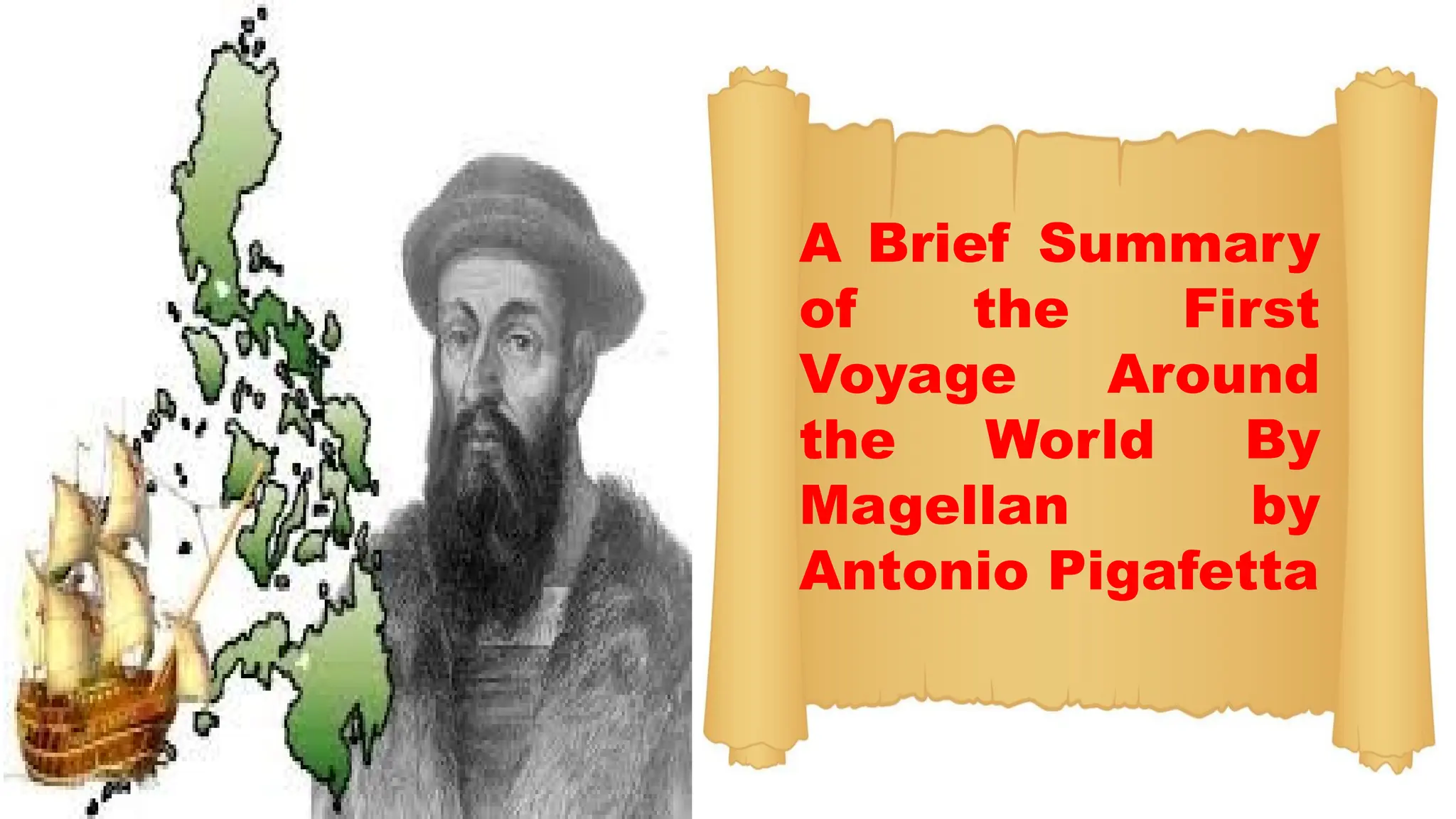
A Brief Summary of the
First Voyage Around the
world by Magellan by
Antonio Pigafetta
Historical sources
It is the historian’s primary tool of
understanding and interpreting the past.
It ascertain historical facts.
Facts are then analyzed and interpreted by
the historian.
Primary Source
Using primary source in historical
research entails two kinds of
criticism.
External Criticism- Authenticity of the
document or the evidence being used.
Internal Criticism- examine the
truthfulness of the content of the
evidence.
A Brief Summary
of the First
Voyage Around
the World By
Magellan by
Antonio Pigafetta
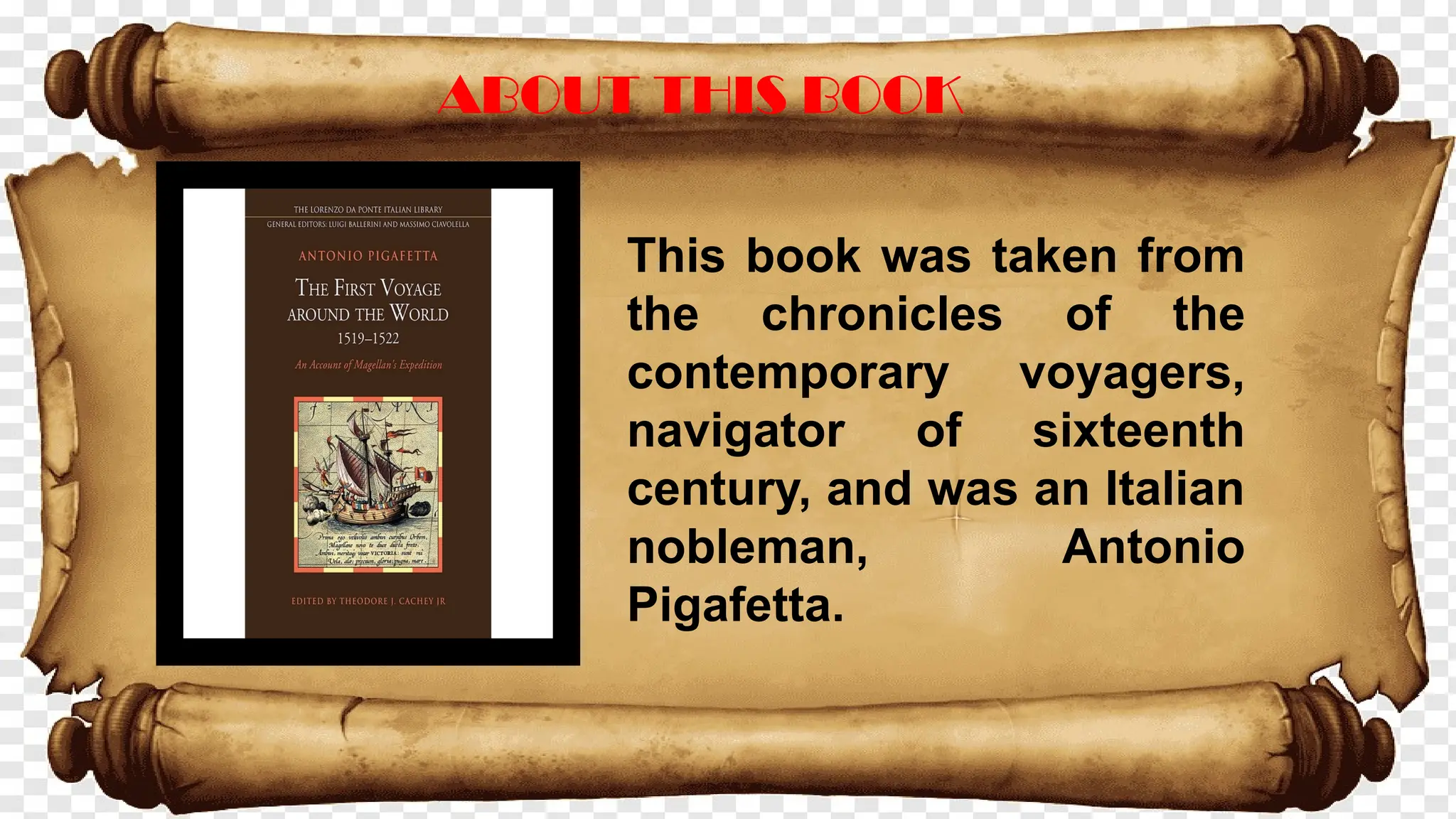
This book was taken from
the chronicles of the
contemporary voyagers,
navigator of sixteenth
century, and was an Italian
nobleman, Antonio
Pigafetta.
ABOUT THIS BOOK
ABOUT THIS BOOK
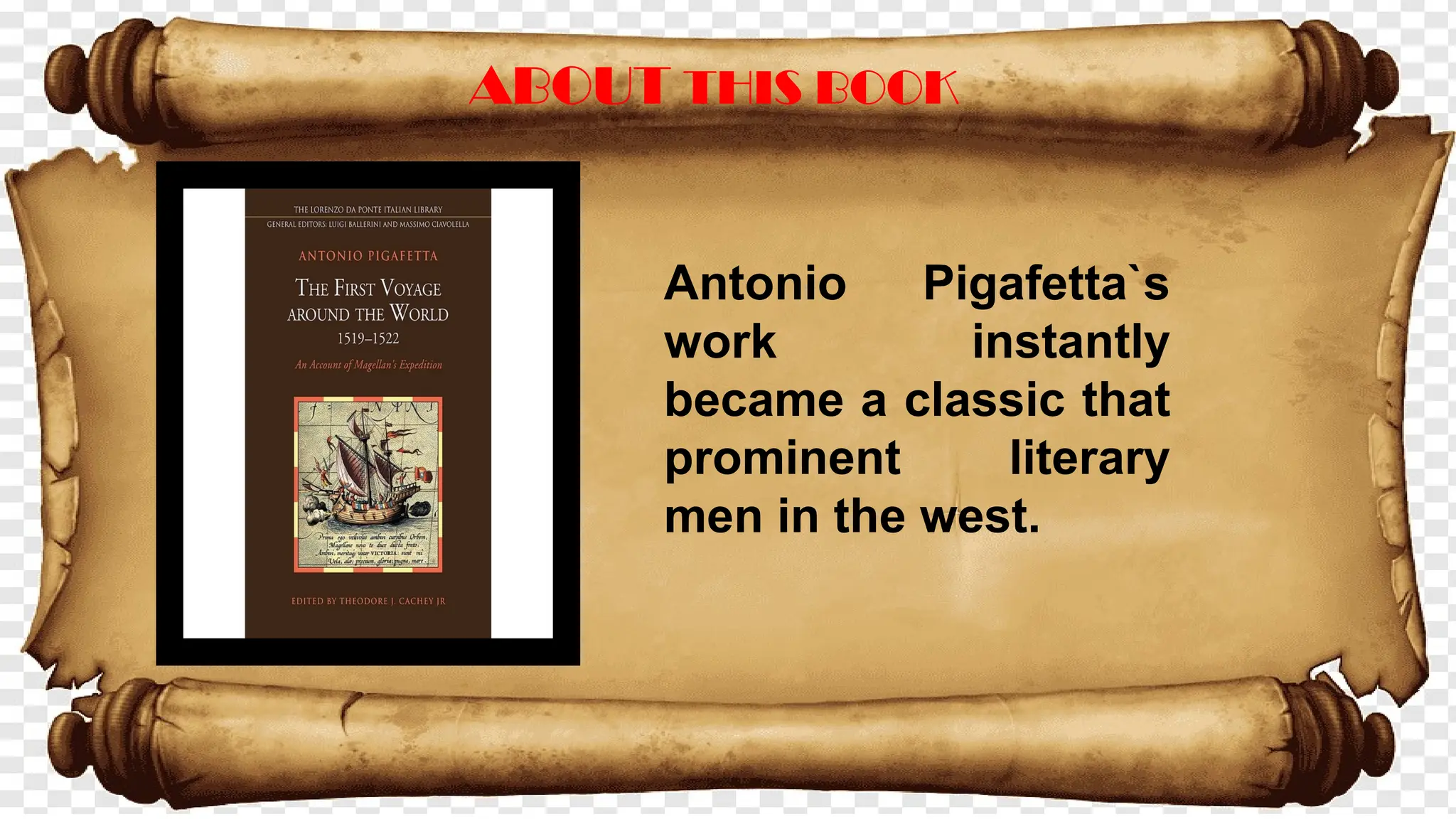
Antonio Pigafetta`s
work instantly
became a classic that
prominent literary
men in the west.
ABOUT THIS BOOK
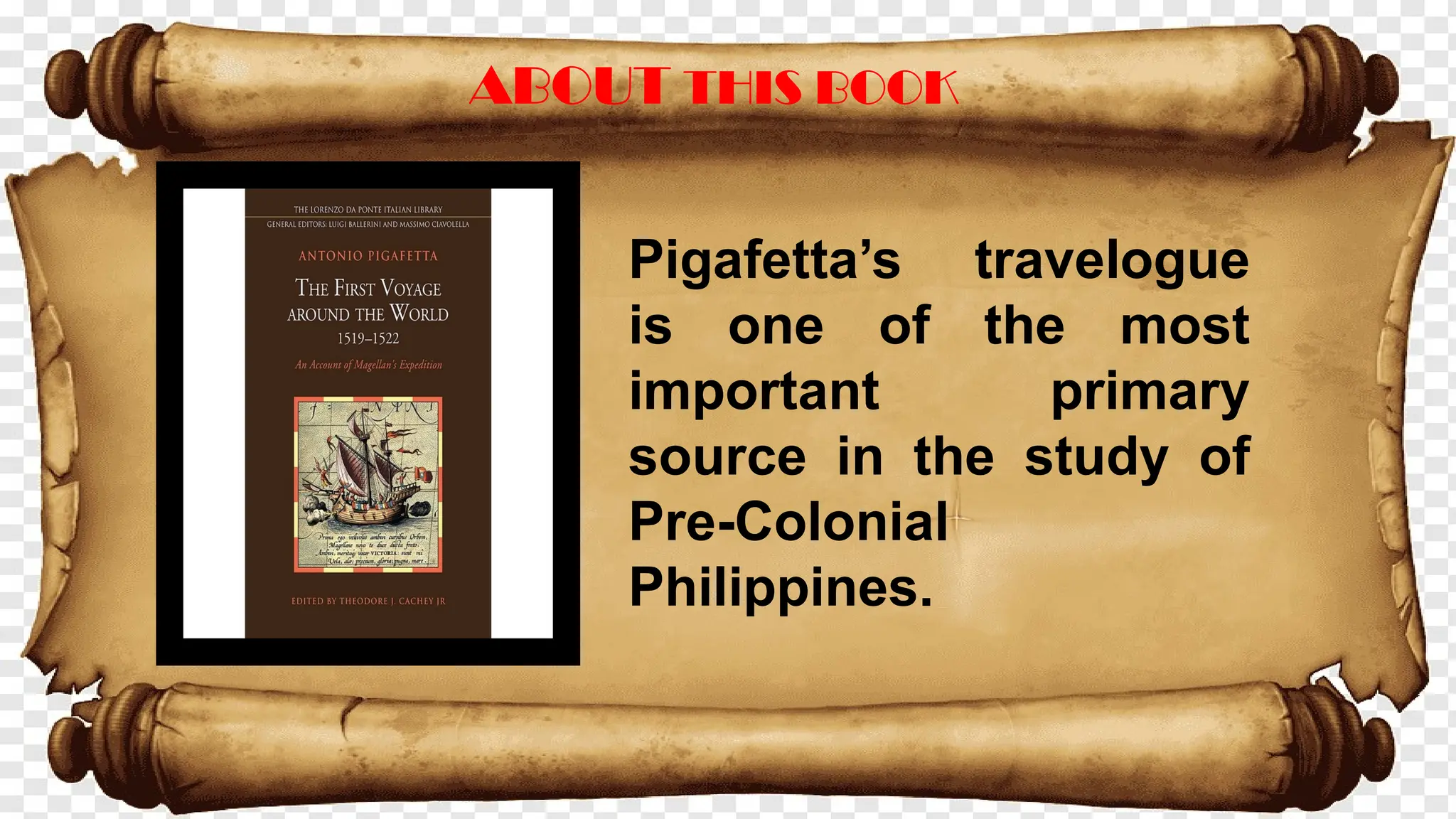
Pigafetta’s travelogue
is one of the most
important primary
source in the study of
Pre-Colonial
Philippines.
ABOUT THIS BOOK
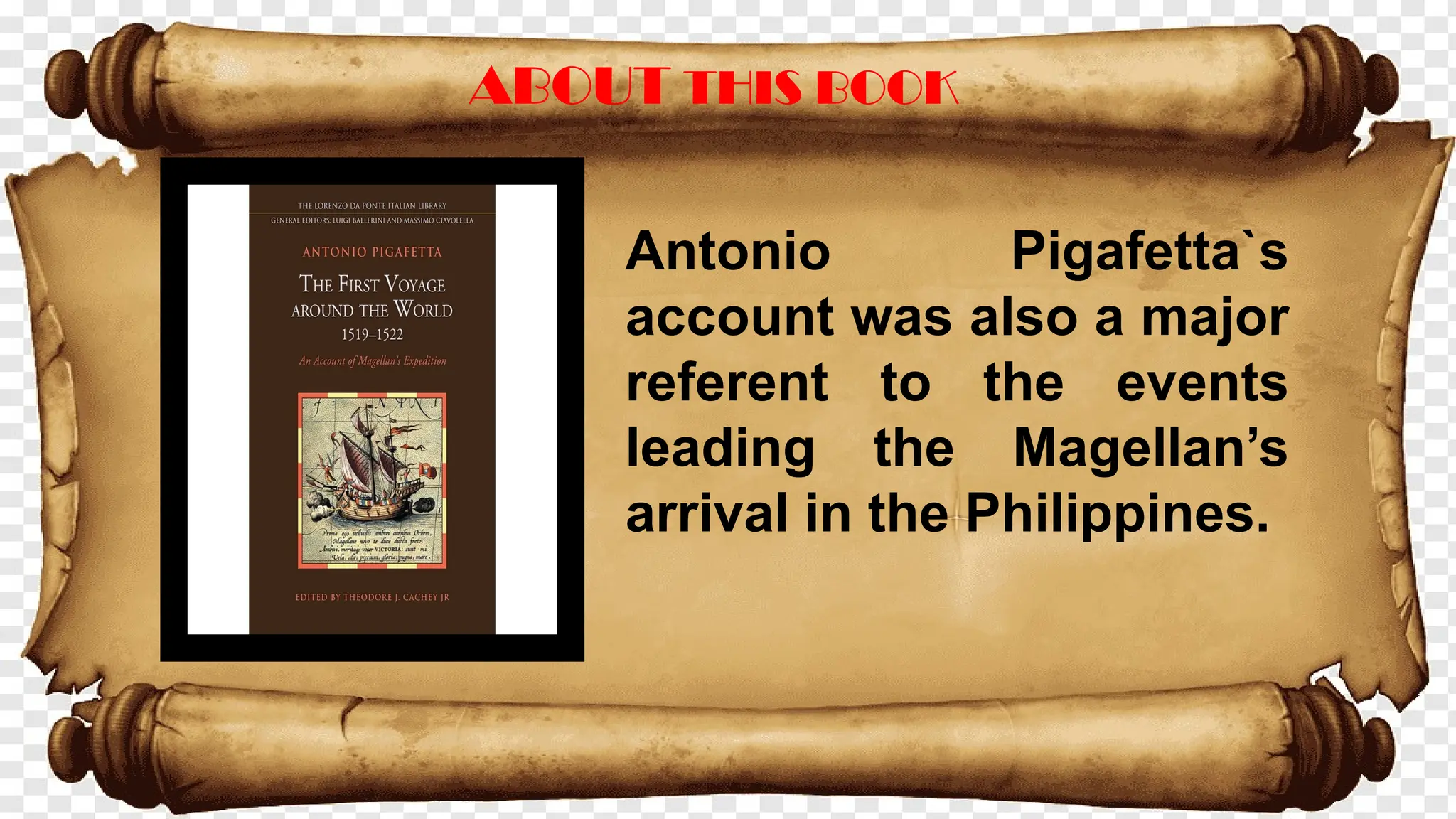
Antonio Pigafetta`s
account was also a major
referent to the events
leading the Magellan’s
arrival in the Philippines.
ABOUT THIS BOOK
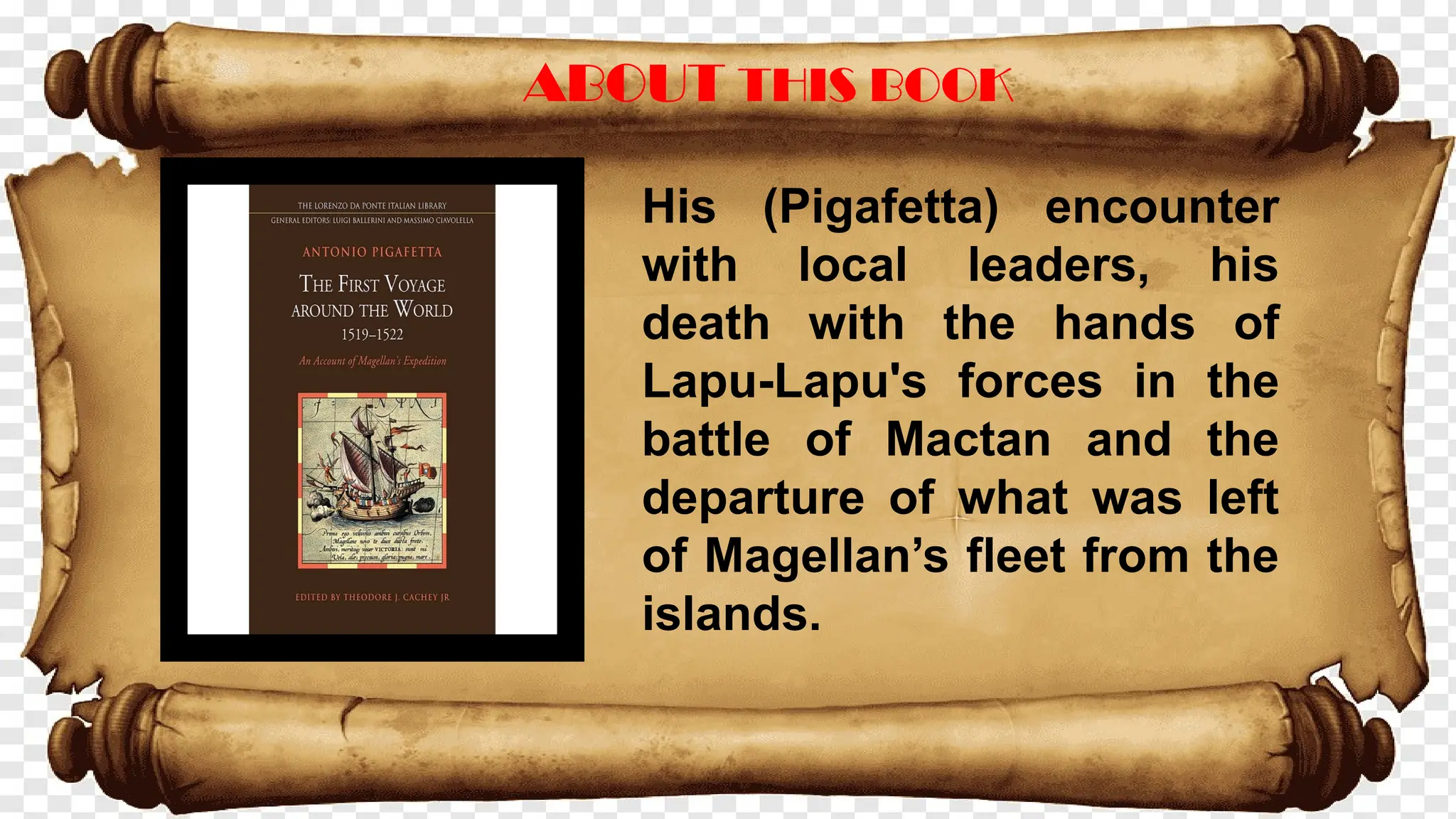
His (Pigafetta) encounter
with local leaders, his
death with the hands of
Lapu-Lapu's forces in the
battle of Mactan and the
departure of what was left
of Magellan’s fleet from the
islands.
ABOUT THIS BOOK
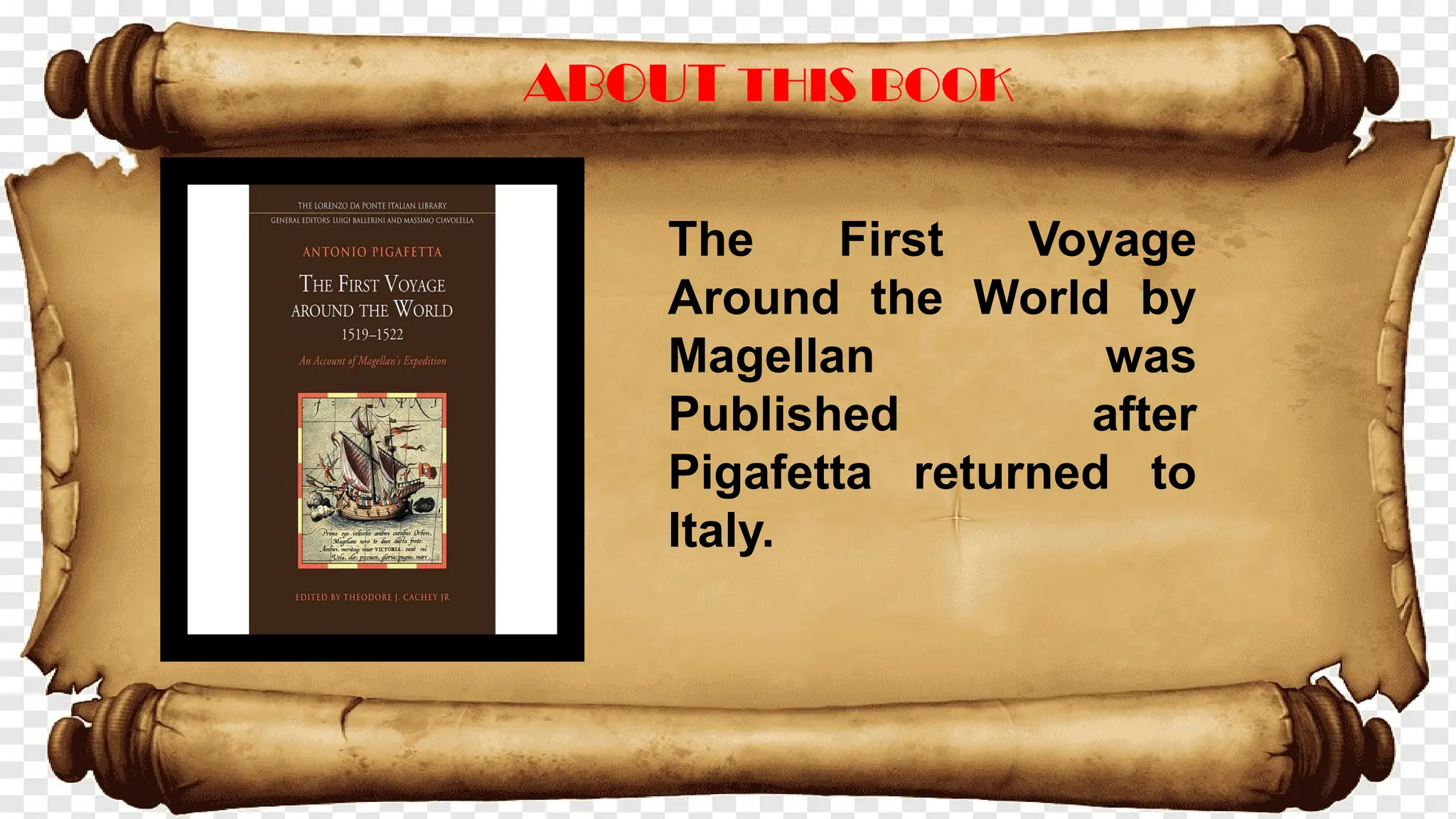
The First Voyage
Around the World by
Magellan was
Published after
Pigafetta returned to
Italy.
A Brief Summary of the First Voyage Around
the World By Magellan
by Antonio Pigafetta
What is Landrones
Islands or the Islands of
Thieves?
A Brief Summary of the First Voyage Around
the World By Magellan
by Antonio Pigafetta
 Landrones Islands is presently known as the
Marianas Islands.
o Located at south-southeast of Japan, west-
southwest of Hawaii, North of New Guinea and east
of Philippines.
o It is also called “Island of the Thieves”
A Brief Summary of the First Voyage Around
the World By Magellan
by Antonio Pigafetta
He recounted (Pigafetta) :
“ These people have no arms, but use sticks,
which have a fish bone at the end. They are
poor, but ingenious, and great thieves, and for
the sake of what we called these three islands
the Landrones Islands”
A Brief Summary of the First Voyage Around
the World By Magellan
by Antonio Pigafetta
Pigafetta reported that they reached what he
called the isle of Zamal, now Samar but
Magellan decided to land in another
uninhabited island for a greater security
where they could rest for a few days.
A Brief Summary of the First Voyage Around
the World By Magellan
by Antonio Pigafetta
Two days after
o Pigafetta recounted that nine (9) men came to
them and showed joy and eagerness in seeing
them.
o In turn, the natives also gave them fish, palm
wine (uraca), figs (fruit), two cochos, rice
(umai), cococs, and other food supplies
A Brief Summary of the First Voyage Around
the World By Magellan
by Antonio Pigafetta
“This palm tree produces a fruit named cocho,
which is as large as the head, or thereabouts: its
first husk is green, and two fingers in thickness,
in it they find certain threads, with which they
make the cords for fastening their boats.“
A Brief Summary of the First Voyage Around
the World By Magellan
by Antonio Pigafetta
 Pigafetta characterized the people a “very familiar
and friendly” and willing showed them different
islands and the names of these islands.
 Humunu Island (Homonhon) and there they
found what Pigafetta referred to as the “Watering
Place of Good Signs.”
 “ FIRST SIGNS OF GOLD IN THE ISLAND.”
A Brief Summary of the First Voyage Around
the World By Magellan
by Antonio Pigafetta
 They named the island (Humuno or Homonhon) with
the nearby island as the Archipelago of St. Lazarus.
 Pigafetta recounted that they saw two ballanghai
(balangay), a long boat full of people in
Mazzava/Mazaua.
 The leader, who referred to as the king of the
Ballanghai ( Balangay ), sent his men to the ship of
Magellan.
A Brief Summary of the First Voyage Around
the World By Magellan
by Antonio Pigafetta
When the King of the Balangay offered to give Magellan a bar of gold
and a chest of ginger, Magellan declined.
Magellan sent the interpreter to the king and asked for the money for
the needs of his ships and expressed that he came into the islands as
a friend and not as an enemy.
Magellan also boasted of his men in an armor who could not be struck
with swords and daggers
Magellan also shared with the king his charts and maps and shared
how they found the islands.
A Brief Summary of the First Voyage Around
the World By Magellan
by Antonio Pigafetta
 Magellan was introduced to the king`s brother (Raia Calambu) who
was also a king of another island
 The gold was abundant that parts of the ship and of the house of
the second king were made of gold.
 Pigafetta described this king as the most handsome of all the men
that he saw in this place.
 This King was named Raia Calambu, King of Zuluan and Calagan
(Butuan and Caragua).
 The first king was Raia Siagu.
A Brief Summary of the First Voyage Around
the World By Magellan
by Antonio Pigafetta
 On March 31, 1521, Which happened to be Easter
Sunday, Magellan ordered the chaplain to preside a Mass
by the Shore
“… When the offertory of the mass came, the two kings,
went to kiss the cross like us, but they offered nothing, and
at the elevation of the body of the Lord they were kneeling
like us, and adored our Lord with joined hands.”
A Brief Summary of the First Voyage Around
the World By Magellan
by Antonio Pigafetta
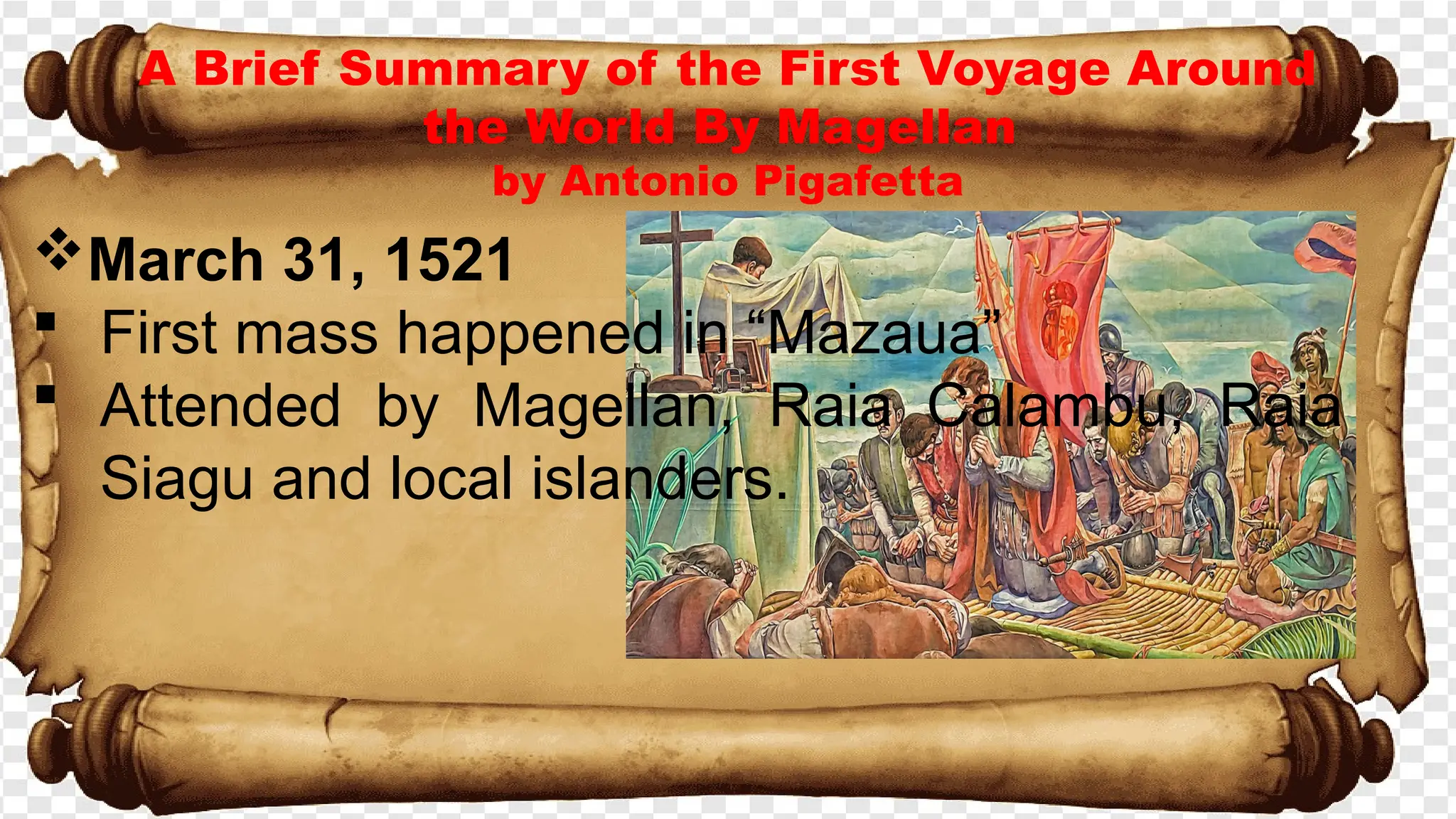
March 31, 1521
 First mass happened in “Mazaua”
 Attended by Magellan, Raia Calambu, Raia
Siagu and local islanders.
A Brief Summary of the First Voyage Around
the World By Magellan
by Antonio Pigafetta
 Magellan ordered that the cross be
brought with nails and crown in place.
 Cross, Nail, & Crown – were the signs of
his emperor (Magellan).
A Brief Summary of the First Voyage
Around the World By Magellan
by Antonio Pigafetta
April 7, 1521
Magellan went to Zubu(Cebu) and met
Rajah Humabon
the Rajah wanted Magellan and his men to
pay tribute to them but told his translator
Enrique, that they are working for King of
Spain and threatened him a war.
A Brief Summary of the First Voyage Around the World By Magellan
by Antonio Pigafetta
April 14, 1521
Held a mass on Humabon’s place where attended
by 800 locals
Magellan gave Hara Humamay an image of Sto.
Niño
Humabon became “Carlos” and Humamay became
“Juana
A Brief Summary of the First Voyage Around the World By Magellan
by Antonio Pigafetta
April 26, 1521
Rajah Zula told Magellan that Matan’s
(Mactan) chieftain Cilapulapu (Lapulapu)
refused to obey the King of Spain
Zula requested Magellan to send him only one
boat load of men to fight Cilapulapu but
Magellan.
A Brief Summary of the First Voyage Around the World By Magellan
by Antonio Pigafetta
April 27, 1521
Magellan arrived in Mactan
They numbered 49 in total and the
islanders of Mactan were estimated 1,500
in total.
The “ Battle of Mactan” happened
A Brief Summary of the First Voyage Around the World By Magellan
by Antonio Pigafetta
•Duarte Barbosa
• The new elected captain of Magellan’s men.
•Henry – Magellan’s slave who betrayed and told
the King of Cebu that they intended to leave as
quickly as possible.
•The natives had slain all men except the
interpreter and Juan Serrano in the gathering.
Serrano was presented and shouted in the
ship asking them to pay ransom to spare his
life but they refused, departed and
abandoned Serrano. They left Cebu and
continued their journey around the world.
A Brief Summary of the First Voyage Around the World By
Magellan
by Antonio Pigafetta
A Brief Summary of the First Voyage Around the World By
Magellan
by Antonio Pigafetta
Pigafetta’s work did of great
importance in the study and writing in
Philippine History
Pigafetta was able to give details of
geography and climate of the places
that their voyage has reached.
A Brief Summary of the First Voyage Around the World By Magellan
by Antonio Pigafetta
In reading Pigafetta’s description of the people, one has
to keep in mind that he was coming from sixteenth
century European Perspective.
He would always remarked on the nakedness of the
natives or how he was fascinated by their exotic culture.
It should be understood of such observations were
rooted from the context of Pigafetta and of his era.
A Brief Summary of the First Voyage Around the World By Magellan
by Antonio Pigafetta
Hence, other beliefs system different from that
of Christianity were perceived to be
blasphemous and Barbaric, even Demonic.
It was not surprising therefore that Pigafetta
would mention the abundance of Gold in the
island as shown in his description of leaders
wearing gold rings and gold daggers, and of the
rich gold minds.
What we’ll discuss?
THE KKK AND THE
“KARTILYA NG
KATIPUNAN”
THE KKK AND THE “KARTILYA NG KATIPUNAN”
•Kataastaasan, Kagalanggalangang Katipunan ng
mga Anak ng Bayan (KKK) or Katipunan
ois arguably the most important organization formed
in the Philippine history. It was only this
organization that envisioned.
oUnited Filipino nation that would revolt against Spaniards
for
oTotal Independence of the country from spain.
• Diego Silang
• An Ilocano who took up his arms and led one of the longest
running revolts in the country. He was mainly concerned
about his locality and referred to himself as El Rey de Ilocos
(The King of Ilocos)
• Propaganda Movement
• Led by Ilustrados like Marcelo H. del Pilar, Graciano Lopez
Jaena and Jose Rizal
• The only demanded equal rights, representation, and
protection from the abuses of the friars but did not
envisioned a total separation of the Philippines from Spain.
THE KKK AND THE “KARTILYA NG KATIPUNAN”
KARTILYA NG KATIPUNAN
Kartilya ng Katipunan
 the original title was “Manga (sic) Aral Nang (Sic) Katipunan ng
nga A.N.B” or “Lessons of the Organization of the Sons of the
country.”
The document was written by Emilio Jacinto in the 1896.
Emilio Jacinto
Was only 18 years old when he joined the movement. He was
also a law student at the Universidad de Santo Tomas. He became
the secretary of the organization and took charge of the short-
lived printing press of the Katipunan. (wrote the Kartilya)
Andres Bonifacio
recognized the value of intellect of Jacinto. He willingly favored that the Kartilya be
disturbed to their fellow Katipuneros. (Wrote the Decalogue)
April 15, 1897
Bonifacio appointed Jacinto as a commander of the Katipunan in Northern
Luzon. Jacinto was 22 years old. He died of Malaria at a young age of 24 in the
town of Magdalena, Laguna.
Kartilya
 Treated as the Katipunan’s Code of Conduct. It contains 14 rules that instruct
the way a Katipunero should behave and which specific values should uphold.
First group: contains the rules that will make a member an upright
individual
Second group: rules that will guide the way he treats his fellowmen.
KARTILYA NG KATIPUNAN
What we’ll discuss:
KARTILYA CODE OF
COUNDUCT
KARTILYA CODE OF COUNDUCT
• The life that is not consecrated to a lofty and reasonable
purpose is a tree without a shade, if not a poisonous weed.
• To do good for personal gain and not for it’s own sake is not
virtue
• It is rational to be charitable and love one’s fellow creature,
and to adjust one’s conduct, acts and words to what is in itself
reasonable.
• Whether our skin be black or white, we are all born equal;
superiority in knowledge, wealth and beauty are to be
understood, but not superiority by nature.
• The honorable man, his word is sacred.
• Do not waste the thy time: wealth can be recovered but not time lost.
• Defend the oppressed and fight the oppressor before the law or in
the field.
• The prudent man is sparing in words and faithful in keeping secrets.
• On the thorny path of life, man is the guide of woman and the
children, and if the guide leads to the precipice, those whom he
guides will also go there.
• Thou must not look upon woman as a mere plaything, but as a
faithful companion who will share with thee the penalties of life; her
(physical) weakness will increase thy interest in her and she will
remind thee of the mother who bore thee and reared thee.
KARTILYA CODE OF COUNDUCT
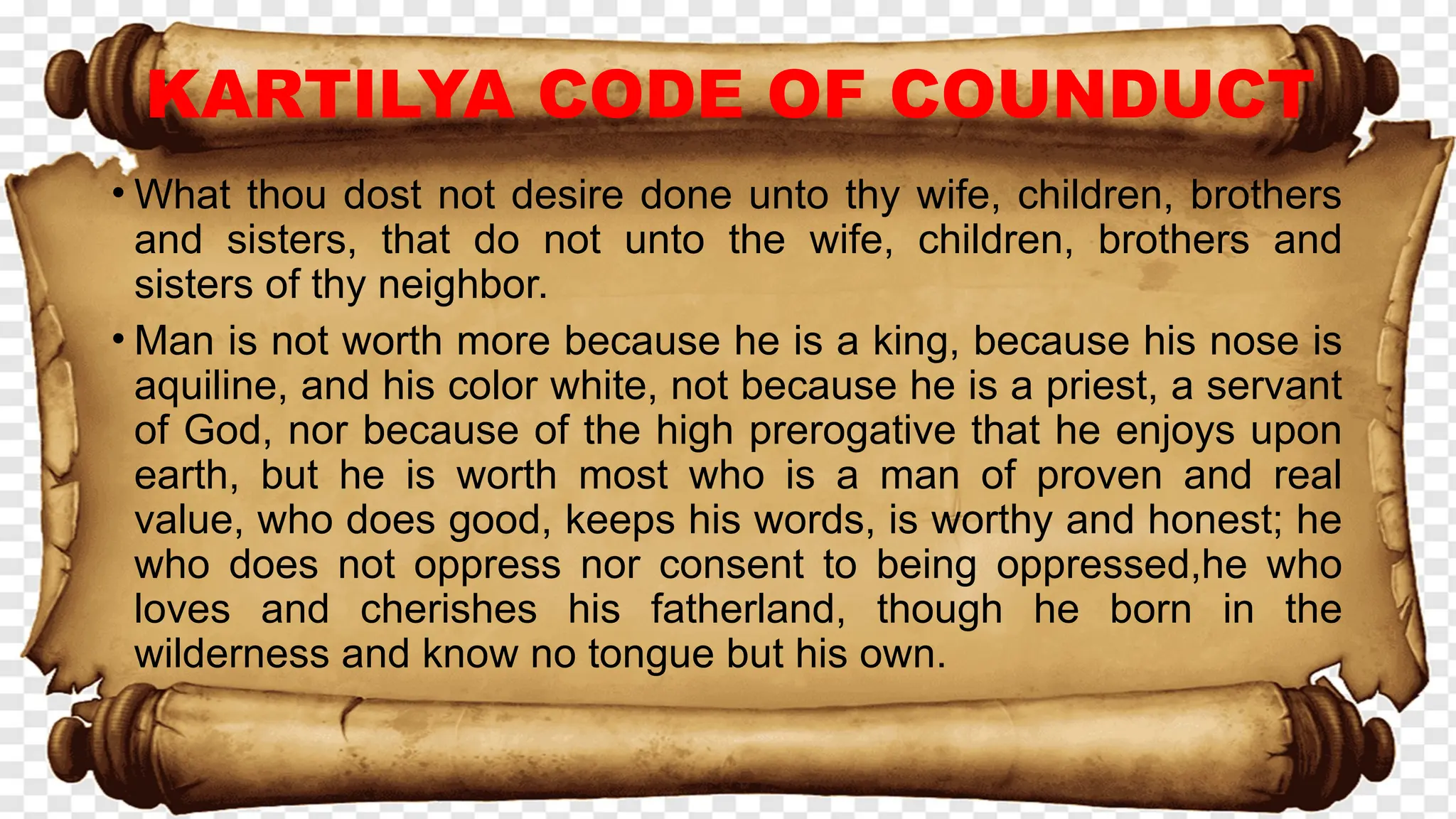
• What thou dost not desire done unto thy wife, children, brothers
and sisters, that do not unto the wife, children, brothers and
sisters of thy neighbor.
• Man is not worth more because he is a king, because his nose is
aquiline, and his color white, not because he is a priest, a servant
of God, nor because of the high prerogative that he enjoys upon
earth, but he is worth most who is a man of proven and real
value, who does good, keeps his words, is worthy and honest; he
who does not oppress nor consent to being oppressed,he who
loves and cherishes his fatherland, though he born in the
wilderness and know no tongue but his own.
KARTILYA CODE OF COUNDUCT
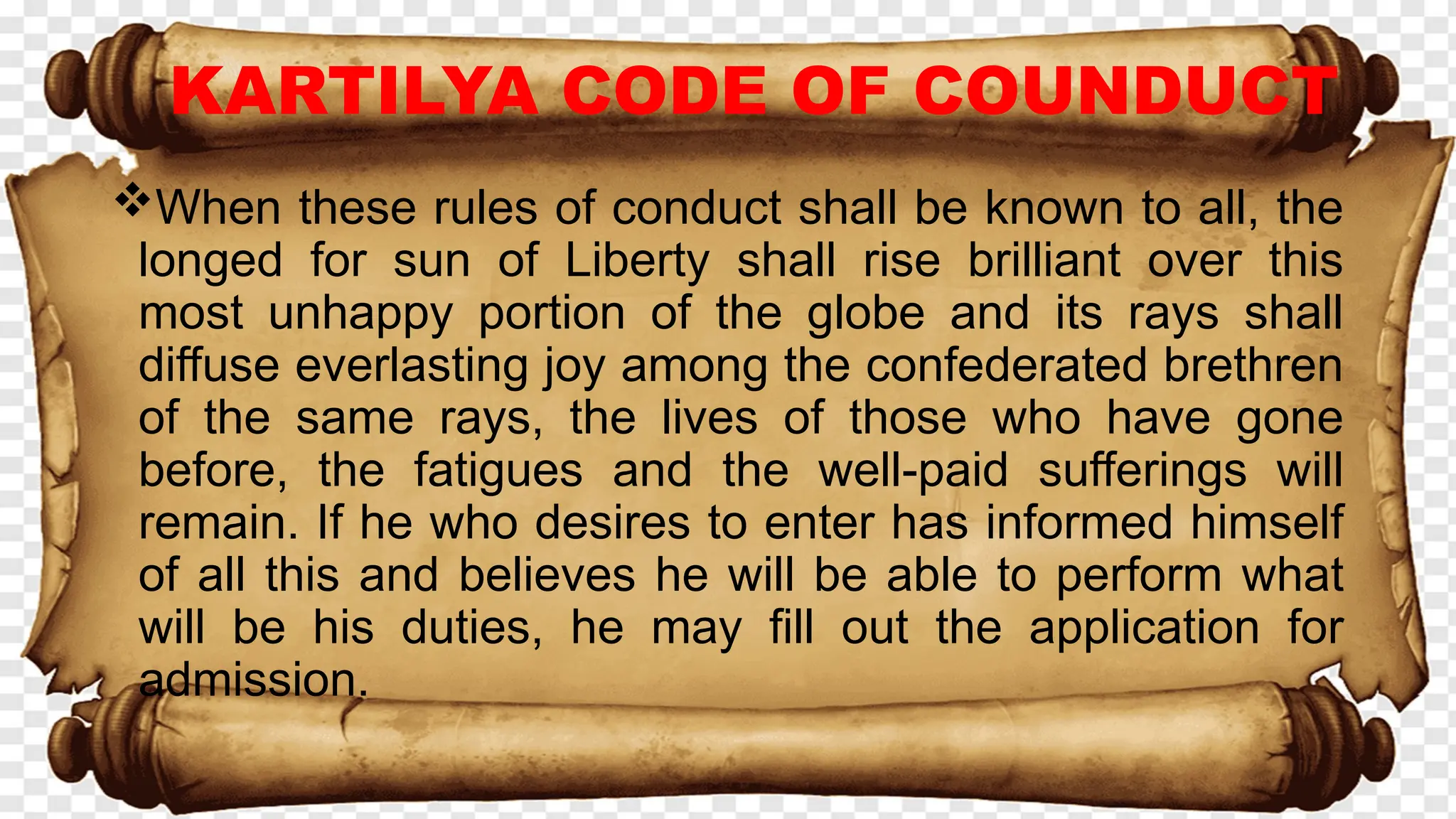
When these rules of conduct shall be known to all, the
longed for sun of Liberty shall rise brilliant over this
most unhappy portion of the globe and its rays shall
diffuse everlasting joy among the confederated brethren
of the same rays, the lives of those who have gone
before, the fatigues and the well-paid sufferings will
remain. If he who desires to enter has informed himself
of all this and believes he will be able to perform what
will be his duties, he may fill out the application for
admission.
ANALYSIS OF THE
KARTILYA NG
KATIPUNAN
What we’ll discuss:
Analysis of the KARTILYA NG
KATIPUNAN
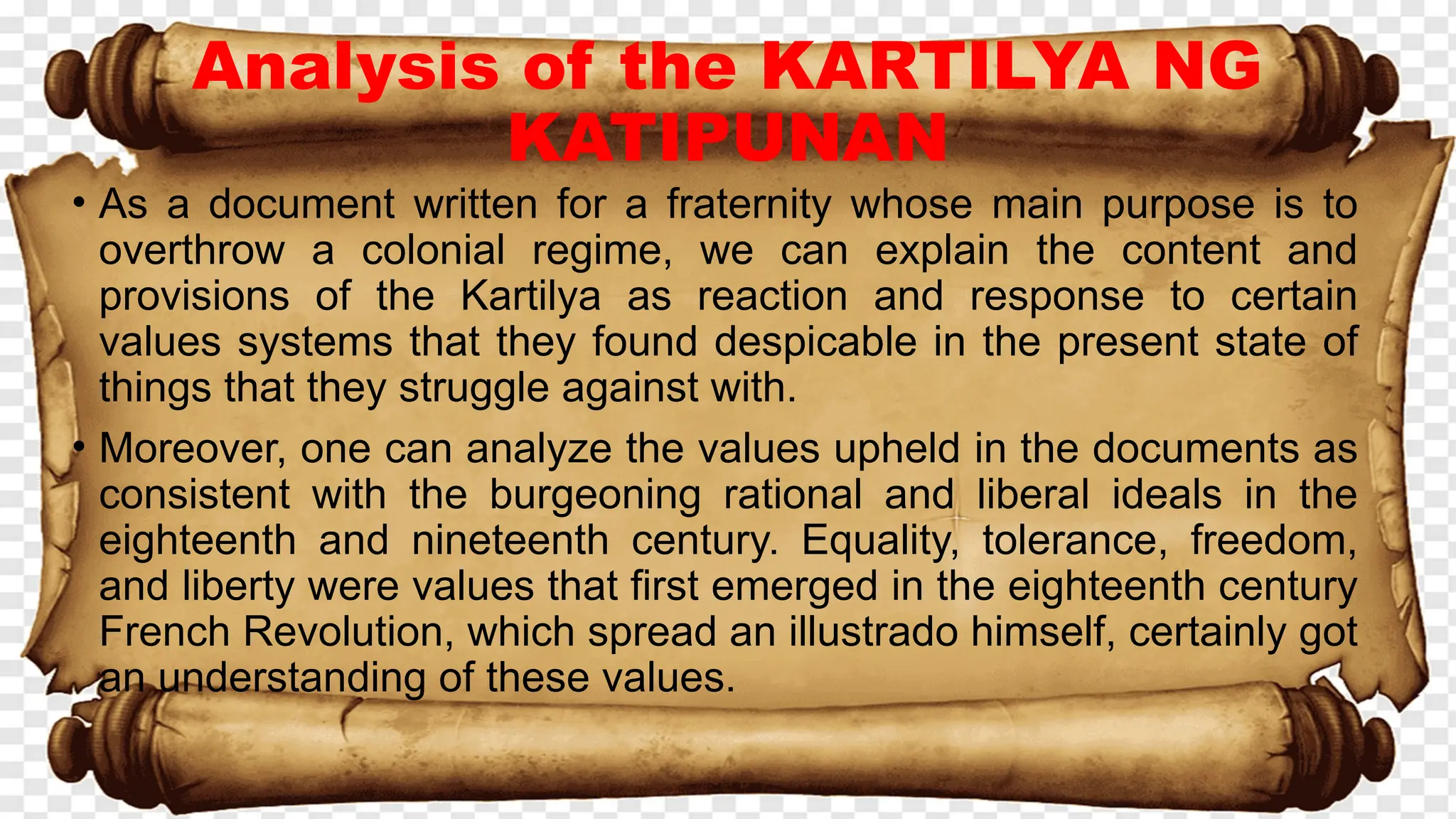
• As a document written for a fraternity whose main purpose is to
overthrow a colonial regime, we can explain the content and
provisions of the Kartilya as reaction and response to certain
values systems that they found despicable in the present state of
things that they struggle against with.
• Moreover, one can analyze the values upheld in the documents as
consistent with the burgeoning rational and liberal ideals in the
eighteenth and nineteenth century. Equality, tolerance, freedom,
and liberty were values that first emerged in the eighteenth century
French Revolution, which spread an illustrado himself, certainly got
an understanding of these values.
Analysis of the KARTILYA NG KATIPUNAN
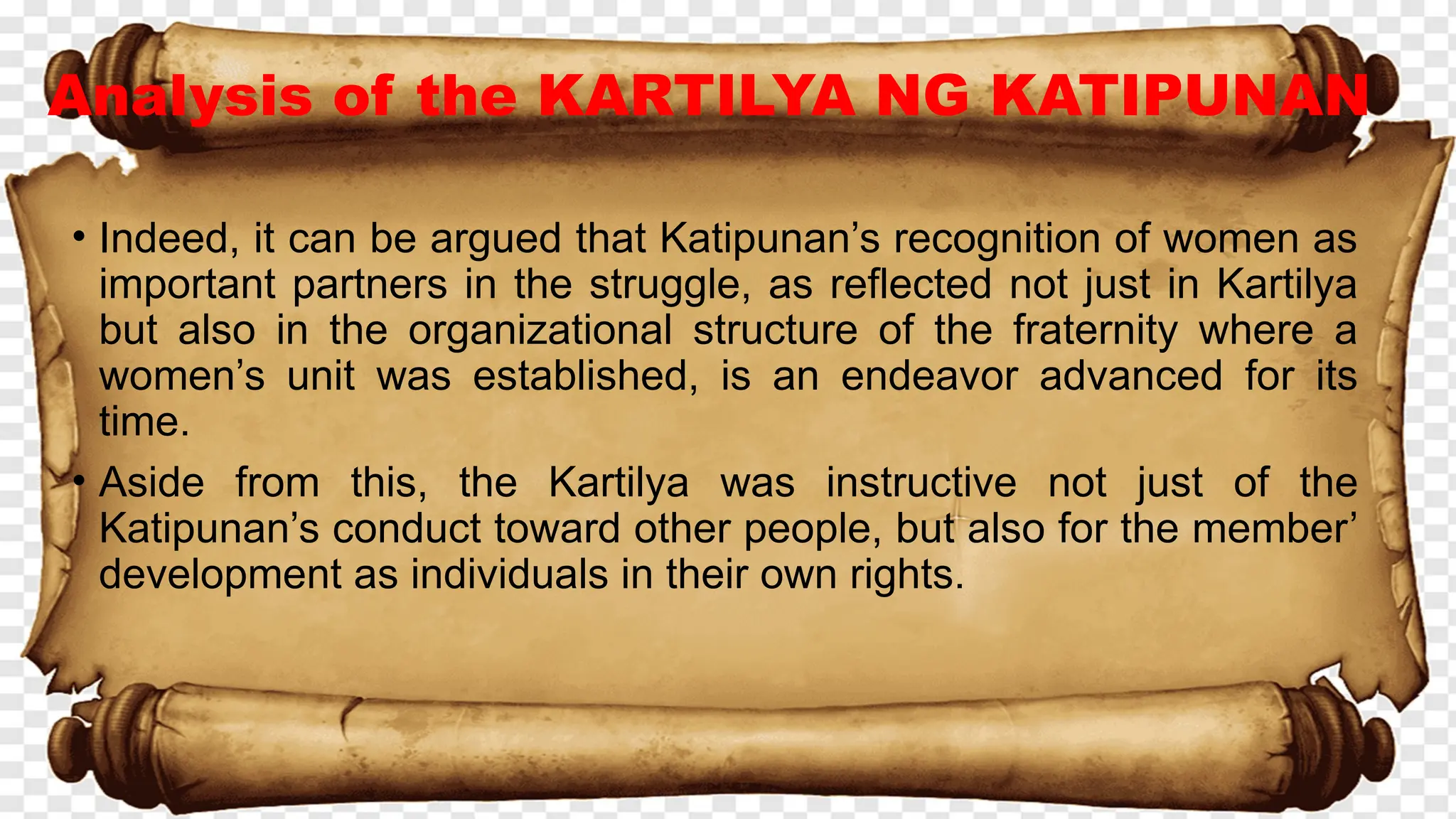
• Indeed, it can be argued that Katipunan’s recognition of women as
important partners in the struggle, as reflected not just in Kartilya
but also in the organizational structure of the fraternity where a
women’s unit was established, is an endeavor advanced for its
time.
• Aside from this, the Kartilya was instructive not just of the
Katipunan’s conduct toward other people, but also for the member’
development as individuals in their own rights.
Analysis of the KARTILYA NG
KATIPUNAN
•Kartilya repeatedly emphasized the importance of
honor in words and in action. The teaching of the
katipunan on how women should be treated with
honor and respect, while positive in many respect
and certainly significant stride from the practice of
raping and physically abusing women, can still be
telling of the Katipunan’s secondary regard for
women in relation to men.
Analysis of the KARTILYA NG KATIPUNAN
• All in all, proper reading of Kartilya will reveal a more thourogh
understanding of the Katipunan and the significant role that it
played in the revolution and in the unfolding of the Philippine
history, as we know it.
Reading the
Proclamation
of the Philippine
independence
What we’ll discuss:
Reading the Proclamation of the Philippine
independence
• Every year, the country commemorates the anniversary of the
Philippine Independence proclaimed on June 12, 1989, in the
province of Cavite.
• This event signaled the end of 333 years the Spanish
colonization.
It tells of the kind of government that as created under General
Emilio Aguinaldo.
 The declaration was a short 2,000-word document.
•Some Abuses during the Spanish Regime
- Arbitrary Arrest;
- Harsh Treatment
- Killing of Prisoners under the pretext that they
were attempting to escape
- Unjust deportations; and
- Absence of due process.
Reading the Proclamation of the
Philippine independence
• Justification Behind the revolution against Spain
- Abuses of the Civil Guard
- Unequal protection of the law
- Avarice and greed of the clergy
- Unjust deportations without proper hearing
Reading the Proclamation of the Philippine
independence
Reading the Proclamation of the Philippine independence
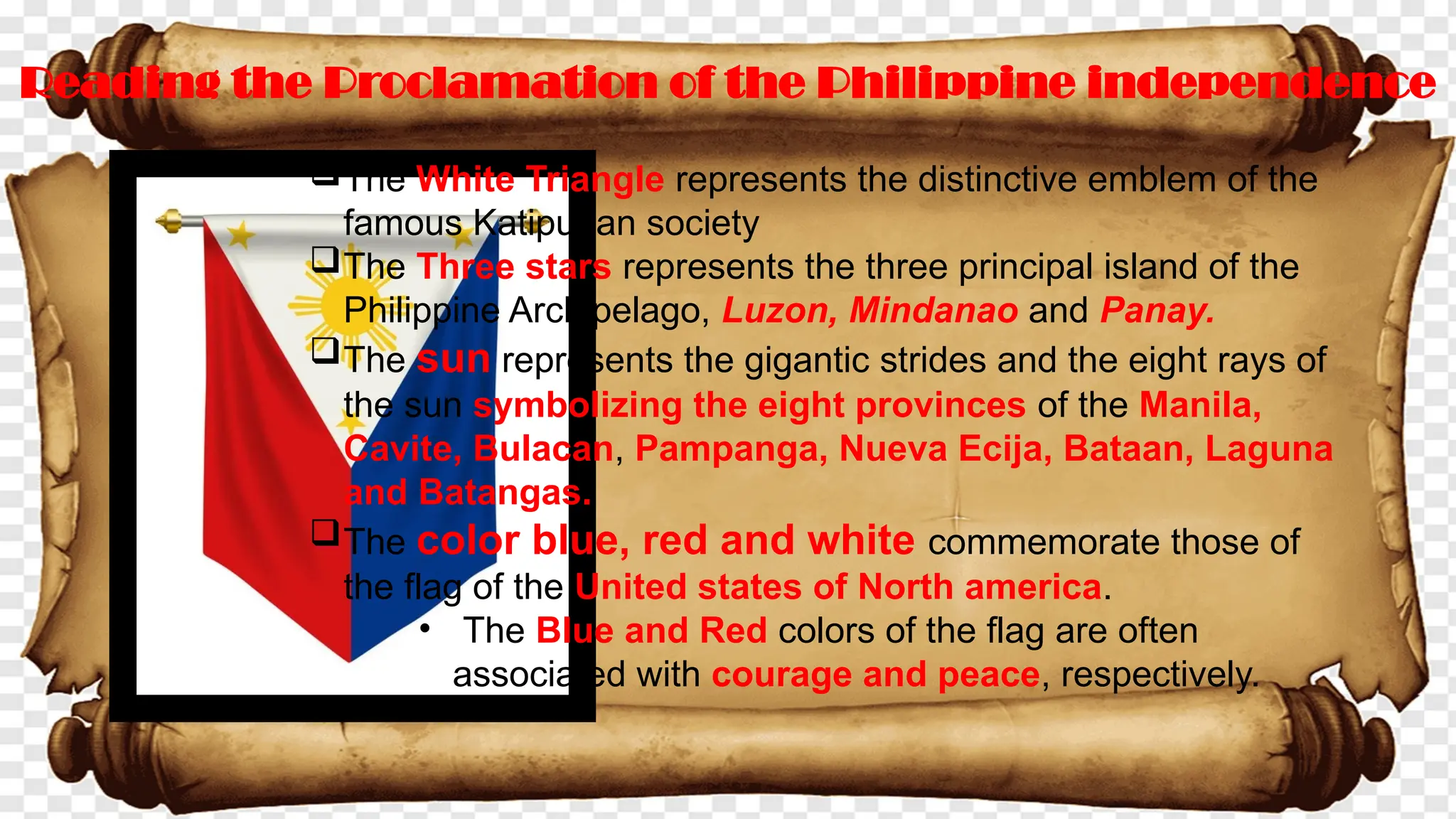
The White Triangle represents the distinctive emblem of the
famous Katipunan society
The Three stars represents the three principal island of the
Philippine Archipelago, Luzon, Mindanao and Panay.
The sun represents the gigantic strides and the eight rays of
the sun symbolizing the eight provinces of the Manila,
Cavite, Bulacan, Pampanga, Nueva Ecija, Bataan, Laguna
and Batangas.
The color blue, red and white commemorate those of
the flag of the United states of North america.
• The Blue and Red colors of the flag are often
associated with courage and peace, respectively.
•While it can always be argued that symbolic
meaning of something presents us several
historical truths that can explain the
subsequent events, which unfolded after the
declaration of independence of the 12th
day of
June 1898.
Reading the Proclamation of the Philippine
independence
Analysis of the “Reading the
Proclamation of the Philippine
independence”.
What we’ll discuss:
• The documents reveals some often-overlooked historical truths
about this important event in Philippine History.
• The documents reflects the general revolutionary sentiment of that
period.
• However, no mention was made about the more serious problem
that affected the masses more profoundly, that is, the land and
agrarian crisis felt by the numerous Filipino peasants in the
nineteenth century.
• This agrarian aspects of the revolution must have been unfamiliar
to the middle-class revolutionary leaders or were intentionally left
out because they were land holders themselves.
Analysis of the “Reading the Proclamation of the
Philippine independence’
• The tasks of the historian, thus is to analyze the content of these
documents in relation to the dominant politics and the contexts of
the people and institutions surrounding it.
July 4 1946 – The united states of America granted that the
independence of the Philippines.
May 12, 1962 – President Diosdado Macapagal issue the
Presidential proclamation no. 28, which declared June 12 a special
public holiday throughout the Philippines.
The Philippine Flag was made in Hong Kong by Mrs. Marcela
Agoncillo.
Analysis of the “Reading the Proclamation of
the Philippine independence”
 A Glance at selected
Philippine Political Caricature
in Alfred McCoy’s Philippine
Cartoons: Political Caricature
of the American Era ( 1900 –
1941)
What we’ll discuss?
• ALFRED W. MCCOY
 He spent the past quarter of his life writing about the politics and
history of the opium trade.
Awards Eaned:
 Philippine Catholic Mass Media Award, Best book of the Year
for 1985.
Philippine National book Award for History, 1986.
Gintong Aklat Award (Manila) Special citation for History, 1987.
A Glance at selected philippine Political Caricature in Alfred McCoy’s
Philippine Cartoons: Political Caricature of the American Era ( 1900 – 1941)
• What is Political Cartoons and Caricature?
It is an art form which veered away from the classical art
by exaggerating human features and poking fun at its
subject.
Art of genre and technique became part of the print
media as a form of social and political commentary,
which usually target persons of power and authority.
Cartoons became as effective tool of publicizing
opinions through heavy use of symbolism, which is
different from a verbose written editorial and opinion
pieces.
A Glance at selected philippine Political Caricature in
Alfred McCoy’s Philippine Cartoons: Political Caricature
of the American Era ( 1900 – 1941)
•Commentaries in mass media inevitably shape
public opinion and such kind of opinion is worhty of
historical examination.
•In his book Philippine Cartoons: Political Cartoon of
the America Era (1900-1941), Alfred McCoy,
together with Alfredo Roces, compiled political
cartoons published in newspaper dailies and
periodicals in the time.
A Glance at selected philippine Political Caricature in Alfred
McCoy’s Philippine Cartoons: Political Caricature of the
American Era ( 1900 – 1941)
A Glance at selected philippine Political Caricature in Alfred
McCoy’s Philippine Cartoons: Political Caricature of the
American Era ( 1900 – 1941)
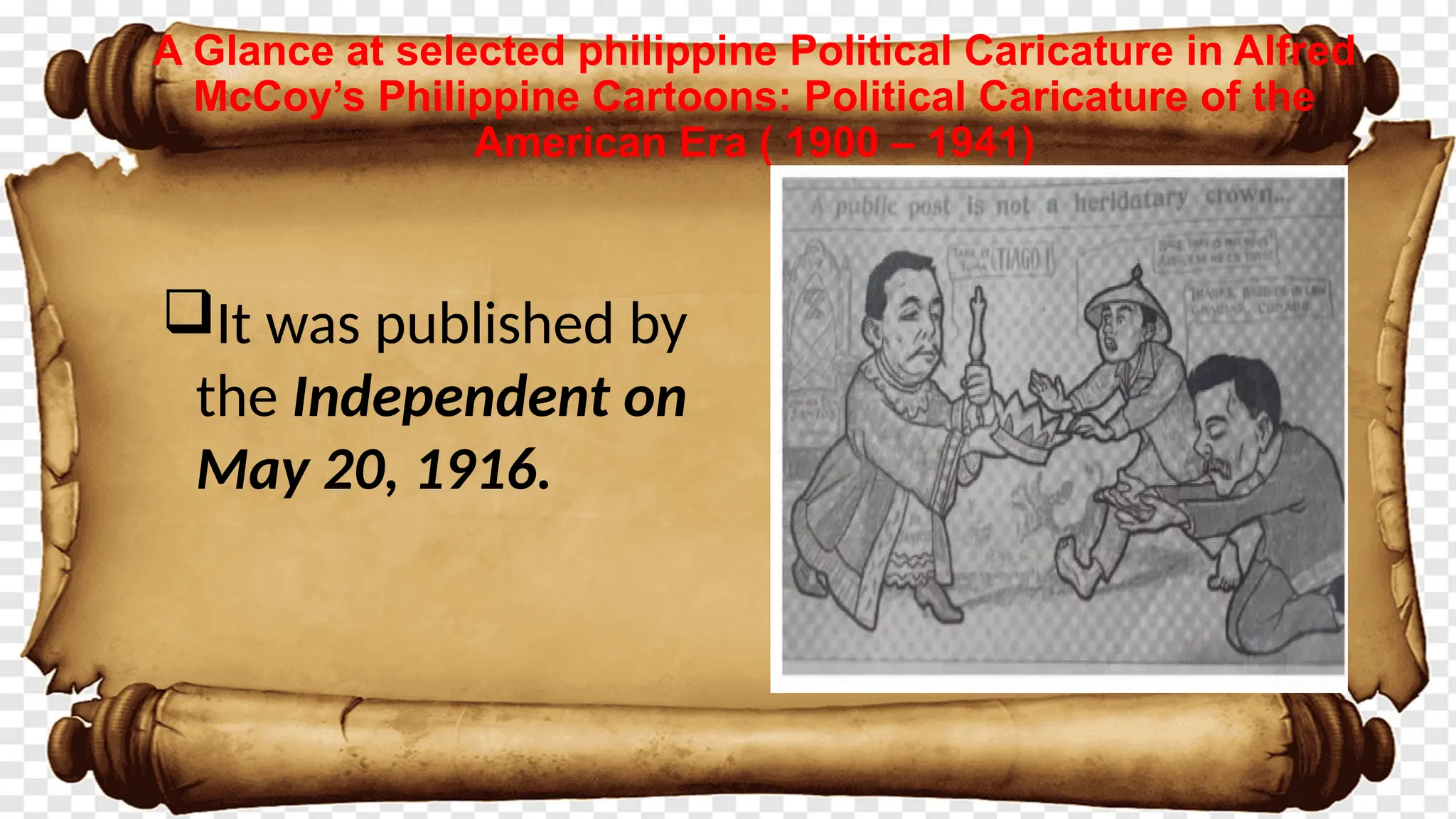
It was published by
the Independent on
May 20, 1916.
A Glance at selected philippine Political Caricature in Alfred
McCoy’s Philippine Cartoons: Political Caricature of the
American Era ( 1900 – 1941)
It was also
published by the
Independent on
June 16, 1917.
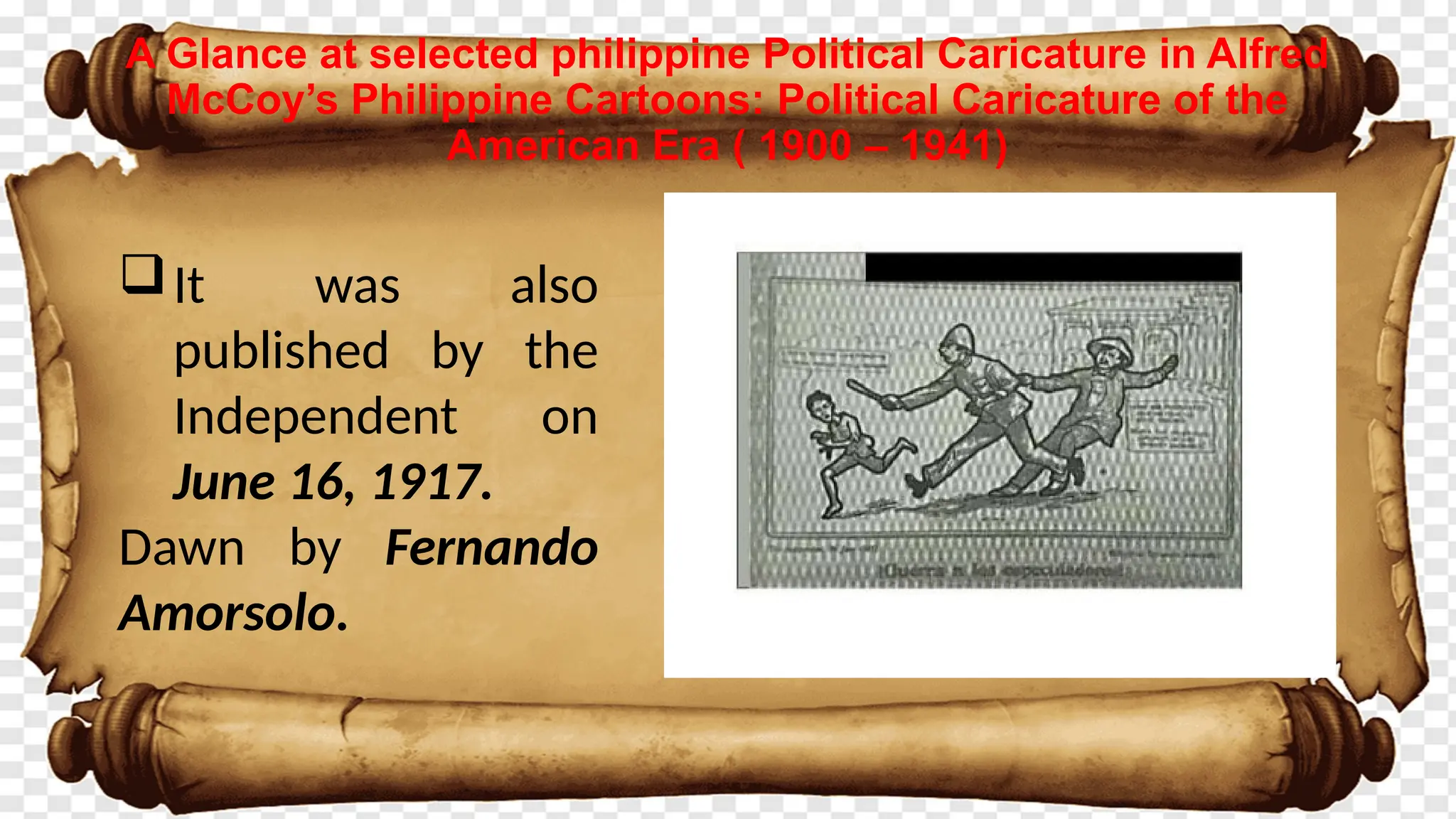
Dawn by Fernando
Amorsolo.
A Glance at selected philippine Political Caricature in Alfred
McCoy’s Philippine Cartoons: Political Caricature of the
American Era ( 1900 – 1941)
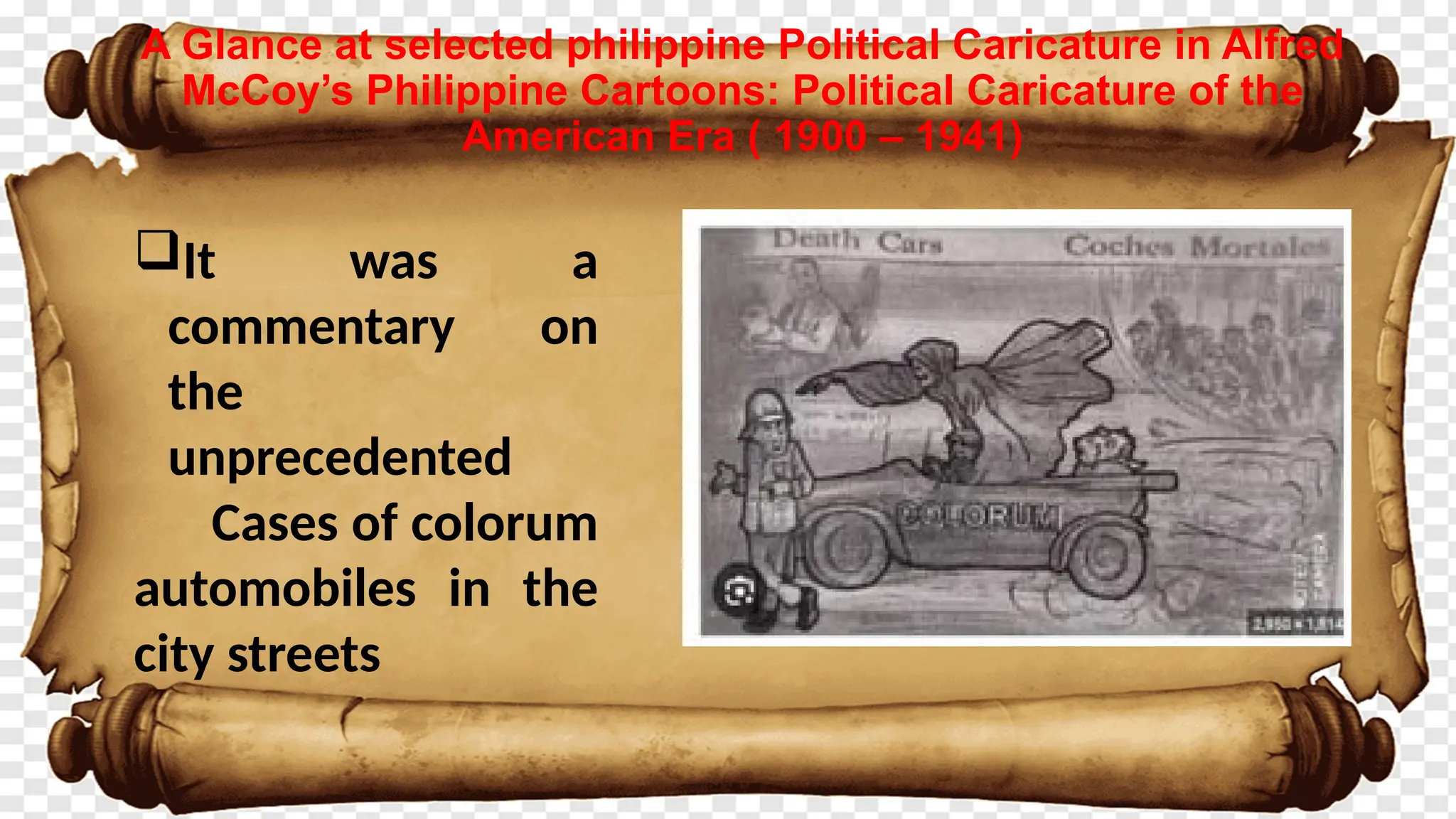
It was a
commentary on
the
unprecedented
Cases of colorum
automobiles in the
city streets
Analysis of the
Political Caricature
during the American
period.
What we’ll discuss:
The transition from spanish colonial period to the American
Occupation period demonstrated different strands of changes
and shift in culture, society, and politics.
The American drastically introduced democracy to the
nascent nation and the consequences were far from ideal.
Aside from this, it was also during the American period that
Filipino were introduced to different manifestations of
modernity like health care, modern transportation, and media.
Analysis of the Political Caricature during the
American period.
The post-indpendence and the post-Filipino-
American period in the Philippines were
experienced differently by filipinos coming from
different classes.
The upper principalia class experienced economic
prosperity with the opening up for the Philippine
economy to the united States but the majority of the
poor Filipino remained poor, desperate, victims of
state repression.
Analysis of the Political Caricature during the
American period.
Analysis of the “Reading the Proclamation of the
Philippine independence’
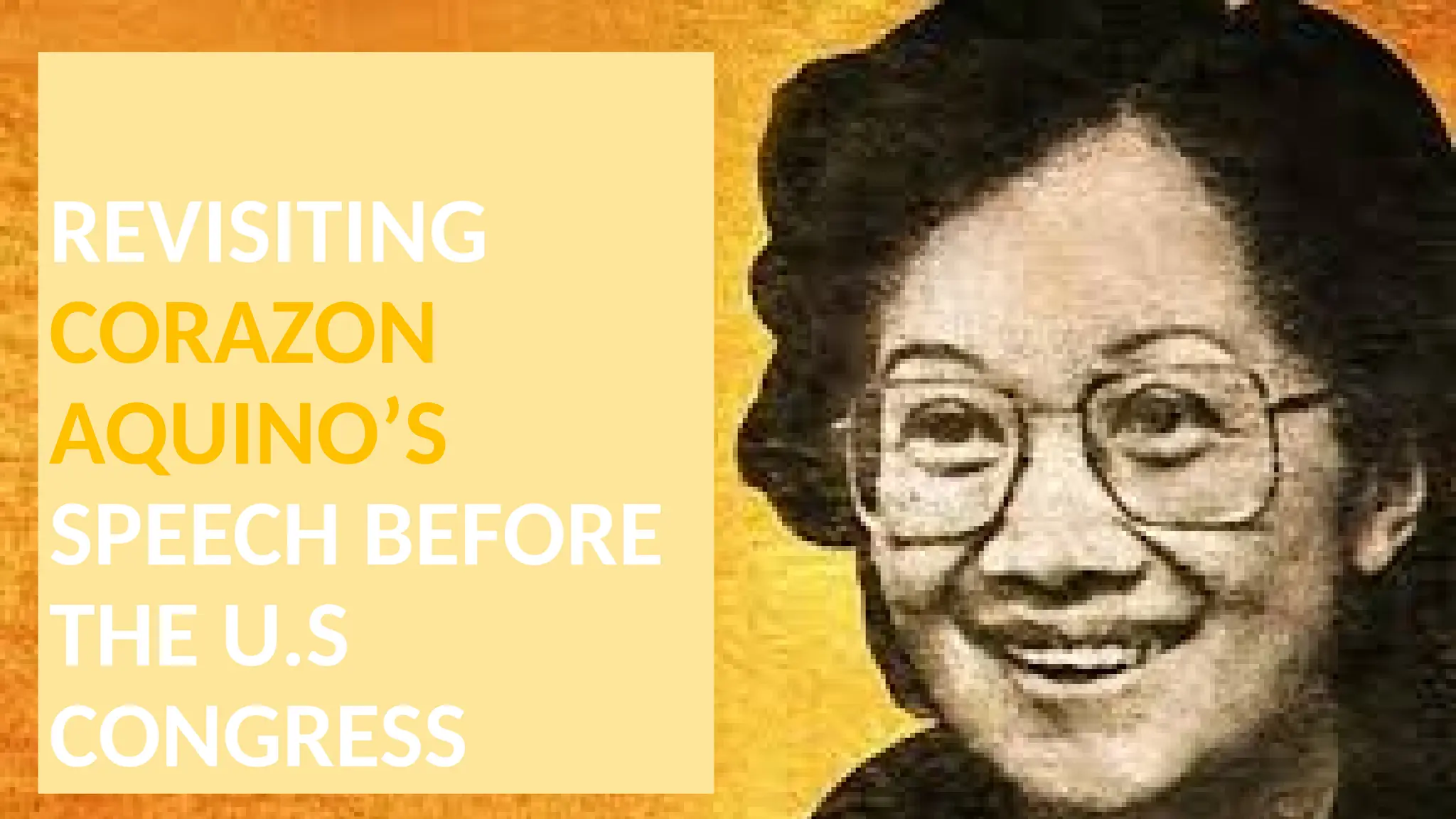
REVISITING
CORAZON
AQUINO’S
SPEECH BEFORE
THE U.S
CONGRESS
70
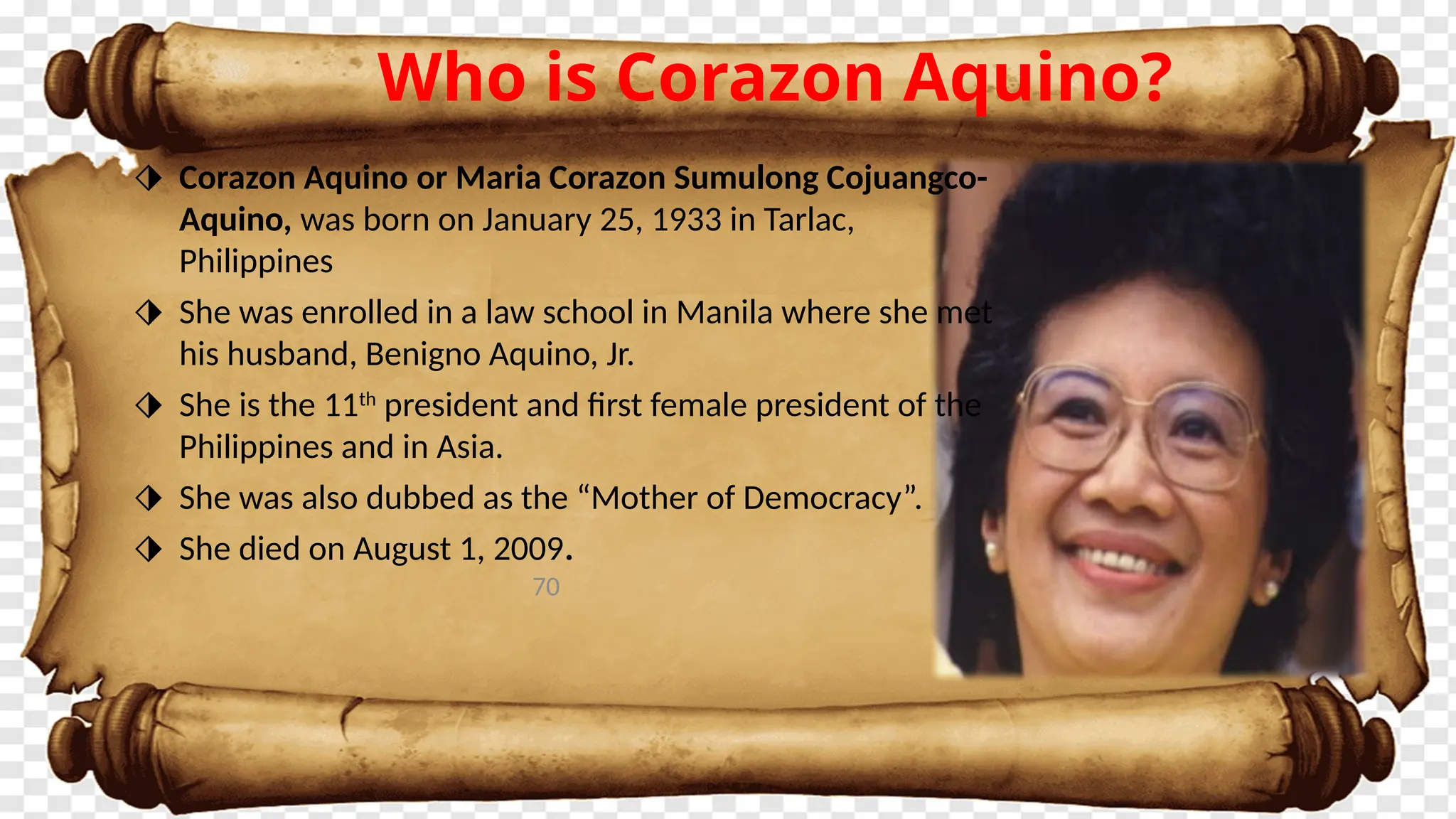
Who is Corazon Aquino?
⬗ Corazon Aquino or Maria Corazon Sumulong Cojuangco-
Aquino, was born on January 25, 1933 in Tarlac,
Philippines
⬗ She was enrolled in a law school in Manila where she met
his husband, Benigno Aquino, Jr.
⬗ She is the 11th
president and first female president of the
Philippines and in Asia.
⬗ She was also dubbed as the “Mother of Democracy”.
⬗ She died on August 1, 2009.
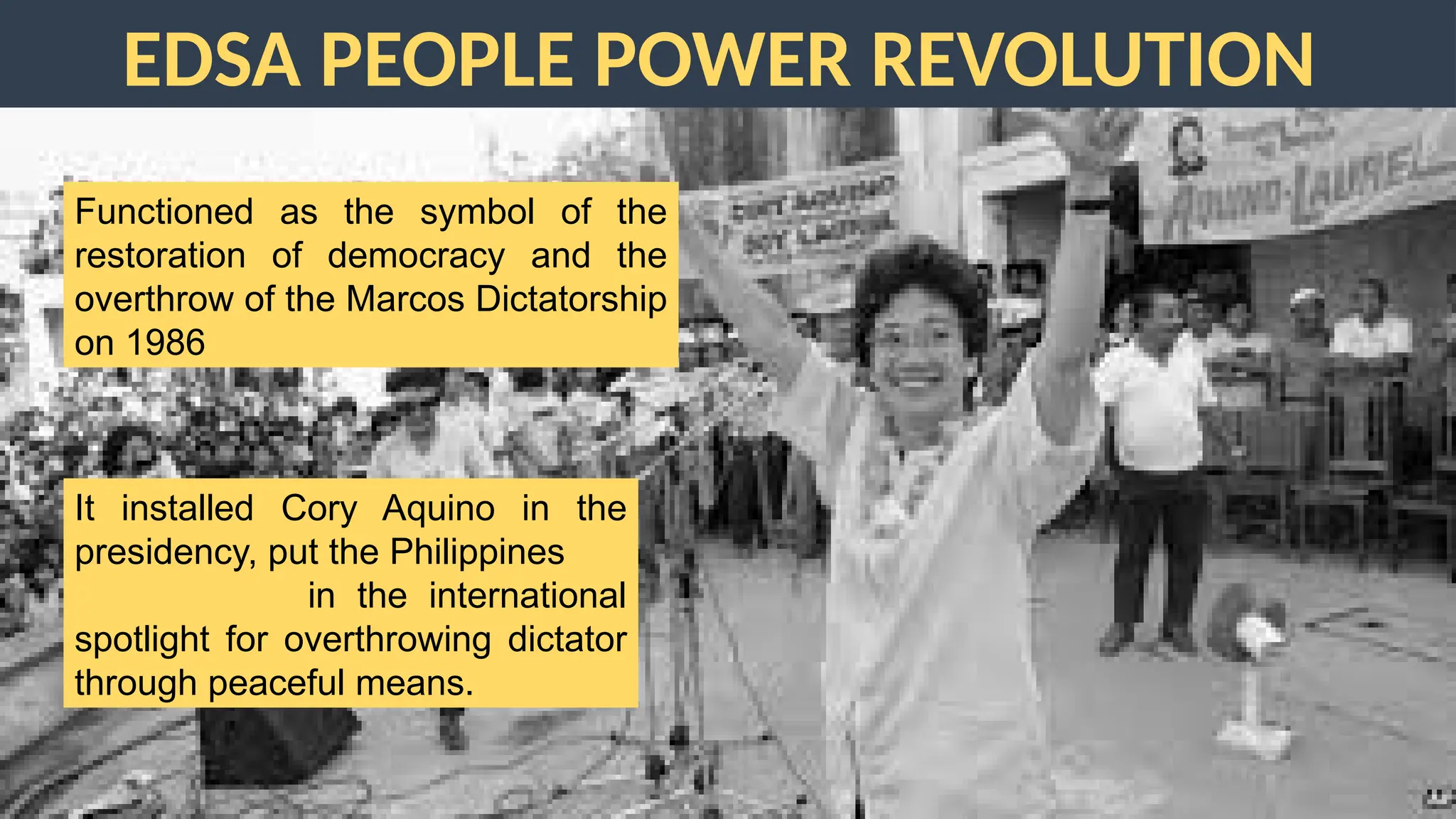
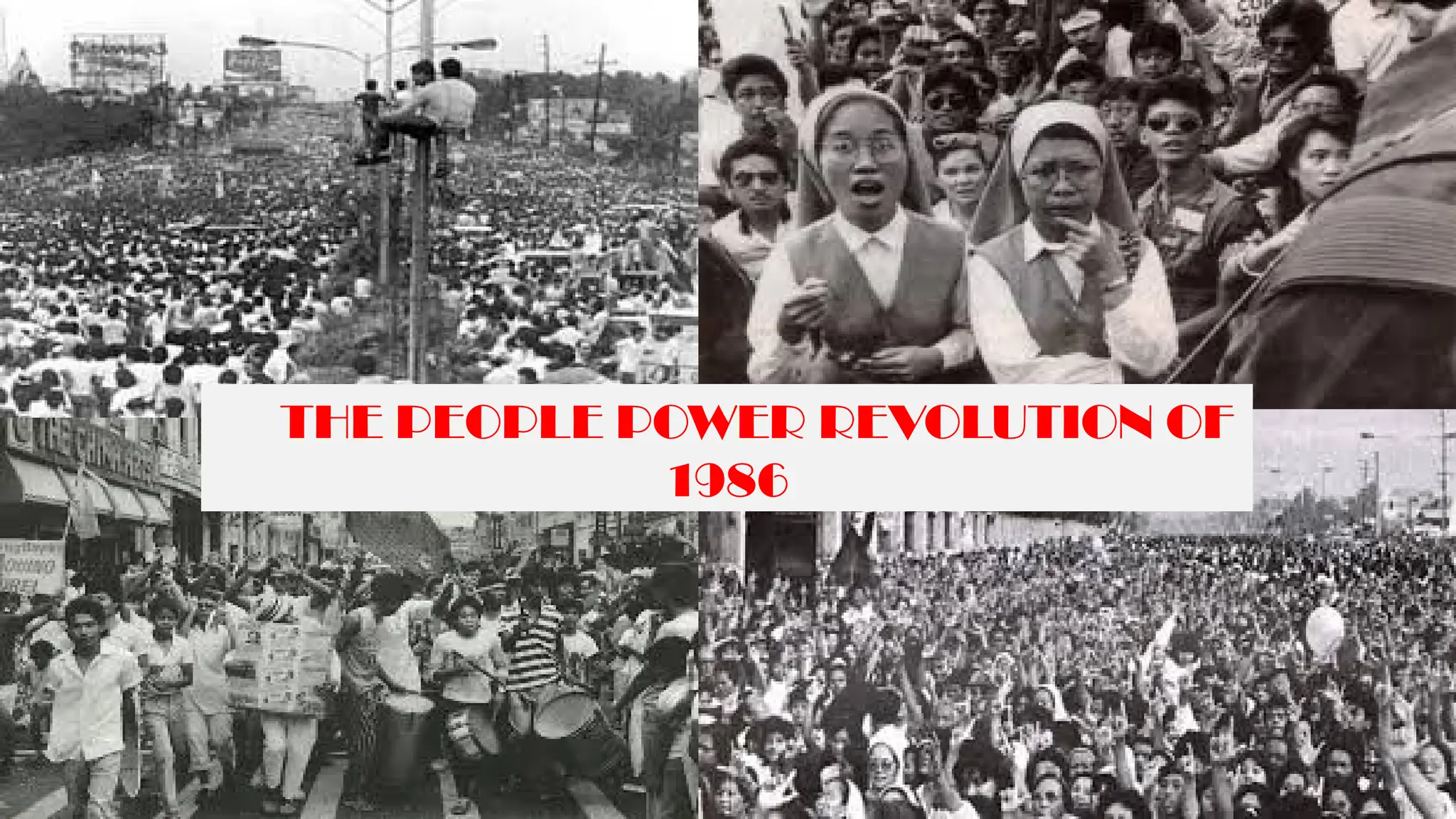
EDSA PEOPLE POWER REVOLUTION
Functioned as the symbol of the
restoration of democracy and the
overthrow of the Marcos Dictatorship
on 1986
It installed Cory Aquino in the
presidency, put the Philippines
in the international
spotlight for overthrowing dictator
through peaceful means.
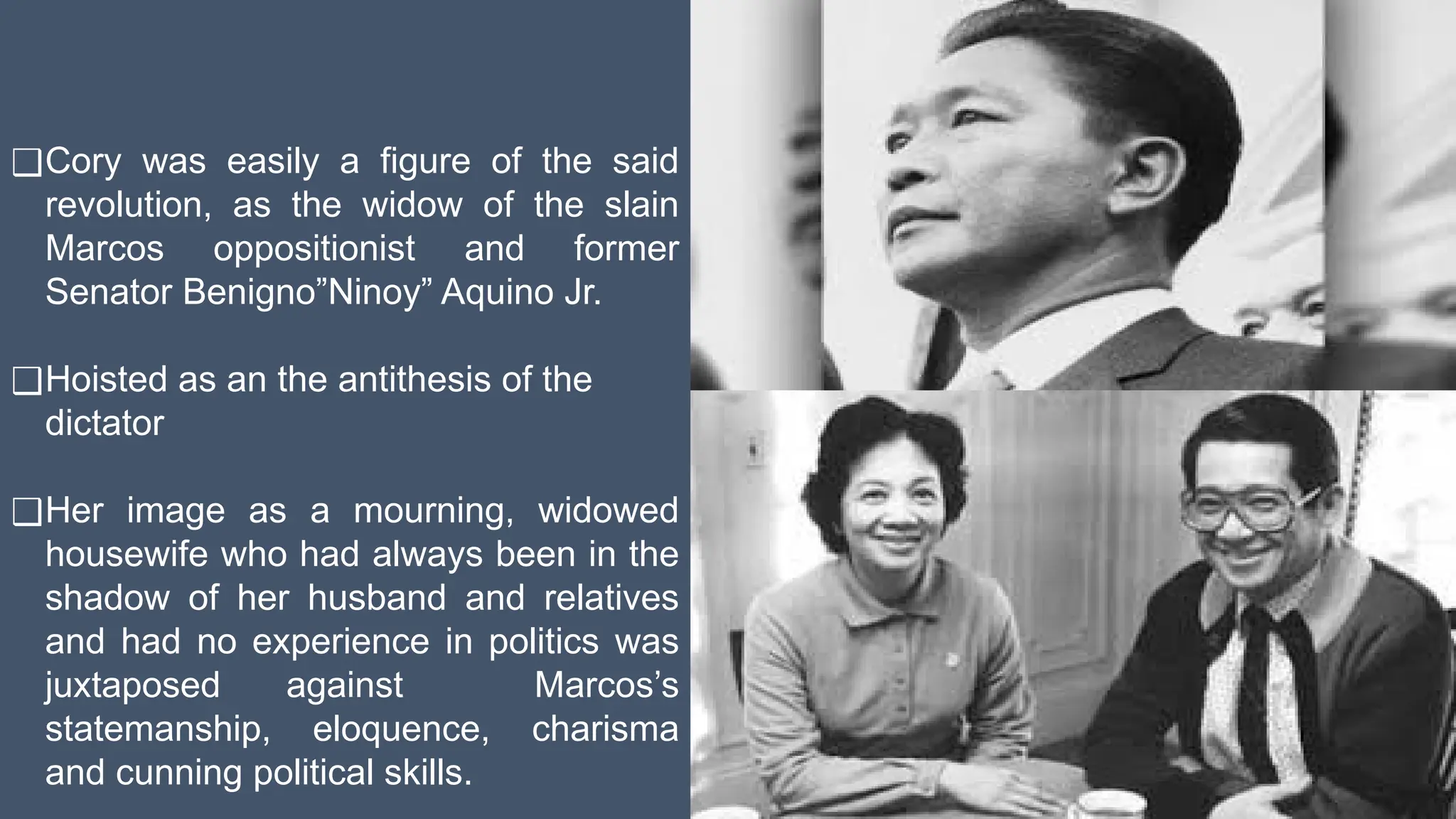
❑Cory was easily a figure of the said
revolution, as the widow of the slain
Marcos oppositionist and former
Senator Benigno”Ninoy” Aquino Jr.
❑Hoisted as an the antithesis of the
dictator
❑Her image as a mourning, widowed
housewife who had always been in the
shadow of her husband and relatives
and had no experience in politics was
juxtaposed against Marcos’s
statemanship, eloquence, charisma
and cunning political skills.
THE PEOPLE POWER REVOLUTION OF
1986
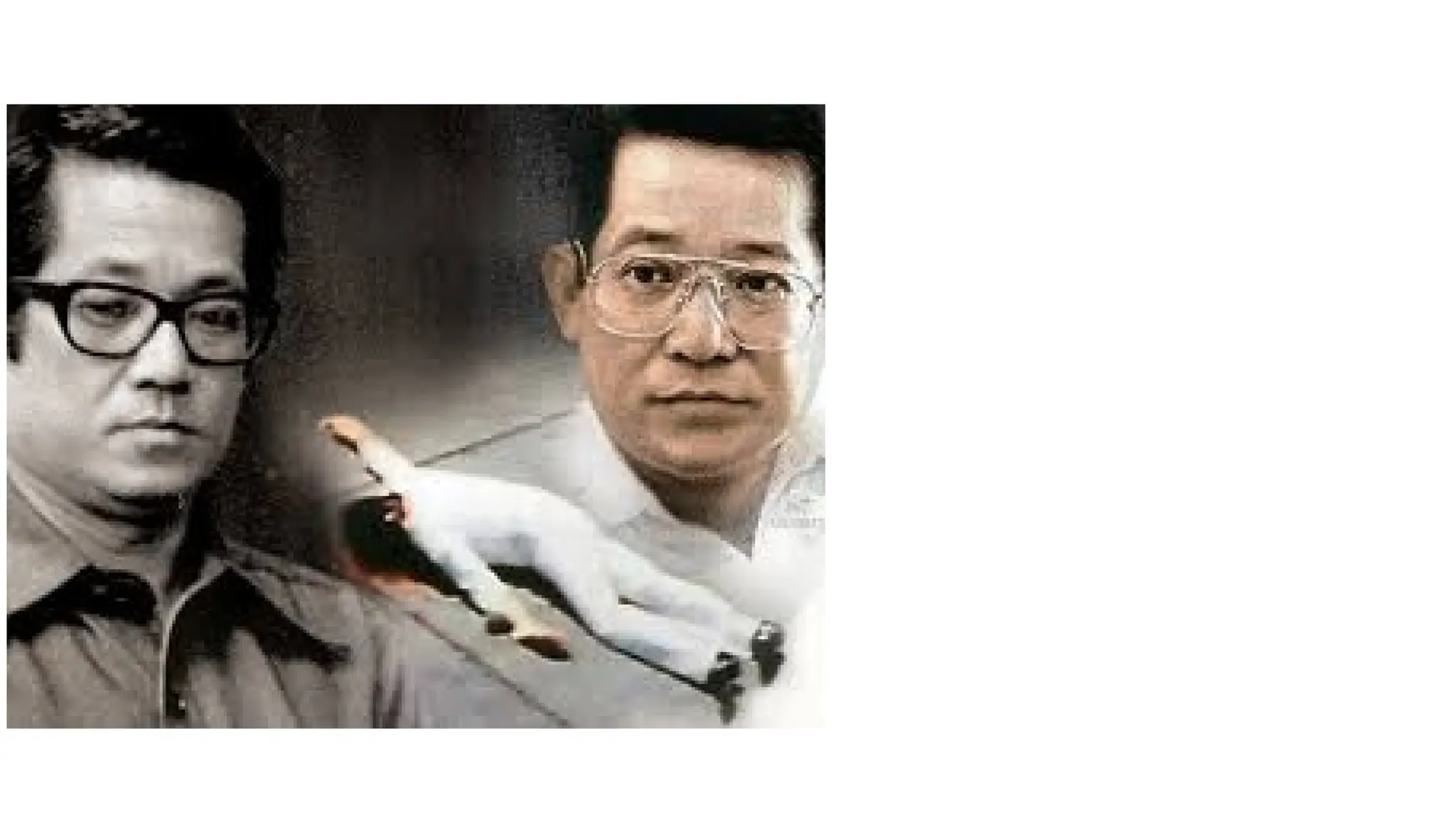
When former senator
Ninoy Aquino was shot
at the tarmac of the
Manila International
Airport on 21 August
1983, the Marcos
regime greatly suffered
a crisis of legitimacy.
Protests from different
sectors frequented
different areas in the
country.
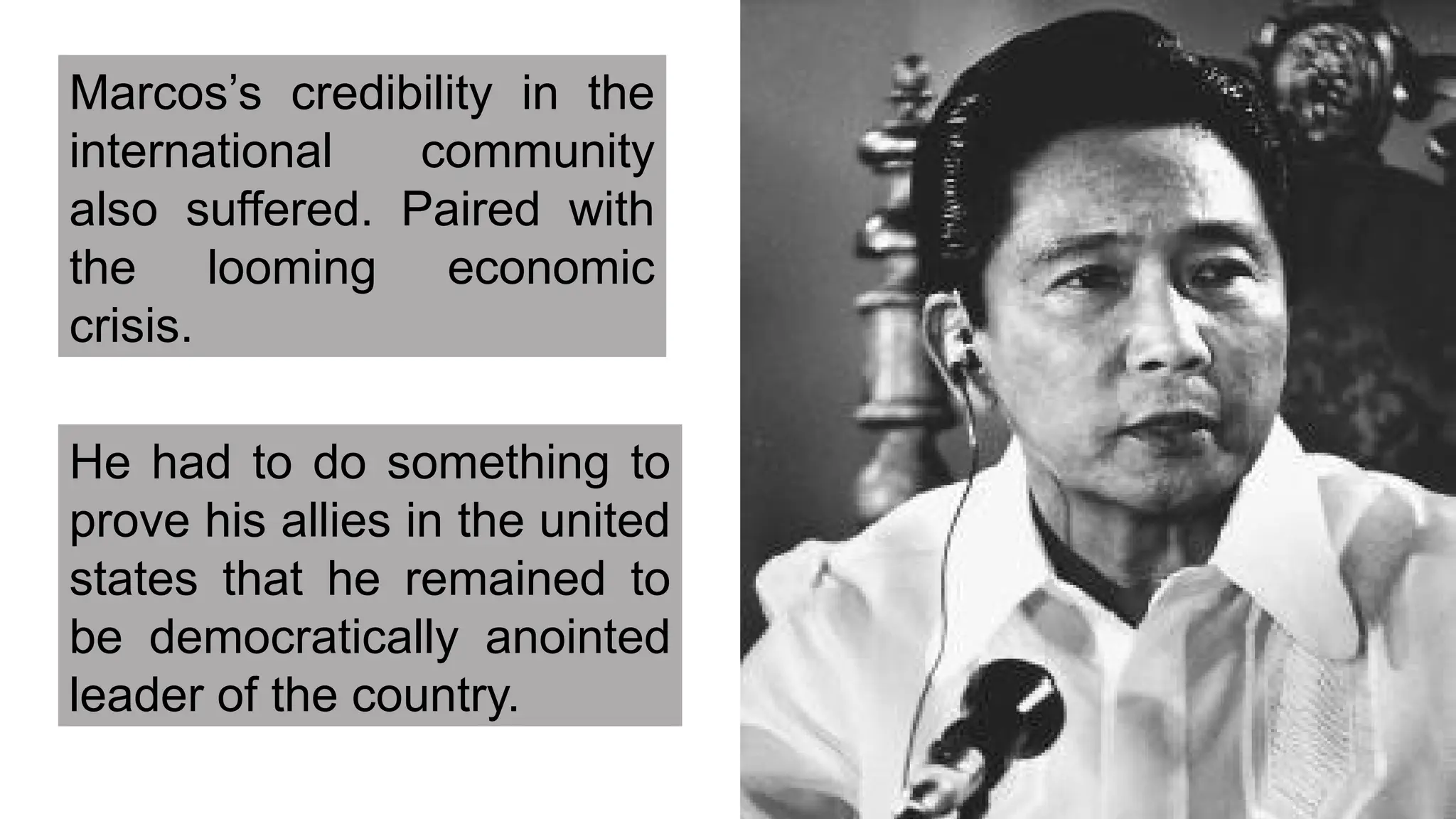
Marcos’s credibility in the
international community
also suffered. Paired with
the looming economic
crisis.
He had to do something to
prove his allies in the united
states that he remained to
be democratically anointed
leader of the country.
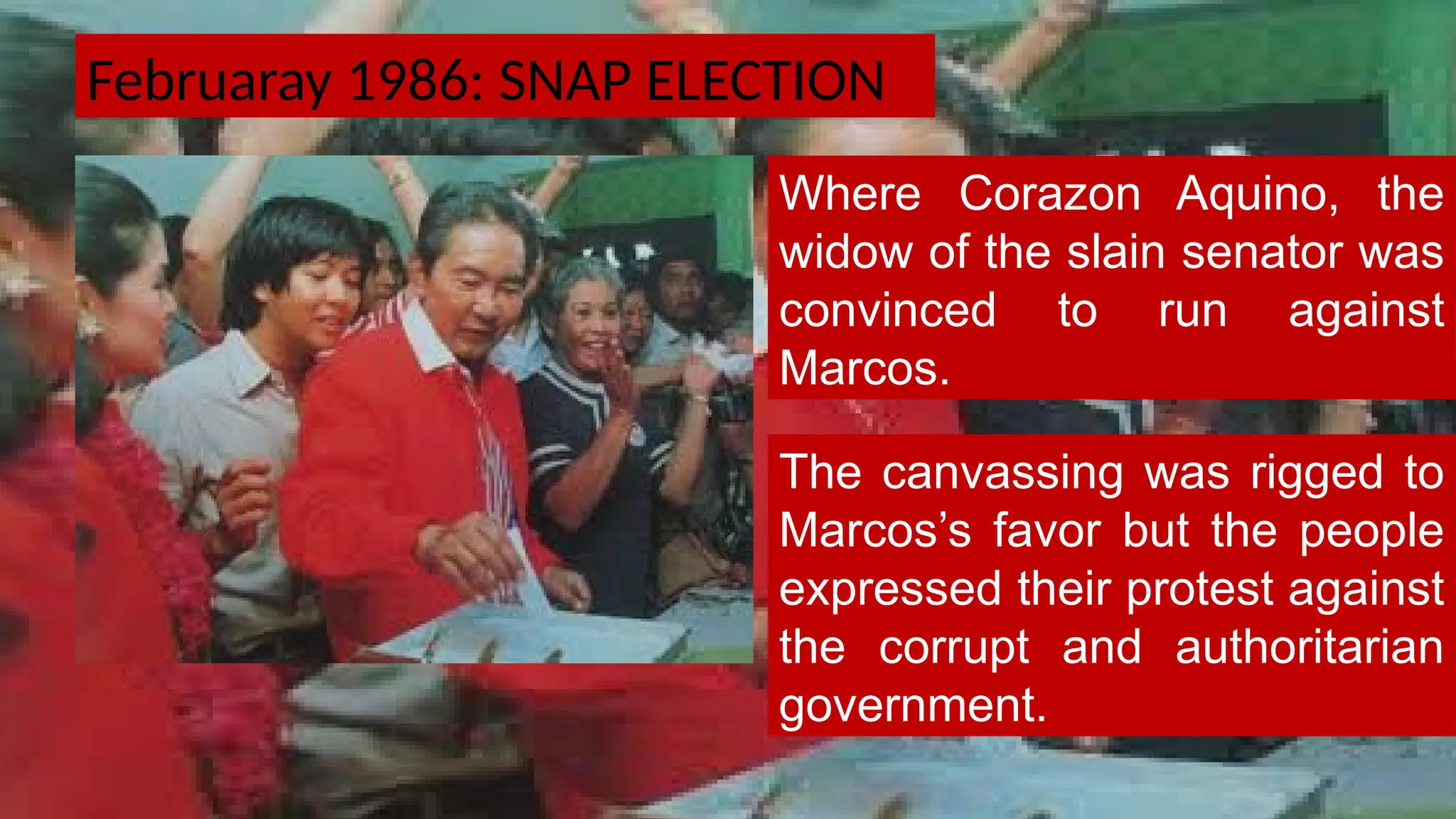
Februaray 1986: SNAP ELECTION
Where Corazon Aquino, the
widow of the slain senator was
convinced to run against
Marcos.
The canvassing was rigged to
Marcos’s favor but the people
expressed their protest against
the corrupt and authoritarian
government.
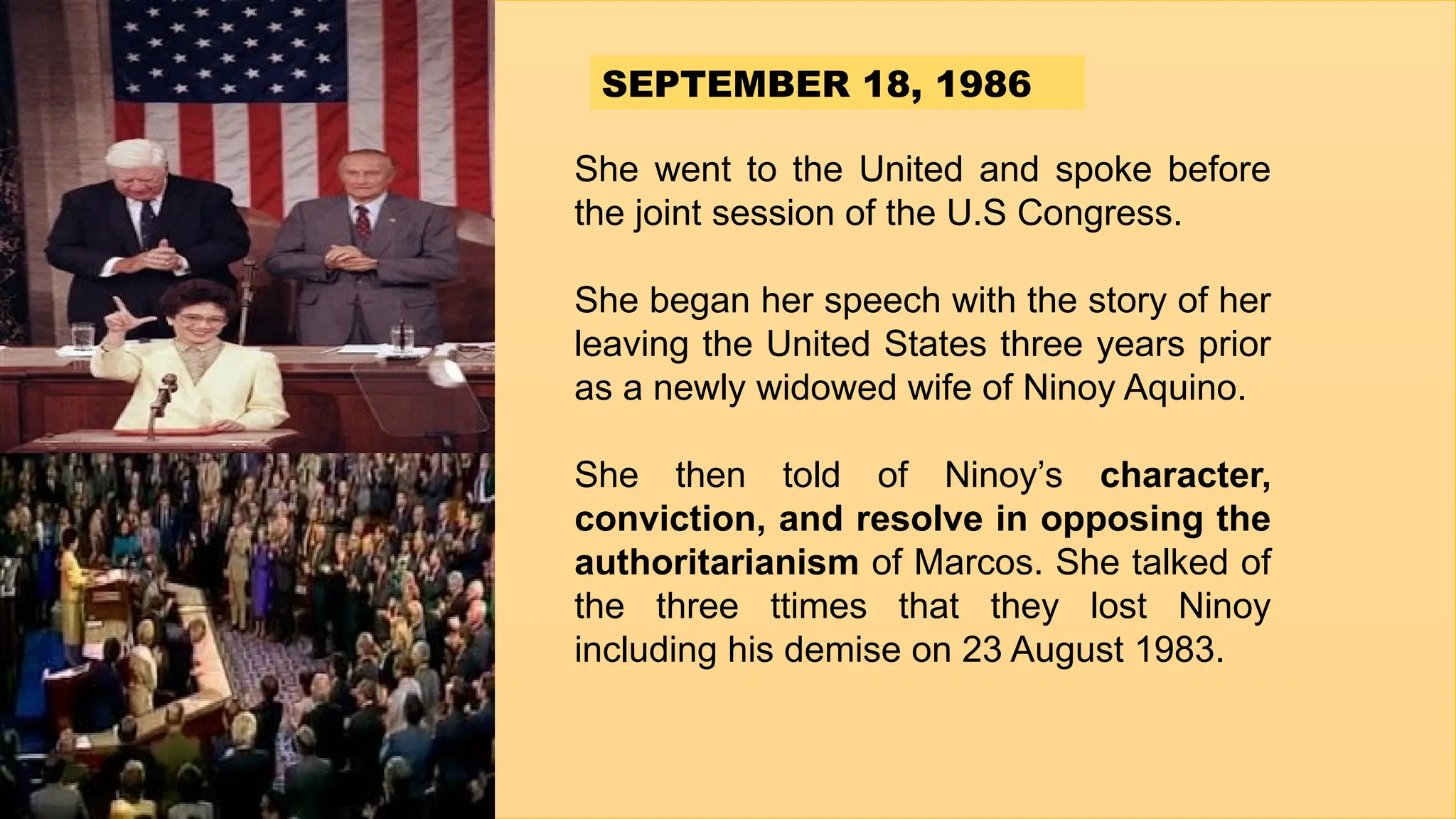
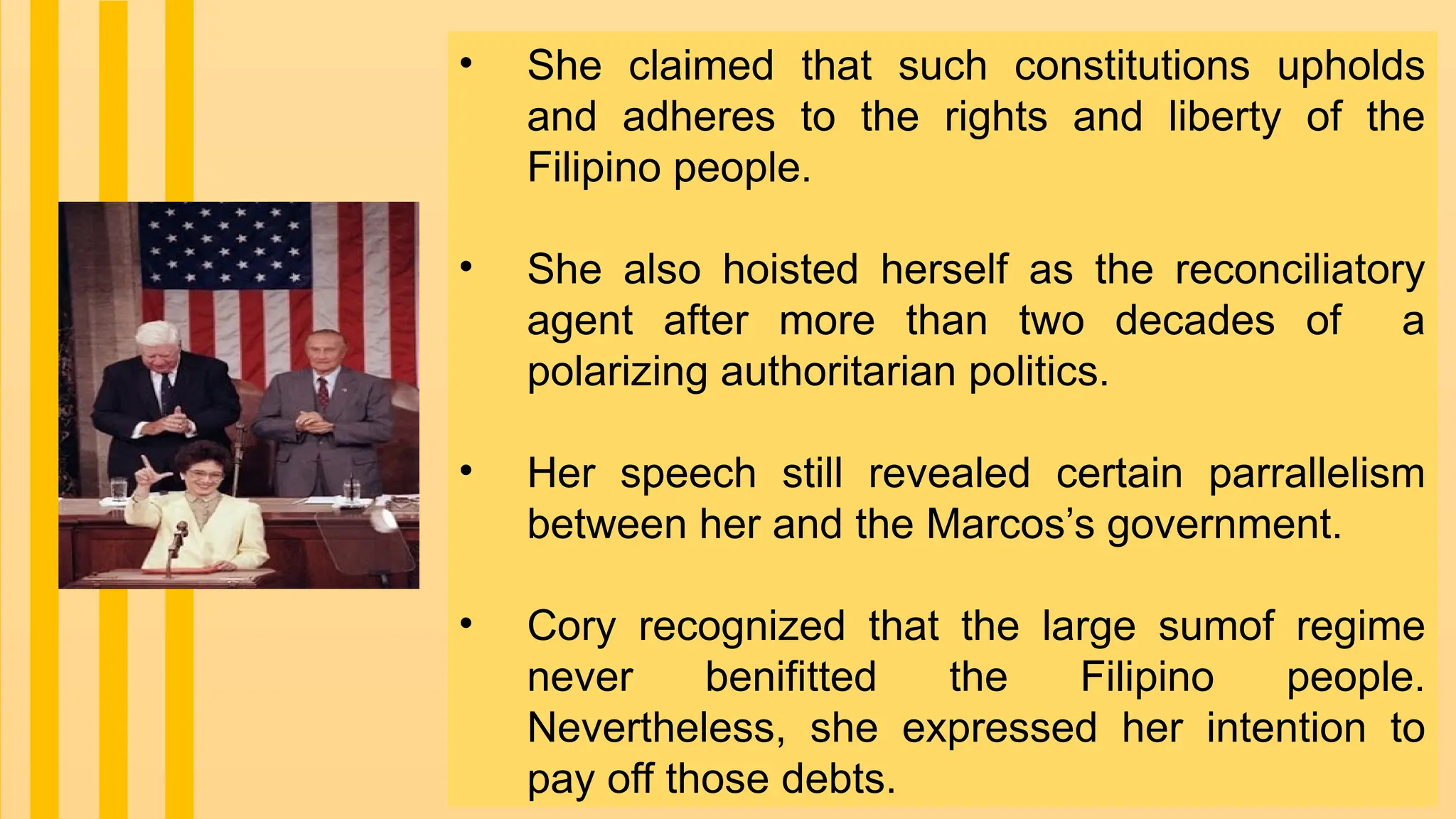
She went to the United and spoke before
the joint session of the U.S Congress.
She began her speech with the story of her
leaving the United States three years prior
as a newly widowed wife of Ninoy Aquino.
She then told of Ninoy’s character,
conviction, and resolve in opposing the
authoritarianism of Marcos. She talked of
the three ttimes that they lost Ninoy
including his demise on 23 August 1983.
SEPTEMBER 18, 1986
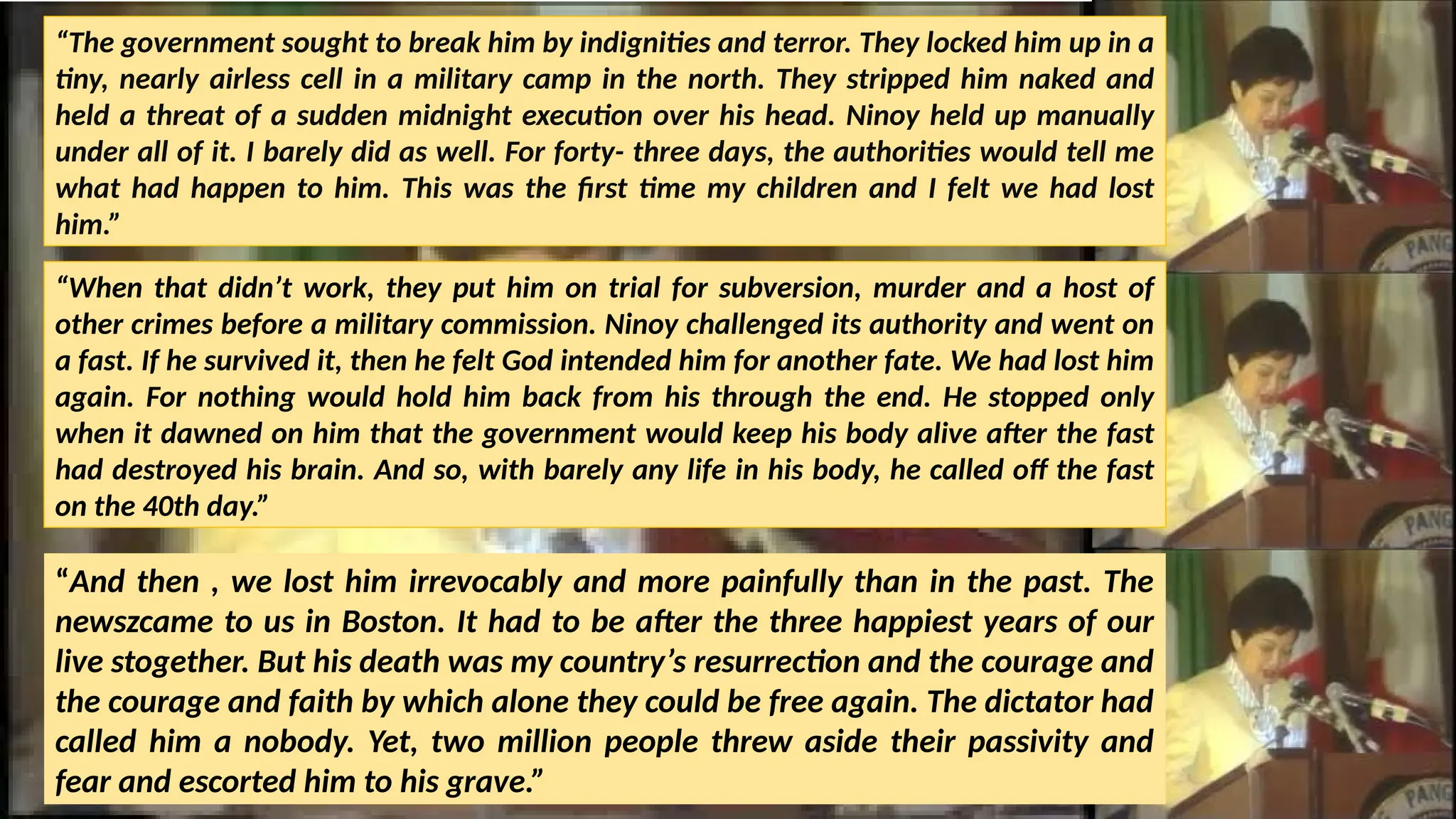
“The government sought to break him by indignities and terror. They locked him up in a
tiny, nearly airless cell in a military camp in the north. They stripped him naked and
held a threat of a sudden midnight execution over his head. Ninoy held up manually
under all of it. I barely did as well. For forty- three days, the authorities would tell me
what had happen to him. This was the first time my children and I felt we had lost
him.”
“When that didn’t work, they put him on trial for subversion, murder and a host of
other crimes before a military commission. Ninoy challenged its authority and went on
a fast. If he survived it, then he felt God intended him for another fate. We had lost him
again. For nothing would hold him back from his through the end. He stopped only
when it dawned on him that the government would keep his body alive after the fast
had destroyed his brain. And so, with barely any life in his body, he called off the fast
on the 40th day.”
“And then , we lost him irrevocably and more painfully than in the past. The
newszcame to us in Boston. It had to be after the three happiest years of our
live stogether. But his death was my country’s resurrection and the courage and
the courage and faith by which alone they could be free again. The dictator had
called him a nobody. Yet, two million people threw aside their passivity and
fear and escorted him to his grave.”
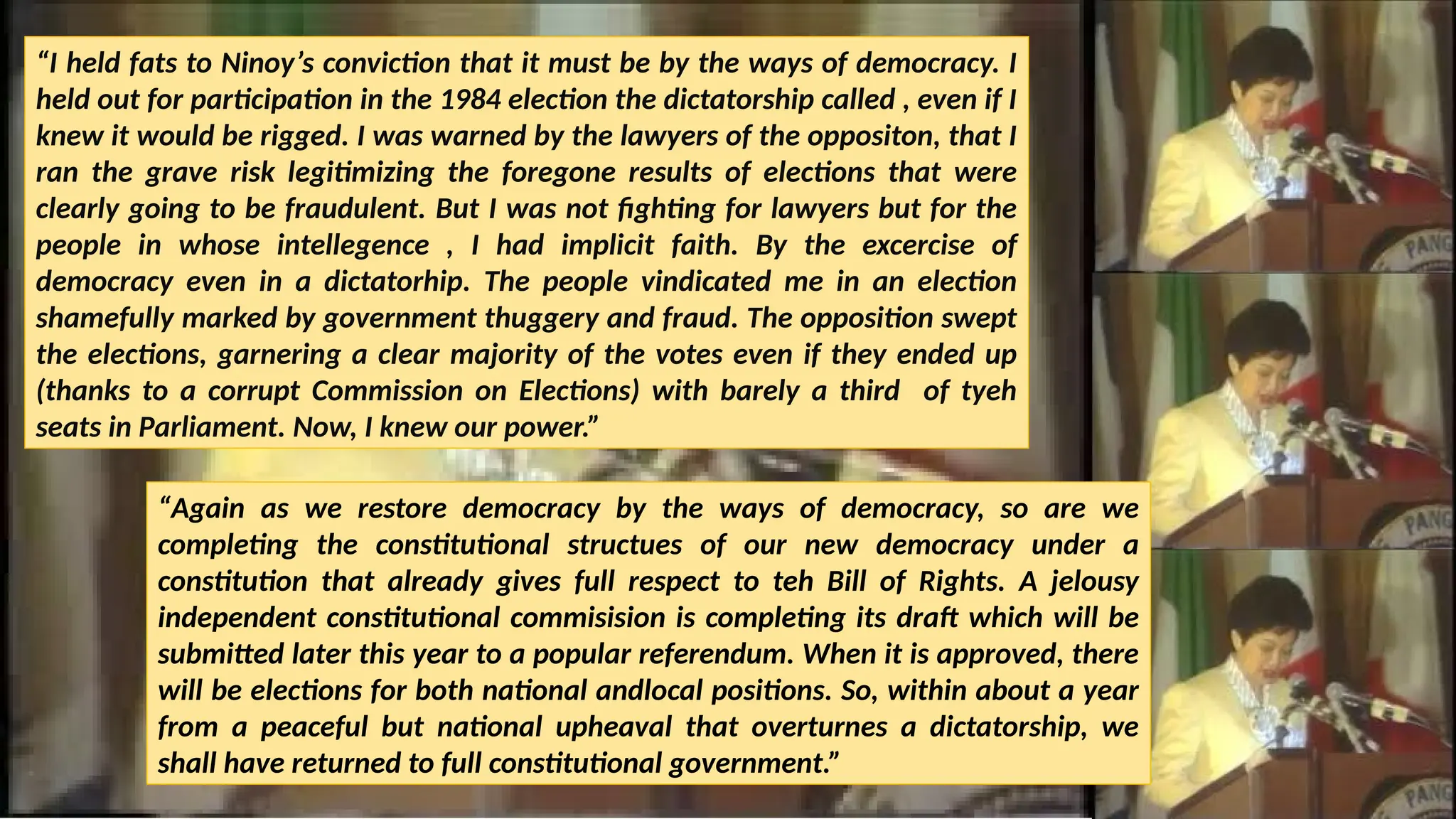
“I held fats to Ninoy’s conviction that it must be by the ways of democracy. I
held out for participation in the 1984 election the dictatorship called , even if I
knew it would be rigged. I was warned by the lawyers of the oppositon, that I
ran the grave risk legitimizing the foregone results of elections that were
clearly going to be fraudulent. But I was not fighting for lawyers but for the
people in whose intellegence , I had implicit faith. By the excercise of
democracy even in a dictatorhip. The people vindicated me in an election
shamefully marked by government thuggery and fraud. The opposition swept
the elections, garnering a clear majority of the votes even if they ended up
(thanks to a corrupt Commission on Elections) with barely a third of tyeh
seats in Parliament. Now, I knew our power.”
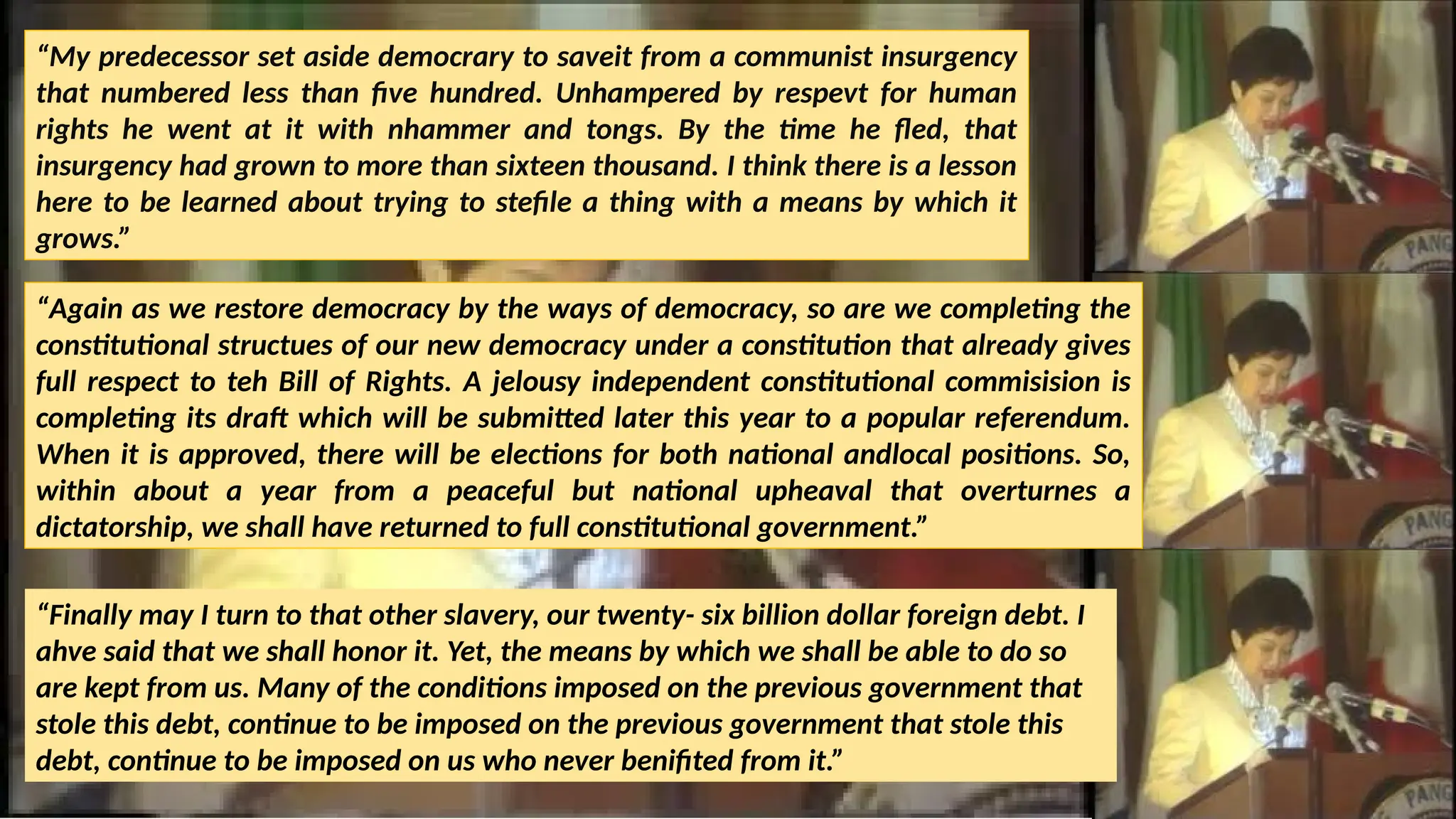
“Again as we restore democracy by the ways of democracy, so are we
completing the constitutional structues of our new democracy under a
constitution that already gives full respect to teh Bill of Rights. A jelousy
independent constitutional commisision is completing its draft which will be
submitted later this year to a popular referendum. When it is approved, there
will be elections for both national andlocal positions. So, within about a year
from a peaceful but national upheaval that overturnes a dictatorship, we
shall have returned to full constitutional government.”
“My predecessor set aside democrary to saveit from a communist insurgency
that numbered less than five hundred. Unhampered by respevt for human
rights he went at it with nhammer and tongs. By the time he fled, that
insurgency had grown to more than sixteen thousand. I think there is a lesson
here to be learned about trying to stefile a thing with a means by which it
grows.”
“Again as we restore democracy by the ways of democracy, so are we completing the
constitutional structues of our new democracy under a constitution that already gives
full respect to teh Bill of Rights. A jelousy independent constitutional commisision is
completing its draft which will be submitted later this year to a popular referendum.
When it is approved, there will be elections for both national andlocal positions. So,
within about a year from a peaceful but national upheaval that overturnes a
dictatorship, we shall have returned to full constitutional government.”
“Finally may I turn to that other slavery, our twenty- six billion dollar foreign debt. I
ahve said that we shall honor it. Yet, the means by which we shall be able to do so
are kept from us. Many of the conditions imposed on the previous government that
stole this debt, continue to be imposed on the previous government that stole this
debt, continue to be imposed on us who never benifited from it.”
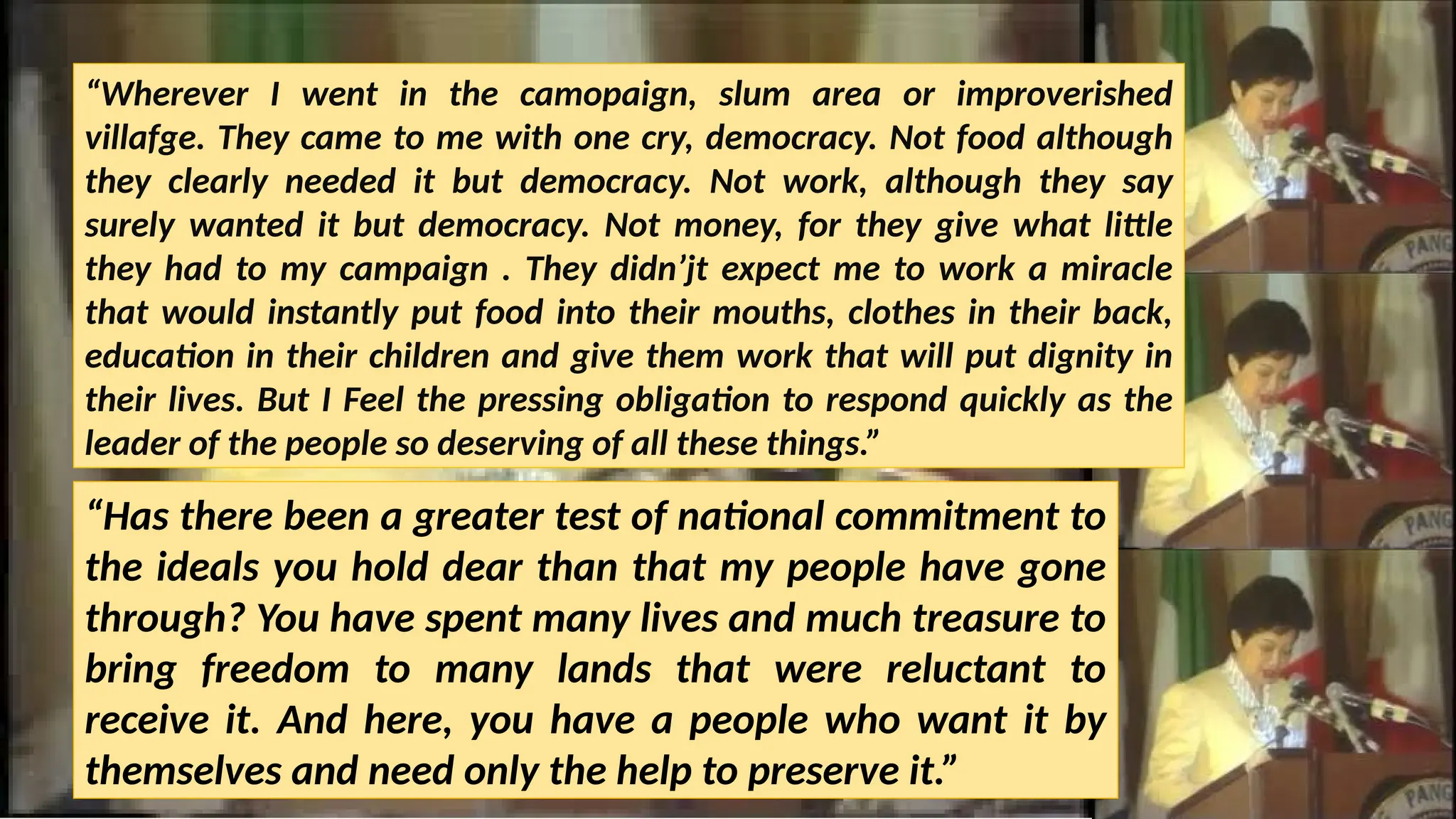
“Wherever I went in the camopaign, slum area or improverished
villafge. They came to me with one cry, democracy. Not food although
they clearly needed it but democracy. Not work, although they say
surely wanted it but democracy. Not money, for they give what little
they had to my campaign . They didn’jt expect me to work a miracle
that would instantly put food into their mouths, clothes in their back,
education in their children and give them work that will put dignity in
their lives. But I Feel the pressing obligation to respond quickly as the
leader of the people so deserving of all these things.”
“Has there been a greater test of national commitment to
the ideals you hold dear than that my people have gone
through? You have spent many lives and much treasure to
bring freedom to many lands that were reluctant to
receive it. And here, you have a people who want it by
themselves and need only the help to preserve it.”
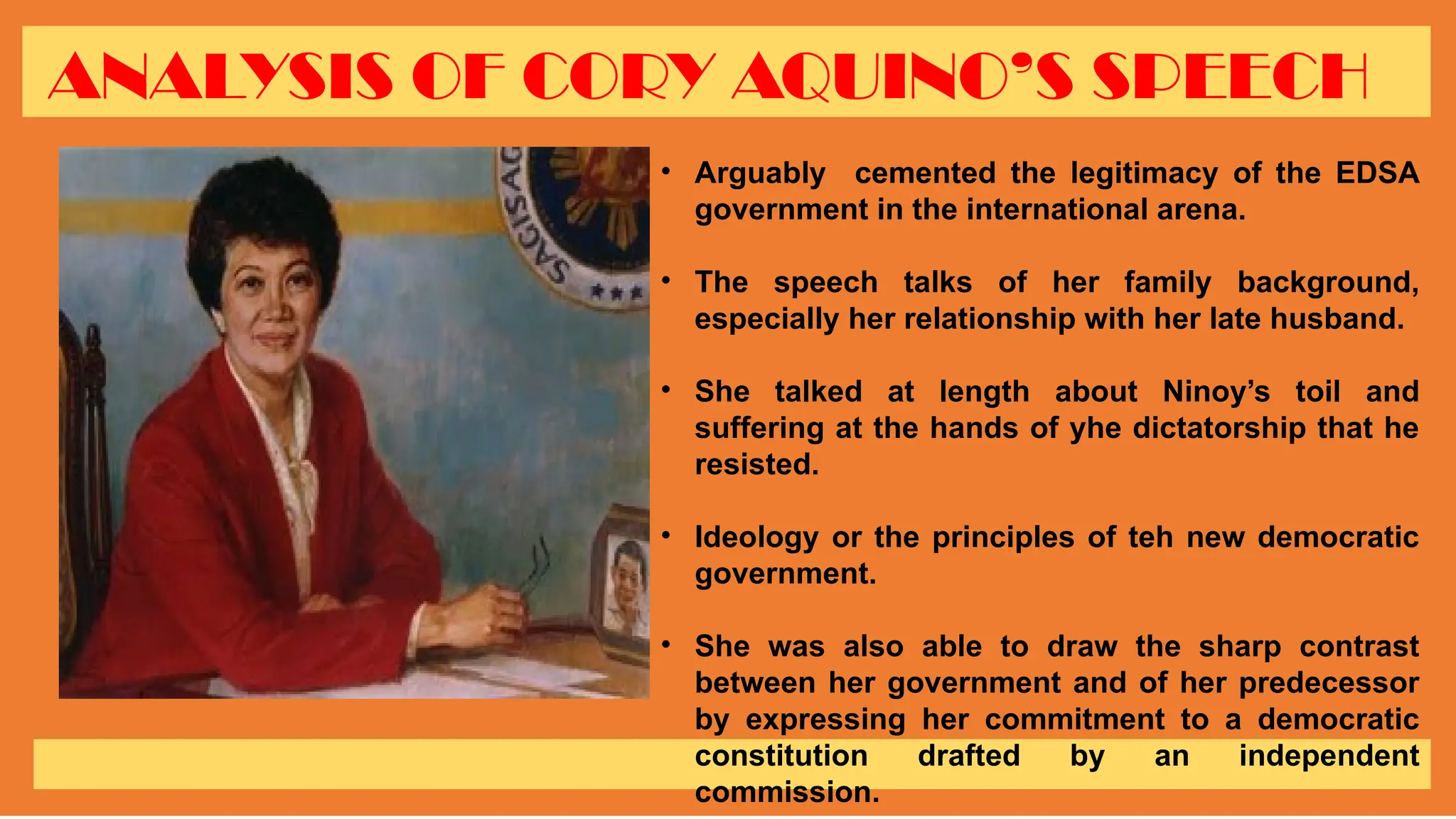
ANALYSIS OF CORY AQUINO’S SPEECH
• Arguably cemented the legitimacy of the EDSA
government in the international arena.
• The speech talks of her family background,
especially her relationship with her late husband.
• She talked at length about Ninoy’s toil and
suffering at the hands of yhe dictatorship that he
resisted.
• Ideology or the principles of teh new democratic
government.
• She was also able to draw the sharp contrast
between her government and of her predecessor
by expressing her commitment to a democratic
constitution drafted by an independent
commission.
• She claimed that such constitutions upholds
and adheres to the rights and liberty of the
Filipino people.
• She also hoisted herself as the reconciliatory
agent after more than two decades of a
polarizing authoritarian politics.
• Her speech still revealed certain parrallelism
between her and the Marcos’s government.
• Cory recognized that the large sumof regime
never benifitted the Filipino people.
Nevertheless, she expressed her intention to
pay off those debts.

CHAPTER-2-READINGS-IN-PHILIPPINE-HISTORY 2.pptx

  • 1.
    Readings in PhilippineHistory CHAPTER 2 “Content and Contextual Analysis of Selected Primary Sources in Philippine History”
  • 2.
    Objectives:  To Familiarizeoneself with the primary documents in different historical periods of the Philippines; To learn history through primary source;  To properly interpret primary sources through examining the content and context of the document; and To understand the context behind each selected documents.
  • 3.
    What we’ll Discuss? ABrief Summary of the First Voyage Around the world by Magellan by Antonio Pigafetta
  • 4.
    Historical sources It isthe historian’s primary tool of understanding and interpreting the past. It ascertain historical facts. Facts are then analyzed and interpreted by the historian.
  • 5.
    Primary Source Using primarysource in historical research entails two kinds of criticism. External Criticism- Authenticity of the document or the evidence being used. Internal Criticism- examine the truthfulness of the content of the evidence.
  • 6.
    A Brief Summary ofthe First Voyage Around the World By Magellan by Antonio Pigafetta
  • 7.
    This book wastaken from the chronicles of the contemporary voyagers, navigator of sixteenth century, and was an Italian nobleman, Antonio Pigafetta. ABOUT THIS BOOK
  • 8.
    ABOUT THIS BOOK AntonioPigafetta`s work instantly became a classic that prominent literary men in the west.
  • 9.
    ABOUT THIS BOOK Pigafetta’stravelogue is one of the most important primary source in the study of Pre-Colonial Philippines.
  • 10.
    ABOUT THIS BOOK AntonioPigafetta`s account was also a major referent to the events leading the Magellan’s arrival in the Philippines.
  • 11.
    ABOUT THIS BOOK His(Pigafetta) encounter with local leaders, his death with the hands of Lapu-Lapu's forces in the battle of Mactan and the departure of what was left of Magellan’s fleet from the islands.
  • 12.
    ABOUT THIS BOOK TheFirst Voyage Around the World by Magellan was Published after Pigafetta returned to Italy.
  • 13.
    A Brief Summaryof the First Voyage Around the World By Magellan by Antonio Pigafetta What is Landrones Islands or the Islands of Thieves?
  • 14.
    A Brief Summaryof the First Voyage Around the World By Magellan by Antonio Pigafetta  Landrones Islands is presently known as the Marianas Islands. o Located at south-southeast of Japan, west- southwest of Hawaii, North of New Guinea and east of Philippines. o It is also called “Island of the Thieves”
  • 15.
    A Brief Summaryof the First Voyage Around the World By Magellan by Antonio Pigafetta He recounted (Pigafetta) : “ These people have no arms, but use sticks, which have a fish bone at the end. They are poor, but ingenious, and great thieves, and for the sake of what we called these three islands the Landrones Islands”
  • 16.
    A Brief Summaryof the First Voyage Around the World By Magellan by Antonio Pigafetta Pigafetta reported that they reached what he called the isle of Zamal, now Samar but Magellan decided to land in another uninhabited island for a greater security where they could rest for a few days.
  • 17.
    A Brief Summaryof the First Voyage Around the World By Magellan by Antonio Pigafetta Two days after o Pigafetta recounted that nine (9) men came to them and showed joy and eagerness in seeing them. o In turn, the natives also gave them fish, palm wine (uraca), figs (fruit), two cochos, rice (umai), cococs, and other food supplies
  • 18.
    A Brief Summaryof the First Voyage Around the World By Magellan by Antonio Pigafetta “This palm tree produces a fruit named cocho, which is as large as the head, or thereabouts: its first husk is green, and two fingers in thickness, in it they find certain threads, with which they make the cords for fastening their boats.“
  • 19.
    A Brief Summaryof the First Voyage Around the World By Magellan by Antonio Pigafetta  Pigafetta characterized the people a “very familiar and friendly” and willing showed them different islands and the names of these islands.  Humunu Island (Homonhon) and there they found what Pigafetta referred to as the “Watering Place of Good Signs.”  “ FIRST SIGNS OF GOLD IN THE ISLAND.”
  • 20.
    A Brief Summaryof the First Voyage Around the World By Magellan by Antonio Pigafetta  They named the island (Humuno or Homonhon) with the nearby island as the Archipelago of St. Lazarus.  Pigafetta recounted that they saw two ballanghai (balangay), a long boat full of people in Mazzava/Mazaua.  The leader, who referred to as the king of the Ballanghai ( Balangay ), sent his men to the ship of Magellan.
  • 21.
    A Brief Summaryof the First Voyage Around the World By Magellan by Antonio Pigafetta When the King of the Balangay offered to give Magellan a bar of gold and a chest of ginger, Magellan declined. Magellan sent the interpreter to the king and asked for the money for the needs of his ships and expressed that he came into the islands as a friend and not as an enemy. Magellan also boasted of his men in an armor who could not be struck with swords and daggers Magellan also shared with the king his charts and maps and shared how they found the islands.
  • 22.
    A Brief Summaryof the First Voyage Around the World By Magellan by Antonio Pigafetta  Magellan was introduced to the king`s brother (Raia Calambu) who was also a king of another island  The gold was abundant that parts of the ship and of the house of the second king were made of gold.  Pigafetta described this king as the most handsome of all the men that he saw in this place.  This King was named Raia Calambu, King of Zuluan and Calagan (Butuan and Caragua).  The first king was Raia Siagu.
  • 23.
    A Brief Summaryof the First Voyage Around the World By Magellan by Antonio Pigafetta  On March 31, 1521, Which happened to be Easter Sunday, Magellan ordered the chaplain to preside a Mass by the Shore “… When the offertory of the mass came, the two kings, went to kiss the cross like us, but they offered nothing, and at the elevation of the body of the Lord they were kneeling like us, and adored our Lord with joined hands.”
  • 24.
    A Brief Summaryof the First Voyage Around the World By Magellan by Antonio Pigafetta March 31, 1521  First mass happened in “Mazaua”  Attended by Magellan, Raia Calambu, Raia Siagu and local islanders.
  • 25.
    A Brief Summaryof the First Voyage Around the World By Magellan by Antonio Pigafetta  Magellan ordered that the cross be brought with nails and crown in place.  Cross, Nail, & Crown – were the signs of his emperor (Magellan).
  • 26.
    A Brief Summaryof the First Voyage Around the World By Magellan by Antonio Pigafetta April 7, 1521 Magellan went to Zubu(Cebu) and met Rajah Humabon the Rajah wanted Magellan and his men to pay tribute to them but told his translator Enrique, that they are working for King of Spain and threatened him a war.
  • 27.
    A Brief Summaryof the First Voyage Around the World By Magellan by Antonio Pigafetta April 14, 1521 Held a mass on Humabon’s place where attended by 800 locals Magellan gave Hara Humamay an image of Sto. Niño Humabon became “Carlos” and Humamay became “Juana
  • 28.
    A Brief Summaryof the First Voyage Around the World By Magellan by Antonio Pigafetta April 26, 1521 Rajah Zula told Magellan that Matan’s (Mactan) chieftain Cilapulapu (Lapulapu) refused to obey the King of Spain Zula requested Magellan to send him only one boat load of men to fight Cilapulapu but Magellan.
  • 29.
    A Brief Summaryof the First Voyage Around the World By Magellan by Antonio Pigafetta April 27, 1521 Magellan arrived in Mactan They numbered 49 in total and the islanders of Mactan were estimated 1,500 in total. The “ Battle of Mactan” happened
  • 30.
    A Brief Summaryof the First Voyage Around the World By Magellan by Antonio Pigafetta •Duarte Barbosa • The new elected captain of Magellan’s men. •Henry – Magellan’s slave who betrayed and told the King of Cebu that they intended to leave as quickly as possible.
  • 31.
    •The natives hadslain all men except the interpreter and Juan Serrano in the gathering. Serrano was presented and shouted in the ship asking them to pay ransom to spare his life but they refused, departed and abandoned Serrano. They left Cebu and continued their journey around the world. A Brief Summary of the First Voyage Around the World By Magellan by Antonio Pigafetta
  • 32.
    A Brief Summaryof the First Voyage Around the World By Magellan by Antonio Pigafetta Pigafetta’s work did of great importance in the study and writing in Philippine History Pigafetta was able to give details of geography and climate of the places that their voyage has reached.
  • 33.
    A Brief Summaryof the First Voyage Around the World By Magellan by Antonio Pigafetta In reading Pigafetta’s description of the people, one has to keep in mind that he was coming from sixteenth century European Perspective. He would always remarked on the nakedness of the natives or how he was fascinated by their exotic culture. It should be understood of such observations were rooted from the context of Pigafetta and of his era.
  • 34.
    A Brief Summaryof the First Voyage Around the World By Magellan by Antonio Pigafetta Hence, other beliefs system different from that of Christianity were perceived to be blasphemous and Barbaric, even Demonic. It was not surprising therefore that Pigafetta would mention the abundance of Gold in the island as shown in his description of leaders wearing gold rings and gold daggers, and of the rich gold minds.
  • 35.
    What we’ll discuss? THEKKK AND THE “KARTILYA NG KATIPUNAN”
  • 36.
    THE KKK ANDTHE “KARTILYA NG KATIPUNAN” •Kataastaasan, Kagalanggalangang Katipunan ng mga Anak ng Bayan (KKK) or Katipunan ois arguably the most important organization formed in the Philippine history. It was only this organization that envisioned. oUnited Filipino nation that would revolt against Spaniards for oTotal Independence of the country from spain.
  • 37.
    • Diego Silang •An Ilocano who took up his arms and led one of the longest running revolts in the country. He was mainly concerned about his locality and referred to himself as El Rey de Ilocos (The King of Ilocos) • Propaganda Movement • Led by Ilustrados like Marcelo H. del Pilar, Graciano Lopez Jaena and Jose Rizal • The only demanded equal rights, representation, and protection from the abuses of the friars but did not envisioned a total separation of the Philippines from Spain. THE KKK AND THE “KARTILYA NG KATIPUNAN”
  • 38.
    KARTILYA NG KATIPUNAN Kartilyang Katipunan  the original title was “Manga (sic) Aral Nang (Sic) Katipunan ng nga A.N.B” or “Lessons of the Organization of the Sons of the country.” The document was written by Emilio Jacinto in the 1896. Emilio Jacinto Was only 18 years old when he joined the movement. He was also a law student at the Universidad de Santo Tomas. He became the secretary of the organization and took charge of the short- lived printing press of the Katipunan. (wrote the Kartilya)
  • 39.
    Andres Bonifacio recognized thevalue of intellect of Jacinto. He willingly favored that the Kartilya be disturbed to their fellow Katipuneros. (Wrote the Decalogue) April 15, 1897 Bonifacio appointed Jacinto as a commander of the Katipunan in Northern Luzon. Jacinto was 22 years old. He died of Malaria at a young age of 24 in the town of Magdalena, Laguna. Kartilya  Treated as the Katipunan’s Code of Conduct. It contains 14 rules that instruct the way a Katipunero should behave and which specific values should uphold. First group: contains the rules that will make a member an upright individual Second group: rules that will guide the way he treats his fellowmen. KARTILYA NG KATIPUNAN
  • 40.
  • 41.
    KARTILYA CODE OFCOUNDUCT • The life that is not consecrated to a lofty and reasonable purpose is a tree without a shade, if not a poisonous weed. • To do good for personal gain and not for it’s own sake is not virtue • It is rational to be charitable and love one’s fellow creature, and to adjust one’s conduct, acts and words to what is in itself reasonable. • Whether our skin be black or white, we are all born equal; superiority in knowledge, wealth and beauty are to be understood, but not superiority by nature. • The honorable man, his word is sacred.
  • 42.
    • Do notwaste the thy time: wealth can be recovered but not time lost. • Defend the oppressed and fight the oppressor before the law or in the field. • The prudent man is sparing in words and faithful in keeping secrets. • On the thorny path of life, man is the guide of woman and the children, and if the guide leads to the precipice, those whom he guides will also go there. • Thou must not look upon woman as a mere plaything, but as a faithful companion who will share with thee the penalties of life; her (physical) weakness will increase thy interest in her and she will remind thee of the mother who bore thee and reared thee. KARTILYA CODE OF COUNDUCT
  • 43.
    KARTILYA CODE OFCOUNDUCT • What thou dost not desire done unto thy wife, children, brothers and sisters, that do not unto the wife, children, brothers and sisters of thy neighbor. • Man is not worth more because he is a king, because his nose is aquiline, and his color white, not because he is a priest, a servant of God, nor because of the high prerogative that he enjoys upon earth, but he is worth most who is a man of proven and real value, who does good, keeps his words, is worthy and honest; he who does not oppress nor consent to being oppressed,he who loves and cherishes his fatherland, though he born in the wilderness and know no tongue but his own.
  • 44.
    KARTILYA CODE OFCOUNDUCT When these rules of conduct shall be known to all, the longed for sun of Liberty shall rise brilliant over this most unhappy portion of the globe and its rays shall diffuse everlasting joy among the confederated brethren of the same rays, the lives of those who have gone before, the fatigues and the well-paid sufferings will remain. If he who desires to enter has informed himself of all this and believes he will be able to perform what will be his duties, he may fill out the application for admission.
  • 45.
    ANALYSIS OF THE KARTILYANG KATIPUNAN What we’ll discuss:
  • 46.
    Analysis of theKARTILYA NG KATIPUNAN • As a document written for a fraternity whose main purpose is to overthrow a colonial regime, we can explain the content and provisions of the Kartilya as reaction and response to certain values systems that they found despicable in the present state of things that they struggle against with. • Moreover, one can analyze the values upheld in the documents as consistent with the burgeoning rational and liberal ideals in the eighteenth and nineteenth century. Equality, tolerance, freedom, and liberty were values that first emerged in the eighteenth century French Revolution, which spread an illustrado himself, certainly got an understanding of these values.
  • 47.
    Analysis of theKARTILYA NG KATIPUNAN • Indeed, it can be argued that Katipunan’s recognition of women as important partners in the struggle, as reflected not just in Kartilya but also in the organizational structure of the fraternity where a women’s unit was established, is an endeavor advanced for its time. • Aside from this, the Kartilya was instructive not just of the Katipunan’s conduct toward other people, but also for the member’ development as individuals in their own rights.
  • 48.
    Analysis of theKARTILYA NG KATIPUNAN •Kartilya repeatedly emphasized the importance of honor in words and in action. The teaching of the katipunan on how women should be treated with honor and respect, while positive in many respect and certainly significant stride from the practice of raping and physically abusing women, can still be telling of the Katipunan’s secondary regard for women in relation to men.
  • 49.
    Analysis of theKARTILYA NG KATIPUNAN • All in all, proper reading of Kartilya will reveal a more thourogh understanding of the Katipunan and the significant role that it played in the revolution and in the unfolding of the Philippine history, as we know it.
  • 50.
    Reading the Proclamation of thePhilippine independence What we’ll discuss:
  • 51.
    Reading the Proclamationof the Philippine independence • Every year, the country commemorates the anniversary of the Philippine Independence proclaimed on June 12, 1989, in the province of Cavite. • This event signaled the end of 333 years the Spanish colonization. It tells of the kind of government that as created under General Emilio Aguinaldo.  The declaration was a short 2,000-word document.
  • 52.
    •Some Abuses duringthe Spanish Regime - Arbitrary Arrest; - Harsh Treatment - Killing of Prisoners under the pretext that they were attempting to escape - Unjust deportations; and - Absence of due process. Reading the Proclamation of the Philippine independence
  • 53.
    • Justification Behindthe revolution against Spain - Abuses of the Civil Guard - Unequal protection of the law - Avarice and greed of the clergy - Unjust deportations without proper hearing Reading the Proclamation of the Philippine independence
  • 54.
    Reading the Proclamationof the Philippine independence The White Triangle represents the distinctive emblem of the famous Katipunan society The Three stars represents the three principal island of the Philippine Archipelago, Luzon, Mindanao and Panay. The sun represents the gigantic strides and the eight rays of the sun symbolizing the eight provinces of the Manila, Cavite, Bulacan, Pampanga, Nueva Ecija, Bataan, Laguna and Batangas. The color blue, red and white commemorate those of the flag of the United states of North america. • The Blue and Red colors of the flag are often associated with courage and peace, respectively.
  • 55.
    •While it canalways be argued that symbolic meaning of something presents us several historical truths that can explain the subsequent events, which unfolded after the declaration of independence of the 12th day of June 1898. Reading the Proclamation of the Philippine independence
  • 56.
    Analysis of the“Reading the Proclamation of the Philippine independence”. What we’ll discuss:
  • 57.
    • The documentsreveals some often-overlooked historical truths about this important event in Philippine History. • The documents reflects the general revolutionary sentiment of that period. • However, no mention was made about the more serious problem that affected the masses more profoundly, that is, the land and agrarian crisis felt by the numerous Filipino peasants in the nineteenth century. • This agrarian aspects of the revolution must have been unfamiliar to the middle-class revolutionary leaders or were intentionally left out because they were land holders themselves. Analysis of the “Reading the Proclamation of the Philippine independence’
  • 58.
    • The tasksof the historian, thus is to analyze the content of these documents in relation to the dominant politics and the contexts of the people and institutions surrounding it. July 4 1946 – The united states of America granted that the independence of the Philippines. May 12, 1962 – President Diosdado Macapagal issue the Presidential proclamation no. 28, which declared June 12 a special public holiday throughout the Philippines. The Philippine Flag was made in Hong Kong by Mrs. Marcela Agoncillo. Analysis of the “Reading the Proclamation of the Philippine independence”
  • 59.
     A Glanceat selected Philippine Political Caricature in Alfred McCoy’s Philippine Cartoons: Political Caricature of the American Era ( 1900 – 1941) What we’ll discuss?
  • 60.
    • ALFRED W.MCCOY  He spent the past quarter of his life writing about the politics and history of the opium trade. Awards Eaned:  Philippine Catholic Mass Media Award, Best book of the Year for 1985. Philippine National book Award for History, 1986. Gintong Aklat Award (Manila) Special citation for History, 1987. A Glance at selected philippine Political Caricature in Alfred McCoy’s Philippine Cartoons: Political Caricature of the American Era ( 1900 – 1941)
  • 61.
    • What isPolitical Cartoons and Caricature? It is an art form which veered away from the classical art by exaggerating human features and poking fun at its subject. Art of genre and technique became part of the print media as a form of social and political commentary, which usually target persons of power and authority. Cartoons became as effective tool of publicizing opinions through heavy use of symbolism, which is different from a verbose written editorial and opinion pieces. A Glance at selected philippine Political Caricature in Alfred McCoy’s Philippine Cartoons: Political Caricature of the American Era ( 1900 – 1941)
  • 62.
    •Commentaries in massmedia inevitably shape public opinion and such kind of opinion is worhty of historical examination. •In his book Philippine Cartoons: Political Cartoon of the America Era (1900-1941), Alfred McCoy, together with Alfredo Roces, compiled political cartoons published in newspaper dailies and periodicals in the time. A Glance at selected philippine Political Caricature in Alfred McCoy’s Philippine Cartoons: Political Caricature of the American Era ( 1900 – 1941)
  • 63.
    A Glance atselected philippine Political Caricature in Alfred McCoy’s Philippine Cartoons: Political Caricature of the American Era ( 1900 – 1941) It was published by the Independent on May 20, 1916.
  • 64.
    A Glance atselected philippine Political Caricature in Alfred McCoy’s Philippine Cartoons: Political Caricature of the American Era ( 1900 – 1941) It was also published by the Independent on June 16, 1917. Dawn by Fernando Amorsolo.
  • 65.
    A Glance atselected philippine Political Caricature in Alfred McCoy’s Philippine Cartoons: Political Caricature of the American Era ( 1900 – 1941) It was a commentary on the unprecedented Cases of colorum automobiles in the city streets
  • 66.
    Analysis of the PoliticalCaricature during the American period. What we’ll discuss:
  • 67.
    The transition fromspanish colonial period to the American Occupation period demonstrated different strands of changes and shift in culture, society, and politics. The American drastically introduced democracy to the nascent nation and the consequences were far from ideal. Aside from this, it was also during the American period that Filipino were introduced to different manifestations of modernity like health care, modern transportation, and media. Analysis of the Political Caricature during the American period.
  • 68.
    The post-indpendence andthe post-Filipino- American period in the Philippines were experienced differently by filipinos coming from different classes. The upper principalia class experienced economic prosperity with the opening up for the Philippine economy to the united States but the majority of the poor Filipino remained poor, desperate, victims of state repression. Analysis of the Political Caricature during the American period.
  • 69.
    Analysis of the“Reading the Proclamation of the Philippine independence’ REVISITING CORAZON AQUINO’S SPEECH BEFORE THE U.S CONGRESS
  • 70.
    70 Who is CorazonAquino? ⬗ Corazon Aquino or Maria Corazon Sumulong Cojuangco- Aquino, was born on January 25, 1933 in Tarlac, Philippines ⬗ She was enrolled in a law school in Manila where she met his husband, Benigno Aquino, Jr. ⬗ She is the 11th president and first female president of the Philippines and in Asia. ⬗ She was also dubbed as the “Mother of Democracy”. ⬗ She died on August 1, 2009.
  • 71.
    EDSA PEOPLE POWERREVOLUTION Functioned as the symbol of the restoration of democracy and the overthrow of the Marcos Dictatorship on 1986 It installed Cory Aquino in the presidency, put the Philippines in the international spotlight for overthrowing dictator through peaceful means.
  • 72.
    ❑Cory was easilya figure of the said revolution, as the widow of the slain Marcos oppositionist and former Senator Benigno”Ninoy” Aquino Jr. ❑Hoisted as an the antithesis of the dictator ❑Her image as a mourning, widowed housewife who had always been in the shadow of her husband and relatives and had no experience in politics was juxtaposed against Marcos’s statemanship, eloquence, charisma and cunning political skills.
  • 73.
    THE PEOPLE POWERREVOLUTION OF 1986
  • 74.
    When former senator NinoyAquino was shot at the tarmac of the Manila International Airport on 21 August 1983, the Marcos regime greatly suffered a crisis of legitimacy. Protests from different sectors frequented different areas in the country.
  • 75.
    Marcos’s credibility inthe international community also suffered. Paired with the looming economic crisis. He had to do something to prove his allies in the united states that he remained to be democratically anointed leader of the country.
  • 76.
    Februaray 1986: SNAPELECTION Where Corazon Aquino, the widow of the slain senator was convinced to run against Marcos. The canvassing was rigged to Marcos’s favor but the people expressed their protest against the corrupt and authoritarian government.
  • 77.
    She went tothe United and spoke before the joint session of the U.S Congress. She began her speech with the story of her leaving the United States three years prior as a newly widowed wife of Ninoy Aquino. She then told of Ninoy’s character, conviction, and resolve in opposing the authoritarianism of Marcos. She talked of the three ttimes that they lost Ninoy including his demise on 23 August 1983. SEPTEMBER 18, 1986
  • 78.
    “The government soughtto break him by indignities and terror. They locked him up in a tiny, nearly airless cell in a military camp in the north. They stripped him naked and held a threat of a sudden midnight execution over his head. Ninoy held up manually under all of it. I barely did as well. For forty- three days, the authorities would tell me what had happen to him. This was the first time my children and I felt we had lost him.” “When that didn’t work, they put him on trial for subversion, murder and a host of other crimes before a military commission. Ninoy challenged its authority and went on a fast. If he survived it, then he felt God intended him for another fate. We had lost him again. For nothing would hold him back from his through the end. He stopped only when it dawned on him that the government would keep his body alive after the fast had destroyed his brain. And so, with barely any life in his body, he called off the fast on the 40th day.” “And then , we lost him irrevocably and more painfully than in the past. The newszcame to us in Boston. It had to be after the three happiest years of our live stogether. But his death was my country’s resurrection and the courage and the courage and faith by which alone they could be free again. The dictator had called him a nobody. Yet, two million people threw aside their passivity and fear and escorted him to his grave.”
  • 79.
    “I held fatsto Ninoy’s conviction that it must be by the ways of democracy. I held out for participation in the 1984 election the dictatorship called , even if I knew it would be rigged. I was warned by the lawyers of the oppositon, that I ran the grave risk legitimizing the foregone results of elections that were clearly going to be fraudulent. But I was not fighting for lawyers but for the people in whose intellegence , I had implicit faith. By the excercise of democracy even in a dictatorhip. The people vindicated me in an election shamefully marked by government thuggery and fraud. The opposition swept the elections, garnering a clear majority of the votes even if they ended up (thanks to a corrupt Commission on Elections) with barely a third of tyeh seats in Parliament. Now, I knew our power.” “Again as we restore democracy by the ways of democracy, so are we completing the constitutional structues of our new democracy under a constitution that already gives full respect to teh Bill of Rights. A jelousy independent constitutional commisision is completing its draft which will be submitted later this year to a popular referendum. When it is approved, there will be elections for both national andlocal positions. So, within about a year from a peaceful but national upheaval that overturnes a dictatorship, we shall have returned to full constitutional government.”
  • 80.
    “My predecessor setaside democrary to saveit from a communist insurgency that numbered less than five hundred. Unhampered by respevt for human rights he went at it with nhammer and tongs. By the time he fled, that insurgency had grown to more than sixteen thousand. I think there is a lesson here to be learned about trying to stefile a thing with a means by which it grows.” “Again as we restore democracy by the ways of democracy, so are we completing the constitutional structues of our new democracy under a constitution that already gives full respect to teh Bill of Rights. A jelousy independent constitutional commisision is completing its draft which will be submitted later this year to a popular referendum. When it is approved, there will be elections for both national andlocal positions. So, within about a year from a peaceful but national upheaval that overturnes a dictatorship, we shall have returned to full constitutional government.” “Finally may I turn to that other slavery, our twenty- six billion dollar foreign debt. I ahve said that we shall honor it. Yet, the means by which we shall be able to do so are kept from us. Many of the conditions imposed on the previous government that stole this debt, continue to be imposed on the previous government that stole this debt, continue to be imposed on us who never benifited from it.”
  • 81.
    “Wherever I wentin the camopaign, slum area or improverished villafge. They came to me with one cry, democracy. Not food although they clearly needed it but democracy. Not work, although they say surely wanted it but democracy. Not money, for they give what little they had to my campaign . They didn’jt expect me to work a miracle that would instantly put food into their mouths, clothes in their back, education in their children and give them work that will put dignity in their lives. But I Feel the pressing obligation to respond quickly as the leader of the people so deserving of all these things.” “Has there been a greater test of national commitment to the ideals you hold dear than that my people have gone through? You have spent many lives and much treasure to bring freedom to many lands that were reluctant to receive it. And here, you have a people who want it by themselves and need only the help to preserve it.”
  • 82.
    ANALYSIS OF CORYAQUINO’S SPEECH • Arguably cemented the legitimacy of the EDSA government in the international arena. • The speech talks of her family background, especially her relationship with her late husband. • She talked at length about Ninoy’s toil and suffering at the hands of yhe dictatorship that he resisted. • Ideology or the principles of teh new democratic government. • She was also able to draw the sharp contrast between her government and of her predecessor by expressing her commitment to a democratic constitution drafted by an independent commission.
  • 83.
    • She claimedthat such constitutions upholds and adheres to the rights and liberty of the Filipino people. • She also hoisted herself as the reconciliatory agent after more than two decades of a polarizing authoritarian politics. • Her speech still revealed certain parrallelism between her and the Marcos’s government. • Cory recognized that the large sumof regime never benifitted the Filipino people. Nevertheless, she expressed her intention to pay off those debts.